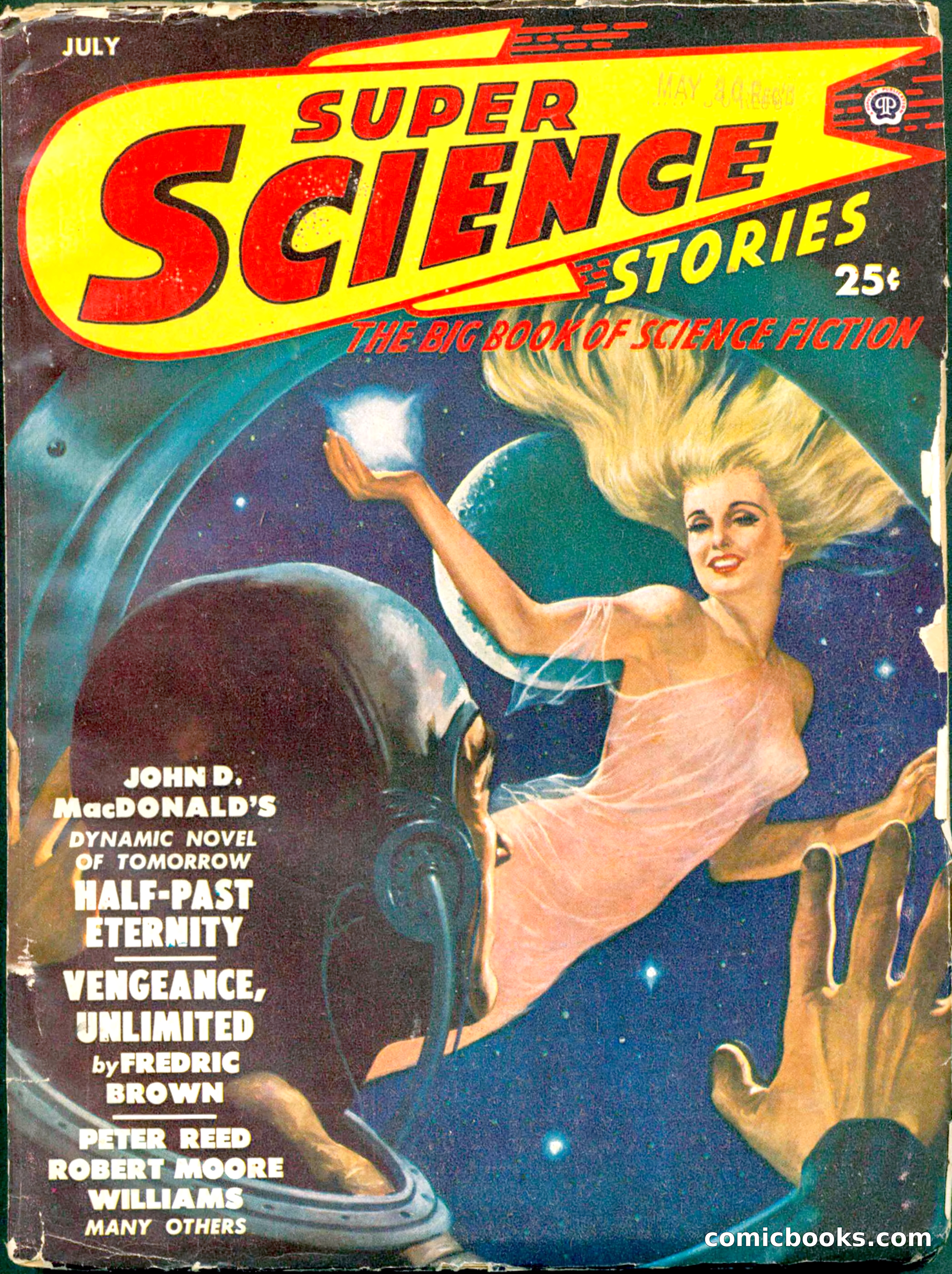
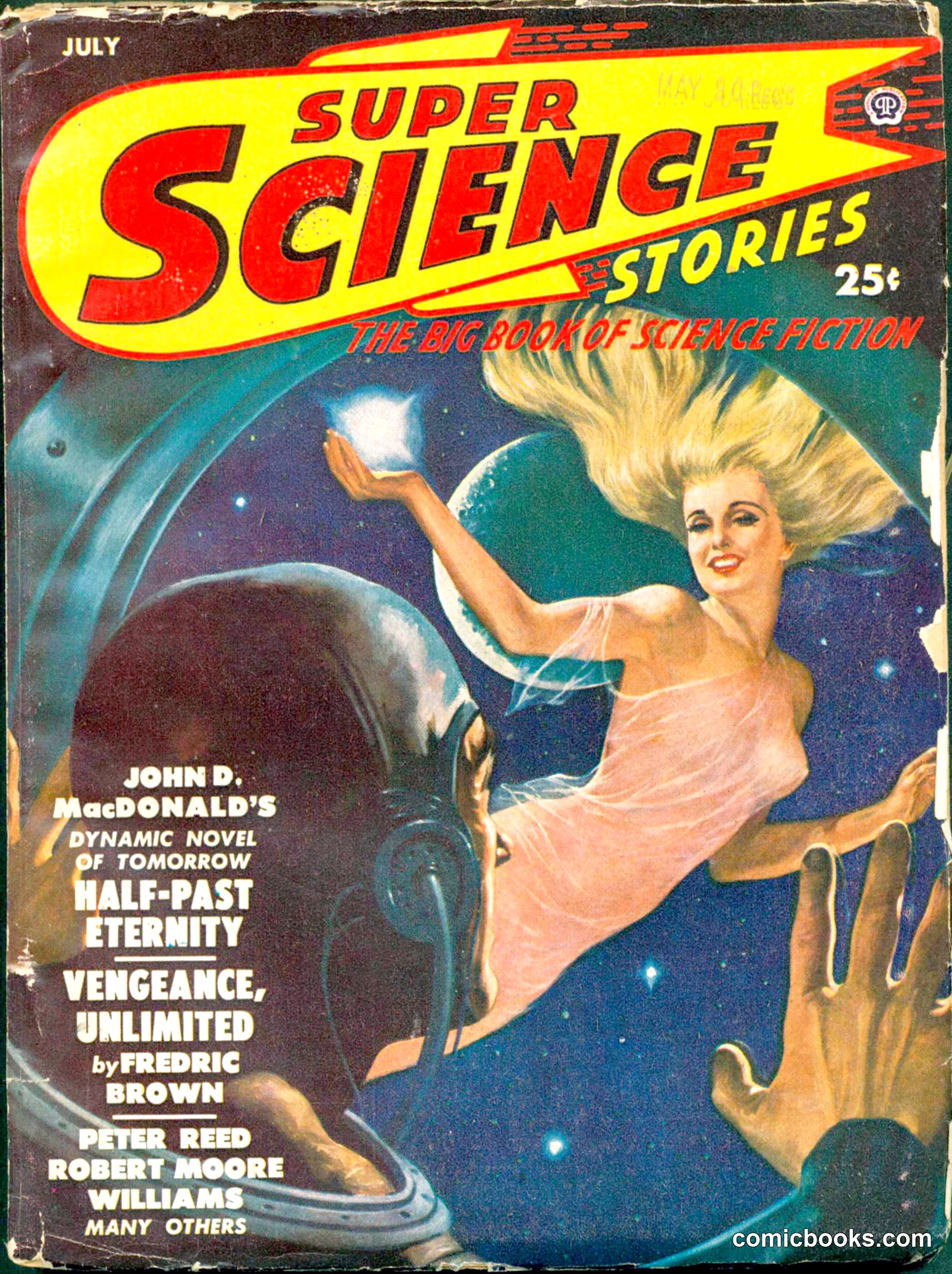
From the exhibition
Super Science Stories, July 1950
· July 1950
Credits □ Engliah
S Higher Mathematics □ H?oh School
Edition □ Illustrating □ Journalism
P Motor Traffic Management
P Professions] Accountancy
P Professional Secrotarial
P Public Speaking
P Refrigerator Mechanic
P Retail Merchandising
P Salesmanship □ Secretarial
□ Shorthand-Gregg
□ Spelling and Correction of English
□ Stenography-Gregg
□ Traffic Management
WORLD HEADQUARTERS
SCRANTON. PENNA.
CANADIAN INSTITUTE CORRESPONDENCE SCHOOLS
VANCOUVER. B.C.
Established 1891
SUPER SCIENCE STORIES 9
THE SCIENCE FICTIONEER
Conducted by Frederik Pohl
By Frederik Pohl
SUPER SCIENCE STORIES readers
might be interested in learning what
happens to their favorite stories—how
they come to life in print.
Fiction doesn't appear in magazines
just because writers feel moved to dash
off a few thousand words for our educa-
tion and entertainment. There's a whole
machinery of business, craft and creative
effort behind each story that appears in
these pages.
The story usually starts with a writer.
The writer reads science fiction magazines
(or at least, a good one should!), knows
what kinds of stories sell, and knows what
he can write best. He dreams up an idea,
plots it out in his mind or on paper, and
sits down to write.
Sometimes the writer sends the story to
the magazine editor directly. Sometimes
he sends it to a literary agent, who takes
a 10
Public domain (copyright not renewed), restored and presented by comicbooks.com public-domain