judge
Judge — July 20, 1929
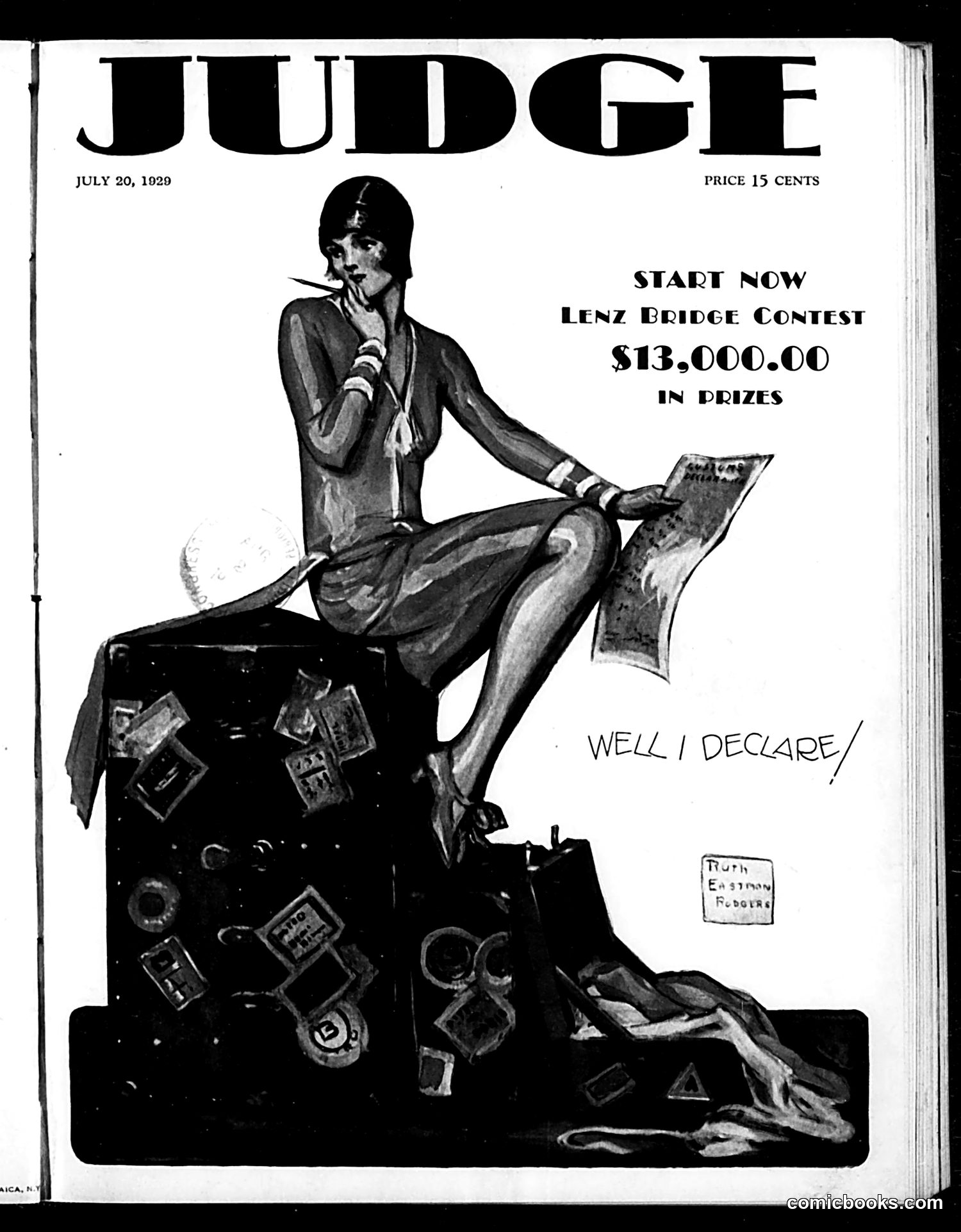
Judge Magazine Cover Analysis (July 20, 1929) This cover satirizes wealth and financial excess during the Jazz Age, just weeks before the October 1929 stock market crash. A fashionably dressed woman sits atop an overflowing suitcase of money, appearing confident and carefree while declaring "Well I declare!" The scattered currency and financial documents suggest abundant riches carelessly displayed. The "Lenz Bridge Contest" advertisement promoting $13,000 in prizes appears coincidentally ironic—offering substantial prize money at precisely the moment American prosperity was about to collapse catastrophically. The illustration critiques the era's conspicuous consumption and complacency regarding wealth. The woman's relaxed posture and declaration seem to mock the obliviousness of the wealthy elite to economic warning signs, making this cover an inadvertently prophetic commentary on impending financial disaster.
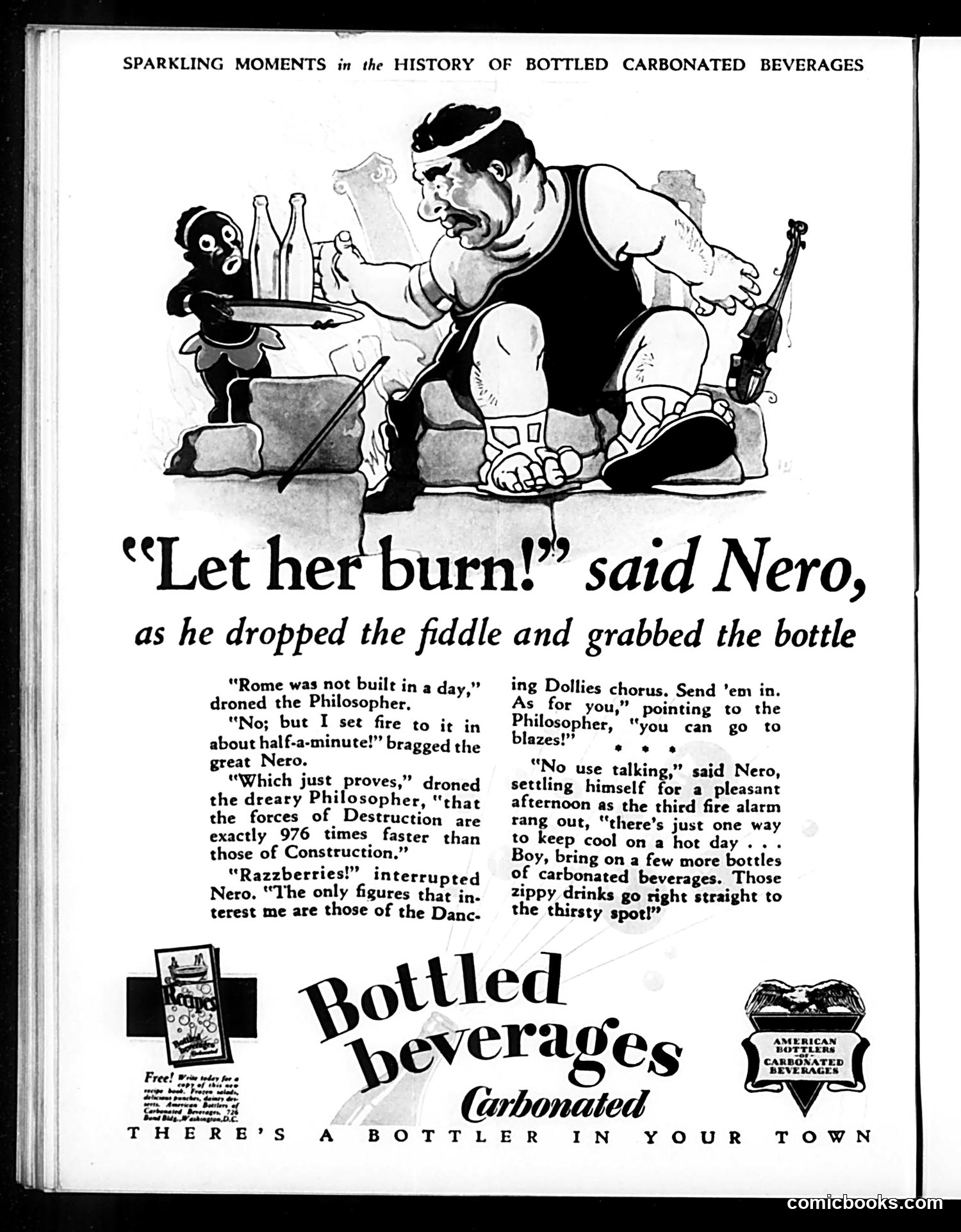
Analysis This is primarily advertising content, not political satire. The page promotes bottled carbonated beverages using a humorous historical framing device. The central image depicts Nero, the Roman emperor, portrayed as a comically violent figure. The advertisement uses Nero as a joke vehicle: when a Philosopher pedantically notes "Rome was not built in a day," Nero dismisses philosophy and reaches for a carbonated beverage instead, declaring it the best way to "keep cool on a hot day." The satire is mild—it's simply poking fun at Nero's historical reputation for excess and cruelty by reimagining him as an impatient, thirst-driven character. The advertisement's core message: carbonated beverages provide refreshment on hot days, endorsed by an absurdist historical reference. The American Bottlers of Carbonated Beverages logo appears at bottom right.
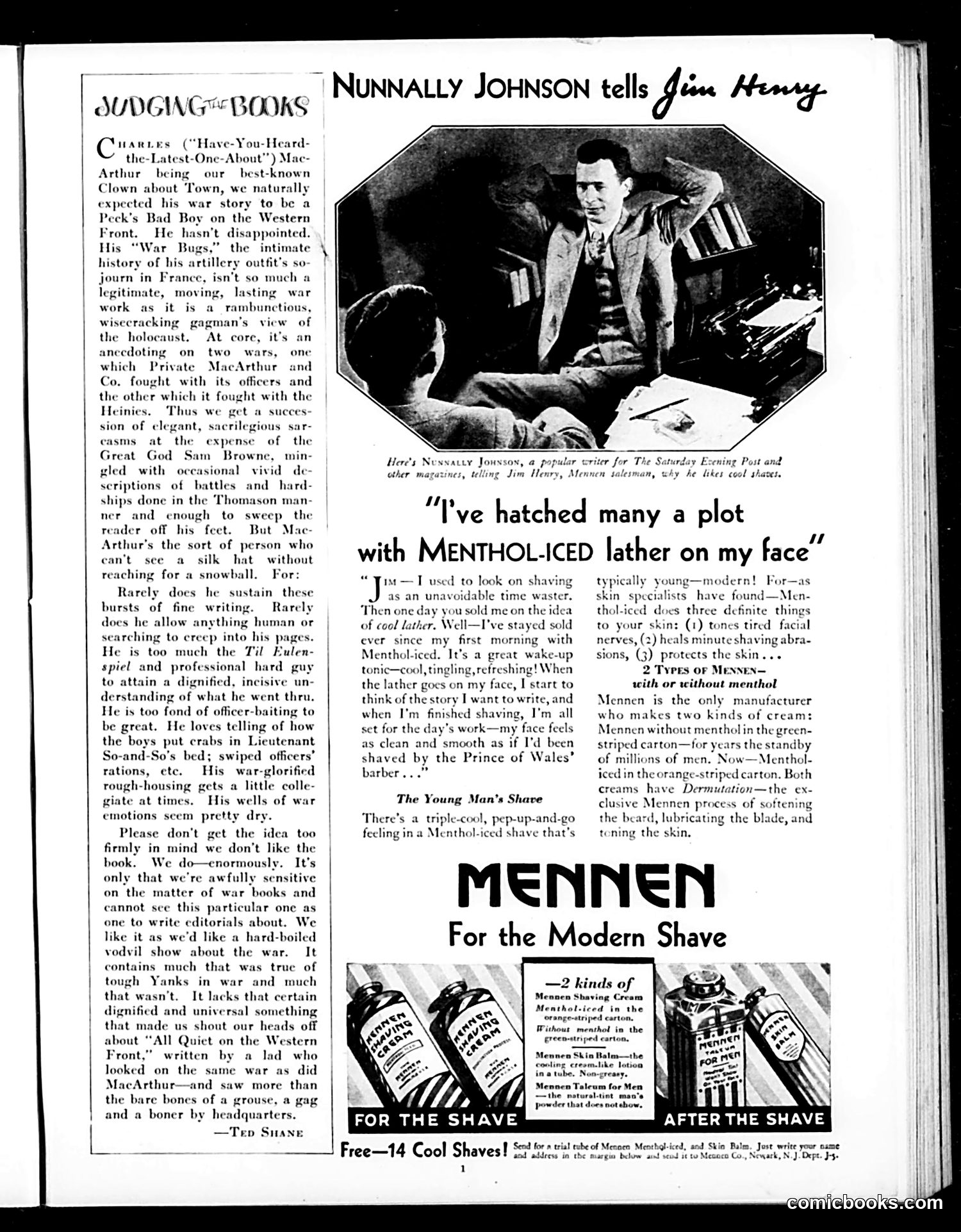
Content Analysis This page is primarily a Mennen shaving cream advertisement, not political satire. The "Judging the Books" column on the left reviews Charles MacArthur's war memoir about an artillery unit in France, criticizing it as somewhat rambling but appreciative of its irreverent humor and authentic soldier perspective. Reviewer Ted Shane praises the book's unsentimental approach to WWI. The dominant content is the Mennen advertisement featuring writer Nunnally Johnson endorsing their mentholated lather. Johnson describes how the cooling shaving cream helps him think clearly while writing stories. The ad emphasizes Mennen's "Dermalization" process for softening facial hair. No political cartoons or satire appear on this page—it's primarily commercial advertising with a brief book review.
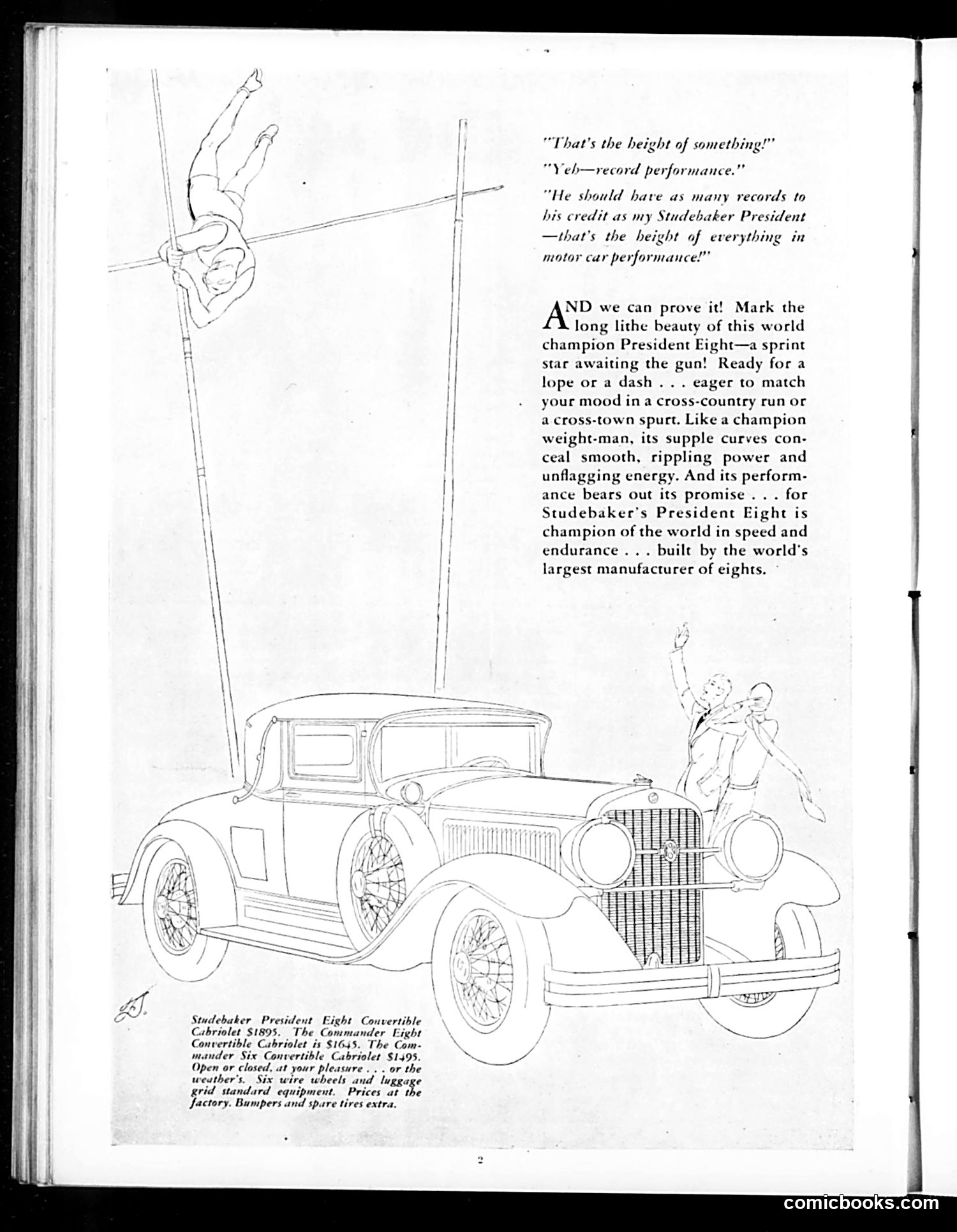
Analysis of This Judge Magazine Advertisement Page This is primarily a Studebaker automobile advertisement rather than political satire. The page promotes the "President Eight" model, a luxury car manufactured by Studebaker. The text uses hyperbolic language comparing the car's performance to athletic achievement—specifically referencing a "Studebaker President" with records rivaling a "Studebaker President Eight" in motor car performance. The illustration shows the convertible cabriolet model with stylized figures celebrating its capabilities. The "height of everything" phrasing suggests this advertisement aims to position Studebaker as the pinnacle of automotive engineering and prestige. The dramatic line drawings and enthusiastic copy reflect 1920s-era advertising style. This represents commercial promotion rather than political commentary or satire.
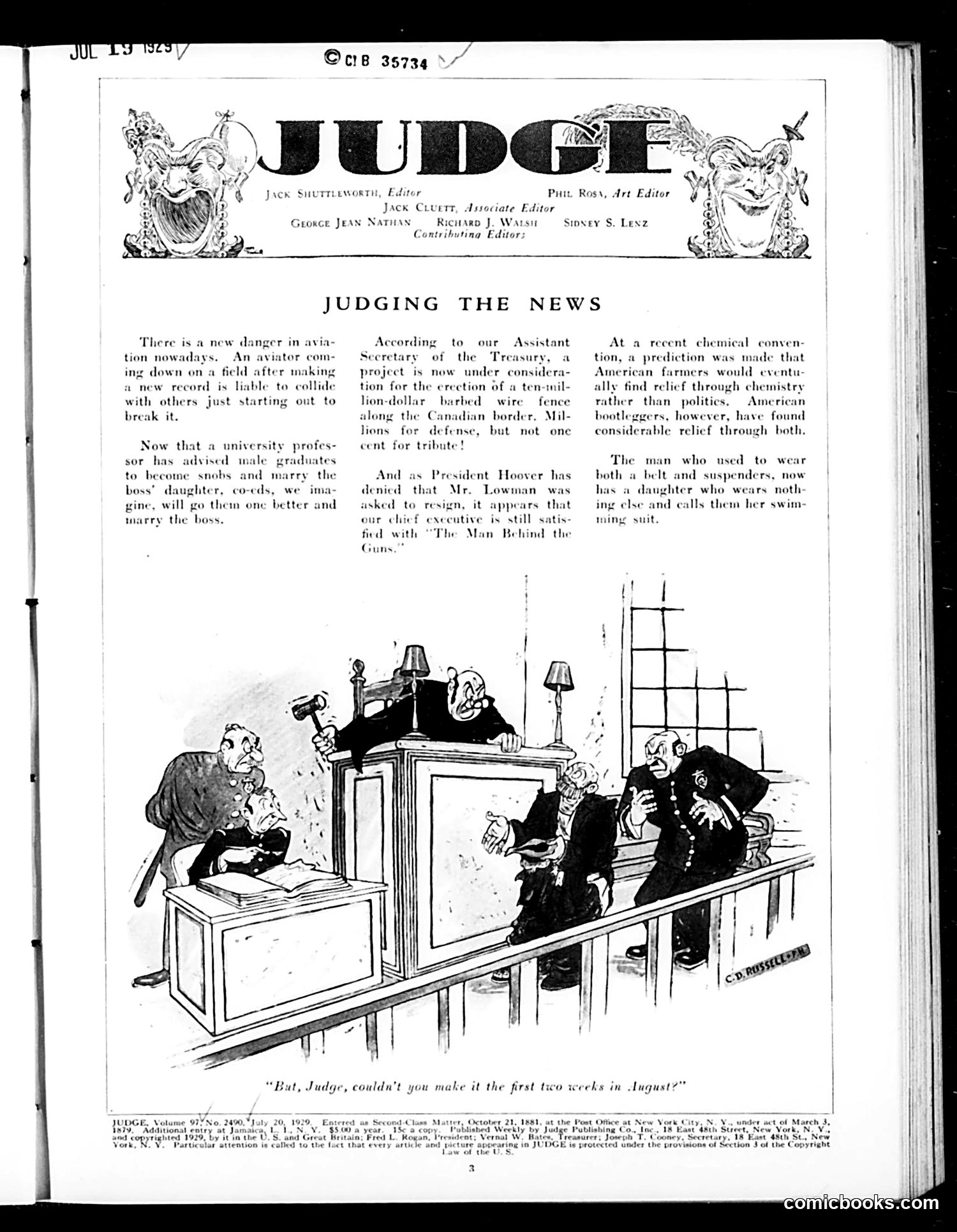
Analysis of Judge Magazine Page (July 19, 1929) The main cartoon satirizes judicial proceedings. A judge sits elevated at the bench while attorneys argue below, with the caption: "But, Judge, couldn't you make it the first two weeks in August?" This appears to reference frustration with court scheduling—likely attorneys requesting to delay proceedings until August, presumably for summer vacation or recess. The joke mocks the judicial system's accommodation of convenience over justice. The editorial section above, "Judging the News," contains brief satirical commentary on contemporary issues: aviation safety, university marriages, and chemical agriculture. One item references President Hoover and someone named Lowman resigning, though details remain unclear without additional historical context. The overall tone critiques both legal inefficiency and current political/social matters through humor.
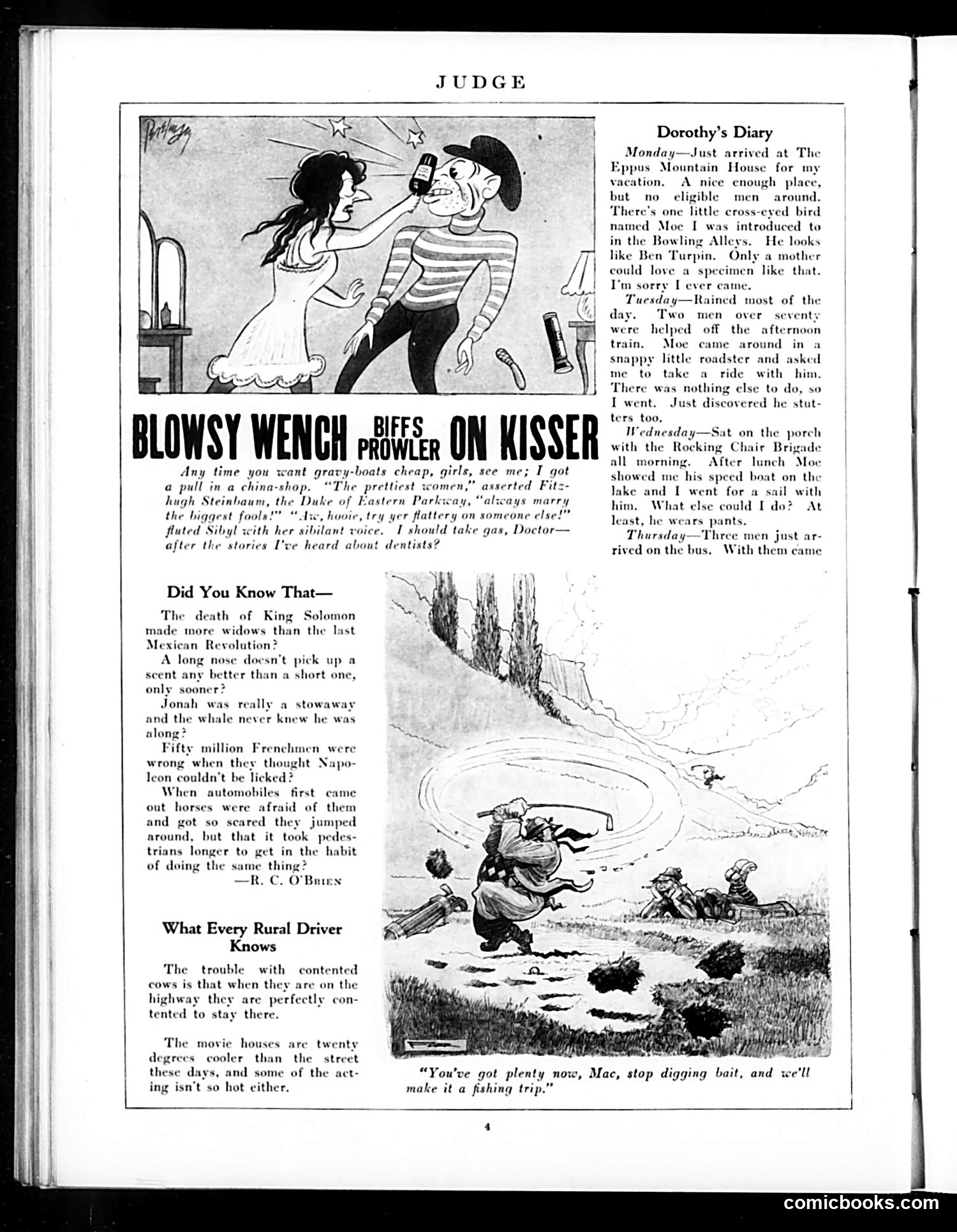
Analysis of Judge Magazine Page The main cartoon "Blowsy Wench Biffs Powder on Kisser" depicts a woman striking a man's face, satirizing domestic conflict. The accompanying dialogue mocks both parties—the woman complains about "eligible men" and unflattering comparisons, while the man defensively boasts about his accomplishments. The humor relies on exaggerated gender stereotypes of the era: the vain, quarrelsome wife and the defensive, boastful husband. The page also includes "Dorothy's Diary," a humorous column describing a woman's vacation encounters with unappealing men, and miscellaneous trivia in "Did You Know That" and "What Every Rural Driver Knows" sections. These are typical filler content for Judge, emphasizing social commentary through humor about courtship, rural life, and domestic relations.
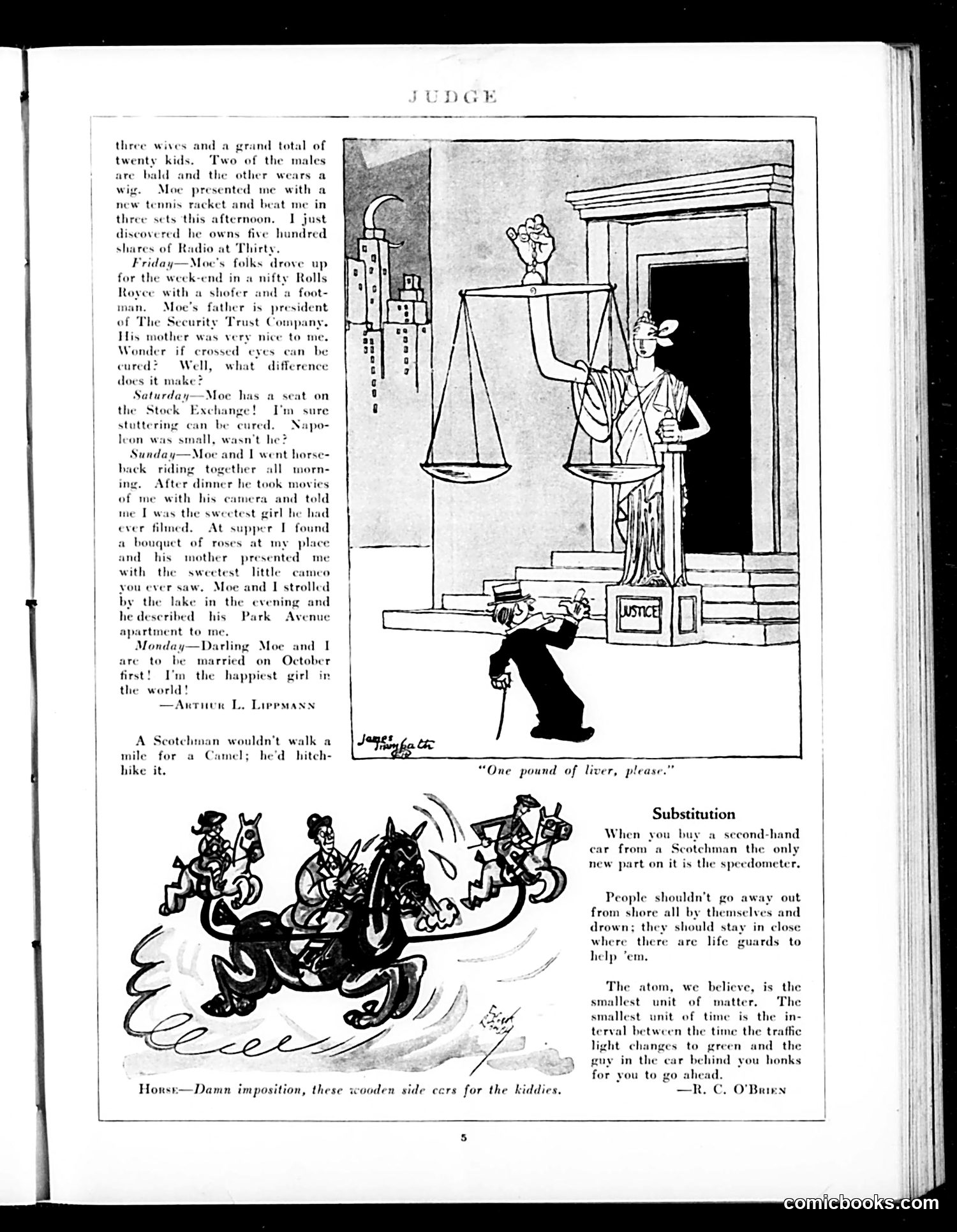
Analysis of Judge Magazine Page Main Cartoon ("One pound of liver, please"): A man in formal attire addresses a female judge on the bench. The satire appears to mock either judicial incompetence or absurdity—the gentleman's request for "one pound of liver" in a courtroom setting is nonsensical. This likely critiques confused or inappropriate judicial proceedings, though the specific reference is unclear without additional context. Secondary Content: - A brief personal account from Arthur L. Lippmann about romantic outings with "Moe" - A joke about Scotsmen and Camels (automobiles) - A cartoon showing children on a horse-drawn contraption, captioned "Damn imposition, these wooden side cars for the kiddies" The page primarily contains humorous social commentary typical of early 20th-century Judge magazine's satirical style.
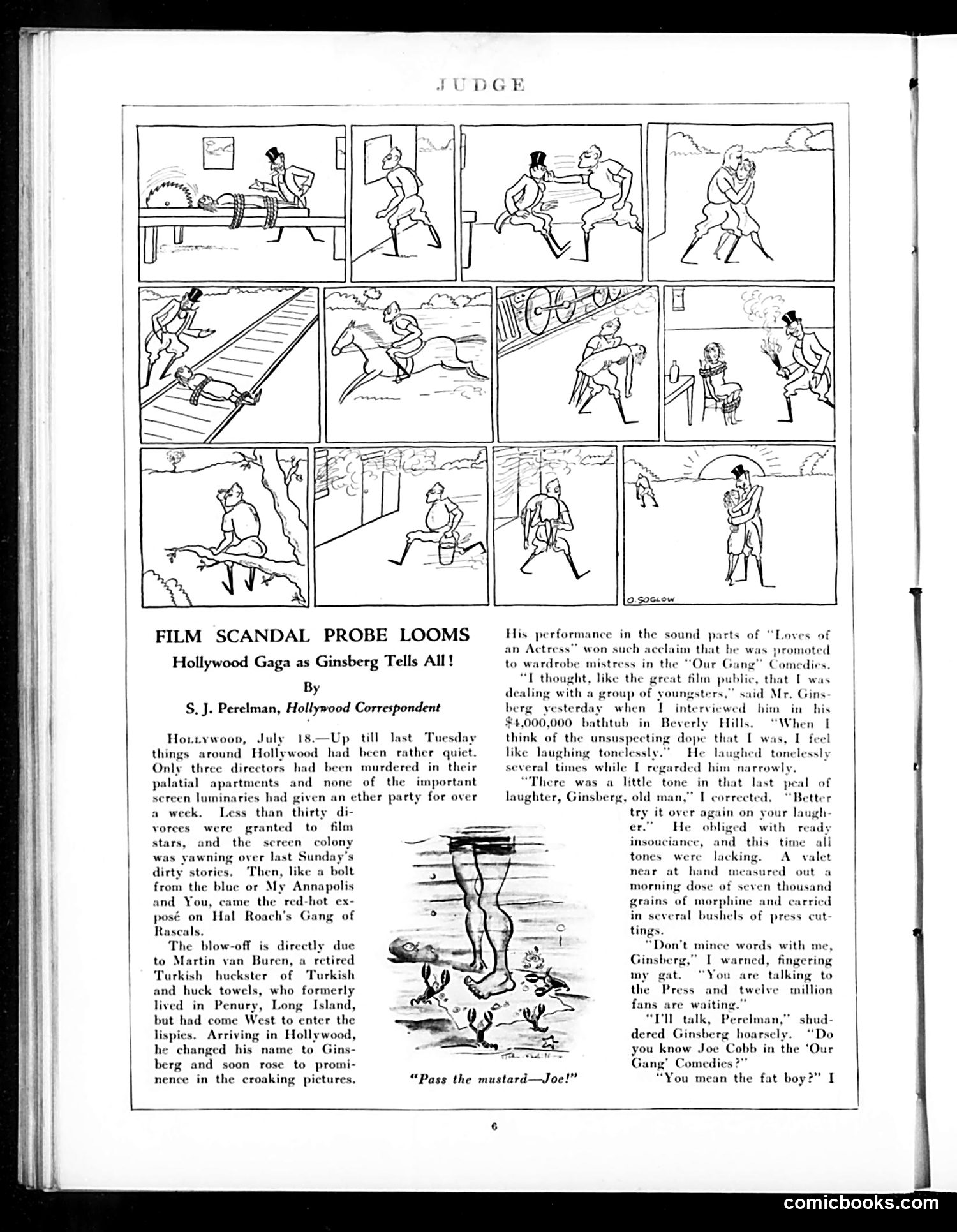
"Judge" Page Analysis: Hollywood Scandal Probe This page satirizes early 1920s Hollywood scandals through a comic strip titled "Judge," which depicts slapstick scenes of physical comedy and mayhem—pratfalls, chasing, collapsing furniture. The accompanying article by S.J. Perelman discusses a scandal involving actor Gaginsberg (likely a pseudonym), whom the writer interviewed. The piece mocks Hollywood's moral hypocrisy: three film directors faced "dirty stories," and the industry's reputation suffered. The article suggests Ginsberg's promotion to "wardrobe mistress" was suspicious, and references his involvement in questionable conduct. The humor targets Hollywood's attempts to manage scandalous behavior while maintaining public respectability—a recurring theme in 1920s satirical commentary on the film industry's moral standards.
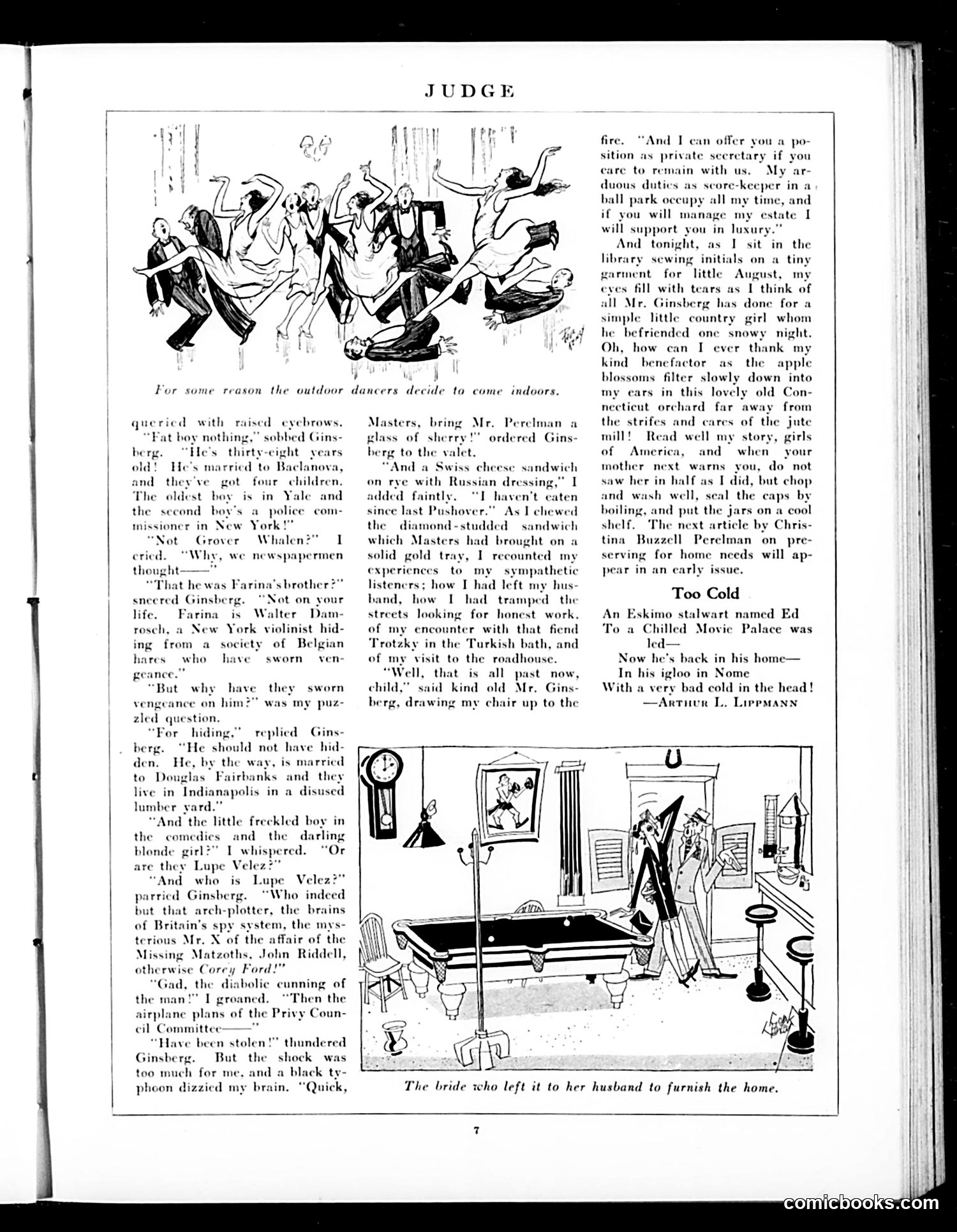
"Judge" Page Analysis This page contains two satirical pieces typical of 1920s humor magazine fare. Top Section: A rambling monologue mocking Hollywood's mystique. A character named Ginsberg spins absurd false identities for silent film actors—claiming they're actually famous people like conductor Walter Damrosch or spy-thriller villain "Mr. X." The joke satirizes how little the public actually knew about movie stars' real lives, and how willing audiences were to accept fabricated backstories. References to "Farina," "Lupe Velez," and others suggest obscure silent-era performers. Bottom Section: A cartoon and accompanying story about a bride left to furnish her home, played for domestic comedy—likely mocking newlyweds' struggles or gender expectations around homemaking. The smaller poem "Too Cold" is mere filler verse about an Eskimo with a head cold. Overall, the page reflects 1920s popular culture obsession with Hollywood gossip and domestic humor typical of Judge's target audience.
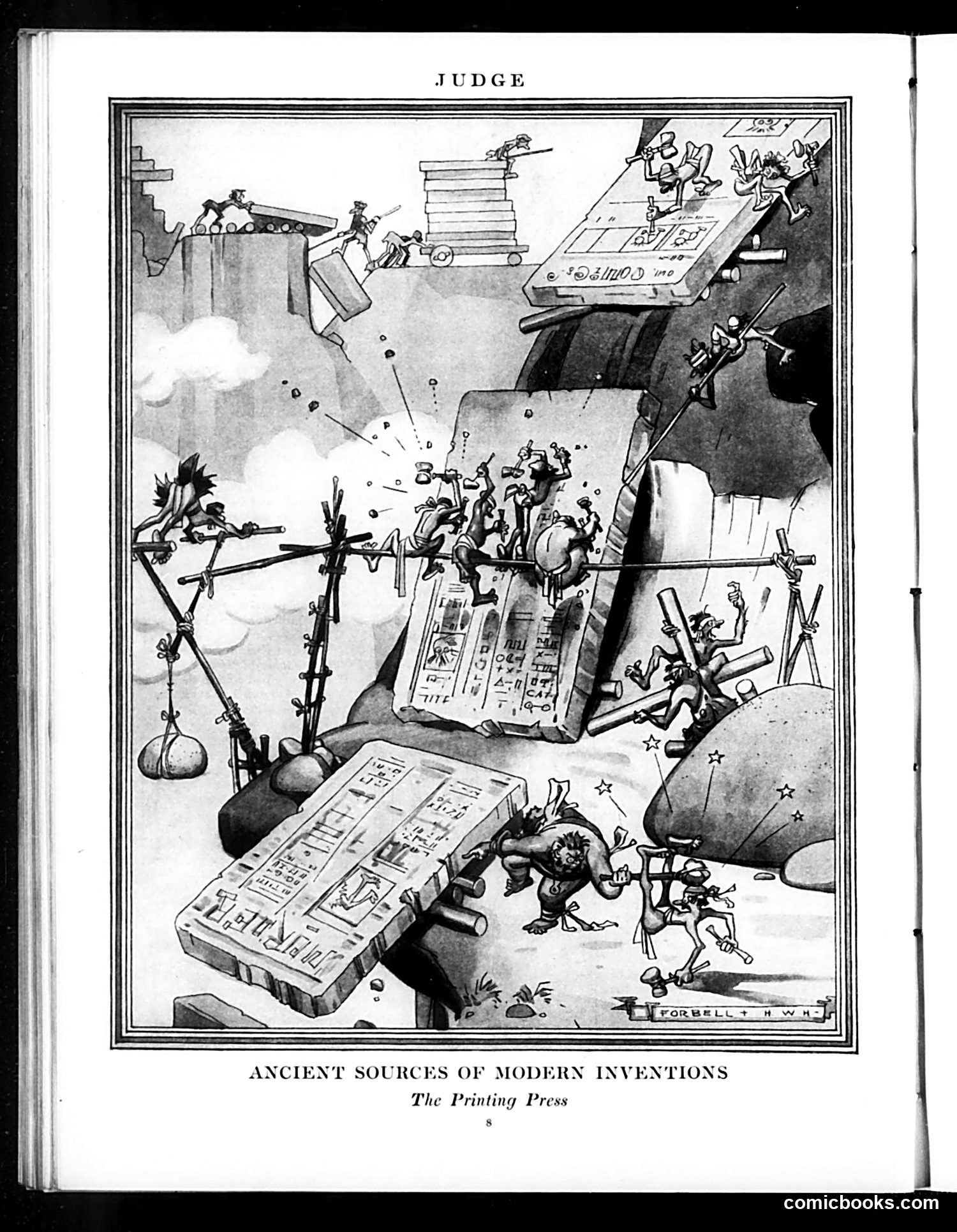
Analysis: "Ancient Sources of Modern Inventions - The Printing Press" This satirical illustration depicts the printing press's origins in ancient times. The cartoon shows primitive figures operating an elaborate, absurdly complex printing apparatus in a fantastical landscape filled with gears, pulleys, and mechanical contraptions. The humor lies in the visual contradiction: it presents anachronistic ancient peoples somehow possessing modern mechanical technology, suggesting that supposedly "modern" inventions actually derive from ancient ingenuity. The elaborate, chaotic machinery emphasizes how complicated the printing press is—treating its invention as if primitive civilizations engineered sophisticated technology. The artist (signed "Forbell") uses this fantastical scenario to satirize contemporary ideas about invention and progress, likely poking fun at historical claims about ancient technological sophistication or challenging notions of "modern" innovation as truly original.
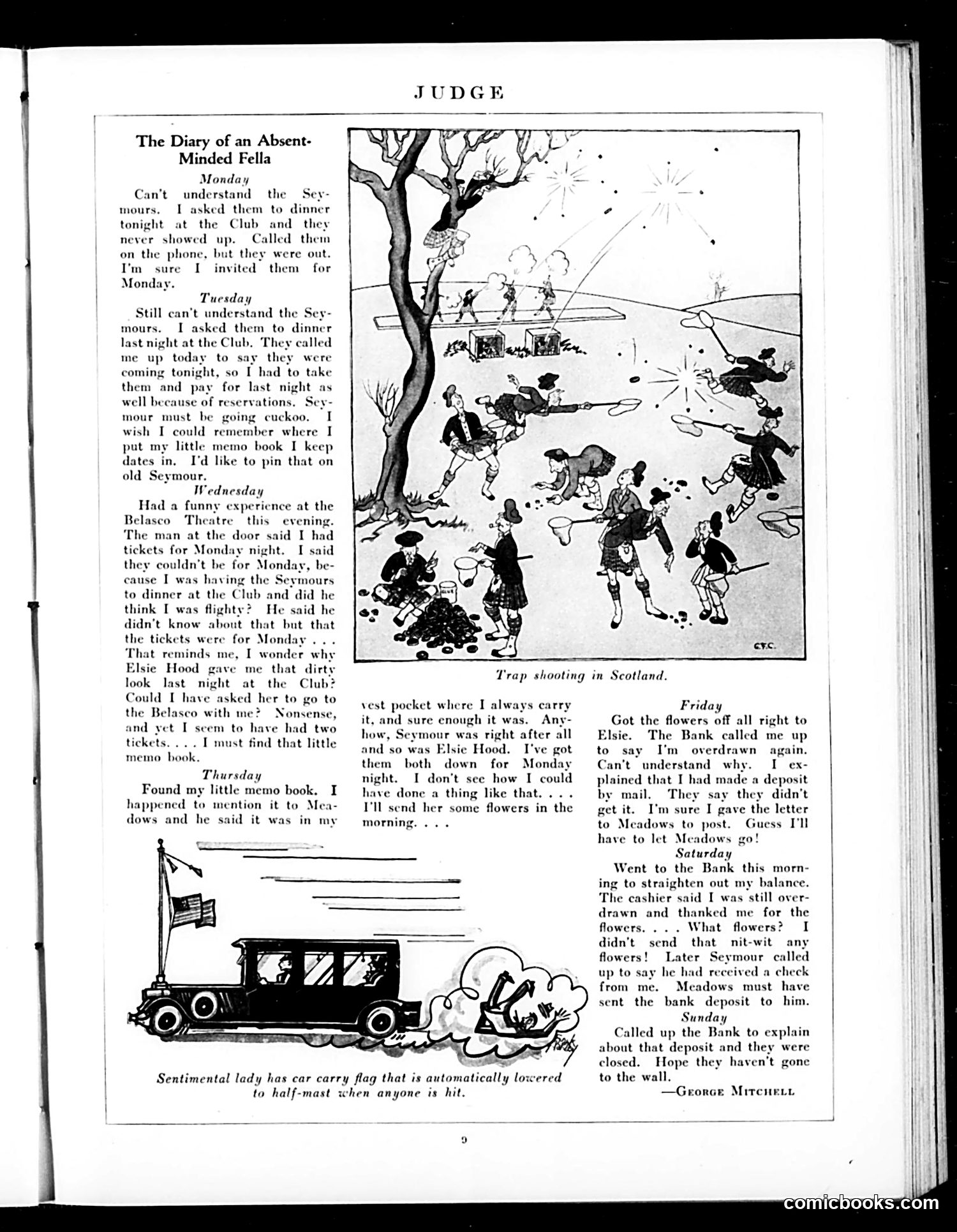
"The Diary of an Absent-Minded Fella" This humorous diary by George Mitchell depicts a wealthy, scatterbrained protagonist whose organizational chaos cascades into social and financial mishaps. The joke centers on his reliance on a memo book to track social obligations—he's so forgetful he double-books dinner invitations to both the Seymours and Elsie Hood for the same Monday night. His incompetence extends to banking: he claims to have mailed a deposit that never arrives, then discovers his secretary Meadows mistakenly sent it to Seymour instead. He attempts damage control by sending flowers to Elsie (whom he offended), but these too go astray. The accompanying cartoon shows "trap shooting in Scotland"—likely illustrating the chaos of upper-class leisure activities. The separate small cartoon mocks sentimental pretension: a woman's car flag automatically lowers to half-mast when hit—absurd conspicuous consumption. The satire targets careless wealthy men dependent on servants and social clubs, whose bumbling incompetence creates unnecessary drama among their social circle.
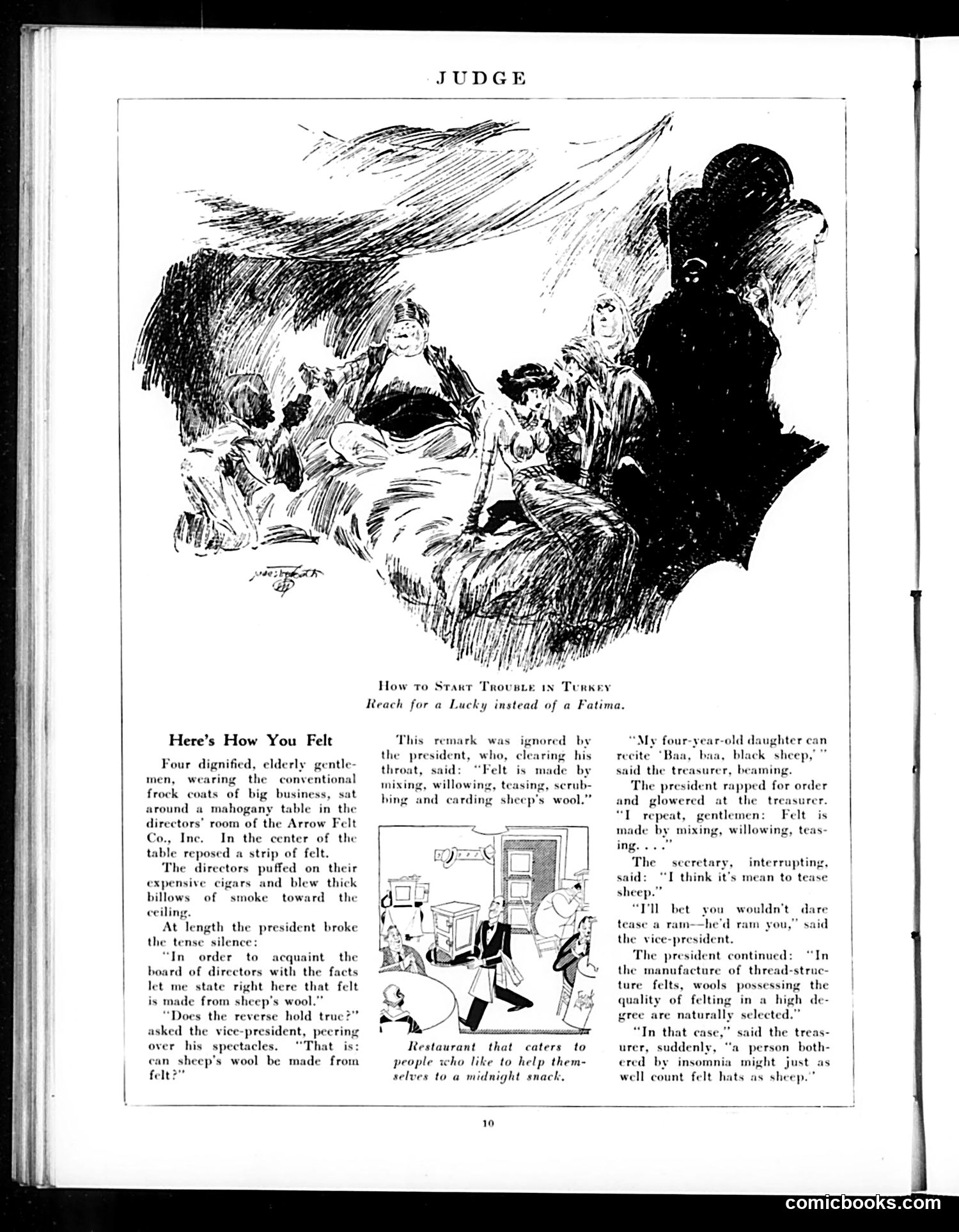
Explaining This Judge Magazine Page This page contains two satirical pieces: "Here's How You Felt" mocks pompous business executives. Four dignified felt company directors sit solemnly discussing wool and felt manufacturing, but keep getting distracted by absurd tangents—a daughter reciting "Baa Baa Black Sheep," whether rams would retaliate if teased, whether insomniacs could count felt hats instead of sheep. The humor lies in how these serious businessmen descend into childish nonsense while attempting to sound authoritative about industrial processes. "How to Start Trouble in Turkey" (top illustration) is a separate political cartoon about Turkish affairs, likely referencing early 20th-century diplomatic tensions. The caption's cynical advice—"Reach for a Lucky instead of a Fatima" (cigarette brands)—suggests international friction could be sparked casually. The page also includes an advertisement for a restaurant catering to late-night appetites. The overall tone is satirical commentary on American business pretension and international relations.
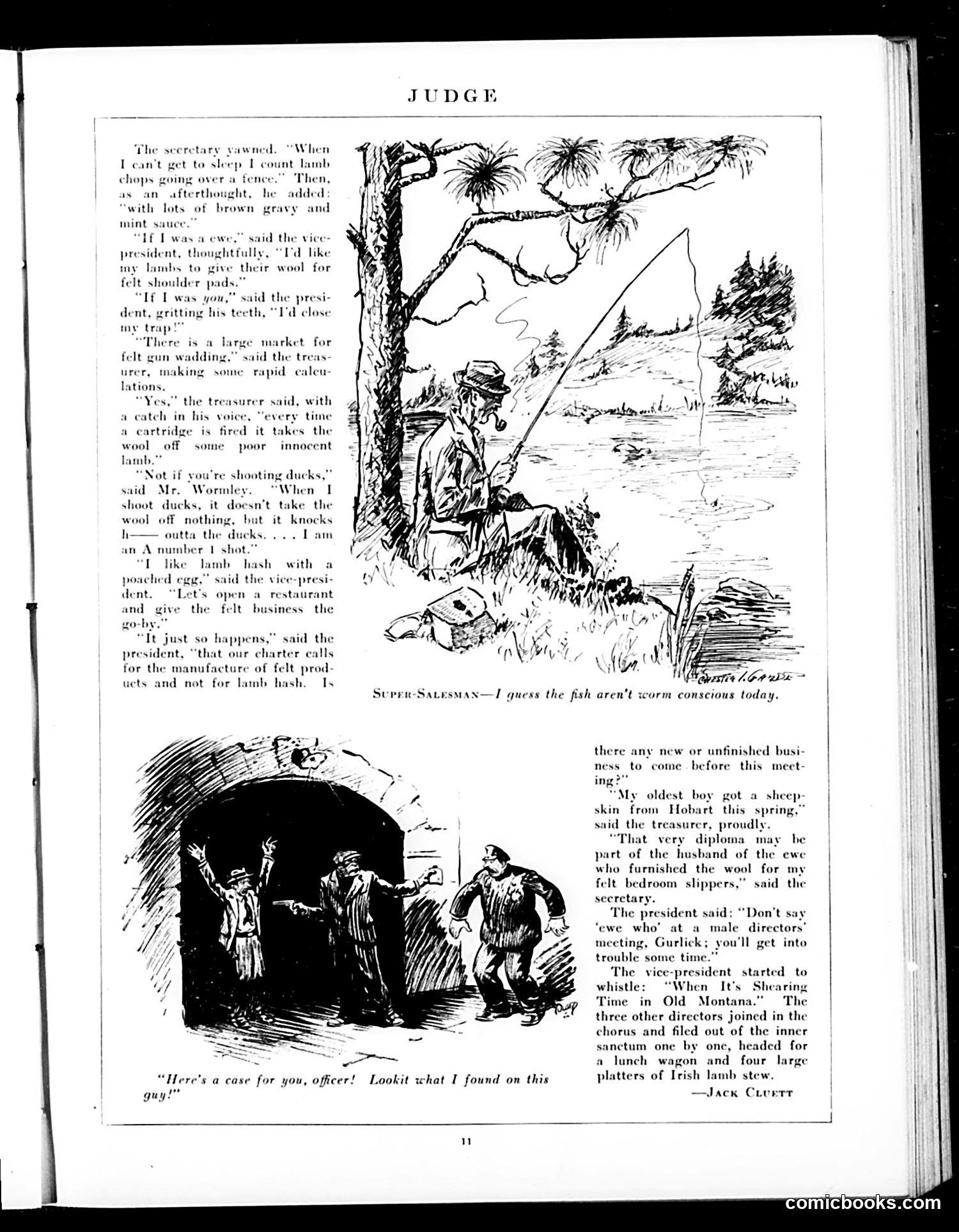
Explanation for Modern Readers This is a satirical piece about corporate hypocrisy. A felt manufacturing company's board of directors meets to discuss business, but they repeatedly digress into personal food preferences—all involving lamb. Each director proposes using company resources for their own purposes: lamb chops, felt shoulder pads from wool, gun wadding, even opening a restaurant. The president repeatedly tries to steer them back to actual business ("our charter calls for the manufacture of felt products and not for lamb hash"), but they ignore him. The joke satirizes how corporate boards prioritize personal gain over stated company purpose, and how authority figures (the president) lack real control over self-interested subordinates. The bottom cartoon appears unrelated—a comedic vignette about finding something suspicious ("a case for you, officer!").
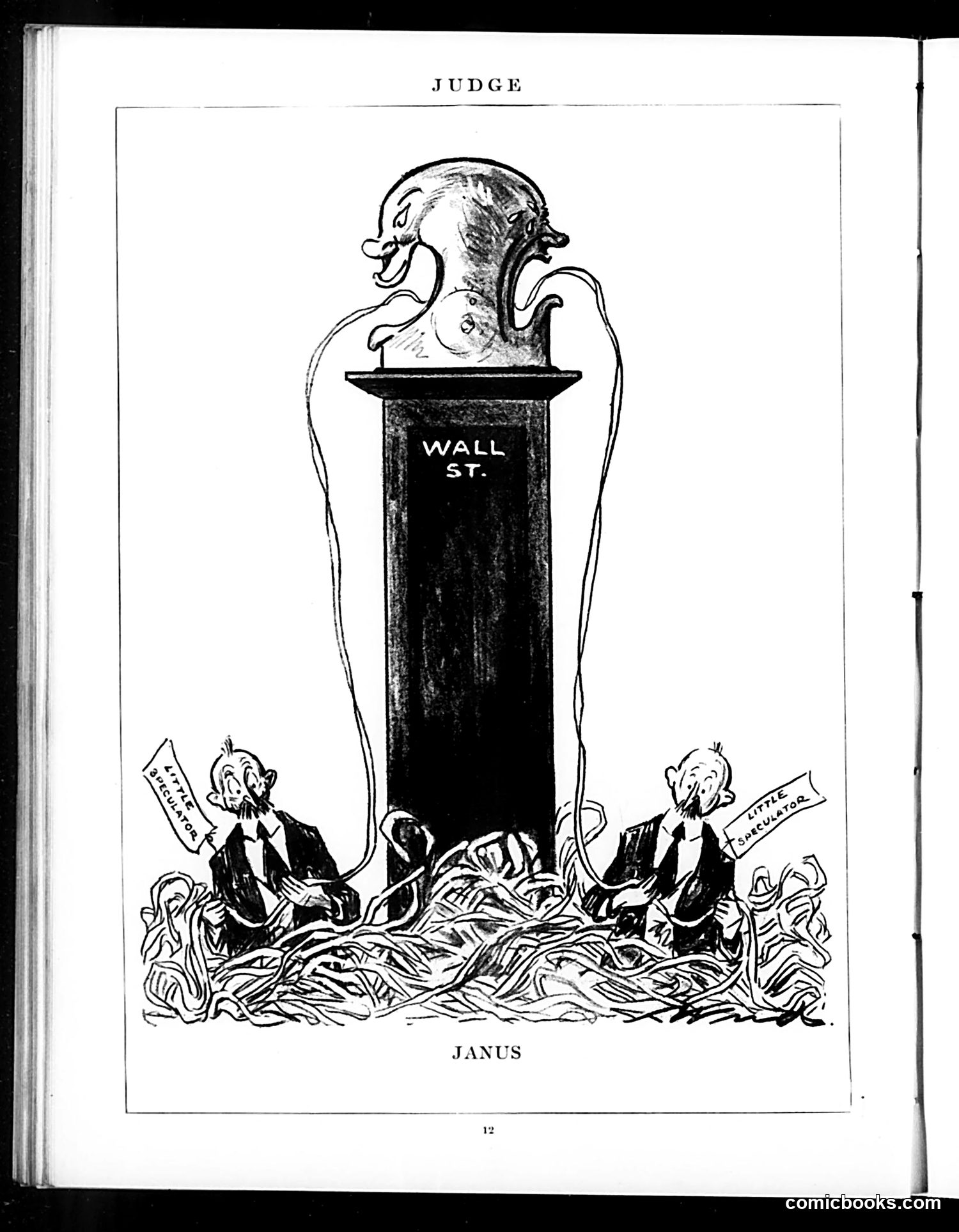
Cartoon Analysis: "Judge" - "Janus" This political cartoon depicts a two-faced classical bust labeled "WALL ST." atop a pedestal, referencing Janus, the Roman god of beginnings and endings who looks both directions simultaneously. Two caricatured figures (appearing to be financial or political figures) stand at the base amid tangled, chaotic lines suggesting financial turmoil or market confusion. Each holds what appears to be a document or proclamation. The satire suggests Wall Street's duplicitous nature—presenting one face to the public while operating differently privately, or looking forward and backward simultaneously without honest action. The chaos beneath the pedestal implies the real-world consequences of this two-faced approach, likely referencing financial instability or market manipulation affecting ordinary people.
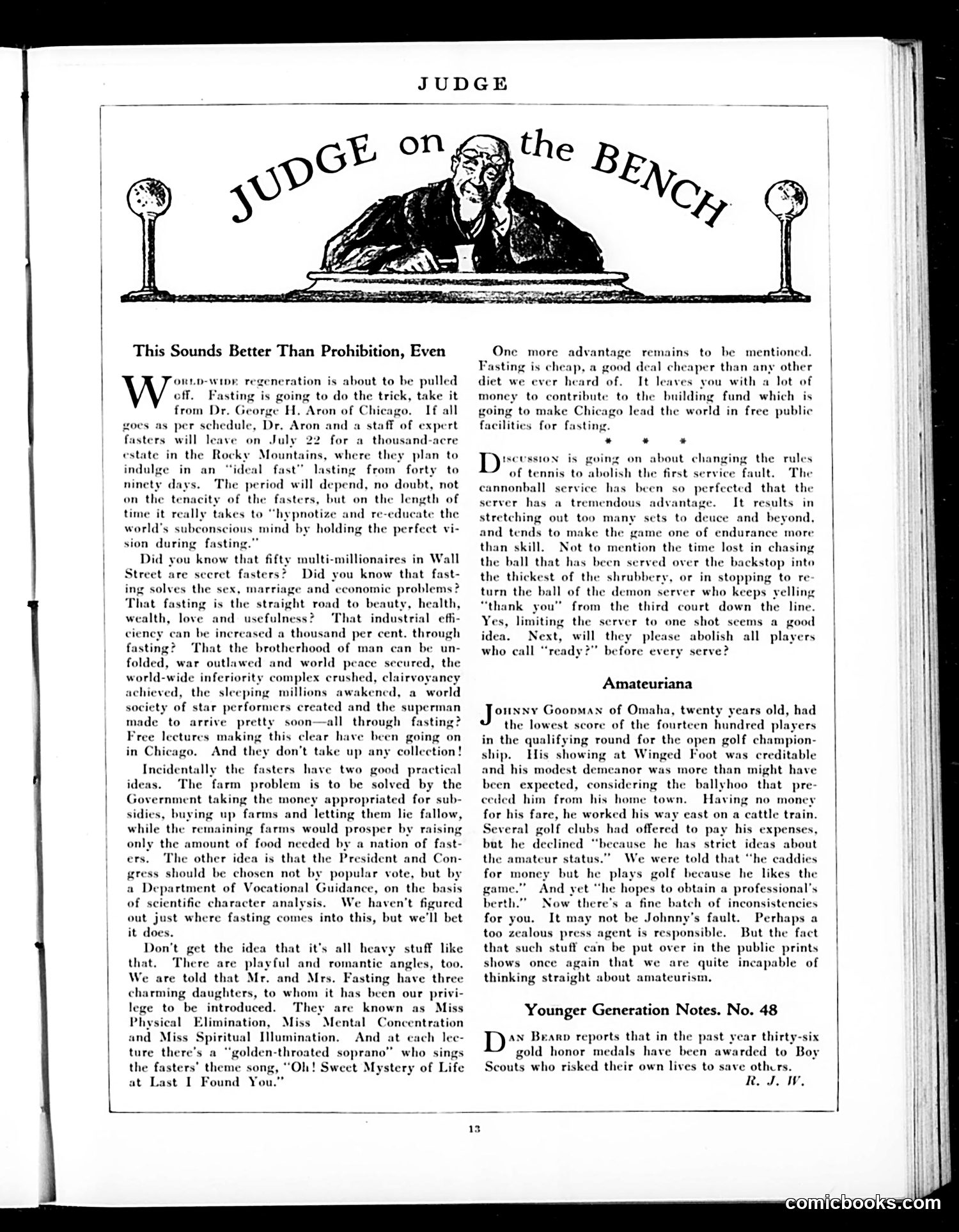
Judge Magazine Satire Analysis This page satirizes the fasting craze of the era through Dr. George H. Aron's promotional scheme. The left column mockingly catalogs absurd claims that fasting supposedly solves: marital problems, economic woes, world peace, and even creates clairvoyants and "supermen." The satire's target is the pseudoscientific wellness movement—the article lists increasingly ridiculous benefits while maintaining a deadpan tone. The judge warns readers about wealthy "secret fasters" on Wall Street, suggesting fasting as another dubious scheme for the wealthy. The practical proposals (government farm policy, selecting leaders via "vocational guidance" rather than voting) are presented absurdly to mock fasting advocates' grandiose thinking. The "golden-throated soprano" singing the fasters' theme song adds theatrical mockery. The secondary sections on tennis rule changes and amateur golfer Johnny Goodman provide lighter satirical content about sports culture of the period. The overarching message: fasting is being promoted as a cure-all by charlatans, and Judge's readers should view such claims skeptically.
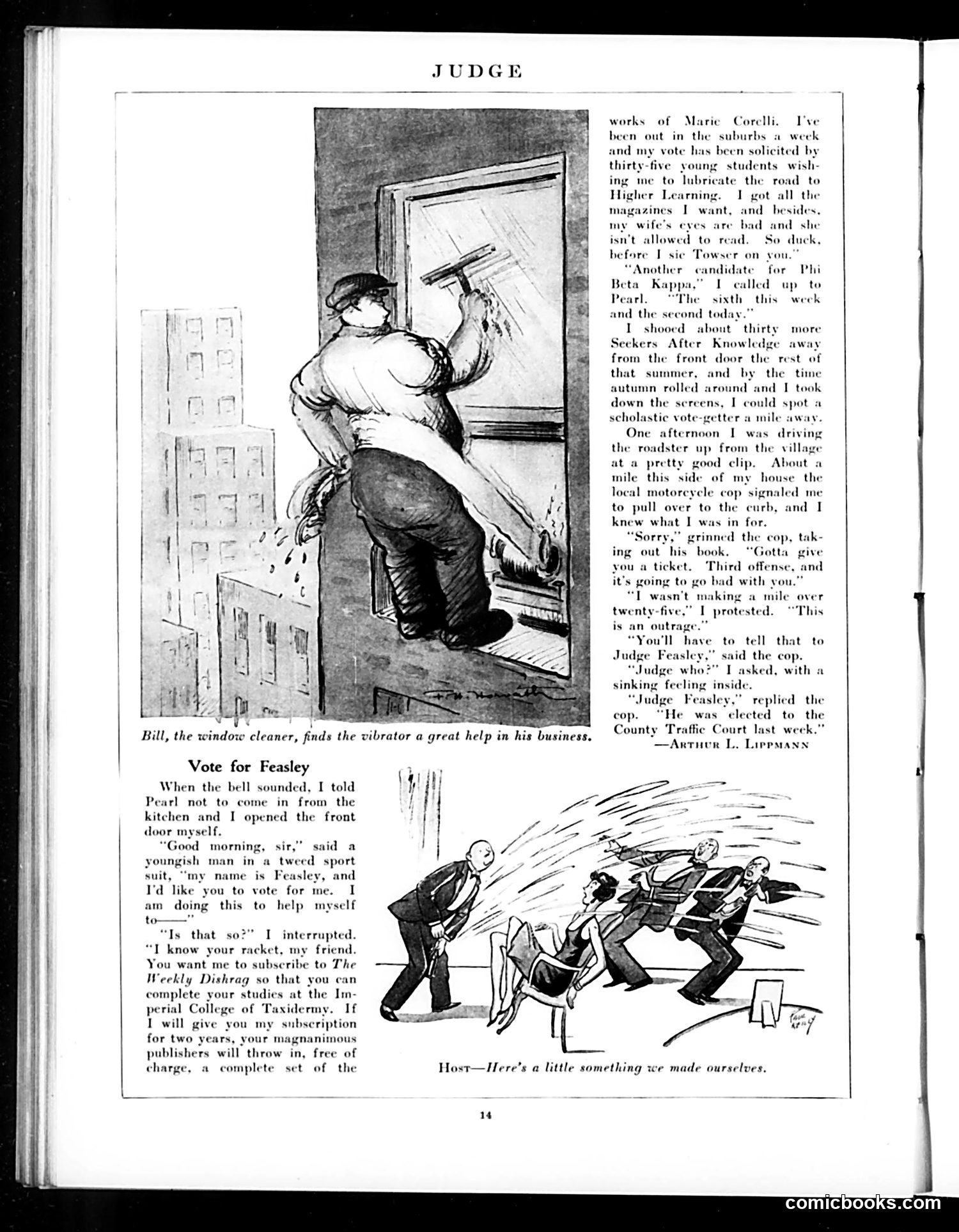
Judge Magazine Satire Analysis This page satirizes the aggressive solicitation tactics of college students seeking votes and subscriptions. The main narrative, "Vote for Feasley," depicts a householder repeatedly interrupted by young students canvassing for his vote, each claiming to need support for their education or publications. The narrator sees through their scheme—they use voting appeals as pretexts to sell magazine subscriptions (like "The Weekly Dishrag") that supposedly fund their studies. The irony culminates when the narrator is pulled over by a motorcycle cop for speeding, only to discover the officer is "Judge Feasley"—one of these vote-seeking students who apparently won election to County Traffic Court. The satire mocks both the transparent manipulation of student fundraising and the absurdity that such an opportunistic hustler could actually gain public office. The bottom cartoon reinforces the theme: a man being pressured by hosts with the caption "Here's a little something we made ourselves"—suggesting unwanted social obligation and self-interested generosity.
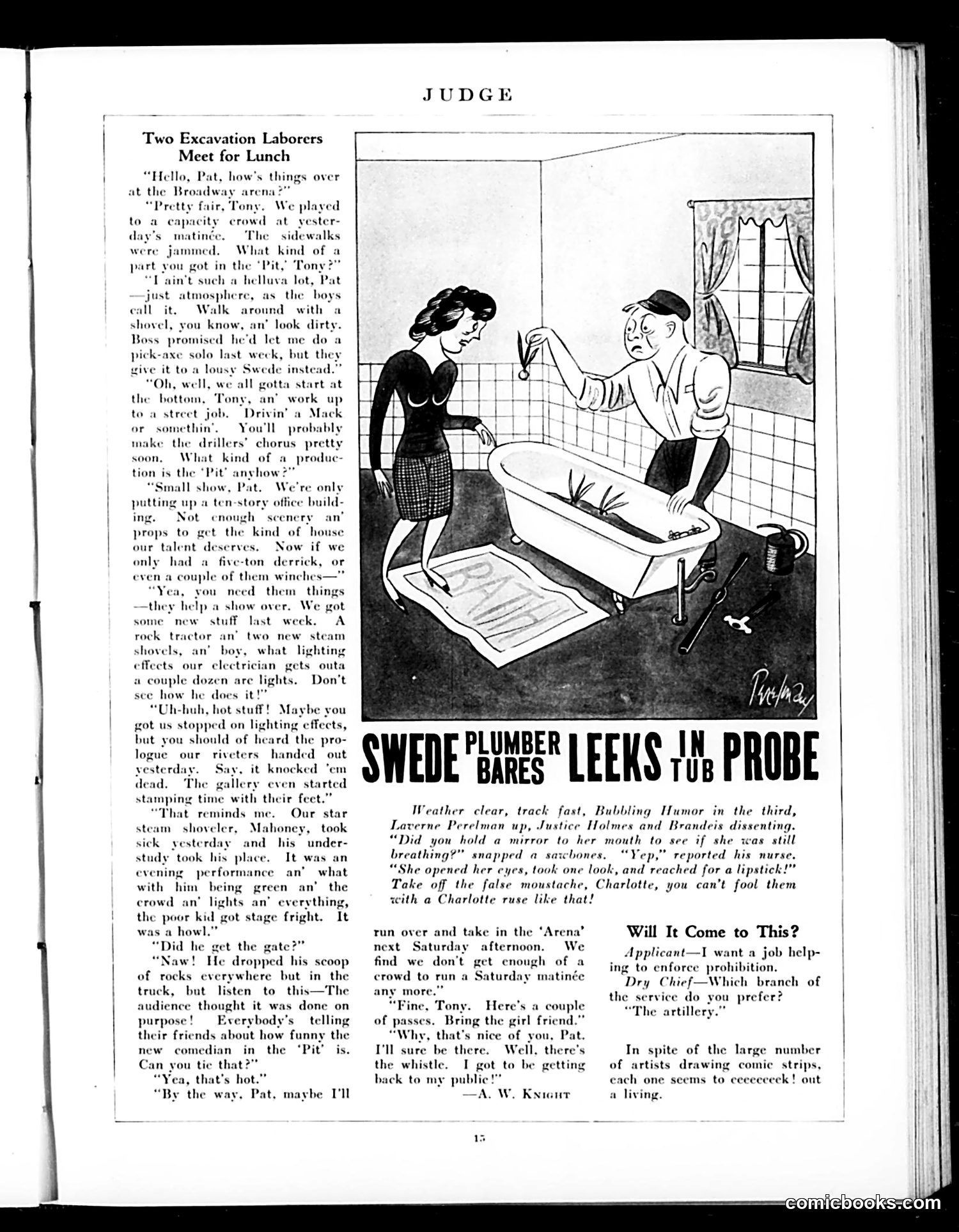
Page Analysis: Judge Magazine This page contains a humorous dialogue between two excavation laborers discussing their work on a Broadway theater project, followed by an illustration titled "Swede Plumber Leeks in Probe Tub." The main cartoon depicts a plumber examining a bathtub while a woman holds up what appears to be a mirror or probe. The humor relies on wordplay: "leeks" (the vegetable) substituted for "leaks" (plumbing problems), and the crude suggestion in the caption about using a mirror to check if someone is "still breathing." The dialogue and cartoon represent typical Judge magazine content from this era—slapstick, working-class humor with ethnic stereotyping (the "Swede plumber" suggests immigrant labor stereotypes common in early-to-mid 20th century American satire). The overall tone is lighthearted vaudeville-style comedy rather than serious social commentary.
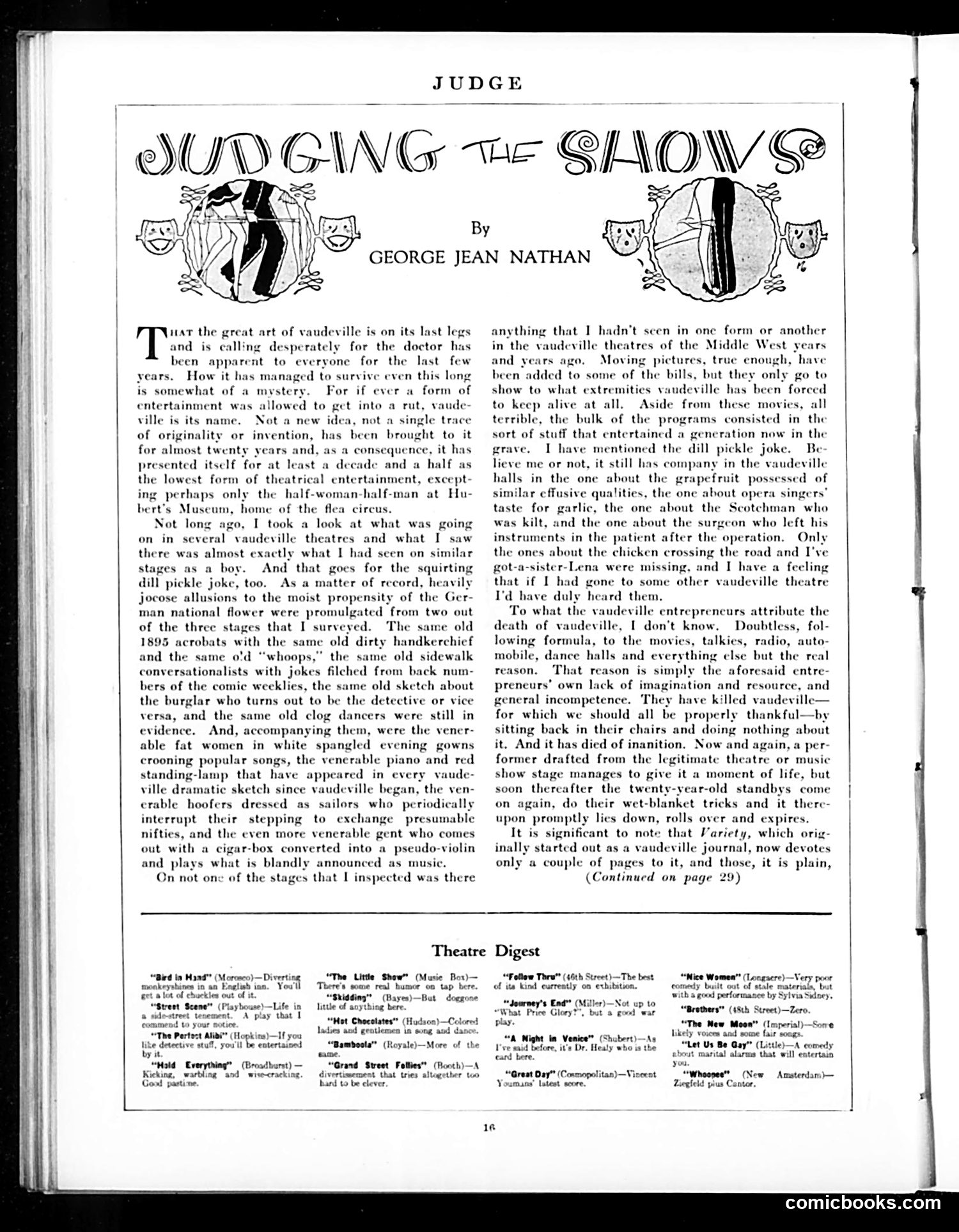
Judging the Shows: Vaudeville's Decline This article by George Jean Nathan critiques American vaudeville as artistically moribund. Nathan surveys several theaters and finds them recycling identical acts from twenty years prior: the same acrobats, the "dill pickle" joke (a squirting gag), clog dancers, burglar-detective sketches, and tired comedians. He notes that vaudeville relies on movies (themselves "terrible") merely to survive, having abandoned originality entirely. The "Theatre Digest" section lists contemporary Broadway productions. Nathan's point: vaudeville—once entertainment's dominant form—has become creatively exhausted, trapped repeating stale material while legitimate theater (represented by the plays listed) moves forward. The medium is dying not from external competition but from internal creative bankruptcy and audiences' sophistication.
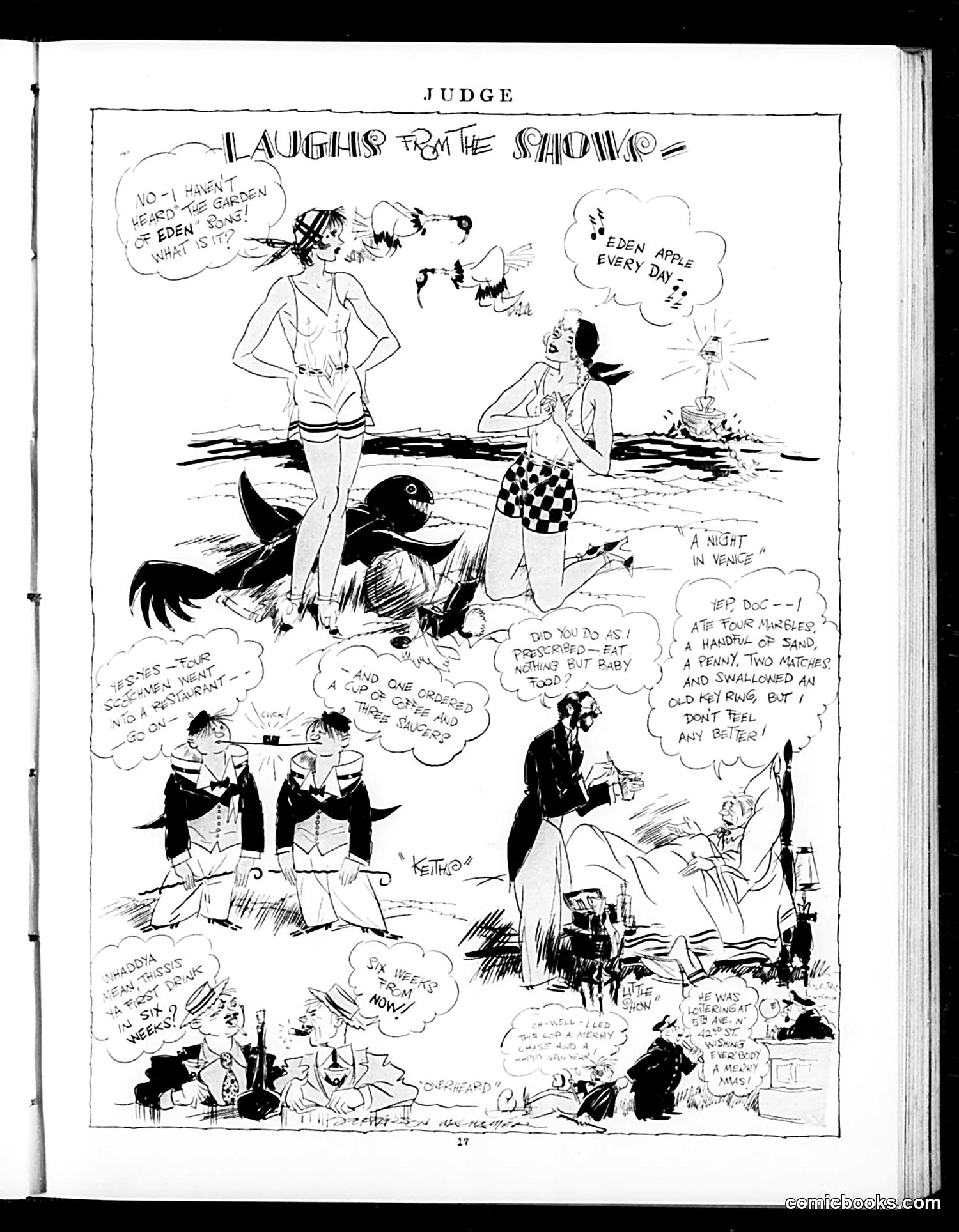
"Laughs from the Shows" - Judge Magazine Cartoon This is a theatrical satire page featuring multiple vignettes mocking popular stage productions and operatic performances. The cartoon depicts various characters from shows quoting or referencing their lines—including references to *"A Night in Venice"* and operatic selections. The humor targets the melodramatic excess and absurdity of contemporary theatrical entertainment. Characters recite exaggerated plot points (eating sand, swallowing rugs) and romantic declarations meant to showcase the pretension of stage productions. The caricatured figures and their bombastic dialogue satirize both performers and audiences who take such overwrought narratives seriously. The page exemplifies *Judge* magazine's role as a publication mocking high society, culture, and entertainment through irreverent illustration and commentary on contemporary shows.
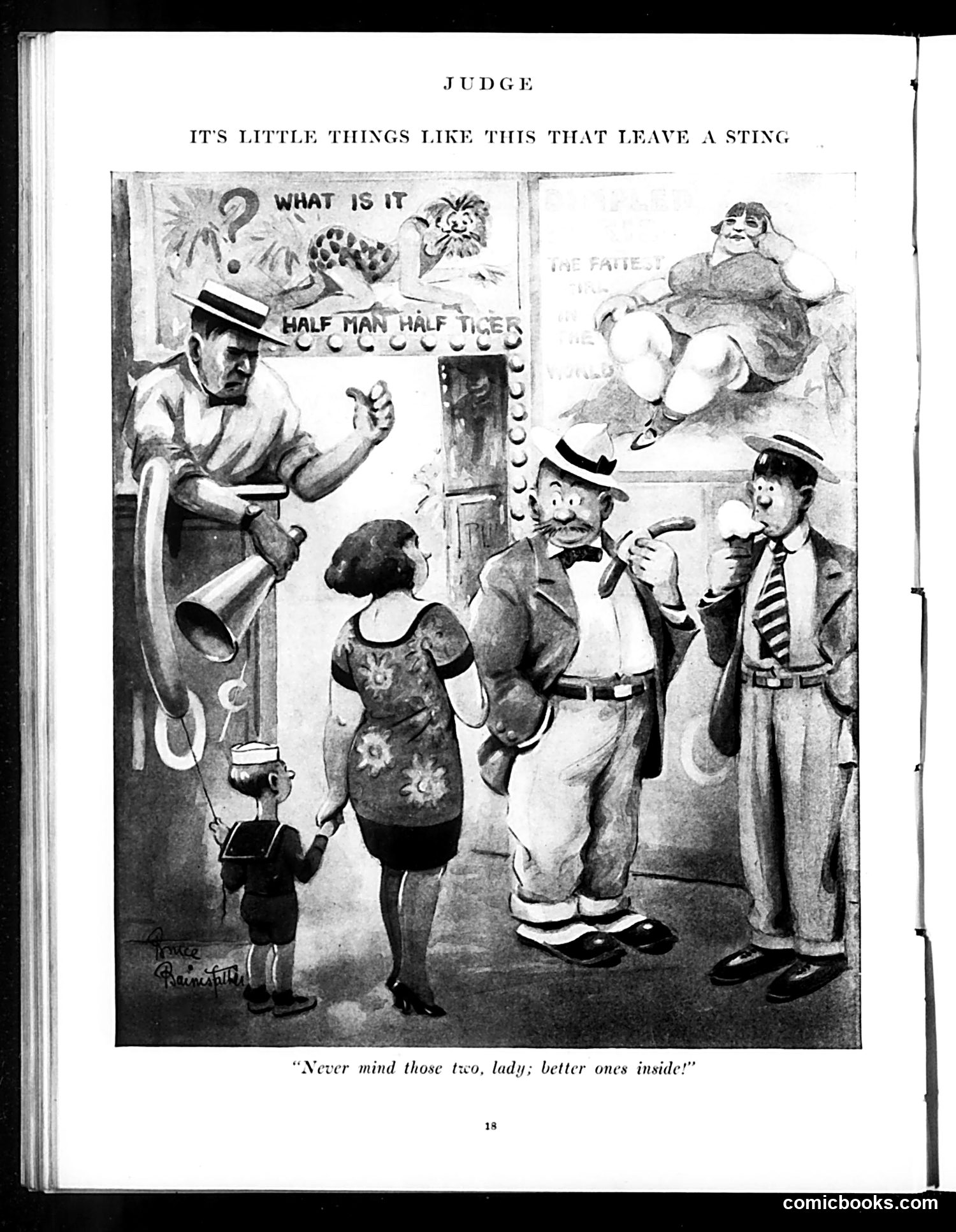
This cartoon satirizes carnival barkers and their deceptive practices. A barker with a megaphone stands outside a sideshow tent advertising a "Half Man Half Tiger" attraction—a classic circus fraud. Inside the tent, two well-dressed men appear to be the "better ones" he's directing customers toward, suggesting they're con artists or grifters running the show. The joke targets both the dishonesty of carnival attractions and the operators who exploit public curiosity. The caption "better ones inside" implies the real attraction isn't the advertised freak show, but rather the opportunity for the operators to separate visitors from their money. This reflects early 20th-century anxieties about urban entertainment venues and their unsavory operators.
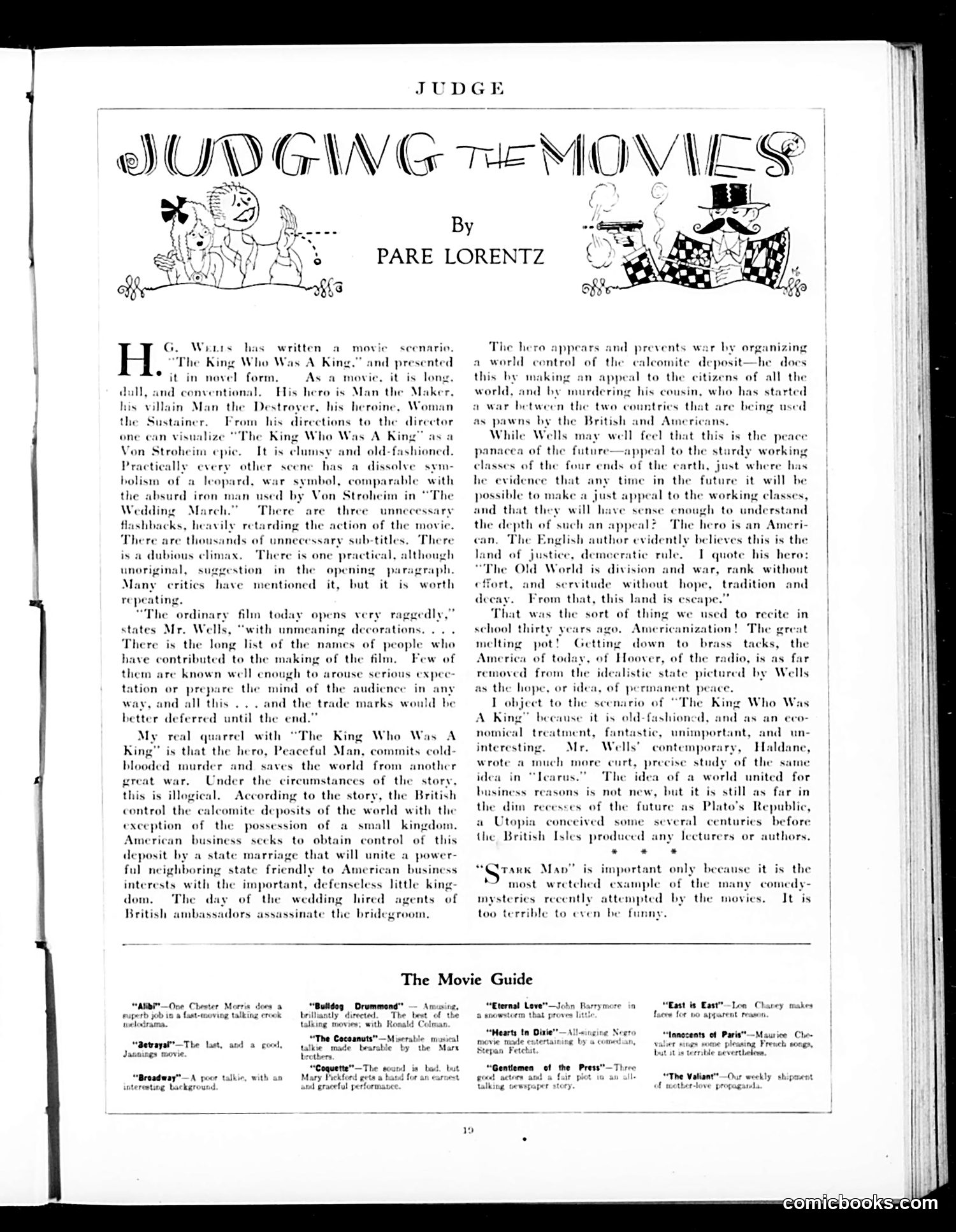
Judging the Movies: H.G. Wells' "The King Who Was A King" This is a critical review by Pare Lorentz of a film adaptation of H.G. Wells' scenario. The piece attacks the movie on multiple grounds: it's poorly directed (compared unfavorably to Erich von Stroheim's work), cluttered with unnecessary flashbacks and intertitles, and dramatically illogical. The core complaint concerns the plot's premise—that a hero can commit murder, yet somehow appeal to working classes worldwide to prevent war through rational persuasion. Lorentz finds this naive and outdated, contrasting Wells' idealistic vision of a unified, just world with 1920s American reality: commercialism, radio culture, and the Hoover era—far from any democratic utopia. The review also dismisses "Stark Man" as merely another failed comedy-mystery example. Overall, Lorentz critiques both Wells' storytelling and the film's execution as hopelessly old-fashioned.
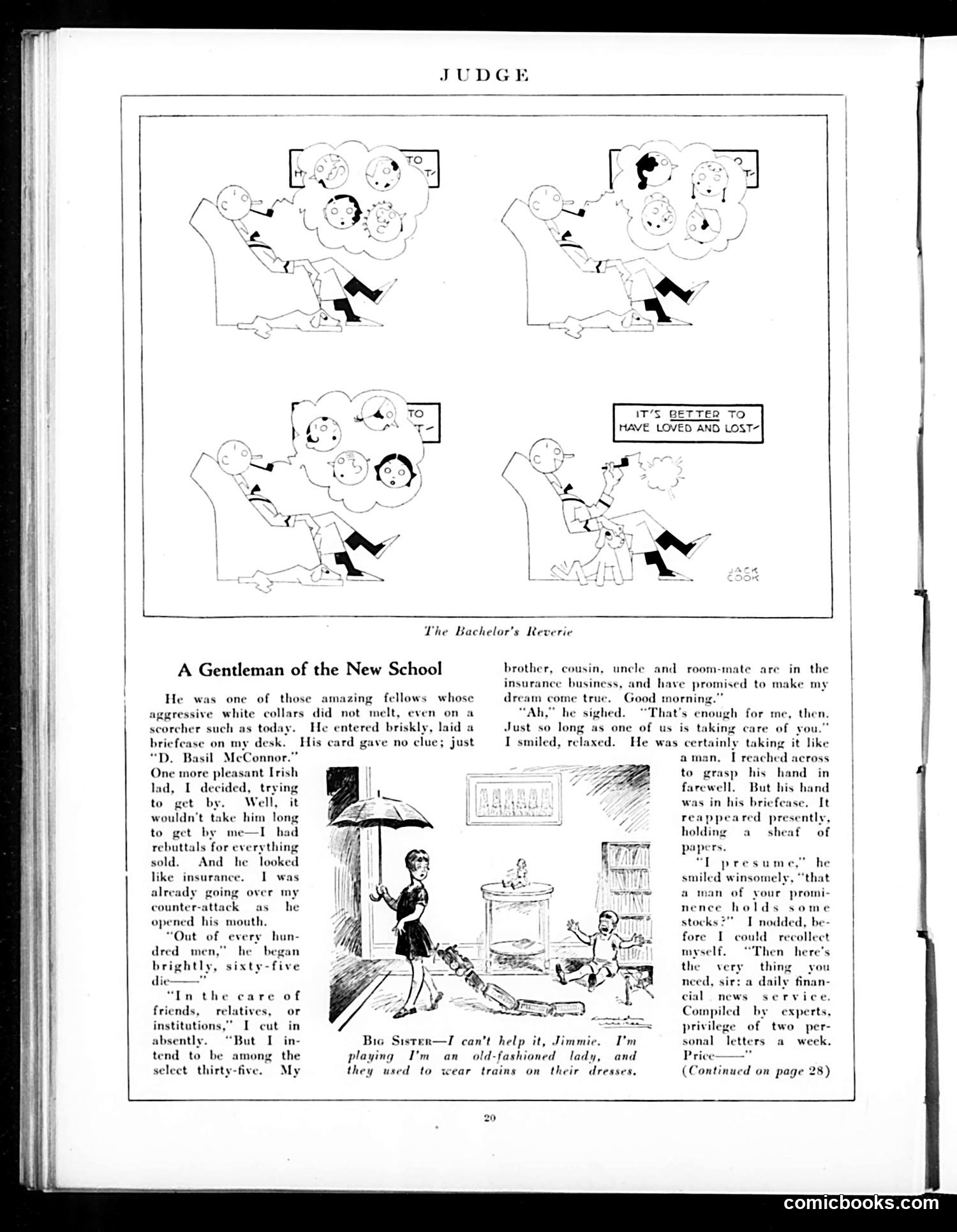
"The Bachelor's Reverie" - Judge Magazine This page contains two satirical pieces about early 20th-century American life. Top cartoon: "Judge" (a four-panel comic) depicts a bachelor fantasizing about his romantic prospects. The sequence shows him imagining various desirable outcomes with women, culminating in the punchline "It's Better to Have Loved and Lost"—mocking the romantic idealism of bachelor fantasies versus harsh reality. Main story: "A Gentleman of the New School" satirizes aggressive insurance salesmen of the era. The narrator encounters "D. Basil McConnor," a smooth-talking Irish insurance agent who uses manipulative sales tactics—citing mortality statistics ("out of every hundred men, sixty-five die") and flattery to pitch products like a financial news service to the narrator. The humor targets how modern "new school" businessmen use pseudo-scientific claims and aggressive persistence to sell unnecessary services to white-collar professionals. Side illustration: Shows an old-fashioned woman complaining about modern fashion, contrasting traditional train dresses with contemporary styles—a secondary joke about generational attitudes toward dress.
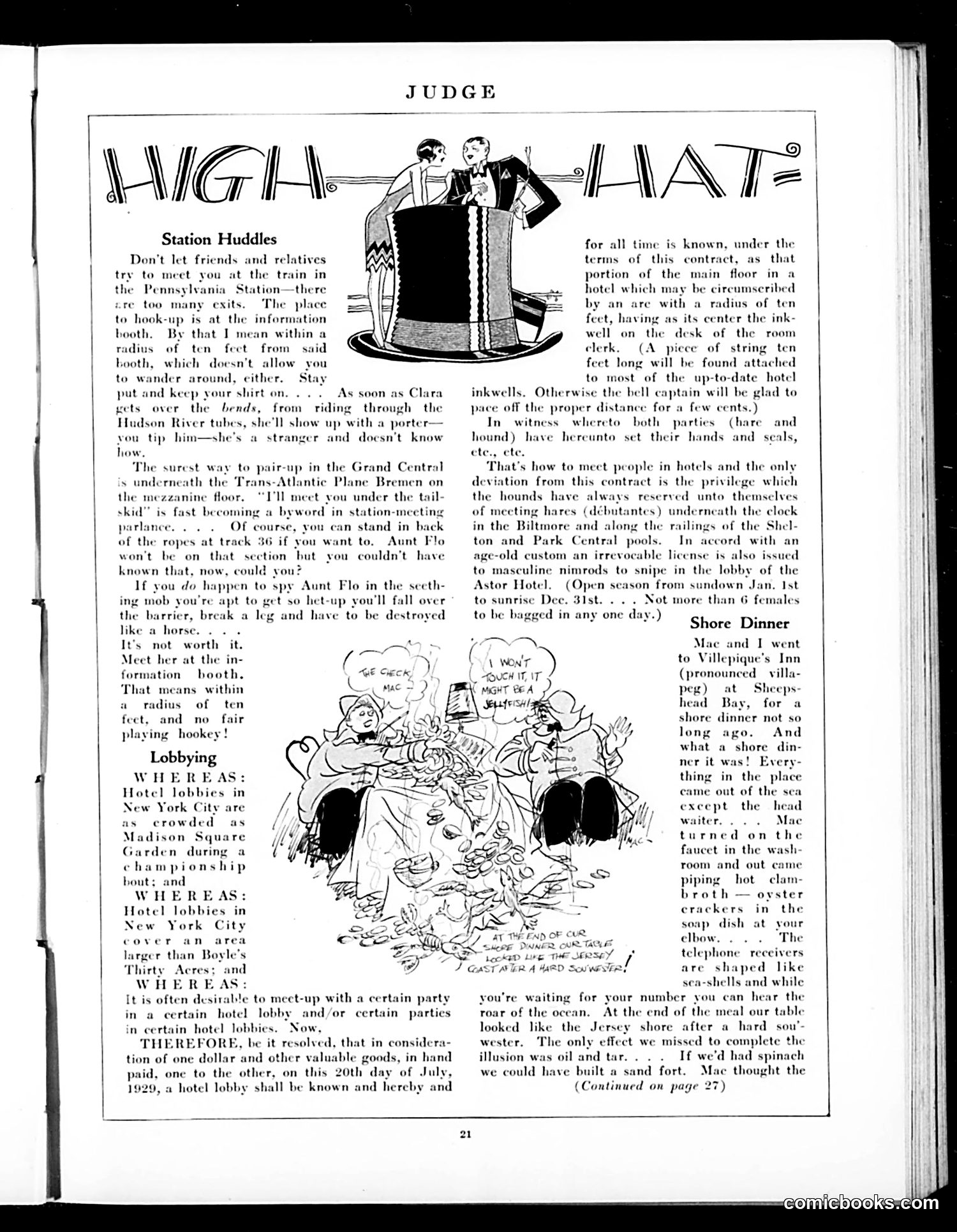
Judge Magazine Page Analysis (July 20, 1929) This page satirizes modern hotel meeting conventions in 1920s New York City. The humor targets how overcrowded and confusing major hotels have become for arranging to meet people. "Station Huddles" mocks the chaos of Pennsylvania Station and Grand Central Terminal, advising readers to stay put at information booths rather than wander looking for companions, lest they get injured in the crowd. "Lobbying" presents a mock legal contract establishing a ten-foot radius around hotel lobby information desks as official meeting points. It humorously acknowledges that hotel lobbies are now so vast and crowded that specific meeting zones must be formally designated. The section also jokes about illicit rendezvous—debutantes meeting under the Biltmore clock, men "sniping" in the Astor lobby—treating romantic encounters like hunting seasons. "Shore Dinner" is a lighter anecdote about a seaside restaurant's theatrical seafood atmosphere, where even the telephone receivers resemble seashells. The overall satire reflects post-WWI urban congestion and the emergence of mass consumer culture in glamorous Manhattan hotels.
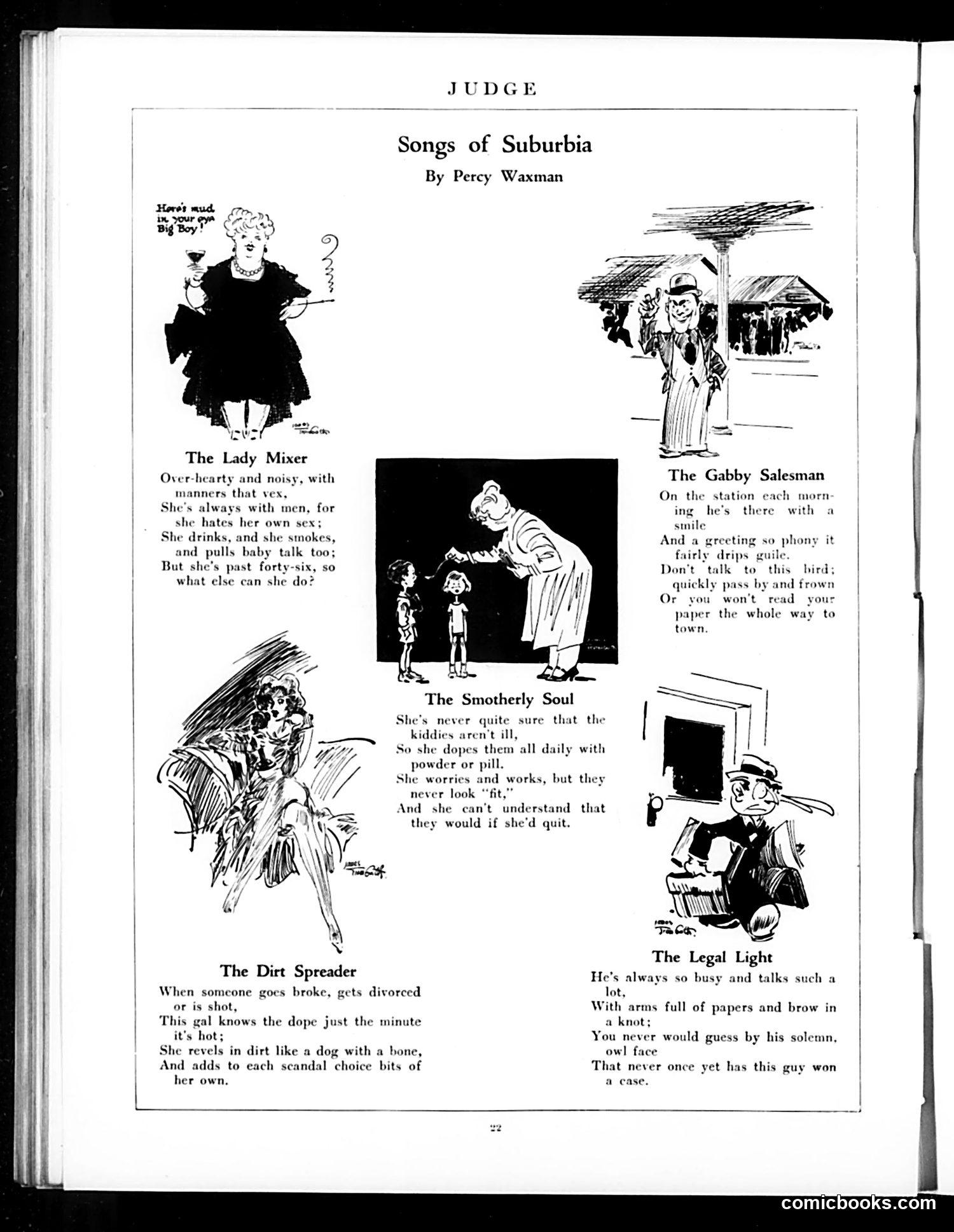
Songs of Suburbia: Social Satire on Suburban Types This page presents Percy Waxman's satirical character sketches of suburban archetypes, each illustrated with period caricatures. The targets include: The Lady Mixer: An over-forty woman who smokes, drinks, and pursues men while disliking other women—mocking female behavior deemed unbecoming for her age. The Dirt Spreader: A gossip who eagerly spreads scandal and rumors, particularly about divorces, financial ruin, or violence, embellishing stories for drama. The Gabby Salesman: An irritatingly cheerful train station vendor whose false friendliness and constant chatter annoy commuters. The Smotherly Soul: A neurotic mother who over-medicates her children with powders and pills out of unfounded health anxieties. The Legal Light: A perpetually busy lawyer surrounded by papers who, despite his serious demeanor and workload, never actually wins cases. The satire mocks recognizable suburban social types through gentle ridicule of their pretensions and character flaws.
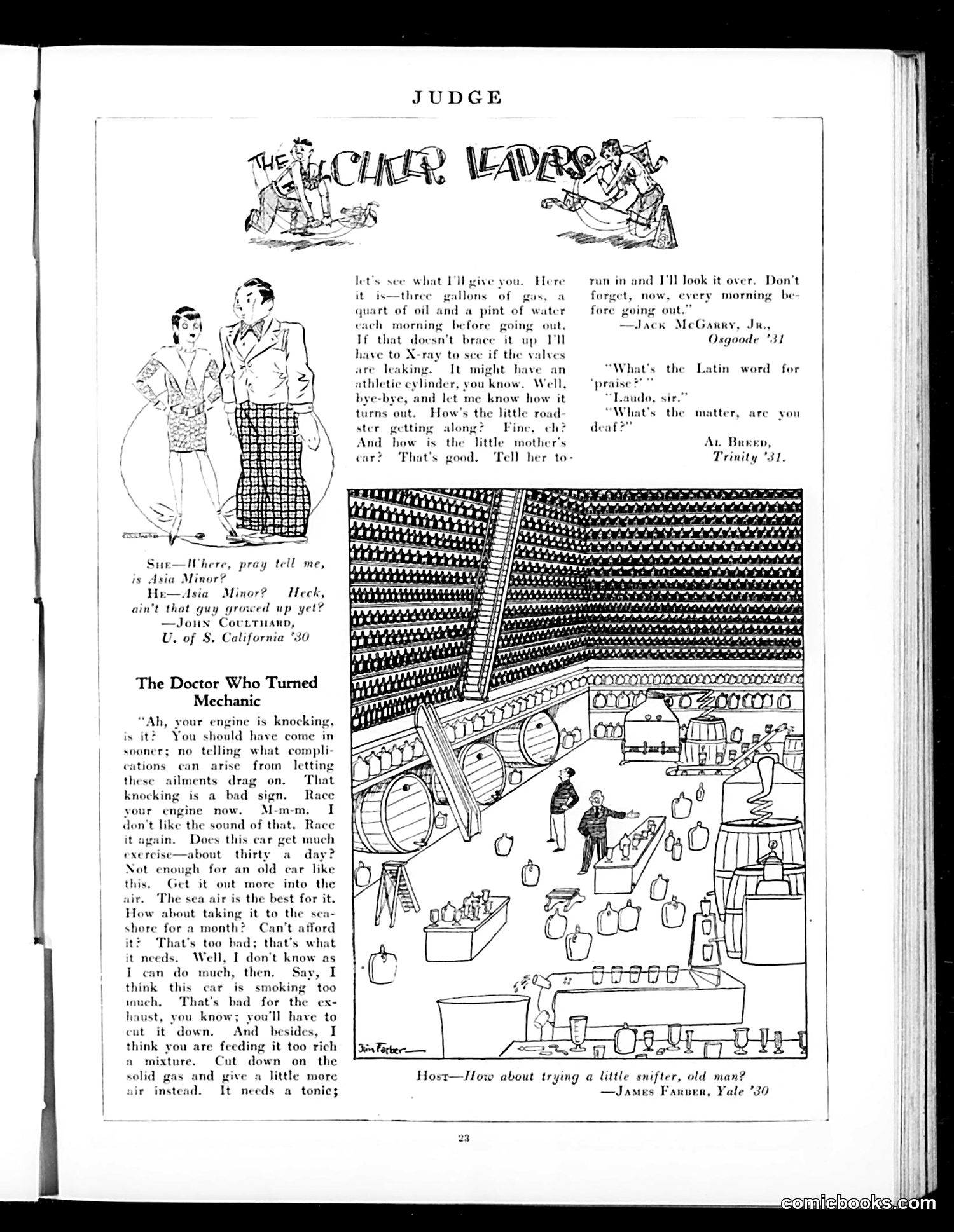
Judge Magazine Page Analysis This page contains three unrelated jokes targeting educated men's pretensions and absent-mindedness: "The Doctor Who Turned Mechanic" (main cartoon): A physician treats an automobile with medical language—discussing "exercise," "sea air," and "tonics" as if it were a patient. The satire mocks doctors who apply their professional jargon inappropriately outside their expertise, treating a machine as though it has biological needs. "Asia Minor" joke: A man asks his companion where Asia Minor is located. The companion responds dismissively, suggesting the questioner is an uneducated adult—the joke being that only a child would need such basic geography explained. It satirizes intellectual pretension or feigned ignorance. "Latin word" exchange: A deaf student is asked the Latin word for "praise" but cannot hear the question, creating a simple pun on miscommunication among college students. All three appear aimed at college-educated readers (attributed to Yale, Trinity, UC Berkeley), mocking their peers' intellectual vanity or obliviousness.
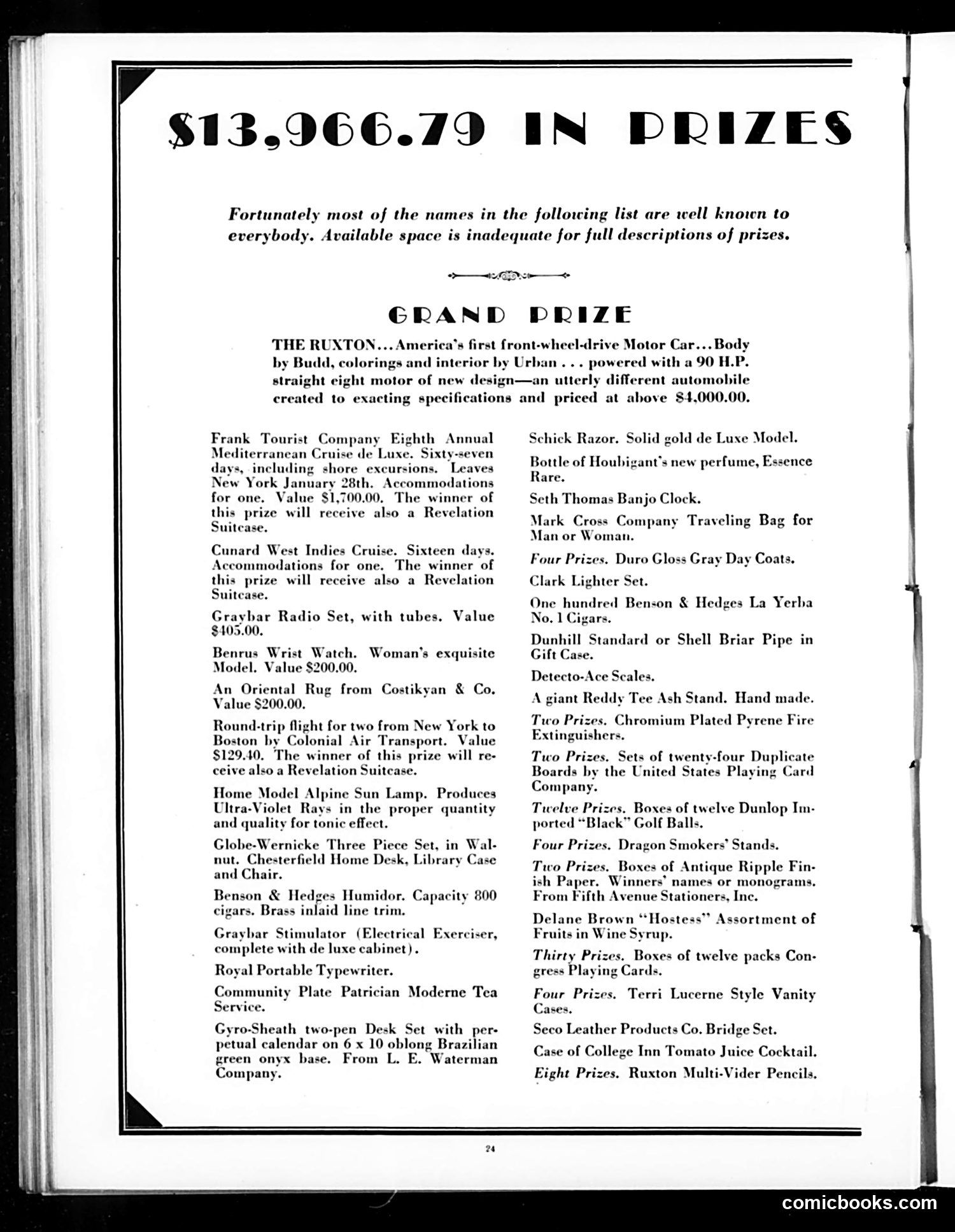
Prize List Page from Judge Magazine This is not a cartoon but a prize announcement page listing $13,966.79 in giveaway prizes—likely for a Judge magazine contest or promotion. The Grand Prize is a Ruxton automobile, "America's first front-wheel-drive Motor Car," priced above $1,000—a significant luxury item for the era. Supporting prizes include luxury goods reflecting 1920s-30s affluence: Mediterranean and Caribbean cruises, radio sets, watches, Oriental rugs, airplane tickets, and consumer goods like razors, lighters, and golf balls. The page reflects the magazine's affluent readership. Brands mentioned (Cunard, Benrus, Mark Cross, Dunhill) signal upper-class aspirations. The abundance of cigarettes and cigars among prizes indicates pre-health-awareness advertising norms. The tone is celebratory and promotional—Judge positioning itself as a purveyor of desirable modern goods and experiences to its educated, well-to-do audience.
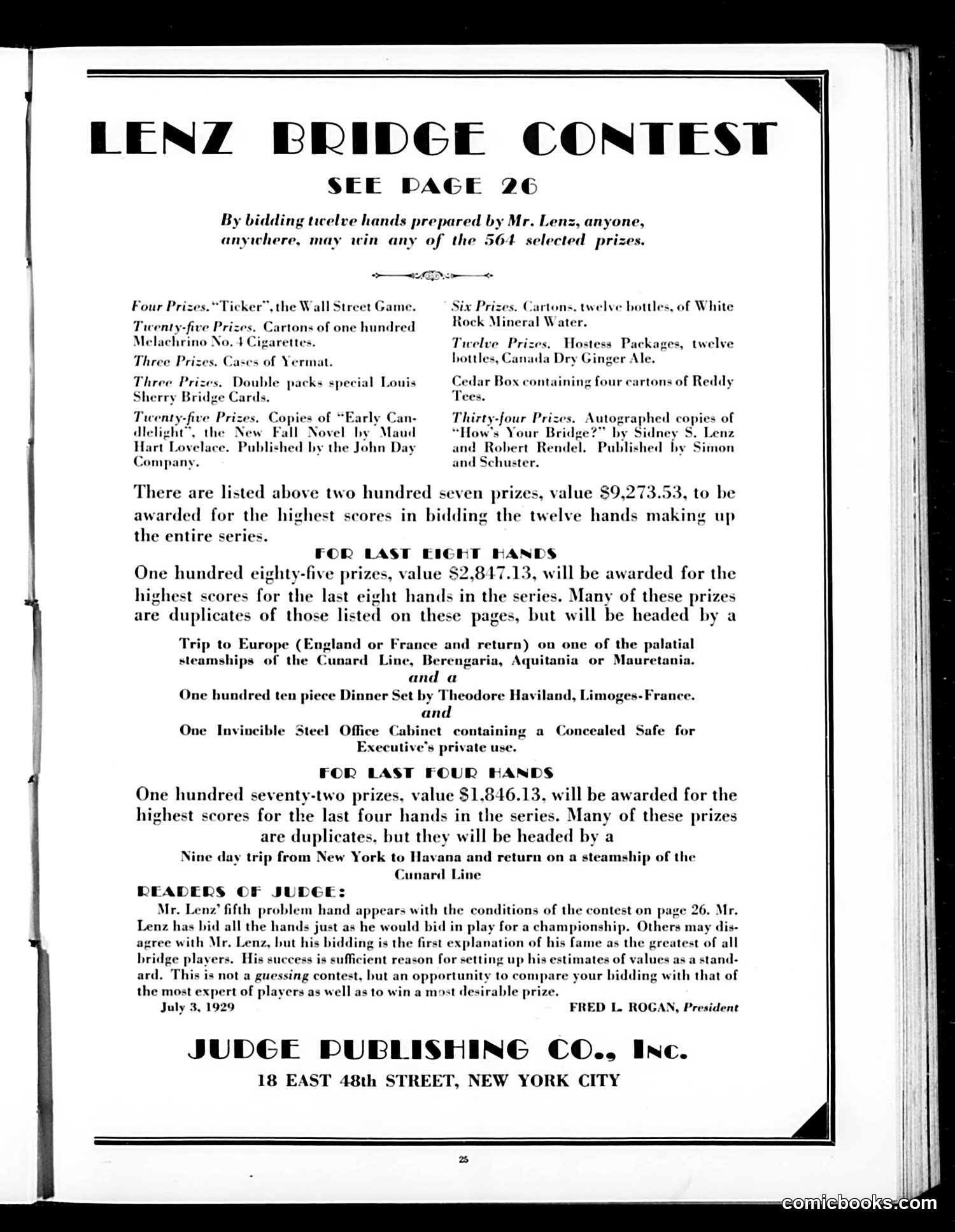
This is primarily a contest advertisement rather than a cartoon page. Judge magazine is sponsoring a "Lenz Bridge Contest" (July 3, 1929) featuring bridge hands prepared by Mr. Lenz, an apparently renowned bridge player. Readers can submit bids and compete for 564 prizes valued over $9,000—ranging from cigars and mineral water to a trip to Europe aboard the Cunard Line. The contest positions Lenz as the standard-setter for bridge expertise ("the greatest of all bridge players"), allowing contestants to "compare your bidding with that of the most expert." This appears to be Judge's clever monetization strategy: gamifying bridge instruction while celebrating a celebrity expert, appealing to the 1920s craze for bridge as a status-symbol parlor game among the wealthy. The prizes emphasize upscale goods and leisure travel appropriate to Judge's affluent readership.
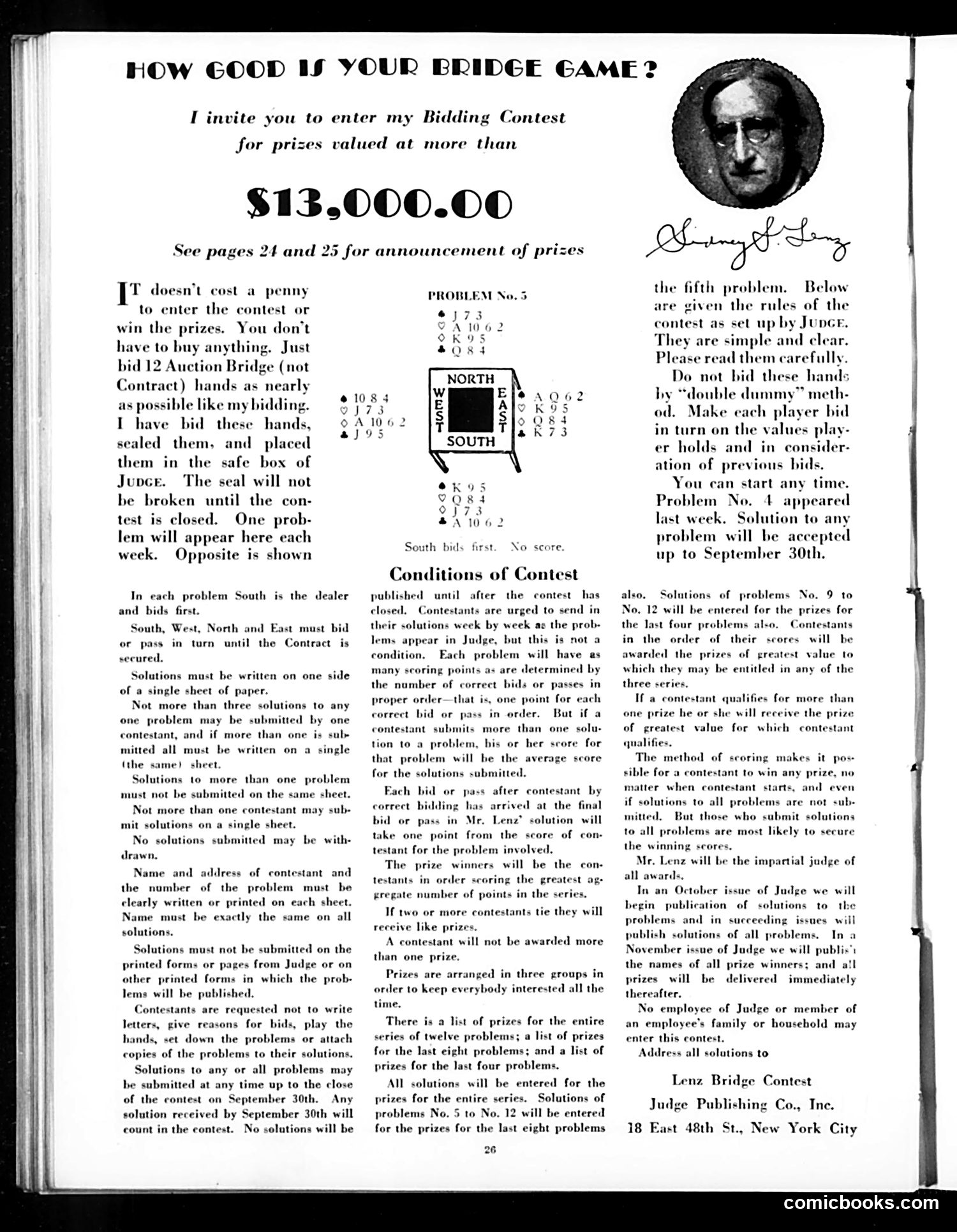
Judge Magazine Bridge Contest Advertisement This page announces a bridge bidding contest sponsored by Judge magazine, offering $13,000 in prizes. The contest invites readers to bid 12 Auction Bridge hands as skillfully as possible, competing against bids sealed by an unnamed expert (likely the contest organizer). The image shows a portrait photograph of the expert judge—appears to be a serious-faced man in formal attire with a signature below—though the OCR'd text doesn't identify him by name. This is essentially a mail-in competition: readers submit solutions weekly, with no entry fee required. The contest details establish scoring rules, submission deadlines (September 30th), and explain that solutions will be judged by correct bidding accuracy. The appeal is straightforward—demonstrating bridge skill for substantial cash prizes—making this a form of popular entertainment and reader engagement typical of early-to-mid 20th century magazine marketing. It's not satirical; it's a genuine contest advertisement placed within the humor magazine.
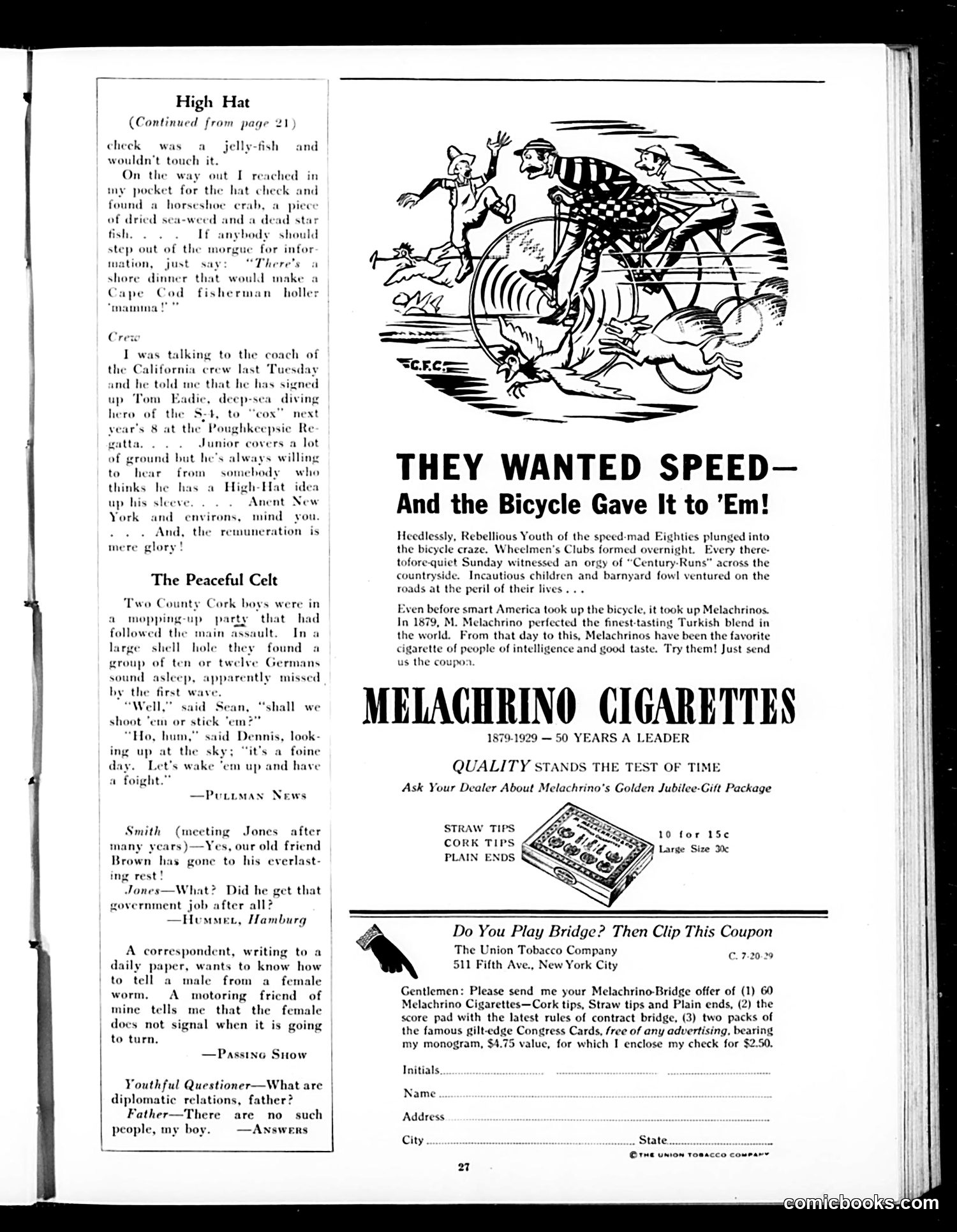
Judge Magazine Page Analysis This page mixes humor columns with a major cigarette advertisement. The "High Hat" column contains brief anecdotes mocking upper-class pretension—a waiter's hat check mix-up, a rowing coach's eccentric hiring, and complaints about New York social circles. "The Peaceful Celt" satirizes Irish soldiers' casual attitude toward combat, playing on ethnic stereotypes common to the era. The dominant feature is a Melachrino Cigarettes advertisement depicting 1880s bicycle enthusiasts as reckless youth endangering rural life. The ad nostalgically frames bicycles as a dangerous "speed craze" while claiming Melachrino cigarettes have been the refined smoker's choice since 1879. A coupon offers bridge-related premiums, targeting middle-class recreational players. The juxtaposition is striking: the magazine warns of bicycle-era recklessness while selling cigarettes as a marker of intelligence and good taste—a claim impossible to make today.
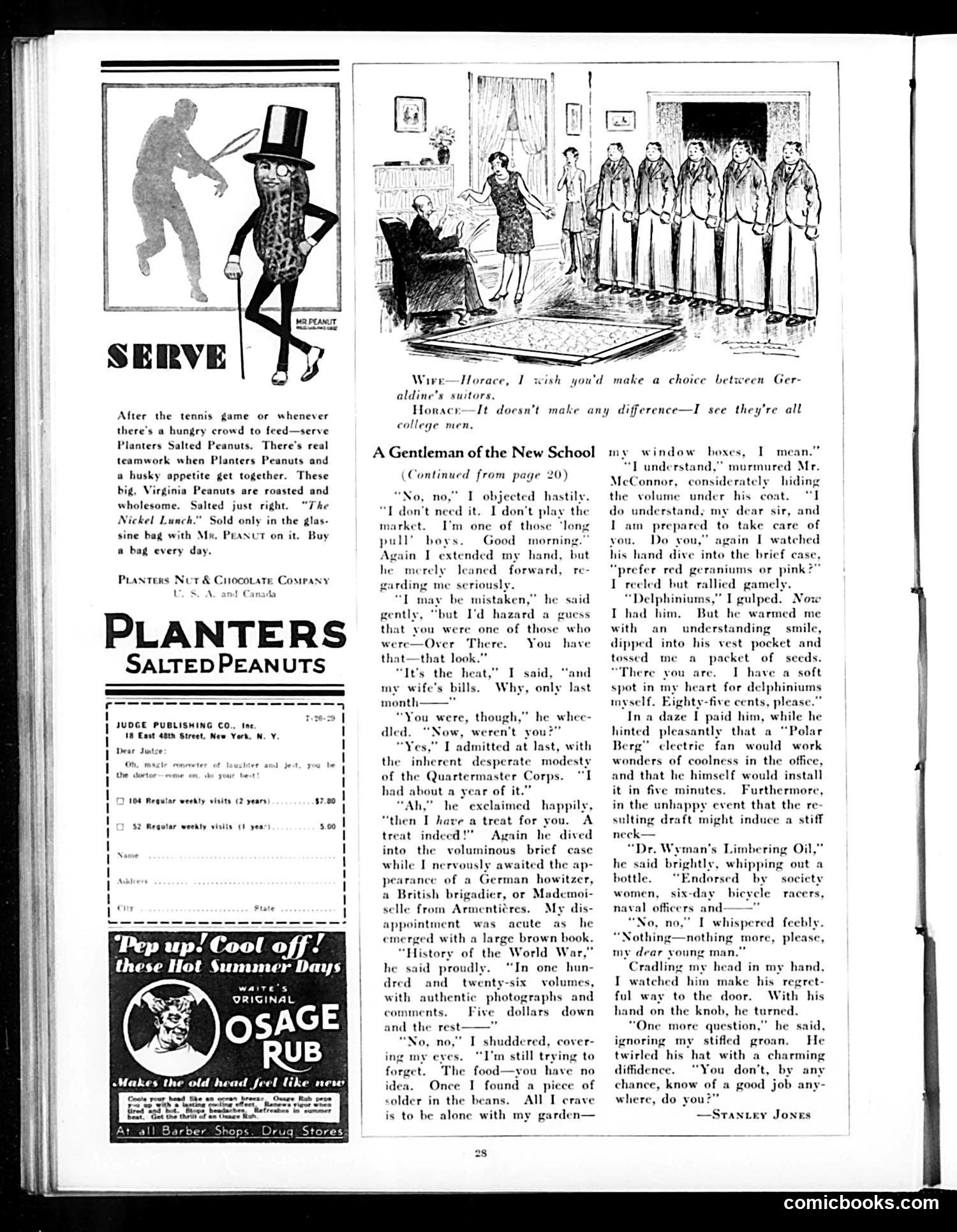
"A Gentleman of the New School" - Satire on Post-WWI Sales Tactics This story-cartoon satirizes the aggressive door-to-door salesman archetype of the 1920s. A well-meaning but relentless salesman targets a WWI veteran, exploiting his military service as an entry point. The humor lies in the salesman's unstoppable persistence: despite the exhausted veteran's repeated refusals, he produces an endless cascade of products—a 126-volume war history, flower seeds, an electric fan, liniment oil—each tied to a previous objection. The joke culminates when the salesman, having failed to sell anything substantial, pivots to asking if the veteran knows of a job opening, revealing the salesman's actual desperation beneath his cheerful facade. The satire critiques both post-war commercialism and the pressure on returning soldiers to consume, while also mocking the new "scientific" sales methods gaining popularity in the era.
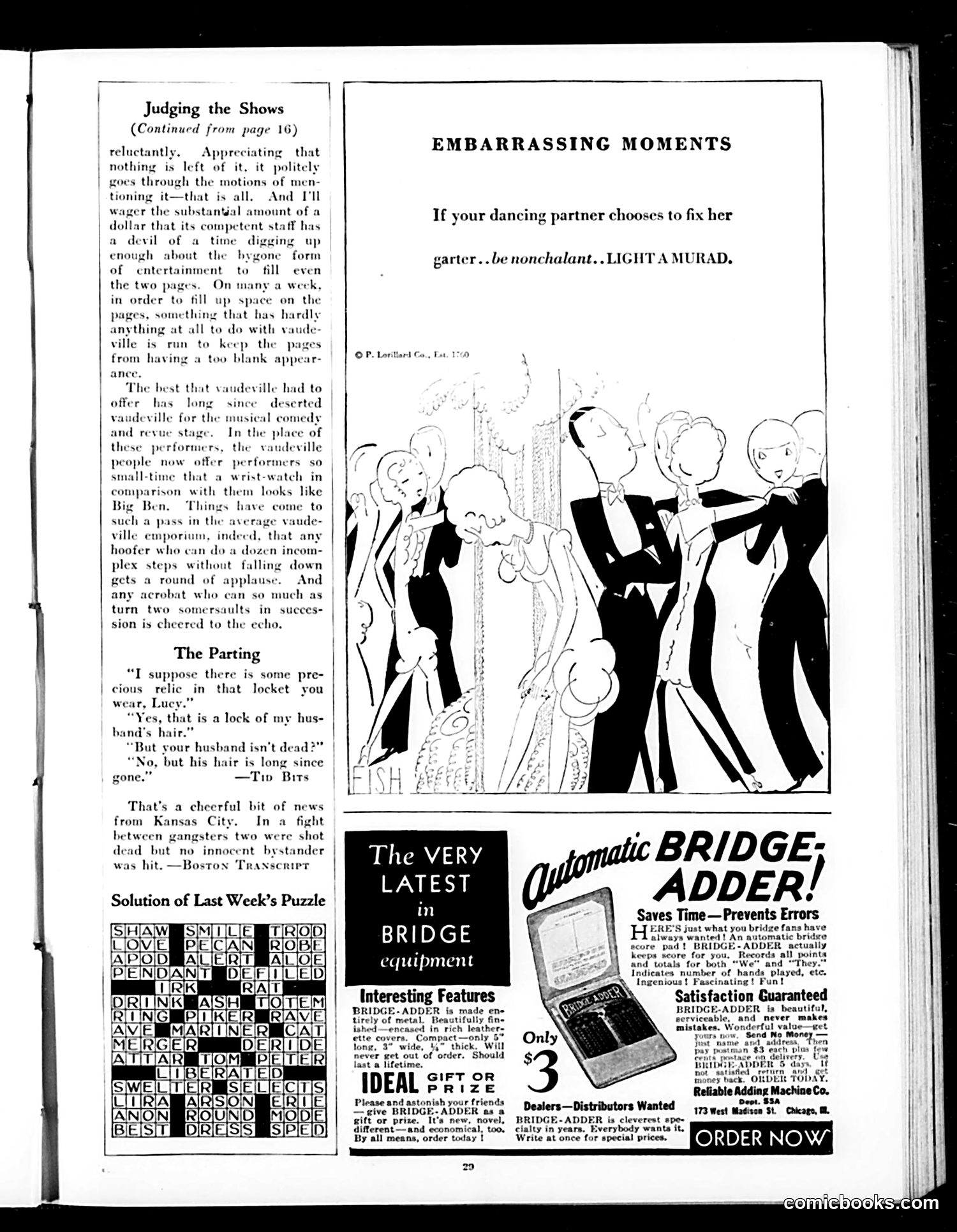
Explanation for Modern Readers This page contains three distinct pieces of content: "Judging the Shows" (left column): A theater critic laments vaudeville's decline, noting that the best performers have migrated to musical comedy and revue. The remaining vaudeville acts are so mediocre that even basic acrobatics earn applause. This reflects vaudeville's genuine collapse in the late 1920s-early 1930s as entertainment shifted to cinema and Broadway revues. "Embarrassing Moments" (top right): A cartoon satirizing social awkwardness—a woman adjusts her garter (a common undergarment fastener) while dancing. The joke suggests a man should pretend not to notice by casually smoking a cigarette, maintaining composure during an awkward moment. It's a period-specific reference to 1920s-30s dating etiquette and undergarment visibility. Bottom half: Advertisements for the "Bridge-Adder," an automatic scoring device for the card game bridge, which was extremely popular in this era. The page is primarily commercial, using humor and puzzles to fill space around ads.
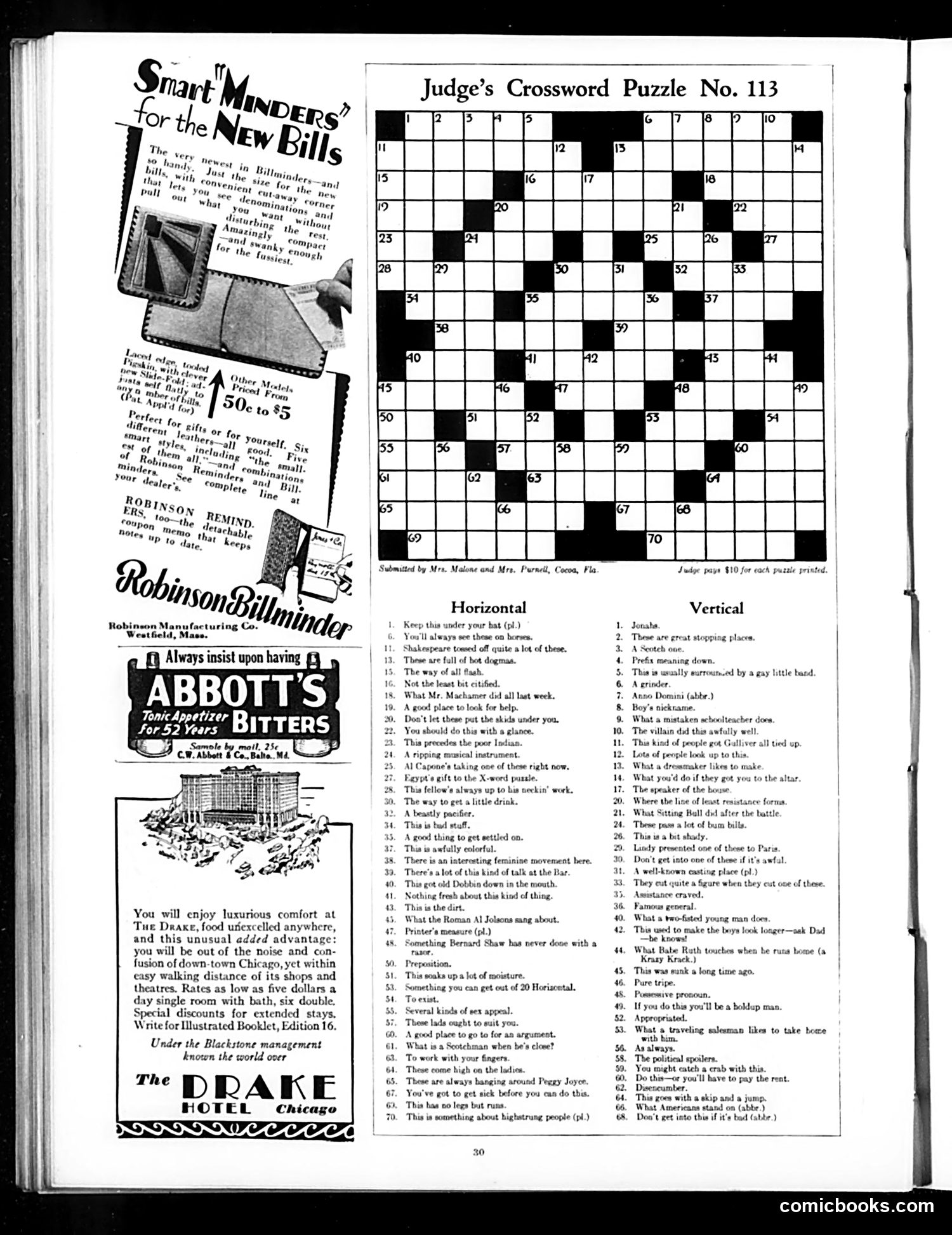
Judge Magazine Page Analysis This page is primarily advertising and a crossword puzzle, not political satire. The main content is "Judge's Crossword Puzzle No. 113"—a standard word puzzle typical of 1920s magazines. The clues are whimsical wordplay ("Keep this under your hat," "Shakespeare tossed off quite a lot of these") rather than satirical commentary. The advertisements occupy the left side: Abbott's Bitters (a patent medicine), Robinson Billminder (a business organizer), and The Drake Hotel in Chicago—typical commercial pitches of the era. The only potential satirical reference is clue 23 Horizontal mentioning "Al Capone's taking over of these right now," which alludes to Prohibition-era Chicago gangsterism, but this appears incidental rather than the page's focus. This is essentially a entertainment/puzzle page with period advertising, not a satirical cartoon page.
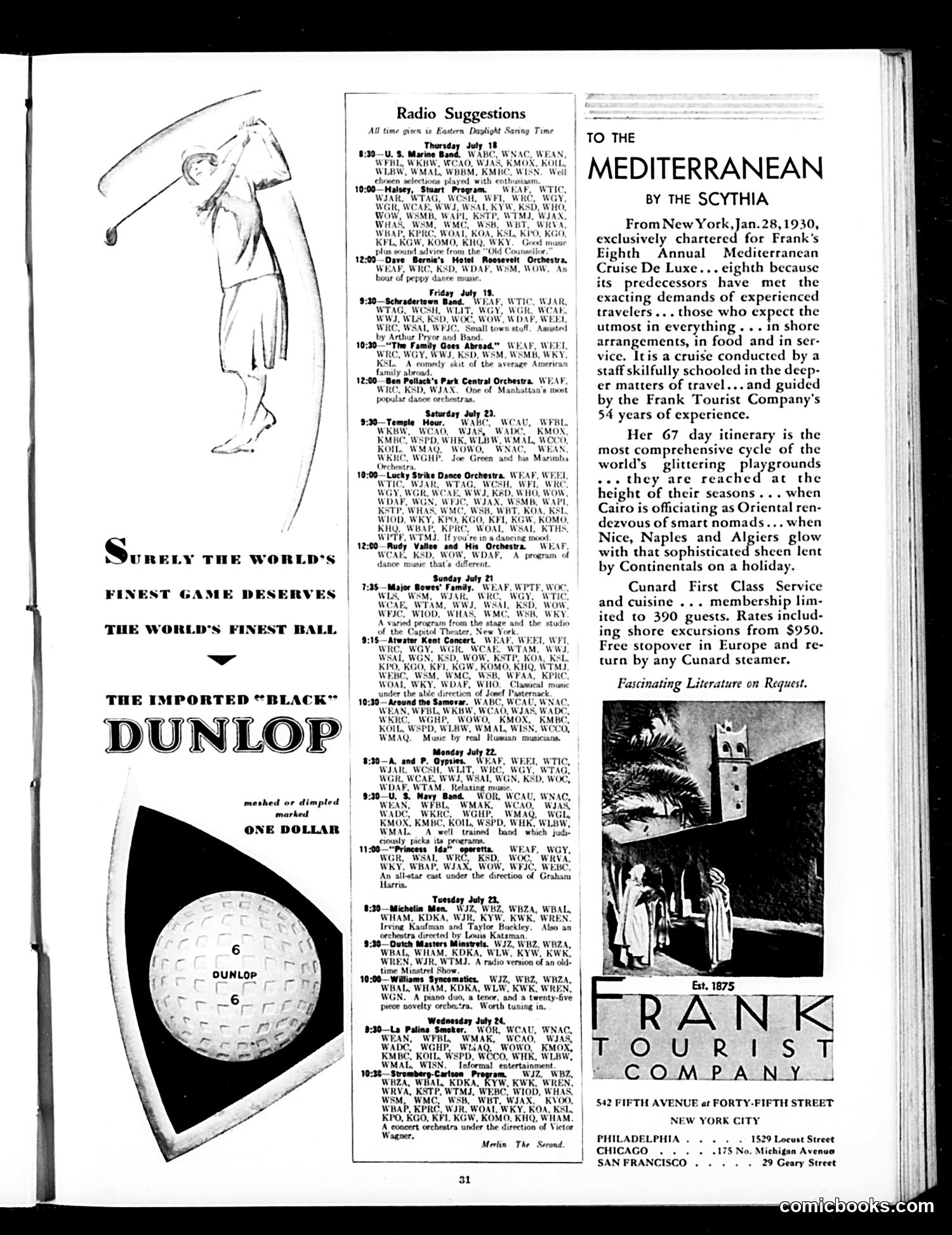
Page Content Analysis This page is primarily advertising and radio programming, not political satire. The main elements are: Left side: A Dunlop golf ball advertisement featuring an illustration of a woman golfer mid-swing. The ad emphasizes quality ("the world's finest ball") and price ("ONE DOLLAR"), with a close-up image of the dimpled golf ball. Center: Extensive radio programming listings for Thursday July 18 through Wednesday July 24, organized by time slot and radio station call letters (WEAF, WRC, etc.). Programs include orchestras, variety shows, and musical performances—typical 1930s radio fare. Right side: A Frank Tourist Company advertisement promoting Mediterranean cruises on the *Scythia*, departing from New York January 28, 1930, for 67 days. It emphasizes luxury amenities and Cunard First Class Service. There is no political cartoon or social satire visible on this page. It's a standard magazine advertisement and programming guide page from *Judge*, circa 1930.
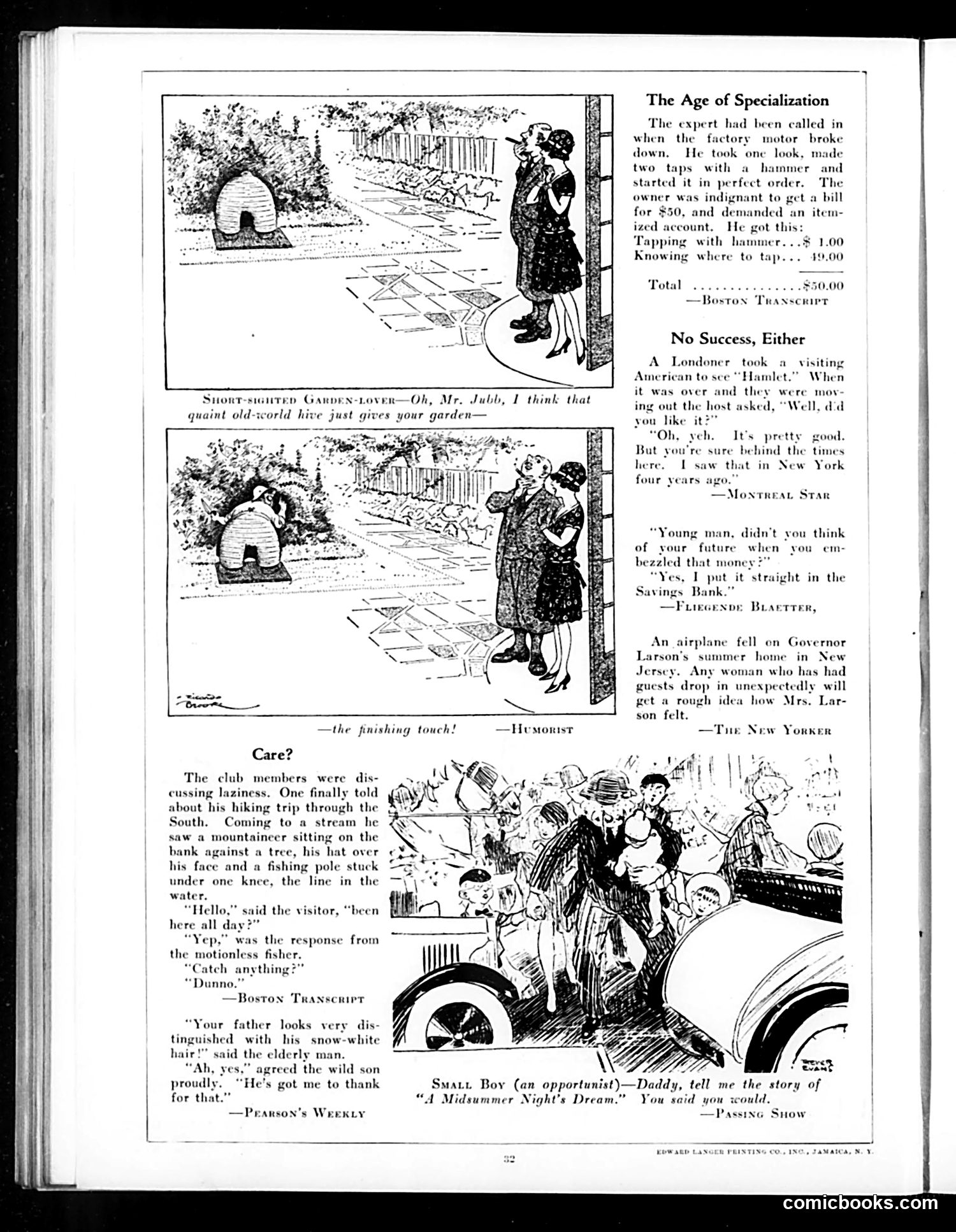
Judge Magazine Page Analysis This page contains several short humor pieces typical of early 20th-century satirical magazines: "The Age of Specialization" mocks over-billing for expert services. A factory owner calls in a specialist who fixes a motor with two hammer taps, then charges $50 ($1 for tapping, $49 for "knowing where to tap")—satirizing how specialized expertise commands disproportionate fees. "Care?" features a lazy mountaineer anecdote about a fisherman who hasn't moved all day, embodying rural indolence. This reflects period stereotypes about Southern laziness. "No Success, Either" contrasts American and British theater tastes—a visiting American finds London's "Hamlet" outdated, having seen it in New York four years prior, lampooning American cultural impatience. Additional brief jokes include a young embezzler ironically putting stolen money in a savings bank, and a quip about an airplane crashing into a governor's house interrupting houseguests. The cartoons use visual humor and deadpan dialogue typical of Judge's satirical style, targeting contemporary social types: greedy specialists, lazy characters, and cultural pretension.
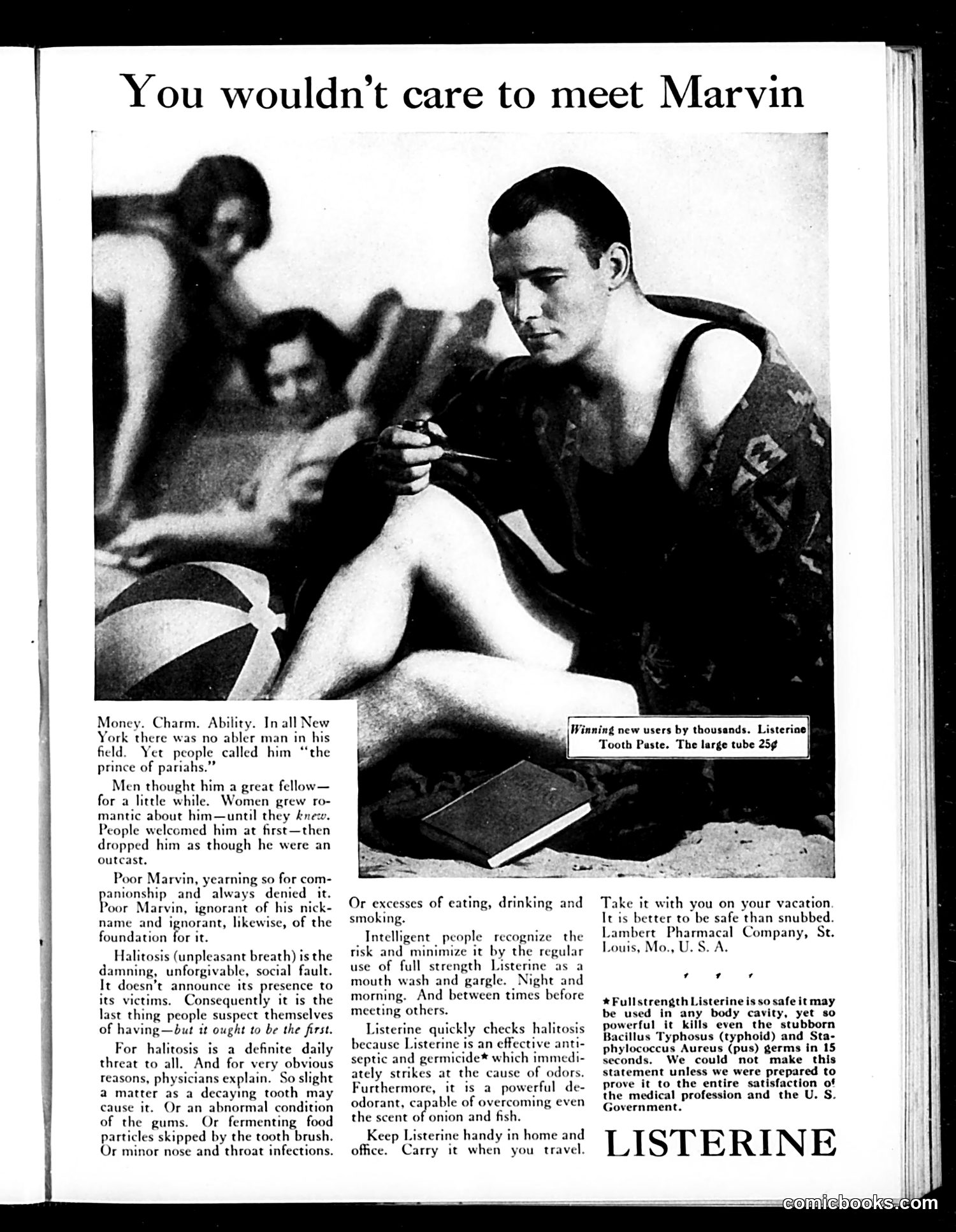
Analysis: "You Wouldn't Care to Meet Marvin" This is a Listerine advertisement disguised as social commentary. The "character" Marvin is fictional—a successful, charming New York man mysteriously rejected by society and labeled "the prince of pariahs." The ad's ironic hook: Marvin doesn't know *why* he's shunned. The reveal is halitosis (bad breath). The satire targets social anxiety and class consciousness. The ad exploits shame about invisible physical flaws that prevent social acceptance, suggesting that even accomplished people can be ruined by hygiene oversight. The phrase "it ought to be the first" thing people suspect implies halitosis is shameful but undetectable to the sufferer. This exemplifies 1920s-30s advertising strategy: manufacturing insecurity to sell products. "Halitosis" itself was marketing jargon Listerine popularized. The ad's pseudo-serious tone—comparing breath to moral failing—satirizes how superficial social judgment can be, while simultaneously weaponizing that judgment to move product. The message: *You could be Marvin. Use Listerine.*
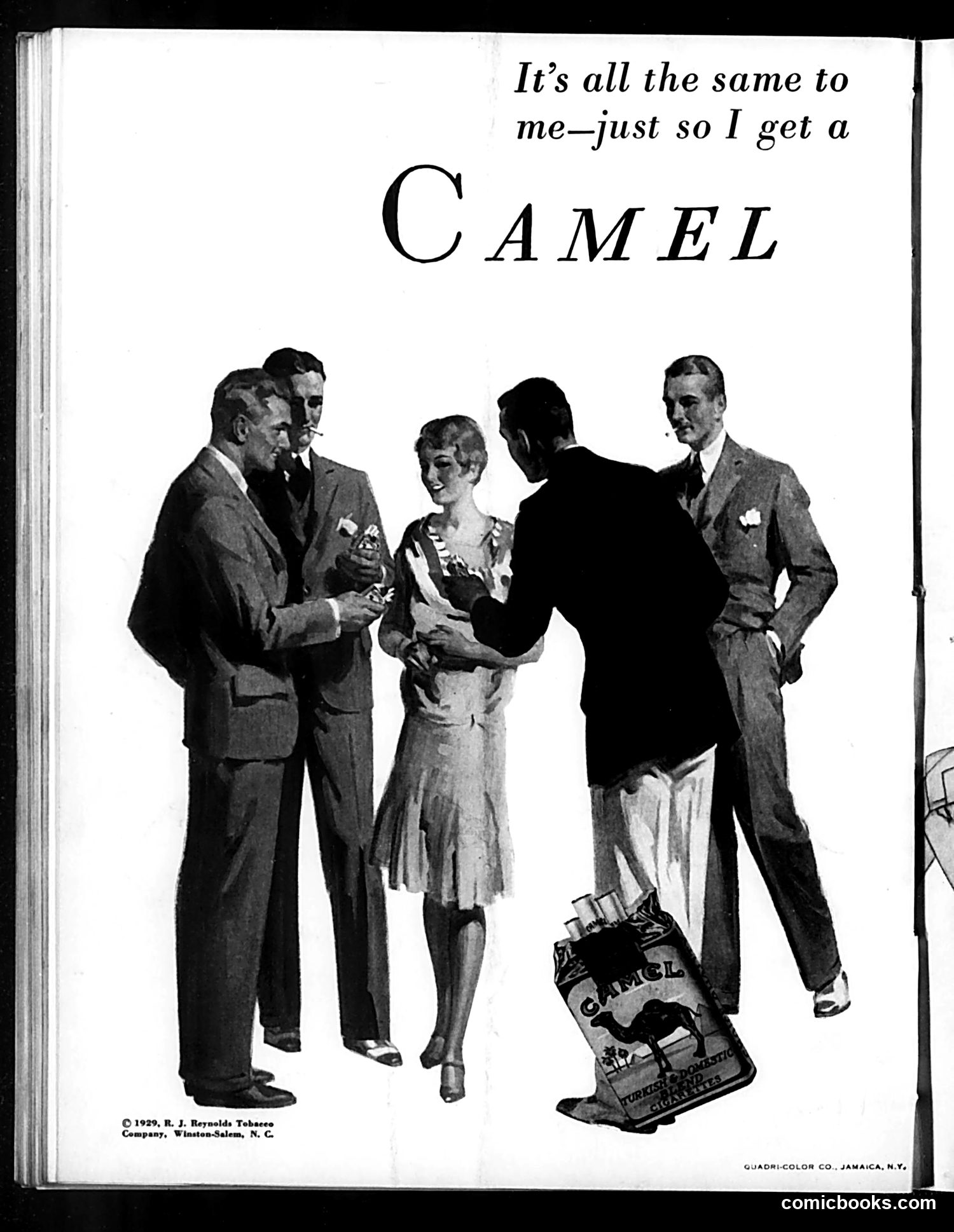
Analysis This is a Camel cigarette advertisement from 1929, not political satire. The image shows five well-dressed people in formal attire engaged in social interaction, with a Camel cigarette package prominently displayed at bottom. The ad's tagline—"It's all the same to me—just so I get a Camel"—suggests the brand's appeal transcends social circumstances or distinctions. The figures' formal dress and composed manner convey sophistication and status, typical marketing strategies for premium cigarettes during this era. This reflects 1920s-30s advertising practices that emphasized social prestige and lifestyle aspiration. No political figures or satirical commentary appear present—this is straightforward commercial promotion by R.J. Reynolds Tobacco Company.