judge
Judge — July 27, 1929
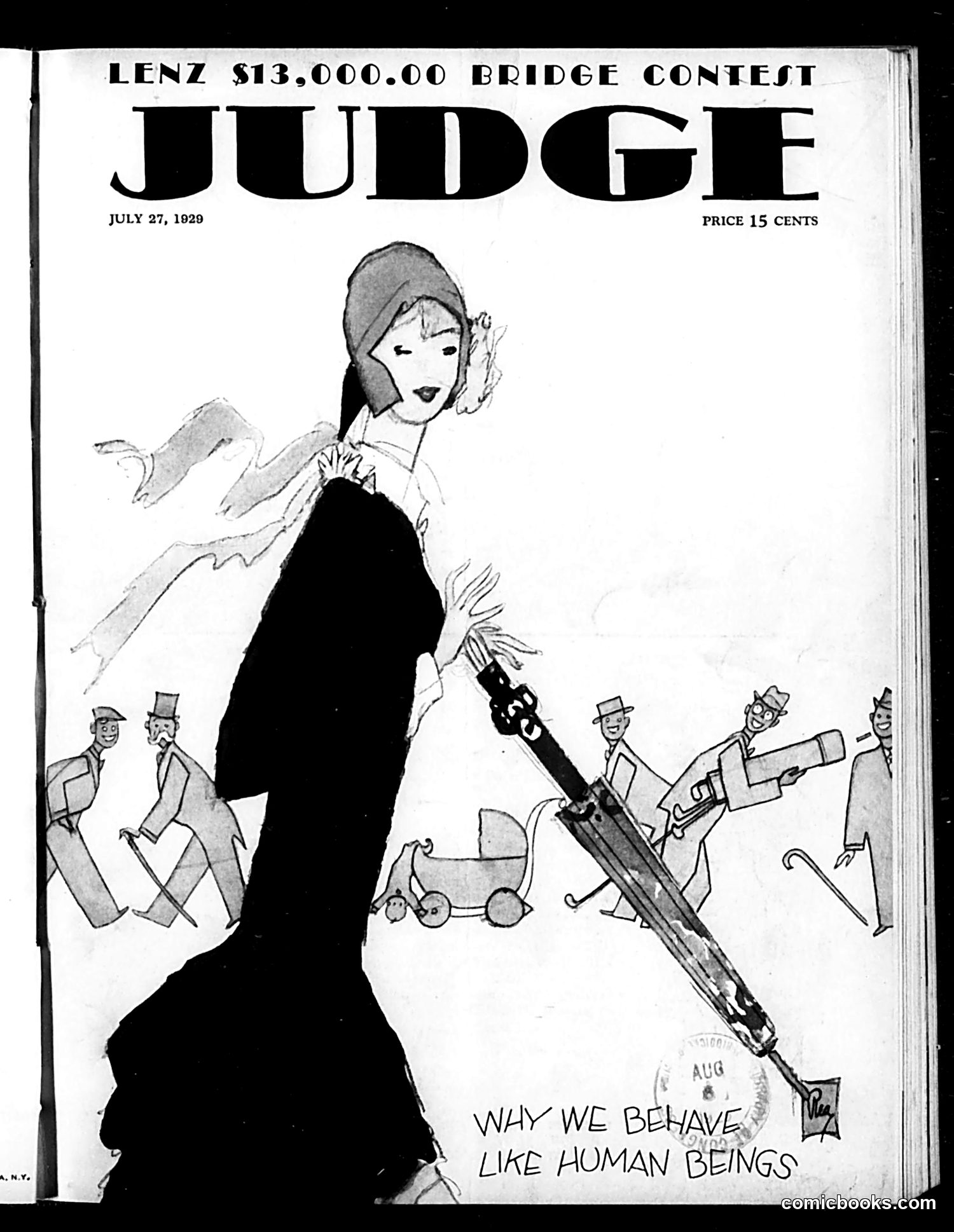
Judge Magazine Cover Analysis This July 27, 1929 cover satirizes human behavior through the figure of an elegant woman in fashionable 1920s dress holding a rifle, surrounded by small men in top hats engaged in various activities (walking, carrying items, using umbrellas). The title "Why We Behave Like Human Beings" suggests social commentary on human nature. The woman with the gun appears to represent a dominant or controlling force, while the diminished men suggest male subservience or emasculation—likely satirizing contemporary gender dynamics or power relations. The heading "Lenz $13,000.00 Bridge Contest" indicates this relates to a specific news story or competition, though the connection between the cover illustration and that contest is unclear from the image alone.
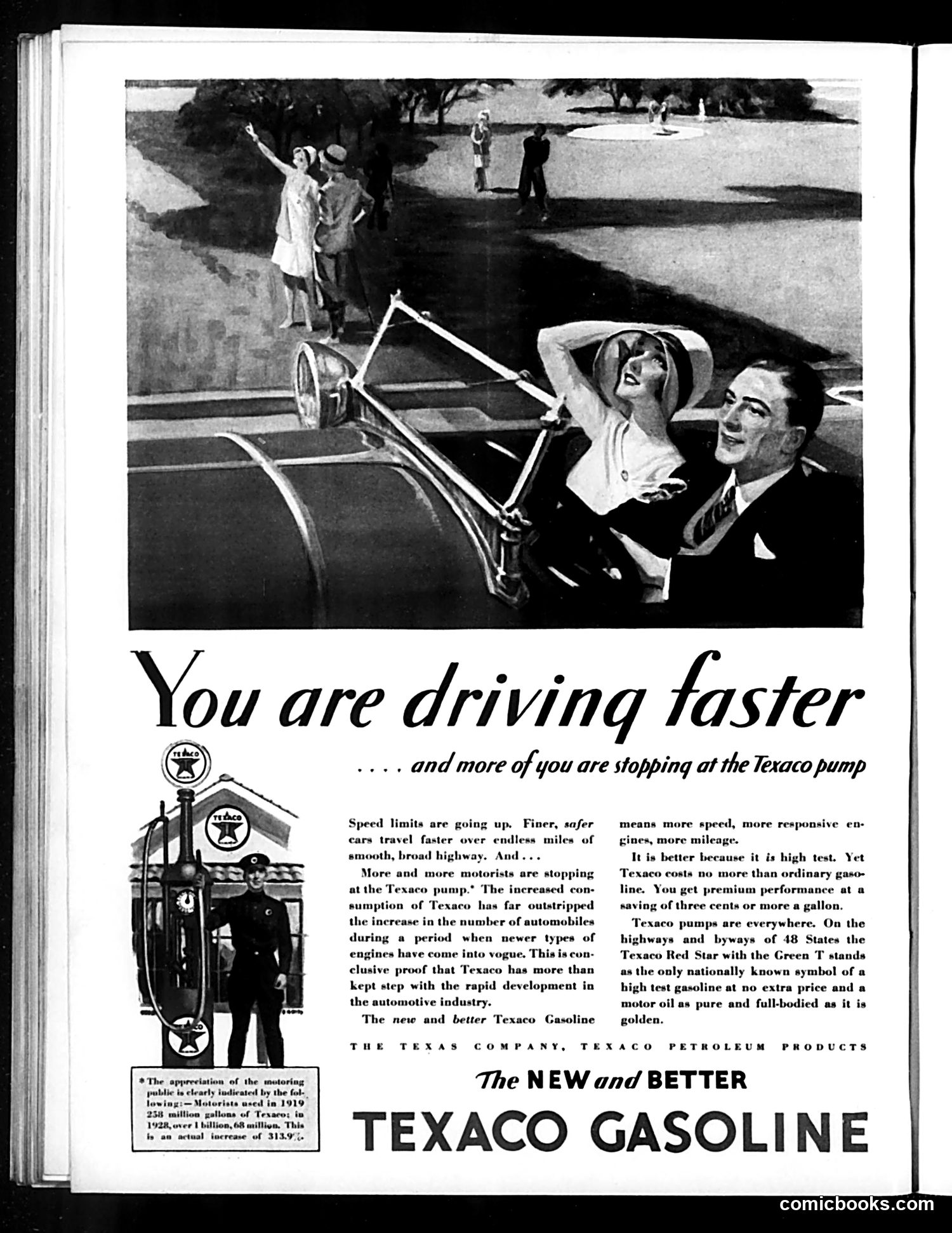
Analysis This page is primarily a Texaco gasoline advertisement, not political satire. The ad's headline "You are driving faster" appeals to 1920s motorists by connecting higher speeds with modern progress and Texaco's improved fuel. The image shows a couple in an open car passing slower vehicles, suggesting Texaco's gasoline enables better performance. The accompanying text emphasizes that Texaco has kept pace with automotive industry developments, offering superior engines better responsiveness and mileage. The small statistical note credits motorists' appreciation for the motoring industry's growth, citing consumption increases from 1919 to 1928. This reflects the era's automobile enthusiasm and consumer marketing focused on technological advancement and speed as desirable modern virtues—not satirical commentary.
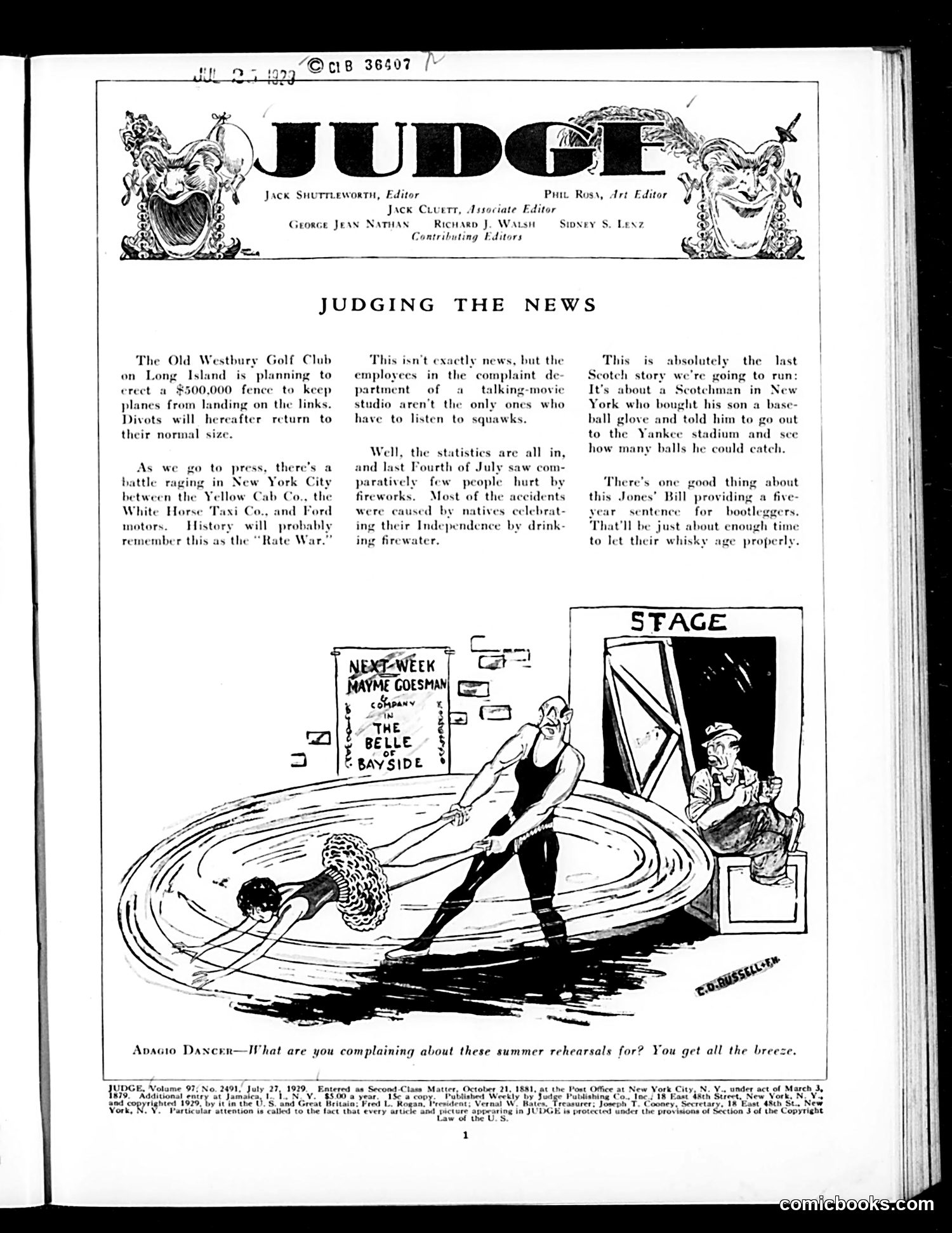
Analysis of Judge Magazine Page (July 27, 1929) The main cartoon satirizes theatrical productions. It depicts an "Adagio Dancer" performing an energetic routine on stage, while a stagehand or director (visible at right) watches. The caption reads: "What are you complaining about these summer rehearsals for? You get all the breeze." The joke mocks summer theater rehearsals as physically exhausting work, with the complaint that at least performers get air circulation from their vigorous movements—a weak consolation for grueling rehearsal conditions in pre-air-conditioning theaters. The adjacent advertisement references "The Belle of the Bayside," promoting next week's theatrical offering with Maybie Goesman. The "Judging the News" section above comments on contemporary events: a golf club fence project, a taxi company rivalry ("Rate War"), Fourth of July fireworks accidents, and a Scotsman's baseball exploits.
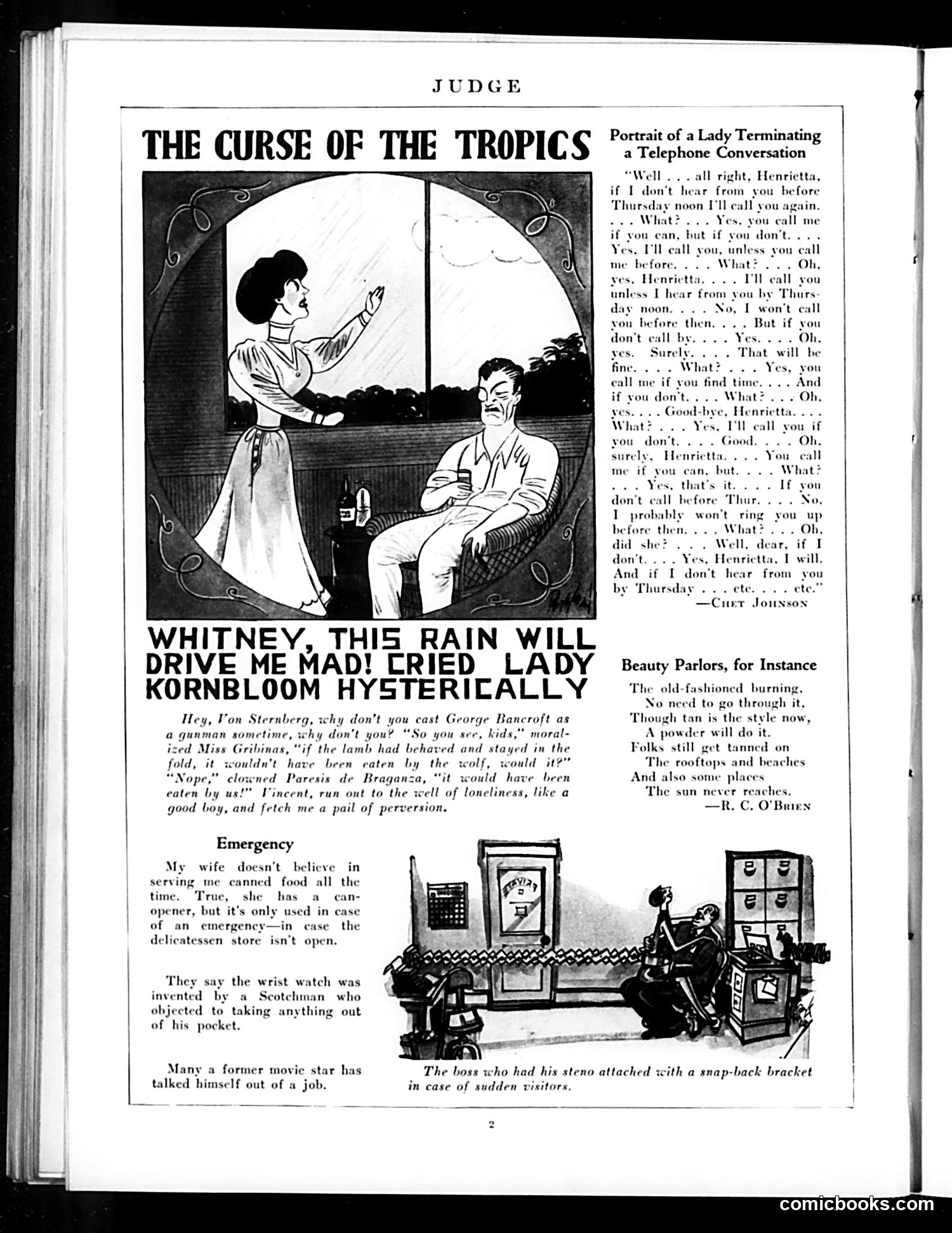
"The Curse of the Tropics" Analysis The main cartoon depicts a woman at a window during rain, gesturing dramatically toward a man sitting indoors. The caption suggests the woman is "driven mad" by tropical rain, implying weather-induced hysteria. The accompanying text references actress Miss Gribmas and suggests that tropical climates cause psychological instability in women—a period stereotype about female emotional fragility. The other items on the page are brief humor pieces: one mocks overly elaborate feminine beauty routines, another jokes about wives using emergency canned goods, and a final quip about Hollywood actors reinventing themselves. These reflect early 20th-century Judge magazine's satirical take on contemporary social anxieties about gender, modernity, and geography—all presented as humorous observations.
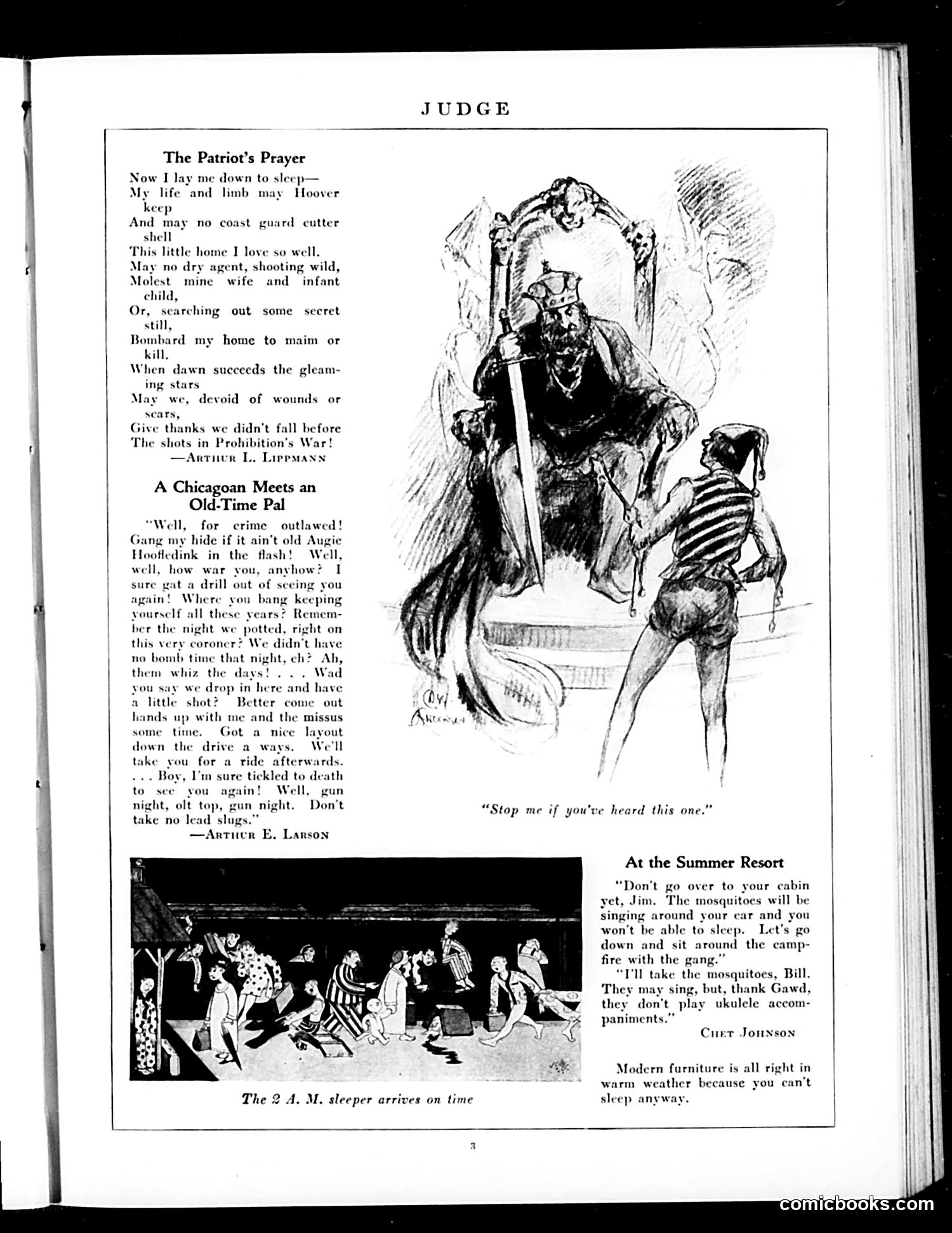
Analysis of Judge Magazine Page This page contains three separate humor pieces rather than interconnected political cartoons. "The Patriot's Prayer" is a WWI-era poem by Arthur L. Lippmann expressing anxiety about protecting home and family during wartime—reflecting genuine civilian concerns during the conflict. "A Chicagoan Meets an Old-Time Pal" by Arthur E. Larson depicts a reunion between two men, one recently returned from prison ("crime outlawed"), joking about Chicago's criminal underworld and Prohibition-era violence. The humor relies on knowing Chicago's reputation for organized crime. The remaining items are brief comedic quotes about summer resort life and modern furniture, with an accompanying illustration of campers. The page reflects early 20th-century American anxieties: wartime safety, urban crime, and leisure culture.
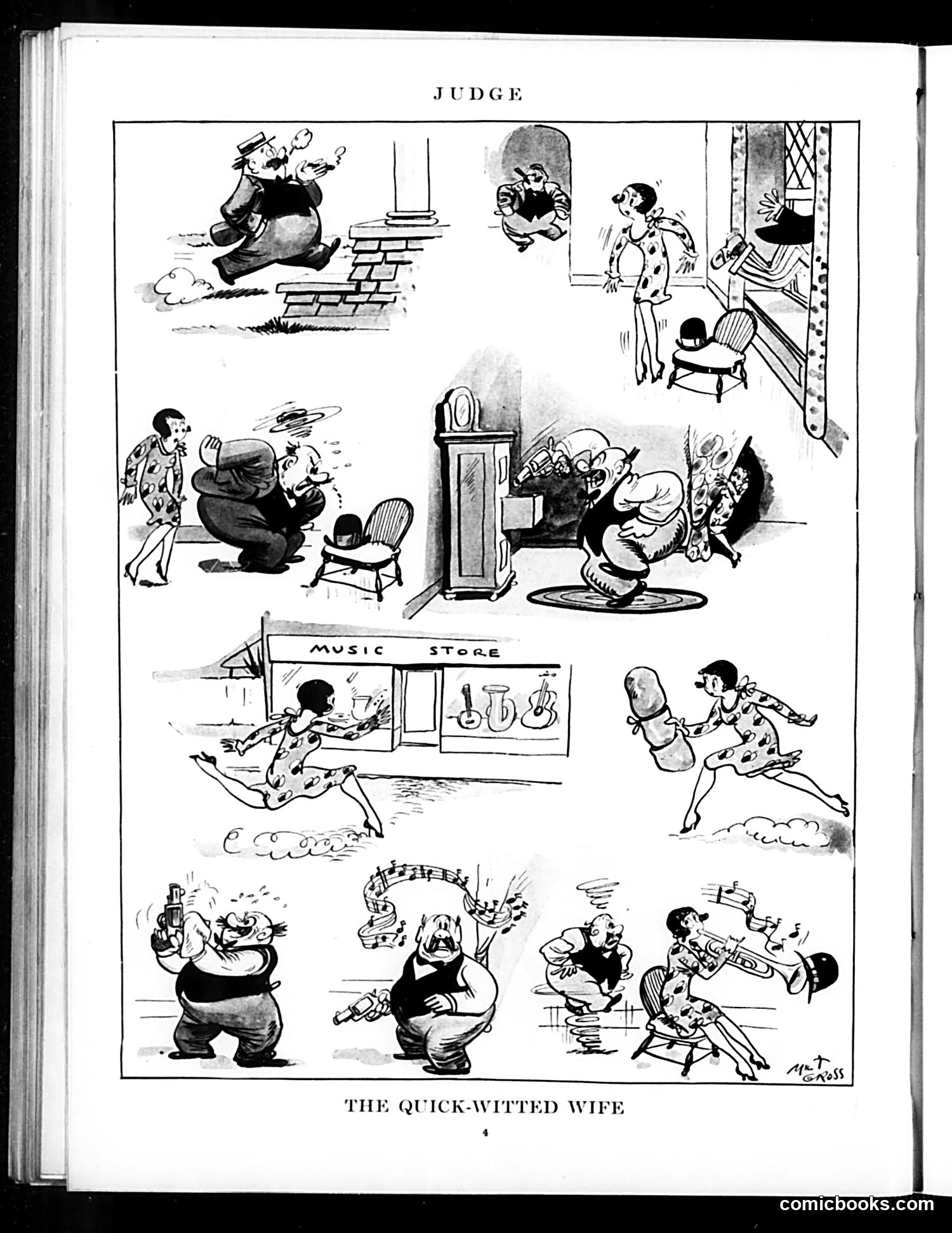
"The Quick-Witted Wife" - Judge Magazine This page presents a comic strip titled "The Quick-Witted Wife," depicting humorous domestic scenarios involving a married couple and their interactions with various people and situations. The strip shows a woman demonstrating cleverness and resourcefulness across multiple panels: evading a burglar, managing household chaos, dealing with a judge or authority figure, and handling musical instrument mishaps at a music store. The cartoons satirize the "clever woman" trope popular in early 20th-century humor—portraying wives as quick-thinking problem-solvers who outwit others through wit rather than brute force. The humor relies on slapstick visual gags and role-reversal scenarios typical of Judge magazine's satirical approach to gender dynamics and domestic life during this era.
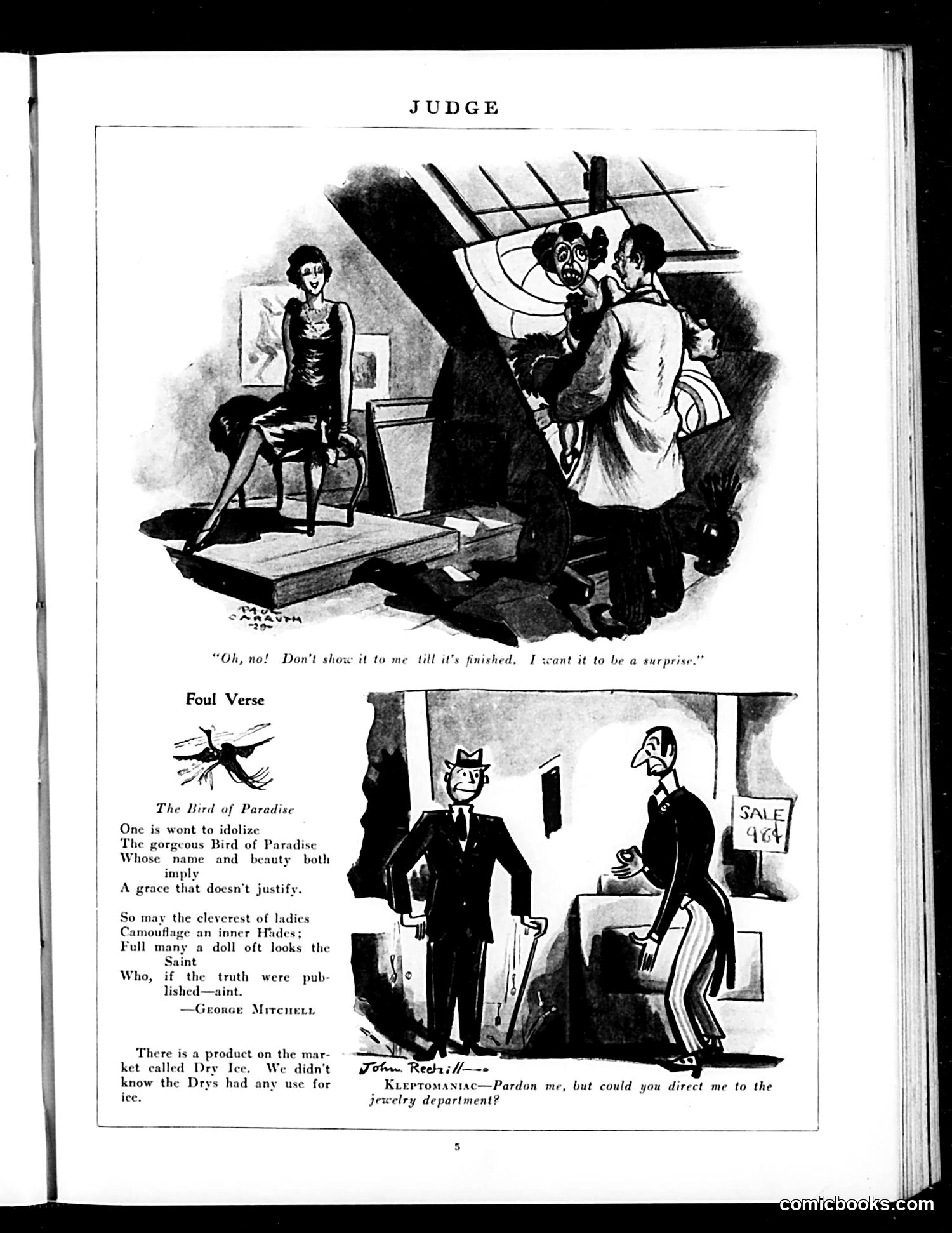
Analysis of Judge Page Top Cartoon: A woman being shown artwork by what appears to be an artist or gallery owner, with the caption "Oh, no! Don't show it to me till it's finished. I want it to be a surprise." This satirizes vanity—the woman wants her portrait completed without seeing it, presumably hoping the artist will flatter her appearance. "Foul Verse" Section: Includes a poem mocking pretension, attributed to George Mitchell, about ladies using "camouflage" to hide their true nature. Bottom Cartoon: A store customer asking a salesman for directions to the jewelry department, with a "Sale 16¢" sign visible. The humor appears to mock either the absurdly low sale price or the customer's misdirected priorities in a department store. The page emphasizes social satire on vanity and consumerism.
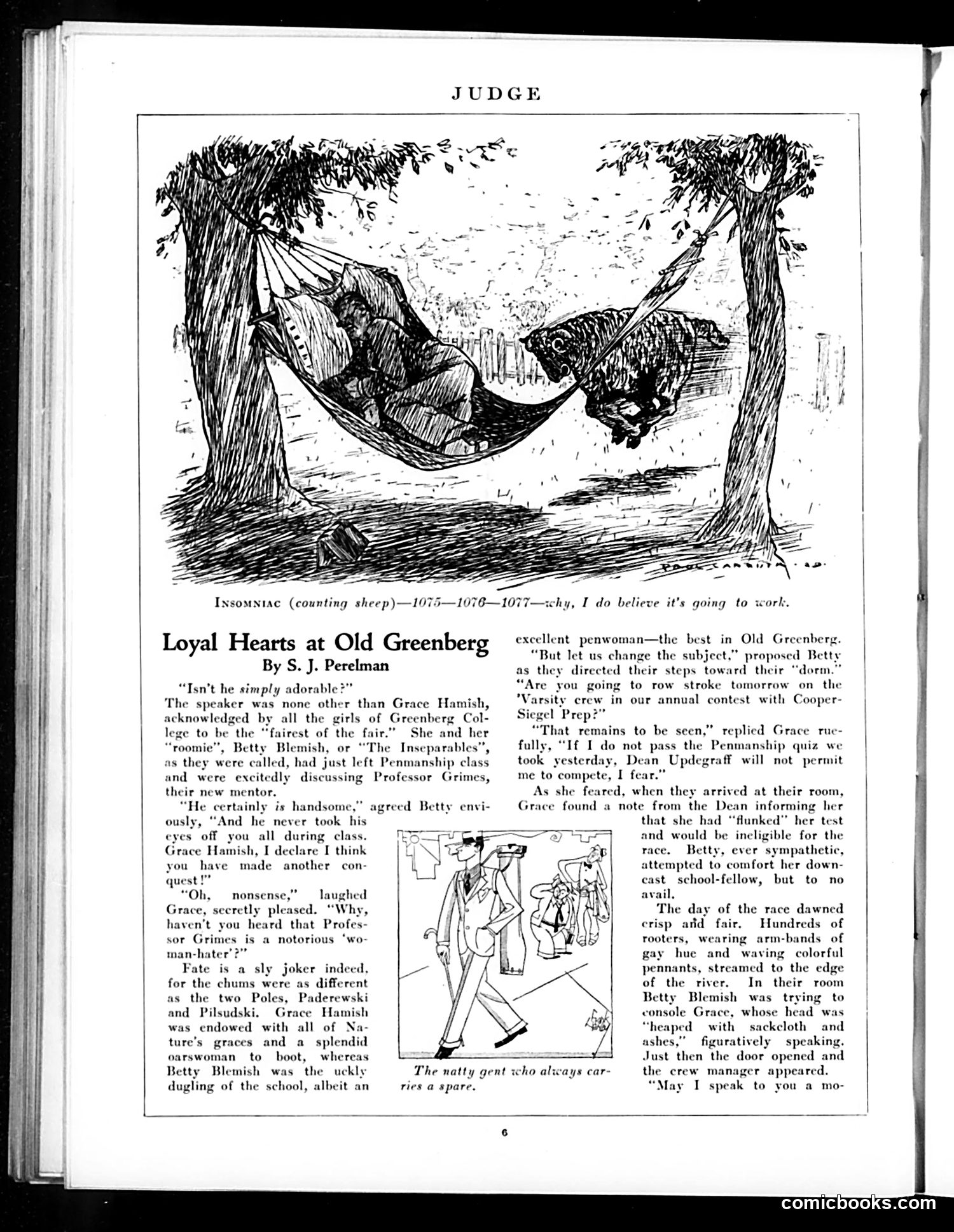
Analysis of "Judge" Magazine Page This page contains a short story titled "Loyal Hearts at Old Greenberg" rather than political satire. The top cartoon shows a man in a hammock counting sheep (labeled "1075—1076—1077") while unable to sleep—a visual pun on the common insomnia remedy of "counting sheep." The story discusses Grace Hamish and Betty Blemish, students at Old Greenberg College, competing in a rowing race. The text satirizes academic pretension and social hierarchies among schoolgirls, with the "natty gent who always carries a spare" pictured below representing a vain male character. The satire targets college social life, female competitiveness, and romantic entanglements rather than political issues. It's light social humor typical of *Judge's* general interest content circa this era.
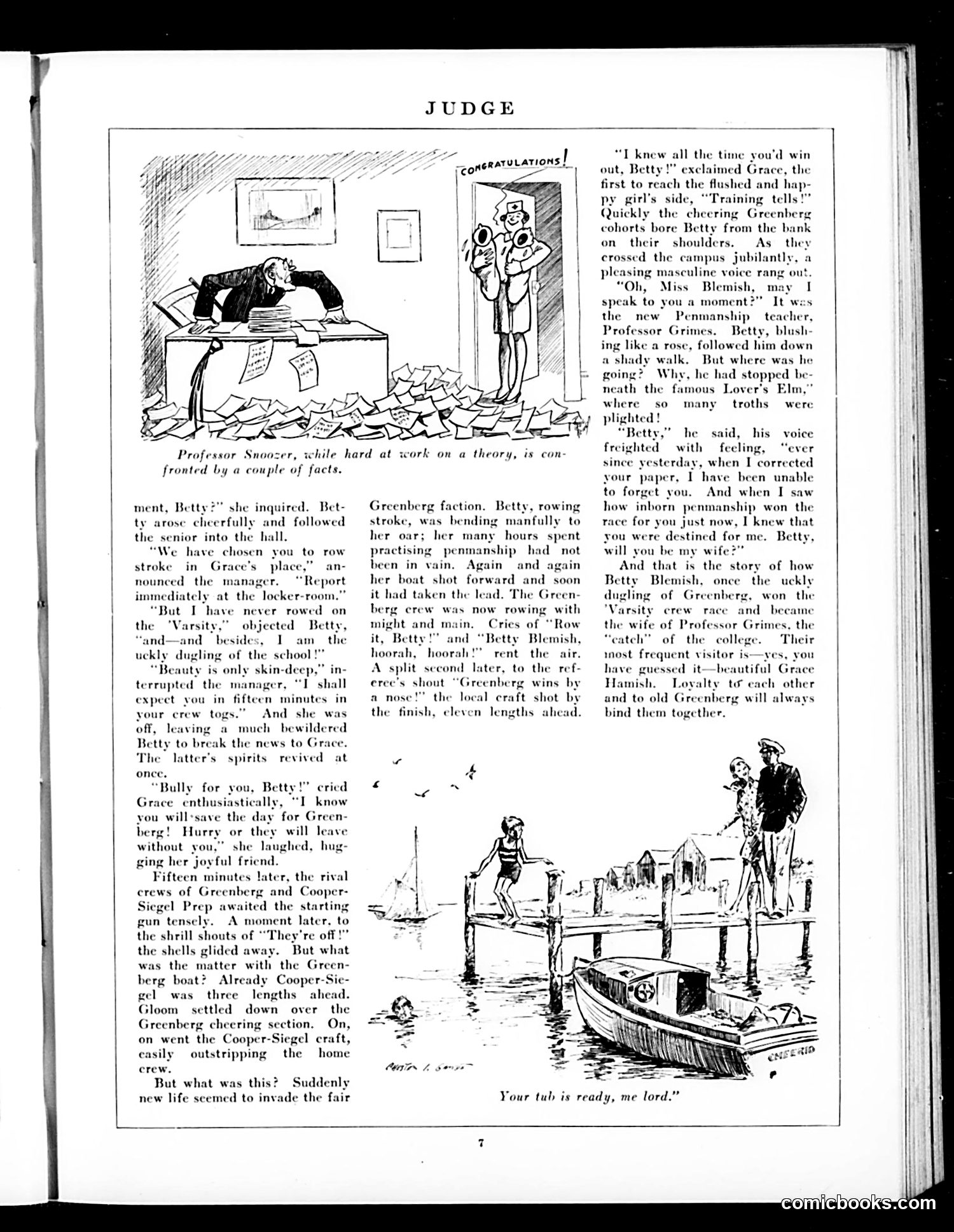
Analysis of "Judge" Page This is a serialized romance story in Judge magazine, not primarily political satire. The narrative follows Betty Blemish, a student at Greenberg (appears to be a school or college) who becomes a rowing stroke despite having no experience. Her penmanship training mysteriously translates to athletic prowess, allowing her to single-handedly win a boat race against rival Cooper-Siegel Prep. The satire targets academic pretension and romantic clichés: Betty's success leads to her being swept off campus by admiring students, only to be intercepted by the new penmanship teacher, Professor Grimes, who proposes beneath "Lover's Elm." The humor lies in the absurdity—that penmanship skill determines both athletic ability and romantic destiny—and the melodramatic romance conventions of the era. The cartoons illustrate the story's key moments: a distracted professor, the rowing race, and the romantic conclusion.
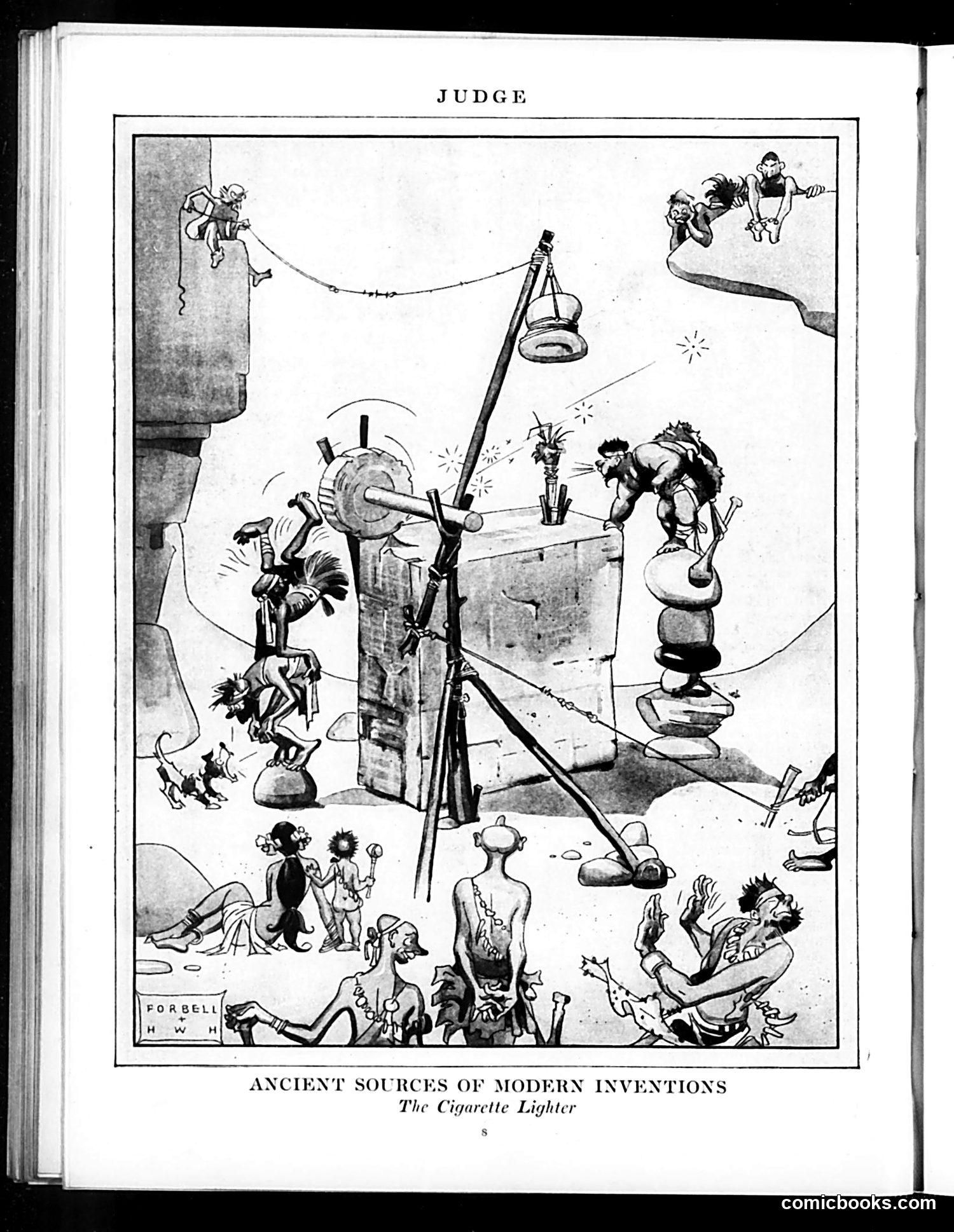
"Ancient Sources of Modern Inventions: The Cigarette Lighter" This satirical cartoon from Judge magazine humorously traces the cigarette lighter back to mythological and ancient sources. The central structure resembles a complex machine or contraption, with figures from classical mythology and history positioned around it—appearing to operate or interact with the apparatus. The joke plays on the popular "ancient sources" concept, suggesting that modern conveniences have precedents in classical civilization. By depicting mythological figures (likely including gods and legendary characters) struggling with an elaborate mechanical device to produce fire or light, the cartoon satirizes both the pretension of tracing modern inventions to ancient wisdom and the absurdity of imagining ancients engineering such contraptions. The artist is Cesare Forbell (credited as "Forbell").
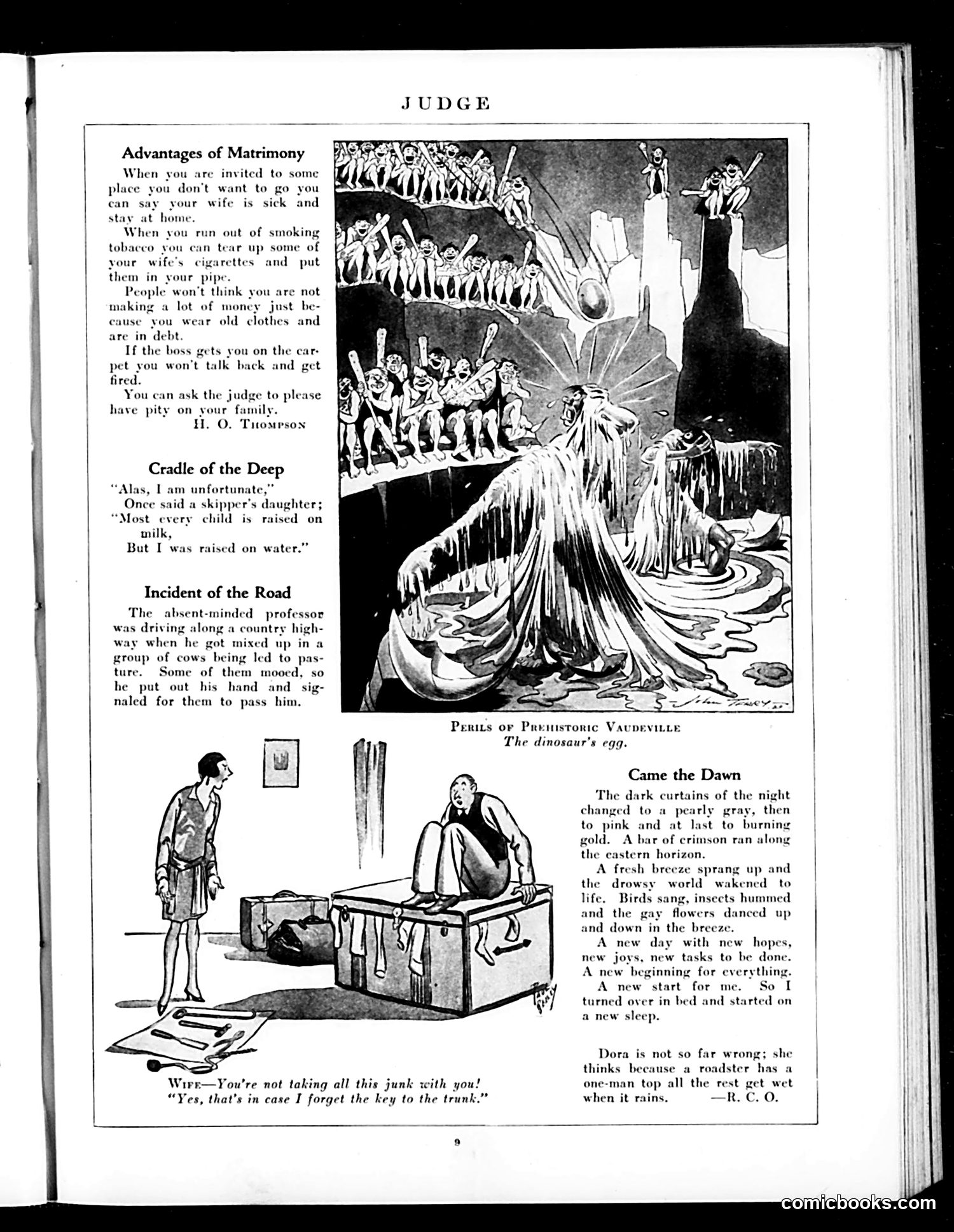
Judge Magazine Page Analysis This page contains several humorous sketches typical of early 20th-century American satire: "Advantages of Matrimony" humorously lists benefits of marriage to men—using a wife's absence as an excuse to avoid social obligations, smoking her cigarettes, appearing poor without judgment, and invoking family sympathy when in trouble with employers. "Incident of the Road" jokes about an absent-minded professor signaling cows to pass like traffic, playing on the stereotype of intellectuals being disconnected from practical reality. "Came the Dawn" satirizes overly sentimental, flowery nature writing popular in the era, then undercuts it with the protagonist simply rolling over to sleep. The trunk cartoon shows a departing wife and husband arguing about luggage; he claims he needs the junk in case he forgets the trunk key—absurd male logic presented as marital comedy. The page reflects early-1900s gender dynamics and satirizes contemporary literary trends and domestic relations.
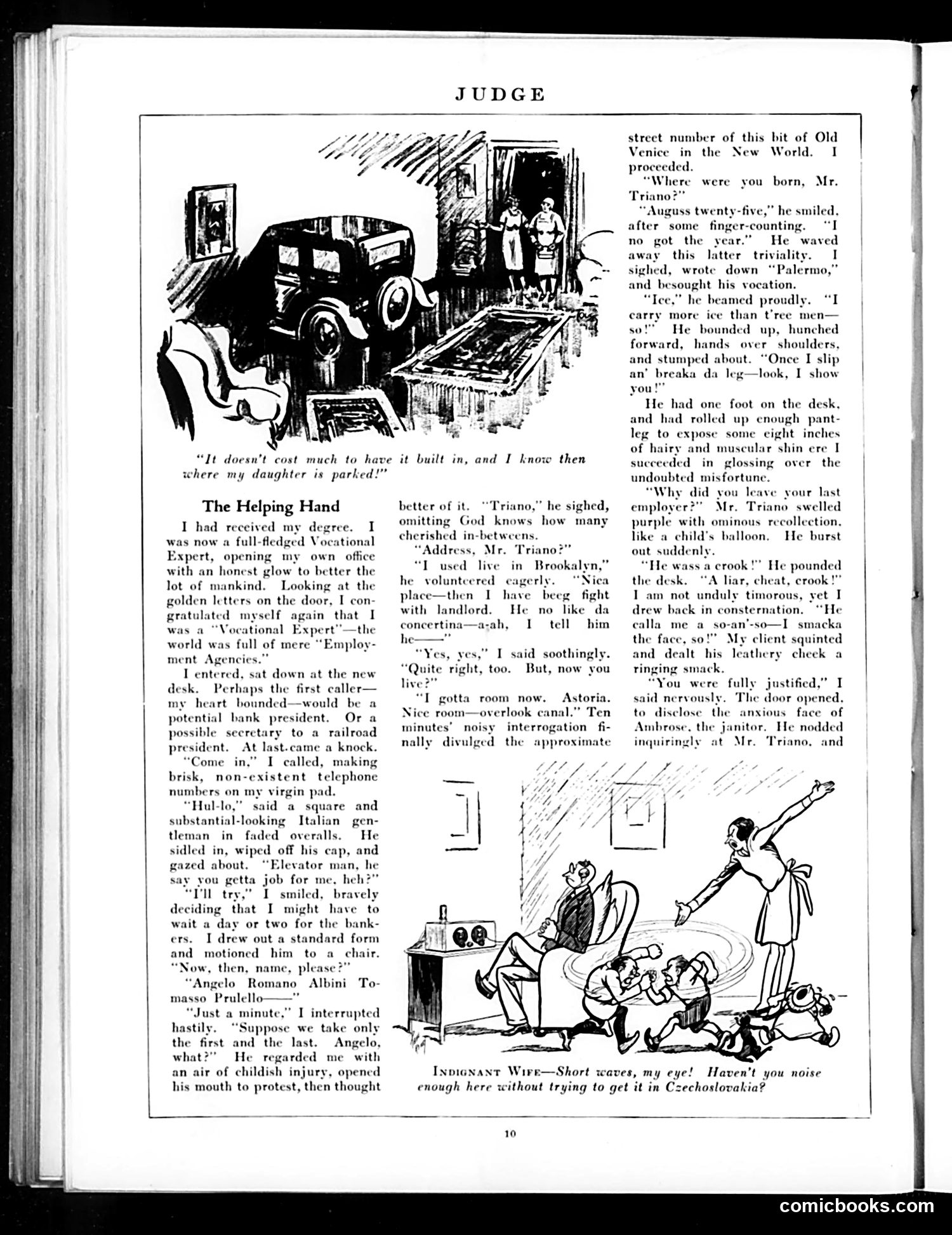
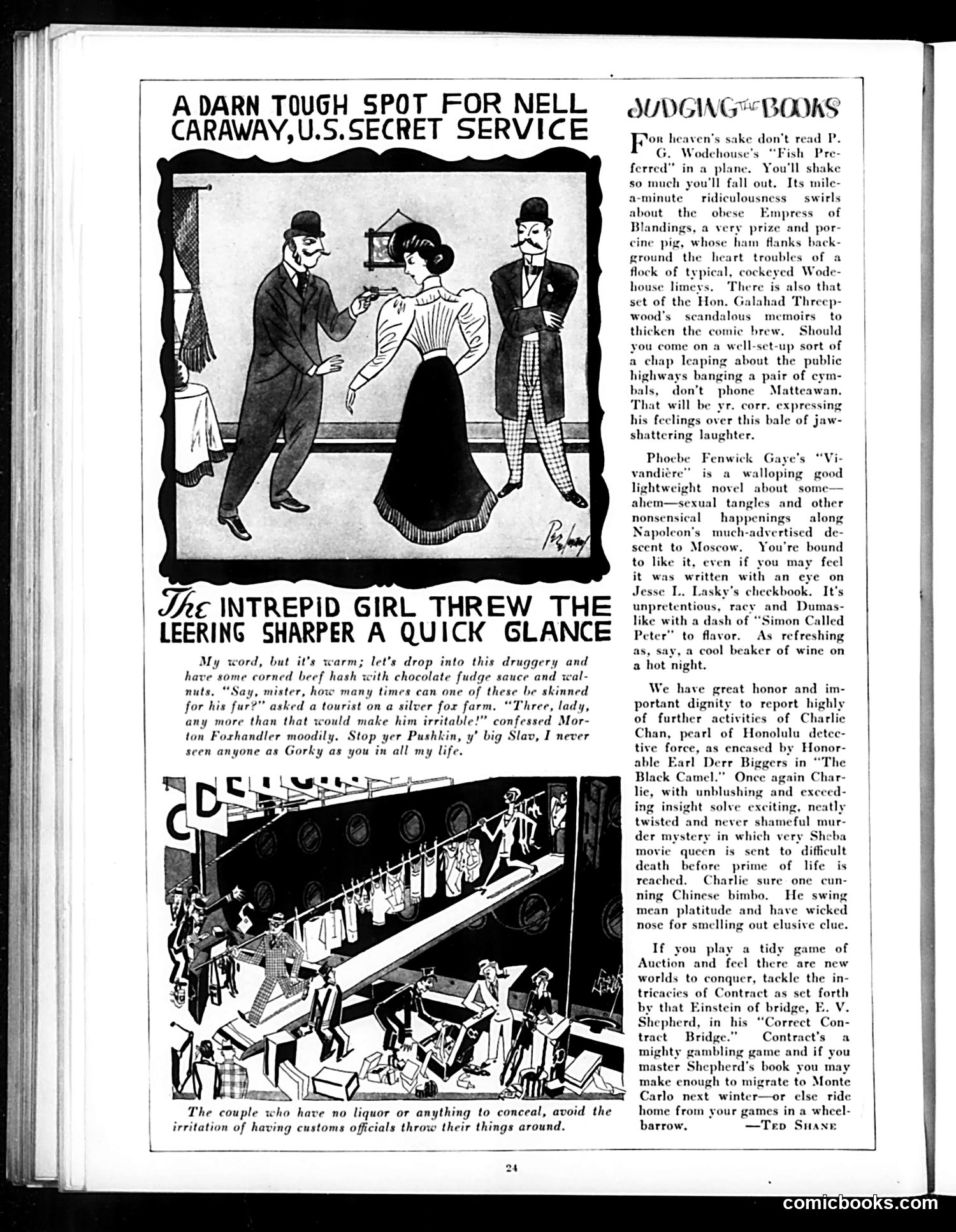
"The Helping Hand" - Judge Magazine Satire This story satirizes early 20th-century American employment agencies and immigrant workers. The narrator, a newly credentialed "Vocational Expert," receives his first client: Angelo Romano Albini Tomasso Prulello (shortened dismissively to "Triano"), an Italian immigrant ice-carrier with a thick accent. The satire targets the narrator's condescension toward working-class immigrants—he's impatient with Angelo's full name, dismissive of details, and visibly uncomfortable when Angelo enthusiastically demonstrates his muscular physique and recounts punching his former boss in the face. The top cartoon mocks middle-class car owners concerned with tracking their daughters' whereabouts via built-in parking locators—suggesting anxiety about young women's independence. The bottom cartoon (captioned "Indignant Wife") satirizes radio technology crazes, with a wife complaining about noisy radio interference from international broadcasts—likely a reference to 1930s radio mania.
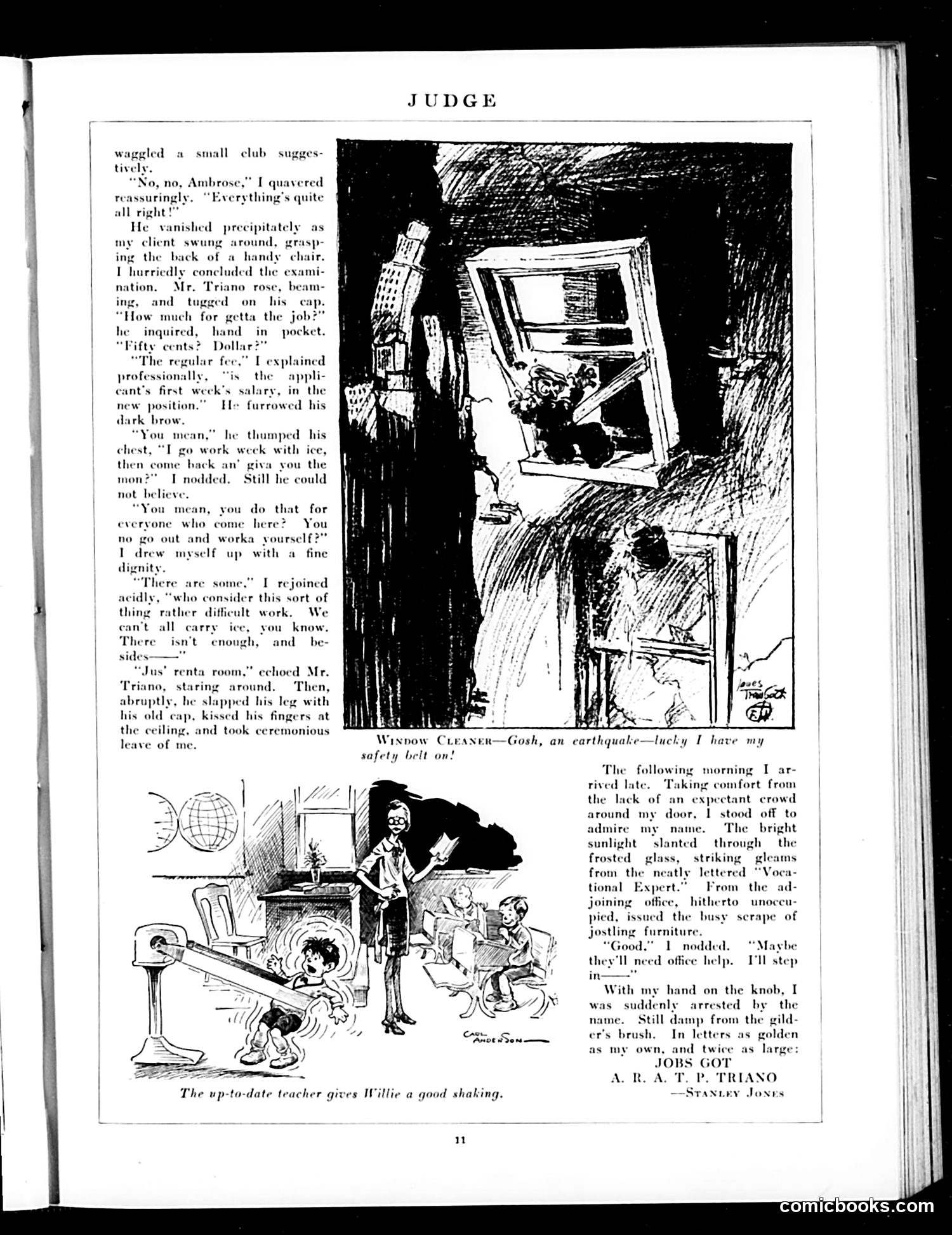
Judge Magazine Page Analysis This page from *Judge* satirizes employment agencies and their practices. The main narrative follows a job-placement agent negotiating fees with a client—an immigrant (suggested by dialect: "getta the job," "giva you the mon"). The agent explains he takes a full week's salary as commission, which the client finds outrageous, protesting that he'd prefer to work independently. The satire targets predatory employment agencies that exploited workers, particularly immigrants, by charging exorbitant fees. The agent's justification—that this is standard professional practice—highlights how these agencies normalized extractive labor practices. The two cartoons illustrate related themes: one shows a modern teacher disciplining a student, and the other depicts someone nearly falling from a window during an earthquake while concerned about a safety belt—possibly satirizing workplace safety hazards or the chaos of rapid modernization. The piece critiques both labor exploitation and the con-artist mentality of intermediaries profiting from workers' desperation.
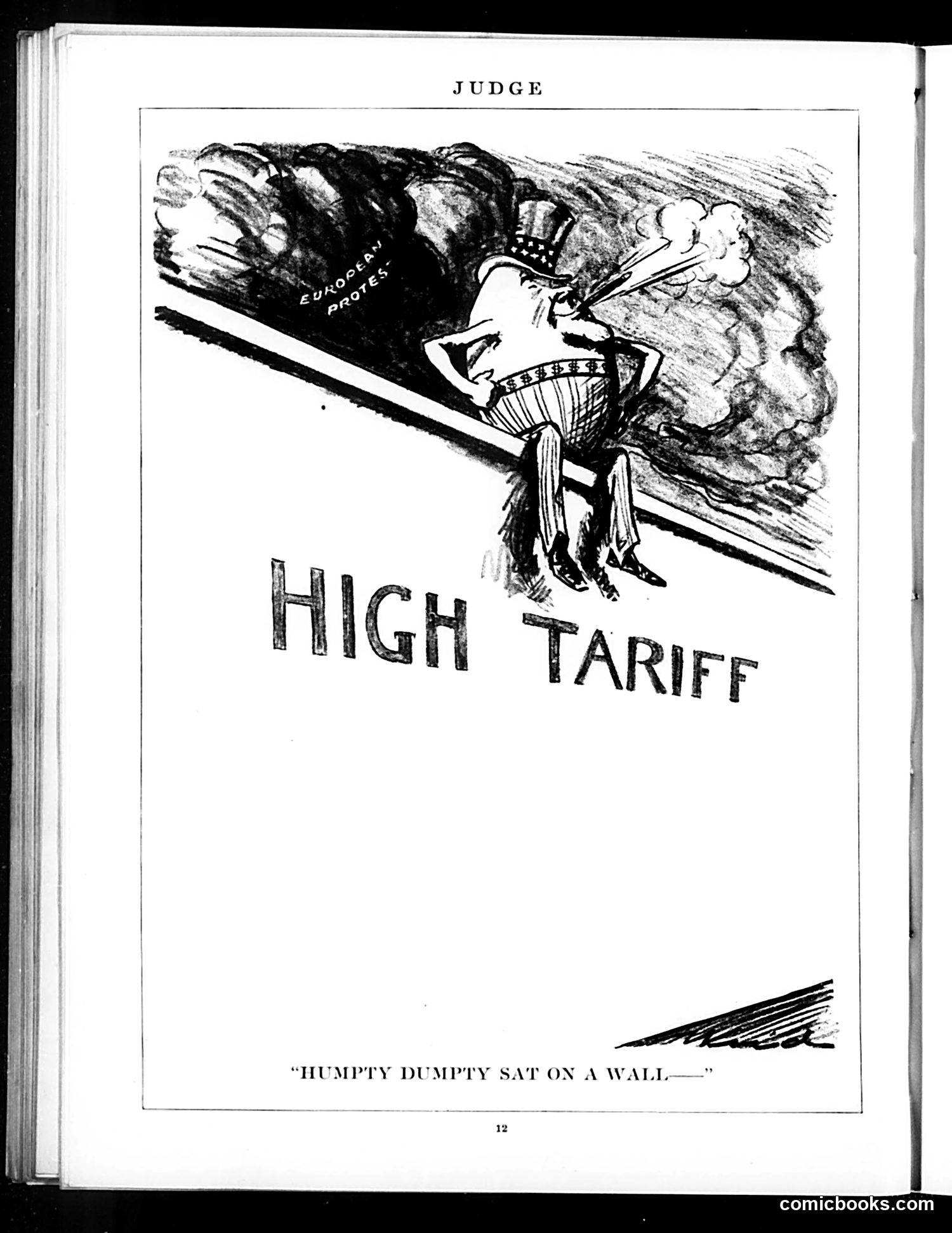
Political Cartoon Analysis This Judge magazine cartoon satirizes high tariffs through the "Humpty Dumpty" nursery rhyme. The figure sitting precariously on a wall wears a crown labeled "Europe's Protege" and appears to represent either a tariff policy or its beneficiary. The accompanying smoke and dramatic shading suggest instability or danger. The satire critiques protectionist trade policies—likely American tariffs affecting European commerce. By invoking the nursery rhyme's famous fall ("all the king's horses and all the king's men couldn't put Humpty together again"), the cartoonist warns that high tariffs create an unsustainable, precarious situation destined to collapse catastrophically. The "Judge" masthead indicates this is political commentary typical of the magazine's anti-tariff stance during debates over trade policy.
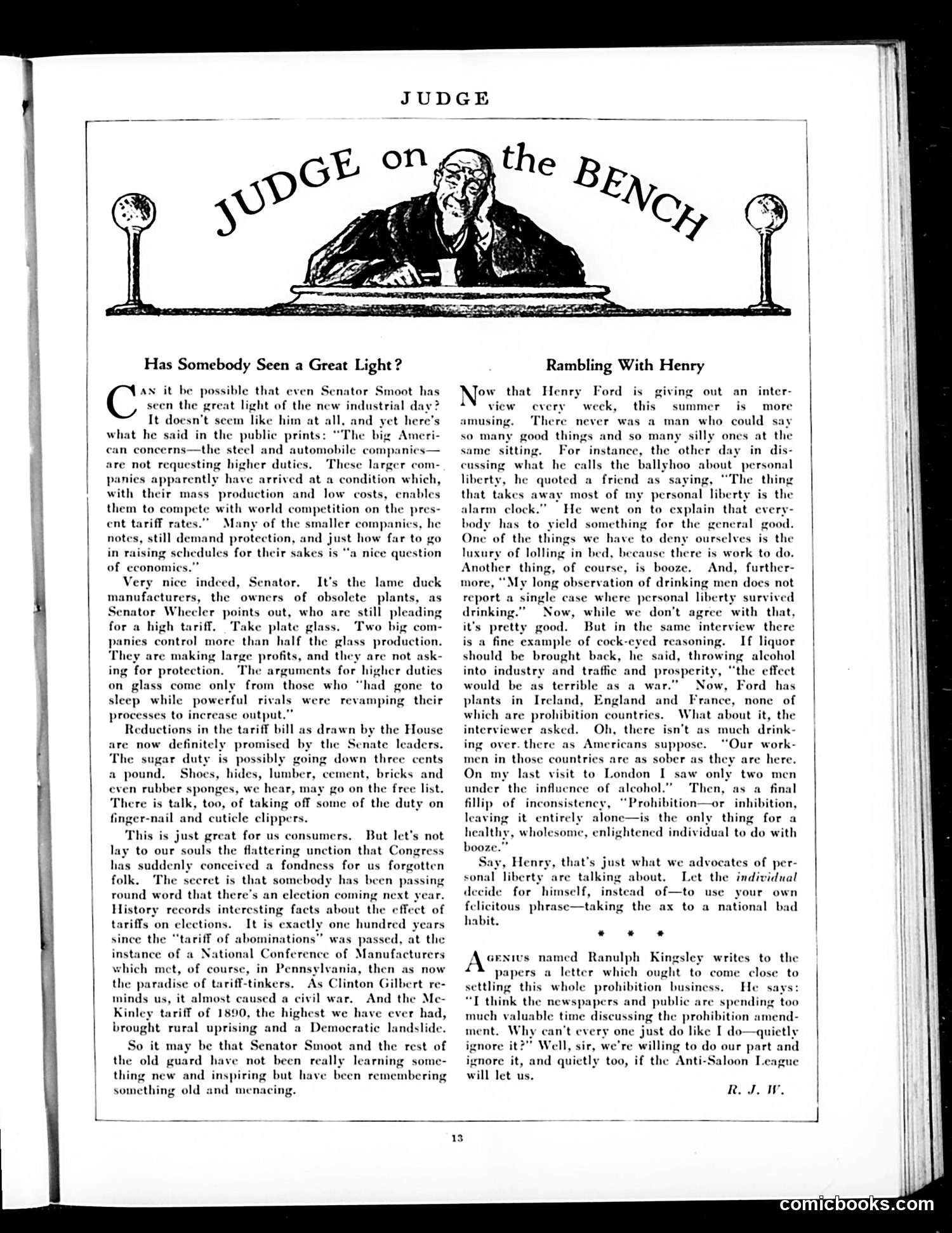
"Judge" Magazine Page Analysis This page contains two satirical columns critiquing American political and industrial figures circa the 1920s-1930s. "Has Somebody Seen a Great Light?" targets Senator Reed Smoot's apparent reversal on protective tariffs. The satire notes that large corporations (steel, automobiles) no longer need tariff protection due to efficient mass production, yet smaller "lame duck" manufacturers still demand it. Judge sardonically suggests Smoot hasn't had a genuine epiphany—rather, he's remembering that elections are coming and tariff policy has historically caused electoral backlash (referencing the 1828 "Tariff of Abominations" and the 1890 McKinley Tariff's role in Democratic victories). "Rambling With Henry" mocks Henry Ford's contradictory public statements. While Ford's observation that alcohol impairs personal liberty has merit, Judge highlights his hypocrisy: Ford opposes prohibition yet owns factories in non-prohibition countries (France, England, Ireland), where alcohol availability might theoretically create the industrial chaos he warns against—exposing his "cock-eyed reasoning." Both columns use satirical praise to highlight politicians' and industrialists' self-interested inconsistency.
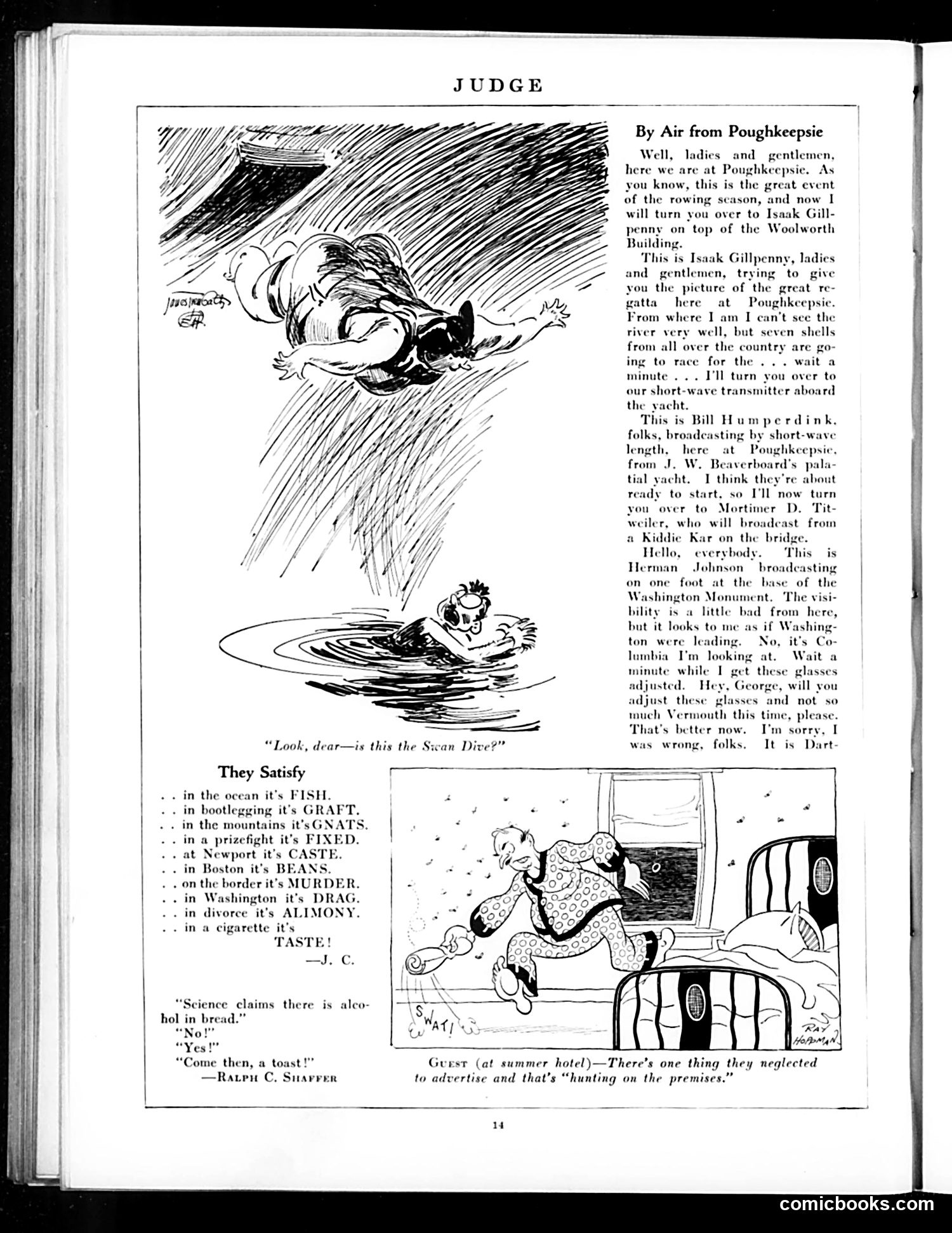
Analysis for Modern Readers This page satirizes early radio broadcasting of sporting events, specifically the famous Henley Regatta rowing competition at Poughkeepsie, New York. The humor centers on over-excited sports commentators relaying information through a chain of reporters (Isaac Gillpenny, Bill Humperdink, Mortimer Titweiler, Herman Johnson) positioned at various vantage points—rooftops, yachts, monuments—who can't actually see what's happening and keep passing confused reports to each other. The absurdist joke is that radio broadcasting promises to bring live action to listeners, but the commentators are incompetent or drunk (one mentions needing less "Vermouth"), seeing the wrong team, and generally bumbling the coverage. This mocks the novelty and hype of new broadcast technology in the Jazz Age. The bottom section ("They Satisfy") is unrelated wordplay comparing regional associations.
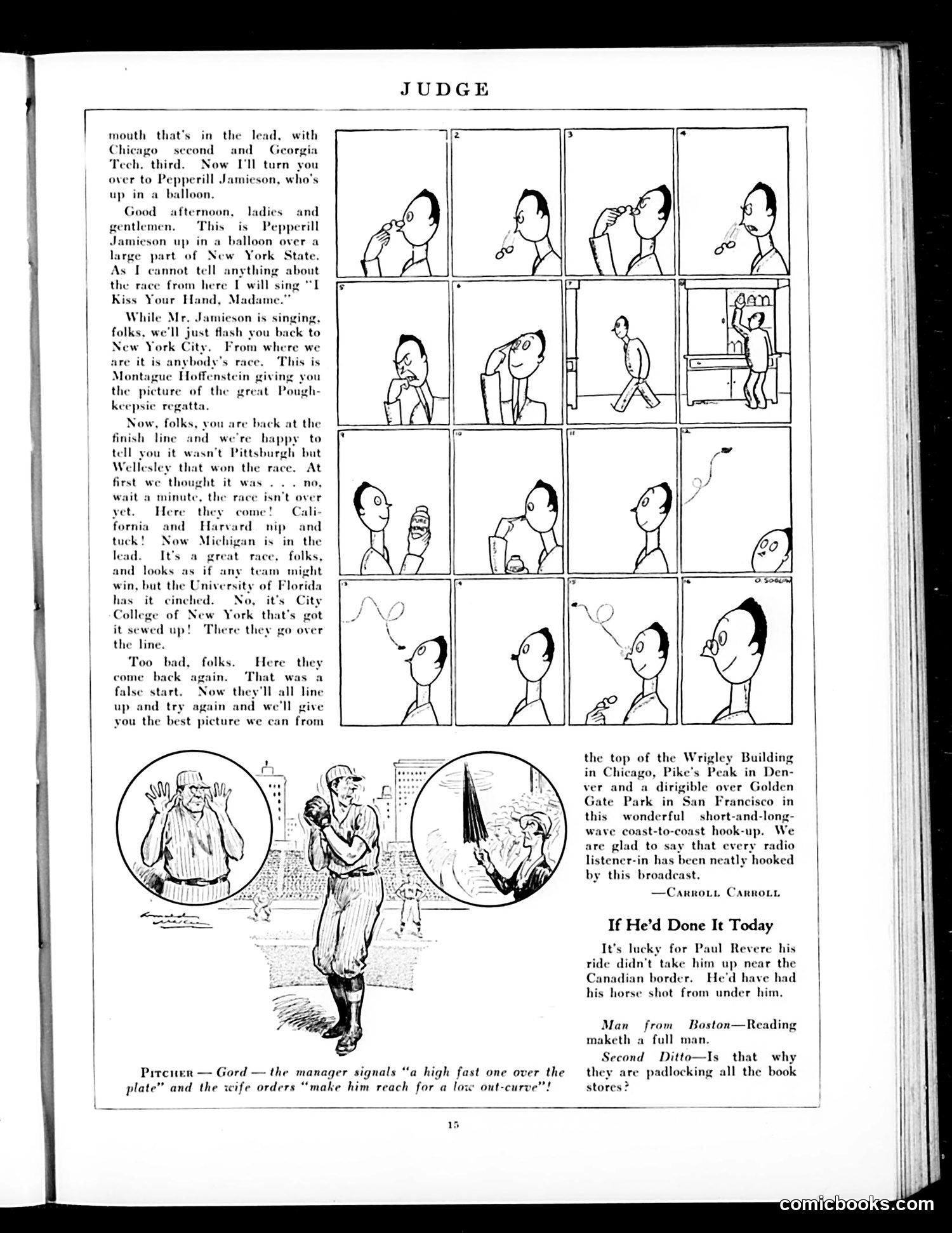
Political/Social Context for Modern Readers This page contains two separate satirical pieces from *Judge* magazine: Main Comic Strip (top): A radio broadcast parody mocking sports commentary, specifically boat races. The announcer provides absurdly contradictory play-by-play coverage, constantly changing which college team is winning (Wellesley, California, Harvard, Michigan, Florida, City College). The satire targets the breathless, sensationalist style of 1920s-30s radio sports broadcasting and its tendency toward unreliable, excited speculation. Bottom Cartoons & Quips: The first shows a baseball pitcher receiving confusing signals. The second references Paul Revere's famous midnight ride, joking that if it occurred near the Canadian border today, his horse would be shot—likely referencing border security concerns or Prohibition-era tensions. Final Quip: References book-store "padlocking," probably alluding to censorship or the suppression of certain literature during this era. The humor relies on audience familiarity with contemporary radio culture and American borders/politics.
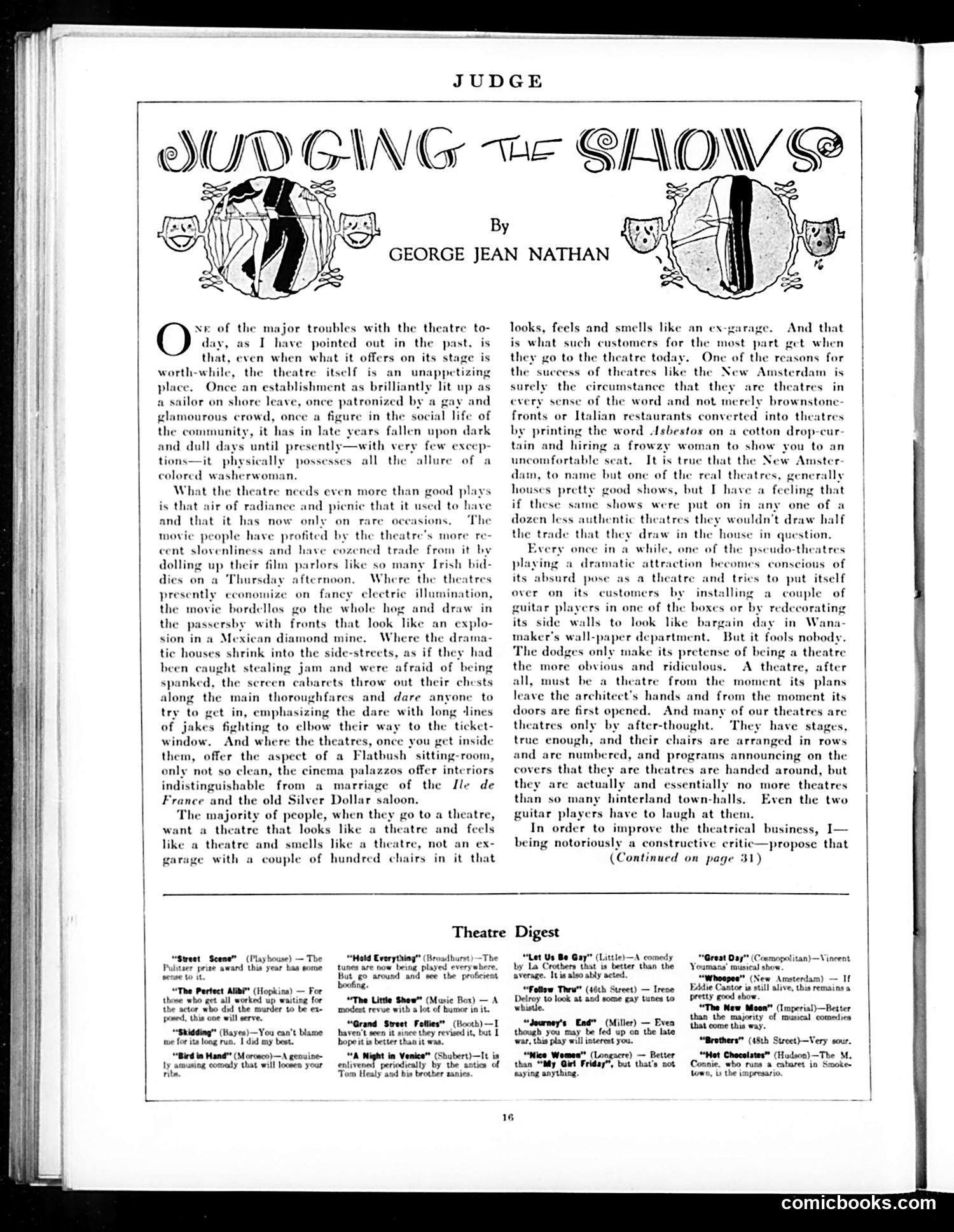
Analysis of "Judging the Shows" by George Jean Nathan This page contains theater criticism rather than a political cartoon. Nathan, a prominent early 20th-century drama critic, argues that American theaters have declined in quality and appearance compared to movie palaces. The Satire's Point: Nathan contrasts shabby, poorly-maintained theaters (described as looking like "an ex-garage" or "a colored washerwoman") with lavishly decorated movie theaters that attract audiences through spectacle. He criticizes theaters that pretend to be legitimate venues by superficial decoration—adding guitar players, redecorating with cheap wallpaper effects—while remaining essentially hollow. The Critique: Nathan proposes that theaters must be authentically theatrical from conception, not retrofitted attempts at grandeur. He singles out the New Amsterdam Theater as a genuine success because it maintains theatrical standards throughout. Context: This reflects 1920s anxieties about cinema competition and the decline of live theater as a cultural institution. Nathan's solution continues on page 31 (not shown here). The "Theatre Digest" section below lists contemporary shows with brief reviews.
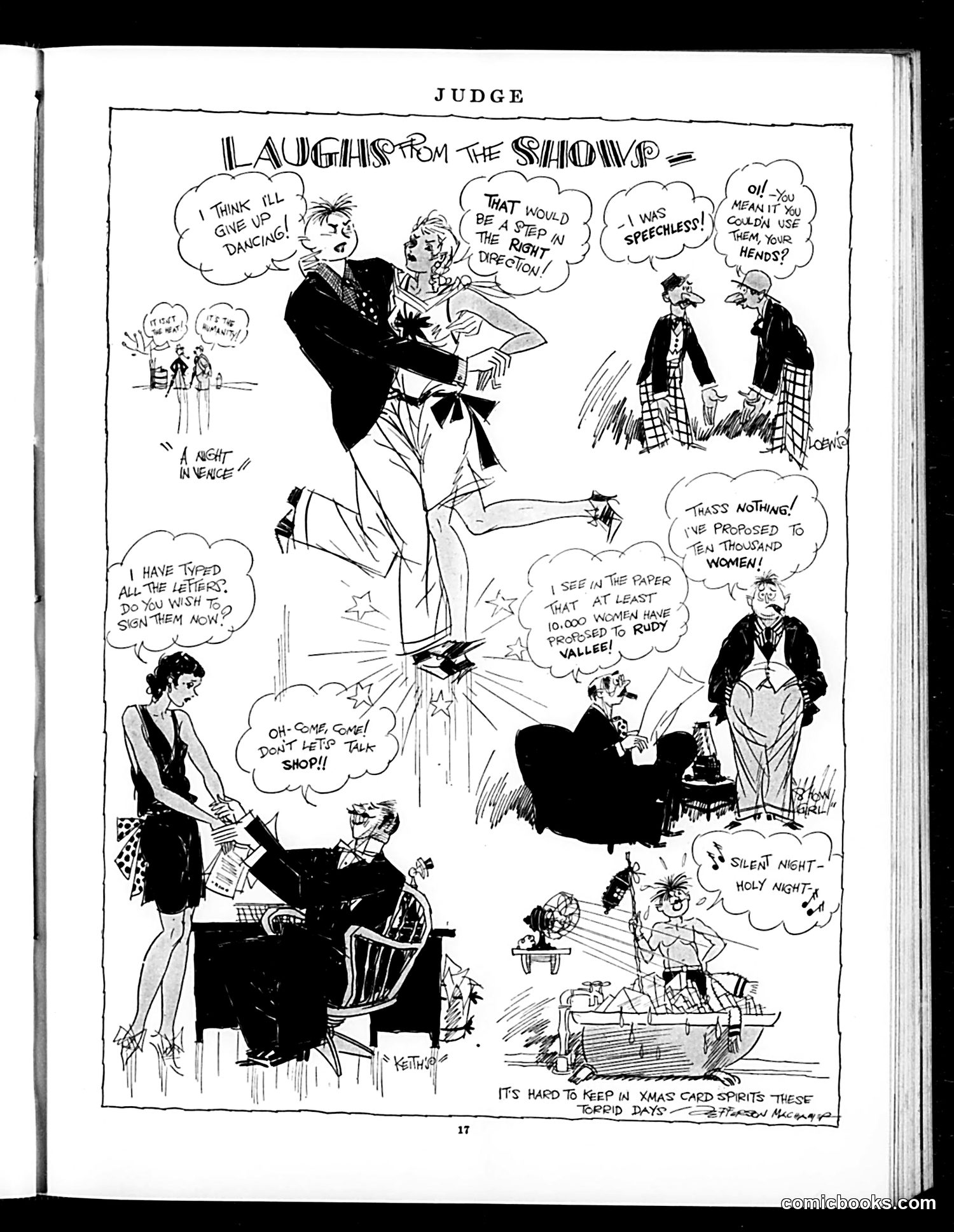
"Laughs from the Showup" - Judge Magazine Cartoon This is a satirical multi-panel cartoon about the challenges of maintaining Christmas spirit during difficult times (the caption references "these torrid days"). The scenes depict various holiday-related frustrations: a woman typing letters asking someone to sign them; a couple discussing dancing; men in conversation about proposals to "ten thousand women"; office workers discussing newspaper coverage of women's protests; and someone singing carols while another character complains. The humor centers on the disconnect between forced holiday cheer and real-world anxieties—particularly references to women's activism (likely suffrage-related protests given the era). The central tension is "it's hard to keep in Xmas card spirits these torrid days"—satirizing how people attempt to maintain festive pretense despite serious social upheaval surrounding them, particularly regarding women's rights movements of the period. The cartoon critiques both the superficiality of holiday sentiment and contemporary social tensions.
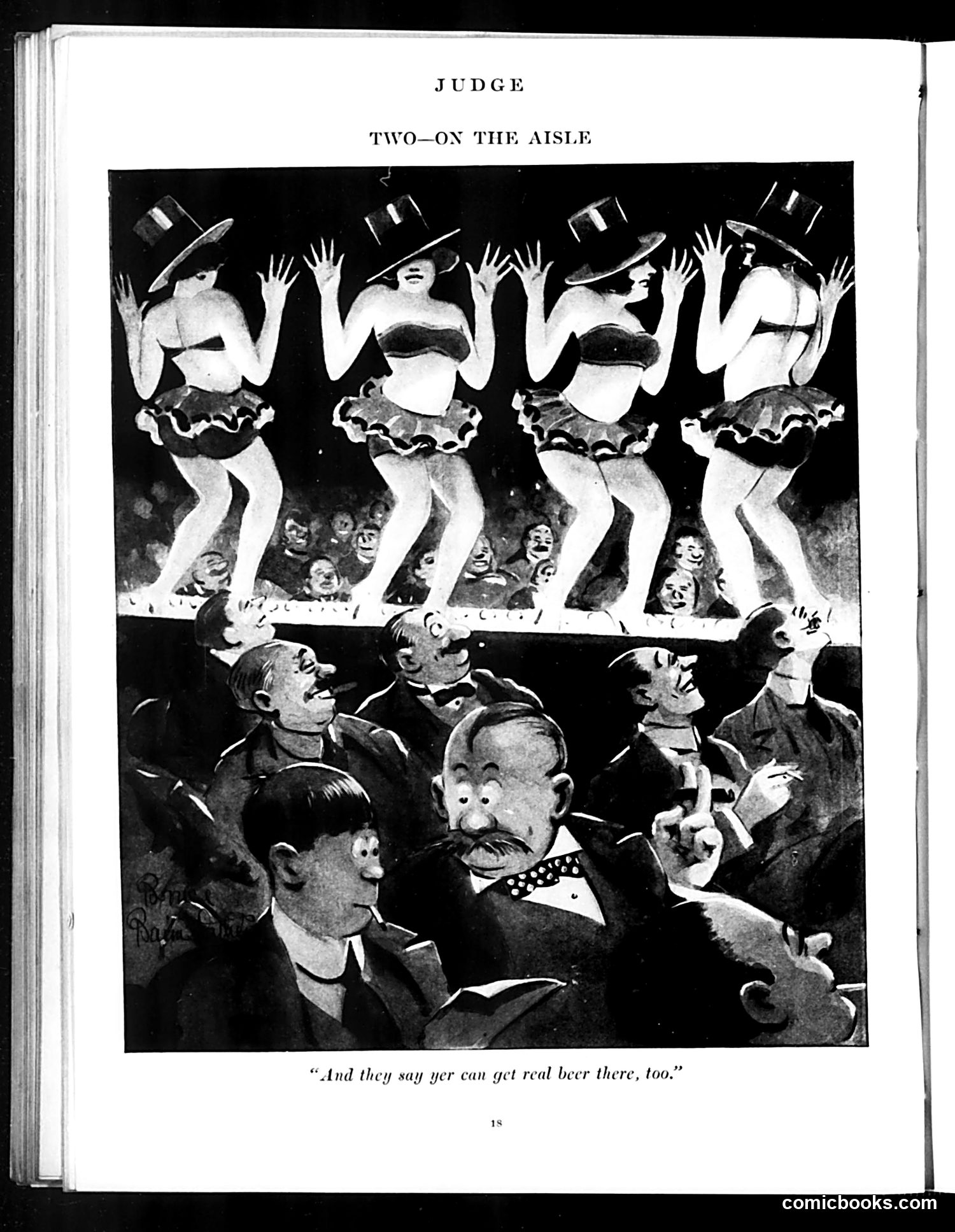
Analysis This Judge magazine cartoon satirizes Prohibition-era entertainment and the illegal alcohol trade. The title "Two—On the Aisle" references theater seating, while the image shows four chorus girls performing on stage above an audience of men in formal attire, including a prominent mustachioed gentleman in the center. The caption's dialogue—"And they say yer can get real beer there, too"—suggests that speakeasies (illegal bars) operated under the guise of legitimate venues like theaters or nightclubs. The joke targets how Prohibition enforcement was easily circumvented, with establishments openly advertising access to alcohol despite legal prohibition. The exaggerated caricatures and theatrical staging mock both the thinly-veiled operations and the working-class patrons seeking forbidden drinks.
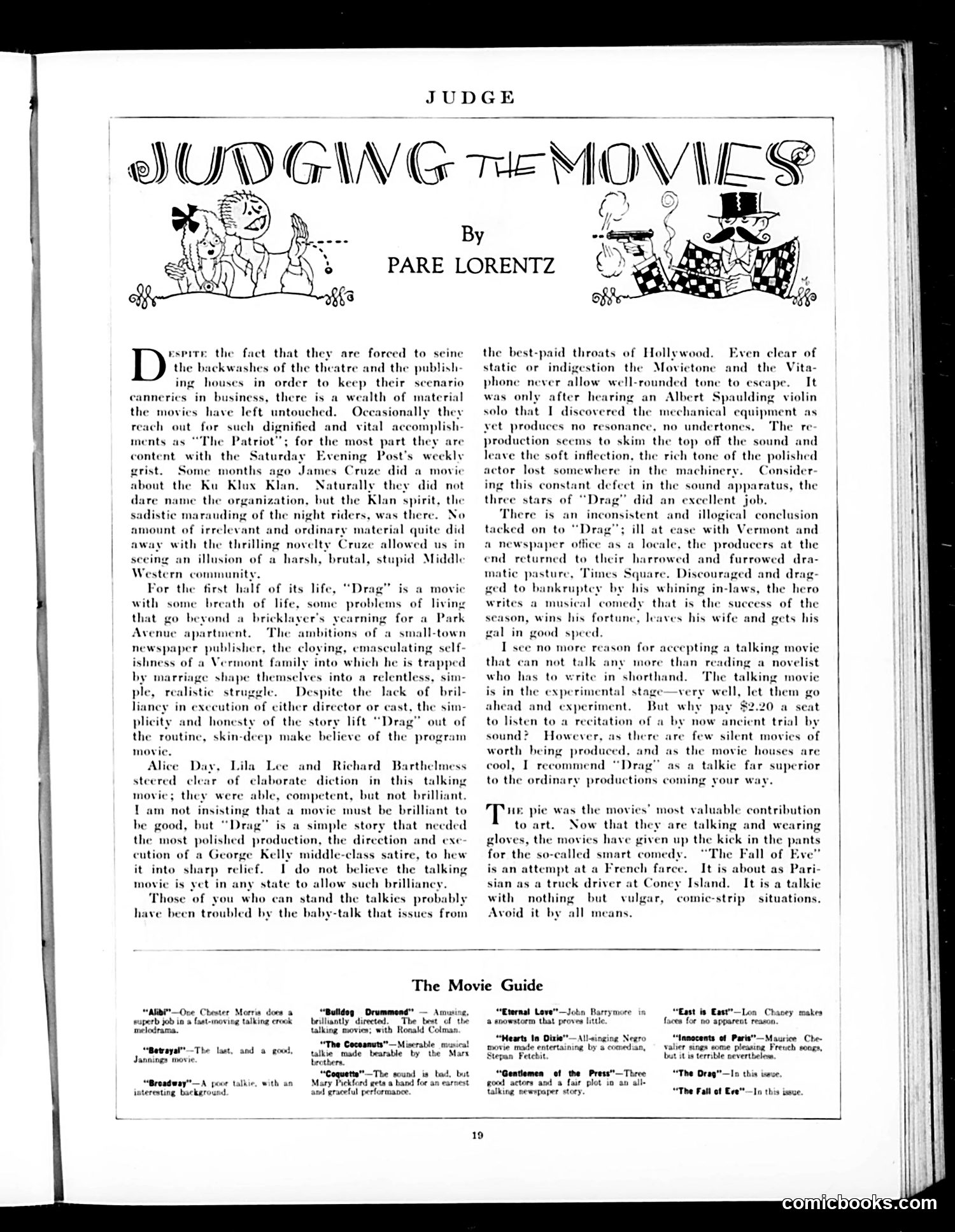
Judge Magazine Film Critique: "Judging the Movies" by Pare Lorentz This is a film review column, not a political cartoon. Lorentz critiques the talking picture "Drag" (1929), starring Alice Day, Lila Lee, and Richard Barthelmess. The satire targets: - Hollywood's technical limitations with sound: actors' voices lack resonance and nuance, reduced to "baby-talk" - The film industry's creative bankruptcy—recycling formulaic material rather than tackling serious subjects - Producers' cowardice (citing their refusal to name the Ku Klux Klan in James Cruze's film) - "Drag"'s inconsistent ending: a gritty Vermont family drama suddenly pivots to implausible success via Broadway musical The critique's point: "Drag" has genuine merit in its first half—honest working-class struggles—but suffers from technical mediocrity and a contrived conclusion. Lorentz argues talking pictures shouldn't exist in their current experimental state, yet recommends "Drag" as superior to typical productions, since quality silent films are disappearing. The piece reflects early sound-era skepticism about cinema's artistic future.
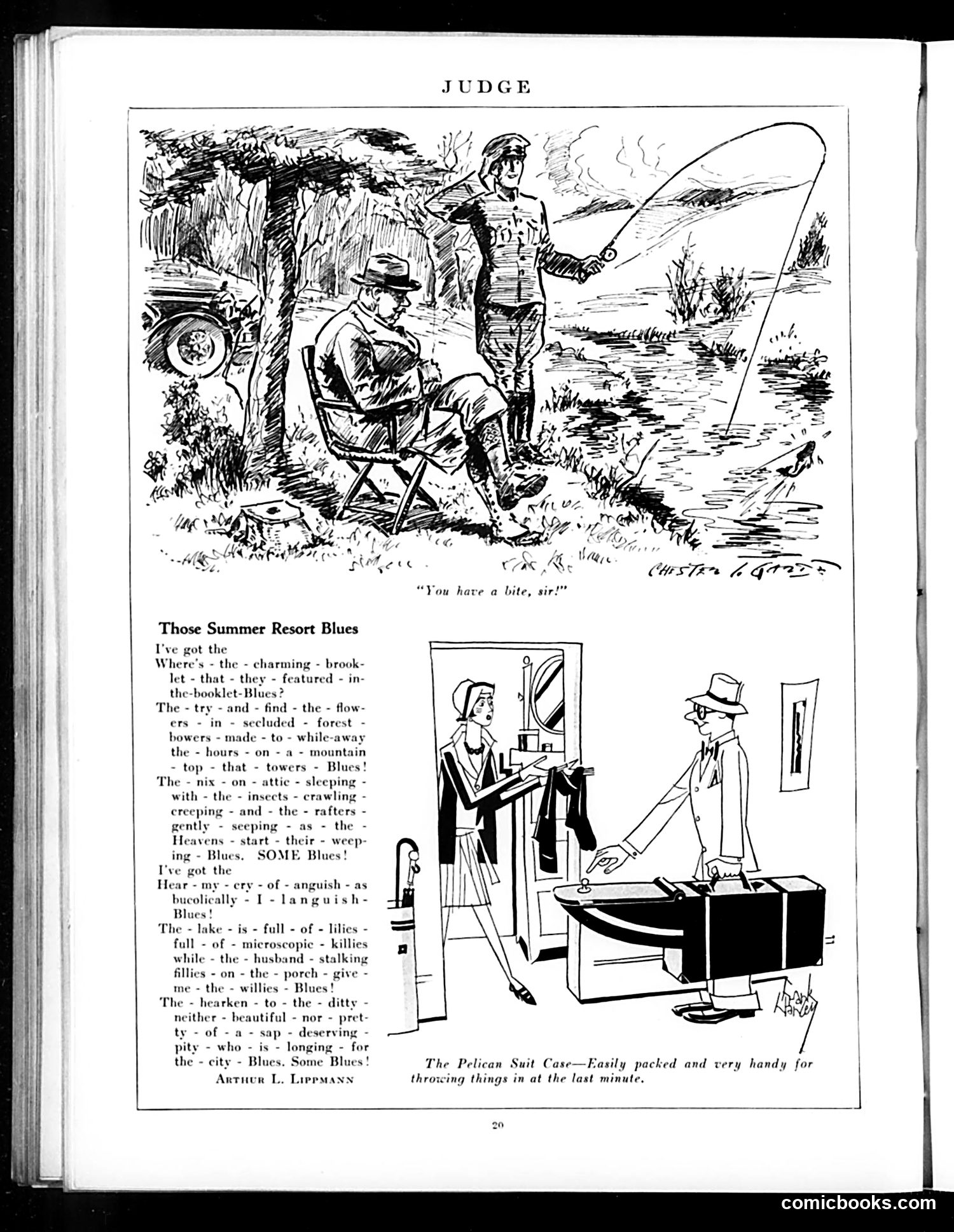
Explanation for Modern Readers This Judge magazine page satirizes the disappointment of summer vacations. The top cartoon shows a fishing scene with the caption "You have a bite, sir!"—likely depicting leisure activities that fail to satisfy. The main poem "Those Summer Resort Blues" by Arthur L. Lippmann catalogs complaints about rustic vacation promises: the advertised scenic brook and flowers don't materialize; attic sleeping quarters have insects and leaking roofs; the lake is full of tiny fish instead of sport fish; and worst, the husband flirts with other women ("stalking fillies") while the wife is stuck there, ultimately longing for city life. The lower cartoon about "The Pelican Suit Case" jokes about hastily packing belongings—implying vacationers throw things in carelessly when departing. The satire targets how vacation marketing promises idyllic escapes that reality fails to deliver, leaving families frustrated and uncomfortable.
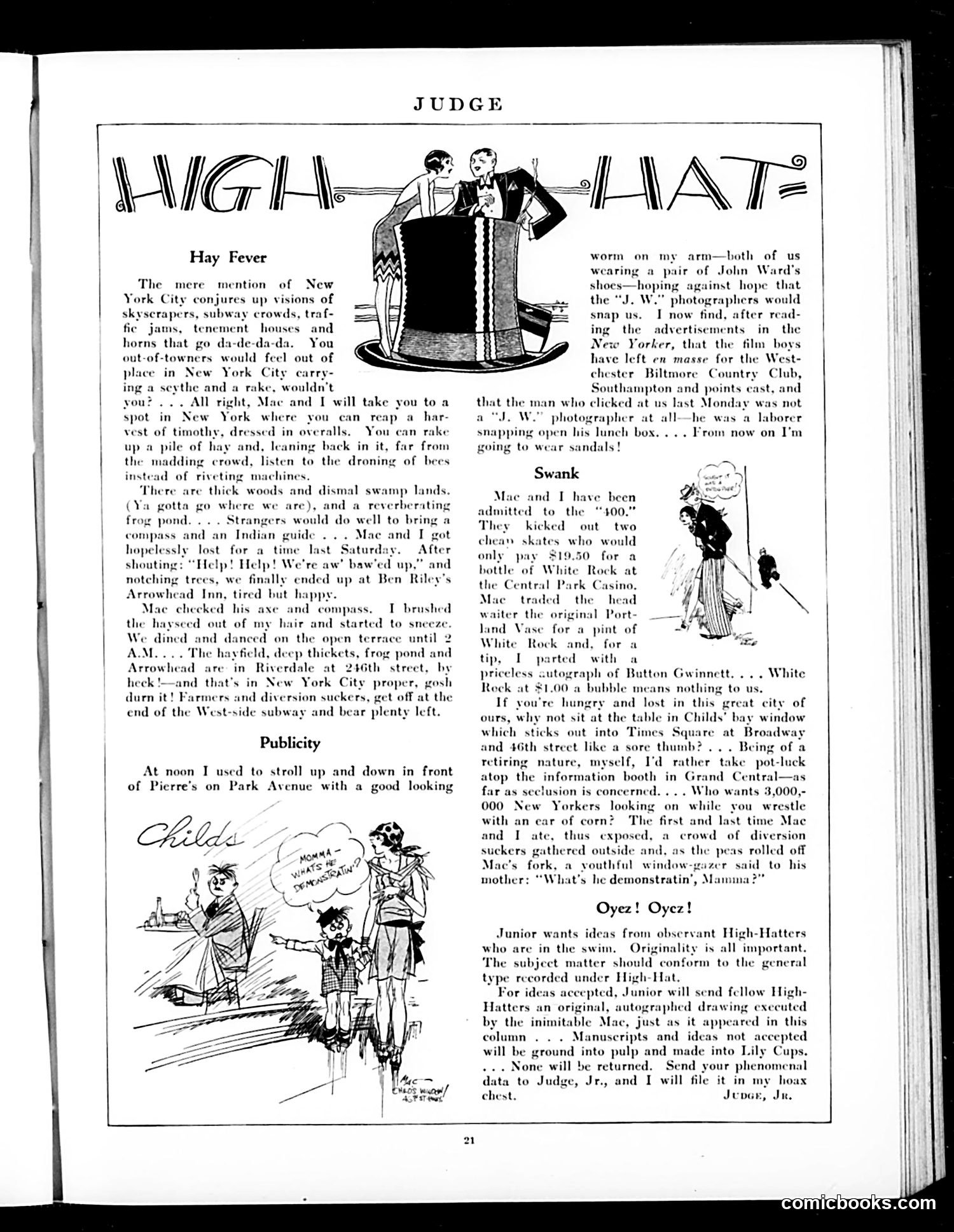
Explanation for Modern Readers This page contains three humorous essays by "Judge, Jr." satirizing 1920s high-society affectations and urban pretension. "Hay Fever" mocks wealthy New Yorkers' desire to escape the city while maintaining their sophistication—the narrator and "Mae" venture to Riverdale seeking rustic authenticity but get hilariously lost. "Publicity" ridicules status-seeking among the social elite. The writer attempts to be photographed at exclusive Pierre's restaurant on Park Avenue, only to learn the society photographers have abandoned the city for the Westchester Biltmore Country Club—making their efforts at visibility pointless. "Swank" satirizes the nouveau riche's obsession with exclusive clubs and conspicuous consumption. The narrator trades a precious Portland Vase and a Button Gwinnett autograph for drinks and tips, highlighting how wealth is frivolously displayed among those seeking acceptance into "the 400" (the social elite). The page solicits reader submissions for similar satirical observations of upper-class behavior, with the humorous threat that rejected submissions will be "ground into pulp."
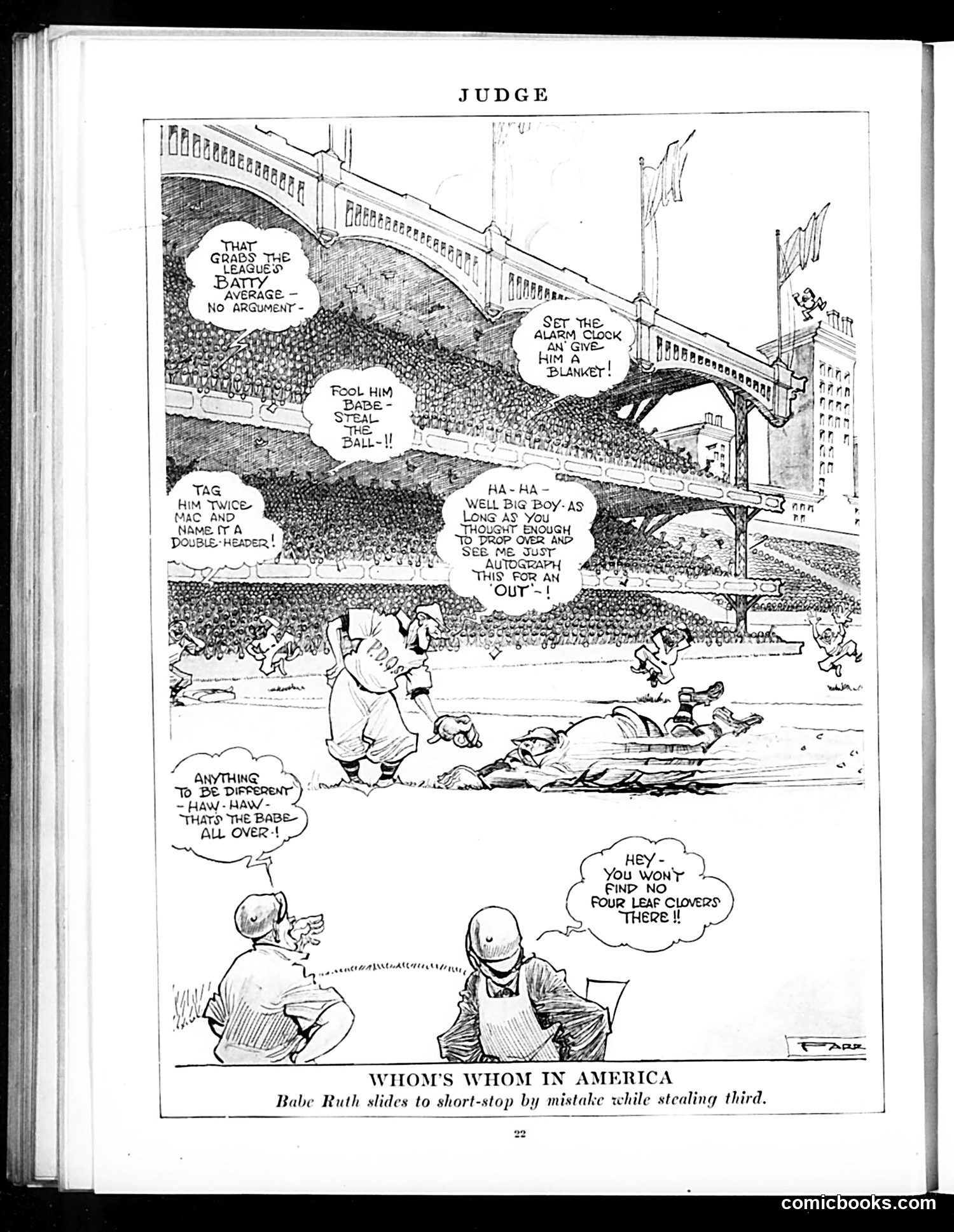
Analysis: "Whom's Whom in America" This cartoon satirizes Babe Ruth, the famous baseball player, by depicting him making a comical mistake on the field—sliding to short-stop instead of the correct base while attempting to steal third. The crowd's dialogue mocks Ruth's athletic celebrity status: spectators note his ".300 batting average" requires "no argument," suggest fooling him with blankets, and joke about tagging him "twice" since he's so famous. The joke plays on the gap between Ruth's legendary skill and his apparent lack of baseball intelligence in this scene. The bottom dialogue between two observers—one claiming "you won't find no four-leaf clovers here"—suggests Ruth's mistake represents bad luck or stupidity despite his stardom. The cartoon's title "Whom's Whom in America" implies Ruth, despite his prominence, doesn't truly understand the game he dominates. This is sports-focused satire rather than political, mocking a celebrity athlete's reputation.
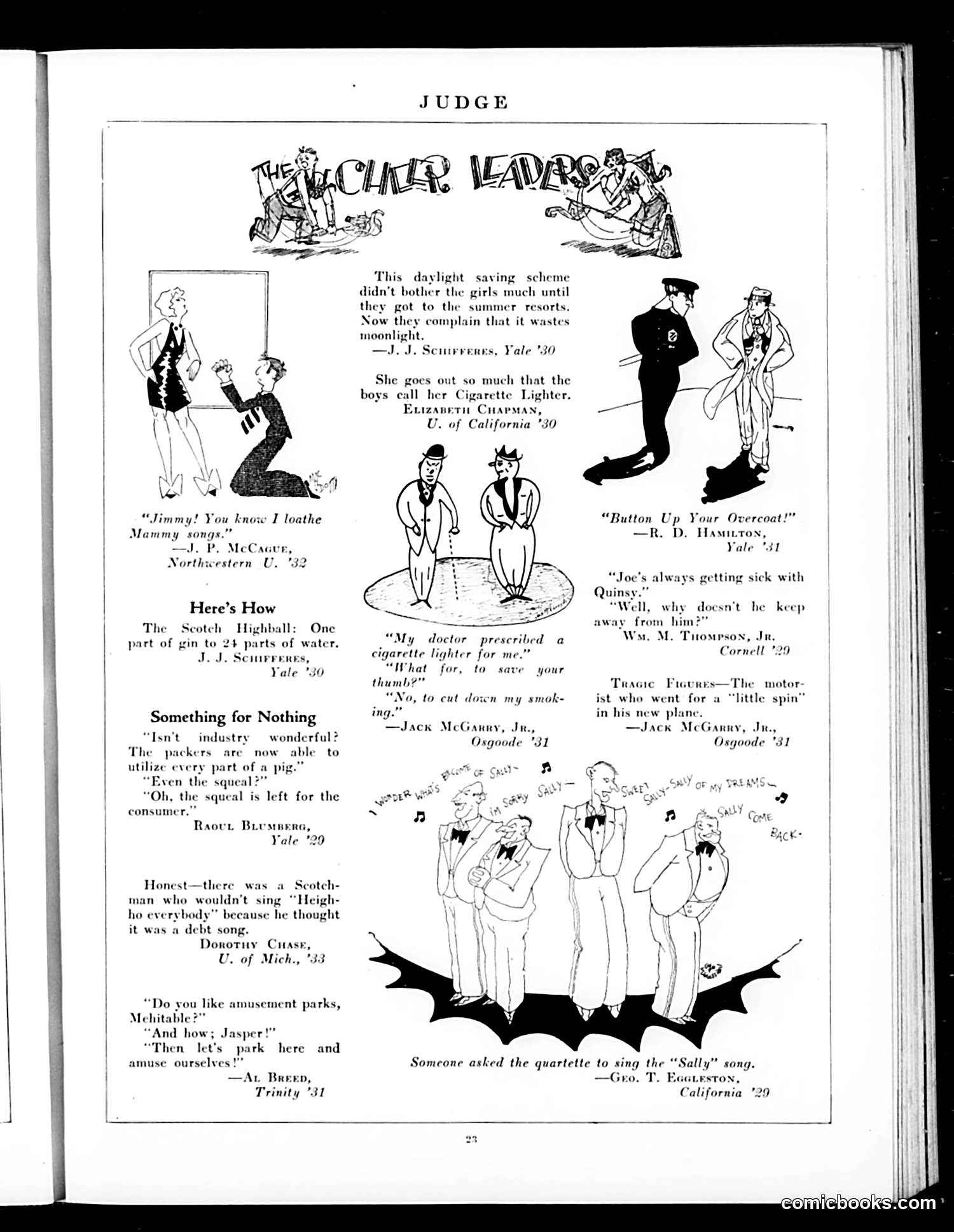
Explanation for Modern Readers This page from *Judge* magazine (likely late 1920s-early 1930s based on attributed years) collects student humor and jokes rather than political cartoons. The content reflects college-era social satire of that era: Key themes: - Prohibition era drinking jokes ("Scotch Highball" recipe stretching gin with water; references to "debt songs") - Dating and courtship humor (girls wasting moonlight at summer resorts; the "Cigarette Lighter" girl who goes out constantly) - Consumerism satire (packers utilizing every pig part except "the squeal left for the consumer"—criticizing how businesses pass costs to customers) - 1920s slang and behaviors (amusement parks as dating spots; overconsumption) The illustrations show flappers, young men in formal wear, and a barbershop quartet—typical Jazz Age imagery. The humor relies on wordplay, double entendres, and observations about modern youth culture that contributors submitted from various universities (Yale, Northwestern, Cornell, etc.). This is fundamentally college magazine humor, not political commentary, capturing period-specific social anxieties and entertainment references now largely obscured.
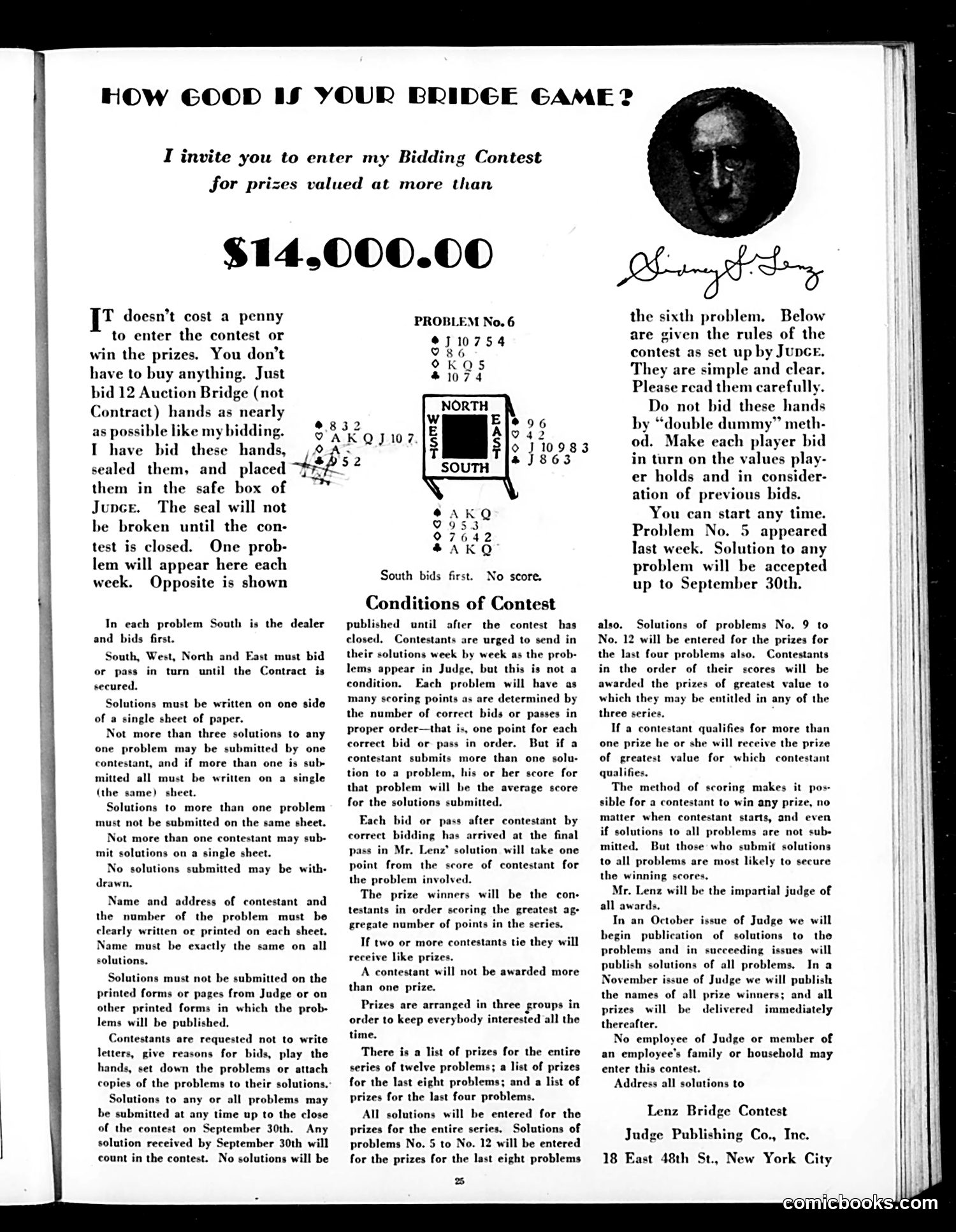
Judge Magazine Bridge Contest (circa 1930s) This page announces a bridge bidding contest sponsored by Judge magazine, offering $14,000 in prizes. The portrait shows Mr. Lenz, apparently a renowned bridge expert whose bidding solutions contestants must match. The contest presents weekly bridge hands for readers to bid competitively. Participants submit solutions by September 30th, scored on how closely their bids match Lenz's sealed solutions. Winners are determined by aggregate points across twelve problems, with prizes distributed in three tiers to maintain reader interest throughout the series. This reflects bridge's enormous popularity in 1930s America—a sophisticated card game that appealed to educated, affluent audiences. Judge leveraged this craze as both entertainment and circulation-building device. The detailed rules emphasize fairness and prevent "double dummy" cheating (knowing all cards). This was a common magazine promotion strategy before television, encouraging sustained reader engagement.
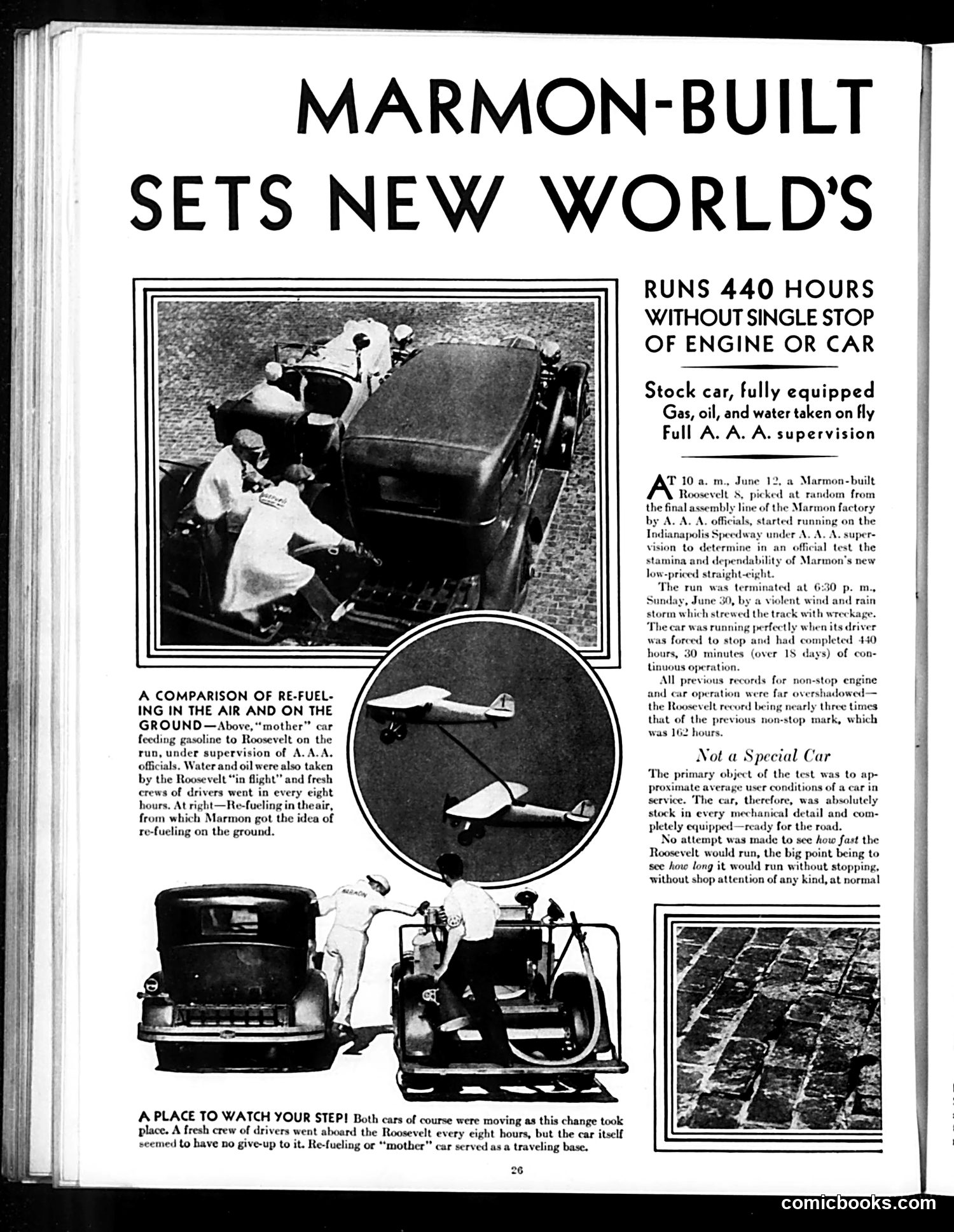
Analysis This is not a cartoon or satire, but rather a product advertisement disguised as journalism—a common practice in early 20th-century magazines. The page advertises the Marmon automobile company's "Roosevelt 8" model by documenting a 440-hour non-stop endurance test conducted on the Indianapolis Speedway under American Automobile Association supervision in June (year unclear, but likely 1920s based on design). The images show the stock car being refueled while moving, with chase vehicles supplying gas, oil, and water "in flight," and fresh driver crews rotating every eight hours. The text emphasizes this was an ordinary, fully-equipped production vehicle—not specially modified—to prove reliability for average consumers. The novelty angle compares ground-based refueling to mid-air refueling of aircraft, reflecting contemporary aviation fascination. This endurance record (nearly triple the previous 162-hour mark) served as marketing proof of Marmon's engineering quality and durability.
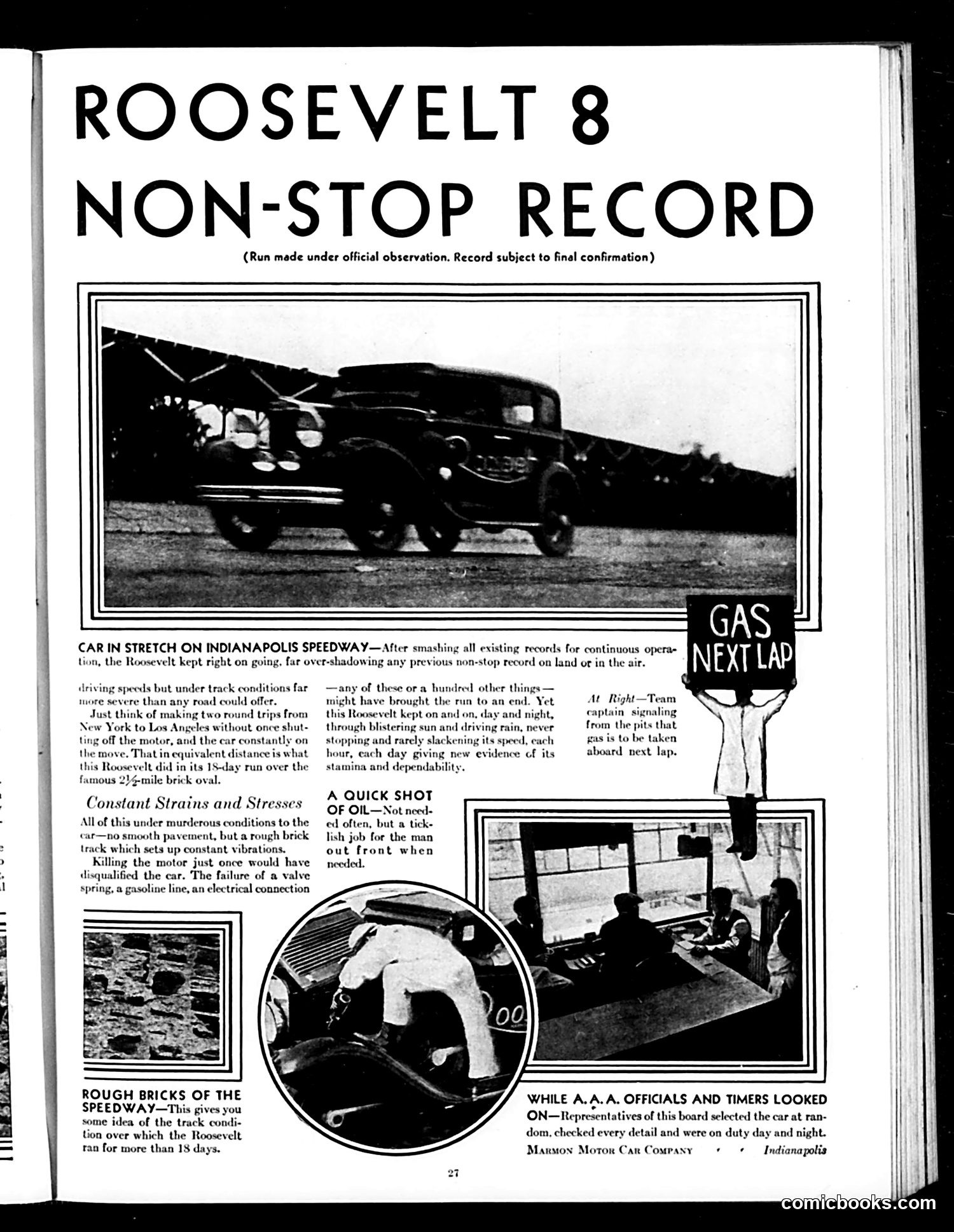
Roosevelt 8 Non-Stop Record This is an advertisement/article celebrating a Roosevelt automobile's endurance record on the Indianapolis Speedway. The car ran continuously for 18 days without stopping the engine, covering approximately 4,100 miles on the rough brick track. The piece emphasizes the vehicle's reliability by highlighting the grueling conditions: intense vibrations from the brick surface, extreme temperatures, rain, and the constant mechanical strain that could have caused failure at any moment (valve springs, gasoline lines, electrical connections). The accompanying photos show the actual race car on the track, the pit crew monitoring the attempt, and officials timing and observing. The "Gas Next Lap" sign indicates refueling procedures. This appears to be straightforward automotive marketing rather than political satire—using an impressive technical feat to demonstrate product durability and dependability to potential customers during the early automotive era.
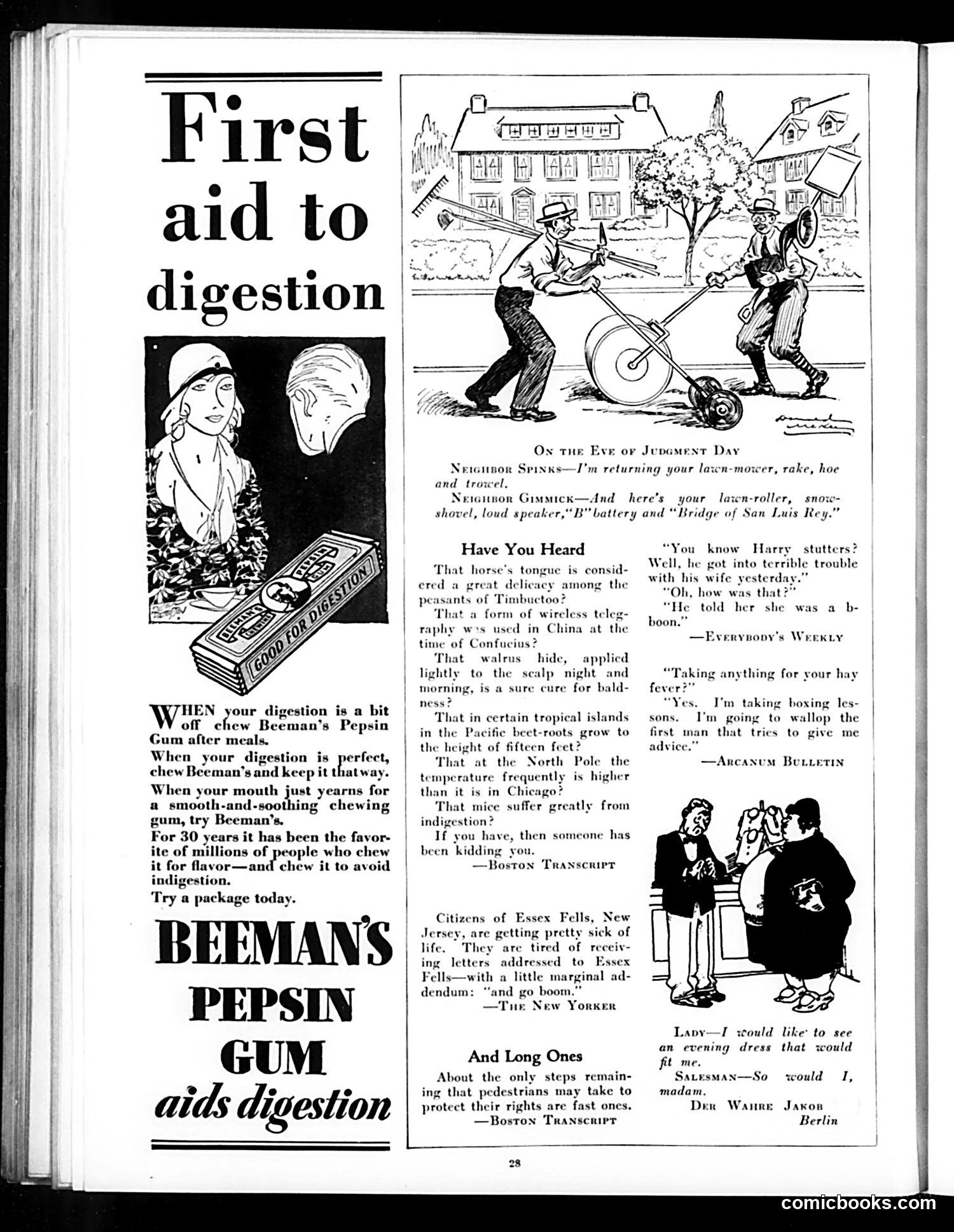
Judge Magazine Page Analysis This page combines advertising with humor columns typical of Judge magazine's format. The left side features a Beeman's Pepsin Gum advertisement claiming digestive benefits—a common early 20th-century marketing claim. The illustration shows a woman, likely representing the product's appeal to consumers concerned about digestion. The right side contains multiple short joke columns and anecdotes: - "Have You Heard" mocks credulous readers who believe obviously false "facts" (horses' tongues in Timbuctoo, 15-foot beets) - "On the Eve of Judgment Day" shows neighbors returning borrowed tools before an implied apocalypse - Other brief jokes about a man named Harry, hay fever treatments, and a dress-fitting mishap These represent Judge's signature format: satirizing contemporary social anxieties (health concerns, neighborly etiquette, relationships) through witty one-liners and light social observation rather than political commentary. The page reflects 1920s concerns about digestive health and middle-class social dynamics.
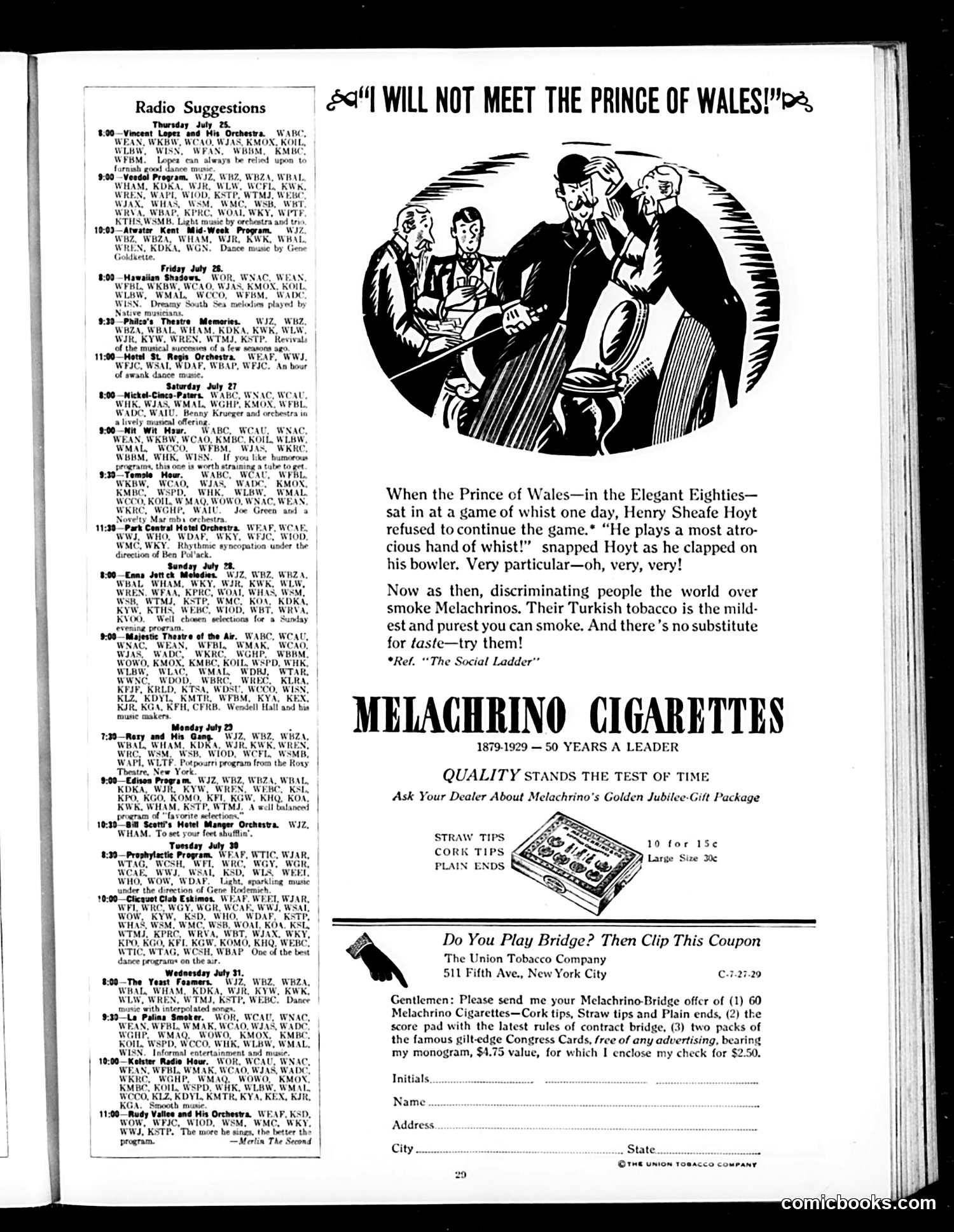
Explanation for Modern Readers This page contains a Melachrino Cigarettes advertisement disguised as satirical humor. The cartoon depicts the Prince of Wales refusing to continue a card game, claiming another player "plays a most atrocious hand of whist." The satire: The ad uses a historical anecdote (attributed to Henry Sheafe Hoyt) to suggest that the Prince of Wales is extremely discriminating and particular. The punchline pivots to cigarettes: just as the Prince is particular about card players, "discriminating people the world over" choose Melachrinos for their mild Turkish tobacco. Modern context: This is vintage advertising that exploited royal prestige and class consciousness to sell cigarettes. The phrase "discriminating people" appeals to snobbery—buying these cigarettes supposedly marks one as refined and selective. The ad includes a coupon offering bridge rules and accessories, targeting bridge-playing audiences in this 1929 *Judge* magazine. The page also features extensive radio program listings, typical of period magazines that helped readers navigate emerging broadcast schedules.
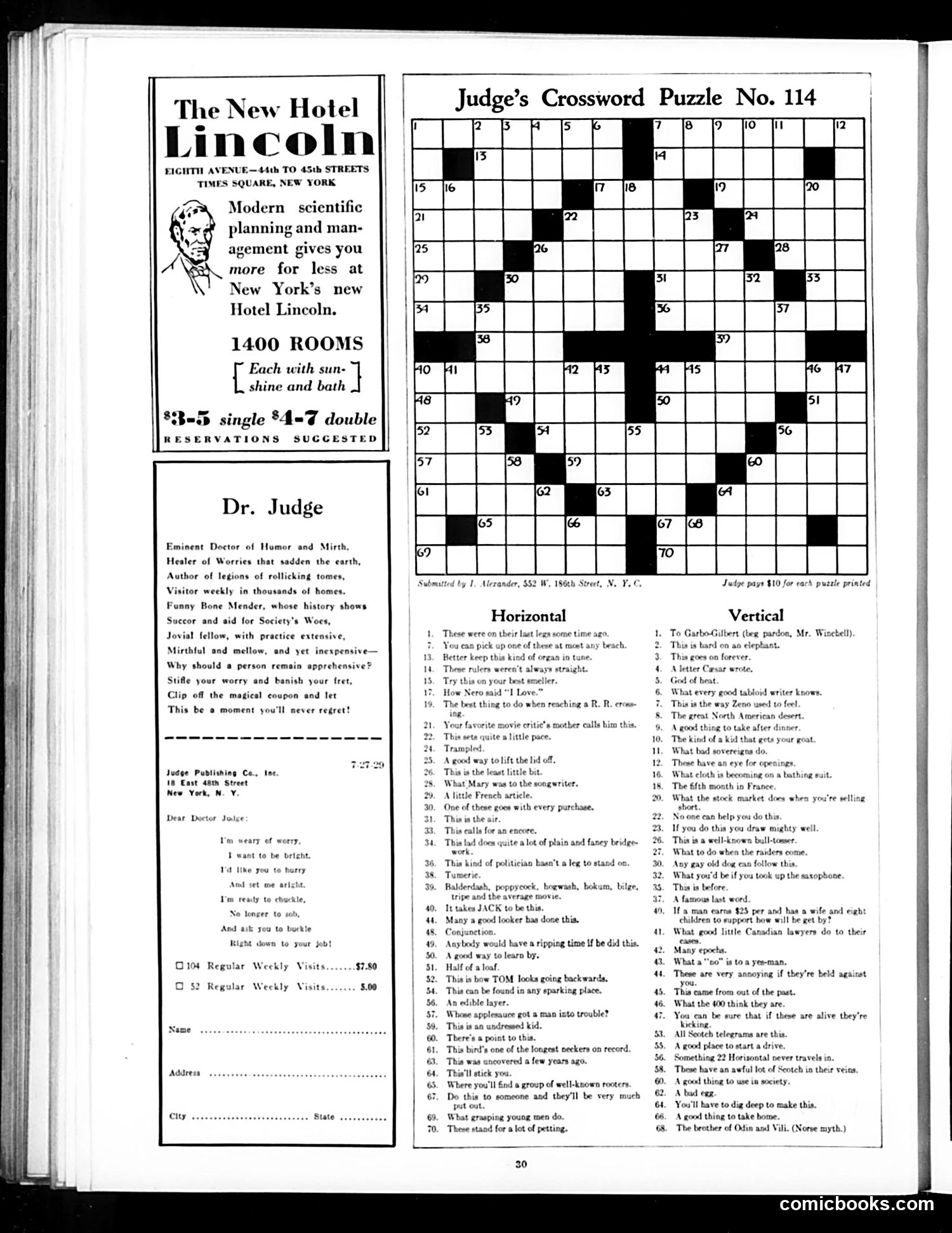
Judge Magazine Page Analysis This page is primarily advertisements and a crossword puzzle, not a political cartoon. The left side features ads for the Hotel Lincoln (a Times Square hotel) and "Dr. Judge," a humorous personification of the magazine itself as a doctor dispensing humor and relief from worry. This was a common self-promotional device—Judge magazine marketed itself as therapeutic entertainment for anxious readers. The main content is Judge's Crossword Puzzle No. 114, a standard word puzzle with horizontal and vertical clues. The clues are written with light humor typical of the era (1920s-era style based on references and typography), mixing wordplay, current events, and pop culture references. References like "Garbo-Gilbert" (likely celebrities of the period) and mentions of "tabloid writers" suggest contemporary 1920s-30s humor, though specific identities are unclear without additional context. This is essentially a puzzle page with period advertising—entertainment rather than political satire.
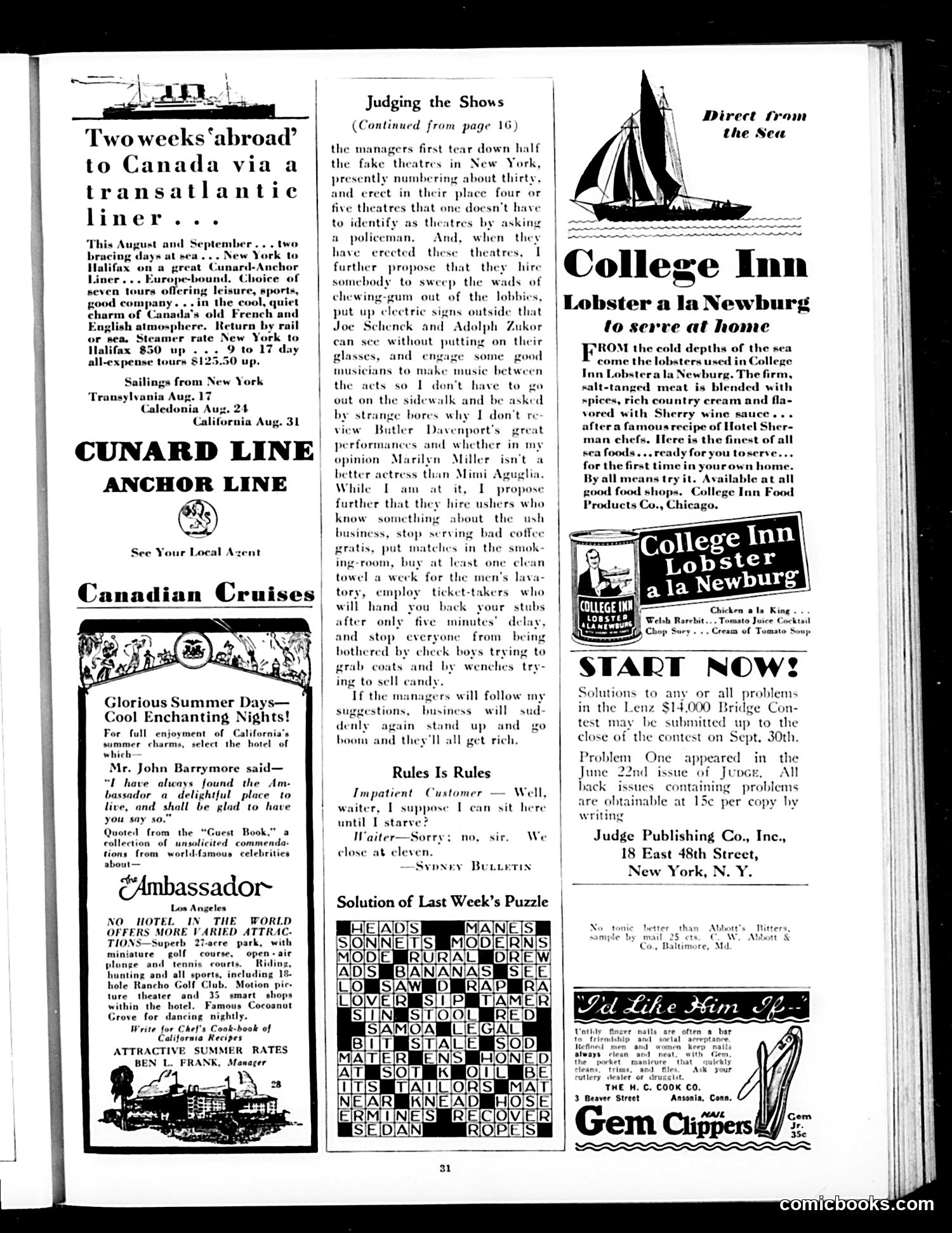
Page Analysis: Judge Magazine (circa 1920s) This page is primarily advertising and editorial content rather than political satire. The main elements: "Judging the Shows" (theater column): A critic proposes reforms for Broadway theaters—tear down fake ones, install proper signage, hire competent ushers, stop serving bad coffee, provide clean towels. This satirizes the poor conditions and management of NYC theaters of the era. "Rules Is Rules" (brief joke): A waiter refuses a customer's request to stay past closing time—simple service-industry humor. Advertisements: Cunard/Anchor shipping lines promote Canadian cruises; the Ambassador Hotel in Los Angeles quotes actor John Barrymore; College Inn brand promotes canned lobster; Gem Clippers advertises a razor. The page reflects 1920s consumer culture and leisure travel marketing. The theater column targets contemporary urban audiences familiar with Broadway's reputation for shabby conditions—a real complaint of theatergoers. Otherwise, this is straightforward period advertising with minimal political content.
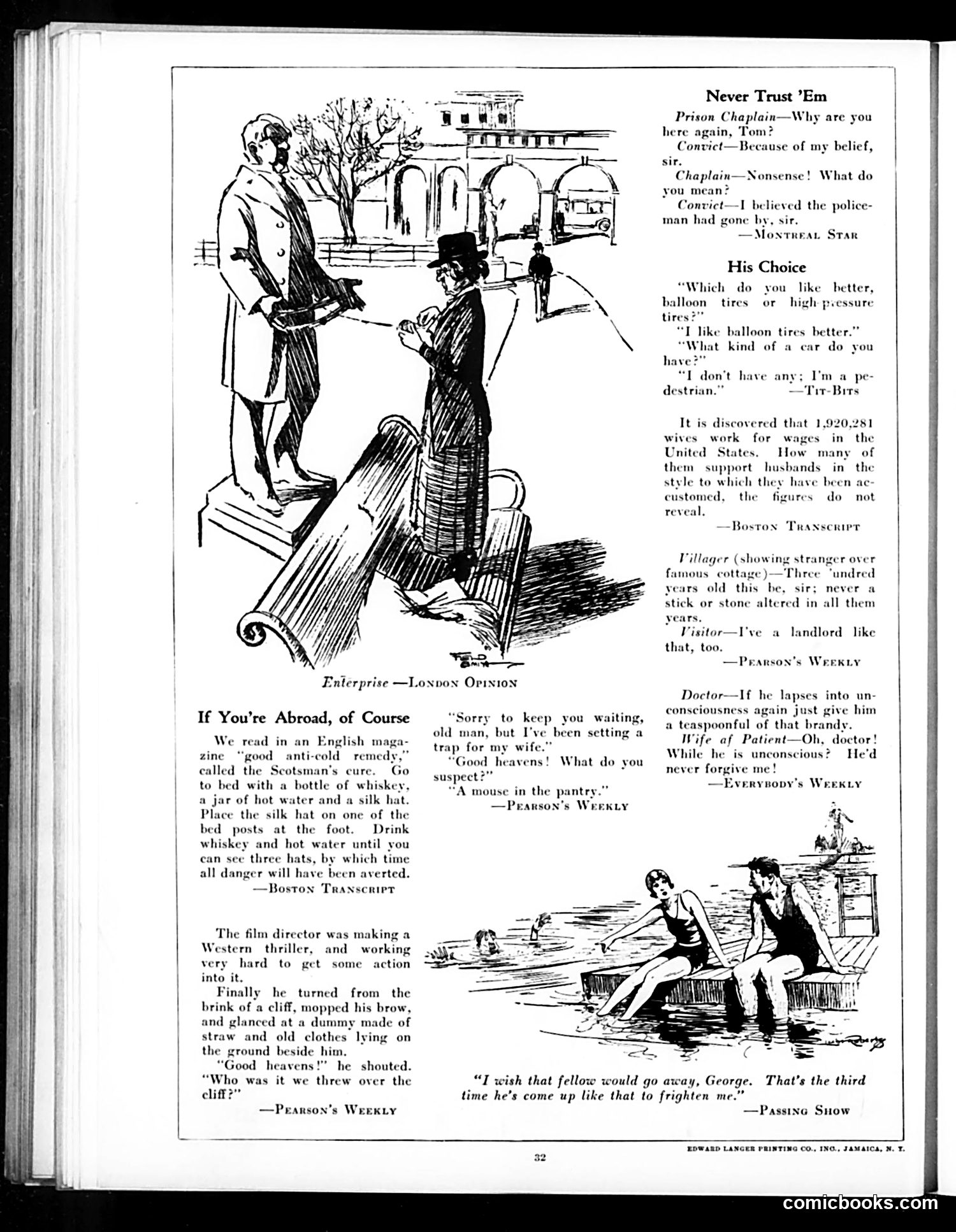
Judge Magazine Satire Analysis This page collects brief humorous anecdotes mocking various social groups and situations common in early 20th-century America. "Never Trust 'Em" jokes about criminals' unreliable excuses—a convict claims he believed a policeman had left, suggesting criminals are inherently deceptive. "His Choice" satirizes pedestrians, implying they're poor enough to own no car and thus can't have opinions on tire types—social commentary on class. The wives statistic ironically notes that 1.9 million American wives work for wages, yet questions whether their earnings maintain their husbands' accustomed lifestyle—mocking the economic reality that working wives don't necessarily elevate household status as expected. "If You're Abroad" presents a Scottish "cold remedy" (whiskey and hot water ritual) as absurdly superstitious folk medicine, poking fun at Scottish folk practices. The remaining anecdotes mock landlords, doctors' ethics, and film directors' methods. The page emphasizes class consciousness, gender economics, and period stereotypes through brief comic vignettes.
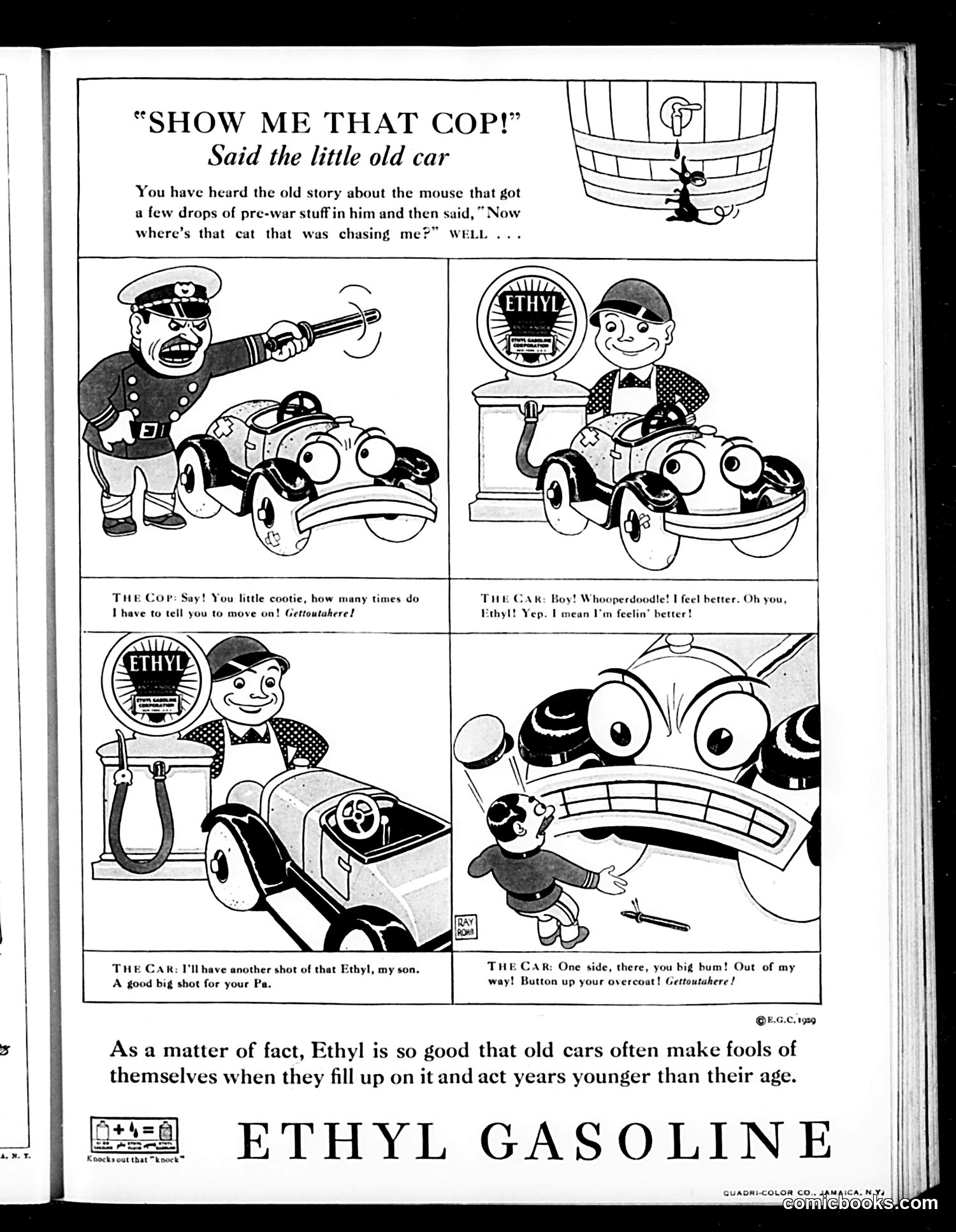
"Show Me That Cop!" — Ethyl Gasoline Advertisement (1929) This is a humorous advertisement for Ethyl gasoline, using cartoon anthropomorphism to sell fuel quality. The "little old car" is personified as an elderly vehicle initially cowed by a cop ordering it to move along. After receiving Ethyl gasoline (shown as an injection from a pump labeled "ETHYL"), the car becomes rejuvenated and cocky—so emboldened it now verbally sparks with the cop and acts years younger. The humor parallels the opening reference to a mouse gaining false confidence from "pre-war stuff" (likely alcohol, given Prohibition-era context). The ad's message: Ethyl gasoline provides such superior performance that even decrepit cars will feel and behave like newer vehicles. The text notes Ethyl eliminates engine "knock"—a key selling point of this premium fuel additive during this period. The joke works because the car's newfound swagger is absurdly disproportionate to the product's actual benefit.
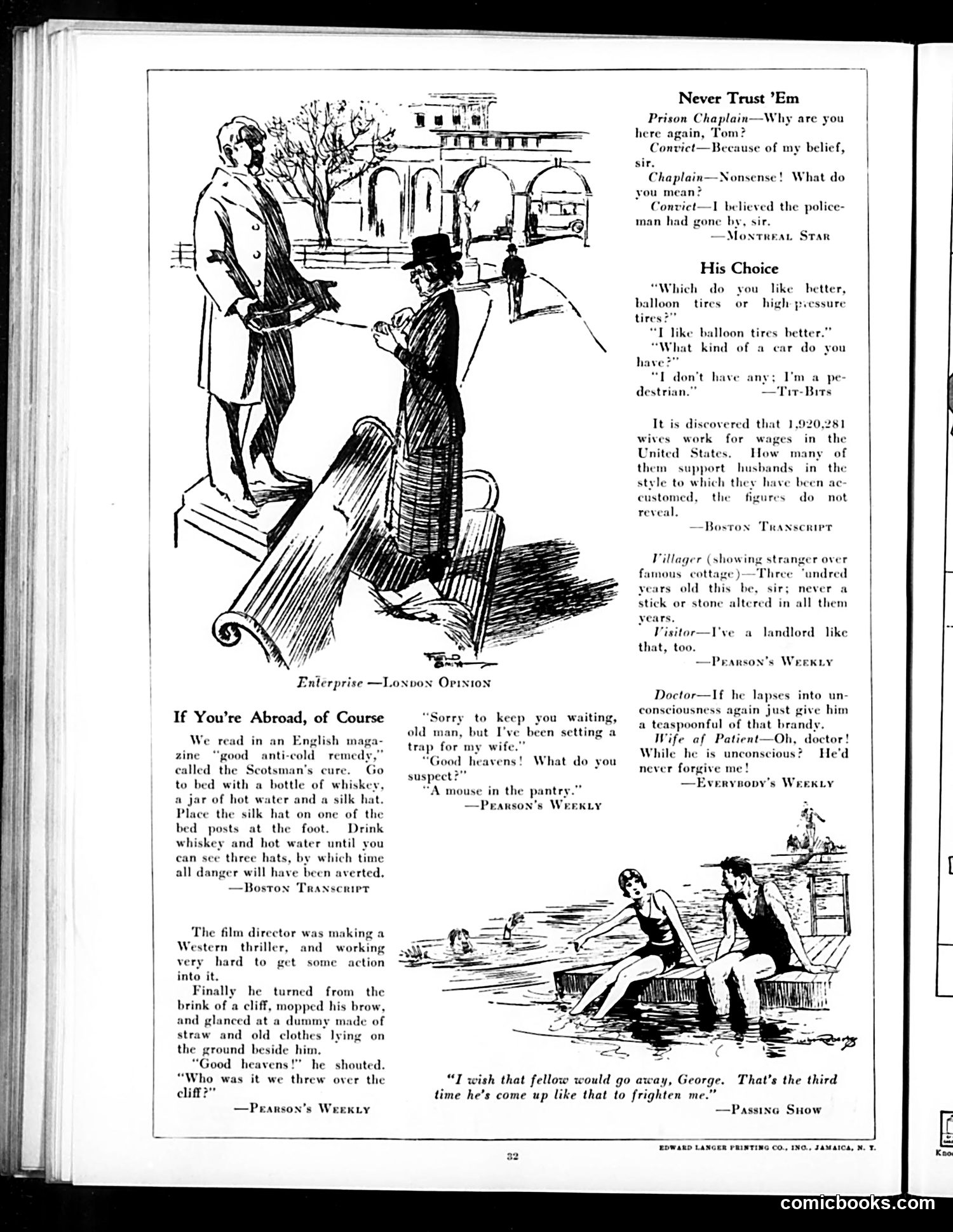
Analysis of Judge Magazine Page This page contains several brief humorous anecdotes and two illustrations typical of early 20th-century American humor magazines. Top Cartoon ("Enterprise"): Shows a well-dressed man confronting a woman, likely depicting a satirical London social scene. Main Content: A collection of short jokes on various topics: - A British cold remedy (absurdist humor about drinking whiskey while watching hats) - A film director's dummy mistaken for a real stuntman (slapstick) - Marital entrapment humor - A statistic noting over 1.9 million American wives worked for wages, sarcastically questioning how many could afford their husbands' lifestyle on these wages—social commentary on women's economic inequality - A prisoner's ironic explanation for returning to jail (trusting a policeman) - A pedestrian's preference for balloon tires (wordplay) - A doctor/patient joke about brandy and unconsciousness Bottom Cartoon: Two people in water, with someone frightened by repeated disturbances—likely a drowning-related gag. The page reflects early-1900s concerns: women's labor, class economics, and British-American cultural attitudes.
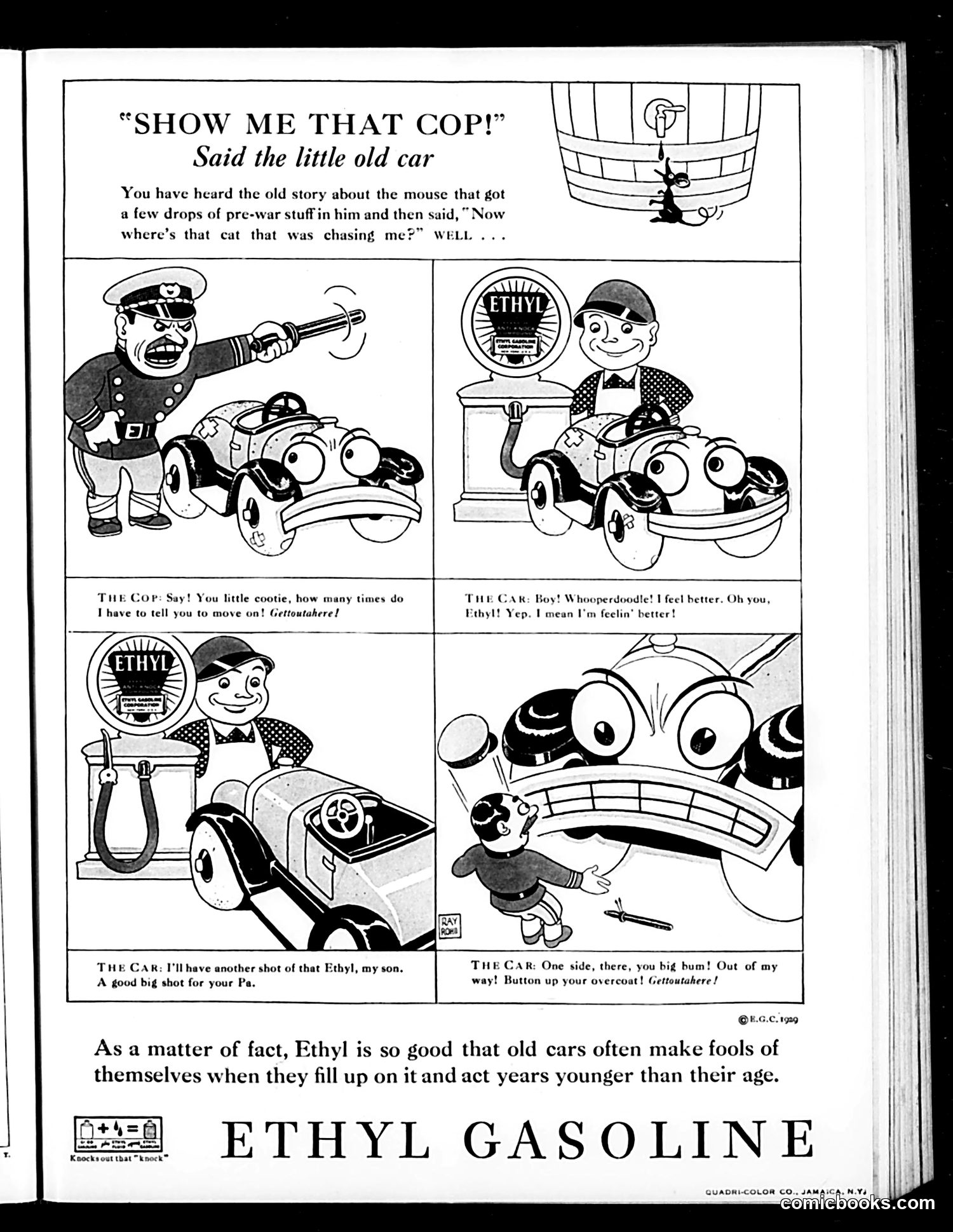
Analysis This is a 1929 advertisement for Ethyl gasoline disguised as a humorous comic strip. The narrative parallels a mouse emboldened by alcohol—a reference to Prohibition-era bootleg liquor. The "little old car" character, initially meek and ordered around by a cop, transforms after receiving "Ethyl" gasoline. The car becomes rowdy, aggressive, and disrespectful—"talking back" to authority figures and acting decades younger. The joke: Ethyl fuel makes old cars perform so vigorously they behave recklessly, like a timid creature suddenly drunk. The ad's tagline explains the satire directly: old cars "make fools of themselves" after filling up on Ethyl, acting "years younger than their age." This leverages 1920s cultural familiarity with Prohibition and intoxication humor to sell gasoline—essentially claiming Ethyl fuel provides an almost intoxicating performance boost. The slang ("cootie," "Gettoutahere") reinforces the comedic tone while targeting working-class car owners.
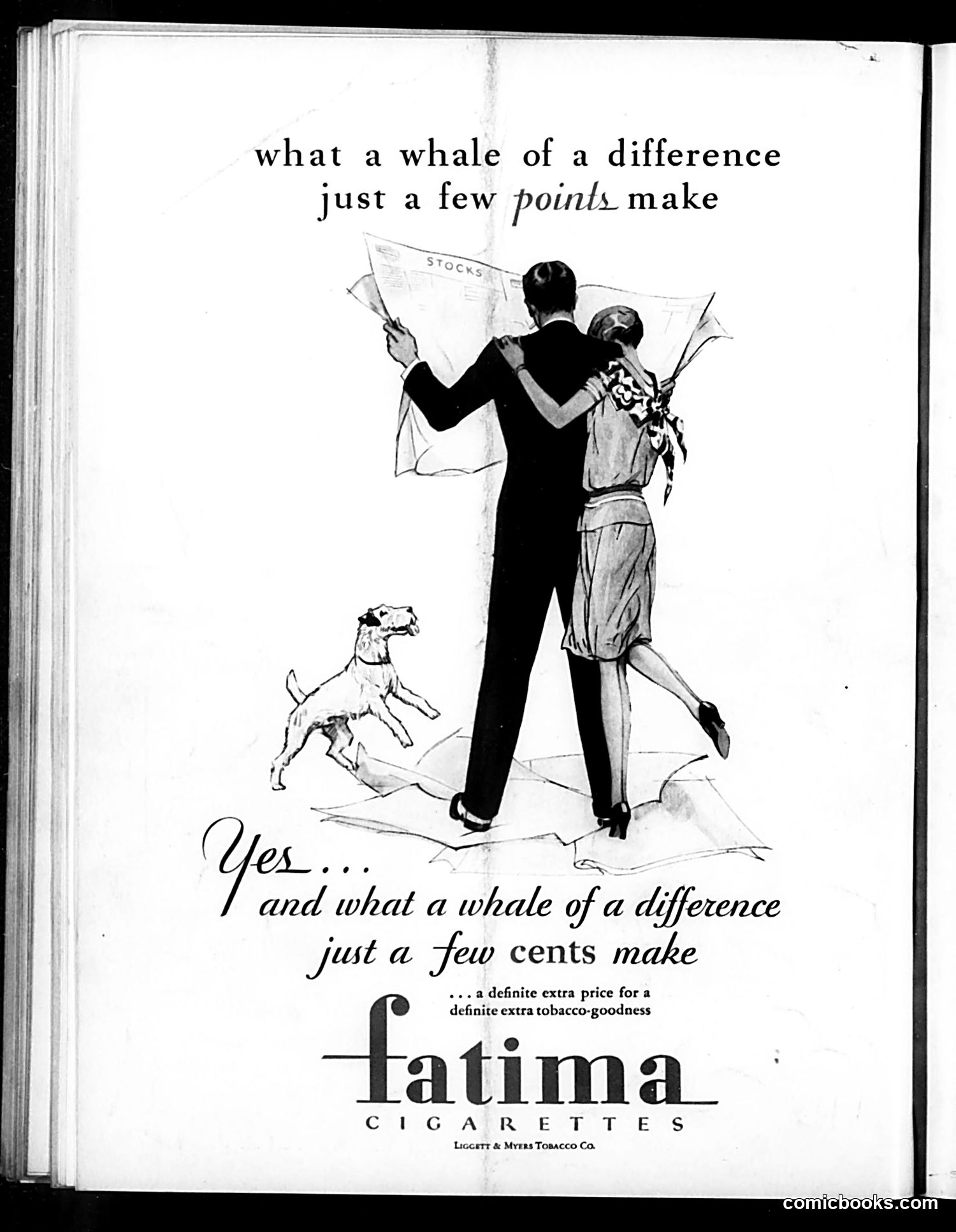
This is a cigarette advertisement for Fatima brand, not political satire. The ad uses a visual pun playing on the phrase "what a whale of a difference"—literally depicting a couple with a small dog, suggesting that small price differences yield major quality improvements in tobacco products. The text contrasts "a few points" (stock market terminology, visible on the newspaper the man holds) with "a few cents" (cigarette pricing), arguing that while stock market fluctuations matter little, paying slightly more for Fatima cigarettes delivers noticeably superior tobacco quality. This reflects early 20th-century advertising strategy: positioning premium cigarette brands as worthwhile investments despite higher costs. The illustration's fashionable couple and small dog convey aspirational lifestyle messaging typical of the era.