judge
Judge — August 3, 1929
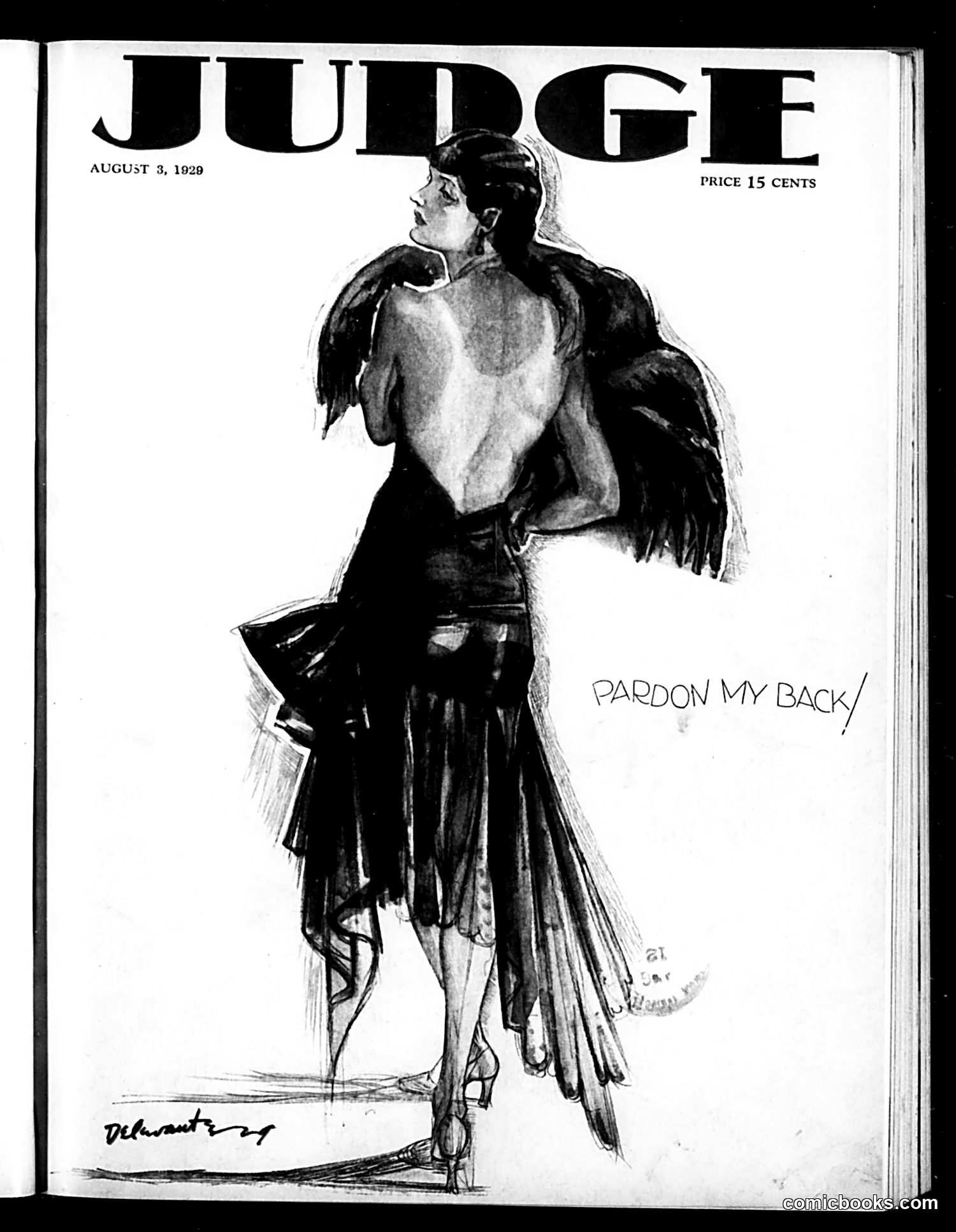
Judge Magazine Cover Analysis August 3, 1929 This cover depicts a woman in 1920s dress with wings, looking back over her shoulder. The caption reads "Pardon My Back!" The image likely satirizes women's fashion of the era, specifically the trend of backless or low-backed evening gowns that were scandalous by contemporary standards. The added wings transform the figure into an angelic or supernatural being, suggesting ironic commentary—perhaps mocking the contradiction between conservative social values and the increasingly daring fashions women wore during the Jazz Age. The "pardon" construction implies women were apologizing for (or defiantly refusing to apologize for) displaying their backs in public, a modest body part by today's standards but genuinely controversial in 1929.
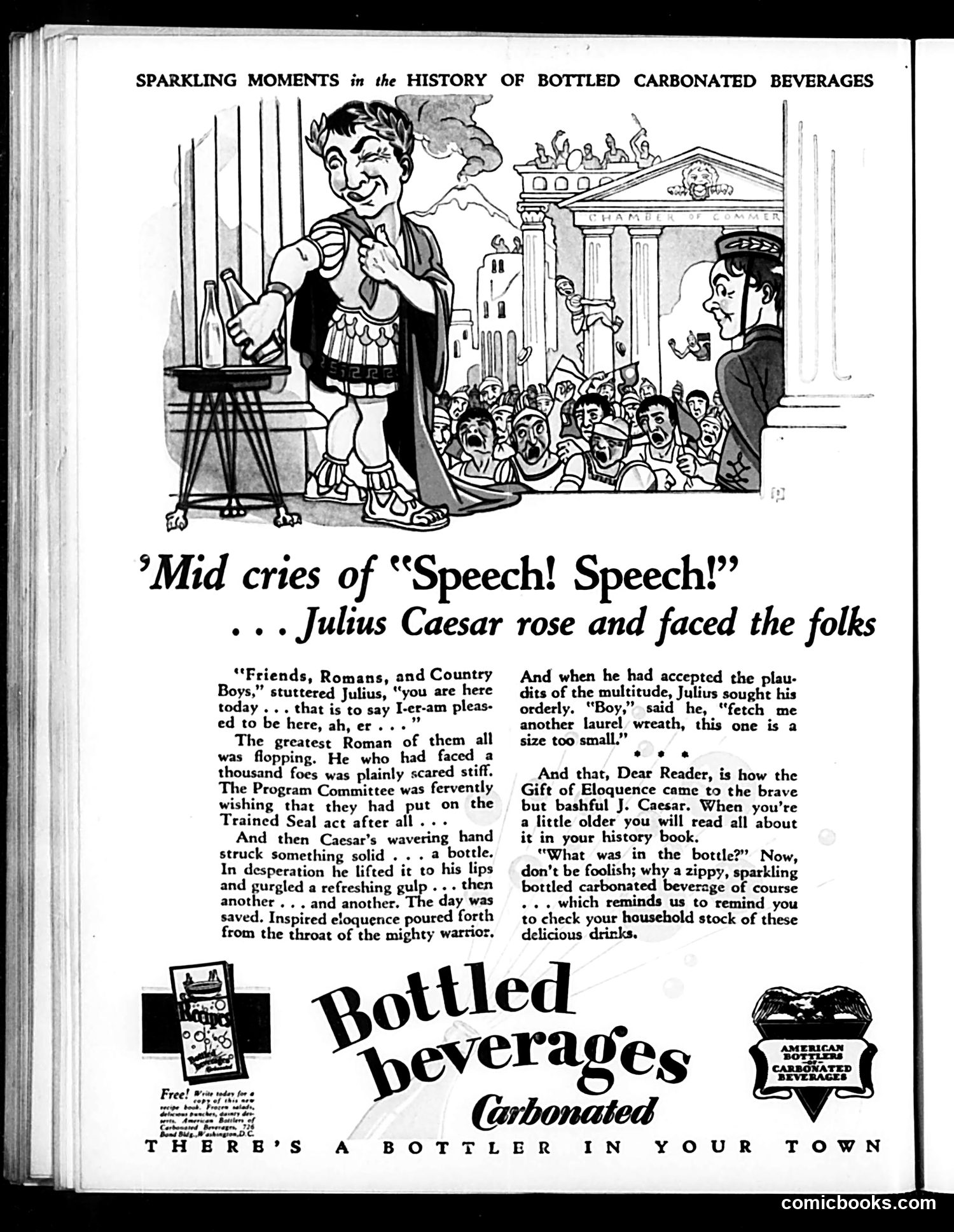
Analysis This page is primarily advertising for bottled carbonated beverages, using a humorous historical framing device rather than political satire. The cartoon depicts a figure dressed as Julius Caesar addressing a crowd in ancient Rome, with the text playing on Shakespeare's famous line "Friends, Romans, countrymen." The joke establishes that Caesar supposedly drank carbonated beverages (implied through the bottle visible in the scene), which gave him eloquence and courage. The advertisement's point is lighthearted: just as carbonated drinks supposedly empowered Caesar, they'll invigorate modern consumers. The "Gift of Eloquence" tagline makes this explicit. This is commercial advertising using historical humor rather than political commentary—a common Judge magazine approach blending entertainment with product promotion.
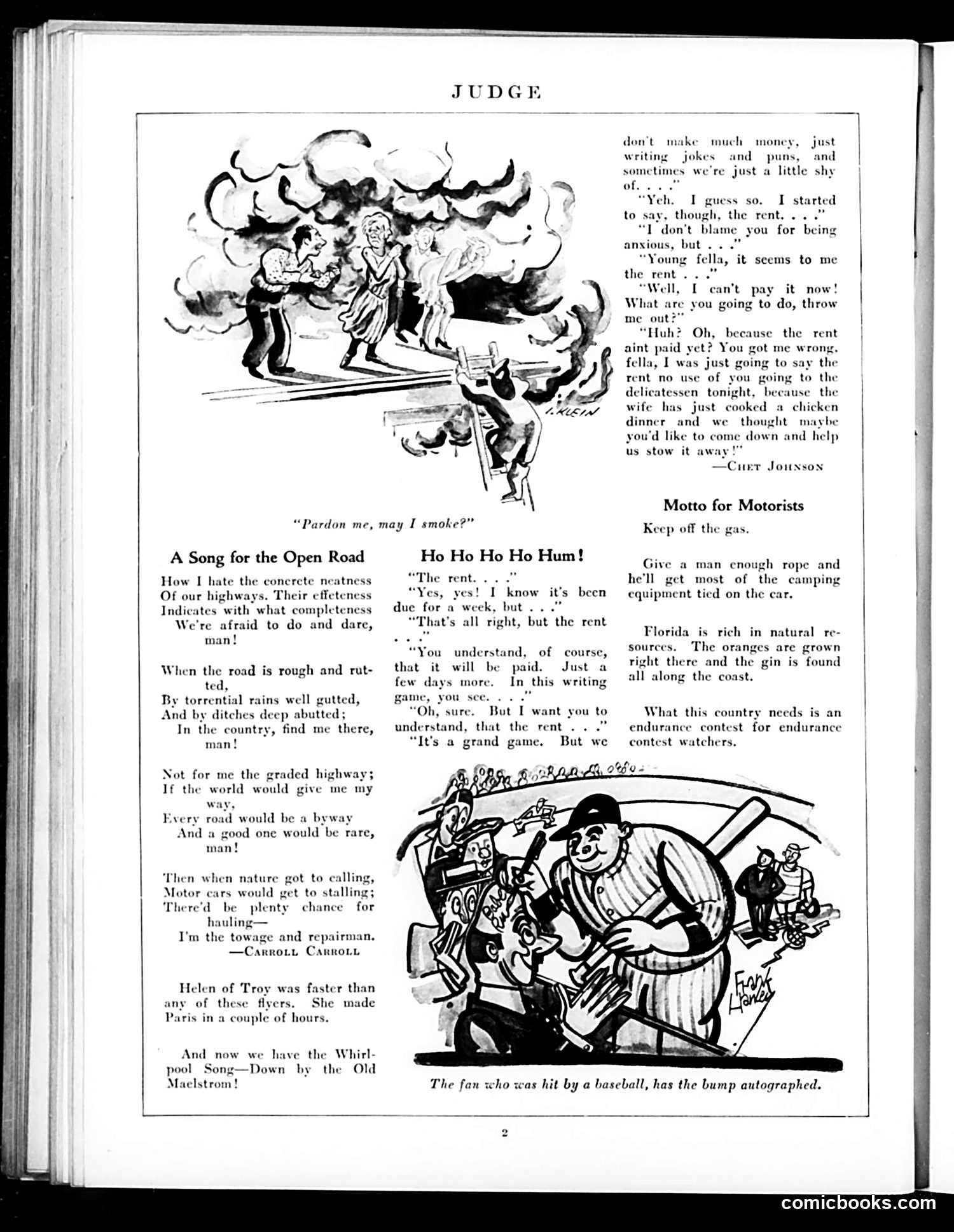
Analysis of Judge Page This page contains humorous commentary on early 20th-century American life. The top cartoon "Pardon me, may I smoke?" depicts a domestic dispute about rent payment, with a landlord confronting tenants. The humor hinges on the tension between eviction threats and the tenant's attempt to distract with dinner invitations—a commentary on economic anxiety during an era of housing instability. "A Song for the Open Road" celebrates rural travel and self-sufficiency, likely reflecting nostalgia for pre-industrial America amid rapid urbanization. The bottom cartoon "The fan who was hit by a baseball, has the bump autographed" satirizes celebrity culture and fan obsession—a figure struck by a baseball gets the injury signed, mocking superficial celebrity worship. These pieces target working-class financial precarity and emerging consumer culture.
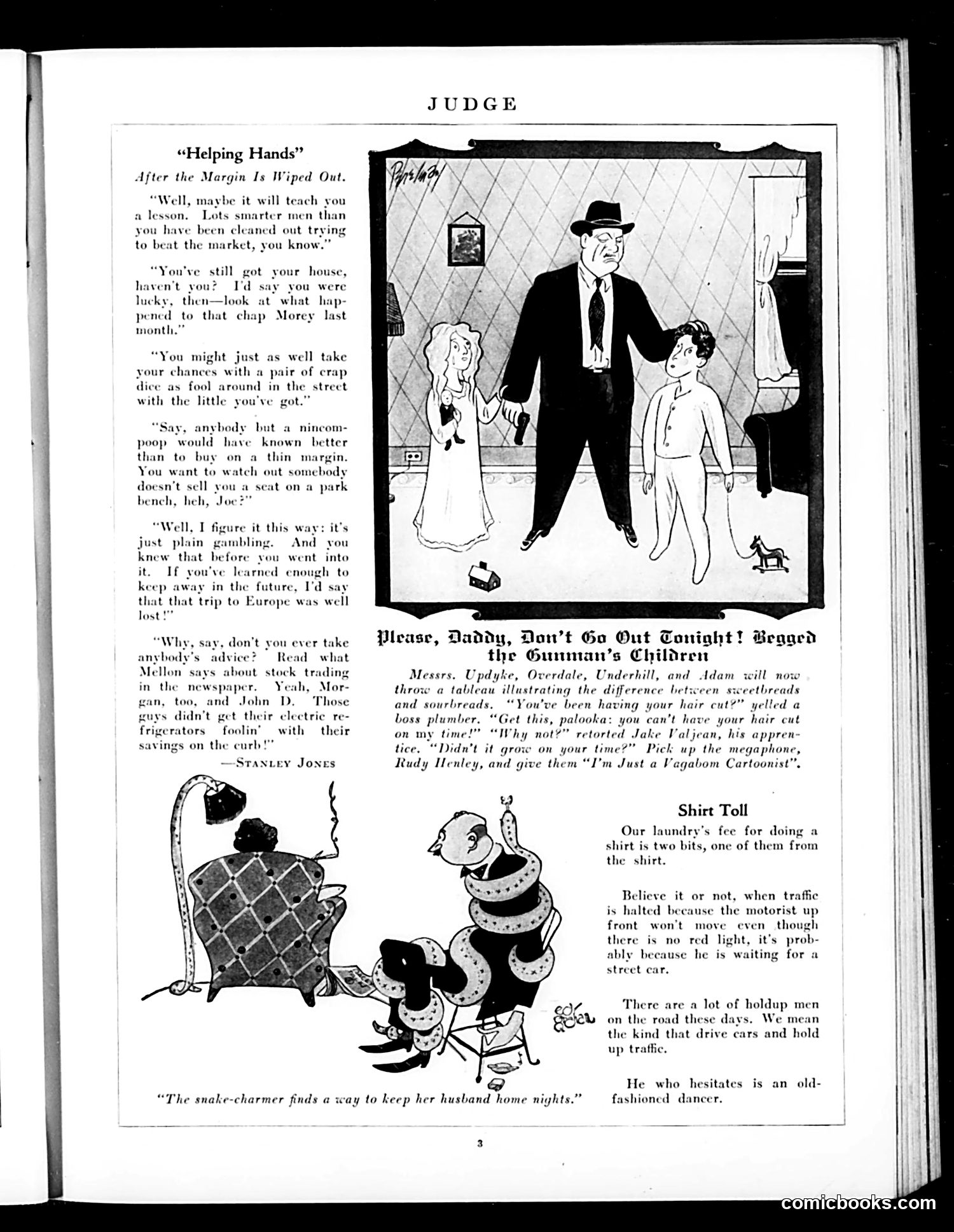
Page Analysis: Judge Magazine Satirical Content This page contains three separate satirical pieces targeting early 20th-century social issues: 1. "Helping Hands": A dialogue mocking financial advice to someone who lost money in the stock market. The joke criticizes how wealthy people casually suggest the poor gamble or take risks, treating serious financial losses flippantly. 2. "Please, Daddy, Don't Go Out Tonight!": A cartoon showing a father with children, satirizing men's habits of frequenting nightlife establishments while neglecting family. The caption references vaudeville performers (Updyke, Overdale, etc.), suggesting commentary on entertainment-district culture. 3. "Shirt Toll" and other brief items: Short observations about laundry costs, traffic holdup men, and dancing etiquette—minor social commentary on daily frustrations and changing social customs. The overall tone ridicules wealthy indifference and critiques contemporary urban social behaviors.
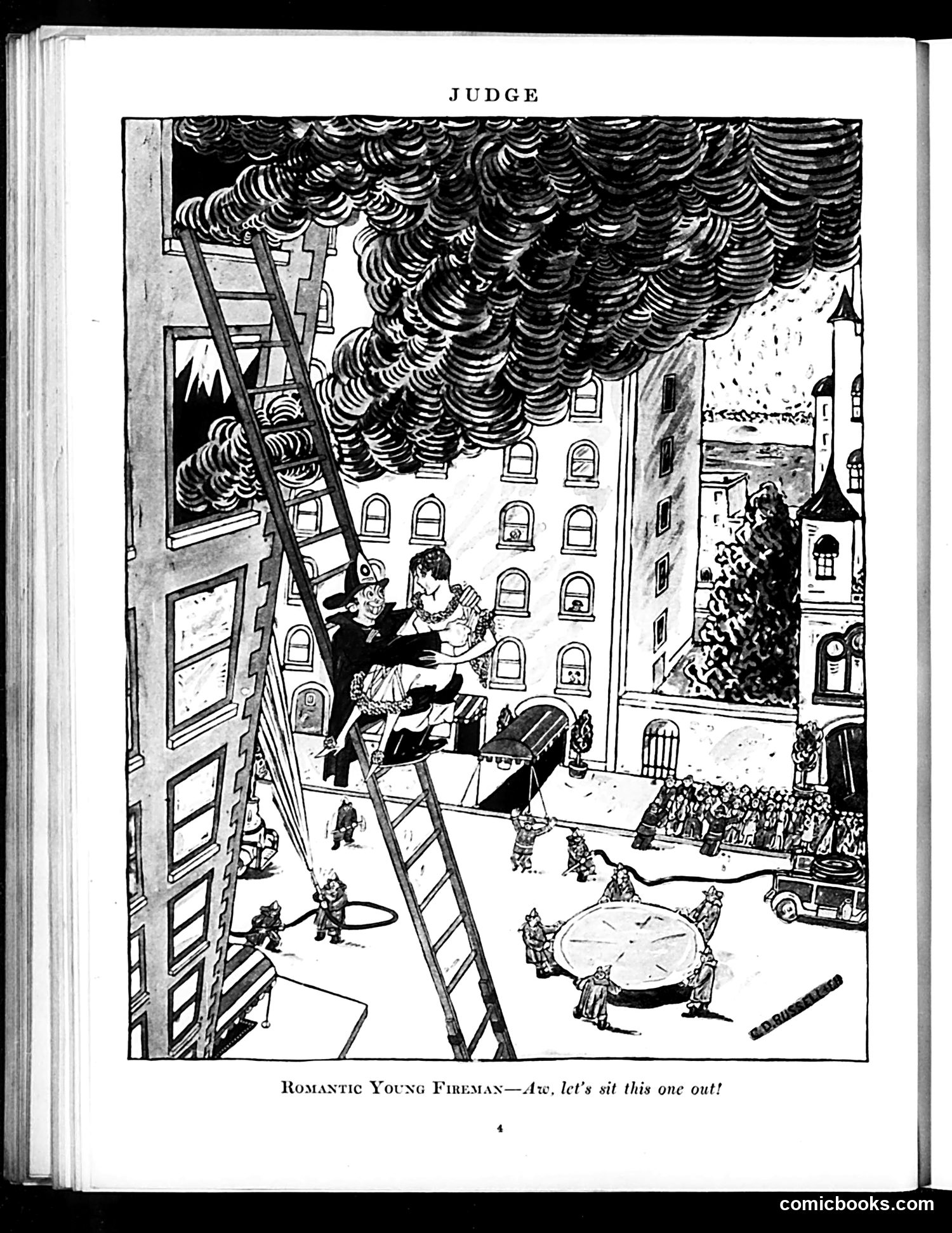
Analysis This cartoon titled "Romantic Young Fireman—Aw, let's sit this one out!" depicts two firefighters on a ladder during an active building fire, with the structure engulfed in flames and crowds gathered below. The satire mocks the romantic notion of firefighting—the caption suggests one firefighter wants to abandon his duty to relax with his companion rather than fight the blaze. This jokes about the disconnect between the idealized, heroic image of firemen and the reality of dangerous, exhausting work. The "romantic" framing ironically undercuts actual heroism. The cartoon likely critiques either unrealistic public expectations of firefighters or satirizes sentimental portrayals of the profession that ignore the genuine peril and sacrifice involved.
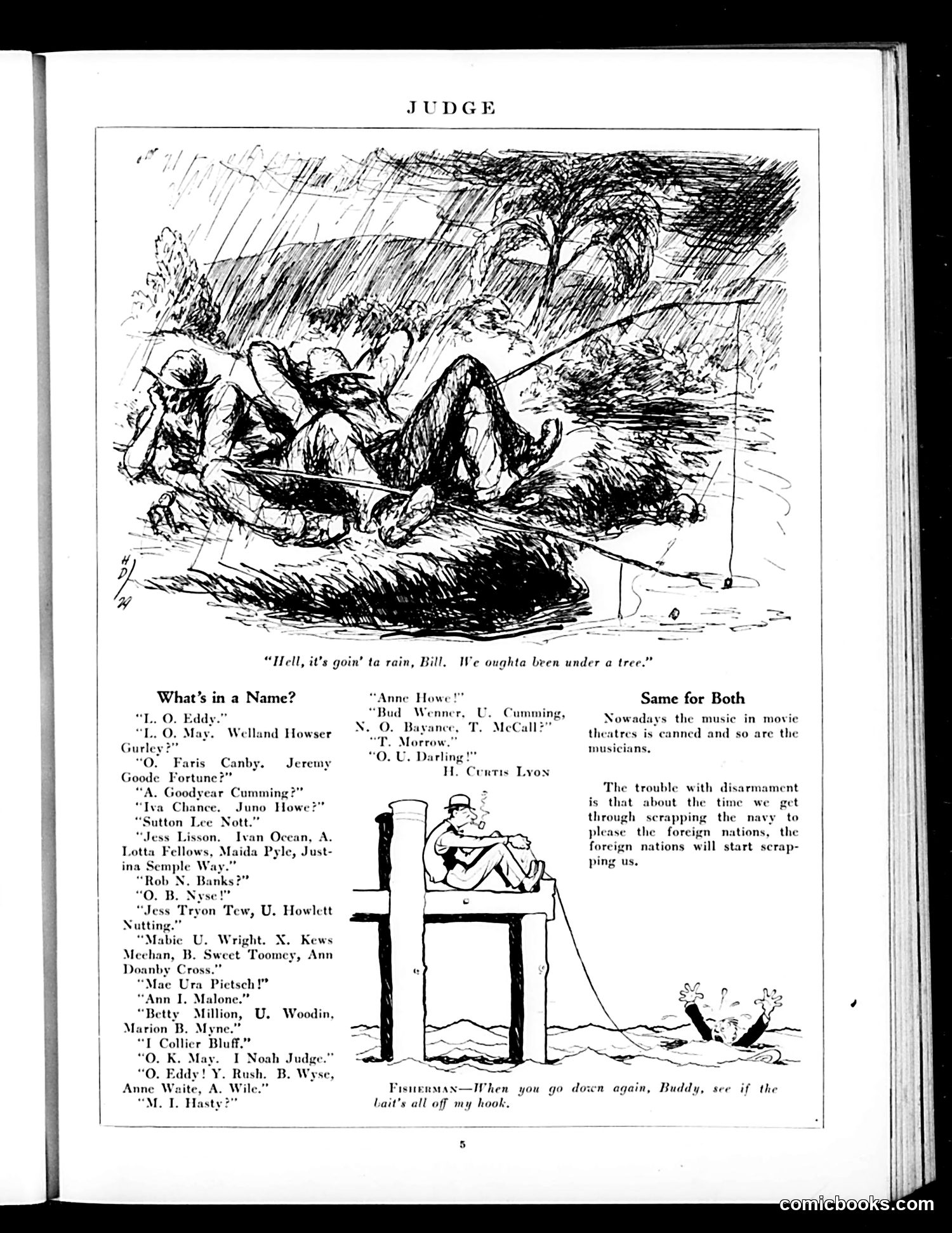
Analysis of Judge Magazine Page Top Cartoon: Shows figures sheltering from rain under a tree, with one saying "Hell, it's goin' to rain, Bill. We oughta been under a tree." This appears to be a simple weather joke with no obvious political content. Bottom Cartoon: Depicts a figure at a gallows-like structure telling another "Fishermen! When you go down again, Buddy, see if the bait's all off my hook." This is dark humor about capital punishment, likely satirizing contemporary executions or judicial proceedings—a common Judge topic during this era. The page includes unrelated content: "What's in a Name?" lists what appear to be entertainment figures or cultural references, and "Same for Both" discusses film music and naval disarmament debates.
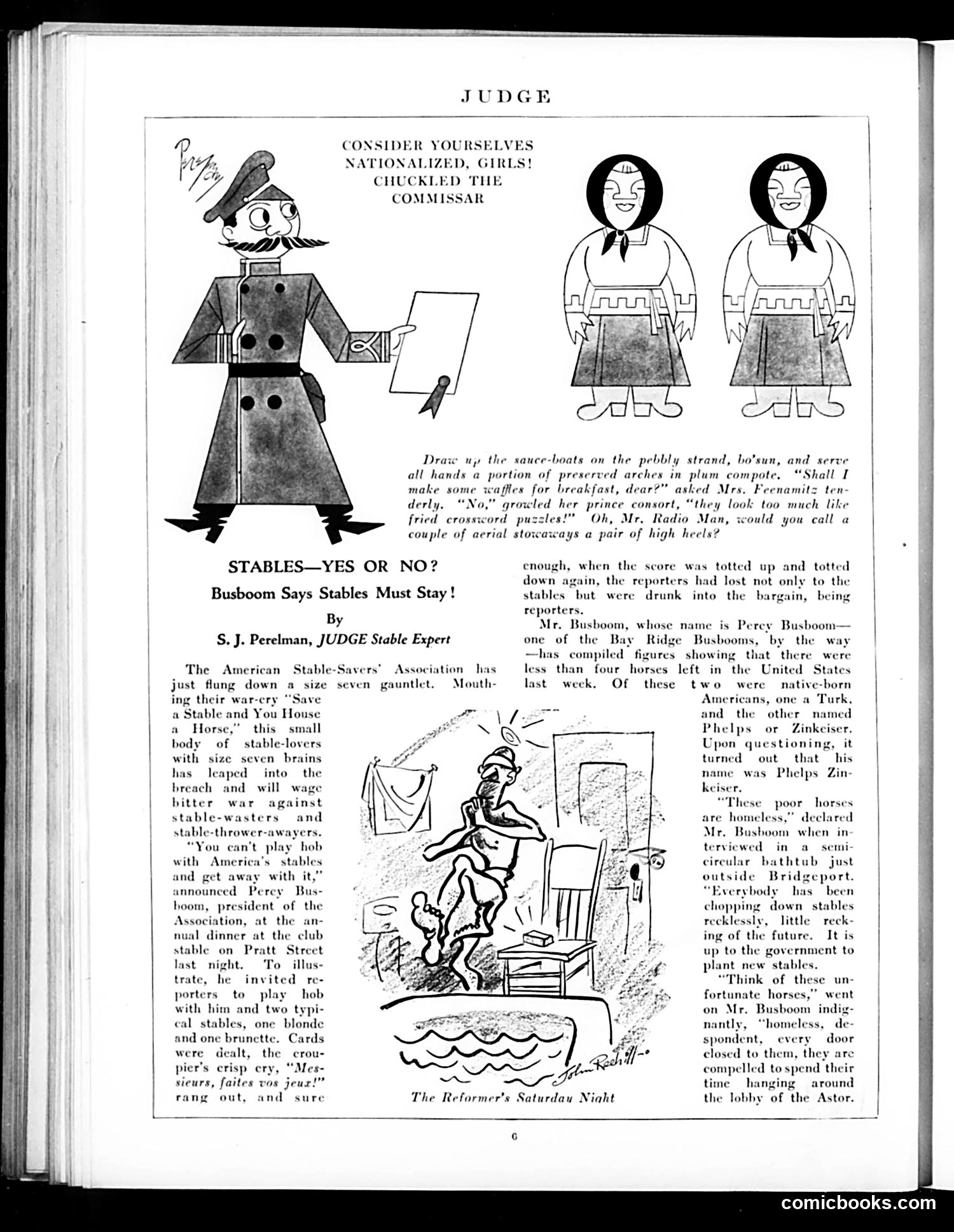
Content Analysis This page satirizes the American Stable-Savers' Association and the debate over whether to preserve horses as the automobile age progresses. The top cartoon shows a naval commissar figure addressing two identical girls, apparently mocking Soviet commissars' propaganda methods. The main article by S.J. Perelman, labeled "JUDGE Stable Expert," humorously argues for keeping stables. It references Percy Busboom, who reported fewer than four horses remained in the U.S., naming the survivors (Americans, a Turk, and horses named Phelps or Zinkeiser). The accompanying illustration titled "The Reformer's Saturday Night" shows a chaotic domestic scene, likely satirizing well-intentioned but impractical reformers advocating for outdated institutions during rapid modernization. The satire critiques nostalgia-driven preservation efforts in an era of technological change.
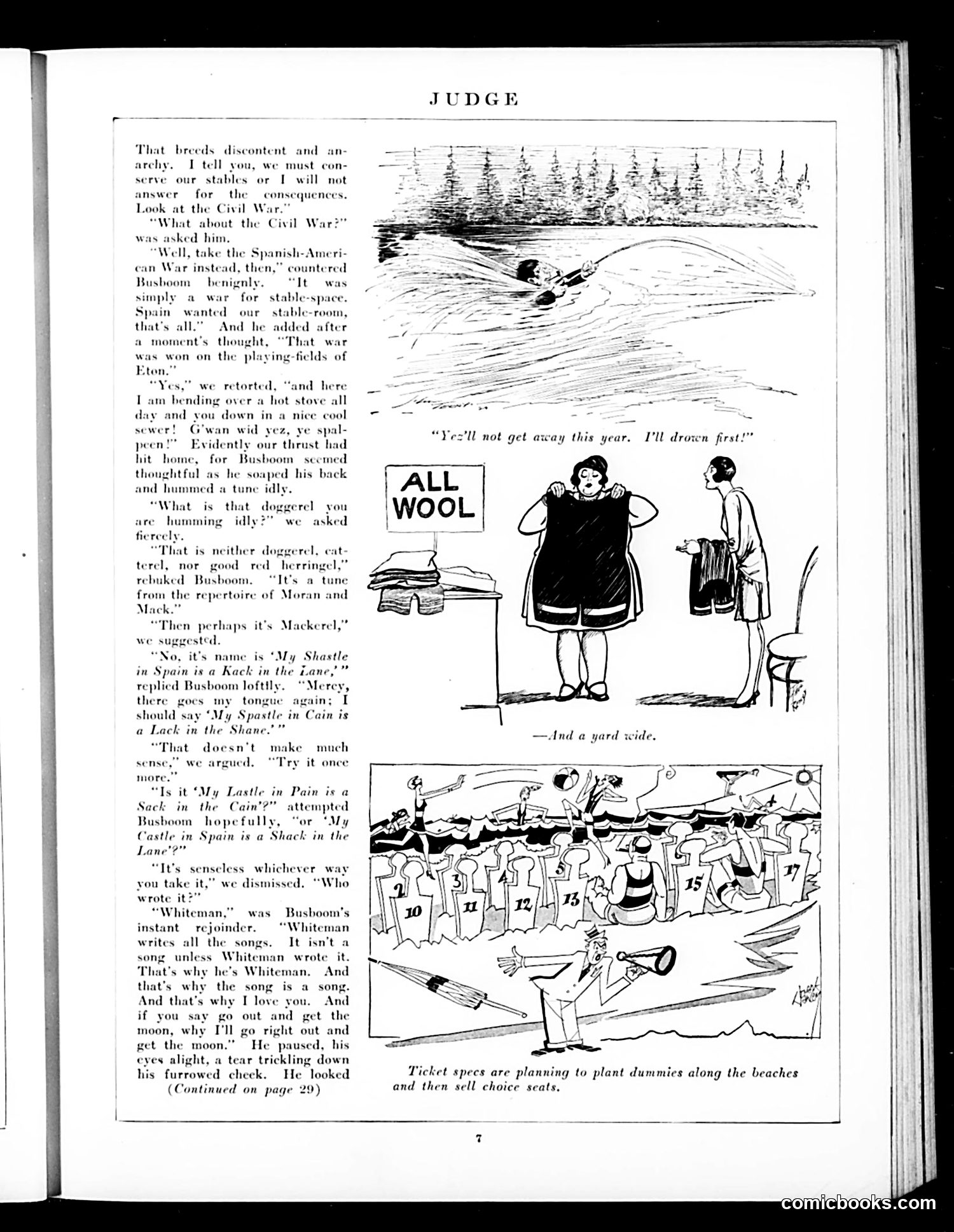
Analysis of Judge Magazine Page This page contains humorous dialogue between two characters debating Irish immigration and assimilation, alongside satirical cartoons about beach ticketing schemes. The main text features "Busboom," an Irish character (indicated by dialect and name), defending Irish immigrants against accusations of causing "discontent and anarchy." His absurd logic—that the Spanish-American War was fought over "stable-space"—mocks nativist arguments blaming immigrants for social problems. The cartoons satirize: 1. Top cartoon: A woman selling "ALL WOOL" garments, depicted as wider than advertised—mocking false advertising of fabric width 2. Bottom cartoon: Beach ticket speculation schemes where promoters plan to place "dummies" (mannequins) along beaches to sell "choice seats"—satirizing tourist exploitation and fraud The page reflects early 20th-century anxieties about immigration, consumer fraud, and tourist industry deception. Judge was a satirical magazine targeting both working-class characters and commercial hucksterism of the era.
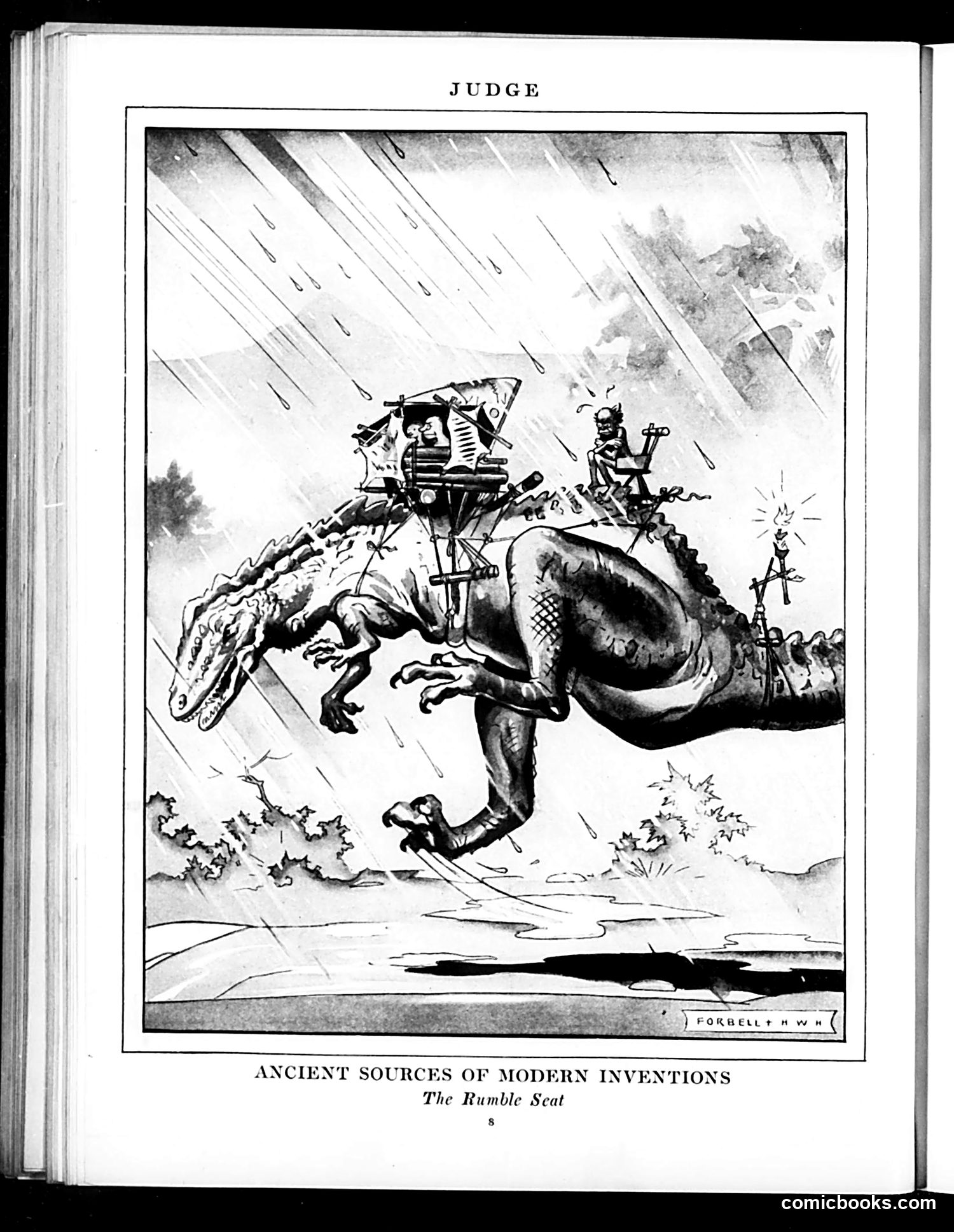
Analysis This satirical cartoon from *Judge* magazine depicts a fantastical creature—appearing to be a dinosaur or prehistoric beast—ridden by small mechanical figures, riding through rain. The title "Ancient Sources of Modern Inventions: The Rumble Seat" is the key to understanding the joke. A "rumble seat" was a real early-automobile feature: an exposed, folding rear seat. The cartoon humorously suggests that this modern car feature has prehistoric origins—that ancient creatures provided the original inspiration for the rumble seat's design and function. The satire mocks the tendency to claim "ancient sources" for modern conveniences, presenting an absurd visual pun: the literal rumbling of a prehistoric beast becomes the "rumble" seat. The small figures clinging to the creature mirror passengers precariously perched in actual rumble seats.
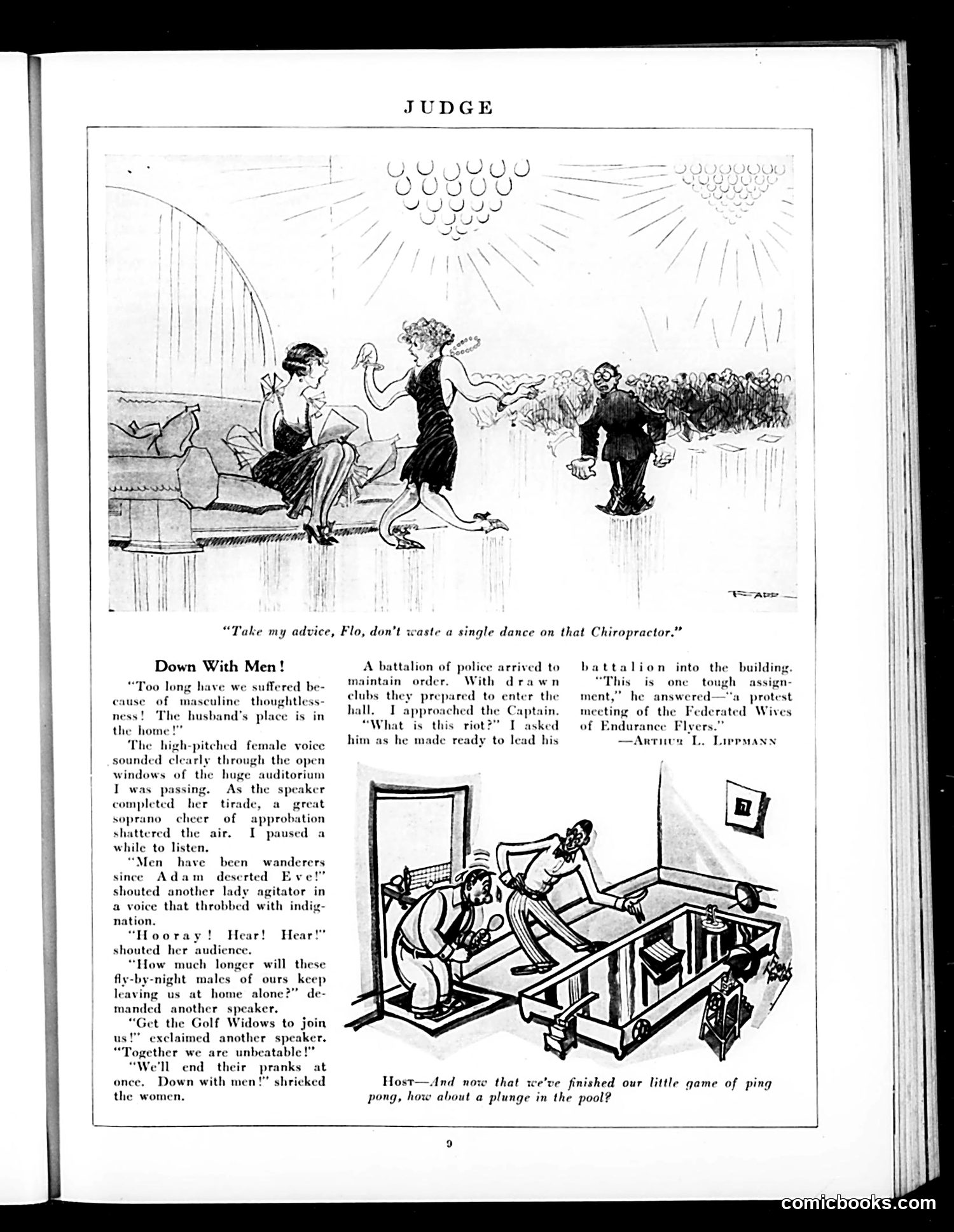
"Down With Men!" - Judge Magazine Satire This page satirizes the women's suffrage and feminist movements of the early 20th century. The top cartoon depicts a women's rally with speakers denouncing male negligence—husbands abandoning domestic duties, men pursuing leisure (golf, flying) while wives stay home. Police are called to manage the "riot." The satire mocks the movement by portraying women's activism as shrill, emotionally overwrought, and requiring police intervention—a common dismissive trope used against suffragettes. The caption about "Golf Widows" and "Endurance Flyers" references real grievances (men prioritizing hobbies over family) but presents them as hysteria deserving ridicule. The lower cartoon adds gendered mockery: after ping-pong, a man casually suggests swimming—implying women should remain decorative and compliant rather than politically engaged. The overall message: women organizing for rights is presented as absurd disorder rather than legitimate political expression.
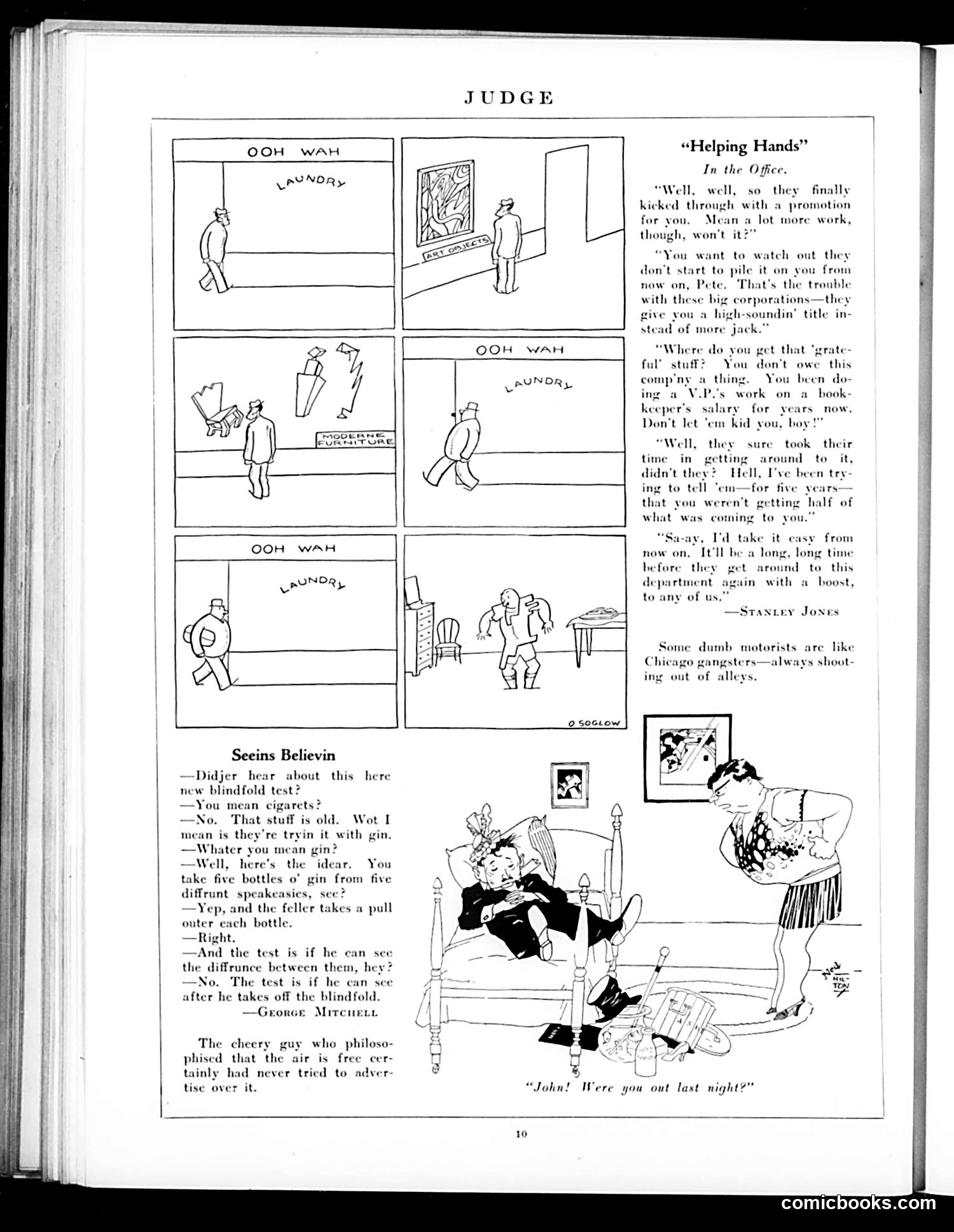
Explanation for Modern Readers "Helping Hands" depicts workplace cynicism about promotions. A man receives a job advancement, but his coworkers warn him it's a trap: the company will load him with extra work without proportional pay increase, using the prestigious title as compensation instead of actual raises. The satire critiques corporate exploitation—companies leverage employee loyalty and ambition to extract more labor while maintaining stagnant compensation. "Seeing Believin'" is a Prohibition-era joke. It mocks a "blindfold test" supposedly distinguishing gin brands, but the actual test is whether someone can walk straight *after* drinking gin from five different illegal speakeasies. The humor targets both blind taste-test advertising and the absurdity of Prohibition enforcement (speakeasies were illegal establishments). Both sections satirize American workplace and social dynamics of the era—corporate manipulation and the underground alcohol trade during Prohibition.
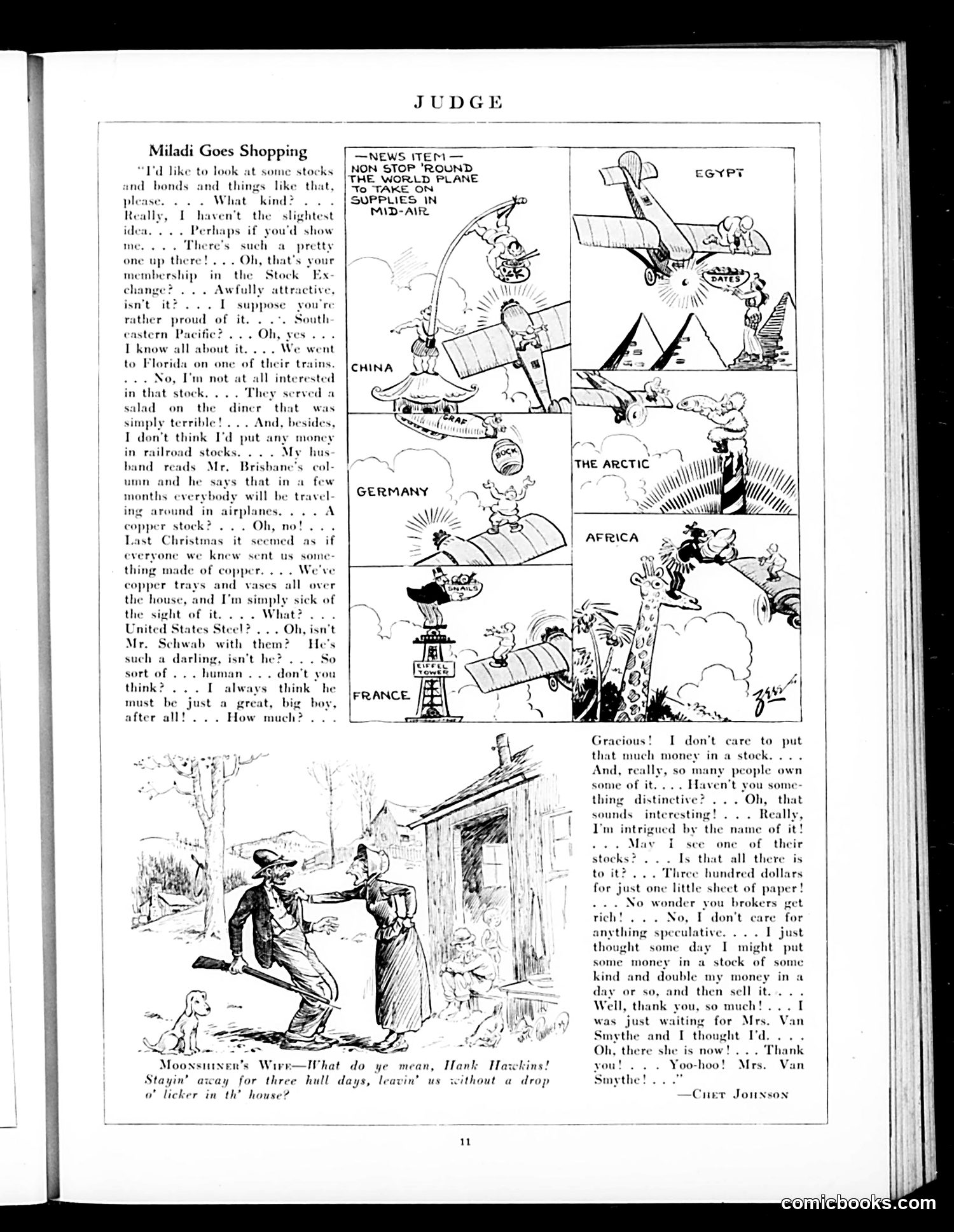
"Miladi Goes Shopping" Analysis This satirical piece mocks wealthy society women's superficial approach to stock investment. A fashionable lady ("Miladi") visits a stockbroker seeking to invest, but her decisions are entirely frivolous—she's attracted to stocks based on aesthetic appeal (a "pretty" certificate), personal experiences (disliking railroad food), or brand recognition (admiring Mr. Schwab's charm), rather than financial merit. The cartoon ridicules both her naïveté and unrealistic expectations: she hopes to "double my money in a day or so" through speculation. The sidebar illustrations satirize contemporary news—high-tech aviation experiments and global expansion—suggesting that even as America pursues ambitious modern ventures, wealthy society women remain comically detached from serious economic reality. The humor targets class pretension and the notion that money management requires actual knowledge rather than mere fashion sense.
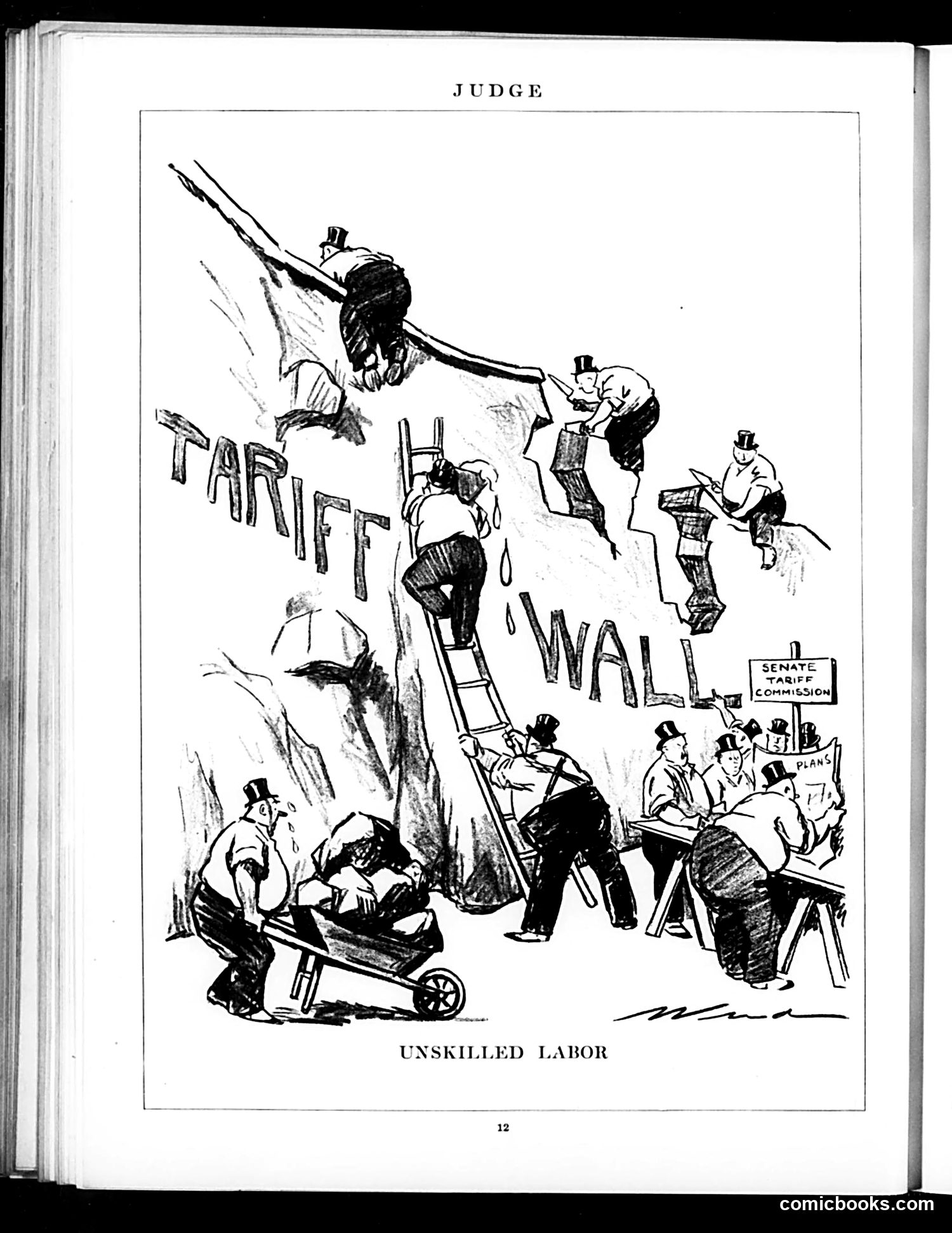
"Unskilled Labor" - Political Cartoon Analysis This Judge cartoon satirizes the "Tariff Wall," a major political issue of the era. The towering wall labeled "TARIFF WALL" is being constructed by workers climbing ladders while a large eagle (representing America or American interests) presides overhead. The cartoon critiques how tariff policy affects unskilled labor. Workers struggle to build/maintain this economic structure, while at ground level, officials consult "Senate Tariff Commission" plans. The satire suggests that tariffs—protective trade barriers championed by politicians—burden ordinary working people who must do the difficult labor, while benefiting those at the top who design such policies. The cartoon presents tariffs as a costly structure literally built on the backs of struggling workers.
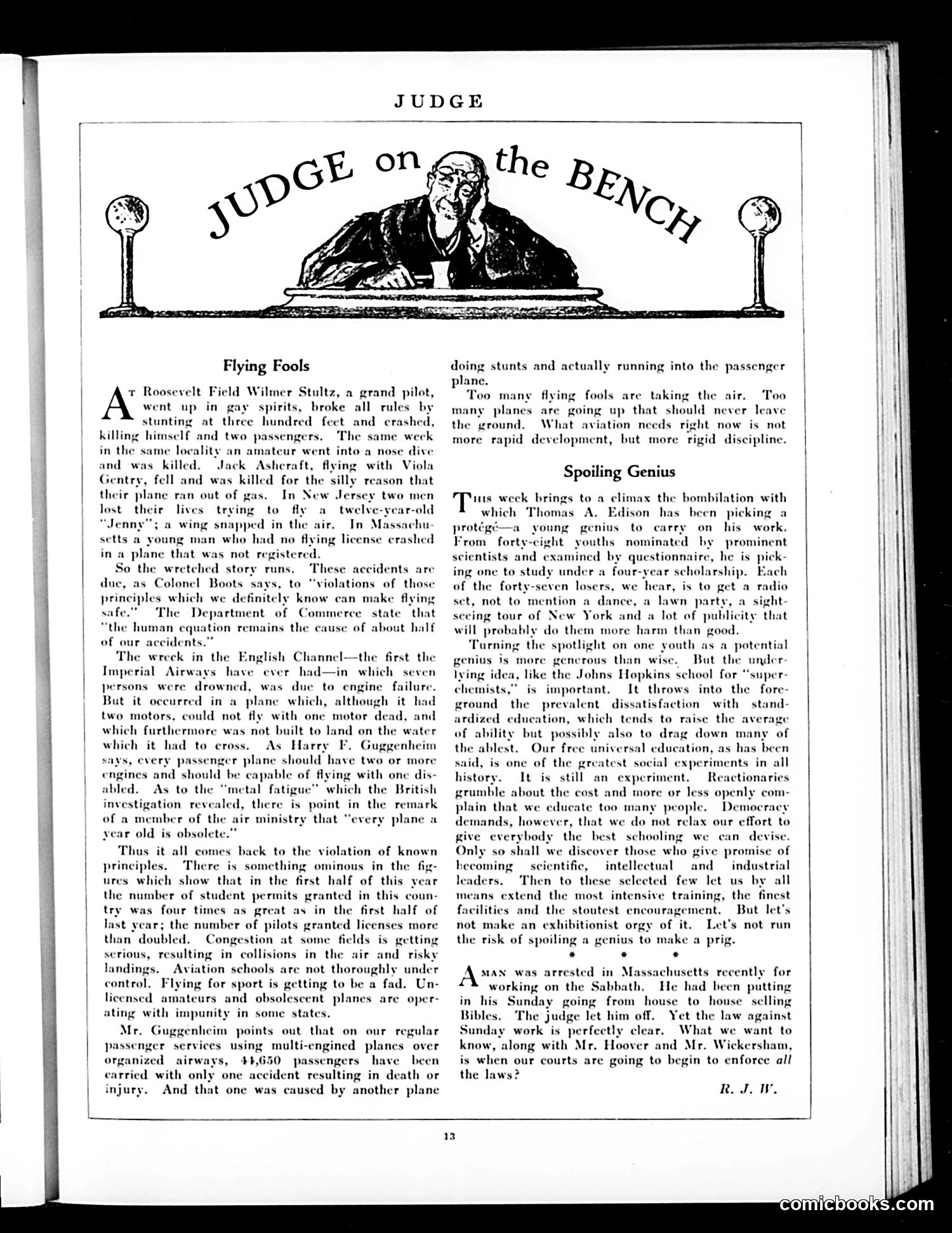
"Judge" Magazine Page Analysis This page from *Judge* magazine critiques two contemporary issues through its "Judge on the Bench" editorial column. "Flying Fools" attacks reckless aviation practices. The piece catalogs recent pilot deaths—including Wilmer Stultz and others—caused by rule-breaking stunts, inadequate training, and unsafe planes. It argues that rapid growth in pilot licensing (four times more student permits than the previous year) has created dangerous congestion at airfields, with unlicensed amateurs operating uncontrolled aircraft. The satire targets not innovation itself but lack of discipline: while commercial airlines maintain excellent safety records, unregulated sport flying and obsolete aircraft endanger lives. "Spoiling Genius" praises Thomas Edison's initiative to mentor a young scientific prodigy selected from nominees. However, it warns that singling out one youth as a "potential genius" is patronizing rather than wise—though the underlying idea of identifying exceptional talent challenges standardized education's tendency to level down the most able students. Both pieces reflect 1920s anxieties: aviation's rapid expansion outpacing safety infrastructure, and tensions between democratic mass education and elitist talent cultivation.
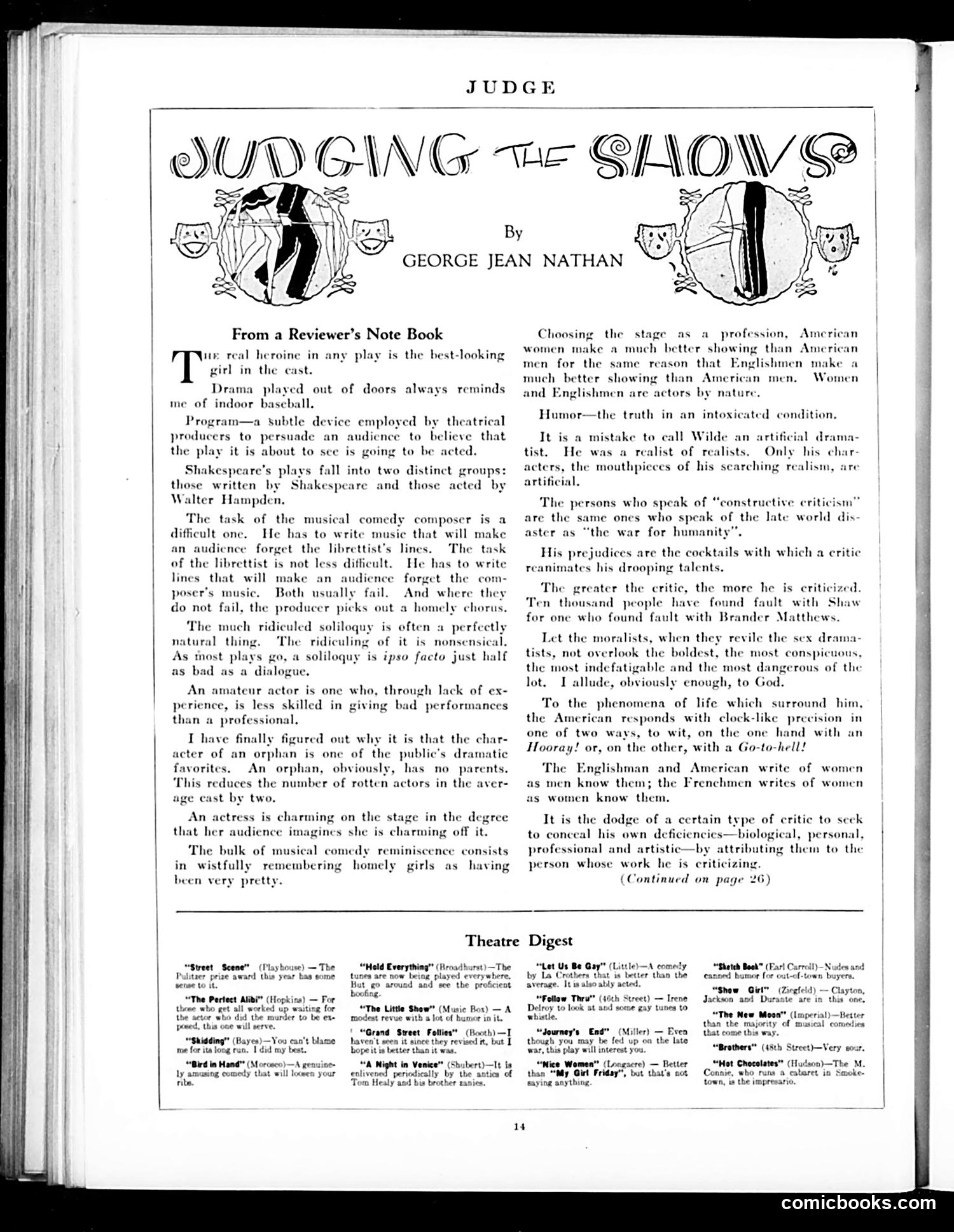
Analysis of "Judging the Shows" by George Jean Nathan This page is primarily theater criticism and commentary, not a political cartoon. The main illustration shows theatrical masks and a silhouette of a performer, typical Judge magazine decoration. George Jean Nathan's "From a Reviewer's Note Book" offers satirical observations about theater, actors, and critics. Key targets include: - Walter Hampden: A contemporary stage actor mocked for his interpretations of Shakespeare - Oscar Wilde: Critiqued as supposedly "artificial" (Nathan argues he was actually a realist) - Brander Matthews: A famous drama critic whom Nathan contrasts with George Bernard Shaw to mock critical reception - Theater conventions: Soliloquies, orphan characters, musical comedies, and amateur acting are all subjects of wry commentary The satire critiques both theatrical artificiality and critical pretension. Nathan ridicules critics who hide their own inadequacies through "constructive criticism" while praising greater figures like Shaw receives more criticism proportionally because of his prominence. The "Theatre Digest" section lists current Broadway productions with brief, often dismissive reviews—standard Judge content from this era.
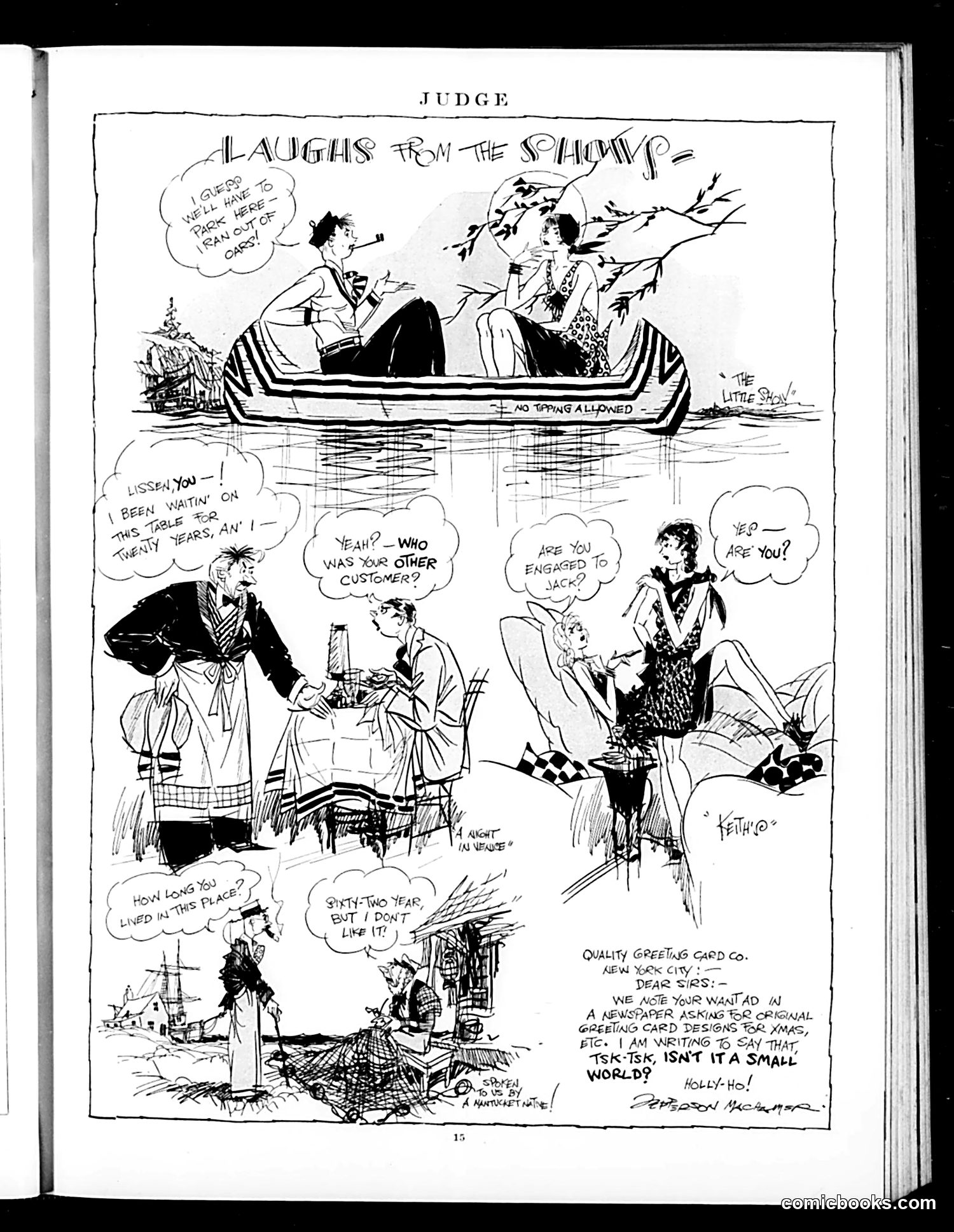
"Laughs from the Swamp" - Judge Cartoon Analysis This single-panel cartoon satirizes the greeting card industry's commercialization of romance and relationships. The top scene shows a couple in a gondola, establishing a supposedly romantic setting. Below, various vignettes depict women interrogating men about their romantic commitments—"Who was your other customer?" "Are you engaged to Jack?"—suggesting that men are industrially "servicing" multiple romantic interests. The letter at bottom completes the joke: a greeting card company received a newspaper want-ad requesting original Christmas card designs, then discovered the same ad was placed by competitors. The punchline mocks how mass-produced, commercialized sentimentality has made romance transactional and interchangeable—genuine emotion reduced to a commodity where the same "product" (romantic attention or greeting cards) is distributed to multiple customers.
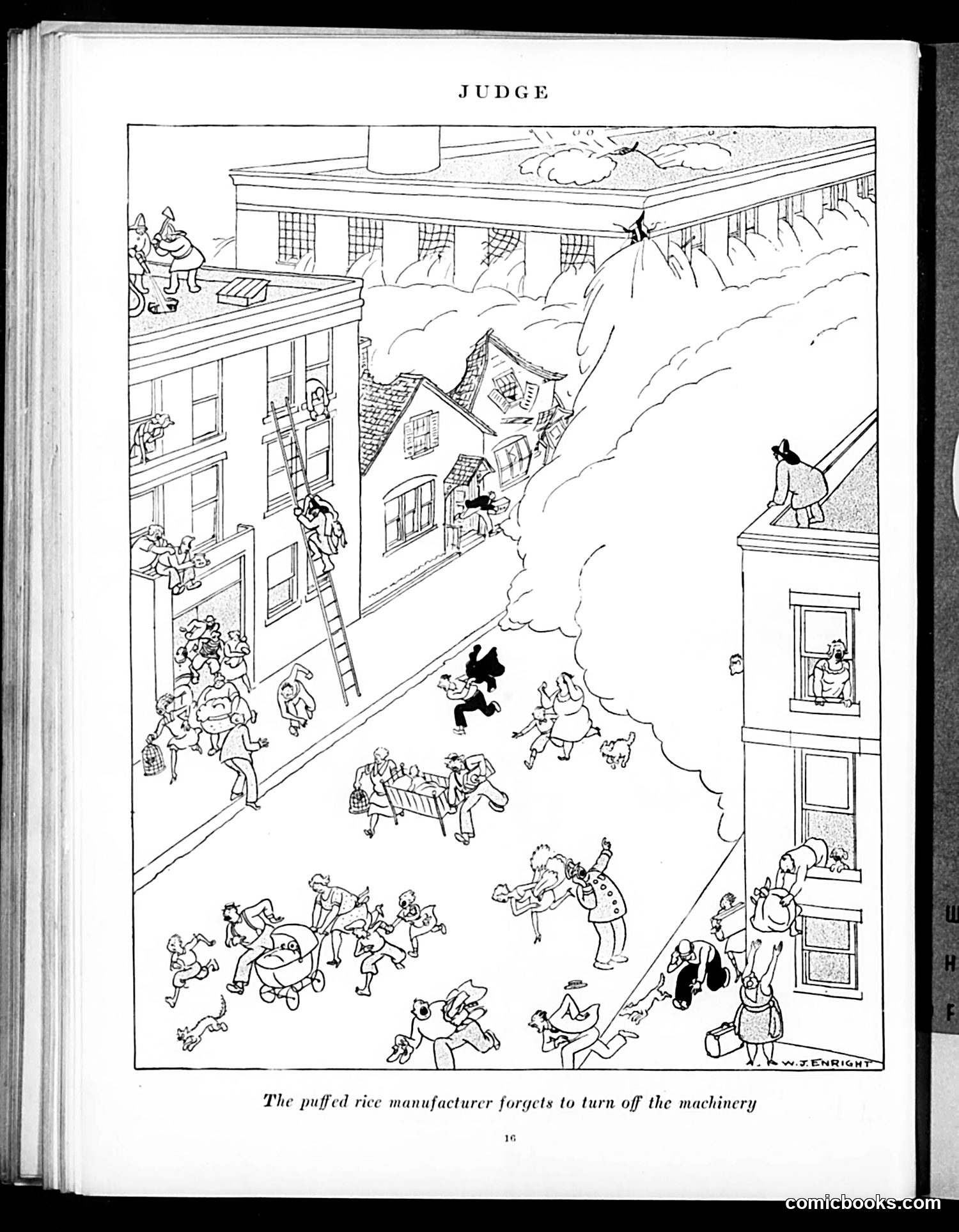
"The Puffed Rice Manufacturer Forgets to Turn Off the Machinery" This cartoon satirizes industrial negligence and its chaotic consequences. A factory owner (shown in black, fleeing center) has forgotten to shut down manufacturing equipment, causing massive clouds of puffed rice to engulf a city street. The joke plays on the literal meaning: puffed rice—a lightweight, voluminous product—expands dramatically when produced in excess, literally burying the urban landscape. Crowds of citizens scramble in confusion as buildings become partially buried in the white clouds. The satire criticizes industrial carelessness and the potential for business incompetence to create public disaster. It's a visual gag about how a seemingly harmless product becomes catastrophic when uncontrolled, likely mocking both factory owners' inattention and the era's rapid industrialization.
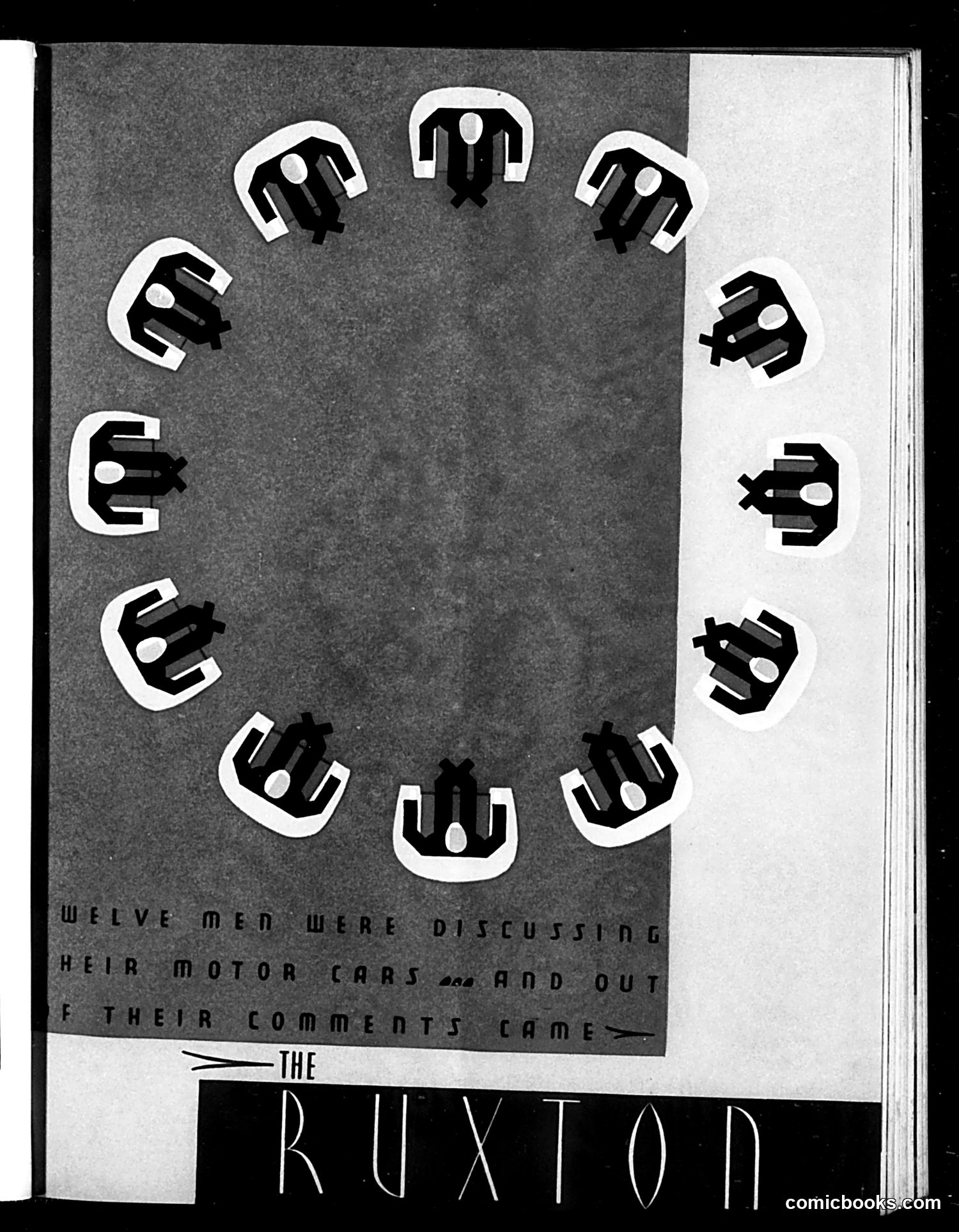
The Ruxton Advertisement This page is primarily an advertisement for the Ruxton automobile, not political satire. The image shows twelve stylized figures arranged in a circle around the Ruxton nameplate at the bottom. The text states: "TWELVE MEN WERE DISCUSSING THEIR MOTOR CARS ... AND OUT OF THEIR COMMENTS CAME —THE RUXTON." The illustrated figures appear to represent different types of men or perspectives (businessmen, workers, etc.) who collectively praised various car features. This was a common advertising trope of the era—using multiple "voices" or testimonials to suggest broad appeal and consensus approval. The Ruxton was a luxury car manufactured in the late 1920s-early 1930s, known for its innovative design. This ad leverages social proof through illustrated "discussion" to market the vehicle's supposed superiority.
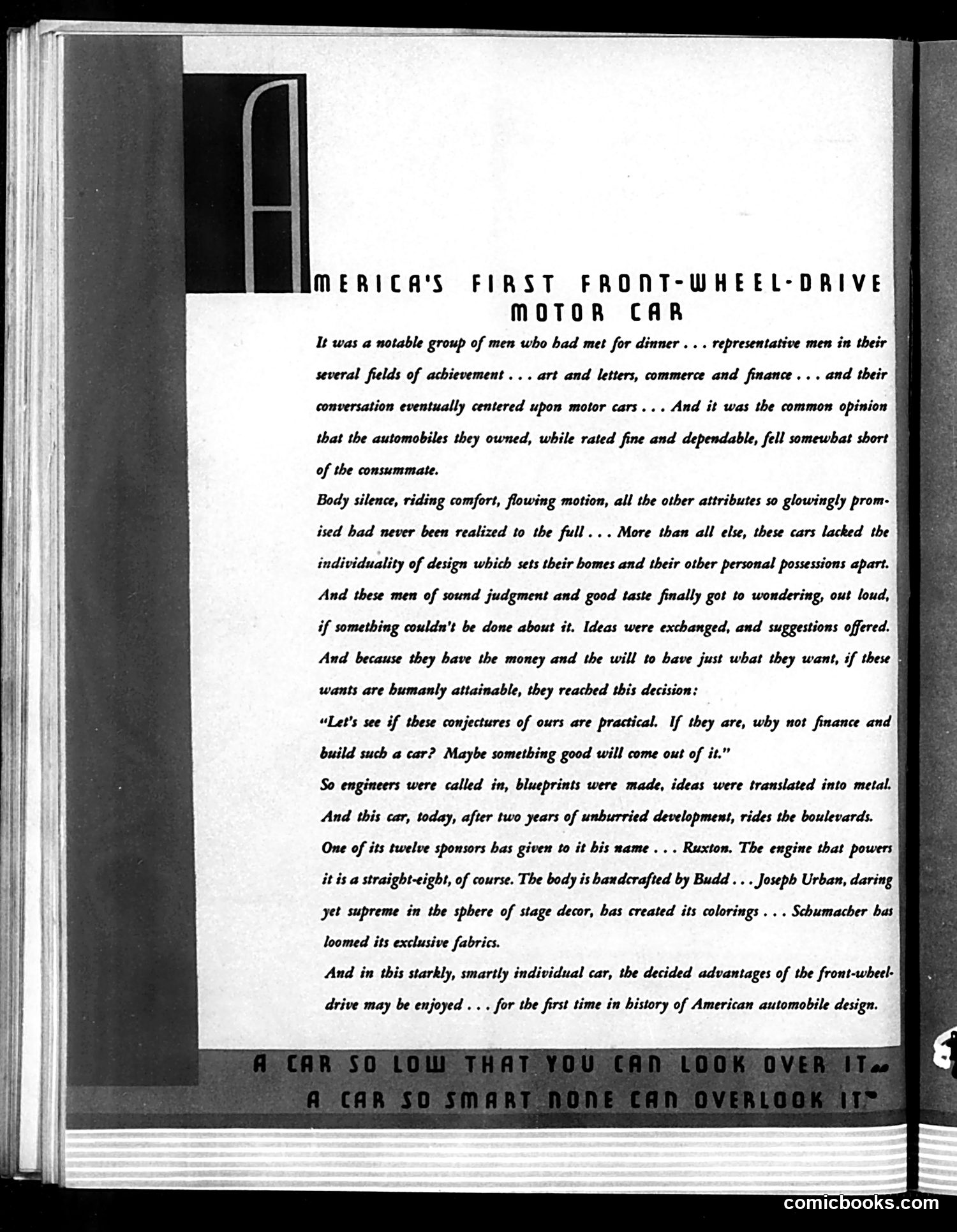
Analysis This is not a cartoon or satire — it's a premium advertisement for the Ruxton automobile, America's first front-wheel-drive car. The page presents a aspirational narrative targeting wealthy, cultured men. The text describes how a group of successful businessmen and professionals, frustrated with existing cars' lack of individuality and performance, decided to finance and build their own vehicle. The Ruxton resulted from this collaboration, featuring a straight-eight engine, custom bodywork by Budd, colors designed by Joseph Urban (a renowned stage designer), and exclusive Schumacher fabrics. The tagline emphasizes exclusivity: "A car so low that you can look over it / A car so smart none can overlook it." This represents aspirational marketing — positioning the car as a status symbol for discerning elites who demand both innovation (front-wheel-drive) and aesthetic sophistication. It's period advertising, not satire.
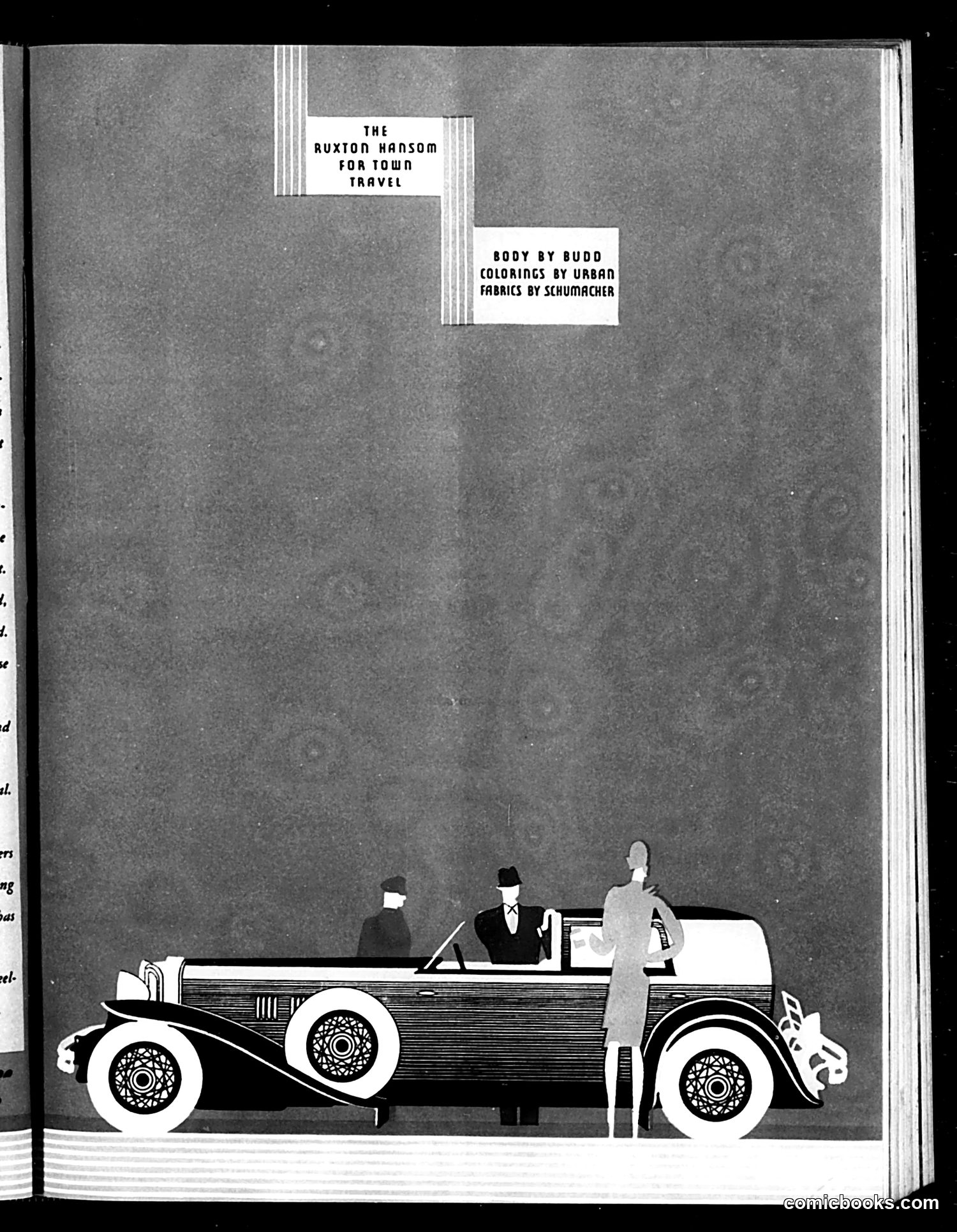
This appears to be a title or advertisement page for "The Ruxton Hansom for Town Travel," rather than a satirical cartoon. The image shows a stylized luxury automobile from what appears to be the 1920s-30s era, depicted in an Art Deco design style. Three figures are shown with the vehicle—a driver, a passenger in formal attire with a top hat, and a woman in fashionable dress standing beside the car. The text credits indicate this is professionally designed promotional material: the automobile body by Budd (a major car manufacturer), colorings by Urban, and fabrics by Schumacher (known for luxury textiles). Rather than political satire, this represents high-end automobile advertising targeting wealthy, fashionable consumers of the period.
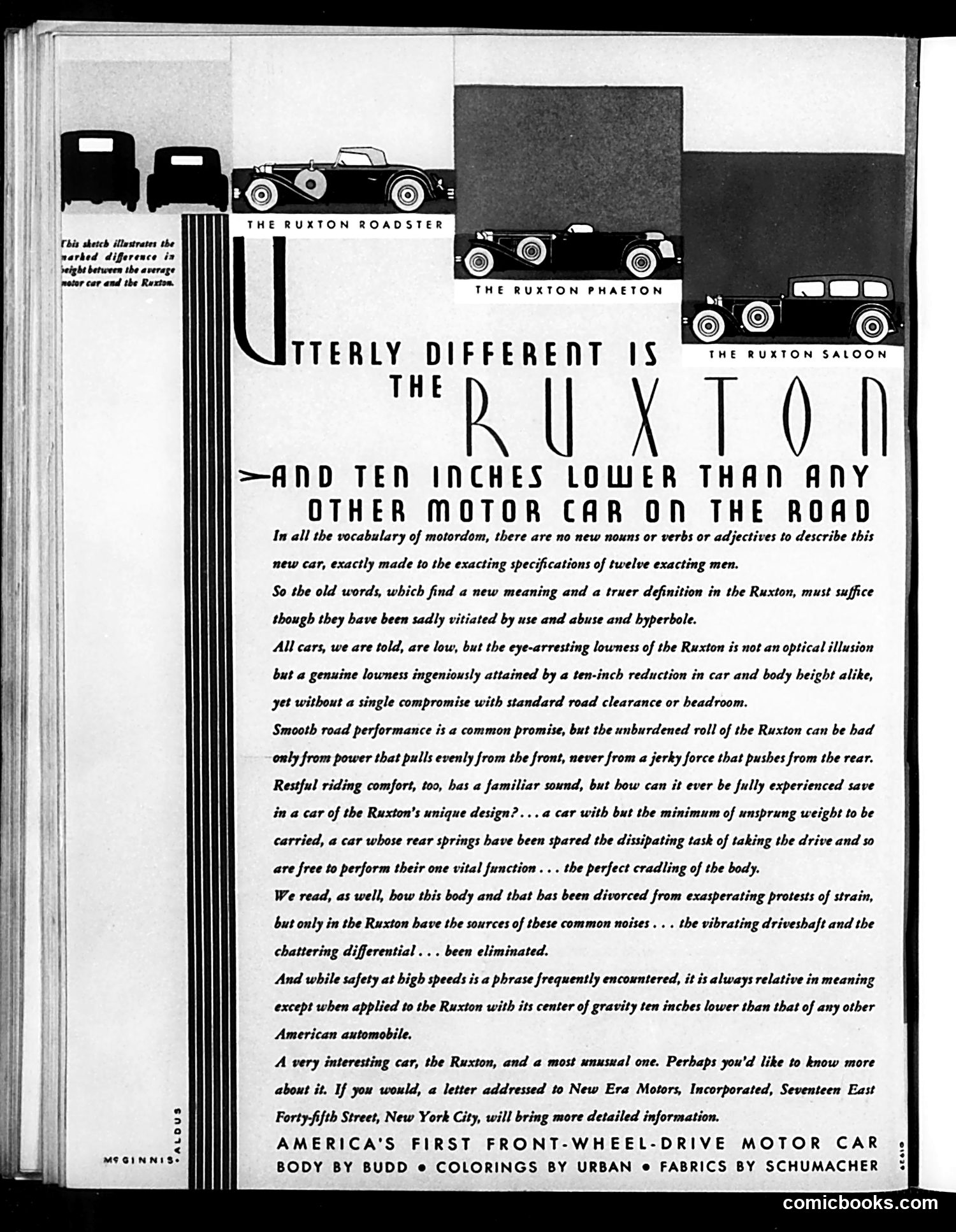
Analysis This is primarily a full-page automobile advertisement, not political satire. It promotes the Ruxton, America's first front-wheel-drive motor car, positioning it as radically different from competitors. The Visual Content: The left side shows silhouettes comparing the Ruxton's notably lower profile to standard automobiles. Three Ruxton models are illustrated (Roadster, Phaeton, Saloon). The Marketing Message: The advertisement emphasizes the Ruxton's ten-inch lower center of gravity as its revolutionary feature—not merely for aesthetics, but claimed to improve ride comfort, reduce vibration, enhance safety at high speeds, and eliminate mechanical noise from conventional rear-wheel-drive systems. Why It Matters: The verbose, almost satirical tone ("In all the vocabulary of motordom, there are no new nouns...") mocks how automakers typically oversell modest improvements. By self-aware exaggeration, the copywriter implicitly claims the Ruxton's lowness is genuinely *substantive*, not marketing hyperbole. This was a real but short-lived vehicle (1929-1932).
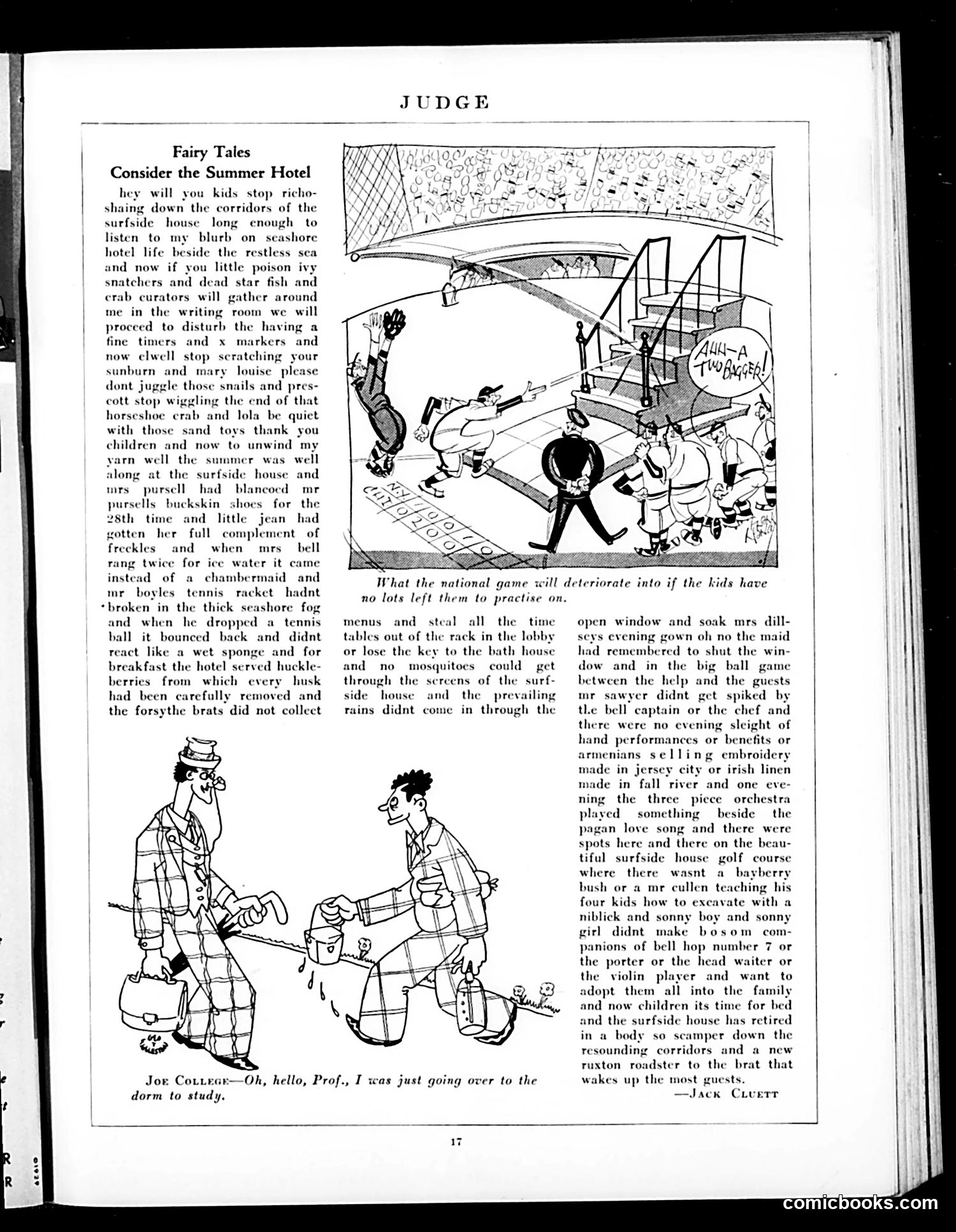
Understanding This Judge Magazine Page This page contains two satirical pieces mocking summer hotel life and children's behavior. "Consider the Summer Hotel" is a lengthy humorous monologue listing all the *ideal* (impossible) conditions at a seaside resort—well-behaved children, no mosquitoes, no vendor harassment, orchestras playing decent music. The joke: these perfect conditions never actually occur. It satirizes both the gap between hotel marketing promises and reality, and children's chaotic nature at vacation destinations. "Joe College" (bottom cartoon) shows a student claiming he's heading to his dorm to study—a transparent excuse likely used to visit elsewhere, probably to meet girls. It mocks college students' perpetual academic procrastination. The top cartoon illustrates the chaos described in the monologue: children running amok at a beach hotel, destroying property and causing mayhem. The final cartoon warns that if children lose outdoor playing spaces, baseball will devolve into indoor destruction—suggesting urban development was eliminating vacant lots where kids could play ball. Overall, the page satirizes American leisure culture and generational conflict between adults and undisciplined youth.
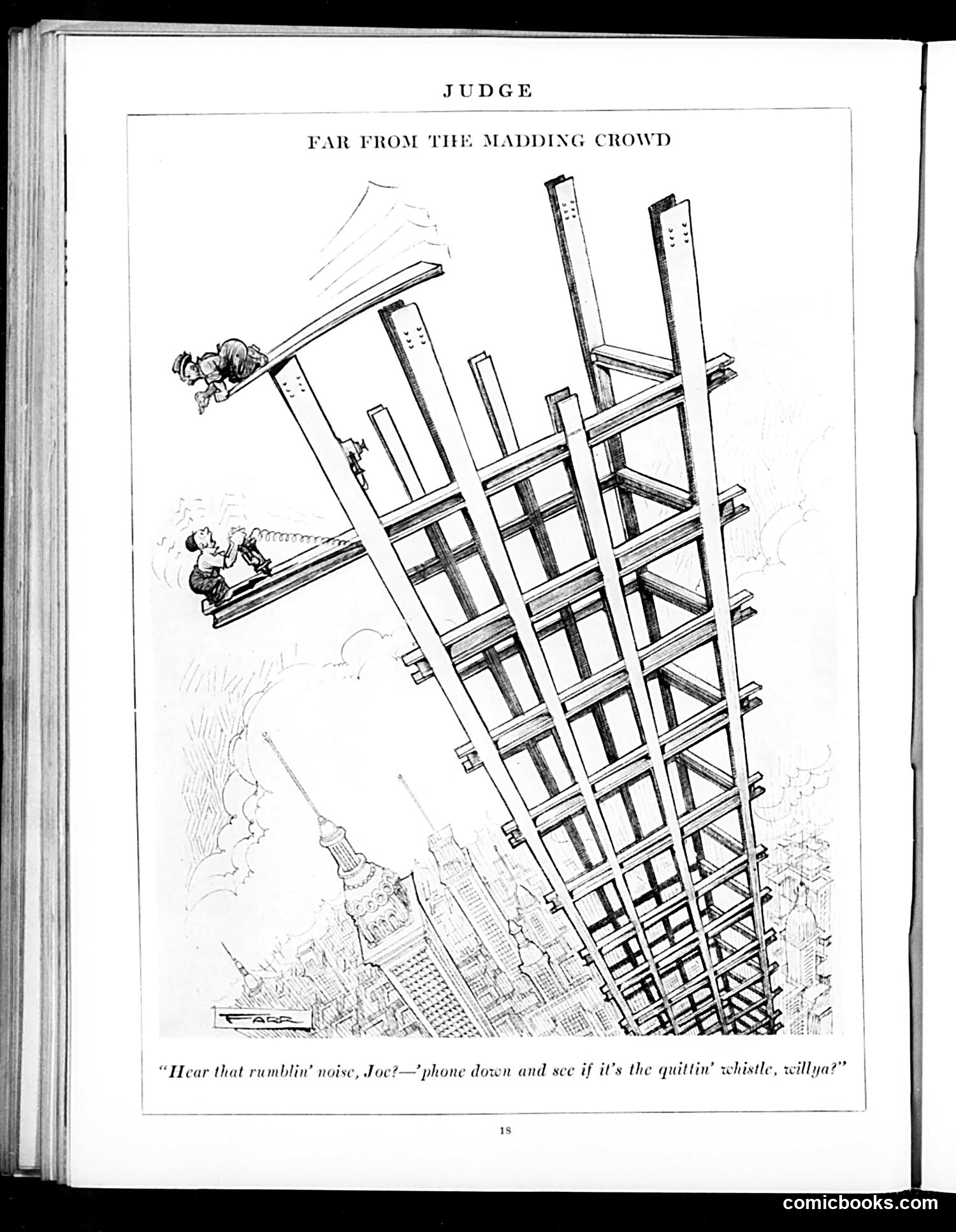
"Far From the Madding Crowd" This cartoon satirizes working-class characters avoiding industrial noise. Two men perch precariously on a steel framework of a tall building under construction, with the city skyline visible below. One asks the other to check if a rumbling sound is the factory whistle signaling quitting time—suggesting they're anxious to leave work. The title references Thomas Hardy's novel, inverting its meaning: rather than seeking peaceful escape from crowds, these workers are literally "far from the madding crowd" atop a dangerous structure, yet still mentally tethered to industrial labor and its sounds. The satire mocks working-class anxiety about factory schedules and the tedium of manual labor, particularly construction work in the urban industrial era.
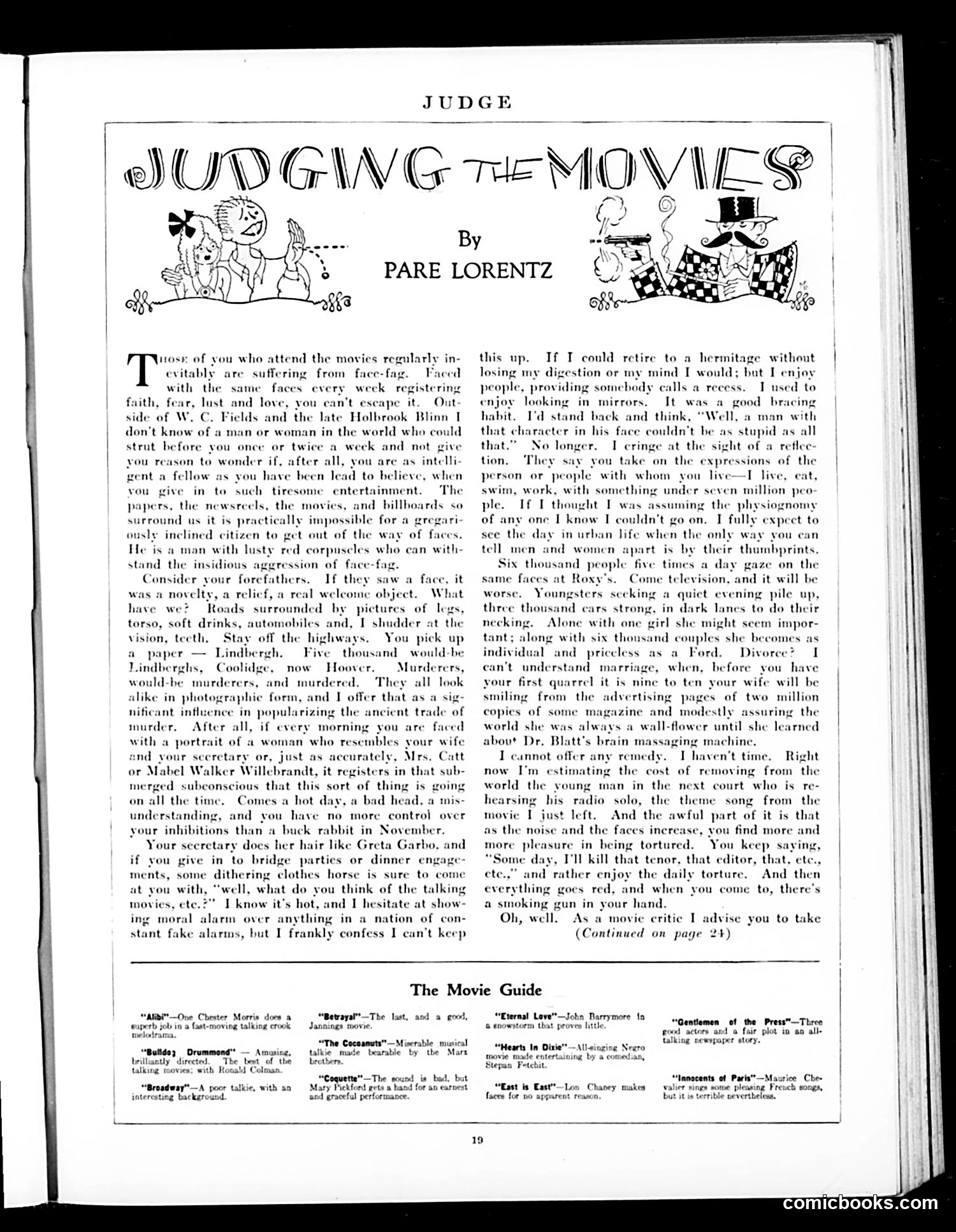
"Judging the Movies" by Pare Lorentz — Satire on Modern Face Fatigue This essay-cartoon critiques how movies and mass media have saturated American life with human faces, causing psychological exhaustion. Lorentz argues that constant exposure to celebrity photographs, newsreels, and advertising has made faces ubiquitous and meaningless—whereas ancestors found a single face novel and welcome. The satire targets several 1920s phenomena: the Lindbergh craze (mass idol worship), traffic congestion, and mass-produced entertainment. Lorentz warns that this "face-fag" erodes individual dignity; people become interchangeable (like Fords), and women are reduced to advertising props. He references W.C. Fields and Greta Garbo as inevitable reference points in popular culture. The piece concludes darkly: constant exposure to faces breeds moral numbness and violent impulses. The final complaint about a neighbor's radio rehearsal suggests modern annoyances infringe on privacy itself. It's fundamentally conservative social criticism about mass culture's dehumanizing effects.
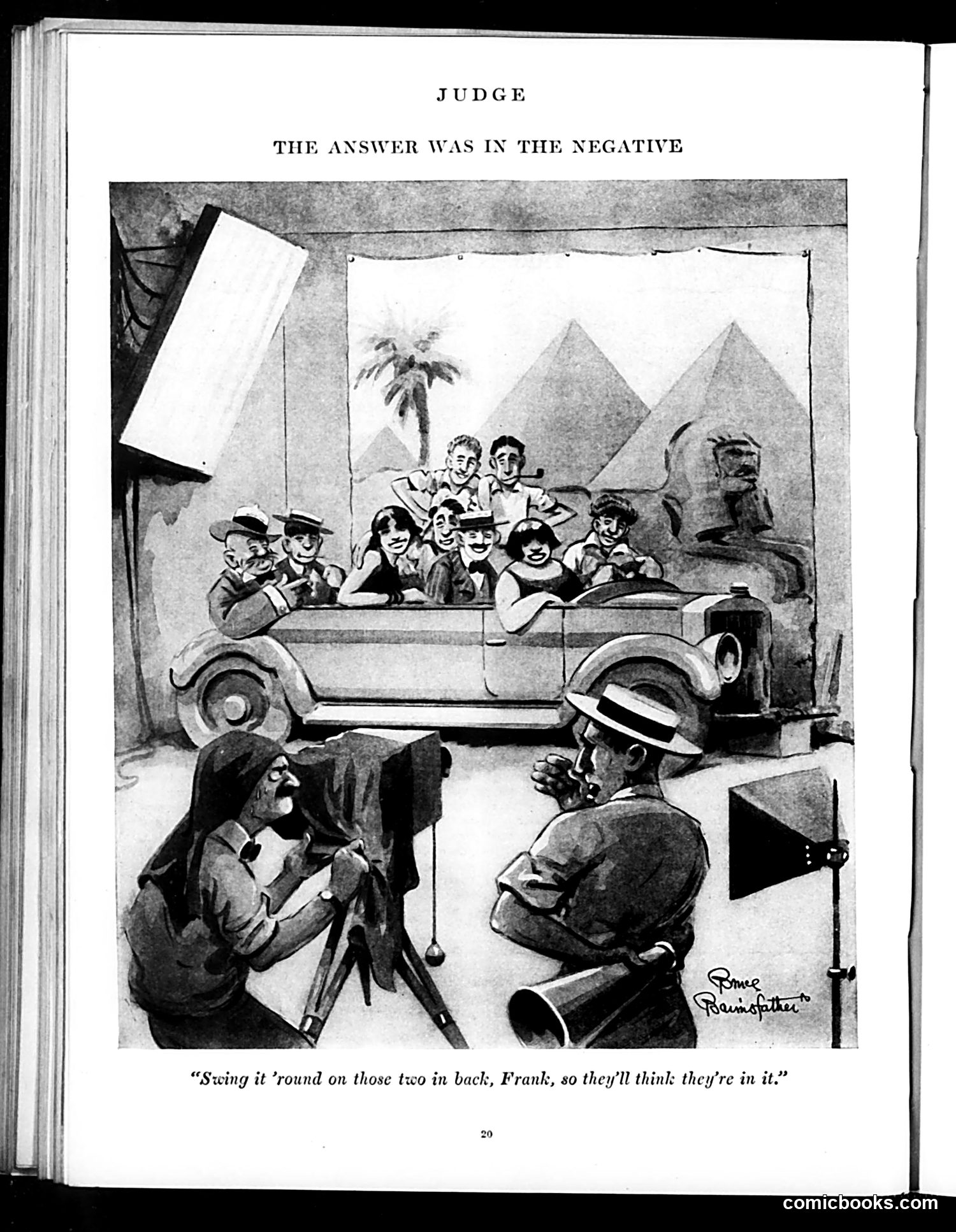
Analysis This cartoon satirizes film production, likely from the 1920s-30s based on the style. Two cameramen are filming a scene with children in an open-air car against Egyptian pyramid backdrops—suggesting an exotic or historical picture being shot. The caption reveals the joke: one cameraman tells the other to "swing it 'round on those two in back, Frank, so they'll think they're in it." This mocks the illusion of filmmaking—those two children aren't actually in the shot being filmed, but the cameraman will position the camera to make them *believe* they're part of the scene. The page title, "The Answer Was in the Negative," is a darkly clever pun: in film, the "negative" is the actual film stock. The "negative answer" is that the children aren't truly being filmed, despite appearances.
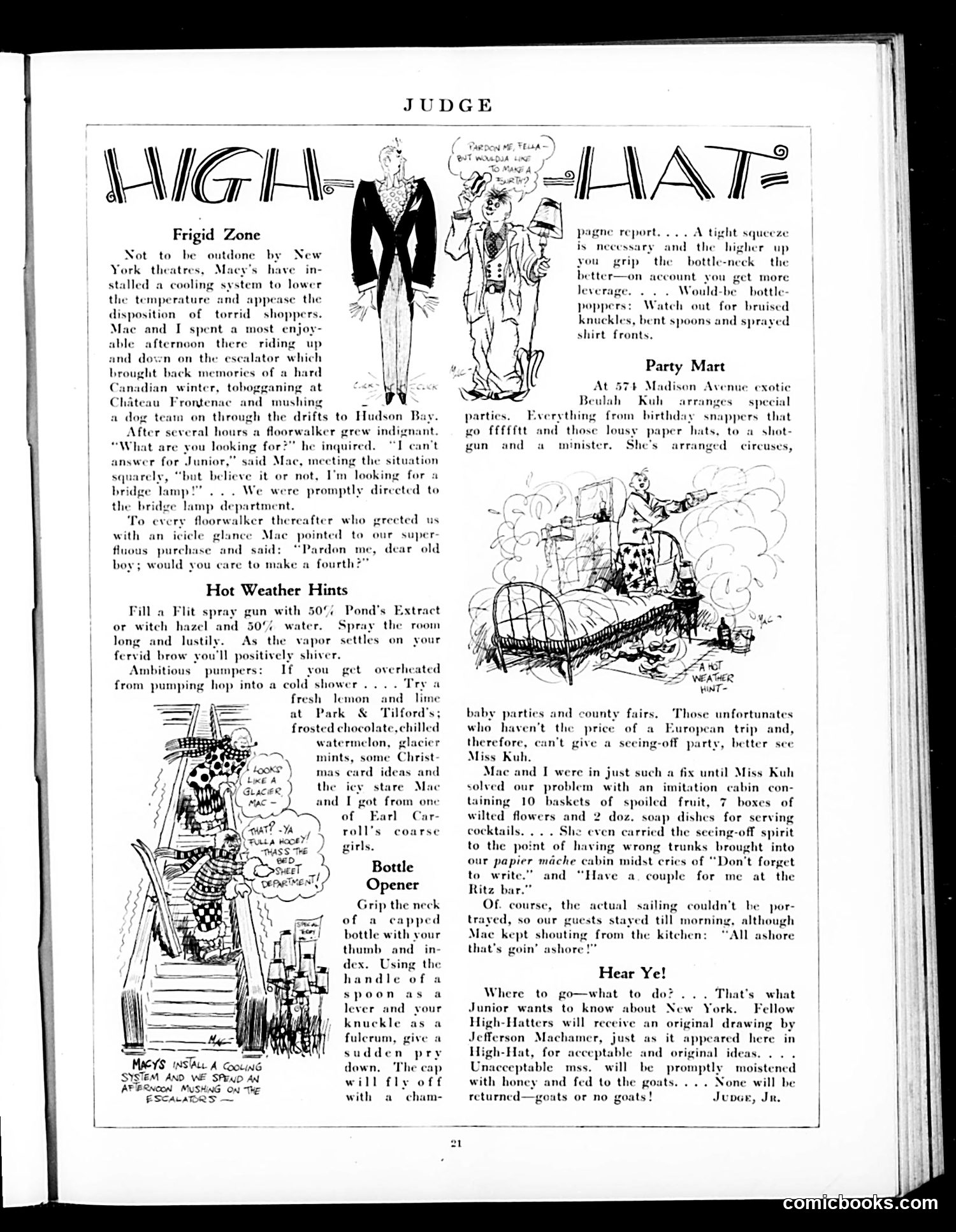
Judge Magazine Page Analysis This page from Judge magazine contains humorous lifestyle advice and social commentary aimed at wealthy New Yorkers circa the 1920s-30s. "Frigid Zone" mocks department stores' new air-conditioning systems—specifically Macy's—by depicting a couple treating the escalators like a winter vacation, reminiscing about Canadian sledding. The joke targets the novelty and excess of cooling technology for mere shopping comfort. "Hot Weather Hints" offers satirical summer survival tips for the affluent: Flit spray, witch hazel, cold showers, expensive treats from Park & Tilford's, and references to "Earl Carroll's coarse girls" (likely alluding to Earl Carroll's Vanities, a famous Broadway revue). "Party Mart" describes Beulah Kuh's party-planning service on Madison Avenue, offering elaborate mock events (fake cabin with spoiled fruit, wilted flowers) for those unable to afford actual European trips—satirizing wealthy New Yorkers' desperate social climbing. "Bottle Opener" provides absurdly technical instructions for opening champagne, reflecting Prohibition-era humor about illicit drinking. Overall, the page satirizes upper-class Manhattan excess, conspicuous consumption, and the anxieties of maintaining social status.
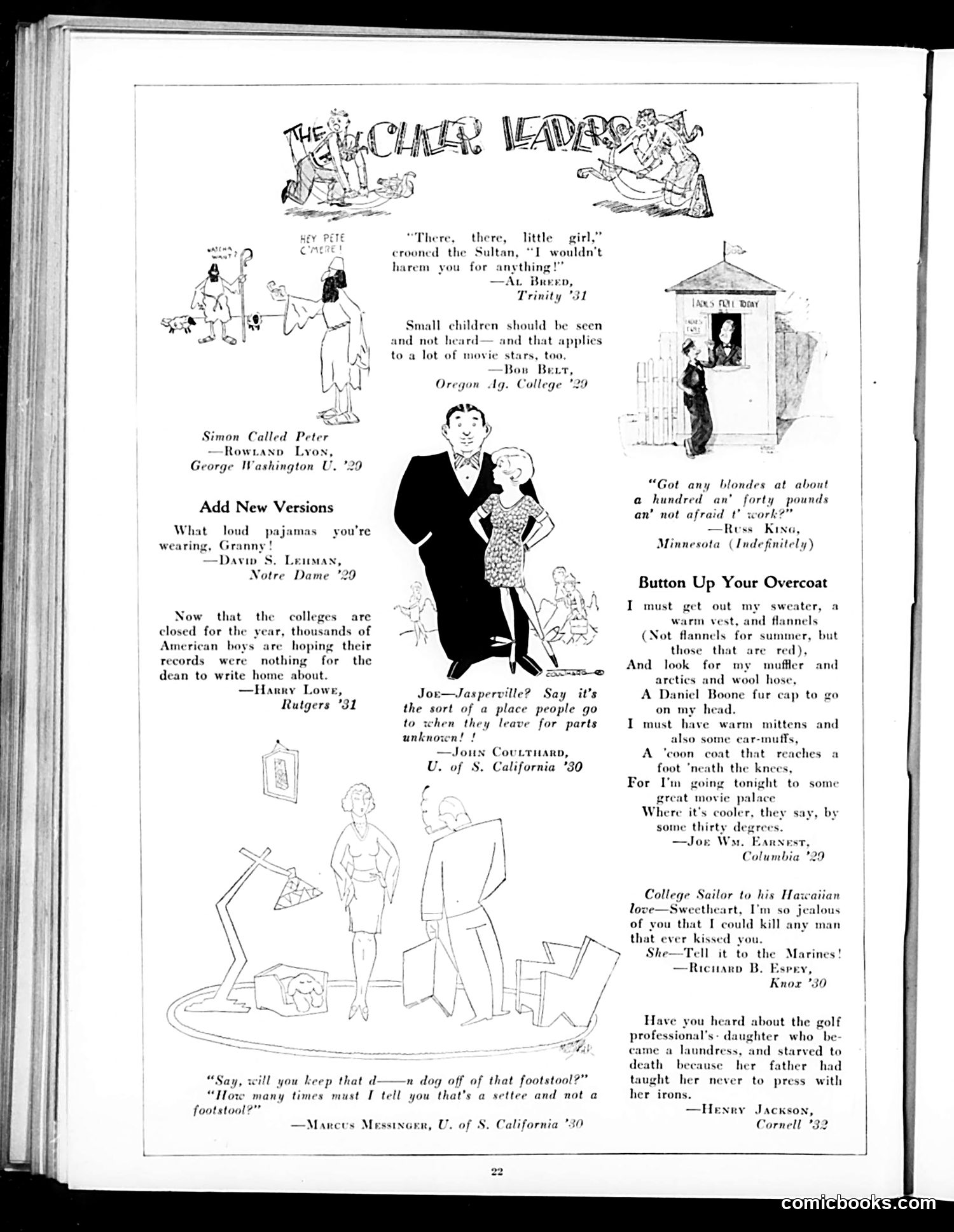
"The Urchin Leaders" Page Analysis This is a humor/joke compilation page from Judge magazine featuring college-student-submitted witticisms and observations, typical of 1920s-early 1930s collegiate humor. The page contains no political cartoons — instead it's structured around illustrated humorous scenarios with accompanying jokes attributed to various colleges (Notre Dame, Rutgers, Cornell, etc.). The jokes reflect period social contexts: references to movie stars and their scandals ("small children should be seen and not heard"), college boys hoping their poor academic records stay hidden, clothing for unheated movie theaters ("button up your overcoat"), racial humor (the "d——n dog" pun playing on "settee" vs. "footstool"), and casual misogyny (the "blondes...not afraid t' work" crack). The humor is generically collegiate — observations about college life, romantic jealousy, and social propriety — rather than satirizing specific political figures or events. The cartoons are simple illustrations supporting these lightweight gags rather than pointed satire.
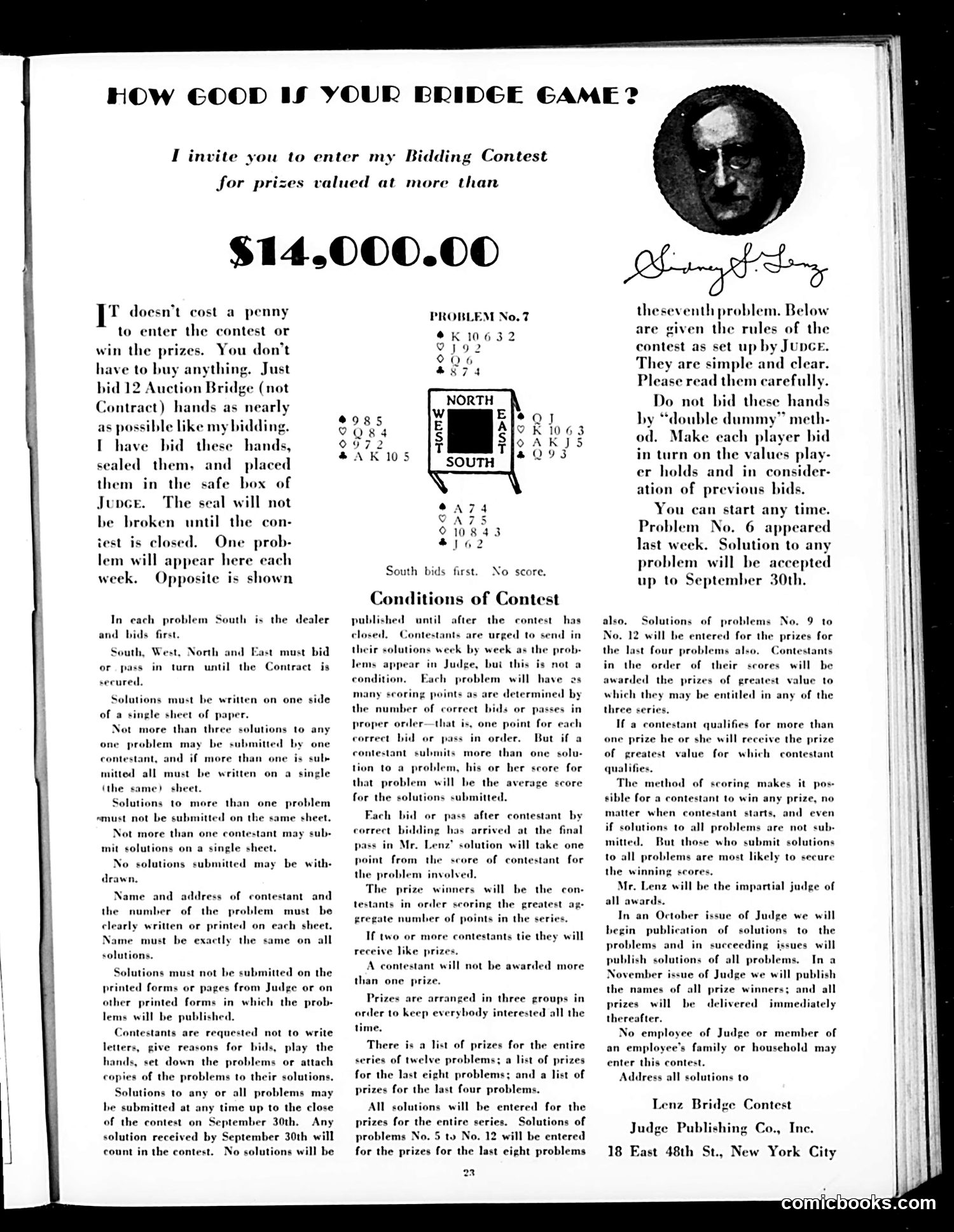
Judge Magazine Bridge Contest (circa 1930s) This page announces a bridge-bidding contest sponsored by Judge magazine, with over $14,000 in prizes. The contest invites readers to bid 12 auction bridge hands competitively against the magazine's editor (whose photograph appears at top right). The satire is subtle but present: the contest mocks the era's obsession with contract bridge as a fashionable parlor game among the wealthy. By offering such substantial prizes for what amounts to armchair competition requiring no financial entry, Judge satirizes both the gambling culture surrounding bridge and Americans' appetite for "get something for nothing" contests. The detailed rules emphasize that solutions must follow proper bidding sequence ("each player bid in turn") rather than "double dummy" play—a jab at cheaters or those playing with perfect information. This reflects period concerns about bridge's intellectual legitimacy versus its reputation as mere gambling entertainment.
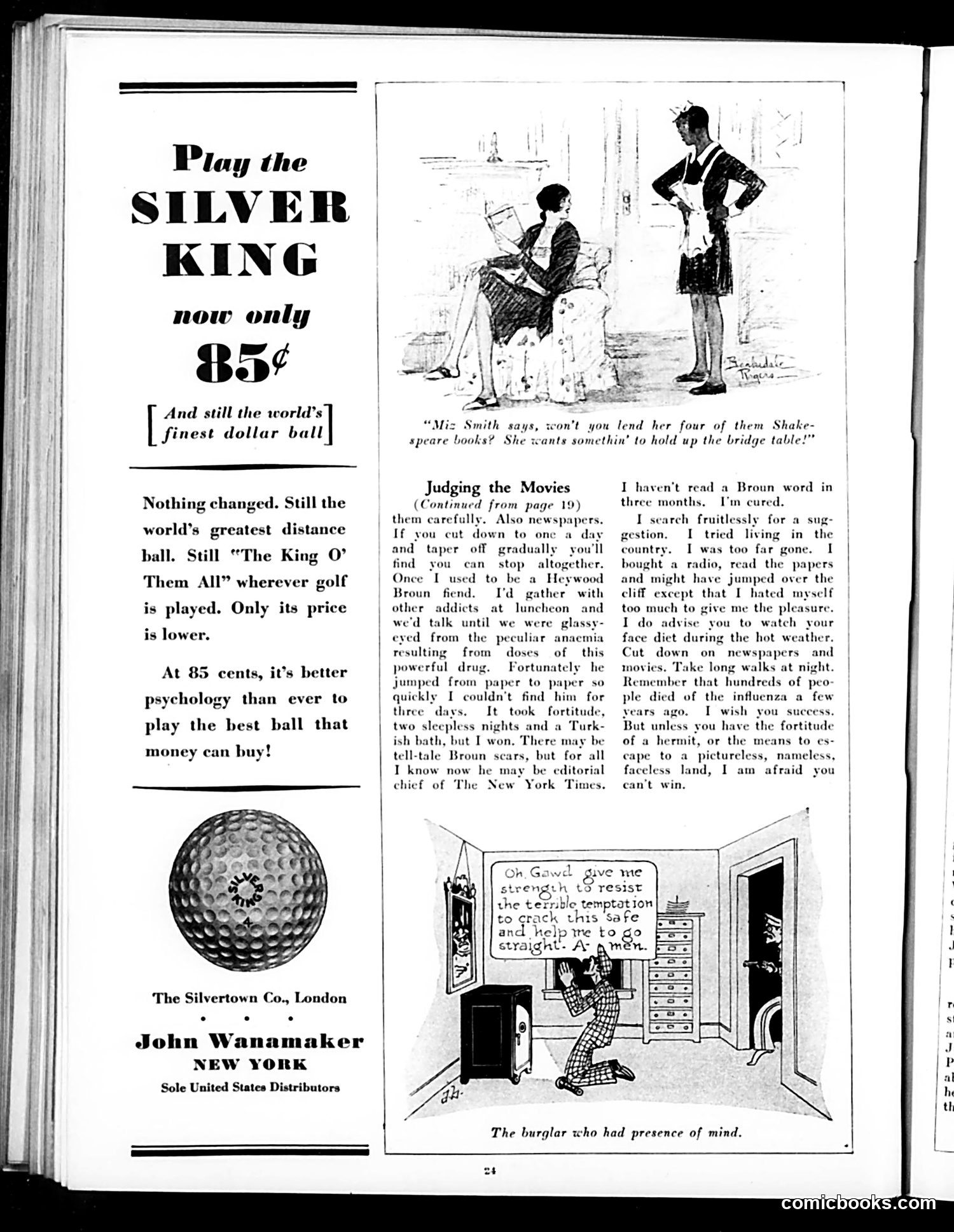
Analysis of This Judge Magazine Page This page contains primarily advertising (left side) alongside editorial/humor content (right side). The Silver King golf ball ad promotes a price reduction to 85 cents, emphasizing it remains "the world's greatest distance ball" despite the lower cost—a Depression-era value pitch. The main editorial content is "Judging the Movies" (continued from page 19), a humorously written advice column where the author compares addiction to reading newspaper columnist Heywood Broun to a drug dependency. This is satire on intellectual/literary fandom: the author describes compulsively following Broun's column across publications, eventually "quitting" through willpower and country living. The joke mocks both obsessive newspaper reading and the cult-like following certain columnists attracted. The cartoon at bottom—"The burglar who had presence of mind"—shows a thief praying at a safe, demonstrating ironic moral restraint during criminal activity. The top illustration depicts a bridge game conversation about Shakespeare books, likely illustrating contemporary leisure culture.
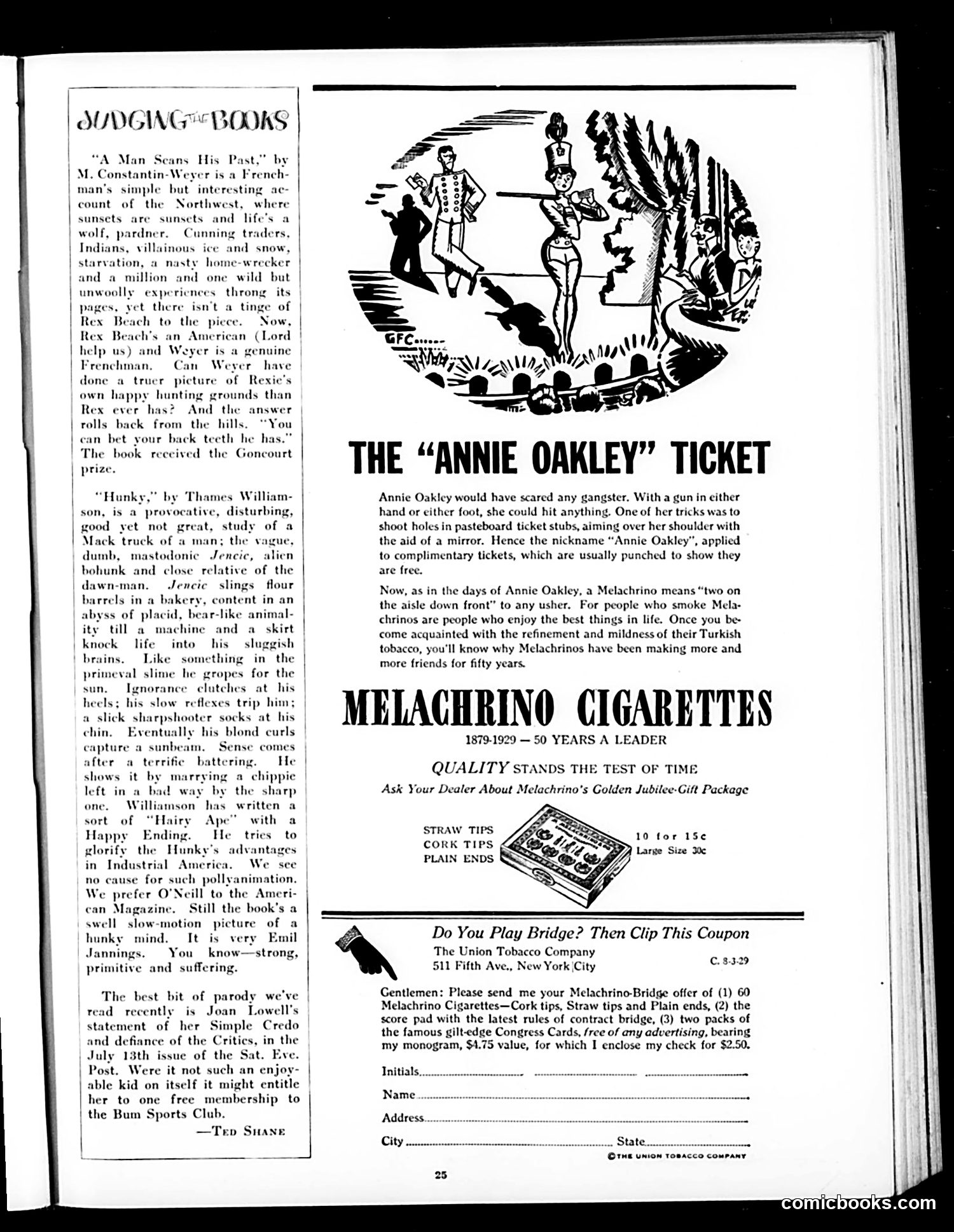
Explanation for Modern Readers This page is primarily advertising, not political satire. The left column contains book reviews by Ted Shane, discussing novels about frontier life and working-class characters. The bulk of the page features a Melachrino cigarettes ad built around the "Annie Oakley" ticket concept. The ad explains that complimentary theater tickets are nicknamed "Annie Oakley tickets" because the famous sharpshooter could shoot holes in pasteboard stubs. The cigarette company cleverly appropriates this reference, suggesting Melachrino smokers receive "two on the aisle down front"—premium treatment for discriminating people. The ad includes a mail-in coupon offering bridge score pads and personalized Congress Cards as an incentive to buy cigarettes, reflecting Depression-era marketing tactics. Historical note: This reflects 1920s-30s advertising before tobacco health warnings; Annie Oakley was widely recognized for her sharpshooting trick shots.
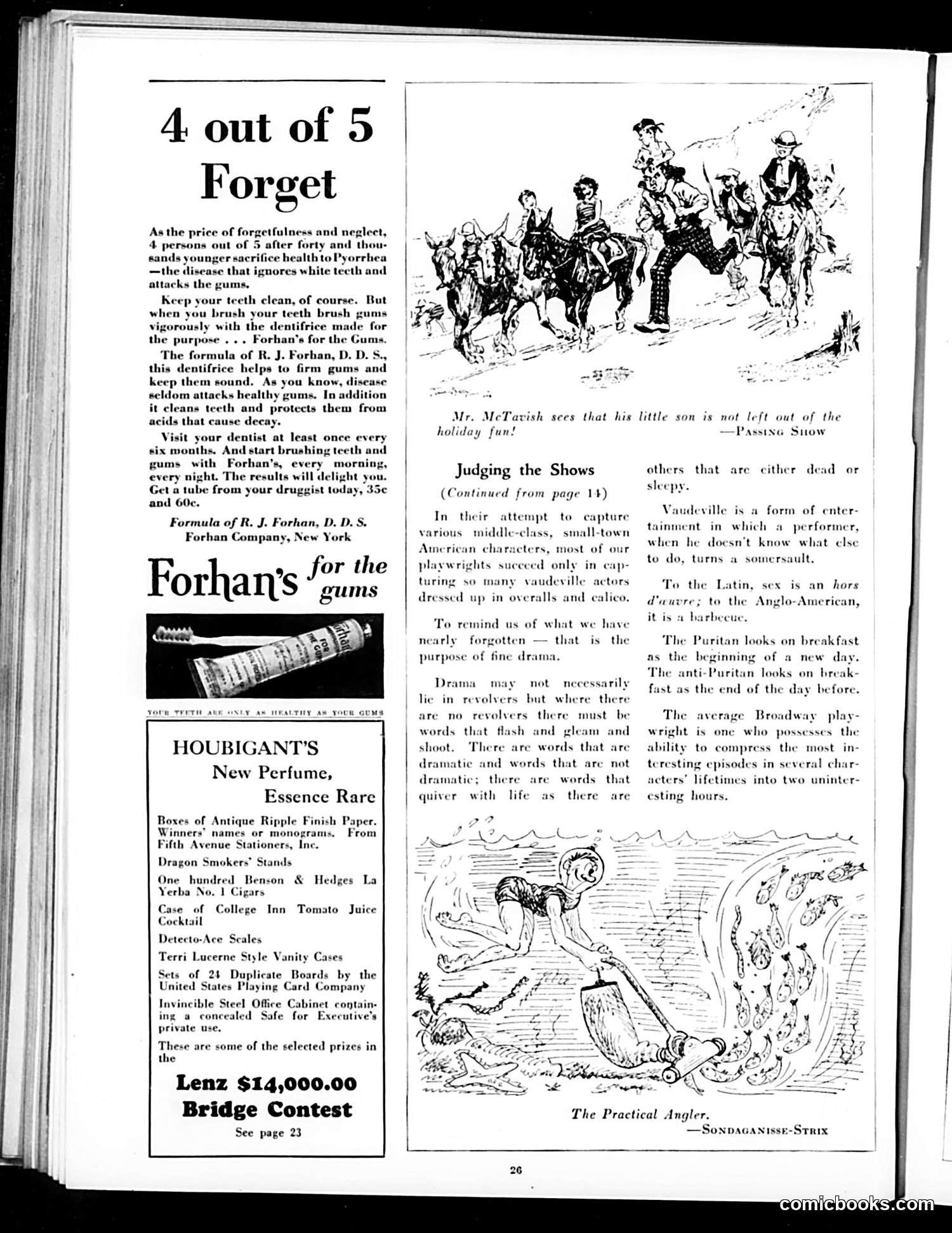
Analysis of Judge Magazine Page This page is primarily advertising with entertainment content, not political satire. The main cartoon shows a Western scene (titled "Mr. McTavish sees that his little son is not left out of the holiday fun!") depicting cowboys on horseback—likely illustrating wholesome family entertainment or a theatrical production being reviewed. The substantial text section "Judging the Shows" offers theatrical criticism through humorous observations about American drama and vaudeville. It contains sardonic definitions: vaudeville performers "turn somersaults" when lost; Puritans view breakfast as day's beginning while anti-Puritans see it as the previous day's end; Broadway playwrights compress interesting character arcs into tedious performances. The page is dominated by product advertisements (Forhan's toothpaste, Houbigant perfume, and a bridge contest offering $14,000 in prizes), which was standard Judge magazine content. The theatrical commentary appears designed to entertain readers between ads rather than deliver political messaging.
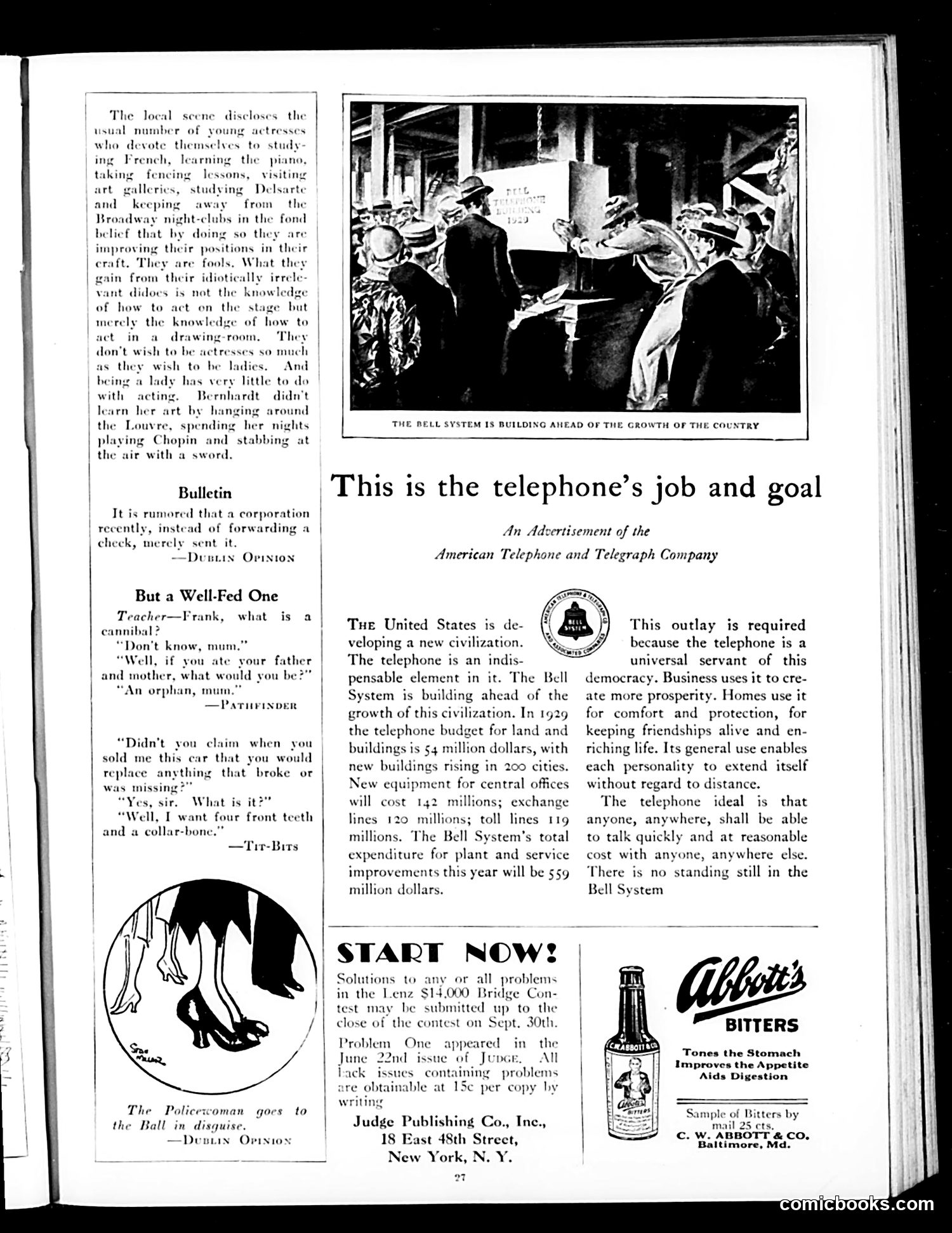
Analysis of Judge Magazine Page This page contains three distinct elements: Main Content: Satirical commentary on aspiring actresses who pursue cultural refinement (French lessons, fencing, gallery visits) believing it will improve their craft, when actually they just want to be "ladies" rather than serious performers. The piece mocks their pretension, contrasting them with Sarah Bernhardt, who didn't learn acting through salon activities. Small Cartoons/Humor Snippets: Several brief jokes, including one about a "policewoman" going "to the ball in disguise"—likely satirizing early female police officers or suffragette-era women in unconventional roles. Advertisement: A major Bell Telephone System advertisement emphasizing infrastructure investment ($559 million in 1929) and positioning the telephone as essential to American democracy and prosperity. This is corporate propaganda dressed as civic messaging. The page reflects 1920s-30s attitudes: skepticism toward women's artistic ambitions, social commentary on class pretension, and corporate boosterism about technological progress.
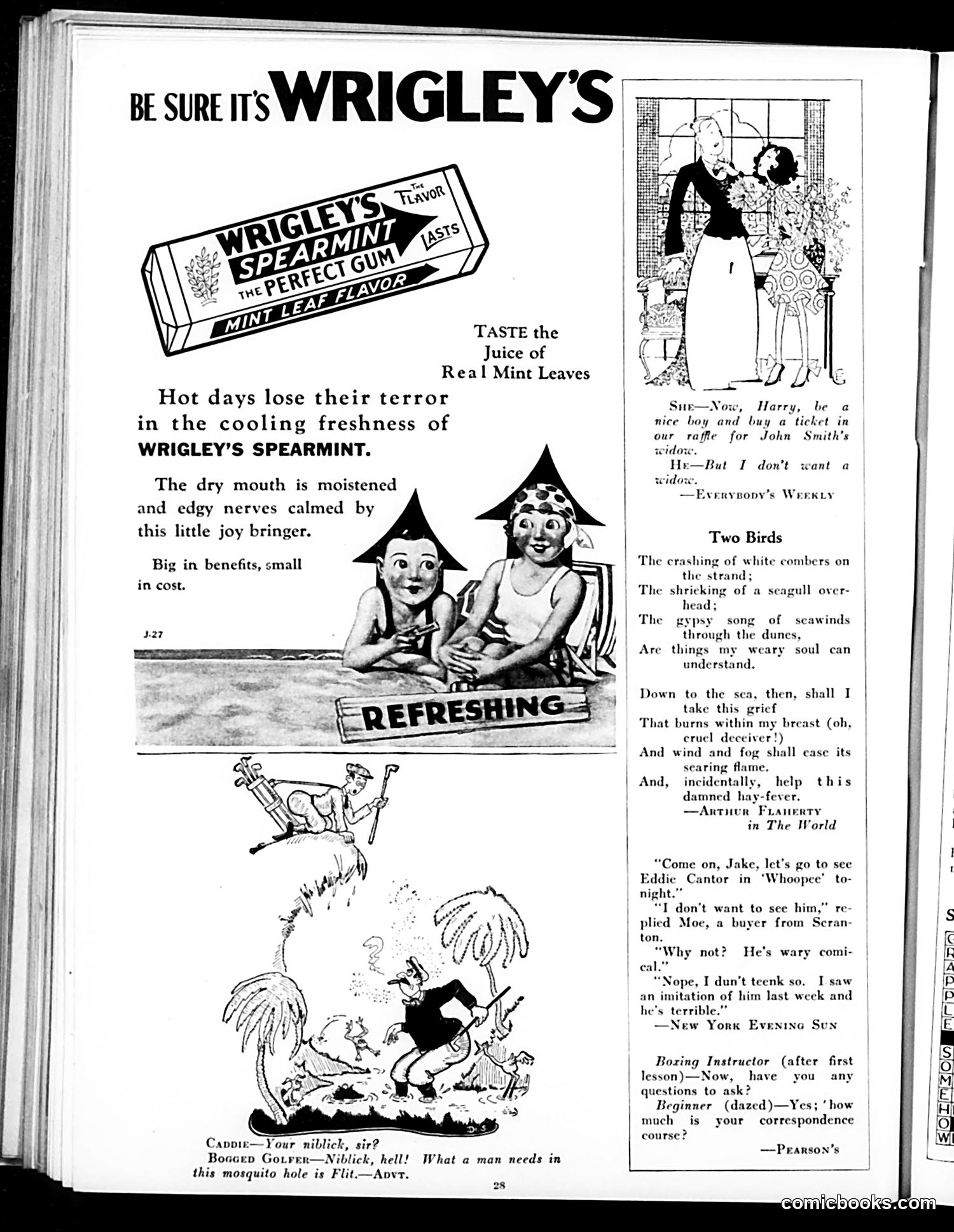
Analysis of Judge Magazine Page This page is primarily a Wrigley's Spearmint gum advertisement with several unrelated short jokes and comic sketches. The main ad depicts two children at a beach labeled "REFRESHING," promoting the gum's cooling properties for hot days. Below is a small cartoon showing a man swatting mosquitoes, with a punchline about "Flit" (a competing insecticide brand)—mild satirical advertising competition. The right side contains scattered humor pieces: a sentimental poem "Two Birds" about seaside melancholy; dialogue jokes about raffles, Eddie Cantor (a popular 1920s-30s comedian), and a boxing instructor. These are typical filler content for Judge magazine. The satirical point: The juxtaposition itself—sentimental poetry about existential despair appearing alongside cheerful gum advertising—creates ironic contrast typical of Judge's editorial approach. The humor relies on readers recognizing contemporary entertainers (Cantor) and products (Flit, Wrigley's). Nothing here requires specific political/historical context beyond 1920s-30s consumer culture.
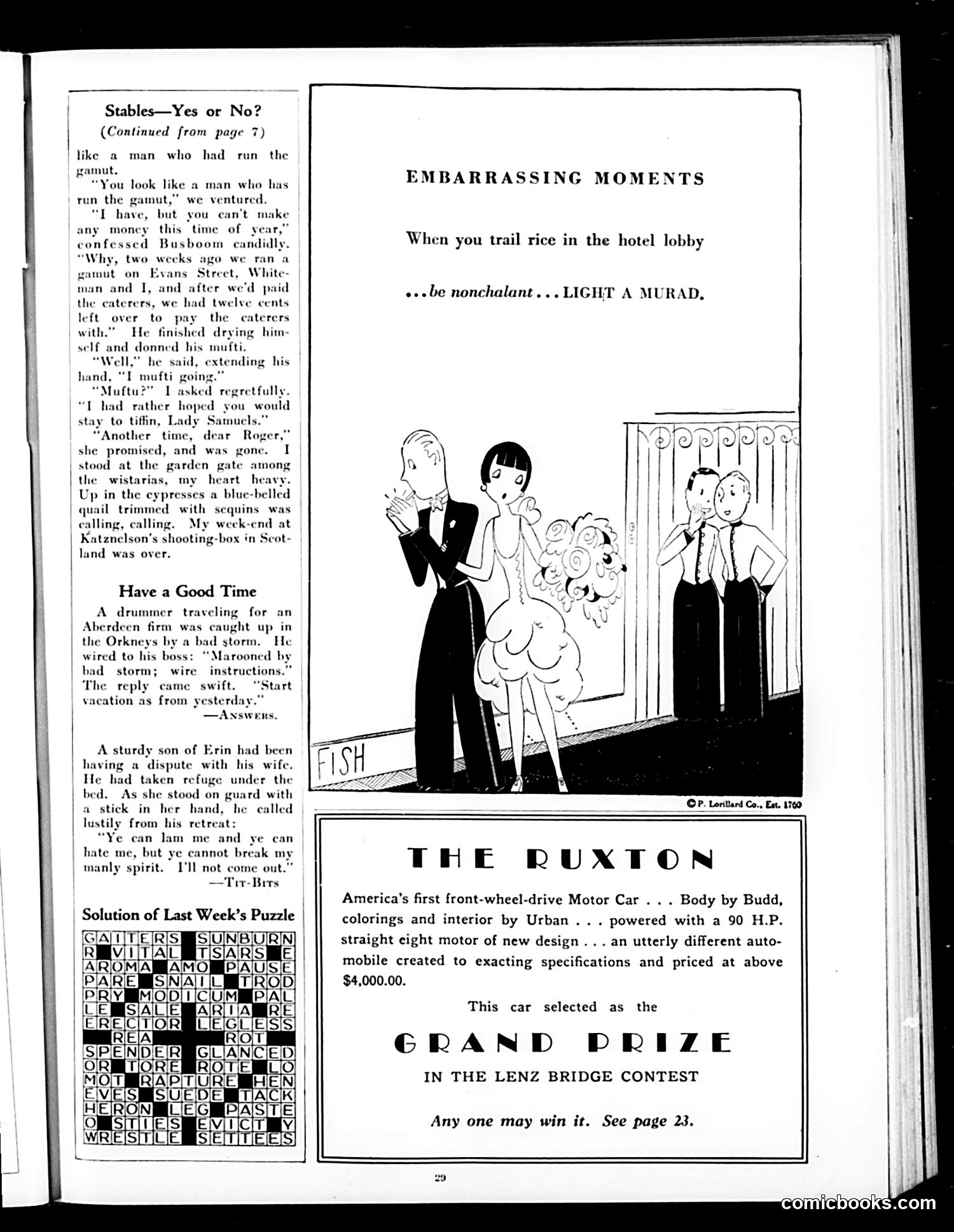
Content Analysis This Judge magazine page (page 29) contains humorous short stories and advertising: "Stables—Yes or No?" continues a narrative about a financially struggling character named Busboom who admits he cannot afford extravagances after hosting an expensive gamut (a social entertainment event) on Evans Street. The anecdote uses period slang ("mufti" = civilian clothes, "tiffin" = lunch) to convey genteel poverty—a character forced to leave a social gathering due to financial constraints. "Have a Good Time" offers two brief comedic anecdotes: a Scottish storm story and an Irish marital dispute joke, both playing on dialect humor common to the era. "Embarrassing Moments" is a Murad cigarette advertisement using social anxiety (trailing rice after a wedding in a hotel lobby) as marketing, suggesting smoking provides nonchalant composure. "The Ruxton" advertisement promotes America's first front-wheel-drive automobile as a grand prize in a contest, emphasizing its innovative engineering and $4,000+ price point—positioning it as an aspirational luxury vehicle for the magazine's affluent readership.
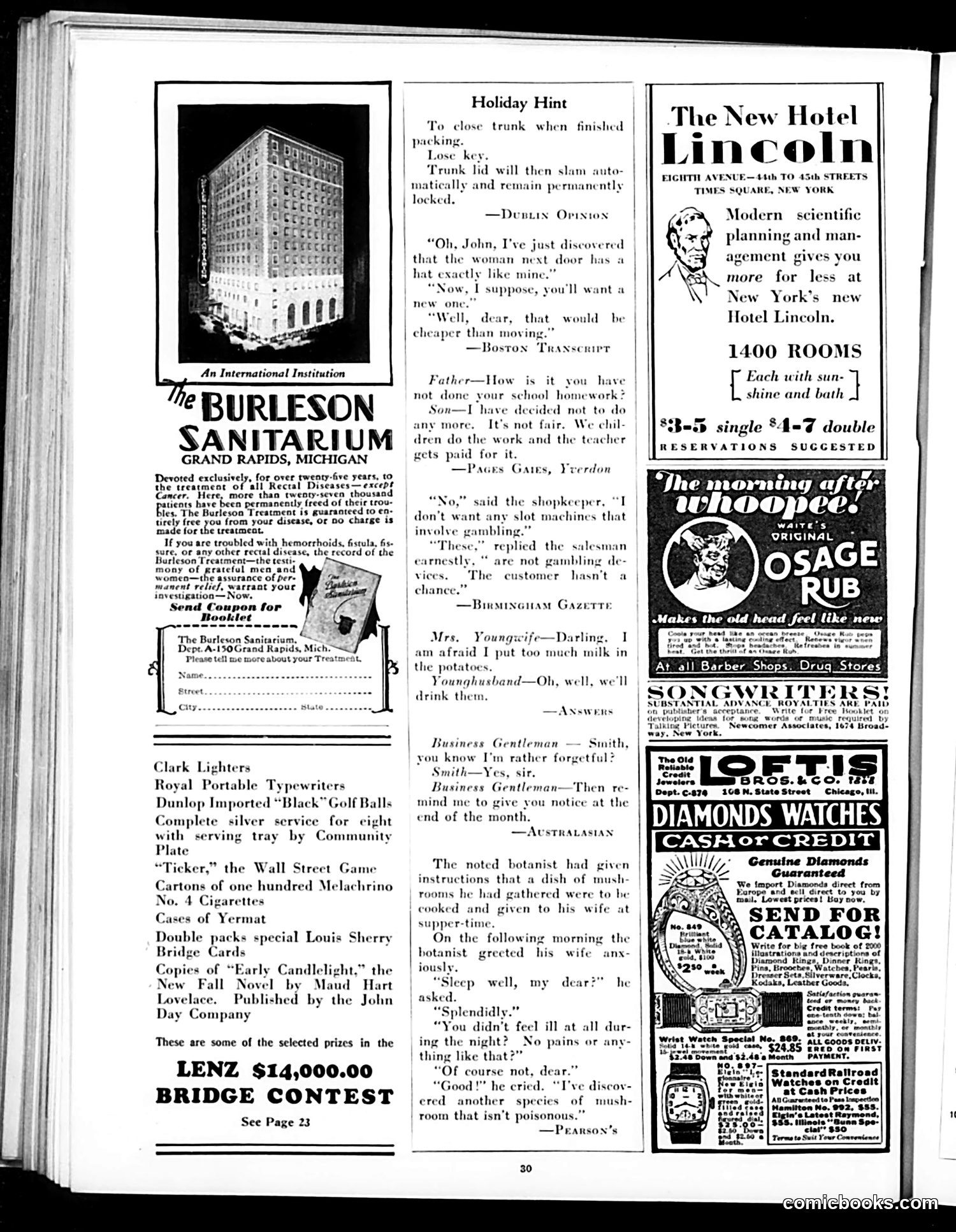
This page is primarily a magazine feature of humorous short jokes and advertisements, rather than a cartoon. The humor comes from dialogue-based scenarios rather than visual satire. The jokes touch on familiar domestic and social situations: a husband's budget woes over hat purchases versus moving costs; a schoolchild's cheeky refusal to do homework; a slot machine salesman's euphemisms about "non-gambling devices"; marital milk-in-potatoes mishaps; and—most darkly—a botanist testing whether his wife was poisoned by mushrooms ("Good! I've discovered another species... that isn't poisonous"). The advertisements showcase period products: the Burleson Sanitarium (specializing in rectal diseases), hotel accommodations, jewelry, and items like typewriters and cigarettes. The ads reflect early-20th-century consumer culture and medical marketing practices that would seem crude today. There are no identifiable political figures or overt political satire visible here—this is social humor focused on everyday situations and marriage dynamics.
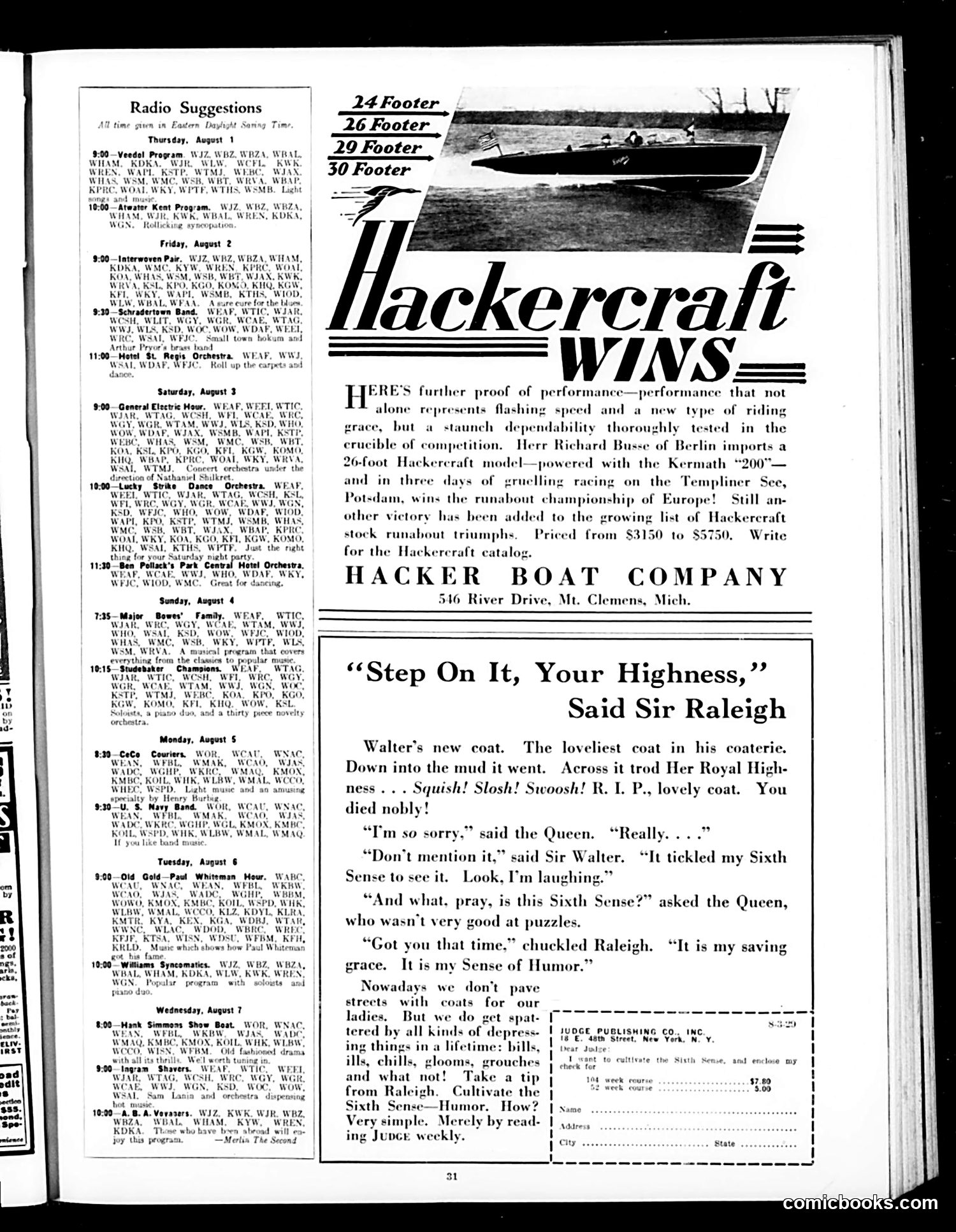
Analysis of Judge Magazine Page Content This page is primarily advertising and radio programming, not political satire. The left column contains radio station listings for the week of August 1-7, typical of entertainment guides from the 1920s-30s era when radio was new and popular. The dominant content is a Hackercraft boats advertisement featuring a narrative titled "Step On It, Your Highness," Said Sir Raleigh. This is a humorous fictional sketch about Sir Walter Raleigh allegedly spreading his coat for Queen Elizabeth I, but here reimagined: instead of mud, she steps on his new Hackercraft coat, ruining it. The dialogue plays on "Sixth Sense" and "Sense of Humor" as the coat's saving grace. The joke attempts contemporary wit by making a historical reference (Raleigh's famous coat gesture) absurd through modern product placement. The advertisement promotes Hackercraft speedboats (14-30 feet) from Mt. Clemens, Michigan, priced $3,150-$5,750. This is primarily commercial content, not political commentary.
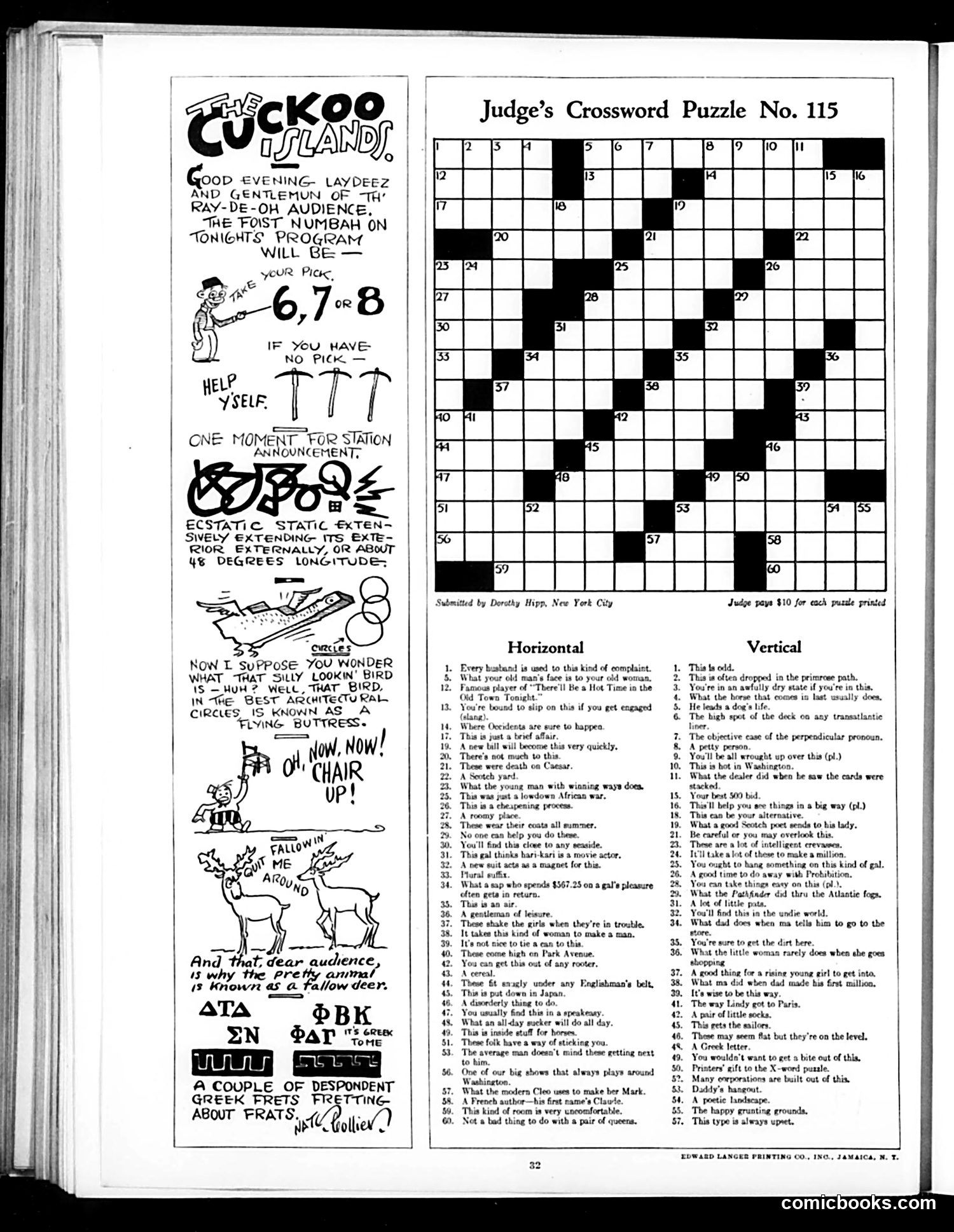
Judge Magazine Crossword Puzzle Page Analysis This page presents Judge's Crossword Puzzle No. 115, a popular feature of the satirical magazine. The left side contains humorous cartoons and advertisements typical of 1920s Judge content. The cartoons mock radio broadcasting (then novel), featuring a character announcing a program with exaggerated comedic patter about "static" and a "flying buttress" bird joke. Another sketch shows "Greek frets fretting about frats"—a pun on fraternity culture. The crossword itself is a standard puzzle with horizontal and vertical clues. The clues are playful and period-specific, referencing contemporary concerns: Prohibition ("A good time to do away with Prohibition"), Park Avenue society, Egyptian glamour ("What the modern Cleo uses"), and marital dynamics ("Every husband is used to this kind of complaint"). The advertisement at bottom mentions "Greek frets fretting about frats," suggesting fraternity humor was marketable. Overall, this represents Judge's blend of wordplay, social commentary, and accessible entertainment for educated readers of the era.
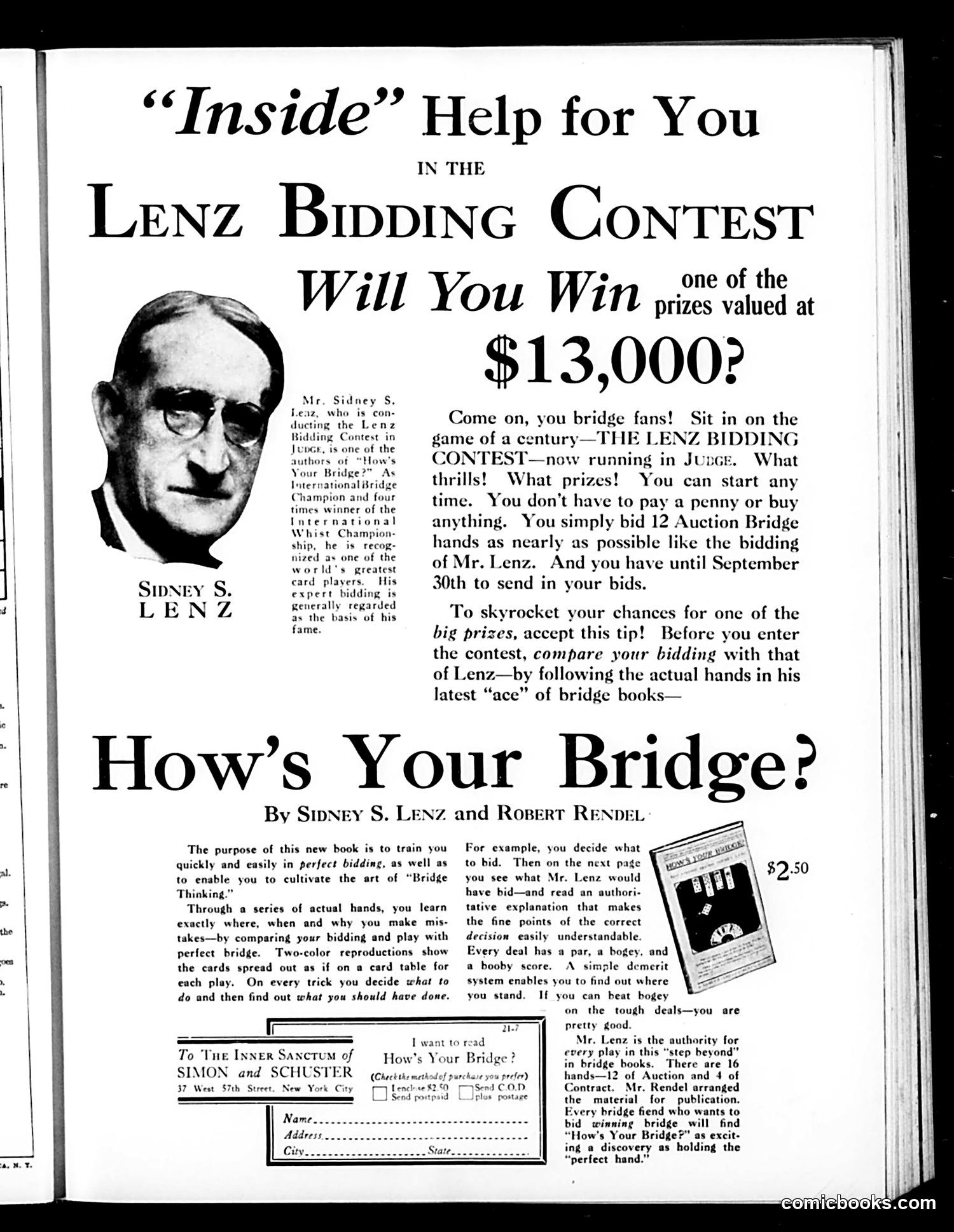
Analysis of This Judge Magazine Page This is primarily advertising content, not political satire. The page promotes a bridge-bidding contest sponsored by *Judge* magazine, featuring Sidney S. Lenz, a famous bridge champion and card game authority. The Figure: Sidney S. Lenz was a real, renowned International Bridge Champion and Whist Champion—recognized as one of the world's greatest card players. His "expert bidding" was his claim to fame. The Contest: Readers could enter by bidding 12 Auction Bridge hands to match Lenz's decisions, competing for prizes worth $13,000 (substantial money in this era). Entry was free. The Promotion: The page advertises Lenz's instructional book *How's Your Bridge?* (co-written with Robert Rendel), priced at $2.50. The book teaches bridge strategy through reproduced hands, allowing readers to compare their decisions against Lenz's expert play. Context for Modern Readers: This reflects bridge's popularity as an intellectual pastime among educated Americans in the early 20th century—similar to how chess competitions are promoted today. The contest gamified learning the game.
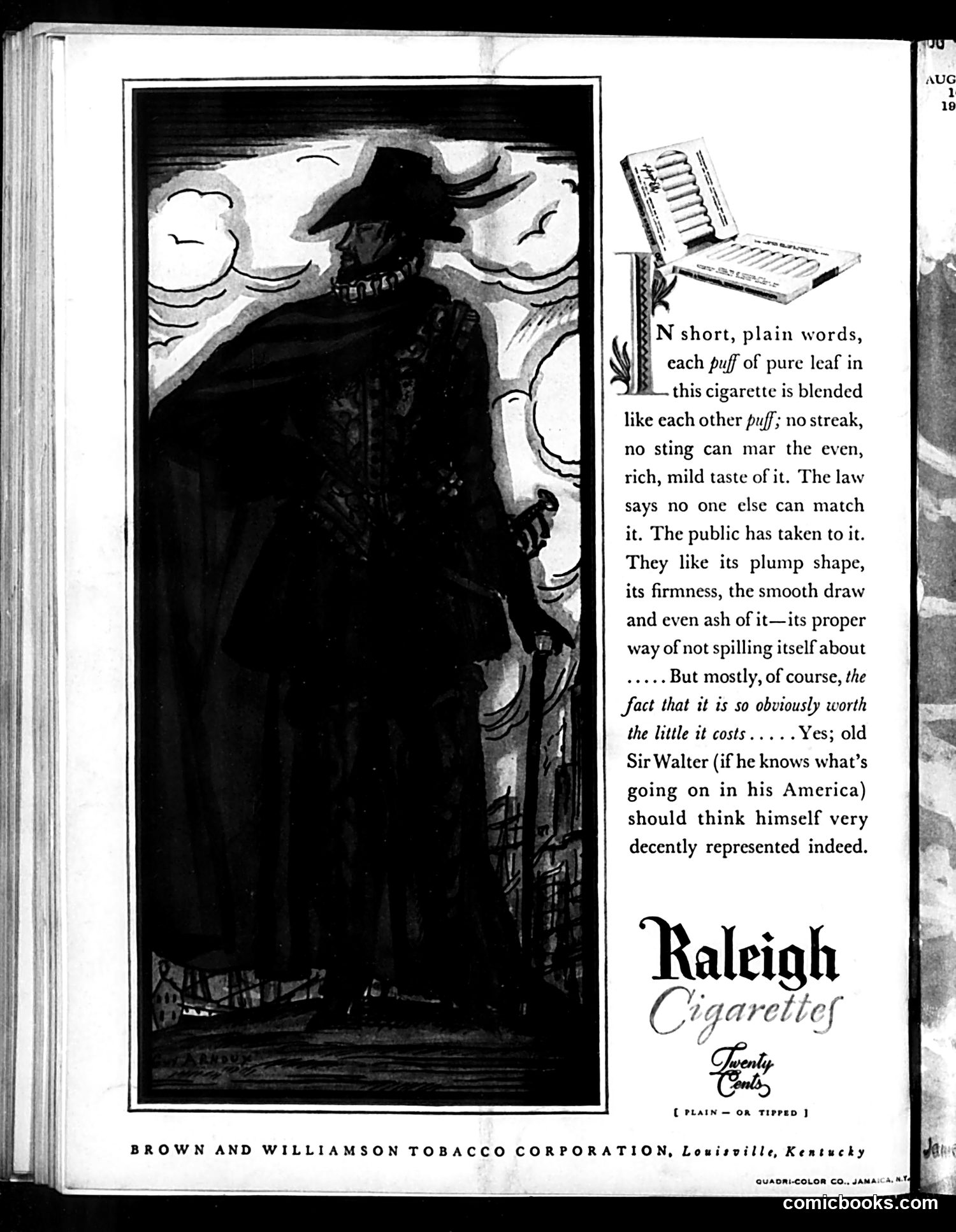
Analysis This is a cigarette advertisement, not a political cartoon. It promotes Raleigh cigarettes by Brown and Williamson Tobacco Corporation. The ad features a silhouetted figure in colonial dress (tricorn hat, cape) representing Sir Walter Raleigh, the historical figure credited with introducing tobacco to England in the 16th century. The text plays on this association, suggesting the product would make "old Sir Walter" proud of his legacy in modern America. The advertisement uses period imagery to lend historical prestige to the product while emphasizing practical selling points: consistency ("each puff" blended alike), quality ("no streak, no sting"), appearance ("plump shape"), and crucially, affordability ("obviously worth the little it costs"). This reflects early-20th-century advertising that combined historical romance with appeals to value—a common marketing strategy before modern cigarette regulation.