judge
Judge — August 10, 1929
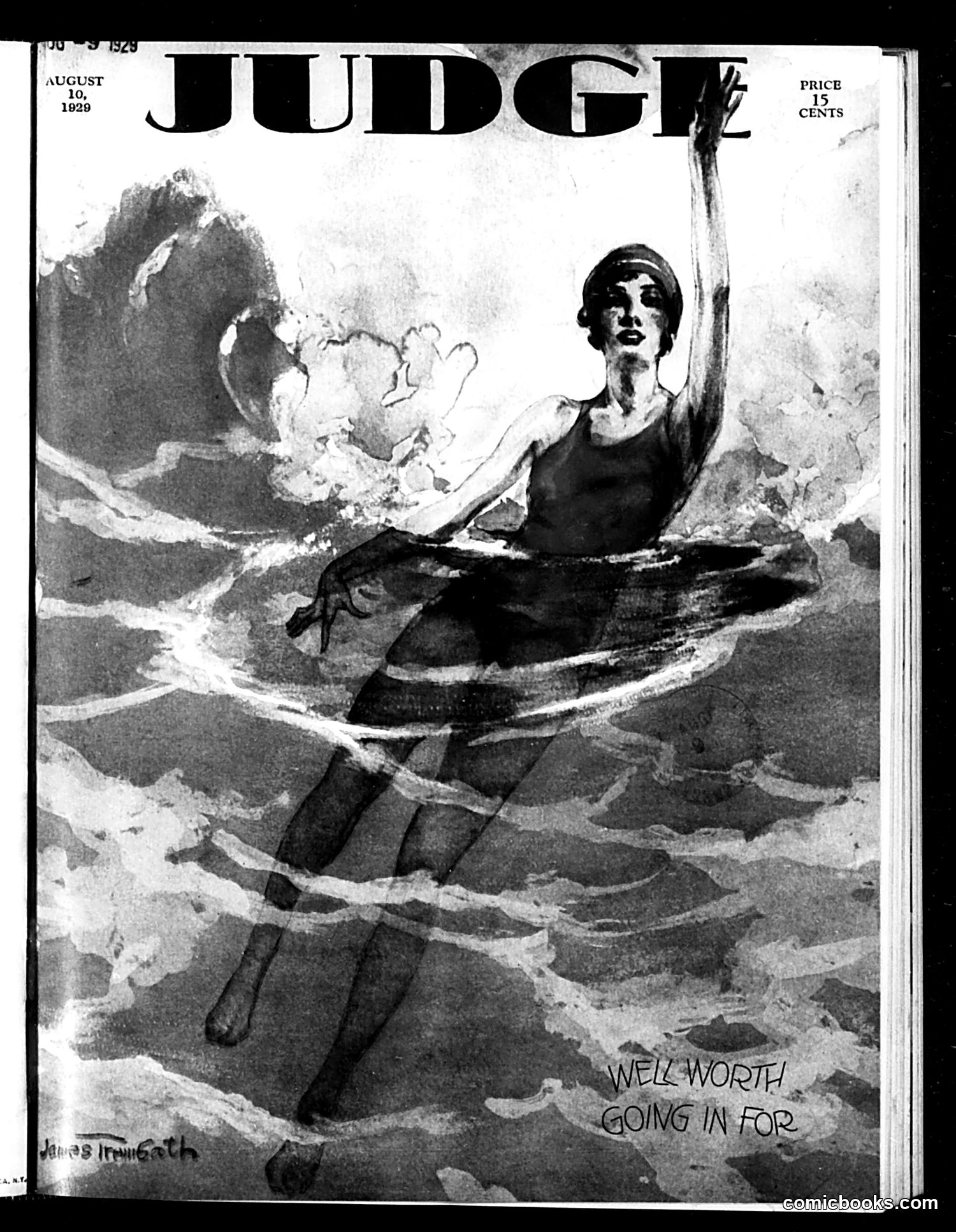
Analysis of Judge Magazine Cover, August 10, 1929 This cover depicts a woman in a bathing suit diving or plunging into turbulent water, with the caption "Well Worth Going In For." The artwork is credited to James Montgomery Flagg, a prominent illustrator of the era. Given the August 1929 date—just weeks before the stock market crash—this appears to be satirical commentary on the economic optimism of the late 1920s. The woman's confident plunge into dramatic waves likely represents investors or the public eagerly entering the market despite warning signs. The "well worth going in for" caption suggests blind faith in financial returns, making this prescient commentary on the recklessness preceding the Great Depression.

Analysis This page is primarily a product advertisement, not satire or political commentary. It promotes Dentyne chewing gum, specifically emphasizing teeth whitening. The image shows a smiling man wearing a hat and casual shirt. The advertisement uses the appeal of a bright, confident smile to sell the product. The tagline "Keeps Teeth White" and "Chew Dentyne and smile!" are straightforward marketing claims. The text emphasizes that white teeth signal personality and charm, and that Dentyne's unique flavor and quality make it the superior gum choice. This represents typical early-to-mid 20th century advertising strategy: linking consumer products to personal attractiveness and social success. There is no political satire present on this page—it is purely commercial messaging.
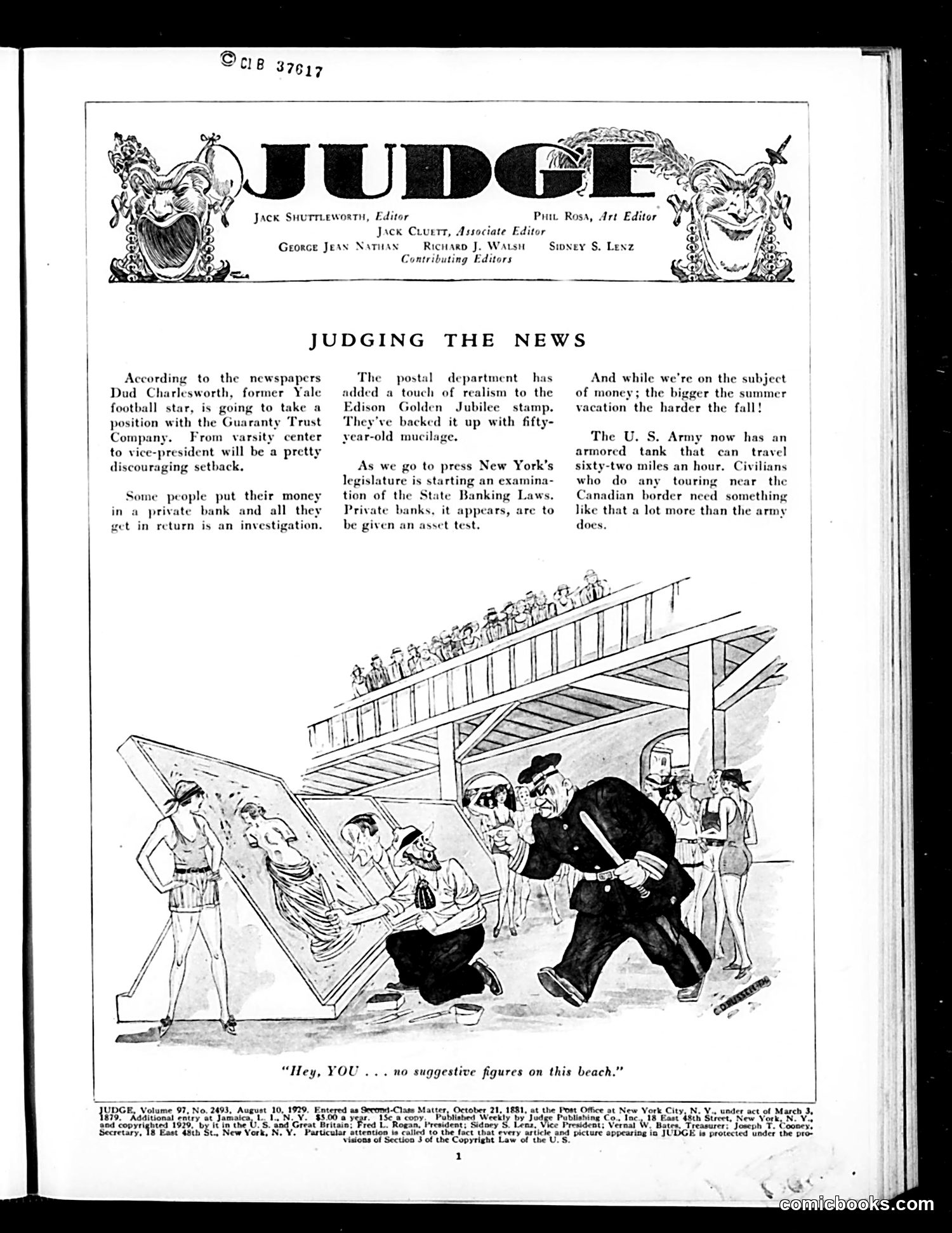
Analysis of Judge Magazine Page (August 10, 1929) The main cartoon satirizes beach conduct. A uniformed official confronts two men displaying what appears to be suggestive artwork or figures to beachgoers (visible on the pier above). The caption—"Hey, YOU . . . no suggestive figures on this beach"—is ironic: the official himself is rendered in an exaggerated, almost caricatured manner that could be read as equally "suggestive." The "Judging the News" section contains brief satirical comments on current events, including references to banker Dud Charlesworth, banking regulations under examination in New York legislature, and U.S. military technology (an armored tank). The overall tone reflects 1920s anxieties about morality enforcement and financial regulation during the pre-Depression era.
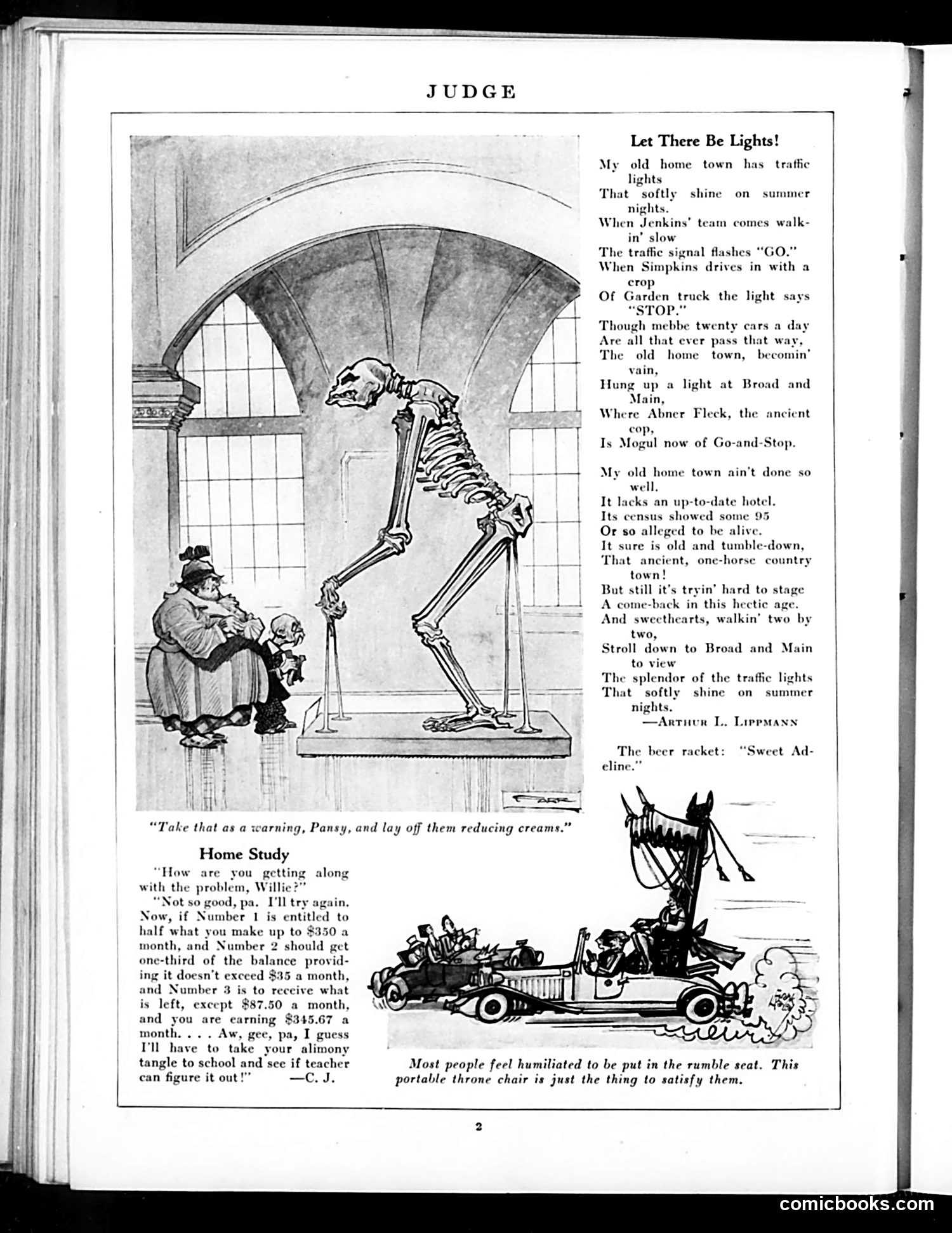
Analysis of Judge Page This page contains two satirical pieces from an early 20th-century American magazine. "Let There Be Lights!" (top): A poem by Arthur L. Lippmann mocks a small town's attempts at modernization. It references a dying "one-horse country town" trying to attract visitors by installing traffic lights at Broad and Main streets—an anachronistic detail suggesting the town's decline despite cosmetic improvements. The skeleton illustration emphasizes the town is essentially dead, merely going through motions of progress. "Home Study" (bottom): A dialogue satirizes financial hardship, likely during economic depression. A father struggles with an alimony/support payment formula (referencing Numbers 1 from what appears to be a legal document), unable to make ends meet. The portable throne chair illustration jokes grimly that humiliation is a luxury for the desperate. Both pieces reflect anxieties about economic struggle and failed modernization in early 20th-century America.
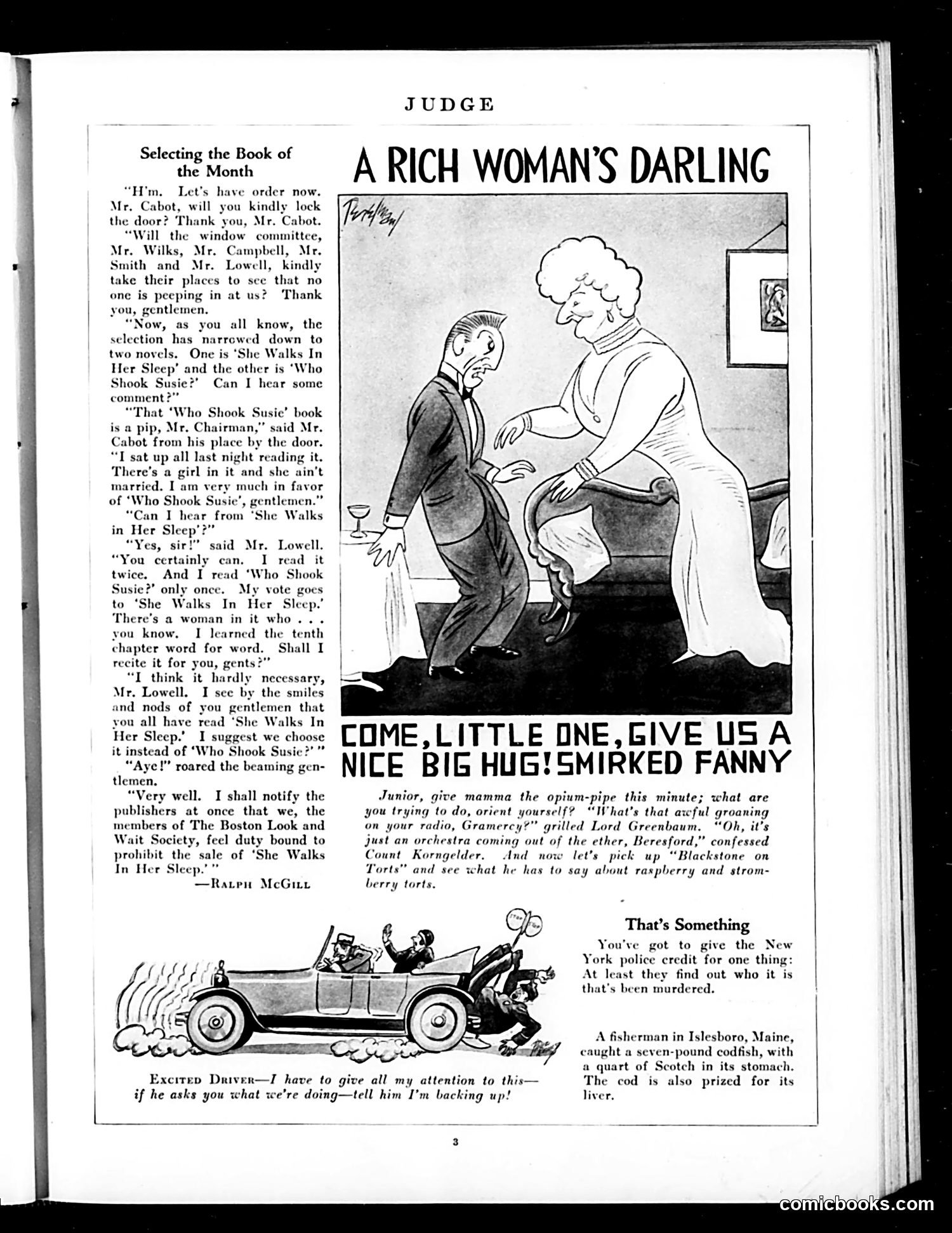
"A Rich Woman's Darling" - Judge Magazine Cartoon Analysis This page satirizes wealthy women's indulgence of young men. The main cartoon shows an older, affluent woman embracing a smaller man in her lap, with the caption "Come, little one, give us a nice big hug! Smirked Fanny." The accompanying dialogue mocks the scenario: a woman supposedly gives her young companion an "opium-pipe," suggesting moral corruption and questionable relationships between rich widows/divorcées and their male companions. The satire targets the social phenomenon of wealthy women financially supporting younger men as romantic interests—a practice Judge's editors viewed as ridiculous and socially corrupting. The exaggerated size difference emphasizes the power imbalance and childlike dependency. The page also includes unrelated jokes about careless driving and a fish story, typical of Judge's mixed-content format.
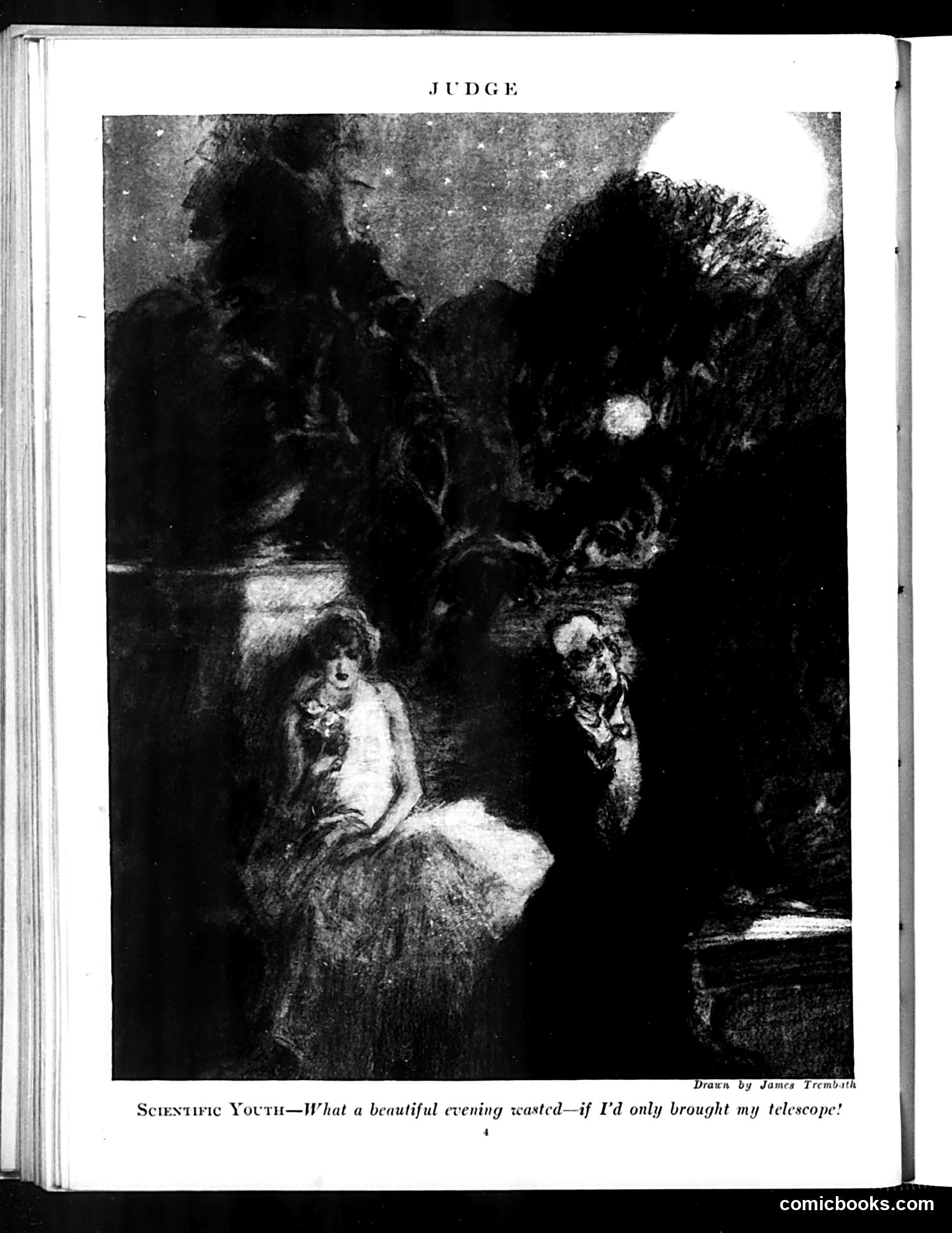
Explanation for Modern Readers This Judge magazine cartoon depicts a young man with a telescope observing the night sky, surrounded by figures in darkness. The caption reads: "Scientific Youth—What a beautiful evening wasted—if I'd only brought my telescope!" The satire mocks a young man so obsessed with scientific pursuits (stargazing) that he fails to appreciate an evening's social opportunity—likely a romantic or social gathering suggested by the crowd around him. The joke plays on the tension between intellectual pursuits and social engagement, suggesting the "scientific youth" is so focused on his hobby that he misses life happening around him. The cartoon critiques single-minded devotion to hobbies at the expense of human connection and social participation.
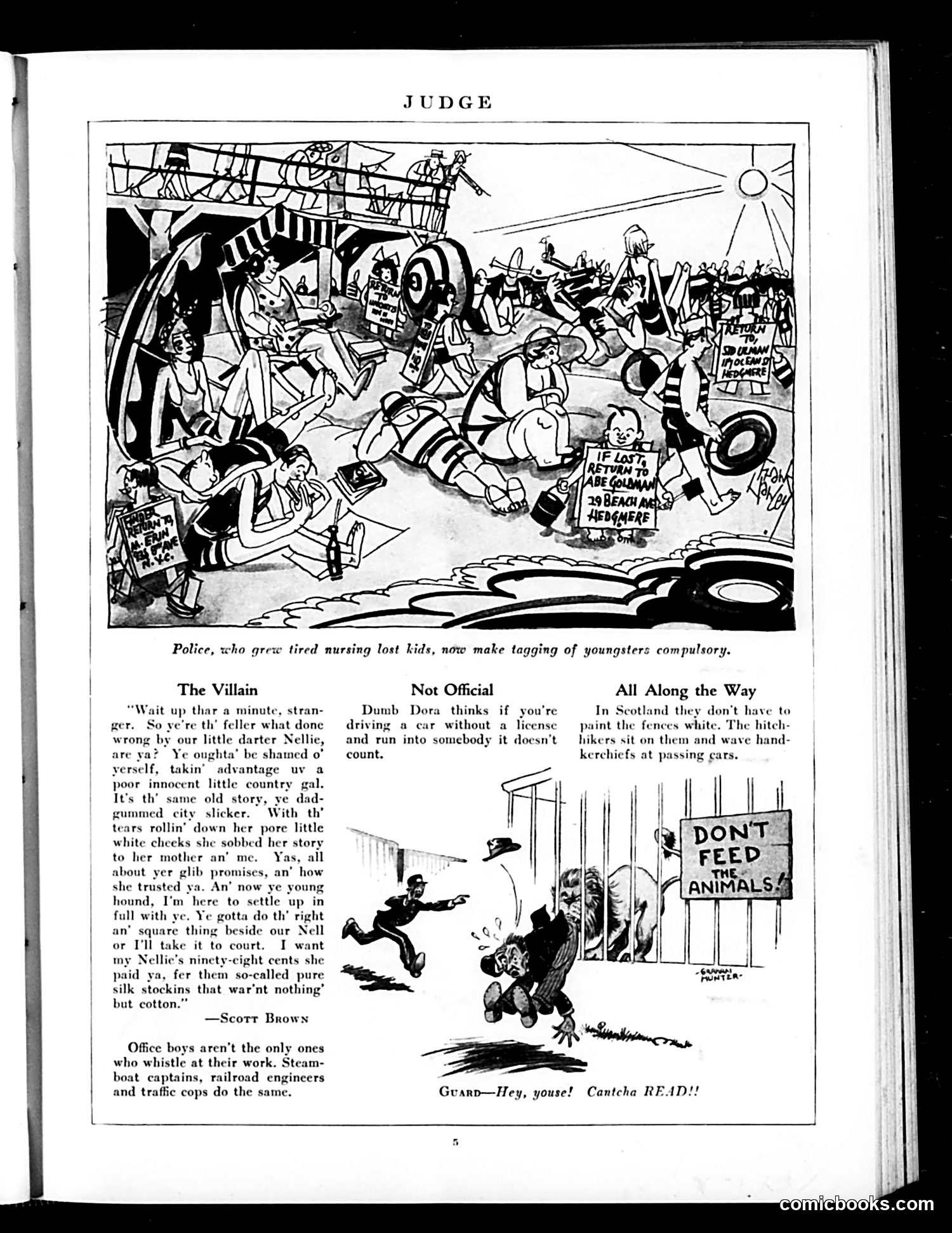
Analysis of Judge Magazine Page This page presents social satire through multiple cartoons critiquing early 20th-century American behavior: Top cartoon: Shows chaotic urban activity with police and crowds, satirizing how police who "grew tired nursing lost kids, now make tagging of youngsters compulsory"—mocking aggressive policing of youth. "The Villain": Scott Brown's story about a country girl wronged by city slicker "Nellie," satirizing seduction narratives and moral hypocrisy of the era. "Not Official": Mocks unlicensed driving, with "Dumb Dora" representing a stereotypical scatterbrained woman driver ignoring regulations. "All Along the Way": Social observation about Scottish fence painting and "Don't Feed Animals" signs at parks, depicting ordinary life ironies. The page overall reflects Progressive-era concerns: law enforcement overreach, gender stereotypes, automobile culture's growing pains, and public behavior management.
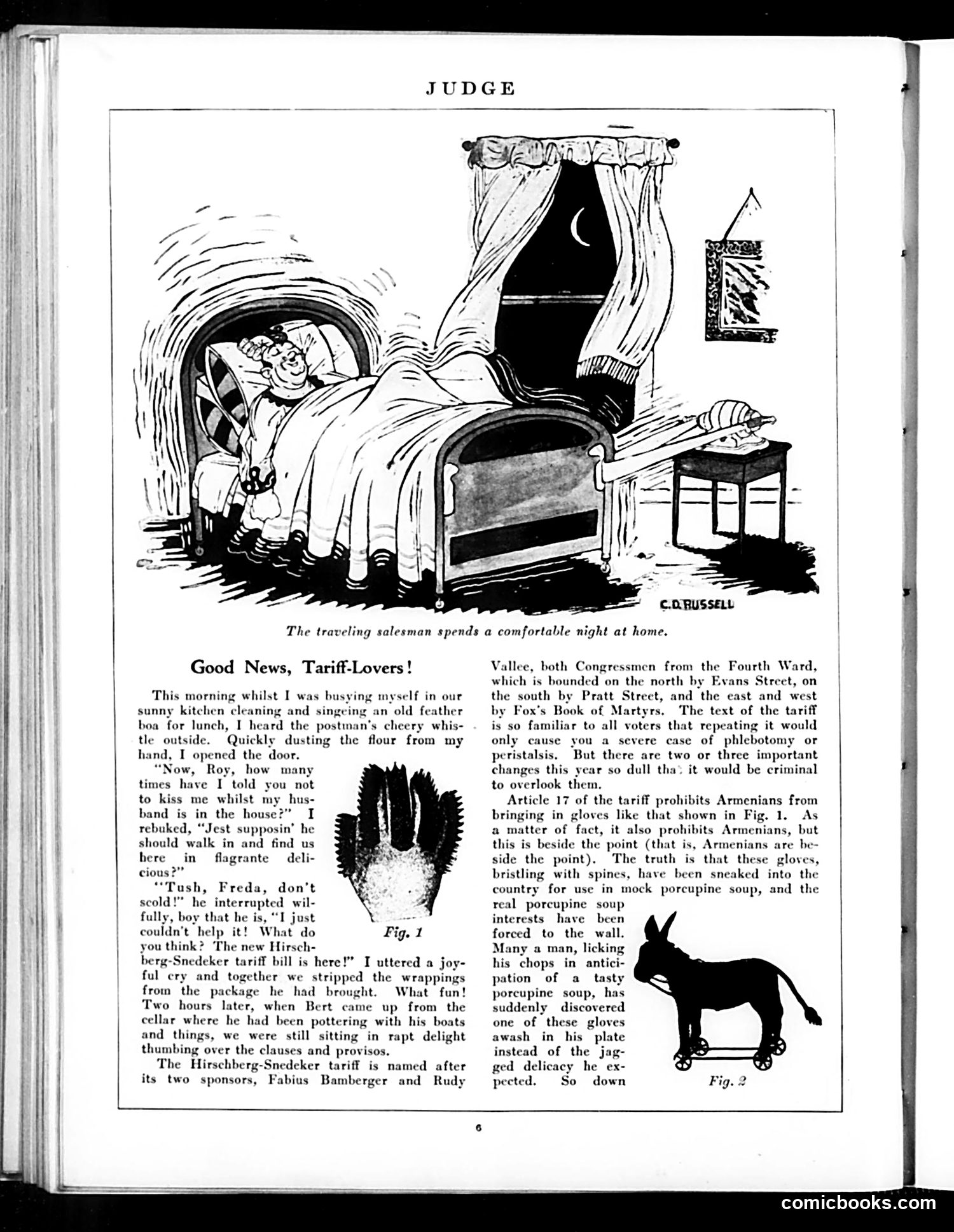
Explanation for Modern Readers This political satire from *Judge* magazine ridicules the Hirschberg-Snedeker tariff bill. The top cartoon shows a traveling salesman enjoying home comforts—satirizing how tariff protections benefit certain businessmen. The main article, titled "Good News, Tariff-Lovers!" uses humor to mock tariff supporters. It describes discovering Armenian gloves (Fig. 1) smuggled into the country despite Article 17 of the tariff allegedly prohibiting them. The joke mocks the tariff's ineffectiveness—spined gloves meant for "mock porcupine soup" somehow evaded customs. The satire suggests the tariff bill, sponsored by Congressmen Vallee and named after sponsors Bamberger and Rudy, fails at its stated purpose while claiming to protect American interests. The piece exposes the gap between protectionist rhetoric and reality.
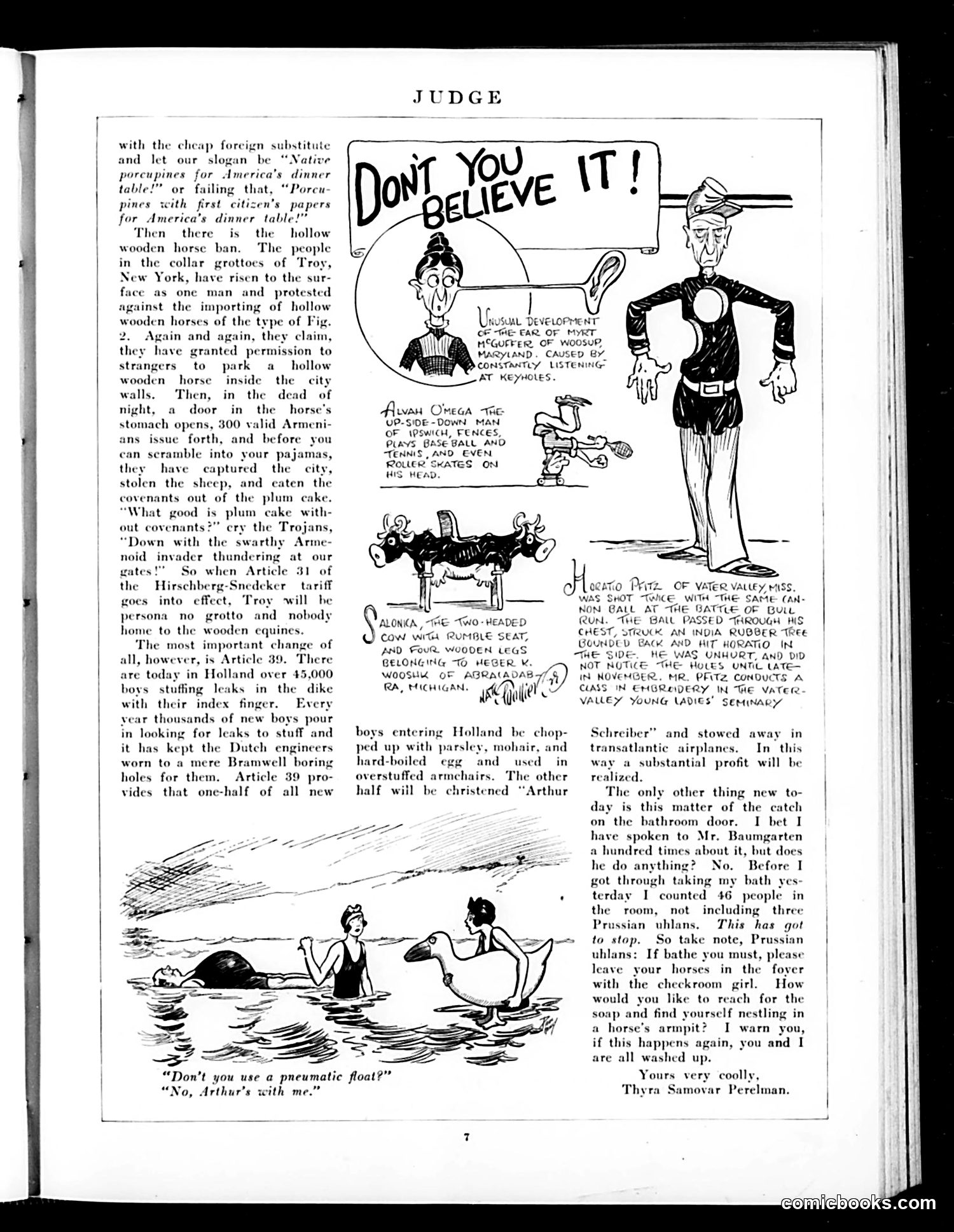
Judge Magazine Satire Analysis This page satirizes American protectionist tariff policy (likely the Fordney-McCumber Tariff era of the 1920s). The main text mock-seriously proposes absurd trade restrictions: banning imported porcupines and hollow wooden horses, and flooding Holland with American boys to plug dike leaks—all framed as economic solutions protecting American workers. The "Don't You Believe It!" cartoon mocks credulous citizens accepting outlandish claims about tariff benefits. The accompanying sketches present bizarre "improvements" from the tariff: an upside-down man, a two-headed cow, and a horse that survived cannon fire—visual nonsense suggesting the policy produces only ridiculous results. The final letter from "Thyra Samovar Perelman" shifts tone, humorously complaining about bathroom overcrowding, with a dig at "Prussian uhlans" (cavalry soldiers), likely referencing post-WWI anxieties about foreign presence. The satire targets protectionist economic policies as economically irrational while playing on period xenophobia.
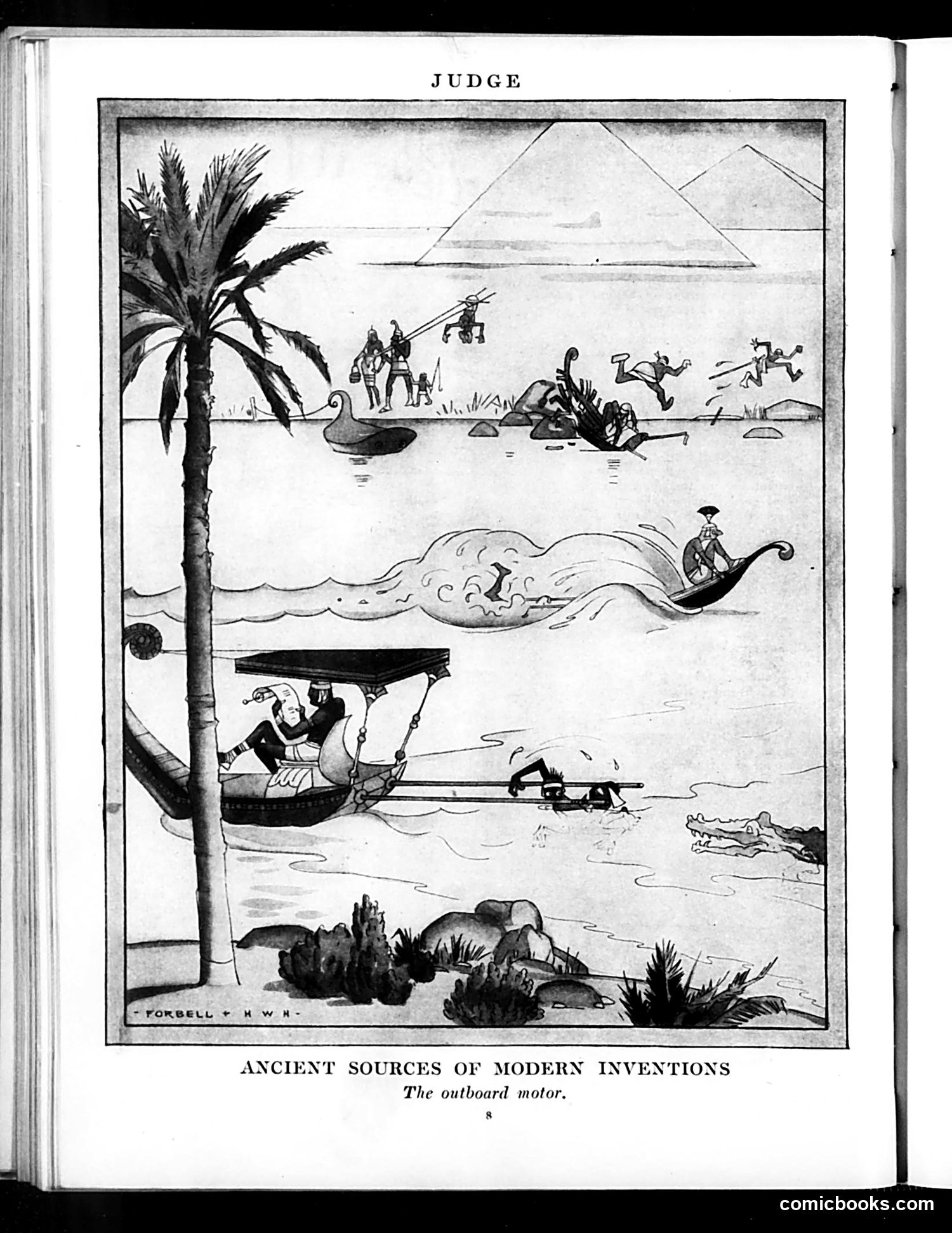
Analysis This is a humorous illustration satirizing the "outboard motor" as supposedly derived from ancient sources. The cartoon depicts an Egyptian or ancient riverside scene with a palm tree, pyramids, and various figures in boats and on shore. The joke appears to be visual wordplay: ancient Egyptians are shown using human-powered propulsion methods—people rowing, swimming, and paddling boats—which the caption mockingly suggests are the "ancient sources" of the modern outboard motor invention. The satire works by treating primitive human locomotion as the historical precedent for motorized boat propulsion, a tongue-in-cheek commentary on either the obviousness of mechanical innovation or possibly poking fun at pseudo-scientific claims about ancient technological sophistication that were popular in the era.
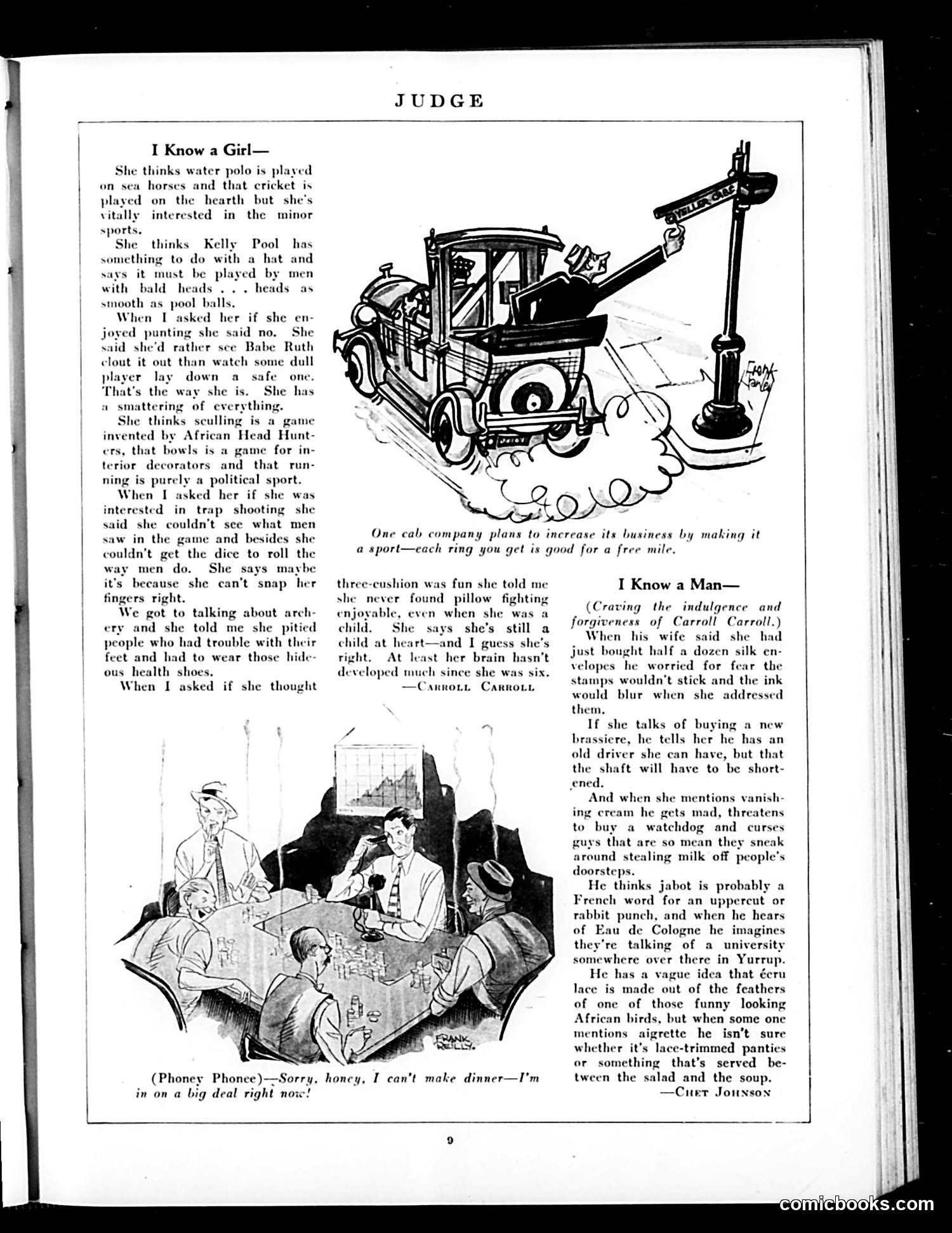
Judge Magazine Page Analysis This page contains two humorous character sketches satirizing gender stereotypes through deliberate misunderstandings: "I Know a Girl" mocks women's supposed athletic ignorance. The unnamed woman confuses sports terminology—thinking "water polo" involves sea horses, "bowling" is interior decoration, and "sculling" is an African hunting game. She conflates unrelated activities (pillow fighting with billiards). The satire targets the dismissal of women from serious sports engagement. "I Know a Man" reverses this, depicting a husband who mangles traditionally feminine terms. He misinterprets "silk envelopes," "brassiere," "vanishing cream," and French fashion words ("jabot," "Eau de Cologne," "écru," "aigrette") as masculine or nonsensical concepts. He imagines "Yurrup" (Europe) vaguely and suspects milk theft. Both sketches use willful incomprehension as comedy, but the man's confusion seems more absurd—he actively resists understanding female interests. The cartoons likely satirize rigid gender roles and mutual incomprehension between spouses in 1920s-era relationships.
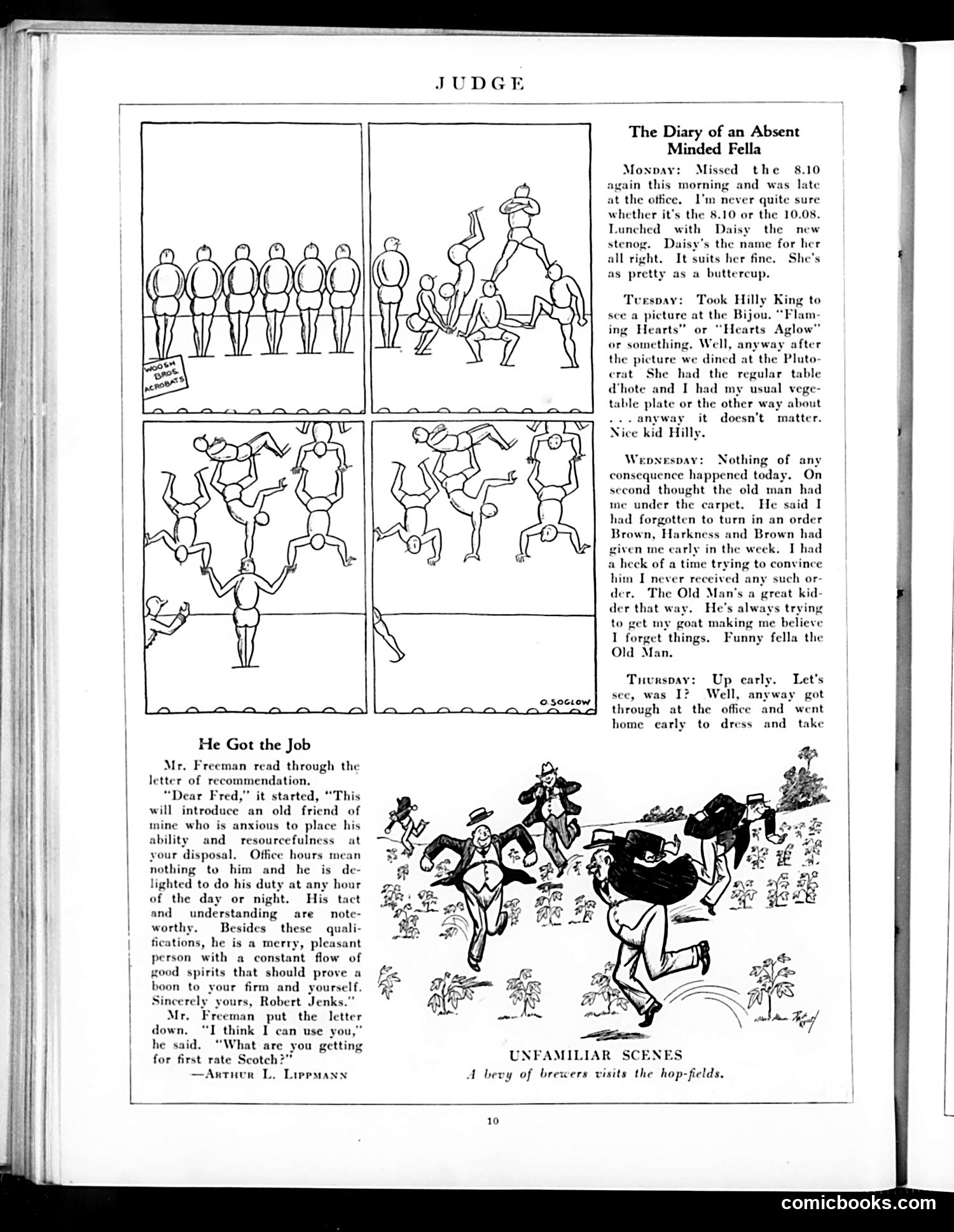
Analysis of Judge Magazine Page This page contains three distinct pieces of humor typical of early 20th-century Judge magazine: "The Diary of an Absent Minded Fella" satirizes workplace incompetence—a man constantly late, forgetful about orders, easily distracted by a new stenographer named Daisy. The humor relies on relatable office frustrations. "He Got the Job" mocks dishonest job recommendations. A letter of introduction grotesquely exaggerates an applicant's virtues (never minded about office hours, always cheerful), when the real qualification appears to be ability to obtain "first rate Scotch"—suggesting either bribery or that the employer prioritizes drinking over actual work competence. The satire targets both workplace ethics and Prohibition-era hypocrisy. "Unfamiliar Scenes" shows brewers visiting hop-fields, likely a Prohibition-era joke about the illegal beer industry continuing despite the law. The four-panel cartoon at top-left illustrates the absent-minded protagonist's disorganized nature through stick-figure visual gags.
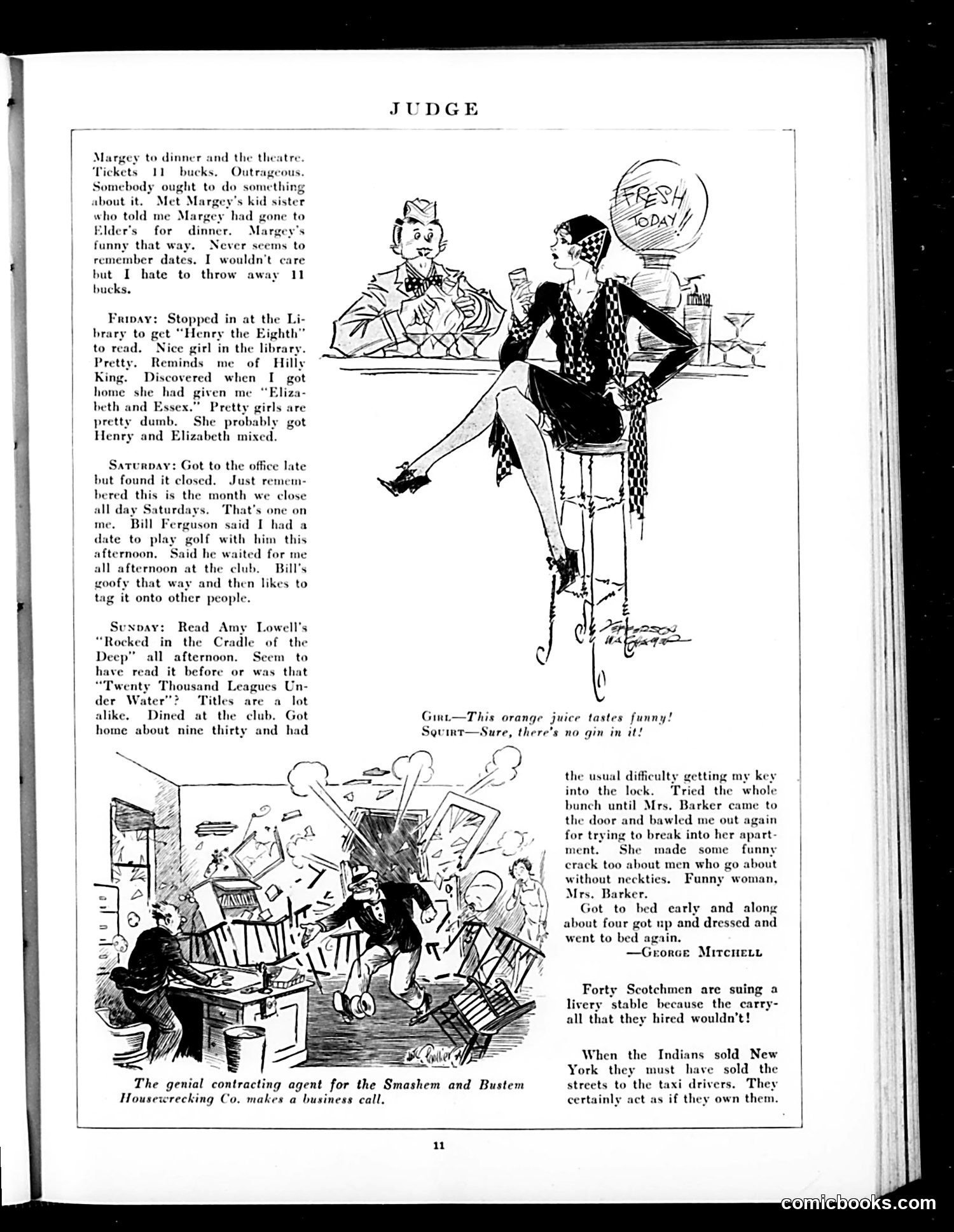
Judge Magazine Page Analysis This page contains a humorous weekly diary by George Mitchell satirizing the modern urban gentleman's scattered, undisciplined life. The narrator repeatedly botches social obligations—forgetting a dinner date with "Margey," confusing literary titles, missing a golf appointment—while blaming others for his failures. The joke is his self-delusional obliviousness to his own incompetence. The cartoon below depicts a chaotic housewrecking business call, showing the absurdity of contractors' disruptive impact on urban life. The smaller illustrations mock contemporary social situations: a couple's complaint about fake "orange juice" (implying prohibition-era gin substitution); and a quip about New York taxi drivers' territorial behavior—suggesting they treat streets as personal property. The humor relies on recognizable 1920s social scenarios: dinner theater costs, library courtship, country club golf culture, and prohibition-era drinking references. For modern readers, the dated slang and assumption that readers share these leisure-class experiences mark this as period satire aimed at a specific demographic.
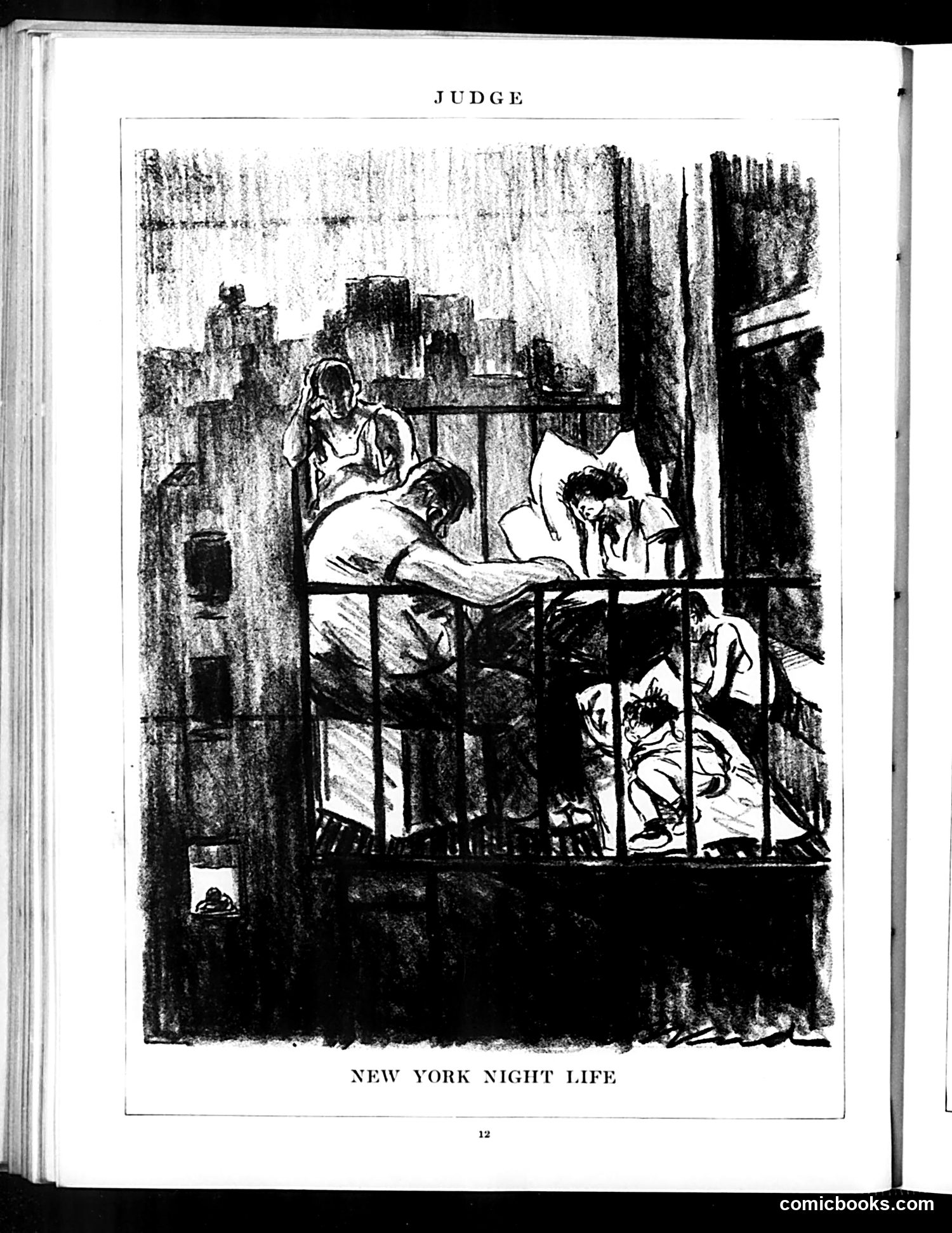
"New York Night Life" - Judge Magazine Cartoon This is a satirical illustration titled "NEW YORK NIGHT LIFE" depicting crowded, squalid apartment living conditions in New York City. The sketch shows multiple figures cramped together on a small balcony or fire escape of a tenement building, with people sleeping in close quarters and appearing impoverished. The cartoon satirizes the overcrowded, unsanitary housing conditions endured by working-class and immigrant residents in NYC tenements during the early 20th century. Judge magazine, a satirical publication, used such imagery to critique urban poverty, inadequate housing standards, and the living conditions of the poor. The dark, cramped composition emphasizes the desperation and lack of privacy in these dwellings—contrasting sharply with the magazine's likely middle-class readership's expectations of comfort and space.
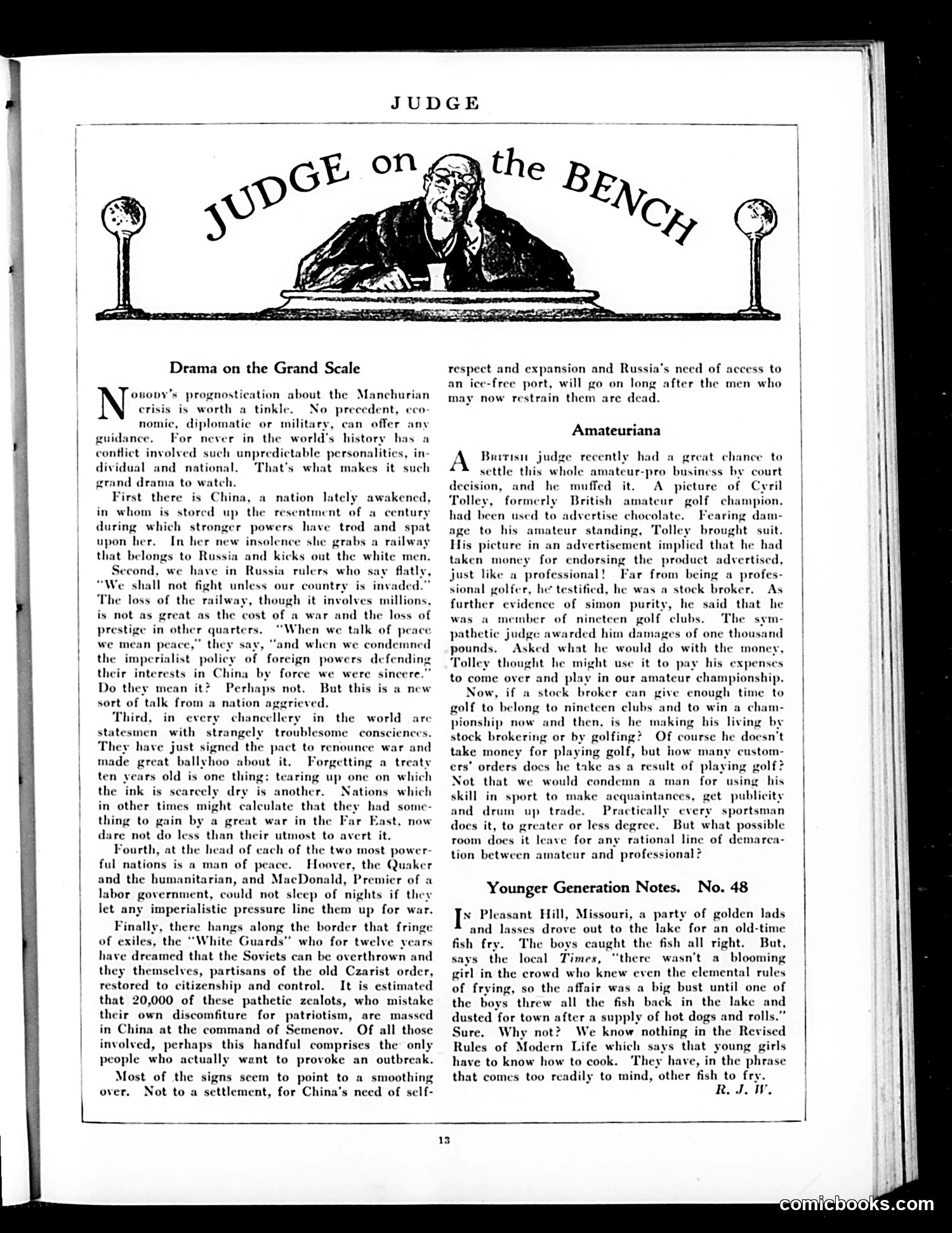
"Judge on the Bench" - Analysis This page features two distinct sections: Main Editorial ("Drama on the Grand Scale"): A serious political commentary on the Manchurian Crisis, likely from the early 1930s. It analyzes four key factors: China's awakening resentment of Western imperialism; Russia's rulers' reluctance to fight despite losing railway interests; world leaders' recent peace pacts now being tested; and the fact that both superpowers (America's Hoover and Britain's MacDonald) are peacefully inclined. The piece suggests war may be averted, but geopolitical tensions remain. "Amateuriana" Section: A satirical commentary on a real British court case involving golfer Cyril Tolley, who sued over chocolate advertising using his image without payment. The judge awarded damages, but the satire questions whether Tolley—a stock broker belonging to nineteen golf clubs—truly qualifies as "amateur" if golf generates business connections and publicity. The piece ironically highlights the blurred line between amateur and professional status in sports.
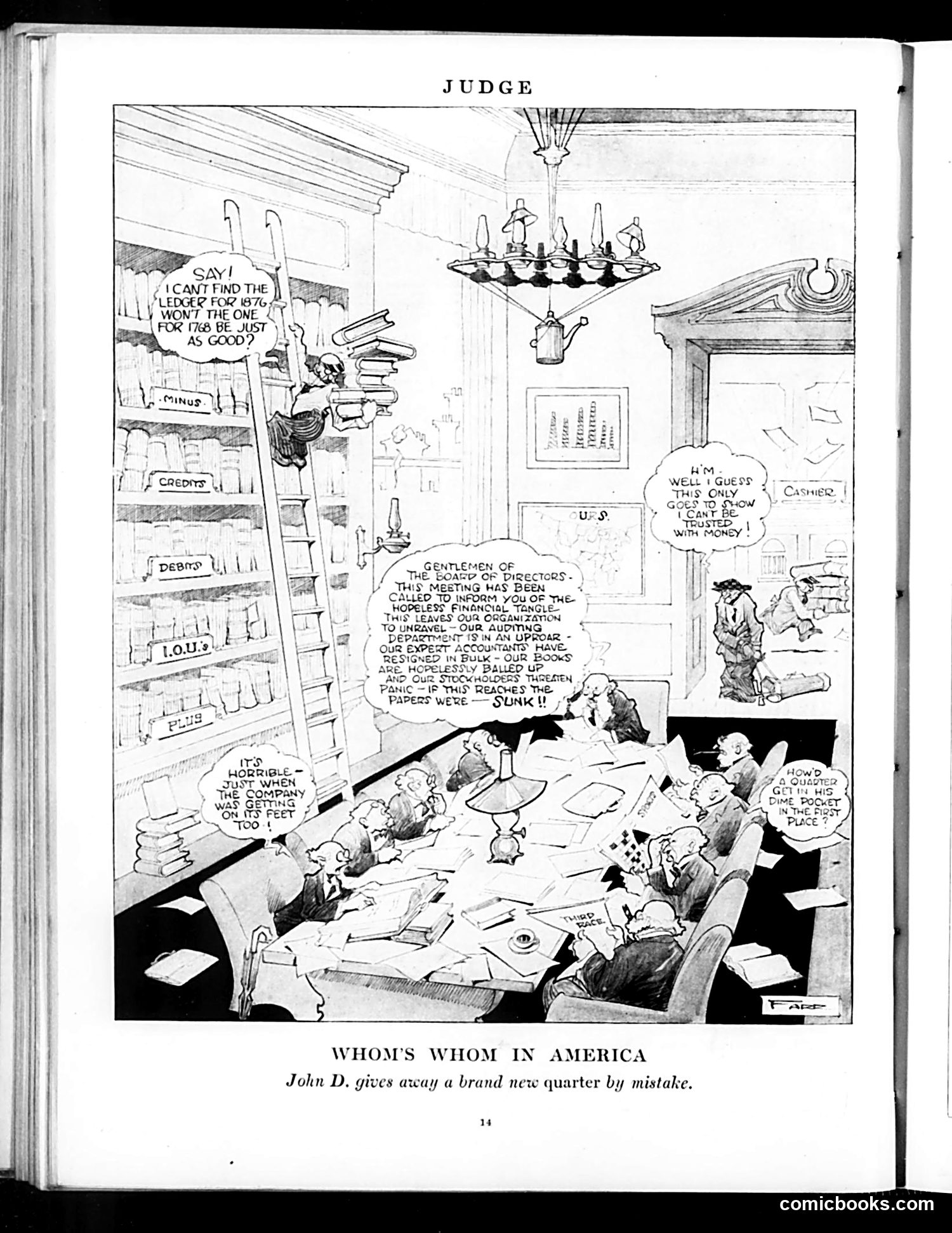
Analysis This is a satirical cartoon about corporate financial mismanagement, likely referencing John D. Rockefeller or another wealthy industrialist of the era (the caption mentions "John D."). The scene depicts a board of directors meeting where an executive announces the company faces financial ruin: auditors have resigned, books are "hopelessly balled up," and stockholders threaten panic if news reaches the papers. The joke's setup shows a character on the left struggling to find ledgers from 1876, unable to locate proper financial records. The title's punchline—"John D. gives away a brand new quarter by mistake"—suggests irony: a wealthy magnate is so careless or disconnected that he accidentally distributes money, while simultaneously his company's finances are in complete chaos. The satire mocks both the incompetence of corporate management and the disconnect between personal wealth and organizational disorder. This reflects Gilded Age concerns about unchecked corporate power and financial accountability.
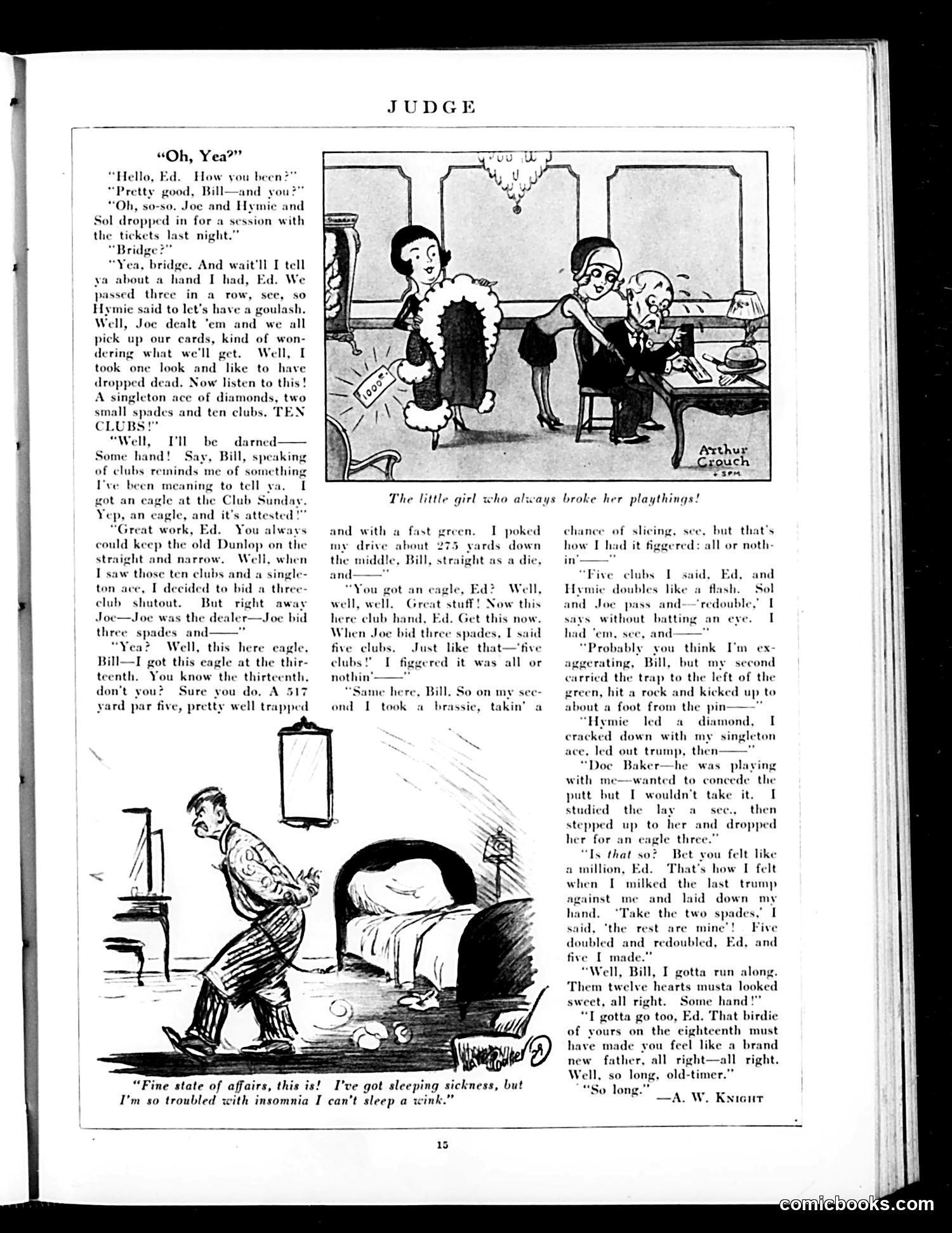
Judge Magazine Cartoon Analysis This page contains two related cartoons satirizing leisure-class obsession with golf and bridge among early 20th-century American businessmen. The main cartoon depicts two men (Ed and Bill) discussing their recent golf and bridge games with exaggerated bragging. The humor targets how these professionals bore each other with tedious recitations of card hands and golf scores—improbable hands like "ten clubs" and impossible golf feats ("twelve hearts"). The lower cartoon shows a man suffering insomnia while bragging about his golf prowess to his doctor, illustrating the point: these men are so consumed by their club games they cannot sleep, yet remain oblivious to their own absurdity. The satire mocks the pretentiousness and self-absorption of wealthy club members whose lives revolve entirely around these recreational games, delivered through their repetitive, boastful dialogue that would bore any listener.
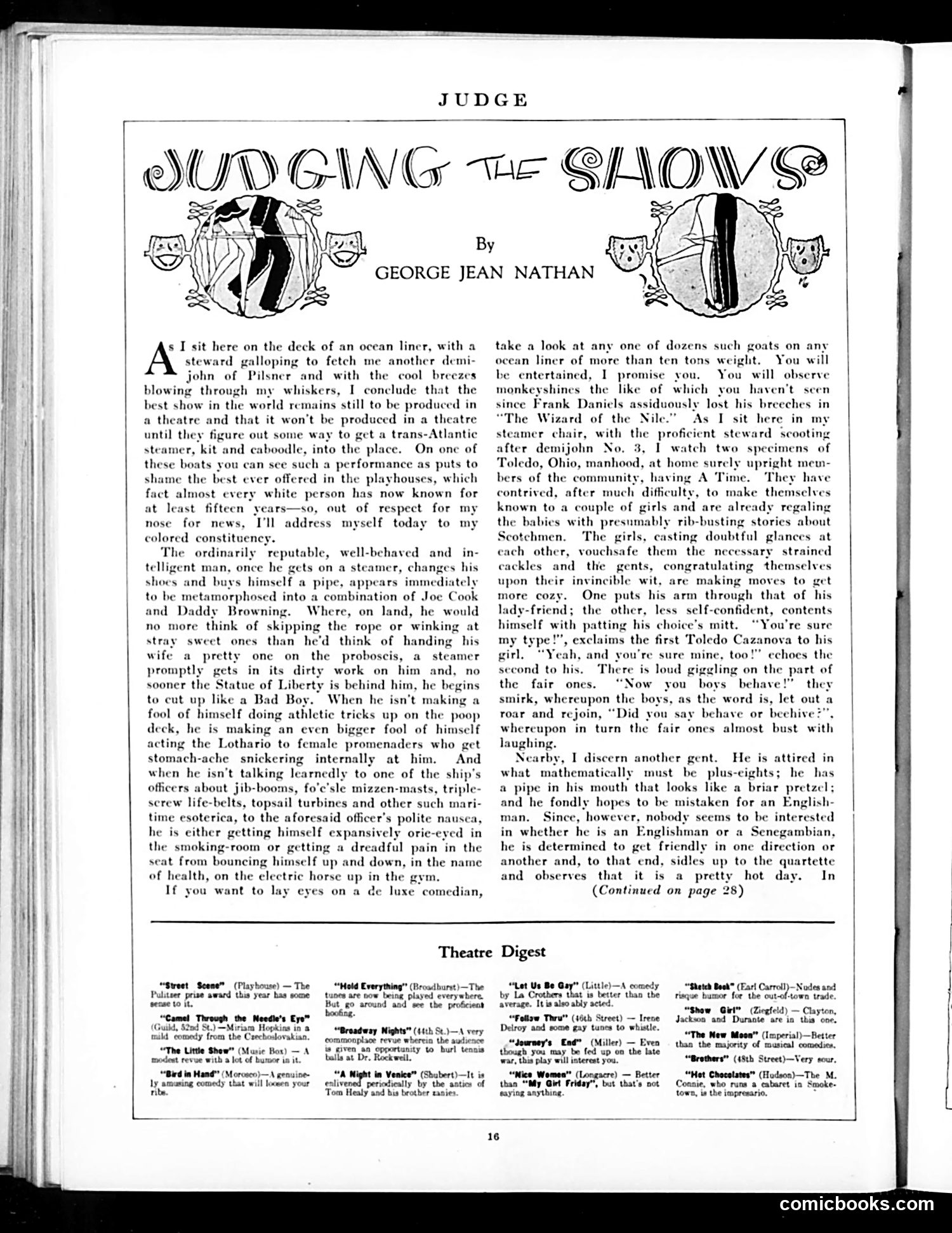
"Judging the Shows" by George Jean Nathan This is a humorous essay about the theatrical qualities of ocean liners, not a political cartoon. Nathan argues that ocean liners provide better entertainment than actual theaters—specifically, the unintentional comedy of respectable men behaving ridiculously once aboard ship. The satire targets masculine behavior: dignified men from places like Toledo, Ohio transform into buffoons, attempting clumsy seductions, dropping nautical jargon to impress officers, and making embarrassing athletic displays. Nathan mocks their transparent attempts to reinvent themselves—particularly a man posing as English with a pretzel-shaped pipe—while women respond with forced, tolerant laughter. The piece ridicules both male vanity and the performative nature of ship socializing, suggesting that ordinary men become unintentional comedians once removed from societal constraints. It reflects early 20th-century Judge magazine's focus on urban, middle-class social foibles rather than political commentary.
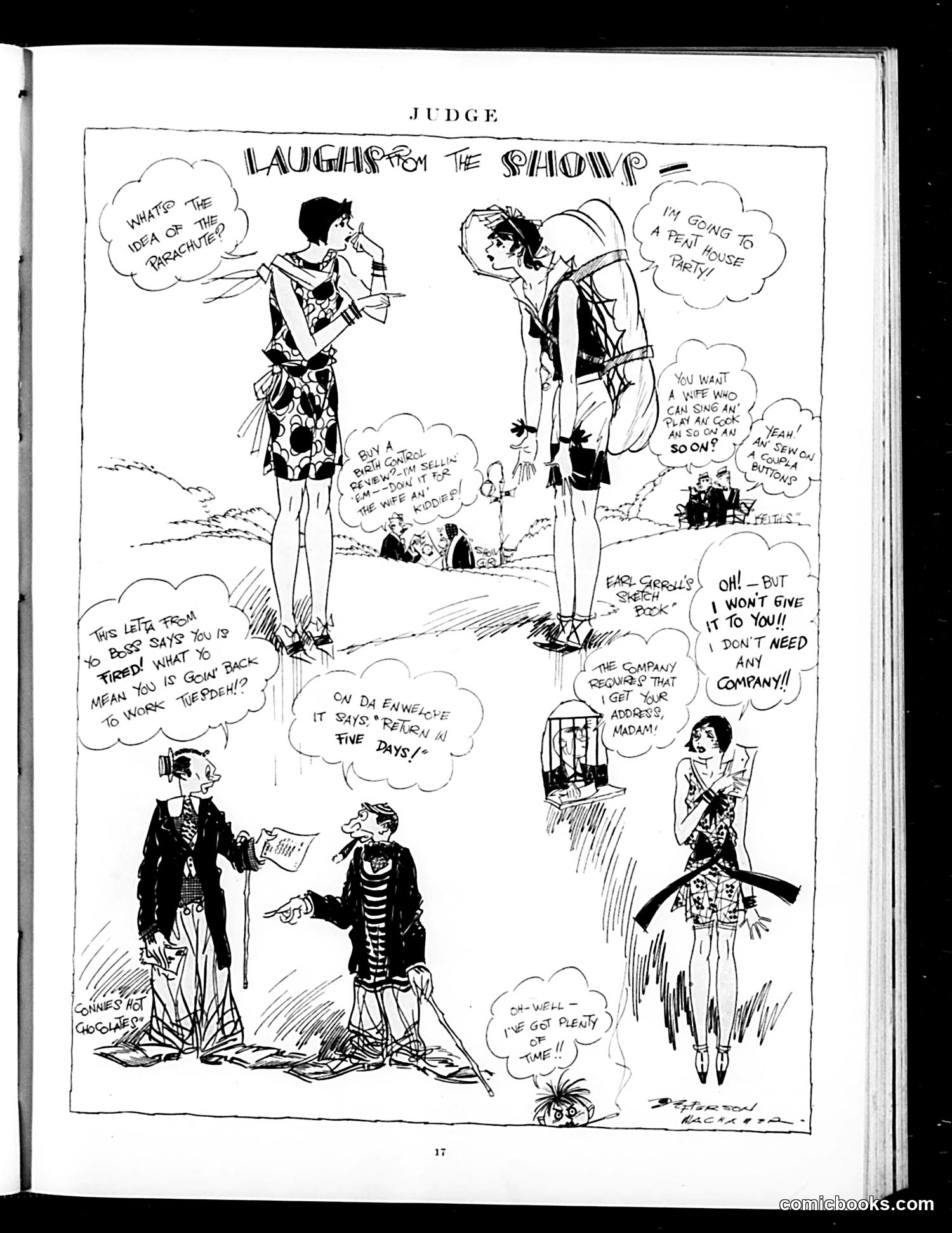
"Laughs at the Shop" - Judge Magazine Satire This cartoon satirizes the marriage market and courtship customs of the era (likely early 20th century). Two women stand elevated, displaying themselves like merchandise "at the shop"—a metaphor for how unmarried women were presented to potential suitors. The dialogue reveals the satire's targets: women discussing their "price" in marriage (dowries, accomplishments), while men below negotiate like buyers examining goods. One woman boasts of her "reach," another of her domestic skills. A man insists he "won't give" a wife "company"—suggesting husbands controlled women's social lives. The cartoon mocks both the transactional nature of marriage and the commodification of women as domestic servants rather than partners. It critiques upper-class courtship rituals where women's value was measured by marriageability rather than personhood.
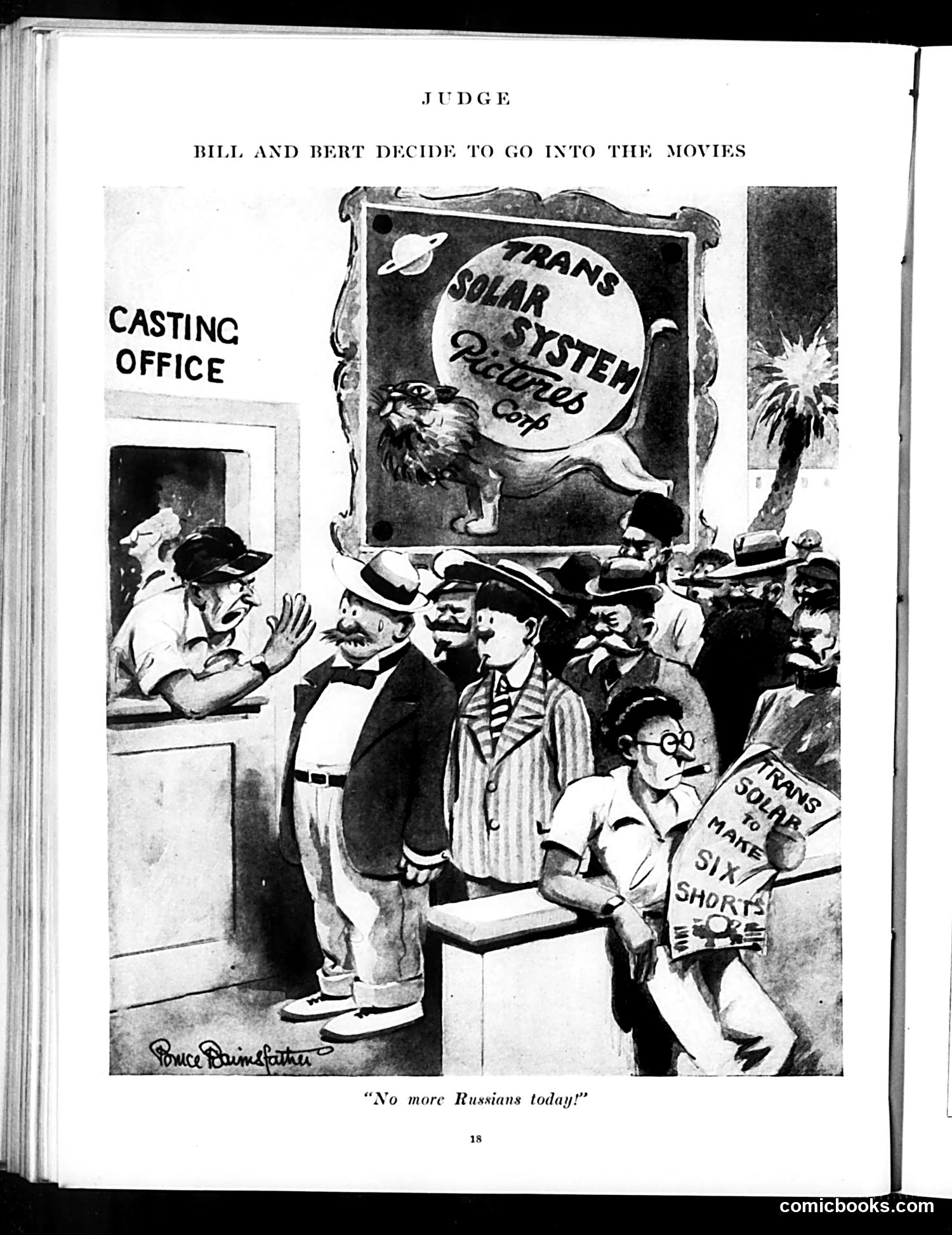
Analysis This cartoon satirizes early Hollywood's anti-Russian sentiment during a period of Cold War or Red Scare anxiety. The scene shows a movie studio casting office where figures labeled "Bill" and "Bert" decide to pursue film work. A sign advertises "Trans Solar System" shorts, while another reads "Trans Solar To Make Six Shorts." The caption "No more Russians today!" indicates the studio is rejecting Russian characters or themes—likely reflecting 1920s-era American xenophobia toward Soviet Russia and communist ideology. The crowd of diverse men in hats represents competing actors or extras seeking roles. The cartoon mocks both Hollywood's willingness to pander to anti-communist sentiment and the absurdity of completely blacklisting an entire nationality from entertainment. The artist (signed, appears to be Cesare Zimmerman) uses exaggerated caricature typical of Judge's satirical style to critique this discriminatory hiring practice.
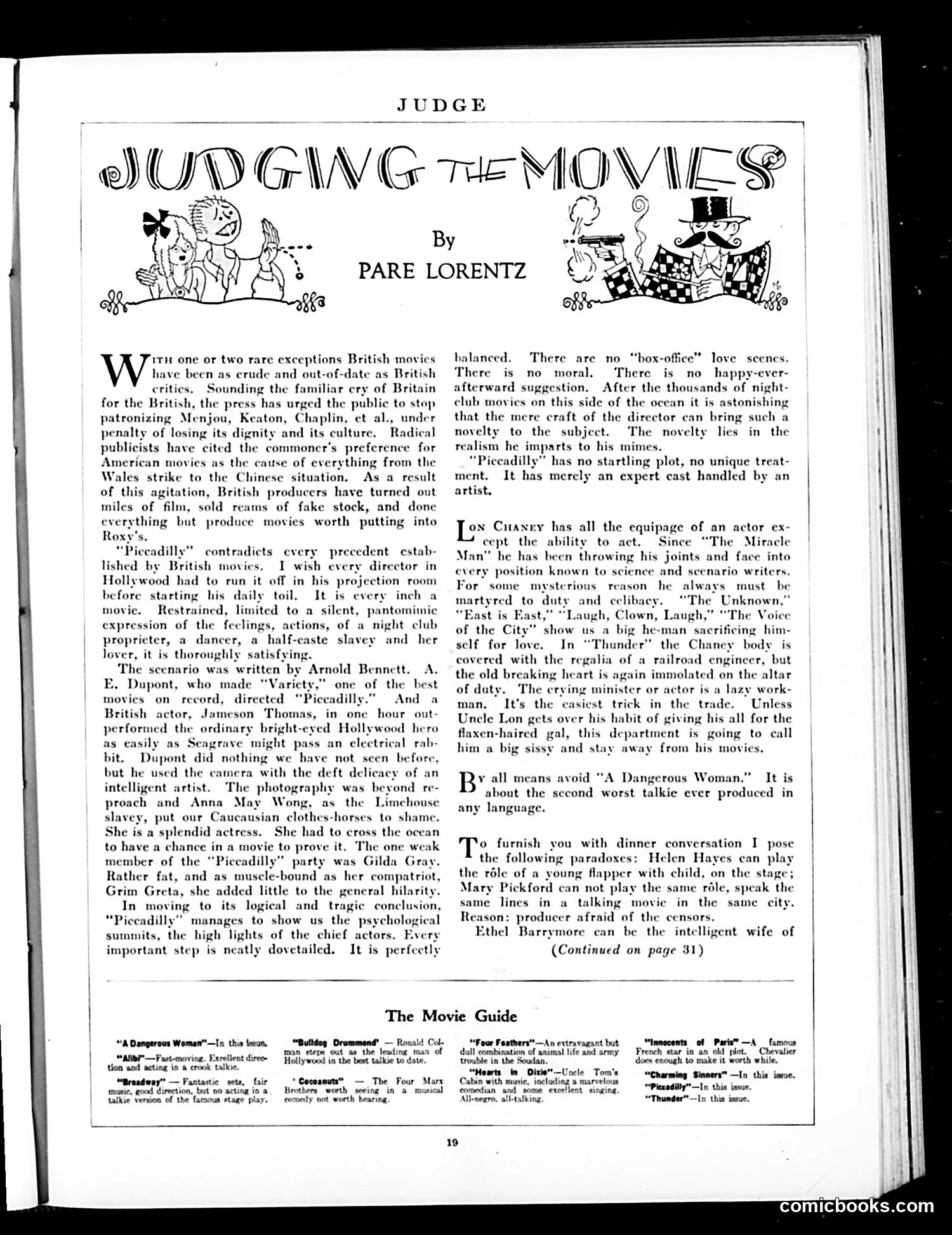
"Judging the Movies" by Pare Lorentz This is a film criticism column reviewing recent movies. The main review praises the British film "Piccadilly" as a rare exception to poor British cinema, contrasting it favorably with American productions. Lorentz credits director E.A. Dupont and actress Anna May Wong for bringing artistry to the film, though he dismisses supporting player Gilda Gray as merely "muscle-bound." The column then critiques other current releases: it dismisses "A Dangerous Woman" and "Alibi" briefly, mocks "Broadway" for bad acting in a talkie adaptation, and ridicules "The Cocoanut," a Marx Brothers musical comedy as "not worth hearing." Most cutting is Lorentz's attack on Lon Chaney, arguing the actor has become a one-trick performer who constantly plays suffering, self-sacrificing men. Lorentz sarcastically calls this "the easiest trick in the trade" and threatens to stop covering Chaney's films unless he breaks this pattern—dismissing such roles as lazy, emasculating work.
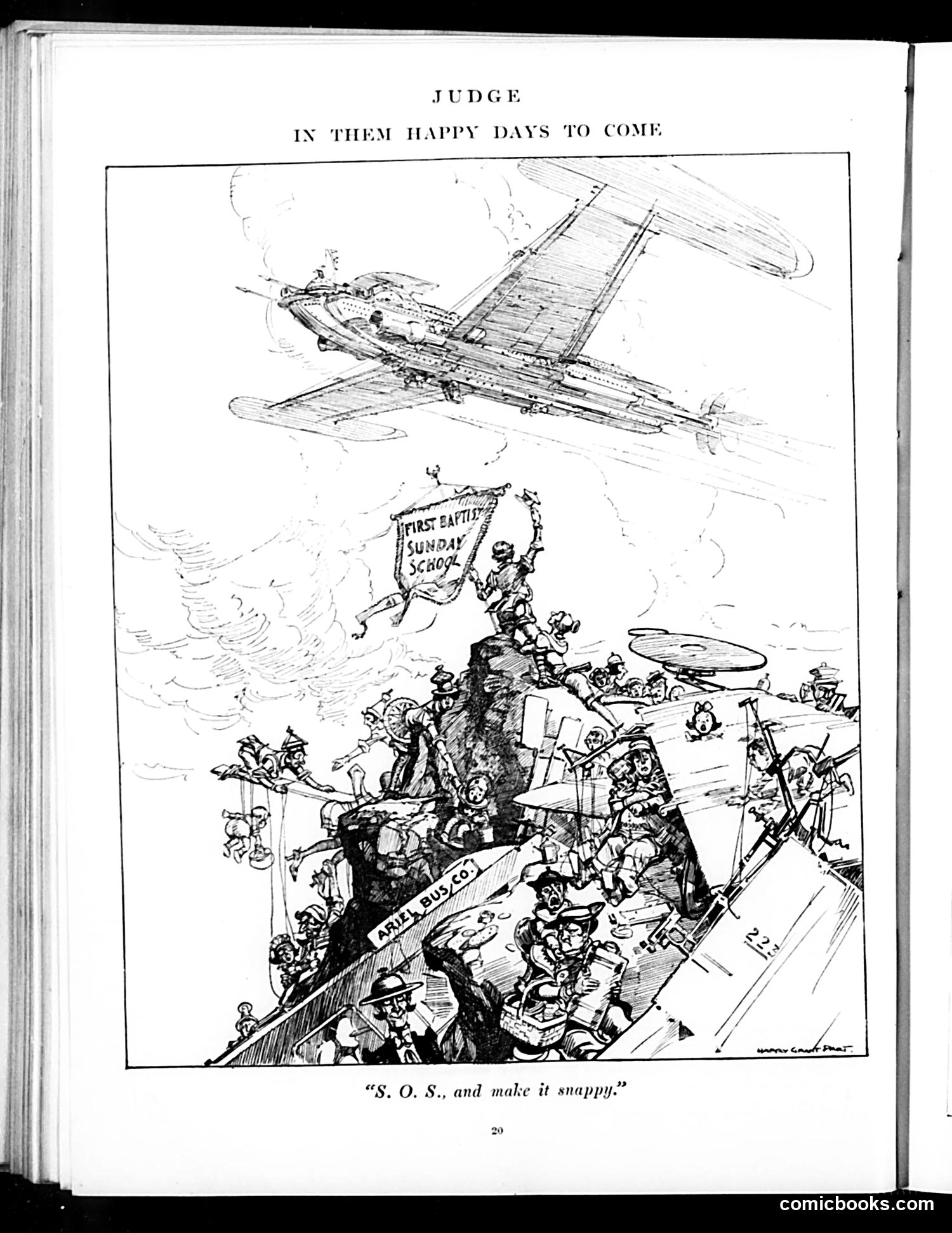
Analysis This is a satirical cartoon titled "In Them Happy Days to Come" with the caption "S.O.S., and make it snappy." The image depicts a chaotic scene of what appears to be a crowded vessel or ship in distress, with an airplane overhead. A banner reading "FIRST BAPTIST SUNDAY SCHOOL" is visible, suggesting religious institution passengers. The cartoon shows figures in disarray, seemingly in a rescue or emergency situation. The satire appears to target either: - The inadequacy of rescue operations - Overcrowding of transportation or institutions - The contrast between "happy days to come" and present chaos Without clearer identification of specific figures or the exact historical context, the precise political/social critique remains unclear, though it likely comments on contemporary transportation safety, institutional overcrowding, or disaster preparedness concerns relevant to Judge magazine's era.
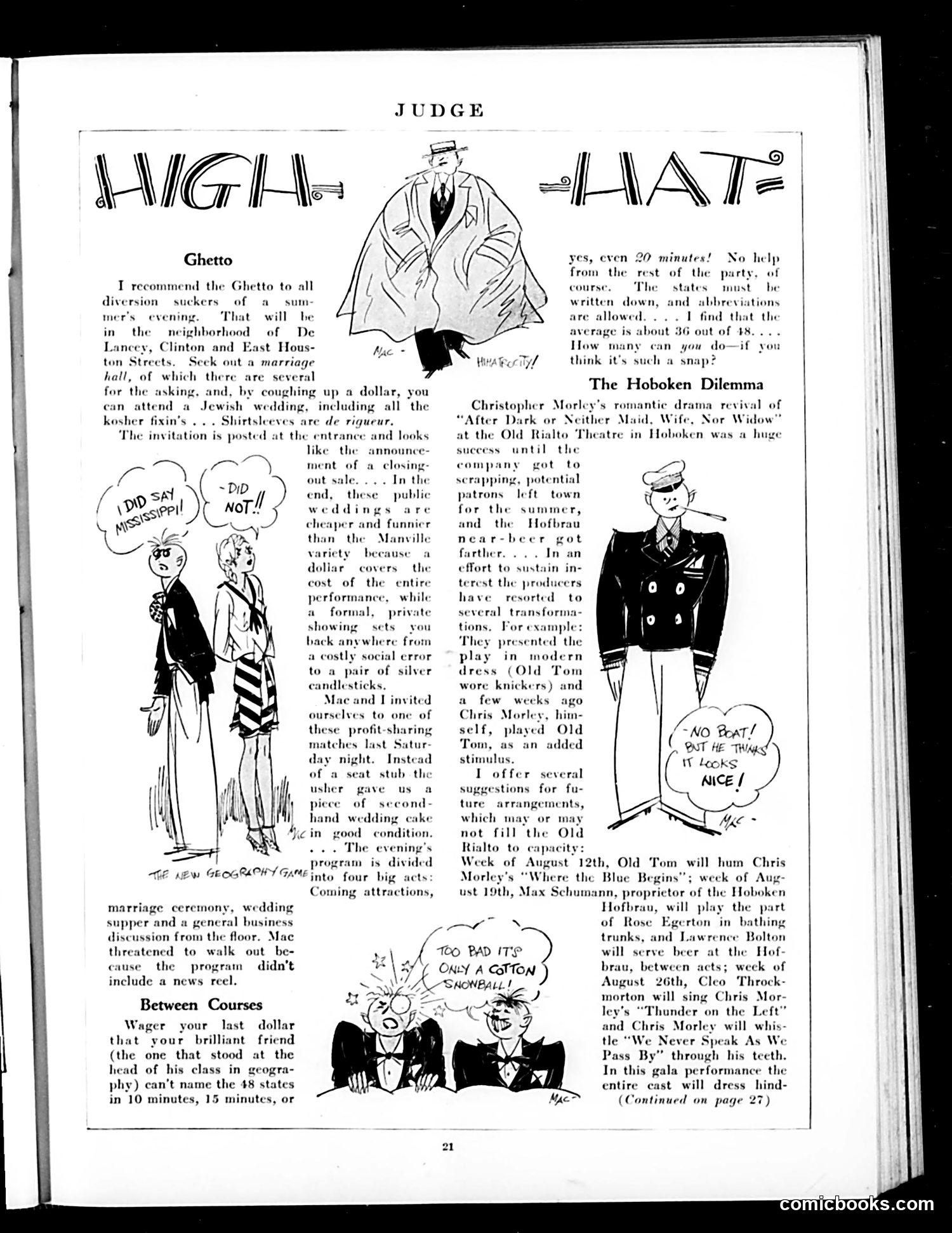
Judge Magazine Page Analysis This page from *Judge* contains social satire about 1920s entertainment and leisure culture. "Ghetto" Section: Recommends visiting immigrant Jewish wedding celebrations on the Lower East Side (De Lancey, Clinton Streets) as cheap entertainment—for a dollar, one gains admission to an entire wedding with food. The satire mocks wealthy readers' voyeuristic interest in working-class "ethnic" culture as exotic amusement. "Between Courses" Trivia Game: A betting game challenging readers to name all 48 U.S. states within time limits—poking fun at educated people's geographic ignorance despite their presumed intelligence. "The Hoboken Dilemma": Reviews Christopher Morley's theatrical revival struggling with attendance. The satire suggests increasingly absurd promotional stunts (local businessmen performing roles, serving beer between acts) to fill seats—mocking both the play's desperation and the public's fickle entertainment tastes. The cartoons illustrate these points with humorous character reactions and dialogue, using *Judge*'s typical satirical approach to contemporary American social pretensions and entertainment trends.
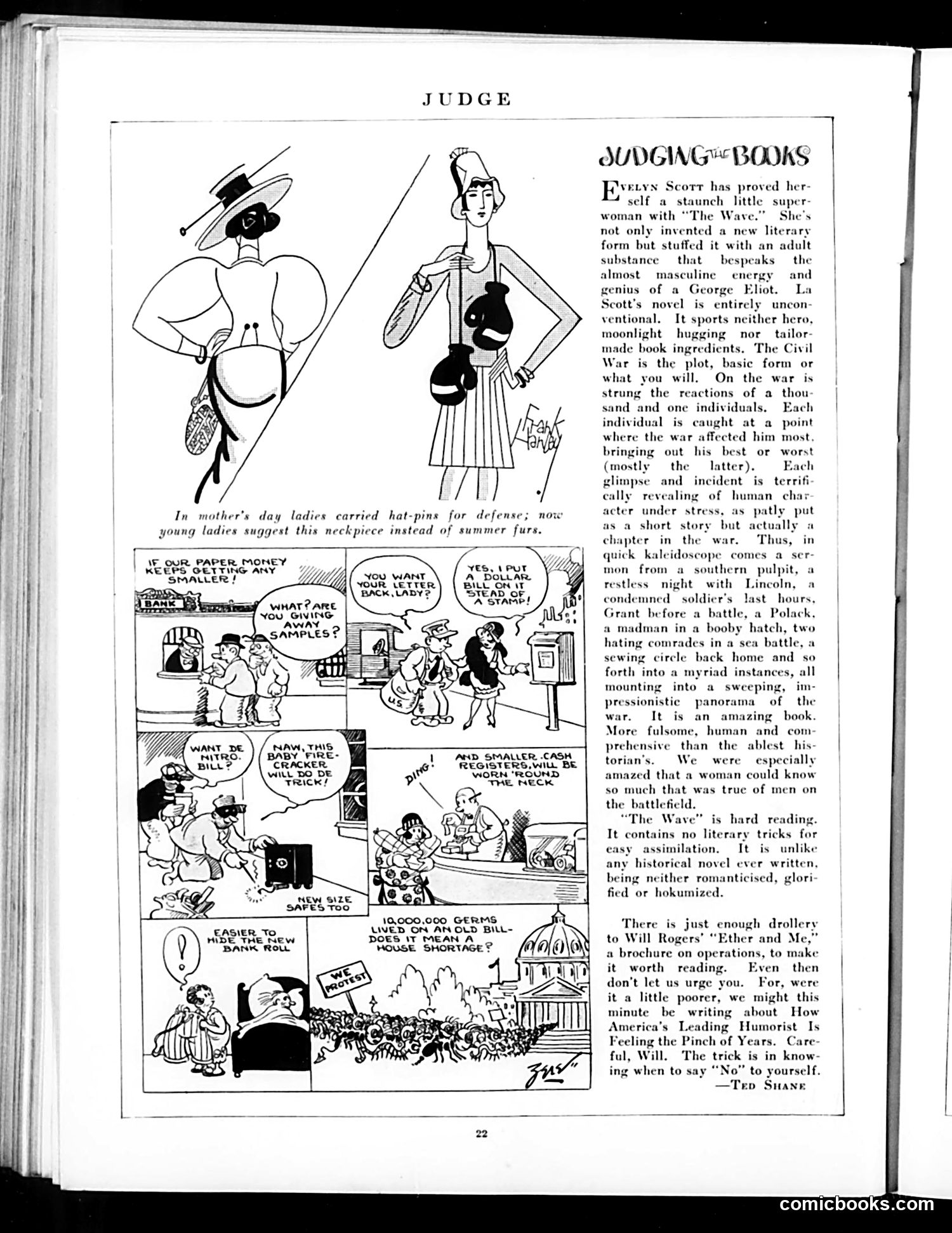
Analysis for Modern Readers This page from *Judge* magazine reviews Evelyn Scott's novel *The Wave*, a Civil War narrative told through individual vignettes rather than traditional plot structure. The reviewer praises Scott's "masculine energy" and unflinching portrayal of war's human cost—soldiers, civilians, and the home front. The cartoons below are satirical commentary on everyday life, likely from the 1920s-30s. The top strip jokes about women's fashion: historically, hat-pins served as self-defense weapons; now the reviewer suggests necklaces could replace furs as practical accessories. The lower cartoons appear to mock consumer anxieties—one references germs on currency; another advertises new bank safes, implying economic paranoia post-Depression. The brief mentions of Will Rogers' humor piece and Ted Shane's byline anchor this in period magazine culture where literary criticism shared space with social satire and advertising humor.
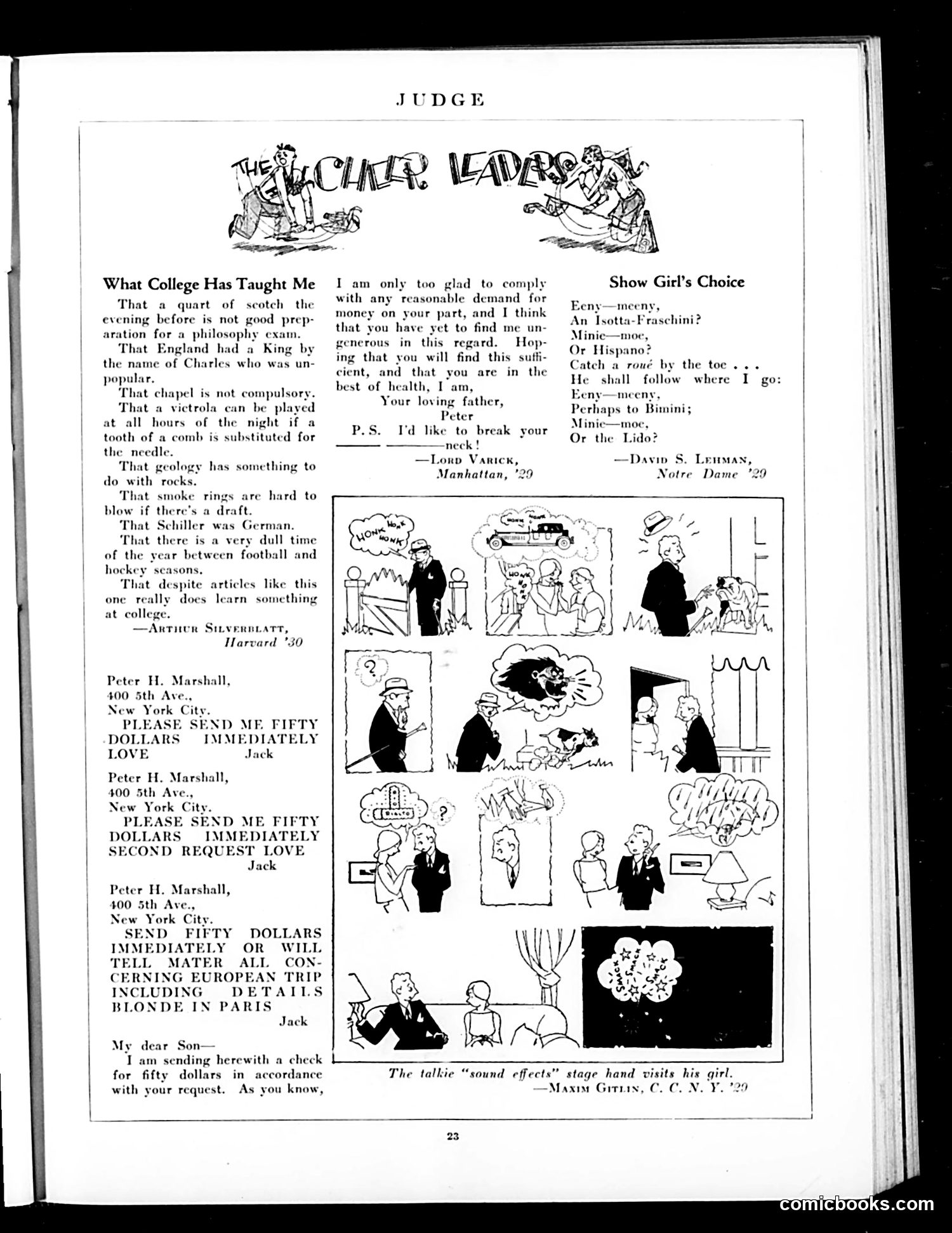
Judge Magazine Page Analysis This page from Judge magazine (circa 1929) contains humor targeting college students and young men of the era. "What College Has Taught Me" offers satirical observations about college life—acknowledging that students actually learn little beyond practical (often dubious) knowledge like how to play phonographs illicitly and drink scotch before exams. The Peter H. Marshall letters depict a son's escalating blackmail scheme against his father, demanding fifty dollars through increasingly dramatic threats (mentioning a "blonde in Paris" and a European trip). The father's response shows weary resignation—he pays but threatens violence ("break your neck"), capturing the generational conflict and humor in parental indulgence of wayward sons. "Show Girl's Choice" is a playful rhyme about a woman choosing between romantic options (Bimini, the Lido). The comic strip at bottom appears to show a stage hand visiting his girlfriend, with "sound effects" suggesting movie industry romance. Overall, the page satirizes 1920s youth culture—college excess, filial manipulation, and the era's fascination with motion pictures and travel.
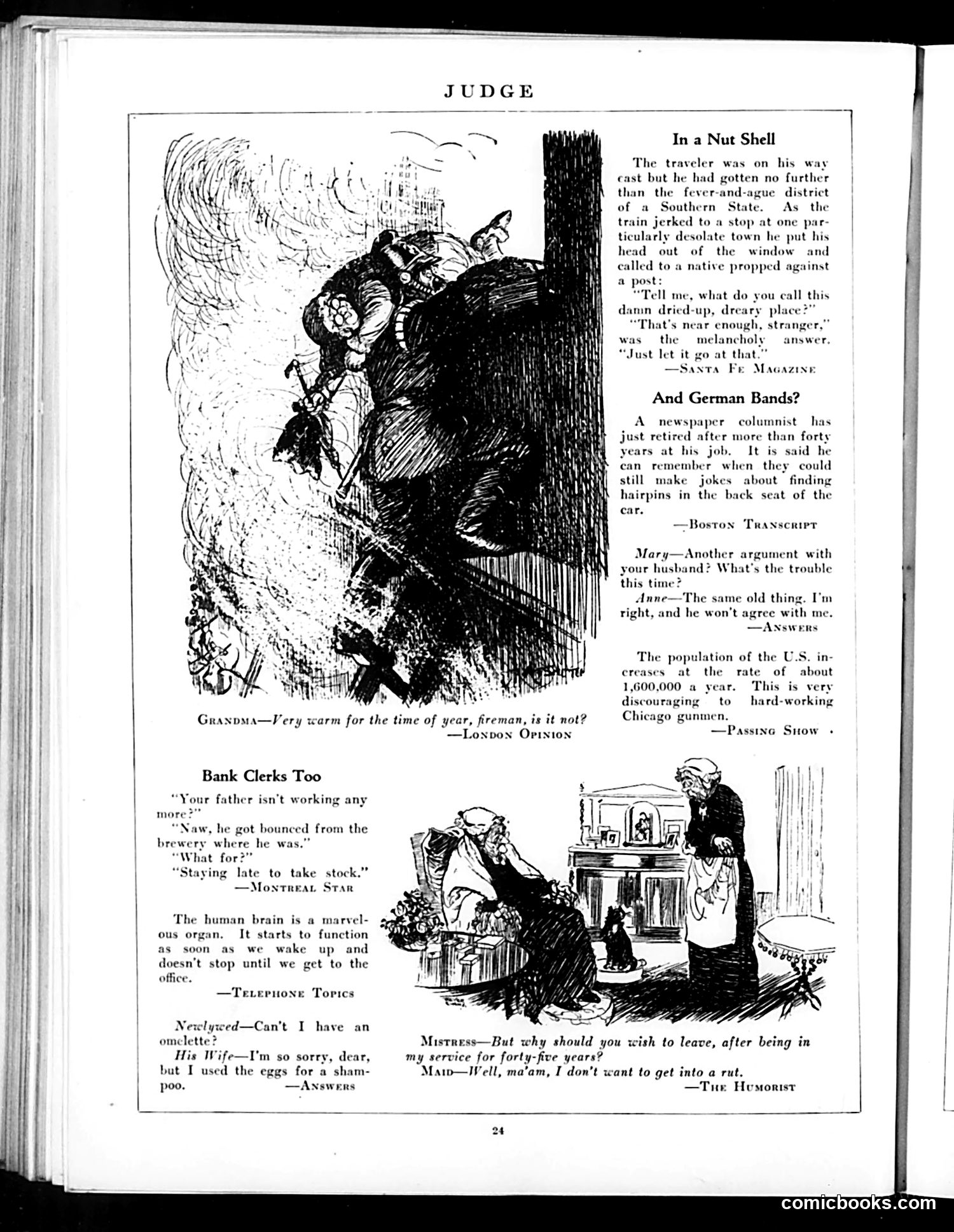
Judge Magazine Page Analysis This page collects brief humorous anecdotes and observations typical of early-20th-century American satirical magazines. The content includes: Main cartoon (top left): A poorly dressed traveler peers from a train window at a desolate Southern town, asking a native what he calls "this damn dried-up, dreary place." The joke satirizes the impoverished condition of certain Southern communities during this era. Other content: Short comic quips on contemporary life—a newspaper columnist retiring after 40 years, a woman perpetually arguing with her husband, population growth concerns, bank clerks working late, and a long-serving maid wanting to leave her position to avoid "getting into a rut." The bottom illustration depicts a domestic scene between a mistress and departing maid discussing the servant's 45-year tenure. Overall point: These pieces mock everyday frustrations, social stagnation, and the economic struggles of ordinary Americans through rapid-fire humor targeting husbands, wives, servants, and regional poverty.
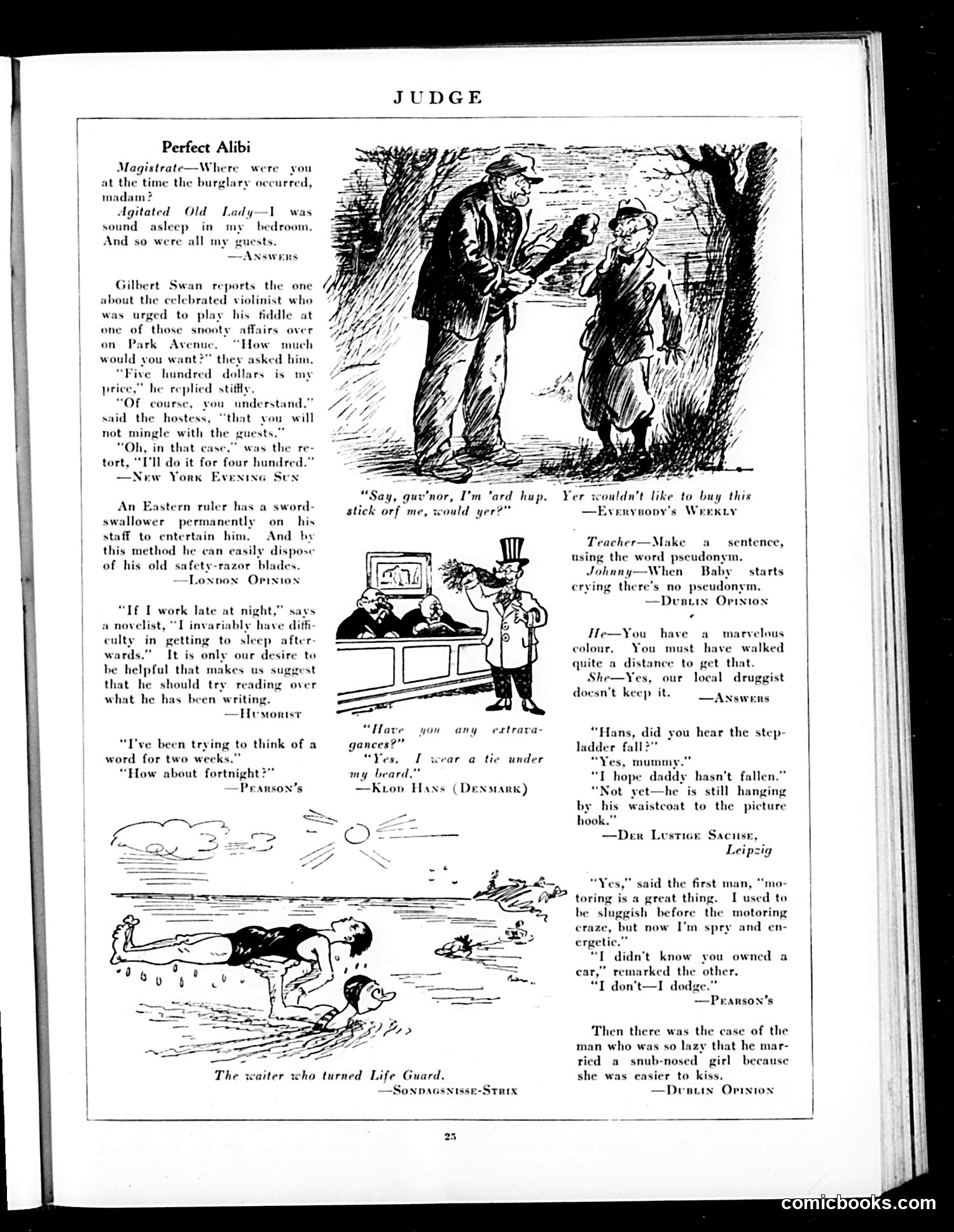
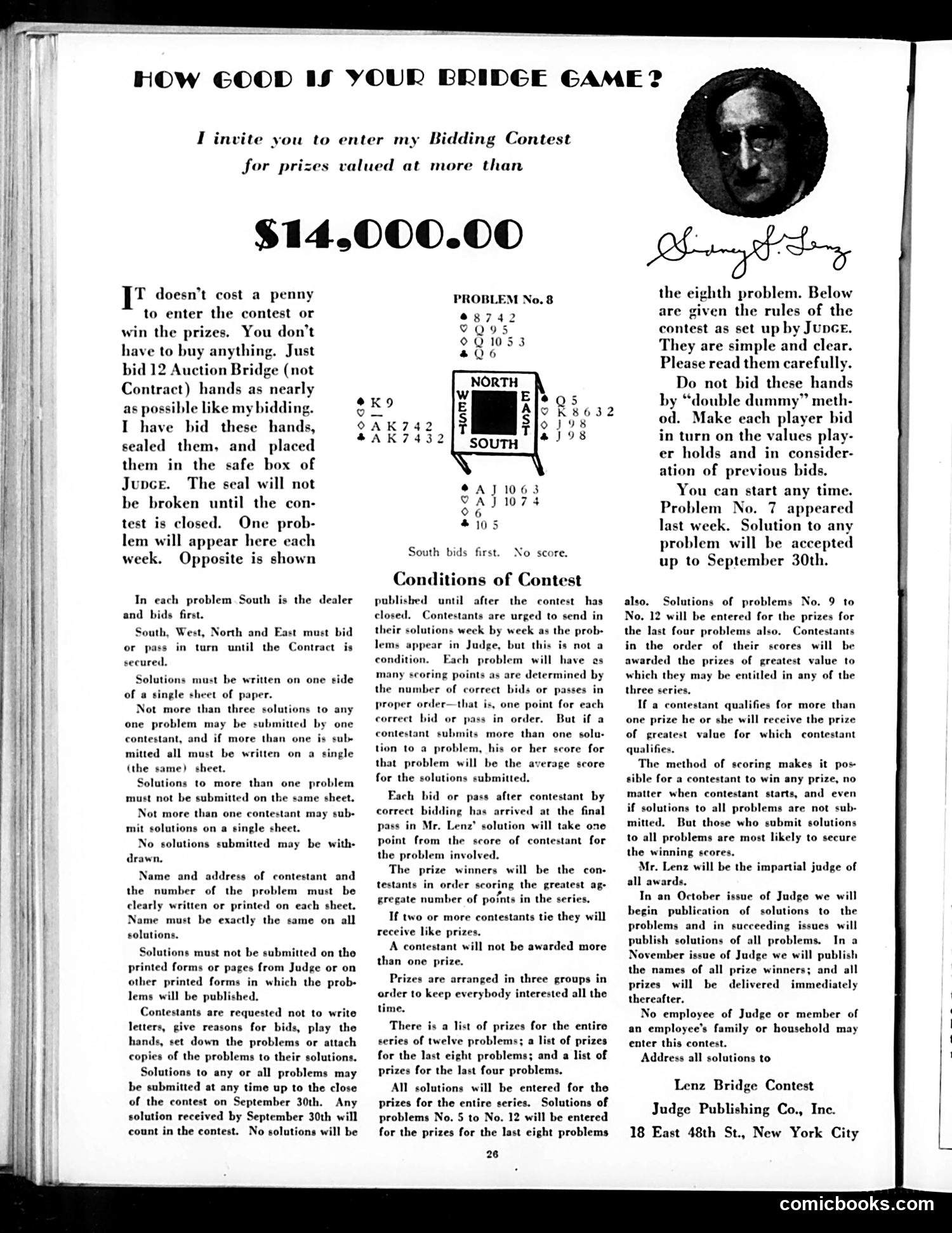
Bridge Game Contest Advertisement This page advertises a bridge bidding contest sponsored by Judge magazine, offering $14,000 in prizes. The contest invites readers to solve bridge hands and submit bidding solutions weekly. The man pictured appears to be Sidney Lenz, a famous bridge expert of the era, whose signature is visible. Lenz was renowned for popularizing contract bridge in America during the 1920s-30s. The "satire" here is gentle: Judge is humorously challenging readers' bridge skills with the opening question "How good is YOUR bridge game?" — implying many readers think they're better players than they actually are. This taps into the period's bridge craze, when the game was enormously popular among middle and upper-class Americans. The contest mechanics are straightforward advertising: no entry fee, weekly problems published in Judge, solutions judged by the prestigious Lenz. This combines entertainment with magazine promotion.
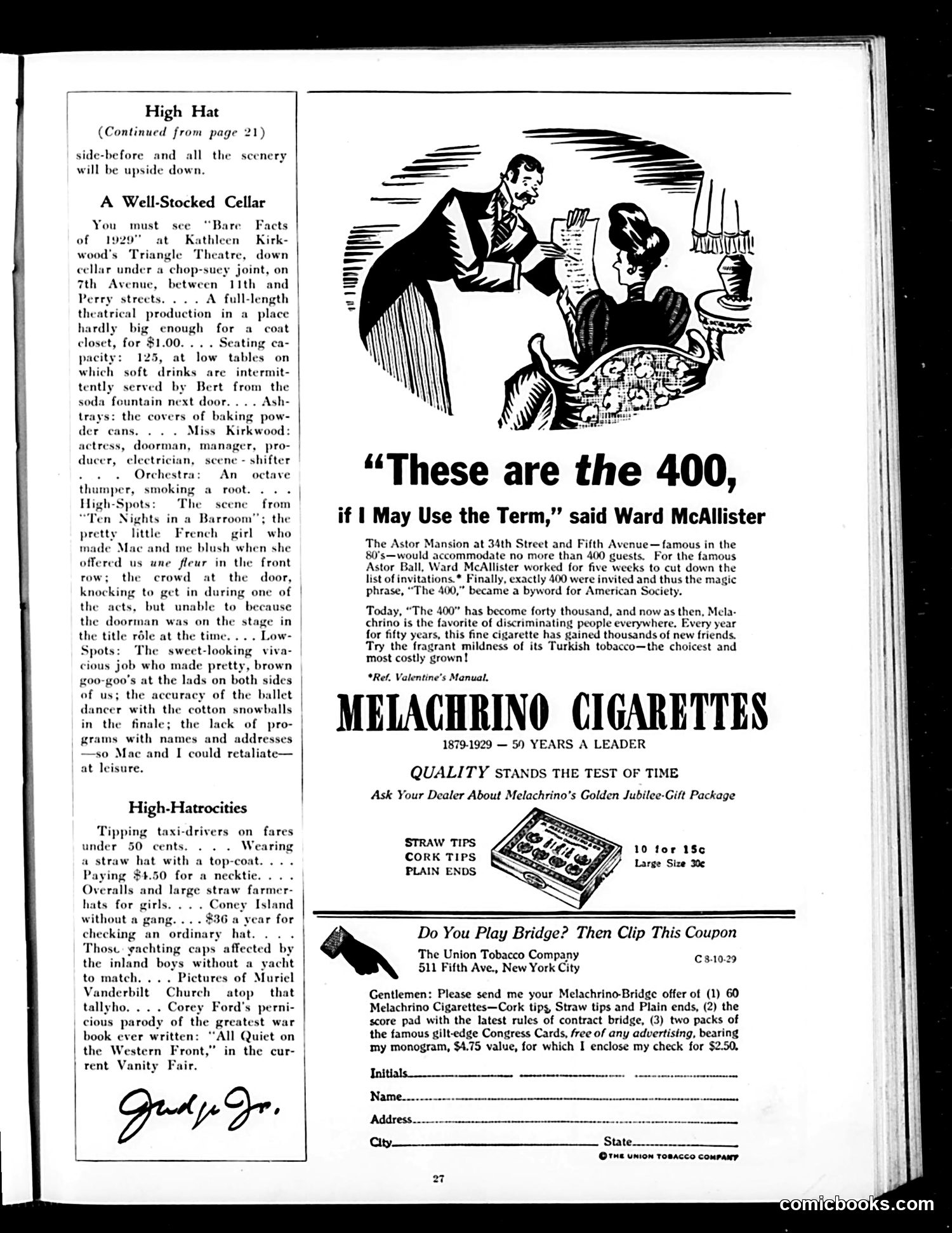
Content Analysis This page combines satirical commentary with period advertising. The main content is "High Hat," a gossip/culture column reviewing New York theatrical venues and social absurdities of the era (circa 1929, based on the Melachrino cigarette's 50-year anniversary claim from 1879). The column mocks pretentious wealthy behavior—"High-Hatrocities"—like undertipping taxi drivers and wearing fashionable straw hats. It references Ward McAllister, the historical 19th-century arbiter who famously curated the original "400"—New York's elite social circle. The text humorously suggests this exclusive designation has inflated to "forty thousand," satirizing how status symbols become diluted over time. The cartoon illustration shows gentlemen at what appears to be a speakeasy or dining establishment—relevant context given Prohibition (1920-1933). The page is dominated by a Melachrino cigarette advertisement exploiting the "400" reference to associate the brand with exclusivity and discrimination (meaning "discernment"). A bridge-game coupon offers cigarettes alongside playing cards, targeting affluent leisure consumers.
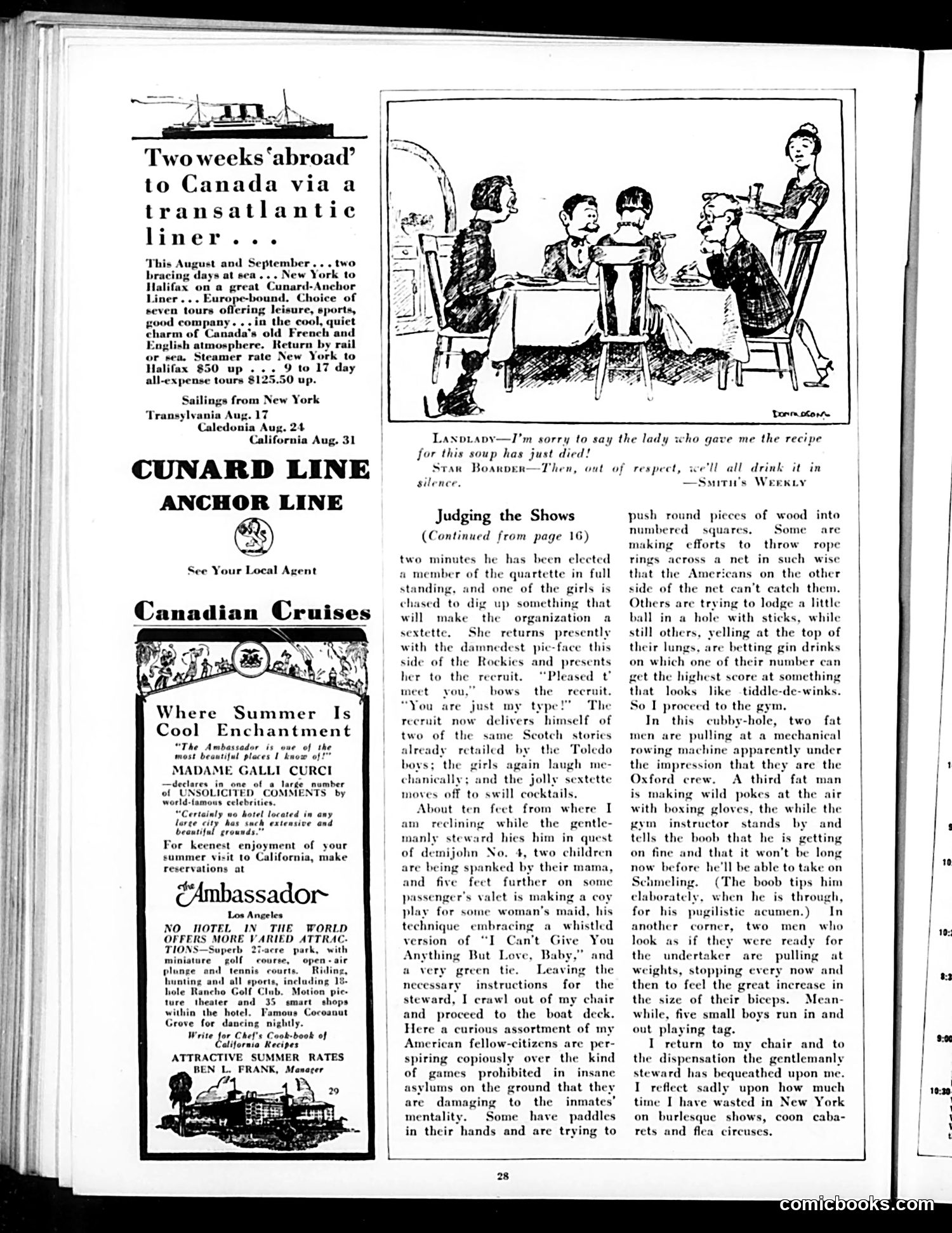
Explanation of Judge Magazine Page Content This page is primarily advertising rather than political satire. It features travel promotions for transatlantic cruises (Cunard Line, Canadian tours) and the Ambassador Hotel in Los Angeles. The only cartoon present is a small humorous domestic scene captioned "Landlady—I'm sorry to say the lady who gave me the recipe for this soup has just died! / Stan Boarder—Then, out of respect, we'll all drink it in silence." This is a mild joke about bad cooking—the implication being the soup was so poor it essentially "killed" whoever originally made it. The humor relies on the genteel pretense of respectful silence as a polite cover for relief at not having to taste it again. The "Judging the Shows" article describes cruise ship entertainment and passenger behavior—various games, flirtations, and recreational activities aboard ship. It's observational humor about leisure travel, not political commentary. The page reflects 1920s-30s consumer culture and vacation advertising aimed at middle and upper-class Americans.
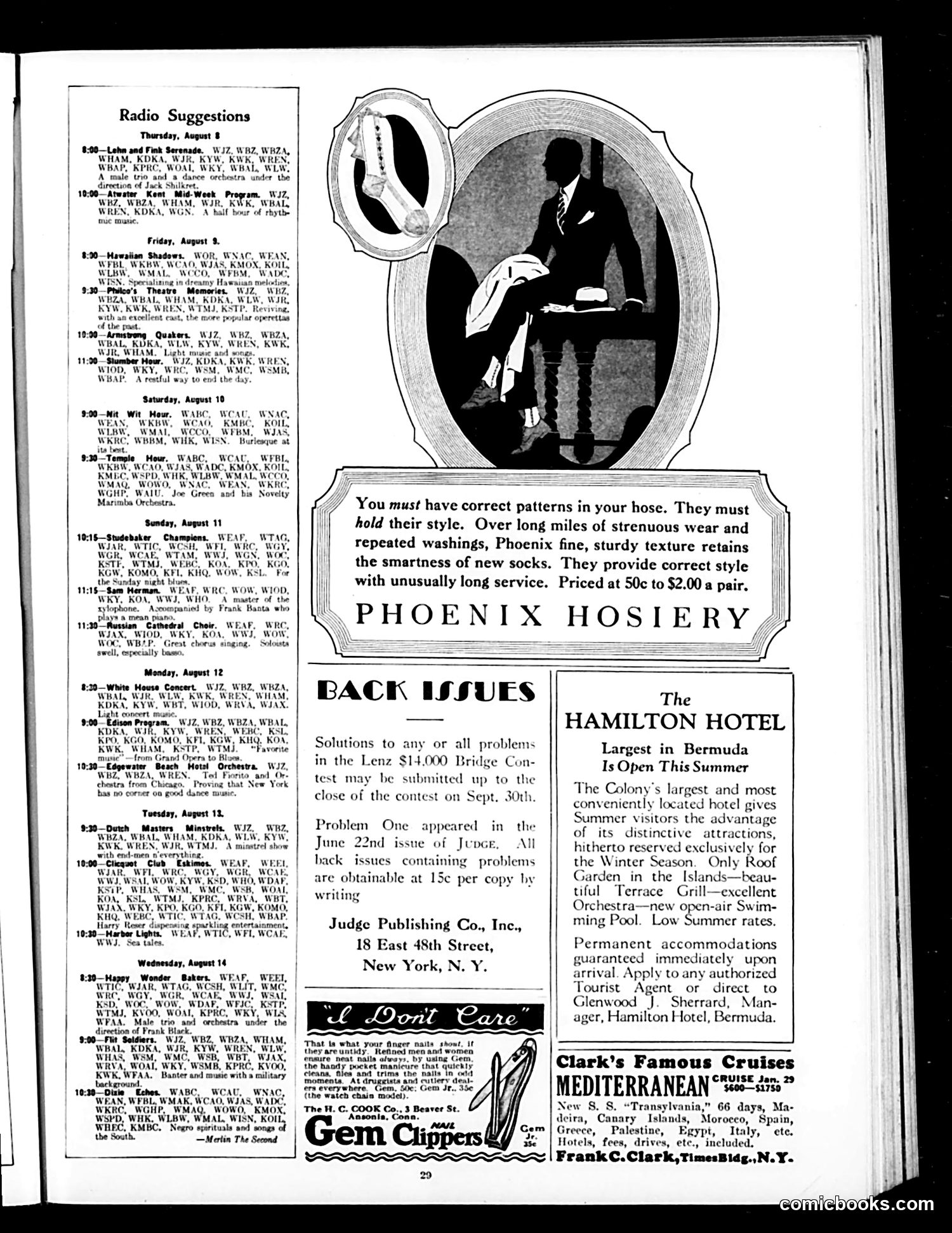
Page Analysis: Judge Magazine, August 1928 This page is primarily advertising and radio programming listings, not political satire. The main visual element is a stylized illustration of a woman in silhouette, seated and adjusting her stockings—advertising Phoenix Hosiery. The ad emphasizes durability ("repeated washings," "long service") and correct style, pricing at 50¢ to $2.00 per pair. The bulk of the page contains radio schedules for Thursday-Wednesday broadcasts, listing station call letters and program names (Hawaiian Shadows, Studebaker Champions, etc.)—reflecting the era when radio was prime entertainment. Additional advertisements include the Hamilton Hotel in Bermuda, Gem Clippers nail care products, and Clark's Mediterranean cruises. There's also a "Back Issues" section soliciting solutions to a bridge-building contest from the June 22nd issue. No political cartoon or satire is present on this page. It represents typical 1920s magazine advertising and programming content.
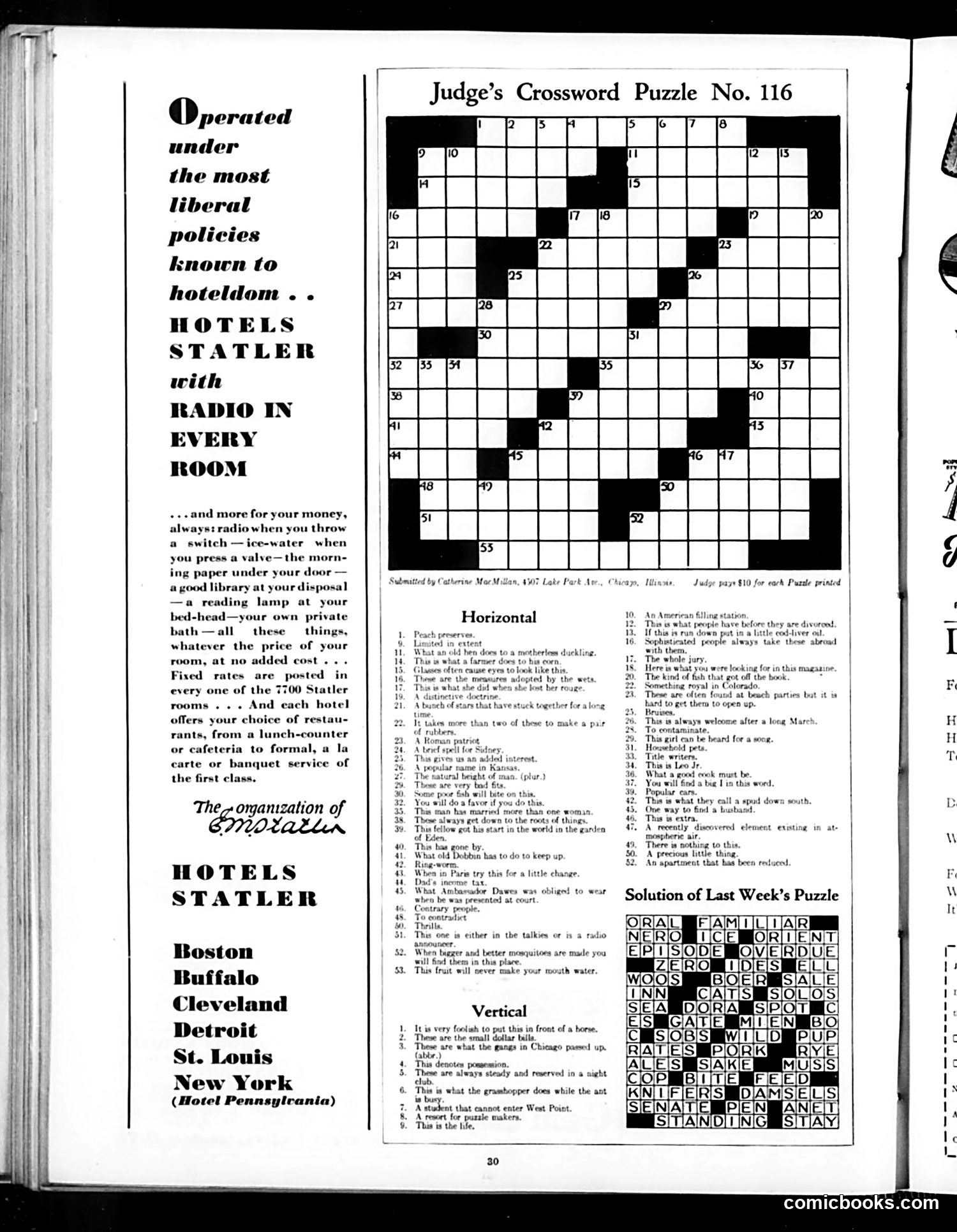
Analysis of Judge Magazine Page No. 116 This page is primarily advertising and a crossword puzzle, not political satire. The left side contains a full-page advertisement for Hotels Statler, a hotel chain promoting their amenities: radios in every room, ice water on demand, morning newspapers, libraries, reading lamps, private baths, and fixed rates across seven properties (Boston, Buffalo, Cleveland, Detroit, St. Louis, New York). The ad emphasizes quality service "at no added cost" regardless of room price—positioning Statler as offering luxury democratically. The center-right features Judge's Crossword Puzzle No. 116 with clues and a solved puzzle from the previous week below it. The crossword is entertainment content, not satire. There are no political cartoons, caricatures, or satirical commentary visible on this page. It represents a typical Judge magazine layout mixing advertisements with puzzle content—common filler material for publications of this era.
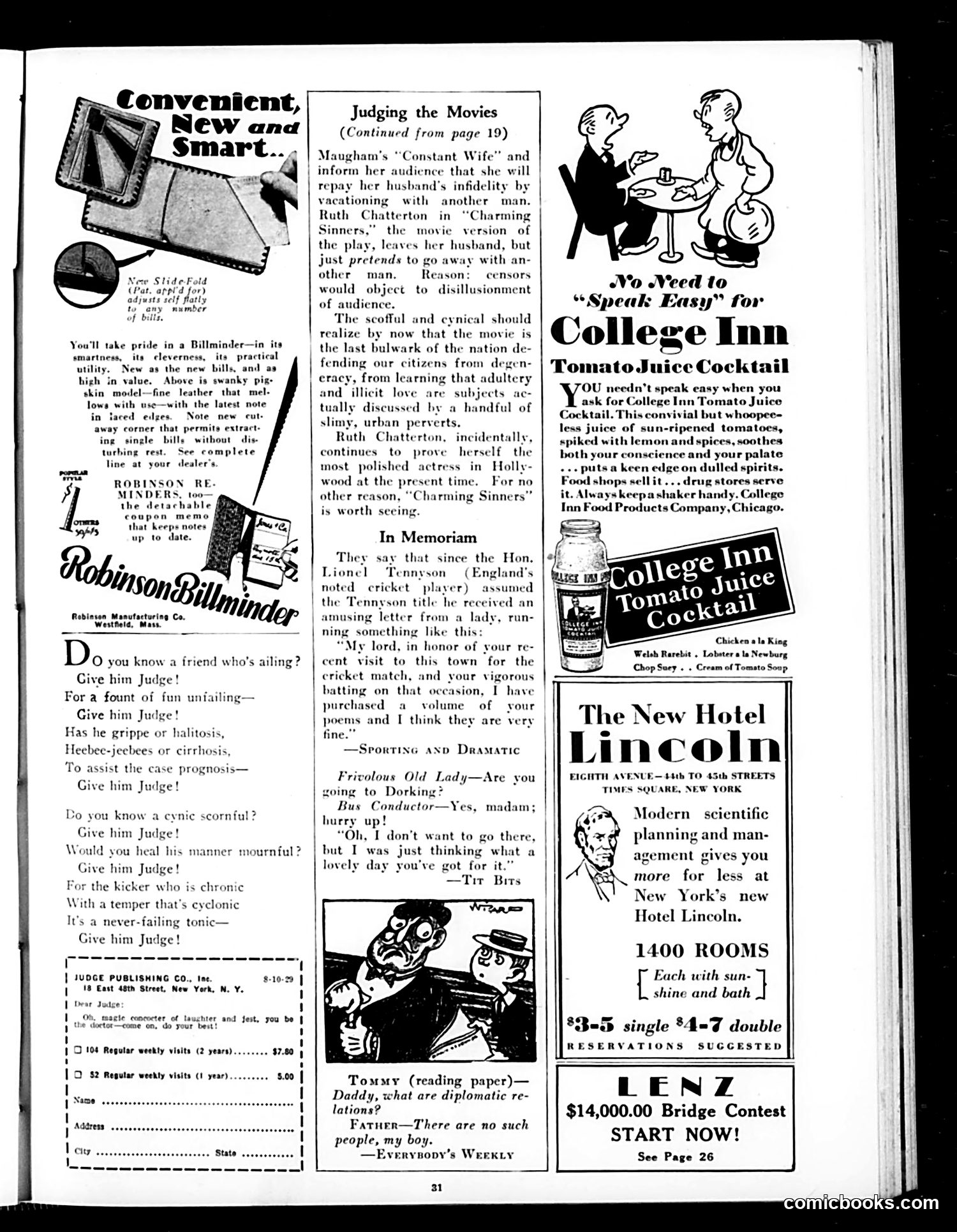
Analysis for Modern Readers This page mixes advertising with satirical content typical of Judge magazine. The main cartoons are: 1. "Give him Judge!" poem: A comedic advertisement encouraging gift subscriptions to Judge as a universal cure—comparing it to medicine for various ailments (influenza, cynicism, bad temper). The joke relies on Judge's self-promotion as therapeutic humor. 2. Movie review: Satirizes Hollywood censorship. The critic notes that in the film adaptation of Maugham's "Constant Wife," the protagonist only *pretends* to commit adultery rather than actually doing so—dodging censors' objections. The satire mocks how movies sanitize morality for audiences, positioning cinema as protector of public decency against "degeneracy." 3. "In Memoriam" anecdote: A humorous story about cricket player Lionel Tennyson receiving fan mail congratulating him on his title assumption, with the writer praising his poetry—likely mistaking him for poet Alfred Tennyson. 4. Brief jokes about diplomatic relations and bus travel provide filler humor. The remainder is period advertising for hotels, Judge subscriptions, and a tomato juice cocktail.
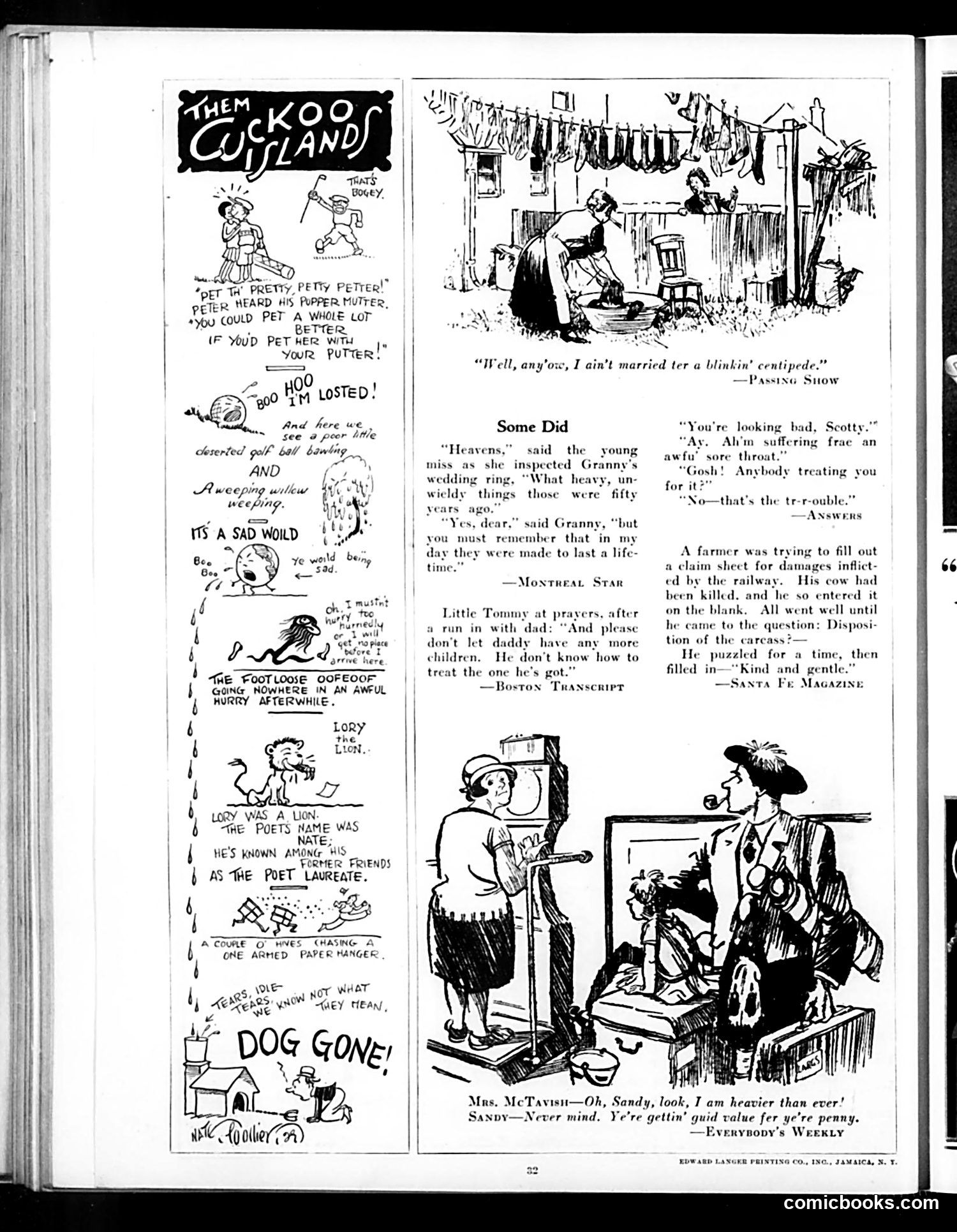
Analysis of Judge Magazine Page This page contains multiple unrelated humor items typical of early 20th-century satirical magazines: Left column ("Them Cuckoo Utland"): A whimsical comic strip about golf and animals, featuring nonsensical wordplay and absurdist humor rather than political satire. References include a golf ball "bowling" and a lion nicknamed "Poet Laureate"—likely mocking pretentious literary types. Right side contains brief humorous anecdotes and jokes sourced from various publications: - A grandmother defending old wedding rings' durability against modern disposability - A child's prayer criticizing his father's parenting - Scottish dialect humor about illness and relationships - A farmer darkly listing his dead cow's disposition as "Kind and gentle" Overall context: This represents Judge's blend of absurdist comic strips and reprinted short jokes—much like modern social media humor compilations. The satire targets general human follies (vanity, poor parenting, materialism) rather than specific political figures or events. The crude printing and varied sources suggest this was filler content.

Texaco Advertisement, Not Political Satire This is primarily a corporate advertisement for Texaco gasoline and motor oil, not satire or political commentary. The page lacks the critical or mocking tone characteristic of Judge magazine's typical content. The ad promotes the Lincoln Highway (a real transcontinental route) as a "Texaco Trail," emphasizing that motorists are never more than an hour from a Texaco pump across all 48 states. The Texaco Red Star logo and imagery of a vintage gas pump anchor the marketing message. The only potentially satirical element is subtle: the phrase "TOUR WITH TEXACO" frames commercial infrastructure as a patriotic journey across America. However, this appears to be straightforward 1920s-30s advertising rhetoric rather than intentional satire—glorifying American highways and consumer convenience was genuine marketing strategy of the era, not something being mocked. This represents Judge's advertising revenue model rather than editorial content.

Lucky Strike Cigarette Advertisement This is a 1929 advertisement for Lucky Strike cigarettes featuring Miss Marjorie Oelrichs, identified as a prominent Newport and New York socialite. The ad promotes the brand's "toasting" process as reducing throat irritation and coughing—a health claim common in early cigarette marketing before tobacco's dangers were widely acknowledged. The tagline "Reach for a Lucky instead of a sweet" suggests cigarettes as a weight-control alternative, appealing to women concerned about body image. The celebrity endorsement leverages Oelrichs's social status to glamorize smoking. This represents the era when cigarette companies aggressively marketed to women and made unsubstantiated medical claims, practices later restricted by advertising regulations.