judge
Judge — August 17, 1929
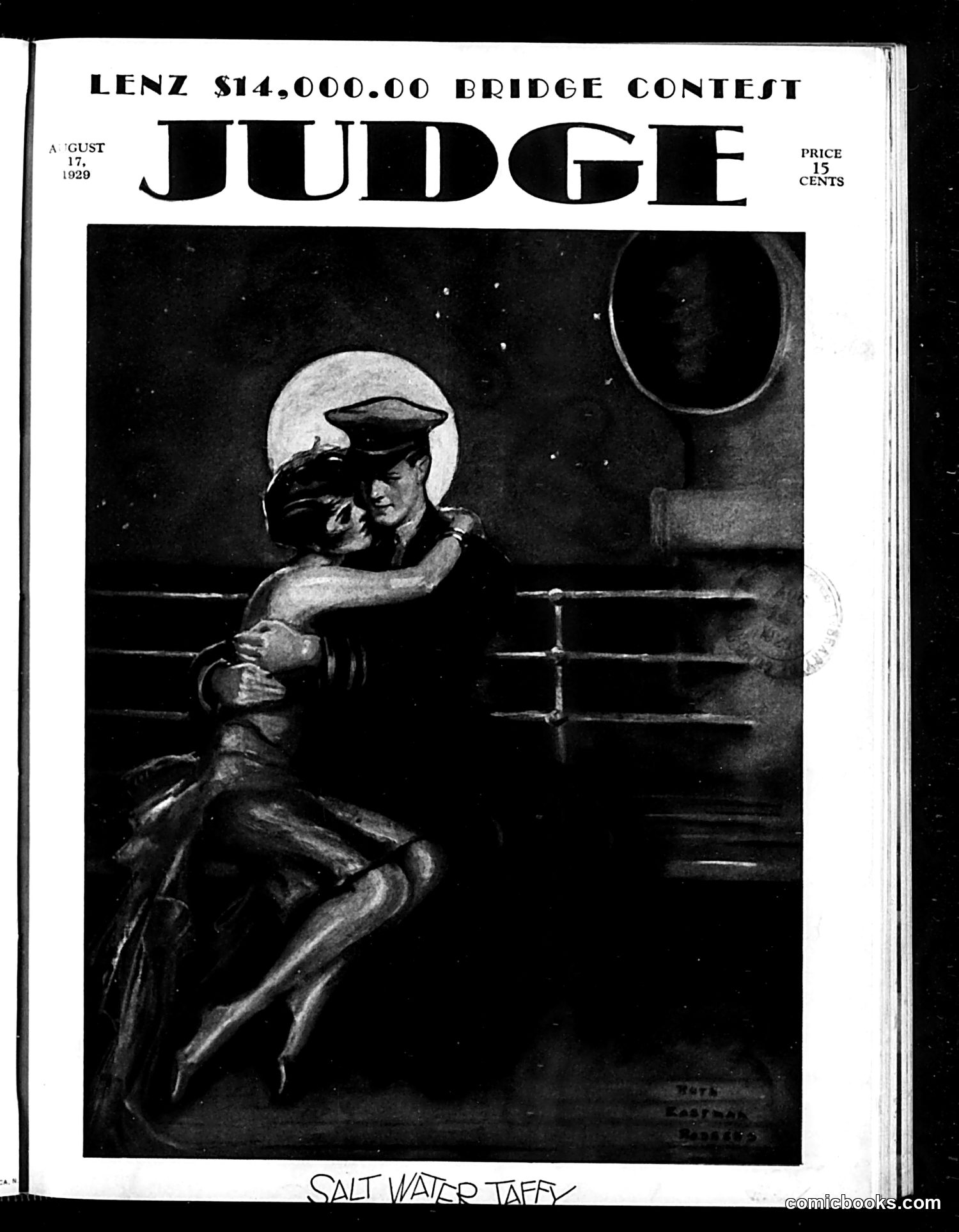
Analysis of Judge Magazine Cover (August 17, 1929) This cover depicts a romantic scene labeled "Salt Water Taffy" — likely a double entendre referencing both the seaside candy and romantic encounters at the beach. A sailor and woman embrace by a ship's railing under moonlight, with a porthole visible above. The "Lenz $14,000.00 Bridge Contest" header references what appears to be a contemporary bridge tournament or competition, suggesting Judge was covering leisure activities and social events of the era. The imagery romanticizes naval life and seaside recreation, common themes in 1920s American popular culture. The cover's theatrical lighting and intimate composition reflect the sentimental aesthetic typical of Judge's satirical commentary on middle-class American romance and social conventions of this period.
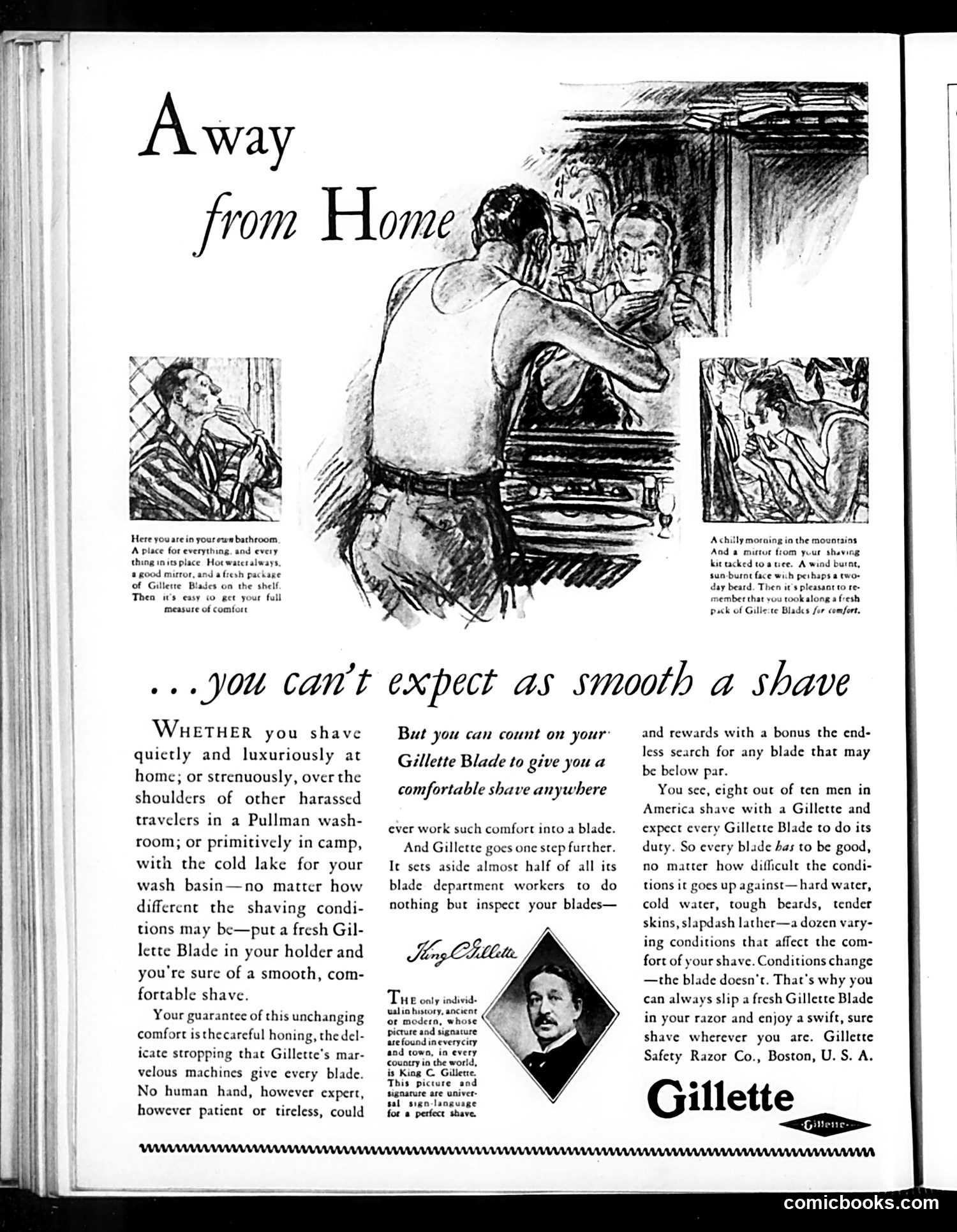
Analysis This page is primarily a Gillette razor advertisement, not political satire. The headline "Away from Home" frames shaving as a practical concern for travelers—men in bathrooms, Pullman cars, camps, and mountains. The three sketched vignettes illustrate shaving scenarios: a man at home, another while traveling, and a third in mountainous terrain. These are lifestyle illustrations, not caricatures of political figures. The advertisement emphasizes Gillette's blade quality and consistency across different conditions. King C. Gillette's portrait appears in a diamond frame. The copy targets the male reader with promises of comfort and reliability wherever he might be. This reflects early 20th-century advertising's focus on modern convenience and masculinity, not political commentary.
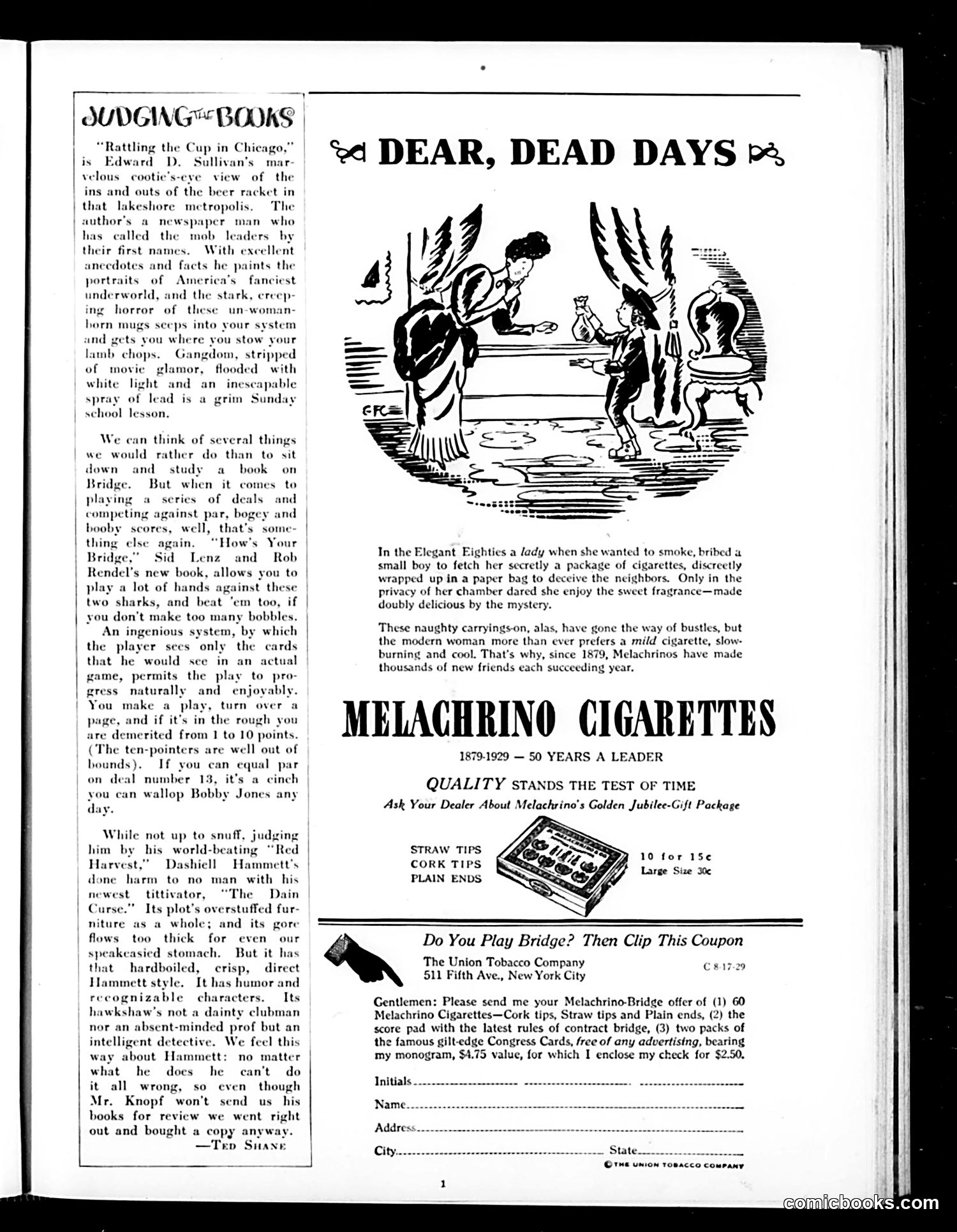
"Dear, Dead Days" Cartoon Analysis This cartoon satirizes outdated social practices from the "Elegant Eighties" (1880s). It depicts a young woman bribing a boy to secretly fetch cigarettes for her, hidden in a paper bag to avoid detection by neighbors—illustrating how smoking by women was considered scandalous and required deception. The satire's point: these secretive behaviors have become quaint relics. The text notes that since 1879, Melachrino cigarettes have made "thousands of new friends each succeeding year," suggesting women's smoking is now normalized and open. The page is primarily a Melachrino Cigarettes advertisement (1929), using humor to market cigarettes by contrasting past social shame with present acceptability. It reflects early 20th-century marketing that normalized female smoking.
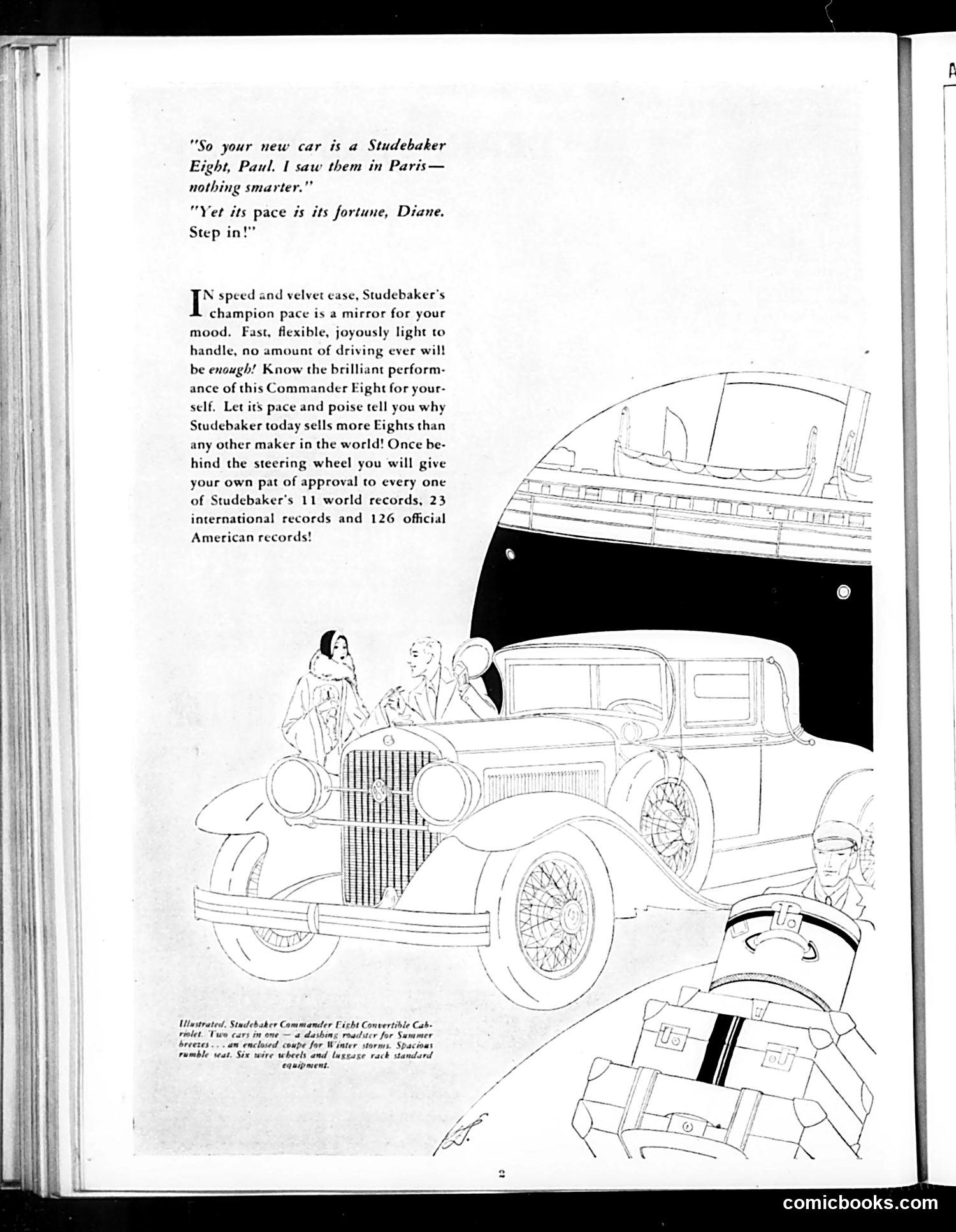
Analysis This page is primarily automobile advertising, not political satire. It promotes the Studebaker Commander Eight automobile through a fictional dialogue between characters named Paul and Diane. The ad uses a common marketing strategy: Paul claims to have seen Studebaker Eights in Paris and praises their sophistication ("nothing smarter"), while Diane responds enthusiastically about their performance capabilities. The accompanying illustration shows the car with well-dressed figures admiring it. The text emphasizes Studebaker's sales dominance and racing records (11 world records, 126 American records) to establish prestige and reliability. This represents typical 1920s-30s advertising: associating consumer products with European elegance, social approval, and technological achievement to appeal to aspirational American readers.
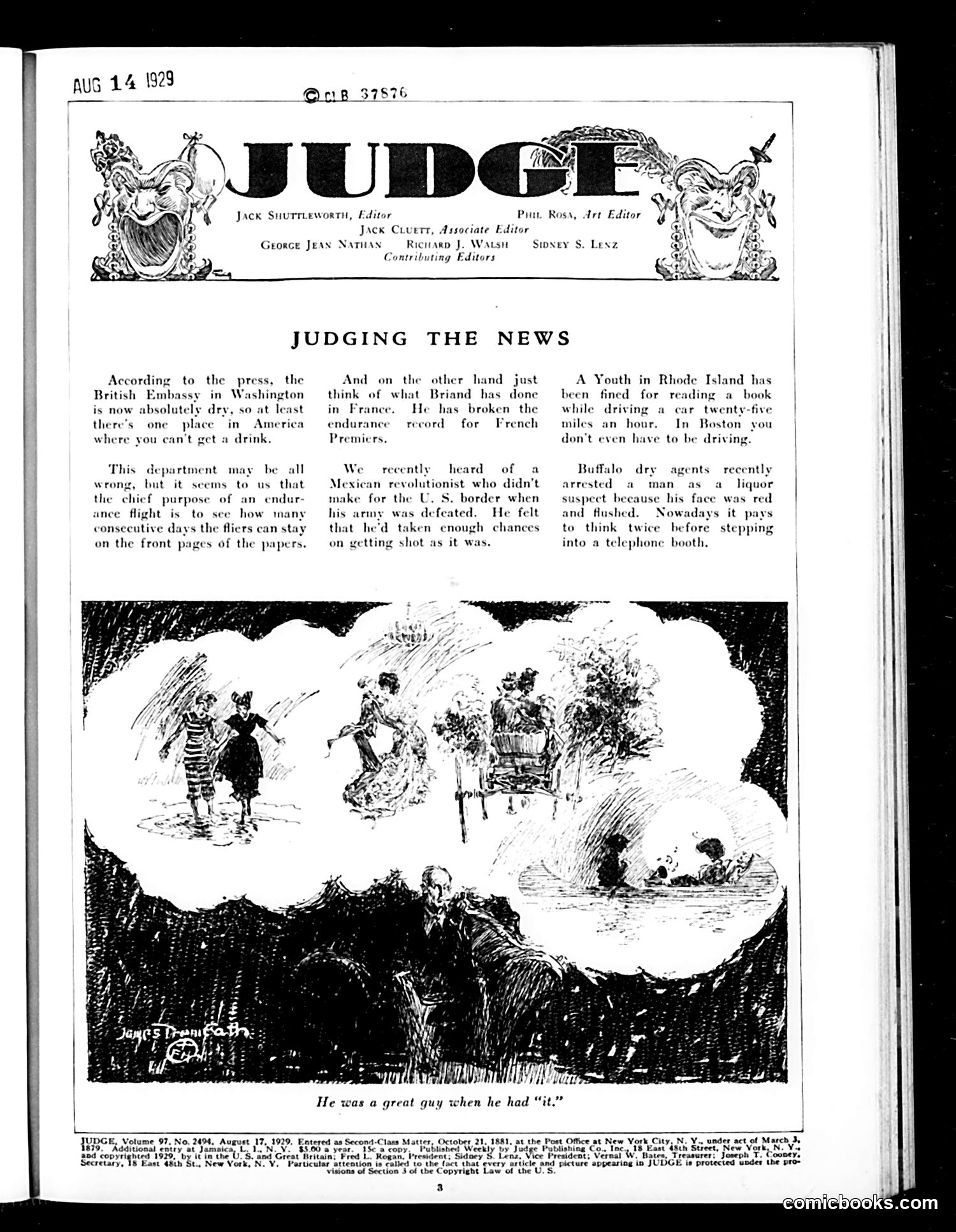
Judge Magazine, August 14, 1929: "Judging the News" This page contains brief satirical commentary on contemporary news items rather than a single political cartoon. The main cartoon depicts a man daydreaming about better times—showing scenes of leisure, travel, and enjoyment. The caption reads "He was a great guy when he had 'it.'" The accompanying text satirizes various news stories: the British Embassy being a "dry" establishment during Prohibition; a French endurance record; a Rhode Island youth arrested for speeding; and a Mexican revolutionary who miscalculated his military prospects. The humor is light social commentary on contemporary absurdities—Prohibition enforcement inconsistencies, traffic safety concerns, and military misjudgments—typical of Judge's satirical approach to everyday news of 1929.
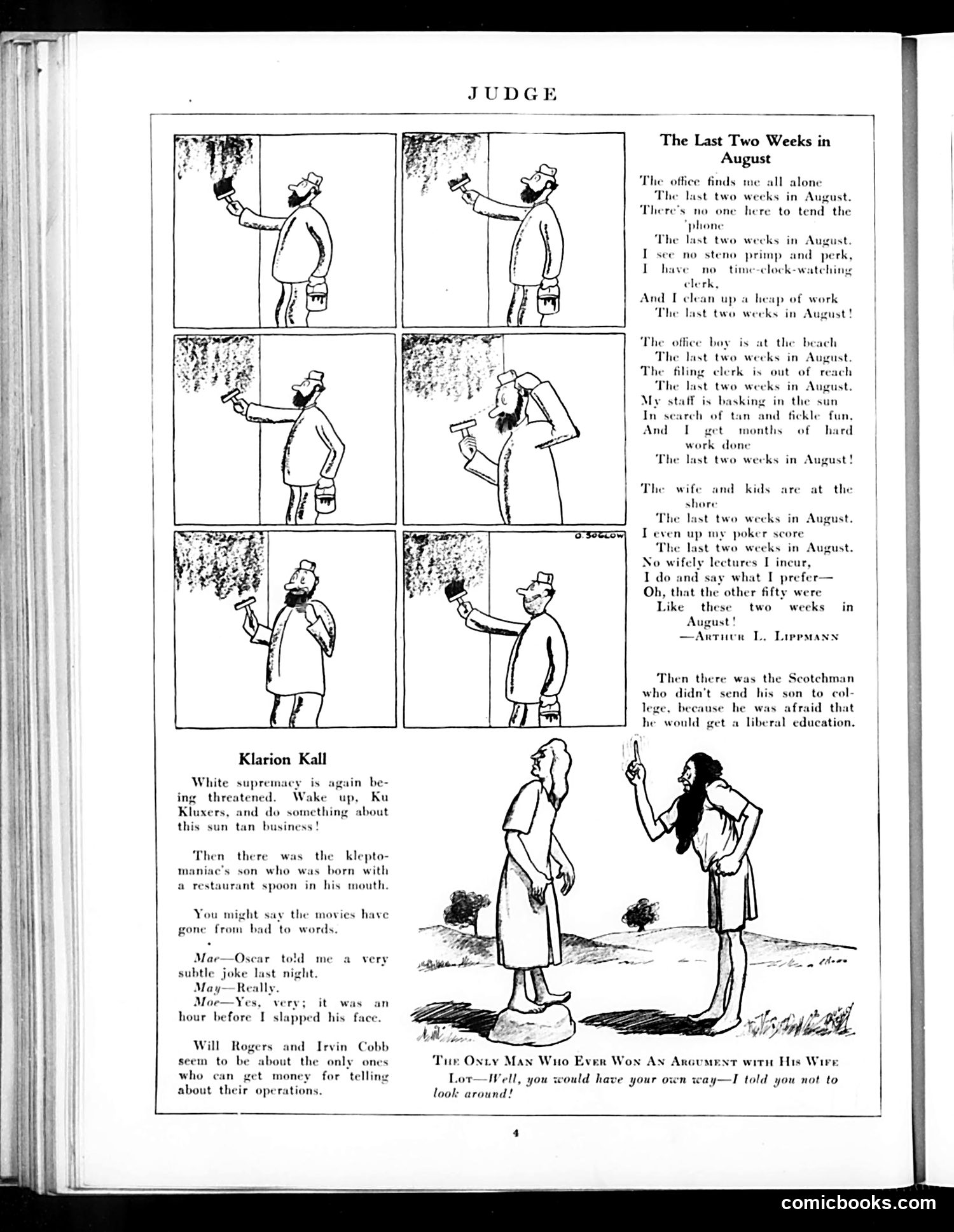
Analysis of Judge Magazine Page "The Last Two Weeks in August" (comic strip): This satirical poem depicts an office worker's August vacation experience. The sequential panels show him attempting various tasks—painting, cleaning, yard work—while colleagues are away at the beach. The joke critiques the contrast between office life during summer months when staff are absent and the remaining employee struggles with accumulated work. It's relatable commentary on workplace dynamics during vacation season. "Klarion Kall" and the bottom cartoon address social anxieties of the era. References to "white supremacy," "Ku Kluxers," and ethnic concerns reflect 1920s-era political tensions. The caption about the "kleptomaniac's son" and the final illustration about a marital argument appear to be miscellaneous humorous anecdotes rather than connected satire.
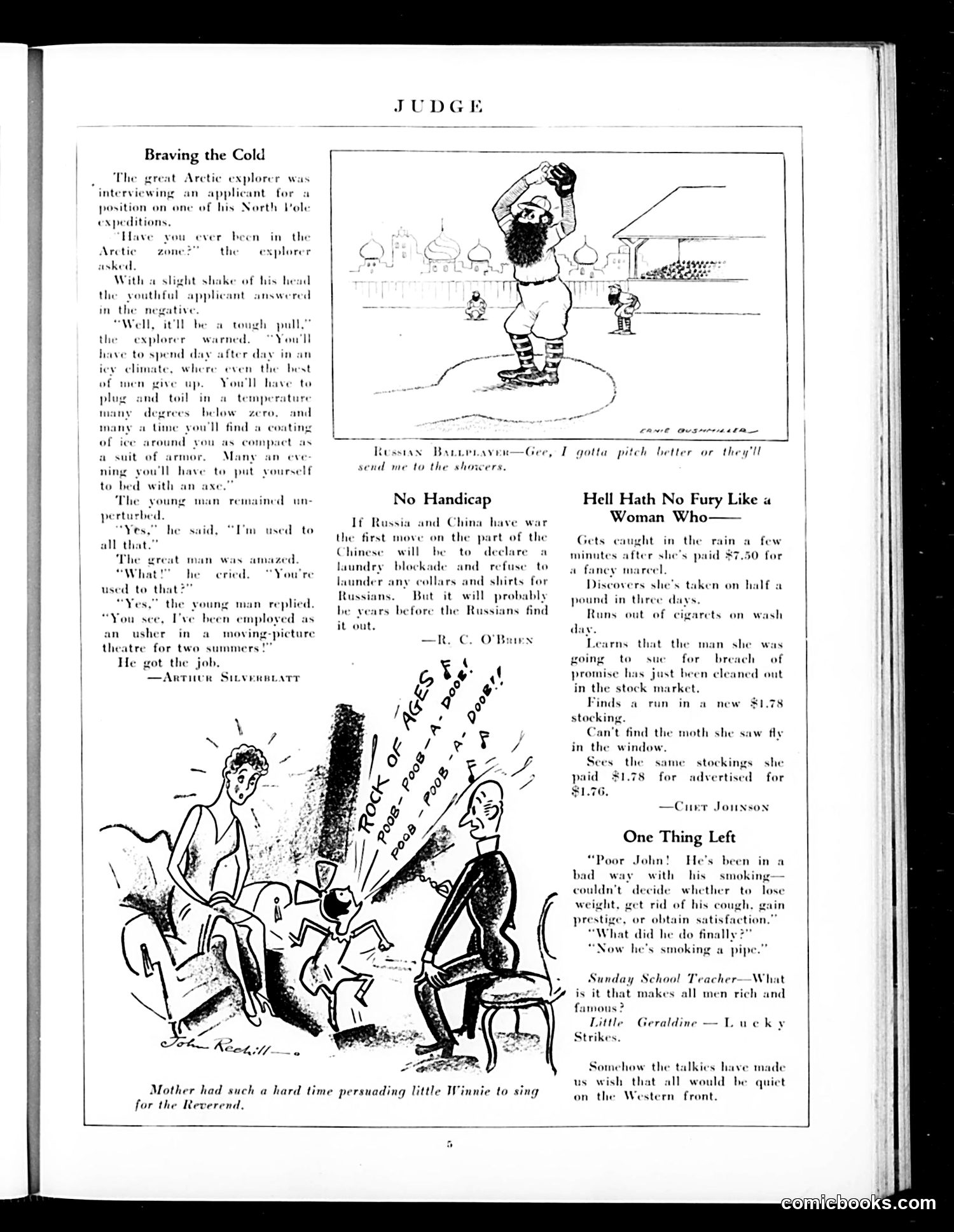
Analysis of Judge Magazine Page The page contains three separate satirical pieces: 1. "Braving the Cold": A dialogue between an Arctic explorer and a young man, mocking the explorer's warnings about polar hardship. The explorer describes extreme conditions; the young man dismissively replies he's "used to that" from working as a theater usher for two summers—absurdly equating mild discomfort with Arctic survival. 2. "No Handicap": A brief piece joking that if Russia and China wage war, their first move will be declaring a laundry blockade against each other, satirizing perceived national stereotypes about laundry services. 3. "Hell Hath No Fury Like a Woman Who—": Humorous anecdotes about women's petty frustrations (lost stockings, broken promises, etc.), emphasizing disproportionate female reactions to minor inconveniences—typical early-20th-century gender-based humor.
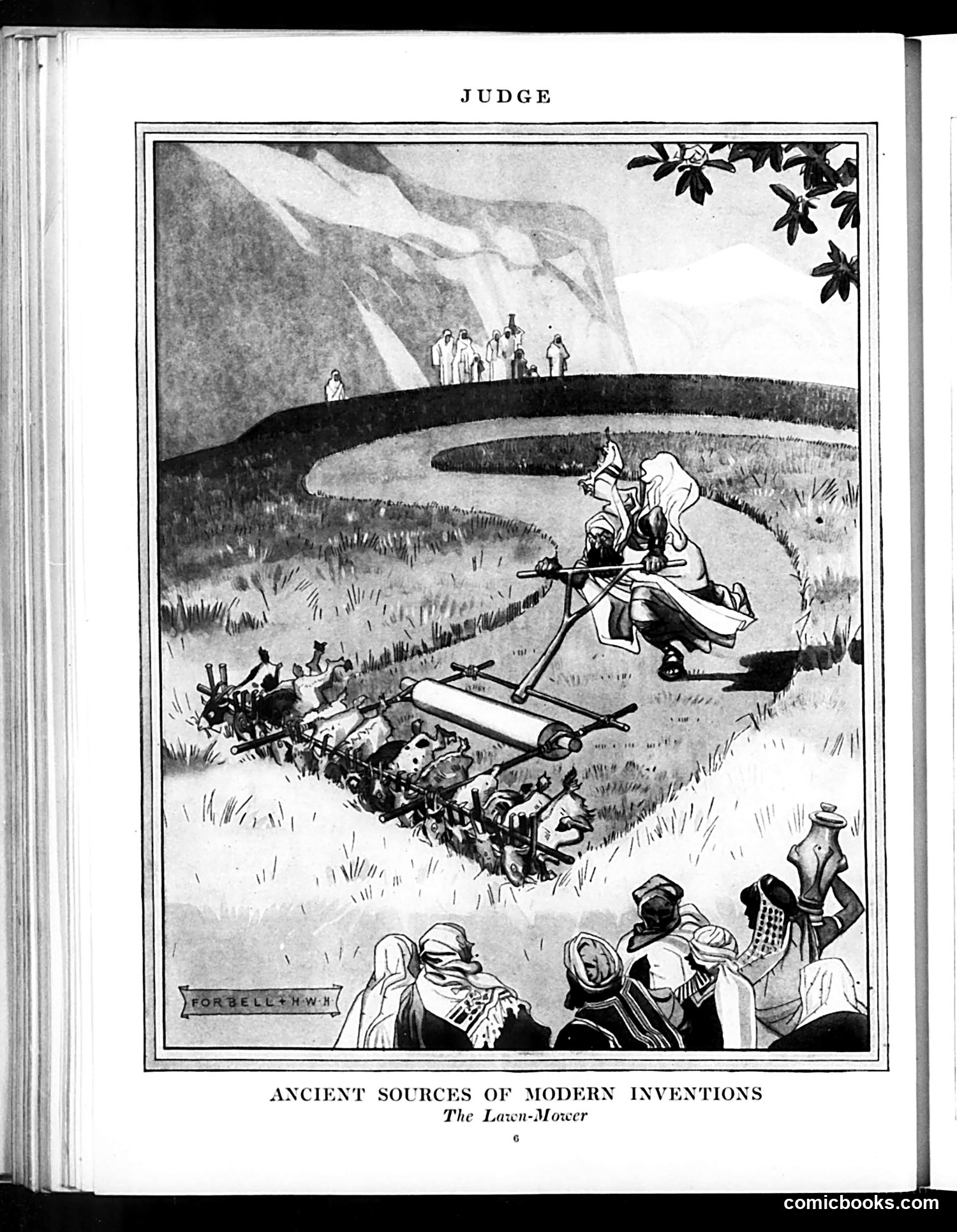
Judge Magazine: "Ancient Sources of Modern Inventions - The Lawn-Mower" This satirical illustration presents the lawn-mower as having ancient origins. The cartoon depicts a Roman or classical-era figure operating an early mechanical device pulled by horses, while spectators observe from a hillside. The scene humorously suggests that modern inventions have historical precedents, framing the lawn-mower as derivative rather than genuinely novel. The satire likely mocks the contemporary obsession with technological "progress" and innovation by implying nothing is truly new—that ancient civilizations possessed similar devices. This fits Judge's tradition of social commentary through absurdist humor. The formal classical setting contrasts with the mundane domestic task of lawn-mowing, creating comic irony about what modern society considers revolutionary advancement.
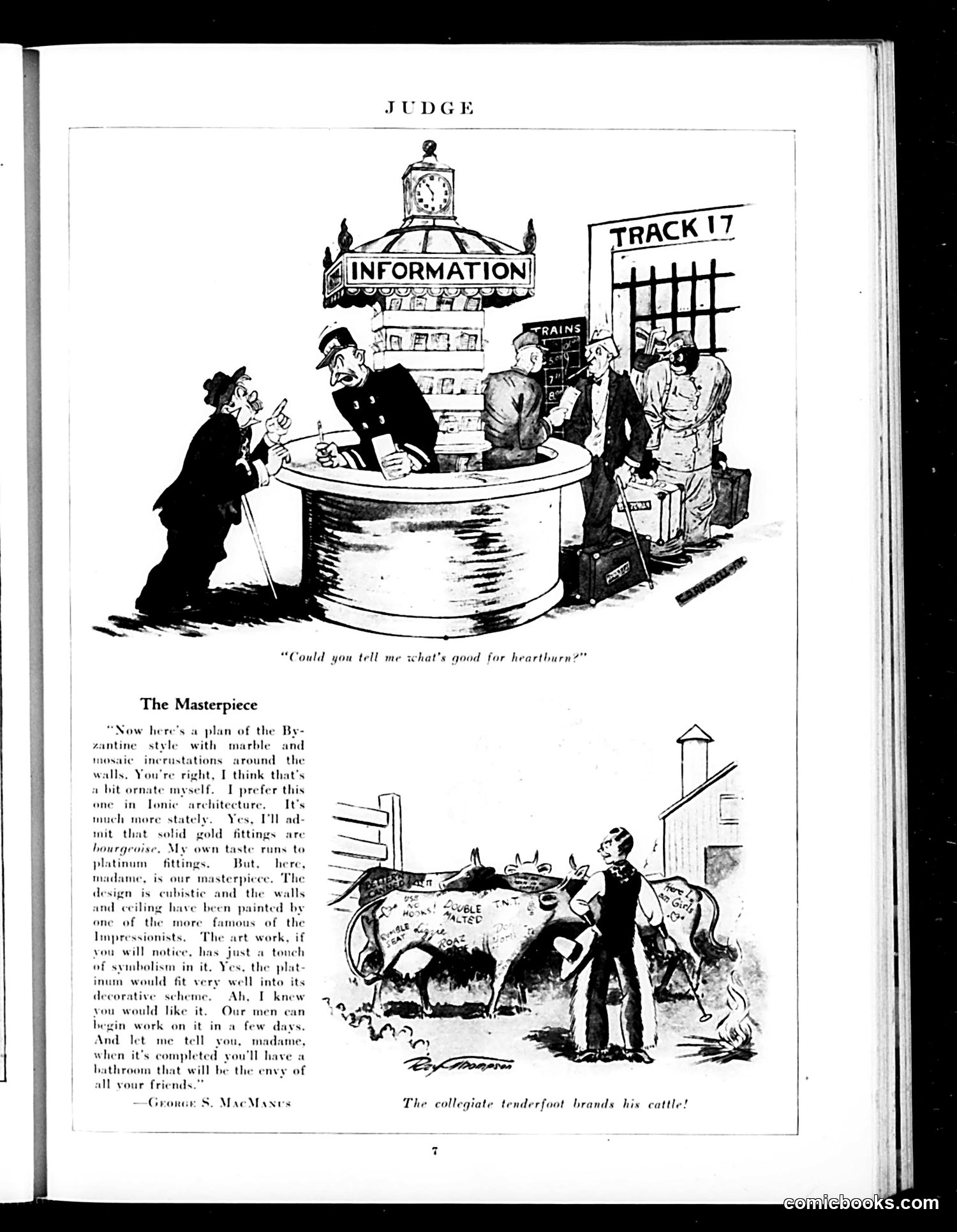
Explanation for Modern Readers Top Cartoon: A man at an information booth asks a judge about heartburn relief—a pun on "heart-burn" (emotional distress). The judge sits in an elevated position of authority, suggesting the cartoon mocks people seeking legal or official guidance for personal problems. Bottom Cartoon ("The Masterpiece"): An architect pompously describes an extravagantly decorated bathroom to a wealthy woman, listing Byzantine, Ionic, cubistic, and Impressionist elements with platinum and gold fittings. The satire targets nouveau riche pretension—wealthy people displaying ostentatious taste by name-dropping artistic movements they don't understand. The caption "The collegiate tenderfoot brands his cattle" (bottom right) reinforces the joke: just as an inexperienced rancher crudely marks livestock, the pretentious wealthy clumsily apply high art to mundane objects like bathrooms to appear cultured.
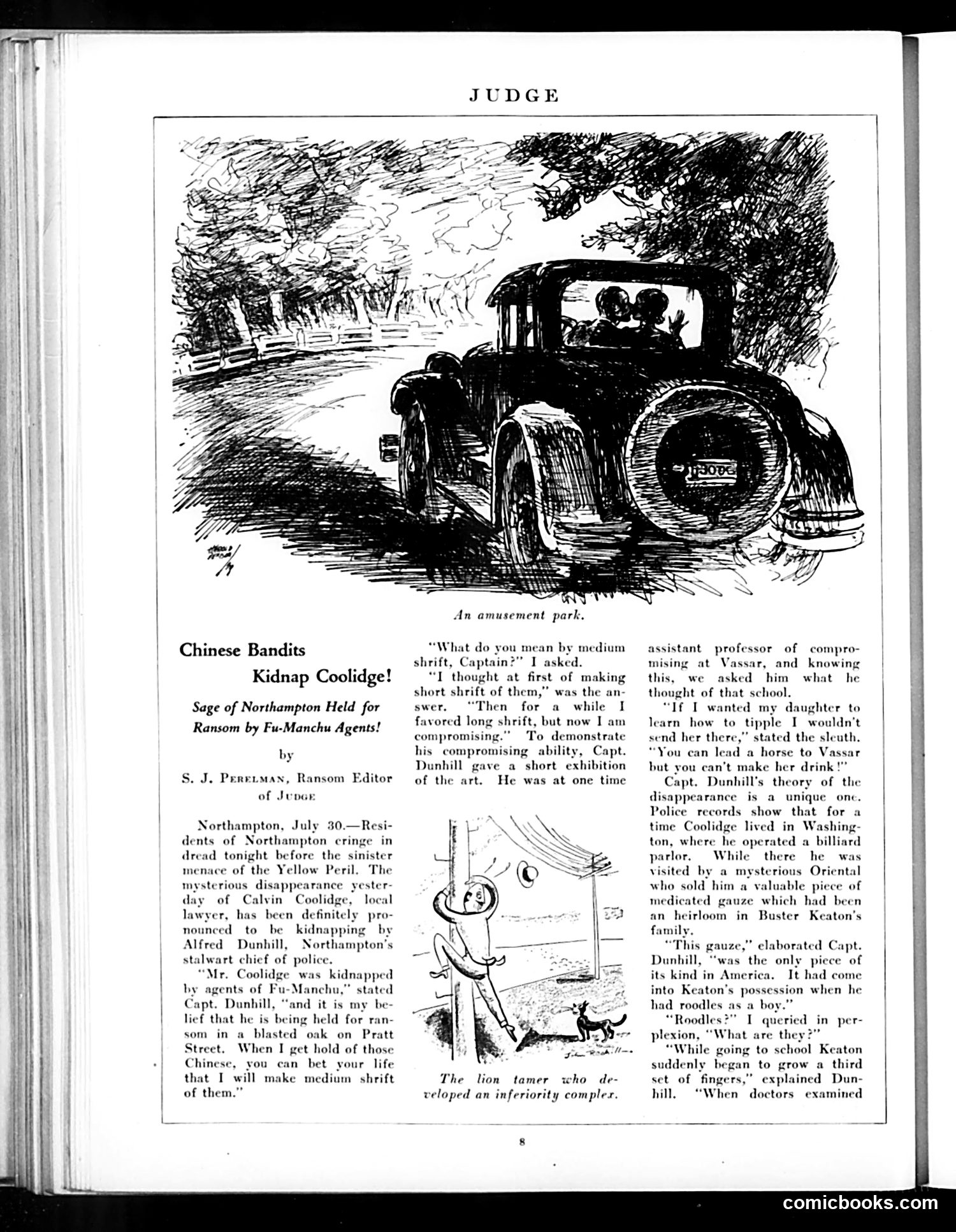
Judge Magazine Satire Analysis This page satirizes President Calvin Coolidge through a farcical kidnapping narrative. The headline parodies sensational "Yellow Peril" fiction popular in the 1920s, invoking the fictional villain Fu-Manchu to mock fears of Oriental threats. The joke plays on Coolidge's actual identity as a Massachusetts lawyer-turned-politician before becoming president. Judge creates absurd scenarios—a police chief describing "medium shrift," Coolidge operating a billiard parlor in Washington, a mysterious Oriental visitor, and references to a lion tamer with "inferiority complex"—that mock Coolidge's background and character through nonsensical comedy. The cartoon illustrates the absurd amusement park scenario. This is primarily political humor targeting Coolidge, using exaggerated ethnic stereotypes and absurdist storytelling typical of Judge's satirical approach during the 1920s.
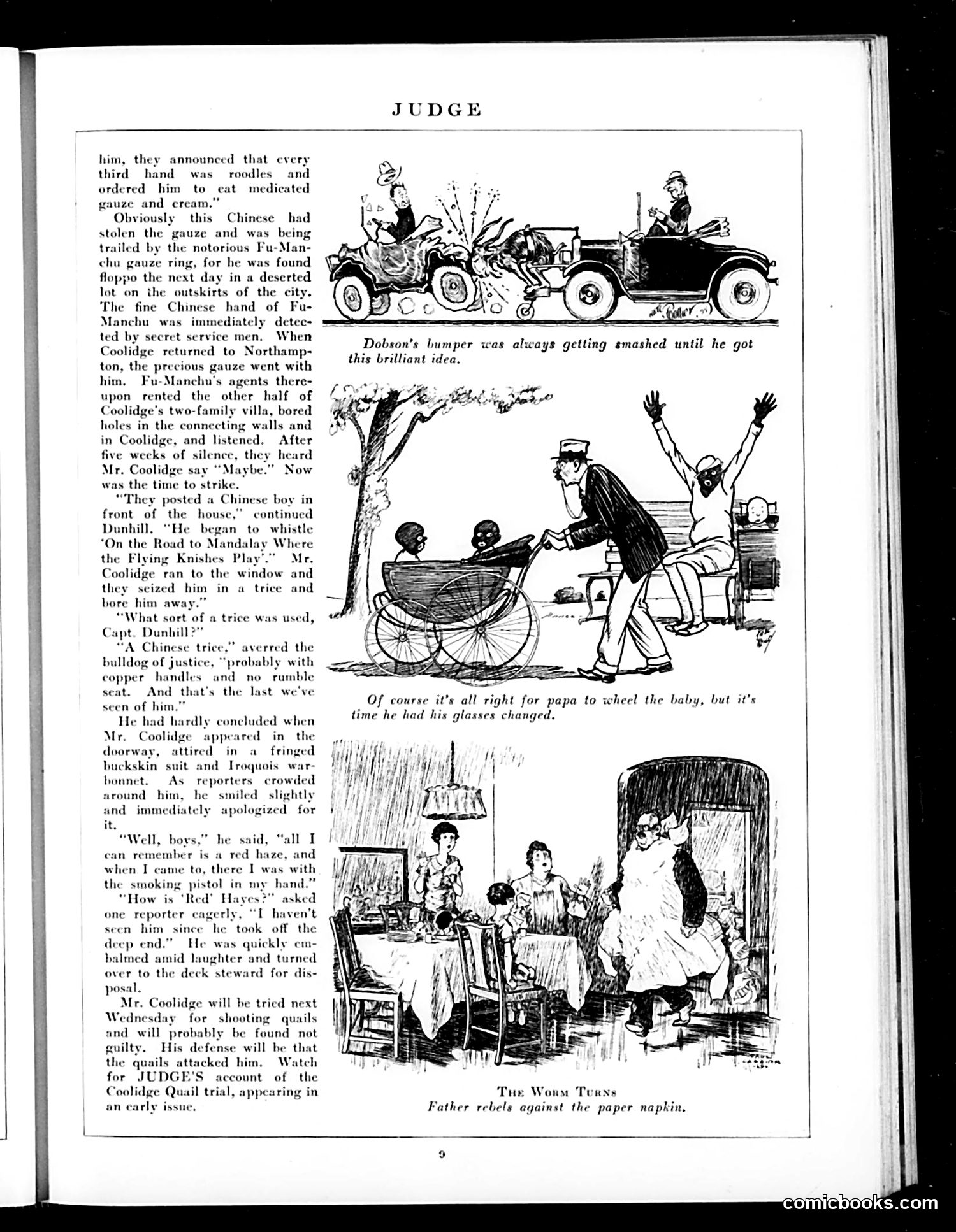
Judge Magazine Page Analysis This page satirizes President Calvin Coolidge through absurdist humor typical of 1920s political satire. The main story parodies the popular "Fu Manchu" fictional villain—a Yellow Peril stereotype—by imagining Coolidge entangled with a Chinese criminal organization over stolen gauze. The joke mocks Coolidge's famously taciturn, emotionless personality; even when kidnapped and supposedly shot, he remains deadpan. The accompanying cartoons lampoon domestic life: "Dobson's bumper" shows a man repeatedly crashing cars until adopting bumpers (satirizing impractical solutions), while the lower cartoons joke about fathers changing babies' diapers and struggling with paper napkins—gentle humor about evolving gender roles. The Fu Manchu references reflect period anxieties about Asian immigration and stereotypical "Oriental" villainy—attitudes now recognized as racist. The satire's targets were Coolidge's wooden public persona and contemporary social customs.
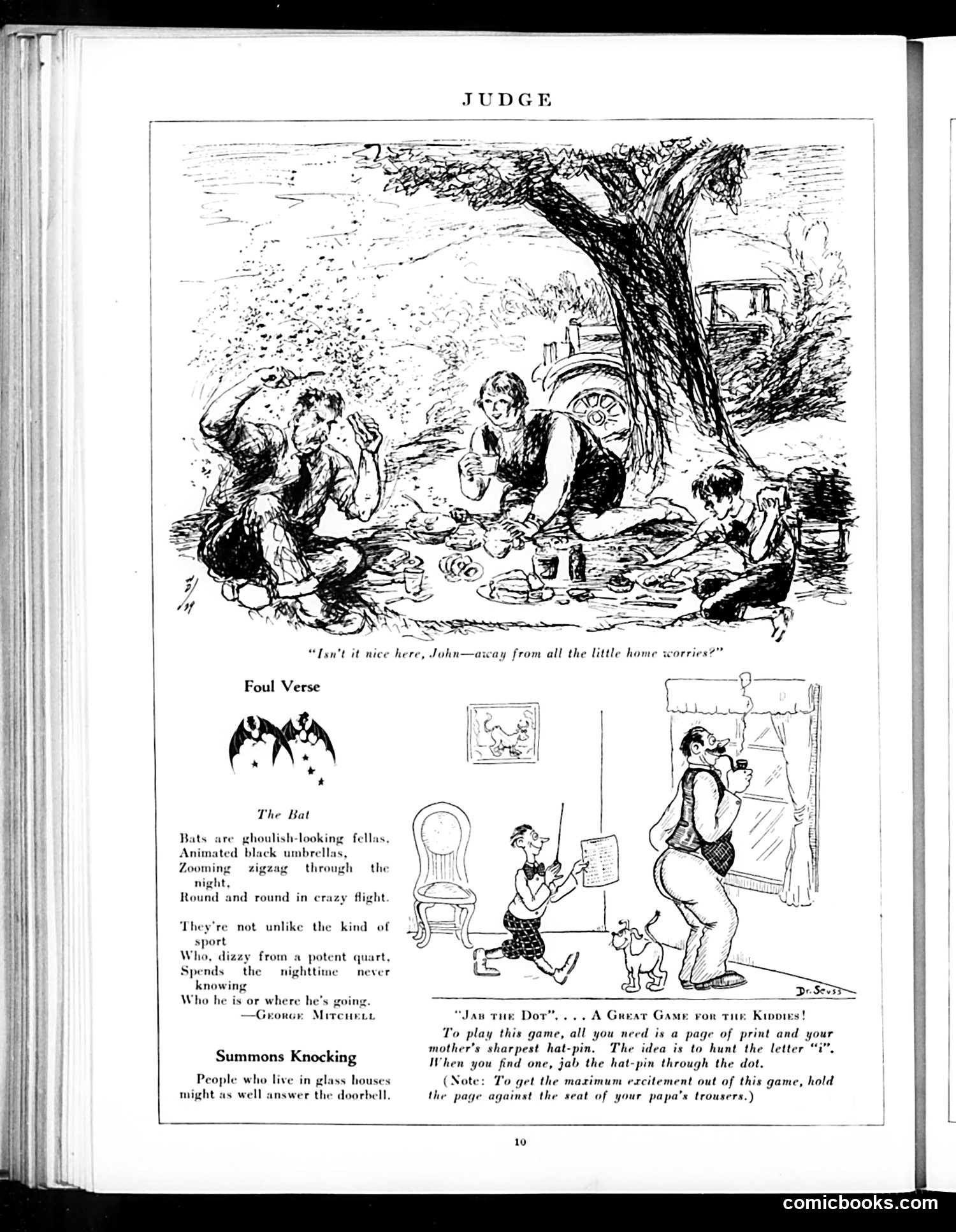
Judge Magazine Page Analysis This page contains three distinct humor pieces: "The Bat" is a humorous poem by George Mitchell comparing bats to drunk men—both erratic, disoriented creatures moving unpredictably through the night. The joke equates the animal's chaotic flight with intoxication-induced behavior. "Summons Knocking" is a brief one-liner satirizing people who live in glass houses (metaphorically exposed or vulnerable) and must answer their doors—a reference to the proverb "people in glass houses shouldn't throw stones." "Jan the Dot" is a children's game where kids use a hat-pin to puncture the dots of letter "i"s in printed text. The humor comes from the final instruction suggesting parents hold the page against their trousers during the game—implying the child might accidentally jab the parent instead, creating slapstick comedy. This reflects early-20th-century humor that found amusement in mild physical mishaps. The main illustration depicts a family picnic scene with the caption about escaping "home worries," likely satirizing the period's middle-class leisure activities.
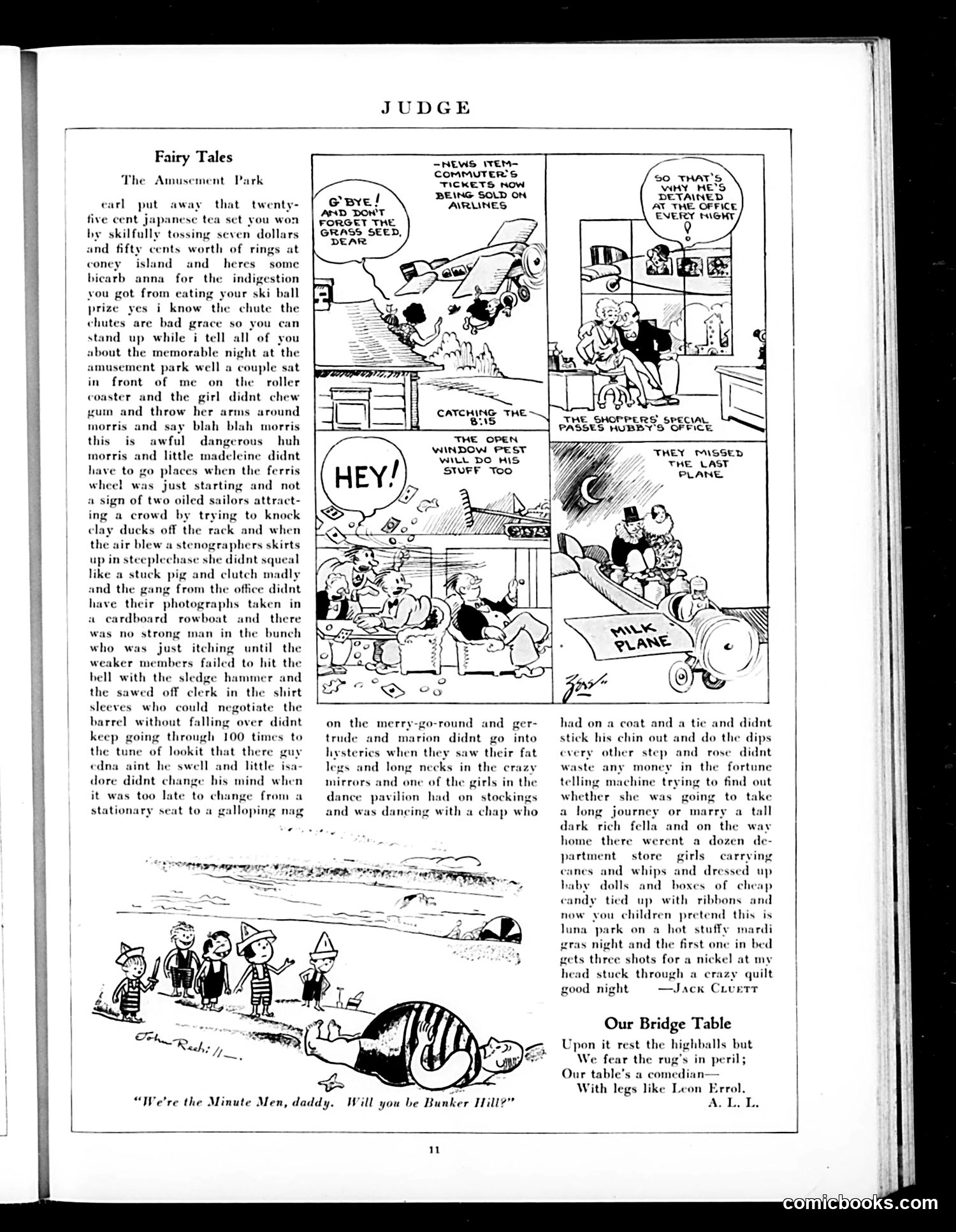
"The Amusement Park" - Judge Magazine Satire This is a humorous social commentary on early 20th-century amusement park behavior. The narrator describes an imaginary, *ideal* visit where nothing memorable or embarrassing occurs—a pointed joke about what *actually* happens. The satire mocks typical park-goer stereotypes: overly affectionate couples, working-class stenographers and office clerks showing off, young women in provocative clothing, people wasting money on fortune tellers, and shoppers flaunting purchases. The repeated negations ("didn't do," "weren't") emphasize these were the *absent* behaviors. The smaller cartoons mock contemporary annoyances: commuter airline tickets being sold (suggesting new travel anxieties), wives timing shopping trips to pass husbands' offices, and a "Minute Men" joke (likely referencing Revolutionary War imagery for something mundane). The piece satirizes both working-class exhibition and middle-class pretension at public leisure spaces—common Judge targets reflecting 1920s-30s social anxieties about class performance and appropriate behavior.
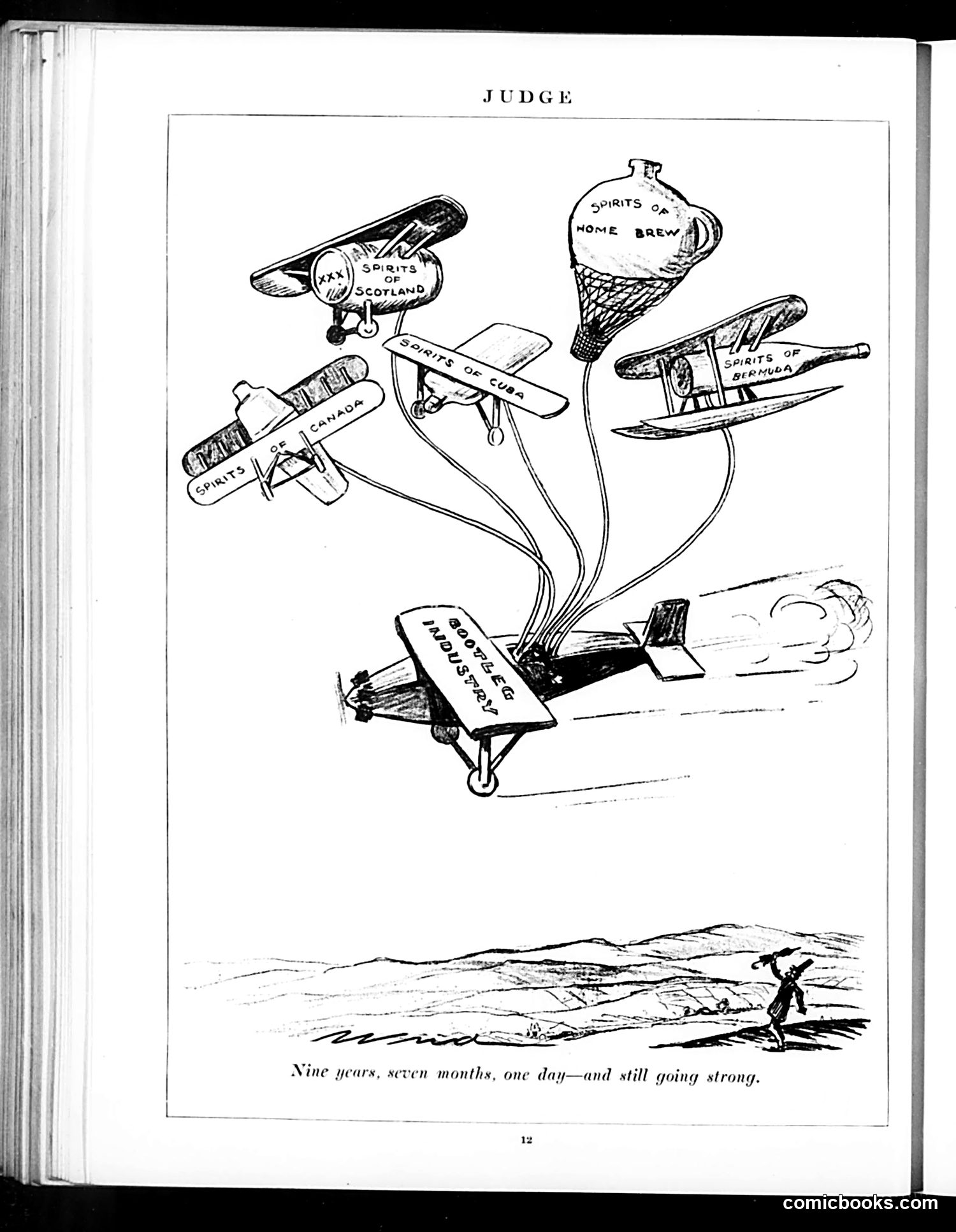
Political Cartoon Analysis: "Judge" - Prohibition Era Satire This cartoon satirizes Prohibition in America, which had been in effect for approximately nine years, seven months, and one day (dating the cartoon to around early 1929). The central figure is a judge character piloting an airplane labeled "PROHIBITION JUDICIARY," from which multiple bottles sprout like bizarre flowers. These bottles are labeled with spirits from various regions: "Spirits of Scotland," "Spirits of Canada," "Home Brew," and "Spirits of Bermuda." The satire's point: Despite Prohibition's legal enforcement by the judiciary, illegal alcohol imports and home production flourished unchecked—the airplane image suggesting these spirits arrive despite official prohibition. The caption "still going strong" underscores the law's failure. The small figure below watching helplessly emphasizes widespread public disregard for the policy. The cartoon mocks how judicial enforcement proved futile against determined smuggling and bootlegging during the 1920s.
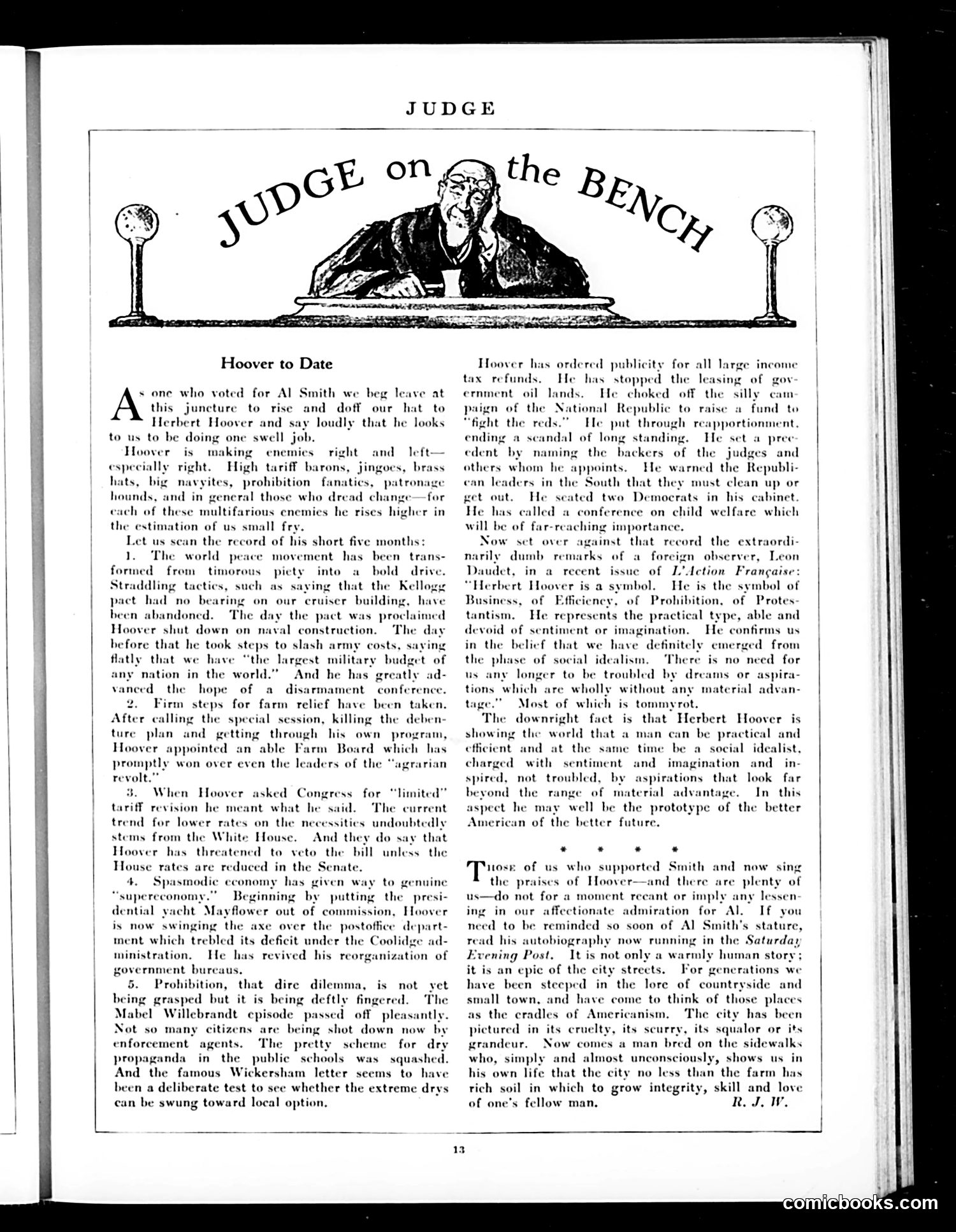
"Judge on the Bench: Hoover to Date" This editorial page praises President Herbert Hoover's first five months in office (1929). The column lists accomplishments: advancing disarmament despite previous isolationism, pursuing farm relief, pushing genuine tariff reform, implementing government economy measures, and carefully handling Prohibition enforcement. The piece defends Hoover against a French critic (Léon Daudet) who dismissed him as a soulless symbol of American materialism and efficiency. Judge argues the opposite: Hoover proves a practical businessman can also be a "social idealist"—pursuing both efficiency and humanitarian goals simultaneously. The satirical thrust attacks European cynicism about American values while celebrating Hoover as someone rising above partisan enemies left and right through competent, progressive governance. This reflects the optimistic pre-Depression view of Hoover's presidency.
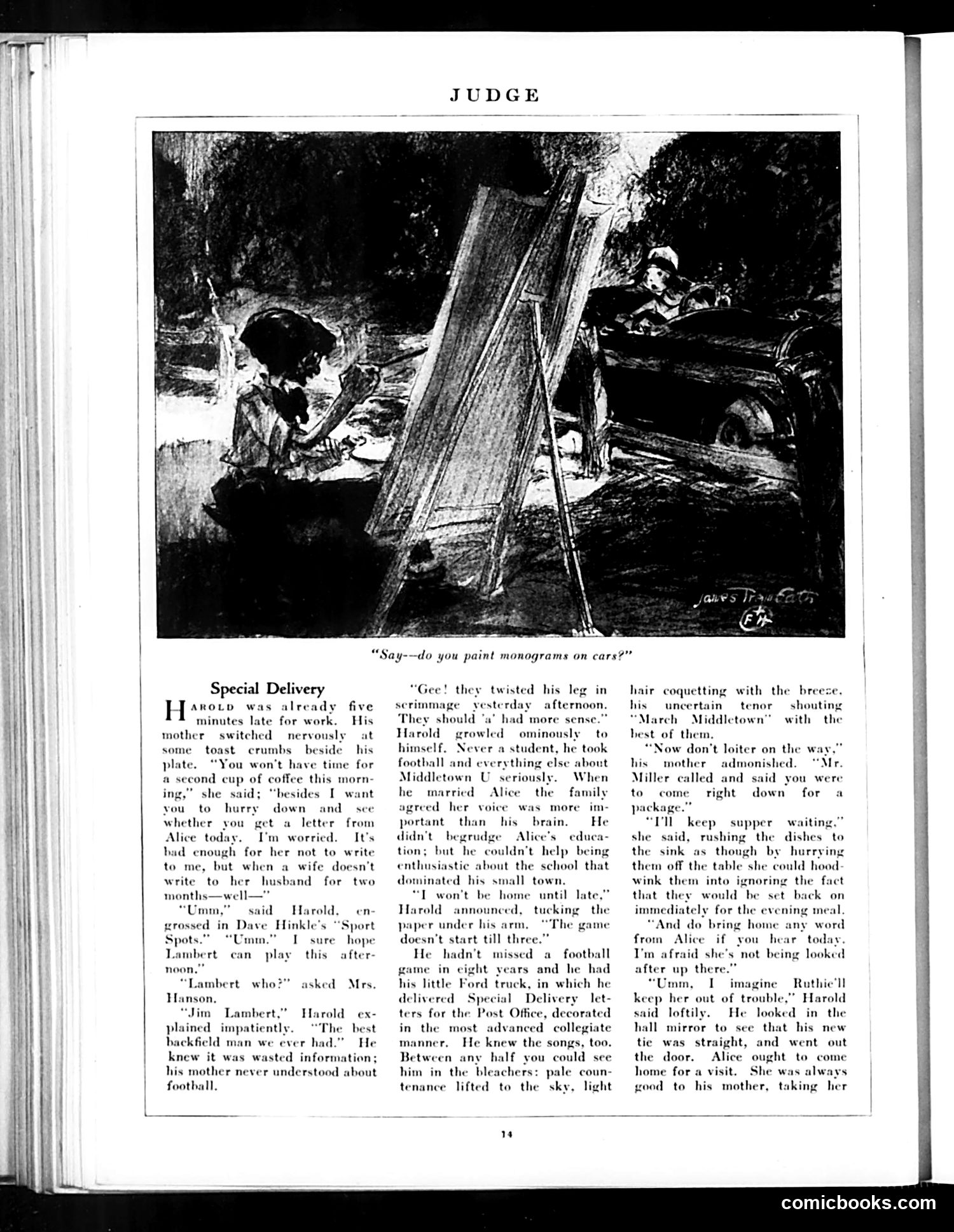
"Special Delivery" - A Domestic Comedy This story satirizes the tensions between a young married man's obsession with college football and his neglected wife. Harold, a Post Office delivery driver, prioritizes attending a Middletown University football game over his domestic responsibilities. He's distracted by sports news, dismissive of his mother's concerns about his wife Alice's two-month silence, and indifferent to his mother's plea that he inquire after Alice during his errands. The humor lies in Harold's misplaced priorities: he knows every detail about the college team and player Jim Lambert's injury, yet shows no curiosity about his own wife's wellbeing. His mother's anxiety about Alice receiving proper care "up there" contrasts sharply with Harold's lofty confidence that his sister Ruthie will keep her "out of trouble." The cartoon above depicts someone asking about painting monograms on cars—likely Harold's delivery truck—establishing his work context as the setup for his domestic neglect.
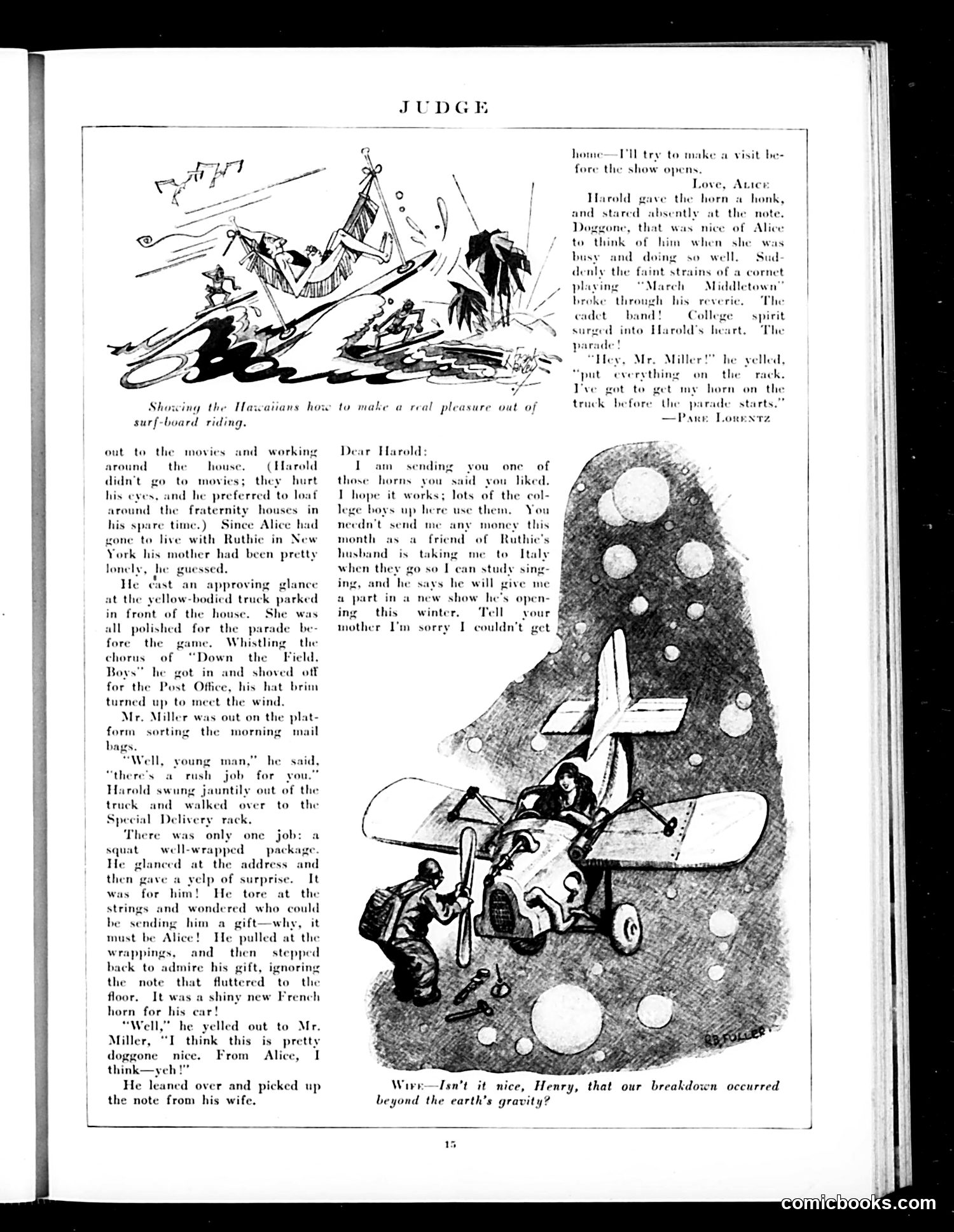
Analysis of This Judge Magazine Page This page depicts a domestic comedy about a young married couple, Harold and Alice. Harold receives a surprise gift—a French horn for his car—sent by his wife, who is away in New York living with a friend named Ruthie. The satire targets the social dynamics of the 1920s era: Alice has left her husband to pursue a singing career in New York, where a man (apparently a theater producer) is sponsoring her trip to Italy and promising her a stage role. Meanwhile, Harold remains at home, working a postal job and attending college social events. The humor lies in the role reversal and Alice's casual dismissal of Harold's financial concerns ("You needn't send me any money this month"). The bottom cartoon caption, referencing a "breakdown" occurring "beyond the earth's gravity," is unclear without fuller context but appears to be a separate joke, possibly about aeronautics or weightlessness. The overall satire comments on shifting gender roles and women's increasing independence during this era.
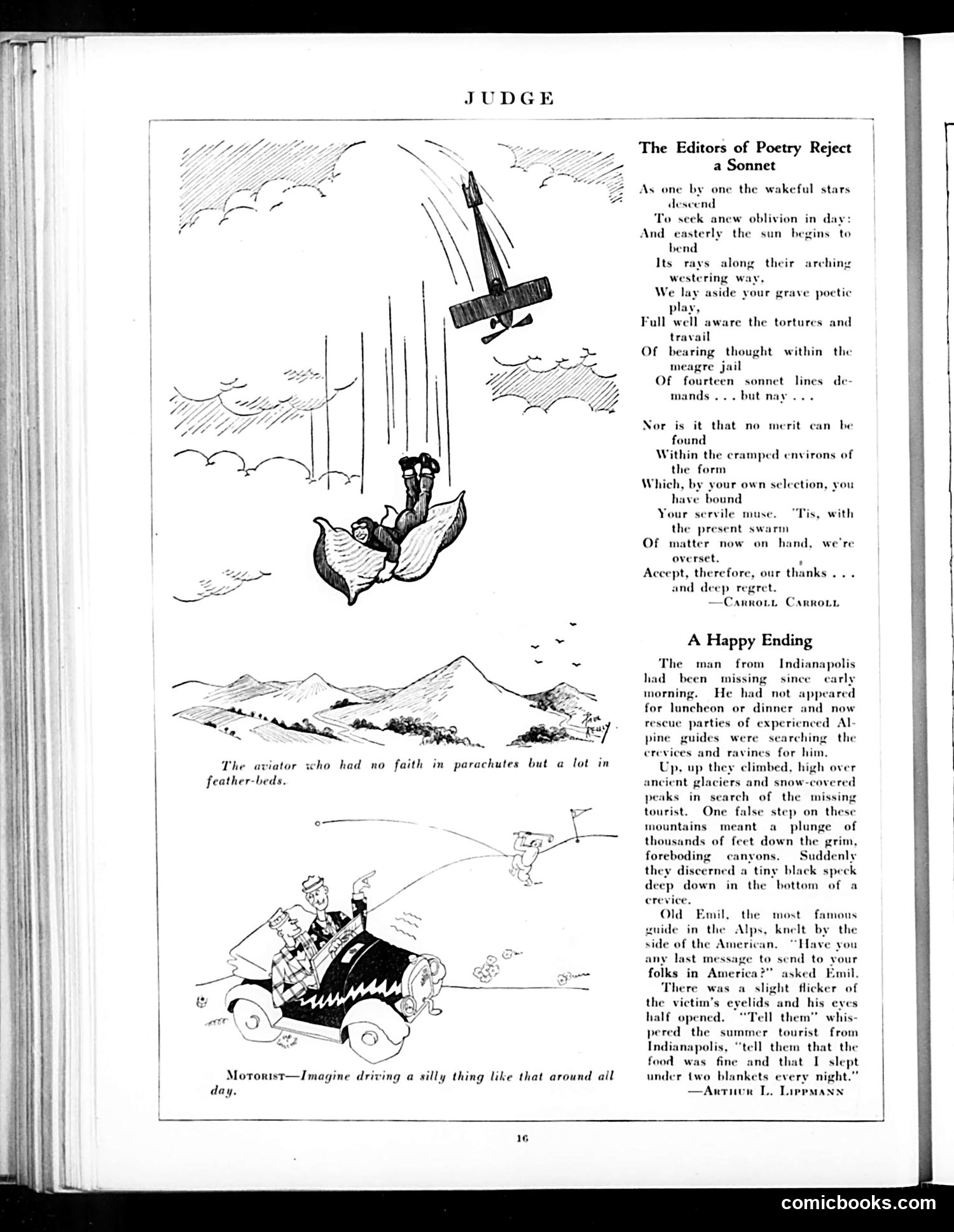
Analysis of Judge Page 16 This page contains three distinct satirical pieces: 1. "The Editors of Poetry Reject a Sonnet" (by Carroll Carroll): A poem mocking literary editors who reject sonnets as outdated, claiming the sonnet form is too restrictive for modern poetry. 2. "The aviator who had no faith in parachutes but a lot in feather-beds": A cartoon mocking someone with misplaced confidence—relying on feather beds instead of proper safety equipment while skydiving. It's a commentary on foolish risk-taking and false security. 3. "A Happy Ending" (by Arthur L. Lippmann): A humorous story about a missing Indianapolis man found in the Alps. The punchline centers on his trivial message back home about blankets—deflating any dramatic rescue narrative with mundane domesticity. The "Motorist" cartoon depicts early automobile absurdity—people cavalierly driving recklessly despite danger.
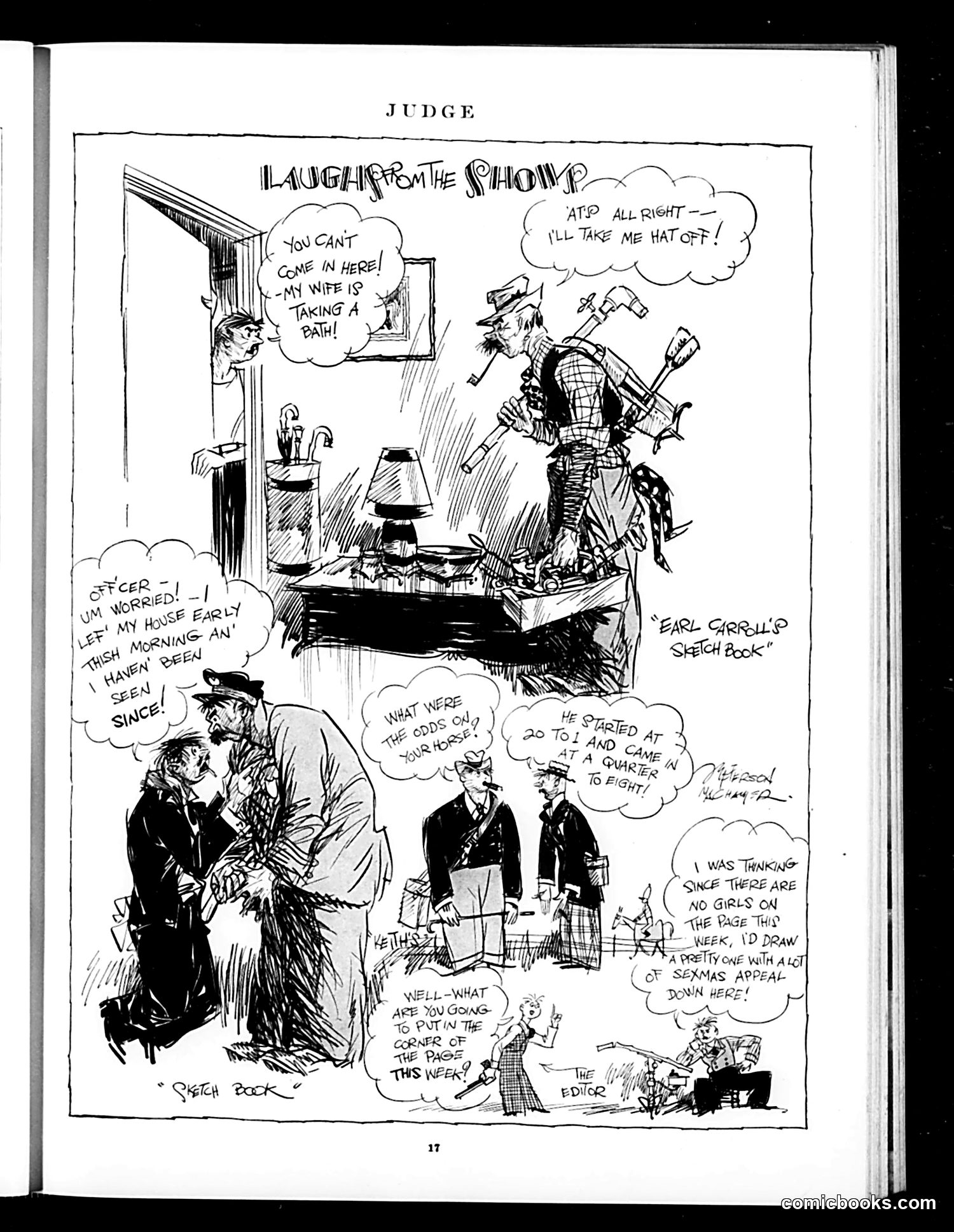
Analysis of "Judge" Cartoon Page This is a multi-panel satirical comic titled "Laugh from the Show" by Earl Girrell, featuring theatrical/vaudeville humor. The main joke concerns male performers complaining about women's absence from the entertainment page that week. One officer mentions his wife is bathing and he can't leave; performers discuss odds on a horse race and a quarrel; the editor sits at his desk while a writer proposes drawing "a pretty one with a lot of sex appeal" to compensate for the lack of female performers featured. The satire targets: - Theatrical/variety show culture and performers' priorities - Gender dynamics in entertainment journalism—the casual assumption that female images are necessary page decoration - Editorial decisions based on attracting male readership through female imagery The cartoon reflects early 20th-century attitudes about entertainment coverage, gender representation in publications, and the commodification of women's images in media.
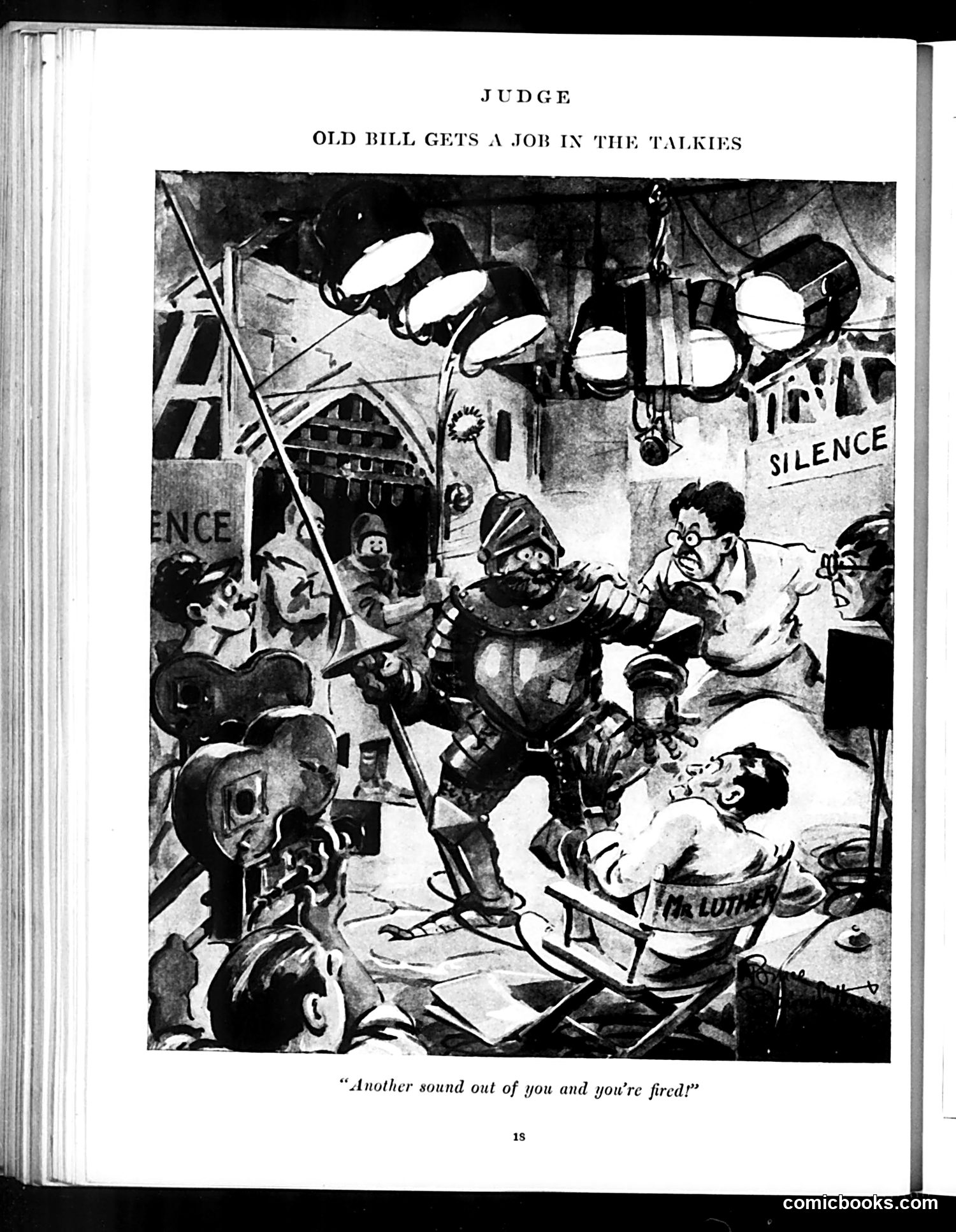
This is a satirical cartoon about early "talking pictures" (sound films). "Old Bill" appears to be a character being given work in the new talkies industry—likely representing an older actor or figure adapting to sound technology. The joke centers on the caption: "Another sound out of you and you're fired!"—a pun playing on the irony that sound films, which required actors to actually speak their lines, would fire someone for making noise. The cartoon suggests the transition from silent to sound films created absurd situations, possibly mocking either incompetent performers struggling with dialogue or the chaos of early sound recording. The studio setting with lighting equipment and multiple figures emphasizes the novelty and confusion of early talking-picture production circa the late 1920s.
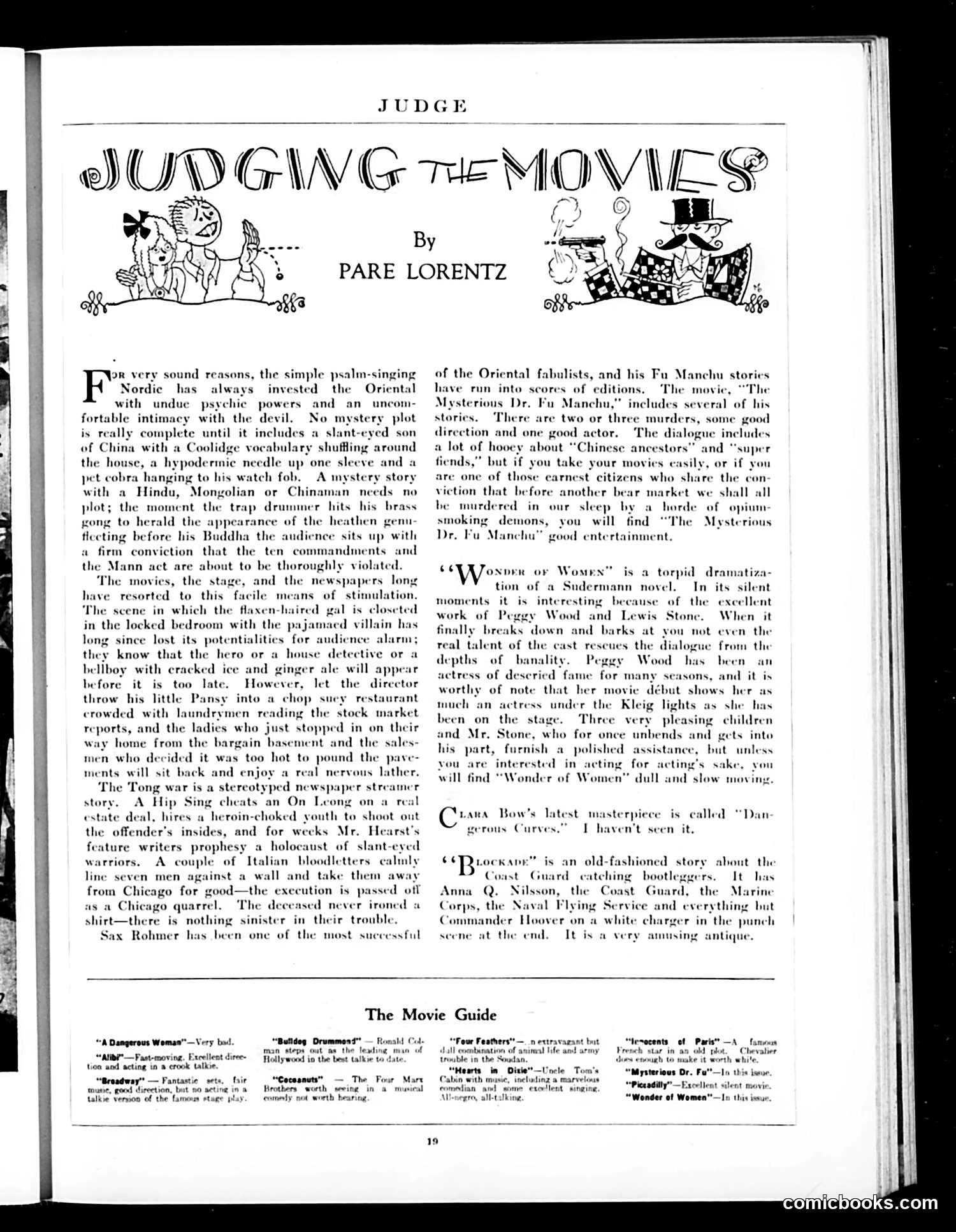
"Judging the Movies" by Pare Lorentz This page reviews several films while critiquing Hollywood's reliance on racist stereotypes. Lorentz sarcastically describes how movies exploit "Oriental" villains—particularly Chinese characters—to generate cheap thrills without actual plot. He notes audiences expect "slant-eyed" antagonists, opium dens, and "Tong wars" as formula elements requiring no narrative substance. Lorentz specifically critiques *The Mysterious Dr. Fu Manchu* (based on Sax Rohmer's popular stories), dismissing its "hooey about Chinese ancestors" while acknowledging competent direction. He reviews *Wonder of Women* and *Blockade* more favorably, praising Peggy Wood's performance in the former. The satire targets both Hollywood's lazy racial stereotyping and audiences who consume these caricatures uncritically—revealing 1920s casual acceptance of xenophobic entertainment conventions that modern readers would recognize as overtly racist.
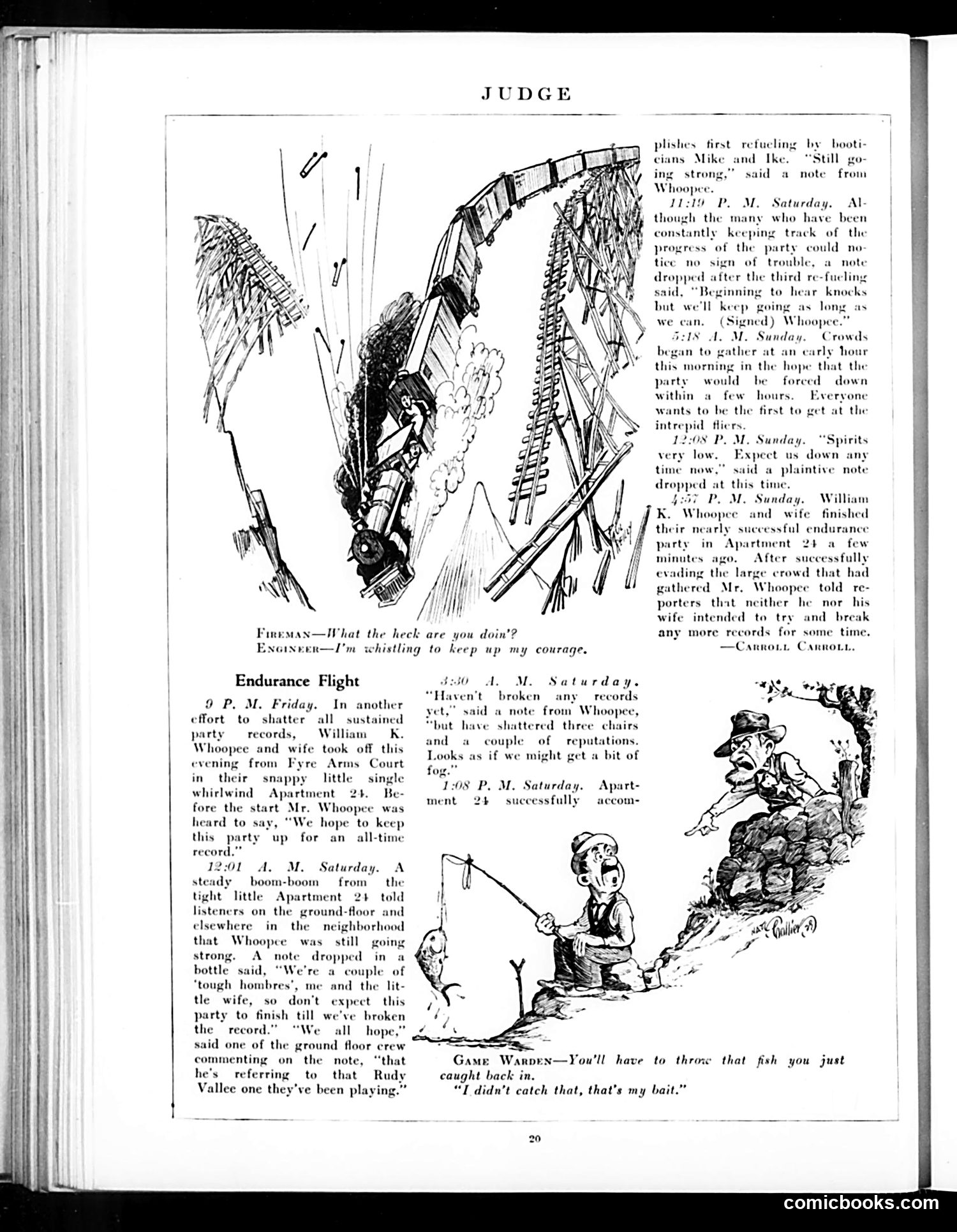
"Endurance Flight" - Judge Magazine Satire This page satirizes the era's obsession with aviation endurance records. William K. Whoopee and his wife attempt a sustained flight in "Apartment 24," a small aircraft, launching Friday evening. The satire works on multiple levels: the couple's increasingly desperate radio messages ("spirits very low," hearing "knocks") mock the breathless media coverage of such stunts. The running gag about breaking "records" versus "reputations" and "three chairs" suggests the endeavor is ridiculous and destructive. The top cartoon shows a pilot and engineer in an aircraft in distress, with the engineer whistling "to keep up my courage"—mocking the performative bravery of such ventures. The bottom cartoon, unrelated to the flight, shows a fisherman's innocent misunderstanding with a game warden, providing comic relief. The overall message: these endurance flights were dangerous publicity stunts, not genuine achievements, driven by ego rather than progress.
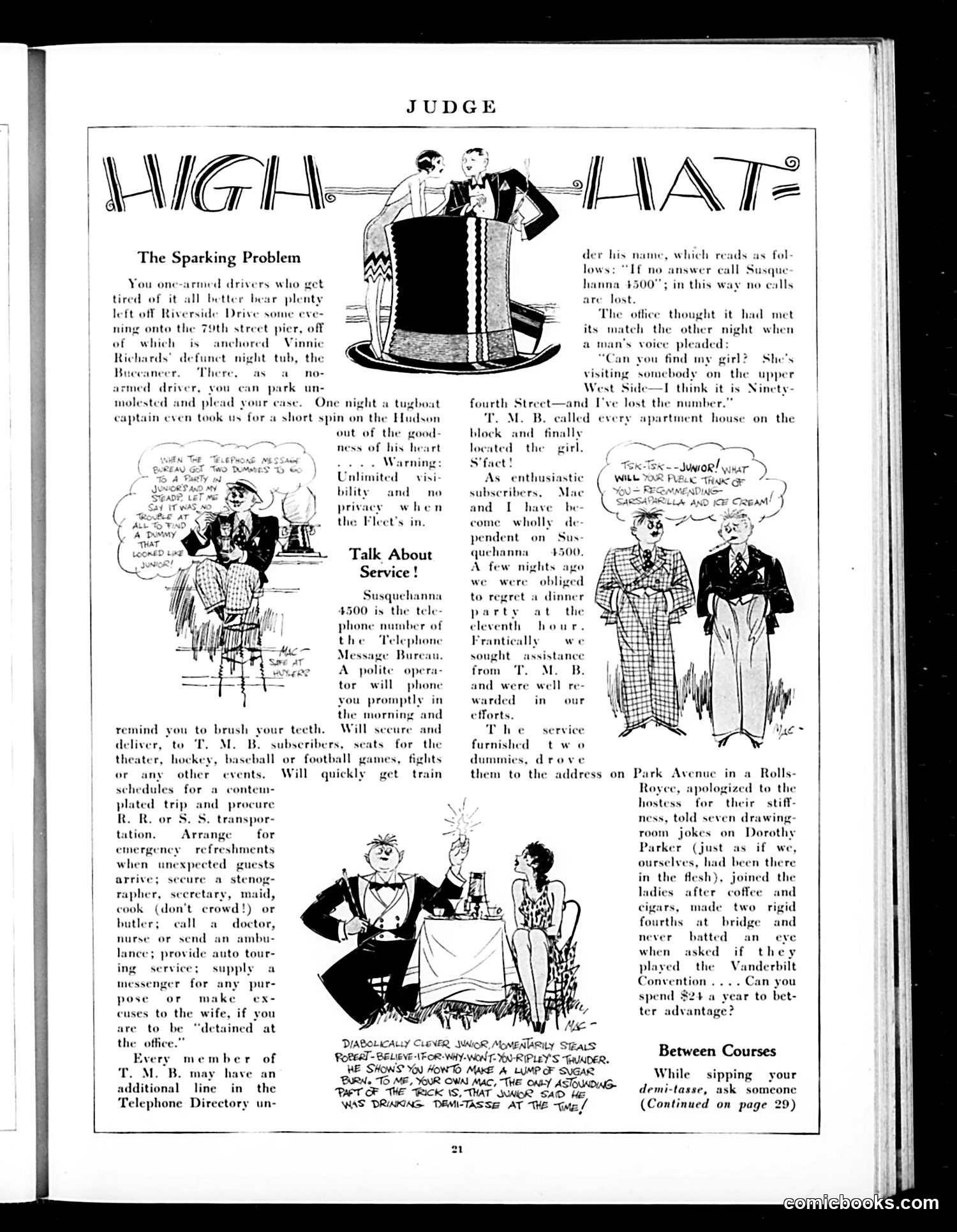
"High Hat" Judge Page: Satirizing Telephone Service This page satirizes Susquehanna 4500, a New York telephone service bureau that promised to solve modern life's inconveniences. The cartoons mock the service's extravagant claims and the absurdity of wealthy Manhattan socialites depending on it. Main satire targets: - The "Sparking Problem": Young drivers parking on riverside piers to romance dates, depicted as so incompetent they need a phone service to manage basic life tasks - The service's ridiculous promises: securing theater tickets, arranging meals, hiring staff, even locating a man's girlfriend across the Upper West Side - The shallow leisure class: A couple attending dinner parties where dummy stand-ins are delivered by Rolls-Royce; guests telling bad Dorothy Parker jokes to impress hosts The joke: Modern wealthy New Yorkers are so helpless and distracted by socializing they've outsourced all adult responsibilities to a telephone operator. The service becomes a symbol of their frivolous dependency and moral emptiness.
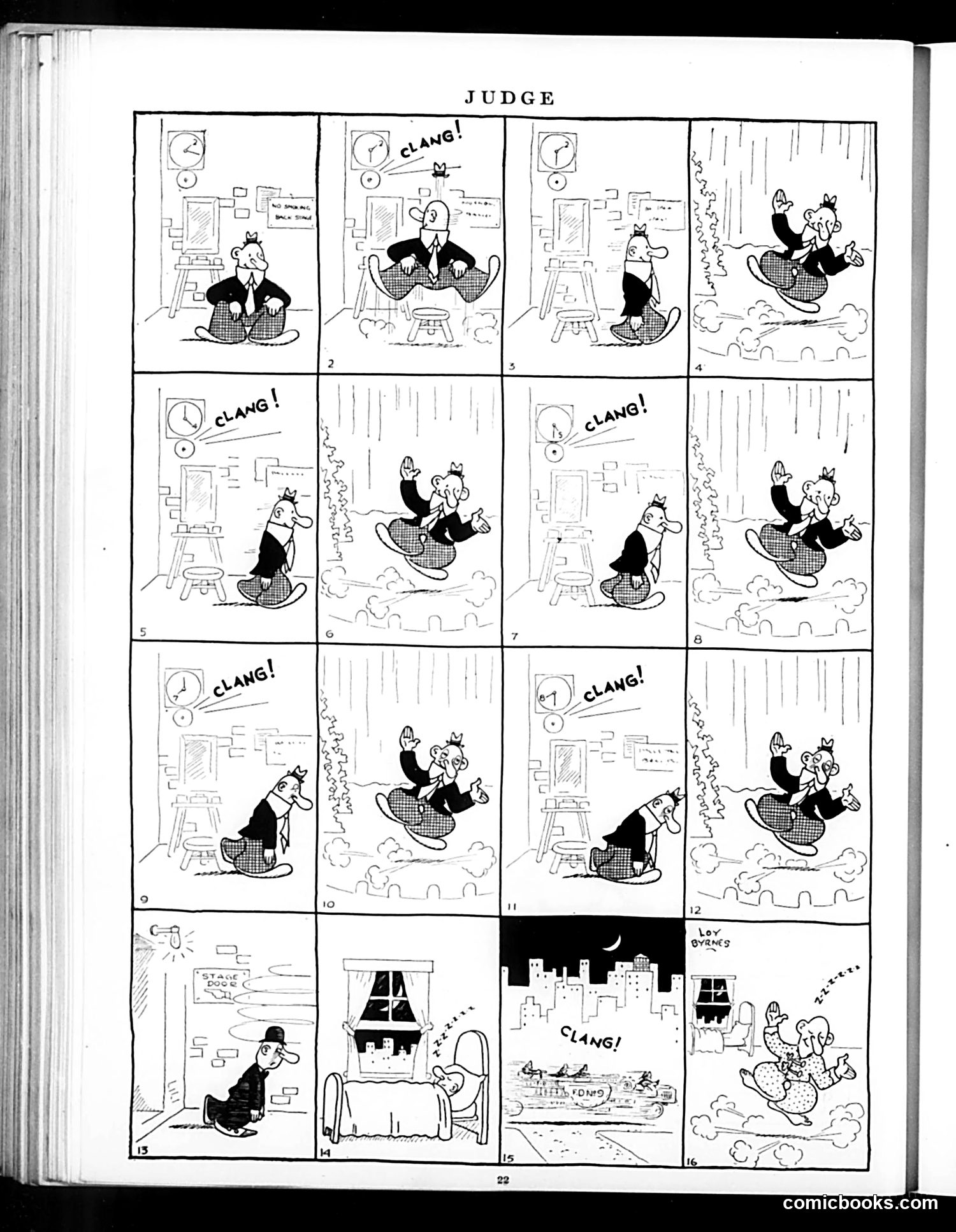
"Judge" Comic Strip Analysis This page shows a sequential comic strip titled "Judge" depicting a man in an office repeatedly being startled by a loud "CLANG!" sound from a clock on the wall. The strip progresses through 16 panels showing the man's escalating reactions—from sitting calmly at his desk, to jumping in shock, to flying through the air in increasingly dramatic fashion, culminating in him being ejected through a window into the night sky and clouds. The humor derives from the absurdist contrast between the mundane office setting and the man's increasingly exaggerated physical responses to a simple clock chime. It's a slapstick comedy emphasizing visual gags rather than political satire. The strip satirizes the everyday irritations of office work and the shock of sudden loud noises—a relatable concern for early 20th-century Judge readers.
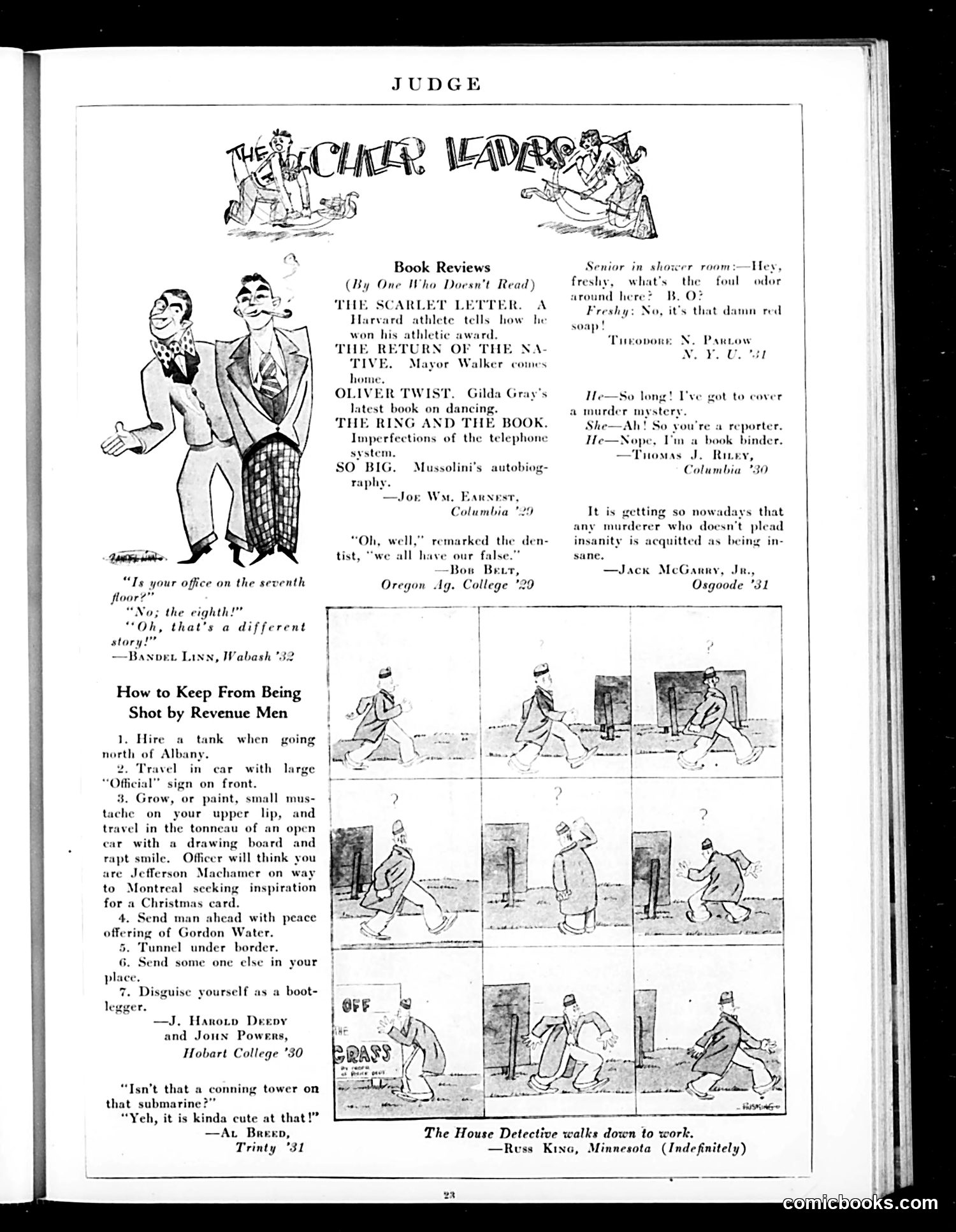
Judge Magazine Page Analysis This is a humor page from Judge magazine featuring college-humor contributions and satirical commentary typical of the late 1920s. Main Content: The largest piece, "How to Keep From Being Shot by Revenue Men," satirizes Prohibition enforcement (c. 1920-1933). It offers absurd tips for smuggling alcohol across the Canadian border near Albany—hiring tanks, disguising oneself as an artist "Jefferson Machamer," or tunneling under the border. The humor targets both bootleggers and the futility of Prohibition enforcement. Book Reviews Section: Mock reviews of classic literature reimagined through contemporary lenses—*The Scarlet Letter* as a Harvard athletic scandal, Mayor Walker's return (political reference, unclear without more context), and Mussolini's autobiography. Lower Comics: A multi-panel strip titled "The House Detective walks down to work" shows slapstick humor involving what appears to be repeated physical comedy (unclear specific plot). Overall Tone: College-age humor mocking Prohibition, current politics, and social pretense—typical Judge magazine fare for educated, urbane readers of the era.
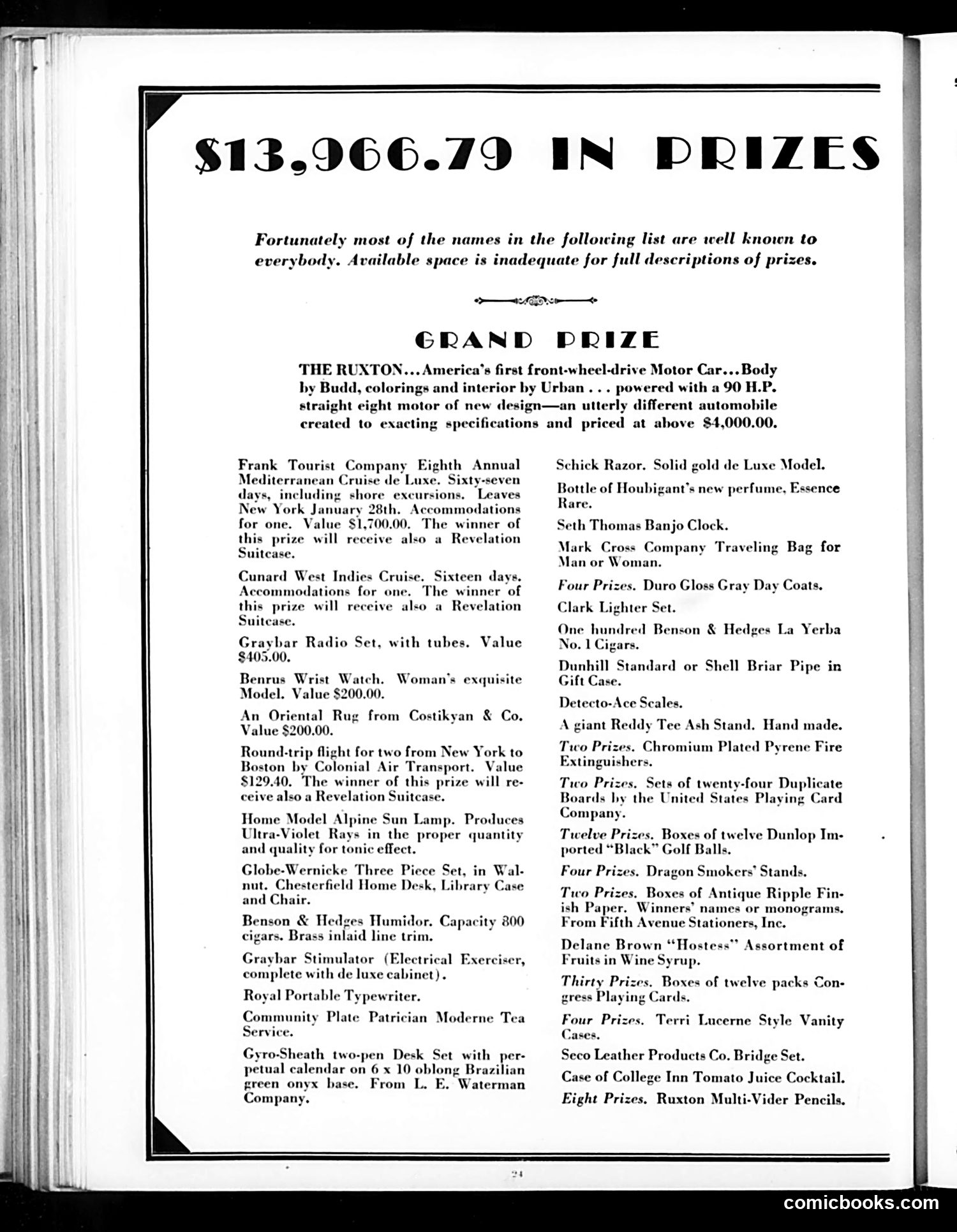
Analysis This page is not a cartoon or satirical article—it's a prize list advertisement for Judge magazine. The page announces $13,966.79 in prizes offered by Judge, likely for a contest or subscription drive. The grand prize is a Ruxton automobile (described as "America's first front-wheel-drive Motor Car"), priced above $4,000—a substantial sum in this era. Additional prizes include luxury cruises (Mediterranean and West Indies), jewelry, radios, rugs, and various consumer goods reflecting 1930s affluence: golf balls, cigars, fountain pens, vanity cases, and a "Graybar Stimulator" electrical exerciser. The note that "most of the names in the following list are well known to everybody" suggests these were recognizable luxury brands of the period. This represents typical Depression-era aspirational marketing—Judge promoting itself through lavish prizes to attract readers and advertisers.
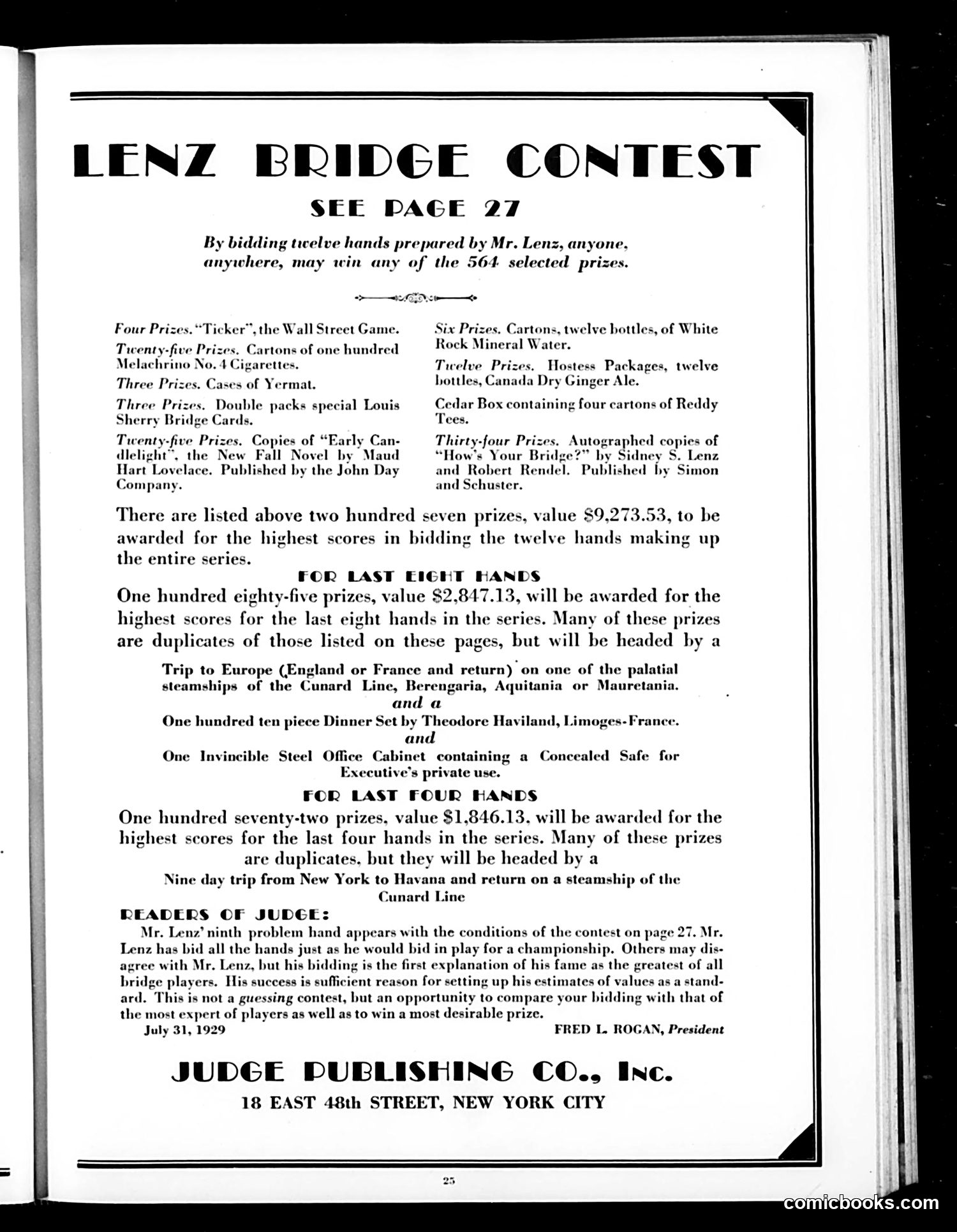
Lenz Bridge Contest Advertisement This page is primarily an advertisement, not a political cartoon. It announces a contract bridge bidding contest sponsored by *Judge* magazine in partnership with the Lenz Bridge Company. The contest invites readers to bid twelve prepared hands based on expert player Mr. Lenz's own championship bids. Winners receive 564 prizes worth over $9,000 total, including luxury items (Cunard steamship trips to Europe and Cuba, Haviland dinnerware), consumer goods (cigarettes, mineral water), and bridge-related books. The appeal capitalizes on 1920s enthusiasm for contract bridge—a relatively new card game that became a national craze. By framing participation as comparing skill "with that of the most expert of players," the advertisement presents the contest as both competitive entertainment and aspirational: ordinary readers could test themselves against legendary player Lenz. Dated July 31, 1929, this reflects pre-Depression American consumer optimism and the era's fascination with games of skill.
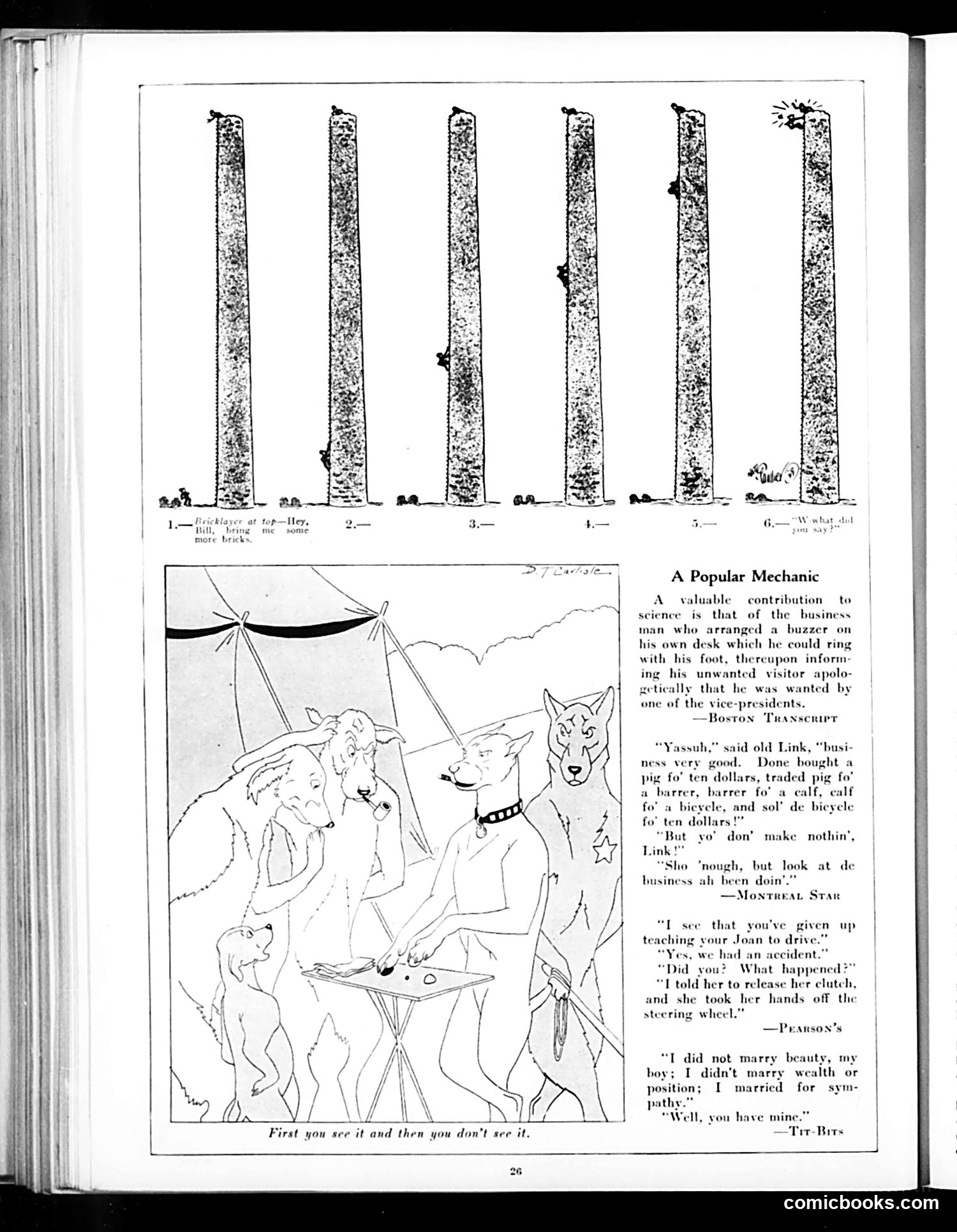
Analysis of Judge Magazine Page Top Image: A visual gag showing six tall chimneys/smokestacks, numbered 1-5 with a sixth labeled "What did you say?" The tiny human figures at the base emphasize industrial scale. This appears to satirize either industrial pollution, urban growth, or the deafening noise of factories—the joke being that in such massive industrial environments, you literally cannot hear yourself speak. Middle Cartoon: Dogs in business attire conducting a meeting under a tent, with caption "First you see it and then you don't see it." This likely mocks corporate boardroom culture or business scheming—suggesting deals or agreements that vanish or prove illusory. Text Pieces: Four separate humor anecdotes mocking: 1. A buzzer system for avoiding unwanted visitors (office absurdity) 2. A man named Link who trades goods in circles, making no profit (circular logic in business) 3. A failed driving lesson ending in accident (automotive humor) 4. A cynical marriage joke (sentimental relationships) The page reflects early 20th-century American satirical humor targeting industrial society, business culture, and modern life's complications.
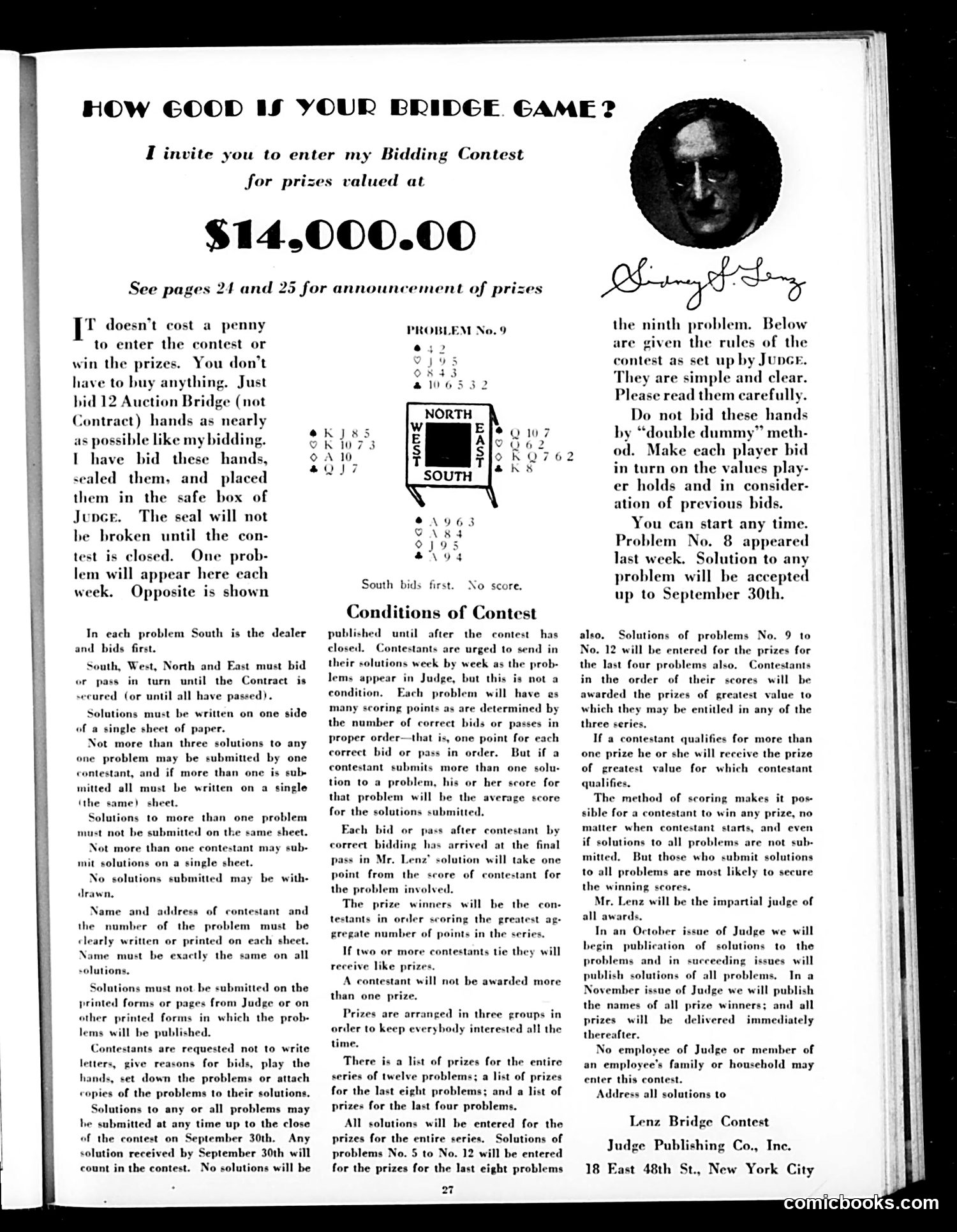
Judge Magazine Bridge Contest Page This page announces a bridge bidding contest rather than presenting a satirical cartoon. Judge magazine is sponsoring a competition where readers submit solutions to 12 Auction Bridge hands (a card game popular in the 1920s-30s), competing for $14,000 in prizes. The contest is free to enter. Each week, Judge publishes one bridge problem; contestants bid the hands "as nearly as possible" like the editor (whose photograph appears at top right), following standard bidding rules. Solutions are judged by "double dummy" method, meaning players bid based only on their own cards and previous bids, not perfect information. The page emphasizes strict rules: solutions on single sheets, clearly labeled with contestant name and problem number, submitted by September 30th. Mr. Lenz serves as impartial judge. This represents Judge's mix of humor and practical reader engagement—the magazine functioned as both satirical publication and entertainment medium offering substantial prizes to attract subscribers.
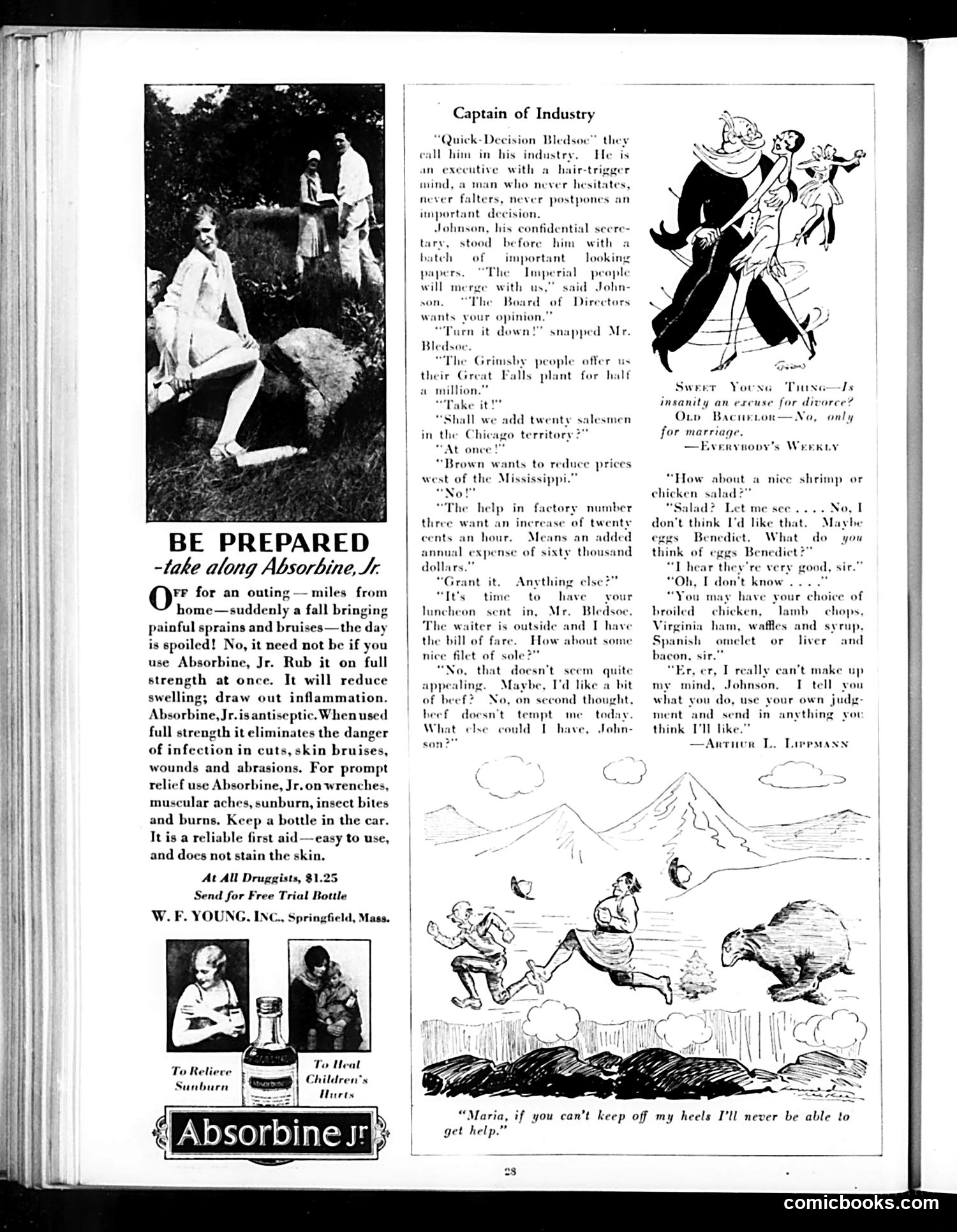
Explanation of Judge Magazine Page This page contains two distinct satirical pieces: Left Side - Absorbine Jr. Advertisement: A straightforward product ad for a medicinal liniment, presented without satire. "Captain of Industry" (Right Side): A satirical commentary on business executives. The cartoon portrays "Quick-Decision Bledsoe," a corporate leader depicted as decisive and commanding—he rapidly approves major business decisions (hiring salesmen, granting wage increases, acquiring property). However, the satire's punch emerges in the final scene: when asked what he wants for lunch, this supposedly decisive captain of industry *cannot decide* between simple menu options and delegates the choice to his secretary Johnson. The joke mocks the persona of the decisive industrial magnate: his confidence and snap judgments on major financial matters contrast absurdly with his paralysis over trivial personal choices. It's satire of executive pretension—suggesting these powerful businessmen, despite their self-assured image, may be indecisive or dependent on subordinates in everyday life. The "Sweet Young Thing" humor below offers typical period relationship comedy about divorce.
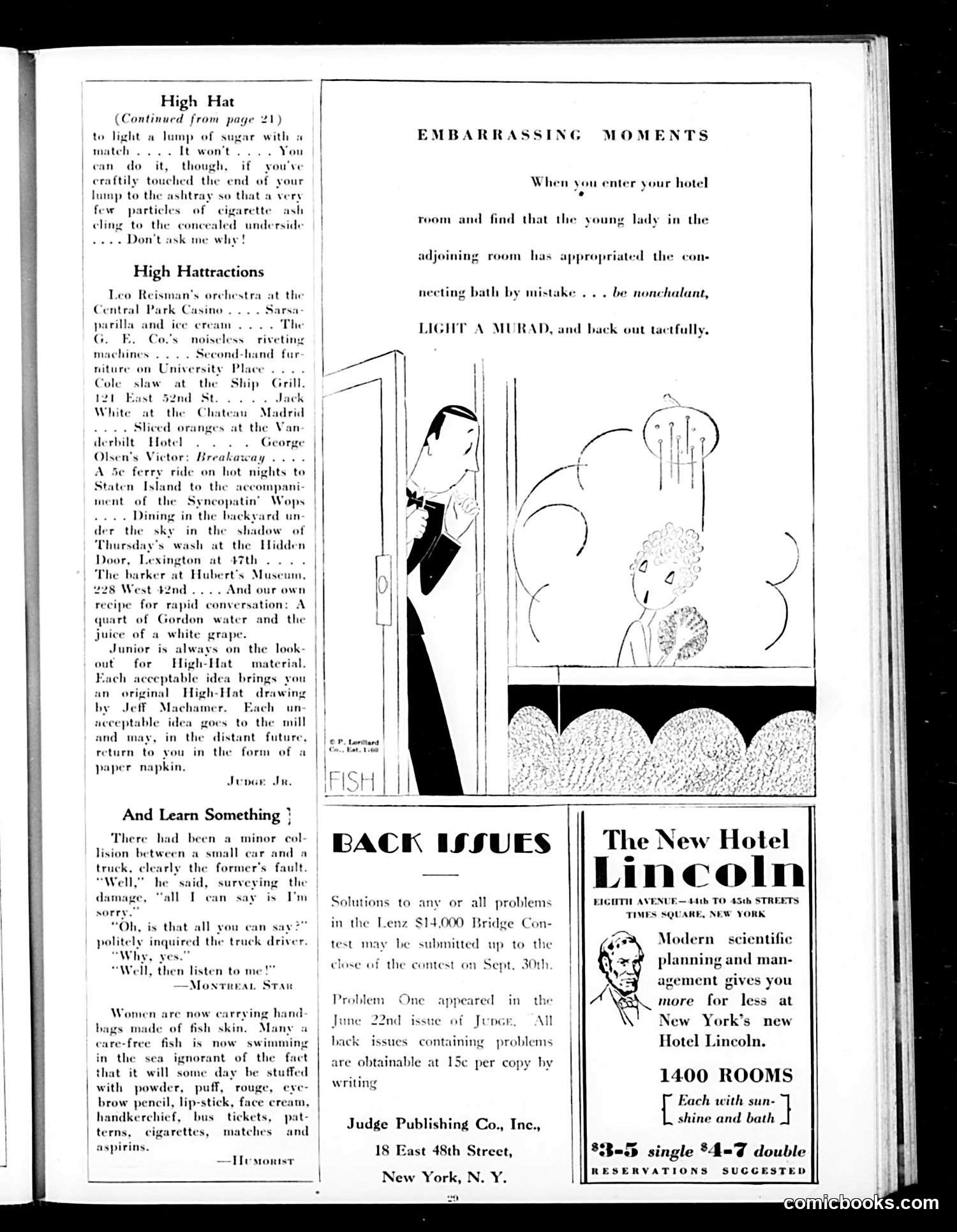
Explanation for Modern Readers This page contains humor columns and advertisements rather than political cartoons. The "Embarrassing Moments" cartoon depicts a common social awkwardness: accidentally entering a hotel room where a woman is bathing in what you thought was your connecting bathroom. The advice to "be nonchalant, LIGHT A MURAD, and back out tactfully" reflects 1920s-30s etiquette humor—the suggestion to light a cigarette (Murad brand) while backing away smoothly. The other content includes "High Hat" humor tips (like lighting sugar with cigarette ash) and social commentary about women's fashion (handbags made from fish skin). The page is primarily filler material mixed with advertisements for Judge magazine's back issues and the Hotel Lincoln. The humor reflects period preoccupations with urban sophistication, modern conveniences, and awkward social situations rather than political satire.
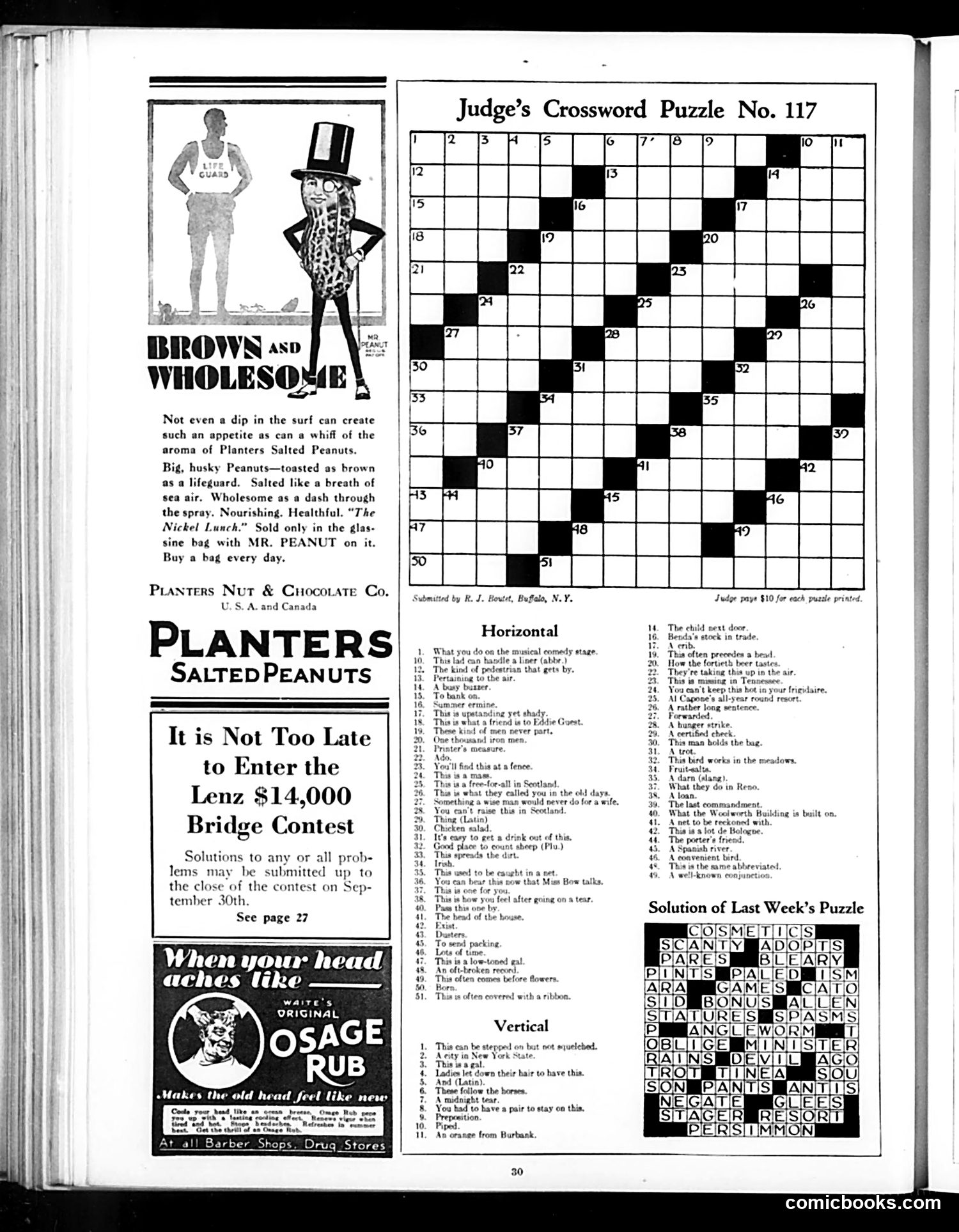
Judge Magazine Page Analysis This page is primarily advertising and puzzles, not political satire. The main content includes: Advertisements: - A Planters Salted Peanuts ad featuring the iconic Mr. Peanut character (top left), emphasizing the product as a wholesome "nickel lunch" - An Osage Rub liniment ad for headaches - A notice for the Lenz Bridge Contest ($14,000 prize) Puzzles: The bulk of the page is "Judge's Crossword Puzzle No. 117" with horizontal and vertical clues, plus the solution to the previous week's puzzle. Historical Context: This appears to be from the 1920s-1930s era, when crossword puzzles were a popular fad and Mr. Peanut was establishing himself as a recognizable mascot. The ads reflect period consumer products and leisure culture rather than containing political commentary.
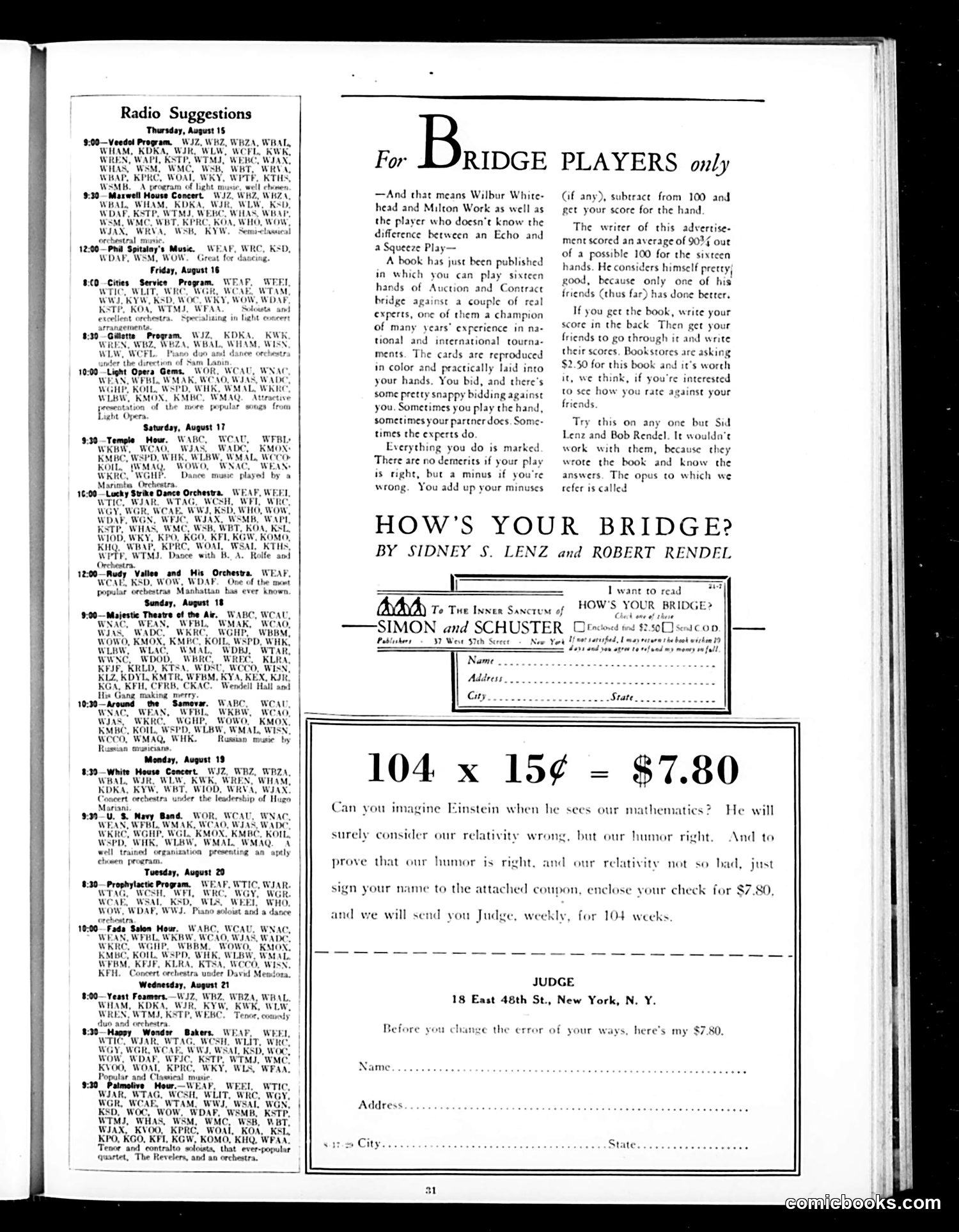
What This Page Means for Modern Readers This is primarily a radio programming schedule and advertising page from Judge magazine (circa August 1920s). The left column lists radio station call letters and broadcast times—essentially a TV guide for radio, a then-novel medium. The main content is a bridge advertisement targeting card players. It promotes a book teaching bridge strategy and a weekly judging service ($7.80 for 104 weeks). The humor is light: the ad jokes about Einstein questioning their math ("104 x 15¢ = $7.80"), using intellectual authority to pitch a leisure activity. The coupon-style layout was standard advertising for the era. There are no political cartoons or satirical commentary visible—this is straightforward commercial content mixed with radio listings, typical of Judge's format combining humor magazine content with practical entertainment guides during radio's early popularity.
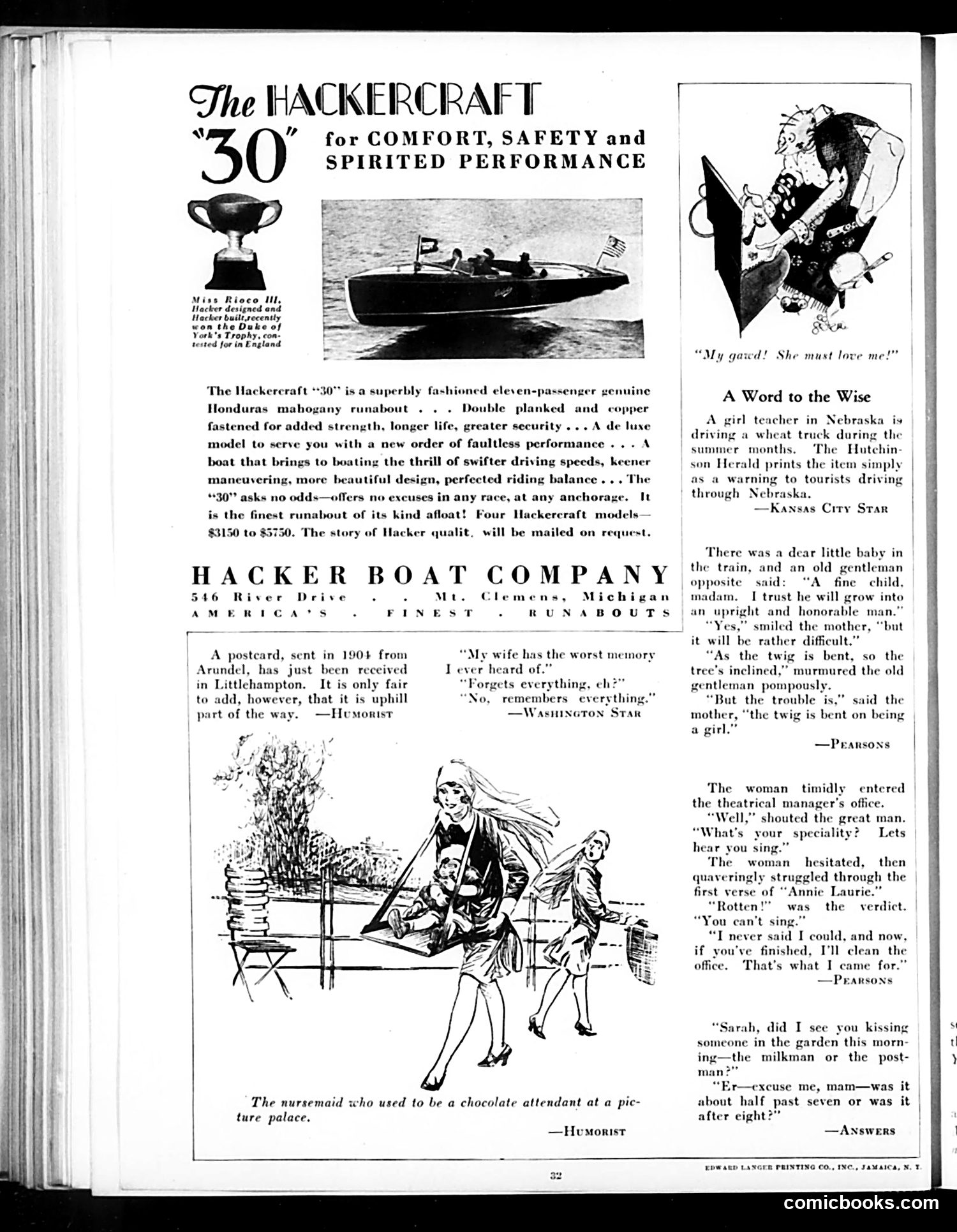
Judge Magazine Page Analysis This page is primarily advertising and humor content, not political satire. The dominant feature is a Hackercraft boat advertisement—a luxury speedboat manufacturer promoting their "30" model as high-performance, mahogany-built, and suitable for wealthy sportsmen. The marketing emphasizes comfort, safety, and speed for eleven passengers. The cartoon and jokes are conventional domestic humor typical of early 20th-century magazines: - A nursemaid who once worked at a movie theater (social commentary on working-class women) - Marriage jokes about wives' poor memory - A Nebraska schoolteacher driving a wheat truck during summer (noting unusual female labor) - A theatrical audition sketch where an untalented woman applies as a cleaner instead - A cheeky response about whether a kiss occurred at 7 AM or 8 AM (implying the speaker needs to know which suitor) These are light, topical gags reflecting period attitudes toward gender roles and social class—not serious political commentary. The humor relies on recognizable social situations rather than specific historical events or figures.
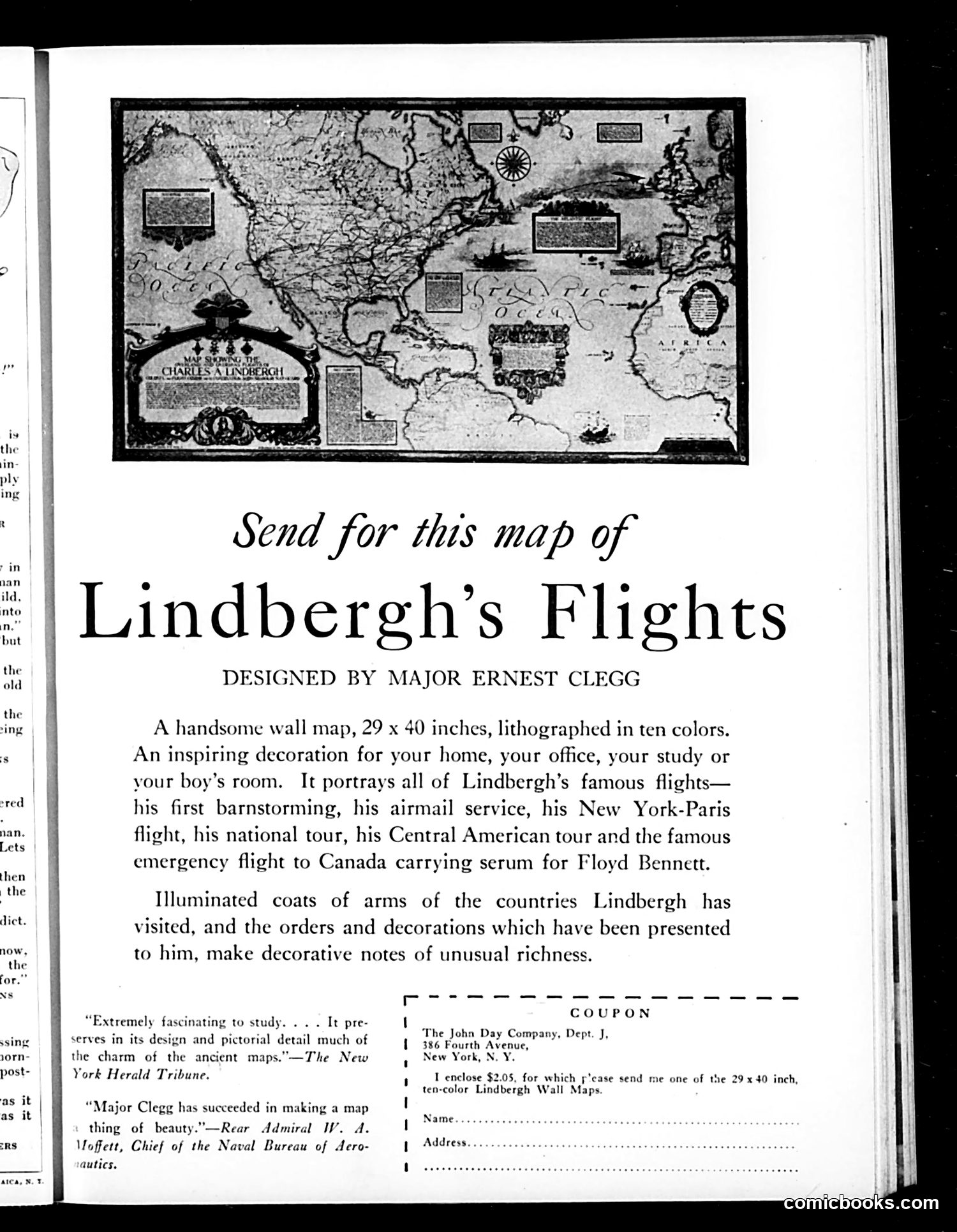
Analysis This is not a cartoon or satire—it's a product advertisement for a wall map commemorating Charles Lindbergh's flights, designed by Major Ernest Clegg. The page capitalizes on Lindbergh's celebrity following his famous 1927 transatlantic New York-Paris flight. It advertises a decorative 29×40 inch lithographed map depicting all his notable aviation achievements: barnstorming, airmail service, his record-breaking transatlantic crossing, national tours, and Central American expeditions, plus an emergency mercy flight to Canada (carrying serum for Floyd Bennett). The advertisement includes endorsements from *The New York Herald Tribune* and Rear Admiral W. A. Moffett of the Naval Bureau of Aeronautics, lending credibility. It emphasizes the map's artistic appeal—printed in ten colors with illuminated coats of arms and international honors Lindbergh received—positioning it as suitable for homes, offices, studies, or "your boy's room." A tear-out coupon allows readers to order for $2.05. This reflects the 1920s-30s merchandising frenzy surrounding Lindbergh's heroic status.
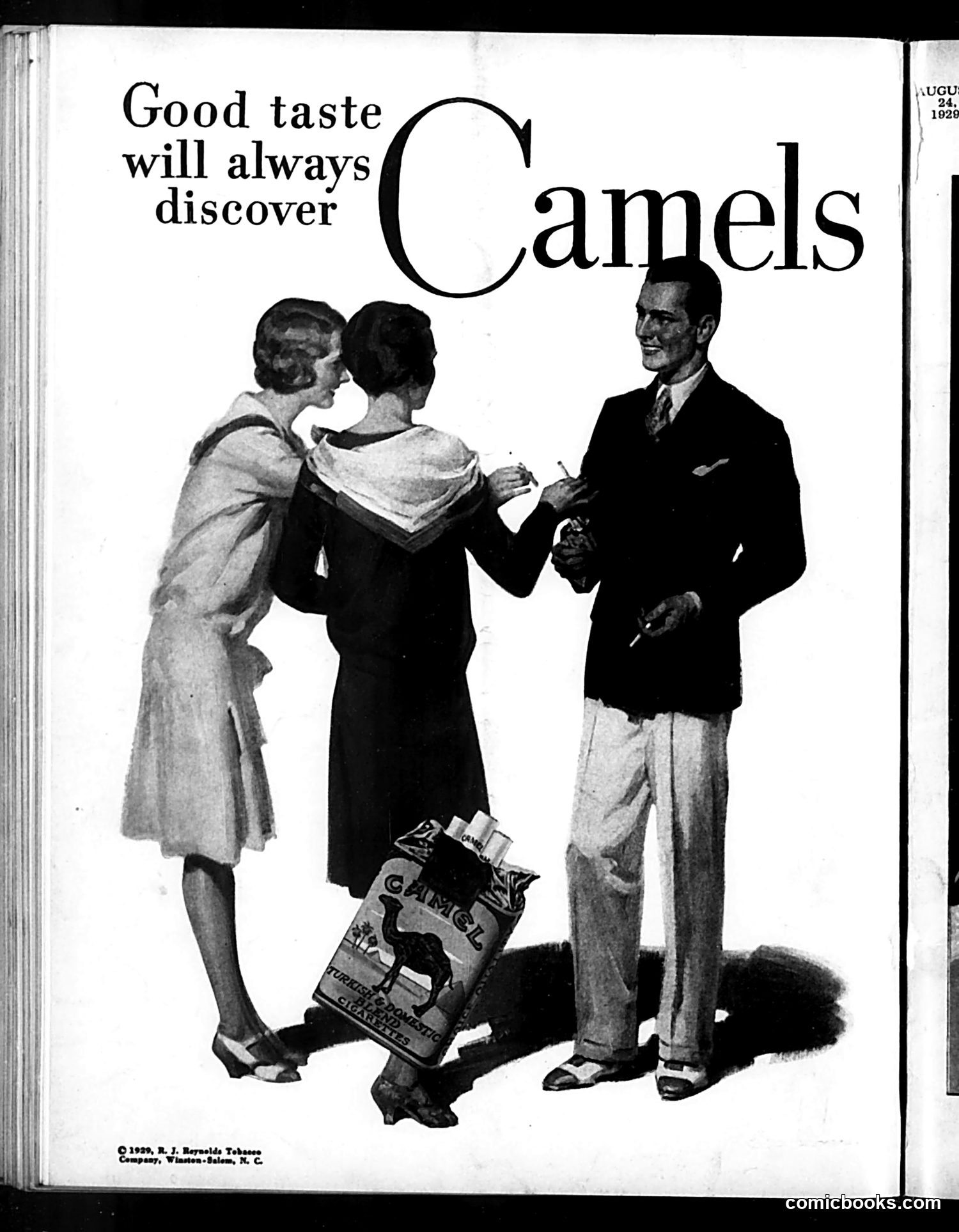
Analysis This is a cigarette advertisement for Camels, not a political cartoon. The ad features three well-dressed figures—two women and a man in 1920s attire—examining a package of Camel cigarettes positioned prominently in the foreground. The slogan "Good taste will always discover Camels" uses aspirational messaging typical of 1920s advertising. By depicting fashionable, affluent people (note their clothing and refined demeanor), the ad associates smoking Camels with sophistication and social status. The copyright indicates this appeared in Judge magazine around 1929, during the height of cigarette advertising before health warnings. This represents mainstream product promotion that would be considered unethical today due to tobacco's proven dangers.