judge
Judge — August 24, 1929
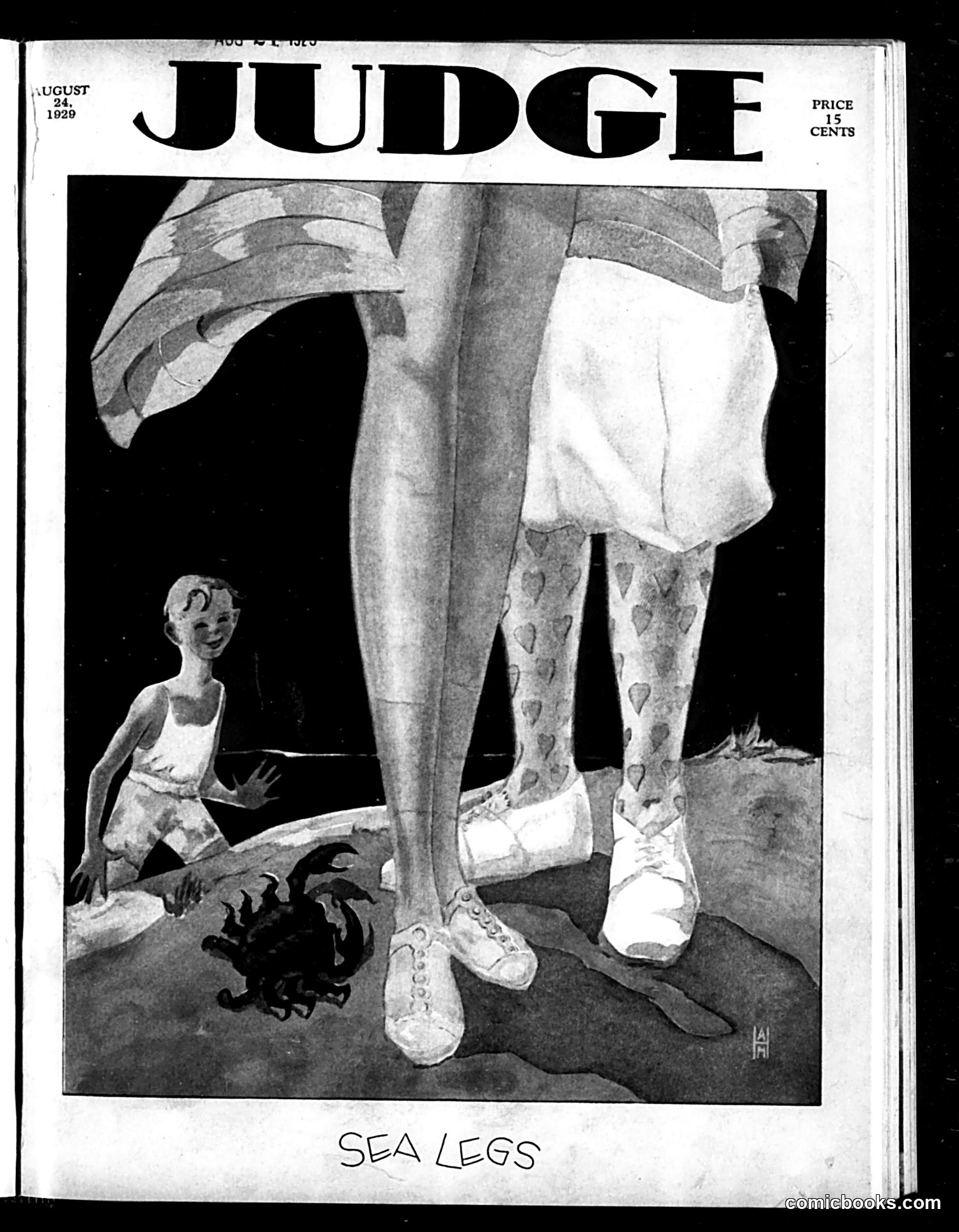
"Sea Legs" - Judge Magazine, August 24, 1929 This cartoon satirizes inexperienced swimmers or beachgoers. The title "Sea Legs" (nautical confidence) is ironic, as the image shows an adult with comically tattooed legs wearing swimming attire, standing over a small child who appears distressed or startled by the adult's prominent leg tattoos—featuring heart designs. The satire likely mocks either: adults who lack actual swimming competence despite appearing confident, or the vanity of displaying tattoos at the beach. The child's shocked reaction emphasizes how ridiculous or unsightly the tattooed "sea legs" appear. This reflects 1929 attitudes toward tattoos as lowbrow or unseemly, particularly for public display at leisure venues. The humor derives from the gap between the confident stance and the absurd reality being exposed.
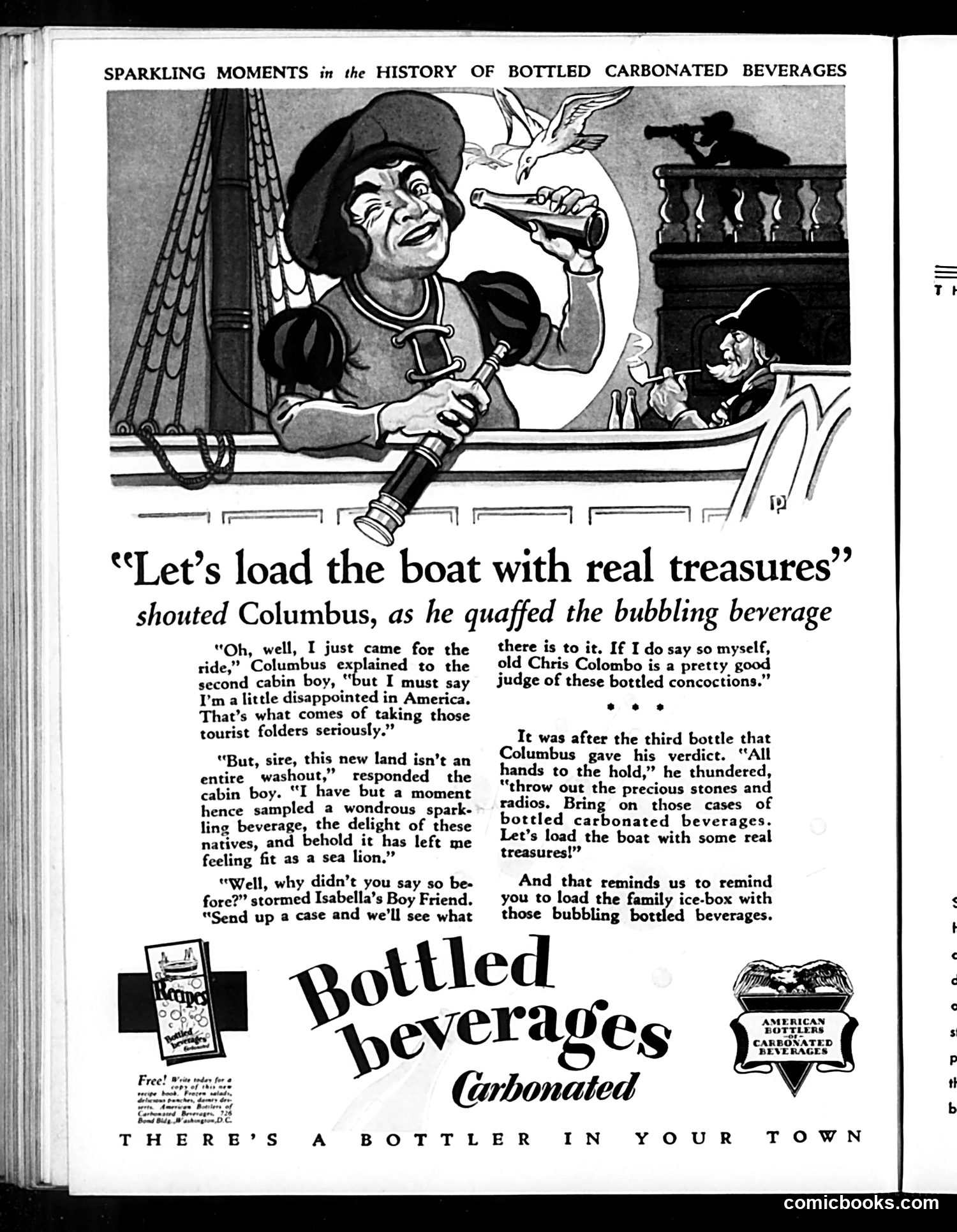
Analysis This is primarily advertising content for bottled carbonated beverages, not political satire. The page uses a historical framing device: Columbus is depicted discovering carbonated beverages as a "real treasure," comparable to his voyage to America. The humor relies on Columbus's famous expedition (1492) as a metaphor—just as Columbus sought riches in the New World, the advertiser positions bottled sodas as valuable discoveries worth loading into your family's ice-box. The characters include Columbus himself and various period-dressed figures meant to evoke the Age of Exploration. The satire is gentle and commercial rather than political: it's essentially a joke advertisement suggesting carbonated beverages are as significant a "find" as Columbus's voyage. The "real treasures" tagline drives home this comparison.
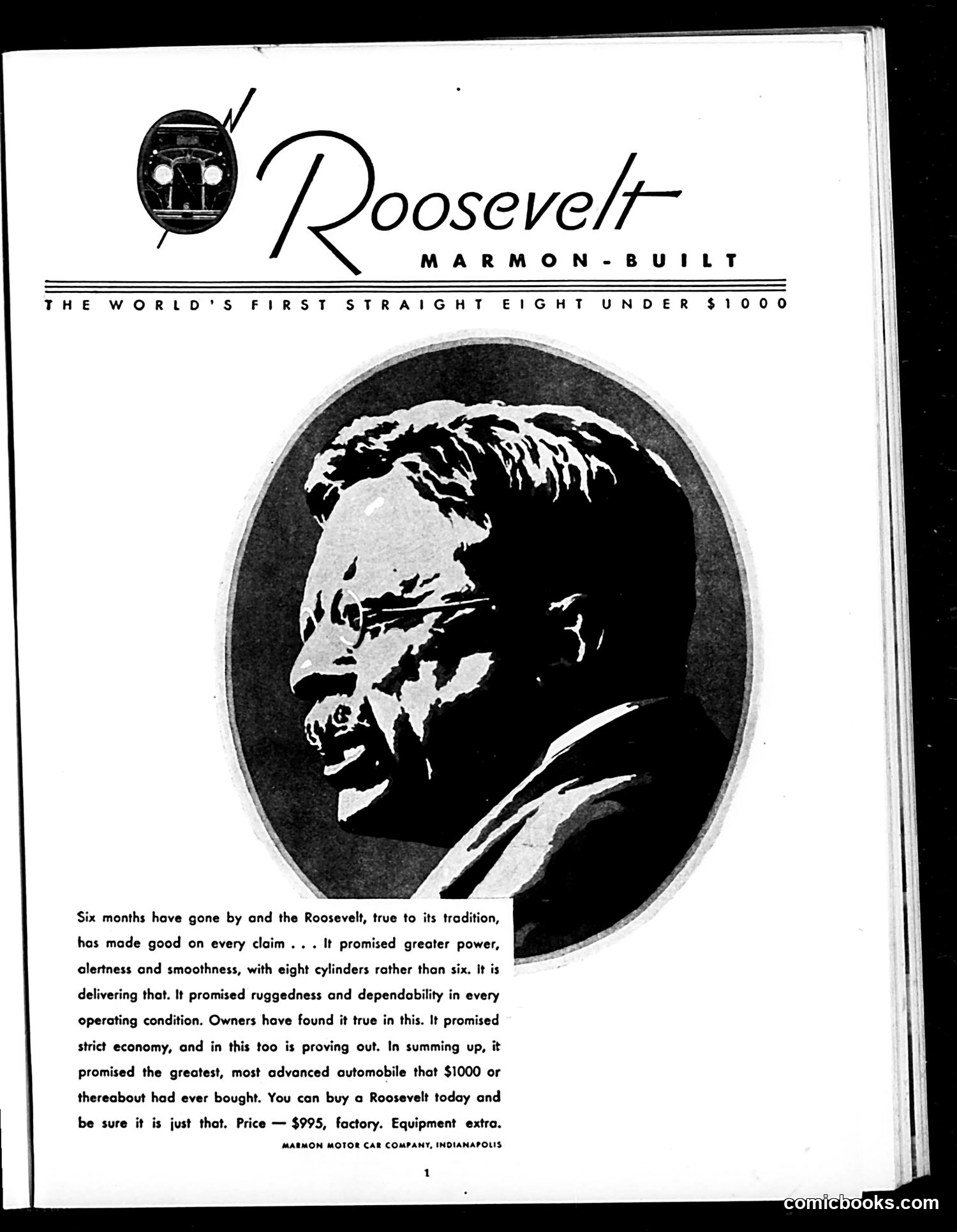
Roosevelt Automobile Advertisement This is not satire — it's a straightforward advertisement for the Roosevelt automobile, manufactured by the Marmon Motor Car Company in Indianapolis. The profile portrait shows Theodore Roosevelt, the former president, used as the brand's namesake and mascot. The ad promotes the Roosevelt as "the world's first straight eight under $1000," emphasizing its eight cylinders, power, smoothness, and reliability. The text claims six months of sales have proven the car delivers on its promises of performance and economy. The price is listed at $995 (factory), positioning it as an affordable luxury vehicle for the era. This represents early 20th-century automotive marketing that capitalized on Roosevelt's fame and association with strength and durability to sell cars.
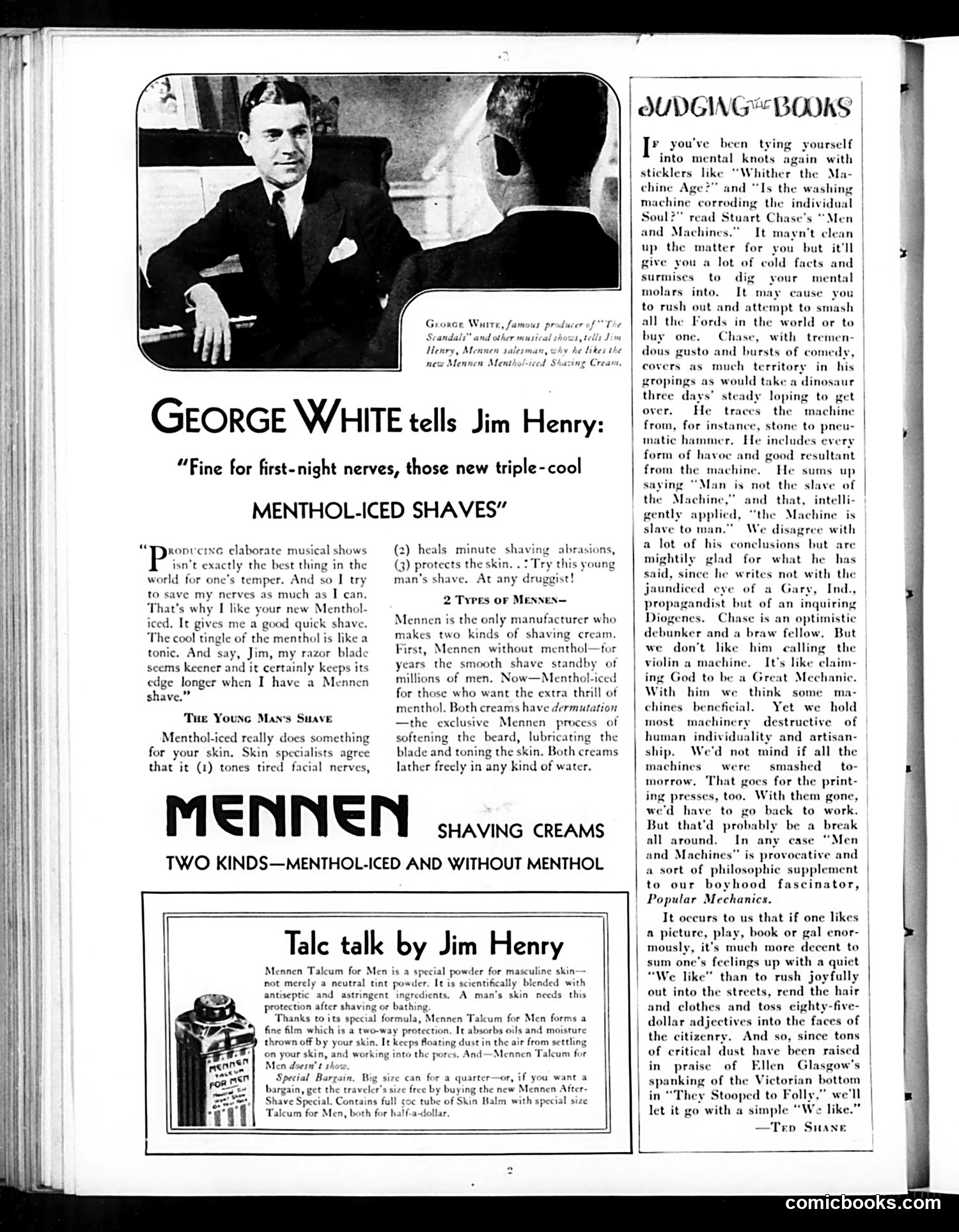
Analysis This page is primarily advertising, not satire or political commentary. It contains two advertisements for Mennen shaving products, featuring testimonials from entertainers. The top ad uses George White (a famous theatrical producer of the era) giving a testimonial to "Jim Henry" about Menthol-iced shaves for "first-night nerves." This appears to be a fictional endorsement scenario rather than satire—using a real celebrity to pitch products was standard advertising practice. The lower ad features "Jim Henry" discussing Mennen Talcum Powder in similar fashion. The right column contains a book review section titled "Judging the Books" discussing Stuart Chase's "Men and Machines," which critiques mechanization's effects on society—this is the page's only substantive editorial content, separate from the advertisements.
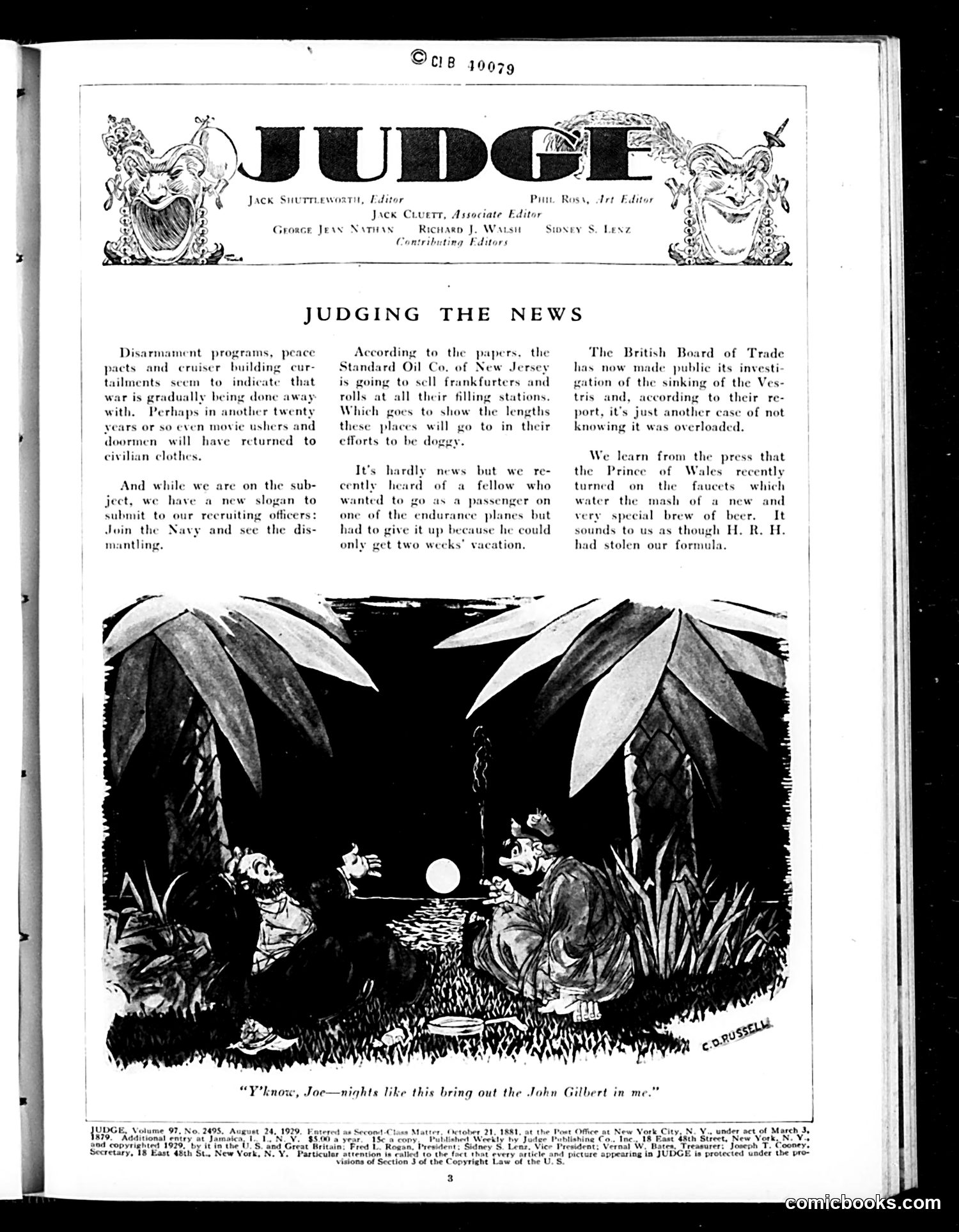
Analysis of Judge Magazine Page This page contains a satirical editorial section titled "Judging the News" discussing early 1920s topics: disarmament programs, Navy recruitment, and industrial news about Standard Oil and the British Board of Trade. The main cartoon depicts figures in a tropical nighttime setting with large plants and a full moon. The caption reads: "Phone, Joe—nights like this bring out the John Gilbert in me." This references John Gilbert, a famous silent film actor known for romantic roles. The joke appears to satirize how moonlit tropical nights inspire romantic sentimentality in men—invoking Gilbert's screen persona as shorthand for exaggerated romantic behavior. The cartoon mocks this performative romanticism as absurd or affected. The overall page blends news commentary with humor typical of Judge's satirical approach to current events and popular culture.
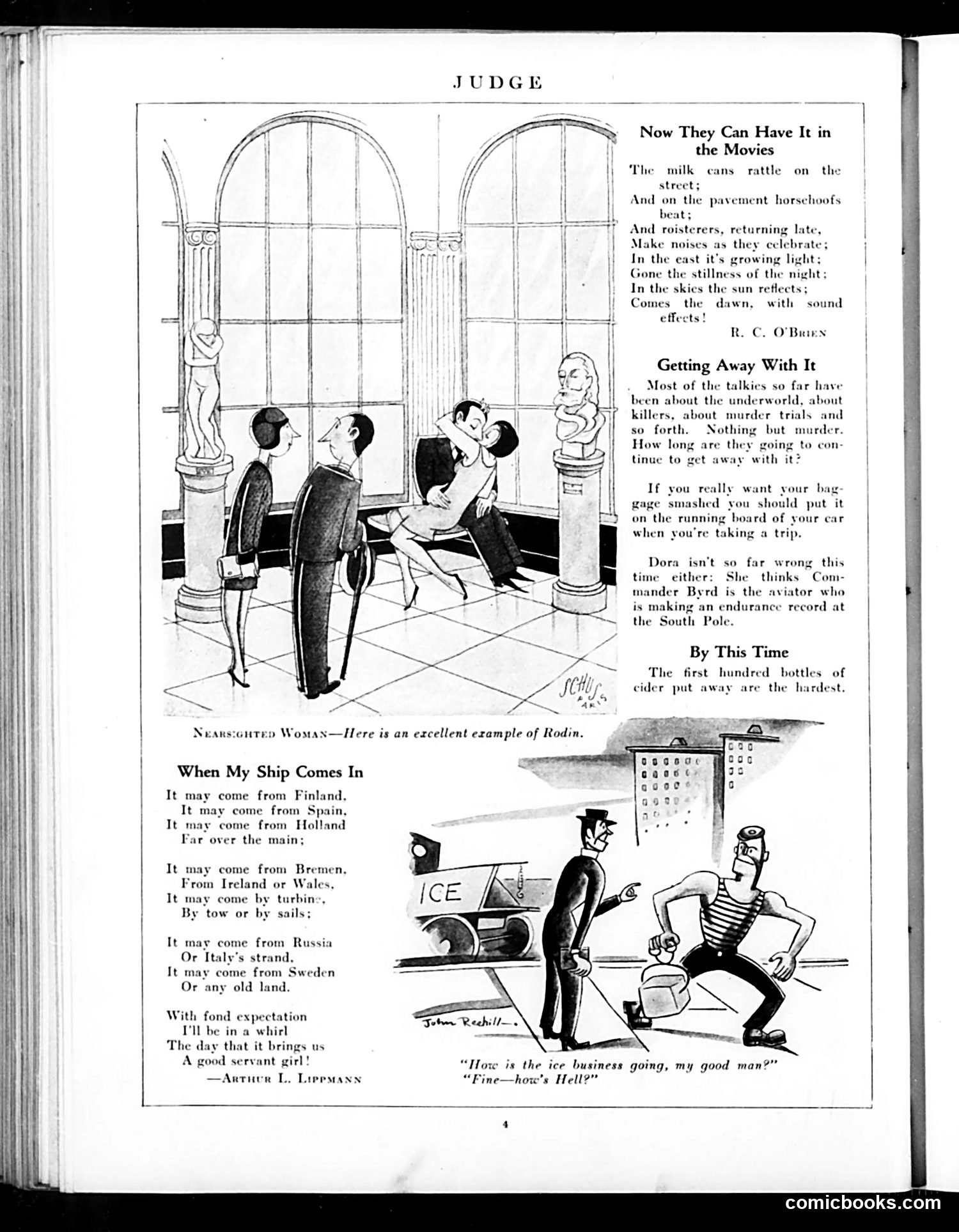
Judge Magazine Page Analysis This page contains three separate humor pieces typical of 1920s Judge magazine: "Nearsighted Woman" (top): A cartoon mocking a woman's poor vision—she mistakes classical statues for real people at what appears to be an art gallery or museum, creating social awkwardness with male visitors. "When My Ship Comes In" (bottom left): A poem by Arthur L. Lippmann expressing hopeful anticipation of prosperity, listing various shipping routes. It reflects post-WWI optimism about international commerce and romantic fortune. "Ice Business" cartoon (bottom right): A man in formal dress asks an ice delivery worker how business is going during what appears to be economic hardship. The caption "Fine—here's Hell!" suggests dark humor about struggling industries during uncertain economic times, likely referencing the 1920s economic volatility. The overall tone is light social satire typical of Judge's middle-class audience.
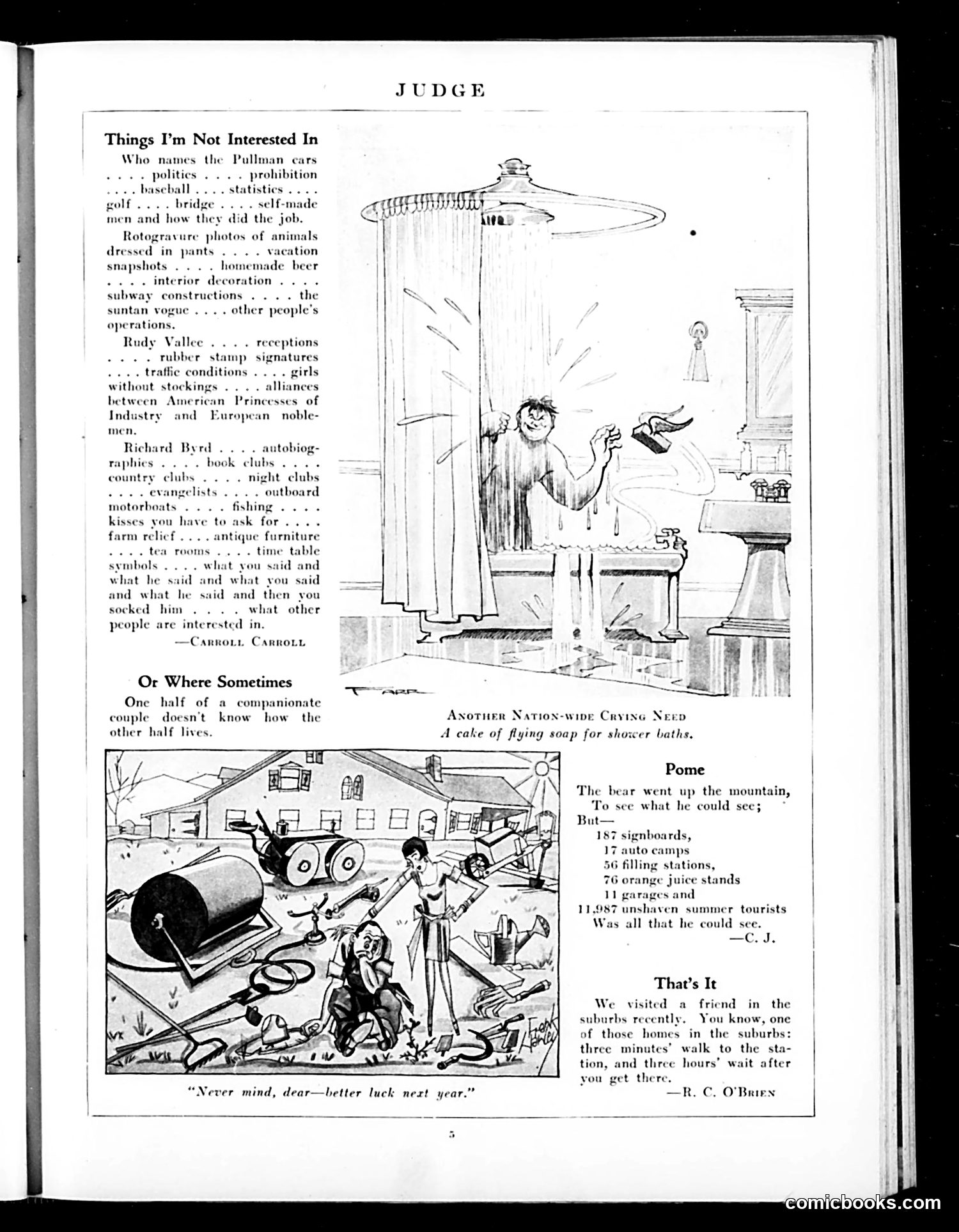
Analysis of Judge Magazine Page This page contains three separate humorous pieces typical of 1920s Judge magazine: 1. "Things I'm Not Interested In" — A satirical list by Carroll Carroll mocking upper-class concerns (Pullman cars, golf, bridge, Rudy Vallée, country clubs, motorboats). 2. "Another Nation-wide Crying Need" — A cartoon satirizing modern consumer excess, depicting someone overwhelmed by flying soap for shower baths — mocking frivolous product innovation during the commercialization boom. 3. "Pome" and "That's It" — Light verse and observations about suburban overcrowding and poor infrastructure. The bottom cartoon shows domestic chaos ("Never mind, dear—better luck next year"), likely referencing housing shortages or neighborhood congestion issues of the era. The overall tone critiques 1920s consumerism, suburban expansion, and commercialism.
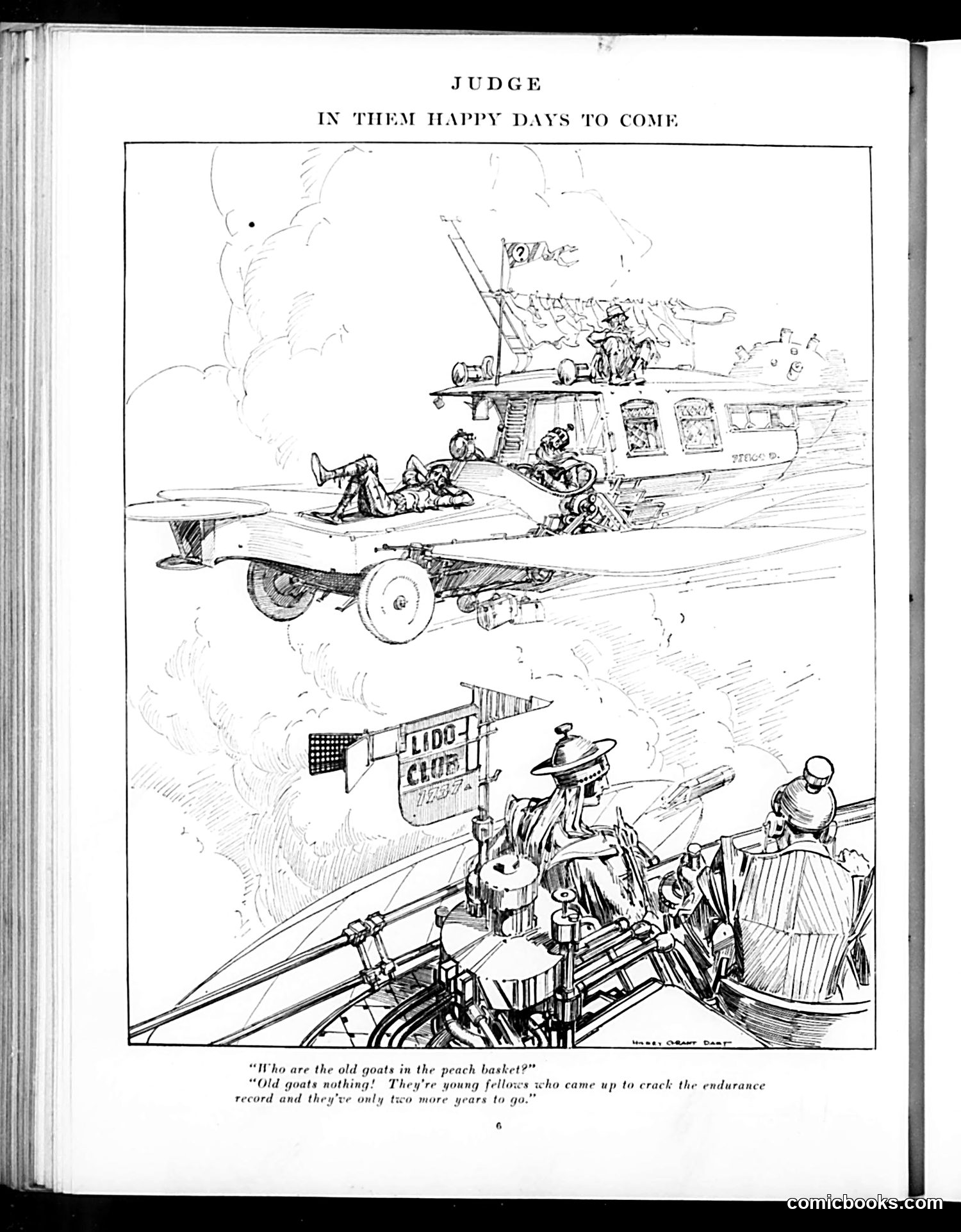
"Judge in Them Happy Days to Come" This satirical cartoon depicts a futuristic racing scenario where old competitors ("old goats") attempt to break endurance records with only "two more gears to go." The illustration shows multiple vehicles—including what appears to be an early motorboat or speedboat at top and a racing car with a "Lido Club" banner at bottom—suggesting a competitive sporting event. The satire targets aging competitors trying to maintain relevance in modern racing. The phrase "old goats" dismissively characterizes these drivers, while the joke about "two more gears" implies they're mechanically outdated yet stubbornly persistent. This likely mocks real aging athletes or competitors of the era attempting to remain competitive in increasingly modern, speed-focused racing competitions.
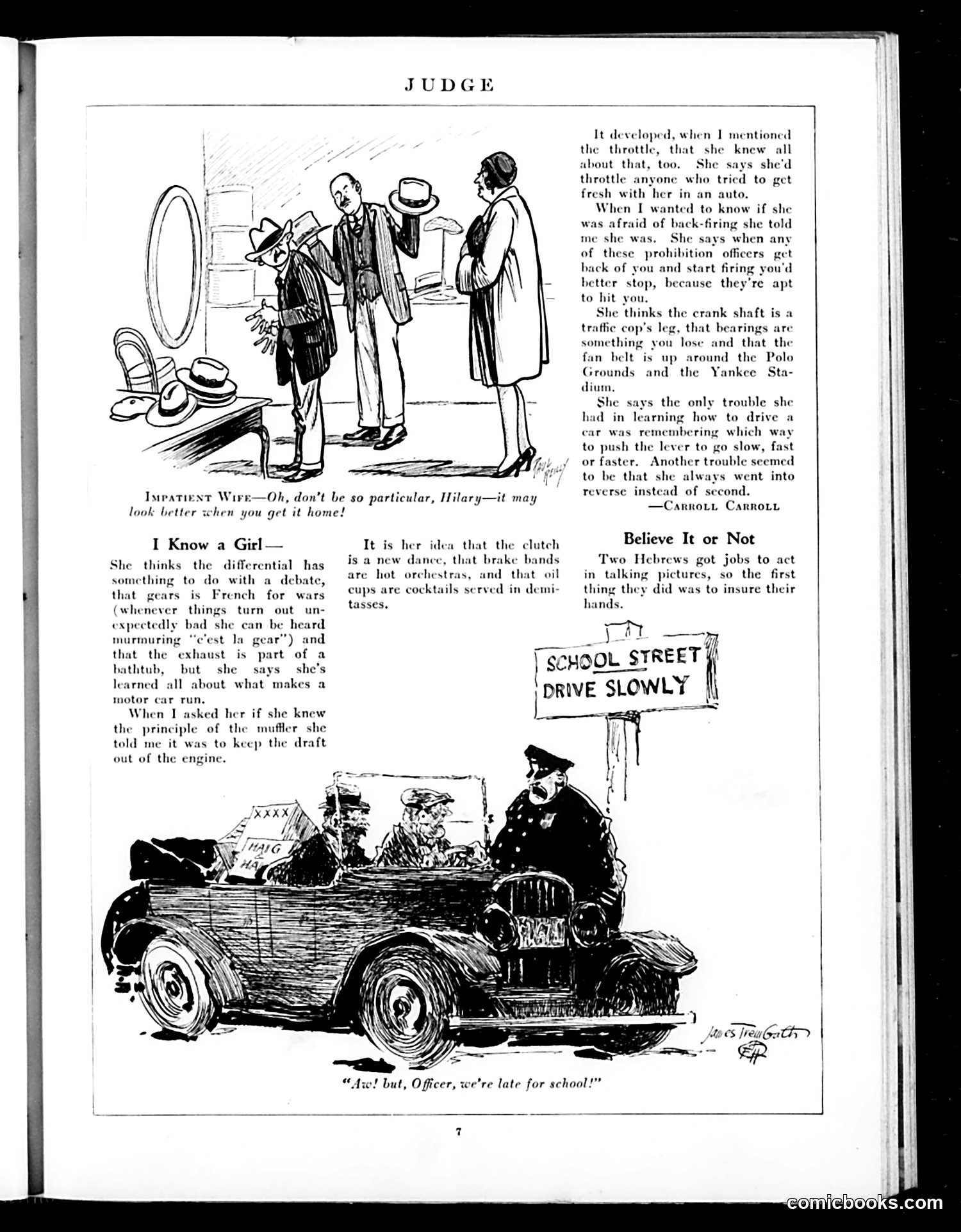
Explanation for Modern Readers This 1920s-era Judge magazine page contains automotive humor satirizing women's ignorance about cars—a contemporary social anxiety as automobiles became common. "I Know a Girl" mocks a woman who confuses car parts with unrelated concepts: the differential with debate, "c'est la gear" (French wordplay), the clutch as a dance, brake bands as orchestras, and oil cups as cocktails. The humor relies on the premise that women mechanically incompetent, yet confident in their cluelessness. "Impatient Wife" shows a woman with an obviously broken-down vehicle, dismissing her husband's concerns—satirizing both marital tension and female disregard for practical maintenance. "Believe It or Not" features a traffic stop caption about being late for school, likely mocking reckless driving or traffic enforcement. The cartoons reflect 1920s anxiety about women entering the automotive world, presenting female drivers as comically uninformed rather than capable. This reflects the period's cultural resistance to women's independence and technological competence.
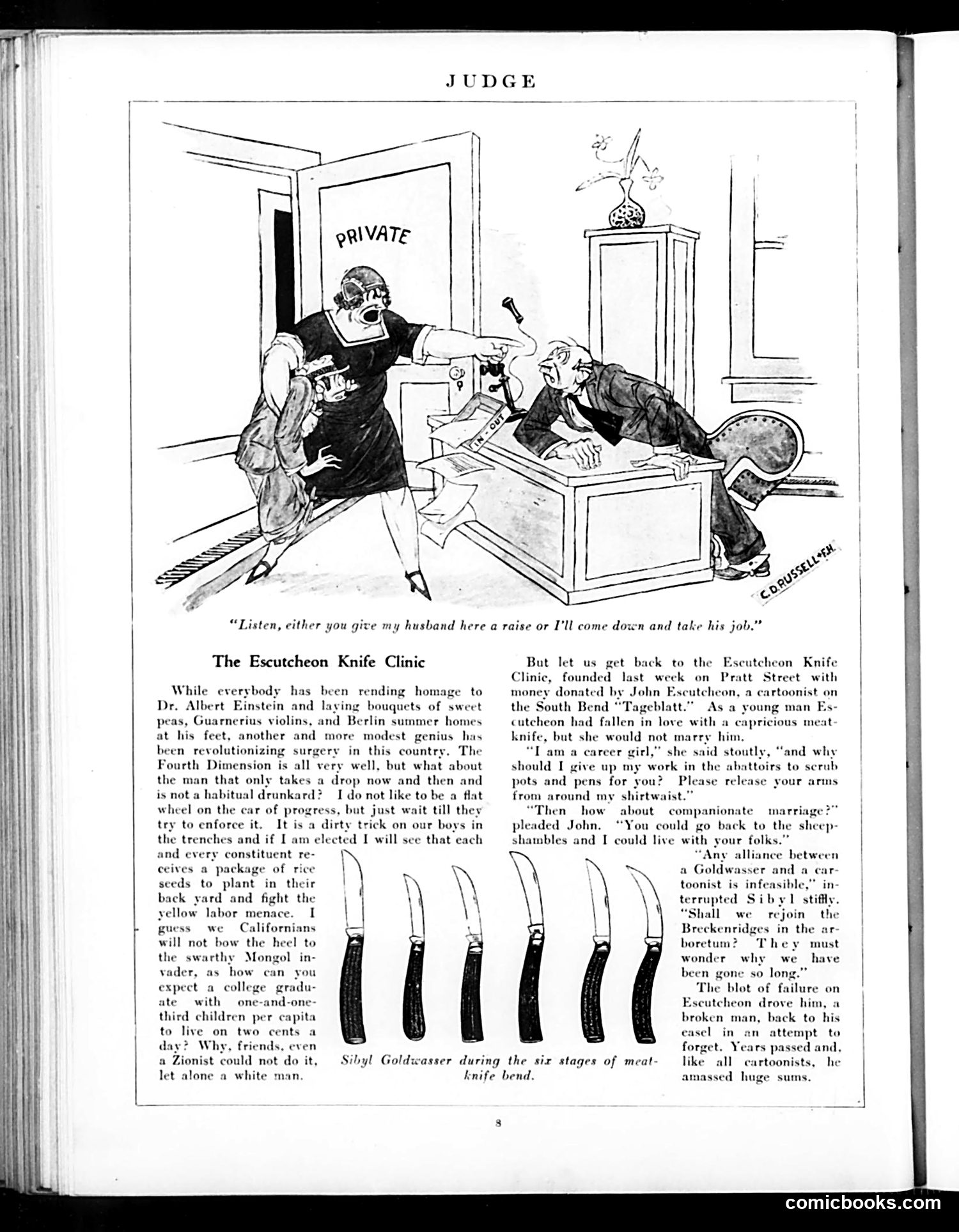
Explanation for Modern Readers This Judge page contains two satirical pieces: Top cartoon: A woman threatens a judge, demanding her husband receive a raise or she'll take his job herself. This mocks traditional gender roles and women's increasing workplace presence post-WWI, suggesting wives as economic threats to men's employment. "The Escutcheon Knife Clinic" article: A rambling, nonsensical piece satirizing a failed romance between Sibyl Goldwasser (a cartoonist) and John Escutcheon (who works in meat production). The story parodies melodramatic "companionate marriage" debates—a 1920s concept where couples maintained separate lives and finances. The humor lies in the absurdity: she refuses domestic work, they discuss rejoining the "Breckenridges in the arboretum," and after years apart, he becomes a wealthy cartoonist. The piece mocks modern courtship debates, career women, and the pretensions of bohemian intellectuals, while the knife illustrations reference the meat industry setting.
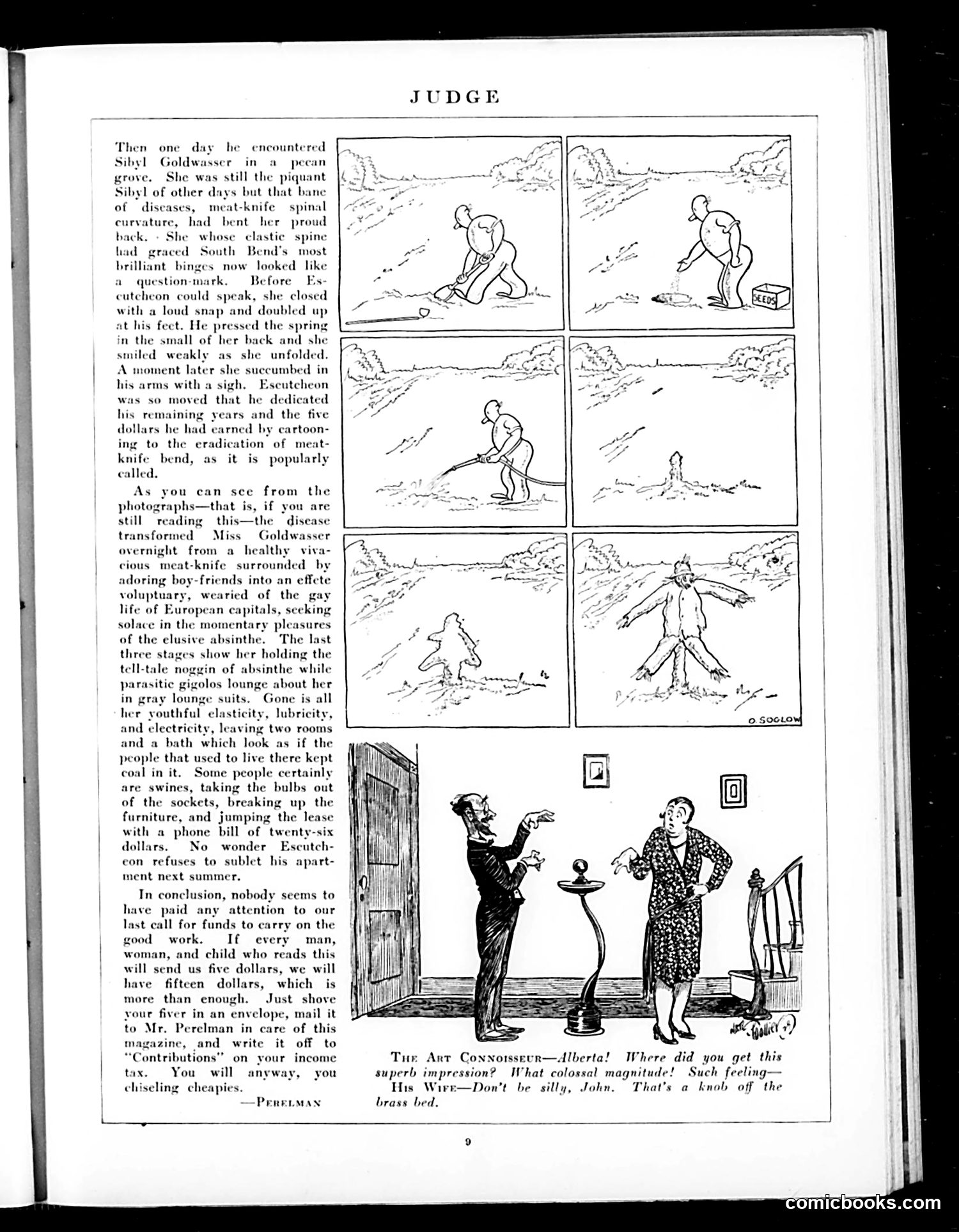
Judge Magazine Satire Analysis This page contains two distinct satirical pieces: Upper section: A narrative about "Sibyl Goldwasser" suffering from "meat-knife bend"—a spinal curvature caused by excessive corset-wearing. The six-panel sequence illustrates her physical deterioration from this fashionable but dangerous practice. The story mocks both the vanity of women pursuing impossible beauty standards and the pseudo-medical consequences of tight-lacing corsets, which actually did cause skeletal deformation in the early 20th century. The protagonist's dramatic response satirizes sentimental male rescuer narratives. Lower section: A brief domestic comedy showing an "Art Connoisseur" admiring what he describes as an impressive sculpture, while his wife reveals it's simply "a knob off the brass bed." The joke mocks pretentious art appreciation and the gap between aesthetic pretension and mundane reality. Both pieces exemplify *Judge*'s trademark humor: satirizing contemporary fashion obsessions, gender dynamics, and social pretension through exaggerated illustration and ironic text.
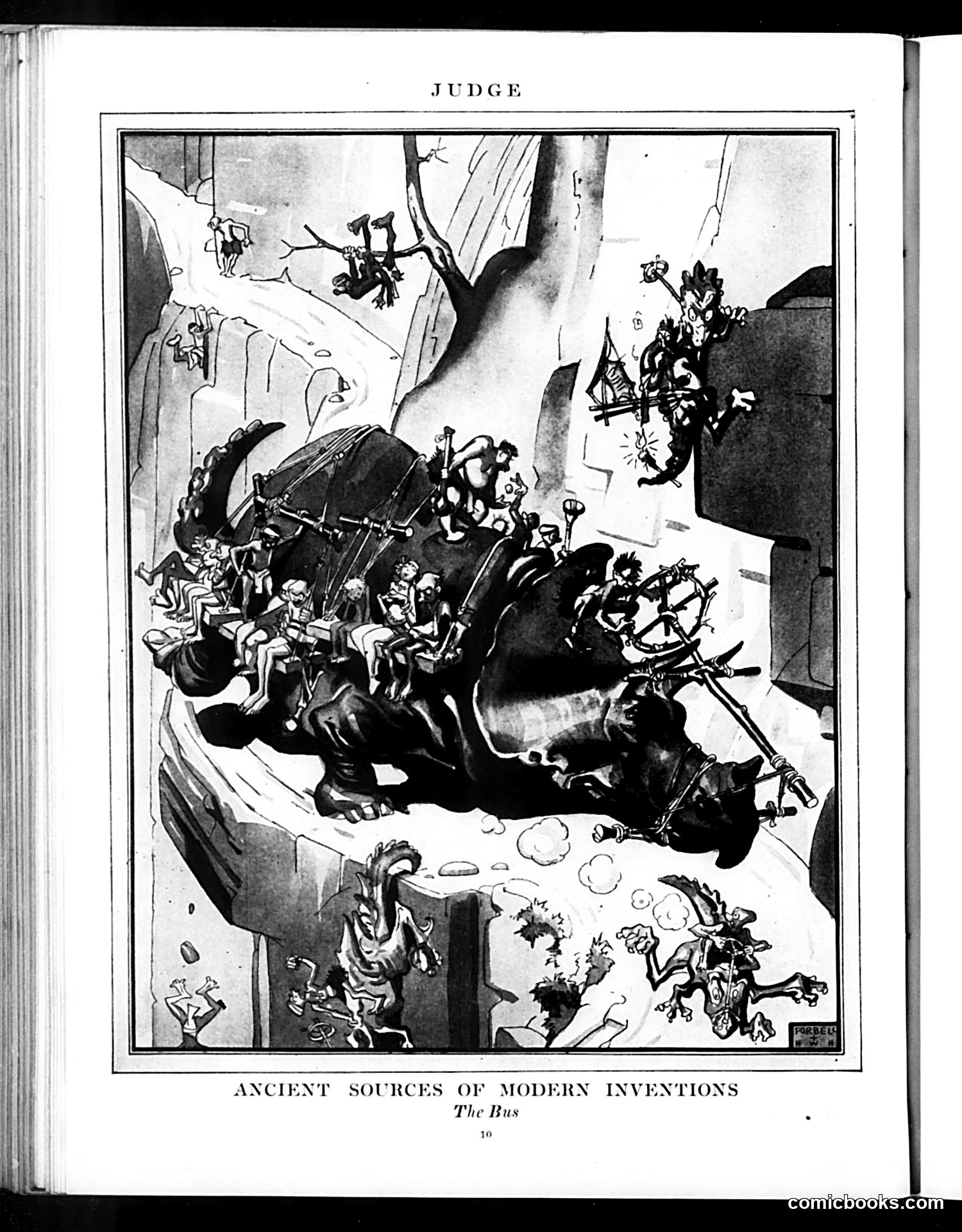
"Ancient Sources of Modern Inventions: The Bus" This cartoon presents a humorous "historical origin" of the modern bus by depicting it as descended from ancient Roman chariots and conveyances. The image shows a crowded, chaotic scene with multiple figures packed into and atop a large vehicle navigating through what appears to be classical architecture. The satire works on two levels: it suggests that crowded public transportation is nothing new (mocking modern inconvenience as ancient), and likely comments on the uncomfortable, chaotic nature of contemporary bus travel—where passengers are crammed together much like soldiers or citizens in ancient times. The visual exaggeration emphasizes how little has truly improved in passenger comfort across millennia, offering social commentary on urban transportation's inherent discomforts.
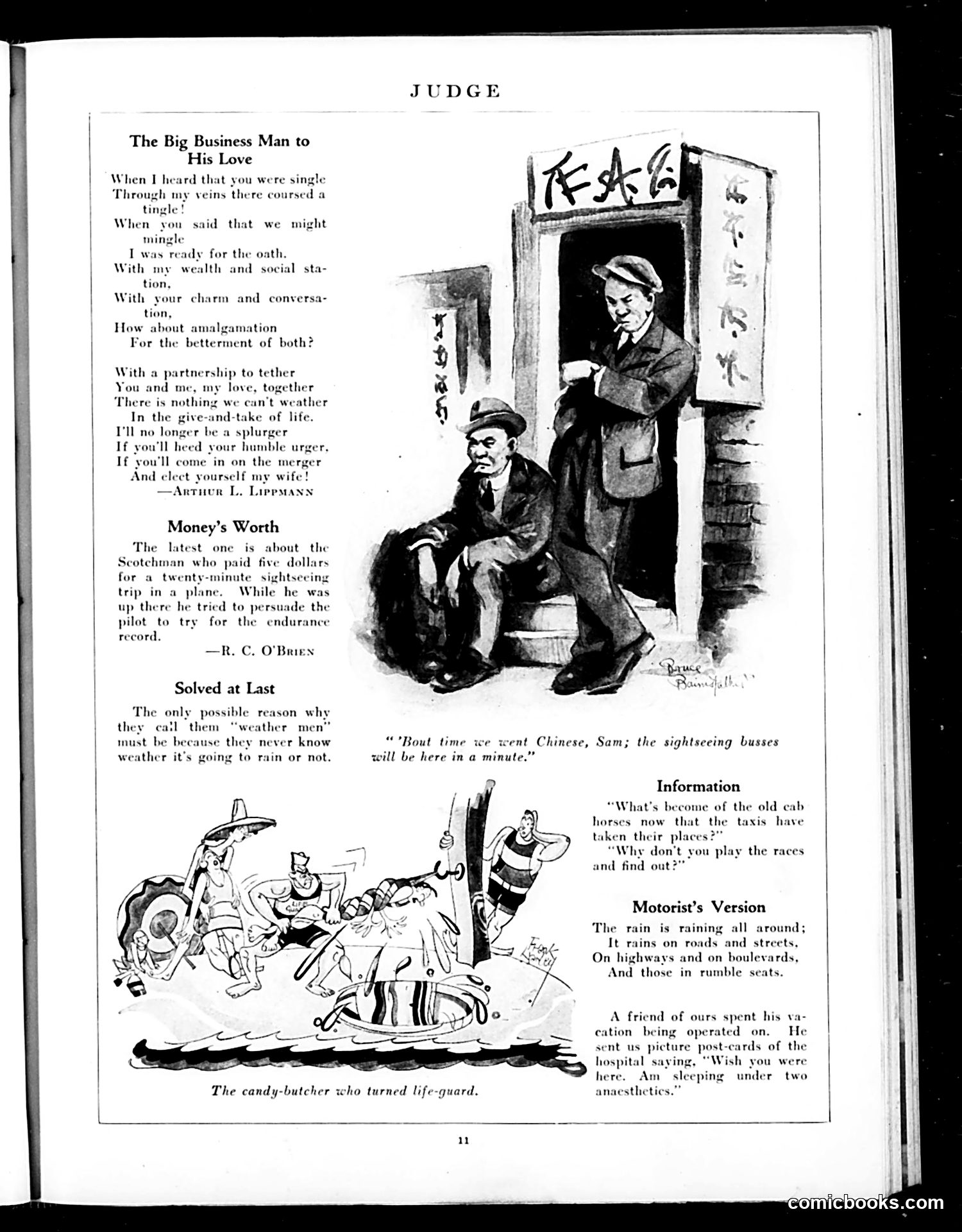
Analysis of Judge Magazine Page This page contains several satirical pieces typical of early 20th-century Judge magazine: "The Big Business Man to His Love": A poem mocking wealthy industrialists who approach romance with corporate language—proposing marriage as a "merger" and "partnership" for "betterment of both." The satire critiques how robber-baron-era businessmen reduce human relationships to financial transactions. "Money's Worth": A short joke about a frugal Scotsman paying $5 for a plane ride, then trying to convince the pilot to attempt an endurance record—poking fun at both Scottish thriftiness and aviation enthusiasm. "Solved at Last": A one-liner joke: "weather men" are called that because they never actually know if it will rain. The cartoons show everyday scenes: Chinese immigrants with sightseeing buses, and people caught in rain (the "Motorist's Version" poem about rain affecting drivers). The humor is genteel, class-conscious satire targeting wealthy businessmen, immigrants, and modern inconveniences—typical of Judge's audience of educated, middle-to-upper-class readers.
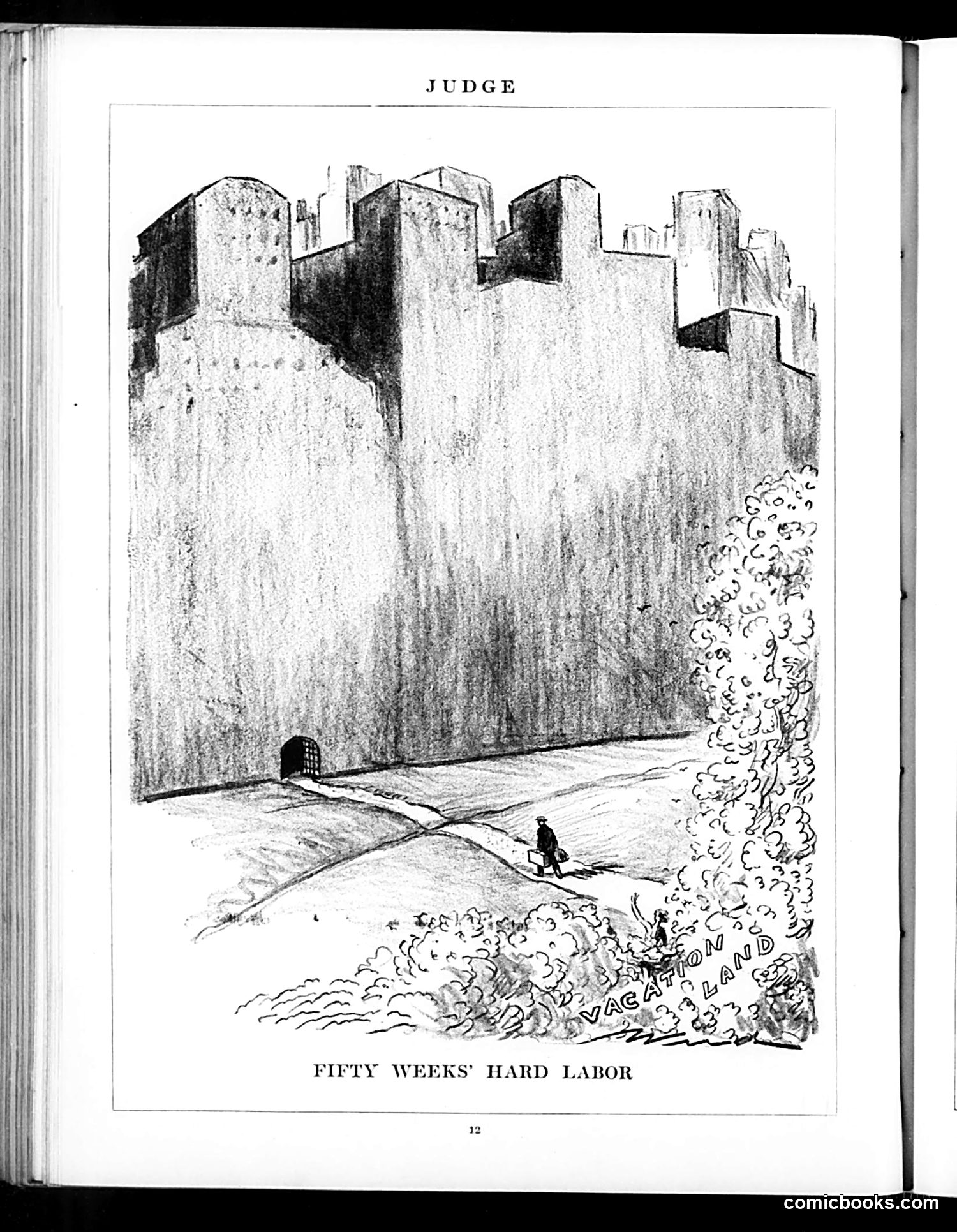
This political cartoon from *Judge* magazine depicts a massive fortress or prison wall with crenellations, labeled "Vagabond Land" at its base. Two tiny figures labor outside the fortification—appearing to work or struggle in the barren ground. The title "Fifty Weeks' Hard Labor" suggests a legal punishment or prison sentence. The "Vagabond Land" reference likely critiques vagrancy laws or poor relief policies of the era. The cartoon satirizes how authorities confined or punished the homeless and unemployed through forced labor programs, depicting their situation as literal imprisonment. The scale disparity—enormous walls dwarfing human figures—emphasizes the crushing power of the system over vulnerable individuals. This reflects *Judge*'s social commentary on labor conditions and legal treatment of poverty during the Gilded Age or Progressive Era.
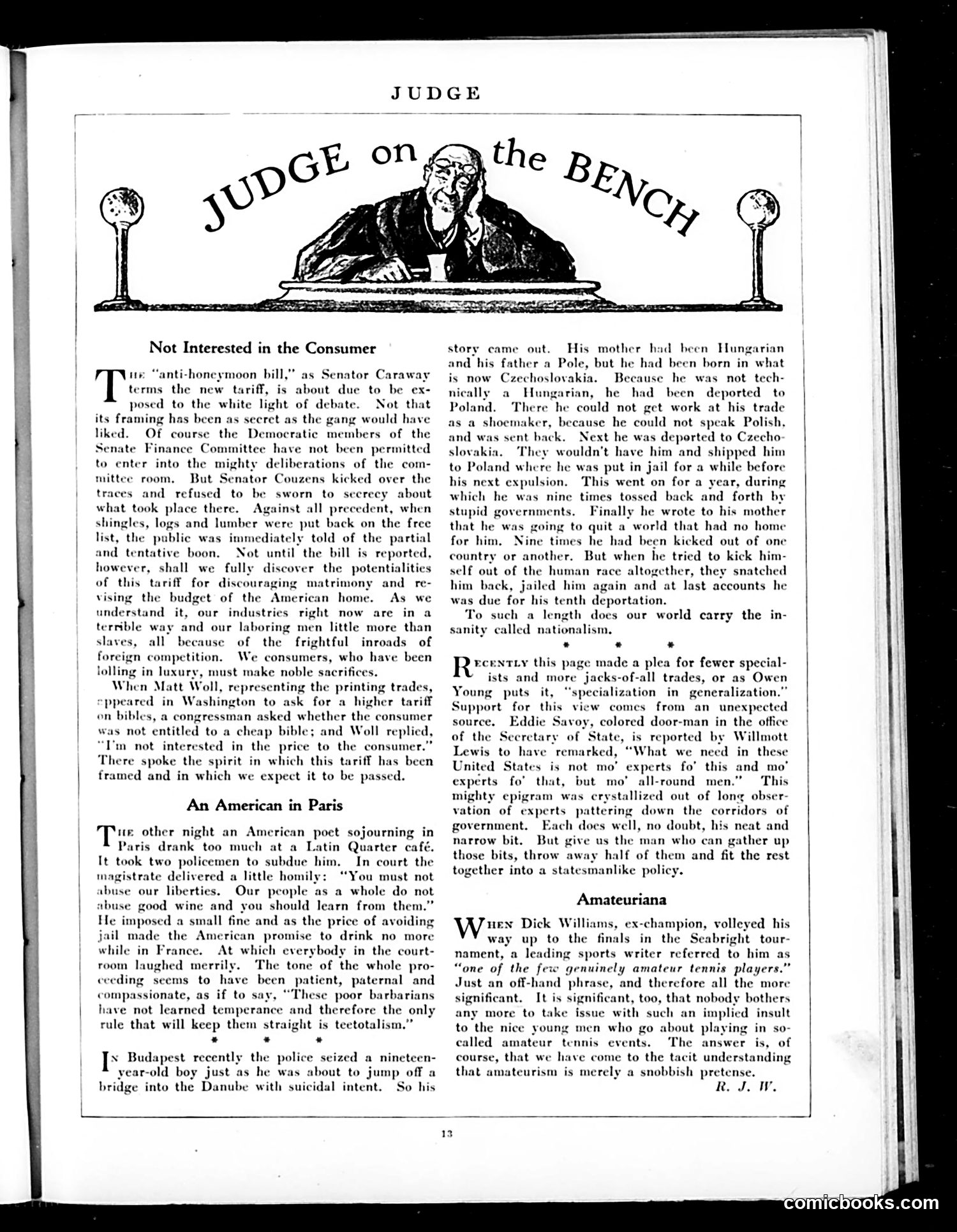
Judge Magazine Page Analysis This page contains three separate satirical pieces: 1. "Not Interested in the Consumer": Attacks a tariff bill (likely Smoot-Hawley era), mocking how industry representatives prioritize protection over consumer welfare. The key quote—a union representative saying he's "not interested in the price to the consumer"—exemplifies the selfishness Judge sees in tariff advocates who claim to help workers while ignoring ordinary Americans. 2. "An American in Paris": Mocks American tourists as ill-behaved compared to cultured Europeans. A drunk American poet arrested in Paris receives a paternalistic lecture from a French magistrate, implying Americans lack the sophistication and self-control of French society. 3. "Amateuriana": A brief note on amateur vs. professional sports, dismissing amateurism as "snobbish pretense." The page reflects Judge's progressive stance: skepticism toward protectionist economics, cultural anxiety about American respectability abroad, and class commentary.
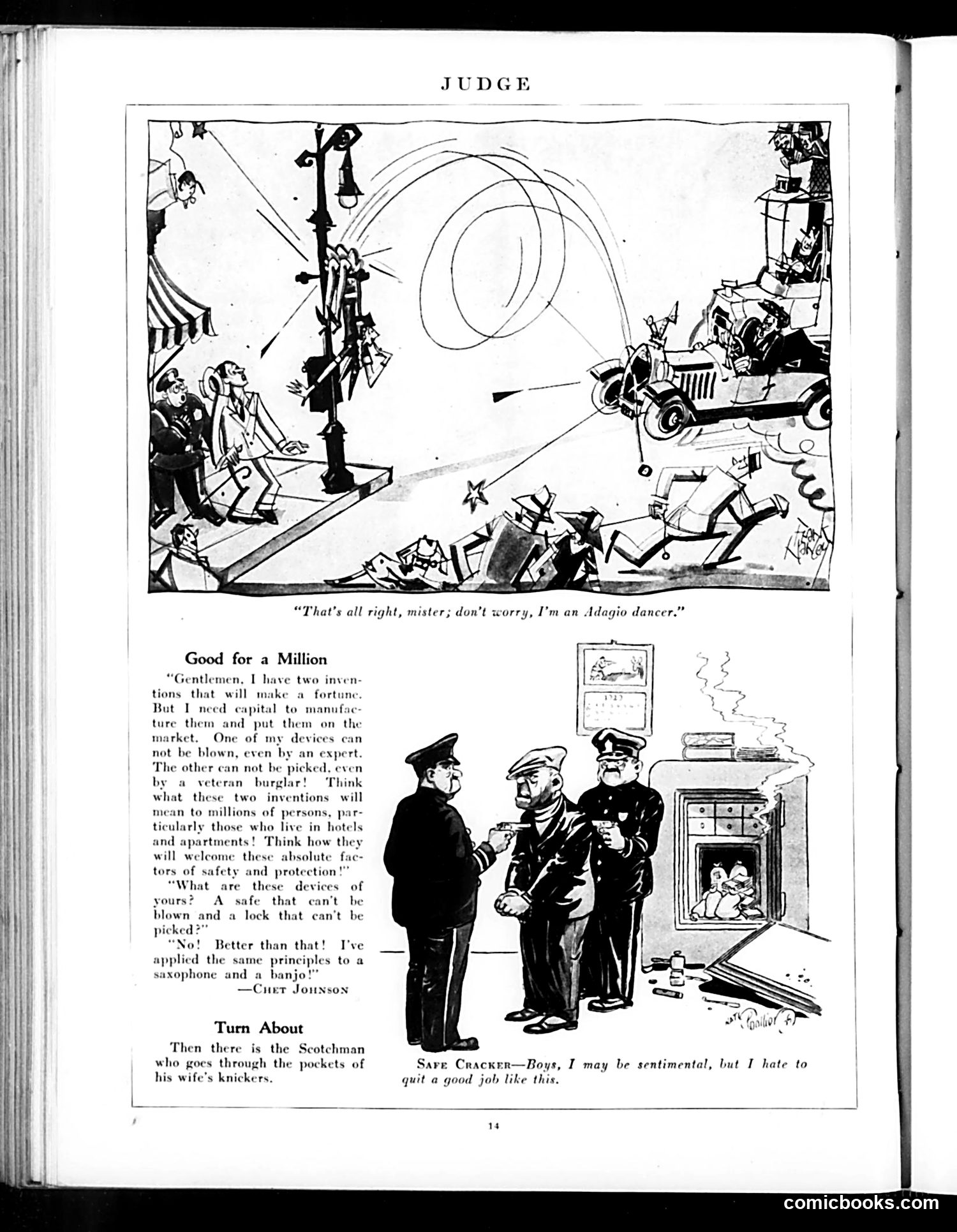
Analysis of Judge Magazine Page Top Cartoon: Shows an acrobat/circus performer doing loops and aerial tricks while spectators watch. The joke plays on "Adagio dancer"—the performer assures anxious onlookers they're safe, using a classical dance term to dignify what appears to be dangerous acrobatic stunts. "Good for a Million": An inventor pitches two "unbreakable" inventions to investors. The humor lies in the anticlimactic punchline: he's applied safe/lock principles to a *saxophone and banjo*—instruments nobody would want to protect, making his inventions worthless. The satire mocks get-rich-quick schemes and overeager inventors who miss the obvious flaw in their business logic. "Turn About": A brief joke about a Scotsman stealing from his wife's clothing pockets—a stereotype playing on Scottish frugality/dishonesty. "Safe Cracker": Shows a safecracker expressing reluctant retirement from his criminal profession, presenting himself as emotionally attached to his "work." These are typical Judge magazine humor pieces: short jokes, visual gags, and character stereotypes aimed at early 20th-century audiences.
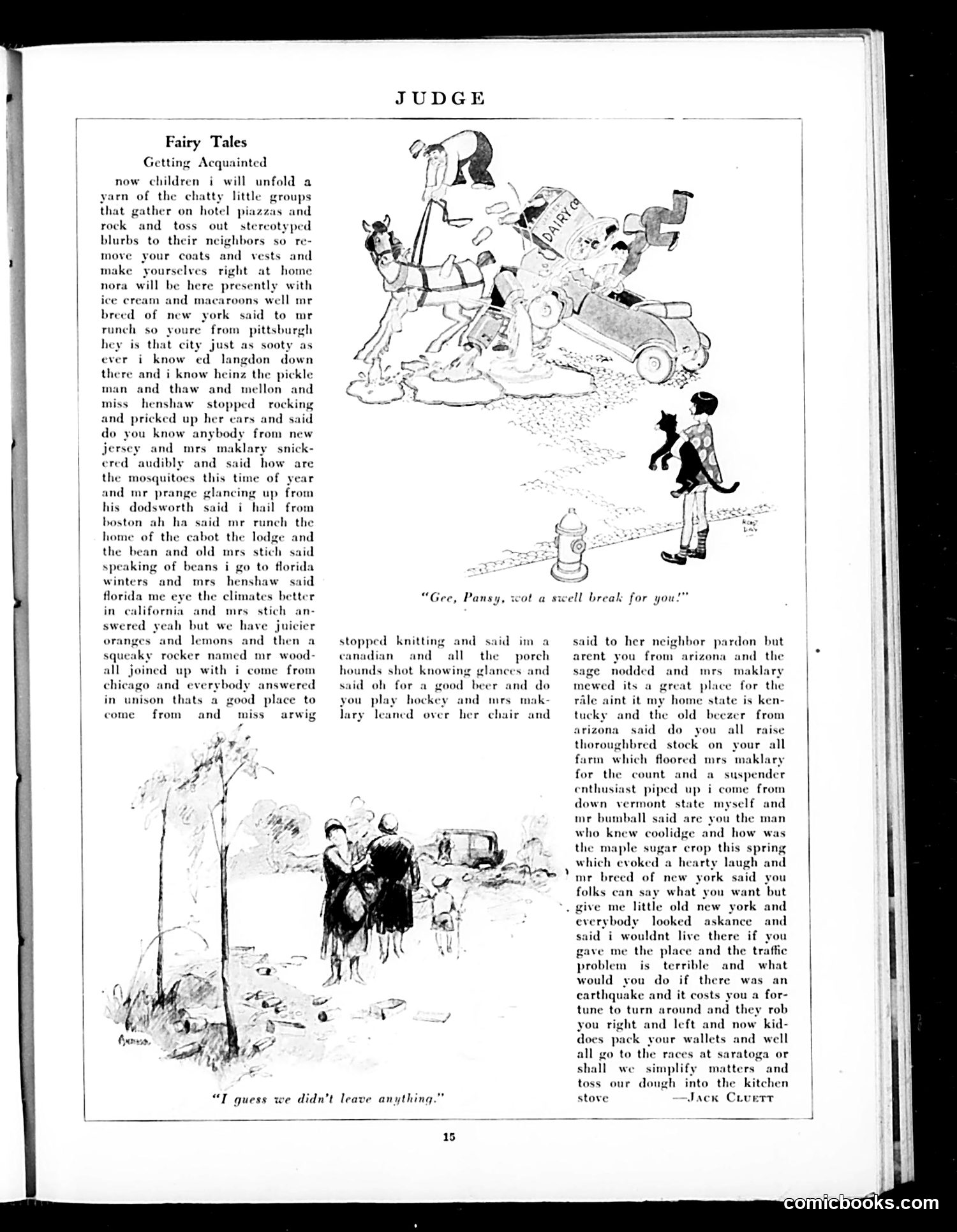
"Fairy Tales: Getting Acquainted" This satirical piece mocks the tedious, predictable small talk exchanged by hotel guests on vacation. The humor lies in the relentless parade of banal conversation: travelers from different cities comparing hometowns, referencing minor local figures (Heinz the pickle man, Thaw, Mellon), exchanging weather complaints, and name-dropping regional stereotypes (Pittsburgh's soot, Florida's mosquitoes, Arizona ranches). The cartoon captures the social pretension and exhausting uniformity of such encounters—everyone claims their origin is unremarkable, yet insists on sharing it anyway. The closing, where guests suggest pooling money for gambling or "the kitchen stove" instead of continuing conversation, suggests this performative socializing is so tiresome that any distraction (even losing money) seems preferable. The satire targets upper-middle-class vacation culture and the hollowness of forced sociability among strangers.
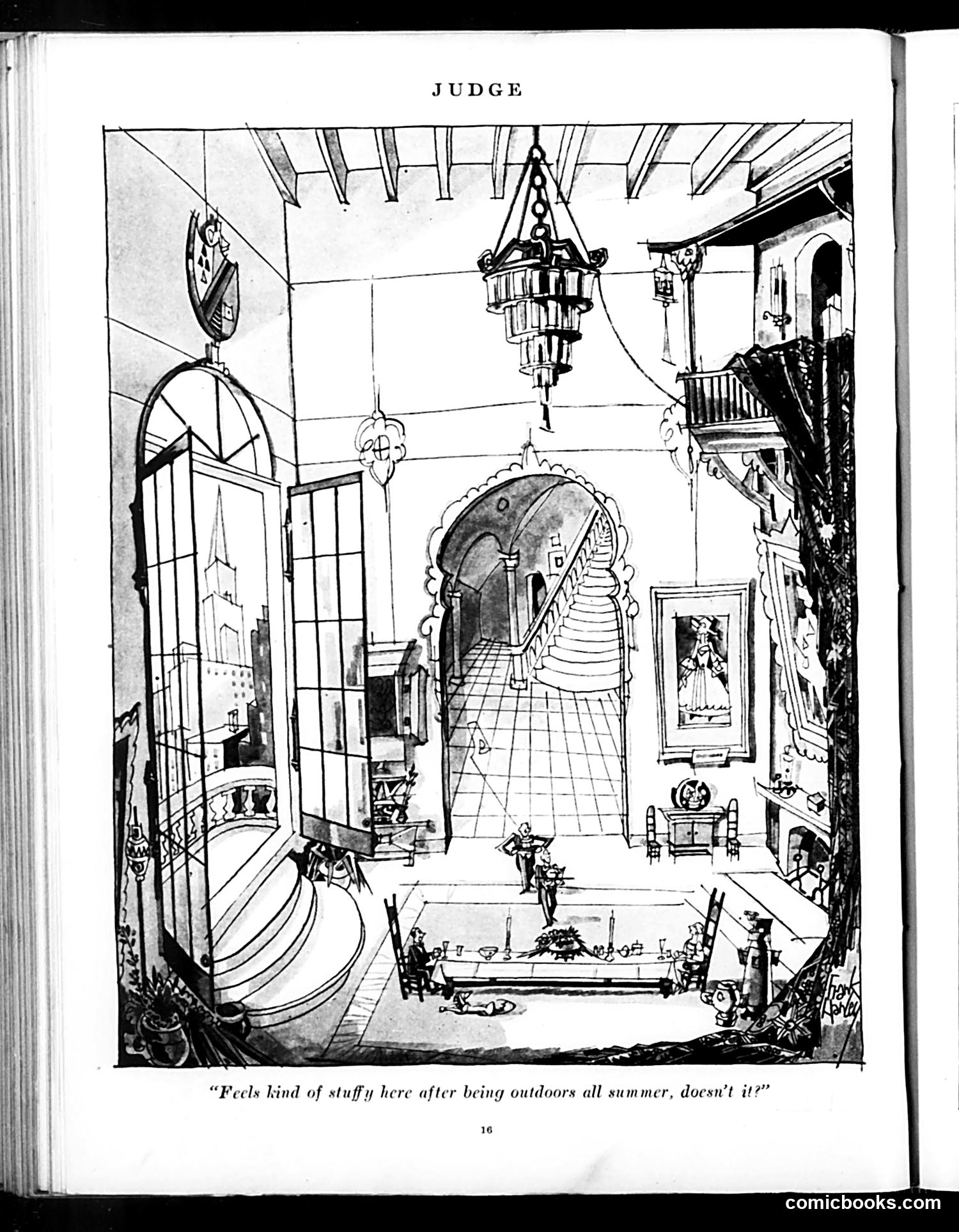
Explanation for Modern Readers This is a single-panel cartoon from *Judge* magazine titled "Feels kind of stuffy here after being outdoors all summer, doesn't it?" The cartoon depicts an ornate, cluttered interior space—likely a wealthy home or mansion—packed with decorative objects, chandeliers, furniture, and architectural details. Two figures stand in this enclosed, elaborate room. The humor is social satire: after spending summer outdoors in fresh air, returning to an overstuffed interior feels oppressive and unnatural. The joke mocks the excessive ornamentation and artificiality of upper-class domestic spaces, contrasting them with the freedom and simplicity of outdoor life. It's a gentle critique of materialism and cluttered living habits among the wealthy, suggesting their elaborate homes feel confining rather than comfortable.
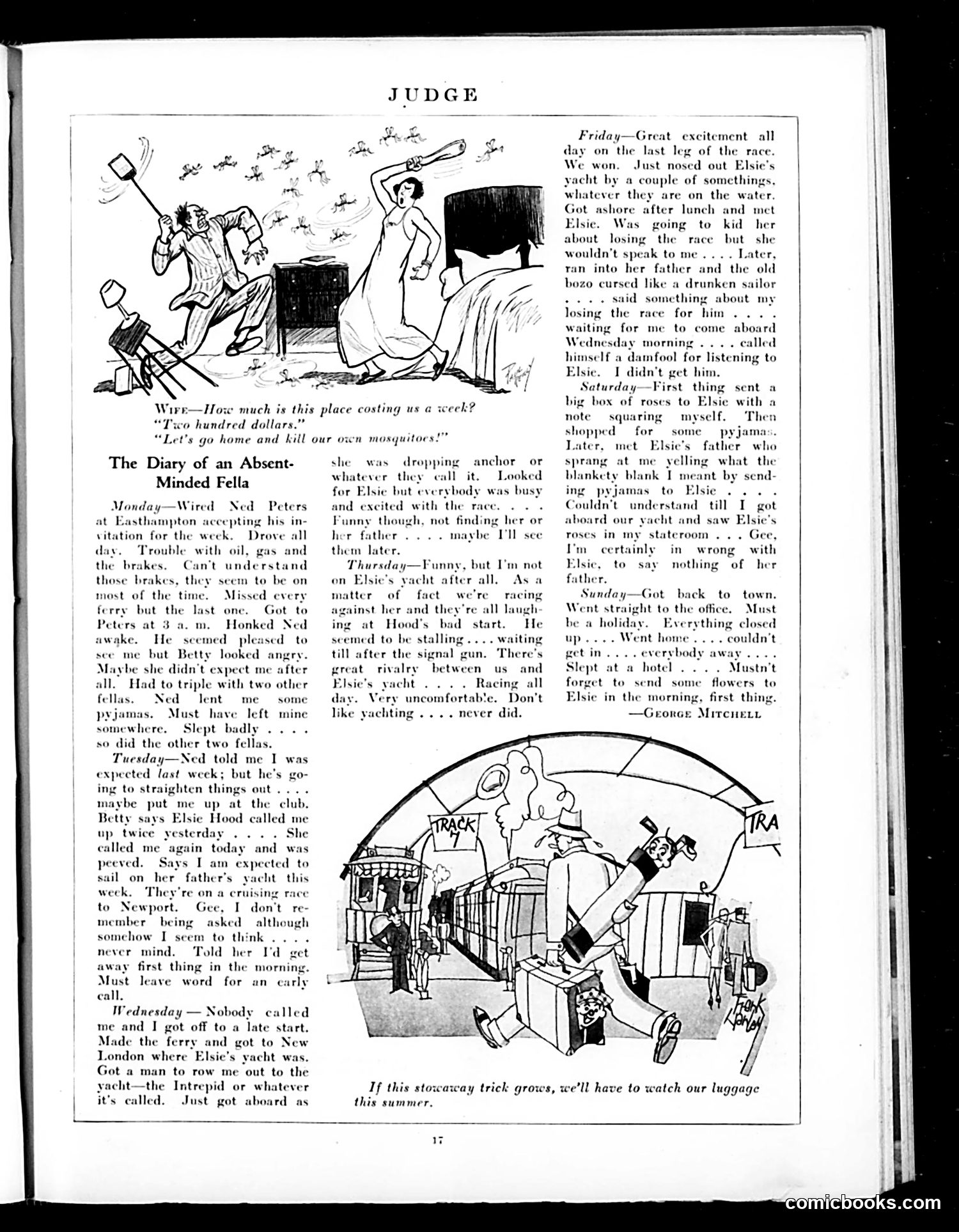
"The Diary of an Absent-Minded Fella" This two-part satirical piece mocks the social chaos created by a forgetful, impulsive upper-class man. The diary chronicles his disastrous week: he shows up uninvited to a friend's house, accepts a yacht invitation he doesn't remember receiving, appears on the wrong boat during a competitive race (costing someone the competition), and sends roses to the wrong woman—triggering confusion with her father. The top cartoon jokes about expensive seaside resort life: a wife asks why their vacation costs $200/week when they could stay home and "kill our own mosquitoes"—satirizing both the high cost of leisure travel and the notion that resort amenities (like mosquito control) aren't worth the expense. The bottom cartoon warns readers to watch luggage, suggesting "stowaway tricks" by passengers are becoming common enough to warrant caution. The humor targets wealthy, scatterbrained men whose carelessness creates social embarrassment.
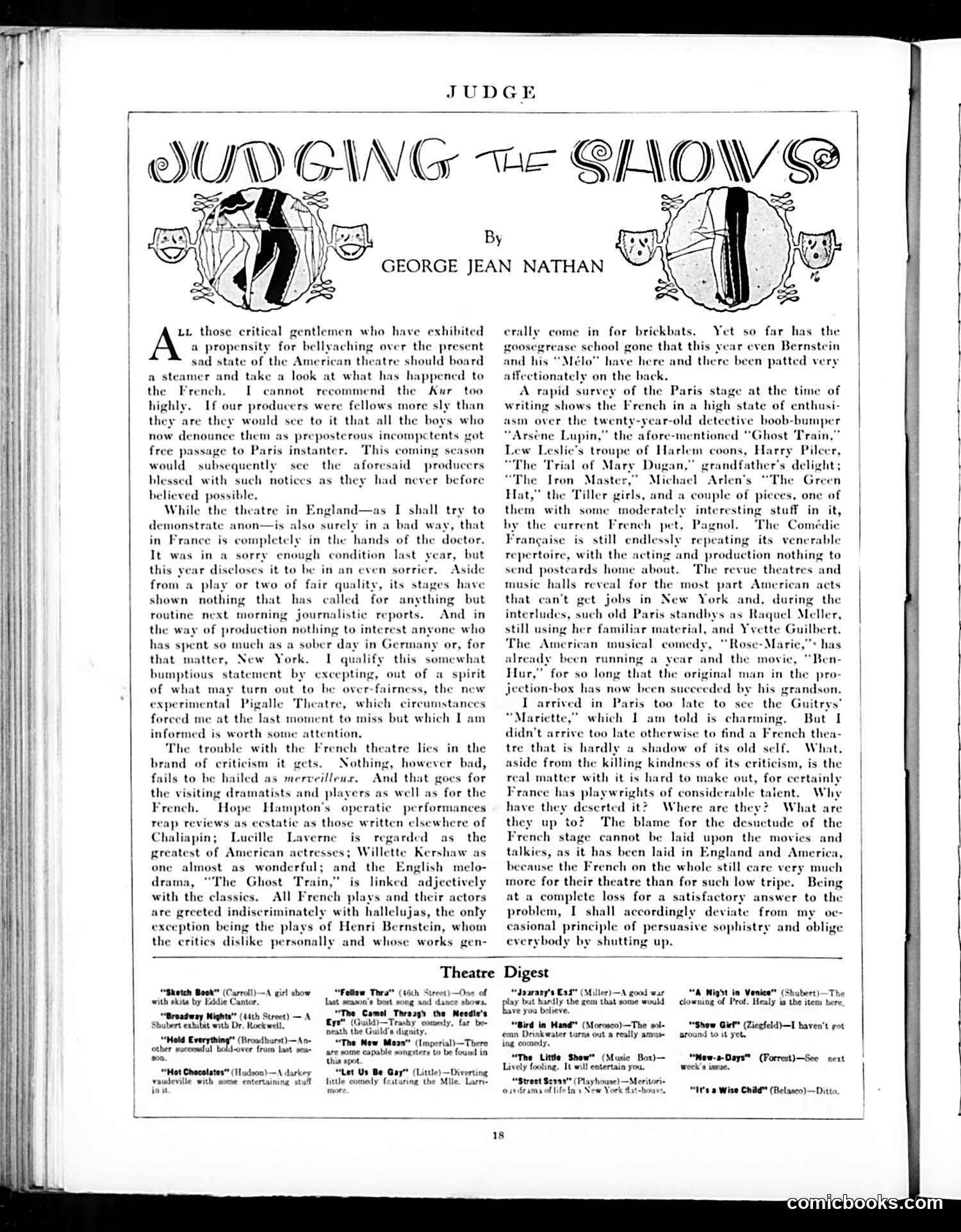
Judging the Shows: Nathan's Theater Critique This page presents George Jean Nathan's column criticizing the state of theater across America, England, and France. Nathan argues that American theater critics complain too much—they should visit Paris to see *real* theatrical decline before complaining. The piece targets European theater's problems: France's indiscriminate critical praise (even for mediocre works by Hope Hampton and Willette Kershaw), England's uninspired productions, and the French tendency to praise everything except Henri Bernstein's plays, which critics dislike for personal reasons. Nathan mentions contemporary popular entertainment—the detective thriller "Arsène Lupin," the chorus line "Tiller girls," American musical comedies, and Ben-Hur—as examples of what Parisians enthusiastically embrace. The satire suggests American producers should send complaining critics to Paris to appreciate their own theater's relative quality by comparison.
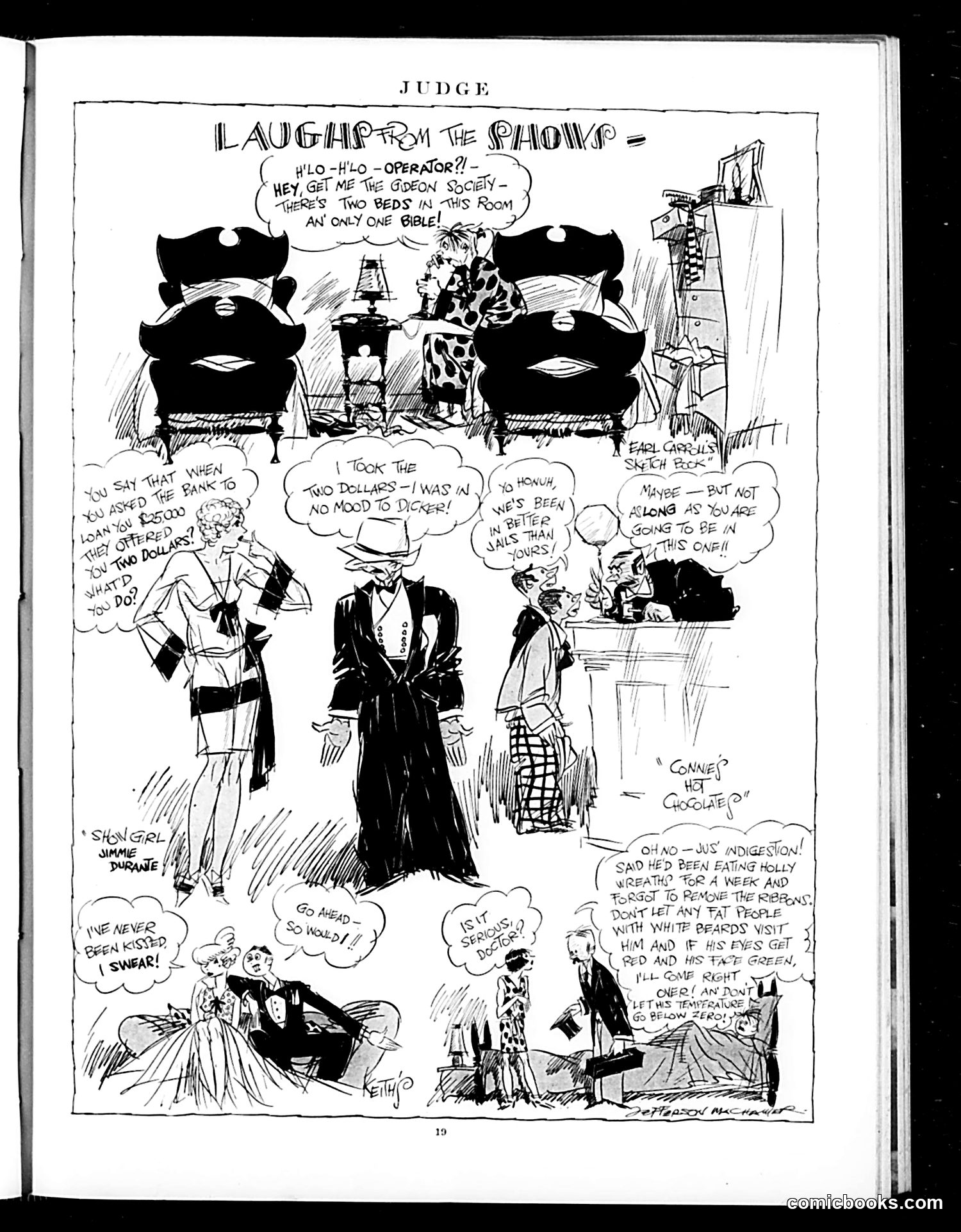
"Laughs from the Shadows" - Judge Magazine Cartoon This multi-panel satirical comic mocks the Gideon Society (a Christian organization distributing Bibles), likely from the early 20th century. The top scene shows a hotel operator comically offering the society two beds but only one Bible—satirizing the organization's practices. Subsequent panels feature various characters in compromising or absurd situations: a woman discussing a loan default, a man in formal wear, hotel staff, and others exchanging rapid-fire dialogue about money troubles, indigestion, romantic entanglements, and suspicious behavior. The satire targets the Gideon Society's hotel Bible placement by suggesting the guests' actual moral circumstances contradict the organization's missionary intent. The cartoon implies hypocrisy: providing Bibles to people whose real concerns involve financial schemes, affairs, and bodily mishaps rather than spiritual salvation. It's a cynical commentary on religious organizations' effectiveness and the gap between their ideals and reality.
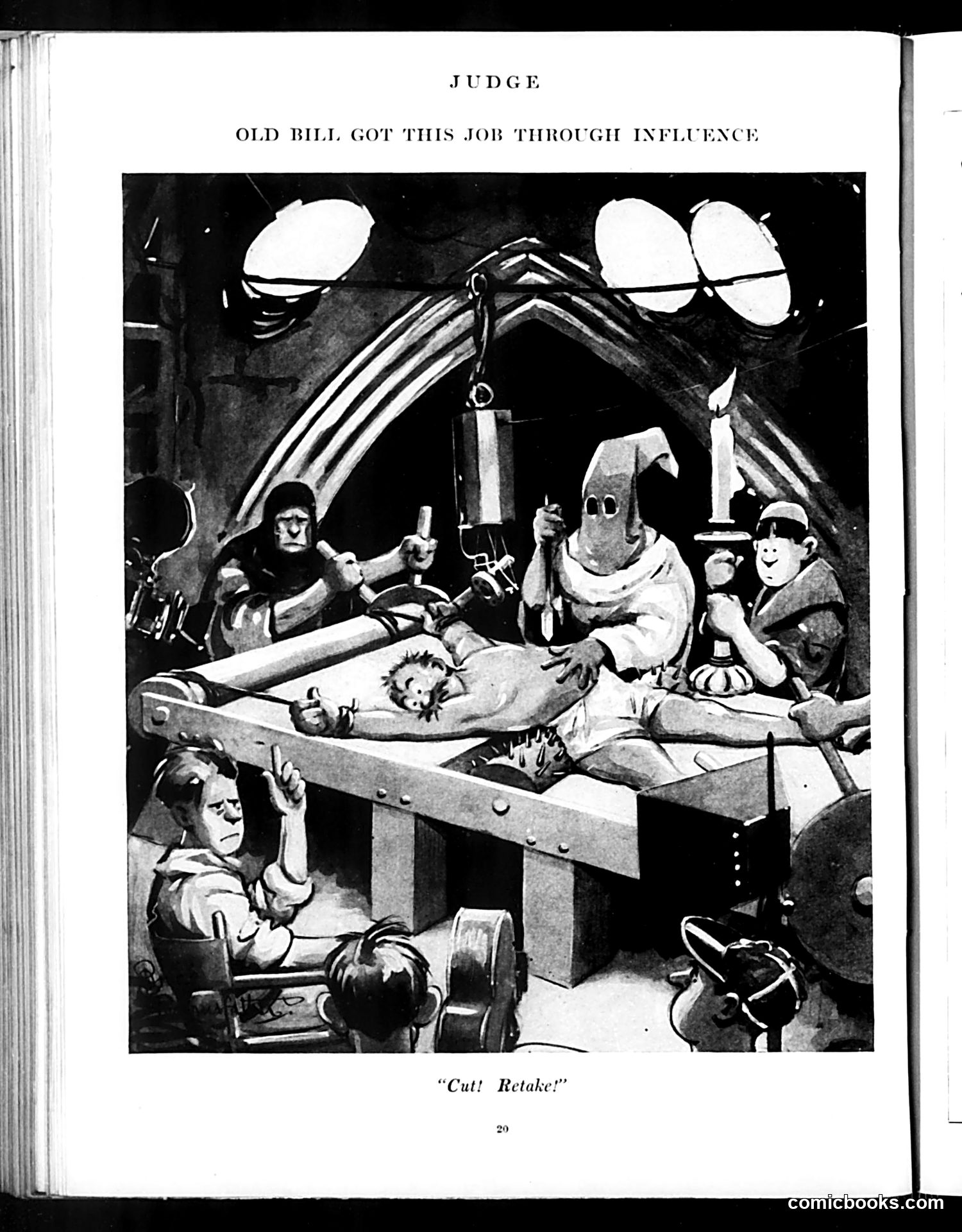
Analysis This is a satirical cartoon about judicial nepotism and corruption. The title "Old Bill Got This Job Through Influence" indicates the cartoon critiques how someone named Bill obtained a judicial position through patronage rather than merit. The image depicts what appears to be a courtroom or operating theater scene with figures in period dress, including someone on a table being examined or operated upon. The "Cut! Retake!" caption suggests the scene is being staged or performed, implying the judicial proceedings are theatrical and false—a performance rather than genuine justice. The satire targets the appointment of unqualified judges through political influence and connections rather than competence. The medical/operating room setting may suggest improper handling of legal cases, or the absurdity of an incompetent judge presiding over serious matters.
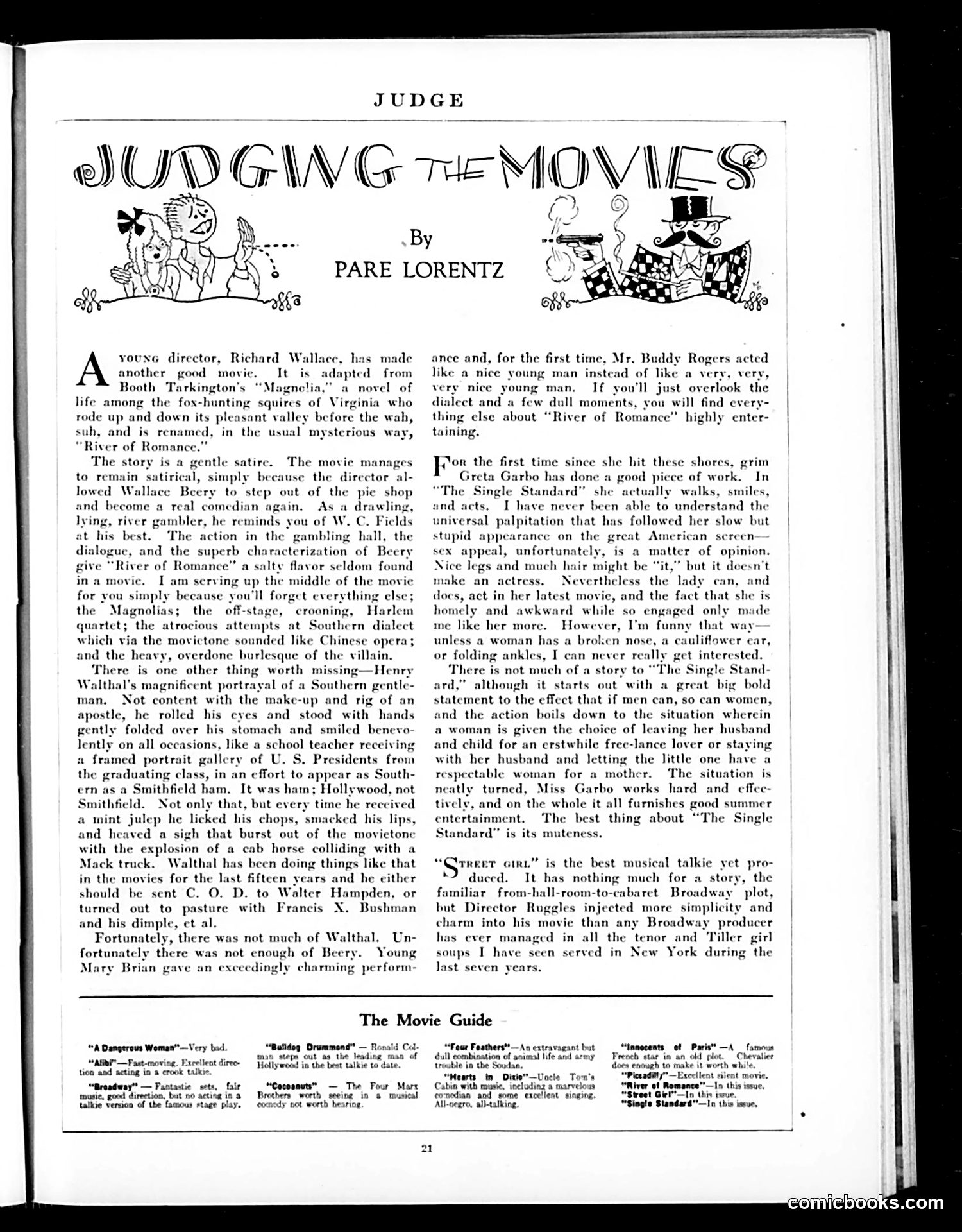
Judging the Movies: A Film Critic's Column This is a film criticism column by Pare Lorentz reviewing recent movies. The page contains no political cartoons—rather, it's a satirical review section typical of Judge magazine's entertainment coverage. Lorentz critiques three films: "River of Romance," "The Single Standard" (starring Greta Garbo), and "Street Girl." His satire targets actors' pretensions and overacting. He mocks Henry Walthall's exaggerated "Southern gentleman" portrayal—rolling eyes, folded hands, affected dialect—suggesting he belongs "sent C.O.D. to Walter Hampden" (implying he's more suited to stage acting). He praises Wallace Beery's comedic return and Garbo's improved acting while poking fun at her "stupid appearance" and sex appeal. The satire aims at Hollywood's artificiality and overblown performances rather than political figures. The humor is industry-focused entertainment criticism.
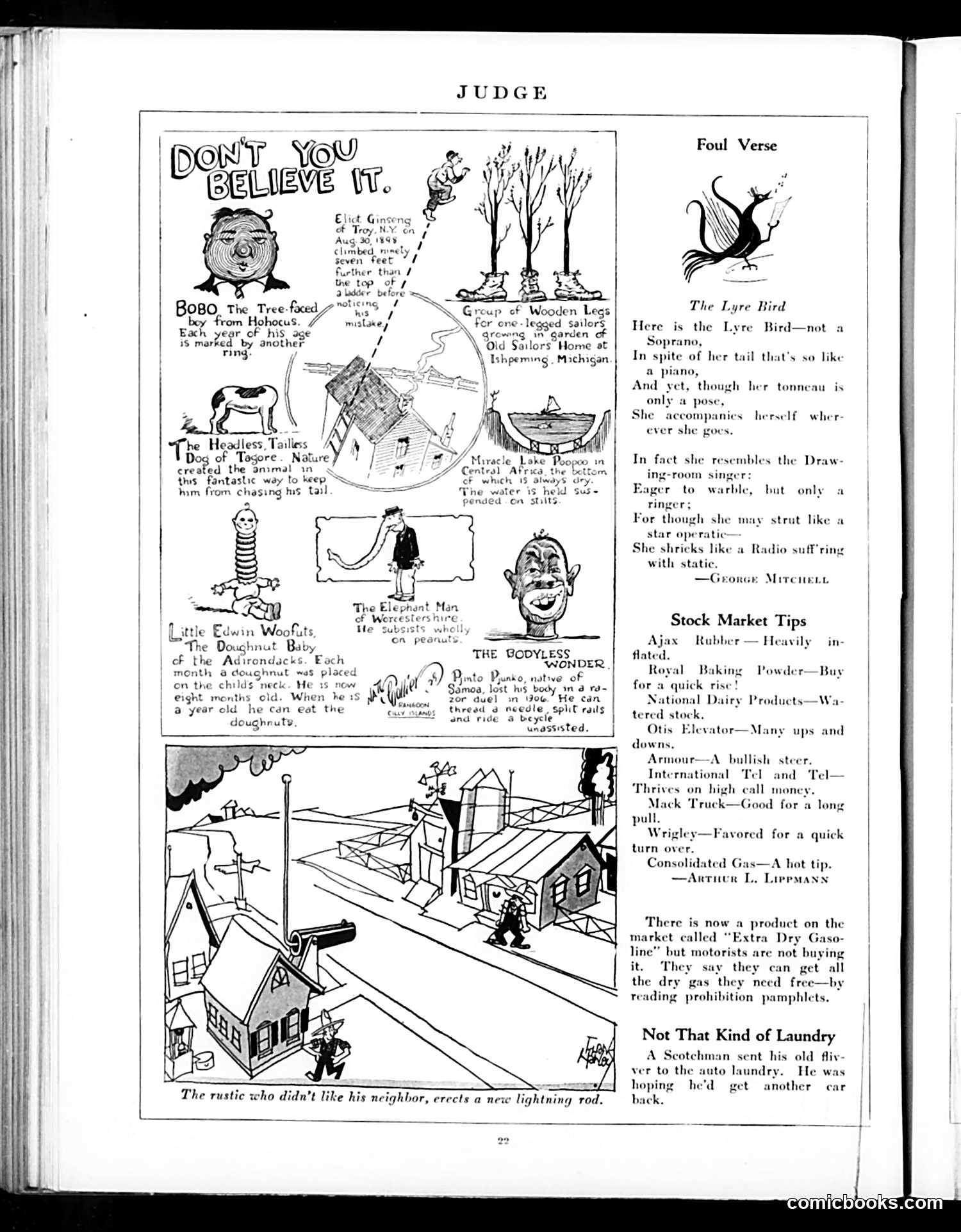
Analysis of Judge Magazine Page This page from Judge contains several satirical elements targeting early 1900s American curiosities and economic absurdities: "Don't You Believe It" section mocks implausible oddities—a tree-fixed cow, a headless dog, a "doughnut baby," and other fabricated "wonders." These parody newspaper hoaxes and carnival attractions that gullible readers might encounter. "Foul Verse" humorously describes a lyre bird's mediocre singing abilities despite her musical appearance—gentle satire on vanity. "Stock Market Tips" is the sharpest satirical element: Lippmann cynically recommends stocks with names matching their actual performance (Rubber for inflation, Otis Elevator for volatility, Consolidated Gas as a "hot tip"). This mocks stock speculation and reveals how company names transparently signal their economic behavior to savvy investors. "Not That Kind of Laundry" jokes about a Scotsman sending his old car ("flivver") to an auto laundry, expecting another vehicle back—mocking both Scottish frugality and automobile-era confusion. The page reflects 1900s concerns: stock fraud, consumer gullibility, and rapid technological change.
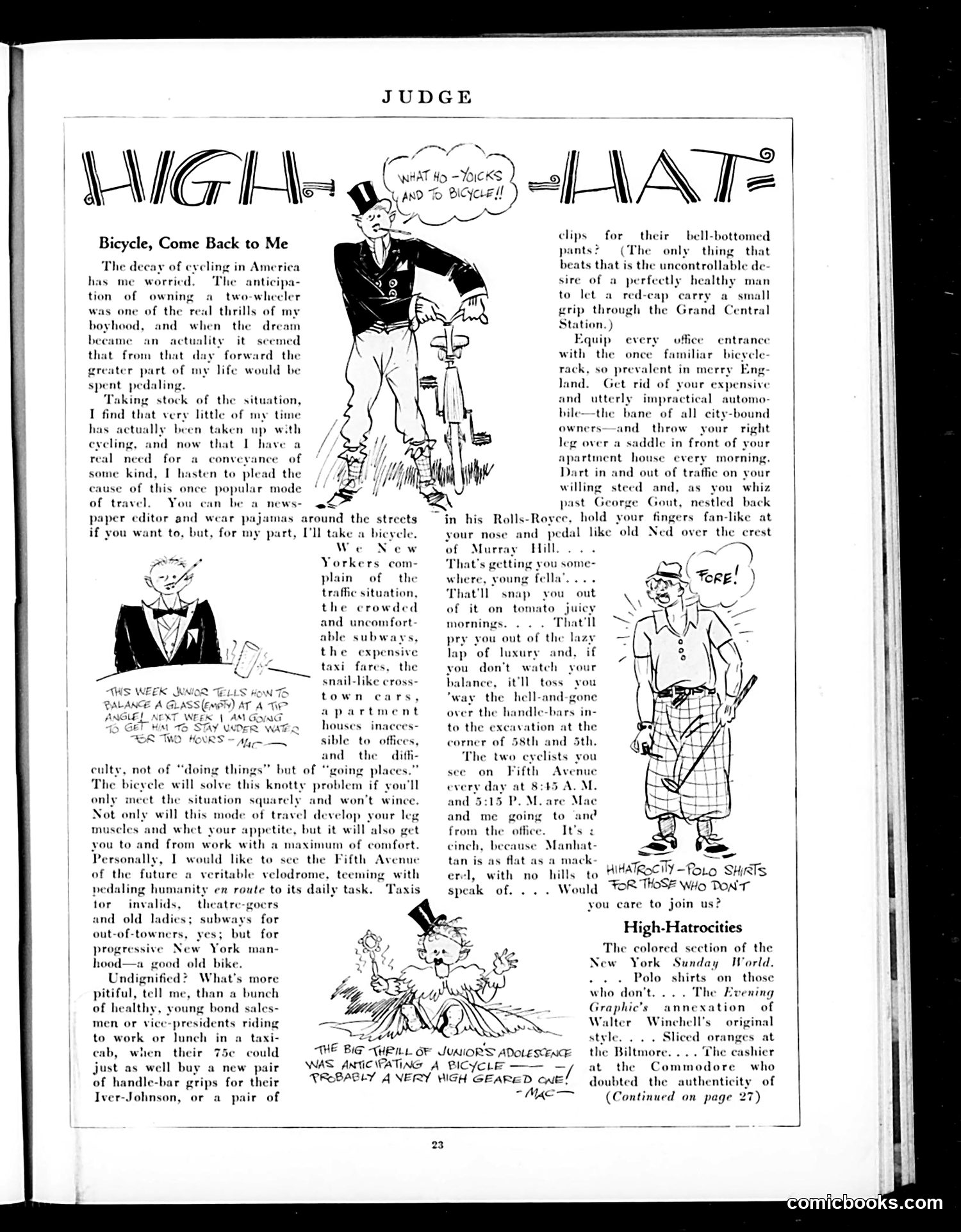
Analysis of Judge Magazine Page This page advocates for bicycle revival in 1920s New York City. The main article argues that bicycles solve urban congestion—crowded subways, expensive taxis, traffic jams, and inaccessible apartment buildings far from offices. The author dismisses concerns about dignity, sarcastically noting that healthy young businessmen look more pathetic riding in taxis than pedaling bicycles. The cartoon illustrations depict well-dressed gentlemen on bicycles, including one mocking wealthy automobilists (the Rolls-Royce reference suggests wealthy elites). The satire targets urban inefficiency and the pretentiousness of expensive transportation while praising bicycles as practical, economical, and healthy. The "High-Hatrocities" section lists satirical social observations about New York's elite culture, including references to Walter Winchell and the Commodore Hotel—typical Judge magazine gossip items mocking high society. The overall message: bicycles represent sensible modernity versus wasteful, congested urban living.
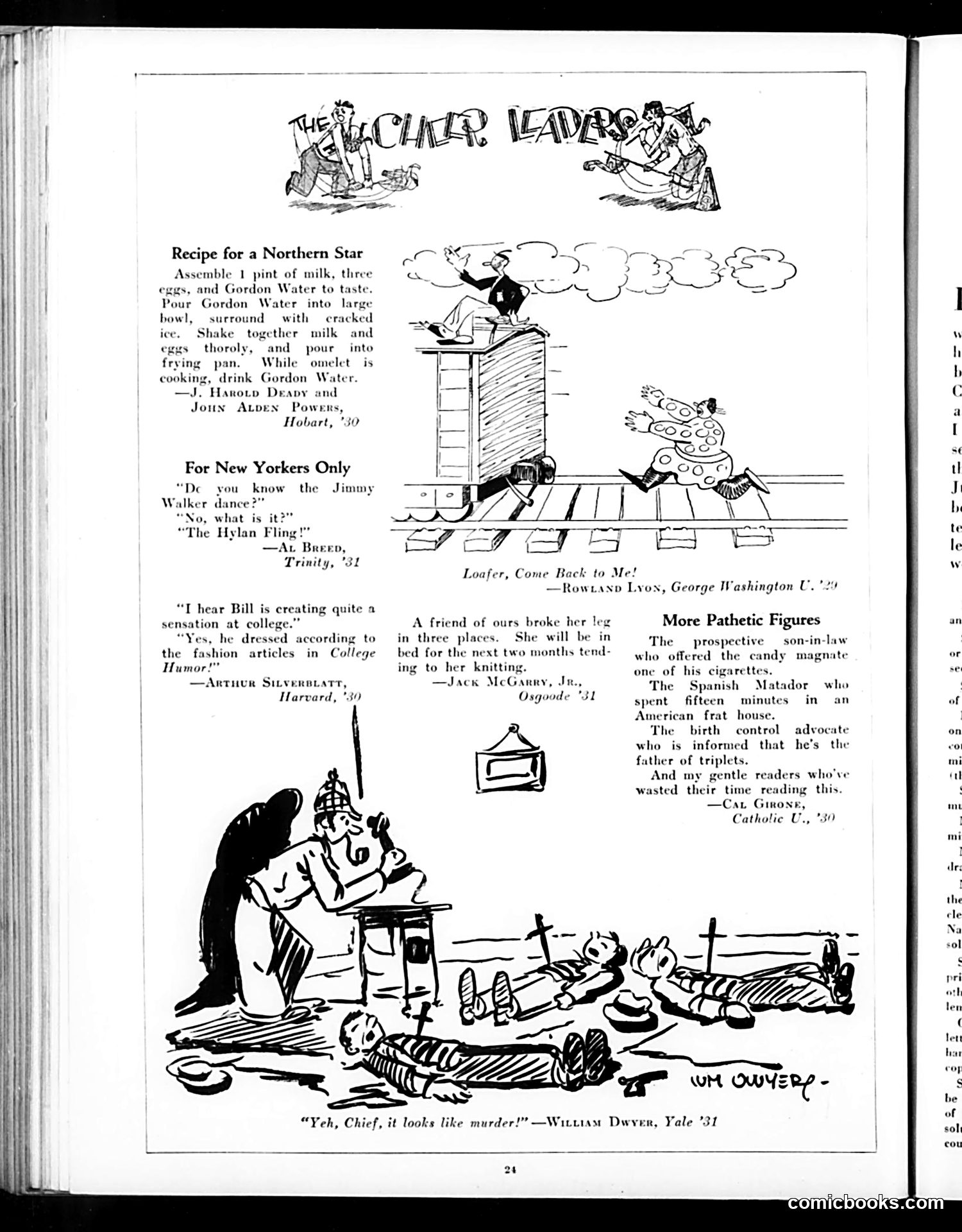
Understanding "The Pulchur Leadership" Page This page from *Judge* collects humorous quips and cartoons from college students, primarily satirizing 1920s-30s American college life and contemporary figures. Key references: - "Jimmy Walker dance" / "Hylan Fling": Jokes about New York City politicians—Jimmy Walker (flamboyant NYC Mayor) and John Hylan (his predecessor). The dances are invented mockeries of their public personas. - "Gordon Water": Likely references bootleg liquor during Prohibition, disguised as an innocent ingredient in the omelet "recipe." - Fashion article satire: Mocks college students blindly following trends from *College Humor* magazine. - Bottom cartoon: Shows a priest conducting last rites over casualties—the caption "Yeh, Chief, it looks like murder!" suggests dark humor about the "pathetic figures" described: a prospective son-in-law offering cheap cigarettes, a Spanish bullfighter awkwardly visiting American fraternity culture, and a birth-control advocate learning his contraception failed (triplets). The overall tone is collegiate irreverence typical of era humor magazines.
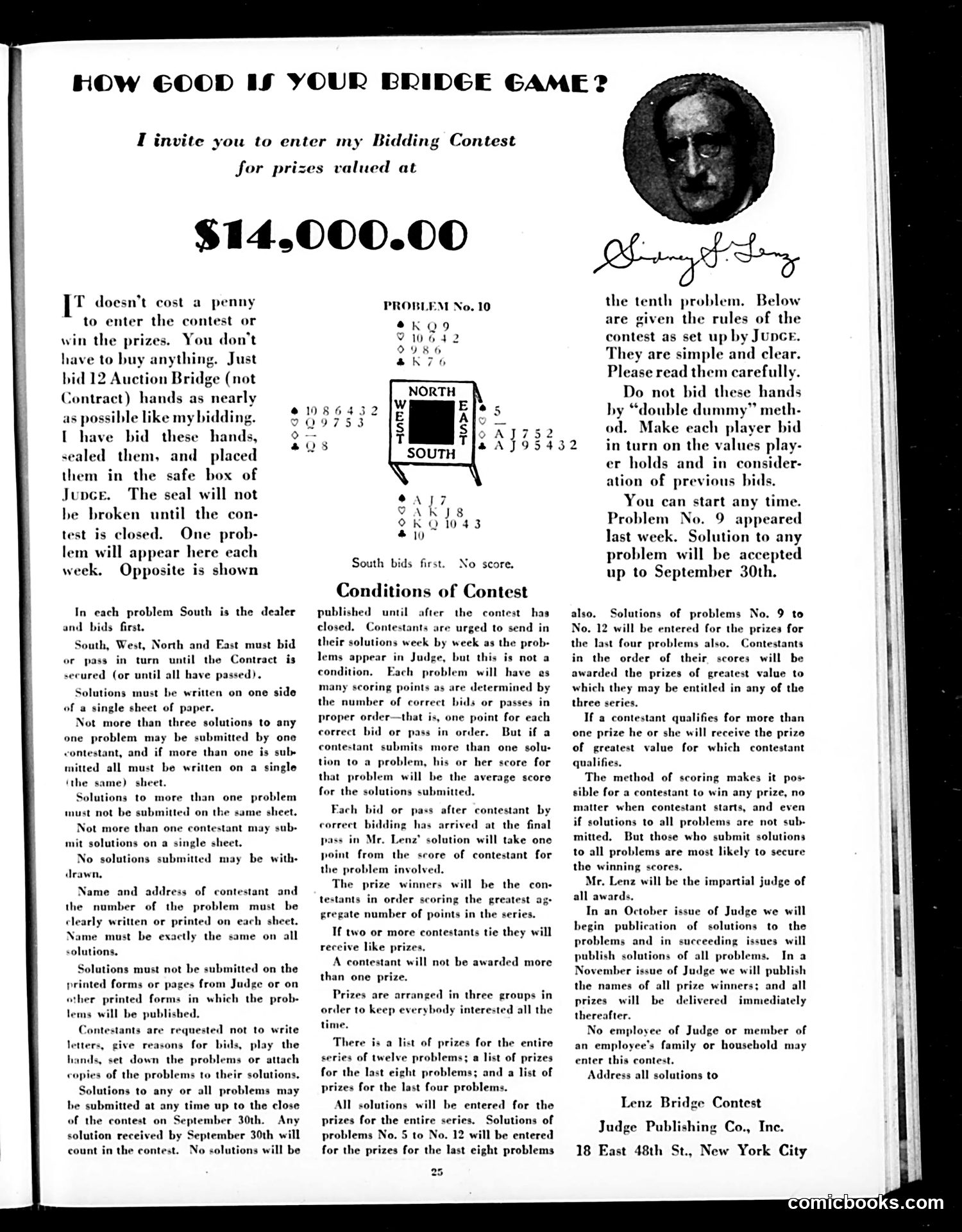
Judge Magazine Bridge Contest Advertisement This page is primarily a contest advertisement rather than satire or political commentary. It announces a bridge-bidding competition sponsored by Judge magazine, offering $14,000 in prizes. The portrait shows S. J. Lenz, apparently a bridge expert whose bidding serves as the contest standard. Contestants submit solutions to 12 Auction Bridge hands, competing for prizes based on how closely their bids match Lenz's sealed bids. The detailed rules emphasize fair play: submissions must be original, handwritten, properly identified, and submitted by September 30th. Solutions are scored by correct bids/passes, with prizes grouped by problem sets to maintain ongoing interest. For modern readers: This reflects bridge's popularity in 1920s-30s America as a serious competitive game requiring skill and strategy—treated here with the gravity typically reserved for intellectual competitions.
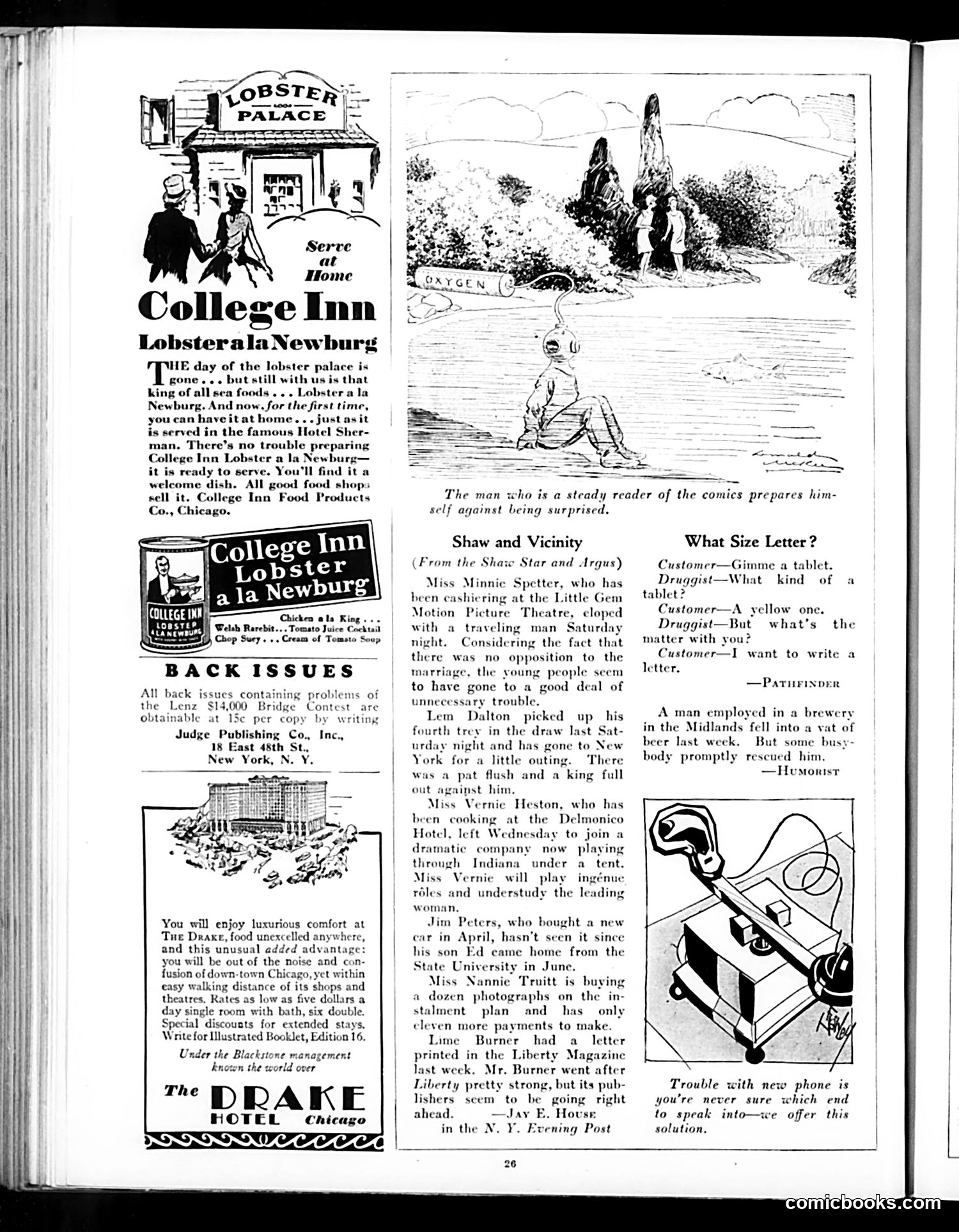
Analysis of Judge Magazine Page This page is primarily advertising and miscellaneous content rather than political satire. The main elements are: Advertisements: - College Inn Lobster products (top) - The Drake Hotel, Chicago (bottom) - Back issues of Judge magazine Humor Sections: - "Shaw and Vicinity": Local gossip/humor from a Shaw Star and Argus column, including small-town anecdotes (elopement, car ownership, job changes) - "What Size Letter?": A druggist dialogue joke playing on "tablet" (medicine vs. writing paper) - A cartoon about telephone confusion (which end to speak into) - A cartoon about reading comics providing psychological preparation for life's surprises No political content is evident. The page reflects early 20th-century advertising, consumer culture, small-town gossip reprinted for urban audiences, and mild observational humor typical of Judge's lighter content.
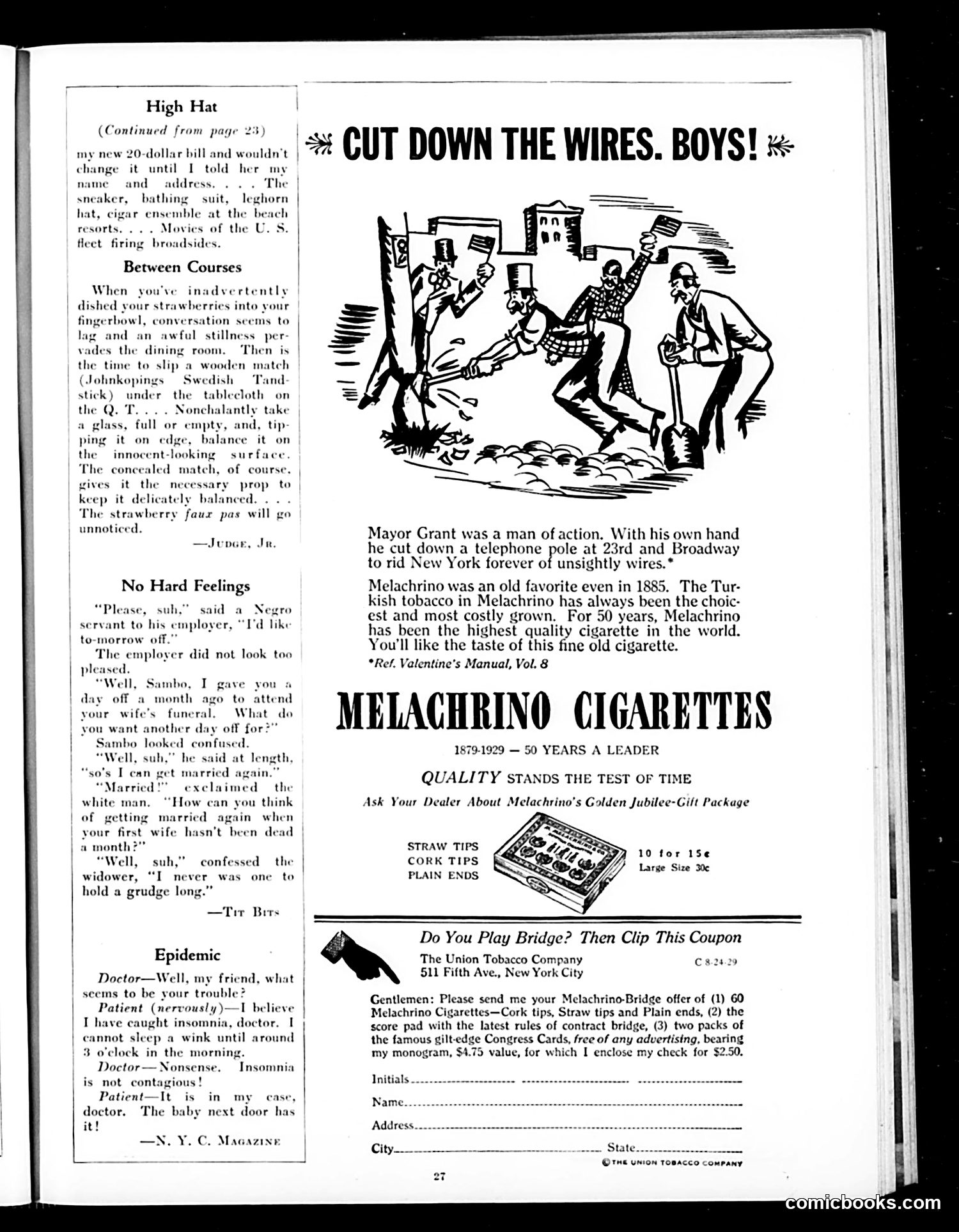
Analysis for Modern Readers The main cartoon "Cut Down the Wires, Boys!" satirizes Mayor Grant (likely New York mayor in the late 1800s, based on the Valentine's Manual reference). The image depicts men cheerfully destroying overhead telephone and electrical wires strung across city buildings. The satire's point: despite Grant's personal action against "unsightly wires," this was either a futile gesture or ineffective policy. The cartoon mocks the disconnect between a leader's theatrical decisiveness and actual urban problems. By the 1920s when *Judge* published this, overhead wires remained ubiquitous eyesores in American cities—suggesting Grant's intervention changed little. The page also contains period humor pieces and cigarette advertising (Melachrino brand). The "No Hard Feelings" joke relies on racial stereotypes common to 1920s publications, featuring a Black servant character.
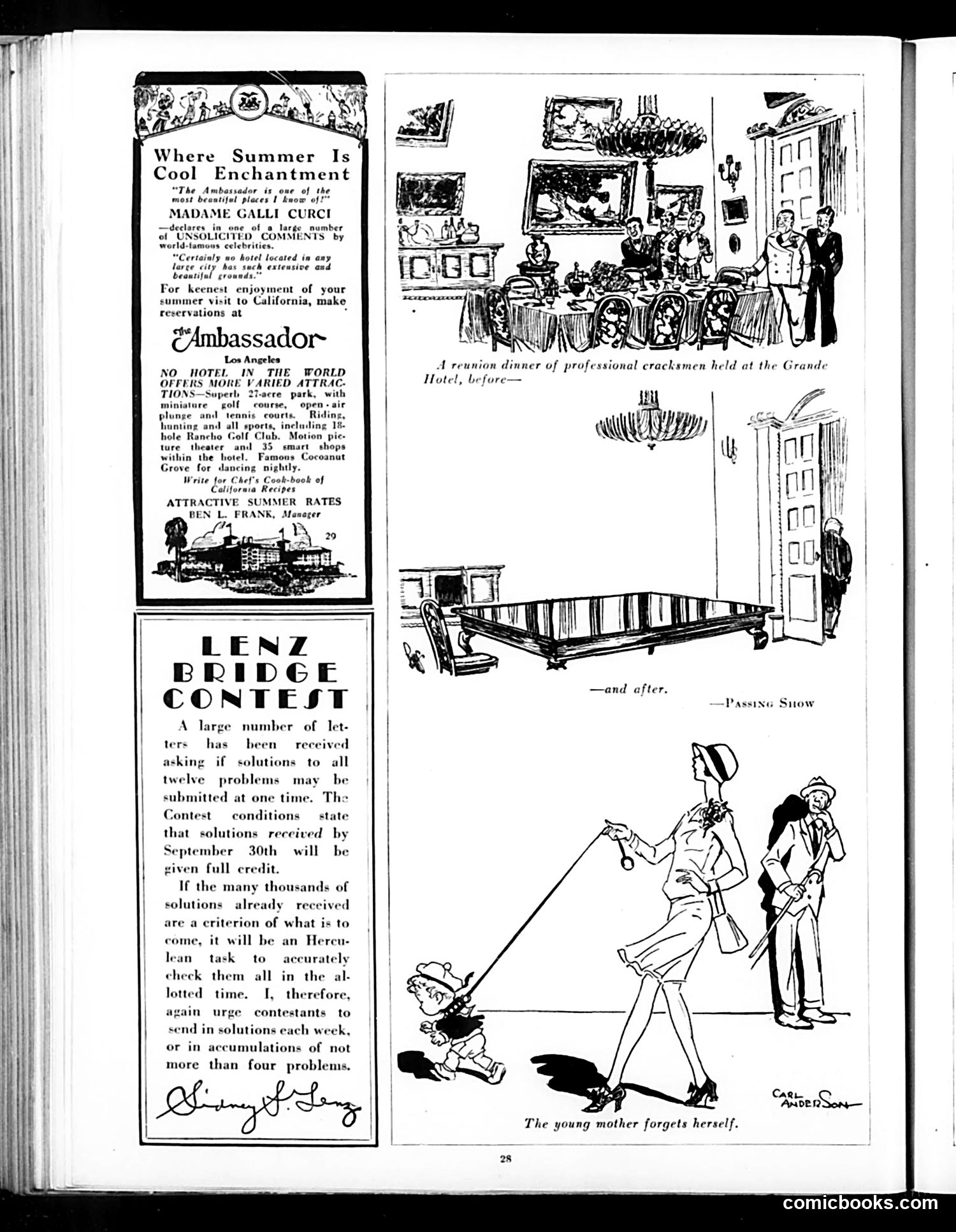
Analysis of Judge Magazine Page This page combines advertising with satirical cartoon commentary. The Ambassador Hotel advertisement (left) features a celebrity endorsement from Madame Galli Curci, a famous opera singer, promoting the luxury resort's amenities during summer season. The right-side cartoons satirize two distinct subjects: 1. "A reunion dinner of professional cracksmen" — A "cracksmen" is period slang for burglars or safecrackers. The cartoon depicts what appears to be a formal dinner gathering of criminals, likely satirizing how organized crime figures operate with social sophistication despite their illegal profession. 2. "The young mother forgets herself" — Shows a woman enthusiastically playing with a child's toy (appears to be a jump rope or similar), abandoning adult decorum. This satirizes how mothers can lose themselves in childplay, forgetting social propriety. Both cartoons use humor based on incongruity — respectable social situations inhabited by criminals or adults behaving childishly — typical of Judge's satirical approach to American society.
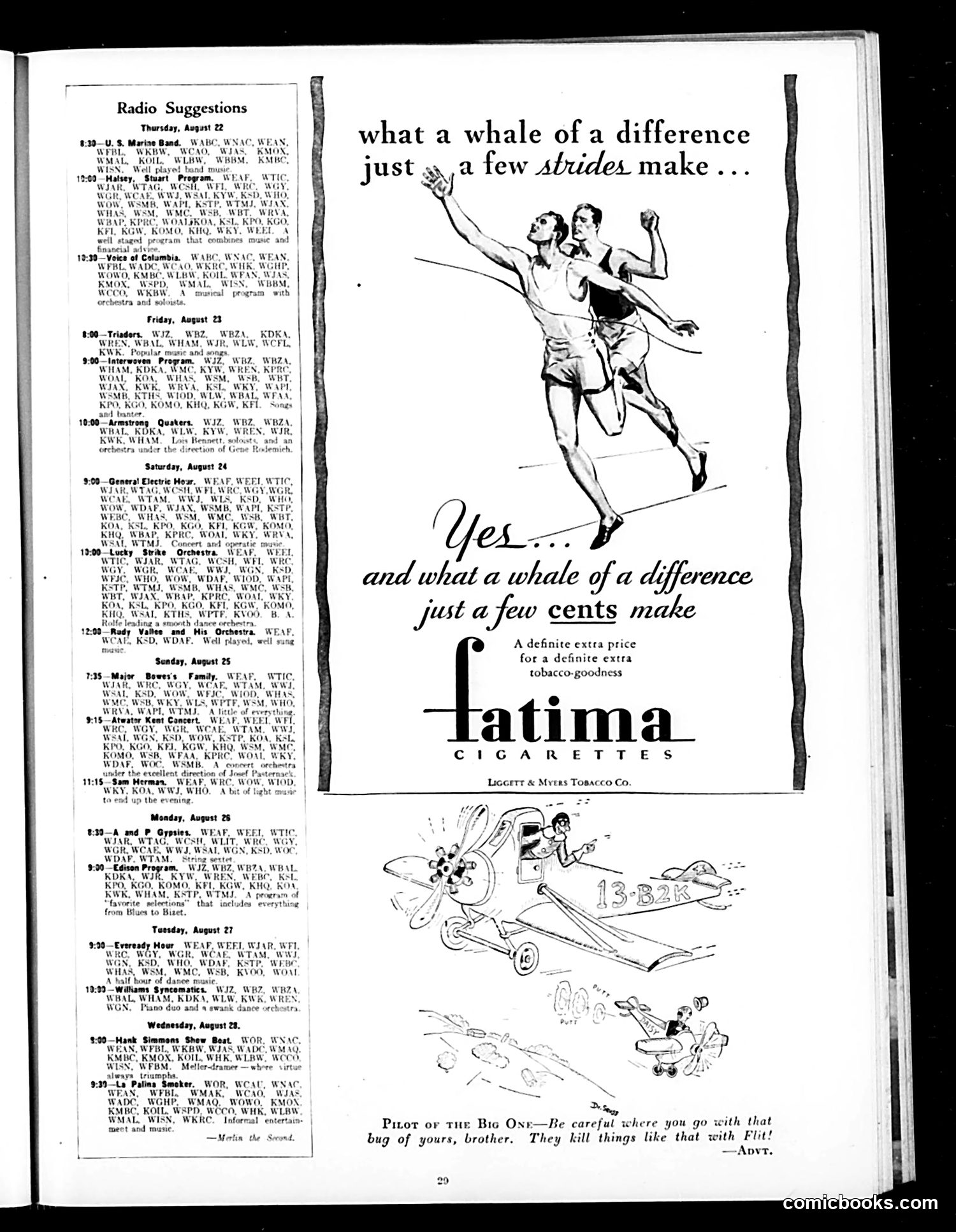
Latima Cigarettes Advertisement This page is primarily a radio program guide with a prominent cigarette advertisement for Latima brand. The ad features two illustrated male athletes in mid-jump, reaching upward with joy. The tagline plays on the phrase "what a whale of a difference"—using "strides" (a pun on both running strides and the word "shades") to suggest that minor improvements matter greatly. The advertisement's message: small price differences (just a few cents) yield significant improvements in tobacco quality and smoking pleasure. This is classic mid-20th-century advertising rhetoric, positioning Latima as a premium product justifying its slightly higher cost. The lower illustrations show comedic car and airplane scenes, reinforcing the lighthearted tone. The ad credits Liggett & Myers Tobacco Co., a major cigarette manufacturer of the era. The page reflects an era when cigarette advertising appeared routinely in family magazines without health warnings or restrictions.
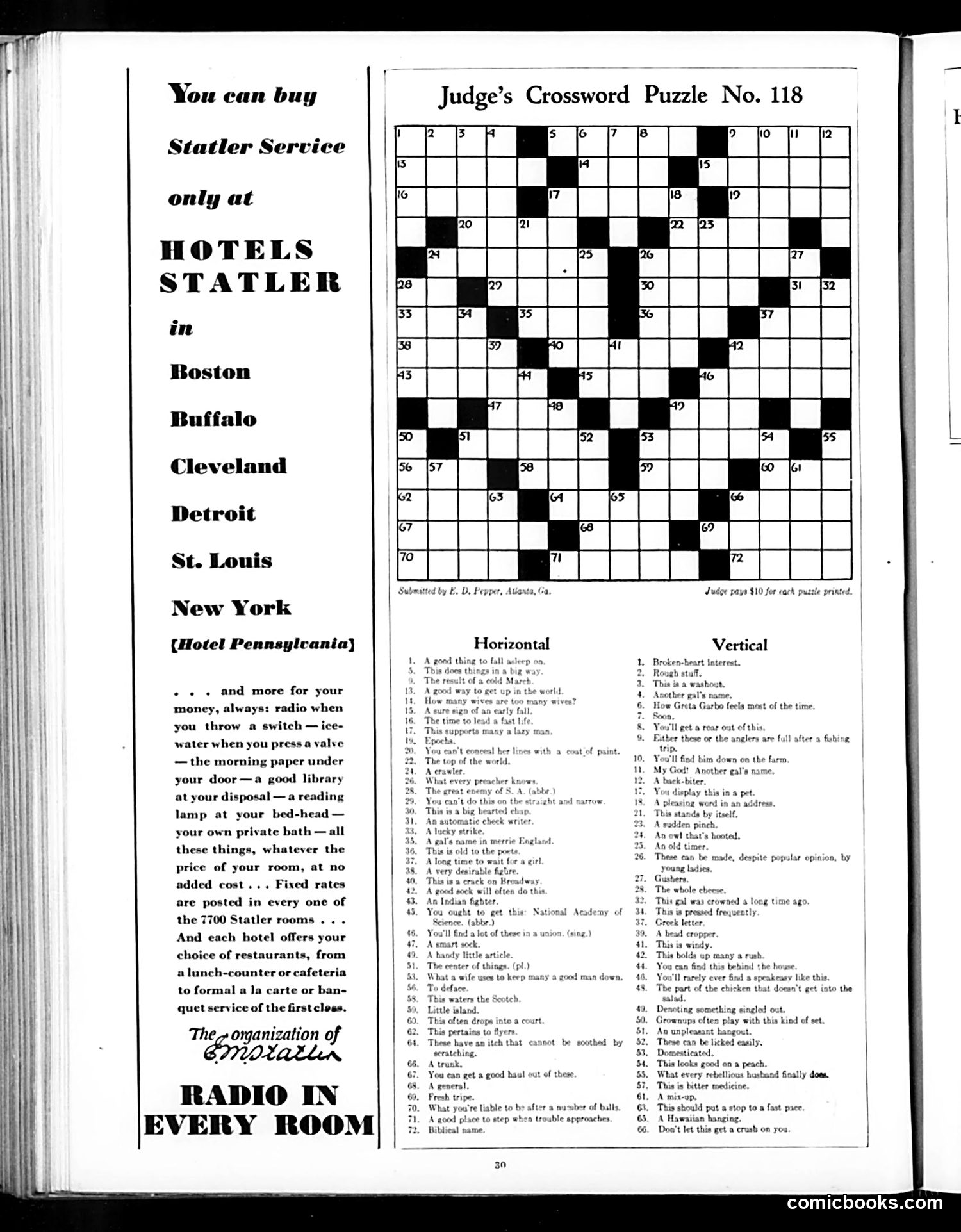
Judge Magazine Page Analysis This page is primarily advertising and a crossword puzzle, not a political cartoon. The left side contains a Statler Hotels advertisement promoting their chain across major American cities (Boston, Buffalo, Cleveland, Detroit, St. Louis, New York). The ad emphasizes modern amenities like "radio in every room," ice water on demand, morning newspapers, and private bathrooms—luxury features for the era. This reflects early 20th-century hotel competition and the novelty of such conveniences. The right side is Judge's Crossword Puzzle No. 118 with horizontal and vertical clues. The clues reference contemporary culture and entertainment: mentions of "Broadway," "Greta Garbo" (famous actress), "speakeasy" (Prohibition-era bars), and various wordplay about politics, daily life, and popular figures. No satire or political commentary is evident on this particular page. It's a straightforward entertainment and advertising spread typical of Judge magazine's format during what appears to be the 1920s-1930s.
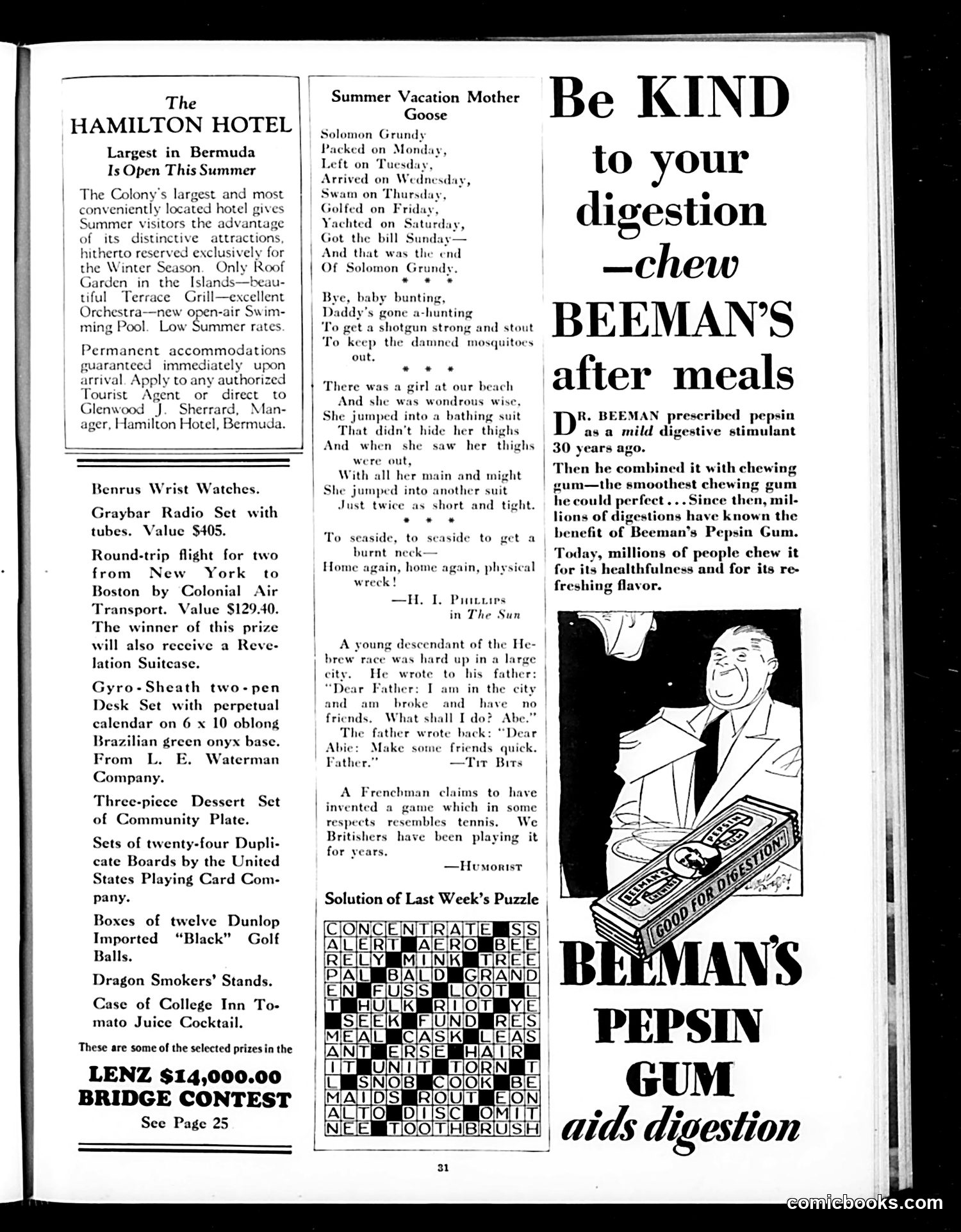
Judge Magazine Page Analysis This page is primarily advertising and filler content rather than political satire. The dominant feature is a Beeman's Pepsin Gum advertisement occupying the right half, promoting chewing gum as a digestive aid—a common early 20th-century health claim now considered dubious. The left side contains light humorous verses using nursery-rhyme formats to mock summer vacation mishaps: Solomon Grundy's expensive beach trip, mosquito problems, revealing bathing suits, sunburns, and physical exhaustion. These are gentle social observations about vacation culture rather than sharp satire. The page also lists contest prizes from a bridge competition (worth $14,000), including watches, radios, golf balls, and travel vouchers—typical magazine contest giveaways of the era. No identifiable political figures or serious satire appear on this page. It represents Judge's commercial side: lifestyle advertising mixed with mild humor targeting middle-class summer leisure activities.
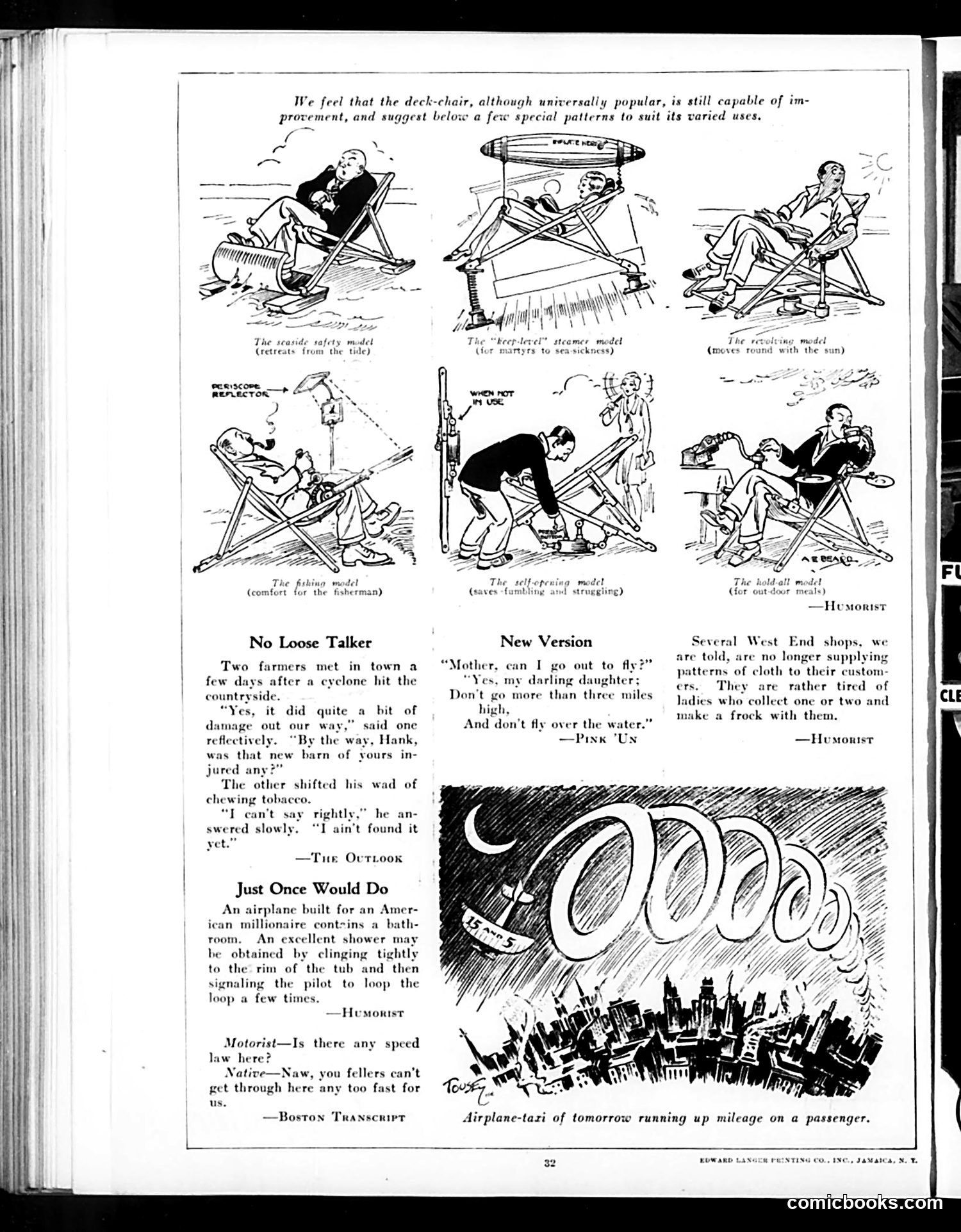
Judge Magazine Page Analysis This page from *Judge* contains humorous vignettes satirizing early 20th-century American life. The top section illustrates specialized deck-chair designs for various purposes—fishing, seasickness prevention, outdoor socializing—mocking the era's obsession with specialized consumer products. The text jokes include rural humor ("No Loose Talker," where a farmer can't locate his cyclone-damaged barn), luxury absurdity (a millionaire's airplane with a shower accessible only via aerobatic loops), and social commentary on wartime restrictions (a motorist finding no speed limits in a rural area that wants him gone quickly). The bottom cartoon depicts an enormous airplane tethered to a city skyline, captioned as a "taxi" accumulating passenger mileage—likely satirizing both aviation's rapid technological advancement and concerns about commercial air travel's impracticality or excessive costs for ordinary people. The overall tone is gentle, middle-class humor typical of *Judge's* satirical approach to modern conveniences and social trends.
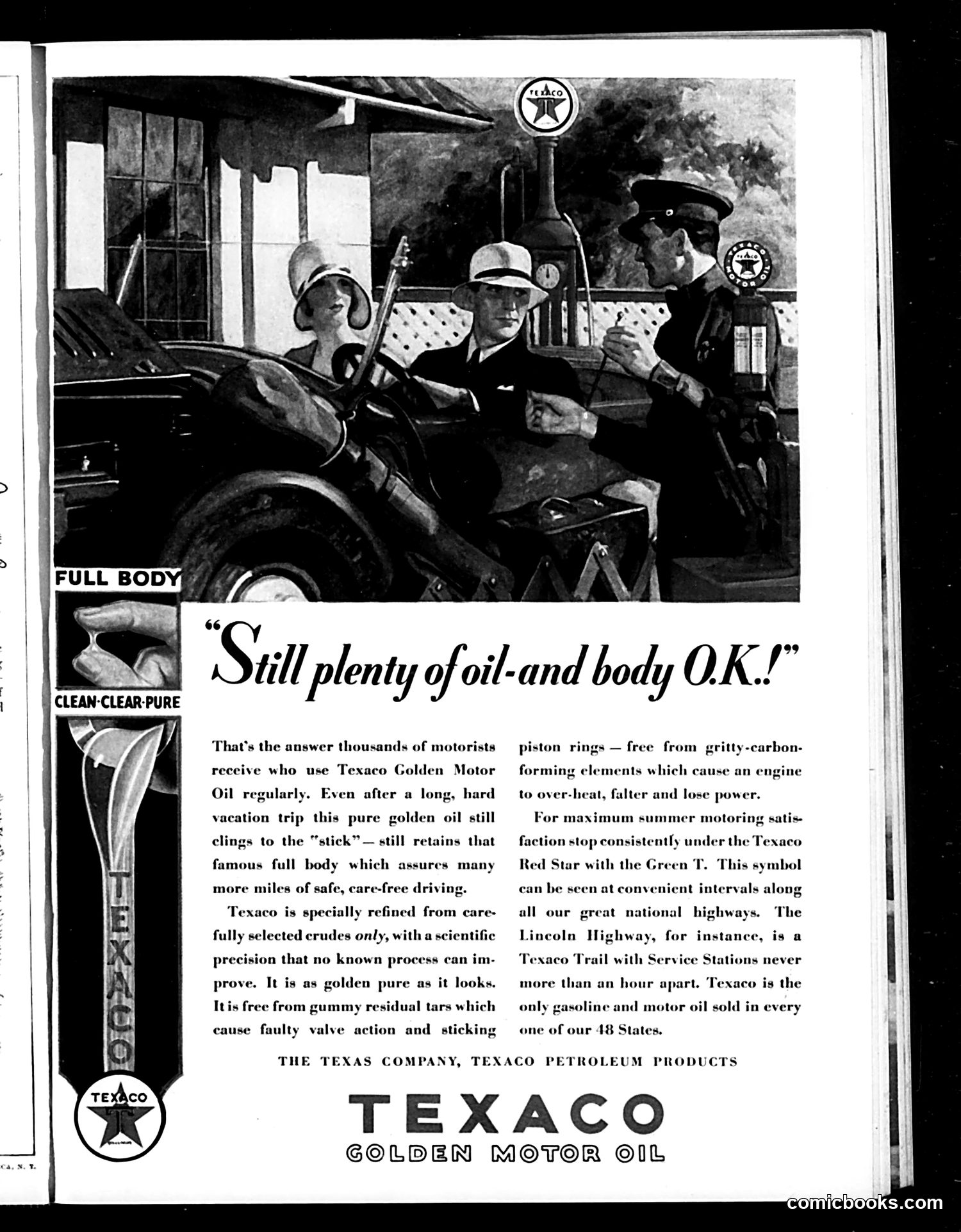
Analysis This is not a cartoon or satire—it's a straightforward motor oil advertisement from Texaco, likely from the 1920s-1930s based on the vehicles and language style. The image shows three men at a gas station examining an oil dipstick, with the tagline "Still plenty of oil—and body OK!" The ad's point is practical, not satirical: Texaco Golden Motor Oil maintains its viscosity and protective qualities even after long driving ("vacation trip"), staying on the dipstick and preventing engine problems like overheating and carbon buildup. The text emphasizes product purity, scientific refinement, and Texaco's nationwide availability across "48 States" with conveniently-spaced service stations along major highways like the Lincoln Highway. This page appears to be commercial advertising content within *Judge* magazine, not editorial satire. The humor, if any, is gentle—the visual joke of checking oil—but the message is entirely promotional.
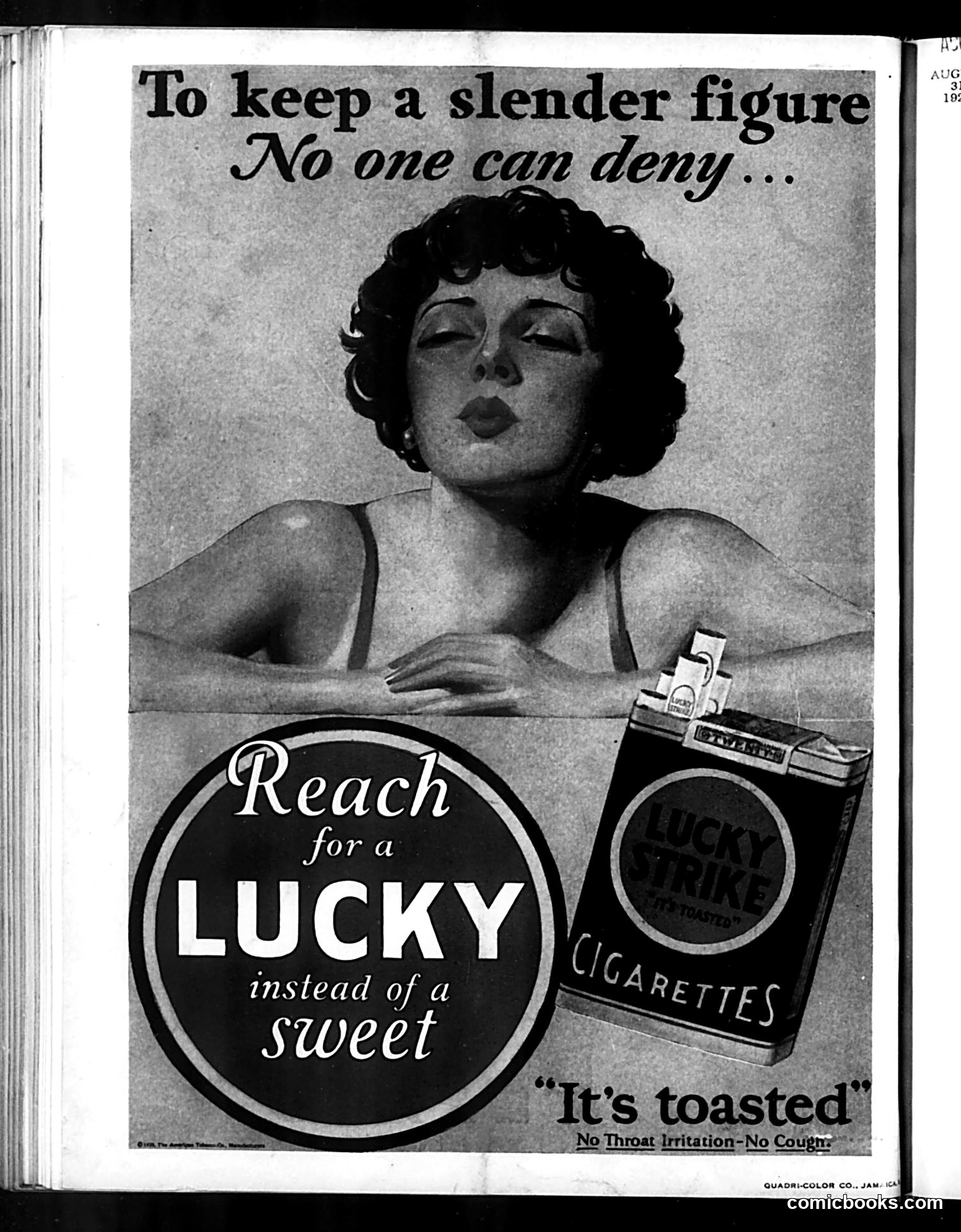
Advertisement Analysis This is a Lucky Strike cigarette advertisement, not political satire. The ad promotes smoking as a weight-control method, a common marketing strategy in early-to-mid 20th century advertising. The headline "To keep a slender figure / No one can deny..." suggests that maintaining a thin physique requires sacrifice. The solution offered: "Reach for a LUCKY instead of a sweet"—smoke cigarettes rather than eat candy to stay slim. The image shows an attractive woman in what appears to be 1950s styling, positioned to emphasize her slender figure. The tagline "It's toasted" / "No Throat Irritation—No Cough" attempts to address health concerns while promoting the product. This reflects historical advertising that exploited women's body image concerns to sell cigarettes, before modern health warnings and advertising restrictions existed.