judge
Judge — August 31, 1929
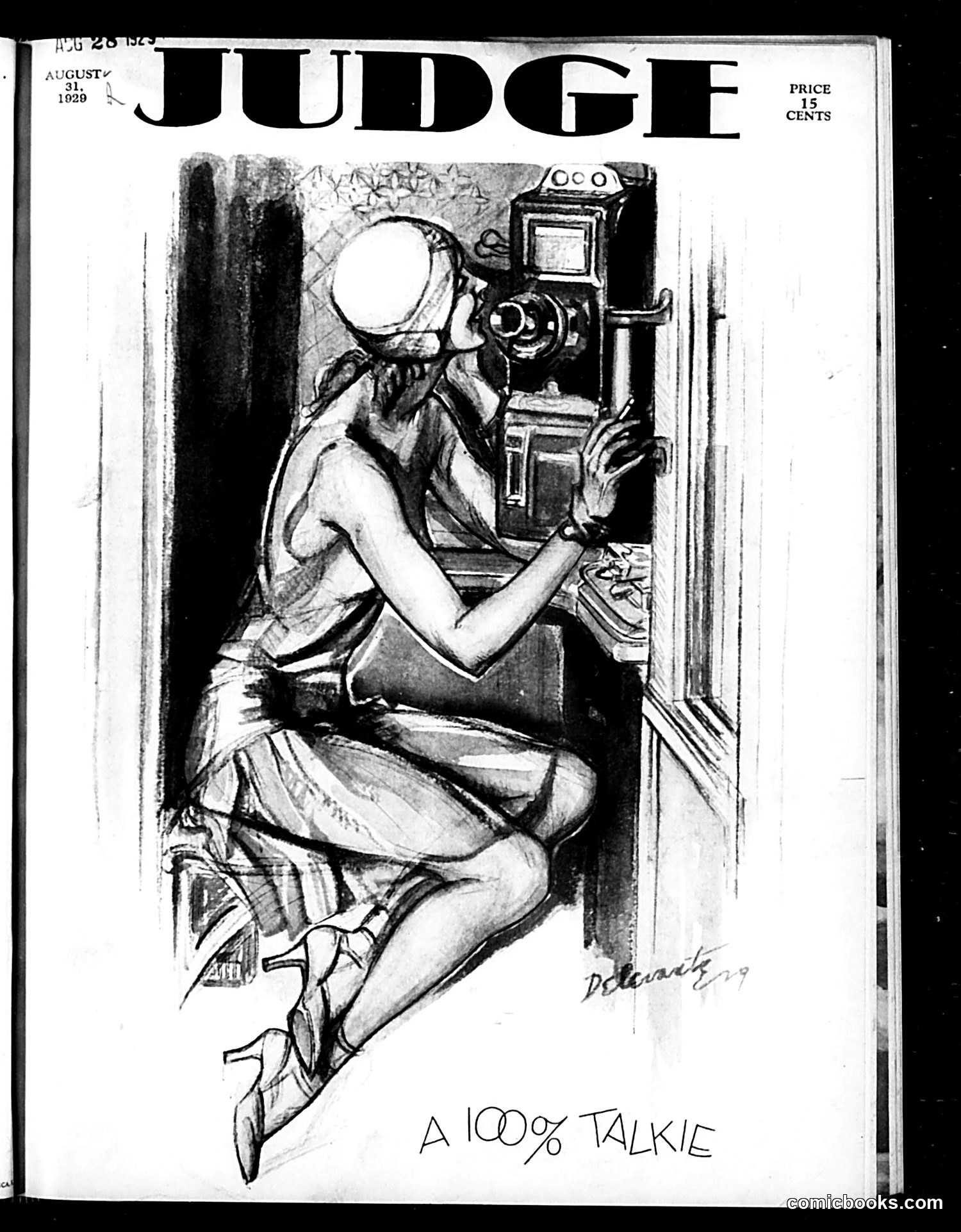
"A 100% Talkie" This Judge magazine cover from August 31, 1928 satirizes the film industry's transition to sound cinema. The illustration shows a woman operating an early movie camera, with the caption "A 100% Talkie." The satire likely mocks how the new "talking picture" technology was being heavily marketed as a complete innovation, while the image suggests the absurdity of the medium—a woman must physically control the camera and sound equipment simultaneously, depicted in an exaggerated, awkward pose. The cartoon appears to comment on either the impracticality of early sound-film equipment or the industry's over-promotion of talkies as revolutionary, when the actual filming process remained cumbersome. The 15-cent price and publication date confirm this captures a moment during cinema's major technological transition from silent to sound films.
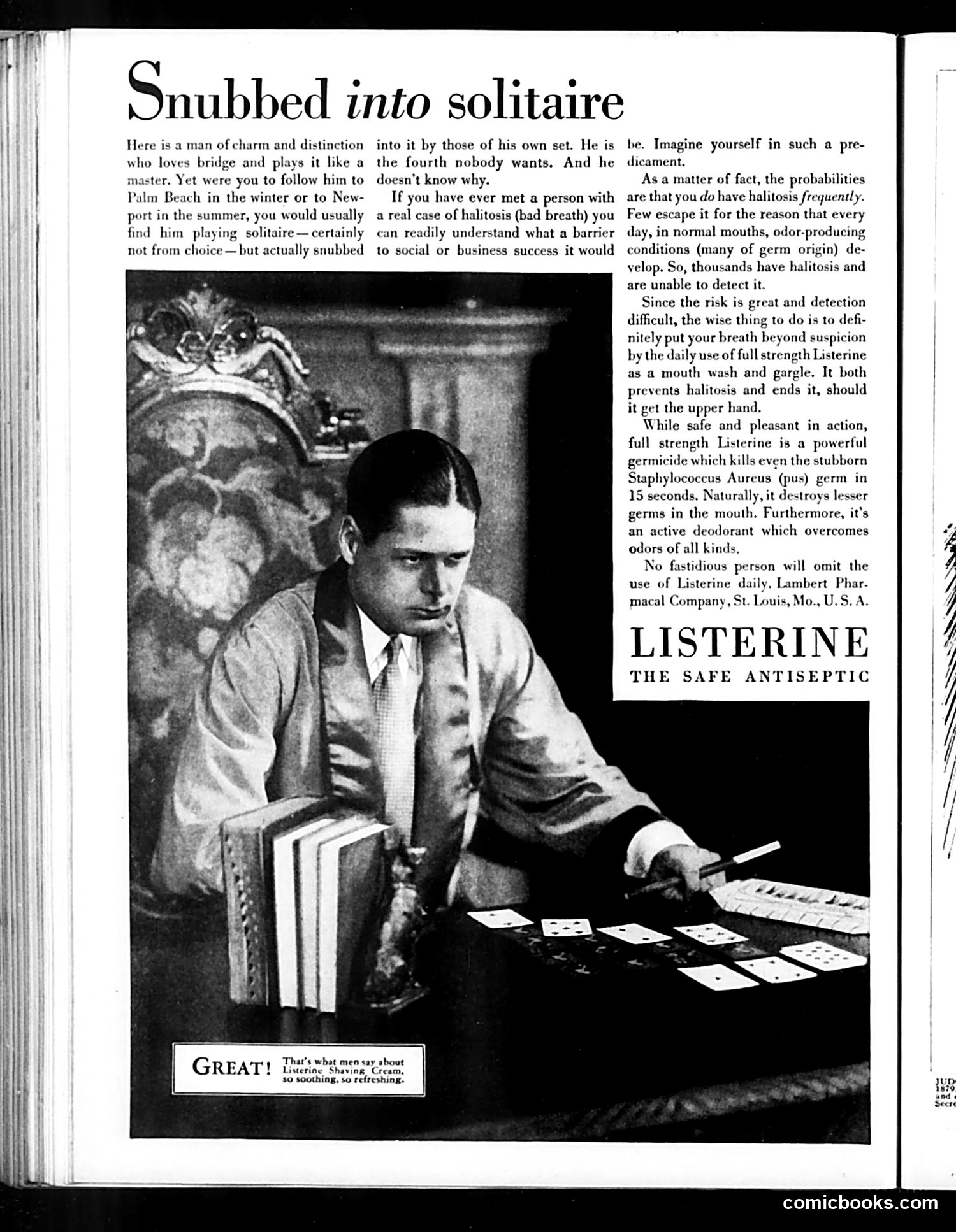
Analysis This page is primarily a Listerine advertisement, not a political cartoon. The image shows a man playing solitaire alone, illustrating the article's headline: "Snubbed *into* solitaire." The text describes a man of "charm and distinction" who is socially isolated—he plays solitaire by choice rather than circumstance. The satirical implication is that he suffers from halitosis (bad breath), which the ad claims is a social barrier to business and personal success. The advertisement then pivots to promoting Listerine mouthwash as a solution, claiming it kills odor-causing germs and prevents halitosis. The satire targets social anxieties about hygiene and acceptance, using isolation as a cautionary tale to sell the product. This reflects early 20th-century marketing that weaponized insecurity to drive consumer purchases.
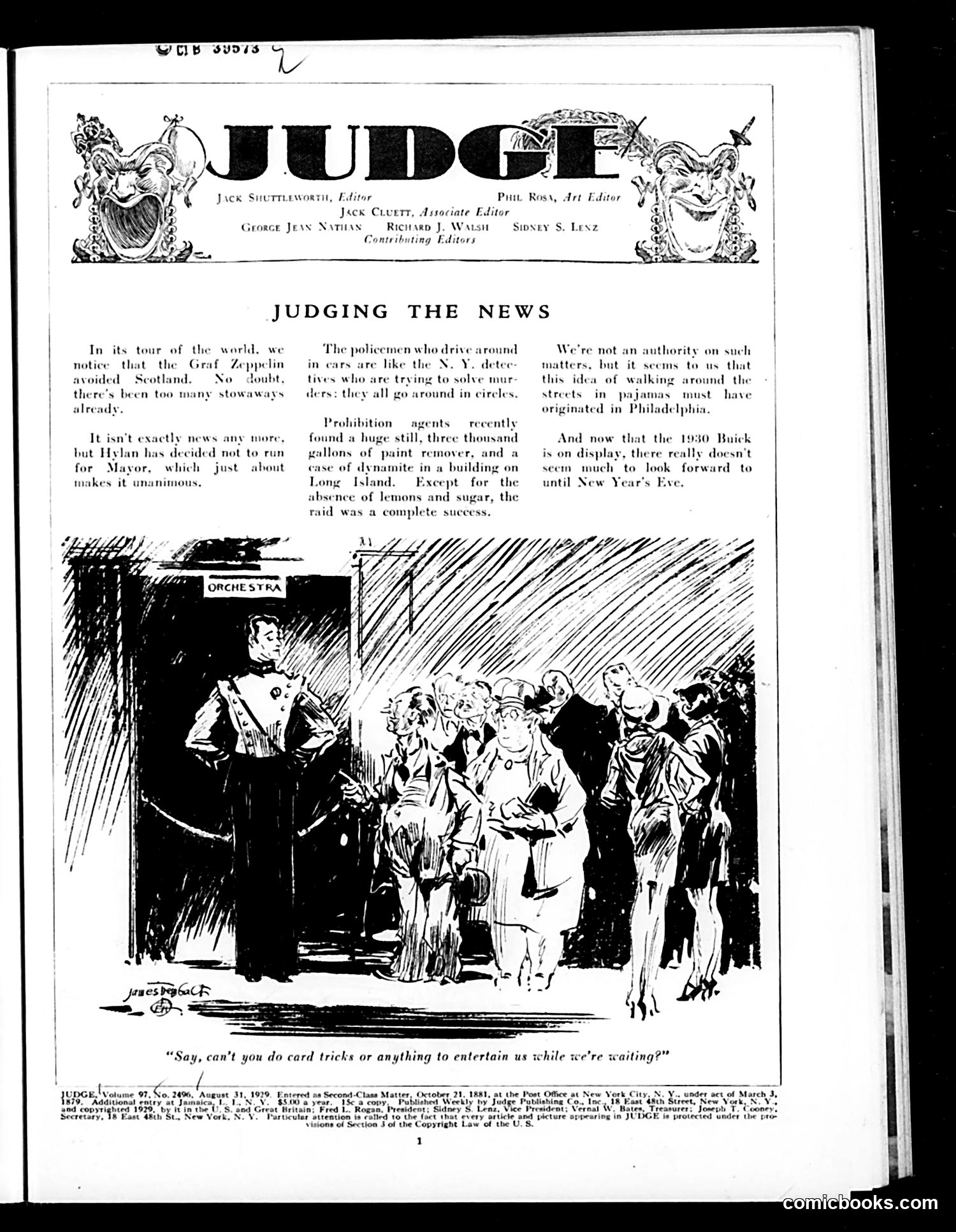
Analysis of Judge Magazine Page Main Cartoon Caption: "Say, can't you do card tricks or anything to entertain us while we're waiting?" Context: This cartoon depicts an orchestra conductor facing impatient audience members, likely referencing delays or waiting in entertainment venues. The humor plays on the conductor's formal role—typically to lead musicians—being repurposed as an entertainer for restless patrons. Editorial Section "Judging the News": Brief commentary on contemporary events including: - Graf Zeppelin's tour (aviation milestone) - Hylan's decision not to run for Mayor (New York politics) - Police prohibition enforcement (paint remover raid on Long Island) - 1930 Buick automobile display The content reflects 1929-1930 American social and political concerns: aviation advancement, local politics, Prohibition enforcement, and consumer goods.
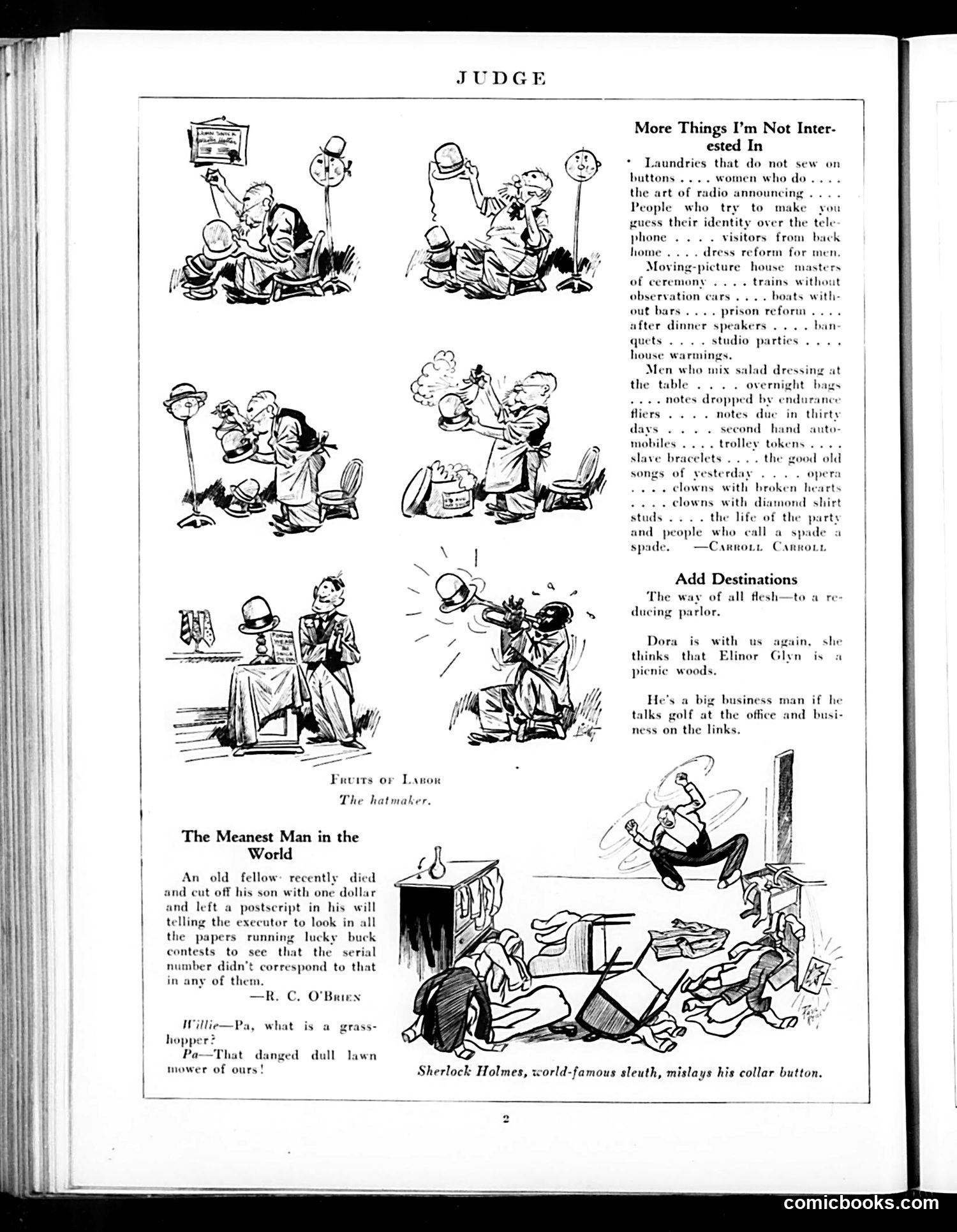
Analysis of Judge Magazine Page This page contains several satirical cartoons and humorous pieces typical of Judge magazine's style. The top section shows "Fruits of Labor" depicting "The hatmaker" - various cartoon scenes of workers and daily life observations. The main featured piece is "The Meanest Man in the World," a joke by R.C. O'Brien about a miserly fellow who died and left instructions to his executor to search through his papers for hidden lucky tickets, ensuring the serial numbers matched contests - the joke being his obsession with winning prizes even in death. Below is a brief exchange between "Willie" and "Pa" about a "grasshopper" (a lawn mower), showing typical domestic humor. The bottom illustration shows Sherlock Holmes "mislaying his collar button" - a humorous reference to the famous detective in an undignified domestic situation surrounded by chaos.
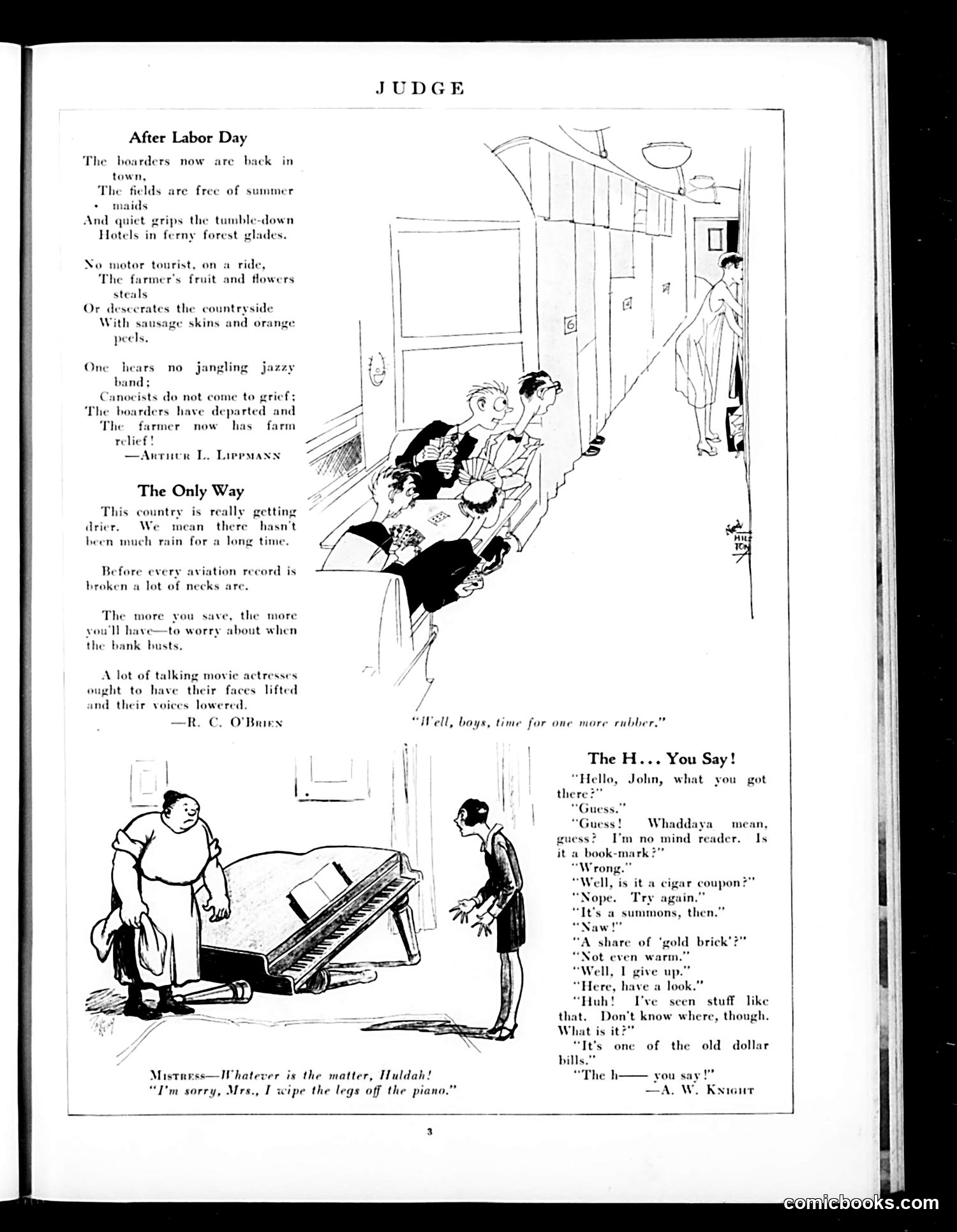
Analysis of Judge Magazine Page This page contains three separate pieces of satirical humor typical of Judge magazine's format: 1. "After Labor Day" - A poem by Arthur L. Lippmann satirizing post-summer rural disruption: tourists abandon the countryside, leaving farmers without income from selling fruit and flowers to visitors. The accompanying illustration shows people on what appears to be a slide or chute, captioned "Well, boys, time for one more rubber." 2. "The Only Way" - Social commentary on American economic anxiety and bank failures (likely referencing early 20th-century financial instability). 3. "The H... You Say!" - A humor piece showing someone trying unsuccessfully to guess what an object is through questioning. The bottom cartoon depicts a woman apologizing to her husband for getting piano legs dirty—a euphemistic joke reflecting Victorian sensibilities about modest language.
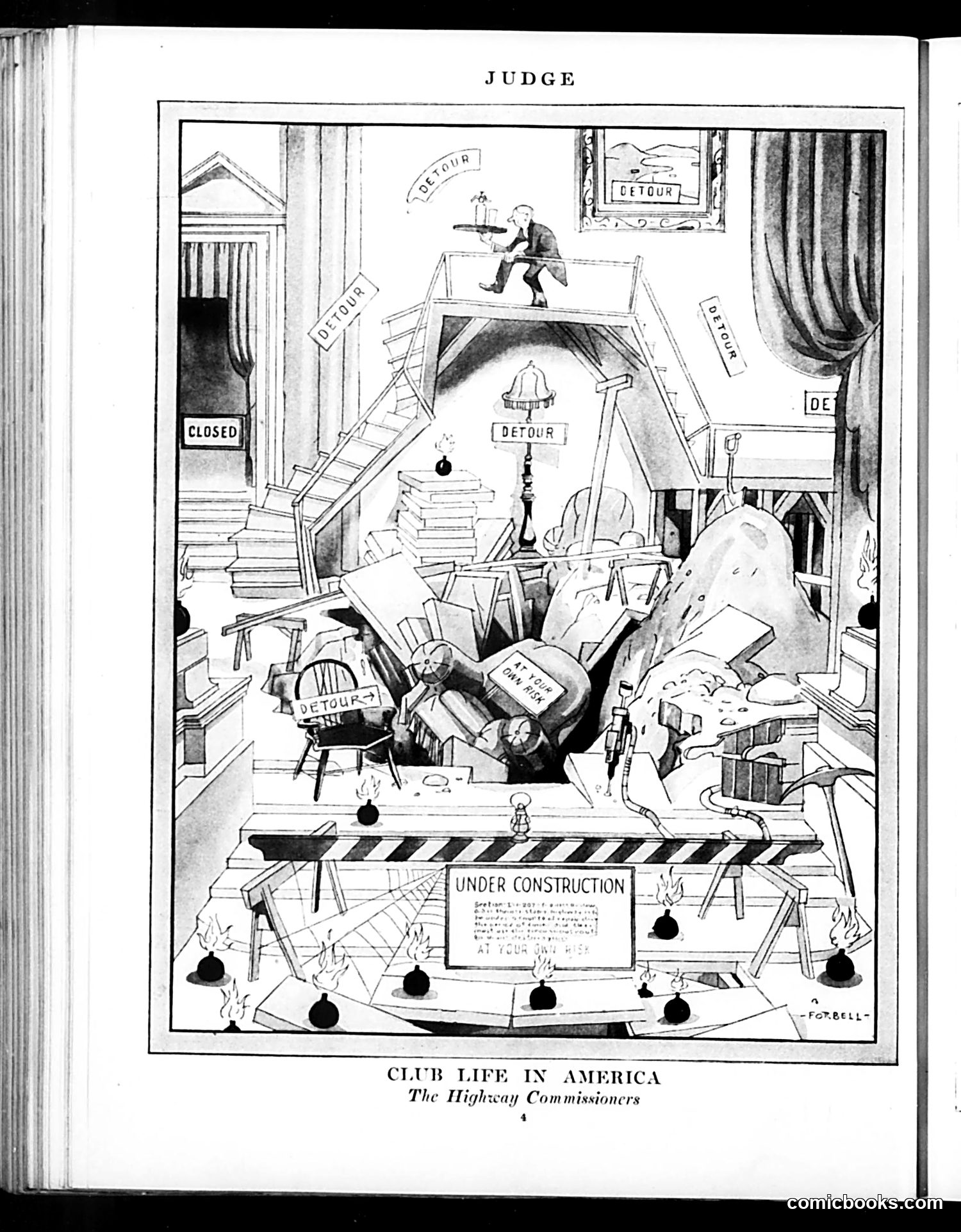
"The Highway Commissioners" This cartoon satirizes the chaos and dysfunction of highway construction and maintenance oversight in America. The central image depicts a courtroom ("Judge") literally under construction—filled with scaffolding, debris, blocked entrances ("CLOSED"), and detour signs. Workers navigate confusion while various officials appear trapped or ineffectual amid the mess. The satire targets "Highway Commissioners"—government officials responsible for road infrastructure. The cartoon suggests these bureaucrats create more obstruction than progress, turning what should be orderly judicial/administrative proceedings into literal chaos. The multiple "DETOUR" signs emphasize wasted time and resources. The burning debris symbolizes destruction without productive outcome. Overall, it mocks government incompetence and the public inconvenience caused by poorly managed public works projects.
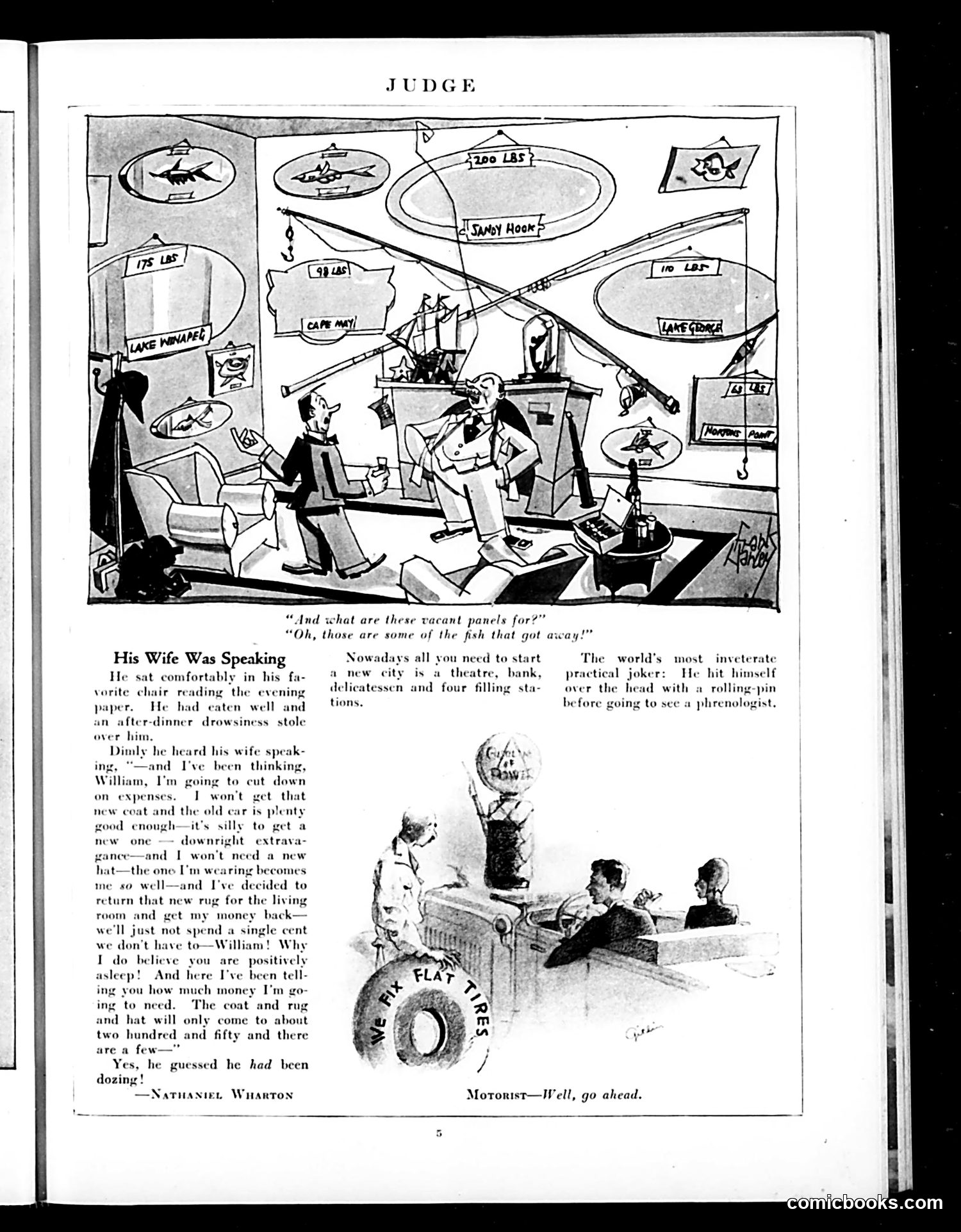
Analysis of Judge Magazine Page Top cartoon ("And what are these vacant panels for?"): A satirical take on early 1920s urban development. The illustration shows a fishing enthusiast's boat converted into a makeshift city, with various labeled compartments (banks, theaters, filling stations). The joke critiques the rapid, improvised nature of new city planning during America's post-WWI building boom—suggesting cities were being constructed haphazardly, like someone cramming amenities into a boat. Bottom section includes two short humorous pieces: "His Wife Was Speaking" depicts marital comedy about household budget cuts, and "Motorist—Well, go ahead" shows a motorist encountering an obstacle labeled "We Fix Flats," likely poking fun at roadside service stations and automobile culture's rapid expansion in the 1920s. The page reflects 1920s concerns about urban growth, consumerism, and modern inconveniences.
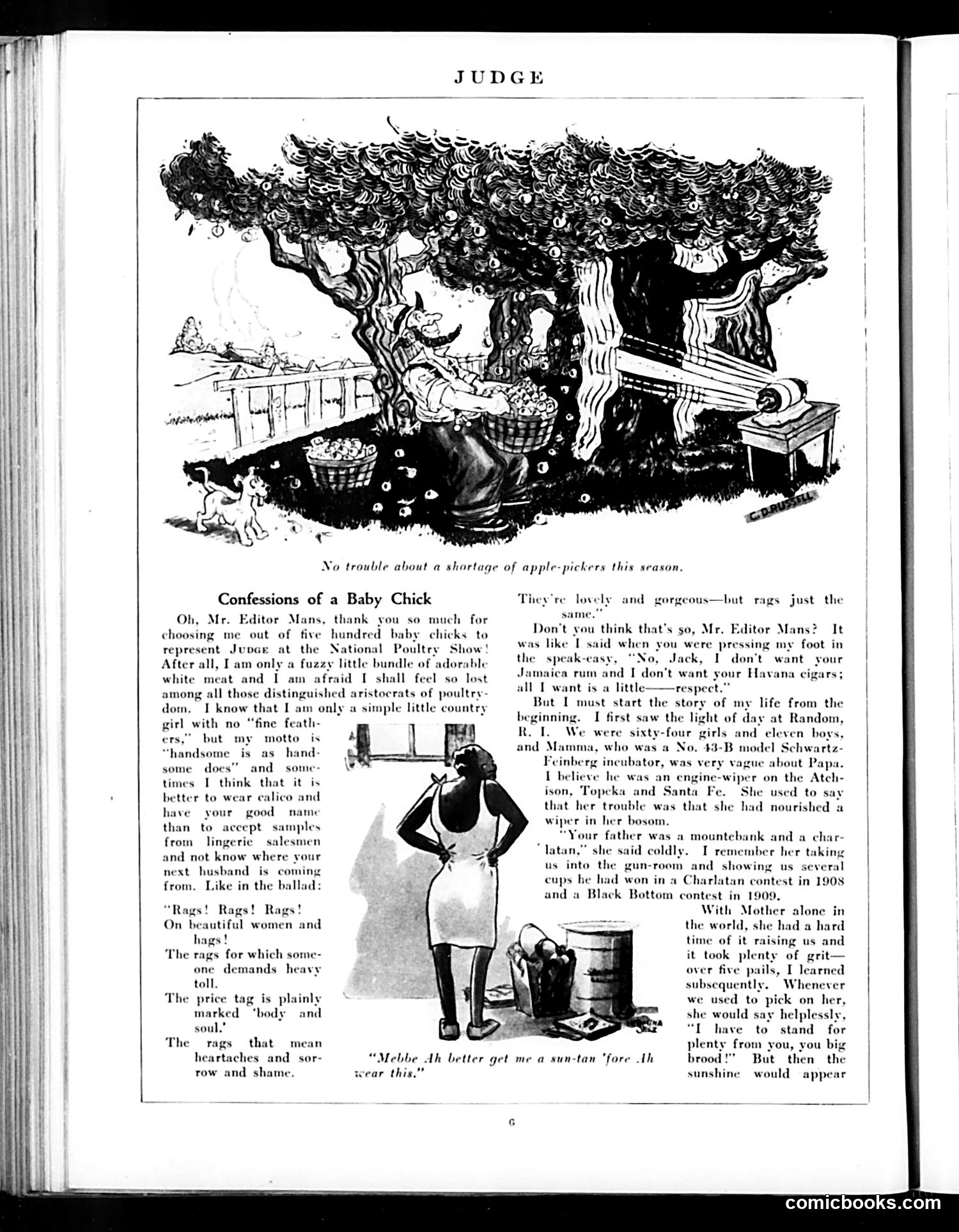
Analysis of Judge Magazine Page Top Cartoon: Depicts a rural scene with a woman and child harvesting apples beneath a large tree. The caption reads "No trouble about a shortage of apple-pickers this season," appearing to satirize labor availability concerns—likely referencing anxieties about farm labor during an agricultural period when such shortages were economically significant. Main Article: "Confessions of a Baby Chick" is a first-person narrative from a female chick discussing her origins and family background. It satirizes the pretensions of show animals and pedigree breeding culture. The accompanying illustration shows a woman in form-fitting clothing, captioned "Mebbie Ah better get me a sun-tan 'fore Ah wear this," mocking vanity and fashion consciousness. The page combines rural/agricultural humor with satirical commentary on social status and appearance.
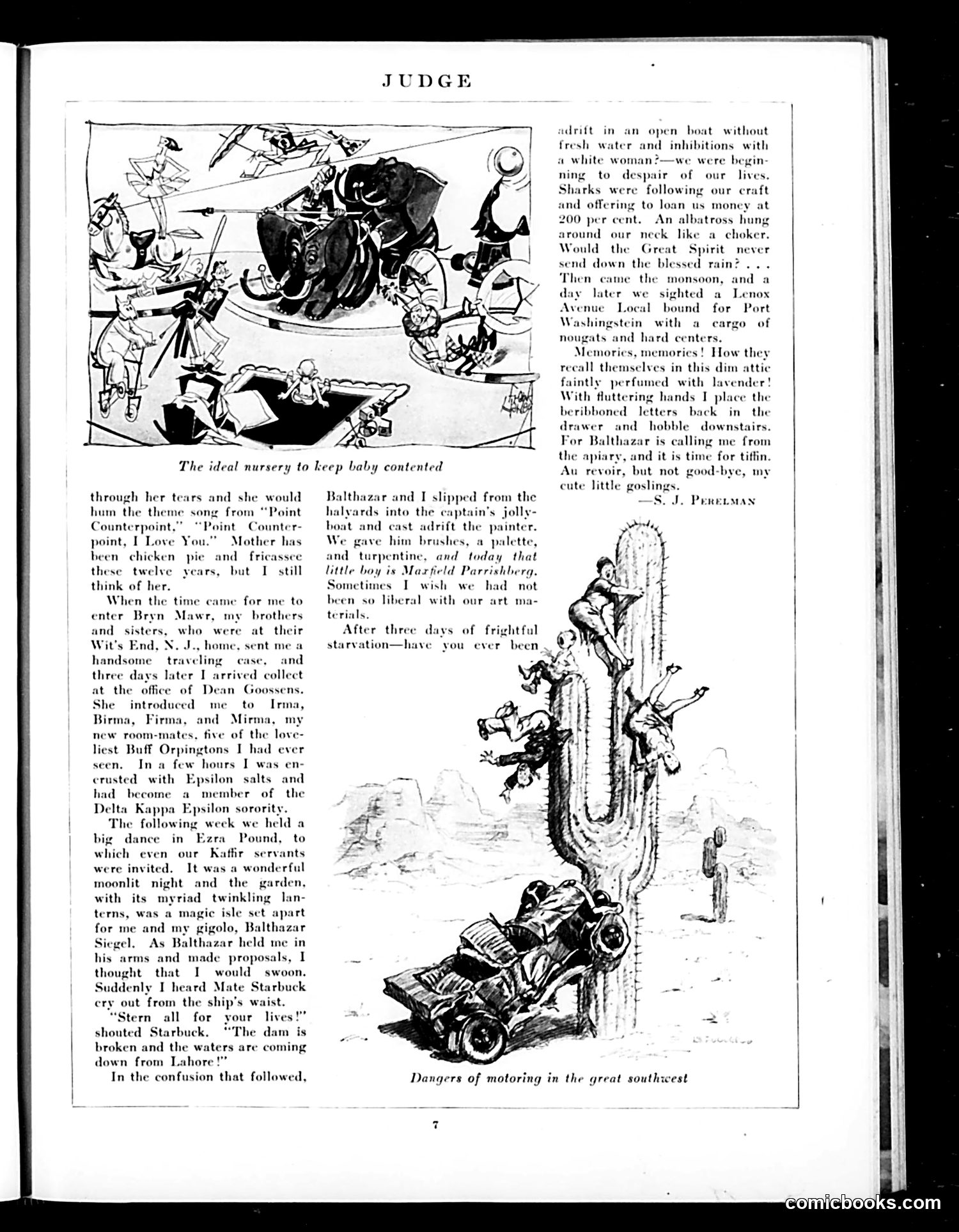
Understanding This Judge Magazine Page This page contains two distinct satirical pieces from Judge, an American humor magazine. Top cartoon ("The ideal nursery to keep baby contented"): A chaotic domestic scene mocking overwrought literary pretension and absurd parenting. The accompanying text is a rambling, nonsensical memoir-style narrative that satirizes affectation—referencing "Point Counterpoint" (likely Aldous Huxley's novel), elite women's colleges like Bryn Mawr, Greek sororities, and romantic melodrama. The humor comes from the narrator's increasingly absurd experiences (room-mates who are chickens, a ship disaster interrupting a college dance, casual cruelty presented as whimsy). Bottom cartoon ("Dangers of motoring in the great southwest"): An illustration of a vehicle precariously perched on a tall saguaro cactus in the Arizona desert. This appears to be straightforward satirical commentary on the hazards and absurdities of early automobile travel in America's remote southwestern regions. Both pieces reflect Judge's satirical approach: mocking contemporary social trends, literary culture, and modern conveniences through exaggeration and surrealism.
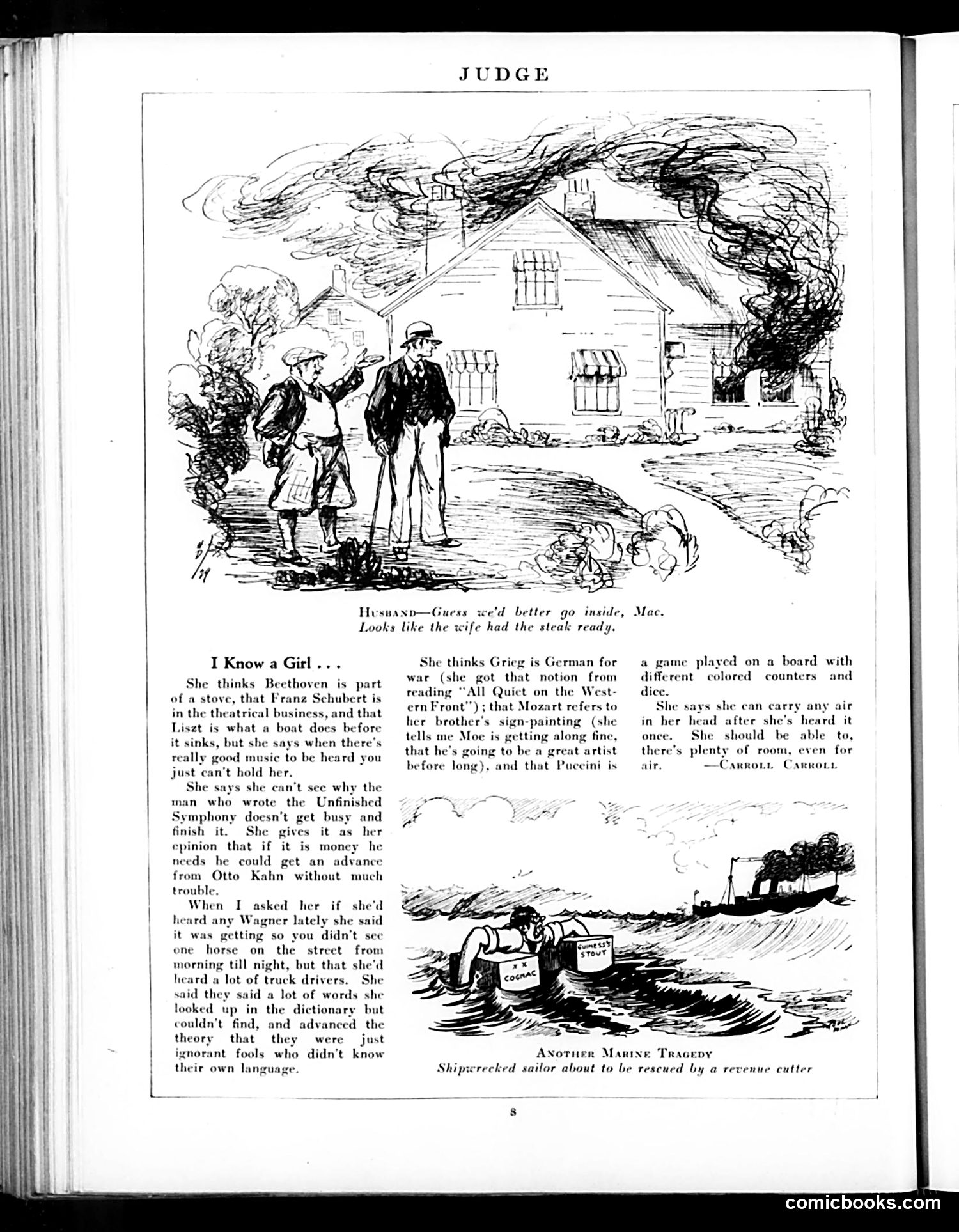
Analysis of Judge Magazine Page This page contains two satirical pieces: "I Know a Girl" mocks a woman's profound ignorance of classical music and composers. She confuses famous musicians with mundane things (Beethoven = a stove part; Liszt = a boat sinking motion; Puccini = a board game). The humor lies in her simultaneously claiming to love "really good music" while demonstrating she knows nothing about it. The Wagner joke—conflating the composer with horse-drawn wagons disappearing from streets due to motorization—references early 20th-century urban change. "Another Marine Tragedy" (lower cartoon) depicts a shipwrecked sailor about to be rescued by a revenue cutter. The caption's dark humor suggests this "tragedy" is ironic—the sailor's rescue by a government vessel may involve legal consequences (possibly bootlegging during Prohibition era, given the reference to "revenue cutter"). Both pieces employ typical Judge magazine satire: social commentary through exaggeration and wordplay, targeting cultural pretension and contemporary anxieties.
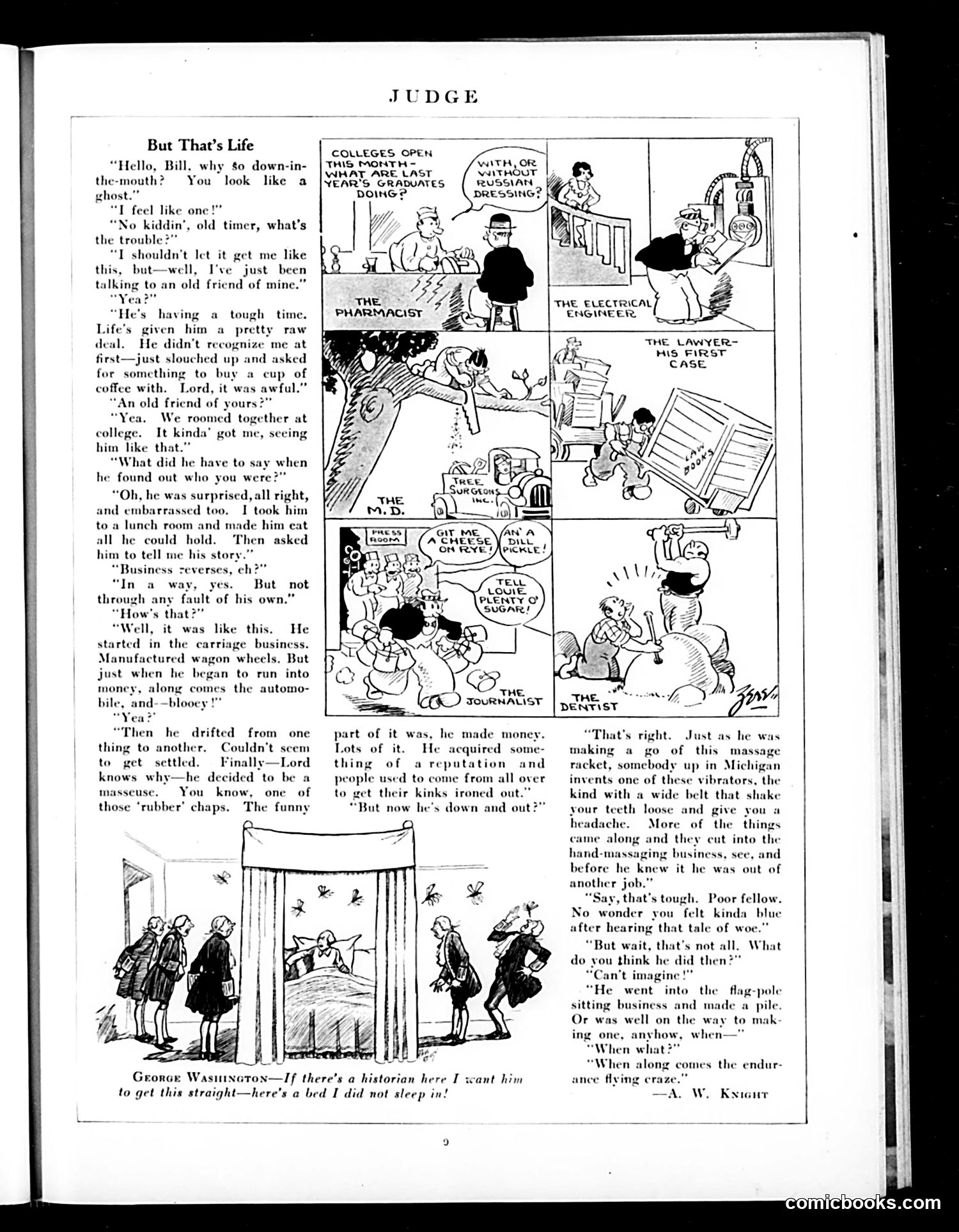
Satire Explanation for Modern Readers This page from *Judge* satirizes economic obsolescence and bad luck during rapid technological change. The main story "But That's Life" follows a man whose friend repeatedly loses jobs because new inventions disrupt his industries: the automobile replaces carriage manufacturing, electric vibrators undercut manual massage therapy, and aircraft somehow threaten a flag-polishing business. The accompanying comic strip mocks college graduates' career prospects, showing them scattered across unstable professions (pharmacist, engineer, lawyer, doctor, journalist, dentist). The George Washington cartoon at bottom appears to reference historical authenticity. The satire reflects early-to-mid 20th century anxieties about technological disruption making skilled trades obsolete faster than workers can adapt—a perpetual anxiety, though the specific technologies referenced (automobiles, electric massagers, early aviation) date this as probably 1910s-1920s era.
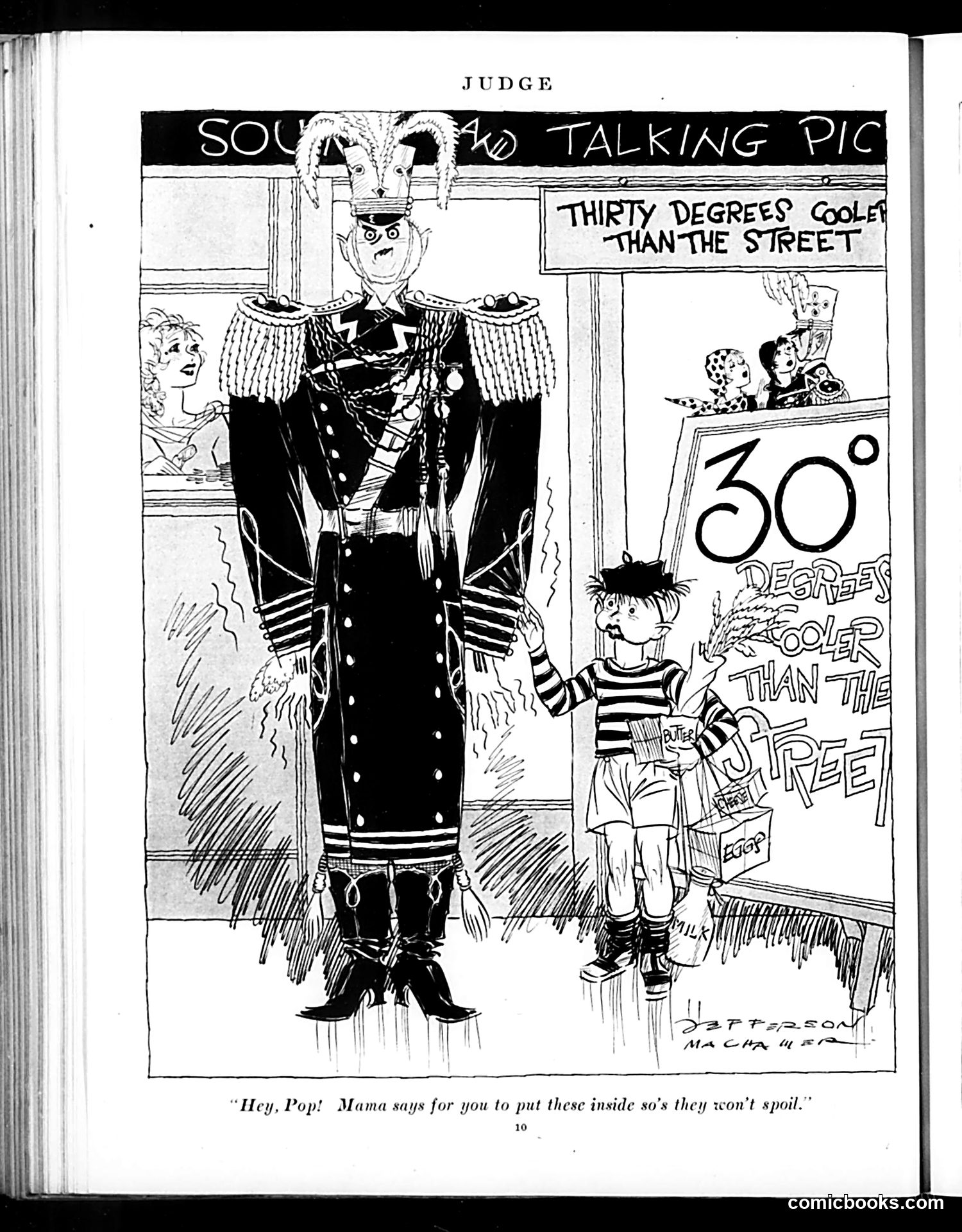
"Sound and Talking Pig" Cartoon Analysis This Judge magazine cartoon satirizes a military officer (identifiable by ornate uniform with epaulettes and decorations) as a grotesque pig-headed figure. The humor derives from calling him a "talking pig"—suggesting he's all bluster and no substance. The domestic scene shows a child delivering groceries to "Pop," with a sign advertising that the establishment is "thirty degrees cooler than the street." The mother's instruction to store items "inside so's they won't spoil" appears to be a double entendre: the cartoon implies the officer-character himself needs cool storage to prevent moral or intellectual "spoiling." This likely mocks a specific political or military figure of the era through crude caricature—a common Judge magazine practice. The exact target remains unclear without additional historical context, but the satire clearly attacks the figure's character and competence through animalistic imagery.
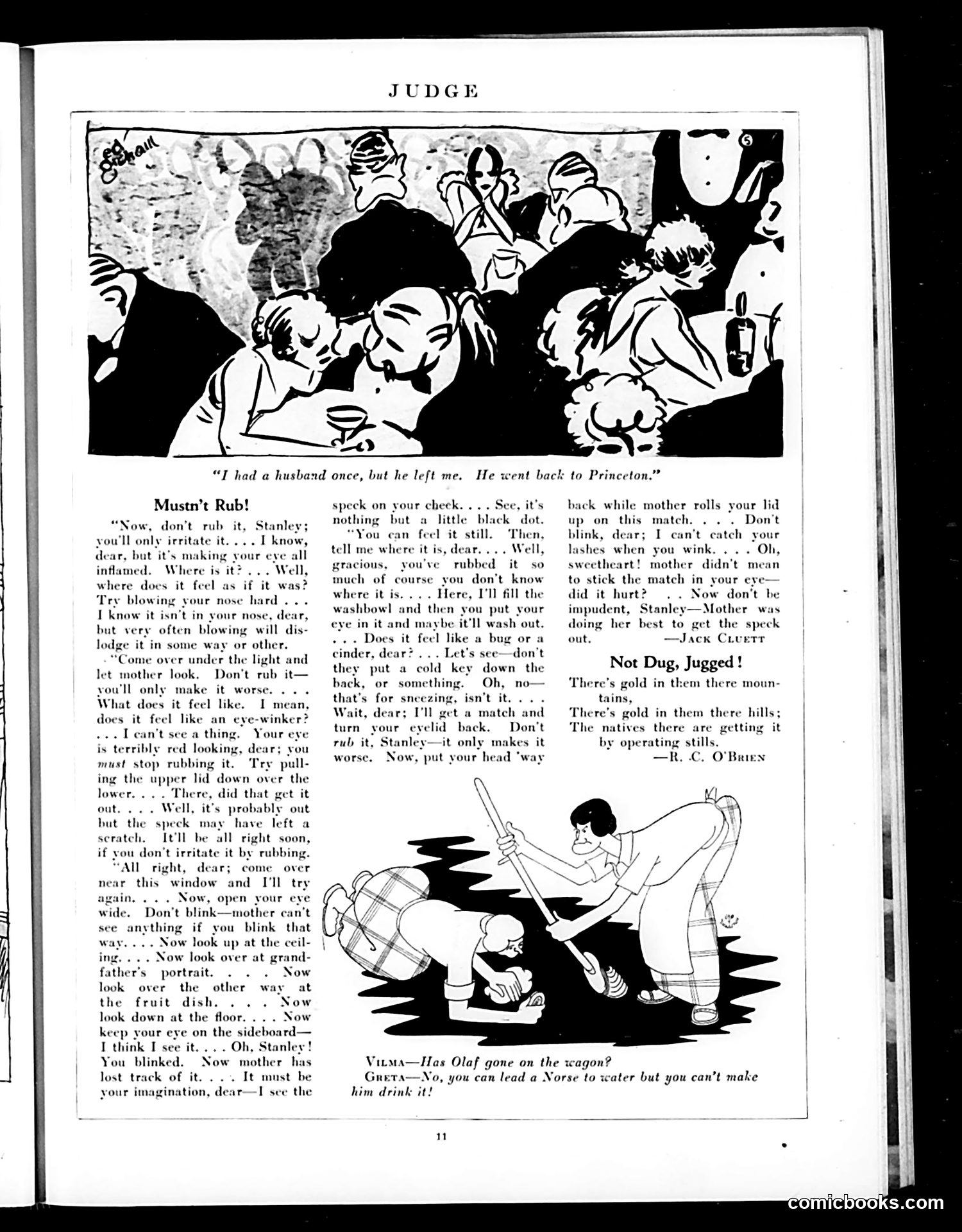
"Mustn't Rub!" and Related Content This page contains three separate humor pieces from Judge magazine: "Mustn't Rub!" (main piece): A comedic monologue depicting a mother attempting to remove a speck from her son Stanley's eye. The humor lies in the mother's contradictory, fussy instructions—she repeatedly tells him not to rub while offering increasingly absurd removal methods (blowing his nose, pulling his eyelid, using a match). The exasperation builds as she loses track of the speck, ultimately suggesting it was his "imagination." "Not Dug, Jugged!" (right column): A brief verse joke about gold mining in mountains and hills, with the punchline that natives are extracting it via illegal stills (Prohibition-era moonshine operations), not mining. Bottom cartoon: A domestic humor piece involving characters Vilma and Greta with a Norse/Scandinavian reference—playing on the idiom "you can lead a horse to water" but substituting "Norse" for ethnic humor about Scandinavian immigrants. All three pieces use everyday domestic or ethnic situations for lighthearted satire typical of Judge's early 20th-century humor style.
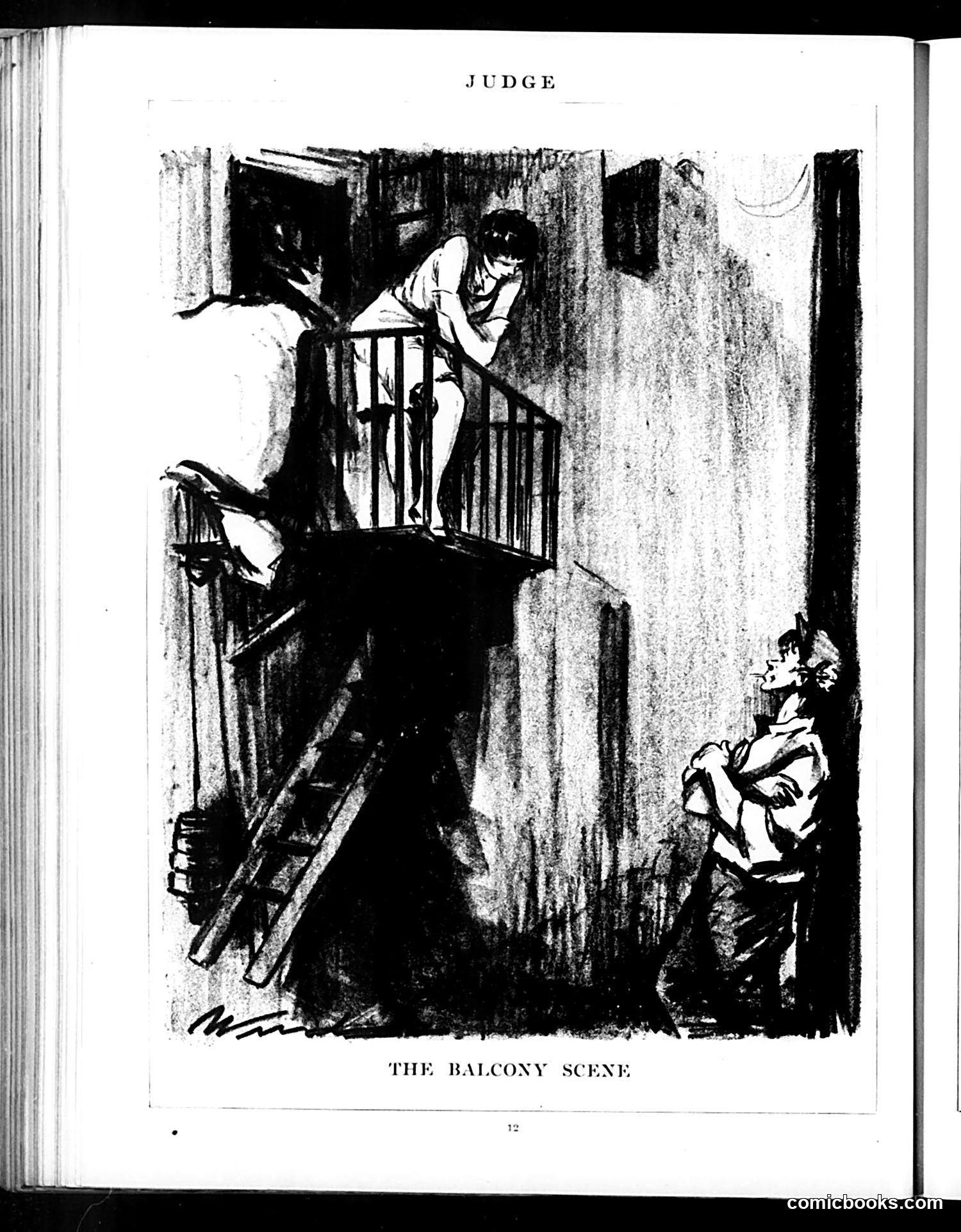
"The Balcony Scene" from Judge Magazine This illustration depicts a dramatic scene on a narrow balcony between two figures—one leaning from above, another below—evoking the famous balcony scene from Shakespeare's *Romeo and Juliet*. The sketch style and stark black-and-white rendering are typical of Judge magazine's satirical cartoons. Without additional context or captions identifying the specific figures, the cartoon likely uses this famous romantic literary reference as satire, possibly mocking a contemporary scandal, affair, or romantic entanglement involving recognizable public figures of the period. The cramped, precarious setting and theatrical framing suggest the scene is meant to ridicule rather than celebrate the situation depicted. The specific identities and target remain unclear from the image alone.
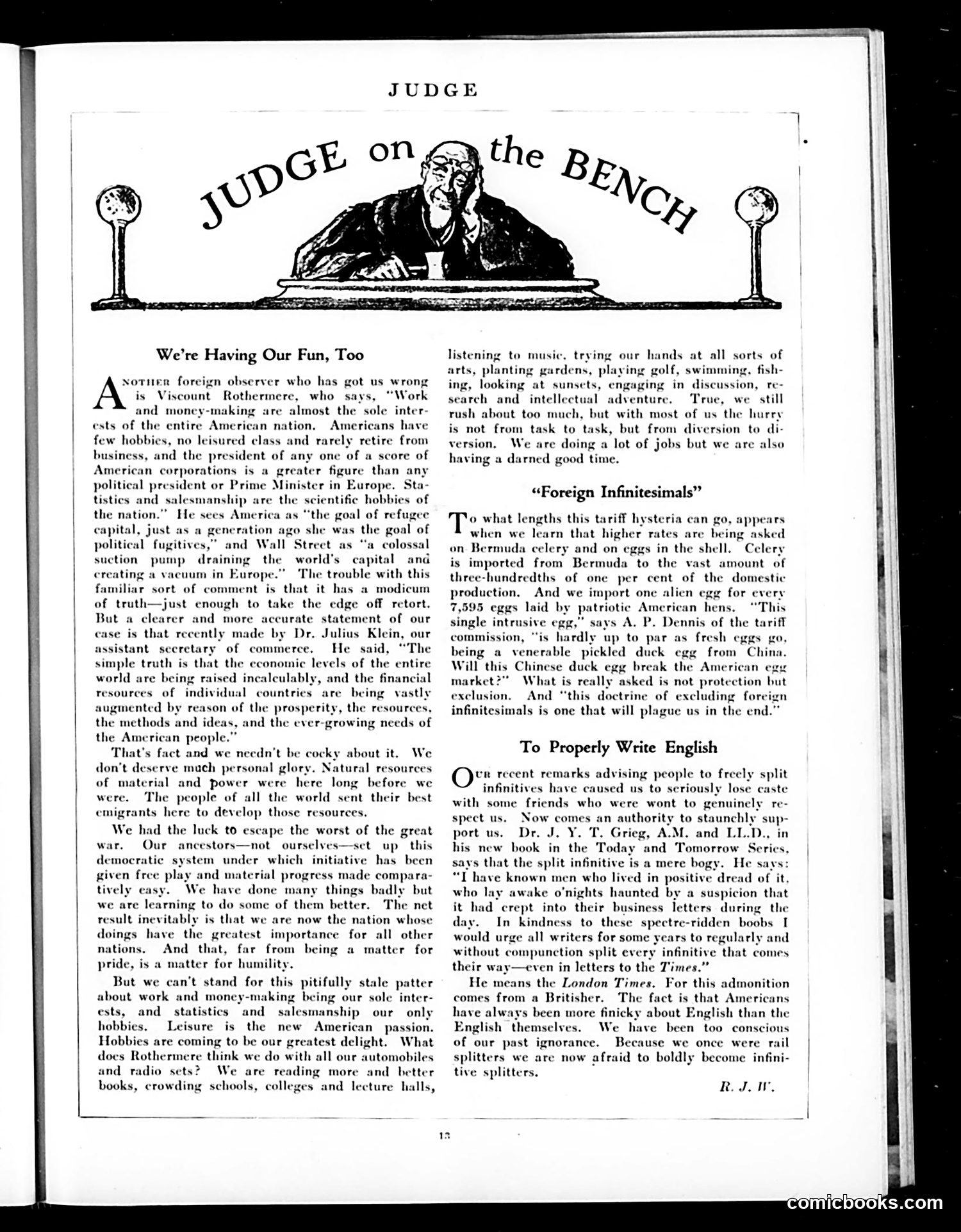
Explanation for Modern Readers This page contains editorial commentary critiquing foreign misconceptions about America. The main cartoon shows a judge figure at a bench, introducing three opinion pieces. "We're Having Our Fun, Too" responds to Viscount Rothermere (a British newspaper magnate), who claimed Americans only care about work and money. The writer defends Americans, arguing they *do* enjoy leisure—reading, golf, music, gardening—and that American prosperity benefits the world economically. "Foreign Infinitesimals" satirizes tariff protectionism, mocking a tariff commission report requesting import duties on trivial amounts of foreign goods: Bermuda celery (0.3% of domestic supply) and pickled duck eggs (1 per 7,595 American eggs). The piece ridicules such exclusionary policies as absurdly nationalistic. "To Properly Write English" briefly critiques linguistic pedantry about split infinitives, referencing a British authority who attacks this practice unnecessarily. Overall, *Judge* defends American culture against foreign criticism while satirizing both isolationist tariff policies and excessive linguistic nationalism.
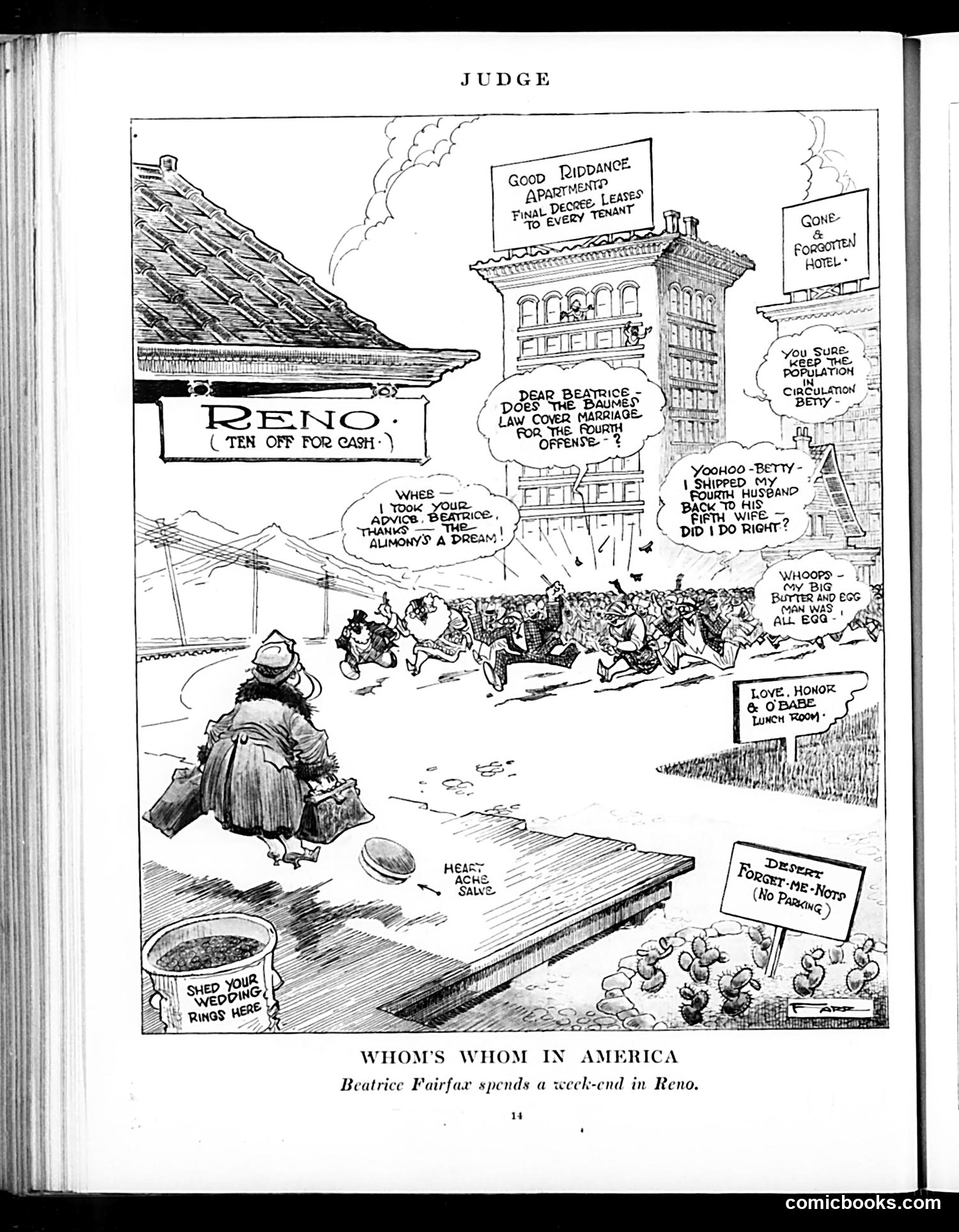
This cartoon satirizes Beatrice Fairfax, a famous advice columnist, visiting Reno, Nevada—notorious at the time as a divorce destination where people went to obtain quick divorces due to lenient residency laws. The joke depicts the irony of an advice-giver encountering Reno's divorce culture firsthand. Signs reference transient tenants, a "Forgotten Hotel" with no parking, and various establishments catering to people dissolving marriages. Speech bubbles show women discussing shipping husbands back and domestic complaints. The satire targets both the hypocrisy of a morality-dispensing columnist potentially needing divorce services herself, and Reno's well-known role as America's quickie-divorce capital in the early 20th century. The crowded scene of people conducting casual business transactions underscores how commercialized and normalized divorce-seeking had become in that location.
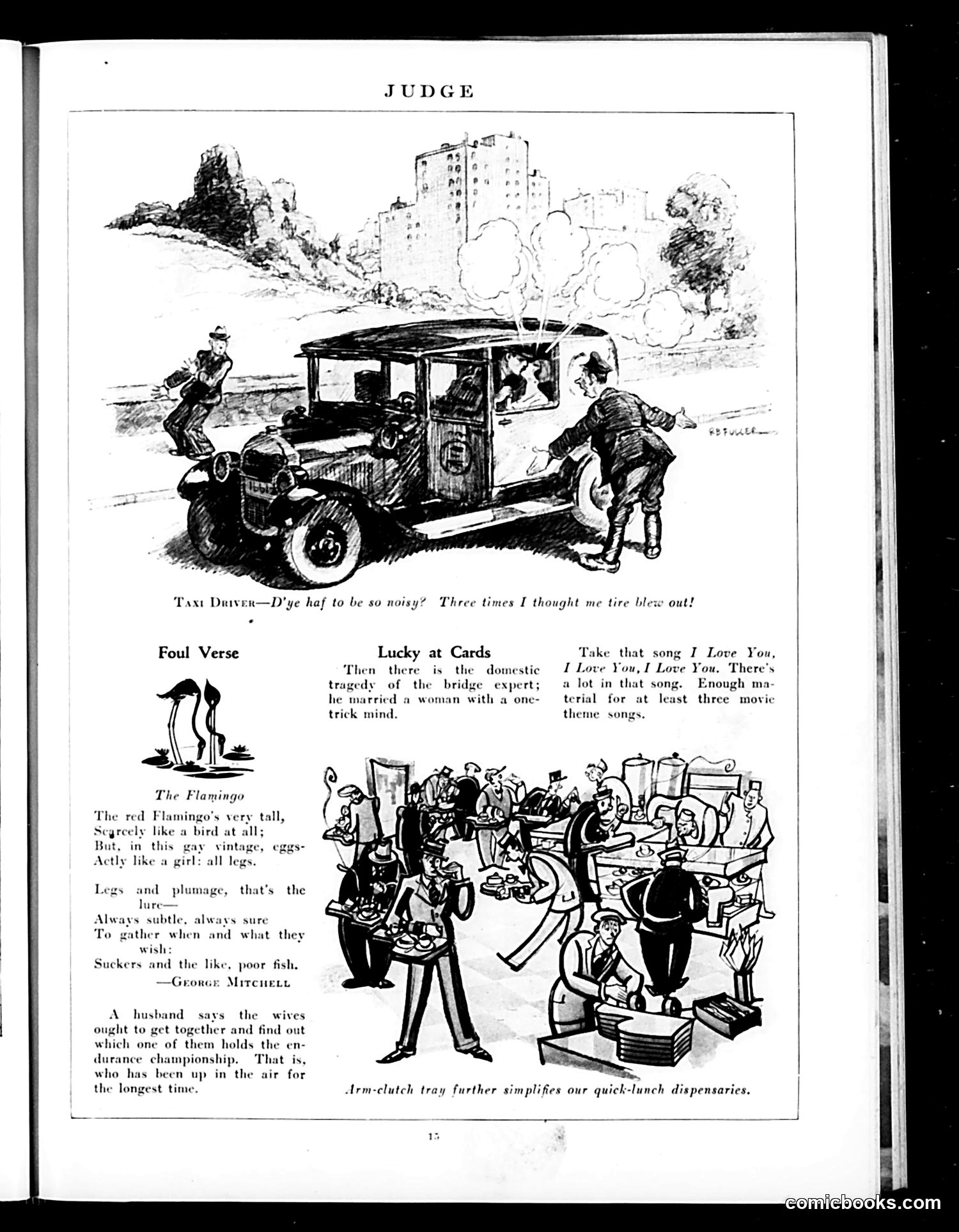
Judge Magazine Page Analysis This page from *Judge* contains three satirical humor pieces typical of 1920s-30s American comedy magazines: Top cartoon: A taxi driver complains to his passenger about noisy driving—he's swerved so violently three times he thought his tire blew. The satire mocks both reckless taxi drivers and the rough ride quality of early automobiles. "Foul Verse" section: A humorous poem about flamingos, authored by George Mitchell, uses the bird's long legs as a vehicle for mild innuendo about female attractiveness and male gullibility ("Suckers and the like, poor fish"). "Lucky at Cards" section: Two brief jokes—one about a bridge-playing husband whose wife has a "one-trick mind," and another about extracting multiple movie theme songs from a single popular song. Both mock marital dynamics and the formulaic nature of Hollywood songwriting. The overall tone is light domestic satire aimed at middle-class readers, with no apparent political content—purely social commentary on marriage, driving, and entertainment trends.
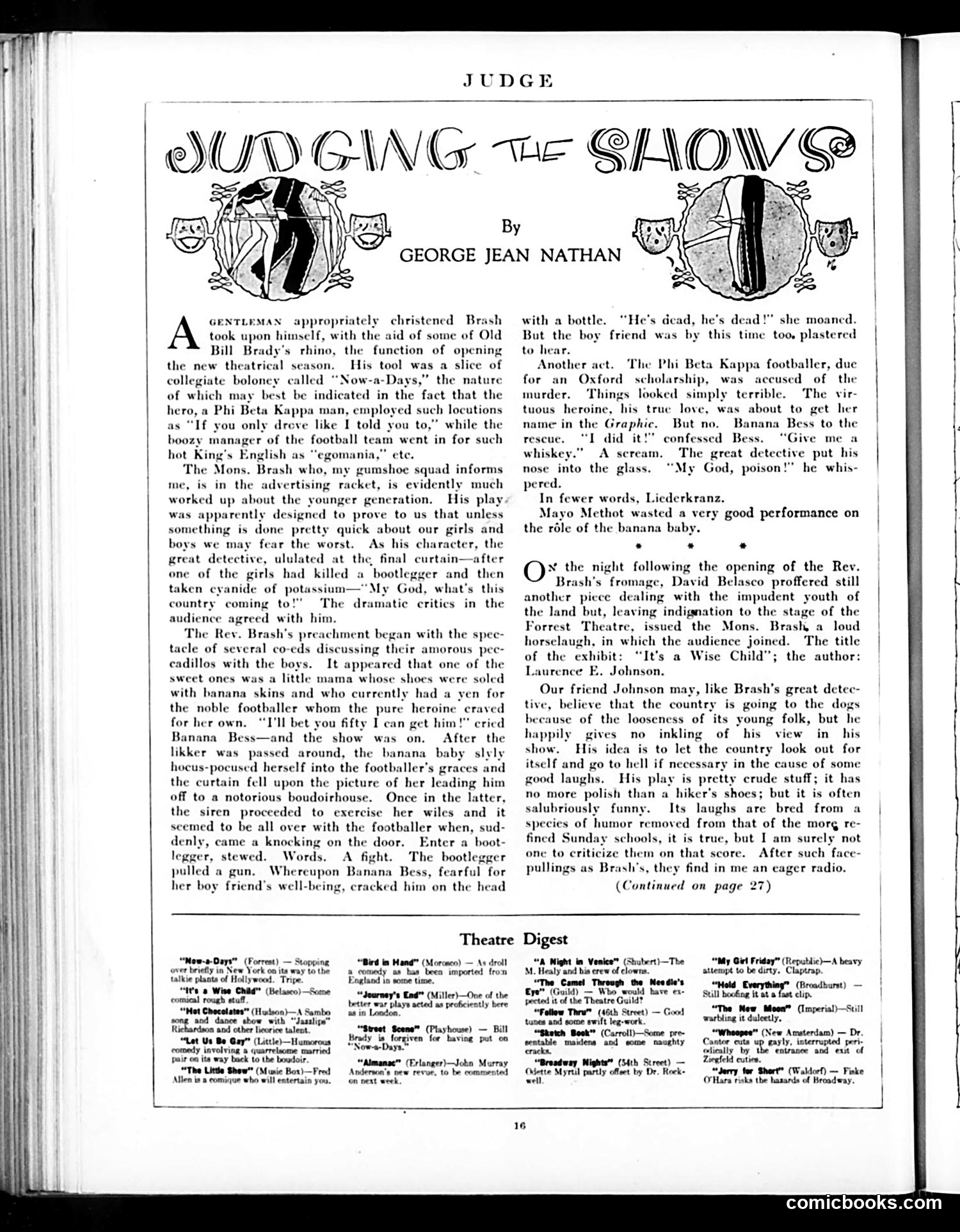
"Judging the Shows" by George Jean Nathan This is a theater review column critiquing two Broadway productions. Nathan skewers Rev. Brash's moralistic play "Now-a-Days," which depicts dissolute youth (co-eds, footballers, bootleggers) in cautionary scenarios—a girl poisoning a bootlegger, a footballer accused of murder. Nathan mocks Brash's heavy-handed moralizing and clumsy dialogue, viewing the play as preachy propaganda about generational decline. By contrast, Nathan praises Laurence E. Johnson's "It's a Wise Child" for similar subject matter (wayward youth) but executed as genuine comedy without sermonizing. Nathan dismisses concerns that crude humor is inappropriate, defending lowbrow comedy's value. The satire targets sanctimonious theater preaching morality while championing entertainment that entertains first, morals second. Nathan's persona as the irreverent critic championing artistic merit over earnest didacticism defines the piece.
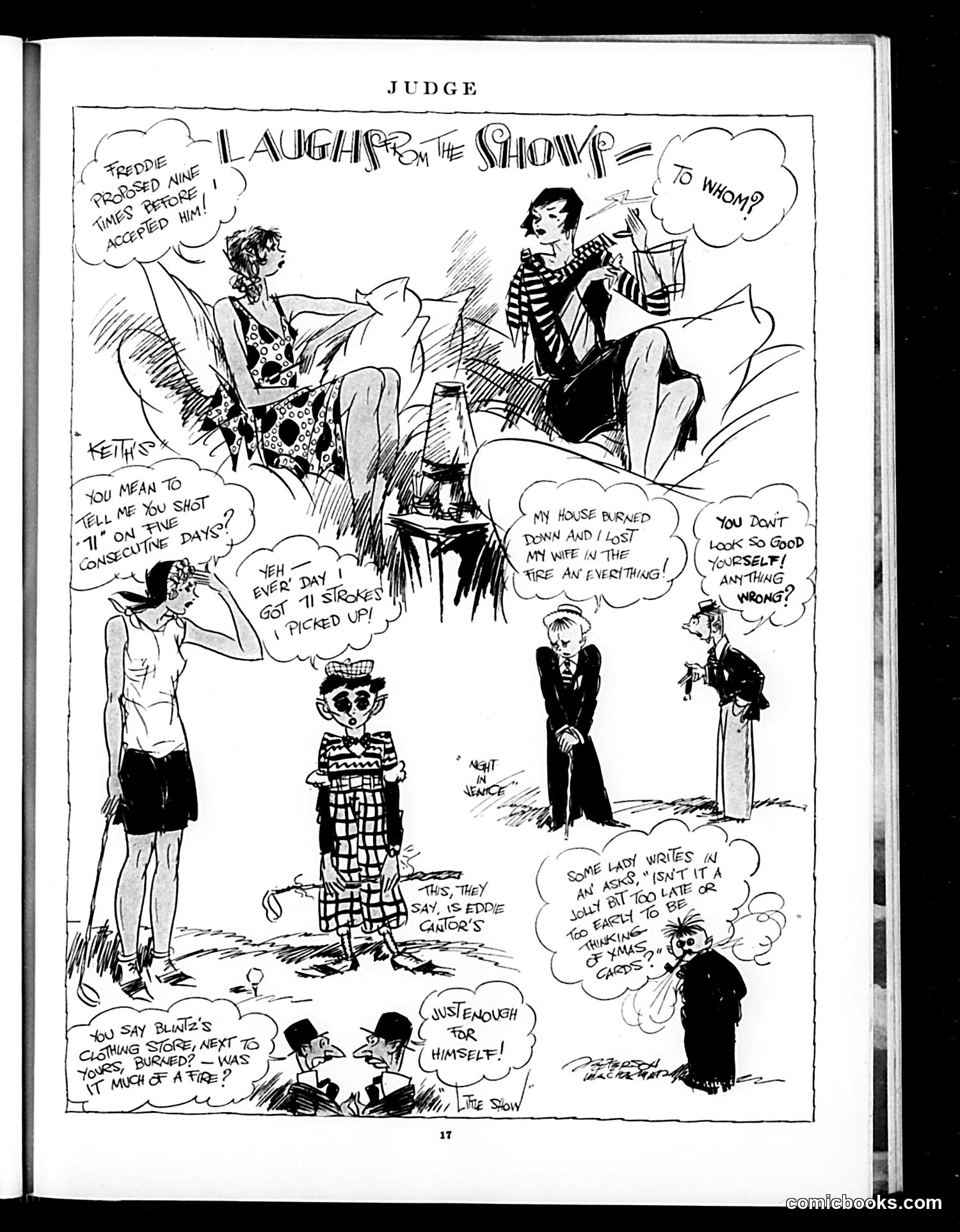
"Laughter the Shower" Satire This single-panel cartoon satirizes various social scandals and misfortunes of the era through characters meeting in heaven. The setup uses humor to comment on contemporary disasters and mishaps. Key references appear to include: a woman discussing a shooting incident ("Freddie shot nine times before I accepted him"), someone's house fire and lost insurance, mention of "Eddie Cantor's" clothing store burning, and a reference to "Blatz's" store fire. The satire works by assembling figures who've experienced public calamities—fires, scandals, accidents—as if casually meeting afterlife. One figure sardonically notes another "doesn't look so good yourself," suggesting everyone present shares equally dubious circumstances. Without clearer dates or additional context, the specific incidents referenced remain unclear, though the cartoon's broad point—mocking sensational contemporary misfortunes through dark humor—is evident. The cartoonist is identified as "Keith."
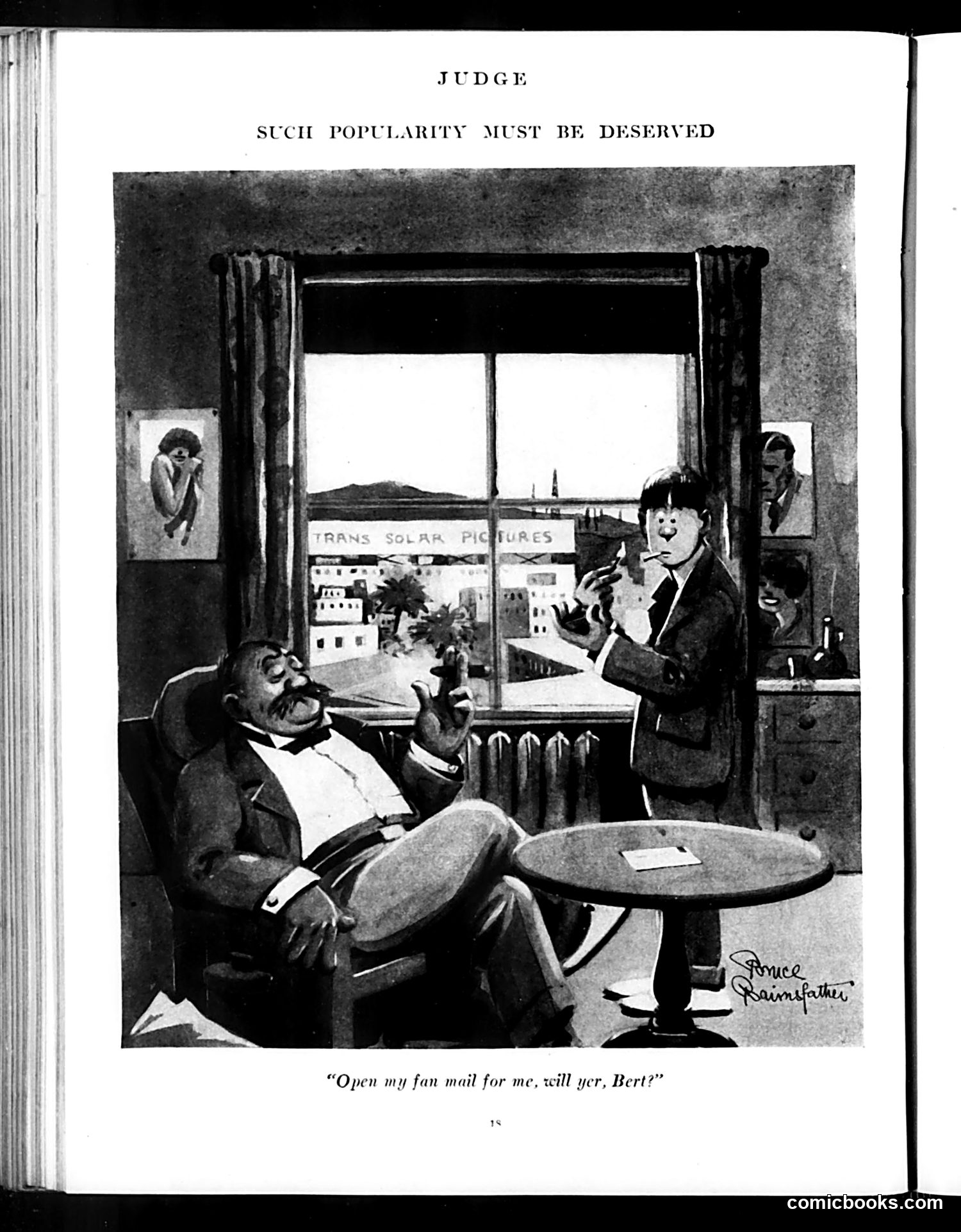
Analysis This cartoon satirizes celebrity fan mail culture. A portly, well-dressed man lounges in an office chair, lazily asking his secretary "Bert" to open his fan mail—suggesting he's too important or indolent to handle it himself. The office window shows "TRANS SOLAR PICTURES," indicating he's a film industry figure, likely a studio executive or successful actor. The satire's point: the title "Such Popularity Must Be Deserved" is ironic. The man's arrogant entitlement and refusal to personally engage with admirers undercuts any claim he's earned their affection. The joke mocks celebrity ego and the disconnect between public adulation and actual merit. The cartoon criticizes how fame breeds laziness and self-importance rather than gratitude. The illustration is credited to Bruce Bairnsfather, a known satirical cartoonist.
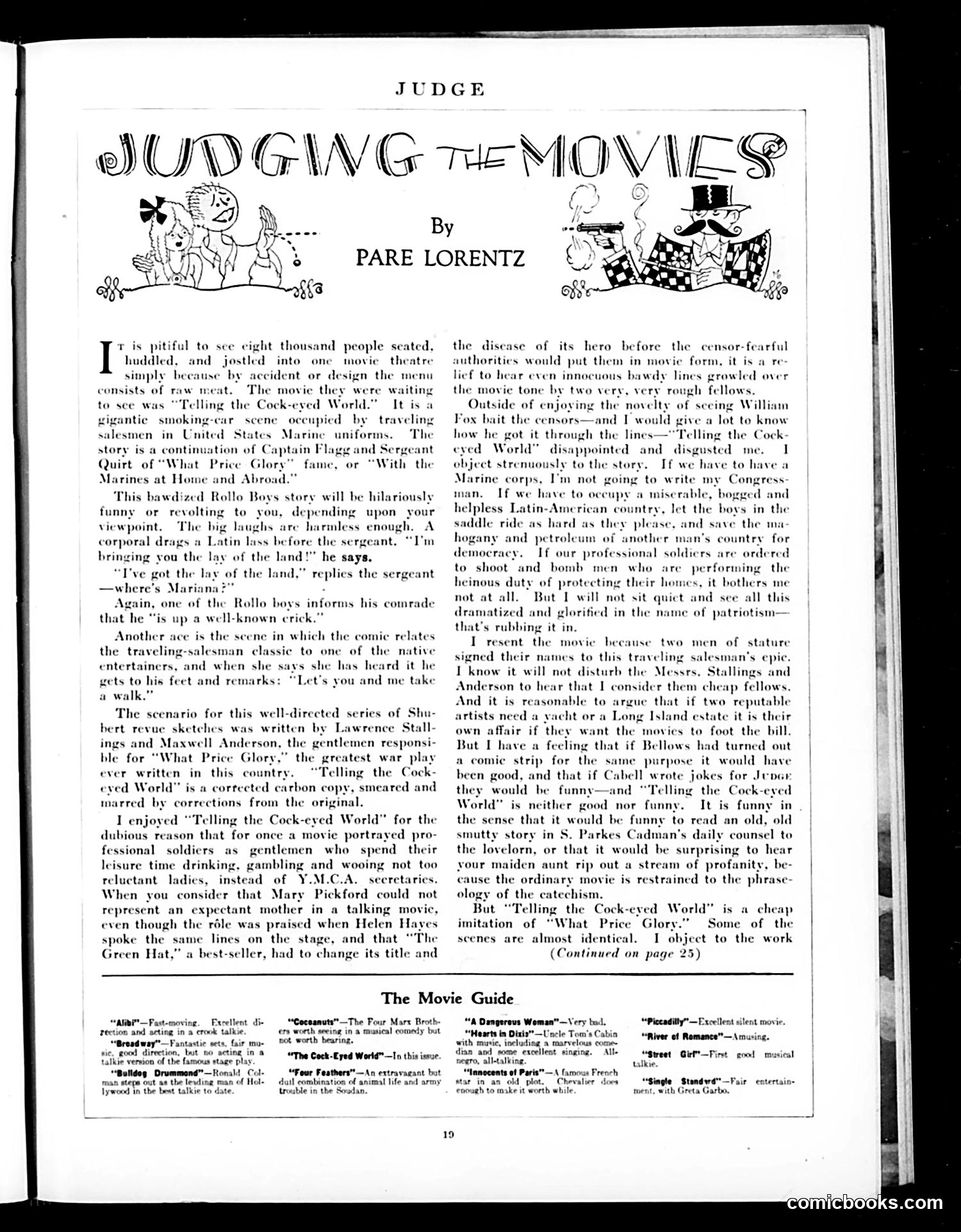
Analysis: "Judging the Movies" by Pare Lorentz This is a film review column critiquing "Telling the Cock-eyed World," a 1929 comedy sequel to "What Price Glory." The reviewer expresses conflicted feelings about the film. The central tension: The movie depicts U.S. Marines behaving rowdily—drinking, gambling, telling crude jokes—which Lorentz finds refreshingly honest compared to Mary Pickford's censored "expectant mother" roles or "The Green Hat's" sanitized plot. He appreciates that Fox managed to sneak bawdy content past censors. However, Lorentz objects strenuously to the film's glorification of military intervention in Latin America. He resents that prestigious playwrights Lawrence Stallings and Maxwell Anderson (who wrote the acclaimed WWI play "What Price Glory") lent their reputations to what he considers cheap material—merely exploiting the movies for money (to afford yachts and estates). The satire: The reviewer suggests if serious artists like George Bellows had created similar crude content, it would have merit. But applying their talents to film simply for profit represents artistic compromise and disrespects both art and audiences.
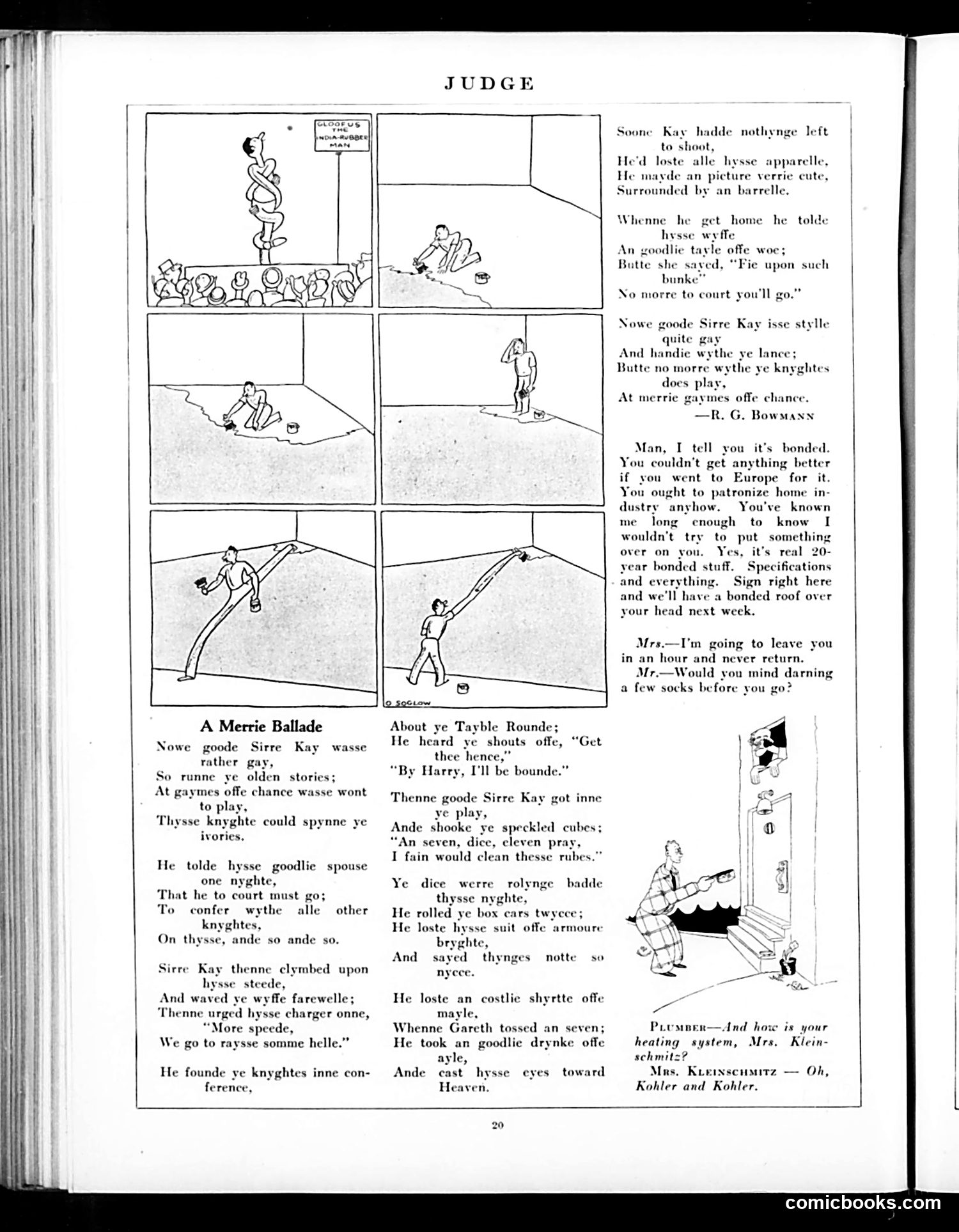
"A Merrie Ballade" — Judge Magazine This page presents a mock-medieval poem and comic strip satirizing gambling and domestic irresponsibility. The narrative follows "Sir Kay," a knight who leaves home claiming court business, but actually gambles away everything—his armor, clothes, and dignity—at dice games with fellow knights at the Round Table. He returns broke and makes excuses to his wife. The satire targets: - Male deception: husbands lying about whereabouts to gamble - Gambling addiction: losing possessions progressively - Working-class masculinity: depicted through farcical medieval language The comic strip's visual progression emphasizes the humiliation—Kay ends up nearly naked, surrounded by a barrel. The bottom cartoon about "bonded" whiskey and roofing humorously conflates dubious sales pitches, while the final domestic exchange (wife leaving, husband asking her to darn socks) continues the theme of marital discord from male irresponsibility. The medieval parody language frames contemporary 1920s vices as timeless human folly.
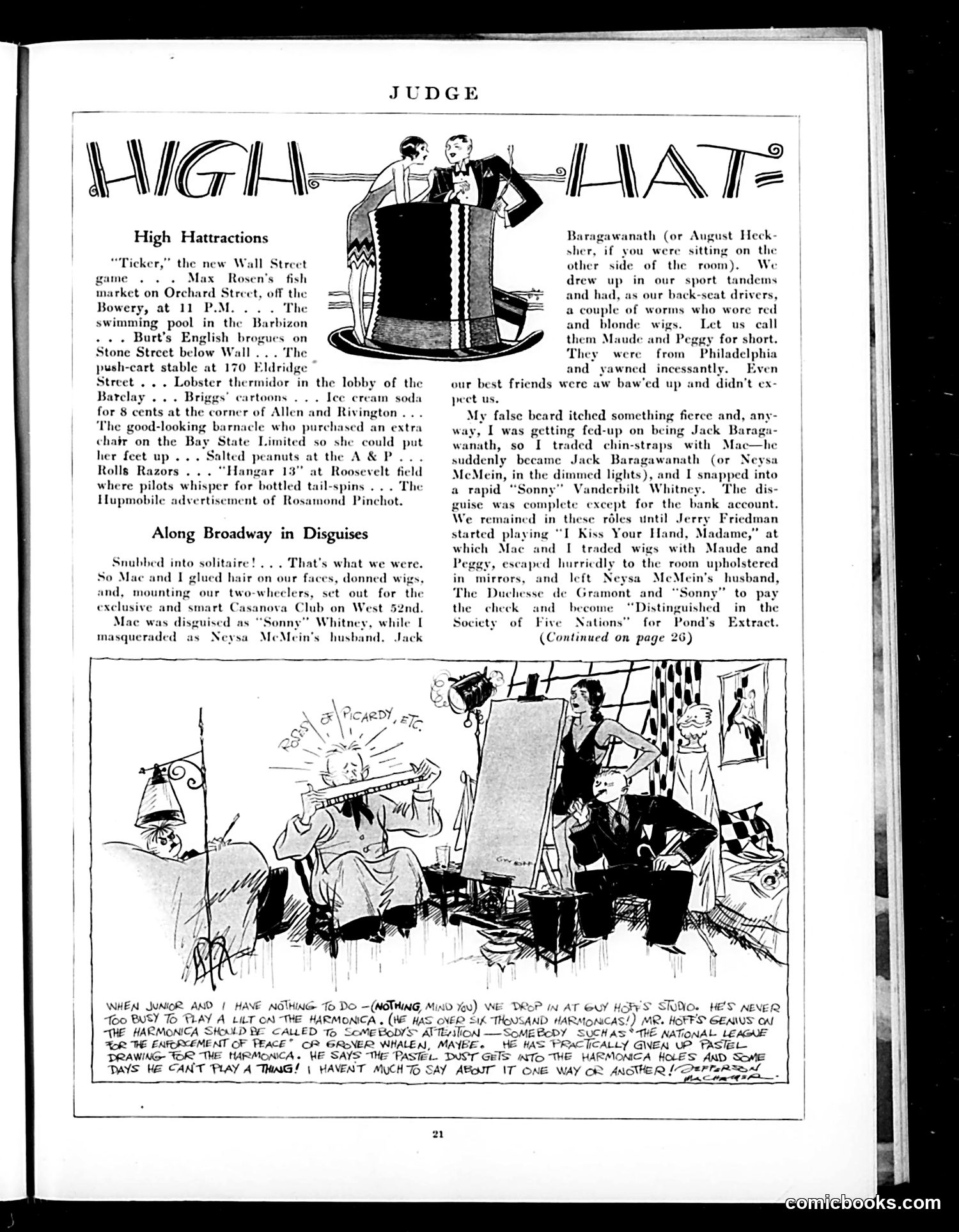
Judge Magazine Page Analysis This page from Judge magazine (circa 1920s based on references) contains two humorous pieces: "High Hat Attractions" is a satirical gossip column listing fashionable NYC activities and society figures, mocking the pretensions of wealthy New Yorkers. References include Wall Street speculation ("Ticker"), upscale restaurants, and society names like "Sonny" Whitney and Neysa McMein (a real 1920s illustrator/socialite). "Along Broadway in Disguises" is a comedic narrative about two men who disguise themselves in wigs and fake beards to sneak into the exclusive Casanova Club on West 52nd Street posing as wealthy socialites. They swap disguises mid-evening, creating confusion. The joke satirizes both the superficiality of high society (appearance-based admission) and the gullibility of exclusive clubs. The cartoon below appears to depict someone complaining that Guy Hoff, a harmonica enthusiast, plays so constantly that pastel dust clogs his instrument—a lighthearted complaint about obsessive hobbyists. The overall tone ridicules 1920s Manhattan elite pretension and exclusivity.
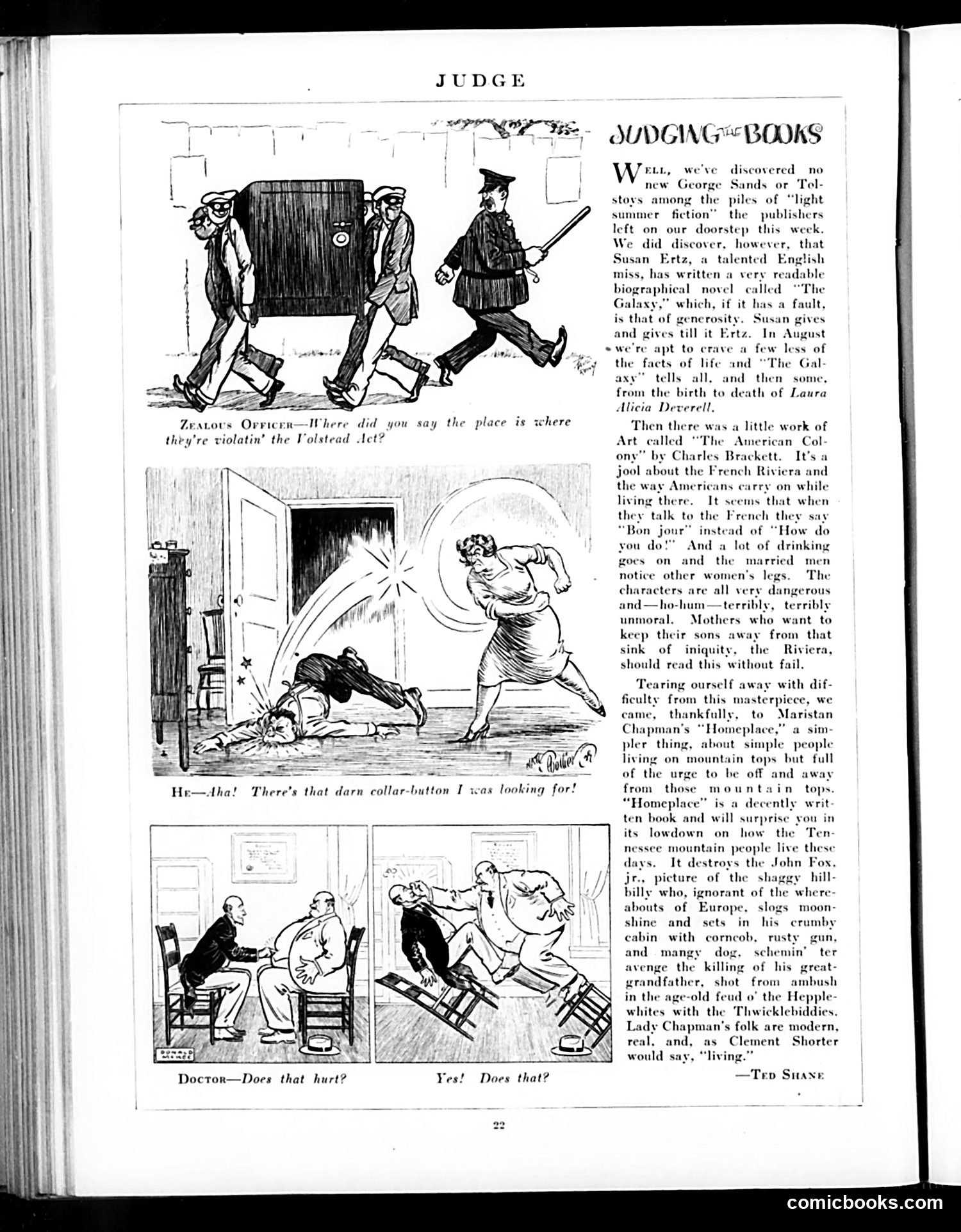
Judge Magazine Book Review Page This is a book review section titled "Judging the Books." The page discusses three novels: Susan Ertz's *The Galaxy* (praised for generosity), Charles Brackett's *The American Colony* (satirizing wealthy Americans on the French Riviera who drink heavily and flirt), and Marian Chapman's *Homeplace* (about Tennessee mountain people). The three cartoons are unrelated humorous vignettes: The top shows a Prohibition-era joke about violating the Volstead Act (the law banning alcohol). The middle depicts someone triumphantly finding a lost collar button. The bottom shows a doctor examining a patient, asking "Does that hurt?" repeatedly. These cartoons are typical Judge filler—lighthearted gags without political content. The page demonstrates how satirical magazines mixed literary criticism with humor to entertain readers during the 1920s.
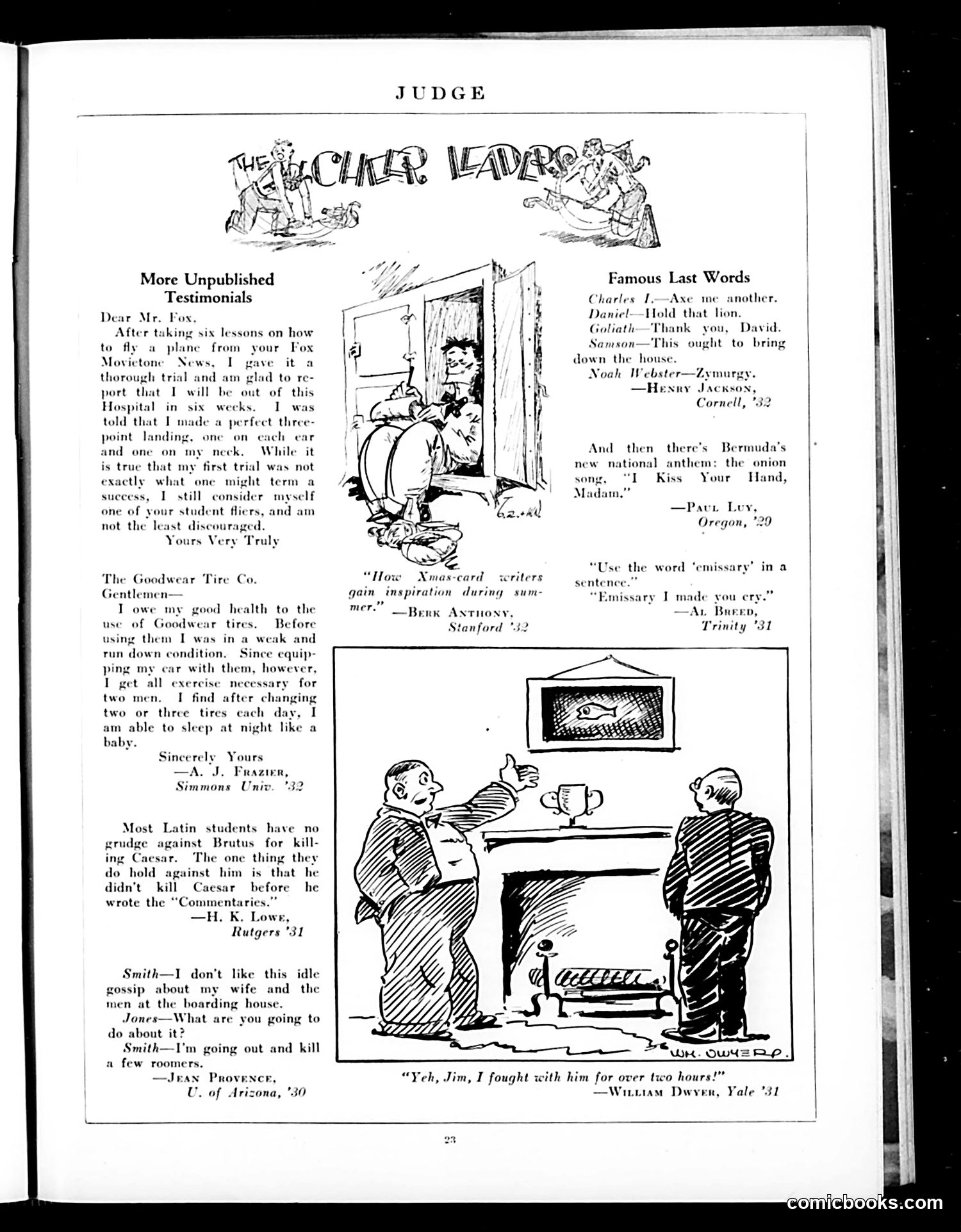
Judge Magazine Page Analysis This page from *Judge* magazine features humorous fake testimonials and jokes from college students (circa 1930-32). "More Unpublished Testimonials" satirizes advertising claims through absurd letters: - A Fox Movietone News flying lesson results in a hospital stay after a botched landing - Goodwear Tire Company credit for health improvements (the writer changes tires constantly, exhausting himself into sleep) - A Latin student complaint: while Brutus is forgiven for killing Caesar, he's condemned for *not* killing Caesar before writing the Commentaries "Famous Last Words" pairs historical/biblical figures with puns on their names or fates (Charles I—execution by axe; David defeating Goliath; Samson bringing down the temple). The cartoon (captioned by William Dwyer, Yale '31) shows two men fighting over what appears to be a fireplace or stove, with one bragging about a two-hour fight—likely mocking exaggerated boasting about trivial disputes. The page's recurring theme: college students making clever, often dark jokes about accidents, violence, and misfortune—typical of collegiate humor magazines of this era.
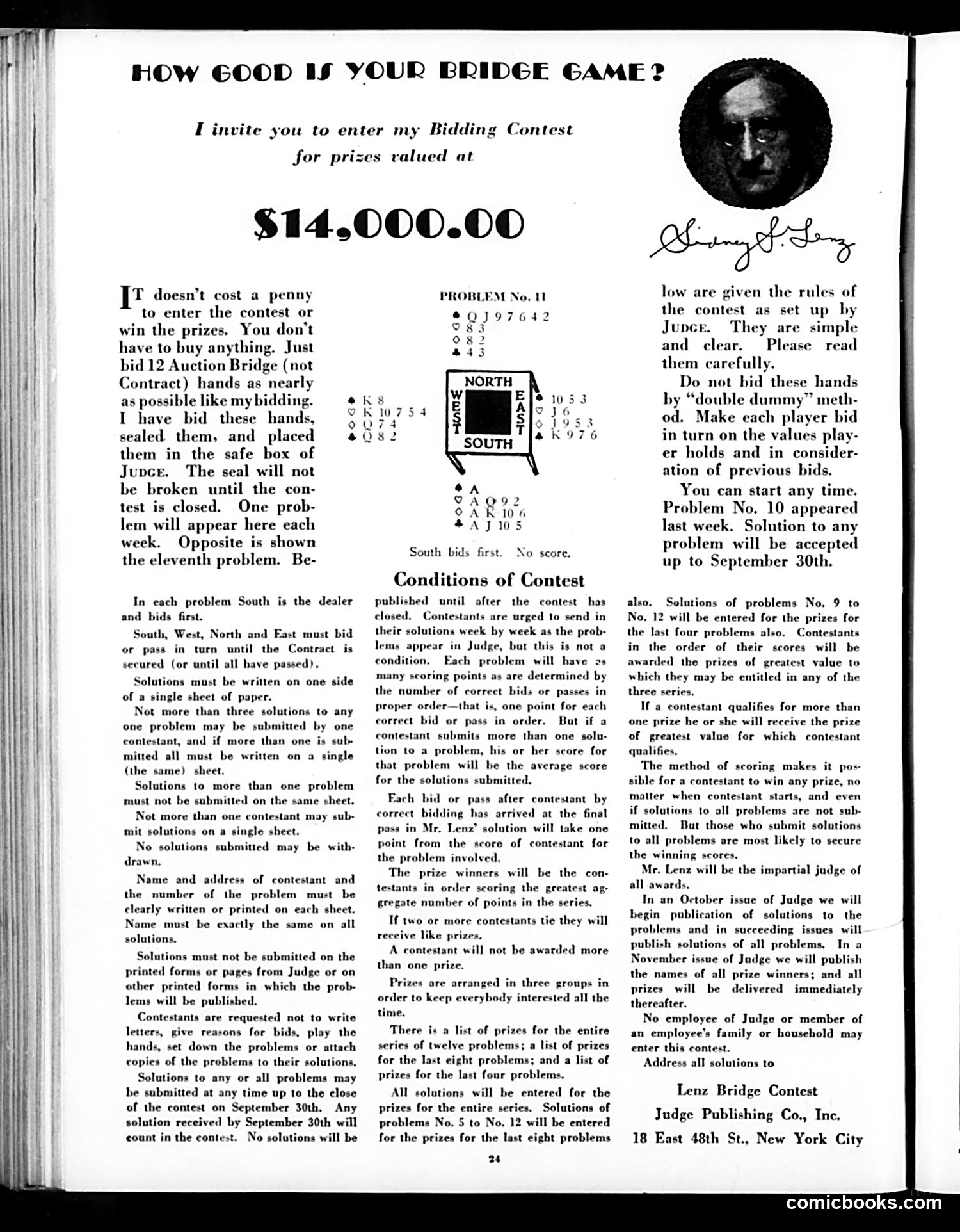
Judge Magazine Bridge Contest (Likely 1920s-1930s) This is a contest advertisement, not a political cartoon. It announces a $14,000 bidding contest for "Auction Bridge"—a popular card game of the era (the precursor to modern Contract Bridge). The photograph shows what appears to be Mr. Lenz, identified in the rules as the contest judge who has sealed the winning bids in Judge's safe. The contest invites readers to bid 12 hands "as nearly as possible" like Lenz's own bids, competing for significant prize money across three prize tiers. The satirical angle—if any—lies in the *implied* challenge: can ordinary players match the bidding decisions of an expert? The page emphasizes that this requires no purchase, making it accessible to Judge's readership as both entertainment and a test of bridge skill. This reflects bridge's status as a serious competitive pursuit among educated Americans during this period.
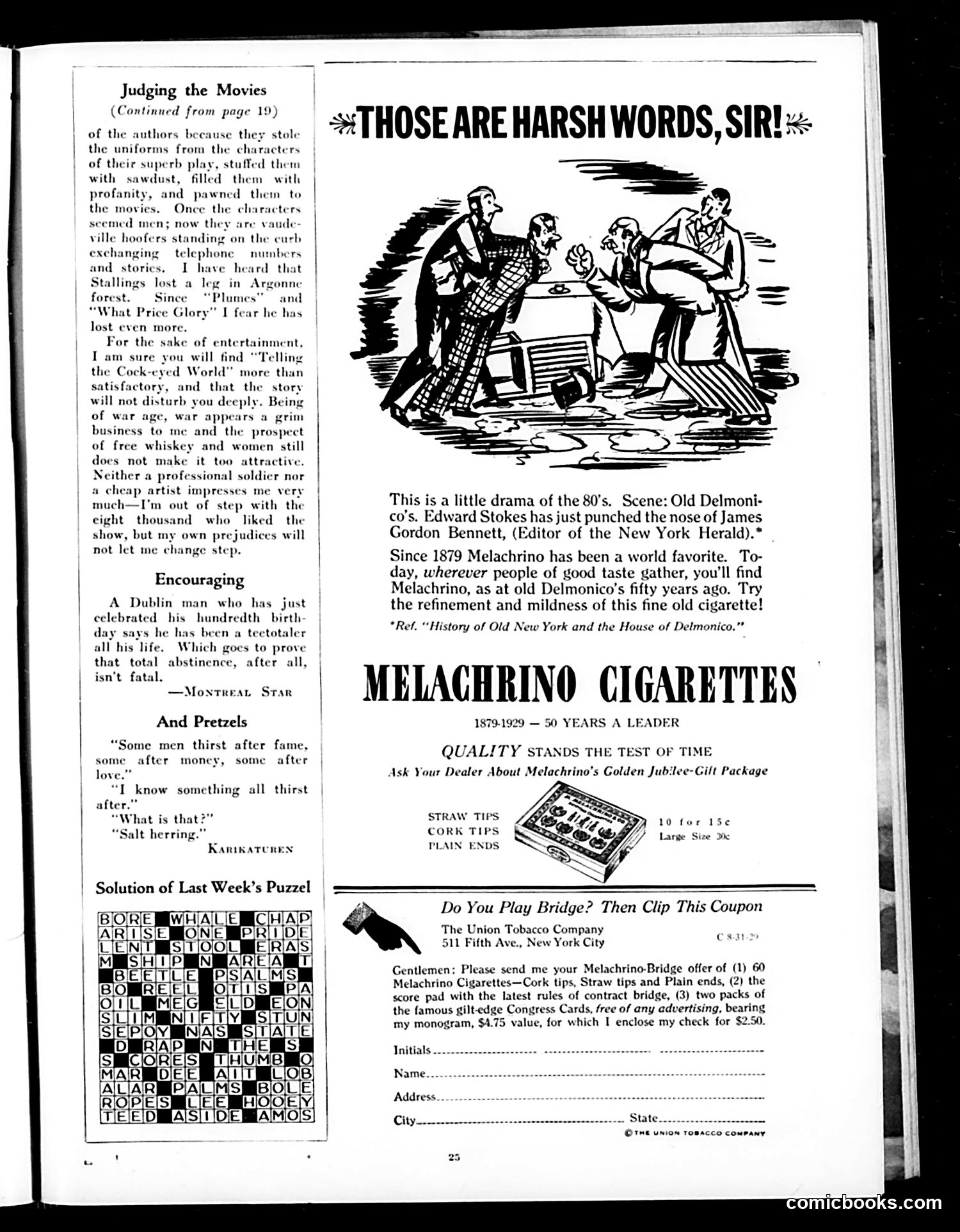
Analysis: "Those Are Harsh Words, Sir!" This cartoon depicts a famous 1879 incident at Delmonico's restaurant in New York. Edward Stokes punches newspaper editor James Gordon Bennett in the nose—apparently over Bennett's harsh editorial criticism. The scene shows four men reacting with shock to this violence. The satire works on two levels: First, it mocks the thin-skinned responses of prominent men to criticism, suggesting that even powerful figures resort to physical assault when insulted. Second, the cartoon appears in a 1929 cigarette advertisement, which uses this "refined" historical anecdote to associate Melachrino cigarettes with old New York sophistication and gentlemanly taste—ironically, while depicting ungentlemanly violence. The humor lies in promoting cigarettes through a story of brutal assault, implying that smoking Melachrino connects the buyer to this "refined" (yet violent) era.
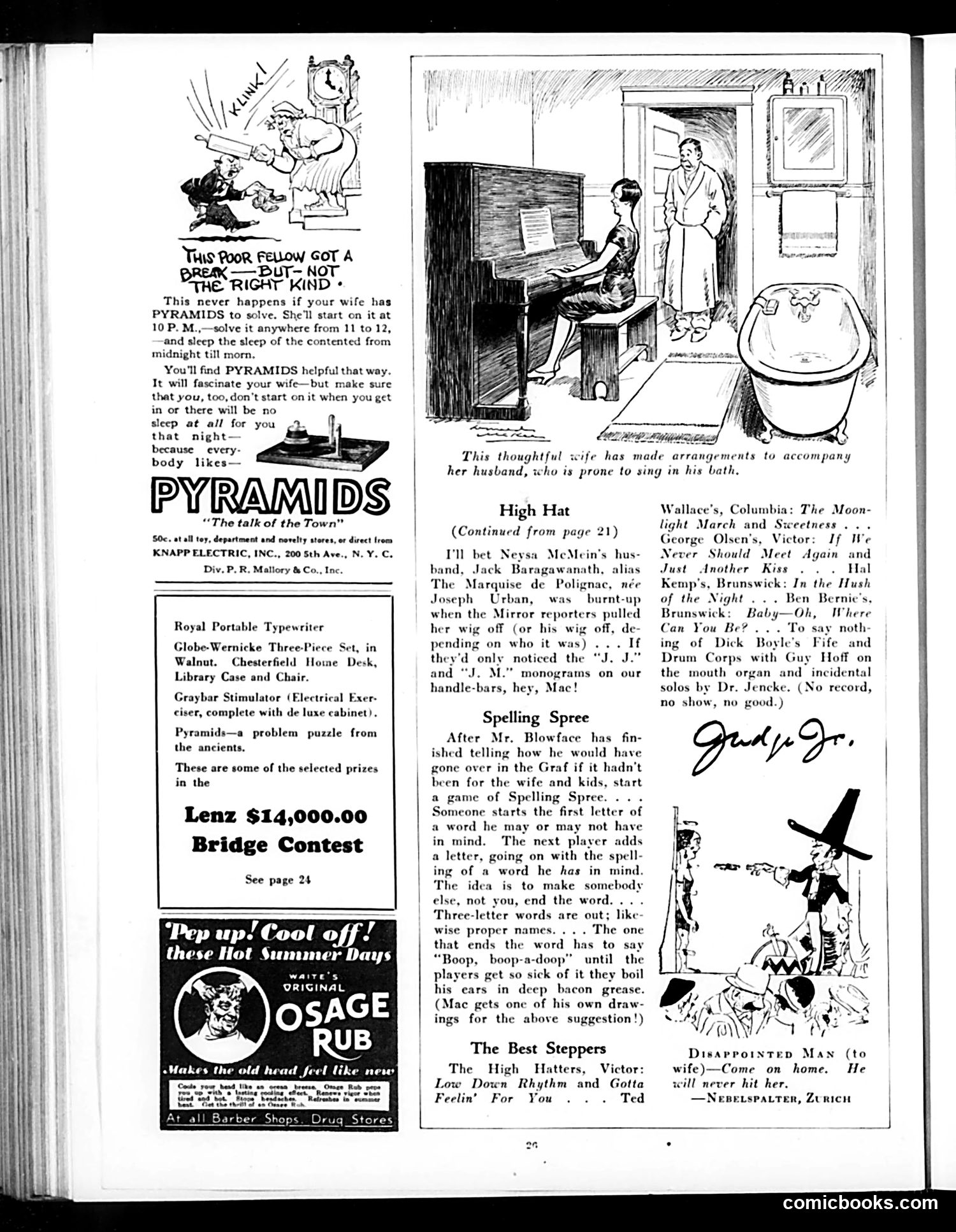
Analysis of Judge Magazine Page This page is primarily advertising and entertainment listings rather than political satire. The main content includes: Advertisement: A "Pyramids" puzzle game ad with a small cartoon showing a man being struck by a falling object, joking that the puzzle will keep wives occupied at night so husbands can sleep—though if he joins in, neither will sleep. Entertainment Listings: "High Hat," "Spelling Spree," and "The Best Steppers" columns reviewing popular music records and suggesting party games. These reference 1920s-30s jazz bands (George Olsen, Ben Bernie) and recording labels (Victor, Brunswick, Columbia). Social Humor: Brief satirical vignettes mocking domestic life, including a sketch of a thoughtful wife accompanying her bath-singing husband, and a disappointed husband's lament that his wife will never hit him. The page reflects period leisure culture—puzzle crazes, jazz recordings, and parlor games—rather than addressing political issues. The satire is mild and domestic-focused rather than hard-hitting social commentary.
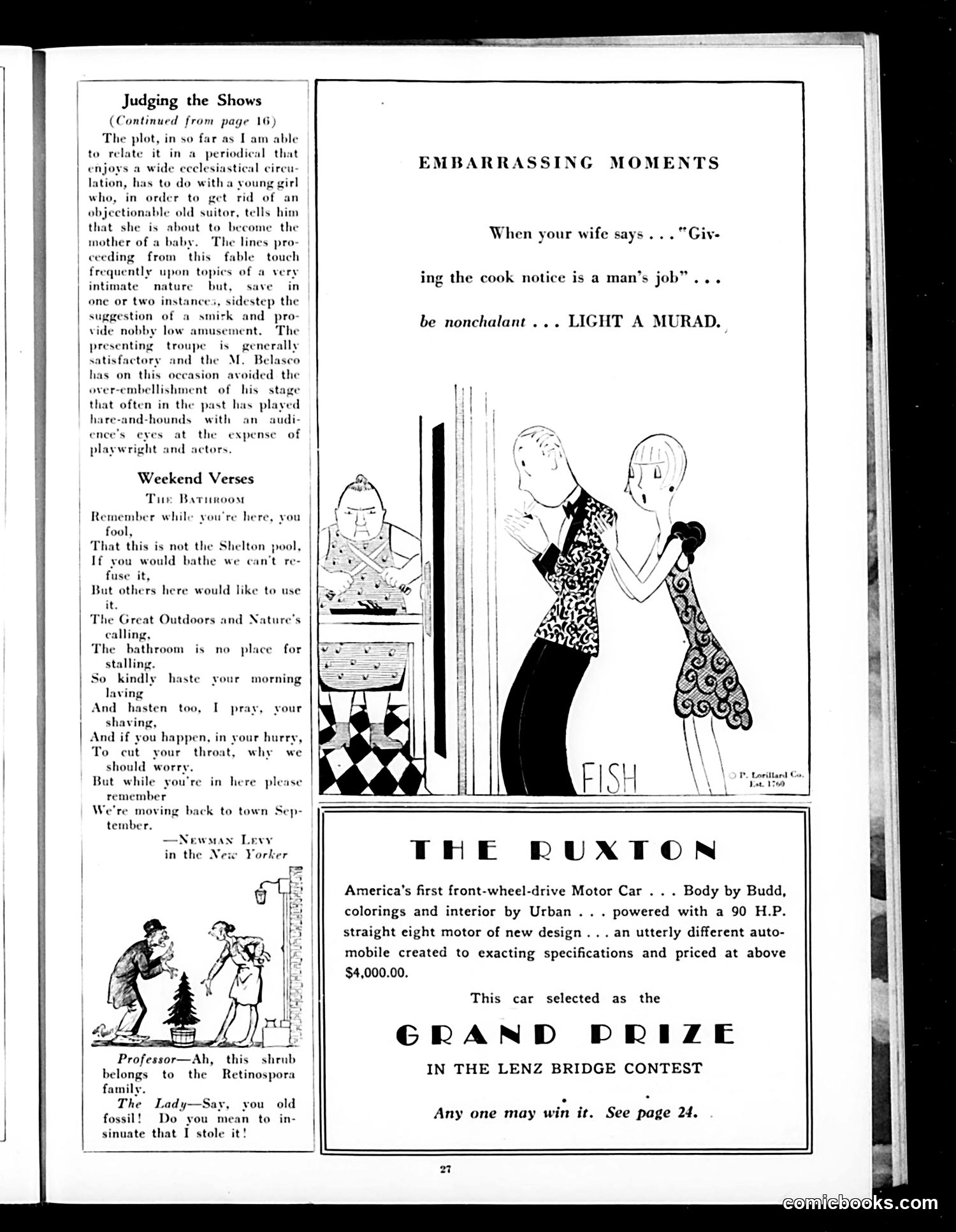
Explanation for Modern Readers This page mixes theatrical criticism, humor, and advertising typical of 1920s Judge magazine. "Judging the Shows" reviews a stage production dealing with an unmarried pregnancy—scandalous subject matter for the era, requiring careful, euphemistic handling in a magazine with "wide ecclesiastical circulation" (church readership). The critic praises the M. Belasco production company for handling delicate material tastefully without smirking. "Weekend Verses" is a humorous poem mocking houseguests who monopolize bathrooms during weekend visits, threatening to return to town in September. "The Professor" cartoon jokes about a woman mishearing botanical terminology—"Retinospora family" sounds like "retirement of a spora," which she interprets as an accusation of theft. "Embarrassing Moments" is a cigarette advertisement using social anxiety as a sales hook: smoking a Murad cigar provides masculine composure when delivering bad news (firing the cook) to one's wife. "The Ruxton" advertises an innovative automobile as a contest prize, emphasizing its front-wheel-drive design and $4,000+ price point—luxury positioning for affluent readers.
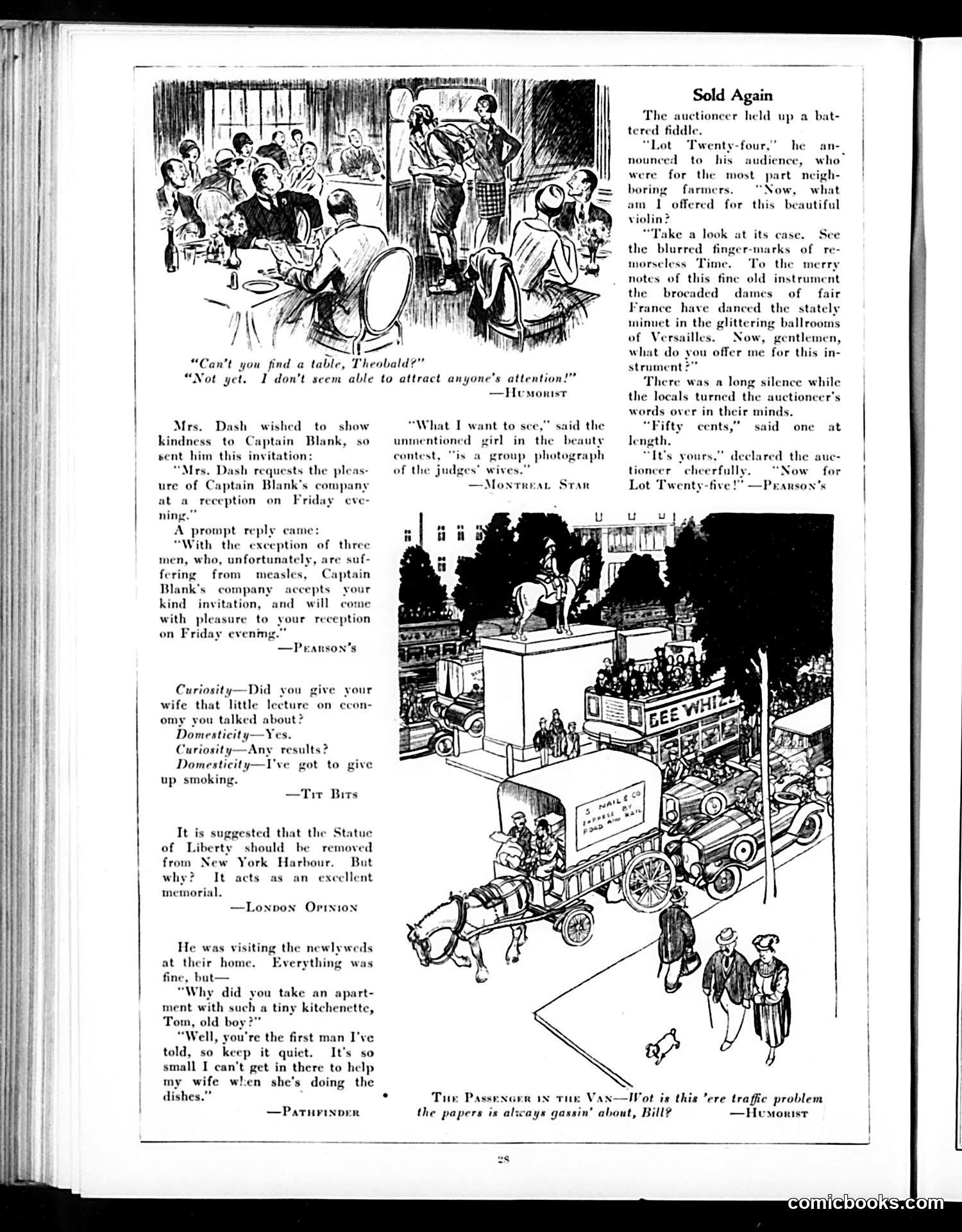
Analysis of Judge Magazine Page This page contains several short humorous sketches typical of early 20th-century American satirical magazines: "Sold Again" (main cartoon): An auctioneer uses flowery, exaggerated language to sell a worthless old fiddle to rural farmers, invoking its supposed French aristocratic provenance and dancing at Versailles. The joke: the locals are fooled by his salesmanship into bidding fifty cents for junk—satirizing both gullible country folk and con-artist auctioneers. Other brief jokes target domestic life and social embarrassment: a restaurant patron can't get service; a wife economizes by forcing her husband to quit smoking; a newlywed takes a tiny kitchen to avoid helping with dishes; a city dweller complains about traffic. The page reflects period preoccupations: rural/urban class differences, marriage dynamics (wives controlling spending), and consumer deception. The humor assumes readers shared certain class attitudes about rural naiveté and commercial trickery.
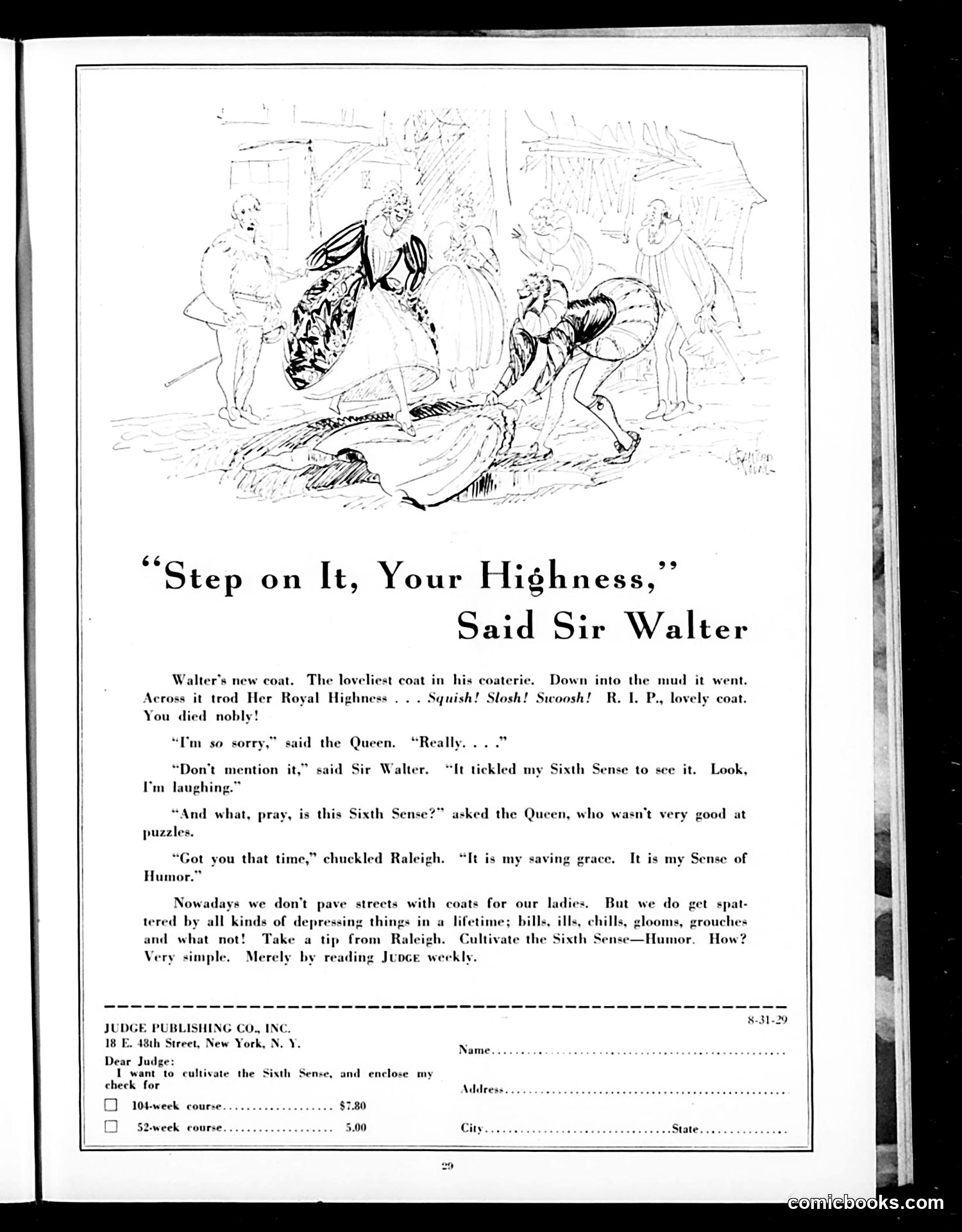
"Step on It, Your Highness" — Judge Magazine Satire This is a humorous advertisement disguised as a short story, promoting Judge magazine's supposed ability to cultivate a "Sixth Sense" of humor. The narrative references Sir Walter Raleigh's legendary gesture of laying his coat in mud for Queen Elizabeth I. Here, a modern "Sir Walter" sacrifices his new coat when royalty steps on it, but cheerfully accepts the ruined garment, claiming his "Sixth Sense"—humor—allows him to laugh it off. The satire's point: modern life constantly subjects us to disappointments (bills, illness, complaints), but humor provides salvation. The implicit argument is that reading Judge weekly will cultivate this protective sense of humor. This is primarily self-promotion advertising, using a historical reference (Raleigh) and wordplay ("Sixth Sense") to make magazine subscription seem like practical life advice rather than commercial pitch. The tone is whimsical and lighthearted—typical Judge style.
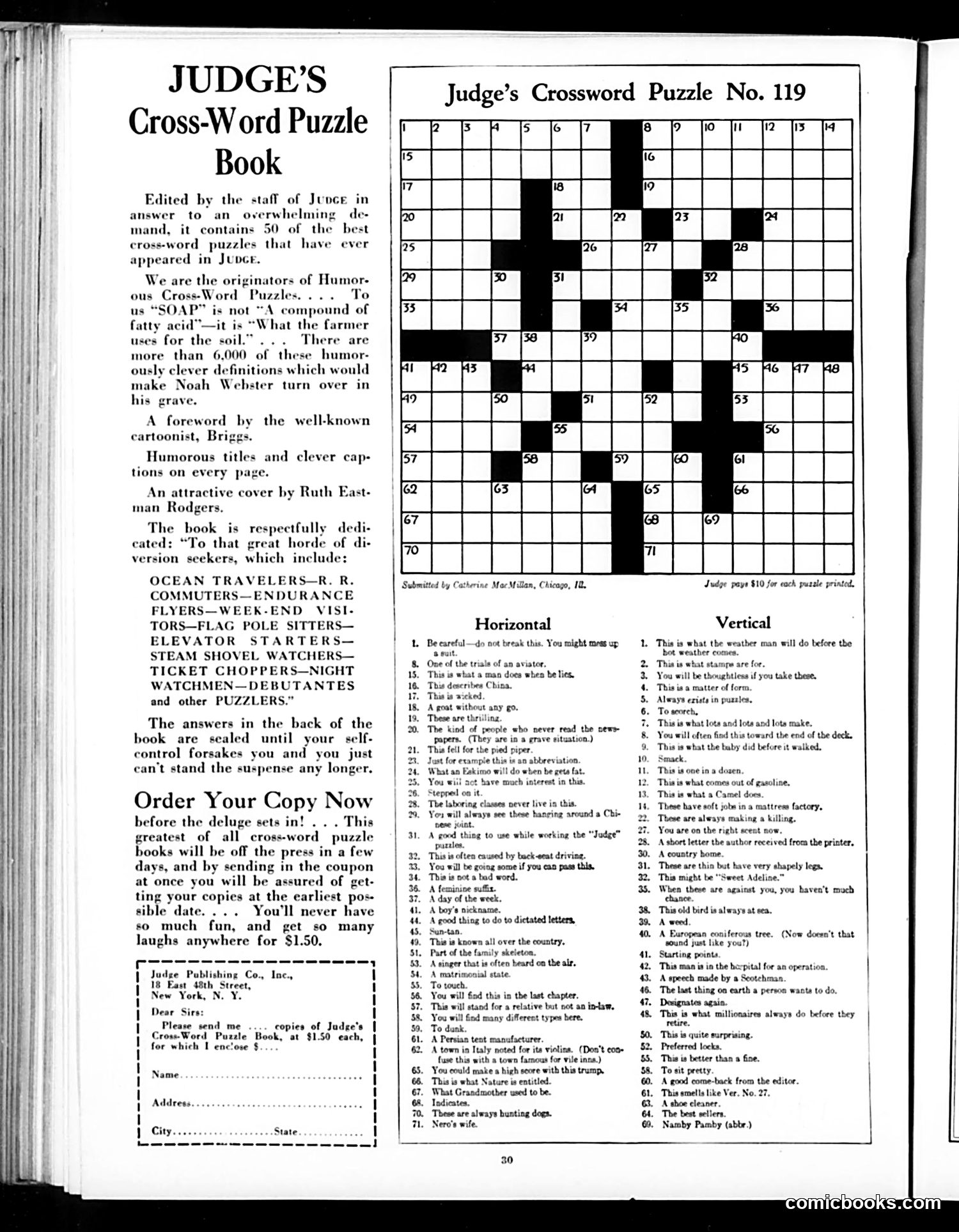
Judge Magazine Crossword Puzzle Book Advertisement This page is primarily an advertisement and order form for Judge magazine's crossword puzzle book, not a political cartoon. The advertisement pitches a collection of 50 crossword puzzles, marketed as humorous rather than straightforward. Judge emphasizes they "originated" funny crossword puzzles with clever definitions—giving the example that "SOAP" means "What the farmer uses for the soil" rather than a chemical compound. The book includes a foreword by cartoonist Briggs and is dedicated to various "diversion seekers" like commuters, night watchmen, and debutantes. The actual crossword puzzle (No. 119) appears on the right side with humorous clues matching this approach. The advertisement encourages immediate ordering at $1.50, warning the book will "be off the press in a few days," with an order coupon below. This reflects Judge's business model of selling branded merchandise to its readership during the early-to-mid 20th century.
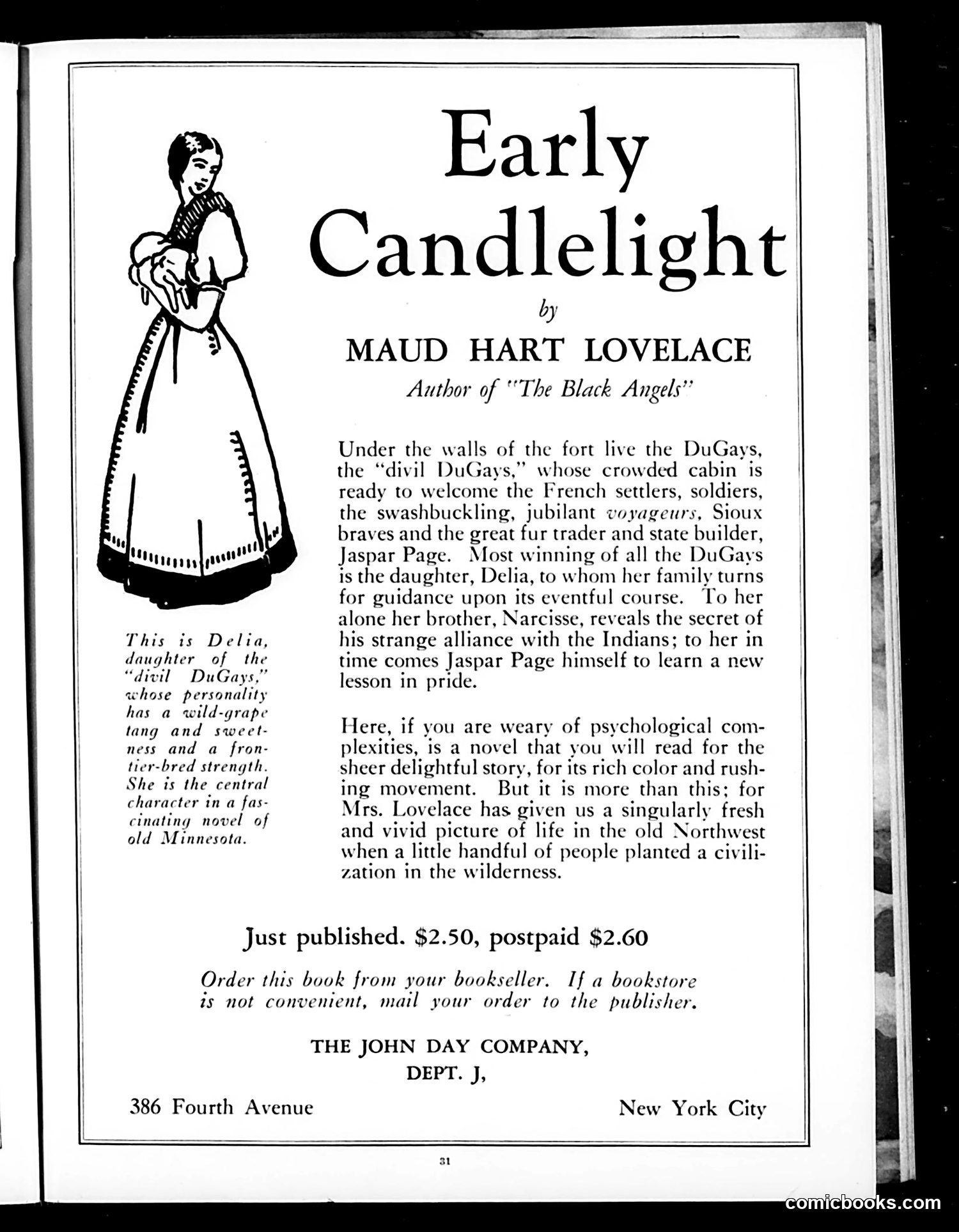
This is not a cartoon or satire—it's a book advertisement page. The image shows a illustrated woman in period dress (labeled as Delia, the novel's protagonist) alongside promotional text for *Early Candlelight* by Maud Hart Lovelace, published by The John Day Company. The ad describes a historical novel set in old Minnesota, featuring the "DuGays" family and frontier characters like fur traders and Sioux braves. The text emphasizes the book offers an engaging narrative with "rich color and rushing movement" set during early European settlement in the Northwest wilderness. This appears in *Judge* magazine simply as a paid advertisement, not editorial content or satire. The price ($2.50, or $2.60 postpaid) and publisher information are provided for ordering.
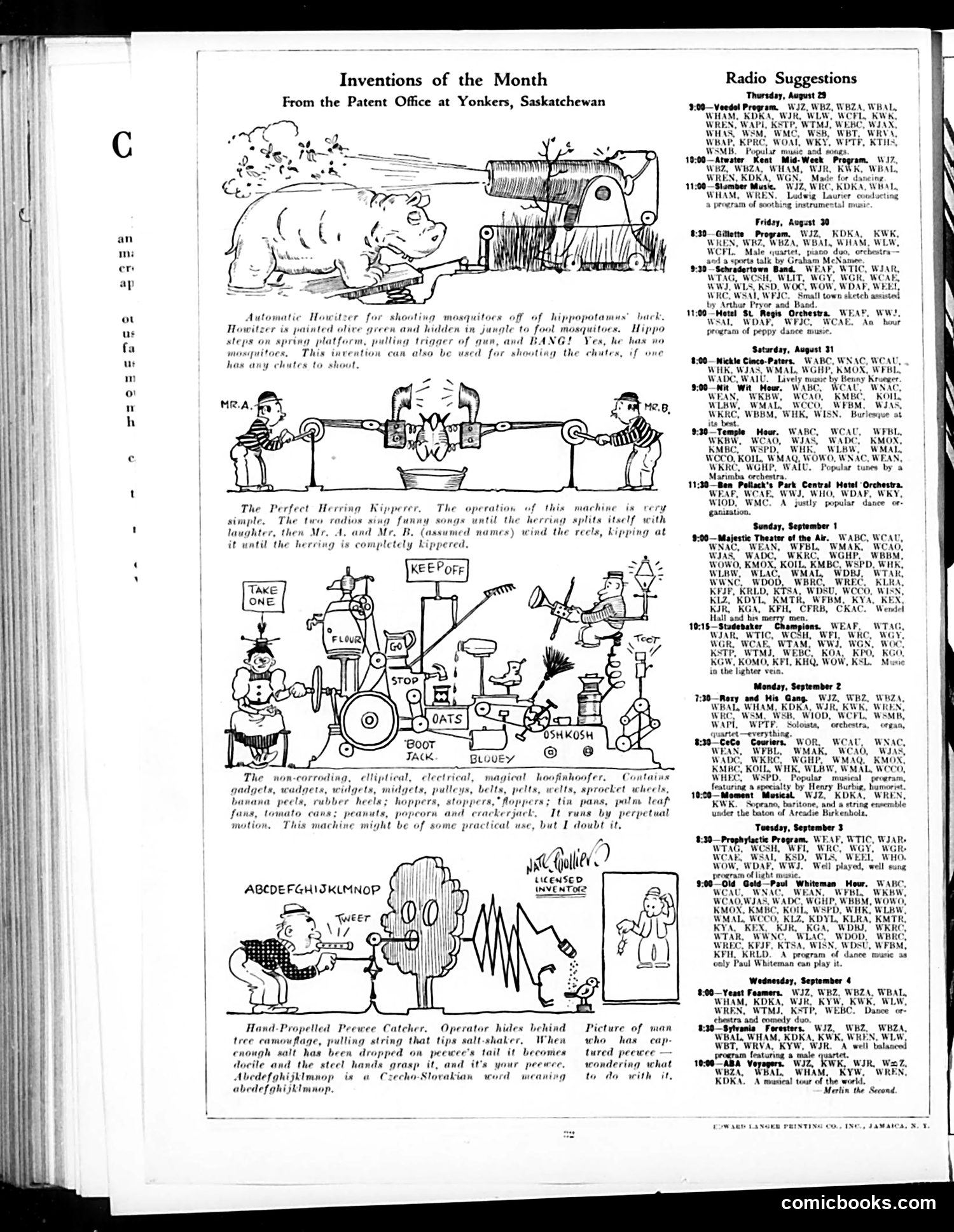
"Inventions of the Month" — Judge Magazine Satire This page presents absurdist "patent office inventions" from the fictional "Patent Office at Yonkers, Saskatchewan"—clearly a joke location, as Saskatchewan has no such office. The cartoons mock frivolous or impractical inventions: 1. Automatic Mosquito Howitzer: A contraption to shoot mosquitoes bothering a hippopotamus—ridiculously over-engineered for a trivial problem. 2. Perfect Herring Kipperer: Two men operate a machine using radios to make "funny songs" that cause herrings to split themselves—nonsensical and absurd. 3. Non-Corroding Machine: A chaotic contraption filled with random household junk (gadgets, rubber heels, tomato cans, peanuts) that "runs by perpetual motion" but admits it's impractical. 4. Hand-Propelled Peewee Catcher: Uses a string-triggered salt-shaker to subdue small birds, featuring a "Czechoslovakian word" joke. The satire mocks real patent culture—showing how absurd "inventions" could theoretically exist while highlighting human tendency toward over-complication.
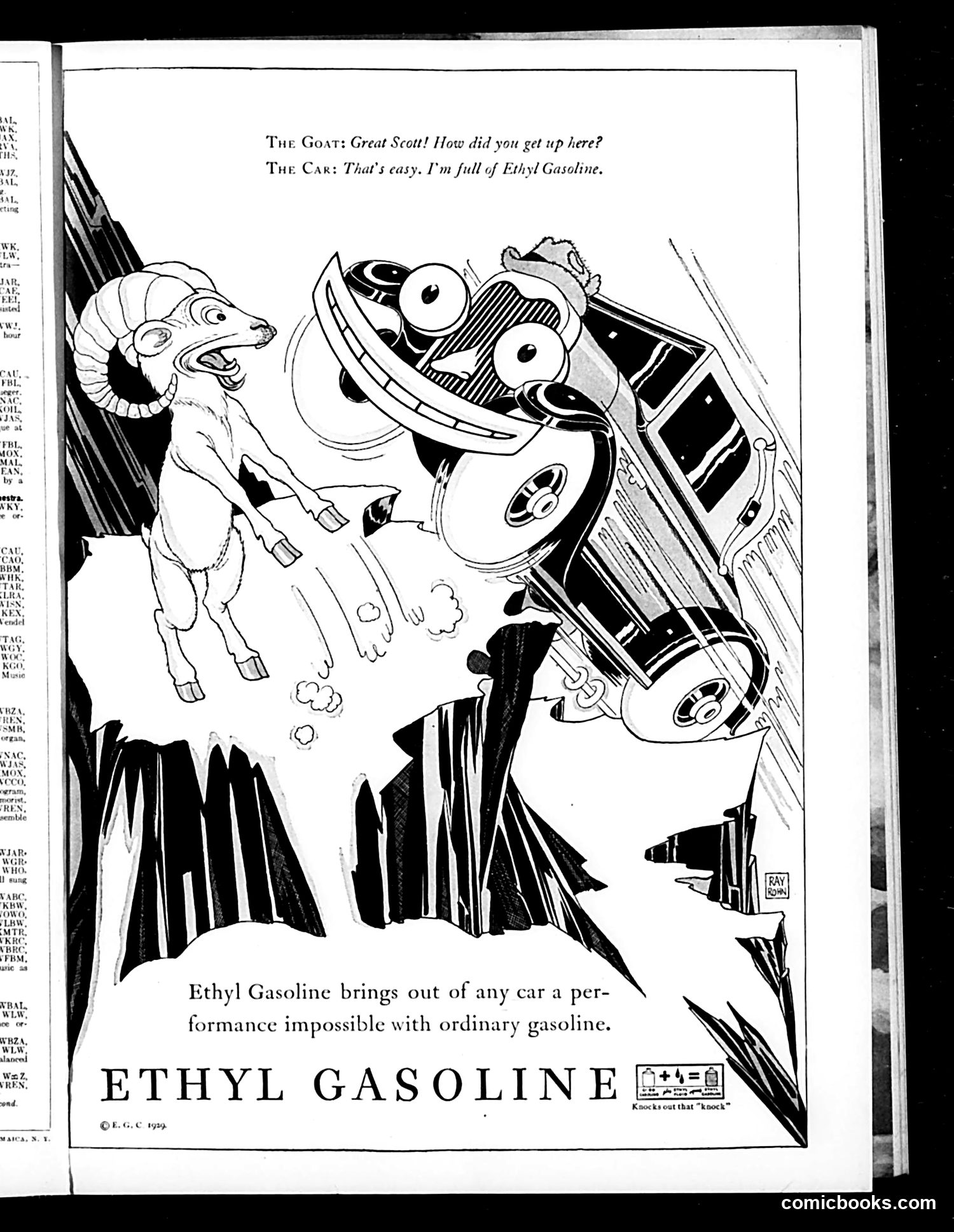
Ethyl Gasoline Advertisement This is a product advertisement, not political satire. It depicts a anthropomorphized car meeting a goat on what appears to be a cliff or high terrain. The car boasts that it reached this impossible location because it's powered by Ethyl Gasoline, implying the fuel provides extraordinary performance. The humor is straightforward: the car's superior fuel allows it to accomplish feats no ordinary gasoline-powered vehicle could manage. The confused goat serves as the audience surrogate, amazed at the car's climbing ability. This reflects early 20th-century marketing emphasizing ethyl gasoline's technical superiority—it was a significant fuel innovation marketed for performance enhancement. The cartoon's surreal premise (cars meeting goats on cliffs) was typical of Judge magazine's playful advertising approach.
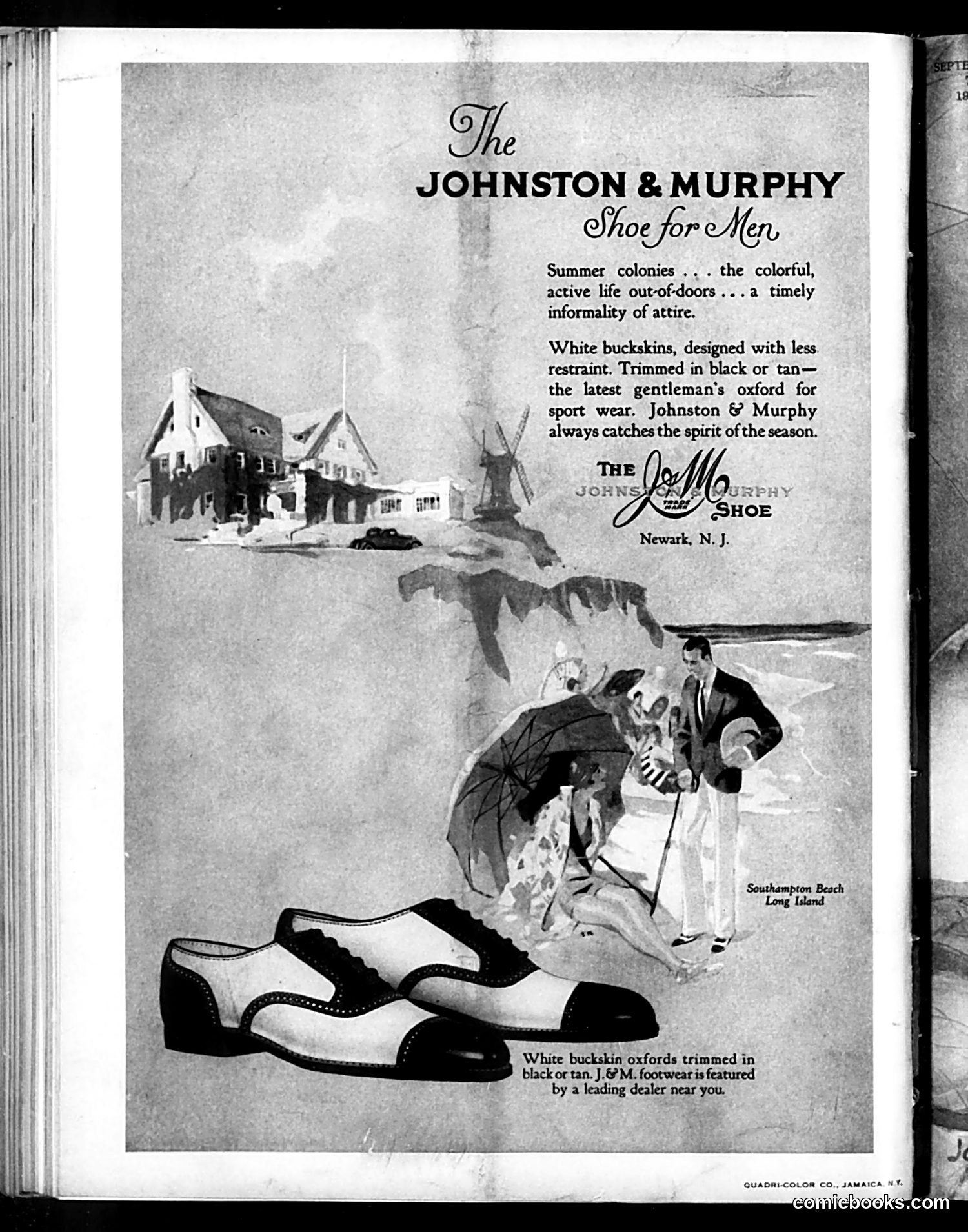
Johnston & Murphy Shoe Advertisement This is a full-page advertisement, not satire or political commentary. It promotes Johnston & Murphy men's shoes, specifically white buckskin oxfords trimmed in black or tan. The ad targets wealthy leisure-class men by associating the shoes with fashionable summer activities: it depicts a beach scene at Southampton Beach, Long Island (a prestigious resort destination), showing well-dressed men and women in casual summer attire. The accompanying text emphasizes that these shoes represent "the latest gentleman's oxford for sport wear" and capture "the spirit of the season." The imagery—summer colonies, outdoor leisure, seaside relaxation—conveys aspirational status. For modern readers, the key context is that this represents early-to-mid 20th century advertising's class positioning: these shoes were marketed to affluent men who frequented exclusive summer resorts, positioning the product as essential to proper gentlemanly leisure wear.