judge
Judge — September 7, 1929
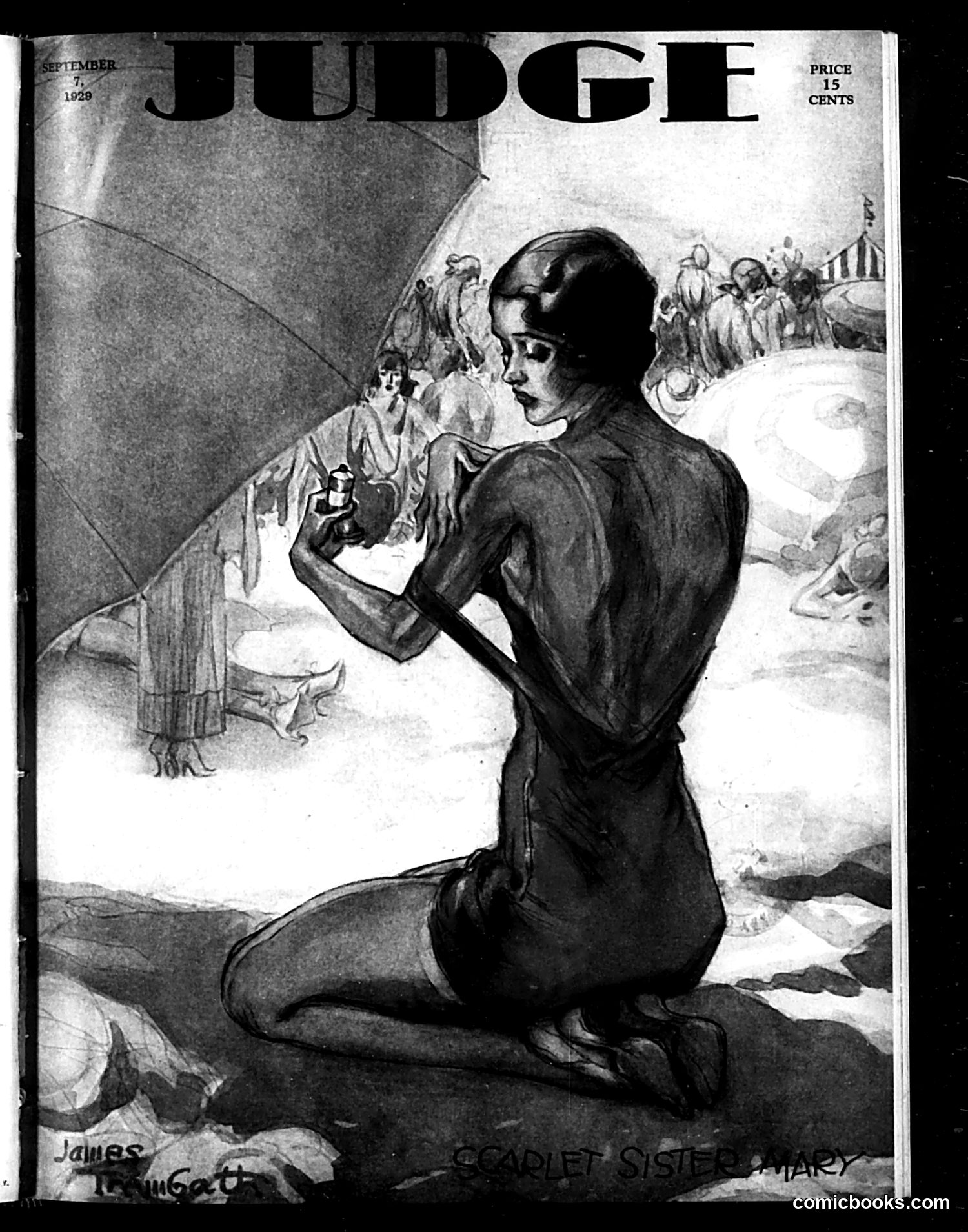
Analysis of Judge Magazine Cover, September 1929 This cover illustration by James Montgomery Flagg depicts a woman in dark clothing kneeling on a beach, gazing toward a distant seaside carnival or fair. The title "Scarlet Sister Mary" references a 1928 novel by Julia Peterkin about a Southern woman's moral struggles. The image appears to satirize attitudes toward female morality and respectability of the era. The woman's posture—solitary, contemplative, somewhat vulnerable—combined with the carnival scene in the background suggests commentary on the contrast between societal judgment of "fallen women" and the gaiety of public life continuing indifferently. The September 1929 date places this just before the stock market crash, during the Jazz Age when traditional morality was being openly questioned in American culture.
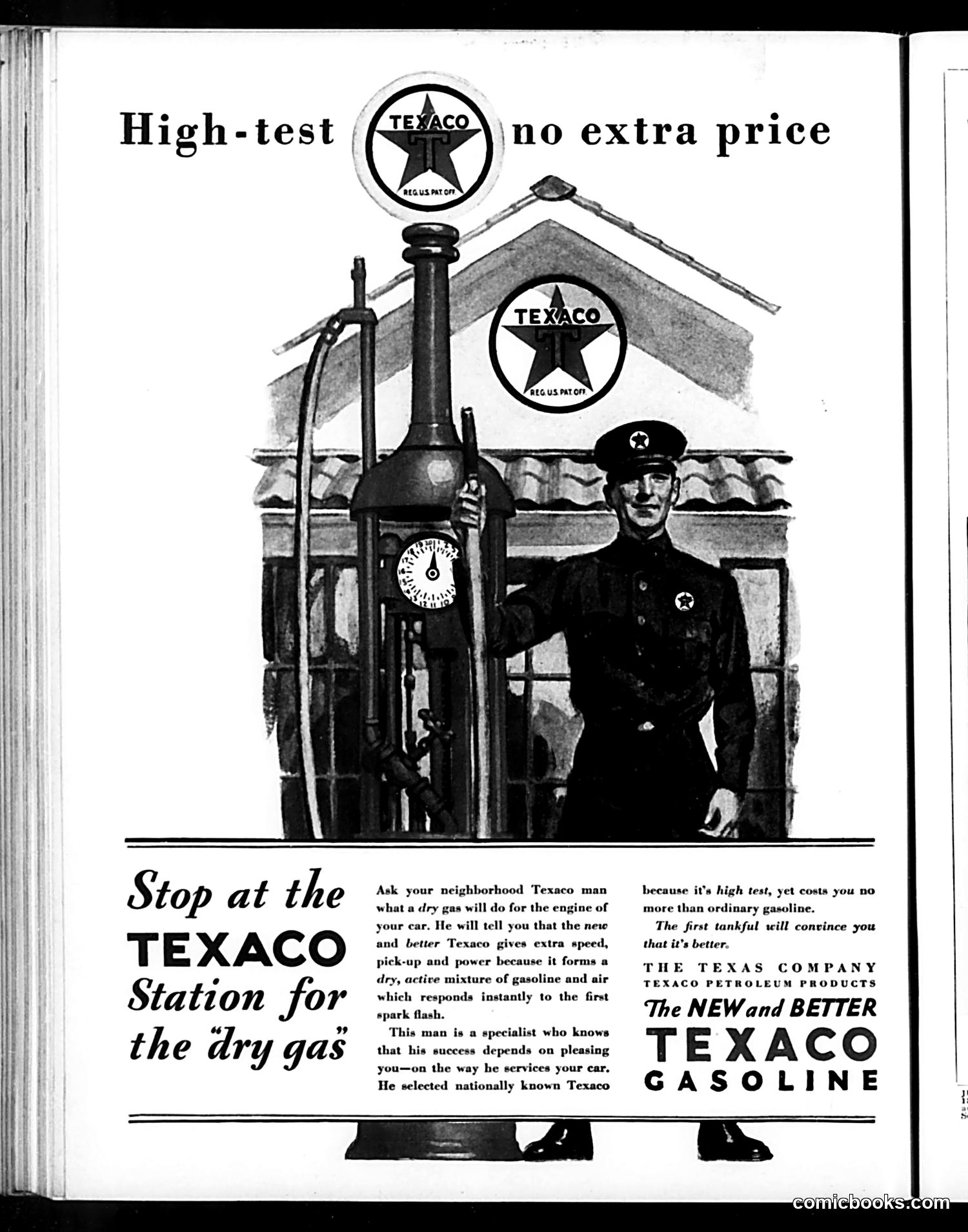
Texaco Gasoline Advertisement This is a commercial advertisement, not political satire. It promotes Texaco's "new and better" gasoline product, marketed as "the dry gas." The image shows a uniformed Texaco station attendant standing beside a vintage gas pump. The advertisement's central claim is that this gasoline provides superior engine performance—"extra speed, pick-up and power"—by forming "a dry, active mixture of gasoline and air" that ignites more effectively. The tagline "High-test...no extra price" emphasizes value. The attendant represents Texaco's promise of professional, specialized service. This appears to be early automotive advertising, likely from the 1920s-1930s era, when gasoline quality and engine performance were active competitive concerns among fuel producers.
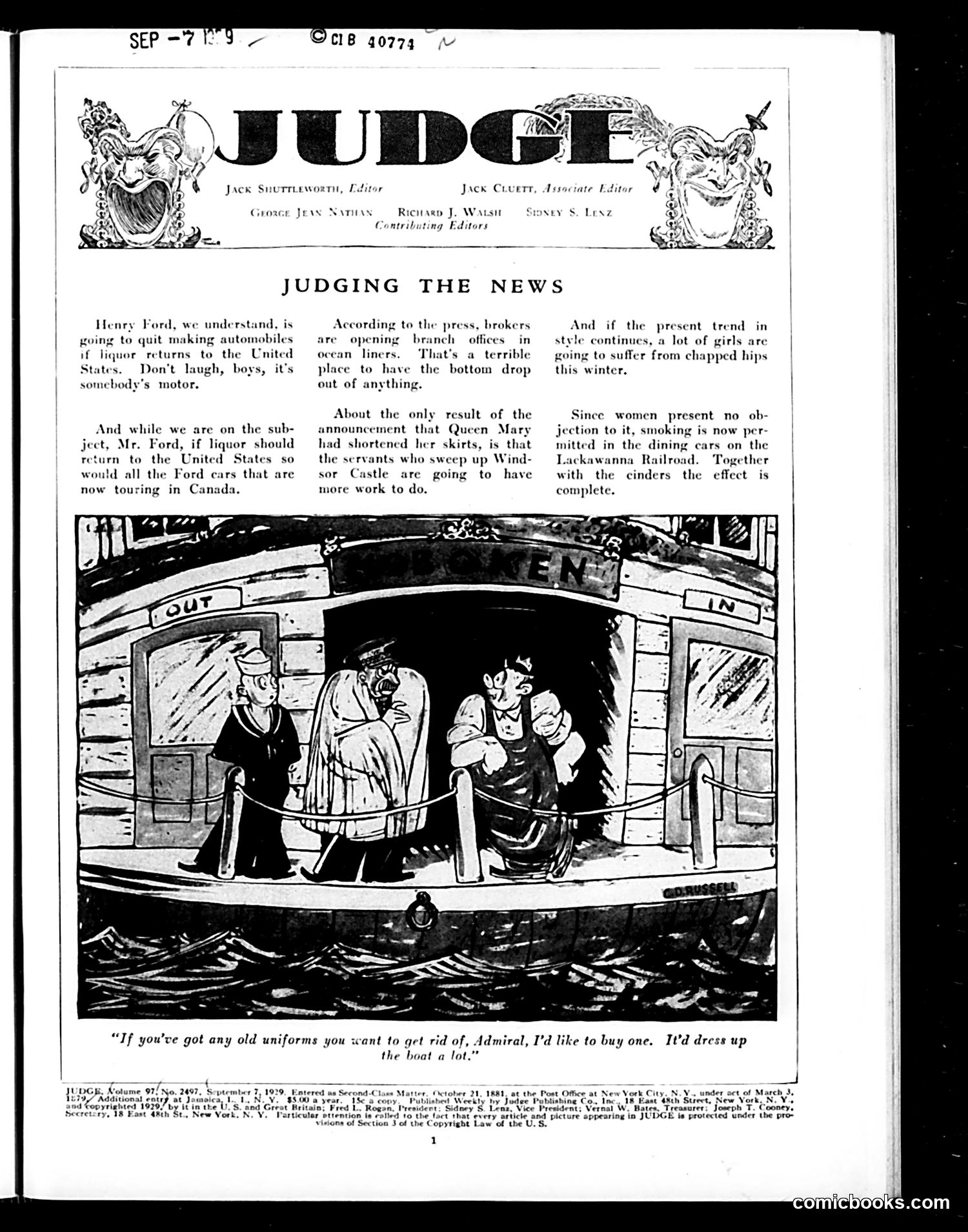
Analysis of Judge Magazine Page This page from Judge magazine contains a satirical column titled "Judging the News" that comments on contemporary events, and a cartoon depicting people at what appears to be a naval vessel entrance. The Column jokes about: - Henry Ford quitting automobile manufacturing (likely referencing Ford's various business decisions) - Ford cars touring in Canada - Queen Mary shortening her skirts (a fashion reference) - Women smoking on the Lackawanna Railroad The Cartoon shows figures in period dress at a ship's entrance, with the caption: "If you've got any old uniforms you want to get rid of, Admiral, I'd like to buy one. I'd dress up the boat a lot." The joke appears to reference naval uniforms or maritime aesthetics, though the specific historical context remains unclear without additional dating information.
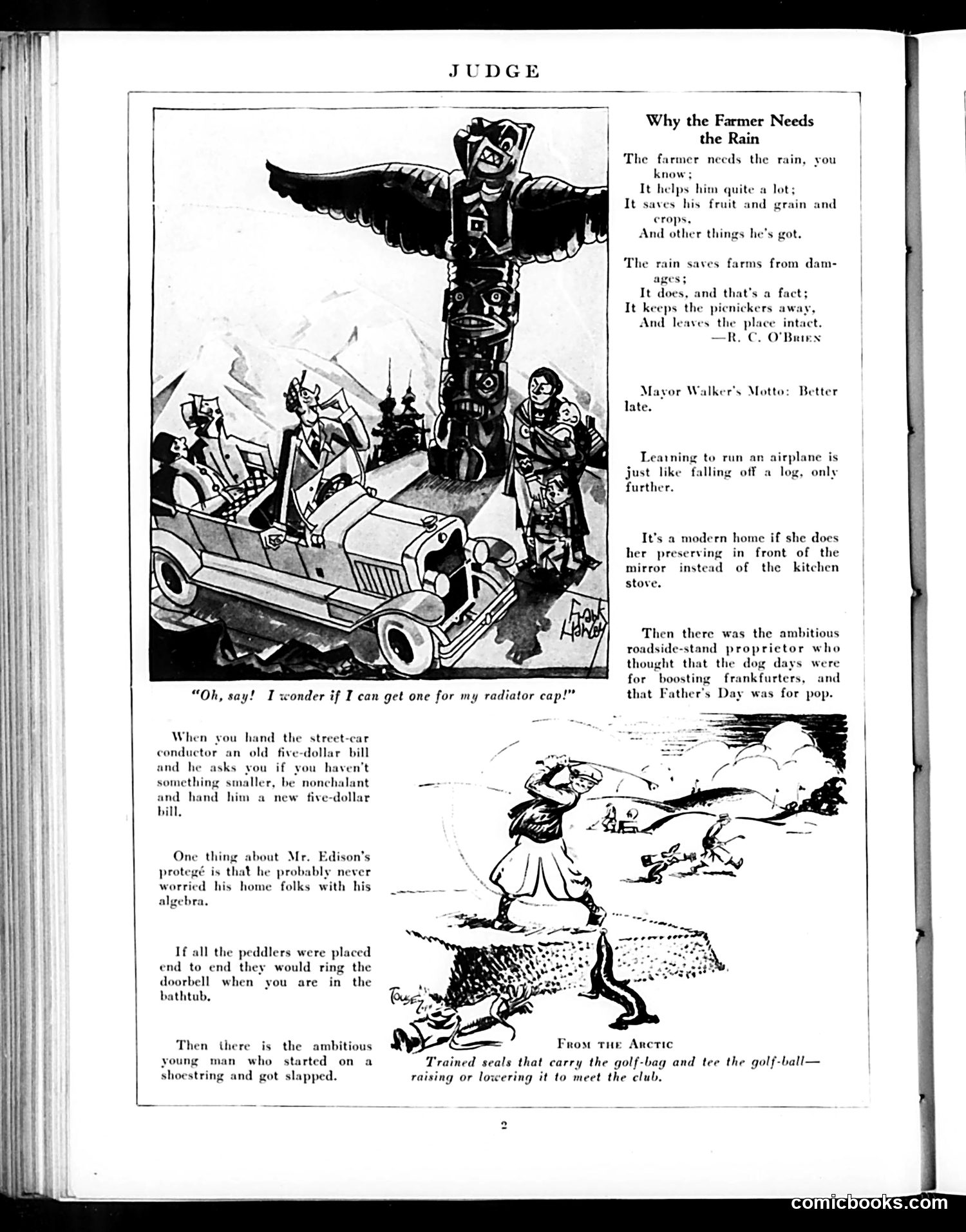
Analysis of Judge Magazine Page Main Cartoon: The upper illustration depicts a totem pole with various figures examining an automobile, captioned "Oh, say! I wonder if I can get one for my radiator cap!" This satirizes early automobile enthusiasm—specifically the craze for radiator cap ornaments that were fashionable on 1920s cars. The totem pole joke suggests Native American artifacts were being collected and repurposed as automotive decorations, reflecting the period's problematic appropriation of Indigenous imagery. Surrounding Humor: Various short quips mock contemporary culture: Edison's home algebra, peddlers and doorbells, a shoestring-bound young man, and street-car conductors. The lower cartoon, "From the Arctic," humorously depicts trained seals playing golf. The page reflects Jazz Age consumer culture and satirizes Americans' fascination with novelty items and status symbols.
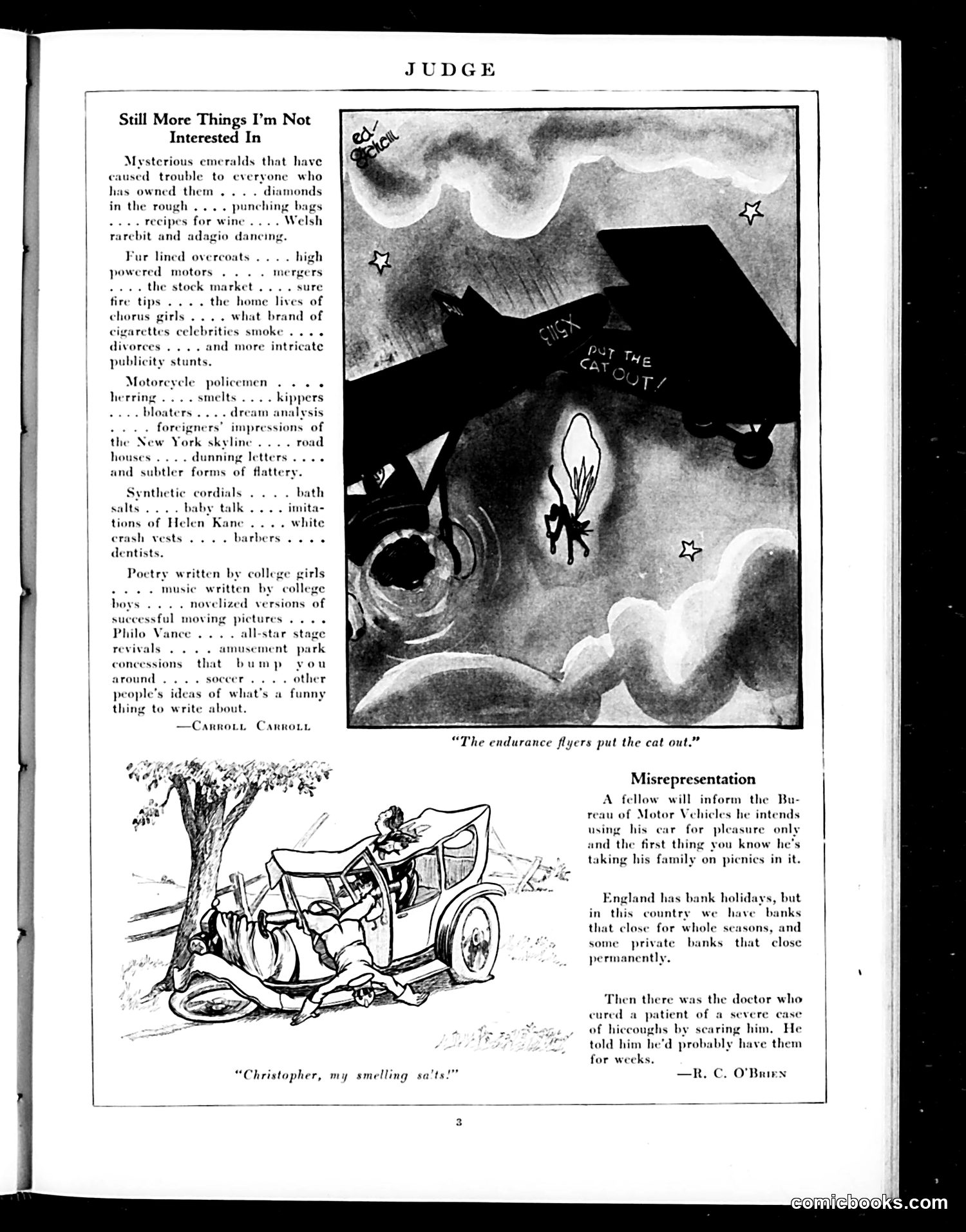
Analysis of Judge Magazine Page This page contains two unrelated satirical items: "Still More Things I'm Not Interested In" (left): Carroll Carroll's humorous essay lists contemporary annoyances—fur coats, motors, stock market tips, chorus girls, and poetry by college students. It reflects 1920s consumer culture anxieties and complaints about modern life. "The endurance flyers put the cat out" (top right): A surreal cartoon mocking early aviation stunts. The sketch shows a cat being ejected from an airplane, captioned as a joke about endurance flights—a popular 1920s aviation fad where pilots competed for long-distance records. The humor suggests these flights were so tedious that even pets couldn't tolerate them. "Christopher, my smelling salts!" (bottom): An automobile accident cartoon depicting a car crash into a tree, likely satirizing reckless driving.
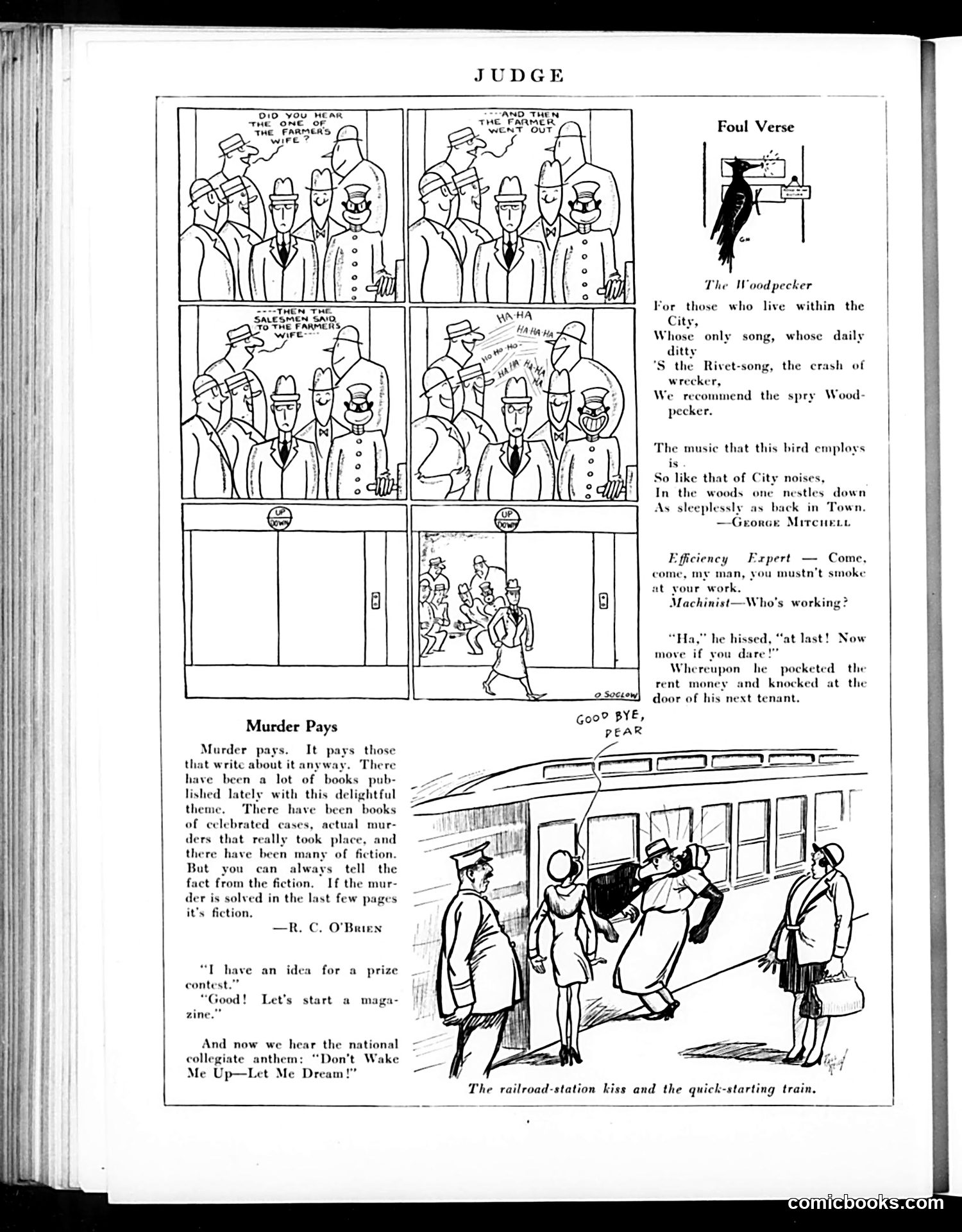
Analysis of Judge Magazine Page This page contains three distinct pieces of humor: 1. "Murder Pays" comic strip (top): Shows a group of men repeatedly telling the same joke about a wife's death, with escalating laughter. The satire critiques popular "murder mystery" novels and books—a publishing trend—by mocking how predictable and formulaic these stories are. The joke is that readers always know it's fiction because the solution appears in the last pages. 2. "Foul Verse" section (right): Poetry about the woodpecker bird, offering it as entertainment for city-dwellers tired of industrial noise. 3. Railroad station illustration (bottom): Depicts an energetic farewell scene at a train platform, captioned about "the railroad-station kiss and the quick-starting train"—likely satirizing sentimental romance clichés. The page reflects early 20th-century American popular culture and publishing trends.
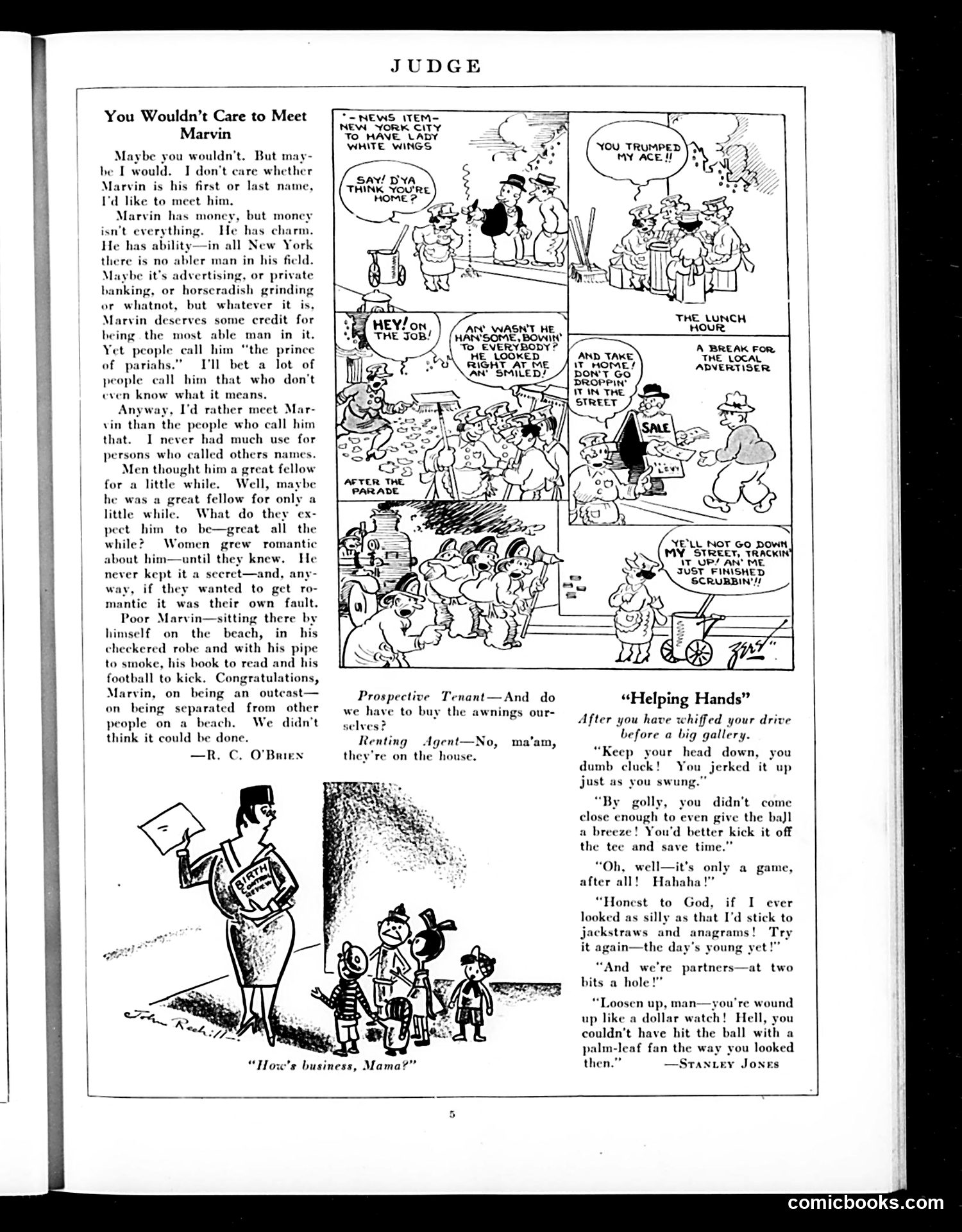
Analysis This Judge page contains humorous commentary and comics rather than political satire. The main feature, "You Wouldn't Care to Meet Marvin," is an essay by R.C. O'Brien praising an unnamed man named Marvin as exceptionally capable and honorable, despite lacking wealth or social prominence. The accompanying comic strip illustrates Marvin's ordinary life—working, socializing at lunch, and relaxing. Below is a separate comic titled "Helping Hands" about golf, where one player criticizes another's swing technique, leading to banter about their partnership. The bottom illustration, captioned "How's business, Mama?" shows a woman in business attire with children, likely satirizing women entering the workforce or business ownership—a social commentary on changing gender roles. The page is primarily entertainment-focused rather than explicitly political.
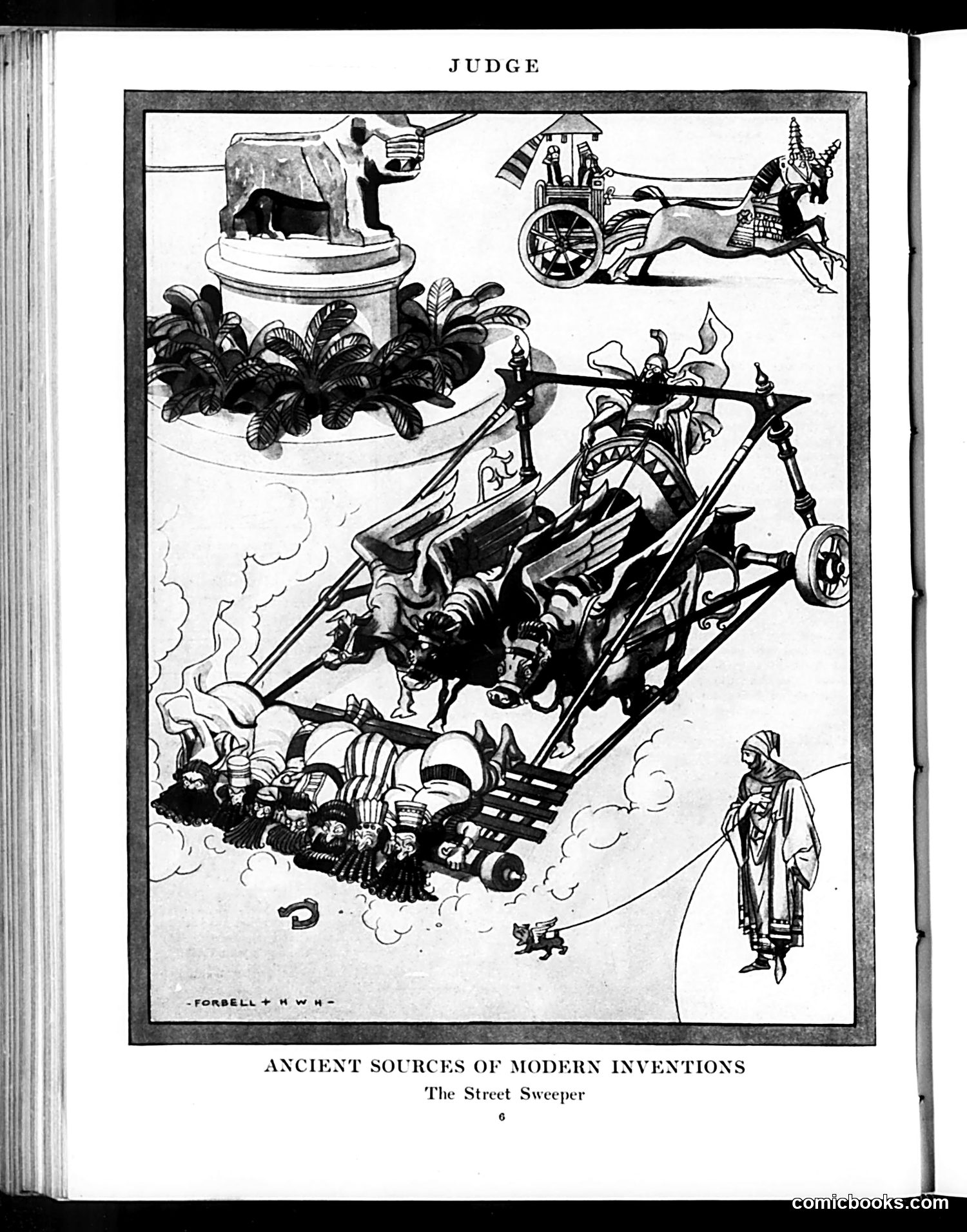
"Ancient Sources of Modern Inventions: The Street Sweeper" This satirical illustration presents a humorous genealogy of the street sweeper. The page shows mythological and historical figures in elaborate chariots and processions above, with demonic or fantastical beings depicted below in clouds of smoke, suggesting infernal origins. The joke appears to be that modern street-sweeping technology has absurdly grandiose "ancient sources"—mocking the period's tendency to trace modern inventions to classical or mythological precedents. By depicting street sweepers with such elaborate, chaotic imagery involving demons and mythological figures, Judge ridicules both the pretension of such historical claims and perhaps the lowly nature of street-sweeping work itself. The artist credits "Forbell + H.W.H." at bottom.
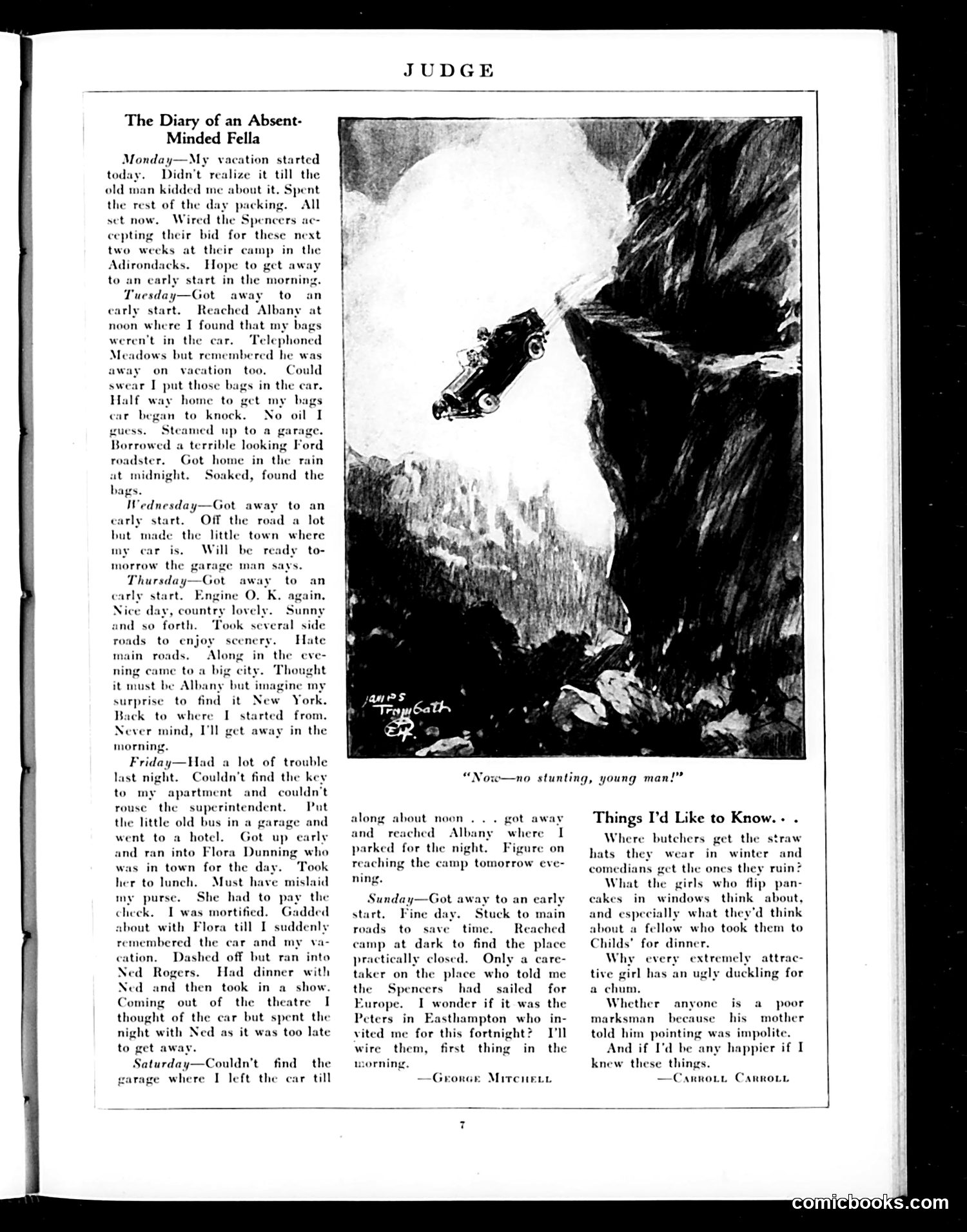
"The Diary of an Absent-Minded Fella" This is a humorous two-part page from Judge magazine. The main feature is a satirical diary chronicling a vacationing man's comedic mishaps: he forgets his luggage, gets lost returning to his starting point instead of reaching his destination, misses appointments, and ultimately arrives at a closed vacation home after the hosts have sailed to Europe. The accompanying illustration shows a car precariously perched on a cliff edge—visual reinforcement of the protagonist's chaotic journey. The caption "Now—no stunting, young man!" suggests reckless driving. The sidebar "Things I'd Like to Know" offers social commentary on period quirks: butchers' winter hats, pancake-flippers' thoughts, why attractive girls befriend plain ones. This reflects 1920s-era casual observations about social behavior and gender dynamics, written with tongue-in-cheek curiosity rather than genuine inquiry. The satire targets absent-mindedness and poor planning as comedic character flaws.
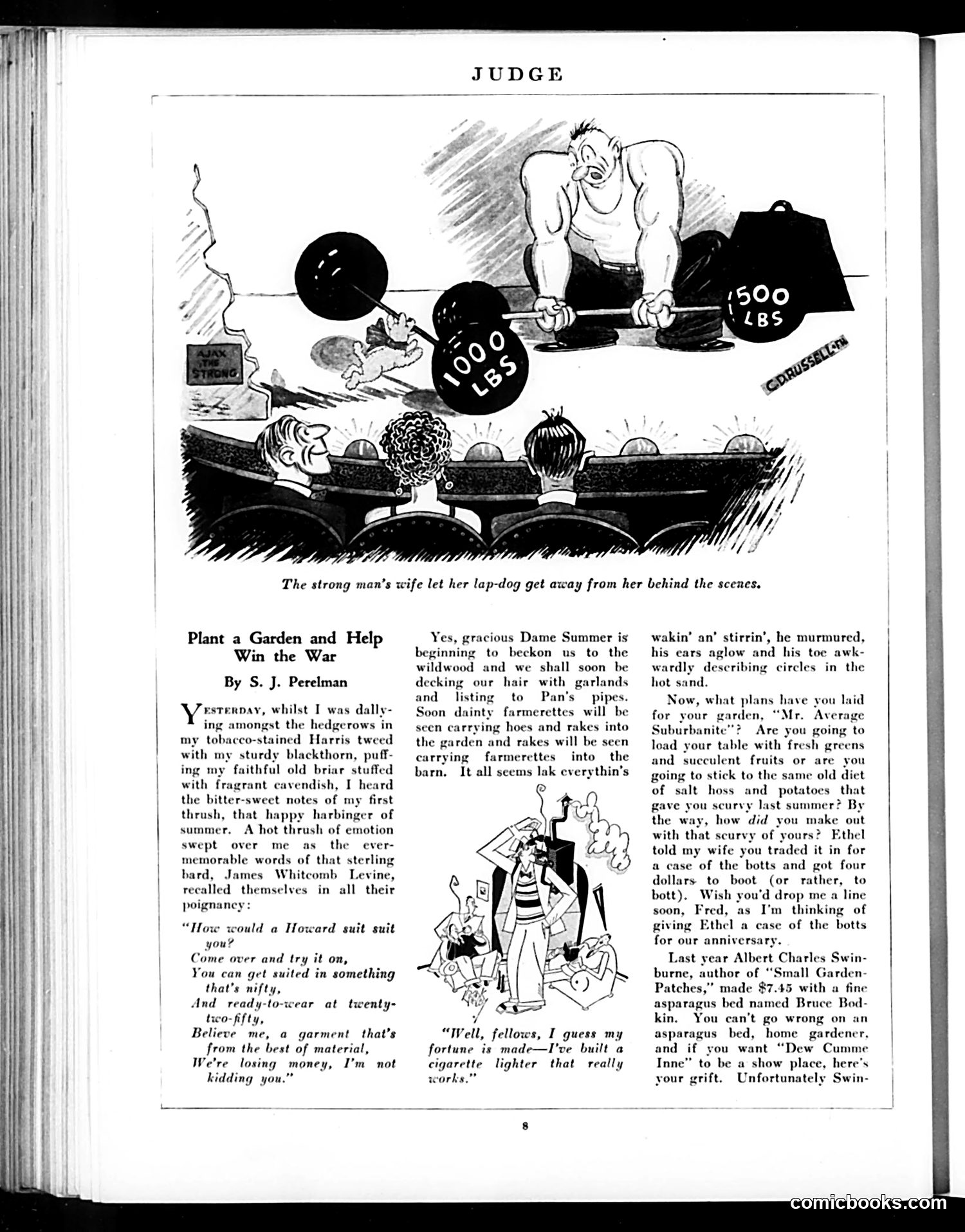
Explanation for Modern Readers This page contains a satirical article by S.J. Perelman titled "Plant a Garden and Help Win the War," written during a wartime period (likely WWI or WWII, based on references to "winning the war"). The cartoon at top shows a strongman performing at what appears to be a circus or carnival, with judges observing. The caption suggests a metaphorical critique: "The strong man's wife let her lap-dog get away from her behind the scenes"—implying something questionable occurs away from public view. Perelman's article satirizes the home-gardening propaganda campaign encouraging Americans to grow vegetables to support the war effort. He mockingly applies high commercial language to humble gardening, invents absurd anecdotes (a man making $7.45 from an asparagus bed named "Bruce Bodkin"), and parodies patriotic rhetoric. The humor targets both the oversold promises of wartime gardening initiatives and the gap between propaganda and reality. The fake James Whitcomb Levine poetry quote is Perelman's invention, adding to the absurdist satire.
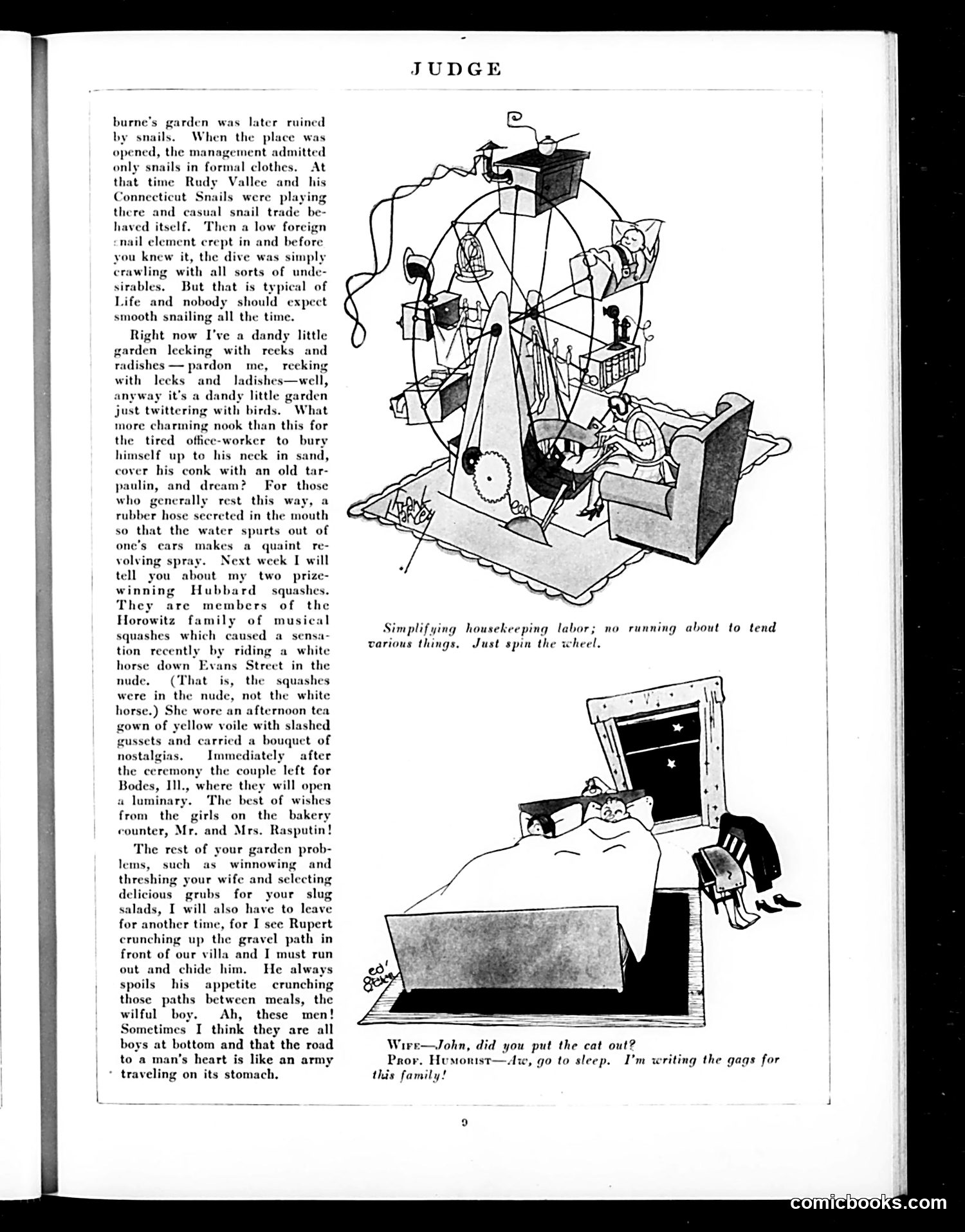
Analysis of This Judge Magazine Page This page contains absurdist humor typical of Judge's satirical style. The main text is a rambling, deliberately nonsensical garden column filled with deliberate malapropisms ("lecks and ladishes" instead of "leeks and radishes") and surreal non-sequiturs. The writer references Rudy Vallée and Connecticut Snails, playing on Jazz Age celebrity culture and the then-popular "Connecticut" social set. The two cartoons illustrate domestic labor: the top depicts a Rube Goldberg-style contraption meant to automate housework, satirizing the era's obsession with labor-saving devices. The bottom shows a wife asking if the cat's been put out while her husband writes comic material, poking fun at the division of domestic labor and the writer's absorption in his work. The overall effect mocks both elaborate domesticity and the pretensions of modern life through absurdist humor—characteristic of Judge's satirical approach in this period.
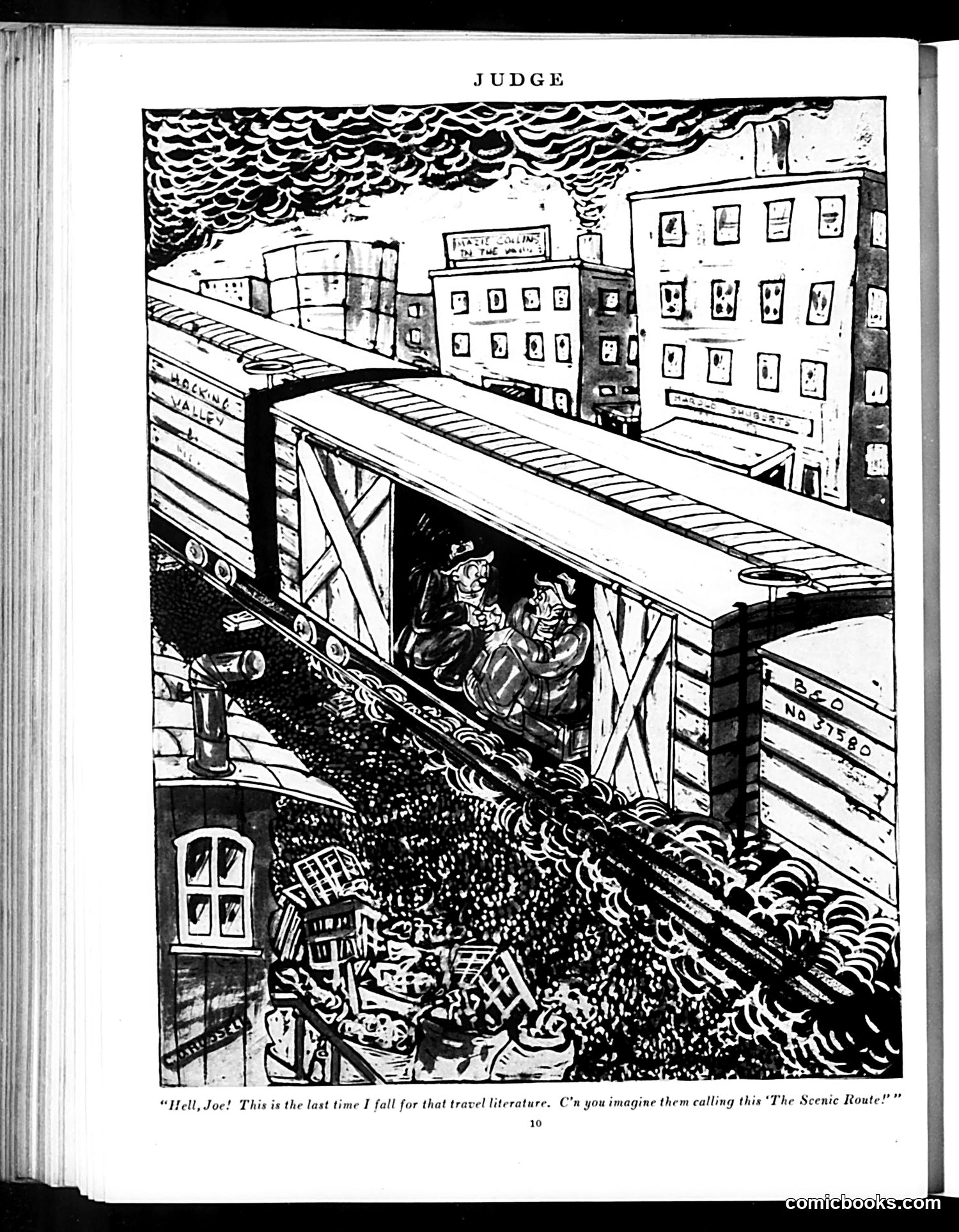
Analysis of Judge Magazine Cartoon This cartoon depicts a rail yard scene where a person in the lower left observes passengers in a freight car, commenting: "Hell, Joe! This is the last time I fell for that travel literature. Can you imagine them calling this 'The Scenic Route'!" The satire targets misleading travel advertising of the era. The "scenic route" was apparently marketed to travelers as an attractive journey, but the cartoon reveals the reality: cramped, uncomfortable conditions in a boxcar rather than pleasant passenger accommodations. The contrast between promised luxury and actual poor conditions—along with the industrial, unglamorous urban setting—mocks the exaggerated claims in travel company promotions. This reflects early 20th-century consumer skepticism about advertising's truthfulness.
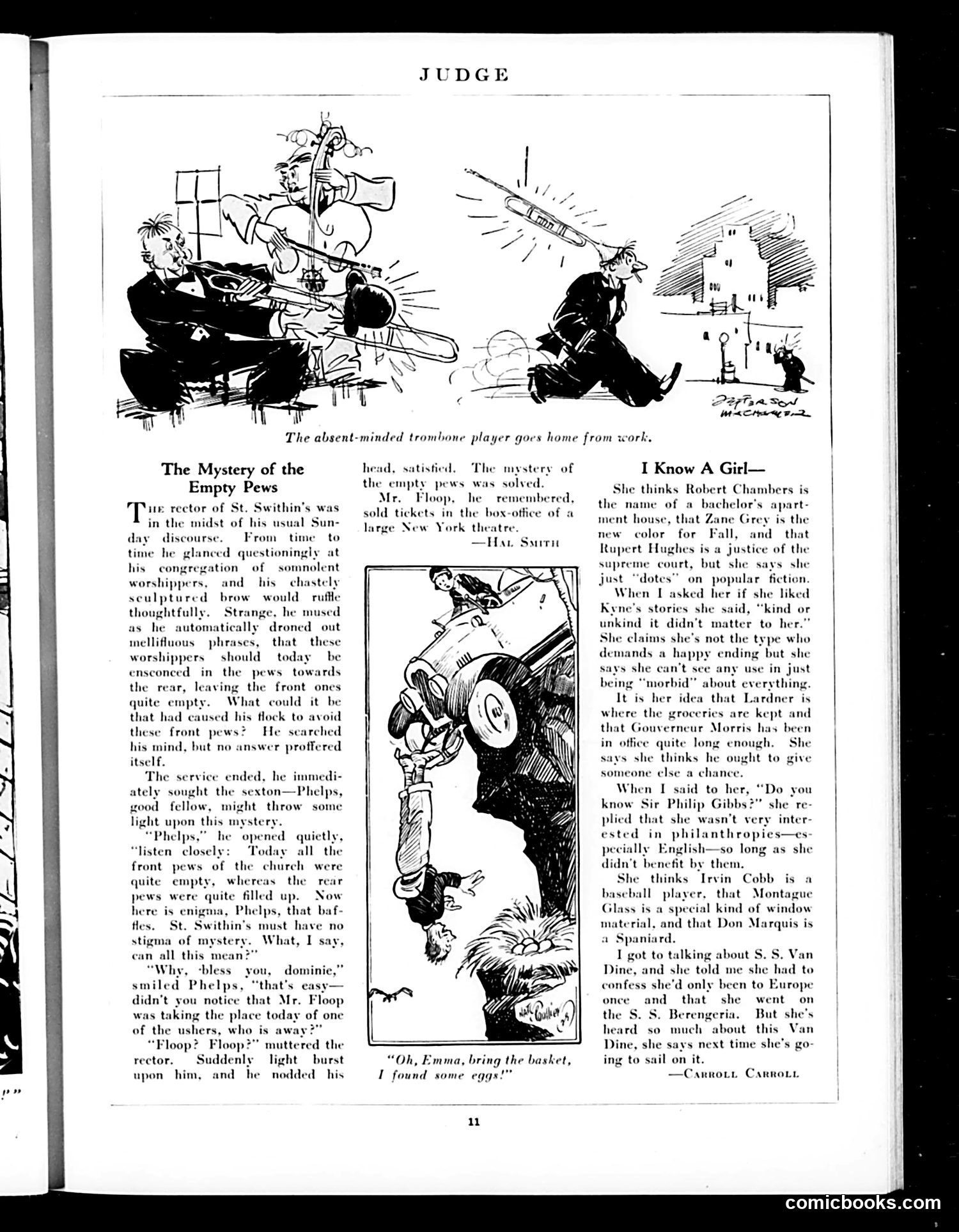
Analysis of Judge Magazine Page "The Mystery of the Empty Pews" is a gentle satire about a church rector puzzled by his congregation sitting only in rear pews. The sexton reveals the solution: Mr. Floop, a theater box-office clerk, is ushering today. The joke relies on the implication that Floop's presence—likely his poor reputation or smell—drives worshippers away from the front. "I Know A Girl" satirizes a woman's profound ignorance of famous American authors and cultural figures. She confuses: - Robert Chambers (author) with an apartment building - Zane Grey (Western writer) with a paint color - Rupert Hughes (author/judge) with a Supreme Court justice - Ring Lardner (sports columnist) with a grocery store - S.S. Van Dine (mystery writer) with the ocean liner S.S. Berengeria The satire mocks both her pretense of enjoying "popular fiction" while demonstrating she knows nothing about actual popular writers of the era. It's a class-conscious joke about superficial cultural consumption.
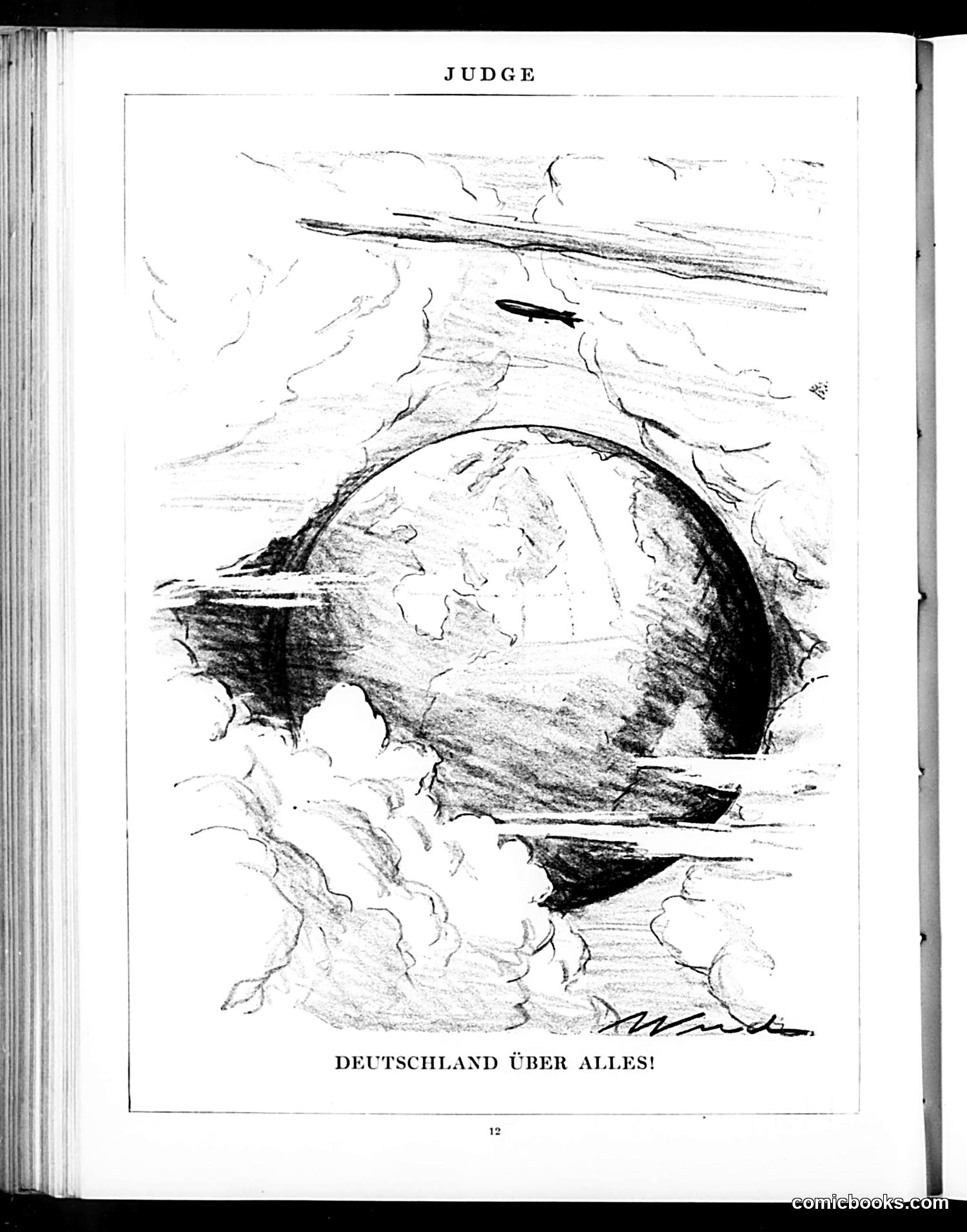
"Deutschland Über Alles!" This is a political cartoon from *Judge* magazine depicting a large head in profile, rendered with heavy shading and dramatic crosshatching. The figure appears militaristic or authoritarian in character, with emphasized facial features suggesting aggression or dominance. The German caption "Deutschland Über Alles!" ("Germany Above All!") references Germany's nationalist motto, likely from their national anthem. The artwork style and militaristic tone suggest this cartoon was created during a period of tension with Germany—possibly around World War I or the interwar period. The satire appears to critique German militarism and expansionist ambitions, portraying German nationalism as an overblown, menacing force. The caricatured head emphasizes the grotesque nature of such nationalist ideology from an American satirical perspective.
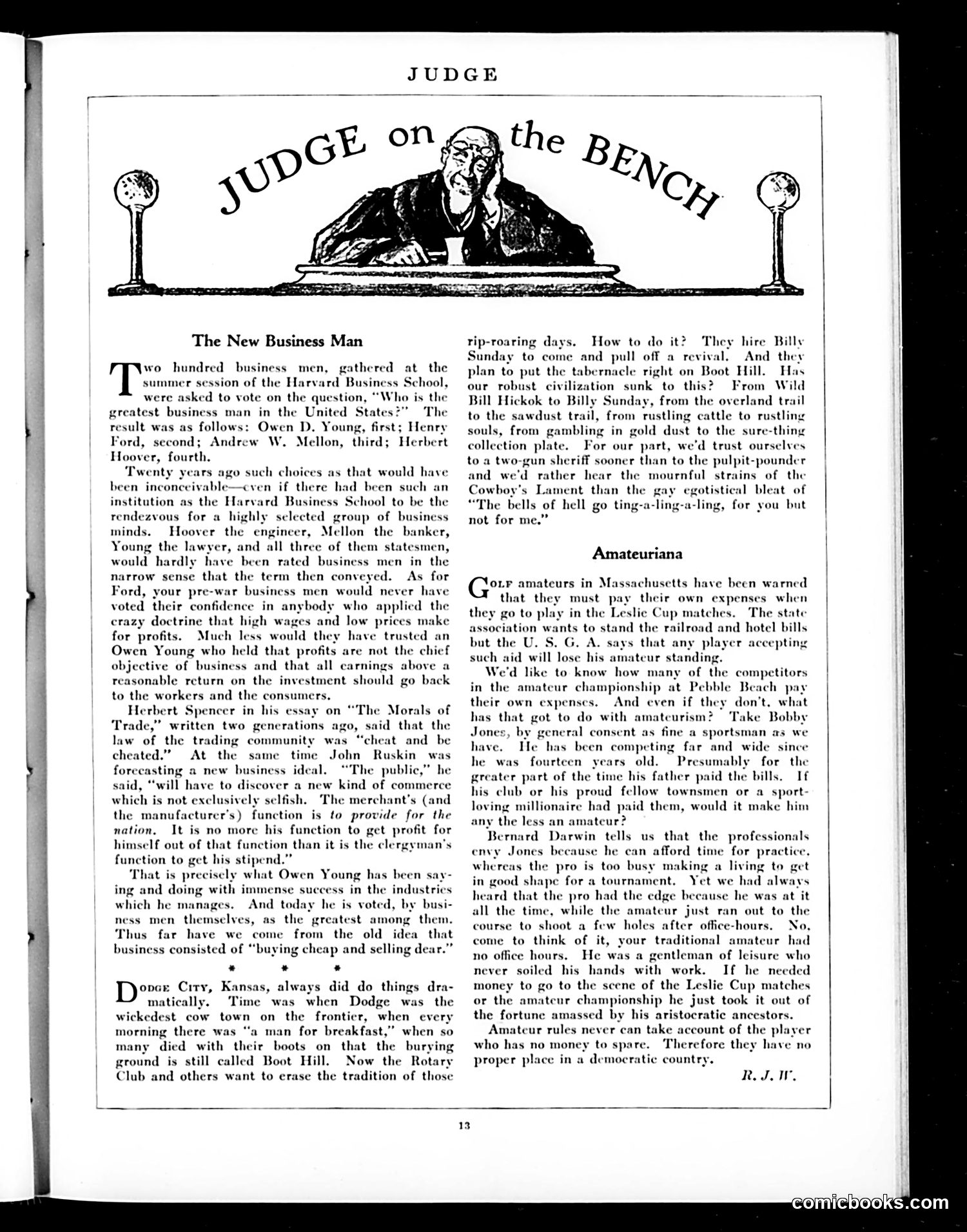
"Judge on the Bench" — Page Analysis This page contains three separate editorial columns under the "Judge on the Bench" masthead featuring a stern judge illustration. "The New Business Man" praises Owen D. Young (who topped a Harvard Business School poll of greatest American businessmen) for embodying a new business philosophy: prioritizing worker welfare and consumer benefit over maximum profit extraction. The writer contrasts this with older "robber baron" thinking (Spencer's "cheat and be cheated") and favorably compares Young's approach to Ruskin's idealistic vision of merchants serving the nation. The satire implicitly critiques traditional capitalists by celebrating this shift. "Dodge City" mocks efforts to "sanitize" Dodge City's Wild West reputation by hiring revivalist Billy Sunday to conduct a revival meeting at Boot Hill cemetery. The writer sardonically prefers frontier sheriffs and honest gunfights to modern religious hypocrisy. "Amateuriana" criticizes golf's amateur rules as inconsistently enforced, noting that wealthy amateurs like Bobby Jones received financial support throughout their careers without losing amateur status, yet Massachusetts amateurs face different standards. All three pieces exemplify Judge's satirical commentary on American business ethics and social contradictions.
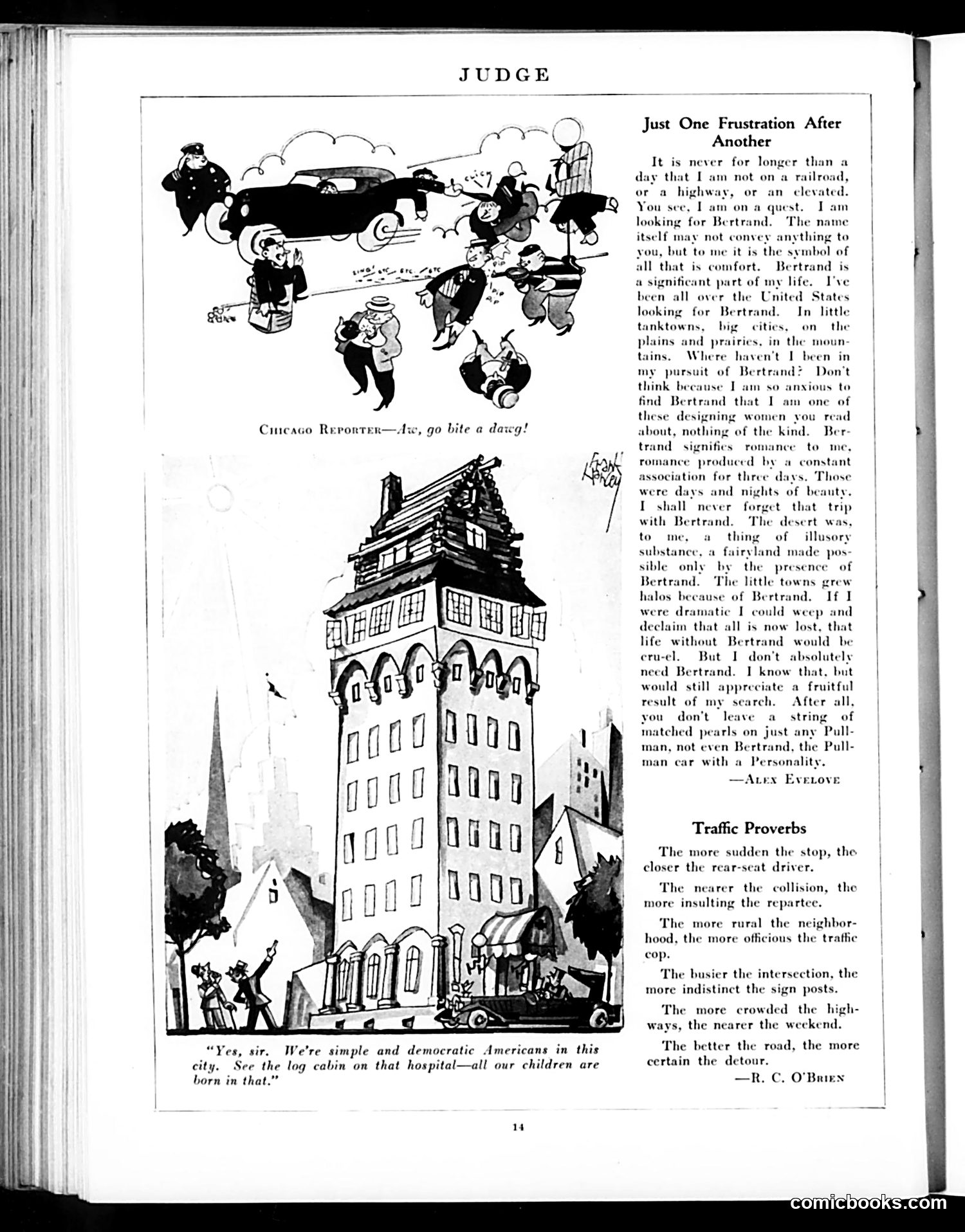
Analysis for Modern Readers Top Cartoon: A satirical jab at American city boosterism. The caption mocks civic pride—a tour guide points to a hospital building styled like a log cabin, claiming it reflects American "simple and democratic" values. The joke: cities construct false frontier imagery to seem authentically American, while the chaotic street scene (with cars, pedestrians, and traffic) reveals the messiness of actual modern urban life. "Just One Frustration After Another": A humorous first-person account of searching across America for "Bertrand"—revealed to be a Pullman luxury railroad car with "personality," not a person. The satire mocks romantic nostalgia: the narrator treats a train car as if it were a beloved person, representing how Americans idealize consumer goods and travel as sources of meaning and romance. "Traffic Proverbs": Witty one-liners mocking driving culture—observing how road conditions inversely correlate with driver behavior. Examples: better roads encourage speeding; crowded highways fill with weekend traffic. All pieces satirize American consumerism, urban mythology, and automotive culture of the era.
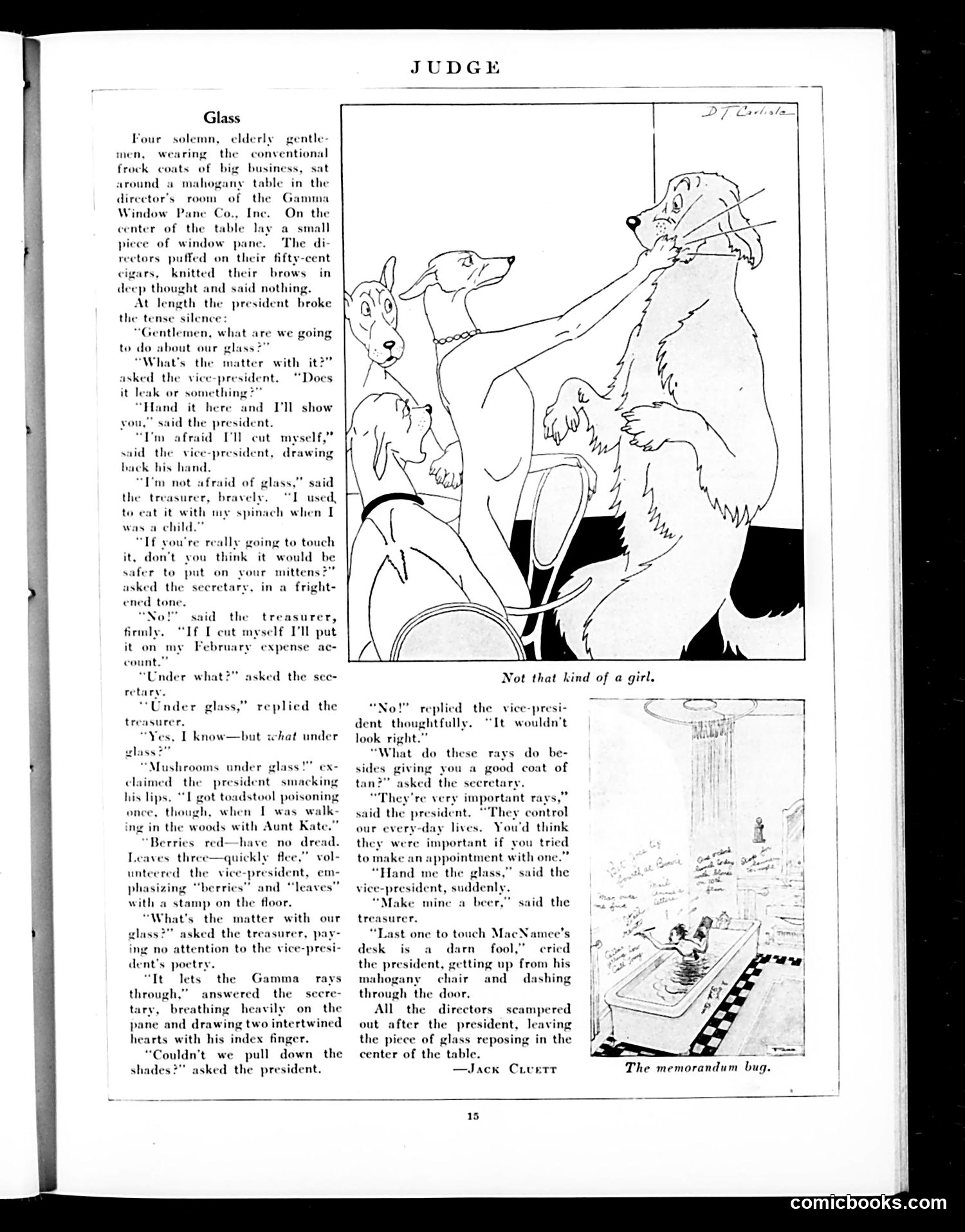
"Glass" - Judge Magazine Satire This is a humorous business satire mocking corporate incompetence and cowardice. Four executives of the Gamma Window Pane Co. gather to discuss a problem with their product—a piece of glass—but none can articulate what's actually wrong with it. The joke escalates absurdly: when asked to examine the glass, each man invents excuses to avoid touching it (fear of cuts, needing mittens, expense accounts). The dialogue devolves into non-sequiturs about mushroom poisoning and drawing hearts on the pane. When the president suddenly declares "Last one to touch MacNamee's desk is a darn fool!" all four executives panic and bolt, abandoning the glass entirely. The satire targets early 20th-century boardroom culture: the pretense of serious deliberation masking complete indecision, executives prioritizing appearance over substance, and how trivial fears or diversions can scatter even the most "solemn" business leaders. The reference to "Gamma rays" suggests this may also mock pseudoscientific marketing claims common to the era.
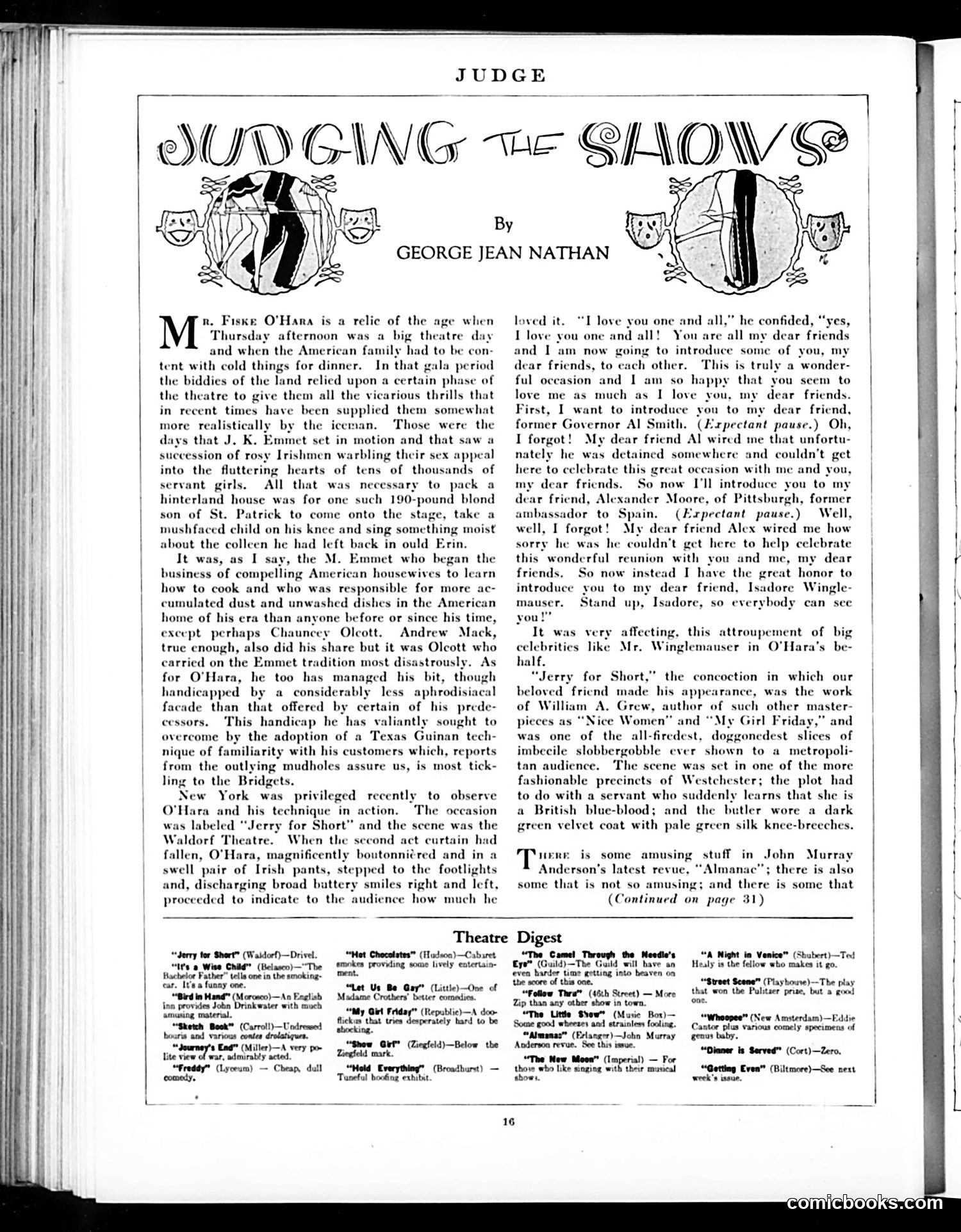
"Judging the Shows": Satirizing Fiske O'Hara's Theatrical Sentimentality This theater review by George Jean Nathan mocks actor Fiske O'Hara and the sentimental Irish-American theatrical tradition he represents. Nathan traces a lineage of performers (M. Emmett, Andrew Mack, Chauncey Olcott) who appealed to working-class audiences—particularly servant girls—through maudlin songs about Ireland and romance, causing domestic negligence. O'Hara's current show, "Jerry for Short," exemplifies this tired formula. Nathan ridicules O'Hara's on-stage manipulation: his affected introduction of celebrity guests (Governor Al Smith, Ambassador Alexander Moore) who conveniently "wired" regrets, then introducing an obscure "Isadore Winglemauser"—a comic deflation exposing the artificiality of the emotional appeal. The satire targets not just O'Hara's mediocre performance but the entire tradition of exploitative sentimentality that Nathan sees as intellectually bankrupt entertainment for unsophisticated audiences.
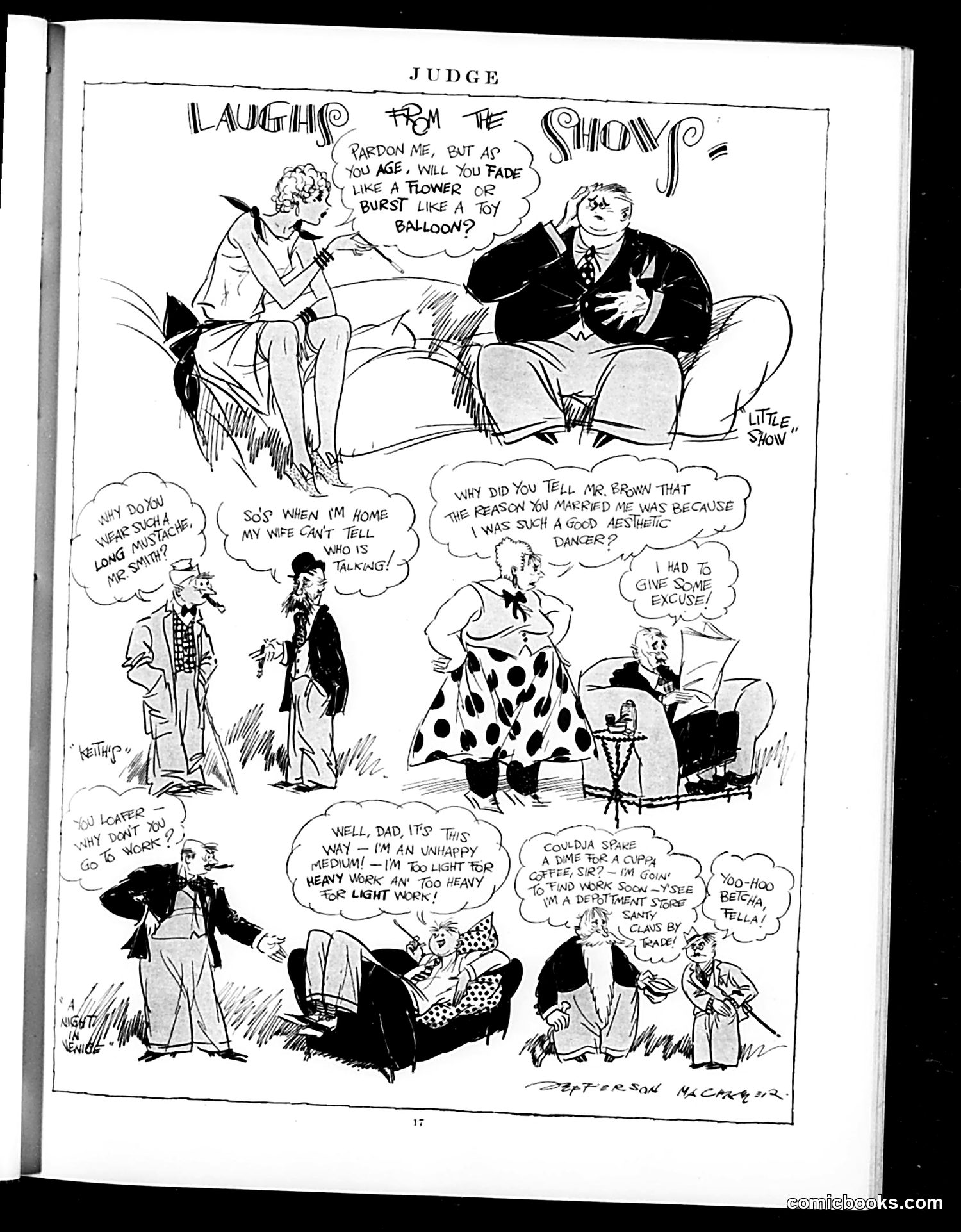
"Laugh from the Show" — Judge Magazine Cartoon This is a multi-panel satirical cartoon about marital discord and work complaints. The title references a popular show or entertainment venue. The main joke involves husbands offering excuses to their wives for various grievances: - Top panel: An older man tells a young woman she'll "fade like a flower or burst like a toy balloon"—mocking aging concerns. - Middle panels: Men complain about work being either too heavy or too light, their wives oversharing gossip, and needing to create excuses for their behavior. One man claims he married his wife because she was a "good aesthetic dancer." - Bottom panels: A husband grumbles he's "unhappy" as a medium—too heavy for light work, too light for heavy work—seeking sympathy. The satire targets men's propensity for making flimsy excuses rather than taking responsibility, while their wives remain frustrated with their contradictions and evasions. It's commentary on domestic tensions and masculine avoidance of accountability.
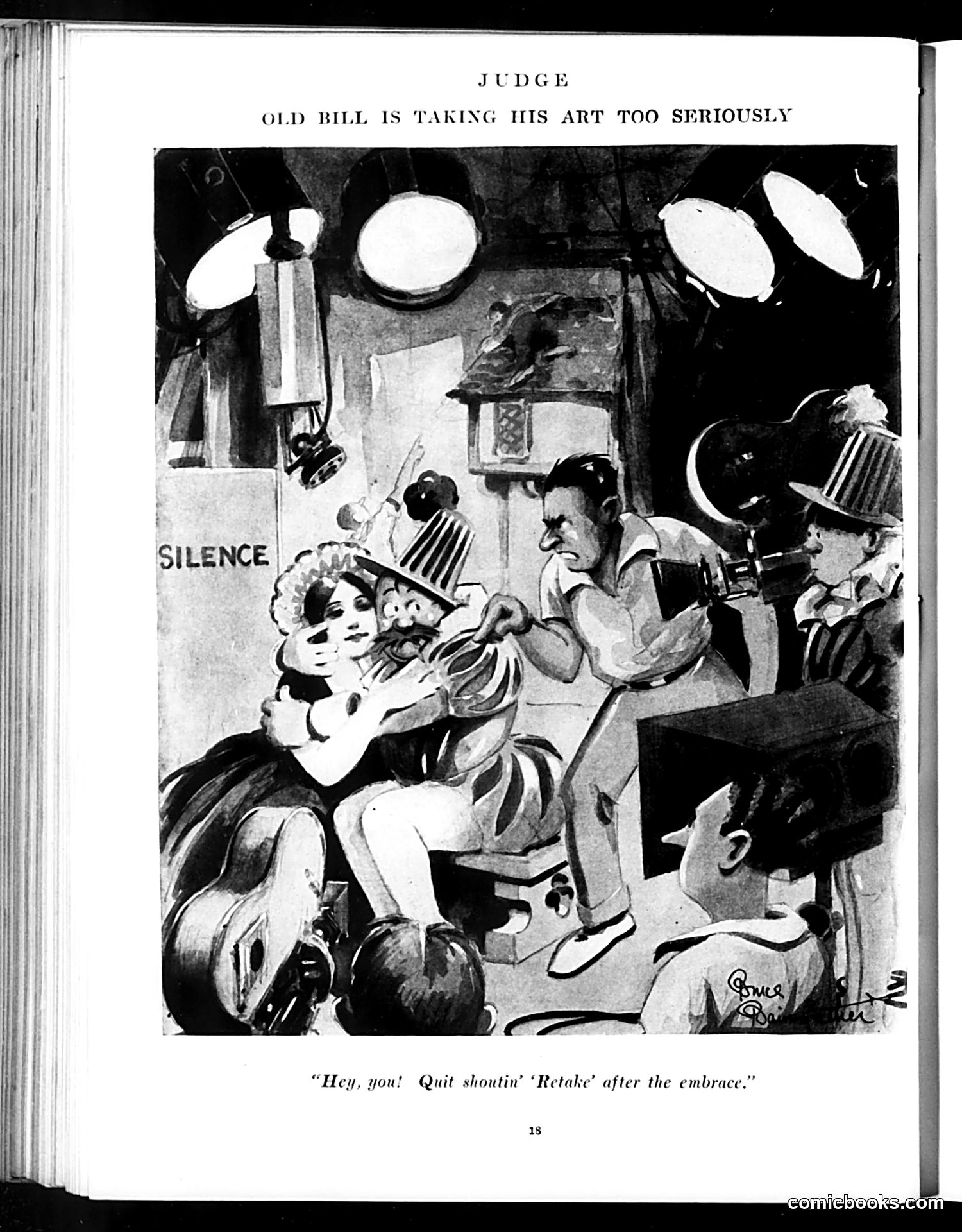
Page Analysis This cartoon satirizes a film director (likely referred to as "Old Bill") who is taking his craft excessively seriously. The scene depicts a movie set with large studio lights and a "SILENCE" sign, showing the director aggressively directing or arguing with actors during filming. The caption—"Hey, you! Quit shoutin' 'Retake' after the embrace"—suggests the director is obsessively demanding repeated takes of a romantic scene, disrupting the actors' performances with excessive shouting and micromanaging. The satire mocks pretentious or overly demanding film directors of the silent film era who prioritized technical perfection over practical collaboration with their cast. The joke implies his artistic seriousness has become comically unreasonable and counterproductive.
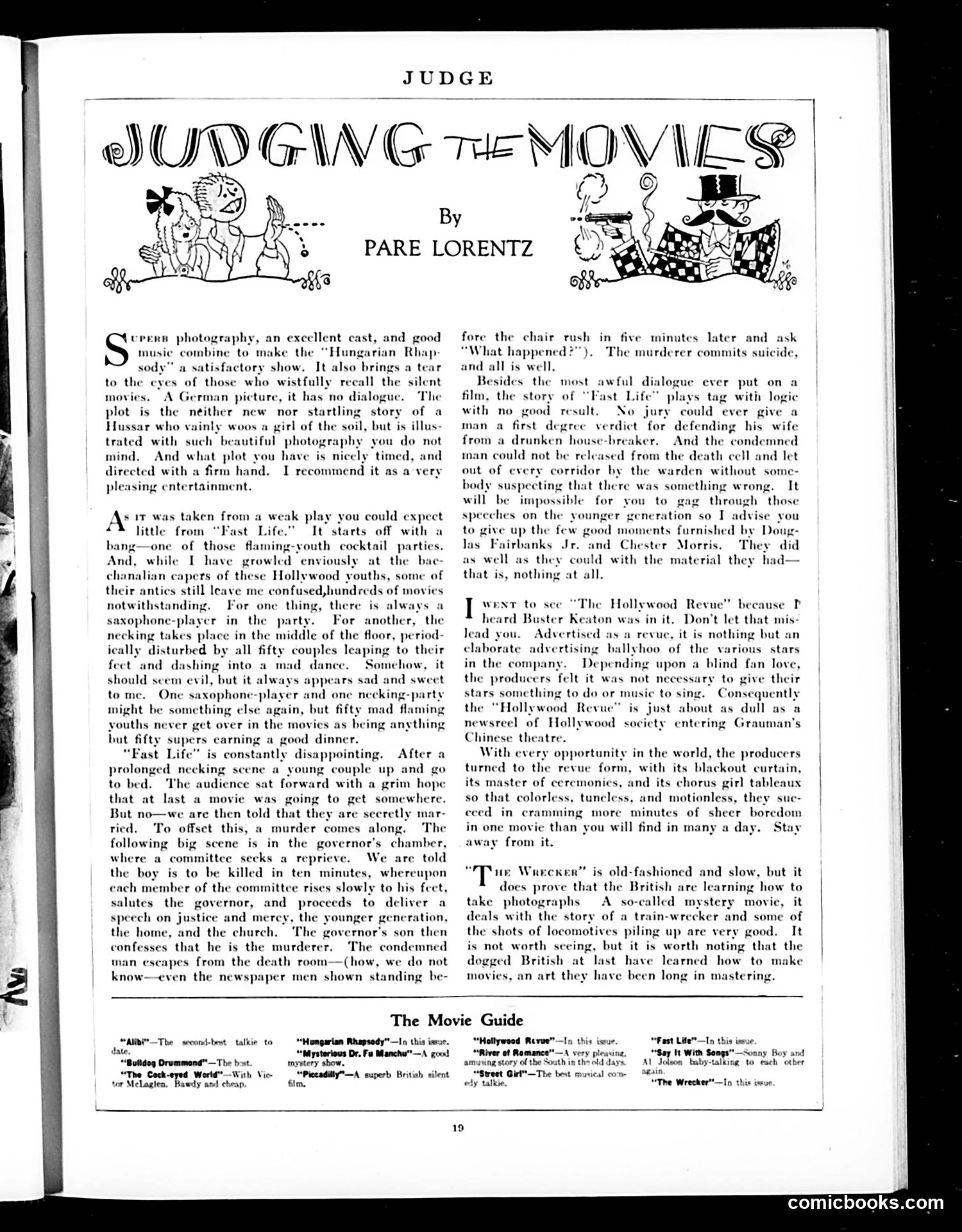
"Judging the Movies" by Pare Lorentz — Page Analysis This page contains film reviews by Pare Lorentz critiquing recent movies for Judge magazine's readers. The header illustration shows whimsical theatrical characters, but this is not a political cartoon—it's a magazine section header. Lorentz reviews four films with satirical wit: - "Hungarian Rhapsody": A silent German film praised for beautiful cinematography despite a clichéd plot about a rejected hussar. - "Fast Life": Harshly criticized as a weak adaptation featuring shallow "flaming youth" party scenes and absurd plot holes (a man escapes death row inexplicably; a jury verdict makes no legal sense). - "The Hollywood Revue": Dismissed as mere advertising for studio stars, particularly disappointing because Buster Keaton's involvement didn't materialize in meaningful content. The satire targets Hollywood's formulaic storytelling, illogical screenwriting, and cynical star-promotion practices of the era.
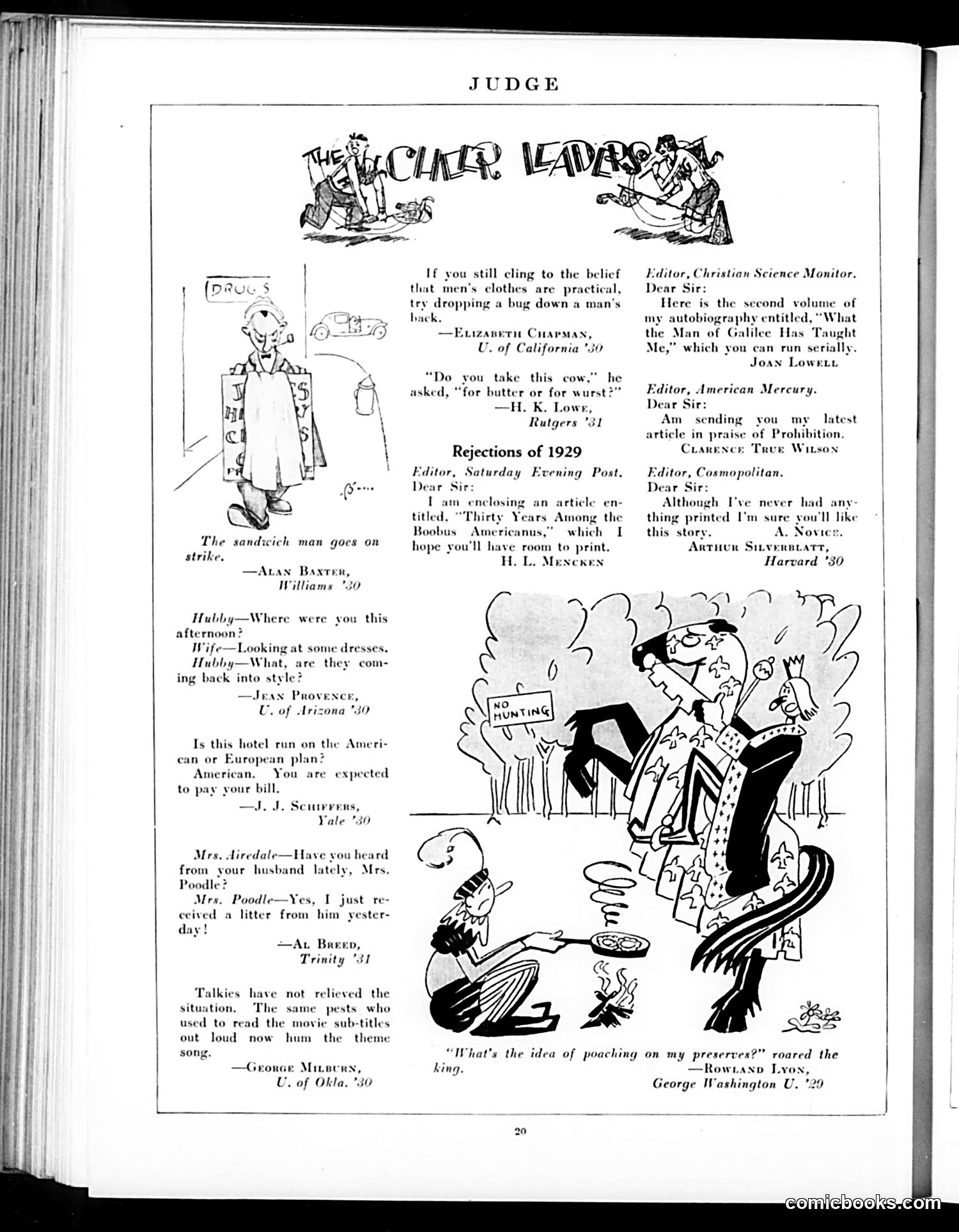
"The Judge" Page Explanation This 1929 satirical magazine page mocks contemporary social absurdities through brief jokes and cartoons. Key satire targets: - Fashion: Women's hemlines constantly changing (dresses "coming back into style") - Hotel service: American hotels expect payment despite poor service ("European plan") - Sound films (newly popular): Audiences now hum movie theme songs aloud instead of reading subtitles—equally annoying - Rejected manuscripts: Overeager amateur writers submit articles to major publications with false confidence, including H.L. Mencken's satirical title "Thirty Years Among the Boobus Americanus" Main cartoon: A king confronts a poacher on his hunting preserve—likely illustrating aristocratic privilege or property rights concerns. The page reflects Depression-era anxieties about manners, social climbing, new technology disrupting behavior, and cultural pretension among aspiring writers. The college attributions ("Yale '30," "Harvard '30") suggest undergraduate humor.
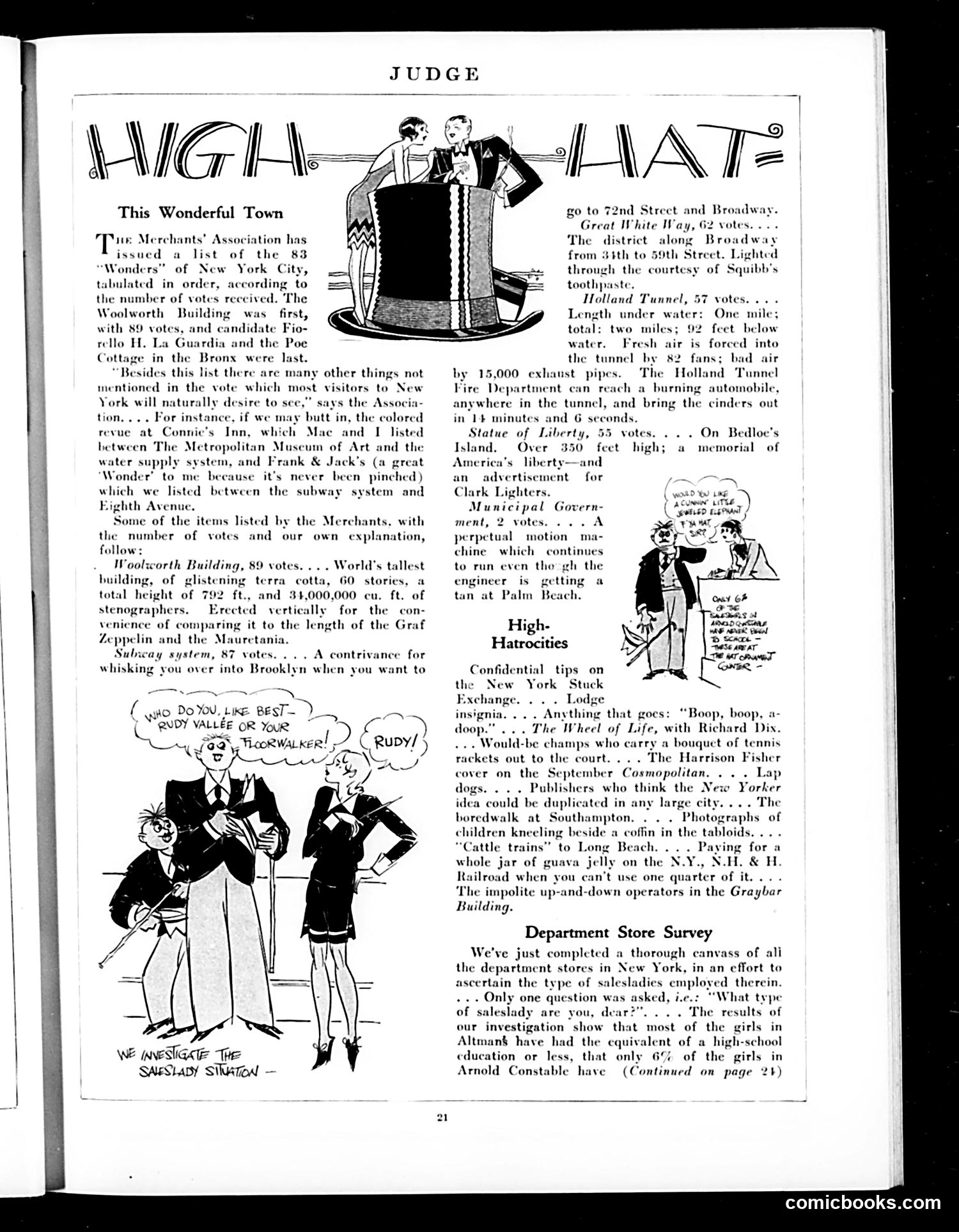
Explanation for Modern Readers This page satirizes New York City landmarks and culture through mock commentary. The Merchants' Association created a list of 83 "Wonders" of NYC; Judge magazine ridicules this by offering absurdist "explanations" of famous sites. The humor works through exaggeration and cynicism: the Woolworth Building is described by its cubic footage rather than architectural significance; the subway whisks you to the *wrong* destination; the Great White Way's lighting is credited to a toothpaste company; the Holland Tunnel's fire department response time is absurdly precise. The left cartoon shows people debating "Rudy Vallee or your father" — likely referencing the famous 1920s singer, suggesting generational taste conflicts. "High-Hatrocities" continues the satirical commentary on NYC's pretensions and social absurdities (tennis players, Southampton pretenders, impolite elevator operators). The final survey mocks department store hiring practices, suggesting salesladies lack education. Overall, the page combines affectionate mockery of NYC with social criticism disguised as humor.
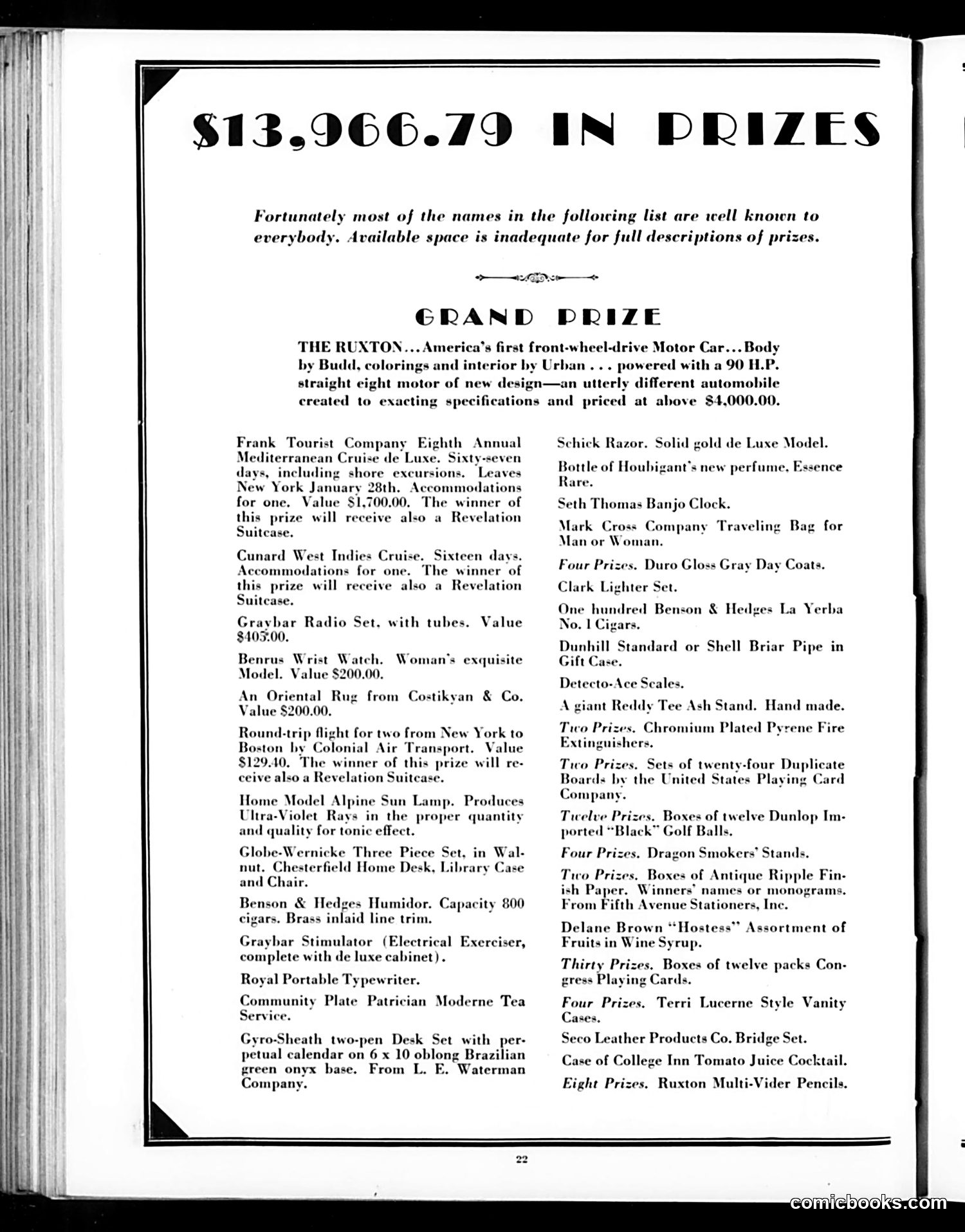
Analysis: Judge Magazine Prize List Page This is not a cartoon page but rather an advertising/promotional feature—a prize list for what appears to be a Judge magazine contest or sweepstakes offering $13,966.79 in total prizes (a substantial sum in the 1920s-30s era). The grand prize is a Ruxton automobile, marketed as "America's first front-wheel-drive Motor Car" priced above $4,000—reflecting the era's fascination with automotive innovation. Other prizes reveal period luxury goods and leisure activities: Mediterranean cruises ($1,700 value), Cunard cruises, radio sets, wristwatches, Oriental rugs, and airplane flights. The list itself is social commentary through consumption: it displays the aspirational lifestyle of Judge's readers—wealthy enough to prize luxury goods, travel, and modern conveniences (radios, electrical exercisers, typewriters). Brands like Benrus, Schick, and Benson & Hedges anchor the prizes in recognizable luxury. The disclaimer that "most names are well known to everybody" suggests these were indeed prestigious brands of the era, positioning Judge readers as members of an affluent, consumption-oriented class.
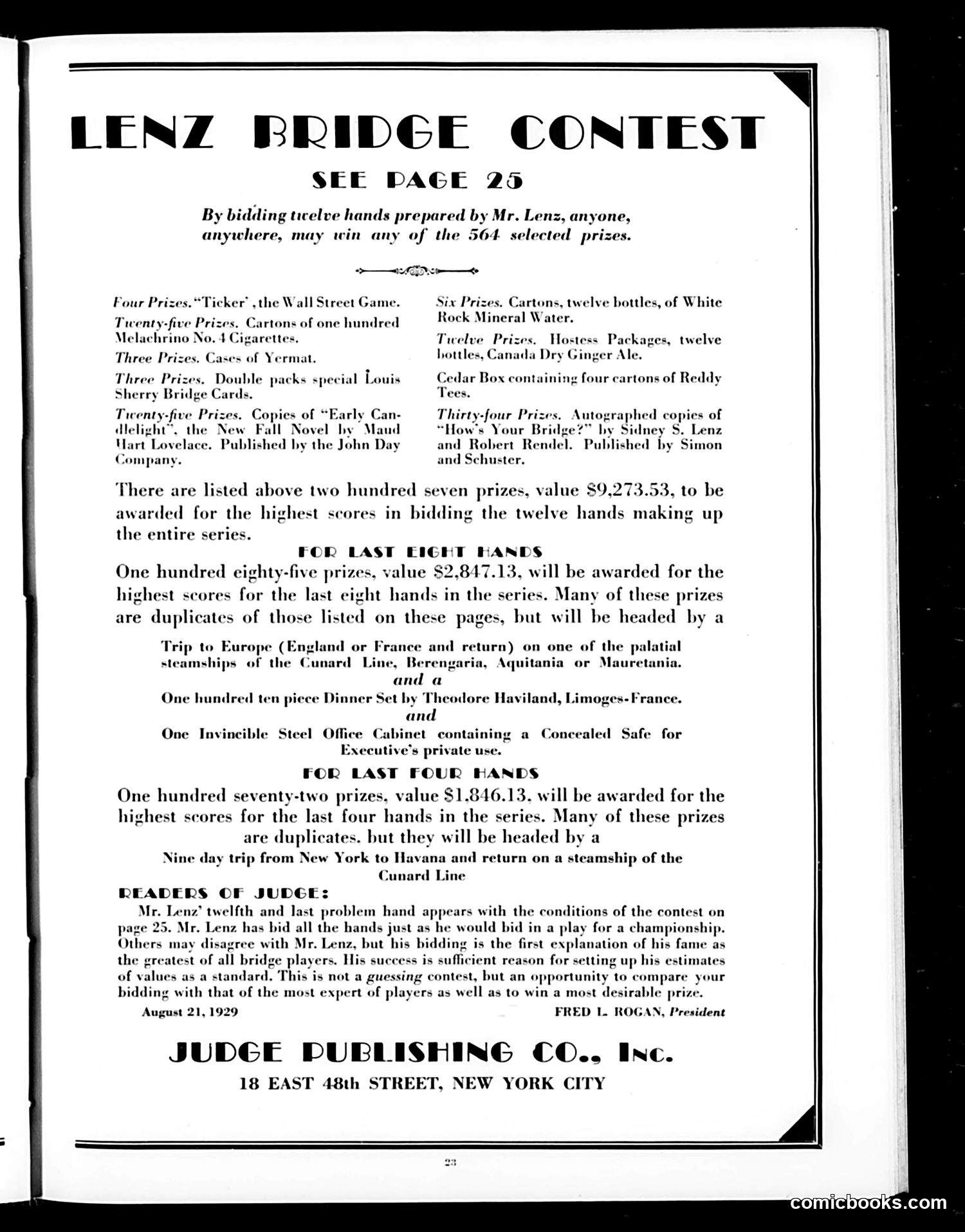
This page is primarily advertising, not political satire. It announces a bridge card game contest sponsored by *Judge* magazine, organized around twelve hands devised by Mr. Lenz, apparently a renowned bridge player. Winners can claim 564 prizes totaling over $12,000—including trips to Europe or Havana, dinnerware, cigarettes, and other luxury goods typical of 1929. The appeal explicitly targets *Judge*'s readers: Lenz's bidding strategy is presented as authoritative ("first explanation of his fame as the greatest of all bridge players"), inviting readers to test their own skills against expert play. This was a common promotional device in periodicals of the era—contests drew subscriptions and engagement. The August 1929 date is notable (just before the stock market crash), and the opulent prizes reflect pre-Depression affluence. There are no visible cartoons or political commentary on this page—it is purely a contest announcement.
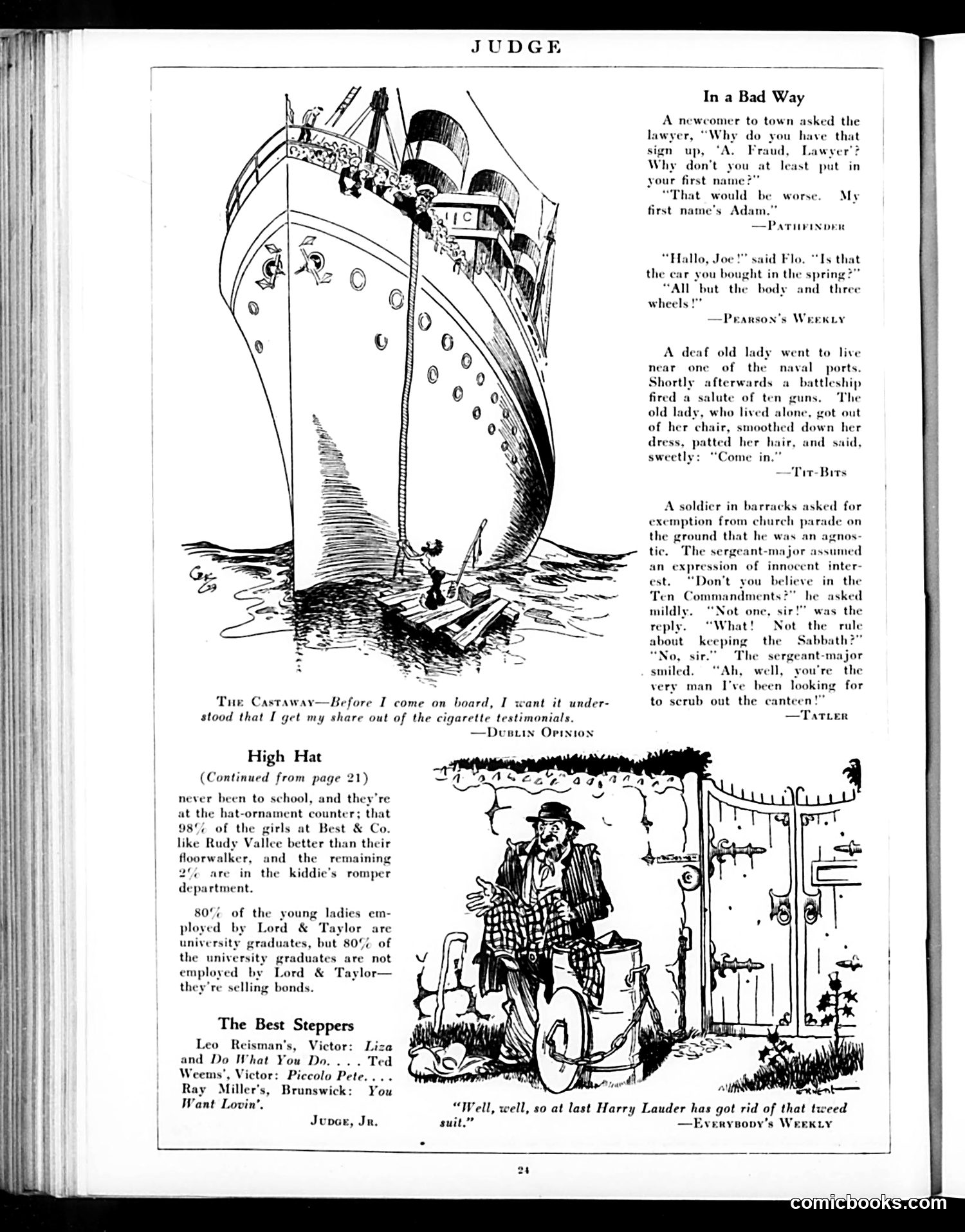
Judge Magazine Page Analysis This page contains several brief humorous anecdotes and two cartoons typical of Judge's satirical style. "In a Bad Way" presents short jokes: a lawyer named "A. Fraud" explains his first name is "Adam" (worse); a deaf elderly woman mistakes a naval gun salute for a visitor; a soldier seeking church exemption is assigned latrine duty instead. "The Castaway" cartoon (top) depicts a shipwreck survivor negotiating salvage rights, humorously prioritizing "cigarette testimonials"—likely referencing early 20th-century advertising where celebrities endorsed cigarettes. "High Hat" discusses hat fashions and employment at luxury retailers Best & Co. and Lord & Taylor, noting contradictions in hiring practices. The final cartoon mocks Harry Lauder (Scottish entertainer famous for his distinctive tweed suits), suggesting he's finally discarded his signature outfit. These pieces reflect 1920s-30s consumer culture, class consciousness, and celebrity gossip typical of Judge's sophisticated urban audience humor.
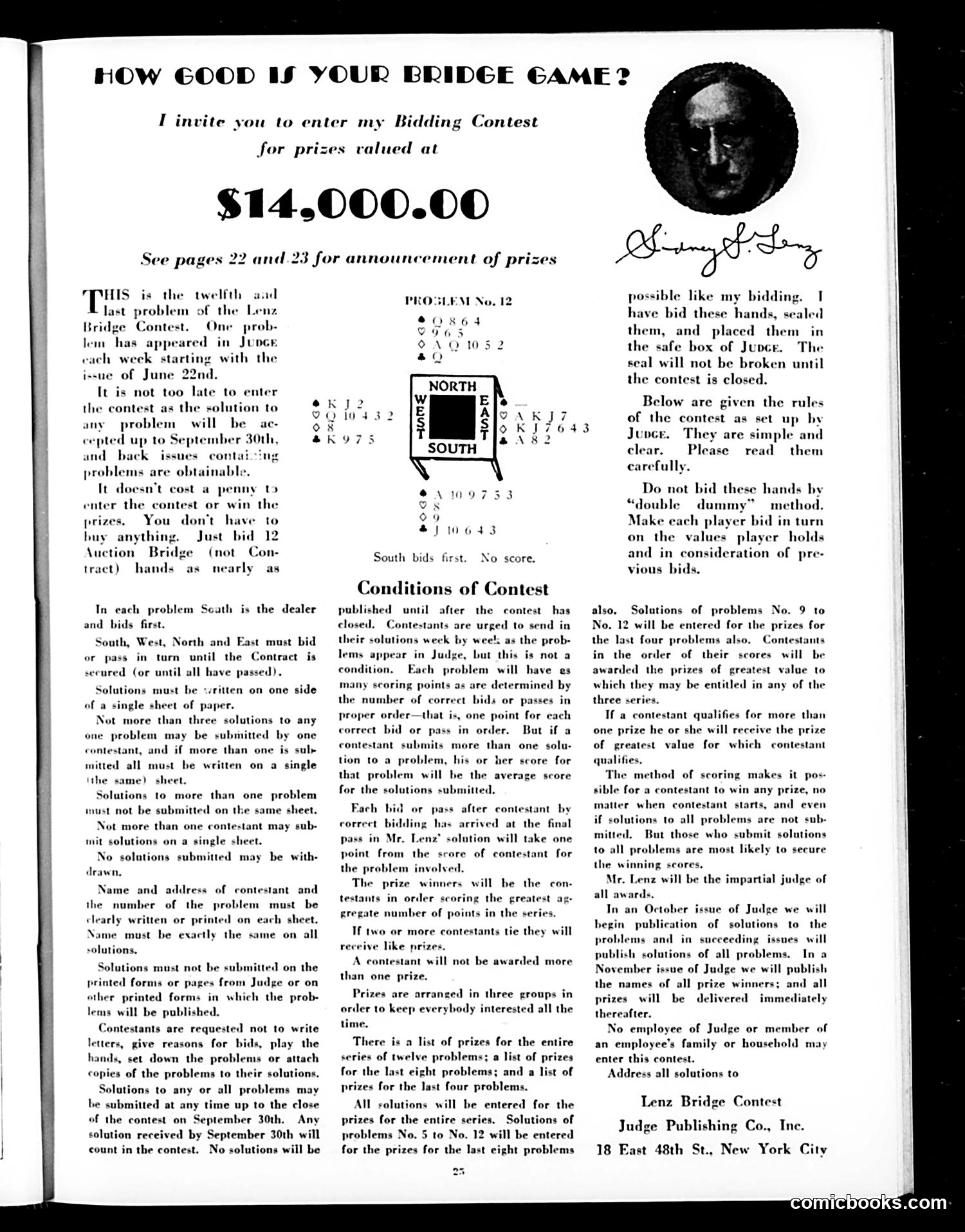
Judge Magazine Bridge Contest Advertisement This page is primarily an advertisement for a bridge bidding contest, not political satire. It announces a contest with $14,000 in prizes, sponsored by someone named Lenz (visible in the signature photo). The contest invites readers to solve 12 bridge problems published weekly in Judge magazine starting June 22nd. The content includes: - Contest rules and entry instructions - A sample bridge hand (Problem No. 12) - Scoring methodology - Prize distribution details - Submission deadlines (September 30th) Context for modern readers: Bridge was enormously popular among educated Americans in the 1930s-1940s. Judge magazine, a humor publication, capitalized on this craze by sponsoring contests to attract subscribers. The large prize money ($14,000—substantial in this era) and detailed rules reflect bridge's cultural prominence as both a serious game and social activity among middle and upper-class audiences.
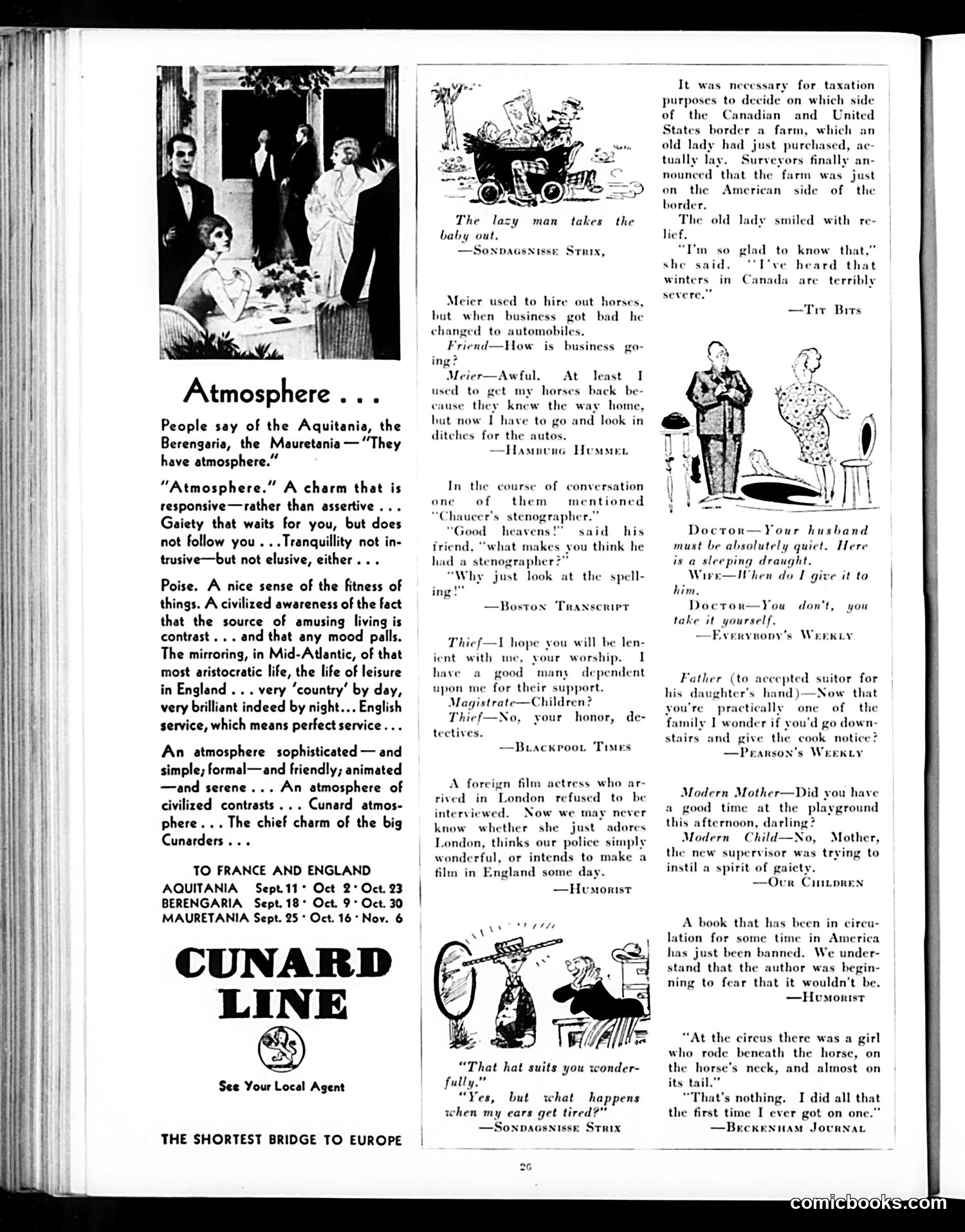
Judge Magazine Page Analysis This page blends advertising with humor. The dominant left side promotes Cunard Line ships (Aquitania, Berengaria, Mauretania)—luxury ocean liners to Europe. The ad emphasizes "atmosphere": refined, sophisticated leisure travel reflecting aristocratic English country life. The right side contains brief satirical jokes typical of Judge magazine's format. These mock everyday situations: a businessman switching from horses to unreliable automobiles; a thief claiming dependents (detectives, not children); a foreign actress's silence about London; a doctor prescribing sleeping draught for a husband's wife to take herself; a father asking his daughter's fiancé to fire the cook. The humor is gentle, domestic, and class-conscious—mocking modern inconveniences (cars breaking down), bureaucratic absurdity, and marital dynamics. The magazine's audience is clearly educated, affluent readers who could afford transatlantic travel and appreciate understated, urbane wit about contemporary life in the 1920s.
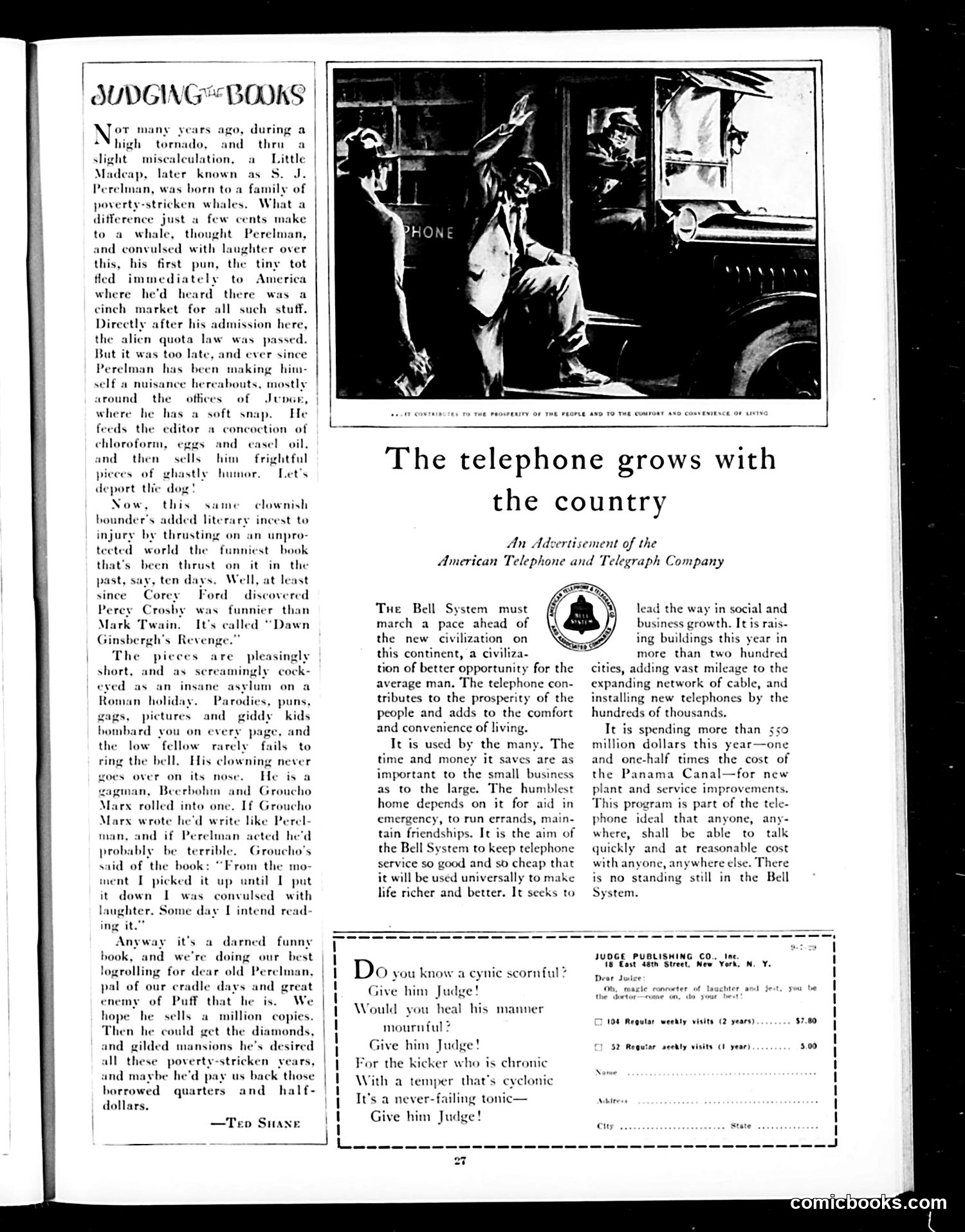
Page Analysis: Judge Magazine This page mixes literary criticism with advertising. "Judging the Books" section: Ted Shane reviews S.J. Perelman's humor collection *Dawn Ginsbergh's Revenge*. Shane praises Perelman as exceptionally funny—comparing him favorably to Groucho Marx and Mark Twain. The review is itself comedic, opening with absurdist biographical mock-history (Perelman born to "poverty-stricken whales"). Shane playfully feigns outrage that this immigrant writer has infiltrated Judge's offices, calling him a "nuisance" while celebrating his talent. It's affectionate roasting typical of 1920s-30s literary culture. Advertisement: AT&T's Bell System ad emphasizes infrastructure expansion and universal telephone access, framing telephones as democratic tools for "average man" and humble homes—wartime propaganda for corporate investment and national progress. Sidebar: A "Give him Judge" promotional box uses humorous scenarios to pitch the magazine as a cure for cynicism and bad temper—typical magazine self-promotion.
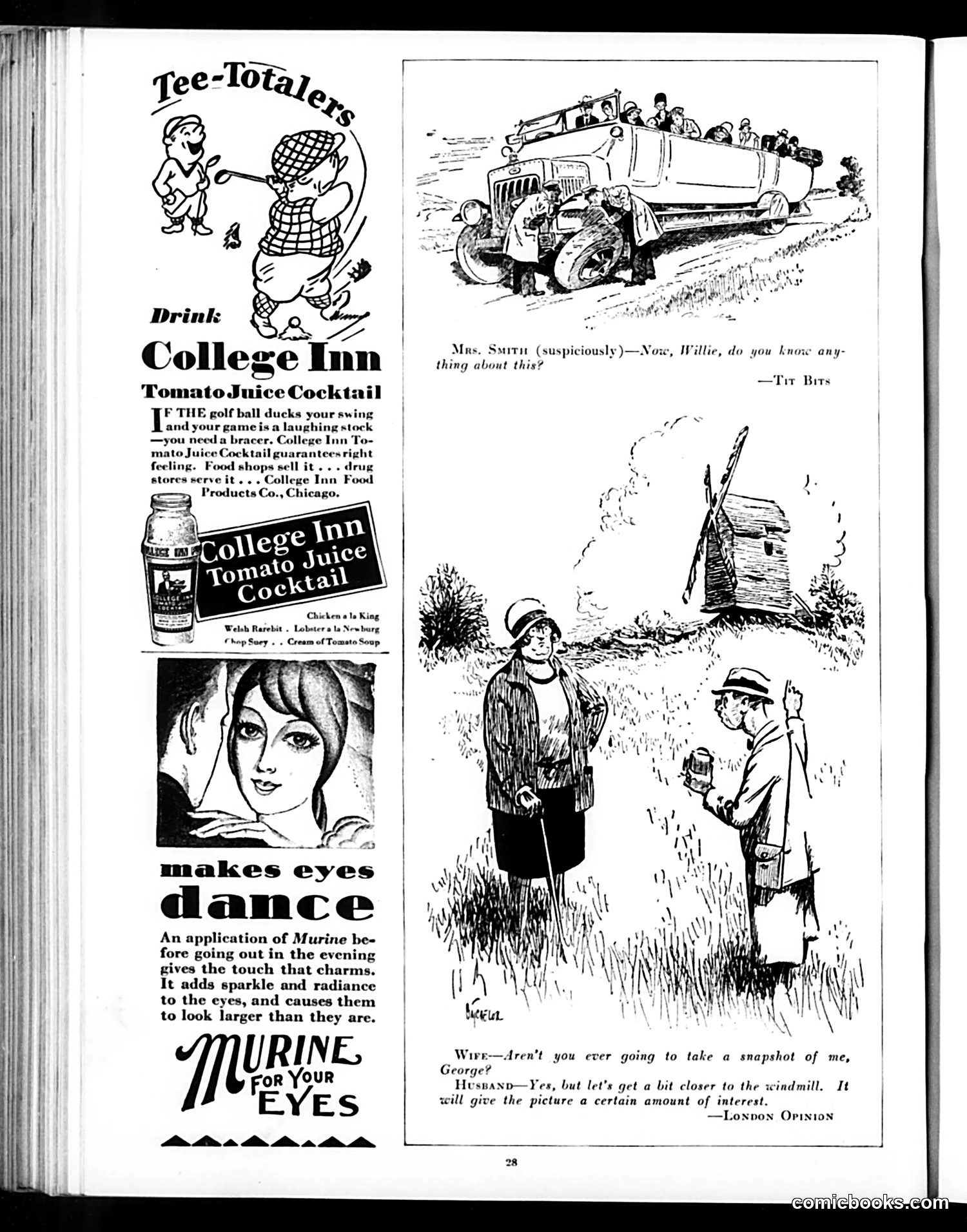
Page Analysis: Judge Magazine This page combines advertisements with two separate humor cartoons. Left side: Advertisements for College Inn Tomato Juice Cocktail (positioning it as a confidence-booster for golfers) and Murine eye cosmetic product. These are straightforward period ads with no satirical content. Top right cartoon ("Tit Bits"): Shows a woman (Mrs. Smith) suspiciously questioning a boy named Willie about an overloaded truck. The joke is visual—the truck is comically overstuffed with passengers, suggesting Willie was involved in some reckless or unauthorized activity. The humor relies on the boy's likely guilty expression. Bottom cartoon ("London Opinion"): A husband avoids photographing his wife, claiming a windmill in the background will make the picture more "interesting." This is gentle marital satire—the husband is diplomatically suggesting his wife would be more photogenic with scenic distraction. The joke mocks both his tactlessness and her likely reaction to such backhanded compliments. Both cartoons use everyday domestic situations for mild, family-friendly humor typical of early 20th-century magazine comics.
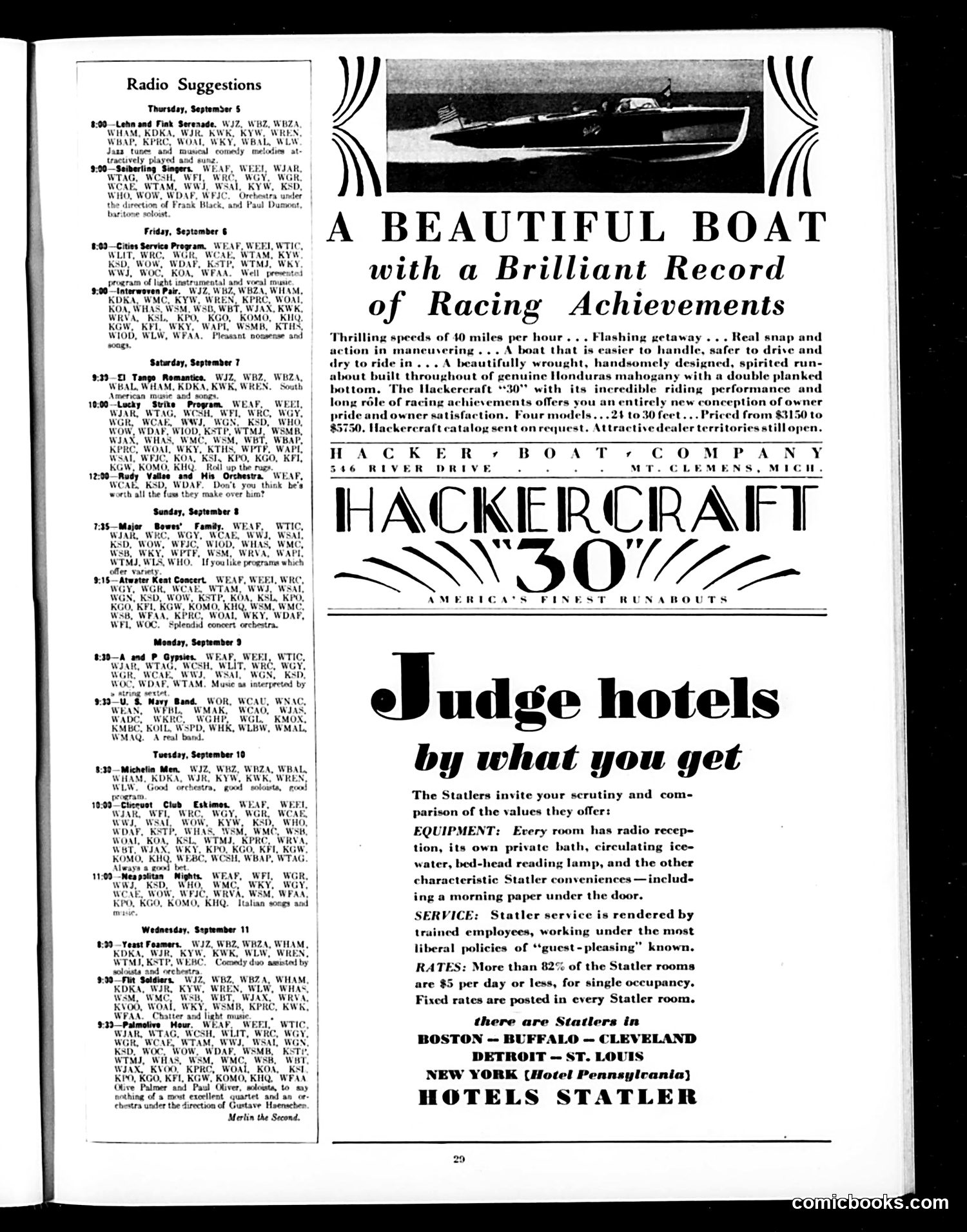
Analysis of Judge Magazine Page Content This page is primarily advertising and radio programming listings, not political satire or editorial cartoons. The content includes: 1. Radio Suggestions (left column): A detailed weekly program schedule listing radio stations and broadcast times—typical of 1930s entertainment guides when radio was the dominant mass medium. 2. Hackercraft Boat Advertisement (center/right): A luxury speedboat advertisement emphasizing performance ("40 miles per hour"), design, and racing achievements. Prices ($3,150–$5,750) suggest this targets wealthy consumers during what appears to be the Great Depression era, reflecting the aspirational lifestyle advertising of that period. 3. Hotels Statler Advertisement (bottom right): A hotel chain promoting amenities and competitive pricing. This is a commercial page with no visible political cartoons or satirical commentary. The "Judge" masthead indicates this is from the satirical magazine, but this particular page focuses on period advertising and entertainment rather than editorial content.
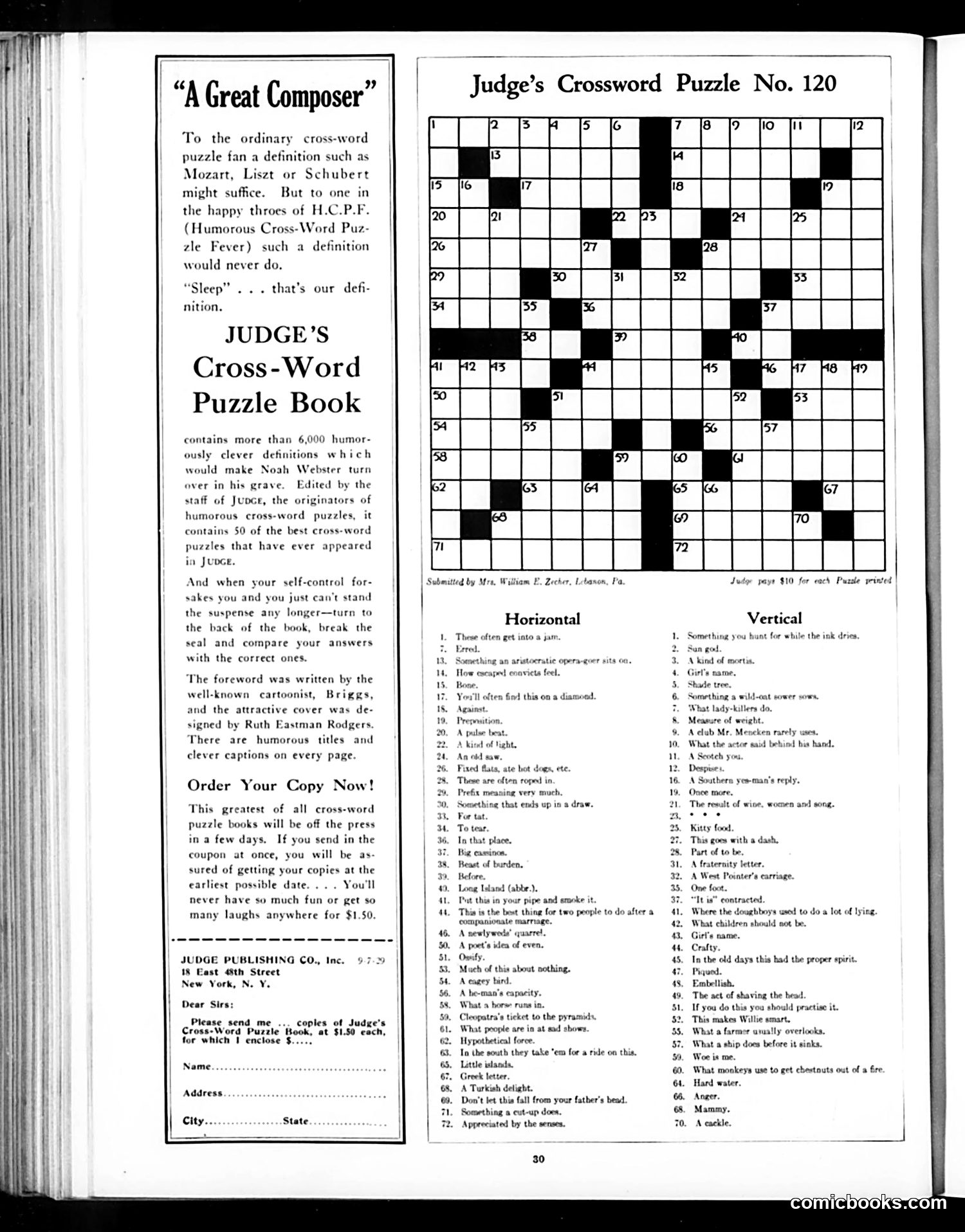
Judge Magazine Crossword Puzzle Page This page is primarily advertising and content for Judge Publishing Company's crossword puzzle book, not political satire. The left side promotes "Judge's Cross-Word Puzzle Book," which claims to contain over 6,000 humorous definitions—a clever marketing angle playing on the 1920s crossword puzzle craze. The humor lies in the mock-serious definitions used for crossword clues. For example, defining "a great composer" as "Sleep" is a play on words (sleep = composer of a siesta/rest). Other clues use puns and contemporary references (like "Cleopatra's ticket to the pyramids" or "companionate marriage" references). The page demonstrates Judge magazine's brand of gentle, wordplay-based humor rather than biting political commentary. It's essentially a product advertisement targeting the puzzle-obsessed public of that era, when crossword puzzles were a major entertainment craze. The foreword by cartoonist Ralph Barton adds prestige to the product.
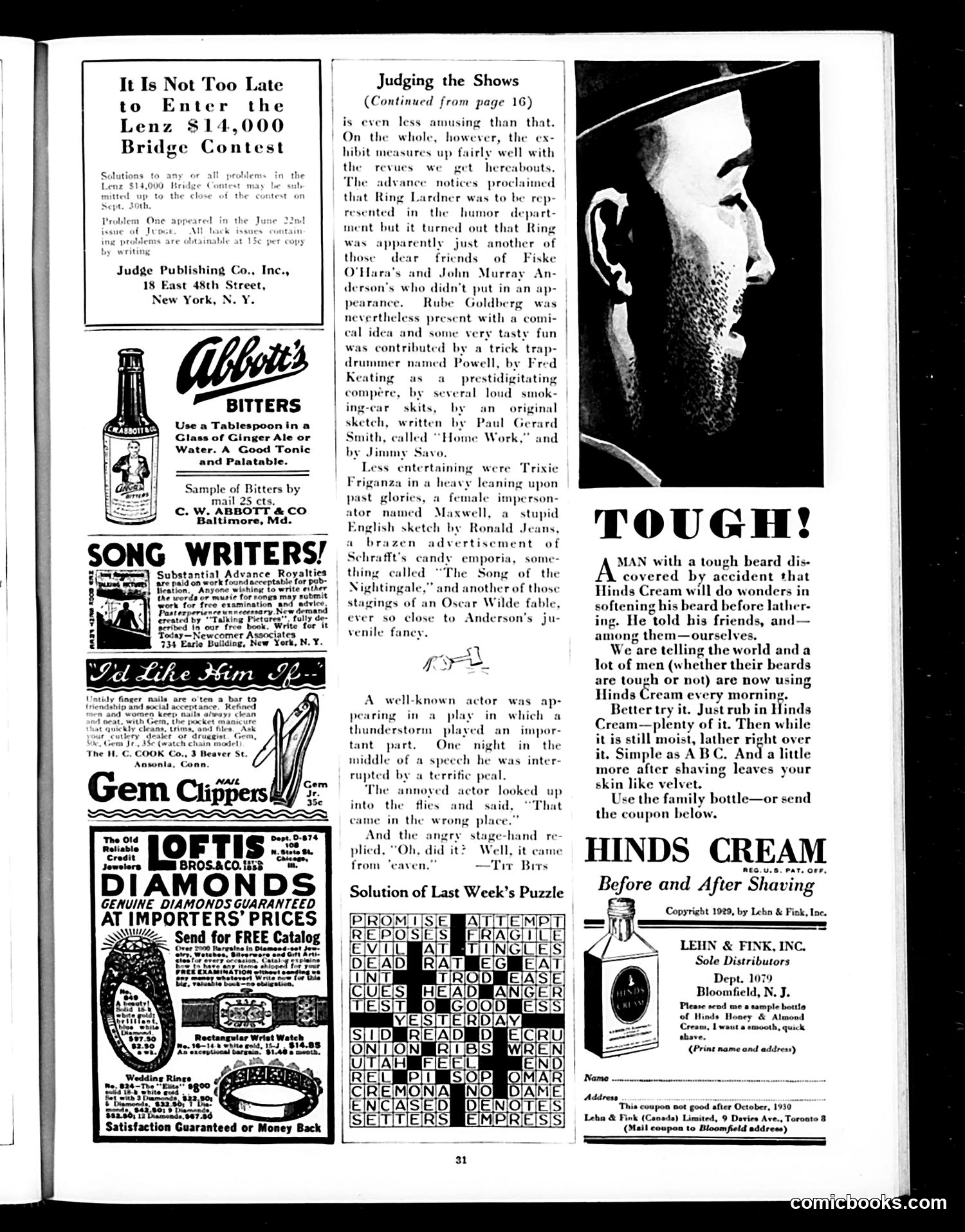
Analysis for Modern Readers This page is primarily advertising with minimal editorial content. The main article, "Judging the Shows" (continued from page 16), reviews theatrical revues and sketches, mentioning entertainers like Rube Goldberg and performers in various stage acts. The tone is casual commentary on vaudeville-style entertainment. The page's dominant features are vintage advertisements: Lofts Diamonds, Gem Clippers, Abbott's Bitters (a medicinal tonic), and most prominently, Hinds Cream — a shaving product marketed with a before/after photograph of a man with a beard. The Hinds ad emphasizes the product softens beards for easier shaving, appealing to male grooming routines. The "Tough!" headline is the product's sales pitch: a tough beard becomes manageable with their cream. No political satire is evident on this page—it reflects 1929 commercial advertising and entertainment journalism.
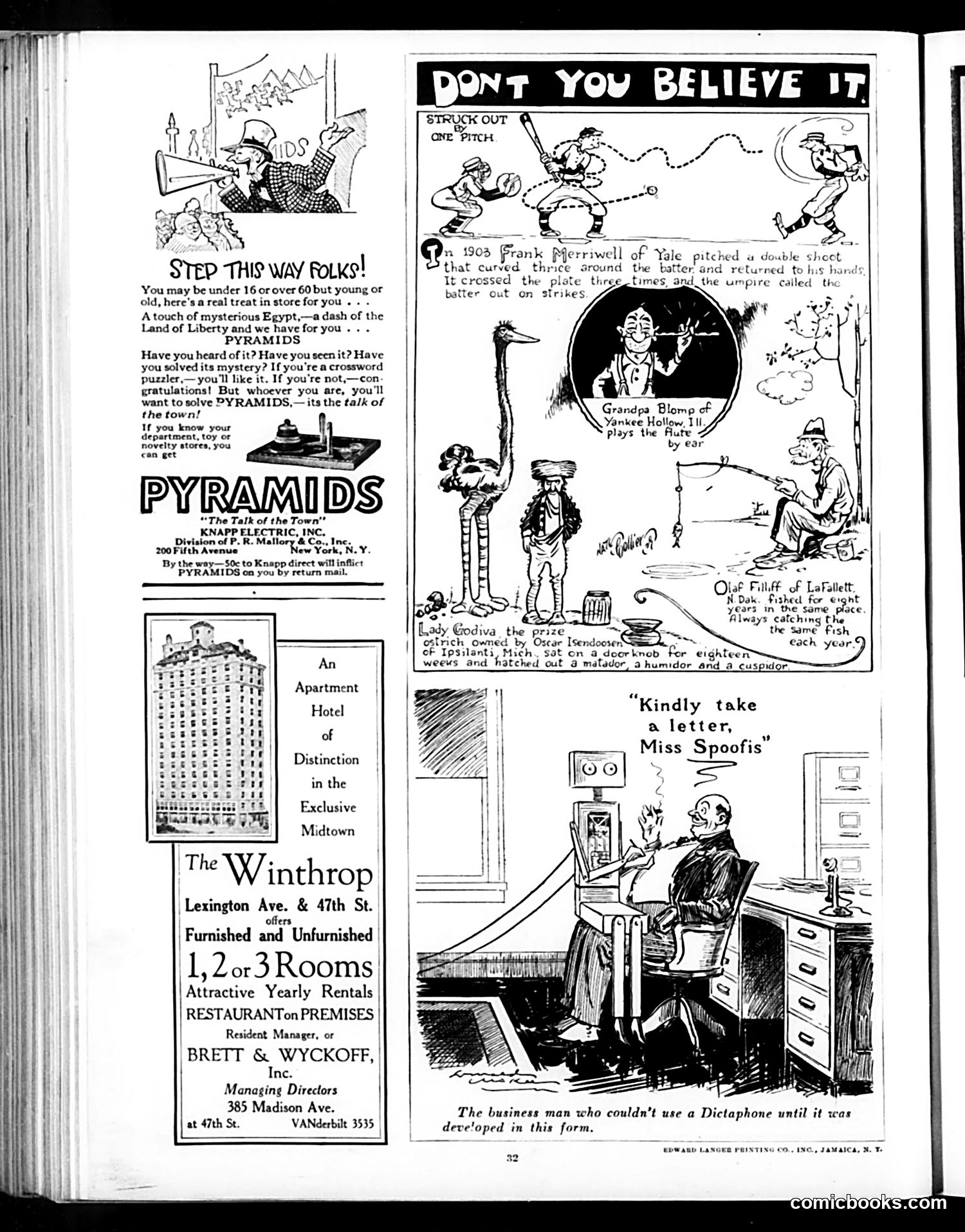
"Don't You Believe It" - Judge Magazine Satire This page mixes advertisements with a cartoon feature debunking tall tales. The main cartoon, "Don't You Believe It," presents four absurd claims framed as fact: 1. Frank Merriwell's impossible pitch (1903) - a curveball that circles the batter three times and returns to the pitcher's hand. This likely references the popular fictional Yale athlete Frank Merriwell from dime novels, mocking exaggerated sports mythology. 2. Grandpa Blomp playing the flute - implying impossible musical feats. 3. Olaf Fut's identical fish - catching the same fish yearly in the same spot. 4. Lady Godiva's ostrich - hatching impossible objects (matador, humidor, cuspidor). The satire targets credulous readers who believe implausible stories. The bottom cartoon mocks dictaphone technology adoption, suggesting businessmen resisted the device until it was redesigned into a familiar form. The page also advertises "Pyramids" (a puzzle game), The Winthrop hotel, and other period products.
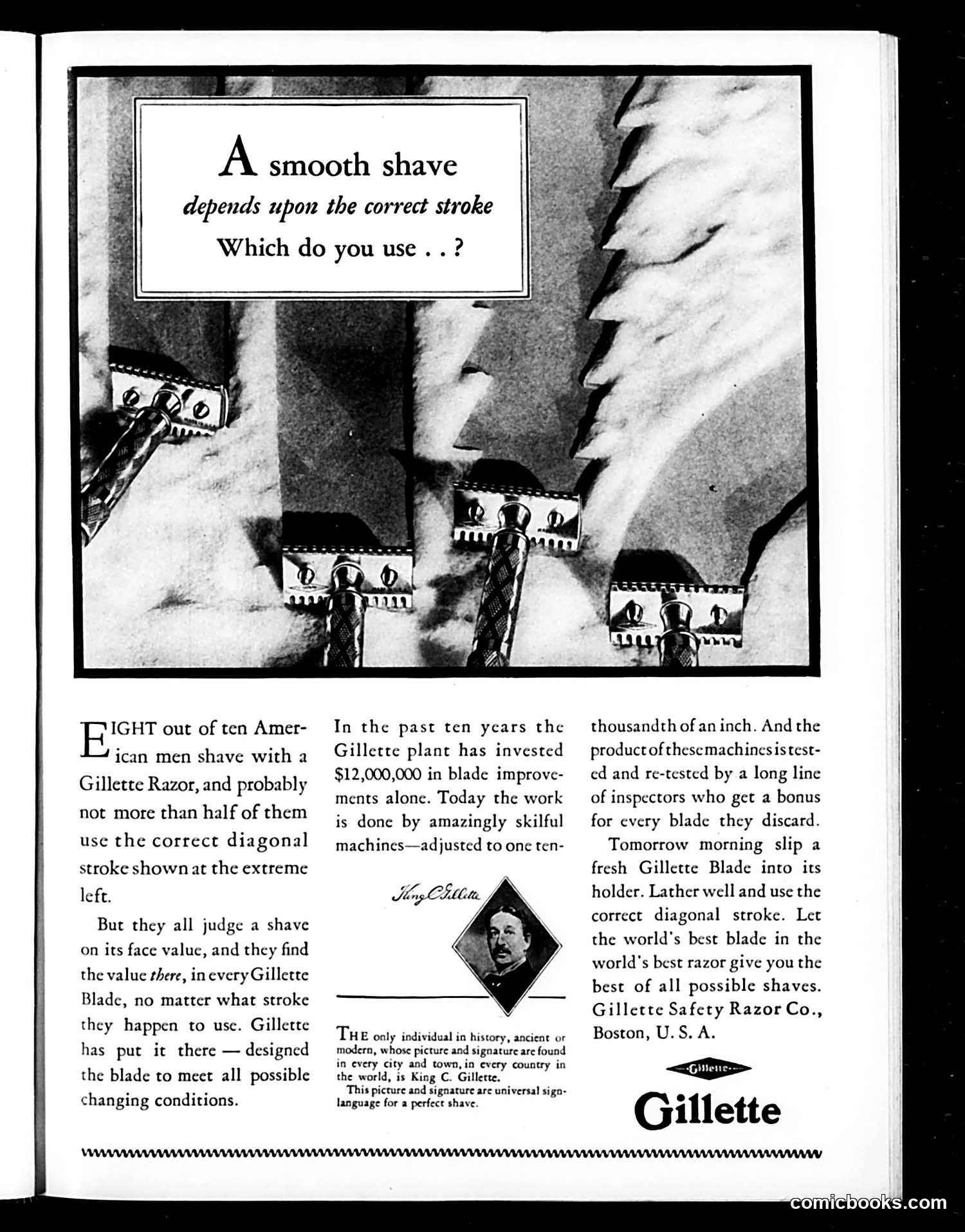
Gillette Razor Advertisement (Judge Magazine) This is primarily a Gillette Safety Razor advertisement, not satire. The "cartoon" element at the top—showing multiple razor blades at different angles against a man's face—illustrates the advertiser's main claim: that a smooth shave "depends upon the correct stroke," specifically the diagonal stroke shown at left. The ad's rhetorical strategy employs subtle boasting: eight of ten American men use Gillette razors, yet fewer than half use the "correct" technique. However, the ad claims this doesn't matter because Gillette has engineered superior blades ($12,000,000 invested, precision manufacturing, rigorous inspection) that deliver quality results regardless of user technique. The portrait of "King C. Gillette" (the founder) reinforces the brand's claim to universal dominance—his image and signature allegedly appear "in every city and town, in every country in the world." This represents early-20th-century advertising's shift toward emphasizing scientific manufacturing and product superiority rather than mere functionality.
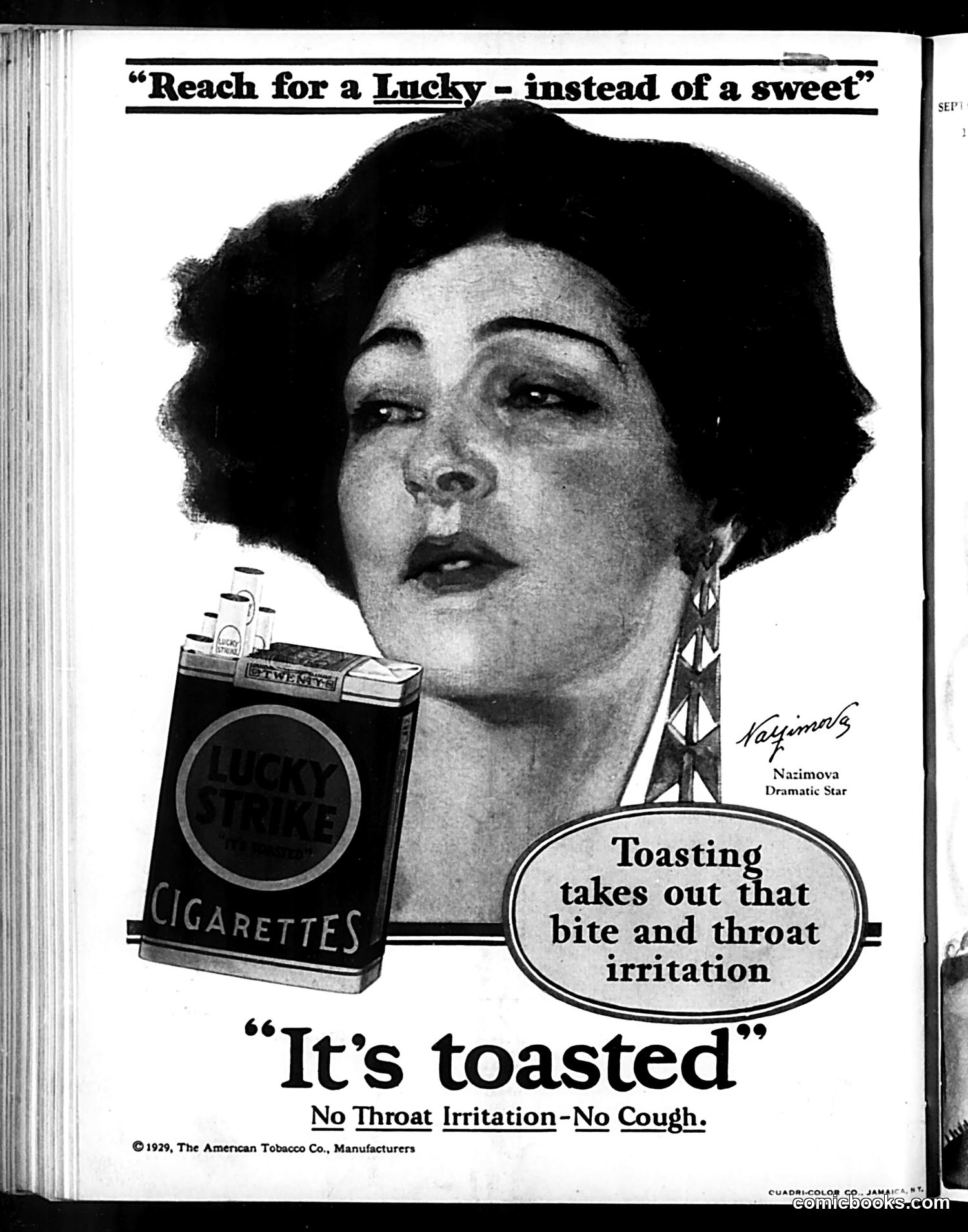
Analysis This is a Lucky Strike cigarette advertisement, not political satire. It features Nazimova, a famous dramatic actress of the silent film era, endorsing the product. The ad's central claim—"Toasting takes out that bite and throat irritation"—references Lucky Strike's marketing strategy of promoting their toasting process as a health benefit. This was common cigarette advertising before tobacco health dangers were widely acknowledged. The tagline "Reach for a Lucky—instead of a sweet" was Lucky Strike's actual slogan, positioning cigarettes as an alternative to candy, appealing to weight-conscious consumers (particularly women). By modern standards, this advertisement is striking for its casual promotion of smoking as beneficial and its use of a respected entertainer to lend credibility to unsubstantiated health claims—practices now illegal.