judge
Judge — September 14, 1929
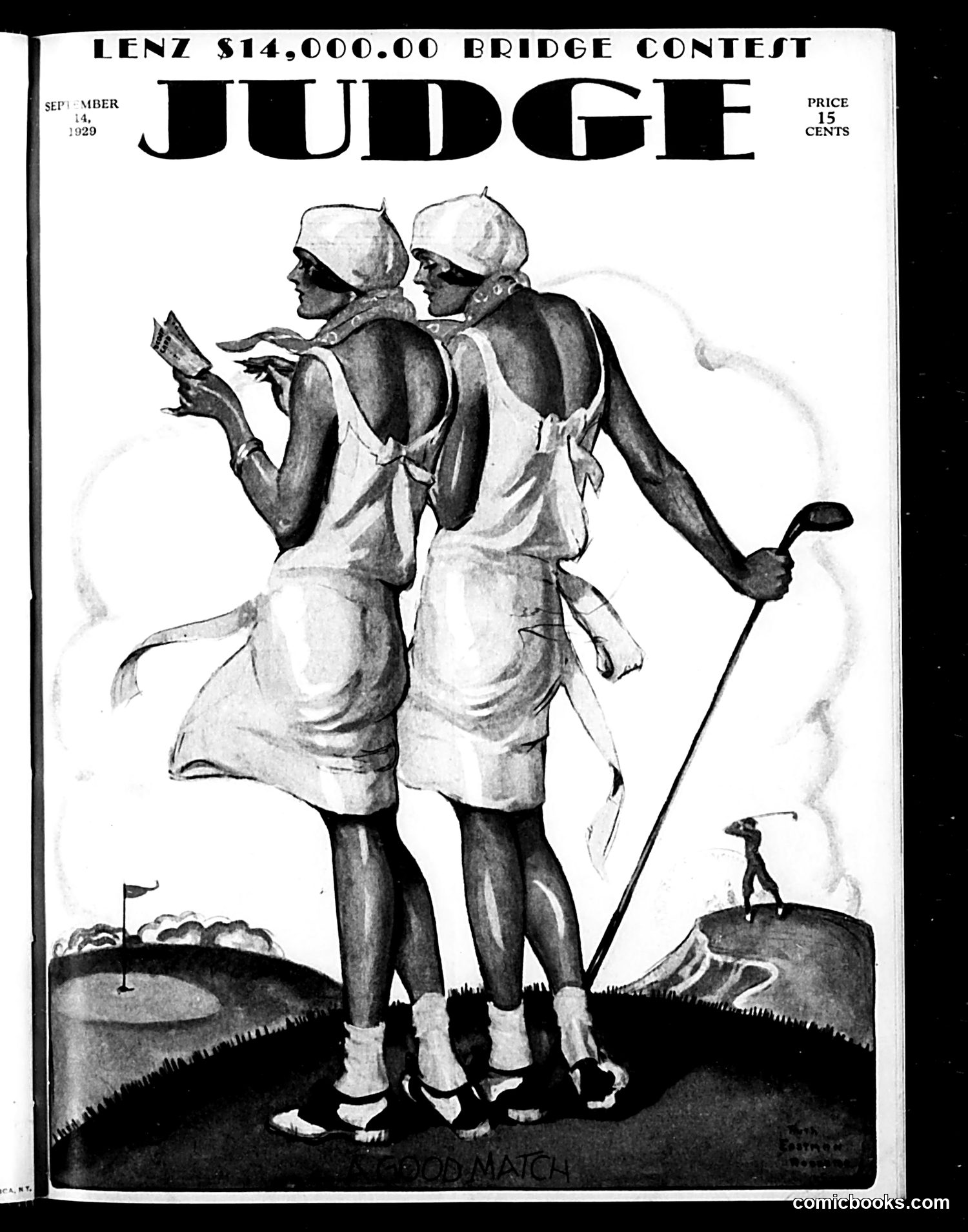
Analysis of Judge Magazine Cover, September 14, 1929 This cover depicts two women golfers on a bridge, referencing the "Lenz $14,000.00 Bridge Contest" mentioned in the header. The satire appears to target women's golf participation during the 1920s leisure era. One woman holds money while both are dressed in period athletic wear (cloche hats, short dresses, athletic shoes). A small male golfer appears on the distant hill, seemingly excluded from the scene. The joke likely mocks either: (1) women's increasing participation in formerly male-dominated sports, or (2) the commercialization of women's golf through large prize contests. The "bridge" reference remains unclear—possibly alluding to a specific tournament venue or using "bridge" as a metaphor for women crossing into new recreational domains. The illustration style and casual athletic depiction reflect 1920s modernism regarding women's roles.

Raleigh Cigarettes Advertisement This is primarily a cigarette advertisement, not political satire. It promotes Raleigh cigarettes at twenty cents per pack (plain or tipped), manufactured by Brown and Williamson Tobacco Corporation in Louisville, Kentucky. The advertisement features packaging imagery and a historical portrait—likely Sir Walter Raleigh, the Elizabethan explorer and colonizer for whom the brand is named. The phrase "Blended puff-by-puff" emphasizes the product's smoking quality. The tagline claims that at twenty dollars (presumably per carton), the cigarettes "couldn't please more people nor please any people more"—a paradoxical claim suggesting universal appeal or acceptance. This reflects early-to-mid 20th-century tobacco marketing before health warnings were required.
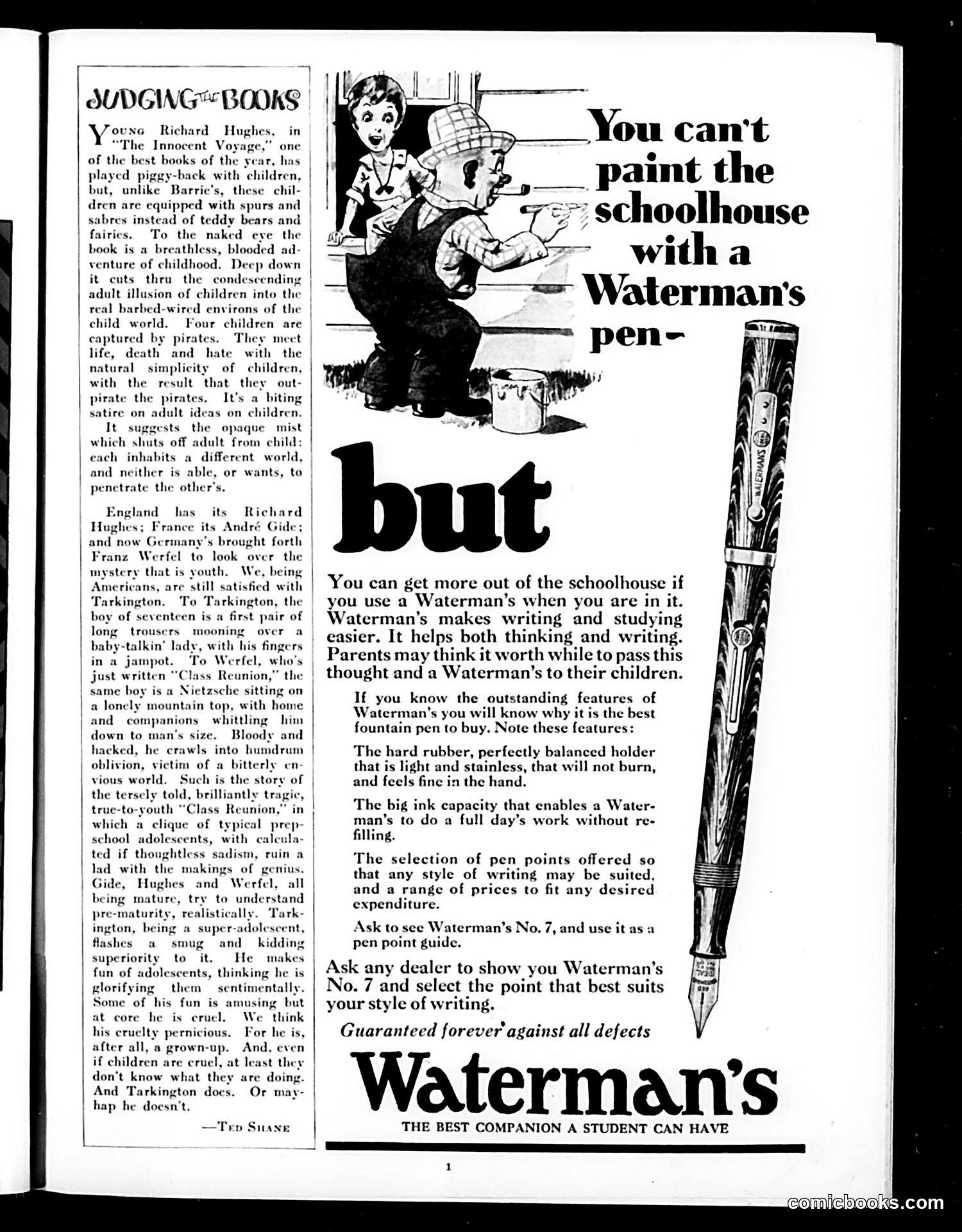
Page Analysis This page contains a book review column ("Judging the Books") alongside a Waterman's fountain pen advertisement. The review critiques "The Innocent Voyage" by Richard Hughes, praising its raw depiction of childhood adventure—children captured by pirates who exhibit natural cruelty. The reviewer compares Hughes favorably to other national authors (England's Richard Hughes, France's André Gide, Germany's Franz Werfel), positioning him as America's answer to European literary sophistication. The advertisement uses satirical humor to sell pens: "You can't paint the schoolhouse with a Waterman's pen—but" you can accomplish actual schoolwork efficiently. The humor contrasts the pen's legitimate utility against destructive childhood impulses, aligning with the review's theme about children's natural inclinations toward mischief. Both elements reflect 1920s-30s attitudes toward childhood psychology and consumer goods marketing.
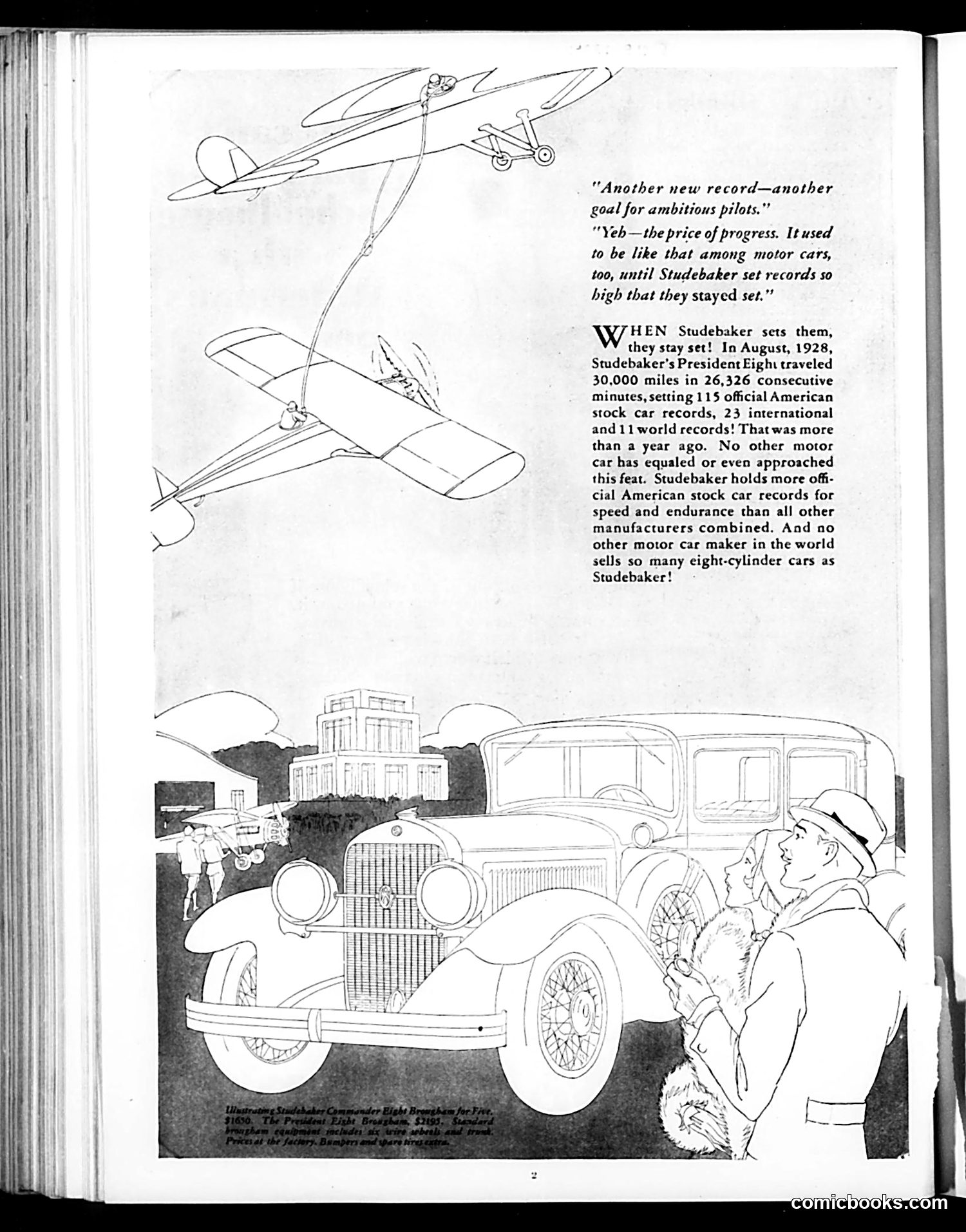
Analysis This is a Studebaker automobile advertisement, not political satire. The page compares Studebaker's record-setting achievements to aviation progress. The text boasts that Studebaker's President Eight traveled 30,000 miles in August 1928, setting 115 American and 23 international records—claims no competitor had matched. The advertisement argues Studebaker dominates the eight-cylinder market. The sketches show gliders and aircraft above, symbolizing ambition and progress, while the lower illustration depicts Studebaker automobiles and enthusiastic observers. The visual metaphor equates automotive engineering with cutting-edge aviation technology. This represents typical 1920s advertising strategy: using technological achievement and competition records to position luxury cars as pinnacles of American industrial prowess and engineering excellence.
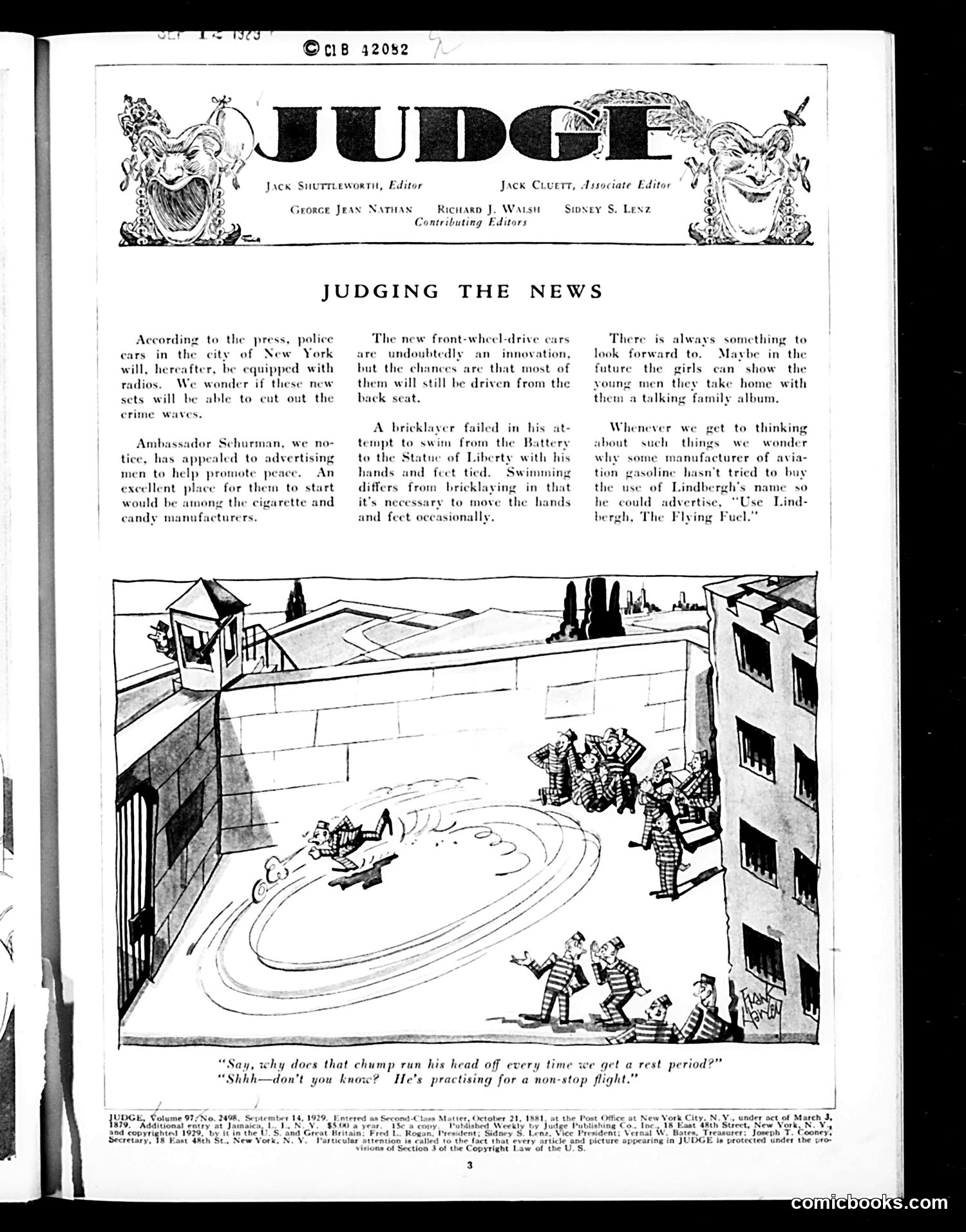
"Judging the News" Analysis This satirical page from *Judge* magazine contains three brief commentary pieces mocking current events, plus a cartoon depicting prisoners exercising in a prison yard. The cartoon's caption—"Say, why does that chump run his head off every time we get a rest period? Shh—don't you know? He's practicing for a non-stop flight"—references Charles Lindbergh's famous 1927 non-stop transatlantic flight. The joke sarcastically suggests a prisoner obsessively running in circles is training for similar aviation feats, mocking both the prisoner's futility and perhaps Lindbergh's celebrity status. The text snippets satirize various topics: police radio cars in New York, front-wheel-drive automobiles, Ambassador Schurman's peace advocacy, and an anecdote about bricklaying versus swimming. The tone is lighthearted social commentary typical of *Judge's* satirical approach.
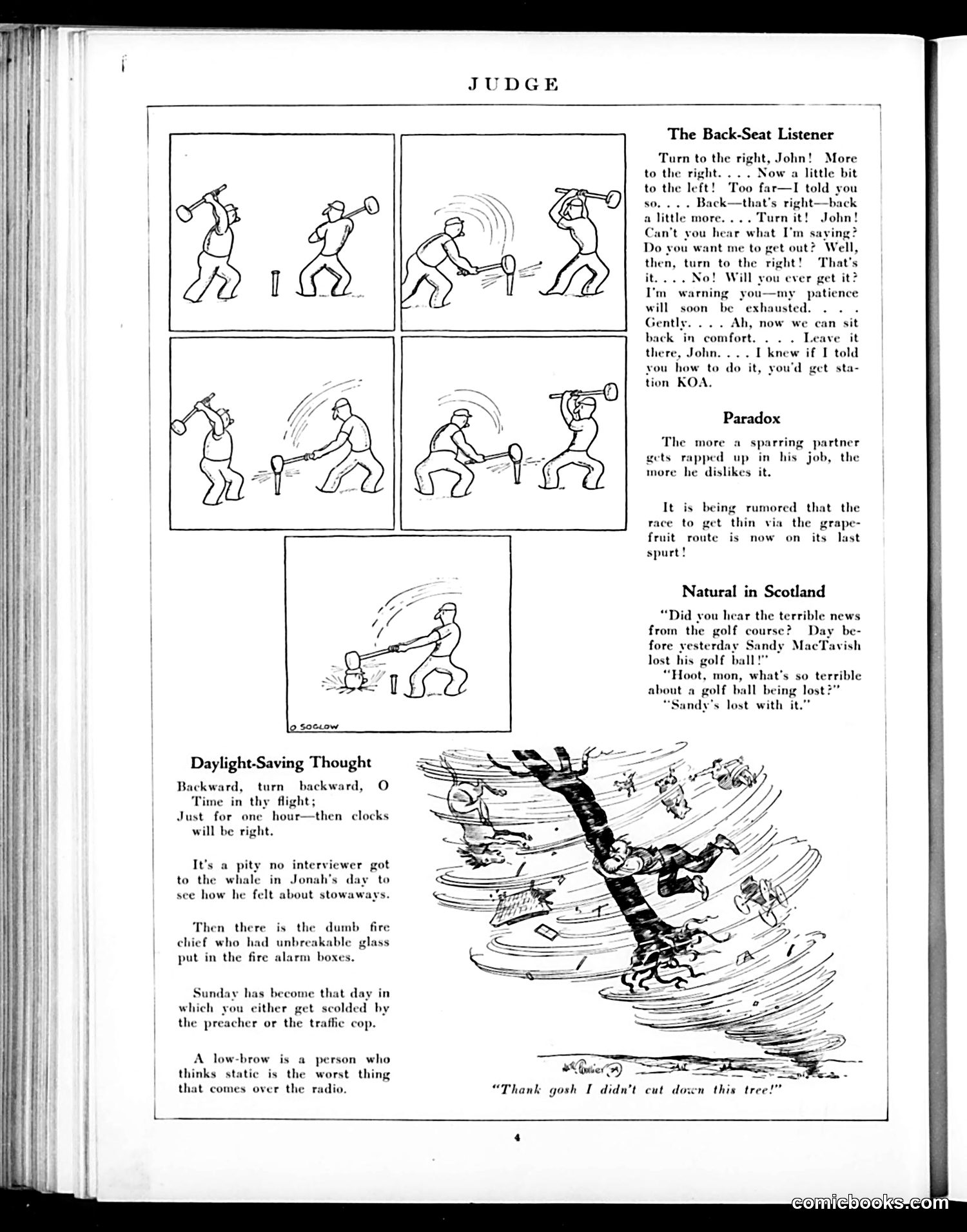
Analysis of Judge Magazine Page This page contains several short humor pieces and comic strips, not political cartoons: "The Back-Seat Listener" depicts a man giving increasingly exasperated driving directions to a passenger named John who refuses to follow them, satirizing the annoyance of backseat passengers. "Paradox" presents a one-liner joke about job dissatisfaction. "Natural in Scotland" is a brief dialogue joke about losing a golf ball, playing on Scottish stereotypes. "Daylight-Saving Thought" offers humorous observations about daylight saving time and various absurd situations. The large illustration shows a figure falling from a tree with the caption "Thank gosh I didn't cut down this tree!"—a play on the George Washington cherry tree legend. These are gentle domestic humor pieces typical of Judge magazine's satirical approach to everyday American life, not focused on political commentary.
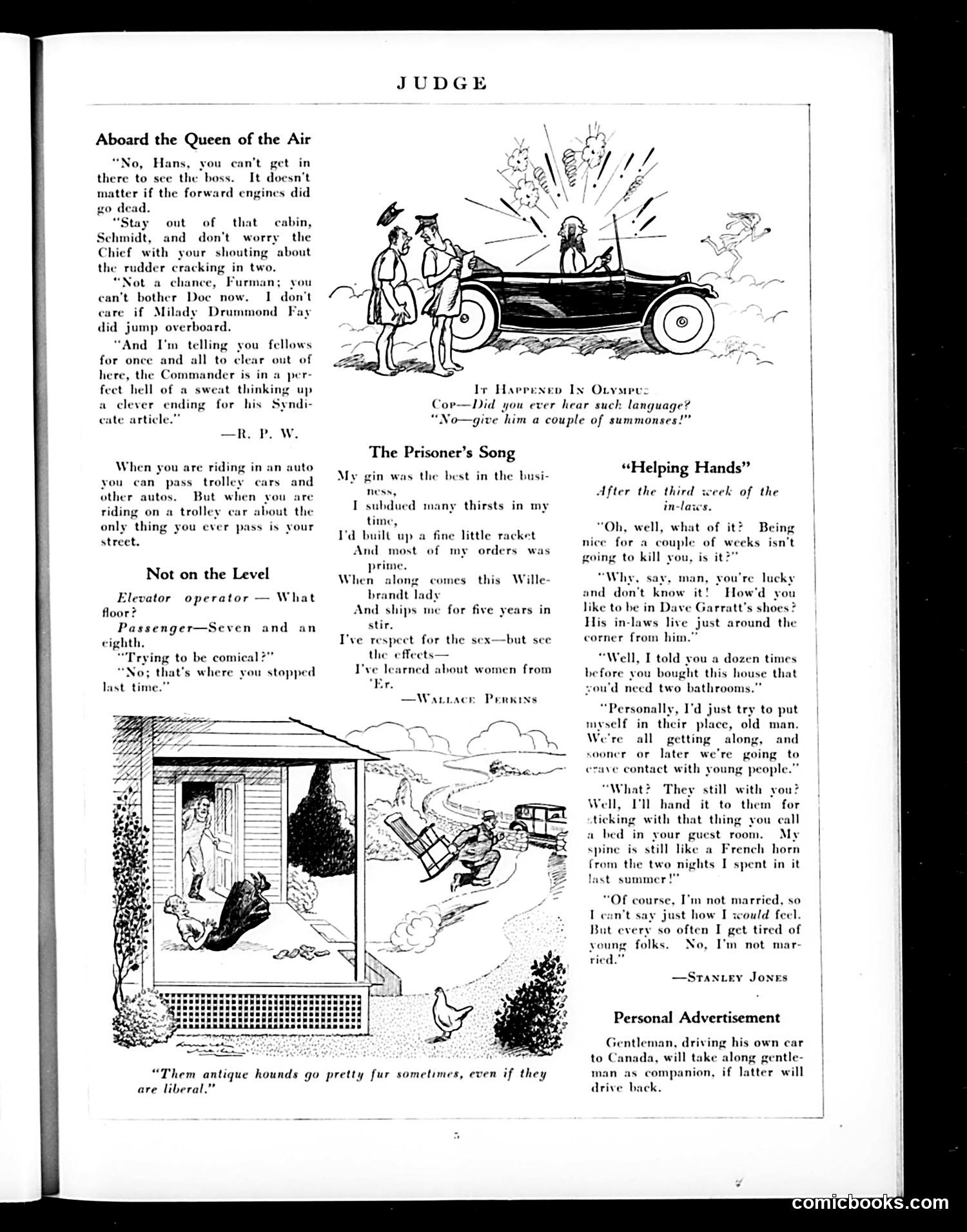
Analysis of Judge Magazine Page This page contains several humorous pieces rather than political cartoons. The main illustration shows a couple observing an automobile accident, with the caption "Them antique hounds go pretty fur sometimes, even if they are liberal." This appears to be a joke about early automobiles' unreliability—"antique hounds" likely refers to old cars, with "liberal" meaning generous or excessive in some way. Other items include comedic dialogue pieces ("Aboard the Queen of the Air," "Not on the Level," "The Prisoner's Song," "Helping Hands") and a personal advertisement seeking a driving companion to Canada. The humor is primarily domestic and observational rather than explicitly political. Without clear dating or specific references, the exact historical context remains unclear, though the automobile references suggest early 20th century.
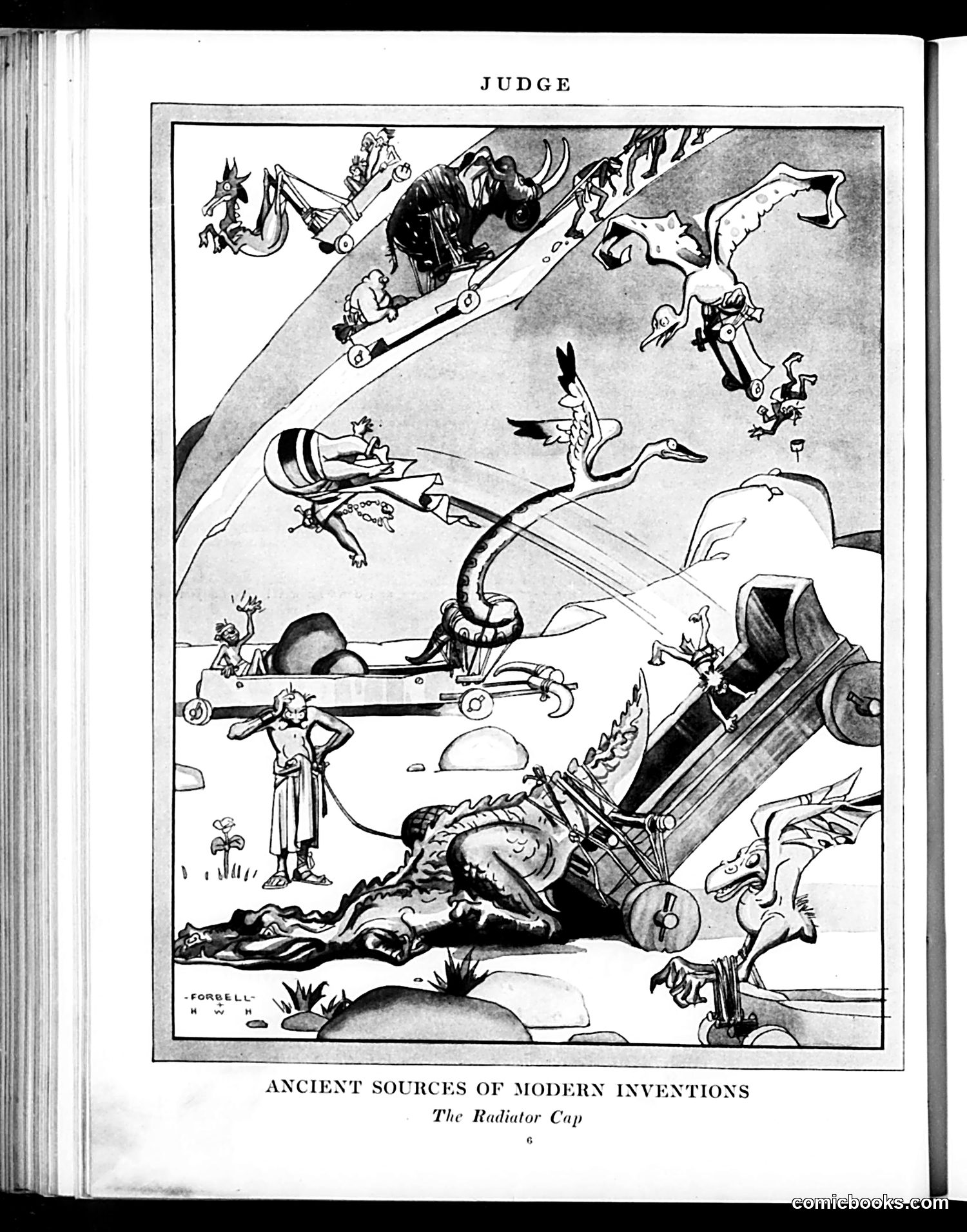
"The Radiator Cap" — Judge Magazine Cartoon This is a humorous illustration titled "Ancient Sources of Modern Inventions," specifically about the radiator cap. The cartoon depicts a chaotic mythological or fantasy scene where various creatures (demons, monsters, fantastical beings) are engaged in what appears to be a primitive version of heat management or steam control. The joke satirizes the idea that modern inventions have ancient predecessors. The radiator cap—a practical automotive component—is humorously traced back to an imaginary ancient scenario of magical creatures managing fire or heat. The artist (signed "Forbell") uses surreal imagery to make the technological mundane seem absurdly grandiose by claiming mythic origins for something as ordinary as a car part.
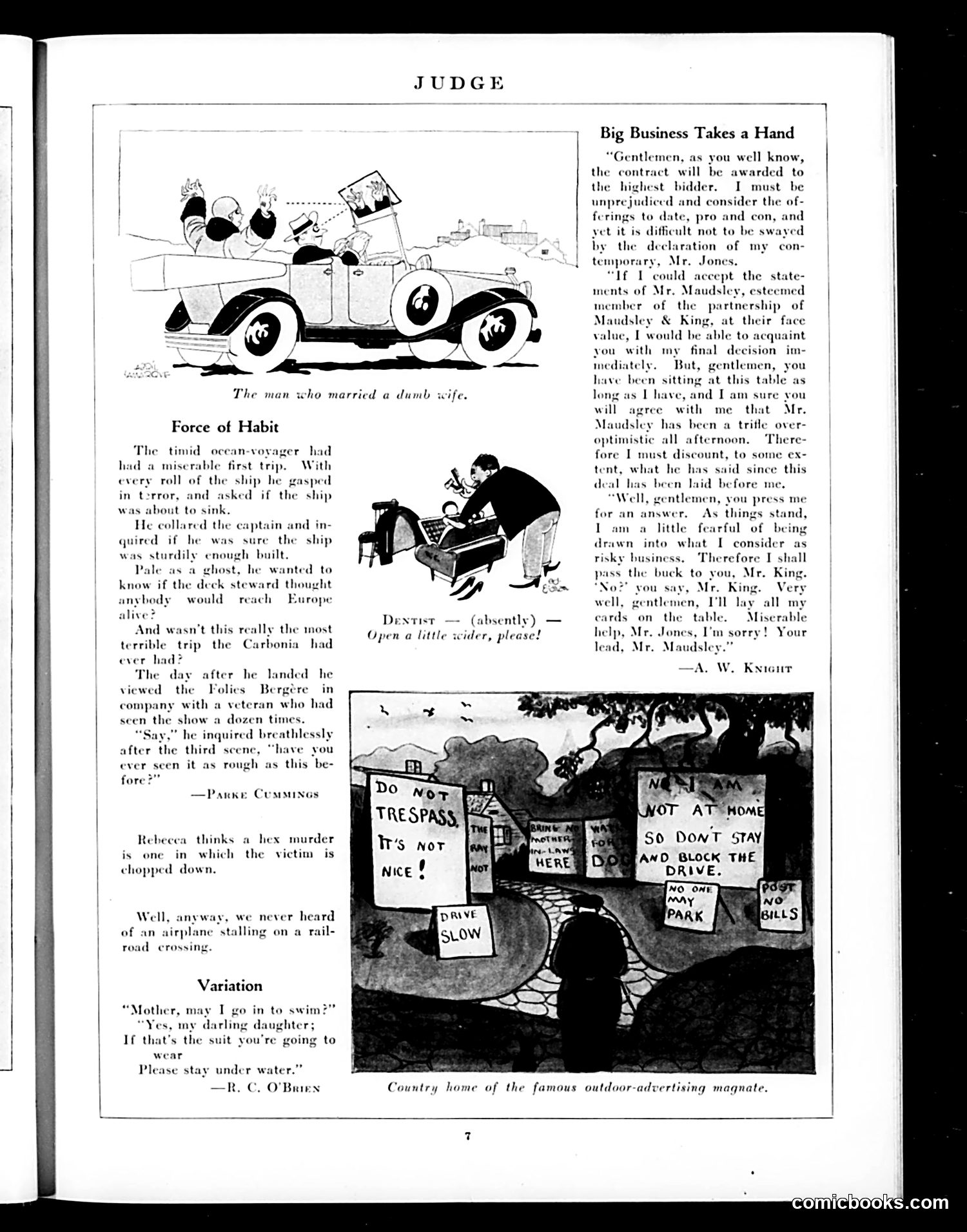
Judge Magazine Page Analysis This page satirizes business decision-making and corporate buck-passing. The main cartoon "Big Business Takes a Hand" depicts a contract negotiation where a businessman refuses to make a decision, instead deferring responsibility to others. He acknowledges one partner (Maudsley) is "over-optimistic" but won't commit, ultimately passing "the buck" to Mr. King. The satire targets how executives in competitive bidding situations avoid accountability by shifting decisions elsewhere—a critique of corporate cowardice masquerading as prudence. The secondary cartoon shows a property owner surrounded by signs discouraging trespassing and parking, captioned as the "country home of the famous outdoor-advertising magnate"—ironic mockery of someone who profits from aggressive roadside advertising while forbidding others from using their own land. The page also includes unrelated humor pieces about habit, ocean voyages, and parental wit. The overall theme mocks corporate evasiveness and hypocrisy.
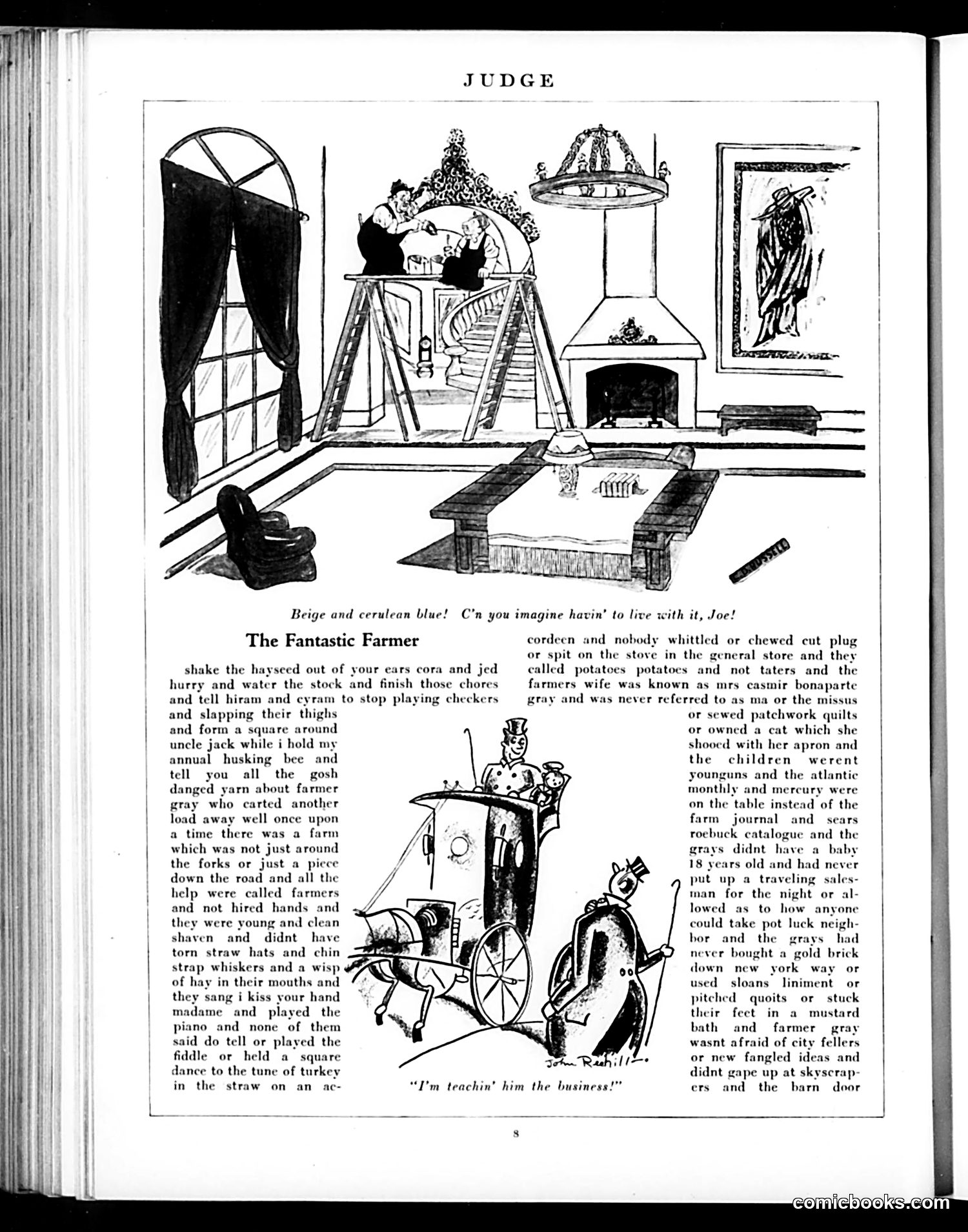
Explanation for Modern Readers This page contains two satirical pieces from *Judge* magazine mocking rural American life and pretension. Top cartoon ("Beige and cerulean blue!"): Depicts an absurdly fancy, avant-garde modernist interior—with geometric furniture, abstract art, and bizarre sculptural elements—described in affected language. The joke is that someone is complaining about color schemes in this ridiculously over-designed space, highlighting how pretentious city aesthetes obsess over trivial design details. "The Fantastic Farmer": A longer satirical narrative mocking both rural stereotypes and their opposite—an impossibly refined, cultured farmer family. The farmer describes an idealized version where "Farmer Gray" and his family have no rustic habits: they say "potatoes" not "taters," read *Atlantic Monthly* instead of *Sears* catalogs, play piano instead of fiddle, and reject all stereotypical rural behavior. The satire cuts both ways: it ridicules both the crude farmer stereotype *and* the snobbish notion that refinement requires rejecting rural identity. The bottom illustration shows the farmer "teaching" his son "the business"—presumably meaning actual farming versus pretentious affectation.
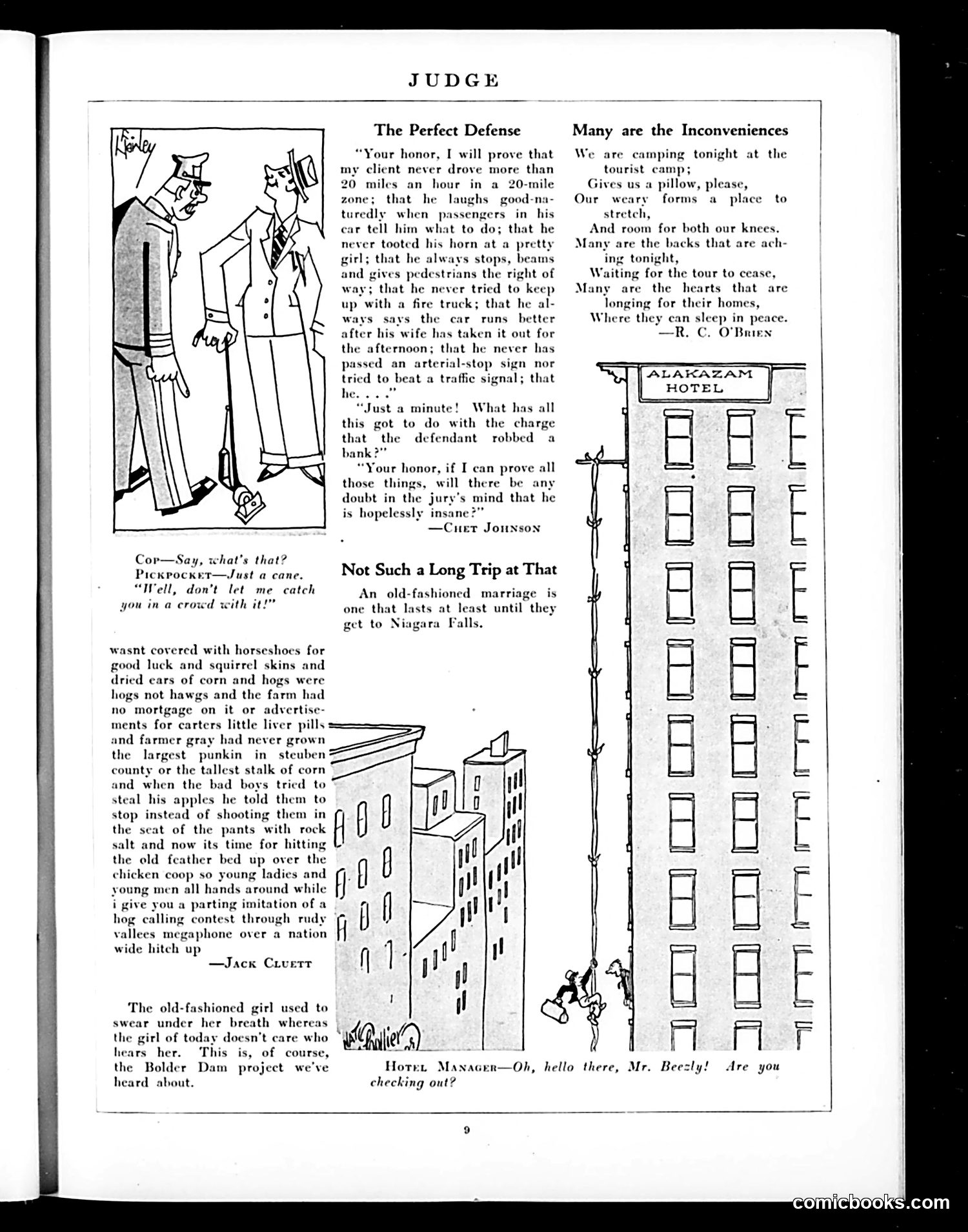
Judge Magazine Page Analysis This page contains several satirical pieces typical of 1920s-30s American humor: "The Perfect Defense" mocks absurd legal arguments. A defense attorney argues his client is "hopelessly insane" by listing impossibly virtuous driving behaviors—never speeding, never honking at girls, always stopping for pedestrians. The joke: proving someone is a perfect driver proves they're mentally unfit, deflecting from the actual charge (bank robbery). "Not Such a Long Trip at That" jokes that old-fashioned marriages lasted "at least until they get to Niagara Falls"—the traditional honeymoon destination—implying modern marriages are even shorter-lived. The pickpocket cartoon shows a cop warning a pickpocket not to use a cane in crowds, apparently because concealing stolen goods in a cane made the theft too easy. "Many are the Inconveniences" sentimentalizes tourist camp discomforts. The Alakazam Hotel cartoon appears incomplete but shows a manager greeting a guest. These pieces satirize contemporary concerns: traffic lawlessness, declining marriage stability, and petty crime—all presented through lighthearted jokes typical of Judge's satirical approach.
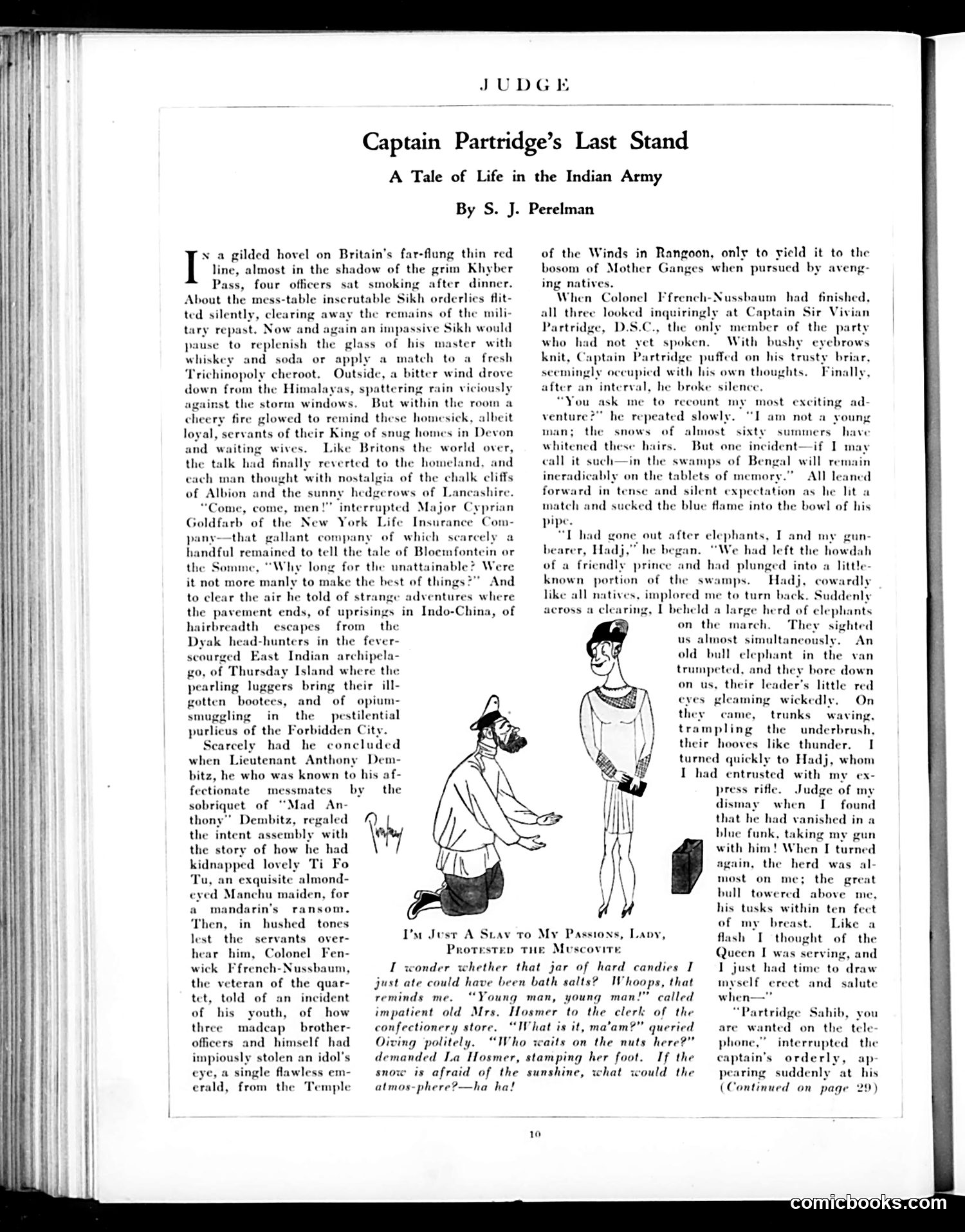
"Captain Partridge's Last Stand" - Judge Magazine This page presents the opening of a humorous short story by S. J. Perelman set in the British Indian Army. The narrative parodies the imperialist adventure tales popular in early 20th-century literature—the kind where colonial officers swap increasingly outlandish stories of exotic exploits. The satire works by having four officers (with deliberately absurd names like "Major Cyprian Goldfarb" and "Colonel Fenwick Ffrench-Nussbaum") tell tall tales of adventure across the empire: kidnappings, temple robberies, elephant hunts. Perelman exaggerates the clichés of colonial romance fiction—the nostalgic homesickness, the "exquisite almond-eyed Manchu maiden," the dangerous encounters with natives. The accompanying cartoons appear to illustrate comedic moments from the text. The satire mocks both the adventure genre itself and British imperial attitudes, presenting these officers as self-important blusterers rather than genuine heroes.
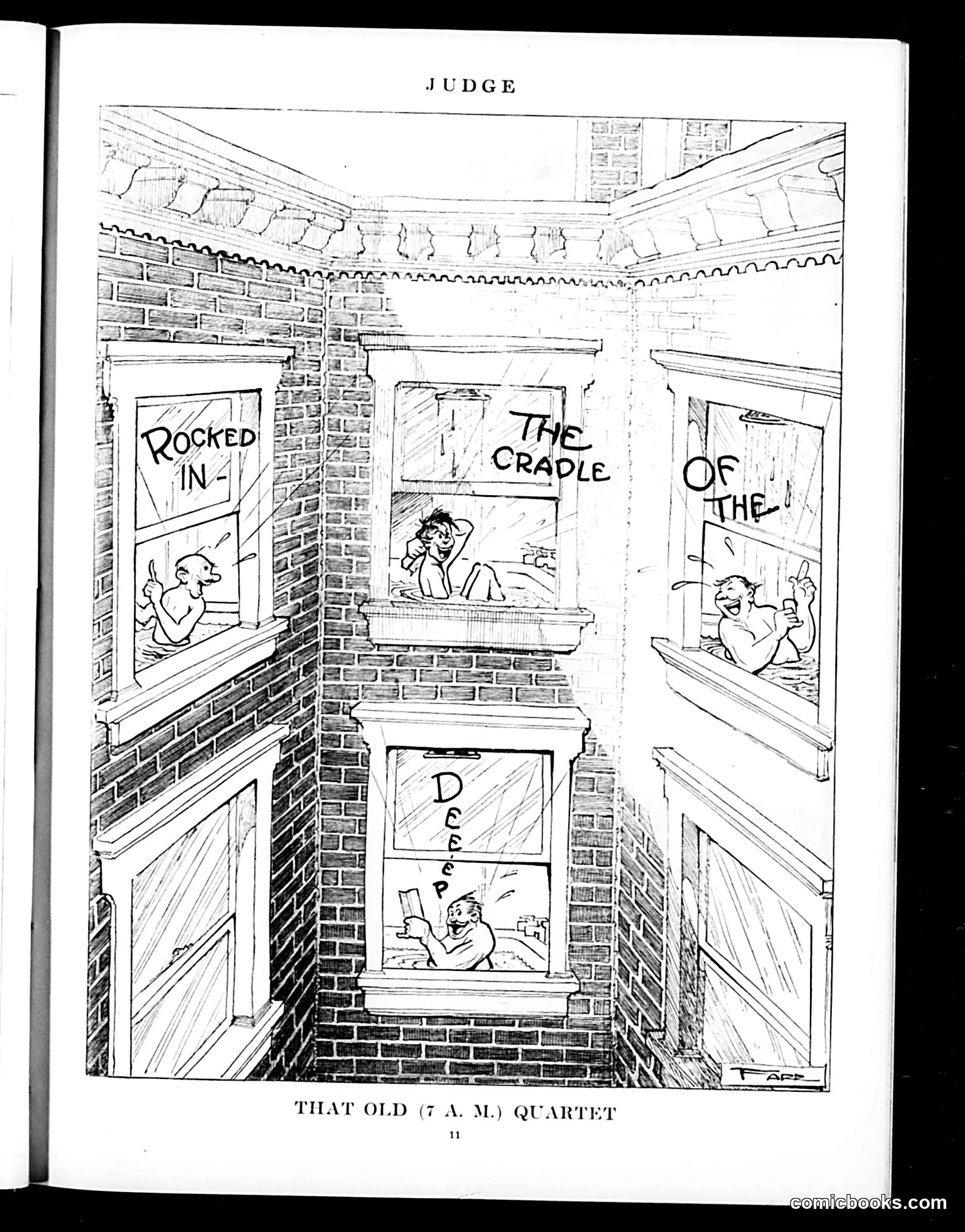
Judge Cartoon Analysis: "That Old (7 A.M.) Quartet" This cartoon depicts a tenement courtyard where babies in windows are crying at 7 a.m., labeled "Rocked In," "The Cradle Of," and "Of The." Below, a frustrated man in a basement window yells "Deep!" downward, apparently trying to sleep while the infants wail above him. The satire targets urban tenement life's miseries—specifically the cacophony of early-morning baby cries in close quarters. The "quartet" reference treats the babies' wails as music (ironically, since they're anything but melodious). This reflects Judge magazine's social commentary on crowded, noisy tenement conditions where poor and working-class families lived in close proximity, with little privacy or peace. The cartoon mocks both the unavoidable noise and the resigned acceptance of such living conditions.
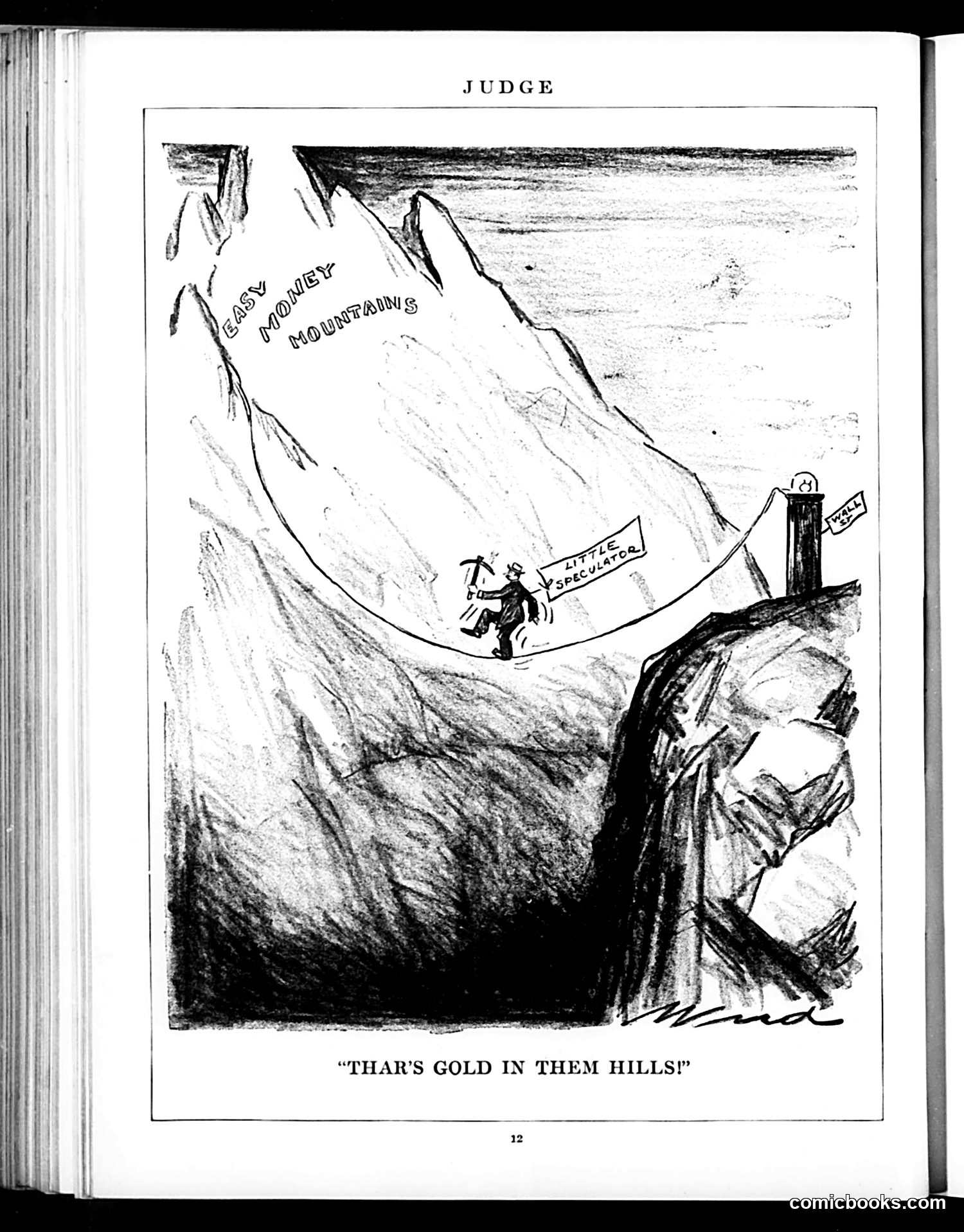
This political cartoon depicts a figure labeled "Little Speculator" precariously balanced on a tightrope strung across a deep chasm labeled "Easy Money Mountains." The figure holds a balance pole while standing above a dark abyss, illustrating the precarious nature of financial speculation. The satire warns against the dangers of get-rich-quick schemes and risky investment ventures. The "easy money" reference mocks those pursuing quick profits in mountainous terrain—likely referencing gold rushes or speculative bubbles of the era. The figure's unstable position suggests such ventures are inherently precarious, one misstep away from financial ruin. The cartoon's title, "Thar's Gold in Them Hills," plays on the famous prospecting phrase to ironically suggest easy wealth is illusory and dangerous for small speculators.
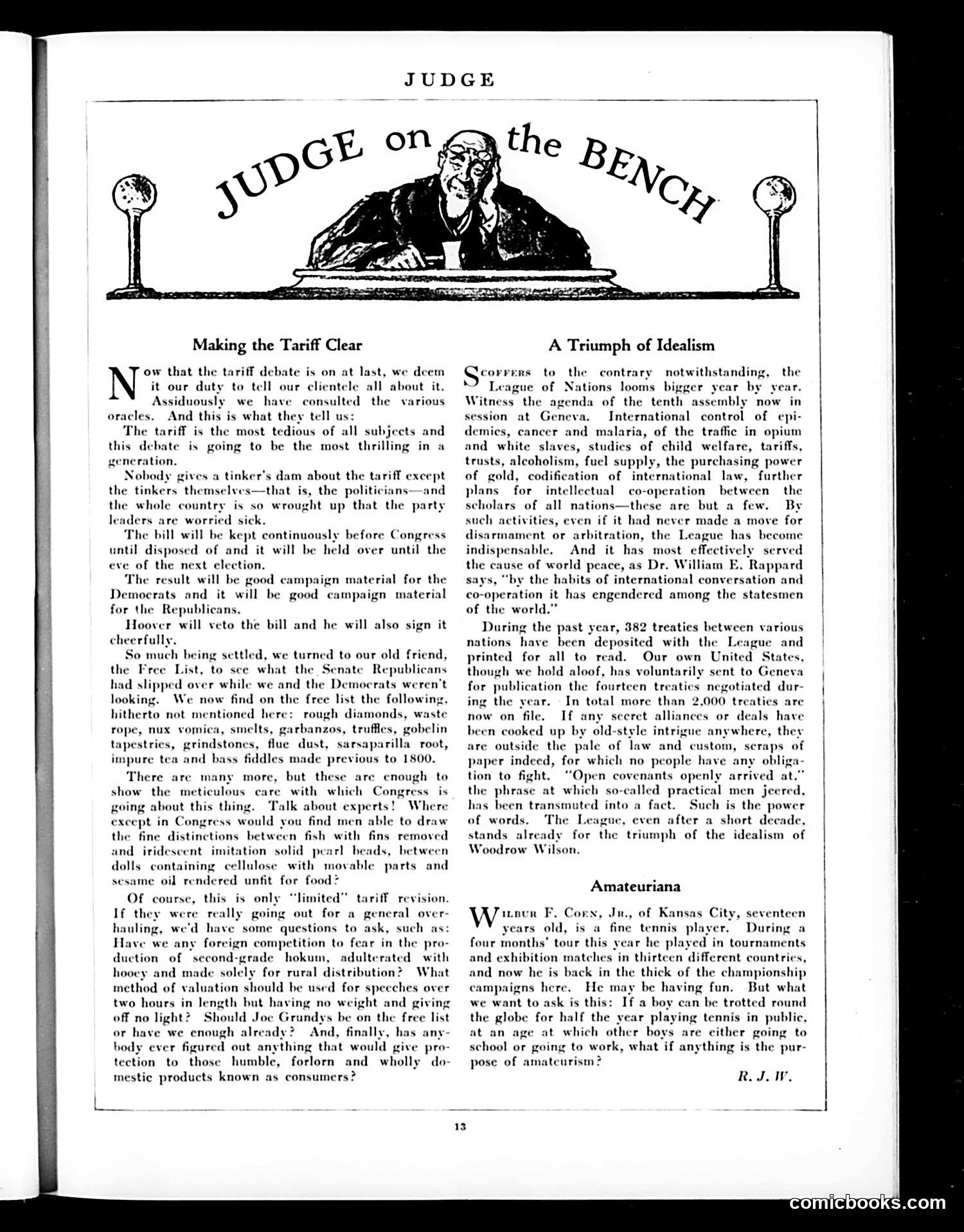
Judge Magazine Page Analysis This page contains two satirical columns from Judge magazine, likely from the 1920s-30s based on references to Hoover and the League of Nations. "Making the Tariff Clear" mocks Congress's incompetence in tariff legislation. The satirist ridicules the absurdity of what's been placed on the "free list" (items exempt from tariffs)—bizarre goods like "bass fiddles made previous to 1800," "nux vomica," and "gobelin tapestries." The joke is that Congress claims expertise while protecting trivial items while ignoring real consumer protection. The column sarcastically notes Hoover will "veto the bill and also sign it cheerfully," highlighting political duplicity. "A Triumph of Idealism" praises the League of Nations' work on international cooperation, treaty documentation, and addressing global issues (epidemics, opium trafficking, child welfare). The writer defends the League's effectiveness despite U.S. non-membership, noting 382 treaties deposited in one year alone. The "Judge on the Bench" masthead frames these as commentary from a judicial authority offering political wisdom.
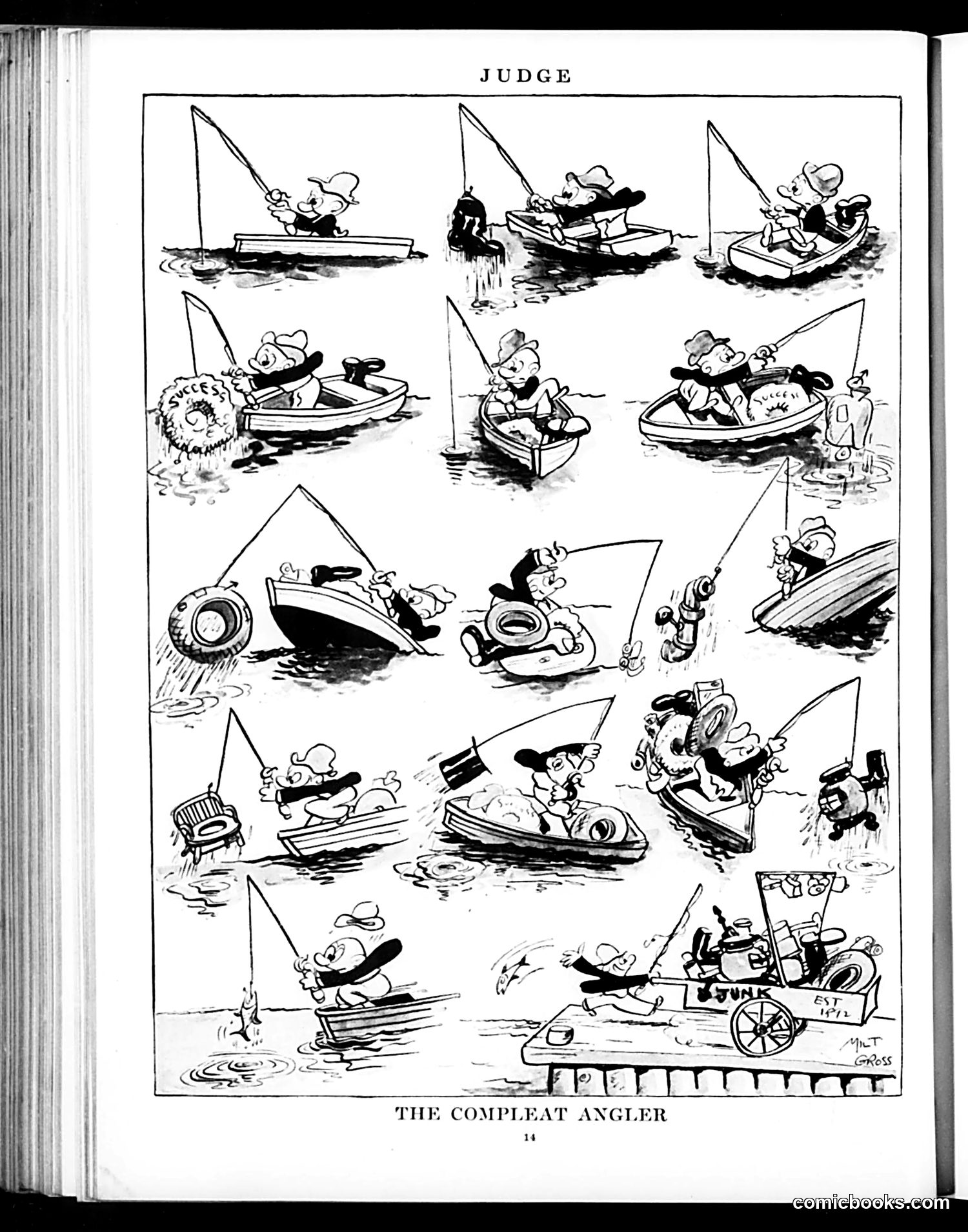
"The Compleat Angler" - Judge Magazine Cartoon This is a visual gag cartoon titled "The Compleat Angler," playing on the famous fishing manual by Izaak Walton. The cartoon depicts a sequence of fishing mishaps involving a fisherman and various sailboats. Rather than catching fish, the angler repeatedly snags and tangles with boats, their rigging, and equipment—creating comical chaos in each panel. The humor derives from the contrast between the idealized, peaceful sport of fishing (referenced by the classic title) and the chaotic reality shown here, where the fisherman's line constantly interferes with maritime traffic. The cartoon appears to be general humorous commentary on the frustrations and unexpected complications of recreational fishing, with no apparent political messaging. The cartoon is credited to what appears to be "Milt Gross" (visible signature).
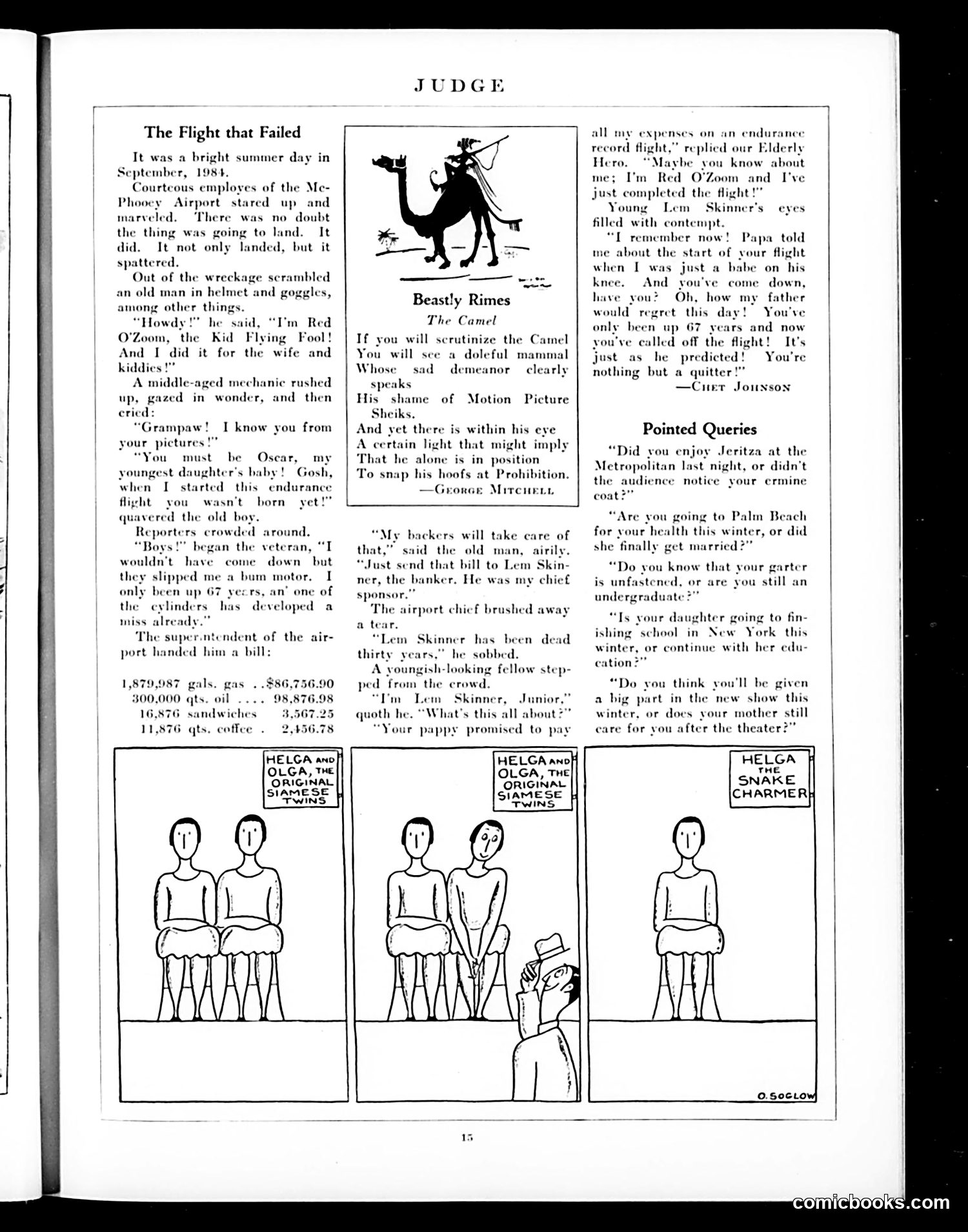
"The Flight that Failed" — A 1920s Satire on Aviation and Broken Promises This page satirizes early aviation stunts and financial irresponsibility. The story features "Red O'Zoom," an elderly daredevil attempting an endurance flight record, who crashes after 67 years aloft. He seeks payment from his original backer, Lem Skinner, a banker—only to learn Skinner died thirty years ago. The punchline: Skinner's son, now an adult, reminds O'Zoom that his late father had *predicted* this failure, suggesting the whole venture was dubious from the start. The satire targets two 1920s obsessions: the era's enthusiasm for aviation records and stunts, and wealthy sponsors' casual financial commitments. The "Beastly Rimes" poem about a camel references Prohibition-era hypocrisy. The lower cartoon, "Helga and Olga," appears to be a separate comic featuring two similar-looking women, with the joke apparently involving mistaken identity or deception.
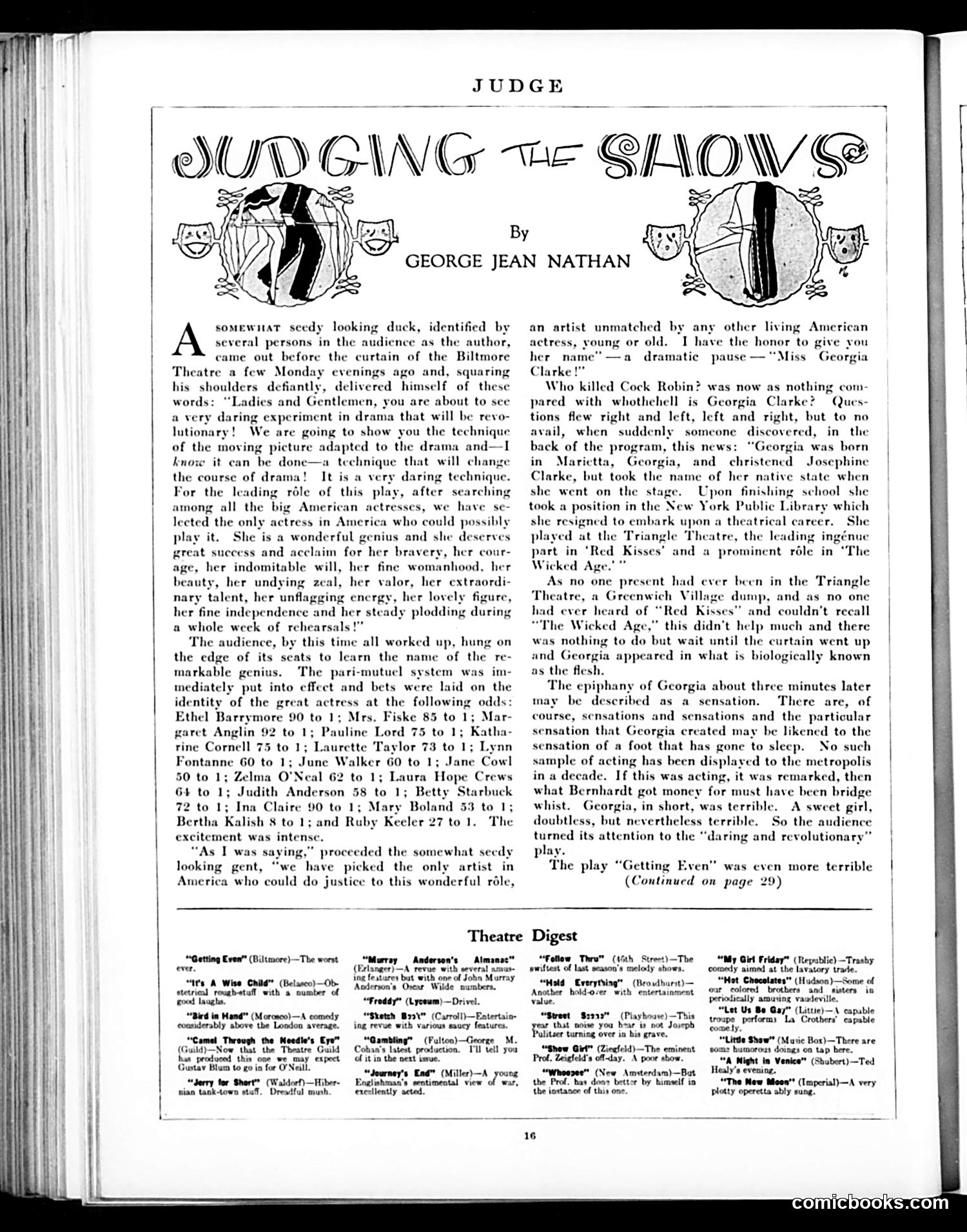
Judging the Shows: A Theater Satire This theater review by George Jean Nathan mocks theatrical hype and self-promotion. The piece describes a producer's grandiose introduction of an unknown actress named Georgia Clarke, building her up with extravagant praise ("wonderful genius," "extraordinary talent") before revealing her identity. The satire works through deflation: the audience's anticipation—reflected in betting odds on famous actresses like Ethel Barrymore and Pauline Lord—collapses when an obscure performer is announced. Georgia's actual performance proves disastrous ("no such sample of acting has been displayed"), compared unfavorably to even Sarah Bernhardt. Nathan satirizes theatrical pretension and empty promotional language. The joke is that overblown hype cannot compensate for actual talent. The "daring experiment" in adapting film technique to drama becomes ridiculous when the lead performer cannot act.
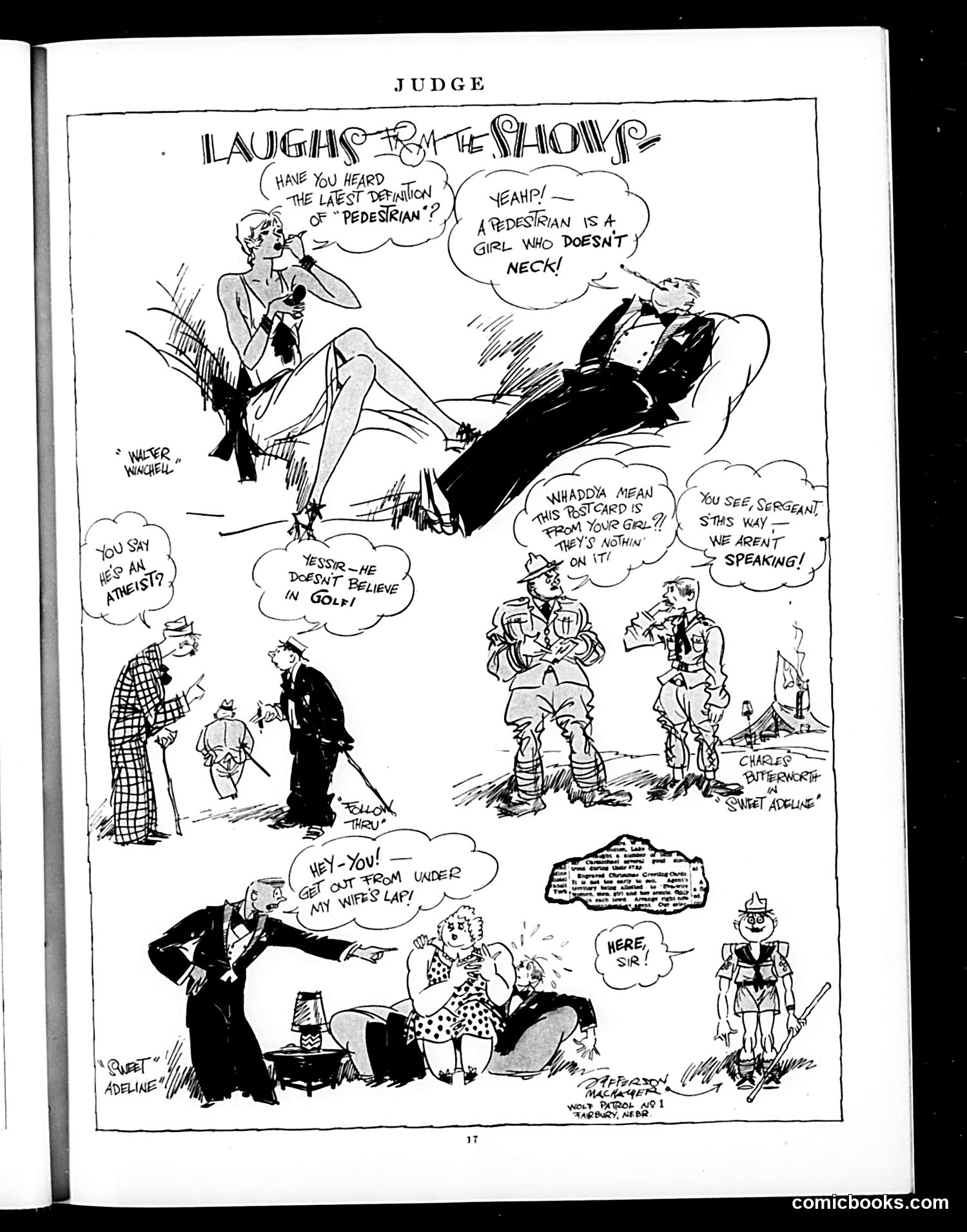
"Laughs of the Shows" - Judge Magazine Cartoon This is a multi-panel satirical comic centered on a joke about the definition of "pedestrian." The humor plays on a double meaning: a pedestrian is literally someone who walks, but the joke redefines it as "a girl who doesn't neck" (slang for kiss/make out). The cartoon depicts various characters in different scenarios—including what appears to be a formal couple at top, military or uniformed figures in the middle, and civilians at bottom—all riffing on this definition. One character calls someone an "atheist," another references not believing "in golf," creating absurdist non-sequiturs. The satire targets 1920s-30s social mores around dating and physical affection, poking fun at both flirtation customs and the tendency to define people by their romantic behavior. The "show" references in the title suggest these are jokes drawn from contemporary theatrical performances, which Judge frequently satirized.
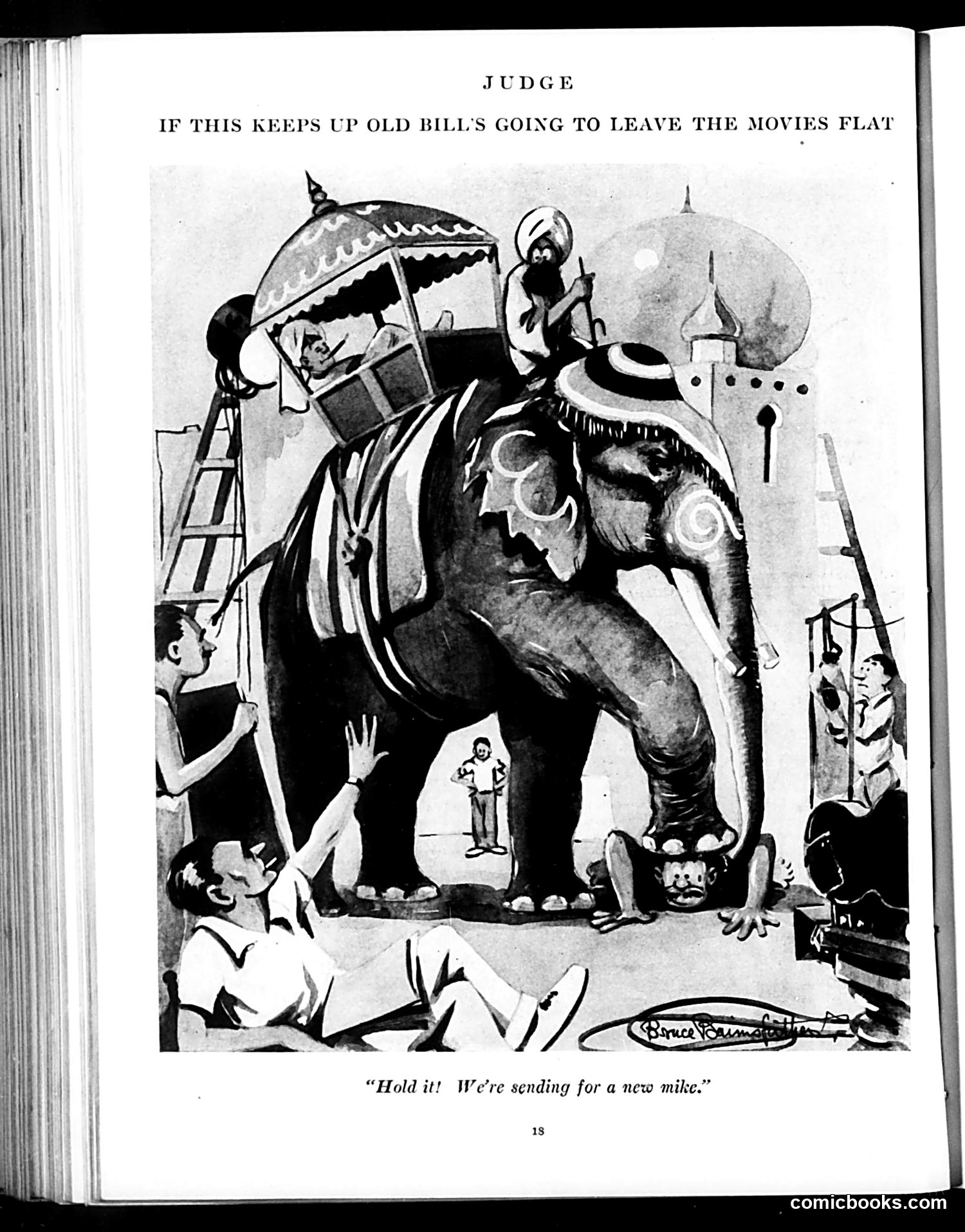
Cartoon Analysis This satirical cartoon depicts a film production scene where an elephant is being used in a movie. The title jokes that "Old Bill" (the elephant) will abandon filmmaking if current problems persist. The caption "Hold it! We're sending for a new mike" suggests technical difficulties with sound recording equipment during elephant filming—presumably the animal's noise is overwhelming the microphone. The satire appears to mock early sound-film technology's challenges, particularly when filming with animals that produce loud sounds. The elaborate movie set with various crew members illustrates Hollywood's ambitions, while the comical premise—needing a more powerful microphone to handle an elephant—pokes fun at the technical limitations and complications of early talking pictures. This likely dates from the late 1920s when sound cinema was relatively new.
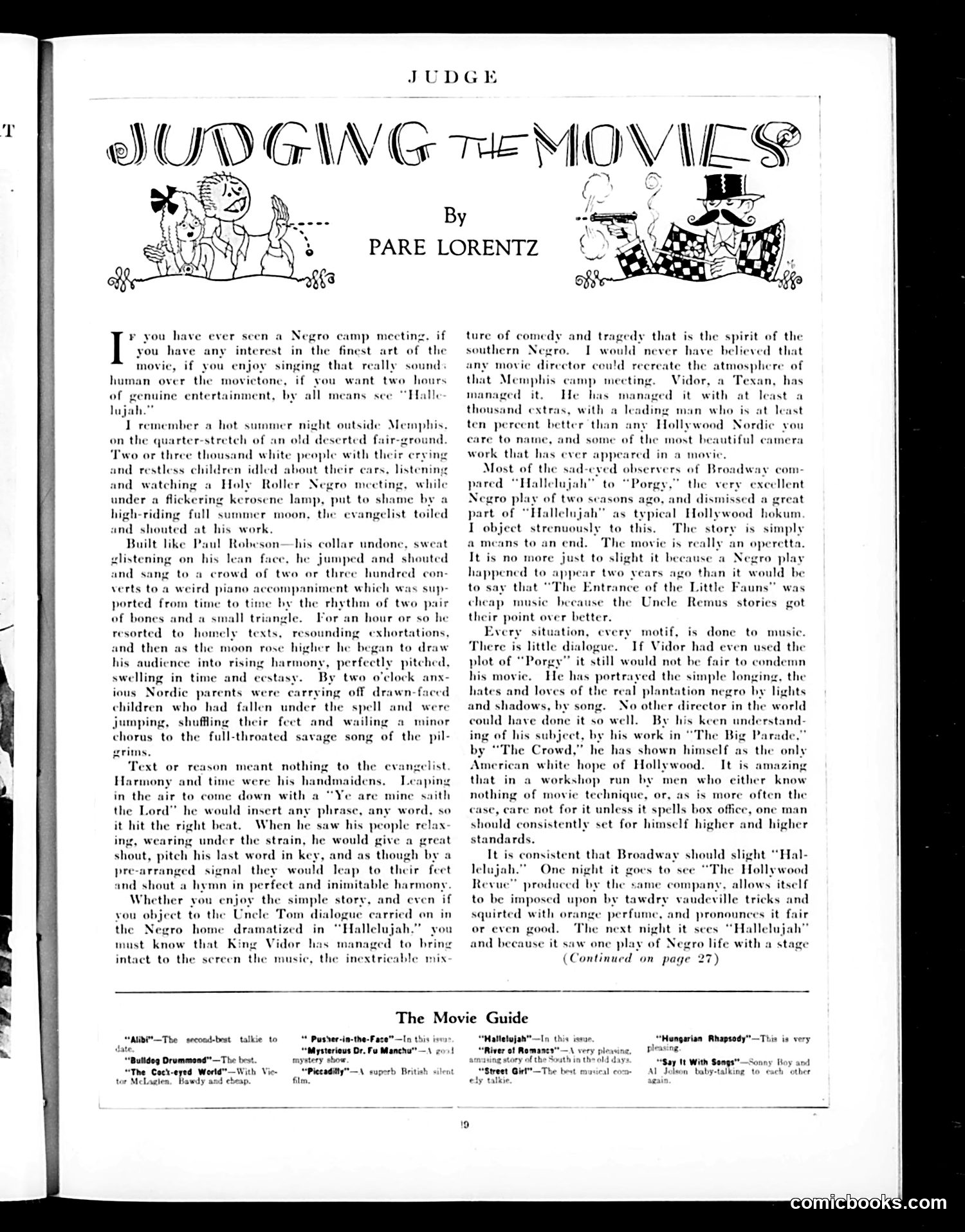
"Judging the Movies": Hallelujah (1929) This is a favorable review by Pare Lorentz of King Vidor's film *Hallelujah*, a sound film depicting African American religious revival meetings in the South. The reviewer praises Vidor's authentic recreation of a Memphis camp meeting—complete with 1,000+ extras and elaborate musical sequences featuring spirituals and gospel music. Lorentz emphasizes the film's operatic structure, where music rather than dialogue drives the narrative. The review defends *Hallelujah* against Broadway critics who dismissed it by comparing it unfavorably to the theatrical play *Porgy*. Lorentz argues the film shouldn't be judged as drama but as visual-musical art form, praising Vidor's cinematography and the lead actor (Paul Robeson, apparently) as superior to typical Hollywood casting. The piece reflects 1920s racial attitudes—white audiences watching Black religious expression as exotic entertainment—while genuinely valuing the film's artistic ambition and technical achievement in early sound cinema.
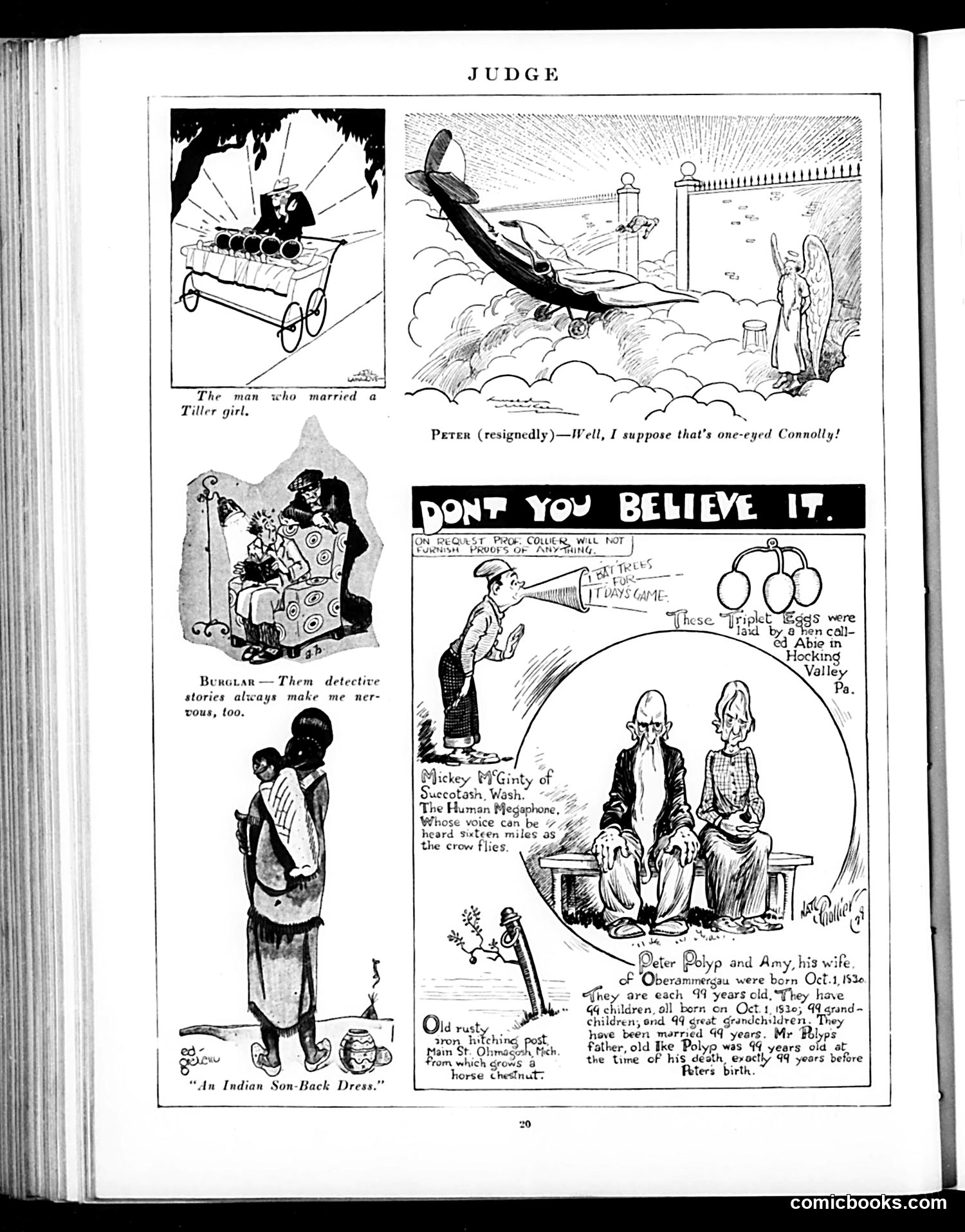
Explanation of Judge Page Content This page from the satirical magazine *Judge* contains several unrelated humorous items: Top cartoons mock tall tales and exaggeration—a man who married a "Tiller girl" (likely a chorus dancer), a one-eyed character named Connolly, and detective fiction clichés. "Don't You Believe It" is the main feature, presenting deliberately absurd claims presented as fact: a man in Succotash, Washington with a voice audible sixteen miles away; triple-egg stories; and most prominently, the Polyp family of Oberammergau with impossible numerology (99-year-old parents married 44 years with 44 children all born on the same date, ages that don't add up). The satire mocks credulous readers who accept outlandish newspaper claims and tall tales at face value. The specific references to places like Hocking Valley, Pennsylvania and Oberammergau suggest parodies of actual newspaper hoaxes or exaggerated human-interest stories common to the era. The cartoon style and layout are typical early 20th-century satirical humor targeting gullibility.
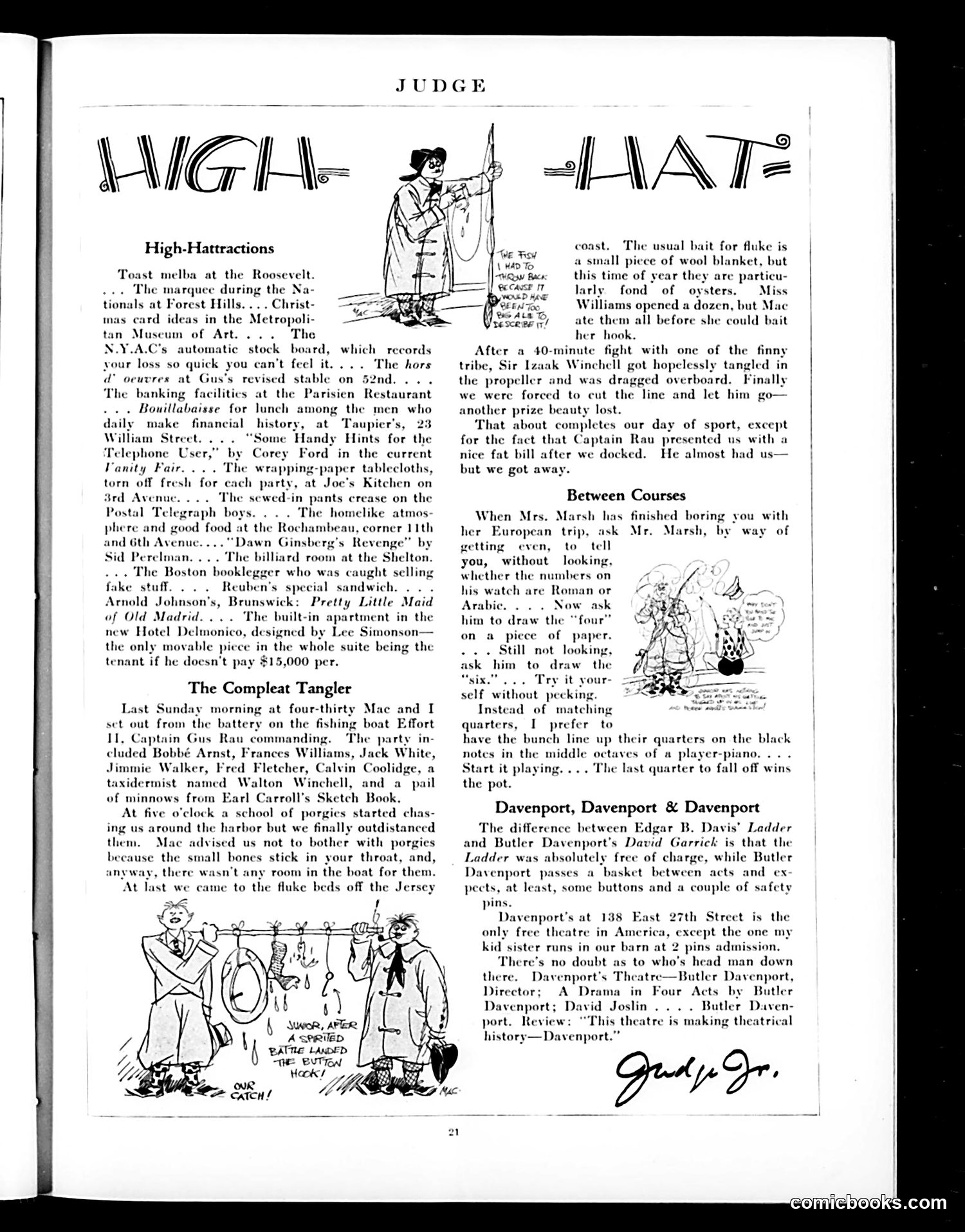
Judge Magazine Page Analysis This page from Judge magazine (appears to be 1920s era) contains several satirical humor pieces targeting New York City's social and entertainment scene: "High-Hattractions" is a gossipy list mocking pretentious Manhattan establishments and their patrons—wealthy diners at fancy restaurants, the stock market crowd, and social climbers. "The Compleat Tangler" satirizes a fishing expedition featuring recognizable public figures: appears to reference Jimmie Walker (NYC politician), Calvin Coolidge (U.S. President), and "Walton Winchell" (likely mocking gossip columnist Walter Winchell). The joke culminates in a character named "Sir Winchell" getting tangled in a propeller—physical slapstick humor mocking these celebrities. "Between Courses" offers parlor tricks for dinner parties. "Davenport, Davenport & Davenport" compares two Broadway productions, noting one theater passes a collection basket while another was free—social commentary on theater economics and charitable versus commercial entertainment. The overall tone reflects Judge's satirical approach to metropolitan life, celebrity, and class pretension.
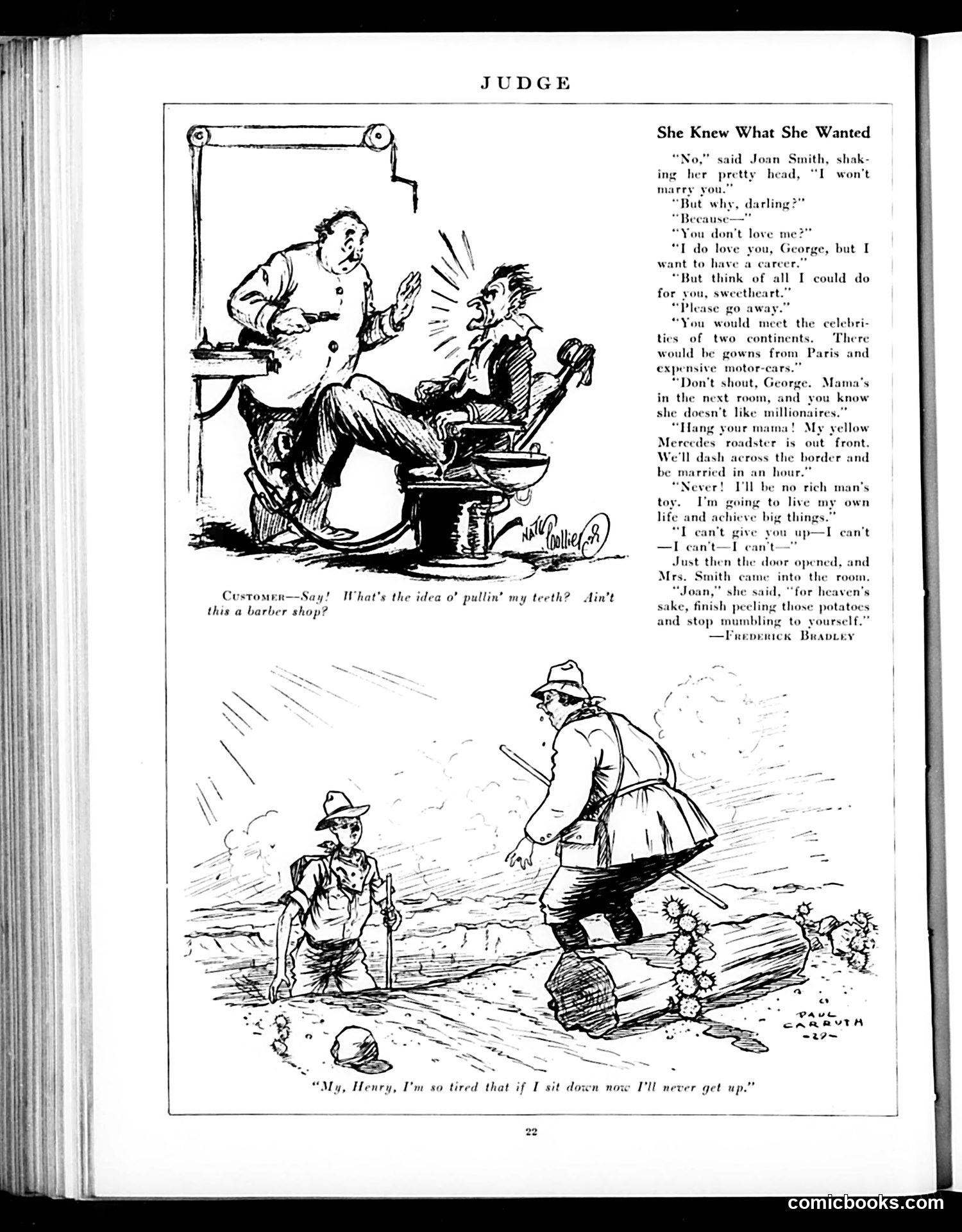
Judge Magazine Satire Analysis Top cartoon: A barber is extracting a customer's tooth instead of cutting his hair. The customer protests: "What's the idea of pullin' my teeth? Ain't this a barber shop?" This is a visual pun satirizing incompetence or the wrong service being performed—likely mocking barbers who overstepped their professional bounds, or more broadly, any tradesman doing the wrong job. Story/caption below: "She Knew What She Wanted" depicts a woman (Joan Smith) rejecting a wealthy suitor's proposal despite his offers of luxury—Paris gowns, expensive cars, travel. She wants independence and a career instead. The punchline undercuts her ambition: her mother interrupts, ordering her back to mundane domestic labor (peeling potatoes). The satire mocks early 20th-century feminism by suggesting women's liberation aspirations are ultimately hollow when maternal authority and household duties persist.
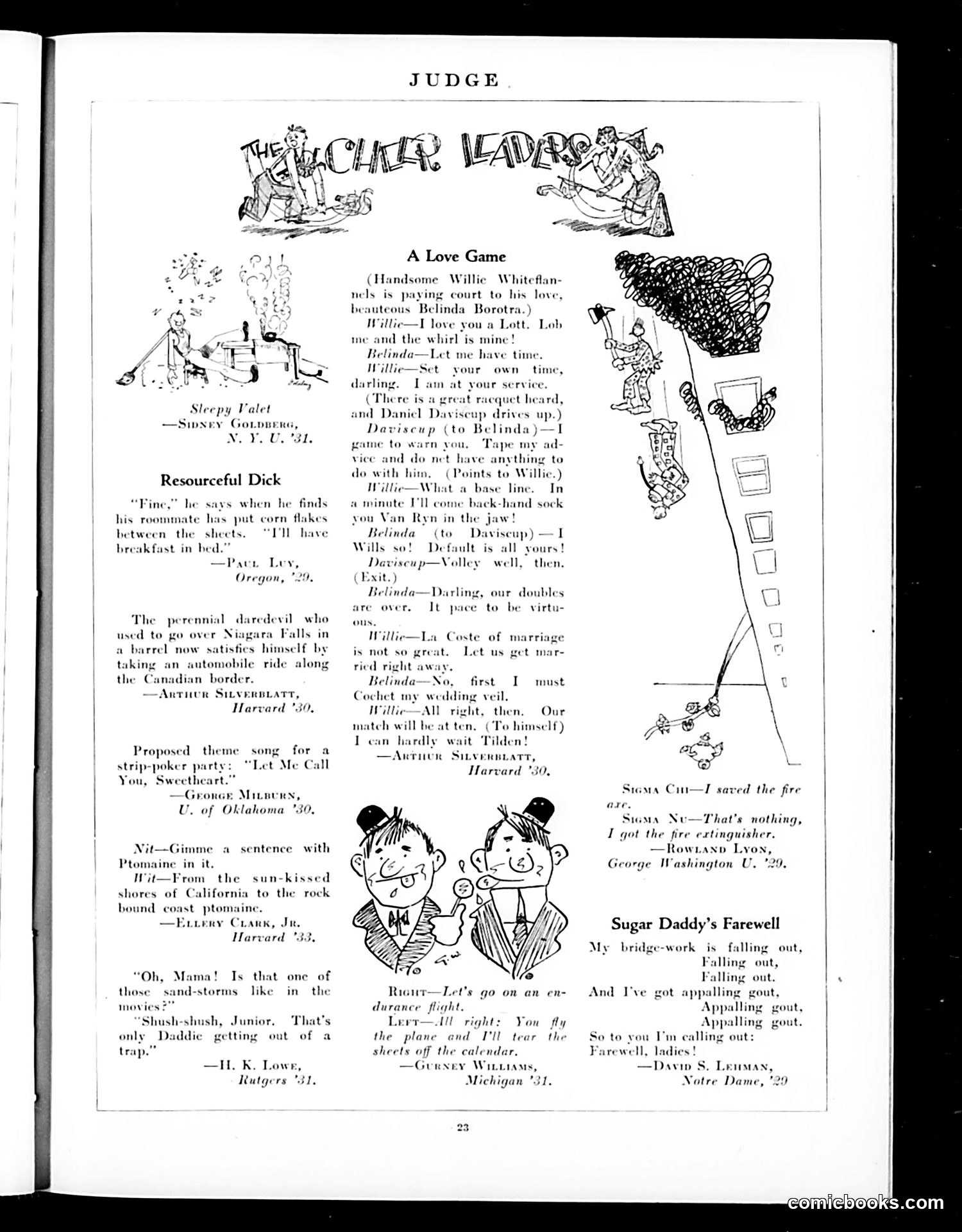
Judge Magazine Page Analysis This page contains humorous college jokes and cartoons typical of 1920s-30s student humor. The content includes: "A Love Game" is a tennis-themed romantic parody where characters with names like "Willie," "Belinda," and "Daviscup" use tennis terminology (racquet, baseline, volley, doubles) as double entendres in a romantic triangle. The satire mocks both tennis culture and courtship conventions. Other brief jokes reference contemporary concerns: taking cars across the Canadian border (Prohibition-era reference), Niagara Falls daredevils, and domestic humor about corn flakes in sheets and breakfast in bed. "Sugar Daddy's Farewell" appears to mock aging wealthy men pursuing young women—a social commentary on the "sugar daddy" phenomenon, with the elderly suitor's physical decline (falling bridge-work, gout) undercutting romantic pretensions. The illustrations are crude cartoons typical of college publications. Overall, the page reflects 1920s-30s undergraduate humor: topical, mildly risqué, and focused on dating, courtship, and social folly.
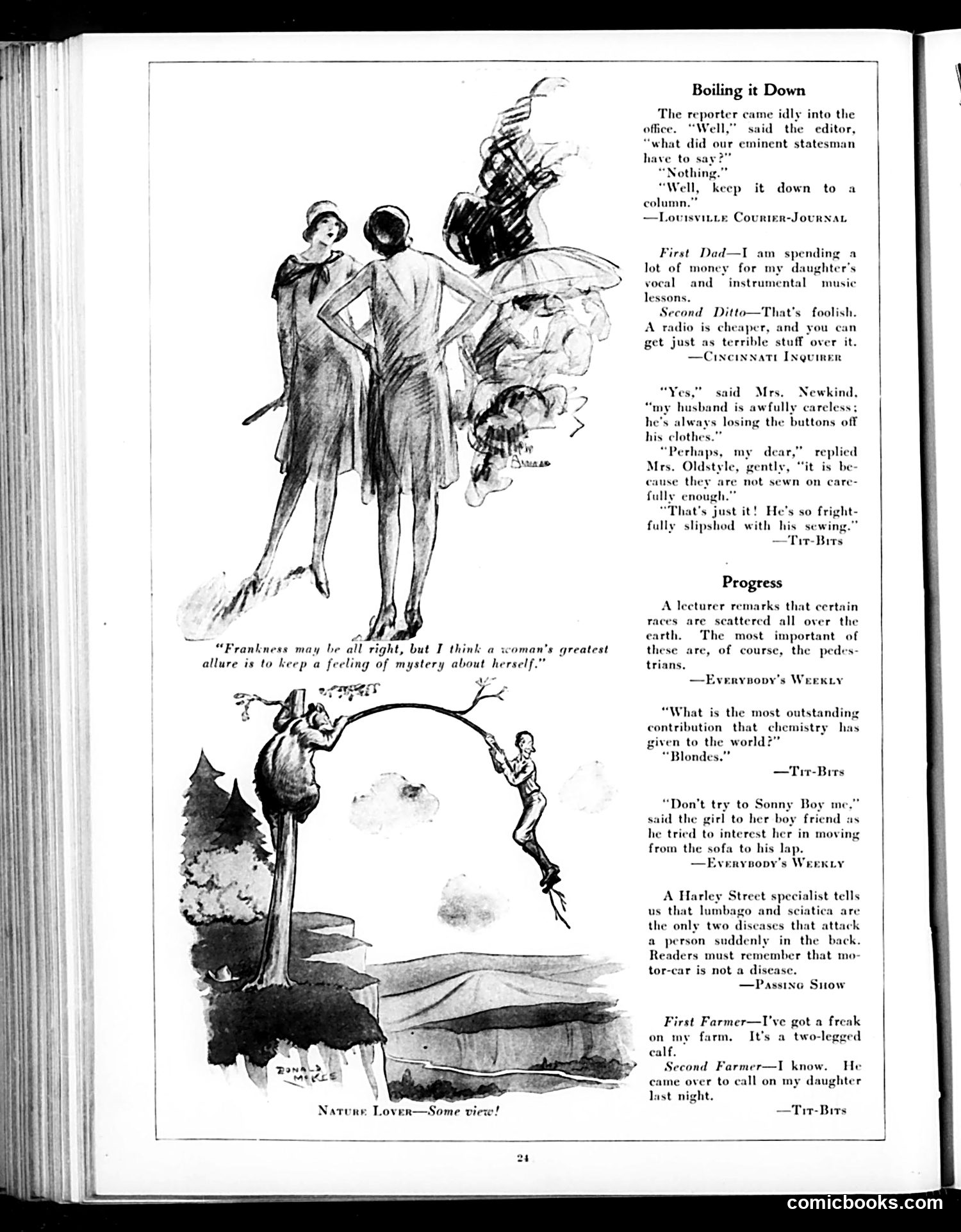
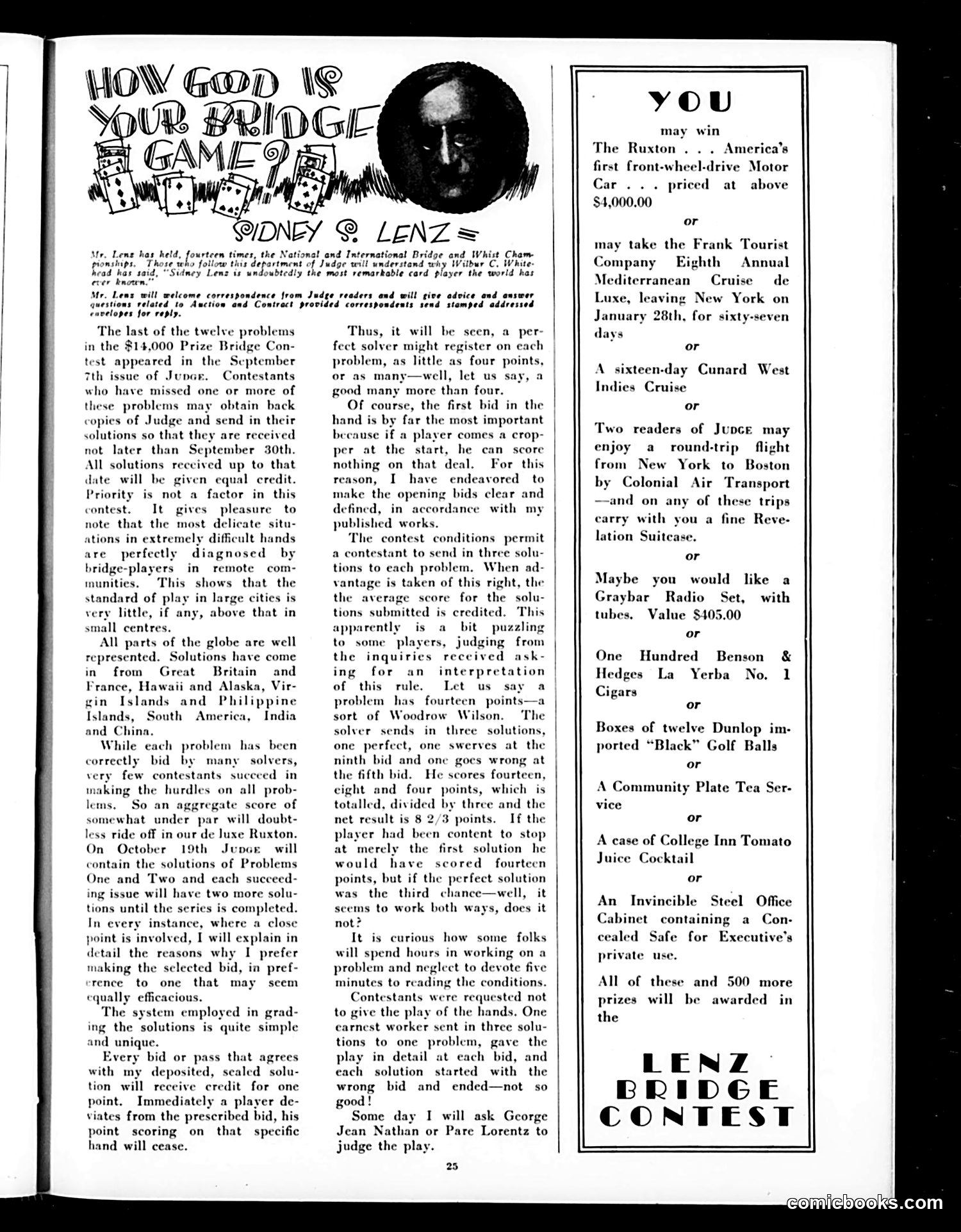
Explanation for Modern Readers This page features Sidney Lenz, a renowned bridge champion (the card game), discussing a $14,000 bridge problem-solving contest Judge magazine is running. The cartoon at top left shows Lenz's portrait alongside playing cards, illustrating the contest theme. The "satire" here is gentle: Lenz humorously compares problem-solving difficulty to political complexity, calling one problem "a sort of Woodrow Wilson"—suggesting it's as puzzling and consequential as Wilson's presidency. The piece explains the contest's scoring system to readers, with Lenz inviting correspondence about bridge questions. The right column advertises prizes worth hundreds of dollars: a Ruxton automobile, Caribbean cruises, and luxury goods—reflecting 1930s affluent leisure culture when bridge contests were prestigious social events. This is primarily advertising and instructional content rather than political satire, celebrating bridge as a sophisticated game for educated audiences.
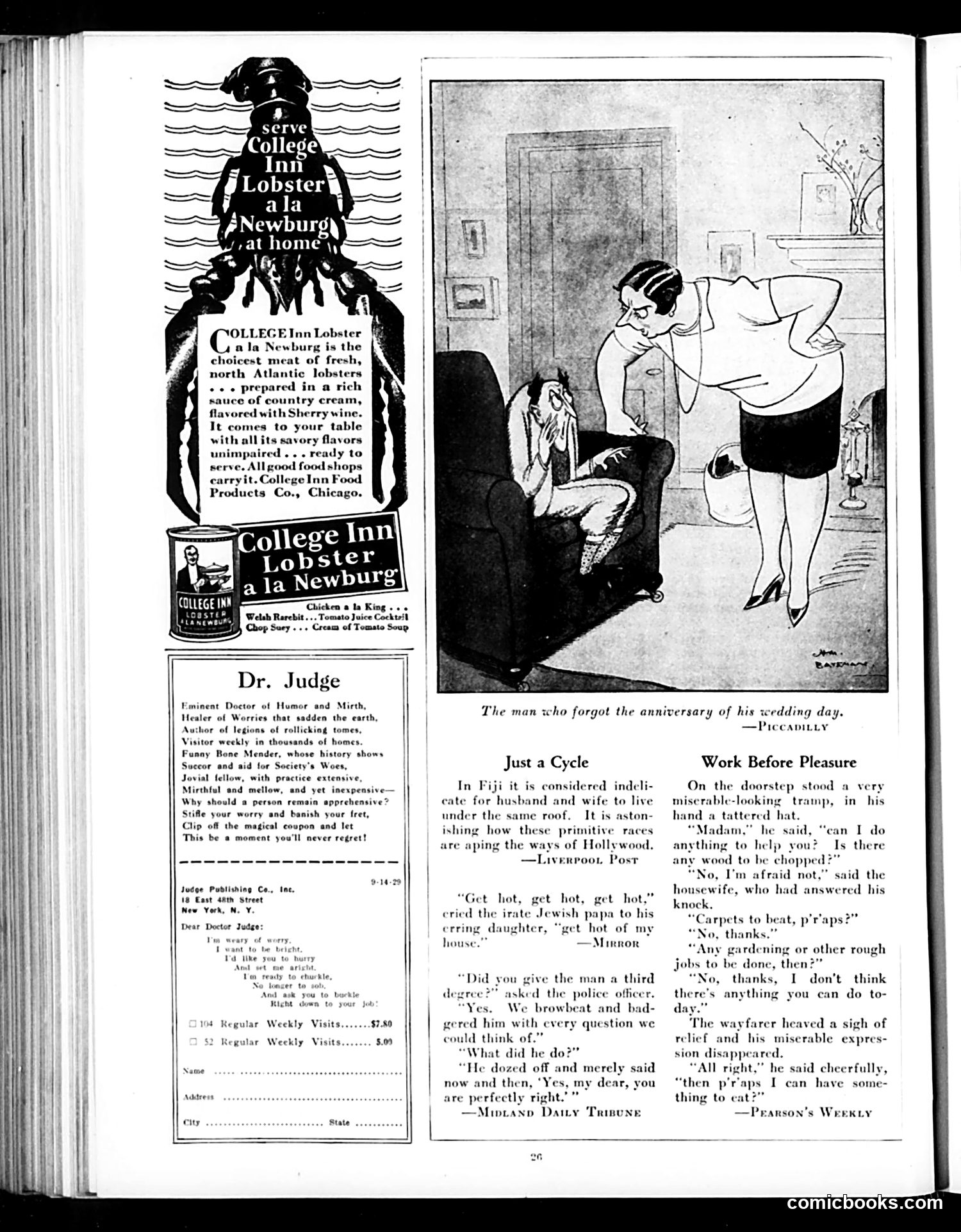
Page Analysis: Judge Magazine This page contains advertising and humor content rather than political cartoons. The main ad promotes College Inn Lobster à la Newburg, a canned food product from Chicago, using a decorative silhouette of a woman. The right-side cartoon titled "Work Before Pleasure" depicts a tramp seeking odd jobs from a housewife. The joke's punchline (partially obscured) suggests the tramp was relieved to *not* find work—implying he prefers to avoid labor. This satirizes Depression-era unemployment and vagrancy with dark humor. "Just a Cycle" compares Fijian customs (spouses living apart) to Hollywood behavior, suggesting American society mimics "primitive" practices—likely commentary on 1920s celebrity scandals and unconventional living arrangements. "The Man Who Forgot the Anniversary" (caption only) is a domestic humor piece about marital forgetfulness. The page also includes "Dr. Judge," a filler advertisement promoting the magazine itself as a cure for worry.
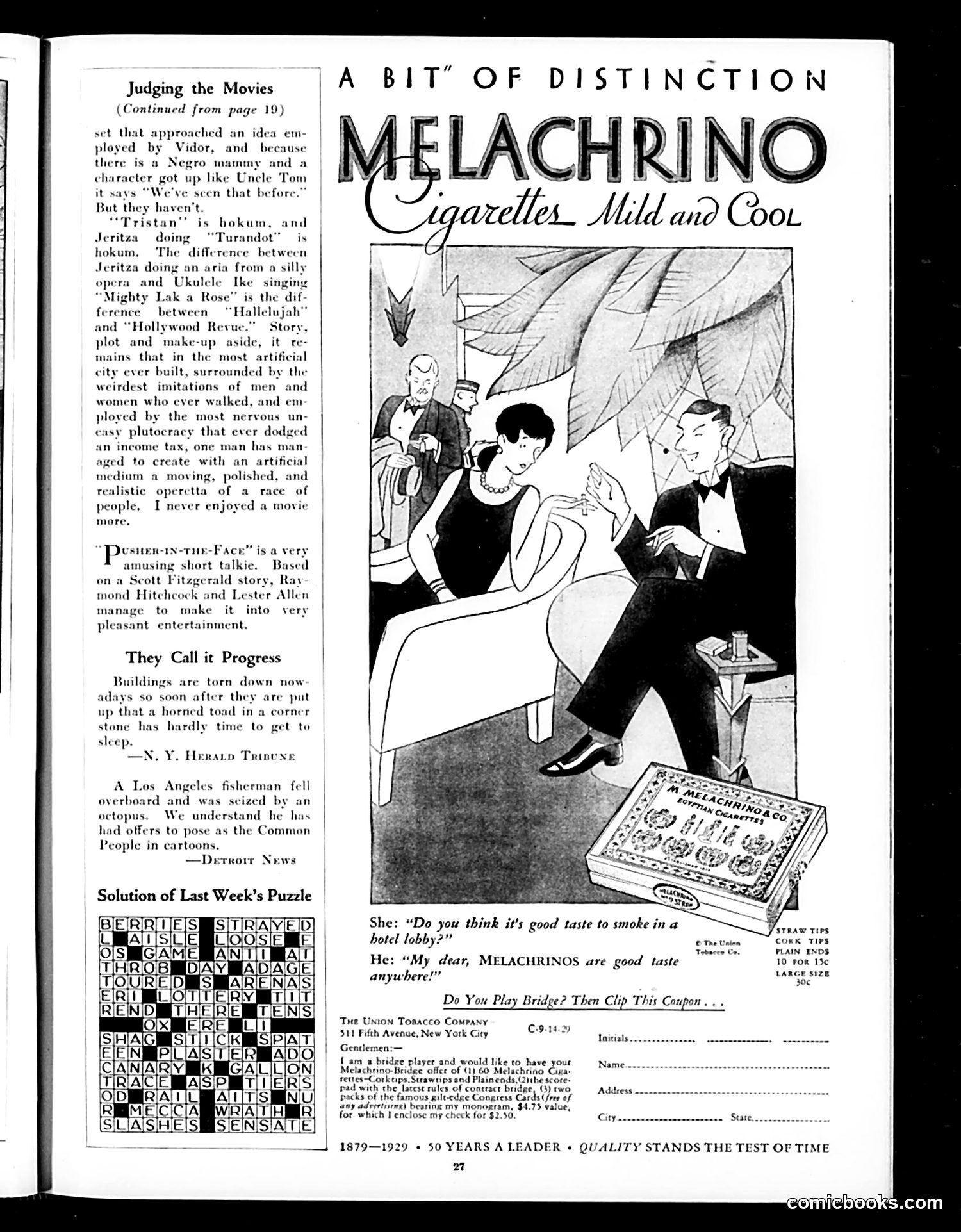
Melachrinos Cigarette Advertisement This page is primarily a cigarette advertisement disguised as editorial content. The "A Bit of Distinction" headline frames Melachrinos as a luxury product for refined consumers—specifically targeting bridge players and hotel society. The cartoon depicts a couple in formal evening wear in a hotel lobby. The woman questions the propriety of smoking indoors; the man reassures her that Melachrinos are acceptable "anywhere" because they signify good taste and sophistication. The advertisement below offers a bridge-themed promotional package: cigarettes, scorepads with contract bridge rules, and monogrammed playing cards for $2.50. The satire is subtle: the ad equates cigarette smoking with social class and respectability. By 1929, such marketing was common—associating tobacco with elegance, leisure, and upper-class leisure activities like bridge. The coupon incentivizes purchase by bundling it with bridge accessories, appealing to the magazine's affluent readership. The left column contains unrelated movie reviews, typical Judge magazine content.
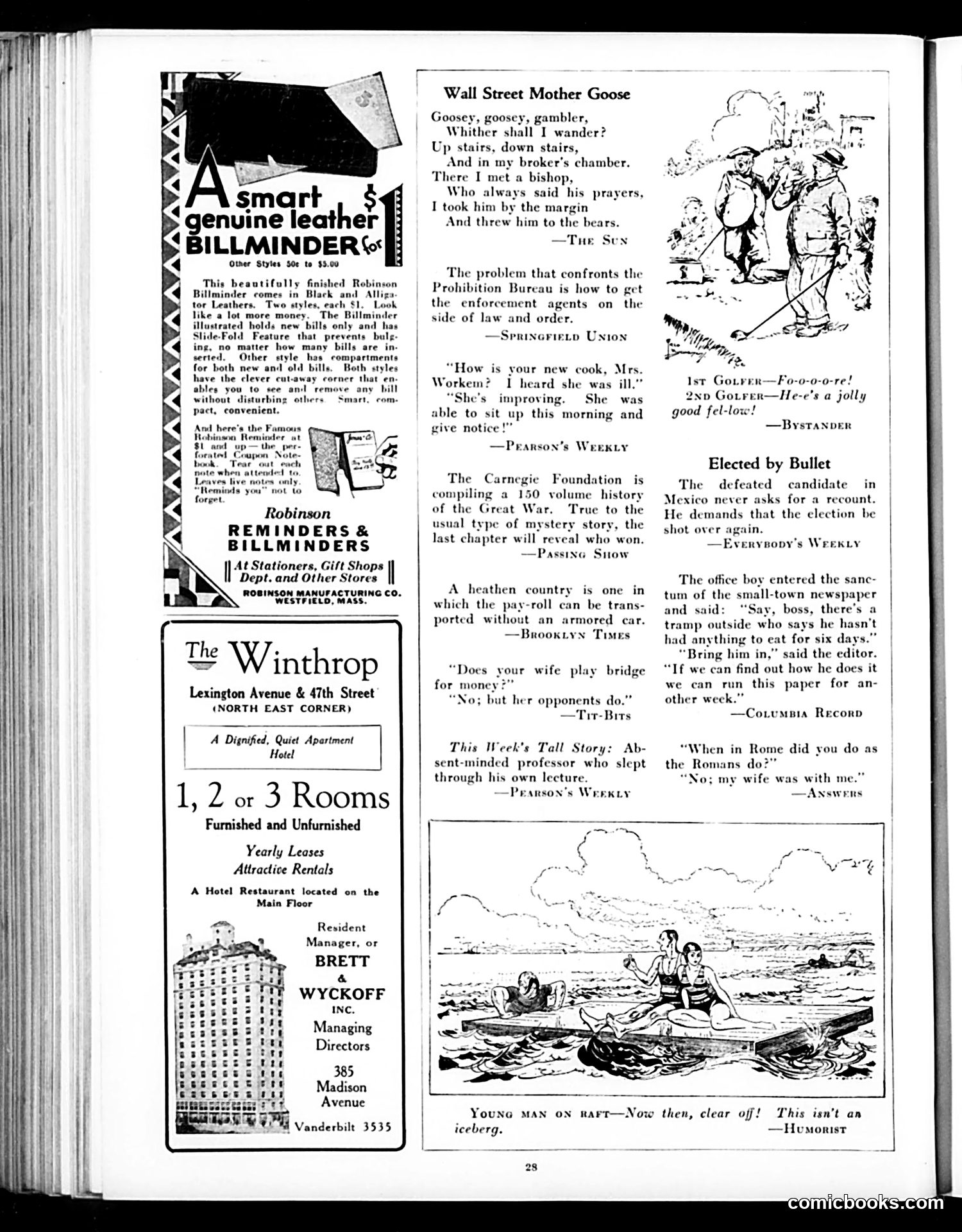
Wall Street Mother Goose and Associated Satirical Content This page collects brief satirical pieces typical of Judge magazine's format. The main feature, "Wall Street Mother Goose," parodies the nursery rhyme to mock financial speculation and market volatility. The opening verse about a "gambler" going "up stairs, down stairs" in a "broker's chamber" references the unpredictable nature of stock trading, while the violent ending ("threw him to the bears") uses "bears" as a pun—both the animal and the stock market term for those betting on price declines. The other brief satirical items mock contemporary issues: Prohibition enforcement corruption, domestic service problems, and Mexico's political instability (the joke about elections being "shot over again" references violent Mexican politics). The humor relies on wordplay and dark cynicism typical of 1920s American satire—targeting financial speculation, government ineffectiveness, and social absurdity. The page is primarily advertising and satirical content rather than single narrative cartoons.
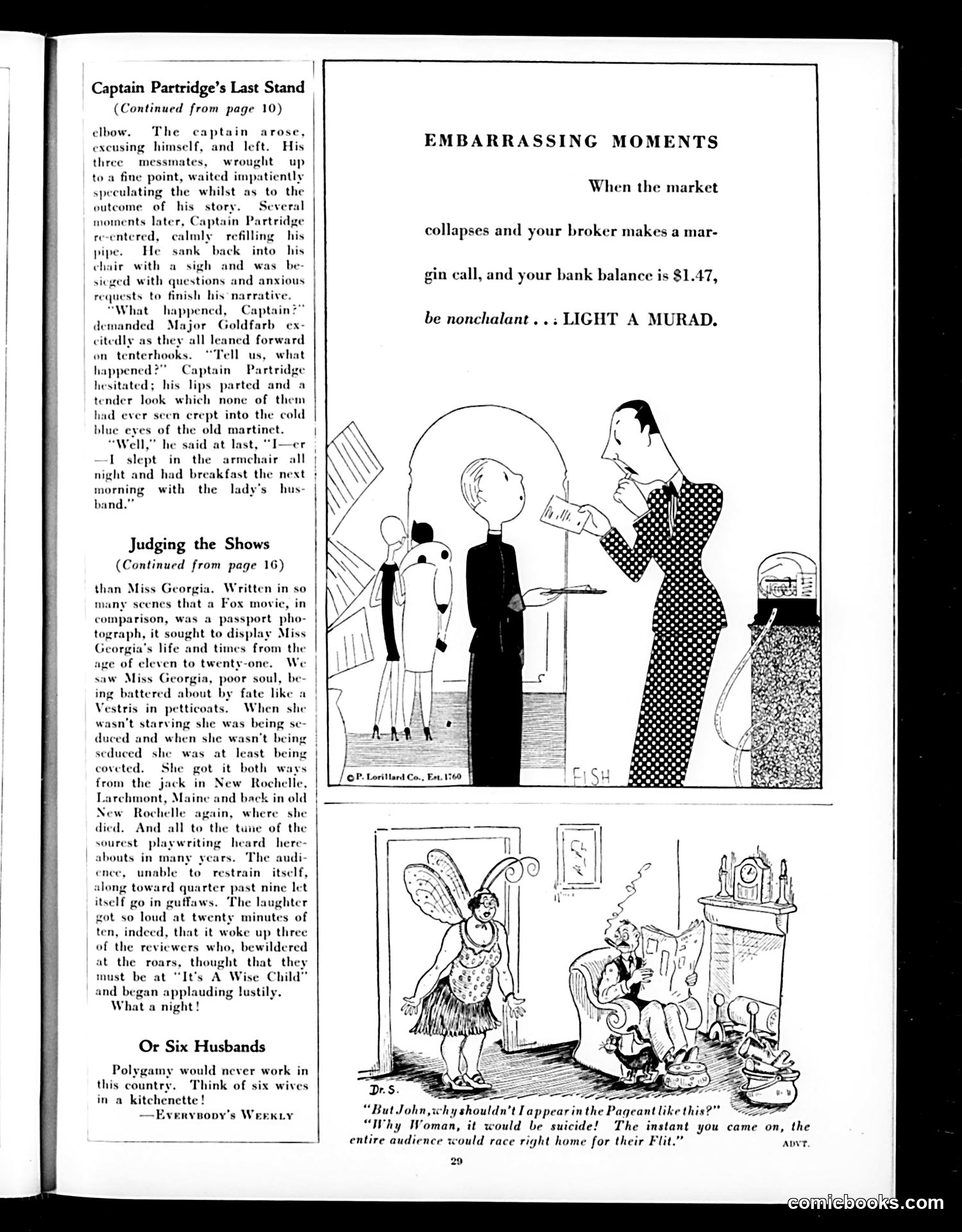
Judge Magazine Page Analysis This page contains three distinct satirical pieces from an early-to-mid 20th-century American humor magazine: "Captain Partridge's Last Stand": A narrative joke where a naval captain builds tension recounting a dramatic encounter, only to anticlimactically reveal he slept in an armchair and had breakfast with a woman's husband—subverting readers' expectations of scandal or adventure. "Judging the Shows": A theater review mocking a tedious film about actress "Miss Georgia," whose life story—from age eleven to twenty-one—involves endless seduction and suffering. The joke is that the audience's laughter became so loud it accidentally woke sleeping theater critics. "Embarrassing Moments" advertisement: A cigarette ad (Murad brand) using humor to sell product. The cartoon depicts a woman being told not to appear in a pageant because the audience would abandon it—a setup for the punchline that they'd rush home for "Flit" (an insecticide), not the cigarettes being advertised. The "Or Six Husbands" quip mocks polygamy as impractical in cramped American apartments—typical period domestic humor.
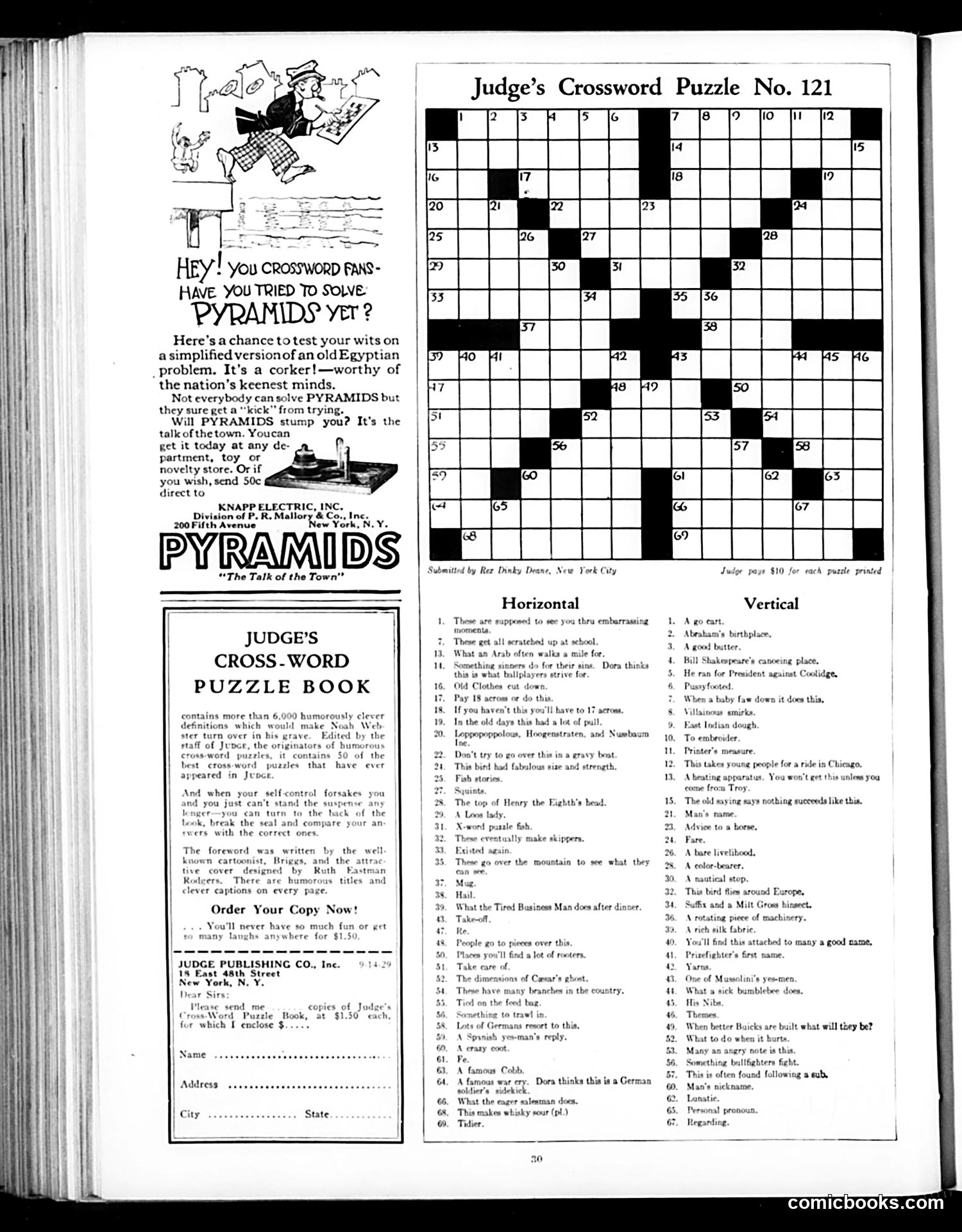
Judge Magazine Crossword Puzzle Page Analysis This page is primarily advertising and puzzle content rather than political satire. It features: Main Content: - A crossword puzzle (#121) with Egyptian theme clues - Advertisement for "Pyramids," a puzzle game by Knapp Electric claiming to be "the talk of the town"—a commercial product marketed as intellectually challenging entertainment - Promotion for Judge's Cross-Word Puzzle Book ($1.30), featuring humorous clues and a foreword by cartoonist Briggs Historical Context for Modern Readers: The page reflects 1920s-30s American leisure culture when crossword puzzles were a massive fad and novelty games were sold through mail order. The "Pyramids" ad exploits the puzzle craze commercially. The humor in the crossword clues is mild wordplay typical of the era (references to celebrities like Ty Cobb, Henry VIII). Notable: The page contains no political cartoons or satire—it's essentially a promotional/entertainment section demonstrating Judge magazine's broader publishing ventures beyond its satirical mission.
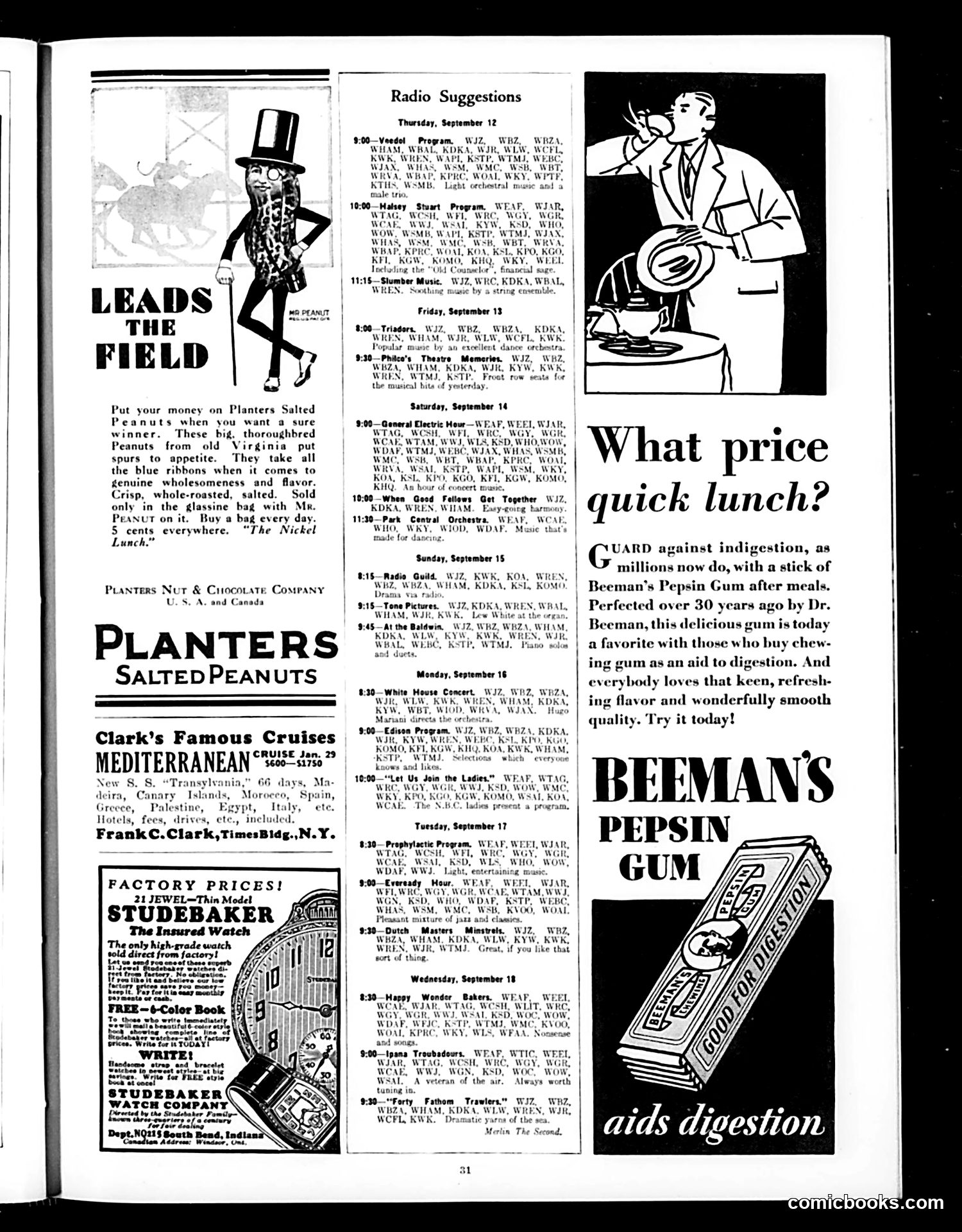
Analysis for Modern Readers This is primarily a radio and advertising page from Judge magazine (circa 1920s). The main content consists of: Radio Listings: Detailed programming schedules for Thursday-Wednesday across numerous radio stations (WJZ, WEAF, KDKA, etc.). These call letters represent early American radio networks, offering variety shows, orchestras, and sponsored programs. Advertisements: - Planters Salted Peanuts: Features Mr. Peanut (the monocled mascot), marketed as a "sure winner" snack - Studebaker Watches: Factory-direct sales pitch - Clark's Mediterranean Cruises: Luxury travel - Beeman's Pepsin Gum: Marketed as digestive aid ("Guard against indigestion") The satirical cartoon element ("Leads the Field") appears minimal here—mainly the anthropomorphized Mr. Peanut character. The page reflects 1920s consumer culture: early radio dominance, mass-marketed branded snacks, and patent medicine-style health claims (pepsin gum for digestion) that would face modern FDA scrutiny.
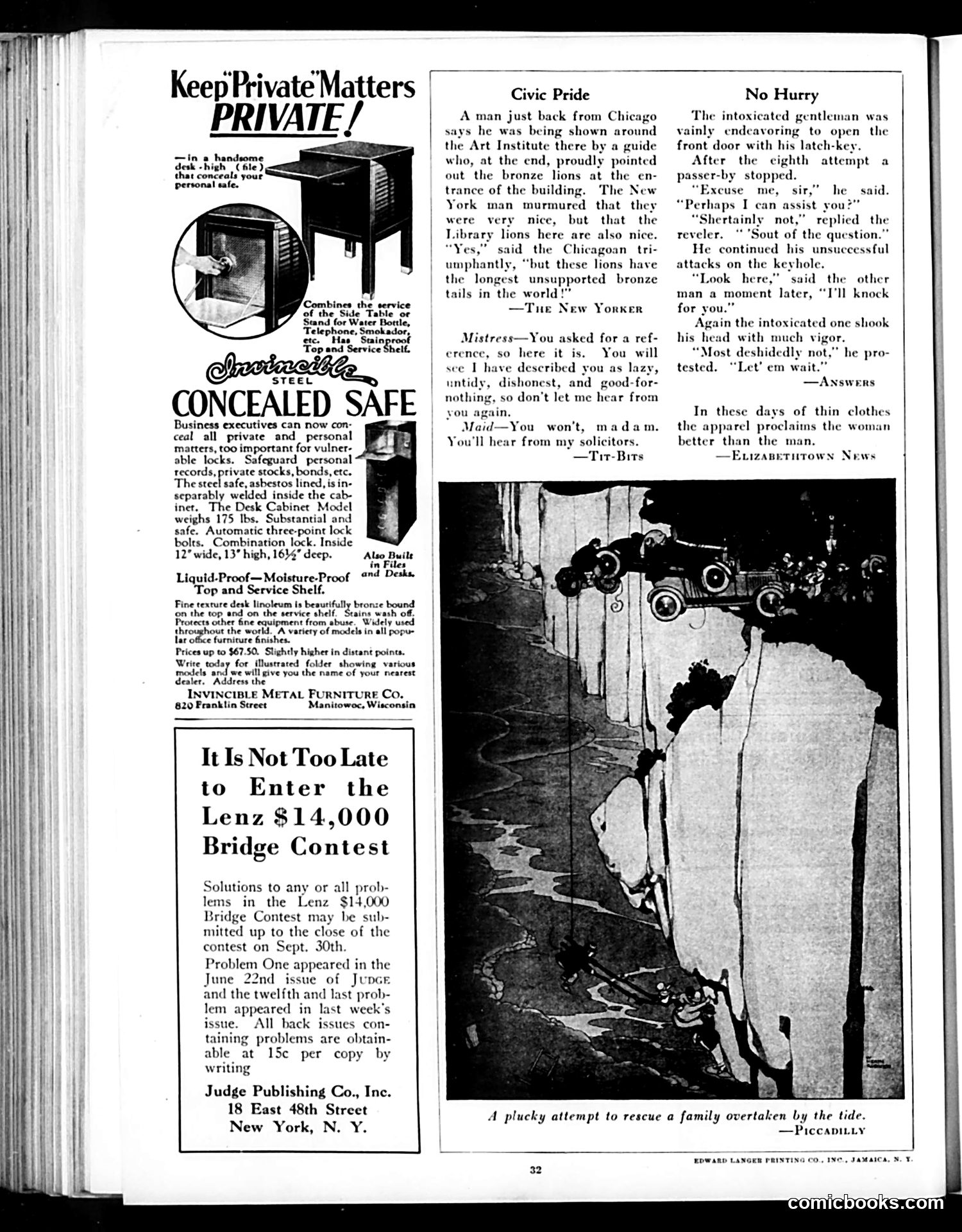
Judge Magazine Page Analysis This page from *Judge* contains primarily advertising and humor shorts rather than political cartoons. Content overview: The left side advertises a "Concealed Safe" desk cabinet for business executives protecting private documents—reflecting 1920s corporate privacy concerns. The right side features three brief humor anecdotes: 1. "Civic Pride": A New Yorker and Chicagoan compete over their cities' art institutions, with the Chicagoan claiming superiority because the Art Institute's bronze lions have the "longest unsupported bronze tails in the world"—a absurdist joke deflating civic boasting. 2. "Mistress/Maid": A mistress gives a deliberately bad reference to a departing maid, who responds she'll hear from her solicitors—humor about class conflict and employment disputes. 3. "No Hurry": A drunk man refuses help opening his door, insisting his locked-out state can "wait"—slapstick humor about intoxication. A photograph below shows a rescue attempt during a tidal emergency. The page is primarily commercial content with lightweight comedic filler typical of period magazines.
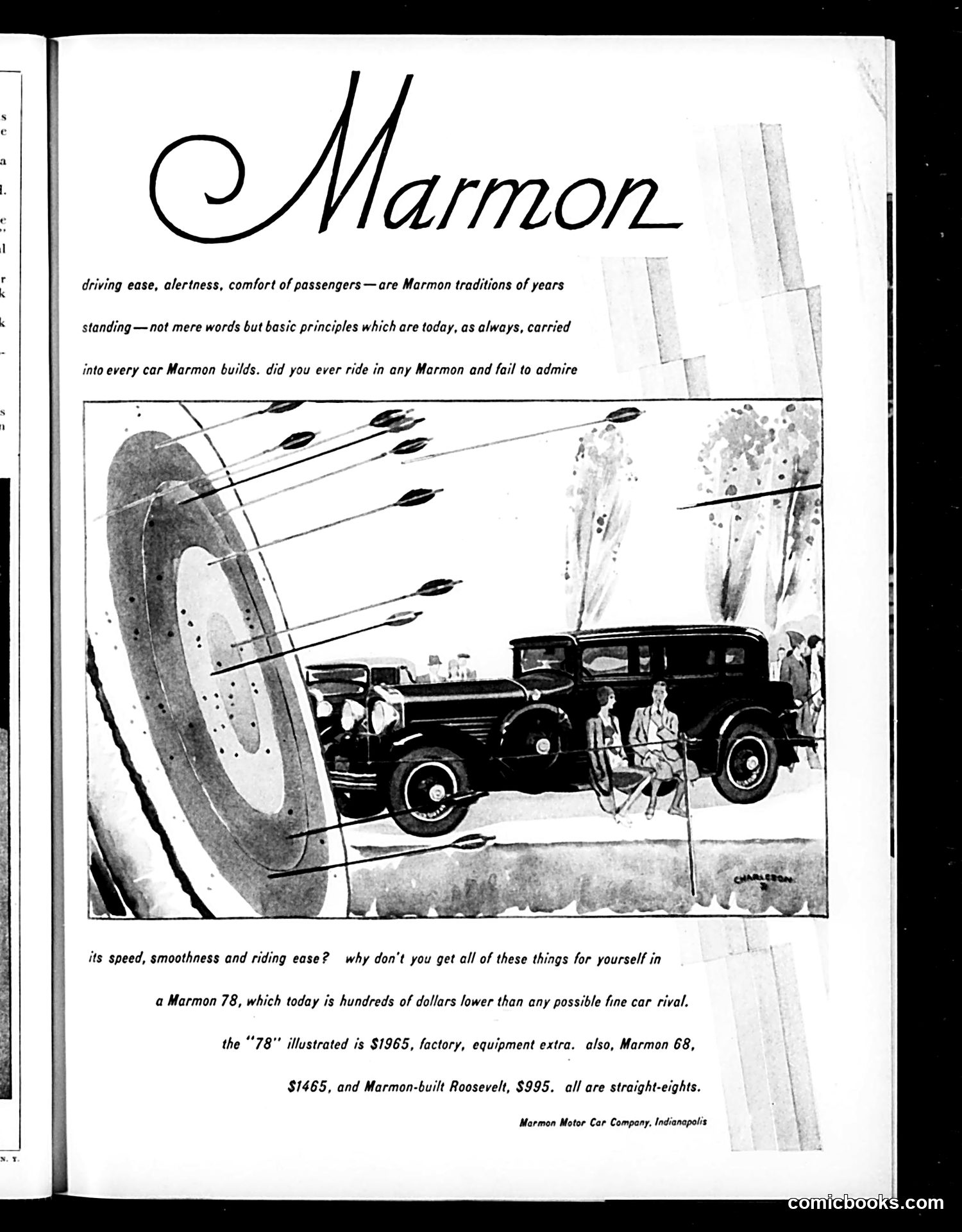
Marmon Automobile Advertisement This is a full-page advertisement, not political satire. It promotes the Marmon 78 automobile, manufactured by the Marmon Motor Car Company in Indianapolis. The ad emphasizes Marmon's brand heritage: "driving ease, alertness, comfort of passengers—are Marmon traditions of years standing." The illustration shows three Marmon vehicles with well-dressed passengers, conveying luxury and reliability. The sales pitch highlights that Marmon offers speed, smoothness, and riding ease at competitive prices—the Model 78 at $1,965 undercuts rival luxury cars. Three models are listed: the 78, the 68 ($1,465), and the Marmon-built Roosevelt ($995), all with straight-eight engines. This reflects the pre-Depression era when such automotive advertising emphasized engineering features and value proposition to affluent consumers.
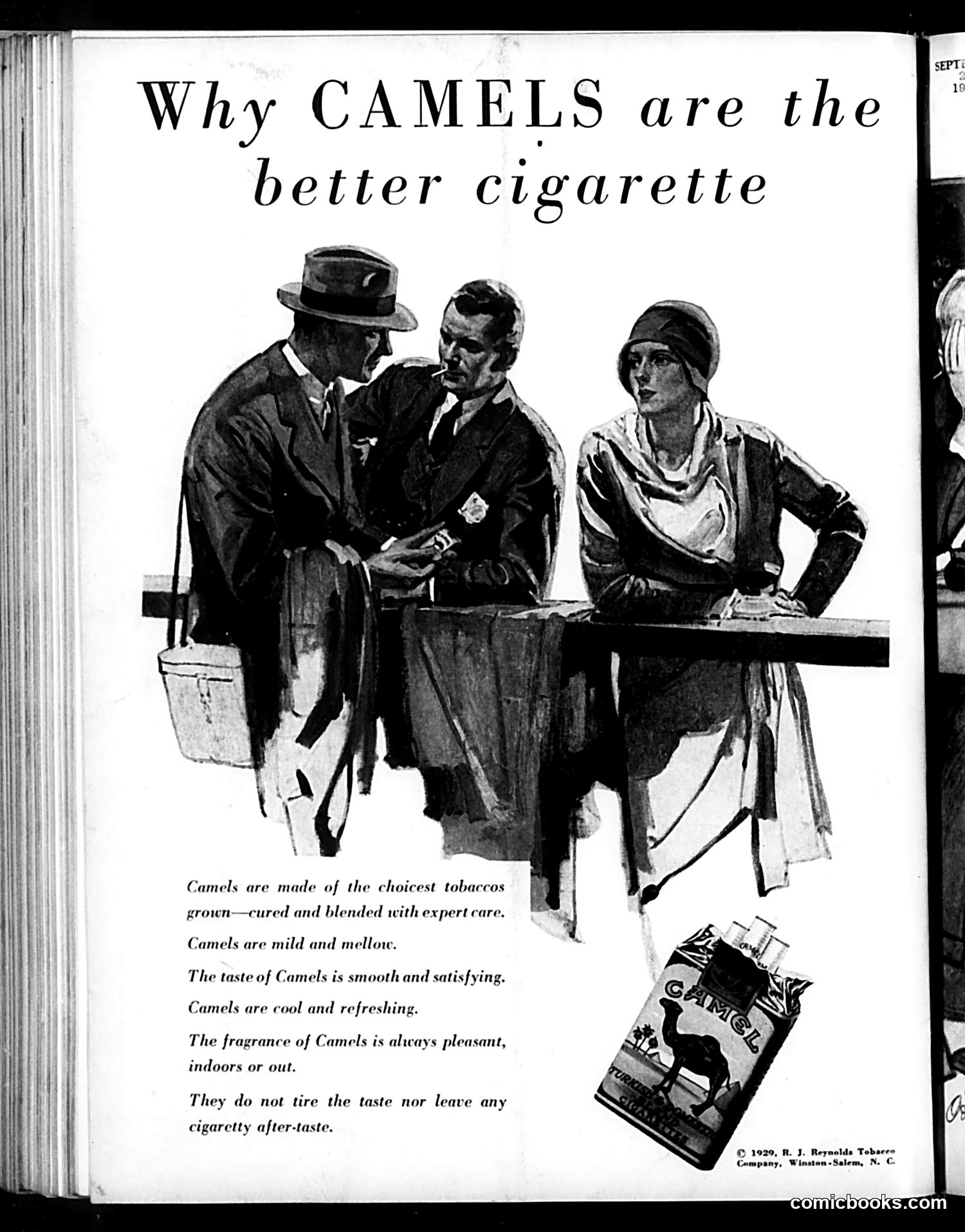
Analysis This is a Camel cigarette advertisement, not satire—it's a straightforward commercial from 1929 appearing in *Judge* magazine. The illustration shows three figures (a businessman, worker, and woman) in casual conversation, likely depicting everyday people endorsing the product. This reflects 1920s advertising strategy: portraying smoking as normal, sophisticated, and socially acceptable across class lines. The text lists product claims typical of tobacco marketing: quality ingredients, mild flavor, pleasant aroma, and no "after-taste"—assertions presented as factual benefits. What a modern reader should know: This predates cigarette health warnings. The advertisement was legally permitted to make unsubstantiated health claims. The casual, inclusive imagery normalized smoking, particularly appealing to women during an era when female smoking was still somewhat controversial. This represents early mass-market cigarette advertising before mid-20th-century medical evidence forced regulatory changes.