judge
Judge — September 21, 1929
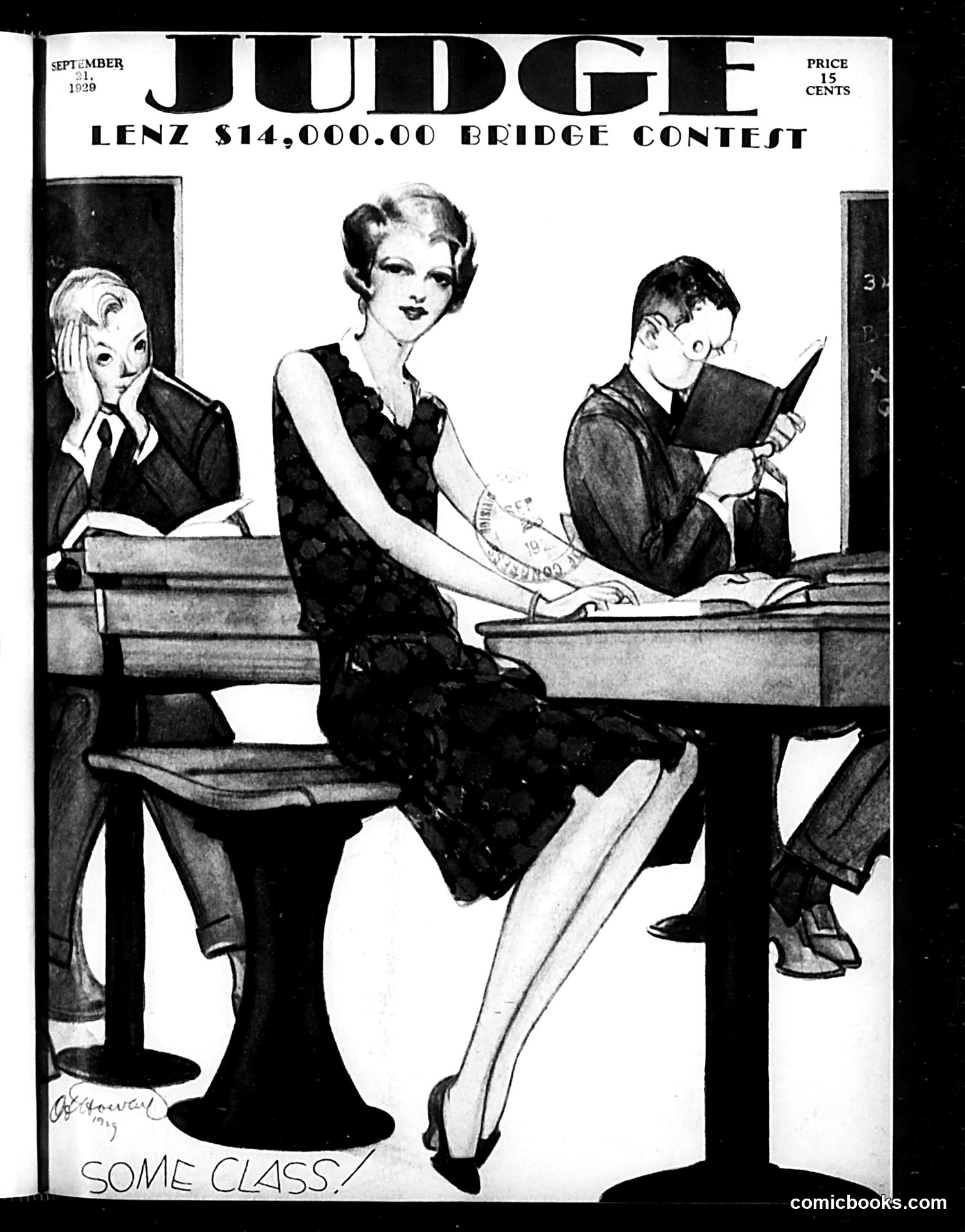
Judge Magazine, September 21, 1929 This is a satirical cartoon about bridge, the popular card game of the era. The title "Lenz $14,000.00 Bridge Contest" likely references a famous 1929 bridge competition involving Harold Vanderbilt and Ely Culbertson—major figures in bridge's early competitive history. The cartoon depicts three people playing bridge at a table, with the caption "SOME CLASS!" The satire appears to mock the pretentiousness and social aspirations surrounding competitive bridge among the wealthy. The elegantly dressed woman in the center represents the game's glamorous appeal to high society, while the composition suggests the ostentatious nature of high-stakes bridge tournaments that captured public attention during this period. The joke targets bridge's status as an elite social pastime.

College Inn Tomato Juice Cocktail Advertisement This is a straightforward product advertisement, not political satire. The page promotes College Inn brand tomato juice cocktail from Chicago, marketed as a health beverage containing "precious vitamins" from tomatoes with lemon and spices. The ad emphasizes health benefits—suitable for adults and children, aids weight management ("keeping figures slim"), and serves as a "body-conditioner." It notes the drink is "nutritious but non-fattening," reflecting early-20th-century wellness marketing that emphasized vitamins and health tonics. The advertisement lists other College Inn food products (soups, prepared meats) and includes a prominent bottle illustration with the company's branding. This represents typical vintage advertising rhetoric connecting commercial products to personal health and wellbeing.
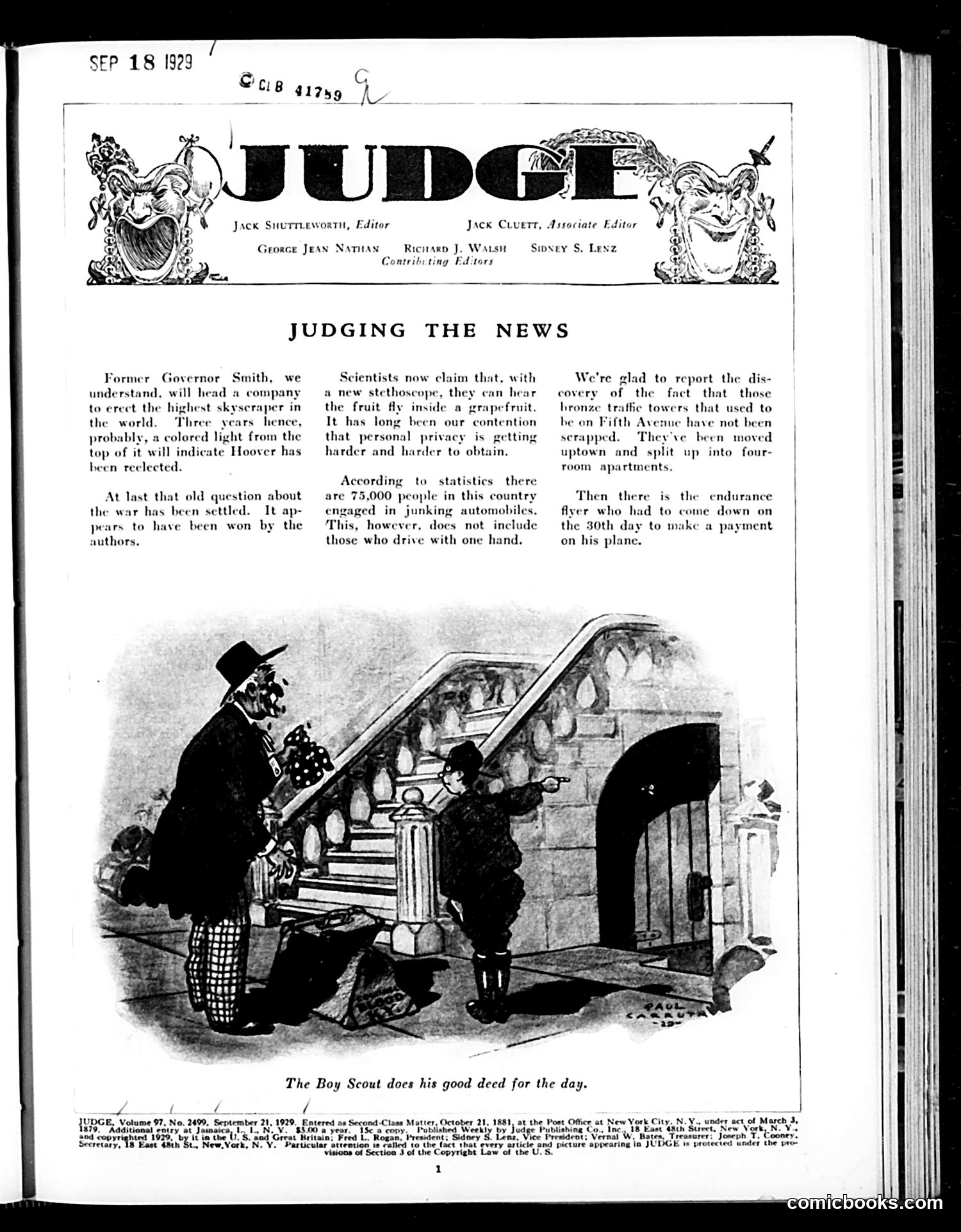
Judge Magazine, September 18, 1929 The main cartoon depicts a Boy Scout helping an elderly man down stairs, captioned "The Boy Scout does his good deed for the day." This appears to be straightforward, sentimental content rather than satire—celebrating Scout virtues through a wholesome scene. The "Judging the News" section contains brief commentary items, including humor about Governor Smith leading a chocolate company, a joke about 73,000 people jinxing automobiles, and a quip about bronze profile busts on Fifth Avenue being moved to apartments. The items are typical light satirical observations on contemporary news rather than pointed political commentary. This issue predates the stock market crash by just six weeks.
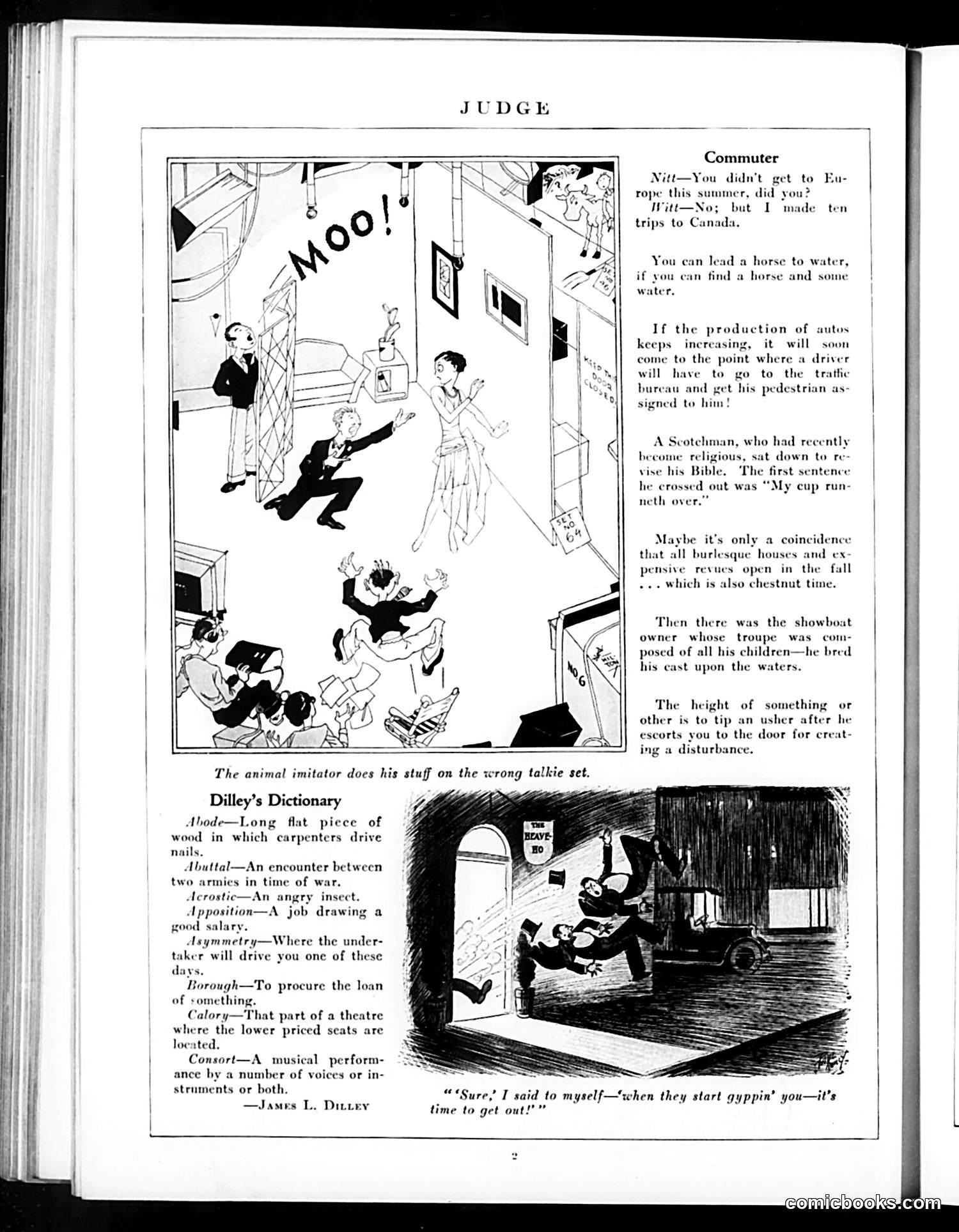
Analysis of Judge Magazine Page The main cartoon depicts chaos on a theater "talkie" (sound film) set—a cow loudly moos, causing pandemonium among actors and crew. The satire targets early sound-film technology's unpredictability: unlike silent films, live sound recordings captured unexpected noises that ruined takes. The joke's timing suggests this is from the late 1920s when "talkies" were revolutionary but technically unreliable. The lower cartoon shows someone being ejected from what appears to be a theater or venue, with the caption about "yapping"—likely commenting on disruptive audience behavior during sound films. The "Commuter" jokes and "Dilley's Dictionary" are unrelated satirical commentary on contemporary life and language, typical of Judge magazine's format mixing multiple humor segments per page.
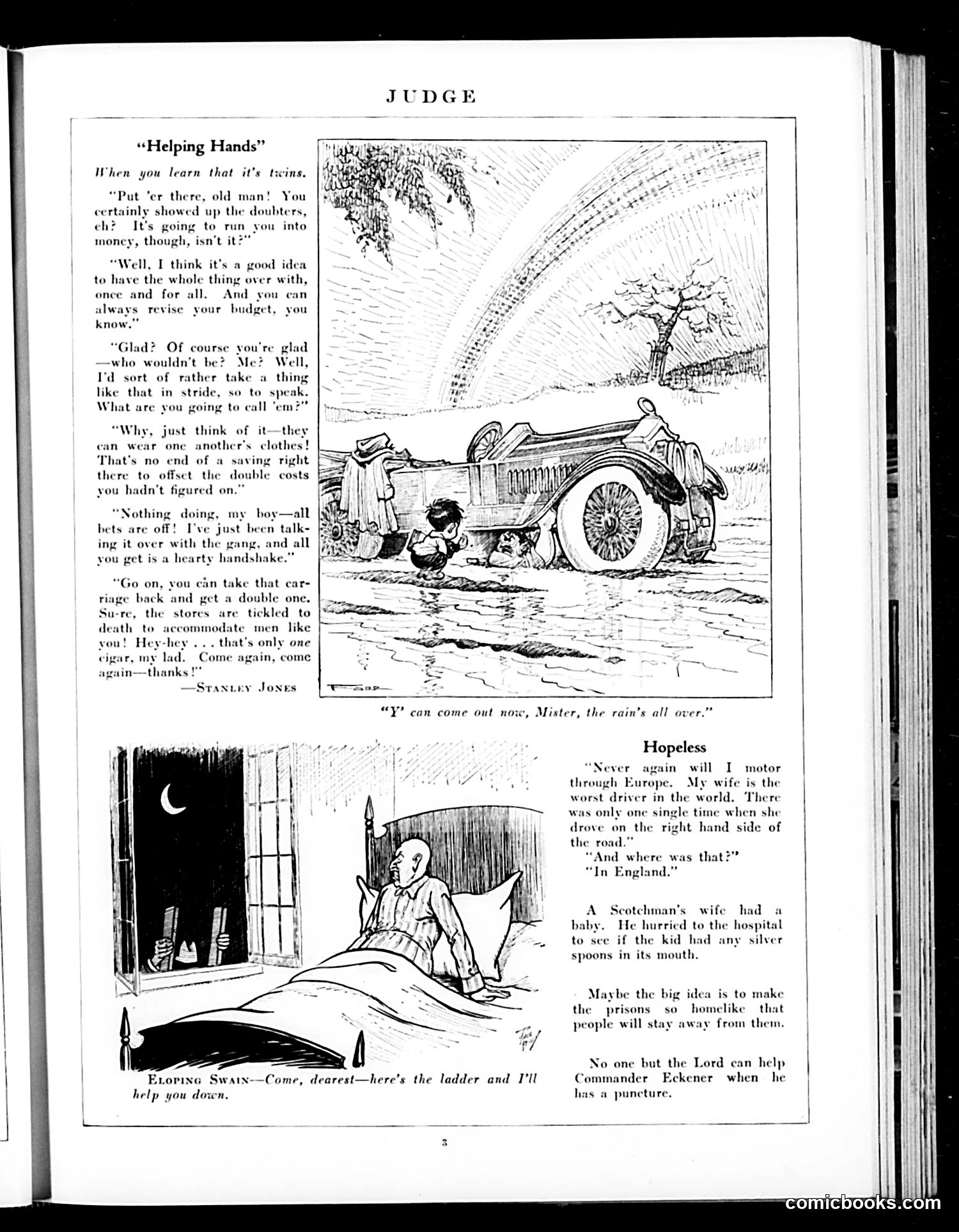
"Helping Hands" and "Hopeless" "Helping Hands" satirizes the financial burden of twins. Two men discuss how twins will "run you into money," debating whether pooling expenses (sharing clothes, combining costs) makes economic sense. The cartoon shows a broken-down car, illustrating the financial strain. The humor targets middle-class anxieties about child-rearing expenses during an era when large families strained household budgets. "Hopeless" contains two brief anecdotes mocking wives as poor drivers—one English woman who drove on the wrong side of the road, another Scottish woman who brought a baby to the hospital fearing silver spoons in its mouth. The final quip about prisons and Commander Eckener (airship pioneer) is unclear without additional context. The satire relies on period stereotypes about women drivers.
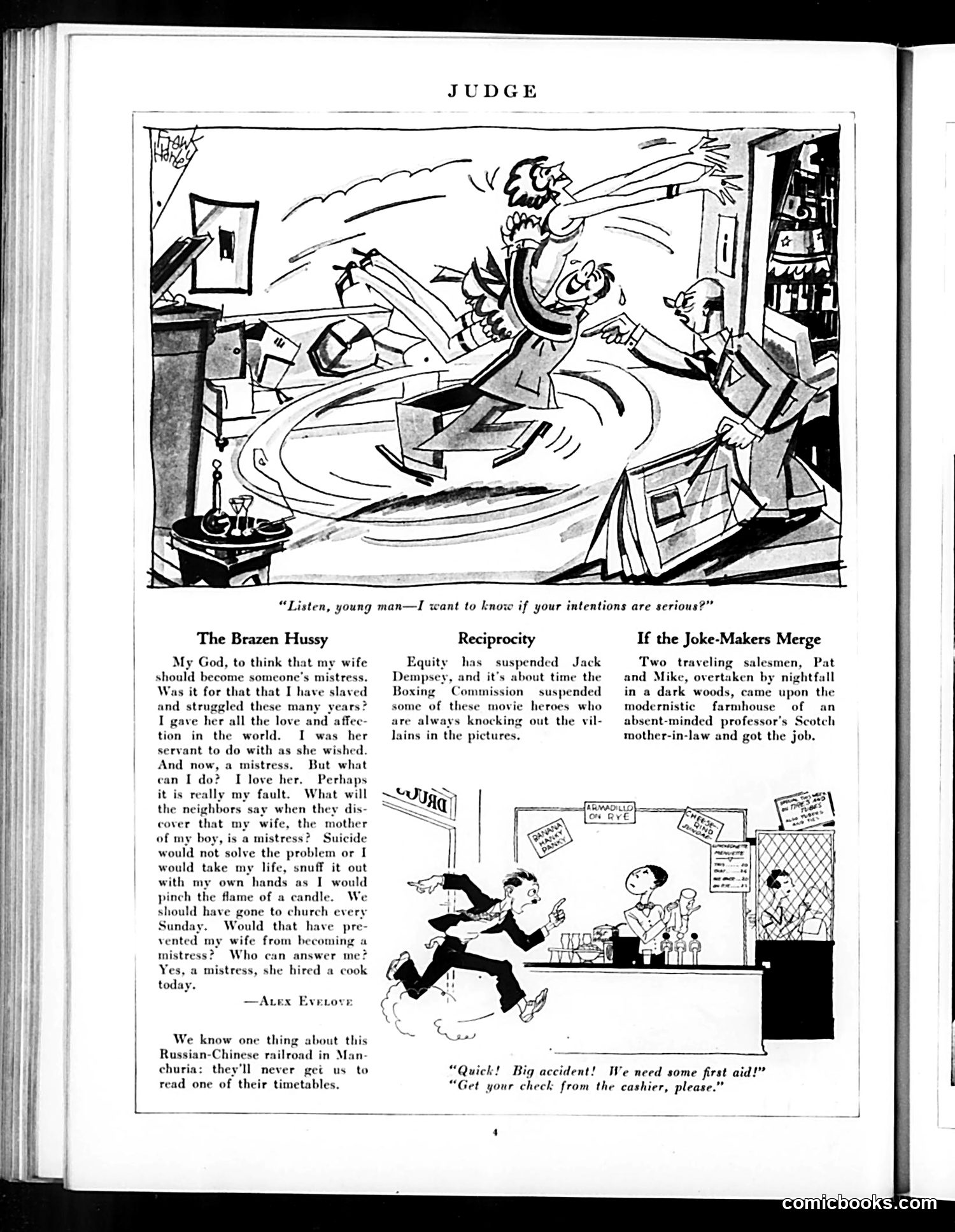
Analysis of Judge Magazine Page Top Cartoon: A chaotic office scene depicts a man being ejected violently by an angry figure, with papers flying. The caption asks "Listen, young man—I want to know if your intentions are serious?" This appears to satirize workplace or social encounters where intentions are questioned amid physical chaos—likely commenting on business disputes or romantic/social awkwardness during the period. Text Sections: "The Brazen Hussy" presents a husband's complaint about his wife becoming a mistress, expressing moral anxiety. "Reciprocity" jokes about boxing commission suspensions. "If the Joke-Makers Merge" humorously imagines traveling salesmen meeting a Scottish professor's mother-in-law. Bottom Cartoon: A man slips on a cloud while office workers react, captioned about a "big accident" requiring first aid and a cashier's check—satirizing insurance claims or workplace accidents. The page blends domestic satire with workplace humor typical of early 20th-century Judge content.
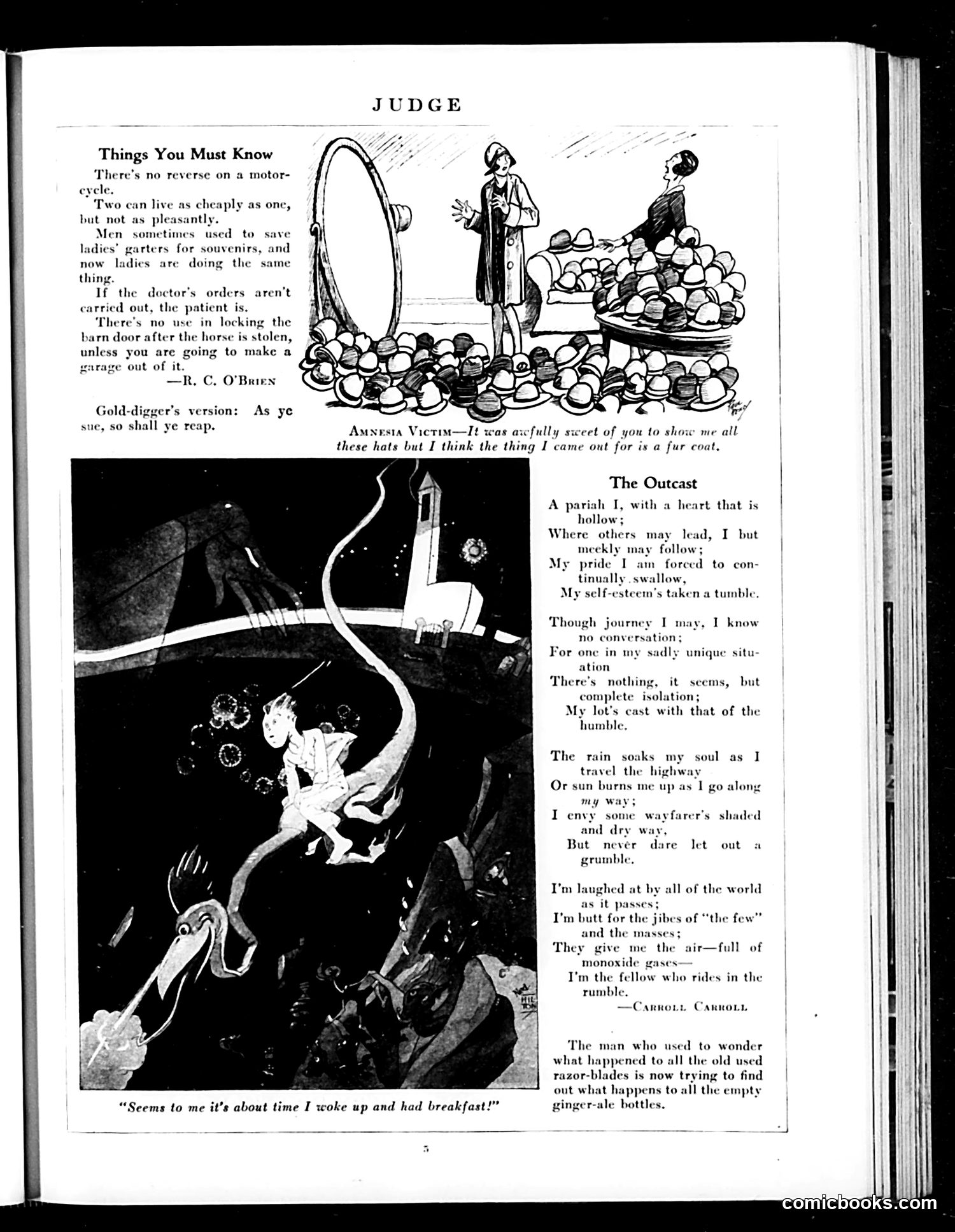
Analysis of Judge Magazine Page The top cartoon satirizes material excess during economic hardship. Two figures stand amid enormous piles of hats, with one remarking about acquiring a fur coat. The caption "Amnesia Victim" suggests someone has forgotten their previous poverty or wartime rationing, now wastefully accumulating luxury goods. Below, "The Outcast" poem by Carroll Carroll personifies a social pariah—someone cast out and isolated, traveling alone while others enjoy community. References to "monoxide gases" and riding "in the rumble" suggest Depression-era homelessness or vagrancy. The bottom item jokes about recycling: a man who previously discarded old razor blades now searches for empty ginger-ale bottles, implying economic desperation has forced people to salvage trash for resale or reuse. The page overall critiques 1920s-30s economic inequality and waste.
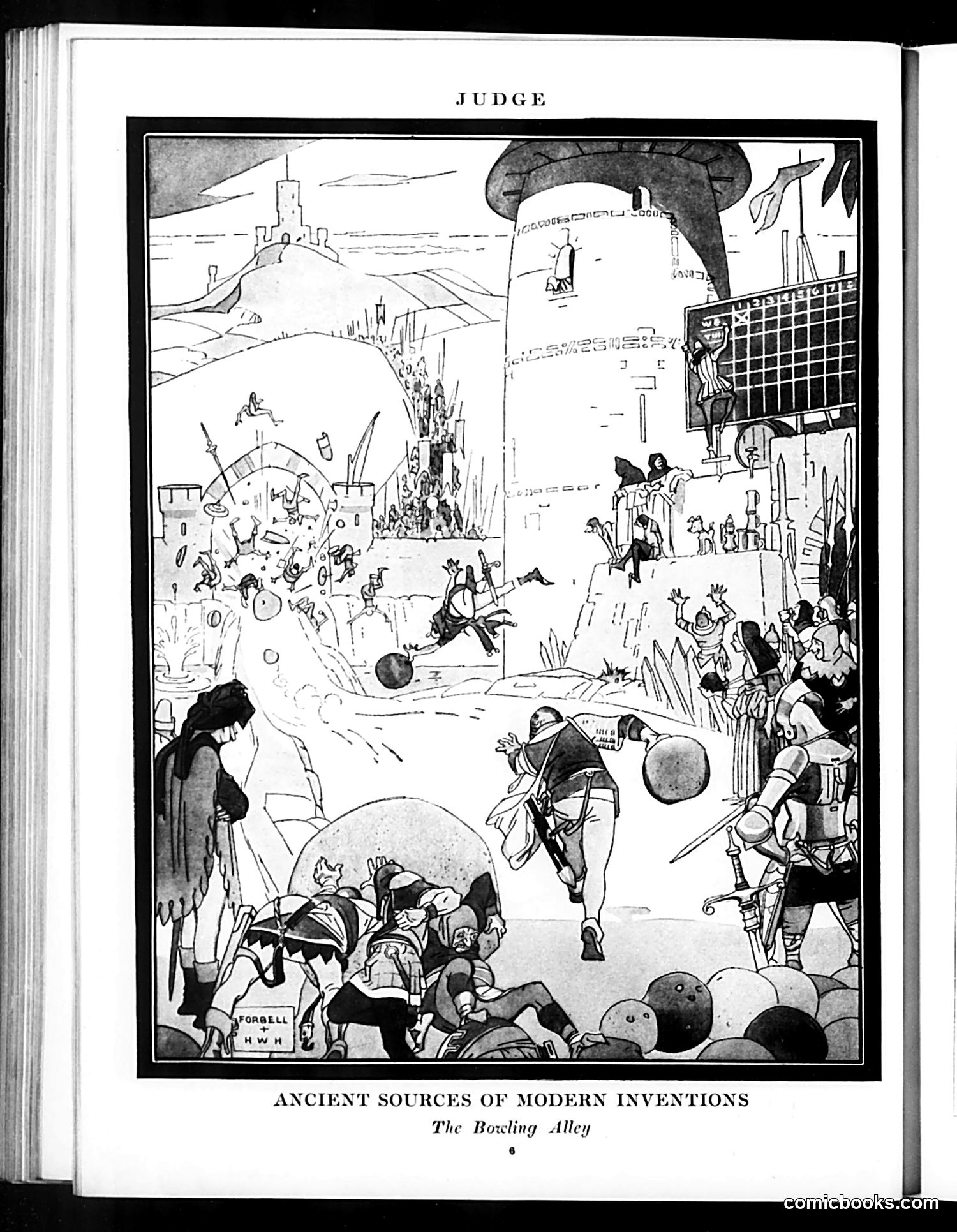
"The Bowling Alley": Ancient Sources of Modern Inventions This Judge cartoon uses a medieval setting to satirize bowling as an ancient pastime with modern relevance. The elaborate illustration depicts a castle-based "bowling alley" where armored knights and medieval figures engage in what appears to be an early form of bowling, complete with balls and pins. The satire's point: bowling, presented as a modern recreation, actually has deep historical roots. By depicting medieval nobles and soldiers bowling in an anachronistic castle scene, the cartoon humorously suggests that supposedly "modern inventions" often have precedents in history. The detailed architectural fantasy setting reinforces this comparative commentary on recreational activities across time periods.
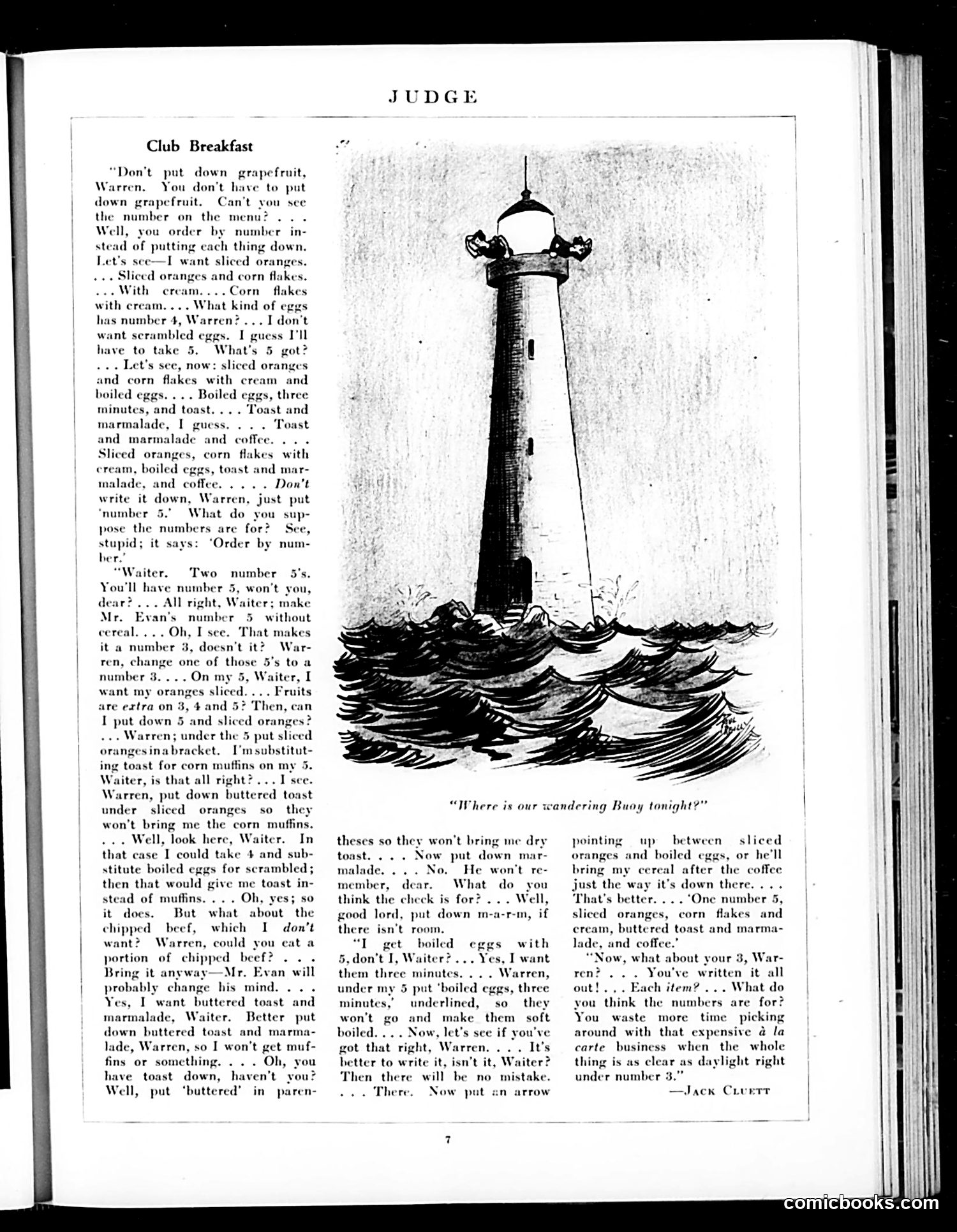
"Club Breakfast" by Jack Cluett This is a humorous complaint about restaurant ordering inefficiency. A diner attempts to order from a numbered menu (e.g., "Number 5"), but insists on customizing nearly every element—substituting items, adding extras, requesting specific preparations. The waiter and companion repeatedly note that these modifications defeat the purpose of the numbered system, which exists precisely to avoid such complications. The satire targets customer indecision and the false economy of "à la carte business"—the irony being that ordering by number should save time, yet the diner spends even more time negotiating substitutions than simply ordering individual items would take. The illustration of a lighthouse in stormy seas reinforces the caption "Where is our wandering Buoy tonight?"—a visual pun suggesting the diner's meandering, directionless ordering process.
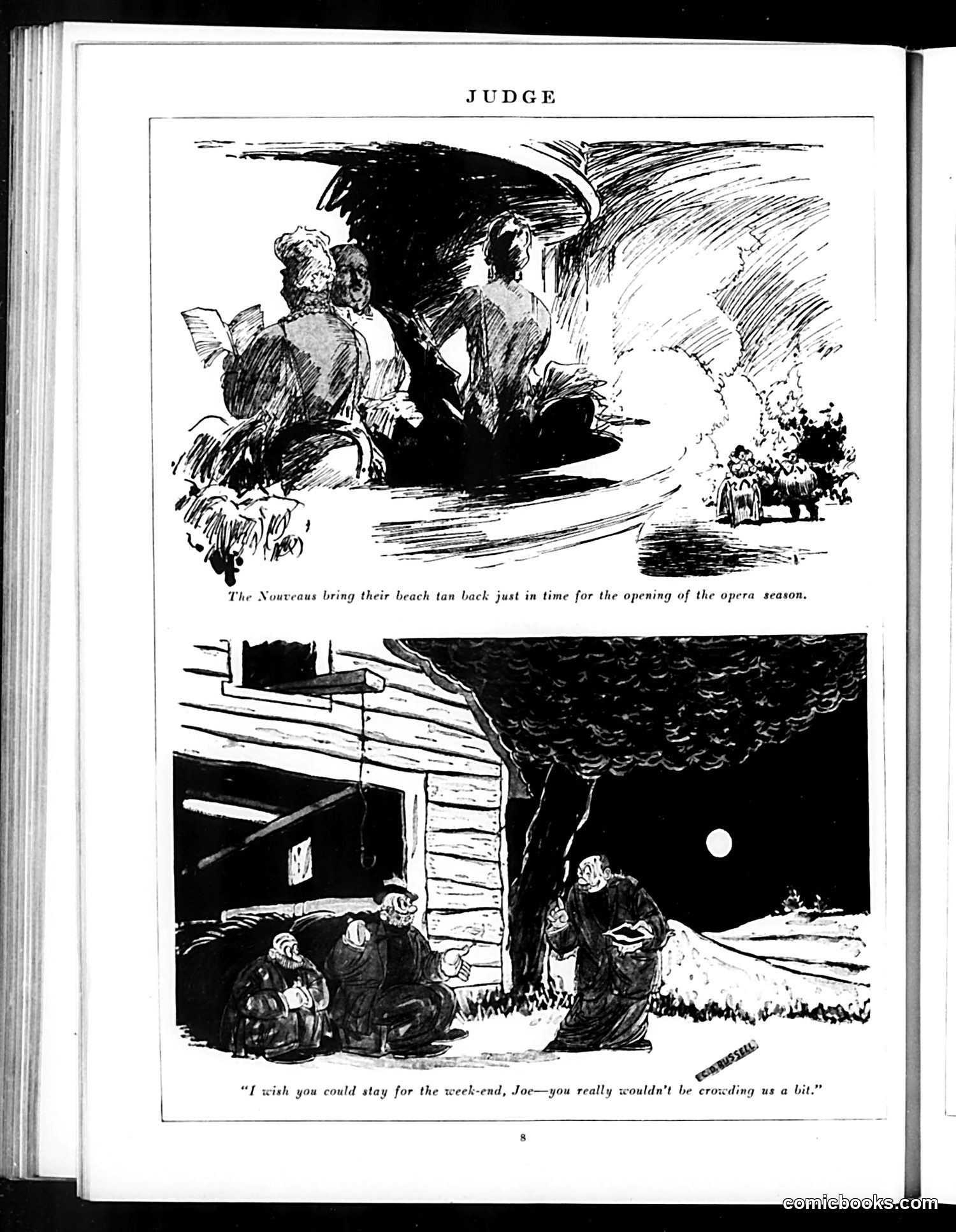
Analysis of Judge Magazine Page This page contains two satirical cartoons: Top cartoon: Shows wealthy socialites ("The Nouveaus") returning from summer leisure with tanned skin, timed for the opera season's opening. The satire mocks the nouveau riche—newly wealthy people displaying their status through fashionable pursuits and sun-tanned complexions (which signaled leisure and vacation travel). Bottom cartoon: Depicts a rural scene where someone named Joe is asked to stay for the weekend. The speaker notes this wouldn't inconvenience them much—likely satirizing either working-class hospitality or the economic strain of Depression-era visits. The nighttime farmhouse setting emphasizes rural simplicity contrasted with casual social assumptions. Both cartoons use humor to critique class dynamics and social pretension in early 20th-century America.
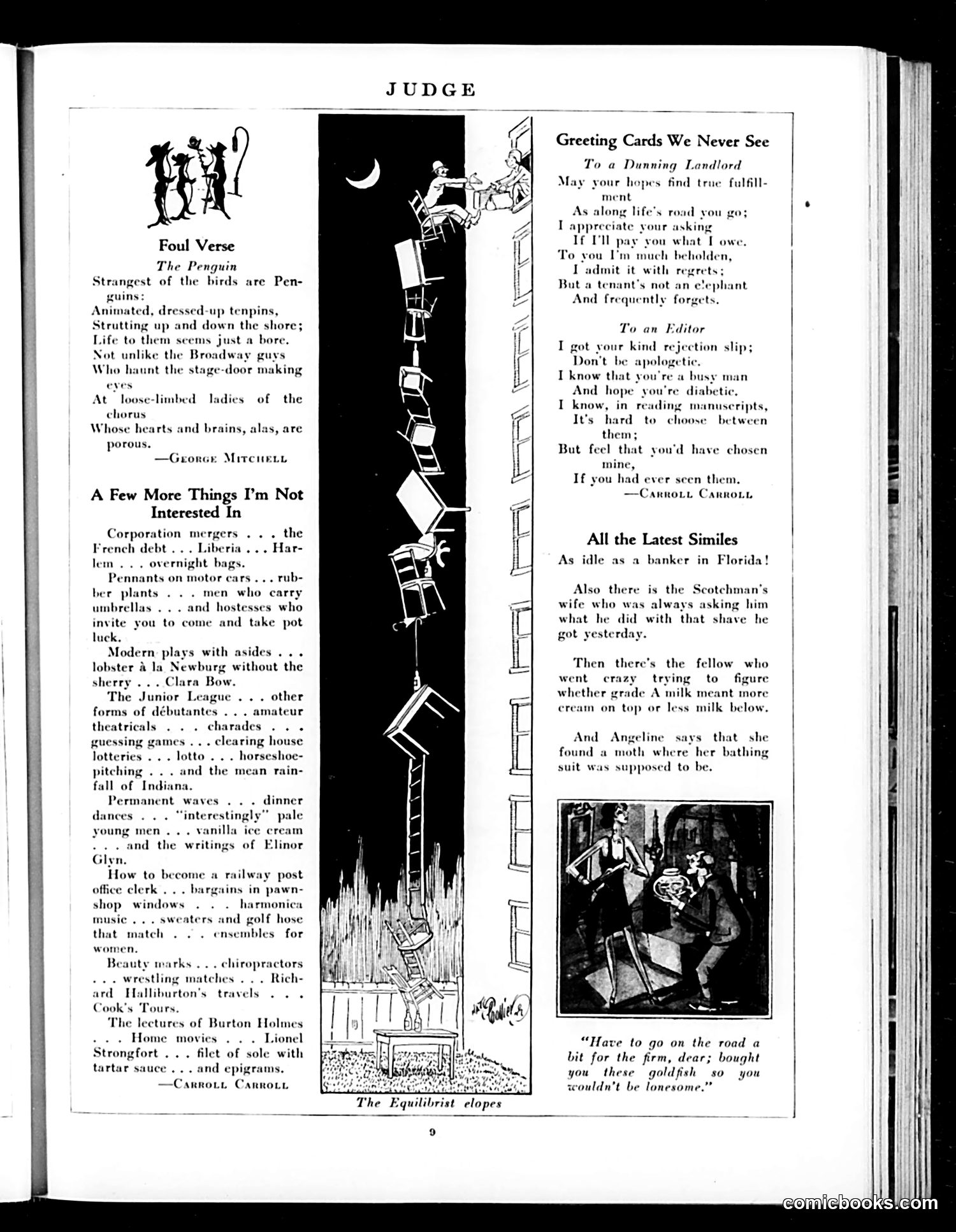
Judge Magazine Page Analysis This page from Judge magazine (appears to be 1920s-1930s era) contains satirical humor pieces targeting contemporary society: "Foul Verse: The Penguin" compares penguins to Broadway chorus girls—both described as animated but hollow, suggesting chorus performers lacked intelligence or substance. "A Few More Things I'm Not Interested In" is a humorous list mocking current trends and celebrities: corporate mergers, French war debts, Harlem culture, Clara Bow (silent film star), Junior League debutantes, and author Elinor Glyn. It reflects upper-class dismissiveness toward modern innovations and social changes. "Greeting Cards We Never See" offers satirical fake greeting cards—one to a landlord (sarcastically grateful for dunning notices), another to an editor rejecting manuscripts. These parody sentimental greeting card conventions. "All the Latest Similes" presents contemporary jokes, including one about a Scotsman and lost shaving cream, and one about milk grades—topical humor now obscure. The illustration shows figures on a building facade, likely satirizing urban or theatrical subjects. Overall, the page reflects Judge's satirical commentary on 1920s-30s social pretension and modern life.
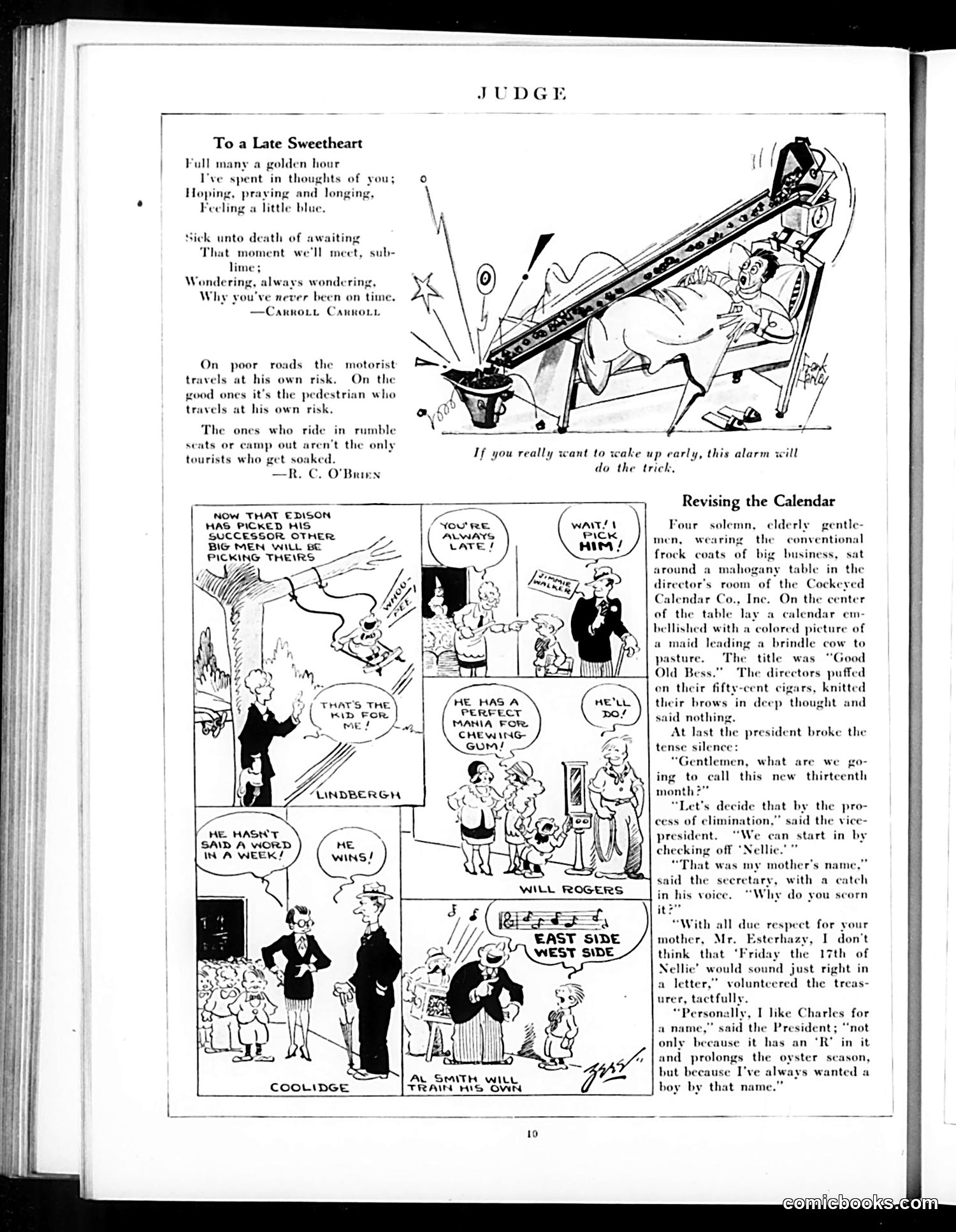
Explanation for Modern Readers This Judge magazine page contains three distinct pieces of satire: Top cartoon ("If you really want to wake up early..."): A visual joke about an overly elaborate, dangerous alarm clock that launches people violently out of bed—satirizing impractical modern gadgetry. Middle comic strip: References contemporary political figures. "Edison has picked his successor" alludes to Thomas Edison's influence. The strip appears to mock prominent men of the era (names visible: Lindbergh, Coolidge, Will Rogers, Al Smith) and their habits or quirks—suggesting these powerful figures are being satirized for their mannerisms or public personas. The "East Side/West Side" reference likely evokes New York social divisions. Bottom story ("Revising the Calendar"): A boardroom satire where executives of a calendar company debate naming a newly-created thirteenth month. The humor lies in their absurd elimination process: rejecting "Nellie" because it sounds unrefined, and finally proposing "Charles" for arbitrary reasons (it has an "R," extends oyster season). This mocks corporate decision-making as fundamentally irrational despite pretensions of seriousness.
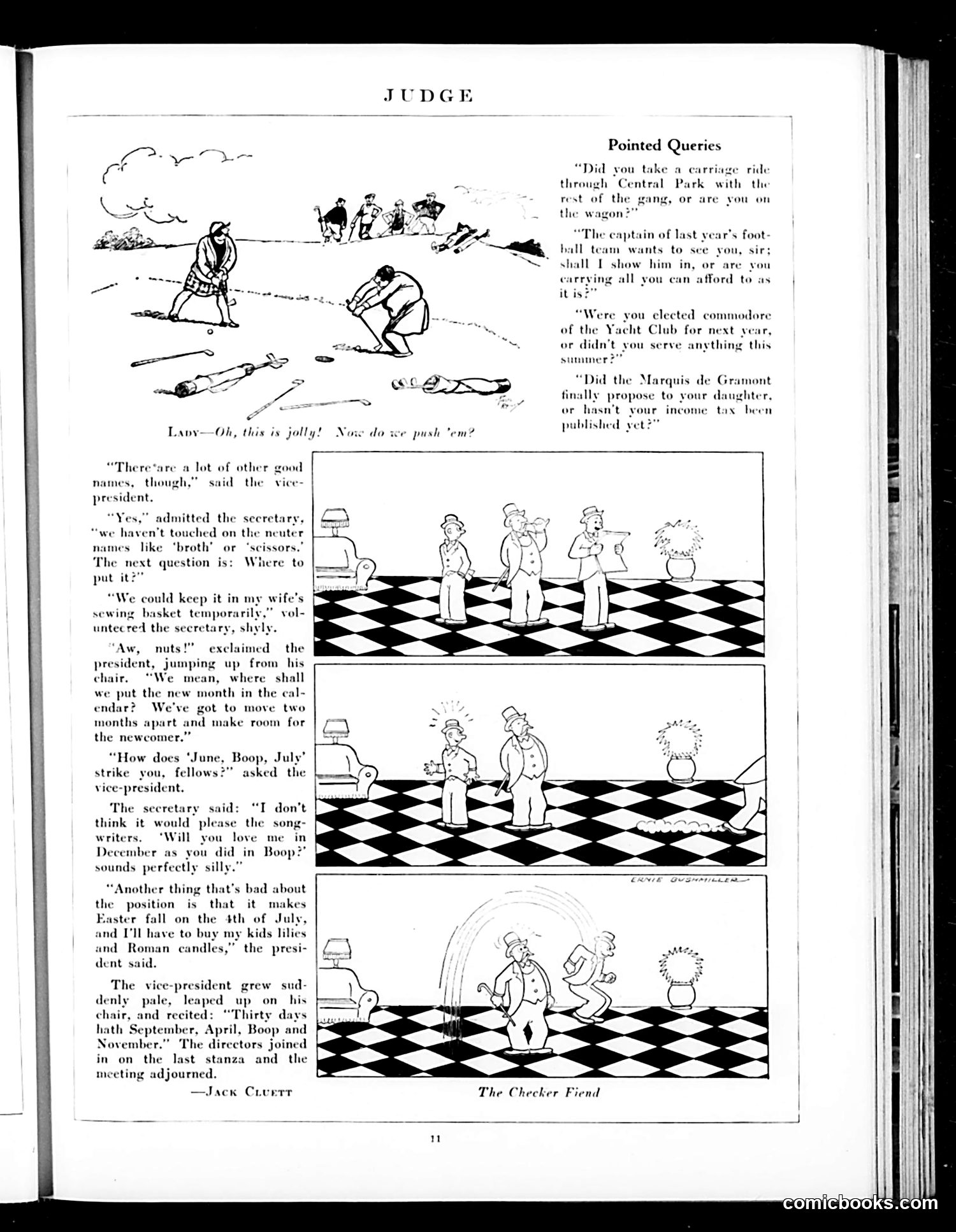
Analysis This page contains two distinct satirical pieces from Judge magazine: "The Checker Fiend" (bottom comic strip): Office bureaucrats debate naming a new month ("Boop") and where to insert it in the calendar. The satire mocks organizational inefficiency and absurd problem-solving—they seriously discuss the ramifications (Easter falling on July 4th, songwriting complications, calendar disruptions) for what appears to be a trivial or nonsensical proposal. It's humor derived from taking ridiculous premises seriously. "Pointed Queries" (right column): A list of sarcastic "questions" poking fun at high society's pretensions. Each query sarcastically suggests alternative embarrassing explanations for social activities—implying wealthy people either flaunt their money ostentatiously or hide financial/romantic failures behind polite society. References include Central Park social outings, yacht club positions, and the Marquis de Gramont (a French nobleman), targeting old-money elite's hypocrisy and status-consciousness. Both pieces use exaggeration to critique institutional absurdity and social pretension typical of early 20th-century American humor.
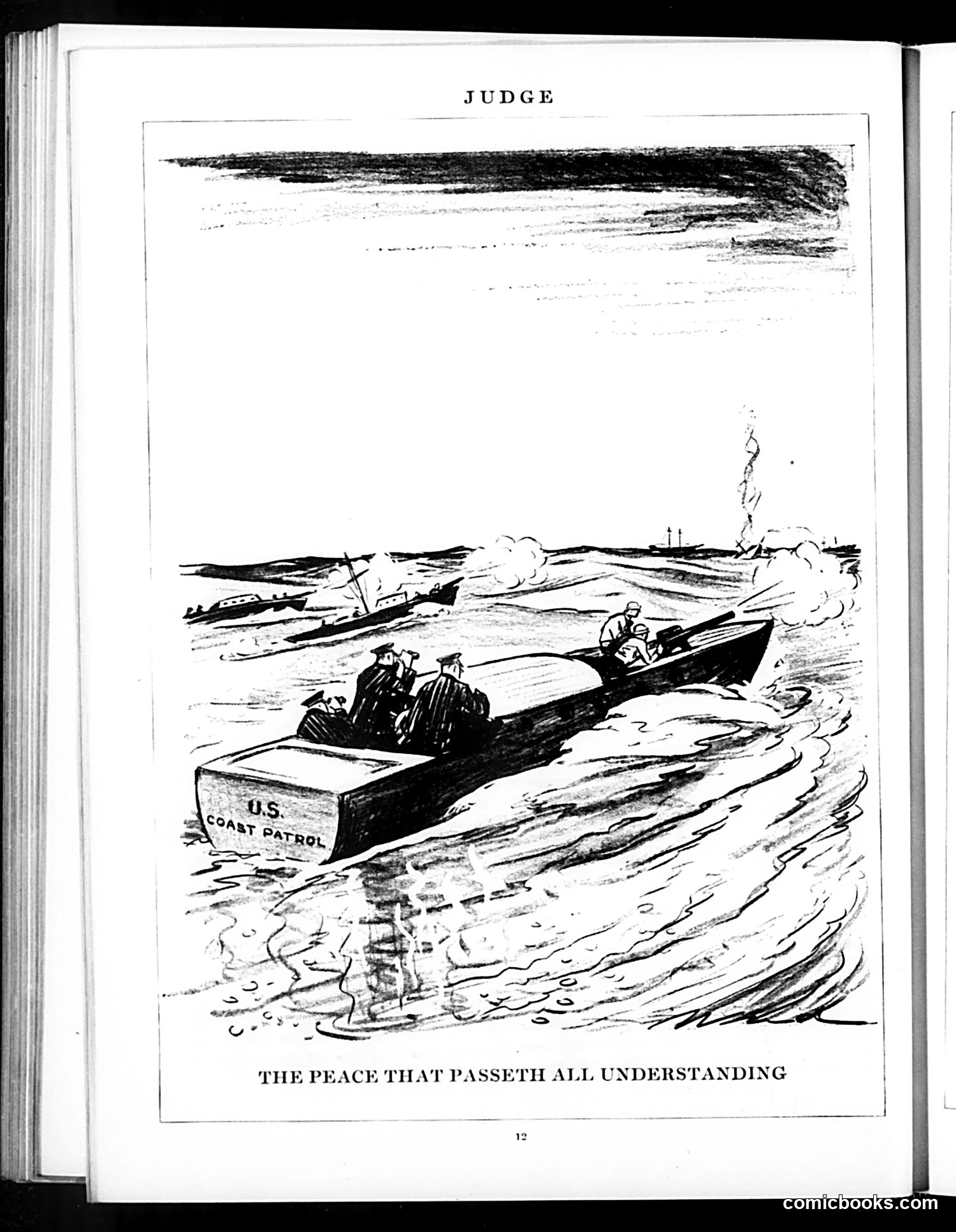
"The Peace That Passeth All Understanding" This political cartoon depicts U.S. Coast Guard officers in a patrol boat encountering what appears to be bootleggers or smugglers during Prohibition era (likely 1920s-1930s). The title, a biblical phrase meaning incomprehensible peace, is used ironically: despite law enforcement efforts to stop illegal alcohol trafficking, the smuggling operations continue unabated in coastal waters. The satire critiques the futility of Prohibition enforcement. The Coast Guard's presence provides only the illusion of control while criminal enterprises flourish. The cartoon suggests that maintaining "peace" through Prohibition is paradoxically impossible—the contradiction between law and widespread illegal activity creates an absurd, incomprehensible situation rather than genuine peace.
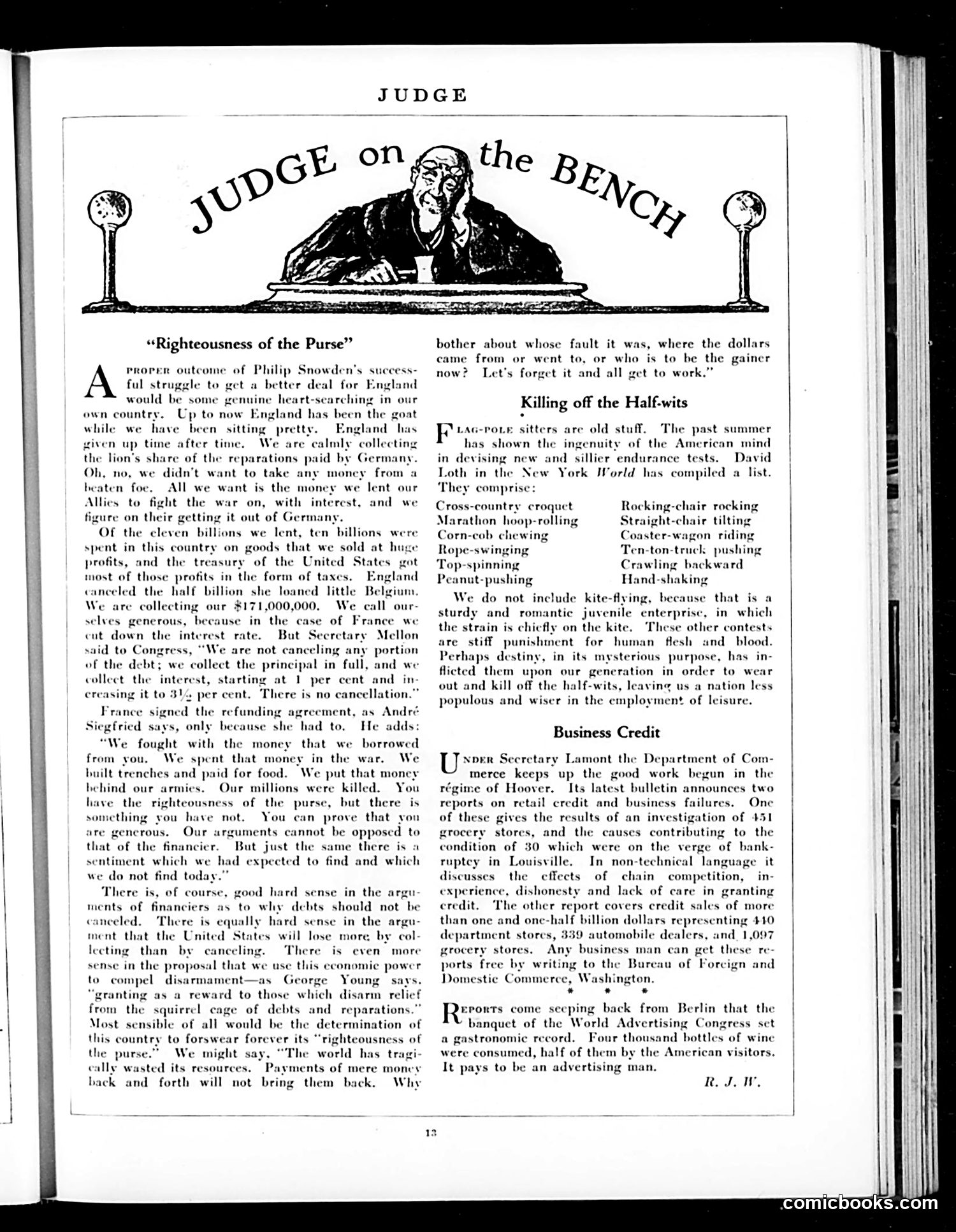
"Judge" Magazine Page Analysis This page contains two distinct satirical pieces: "Righteousness of the Purse" criticizes America's post-WWI debt collection policies. The article attacks U.S. insistence on repaying war loans from Allied nations (particularly France and England) while those countries faced economic devastation. It quotes French Finance Minister André Siegfried's complaint that America—which profited enormously selling war materials—demands repayment with interest from nations that spent their resources fighting. The satire argues America should forgive debts as a humanitarian gesture and economic stimulus rather than pursue "righteousness of the purse" (moral superiority through financial extraction). "Killing of the Half-wits" mocks the 1920s fad of endurance contests (sitting on flagpoles, marathon chair-rocking, etc.). The article sardonically suggests these pointless competitions serve a eugenic purpose—eliminating "half-wits" through exhaustion, leaving society wiser. This reflects period anxieties about public behavior and leisure activities during the Jazz Age.
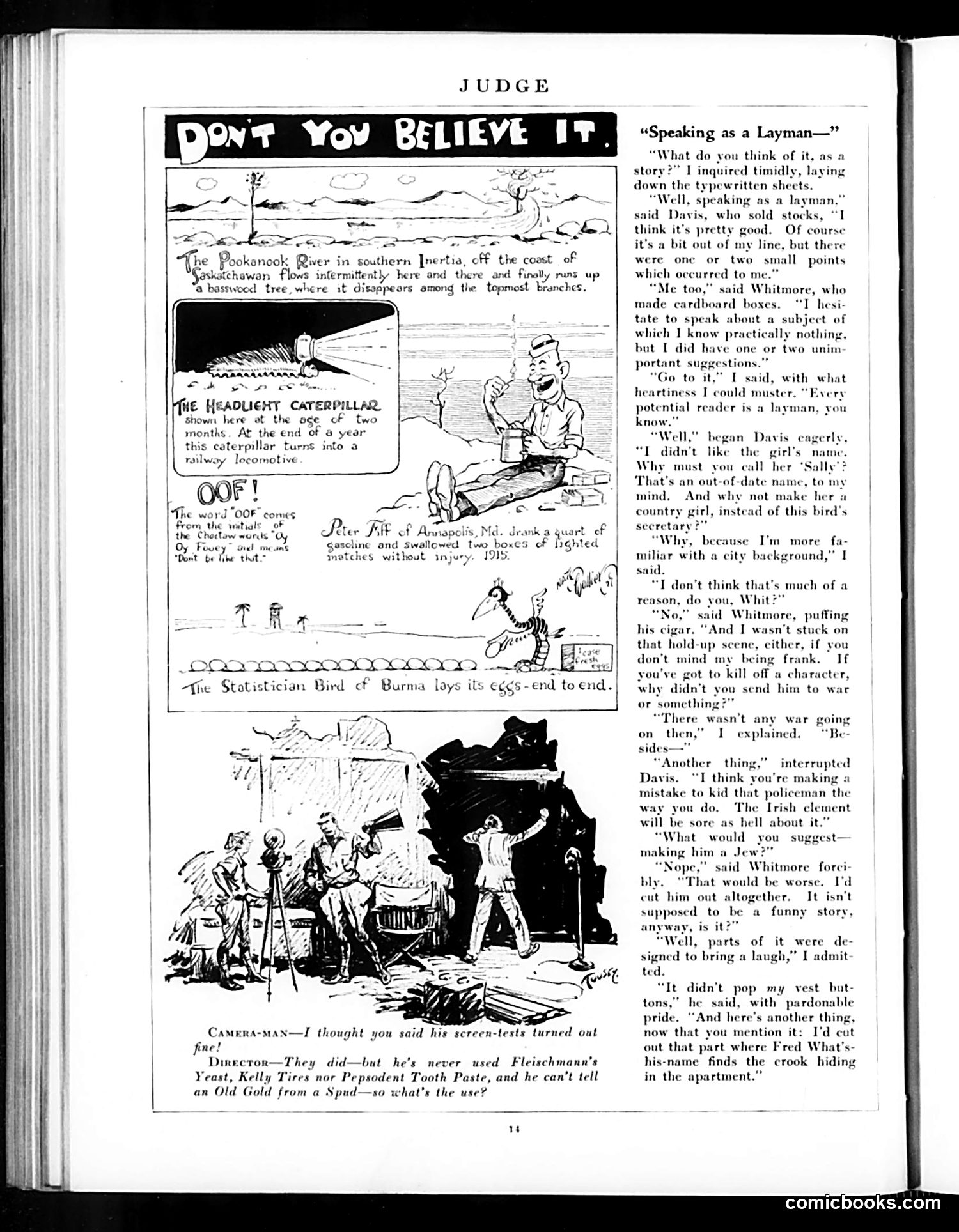
Analysis for Modern Readers This page contains two unrelated pieces of satire: "Don't You Believe It" (top) is a humorous illustrated column mocking implausible tall tales—a fabricated river that vanishes up a tree, a caterpillar becoming a locomotive, nonsensical etymologies. These absurdist "facts" lampoon the credulous acceptance of misinformation. "Speaking as a Layman" (right) satirizes amateur critics and non-experts who freely critique creative work despite lacking expertise. Three men (Davis, Whitmore, and the unnamed narrator) dissect a story, each offering unwarranted opinions: objecting to character names, criticizing plot details, demanding changes to satisfy ethnic sensitivities. The satire targets how laypeople presume authority over professional artists' work, demanding revisions based on personal preference rather than artistic merit. The Director/Camera-man exchange (bottom) jokes about an actor so devoid of personality he can't distinguish between product brands—mocking both the actor and commercial product endorsement culture. All pieces satirize contemporary American pretension and poor judgment.
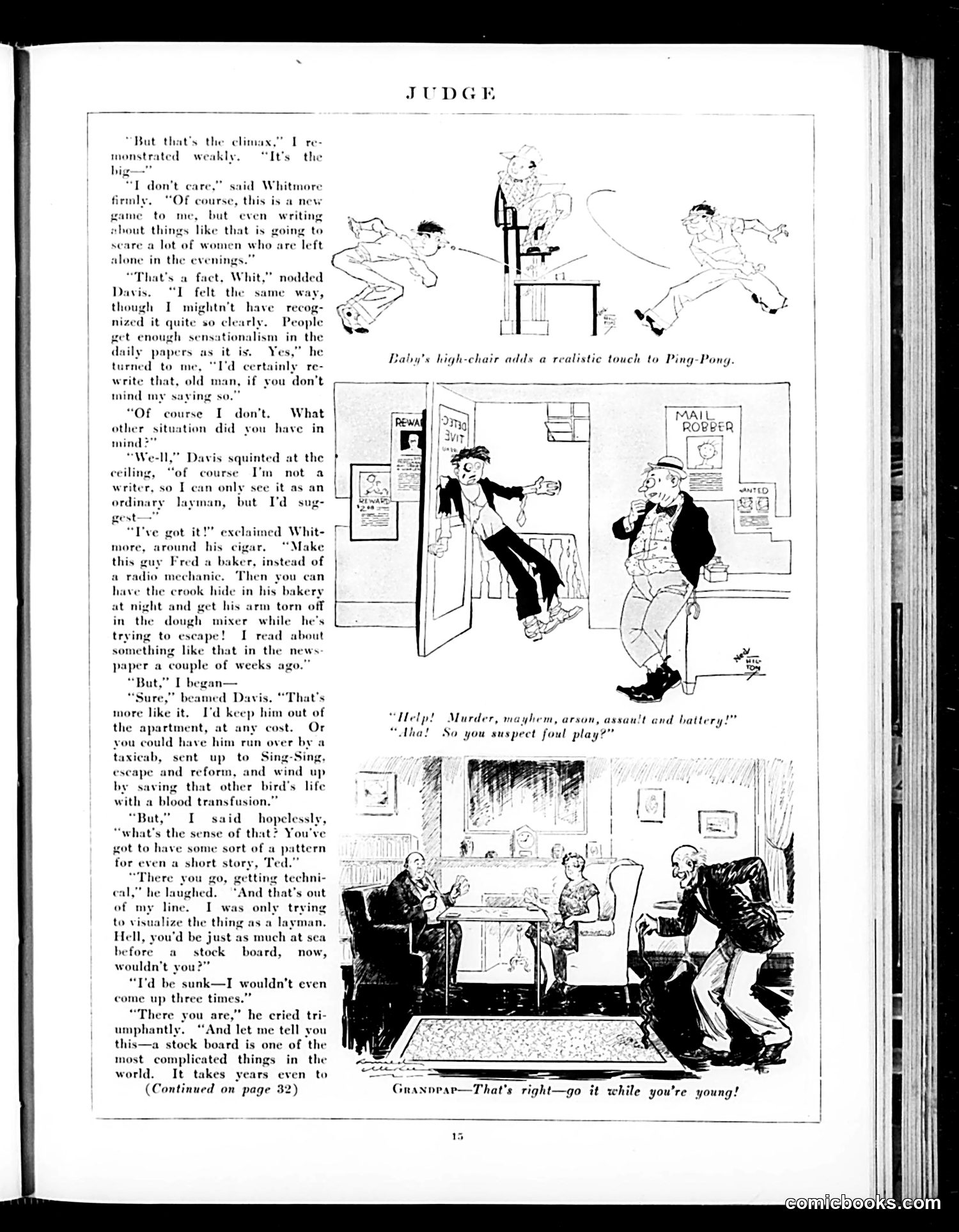
Judge Magazine Page Analysis This page satirizes pulp fiction writing conventions and editorial meddling. The dialogue shows two editors (Whitmore and Davis) critiquing a story submission, demanding increasingly sensational and unrealistic plot elements—a hidden criminal in a baker's dough mixer, dismemberment, escape from prison, blood transfusions—while dismissing the writer's concern about maintaining logical narrative structure. The cartoons illustrate their suggestions: the top shows absurd "Ping-Pong" action, while the middle depicts a slapstick "murder" scene with obvious foul play. The bottom cartoon shows a grandfather clock—a classic melodrama prop—humorously labeled "Grandpap—That's right—go it while you're young?" The satire's point: Editors prioritized sensationalism and commercial appeal over coherent storytelling. The comparison to a stock board—something the writer admits not understanding—mocks how laymen make demands about complex craft. Judge criticizes both the lowbrow taste driving pulp fiction's absurdity and editors who exploit it rather than nurture actual narrative skill.
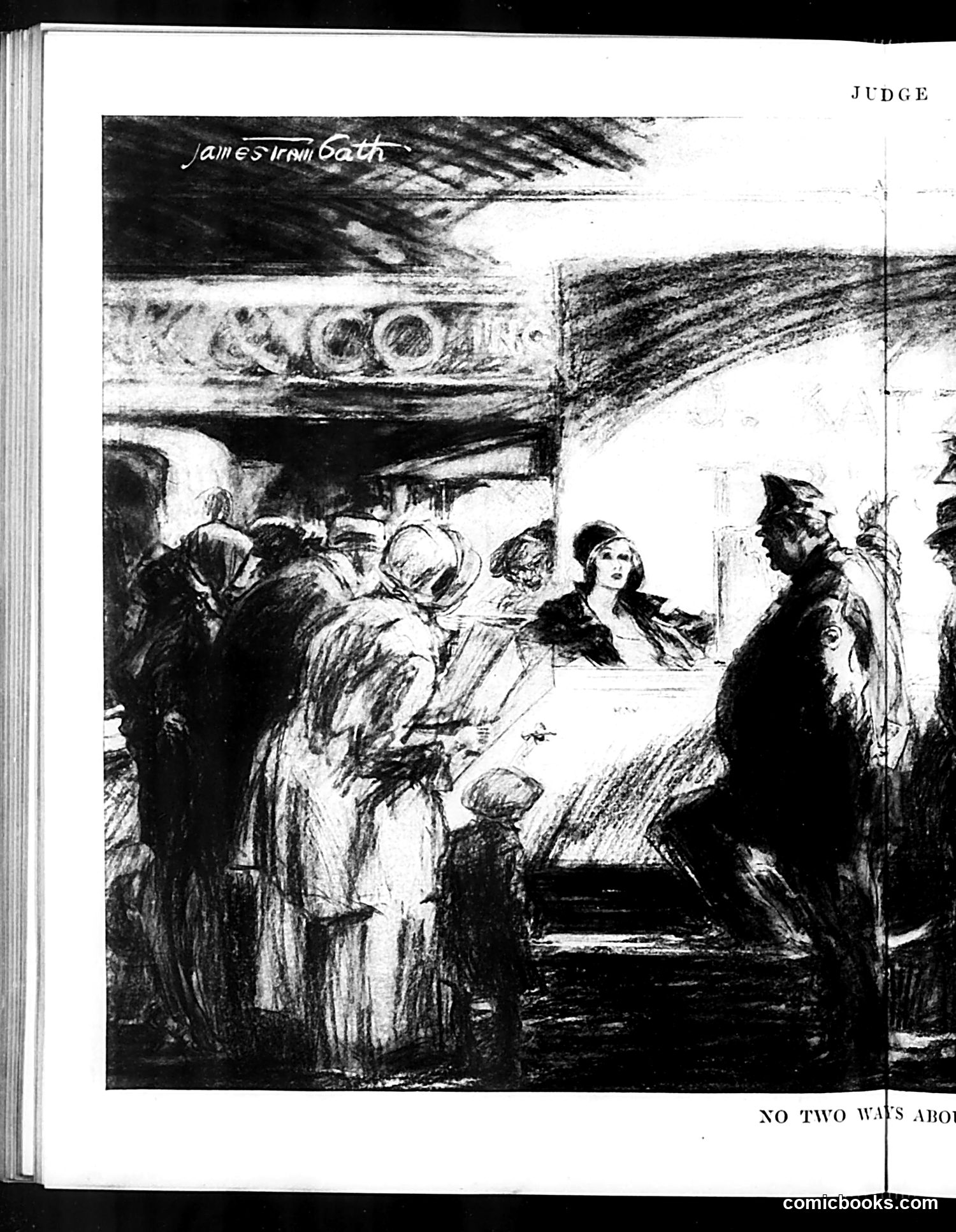
Analysis This page from *Judge* magazine features a sketch titled "No Two Ways About [it]" by James Irwin Bath. The image depicts a street scene outside what appears to be a commercial establishment (marked "& CO"). A well-dressed woman in the center confronts what seems to be a uniformed official or authority figure on the right, while working-class figures in head coverings gather on the left—possibly immigrants or laborers. The satirical point likely concerns class conflict, municipal authority, or immigrant treatment during the early 20th century. The "no two ways about it" caption suggests the scene presents an unavoidable moral or practical reality. Without the full text, the specific political reference remains unclear, but the composition emphasizes tension between social classes and institutional power.
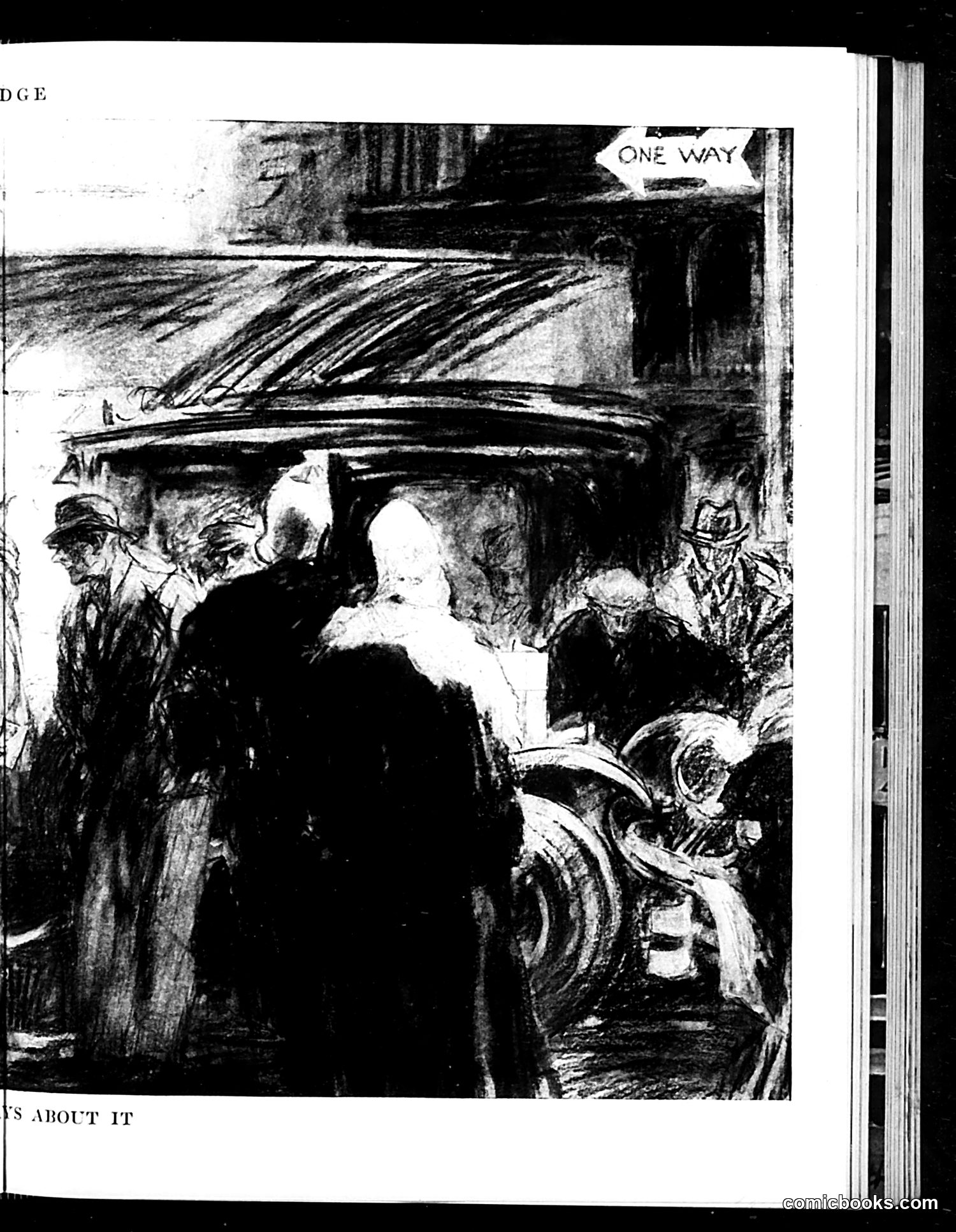
Political Cartoon Analysis This appears to be a street scene cartoon, likely from the early 20th century, depicting a "ONE WAY" traffic sign. The image shows several figures in period clothing (hats, suits) gathered around what appears to be an automobile or vehicle entrance/tunnel. The satirical point likely concerns the introduction of one-way traffic regulations to urban streets—a relatively new traffic management innovation at the time. The cartoon probably mocks either the confusion this caused pedestrians and drivers, or satirizes the growing complexity of city traffic management. Without clearer text or additional context on this page, the specific political or social target remains unclear. The title fragment "'S ABOUT IT" suggests commentary on a contemporary issue, but the full meaning is difficult to determine from this reproduction alone.
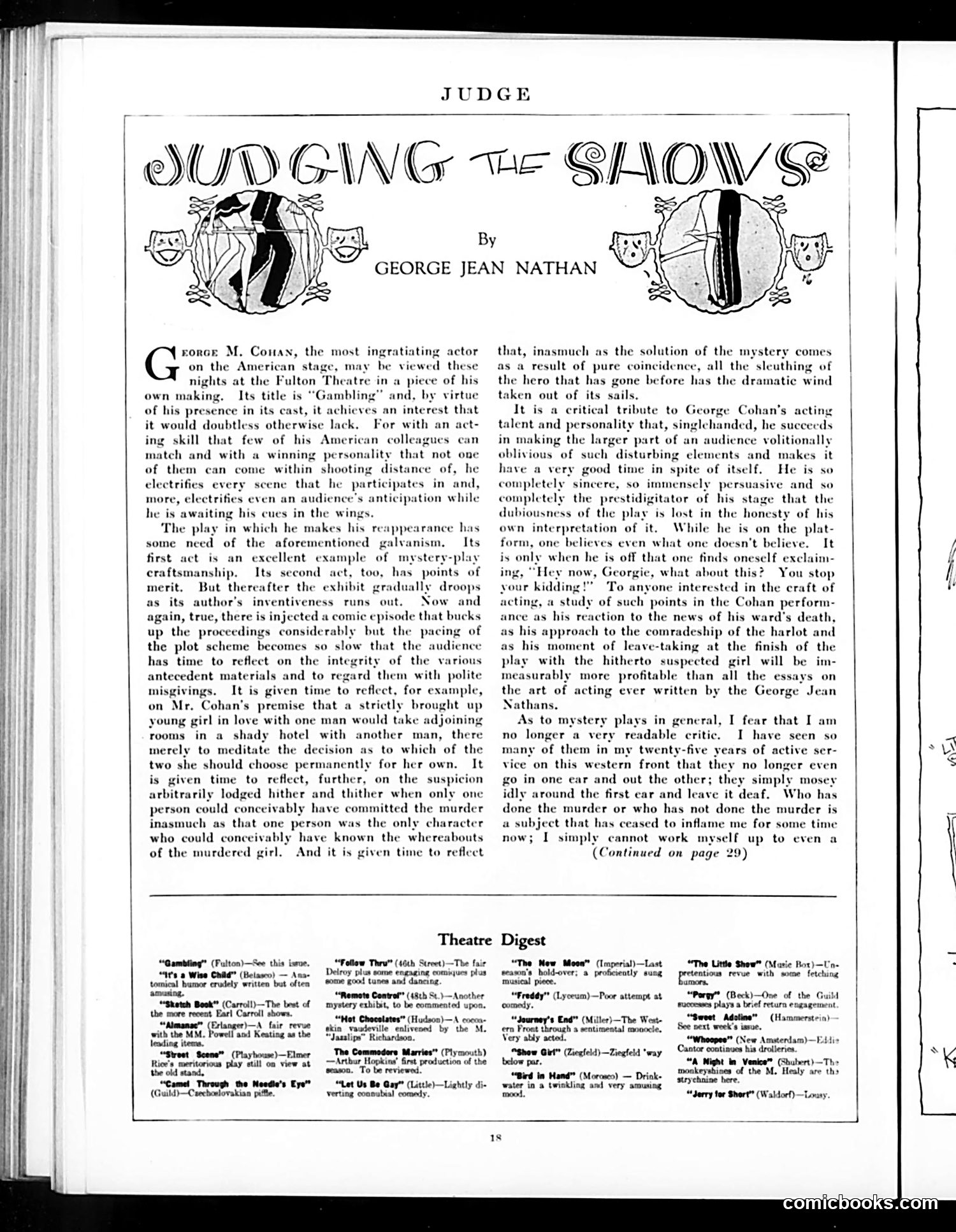
Judging the Shows: George Jean Nathan Reviews "Gambling" This page features theater critic George Jean Nathan's review of actor George M. Cohan in a play titled "Gambling" at the Fulton Theatre. Nathan praises Cohan's acting talent and charisma—his ability to electrify audiences and make them overlook dramatic weaknesses through sheer personality and sincerity. However, Nathan critiques the play itself as poorly constructed: the mystery plot relies on coincidence rather than logical detective work, the pacing drags, and an implausible plot device (a young woman inexplicably staying with a stranger in a hotel) strains credibility. Most tellingly, Nathan admits he's exhausted by mystery plays generally—he's seen so many in recent years that he can no longer muster critical enthusiasm for the genre. The review ultimately credits Cohan's performance for salvaging mediocre material. Below is a "Theatre Digest" listing brief reviews of current productions.
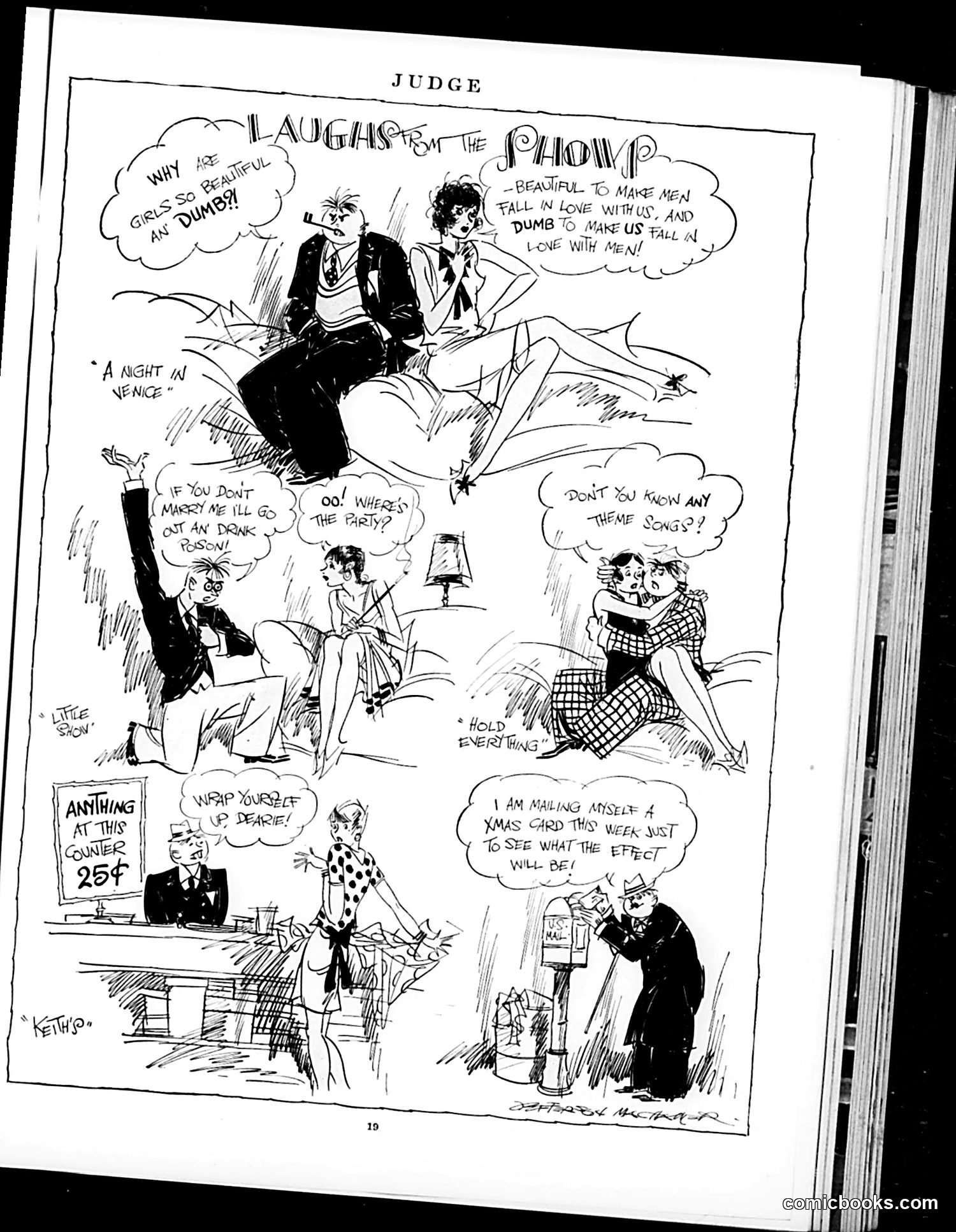
Judge Magazine Satirical Cartoon Analysis This page satirizes theatrical melodramas and romantic comedies popular in the early 20th century. The cartoon mocks the exaggerated emotional tropes of stage productions through multiple vignettes: Top panel: Two characters parody absurd plot devices—men praising women's beauty while simultaneously insulting their intelligence ("dumb"), and women manipulating men through romance and feigned helplessness. Middle panels: Individual scenes reference common theatrical scenarios: a man threatening suicide if rejected ("A Little Show"), a woman demanding marriage ("A Night in Venice"), and another threatening elopement. Bottom panels: A carnival barker advertises "anything for a quarter," and a final gag shows someone mailing anonymous Christmas cards to test romantic effects—mocking the contrived plotting of stage comedies. The satire targets how stage melodramas relied on predictable, emotionally manipulative scenarios and the gap between theatrical artificiality and real human behavior. The crude characterizations and exaggerated dialogue emphasize how unconvincing these plots actually were to contemporary audiences.
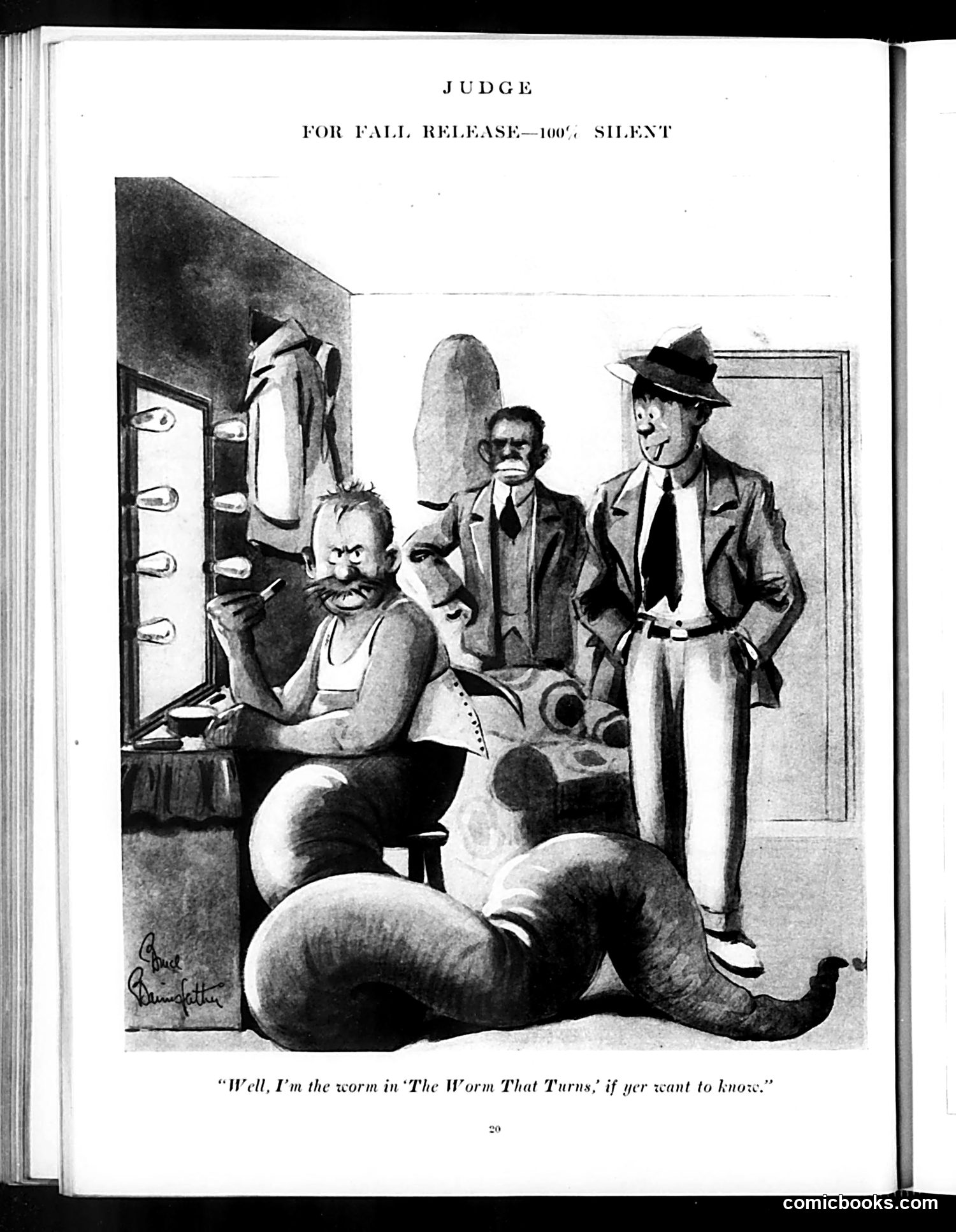
Explanation for Modern Readers This cartoon satirizes a theatrical production, likely a silent film or stage play titled "The Worm That Turns" (a phrase meaning a meek person who finally stands up for themselves). The image shows a dressing room scene where a performer—apparently playing the "worm" character—sits at a vanity mirror in an exaggerated, unflattering pose with prominent physical features. Three well-dressed men observe him. The humor derives from the contrast between the character's supposed role as an underdog protagonist and his actual appearance. The caption suggests the performer is proudly announcing his role, seemingly unaware of how ridiculous he looks. This mocks both the theatrical production and perhaps the actor's vanity, while playing on Judge magazine's typical satirical approach to popular entertainment of the era.
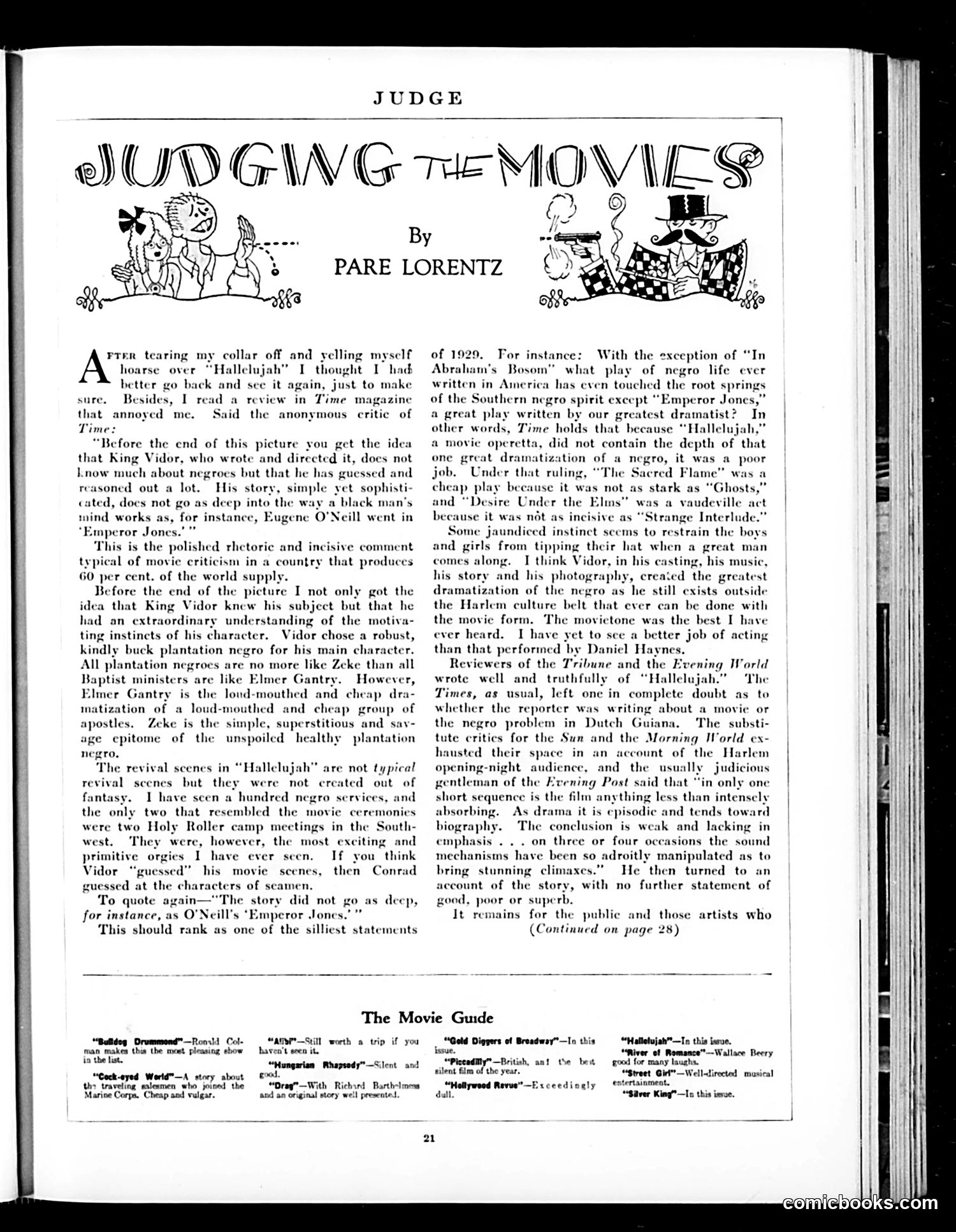
Analysis for Modern Readers This page reviews the 1929 film *Hallelujah*, directed by King Vidor, which appears to be one of the first major Hollywood films centered on Black life. Pare Lorentz defends the film against *Time* magazine's criticism. The Satire: Lorentz mocks *Time*'s dismissal of the film for lacking the psychological depth of Eugene O'Neill's play *Emperor Jones*. He argues this comparison is absurd—holding a movie operetta to the standard of a serious stage drama is like judging any popular entertainment by masterpiece criteria. Key Point: Lorentz praises Vidor's authentic casting and direction, arguing the film successfully captures Black Southern life as it genuinely exists. He criticizes other reviewers for either excessive praise or unhelpful comparisons. Context: This reflects 1920s debates over Black representation in entertainment—whether films should aim for artistic seriousness or accept popular form, and who gets to judge authenticity.
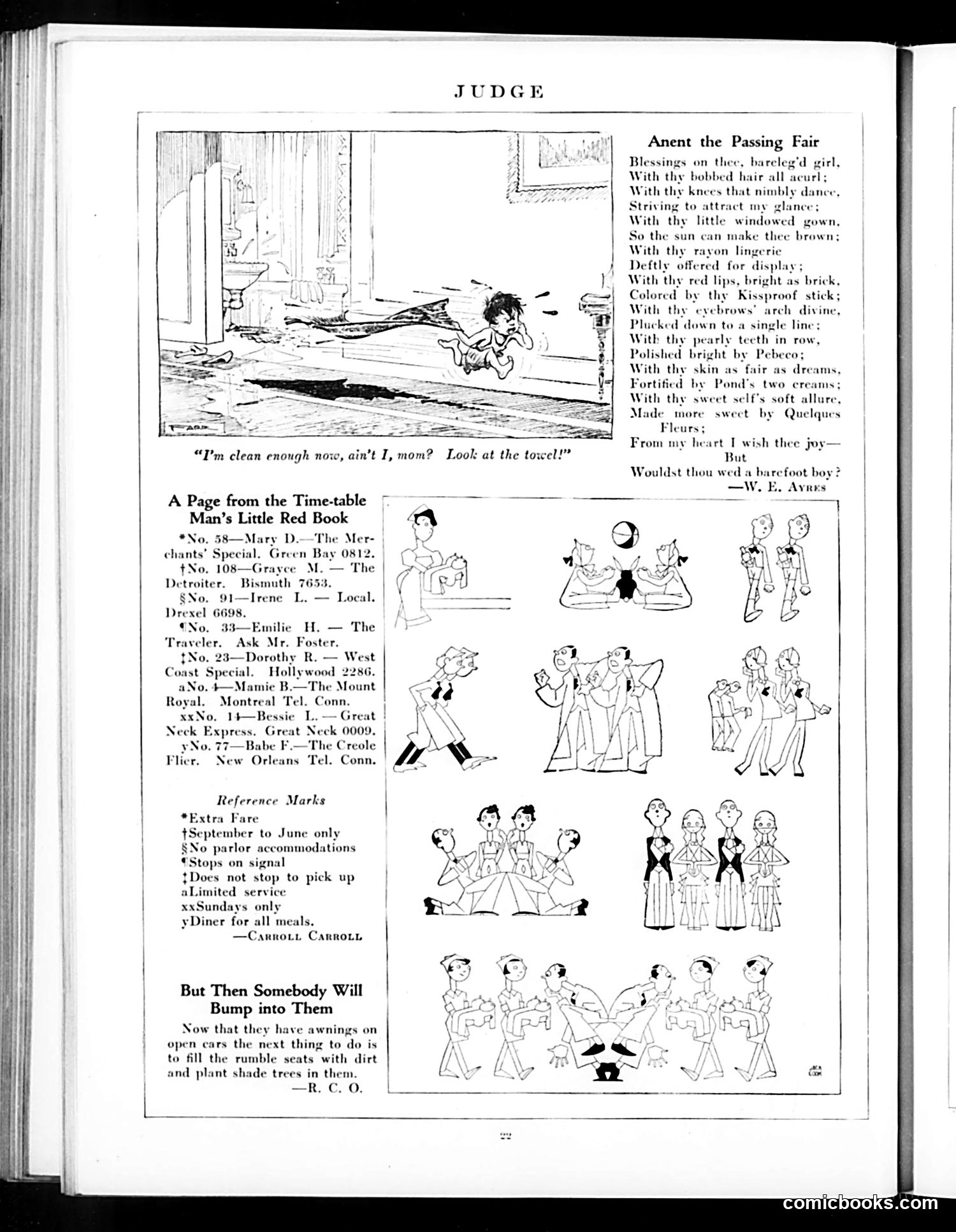
Judge Magazine Page Analysis This page contains three distinct pieces of satire targeting 1920s American culture: 1. "I'm clean enough now, ain't I, mom?" — A cartoon mocking children's resistance to bathing, showing a child covered in dirt comparing themselves to a towel, humorously equating dirt with cleanliness. 2. "A Page from the Time-table Man's Little Red Book" — A parody of railroad schedules with humorous reference marks (*Extra Fare, No parlor accommodations, Stops on signal, Sundays only*, etc.), satirizing the obscure, contradictory fine-print conditions of train travel. 3. "Anent the Passing Fair" — A poem mocking the "modern woman" of the 1920s: bobbed hair, bare knees, short dresses, makeup (Kissproof lipstick, Pebeco toothpaste, Pond's cream, Quelques Fleurs perfume). The satire lies in cataloging her commercial beauty products while ironically asking if she'd marry a "barefoot boy"—suggesting her manufactured modernity masks traditional expectations. The final short joke about filling rumble seats with dirt and trees further mocks contemporary automobile culture.
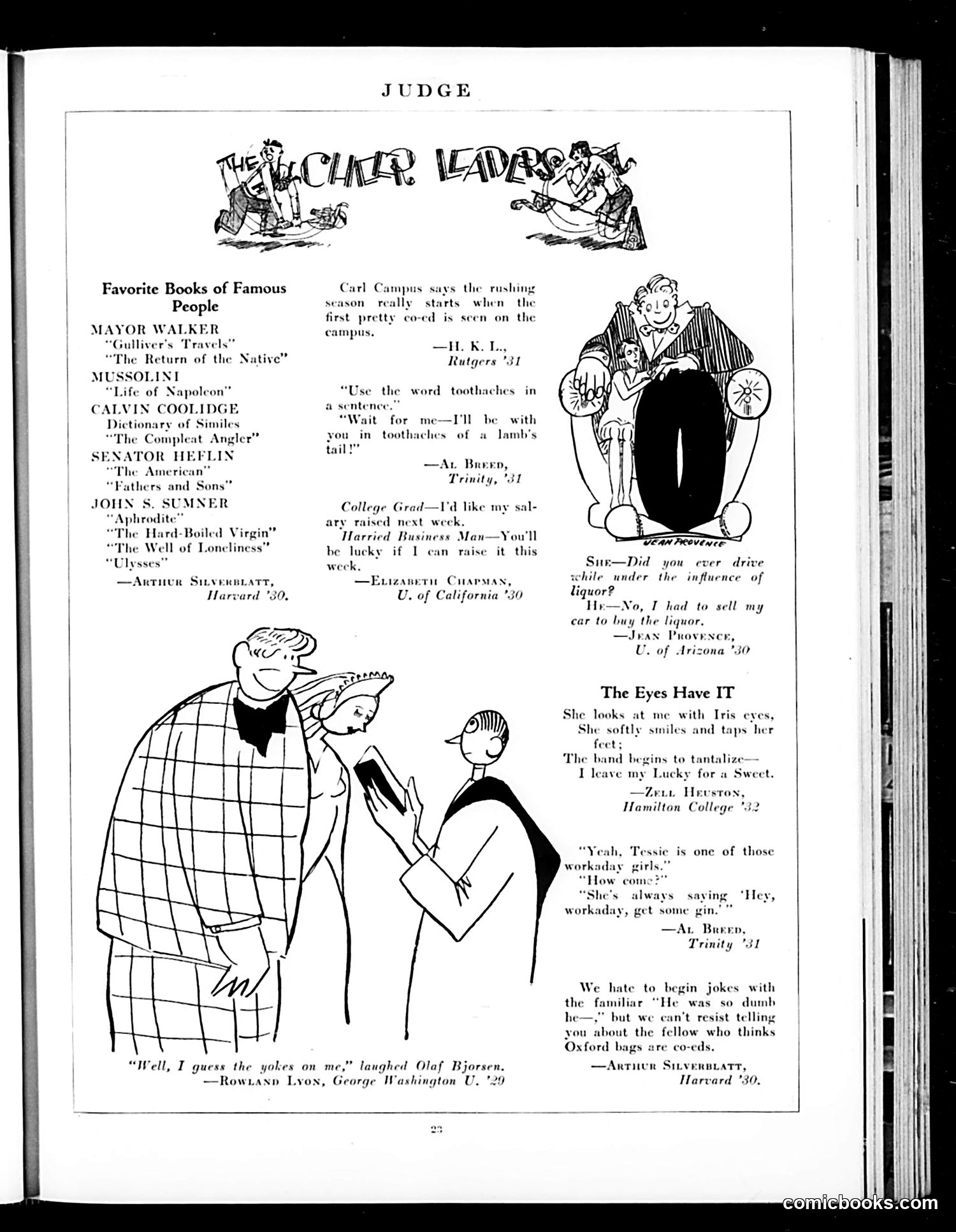
Analysis of Judge Magazine Page This is a humor page from Judge magazine featuring college-themed jokes and satirical observations from the 1920s-early 1930s. The main elements: "Favorite Books of Famous People": A satirical list attributing book preferences to prominent figures like Mayor Walker and Calvin Coolidge. The humor lies in mismatches between public image and reading choice—suggesting, for example, that Coolidge (known for taciturn reserve) would read a *Dictionary of Similes*. College Humor Section: Multiple short jokes from college contributors mocking campus life, including: - Rushing season and co-eds - Students asking for salary raises during the Depression - A joke about Oxford bags (baggy trousers then fashionable) being mistaken for female students Illustrations: Cartoons depicting typical college scenarios—a man with a woman, and an Olaf Bjorsen character making an egg-pun. Social Context: The page reflects Prohibition-era humor (liquor references), Depression economics (salary concerns), and 1920s college culture. The tone is lighthearted mockery of youth, romance, and social pretension typical of Judge's satirical approach.
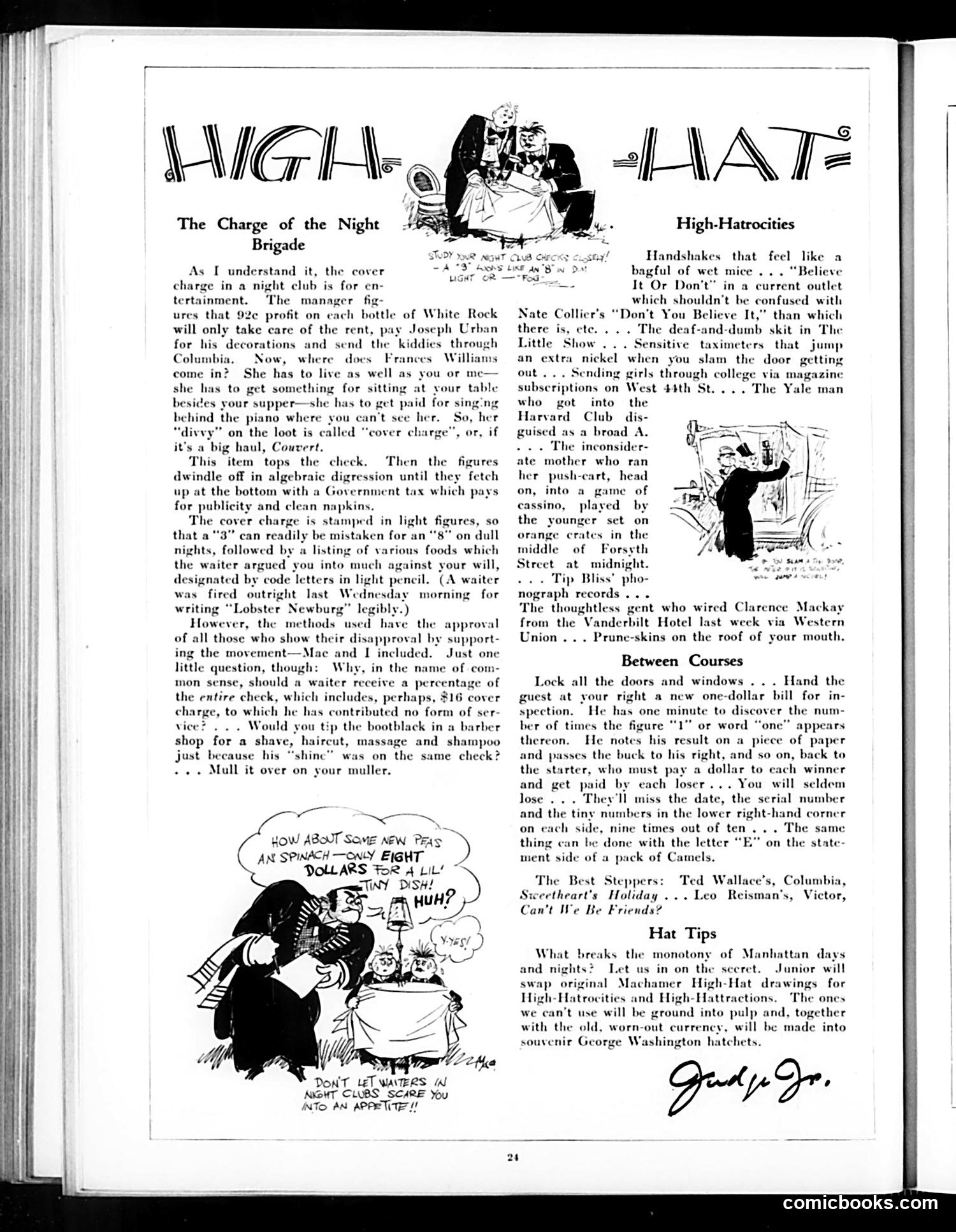
High-Hat Page Analysis This Judge magazine page satirizes 1920s nightclub culture and social pretension. The main cartoon mocks the "cover charge" system at speakeasies (illegal bars during Prohibition), showing how managers profit while entertainers like Frances Williams—hidden behind pianos—must survive on tips. The OCR'd text humorously breaks down the mathematical absurdity of cover charges stamped in unclear figures (confusion between "3" and "8") that obscure actual costs. "High-Hatrocities" lists contemporary annoyances: fake sophistication, snobbish behavior at the Harvard Club, and social climbers. A secondary cartoon jokes about tipping bootleggers during Prohibition ("don't let waiters scare you into an appetite"). "Between Courses" describes parlor games involving currency and cigarette packs—period amusements for Manhattan's wealthy. The page reflects Jazz Age anxieties: Prohibition's underground economy, class pretension, and the commercialization of nightlife entertainment.
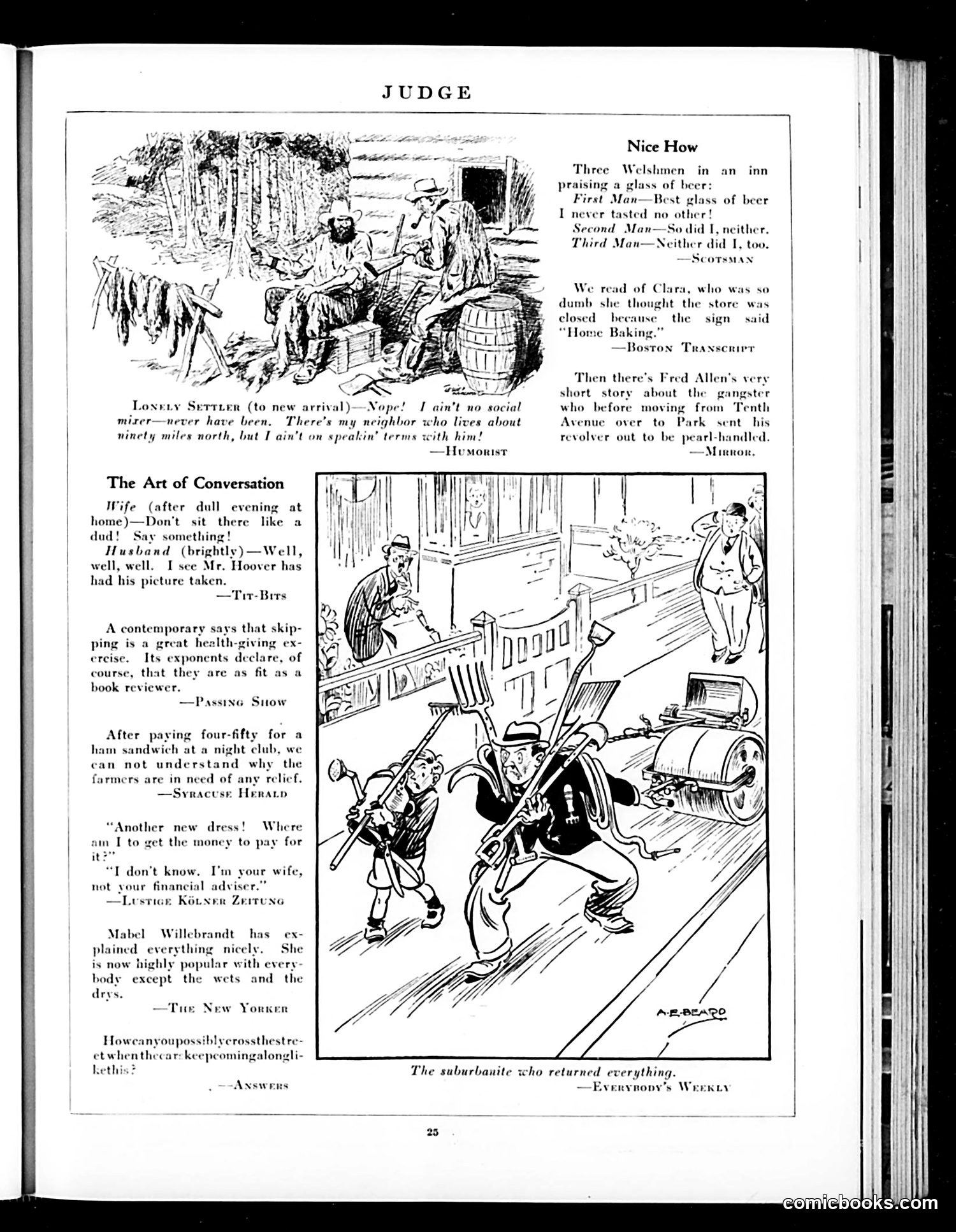
Explanation for Modern Readers This page from *Judge* contains several short satirical jokes and one cartoon, all reflecting 1920s American concerns: "The Art of Conversation" mocks social awkwardness; the husband's only comment is that Mr. Hoover (likely Herbert Hoover, then prominent in politics) had his picture taken—painfully banal small talk. The main cartoon depicts a suburbanite returning everything to stores: furniture, a car, and other goods pile up as bewildered shopkeepers watch. The caption "The suburbanite who returned everything" satirizes both consumer excess and the ease of returns in the era. Other jokes reference: - Mabel Willebrandt (Prohibition enforcement official) as pleasing no one—neither "wets" (anti-Prohibition) nor "drys" (pro-Prohibition) - Farm relief and economic disparity (expensive nightclub food vs. struggling farmers) - Marriage friction over spending The page reflects 1920s anxieties: Prohibition debates, post-war consumer culture, economic inequality, and domestic tensions.
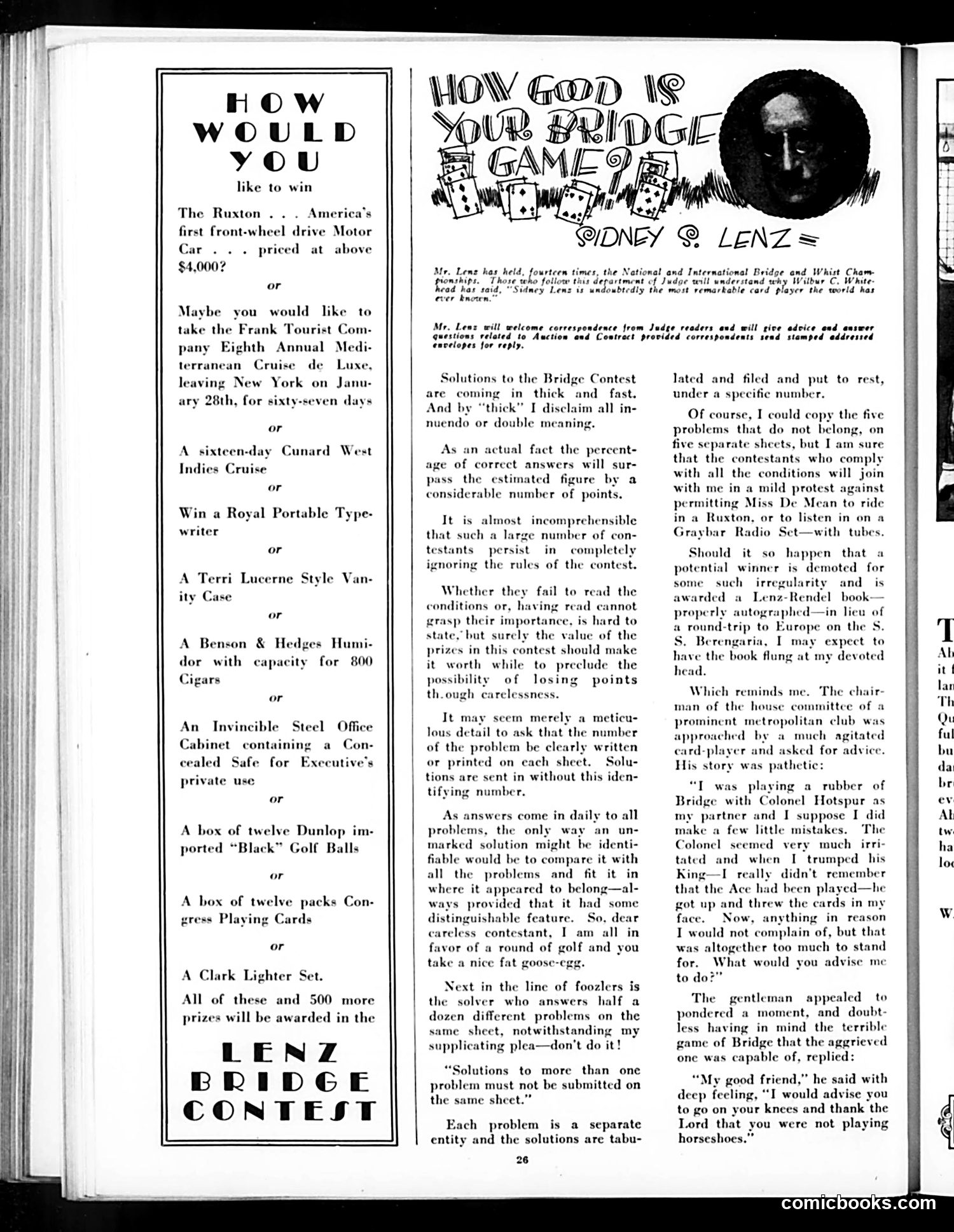
Judge Magazine Bridge Contest Page This page primarily advertises Sidney Q. Lenz's bridge-solving contest, offering 500+ prizes (ranging from a Ruxton automobile to golf balls) to contestants who solve bridge problems correctly. The satirical content comes from Lenz's editorial commentary on contest entries. He mocks contestants for ignoring basic rules—particularly failing to clearly number their problem sheets and submitting multiple solutions on one page. The humor derives from his exasperated, condescending tone toward "careless contestants" who risk disqualification despite substantial prizes at stake. There's also veiled mockery of hypothetically giving prizes to rule-breakers like "Miss De Mean"—a punning name suggesting incompetence—who might win a lesser consolation prize (a signed book instead of a European cruise). The anecdote about a club chairman playing bridge with "Colonel Hotspur" appears to illustrate the stakes and social prestige of competitive bridge among the era's upper class, though the text cuts off mid-story.
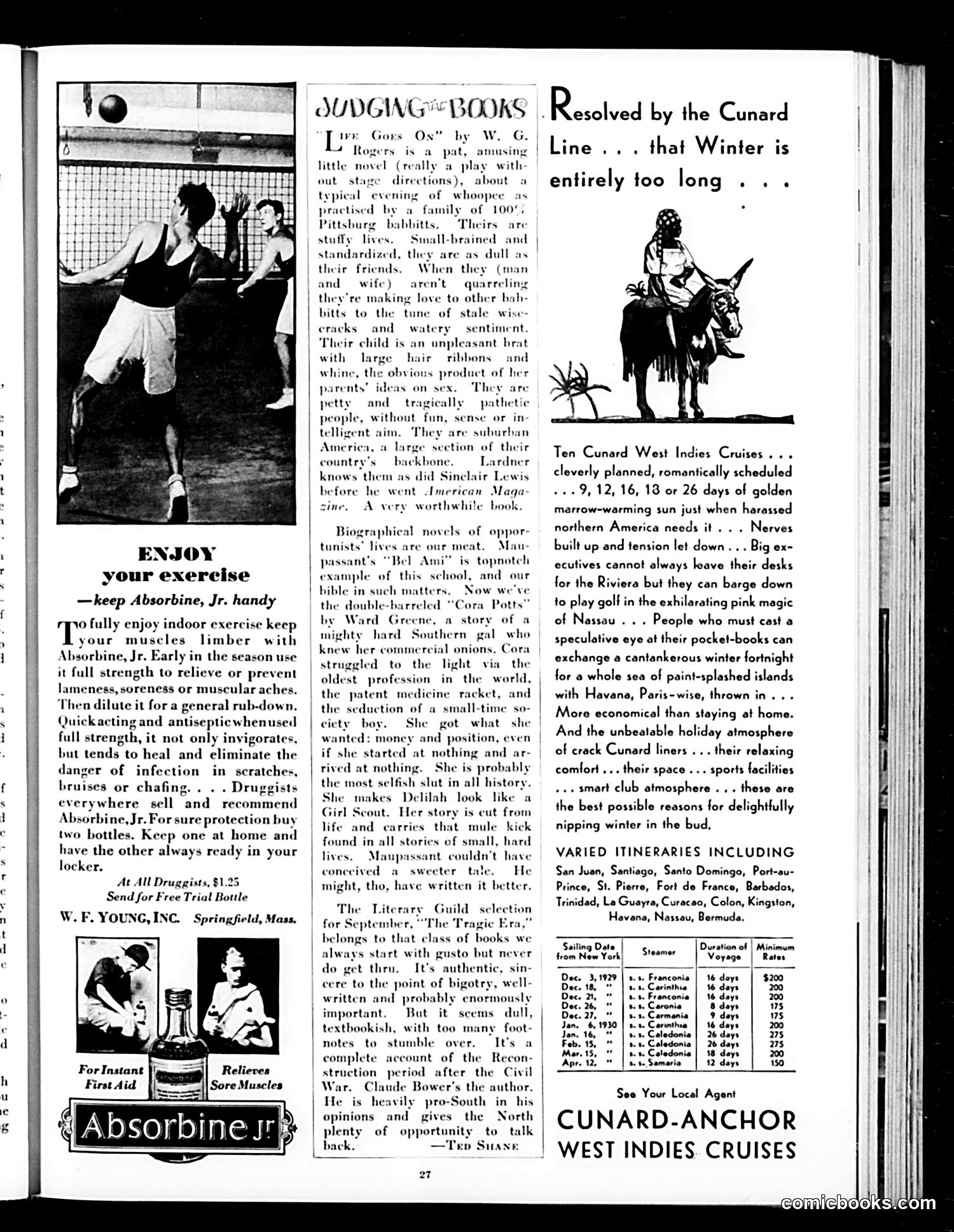
Explaining This Judge Magazine Page This page is primarily advertising and book reviews, not political satire. The main content includes: Left side: An ad for "Absorbine, Jr.," a liniment product marketed for treating sore muscles and injuries from exercise. The accompanying image shows a woman playing volleyball, illustrating the product's use for athletic activity. Center: Book reviews by "Ted Shane" critiquing recent novels, including works about petit-bourgeois Pittsburgh life and stories in the tradition of Maupassant's cynical realism. The reviews dismiss these books as competent but uninspired. Right side: A large Cunard Line cruise advertisement promoting ten-day Caribbean vacations as an escape from harsh northern winters. The illustration shows a woman on a donkey in tropical dress—evoking exotic leisure. Context: This appears to be from the 1920s-30s. The page reflects Judge's mixed model: celebrity/literary criticism alongside luxury advertising targeting affluent readers who could afford both liniments and Caribbean cruises.
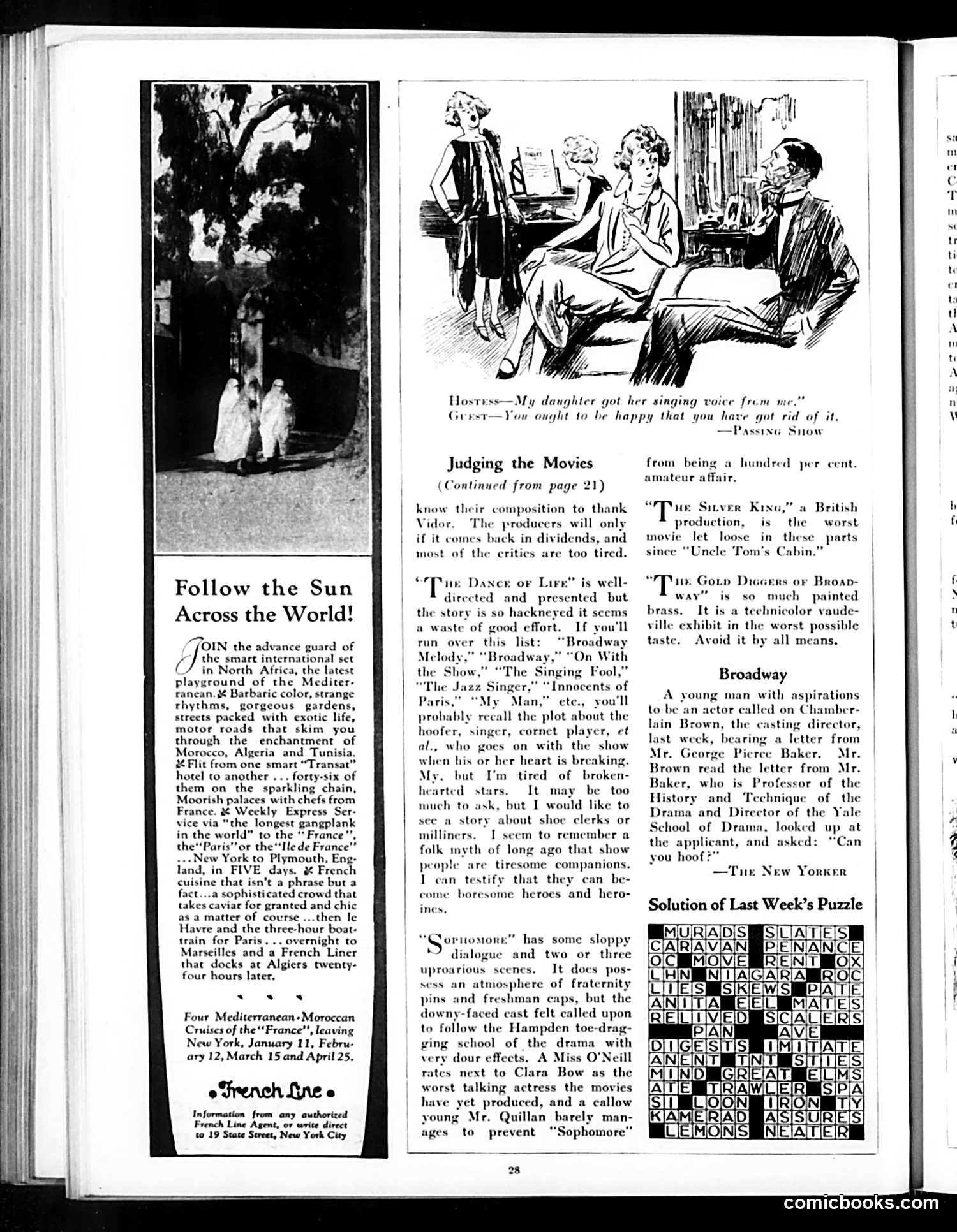
Analyzing Judge Magazine Page This page contains three distinct elements: Left side: A full-page advertisement for French Line cruises to North Africa (Morocco, Algeria, Tunisia), targeting wealthy travelers seeking exotic leisure travel in the Mediterranean. Top right: A single-panel joke cartoon about a hostess whose daughter inherited her singing voice. The guest tactlessly suggests the hostess should be grateful to be *rid* of it—implying the mother's singing was unpleasant. This is standard 1920s-era domestic humor mocking amateur performers. Center/bottom: Movie reviews critiquing recent films ("The Dance of Life," "The Silver King," "The Gold Diggers of Broadway," "Sophomore"). The reviewer expresses frustration with repetitive plots about theatrical performers with broken hearts, and harsh criticism of certain actors' talking-picture performances—relevant since sound films were still relatively new. Bottom right: A brief anecdote about a Yale drama professor (likely a real person) dismissively asking an aspiring actor if he can "hoof" (dance), plus a crossword puzzle solution.
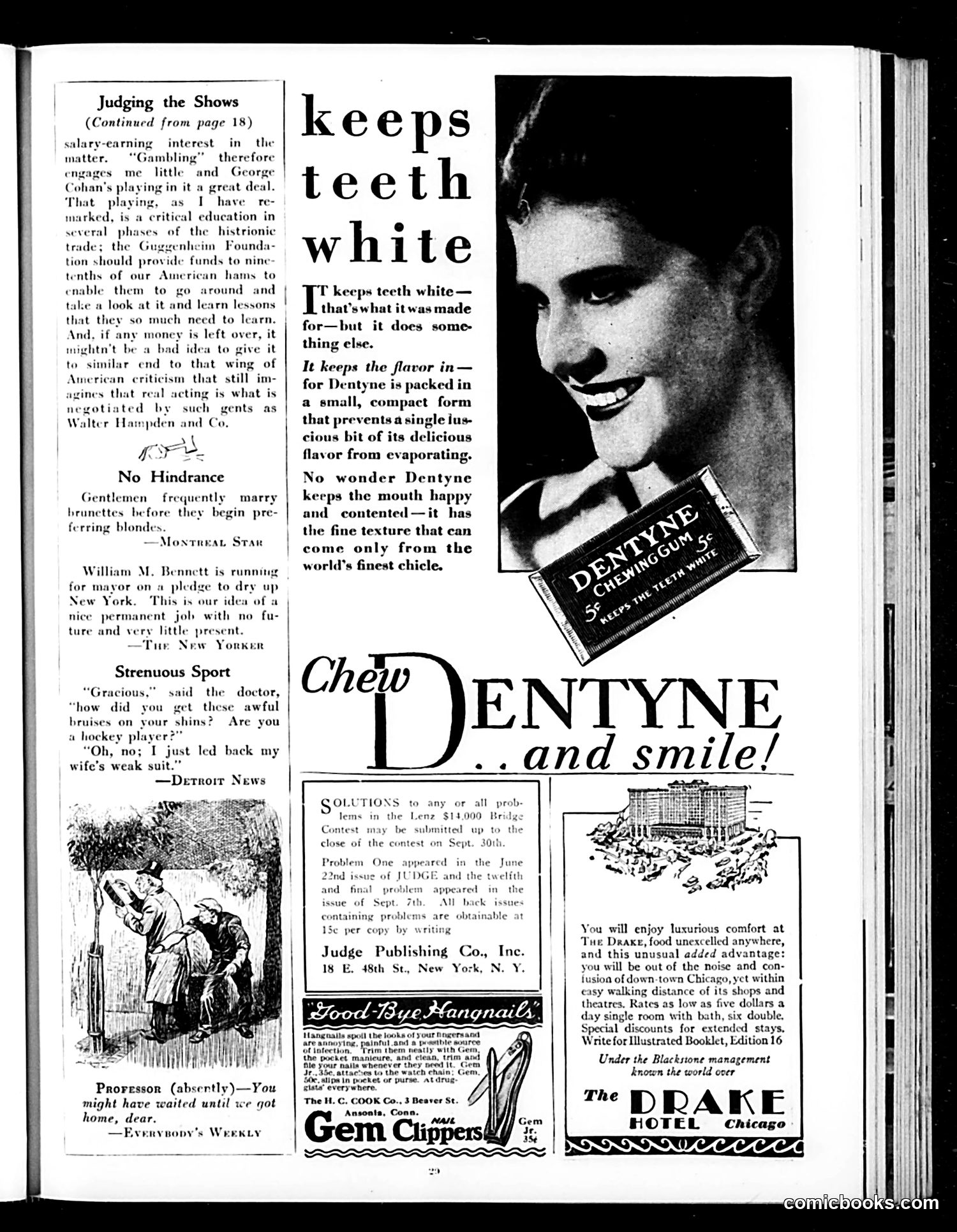
What This Judge Magazine Page Contains This page is primarily advertising and miscellaneous content rather than political satire. The dominant feature is a Dentyne chewing gum advertisement with a glamorous woman's portrait, emphasizing that the product keeps teeth white and preserves flavor. The left column contains brief, unrelated humor snippets—small jokes about courtship, mayoral politics, hockey injuries, and absent-minded professors. These are mild observations on everyday life rather than sharp satire. Below are advertisements for Gem Clippers, a bridge-solving puzzle contest, and the Drake Hotel in Chicago. There is no coherent political cartoon or sustained satirical commentary. The "Judging the Shows" section (continued from page 18) discusses theater criticism and acting, but appears cut off and incomplete on this page. The content reflects early-20th-century American magazine format: mixing editorial humor, consumer ads, and puzzles.
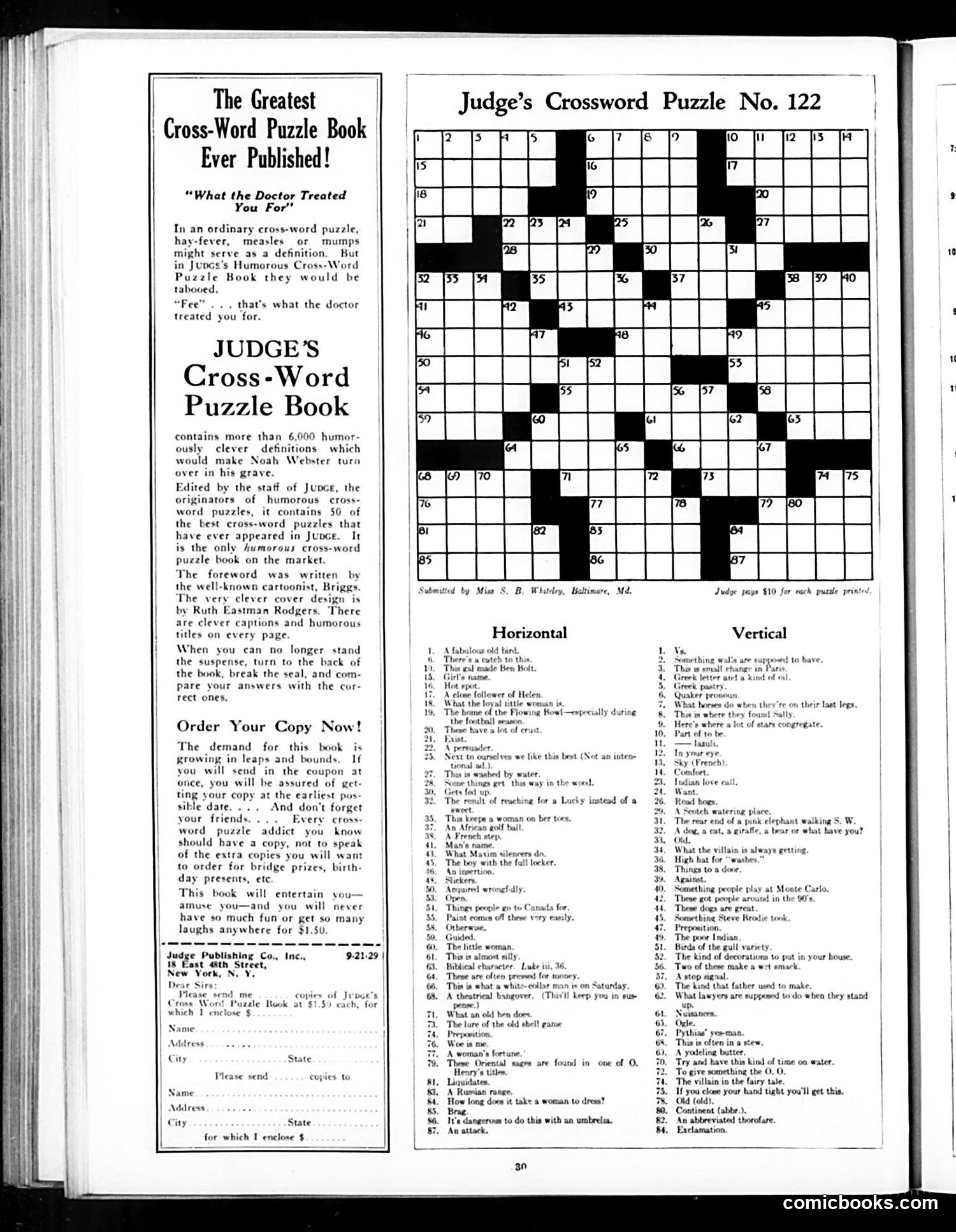
Judge Magazine Crossword Puzzle Advertisement This page is primarily an advertisement for Judge magazine's crossword puzzle book, not a political cartoon. The ad emphasizes that Judge's puzzle book differs from standard crossword collections by using humorous, clever definitions instead of straightforward ones. For example, instead of defining "measles" literally, the answer would be "fee"—what a doctor charges. The book contains over 6,000 such witty definitions and 50 puzzles previously published in Judge. The advertisement highlights that this is "the only humorous cross-word puzzle book on the market," with a foreword by cartoonist Briggs and a cover designed by Ruth Eastman Rodgers. It promises entertainment and laughs at $1.50 per copy. The actual crossword puzzle (No. 122) shown demonstrates this approach with clever clues like "What the Doctor Treated You For" and humorous wordplay throughout.
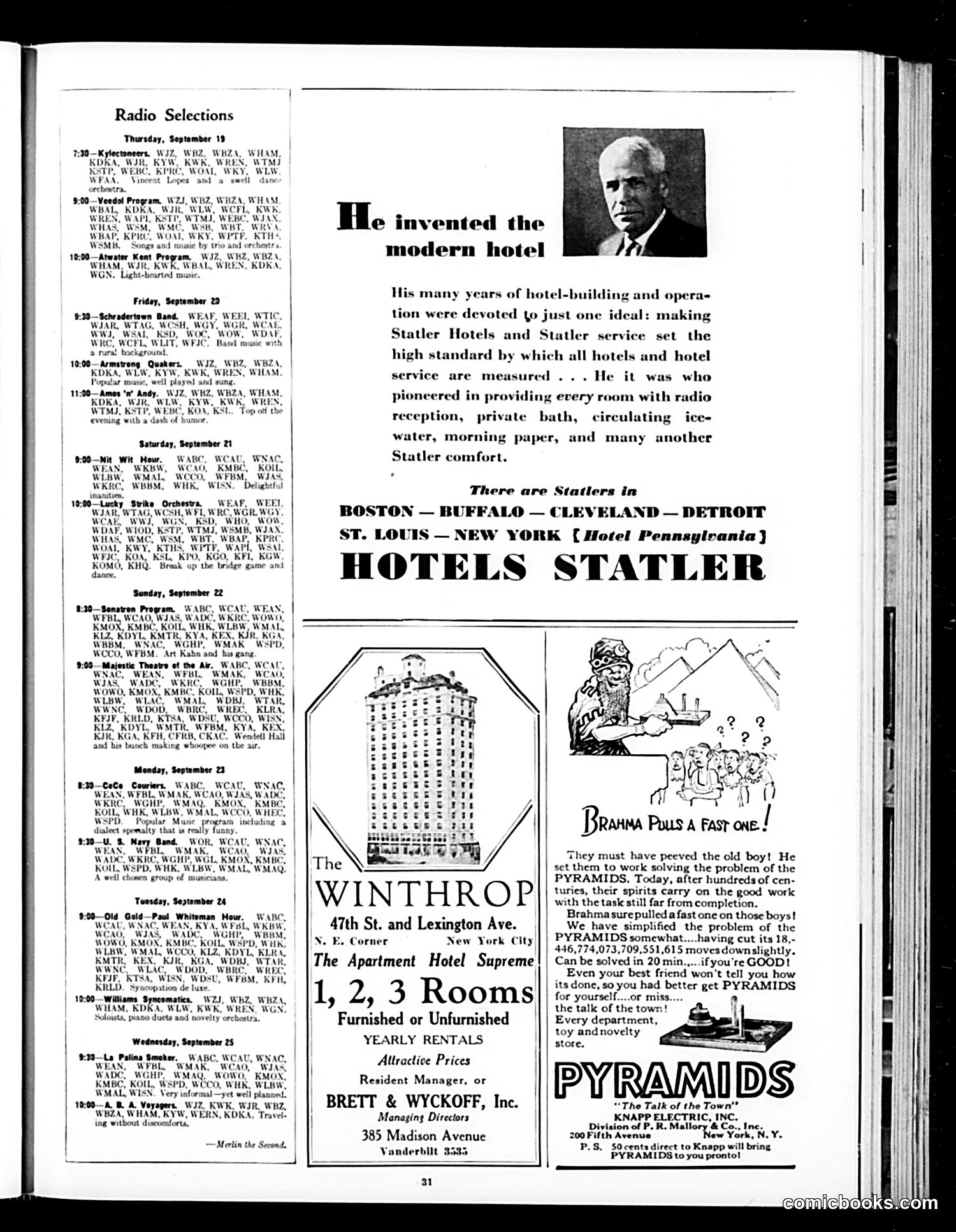
Page Analysis: Judge Magazine Advertisement Section This page is primarily advertising content, not satire or editorial cartoon. It contains: 1. Radio Selections (left column): A detailed weekly radio programming guide listing station call letters and broadcast times—typical scheduling content from the late 1920s when radio was a major entertainment medium. 2. Hotels Statler Advertisement (center-right): A corporate advertisement featuring a photograph of an unnamed man (presumably E.M. Statler, the hotel founder) promoting the Statler Hotels chain's modern amenities: private baths, radios in rooms, and circulating ice water. This emphasizes luxury hotel innovations of the era. 3. The Winthrop Apartment Hotel Advertisement (lower left): A competing hotel advertisement. 4. Pyramids Puzzle Advertisement (right): A commercial puzzle/game product featuring cartoon illustrations of someone solving "the problem of the pyramids." No political satire or social commentary is present. This is a straightforward commercial magazine page showcasing 1920s entertainment and hospitality services aimed at urban, middle-class readers.
Judge Magazine Page Content This page features a "spot-the-difference" puzzle contest where readers identify 30-40 deliberate mistakes in a drawing, with prizes including free magazine subscriptions. The example errors listed (man with no ears, woman smoking in fireplace with one boot) are absurdist visual gags typical of 1920s humor magazines. The page also contains several humorous short stories and anecdotes: - A dialogue between magazine writers discussing their professions' difficulties - A Scottish dialect joke about wallpaper (playing on Scottish frugality stereotypes) - A newspaper classified-ad joke about a found wallet - A one-liner about saxophone overproduction in America The content reflects *Judge*'s formula: visual puzzles, workplace humor, ethnic comedy (Scottish caricature), and absurdist observations. These pieces target middle-class readers with satirical commentary on work, consumerism, and American excess—standard fare for 1920s satirical magazines aimed at educated audiences seeking genteel humor and social commentary.

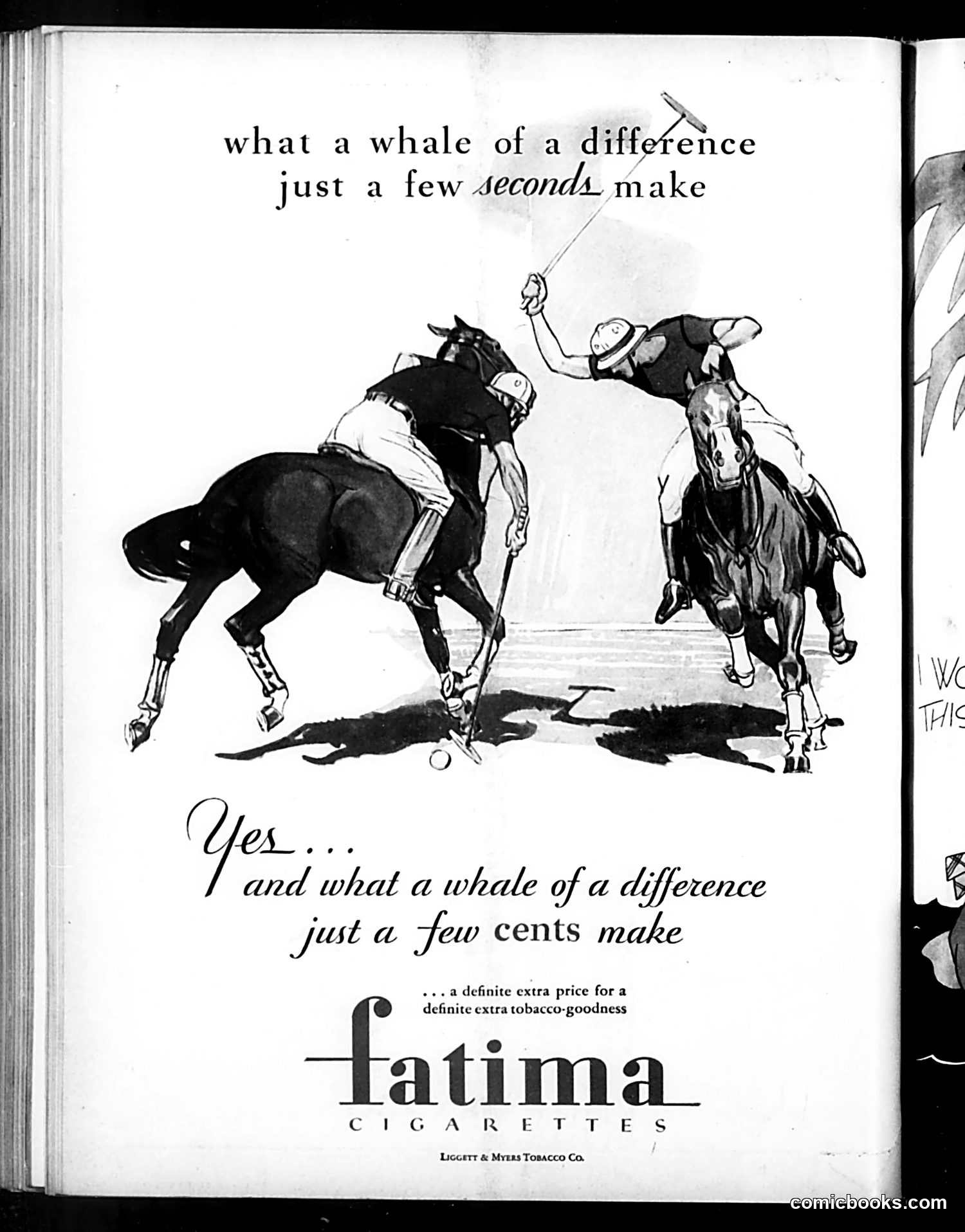
Analysis This is a cigarette advertisement, not political satire. The illustration shows a horse race where one jockey (left) appears to be losing while another (right) pulls ahead, likely by a narrow margin. The ad's wordplay compares the dramatic outcome of a close horse race to the superiority of Fatima cigarettes: just as "a few seconds" determined the race's winner, "a few cents" extra price buys superior tobacco quality. The message targets consumers willing to pay slightly more for what the advertiser claims is a premium product. This reflects early 20th-century advertising that used vivid illustrations and clever comparisons to market branded cigarettes in what was then an unregulated industry.