judge
Judge — September 28, 1929
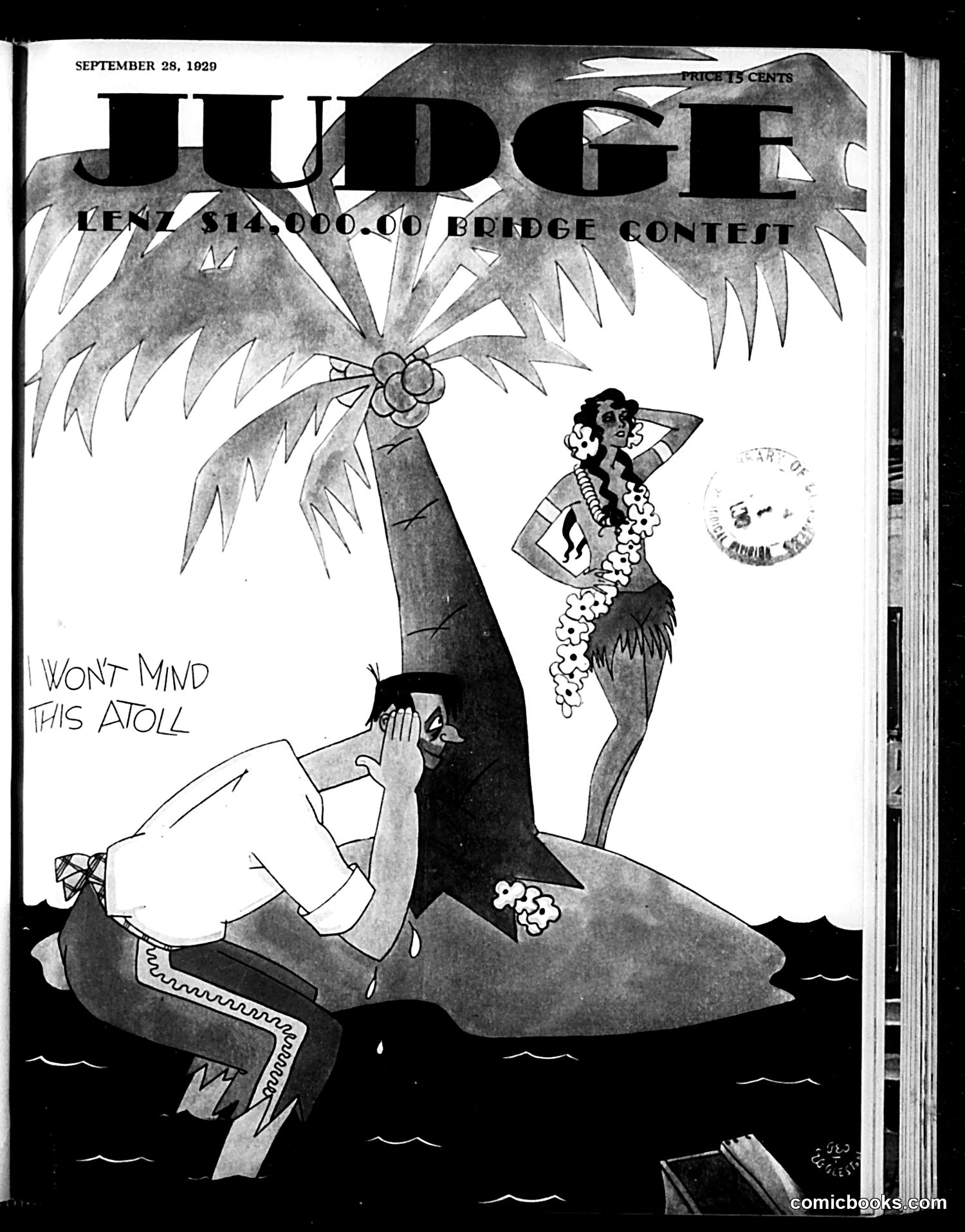
Judge Magazine, September 28, 1929 This satirical cartoon depicts a man on a tropical island beneath a palm tree, seemingly oblivious to financial catastrophe. The man says "I won't mind this atoll," suggesting contentment despite his circumstances. The cartoon likely references the stock market crash of October 1929 (imminent at this September publication date). The figure appears to be a wealthy investor or businessman who has lost his fortune and been stranded on a remote island—a humorous commentary on financial ruin. The "bridge contest" and "$14,000" prize mentioned in the header suggest the magazine offered competitions to readers. The joke's dark humor satirizes how some might prefer tropical exile to facing bankruptcy in America during the economic collapse beginning that month.
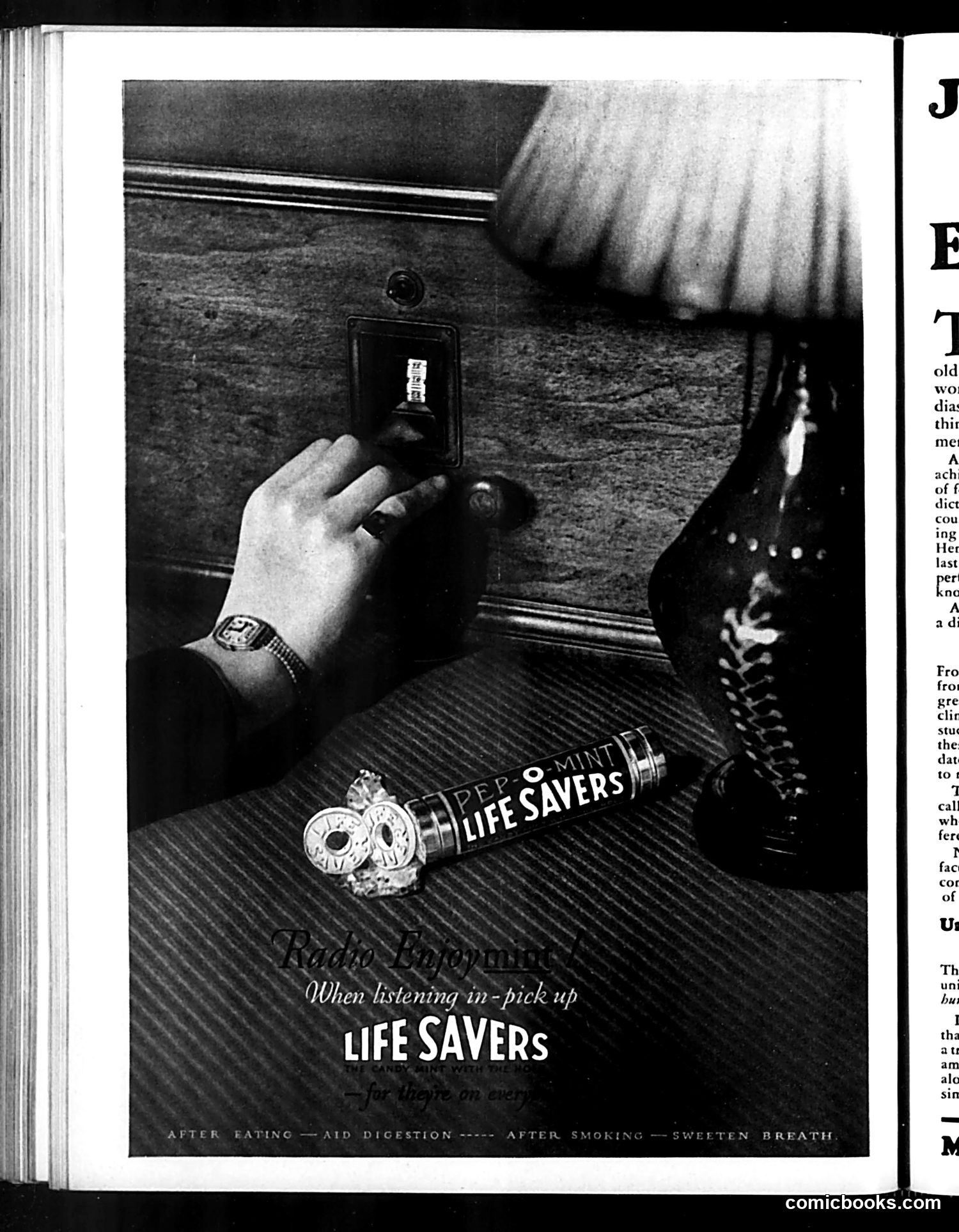
Life Savers Advertisement This appears to be a Life Savers candy advertisement rather than political satire or a cartoon. The image shows a hand operating what looks like a vintage radio dial or similar device, with a Life Savers mint candy prominently displayed. The ad's tagline—"Radio Listening: When listening in—pick up LIFE SAVERS"—suggests the product was marketed as a companion for radio entertainment, a popular activity in the early-to-mid 20th century. The bottom text claims benefits: "After eating—aid digestion. After smoking—sweeten breath," reflecting vintage advertising claims about the product's functional properties. This is commercial messaging, not political commentary, typical of Judge magazine's advertising content.
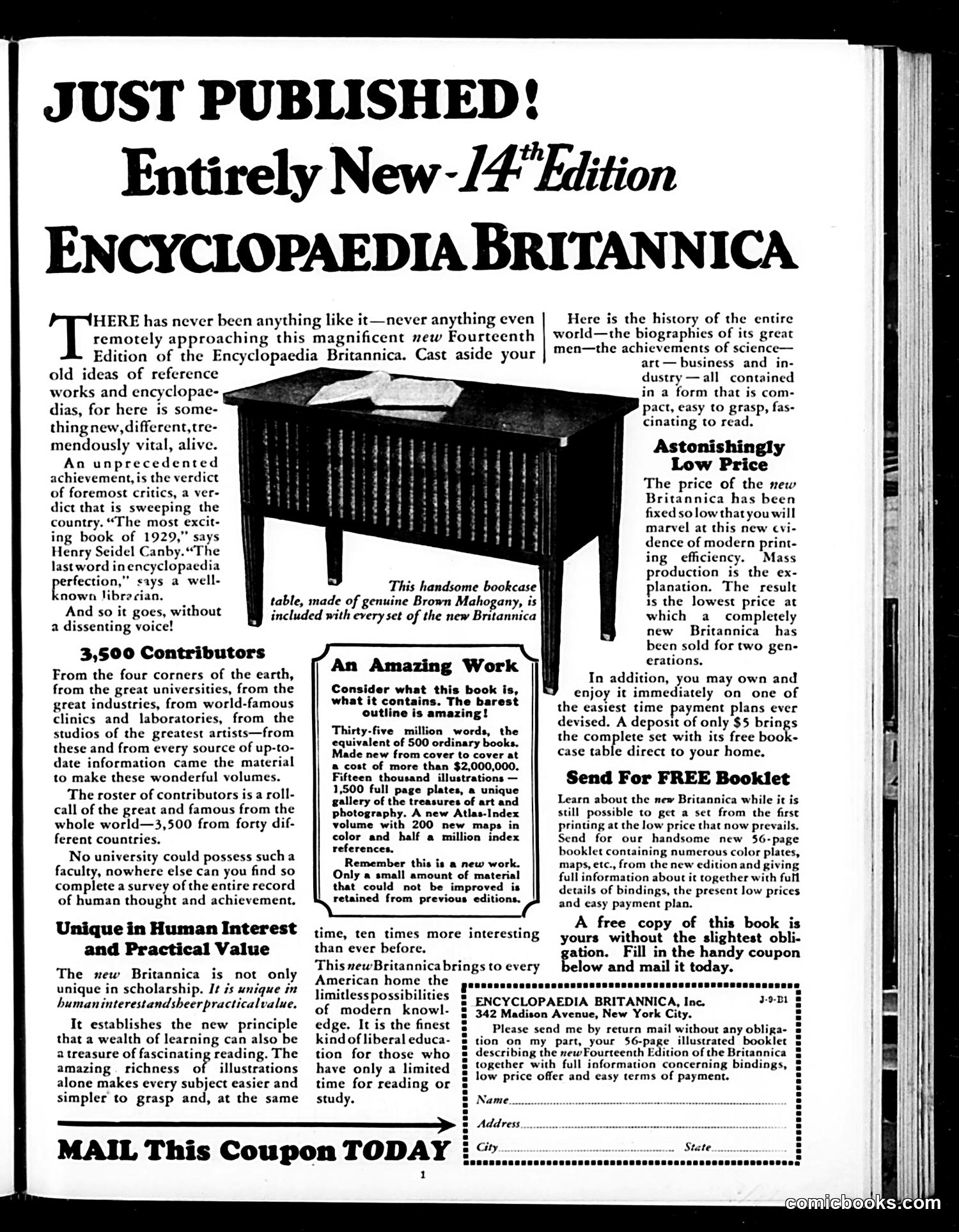
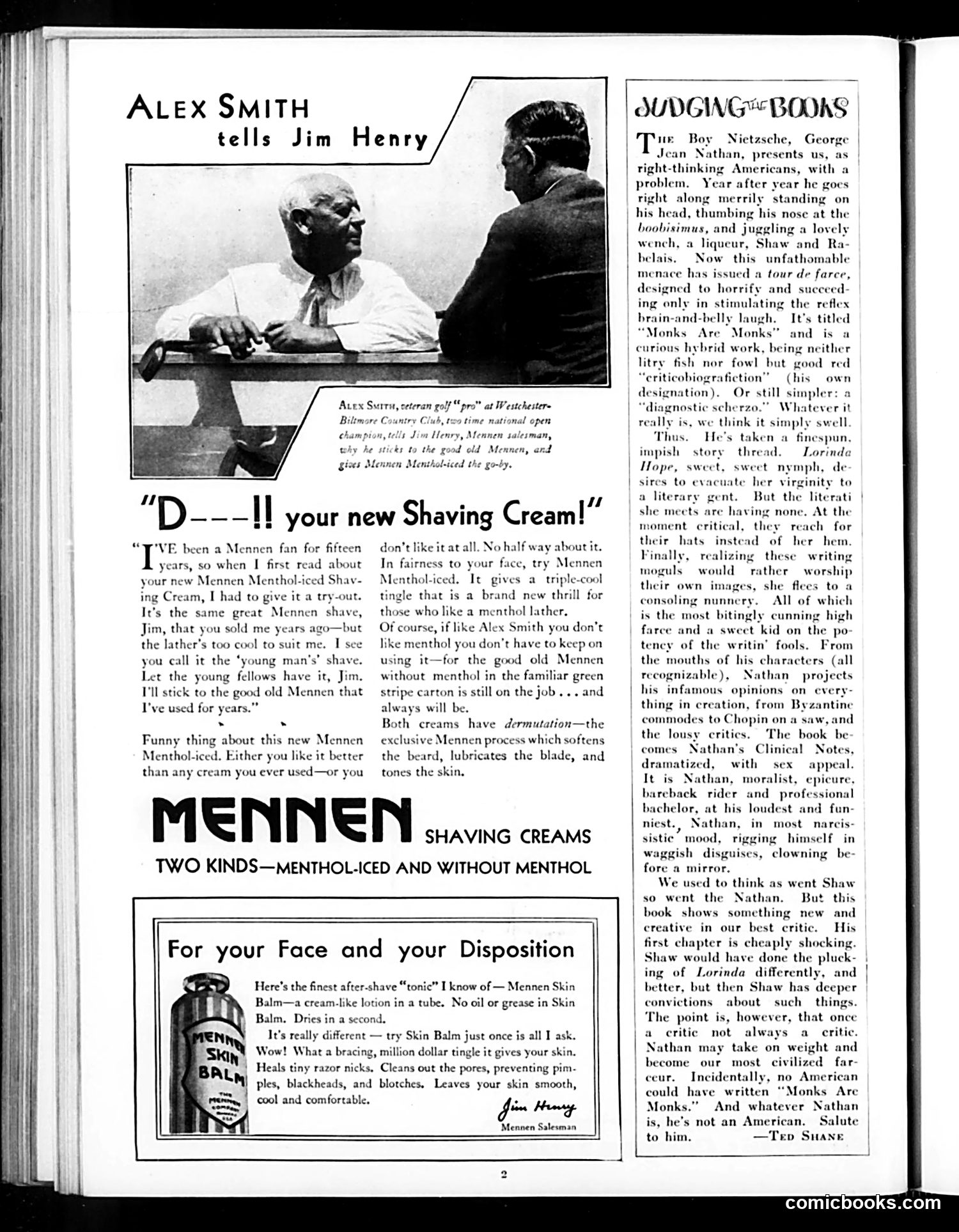
Analysis of Judge Magazine Page This page is primarily advertising for Mennen Shaving Cream, though framed as editorial content. The top section features "Alex Smith tells Jim Henry" — a testimonial format where Smith (identified as a golfer at Wykchester Country Club) endorses Mennen's new mentholated formula to Henry. The satire is gentle: the text jokes that Mennen's products are so good that even someone who "don't like it at all" should try them, and humorously notes that unlike menthol in the familiar green carton, keeping menthol in shaving cream requires the special "dermutation" process. The right column contains a separate book review of dubious sincerity, likely parodying overly effusive literary criticism of the era. The overall effect is mock-serious advertising playing with consumer testimonial conventions common in 1920s-30s magazines.
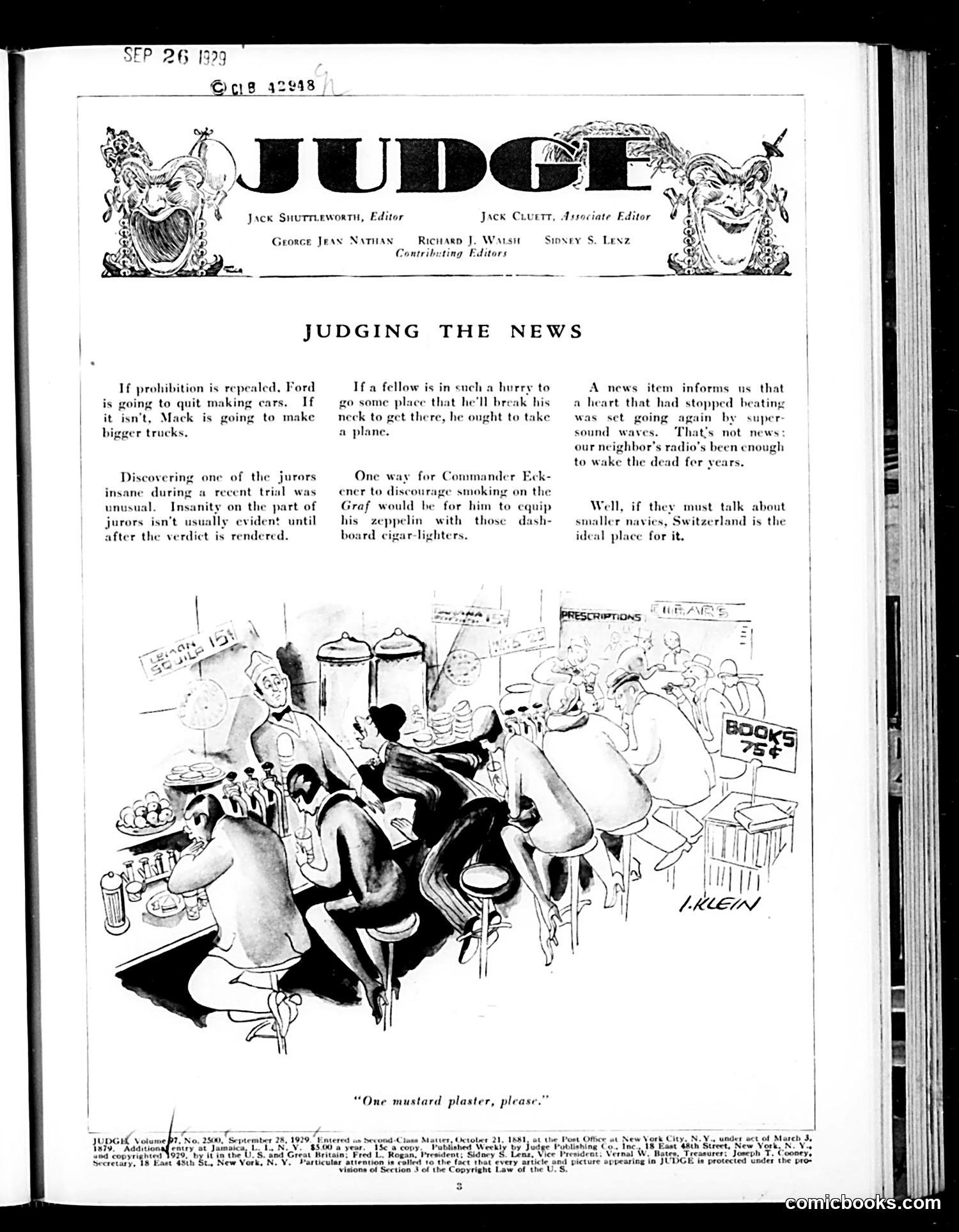
Analysis of Judge Magazine Page (September 26, 1929) The page features editorial commentary titled "Judging the News" with contemporary references to Prohibition's repeal, Ford automobiles, and Commander Eckener (likely the German airship captain). The main cartoon by I. Klein, captioned "One mustard plaster, please," depicts a crowded pharmacy or drugstore scene. The visual joke appears satirize the era's over-reliance on patent medicines and home remedies—a common target of satire during the 1920s when such treatments were heavily marketed despite limited efficacy. The cartoon's chaos and crowded composition suggest criticism of public gullibility or the pharmacy industry's exploitation of consumer desperation for quick health fixes. The specific reference to "mustard plaster" (a traditional folk remedy) reinforces mockery of outdated medical practices.
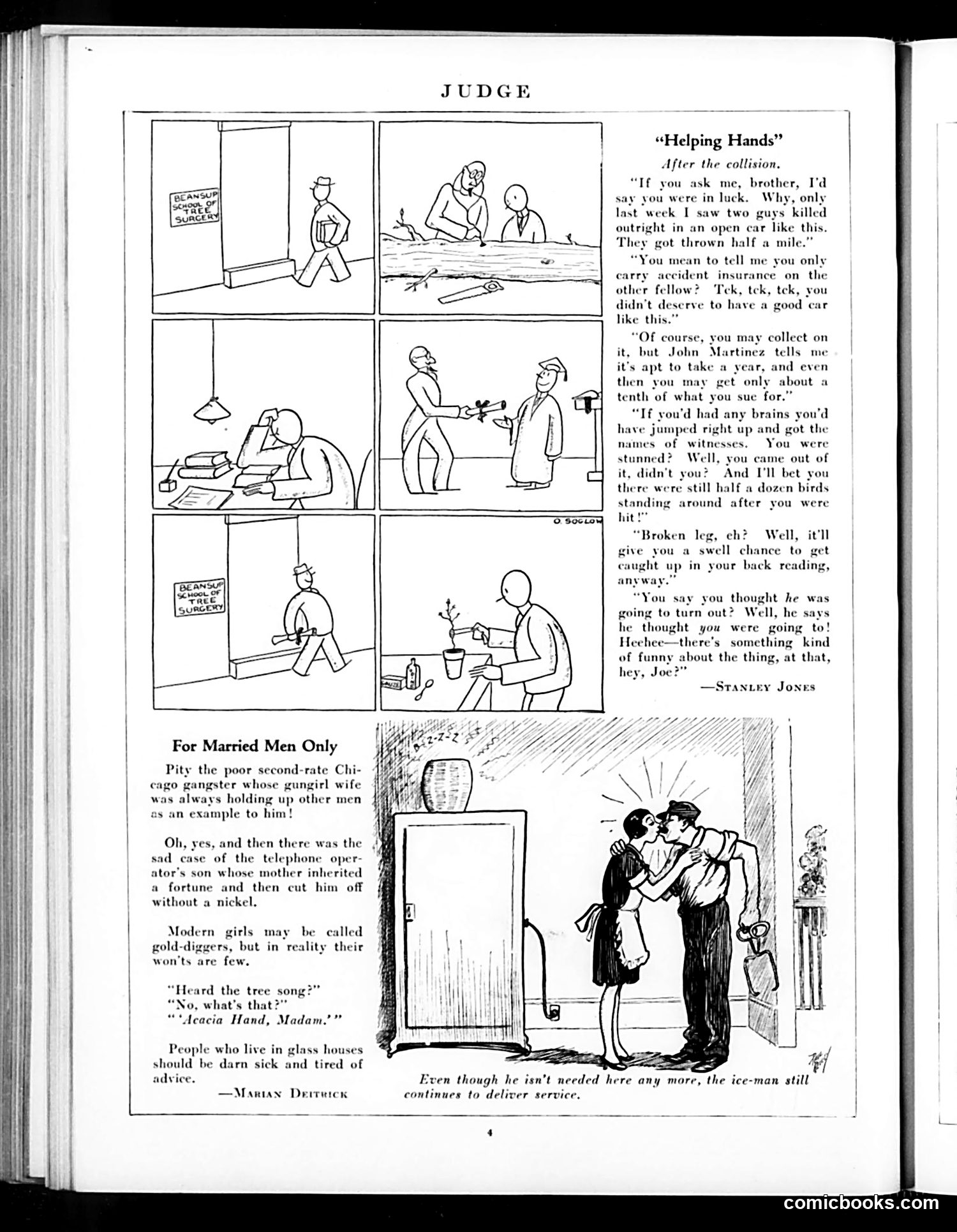
Analysis of Judge Magazine Page Top Comic Strip ("Helping Hands"): A man injured in a car accident seeks legal advice. The lawyer warns him that accident insurance lawsuits are lengthy and typically yield minimal compensation—only a tenth of claims filed. The satire mocks both accident litigation's futility and lawyers' cynical profiteering from such cases. Bottom Section: Mixed satirical vignettes critiquing social hypocrisy and gender dynamics. "For Married Men Only" includes observations about unfaithful spouses and inherited wealth mismanagement. The final cartoon shows an ice-man still delivering service despite modern refrigeration making him obsolete—satirizing outdated professions and social inertia. The page overall targets legal corruption, marital infidelity, and technological obsolescence.
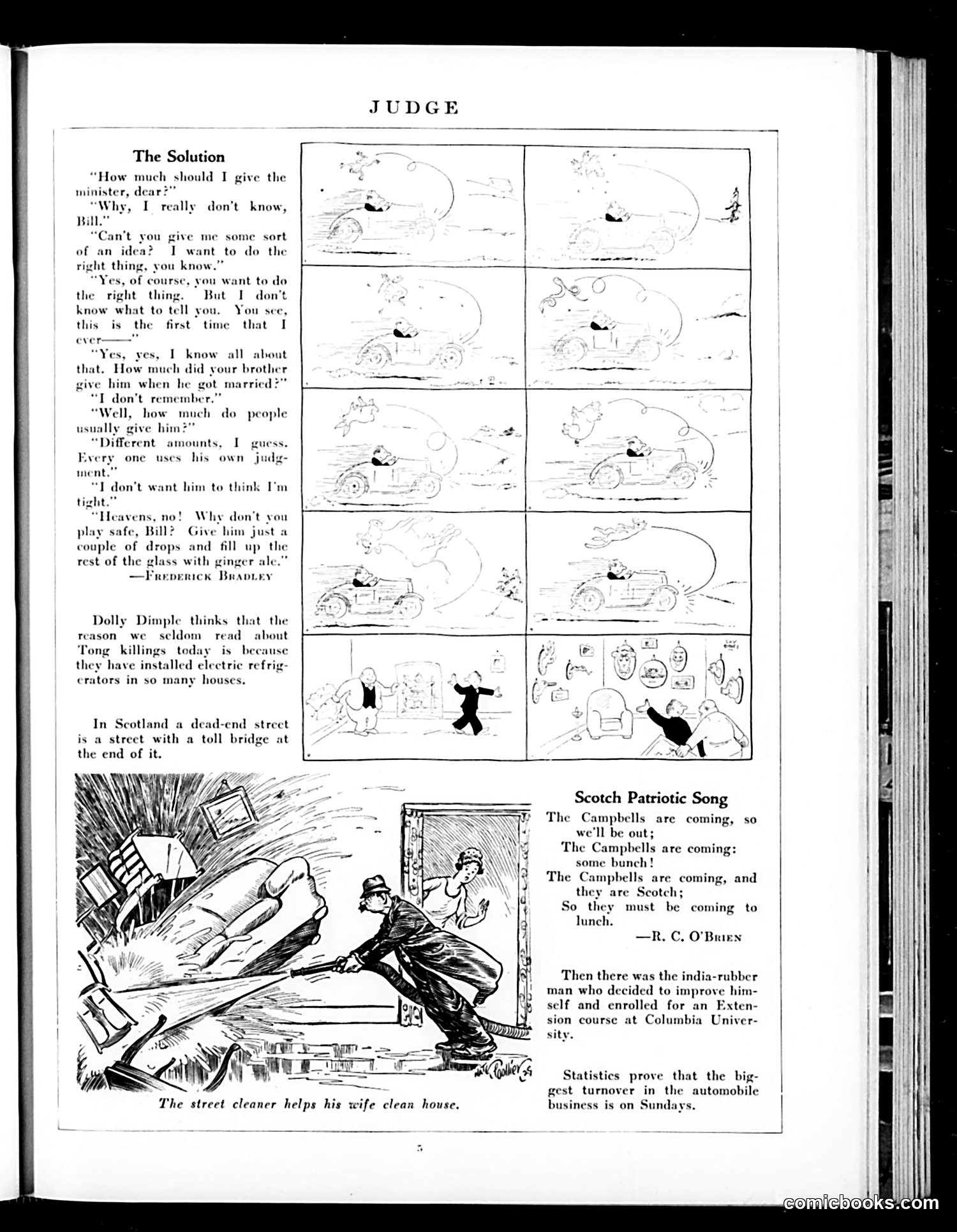
Analysis of Judge Magazine Page The page contains two main elements: "The Solution" Comic Strip: A humorous dialogue about wedding gift amounts. A man asks his friend Bill how much to give at a wedding. The friend suggests giving "a couple of drops" of expensive ale instead of money—a joke playing on stinginess disguised as cleverness. The strip's visual gag shows increasingly absurd attempts to execute this "solution." "The Street Cleaner" Illustration: Shows a street cleaner helping his wife clean their house, captioned "The street cleaner helps his wife clean house." This is satirical social commentary on working-class domesticity and labor, likely commenting on the divide between public and private work spheres. The "Scotch Patriotic Song" and other brief items are minor filler content typical of Judge's format.
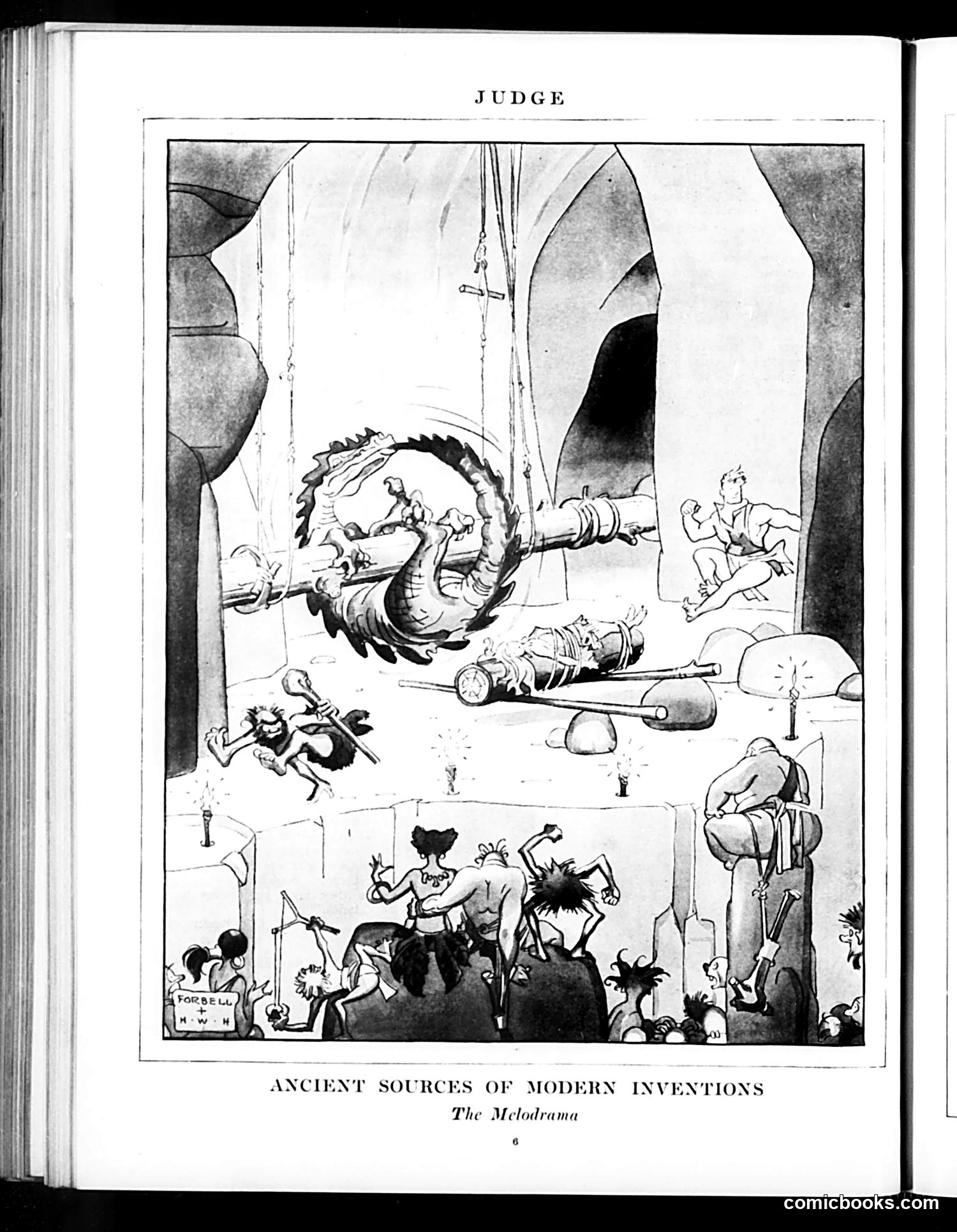
Analysis of "Judge" Page: Ancient Sources of Modern Inventions—The Melodrama This satirical cartoon depicts a theatrical melodrama staged inside what appears to be a classical Greek or Roman structure. The title suggests the joke: modern inventions supposedly have ancient origins. The scene shows exaggerated action typical of melodramatic theater—figures in distress, dynamic poses, and a central dramatic prop (possibly a mechanical device or contraption). The bottom shows an audience watching this theatrical performance. The satire likely mocks both the tendency to claim ancient precedent for modern innovations AND the overwrought, ridiculous nature of melodramatic theater itself. By presenting invention-history as melodrama, Judge ridicules grandiose claims about where modern technology truly originated, suggesting such narratives are theatrical nonsense rather than legitimate history.
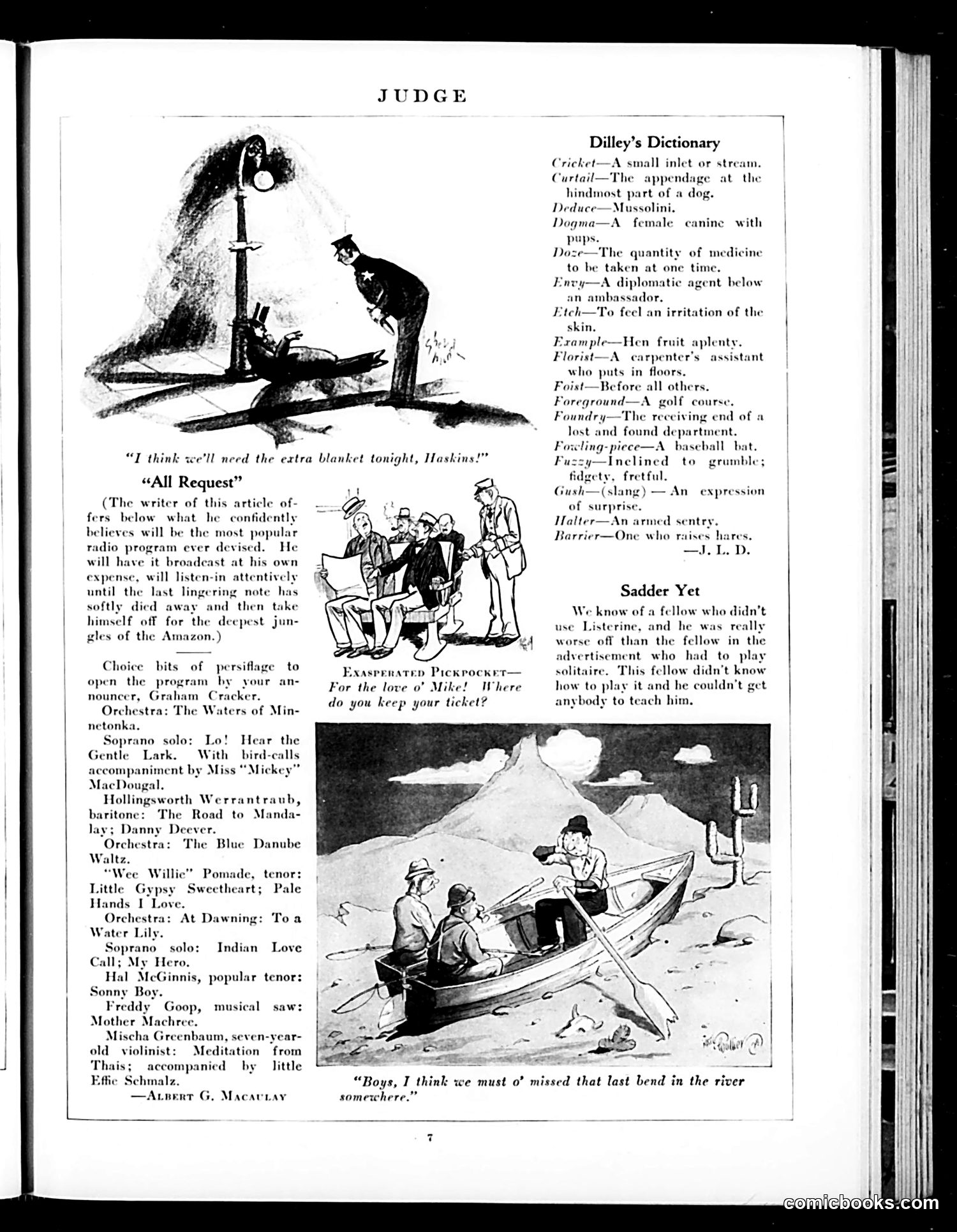
Analysis of Judge Magazine Page This page contains three distinct satirical pieces: Top cartoon: A couple in bed; one says they'll need an extra blanket. The joke plays on double meaning—likely implying either cold weather or marital awkwardness. "All Request" article: Satirizes early radio programming by proposing an absurdly pretentious classical music broadcast featuring performers with silly names ("Wee Willie Pomade," "Freddy Goop" on musical saw). The editorial note mocks the author's confidence in this proposal, sarcastically suggesting he'll "listen-in attentively" before fleeing to the Amazon—implying the program would be unbearably tedious. This reflects 1920s-30s anxiety about radio's cultural impact. "Dilley's Dictionary": Absurdist humor presenting deliberately wrong definitions (Cricket = inlet; Deduce = Mussolini; Halter = armed sentry). Pure wordplay comedy. Bottom cartoon: Three men in a rowboat miss a river bend, illustrating male incompetence at navigation—a common satirical trope. The Listerine reference parodies contemporary advertising claims about social embarrassment and hygiene products.
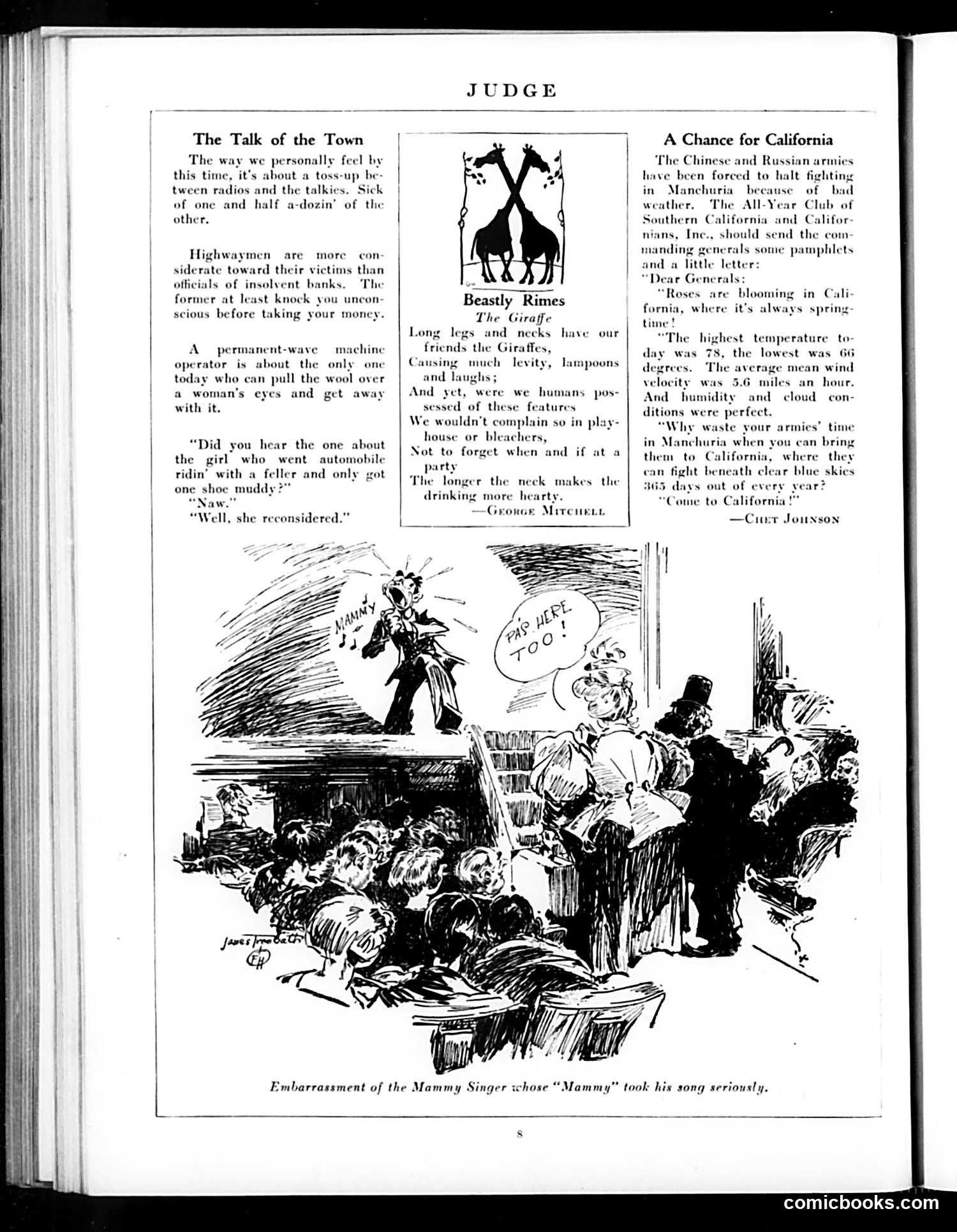
Judge Magazine Page Analysis This page from *Judge* contains satirical commentary on 1920s-30s American life: "The Talk of the Town" offers quick social jabs: complaints about competing entertainment (radios vs. talking pictures), criticism of insolvent banks as predatory, and a joke about a woman reconsidering a risky car ride with a man. "Beastly Rimes: The Giraffe" by George Mitchell humorously compares giraffes' long necks to humans, suggesting people would appreciate such features at parties (where longer necks allegedly enable heartier drinking). "A Chance for California" attributes to Chet Johnson, sarcastically urges Chinese and Russian armies fighting in Manchuria to relocate to California instead, exploiting the region's perpetual spring weather and clear skies as superior to warfare conditions—social commentary on California boosterism and the absurdity of military conflict. The bottom illustration shows an embarrassed singer whose performance of "Mammy" was taken too seriously by an audience, likely satirizing sentimental popular music culture.
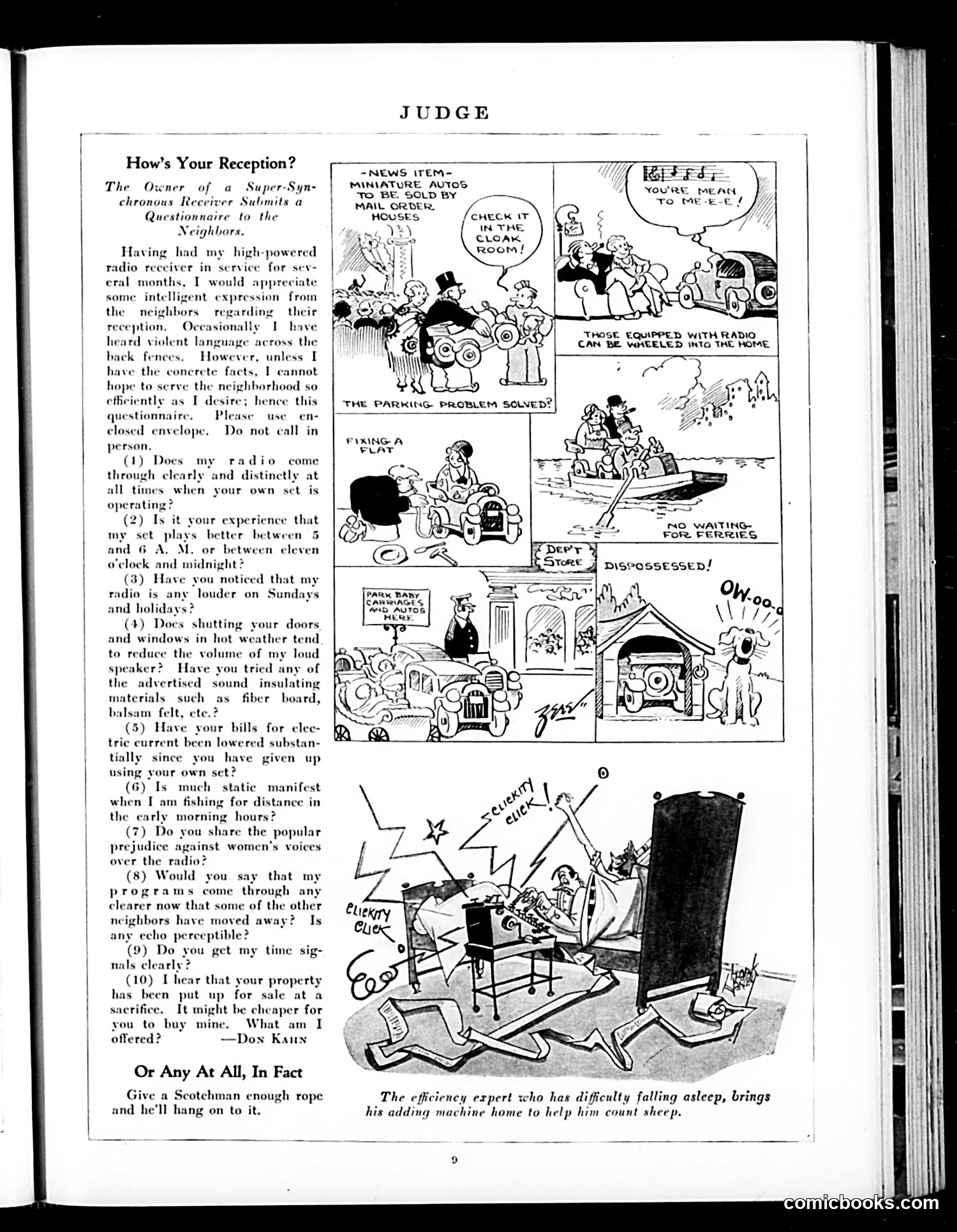
Page Analysis: "How's Your Reception?" This page satirizes the early radio craze and inconsiderate radio owners of the 1920s-30s. The main text is a humorous questionnaire from a neighbor with an extremely loud radio receiver, sarcastically "asking" neighbors about interference—implying he knows full well he's disrupting them but frames it as seeking their "intelligent expression." The cartoons illustrate the chaos: miniature toy cars equipped with radios (suggesting radio's pervasive intrusion into daily life), a man trying to fish while radio interference disrupts him, and a family being driven from their home by an adding machine that won't stop (bottom cartoon, mocking efficiency experts). The satire targets both radio owners' obliviousness and the era's broader obsession with new technology. The joke: a wealthy owner bothers neighbors with his "high-powered" set while pretending politeness, yet his questions—asking if neighbors have abandoned their own radios, if their electric bills dropped, if they've moved—reveal he's fully aware of his annoying impact.
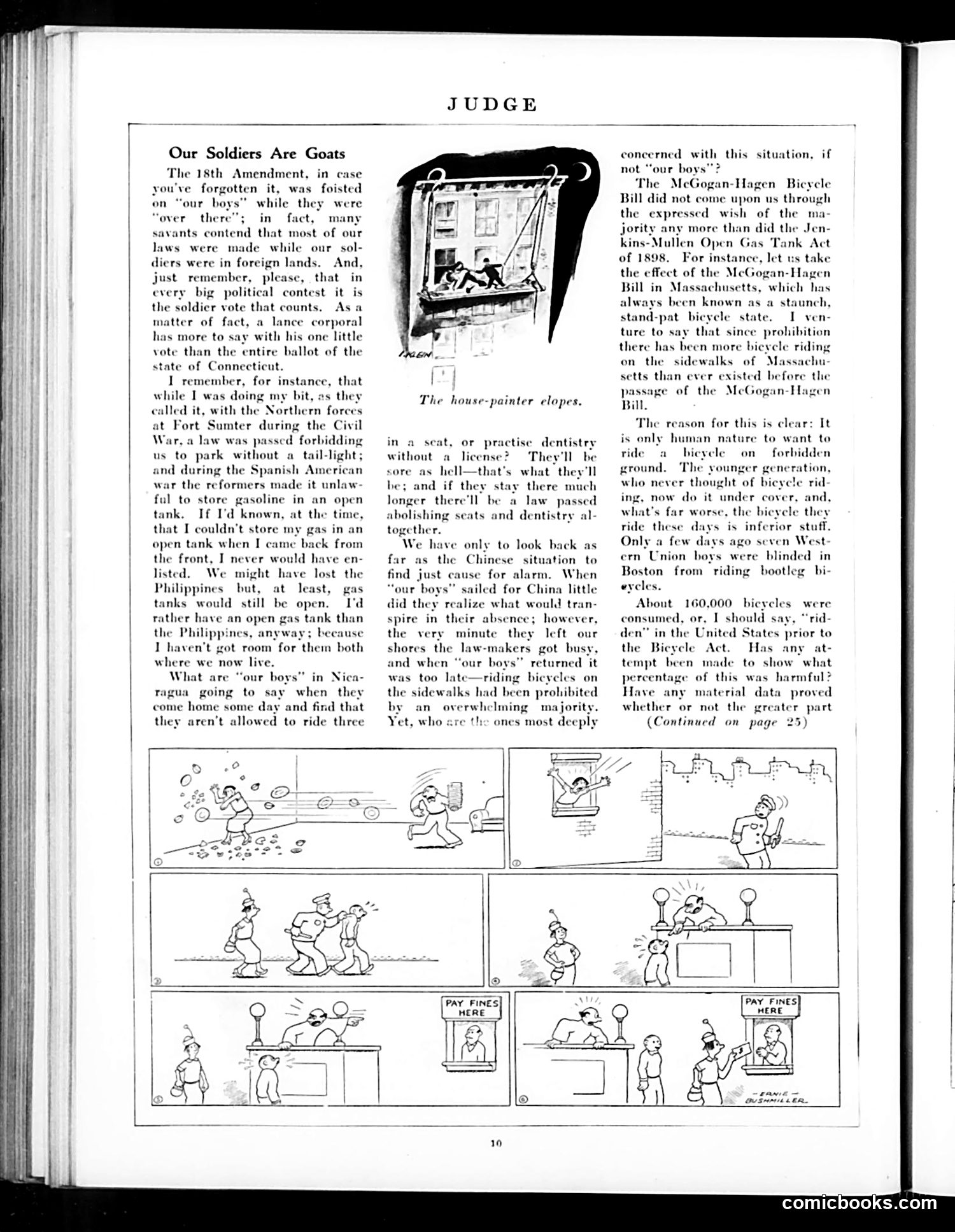
"Our Soldiers Are Goats" - Judge Magazine Satire This article satirizes the ironic power of the soldier vote in American politics. The author argues that while soldiers sacrifice abroad, lawmakers pass restrictive legislation during their absence—then soldiers, having fought for their country, cannot even vote against these laws when they return. The piece mocks specific examples: the 18th Amendment (Prohibition), bicycle restrictions, and gas tank regulations passed while soldiers were overseas. The author notes soldiers have outsized electoral influence despite this treatment, using absurdist humor (preferring open gas tanks to the Philippines). The cartoon below depicts soldiers cycling through various bureaucratic obstacles and "pay fines" stations, visualizing the comic frustration: young men risk their lives abroad only to face petty legal restrictions at home. This reflects post-WWI American cynicism about government hypocrisy toward veterans—a common satirical target of 1920s publications.
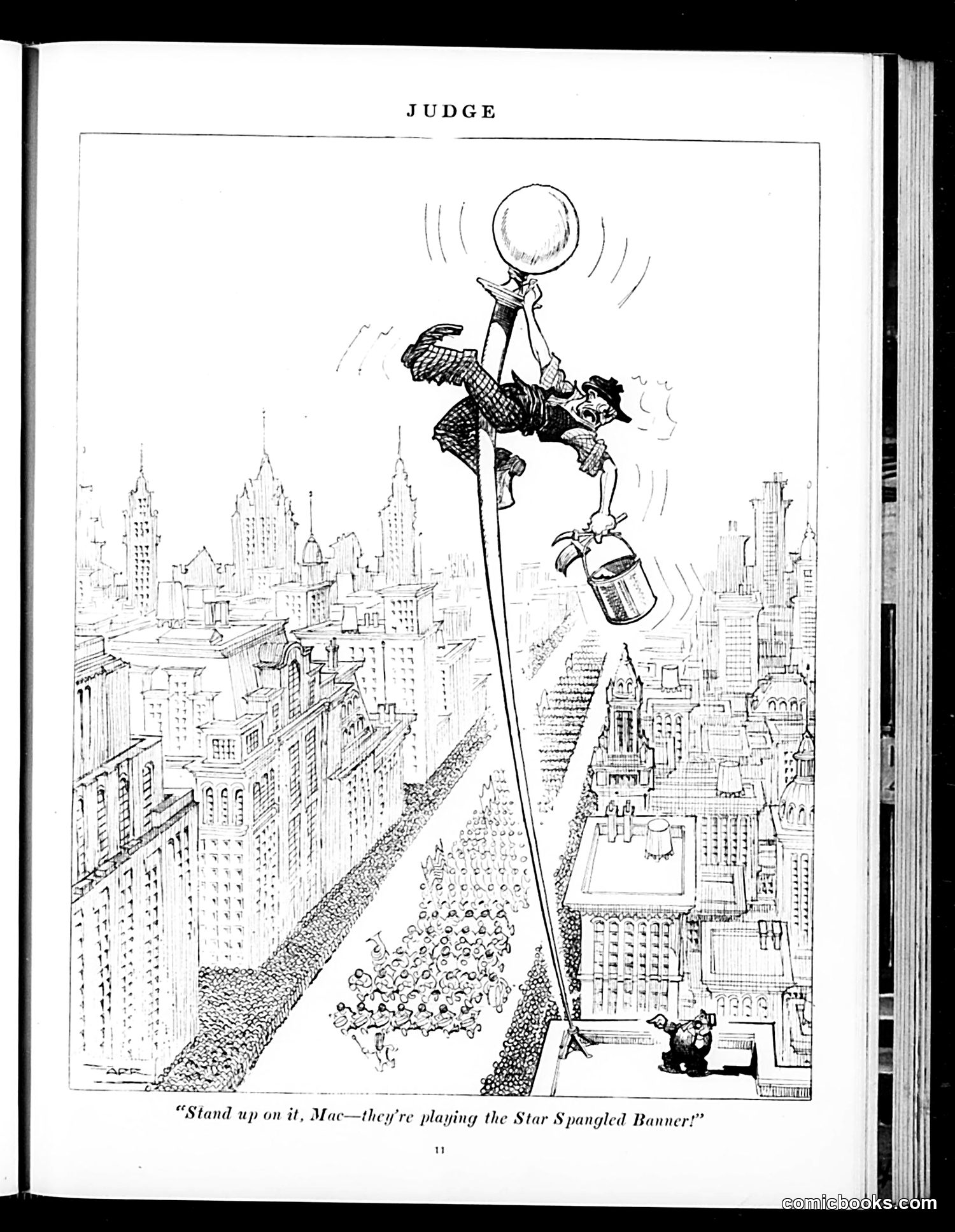
Analysis of "Judge" Cartoon Page This political cartoon depicts a giant figure balancing precariously on an extremely long pole above a cityscape, holding what appears to be a large spherical object overhead. The caption reads: "Stand up on it, Mac—they're playing the Star Spangled Banner!" The satire appears to mock someone (likely a public figure of the era, though not specifically identified here) for an absurdly exaggerated, unstable position of power or prominence. The reference to standing during the national anthem suggests patriotic duty or respect, but the impossible, dangerous balancing act implies the figure's situation is ridiculous, unsustainable, or precarious. Without additional historical context from Judge's publication date, the specific identity of "Mac" remains unclear, though the cartoon critiques performative patriotism or an unstable political/social position.
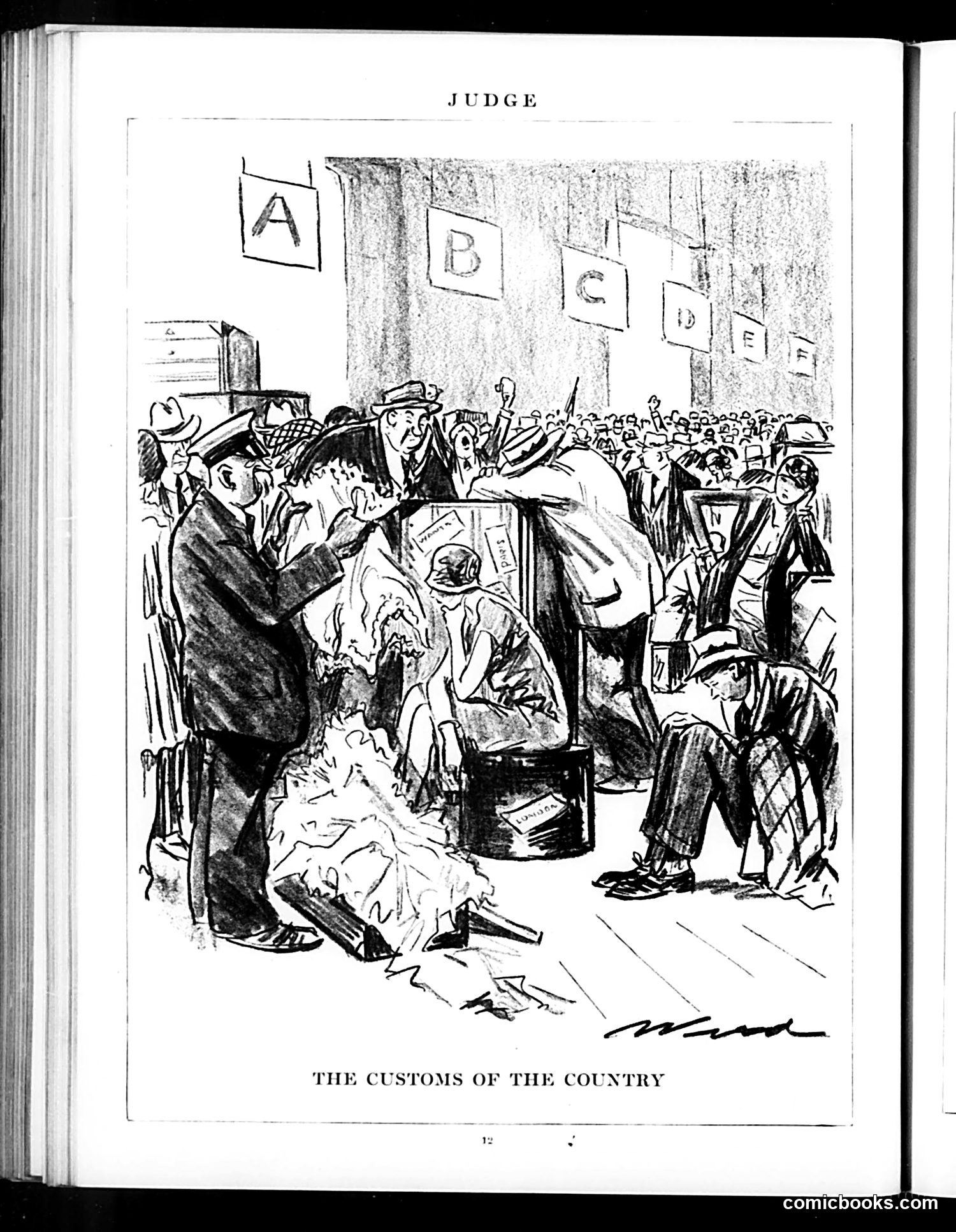
"The Customs of the Country" This Judge cartoon satirizes a public spelling bee or educational competition. The scene shows well-dressed judges and spectators watching as a woman in a dress sits before what appears to be a judge's stand, with alphabet cards (A, B, C, D, E, F) displayed above. The title "The Customs of the Country" suggests ironic commentary on American social practices. The cartoon likely mocks either the formality and pretension of such public educational events, or possibly critiques gender dynamics—showing a woman as the subject of public scrutiny and judgment in an educational setting. The detailed crowd and official atmosphere suggest the artist is satirizing how seriously Americans took these competitions, or questioning their social value. The OCR text is unreadable, preventing identification of the specific artist or additional context.
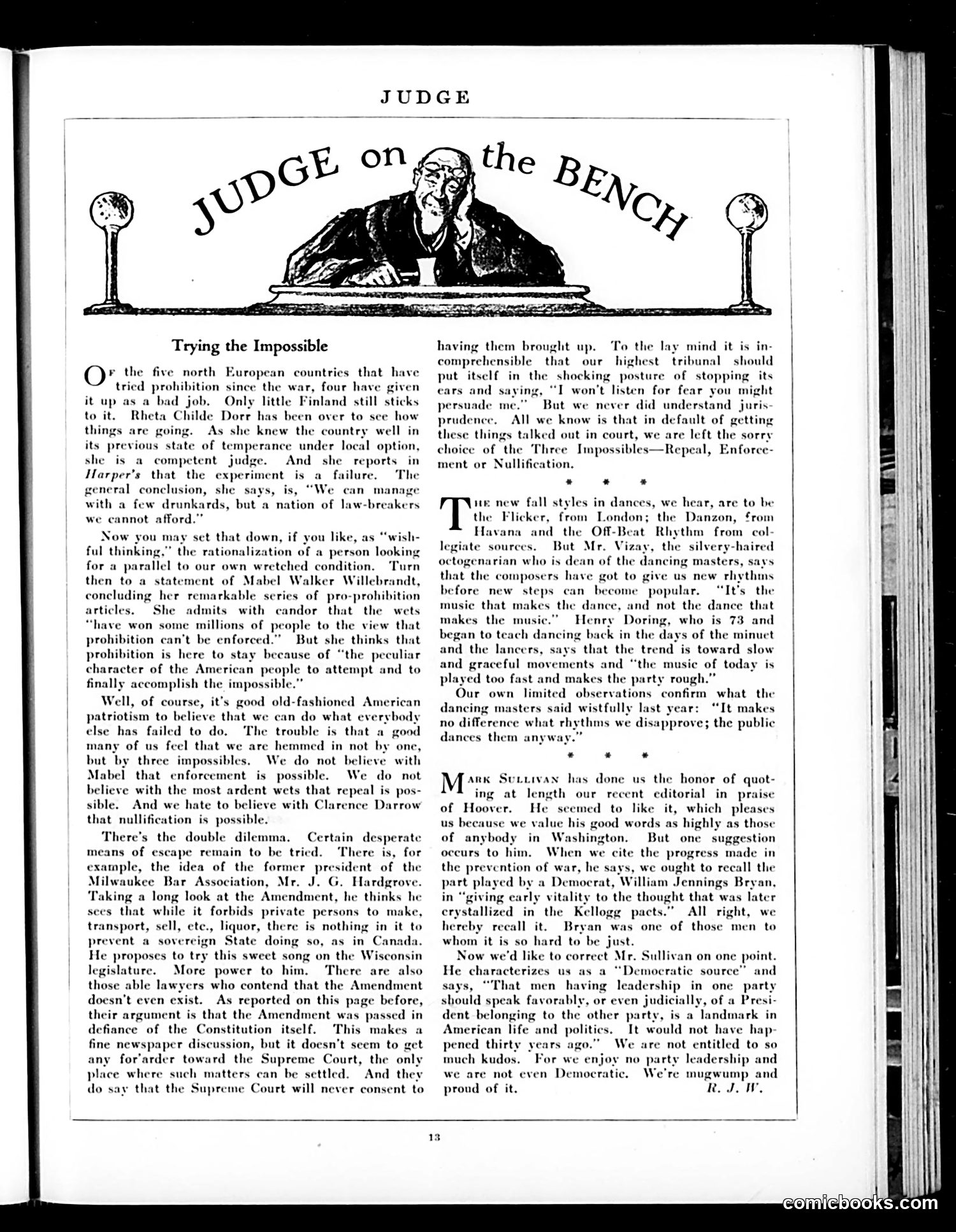
"Judge" on the Bench: "Trying the Impossible" This editorial cartoon satirizes Prohibition enforcement in America. The judge figure represents the judiciary or legal system confronting an impossible task. The text argues that Prohibition has failed in four of five European nations that attempted it—only Finland persists. Yet Mabel Walker Willebrandt (a real Prohibition enforcement official) claims Americans can accomplish the impossible through sheer determination. The author identifies "three impossibles": believing enforcement is possible, believing repeal is possible, or believing nullification (state-level defiance, like Canada's approach) is possible. The piece mocks desperate legal theories—including arguments that the Amendment itself violates the Constitution—that won't reach the Supreme Court anyway. The satire targets American exceptionalism: the naive faith that American willpower can succeed where other nations failed. It suggests Prohibition creates an untenable choice between three legally or politically unfeasible outcomes, leaving the nation trapped.
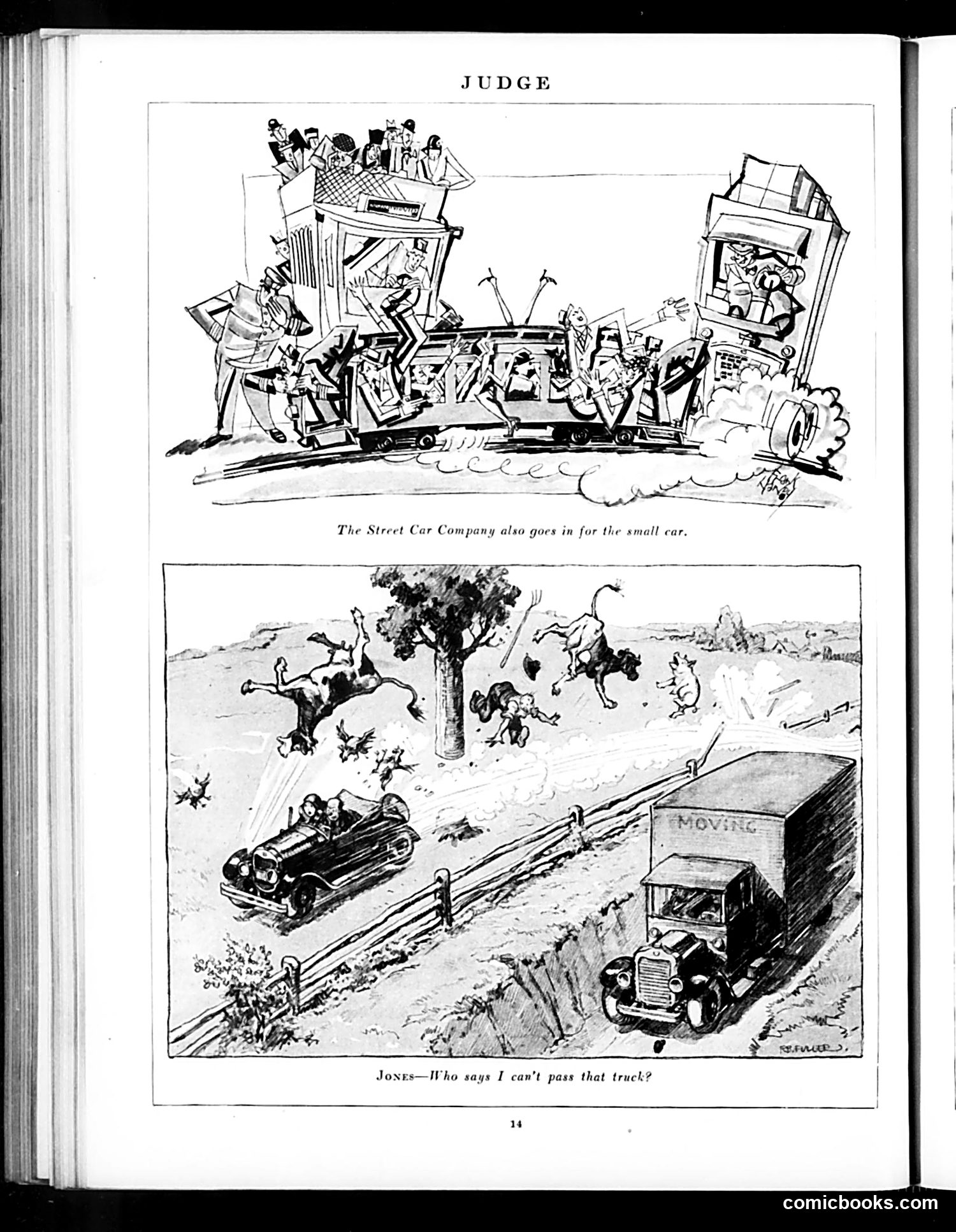
Analysis This page contains two cartoons satirizing early 20th-century transportation and commerce: Top cartoon: "The Street Car Company also goes in for the small car" depicts a crowded, chaotic streetcar vehicle overflowing with passengers in exaggerated, tumbling poses. The satire mocks street car companies' attempts to compete with the emerging automobile industry by offering smaller vehicles—suggesting such ventures result in comic disorder and are impractical. Bottom cartoon: "Jones—Who says I can't pass that truck?" shows a small automobile attempting to pass a large moving truck on a rural road, with animals scattering in panic. The humor lies in the hubris of the small car's driver and the absurdity of trying to pass such a massive vehicle, likely commenting on reckless driving or overconfidence in early automobiles. Both cartoons satirize emerging transportation conflicts and automotive culture.
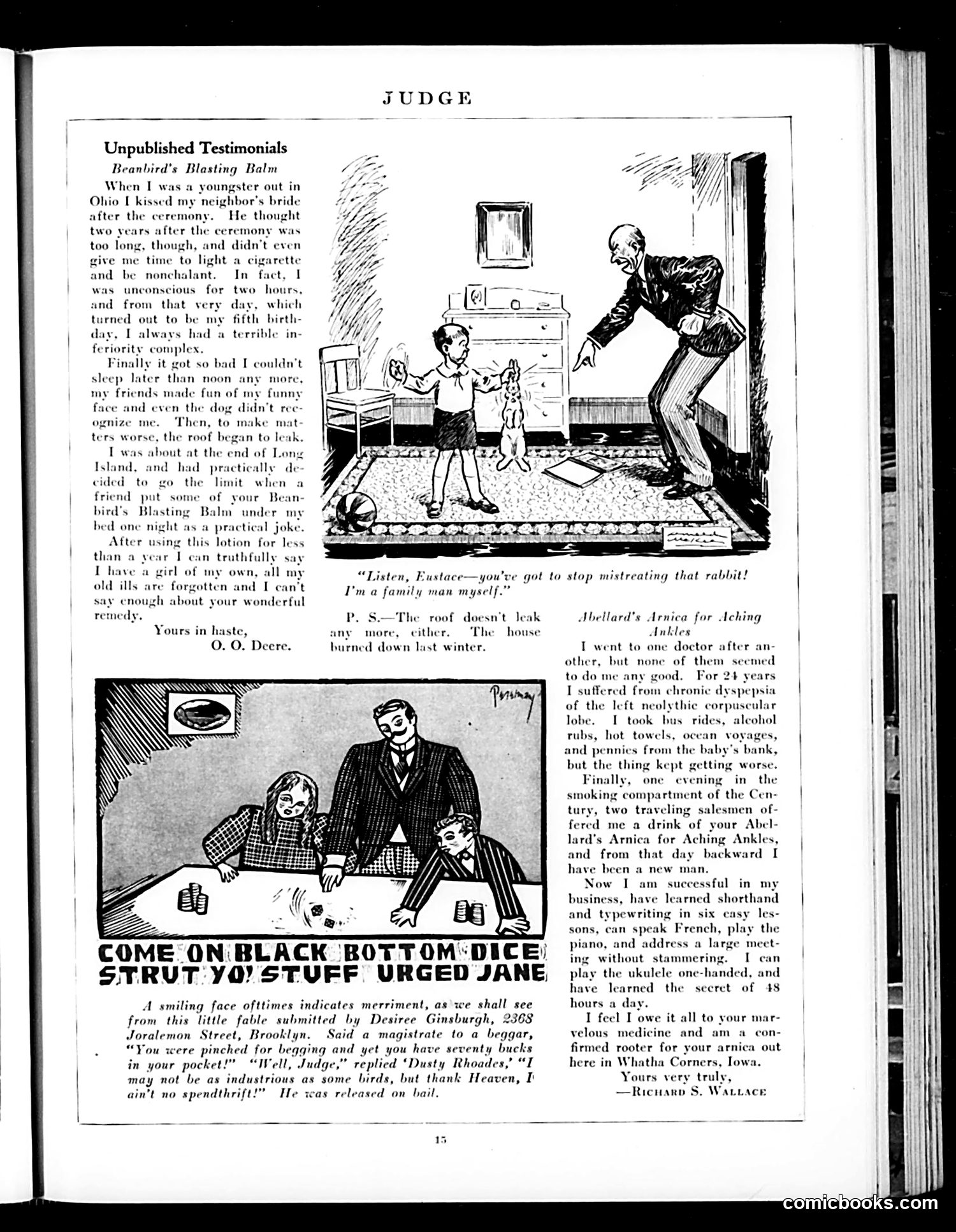
Analysis: Judge Magazine Page This page satirizes patent medicine advertising through fake testimonials—a common Judge tactic mocking the era's unregulated medical industry. Top cartoon: A father scolds his son for mistreating a rabbit, claiming to be "a family man myself." The humor lies in the absurd juxtaposition: the father appears to be a stern disciplinarian (possibly having just struck the child), yet lectures about proper treatment of animals—hypocrisy about family values. Lower section: Three elaborate testimonials praise fake products ("Beanbird's Blasting Balm," "Sbellard's Arnica") using exaggerated before-and-after stories. They mimic real patent medicine ads that made outlandish claims—curing inferiority complexes, enabling business success, fixing mysterious ailments. The testimonials parody how desperate people credited magical products for life transformations. The satire: Judge ridicules both the absurd product claims AND the gullible public who believed such nostrums could solve fundamental life problems. The deliberately ridiculous names and implausible results signal the mockery.
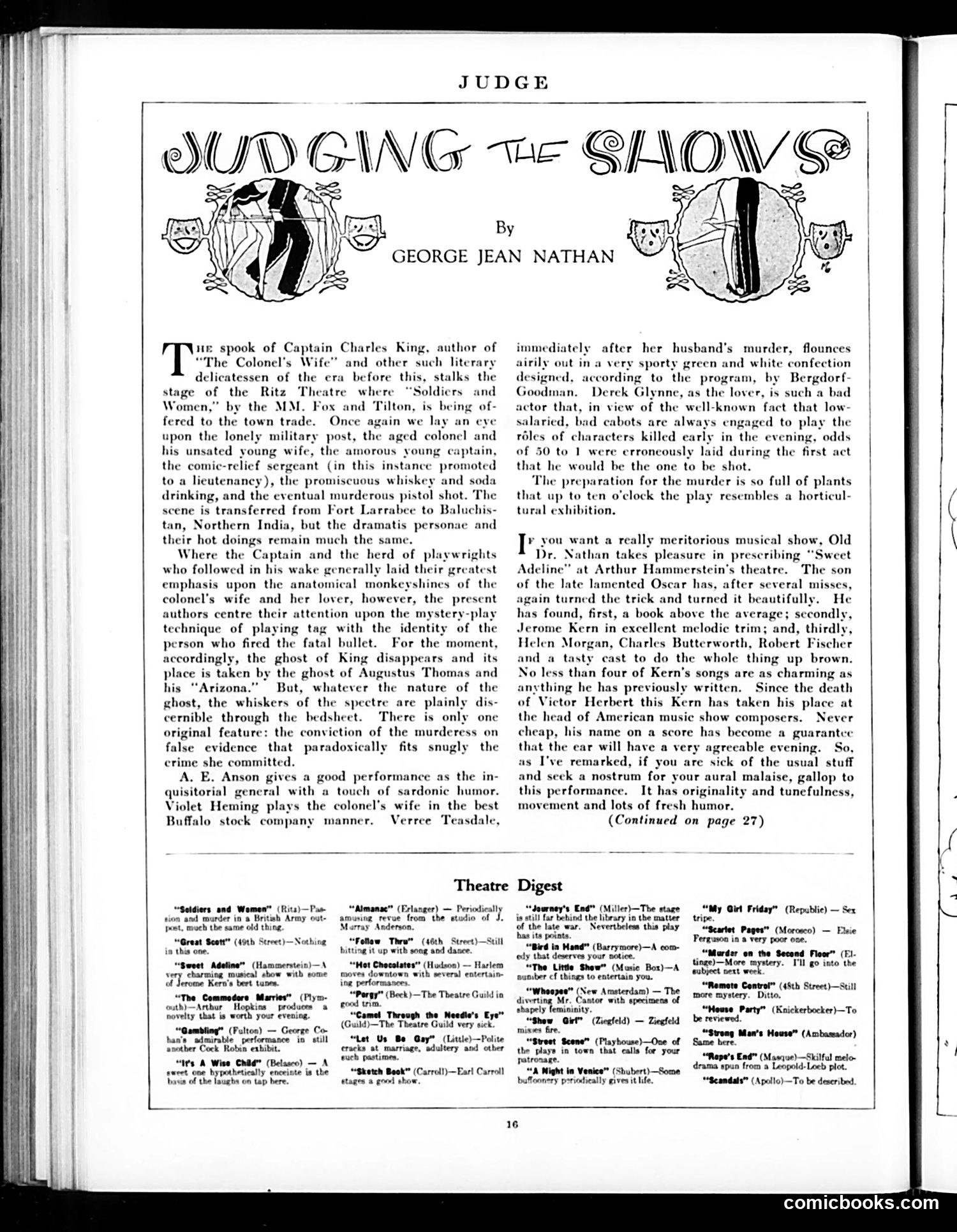
Analysis of "Judging the Shows" by George Jean Nathan This is a theatrical review column, not a political cartoon. Nathan critiques Broadway productions of the era. The main review concerns "Soldiers and Women" at the Ritz Theatre—a plot recycling the familiar "Colonel's Wife" formula (adultery, murder at a military post). Nathan notes it borrows the ghost of Augustus Thomas's "Arizona" but claims its only originality lies in convicting the murderer on false evidence that paradoxically fits the actual crime. The secondary review praises "Sweet Adeline" at Hammerstein's Theatre, crediting composer Jerome Kern with inheriting Victor Herbert's mantle as America's leading musical theatre composer. Nathan celebrates the show's book, Kern's melodies, and a strong cast including Helen Morgan and Charles Butterworth. Nathan's tone is sardonic—he mocks tired theatrical formulas while celebrating genuine craftsmanship. This reflects 1920s Broadway's mix of derivative melodrama and innovative musicals.
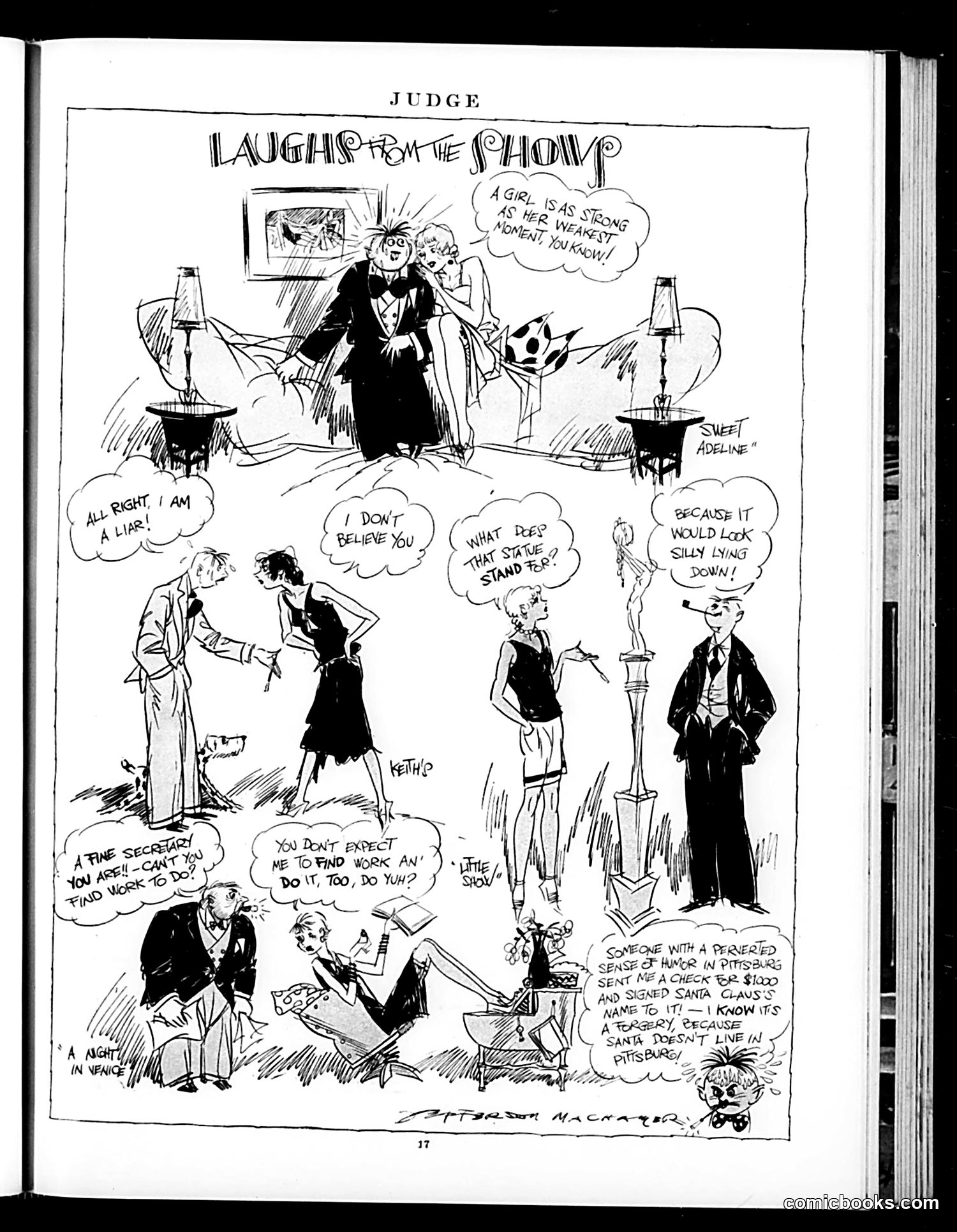
"Laughs from the Chomp" - Judge Magazine Cartoon This multi-panel satire depicts workplace and social dynamics of the early 20th century. The top panel shows a formal gathering where a woman claims to be "as strong as her weakest moment," satirizing contradictory claims about female capability. Lower panels feature various characters in workplace scenarios—a secretary claiming she can't find work, an employer skeptical of her abilities, and discussions about job expectations. The bottom panel's punchline involves someone receiving a forged $1,000 check signed "Santa Claus," mocking both charitable pretense and gullibility. The cartoons target gender relations in employment, workplace dishonesty, and the gap between claimed and actual virtue. The satire suggests both workers and employers are hypocritical—making false claims about capability, honesty, and charitable intentions. The humor relies on exposing these contradictions in everyday social interactions.
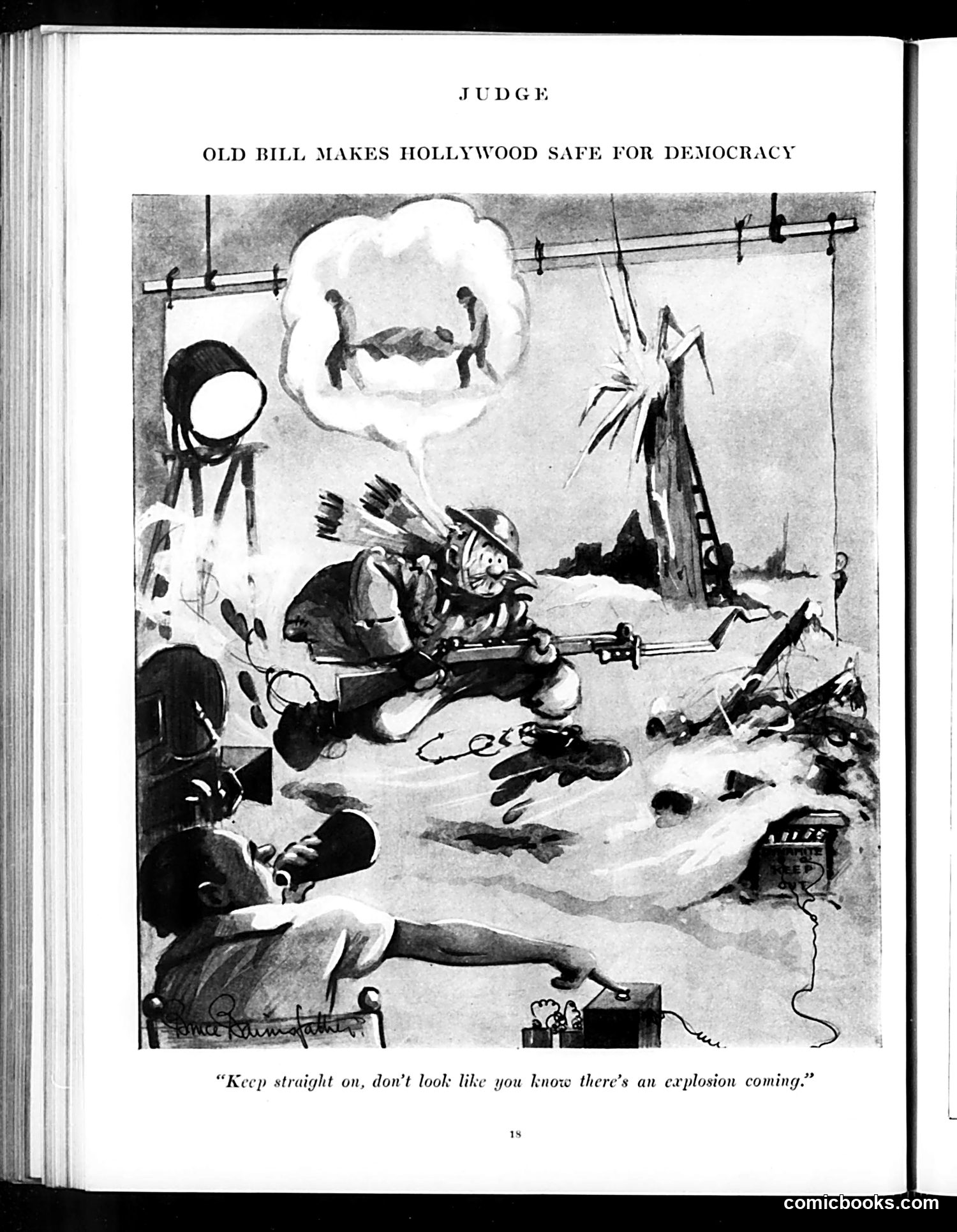
Analysis This satirical cartoon critiques Hollywood's film industry through a war-themed allegory. The title "Old Bill Makes Hollywood Safe for Democracy" appears to reference "Old Bill," a famous WWI cartoon character, suggesting parallels between military conflict and Hollywood's internal struggles. The cartoon depicts a chaotic movie-set scene with explosions, destruction, and figures operating film equipment amid apparent violence. The caption—"Keep straight on, don't look like you know there's an explosion coming"—implies filmmakers are continuing production despite dangerous or tumultuous conditions. The satire likely comments on how Hollywood operates despite internal conflict, scandal, or instability—maintaining appearances of normalcy while chaos surrounds the industry. Without the magazine's date visible, the specific "bill" referenced remains unclear, though it likely references either censorship legislation or industry reform efforts affecting filmmaking practices.
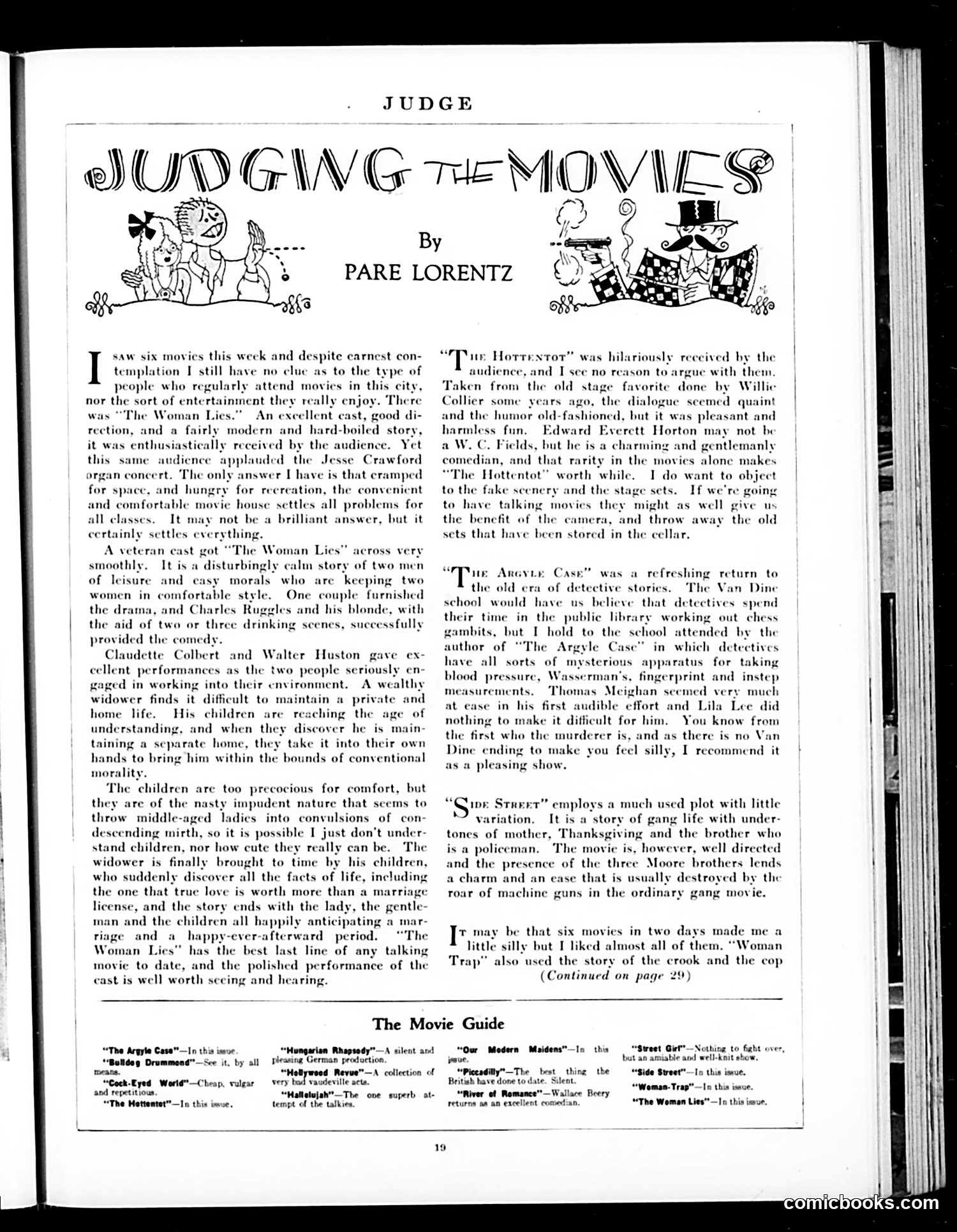
"Judging the Movies" by Pare Lorentz - Judge Magazine Film Review This is a film criticism column reviewing six recent movies. The author expresses bemused frustration that audiences enthusiastically receive both highbrow entertainment (a Jesse Crawford organ concert) and conventional movies indiscriminately, attributing this to the movie theater's role as convenient escape for all social classes. The reviews discuss: *The Woman Lies* (praised for cast/performance despite morally questionable premise), *The Hottentot* (comedy featuring Edward Everett Horton), *The Argyle Case* (detective mystery with Thomas Meighan and Lila Lee), and *Side Street* (gang drama). The satire targets audience taste broadly rather than specific figures. Lorentz's tone suggests intellectual superiority toward mass entertainment consumption while acknowledging cinema's social function. The cartoonish header illustration emphasizes the page's comedic intent about evaluating popular entertainment.
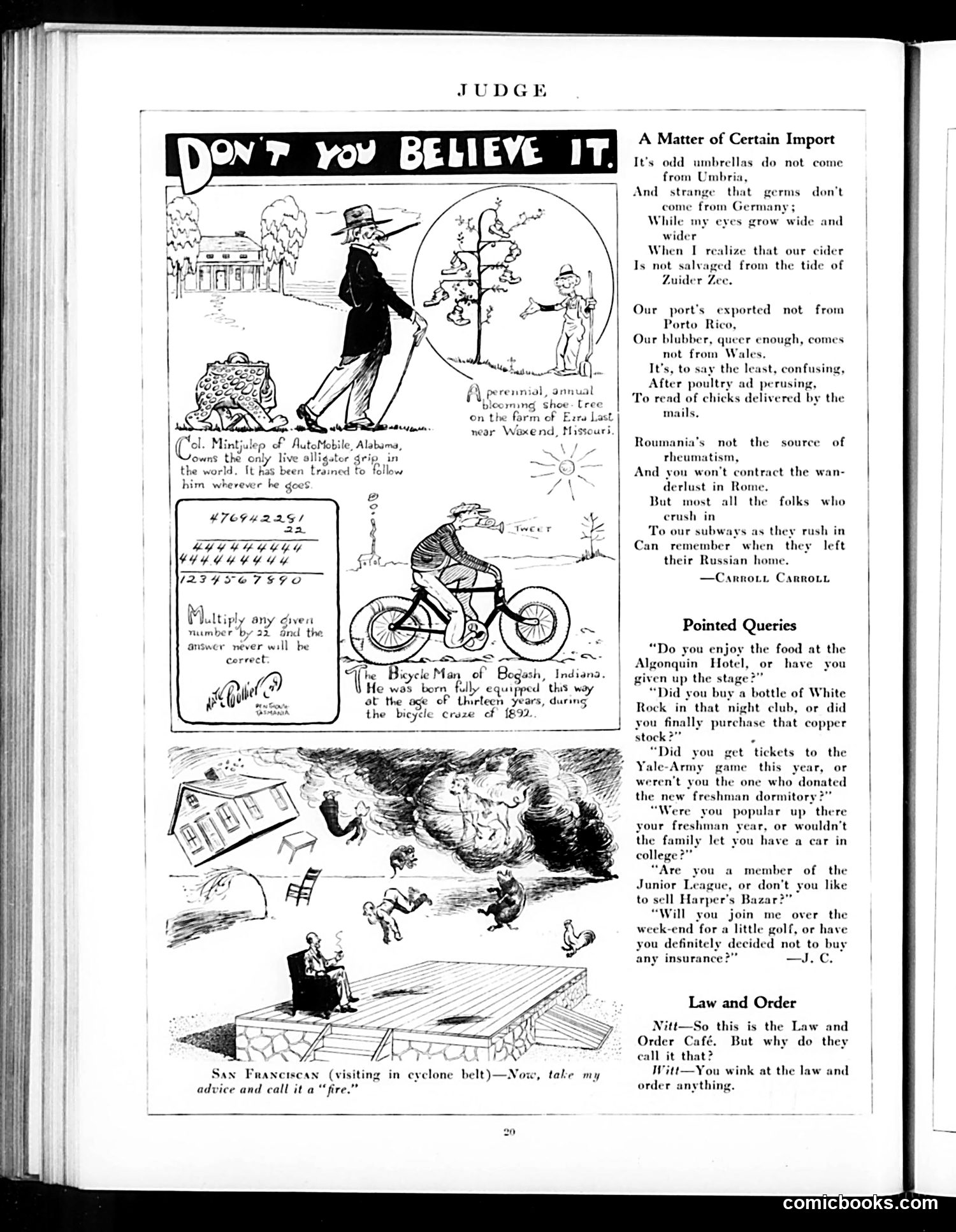
Judge Magazine Page Analysis This page contains three distinct satirical pieces: "Don't You Believe It" presents humorous tall tales—an Alabama man with a trained alligator grip, a "Bicycle Man" fully equipped at birth during the 1892 bike craze, and a self-blooming shoe tree. These mock the credulous American public's tendency to believe dubious claims and tall stories. "A Matter of Certain Import" is a poem by Carroll Carroll satirizing immigrant confusion about American geography and commerce. It jokes that products don't come from their expected origins (umbrellas not from Umbria, germs not from Germany, cider not from the Zuider Zee), then shifts to poking fun at Russian immigrants who nostalgically reference their homeland while riding American subways. "Pointed Queries" features barbed rhetorical questions targeting wealthy society figures, sarcastically asking if they've "given up the stage," bought stocks, or donated to colleges—implying their social pretensions mask commercial interests. "Law and Order" is a brief punchline about a café where customers "wink at the law and order anything"—playing on the phrase's double meaning.
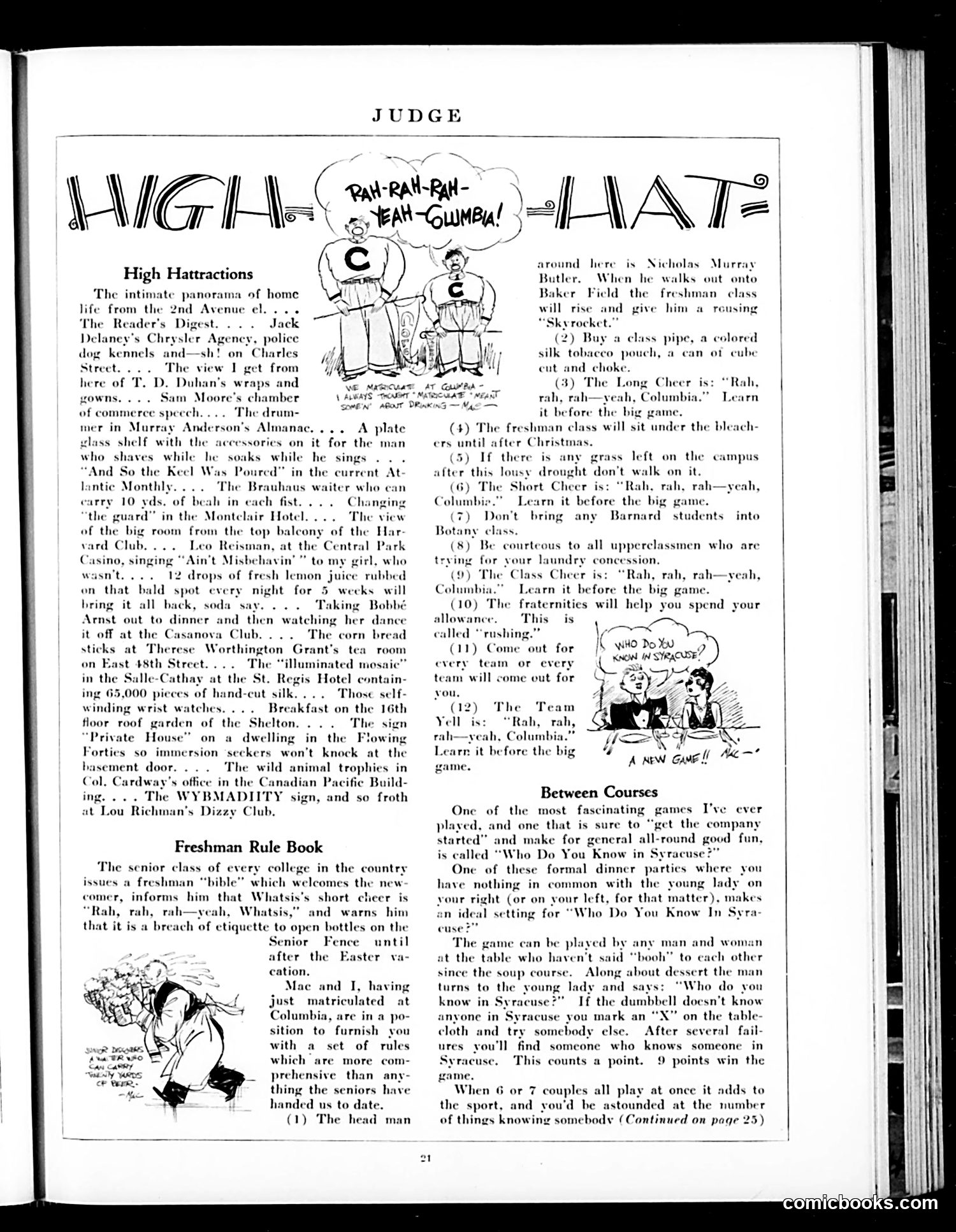
Explanation for Modern Readers This Judge magazine page satirizes college life circa 1920s, focusing on Columbia University freshman traditions and social games. "High-Hat-Tractions" mocks upper-class Manhattan leisure activities—elevated train views, fancy hotels, tea rooms—presenting them as trivial "attractions" for the wealthy and pretentious. "Freshman Rule Book" lampoons hazing and college hierarchies. The satirical "rules" mock actual freshman hazing practices: mandatory cheers ("Rah, rah, rah—yeah, Columbia"), sitting in designated bleacher sections, buying specific pipes and tobacco pouches, and deferential behavior toward upperclassmen and college president Nicholas Murray Butler. The humor lies in presenting absurd, arbitrary rituals as serious institutional requirements. "Between Courses" describes a dinner party game called "Who Do You Know in Syracuse?"—a social icebreaker where diners try to find mutual acquaintances. The satire targets the artificiality and awkwardness of formal social gatherings among the wealthy. Overall, the page ridicules elite college culture, snobbery, and meaningless social conventions of 1920s New York society.
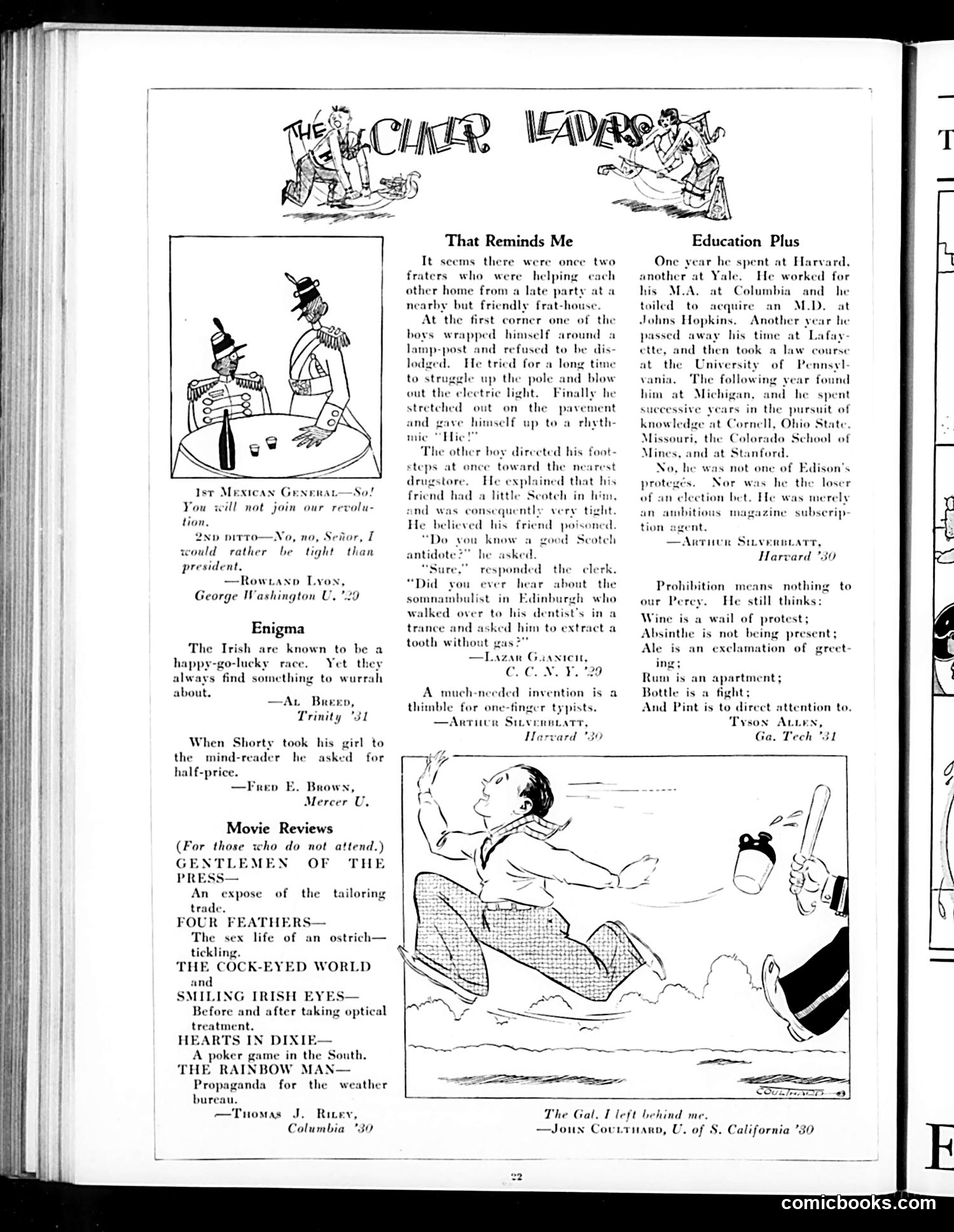
Judge Magazine Page Analysis This page from Judge contains several humorous student submissions satirizing contemporary college life and social attitudes circa 1930. The main cartoon depicts two Mexican generals: one inviting the other to join a revolution; the second refuses, preferring to "be tight [drunk] than president"—mocking both Mexican political instability and American college drinking culture during Prohibition. The text items include brief jokes about Irish stereotypes, mind-readers, and crude movie reviews. "That Reminds Me" recounts two drunk college boys, one wrapped around a lamppost, the other seeking a drugstore cure—satirizing casual alcohol use despite Prohibition's legal ban. "Education Plus" mocks an overeducated magazine subscription agent who attended nearly every major American university but gained no practical success—poking fun at credentialism without real achievement. The final poem parodies Prohibition's ineffectiveness: alcohol remains present in various forms, each humorously redefined ("Wine is a wail of protest"). The page overall reflects 1920s-30s college humor: irreverent toward Prohibition, ethnic stereotypes, and academic pretension.
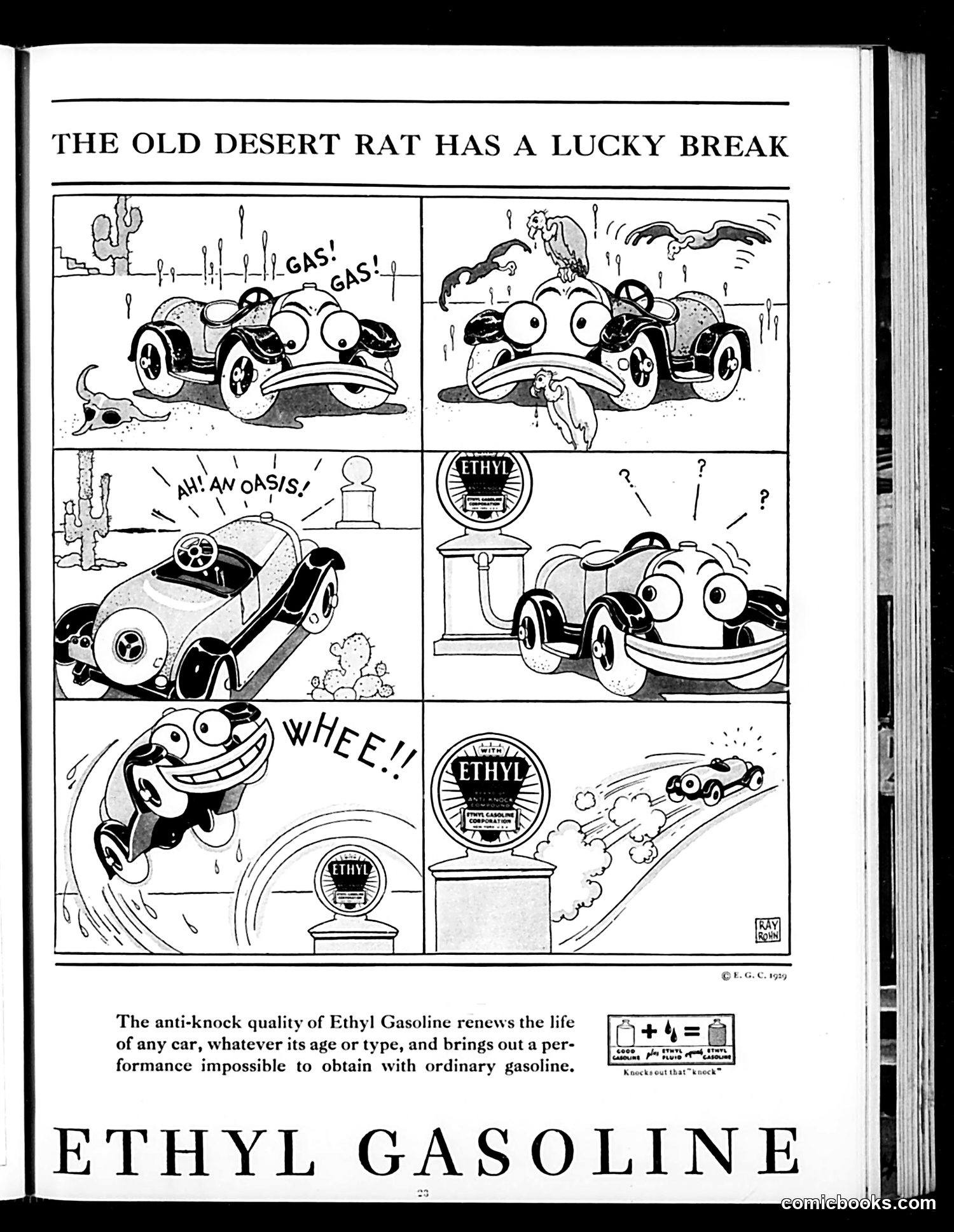
"The Old Desert Rat Has a Lucky Break" This is an advertisement for Ethyl Gasoline disguised as a comic strip. The narrative follows an anthropomorphized desert rat whose old car initially sputters and fails ("GAS! GAS!"). After discovering an Ethyl gasoline pump in the desert, the rat's vehicle transforms into a high-performing machine that races away triumphantly. The "desert rat" likely refers to someone living in harsh conditions with an aging, unreliable vehicle. The comic illustrates Ethyl's key selling point: its anti-knock properties supposedly revive old engines and enable performance impossible with regular gasoline. This reflects 1920s automotive marketing, when Ethyl (gasoline with lead additives) was promoted as a technological breakthrough improving engine efficiency and longevity.
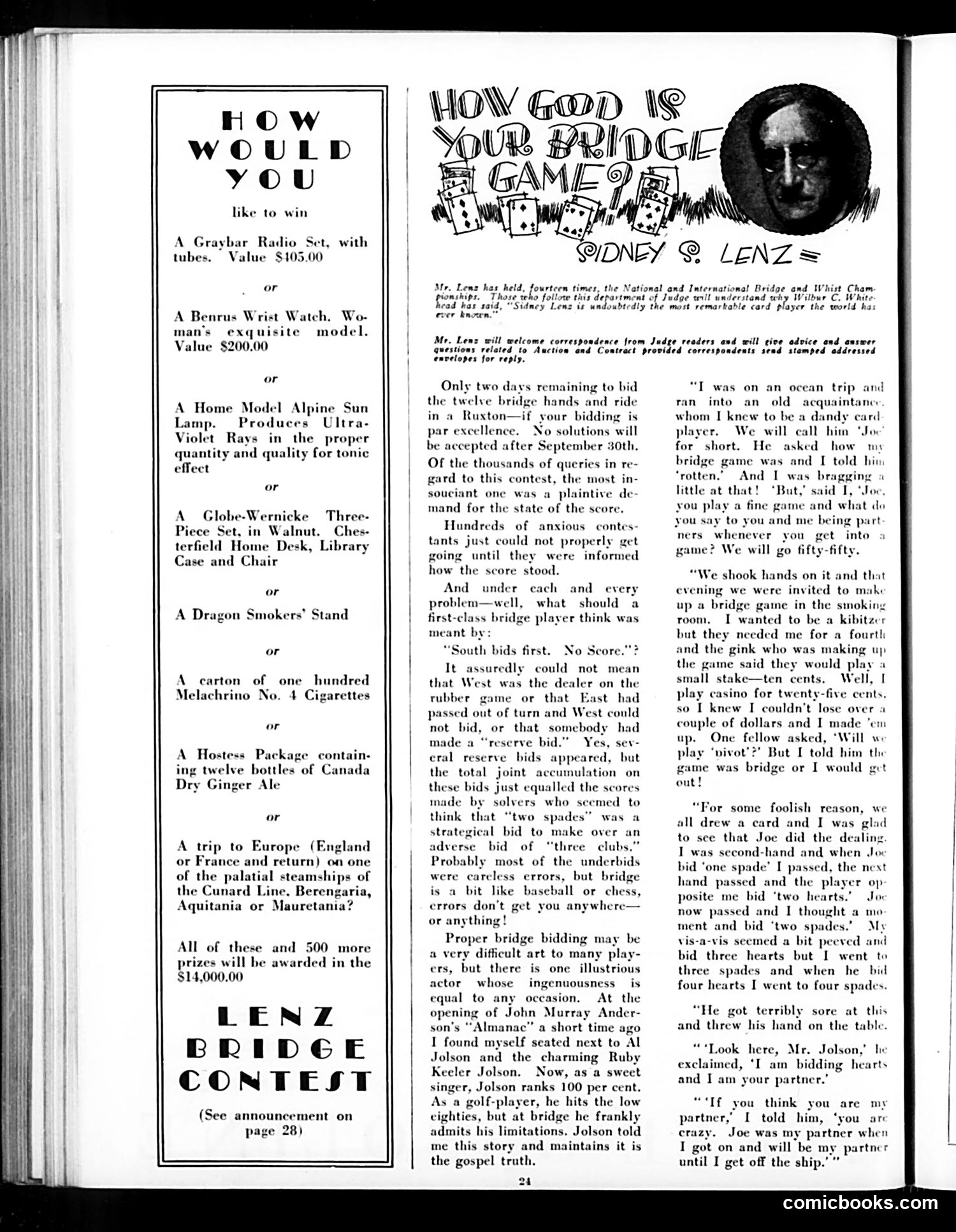
Page Analysis: LENZ BRIDGE CONTEST This page primarily advertises Judge magazine's bridge-playing contest sponsored by Sidney Lenz, a renowned bridge champion (described as holding "fourteen times, the National and International Bridge" titles). The left column lists substantial prizes worth $14,000 total, including radios, watches, a European steamship voyage, and luxury goods—typical 1920s-30s magazine contest incentives. The right side features an anecdote by Lenz about Al Jolson (the famous entertainer and singer) and his wife Ruby Keeler, illustrating poor bridge-bidding strategy through a humorous ocean-voyage story. The joke appears to center on Jolson's admitted limitations at bridge despite his entertainment talents—a gentle ribbing of a celebrity's card-game incompetence. This is primarily contest promotion and entertainment content rather than political satire, reflecting Judge's bridge-playing readership during an era when contract bridge was fashionable among affluent Americans.
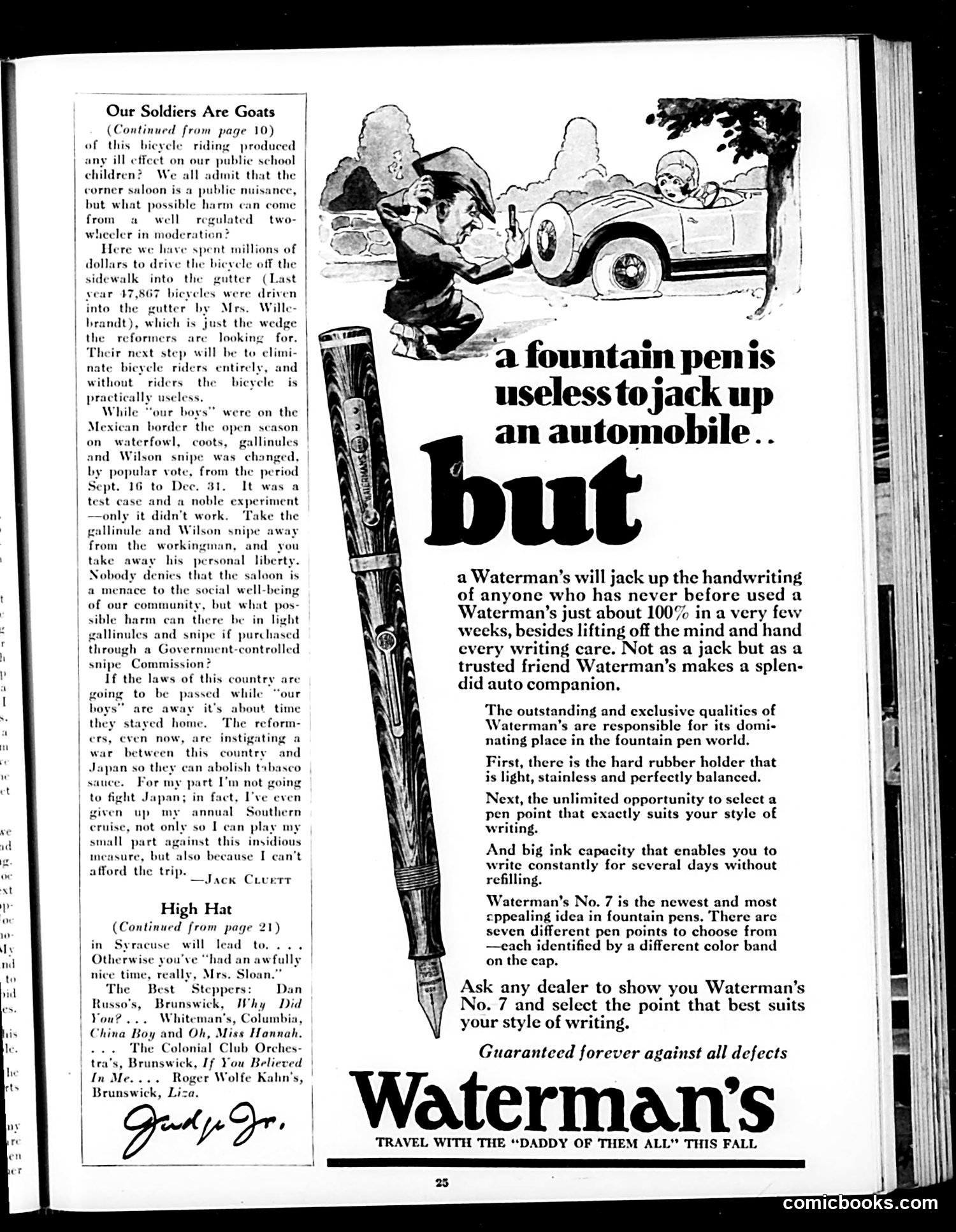
Analysis for Modern Readers This page mixes political satire with advertising. The left column contains an article titled "Our Soldiers Are Goats," attributed to Jack Cluett, sarcastically defending bicycles and hunting regulations against reformers' efforts to restrict them. The author argues that banning bicycles or changing hunting seasons (using gallinules and Wilson snipe as examples) represents government overreach that threatens personal liberty—a libertarian critique of progressive-era regulation. The satire appears to mock both reformers AND those claiming trivial regulations threaten American freedom. The reference to Mrs. Willebrandt (likely Mabel Walker Willebrandt, a Prohibition enforcement official) suggests frustration with government control generally. The right side is a Waterman's fountain pen advertisement using heavy-handed sexual innuendo ("a fountain penis is useless to jack up an automobile") to promote its writing instrument as a practical travel companion. The page likely dates to the 1920s-30s, reflecting tensions over Prohibition, vehicle regulation, and consumer goods.
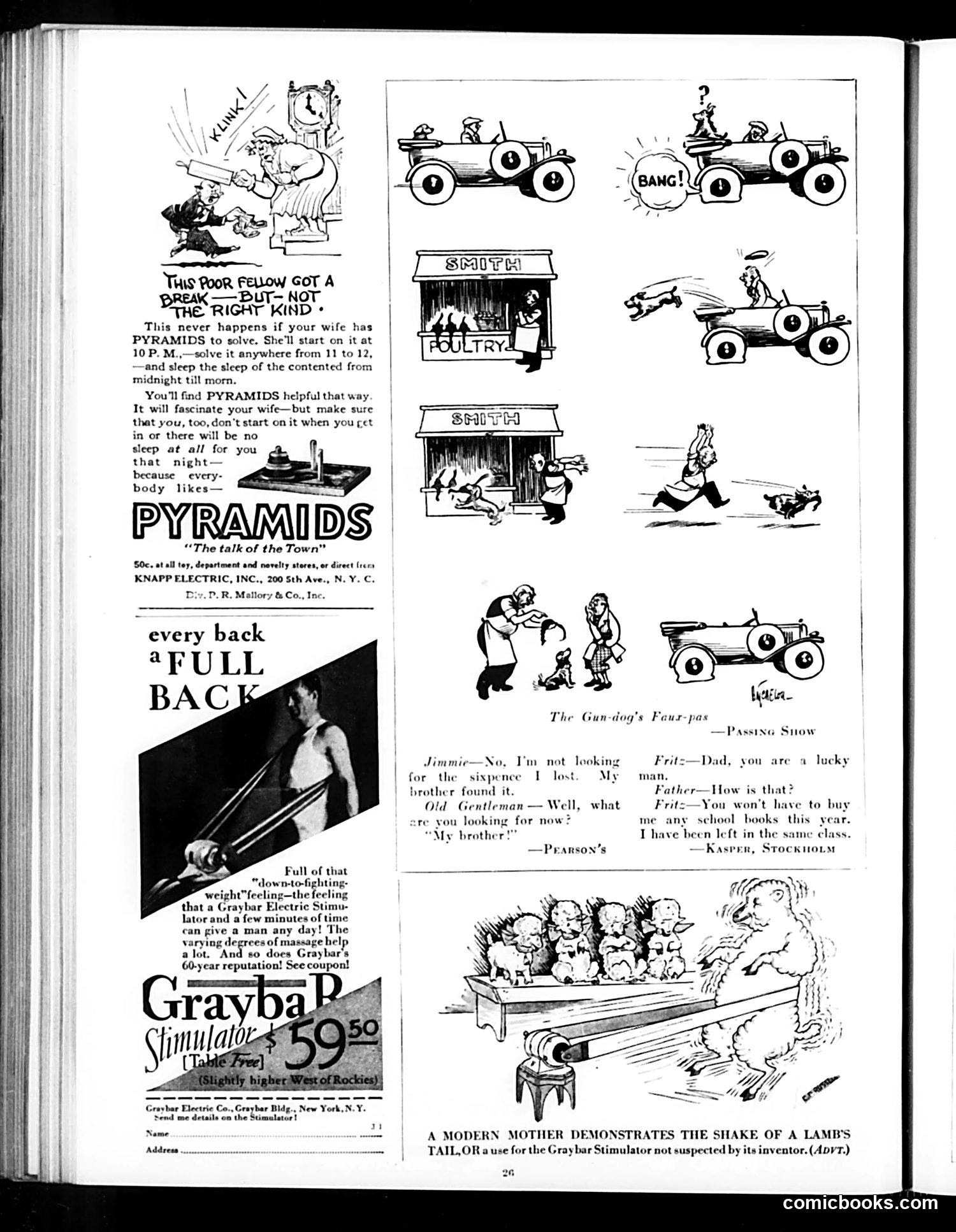
Political/Social Content Analysis This page contains primarily advertisements and light humor rather than political satire. Main Content: 1. Pyramids puzzle ad: Targets husbands, humorously suggesting the game will occupy wives at night, allowing them sleep while preventing the husband from resting if he joins in. This reflects early 20th-century domestic gender dynamics—wives as leisure-puzzle solvers, husbands as breadwinners needing rest. 2. Graybar Stimulator ad: Promotes an electric massage device marketed to men for post-work relaxation and muscle recovery, framed as masculine vigor restoration. 3. Comic vignettes: Three brief joke panels with no political content—one about lost sixpence, another about school books—typical light magazine humor. 4. Final cartoon: Depicts a mother using a Graybar Stimulator on children (the "shake of a lamb's tail"), humorous advertising repurposing. Overall: This is a commercial page showcasing period advertisements and filler humor, not political commentary.
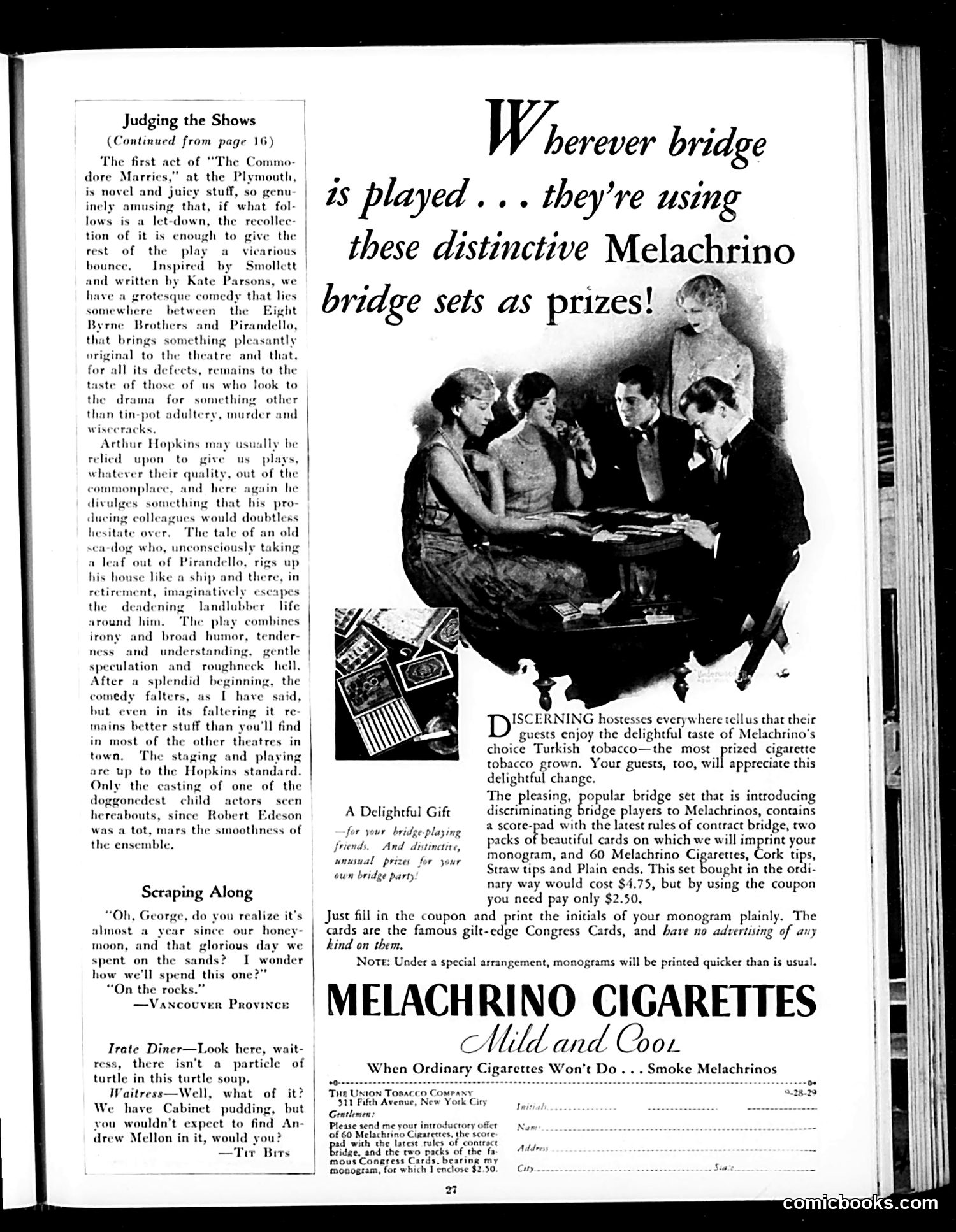
Page Analysis: Judge Magazine Advertisement & Theater Reviews This page mixes theater criticism with a Melachrino Cigarettes advertisement disguised as editorial content. The left column contains legitimate theater reviews of plays like "The Commodore Marries" at the Plymouth Theatre, praising the performances and writing. The dominant right side presents an advertisement for Melachrino cigarettes marketed as a bridge-playing gift set. The ad features a photograph of four people playing bridge and pitches a promotional bundle: monogrammed playing cards, cigarettes, and accessories for $2.50 (versus regular $4.75 price). The satire here is subtle but present: the ad uses the *Judge* magazine's credibility to market cigarettes by associating them with upscale leisure activities (bridge among "discerning hostesses"). The copy emphasizes Turkish tobacco quality while the coupon structure mimics legitimate offers. This represents early 20th-century advertising integration into editorial space—blurring entertainment journalism with product promotion in ways modern readers would flag as deceptive marketing.
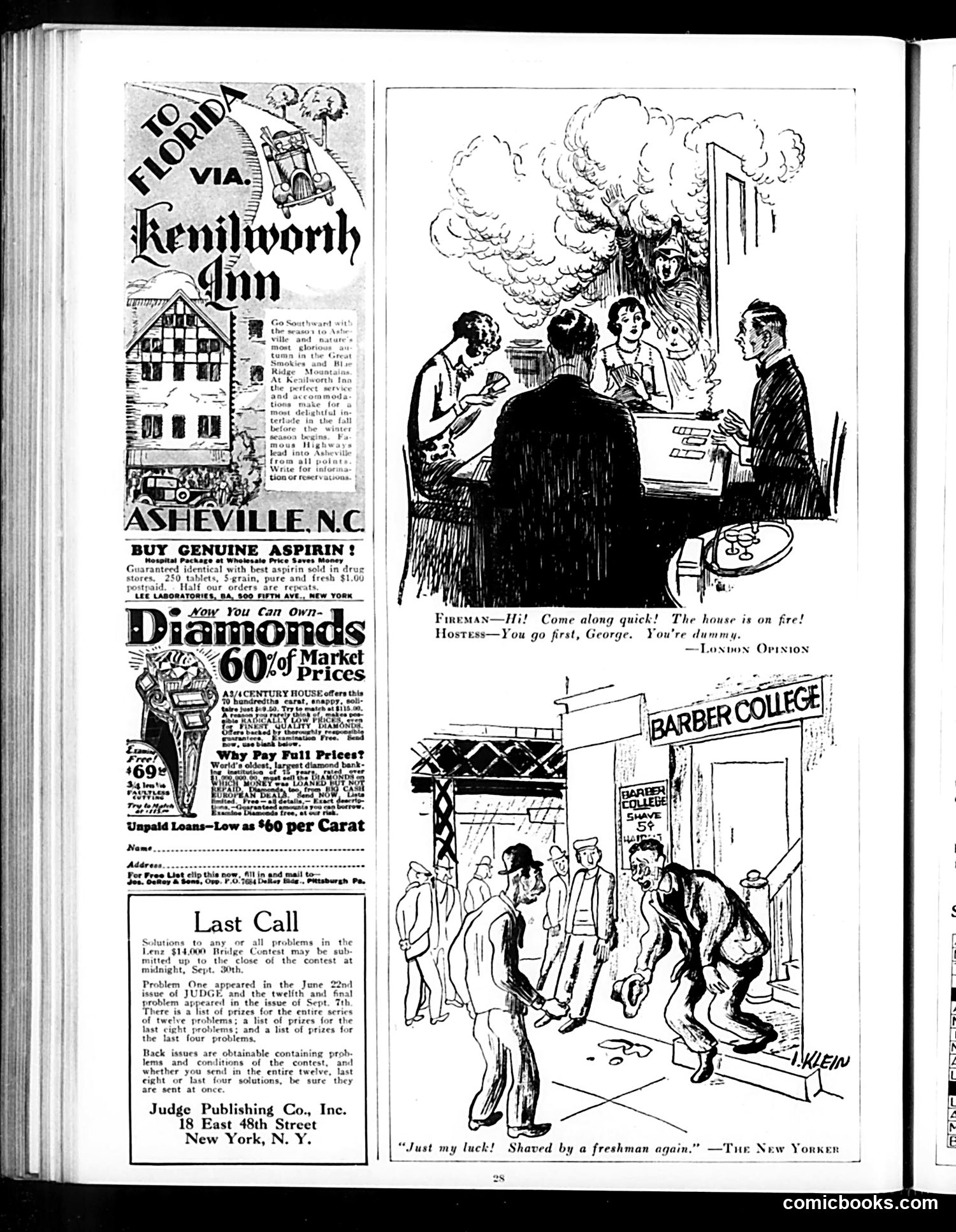
Analysis of Judge Magazine Page This page contains two cartoons satirizing everyday situations: Top cartoon ("London Opinion"): A fireman and hostess at a social gathering discuss an emergency. The hostess tells her husband George to evacuate first because "You're dummy"—a reference to the card game bridge, where one player's hand is exposed and called "the dummy." The joke equates his role at the party with being literally expendable, mocking masculine vanity and social hierarchy in upper-class settings. Bottom cartoon (attributed to The New Yorker): A barber college storefront shows a mishap—a customer's head appears misshapen after a shave by a trainee barber. The caption "Just my luck! Shaved by a freshman again" jokes about receiving incompetent service from inexperienced trainees, reflecting period anxiety about cutting corners or patronizing discount establishments with untrained workers. Both rely on mild social humor typical of 1920s-era magazines targeting educated readers. The surrounding ads (Kenilworth Inn, aspirin, diamonds) indicate the magazine's middle-to-upper-class audience.
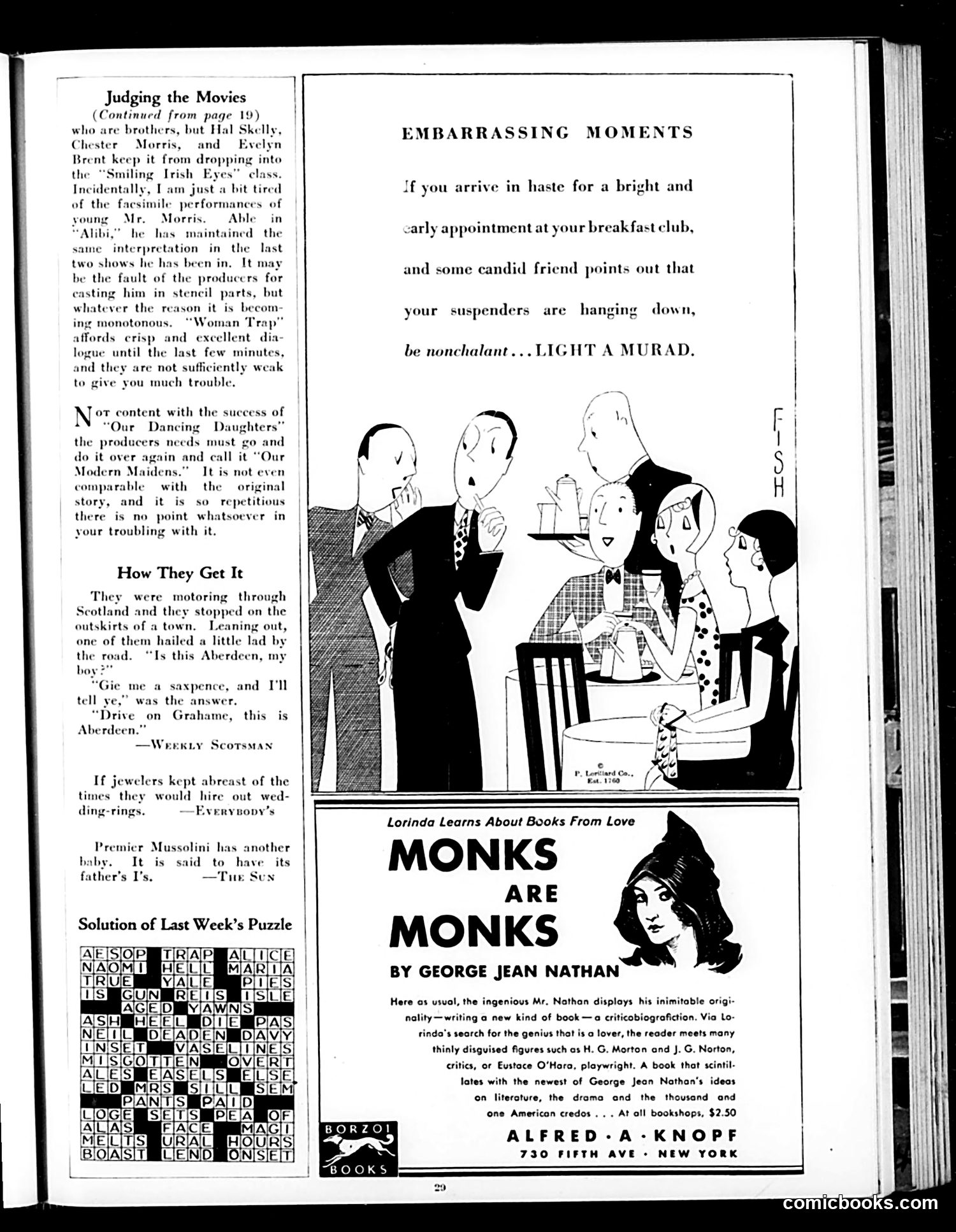
"Embarrassing Moments" Cartoon Analysis This cartoon satirizes masculine vanity and the emerging consumer culture of the 1920s. The scene depicts a breakfast club (a social gathering spot for businessmen) where a man's suspenders have slipped down—a mortifying wardrobe malfunction in an era when proper dress was strictly enforced. The joke's punchline: rather than discreetly fix the problem, the man should casually light a Murad cigarette (an advertisement for this brand), implying that smoking provides such sophisticated composure that the embarrassment becomes irrelevant. The satire mocks both masculine insecurity about appearance and advertising's absurd promises that consumer products can resolve social anxiety. The illustration's other vignettes show shocked onlookers at the breakfast table, emphasizing the public shame of the moment—exactly the vulnerability advertisers exploited to sell cigarettes as tools of social confidence.
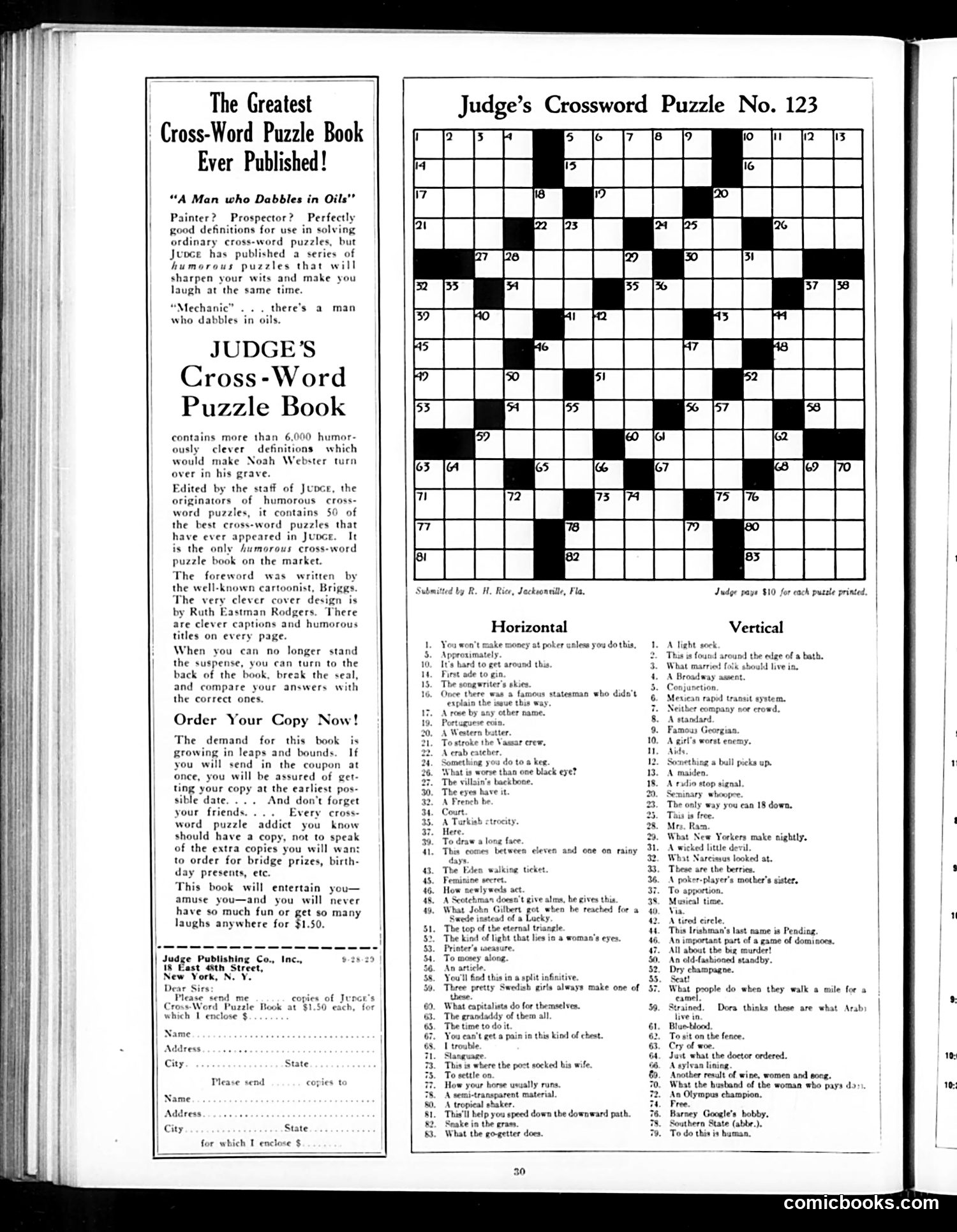
Judge Magazine Page Analysis This page is primarily advertising and a crossword puzzle, not a political cartoon. The left side promotes Judge's new "Cross-Word Puzzle Book"—a collection of 50 humorous crossword puzzles with clever, joke-based definitions rather than standard dictionary definitions. The book costs $1.50 and includes a foreword by cartoonist Briggs and cover design by Ruth Eastman Rodgers. The right side displays Puzzle No. 123 itself, with both horizontal and vertical clues that are intentionally humorous and punny rather than serious. Examples include "A man who dabbles in oils" (Mechanic) and references to contemporary life (poker, Vassar, Lucky Strikes). This represents Judge's expansion into entertainment merchandise during the 1920s-30s, capitalizing on the era's crossword puzzle craze. The humor relies on wordplay and domestic/social references typical of the period, but contains no political satire or caricature.
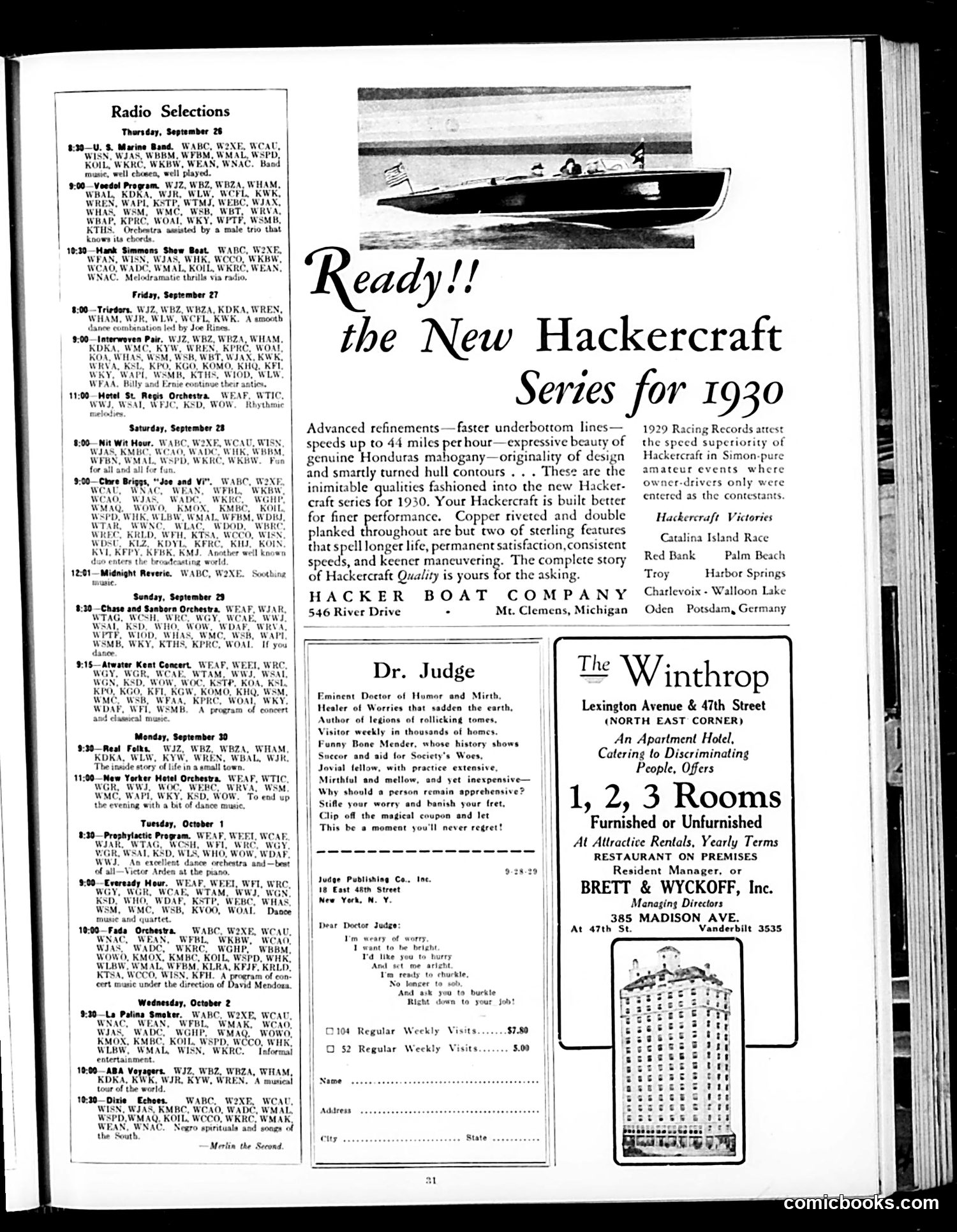
Content Analysis This page is primarily advertising and radio programming, not political satire. The main content consists of: 1. Radio Selections: A detailed weekly schedule (September 26-October 2) listing radio programs across numerous stations (WABC, WJZ, etc.), typical of 1930s broadcasting guides. 2. Hackercraft Boat Advertisement: A large ad featuring a speedboat, promoting the "New Hackercraft Series for 1930" with technical specifications (44 mph, mahogany construction, copper riveting). This represents luxury recreational boating for affluent consumers during the Depression era. 3. The Winthrop Hotel Advertisement: Promoting upscale apartment rentals in Manhattan (Lexington Avenue & 47th Street). 4. Dr. Judge Column: A partial advice column addressing personal concerns. The page contains no political cartoons or satirical commentary—it's a typical Judge magazine page mixing entertainment listings with high-end consumer advertising, reflecting 1930 leisure and luxury markets.
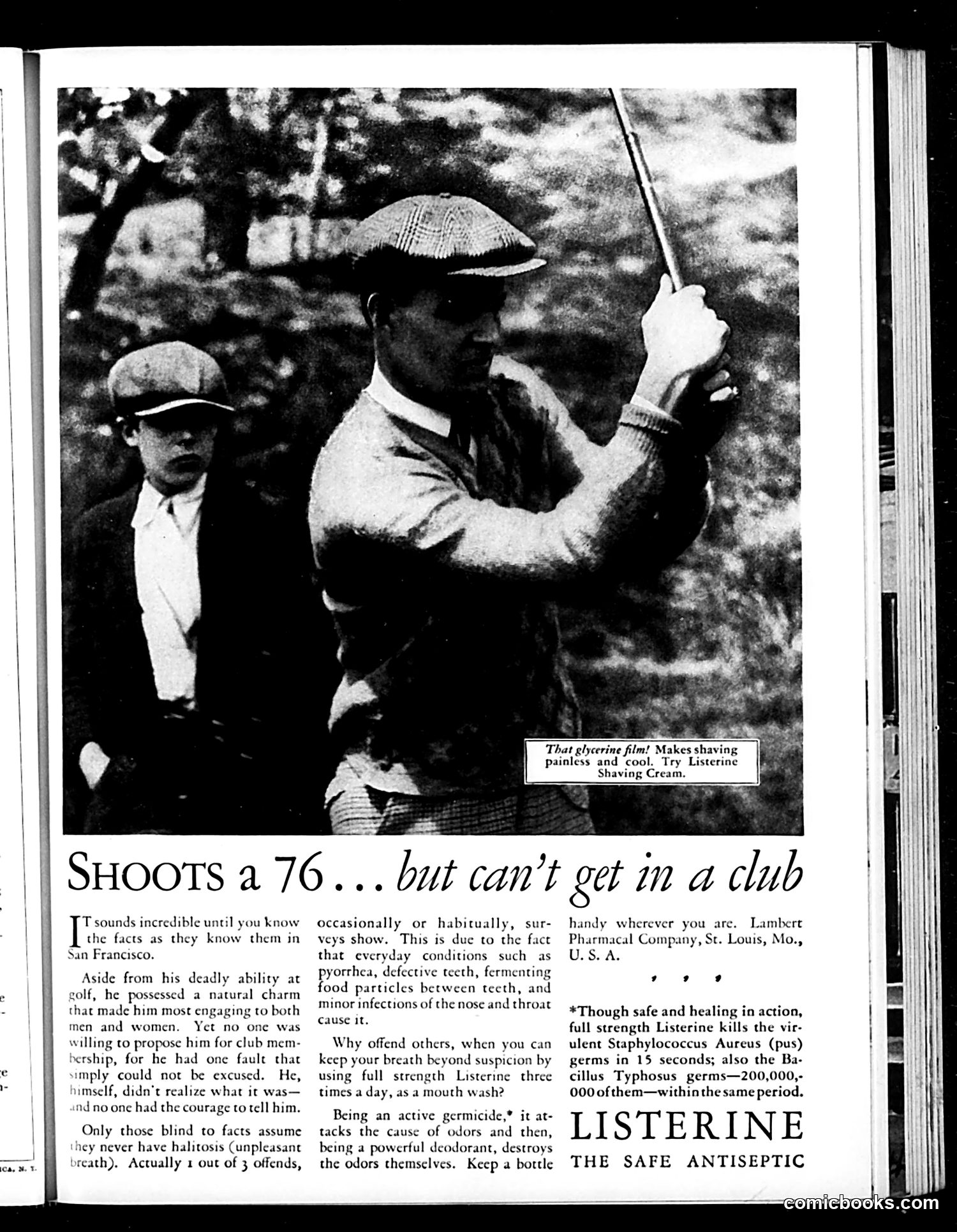
Judge Magazine Advertisement Analysis This is primarily a Listerine mouthwash advertisement disguised as satirical commentary. The "cartoon" depicts two golfers—one excellent (shoots 76, an impressive golf score) but socially excluded from club membership due to halitosis (bad breath). The satire targets early 20th-century social anxiety and class consciousness: a man's golf skill and charm cannot overcome this single "fault" that polite society won't even mention directly. The ad exploits shame and social aspiration—the unstated fear that ordinary conditions (poor dental hygiene, food particles, infections) make one an unwitting social pariah. The joke's "logic" is that Listerine, as a germicide and deodorant, solves this unspoken problem, allowing the golfer entry to exclusive clubs. It's characteristic of vintage advertising that weaponized social insecurity to sell products, particularly during the 1920s-30s when "halitosis" became a newly marketed medical concern.
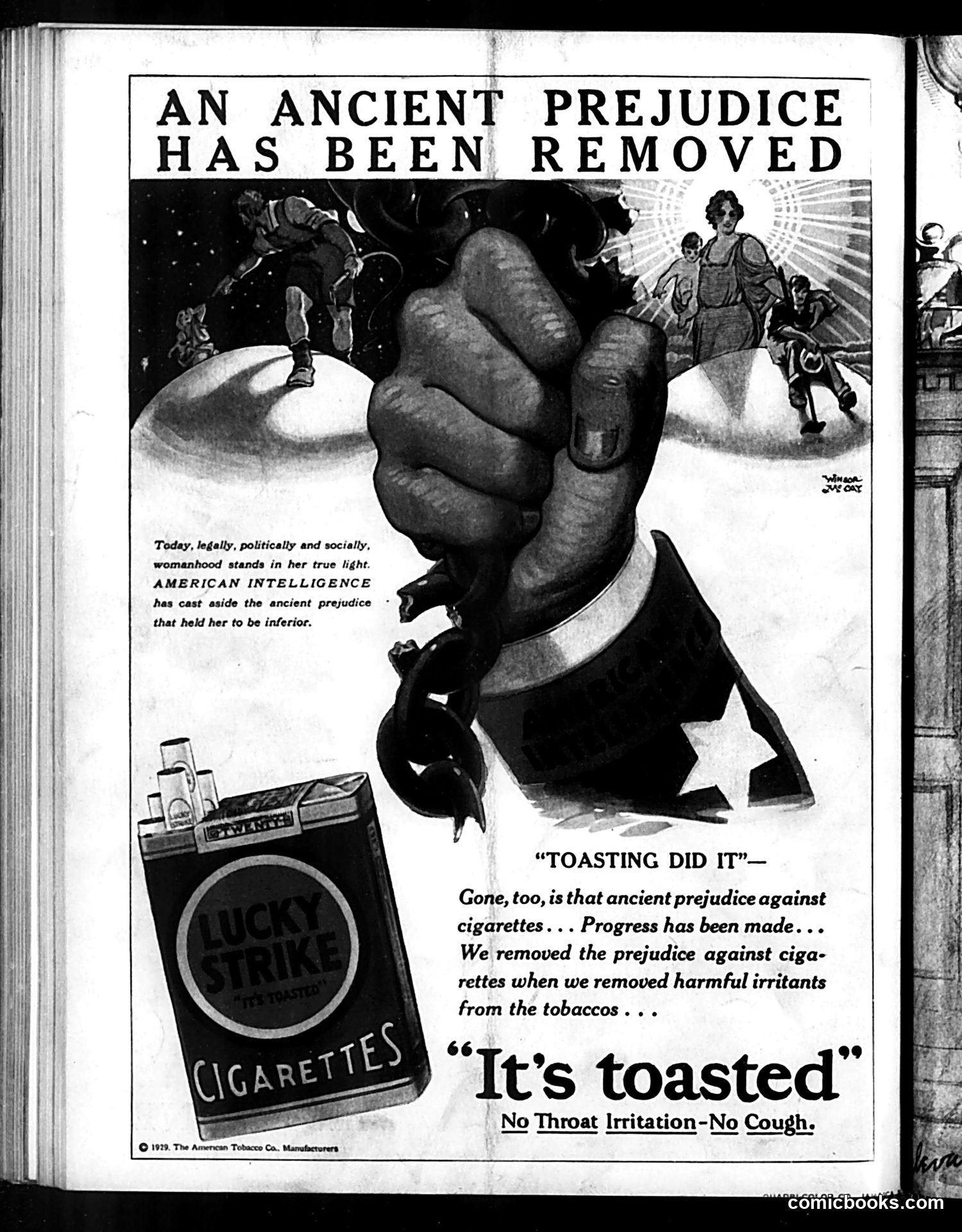
Analysis: Lucky Strike Cigarette Advertisement This is a cigarette advertisement, not political satire. It's a 1929 Lucky Strike ad exploiting women's liberation rhetoric. The imagery shows a giant hand holding a cigarette, surrounded by vignettes depicting women in traditionally male roles (military, professional work). The text draws a false equivalence: just as "American intelligence" removed prejudice against women, Lucky Strike claims to have removed harmful irritants from tobacco by "toasting" it. The satire here is unintentional—or rather, it's the advertiser's satire *of* progress itself. By comparing cigarette safety claims to women's rights, the ad trivializes genuine social advancement. The "toasting" claim was Lucky Strike's actual marketing innovation, but framing it alongside women's equality is absurdly manipulative. For modern readers: this exemplifies how corporations co-opted feminist language while making dubious health claims—a practice that continues today.