judge
Judge — October 5, 1929
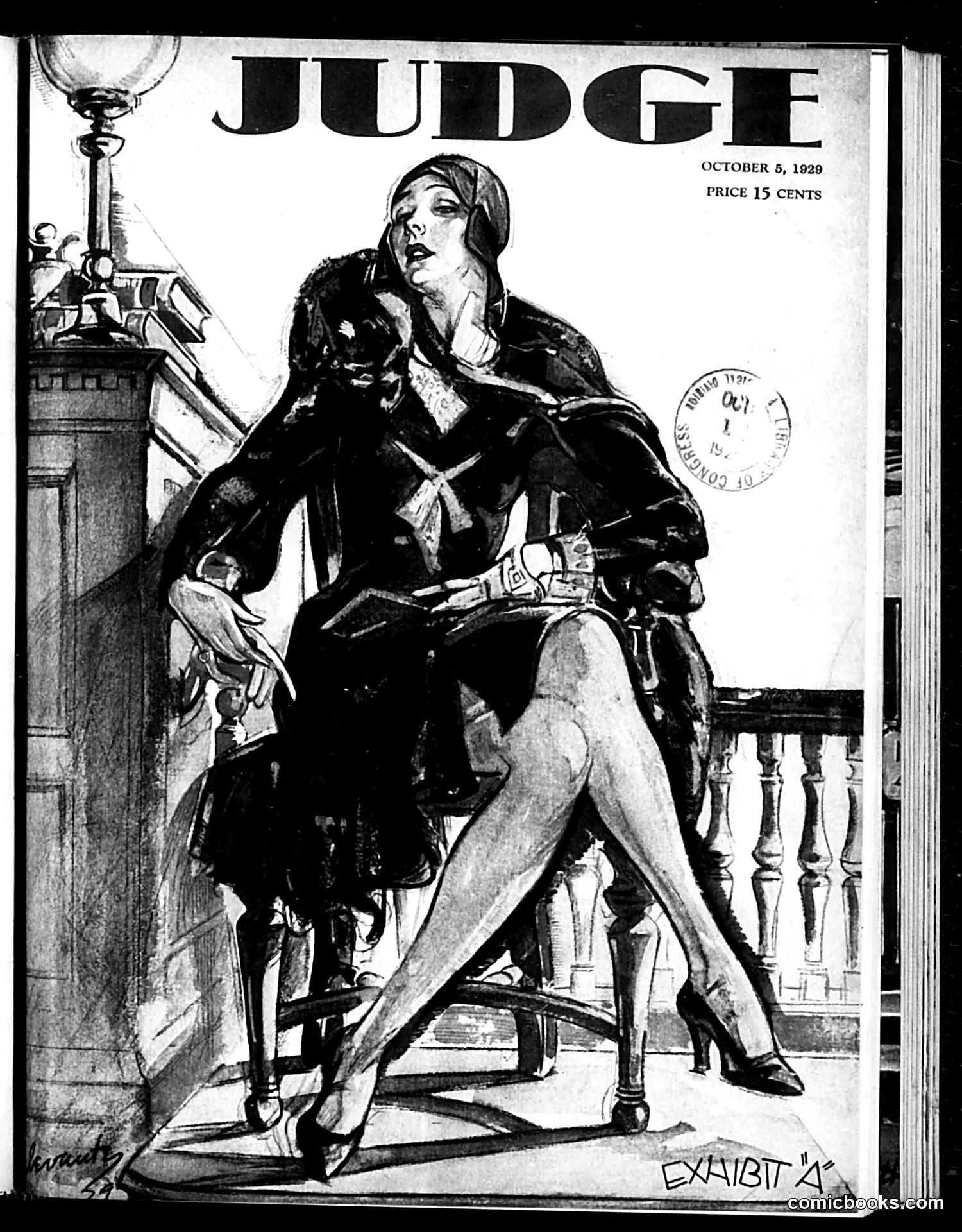
Judge Magazine Cover Analysis - October 5, 1929 This cover depicts a fashionable woman in 1920s attire (cloche hat, short hemline, heeled shoes) seated on what appears to be a balcony or terrace overlooking a city. She gazes pensively skyward while holding a cigarette, dressed in an elegant dark coat. The satirical point likely concerns the "modern woman" of the Jazz Age — her newfound freedoms, independence, and social visibility. The pensive expression and upward gaze suggest contemplation or aspiration, possibly satirizing women's ambitions or social expectations during this era of rapid cultural change. The publication date (October 5, 1929) is just days before the stock market crash, though the cover's relevance to that event remains unclear without additional context.
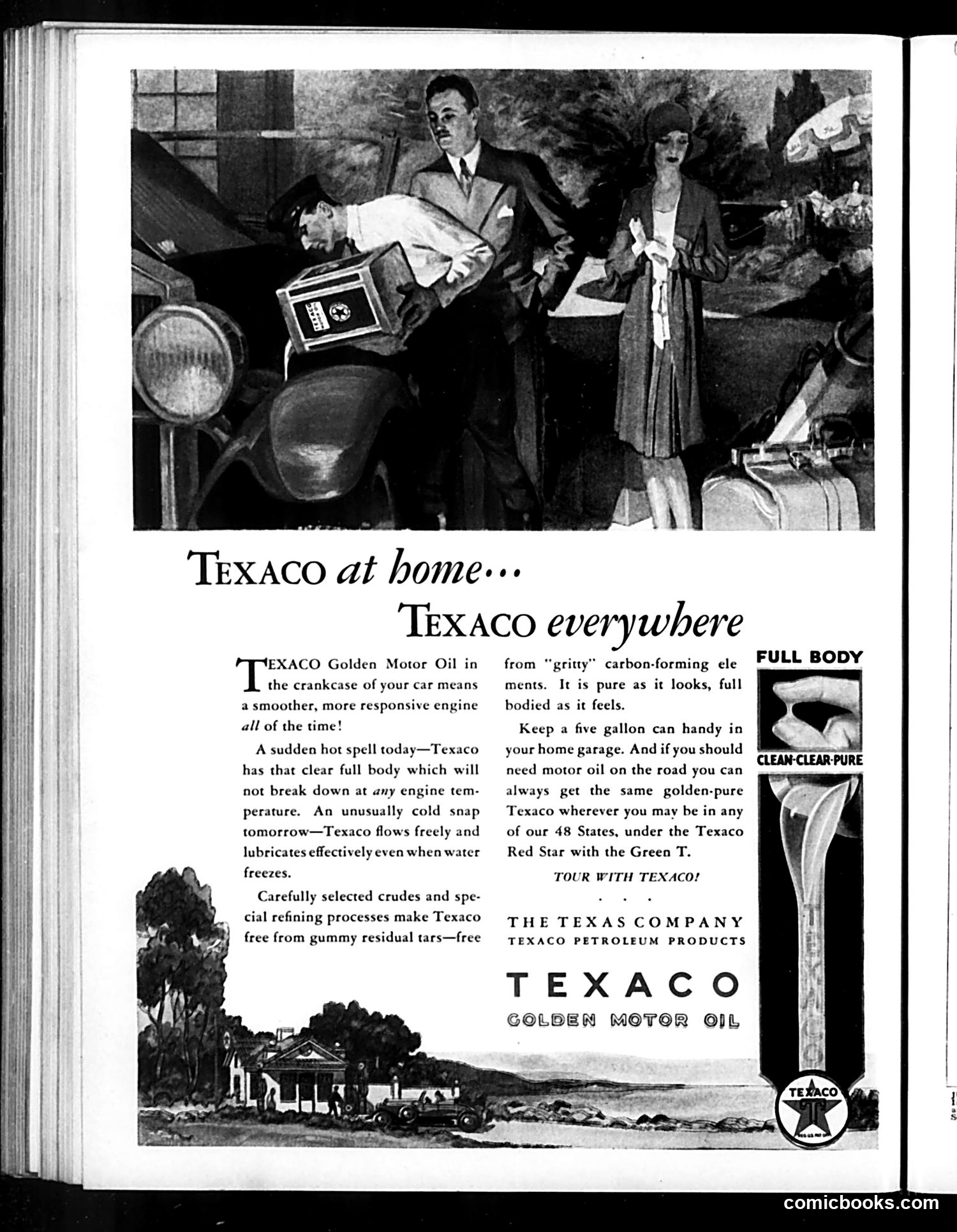
Analysis This page is primarily an advertisement for Texaco Golden Motor Oil, not political satire. The image shows a domestic scene with well-dressed figures (a man in a suit holding what appears to be a portrait, a woman in 1920s-style clothing, and others) near an automobile, illustrating the product's use "at home" and "everywhere." The advertisement emphasizes Texaco's reliability across all temperatures and its availability nationwide through their Red Star with Green T logo. The "Full Body" diagrams on the right showcase the oil's purity and quality. While *Judge* was satirical, this particular page contains no political commentary or caricature—it's straightforward product marketing positioned within the magazine's pages.
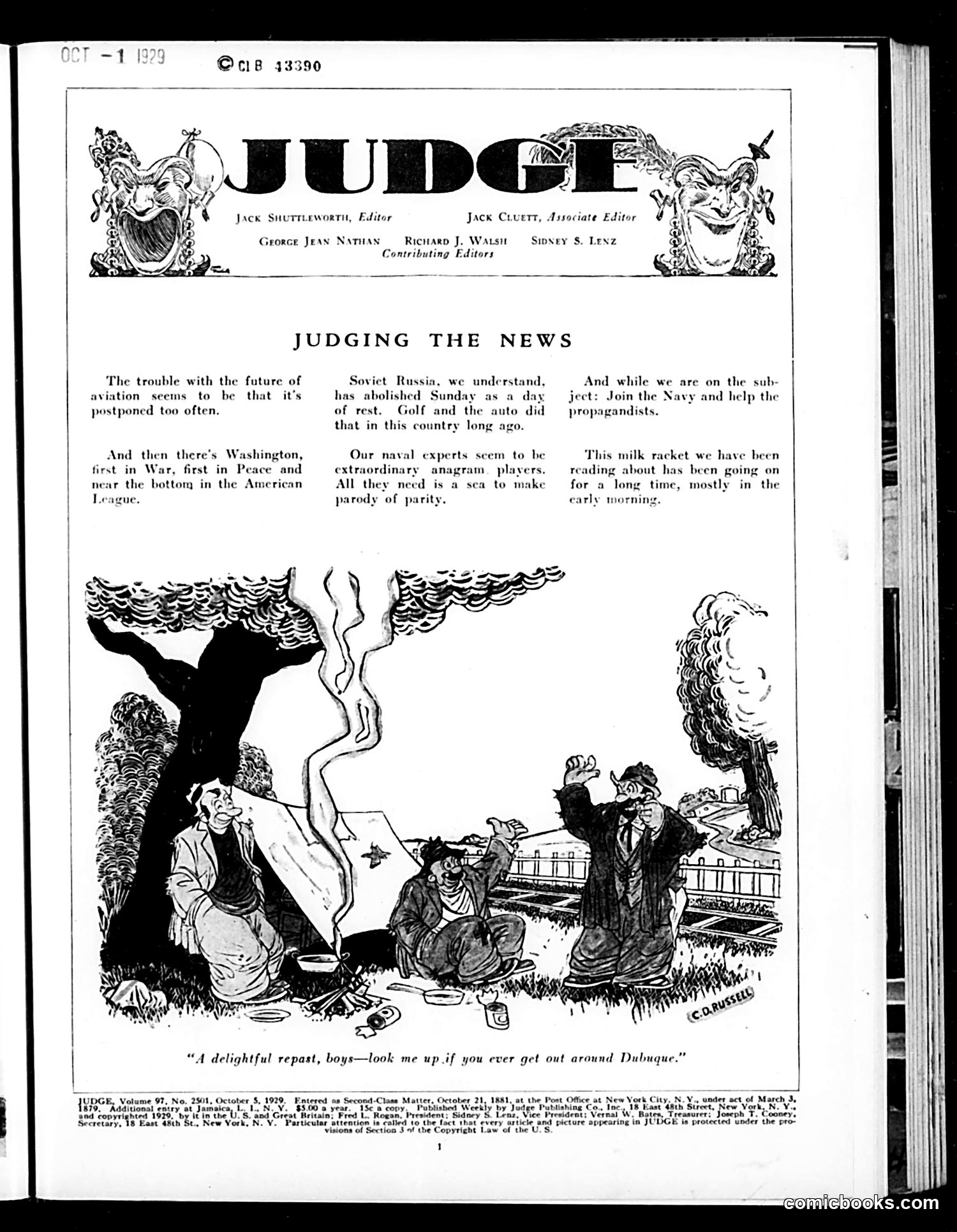
"Judging the News" - October 1, 1929 This editorial cartoon page satirizes current events through brief commentary and illustration. The main cartoon depicts homeless or poor people camped outdoors near what appears to be Washington, D.C. buildings, with the caption "A delightful repast, boys—look me up if you ever get out around Dubuque." The accompanying text mocks various topics: aviation delays, Washington's status in American League baseball standings, Soviet Russia's abolition of Sunday rest days, naval officers' abilities, and a "milk racket" scandal. The cartoon likely critiques economic conditions and government indifference to poverty, though the specific historical context is somewhat unclear without additional sourcing. The date (October 1, 1929) places this just before the stock market crash.
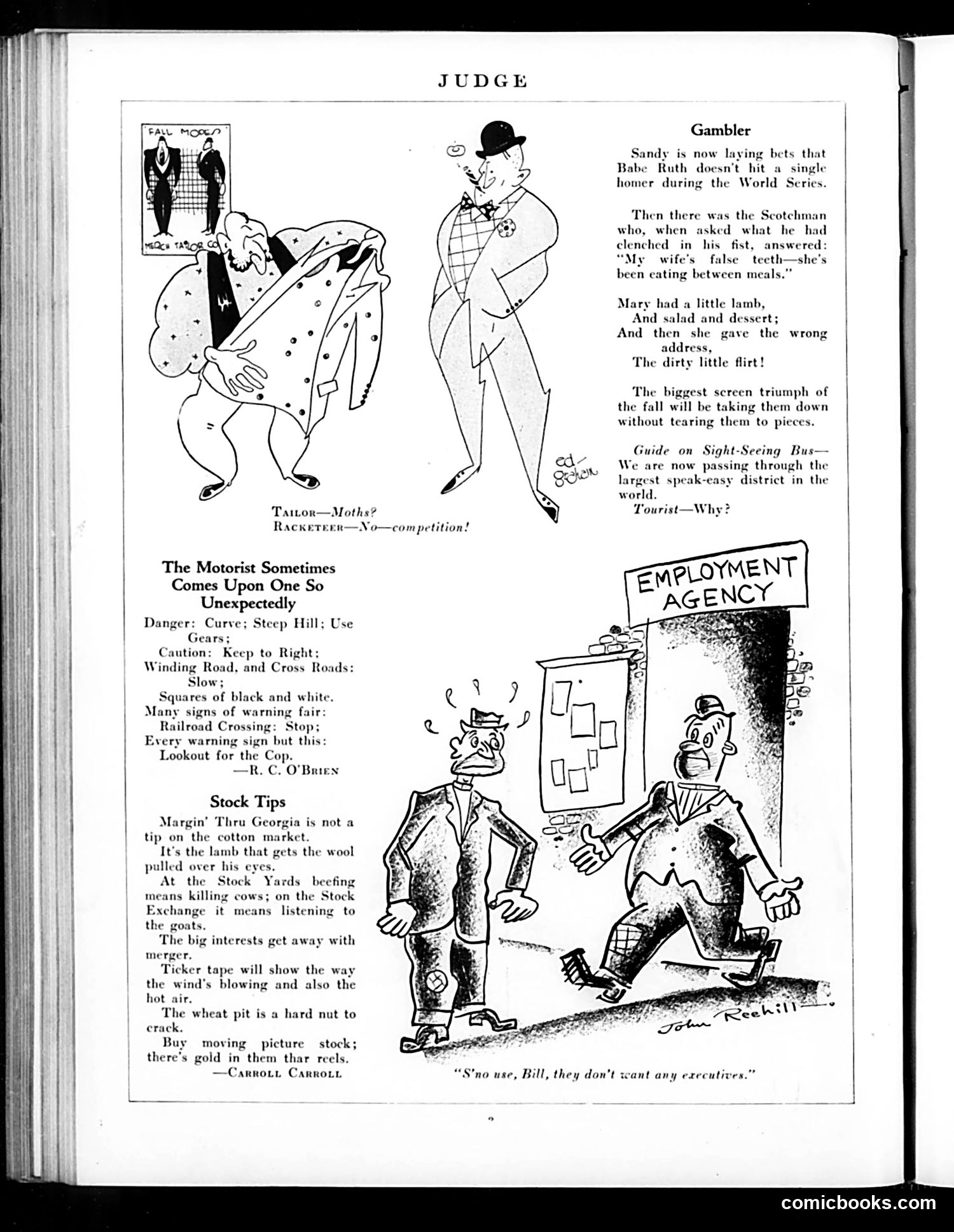
Judge Magazine Page Analysis This page contains satirical humor about 1920s-era topics: Top cartoon: A tailor and heckler joke about moths eating clothes—likely referring to post-WWI fabric scarcity or rationing concerns. "Gambler" section: Jokes about Babe Ruth and the World Series, a Scotsman's false teeth, and "Mary" with a lamb. These reference contemporary celebrities and nursery-rhyme humor popular in the era. "Motorist" section: Driving safety warnings, suggesting early automobile culture anxieties about accidents and traffic dangers. Employment Agency cartoon (bottom): A man desperate for work approaches an agency, while the caption "So no use, Bill, they don't want any executives" suggests Depression-era unemployment and the difficulty of finding jobs even for skilled workers—likely reflecting 1920s economic instability. The page blends celebrity gossip, driving humor, and socioeconomic commentary typical of Judge's satirical approach.
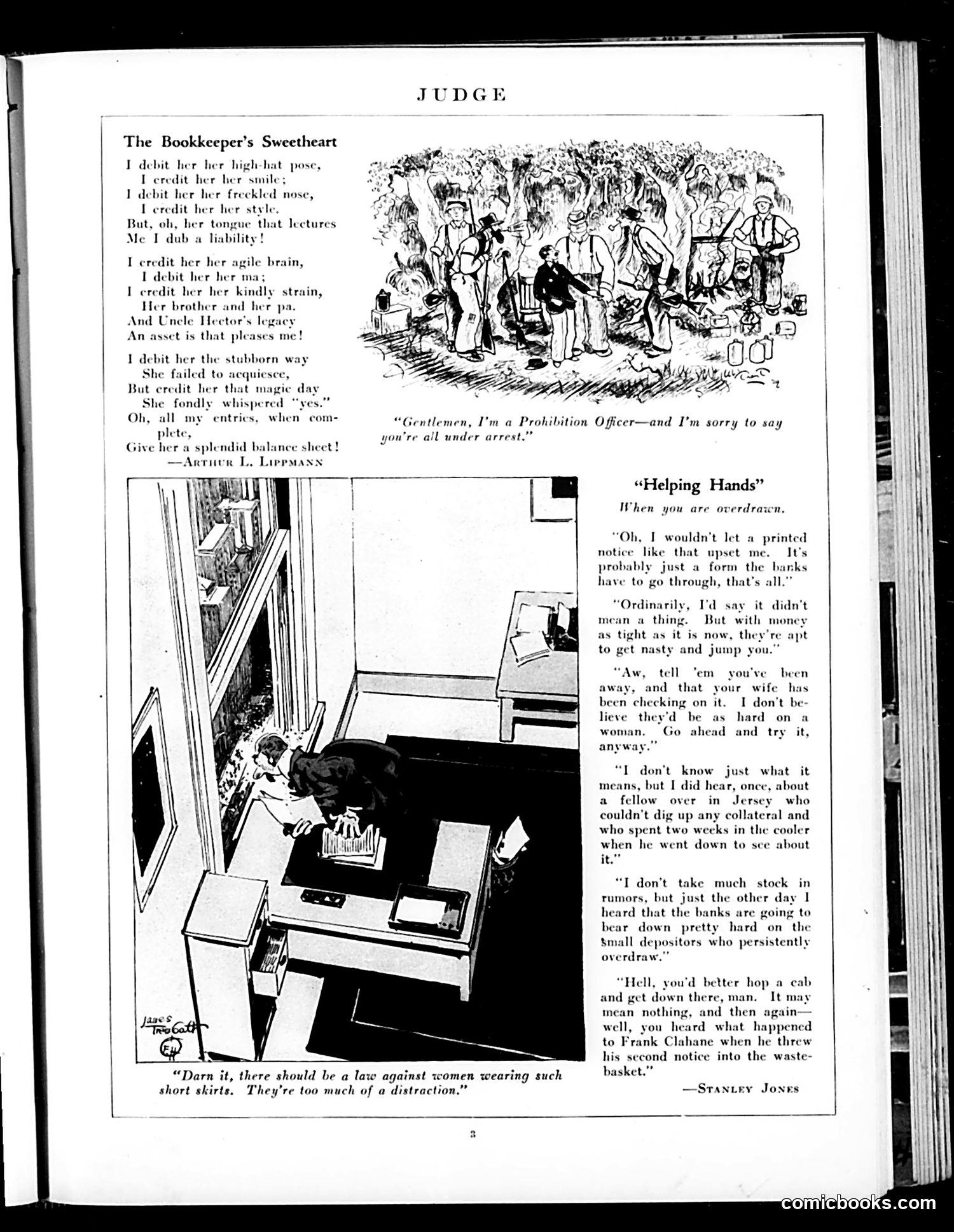
Analysis of Judge Magazine Page This page contains two distinct pieces: "The Bookkeeper's Sweetheart" (top left): A poem by Arthur L. Lippmann praising a bookkeeper's romantic interest, crediting her with various positive qualities while humorously noting her tongue "lectures / Me like a bubble!" "Helping Hands" (right): A dialogue between an overdrawn bank customer and a banker. The customer claims ignorance about overdraft consequences, while the banker warns of banks "getting nasty" with persistent small depositors. References mention a "Frank Clahane" throwing a "notice into the waste basket," suggesting the dialogue satirizes banking practices and customer-banker tensions during what appears to be an economic strain period. Bottom cartoon: Shows a woman at a desk; the caption by Stanley Jones satirizes women's fashion, joking that short skirts are a workplace distraction requiring legal prohibition.
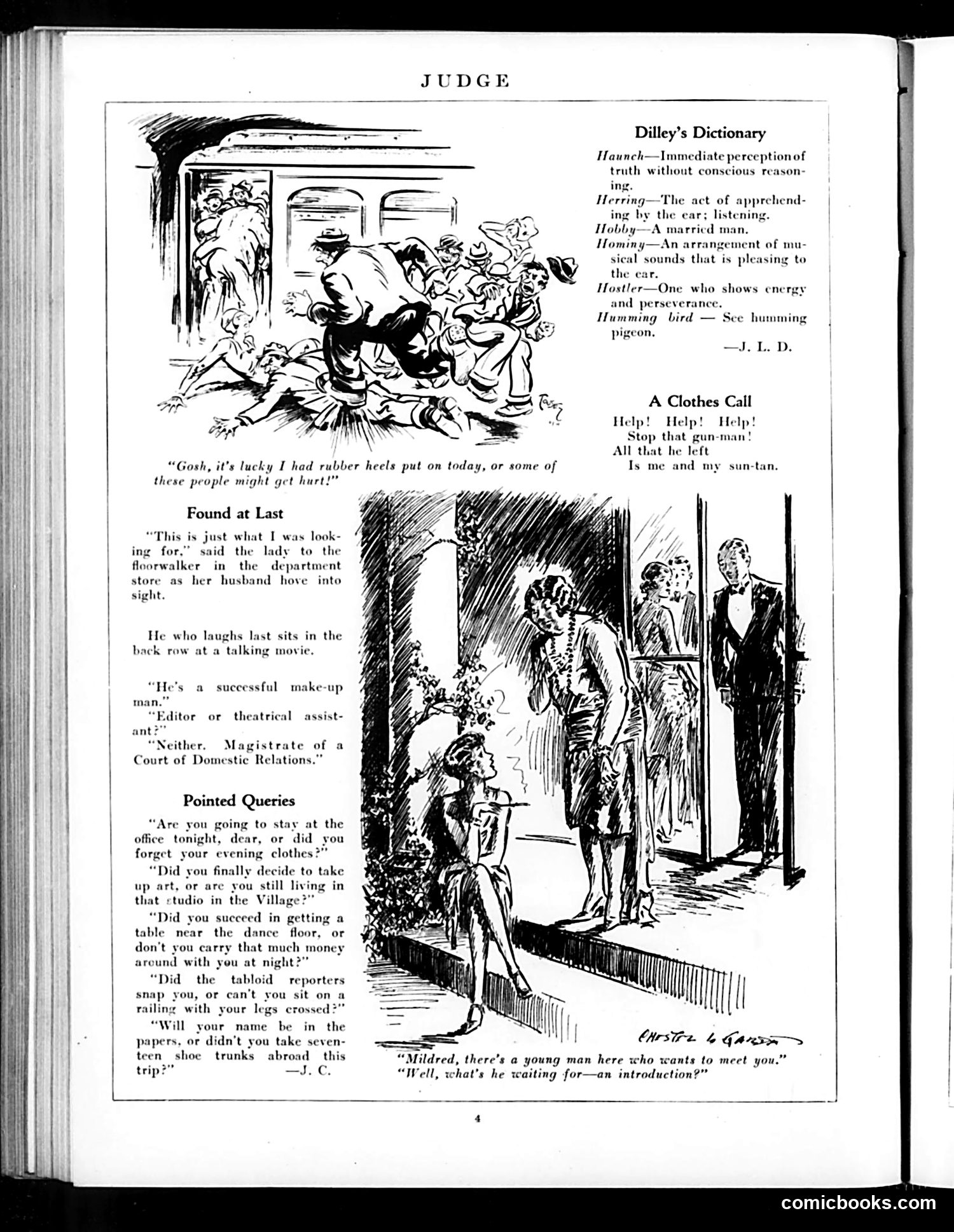
Analysis of Judge Page This page contains three distinct humor sections: "Gosh, it's lucky I had rubber heels..." depicts a chaotic street scene where a man's sudden stop (due to rubber heels) prevents pedestrians behind him from colliding with him. The joke plays on practical fashion solving social problems. "Found at Last" offers sardonic definitions of common types—the successful makeup man, the theatrical editor, and a magistrate specializing in divorce cases. These are gentle social commentary on contemporary professions. "A Clothes Call" appears to be a brief humorous poem about someone stripped of possessions. The main cartoon shows a well-dressed couple greeting a young man at their doorway. The caption suggests he's seeking an introduction to "Mildred," implying he's a suitor or social climber. The satire likely targets dating customs or social pretension of the era.
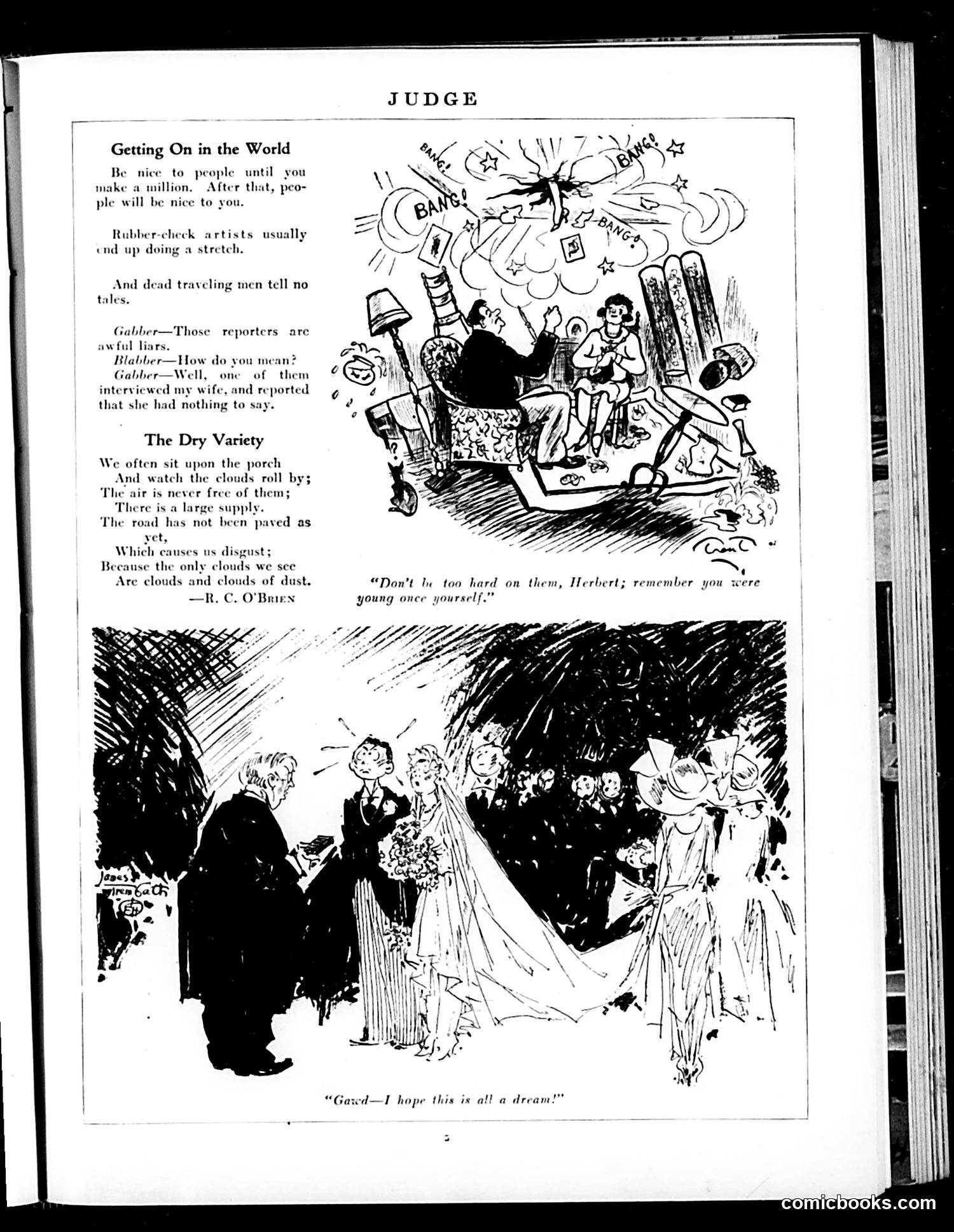
Judge Magazine Page Analysis This page contains two distinct cartoons and some aphoristic text. The top cartoon depicts children playing with toy cannons and explosions, captioned "Don't be too hard on them, Herbert; remember you were young once yourself." This appears to be social commentary about parental discipline and youthful mischief—likely cautioning parents against excessive punishment. The bottom cartoon shows a formal wedding scene with the bride's dramatic train, captioned "Gawad—I hope this is all a dream!" This satirizes anxious grooms or the overwhelming nature of formal weddings, a timeless humor target. The left column contains brief humorous observations about social behavior: being nice to people before success, artists' physical toll, and traveling salesmen. These are generic satirical observations rather than references to specific events or political figures.
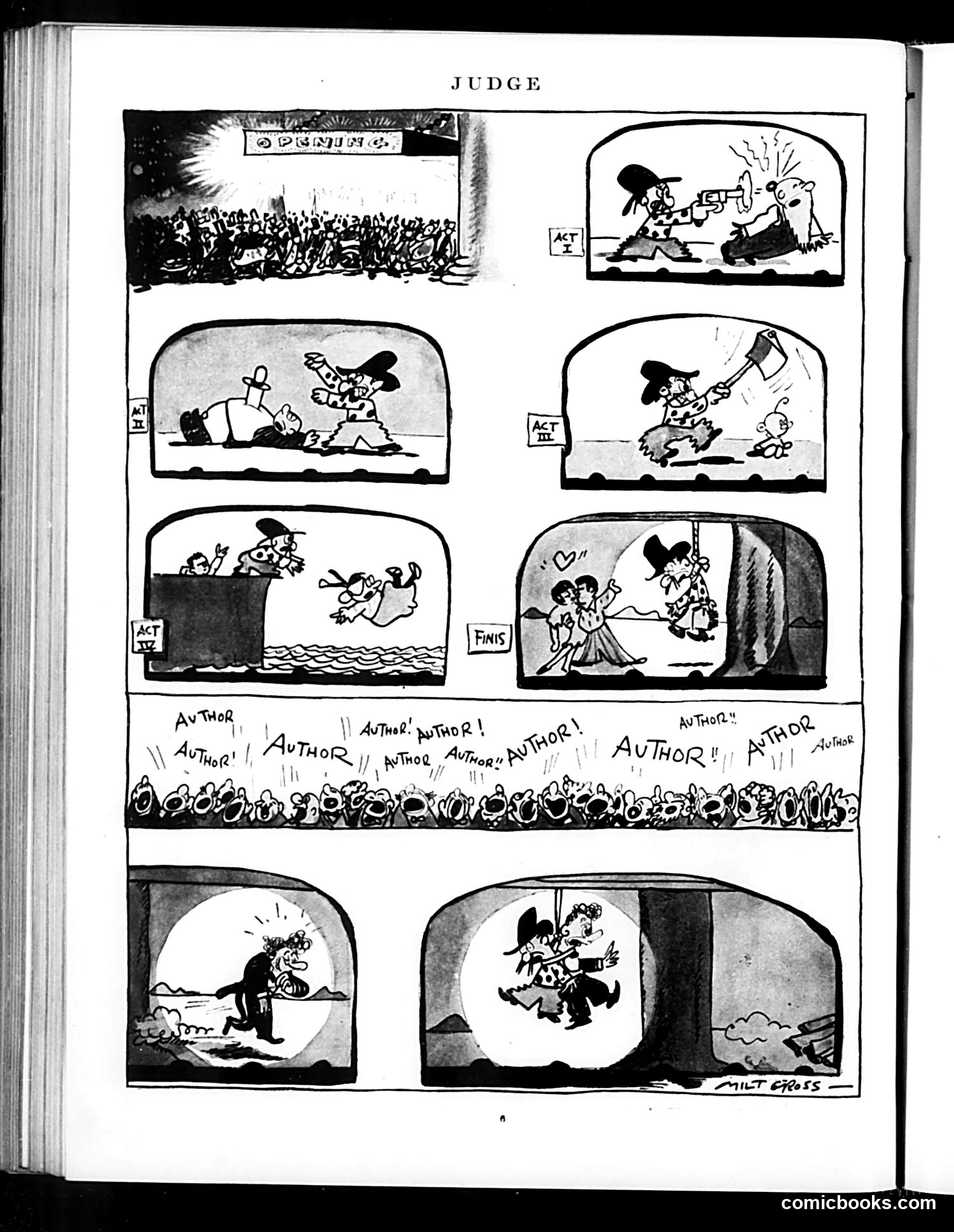
Judge Magazine: "Judge" Comic Strip Analysis This appears to be a multi-act comic strip showing a theatrical performance. The narrative follows a character in a top hat (likely a theatrical figure or author) through various scenes: performing magic tricks, wielding an axe, and engaging in romantic or comedic situations. The strip culminates in a crucial panel where an audience demands "AUTHOR! AUTHOR!"—a common theatrical tradition where audiences call for the playwright to appear after a performance. The final panels show the author character appearing in spotlights, suggesting the strip satirizes theatrical vanity and the ego of playwrights who seek audience adulation. Without visible date or byline details, the specific production being lampooned remains unclear, though the satire targets showmanship and artistic pretension generally.
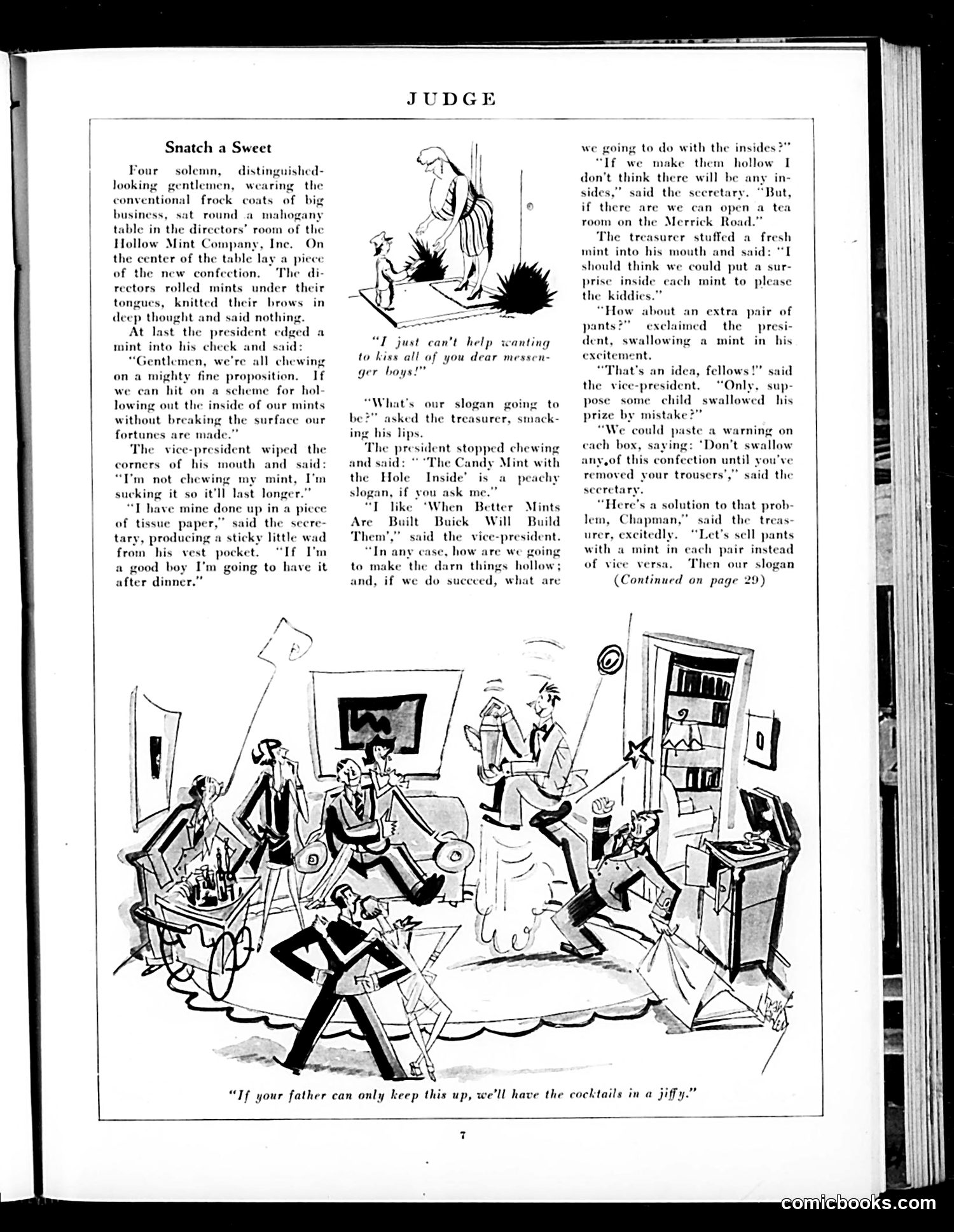
Analysis of "Snatch a Sweet" This satirical story mocks early 20th-century business culture and advertising excess. Four conventionally-dressed businessmen at the "Hollow Mint Company" debate how to market a new hollow mint candy, their schemes becoming increasingly absurd. The satire targets corporate buzzwords and slogans—they adopt advertising catchphrases like "When Better Mints Are Built, Buick Will Build Them" (parodying Buick's actual slogan). Their "solutions" grow ridiculous: selling pants alongside mints, pasting warnings about removing trousers, or opening a tea room to dispose of hollow interiors. The bottom cartoon shows a chaotic party scene, with the caption "If your father can only keep this up, we'll have the cocktails in a jiffy"—referencing Prohibition-era anxiety about maintaining illegal liquor supplies. The overall joke critiques how businessmen take trivial products seriously, applying grandiose marketing language and interconnected business schemes to something as simple as candy, reflecting Judge's skepticism toward corporate capitalism and consumerism.
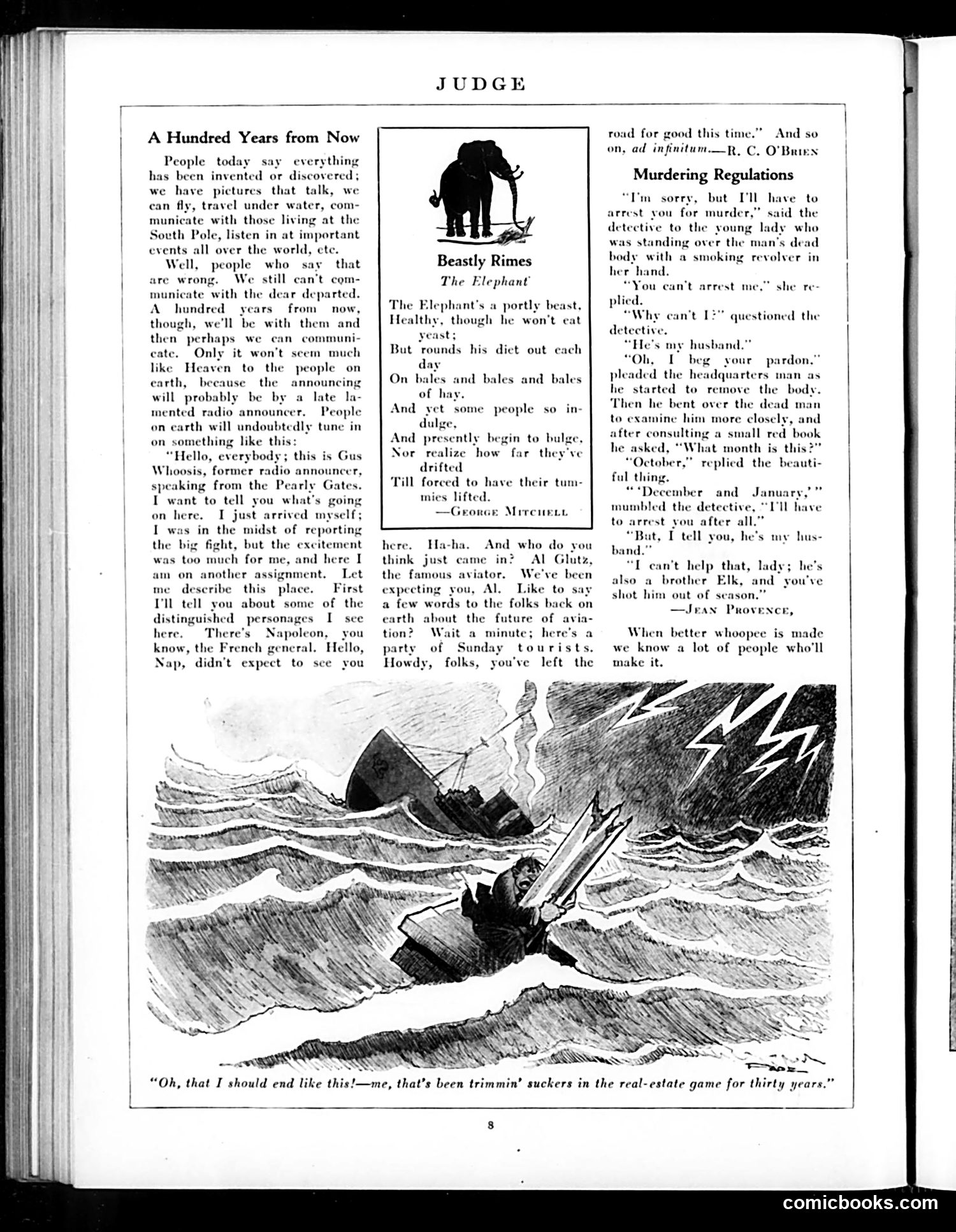
Satire in Judge Magazine This page contains three distinct satirical pieces: "A Hundred Years from Now" imagines future radio broadcasts from heaven, hosted by deceased announcer Gus Whoosis. The joke: humanity will advance technologically but remain fundamentally unchanged—even the afterlife will have commercialized radio. The reference to Napoleon and aviator "Al Glut" (likely Al Glaize, an early aviator) grounds the satire in contemporary figures. "Beastly Rimes: The Elephant" is a light verse mocking obesity and overconsumption—people indulging without realizing they've "drifted" until they need their stomachs reduced. "Murdering Regulations" satirizes bureaucratic absurdity. A woman shoots her husband, but when the detective consults regulations, he discovers she's only violated hunting season rules because the victim was an Elk Lodge member. The satire mocks rigid rule-following that misses moral substance. The large illustration shows a shipwreck victim commenting wryly on losing thirty years of real-estate profits—satirizing greed and materialism's ultimate futility.
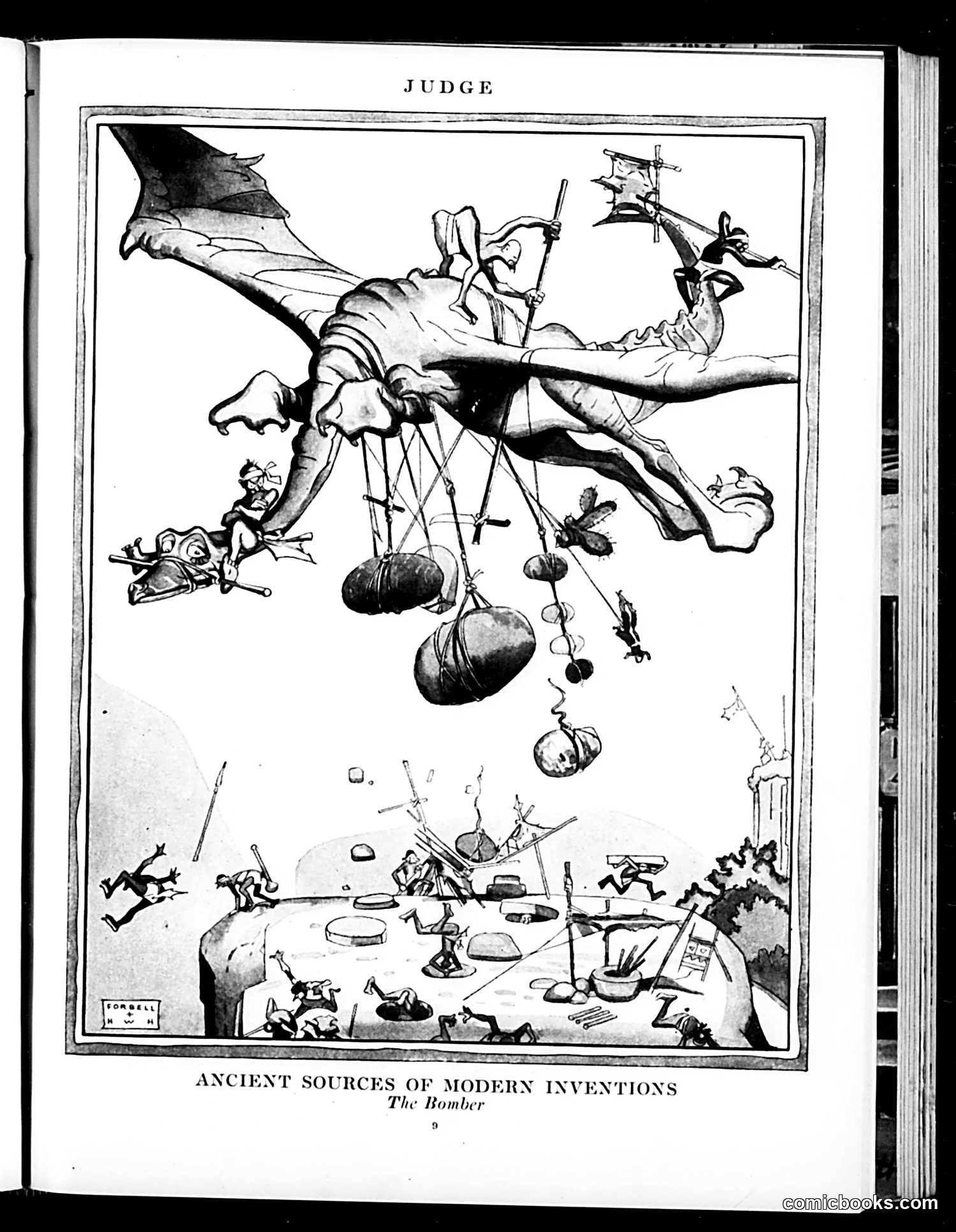
Analysis The page title reads "ANCIENT SOURCES OF MODERN INVENTIONS: The Bomber," presenting a satirical illustration labeled "JUDGE." The cartoon depicts a giant figure (representing a judge or authority) suspended in air, juggling bombs and weapons while holding a sword and flag. Below, on ground level, tiny figures scatter in panic amid explosions and destruction. The satire appears to critique judicial or governmental authority as recklessly dangerous—suggesting those in power carelessly "juggle" weapons and bombs that devastate ordinary people below. The contrast between the elevated, detached figure above and the panicked civilians below emphasizes how distant leadership makes decisions affecting common people catastrophically. The "ancient sources" framing suggests this commentary on weaponry and judicial indifference has deep historical roots, critiquing timeless patterns of power misuse.
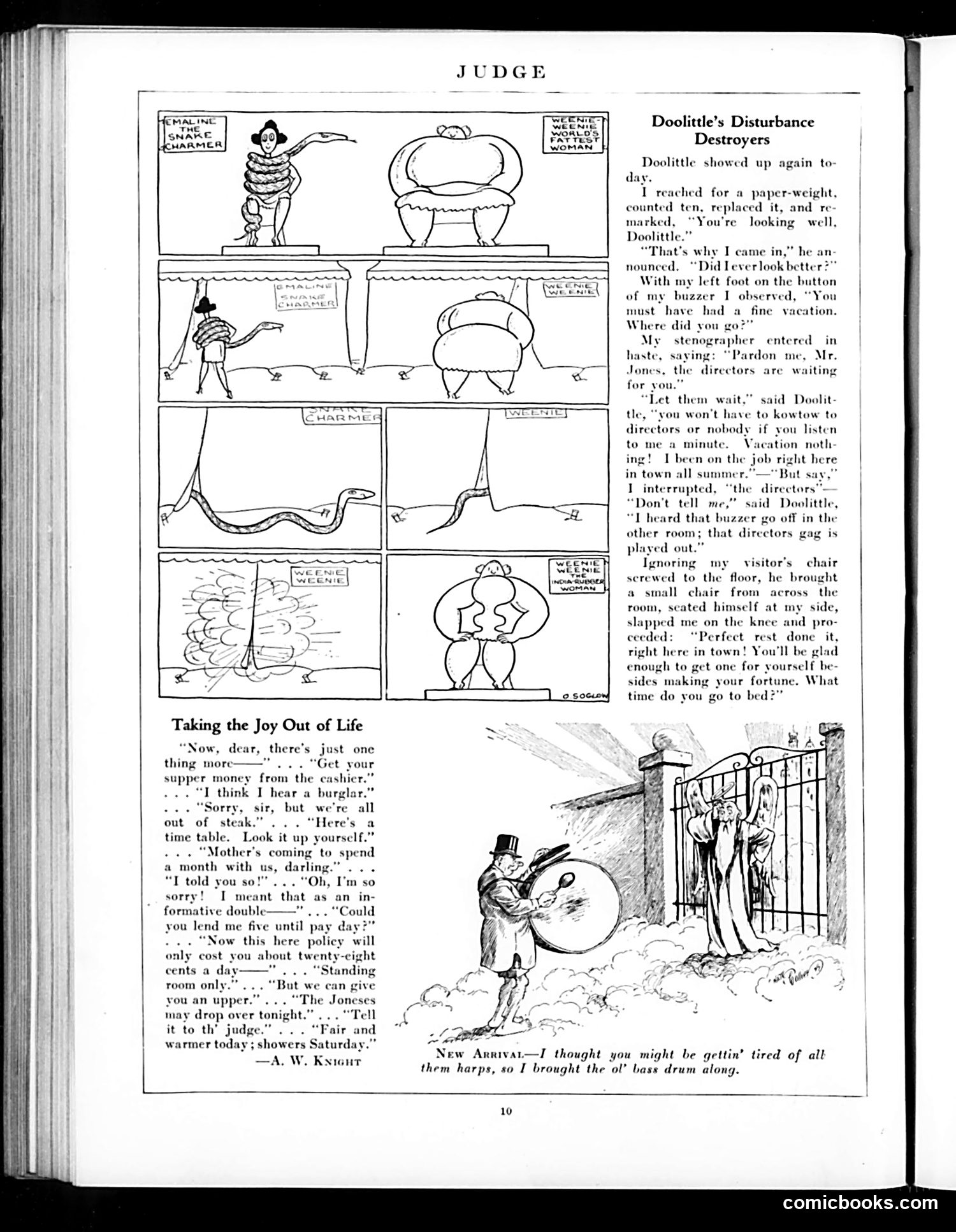
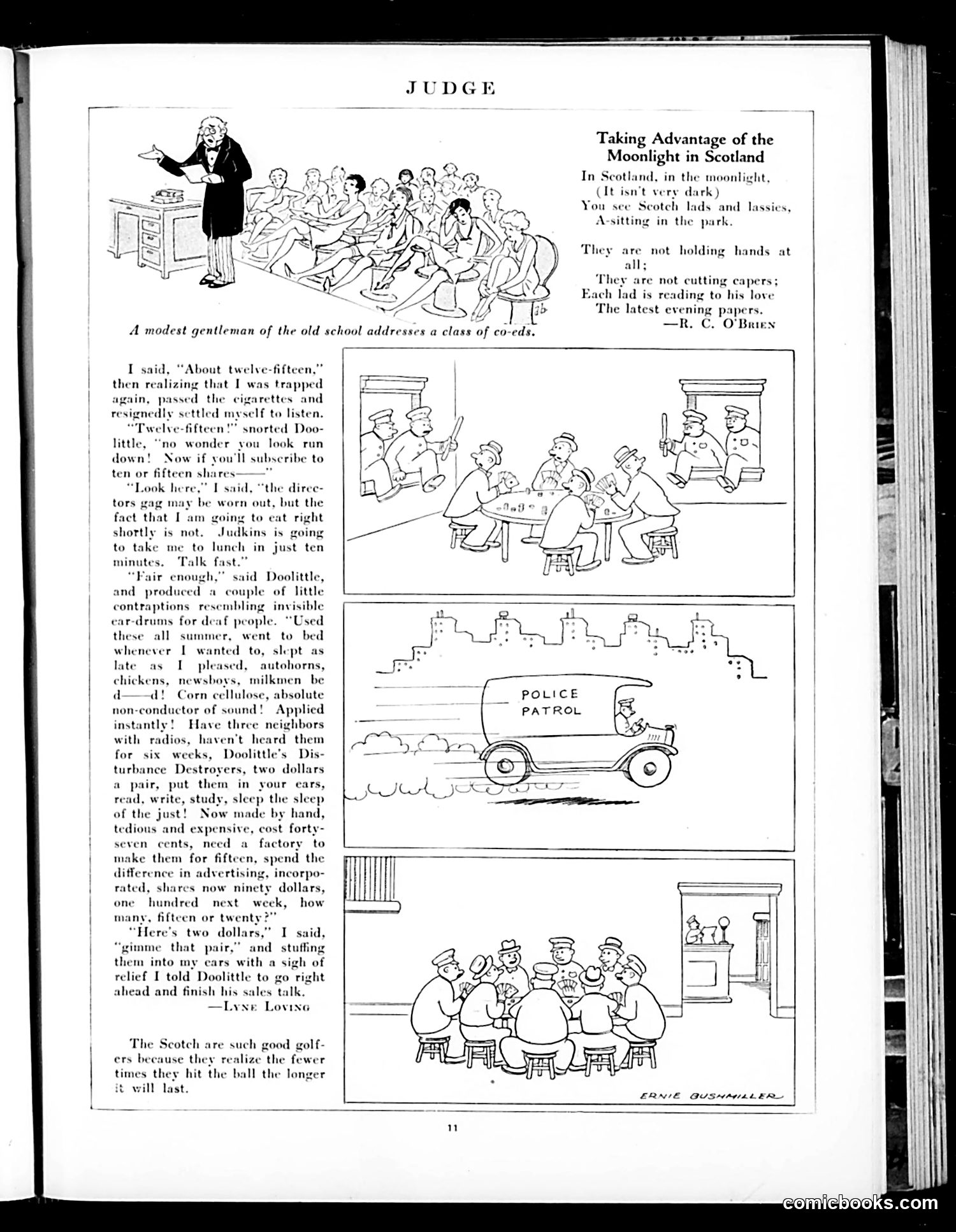
Page Analysis: Judge Magazine Satire This page contains two distinct satirical pieces: Left side ("Judge"): A humorous sales pitch story by Lyne Levine. A character named Doolittle pitches "Doolittle's Disturbance Destroyers"—fake ear devices supposedly blocking noise from car horns, chickens, and newsboys. The satire targets aggressive 1920s salesmanship: Doolittle uses high-pressure tactics and speculative stock schemes ("shares now ninety dollars, one hundred next week"). The joke critiques both the charlatan inventor and the gullible investor. Right side: A poem by R.C. O'Brien mocking Scottish frugality. It observes Scottish couples in moonlight parks reading evening newspapers rather than engaging in romantic physical affection—the implication being they're penny-pinchers prioritizing free entertainment over romance. The closing quip about Scottish golfers ("the fewer times they hit the ball the longer it will last") reinforces the stereotype of Scottish stinginess as the page's running theme. Both pieces reflect 1920s American attitudes: skepticism toward salesmen and ethnic stereotyping of Scots.
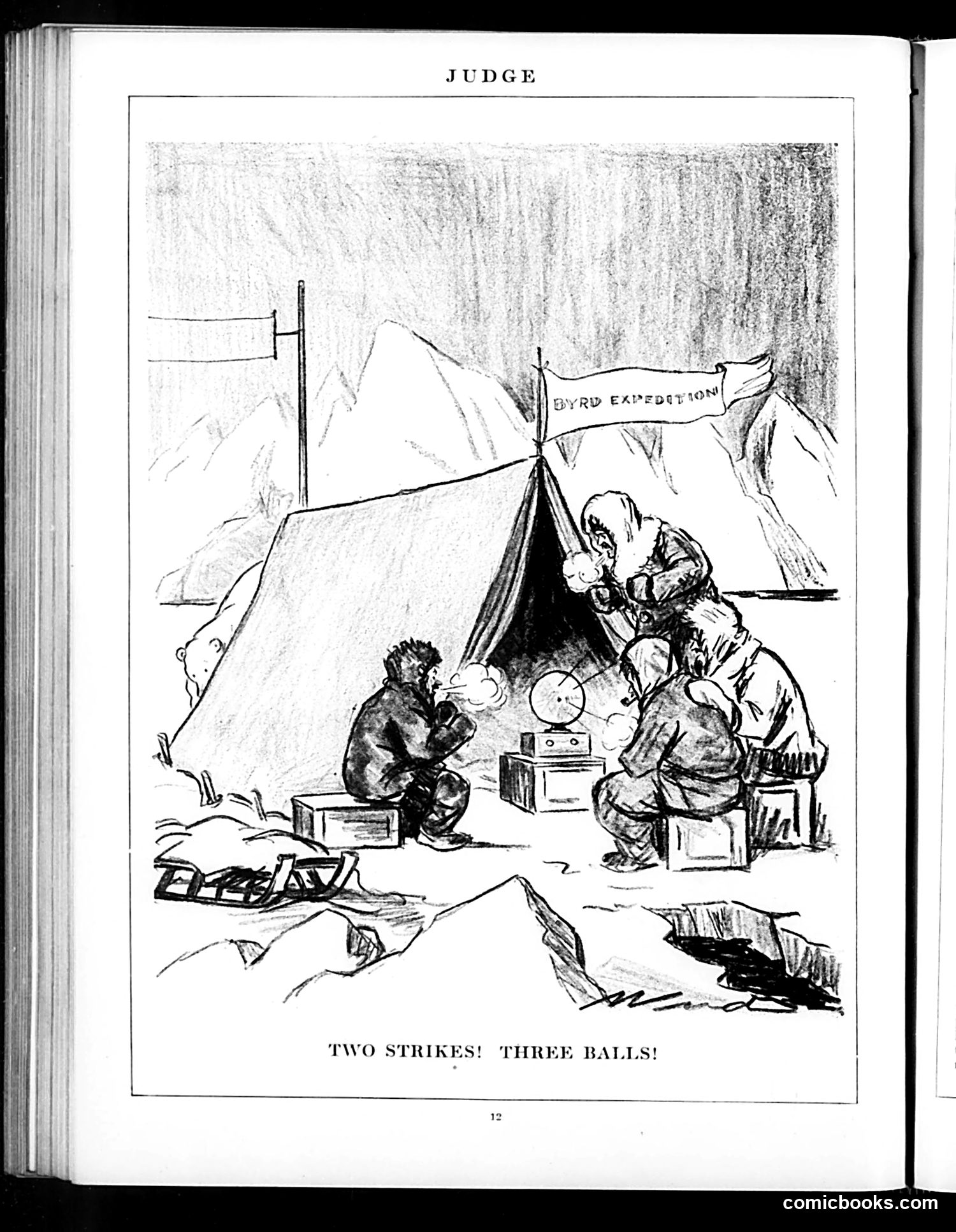
"Two Strikes! Three Balls!" This Judge cartoon uses baseball terminology as political satire. The scene depicts an expedition camp (marked "BYRD EXPEDITION") where figures appear to be engaged in some kind of judgment or evaluation, with one character umpiring. The baseball reference—two strikes and three balls—suggests someone or something is being evaluated and found wanting or in a precarious position. Without clearer identification of the specific figures, the exact political target remains uncertain, but it likely comments on a contemporary expedition or public figure's performance being scrutinized. The Byrd Expedition reference suggests this relates to Antarctic exploration efforts, possibly satirizing their progress or reception. The umpire role implies Judge magazine itself as arbiter of public judgment.
Judge Magazine Page Analysis This page contains two satirical articles reflecting 1920s American politics: "Hail to MacDonald" celebrates British Labour Party leader Ramsay MacDonald's rise to Prime Minister. The piece notes the irony that a man once called "the most despised" in England—a socialist who opposed WWI, alongside colleagues jailed for radicalism—now leads the world's greatest empire. The satire targets American capitalism's acceptance of socialist leadership abroad, while suggesting that MacDonald and his "wild men" are actually reasonable statesmen, not dangerous revolutionaries. The article argues that the Labour Party succeeded not through socialism but because ordinary people wanted liberal policies. "The American Nomads" satirizes the chaos of America's semi-annual moving days (spring and fall), when thousands relocate simultaneously. It mocks the system as "stupid" and highlights how landlords and real estate interests profit from the disruption while workers suffer. The piece notes Chicago saw 100,000 lease changes annually, suggesting this moving system needs reform. Both articles use mild satire to critique social systems rather than specific individuals.
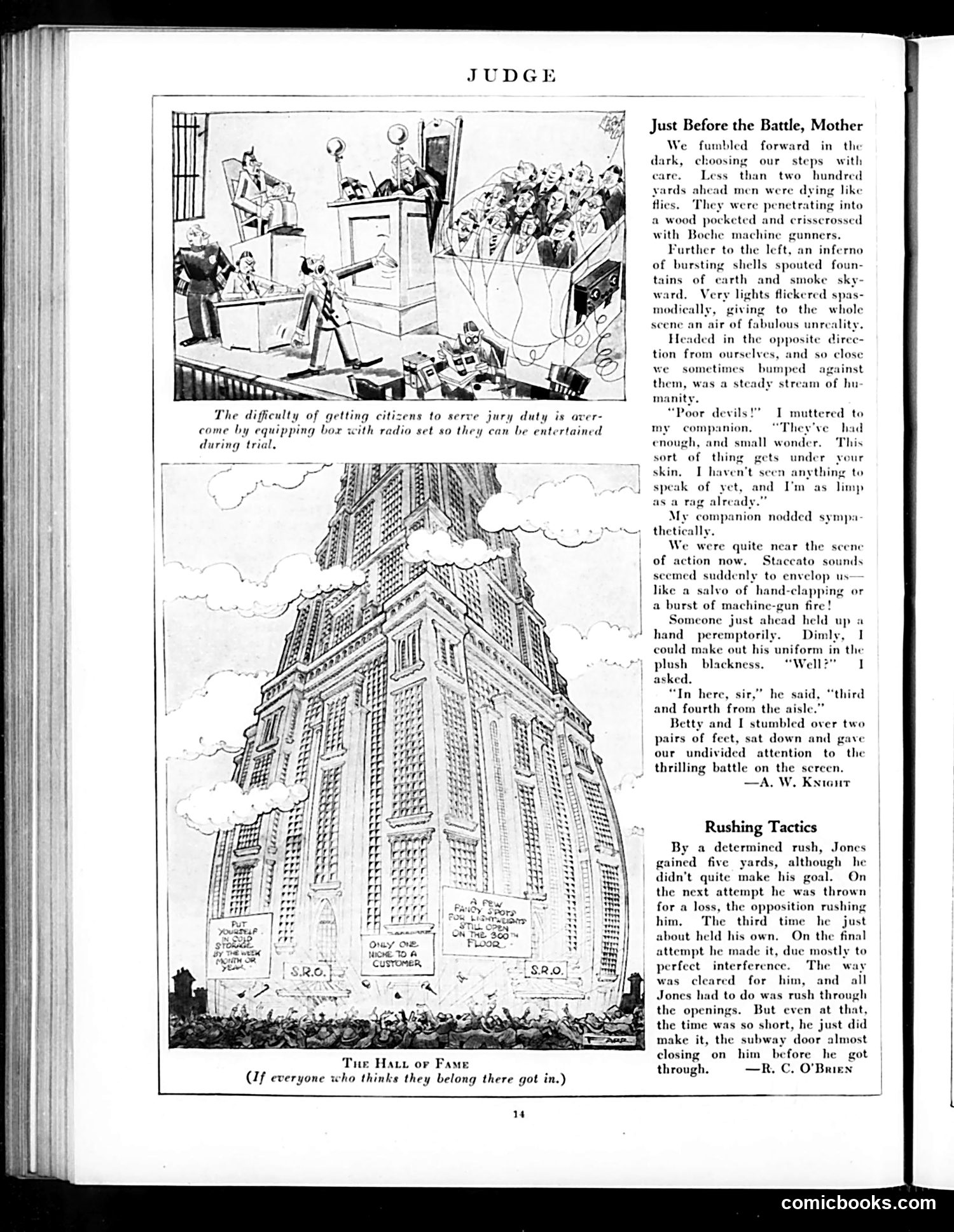
Judge Magazine Page Analysis This page contains two distinct pieces of satirical content: "Just Before the Battle, Mother" is a WWI narrative describing soldiers approaching combat, with vivid descriptions of machine gun fire and artillery. The accompanying cartoon jokes about jury duty by depicting a radio-equipped box, satirizing how difficult it is to get citizens to serve on juries—suggesting entertainment is needed to keep them engaged during trials. "The Hall of Fame" is an architectural drawing of a tall building with the caption "(If everyone who thinks they belong there got in.)" This is social satire about fame and prestige, mocking the pretensions of people who imagine themselves significant enough for commemoration. "Rushing Tactics" describes a football play where Jones gains yards through determined effort and good blocking, using sports language to humorously parallel military strategy. The page mixes war-era content with domestic American humor, typical of Judge's blend of political and social commentary during the WWI period.
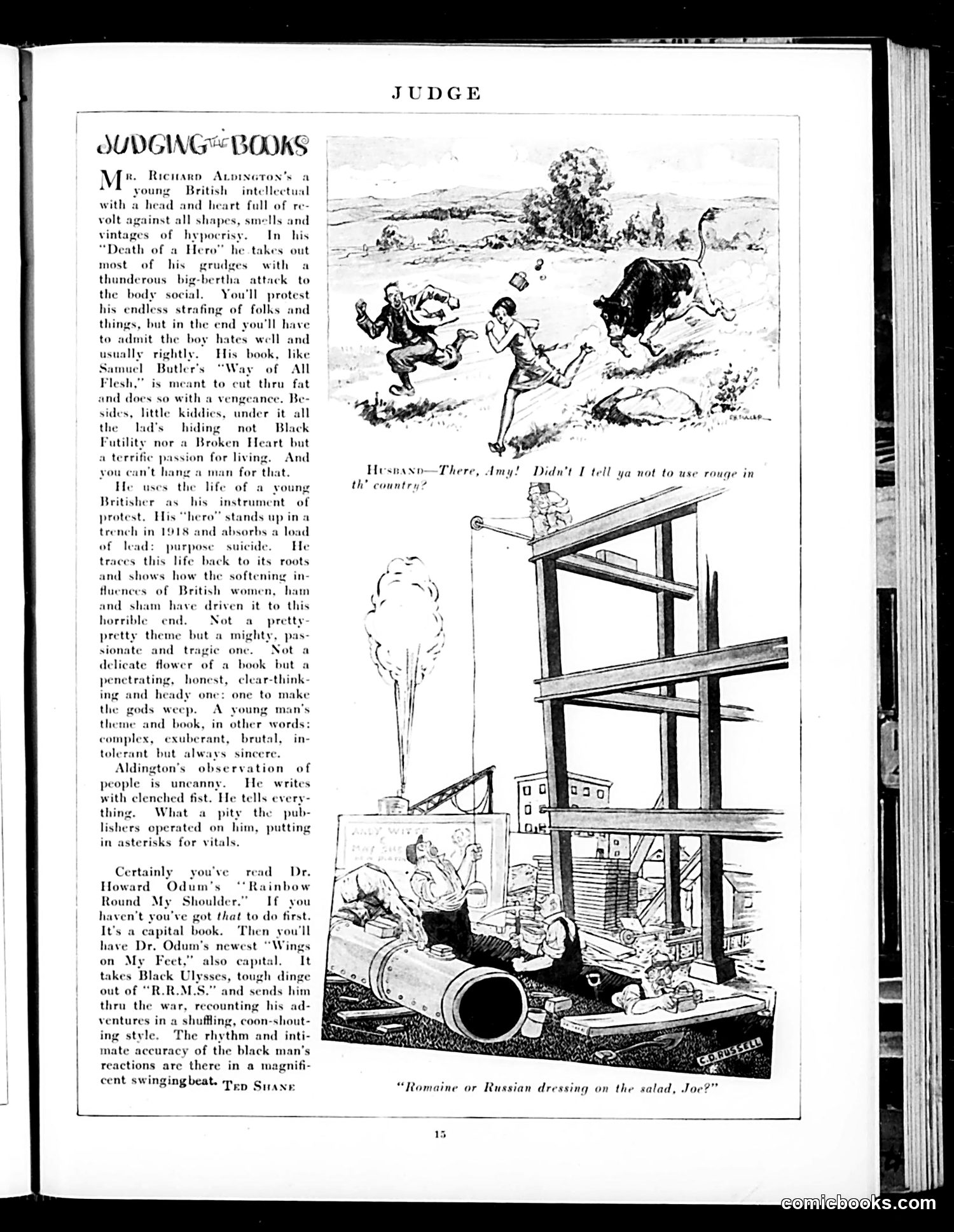
Analysis of This Judge Magazine Page This page reviews Richard Aldington's anti-war novel *Death of a Hero* (1929), praised for its bitter attack on British society and hypocrisy. The reviewer notes Aldington uses a young soldier's 1918 trench death to expose how "softening influences of British women, ham and sham" destroyed him—critiquing both wartime sacrifice and peacetime social pretense. The two cartoons satirize domestic life: the top shows a husband and wife arguing over rifle use in the countryside (likely satirizing rural disputes or gender role conflicts). The bottom depicts someone stuffed in a large pipe, captioned about "Romaine or Russian dressing"—a crude visual pun on cramped living or food rationing anxieties. The page also reviews Dr. Howard Odum's books featuring African American characters, though the language used reflects period racism. Overall, the page combines literary criticism of postwar disillusionment with light domestic humor typical of Judge's satirical approach.
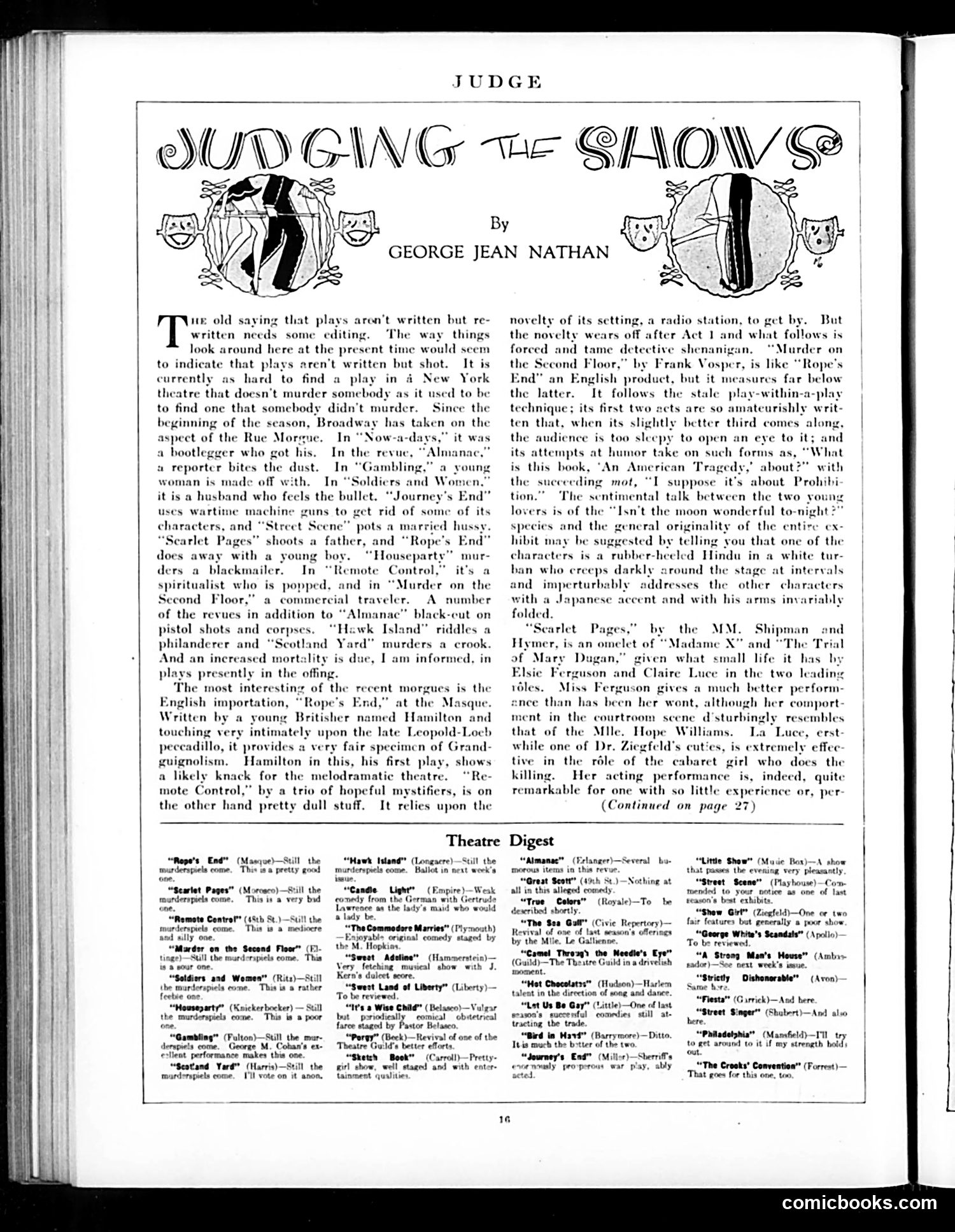
Analysis of "Judging the Shows" by George Jean Nathan This page is a theater review column satirizing a specific Broadway trend: the prevalence of murder-mystery plays during this season. Nathan's central joke is that nearly *every* show currently running features a murder plot—hence his repeated, sarcastic phrase "murderspiels" (murder plays). The satire targets: 1. Creative bankruptcy: Playwrights have abandoned originality, recycling the same murder-mystery formula across productions ("Rope's End," "Scarlet Pages," "Remote Control," "Murder on the Second Floor," etc.). 2. The specific crimes: Nathan catalogs the repetitive plot devices—blackmailers, adulterous spouses, soldiers, detectives—all resolved through murder. 3. Lazy entertainment: He notes that novelty (like a radio-station setting) wears thin by Act II, forcing audiences to endure predictable detective work to reach the inevitable third-act resolution. The "Theatre Digest" section lists current shows with their venues and brief dismissive critiques, reinforcing the uniformity Nathan mocks. This is a witty complaint about formula-driven commercial theater prioritizing sensationalism over substance.
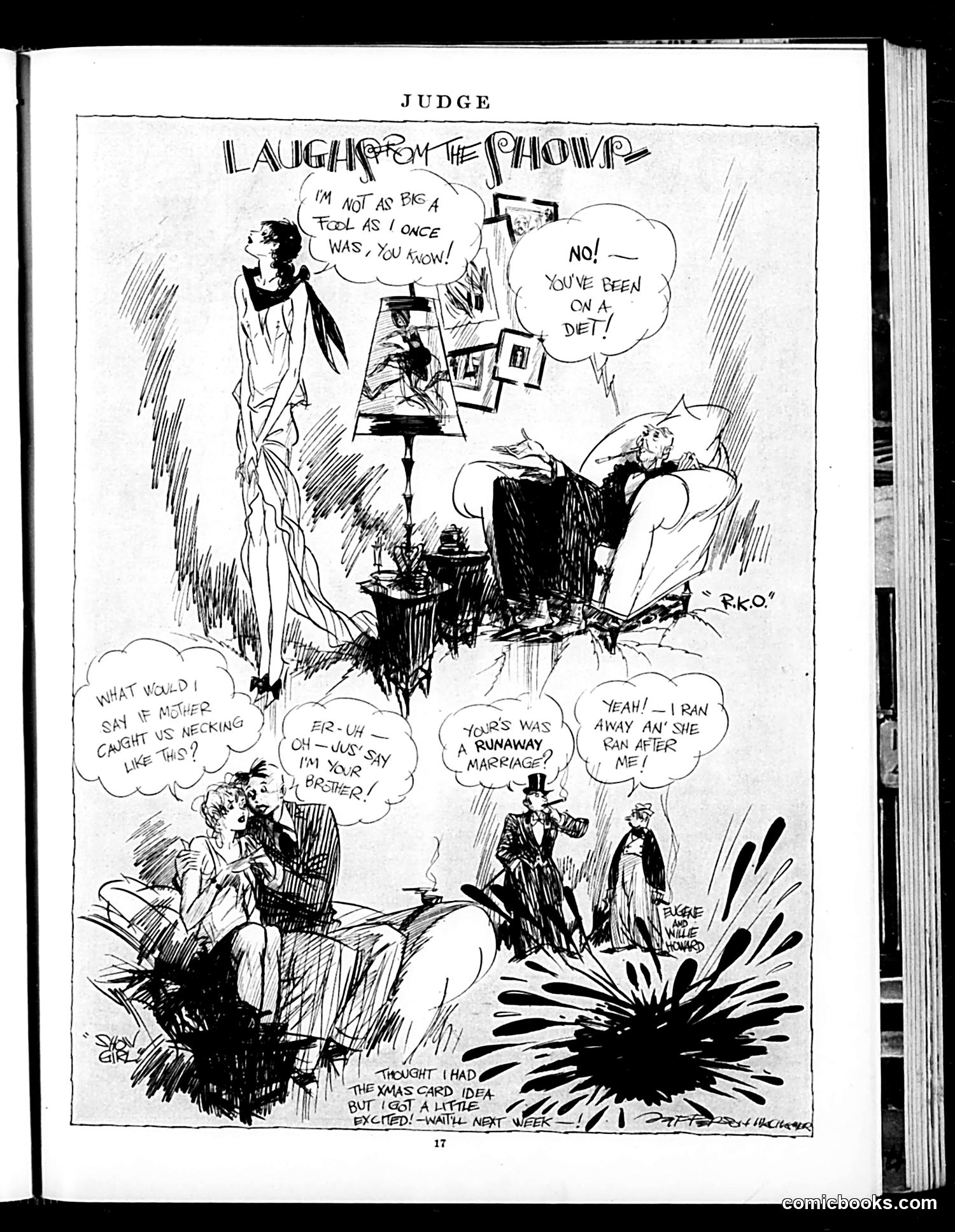
"Laughs from the Chomp" - Judge Magazine Cartoon This is a multi-panel satirical cartoon about marital infidelity and domestic chaos. The central figure appears to be a wealthy man reclining while viewing photographs or memories of romantic escapades. The surrounding vignettes show various characters discussing scandals: a woman mentions catching a couple "necking," a man claims to be someone's brother, and another boasts of a "runaway marriage" where he "ran away an' she ran after me." The satire targets the era's marriage and divorce scandals among the upper classes—a frequent subject of Judge's humor. The "chomp" (likely "romp") refers to illicit romantic entanglements. The cartoon mocks both the prevalence of such affairs in society and the casual way people gossiped about them. The exaggerated expressions and dramatic poses emphasize the melodramatic nature of these social transgressions.
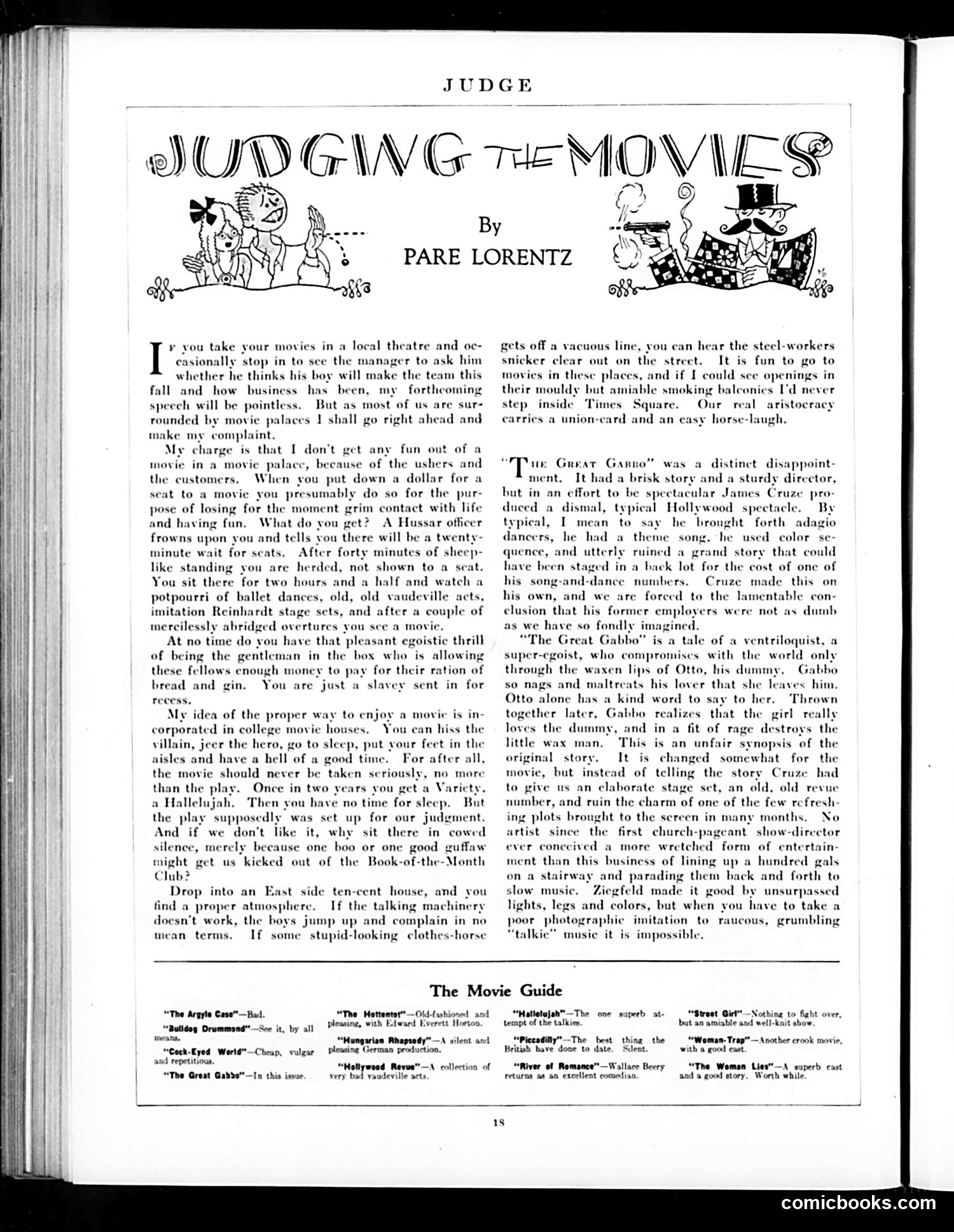
Judging the Movies: Critique of 1920s Movie Palace Culture This is a humorous essay by Pare Lorentz criticizing the theatrical experience at commercial "movie palaces"—the grand, ornate cinemas proliferating in 1920s America. Lorentz argues that expensive downtown theaters ruin films through pretension: arrogant ushers, long waits, lengthy vaudeville preambles, and forced spectacle. He contrasts this with affordable East Side ten-cent houses where working-class audiences freely heckle and enjoy themselves without artificial decorum. He then reviews "The Great Gabbo" (a ventriloquist film), criticizing director James Cruze for adding unnecessary dance numbers, color sequences, and stage sets to an otherwise charming story, prioritizing visual spectacle over narrative. The satire targets both the movie industry's class-conscious marketing and Hollywood's tendency toward bloated production values over storytelling—ironically, concerns that persist a century later.
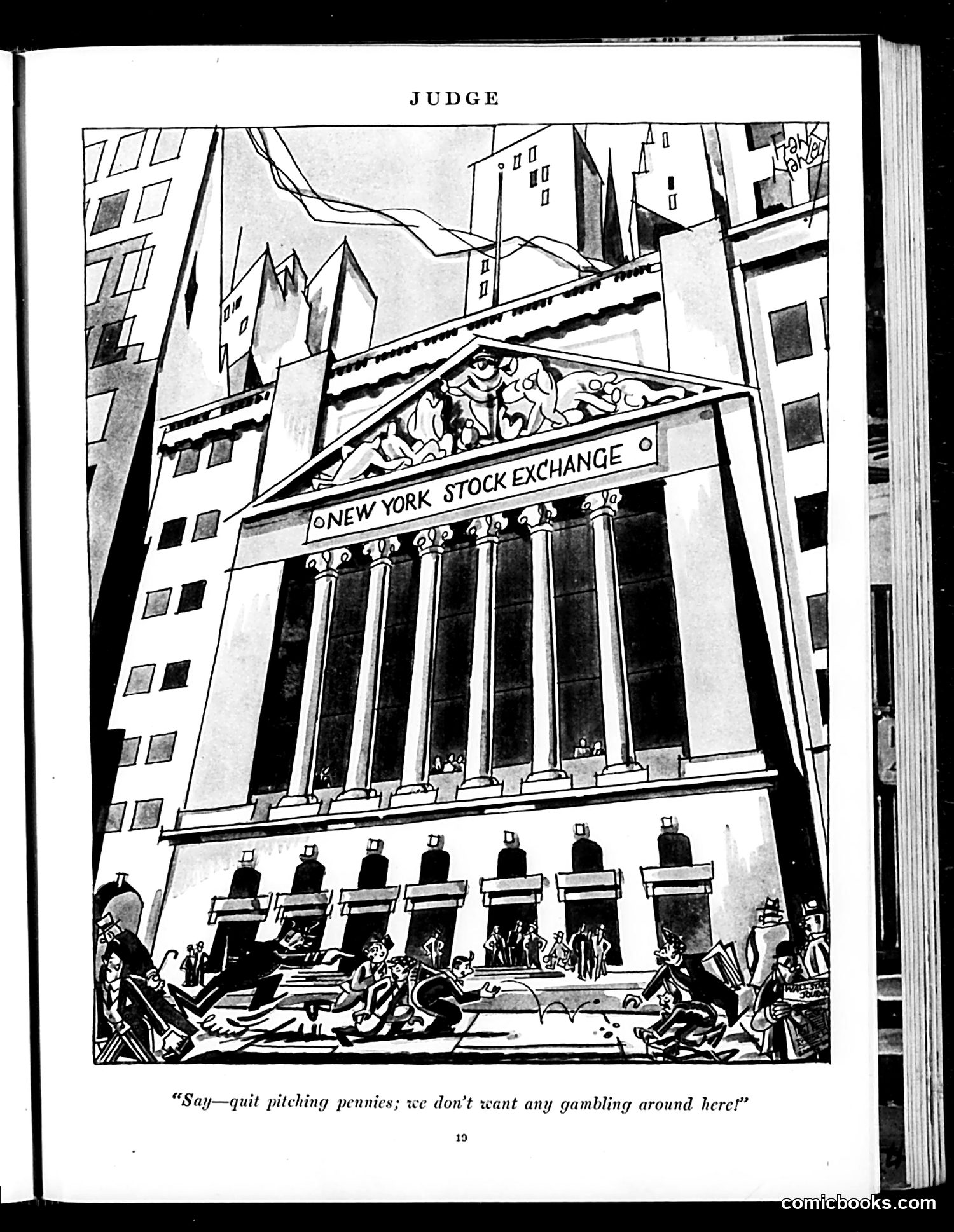
Judge Magazine Cartoon: "Say—quit pitching pennies; we don't want any gambling around here!" This cartoon satirizes the hypocrisy of the New York Stock Exchange. The image shows judges presiding over the exchange's trading floor, where crowds of people engage in frenzied activity below. The judges' stern command to "quit pitching pennies" and cease gambling is ironic: they're located at the Stock Exchange itself—an institution fundamentally based on speculation and financial wagering. The satire suggests that the Exchange operates as legalized gambling while authorities simultaneously prosecute ordinary citizens for petty gambling like pitching pennies. This critiques the moral inconsistency and class double-standards of financial institutions and their regulatory oversight during the early 20th century.
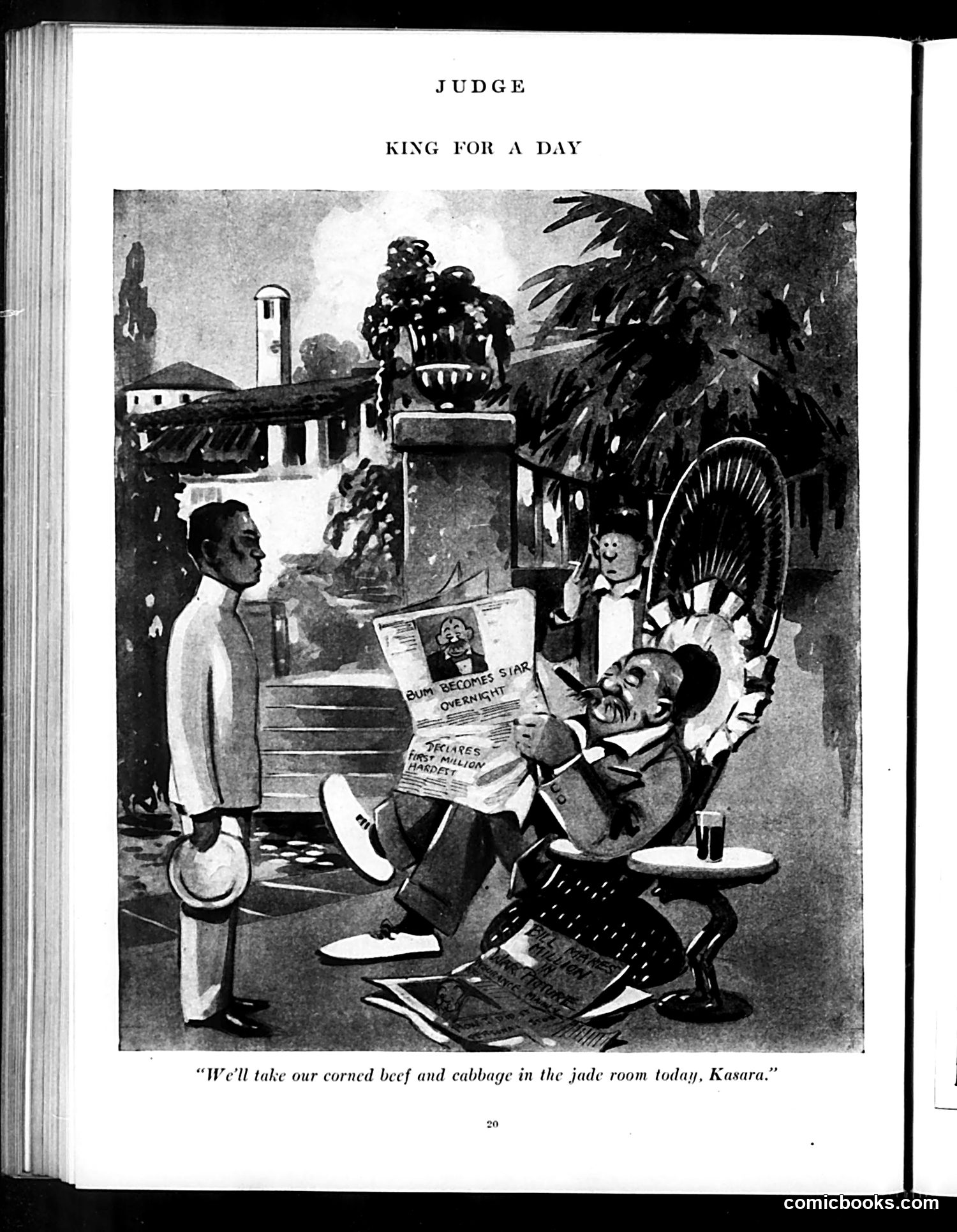
Political Cartoon Analysis: "King for a Day" This Judge magazine cartoon satirizes wealth and status through a "role reversal" scenario. A figure in blackface (reflecting the racist caricature conventions of Judge's era) is depicted as a temporary "king," reading newspapers about becoming "a star overnight" and "creates first million" — suggesting sudden, undeserved wealth or fame. The caption references taking "corned beef and cabbage in the jade room," implying mock-luxurious dining. The ornate setting with palm trees and architectural grandeur contrasts with the figure's exaggerated features, the central joke being the absurdity of this person occupying elevated status. The satire likely targets either nouveau riche pretension or critiques wealth inequality through dark humor typical of the era — though the racial caricature reflects Judge's problematic historical context.
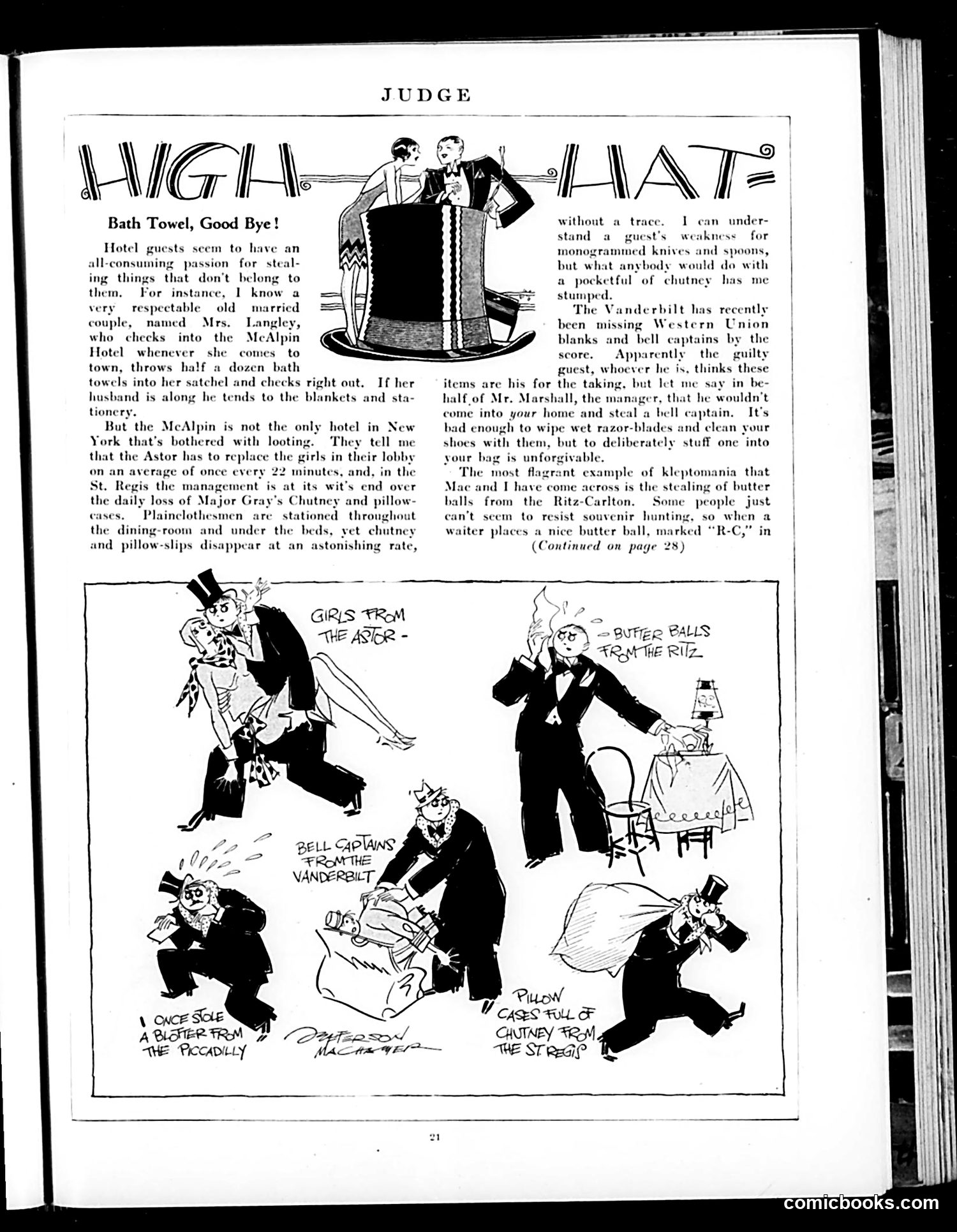
Explanation for Modern Readers This is a humorous article about hotel theft, illustrated with cartoons of wealthy New York hotel guests stealing items. The piece satirizes the epidemic of pilfering at luxury establishments like the McAlpin, Astor, St. Regis, Vanderbilt, and Ritz-Carlton hotels in the 1920s era. The author describes absurd thefts: a respectable married couple stealing bath towels and blankets, guests taking Major Gray's Chutney and pillowcases, Western Union blanks, bell captains, and butter balls marked "R-C" from the Ritz-Carlton. The cartoons depict gentlemen in top hats comically absconding with various hotel items. The satire targets the contradiction that ostensibly "respectable" wealthy guests engage in petty theft, rationalizing or not recognizing these acts as stealing. The exaggeration—hotels needing plainclothes security, replacing lobby "girls" constantly—underscores how normalized this behavior had become among affluent clientele.
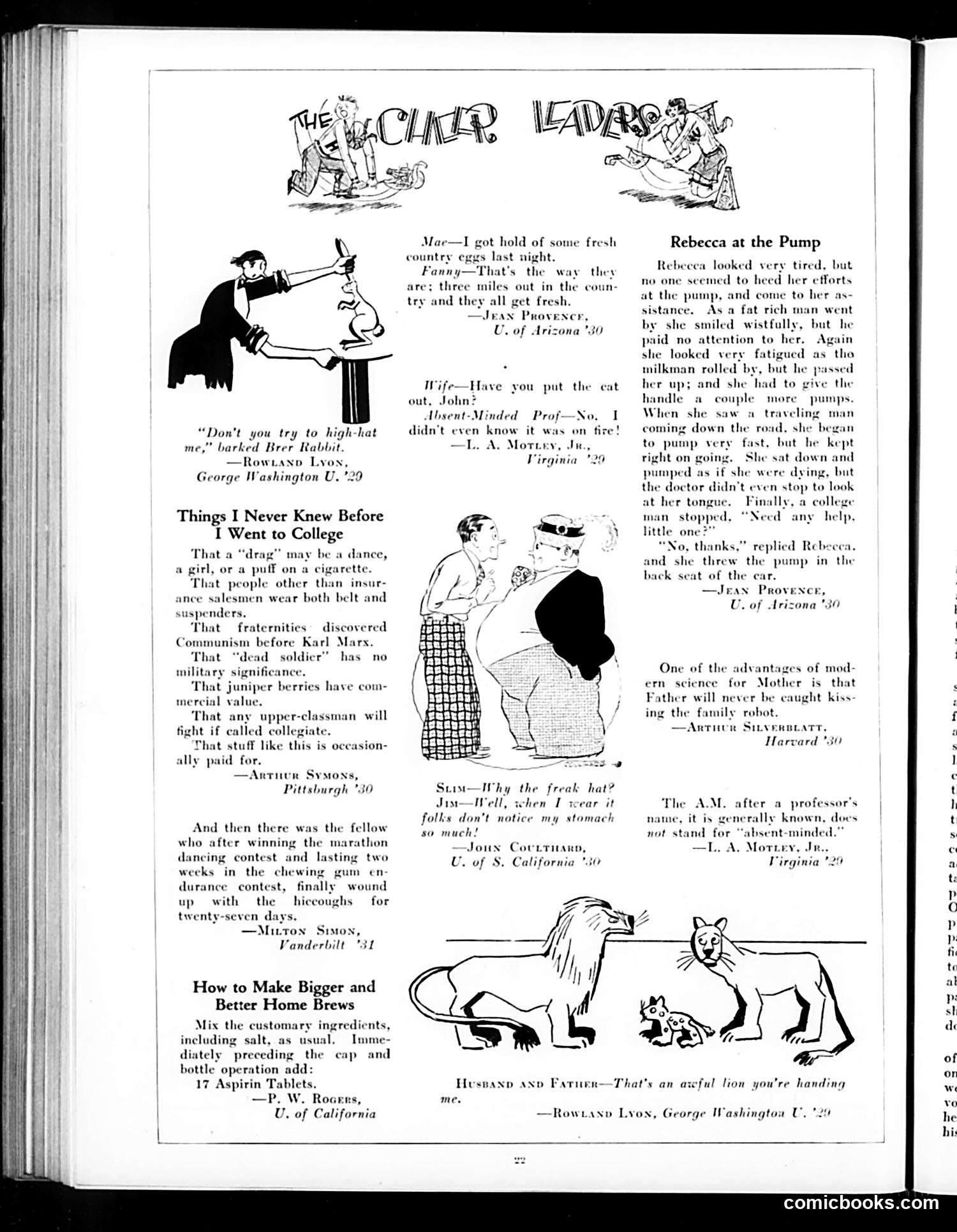
Analysis of Judge Magazine Page Content This page from Judge collects student humor submissions, primarily from college contributors (dated '29-'31), reflecting 1920s campus life and social attitudes. Key Content: The cartoons and jokes satirize college experiences: fraternity culture, Prohibition-era home brewing, absent-minded professors, and social pretension. One recurring theme mocks upper-class affectation ("high-hatting"). Notable Elements: - A Brer Rabbit reference (likely Joel Chandler Harris's folklore character) appears in a joke about not being condescended to - Multiple jokes reference Prohibition's illegal alcohol production - "Rebecca at the Pump" depicts a rural woman ignored by wealthy/professional men, commenting on class indifference to female labor - A robot joke anticipates technological anxiety about replacing domestic work Context: These submissions reveal Jazz Age college attitudes—irreverent toward authority, preoccupied with dating and drinking, and casually classist. The humor reflects upper-middle-class student perspectives typical of Judge's readership.
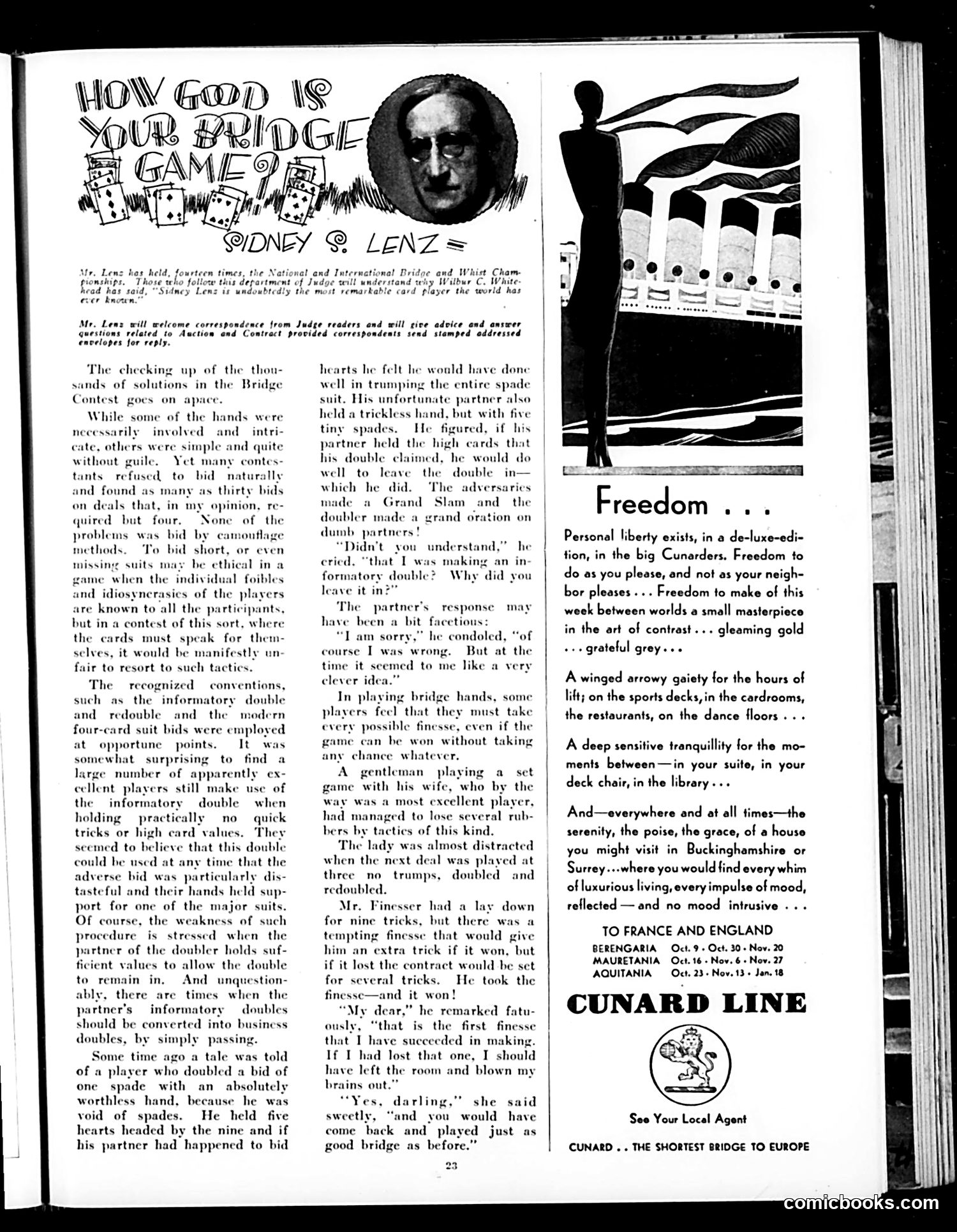
Judge Magazine Page Analysis This page features Sidney Lenz, a renowned bridge champion (visible in the portrait), answering reader questions about bridge strategy in Judge magazine's bridge column. The accompanying text discusses bridge tournament hand-bidding conventions and strategy. The main anecdote satirizes excessive risk-taking: a player doubles a bid with a worthless hand solely because he's void in spades, hoping to trump the suit. His partner, holding complementary cards, leaves the double in—resulting in disaster. When confronted, the first player claims he was making an "informatory double" (a standard convention), and his partner drily responds that it seemed "like a very clever idea" at the time. The satire targets overconfident bridge players who rationalize poor decisions as sophisticated strategy after the fact, and the gap between intention and outcome in competitive card games. The right page advertises Cunard Line ocean travel, unrelated to the bridge content.
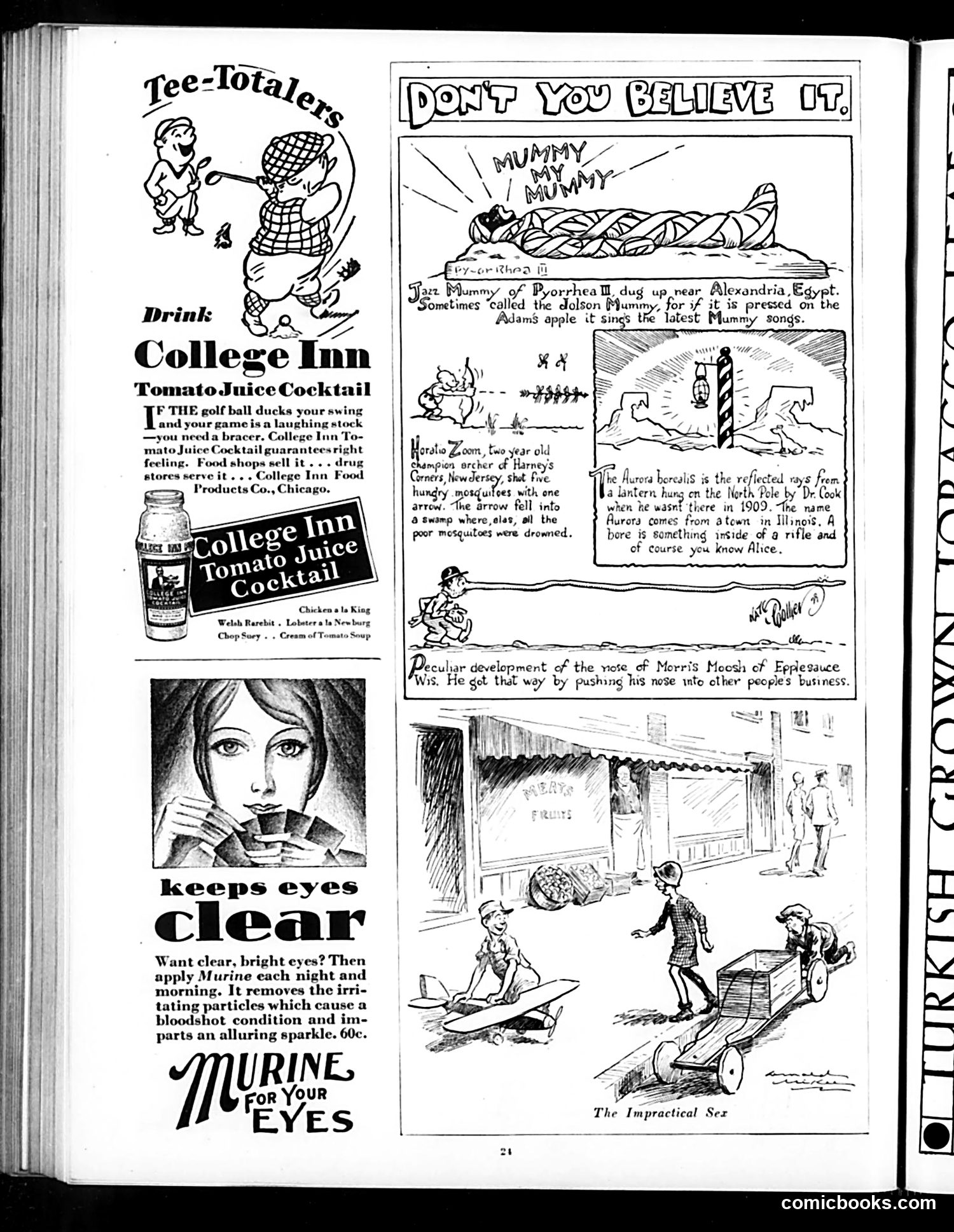
Analysis of Judge Magazine Page This page mixes advertisements with a humor column titled "Don't You Believe It"—a feature debunking tall tales and absurd claims. The main cartoon presents three mock "facts": 1. Jazz Mummy: A supposedly recently excavated Egyptian mummy that "sings the latest Mummy songs"—satirizing both Egyptology craze and Jazz Age culture. 2. Aurora Borealis origin story: A ridiculous explanation claiming the Northern Lights result from a lantern hung by "Dr. Cook" at the North Pole in 1909, with a nonsensical tale about mosquitoes. This mocks both Arctic exploration myths and absurd pseudo-scientific explanations. 3. Morris Moosh's nose: A visual joke about a man's grotesquely developed nose from "pushing his nose into other people's business"—a pun on the idiom about nosiness. The surrounding advertisements (College Inn cocktail, Murine eye drops) are typical 1920s product placement. The page satirizes gullibility and outlandish claims common in popular culture of that era.
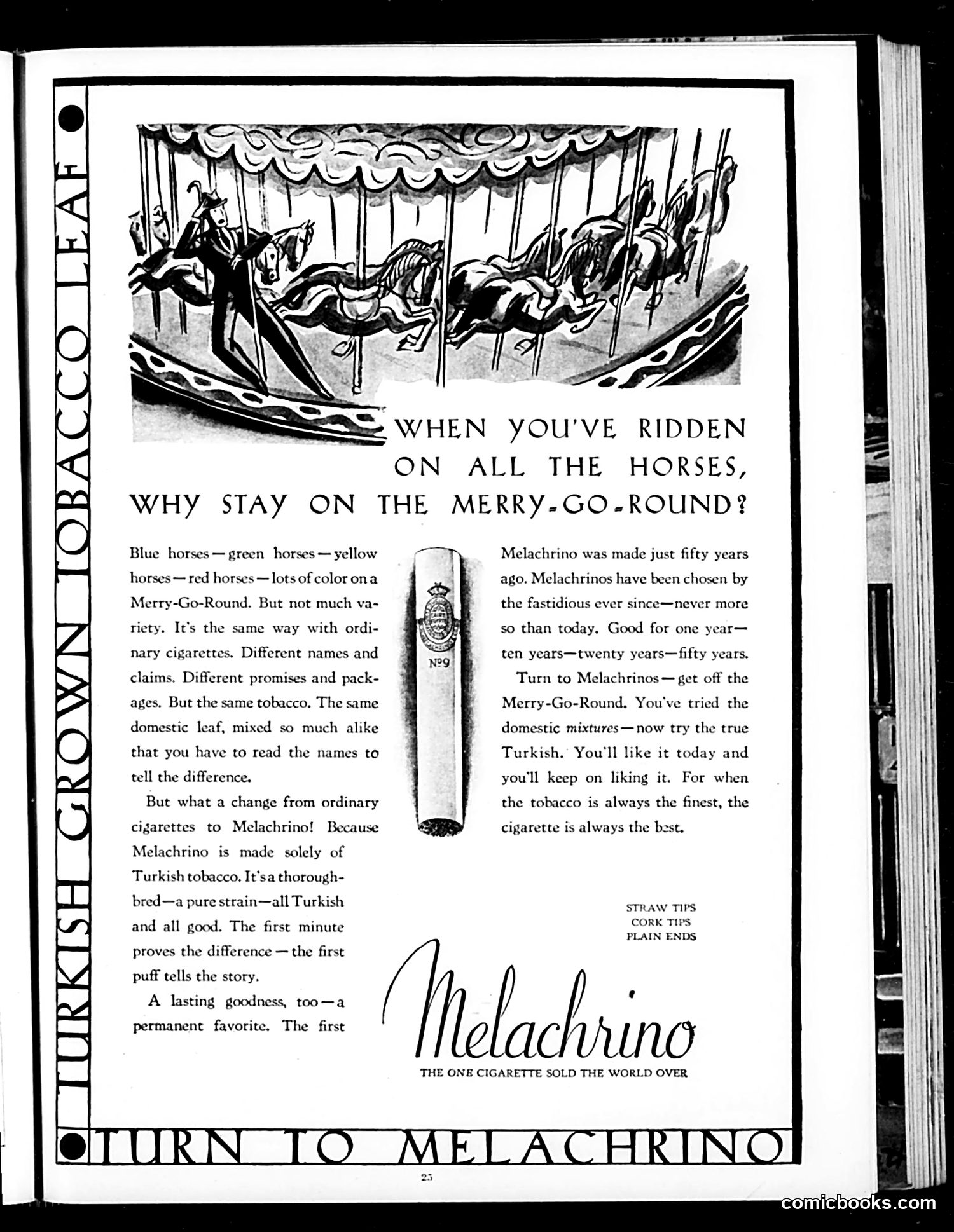
Analysis This is a cigarette advertisement, not political satire. The page uses a merry-go-round metaphor to criticize competing American cigarette brands. The Visual & Message: The illustration shows horses on a carousel—a metaphor for repetitive sameness. The ad argues that domestic cigarette brands (represented by horses of different colors) are essentially identical products with superficial variations in packaging and marketing claims. The Pitch: Melachrino cigarettes, made purely from Turkish tobacco, allegedly breaks this cycle. The "merry-go-round" represents being stuck in a loop of indistinguishable American cigarettes; switching to Melachrino means "getting off" that cycle. Historical Context: This reflects early 20th-century advertising appeals to sophistication—Turkish cigarettes were marketed as premium, exotic products for "fastidious" consumers. The claim of fifty-year tradition suggests established prestige. This is promotional content, not satirical commentary on politics or society.
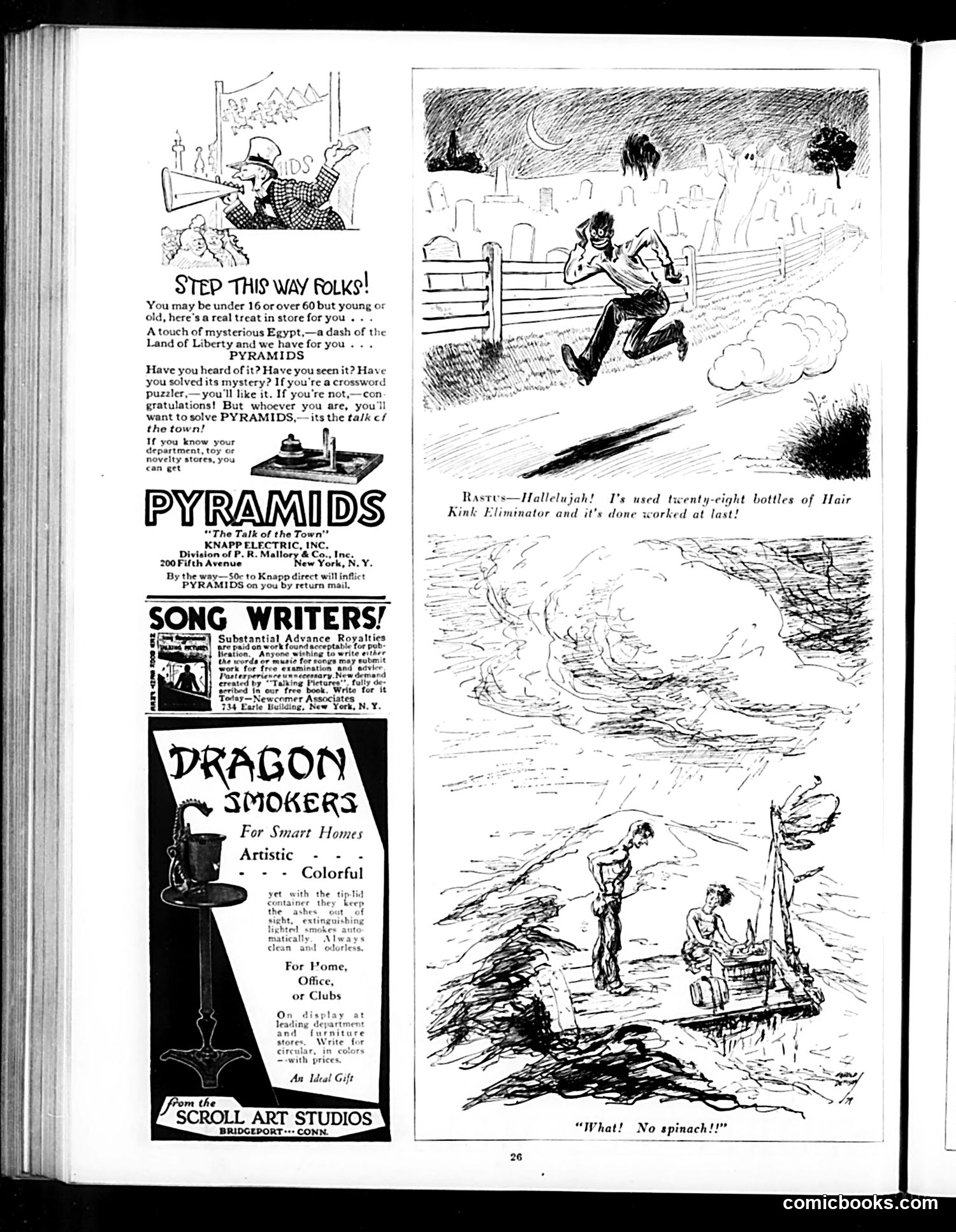
Political Cartoon & Comics Analysis This page is primarily advertising, not political satire. It contains three main ads: 1. PYRAMIDS (top left): A puzzle game marketed as "the talk of the town"—appealing to crossword enthusiasts and the general public. 2. SONG WRITERS (middle left): Soliciting amateur songwriters, offering royalties for submissions. 3. DRAGON SMOKERS (bottom left): Decorative ashtrays marketed as "artistic" home accessories. The right side features a humorous comic strip about someone using "Hair Kink Eliminator" product (referenced in the caption), depicting exaggerated comic relief scenes ending with a joke about spinach—likely referencing Popeye's cultural association with the vegetable. These are consumer goods advertisements typical of Judge magazine's revenue model, rather than political commentary.
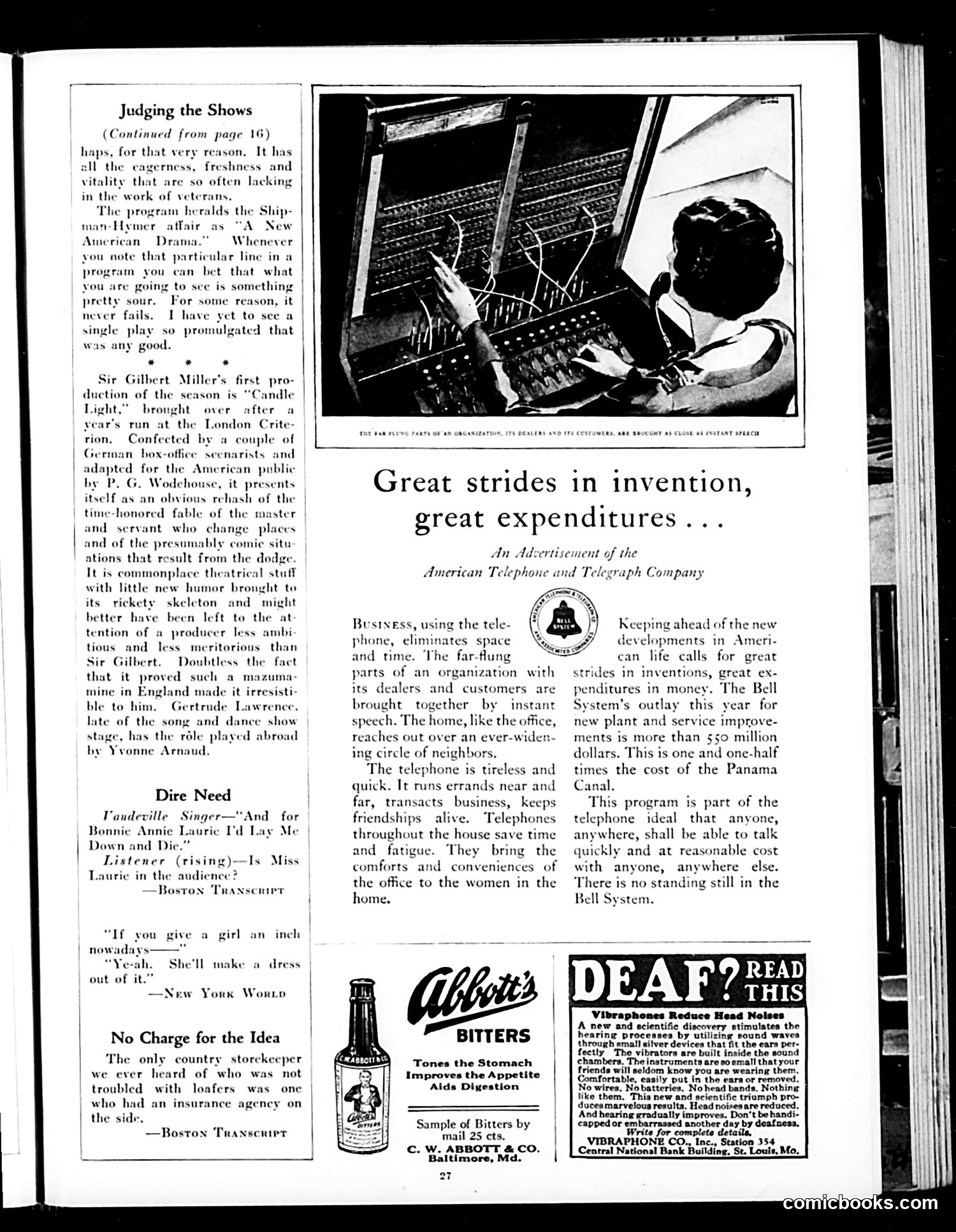
Content Analysis This page contains theater criticism and advertisements rather than political cartoons. The main editorial content critiques recent Broadway productions. The author reviews Sir Gilbert Miller's "Candle Light" dismissively—a German-origin comedy about servants and masters switching places that he considers tired theatrical material, redeemed only by star Gertrude Lawrence. The page includes scattered jokes and quips mocking theatrical conventions (plays advertised as "new American dramas" are inevitably mediocre) and gender stereotypes ("if you give a girl an inch, she'll make a dress out of it"). The advertisements are notable: a Bell Telephone System ad emphasizing the telephone's role in modern business and domestic life, positioned as technological progress; Abbott's Bitters promoting digestive benefits; and a deafness cure ad for "Vibraphones"—tiny hearing devices. The photograph shows an operator at a telephone switchboard, illustrating the Bell advertisement's point about modern communication infrastructure.
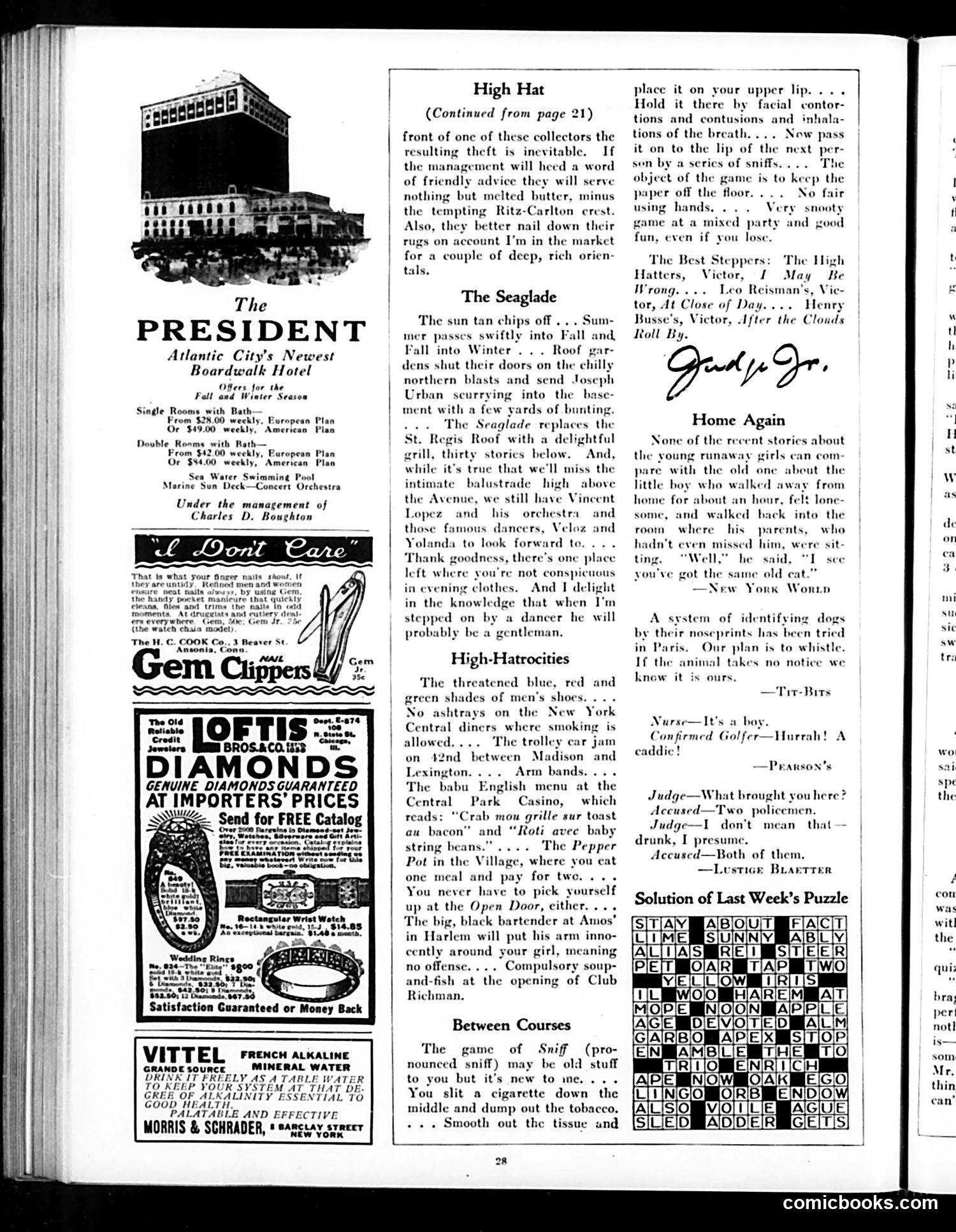
What This Judge Page Contains This page is primarily advertisements and filler content, not political satire. The main visible elements are: The President Hotel (Atlantic City boardwalk hotel) — a large advertisement Gem Clippers, Loftis Diamonds, Vittel Water — product ads Humor columns ("High Hat," "The Seaglade," "High-Hatrocities," "Between Courses," "Home Again") — these are light social commentary about 1920s urban life, NYC restaurants, jazz clubs (Vincent Lopez, Club Richman in Harlem), and dating customs. They mock pretension and describe nightlife, not political issues. The tone is gossipy and tongue-in-cheek about fashionable Manhattan society — ashtrays missing from diners, dance halls, arm bands as fashion. These are mild observations about contemporary manners, not substantive satire. No significant political content or caricatures appear on this page. It's mostly commercial material interspersed with lightweight social humor typical of 1920s Judge magazine.
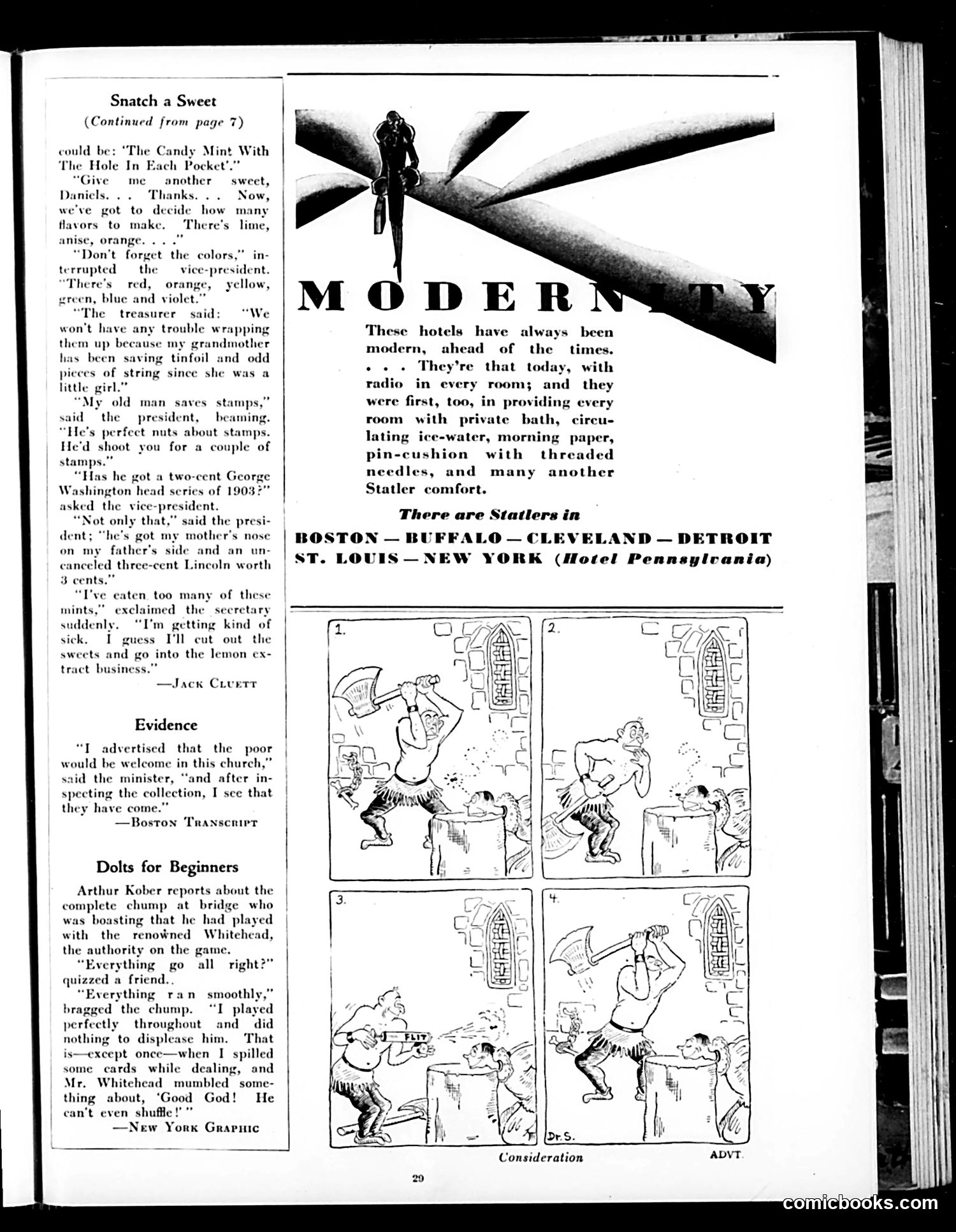
Analysis of Judge Magazine Page 29 This page contains three distinct sections: "Snatch a Sweet" (top left): A humorous dialogue where corporate executives discuss launching a new candy product. The joke satirizes bureaucratic inefficiency—they obsess over trivial details (string wrapping, stamp collections) while making candy business decisions. It mocks both corporate culture and the executives' tendency toward distraction. "Evidence" and "Dolts for Beginners" (middle left): Two brief, unrelated humor pieces. The first jokes about church attendance among the poor; the second ridicules an incompetent bridge player who boasts despite obvious mistakes. Bottom half: A large Statler Hotels advertisement featuring a 4-panel comic strip showing what appears to be comedic action (possibly someone being struck or falling repeatedly). The ad emphasizes the hotel chain's modernity—radios, private baths, ice water—and lists locations across major American cities. The page is primarily advertising content disguised as entertainment, using comic strips and humorous anecdotes to fill space around the prominent hotel promotion.
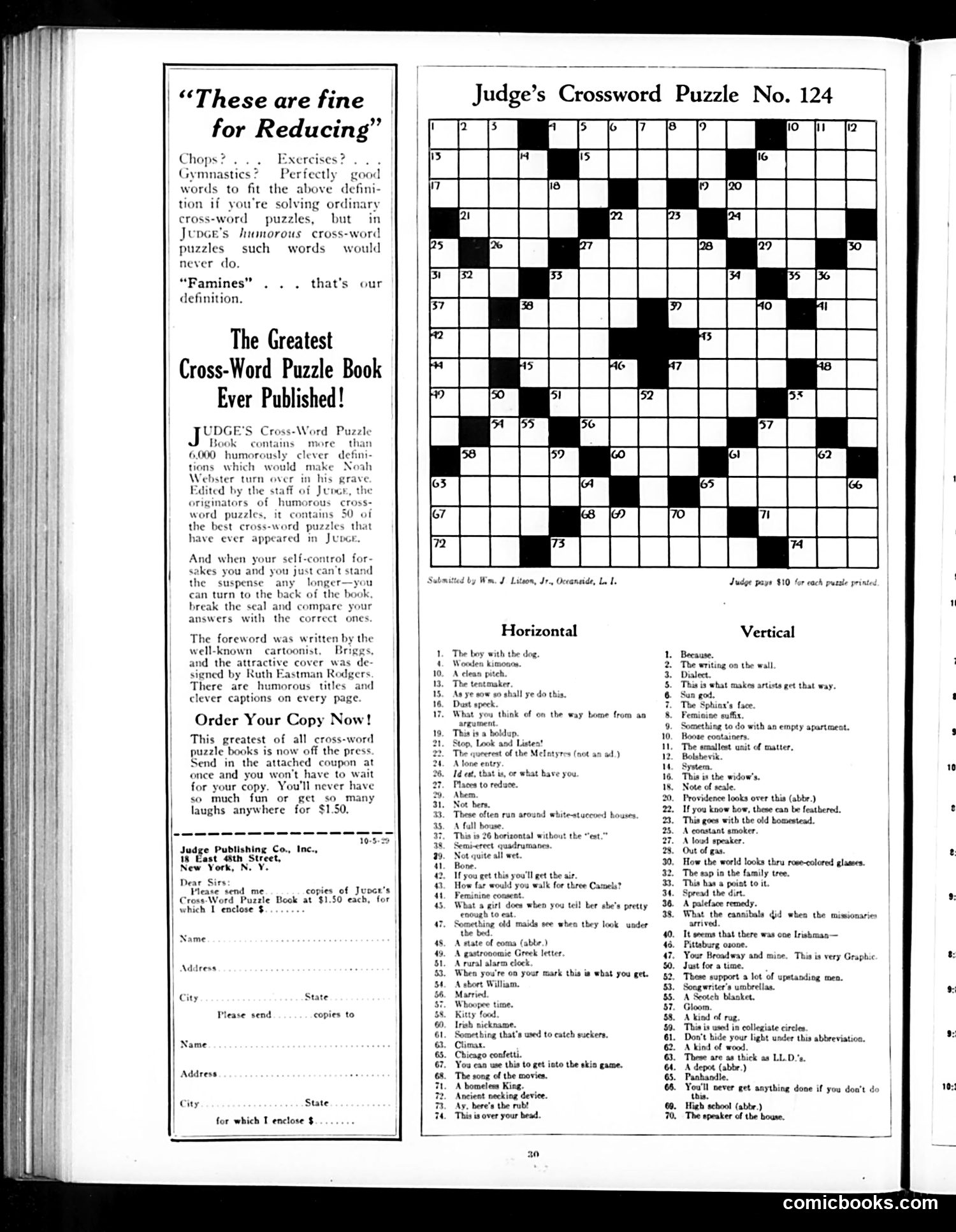
Judge's Crossword Puzzle Book Advertisement This page is primarily advertising, not political satire. It promotes Judge Publishing Company's crossword puzzle book, claimed to be "The Greatest Cross-Word Puzzle Book Ever Published." The ad emphasizes the book contains over 6,000 "humorously clever definitions"—playing on crossword puzzle culture's popularity in the 1920s-30s. It includes a sample puzzle (No. 124) with deliberately witty or unusual clues rather than straightforward definitions. For instance, horizontal clue 1 is "The boy with the dog" (likely referencing a popular figure or advertisement). The accompanying text on the left mocks ordinary crossword words ("Chops," "Exercises," "Gymnastics") as boring, promoting Judge's humorous alternatives like "Famines" instead. The book features a foreword by cartoonist Briggs and cover by Ruth Eastman Rodgers. The price is $1.50, with an order coupon included. This represents straightforward commercial promotion rather than political commentary.
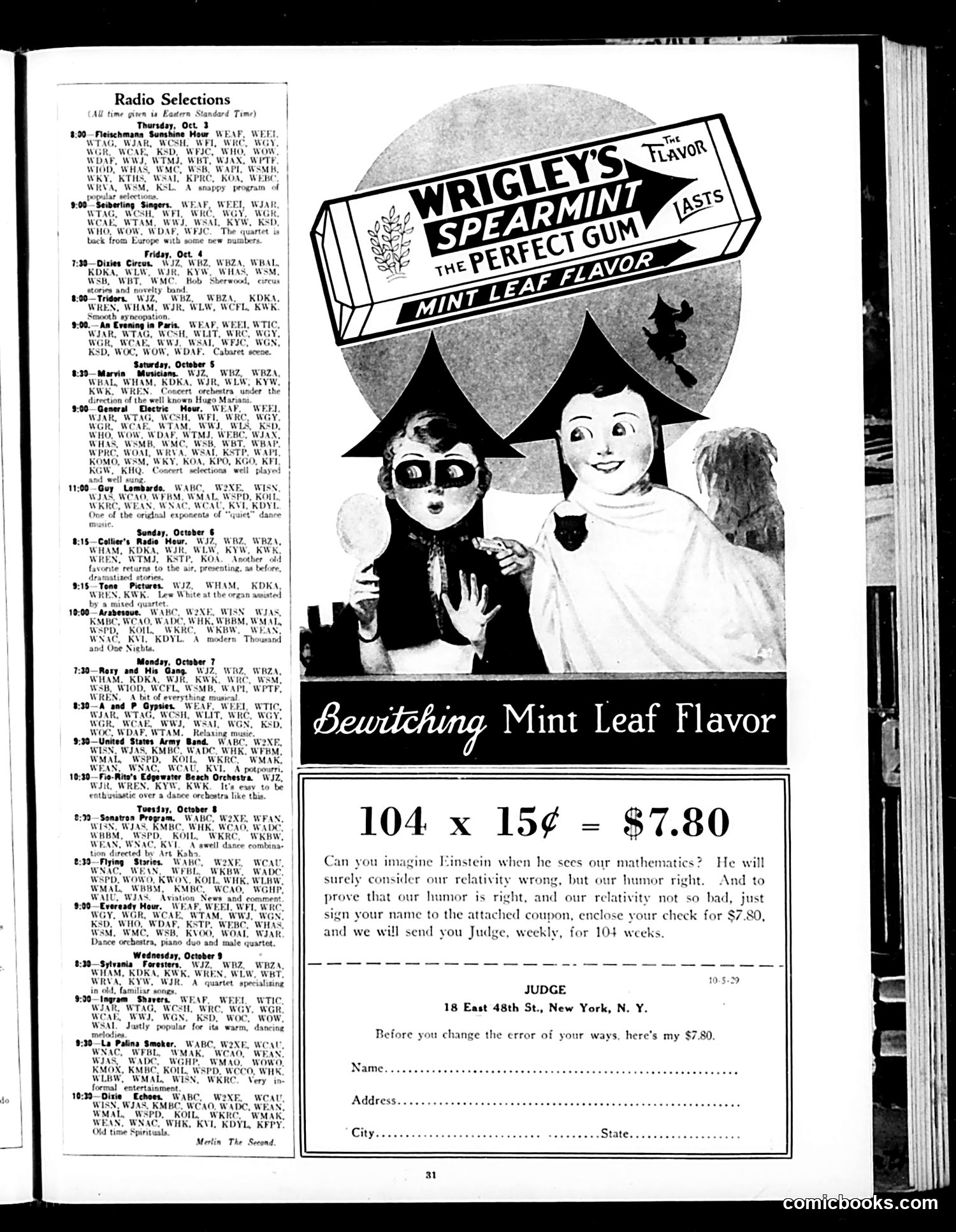
Judge Magazine Advertisement Analysis This page is primarily a Wrigley's Spearmint Gum advertisement with radio listings as secondary content. The ad features two stylized figures—a woman and a child dressed as a witch or goblin—under a large moon, promoting "Bewitching Mint Leaf Flavor." Below the illustration is a humorous pitch using a mock-mathematical equation (104 × 15¢ = $7.80) that playfully invokes Einstein and "relative wrong" versus "humor right," inviting readers to send $7.80 for 104 weeks of Judge magazine. The joke relies on intentionally bad math to be amusing. This is characteristic of 1920s-30s advertising copy—using novelty, wordplay, and pseudo-intellectual humor to sell both the gum and the magazine subscription. The Halloween imagery (witch costume) ties the product to seasonal marketing, while the radio listings provided genuine editorial content to attract readers.
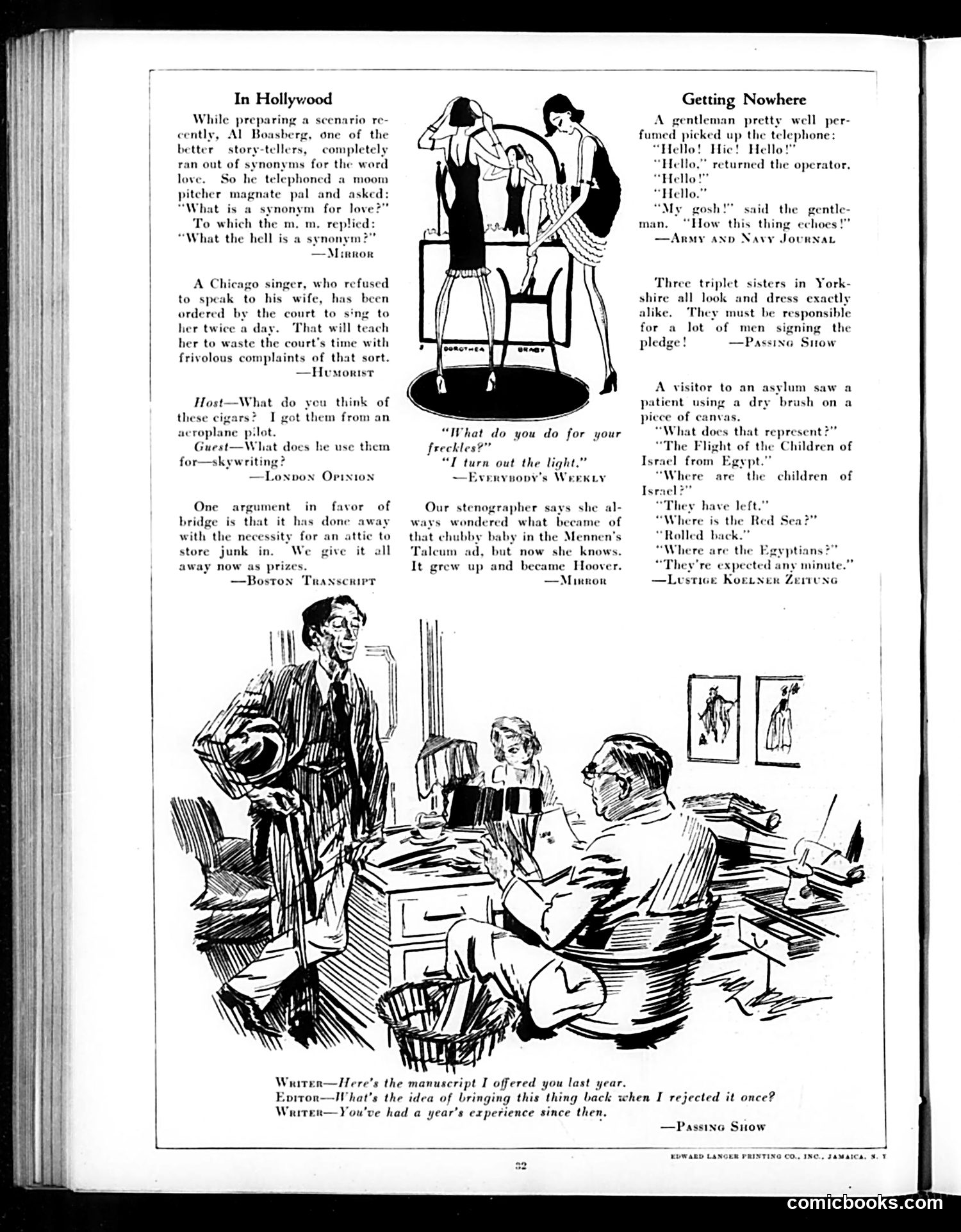
Judge Magazine Satire Page Analysis This page collects brief humorous anecdotes and jokes typical of Judge's satirical format. Key pieces include: "In Hollywood": A joke about screenwriter Al Boasberg exhausting synonyms for "love"—satirizing Hollywood's formulaic romantic plots and creative bankruptcy. The Chicago Singer: Courts forcing marital communication—mocking frivolous legal interventions. The Bridge Joke: Satirizes how bridge-playing has replaced attics for storing unwanted items, poking fun at both the game's popularity and consumerism. The Hoover Reference: A stenographer joke equating a chubby baby from Mennen talcum powder ads with former President Hoover—unclear whether complimentary or mocking without dating context. The Asylum Joke: A patient painting "The Flight of the Children of Israel" with a dry brush, then claiming the Red Sea "rolled back"—absurdist humor about institutional conditions or mental illness. The Writer-Editor Exchange: A rejected manuscript resubmitted after "a year's experience"—satirizing publishing persistence and editorial dismissiveness. The humor relies on wordplay, social observation, and mild cynicism about modern institutions.
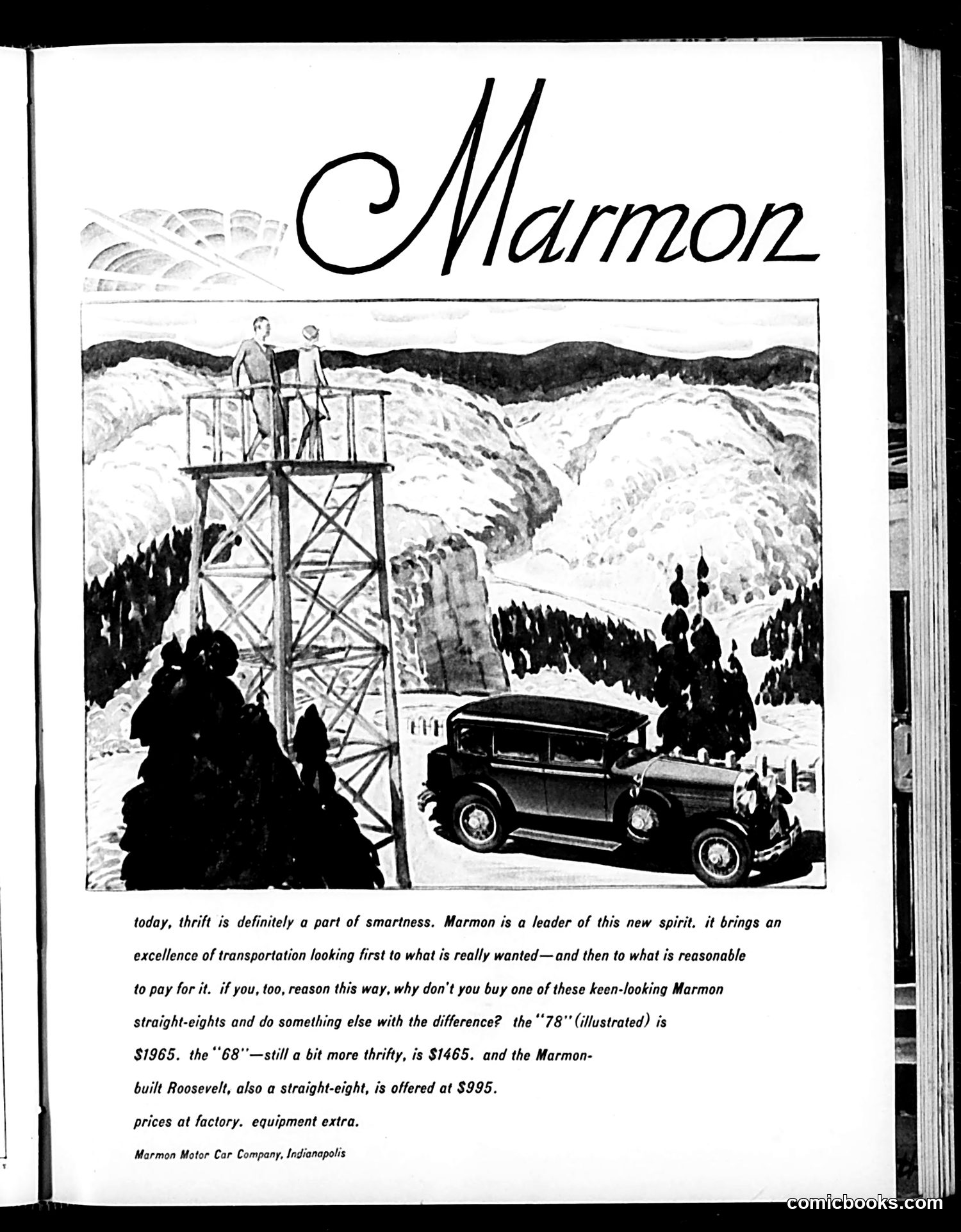
This is primarily a car advertisement, not satirical content. It promotes Marmon automobiles from the Marmon Motor Car Company (Indianapolis). The ad appeals to post-WWI American values of "thrift" and "smartness"—associating economical car-buying with intelligence and modernity. It showcases three models: the "78" ($1,965), the "68" ($1,465), and a Marmon-built Roosevelt ($995), presenting them as offering "excellence of transportation" at reasonable prices. The illustration depicts a snowy mountain landscape with what appears to be a ski jump or observation tower, positioning the vehicles in an aspirational leisure setting. This connects car ownership to recreation and lifestyle rather than mere transportation. There is no political satire here—it's straightforward commercial messaging typical of Judge magazine's advertising content.
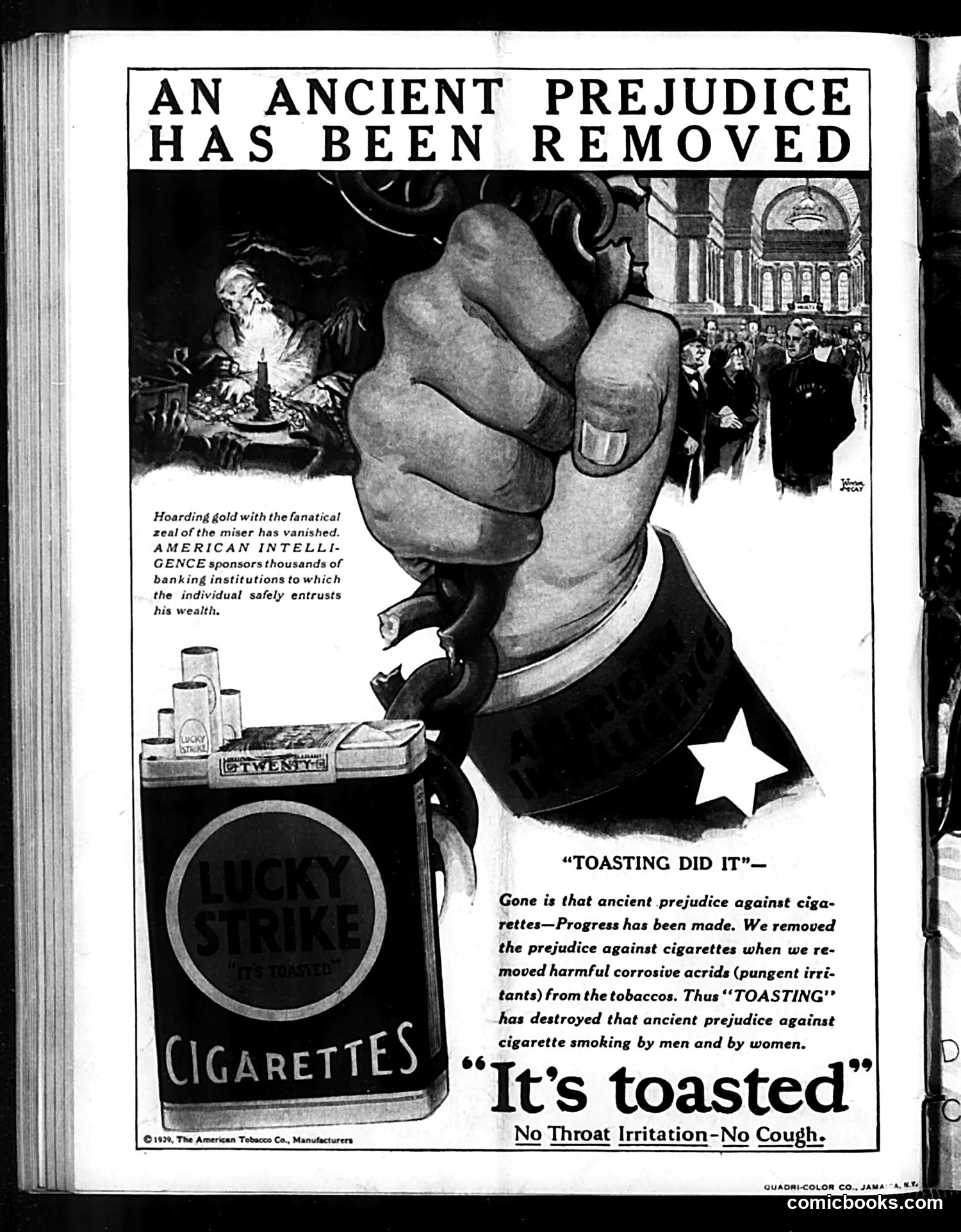
Lucky Strike Advertisement Analysis This is a cigarette advertisement, not political satire. The page promotes Lucky Strike cigarettes using the slogan "It's toasted." The ad claims that a manufacturing process called "toasting" removes harmful irritants from tobacco, thereby eliminating historical prejudice against cigarette smoking—particularly among women, who were socially discouraged from smoking at the time. The imagery of a large fist holding cigarettes appears designed to convey strength and modernity. The references to "American Intelligence" and banking suggest cigarette smoking represents progress and sophistication. The ad is historically significant as evidence of mid-20th-century tobacco marketing tactics: claiming health benefits through processing techniques and deliberately marketing cigarettes to women as a symbol of liberation and progress. Modern readers would recognize this as misleading advertising, as toasting does not eliminate tobacco's harmful effects.