judge
Judge — October 12, 1929
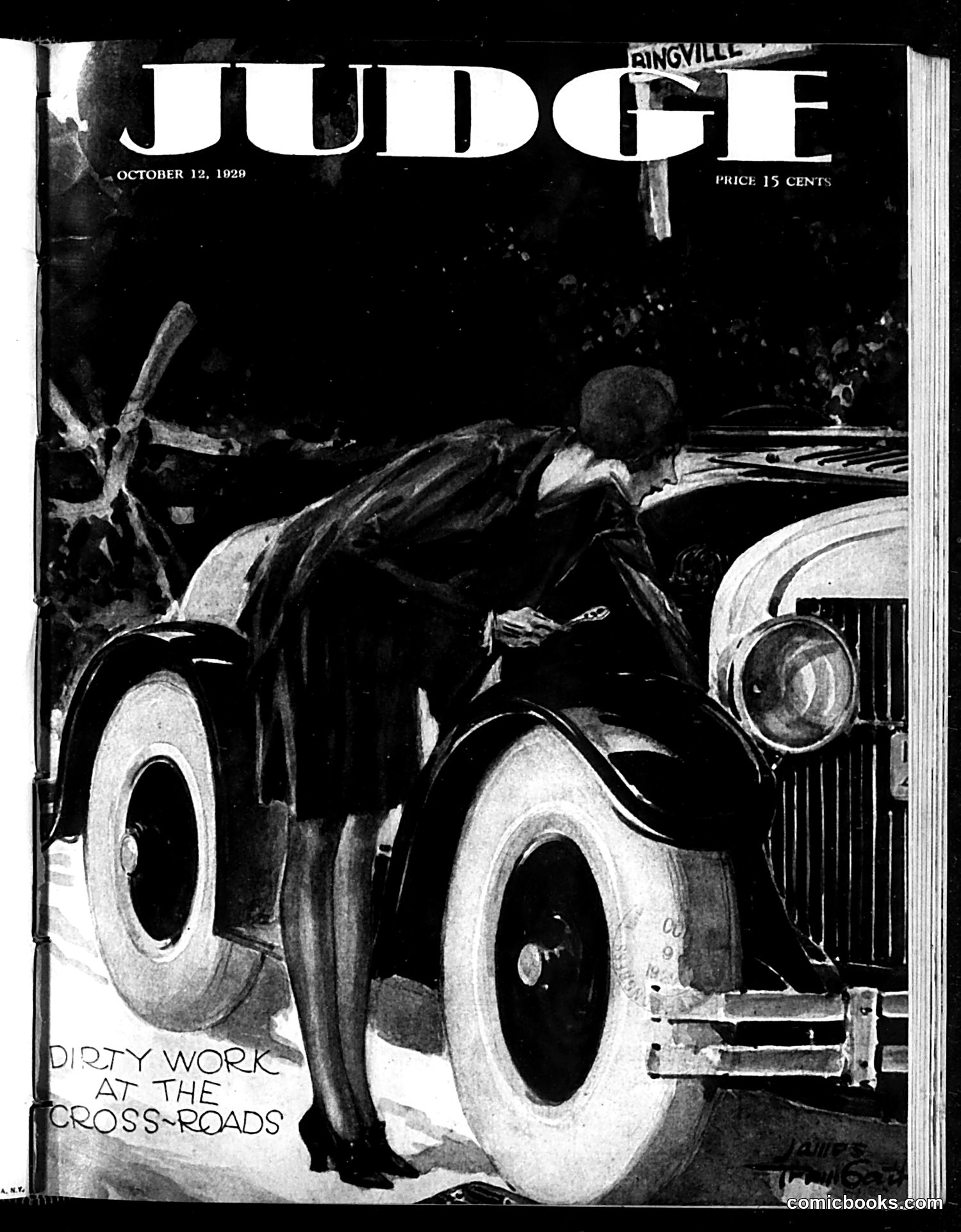
Analysis of Judge Magazine Cover (October 12, 1929) This cover depicts a woman examining two automobiles at a crossroads, captioned "Dirty Work at the Cross-Roads." The image appears to be satirizing automotive industry competition or consumer choice during the late 1920s boom period. The woman, dressed in 1920s fashion, seems to be deciding between vehicles—likely representing competing car manufacturers of the era. The "cross-roads" setting symbolizes a pivotal decision point, while "dirty work" suggests underhanded business tactics or aggressive marketing competition. This timing is significant: published October 12, 1929, just days before the stock market crash, the cover may be commenting on cutthroat automotive sales practices that characterized pre-Depression American business culture. The specific manufacturers referenced remain unclear from the image alone.
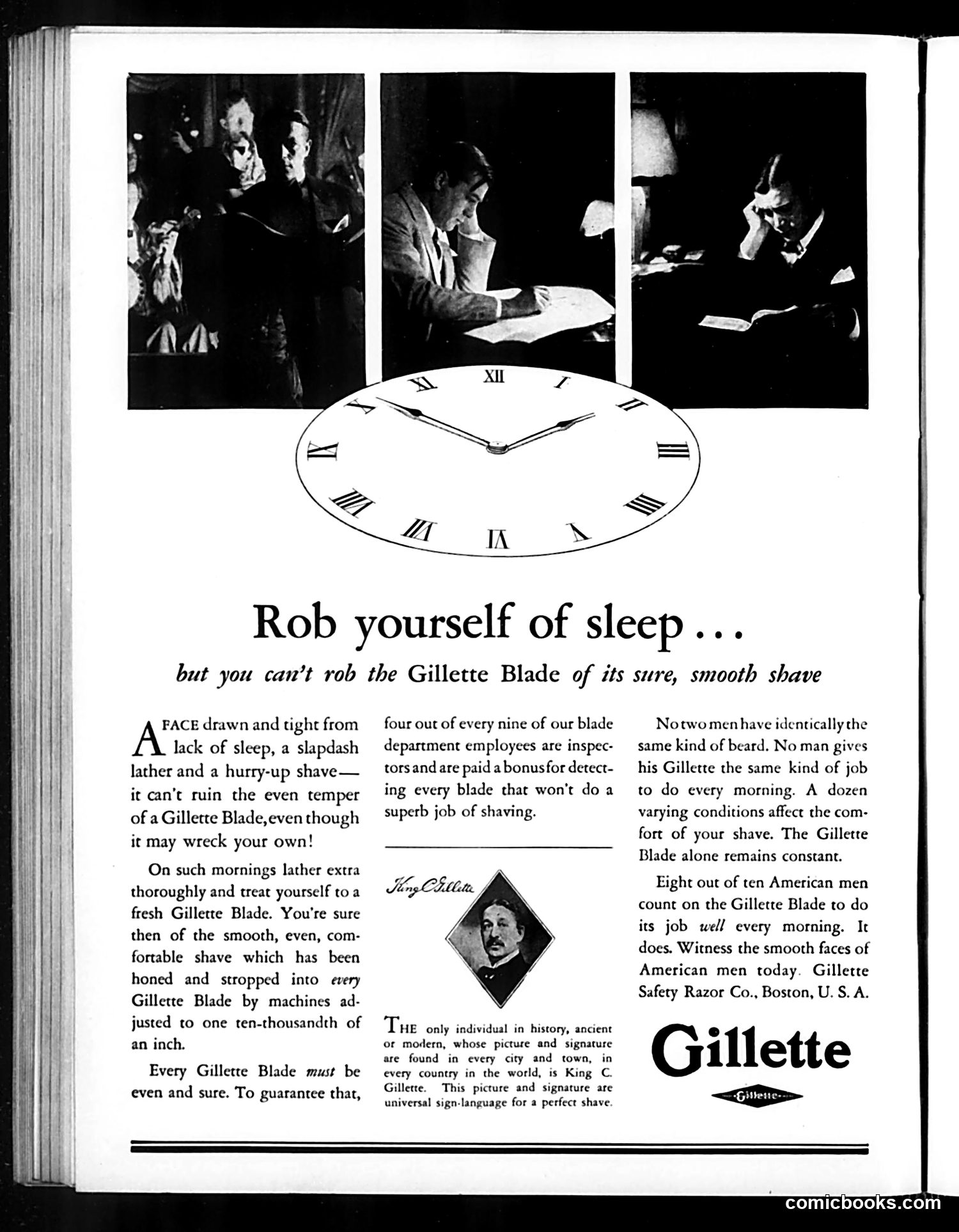
Analysis This is not satire or political commentary—it's a straightforward Gillette razor advertisement from an early 20th-century magazine. The page features three black-and-white photographs showing men in various states of shaving (preparing, shaving, finished), arranged above a large clock face. The advertisement's central claim is that Gillette blades maintain consistent quality despite a user's varying conditions—sleep deprivation, stress, or haste won't compromise shaving results. The text emphasizes quality control ("four out of every nine" inspectors) and includes a portrait of King C. Gillette (the founder), described as "the only individual in history...whose picture and signature are found in every city and town." The headline "Rob yourself of sleep..." ironically suggests that even if a man is exhausted, a Gillette blade delivers reliable performance.
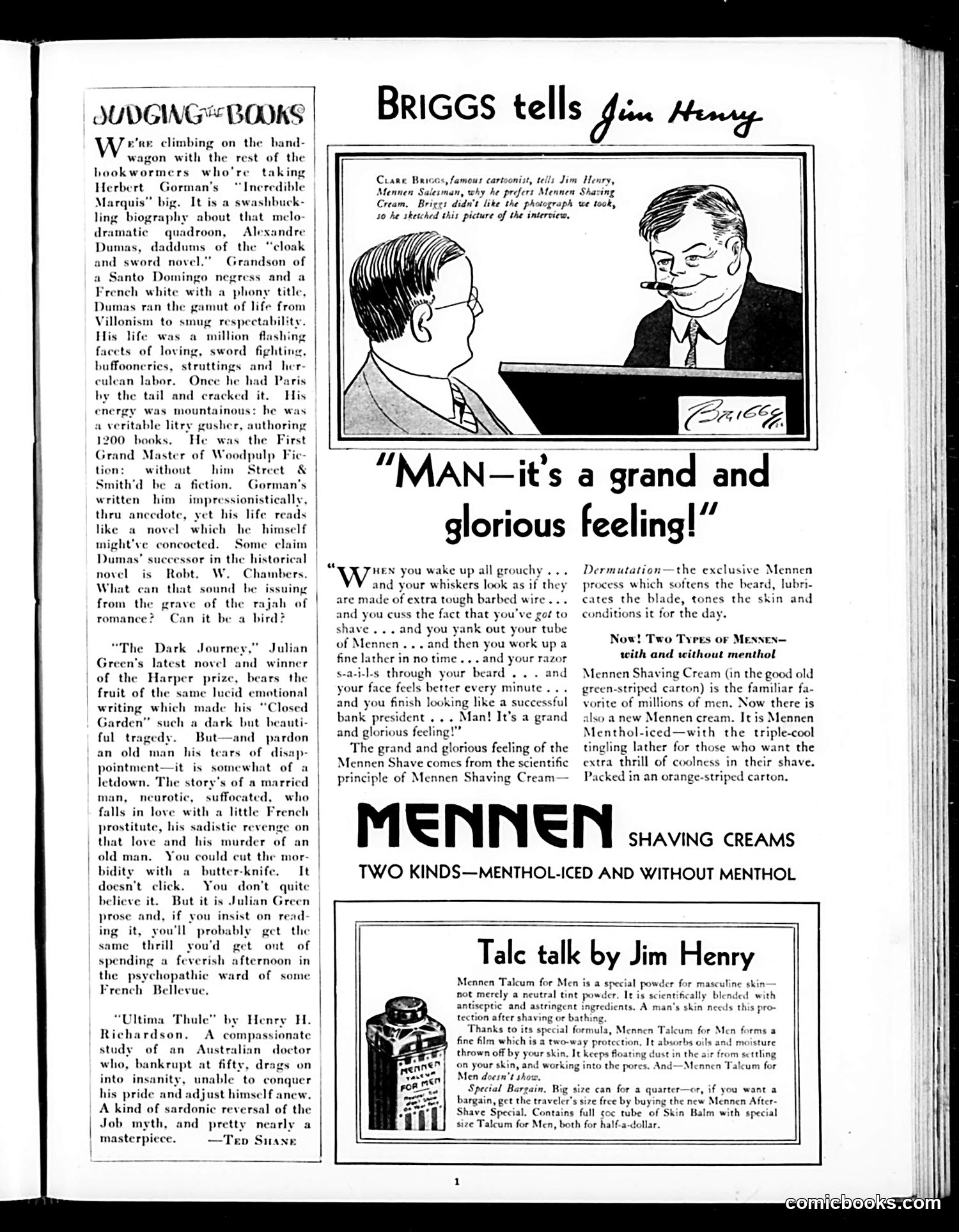
Analysis This page is primarily advertising for Mennen Shaving Cream, not political satire. The top section titled "Briggs tells Jim Henry" features a cartoon dialogue between two men—one identified as "Clark Hardie, famous cartoonist" speaking to Jim Henry. The caption quotes Henry saying the feeling of using Mennen products is "grand and glorious." This is a celebrity endorsement strategy: using a recognized figure (apparently cartoonist Jim Henry) to promote the shaving cream. The bulk of the page consists of product advertisements for Mennen Shaving Cream (two varieties: mentholated and non-mentholated) and Mennen Talcum Powder. The "Tale talk by Jim Henry" section further promotes Mennen Talcum as protective powder for men's skin. There is no political commentary or satire on this page—it's entirely commercial advertisement disguised as editorial content, a common practice in early 20th-century magazines.
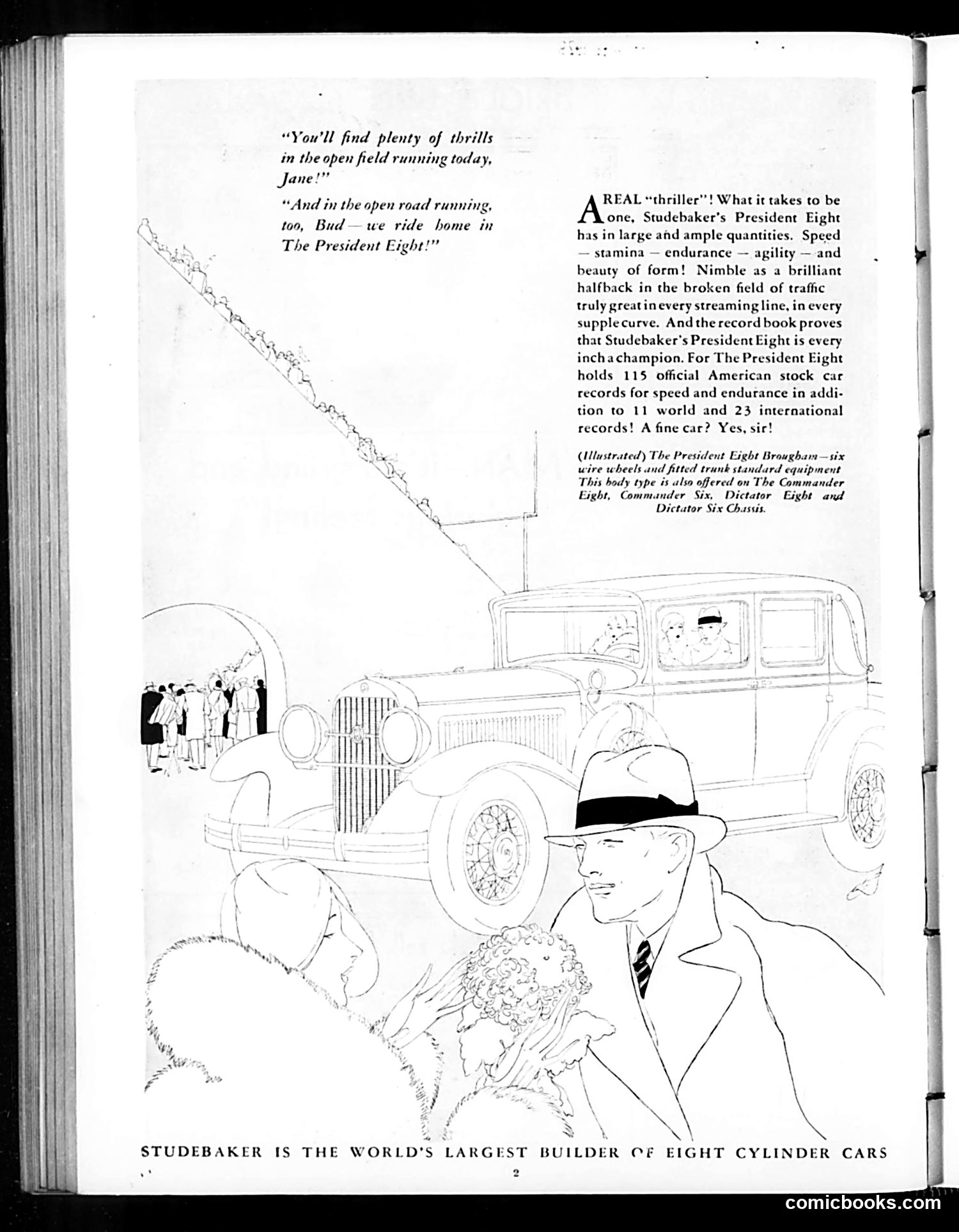
Analysis This page is primarily advertising, not political satire. It promotes the Studebaker President Eight automobile. The dialogue at top references leisurely driving ("open field," "open road") rather than satirizing any political figure or event. The illustration shows a well-dressed man with a small dog admiring the car, with other figures in the background. The text emphasizes the President Eight's performance records: "115 official American stock car records for speed and endurance" plus additional world and international records. The final line reads: "STUDEBAKER IS THE WORLD'S LARGEST BUILDER OF EIGHT CYLINDER CARS." This is a commercial advertisement using aspirational imagery—the gentleman, the automobile's prestige, and competitive achievements—to market the vehicle. No political or social satire is evident on this page.
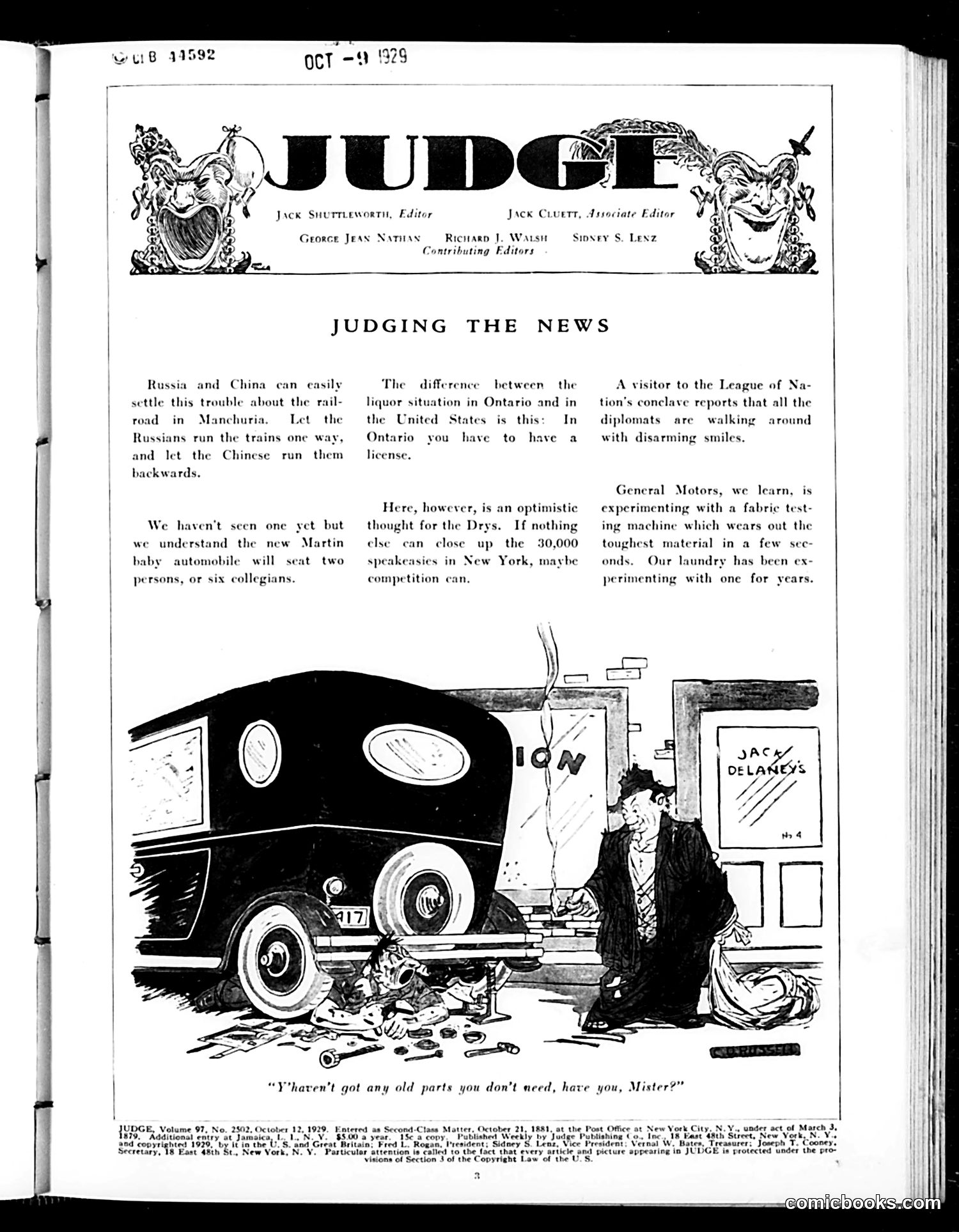
Judge Magazine Cartoon Analysis (October 12, 1929) This page contains editorial commentary ("Judging the News") and a cartoon about automobile repair. The cartoon depicts a shabby mechanic examining a dilapidated car, asking the owner: "Haven't got any old parts you don't need, have you, Mister?" The joke satirizes the era's car repair culture—mechanics' tendency to upsell unnecessary parts replacements. The mechanic's worn appearance and the ramshackle garage suggest economic desperation, implying he profits by convincing customers they need repairs they don't actually require. The publication date (October 12, 1929) is historically significant—this appeared just before the Stock Market Crash (October 29), making the economic anxiety visible in the mechanic's desperation particularly pointed for contemporary readers facing imminent financial crisis.
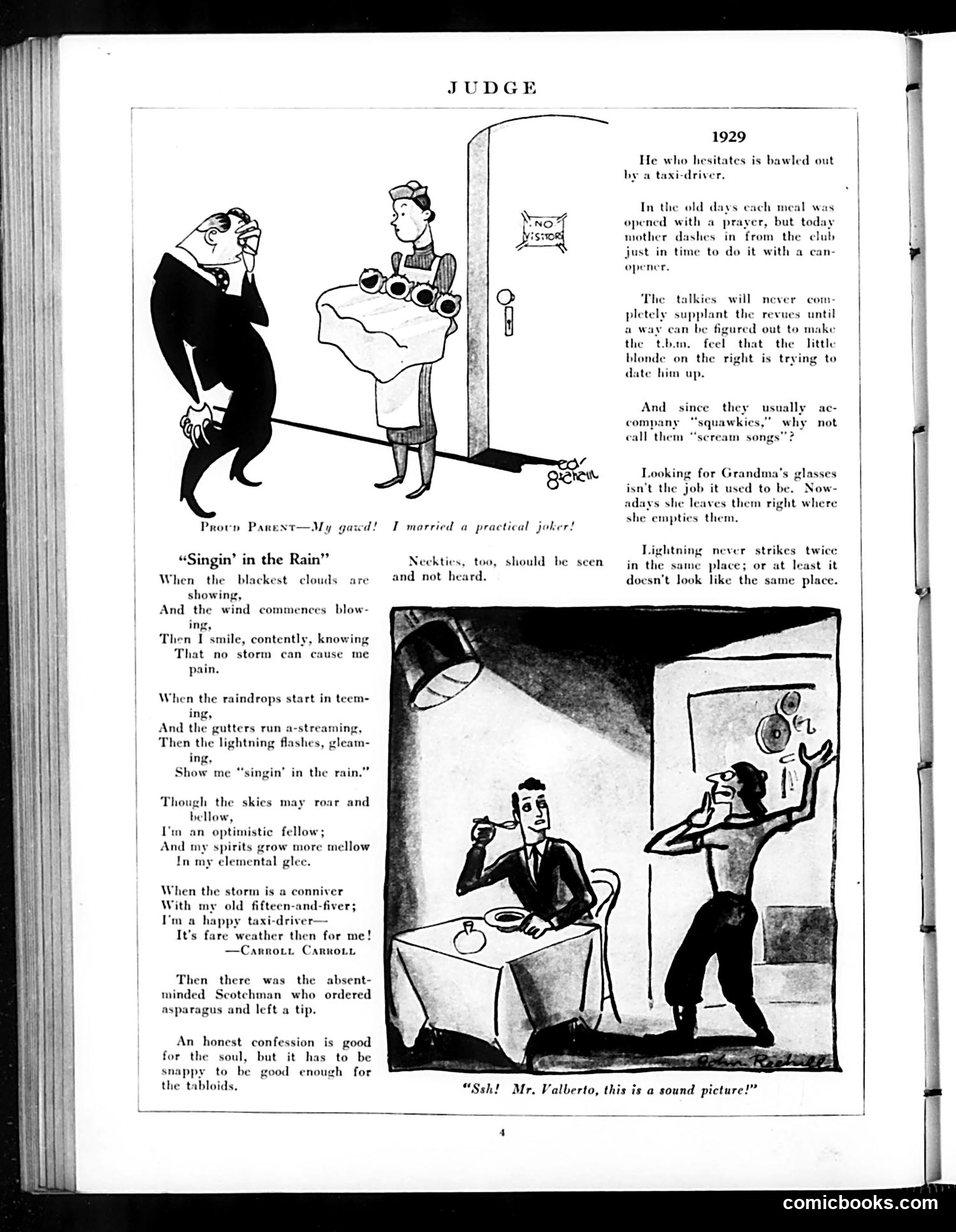
Analysis of Judge Magazine Page (1929) This page contains several unrelated humor pieces typical of Judge's format: 1. Top cartoon: Shows a man in formal wear telling a woman "Proud Parent—My gad! I married a practical joker!" The joke relies on visual wordplay—the man appears distressed, though the specific prank isn't entirely clear from the image. 2. "Singin' in the Rain" poem: A sentimental verse about optimism during storms, attributed to Carroll Carroll. This appears unrelated to political satire. 3. Bottom cartoon: Depicts a waiter saying "Ssh! Mr. Valberto, this is a sound picture!" The humor references the recent transition from silent to sound films (talkies), suggesting the character is making noise in a theater. The page mixes poetry, observational humor about 1920s social customs, and cinema-related jokes rather than political commentary.
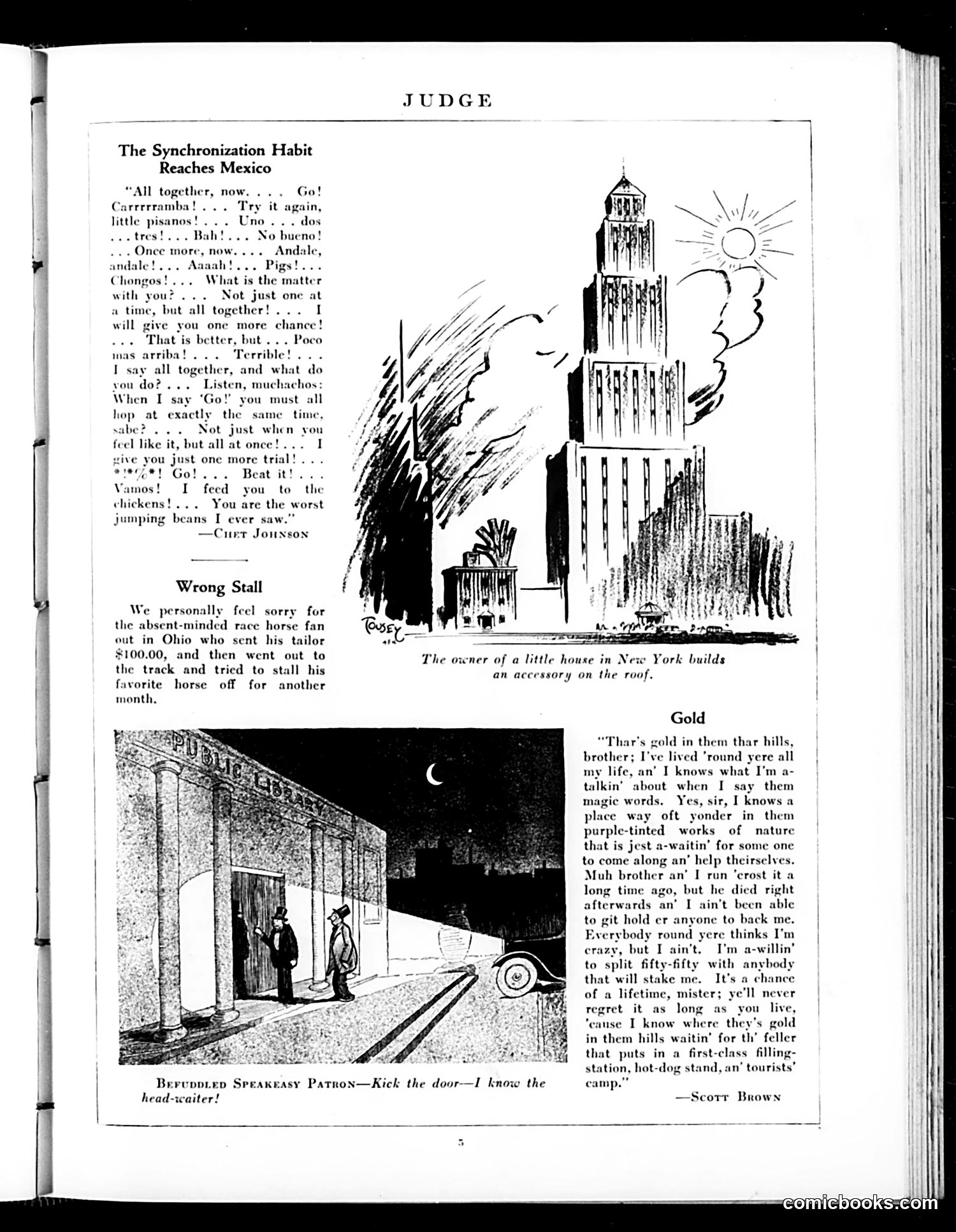
Analysis of Judge Magazine Page This page contains three separate humor pieces rather than a unified political cartoon: 1. "The Synchronization Habit Reaches Mexico": A comedic piece mocking coordinated group activities, with quoted dialogue about synchronized jumping. The humor appears to satirize fad behaviors or group conformity. 2. "Wrong Stall": A brief anecdote about a race horse owner trying to stall his horse for another month, playing on the double meaning of "stall." 3. "Gold": Features a nighttime illustration of what appears to be speakeasy patrons ("Bruddled Speakeasy Patron") and an accompanying monologue by Scott Brown about hidden gold in hills—likely referencing gold rush mythology and frontier dreams. The darker tone suggests social commentary on desperation or false hopes during uncertain times.
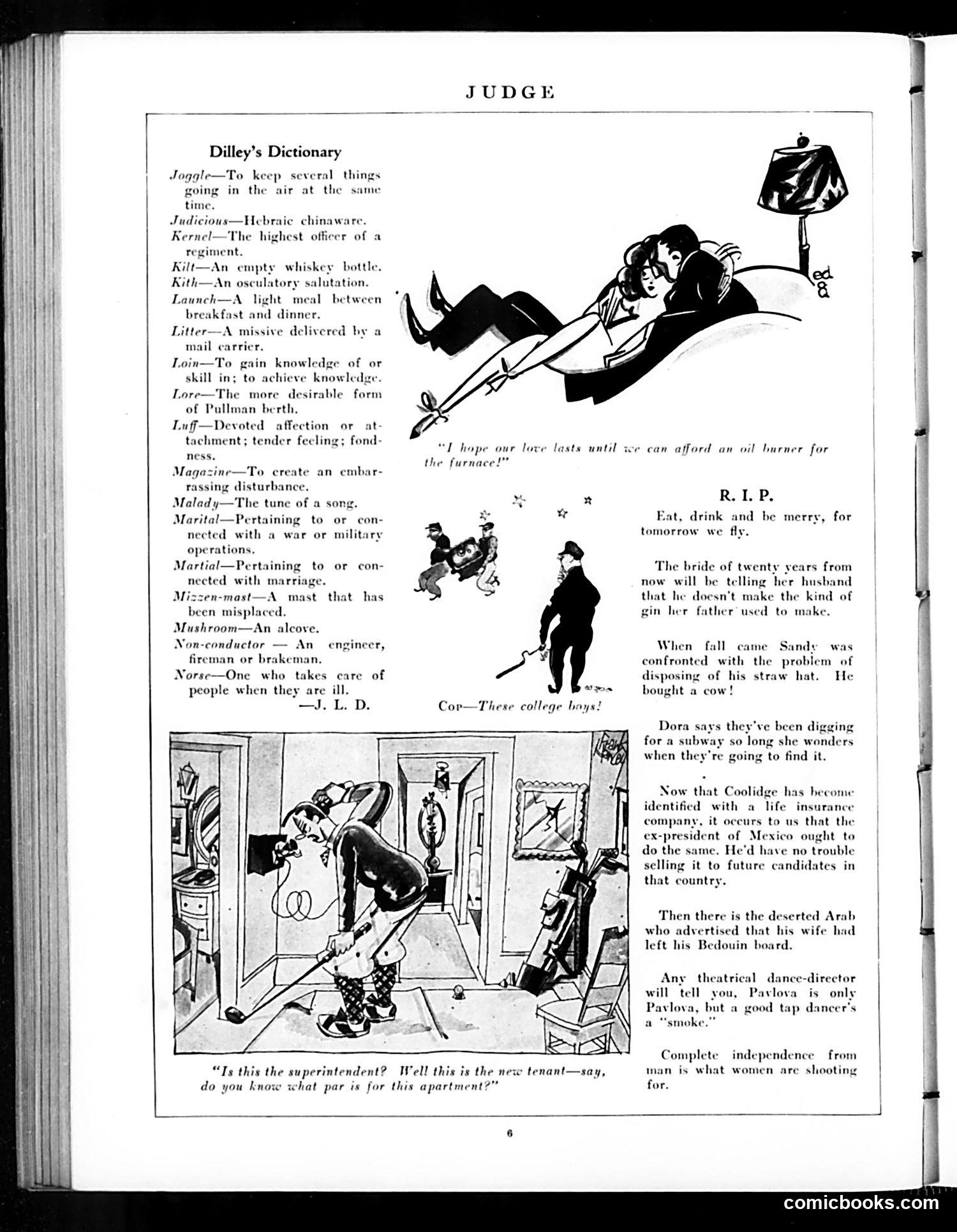
Analysis of Judge Page This page contains Dilley's Dictionary (humorous word definitions), brief jokes labeled "R.I.P.," and a cartoon depicting apartment chaos. The main cartoon shows a chaotic domestic scene where a tenant appears to be causing damage—possibly exploding or collapsing fixtures—while an exasperated superintendent or landlord questions what "par is for this apartment." The joke satirizes the tension between tenants and building management over property damage and maintenance responsibility, a perennial urban housing complaint. The scattered jokes reference contemporary 1920s concerns: gin-making (Prohibition era), insurance companies, subway construction, and gender independence—typical Judge magazine content mocking modern life's absurdities and social changes. The page exemplifies Judge's formula: dictionary wordplay, one-liners, and cartoon humor targeting middle-class anxieties.
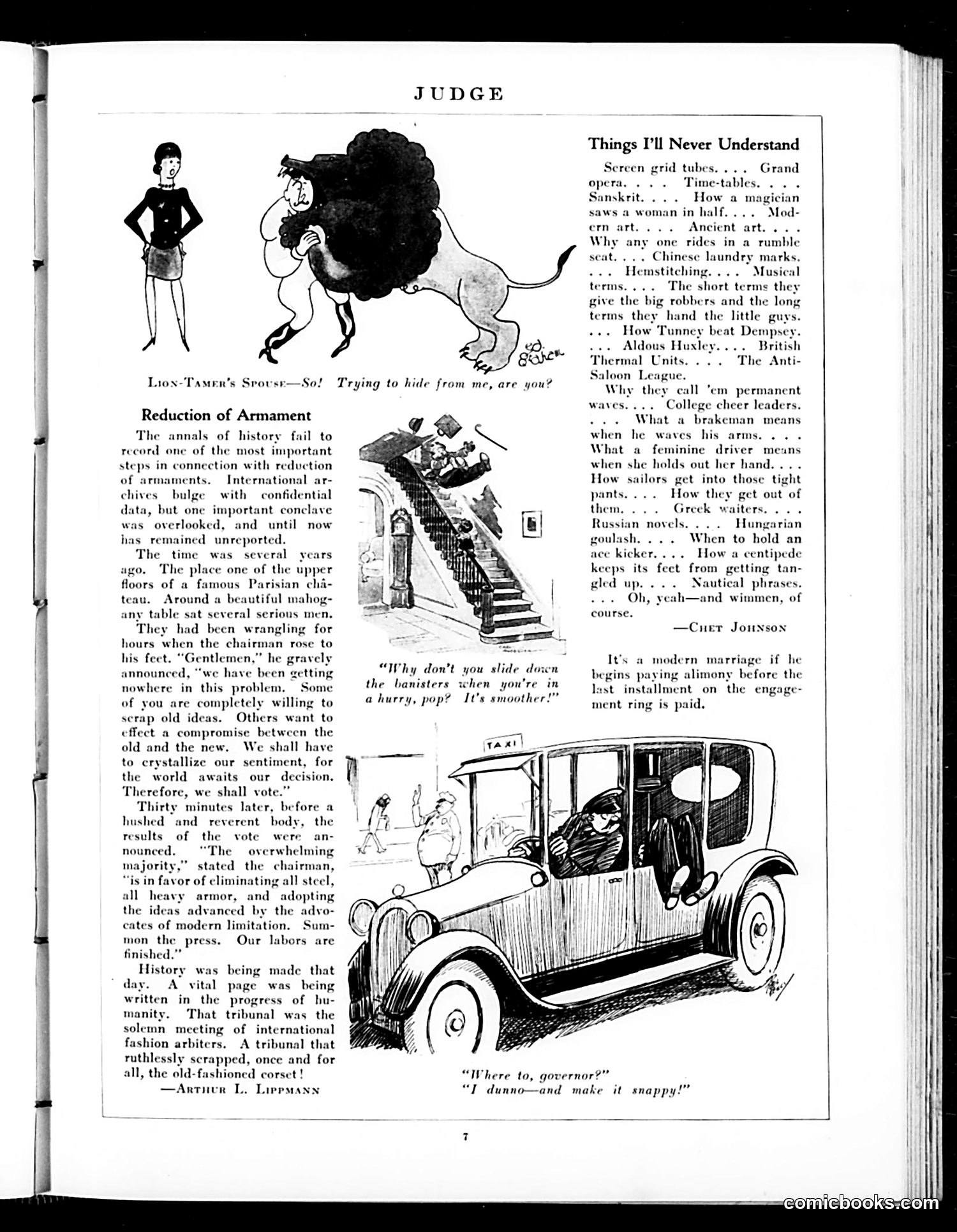
Analysis of Judge Magazine Page This page contains three satirical pieces: "Lion-Tamer's Spoils" (top): A simple visual gag showing a man trying to hide from an aggressive woman (labeled a "lion-tamer"), suggesting women are dangerous or domineering. "Reduction of Armament" (left): A political satire by Arthur L. Lippmann. It mocks international disarmament conferences by describing a "solemn tribunal" of fashion arbiters who dramatically "voted" to eliminate the corset as their contribution to reducing armaments. The joke: while diplomats negotiate serious military treaties, fashion leaders treat the obsolete corset's demise as a major historical moment. This reflects 1920s debates about women's liberation and changing fashion. "Things I'll Never Understand" (right): A humorous list by Chet Johnson of everyday mysteries (seven-grid tubes, opera, Sanskrit, modern art, etc.), including social observations like why small criminals get long sentences while major criminals get short ones, and commentary on marriage/alimony. The taxi cartoon at bottom shows a driver rushing passenger, making a joke about impatience.
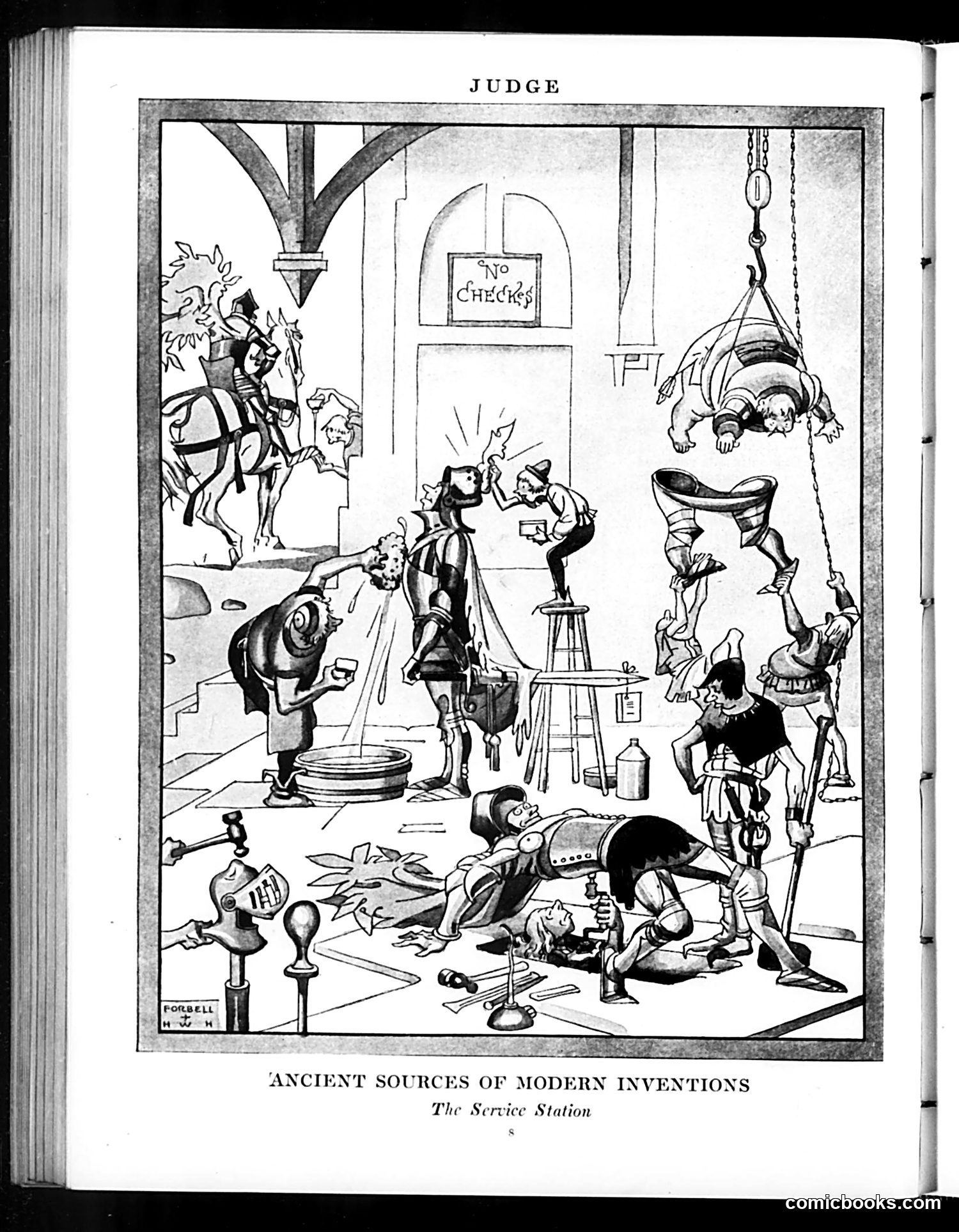
This satirical cartoon from Judge magazine presents a humorous comparison between ancient judicial torture and modern automobile service stations. Titled "Ancient Sources of Modern Inventions: The Service Station," it depicts a medieval torture chamber where figures in period dress operate various torture devices alongside a central figure being stretched on a rack. The satire equates the painful experience of getting an automobile serviced with medieval torture—suggesting that visiting a service station is financially and physically taxing. Various torture implements appear throughout the scene, with attendants operating them much like modern mechanics. The "No Checks" sign emphasizes the expense involved. This reflects early 20th-century automotive anxiety, when car maintenance was unpredictable, costly, and often excessive.
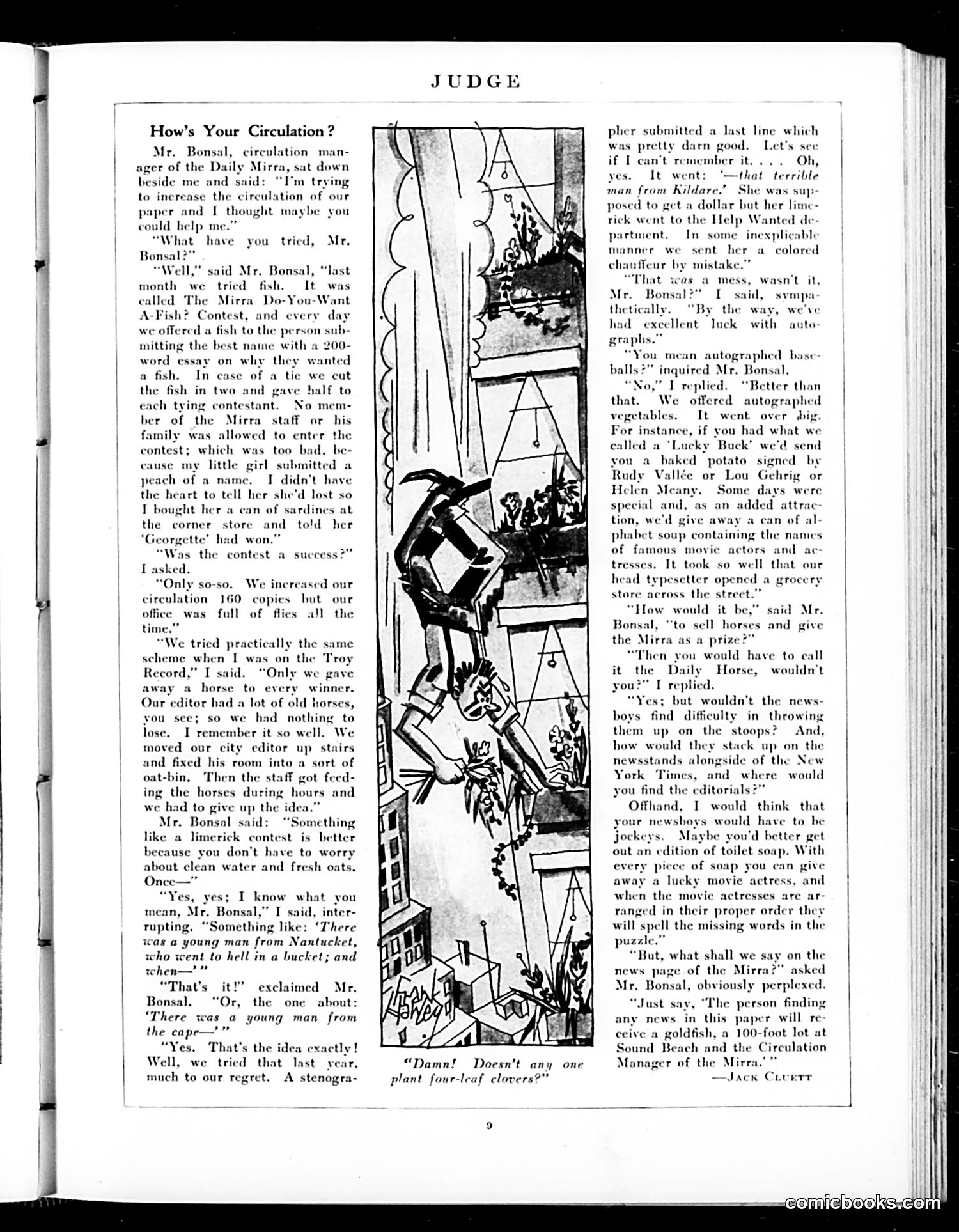
Judge Magazine Satire Analysis This page satirizes newspaper circulation-building schemes of the early 20th century. The protagonist, Mr. Bonsal (circulation manager of the fictional "Daily Mirra"), describes increasingly absurd promotional contests to boost readership. The joke escalates through increasingly ridiculous giveaways: fish, horses, limericks, and autographed vegetables (including "Lucky Buck" potatoes signed by celebrities like Rudy Vallée and Lou Gehrig). Each scheme backfires comically—flies infest the office, horses must be fed during work hours, a stenographer accidentally receives a chauffeur instead of prize money. The cartoon illustration shows these chaos-creating animals and objects tumbling chaotically from a building, visualizing the disasters described. The satire mocks the desperation of newspapers to gain circulation through gimmicks rather than quality journalism. The final punchline—that no actual news appears in the paper—crystallizes the critique: circulation stunts have replaced real reporting as the industry's priority.
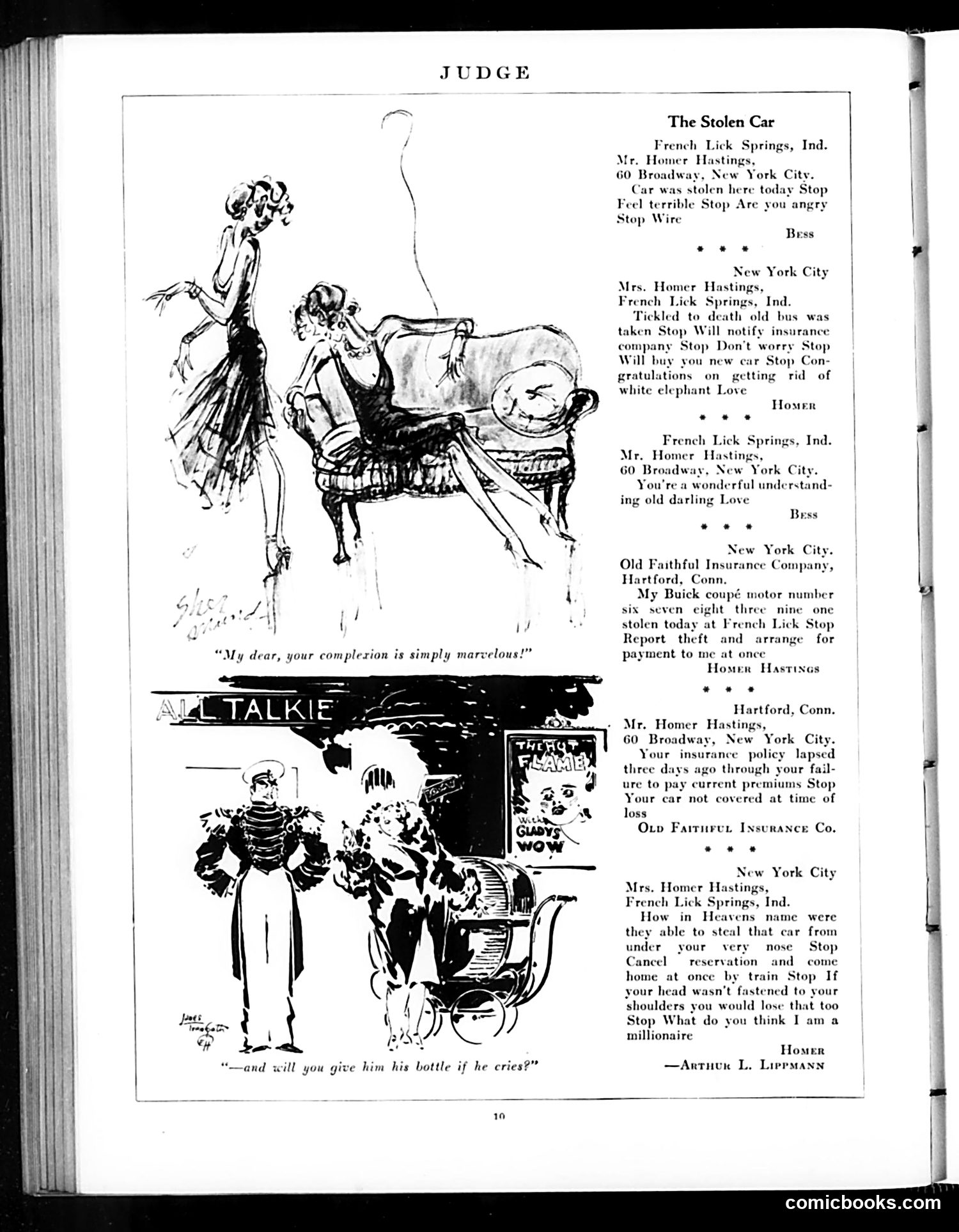
"The Stolen Car" - Judge Magazine Satire This satirical piece uses a series of telegrams to mock marital dynamics and insurance company bureaucracy. Mr. Hastings' car is stolen at French Lick Springs (a resort town), but his wife Bess responds with delight—calling the old vehicle a "white elephant" she's glad to be rid of. Her enthusiasm suggests the marriage is strained and the car was unwanted. The humor escalates when Hastings tries to claim insurance, only to learn the policy lapsed. His frantic attempts to file are thwarted by insurance company fine print. The accompanying cartoons (with text "My dear, your complexion is simply marvelous!" and "and will you give him his bottle if he cries?") appear unrelated, possibly advertisements or separate comic bits typical of Judge's format. The satire targets both unhappy marriages and the frustrating complexity of insurance claims—everyman complaints that remain relatable today.
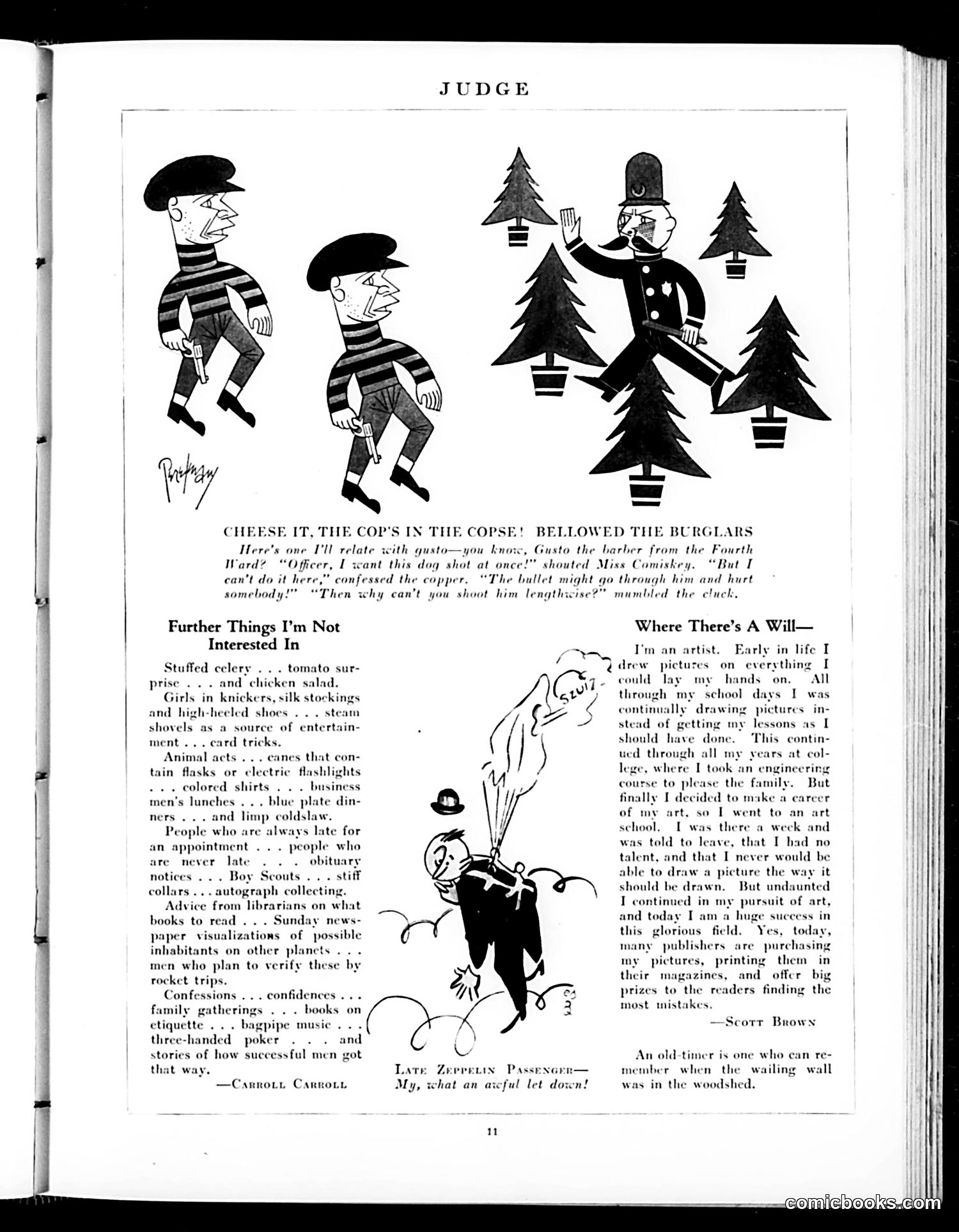
Understanding This Page from Judge Magazine The top cartoon satirizes a bungled burglary. Police have caught burglars hiding among potted Christmas trees. The joke plays on the phrase "cop's in the copse" (a copse is a small forest)—the criminals thought they were hidden in trees, but ironically, law enforcement found them anyway. The accompanying story mocks the incompetence of both criminals and police in this domestic crime scenario. Below are three humorous essays. "Further Things I'm Not Interested In" by Carroll Carroll catalogs modern annoyances (stuffed celery, girls in knickers, autograph collectors, bagpipes). "Where There's A Will" by Scott Brown satirizes art education's dismissal of untrained talent—the narrator was rejected from art school but became successful anyway, now making money finding errors in his own published work. "Late Zeppelin Passenger" is a brief joke about tardiness. The page represents Judge's typical blend of social satire and light domestic humor aimed at early 20th-century middle-class readers.
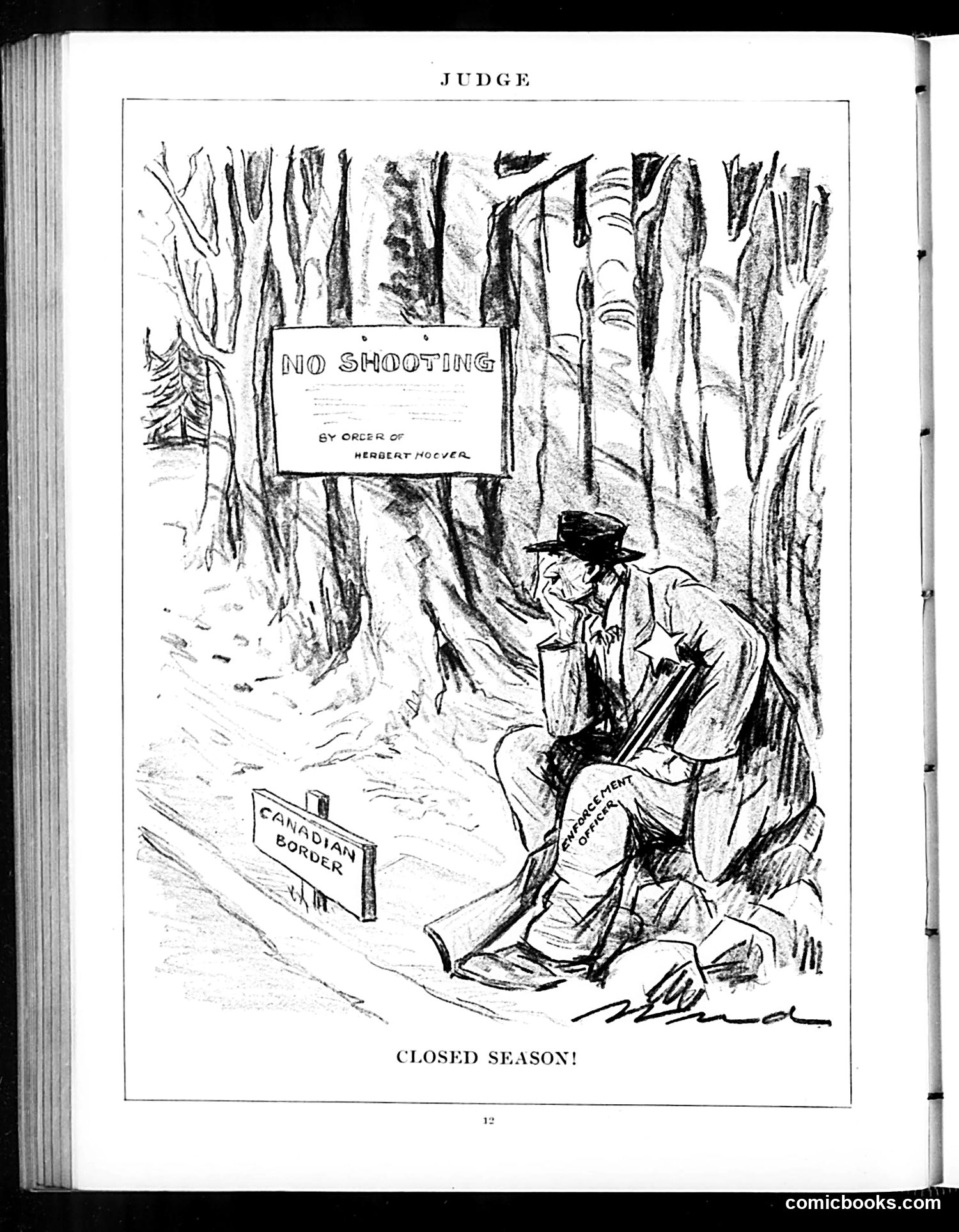
Political Cartoon Analysis This Judge magazine cartoon satirizes hunting restrictions along the Canadian border. A figure labeled "CANADIAN BORDER" sits in a forest with a rifle marked "ENFORCEMENT," facing a "NO SHOOTING" sign posted "BY ORDER OF HERBERT HOOVER." The caption reads "CLOSED SEASON!" The satire critiques Hoover's policies restricting hunting or enforcement activities at the Canadian border—likely referencing Prohibition-era smuggling enforcement or tariff disputes. The hunter, frustrated by the closed season order, appears unable to act despite having enforcement capability. The cartoon suggests Hoover's policies were ineffective or overly restrictive regarding border control issues of the era.
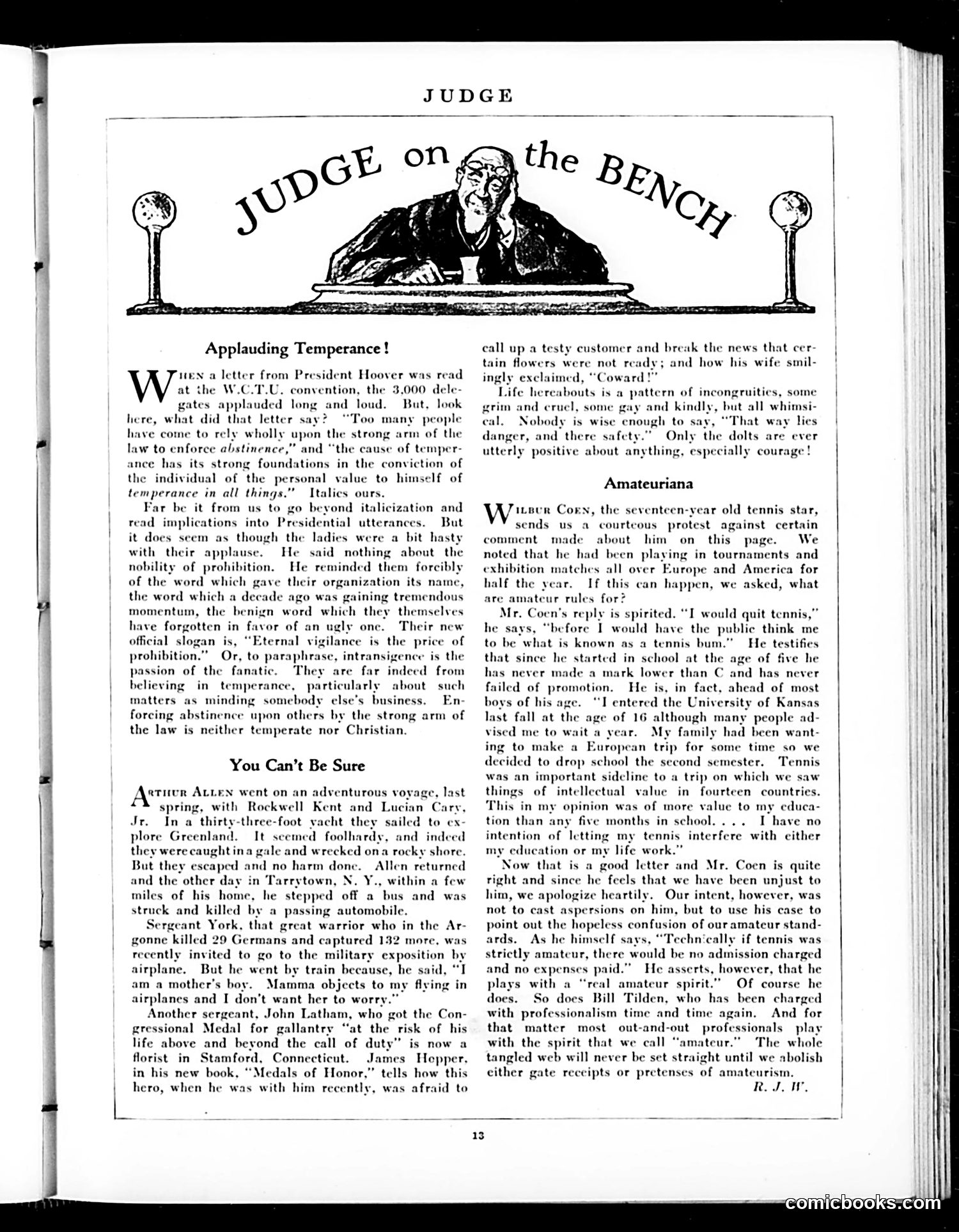
Judge Magazine Page Analysis This page contains three satirical pieces: "Applauding Temperance!" critiques the Women's Christian Temperance Union (W.C.T.U.) for misinterpreting President Hoover's letter. The joke: the W.C.T.U. applauded his support for Prohibition, but Hoover actually emphasized *temperance* (moderation) over legal enforcement—essentially criticizing their fanaticism. The satire mocks their selective reading and suggests they've abandoned the virtue of temperance itself in their zealous prohibition advocacy. "You Can't Be Sure" presents ironic anecdotes about courage and caution: Sergeant York survived Greenland's dangers but died in a routine car accident; a decorated war hero now fears confronting a customer. The point: life's outcomes are unpredictable, so absolute certainty about anything (especially courage) is foolish. "Amateuriana" defends teenage tennis star Wilbur Coen against criticism that he's a "tennis bum" for prioritizing tournaments over school. The piece argues his academic record refutes this, suggesting amateur rules may be overly restrictive.
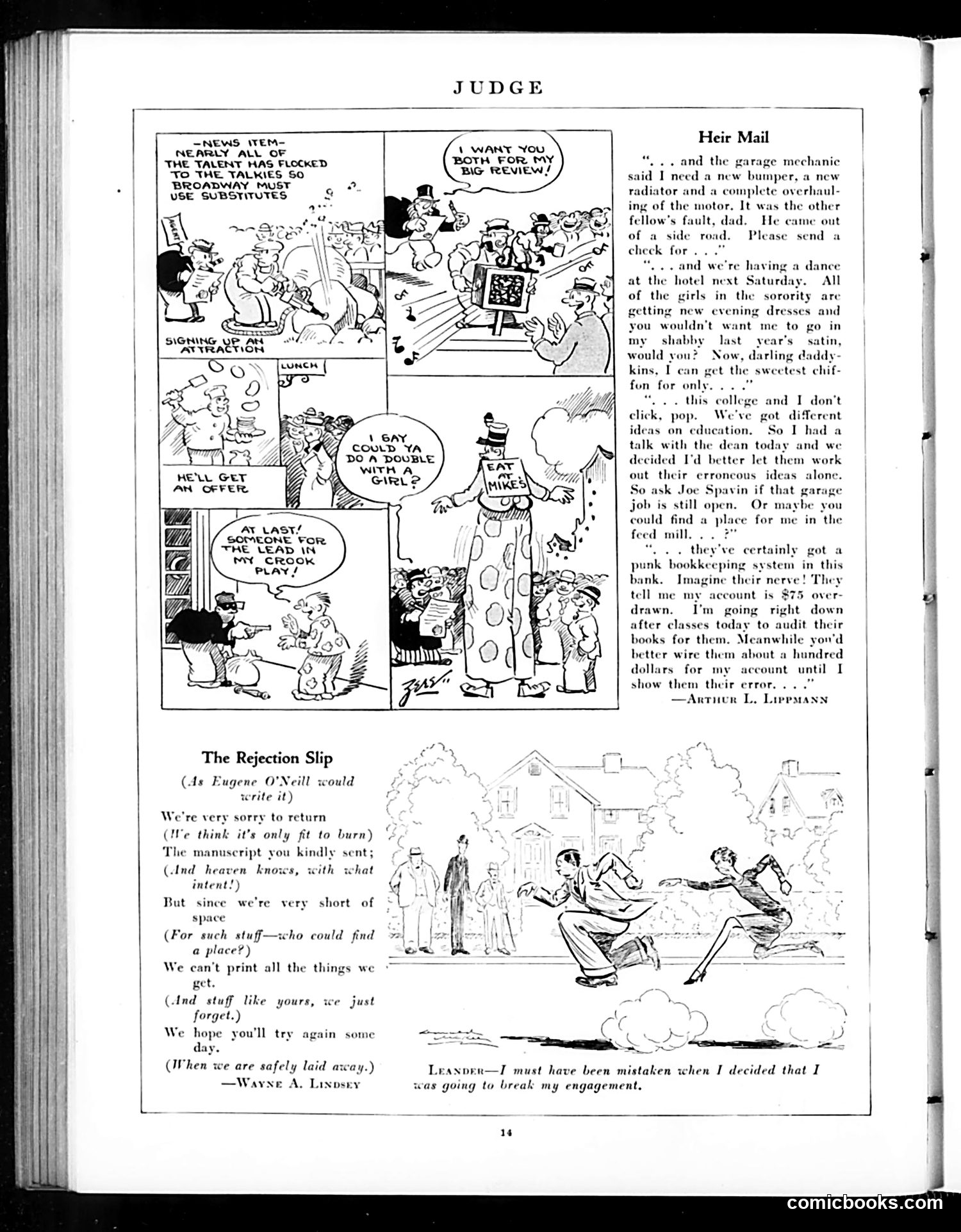
Explanation for Modern Readers This Judge magazine page contains two satirical pieces about early 1920s American life. "Heir Mail" is a comic strip mocking entitled young people's demands on their parents. Children write home requesting money for various luxuries—new car parts, evening dresses, dance attendance—while making excuses or complaints. The satire targets the perceived entitlement and financial irresponsibility of the younger generation, who view their parents as automatic funding sources. One letter humorously shows a college student criticizing the bank's "punk bookkeeping" while admitting his own $75 overdraft. "The Rejection Slip" parodies Eugene O'Neill's theatrical writing style (known for experimental, sometimes absurdist plays) by presenting a publisher's rejection letter in O'Neill's dramatic, parenthetical manner. It satirizes both pretentious literary rejection and O'Neill's distinctive voice, suggesting his work is incomprehensible and unmemorable. The bottom illustration depicts a woman breaking an engagement, implying hasty romantic decisions. Both pieces mock 1920s social trends: youth materialism and modernist artistic pretension.
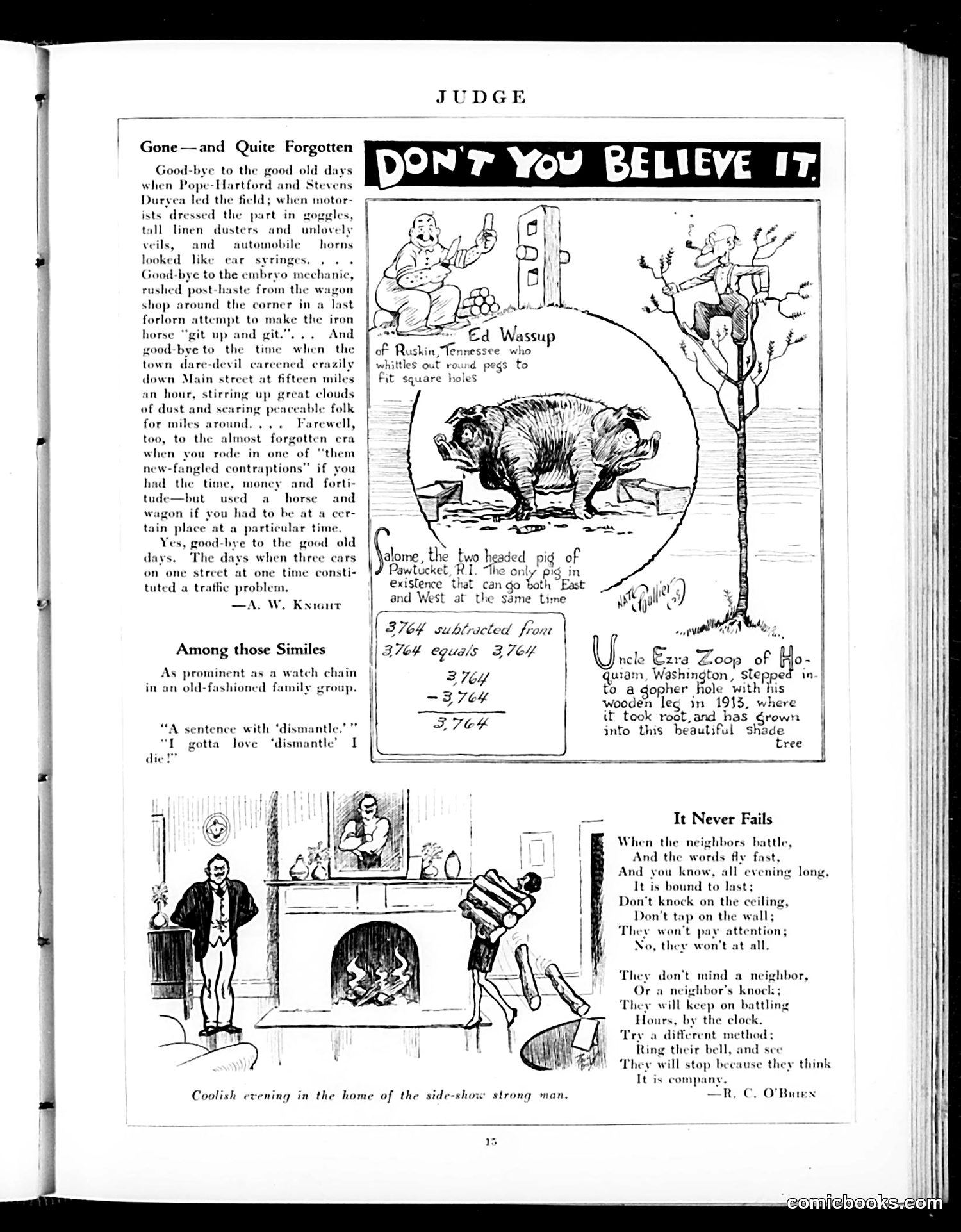
Explanation for Modern Readers This page from *Judge* magazine contains humorous nostalgia and oddities rather than political satire. "Gone and Quite Forgotten" laments the early automobile era's passing—when cars like Pope-Hartford and Duryea were novel, drivers wore linen dusters, and horseless carriages were still exotic enough that people preferred reliable horses for practical trips. The satire targets how quickly automotive technology became mundane. "Don't You Believe It" features grotesque curiosities: Ed Wassup who whistles pigs into square holes; a two-headed pig from Rhode Island; and Uncle Ezra Zoop's wooden leg that took root and became a tree. These are absurdist tall tales meant purely for entertainment. "It Never Fails" is a poem (by R.C. O'Brien) about noisy neighbors, offering satirical "advice" that ringing their bell won't stop their fighting—they'll only continue, mistaking the interruption for company visiting. The bottom illustration shows a "side-show strong man" in domestic chaos, likely commenting on incongruity between physical strength and household domesticity.
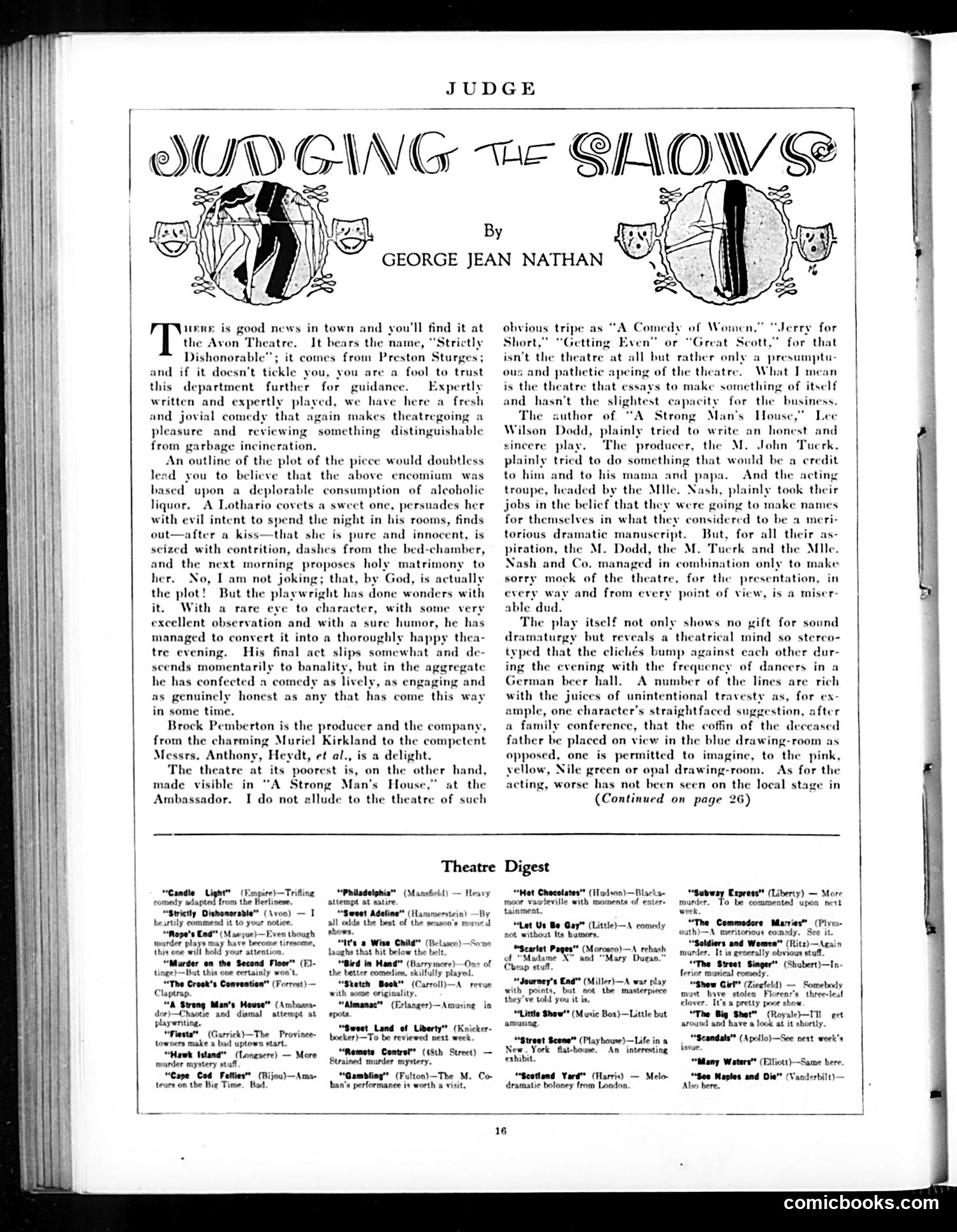
What This Page Means to Modern Readers This is a theater review column by George Jean Nathan, a prominent drama critic. Nathan praises Preston Sturges's play "Strictly Dishonorable" at the Avon Theatre as genuinely clever and witty—a "fresh and jovial comedy" that rises above theatrical trash. By contrast, he harshly condemns "A Strong Man's House" at the Ambassador Theatre, written by Lee Wilson Dodd. Although he credits the author, producer M. John Tuerk, and actress Mlle. Nash for *attempting* sincere, earnest theater work, he finds the play fails completely—full of unintentional comedy (like awkward dialogue about coffin placement) and relying on tired theatrical clichés. Nathan's underlying point: good theater requires not just honest effort, but genuine talent and originality. The page also includes a "Theatre Digest" sidebar listing other current productions with brief descriptions.
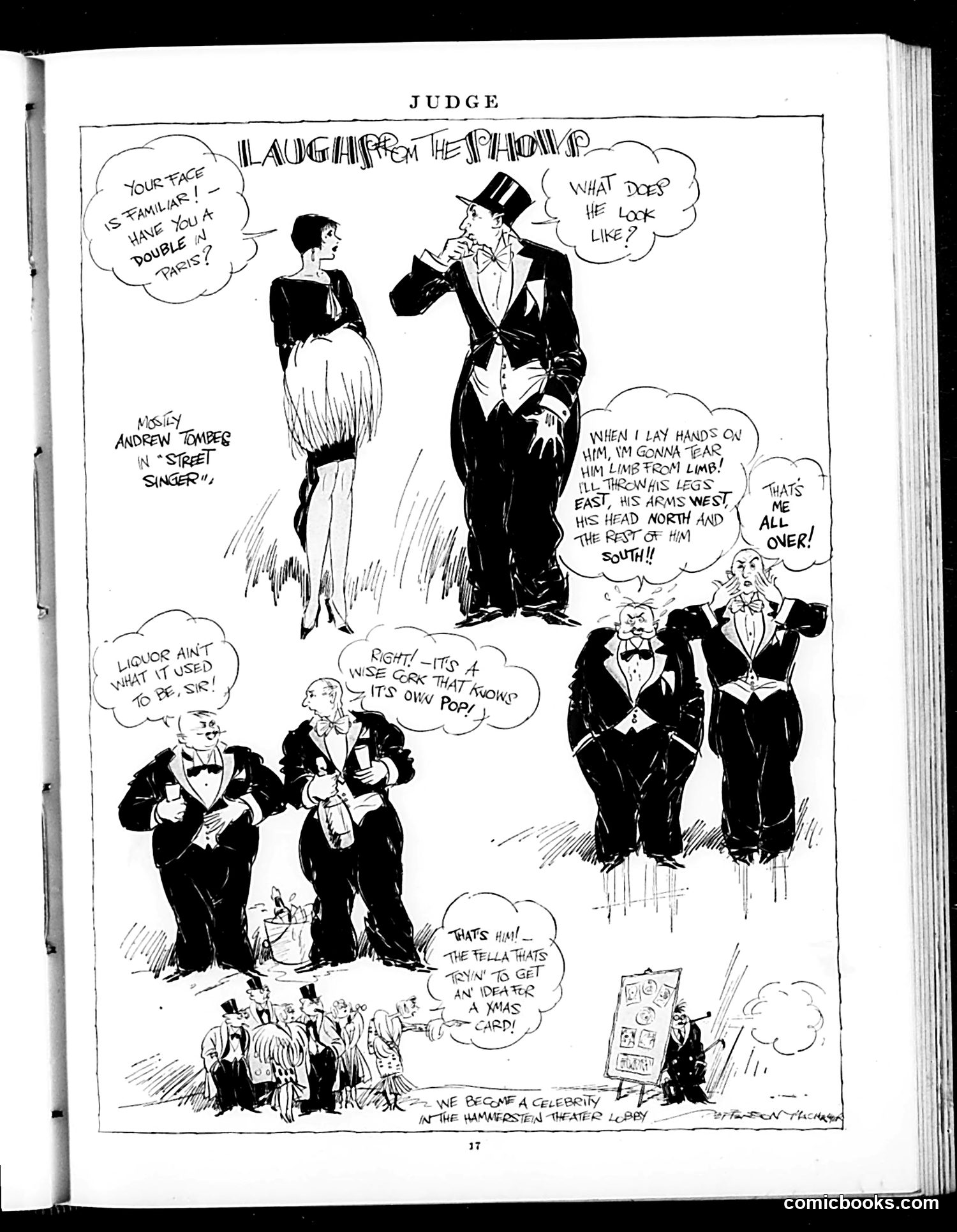
"Judge" Cartoon Analysis This satirical cartoon mocks wealthy patrons of the Hammerstein Theater Library. It depicts a well-dressed man in a top hat being questioned by a pregnant woman about "double Paris" (likely a euphemism for illicit affairs). The joke centers on the hypocrisy of the theater elite: they publicly espouse moral propriety while engaging in scandalous behavior. The subsequent panels show men in formal wear discussing how to "tear him limb from limb" and become "a celebrity in the Hammerstein Theater lobby"—suggesting they gossip and capitalize on others' misdeeds for social status. The cartoon satirizes the theater world's combination of pretentiousness, moral corruption, and obsession with celebrity scandal. The formal attire and sophisticated setting contrast sharply with the crude violence threatened and the crude humor employed, emphasizing the gap between appearances and reality among high society.
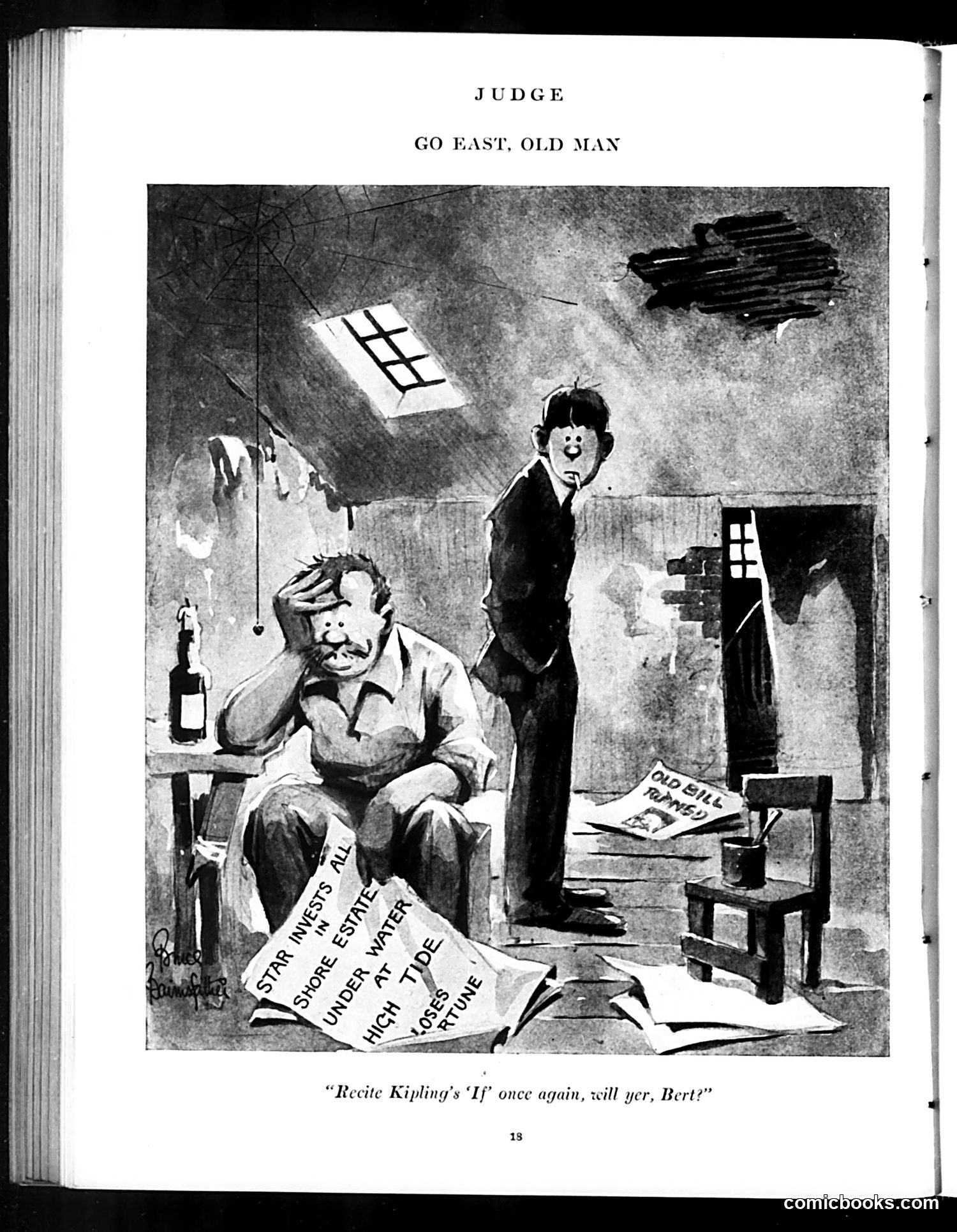
"Go East, Old Man" - Judge Cartoon Analysis This satirical cartoon depicts an elderly man slouched in a chair, drinking, surrounded by scattered papers labeled "START WEST'S ILL FAME," "SMOKE & CORFEE," "UNDER WATER," and "HIGH AT TIDE." A younger man stands nearby pointing a gun or rifle, while another figure grins in the background. The caption requests recitation of Rudyard Kipling's poem "If"—famous for themes of perseverance and moral fortitude. The satire appears to mock an aging writer (possibly based on Kipling himself or a similar literary figure) who has declined into dissolution and failure, now surrounded by rejected or abandoned manuscripts. The cartoon contrasts the poem's idealistic message about maintaining character and dignity with this figure's actual degradation, suggesting ironic commentary on literary ambition, artistic failure, or perhaps aging and irrelevance.
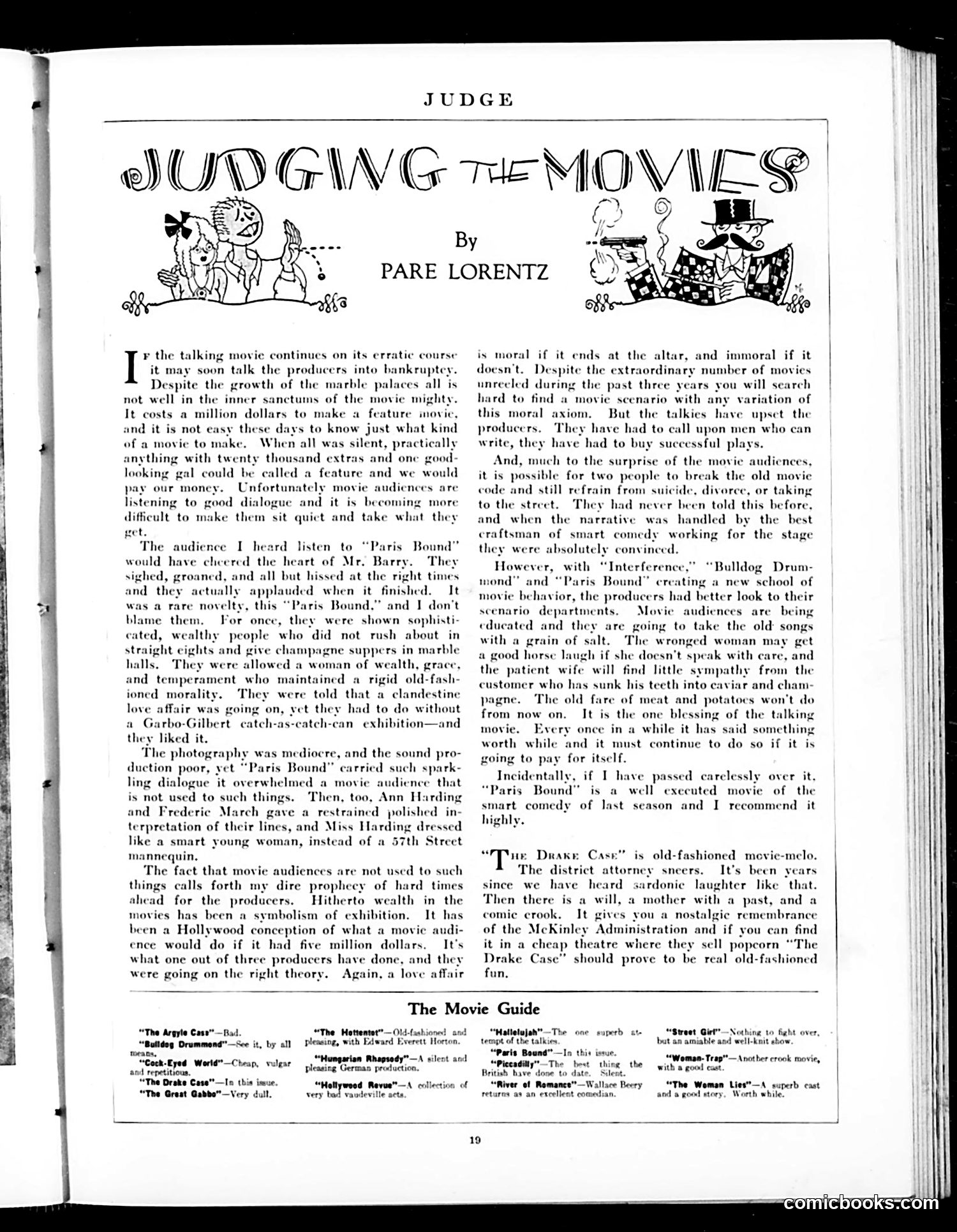
Judging the Movies: Pere Lorentz's Film Criticism Column This is a film criticism column by Pere Lorentz in Judge magazine, not political satire. Lorentz argues that talking pictures are forcing Hollywood producers to improve. He praises "Paris Bound" for featuring wealthy, morally restrained characters who don't follow tired movie formulas (no melodramatic affairs or suicides). He notes audiences actually applaud intelligent dialogue and refined acting—Ann Harding and Frederic March performing without exaggeration. Lorentz warns producers that audiences, now accustomed to quality stage writing, will no longer accept crude spectacle and excess. He predicts financial hardship unless filmmakers continue elevating their material. The column also briefly reviews "The Drake Case" as old-fashioned melodrama. The underlying message: talking pictures, by requiring actual dialogue and performance, have inadvertently raised artistic standards audiences now expect.
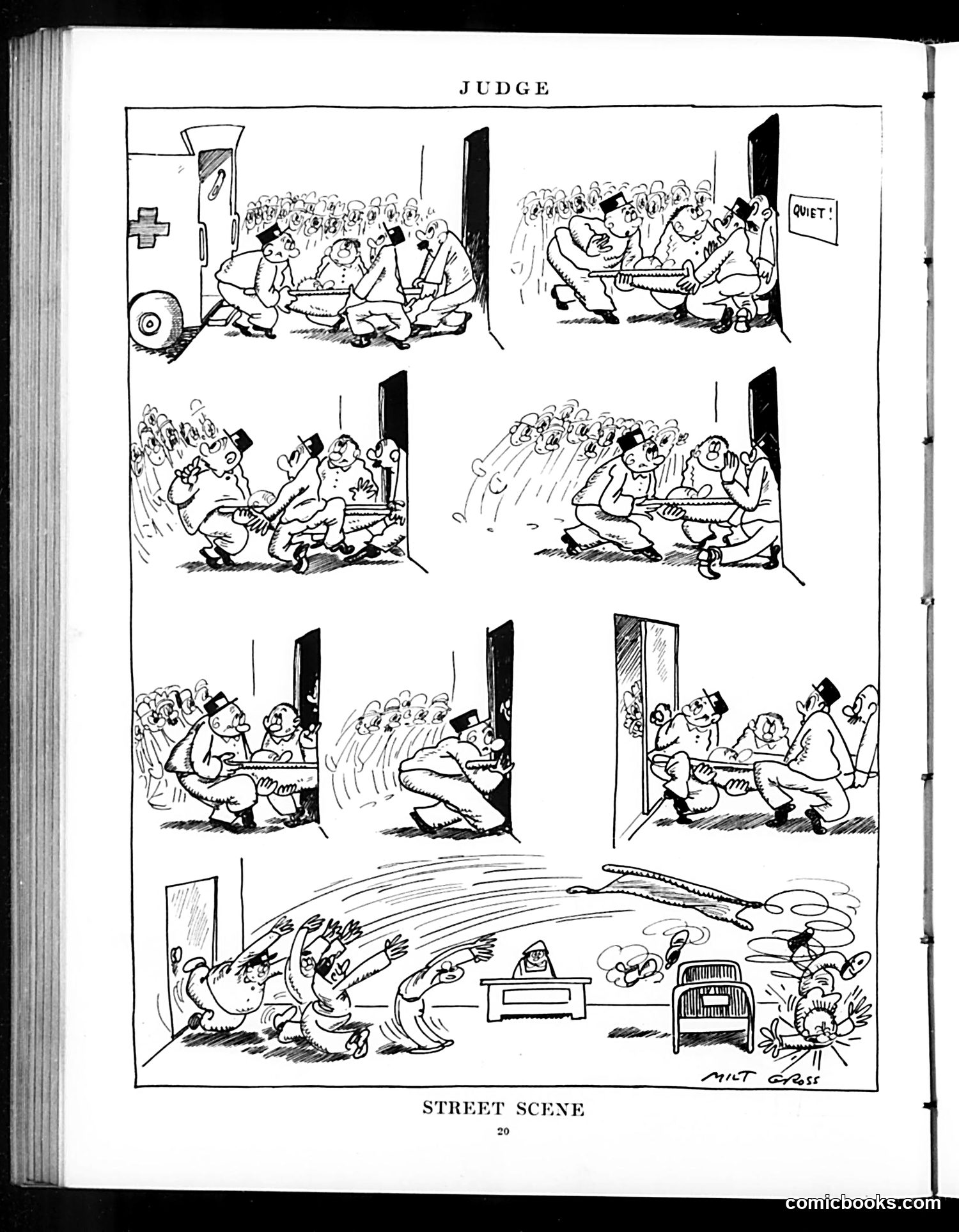
"Judge" Magazine Cartoon Analysis This multi-panel satirical cartoon titled "Street Scene" depicts a courtroom that has literally moved into the street, with a judge presiding over an increasingly chaotic outdoor trial. The sequence shows: 1. Initial orderly proceedings with well-dressed men in top hats 2. Progressive disruption and crowd movement 3. Final panel: complete pandemonium with spectators literally ejected through windows and doors The satire appears to critique overcrowded or disruptive courtroom scenes—possibly referencing actual high-profile trials of the era that attracted massive public interest and caused courtroom chaos. The "QUIET!" sign in an early panel emphasizes the futility of maintaining order. The cartoon satirizes how public fascination with sensational trials overwhelms judicial dignity and decorum. The artist is Milt Gross.
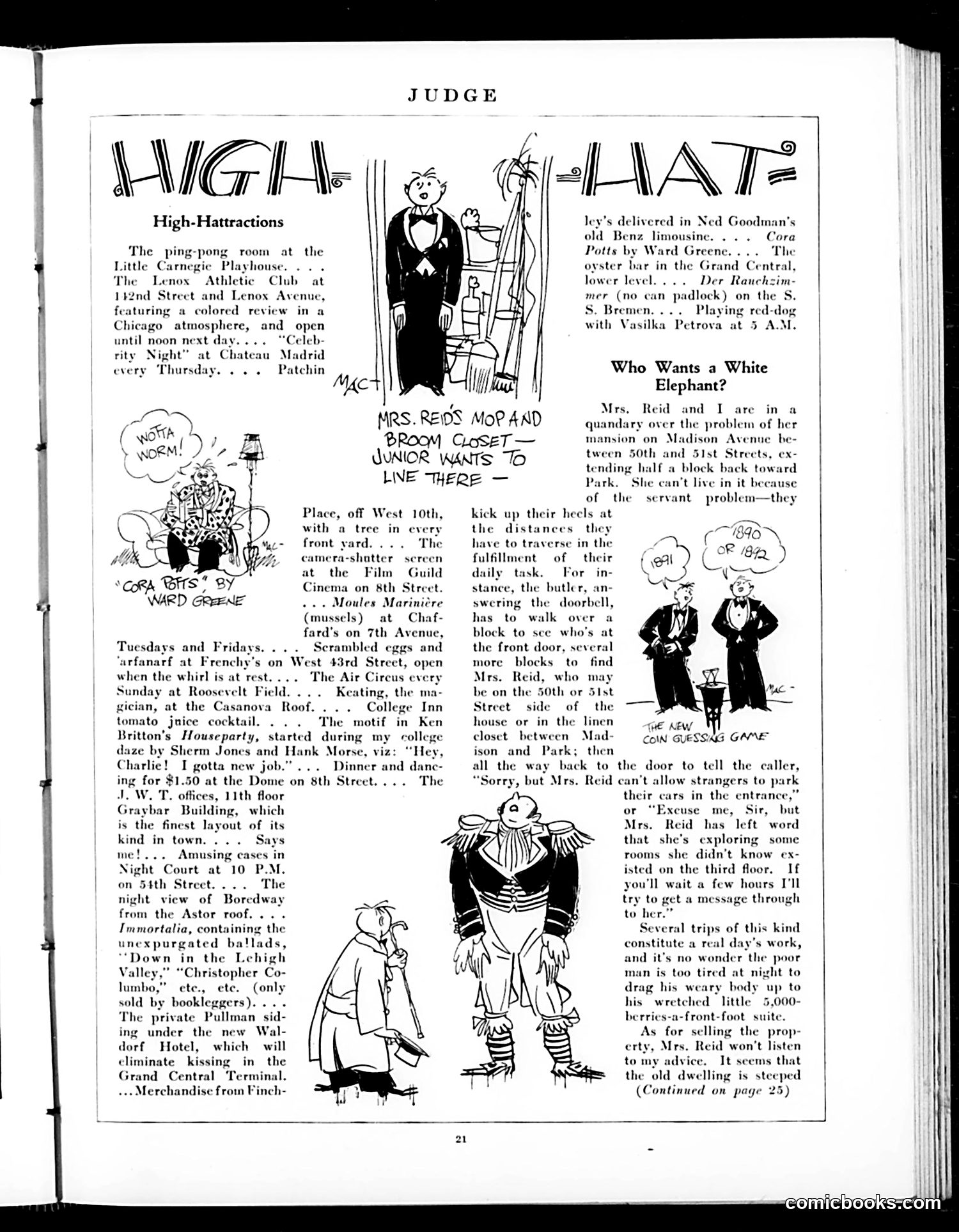
"Who Wants a White Elephant?" — Judge Magazine Satire This page satirizes the impracticality of extreme wealth. The main cartoon mocks Mrs. Reid's ownership of a massive Manhattan mansion spanning half a block between 50th and 51st Streets. The joke: the property is so vast that servants cannot efficiently manage it. The butler must walk entire city blocks to answer the front door, then traverse more blocks to locate Mrs. Reid, who may be anywhere in the sprawling house. This renders the mansion functionally useless—a "white elephant." The satire targets the absurdity of ostentatious real estate during this era (appears to be 1920s). Despite the property's impracticality and unsaleability, Mrs. Reid sentimentally refuses to sell because the "old dwelling is steeped" in history. The accompanying "High-Hattractions" column lists fashionable New York venues, establishing the wealthy social world being mocked—the satire's broader context of Jazz Age excess and frivolous upper-class concerns.
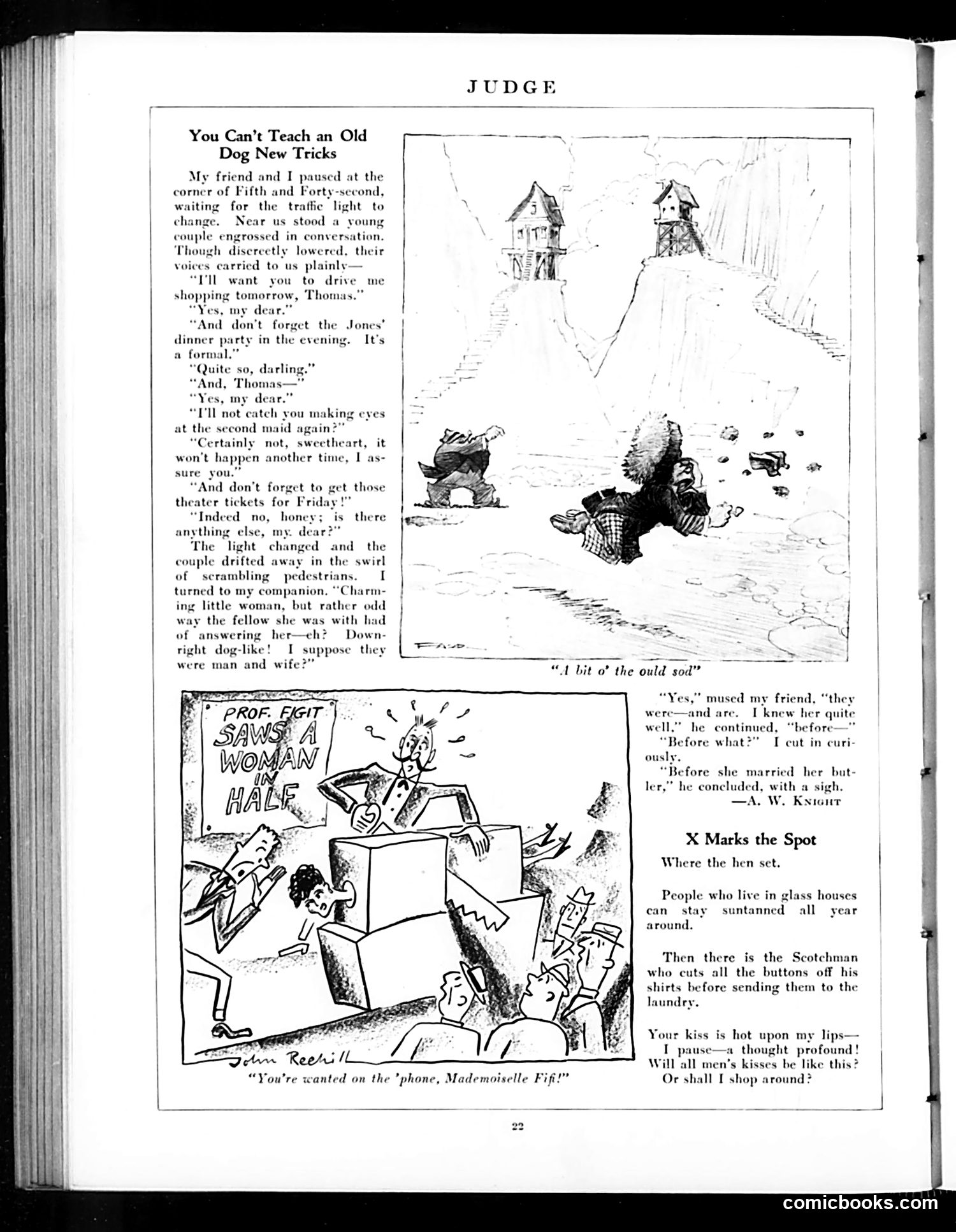
Analysis of Judge Magazine Page Main Story: "You Can't Teach an Old Dog New Tricks" This satirizes changing gender dynamics in early 20th-century marriages. The narrative presents a young woman commanding her male companion (assumed to be her husband) to drive her shopping, attend social events, and buy theater tickets—he obeys meekly each time. The punchline reveals the man is actually her *butler*, not her husband, explaining his deferential behavior. The joke's point: modern wives have become so domineering that they act like employers rather than partners, treating husbands like servants. This reflects anxiety about women's increasing independence and shifting marital power dynamics of the era. Lower Cartoon: "Prof. Fight Saw a Woman Half" A chaotic scene showing a professor fighting with a woman, likely satirizing suffragist activism or women's liberation movements. The caption suggests he claimed to have seen "half a woman"—possibly mocking both militant feminism and male resistance to women's equality. "X Marks the Spot" and other brief items are humorous one-liners about domestic life and social behavior.
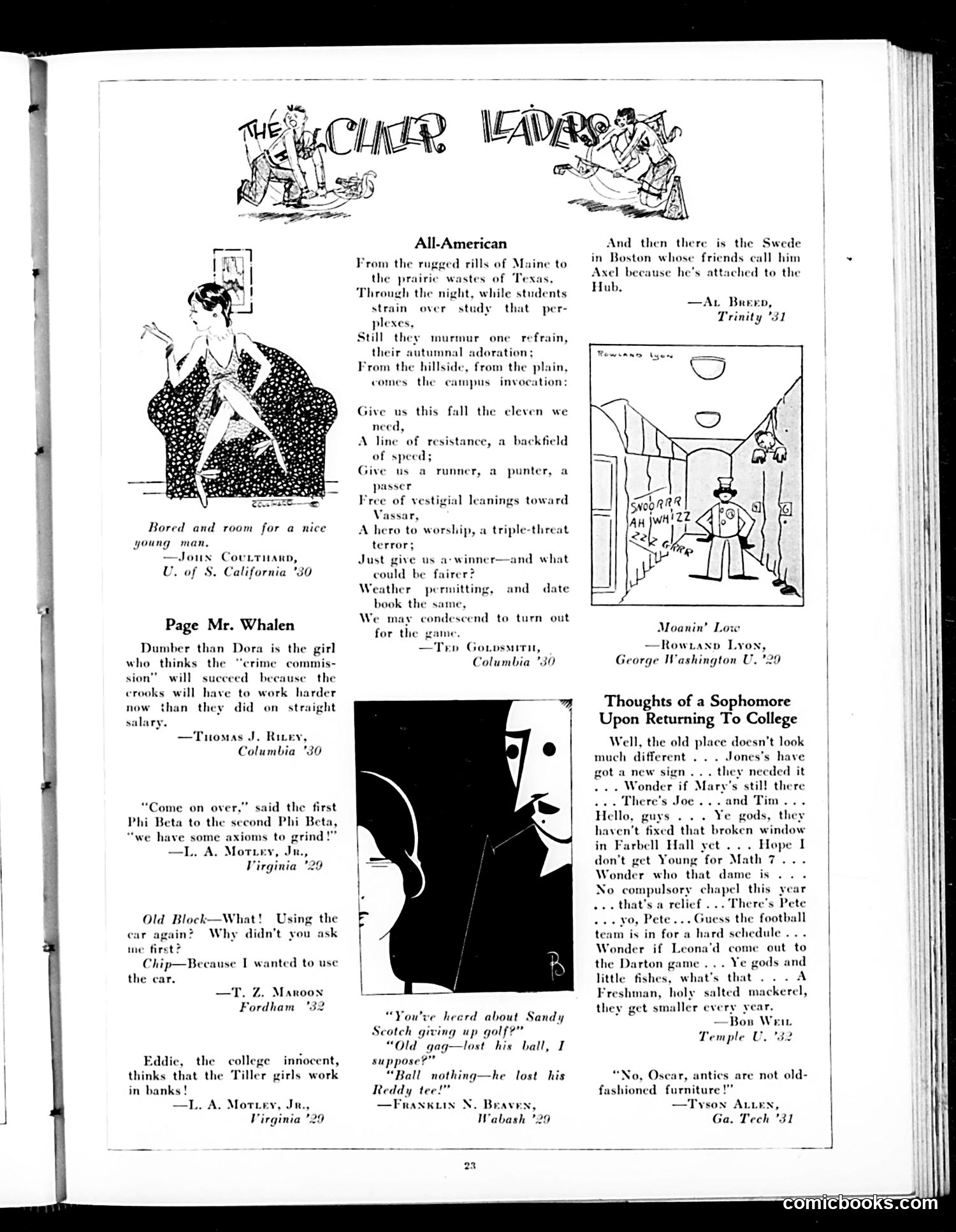
"The Chair Leader" Page Analysis This page from *Judge* magazine collects humorous quips and cartoons from college students, apparently submitted to the publication. The content reflects 1920s-30s campus life and social attitudes. Key content: - "All-American" poem mocks student priorities: athletes are worshipped while academics are neglected. Students will only attend football games if weather permits and social schedules allow—satirizing shallow school spirit. - "Page Mr. Whalen" references a contemporary crime commission, likely New York's Whalen Commission, with the joke that criminals won't reform just because enforcement increases. - College humor targets typical student stereotypes: fraternity pretension ("axioms to grind"), parental friction over car use, innocent boys unaware "Tiller girls" are entertainers (not bank workers), and dating culture. - "Thoughts of a Sophomore" captures returning students' observations: minimal campus changes, concerns about instructors and dating, disappointment that freshmen seem younger each year. The satire is gentle, targeting student vanity, apathy toward academics, and generational attitudes rather than serious social critique.
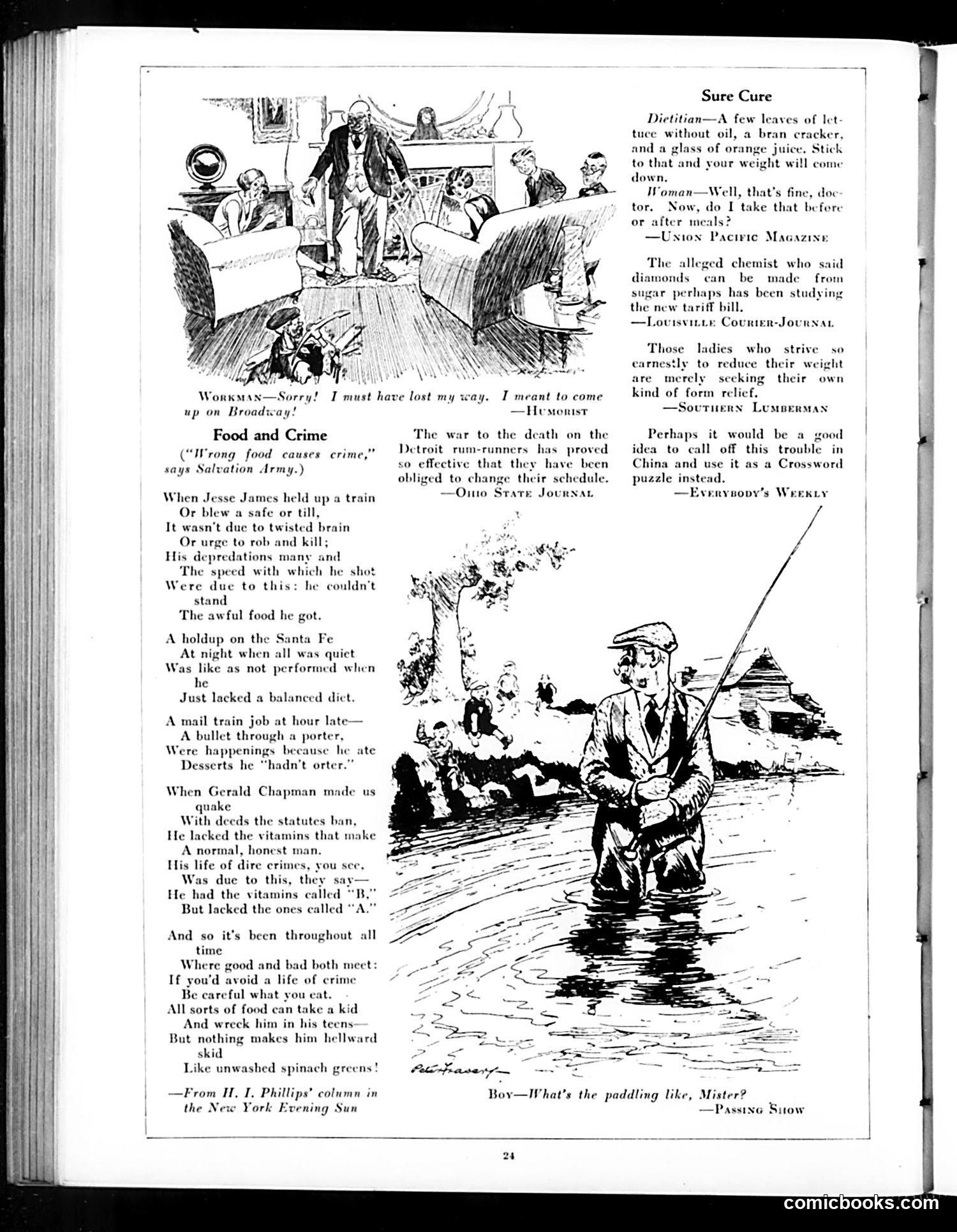
Judge Magazine Page Analysis This page contains several satirical items typical of early 20th-century humor magazines: "Sure Cure" mocks dietary fads—a doctor prescribes lettuce and orange juice for weight loss, and a woman comically asks whether to take it before or after meals, missing the point entirely. "Food and Crime" is a longer poem satirizing the Salvation Army's claim that "wrong food causes crime." It references real criminal cases (Jesse James, Gerald Chapman—a 1920s bandit) to absurdly argue that their crimes resulted from poor nutrition rather than moral failing. The poem's punchline—that unwashed spinach greens cause moral decay—is intentionally ridiculous, mocking both the Salvation Army's simplistic moralizing and contemporary health fads. The fishing cartoon shows a man asking about "paddling" (likely sexual innuendo), with "Passing Snow" as the sardonic response—humor based on double entendre. Brief quotes scattered throughout mock tariff policy, weight-loss obsession, and Chinese conflict. The page primarily satirizes progressive-era moral crusades and pseudoscientific health claims.
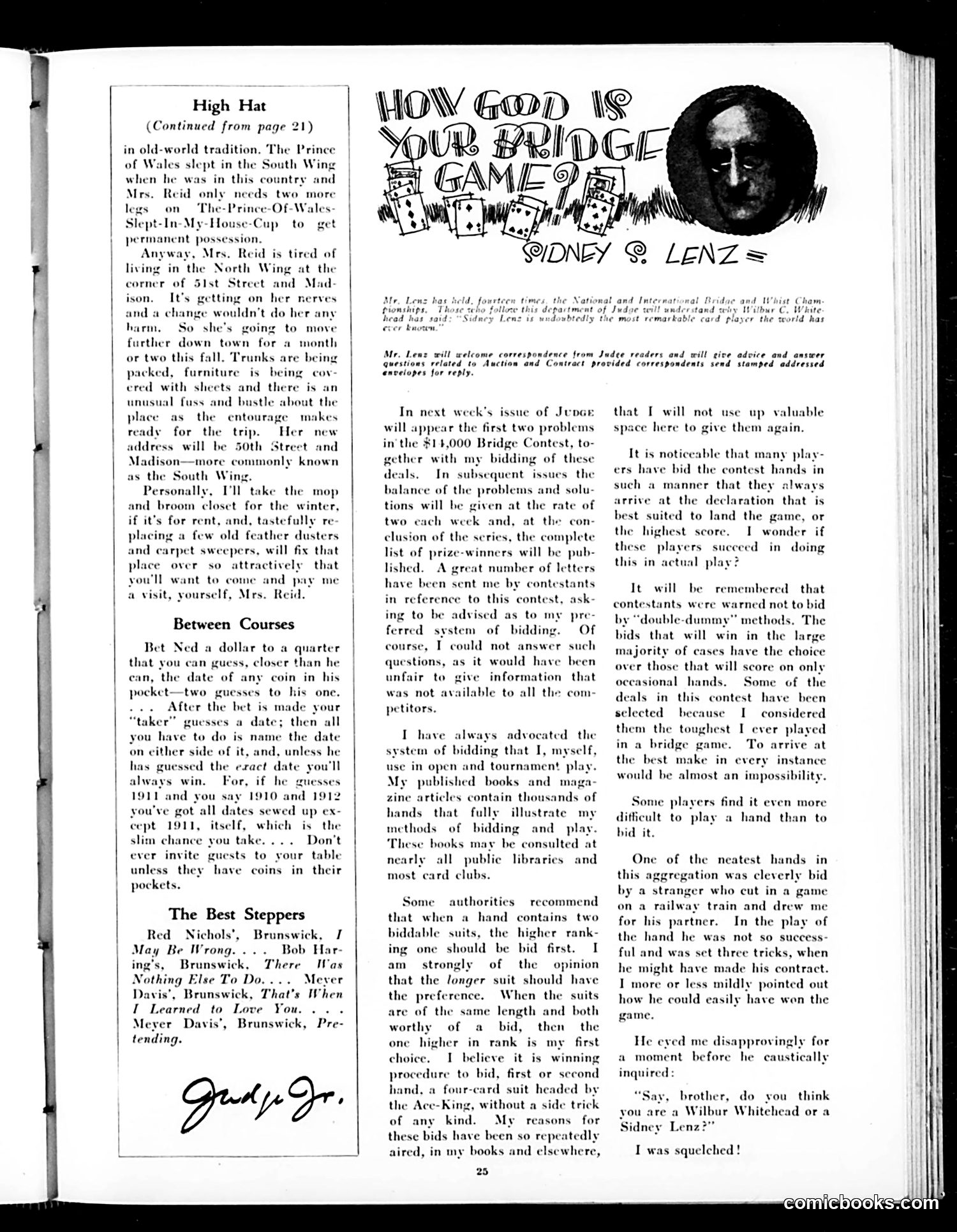
Understanding This Judge Magazine Page This page from *Judge* magazine features Sidney Lenz, a renowned bridge player of the early 20th century, writing about contract bridge strategy and bidding methods. The prominent circular portrait identifies him as the authority on the subject. The main content is Lenz's column addressing a "$14,000 Bridge Contest" he's organizing—substantial prize money for the era. He announces that contest problems will appear in subsequent issues and clarifies his preferred bidding system for readers seeking guidance. Lenz emphasizes he's maintained consistent bidding philosophy across his published books and magazine articles, available in public libraries and card clubs. The surrounding material includes lighter pieces: "High Hat" (society gossip about Mrs. Reid's residence changes), "Between Courses" (a coin-guessing betting game for dinner parties), and "The Best Steppers" (phonograph record recommendations). This reflects bridge's status as a major leisure activity and intellectual pursuit among the American middle and upper classes in this period.
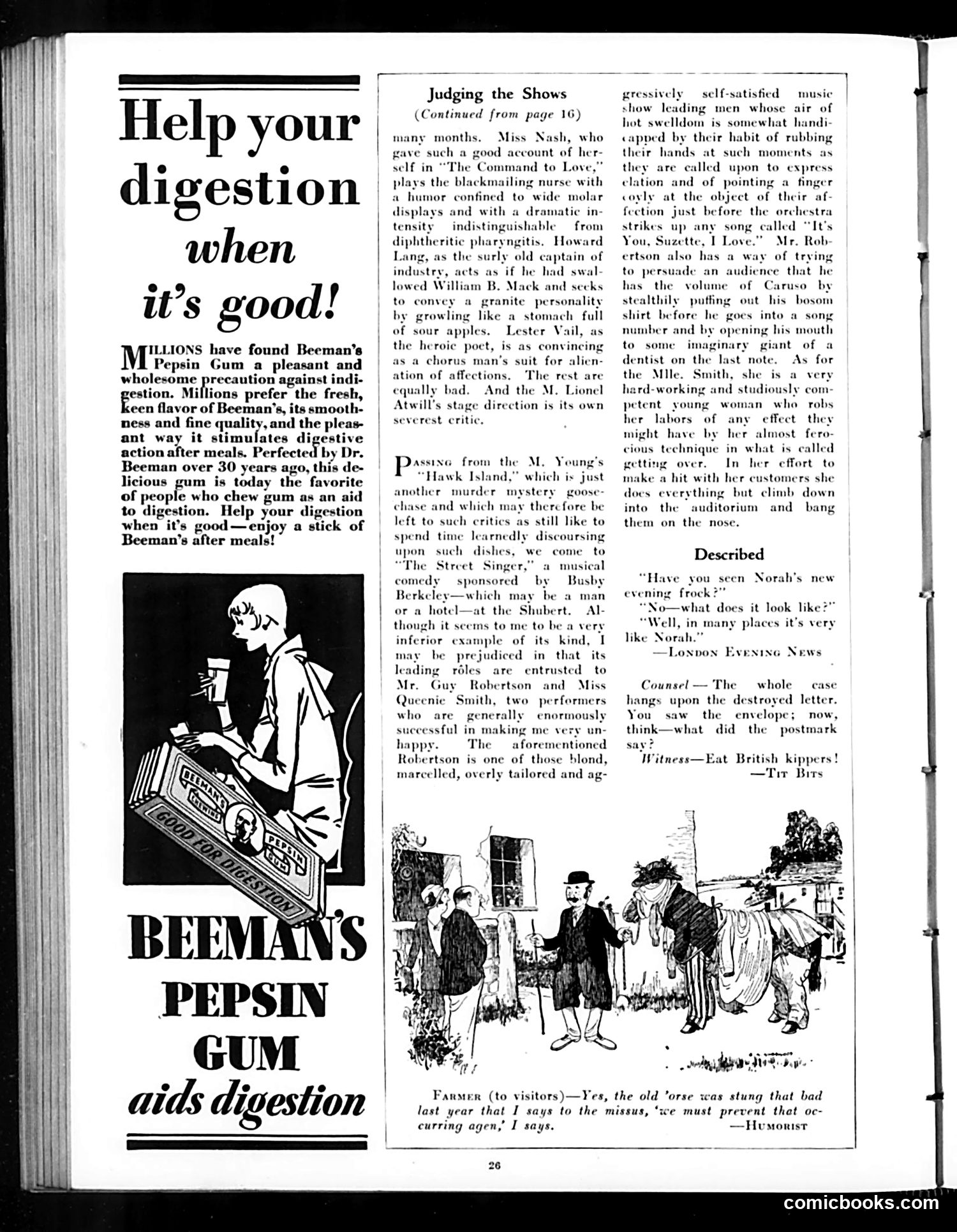
Analysis for Modern Readers This page combines theatrical criticism with vintage advertising. The left side advertises Beeman's Pepsin Gum, a digestive aid popular in the early 20th century—the gum supposedly aided digestion after meals, a common marketing claim of the era. The right side critiques recent Broadway productions. The reviewer dismisses several shows and performances with withering sarcasm, mocking actors like Howard Lang (who apparently "grew like a stomach full of sour apples") and criticizing overwrought theatrical conventions—men puffing out their shirts before singing, affected mannerisms, and forced dramatic gestures. The small cartoons at bottom are unrelated jokes: one is a legal courtroom gag about a destroyed letter's postmark; another features a farmer discussing a horse's injury. The satire targets pretentious theater conventions and overacting typical of 1920s-30s stage performance—exaggerated physicality audiences once found acceptable but the critic finds ridiculous.
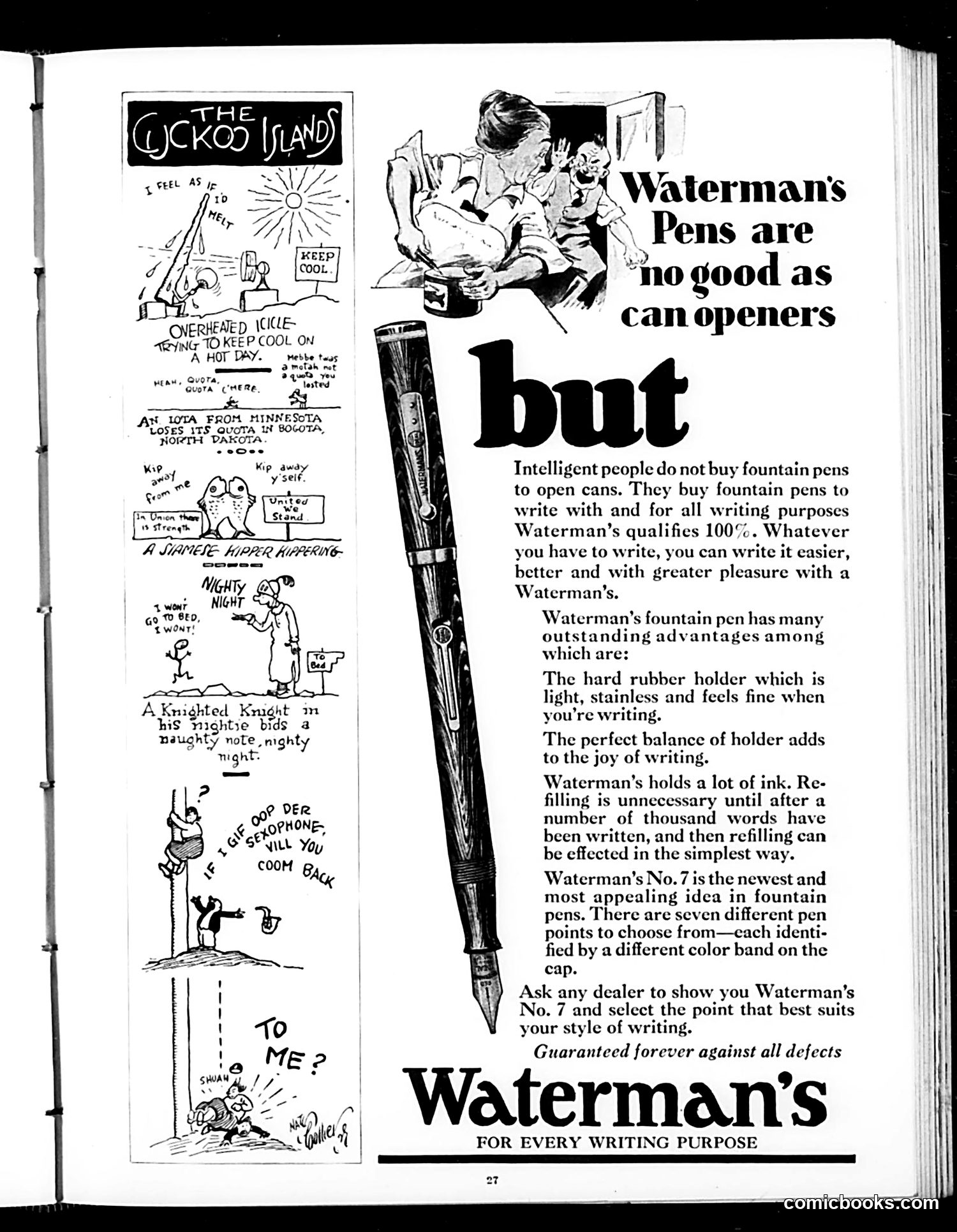
Page Analysis: Judge Magazine Advertisement This page is primarily a Waterman's fountain pen advertisement with accompanying humorous comic strips on the left side. The left panel, titled "The Cuckoo Island," contains whimsical cartoons poking fun at absurd situations—an overheated person trying to stay cool, people obsessed with quotas, and various nonsensical scenarios involving characters like "A Knighted Knight" and someone threatening to coo like a dove. These appear to be generic satirical humor typical of Judge magazine's style, with no specific political targets visible. The advertisement's main "joke" is the opening line: "Waterman's Pens are no good as can openers—but..." This is a lighthearted jab at potential misuse, humorously asserting that fountain pens' true purpose is writing, not opening cans. The ad then highlights the pen's actual benefits: superior writing quality, ink capacity, and the new Waterman's No. 7 model with interchangeable points. This represents early 20th-century advertising strategy: use humor to make the product memorable while emphasizing practical advantages.
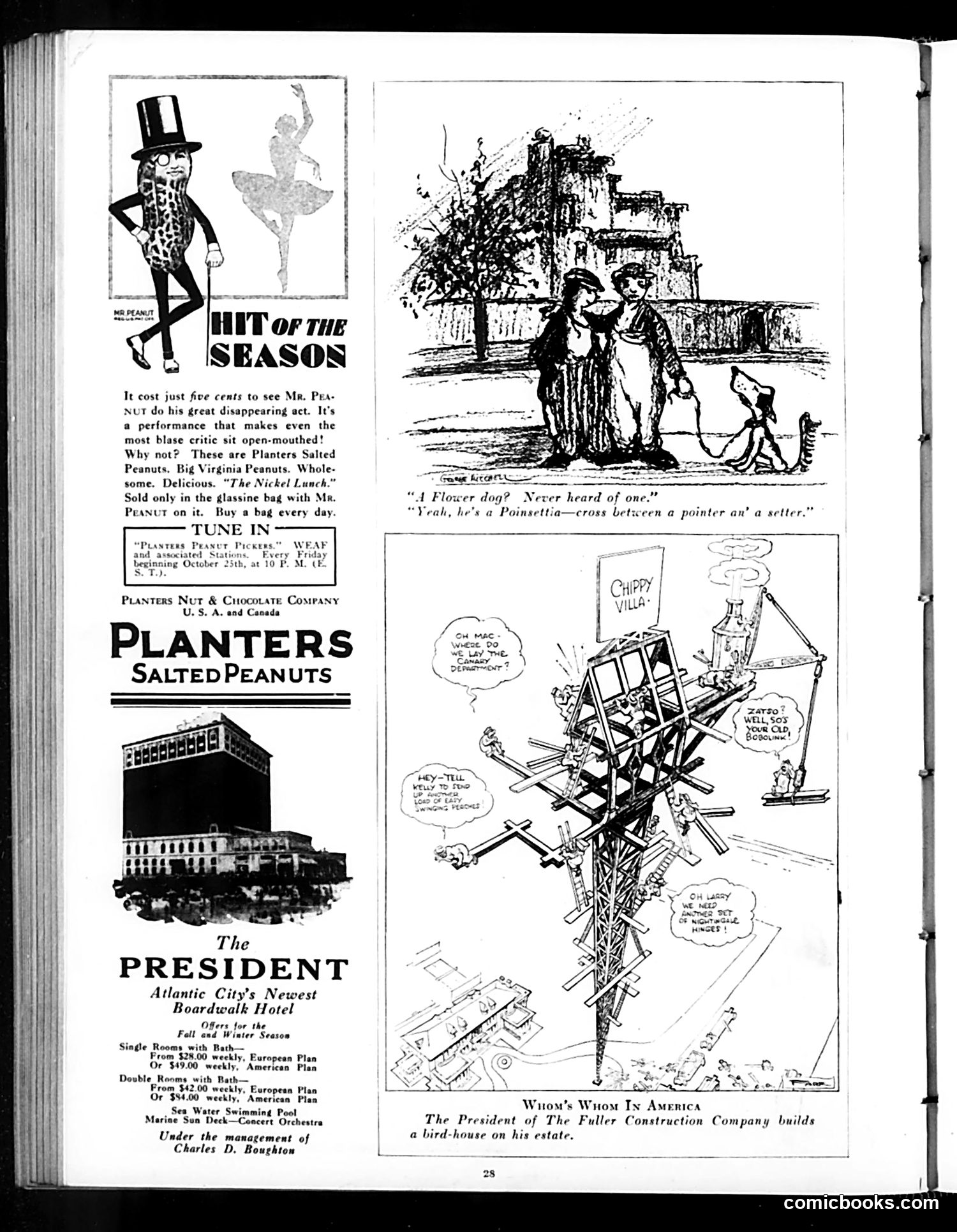
Analysis of Judge Magazine Page This page contains primarily advertising rather than political satire. The dominant content is a Planters Salted Peanuts advertisement featuring "Mr. Peanut" (the anthropomorphic peanut mascot in top hat), promoting his "disappearing act" as consumers eat the product. A radio program tie-in ("Planters Peanut Pickers") is advertised for WEAF. The lower section advertises "The President," a new Atlantic City boardwalk hotel, listing room rates and amenities. The only comic cartoon appears on the right: "Whom's Whom in America" depicts "The President of The Fuller Construction Company" building an elaborate birdhouse on his estate. The joke appears to be a gentle social satire—a wealthy industrialist's absurdly over-engineered, mansion-like birdhouse demonstrates either excessive wealth, pretension, or misplaced priorities. The workers' dialogue suggests bewilderment at the project's complexity for such a humble purpose.
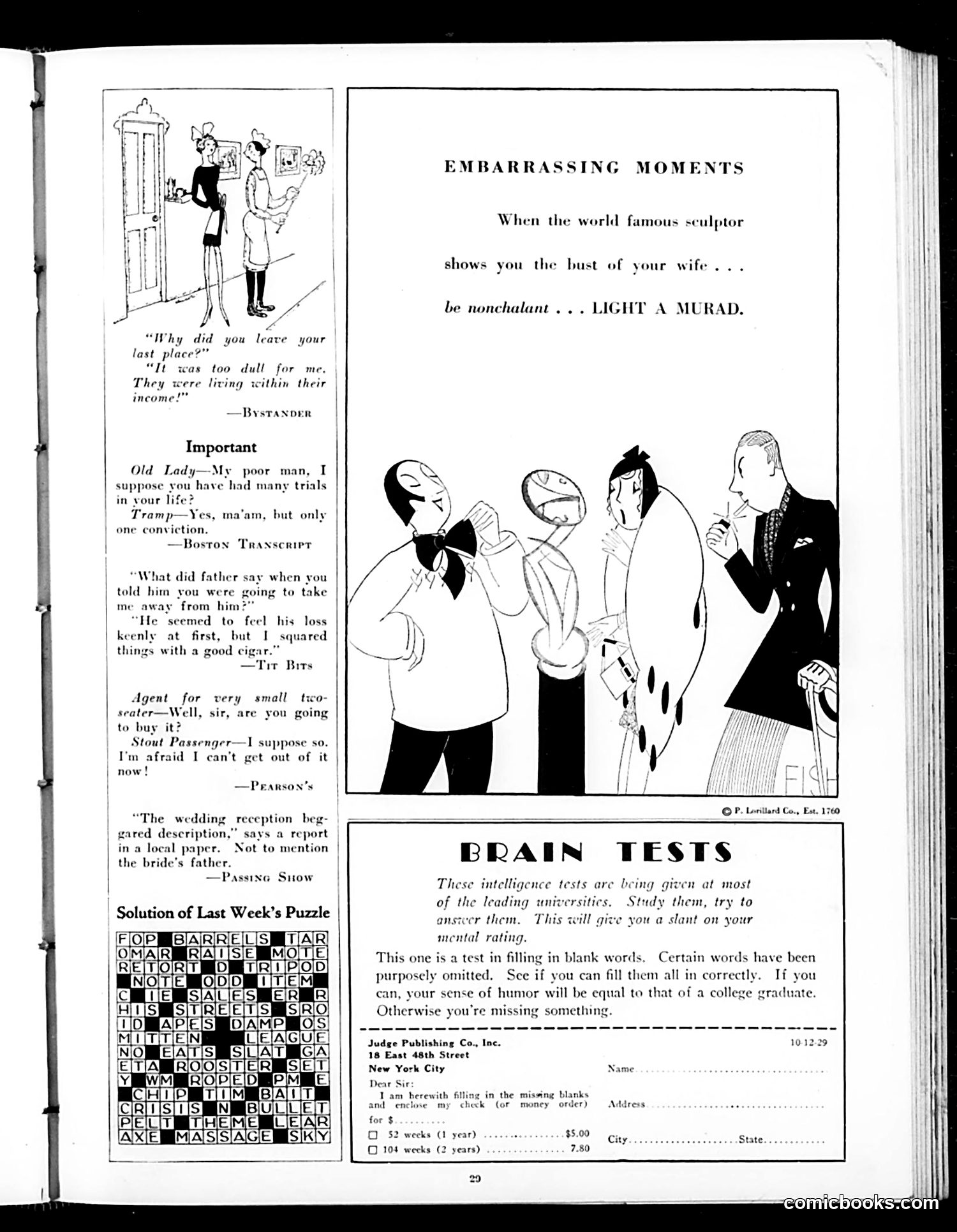
Explanation for Modern Readers This page from *Judge* magazine contains several short humorous anecdotes and an advertisement disguised as editorial content. The main cartoon ("Embarrassing Moments") depicts a social scenario where a famous sculptor shows a man a bust sculpture of the man's wife. The joke plays on the awkwardness: the sculpture likely portrays the woman unflatteringly, creating an uncomfortable moment. The punchline—"light a Murad" (a cigarette brand)—suggests smoking provides an escape from embarrassment. This is a cigarette advertisement masquerading as humor. The shorter jokes mock class anxieties and social discomfort: a servant quits because employers lived within their means (considered boring), a tramp claims only one "conviction" (arrest), and a man can't escape buying a small car. The page also advertises "Brain Tests"—fill-in-the-blank word puzzles offered by the publisher as self-improvement. The implication is that solving them demonstrates intelligence equal to "a college graduate," reflecting era anxieties about educational status and self-improvement.
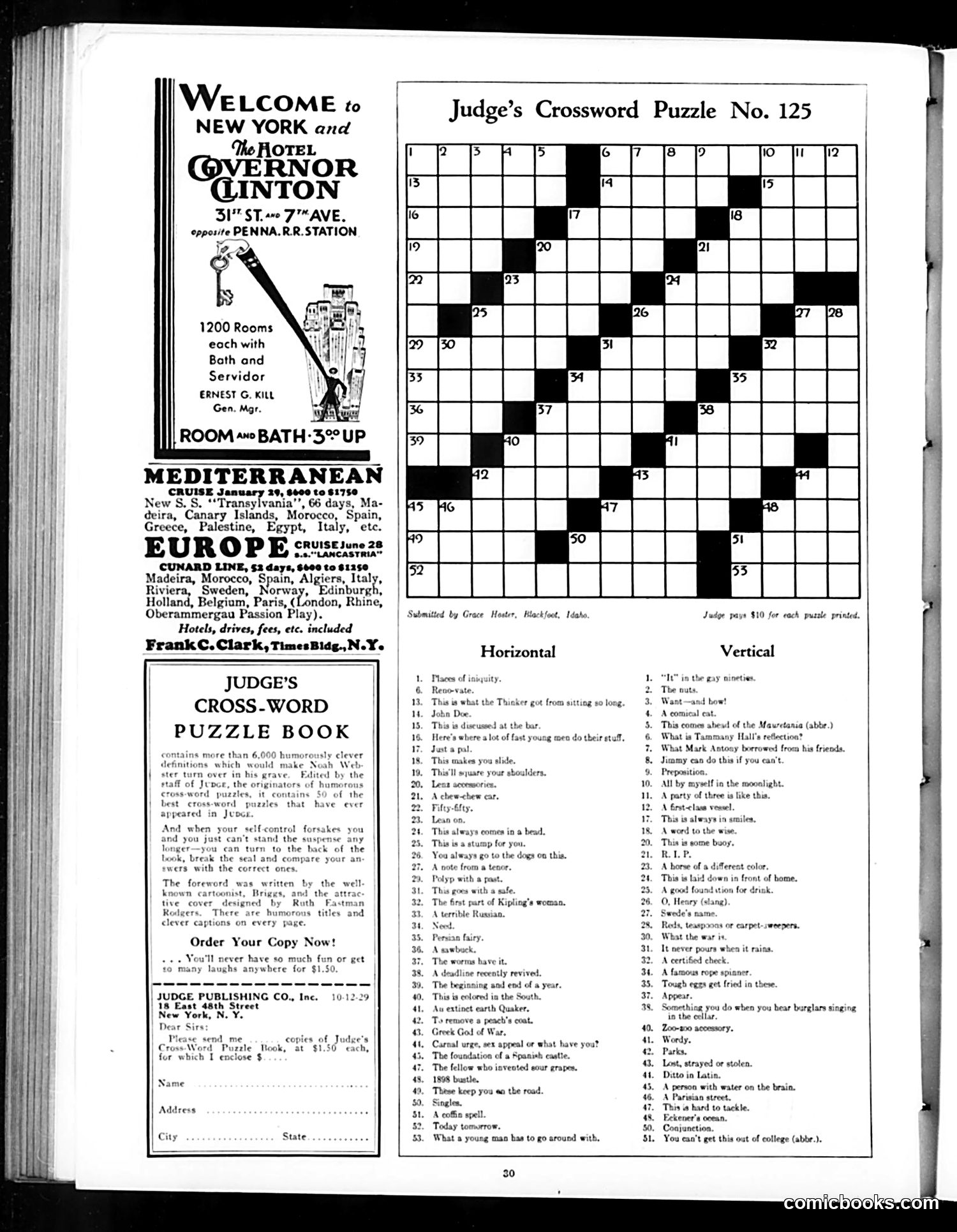
Judge Magazine Page Analysis This page is primarily advertising and a crossword puzzle, not political satire. The advertisements promote luxury travel and hospitality: the Hotel Governor Clinton in New York (featuring manager Ernest G. Kill), Mediterranean cruises via the S.S. *Transylvania*, and European cruises via Cunard's S.S. *Lancastria*. These reflect 1920s prosperity and leisure travel for the wealthy. The main content is "Judge's Crossword Puzzle No. 125"—a popular entertainment feature. The clues are lighthearted wordplay and contemporary references (Tammany Hall, Kipling, Prohibition-era humor about "peach's coat" and speakeasies). This represents the puzzle craze sweeping America in the late 1920s. The page includes a publisher's pitch encouraging readers to order the full puzzle book for $1.50, emphasizing the entertainment value. There is no visible political cartoon—this appears to be a standard interior magazine page mixing advertisements with recreational content.
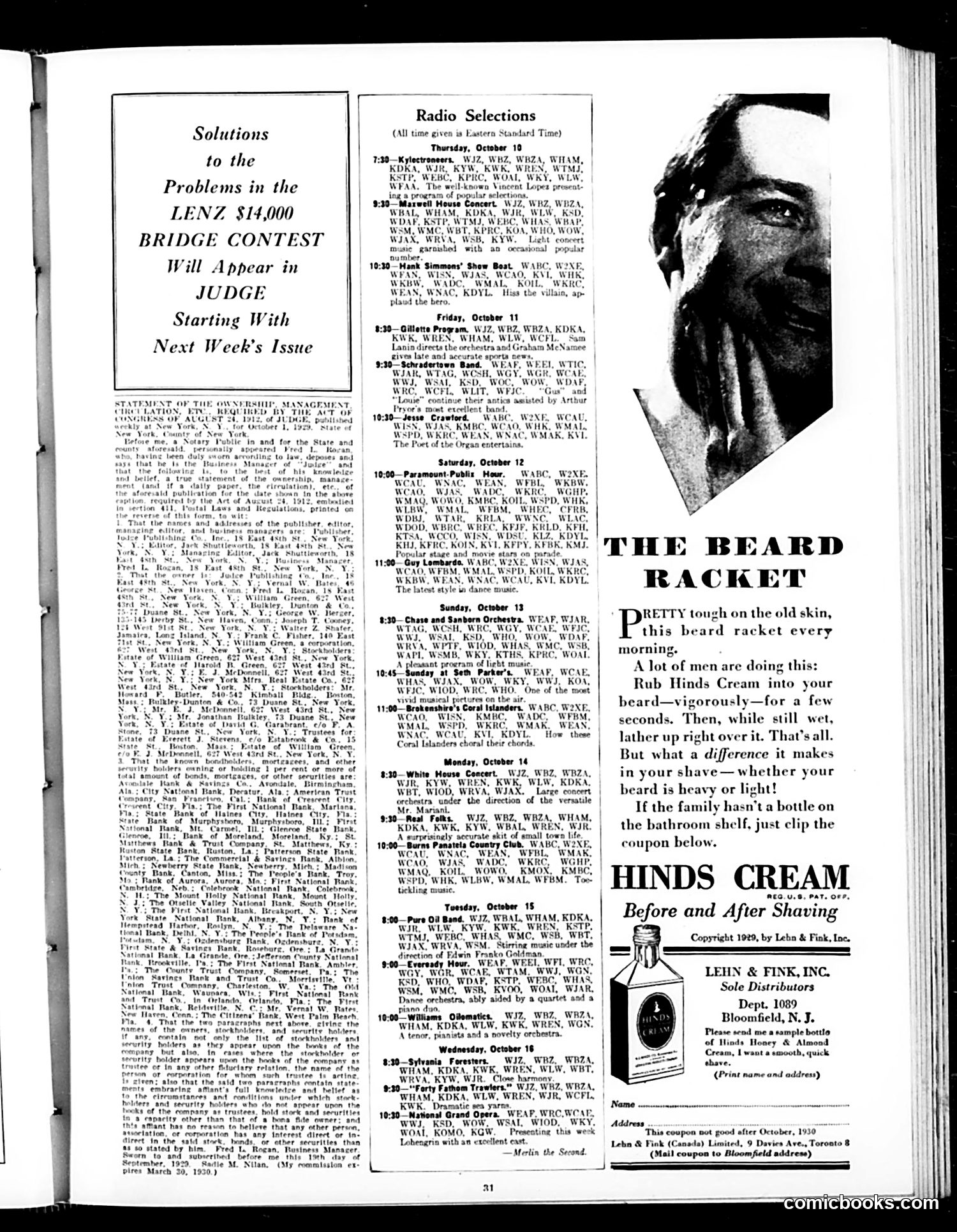
The Beard Racket: A 1929 Grooming Advertisement This page is primarily a grooming advertisement disguised as satirical commentary. The large illustration shows a man's bearded face in profile with the headline "THE BEARD RACKET." The accompanying text presents a mock-serious argument: beards are inconvenient for shaving daily, but the solution is simple—use Hinds Cream instead of a razor. The "joke" or "racket" being satirized is that men's grooming routines are unnecessarily complicated. This reflects 1920s attitudes toward masculinity and personal hygiene. The advertisement plays on common assumptions that beards were old-fashioned or impractical, positioning Hinds Cream as the modern, efficient alternative. The "before and after shaving" imagery below reinforces the product's cosmetic benefits. The page also contains substantial legal fine print regarding Judge magazine's ownership and circulation—standard publishing disclosure required by postal regulations of the era.
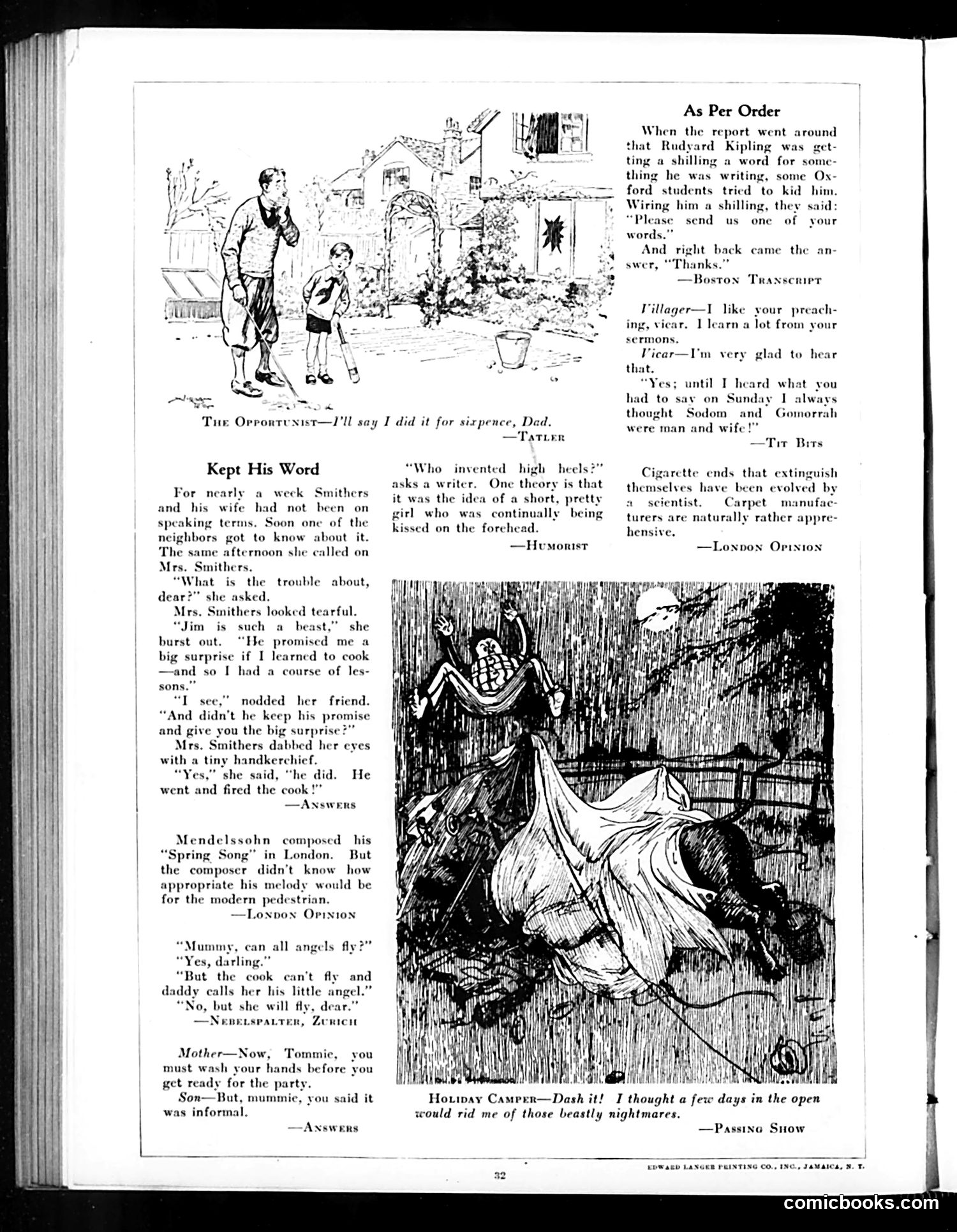
Judge Magazine Page Analysis This page contains multiple humorous anecdotes and jokes typical of early 20th-century satirical magazines, rather than political cartoons. Key items: 1. "As Per Order": References Rudyard Kipling's reported high writing fees (a shilling per word). Oxford students test this by wiring him payment for a single word; he responds "Thanks"—a joke about getting paid for minimal output. 2. "Kept His Word": A domestic humor piece where a husband promises his wife a surprise if she learns to cook. The surprise is firing their cook—a twist ending mocking marital discord. 3. Various brief jokes on topics like high heels' invention, clerical advice, angel flight, and informal party etiquette. The illustration (bottom right) appears to show a camping scene related to "Holiday Camper," depicting nightmares or discomfort in outdoor settings. The satire targets Edwardian society's quirks: materialism, marriage troubles, clerical hypocrisy, and modern life's absurdities. No specific political figures are caricatured on this page.
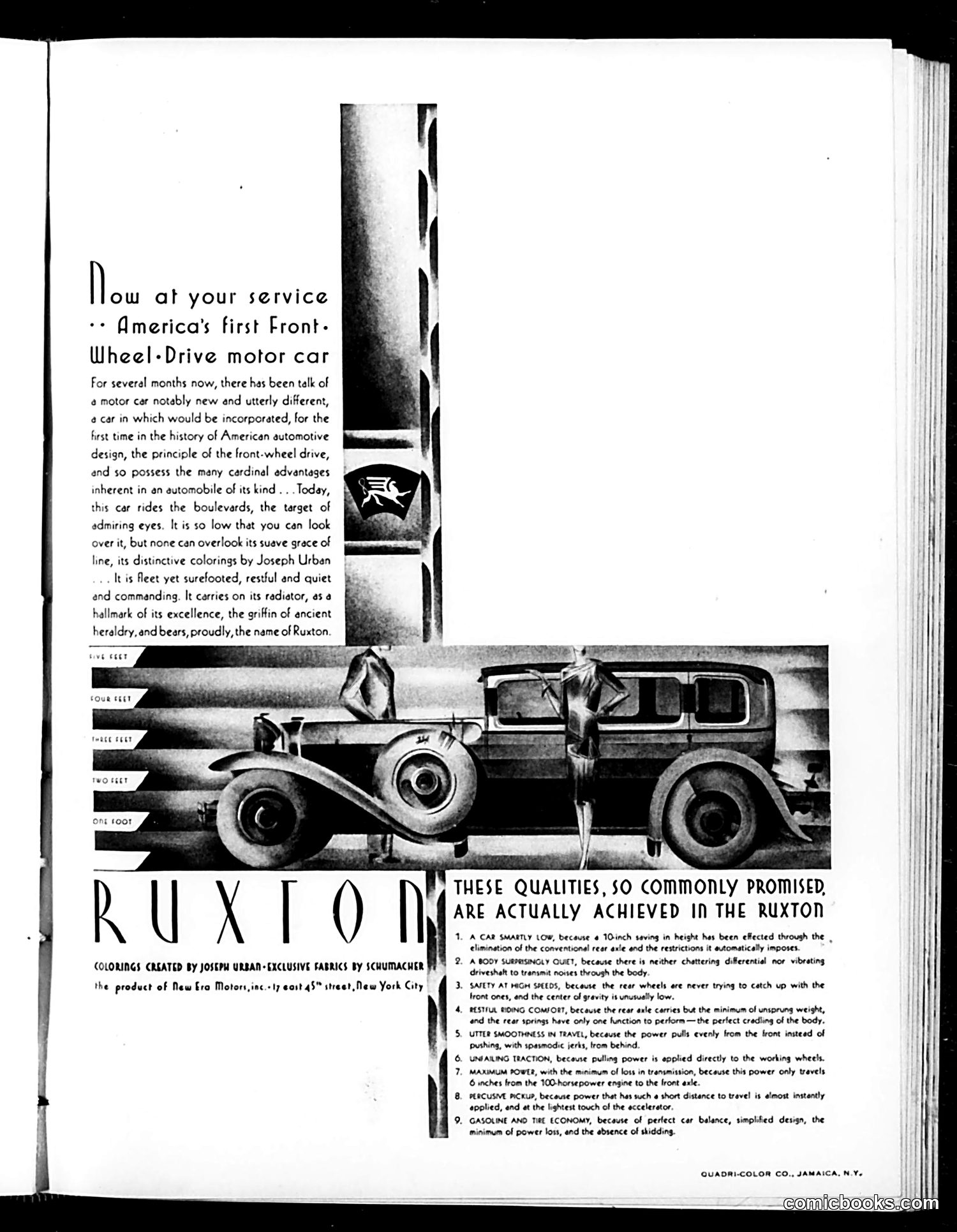
Ruxton Front-Wheel-Drive Automobile Advertisement This is a car advertisement, not political satire. The page promotes the Ruxton, "America's first Front-Wheel-Drive motor car," positioning it as a revolutionary automotive innovation. The ad emphasizes the vehicle's technical superiority through nine numbered claims—low profile, quiet operation, safety, comfort, smooth power delivery, traction, and fuel efficiency—all attributed to its front-wheel-drive design. Designer Joseph Urban's involvement and exclusive Schumacher fabrics signal luxury positioning. The accompanying photograph shows the car's sleek profile alongside what appears to be a conventional rear-wheel-drive vehicle for comparison, visually demonstrating the Ruxton's compact, modern design. This reflects late 1920s automotive marketing, when front-wheel drive was genuinely novel and prestigious, appealing to affluent buyers seeking cutting-edge technology.
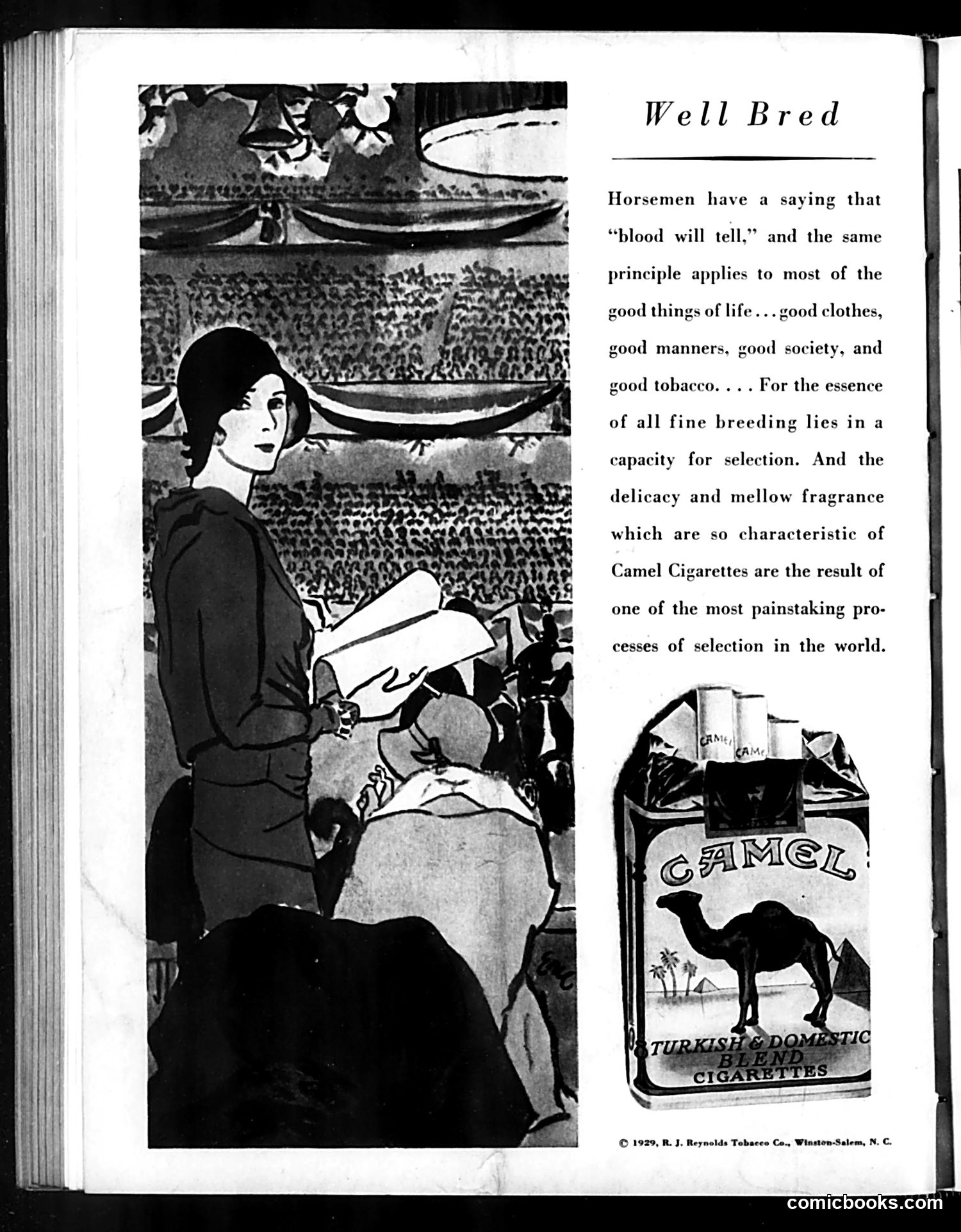
Analysis This is a Camel cigarette advertisement, not satire. The page uses the concept of "good breeding" (quality pedigree) as a metaphor for product quality. The image shows an elegantly dressed woman at what appears to be a sporting event, embodying upper-class refinement. The text argues that just as "blood will tell" in horses and people of good breeding, so too does Camel's careful "selection" process produce superior tobacco. The ad conflates social status markers—good clothes, manners, society—with cigarette quality, suggesting that smoking Camels signals one's own refined breeding. The camel logo and "Turkish & Domestic Blend" label appear at bottom right. This represents 1920s advertising strategy: targeting aspirational consumers by associating products with class status and personal distinction. The date (1929) places this just before the Great Depression.