judge
Judge — October 19, 1929
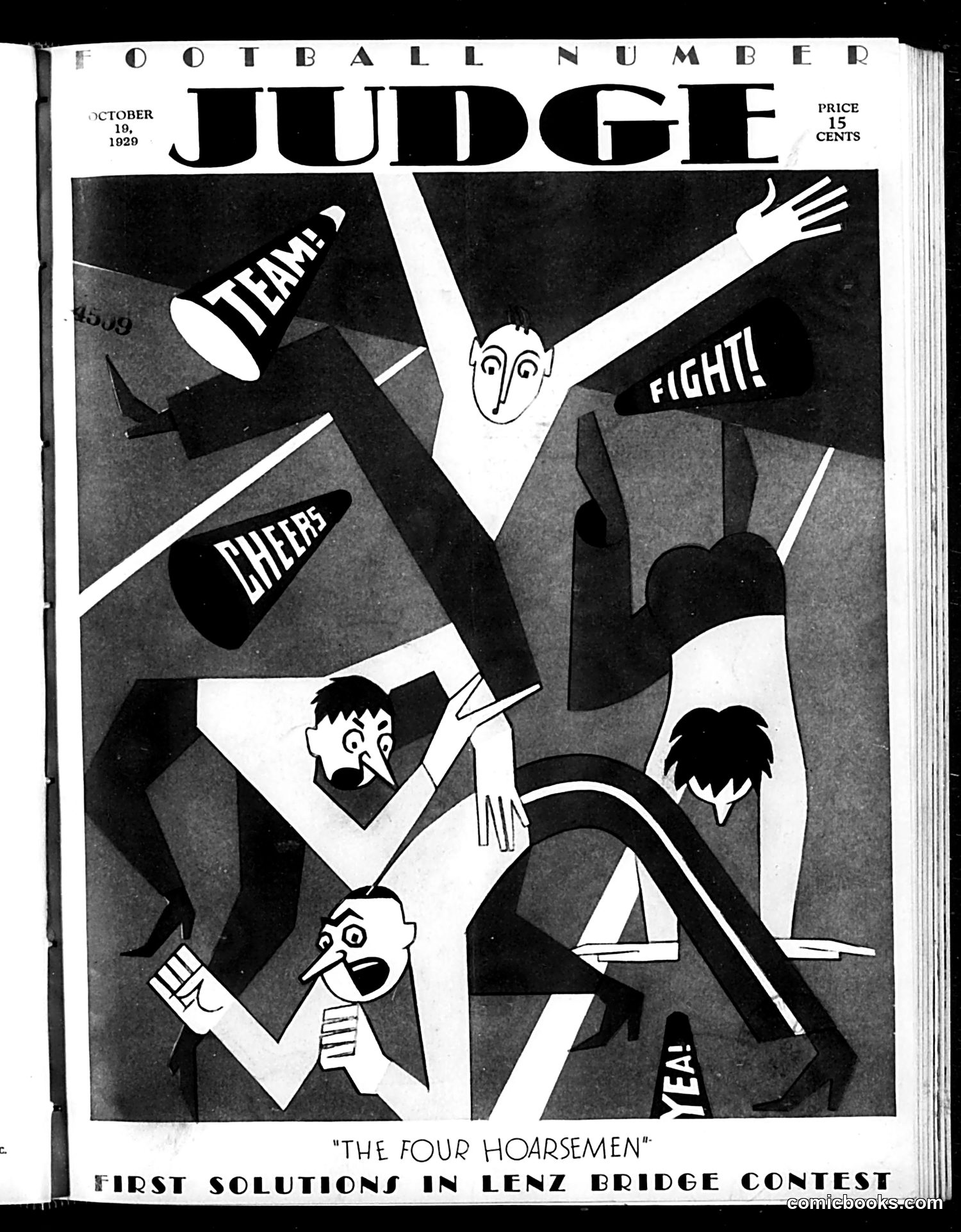
Analysis of Judge Magazine Cover, October 19, 1929 This satirical cover depicts "The Four Horsemen" confronting chaos labeled "TEAM," "FIGHT," "CHEERS," and "YEAH"—likely representing competing factions or interests in American society during a turbulent moment. The central figure with raised arm appears triumphant or commanding, while the lower figures show distressed reactions with exaggerated facial expressions characteristic of 1920s comic style. Published October 19, 1929, this appeared just days after the stock market crash (October 24-29), though the exact sociopolitical reference remains unclear. The "Lenz Bridge Contest" subtitle suggests a specific contemporary event, but without additional context, the precise target of this satire cannot be definitively identified. The chaotic composition and frantic energy likely comment on American social or political upheaval of that moment.
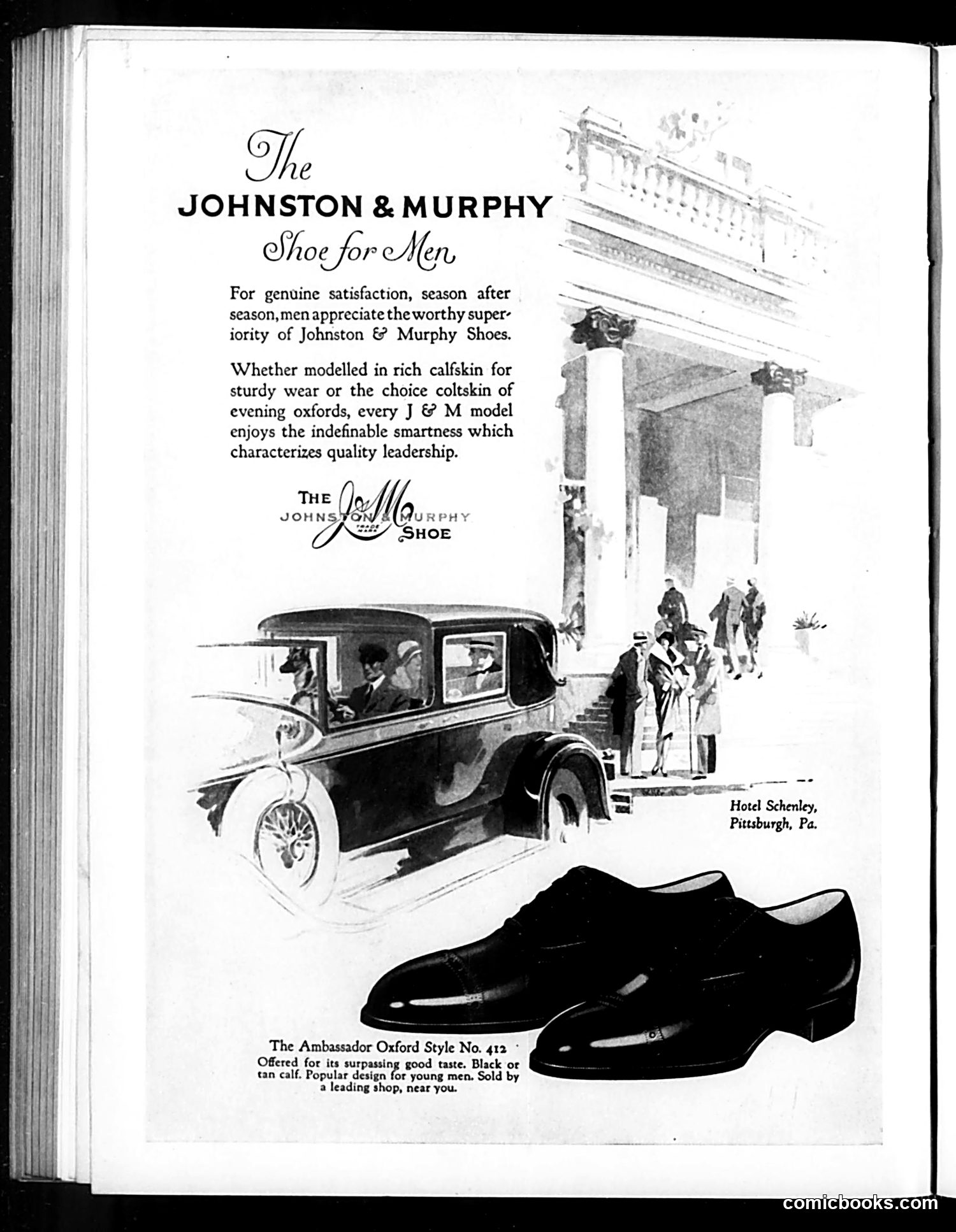
Analysis This page is not a cartoon or satire — it's a vintage advertisement for Johnston & Murphy shoes, likely from the 1920s based on the automobile style shown. The ad uses aspirational imagery common to the era: a luxurious hotel (Hotel Schenley, Pittsburgh), well-dressed travelers arriving by car, and a displayed Oxford shoe ("The Ambassador Oxford Style No. 412"). The text emphasizes "quality leadership" and appeals to men's desire for sophistication and status through footwear. There is no political satire here. Judge magazine ran paid advertisements alongside its satirical content. This represents the commercial messaging of the period, positioning Johnston & Murphy as a premium brand for discerning gentlemen.
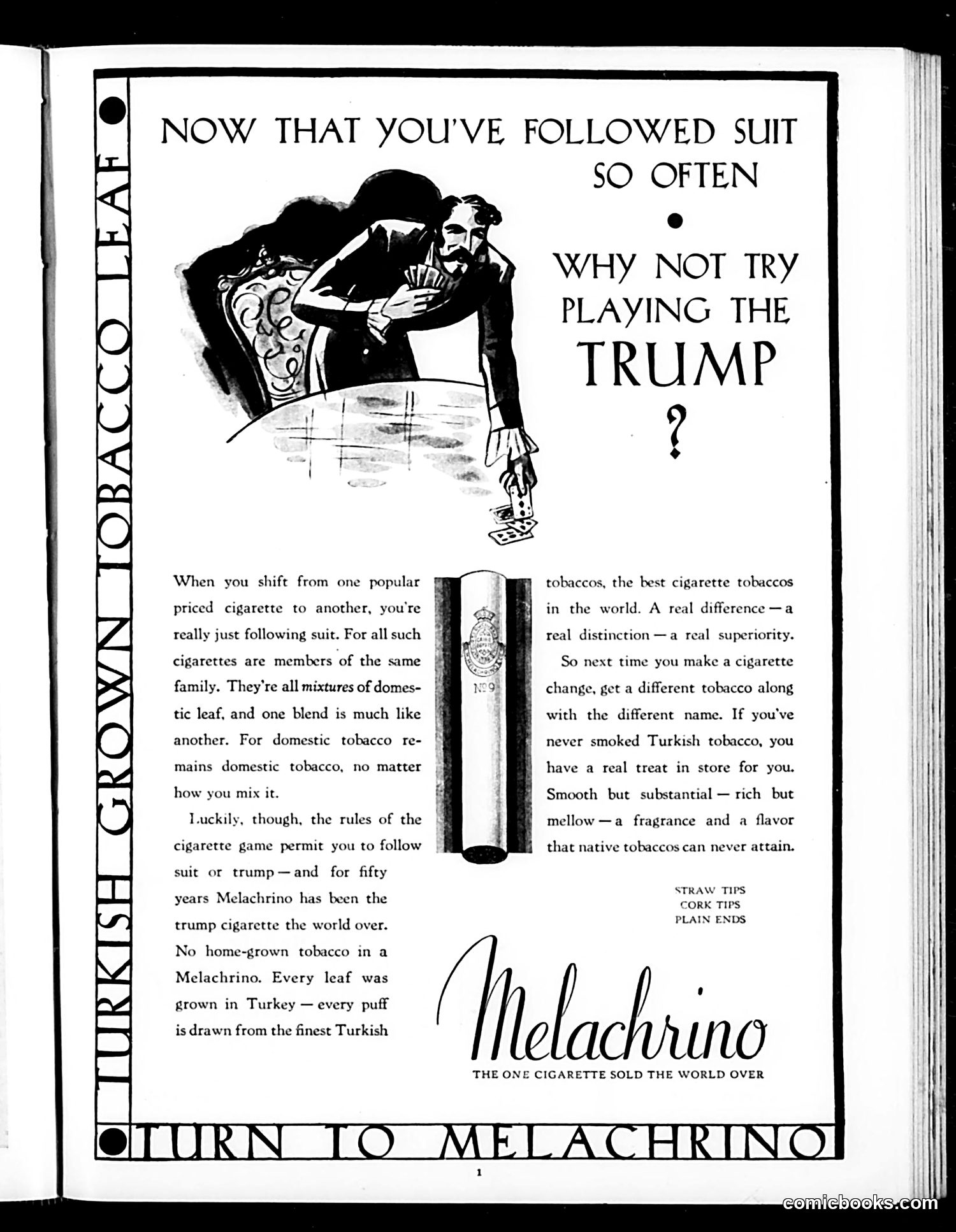
This is primarily a cigarette advertisement for Melachrino, framed as satirical commentary. The illustration depicts a man playing cards, with text addressing cigarette smokers who frequently switch brands. The ad's humor plays on a card game metaphor: "following suit" versus "playing the trump." It argues that switching between popular domestic cigarette brands is meaningless—they're all similar blends. However, Melachrino represents the "trump card": a Turkish tobacco cigarette offering genuine distinction. The satire mocks brand loyalty and switching habits among smokers, while positioning Melachrino as superior due to its Turkish tobacco origins. The ad claims fifty years of success and promises qualities domestic tobacco cannot achieve: smoothness, richness, and authentic flavor. This is vintage tobacco advertising using humor to encourage brand switching.
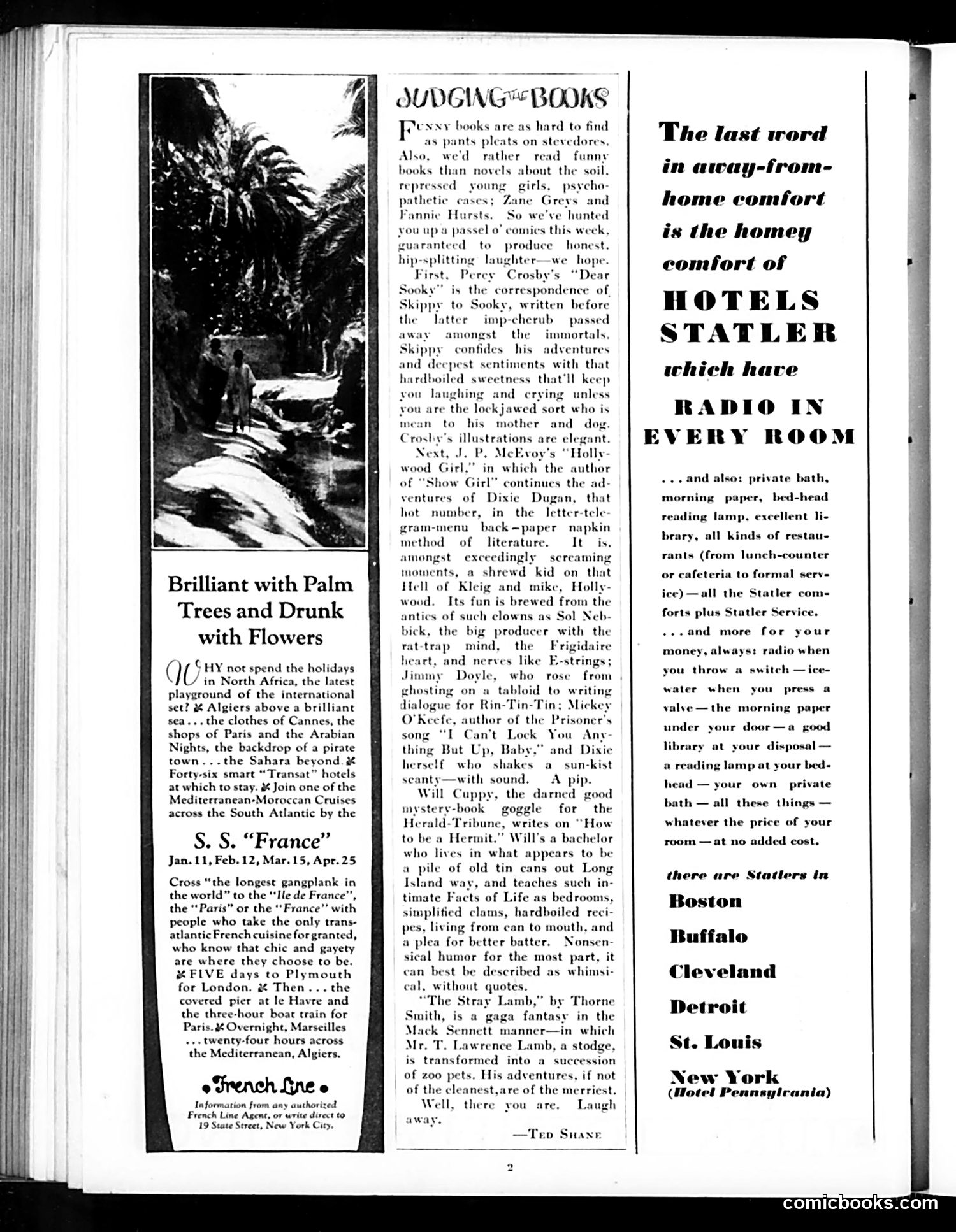
Analysis of Judge Magazine Page This page contains primarily book reviews and advertising, not political cartoons. The main content is "Judging the Books," a humor column reviewing recently published comics and novels. The reviews mention titles like Percy Crosby's "Dear Snoopy" and J.P. McEvoy's "Hollyywood Girl," critiquing them for entertainment value rather than literary merit. The left sidebar advertises the S.S. "France" cruise ship and a French Line travel service. The right side promotes Hotels Statler, emphasizing amenities like radios in every room—a significant selling point in this era when radio was still relatively novel technology. The ad lists Statler locations in major cities. There is no political satire or social commentary evident on this page.
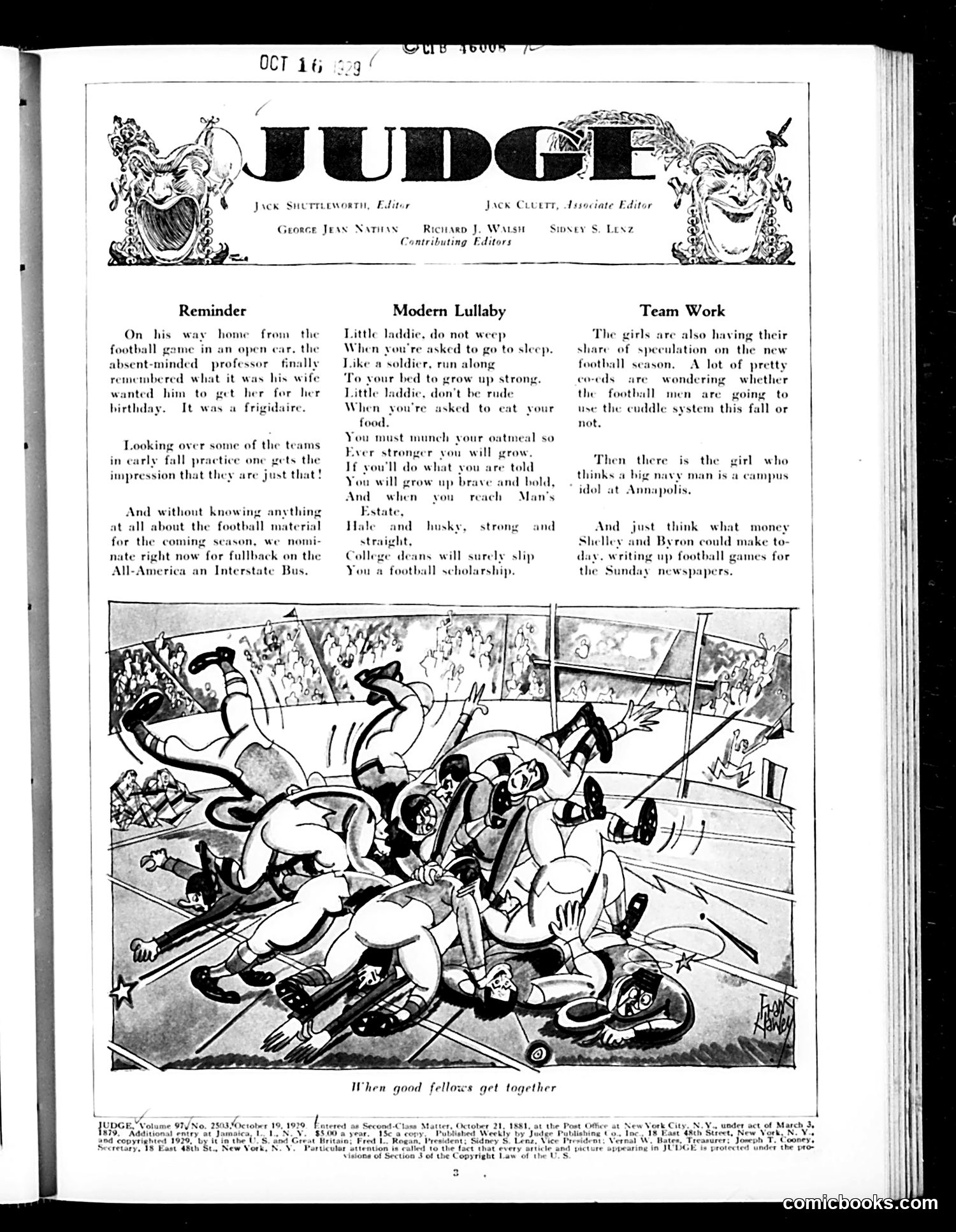
Judge Magazine Commentary - October 16, 1928 This page satirizes early 1920s college culture and gender dynamics. The three text columns mock: 1. "Reminder": An absent-minded professor finally remembering his student's birthday request 2. "Modern Lullaby": A parody poem about raising children, emphasizing strength and obedience 3. "Team Work": Commentary on college women's newfound roles, including girls' football and a reference to a woman who idolizes a "big navy man" at Annapolis The large cartoon below depicts a chaotic football scene with players flying through the air, labeled "When good fellows get together." This appears to satirize the rough, comedic nature of college football and male camaraderie during this era. The humor relies on exaggeration and physical slapstick typical of 1920s sports commentary.
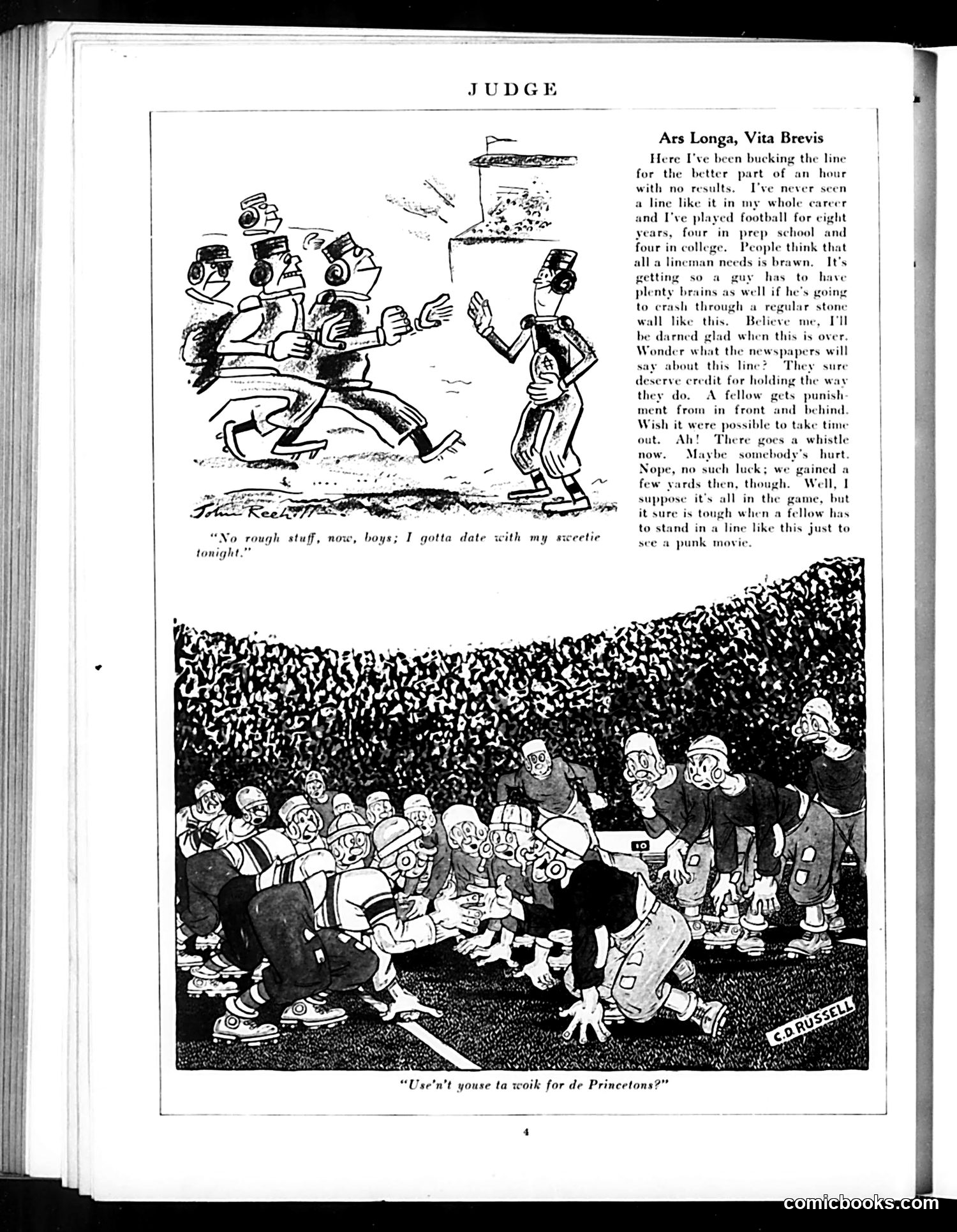
Analysis of Judge Magazine Page Top Cartoon: Shows a football player boasting to a woman ("No rough stuff, nose, boys; I gotta date with my sweetie tonight"). The accompanying monologue reveals the irony—the lineman complains about being repeatedly injured despite playing football for years. The joke satirizes the contradiction between athletic bravado and the physical toll of the sport, particularly football's brutal nature. Bottom Cartoon: Depicts what appears to be a college football huddle or team gathering, with the caption "Ue'n goose to work for de Princetone?" This likely mocks either Princeton's football program or wealthy college athletics generally, possibly satirizing class dynamics or the commercialization of college sports in that era. Both cartoons criticize football's violence and its social implications.
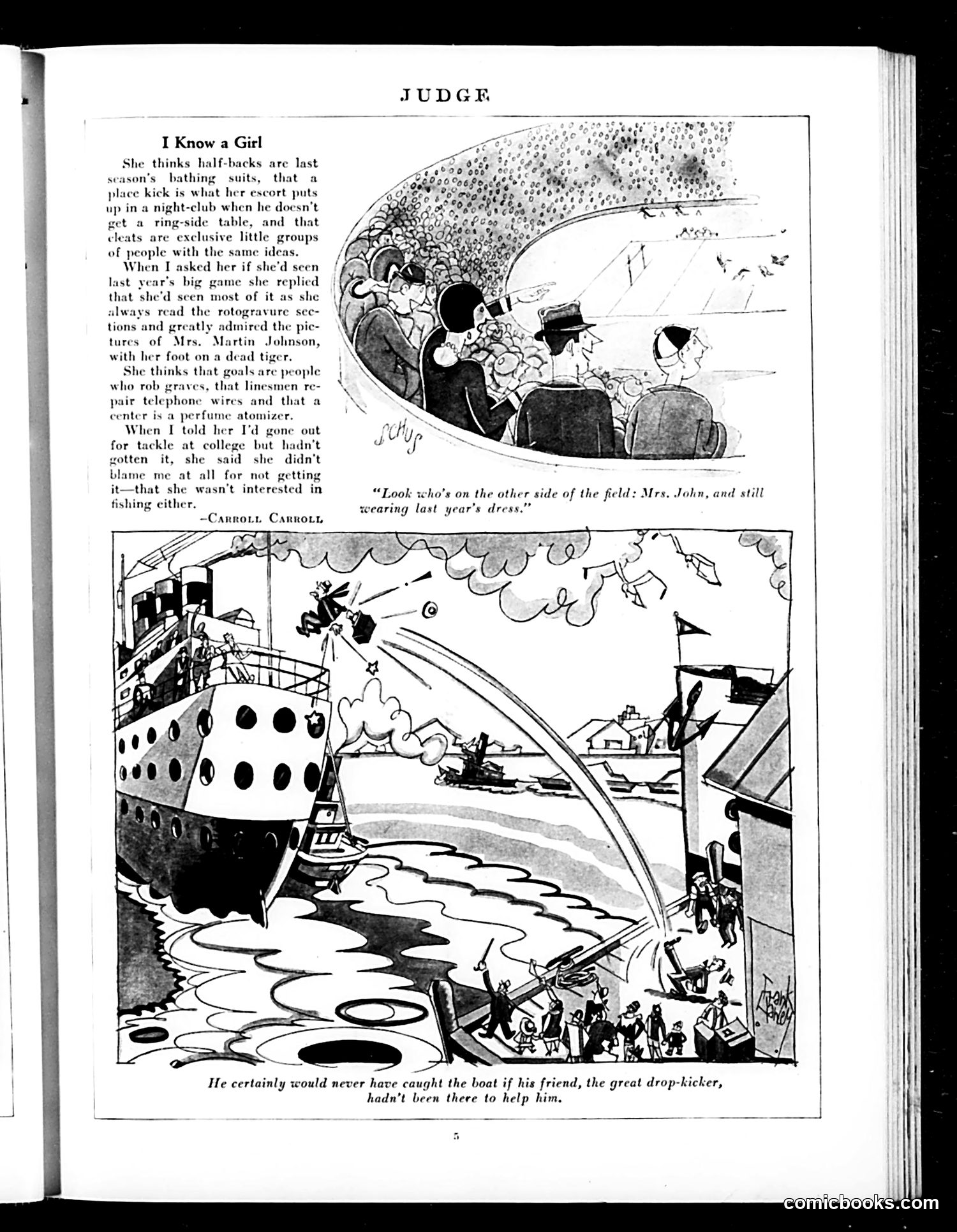
Analysis of Judge Magazine Page Top Section ("I Know a Girl"): Carroll Carroll's humorous essay describes a woman interested in elite social activities—exclusive nightclubs, ringside tables at boxing matches—but not in fishing. The piece satirizes how certain women pursue high-society status symbols while dismissing traditionally masculine pastimes. Bottom Cartoon: Depicts a man fishing from a dock while a large ship passes dangerously close. The caption references "the great drop-kicker," suggesting the ship's near-miss represents interference from a friend's dramatic intervention. The cartoon satirizes poor decision-making and how well-intentioned help can backfire spectacularly, turning a simple fishing trip into chaos. Both sections target social pretension and the folly of human priorities through gentle satire typical of Judge's style.
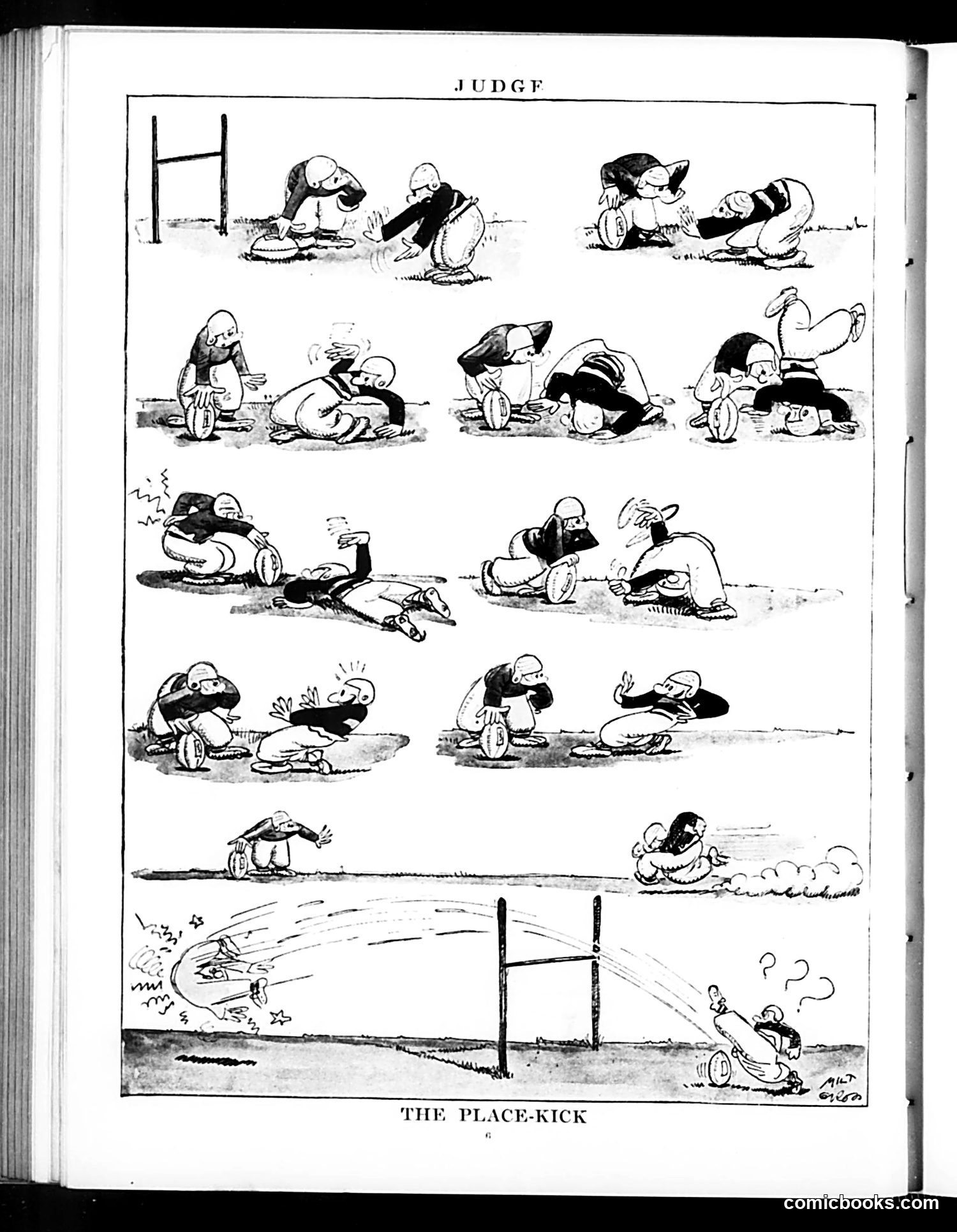
"The Place-Kick" - Judge Magazine This is a humorous instructional comic showing the sequential steps of executing a place-kick in American football. The page depicts a rotund figure (likely representing an everyman or typical football player) attempting a place-kick, progressing through multiple panels showing the approach, positioning, the kick itself, and the consequences—culminating in the kicker being launched backward by the force of the kick while the ball travels toward the goalpost. The satire appears to mock the difficulty and physical comedy of the place-kick technique, exaggerating the violent recoil experienced by the kicker. As an 1890s-era Judge cartoon, it reflects early American football's still-developing techniques and the magazine's use of slapstick humor to comment on popular sports.
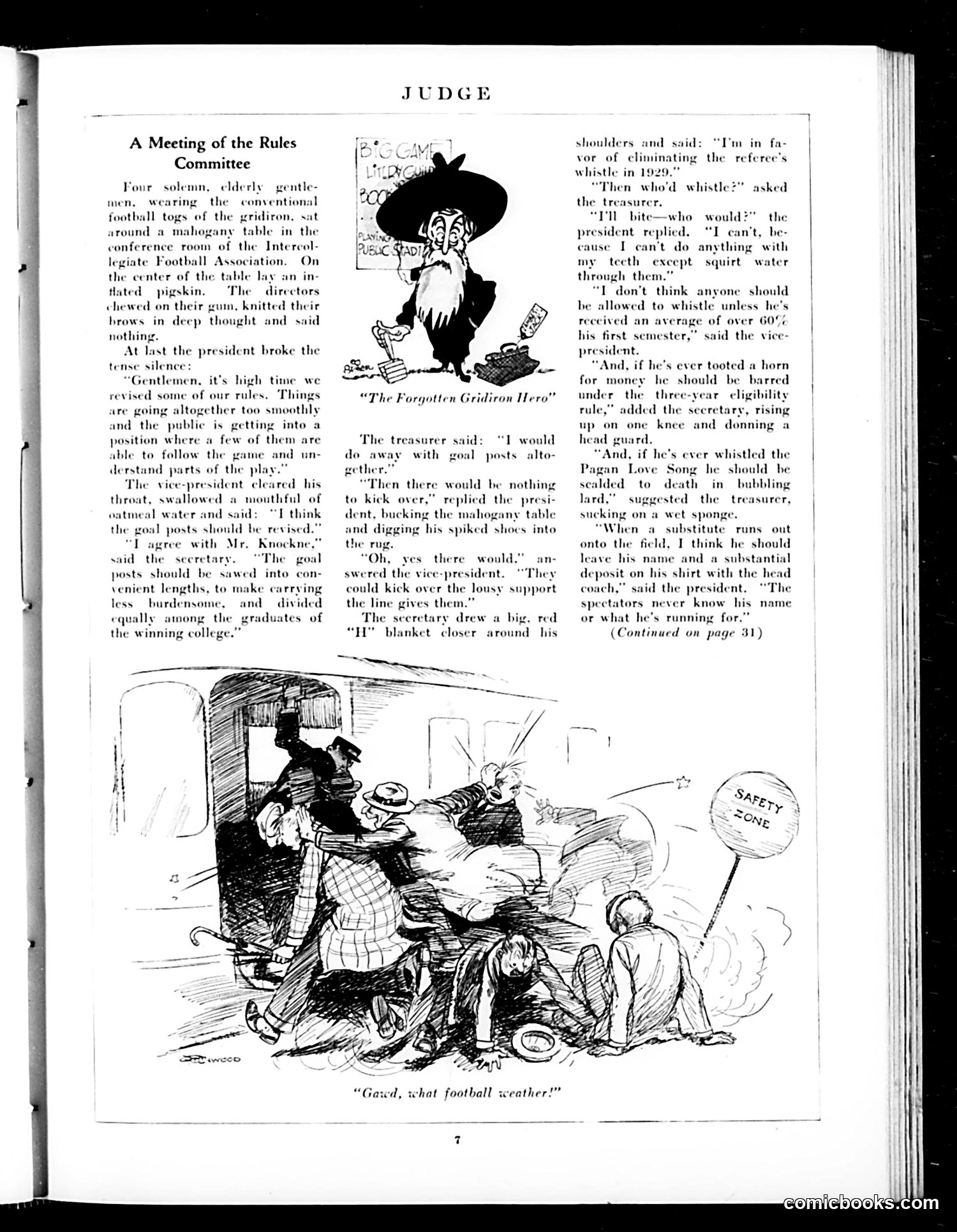
Analysis: "A Meeting of the Rules Committee" This satirical piece mocks the Intercollegiate Football Association's endless rule-making. Four stodgy officials debate absurd "reforms"—removing goal posts, eliminating referees' whistles, imposing eligibility rules on whistlers (requiring 60% grades, banning those who've tooted horns for money), and scalding anyone who whistles "Pagan Love Song." The joke targets two things: (1) administrative overcomplication—well-meaning officials creating byzantine rules that make the game less, not more, sensible; (2) the disconnect between rule-makers and players/spectators, exemplified by the demand that substitute players leave deposits on their uniforms since officials don't know who they are. The cartoons show the officials' pretentious self-importance and the chaos their rules create. The satire suggests that college football governance had become increasingly byzantine and removed from practical reality—a recognizable critique of institutional bureaucracy.
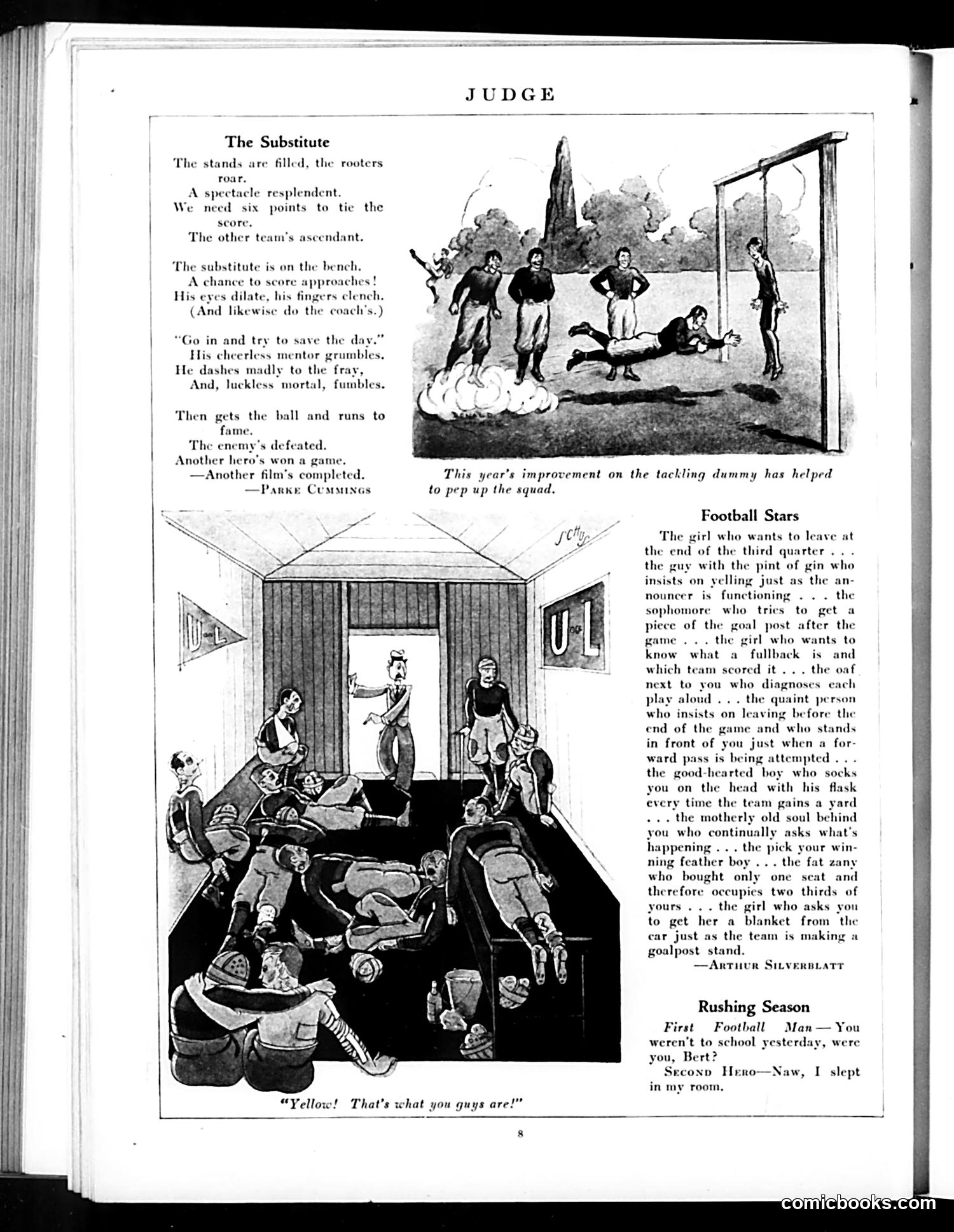
"The Substitute" and Football Culture in Judge Magazine This page contains two football-themed pieces satirizing early 20th-century college sports culture. "The Substitute" is a humorous poem (illustrated above) about a benchwarmer who finally gets his chance to play. Despite initial fumbling, he scores the winning touchdown—a classic underdog-makes-good narrative. The satire appears directed at movie serials and sports cinema, with the concluding line "Another film's completed" suggesting this plot was already a tired Hollywood cliché. "Football Stars" is a lengthy satirical list of annoying spectator types at games—the girlfriend wanting to leave early, the drunk with a flask, the know-it-all commentator, the person blocking your view, the girl asking favors at crucial moments. It's social satire mocking both nouveau riche fans and dating culture anxieties. "Rushing Season" (bottom) is a brief joke about a student claiming he "slept in [his] room" to avoid school, likely implying hangover or laziness around football season. The overall message critiques how football had become embedded in American popular culture—both on screen and in social behavior.
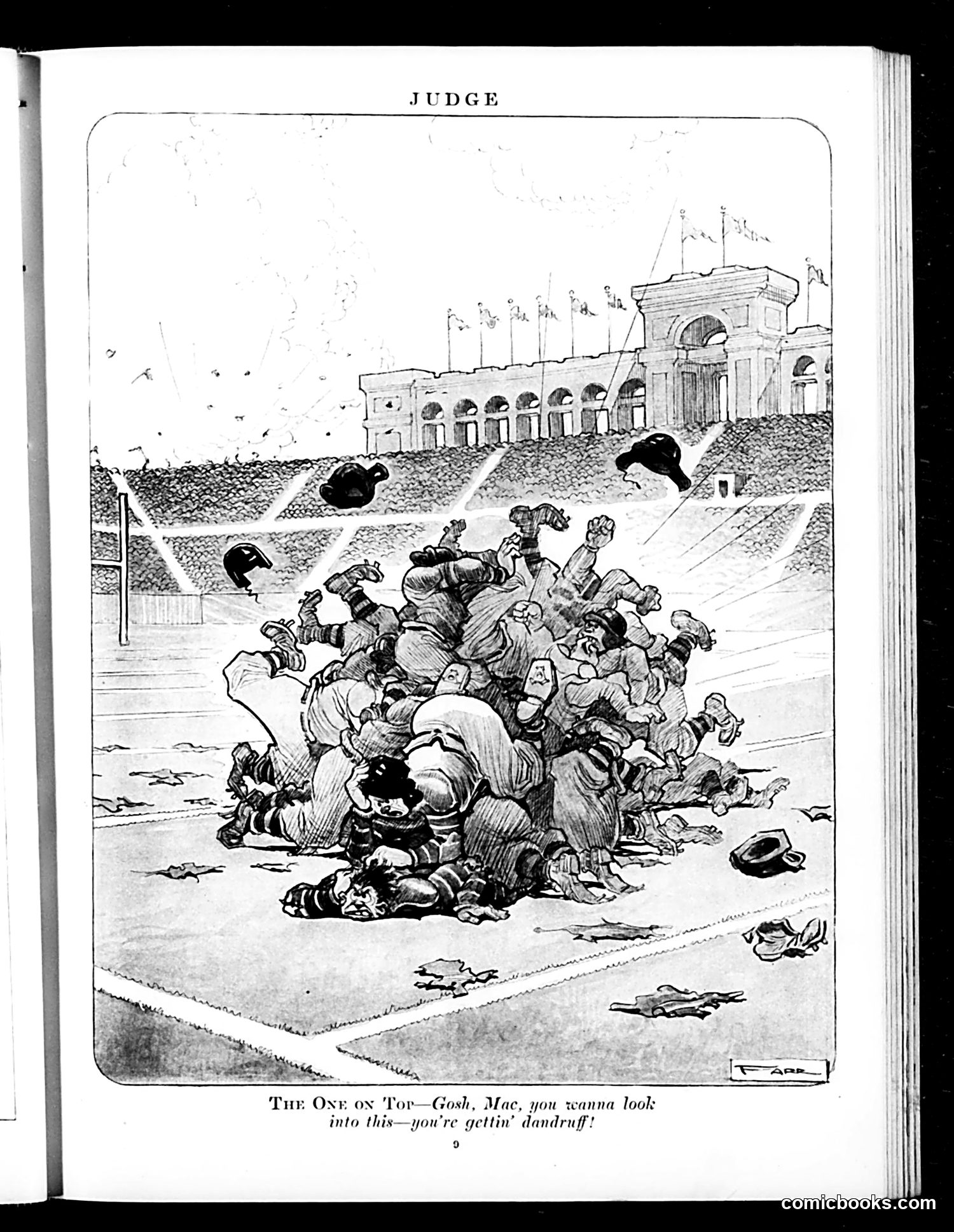
This cartoon depicts a chaotic pile-up of people in what appears to be a Roman amphitheater or arena setting. The caption's dialogue—"Gosh, Mac, you wanna look into this—you're gettin' dandruff!"—uses "dandruff" as slang for the scattered debris and disorder visible around the heap of bodies. The satire likely critiques a specific political or social situation involving confusion, mismanagement, or collapsing order, with the arena setting suggesting themes of public spectacle or judgment (fitting the magazine's title "JUDGE"). The casual, dismissive tone of the caption contrasts darkly with the chaotic scene, mocking those in authority for ignoring or minimizing obvious problems. Without additional context about the publication date, the specific figures referenced remain unclear.
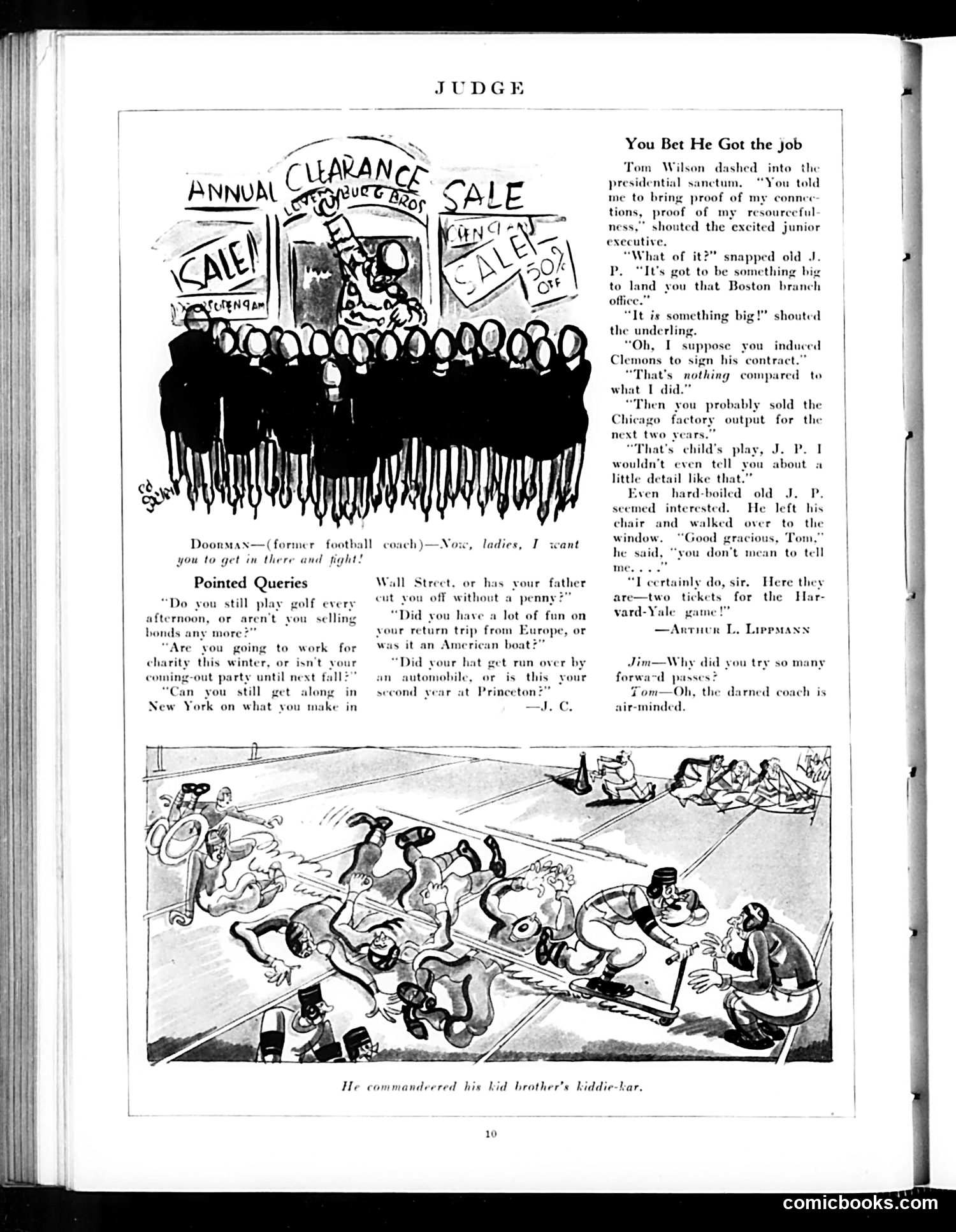
Analysis of Judge Magazine Page Top Cartoon: A doorman (labeled as "former football coach") exhorts a group of well-dressed women to "get in there and fight!" The satire mocks the absurdity of applying aggressive sports language to genteel society women, likely commenting on post-WWI efforts to mobilize women for charitable or civic work using masculine rhetoric. "Pointed Queries": A satirical column poking fun at wealthy New Yorkers—their leisure activities (golf, European travel), their dependence on Wall Street income or paternal allowances, and their social pretensions (Princeton attendance, coming-out parties). The questions highlight the idle, privileged lifestyle of the upper class. "You Bet He Got the Job": An aspiring executive impresses his boss by securing two tickets to the Harvard-Yale football game—a prestigious social prize that outweighs actual business accomplishments. The joke satirizes how social connections and sports access matter more than real competence in business advancement. Bottom Cartoon: A child commandeers his younger brother's kiddie-car, illustrating sibling rivalry with comedic exaggeration. The page overall mocks wealthy elites and their shallow values.
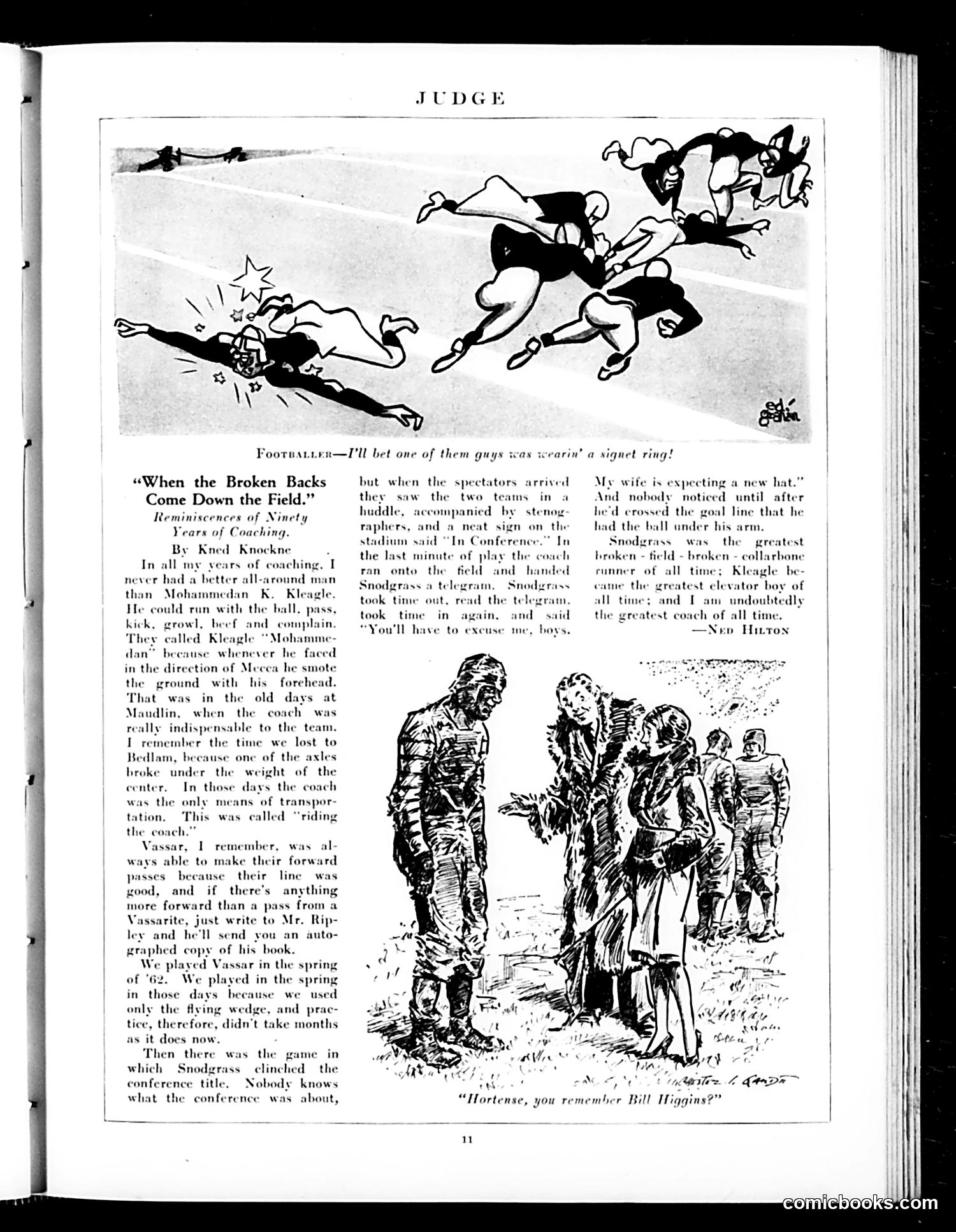
Political Cartoon Analysis: "Judge" Magazine This page contains a humorous sports column titled "When the Broken Backs Come Down the Field," recounting coaching reminiscences. The top cartoon depicts a chaotic football play with exaggerated, slapstick action. The main text is a nostalgic anecdote about coaching legendary player "Mohammedan K. Kleagle" (the name appears satirical/invented). The story mocks early football by referencing absurdities like coaches serving as transportation ("riding the coach") and fragile equipment that breaks under a center's weight. The punchline involves coach Snodgrass receiving a telegram mid-game about his wife expecting a new hat—so trivial it interrupts a championship match. The satire targets both football's evolution (from primitive flying-wedge tactics to modern play) and the pretensions of coaches and players. The bottom illustration shows what appears to be a formal encounter, captioned "Hortense, you remember Bill Higgins?"—likely a separate domestic humor scene. The overall tone is affectionate mockery of American football's early era and coaching culture.
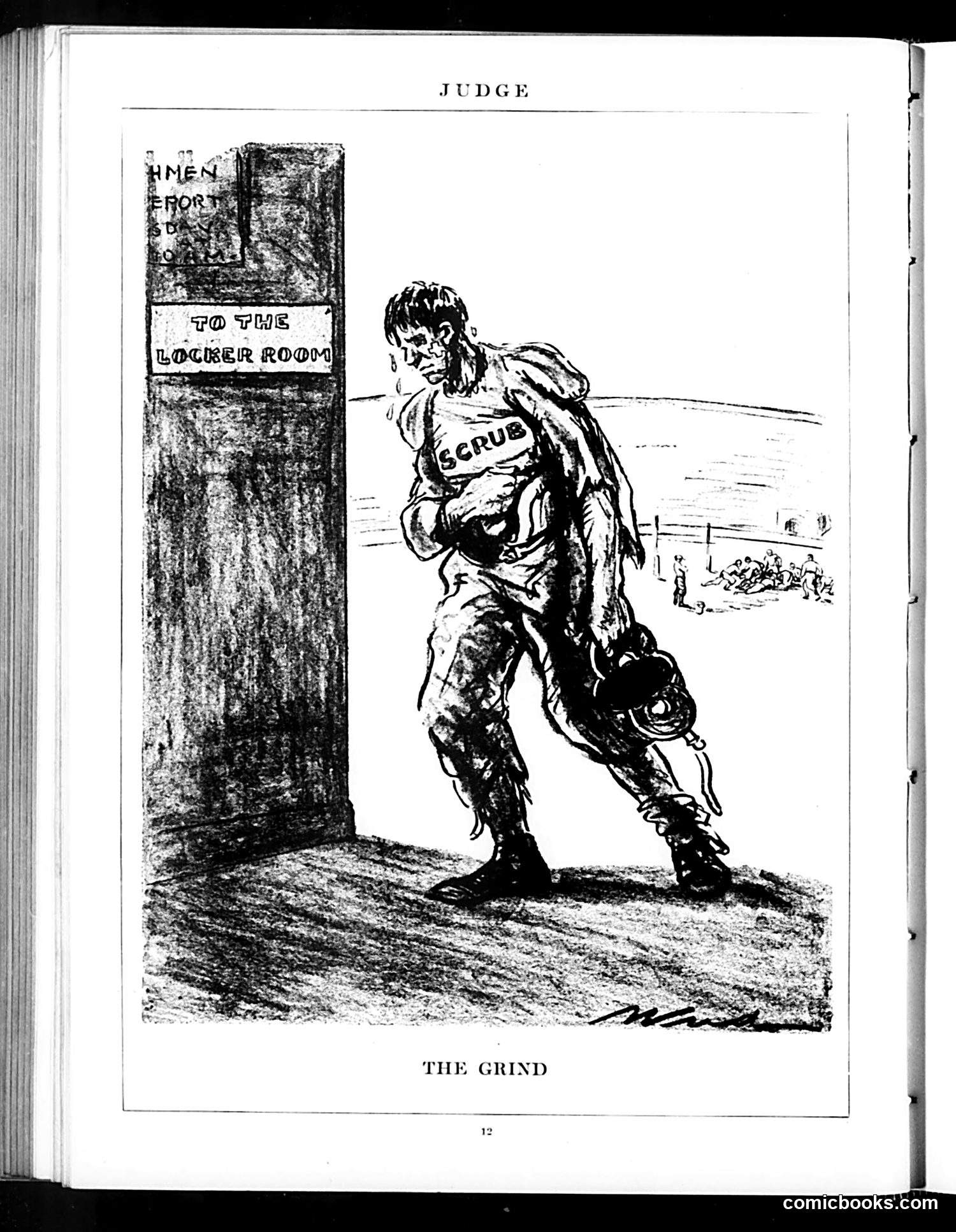
"The Grind" - Judge Magazine Cartoon This political cartoon depicts a figure labeled "SCRUB" being ground down by institutional machinery. The door marked "TO THE LOCKER ROOM" and sign reading "MEN ERROR" suggest a sports or military context where young men face harsh discipline or punishment. The cartoon satirizes the brutal treatment of recruits or athletes subjected to rigorous, dehumanizing training. The grinding mill imagery conveys how institutions break down individual identity and will through repetitive, exhausting labor or discipline. Without the magazine's date visible, the specific historical context remains unclear—this could reference military conscription, college athletics hazing, or labor exploitation—but the message is unambiguous: the system mechanically processes and wears down those subject to it.
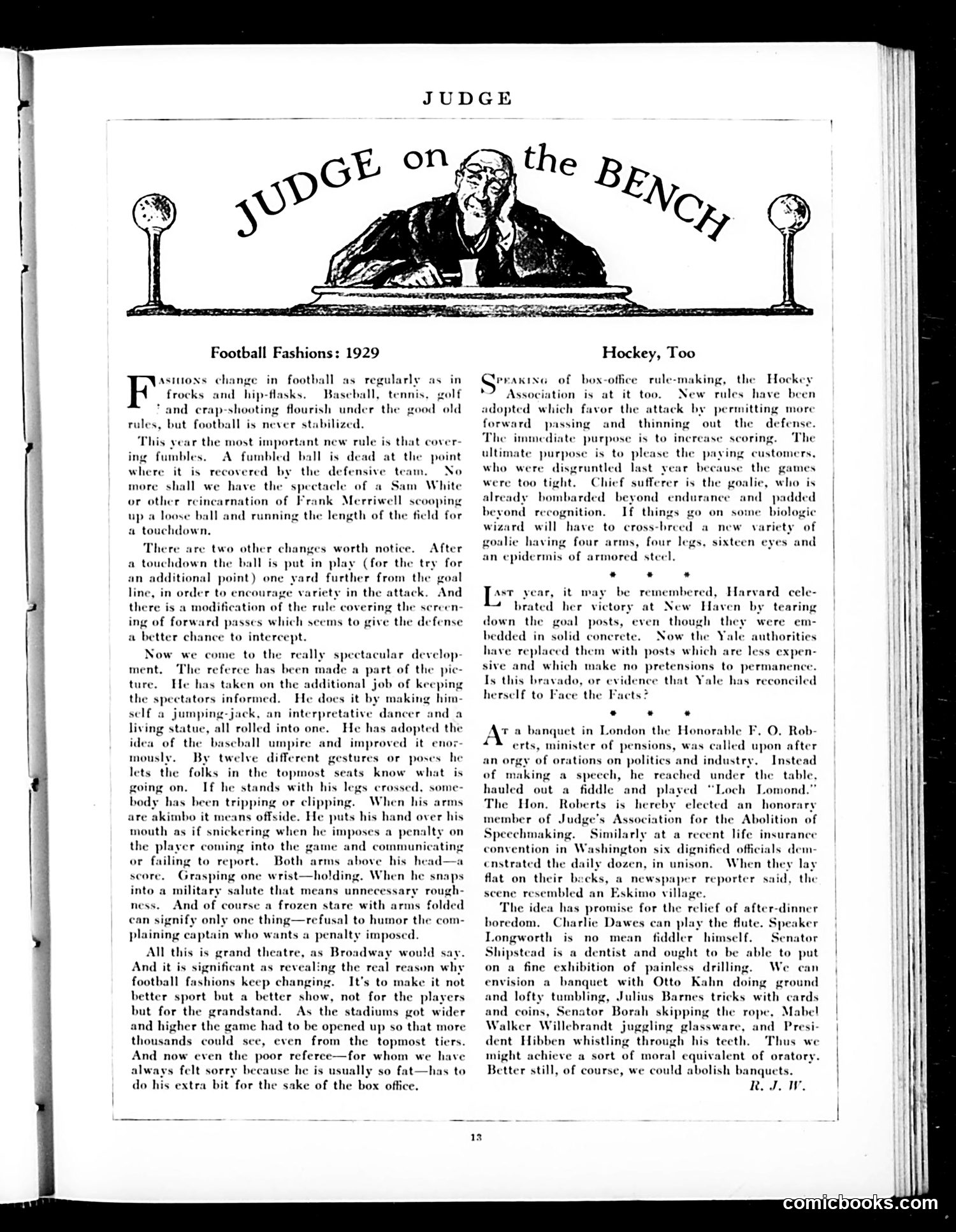
"Judge on the Bench" (1929) This page satirizes how sports rule-making has become spectacle-driven rather than sport-driven. The main article criticizes football's constant rule changes, but focuses on a new development: the referee as theatrical performer. The text mocks how referees now use exaggerated gestures—legs crossed, arms akimbo, frozen stares—so distant stadium spectators can see what's happening. The satire's point: sports authorities are prioritizing entertainment value and box-office revenue over athletic integrity. A secondary article on hockey rule changes confirms this trend—new rules explicitly designed to increase scoring and please paying customers, even if it requires inventing grotesque superhuman goalies. The underlying critique reflects 1920s anxieties about commercialization corrupting amateur and professional athletics. Sports have become "grand theatre" rather than contests, with officials transformed into "interpretive dancers" for the grandstand rather than neutral arbiters of play.
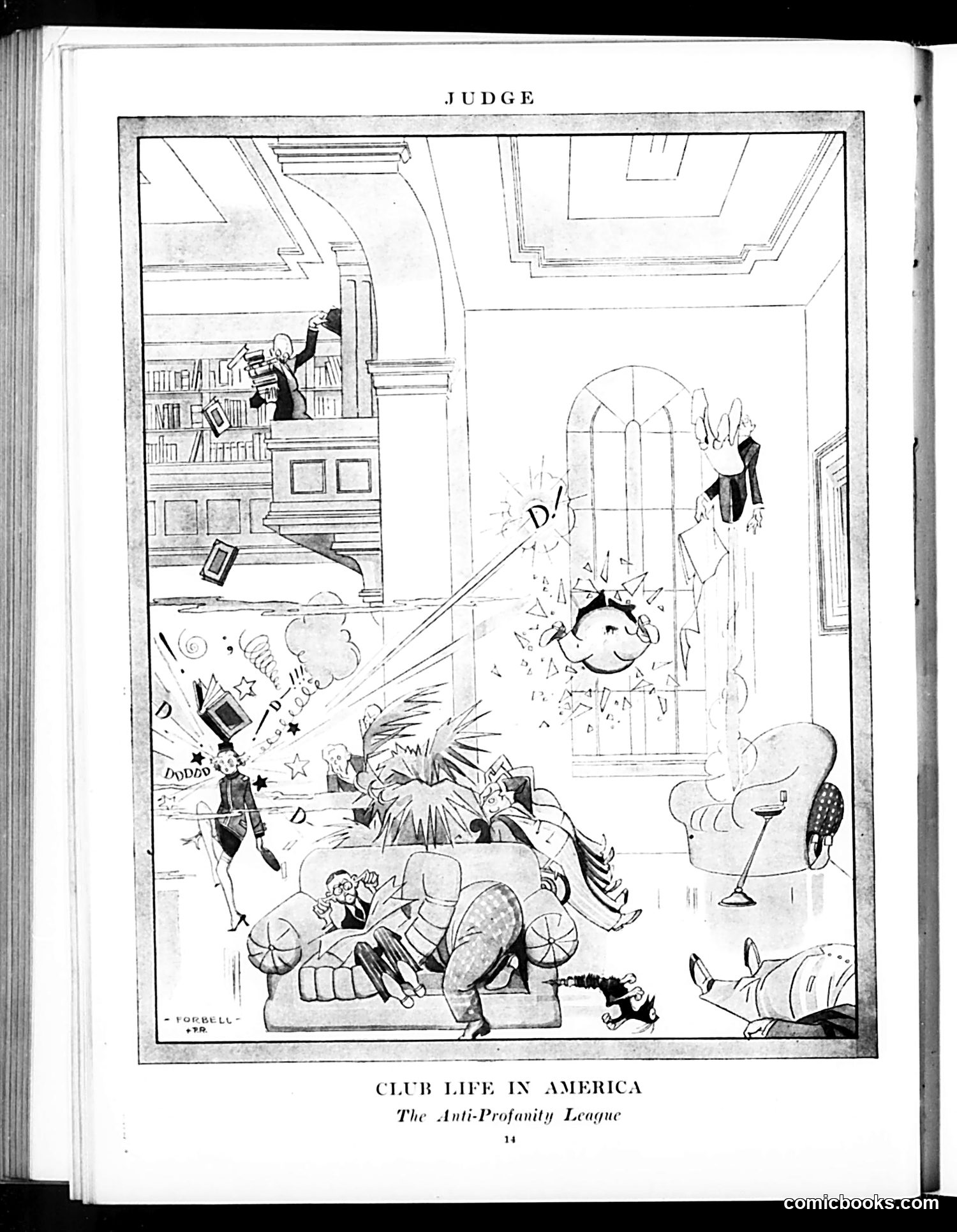
Cartoon Analysis: "Club Life in America - The Anti-Profanity League" This satirical cartoon depicts chaos erupting in what appears to be an upscale club or courthouse (note the judge's bench and formal architecture). The cartoon mocks an "Anti-Profanity League" — likely a real organization advocating for censorship of foul language. The joke lies in the irony: despite the league's stated mission to eliminate profanity, the scene shows complete pandemonium with fighting, explosions, and disorder. The formal setting and the characters' apparent shock suggest that the anti-profanity campaign has spectacularly backfired or proven ineffective. The satire critiques such moral-reform organizations as either ineffectual or hypocritical, questioning whether banning language addresses society's actual problems while chaos reigns regardless.
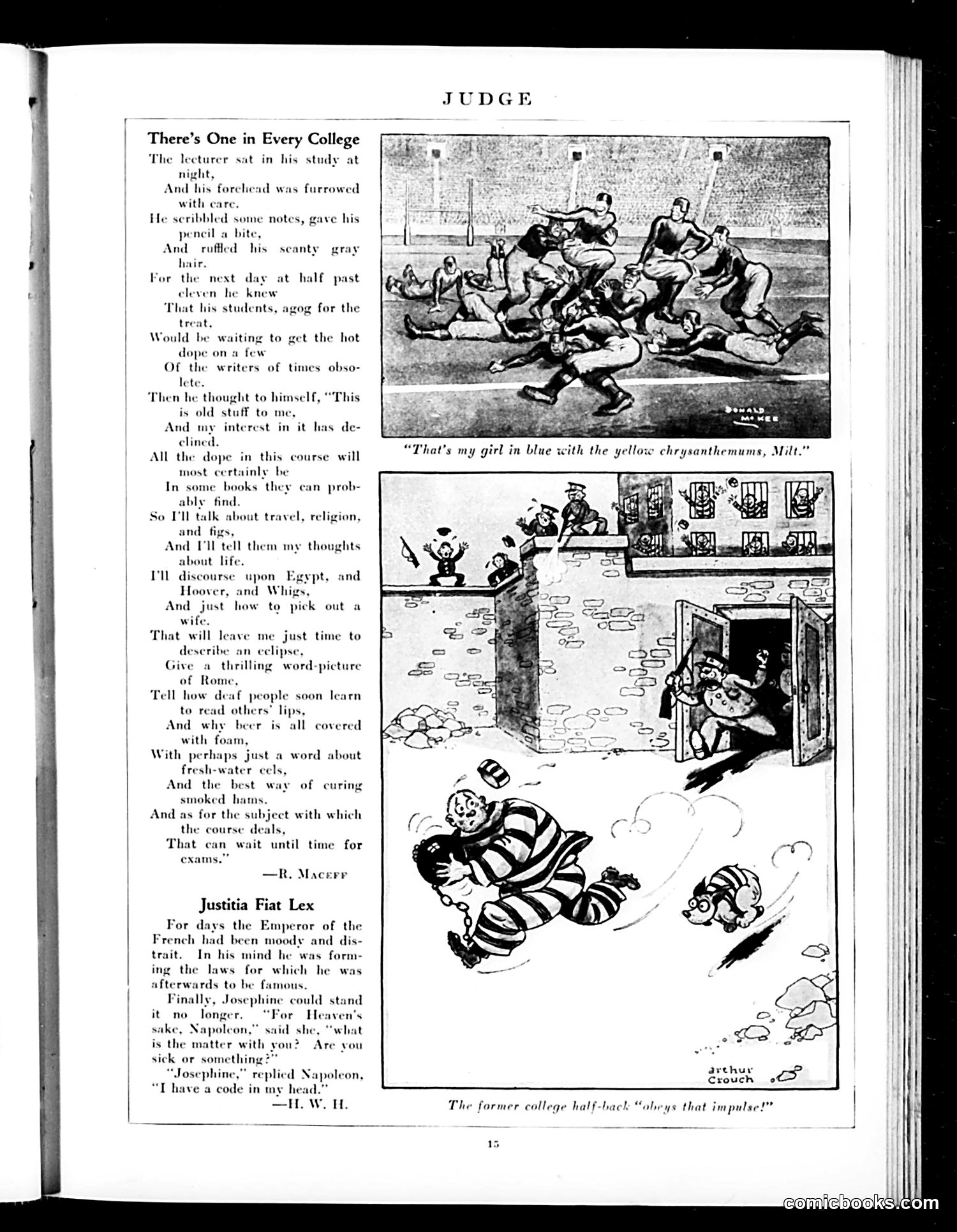
Judge Magazine Page Analysis This page contains two distinct pieces of satire: "There's One in Every College" (poem + cartoon): A satirical critique of lazy college professors. The poem describes a lecturer who has grown bored teaching classical literature and plans to fill class time with tangential topics—travel anecdotes, personal philosophies, Egypt, how to pick a wife—rather than actually teaching the course material. The cartoon shows students lounging around, apparently waiting for substantive instruction. The satire targets academic negligence and professorial self-indulgence. "Justitia Fiat Lex" (anecdote + cartoon): A pun-based joke about Napoleon. His wife Josephine notices him brooding and asks if he's ill. He replies, "I have a code in my head"—a play on words: he's thinking about legal codes (which he's famous for creating), but the phrasing sounds like he has a head cold. The cartoon shows him surrounded by papers, depicting the moment of this wordplay. It's gentle humor playing on homonyms rather than political commentary.
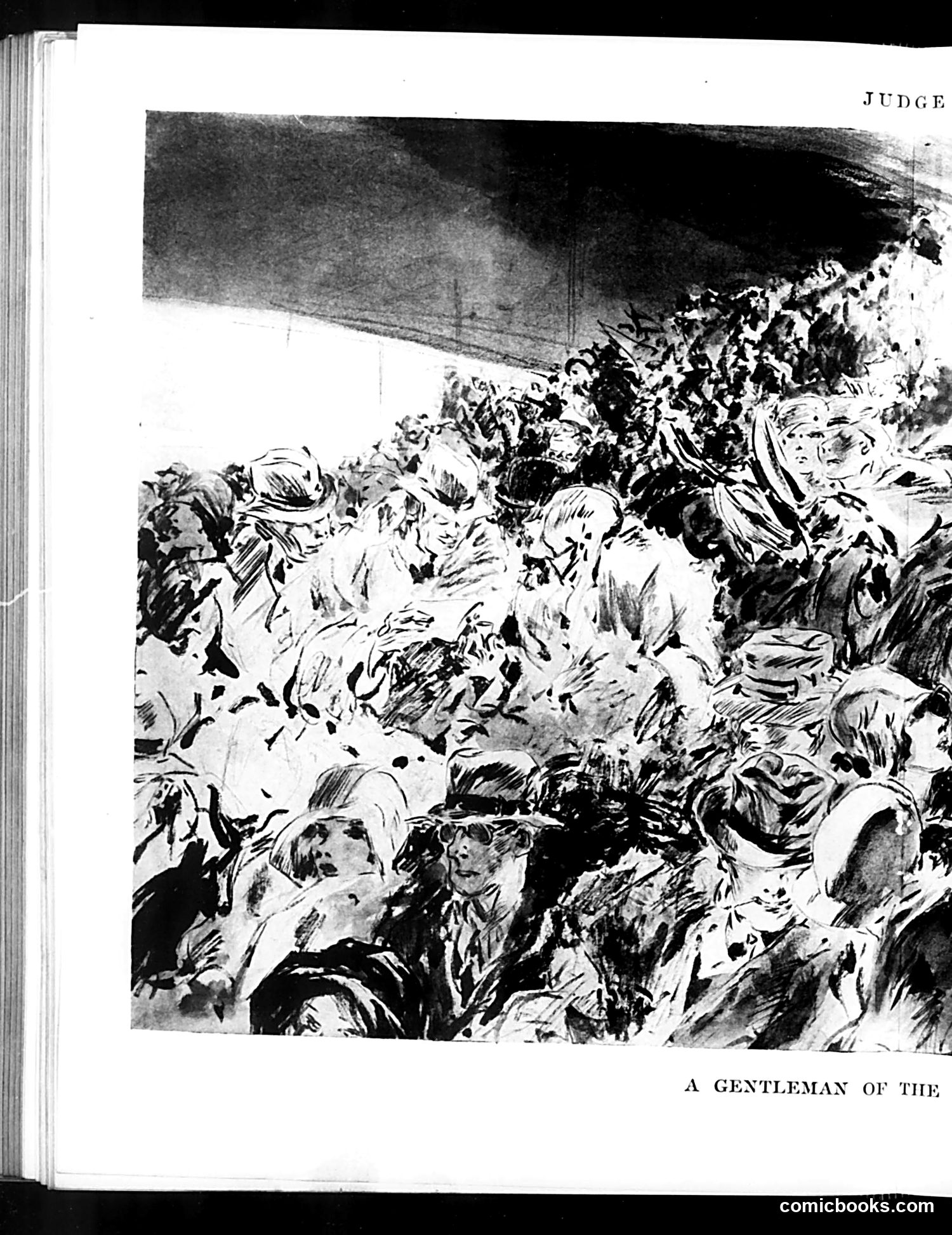
Analysis This page from *Judge* magazine shows a densely crowded scene of figures rendered in bold, expressive ink strokes. The caption reads "A GENTLEMAN OF THE" (text appears cut off). The image depicts what appears to be a chaotic public gathering or mob scene with numerous people wearing period clothing and hats. The artistic style uses heavy cross-hatching and dramatic contrasts typical of late 19th/early 20th-century satirical illustration. Without the complete caption text, the specific satirical target is unclear. However, the crowded composition and expressive rendering suggest this may mock either a political gathering, social event, or public controversy of the era. The phrase "A Gentleman of the" likely completed with a social class or institution name that provided the satire's point. The image quality and fragmented text limit definitive interpretation of the specific figures or events being satirized.
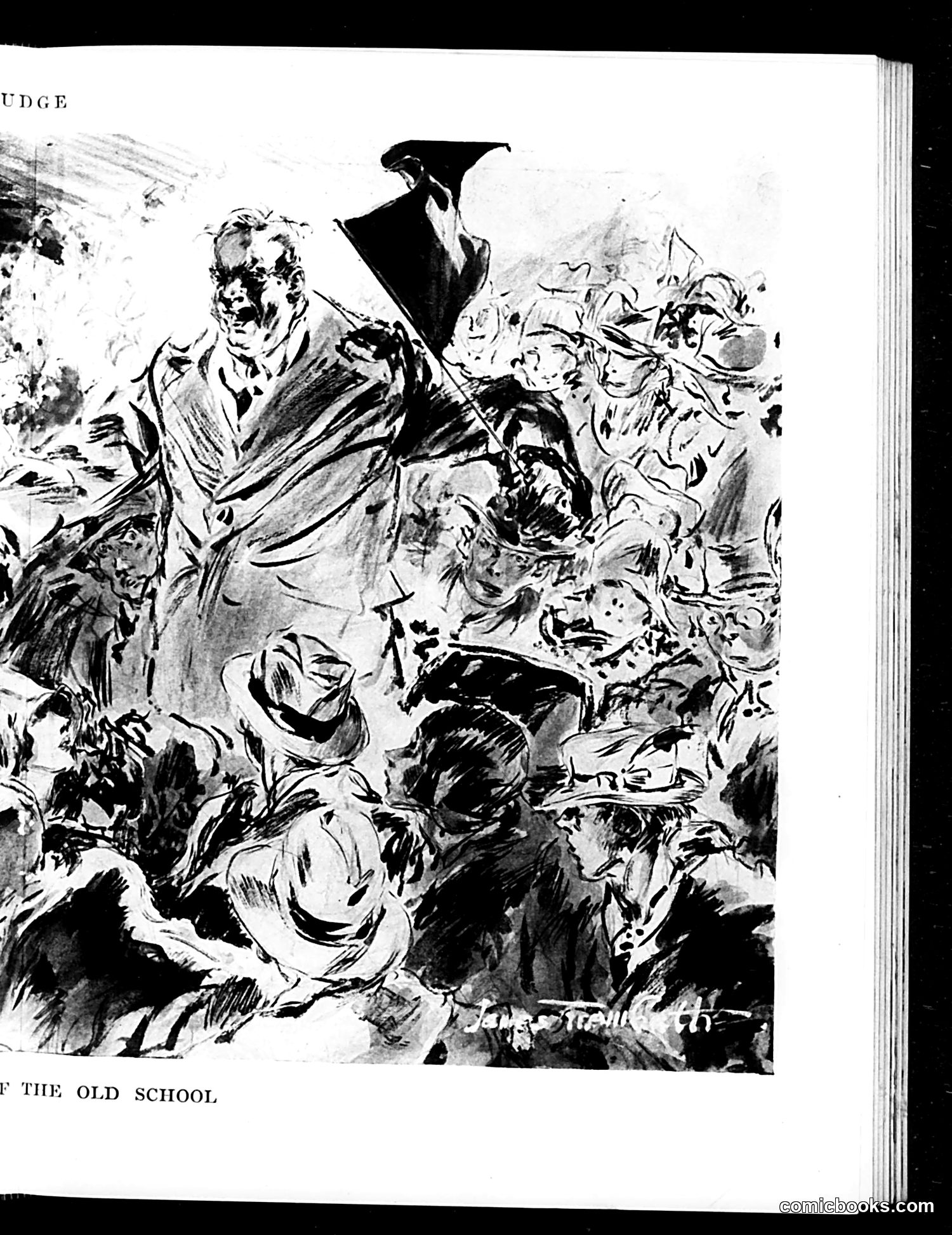
"Of the Old School" This satirical illustration depicts a chaotic scene of violent conflict. A central figure in formal dress and a distinctive hat stands amid a crowd of fighting men in various states of disarray. The artwork's loose, expressive style emphasizes the mayhem and aggression. The title "Of the Old School" suggests commentary on outdated traditions or methods—likely mocking adherence to violent, antiquated practices. The well-dressed figure may represent establishment authority or an older generation clinging to aggressive, barbaric approaches while others descend into brutality around them. Without additional context or visible date, the specific political event referenced remains unclear, though Judge magazine typically satirized contemporary political figures and social conflicts. The image critiques what the cartoonist viewed as backward, destructive values.
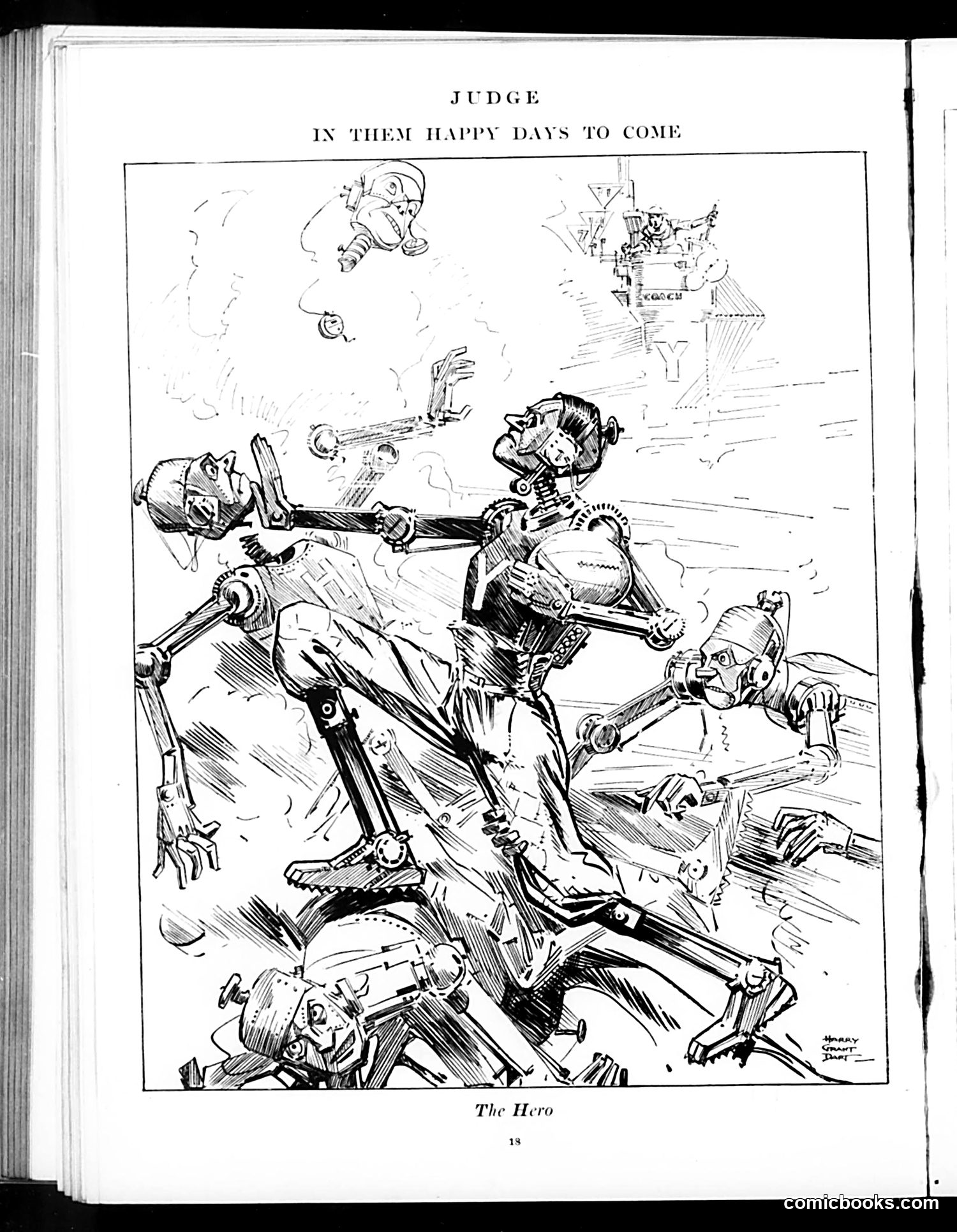
Analysis This political cartoon titled "The Hero" from *Judge* magazine depicts a central armored military figure juggling or managing multiple smaller figures while being attacked or pressured from all sides. The composition suggests chaos and competing demands. The cartoon appears to satirize political or military leadership during a period of conflict or crisis—the "happy days to come" subtitle implies ironic optimism about the future. The figure at center, rendered as a robust military commander, struggles to maintain control while surrounded by what appear to be various interest groups, problems, or competing political factions (depicted as smaller caricatured figures). Without visible date or clearer identifying details, the specific historical moment remains unclear, though the style and *Judge's* satirical tradition suggest early-to-mid 20th century commentary on leadership under pressure.
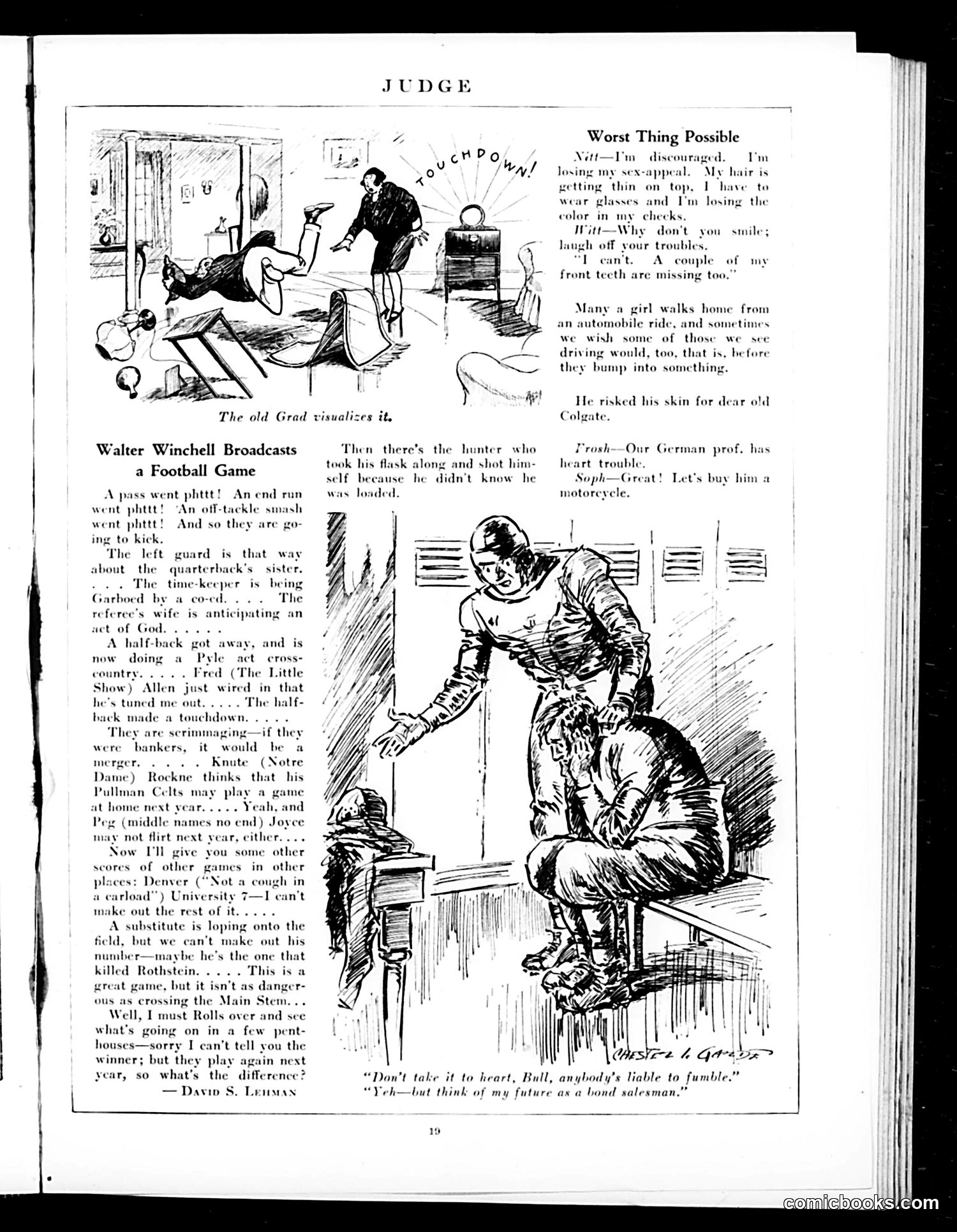
Analysis of Judge Page This page satirizes Walter Winchell, the famous gossip columnist and radio broadcaster, through a mock sports commentary. The top article parodies his rapid-fire, breathless broadcasting style—full of interruptions, celebrity name-drops, and non-sequiturs—applied to a football game. References like "Fred (The Little Show) Allen" and "Knute Rockne" were contemporary celebrities, and the joke mocks how Winchell would digress from the actual game into Hollywood gossip. The bottom section contains unrelated humorous bits: a dark joke about a drunk hunter, a man losing his appeal with age, and a sarcastic German professor joke (likely from the 1920s-30s when such ethnic humor was common in American magazines). The illustrations show physical comedy and slapstick scenarios typical of Judge's style. Overall, the page ridicules celebrity gossip culture and Winchell's sensationalist approach to broadcasting.
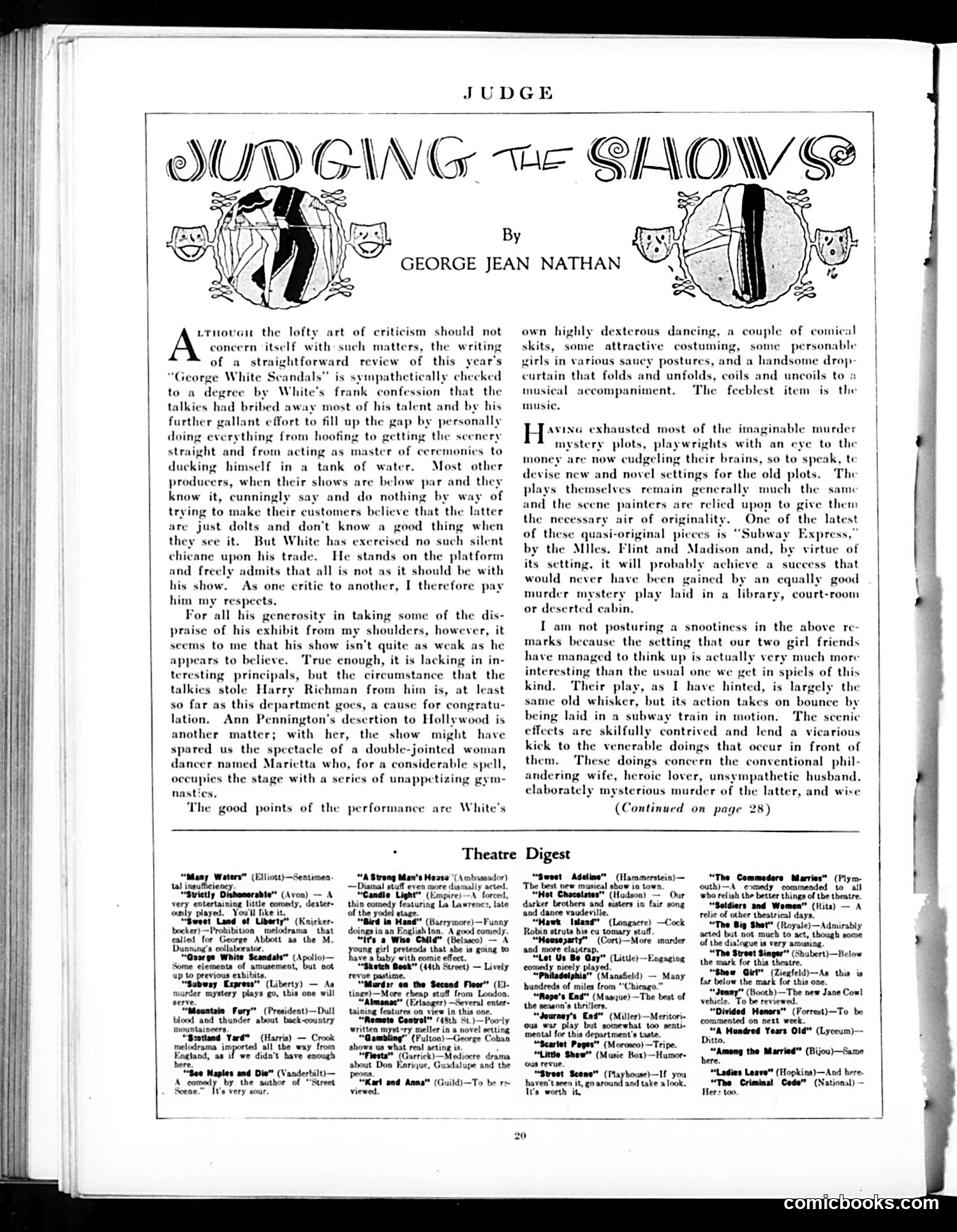
Judging the Shows This page reviews Broadway productions, primarily George White's theatrical revue "Scandals." Critic George Jean Nathan evaluates White's show with mixed praise—acknowledging White's honest admission that "talkies" (sound films) have diminished his talent, while defending the production against White's own self-criticism. Nathan credits the show's dancing, costumes, and attractive chorus girls as strengths, but dismisses the music and particularly criticizes a performer named Marietta for her "unappetizing gymnastics." He laments that radio/film have stolen talent like Harry Richman and Ann Pennington away from theater. The page also reviews other theatrical offerings in the digest section, including "Sweet Adeline" (praised as the best new musical) and mentions the decline of live performance talent to competing entertainment mediums—a significant concern during the late 1920s-early 1930s transition to sound film.
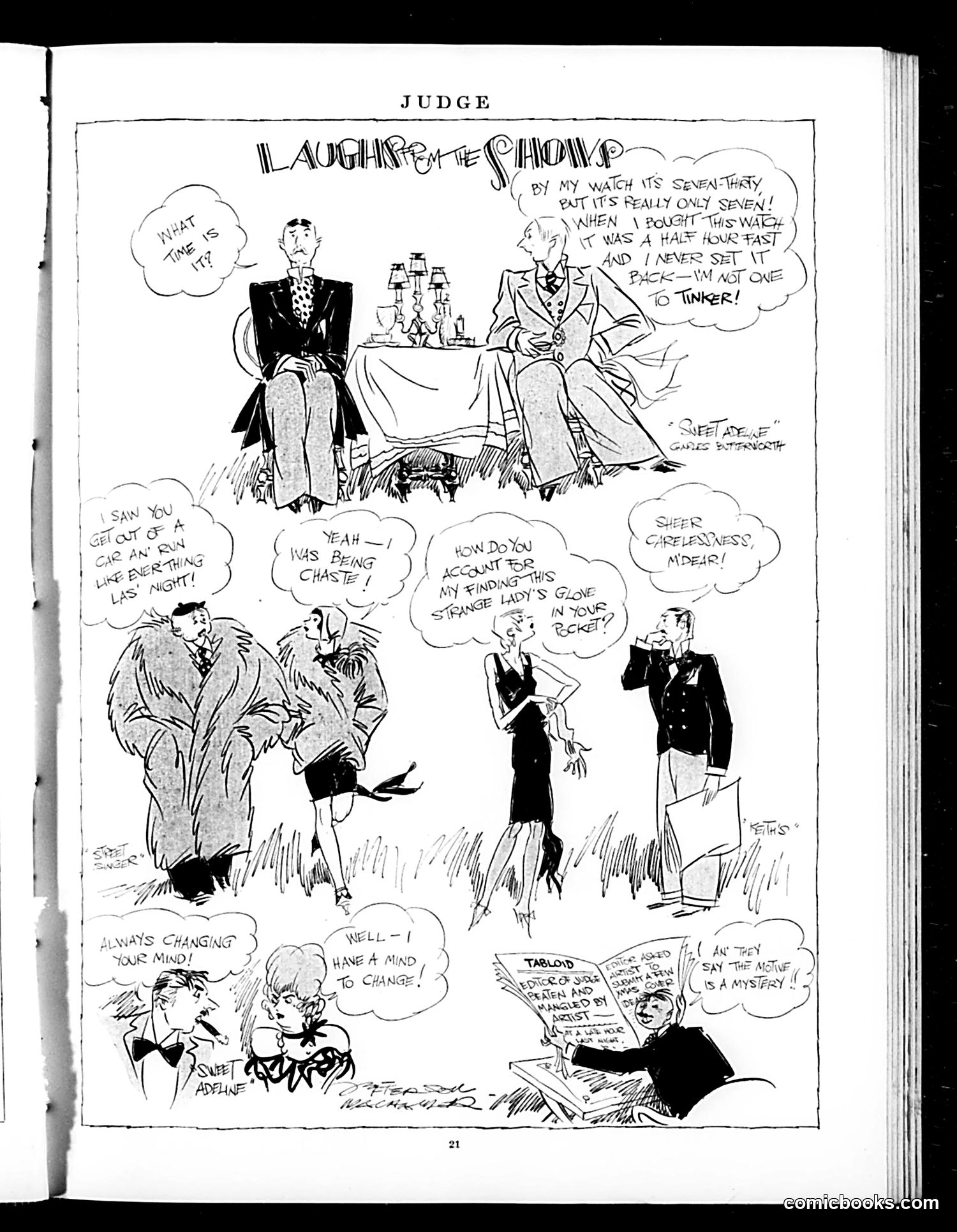
"Laugh et Le Chow" - Judge Cartoon Analysis This multi-panel cartoon satirizes wealthy society figures and their affectations. The main joke concerns a woman boasting about her expensive watch—claiming it's "seventy" when it's actually only "seven," suggesting she's exaggerating its cost or exclusivity. The subsequent panels mock high-society preoccupations: characters discuss lost gloves, changing minds about fashion, and reading tabloids about mysterious scandals. The humor targets the frivolity and superficiality of the upper class—their obsession with luxury goods, gossip, and constantly shifting opinions on trivial matters. The cartoonist appears to be Social Register Astonish, based on the signature. The satire reflects Judge magazine's typical critique of aristocratic vanity and the leisure class's disconnection from substantive concerns, a common theme in early-to-mid 20th century American satirical humor.
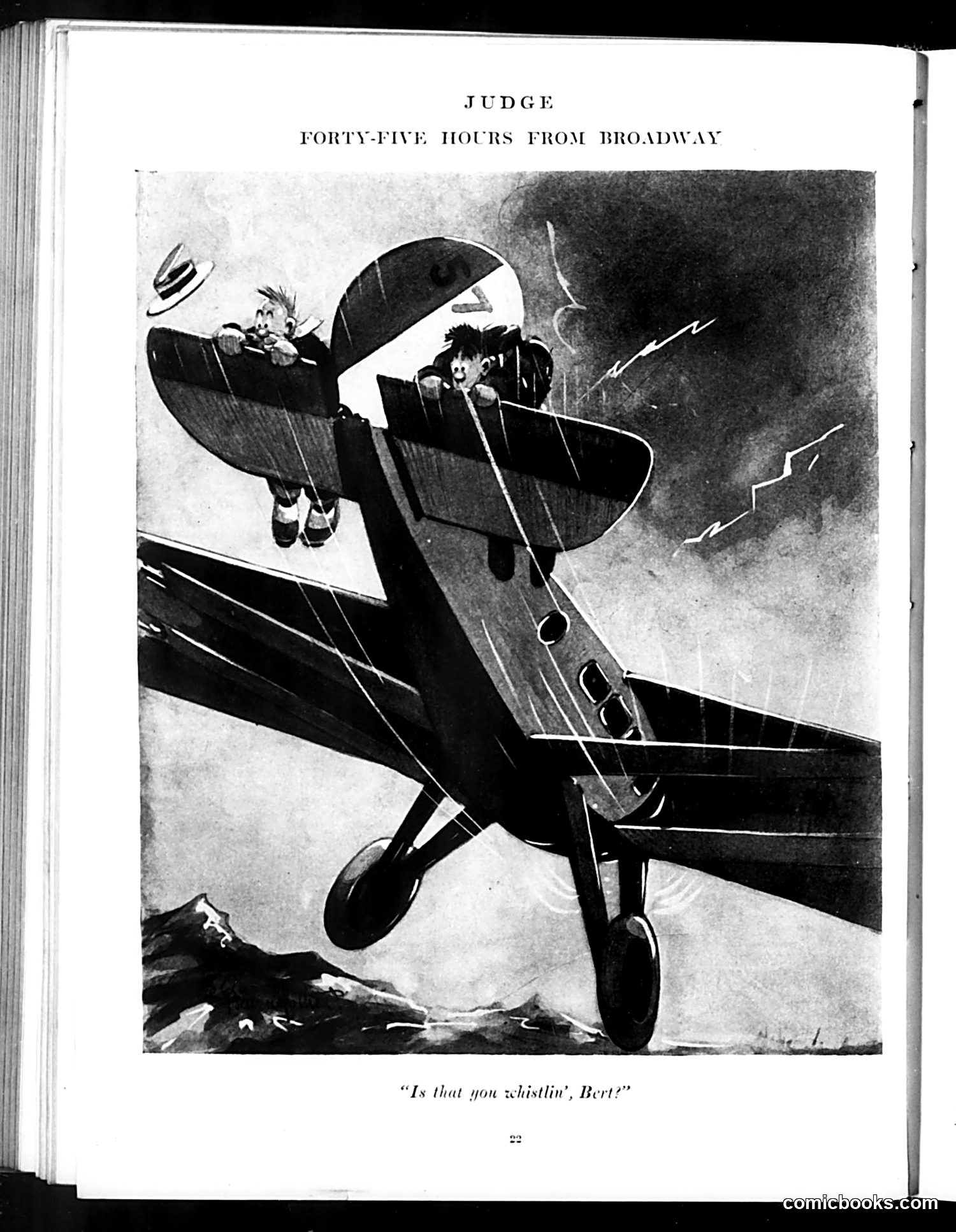
"Forty-Five Hours from Broadway" This Judge cartoon depicts an airplane in distress, with a small figure clinging to it mid-flight. The caption asks "Is that you whistlin', Bert?" — a reference to the 1906 George M. Cohan musical hit "Forty-Five Minutes from Broadway." The satire appears to mock either early aviation's dangers or a specific person nicknamed "Bert" associated with flying. The juxtaposition of the theatrical title with a perilous aerial scene creates dark humor: rather than the comfort of being "forty-five minutes from Broadway" (the show's setting), this Bert is literally stranded on a doomed aircraft. The cartoon likely comments on aviation's inherent risks during aviation's pioneering era, or possibly references a specific aviation incident or personality contemporary readers would have recognized.
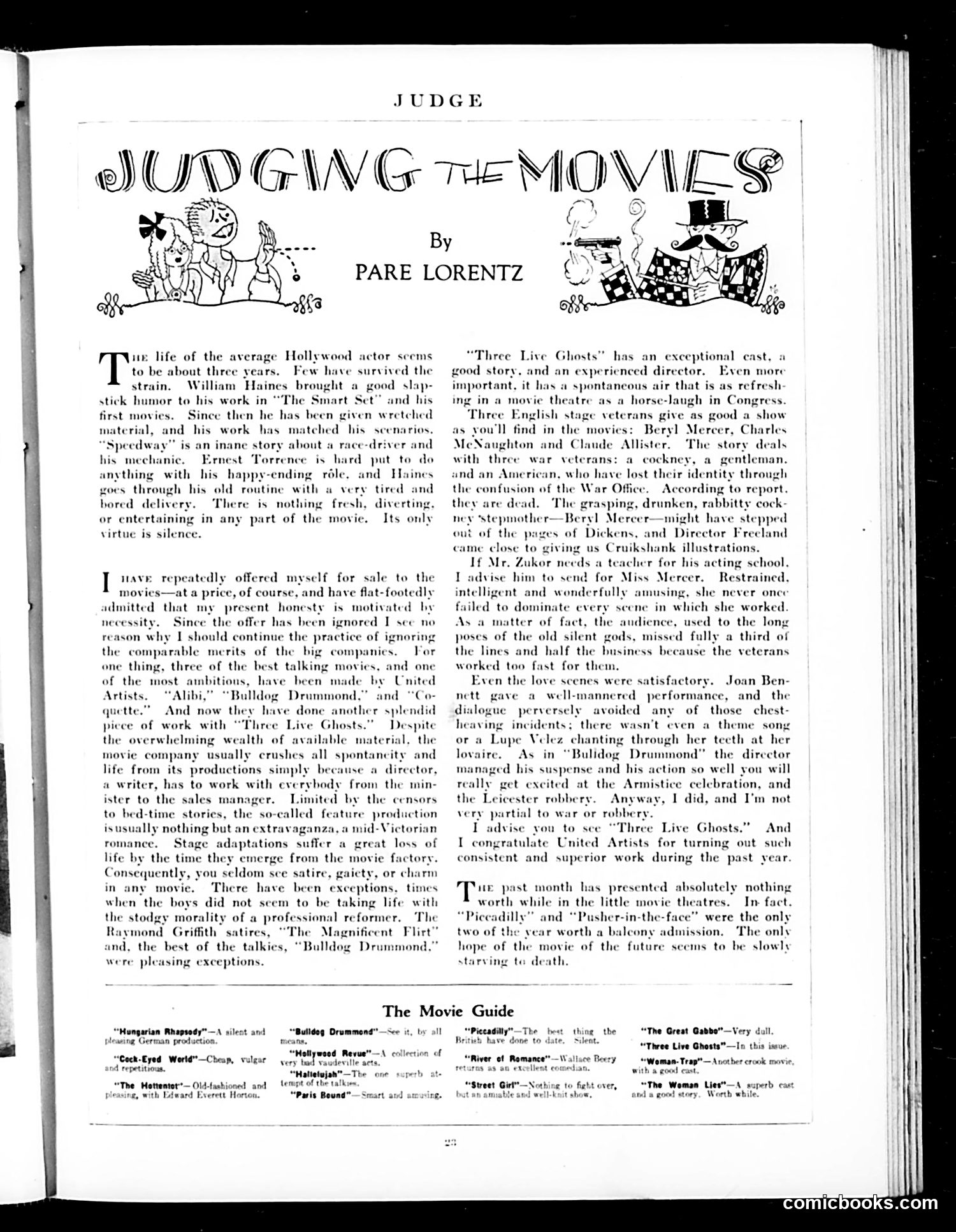
Judge Magazine: "Judging the Movies" by Pare Lorentz This is a film criticism column, not a political cartoon. Lorentz reviews recent Hollywood releases, critiquing their artistic merit and spontaneity. Key points: - He attacks the studio system for crushing originality in films, forcing directors to follow formulas - He praises "Three Live Ghosts" for retaining theatrical vitality despite being a stage adaptation, noting its cast of war veterans (Beryl Mercer, Charles McNaughton, Claude Allister) performs authentically - He dismisses most contemporary releases as tedious and morally vapid, contrasting them favorably with earlier satirical work by Raymond Griffith - He ridicules censorship's role in limiting artistic expression - The "Movie Guide" sidebar provides brief, often dismissive reviews of current films like "Bulldog Drummond" and "Hallelujah" The satire targets Hollywood's industrial standardization—how profit-driven production destroys the creativity and realism that theatergoing audiences valued.
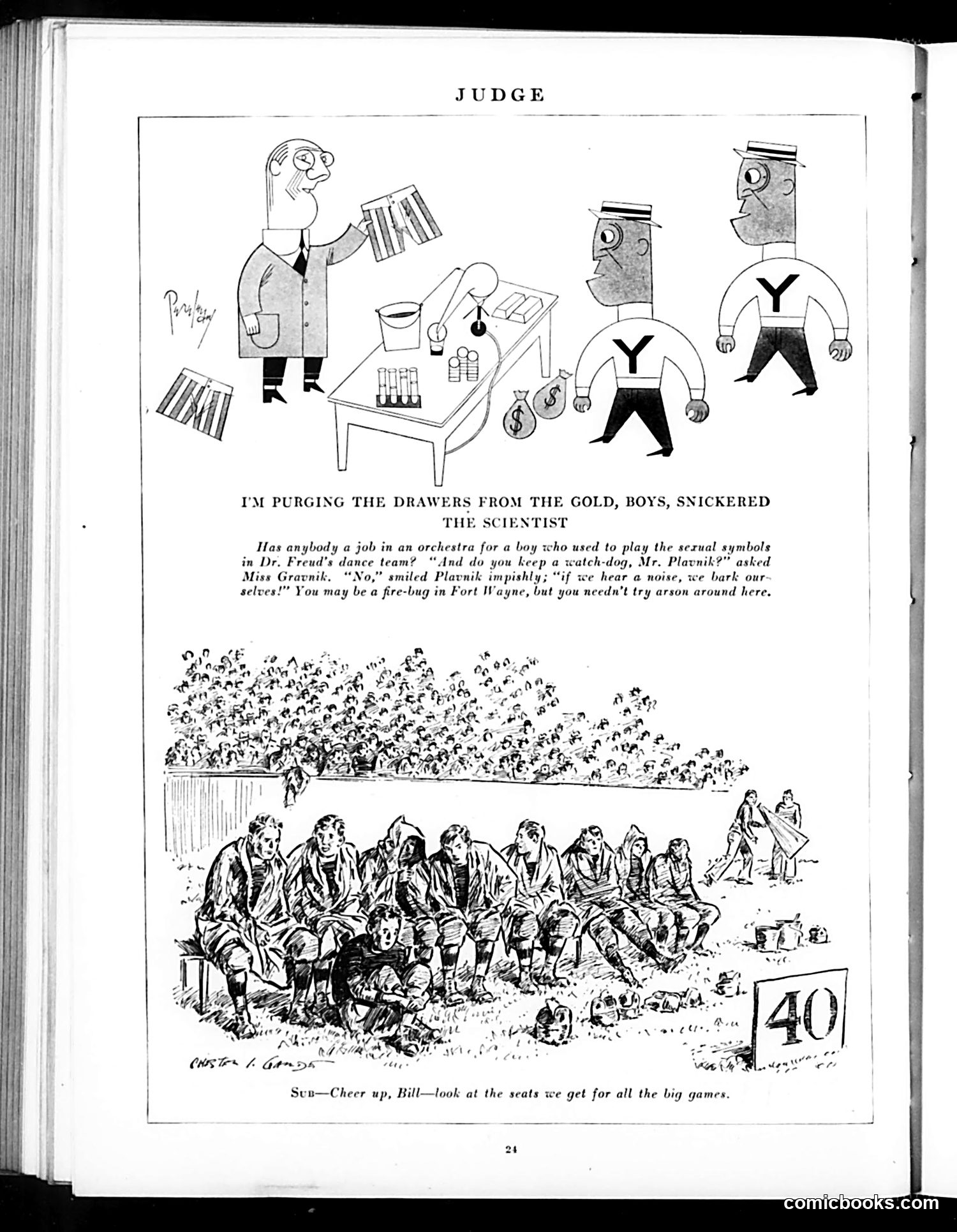
Analysis The top cartoon satirizes Freudian psychology's early 1920s popularity. A judge figure "purges the drawers" of pseudo-scientific thinking, depicted as gold coins being distributed to three men in bowler hats—likely representing charlatans profiting from Freud's theories. The accompanying quips mock Freudian ideas: someone asking if a boy can play "sexual symbols" in Dr. Freud's dance team ridicules the movement's focus on repressed sexuality; the Plavnik joke about barking at noises is absurdist wordplay, possibly mocking Freudian dream interpretation. The bottom cartoon shows a working-class crowd watching a baseball game from poor seats ("Cheer up, Bill—look at the seats we get for all the big games"). The satire critiques economic inequality: laborers get terrible viewing spots while presumably wealthy patrons get better access. The juxtaposition—mocking intellectual fraudulence above, class disparity below—reflects Jazz Age anxieties about pseudoscience and social fairness.
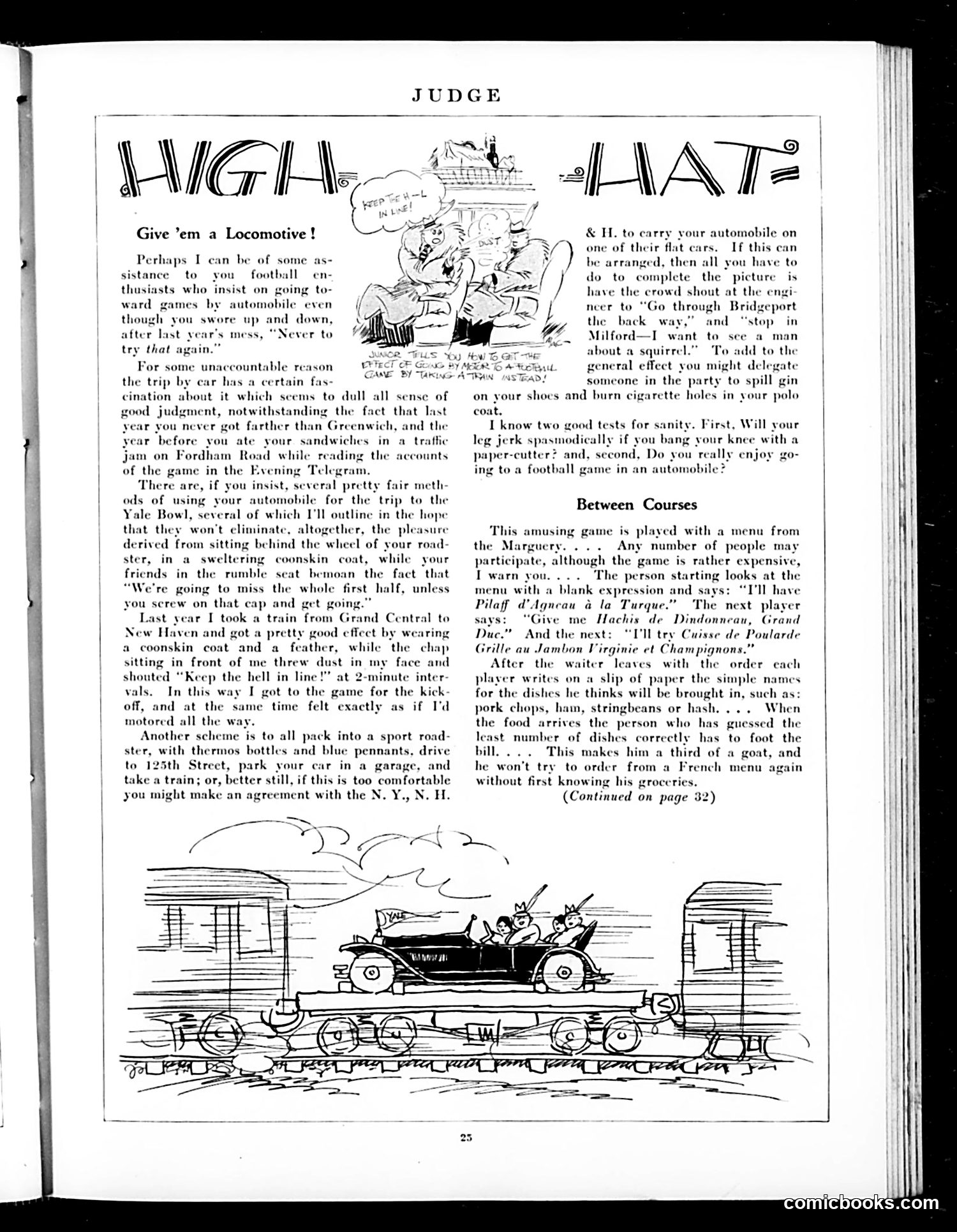
Judge Magazine: "High-Hat" (circa 1920s) This page contains two satirical pieces about upper-class leisure activities. "Give 'em a Locomotive!" mocks wealthy Yale football fans who insist on driving to the Yale Bowl despite consistently failing to arrive on time. The author sarcastically suggests increasingly absurd alternatives—taking a train, parking at 125th Street, or even having the railroad transport their automobile on a flatcar—all while maintaining the pretense of motoring. The satire targets the stubborn vanity of the automobile-owning elite who value appearing fashionable (in their coonskin coats) over actually enjoying the game. "Between Courses" describes an expensive restaurant game where diners order from French menus using pretentious dish names, then guess what simple ingredients will actually arrive. The joke exposes wealthy diners' snobbish affectation—they blindly order unfamiliar French cuisine to appear cultured, then are humiliated when the "fancy" dishes prove to be ordinary food. Both pieces ridicule the nouveau-riche's performative sophistication and their susceptibility to social embarrassment.
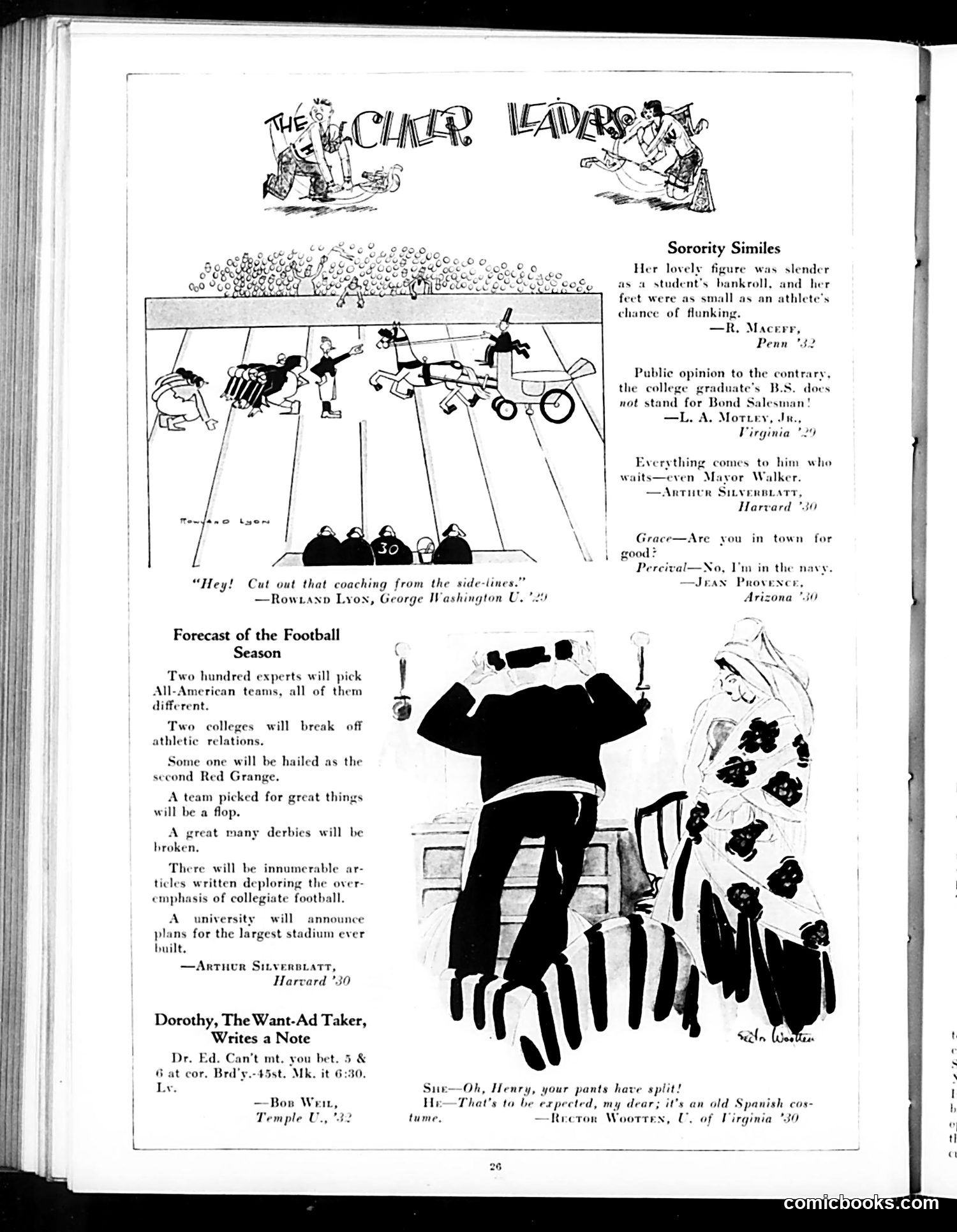
Judge Magazine Page Analysis This page from Judge magazine contains college humor and social satire from circa 1929-1930, compiled from student contributors at various universities. Main Content: The central cartoon depicts a football coach being hoisted on players' shoulders while kicking at a large bag of money—satirizing the era's intense commercialization and corruption of college athletics. The accompanying "Forecast of the Football Season" mocks the absurdity of sports culture: hundreds of experts picking different All-American teams, constant broken athletic relations between colleges, overemphasis on football, and universities building ever-larger stadiums. Sidebar Humor: Short jokes target 1920s-30s college life—a woman's small frame, the misnomer "B.S." (Bachelor of Science vs. "Bond Salesman"), Mayor Walker (likely New York's Jimmy Walker, a contemporary figure), and military service. One joke plays on old Spanish clothing tearing. Context: This reflects post-WWI American college culture's preoccupation with athletics, commercialism, and the moral decline some perceived in institutional priorities. The tone is lighthearted mockery of both collegiate excess and student pretension.
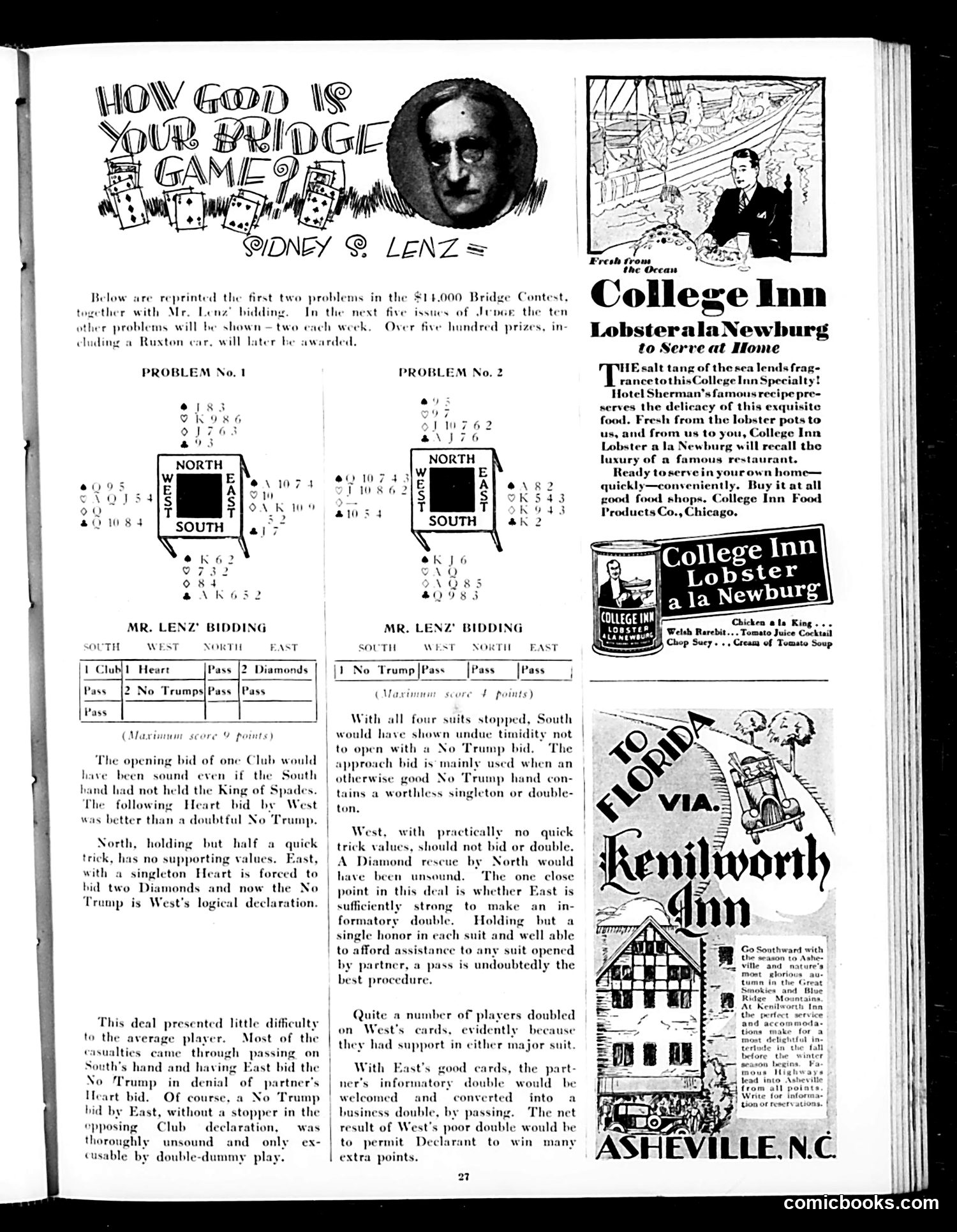
Judge Magazine Bridge Contest Page This page features bridge card game instructional content rather than political satire. The main content shows two bridge problems from a "$11,000 Bridge Contest" sponsored by Judge magazine, with bidding analysis by "Sidney S. Lenz"—a prominent bridge authority of the era. The page includes Lenz's photograph and detailed explanations of proper bidding strategy for each hand. The text explains why certain bids were sound or unsound, discussing concepts like "No Trump" bids and support requirements. The right side contains period advertisements: College Inn Lobster a la Newburg (a canned food product) and the Kenilworth Inn in Asheville, North Carolina. These ads are unrelated to the bridge content. Rather than satire, this represents Judge's educational content mixed with advertising—typical magazine filler of the era.
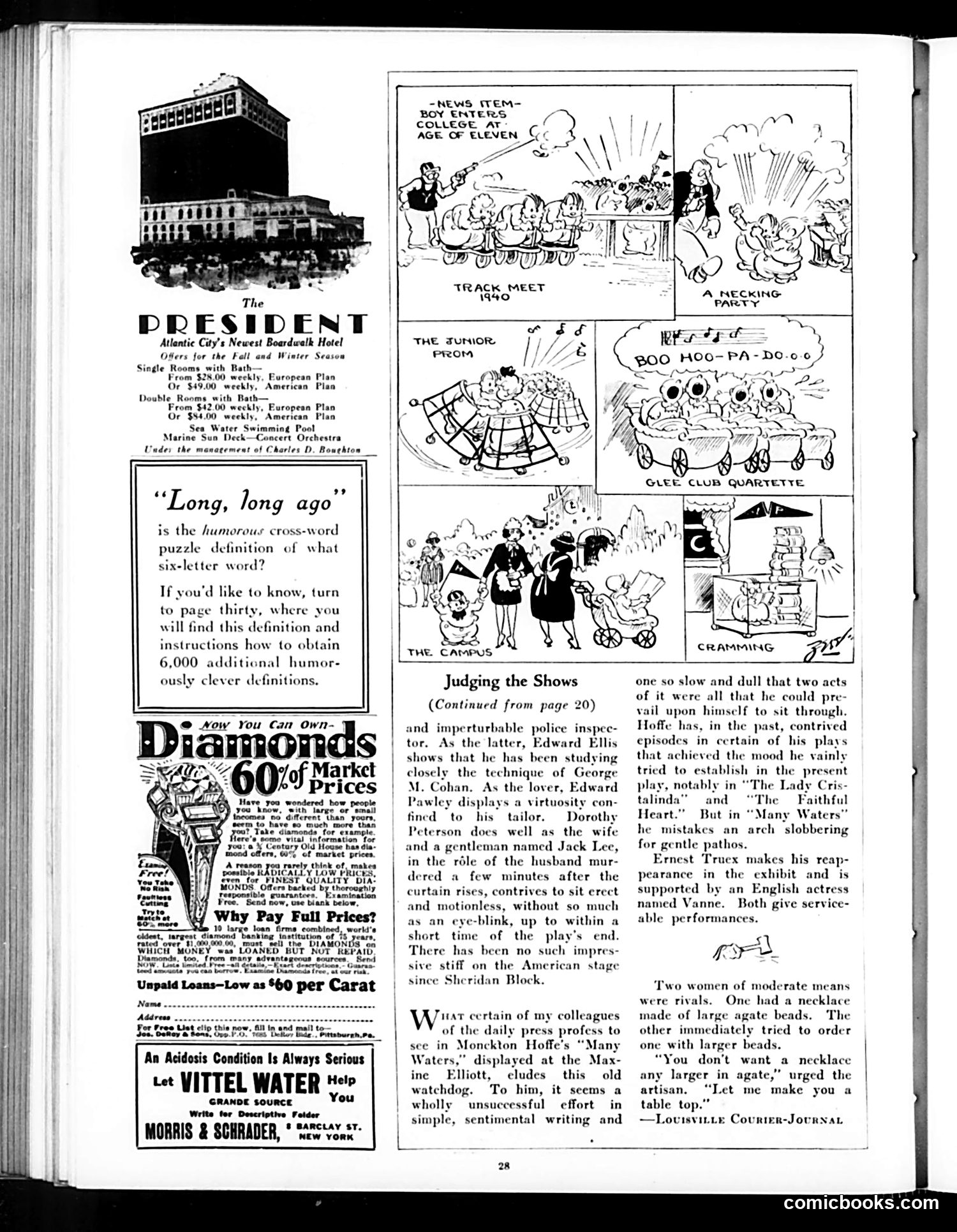
Analysis of Judge Magazine Page This page is primarily advertising and filler content, not political satire. The left side features ads for The President Hotel in Atlantic City, a crossword puzzle contest, diamond sales, and health products (Vittel Water). The right side contains humorous cartoon vignettes about college life circa 1940, captioned "News Item—Boy Enters College at Age of Eleven." These depict a precocious child navigating typical campus activities: attending track meets, junior proms, glee club performances, and socializing with older students. The humor derives from the contrast between the child's small stature and youthful appearance against adult collegiate settings—the joke being that an 11-year-old is comically out of place. Below this are theater reviews discussing stage performances by Edward Ellis, Dorothy Peterson, and Ernest Truex. The page concludes with an anecdotal joke about two women and agate beads. There is no significant political content on this page—it represents typical Judge magazine filler combining light humor, advertising, and entertainment commentary.
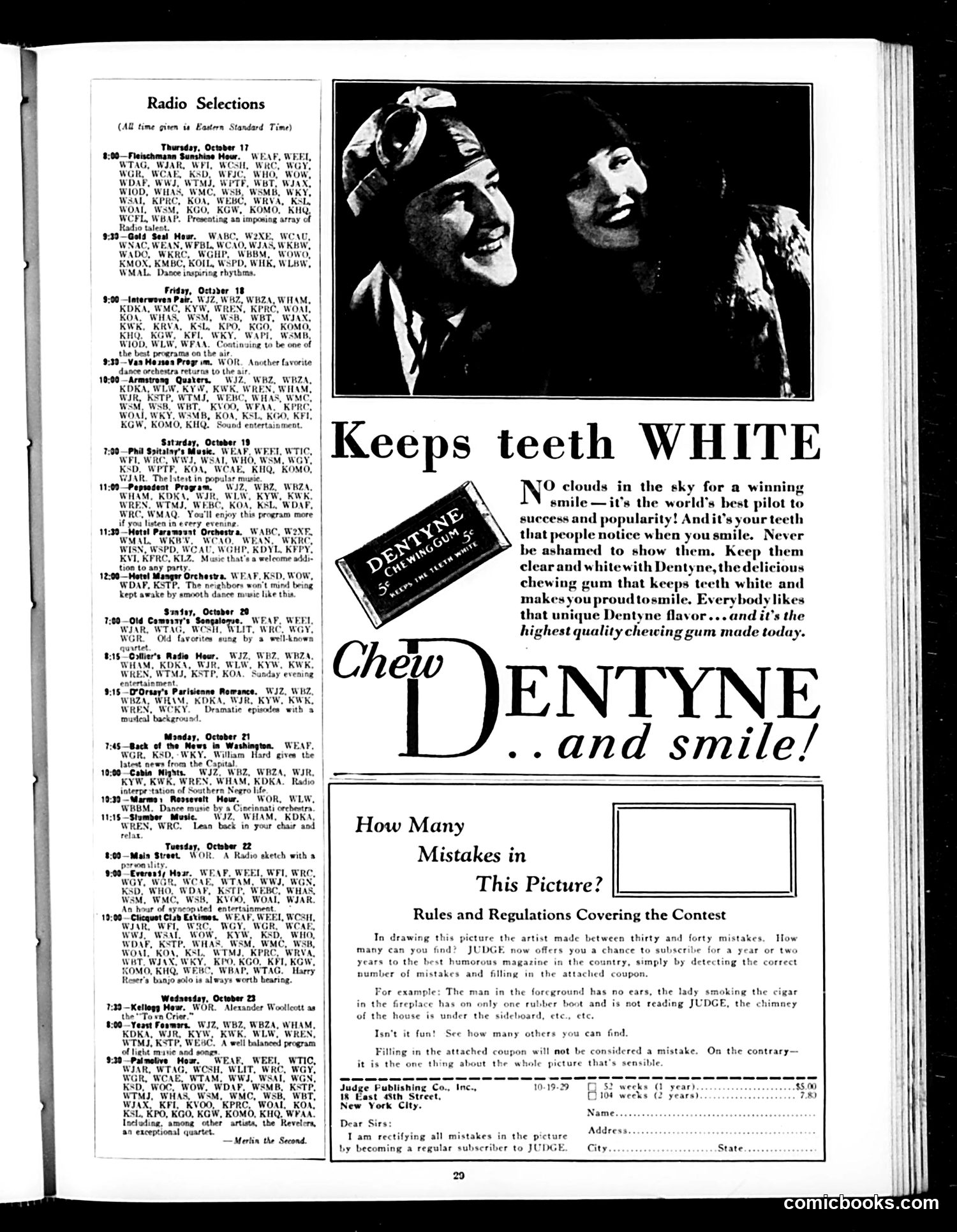
Dentyne Chewing Gum Advertisement This page is primarily advertising, not political satire. The main content is a Dentyne chewing gum ad featuring a photograph of what appears to be an aviator or pilot in flying gear, smiling at the camera. The advertisement uses an aspirational pitch common to 1920s-30s consumer marketing: it links dental hygiene (white teeth) to social success and popularity, claiming that a winning smile is "the world's best pilot to success and popularity." The aviator imagery appeals to modernity and achievement. Below the ad is a "spot the mistakes" puzzle contest—a popular engagement device where readers would scrutinize the picture to find 30-40 intentional errors, then mail in their answers for prizes. The left side contains radio programming schedules for various stations, typical of Judge magazine's mixed content format. This page demonstrates how magazines funded themselves through advertising integrated with editorial content.
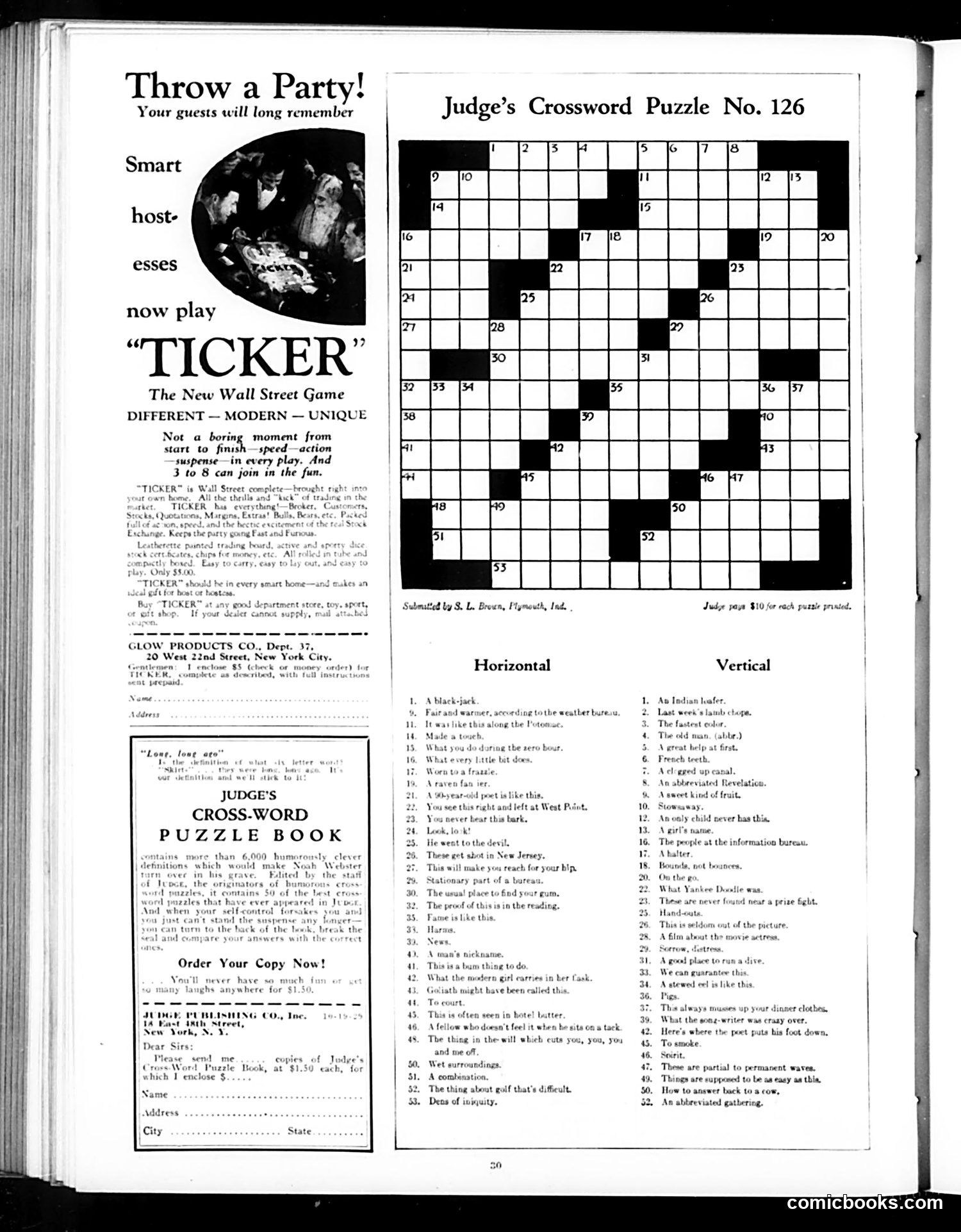
Judge Magazine Page Analysis This page is primarily advertising and puzzles, not satire. The left side promotes "TICKER," a Wall Street-themed board game marketed as modern entertainment for parties (3-8 players). The game's appeal lies in its stock-market theme—speed, action, and suspense around financial trading—presented as exciting novelty entertainment for the home. The bulk of the page is Judge's Crossword Puzzle No. 126, a standard crossword with clues referencing everyday 1920s-30s life: weather bureaus, West Point, golf difficulties, permanent waves, and cow-related humor. The clues are mild wordplay typical of period puzzles. At the bottom, Judge advertises its Crossword Puzzle Book (over 6,000 puzzles) available for $1.50, plus mail-order instructions for additional copies. No political satire is evident here. This is a commercial page mixing party game promotion with puzzle content and subscription offers—typical magazine filler.
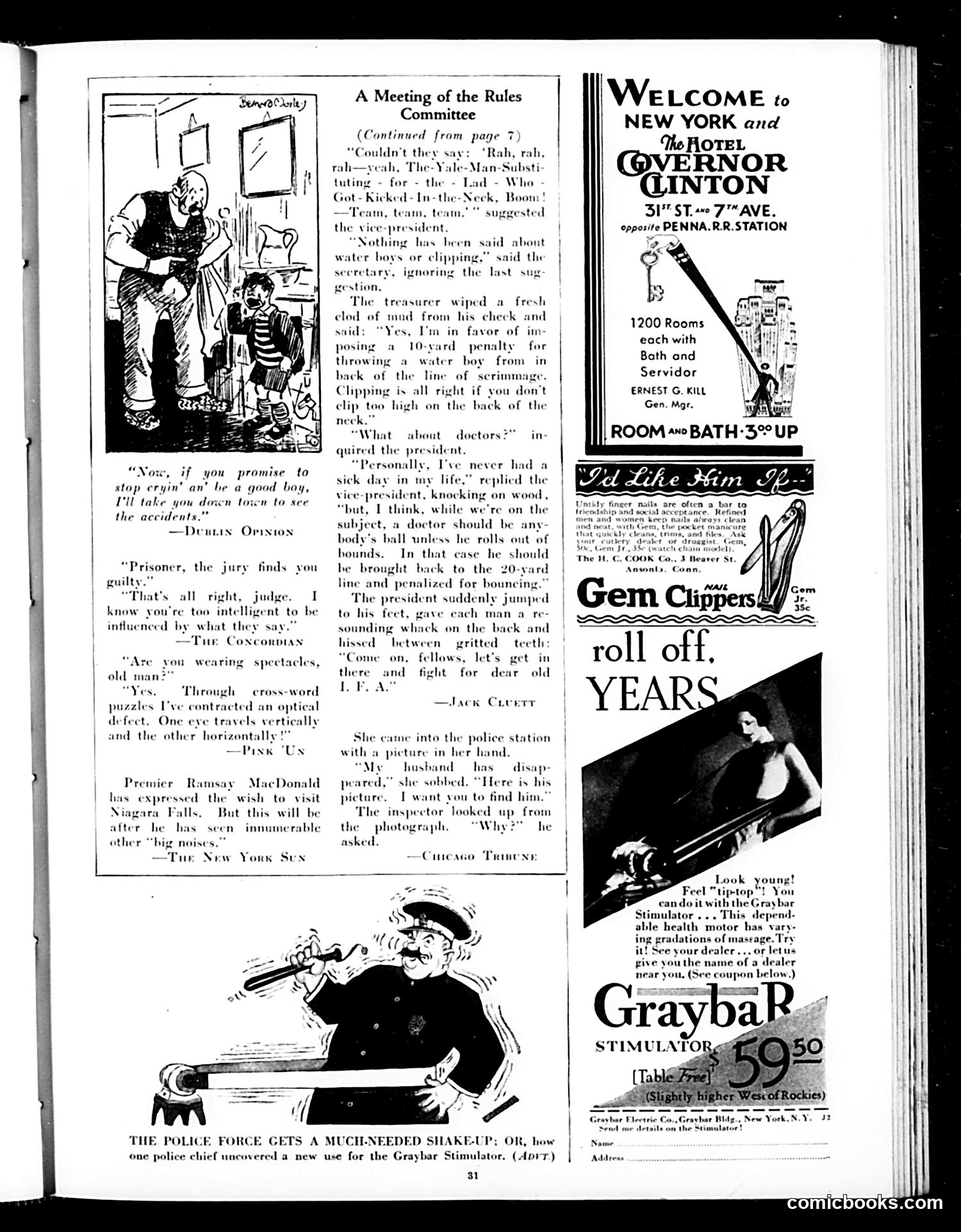
Analysis of Judge Magazine Page This page mixes satirical humor with advertisements. The main cartoons feature short joke-anecdotes typical of Judge's format: Top cartoon: Shows a parent promising to take a child "down town to see the accidents"—dark humor mocking society's morbid fascination with urban disasters and traffic incidents, presented as family entertainment. Football Committee segment: Satirizes overly formal, pedantic rule-making for college football (likely Yale's team, given the "Yale-Man" reference). The officials earnestly debate absurd penalties for minor infractions while missing the sport's actual purpose—poking fun at institutional bureaucracy. Brief jokes: Include a cross-eyed lawyer, a judge bribed by appearance, and a wife reporting her husband missing to police (with the unstated punchline implying the officer recognizes him as a criminal). Bottom cartoon: References the "Graybar Stimulator" (a massage device), captioning a police chief using it for interrogation—absurdist humor. The advertisements (Hotel Governor Clinton, Gem Cigars, Graybar Stimulator) are period-appropriate 1920s placements.
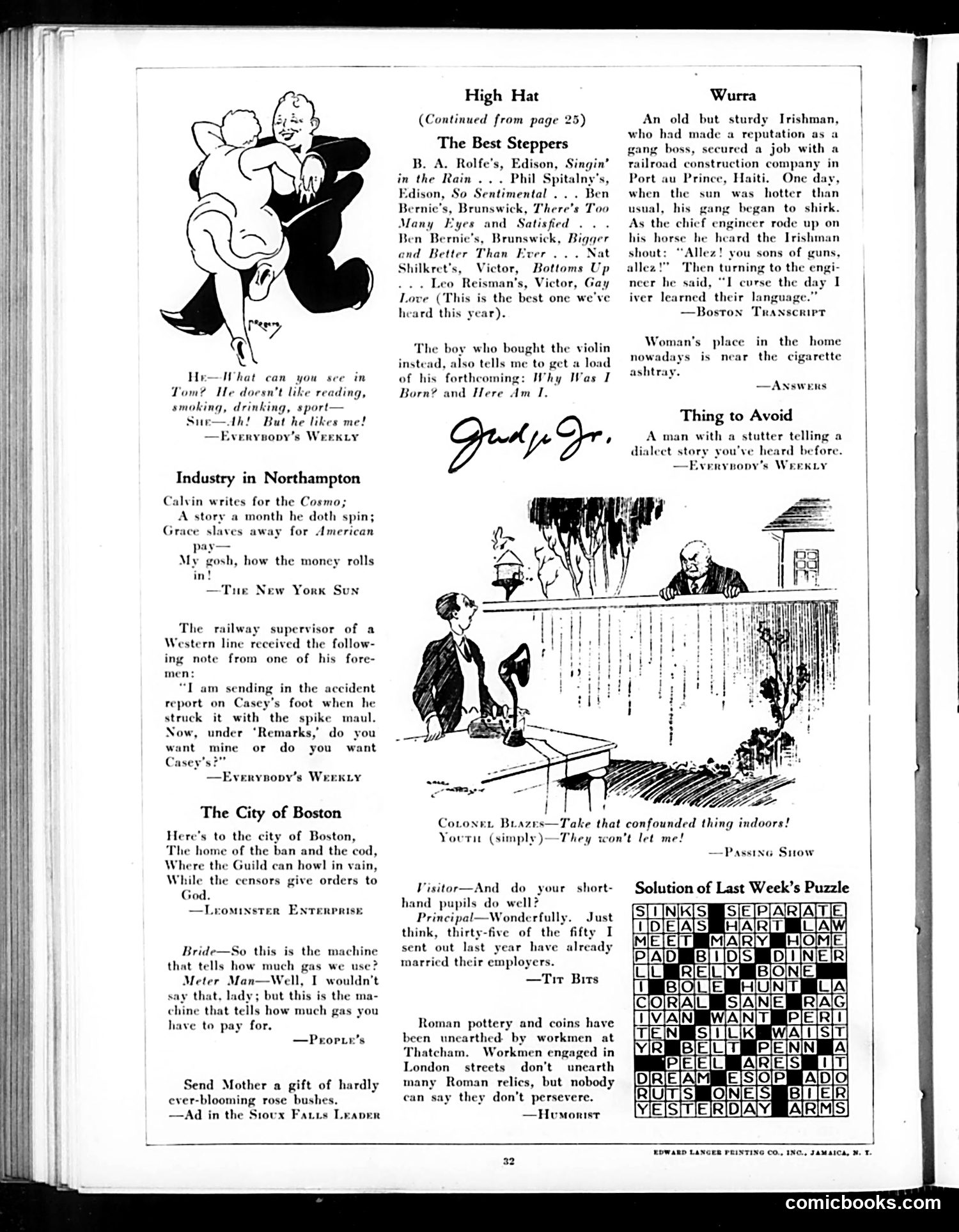
Judge Magazine Page Analysis This page from *Judge* contains several short satirical pieces typical of early 20th-century American humor magazines: Main Cartoons & Jokes: 1. "The Best Steppers" references popular dance records and jazz music of the era, listing phonograph recordings. 2. "Industry in Northampton" mocks a young writer's financial success—Calvin writes for *Cosmopolitan* magazine and profits handsomely, satirizing literary pretension and money-obsession. 3. "The City of Boston" criticizes Boston's censorship boards ("Guild") and moral authority, suggesting hypocrisy in religious/civic leadership. 4. Various short quips target: marital dishonesty (a bride discovering meter manipulation), workplace absurdities (railroad accident reports), and social awkwardness (stutterers telling jokes). 5. The cartoon illustration (Colonel Blazes) shows domestic conflict over indoor/outdoor activities—typical domestic humor. The page reflects early 1920s American concerns: labor, censorship, emerging consumer culture, and gender/class tensions, all delivered through brief jokes and illustrations typical of *Judge's* satirical format.
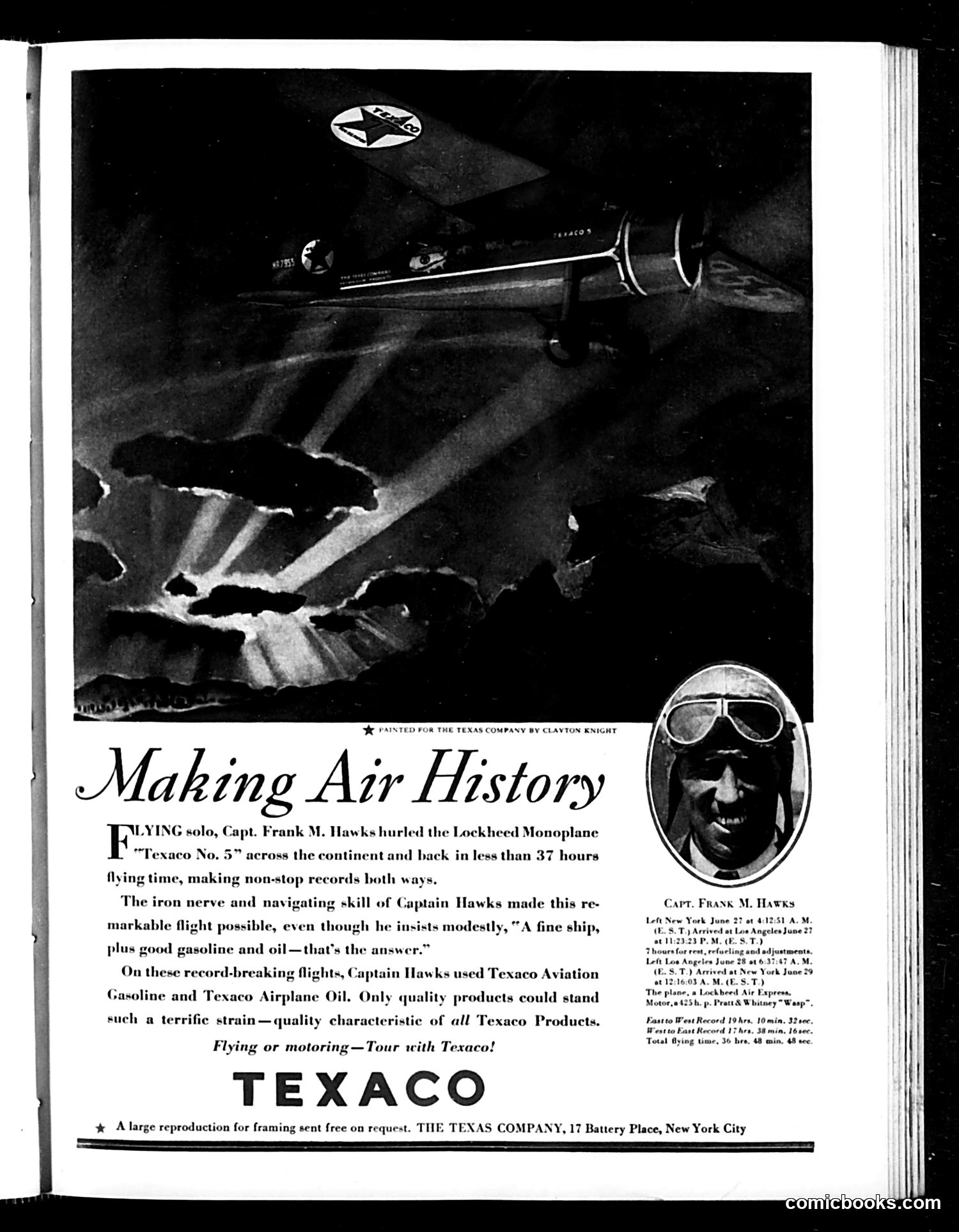
Texaco Aviation Advertisement This is not a cartoon or satire — it's a full-page advertisement for Texaco gasoline and oil, disguised as editorial content. The page celebrates Captain Frank M. Hawks' record-breaking solo flight across the continental U.S. and back in the Lockheed Monoplane "Texaco No. 5," completed in under 37 hours of flying time. Hawks' portrait appears in the lower right. The advertising strategy: By associating Texaco products with a celebrated aviator's daring achievement, the company positioned their fuel and oil as enabling extraordinary feats. The copy emphasizes that only "quality products" could withstand such strain—a marketing pitch common in early 20th-century advertising that linked commercial products to heroic accomplishment and technological progress. This reflects the 1920s-30s fascination with aviation as a symbol of American modernity and daring.
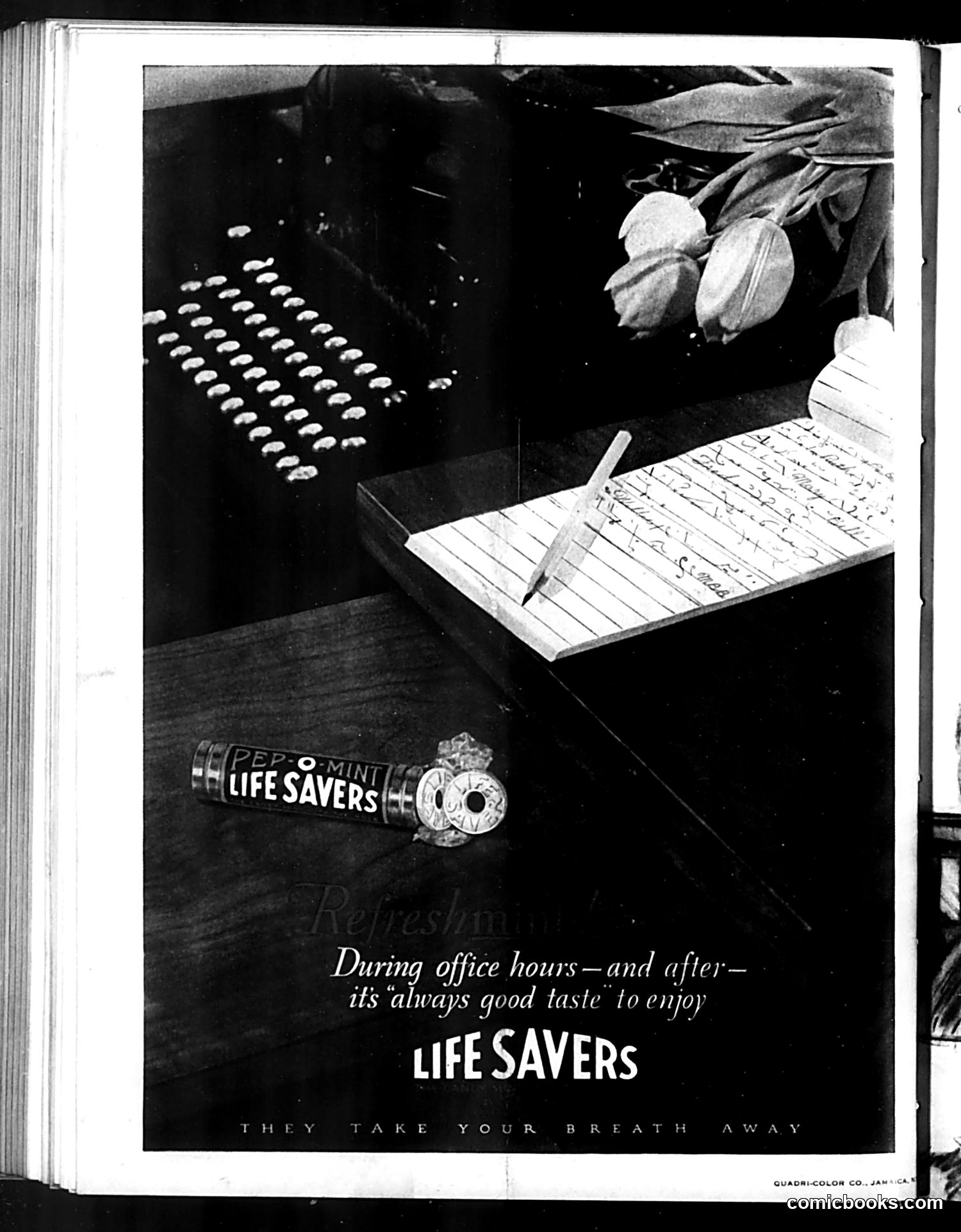
LifeSavers Advertisement, Judge Magazine This is a commercial advertisement, not a political cartoon. It promotes LifeSavers candy with the slogan "They take your breath away." The image shows an office workspace featuring a typewriter, ledger/notebook with a pen, and hanging tropical fruits (appearing to be cacao pods). A roll of PepO-Mint LifeSavers candies is prominently displayed on the desk. The ad's humor relies on the phrase "take your breath away"—suggesting LifeSavers are so delicious they're breathtaking, while the tropical fruits and office setting evoke refreshment and productivity. This appears to be vintage advertising (pre-digital era based on the typewriter and black-and-white photography), using gentle workplace humor to encourage candy consumption during business hours. There is no political satire present on this page.