judge
Judge — October 26, 1929
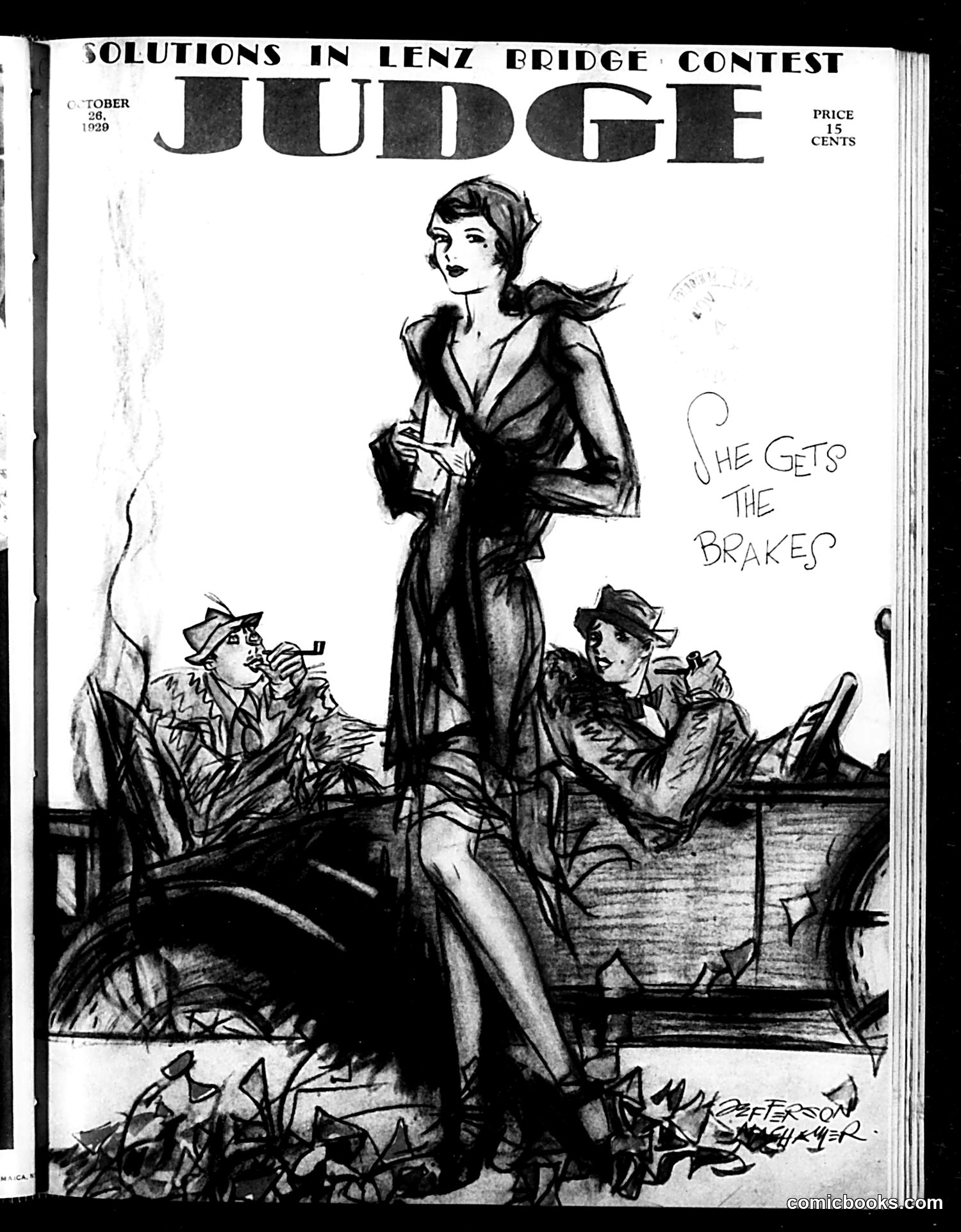
"She Gets the Brakes" — Judge Magazine, October 28, 1929 This cartoon references the Lenz Bridge Contest, a 1920s engineering competition. The title "She Gets the Brakes" is a pun: a woman stands triumphantly while two men (appear to be rival bridge designers or engineers) sit dejected below, their work literally "braked" or stopped. The cartoon satirizes the surprise or scandal of a woman winning a major engineering competition—suggesting that men expected to monopolize such prestigious technical achievements. The men's defeated postures and the woman's confident stance emphasize the upset. Published just days after the 1929 stock market crash, this appears unrelated to that crisis, focusing instead on gender competition in engineering during an era when such fields were almost exclusively male-dominated.
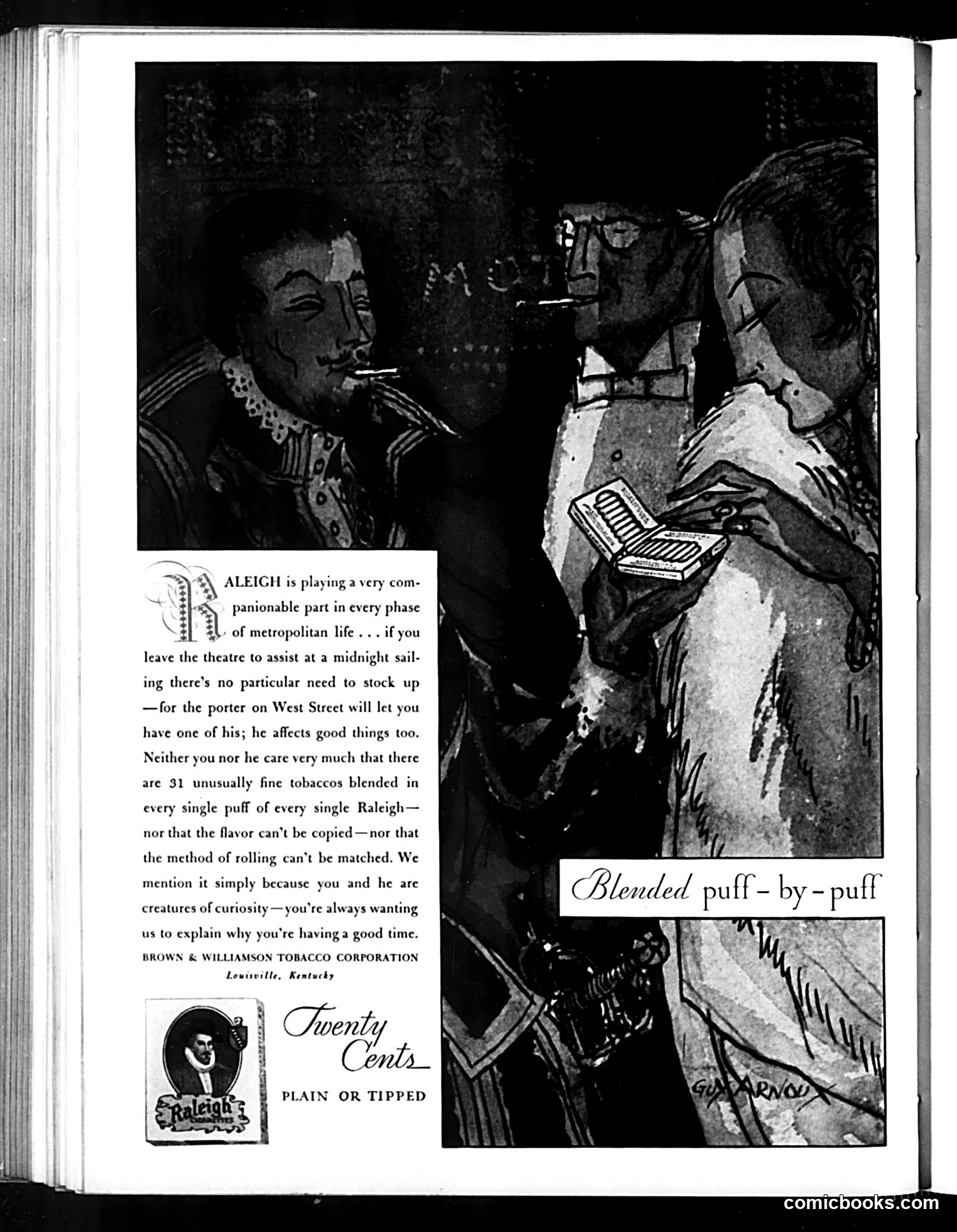
Advertisement for Raleigh Cigarettes This page is primarily a cigarette advertisement rather than political satire. It depicts two figures in elaborate period costume (appearing to be from a theatrical production) in what looks like a backstage or intimate social scene. One figure holds what appears to be a cigarette case or compact. The ad copy emphasizes that Raleigh cigarettes are used by people in "every phase of metropolitan life" and highlights the product's "31 unusually fine tobaccos blended" with a distinctive rolling method. The phrase "Blended puff-by-puff" is the marketing tagline. The theatrical costuming and sophisticated setting appeal to aspirational, cosmopolitan consumers. This reflects early 20th-century advertising strategies targeting urban sophistication and social status through cigarette marketing—before health warnings existed.
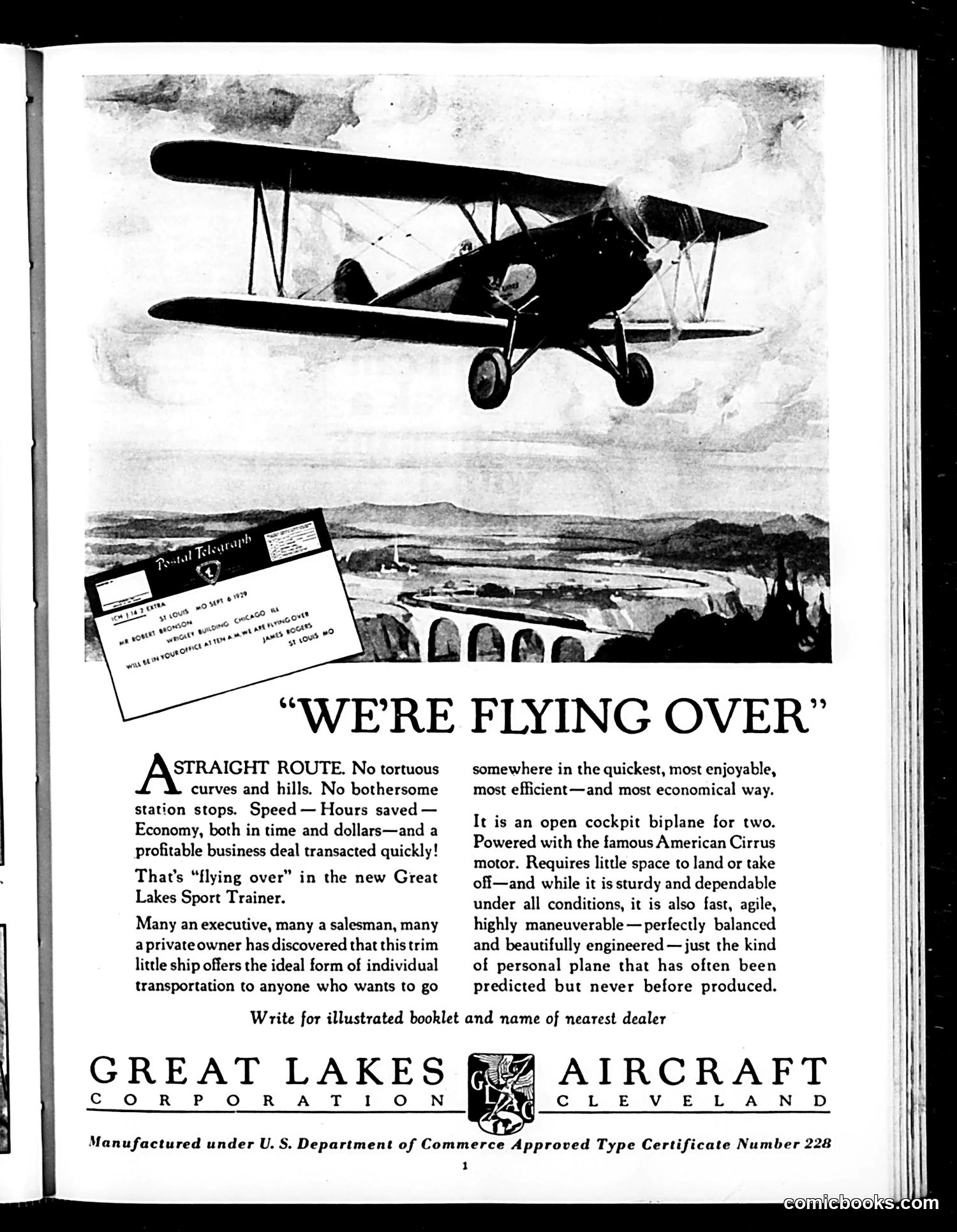
Analysis This page is primarily an advertisement, not satire. It promotes the Great Lakes Sport Trainer, a biplane manufactured by Great Lakes Aircraft Corporation in Cleveland. The ad's headline "We're Flying Over" uses aviation as a metaphor for efficient business travel. The copy emphasizes practical benefits: straight routes, no stops, time and money savings—appealing to 1920s executives and salesmen seeking modern transportation alternatives to rail or automobiles. The aircraft itself is depicted realistically in flight. The postal telegraph card visible in the image suggests mail delivery capability, a selling point during early aviation's commercial phase. This represents the optimistic promotion of private aviation as a revolutionary business tool in the interwar period, before commercial aviation became established.
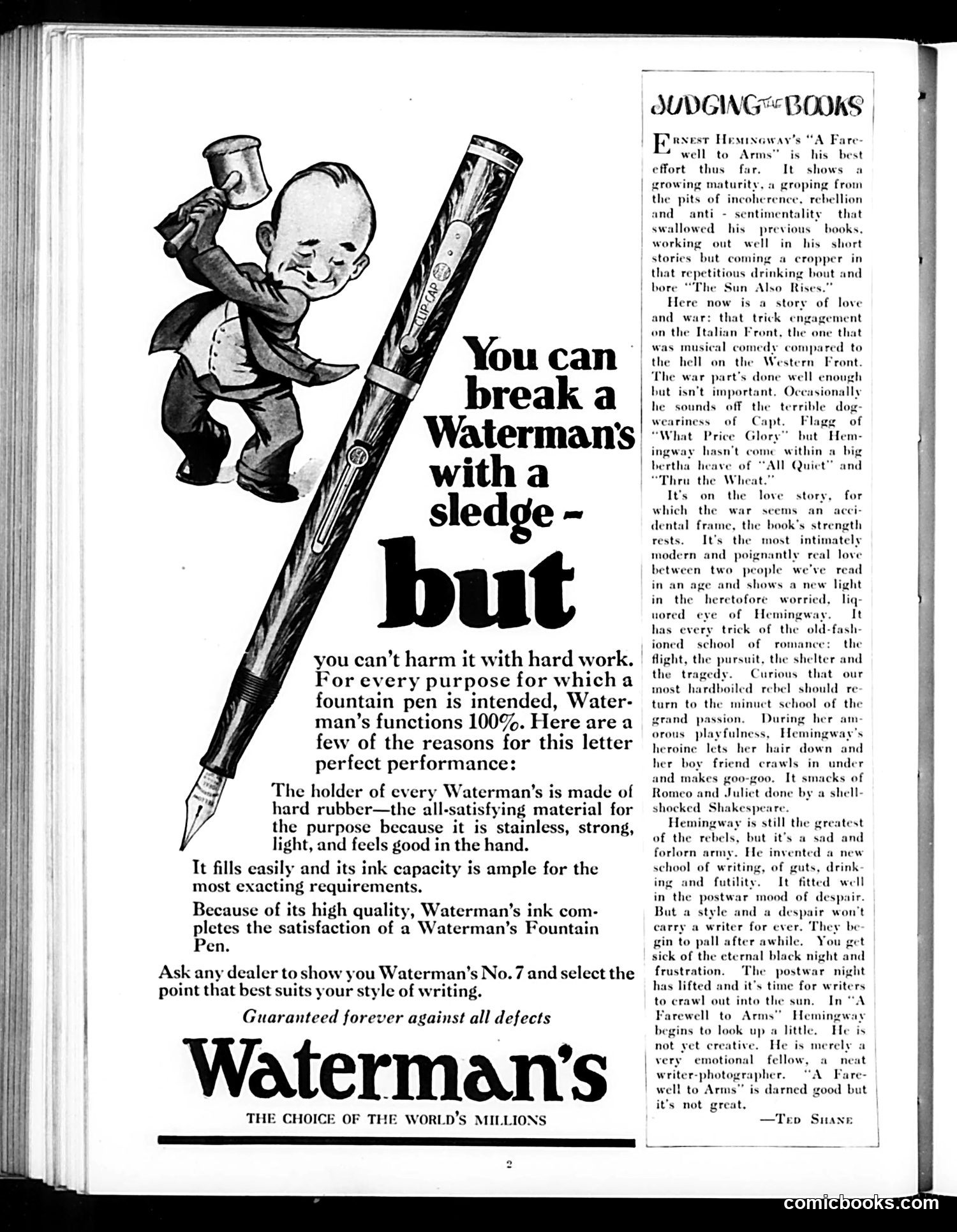
Analysis This page is primarily a Waterman's fountain pen advertisement rather than political satire. The left side features a large illustration of a baby or cherub figure wielding a sledgehammer against a Waterman's pen, with the headline "You can't break a Waterman's with a sledge—but you can't harm it with hard work." The ad emphasizes the pen's durability through rubber holders, stainless steel components, and reliable ink capacity—practical selling points for a working writing instrument. The right column contains a book review titled "JUDGING THE BOOKS" by Ted Shane, critiquing Ernest Hemingway's "A Farewell to Arms." The review is the actual editorial content; the advertisement is the page's primary commercial purpose, typical of magazines that blended advertising with editorial material.
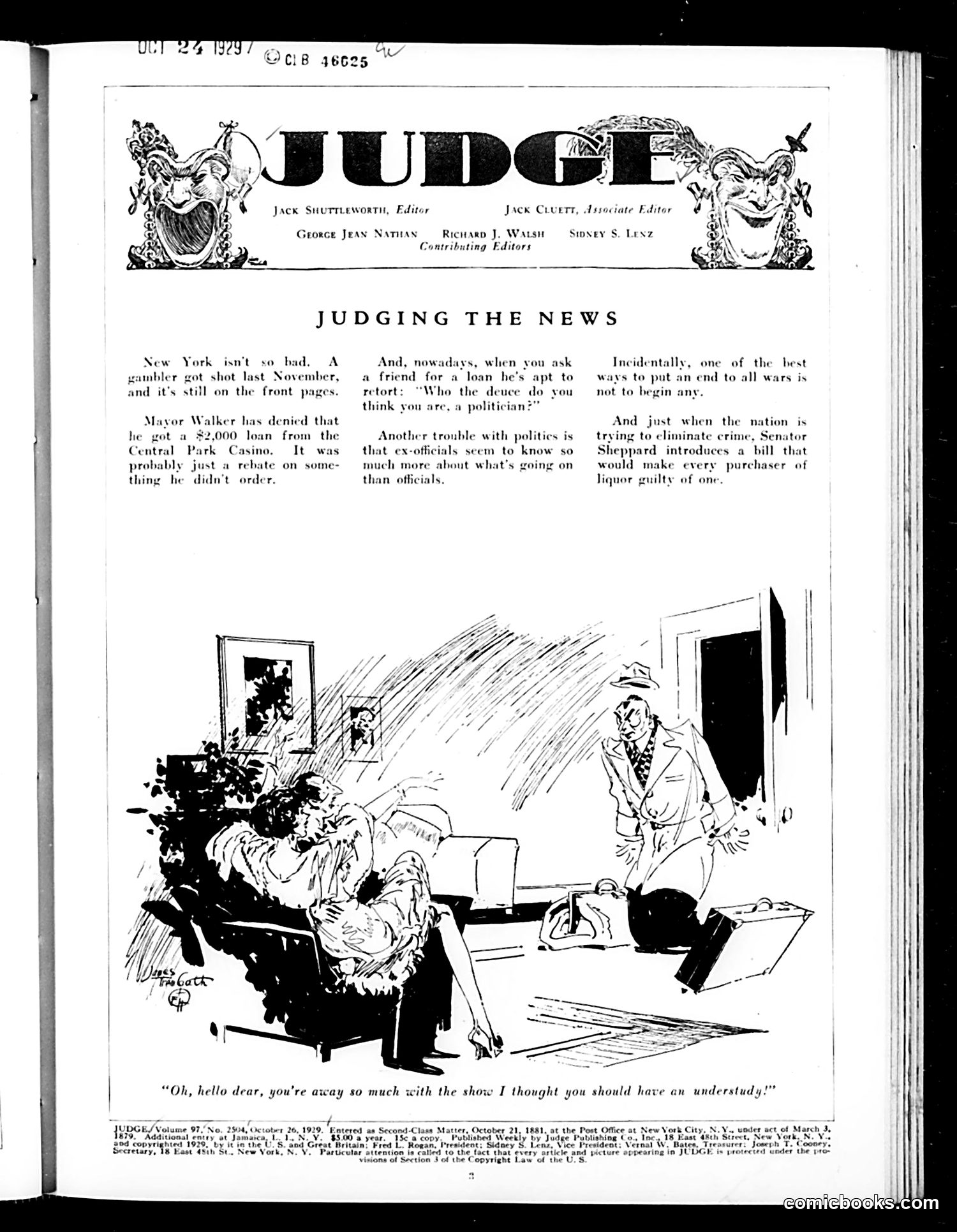
Judge Magazine Analysis - October 28, 1929 This page from *Judge* satirizes contemporary political and social issues. The editorial column "Judging the News" criticizes Mayor Walker's denial of a $2,000 loan from Central Park Casino, and attacks both politics generally and Senator Shepard's proposed bill to make liquor purchase guilty of crime. The cartoon below depicts what appears to be a domestic scene where a woman, surrounded by household chaos and clutter, confronts a man leaving. Her caption—"Oh, hello dear, you're away so much with the show; I thought you should have an understudy!"—suggests marital discord over his frequent absences, likely satirizing infidelity or work-life imbalance among the entertainment or political classes. The cartoon employs visual exaggeration typical of 1920s satirical art to mock middle-to-upper-class domestic problems.
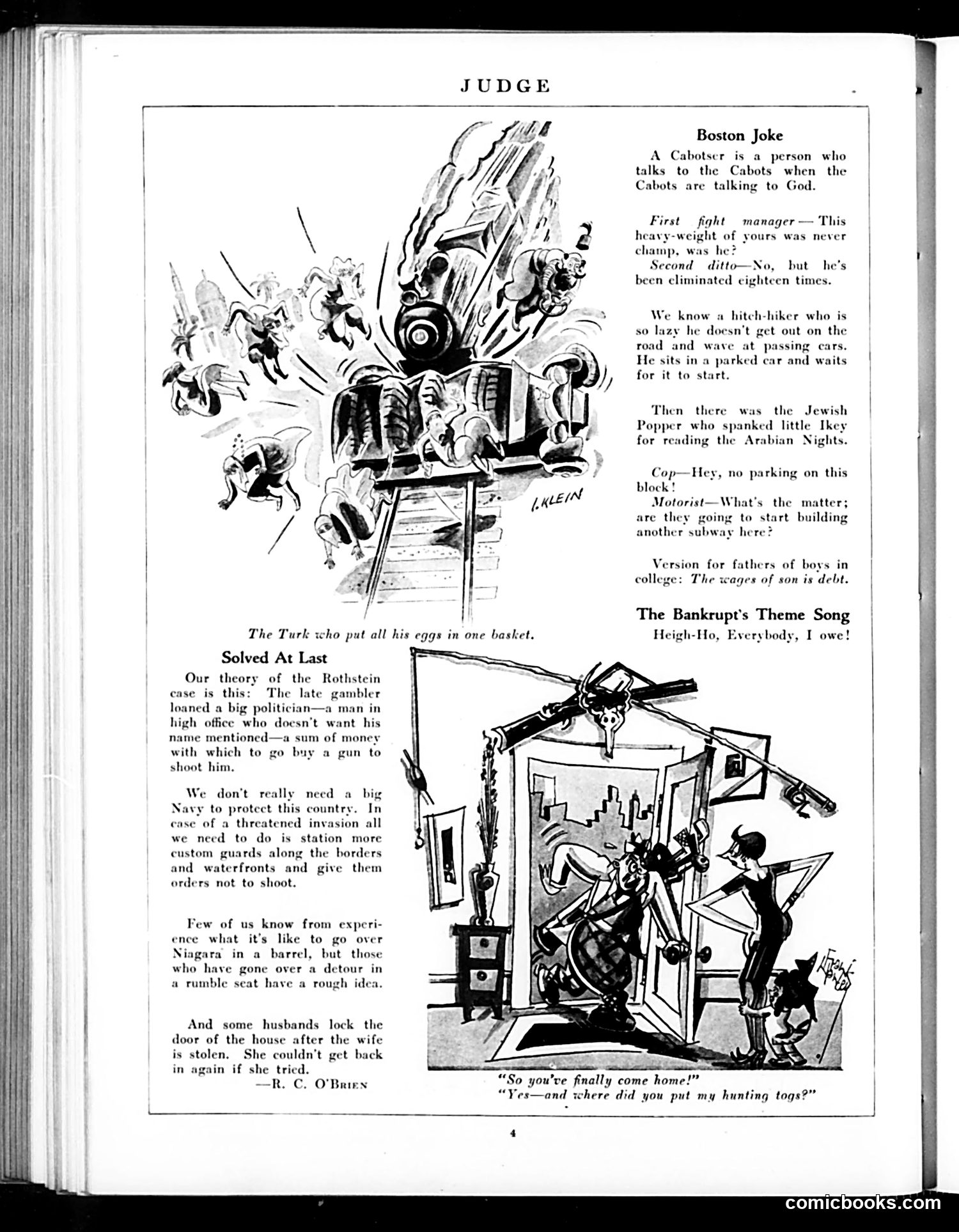
Judge Magazine Page Analysis This page contains multiple satirical pieces from Judge magazine: Top cartoon ("Boston Joke"): Depicts stereotypical Jewish and ethnic caricatures in various scenarios—a "Cabotser" (person intermediating between Cabots and God), commentary on a failed heavyweight boxer, a lazy hitchhiker, and a "Jewish Popper" reading Arabian Nights. These represent crude ethnic humor typical of early 20th-century American magazines. "Solved At Last": A piece speculating that a late gambler borrowed money from a politician to buy a gun (implying suicide). It discusses national defense in vague terms and ends with marital humor about locked doors. Bottom cartoon: Shows someone returning home to an apartment, apparently after an extended absence, with a humorous caption about "hunting togs," suggesting infidelity or deception about whereabouts. The page exemplifies period satire mixing ethnic stereotypes, political innuendo, and domestic humor.
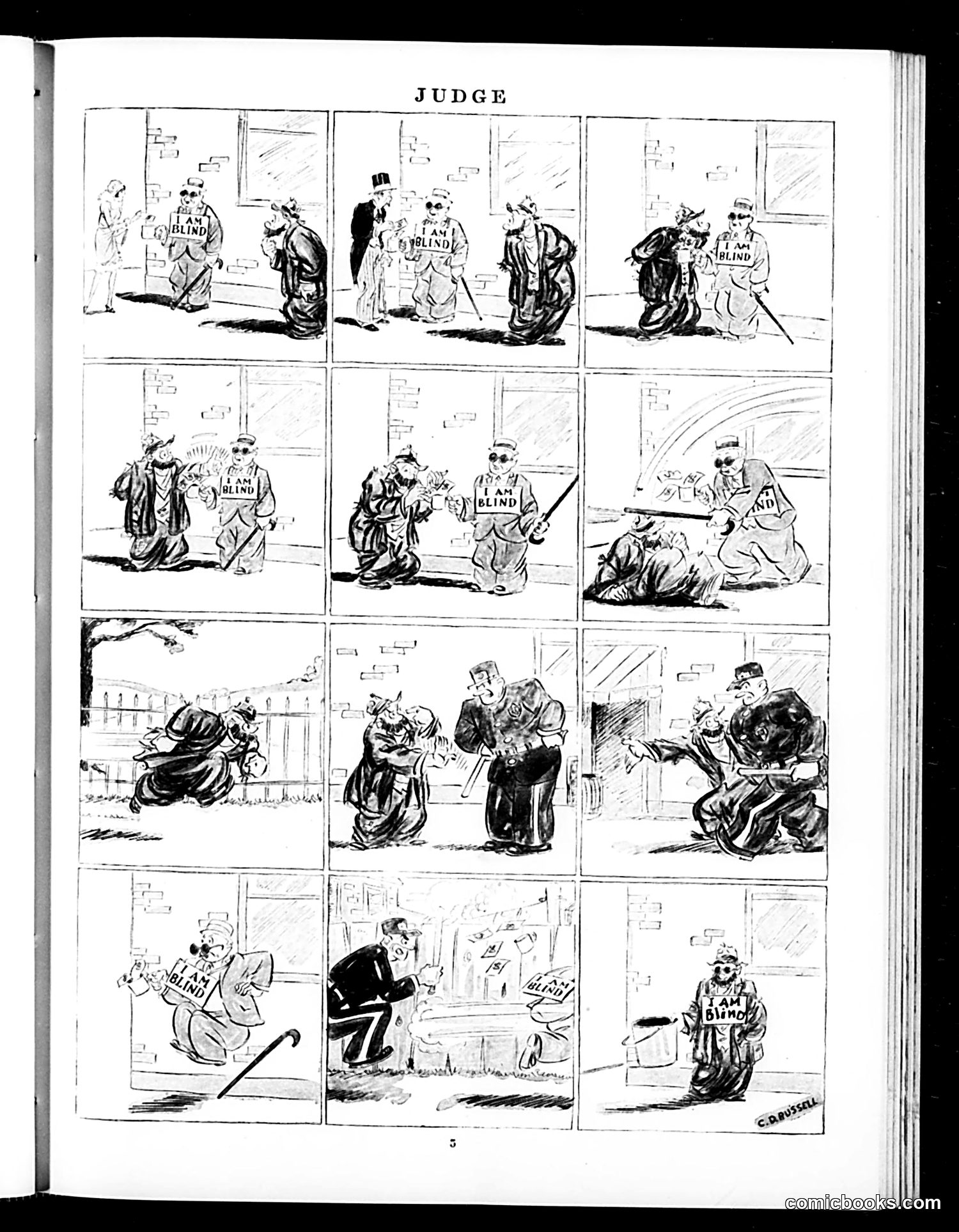
"Judge" Cartoon Analysis: "Judge" This political cartoon satirizes judicial blindness—literally and figuratively. The repeated character labeled "I AM BLIND" appears throughout the twelve-panel sequence, depicting a blindfolded figure in judicial robes being manipulated, misled, or ineffectual in various scenarios. The satire critiques judges who either willfully ignore injustice or are deliberately kept ignorant of wrongdoing. Each panel shows the blind judge character encountering different situations—some appear to show political or legal corruption—yet remaining sightless and therefore powerless to act justly. The cartoon's message suggests that justice fails when judges are blind to evidence, corruption, or public interest. This reflects Progressive Era concerns about judicial integrity and the legal system's ability to address societal problems.
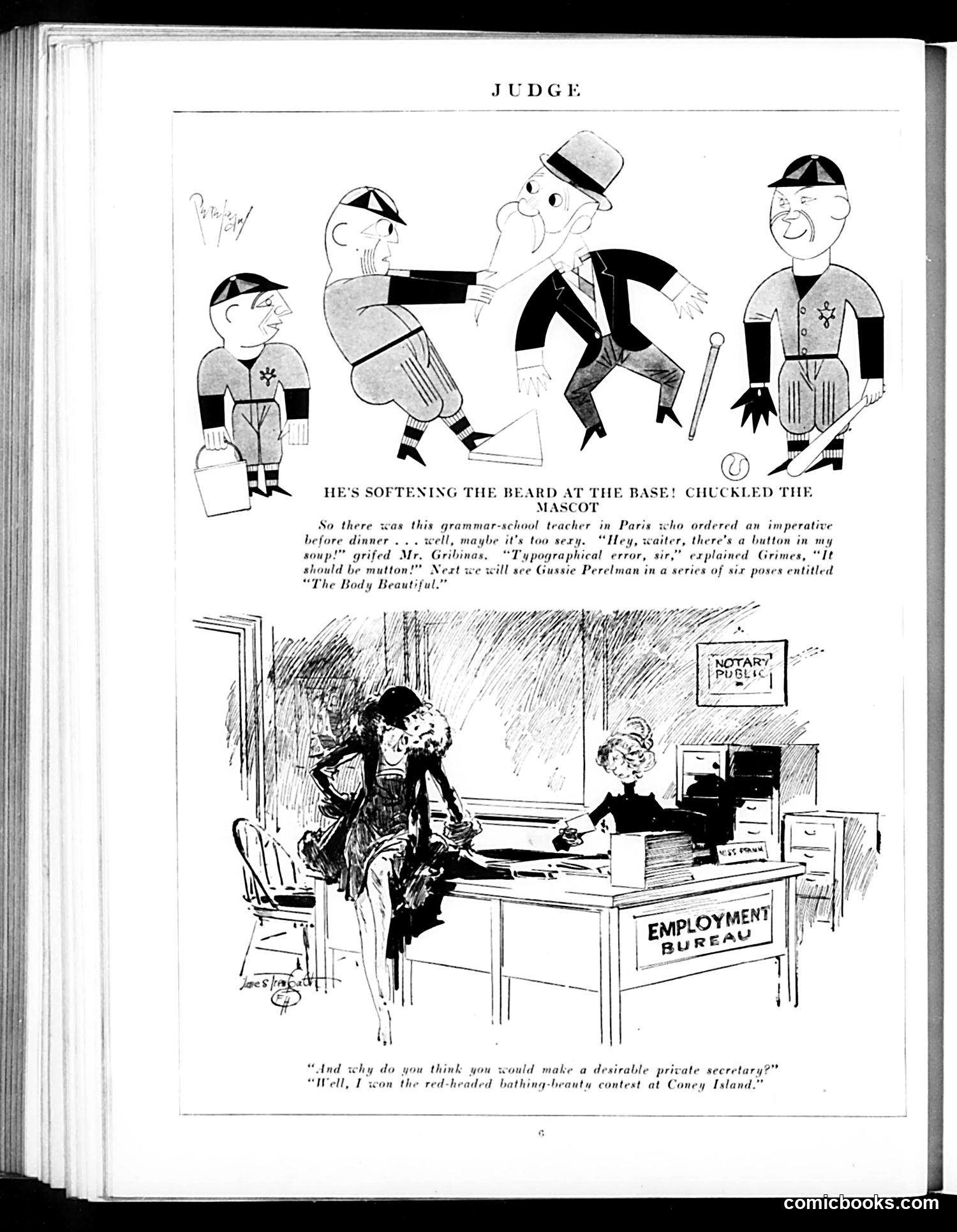
Analysis This page from *Judge* contains two separate satirical pieces: Top cartoon: Four caricatured baseball umpires wearing distinctive uniforms and caps. The caption "HE'S SOFTENING THE BEARD AT THE BASE! CHUCKLED THE MASCOT" suggests satire about umpires' authority and appearance, though the specific reference is unclear without additional context. Bottom cartoon: An Employment Bureau scene where a woman in shabby clothes meets with a clerk. The dialogue reveals social satire: she claims she'd "make a desirable private secretary" and brags about winning a "red-headed bathing-beauty contest at Coney Island." The joke satirizes women's employment prospects—her only qualification is physical attractiveness rather than actual secretarial skills, mocking both unrealistic job applicants and employment practices of the era.
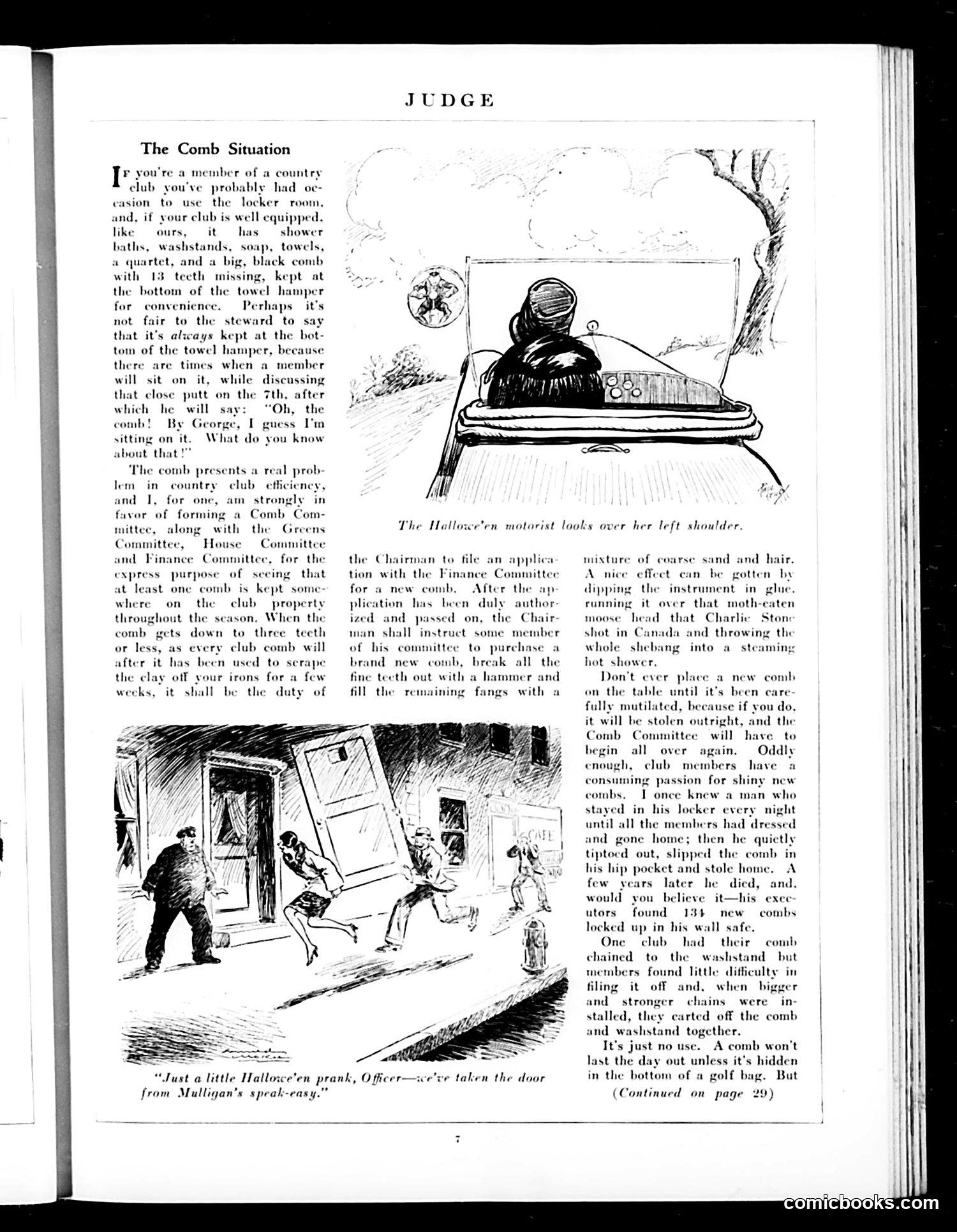
"The Comb Situation" - Judge Magazine Satire This article satirizes the petty inefficiencies and absurd bureaucracy of country clubs during the Jazz Age. The author humorously proposes that clubs establish a formal "Comb Committee" (alongside existing committees for grounds, houses, and finances) to manage the perpetual problem of destroyed combs in locker rooms. The satire works on multiple levels: members absent-mindedly sit on combs, use them to scrape golf clubs, and chronically steal them. The proposed "solution"—filing formal applications through committees before replacing worn combs—mocks how country clubs handle minor issues through excessive administrative procedure. The accompanying cartoons illustrate specific comedic scenarios: a woman driver (labeled a "Hallowe'en motorist") looking over her shoulder, and a Prohibition-era joke about removing a speakeasy door as a prank. The piece pokes fun at both country club pretension and the absurdity of over-organizing trivial matters.
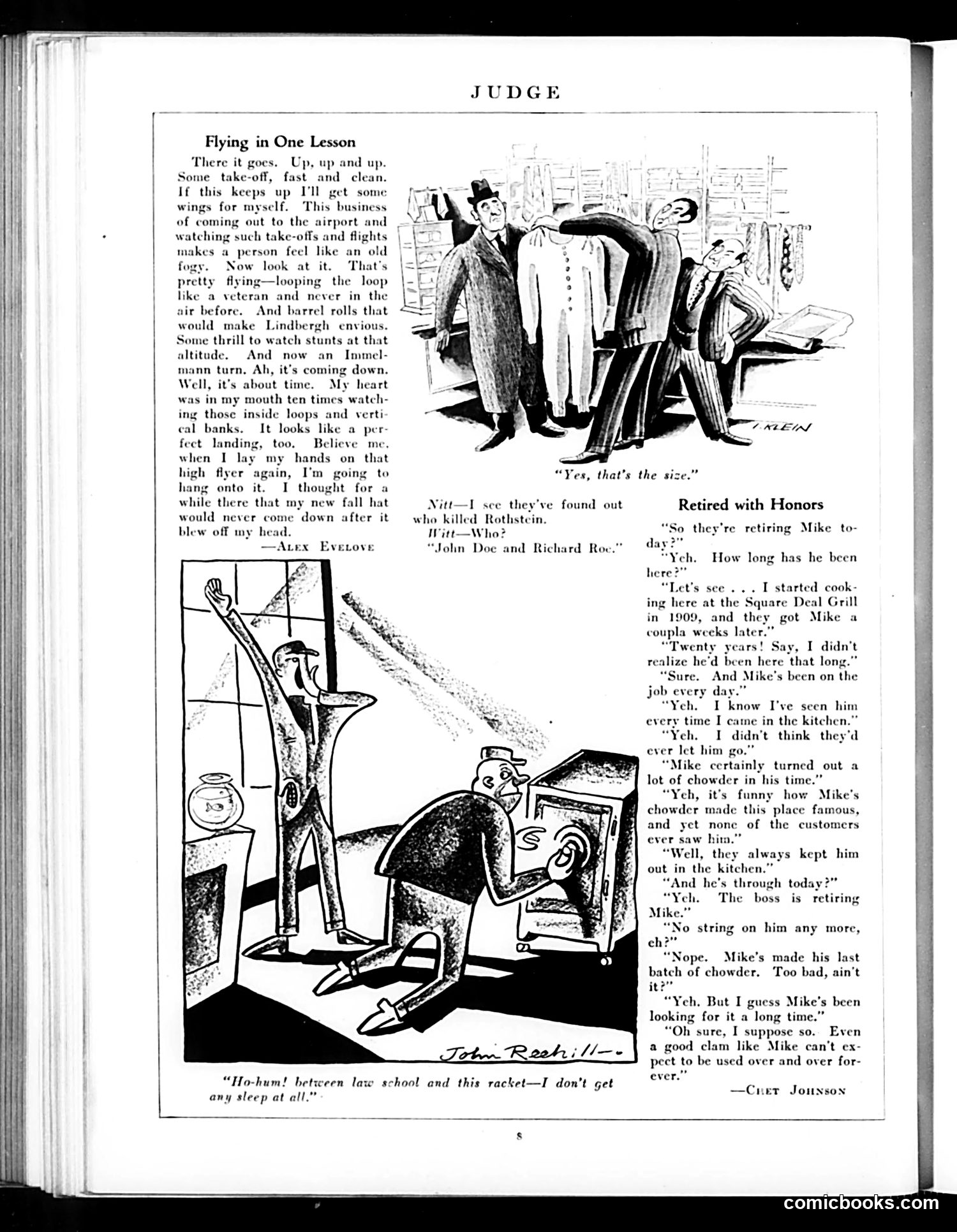
Judge Magazine Page Analysis This page contains two distinct pieces of satirical humor: "Flying in One Lesson" (top): A first-person account of witnessing aviation stunts at an airport, likely referencing the 1920s aviation craze. The narrator describes watching skilled aerial maneuvers (loops, barrel rolls, Immelmann turns) that make him feel inadequate—his new hat even blows off his head during the spectacle. The humor targets the anxiety ordinary people felt witnessing the daring new aviation technology becoming fashionable entertainment. "Retired with Honors" (bottom): A dialogue between two kitchen workers discussing their coworker Mike's retirement after 20+ years. The satire is subtle: Mike famously made the restaurant's signature chowder but was always kept hidden "out in the kitchen," invisible to customers who praised his work. His retirement represents the forgotten laborer—valued for his work but never publicly acknowledged. The final line resignedly suggests even good workers are ultimately disposable. Both pieces mock different American anxieties: modern progress and worker expendability.
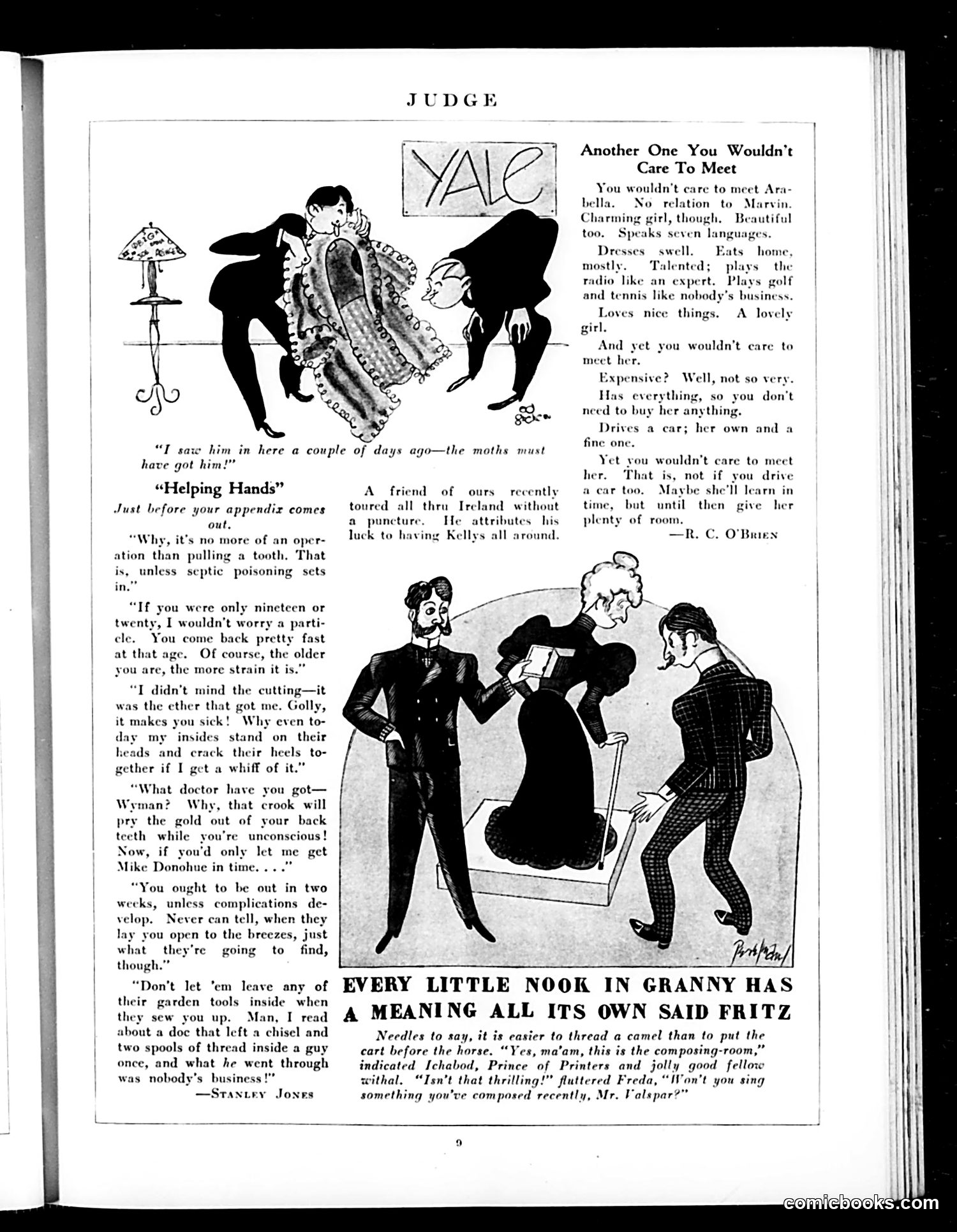
Explanation for Modern Readers This Judge magazine page contains three distinct humorous pieces: "Helping Hands" (left) satirizes pre-surgical anxiety. A patient about to have an appendectomy receives contradictory, alarming advice from well-meaning friends who recount horror stories about anesthesia complications, incompetent doctors, and surgical mishaps. The joke is how such "helpful" reassurance actually terrifies the patient more. "Another One You Wouldn't Care To Meet" (right) describes an idealized woman—beautiful, accomplished, multilingual—yet concludes you'd avoid meeting her because she's a reckless driver. The satire critiques how even "perfect" women can have fatal flaws, and specifically mocks dangerous female drivers, a common stereotype of the era. "Every Little Nook in Granny" (bottom) appears to be a caption for an illustration involving a printing press ("composing-room") and characters named Ichabod and Freda. The exact satirical point is unclear from the fragmented text, but seems related to printing or publishing work.
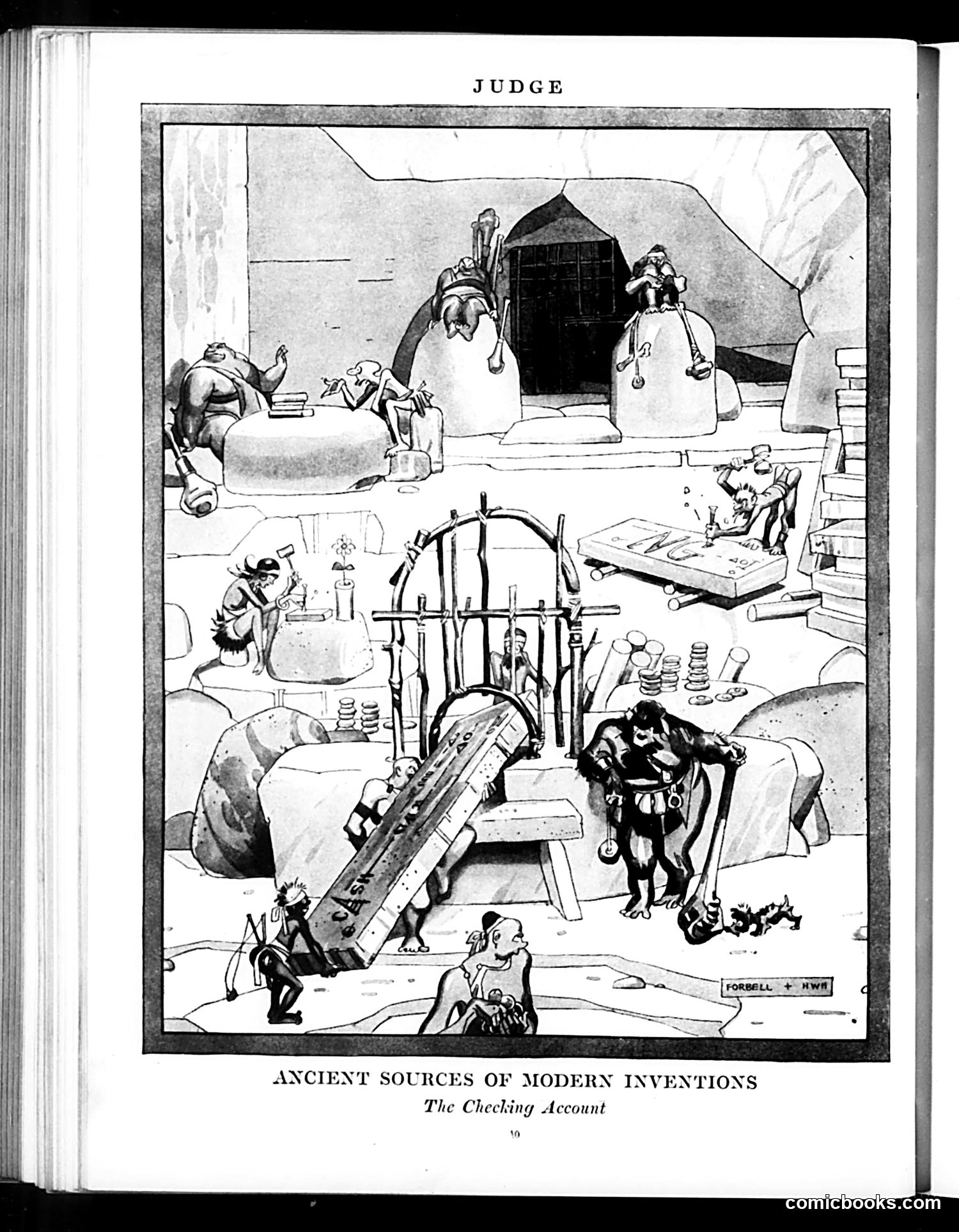
Ancient Sources of Modern Inventions: The Checking Account This cartoon satirizes the idea that modern financial innovations have ancient origins. The scene depicts what appears to be a primitive settlement or camp with various figures engaged in activities that parallel modern banking practices—specifically checking accounts. The satire works by suggesting that concepts we consider modern (like checking accounts) are merely refinements of practices that existed in antiquity. Various figures are shown conducting transactions or record-keeping using primitive methods and tools. The humor lies in the contrast between the crude, ancient setting and the sophisticated financial mechanism being attributed to it, implying either that: 1) banking practices are as old as civilization itself, or 2) that modern banking practices haven't advanced much beyond primitive bartering systems. The specific social commentary about checking accounts—whether praising their utility or critiquing their complexity—remains unclear from the image alone.
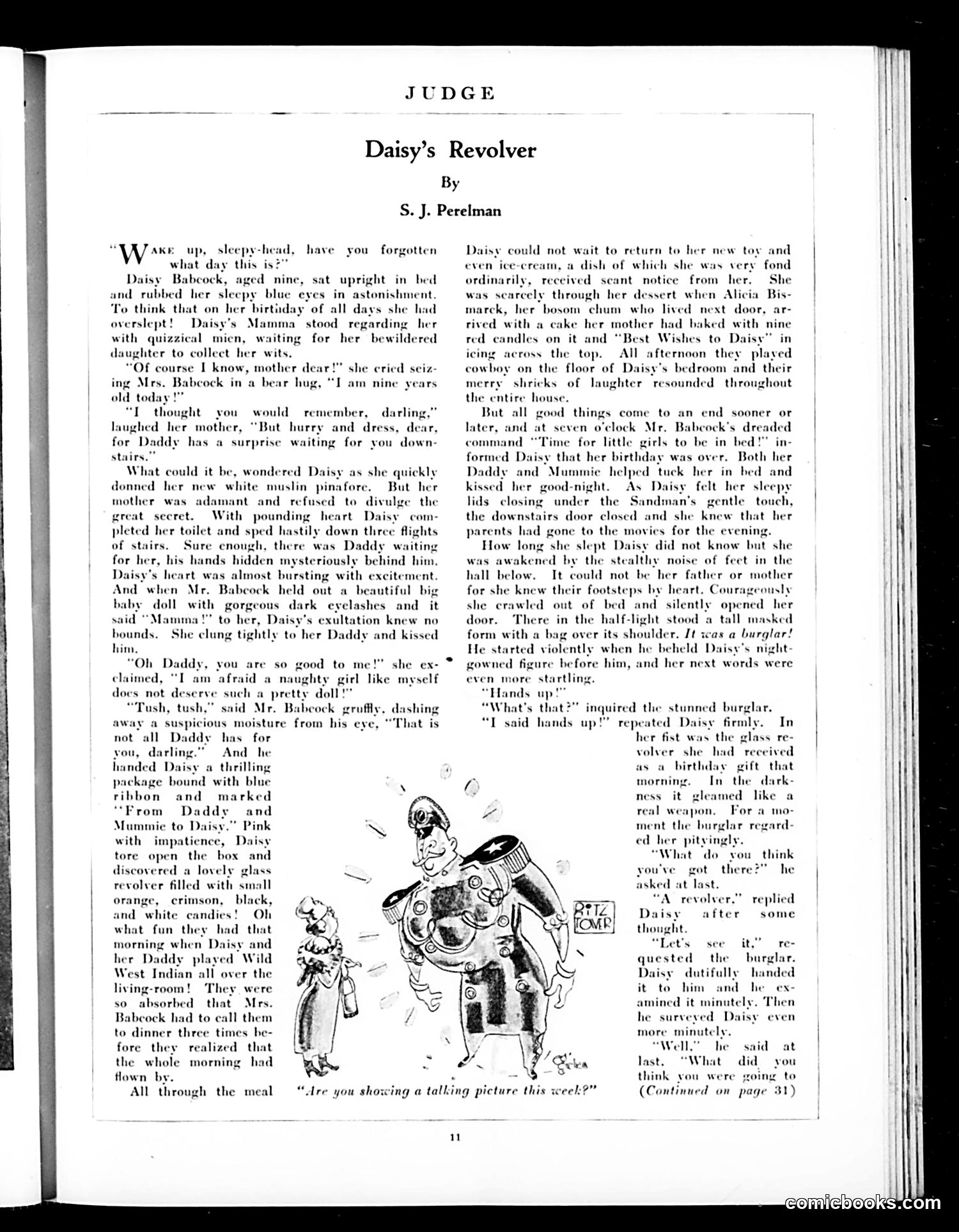
"Daisy's Revolver" by S. J. Perelman This is a humorous short story (not primarily a political cartoon), illustrated with a sketch showing a burglar confronted by a young girl holding a toy revolver. The satire plays on early 20th-century children's literature conventions: a nine-year-old girl receives a toy gun as a birthday present alongside a doll. When a real burglar enters her home that night, she brandishes the toy revolver and commands "Hands up!" The humor lies in the absurdity of a child with a non-functional toy effectively confronting an actual criminal, and the burglar's stunned reaction. The joke reflects contemporary anxieties about urban crime while mocking sentimentalized depictions of childhood innocence. Perelman uses the setup to satirize both the casual inclusion of weapons in children's toys and the implausible courage attributed to children in popular fiction. The story exemplifies Judge magazine's satirical treatment of American domestic life and social conventions.
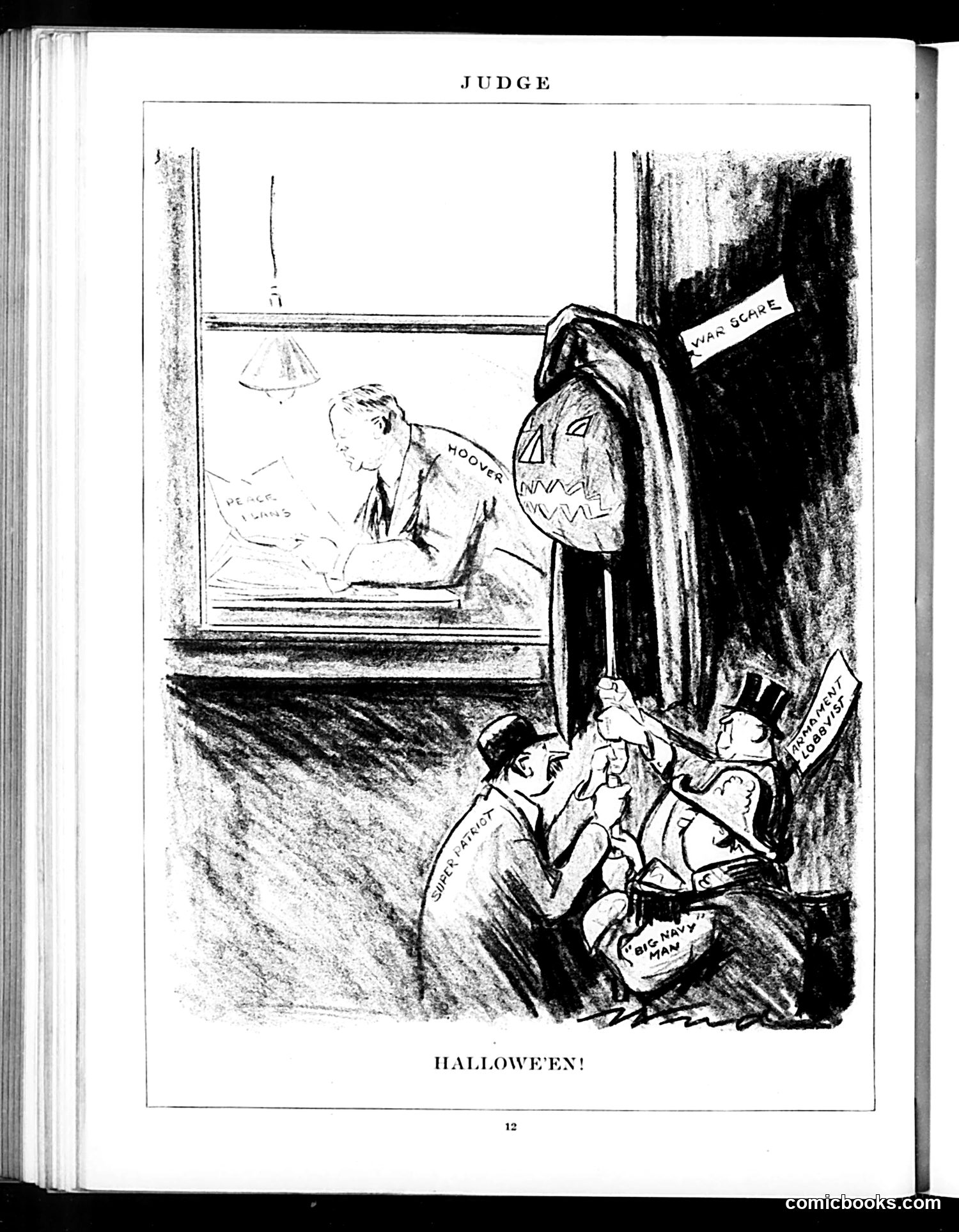
"Hallowe'en!" - Judge Political Cartoon This cartoon depicts Halloween-themed political satire. A judge sits at a bench inside a courthouse window, while outside, costumed figures in Halloween attire—appearing to represent various political concerns or "demons"—gather at the door. Labels visible include "War Scare," "Stock Market," "The Navy Man," and what appears to be "Hoover," suggesting criticism of Herbert Hoover's administration. The satire suggests that on Halloween, political anxieties and concerns (personified as costumed trick-or-treaters) come calling at the judge's bench—implying these issues are treated as seasonal spectacles rather than serious matters requiring judicial attention. The joke critiques how political and economic fears are cyclically sensationalized during Hoover's presidency, likely early 1930s.
Analysis: "Judge" Magazine Page - Political Satire "Thrift Up to Date" The editorial mocks America's paradox: now wealthy with the world's highest living standards, the nation hosts a "National Thrift Exposition"—yet Americans work hard and spend freely in circular excess ("taking in one another's washing"). The satire targets hollow moralizing about thrift when modern America actually practices conspicuous consumption. The cartoon's judge figure appears to oversee this hypocrisy. "Recognition on a Cash Basis" This section criticizes U.S. hypocrisy toward Soviet Russia. America trades $100 million annually with the USSR but refuses diplomatic recognition on moral grounds. The satire argues this stance is purely self-righteous theater—politicians claim moral superiority while merchants eagerly profit. The piece suggests recognition will only occur when financial incentives (the Russians' promised development spending) outweigh ideological objections. "Radio Rowdies" A brief ordinance excerpt proposing NYC regulate loud radio speakers as public nuisances, framed as health/privacy protection. The page exemplifies *Judge*'s satirical approach: exposing contradictions between American stated values and actual behavior.
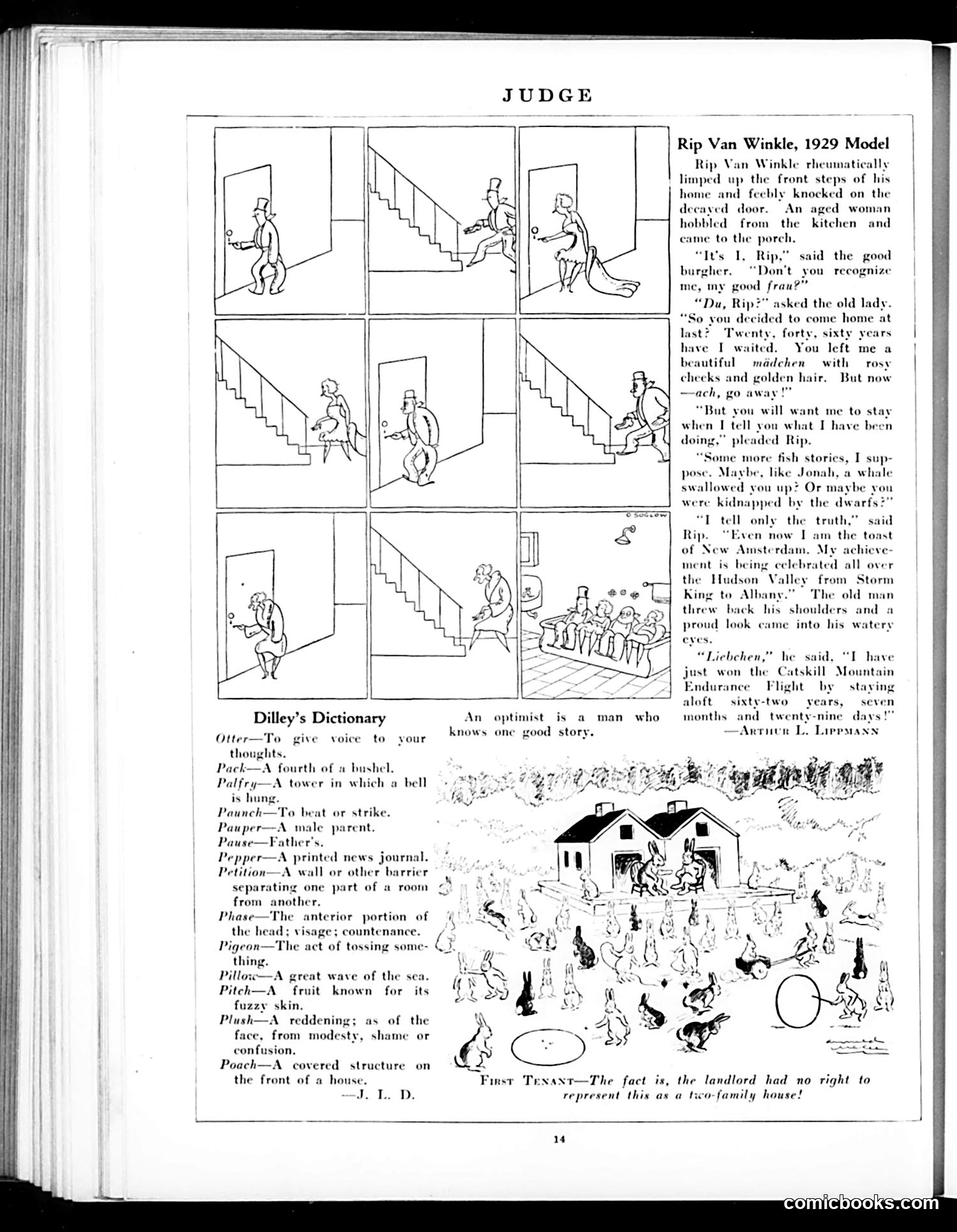
Rip Van Winkle, 1929 Model This cartoon updates Washington Irving's classic tale to 1920s America. Rip returns home after decades away, but instead of sleeping in the mountains, he's apparently been away pursuing aviation stunts—he claims to have won the "Catskill Mountain Endurance Flight" by staying aloft for over sixty-two years. The satire targets the era's obsession with aviation records and stunts, which were wildly popular in the 1920s. Rip's exaggerated boasts about his flying achievements parody how aviators of the time became celebrities through increasingly sensational records. His wife's skepticism and references to Jonah and dwarfs suggest she doesn't believe his tall tales—a play on the original Rip's implausible disappearance story. The joke is that modern Rip has replaced supernatural fantasy with the contemporary craze of aeronautical achievement as his excuse for abandoning his wife.
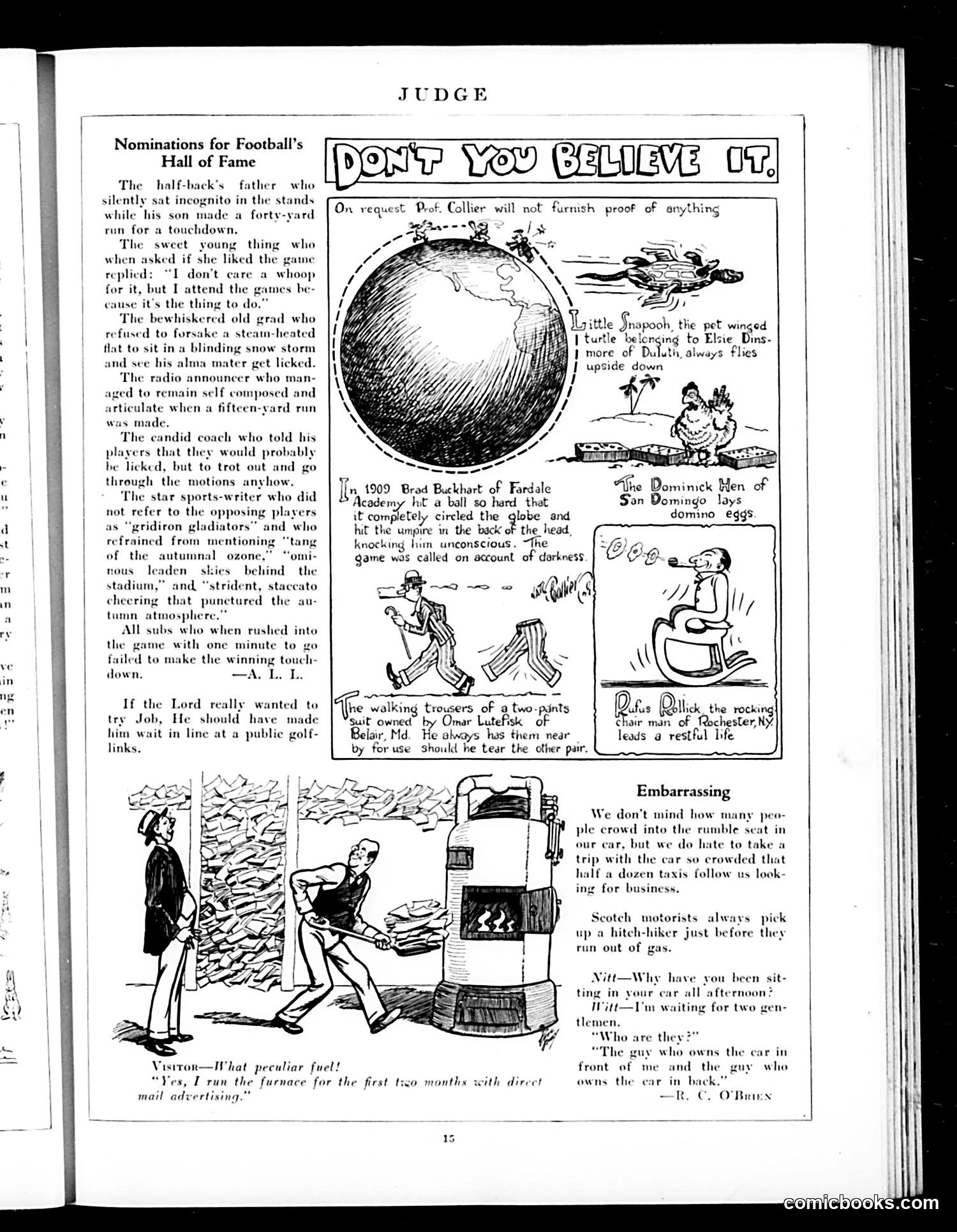
Analysis for Modern Readers This Judge magazine page contains sports humor and unrelated satirical vignettes typical of early 20th-century American humor. "Nominations for Football's Hall of Fame" is a tongue-in-cheek list celebrating unglamorous football observers: the inconspicuous parent, the disinterested socialite attending only for fashion, the loyal alumnus enduring bad weather, the composed radio announcer, the honest coach, the restrained sportswriter, and the substitute who fails when called upon. The satire mocks both football culture's absurdities and the hypocrisies of fans and commentators. "Don't You Believe It" presents exaggerated tall tales and oddities—a turtle that flies upside-down, a ball hit so hard it circles the globe, a hen laying "domino eggs"—poking fun at tall-tale traditions and absurdist humor. "Embarrassing" offers brief, observational jokes about crowded cars, Scottish drivers, and parking situations—everyday social humor with no particular political dimension. The page reflects early 1900s entertainment values: sports satire, whimsical nonsense, and gentle social observation rather than hard-hitting political commentary.
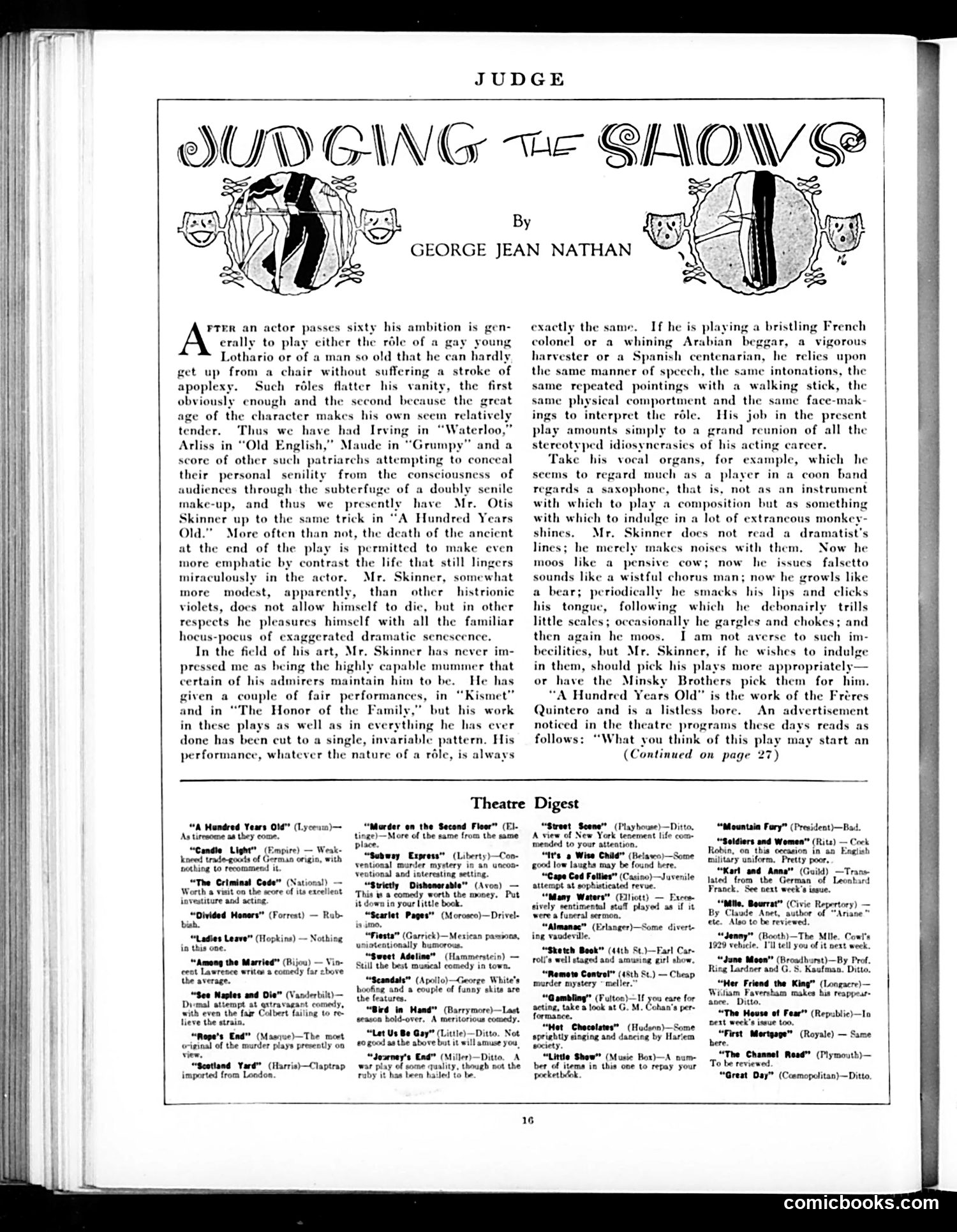
"Judging the Shows" - Theater Criticism This is a theater review column by drama critic George Jean Nathan, not a political cartoon. The article critiques actor Otis Skinner's performance in "A Hundred Years Old," a new production at the Lyceum Theatre. Nathan argues that Skinner, despite his reputation, relies on an unchanging performance formula regardless of role. Rather than genuinely interpreting characters, Skinner uses exaggerated vocal mannerisms—mooing like a cow, falsetto sounds, growling, clicking his tongue—treating dialogue as an instrument for stylistic flourishes rather than dramatic meaning. Nathan dismisses both the actor's approach and the play itself as "a listless bore." The accompanying "Theatre Digest" provides brief reviews of other current Broadway productions, rating them from poor to worthwhile. This reflects Judge magazine's cultural criticism function during the 1920s.
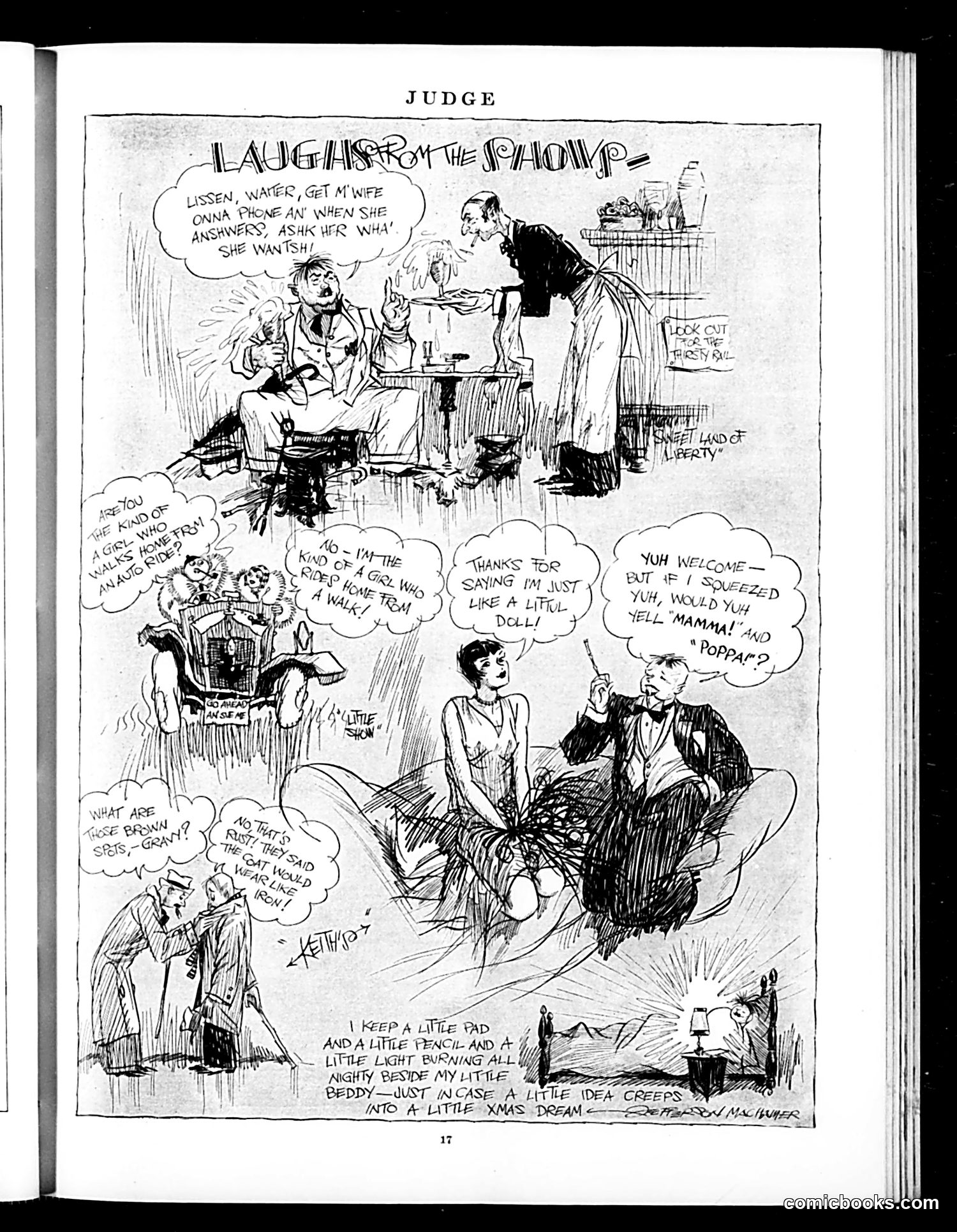
"Laughs at the Pawnshop" This cartoon satirizes working-class family life and the pawnshop economy. The top panel shows a man advising another to call his wife and ask what she wants—practical marital advice depicted comedically. The middle panels depict a couple at a pawnshop, where the man boasts he keeps "a little pad and pencil" beside his bed "just in case a little idea creeps into a little Xmas dream," suggesting he dreams of inventions or schemes to escape poverty. The surrounding vignettes mock various aspects of working-class domesticity and financial struggles. The humor relies on period stereotypes about immigrant or working-class speech patterns and the desperation of families relying on pawnshops. The satire targets both the financial precarity of ordinary people and their aspirational fantasies of improvement.
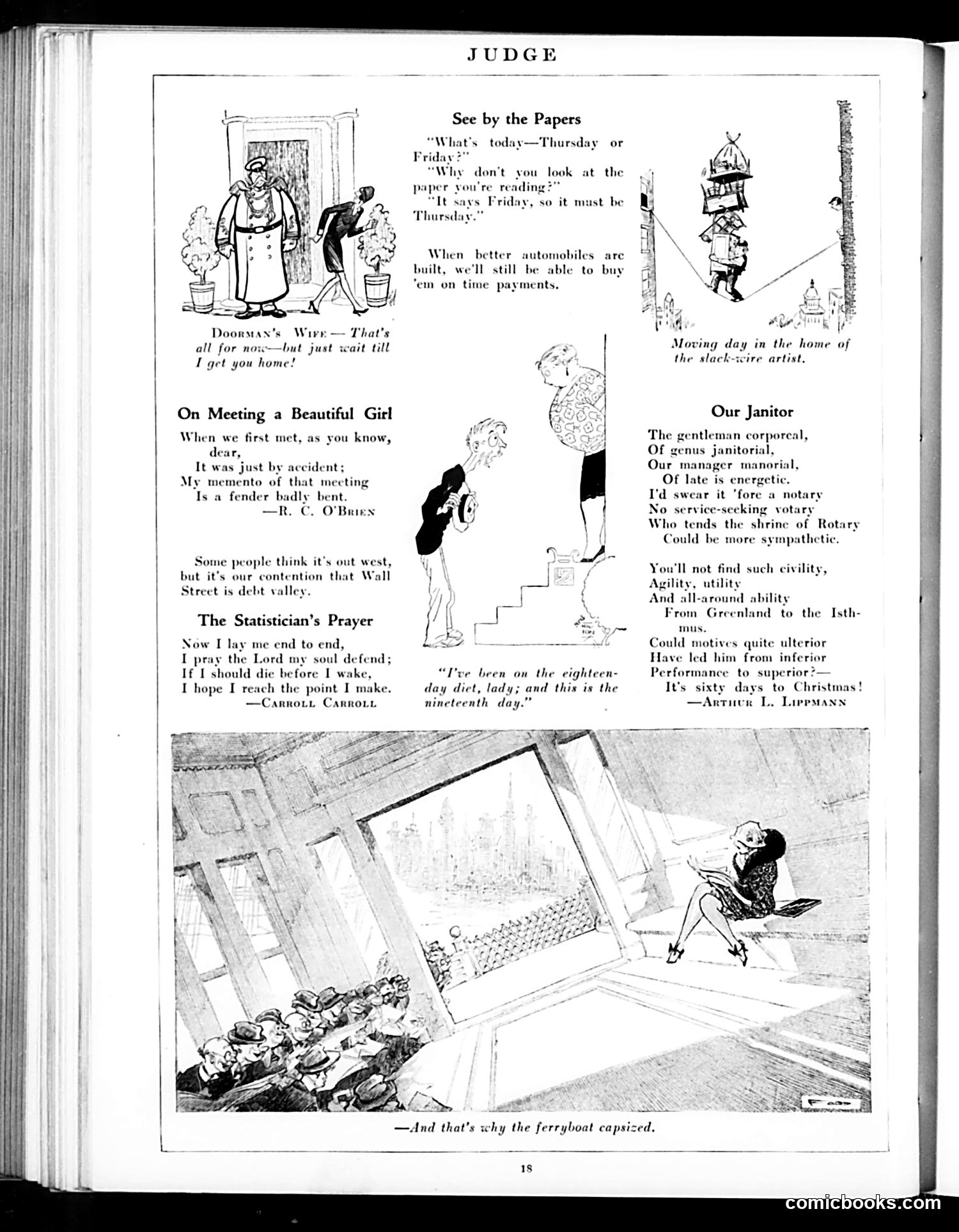
Explanation for Modern Readers This page from *Judge* magazine contains several satirical pieces on early 20th-century American life: "See by the Papers": A joke about newspaper confusion—someone reads "Friday" in the paper but insists it must be Thursday, illustrating how people rely on papers for basic information. "On Meeting a Beautiful Girl": A wry poem about a car accident presented as romantic destiny—the "memento" is a bent fender, mocking both sentimental romance and early automobiles' fragility. Automobile financing joke: Satirizes consumer credit culture, suggesting that despite technological progress, people will always buy cars "on time payments" (installments)—poking fun at American consumption habits. "The Statistician's Prayer": Dark humor about someone so obsessed with statistical analysis they can't complete basic thoughts. "Our Janitor": Suggests a custodian's sudden increased effort is suspiciously timed—implying he wants a raise before Christmas, not genuine dedication. The cartoons mock period concerns: marital dynamics, consumer debt, media dependence, and workplace cynicism.
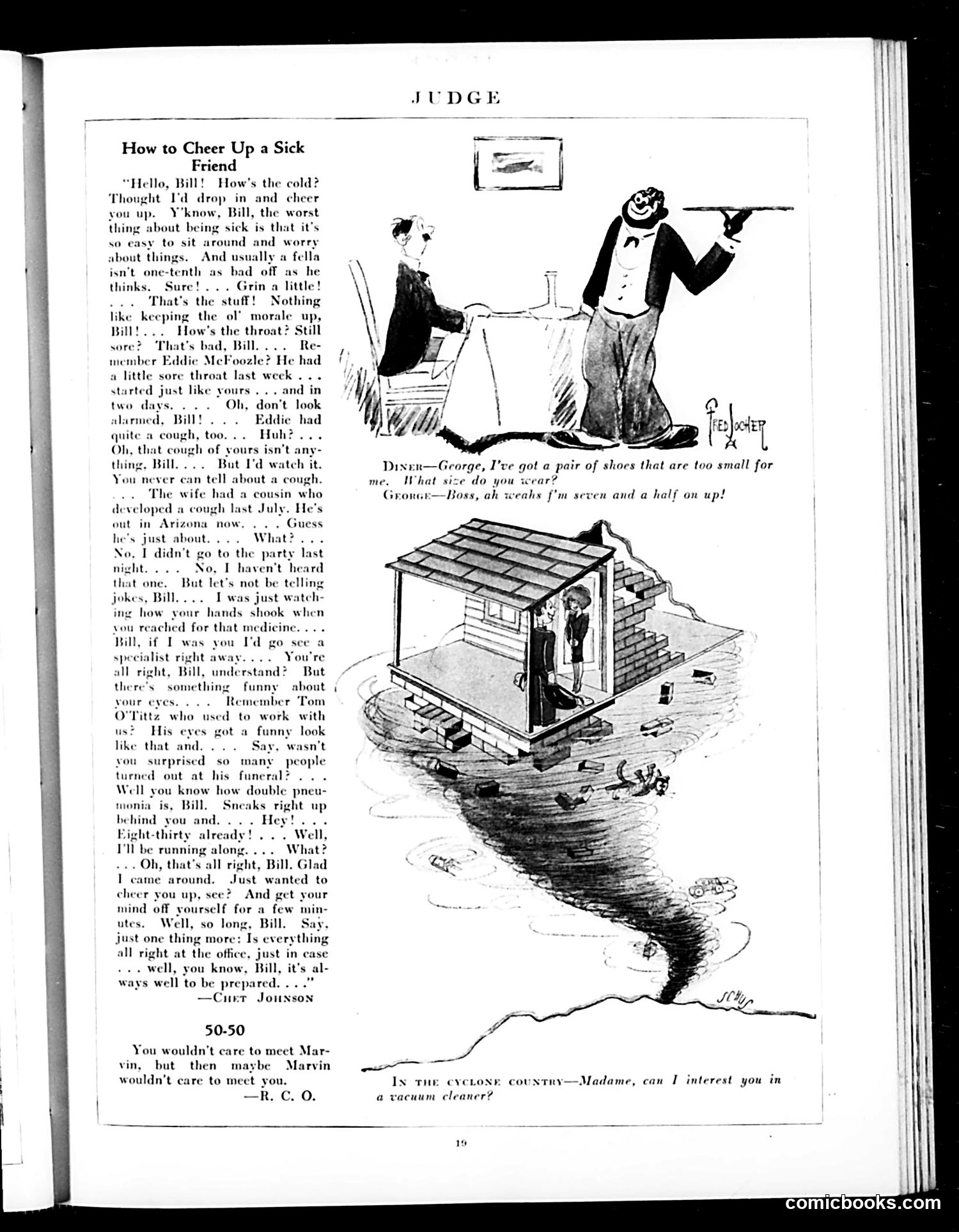
"How to Cheer Up a Sick Friend" This satirical piece mocks the well-meaning but exhausting visitor who attempts to cheer a bedridden friend. The "cheerful" visitor delivers an endless parade of depressing stories—Eddie McFoozle's lingering sore throat, a cousin who developed pneumonia after a July cough and died in Arizona, Tom O'Tittz whose funeral drew crowds—all while claiming to boost morale. The visitor obsesses over the sick man's symptoms (his cough, his shaking hands, his "funny" eyes), mentions dangerous diseases, then abruptly leaves after 8:30 p.m., offering final ominous advice to "be prepared." The joke: the visitor's "cheer" is actually psychological torture. By cataloging similar illnesses that ended badly, he transforms routine sickness into existential dread. The piece satirizes how some people's attempts at sympathy inevitably communicate the worst possible outcomes instead. The page also includes brief unrelated jokes about shoe sizes and vacuum cleaners.
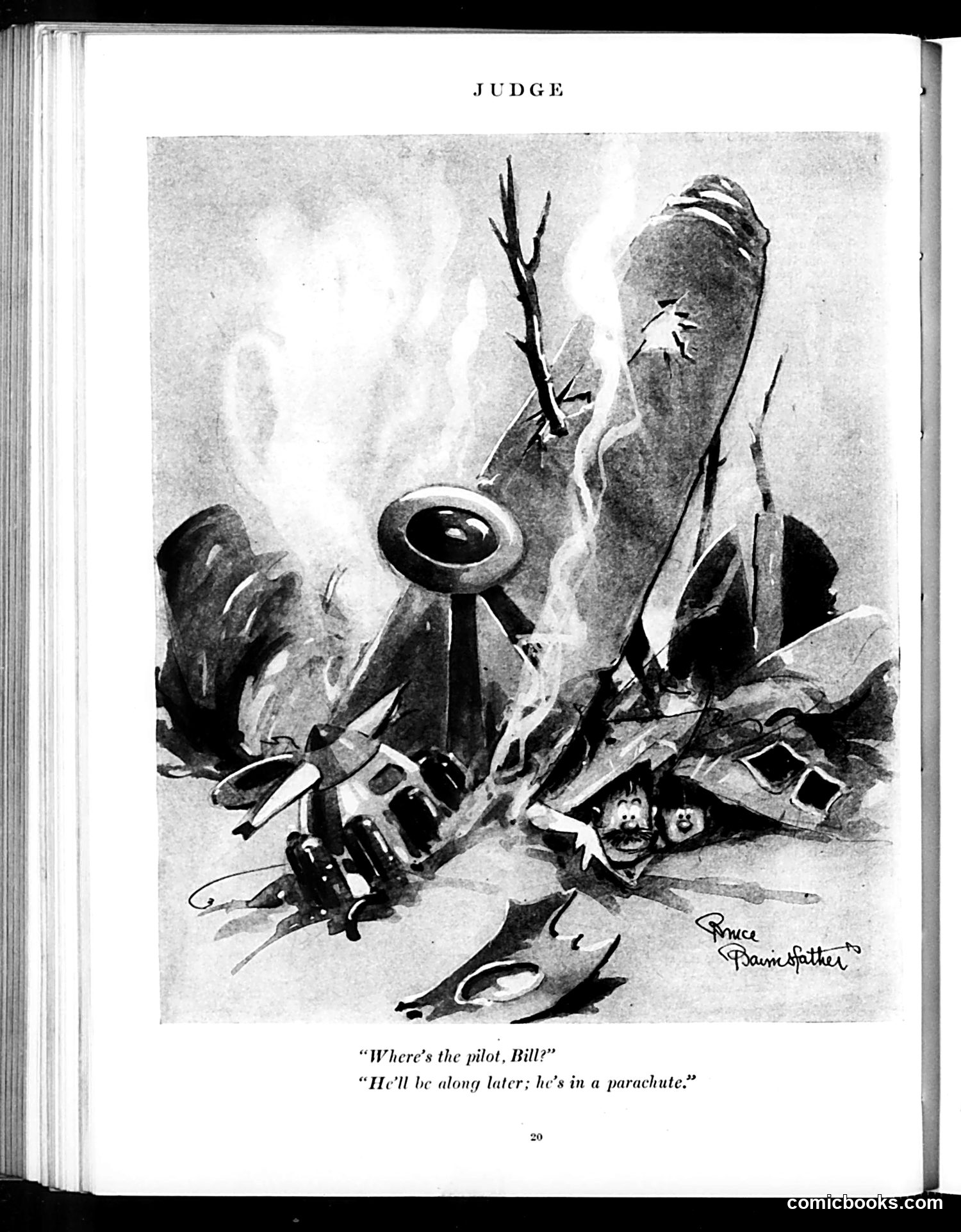
Judge Cartoon Analysis This cartoon depicts an aircraft crash scene with wreckage scattered about. Two figures discuss a missing pilot, with one responding that he'll arrive later because "he's in a parachute"—implying the pilot has bailed out and is descending by parachute. The satire likely mocks early aviation's dangers and the novelty of parachute technology. The grim humor suggests the pilot abandoned the doomed aircraft, leaving his companion (Bill) in the wreckage below. The cartoon plays on contemporary anxieties about aviation safety while treating parachute escape as an absurd or darkly comedic solution. Without a visible date, the specific historical aviation incident cannot be confirmed, but this reflects the era when parachutes were relatively new emergency equipment and airplane crashes were frequent, dramatic public events.
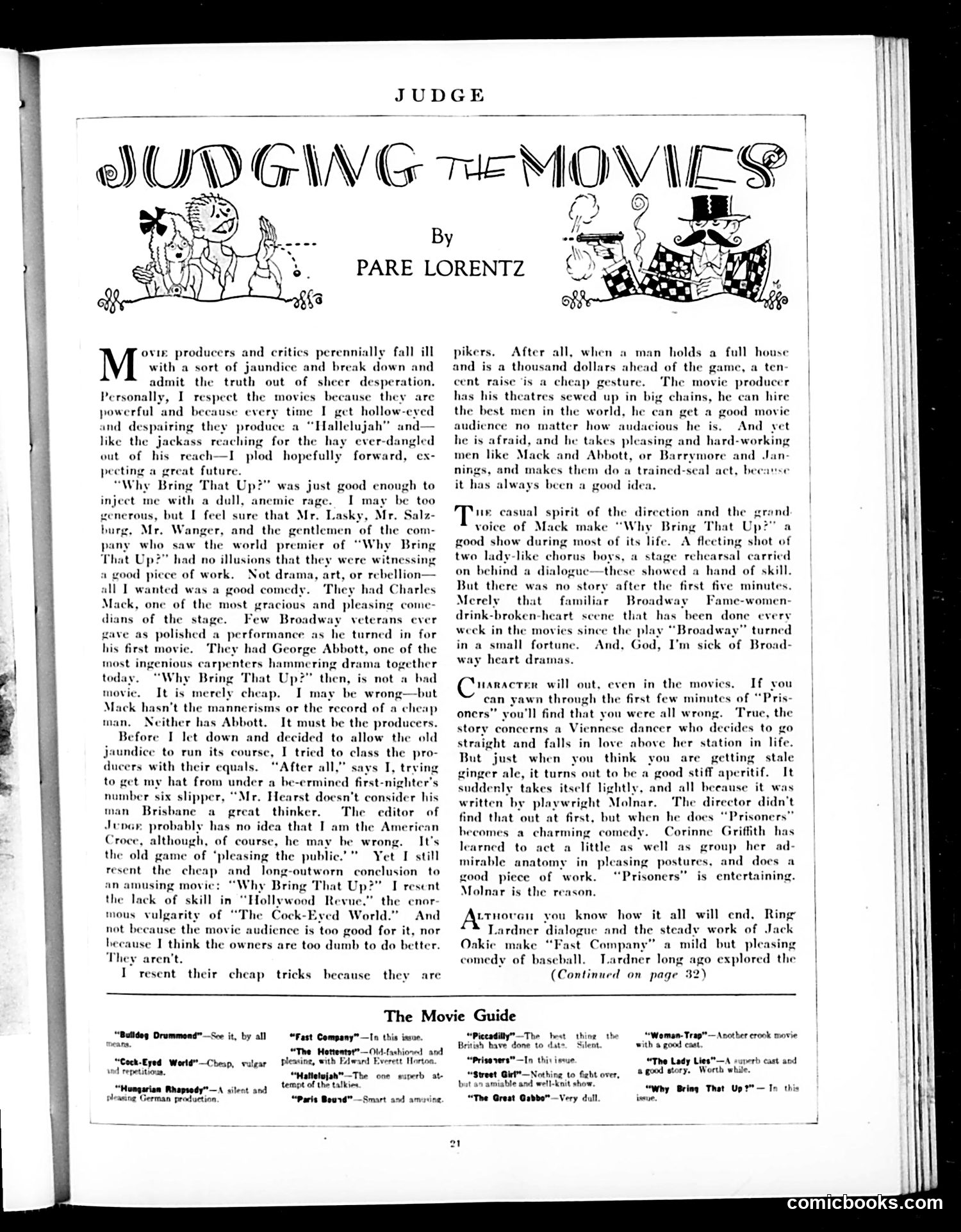
"Judging the Movies" by Pare Lorentz — Judge Magazine Film Criticism This is a film critic's column reviewing contemporary movies. Lorentz criticizes producers for making cheap, formulaic pictures despite having access to talented actors like Charles Mack and George Abbott, and competent directors. His main complaint: producers rely on tired dramatic conventions (like "drink-broken-heart" scenes) and resort to "cheap tricks" rather than genuine artistry. He respects the film industry's *power* but resents that wealthy producers—who control theater chains and can afford quality talent—choose shortcuts over craft. The piece references specific 1929 films: "Why Bring That Up?", "Hollywood Revue," and "The Cock-Eyed World," dismissing them as vulgar and lacking skill, though he praises moments of actual talent within them. The satire targets Hollywood's cynicism: producers know audiences will accept mediocrity if entertained sufficiently, so they exploit that rather than challenge themselves. It's insider criticism published in a satirical magazine for readers familiar with Broadway and film industry gossip.
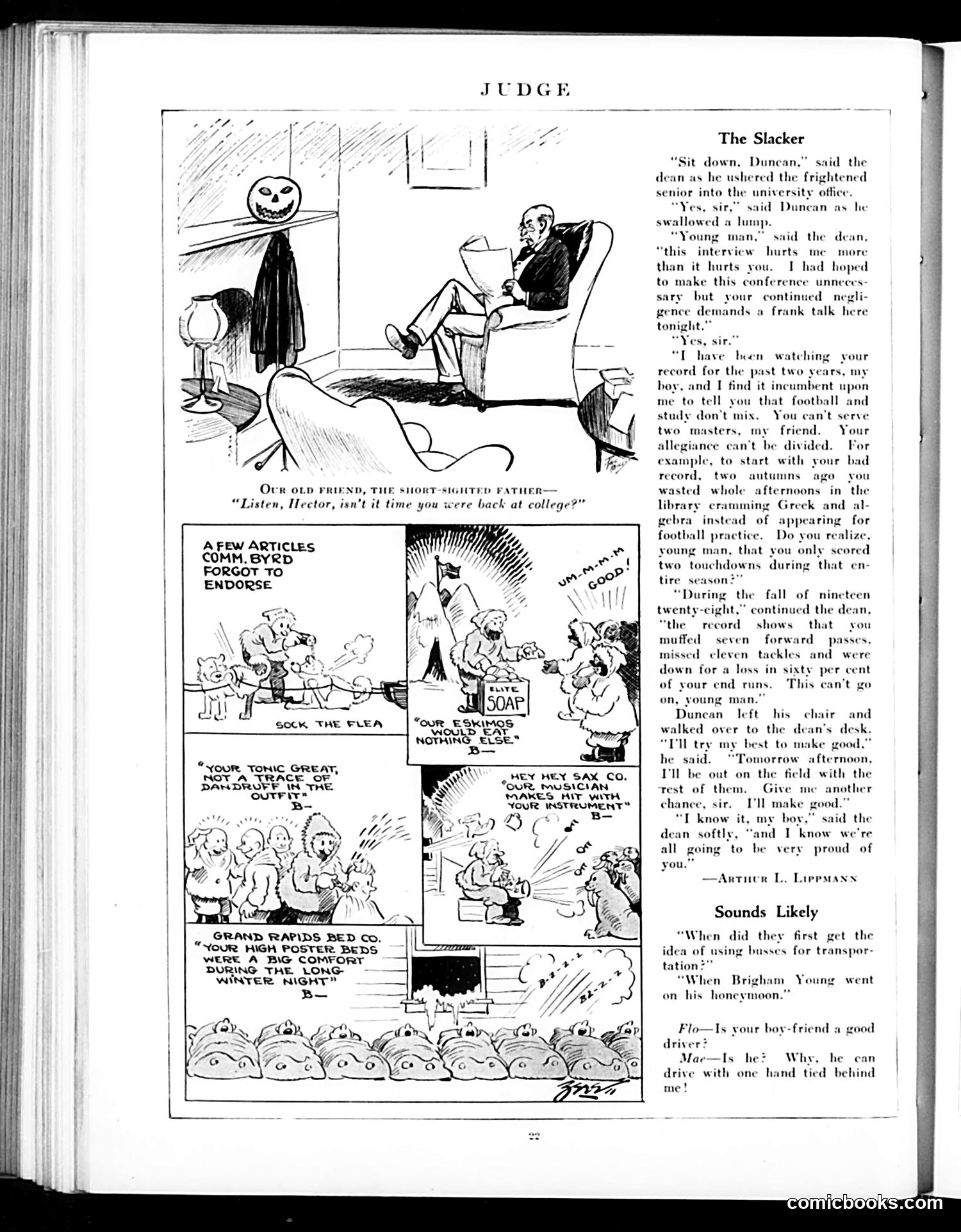
"The Slacker" - Explanation for Modern Readers This page satirizes college students who prioritize athletics over academics during World War I era, when such neglect was viewed as unpatriotic "slacking." The main cartoon depicts a dean confronting student "Duncan" about his dismal football performance (two touchdowns, seven muffed passes, eleven missed tackles) while he wasted study time on athletics instead of academics. The dean's stern lecture emphasizes that divided loyalty between "two masters" is unacceptable. The satire targets the cultural anxiety that frivolous pursuits like sports represented moral and civic failure during wartime. Duncan's promise to reform suggests redemption through proper priorities. The page's lower section contains unrelated comic advertisements and brief jokes, including a reference to Brigham Young and modern humor about a reckless driver—typical filler content for this satirical magazine.
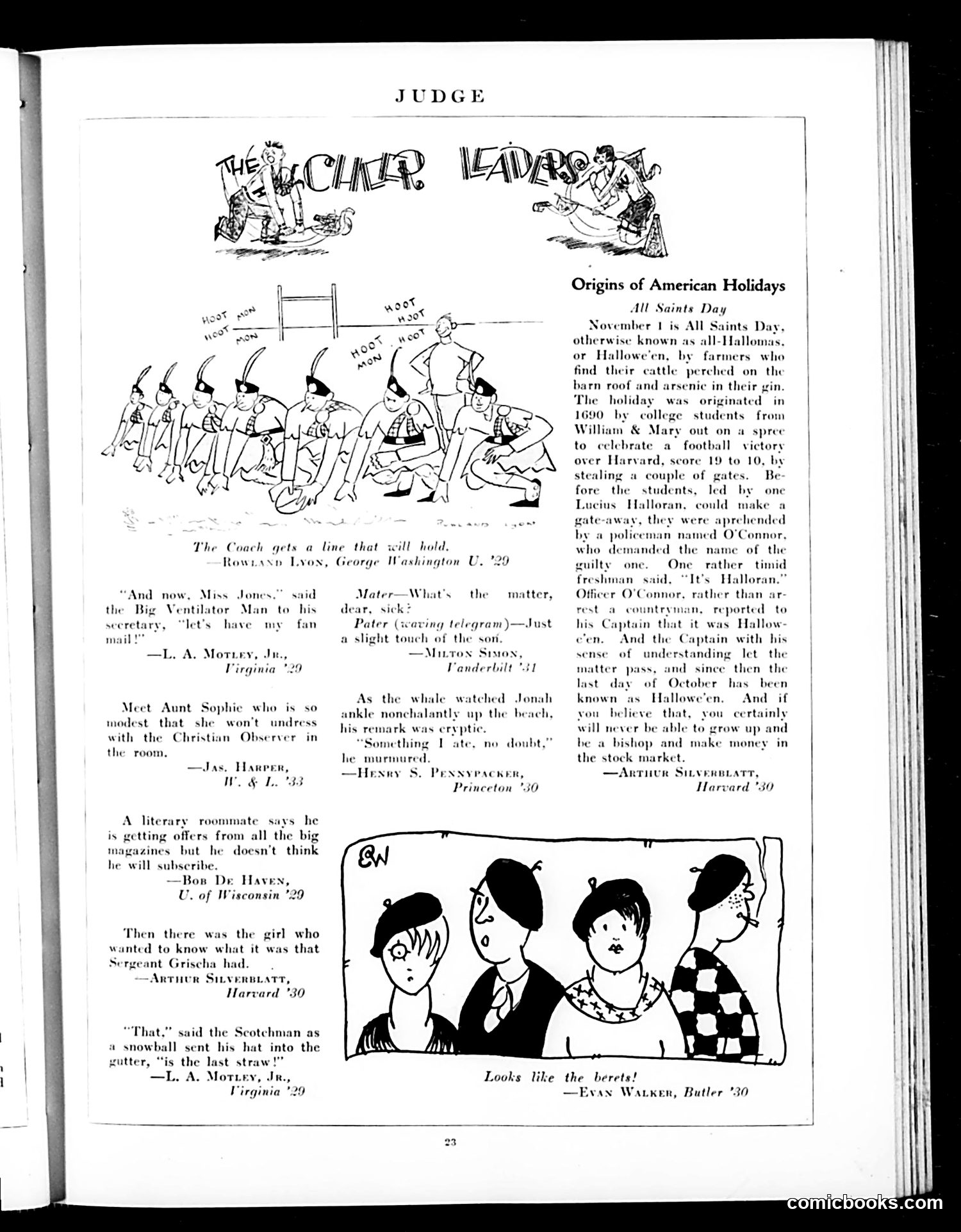
Judge Magazine Satire Analysis This page from Judge magazine (circa 1929) contains humorous college-era observations and one feature article about All Saints Day/Halloween's supposed "origins." The Main Article: A tongue-in-cheek mock-history claiming Halloween originated in 1690 when William & Mary students celebrating a football victory were caught by Officer O'Connor. The story is clearly fabricated satire—it invents absurd details (cattle on barn roofs, arsenic in gin) and a convenient origin story to explain why October 31st became "Hallowe'en." The Cartoons/Jokes: The page also includes unrelated student humor submitted by readers from various colleges (Virginia, Wisconsin, Harvard, Princeton, Butler). These are short quips about college life—a coach needing fan mail, a girl concerned about modesty, a roommate getting magazine offers, etc. The bottom cartoon shows four women in fashionable 1920s hats with the caption "Looks like the berets!"—likely mocking a fashion trend. The overall tone is lighthearted collegiate humor typical of Judge's satirical style.
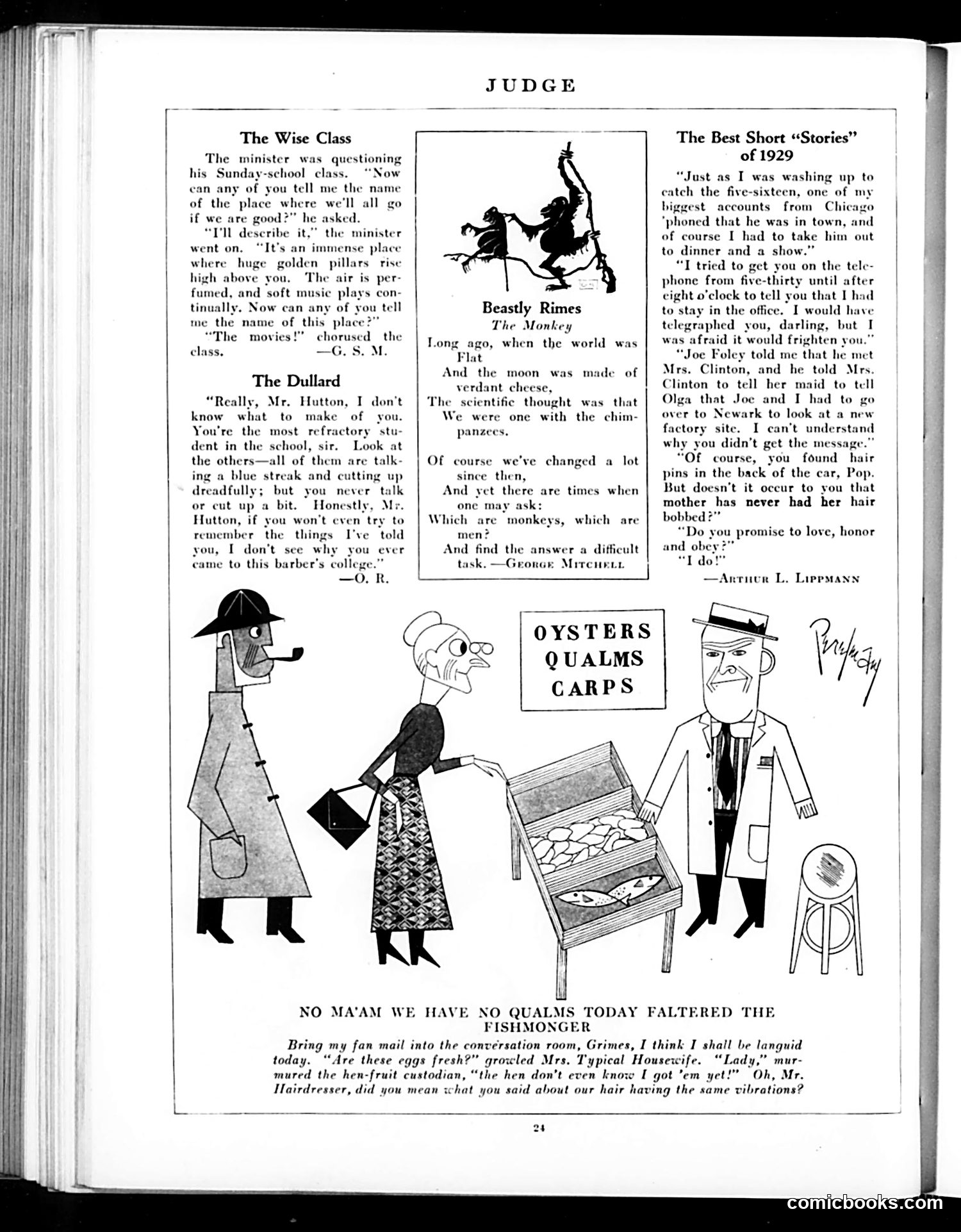
Analysis of Judge Magazine Page This page contains three satirical pieces typical of 1920s humor: "The Wise Class" mocks Sunday school instruction—a minister describing heaven's golden pillars and perfumed air, then a student innocently asks "the movies?" A joke about materialistic American values replacing spiritual ones. "The Dullard" presents a school principal frustrated that a refractory student won't misbehave like others. The irony: the student's quiet behavior is framed as a *problem*, satirizing educational hypocrisy and the institution's real priorities. "Beastly Rimes" offers period verse about evolution, asking which creatures are monkeys and which are men—likely commentary on Darwinian debate still contentious in 1920s America. "The Best Short 'Stories' of 1929" satirizes modern life's endless excuses and miscommunications—people inventing elaborate reasons for absence, telegrams going astray, and absurd explanations. A commentary on hectic contemporary society. The fishmonger cartoon and various small illustrations provide additional light humor about commerce and daily life.
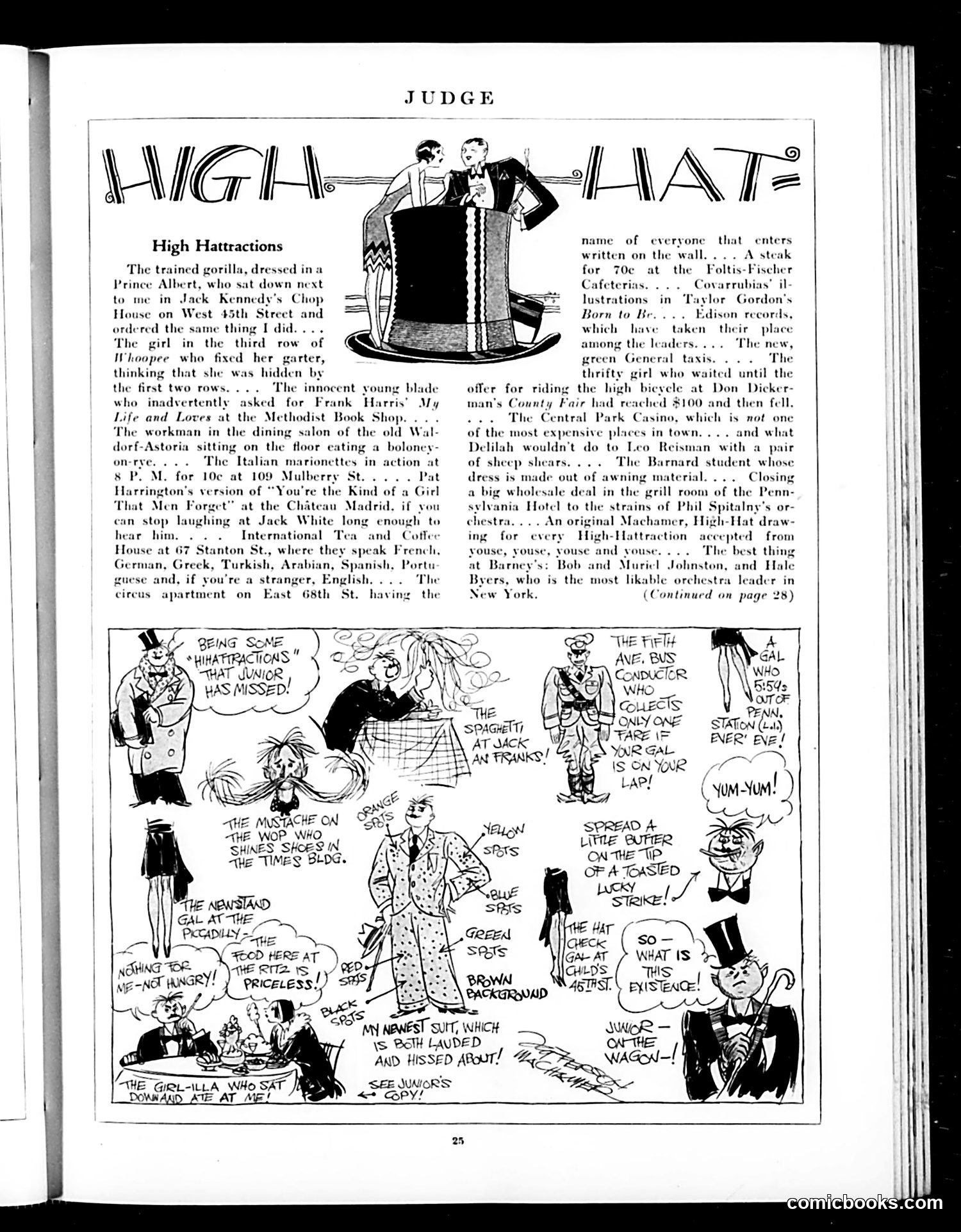
Judge Magazine "High-Hat Attractions" Page Analysis This page from Judge magazine satirizes New York City's elite social scene and affectations circa the 1920s. The title "High-Hat Attractions" refers to snobbish pretension (wearing a "high hat" meant acting superior). The text column catalogs absurd NYC moments: a gorilla in formal dress at a chophouse, theater patrons, Italian street vendors, and the expensive Central Park Casino. References include Taylor Gordon (likely a Black entertainer), Edison records, and orchestra leader Bob Byers—highlighting the era's entertainment scene. The cartoon below depicts gossipy socialites exchanging tales of these ridiculous situations—a woman gorilla, shoe-shine workers, bus conductors, and fashionable mishaps. The dialogue captures 1920s slang and social commentary, mocking both the nouveau riche attempting sophistication and the working-class figures who inadvertently become spectacles for the upper classes. The satire targets class pretension and the performative nature of high society.
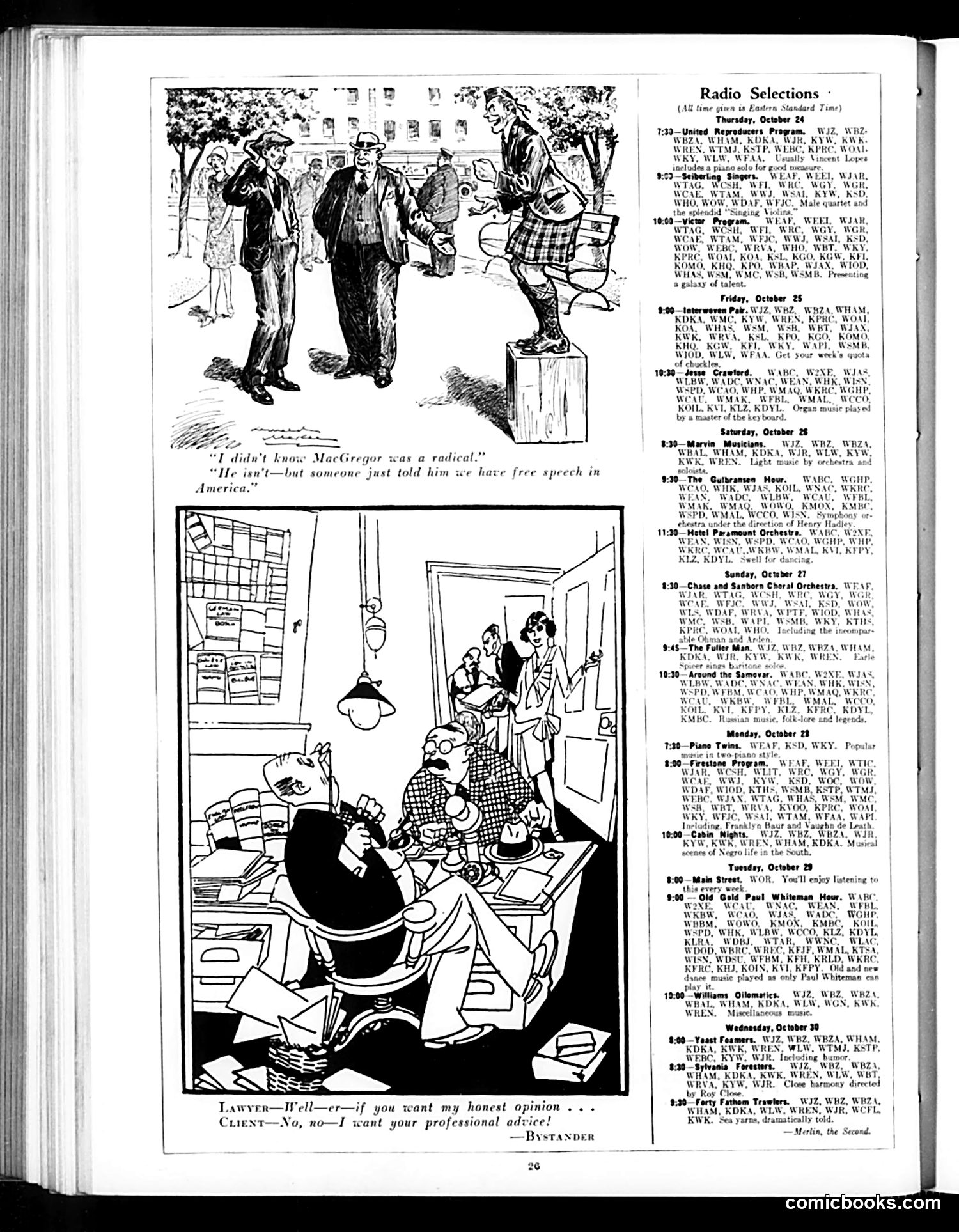
Judge Magazine Cartoon Analysis Top Cartoon: A man stands on a soapbox addressing a crowd, apparently delivering a radical political speech. The caption reveals the satire: someone told MacGregor "we have free speech in America," so he's exercising that right. The joke mocks how Americans invoke "free speech" to justify expressing extreme or unpopular opinions—treating it as license for radicalism rather than a protected democratic principle. Bottom Cartoon: A lawyer and client are shown in a cluttered office. The lawyer asks for an "honest opinion," but the client refuses, saying he wants "professional advice" instead. This satirizes the tension between truthfulness and professional judgment—the implication that honest opinions and professional counsel may conflict, particularly in law where strategic advice might contradict candid truth-telling. Both cartoons use visual humor to comment on American social contradictions around free expression and professional ethics during the 1920s.
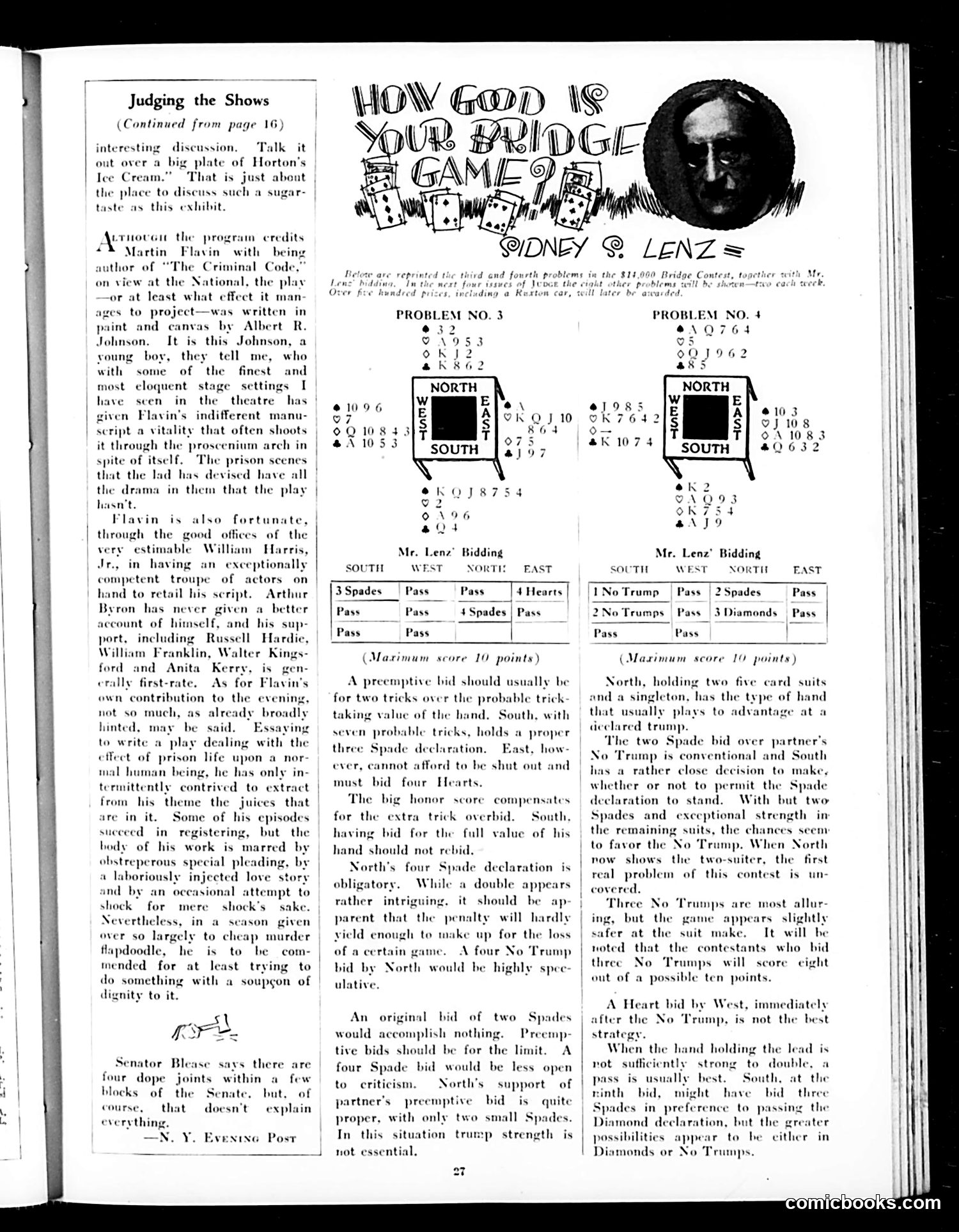
Page Content Analysis This page contains two distinct sections: Left column: A theater review titled "Judging the Shows" (continued from page 16). It discusses Martin Flavin's play *The Criminal Code*, praising young set designer Albert R. Johnson's stage work while criticizing Flavin's script itself. The review also credits the acting troupe (Arthur Byron, Russell Hardie, etc.) and notes Flavin's attempt to address serious themes despite mixed execution. Right column: A bridge instruction feature titled "How Good Is Your Bridge Game?" by Sidney S. Lenz. This presents two numbered bridge problems (No. 3 and No. 4) with card hands, bidding sequences, and analytical commentary explaining optimal play strategy. The maximum score for each problem is ten points. At the bottom, there's a brief political quip from the *N.Y. Evening Post* about Senator Blease claiming drug joints operate near the Senate building—suggesting governmental corruption or ineffectiveness. The page is primarily instructional/critical content rather than satire or cartooning.
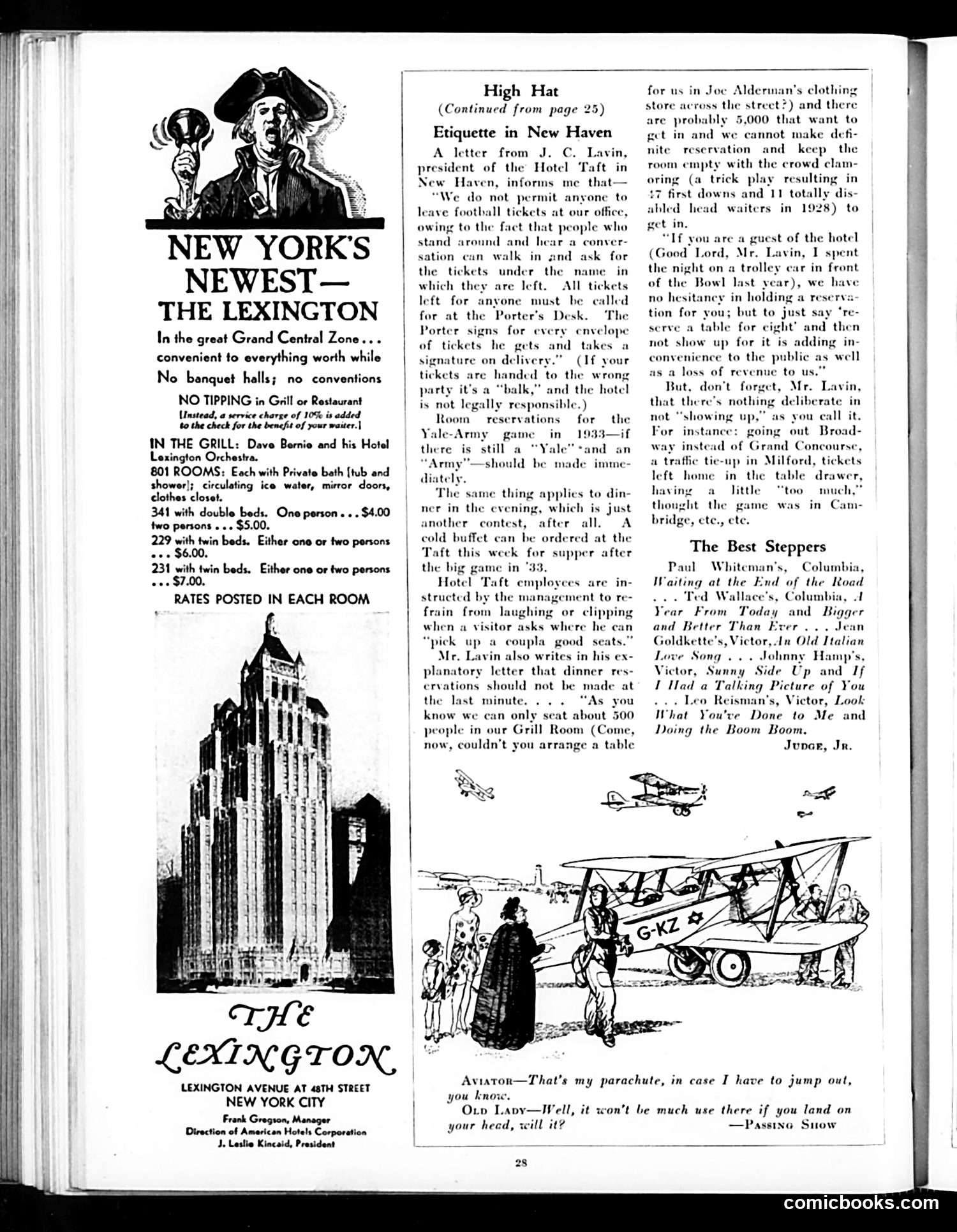
Political/Social Content Analysis This page is primarily advertising and humor columns, not political satire. The Lexington Hotel Ad promotes a newly opened Manhattan hotel, emphasizing modern amenities (private baths, no tipping required) and entertainment—Dave Bernie's orchestra in the Grill Room. It targets business travelers seeking convenience near Grand Central Terminal. "High Hat" Column discusses social etiquette at Yale-Army football games and hotel dining. Hotel manager J.C. Lavin complains that guests make dinner reservations they don't keep, creating revenue loss. The satire gently mocks excuse-making ("went Broadway instead of Grand Concourse," "thought the game was in Cambridge") for failing to honor reservations. "The Best Steppers" lists popular jazz recordings by various orchestras—standard entertainment column fare from the 1920s-30s. Bottom Cartoon is a simple visual gag: an aviator tells an elderly woman his parachute is for emergencies; she quips it won't help if he lands on his head. Light humor with no deeper meaning intended.
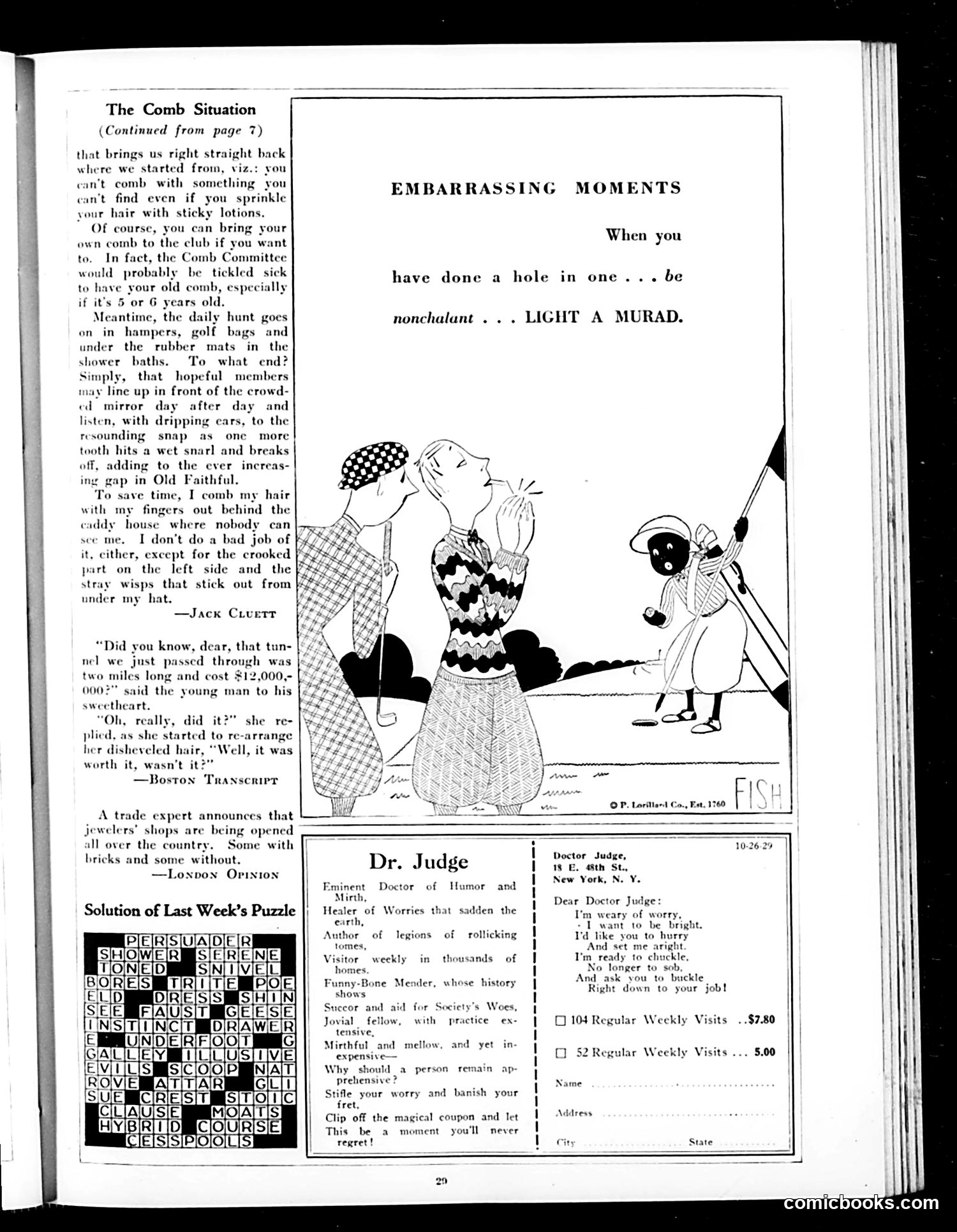
Explanation for Modern Readers This page from *Judge* magazine (dated 10-26-29) contains humor and advertisements typical of the era. Main cartoon ("Embarrassing Moments"): Shows a woman who has torn a hole in her clothing at what appears to be a social venue. The joke's punchline—"be nonchalant . . . LIGHT A MURAD"—advertises Murad cigarettes as a solution to social awkwardness. This reflects 1920s advertising strategy: smoking was marketed as sophistication and composure in uncomfortable situations. "Dr. Judge" section: A humorous advice column personifying the magazine itself as a doctor dispensing humor as medicine for worry and melancholy. This reflects common early-20th-century attitudes treating cheerfulness as a health cure. Other text: Brief anecdotes and a crossword puzzle solution. The "Comb Situation" discusses a social club's missing combs—apparently a genuine, ongoing problem requiring a "Comb Committee." Overall, the page reflects 1920s concerns about social etiquette, advertising culture, and leisure activities among the urban middle class.
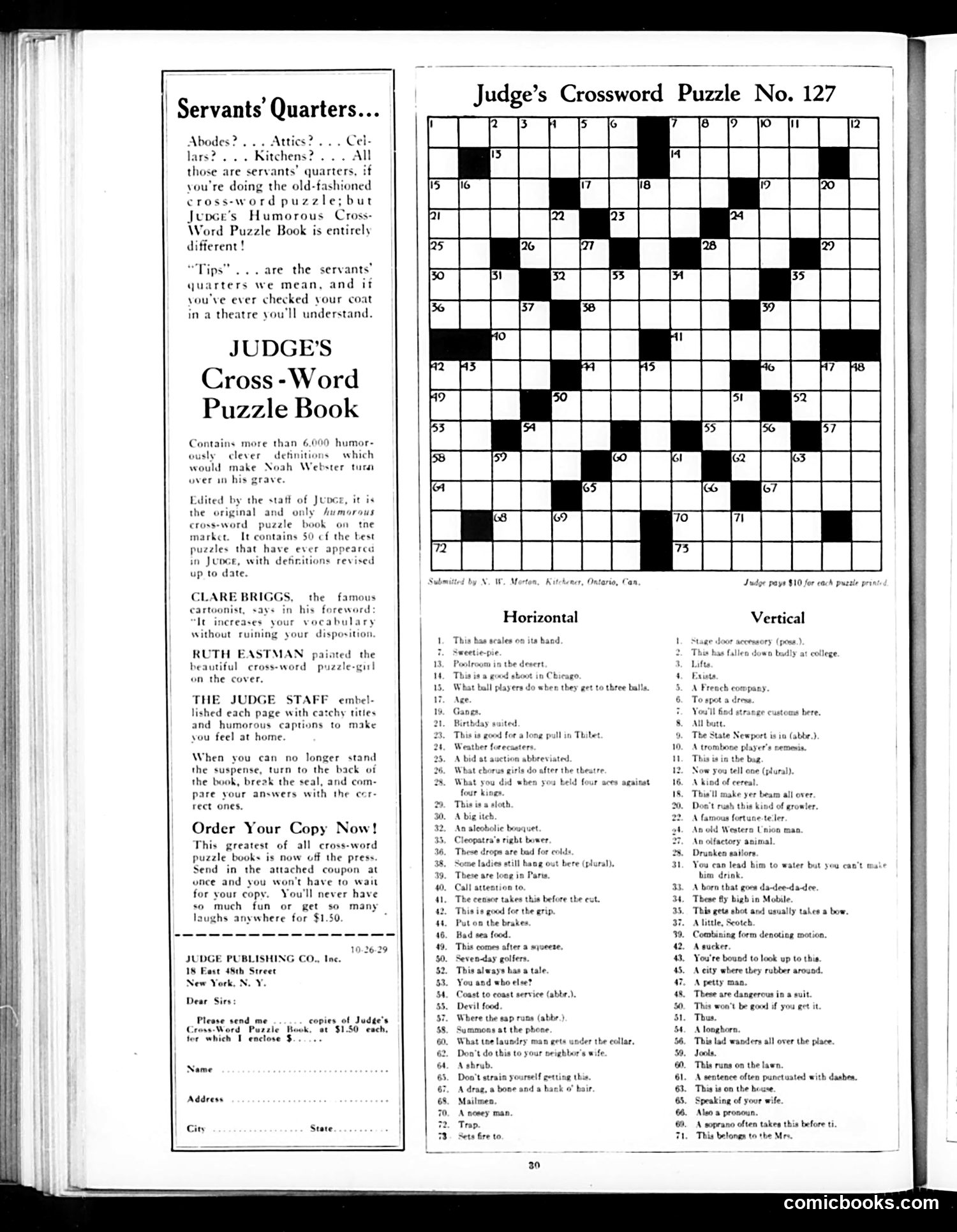
Judge's Crossword Puzzle Book Advertisement This page is primarily advertising material, not a political cartoon. It promotes Judge magazine's newly published "Cross-Word Puzzle Book"—a collection of 50 humorous crossword puzzles with comedic definitions. The advertisement emphasizes the book's novelty and humor. It notes that traditional crossword answers (abodes, attics, cellars, kitchens) refer to "servants' quarters," but Judge's version cleverly redefines "tips" as theatre coat-check gratuities—servants' quarters in a different sense. This wordplay exemplifies the book's approach: "6,000 humorously clever definitions which would make Noah Webster turn over in his grave." The ad credits cartoonist Clare Briggs and notes Ruth Eastman painted the cover illustration. Readers could order the $1.50 book via the attached coupon. The horizontal and vertical clue lists shown are sample puzzles demonstrating the humorous definitions throughout.
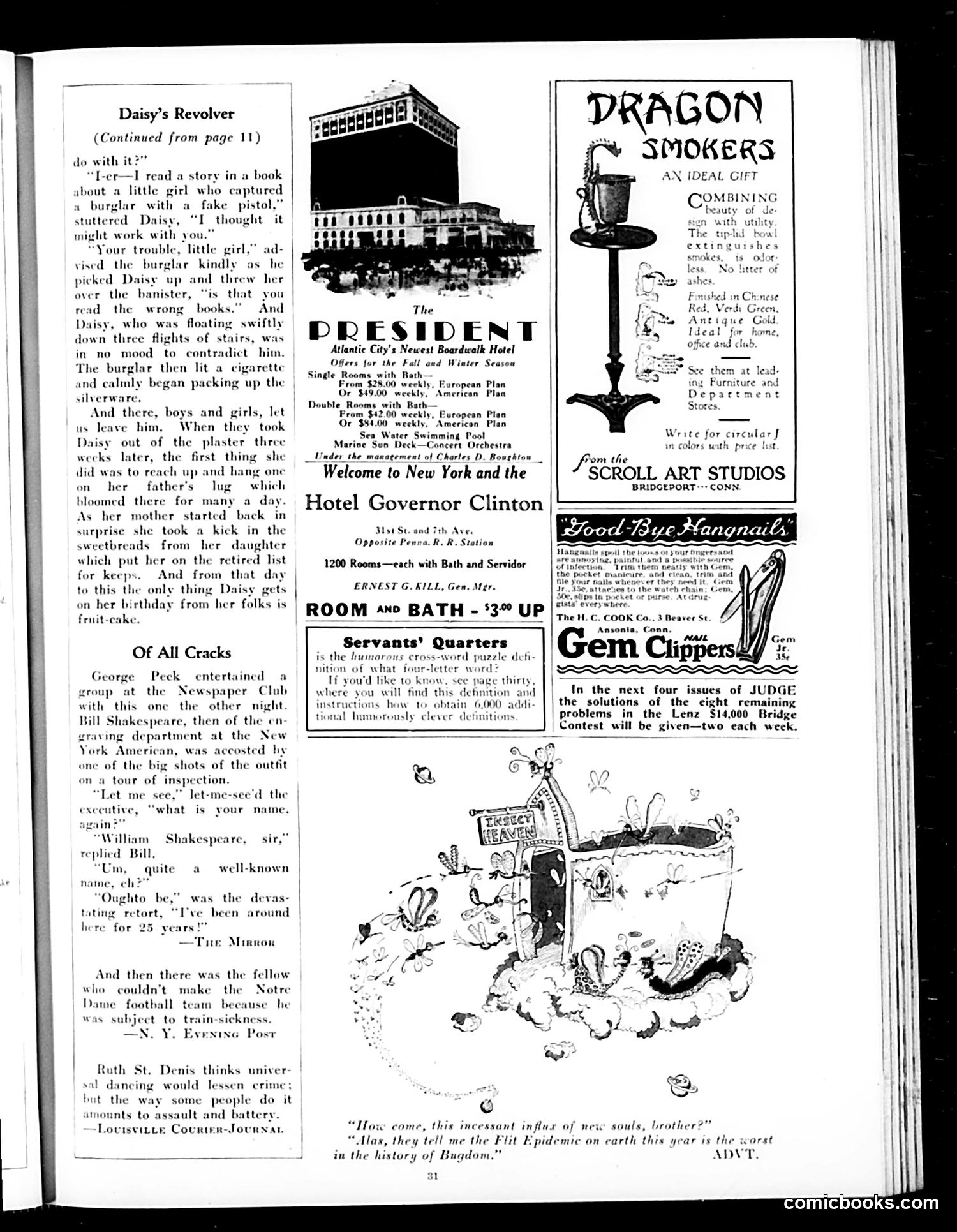
"Daisy's Revolver" and Page Content Analysis This page is primarily advertising with embedded humor. The main story, "Daisy's Revolver" (continued from earlier), is a brief comedic tale: a burglar mocks a girl who tried capturing him with a fake pistol, then throws her down three flights of stairs. She survives and later kicks her mother for doubting her—dark slapstick humor typical of early 20th-century Judge magazine. The page contains multiple hotel and product advertisements (The President Hotel, Hotel Governor Clinton, Dragon Smokers, Gem Clippers). The cartoon at bottom depicts insects/bugs, accompanying an advertisement for "Flit" insecticide, playing on the phrase "Flit Epidemic." The joke references a widespread advertising campaign for the bug spray product. Scattered anecdotes mock various public figures: Shakespeare-named office workers and athletes unable to make football teams due to train sickness—generic workplace humor rather than specific satire.
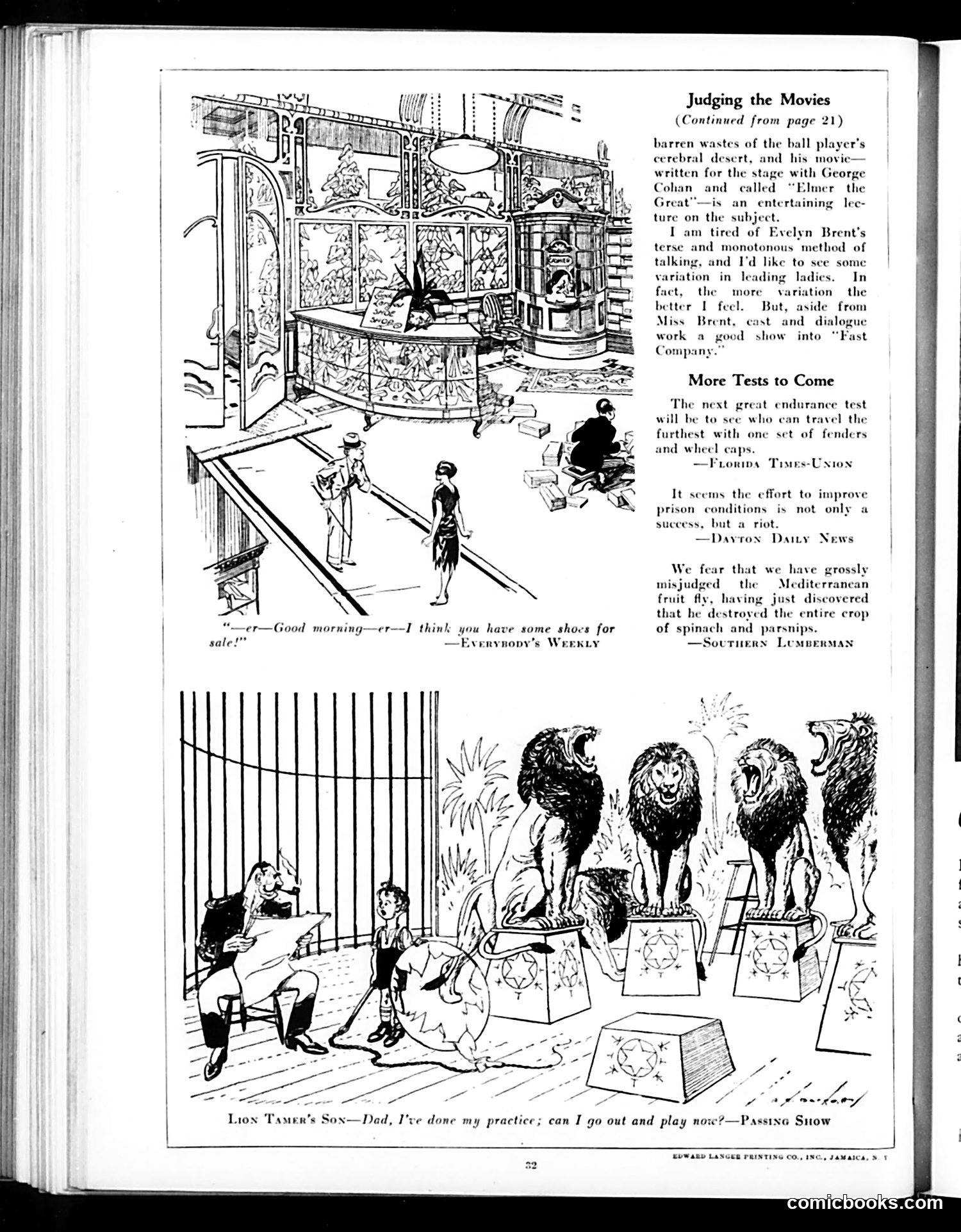
Cartoon Analysis: Judge Magazine Page Top Cartoon: A shoe salesman greets a customer with awkward formality. The humor is straightforward—the salesman's nervous "er—er" stammering and overly formal address ("Good morning—er") for a simple shoe transaction mocks the artificial politeness of retail interactions. Bottom Cartoon: A lion tamer's young son asks his father if he can go play after finishing practice. The joke plays on the absurdity of "practice" for a lion tamer's child—presumably practicing with dangerous big cats like his father. It's dark humor suggesting the boy treats life-threatening work as routine childhood chores. The page also contains movie criticism (discussing Evelyn Brent's acting) and several brief satirical quotes from newspapers about prison reform riots, Mediterranean fruit flies destroying crops, and endurance car testing. These are typical Judge magazine fare—light social and entertainment commentary.
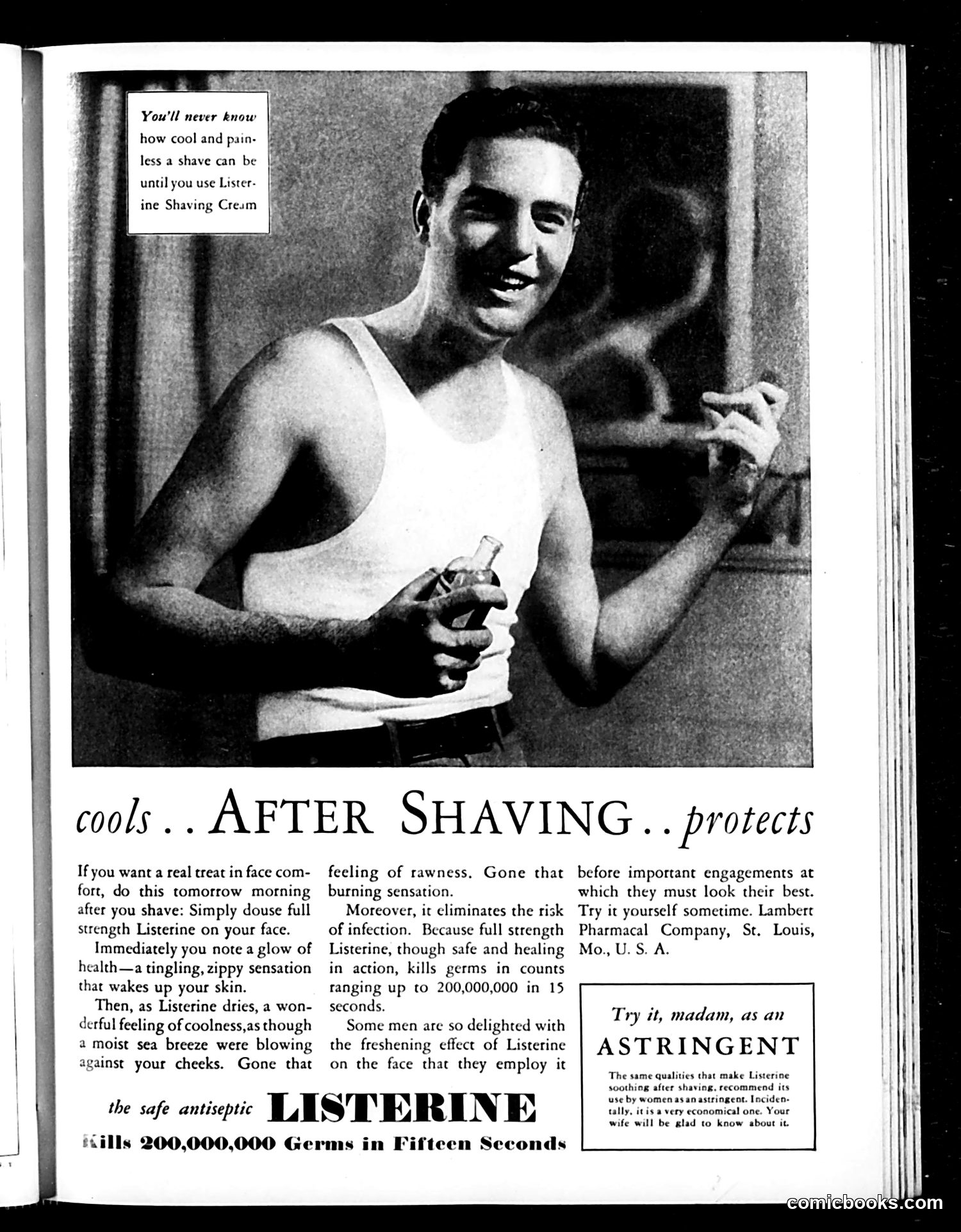
Analysis This is primarily a Listerine advertisement, not political satire. The page shows a man in a undershirt holding a bottle of Listerine after shaving, smiling with apparent satisfaction. The ad promotes Listerine as a post-shave treatment, claiming it: - Cools and soothes the skin - Kills 200 million germs in 15 seconds - Prevents infection and rawness - Makes men look their best before important social engagements A secondary text box at bottom markets Listerine to women as an "astringent," emphasizing its economy. Historical context: This reflects early-20th-century marketing that aggressively promoted antiseptics and germicides for everyday personal hygiene—a common advertising strategy following germ-theory discoveries. The gendered marketing (men for appearance/social success; women for economy) reflects period advertising conventions. There is no discernible political cartoon or satire on this page—it's straightforward product marketing.
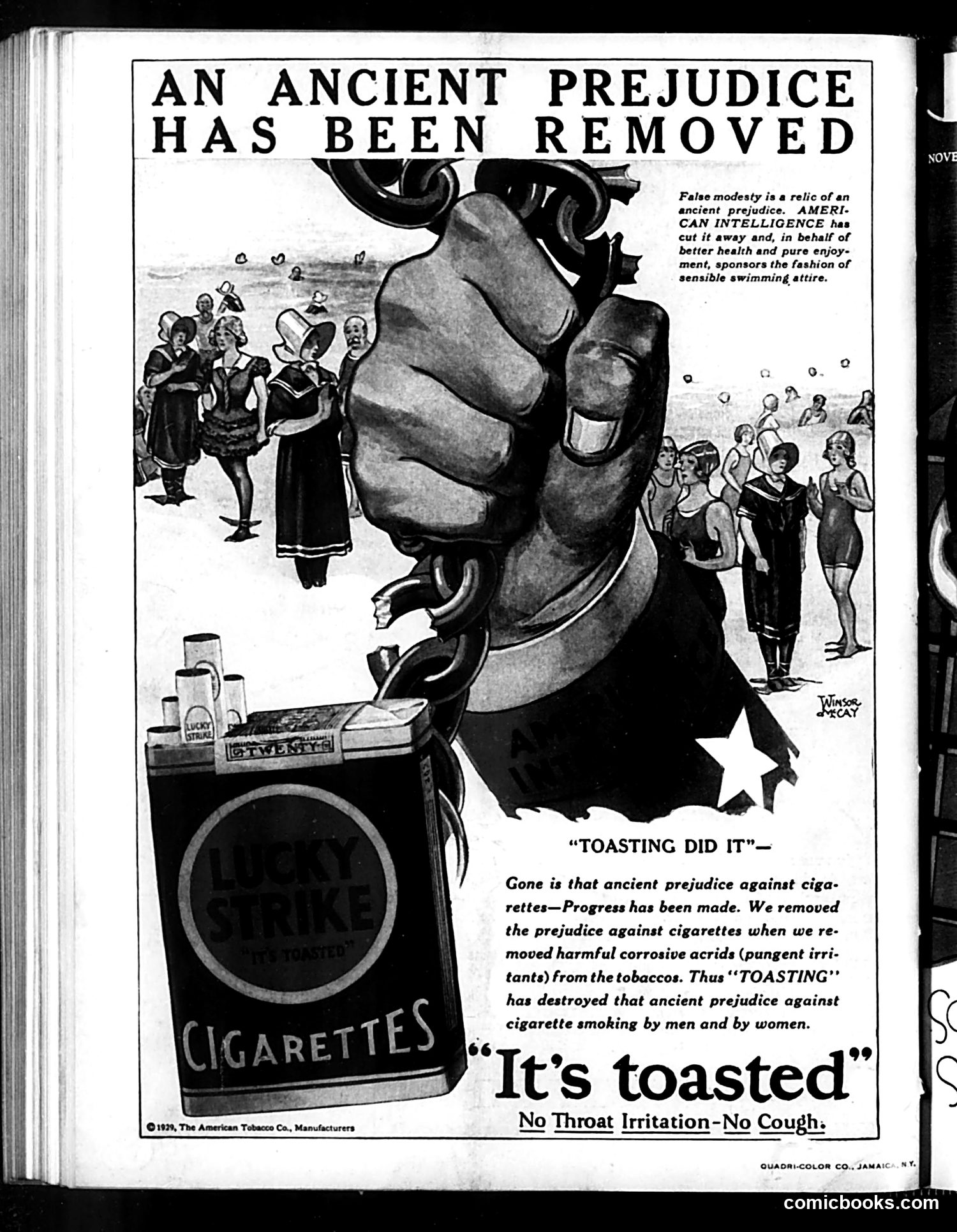
Analysis for Modern Readers This is a cigarette advertisement disguised as social commentary, not a political cartoon. The American Tobacco Company argues that their "toasting" process removed harmful chemicals from cigarettes, thereby eliminating prejudice against smoking—particularly by women. The imagery conflates two separate social shifts: women adopting more practical swimwear (shown left) with women smoking cigarettes (right). The ad equates both as modern "progress" and rejection of "ancient prejudice." By today's standards, this is strikingly misleading. The "toasting" claim about removing harmful irritants was marketing propaganda; cigarettes remained deadly. The ad's cynical equation of swimwear freedom with smoking freedom exploited genuine women's liberation movements to normalize a dangerous product for female consumers—a demographic the tobacco industry actively targeted in the 1920s-30s.