judge
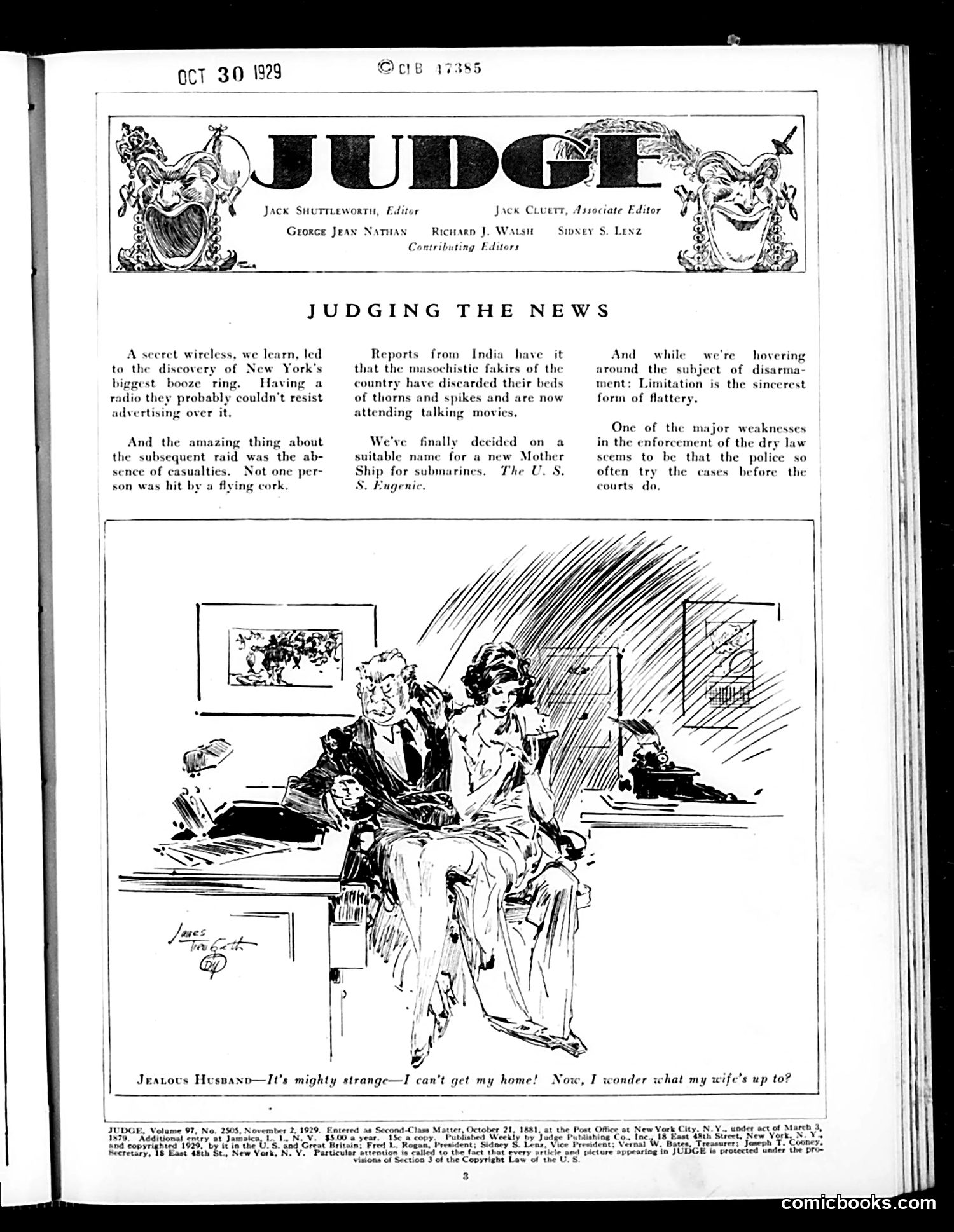
Judge — November 2, 1929
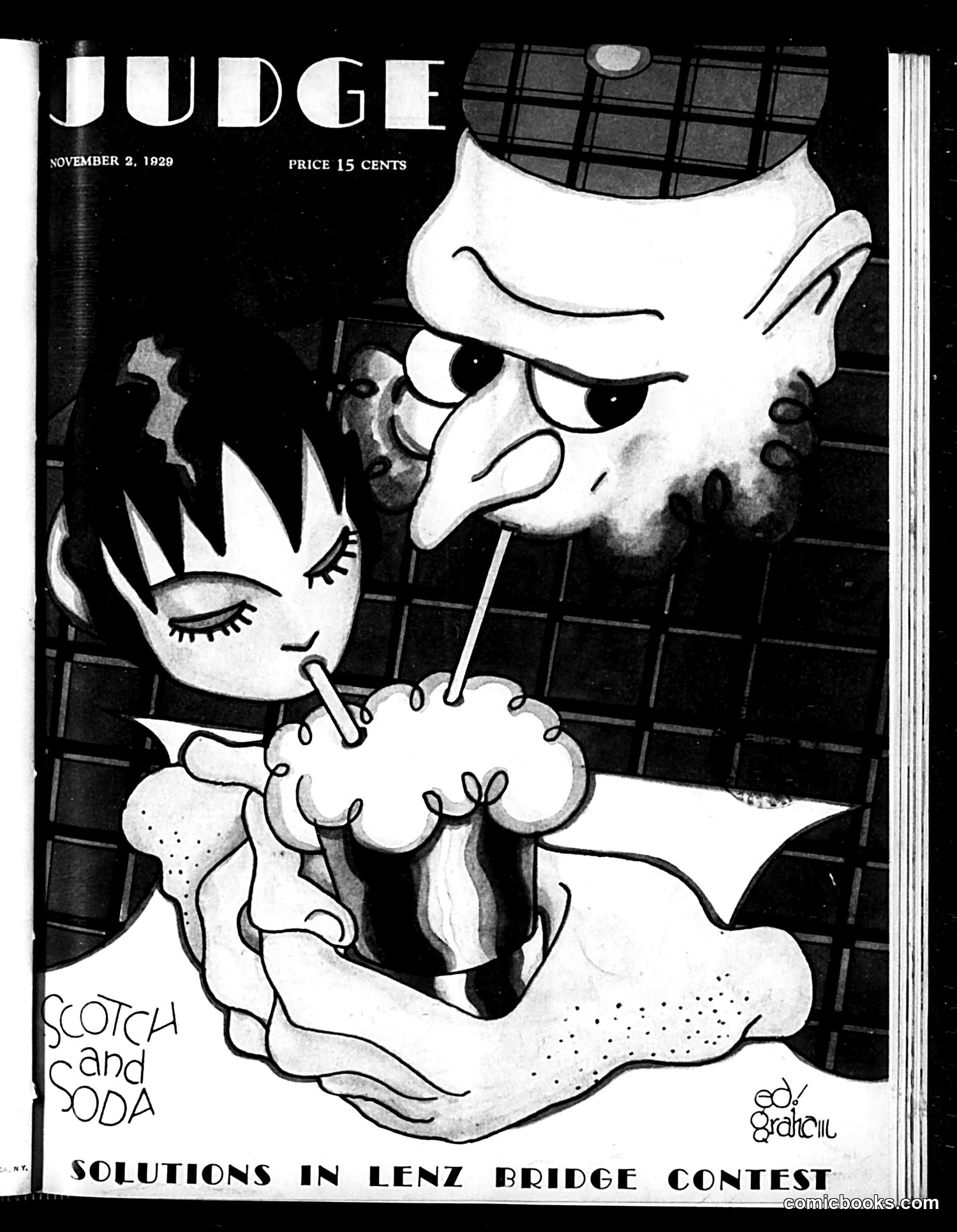
Judge Magazine, November 2, 1929 This cartoon addresses the Lenz Bridge Contest, a contemporary engineering competition. The crude caricatures—with exaggerated features typical of 1920s satire—appear to represent competing bridge design proposals being presented as solutions. The title "Scotch and Soda" suggests the designs are insubstantial or mixed-quality remedies, using a period slang reference to diluted drinks. The imagery of the figures "blowing smoke" (literally depicted) implies the proposals are hot air rather than serious engineering solutions. Published just days after the 1929 stock market crash, this likely comments on inadequate responses to broader crises. The contest itself appears to have generated public debate about infrastructure solutions during economically turbulent times.
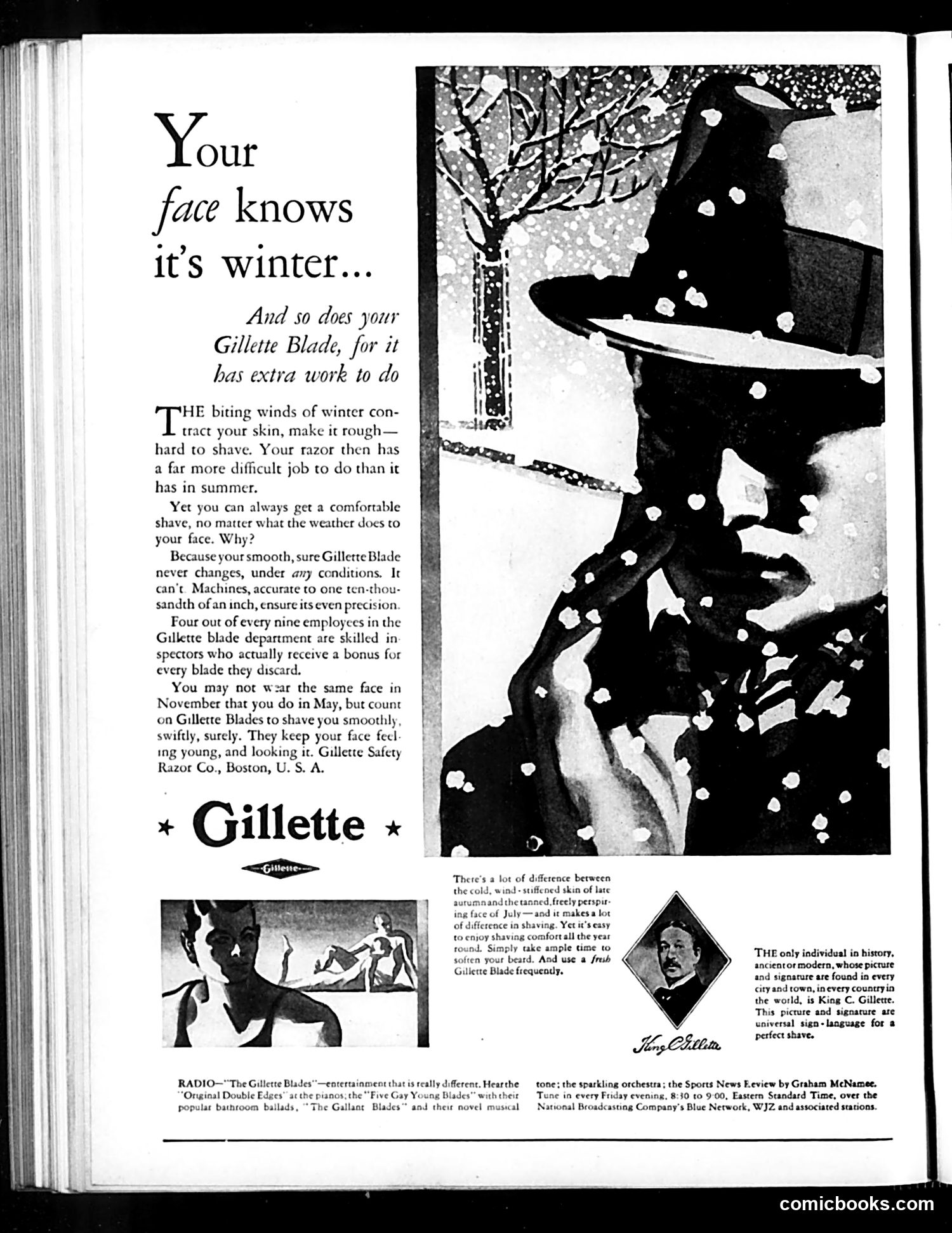
Analysis This page is primarily a Gillette razor advertisement, not political satire. The large illustration shows a winter figure (Santa Claus or a snow-covered person) demonstrating that shaving remains necessary even in harsh winter conditions when facial skin becomes rough and difficult to shave. The ad's humor relies on a practical joke: winter weather makes shaving harder, yet Gillette blades supposedly maintain consistent quality "under any conditions." The copy emphasizes that Gillette employees are "skilled inspectors" who bonus-check every blade for precision. The small illustrations at bottom appear to be unrelated entertainment advertisements (radio programming and what may be theatrical content). This is a commercial product page with mild comedic appeal, not political commentary.
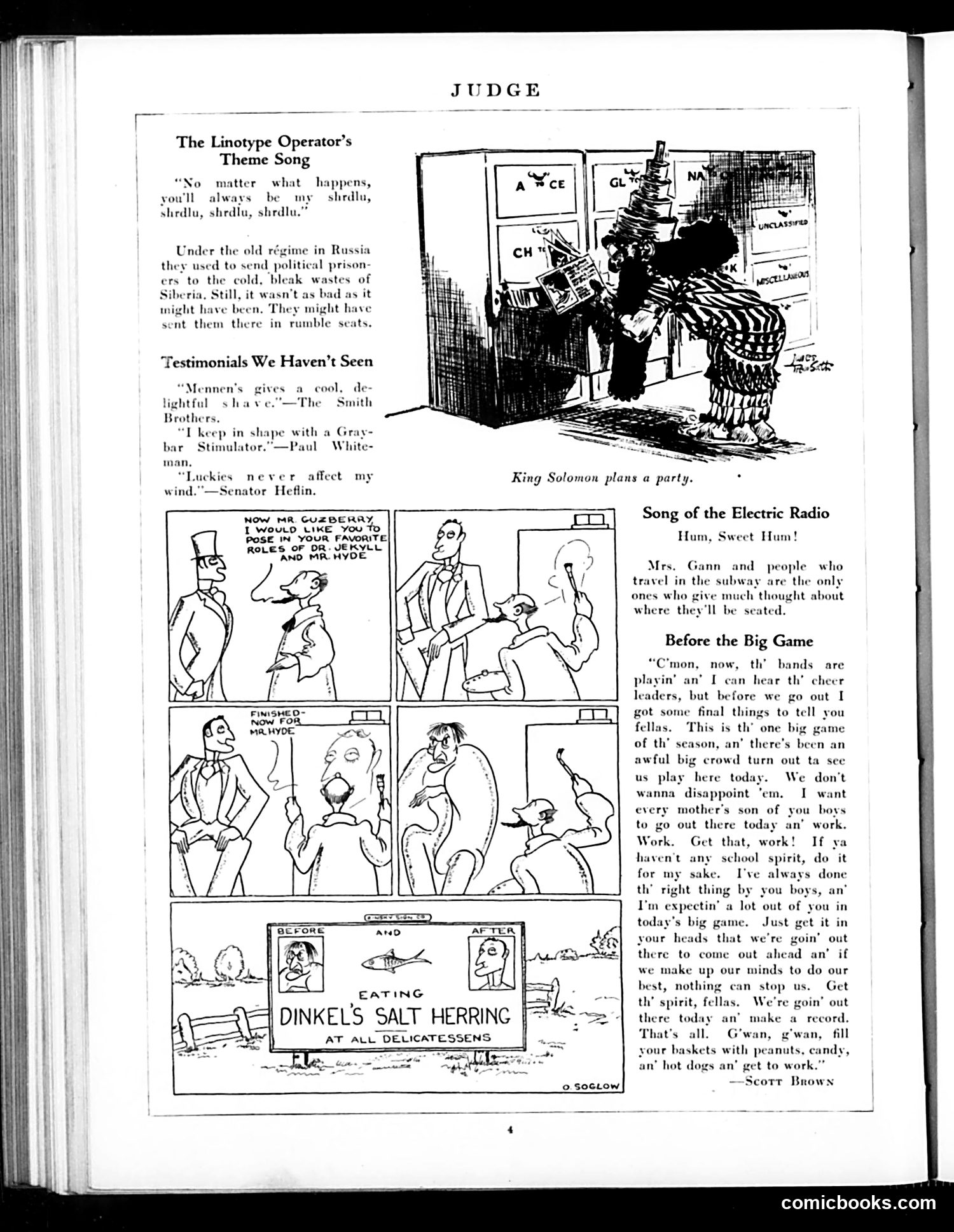
Analysis of Judge Page This page contains several distinct pieces of satire: Top cartoon ("King Solomon plans a party"): Depicts what appears to be a figure labeled with chemistry/scientific references (ACE, GLUE, CH) attempting to organize supplies—likely satirizing attempts at chemical or scientific management during the early 20th century. Comic strip ("Mr. Guzberry"): Shows a man being asked to pose in "favorite roles of eminent actors." The humor comes from his transformations—he adopts increasingly exaggerated poses, ending as a fish, mocking pretension and theatrical vanity. Advertisement: Dinkel's Salt Herring ad uses before-and-after imagery (showing a man's transformation after eating the product) to humorously promote the food product. The overall tone reflects Judge's satirical approach to contemporary social pretensions and commercial culture.
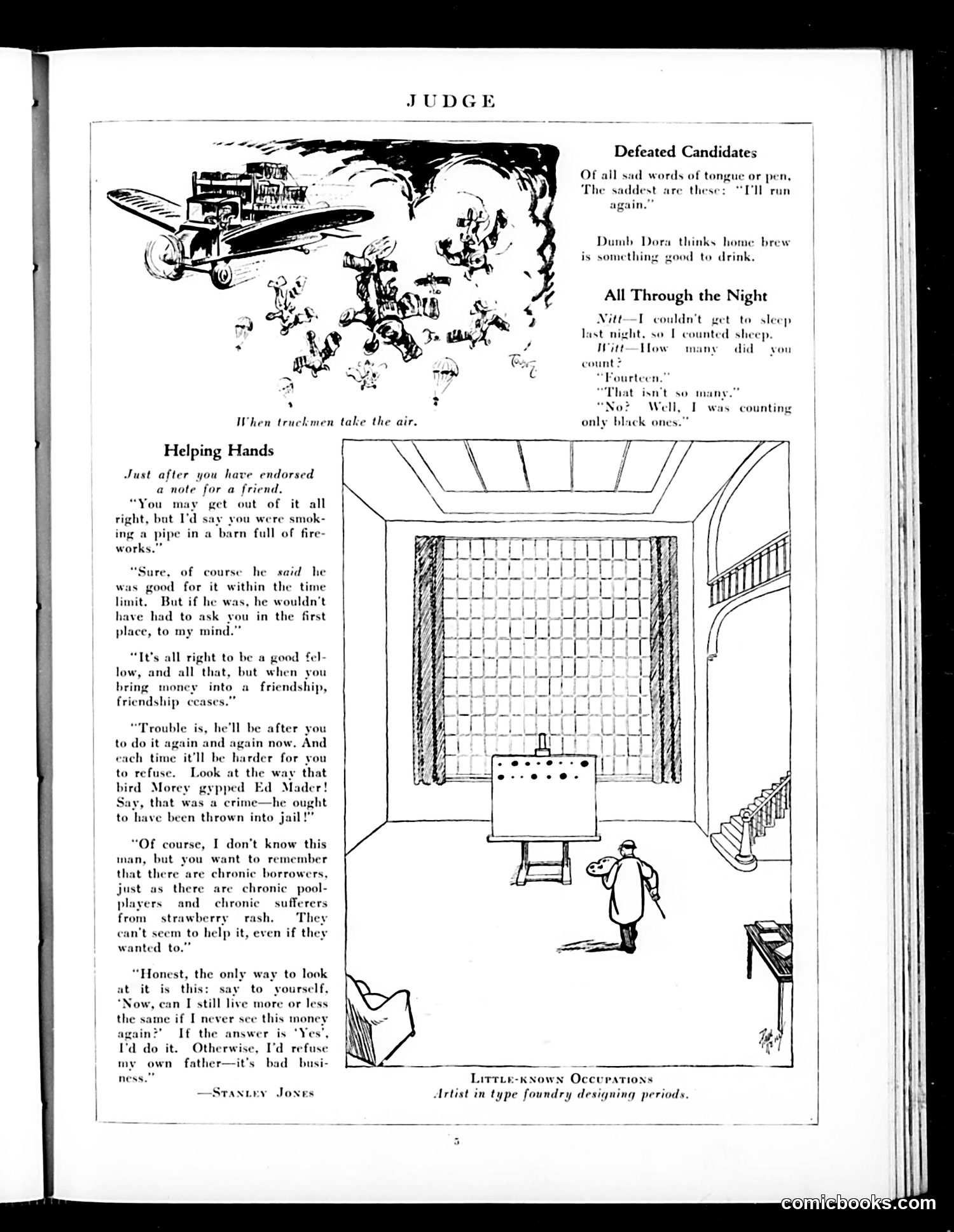
Analysis of Judge Magazine Page This page contains three separate humorous pieces rather than unified political cartoons: 1. "When Truckmen Take the Air": A cartoon showing an airplane dropping cargo/packages, satirizing early aviation and commercial transport logistics—likely referencing the novelty of air freight. 2. "Helping Hands": A satirical dialogue by Stanley Jones about endorsing a friend's loan application. The humor concerns chronic borrowers and the social obligation/danger of financial entanglement with friends. The conclusion—"say to yourself, 'Now, can I still live more or less the same if I never see this money again?'"—mocks the risk of lending to unreliable people. 3. "Little-Known Occupations": A small illustration of an artist in a type foundry designing letterforms, depicting an obscure profession. The page emphasizes social satire over politics, targeting everyday behavioral follies.
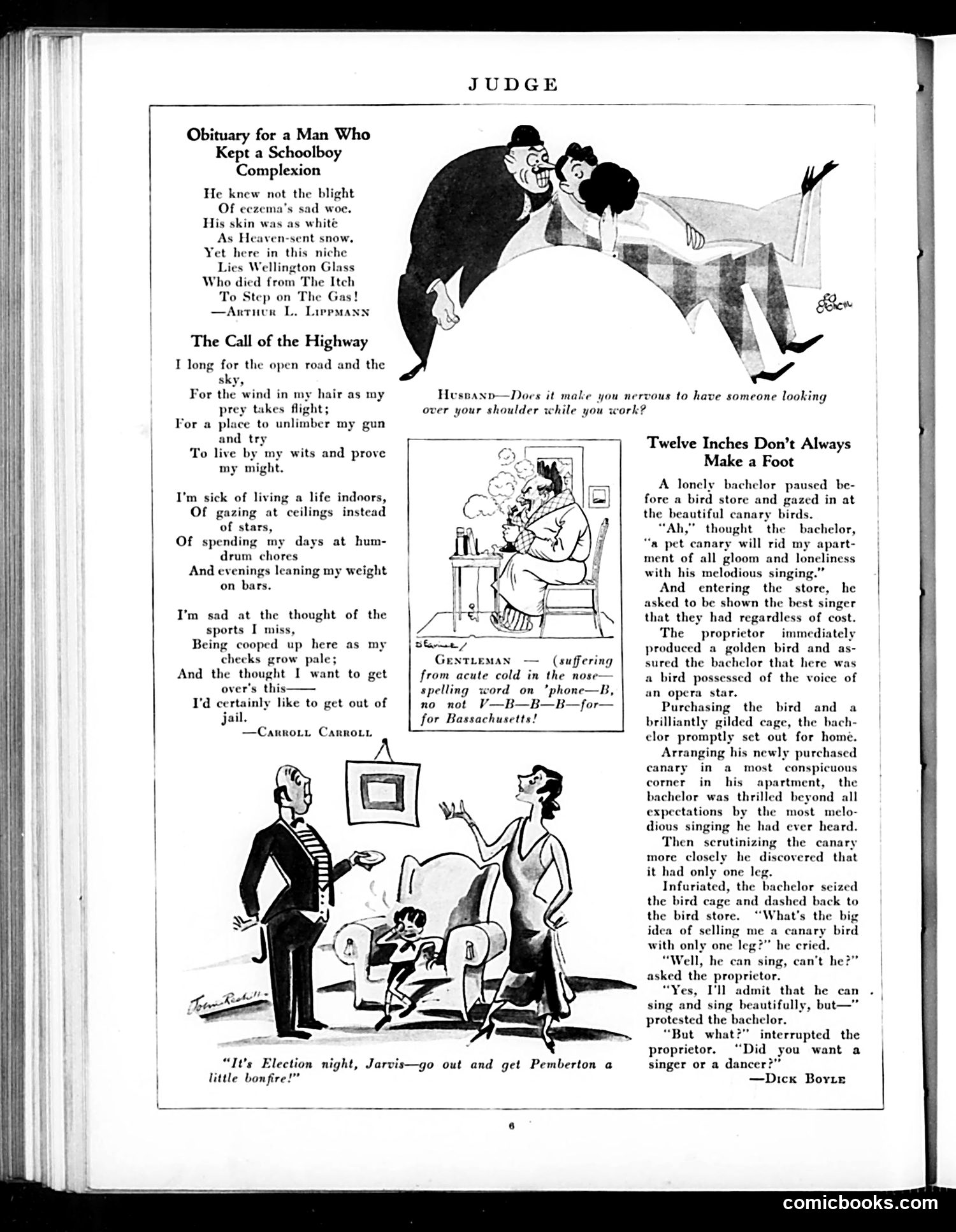
Analysis of Judge Magazine Page This page contains three distinct pieces of humor: 1. "Obituary for a Man Who Kept a Schoolboy Complexion" — A satirical poem mocking men obsessed with youthful appearance, suggesting vanity about skin care is ridiculous. 2. "The Call of the Highway" — A poem by Carroll Carroll expressing wanderlust and desire to escape domestic indoor life, humorously listing complaints about staying home (gazing at ceilings, spending on humble clothes, leaning weight on bars). 3. "Twelve Inches Don't Always Make a Foot" — A humorous story by Dick Boyle about a bachelor purchasing a canary bird marketed as a great singer, only to discover it's missing a leg. The proprietor's response—asking if he wanted a "singer or a dancer"—is the punchline, playing on the word "foot" (measuring unit versus body part). All pieces use wordplay and absurdist humor typical of early 20th-century satirical magazines.
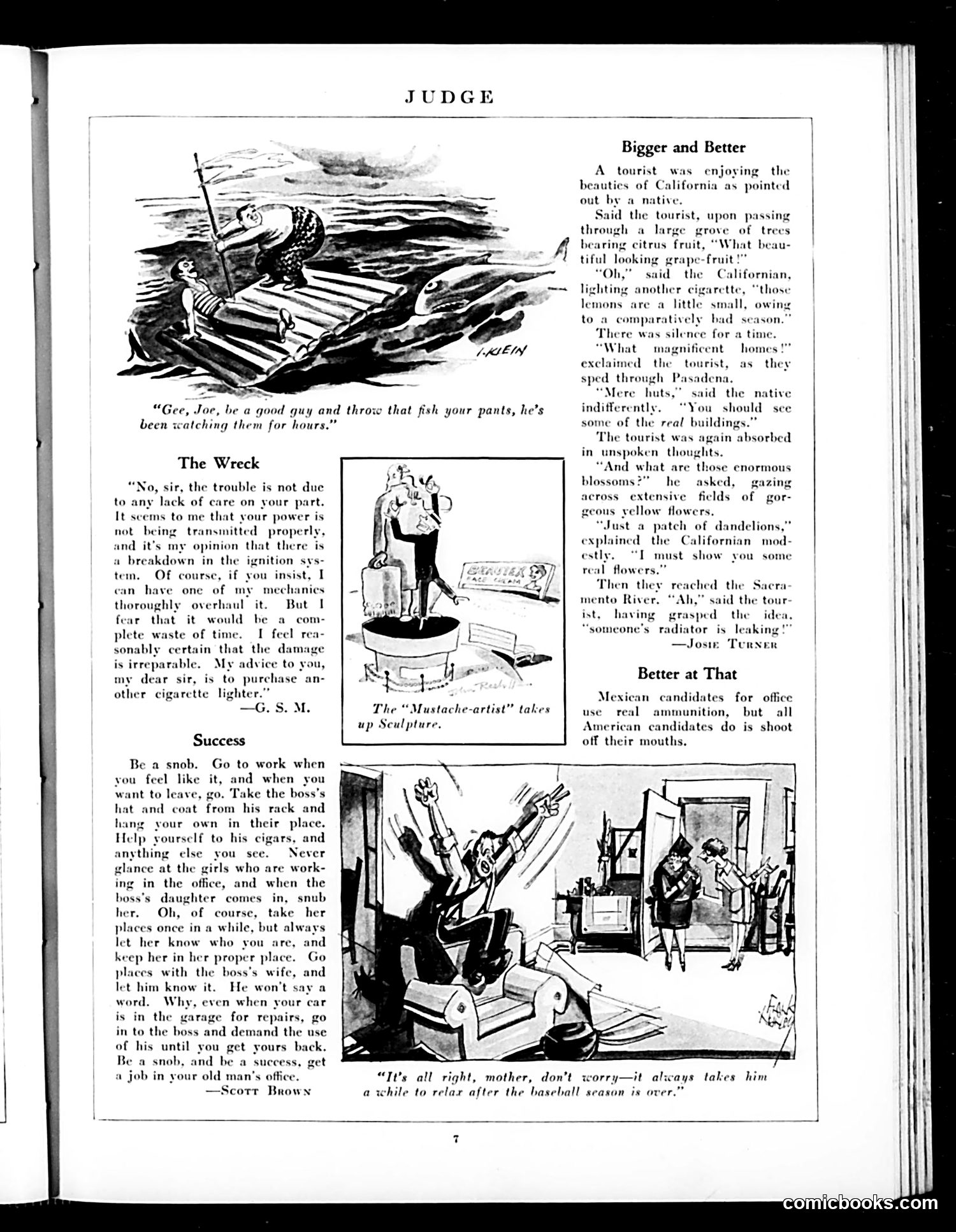
Judge Magazine Page Analysis This page contains several short humorous pieces typical of Judge's satirical style: "The Wreck" mocks overly technical auto mechanics who diagnose problems in jargon-filled language, then recommend an expensive solution (a new cigarette lighter) when the actual issue is simple. "Success" satirizes social climbing through nepotism—advice to be deliberately rude and presumptuous to everyone at work, including the boss, his wife, and daughter, while exploiting company resources. The joke is that such arrogance supposedly leads to success only if your father owns the business. "Bigger and Better" ridicules California boosters who exaggerate or misrepresent ordinary sights as magnificent. A native guide dismisses impressive scenery (citrus groves, Pasadena homes, wildflowers, the Sacramento River) as mediocre, implying California promoters constantly oversell their state. "Better at That" compares Mexican and American political candidates—Mexican candidates use "real ammunition" (actual violence), while Americans merely engage in rhetorical excess ("shoot off their mouths"). The cartoons are light social commentary on American business culture, regional boosterism, and politics.
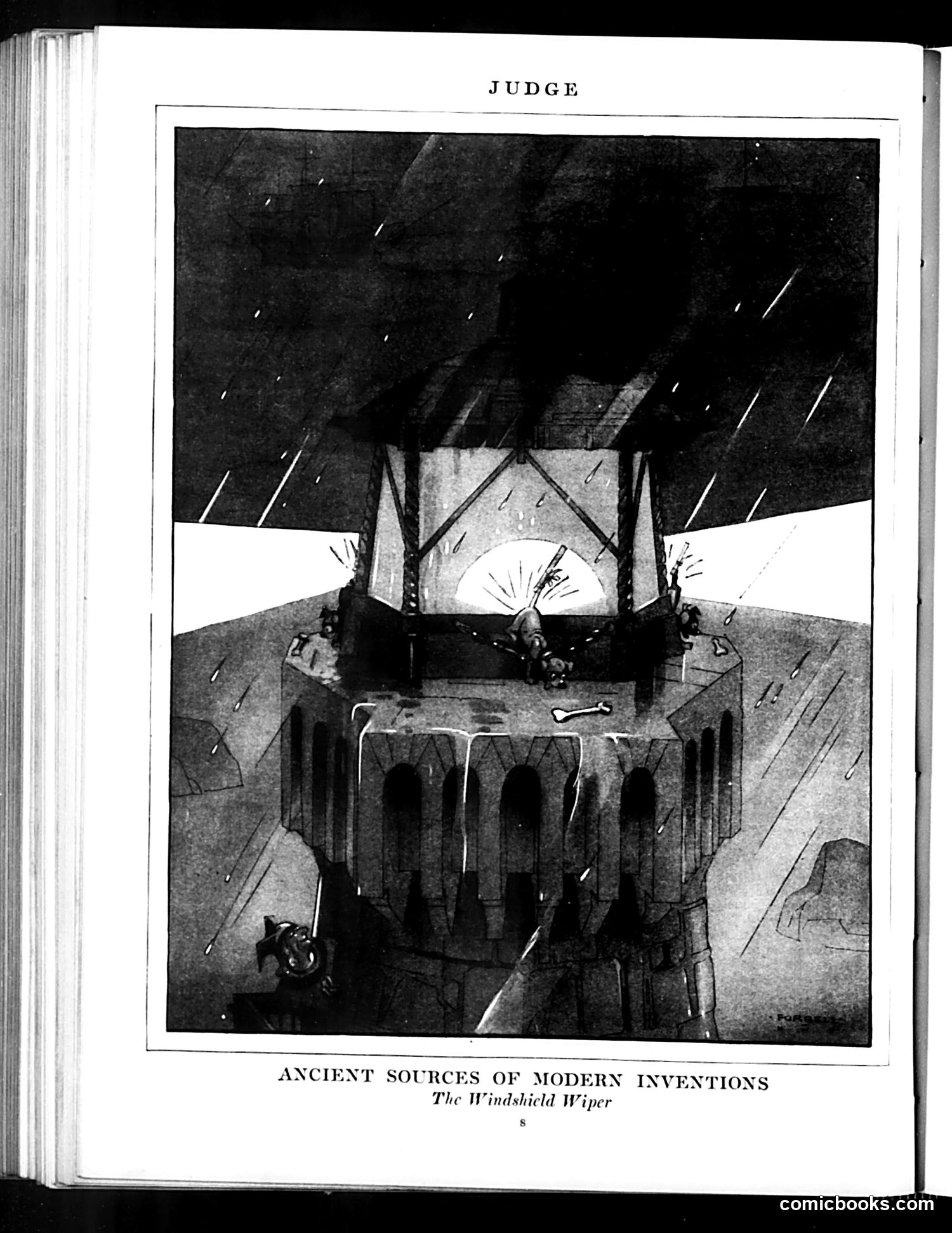
Analysis This page from *Judge* magazine presents "Ancient Sources of Modern Inventions: The Windshield Wiper." The illustration shows a Gothic cathedral or church interior during a rainstorm, with figures using what appear to be primitive wiping implements (possibly branches or cloths on poles) to clear water from a large window or opening. The cartoon humorously suggests that the modern windshield wiper—a relatively recent automobile innovation—has ancient precedent in medieval religious architecture, where clergy or caretakers would have needed to clear rain from large windows. The satire likely mocks either: (1) the tendency to claim "new" inventions have ancient origins, or (2) the idea that modern technology simply rediscovers forgotten old methods. The joke plays on the incongruity between sacred medieval spaces and mundane automotive needs.
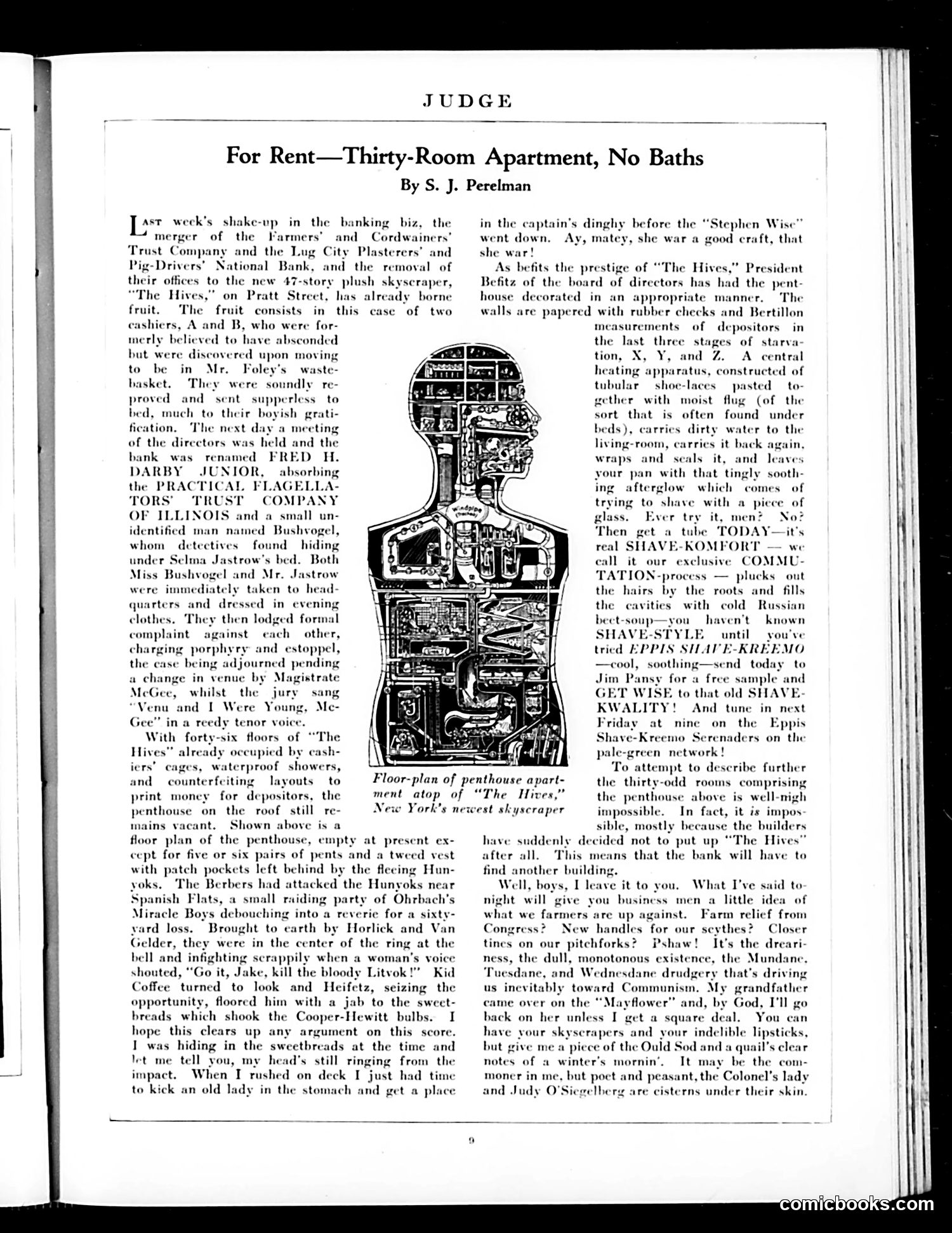
Explaining "For Rent—Thirty-Room Apartment, No Baths" This is a satirical short story by S. J. Perelman (a famous humorist) rather than a political cartoon. The piece mocks the banking industry through absurdist humor and nonsense. The story describes a chaotic bank merger involving "The Hives," a new skyscraper, where incompetent management creates farcical situations. The "floor-plan" diagram of a human head is a visual joke—showing the building's penthouse layout superimposed on anatomy, likely satirizing how bankers are "empty-headed." The narrative deliberately becomes increasingly incoherent, mixing unrelated incidents (Spanish Flats, Berbers, obscure characters) to parody overwrought financial reporting and bureaucratic absurdity. Embedded throughout are fake advertisements for products like "Shave-Komfort," a running gag mocking contemporary radio advertising's intrusion into editorial content. The overall target: the era's banking establishment, their pretension, incompetence, and the chaotic consolidation trends reshaping American finance in the early 20th century.
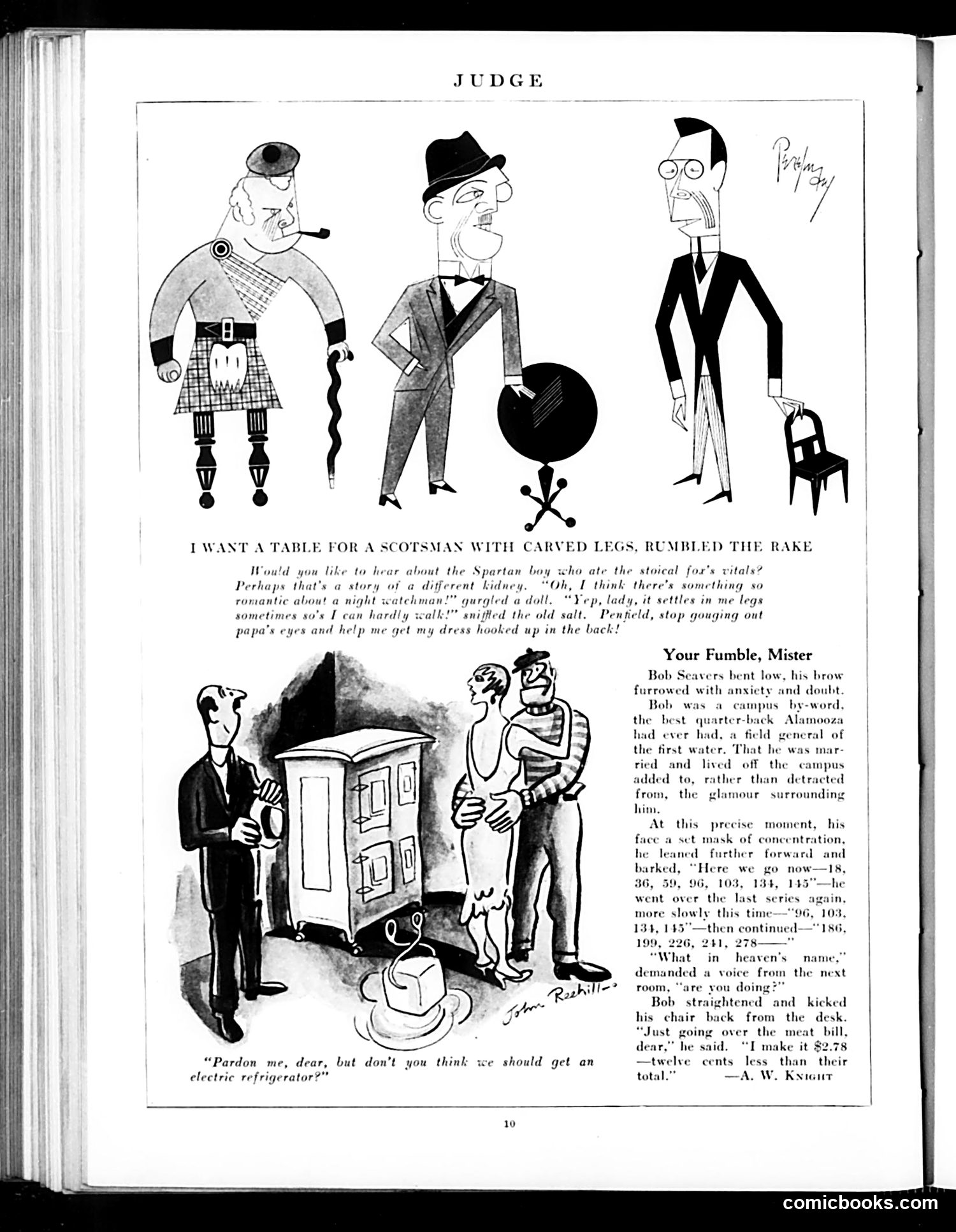
Judge Magazine Page Analysis This page contains two separate pieces of satirical humor typical of early 20th-century American magazines. Top Section: Three caricatured male figures illustrate exaggerated Scottish and working-class stereotypes. The caption mocks affected romantic speech—a waiter or customer requesting furniture "for a Scotsman with carved legs" (playing on the phrase "carved legs"). The dialogue snippets parody sentimental romanticization of working-class life: sailors, night watchmen, and soldiers described in overly flowery terms by society women, contrasting absurdly with the men's crude reality ("settles in me legs"). Bottom Section ("Your Fumble, Mister"): Bob Seavers, a campus "by-word" and football player living off-campus with his wife, frantically recalculates household accounts. His wife asks about purchasing an electric refrigerator; Bob deflects by claiming he can cut the meat bill by twelve cents instead. The joke satirizes the tension between wives wanting modern conveniences and husbands' resistance to spending, reflecting 1920s consumer culture anxieties.
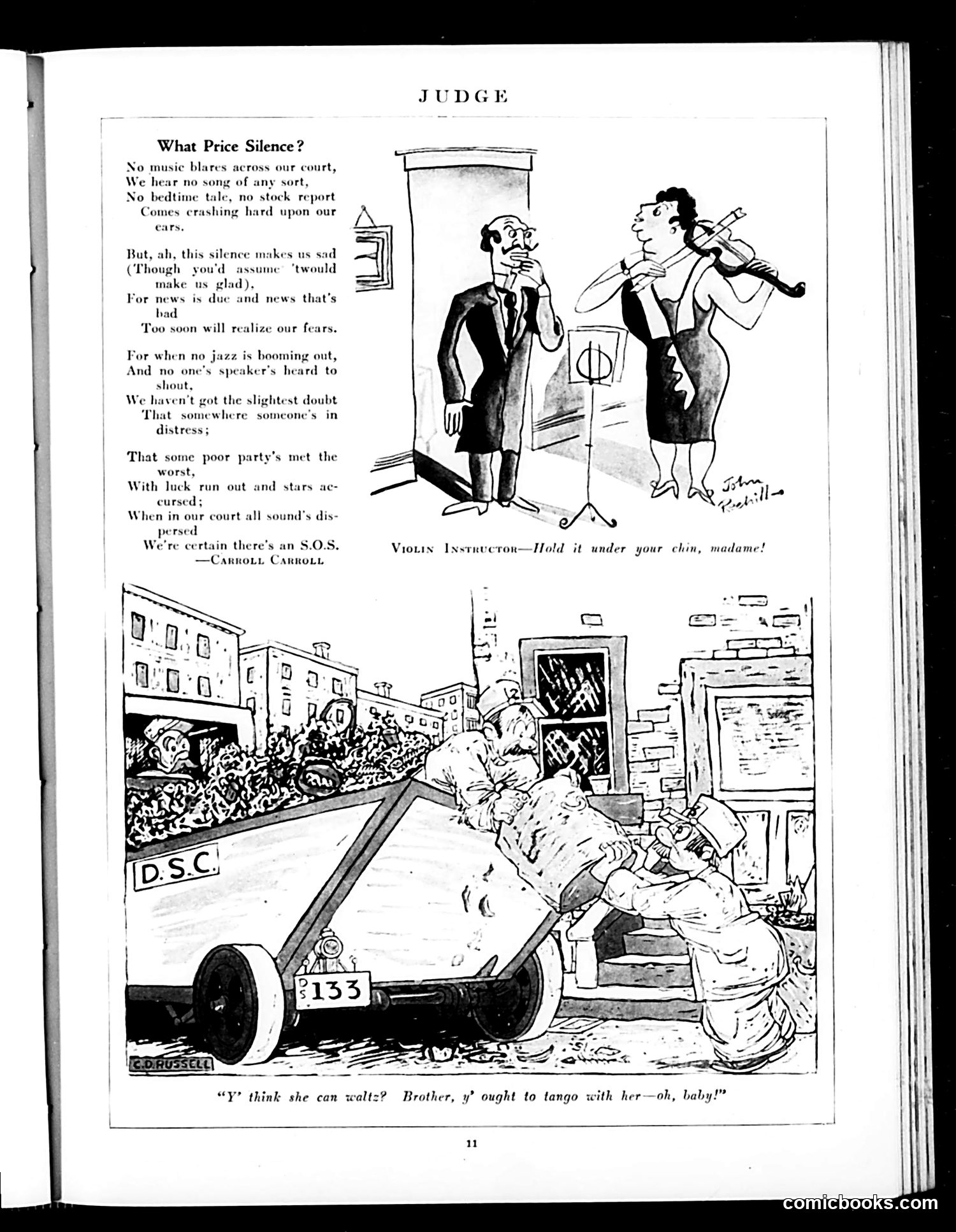
Analysis of Judge Magazine Page Top Cartoon: A violin instructor demonstrates proper posture to a female student. The humor is straightforward physical comedy—the instructor's exaggerated concern about chin placement contrasts with the student's casual, flirtatious demeanor. Bottom Cartoon: This depicts a street scene with a large mechanical device (numbered 133) labeled "D.S.C." (likely a street-cleaning apparatus). Two workers operate it while crowds watch from windows above. The caption references "waltzing" and "tangoing," suggesting the machine's awkward movements resemble dancing. "What Price Silence?" Poem: Written by Carroll Carroll, this reflects post-WWI anxiety about radio silence. The poem suggests that absence of news broadcasts and radio signals indicated disaster or distress—possibly referencing the era's growing dependence on wireless communication and radio as primary news sources. The "S.O.S." reference emphasizes emergency. The page satirizes modern life's noise and communication dependence, suggesting that silence itself has become ominous rather than peaceful.
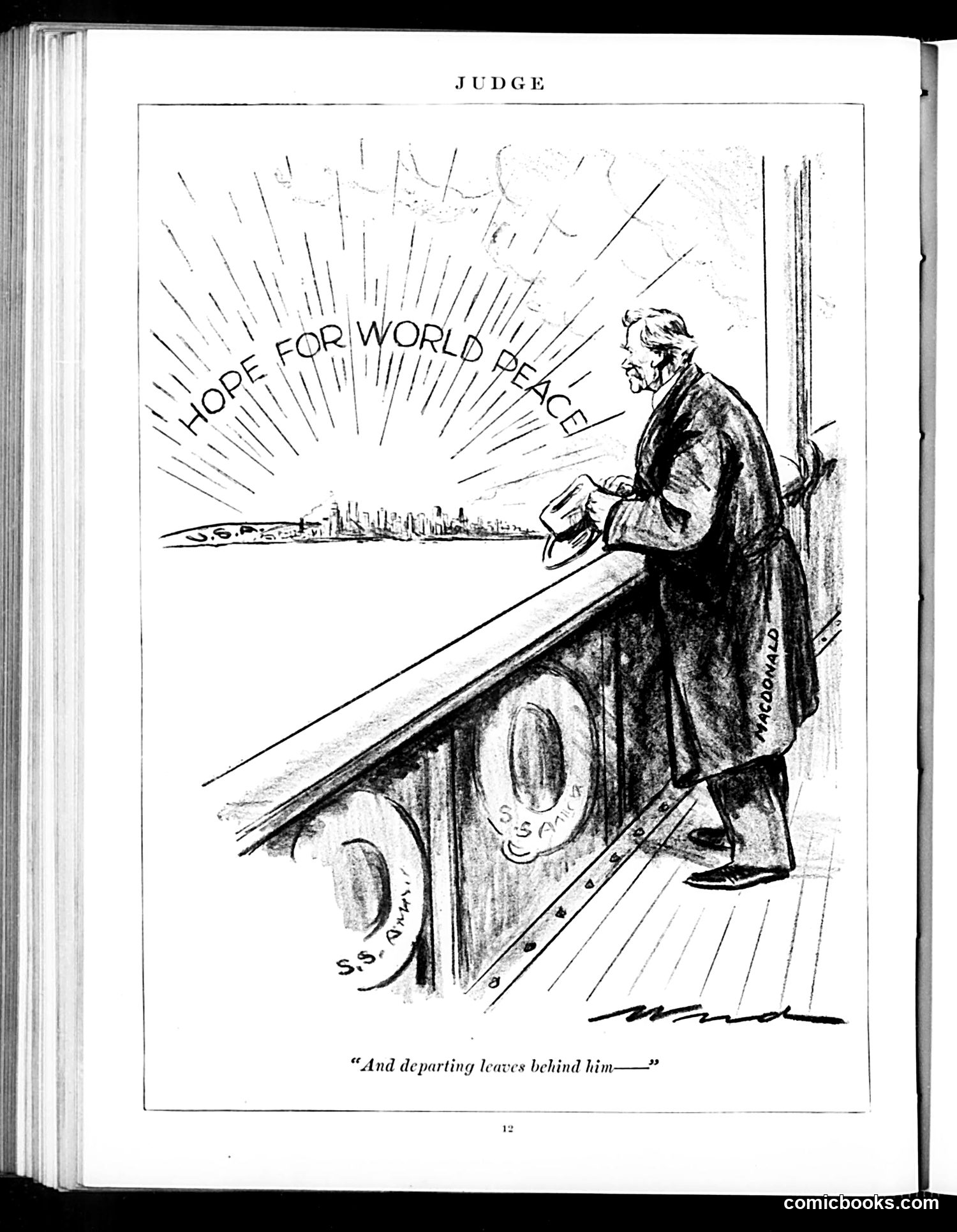
Political Cartoon Analysis This Judge magazine cartoon depicts a judge or judicial figure standing on a ship labeled "S.S. Quad" (unclear exact reference), gazing toward a distant cityscape. Above radiates the text "HOPE FOR WORLD PEACE." The caption reads: "And departing leaves behind him——" The satire appears to comment on judicial authority and its role—or limitations—in achieving world peace. The figure's contemplative pose and the incomplete caption suggest irony: what does this departing judge actually leave behind? The image implies skepticism about whether the legal system or a specific judicial figure can realistically deliver on such lofty aspirations. The specific judge, ship name, and historical context remain unclear without additional documentation, but the cartoon's tone is decidedly cynical about the efficacy of legal institutions in solving global conflict.
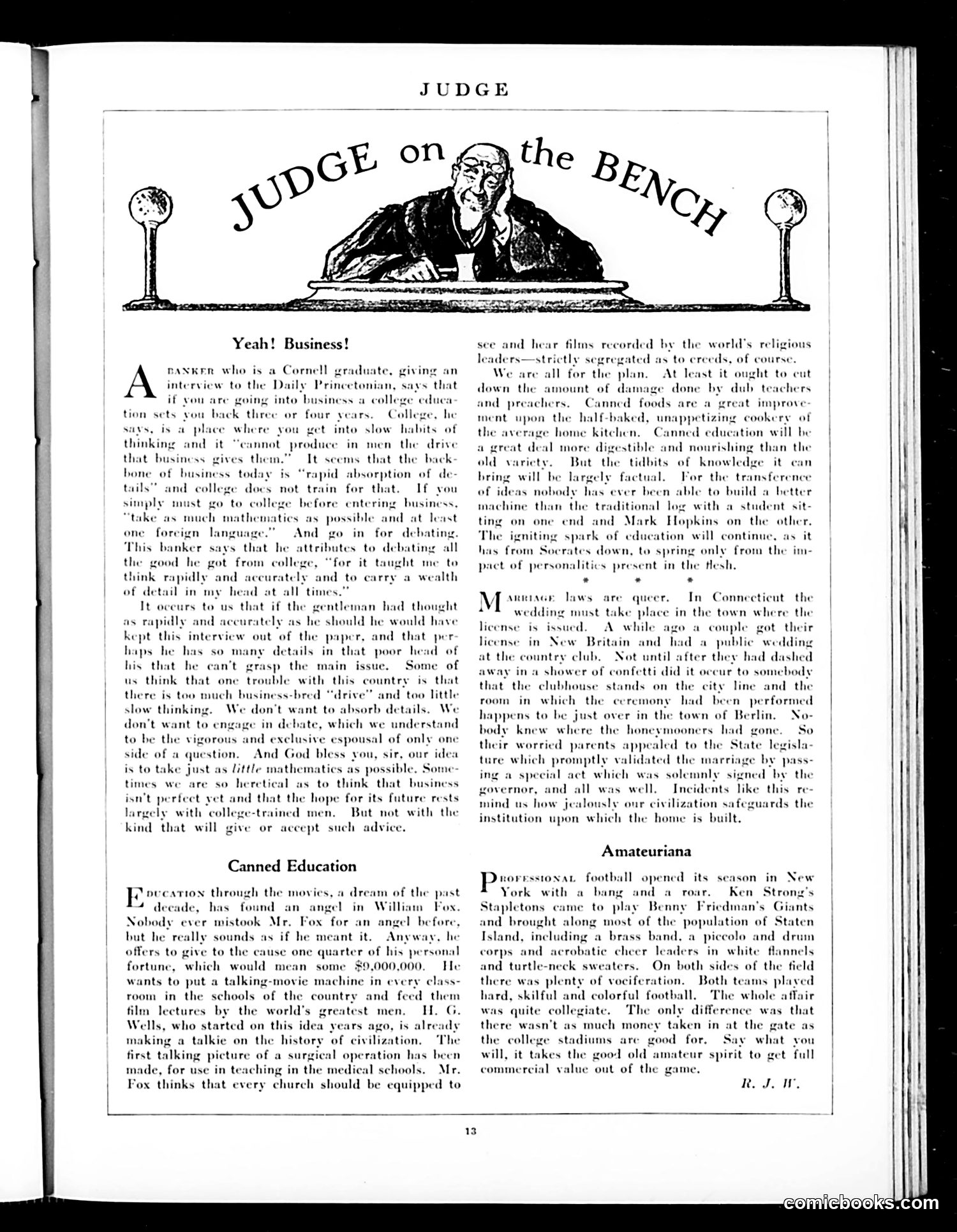
What This Page Means This is a editorial/opinion page from *Judge* magazine featuring three satirical columns attacking conventional wisdom. "Yeah! Business!" mocks a Cornell banker who claims college education hampers business success, advocating instead for mathematics and debate skills. The *Judge* editors sarcastically counter that the nation's real problem is *too much* business-driven "rapid absorption of details" and *too little* thoughtful reflection—the banker's own poorly reasoned interview being exhibit A. "Canned Education" ridicules William Fox's plan to install talking-movie machines in schools and churches, showing lectures by great minds. While praising the idea's potential to reduce bad teaching, the editors argue that education—unlike canned food—requires personal human connection. The famous reference to "Mark Hopkins on one end of a log" suggests authentic teaching cannot be mechanized. "Marriage Laws are Queer" briefly satirizes Connecticut's marriage licensing rules through an anecdote of a couple whose ceremony technically occurred in the wrong town, creating bureaucratic confusion. The page's tone is intellectually snobbish, defending educational depth and human relationships against modern efficiency-focused thinking.
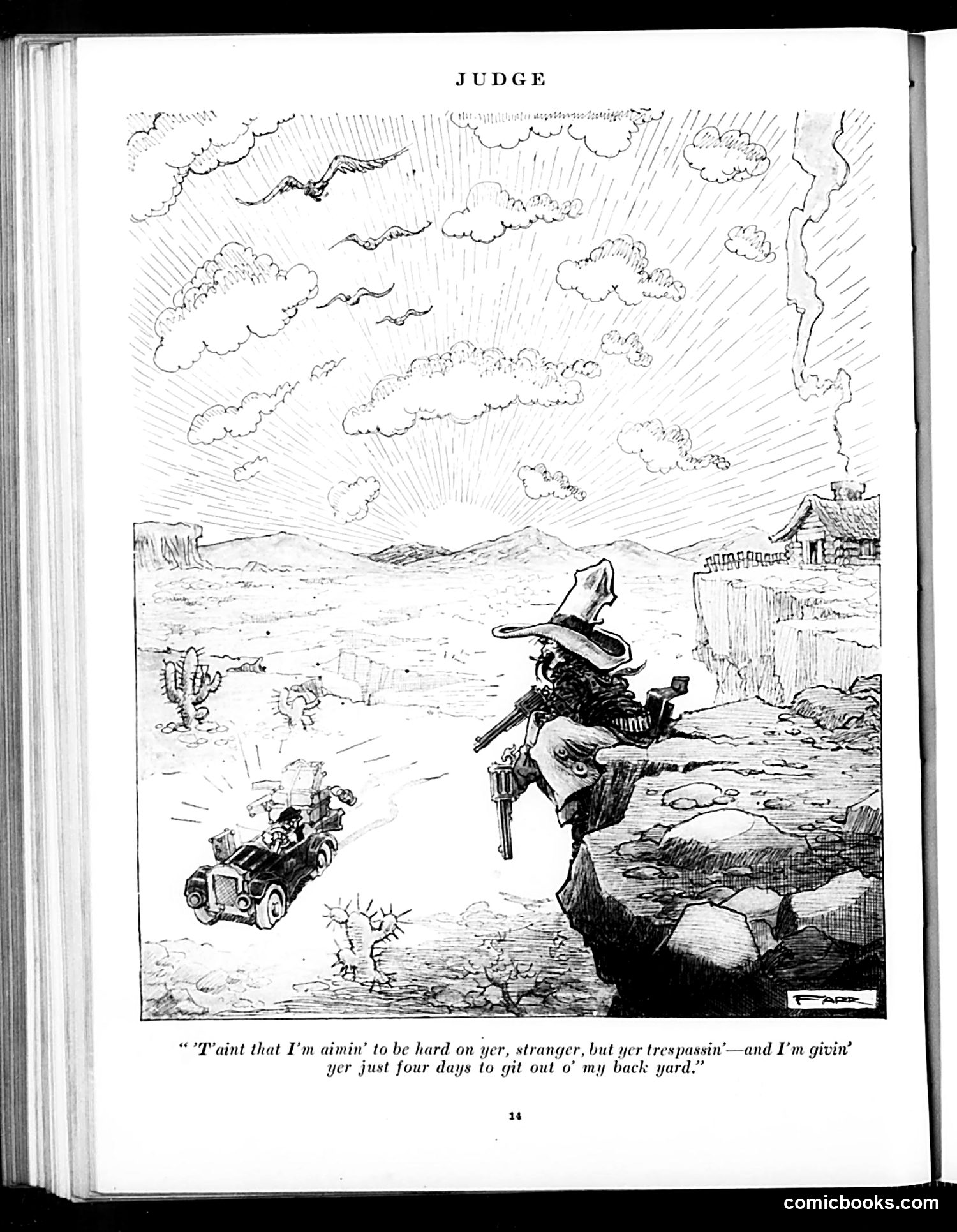
Analysis This is a single-panel Western cartoon from *Judge* magazine. It depicts a confrontation between an armed cowboy/rancher and a trespasser in a desert landscape with a homestead visible. The humor derives from the cowboy's contradictory stance: he claims he's "not aiming' to be hard" on the stranger, yet he's brandishing a revolver and giving an ultimatum to leave within four days. This is classic satirical understatement—the threat is delivered in folksy, almost apologetic language that masks aggressive hostility. The cartoon likely satirizes American frontier attitudes toward property rights and hospitality, or perhaps reflects broader social tensions about trespassing and territorial disputes. The exaggerated politeness masking genuine menace creates the comedic effect.
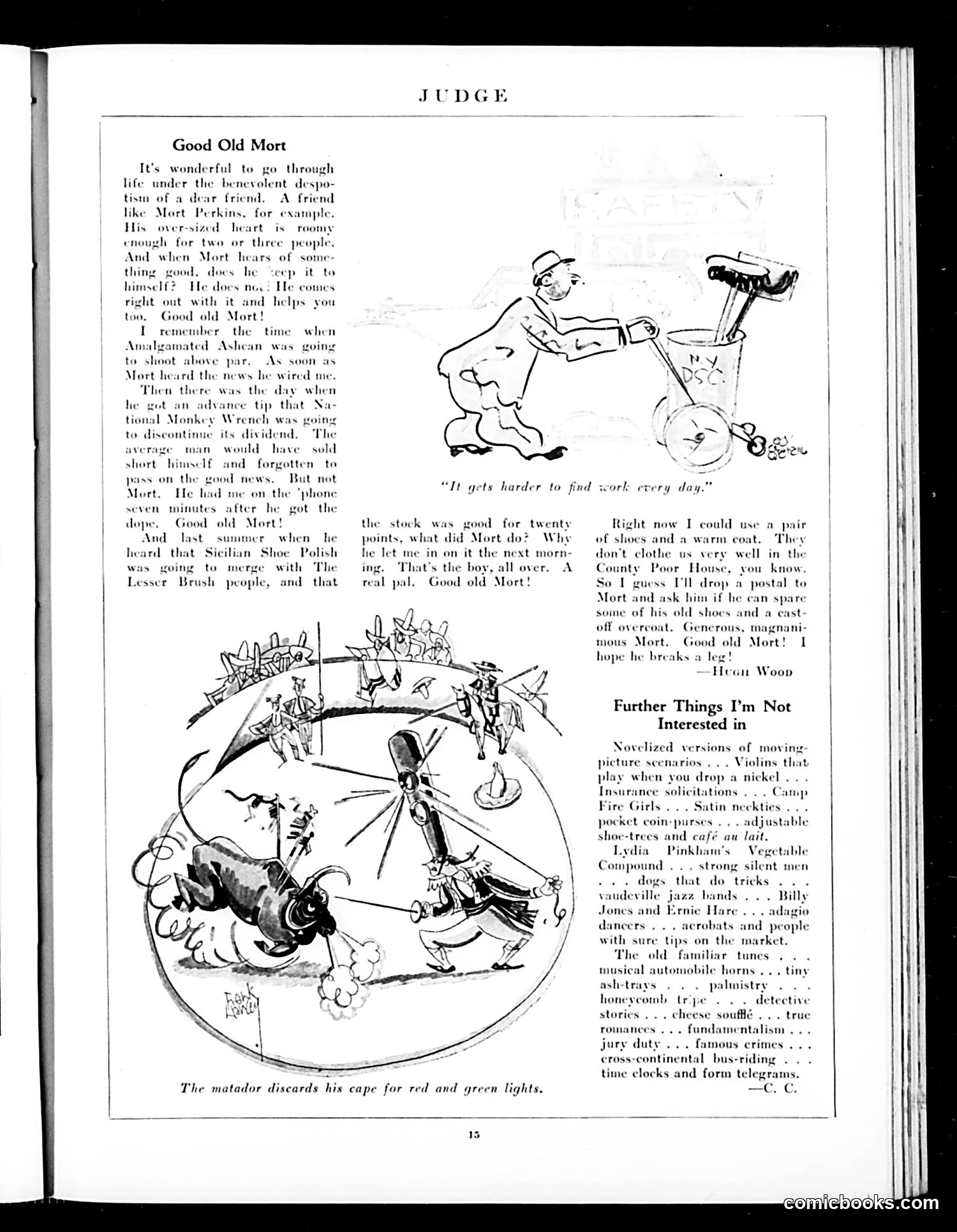
Analysis of "Good Old Mort" Page from Judge This page satirizes a particular social type: the "generous friend" who uses insider stock tips as a form of self-aggrandizement. The article mocks Mort Perkins, who prominently shares financial information (tips about Amalgamated Ashcan stock, National Monkey Wrench dividends) not from genuine kindness but to position himself as important and well-connected. The satire's payoff appears in the final section: the narrator reveals Mort's selfishness by noting he won't help with actual need (shoes, warm coat for the County Poor House), only with profitable gossip. The cartoons illustrate Mort's bumbling nature—one shows him struggling with tools, the other depicts chaotic street activity. The accompanying "Further Things I'm Not Interested in" is unrelated satirical list-humor typical of Judge's format. The piece critiques 1920s-era financial speculation culture and the performance of generosity among the comfortable classes.
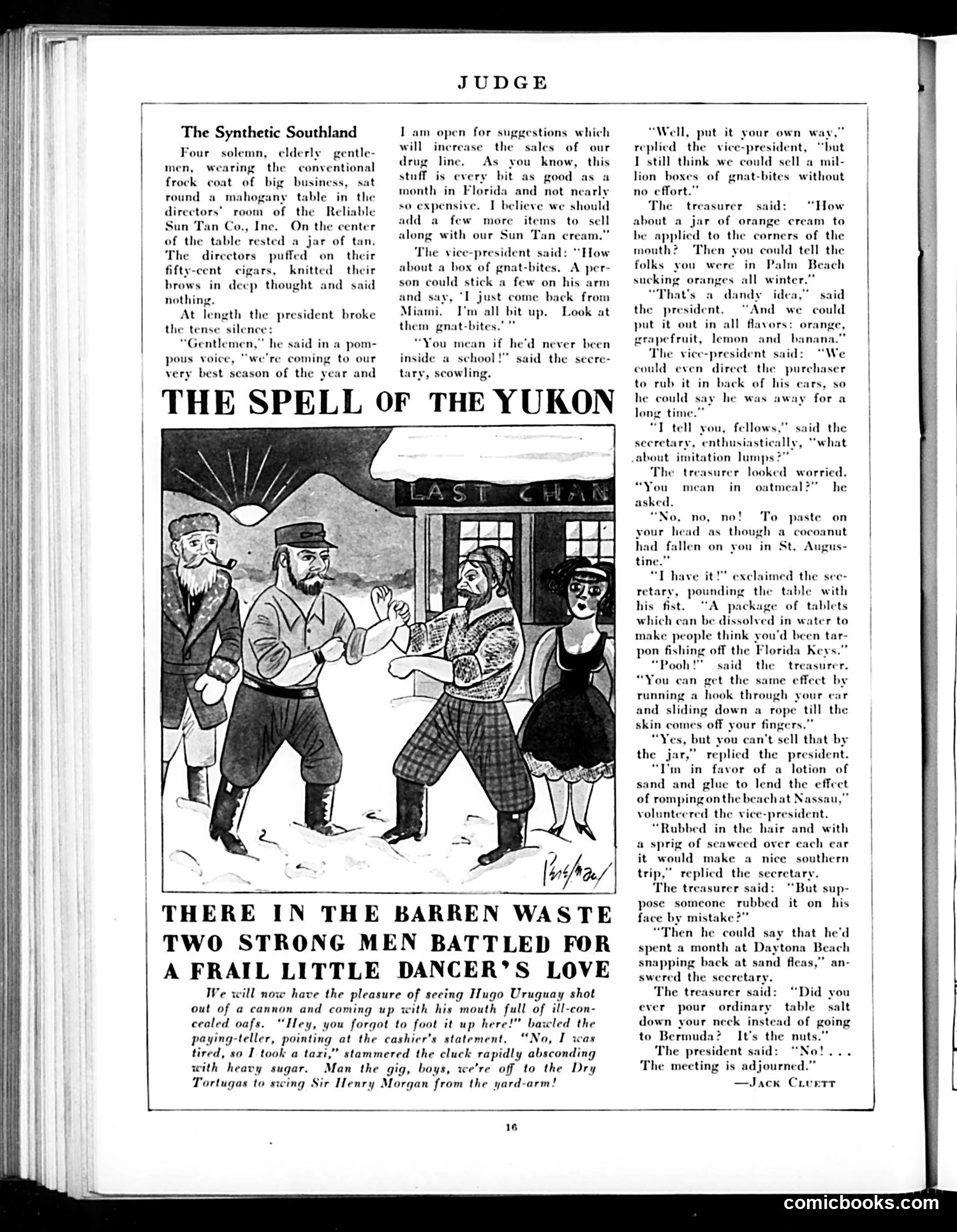
"The Synthetic Southland" Satire Explanation This page satirizes early 20th-century marketing deception and the commodification of leisure. A group of businessmen at "Rel Sun Tan Co., Inc." scheme to sell fake "tanning" products by marketing them as substitutes for expensive Florida vacations. The satire targets: 1. False advertising: Marketing artificial tan cream as equivalent to actual beach time 2. Consumer fraud: Absurd schemes like gnat-bite stickers, "imitation lumps," and sand-glue lotions to simulate vacation experiences 3. Class exploitation: Selling poor people the *illusion* of luxury travel they cannot afford The joke is that these executives propose increasingly ridiculous fake "evidence" (fake insect bites, seaweed accessories) to convince buyers they've vacationed in Florida—when anyone rubbing sand on their neck would obviously be foolish. The satire mocks both the manufacturers' cynicism and the assumed gullibility of consumers. The "Spell of the Yukon" below appears unrelated—likely a separate story.
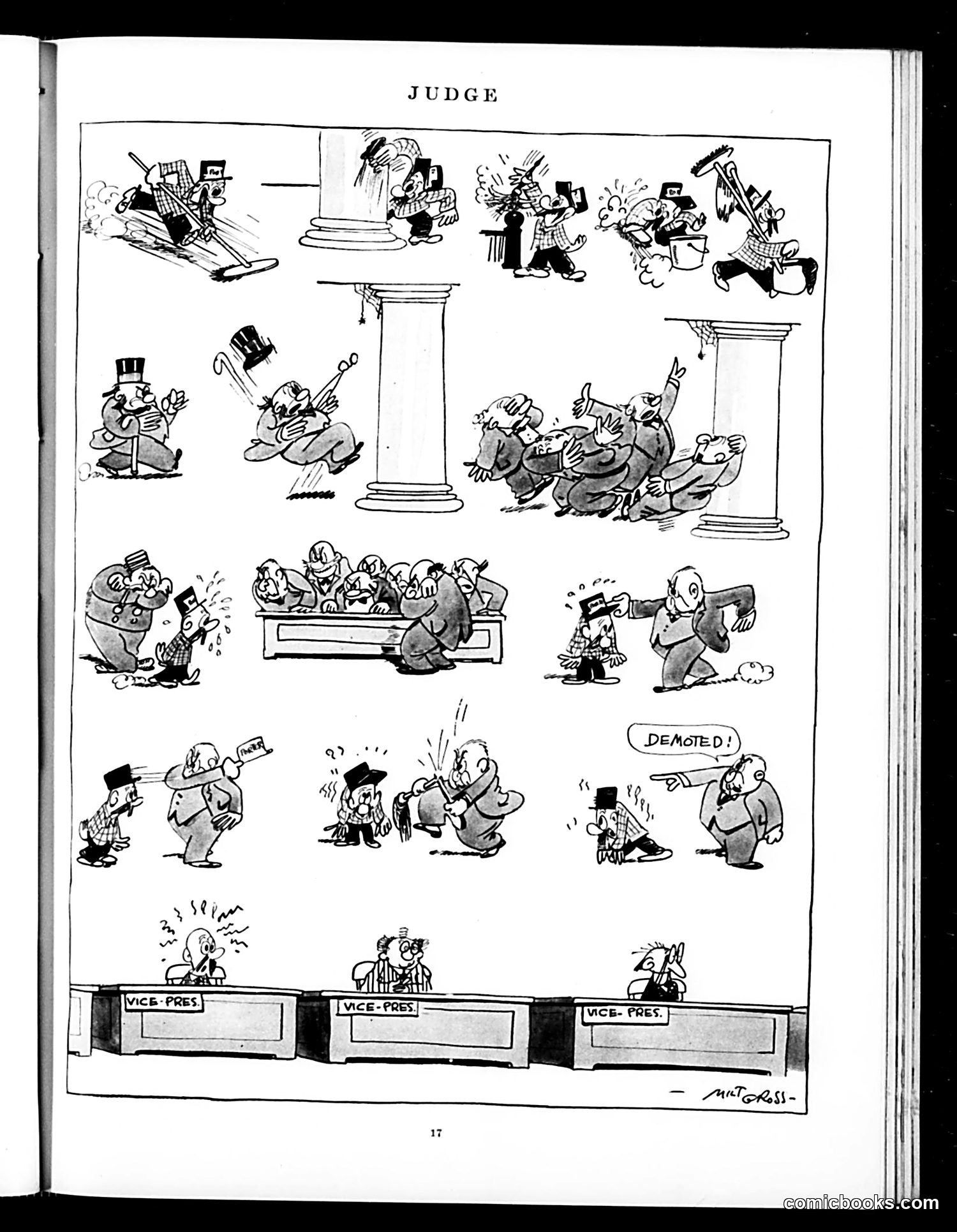
Judge Magazine: "Judge" Political Cartoon This page is a satirical cartoon commentary on the judicial system, specifically critiquing judicial authority and courtroom dynamics. The central image shows judge's benches with "VICE-PRES." labels, suggesting commentary on vice-presidential or high judicial figures. The surrounding vignettes depict various courtroom chaos scenarios—figures arguing, fighting, and displaying disorder before judicial authority figures. One panel explicitly reads "DEMOTED!" indicating consequences for misbehavior. The overall message appears to satirize the ineffectiveness or corruption of judges in maintaining courtroom order, or possibly critiques how judicial authority is wielded—showing judges unable or unwilling to control chaos, or conversely, abusing their power. The cartoonist (signature appears to be "Matross") uses exaggerated physical comedy to mock judicial incompetence or abuse. Without dating information visible, the specific scandal or incident referenced remains unclear.
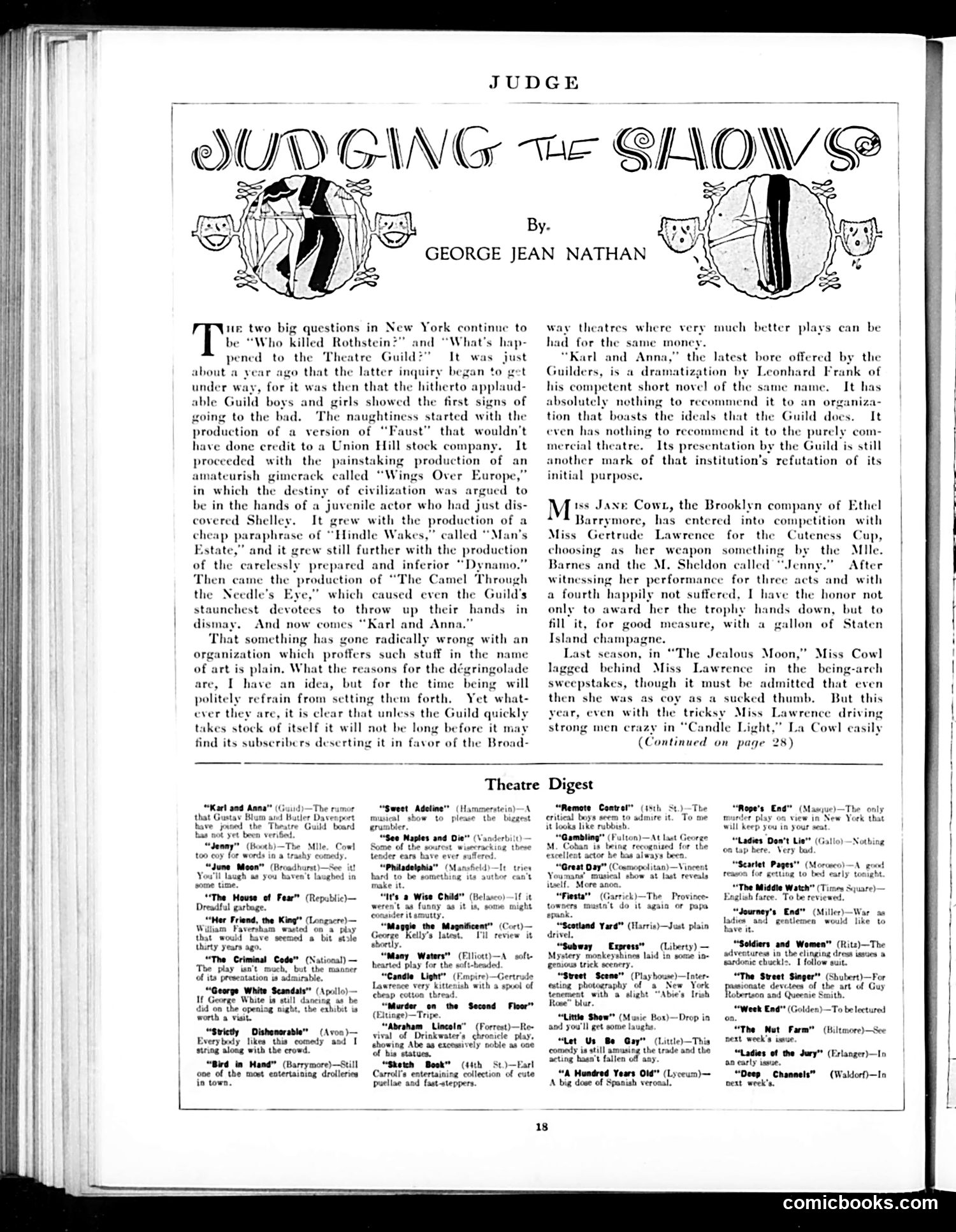
"Judging the Shows" by George Jean Nathan This is a theater criticism column, not a political cartoon. Nathan critiques New York theater productions, focusing on the Theatre Guild's declining quality. He sarcastically mocks their recent productions—"Wings Over Europe," "Karl and Anna," and others—suggesting they've abandoned their artistic mission to offer intellectually serious drama. The core complaint: the Guild now stages mediocre plays that could be seen in cheaper theaters, yet subscribers pay premium prices. Nathan suggests the organization has lost its way, producing amateurish work ("careless," "inferior") instead of maintaining standards. He also reviews individual performances, notably praising Jane Cowl's comedic timing while noting her occasional overacting ("strong men crazy in 'Candle Light'"). The "Theatre Digest" section provides brief capsule reviews of various Broadway shows, rating them for contemporary audiences. This reflects 1920s theater criticism and the debate over artistic integrity versus commercial success in institutional theater.
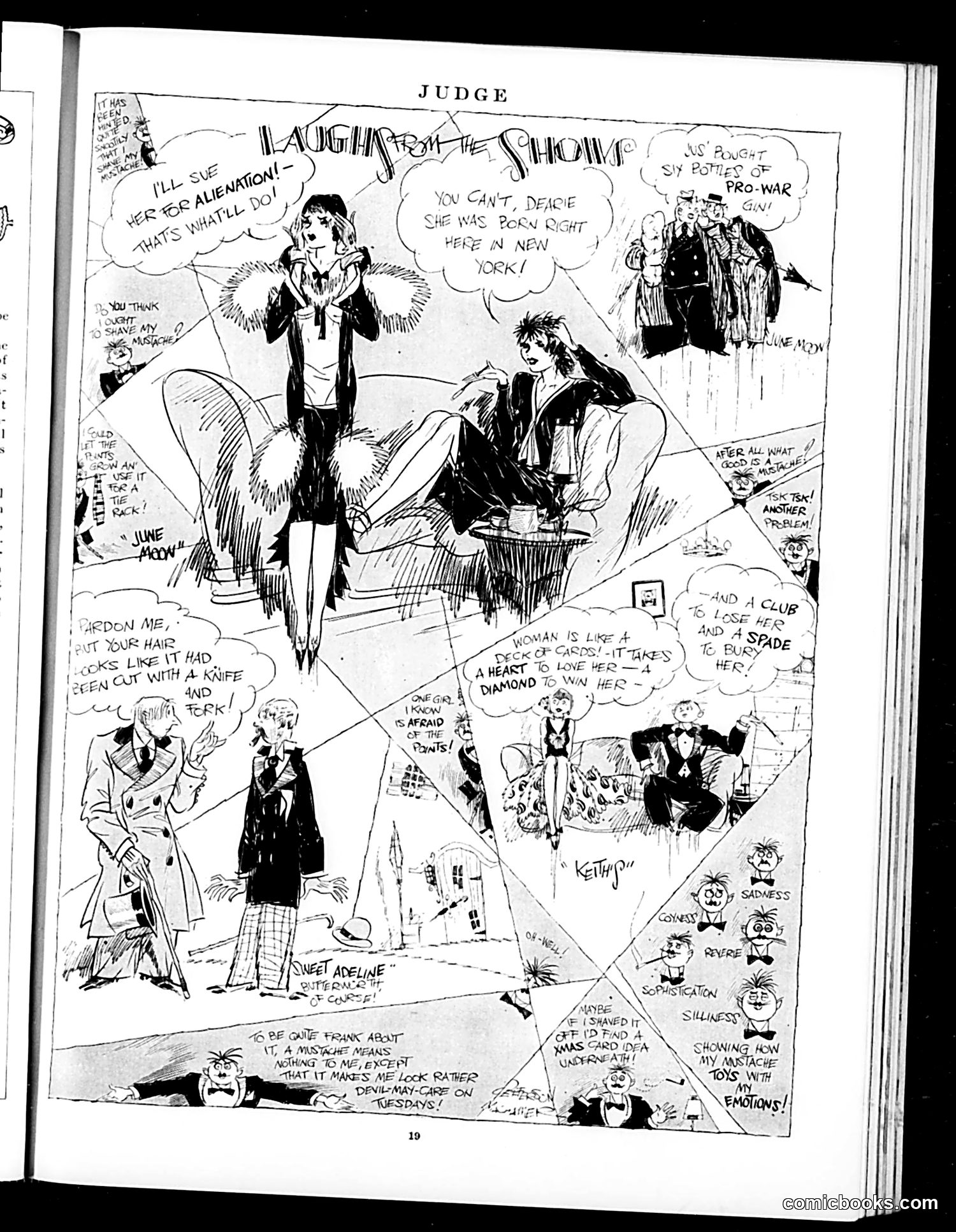
"Laughs from the Shouting" - Judge Magazine Cartoon This is a satirical comic about divorce and modern marriage, centered on a woman being sued for alienation of affection—a legal claim where one spouse sued a third party for "stealing" their spouse's affection. The central female figure (appearing fashionable/modern) is being mocked for her appearance and behavior. Various male characters around her make jokes: one threatens to sue her for alienation; another notes "you can't deface" someone "born right here in New York"; others make crude observations about her looks and character ("A woman is like a deck of cards"). The satire targets both the absurdity of alienation-of-affection lawsuits and contemporary attitudes toward modern women—their independence, appearance, and dating behavior. The accompanying character sketches on the right labeled with emotions (silliness, sadness, etc.) suggest commentary on female emotional nature. This reflects early 20th-century anxieties about changing gender roles and legal systems struggling with modern relationships.
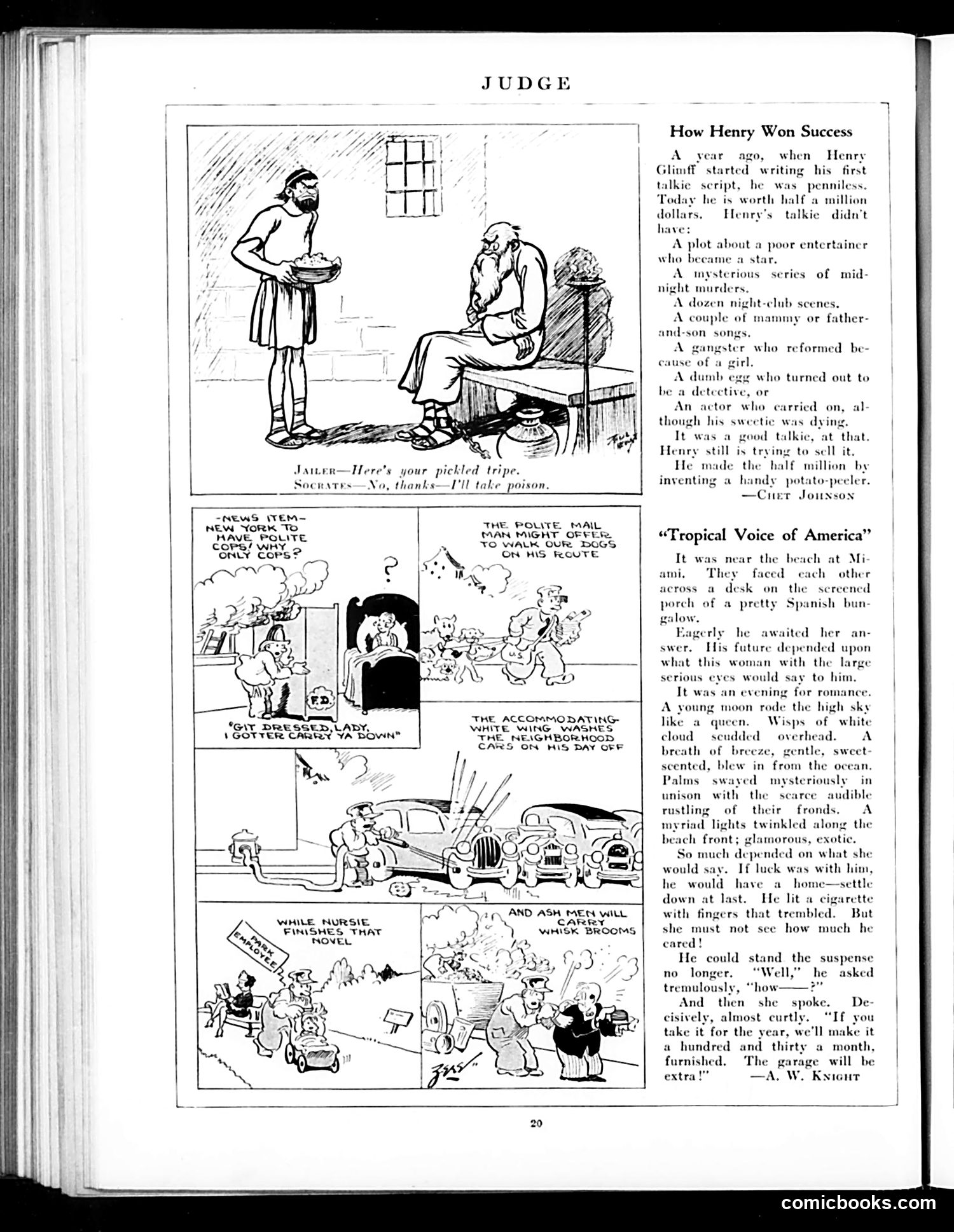
Explanation for Modern Readers This Judge magazine page satirizes early "talkie" (sound film) scriptwriting. The main article mocks how Henry Glimff became wealthy not by writing an *original* talkie script, but by inventing a potato-peeler—suggesting that even mediocre scripts sold better than practical inventions. The piece lists clichéd talkie plot elements (poor entertainer becomes star, murders, nightclub scenes, sentimental songs) that were apparently formulaic crowd-pleasers, despite being artistically bankrupt. The comic strip below appears unrelated, showing various mundane urban scenes with sight gags (Socrates choosing poison over pickled tripe; police accommodating a woman's request). "Tropical Voice of America" is a short story parody of melodramatic romance writing, where a man nervously awaits a woman's answer about their future—only for her to pragmatically discuss rental terms for a house. It satirizes overwrought romantic prose versus practical reality. The overall message: early sound films prioritized formula over art; serious writing was often pretentious nonsense.
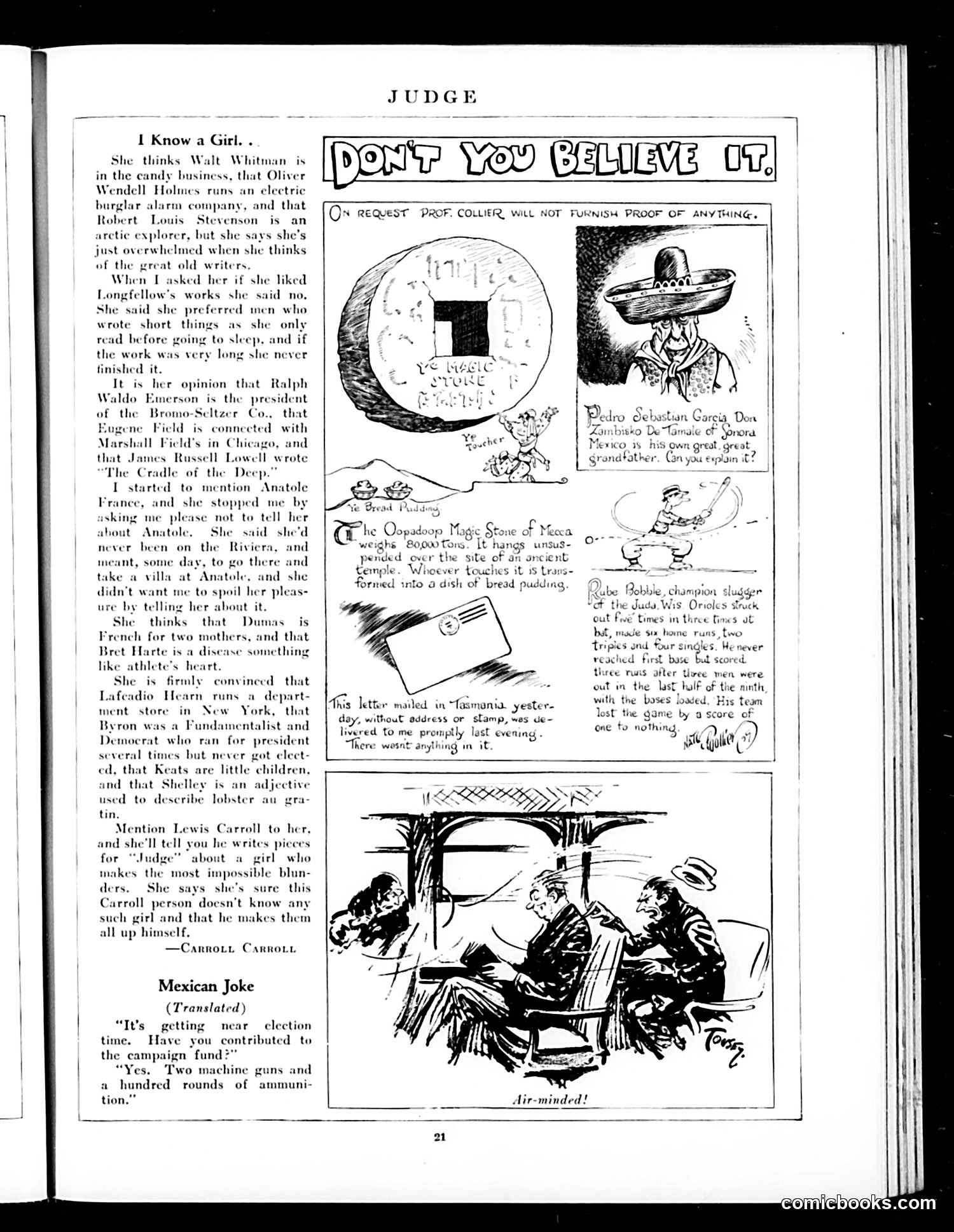
Analysis of This Judge Magazine Page This page mocks literary and cultural ignorance through two main pieces: "I Know a Girl" satirizes a woman who confuses famous authors with commercial brands and businesses—Walt Whitman works in candy, Oliver Wendell Holmes runs a burglar alarm company, Anatole (France) is a villa location. The joke targets both her superficial relationship with literature (she only reads short works before bed) and her comically absurd misidentifications. The column suggests educated pretension masking complete cluelessness about the great writers she claims to admire. "Mexican Joke" is a brief translated anecdote about campaign contributions during an election, where a Mexican man humorously claims to have donated "two machine guns and a hundred rounds of ammunition"—satirizing either political corruption or the violent turmoil of Mexican politics at the time. The cartoons illustrate absurd situations supporting these themes of confusion and miscommunication. The page represents Judge's typical approach: mocking American cultural pretension and contemporary political follies.
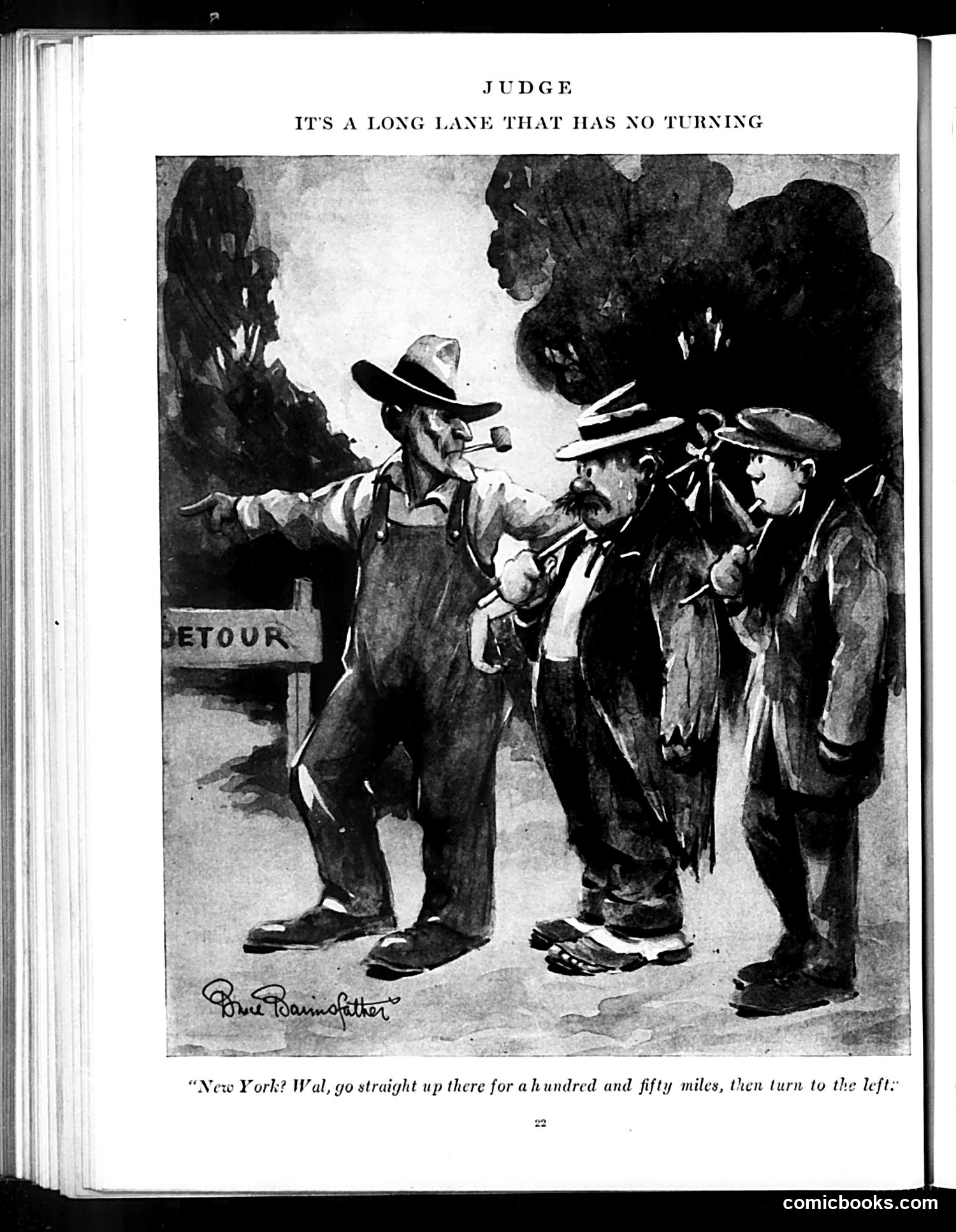
Analysis of "It's a Long Lane That Has No Turning" This cartoon depicts a rural scene with a man pointing down a long road toward New York, instructing travelers to go "straight up there for a hundred and fifty miles, then turn to the left." A "DETOUR" sign is visible. The satire appears to critique impractical or misleading directions—the irony being that the man is giving absurdly long instructions for what should be a straightforward route. The title, a proverb suggesting eventual change or relief, suggests commentary on long, frustrating journeys or delays. The cartoon likely satirizes either poor road conditions/signage of the era, or government inefficiency in directing travelers—a common Judge magazine theme. The rural setting and working-class figures emphasize the ordinary citizen's frustration with bureaucratic complications.
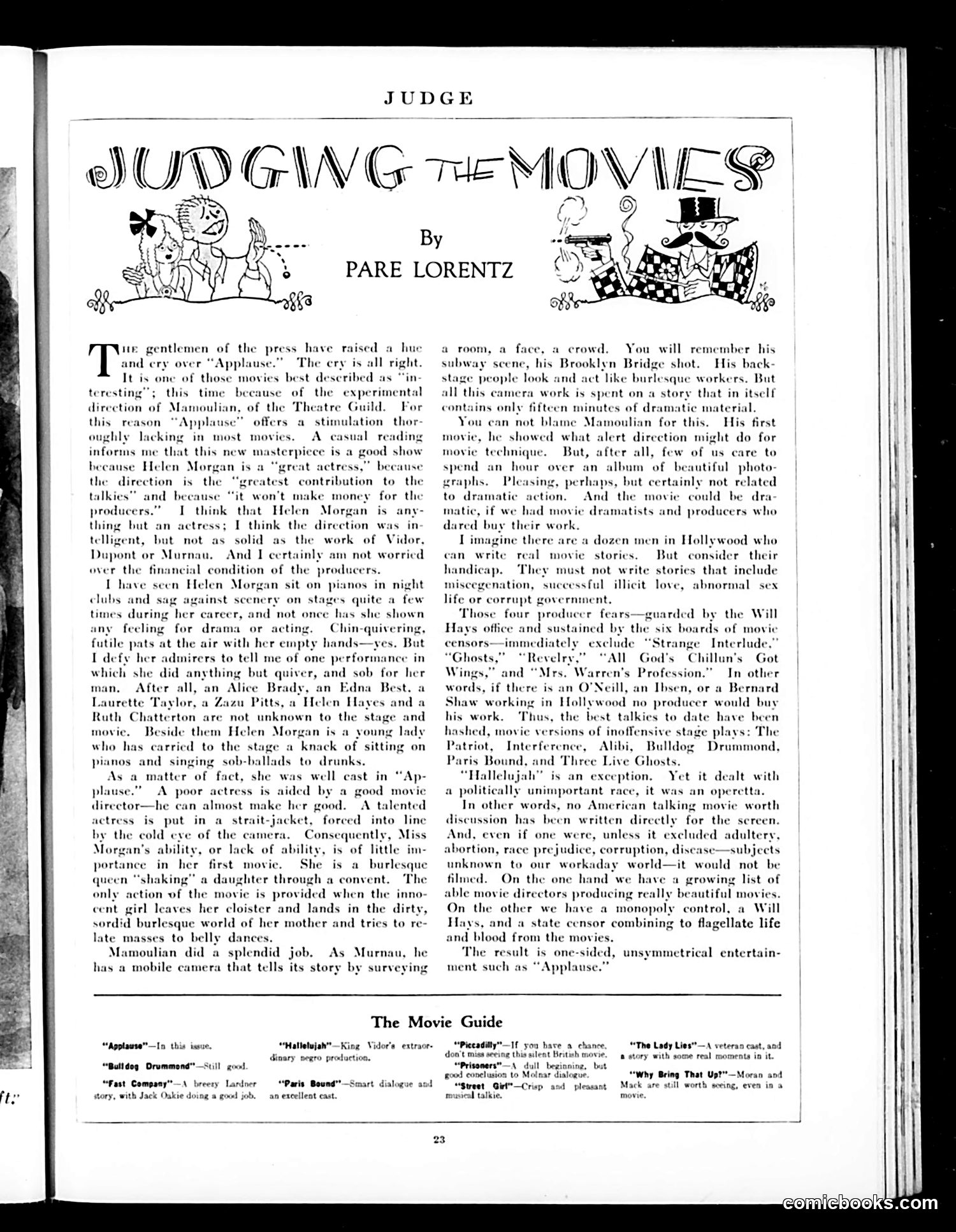
Analysis for Modern Readers This is a theater criticism column by Pare Lorentz reviewing the early talking picture "Applause" (1929). Lorentz praises director Rouben Mamoulian's experimental cinematography but dismisses star Helen Morgan as a mediocre actress whose performance relies on theatrical mannerisms rather than genuine acting skill. He contrasts her unfavorably with established stage actresses like Alice Brady and Laurette Taylor. More significantly, Lorentz critiques Hollywood's censorship apparatus—the Will Hays Office—for excluding serious dramatic material. He argues that producers won't film stories addressing "illicit love, abnormal sex life or corrupt government," preventing adaptation of important plays by O'Neill, Ibsen, and Shaw. The piece attacks both artistic cowardice and financial timidity: excellent directors and writers exist in Hollywood, but producers refuse to buy challenging work. Lorentz positions "Applause" as technically impressive but ultimately shallow—beautiful cinematography wasted on thin material—a symptom of broader creative paralysis in early talking pictures.
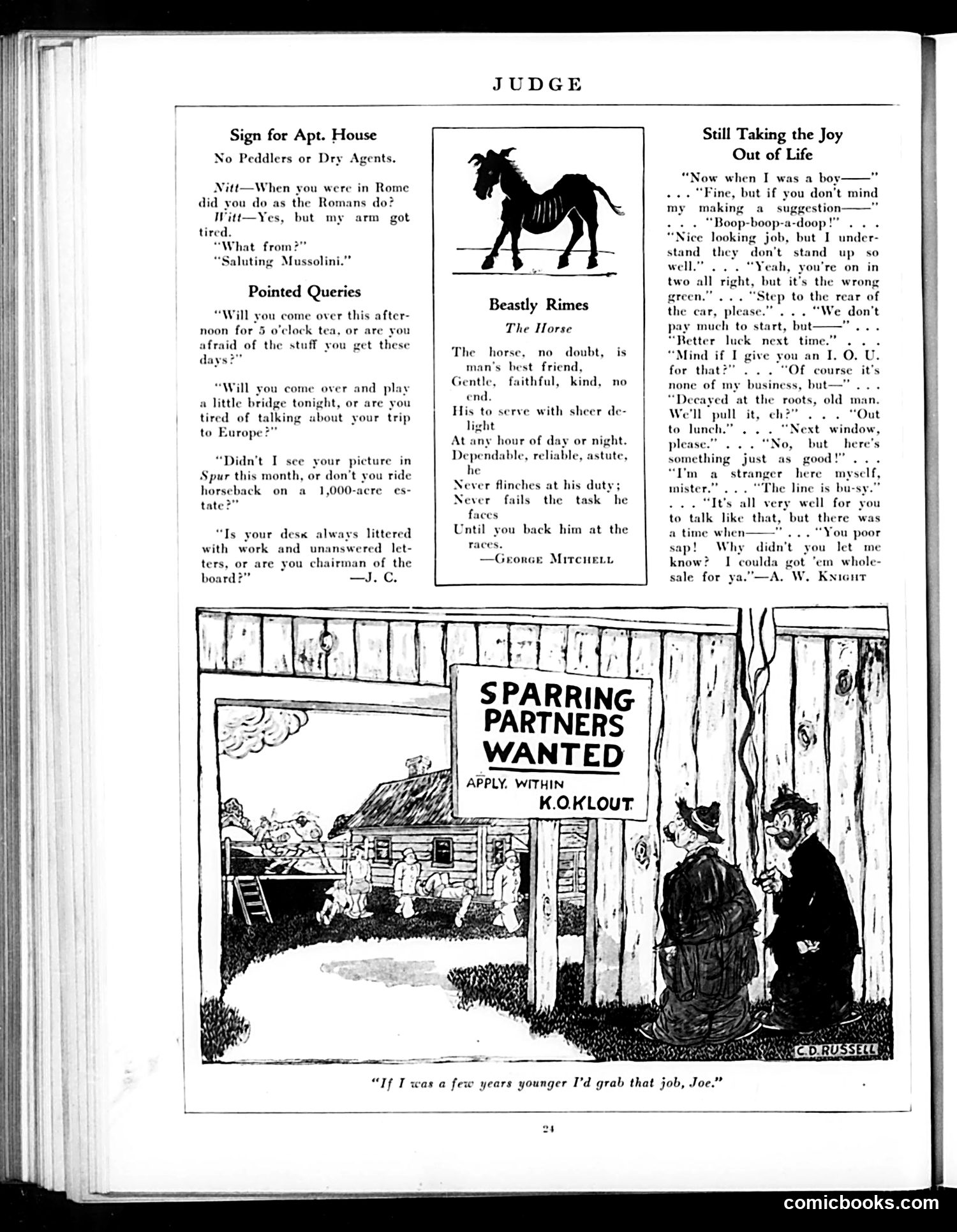
Analysis of Judge Magazine Page This page contains several satirical pieces targeting 1920s-30s American life: "Saluting Mussolini" joke mocks fascism by suggesting someone's arm got tired from the constant salute required in Mussolini's Italy—a contemporary political jab at totalitarianism. "Pointed Queries" presents upper-class social anxieties: Prohibition ("afraid of the stuff you get these days"), ostentatious wealth displays (1,000-acre estates), and social climbing. "Beastly Rimes: The Horse" celebrates horse virtues while concluding with dark irony—horses are reliable "until you back him at the races," implying gambling and betrayal. "Sparring Partners Wanted" cartoon shows two figures discussing a job posting at a rural cabin, with one saying he'd take it "if I was a few years younger"—likely satirizing desperate Depression-era employment or possibly backroom boxing schemes. Overall, the page reflects period preoccupations: political upheaval abroad, American class pretensions, Prohibition, economic uncertainty, and entertainment seeking.
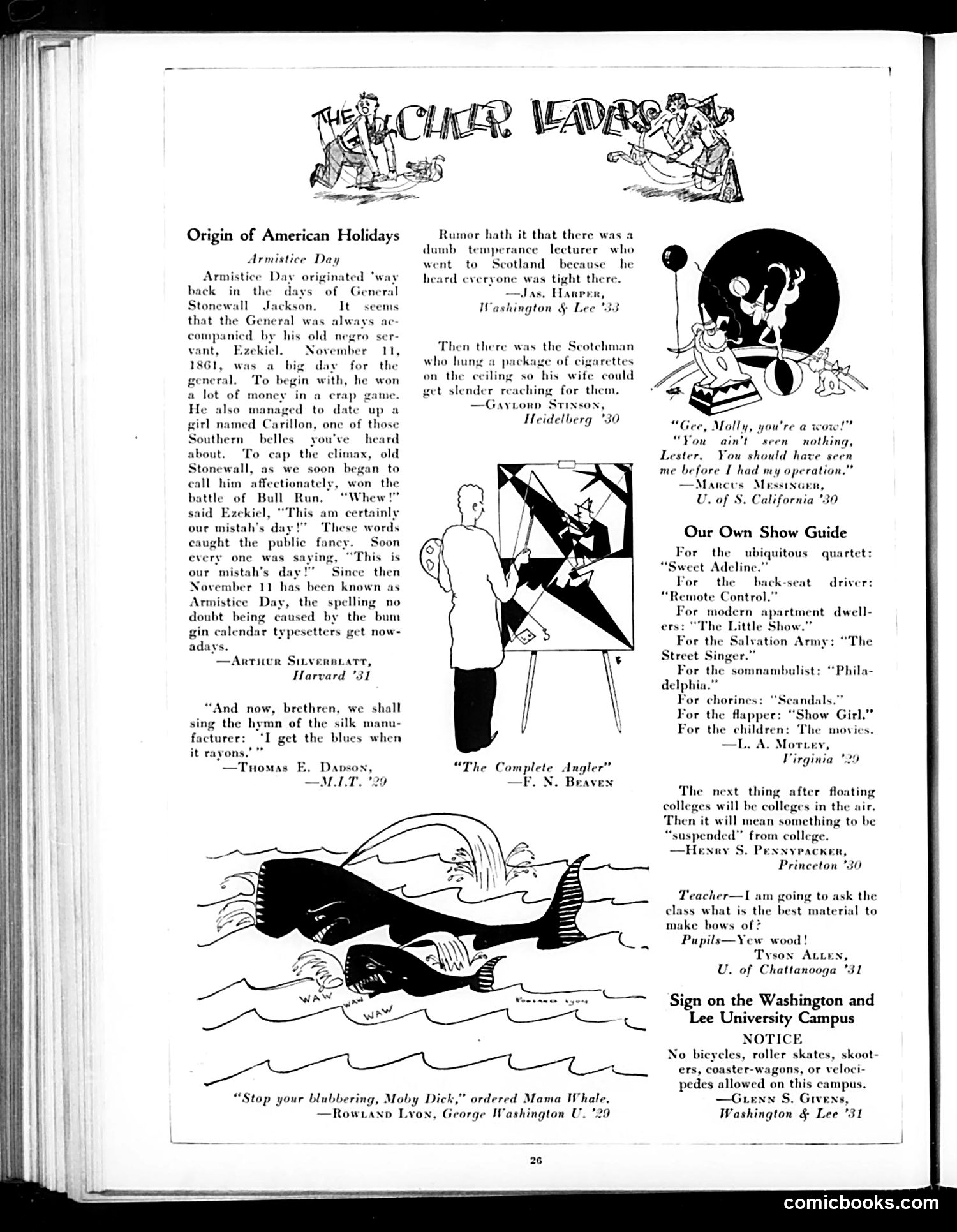
Judge Magazine Humor Page Analysis This page collects humorous anecdotes and jokes submitted by college students, typical of 1920s-30s collegiate humor magazines. Key content: The "Origin of American Holidays" section satirizes how Armistice Day supposedly originated from General Stonewall Jackson's lucky day in 1861—a fabricated, absurdist origin story mocking how historical narratives get distorted. The jokes target: - Temperance lectures (a Prohibition-era reference): a dumb lecturer goes to Scotland expecting sobriety but finds everyone drunk - Ethnic stereotypes: a Scotsman hangs cigarettes from ceiling to prevent his wife from reaching them - Flapper culture and modern youth behavior ("operation" reference suggests cosmetic surgery) - University regulations: the final notice humorously lists prohibited vehicles on campus The cartoons show a man at a drafting table and whales—illustrations accompanying these student-submitted gags. The page reflects 1920s collegiate irreverence toward authority, temperance, and emerging modern behaviors, presented as humor from named university contributors.
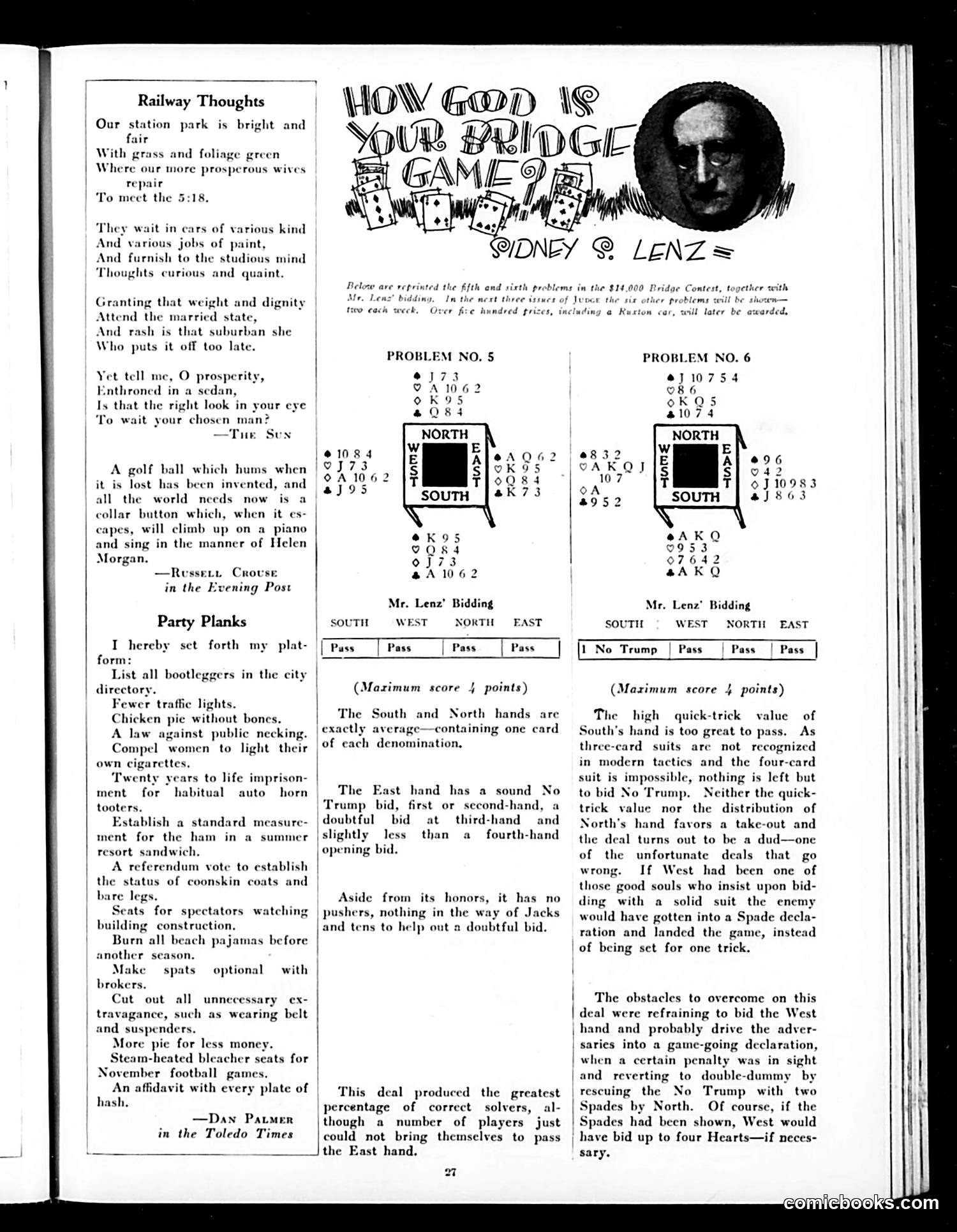
Judge Magazine Page Analysis This page mixes satirical commentary with bridge card game instruction. The "Railway Thoughts" poem satirizes suburban commuters—specifically wives of prosperous men who wait at train stations in fancy cars, with the implication of romantic assignations ("To meet the 5:18"). The humor lies in questioning their propriety. The "Party Planks" section humorously lists absurd civic reforms (banning beach pajamas, imprisoning horn-honkers, requiring affidavits with hash), mocking politicians who propose trivial legislation. The main feature is "How Good Is Your Bridge Game?" by Sidney S. Lenz, presenting two bridge problems with detailed bidding analysis. This represents the magazine's mixed content—combining light social satire with serious instructional material, typical of Judge's educated, upscale readership in the prohibition era (referenced by "bootleggers in the city directory"). The cartoons address 1920s-30s suburban concerns: car culture, changing morality, and leisure activities among the wealthy.
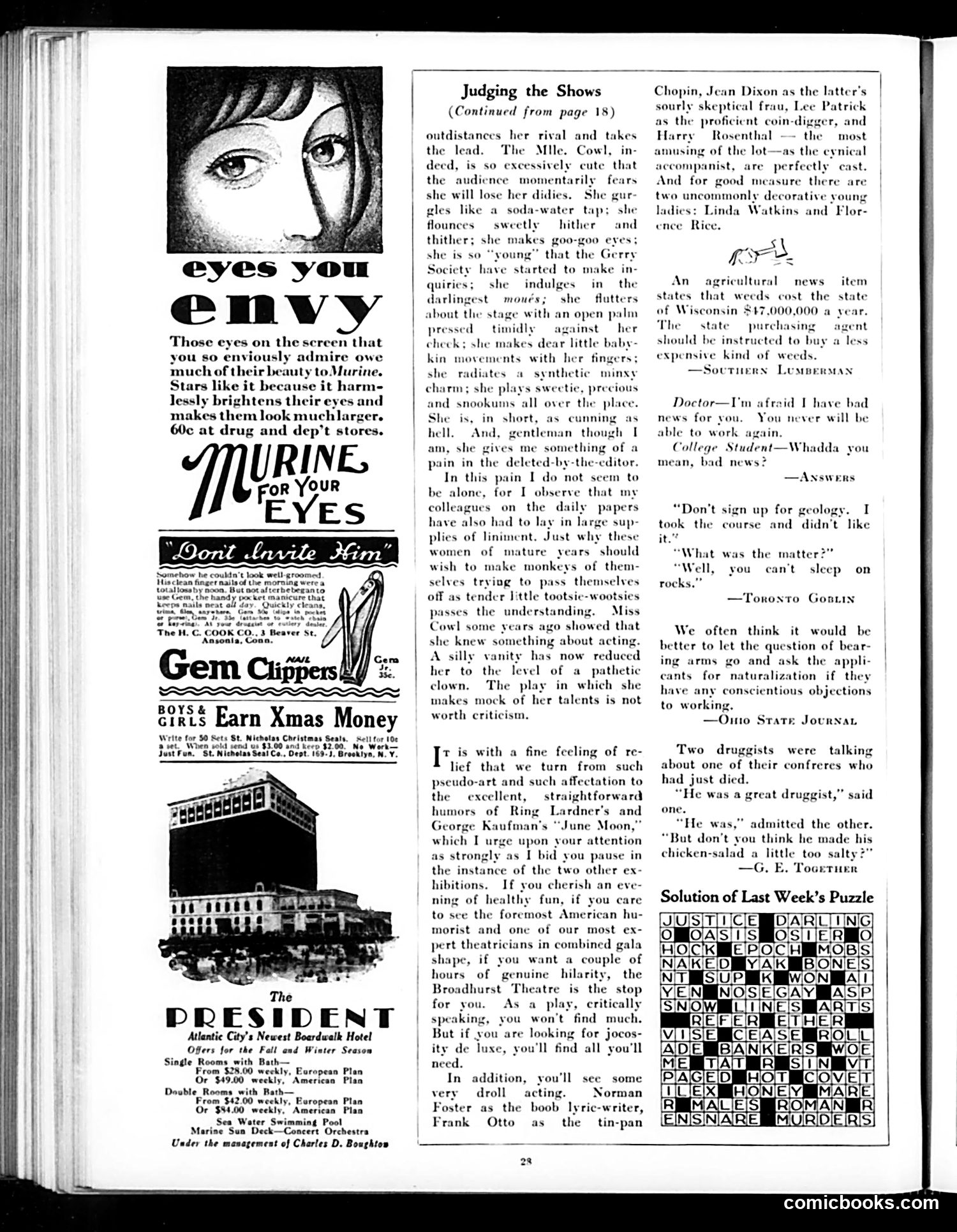
Judge Magazine Page Analysis This page combines entertainment criticism with period advertising. The main content is a theater review by what appears to be Judge's drama critic, evaluating recent Broadway productions. The critic harshly dismisses an actress (identified as "Mlle. Cowl") for playing an ingénue role despite her mature years, calling her performance affected and irritating—"cunning as hell." He contrasts this negatively with praise for Ring Lardner and George Kaufman's "June Moon," which he champions as genuinely funny entertainment with solid comedic acting. The page includes vintage advertisements typical of the 1920s-30s era: Murine eyedrops, Gem nail clippers, and the President Hotel in Atlantic City. A brief joke at bottom mocks a college student's indifference to working. The satire reflects period attitudes about age-appropriate casting in theater and distinctions between "sophisticated" versus "healthy" entertainment—values now dated but revealing of contemporary Broadway culture.
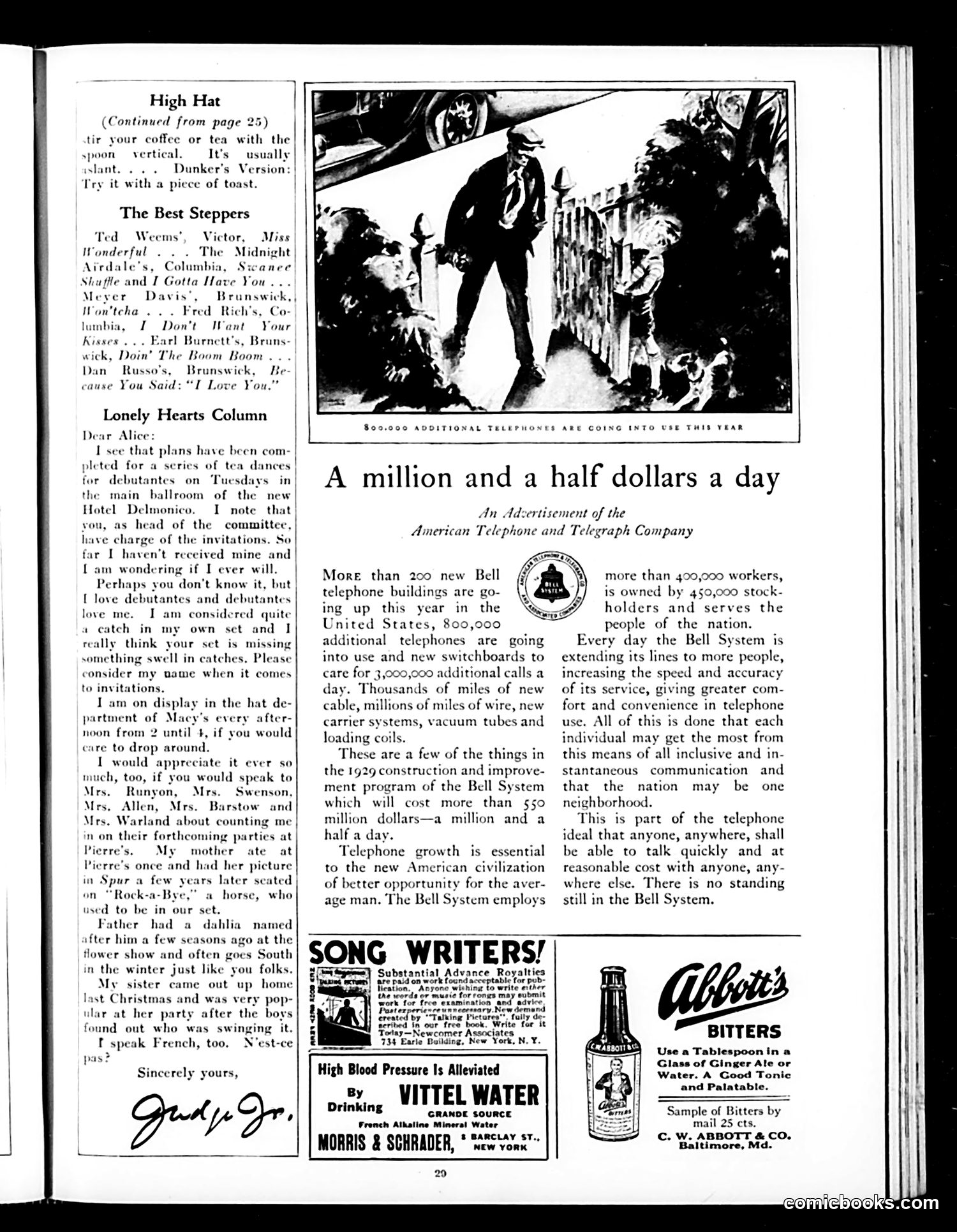
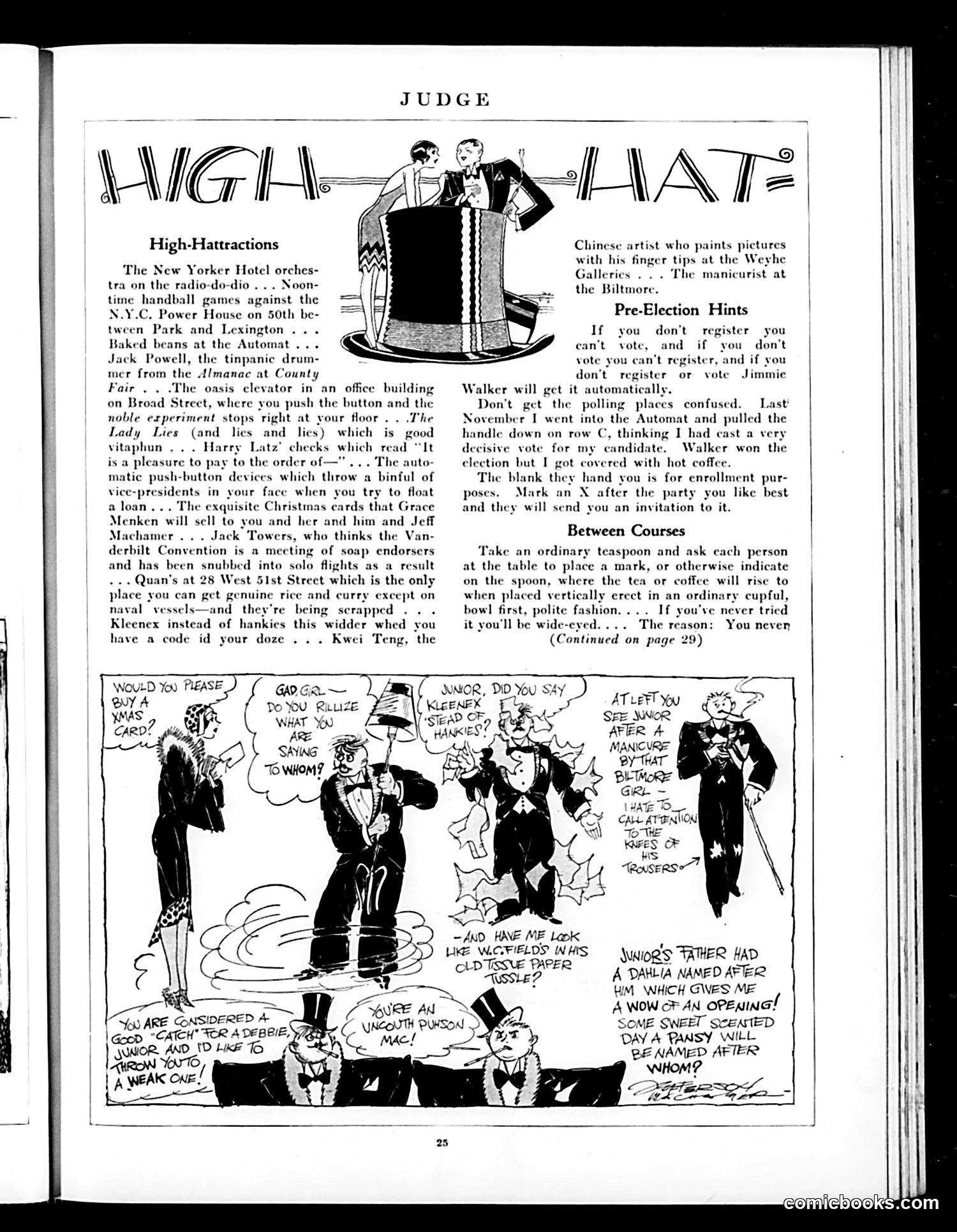
Judge Magazine Page Analysis This page contains a mix of content typical of Judge magazine's satirical format. The main cartoon (upper right) appears to depict a well-dressed man confronting or gesturing at what look like working-class or poor figures, though the specific political reference is unclear from the image alone. The page is dominated by a large AT&T advertisement claiming "$1.5 million a day" investment in telephone infrastructure—typical corporate boosterism from 1929. The "Lonely Hearts Column" parodies dating etiquette, with a humorous letter from someone claiming social credentials (debutante connections, family horses named after his father) while working in a department store hat section—satirizing social pretension. Other content includes: music recommendations ("Best Steppers"), a column tip about holding coffee spoons, and smaller ads for songwriting services, mineral water, and bitters. The overall tone mixes urban sophistication with gentle mockery of social climbers and consumer culture.
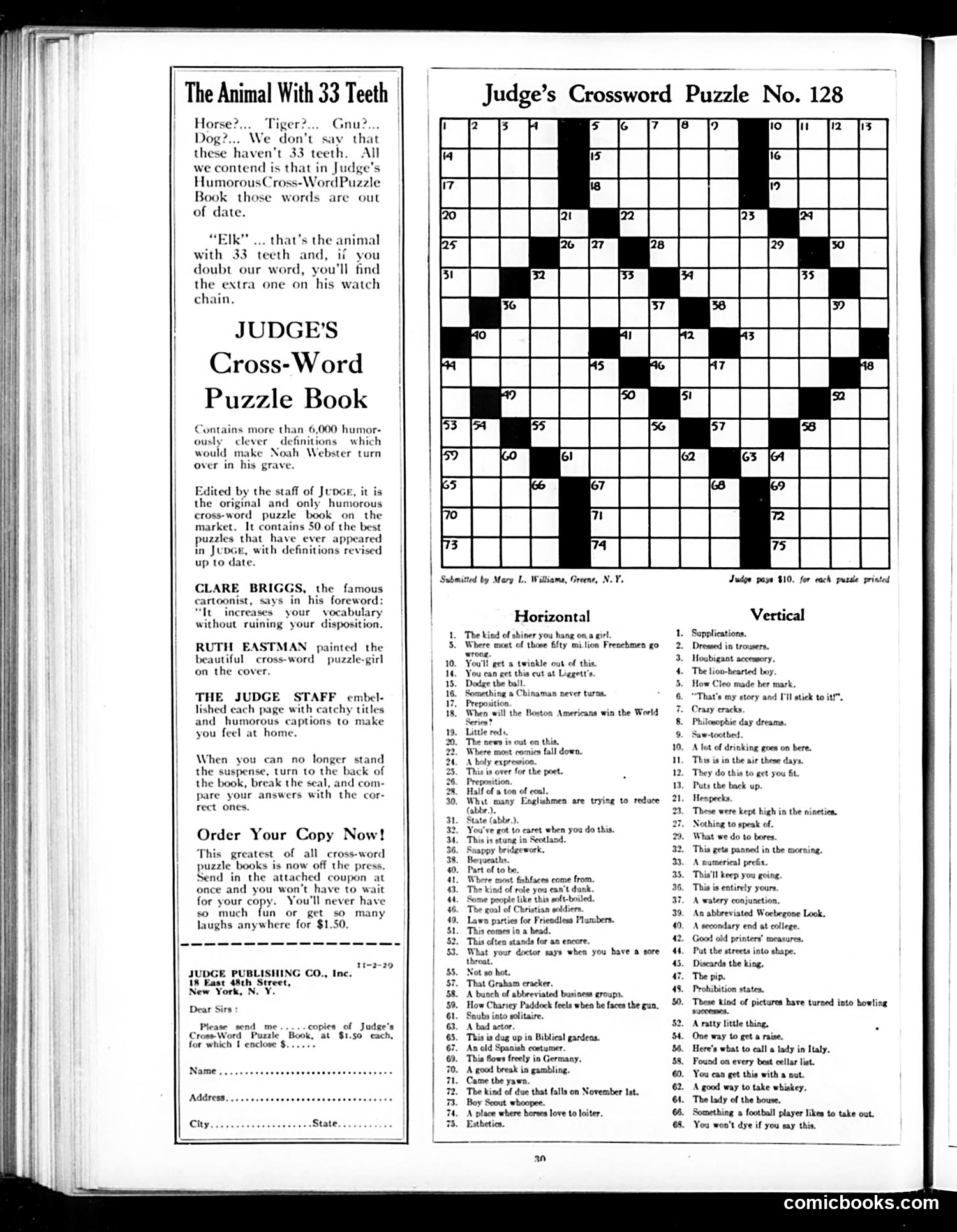
Judge Magazine Page Analysis This page is primarily advertising and puzzle content, not political satire. The left side promotes Judge's newly published Cross-Word Puzzle Book ($1.50), featuring humorous definitions edited by the magazine's staff. Notable contributors mentioned include cartoonist Clare Briggs and illustrator Ruth Eastman. The humor is lighthearted and self-promotional: an opening joke explains that "elk" is the animal with 33 teeth, and if readers doubt it, they'll find the extra tooth on the puzzle book's watch chain—a playful reference to the book's hidden answers. The right side contains Crossword Puzzle No. 128 with its clues (both horizontal and vertical). The clues themselves contain period-typical humor and references (mentions of Liggett's, Prohibition, Biblical gardens, Spanish costumes, Germany's beer culture), but this is a functional puzzle page rather than editorial content or satire. No specific political figures or events are referenced here. This is primarily a commercial page selling a product through gentle, self-aware humor rather than satirical commentary.
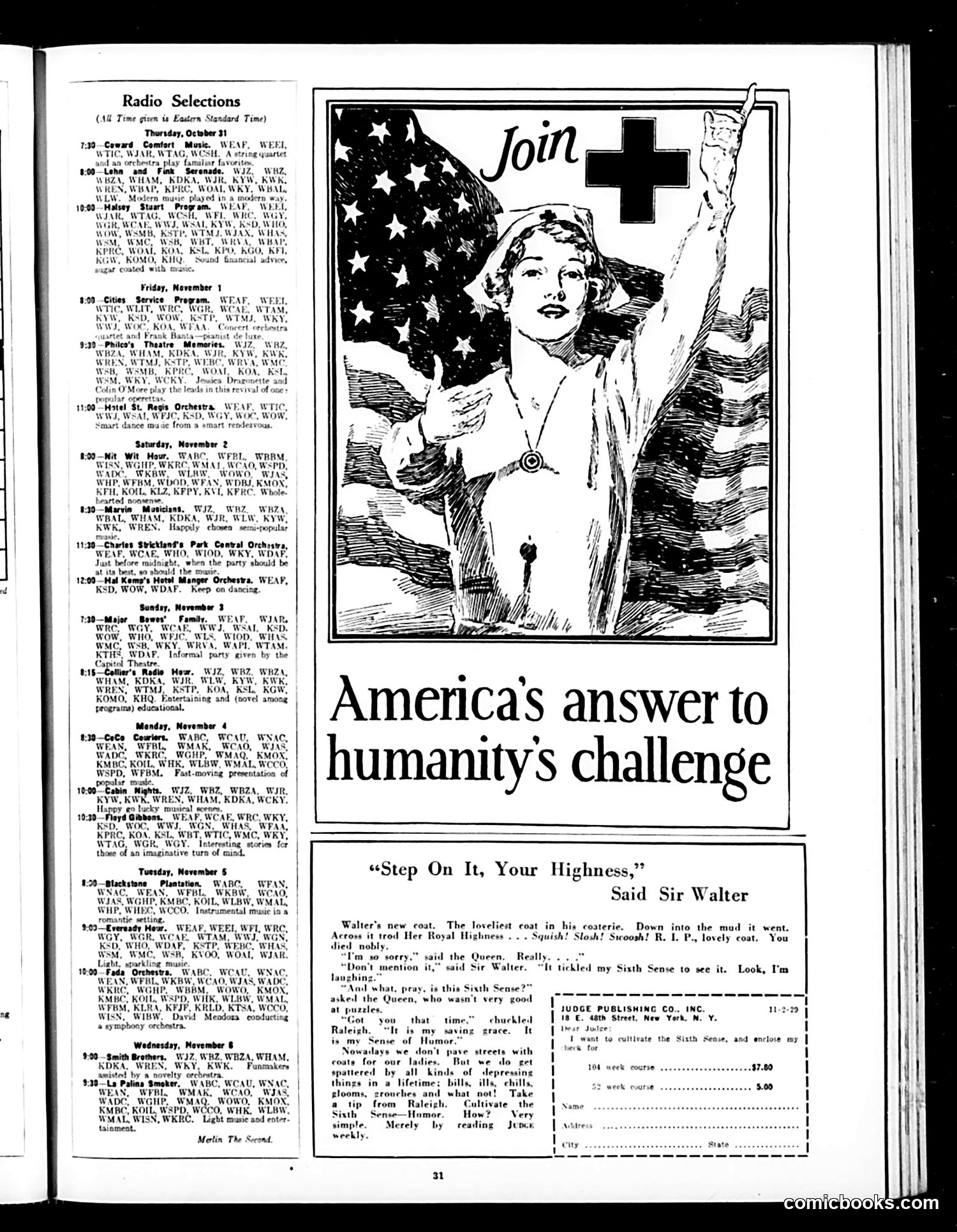
"America's Answer to Humanity's Challenge" This page combines radio listings with a prominent advertisement featuring a patriotic appeal. The main image shows a woman with wings holding an American flag and a cross, calling readers to "join" — though the specific organization isn't fully clear from visible text. Below is a humorous short story titled "Step On It, Your Highness," featuring Sir Walter (likely Sir Walter Raleigh, the historical figure). The joke appears to involve Raleigh's famous legend of laying his coat in mud for Queen Elizabeth I, reframed here with the Queen accidentally stepping on his new coat. The punchline references Raleigh's "Sixth Sense" — a play on words suggesting his ability to laugh off misfortune. The page is primarily a radio schedule for November 1929, listing entertainment programming across numerous American radio stations. The satirical or cartoonish content is limited to the brief Raleigh anecdote.
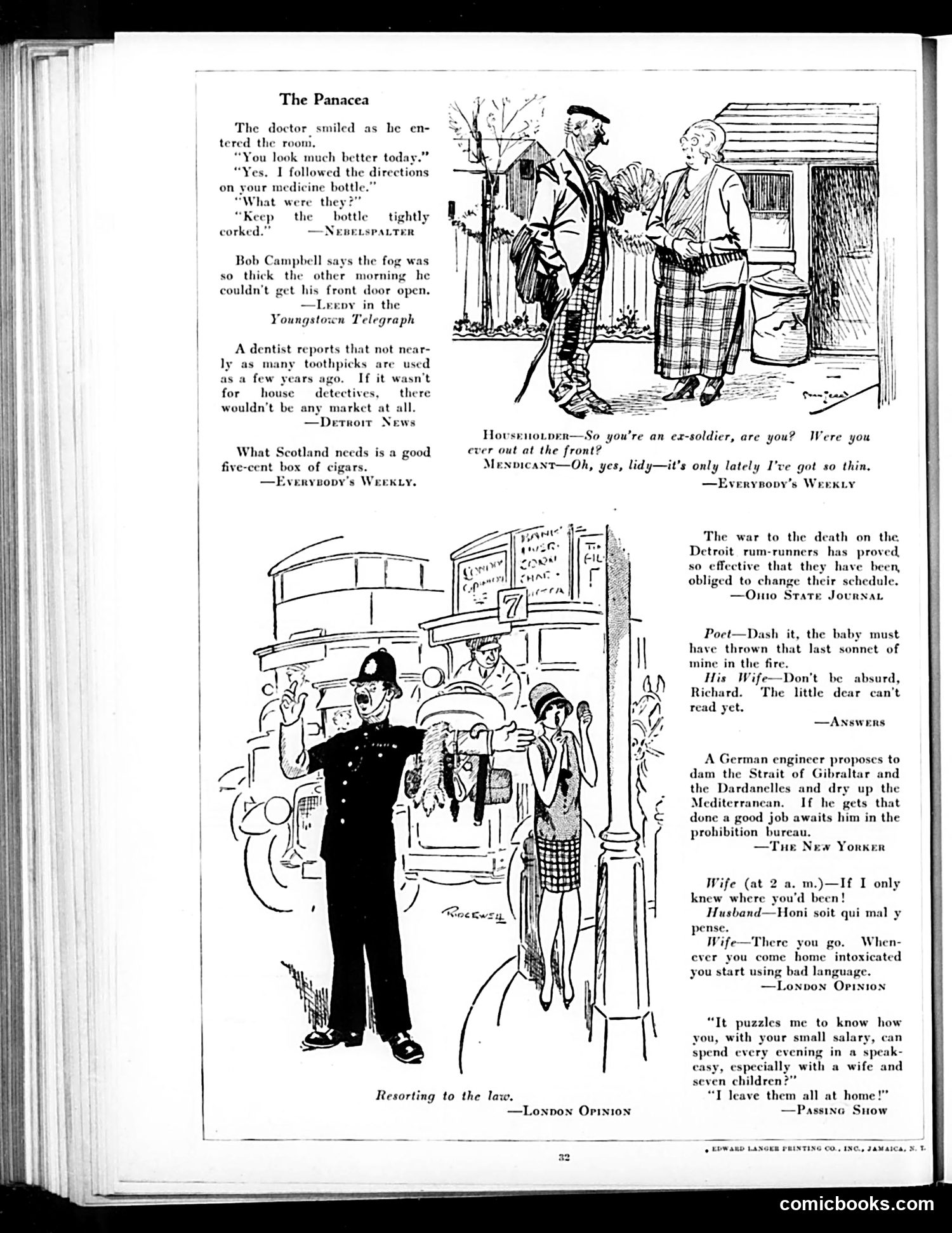
Analysis of Judge Magazine Page This page collects brief satirical jokes and cartoons typical of Judge's format. Key content includes: Top cartoon: A horseholder and mendicant (beggar). The joke plays on the soldier's thinness—he claims he's only recently become thin, implying poverty or hardship since leaving military service. It's social commentary on inadequate veteran welfare. Bottom cartoon: "Resorting to the law" shows a uniformed official (likely a policeman) on a crowded streetcar, satirizing Prohibition enforcement. The caption suggests authorities are increasingly using legal measures against rum-runners and speakeasies. Scattered jokes include: - A doctor's patient following medicine bottle directions literally (the cork, not the medicine) - Detroit's rum-running problem requiring schedule changes - A German engineer's proposal to dam Gibraltar (absurdist humor about postwar ambitions) - Marital comedy about a drunk husband using profanity The overall theme reflects 1920s concerns: Prohibition enforcement, veteran treatment, and urban social decay.
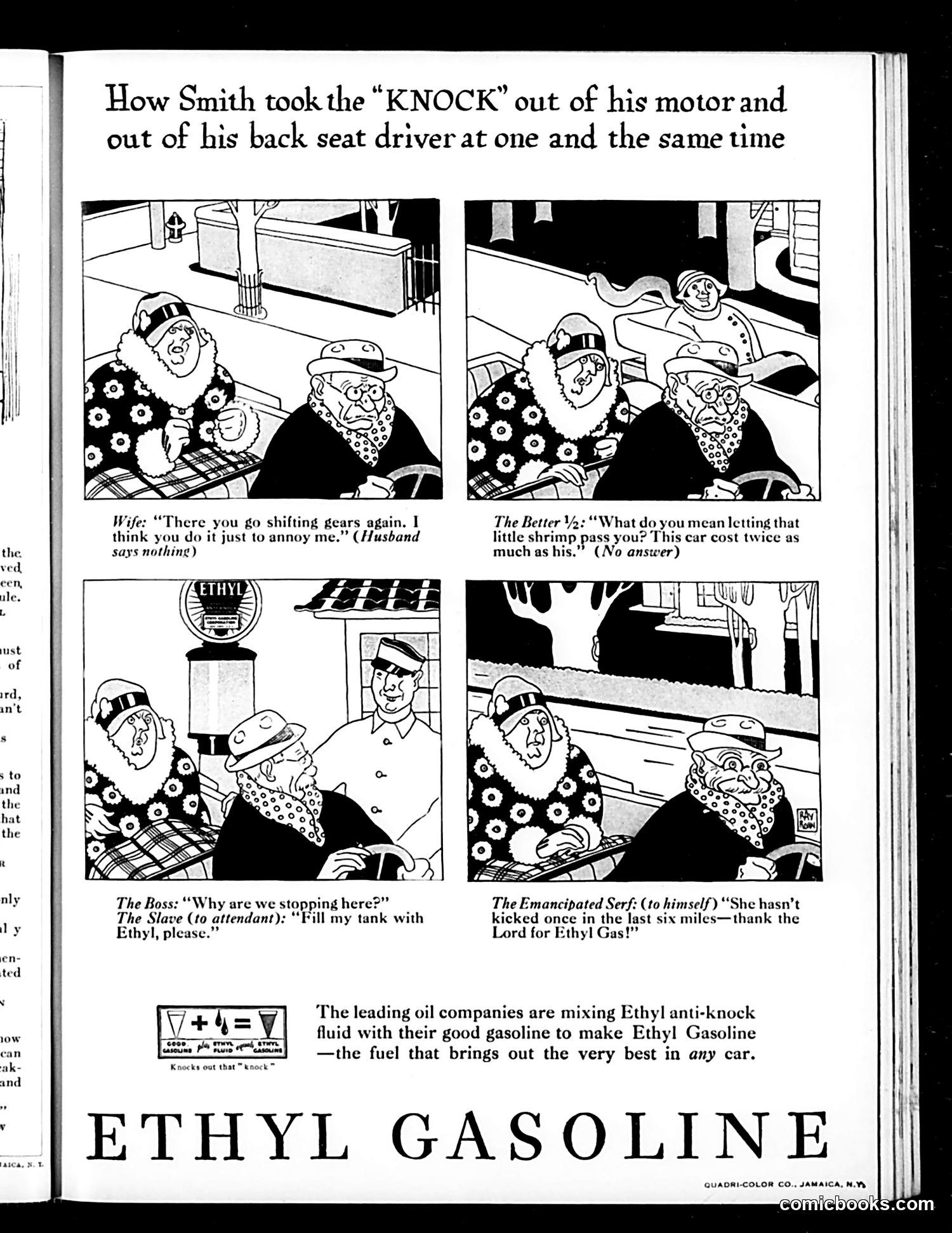
Analysis This is an advertisement for Ethyl Gasoline disguised as humorous comic strips. The humor relies on a specific automotive problem from the 1920s-30s: engine "knock" (pre-ignition causing rattling sounds), which Ethyl gasoline claimed to prevent. The four panels show different "nagging driver" scenarios where men are blamed for causing engine knock: - A wife criticizing her husband's gear-shifting - A passenger (the "Better Half") complaining about being passed by another car - A boss questioning why they've stopped - A servant/driver relieved his female passenger hasn't criticized him in six miles The satire's point: Ethyl gasoline eliminates engine knock, which the ads cleverly equate with eliminating complaints from backseat drivers. The real problem (mechanical) becomes a metaphor for the social problem (nagging women). The joke trades on period stereotypes about wives and female passengers as perpetual complainers, while promoting that Ethyl fuel solves both the car's knock and, implicitly, domestic peace.
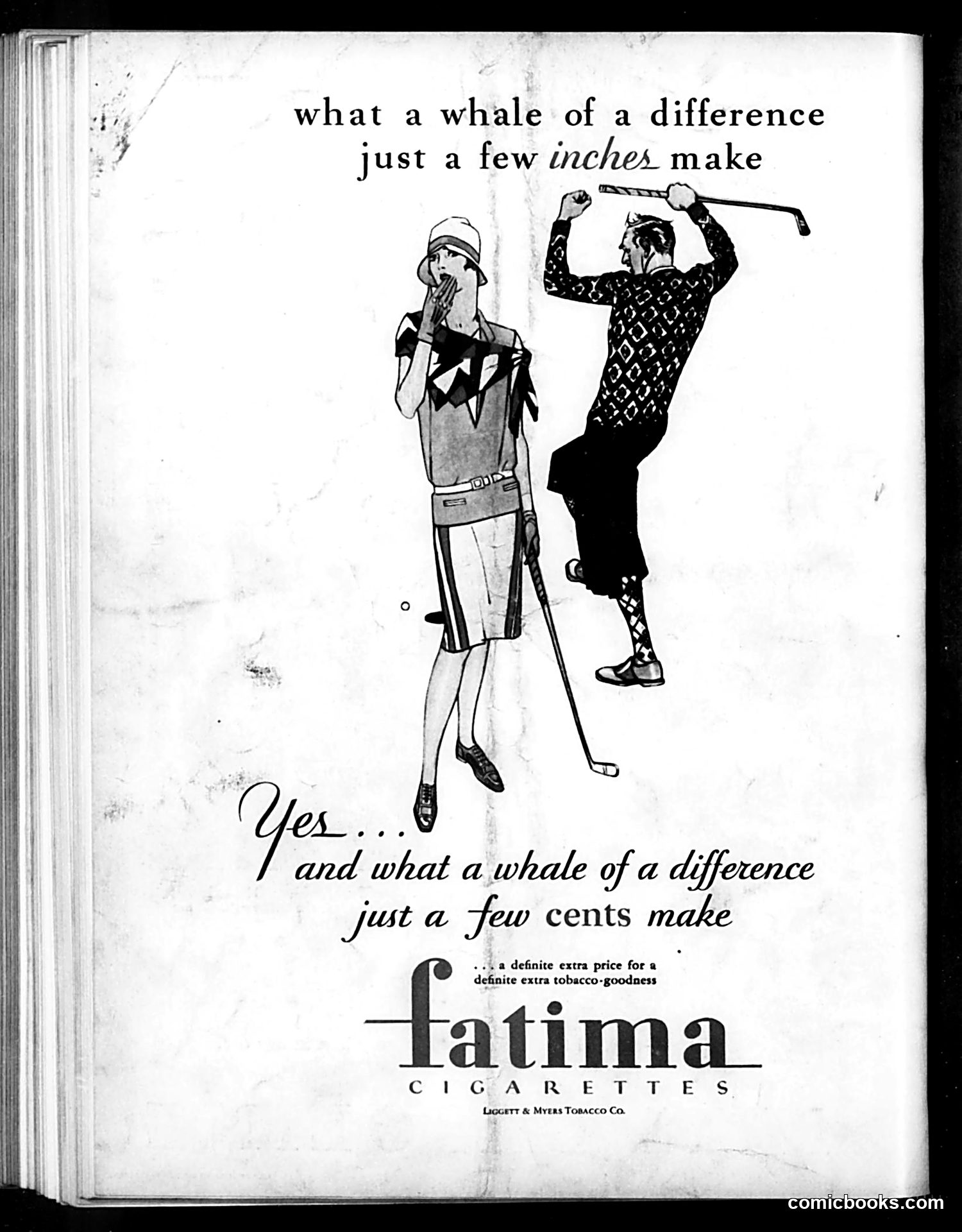
Analysis This is a cigarette advertisement for Fatima brand, not political satire. The page uses a golf theme to promote the product. The illustration shows two golfers: one woman (left) appearing disappointed with her shot, and one man (right) mid-swing in a successful follow-through. The ad's wordplay compares golf performance to cigarette quality—"just a few inches" in golf stance/swing makes a big difference in results, just as "a few cents" extra spent on Fatima cigarettes yields superior tobacco quality. This leverages early 20th-century consumer messaging: a small price premium justifies noticeably better product. The golf setting targets affluent, leisure-class consumers—the typical Fatima cigarette demographic. There is no political content or social satire present.