judge
Judge — November 9, 1929
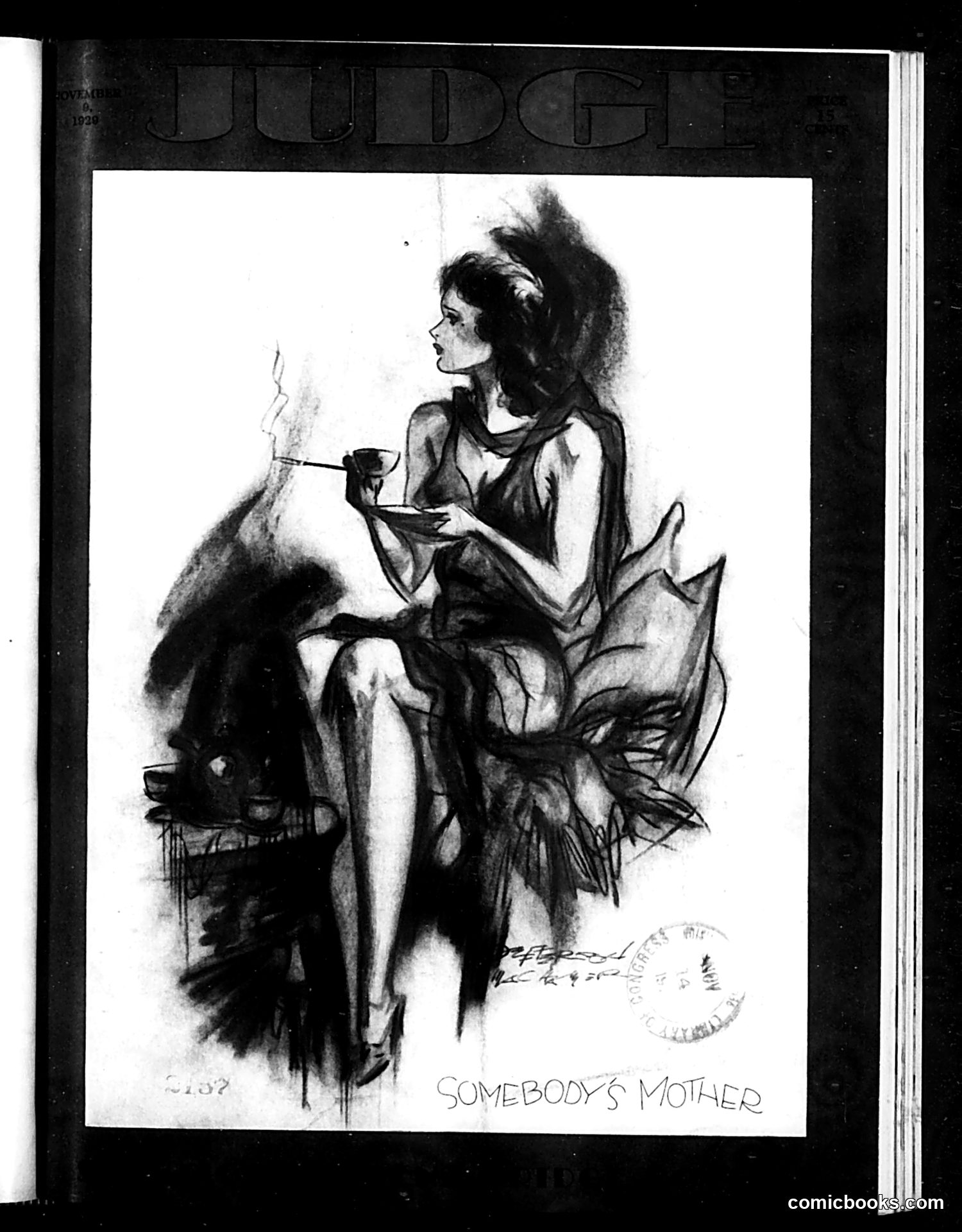
"Somebody's Mother" — Judge Magazine Cartoon This sketch depicts a woman in a revealing dress, smoking a cigarette and holding a drink. The title "Somebody's Mother" appears to be satirical commentary on changing social norms, likely from the 1920s Jazz Age era based on the style and Judge's publication timeline. The cartoon likely critiques anxieties about modern women's behavior and independence—specifically the "flapper" phenomenon. The sardonic title suggests society's discomfort with mothers (or women generally) adopting supposedly "immoral" behaviors like smoking and drinking publicly, which were controversial and associated with moral decline among early 20th-century conservatives. The sketch employs Judge's typical approach of using exaggeration and irony to mock social hypocrisy or generational conflict.
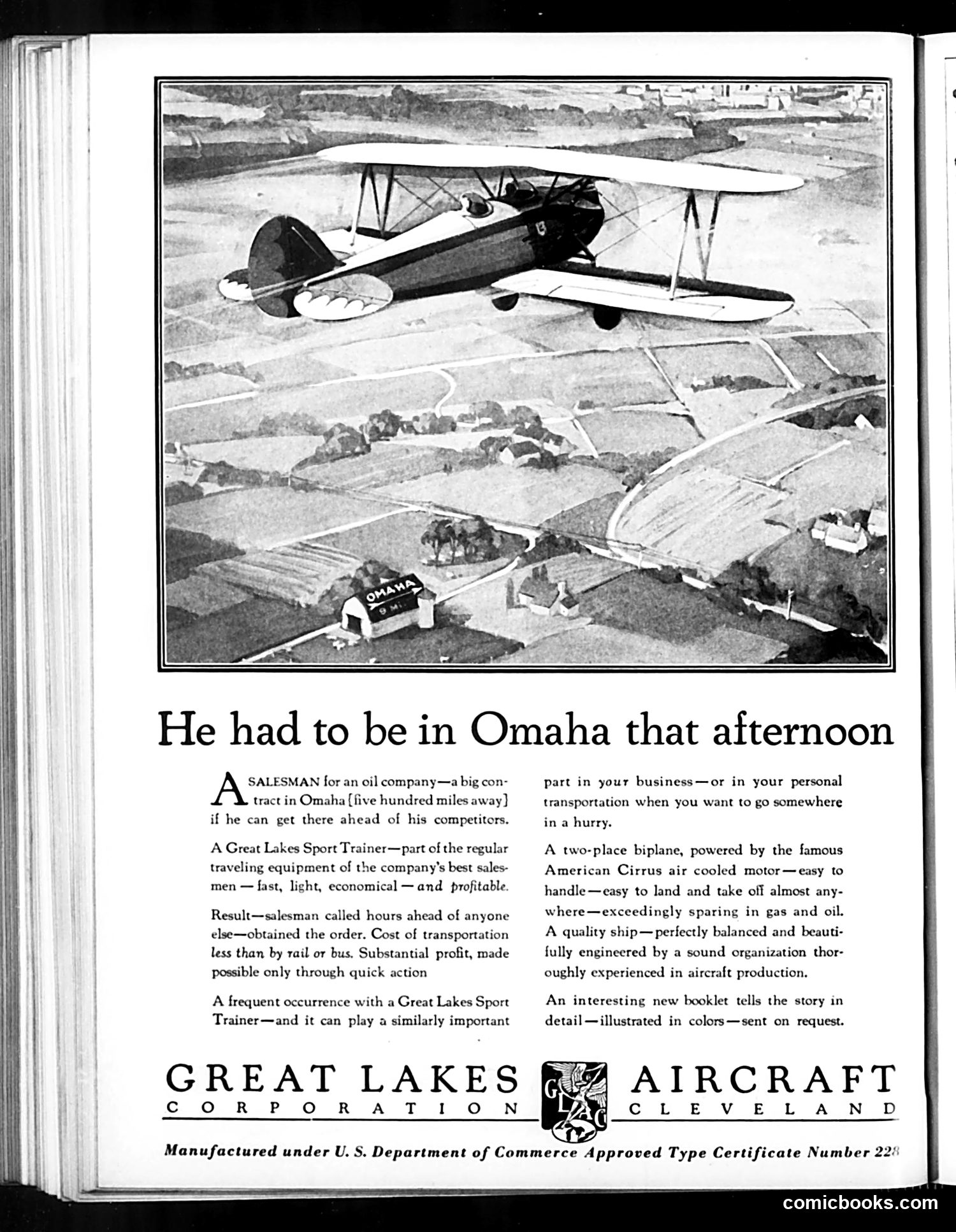
Analysis This is not a satirical cartoon but rather a commercial advertisement for Great Lakes Aircraft Corporation of Cleveland. The page depicts a two-seater biplane (a "Great Lakes Sport Trainer") flying over rural farmland above an Omaha building. The accompanying text presents a business scenario: a salesman needs to reach Omaha quickly to close a contract ahead of competitors. The aircraft enables this speed advantage. This advertisement targets businessmen, emphasizing practical benefits—fast transportation, economical operation, and quick turnaround for sales. The "Sport Trainer" plane is positioned as a legitimate business tool, not a novelty. The page reflects 1920s-30s optimism about aviation as a transformative commercial technology. There is no satire present; Judge magazine apparently accepted advertisements alongside satirical content.
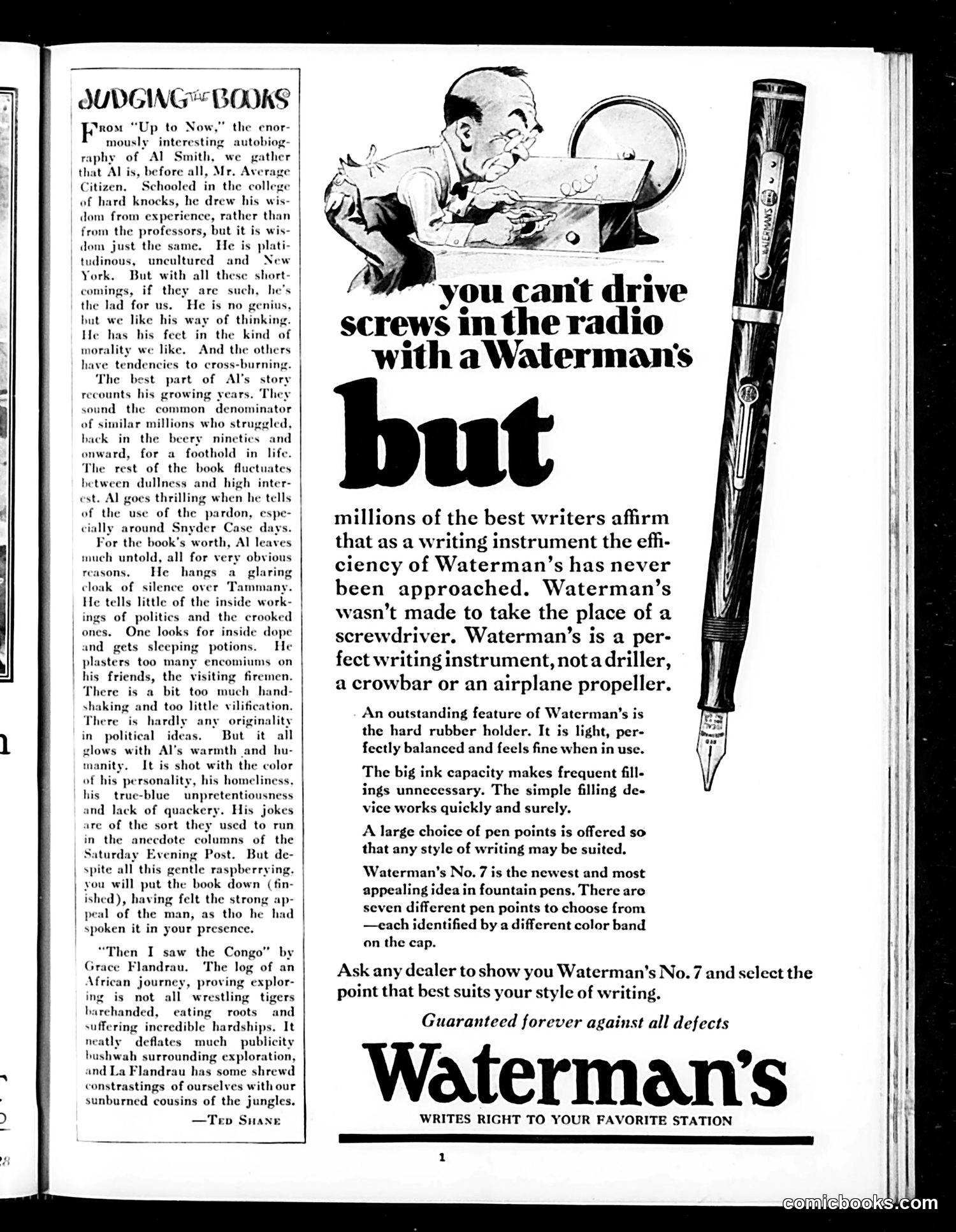
Analysis of Judge Magazine Page This page is primarily a Waterman's fountain pen advertisement, not political satire. The ad occupies most of the space, featuring a caricatured man struggling to use a screwdriver in a radio, with the humorous headline "you can't drive screws in the radio with a Waterman's but..." The left column contains a book review titled "Judging the Books," discussing Al Smith's autobiography "Up to Now." The reviewer praises Smith as an "average citizen" with practical wisdom gained through experience rather than academia, though notes he lacks originality in political thinking. The advertisement emphasizes Waterman's pen superiority for writing over improvised tools, promoting their No. 7 model with multiple interchangeable points. This is straightforward commercial messaging rather than satirical commentary.
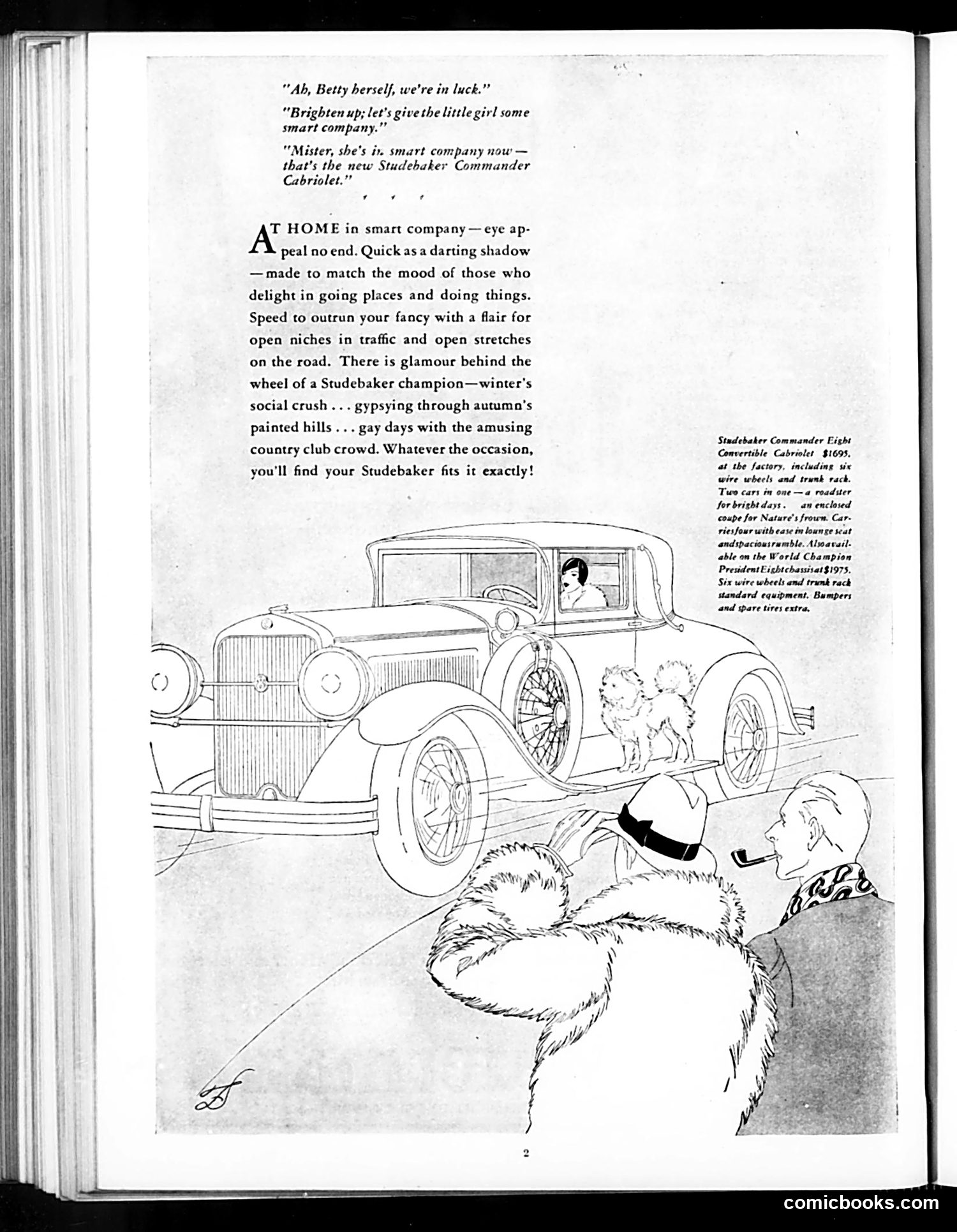
Analysis This page is primarily an advertisement for the Studebaker Commander Eight Convertible Cabriolet automobile, priced at $1,695. The illustration shows a stylish car with two fashionably-dressed figures observing it from the foreground. The accompanying text uses aspirational language about "smart company" and social prestige, emphasizing the car's speed, glamour, and suitability for upscale activities—"winter's social crush," "country club crowd," and leisurely driving through scenic landscapes. The dialogue at the top presents the car as a status symbol that signals sophistication and style to onlookers. This is typical 1920s-30s automotive advertising that conflates car ownership with social standing and leisure-class identity. The art style and messaging are characteristic of Judge magazine's brand of upscale humor and consumer culture promotion.
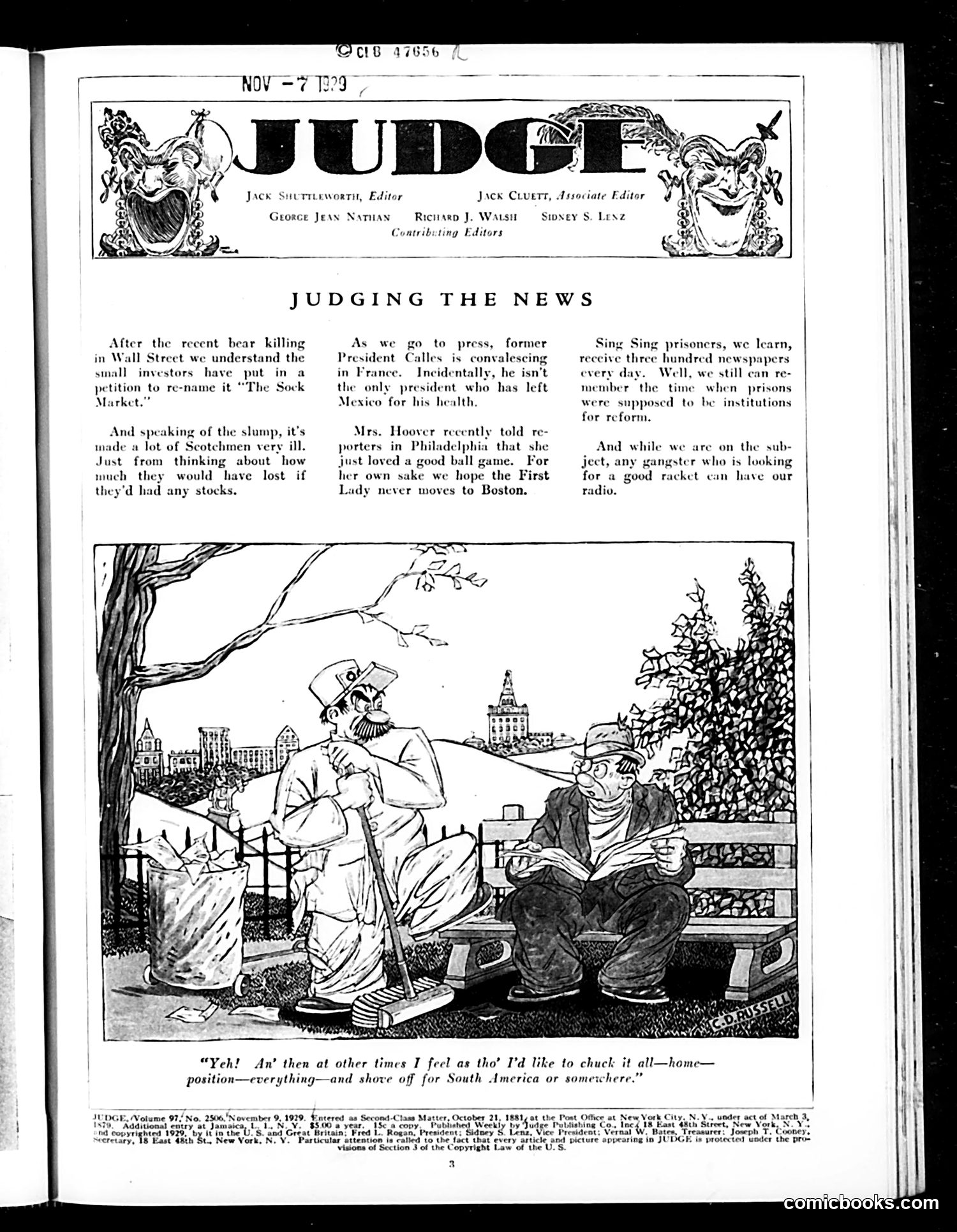
Judge Magazine Cartoon Analysis This 1929 cartoon satirizes economic anxiety following the recent stock market crash. The column "Judging the News" references Wall Street's "bear killing," small investors' losses in "The Stock Market," and Scottish investors being hit hard by the slump. The main cartoon depicts two men: one appears to be Uncle Sam (identifiable by his hat), speaking to another figure on a park bench. Uncle Sam expresses desire to "chuck it all—home position—everything—and shore off for South America or somewhere," suggesting even American leadership feels despair about the economic crisis. The satire mocks how severe the financial panic was—even symbols of American stability contemplate abandoning the country entirely.
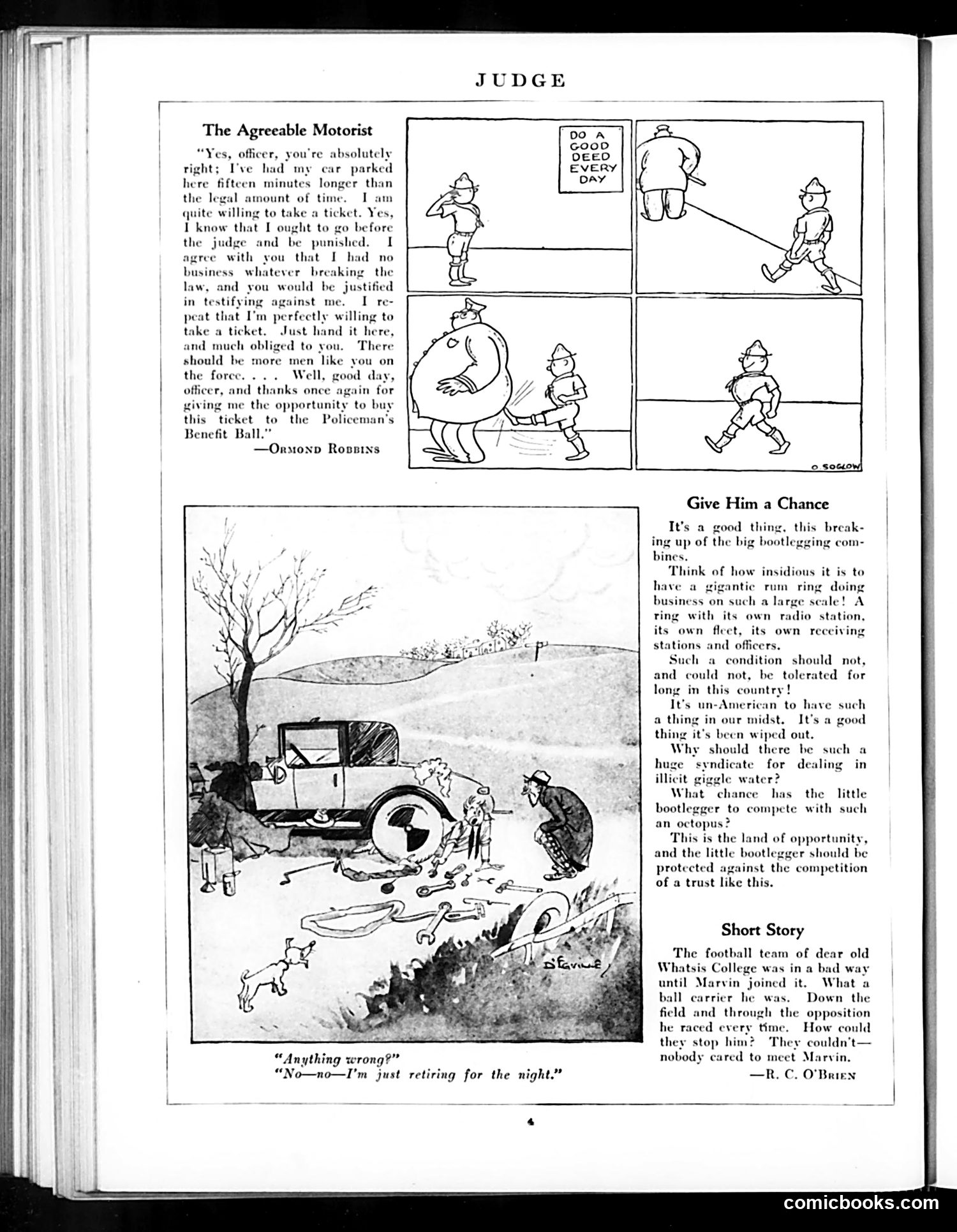
"The Agreeable Motorist" and Related Content Top Comic: A motorist caught parking illegally offers the officer a bribe—a ticket to a "Policeman's Benefit Ball"—rather than accept a fine. The joke satirizes motorists' expectation that they can buy their way out of traffic violations through charm and small gifts. Middle Cartoon: Depicts a broken-down car and a woman saying "Anything wrong?" with the response "No—no—I'm just retiring for the night." This appears to mock mechanical failures in early automobiles. "Give Him a Chance": An editorial piece criticizing large bootlegging syndicates and advocating protection for small-scale illegal alcohol producers—satirizing Prohibition-era enforcement disparities and the competitive disadvantage faced by independent bootleggers against organized crime operations.
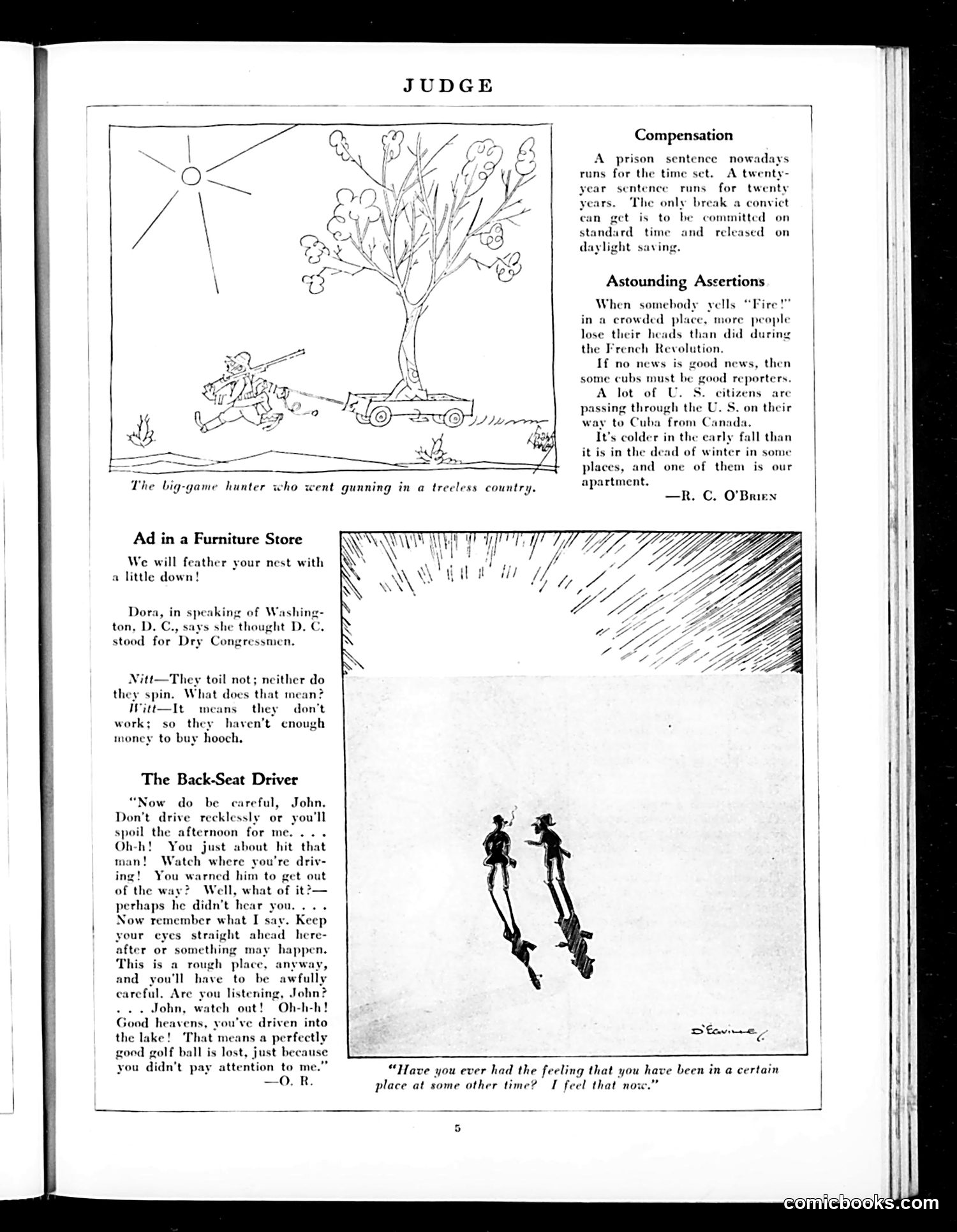
Page Analysis: Judge Magazine Satirical Content This page contains several unrelated humor pieces rather than a unified political cartoon: 1. "The log-game hunter who went gunning in a treeless country" — A visual joke about poor planning; the illustration shows someone attempting to hunt in an obviously unsuitable landscape. 2. "Ad in a Furniture Store" — A wordplay joke about "D.C." (Washington, D.C.) standing for "Dry Congressmen," implying members of Congress don't work and lack funds. 3. "The Back-Seat Driver" — A domestic humor piece where a passenger critiques the driver's golf game through backseat driving metaphors, ending with them accidentally driving into a lake. These are typical Judge magazine filler pieces mixing political jabs with general domestic humor, rather than hard-hitting satire.
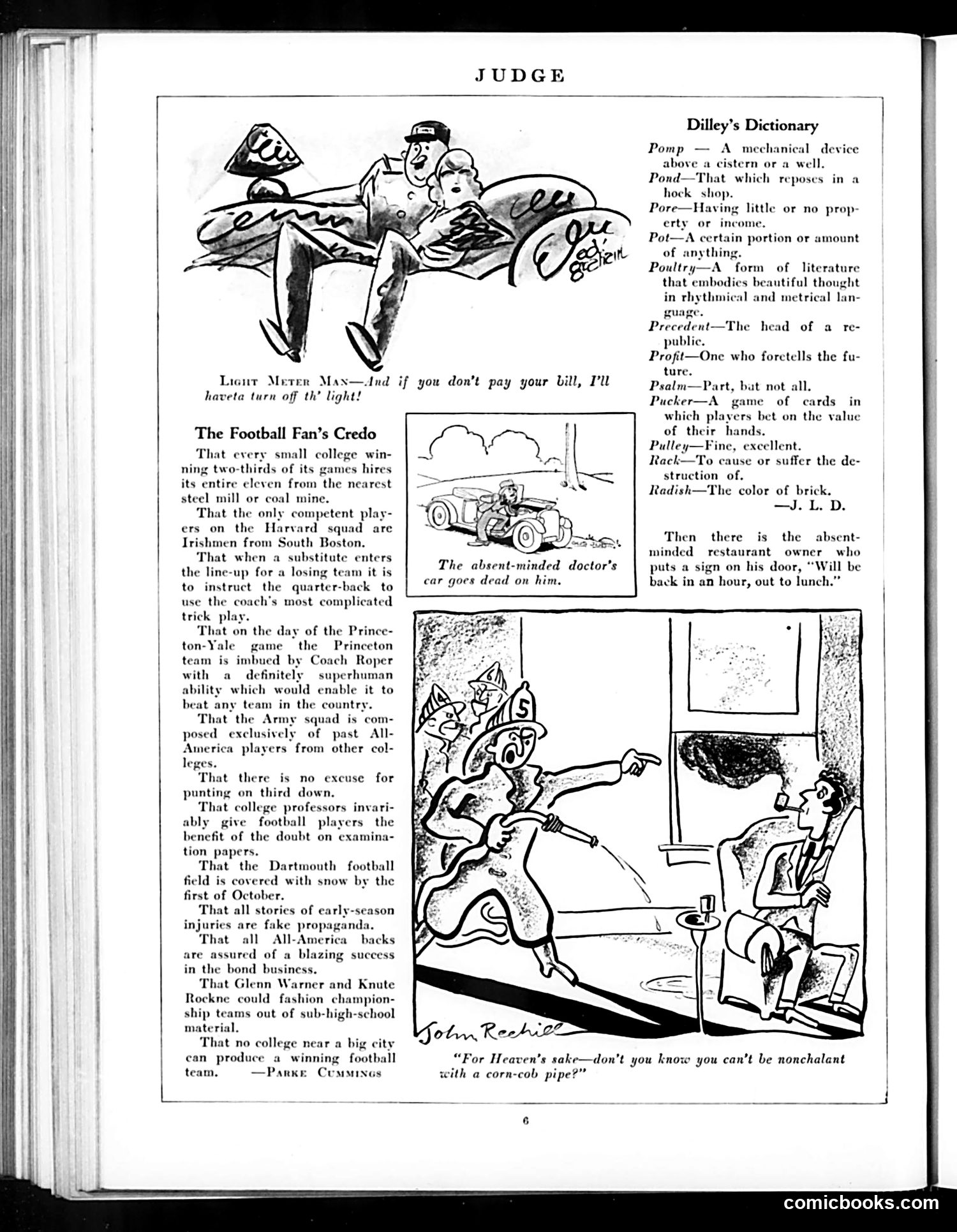
Analysis of Judge Magazine Page This page contains satirical content about early 20th-century American life: Top cartoon ("Light Meter Man"): A utility company worker threatens to cut off electricity for non-payment—satirizing aggressive debt collection by monopolistic utilities. "Football Fan's Creed": A humorous mock-serious poem mocking college football culture, its recruiting practices, coaching mythology, and the absurd reverence fans and schools place on the sport. Middle cartoon ("The absent-minded doctor's car"): Visual gag about a distracted physician whose vehicle breaks down, forcing him to walk. Bottom cartoon (John Rockhife): A man smoking a corn-cob pipe tells another he's "nonchalant"—likely mocking pretentious social posturing or the affectation of casualness. The page reflects early 1900s American concerns: utility monopolies, college sports excess, and social pretension.
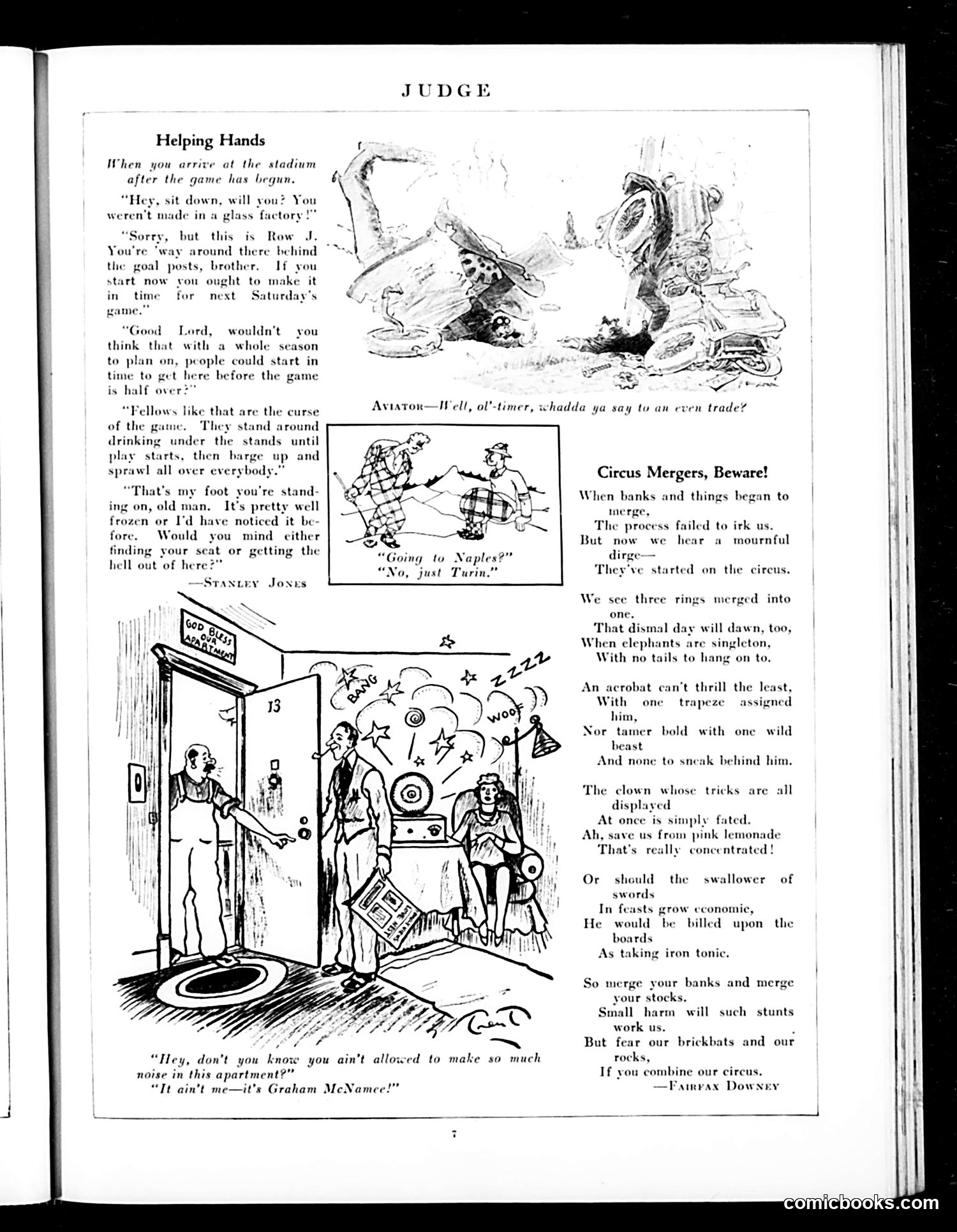
Judge Magazine Page Analysis This page from *Judge* contains two separate satirical pieces: "Helping Hands" mocks inconsiderate sports fans. The cartoons show stadium-goers arriving late, blocking others' views, standing on feet, and causing general disruption. The humor targets the social rudeness of those who arrive after games begin—particularly those drinking under the stands before stumbling to their seats. The final cartoon references "Graham McNamee," likely a famous radio broadcaster of the era, joking that apartment noise complaints stem from his broadcast volume rather than residents. "Circus Mergers, Beware!" satirizes the 1920s wave of business consolidations and bank mergers. The poem uses circus imagery to mock corporate consolidation trends: merged rings lose their appeal, animals lose distinctiveness, acts become economically inefficient. The satire warns that while business mergers might seem acceptable in finance, combining entertainment—the circus—would destroy its magic. It's a lighthearted critique of unchecked corporate consolidation. Both pieces target contemporary social irritations and economic trends through humor.
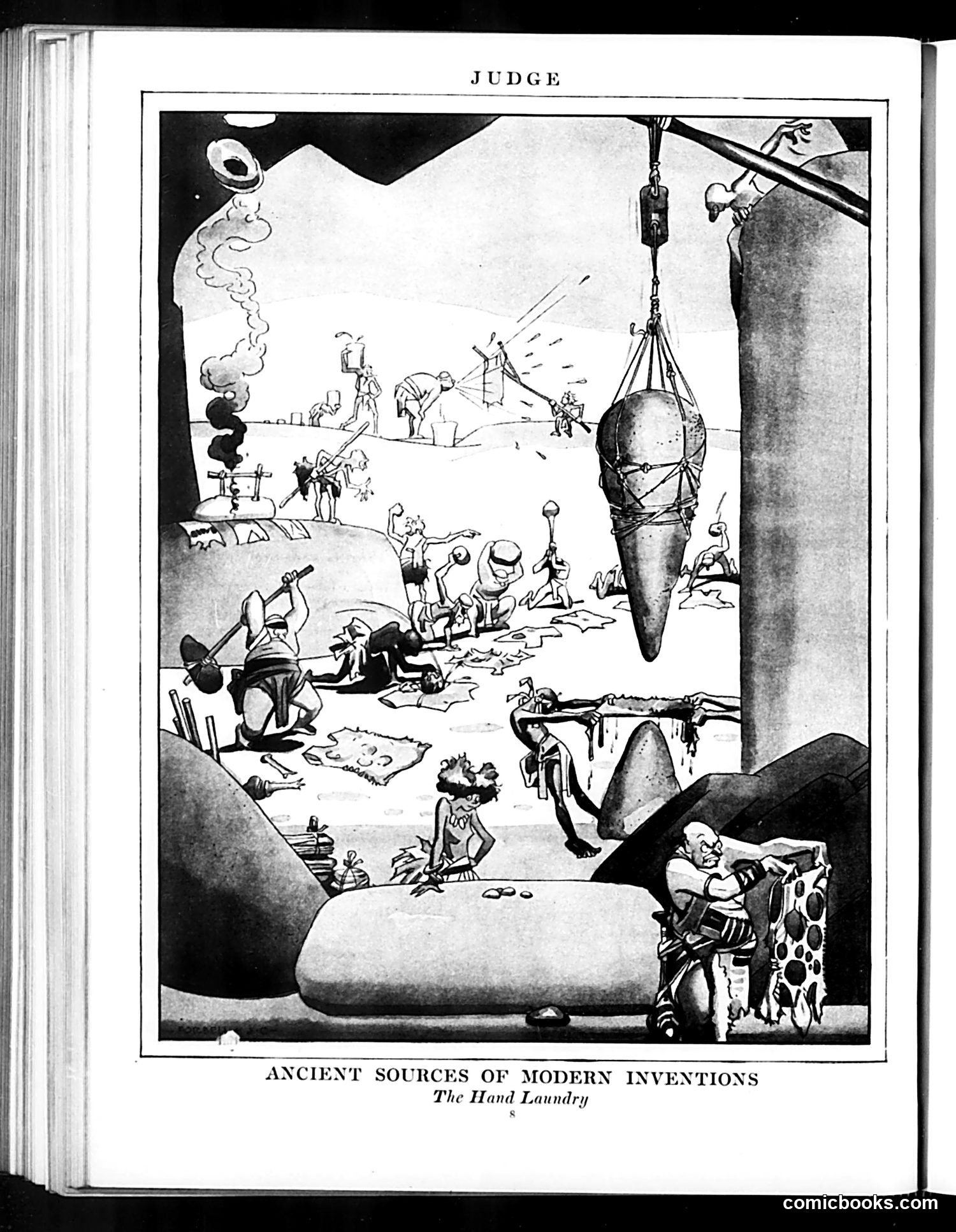
Analysis This satirical cartoon from *Judge* magazine depicts "The Hand Laundry" as an "ancient source of modern inventions." The illustration shows a surreal, underground or cavernous workshop where small figures operate various contraptions and machinery to wash clothes by hand. The satire appears to mock the industrial laundering process by presenting it as primitive, chaotic labor—suggesting that despite modern technological advancement, commercial laundries still rely on fundamental hand-washing methods rather than true mechanization. The fantastical, overcomplicated apparatus surrounding the workers emphasizes the absurdity: all this elaborate machinery essentially reduces to manual labor anyway. The cartoon criticizes either the inefficiency of contemporary laundry services or satirizes claims about modern "progress" when basic work remains fundamentally unchanged.
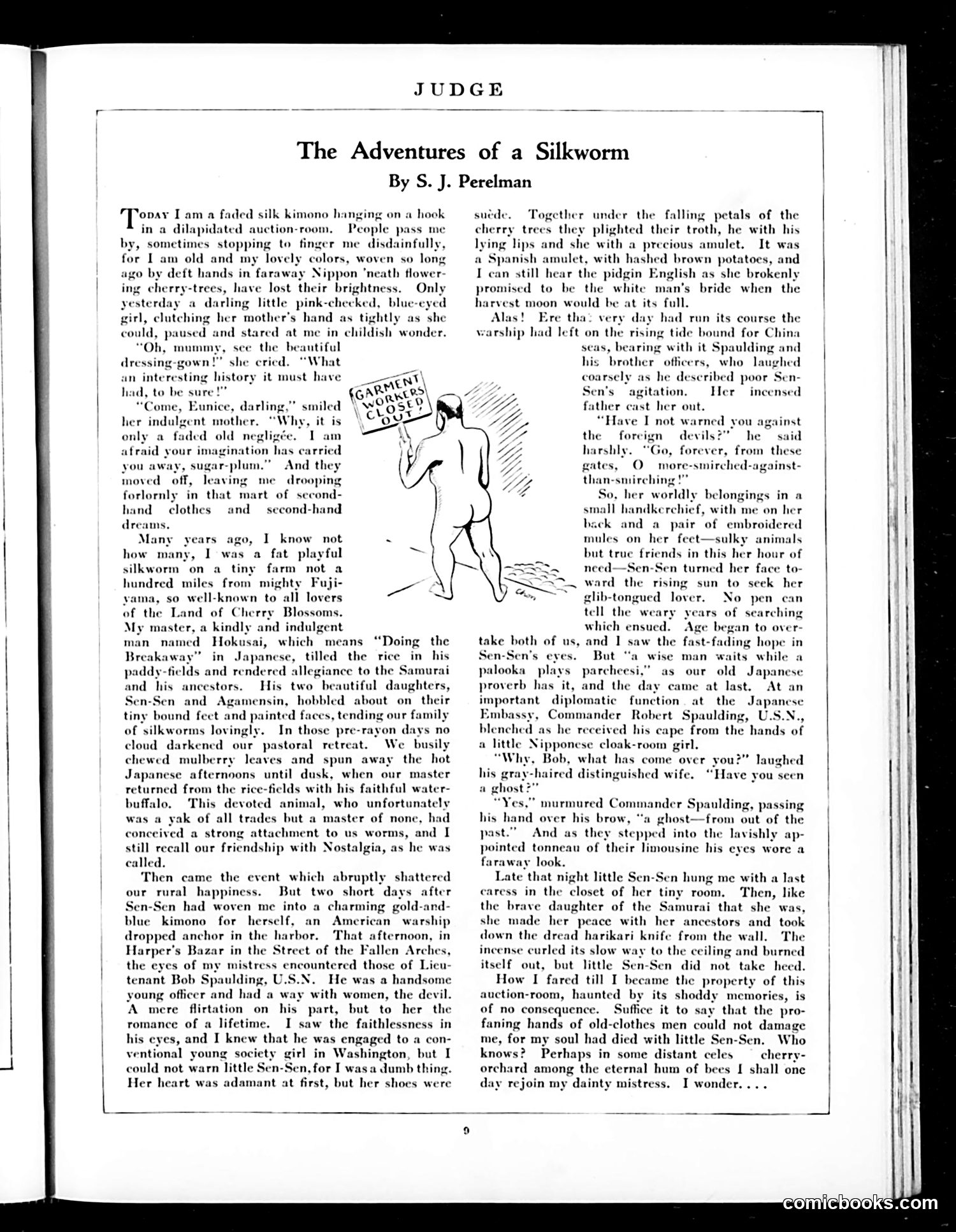
"The Adventures of a Silkworm" by S. J. Perelman This is a satirical short story (not primarily a political cartoon), published in *Judge* magazine. The narrative frames a faded kimono in an auction room recounting its journey from a Japanese silk farm. The story parodies melodramatic Orientalist fiction popular in early 20th-century America. Key elements include: exoticized Japanese imagery (Mt. Fuji, cherry blossoms, samurai ancestors), stereotypical character names ("Sen-Sen"), and a predictable tragic plot—a naive Japanese girl falls for a deceitful American naval officer who abandons her. The illustration shows a humorous nude figure labeled "Garment Exposed" examining the kimono. Perelman mocks both the sentimental romanticization of Japan and the trope of the tragically wronged Asian woman. The satire targets American readers' appetite for exotic, melodramatic tales and their casual racism toward non-Western cultures.
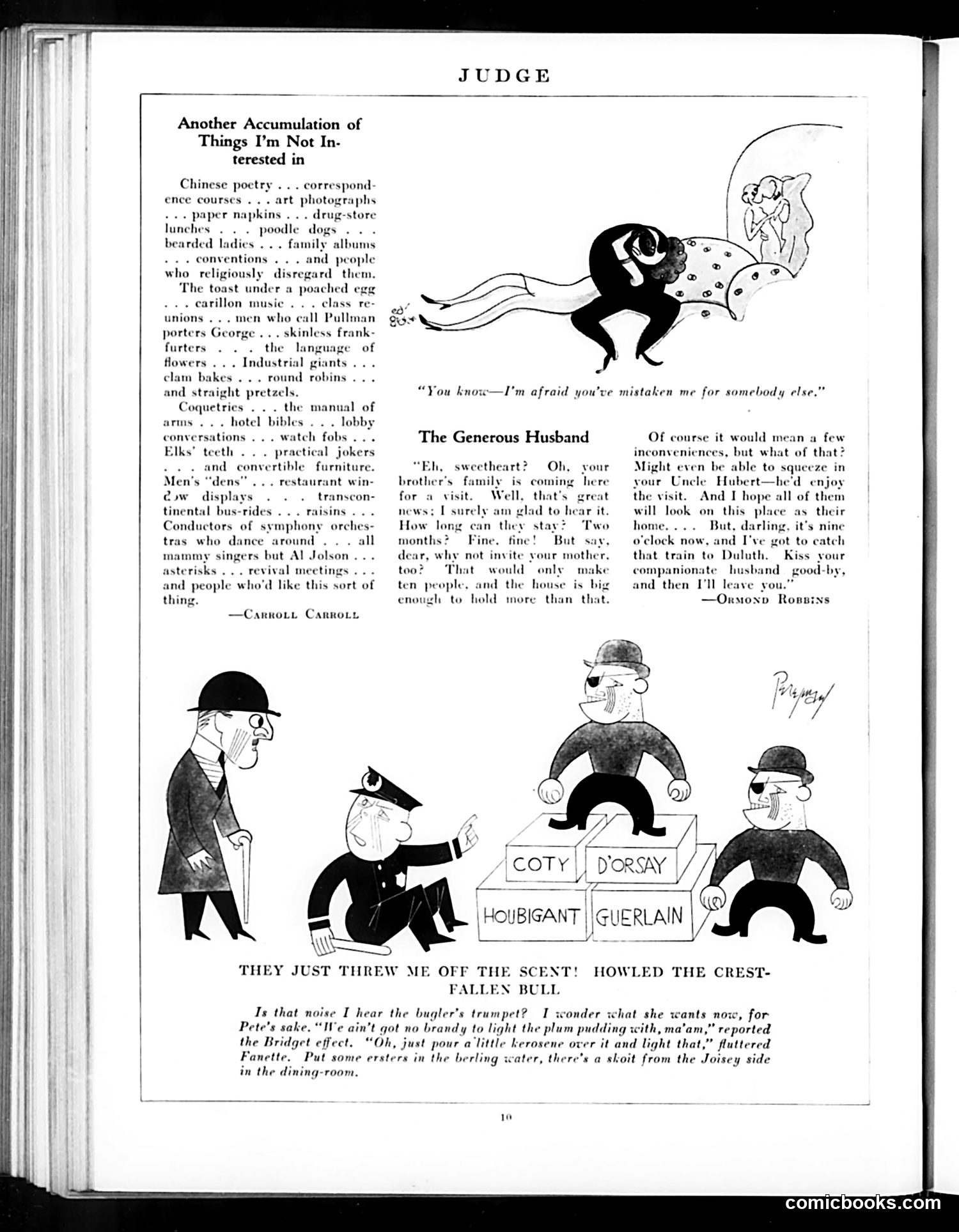
Judge Magazine Page Analysis This page from the satirical magazine *Judge* contains three distinct pieces of humor: "Another Accumulation of Things I'm Not Interested in" (by Carroll Carroll) is a humorous list-essay mocking tedious social conventions and consumer products of the era—Chinese poetry, correspondence courses, poodle dogs, conventions, and people who ignore etiquette. It's genteel complaint masquerading as cultural commentary. "The Generous Husband" satirizes domestic hypocrisy. A husband enthusiastically encourages his wife to invite her brother's family for a two-month visit, then her mother, and uncle—appearing magnanimous—only to reveal he's catching a train to Duluth and leaving immediately. The joke exposes how easily men avoided domestic inconvenience while posturing as selfless. "They Just Threw Me Off the Scent" (bottom) appears to reference fragrance brands (Coty, Dorsay, Houbigant, Guerlain visible on blocks) in a visual gag about perfume, though the complete context is unclear from this page. The humor targets bourgeois pretension, marital dynamics, and consumer culture typical of early 20th-century American satire.
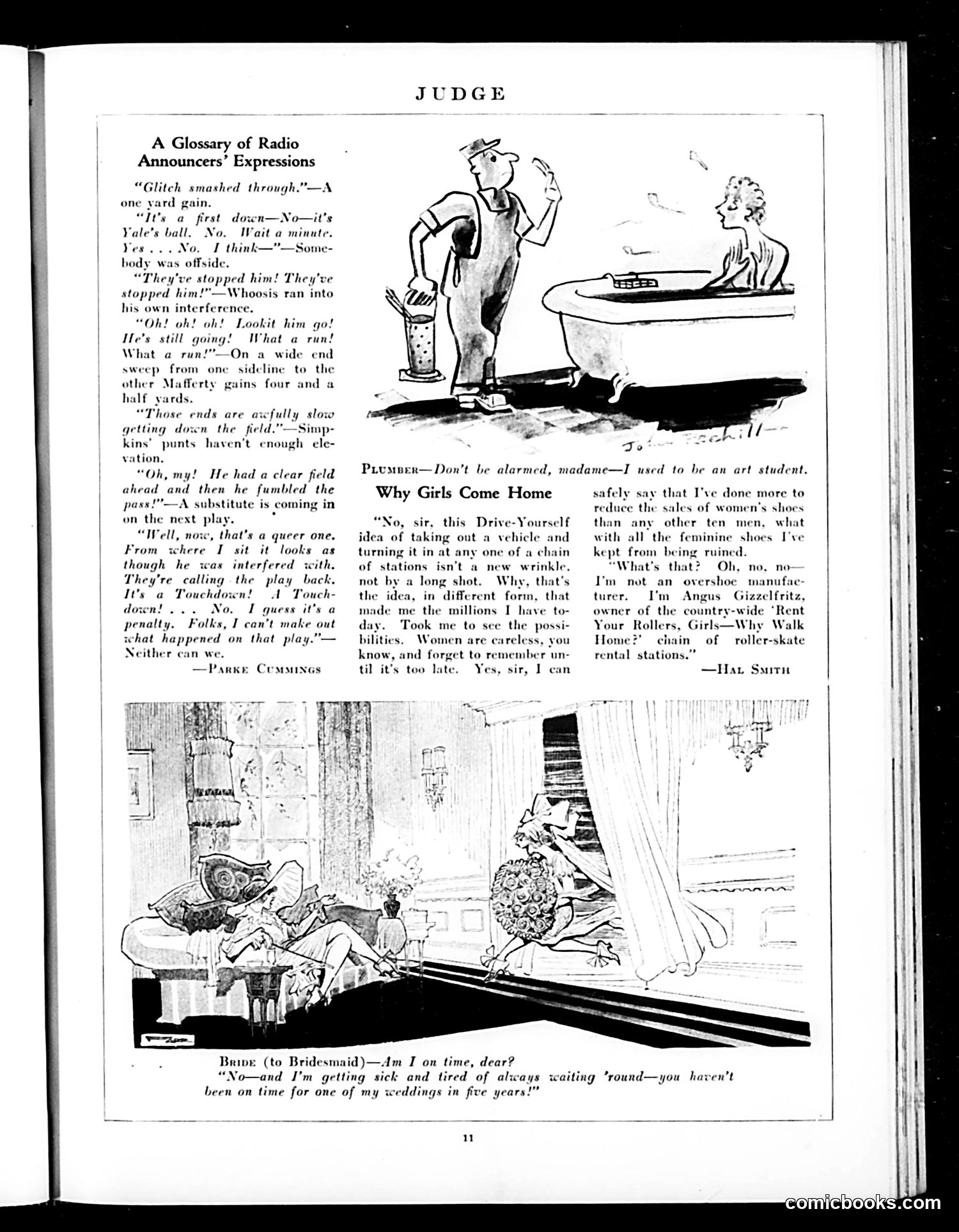
Analysis of Judge Magazine Page This page satirizes radio sports announcers and contains social humor about gender roles. Top Section: "A Glossary of Radio Announcers' Expressions" mocks the breathless, often confused commentary of live football broadcasters. The humor lies in announcers making dramatic declarations ("Oh! oh! oh! Lookit him go!") for minimal gains (four and a half yards), or contradicting themselves repeatedly about basic facts. Parker Cummings highlights how radio announcers obscure rather than clarify action. Bottom Section: Two separate humor pieces—one about a plumber who claims his business thrives because women drivers rent vehicles and ruin their shoes, and a bride chronically late to her own weddings. The joke assumes female drivers are reckless and that women are perpetually tardy—typical 1920s-30s gender stereotypes presented as comic fact. The page reflects an era when radio sports commentary was new, exciting, and often amateurish.
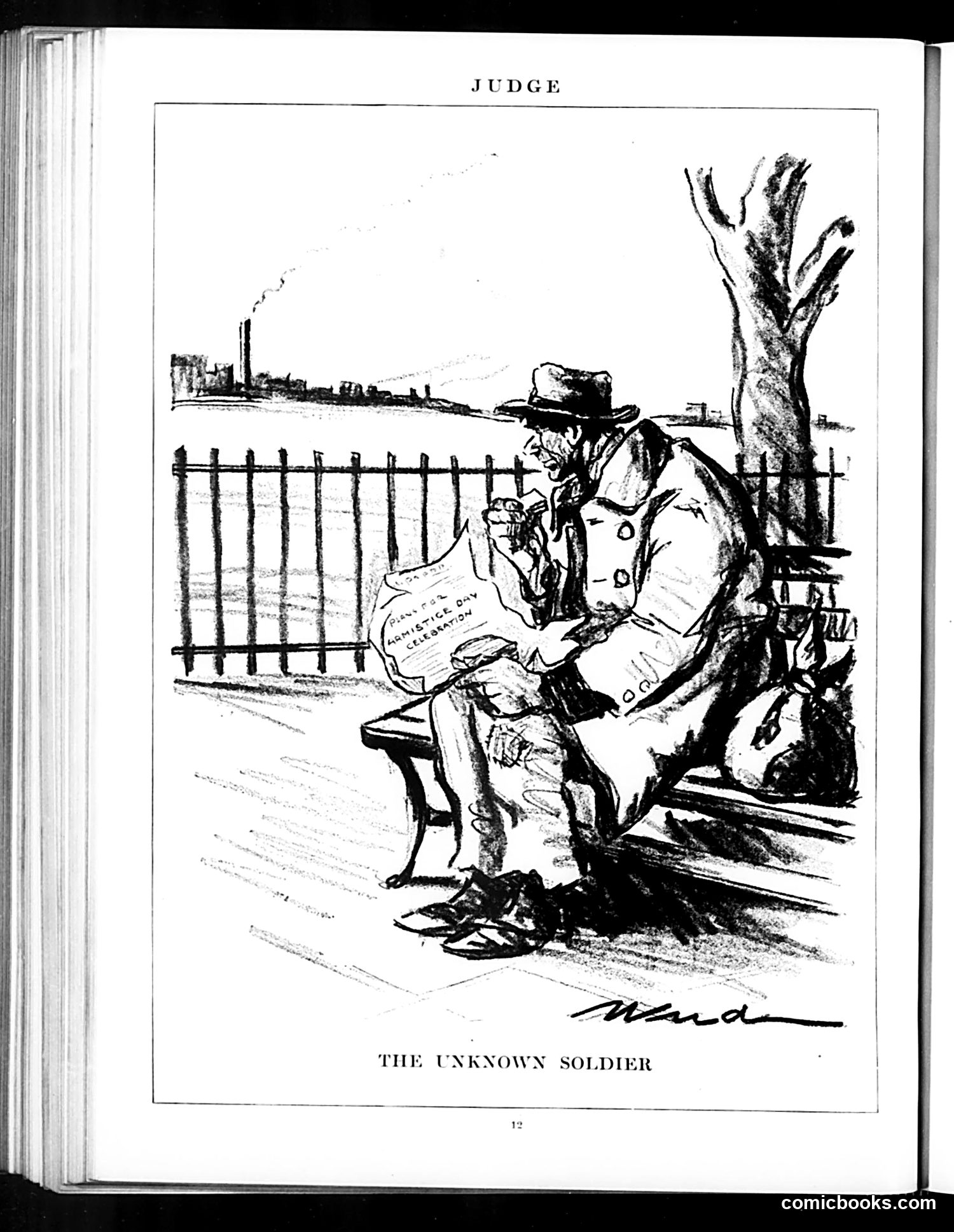
"The Unknown Soldier" - Judge Magazine Cartoon This cartoon depicts a portly, well-dressed man sitting on a bench near an industrial waterfront, reading a newspaper labeled "INSTRUCTIONS FOR CITIZENSHIP" (partially visible). The figure appears to be an immigrant or working-class person receiving civic education materials. The title "The Unknown Soldier" suggests ironic commentary on military service and citizenship. The cartoon likely satirizes the gap between official civics instruction and actual immigrant experiences in America—particularly relevant given Judge's early 20th-century publication period when mass immigration and labor unrest were contentious issues. The waterfront setting with factories suggests industrial work. The satire appears to critique either the inadequacy of citizenship programs or the disconnect between patriotic ideals and working-class realities.
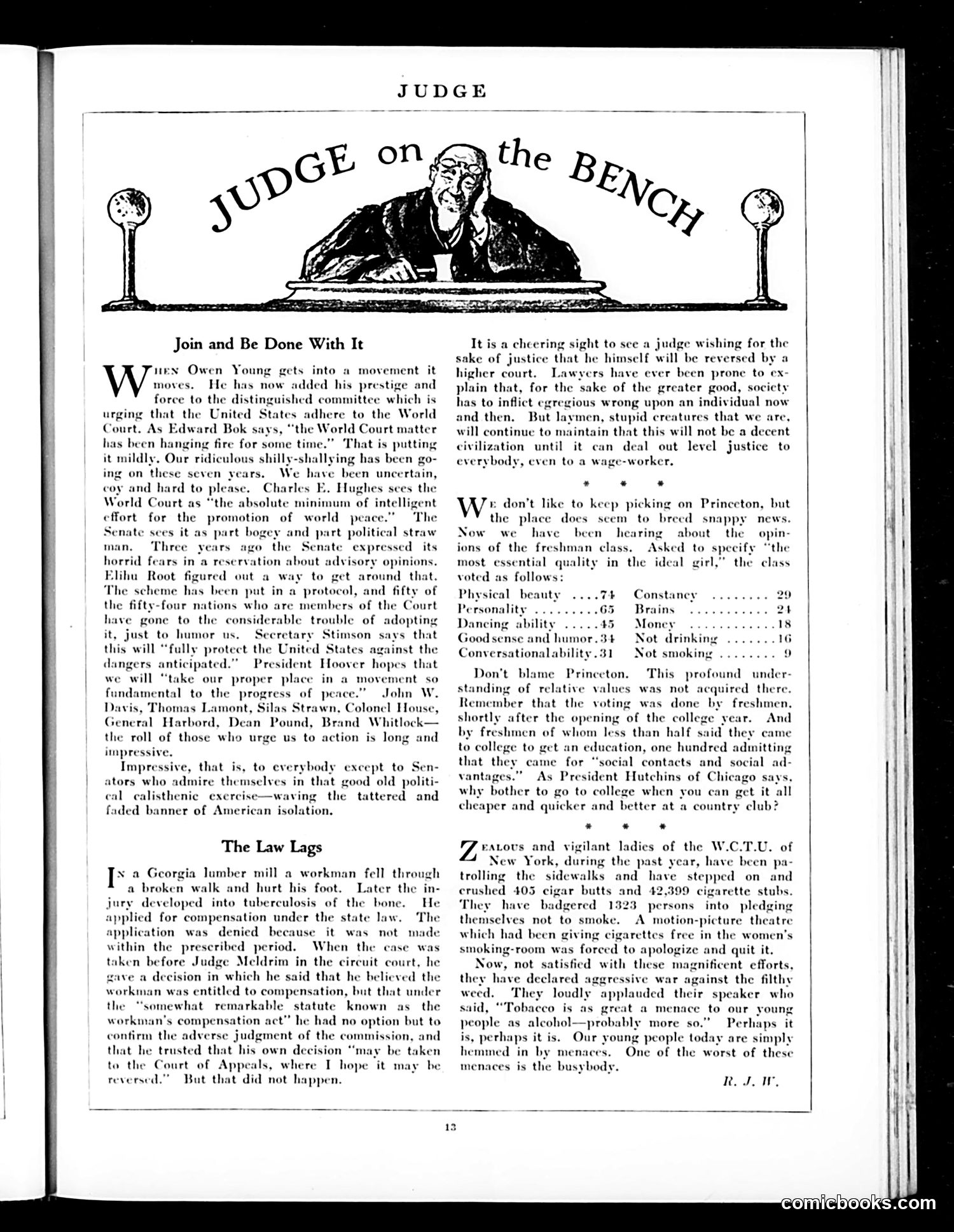
Judge Magazine Analysis: "Judge on the Bench" This page contains three satirical pieces by Judge magazine attacking what it sees as American timidity and outdated thinking. "Join and Be Done With It" criticizes the seven-year delay in U.S. adherence to the World Court. The piece names prominent advocates (Owen Young, Edward Bok, Charles E. Hughes, Secretary Stimson, President Hoover) and mocks senators clinging to isolationism—calling it a "tattered and faded banner of American isolation." The satire: America is holding up progress while fifty-four other nations have already adopted the protocol. "The Law Lags" attacks rigid workers' compensation statutes. A Georgia lumber worker develops tuberculosis but cannot claim compensation because he missed a deadline. Judge Meldrim sympathizes but is legally bound to deny it. The satire: the law inflicts "egregious wrong" on ordinary workers to serve abstract legal rules. The Princeton section ridicules a freshman class survey on ideal girl qualities, where physical beauty (7 votes) and money (18) ranked higher than brains (21). The satire: young men attend college for "social contacts" rather than education—a systemic failure, not Princeton's alone.
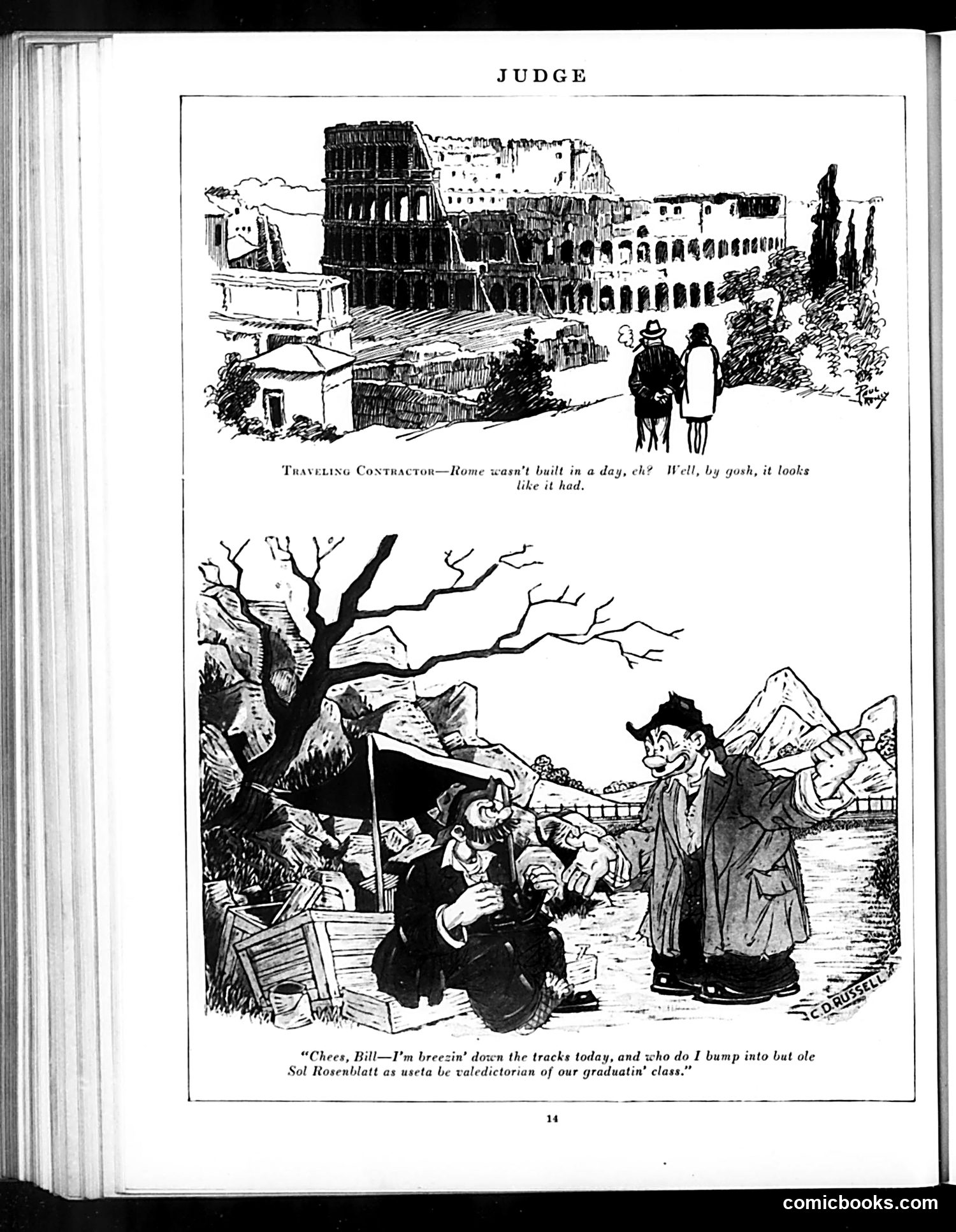
Judge Magazine - Two Cartoons Top cartoon: A traveling contractor and companion observe Rome's ruins, joking that the ancient city's current state of decay looks like it was built in just one day—a sarcastic reversal of the saying "Rome wasn't built in a day." The humor derives from the contrast between Rome's legendary construction time and its present ruined condition. Bottom cartoon: Two working-class men (drawn with exaggerated features suggesting ethnic caricature, common to this era) encounter each other on railroad tracks. One remarks that he's running into Sol Rosenblatt, their former class valedictorian, apparently now reduced to hoboing or manual labor. The joke satirizes the gap between academic achievement and actual life outcomes, particularly for immigrants or working-class individuals—a commentary on social mobility or economic hardship.
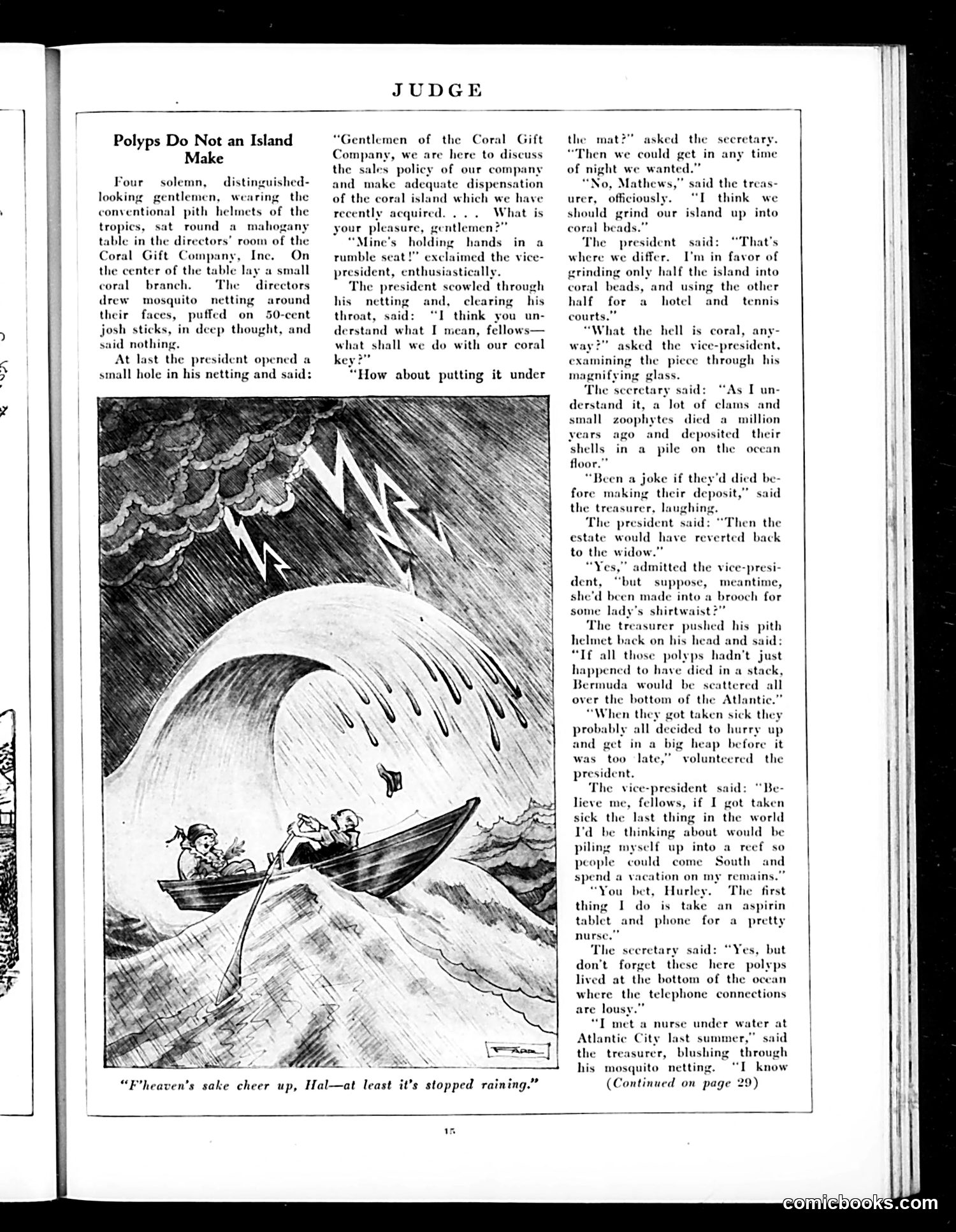
"Polyps Do Not an Island Make" - Judge Magazine Satire This is a humorous satirical story mocking corporate boardroom discussions and colonial-era business ventures. Four executives of the "Coral Gift Company" debate what to do with a newly acquired "coral island." The joke relies on absurdist humor: the men treat a natural geological formation (an island made of accumulated coral polyp shells) as a business commodity, proposing ridiculous uses—grinding it into beads, building a hotel, making it a brooch. Their obtuse corporate-speak and disconnected chatter (one executive's tangent about meeting a nurse at Atlantic City) satirize boardroom pretension and the era's exploitative colonial attitudes toward natural resources. The illustration shows a giant wave or coral formation dwarfing businessmen in a boat—visually emphasizing how insignificant their schemes are against nature's scale. The satire critiques both corporate incompetence and the casual imperialism of acquiring and "developing" distant islands.
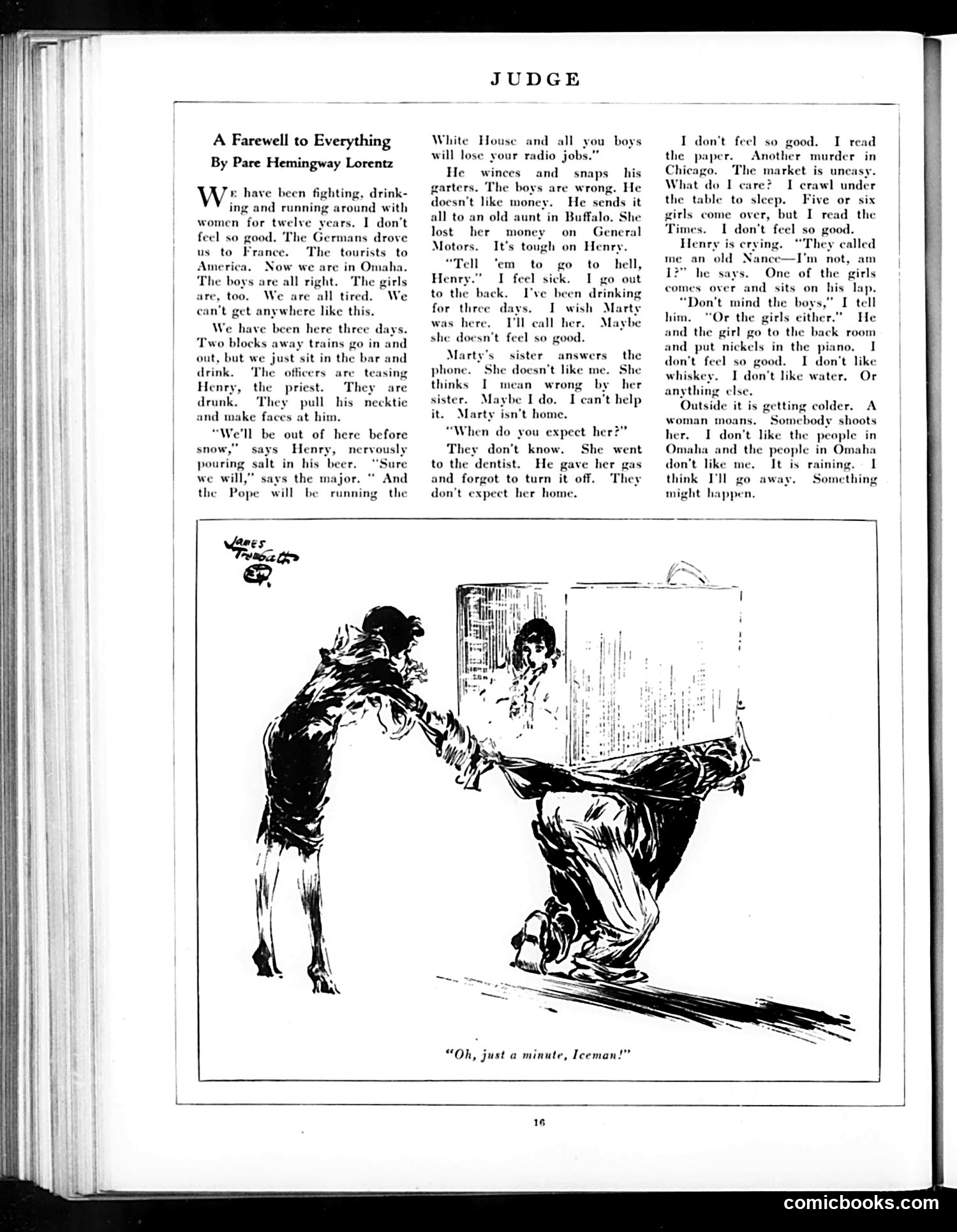
Analysis This page presents a short story by Pare Hemingway Lorentz (likely a play on Ernest Hemingway's name) about American soldiers or expatriates in Omaha, Nebraska, expressing post-WWI disillusionment. The narrative depicts men drinking, depressed, and disconnected—typical "Lost Generation" themes. References to France, tourists, and the general malaise suggest post-war ennui. The men are cynical about money, relationships, and their circumstances. The accompanying cartoon shows a woman kicking out an iceman with "Oh, just a minute, Iceman!"—a domestic comedy scene unrelated to the story's serious tone. The satire's point: Judge mocks the self-pitying, world-weary attitudes of post-war American men, their drinking culture, romantic failures, and existential complaints. By juxtaposing this with a trivial domestic cartoon, the magazine suggests these "serious" complaints are overwrought or pretentious—a common satirical strategy of the 1920s-30s.
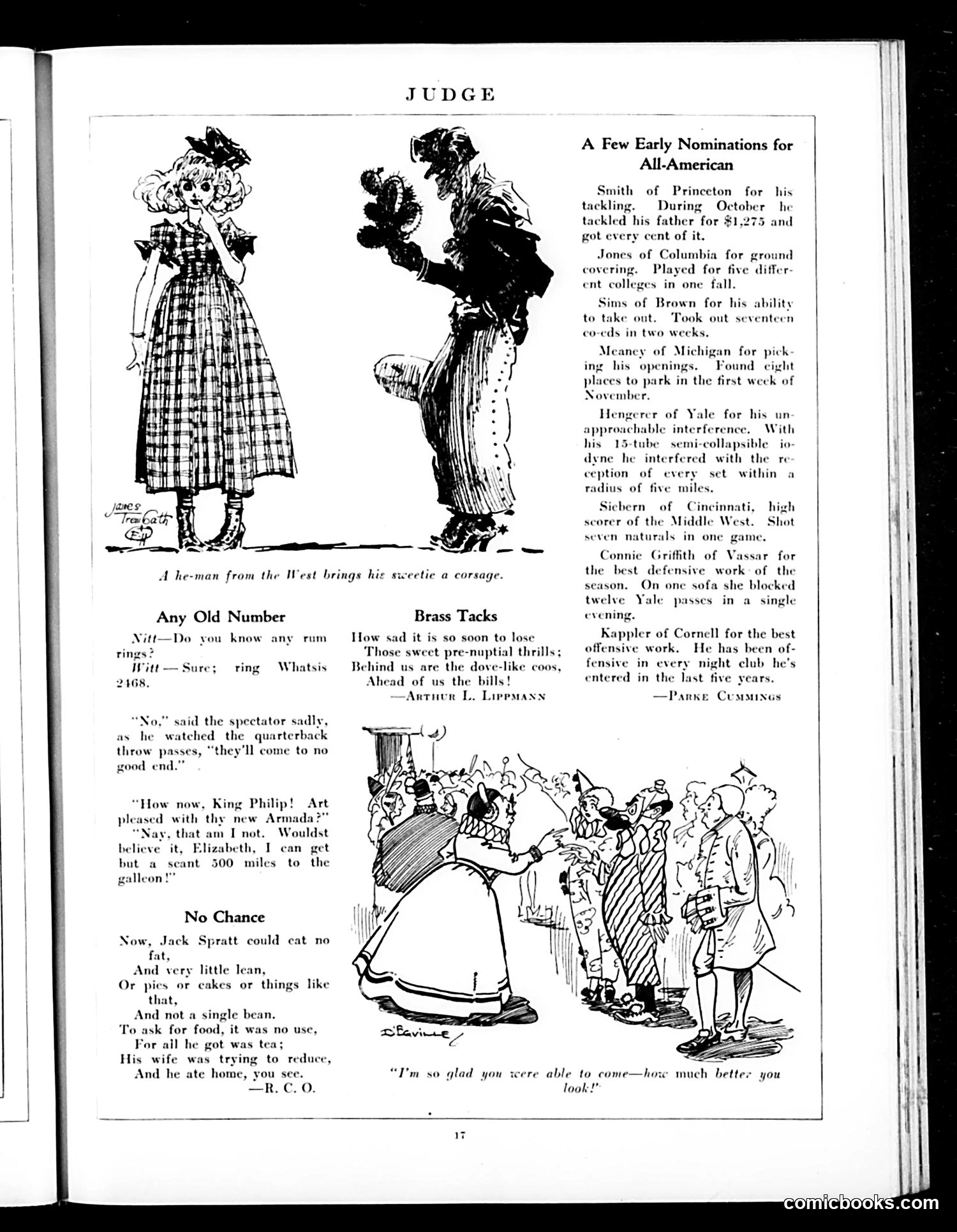
Judge Magazine Page Analysis This page contains humorous satirical content typical of Judge magazine's irreverent style: Main Cartoon (top): A Western man presents a corsage to his girlfriend—the joke being his rough frontier masculinity contrasts with this delicate romantic gesture. "All-American" Nominations: The central satire mocks college football's "All-American" selections by nominating players for absurd off-field achievements rather than athletic skill. Examples include: a Princeton player who tackled his father for money; a Columbia player who attended five different colleges in one season; a Yale player whose radio interfered with neighbors' reception; a Vassar woman who "blocked" male advances on a sofa. The humor derives from treating dating, partying, and rule-breaking as legitimate athletic accomplishments. Poems: "Any Old Number" and "No Chance" are light verse jokes about romance and marriage struggles—standard Judge fare. Bottom Cartoon: Depicts a large woman greeting visitors, likely satirizing post-WWI social anxieties about women's changing roles and appearances. The page reflects 1920s collegiate culture, dating customs, and technological novelties (radio).
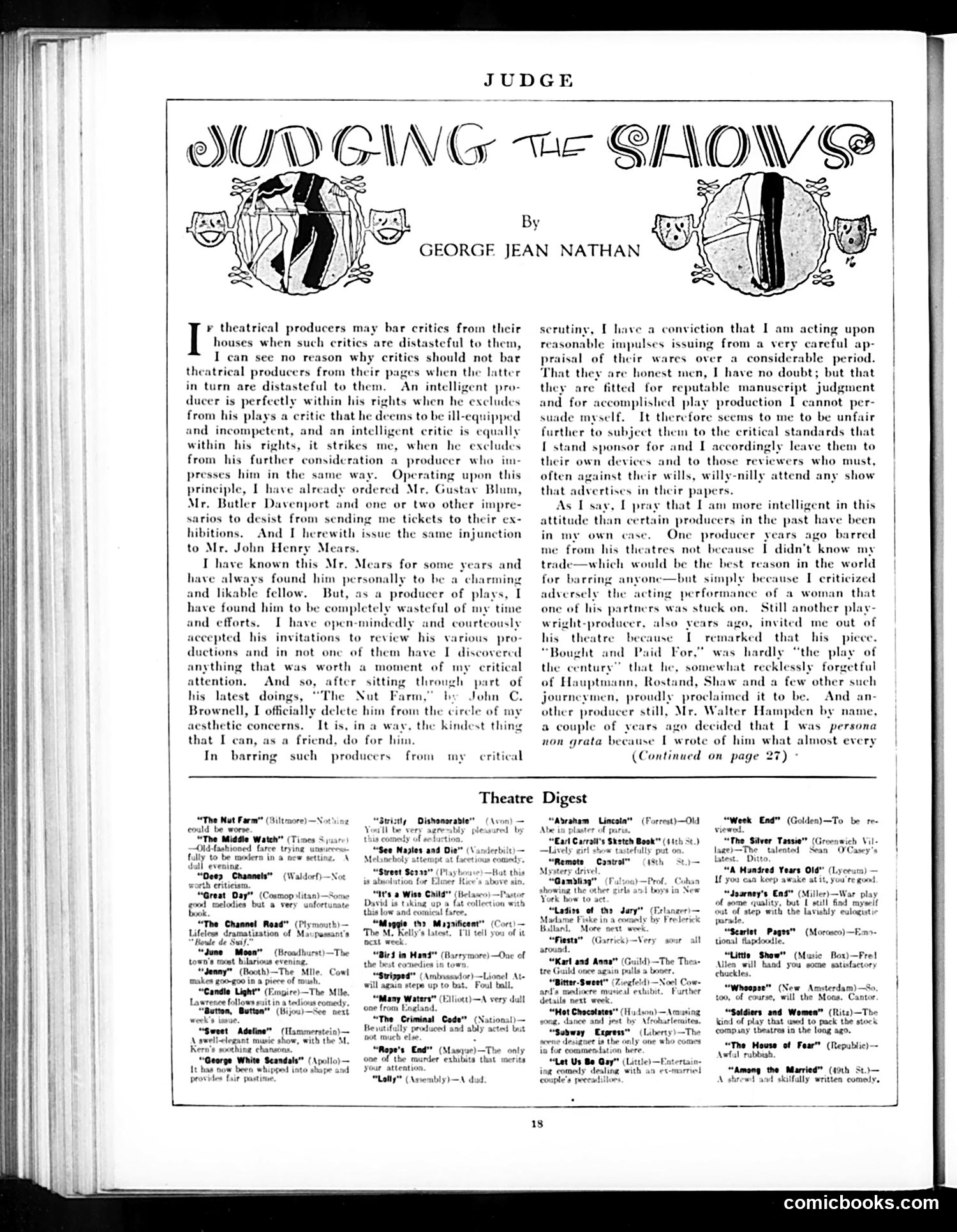
Analysis for Modern Readers This page features George Jean Nathan's critical column "Judging the Shows," where the theater critic declares he is banning several theatrical producers from his consideration—just as those producers have sometimes barred him from their theaters. Nathan names specific producers (Gustav Blum, Butler Davenport, John Henry Mears, Walter Hampden) whom he found wasteful of his time despite their plays. He argues that intelligent critics have the right to exclude incompetent producers just as producers exclude incompetent critics. The satire targets the power dynamics and personal vendettas in early 20th-century theater. Nathan claims the moral high ground by framing his exclusions as principled, while suggesting the producers who banned him acted from pettiness (one allegedly barred him after he criticized an actress the producer favored). The "Theatre Digest" section below lists current Broadway shows with brief reviews—standard content for Judge magazine's theater coverage.
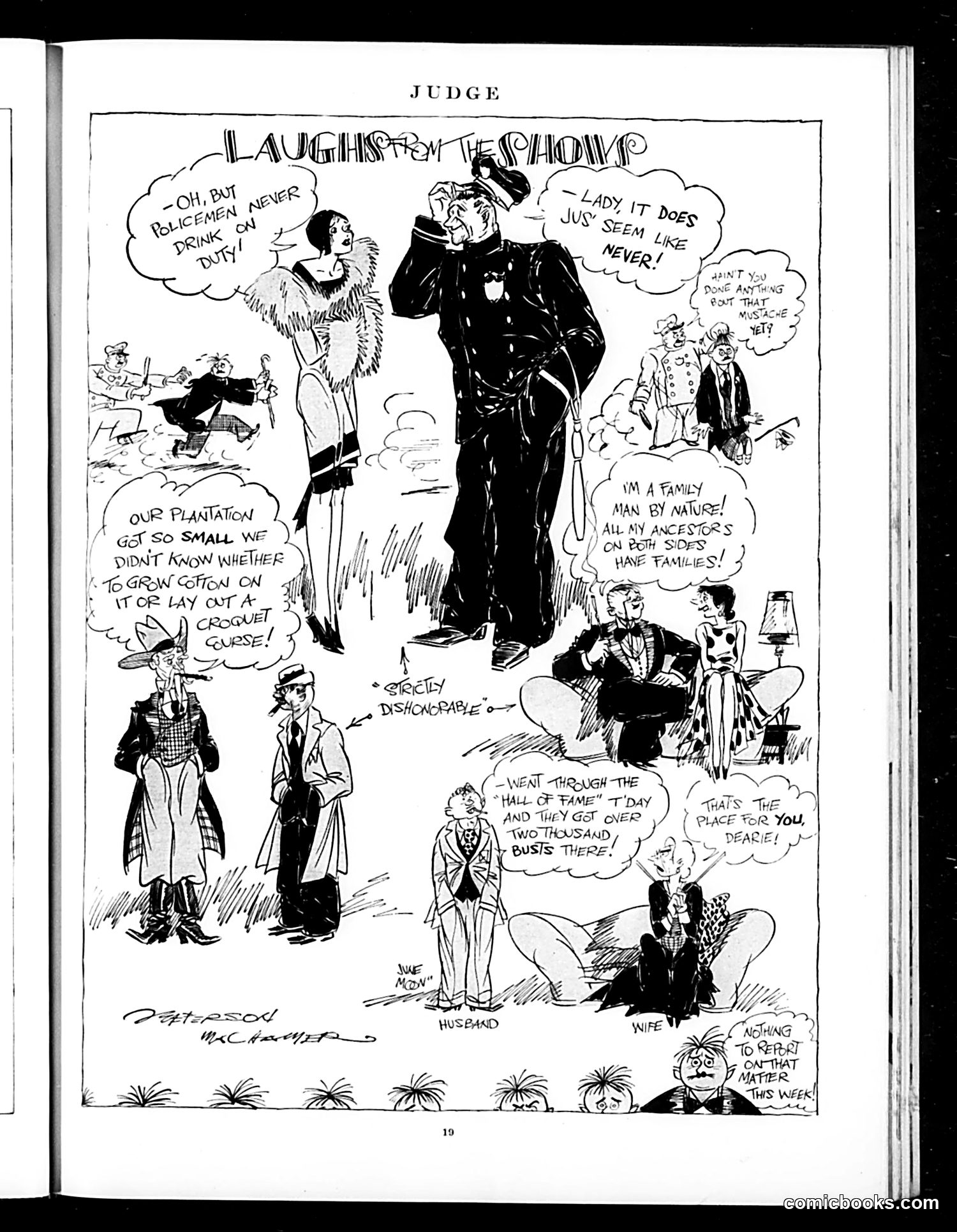
Judge Magazine Cartoon: "Laughs from the Show" This satirical cartoon mocks wealthy Americans' pretensions to aristocracy and family prestige. A pompous judge (center) listens to various characters boast about their lineage and accomplishments. The satire targets: - Southern plantation owners claiming family distinction despite small estates - Social climbers bragging about ancestors and "Hall of Fame" memorials - Nouveaux riches displaying excessive wealth through busts and monuments A couple at bottom right represents the ultimate punchline: despite all this self-aggrandizement, they're simply ordinary people trying to seem important. The cartoon's humor relies on the era's anxiety about American class mobility—nouveau riche anxiously performing respectability while the judge (representing established authority) tolerates their pretensions with barely-concealed amusement. It's social commentary on American materialism disguised as refinement.
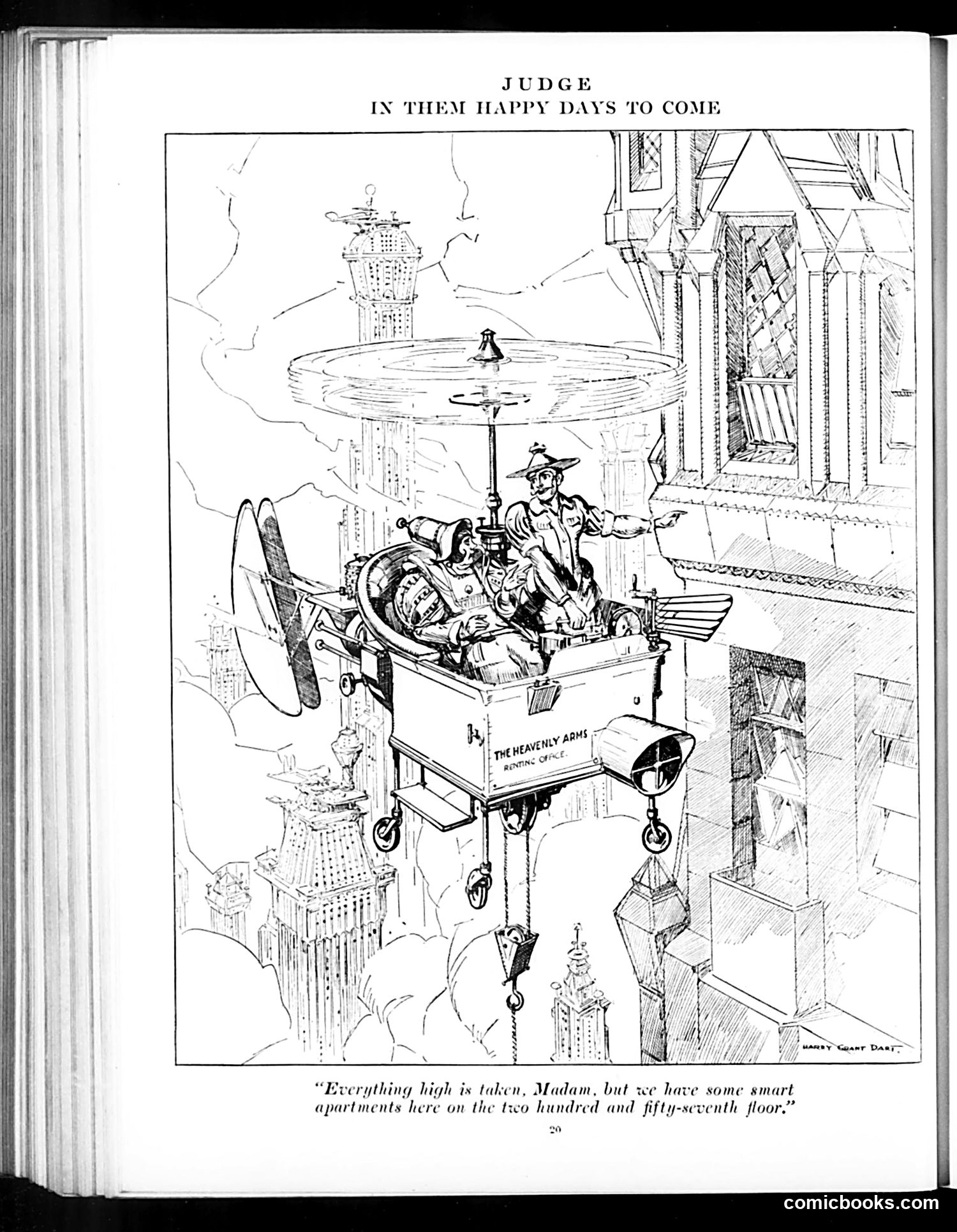
Analysis This is a futuristic satire about real estate in an overpopulated metropolis. The cartoon depicts a real estate agent showing a prospective tenant ("Madam") apartments in an absurdly tall building—the 257th floor—while the skyline behind them is packed with similarly towering structures. The joke targets housing scarcity and skyrocketing prices: even the ultra-high floors are being marketed as desirable when "everything high is taken." The agent's cheerful salesmanship ("smart apartments") contrasts darkly with the dystopian vision of vertical urban sprawl. The title "In Them Happy Days to Come" is ironic—this imagined future of extreme density is presented as optimistic by the real estate industry, though the cartoon suggests it's actually dystopian. The drawing style credits "Harry Grant Dart," a Judge illustrator. This likely reflects early 20th-century anxieties about unchecked urban growth and housing crises.
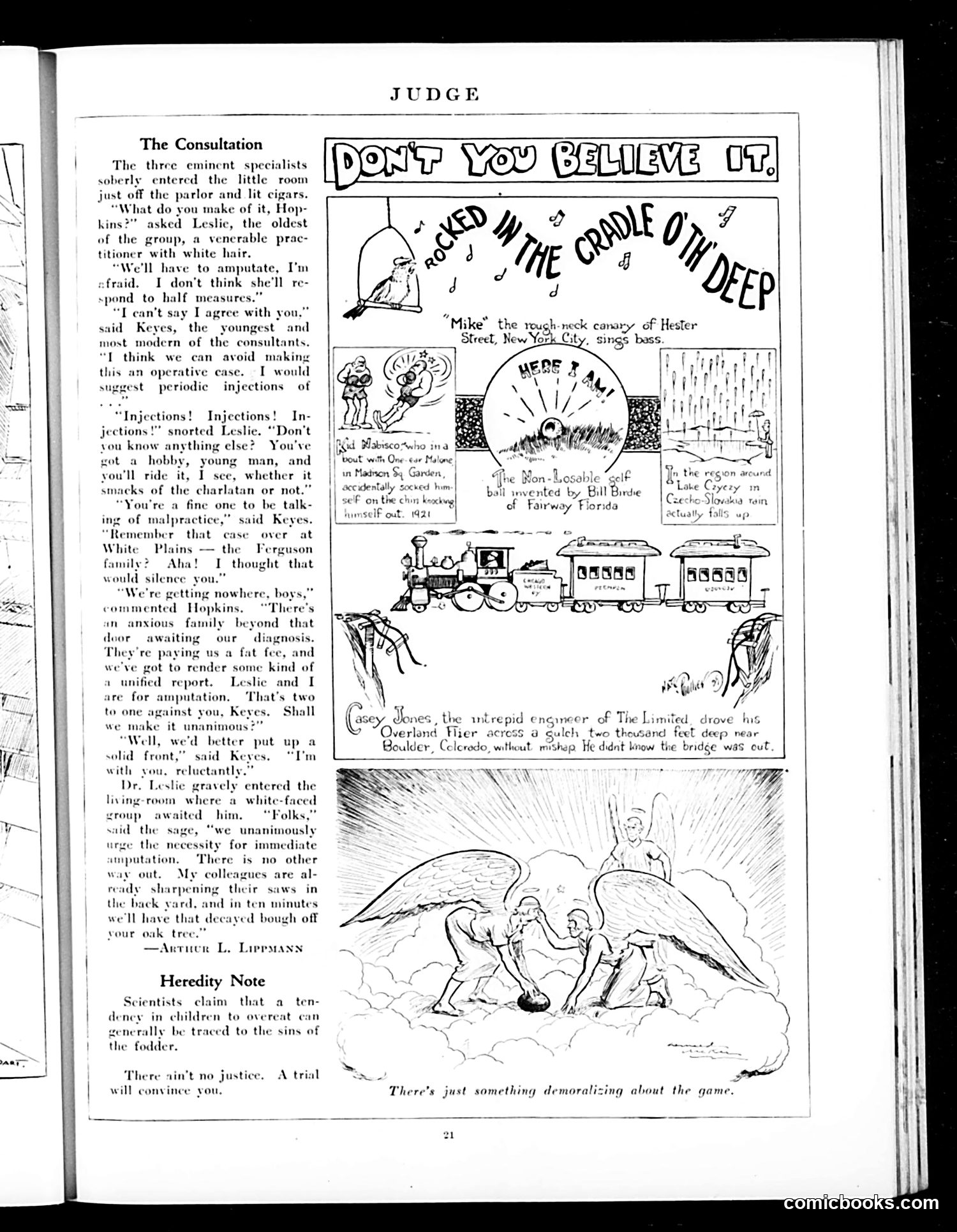
Judge Magazine Page Analysis This page contains three distinct satirical pieces: "The Consultation" (main story): Three doctors debate treating a patient's ailment—likely a social or political "disease." The satire mocks medical disagreement and professional posturing. The older, traditional doctor advocates amputation (drastic measures); the younger, modern doctor proposes injections (less invasive solutions). Their inability to agree, despite claiming expertise, satirizes how specialists often disagree while presenting false unanimity to anxious clients—a commentary on both medicine and perhaps politics/policy debates of the era. "Don't You Believe It" (comic strips): Four humorous vignettes featuring improbable or ironic situations—a canary singing bass, a self-ball invention, a lake that "actually falls up," and a train engineer crossing a nonexistent bridge. These mock absurd claims and human gullibility. "Heredity Note" (bottom): A brief joke attributing children's overeating to parental sins—satirizing popular pseudo-scientific heredity theories of the period. The page's overall theme: exposing professional pretense, false certainty, and public credulity.
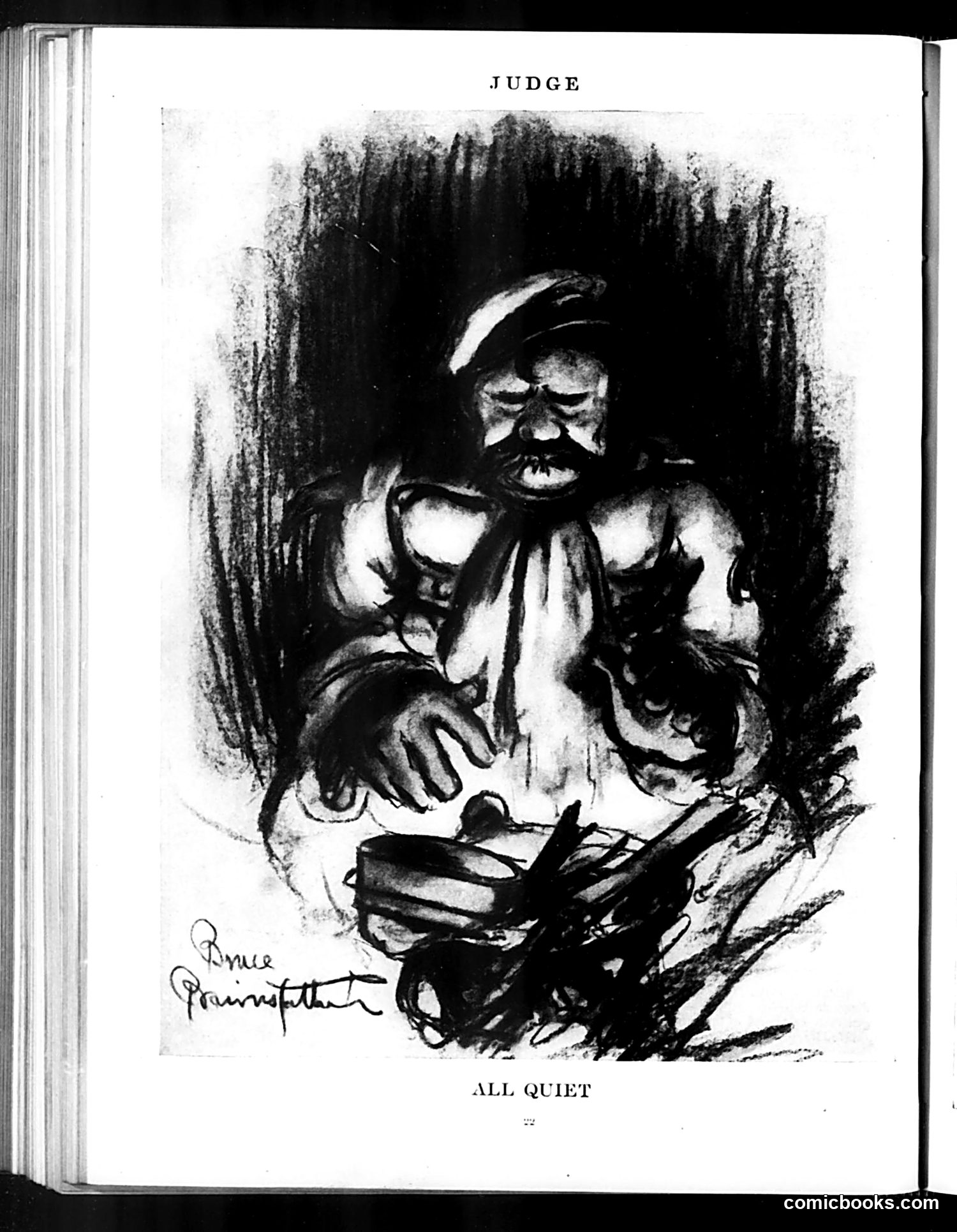
Judge Magazine: "All Quiet" This page shows a single political cartoon titled "All Quiet," signed by what appears to be Bruce Bairnsfather (a famous WWI cartoonist). The illustration depicts a stern-faced man with a prominent mustache and military cap, holding what looks like weapons or military equipment. His expression and posture suggest authority and toughness. The title "All Quiet" likely references the famous WWI novel *All Quiet on the Western Front* or refers to a period of calm before conflict. The figure appears to be a military judge or authority figure, possibly commenting on justice, military law, or preparedness during wartime. Without additional context about the publication date, the precise satirical target remains unclear, though it seems to critique military authority or justice systems of the period.
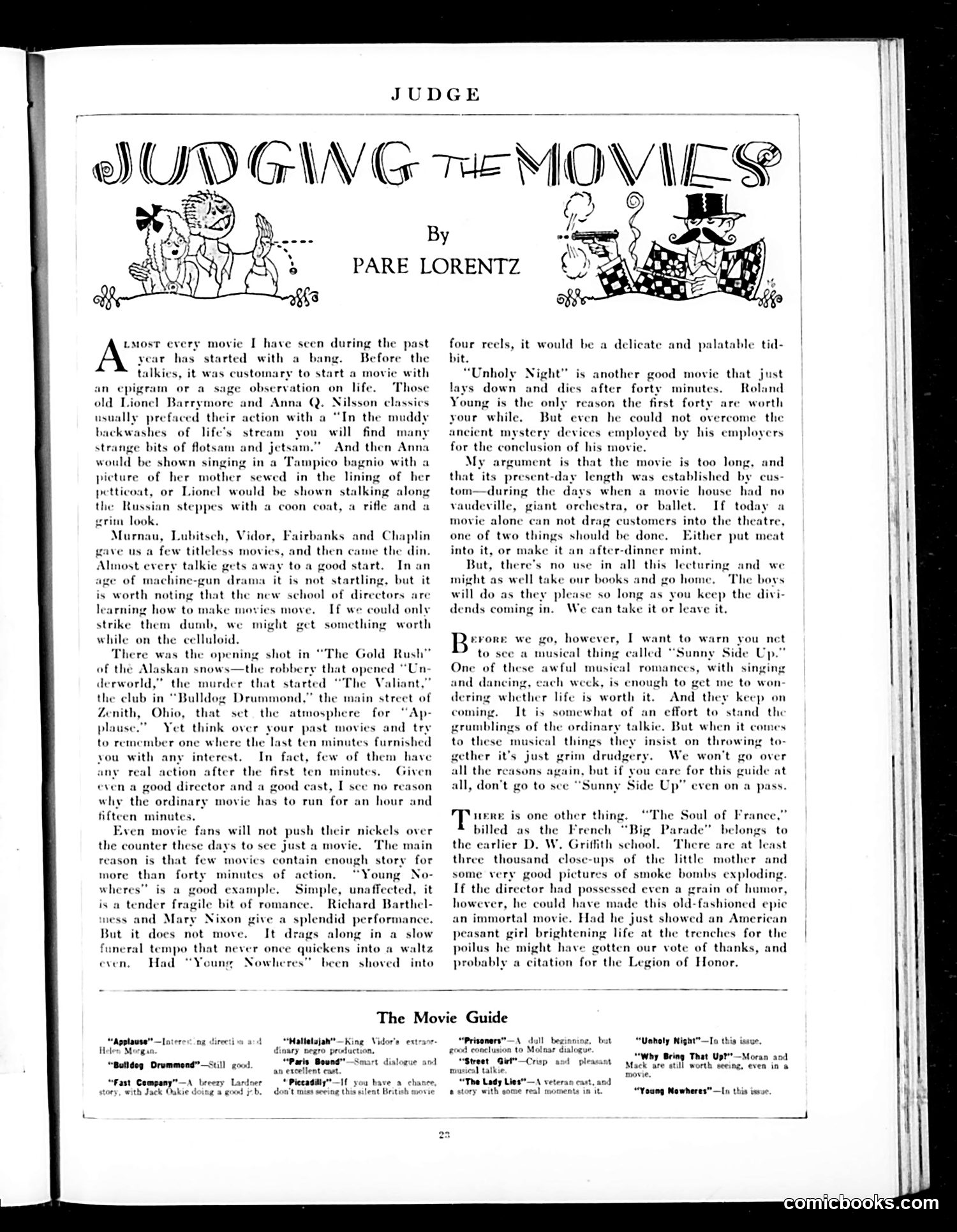
Analysis for Modern Readers This 1928 *Judge* magazine article by Pare Lorentz critiques the structural flaws of early "talkie" (sound) movies. Lorentz argues that films are too long—typically running an hour and fifteen minutes—when most contain only forty minutes of meaningful story. He references specific films (*The Gold Rush*, *Bulldog Drummond*, *Young Nowheres*, *Unholy Night*) to illustrate how movies grab viewers initially but then drag interminably toward their conclusions. His central complaint: movies inherited their length from silent-film-era conventions when theaters needed feature-length content to justify admission prices (alongside vaudeville acts and orchestras). Now, he argues, this practice is obsolete and tedious. He specifically warns against "Sunny Side Up," a musical comedy, calling it "grim drudgery." The satire targets Hollywood's resistance to innovation—they keep the boys happy (investors) by maintaining profitable formats rather than adapting to new technology's possibilities.
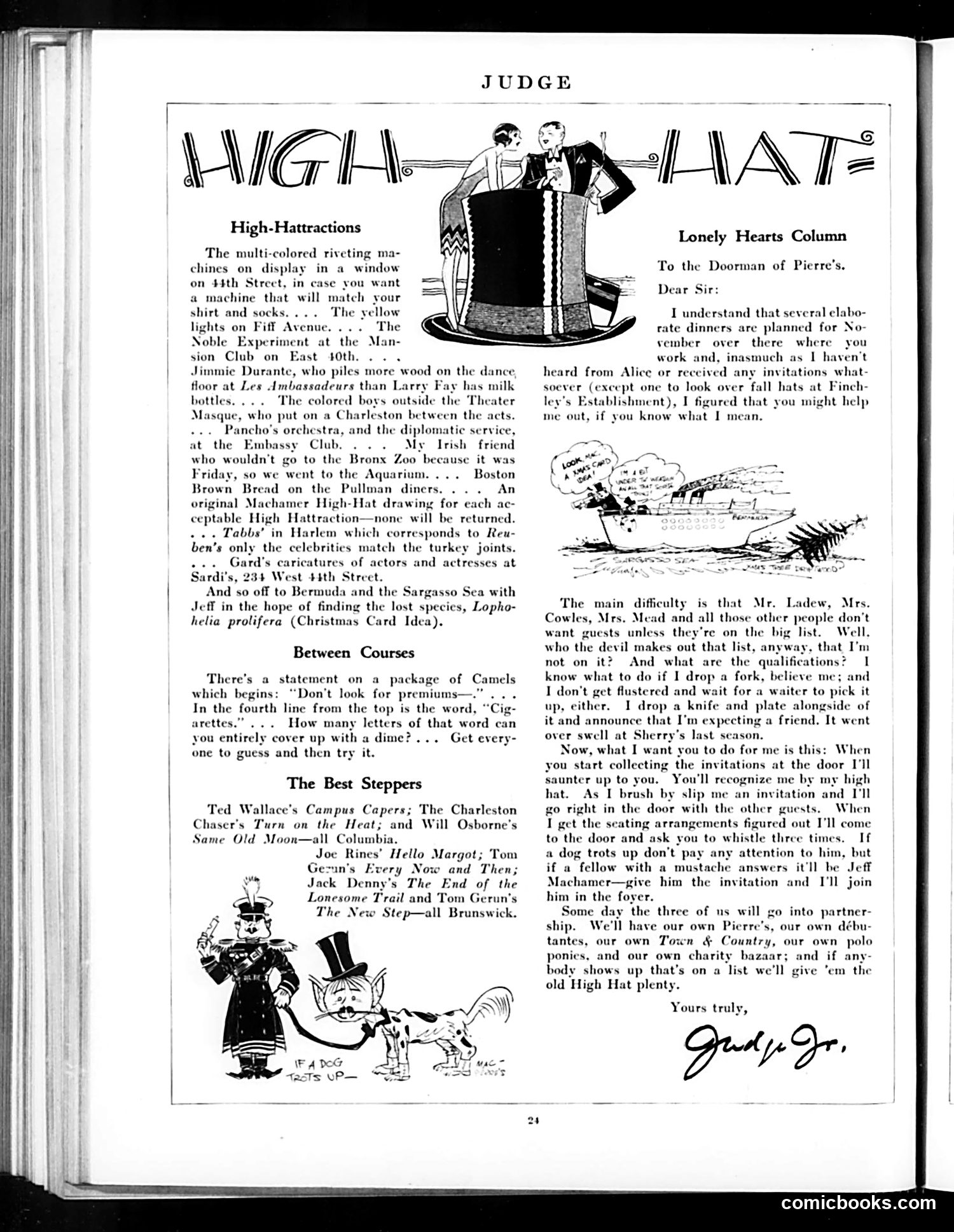
Analysis: "High-Hat" Page from Judge Magazine This is a satirical social column mocking 1920s high-society pretension and gatekeeping. The "Lonely Hearts" section features a humorous letter from someone (likely a social climber or outsider) seeking to crash elaborate November dinner parties at Pierre's, a prestigious Manhattan restaurant. The joke centers on social exclusion: wealthy hosts like "Mr. Ladew, Mrs. Cowles, Mrs. Mead" maintain strict guest lists controlled by doormen. The letter-writer proposes an absurd scheme—having the doorman secretly slip them an invitation during coat-check so they can sneak in wearing a high hat. The satire targets the arbitrariness of "high-hat" society (snobbery based on appearance and connections rather than merit). References to Jimmy Durante, the Charleston, Prohibition-era clubs, and Bermuda vacations establish the 1920s Jazz Age setting. The "High-Hattractions" section above catalogs trendy Manhattan attractions, mocking both the venues and those who frequent them, including a jab at Prohibition ("Noble Experiment").
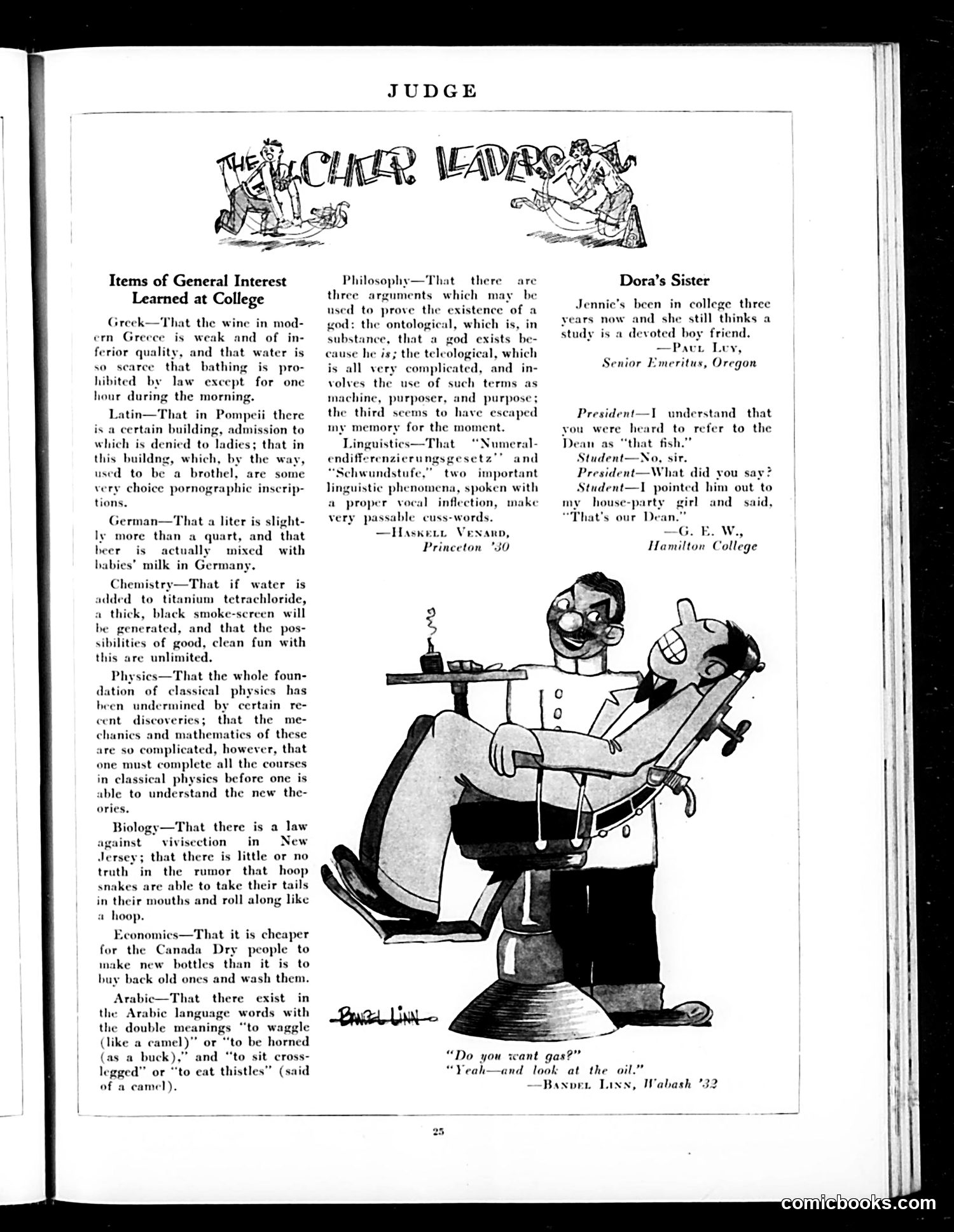
Judge Magazine Satire Analysis This page contains collegiate humor from Judge magazine, appearing to be from the early 1930s (based on bylines). "Items of General Interest Learned at College" is satire mocking what students actually absorb at university. Rather than serious learning, the list highlights ridiculous "facts"—like German beer mixed with babies' milk, or that hoop snakes can roll themselves. The humor lies in exposing the gap between education's pretense and students' actual takeaways: gossip, drinking culture, and questionable urban legends. The cartoon shows a dentist examining a patient with exaggerated features, illustrating a joke about mistaking "gas" (anesthesia) for gasoline ("oil"). The humor is straightforward wordplay. The right column contains more student humor—Dora's Sister making light of college romance, and an exchange where a student sarcastically identifies the Dean as "that fish" to impress a party girl. Overall, the page satirizes collegiate pretension and the gap between what colleges claim to teach versus what students actually learn or care about.
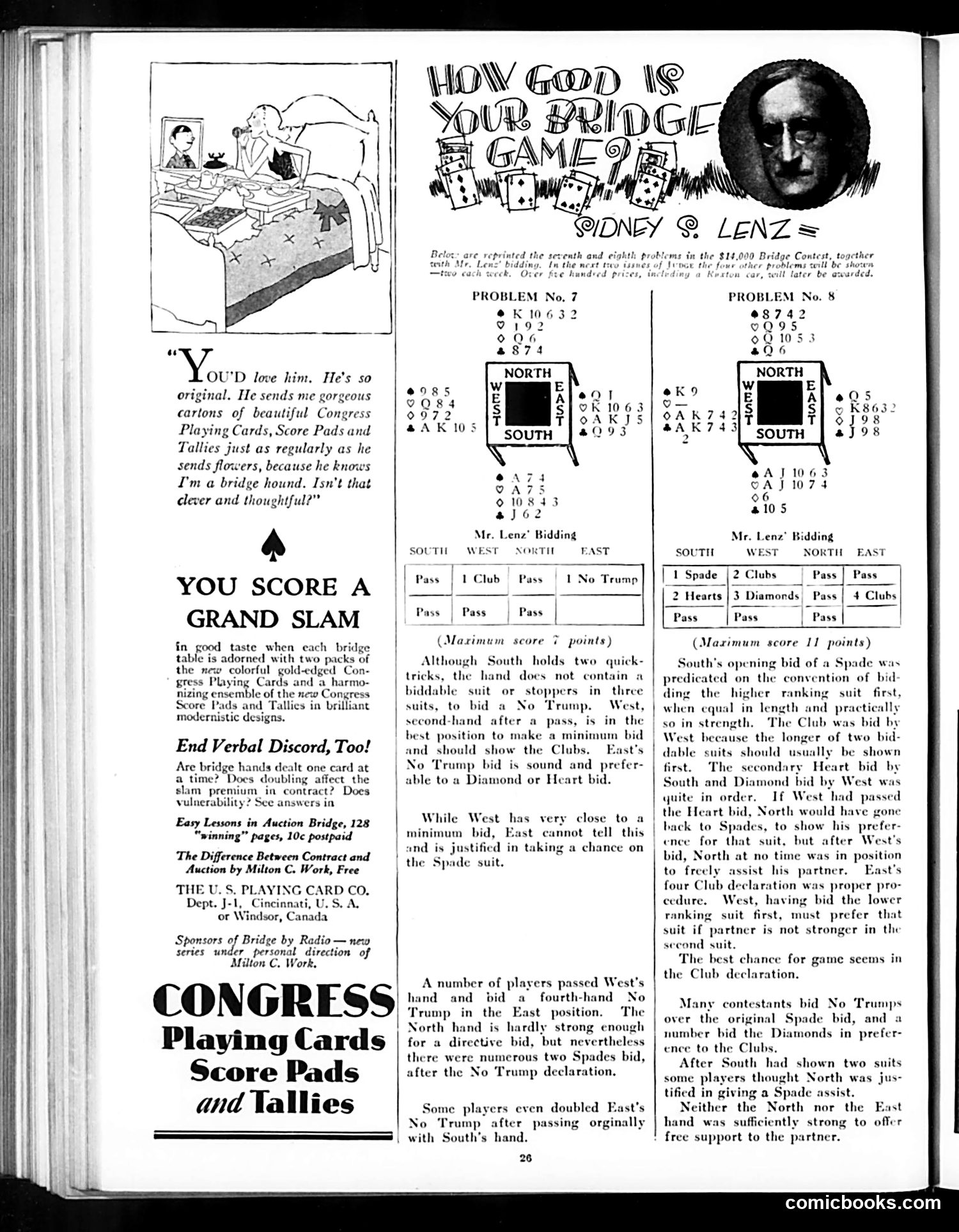
Bridge Problem Page with Congress Playing Cards Advertisement This page combines advertising with bridge instruction. The cartoon (top left) depicts a woman in bed praising a man for sending her Congress Playing Cards and score pads as regularly as flowers—satirizing aggressive advertising by treating commercial gifts as romantic gestures. The main content is bridge problem instruction featuring hands from a tournament, likely involving Sidney Lenz (pictured), a famous bridge player of the era. The problems walk readers through bidding strategy and card play analysis. The satire is gentle: the page mocks how corporations use personal relationships and flattery to push products, presenting business gifts as intimate tokens of affection. The "clever and thoughtful" framing undercuts itself—the woman recognizes the manipulation yet appreciates the gifts anyway. This represents early 20th-century sponsored content, where companies funded instructional material to promote their branded products while appearing educational rather than purely commercial.
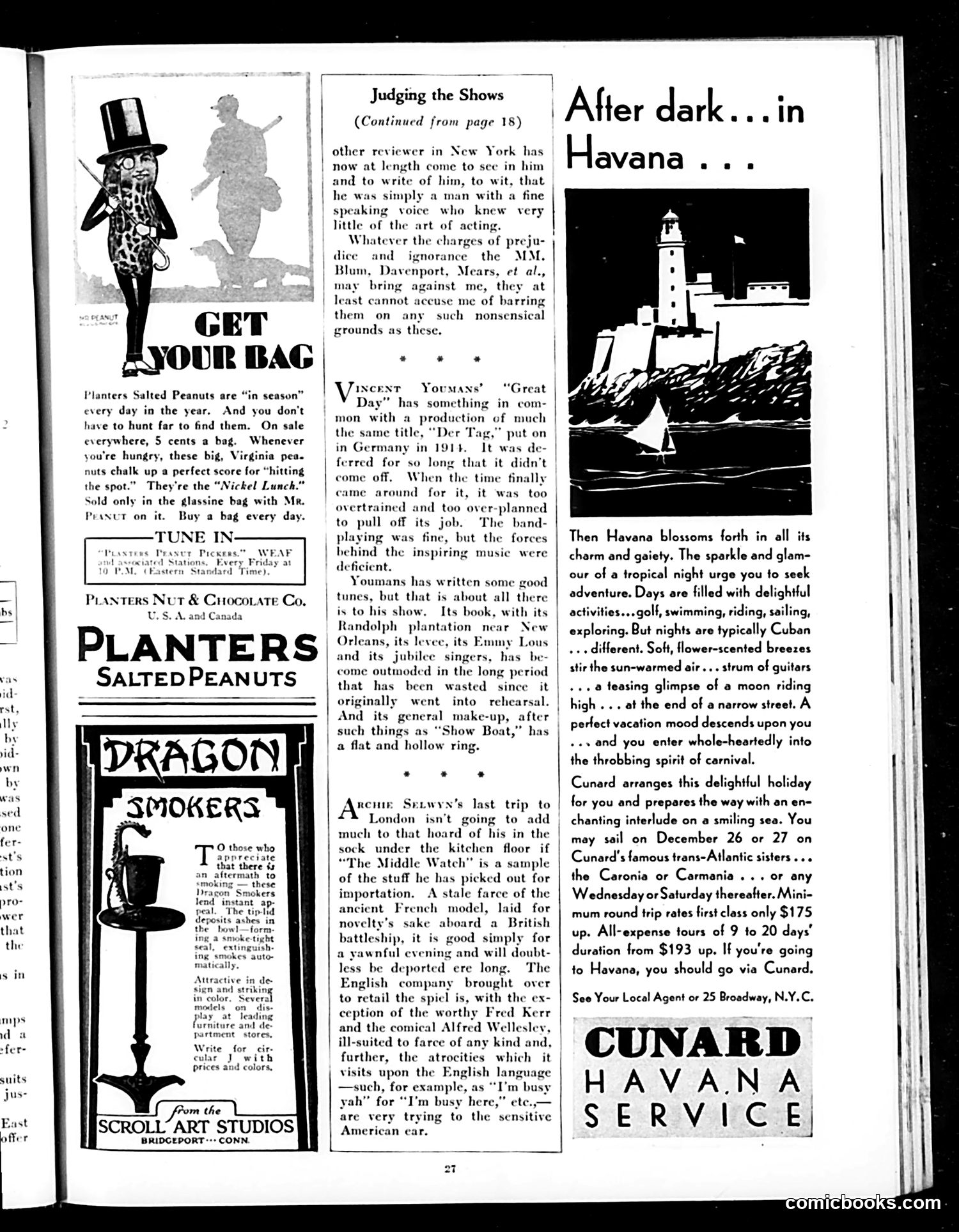
Explanation for Modern Readers This page mixes theater criticism with advertisements. The "Judging the Shows" column reviews recent Broadway productions. The critic dismisses Vincent Youmans' "Great Day" as overworked and hollow despite good music, and harshly criticizes Archie Selwyn's imported British farce "The Middle Watch," complaining that English actors mangle the language (rendering "I'm busy here" as "I'm busy yah"). The advertisements include Planters Peanuts (featuring Mr. Peanut, the brand's mascot), Dragon Smokers cigars, and a Cunard cruise line ad promoting Caribbean travel to Havana. These were typical luxury goods marketed to middle and upper-class readers during what appears to be the 1920s-30s era. The satire is mild—primarily theatrical criticism rather than political commentary. The page reflects the era's entertainment industry and advertising culture.
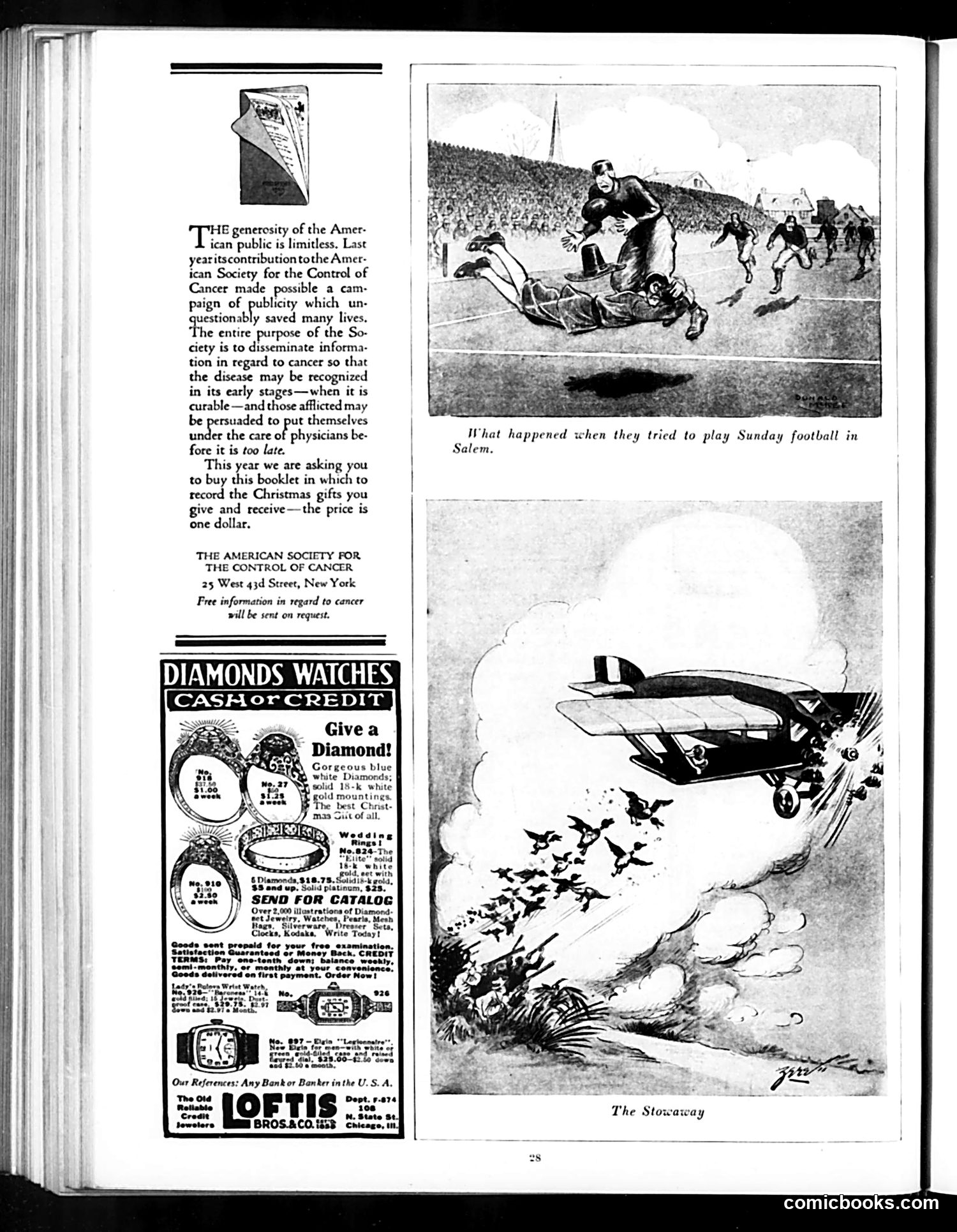
Analysis of Judge Magazine Page This page combines public service messaging with satirical cartoons and period advertising. Top cartoon ("What happened when they tried to play Sunday football in Salem"): References the historical Salem witch trials through anachronistic humor—depicting 1920s-era football players being violently attacked, sardonically suggesting the puritanical town would violently oppose Sunday sports (which was religiously controversial in that era). The joke targets both Salem's historical extremism and contemporary debates over Sunday leisure activities. Bottom cartoon ("The Stowaway"): An airplane drops bombs on small figures below while birds flee. Appears to reference aerial bombardment, likely commenting on 1920s-era military aviation or wartime concerns—unclear which specific conflict or event without publication date. Left side: Cancer awareness PSA from the American Society for the Control of Cancer, promoting a dollar booklet for gift-recording. Advertisements: Diamond watches and jewelry, typical period magazine content.
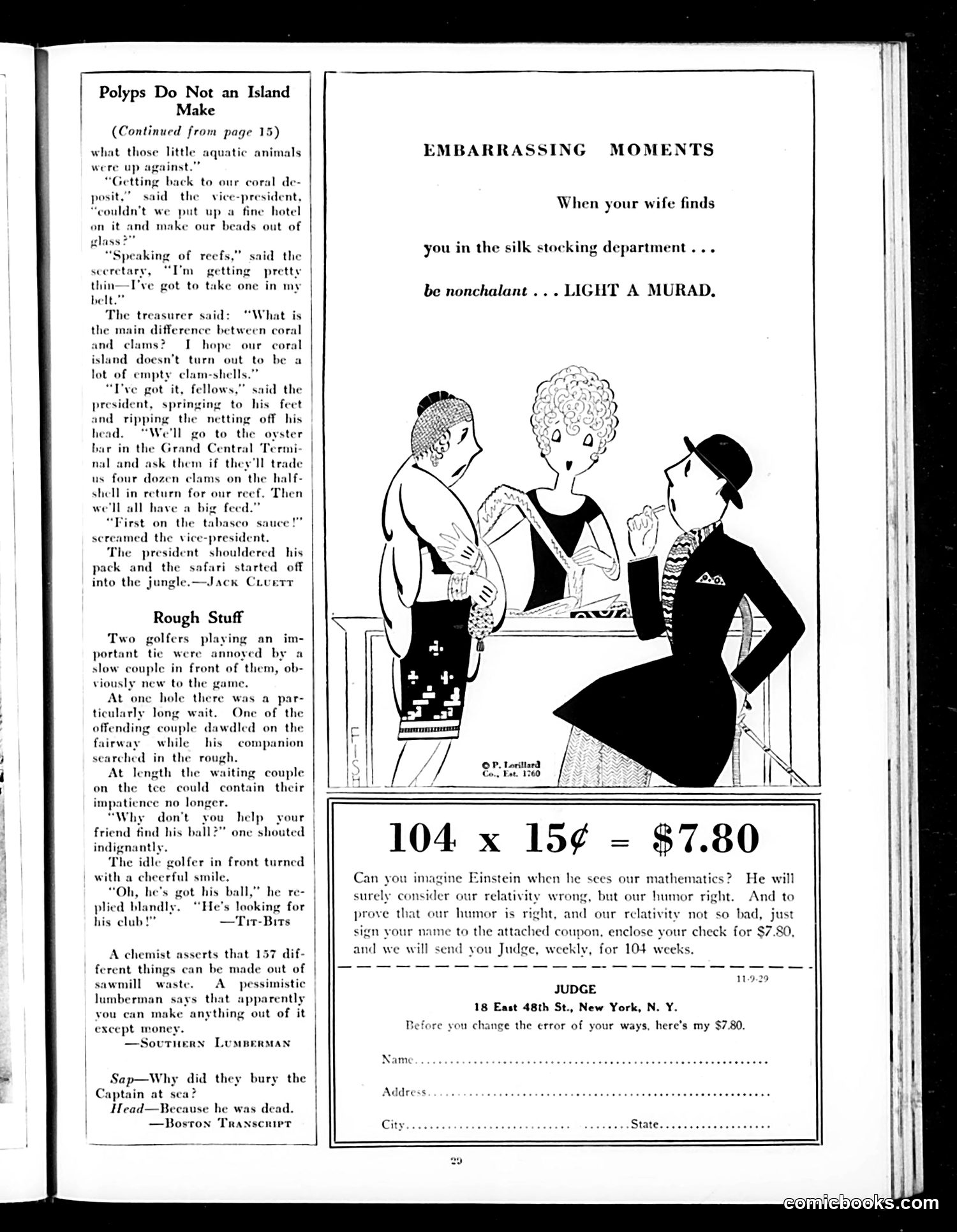
Analysis of Judge Magazine Page This page contains several humor sections typical of 1920s Judge magazine: "Embarrassing Moments" Cartoon: A husband is caught shopping in the silk stocking department (suggesting he's buying women's hosiery, implying infidelity or cross-dressing). The joke advises appearing casual and lighting a Murad cigarette to deflect suspicion. This plays on period anxieties about masculine appearance and marital fidelity. "Rough Stuff": Two golfers complain about slow players ahead. When they sarcastically suggest the man help find his ball, he replies the man isn't looking for a ball but his club—implying incompetence rather than dishonesty. Gentle golf humor. Other Briefs: Short jokes about business schemes, industrial waste, and naval tradition—typical of Judge's miscellaneous humor section. Advertisement: A subscription offer using faux-Einstein humor to sell 104 weekly issues for $7.80, poking fun at their own mathematics and relativity concepts. The overall tone reflects 1920s urban, middle-class anxieties and leisure activities (golf, shopping, cigarettes).
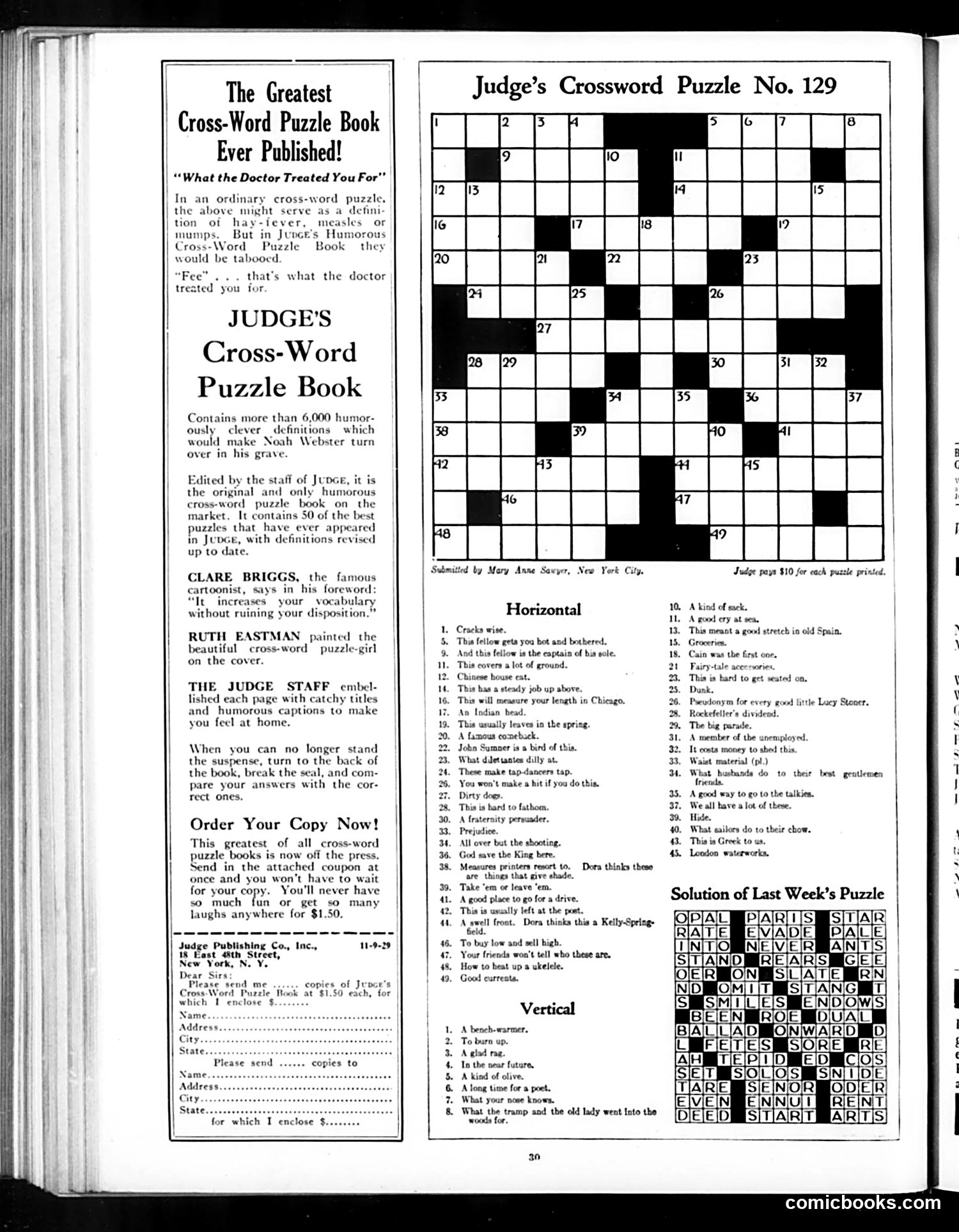
Judge Magazine Crossword Page Analysis This page is primarily advertising and puzzle content, not political satire. It promotes Judge's "Humorous Cross-Word Puzzle Book"—a collection of 50 puzzles from the magazine with deliberately clever, funny definitions instead of straightforward ones. The advertisement emphasizes that this is the "original and only humorous cross-word puzzle book on the market," featuring witty definitions that would make "Noah Webster turn over in his grave." Notable contributors cited include cartoonist Clare Briggs and painter Ruth Eastman. The actual Puzzle No. 129 shown is a standard crossword grid with humorous clues (e.g., "What the Doctor Treated You For," "A kind of sack," "Indian head"). This represents Judge's brand of sophisticated wordplay humor—wordplay and clever definitions rather than political commentary. The page includes an order coupon for $1.50 and notes that Judge pays $10 per puzzle published, indicating this was a significant revenue source for the magazine during the crossword puzzle craze of the 1920s-30s.
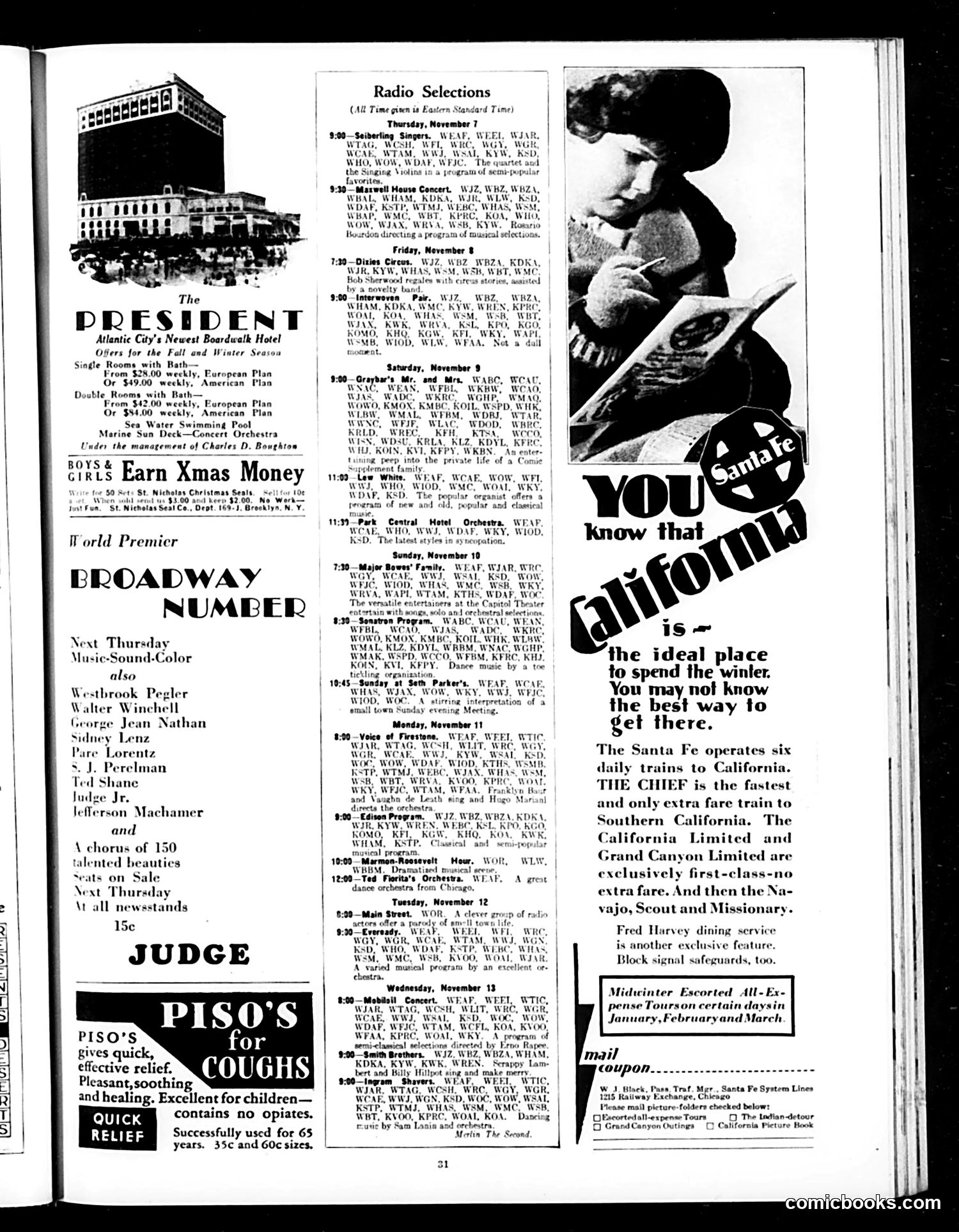
Judge Magazine Page Analysis This page is primarily advertising and radio programming listings, not political satire or comics. The main content includes: - Hotel advertisement for "The President" in Atlantic City - Broadway show promotion featuring music and entertainers (Westbrook Pegler, Walter Winchell, George Jean Nathan listed among performers) - Extensive radio schedule for Thursday-Wednesday programming across numerous stations (WEAF, WJZ, KDKA, etc.) - Patent medicine ads (Piso's cough remedy, typical of the era) - Santa Fe railroad advertisement promoting train travel to California as a winter destination The only potentially satirical element is a small illustration of a woman reading, captioned "You know that allthorne is the ideal place to spend the winter" (likely "all-the-more" or a location name, unclear from image quality). This appears to be a standard magazine issue page from approximately the 1920s-1930s, mixing entertainment promotion with commercial advertising rather than presenting editorial cartoons or political commentary.
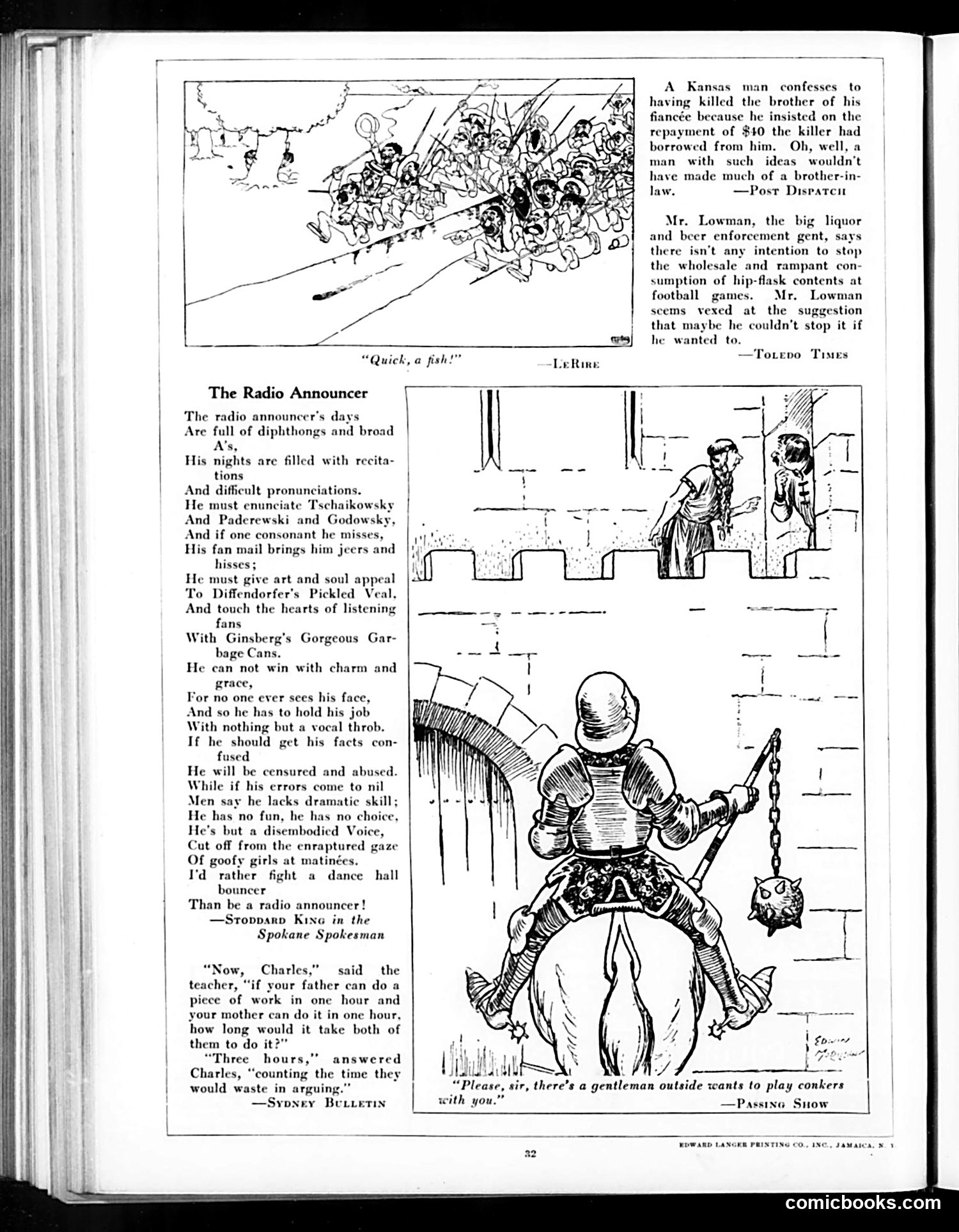
Judge Magazine Page Analysis This page contains several satirical pieces typical of Judge's social commentary: Top cartoon ("Quick, a fish!" by LeRue): Depicts a crowded boat scene, likely satirizing an overcrowded or chaotic situation, though the specific reference is unclear. News items: Two brief jokes mock current events—a Kansas murder over a $40 debt (absurdist humor about priorities) and Mr. Lowman, a Prohibition enforcement official, who claims he can't stop hip-flask drinking at football games (satire of failed Prohibition enforcement). "The Radio Announcer" poem (by Stoppard King): Mocks the emerging radio industry and announcers' impossible demands—pronouncing difficult classical names, promoting commercial products with fake enthusiasm, while remaining invisible to audiences. It captures anxiety about this new technology and the thankless nature of the job. Bottom cartoon (Passing Snow): A child's math joke where "three hours" accounts for parents arguing—gentle domestic humor. The page reflects 1920s-30s concerns: Prohibition's failure, emerging mass media, and evolving technology.
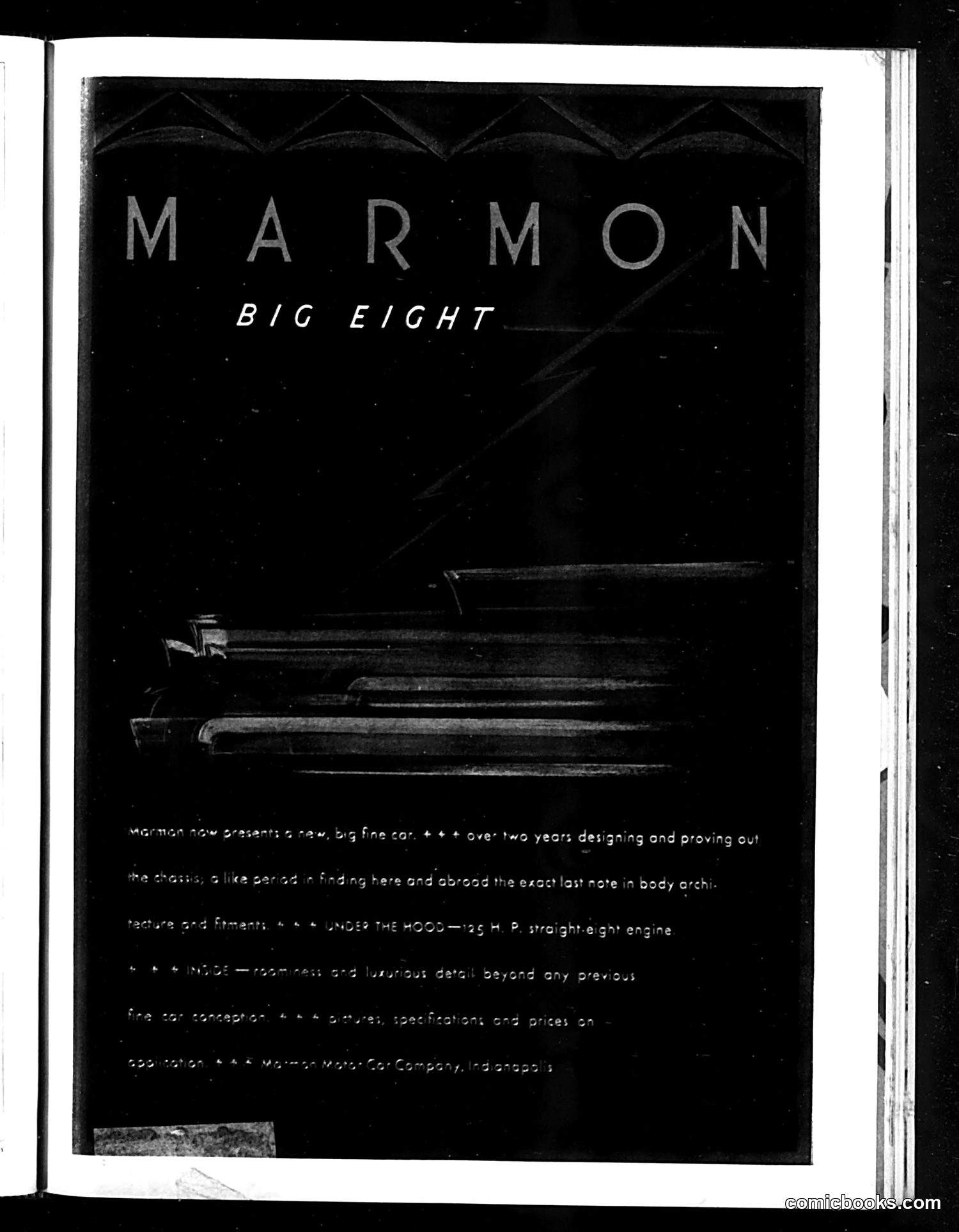
Marmon Big Eight Advertisement This appears to be an automobile advertisement rather than political satire or a cartoon. The page promotes the Marmon Big Eight, a luxury car produced by the Marmon Motor Car Company. The ad emphasizes the vehicle's engineering achievements, mentioning "over two years designing and proving out the chassis" and highlighting features like a straight-eight engine and advanced construction details. The text references specifications, prices, and the manufacturer's credibility. The stark black design with minimal imagery is typical of 1920s-era automotive advertising, emphasizing technical superiority and precision engineering to appeal to affluent buyers interested in high-performance vehicles.
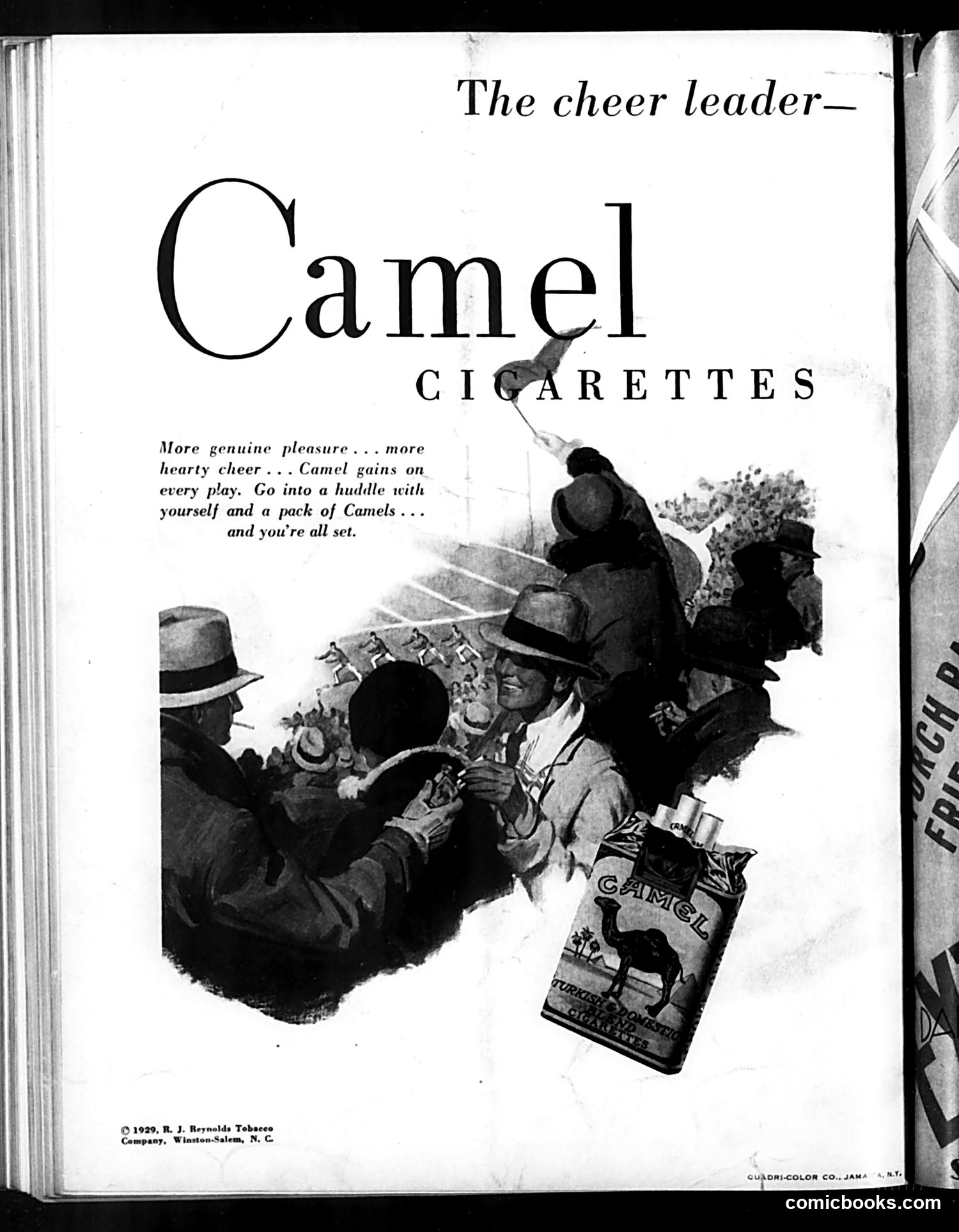
Camel Cigarettes Advertisement (1929) This is a cigarette advertisement, not political satire. The page shows men in football attire gathered in a huddle, with one holding a pack of Camels. The "cheer leader" headline plays on sports terminology—the cigarettes are humorously positioned as the team's actual leader. The ad's appeal is straightforward for 1929: smoking Camels provides "genuine pleasure" and "hearty cheer" during sports and social gatherings. The football context suggests masculine camaraderie and celebration. This represents pre-regulation tobacco marketing, when cigarette ads could openly associate smoking with athletic activity and social bonding without health disclaimers. The R.J. Reynolds copyright confirms this as period advertising rather than editorial content.