judge
Judge — November 16, 1929
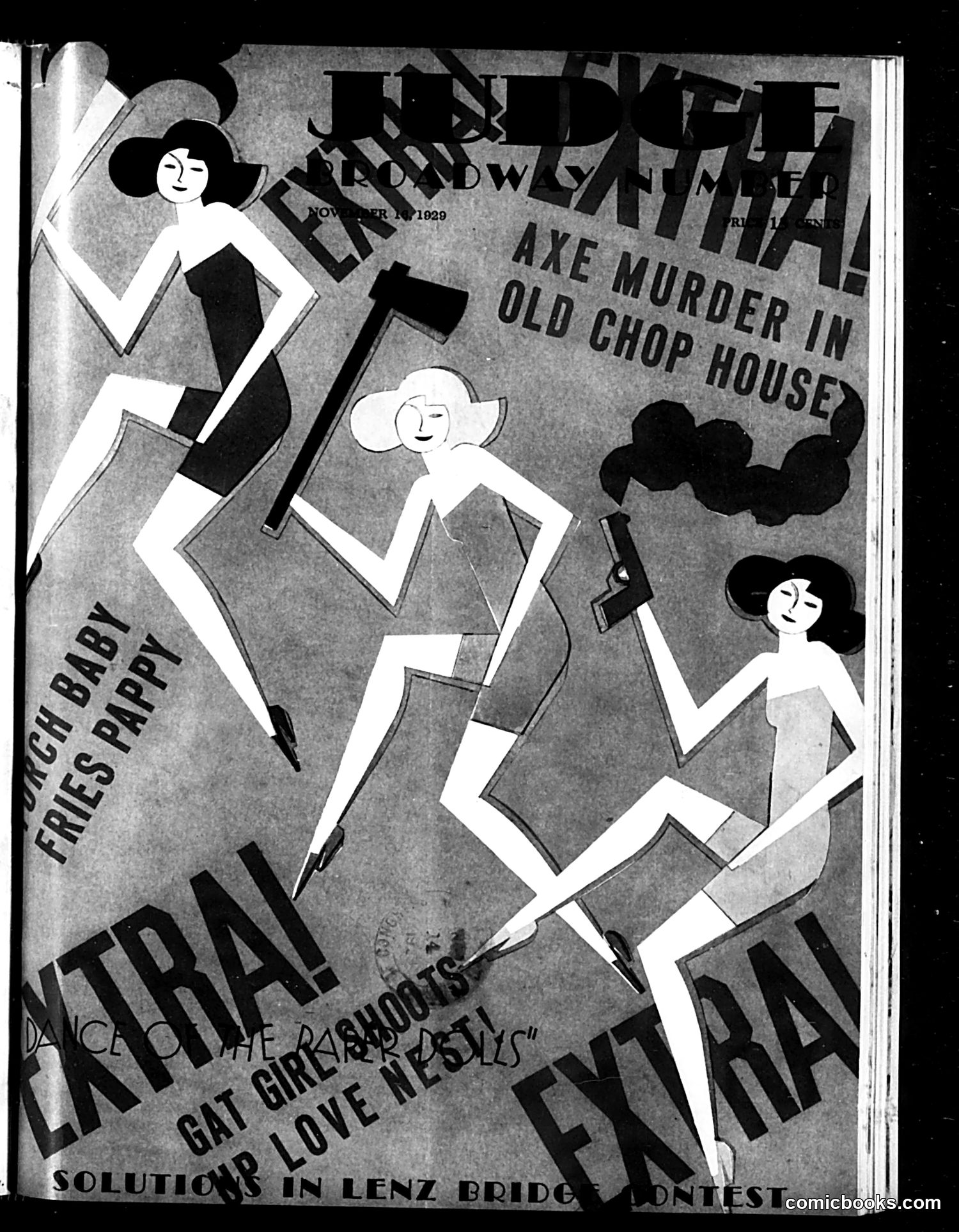
Analysis of Judge Magazine Page This 1929 Judge magazine page features satirical advertisements parodying popular entertainment and crime-obsessed culture of the era. The central illustration depicts stylized female figures wielding axes, referencing the notorious "Axe Murder in Old Chop House" case mentioned in the text. The page satirizes several contemporary obsessions: pulp crime stories ("Fries's Proof"), sensationalist newspaper reporting, and risqué entertainment ("Gay Girl's Schooldays," "Love Nests"). The flapper-style figures and sexually suggestive poses mock both the modernized woman of the Jazz Age and the era's lurid popular entertainment. The satire critiques how American media sensationalized violent crime and sexual content during the 1920s, presenting these "advertisements" as absurd parodies of actual commercial exploitation of public fascination with scandal and violence.
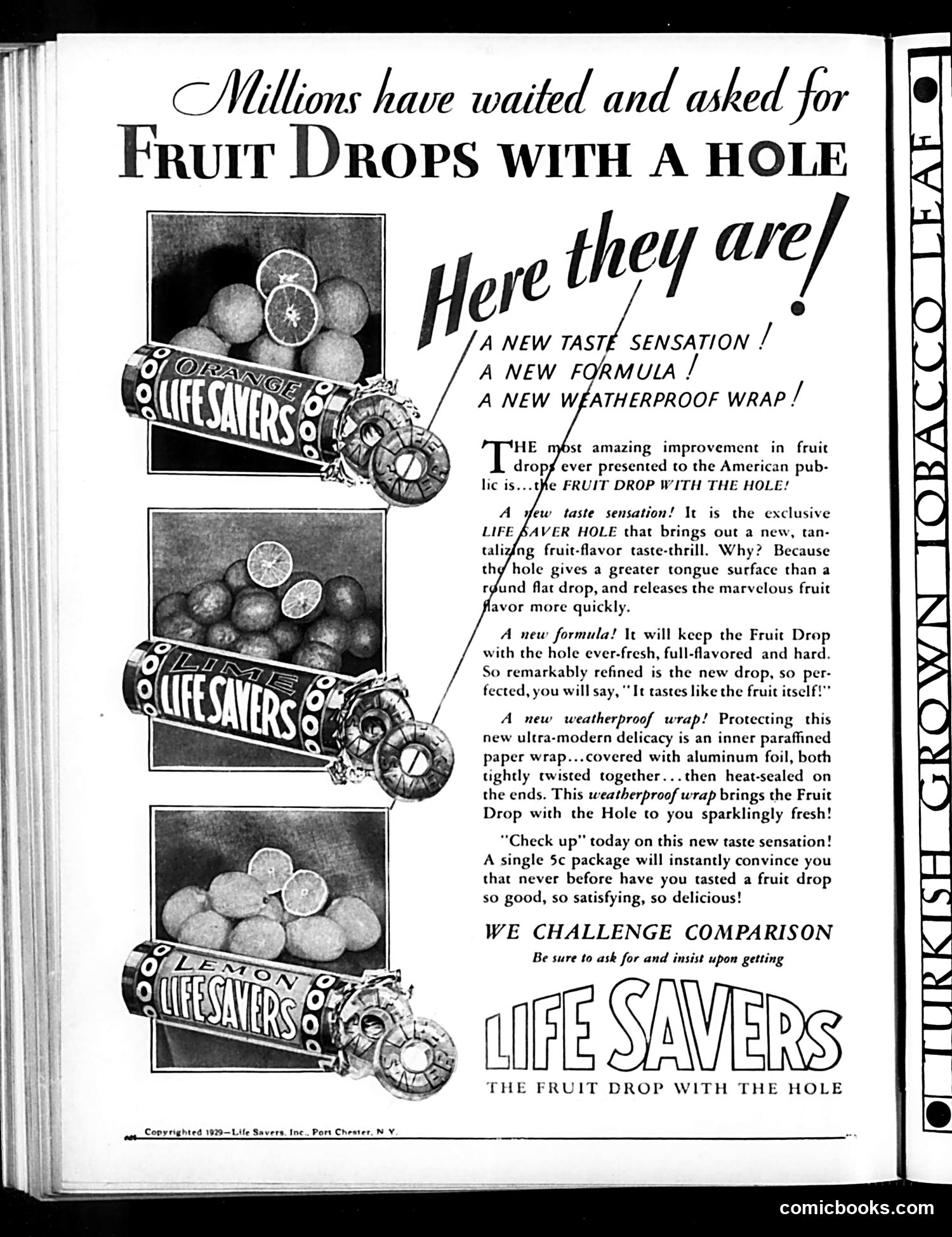
Analysis This is not a political cartoon or satire—it's a straightforward product advertisement for Life Savers candy, specifically promoting a new "Fruit Drop with the Hole" variant. The ad announces three innovations: a novel taste sensation created by the hole (which supposedly increases tongue contact with the candy), a new formula to maintain freshness, and improved weatherproof packaging using paraffined paper and aluminum foil. The three images show different Life Savers flavors (Orange, Lime, and Lemon based on the visible labels). The copy uses hyperbolic marketing language typical of 1920s advertising—phrases like "most amazing improvement" and "new taste sensation"—to make a modest product modification sound revolutionary. This represents Judge's commercial content rather than editorial satire.
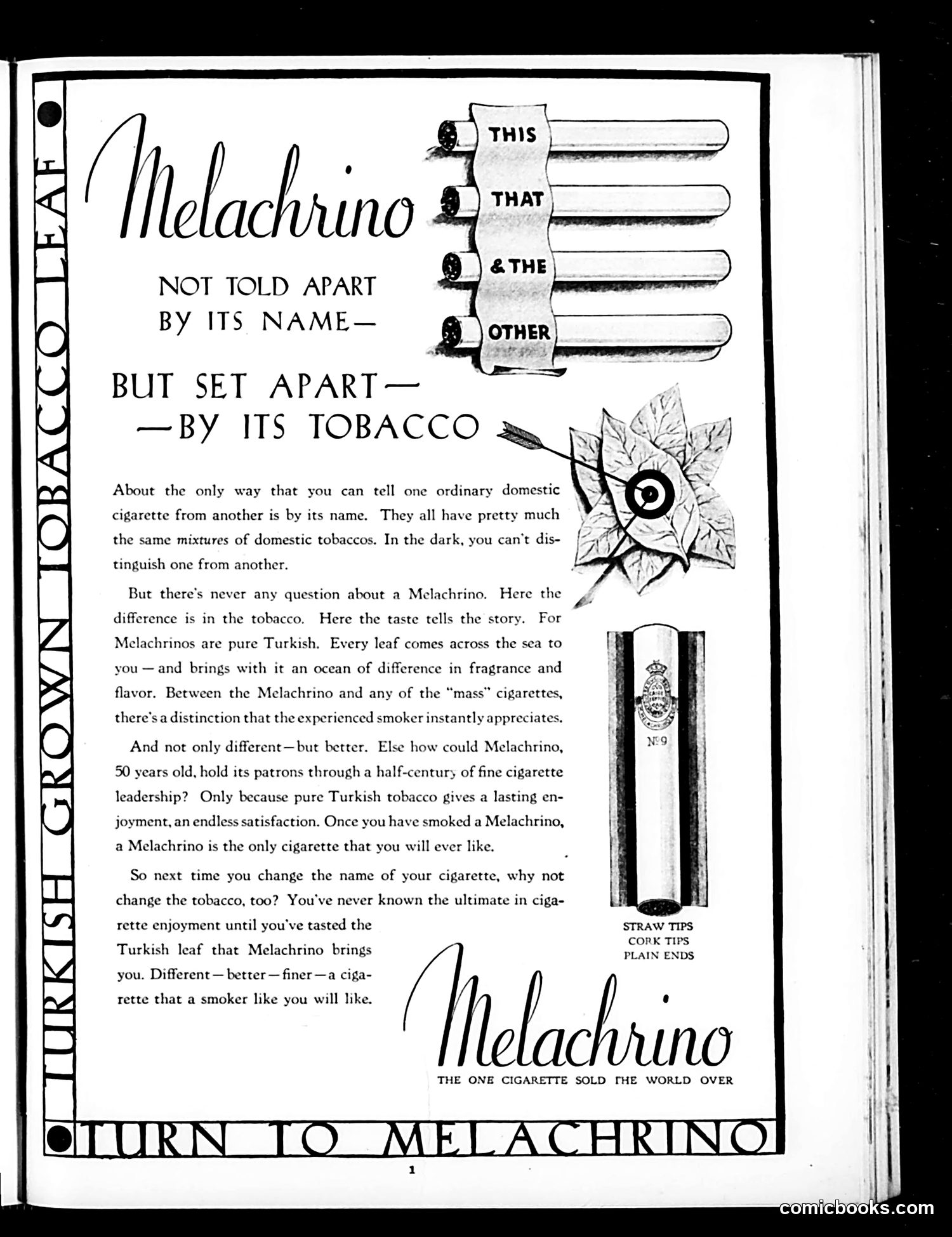
Melachrino Cigarette Advertisement This page is primarily a cigarette advertisement, not political satire. It promotes Melachrino cigarettes, emphasizing their distinction from ordinary domestic brands through their use of pure Turkish tobacco. The visual humor is mild: four identical cigarette packages labeled "THIS," "THAT," "&THE," and "OTHER" illustrate that domestic cigarettes are indistinguishable from one another. The accompanying tobacco leaf illustration adds decorative appeal. The ad's main argument is that Melachrino's Turkish tobacco provides superior taste and fragrance that experienced smokers can immediately recognize—"the only cigarette sold the world over." This represents straightforward early 20th-century cigarette marketing, before health warnings. There's no significant political or social satire present; it's purely commercial content placed in Judge magazine.
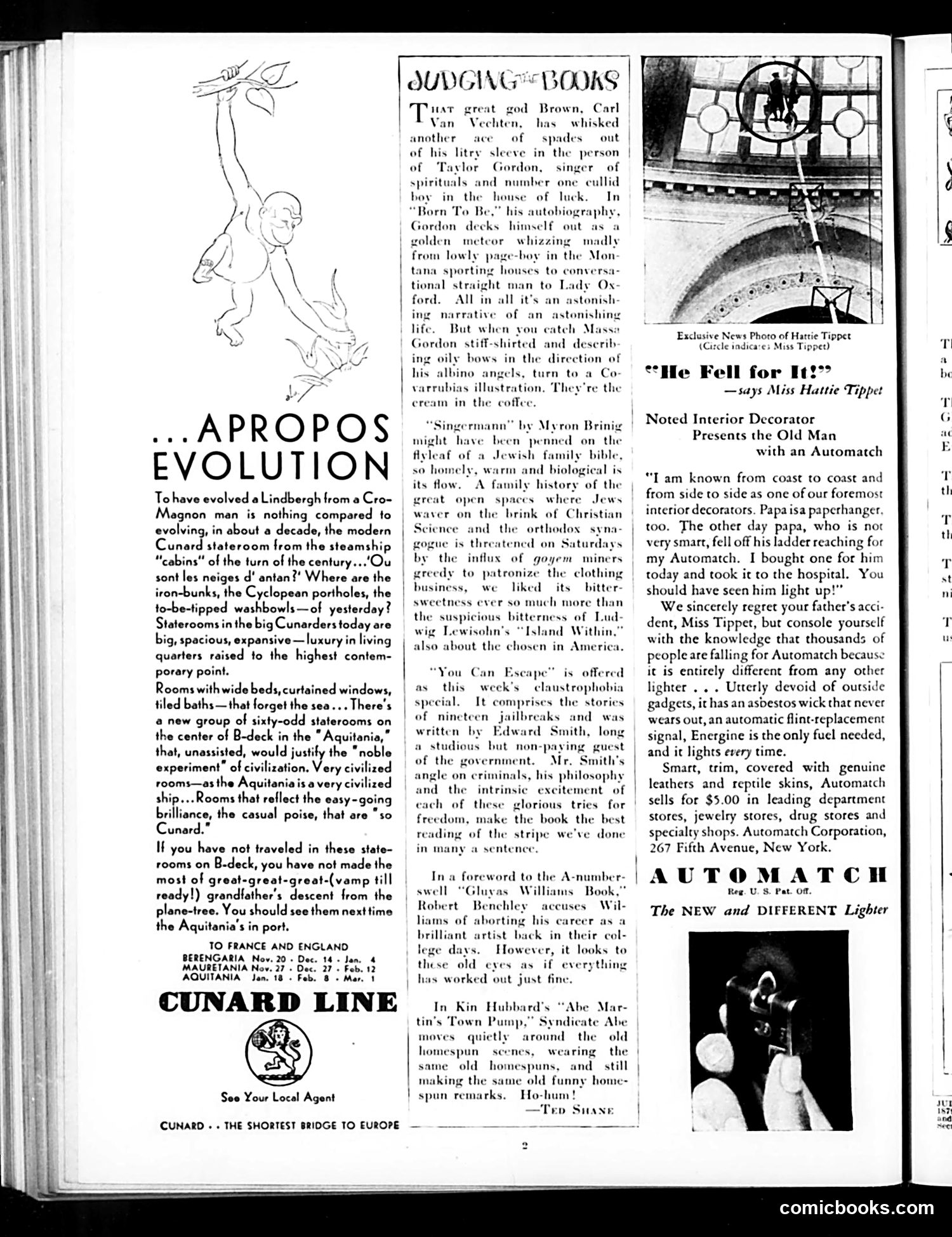
"Apropos Evolution" Cartoon Analysis This page is primarily advertising and book reviews rather than political satire. The left side features a whimsical cartoon labeled "Apropos Evolution," depicting ape-like figures evolving upward—a visual pun on the Cunard Line's advertisement below it about traveling via ship. The cartoon plays on contemporary evolutionary theory (likely referencing ongoing Darwin debates) to humorously suggest that traveling on the luxurious Aquitania represents human "progress" or civilization's advancement. The right side contains book reviews and an advertisement for an Automatch lighter. These are straightforward commercial content rather than satirical commentary. The page reflects Judge magazine's mix of humor, advertisements, and cultural criticism typical of early 20th-century American magazines.
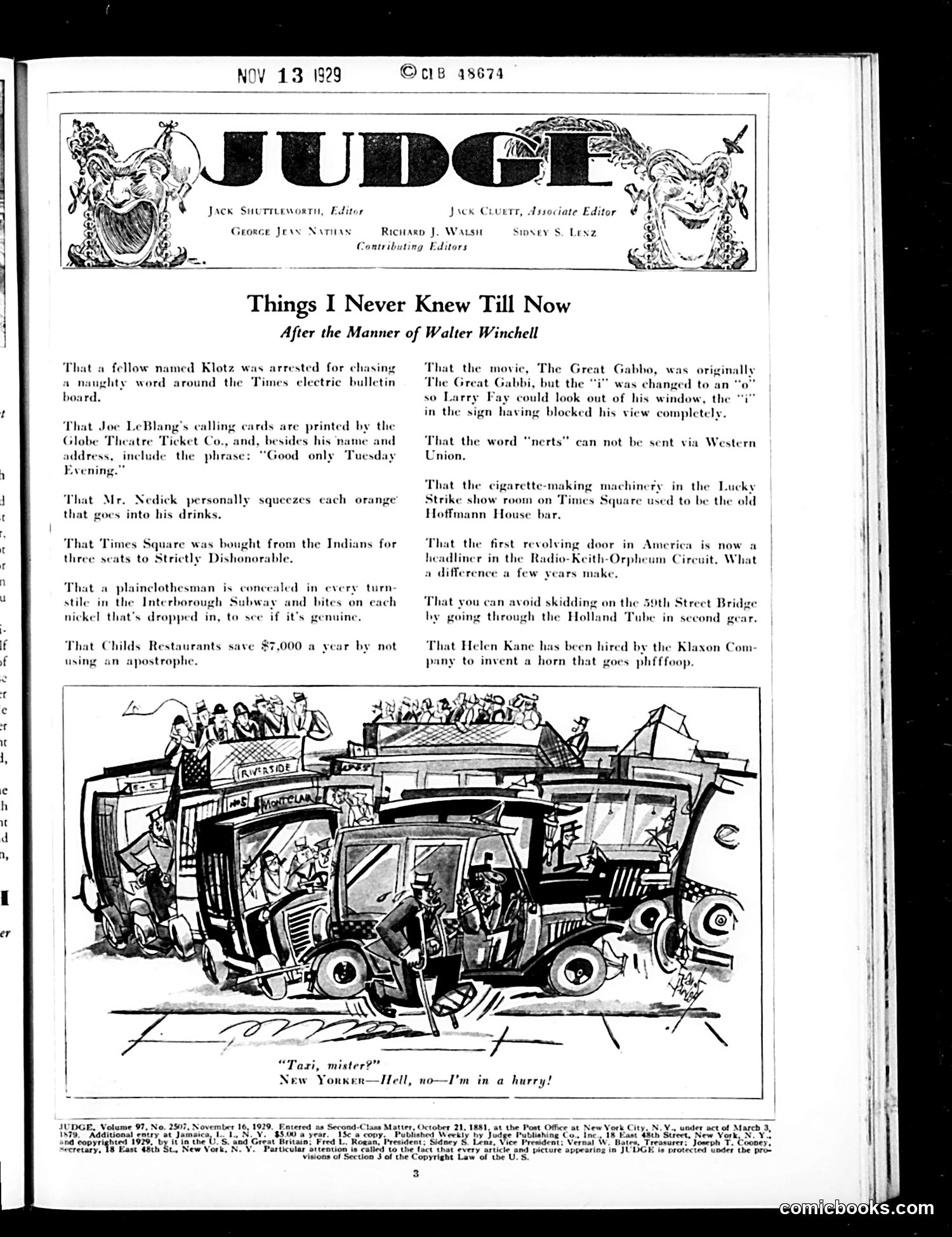
"Things I Never Knew Till Now" - Judge Magazine, Nov. 13, 1929 This page features miscellaneous trivia presented "After the Manner of Walter Winchell," the famous gossip columnist of the era. The items are lighthearted facts about New York City, including details about Times Square's purchase from Native Americans, the first revolving door in America, and Helen Kane's hiring by the Klaxon Company to invent a horn sound effect. The cartoon below depicts a crowded, chaotic taxi scene with the caption "Taxi, mister?" / "New Yorker—Hell, no—I'm in a hurry!" It satirizes New York transportation culture and the impatient attitude of city residents who prefer walking to dealing with taxis, even in busy conditions. The overall page captures 1920s New York urban humor and gossip-column style journalism.
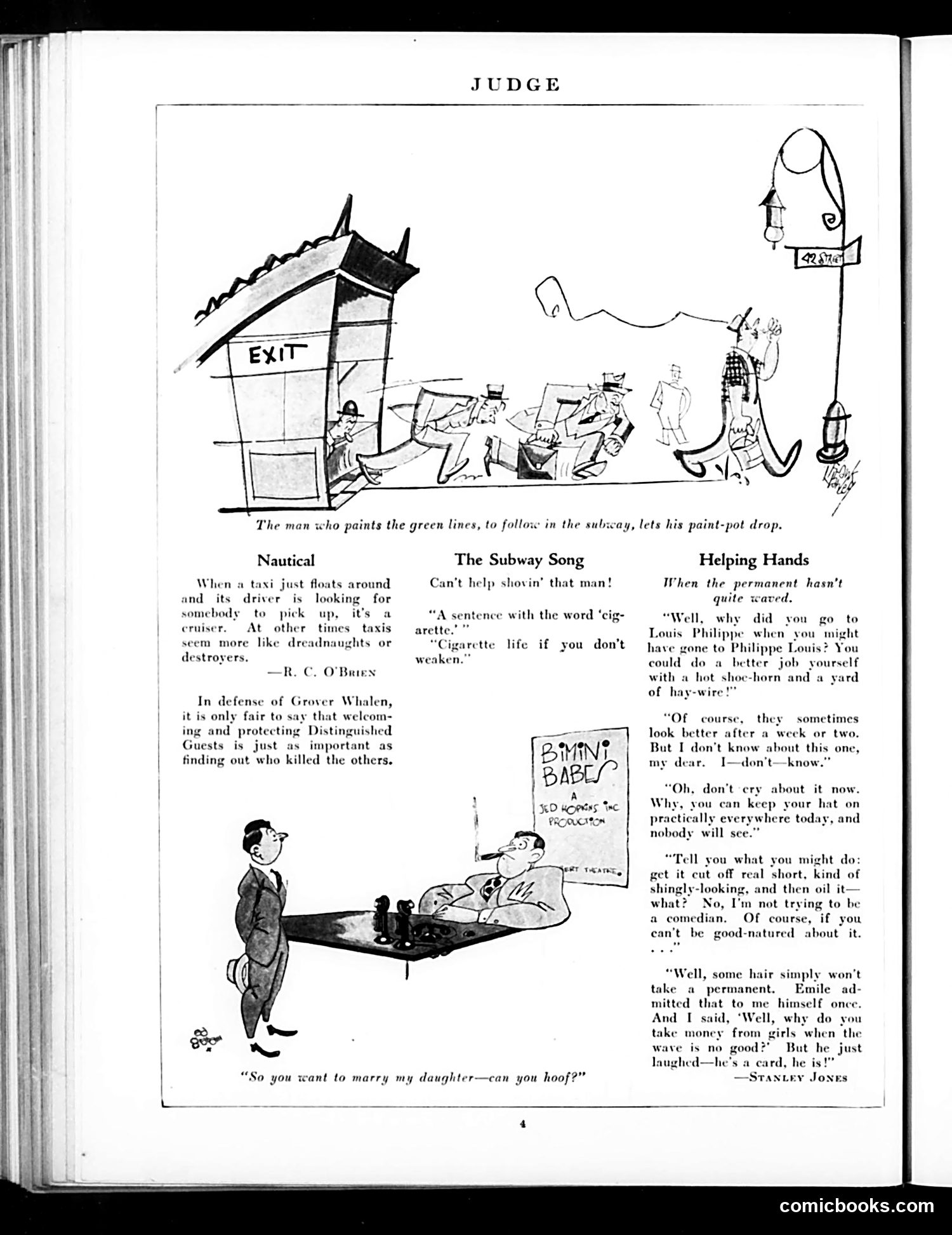
Analysis of Judge Page This page contains three separate humor pieces satirizing early 20th-century urban life: "Nautical": Mocks ocean liner safety, comparing ships to "dreadnoughts or destroyers"—likely referencing naval arms-race anxieties of the pre-WWI era. "The Subway Song": Jokes about New York City subway culture and personal grooming habits, suggesting men's vanity and the challenges of maintaining appearance in urban conditions. "Helping Hands": A dialogue about a woman's bad hair day and salon solutions. The humor centers on women's expectations versus reality regarding permanent waves—a newly popular 1920s-30s beauty treatment. Bottom cartoon: Shows a man proposing marriage but asking "can you hoof?"—suggesting the woman's dancing ability matters as much as commitment, satirizing shallow courtship values. The page reflects Jazz Age social commentary on modern manners and commercialism.
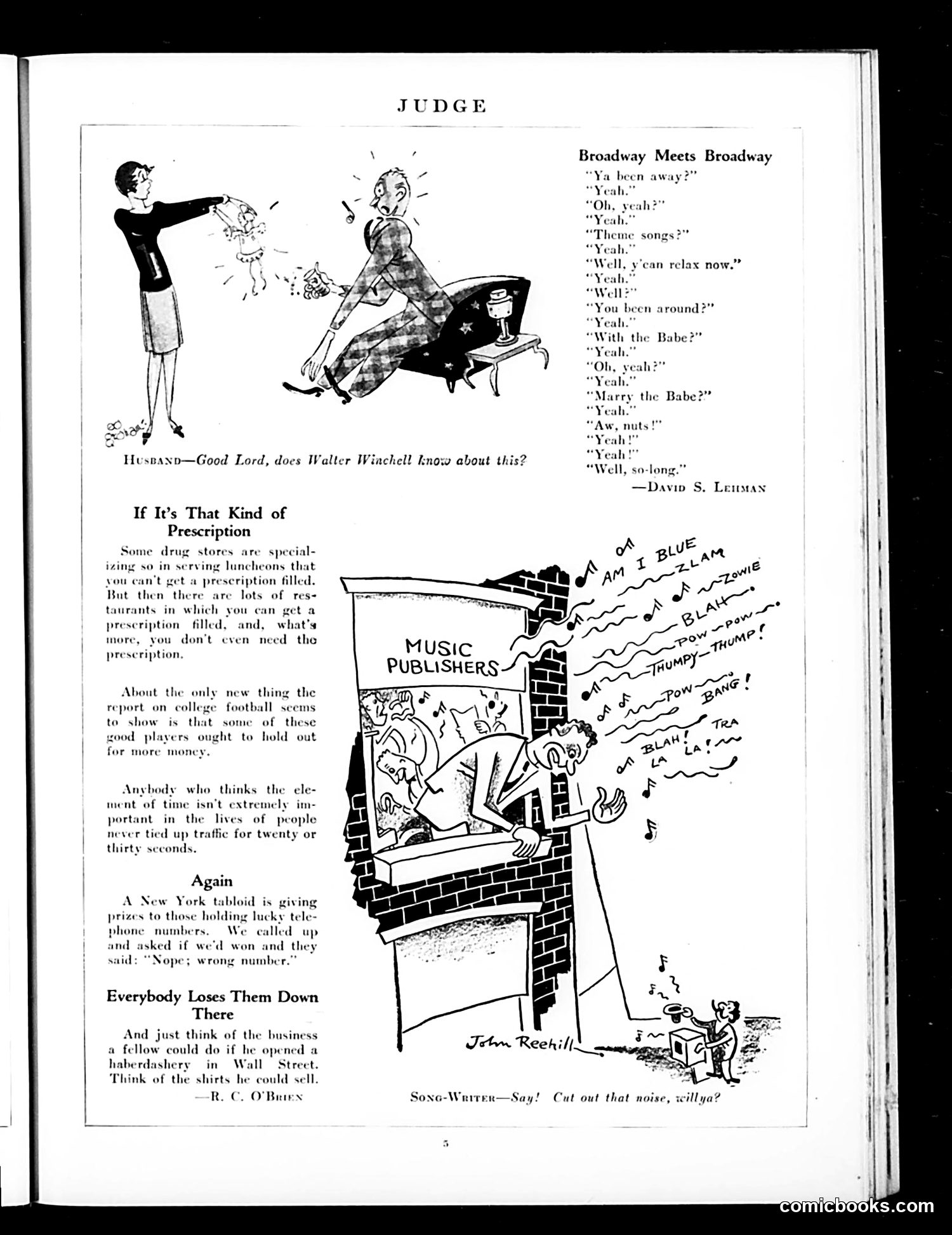
Judge Magazine Page Analysis This page contains multiple satirical pieces and cartoons typical of Judge's humor: Top Cartoon ("Broadway Meets Broadway"): Shows a couple reuniting with dialogue capturing post-WWI slang and Broadway theater culture. The husband asks about "the Babe"—likely Babe Ruth, indicating the celebrity obsession of the 1920s era. Middle Content: Short humor pieces mock contemporary targets: drug stores serving lunches without prescriptions, college football players seeking higher pay, and the importance of elevator music in urban life. Bottom Cartoon (by John Reckill): Depicts a "Music Publishers" building being bombarded with noise complaints about jazz music—likely referring to the "Jazz Age" and the generational conflict over this new musical form that older Americans considered loud and objectionable. The overall tone satirizes 1920s American culture: commercialism, celebrity, sports economics, and the cultural anxiety surrounding jazz.
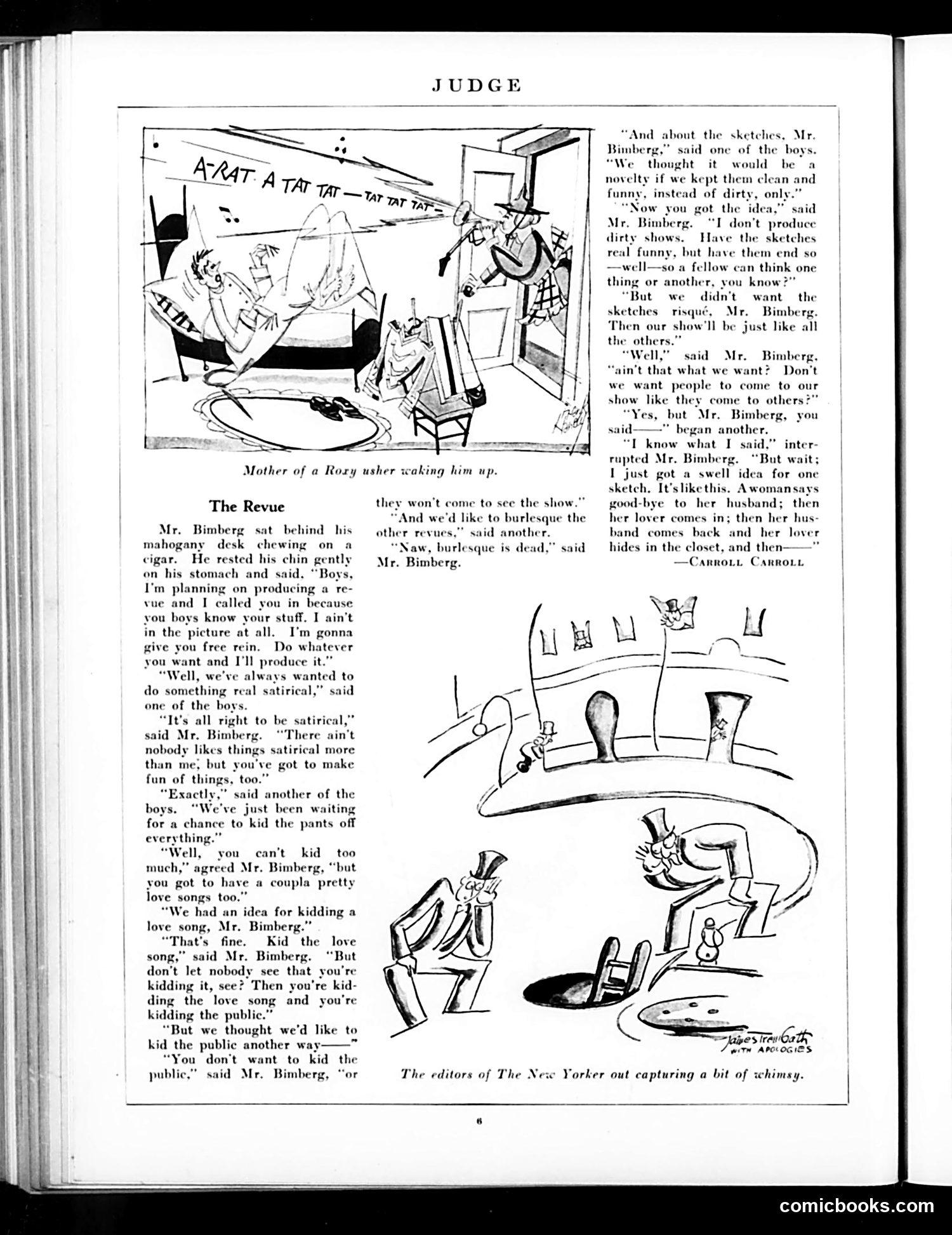
"The Revue" - Judge Magazine This page satirizes theatrical production through a conversation between Mr. Bimberg (a producer) and boys pitching sketch ideas for a revue. The satire targets entertainment industry conventions: producers' reluctance to take risks, their demand that sketches be "clean" yet funny, and their insistence on including popular love songs regardless of relevance. The accompanying cartoon below depicts *New Yorker* magazine editors "capturing a bit of schmaltz"—showing them fishing for sentimental material, satirizing their editorial approach. The humor lies in exposing the contradictions between wanting novelty and demanding safety, and between artistic integrity and commercial appeal. This reflects early 20th-century tensions between highbrow and lowbrow entertainment standards.
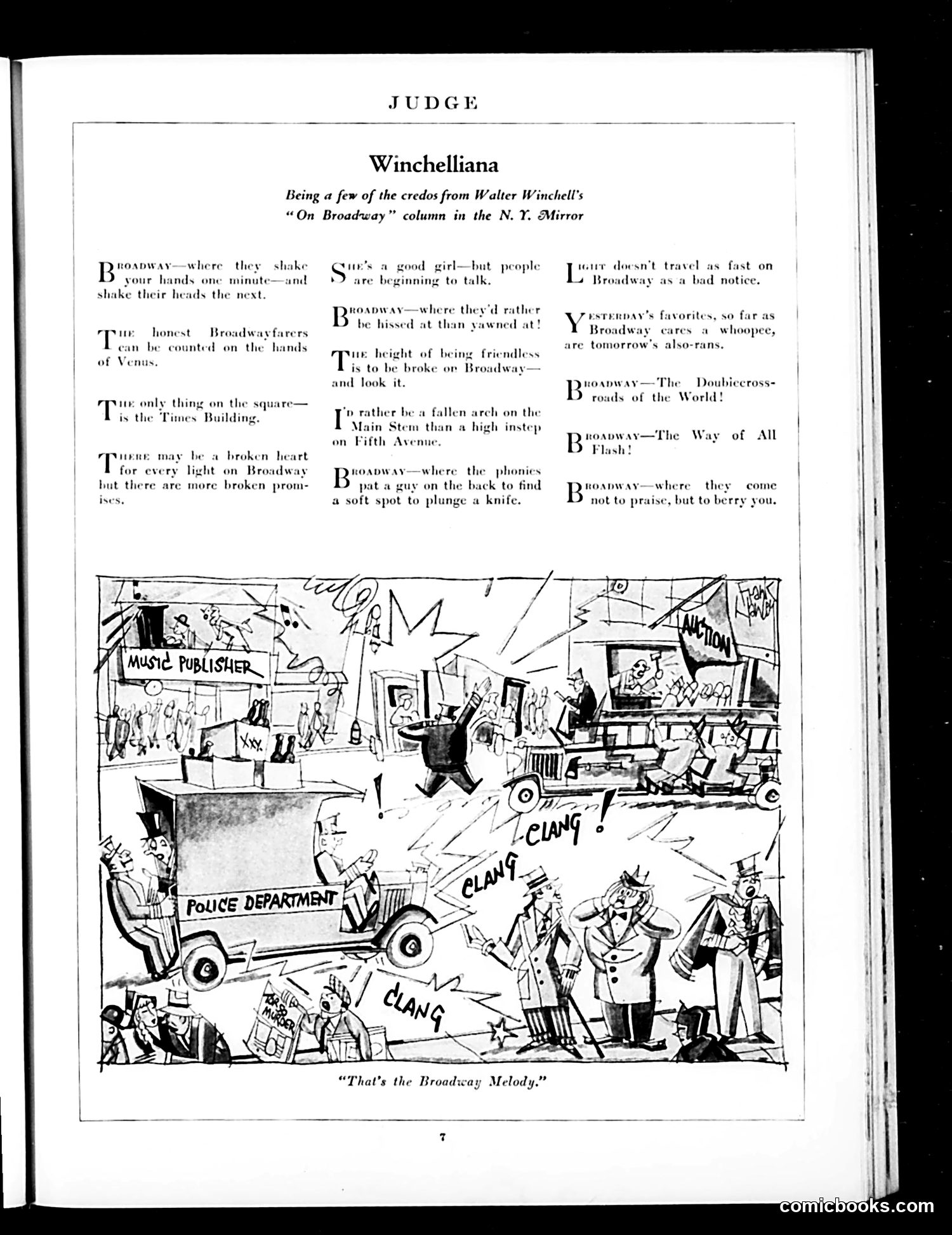
Winchelliana: Judge Magazine's Satire on Walter Winchell This page satirizes Walter Winchell, the famous Broadway gossip columnist for the New York Mirror. The text presents pithy, cynical one-liners attributed to Winchell's "On Broadway" column—quips about theatrical life, broken hearts, phonies, and Broadway's cutthroat culture. The cartoon depicts chaotic Broadway street life: a police vehicle, a music publisher's storefront, crowds, and collisions marked "CLANG!" The caption reads "That's the Broadway Melody"—a reference to the popular 1929 film, suggesting Broadway is noisy, frantic chaos. The satire mocks Winchell's aphoristic style and cynical worldview: witty but harsh observations about show business. By presenting these "credos" alongside an illustration of Broadway pandemonium, Judge ridicules both Winchell's persona and the theatrical world he covered—portraying his column as cynical commentary on an already chaotic, superficial scene.
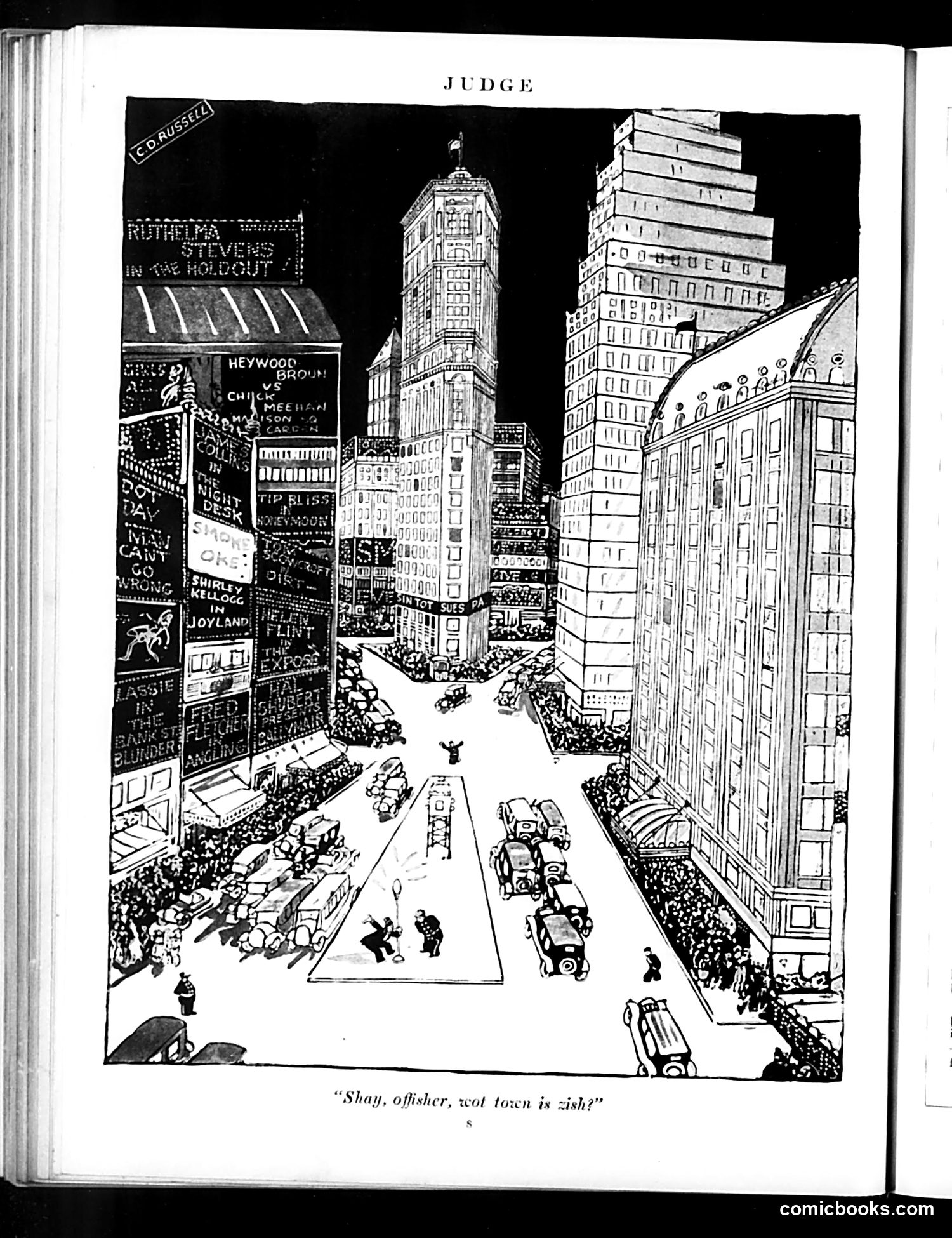
Analysis This is a single-panel cartoon satirizing urban traffic and pedestrian chaos in a major American city, likely New York. The scene depicts a crowded downtown intersection with tall buildings, street-level crowds, and vehicles (trucks and cars) creating congestion. A disheveled drunk figure asks a police officer "Say, officer, what town is this?"—the joke being that the scene is so chaotic and indistinguishable that even a drunk person cannot identify which city they're in. The satire targets early 20th-century urban congestion and the anonymity of modern city life. The cartoon mocks both rapid industrialization and the standardization of American downtown districts, where traffic gridlock and crowding had become universal problems rather than unique to any particular place.
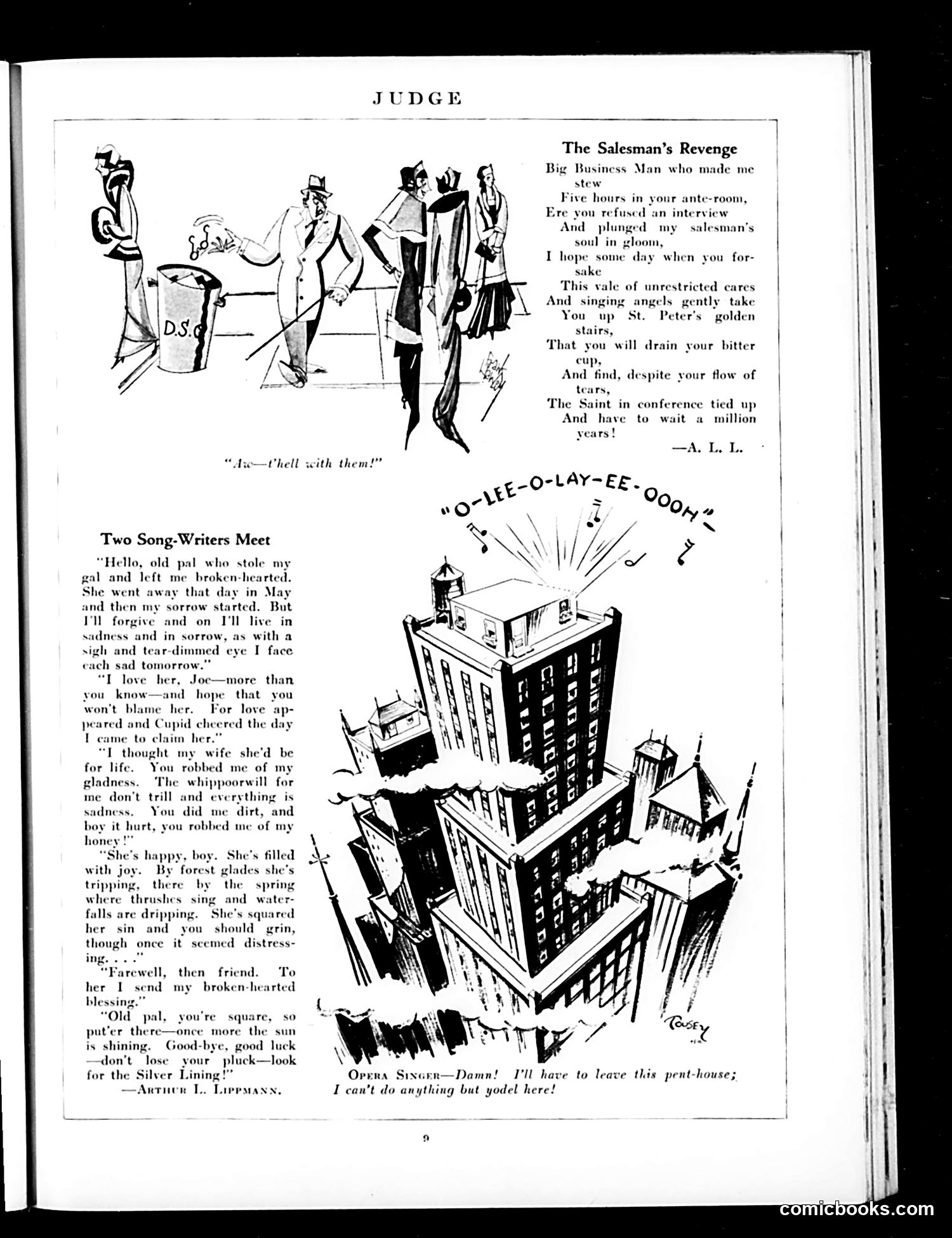
Judge Magazine Page Analysis This page contains three satirical pieces targeting early 20th-century American business culture and social pretense: "The Salesman's Revenge" mocks arrogant executives who mistreat salesmen. The poem imagines divine comeuppance—the businessman facing Saint Peter with a long wait, draining his "bitter cup" in ironic reversal of earthly power dynamics. "Two Song-Writers Meet" satirizes sentimental popular songs. Two men who were romantic rivals absurdly reconcile through overwrought lyrics about love, nature, and forgiveness ("look for the Silver Lining"). The joke is the artificial, melodramatic sentimentality of commercial songwriting. The opera singer cartoon (bottom right) shows someone in a pentthouse unable to perform because constant yodeling ("O-lee-o-lay-ee-oooh") drowns her out. This mocks both noisy urban apartment living and the pretension of high-culture residents in luxury buildings. All three pieces ridicule American business excess, artificial emotions, and social climbing—typical Judge magazine targets.
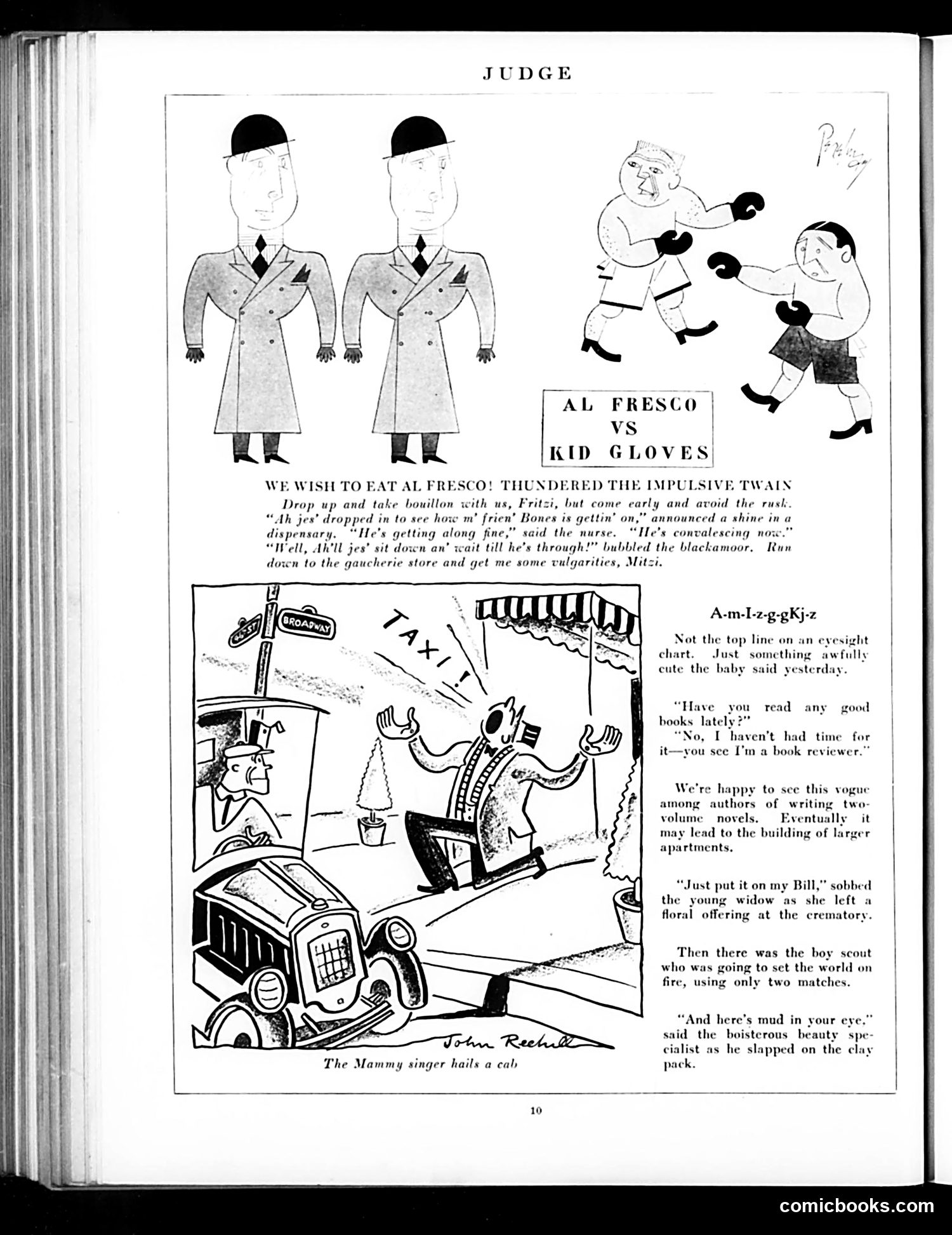
Judge Magazine Page Analysis This page contains several brief satirical jokes typical of Judge magazine's humor style: Top section ("Al Fresco vs Kid Gloves"): Two identical stern-faced judges are shown alongside a boxing match illustration. The satire appears to contrast formal judicial authority with casual street fighting—"al fresco" (outdoor dining/informality) versus "kid gloves" (gentle treatment). The accompanying text humorously depicts characters using stereotypical dialect, including a racial caricature ("the blackamoor"). Lower section: Multiple short comic vignettes mock contemporary society: - Book reviewers who don't read - The trend of two-volume novels leading to larger apartments - A widow's darkly comedic crematory quip - Scouting naiveté - A beauty specialist's crude behavior The cartoons employ exaggeration and wordplay typical of 1920s-era satirical magazines. The page reflects period attitudes, including casual racist language and imagery now considered offensive.
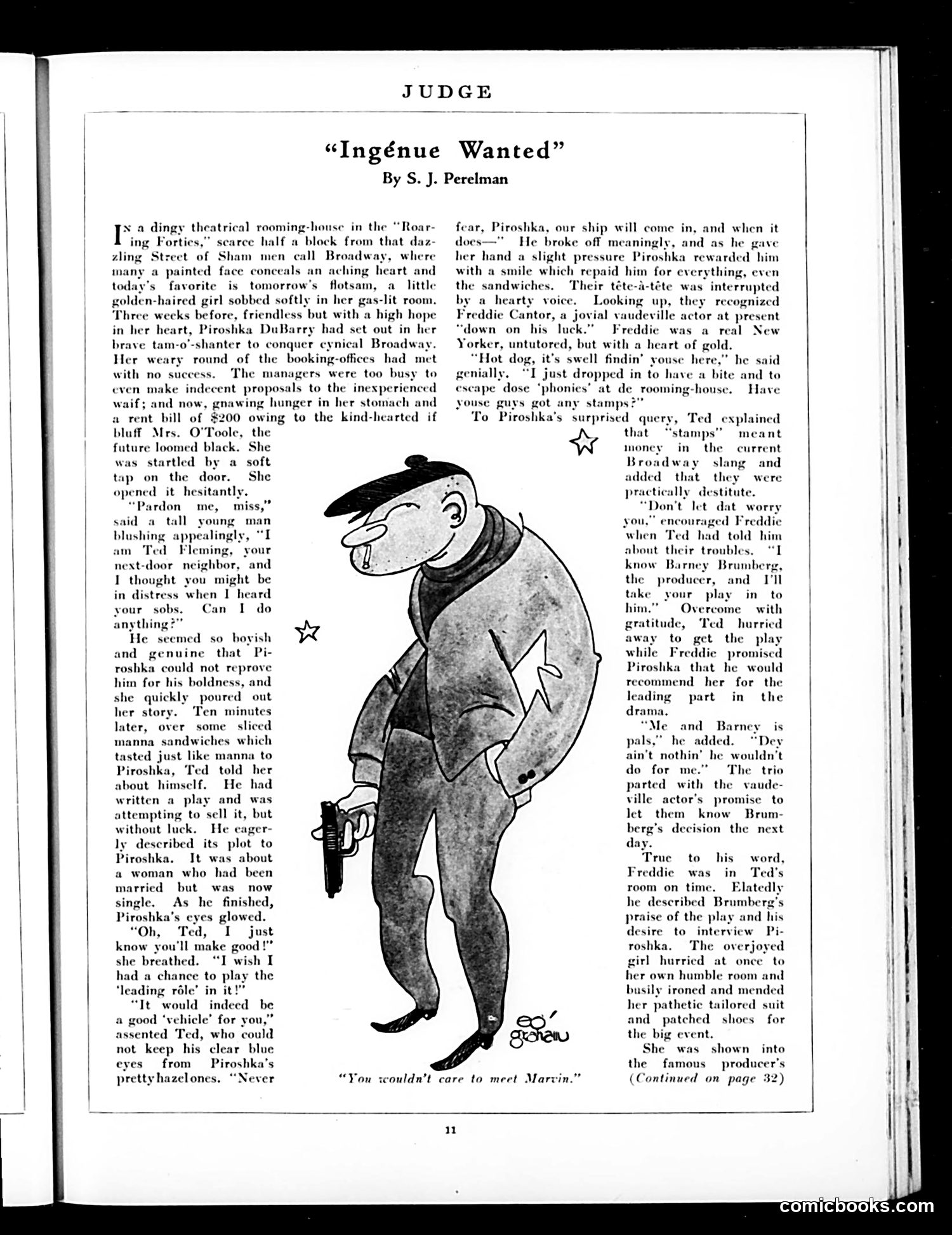
"Ingénue Wanted" — A Satire of Broadway Dreams This is a comedic short story by S.J. Perelman satirizing Broadway's theatrical world and its stock characters. The narrative mocks the clichéd "struggling actress" plot: an innocent foreign girl (Piroshka DuBarry) arrives in New York hoping for stage success but faces poverty and rejection. She's aided by a neighborly playwright (Ted) and a vaudeville actor (Freddie Cantor), who promises to introduce her to a producer (Brumberg). The satire targets the romanticized desperation of aspiring performers, the patronizing "rescue" narratives common in theater, and Broadway's exploitative casting culture. Names like "DuBarry" suggest fabricated exoticism; the "manna sandwiches" joke underscores the melodramatic poverty. The illustration shows Freddie in exaggerated vaudeville style—broad gestures, flashy suit—embodying the stock "good-hearted show business type." The story continues on page 32, suggesting a twist ending that subverts these theatrical conventions.
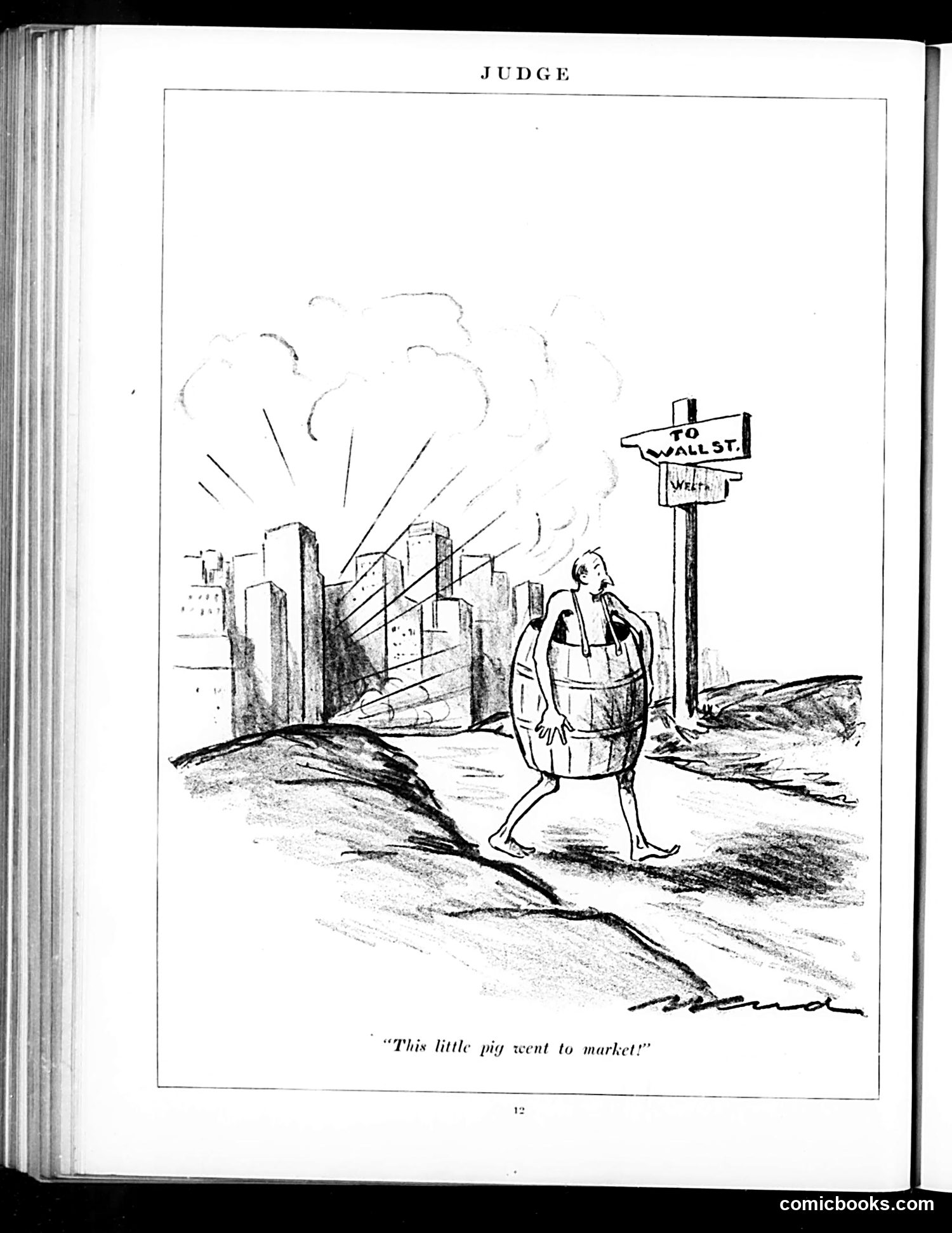
"This Little Pig Went to Market" This cartoon depicts a figure carrying a large barrel or container labeled like a business/financial entity, walking toward a "Wall St." sign amid urban destruction. The caption references the nursery rhyme "This little pig went to market," transforming it into social commentary. The satire critiques the relationship between Wall Street speculators and ordinary people or "the market." The ruined cityscape and the figure's burden suggest that financial speculation causes widespread economic damage to the public. By invoking the innocent children's rhyme, the cartoonist emphasizes the cruel irony: what should be a simple commercial transaction instead represents exploitation or financial catastrophe imposed by Wall Street on ordinary citizens.
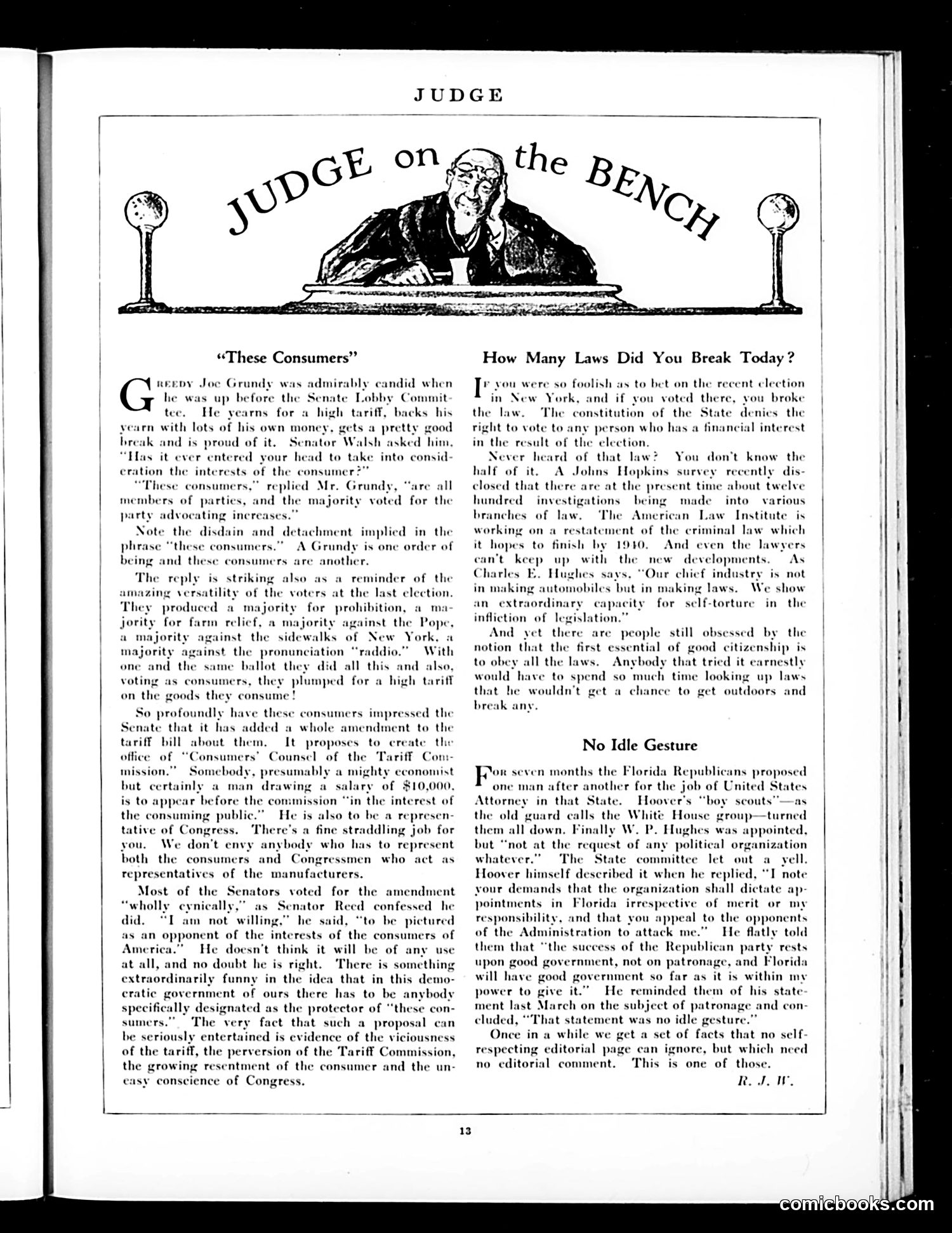
Judge Magazine Political Commentary Analysis This page contains two satirical pieces criticizing American political hypocrisy and legislative excess. "These Consumers" targets Joe Grundy, a wealthy industrialist lobbying before the Senate for high tariffs. The satire highlights the contempt industrialists hold for ordinary consumers—Grundy dismisses "these consumers" as merely a voting bloc. Judge mocks senators for proposing a "Consumers' Counsel" position ($10,000 salary) while knowing it's performative; they cynically support it to avoid appearing anti-consumer while actually serving manufacturers. The piece exposes how voters contradictorily supported prohibition, farm relief, and high tariffs simultaneously. "How Many Laws Did You Break Today?" ridicules America's legislative bloat. It notes the American Law Institute is cataloging 1,200 ongoing legal investigations. Charles E. Hughes is quoted saying America's "chief industry is not in making automobiles but in making laws." The piece argues citizens cannot practically obey all laws—attempting to would consume all their time. This critiques government's excessive, contradictory lawmaking rather than meaningful governance. Both articles decry the gap between democracy's ideals and self-serving reality.
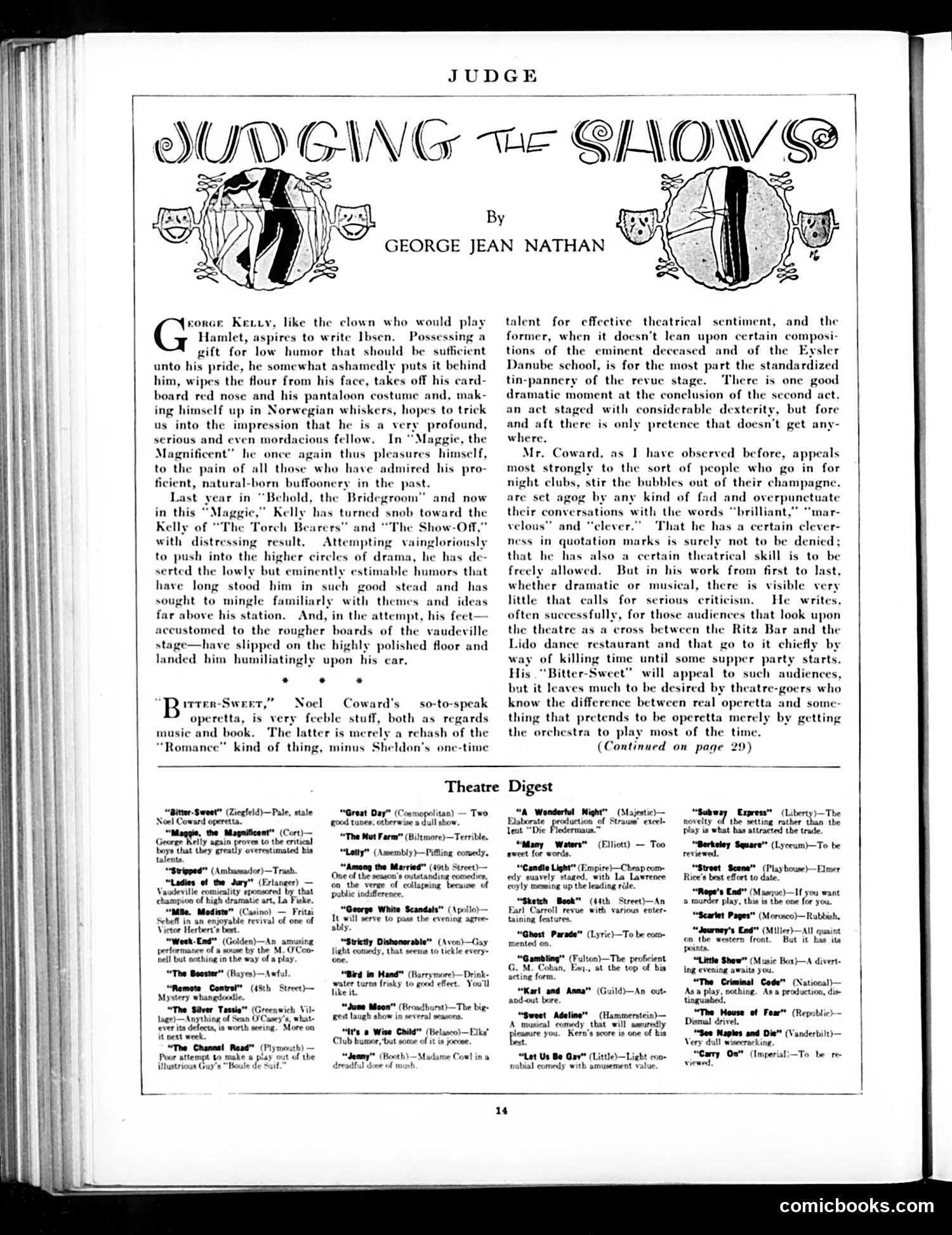
Judge Magazine: "Judging the Shows" by George Jean Nathan This page contains theater reviews from Judge magazine's drama critic. The main content critiques several Broadway productions, most notably George Kelly's "Maggie, the Magnificent" and Noel Coward's operetta "Bitter-Sweet." The satire targets George Kelly, a comedian attempting to reinvent himself as a serious dramatist in the style of Henrik Ibsen. Nathan mocks Kelly's pretension—comparing him to a clown trying to appear profound by adopting "Norwegian whiskers" while his vaudeville buffoonery credentials remain visible. Kelly's theatrical ambitions have led him to fail awkwardly, "slipped on the highly polished floor and landed him humiliatingly upon his ear." Nathan also dismisses Coward's "Bitter-Sweet" as weak, targeting its appeal to shallow nightclub audiences who use affected language like "brilliant" and "marvelous." The review suggests Coward merely rehashes operetta conventions without genuine substance. The "Theatre Digest" section lists other contemporary shows with brief dismissals or endorsements, typical of Judge's satirical theater coverage from this era (likely 1920s).
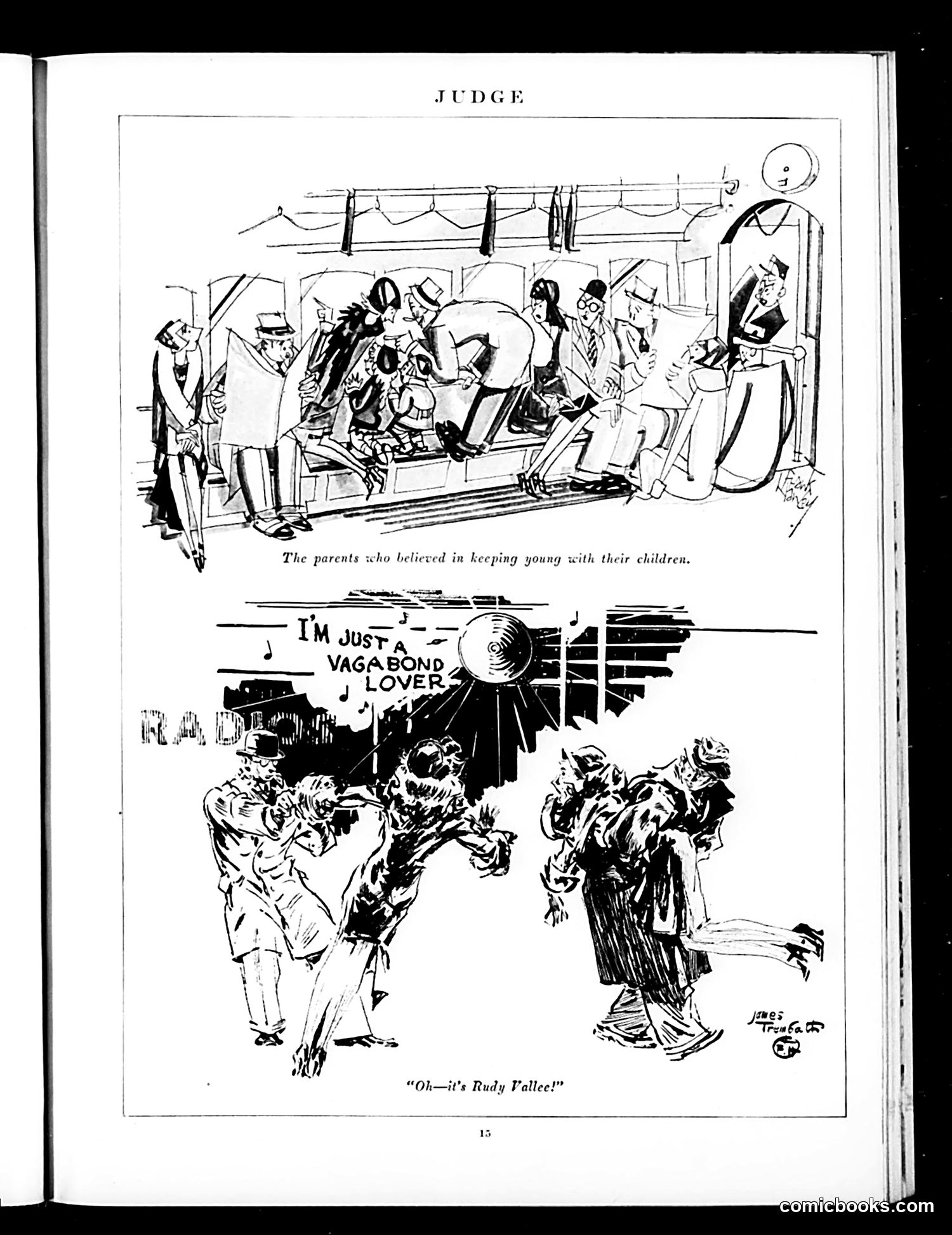
Analysis This page contains two distinct cartoons satirizing different social trends. The top cartoon depicts a courtroom scene labeled "The parents who believed in keeping young with their children." It mocks parents attempting to adopt youthful behavior and dress to connect with their kids—a 1920s-30s social phenomenon. The bottom cartoon references "I'm Just a Vagabond Lover," a famous 1929 song by Rudy Vallée, a prominent crooner and entertainer of the era. The caption "Oh—it's Rudy Vallee!" suggests the cartoon satirizes Vallée's fame and public adoration. The exaggerated drawings of swooning figures likely mock the intense fan hysteria surrounding popular entertainers—a precursor to modern celebrity fandom. The cartoon critiques both Vallée's celebrity status and his fans' enthusiasm.
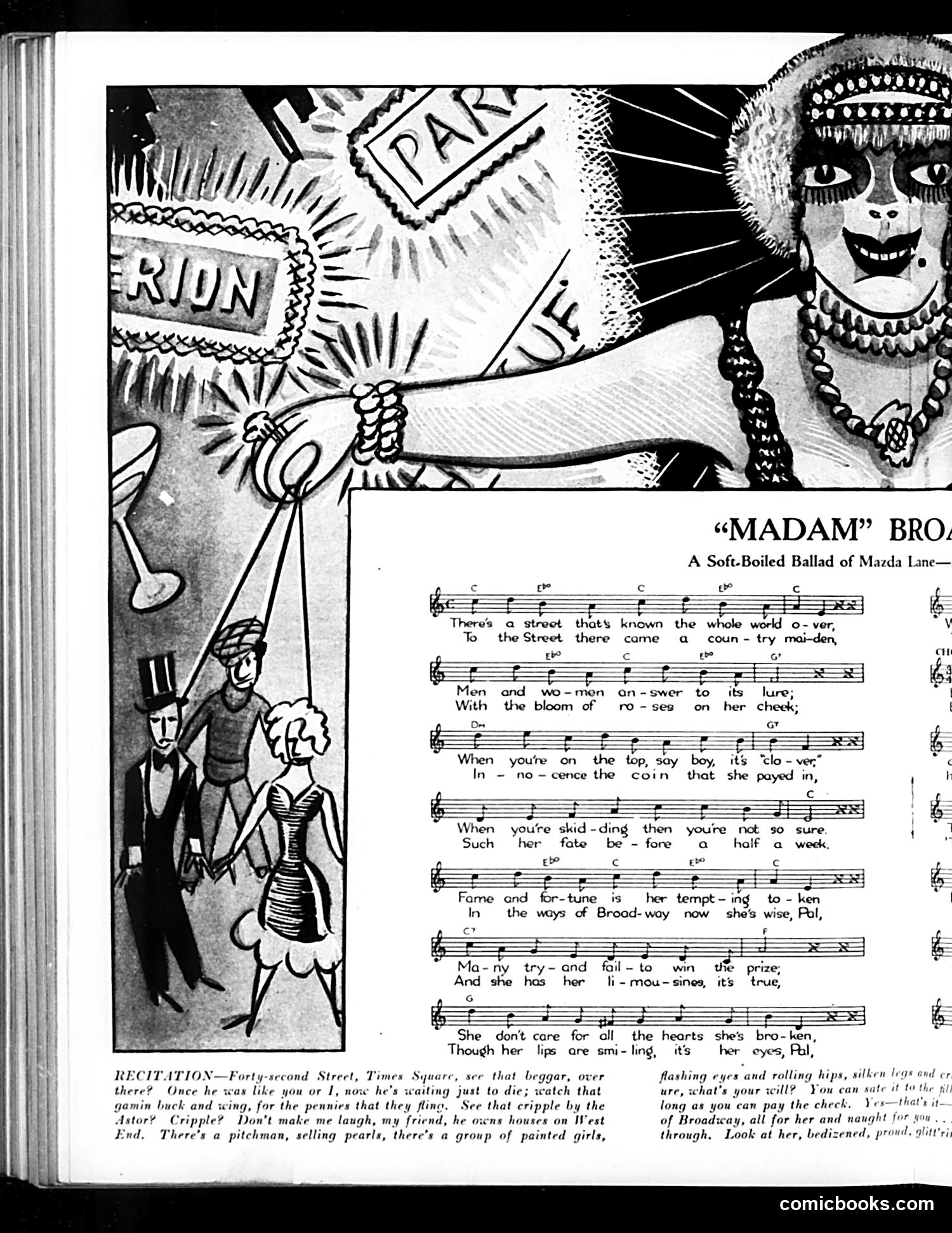
"Madam" Broadway: A Cautionary Tale This page from *Judge* presents a morality song warning against the seductions of Broadway and urban vice. The illustration shows a glamorous, heavily made-up woman (likely representing a courtesan or "madam") alongside men in formal dress, depicting the world of Times Square and "Madam Lane." The ballad tells of a country girl who arrives in the city and is drawn into Broadway's temptations. Though she gains fame, fortune, and luxuries (limousines), the song emphasizes moral corruption—she breaks hearts and cares only for material gain. The accompanying "Recitation" reinforces this grim urban landscape, describing beggars, cripples, street performers, and "painted girls." The satire targets both the allure and moral decay of early 20th-century Broadway culture, warning readers of the dangers lurking beneath the glittering surface of urban entertainment and commerce.
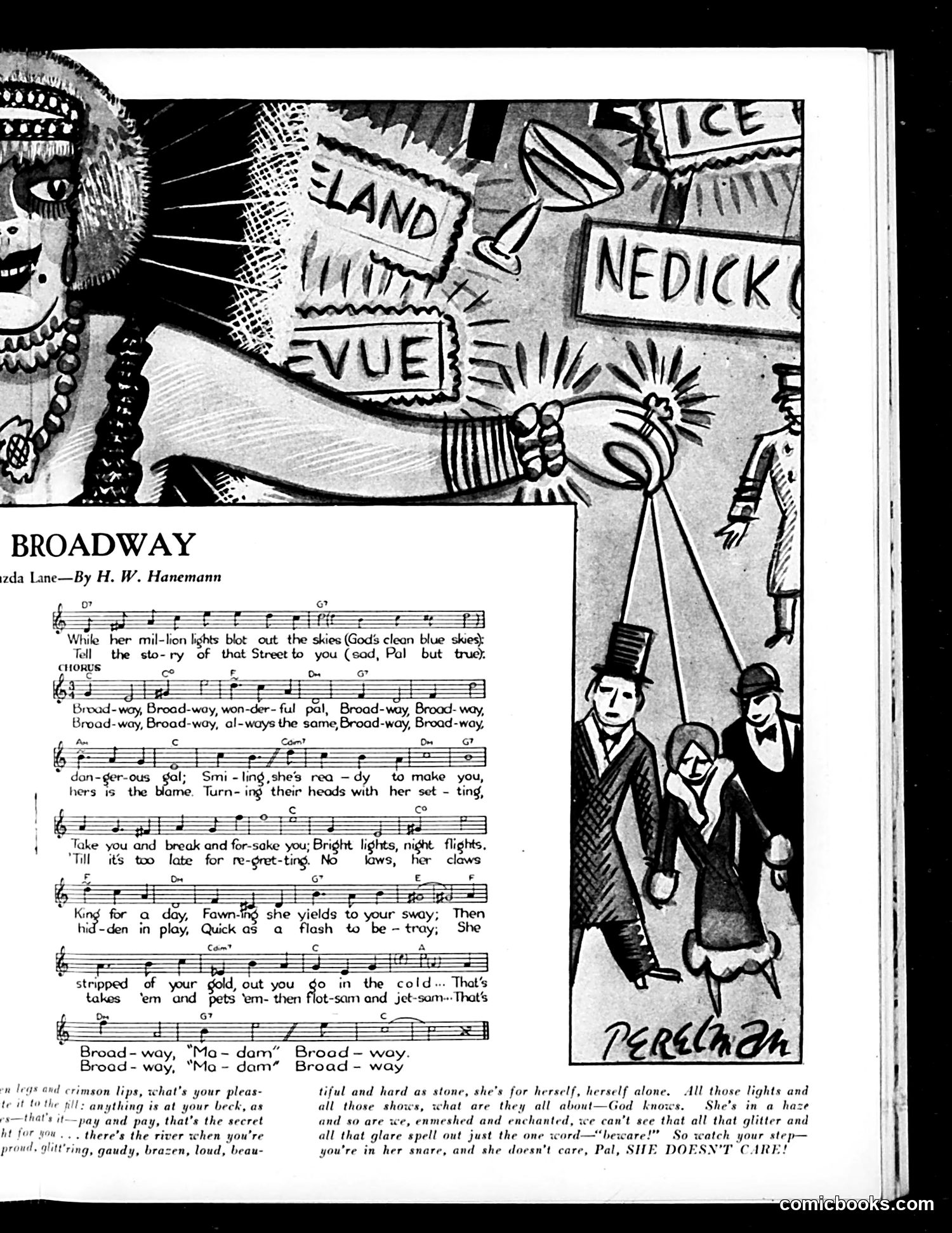
"Broadway" Song Satire This page presents a musical composition by H.W. Hanemann satirizing Broadway as a seductive, predatory force. The song personifies Broadway as a glamorous but dangerous woman—"a wonder-ful pal" but also "a dangerous gal" who "doesn't care." The satire critiques Broadway's allure: its million lights blind people to moral reality; it promises fortune ("King for a day") but inevitably betrays men, stripping them of gold and leaving them "in the cold" like "flotsam and jetsam." The accompanying cartoon illustration shows well-dressed men captivated by this figure, emphasizing how Broadway's glitter and spectacle ensnare victims. The text warns that beneath the glamorous surface—"all that glitter," "gaudy, brazen" displays—lurks exploitation and moral danger. The song expresses Progressive-era anxiety about urban vice, commercialism, and how cities corrupt naive visitors.
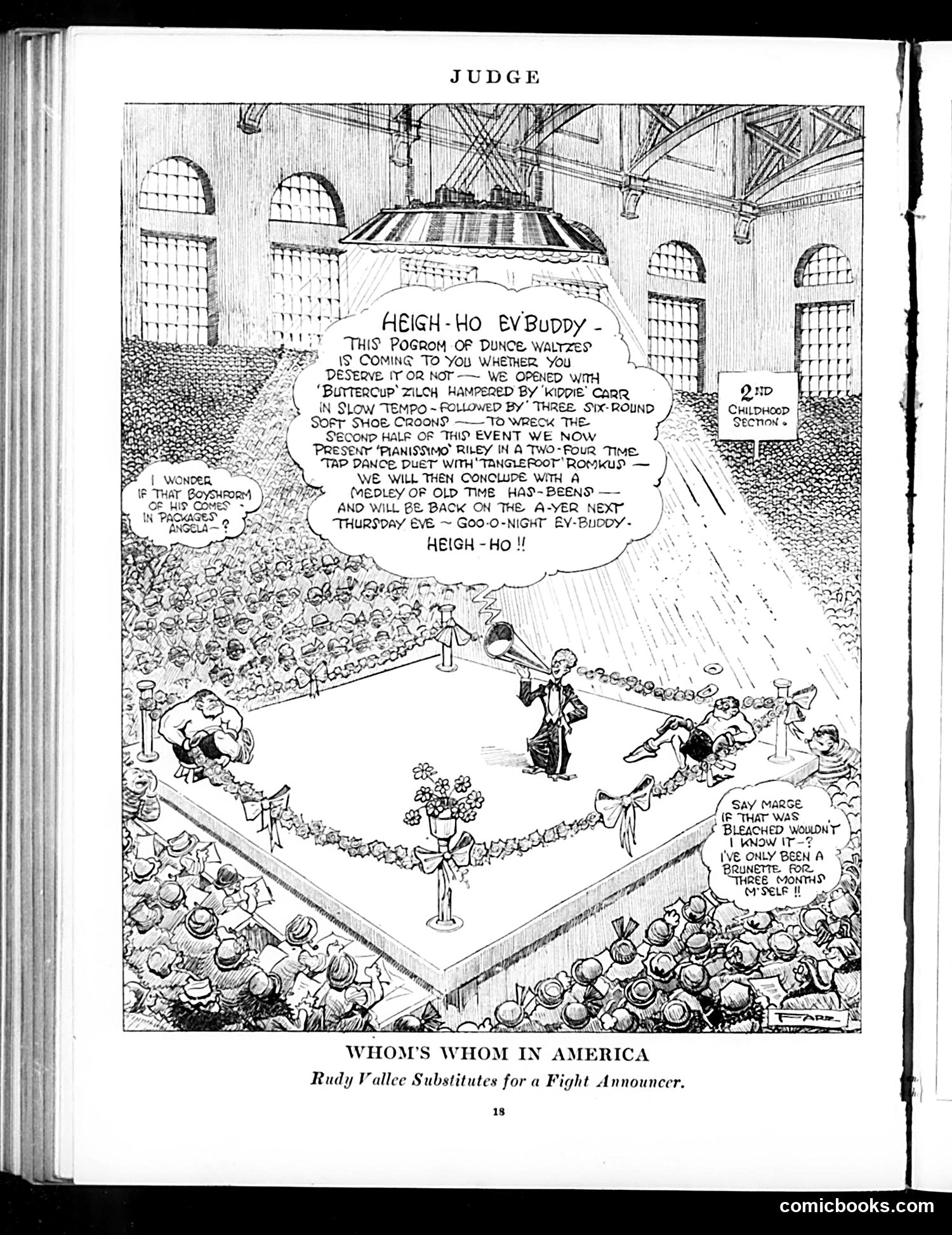
Political Cartoon Analysis: "Judge" Magazine This cartoon satirizes Rudy Vallée, the famous 1920s-30s crooner and entertainer, by imagining him as a boxing fight announcer. The joke contrasts Vallée's actual persona—a smooth, theatrical performer known for soft, romantic singing—with the rough, masculine world of professional boxing. The announcer describes an absurdly theatrical fight card full of dance numbers, soft-shoe routines, and tap dancing rather than actual boxing. References like "Buttercup Zilch," "Tanglefoot Romkus," and "Pianissimo Riley" appear to be invented performer names mocking vaudeville's declining entertainment style. The audience reaction ("Say Marge...I've only been a brunette for three months") suggests the spectacle is so bizarre it's disorienting. The satire criticizes both Vallée's theatrical excess and the perceived gap between popular entertainment and authentic athleticism—poking fun at how entertainment culture was becoming increasingly artificial and performative.
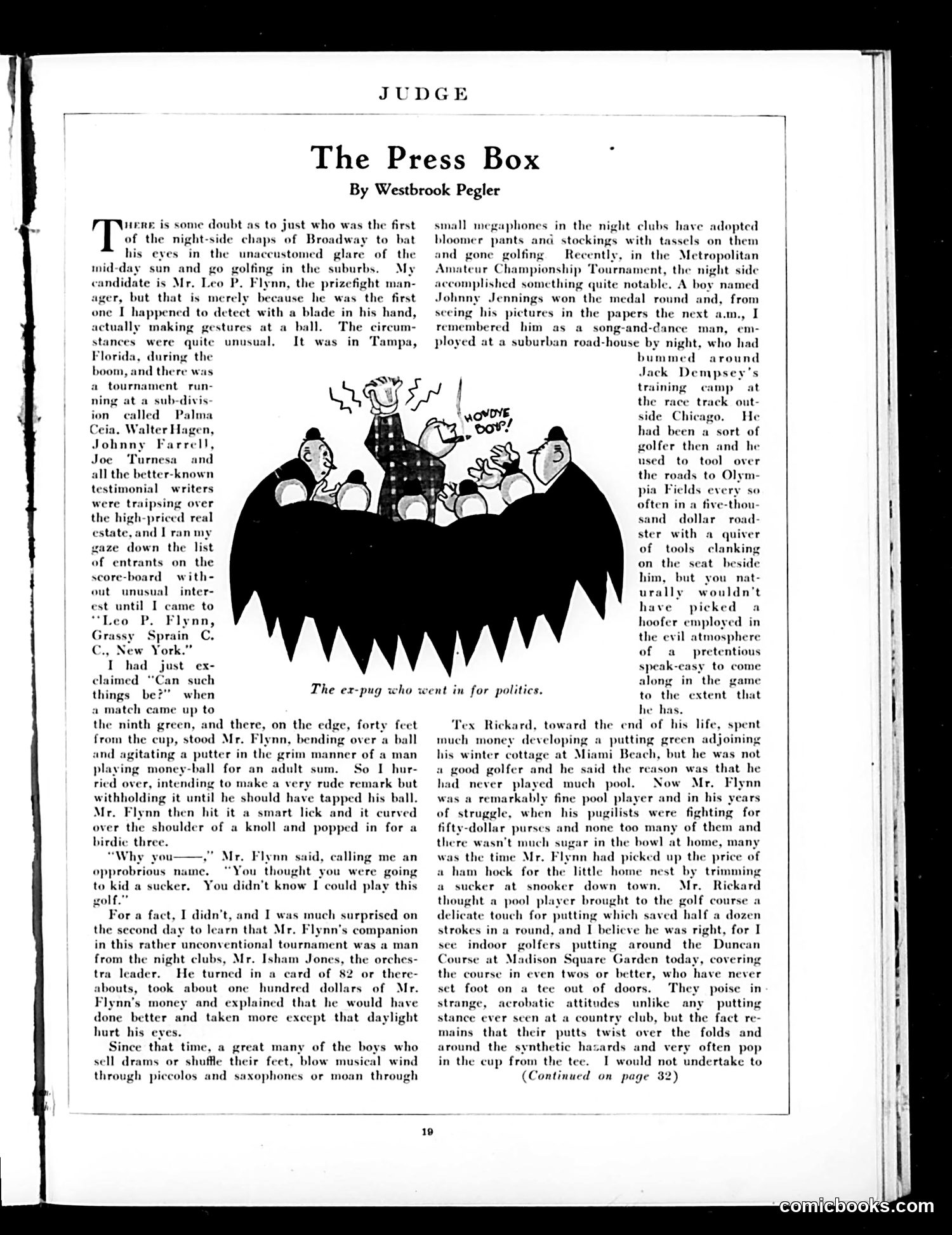
Explanation of "The Press Box" Cartoon This article by Westbrook Pegler satirizes Broadway nightlife figures—entertainers, promoters, and musicians—who took up golf as a trendy hobby. The central figure is Leo P. Flynn, a boxing promoter from New York, depicted as an "ex-pug" (former boxer) who became an unlikely golfer during Florida's real estate boom. The cartoon ridicules these nocturnal "night-side chaps"—dram sellers, orchestra leaders, and song-and-dance performers—adopting the sport. Pegler humorously notes that despite their unsuitability for outdoor daylight activities (one character complains daylight "hurts his eye"), some surprisingly excelled at golf, including a road-house entertainer named Johnny Jennings who won a championship. The satire extends to Tex Rickard (the boxing promoter), who invested money in a putting green, assuming a pool player's delicate touch would translate to golf skill. The piece gently mocks the incongruity of these urban entertainers and gamblers suddenly embracing a gentleman's sport.
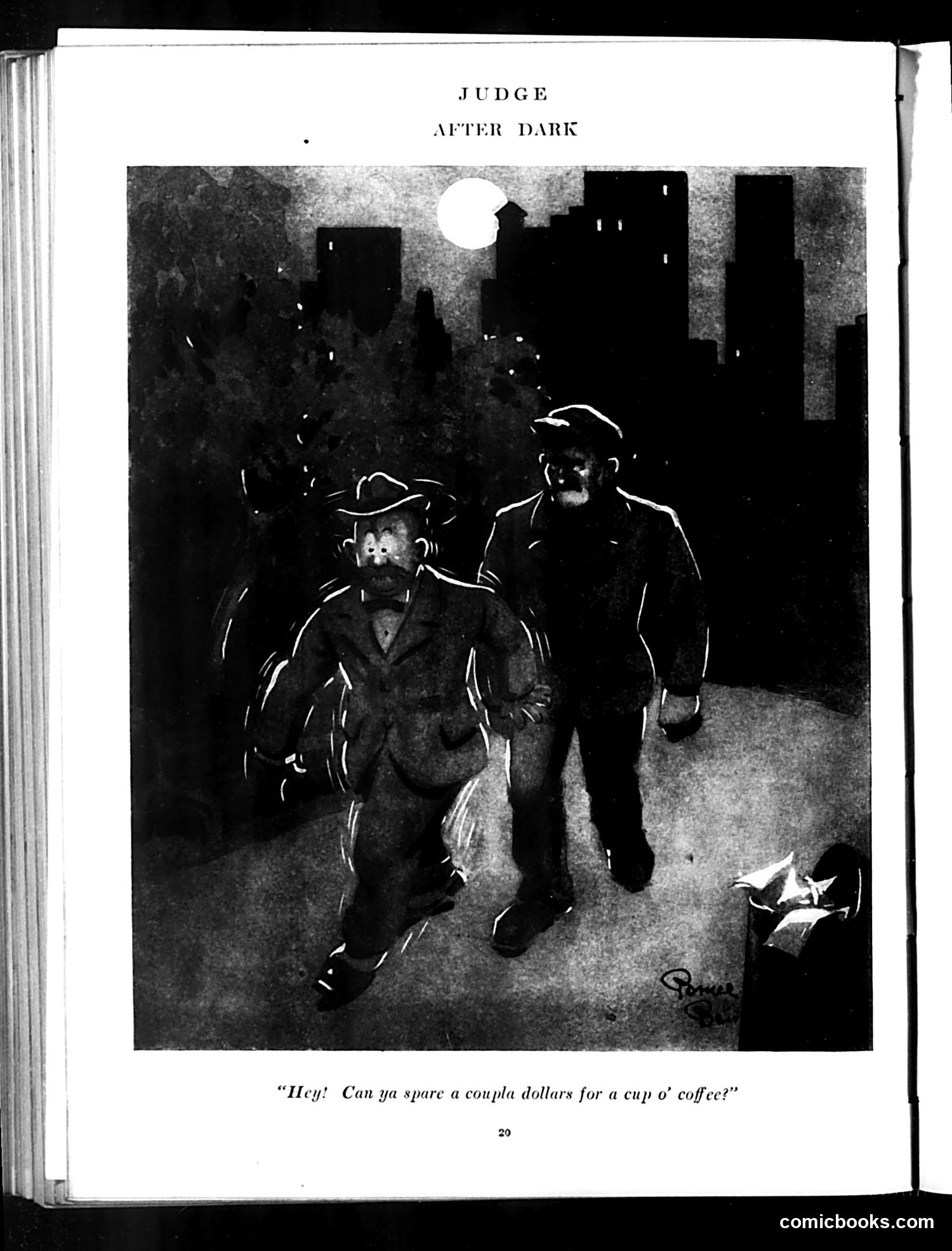
"Judge After Dark" - Homeless Panhandling This cartoon depicts a nighttime urban scene with two men in hats accosting a third figure. The caption shows one asking for spare change for coffee—a classic panhandling request. The satire appears to target homelessness and street begging in early 20th-century America. The stark nighttime setting, silhouetted cityscape, and full moon create a noir atmosphere emphasizing urban poverty and desperation. The joke likely works on multiple levels: either mocking the panhandler's transparent deception (coffee as a pretense for alcohol or other needs), or satirizing middle-class anxiety about street crime and aggressive begging. The aggressive body language and confrontational approach suggest threat rather than simple need. The "After Dark" framing emphasizes how such encounters represent hidden urban problems visible only at night.
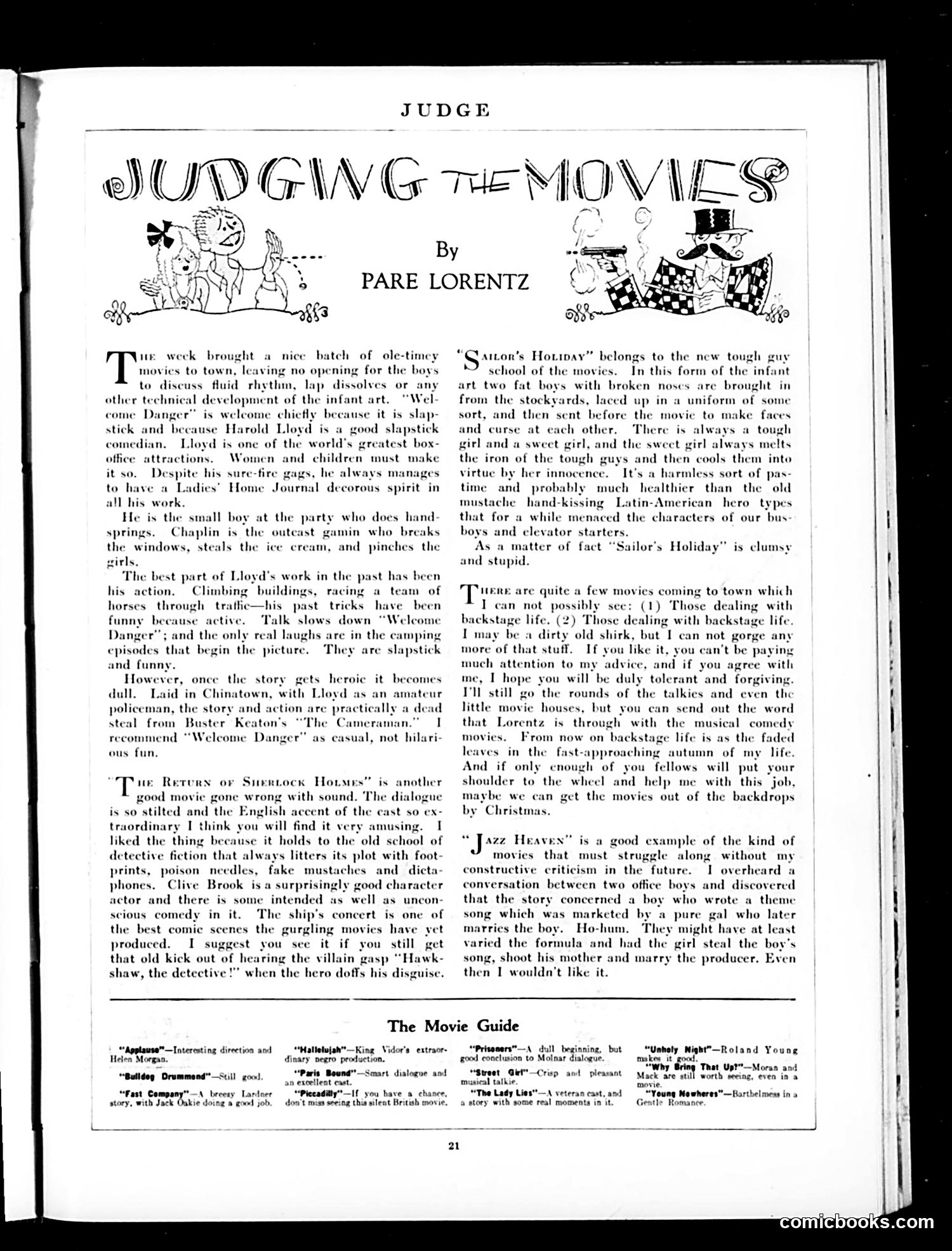
"Judging the Movies" by Pare Lorentz — Judge Magazine Film Criticism This page features a film critic's reviews of current movies, written in a humorous, opinionated style typical of Judge's satirical approach. Key figures discussed: - Harold Lloyd — praised as a great slapstick comedian whose physical comedy carries "Welcome Danger," though the narrative portions become dull - Charlie Chaplin — contrasted as the "outcast gamin" who steals and breaks things, representing a different comedic style Social satire: The critic mocks emerging trends in cinema: overly-stylized "tough guy" movies featuring stockyard laborers dressed as gang members; formulaic "backstage life" movies; and the technical pretensions of early talking pictures with stilted dialogue and artificial English accents. The joke: Lorentz humorously denounces musical comedy films as exhausting, declaring himself "through" with them and sarcastically asking readers to help "get the movies out of the backdrops by Christmas"—suggesting cinema had become trapped by repetitive, uninspired formulas. The tone reflects 1920s-30s frustration with sound film's growing commercialism versus silent film's artistic potential.
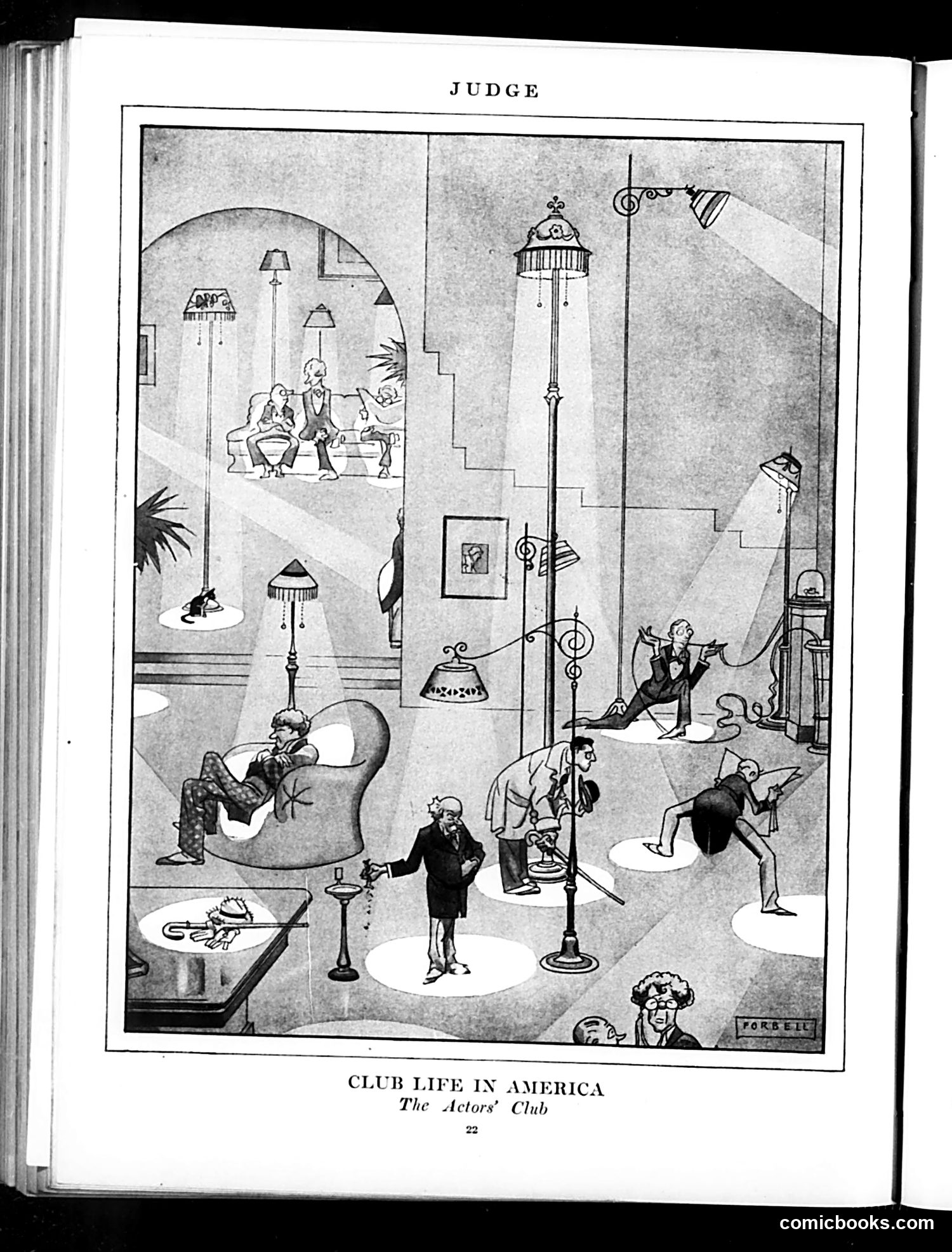
Club Life in America: The Actors' Club This satirical illustration depicts the interior of the Actors' Club, a real New York institution for theatrical professionals. The cartoon mocks the pretensions and behaviors of actors by showing them engaged in various exaggerated activities throughout an ornate interior—lounging in chairs, exercising, socializing, and posing dramatically. The satire targets actors' perceived vanity, idleness, and theatrical affectation even in private settings. Characters are shown striking dramatic poses, primping, and engaging in leisurely pursuits rather than productive work. The ornate décor with hanging lamps and columns emphasizes the club's exclusivity and self-importance. This reflects Judge magazine's typical approach: satirizing American social institutions and the pretensions of specific professional classes through humorous exaggeration and visual wit.
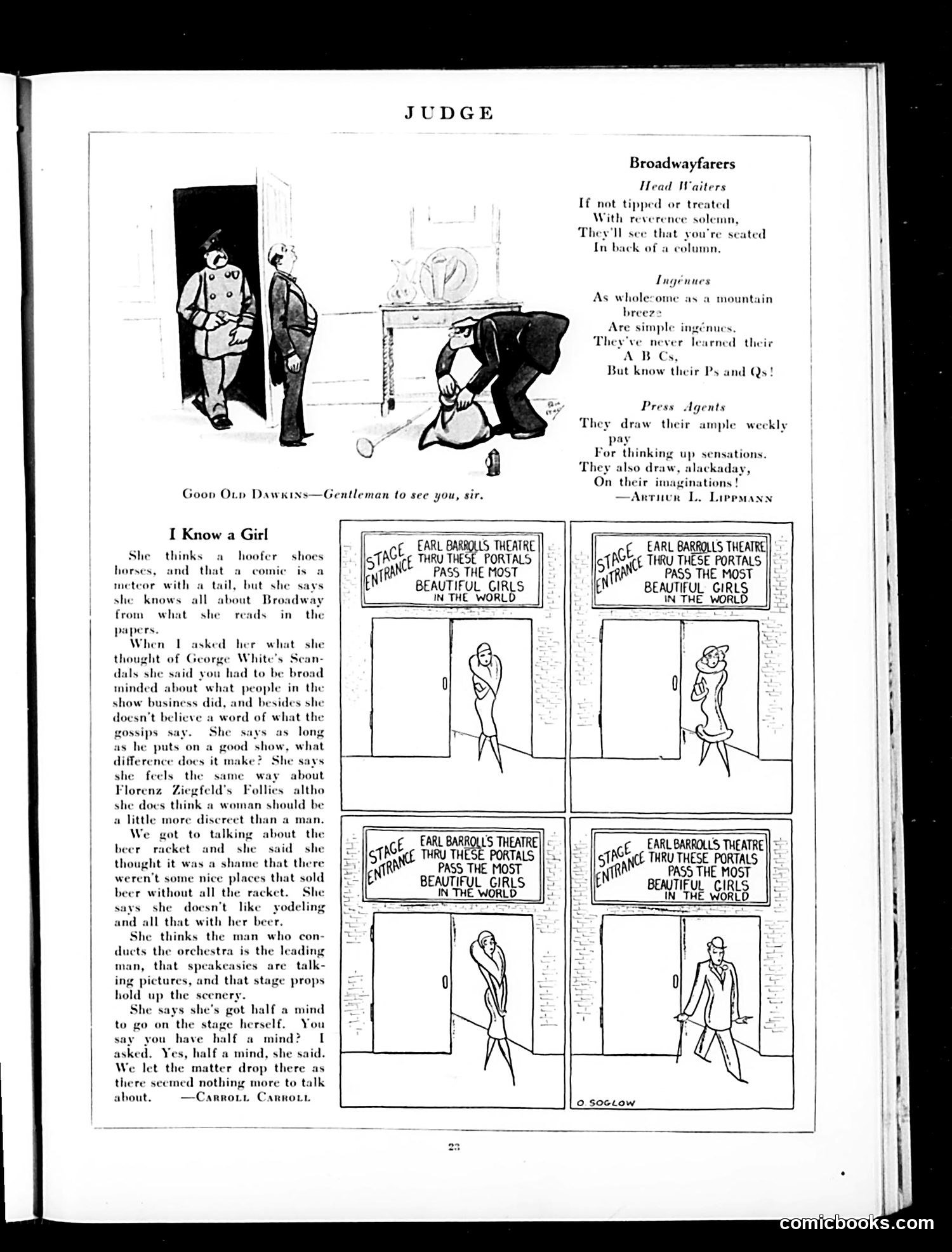
Analysis for Modern Readers This page from *Judge* satirizes 1920s Broadway theater culture through multiple pieces: "Good Old Dawkins" (top): A simple gag about a doorman announcing a visitor—likely referencing a specific well-known figure or the pretension of theatrical gatekeepers. Broadway Stereotypes (right column): Cynical verse mocking theater world types—head waiters who punish non-tippers with bad seating, naive ingénues, and press agents paid to generate scandals. This reflects Jazz Age cynicism about show business ethics. "I Know a Girl" (left): Satire of a woman who absorbs Broadway gossip without understanding it. She confuses theatrical terminology (thinks a "comic" is literally a meteor, speakeasies are "talking pictures"), yet confidently opines on scandals like "George White's Scandals" and the "beer racket" (Prohibition-era illegal alcohol). The joke: she's confidently ignorant, having absorbed Broadway's surface sophistication without actual knowledge. Earl Barrolls Theatre ads (bottom): Repetitive stage-door ads showing women in similar poses—likely mocking the standardized marketing of Broadway's "beautiful girls" in revues. Overall: cynical commentary on 1920s theater's commercialism, scandal-mongering, and the performative nature of Broadway culture itself.
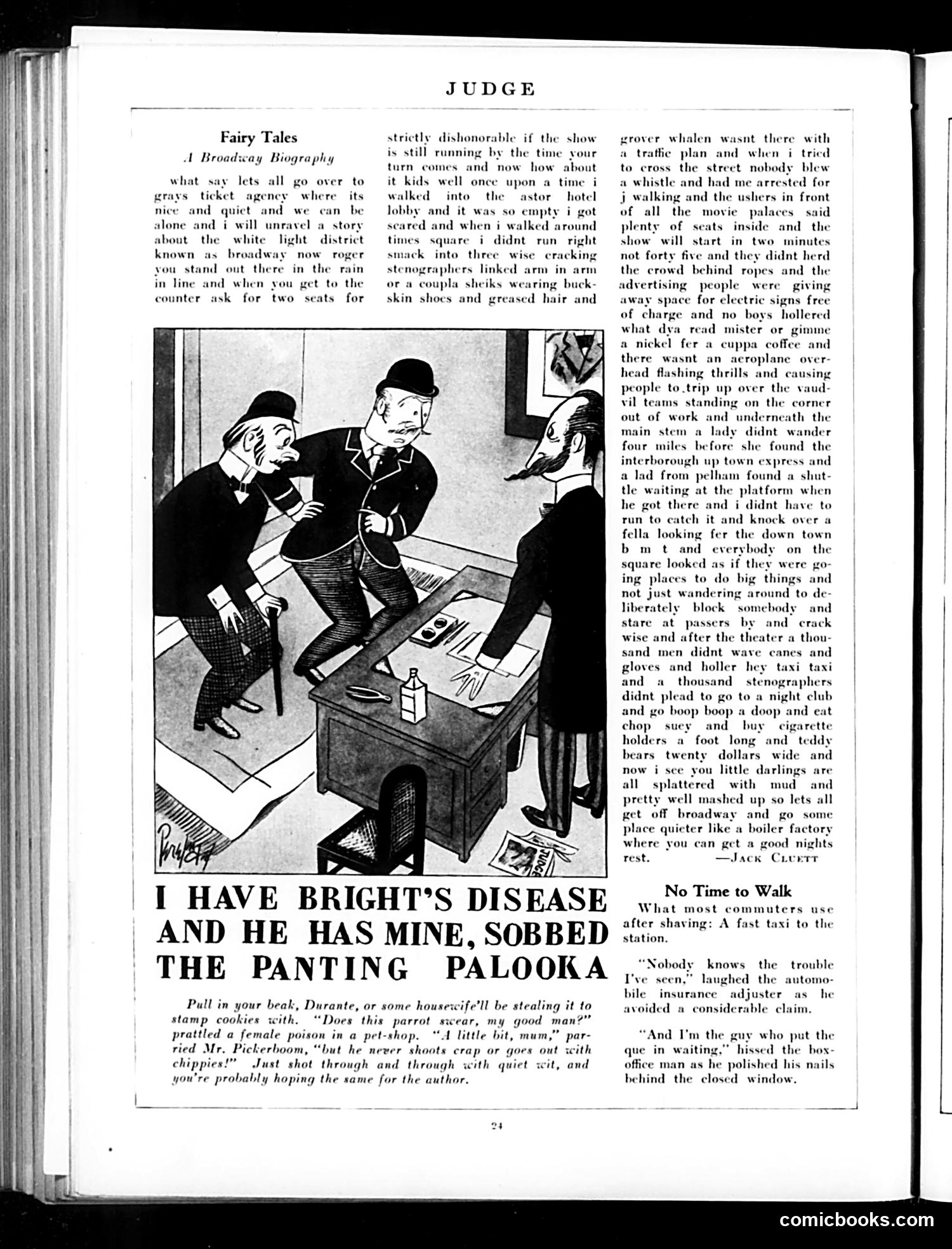
Judge Magazine Page Analysis This page contains two distinct satirical pieces: "A Broadway Biography" (main cartoon & text): A cynical monologue mocking the theatrical district's overhyped mystique. The narrator sarcastically describes what Broadway *should* be like—empty theaters, helpful ushers, no crowds or street hustlers—contrasting sharply with reality: congested Times Square, aggressive advertising, loitering con artists, and desperate performers. The joke targets both Broadway's actual chaos and people's romantic delusions about the "Great White Way." "I Have Bright's Disease and He Has Mine, Sobbed the Panting Palooka": A boxing humor piece. A "palooka" (mediocre boxer) and someone with Bright's disease (a kidney ailment) have apparently mixed up their medical conditions—the wordplay suggests the boxer absorbed the illness while remaining a bumbling fighter. The accompanying vignettes mock various urban types: con artists, pet-shop owners, and dismissive office workers. Both pieces satirize early 20th-century urban American life—Broadway excess, working-class struggles, and petty con games.
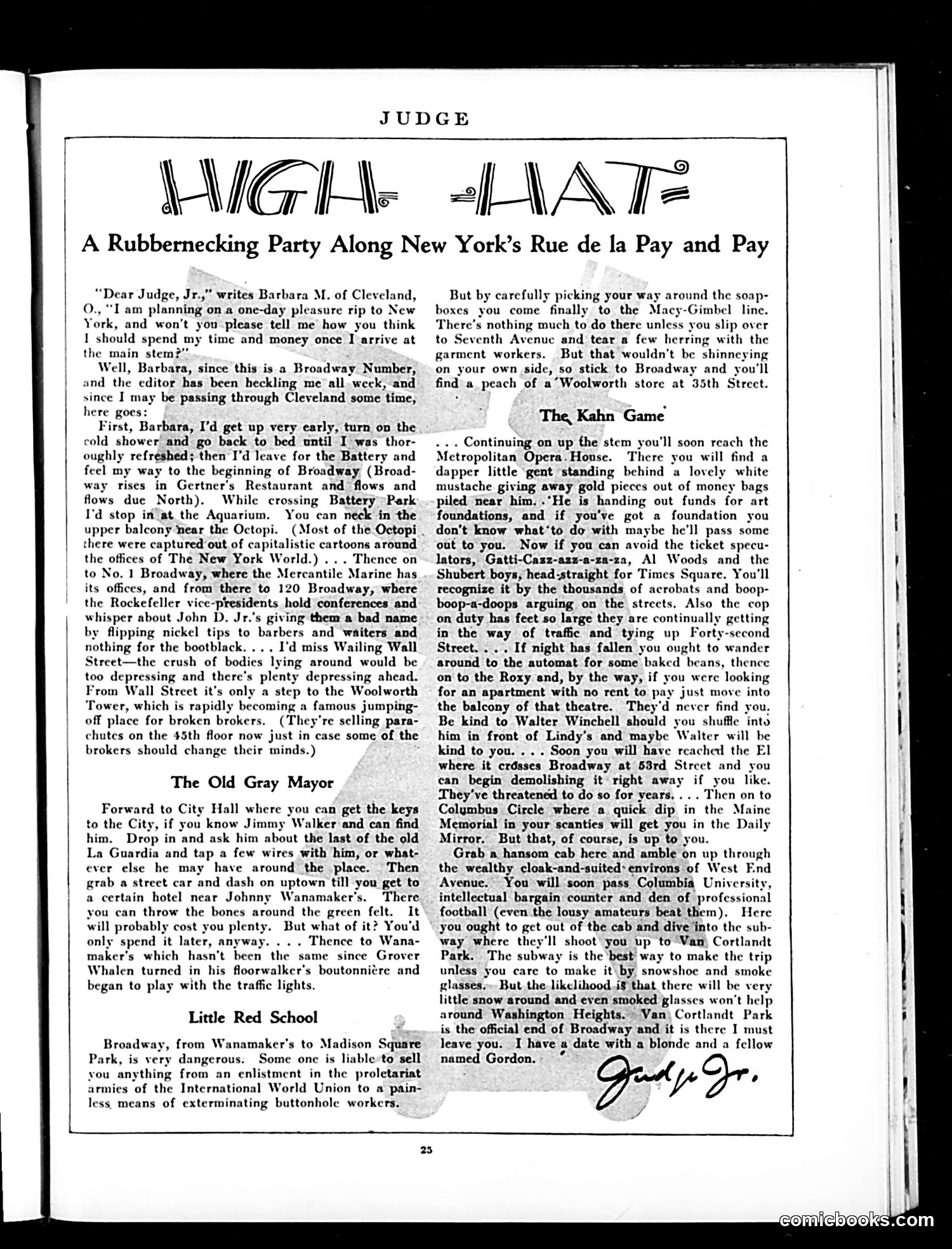
Explanation for Modern Readers This is a humorous advice column where "Judge, Jr." guides a tourist through 1920s New York City landmarks, peppered with satirical jabs at contemporary figures and institutions. Key References: - Jimmy Walker: NYC mayor known for corruption and frequenting speakeasies - John D. Rockefeller Jr.: Criticized for stingy tipping despite vast wealth - Grover Whalen: A real NYC official who apparently abandoned his job ("floorwalker's boutonniére") for traffic management - The Woolworth Tower: Famous skyscraper; the joke about "jumping-off place for broken brokers" references Depression-era suicides - Gatti-Casazza: Likely the Metropolitan Opera's general manager, satirized as frivolously distributing money to art foundations The Satire: The piece mocks NYC's wealthy elite (Rockefeller, opera patrons), political corruption (Walker), and the contrast between luxury venues and street-level chaos. The "Little Red School" section ironically references communist street speakers ("proletariat armies") amid capitalist commerce—reflecting 1920s anxieties about radicalism. The tone is lighthearted urban cynicism typical of Judge magazine's sophisticated audience.
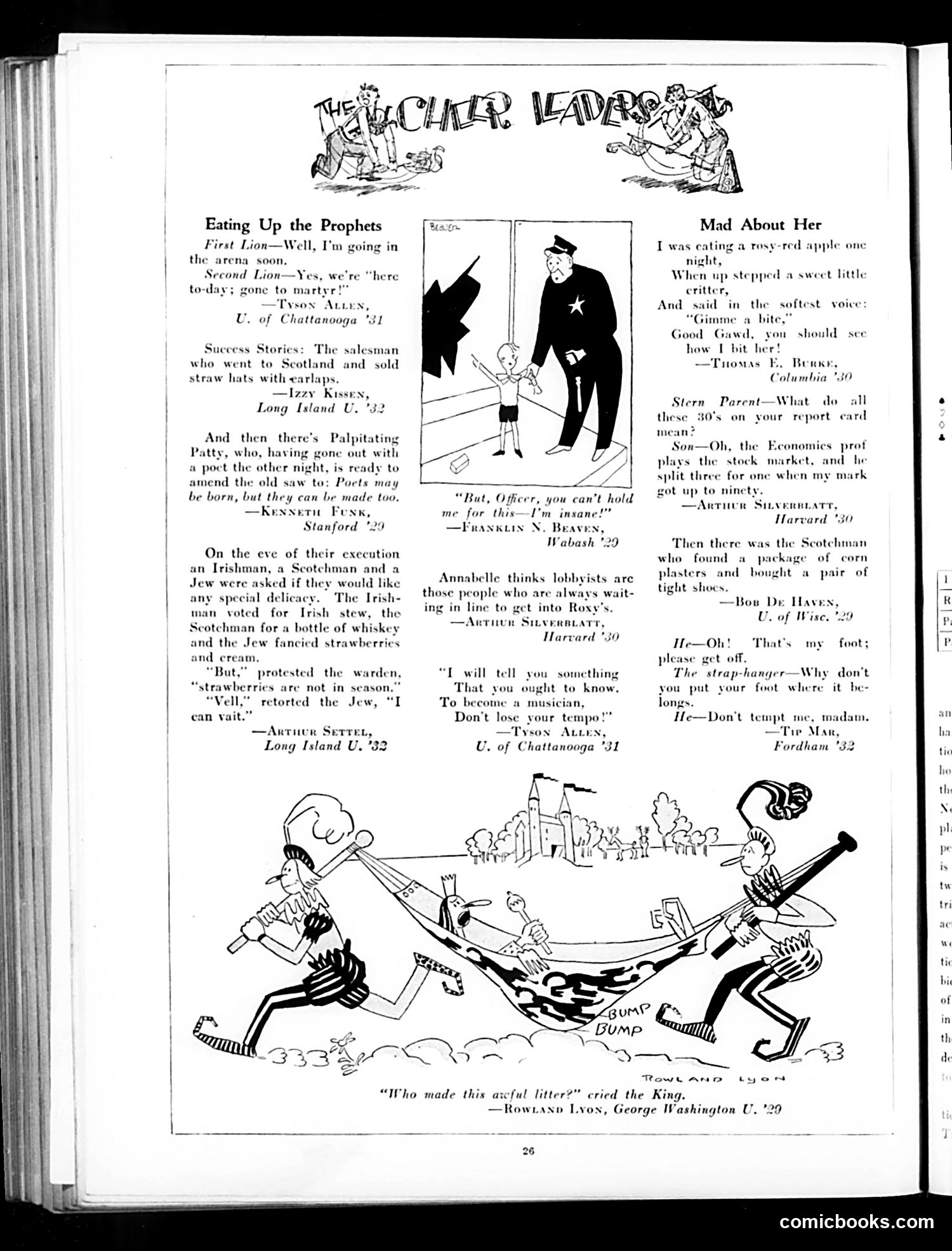
"The Bulger Leader" Page Analysis This page from *Judge* magazine features humorous college-submitted jokes and cartoons, typical of 1930s student humor. The content includes: Main Cartoons: - Top: Two lions discussing eating "prophets" (wordplay on "profits"), satirizing economic concerns during the Great Depression - Bottom: A chaotic "litter" scene with figures fighting over debris, captioned with a pun about "litter" vs. royalty's complaint Joke Collections: The page collects one-liners from college students (dated '29-'32) on various topics: success stories, dating, prohibition-era references (whiskey jokes), economics/stock market crashes, and physical comedy. Social Context: These jokes reflect early 1930s college culture—economic anxiety from the recent 1929 crash, prohibition (whiskey references), casual ethnic humor (the Irish/Scotch/Jewish execution joke), and dating customs. The humor is largely pun-based wordplay typical of the era's student publications. The page represents undergraduate comedy submissions to a national satirical magazine, capturing period attitudes and concerns.
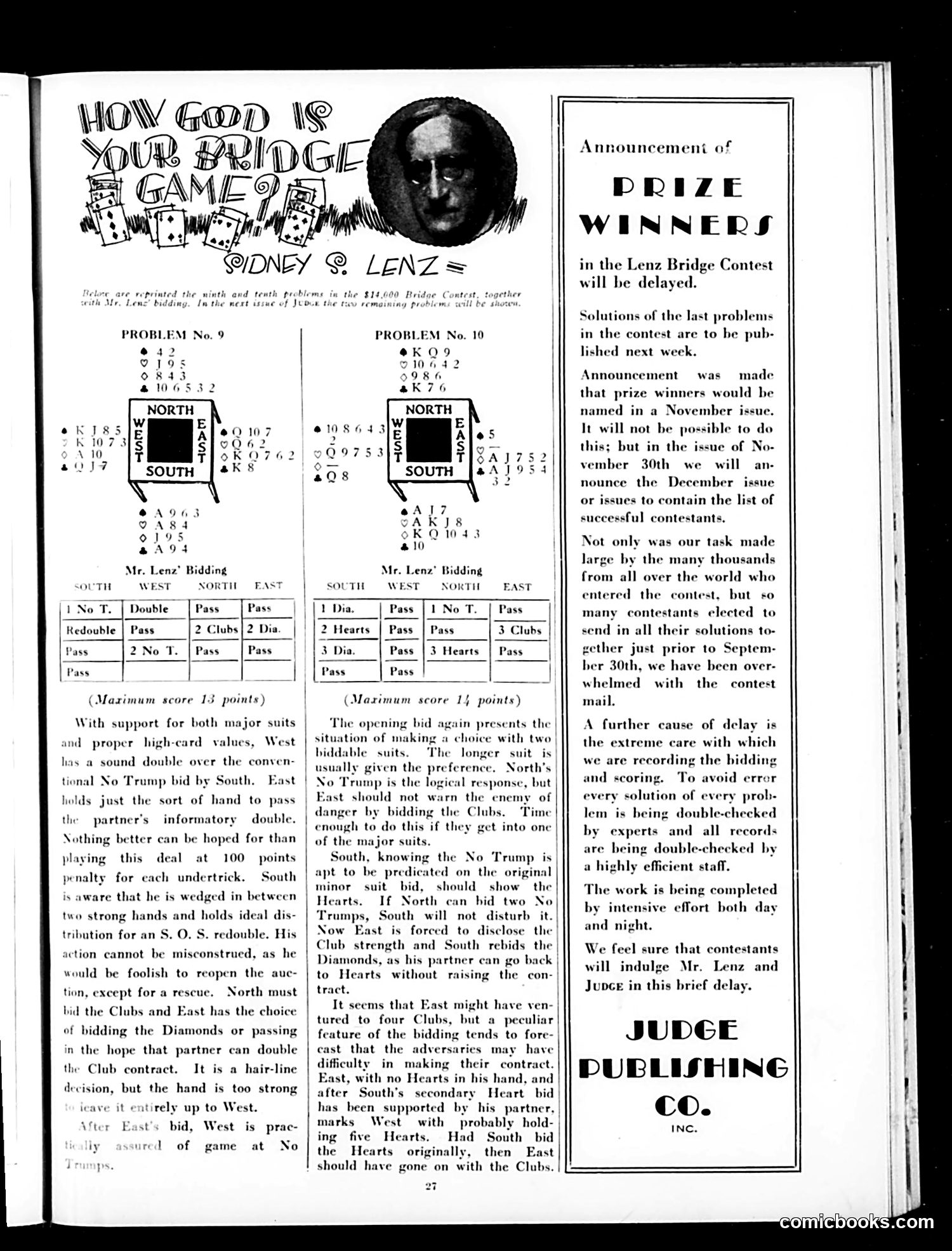
This page is primarily bridge instruction and contest administration, not political satire. The content features bridge problems attributed to "Mr. Lenz" (likely Ely Culbertson or another famous bridge authority of the era), presenting detailed card-game scenarios with bidding sequences for readers to solve. These are problems 9 and 10 in Judge magazine's $14,000 Bridge Contest. The right-hand announcement addresses delays in announcing contest prize winners. The magazine explains the delay resulted from overwhelming participation—thousands of entries arrived just before the September 30th deadline—and the painstaking effort required to double-check every solution and bidding sequence. There is no political cartoon or satire on this page. It's a straightforward instructional and administrative feature reflecting bridge's popularity as both a parlor game and competitive contest during this period.
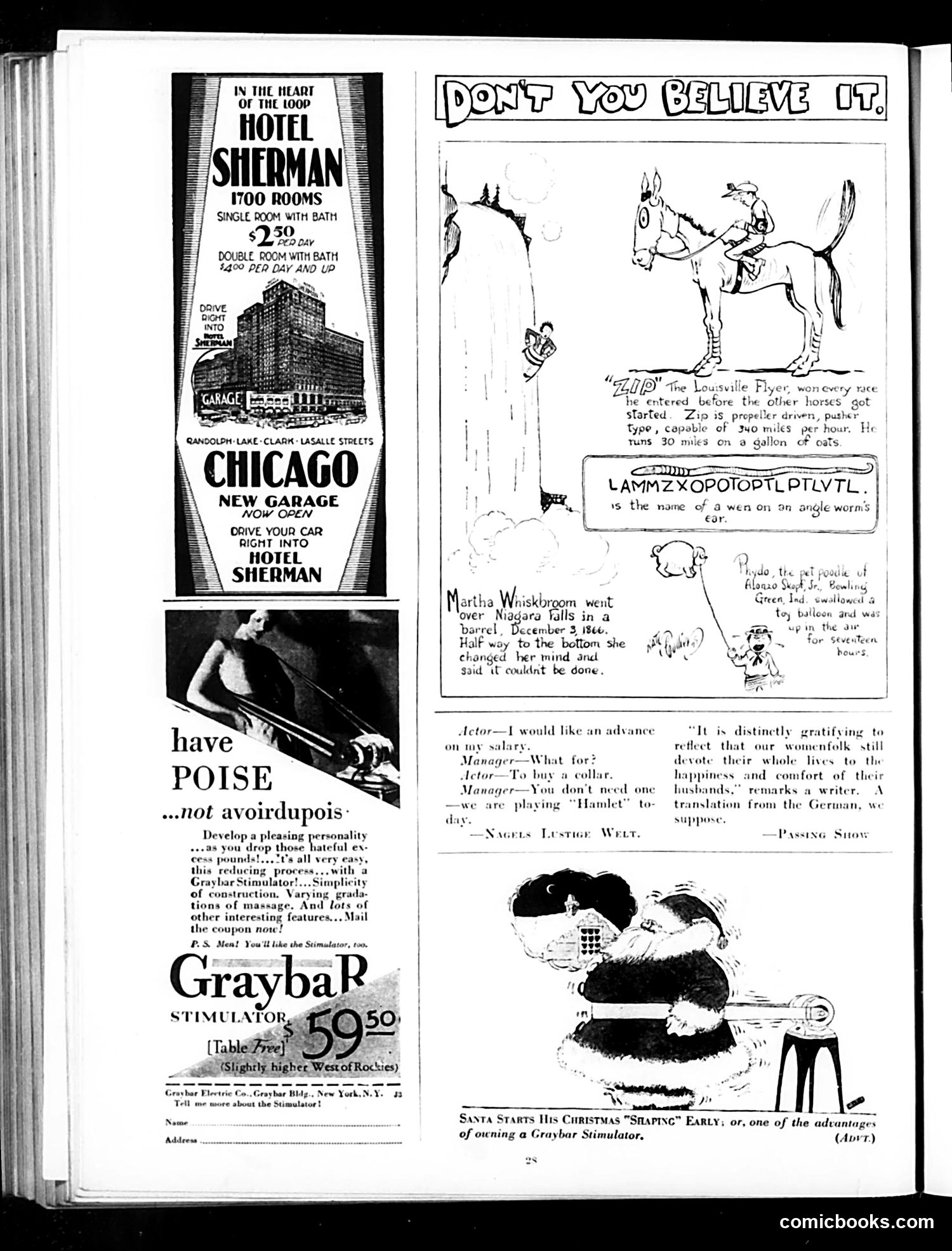
Judge Magazine Page Analysis This page contains three distinct elements: a hotel advertisement, a humor section titled "Don't You Believe It," and product advertisements. The "Don't You Believe It" section presents absurdist tall tales mocking exaggeration and urban legends. It includes: a horse named "Zip" claimed to be propeller-driven and capable of 340 mph; a worm with an impossibly long scientific name; and Martha Whiskiroom supposedly surviving Niagara Falls in a barrel (December 3, 1866) before "changing her mind." A brief theatrical dialogue jokes about an actor wanting a salary advance to buy a collar—implying his financial desperation is laughable. The bottom captioned illustration shows Santa preparing for Christmas using a "Graybar Stimulator" (a vibrating massage device), suggesting the product helps with holiday preparation fatigue. These pieces represent typical Judge magazine humor: absurdist exaggeration, gentle workplace comedy, and advertisements disguised as humorous content—all characteristic of early-20th-century American satire magazines.
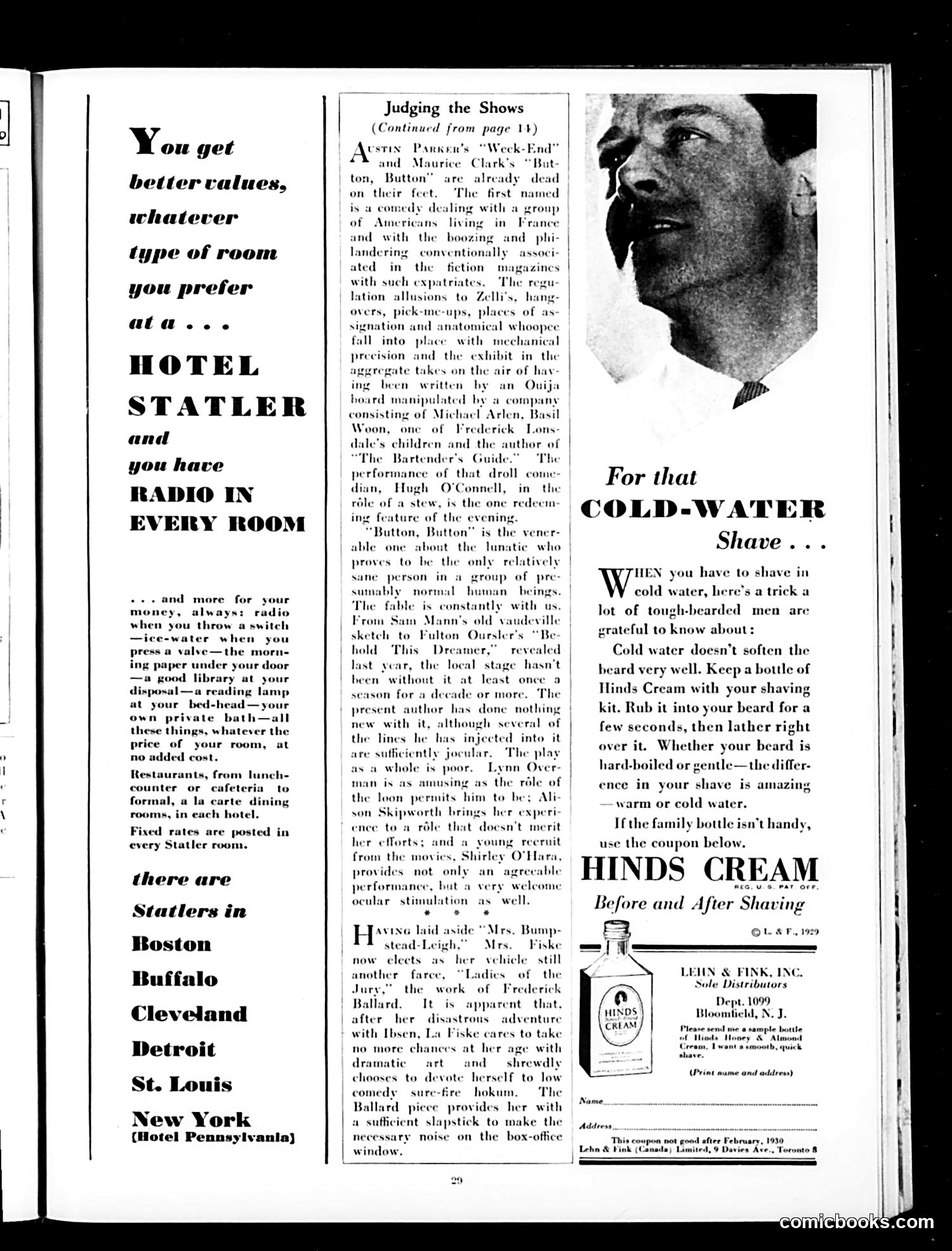
Analysis for Modern Readers This page is primarily advertising and theater reviews, not political satire. The left side advertises Hotel Statler's amenities (radio, ice water, private baths) across multiple cities. The center contains theater criticism reviewing recent Broadway productions like "Button, Button" and "Ladies of the Jury"—plays about eccentric characters in domestic situations. The right side advertises Hinds Cream shaving product, offering a practical tip for shaving with cold water and a coupon valid until February 1930. Historical context: This appears to be from *Judge* magazine circa 1929. The theater reviews dismiss these comedies as formulaic retreads (the "lunatic" plot dates to vaudeville), while praising individual performances. Actress Mrs. Fiske is noted as deliberately choosing "low comedy" farce over serious dramatic roles after an unsuccessful venture into Ibsen. The page reflects 1920s consumer culture and Broadway entertainment priorities rather than political commentary.
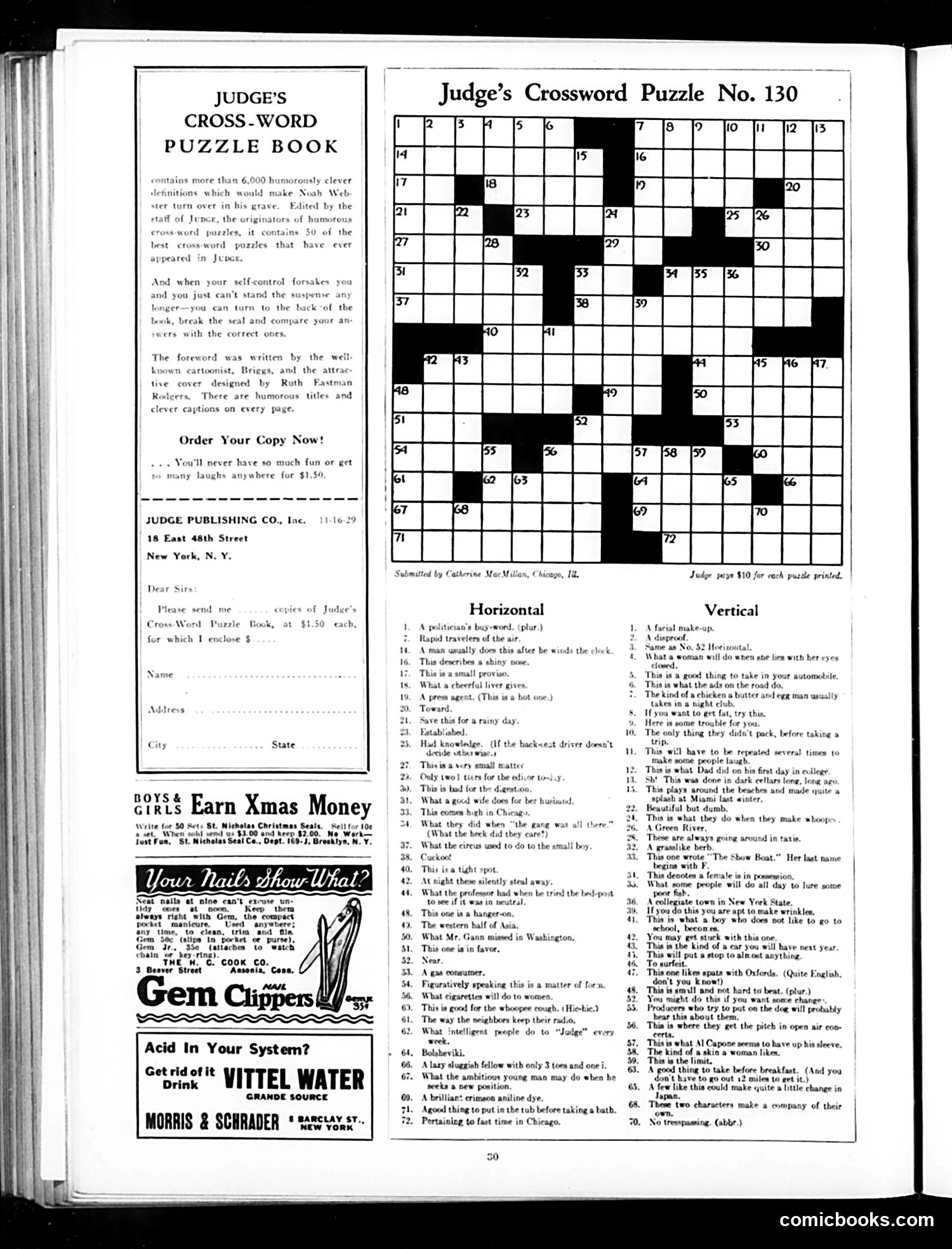
Judge Magazine Crossword Puzzle Page This page is primarily advertising and puzzle content rather than satire or political commentary. It features: Main Content: - Judge Publishing Company's advertisement for their crossword puzzle book ($1.50), claiming over 6,000 clever clues and 50 previously-published puzzles - A full crossword puzzle (#130) with horizontal and vertical clues - The foreword credits cartoonist Briggs and designer Ruth Eastman Rogers Advertisements: - Boys & Girls Christmas Seal fundraising pitch - Gem Clippers nail care product - Vittel Water (digestive aid) - Multiple small ads for manicure tools and cosmetics The puzzle clues contain period humor (references to radio neighbors, "whoopee cough," automobiles, Green River whiskey), but reflect *everyday 1920s-30s life* rather than political satire—the magazine's typical forte.
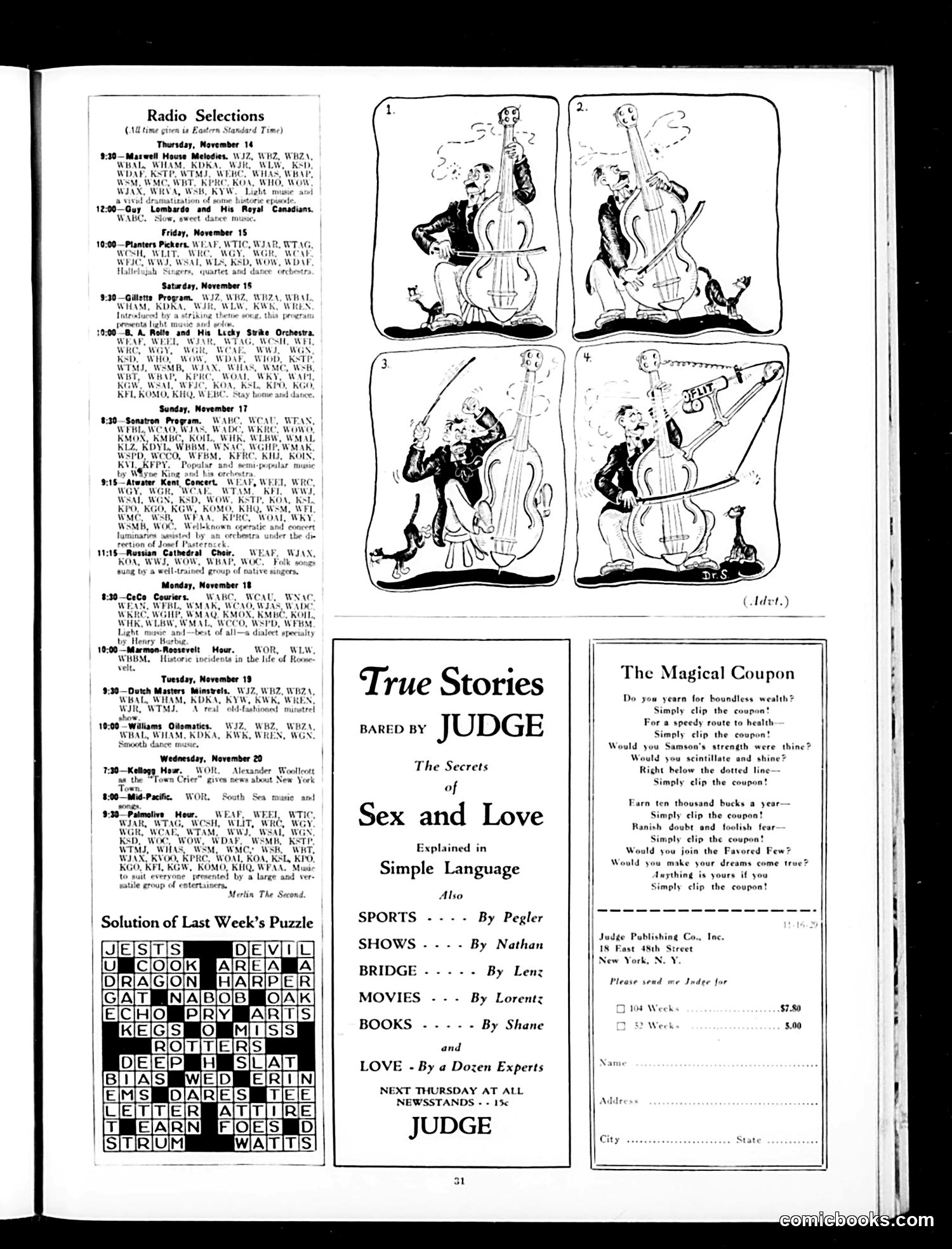
Analysis of Judge Magazine Page This page is primarily advertising and administrative content rather than political satire. The main elements are: Radio Selections section: A detailed weekly radio schedule (November 14-20) listing various programs across numerous stations (WJZ, WEAF, etc.). This reflects 1920s-30s radio's cultural prominence. Cartoon panels (top right): Four humorous illustrations showing a man in formal dress interacting with an oversized cello in increasingly awkward situations—the joke appears to be physical comedy about musical incompetence or the instrument's unwieldy size. Advertisement section: Judge Publishing promotes upcoming content including "True Stories Bared by Judge" on sex education and love, plus columns on sports, shows, bridge, movies, and books by named contributors. "The Magical Coupon": A satirical poem mocking mail-order advertisements and get-rich-quick schemes popular at the time, suggesting readers can achieve anything by "simply clipping the coupon"—social satire about consumer gullibility. The page functions primarily as a table of contents/advertising vehicle rather than editorial satire.
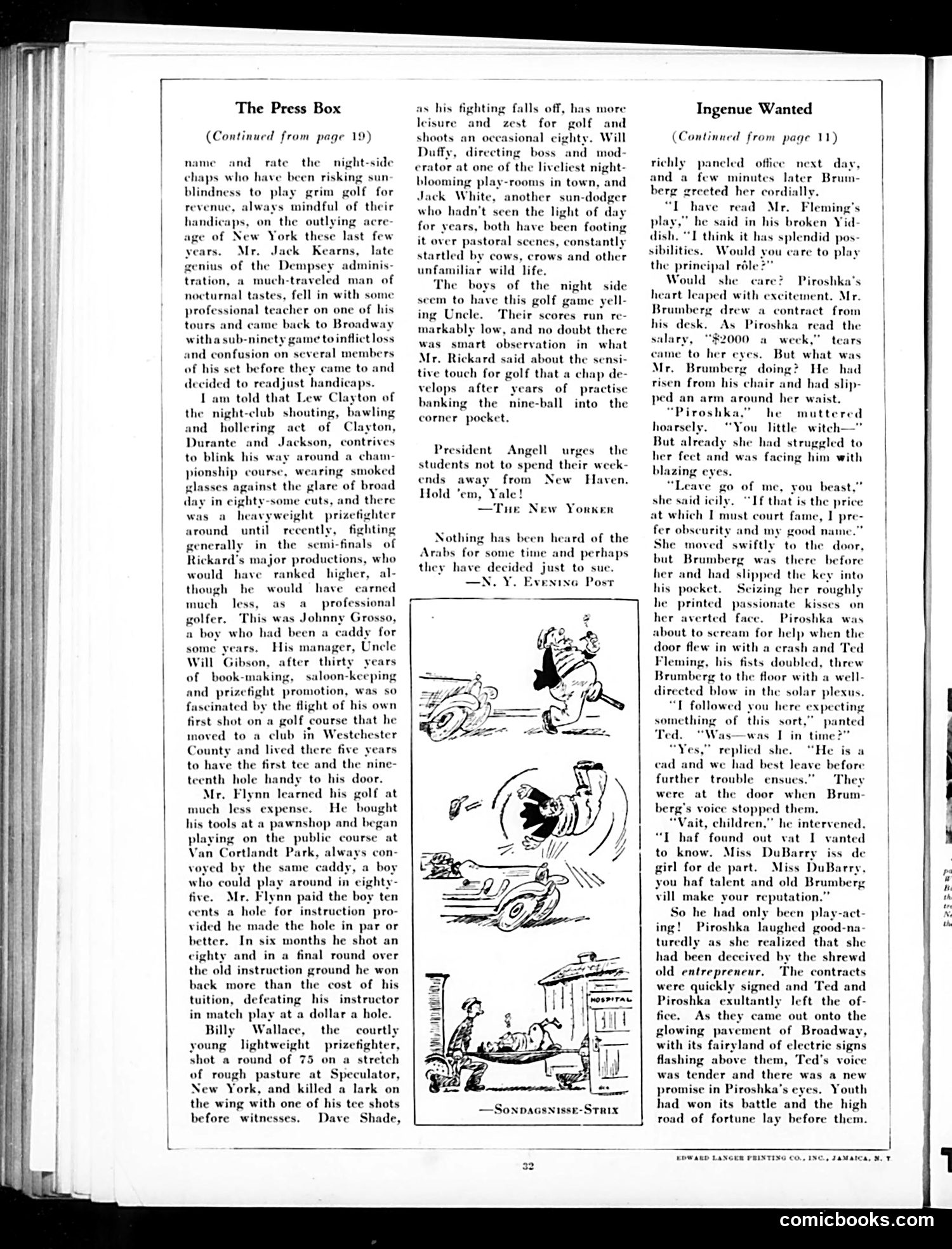
Understanding This Judge Magazine Page This page contains two separate pieces from Judge magazine, a major American satirical weekly publication. "The Press Box" is a gossipy column about theatrical and sporting figures learning golf. It references real 1920s celebrities: boxer Jack Kearns (associated with fighter Jack Dempsey), entertainer Jimmy Durante, boxer Johnny Grosso, and prizefight promoter Tex Rickard. The humor targets wealthy nightclub owners and entertainment figures who've taken up golf despite their nocturnal lifestyles—the irony being that "night side" people who avoid daylight are now golfing in broad daylight. "Ingenue Wanted" is a serialized romantic story (continued from page 11) about a young actress auditioning for a theatrical producer named Brumberg. The accompanying cartoons labeled "Sondagsmusse-Strix" depict physical comedy—slapstick scenes of people being knocked around, typical of Judge's humorous illustrations. Both pieces reflect 1920s entertainment culture and Judge's focus on theatrical world gossip and serialized fiction alongside satire.
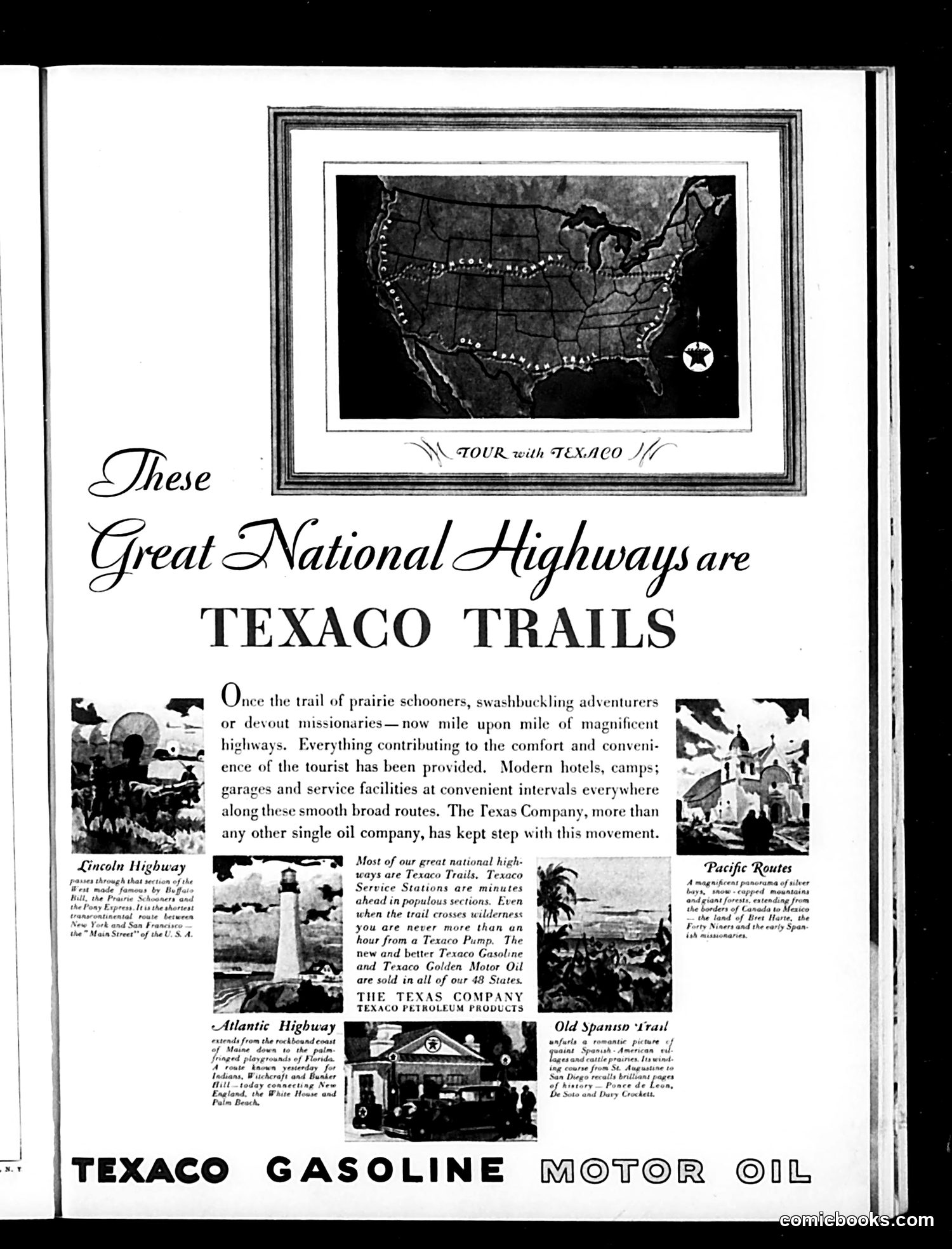
Analysis This is primarily a Texaco advertisement, not a political cartoon. It uses nostalgic Americana imagery to market gasoline and motor oil. The page romanticizes American expansion by naming highways after historical trails: the "Lincoln Highway," "Atlantic Highway," "Old Spanish Trail," and "Pacific Routes." Each is accompanied by period photographs—prairie schooners, covered wagons, lighthouses, colonial buildings—evoking frontier adventure and manifest destiny. The central message conflates modern automobile travel with westward expansion: just as pioneers once conquered wilderness via these routes, modern motorists now traverse them smoothly via Texaco stations. The company positions itself as the successor to that pioneering spirit—"keeping step with this movement." There's implicit celebration of American progress and infrastructure development, framed through the lens of historical continuity. The reference to "48 States" helps date this to before Alaska and Hawaii's admission (1959). This reflects early-to-mid 20th century advertising strategy: sell products by attaching them to national mythology and nostalgia.
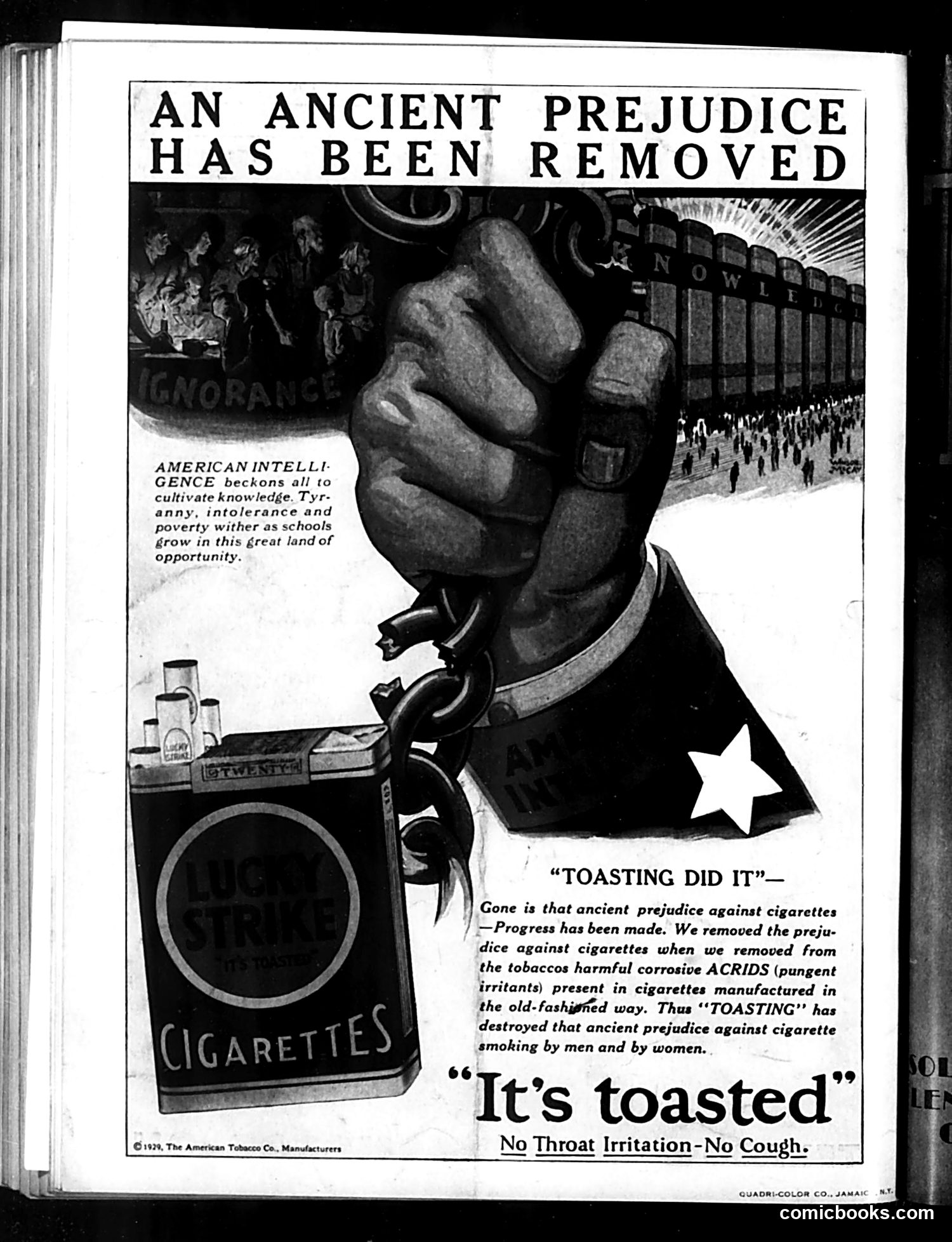
Analysis: "An Ancient Prejudice Has Been Removed" This is a cigarette advertisement, not satire—it's a genuine 1929 Lucky Strike ad by American Tobacco Co. The page uses patriotic rhetoric to market cigarettes. The ad claims that "toasting" (a processing technique) removed harmful "acrids" (irritants) from tobacco, thereby eliminating the "ancient prejudice" against cigarette smoking. This frames health concerns as mere outdated bias that progress and technology have overcome. The imagery shows a figure breaking free from chains labeled "ignorance"—equating cigarette skepticism with tyranny and intolerance. The ad appeals to American values of knowledge, opportunity, and progress to normalize smoking. For modern readers: This represents pre-regulation tobacco marketing that explicitly targeted women ("men and by women"), reframed health warnings as prejudice, and weaponized patriotic language to sell a harmful product. It's a stark example of how advertising once operated without FDA oversight or truth-in-advertising requirements.