judge
Judge — November 23, 1929
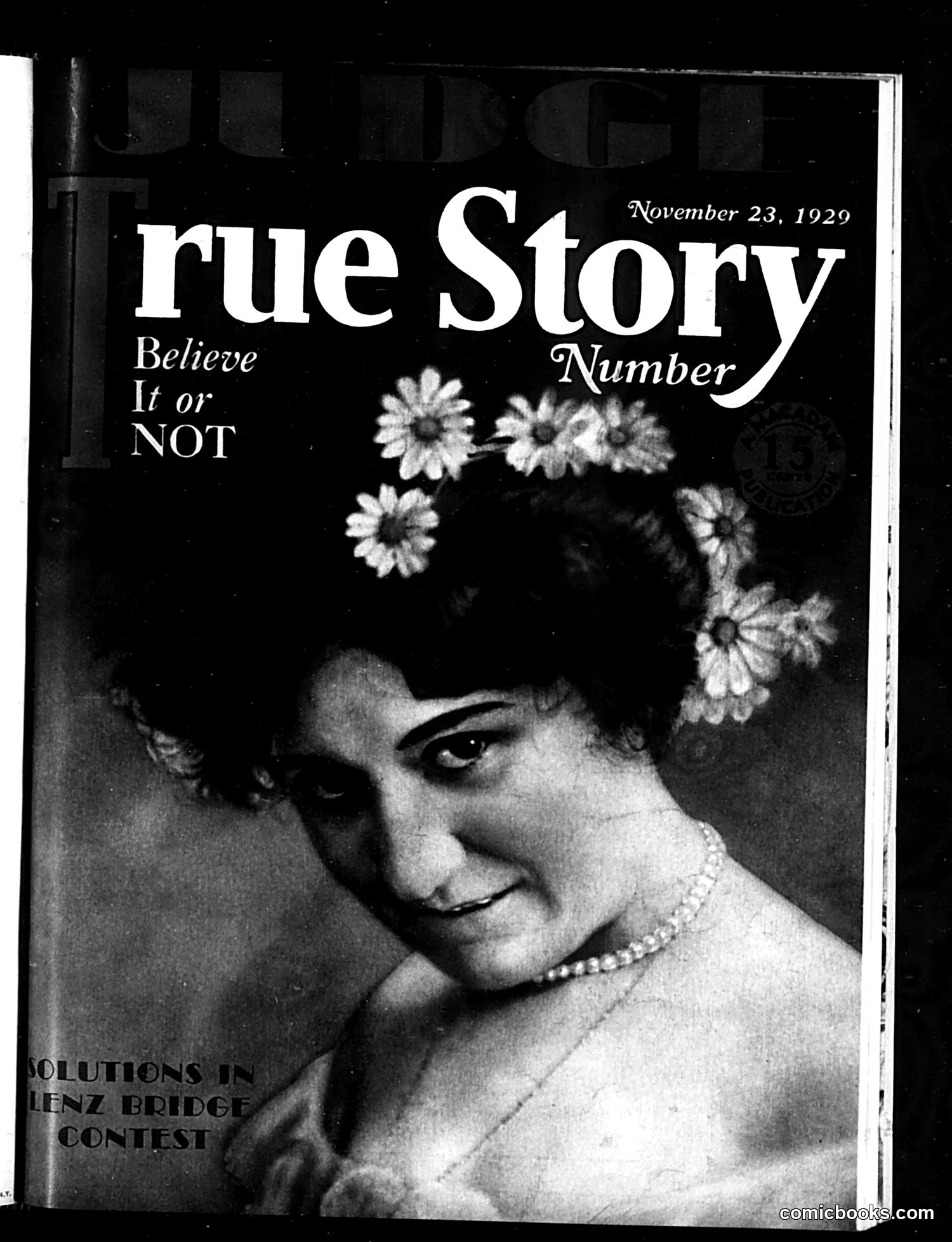
True Story Magazine Cover Analysis This is a cover for *True Story* magazine (November 23, 1929), not Judge. The tagline "Believe It or NOT" references the popular "Ripley's Believe It or Not!" feature. The cover features a glamorous woman with flowers in her hair and pearl necklace—typical of 1920s beauty standards. The mention of "Solutions in Lenz Bridge Contest" at the bottom likely refers to a reader-participation puzzle or game, common in magazines of this era. The "Believe It or NOT" framing suggests the issue contains sensational or unusual human-interest stories—*True Story*'s specialty. There's no obvious political satire here; this appears to be mainstream entertainment/lifestyle content aimed at the general public.
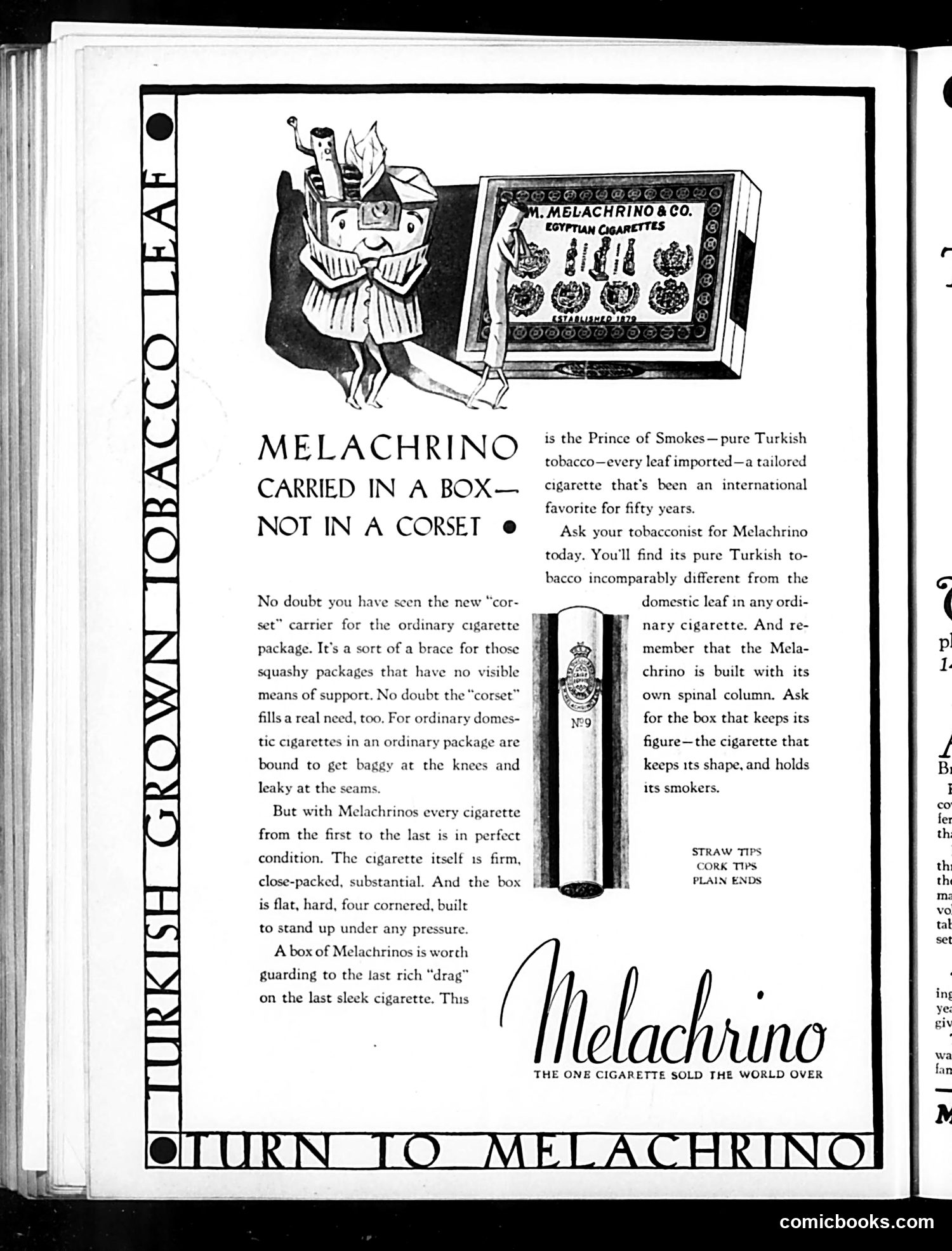
Analysis This page is primarily an advertisement, not satirical content. It promotes Melachrino cigarettes, a Turkish tobacco brand that had been popular for fifty years. The ad employs light humor rather than political satire. The cartoon shows a woman struggling to carry an oversized cigarette box, playfully contrasting old packaging (depicted as a restrictive "corset") with Melachrino's new rigid box design. The joke is that ordinary cigarettes get crushed in flimsy packages, while Melachrino's sturdy box keeps cigarettes in perfect condition. The advertisement emphasizes the product's superiority through this visual gag—positioning the box as protective rather than cumbersome. There is no political or social satire present; this is straightforward commercial messaging using comedic illustration to sell premium cigarettes.
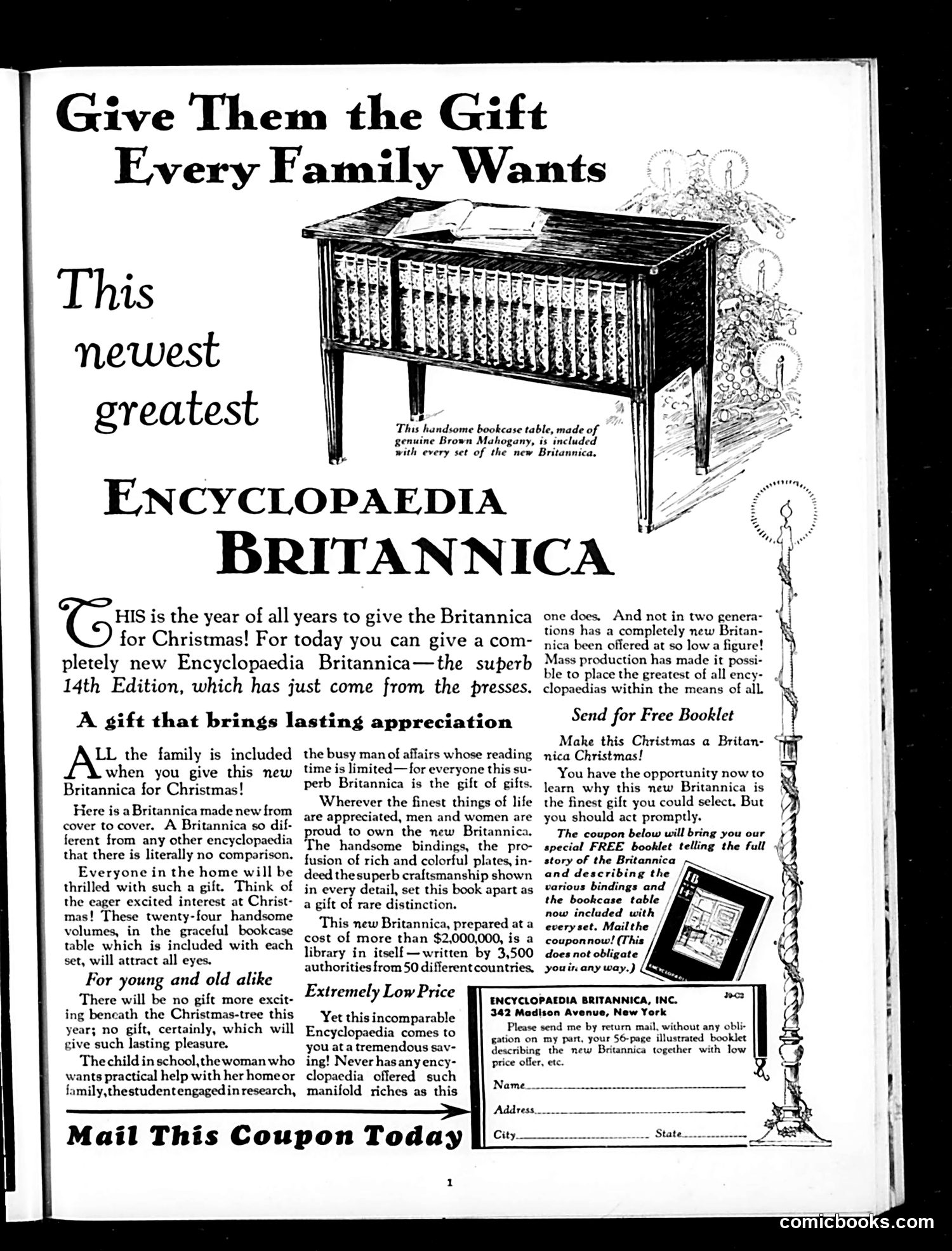
Analysis This is not a political cartoon or satire—it's a full-page advertisement for the Encyclopedia Britannica's 14th Edition, appearing in Judge magazine. The ad promotes the encyclopedia as an ideal Christmas gift, emphasizing its comprehensiveness (written by 3,500 authorities from 50 countries) and appeal to the entire family. A key selling point is the included "handsome bookccase table, made of genuine Brown Mahogany." The ad employs typical early 20th-century marketing language: appeals to family values, educational benefits, and social status ("gift of rare distinction"). The prominent coupon and "Mail This Coupon Today" encourages immediate action. This represents Judge's revenue model—advertising revenue alongside editorial content—rather than satirical commentary.
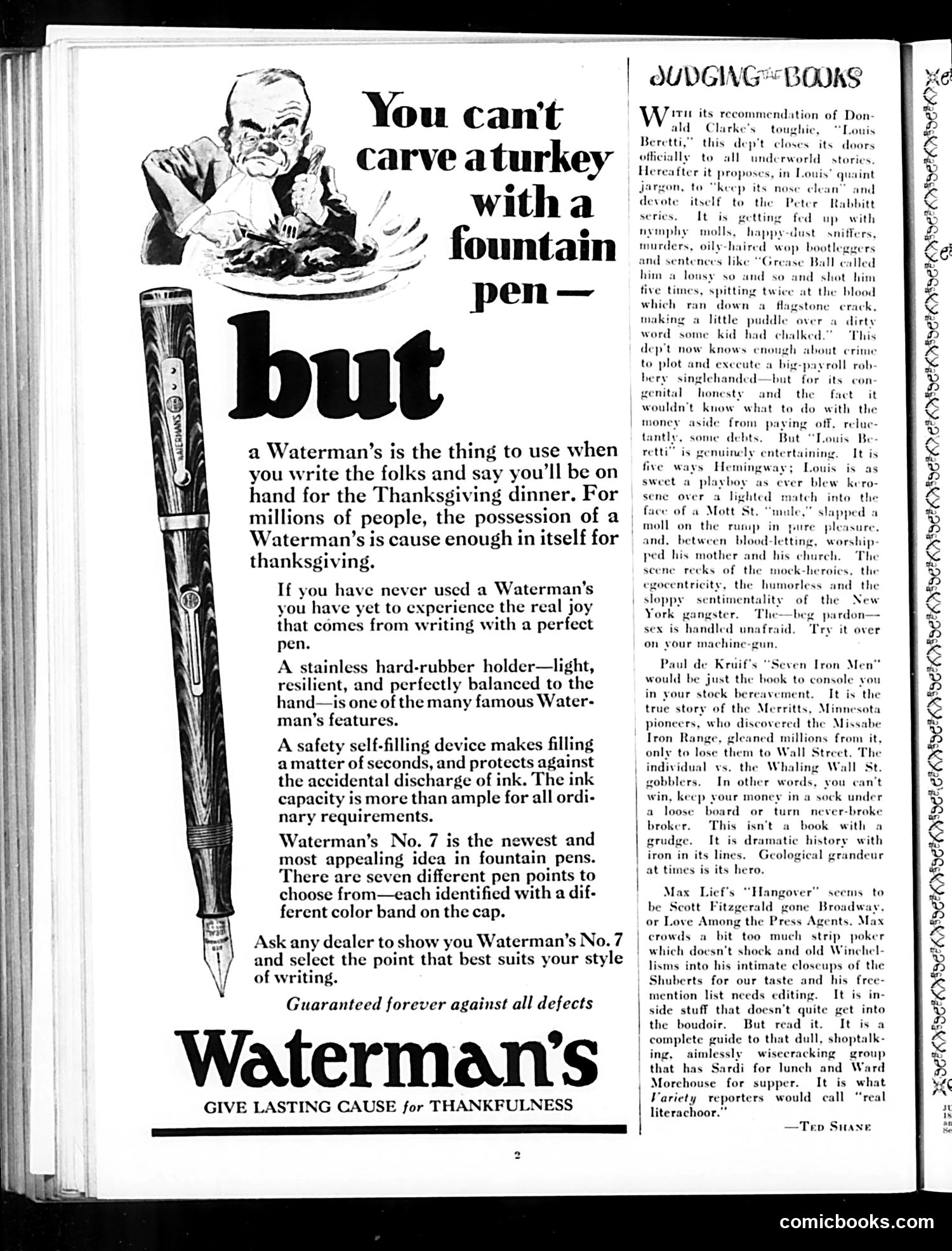
Analysis This page is primarily a Waterman's fountain pen advertisement, not political satire. The main image shows a caricatured man carving a turkey, illustrating the ad's central joke: "You can't carve a turkey with a fountain pen—but a Waterman's is the thing to use when you write the folks and say you'll be on hand for the Thanksgiving dinner." The advertisement emphasizes Waterman's practical features: a self-filling mechanism, safety against ink leakage, and seven interchangeable pen points. It targets middle-class consumers by suggesting the pen is an appropriate Thanksgiving gift symbolizing reliability and gratitude. The right column contains a book review ("Judging the Books") unrelated to the pen ad. This is typical Judge magazine layout: advertising mixed with editorial content.
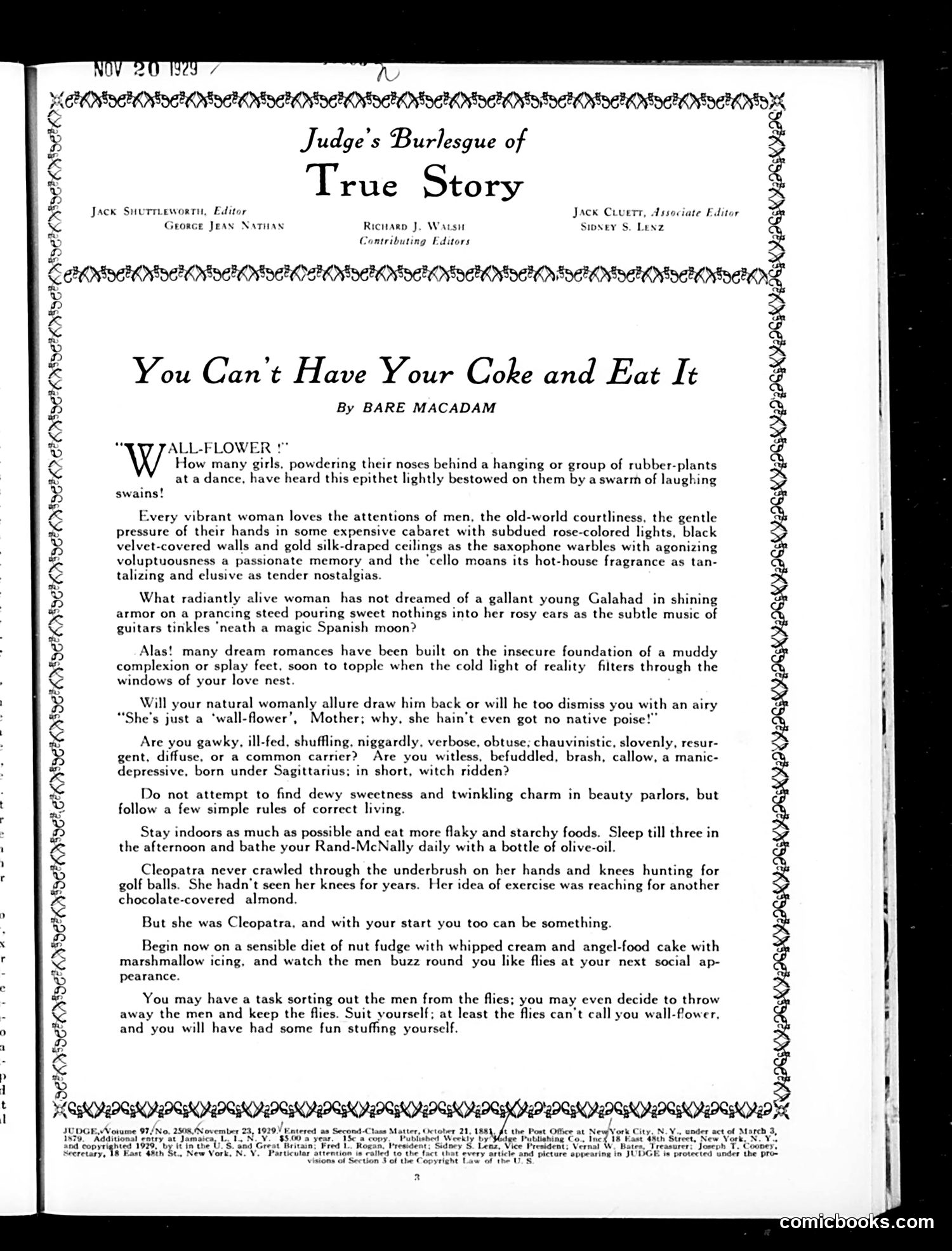
Judge Magazine Analysis: "You Can't Have Your Coke and Eat It" This is a satirical advice column by "Bare Macadam" addressing women's romantic expectations. The title is a play on the phrase "you can't have your cake and eat it too," substituting "Coke" (likely referring to Coca-Cola, a popular social beverage of the era). The satire mocks women who fantasize about glamorous romantic encounters in upscale settings while ignoring their actual circumstances. The author ridicules unrealistic dreams of meeting wealthy suitors ("gallant young Galahad"), advising instead on practical self-improvement through diet, exercise, and hygiene. The piece satirizes both women's romantic daydreams and the advertising culture promising transformation through consumption—whether fancy nightclubs or beauty products. It's fundamentally commentary on class aspirations and the gap between fantasy and reality.
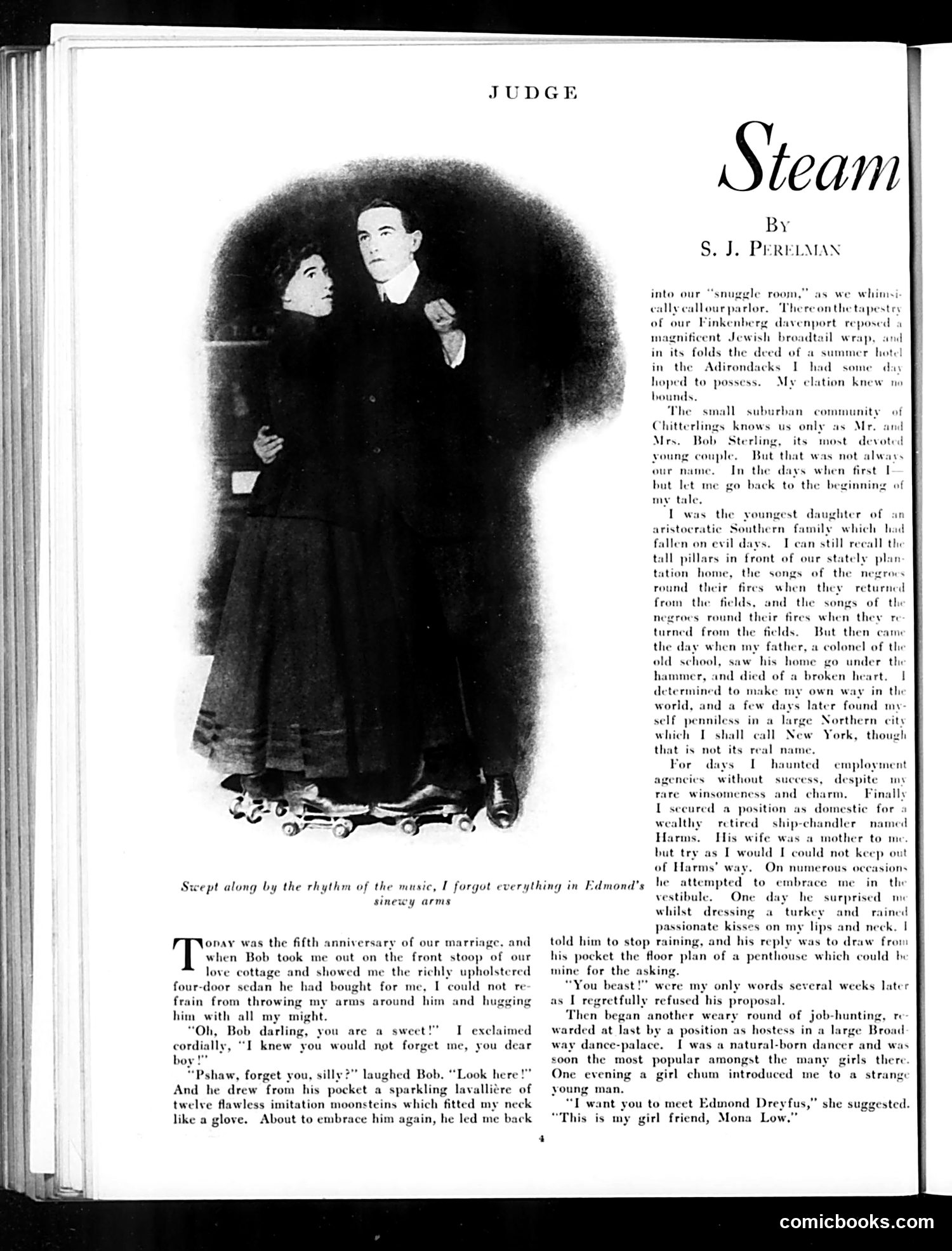
"Steam" by S.J. Perelman This page contains the opening of a short story rather than political satire. The illustration shows two figures in an intimate embrace, captioned "Swept along by the rhythm of the music, I forgot everything in Edmond's sineway arms." The narrative is a romantic comedy about a woman recounting how she met her husband Bob at their fifth wedding anniversary, contrasting their current comfortable married life with her earlier struggles. A wealthy retired ship-chandler named Harris attempted to seduce her with lavish gifts (a turkey, imitation moonstones), but she rejected him. She then met the charming Edmond Dreyfus through a friend named Mona Low. This appears to be light domestic humor typical of Judge magazine's fiction content, not political commentary.
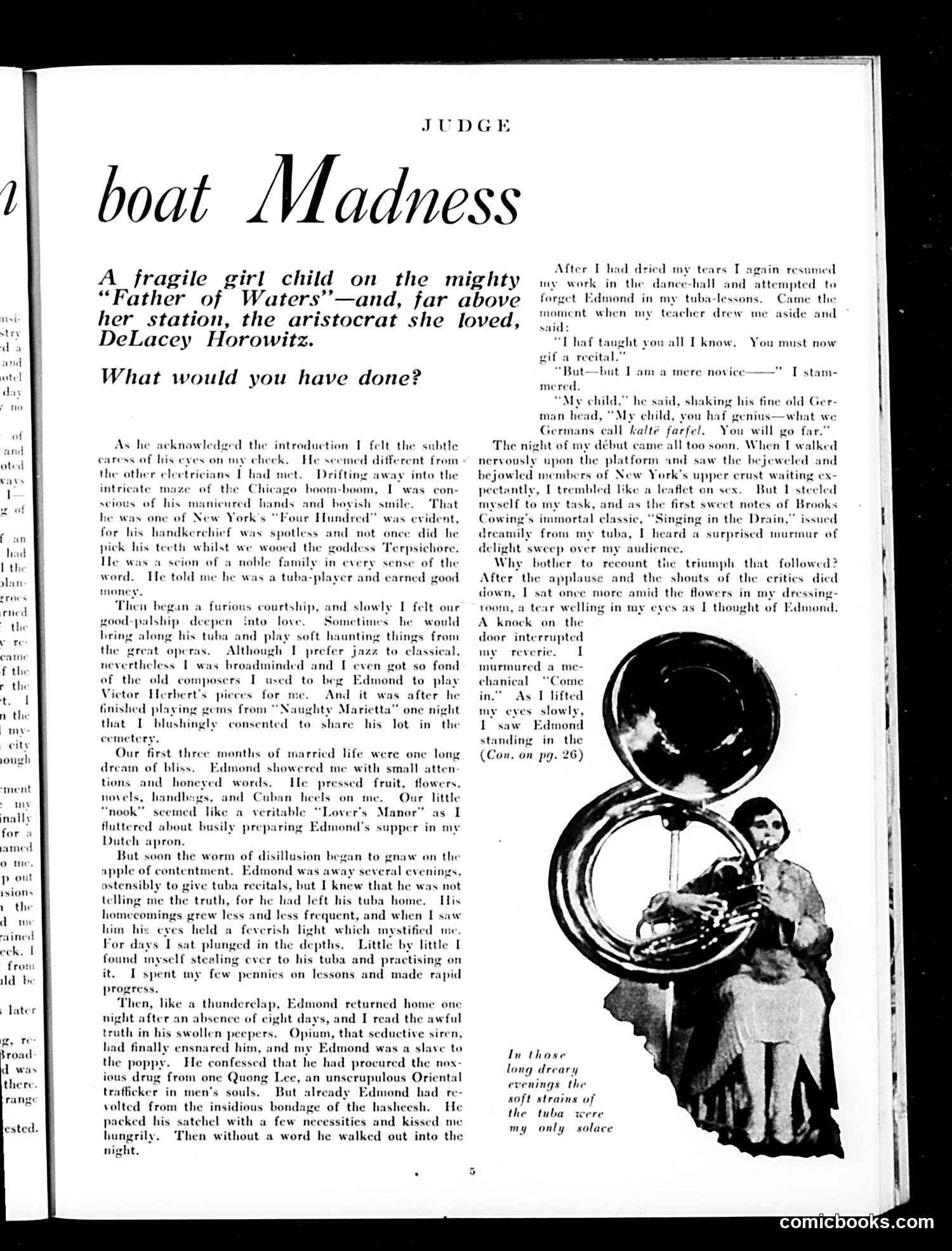
"Boat Madness" - Judge Magazine This page presents a serialized story titled "Boat Madness" about a young woman named DeLacey Horowitz who abandons her aristocratic station for love. The narrative describes her marriage to Edmund, a musician with a tuba who initially showers her with affection but later becomes distant, revealing himself as an opium addict involved with "Oriental traffickers." The accompanying illustration shows a woman gazing dreamily at a large tuba, with a small male figure visible within or beside it—a visual metaphor for her romantic obsession. This appears to be melodramatic fiction rather than political satire, reflecting early 20th-century Judge magazine's mix of humor and serialized stories exploring themes of class conflict, substance abuse, and romantic disillusionment.
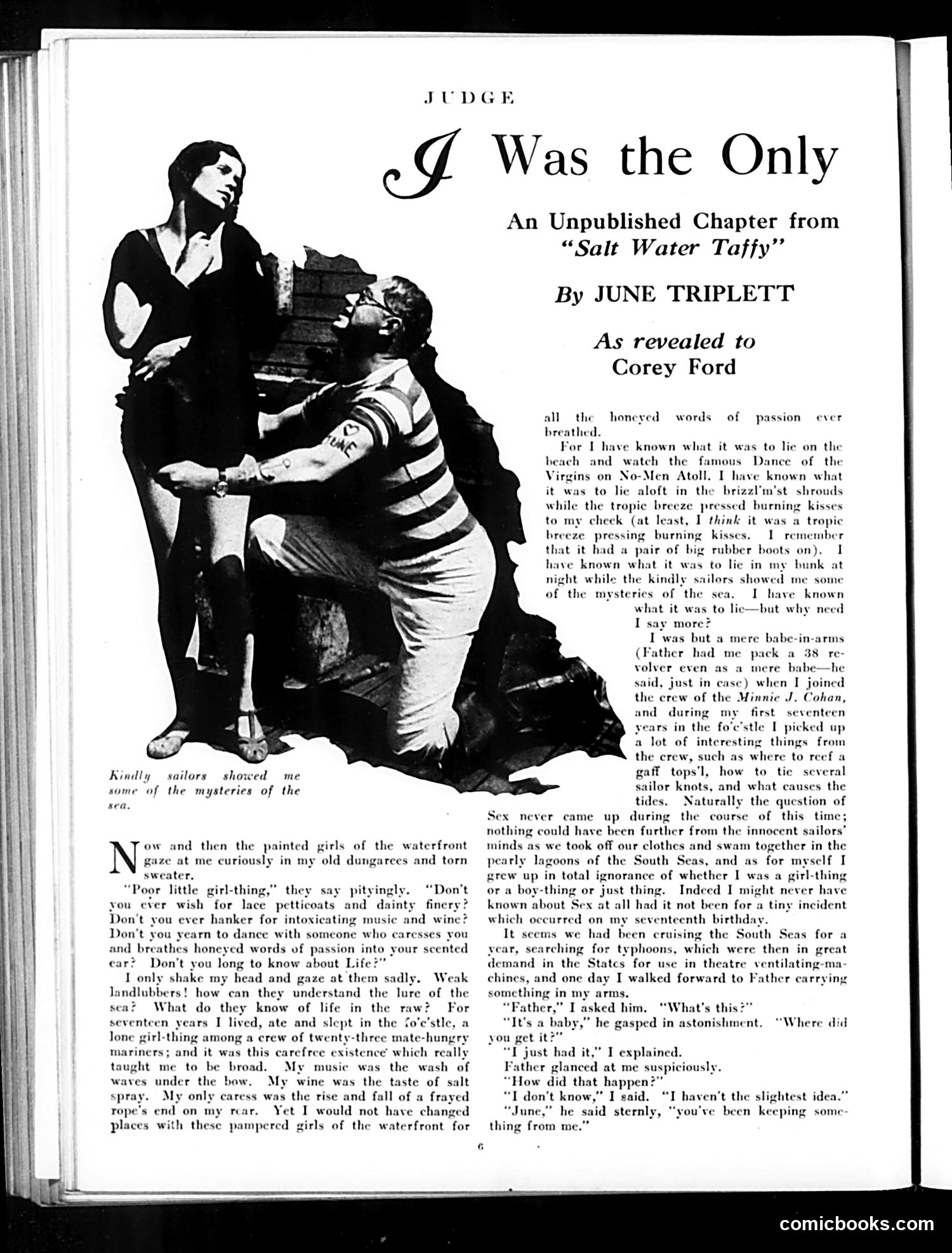
Analysis of Judge Magazine Page This page features an unpublished chapter from June Triplett's "Salt Water Taffy," presented to Corey Ford. The illustration shows a woman and man in what appears to be a romantic or dramatic scene aboard a ship. The text is a first-person narrative by a female character recounting her experiences as a girl-thing (young woman) working on a ship, the *Minnie J. Cohan*. She describes innocent shipboard life among sailors, emphasizing her naiveté about romance and sexuality. The humor derives from her frank, deadpan recounting of living in close quarters with male sailors while remaining ignorant of "life" and "sex." This appears to be light satirical fiction rather than political commentary—satire aimed at the contrast between her sheltered upbringing and her unconventional maritime experiences.
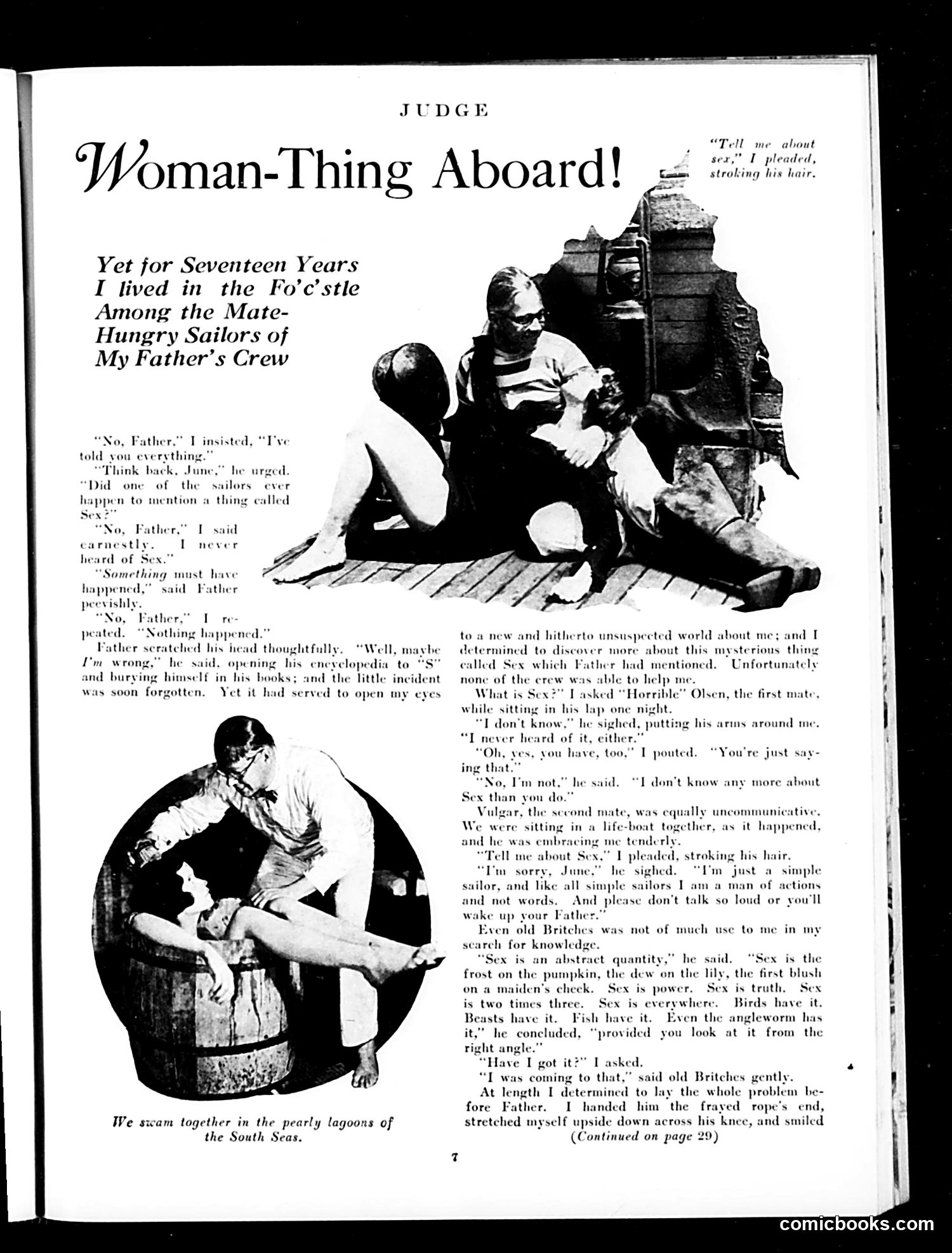
"Woman-Thing Aboard!" - Judge Magazine Satire This is a satirical story about a young woman raised among sailors who has reached adulthood without understanding sex. The humor relies on the contrast between her innocent naïveté and the crude maritime setting. The narrative mocks both Victorian prudishness (her father's embarrassed avoidance of the topic, consulting an encyclopedia under "S") and male incompetence—multiple sailors ("Horrible" Olsen, "Vulgar," old Britches) are equally unable or unwilling to explain sex, offering only vague, contradictory definitions ("abstract quantity," "frost on the pumpkin," "everywhere"). The illustrations show intimate moments between the narrator and crew members in suggestive poses. The joke satirizes outdated sexual attitudes and education taboos of the era, presenting the situation as absurdly comic—that a woman could reach adulthood in such ignorance, and that grown men would be equally flustered by basic questions. The tone is lighthearted social commentary on repression and awkwardness around sexuality.
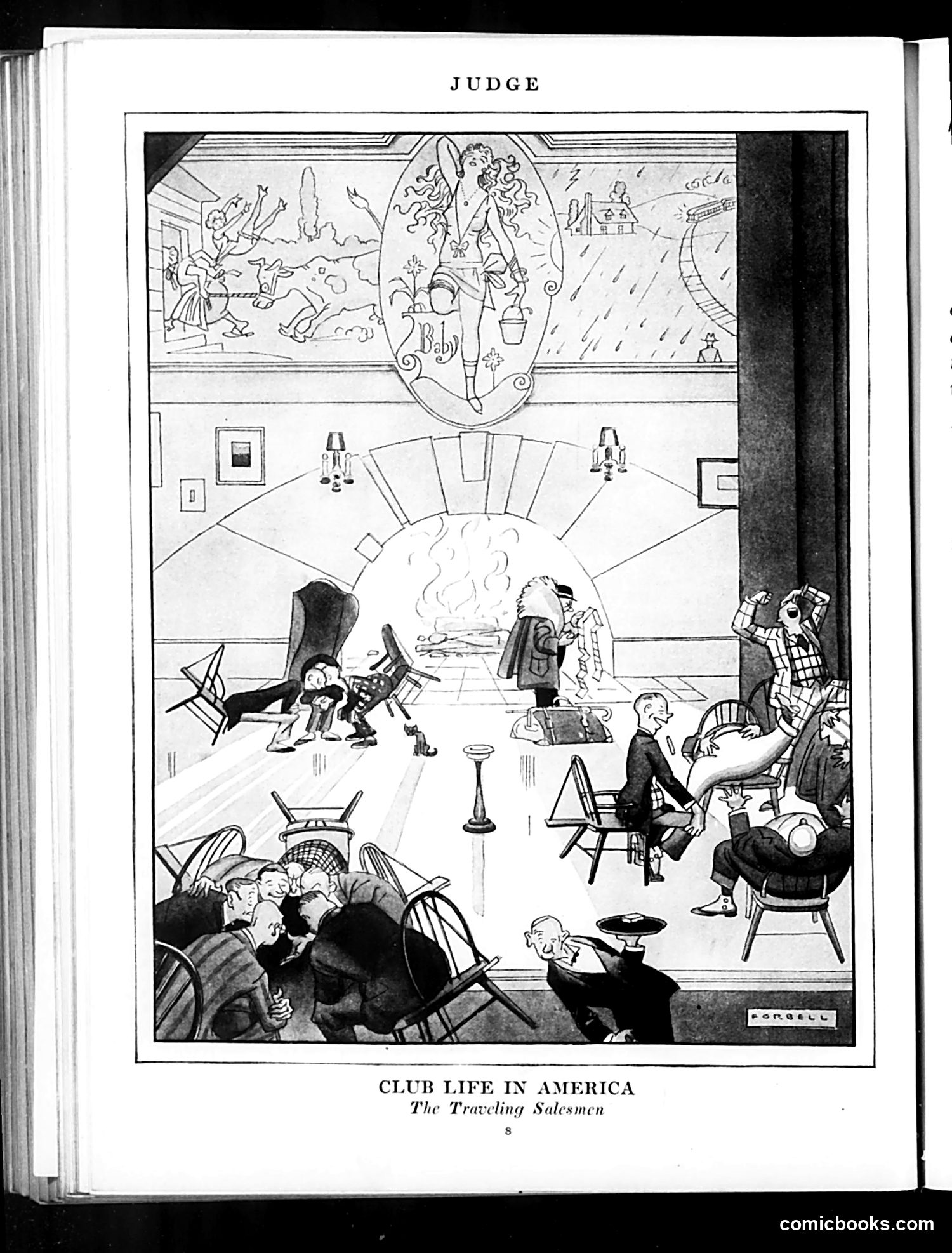
"Club Life in America: The Traveling Salesmen" This Judge cartoon satirizes the social world of traveling salesmen in early 20th-century America. The scene depicts what appears to be an exclusive club where traveling salesmen gather for leisure and entertainment. The cartoon mocks the pretensions of these traveling businessmen, showing them attempting to adopt genteel club life—complete with formal dress, leisure activities, and what seems to be sophisticated entertainment (the murals above suggest aspirational decor). The composition suggests contrast between their actual status and their desired social position. The humor likely derives from portraying these mobile, lower-middle-class workers as comically out of place attempting upper-class leisure culture. This reflects period anxieties about social climbing and the growing commercial class of traveling salesmen in American society.
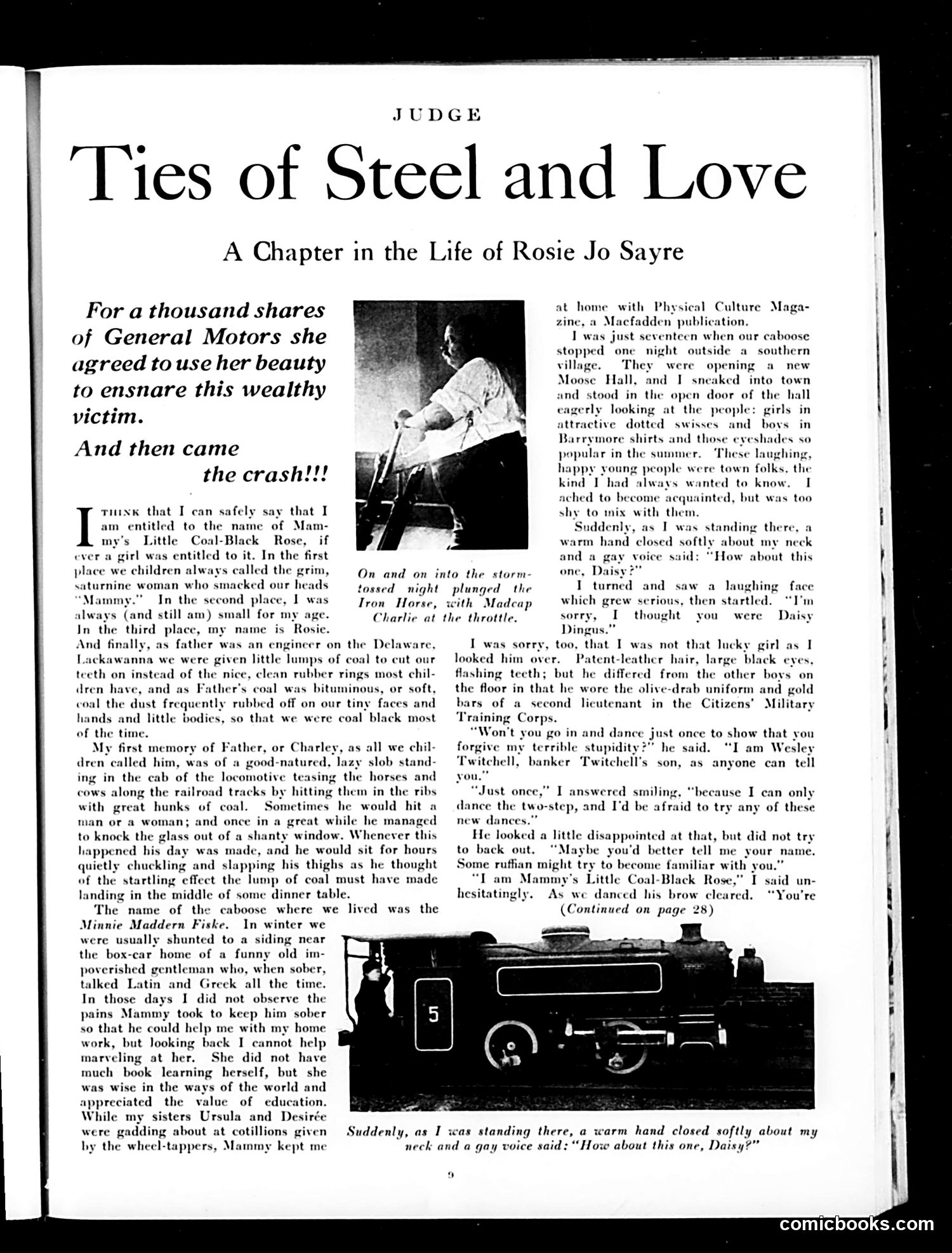
"Ties of Steel and Love": A Story of Gold-Digging and Market Collapse This is a serialized romantic story rather than political satire. The headline promises scandal: a woman named Rosie Jo Sayre agreed to use her beauty to seduce a wealthy man for a thousand General Motors shares—then "came the crash," likely referencing the 1929 stock market collapse. The narrative, told in first person, establishes Rosie's humble background (daughter of a railroad engineer, raised in a caboose, nicknamed "Little Coal-Black Rose"). It then depicts a chance encounter at a dance where a second lieutenant named Wesley Twitchell approaches her. The story appears to be a morality tale about class mobility and the dangers of financial schemes, set against the backdrop of economic catastrophe. The two photographs show a woman at what appears to be a locomotive and a steam engine, illustrating the working-class setting.
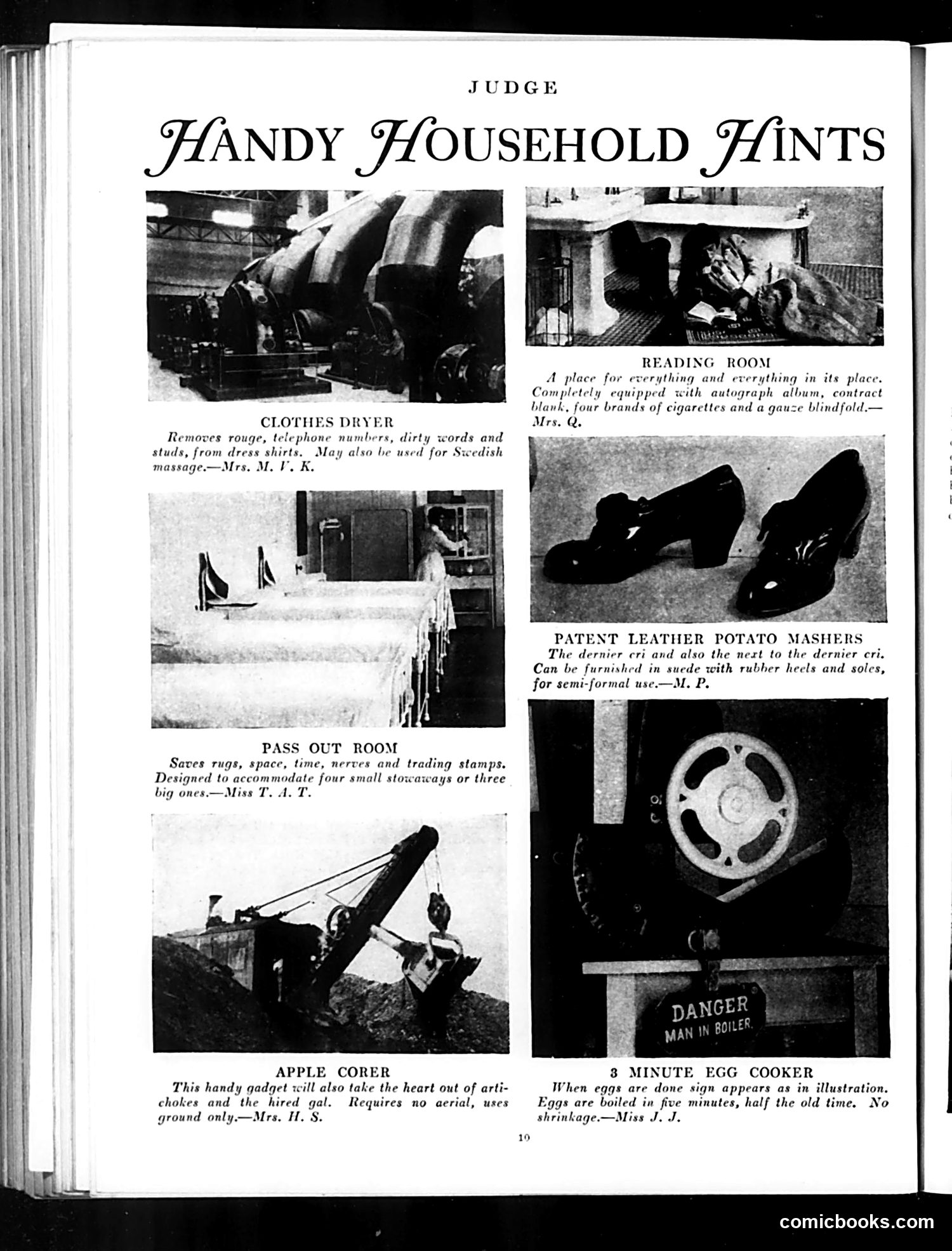
Judge's "Handy Household Hints" - Satirical Gadgets This page presents fake, absurd household inventions as satirical commentary on consumer culture and modern domesticity. Each "hint" mocks both pointless gadget proliferation and social pretensions of the era. Notable examples: A "clothes dryer" that removes "rouge, telephone numbers, dirty words"—mocking women's cosmetics and infidelity anxieties. "Patent leather potato mashers" in formal wear styles satirize status-conscious overconsumption. A "reading room" equipped with "gauze blindfold" jokes darkly about willful ignorance. The "pass out room" for "stowaways" appears to reference Prohibition-era drinking culture. The "apple corer" cutting out the "heart" of "hired gal[s]" contains sharp class commentary—dehumanizing domestic workers as mere labor to be mechanized. These aren't sincere product advertisements but biting satire of American consumer excess and domestic absurdity, typical of Judge magazine's social criticism.
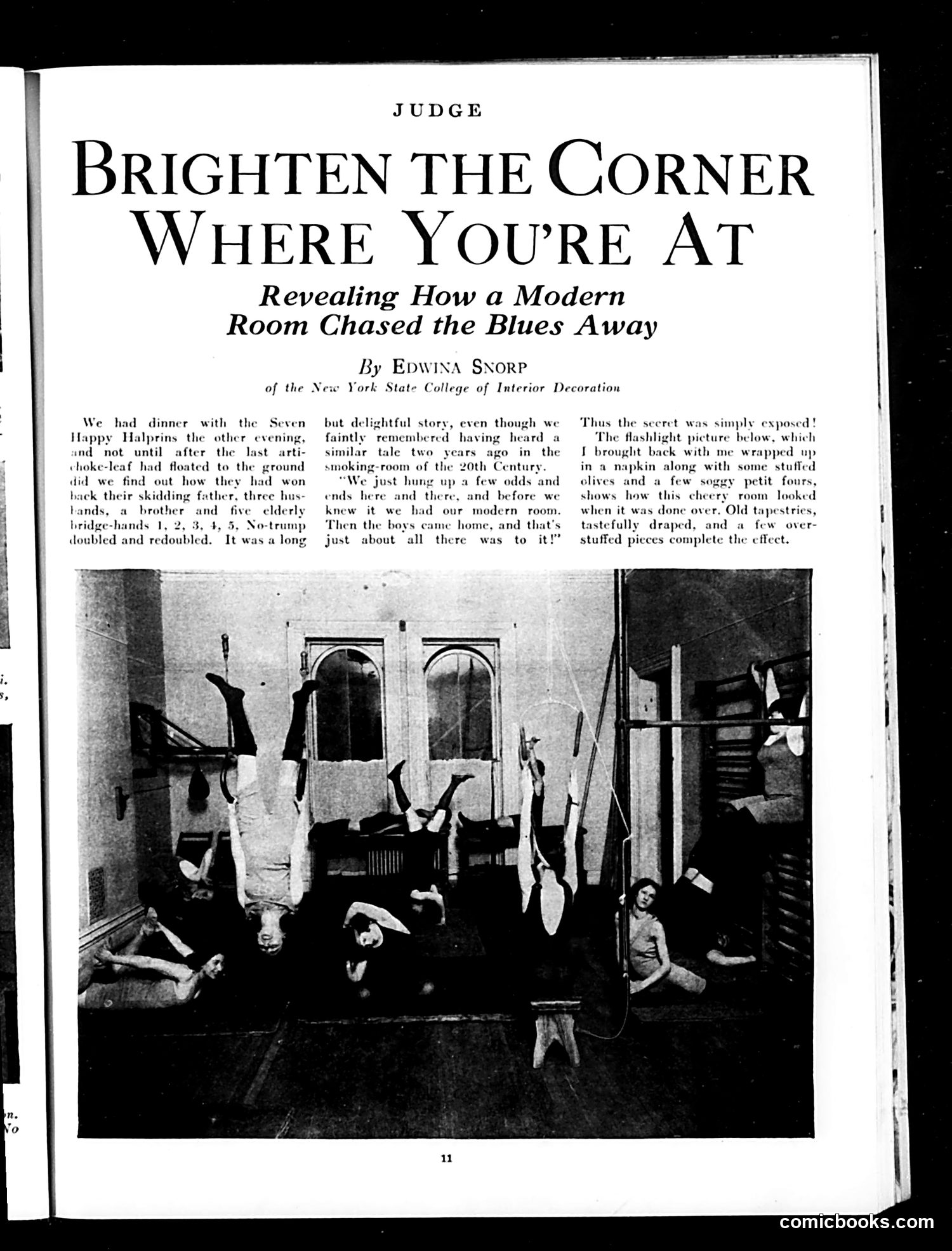
Analysis This is not a political cartoon but rather a lifestyle article from *Judge* magazine, illustrated with a photograph. Content: "Brighten the Corner Where You're At" by Edwina Snorp (credited to the New York State College of Interior Decoration) describes how a modern room's décor transformation improved a family's mood. The article recounts a dinner party anecdote where hosts explain they simply rearranged "odds and ends" to create a cheerful modern space. The photograph shows what appears to be an interior room with people demonstrating the transformation—notably including figures in various poses, furniture, and large window treatments. The satire/humor: The piece gently mocks the pretentiousness of interior decoration advice and the modest nature of the "transformation" (just rearranging items), while the exaggerated bridge-game metaphor ("No-trump / doubled and redoubled") suggests that the social success came more from winning back family relationships than from actual décor expertise.
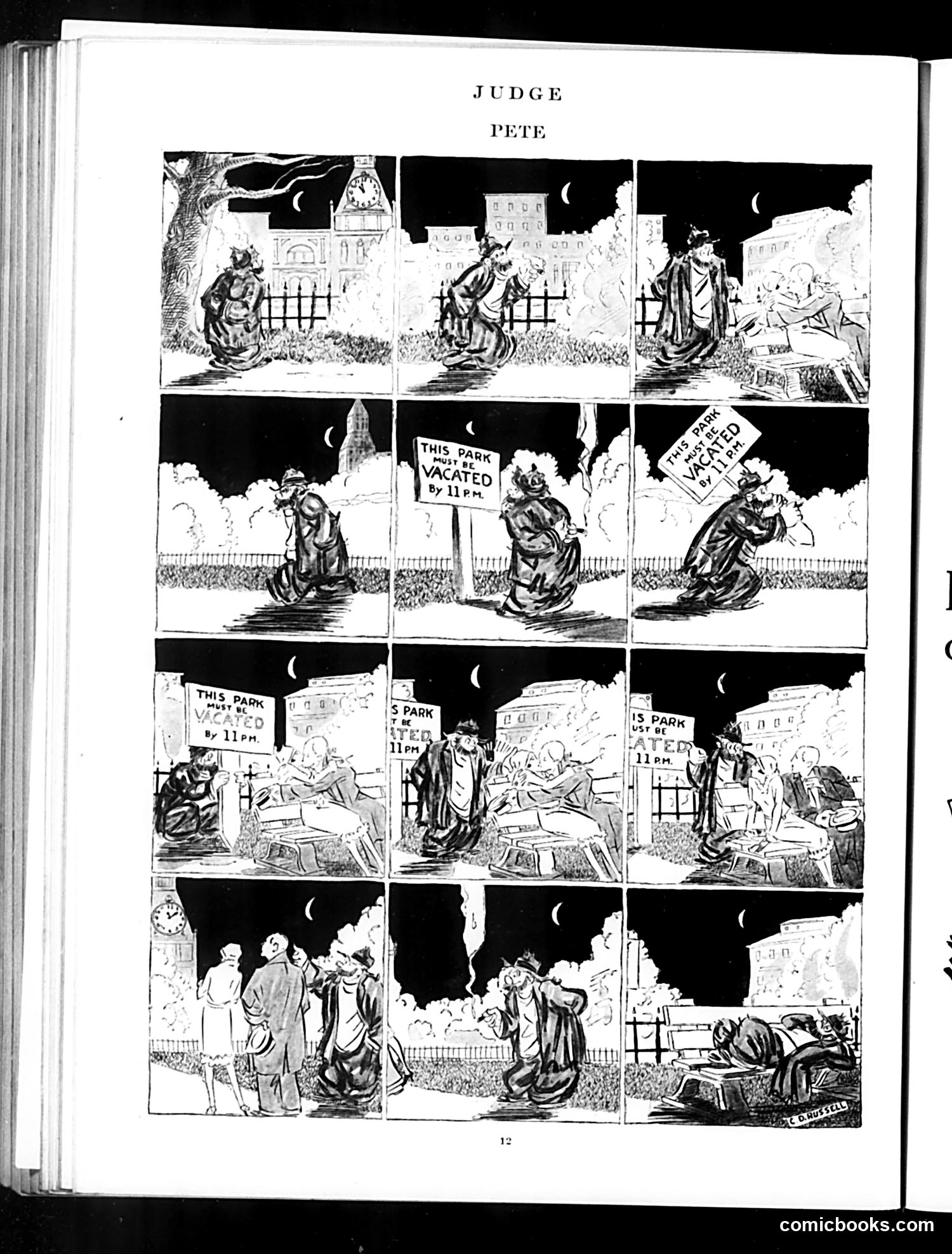
"Judge Pete" - Park Closure Satire This comic strip satirizes a judge or authority figure enforcing park closure rules at 11 p.m. The narrative shows the official repeatedly confronting people lingering in the park after hours, posting warning signs, and ultimately evicting violators. The humor derives from the absurd persistence and escalation—the judge becomes increasingly frantic attempting to clear the park, eventually resorting to physical removal of the last stubborn occupant. The satire likely critiques either overzealous enforcement of municipal regulations or the public's disregard for them. The nighttime setting and repeated violations suggest commentary on the conflict between civic rules and citizen behavior. Without knowing the specific historical context, the strip appears to mock bureaucratic inflexibility or the futility of regulation enforcement.
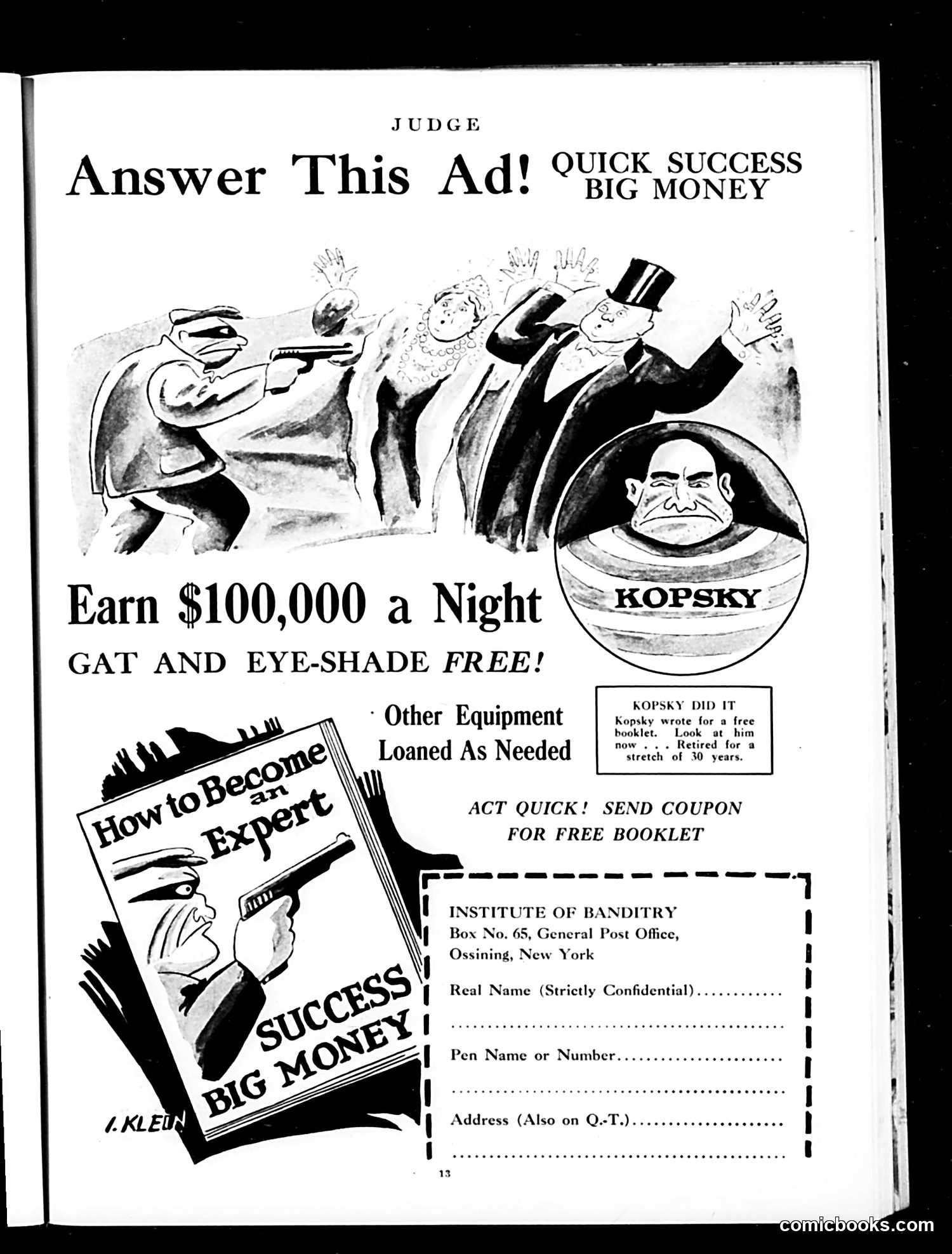
Analysis of Judge Magazine Satire Page This is a mock advertisement satirizing organized crime and criminality, presented as Judge magazine's editorial content. The ad promotes an "Institute of Banditry" offering to teach readers how to become criminals ("experts") and earn "$100,000 a Night." The visual elements reinforce this: cartoon figures in various criminal poses (wielding guns, stealing), a caricatured face labeled "Kopsky" in a circular frame (likely referencing a notorious criminal of the era), and a book titled "How to Become an Expert: Success Big Money." The satirical point targets crime and corruption in society—possibly commenting on organized crime's prevalence or glamorization. The "strictly confidential" requirement and pseudonym option mock criminal secrecy. This appears designed to expose or ridicule criminal activity through absurdist humor, typical of Judge's editorial approach during Prohibition-era America when organized crime flourished.
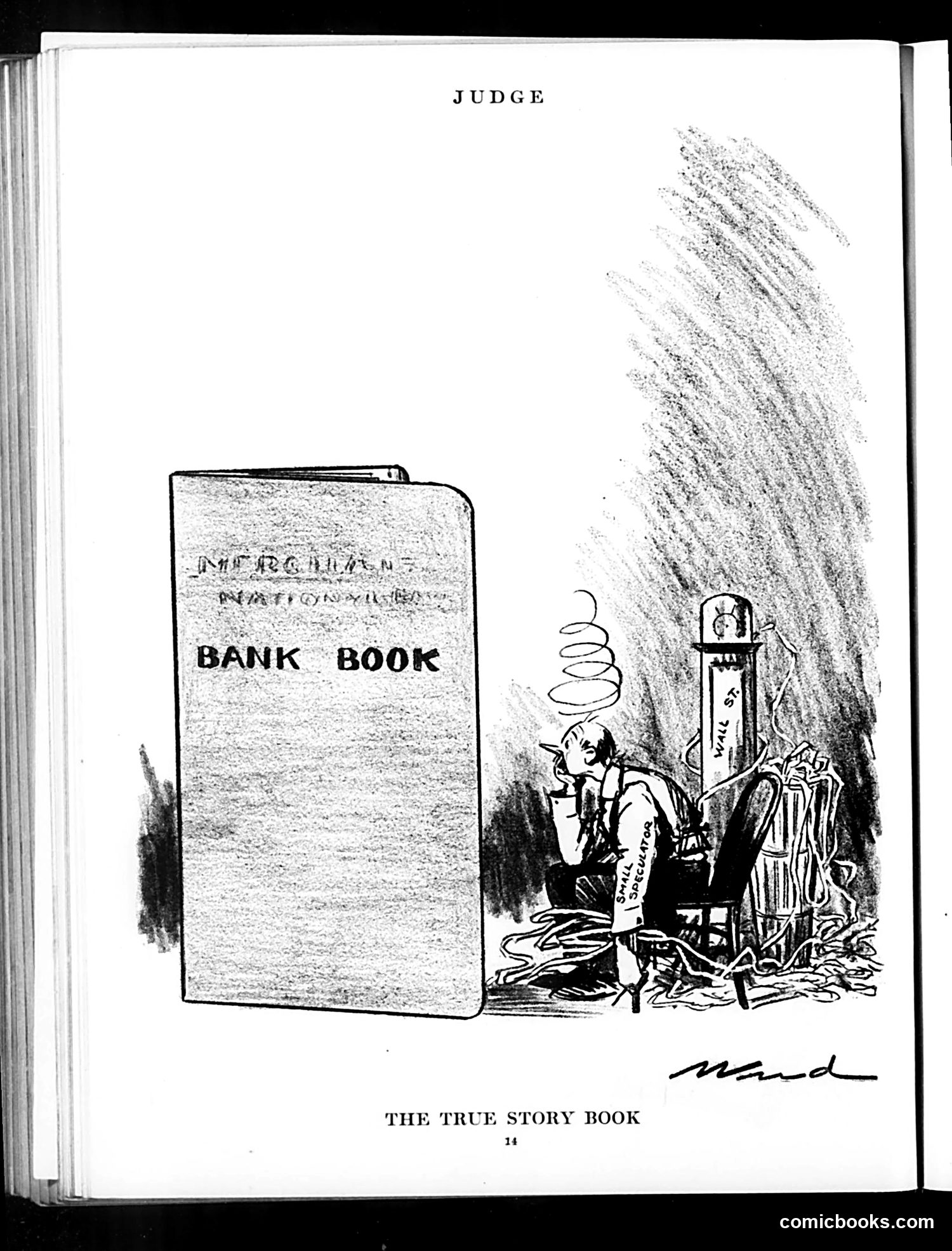
Judge Magazine Cartoon Analysis This is a satirical cartoon titled "Judge" showing a large bank book next to a figure in tattered clothes sitting against what appears to be a gallows or noose structure in the background. The contrast suggests bitter irony about banking and financial hardship. The cartoon critiques the disconnect between financial institutions (represented by the prominent bank book) and common people's economic desperation (the impoverished figure). The gallows imagery implies financial ruin or suicide resulting from banking practices or economic collapse. The caption "THE TRUE STORY BOOK" suggests this depicts the actual consequences of banking for ordinary citizens, contrasting with official narratives. Without a specific date visible, the cartoon likely references a banking crisis or scandal affecting working people, with the satire targeting financial institutions or their practices.
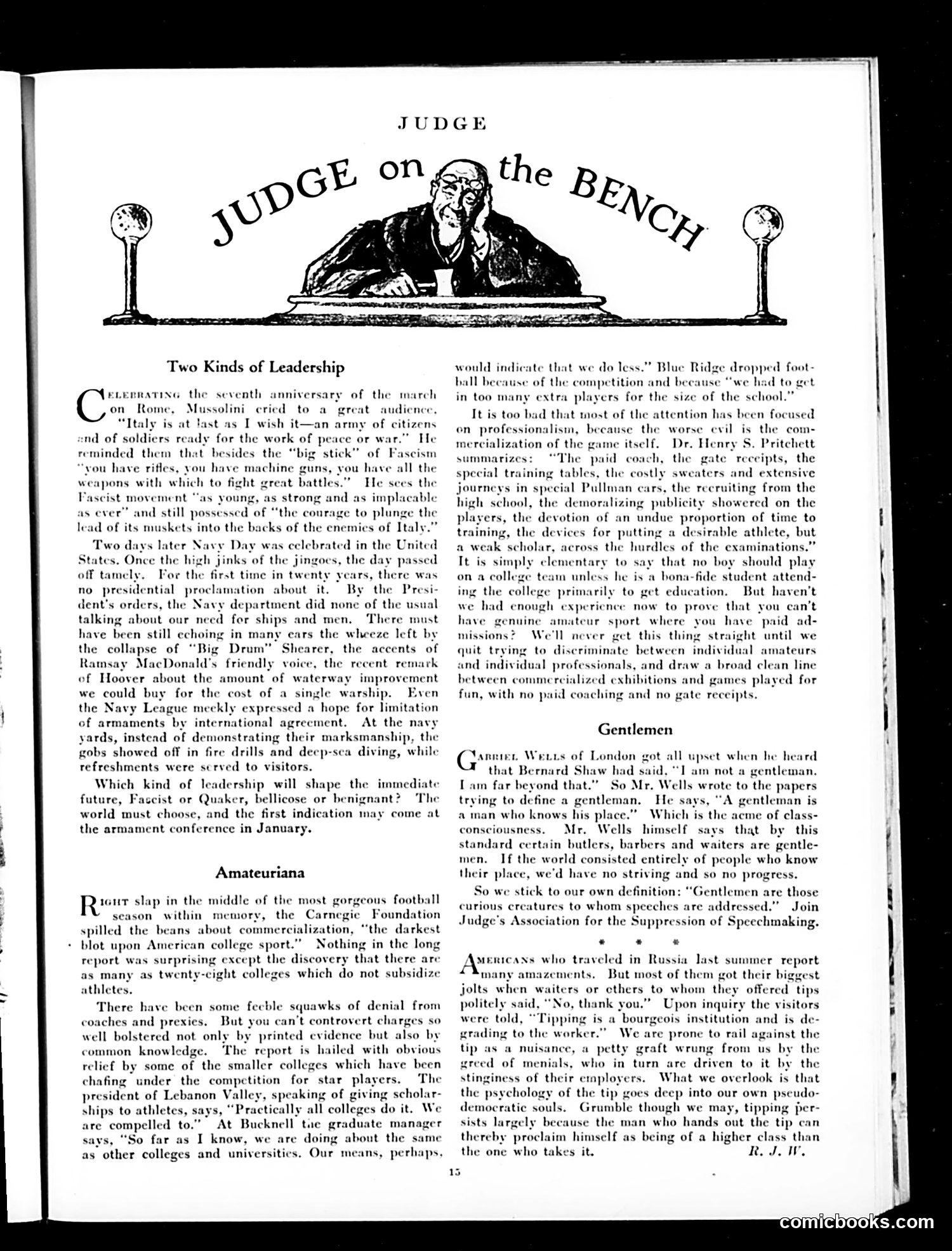
"Judge on the Bench" - Two Kinds of Leadership This page contrasts Mussolini's militaristic fascism with American restraint, using the header illustration of a judge to frame the debate. The main article compares Italy's recent anniversary march—where Mussolini celebrated military power with aggressive rhetoric about "rifles" and "machine guns"—against America's muted Navy Day celebration in 1932, where the military made no public demands and the Navy League advocated arms limitation. The satire questions which approach will dominate: fascist bellicosity or Quaker-like pacifism? The answer supposedly comes at the upcoming armament conference in January. The secondary piece criticizes college football's commercialization, citing the Carnegie Foundation's report exposing athlete subsidies. It argues the real scandal isn't professionalism but the broader corruption: paid coaches, expensive training, recruitment from high schools—undermining genuine amateur sport and education. Both pieces reflect 1930s anxiety about militarism abroad and commercialism at home.
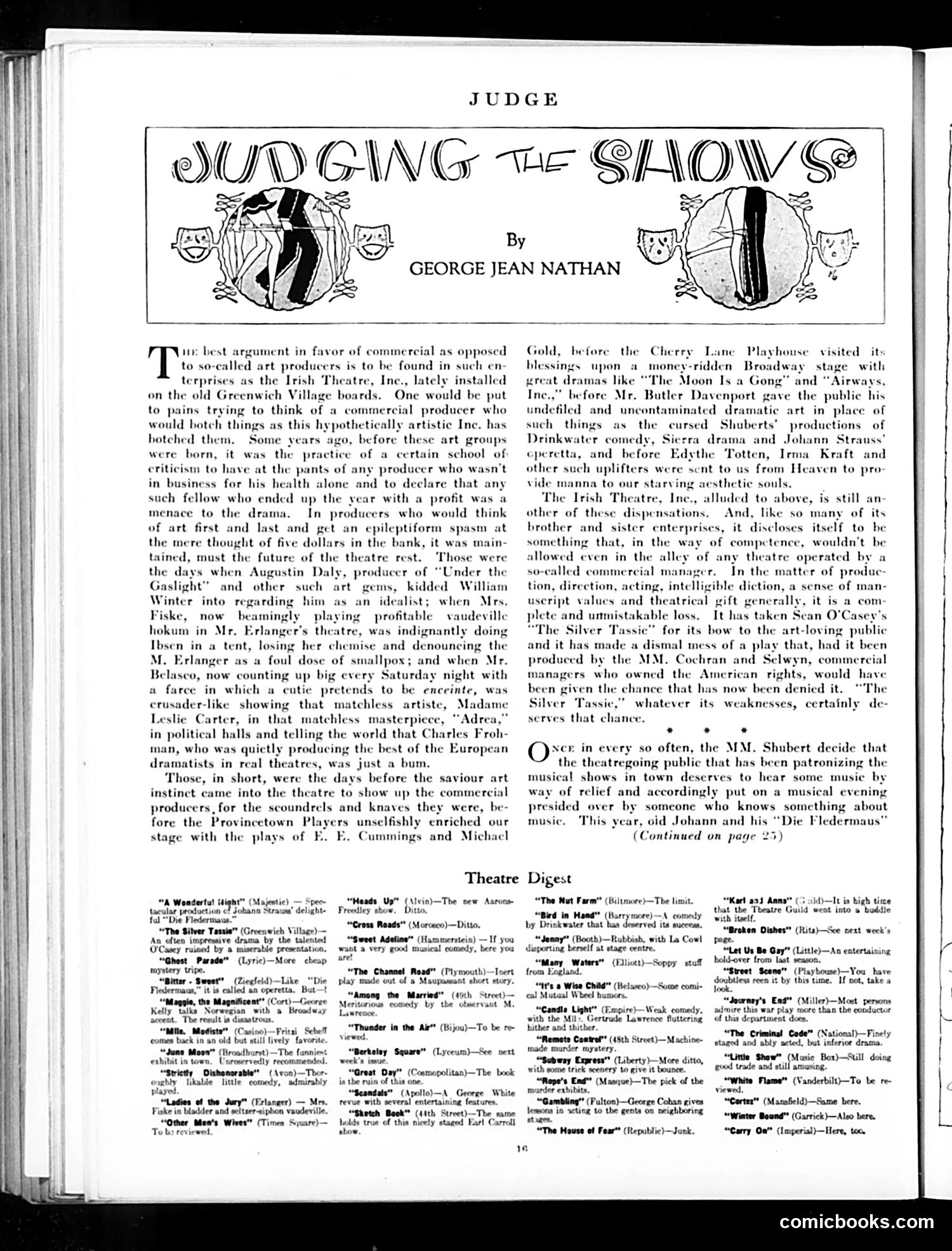
Judging the Shows: Commercial vs. Art Theater This page is a theater review essay by George Jean Nathan, Judge magazine's drama critic, arguing that commercial theater producers deserve credit, not scorn, from theater snobs. Nathan critiques self-proclaimed "art" producers who claimed moral superiority while actually producing mediocre work. He names specific figures—Augustin Daly and David Belasco (famous late-19th-century theater producers)—as examples of commercially-minded men who nonetheless delivered quality entertainment. He contrasts them with later "artistic" producers at venues like the Provincetown Players and Greenwich Village Theatre, whose productions he deems pretentious failures. The satire targets theater elites who romanticized European drama while dismissing American commercial entertainment as philistine. Nathan argues profit-seeking and artistic merit aren't opposites; commercial producers often outperformed self-righteous "artists." The page includes a digest of contemporary theater reviews below, maintaining Nathan's somewhat caustic tone.
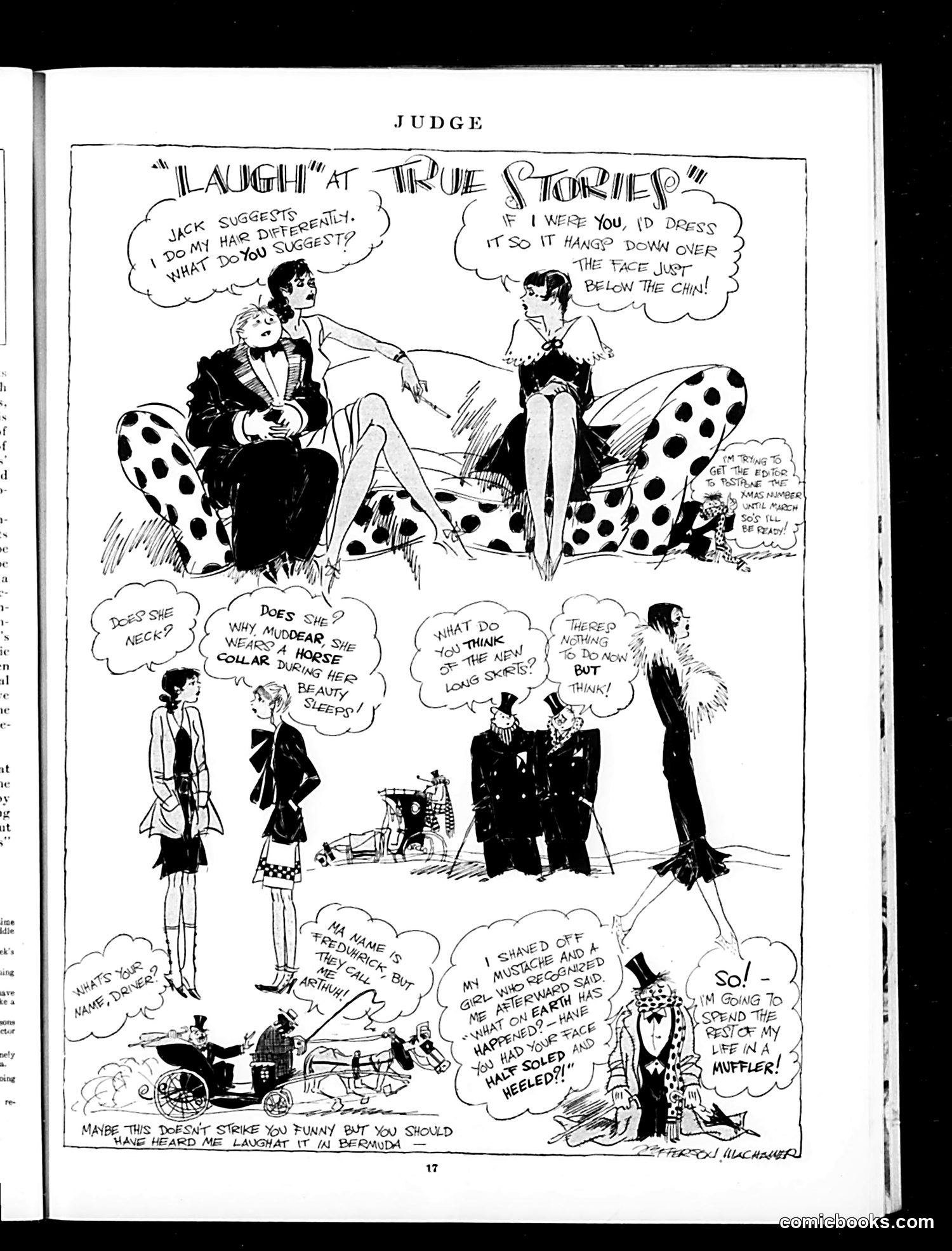
Analysis of "Laugh at True Stories" from Judge This cartoon satirizes 1920s fashion absurdities, particularly women's clothing trends. The central couple on polka-dotted chairs discusses a woman's proposed outfit—a dress that hangs so low it covers her face below the chin, a mockery of the era's increasingly daring hemlines and dropped waistlines. The surrounding vignettes depict conversations about fashion contradictions: women wearing horse collars for beauty, the confusion over short skirts, and a final figure (appearing aristocratic) lamenting he'll spend his life as a "muffler"—likely mocking men's roles as fashion accessories to women's increasingly extreme styles. The bottom caption suggests the cartoonist found these trends absurdly funny when witnessed firsthand. Judge magazine regularly satirized contemporary social trends, and this targets the disconnect between fashion's evolution and practical sense during the Jazz Age.
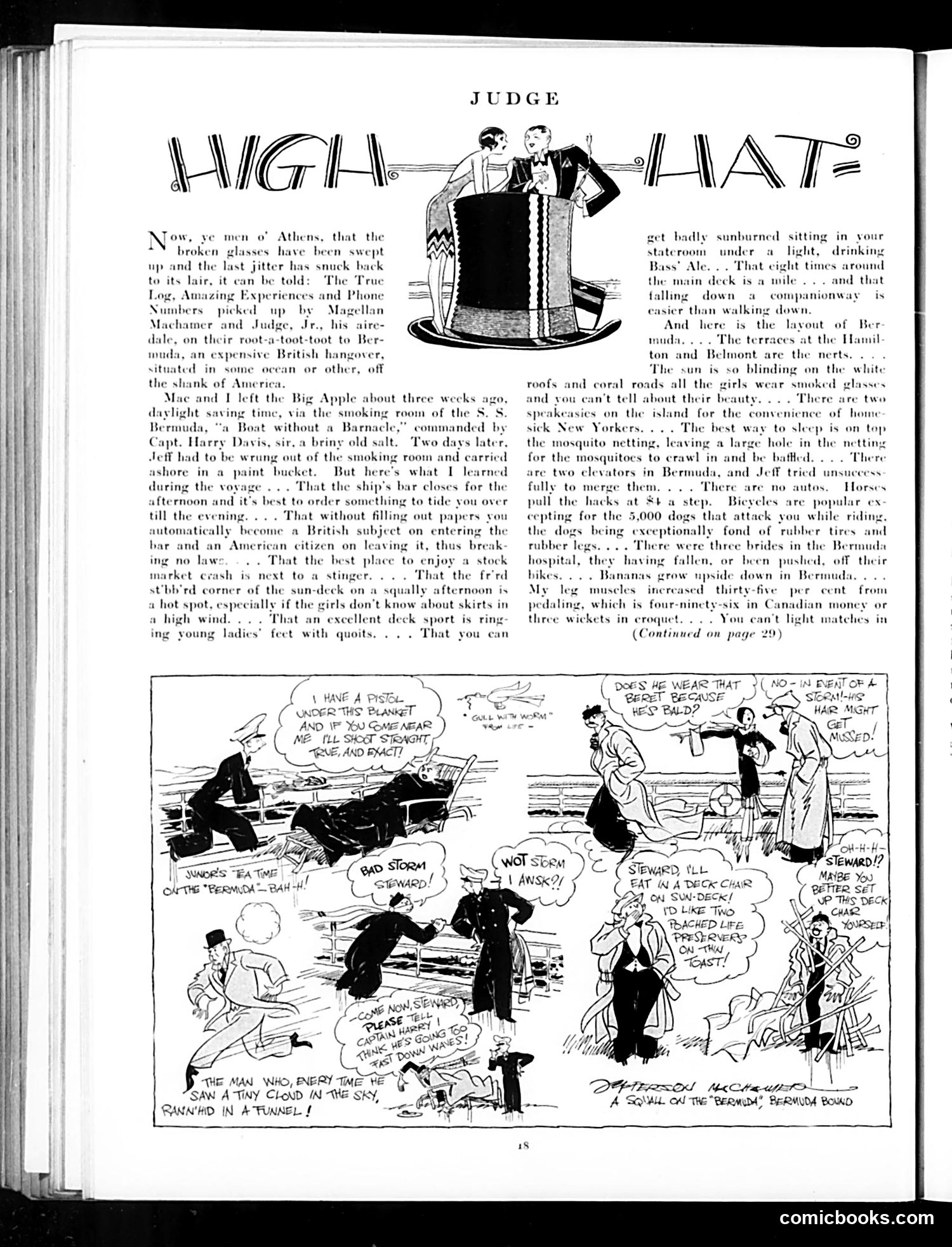
"Judge" Magazine: "High Hat" Travel Satire This page satirizes wealthy Americans vacationing in Bermuda during the 1920s. The upper section is a prose account—presented as travel observations—that mocks tourists' complaints and pretensions: sunburns, mosquitoes, expensive accommodations, and the inconvenience of having no automobiles. The cartoon below depicts shipboard and seaside mishaps: men arguing about deck chairs, women in fashionable dress, and various comic disasters (people tumbling, getting rained on, struggling with croquet). Characters reference a "man who, every time he saw a tiny cloud in the sky, ran and hid in a funnel"—mocking nervous, anxious tourists. The satire targets the American upper class's entitled complaints about luxury travel and their dramatic overreactions to minor inconveniences. The title "High Hat" (slang for snobbish) emphasizes that these travelers are presented as pompous and ridiculous. The overall joke: wealthy tourists abroad are absurdly self-important yet helpless.
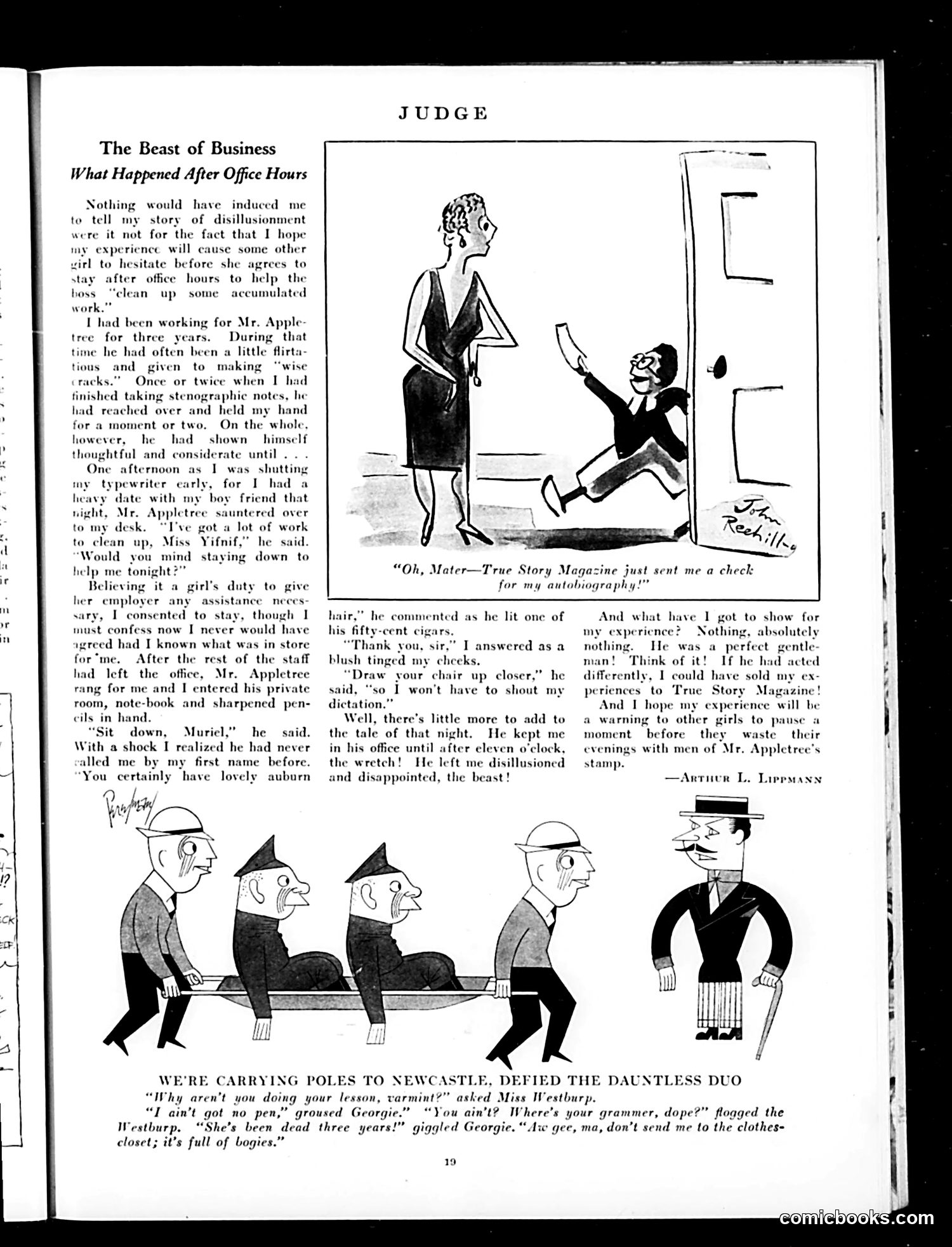
"The Beast of Business" Analysis This story satirizes workplace sexual harassment and the naive expectations of young working women in the early 20th century. A stenographer named Muriel stays late to help her boss Mr. Appletree "clean up" work. He makes advances—complimenting her hair, asking her to sit closer—and keeps her in his office until after 11 PM, leaving her "disillusioned and disappointed." The satire's sharp irony: Muriel's actual grievance isn't the harassment itself, but that she couldn't monetize the experience. She laments having "nothing" to show for it, explicitly wishing she could sell her story to "True Story Magazine" like the boy in the cartoon who received payment for his autobiography. The joke mocks both predatory bosses and the commodification of young women's misfortunes in popular media. The cartoon above shows a woman's romantic misadventure being pitched as publishable content—suggesting such stories were entertainment, not serious social problems worthy of change.
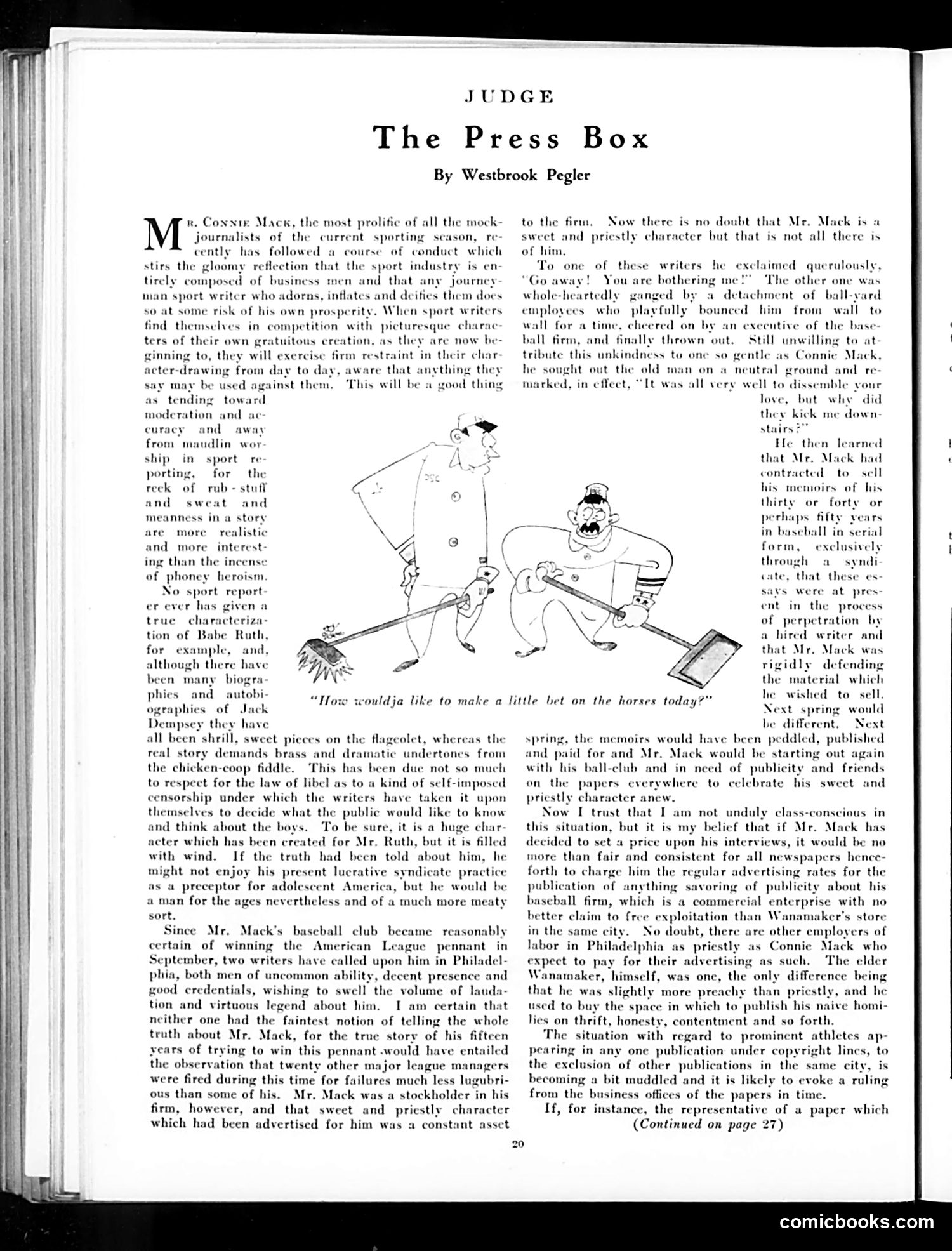
"The Press Box" by Westbrook Pegler This column satirizes sports journalism's romanticization of athletes. Pegler critiques how sportswriters create inflated, heroic personas for figures like Babe Ruth and Jack Dempsey rather than reporting truthfully. The cartoon depicts what appears to be Connie Mack (Philadelphia Athletics manager) refusing interviews about his memoirs—which a hired writer is preparing for syndication. Pegler's point: Mack, a businessman-owner, hired a professional writer to control his narrative rather than granting access to journalists. Two writers seeking interviews were rebuffed (one reportedly told to "go away"). Pegler argues this reflects a broader problem—sportswriters self-censor to protect athletes' commercial interests and public images, sacrificing honest storytelling. The cartoon's betting joke exemplifies how real character gets flattened into sanitized legend for profit.
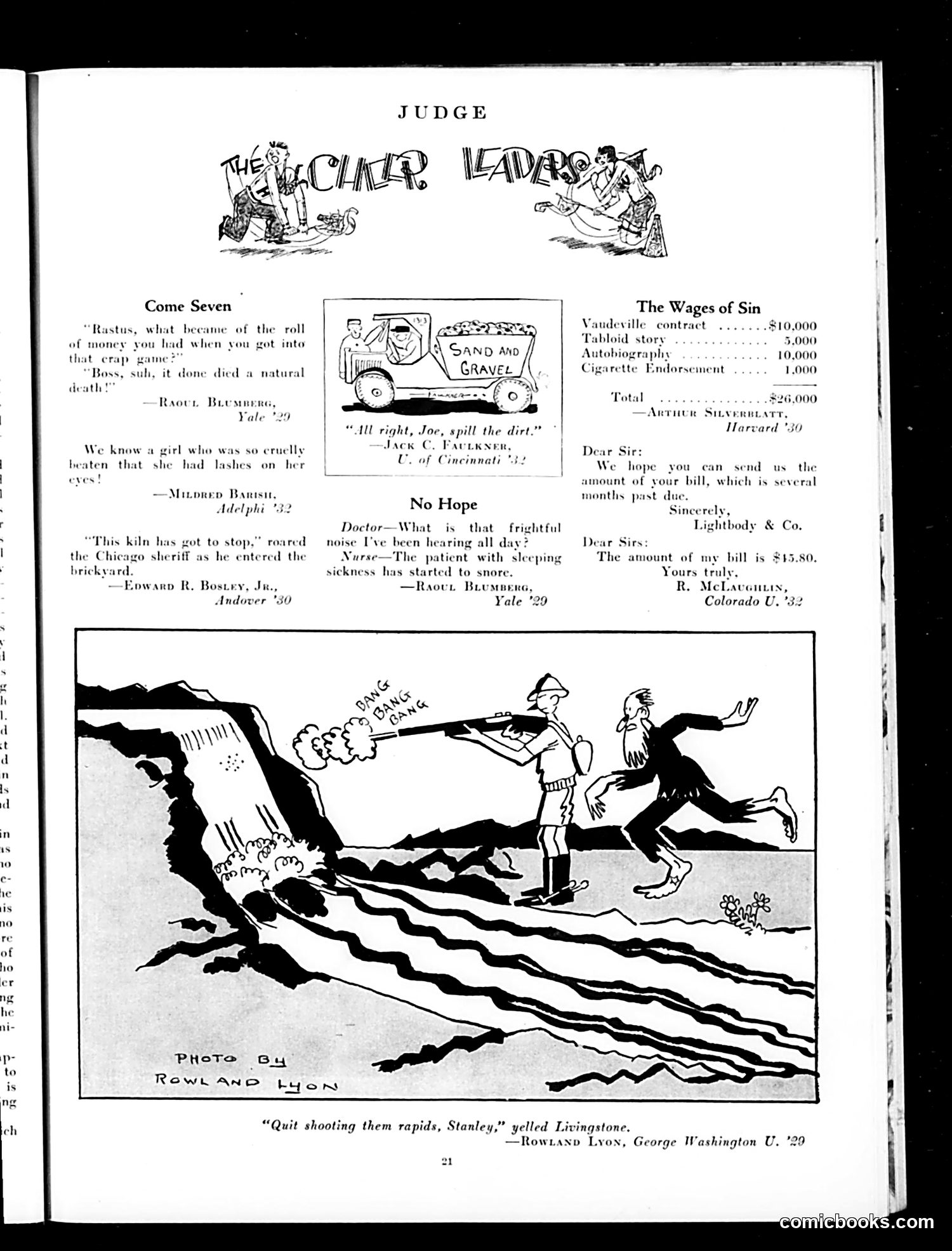
Analysis of Judge Magazine Page This page contains multiple short humorous pieces typical of Judge magazine's format. The dominant cartoon depicts a colonial explorer (labeled "Stanley") shooting rapids while another figure (identified as "Livingstone") shouts a warning—referencing the famous 1871 meeting between explorer Henry Morton Stanley and missionary David Livingstone in Africa. The satire mocks the romanticized adventure narratives of exploration, suggesting Stanley's recklessness endangers them. The surrounding text consists of brief jokes and quips submitted by college students from various universities. "The Wages of Sin" itemizes income sources (vaudeville contracts, tabloid stories, autobiography, cigarette endorsements), likely satirizing commercialization of scandal or notoriety. Other jokes reference racial stereotypes ("Rastus"), slapstick humor, and dunning letters—typical period humor conventions. The page reflects early 20th-century satirical magazine conventions: student submissions, lighthearted social commentary, and colonial-era adventure parody.
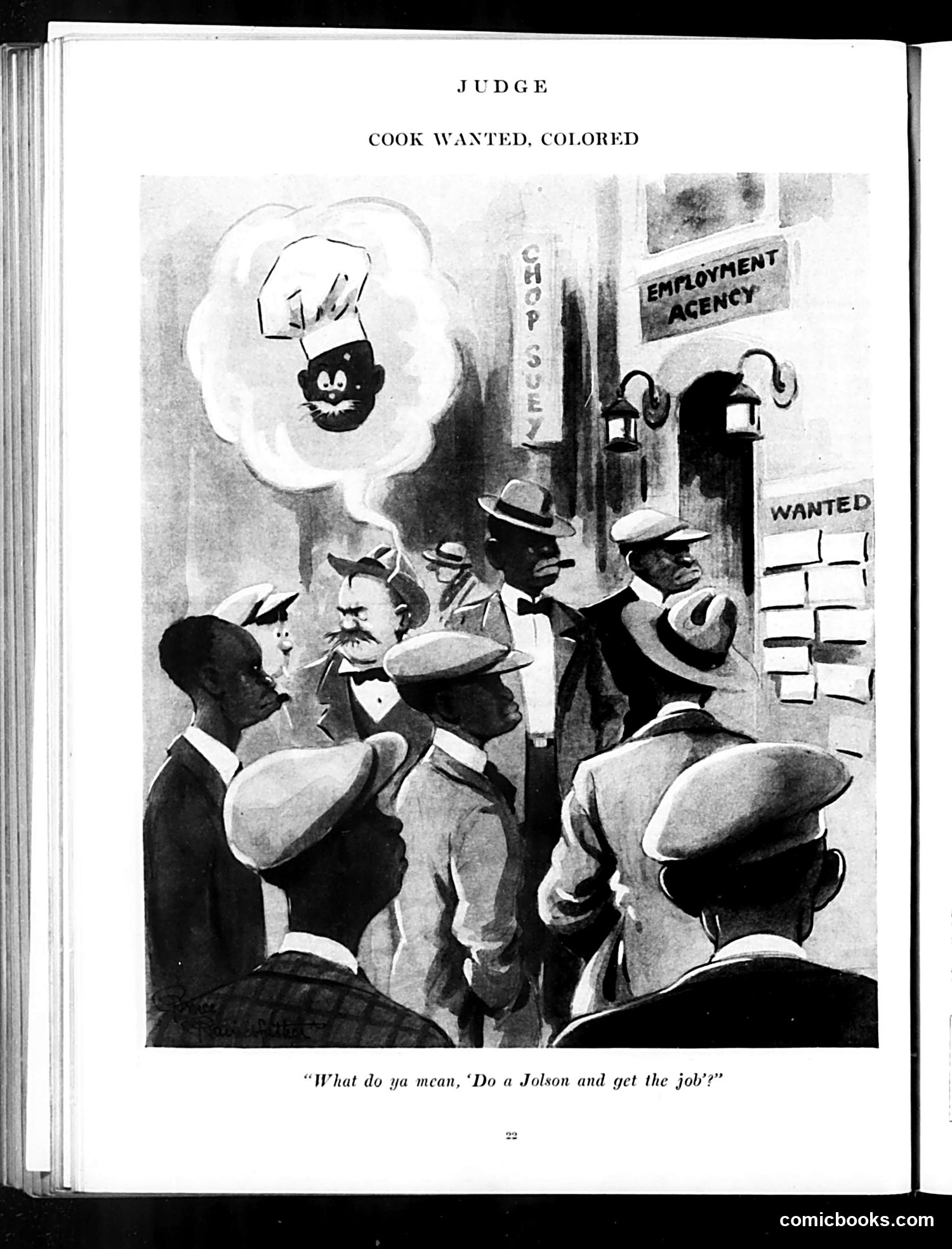
Analysis This cartoon satirizes racial discrimination in early 20th-century employment. The scene shows an employment agency with a "Wanted" sign for a colored cook. The caption references "doing a Jolson" — likely alluding to Al Jolson, the white entertainer famous for performing in blackface. The joke's dark irony: a Black job applicant is being told to "do a Jolson" (perform blackface) to secure a cooking position — meaning a Black person would need to impersonate a white person in blackface to get hired for work. This highlights the absurdity and cruelty of racist hiring practices, where even jobs supposedly "wanted" for colored workers came with humiliating conditions. The cartoon critiques employment discrimination while documenting the era's casual racism and minstrelsy's pervasive cultural influence.
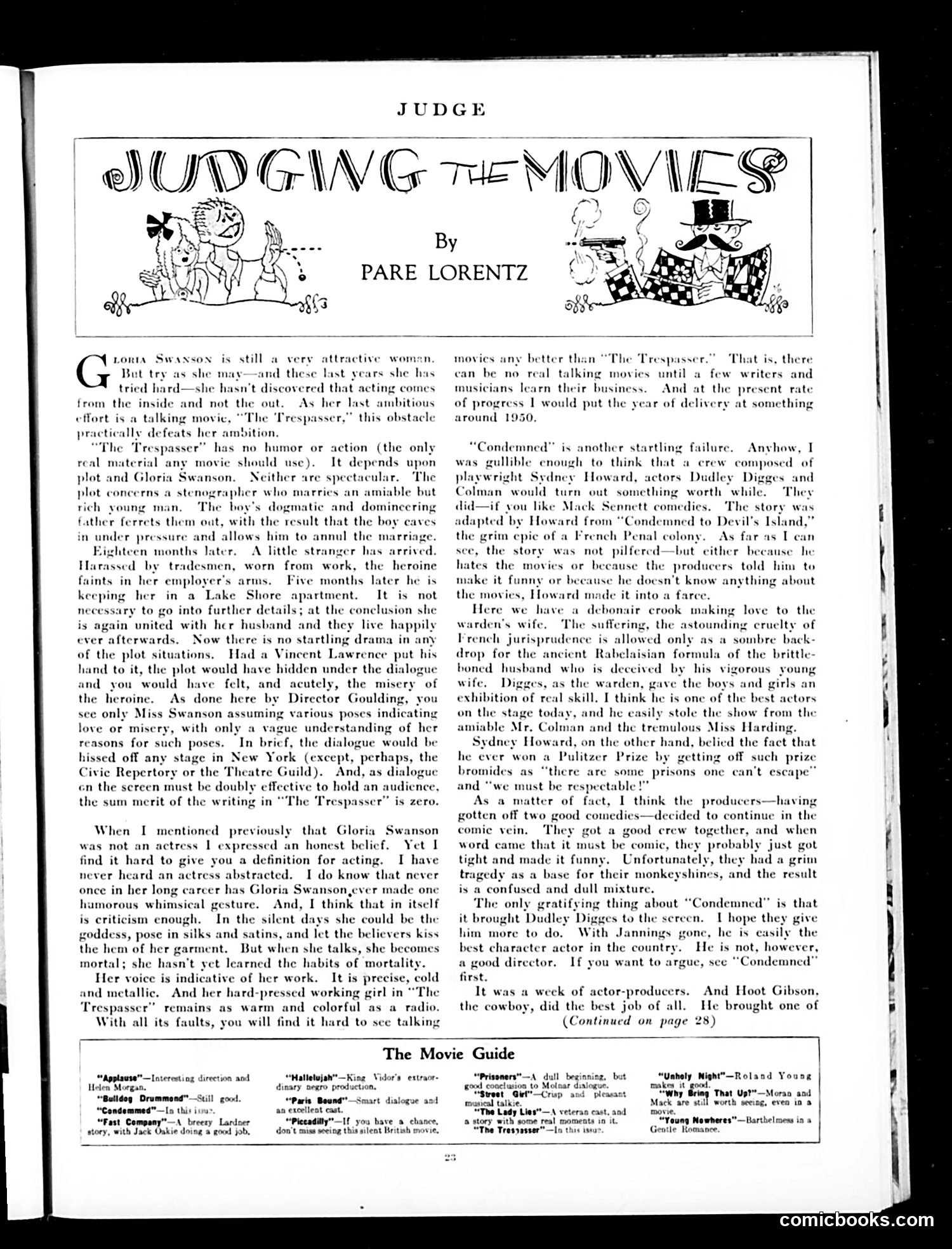
Judging the Movies: Film Criticism in Judge Magazine This page is film criticism by Pere Lorentz reviewing early "talking pictures" (1920s-early 1930s sound films). Lorentz harshly critiques two movies: "The Trespasser" (starring Gloria Swanson): Lorentz argues Swanson, though physically attractive, cannot act. Her problem: she relies on silent-film techniques—poses and gestures—rather than internal emotional depth. In talking pictures, this fails. He particularly attacks her cold, metallic voice and the weak screenplay. The plot (stenographer marries rich man, affair ensues, reconciliation) offers no dramatic substance. "Condemned": Adapted from a grim French penal colony story but turned into a farce by playwright Sydney Howard. Lorentz sarcastically suggests Howard either hates movies or doesn't understand them, reducing serious subject matter to a crude adultery comedy. The broader satire: these early sound films are technically inferior to silent cinema because the industry hasn't yet mastered dialogue-driven storytelling. Lorentz predicts real "talking movies" won't arrive until around 1950.
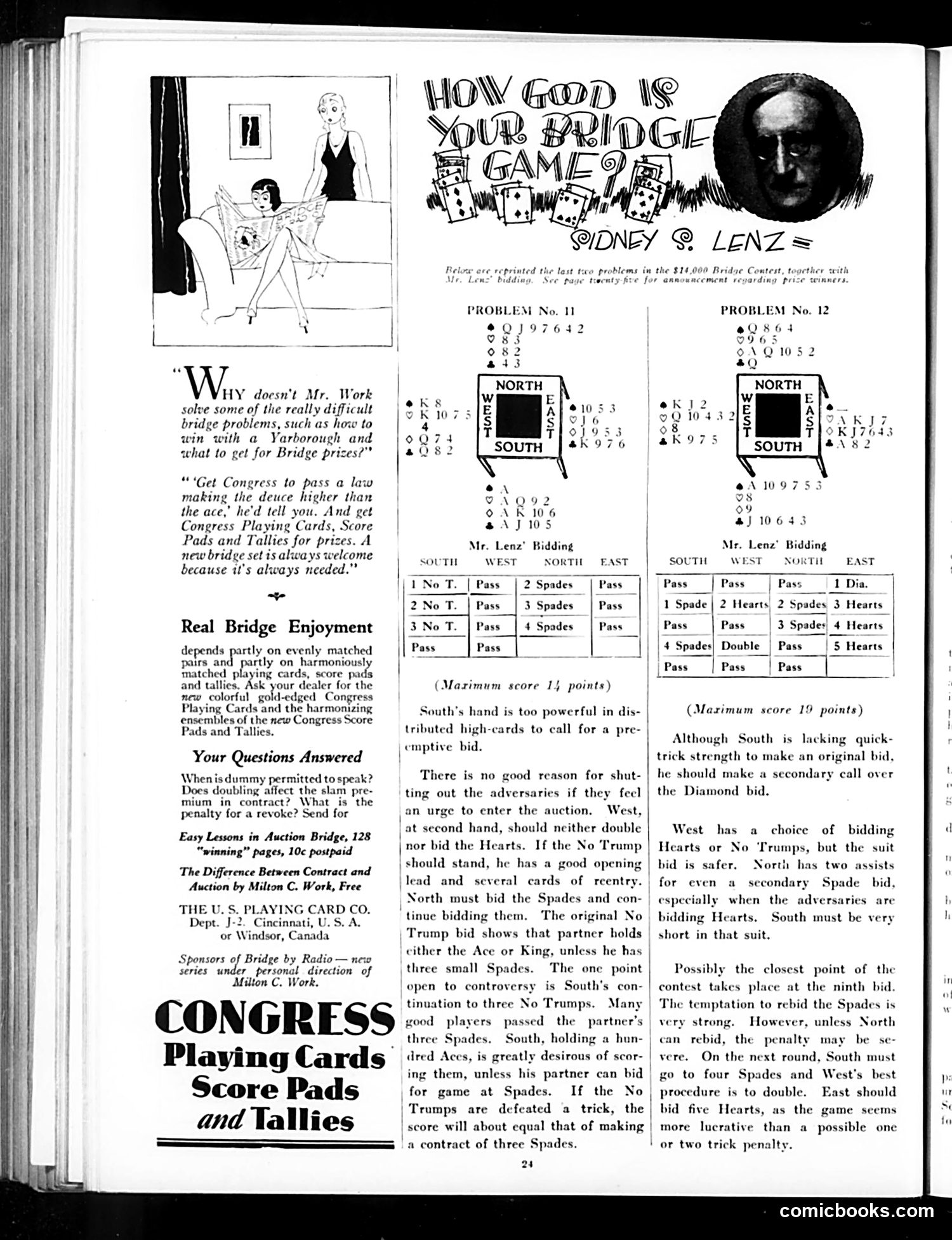
Judge Magazine: Bridge Problems and Advertisement This page is primarily advertising and instructional content for Congress Playing Cards, not political satire. The page features two bridge card game problems attributed to "Mr. Lenz" (likely Milton C. Work, a famous bridge authority mentioned in the text), with detailed bidding sequences and strategy analysis. The satirical element appears minimal—a brief cartoon showing a woman asking "Mr. Work" why he doesn't solve difficult bridge problems, with his tongue-in-cheek response suggesting Congress pass a law making the deuce higher than the ace. This is gentle humor about bridge's complexity rather than political commentary. The bulk of the content educates readers on bridge strategy while promoting Congress brand playing cards and score pads as essential equipment. The page reflects bridge's popularity during this era as both entertainment and intellectual pursuit.
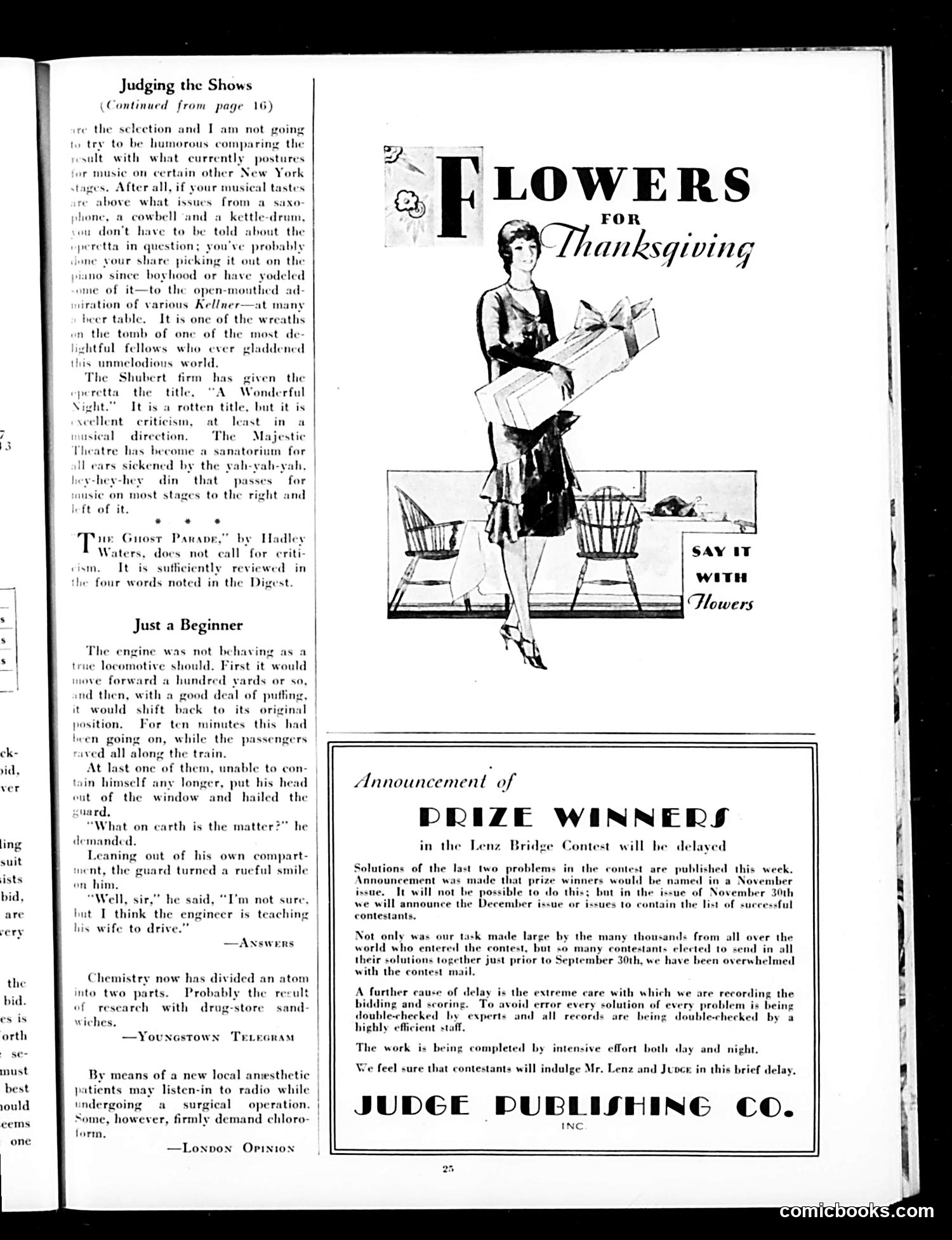
This page is primarily advertising and announcements rather than political satire. The dominant feature is a full-page Thanksgiving flower advertisement showing a woman arranging flowers with the slogan "Say It with Flowers." The text content includes three brief humorous anecdotes unrelated to each other: theater criticism, and two short jokes (one about a malfunctioning locomotive and a wife learning to drive; another about chemistry and atom splitting). These appear to be filler content typical of Judge magazine's miscellaneous humor. The substantial announcement concerns the Lenz Bridge Contest prize winners, explaining delays in announcing results due to the volume of submissions and rigorous verification procedures. No political satire is evident on this page. It reflects Judge's mixed format: celebrity advertisements alongside light domestic humor and publishing notices—representative of 1920s-era magazine content aimed at general entertainment rather than topical commentary.
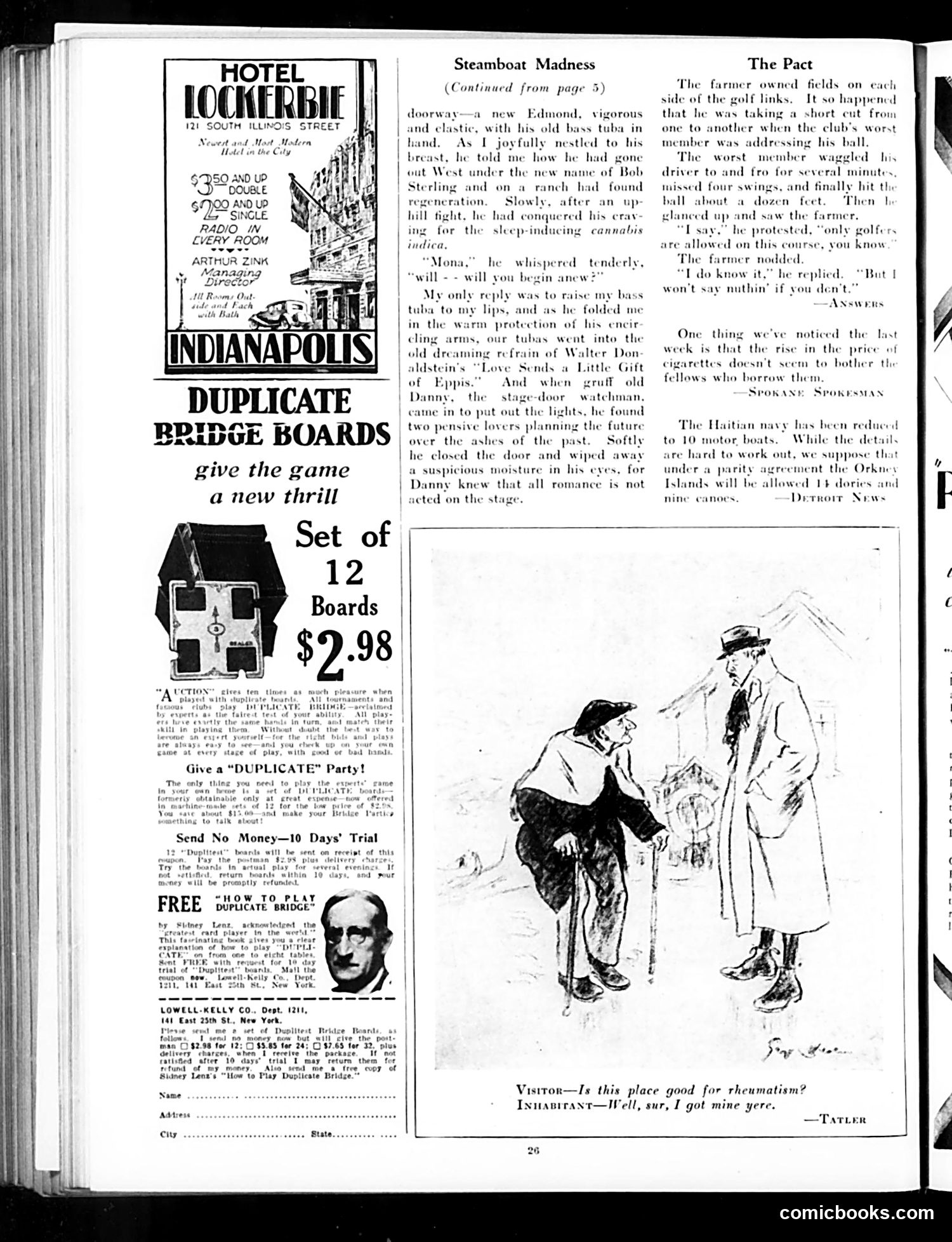
Analysis of Judge Magazine Page Content This page combines advertisements with satirical fiction and humor typical of Judge magazine. Main Content: The page features "Steamboat Madness," a serialized romantic story about reunited lovers (Edmond and Mona) who reconnect via tuba music on a steamboat. It's sentimental melodrama—the kind Judge would parody. "The Pact" is a brief joke about a golfer and a farmer: the farmer agrees not to complain about the golfer's terrible driving on his land if the golfer doesn't report the farmer for trespassing. It's gentle rural humor playing on mutual rule-breaking. The cartoon (by Tatler) shows two men—one in formal dress addressing the other about rheumatism; the informal reply suggests the location's healing properties. It's a simple visual gag. Advertisements dominate the left side: Hotel Lockerbie in Indianapolis, and Duplicate Bridge Boards ($2.98 for 12)—period game equipment. The page reflects Judge's mix of light fiction, social humor, and commercial advertising aimed at early-20th-century middle-class readers.
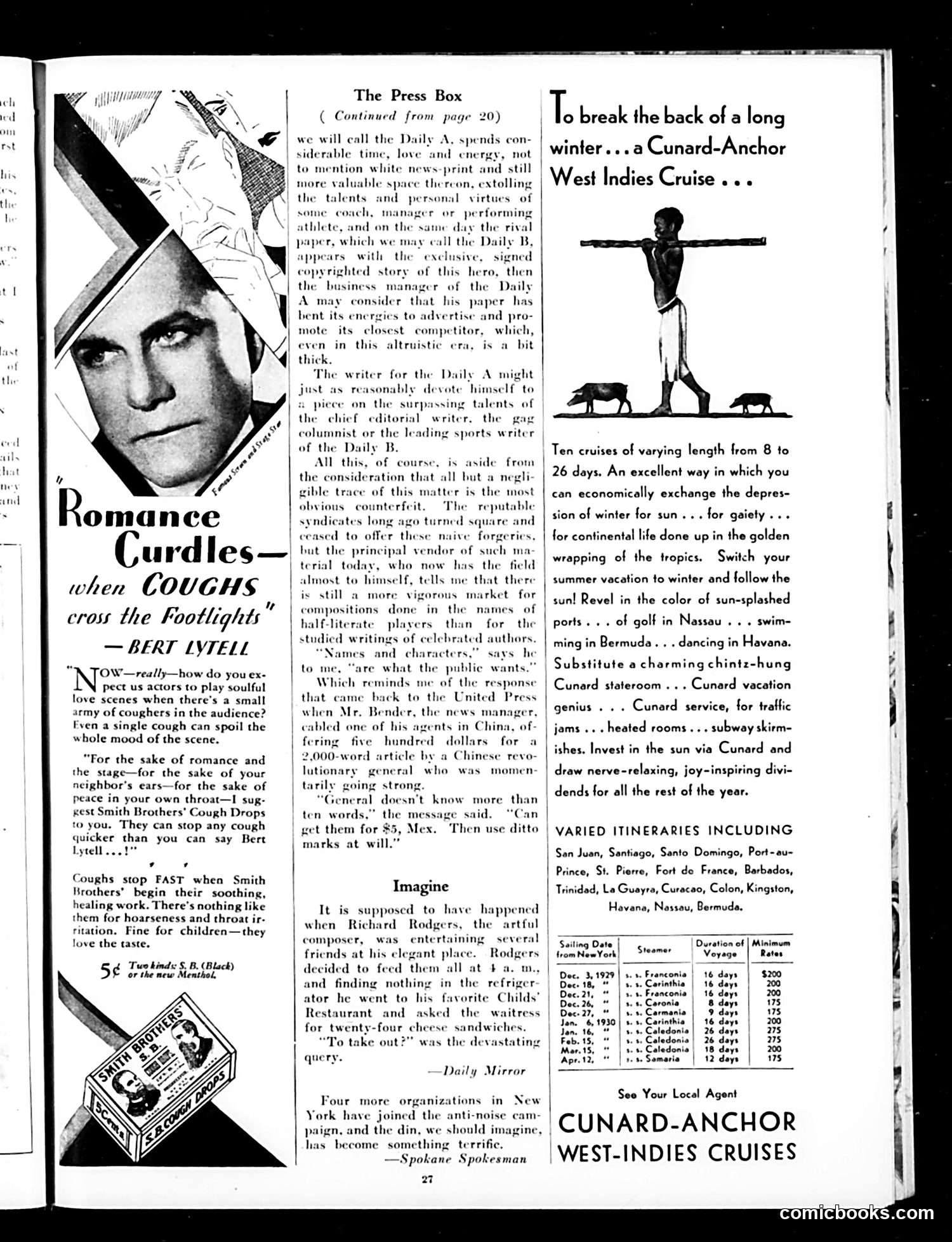
Page Analysis: Judge Magazine This page combines editorial commentary with advertising. The main content is "The Press Box," a critique of newspaper competition and sensationalism. The author (unnamed) criticizes how rival newspapers ("Daily A" and "Daily B") waste valuable space promoting the same athletes and coaches, essentially free-advertising for competitors. He argues this practice is "obvious counterfeit"—manufactured news rather than genuine journalism—yet persists because the public demands celebrity gossip over substantive writing. The anecdotes illustrate his point: a Chinese general's article selling for $5 and composer Richard Rodgers's late-night Childs' Restaurant story exemplify trivial human-interest pieces that dominate newspapers. The page also includes Smith Brothers' Cough Drops advertisement (featuring actor Bert Lytell complaining about audience coughs during theatrical performances) and a Cunard-Anchor cruise advertisement—typical 1920s-30s periodical content. The satire targets journalistic integrity compromised by commercial competition.
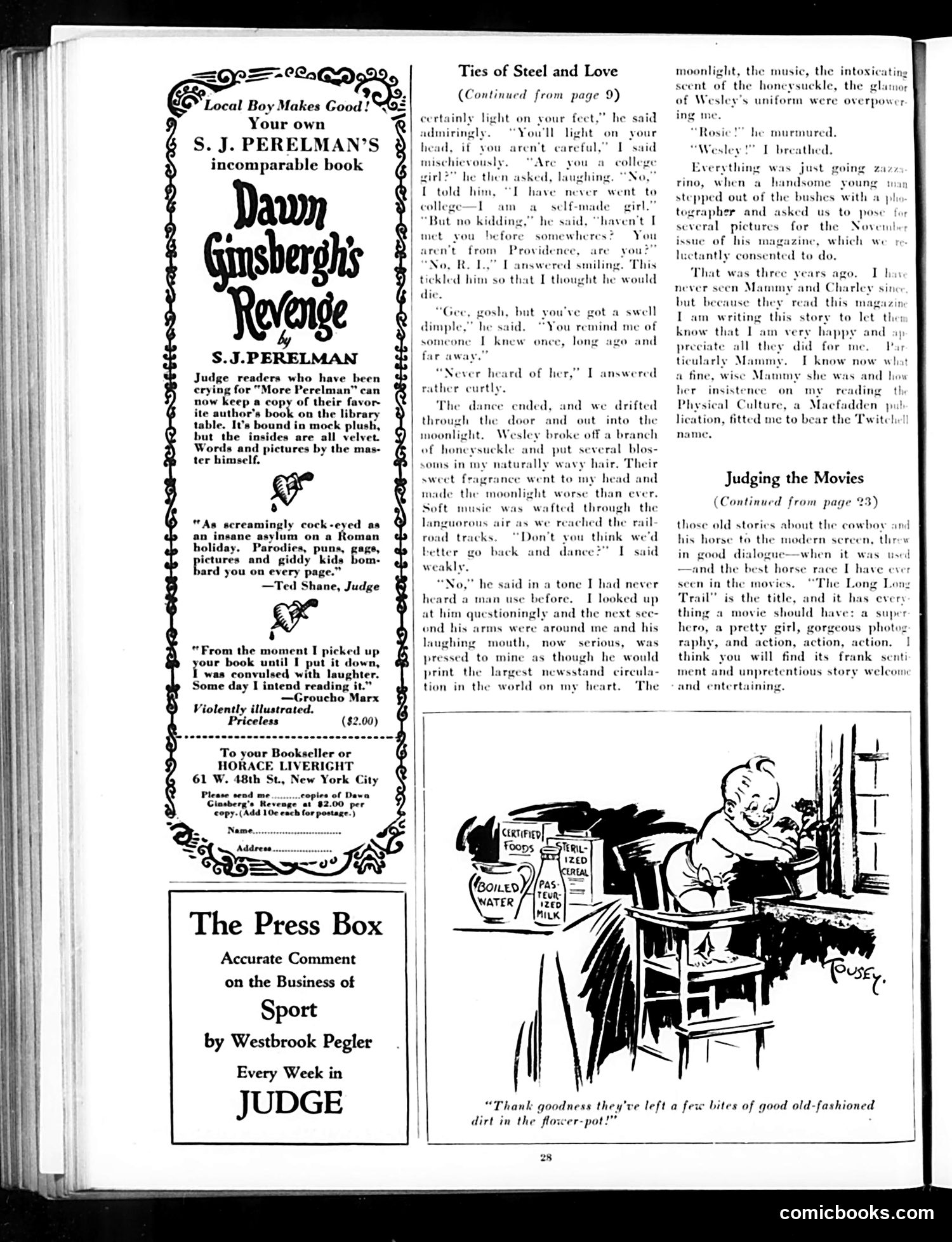
Explanation for Modern Readers This page is primarily advertisements and magazine content, not political satire. The main cartoon shows a baby in a high chair with "good old-fashioned dirt" from a flower pot—a humorous domestic scene about childhood messiness, not political commentary. The page advertises S.J. Perelman's book *Dawn Ginsberg's Revenge* (a humor collection featuring puns and parodies) and promotes regular Judge magazine features like Westbrook Pegler's sports column. The bulk of the page contains serialized fiction ("Ties of Steel and Love"), a romantic story about a soldier named Wesley. The text is typical early 20th-century magazine romantic melodrama—moonlight, honeysuckle, passionate embraces—interrupted absurdly when a photographer appears to capture the moment for a magazine. No identified political figures or specific satire appears here. This is standard magazine filler: advertisements, serialized fiction, and comic relief designed to fill pages between major articles.
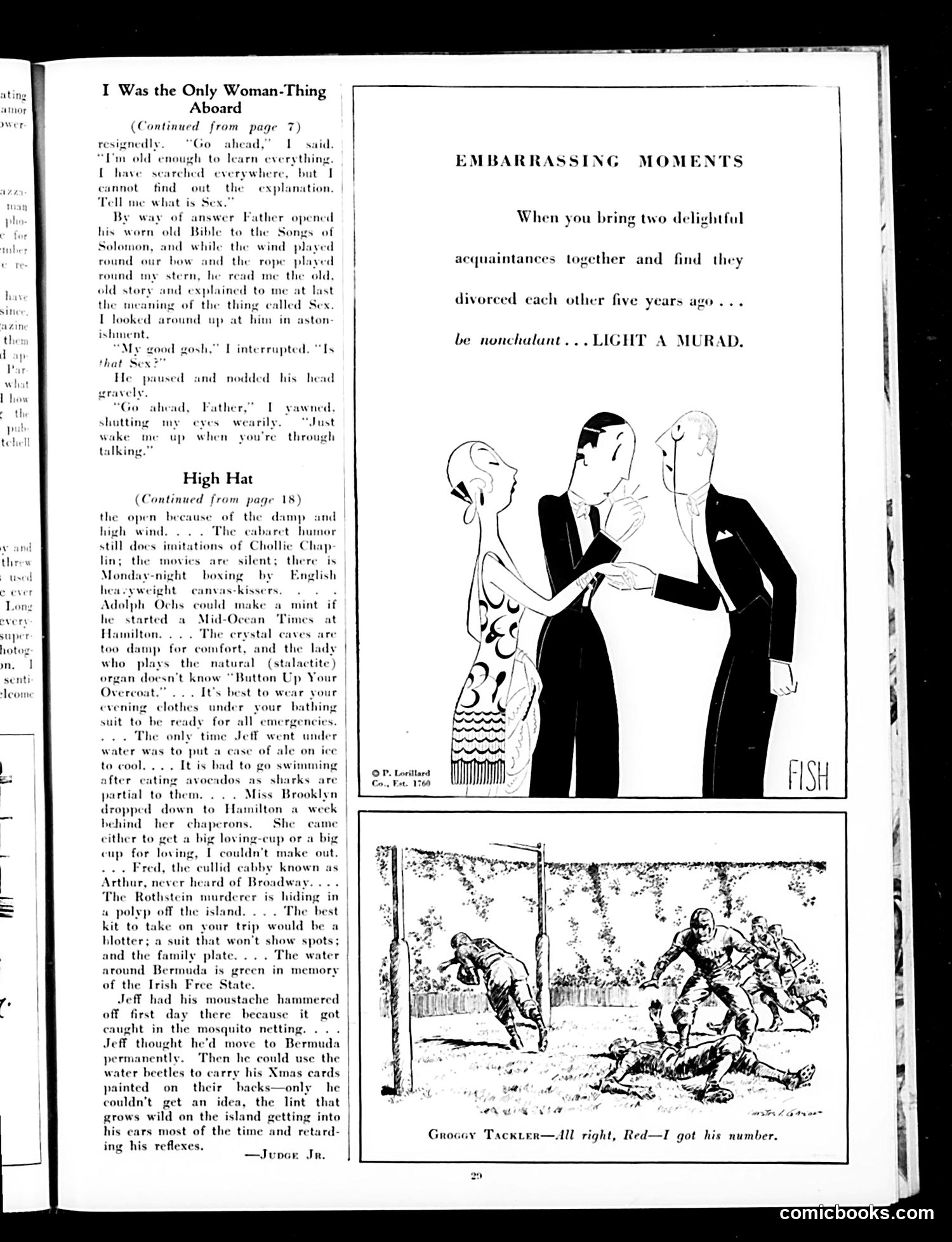
Analysis for Modern Readers This page from *Judge* magazine contains three distinct humor pieces: "I Was the Only Woman-Thing Aboard" (top left): A continuation of a serialized story where a naive young woman asks her father to explain sex. His response—reading from the Biblical *Song of Solomon*—is presented as absurdly inadequate and putting her to sleep. The satire targets both prudish Victorian sex education and paternal embarrassment about the topic. "High Hat" (middle left): Gossipy commentary about Bermuda social life, mixing observations about cabaret entertainment, swimming etiquette, and various anecdotes. The humor relies on period references (Charlie Chaplin films, the Rothstein murder case, Irish Free State politics) that would resonate with contemporary readers. "Embarrassing Moments" (right): An advertisement disguised as social commentary. The scenario depicts two divorced people meeting awkwardly; the "solution" is lighting a Murad cigarette to appear composed. This normalizes smoking as social camouflage. Bottom cartoon: A football scene with the caption "All right, Red—I got his number," depicting standard sports humor about tackling technique.
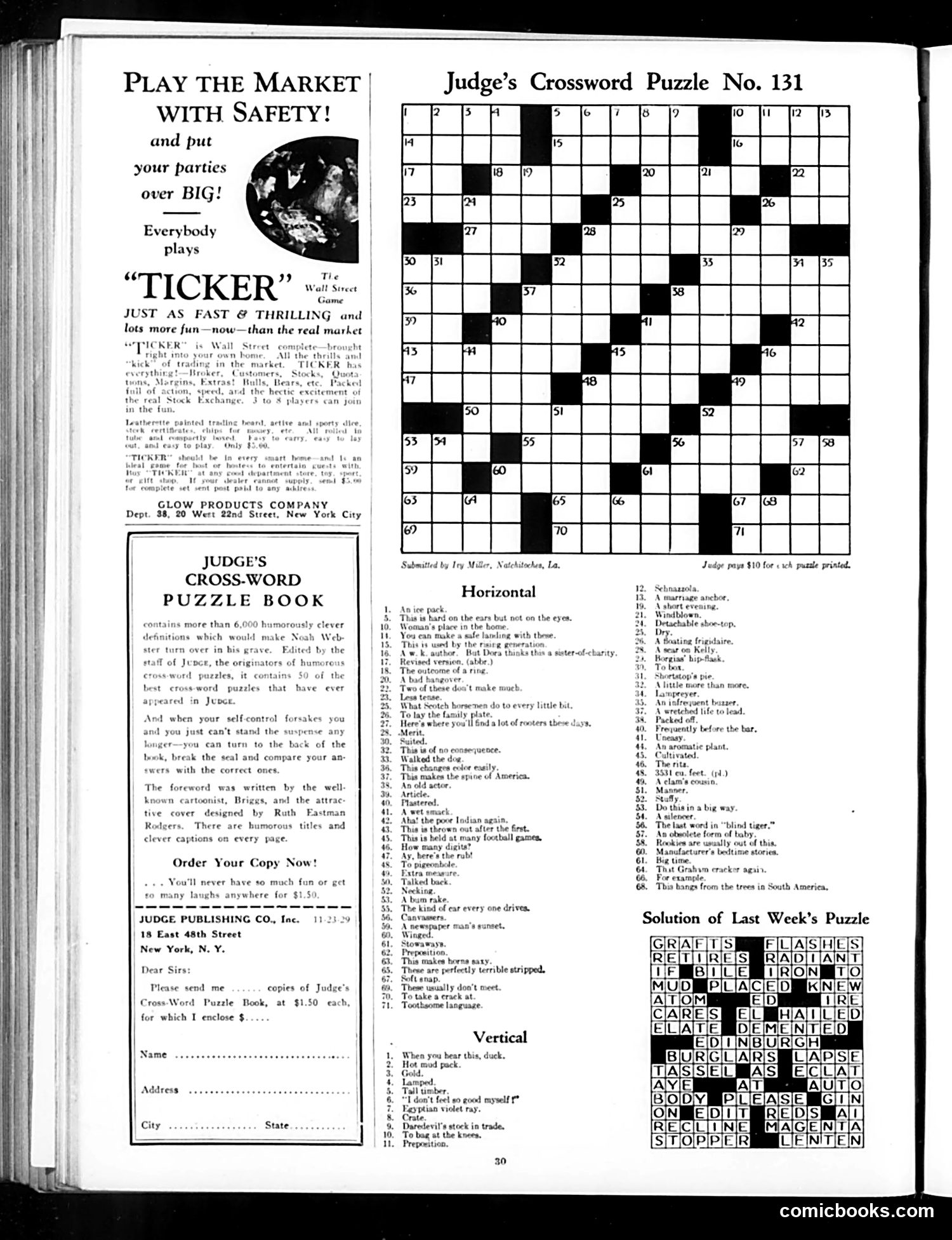
Analysis of Judge Magazine Page This page is primarily advertising and puzzle content, not political satire. The main features are: "Ticker" Game Advertisement: Promotes a stock market simulation board game by Glow Products Company. The pitch emphasizes it's "just as fast & thrilling" as real stock trading but safer—allowing parties to "play the market" without actual financial risk. This reflects 1920s fascination with stock speculation among ordinary Americans. Judge's Crossword Puzzle Book: Advertises Judge's collection of over 6,000 crossword puzzles, a hugely popular entertainment craze of the era. The ad notes the book includes humorous titles and captions by famous cartoonists (Briggs, Eastman, Rodgers mentioned). Context for Modern Readers: Both products target middle-class entertainment during the prosperity-focused 1920s. The "Ticker" game's emphasis on "safety" obliquely references the real stock market's risks—relevant given the decade's speculative bubble preceding the 1929 crash. The page contains no visible political cartoon or social commentary.
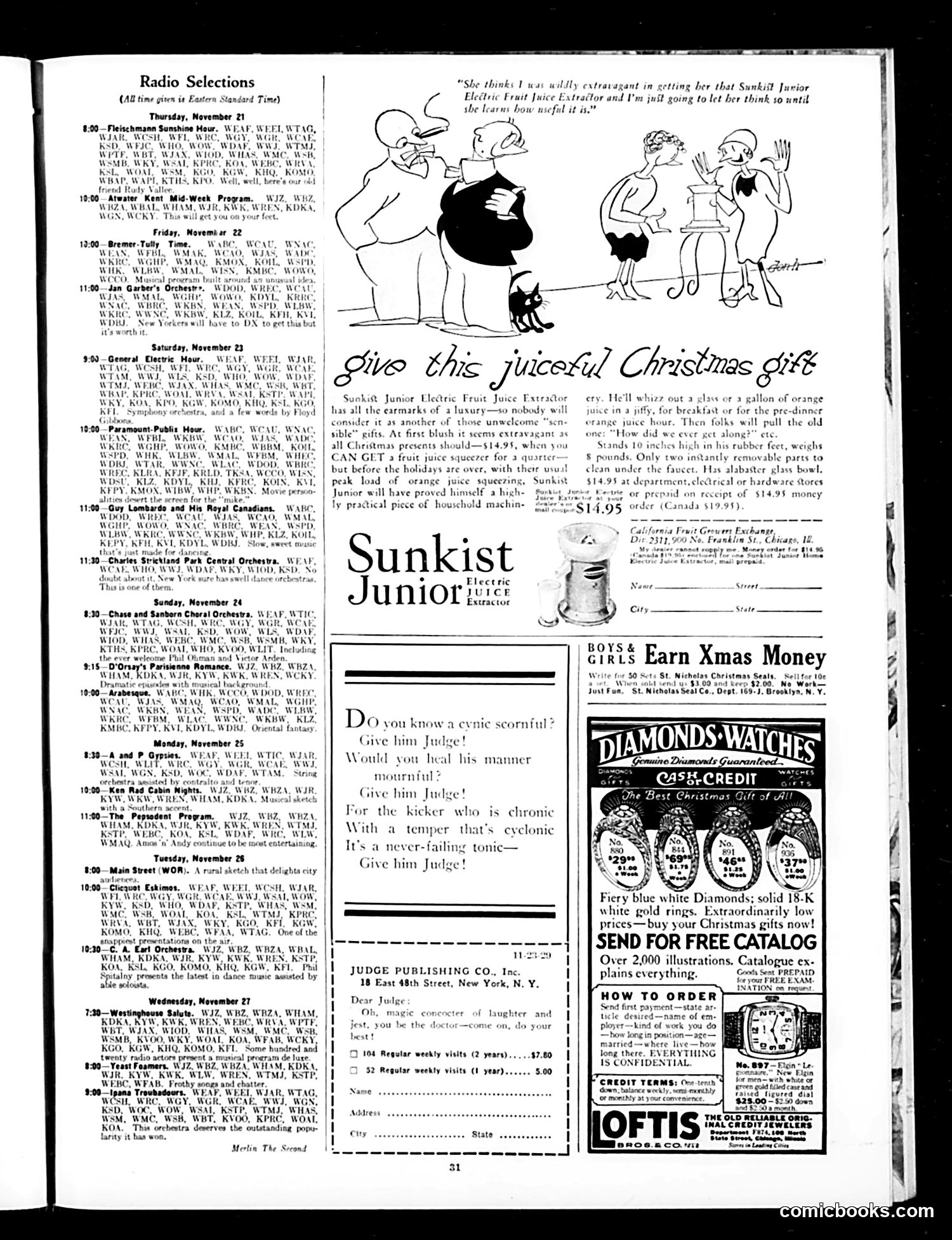
Judge Magazine Page Analysis This page is primarily radio programming listings for a November 1929 week, with advertising and one cartoon. The main cartoon (top right) depicts a man presenting a "Sunkist Junior Electric Fruit Juice Extractor" as a Christmas gift to an unenthusiastic woman and child. The satire targets the absurdity of marketing kitchen appliances as luxury holiday gifts—a common 1920s advertising practice. The figures' skeptical body language suggests the joke: giving practical household labor devices as presents, particularly to women, was considered tone-deaf even by contemporary standards. The page includes advertisements for Sunkist juice extractors ($14.95), Judge Publishing subscription offers, Diamonds and Watches as "the Best Christmas Gift of All," and Loftis Credit Jewelers. These ads emphasize materialistic gift-giving options. The radio listings showcase the era's broadcasting landscape with numerous regional stations (WJZ, WEAF, KDKA, etc.) broadcasting popular music, orchestras, and comedic programs—the mass entertainment medium of the period.
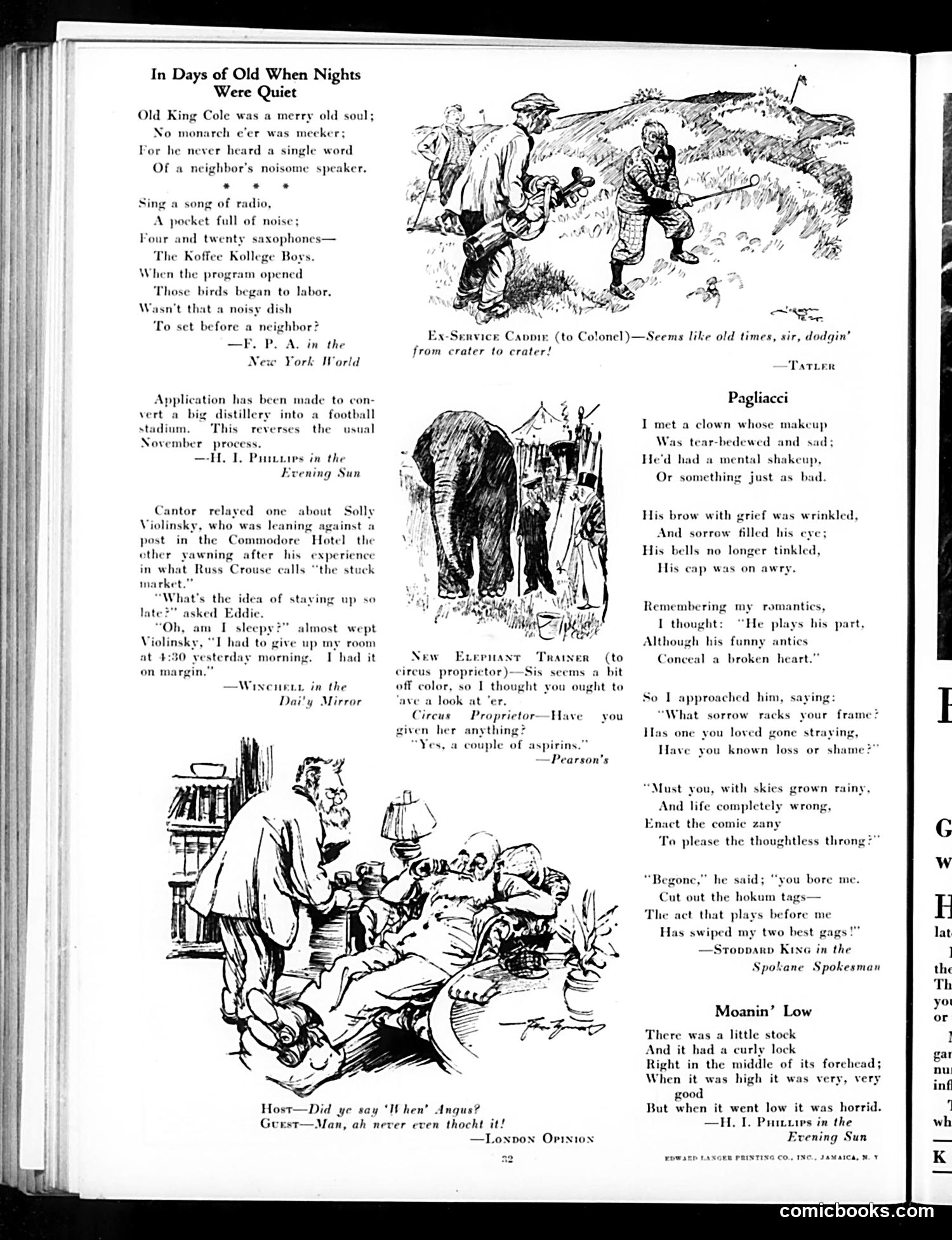
Political & Social Satire from Judge Magazine This page satirizes modern American life circa the 1920s-30s through humor and light verse. Main targets: 1. Radio noise pollution ("In Days of Old"): Mocks the new technology of radio broadcasting as intrusive and obnoxious—the ironic contrast between "quiet old times" and modern "Koffee Kollege Boys" programs represents anxiety about unwanted sound invading homes. 2. Stock market speculation ("Moanin' Low"): A brief poem about stock prices (depicted as a "little stock") rising and falling, satirizing the obsession with financial volatility and gambling that characterized the era. 3. Various cultural absurdities: Other brief items mock nightclub culture, elephant training mishaps, and theatrical melodrama ("Pagliacci"). The cartoons and quips reflect Judge's stance as a magazine for educated readers concerned about modernity's disruptive effects on traditional quiet life, while poking fun at contemporary fads and economic anxieties.
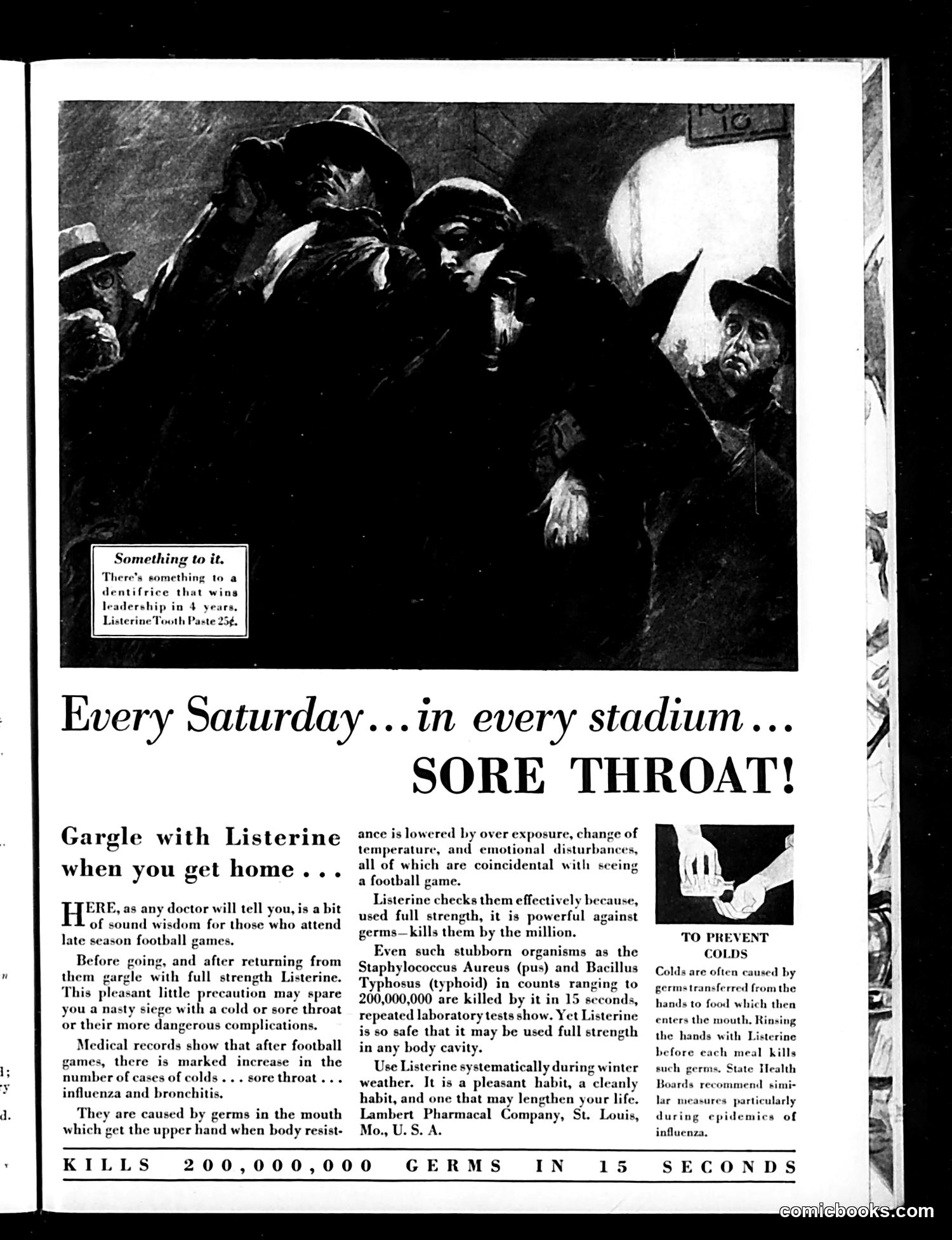
Analysis This is primarily a Listerine advertisement, not political satire. The page uses a football crowd image as a hook for marketing mouthwash to health-conscious readers. The small inset cartoon (top left) appears to be a separate Judge editorial comment about dentistry and leadership—the caption "There's something to a dentifrice that wins leadership in 4 years" suggests a tongue-in-cheek jab at dental hygiene as a path to power, though the specific target is unclear without additional context. The main content exploits post-WWI anxiety about disease transmission. It claims that football stadiums—crowded venues with temperature exposure and emotional stress—create conditions for colds, influenza, and bronchitis. The ad then sells Listerine as preventative medicine, citing specific bacteria counts and claiming the product kills 200 million germs in 15 seconds. This reflects early 20th-century germ theory marketing: positioning everyday products as disease prevention during an era when influenza pandemics were fresh trauma and antibiotics didn't yet exist.
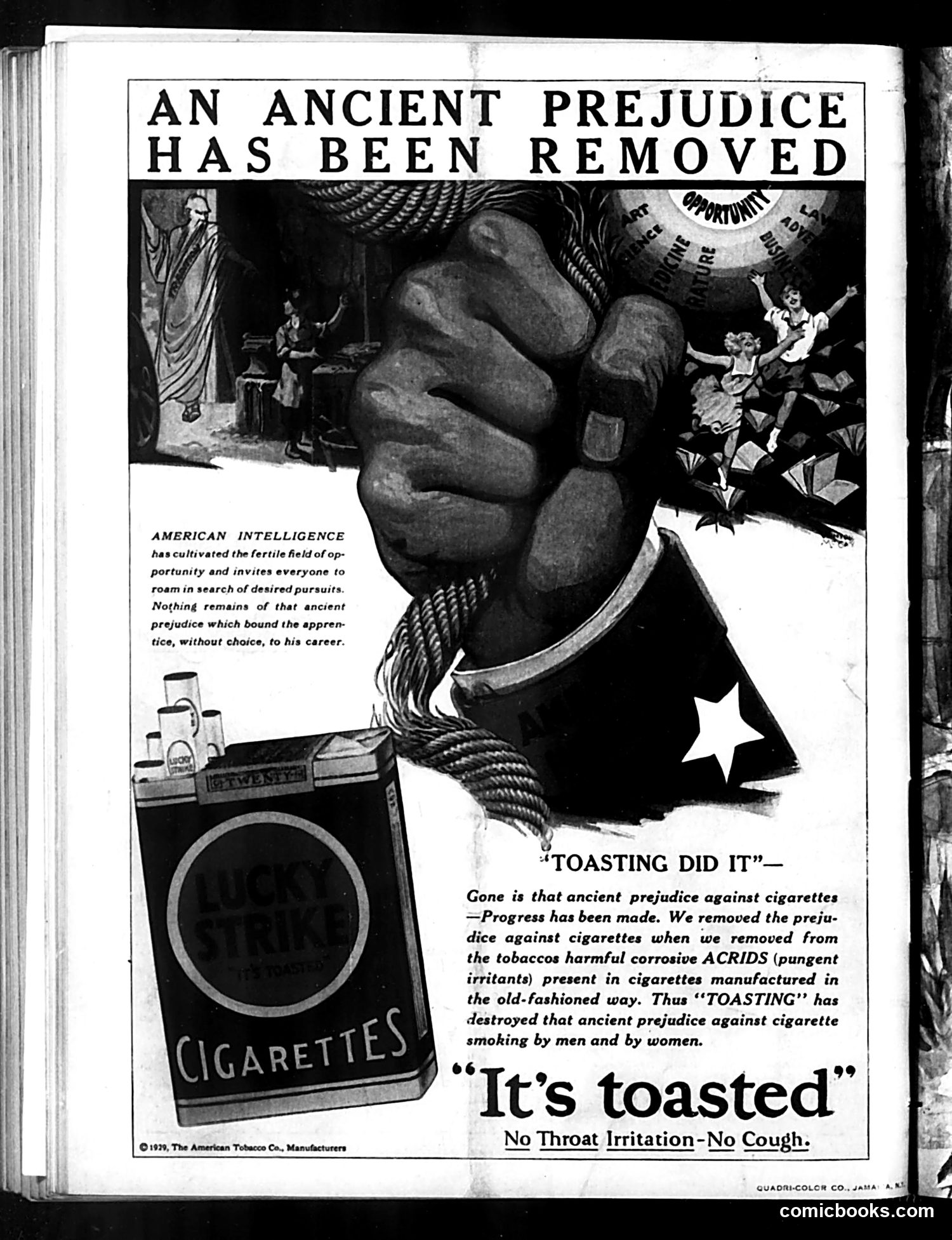
Analysis This is a Lucky Strike cigarette advertisement disguised as social commentary. The "ancient prejudice" framing is ironic propaganda. The ad equates removing prejudice against cigarettes with removing outdated social restrictions on apprentices' career choices—falsely positioning smoking as "progress" and "American intelligence." The grotesque head illustration symbolizes how prejudice was supposedly "removed." The core claim: Lucky Strike's "toasting" process eliminates harmful "ACIDS" (irritants), making cigarettes safe for "men and by women"—notably emphasizing female smokers, as cigarette companies actively marketed to women in this era to expand their market. The satire is unintentional from a modern perspective: what appears in Judge as clever advertising actually reveals how tobacco companies weaponized progressive rhetoric about freedom and opportunity to normalize smoking. The "prejudice" being eliminated was resistance to cigarettes themselves—reframed as enlightened social progress.