judge
Judge — November 30, 1929
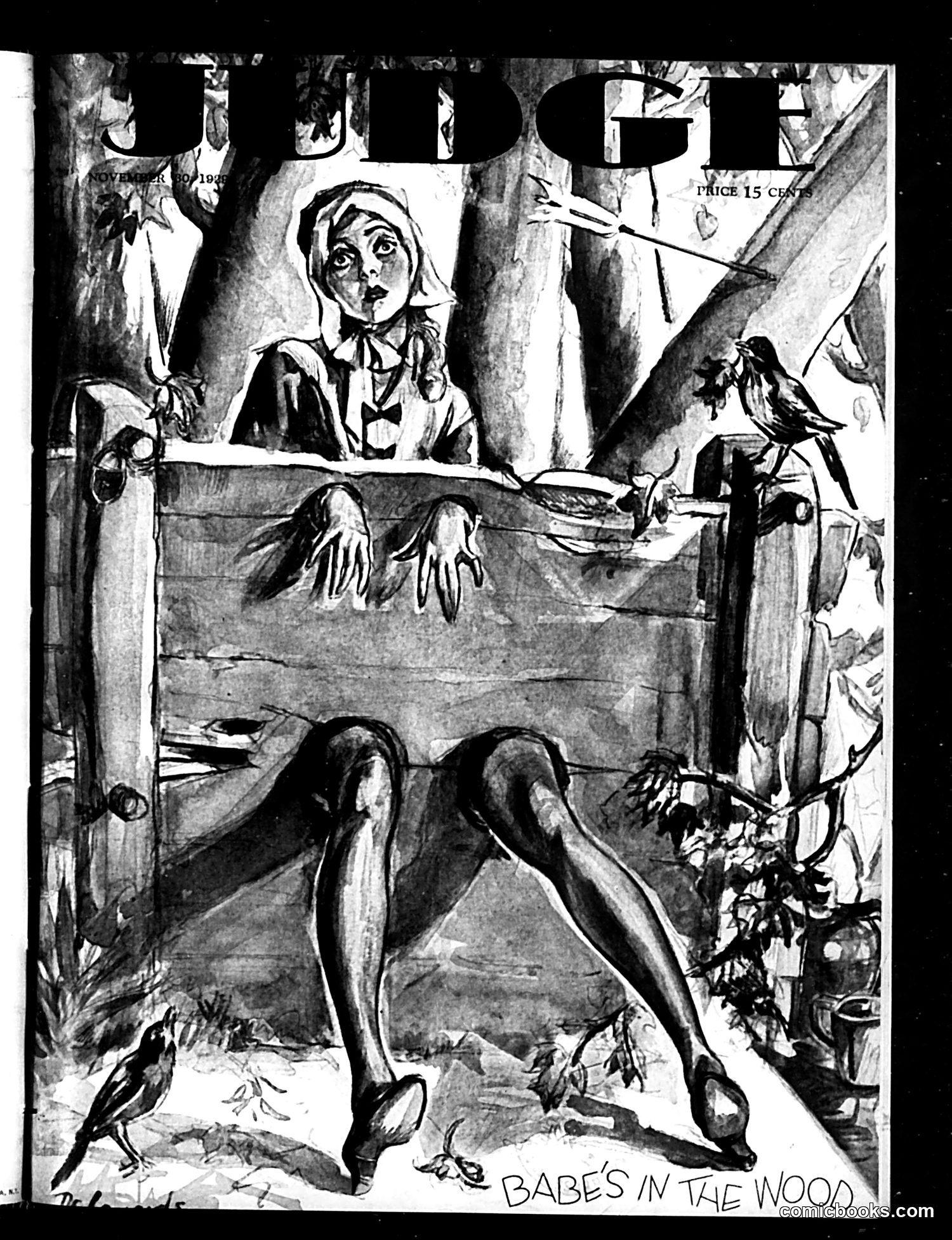
"Babes in the Wood" - Judge Magazine Cartoon This cartoon illustrates the classic fairy tale "Babes in the Wood," where two lost children perish in a forest. The image shows a woman peering from behind wooden slats (suggesting a coffin or enclosure) with two figures below displaying their legs prominently. The caption "BABES IN THE WOOD" indicates this is likely a satirical commentary using the fairy tale as allegory. The composition suggests commentary on vulnerability, abandonment, or peril—possibly referencing contemporary social or political issues affecting women or children. The suggestive pose and the magazine's satirical nature suggest this may be social commentary on exploitation or endangerment, though the specific historical reference requires additional context to definitively identify the intended targets or scandal being mocked.
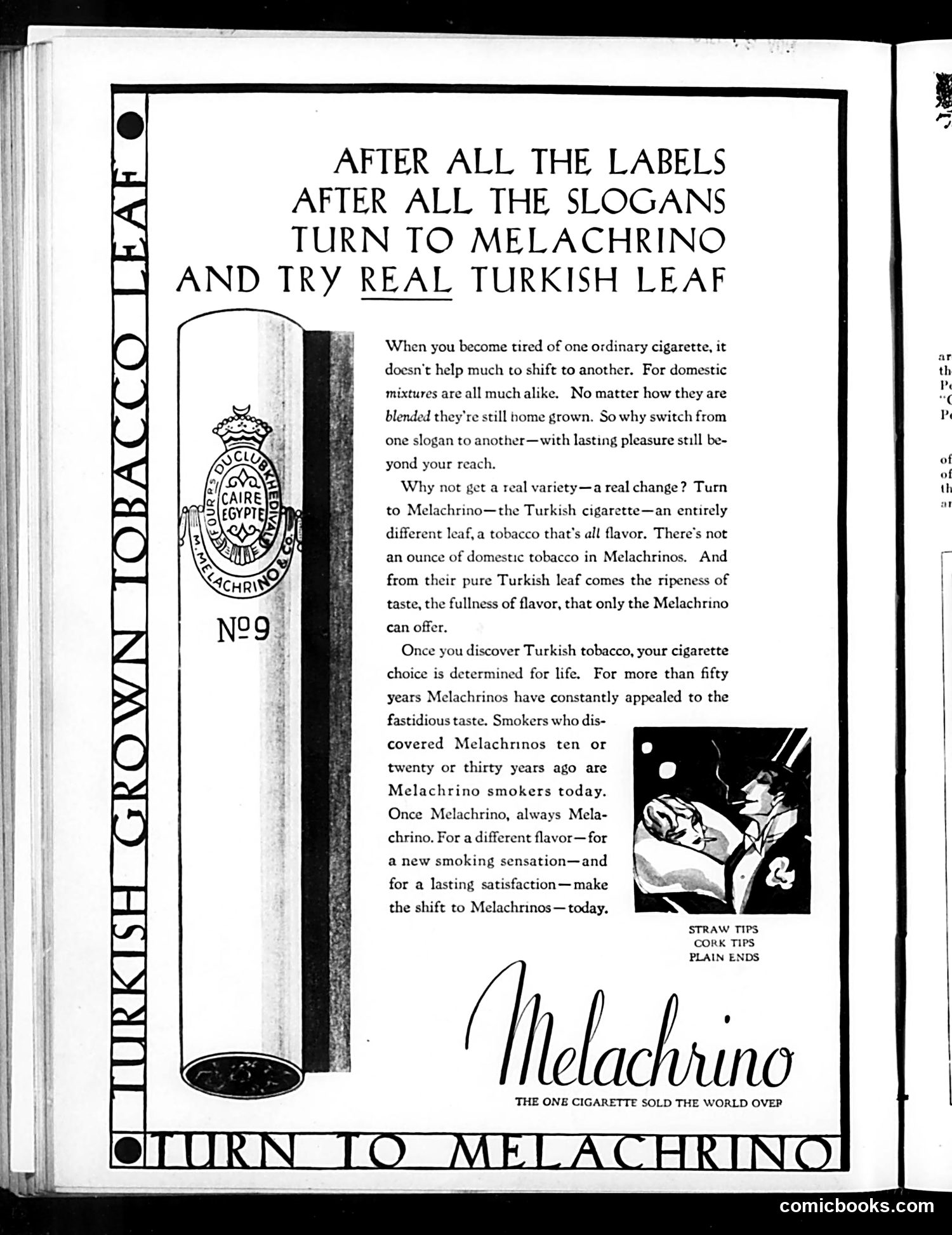
Analysis This page is primarily a cigarette advertisement, not political satire. It's a full-page ad for Melachrino Turkish cigarettes, published in *Judge* magazine. The ad argues that switching between different domestic cigarette brands offers no real variety—they're all similar. It pitches Melachrino as genuinely different, being pure Turkish leaf rather than American-blended tobacco. The copywriting emphasizes that Turkish tobacco provides superior "ripeness of taste" and "fullness of flavor." The small illustration shows someone smoking contentedly. The left margin features the cigarette package and branding. This reflects early-20th-century advertising strategy: using magazines' editorial space to position premium imported cigarettes as sophisticated alternatives to mass-market American brands. No political commentary is evident—it's purely commercial persuasion.
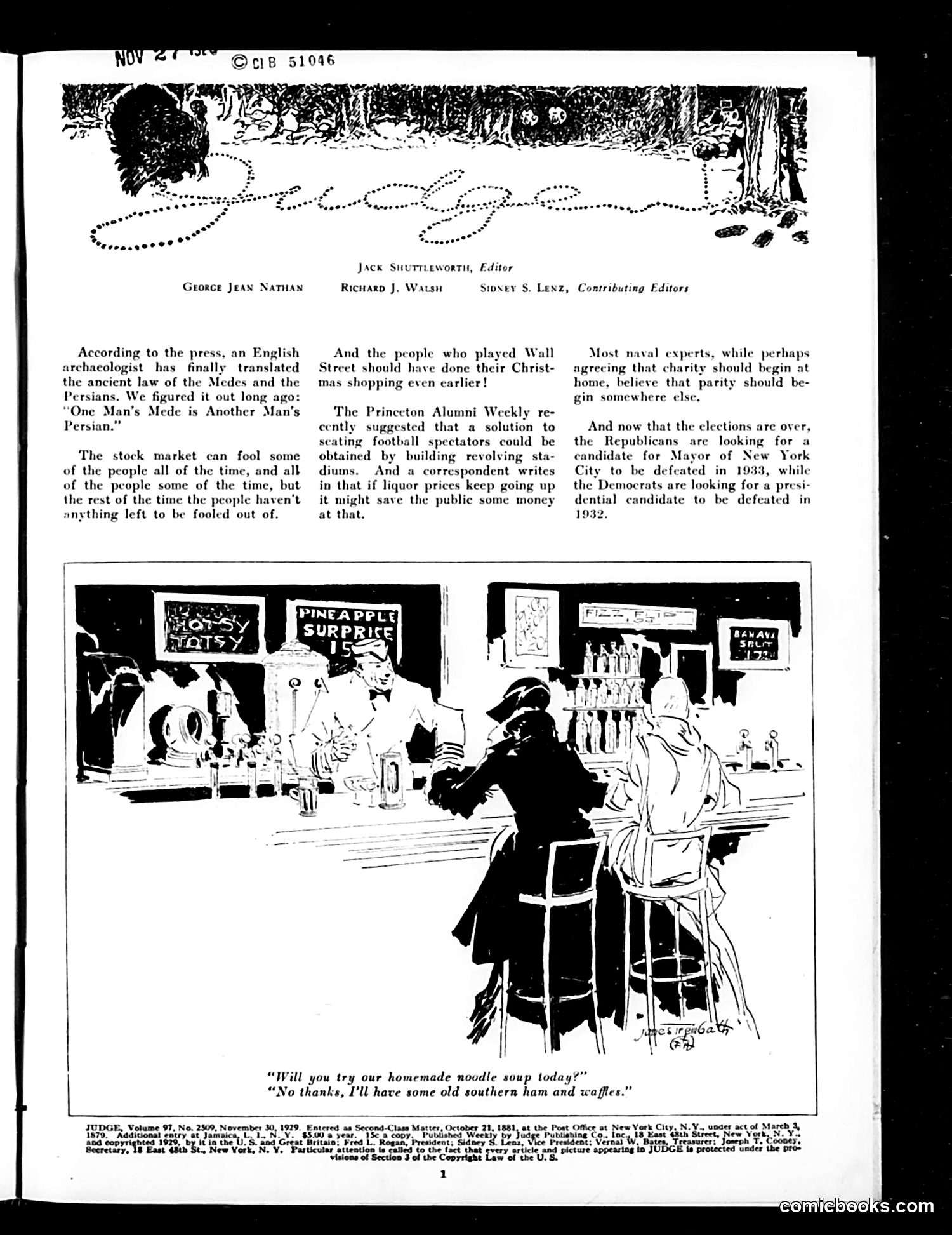
Analysis This page from *Judge* (November 30, 1929) contains satirical commentary and a cartoon. The text discusses several contemporary issues: an English archaeologist's translation of Persian law; stock market speculation fooling the public; football stadium seating solutions; and upcoming mayoral elections in New York City, referencing both Republican and Democratic candidates for 1932. The cartoon depicts a diner scene where a server offers "homemade noodle soup" to a customer who declines, preferring "old southern ham and waffles." The satire likely mocks Depression-era economic hardship—the irony being that "homemade noodle soup" represents affordable but unappetizing necessity, while the customer clings to fancier Southern foods as a status symbol despite economic constraints. The joke highlights Americans' reluctance to accept economic reality during the early Great Depression.
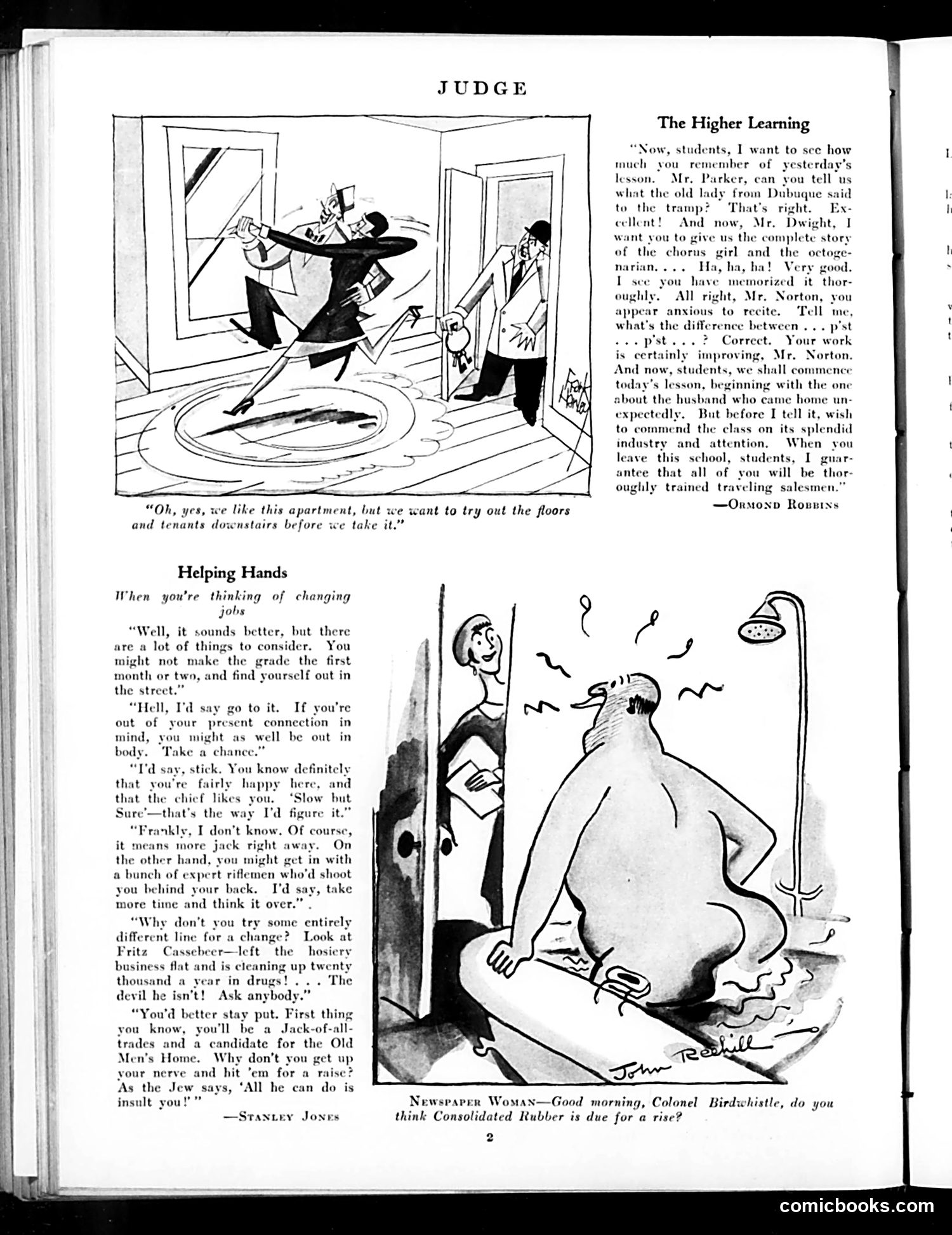
Analysis of Judge Magazine Page This page contains two separate pieces of humor: "The Higher Learning" (top) satirizes classroom pretension. A teacher quizzes students on culture and literature, emphasizing proper elocution and refined behavior. The humor targets academic pomposity and the gap between the teacher's aspirations to produce "thoroughly trained traveling salesmen" and actual student interests. "Helping Hands" (bottom) presents a conversation about career changes, likely referencing contemporary job-switching anxieties. The dialogue between characters discusses whether to leave a comfortable position, with references to "Fritz Cassebeer" (appears to be a known figure) and commentary on Jewish experience ("All he can do is insult you!"). The accompanying cartoon shows a nude man in a bathtub with a shower head, captioned as a "Newspaper Woman" asking about a Colonel's due for a raise—its satirical point is unclear without additional context.
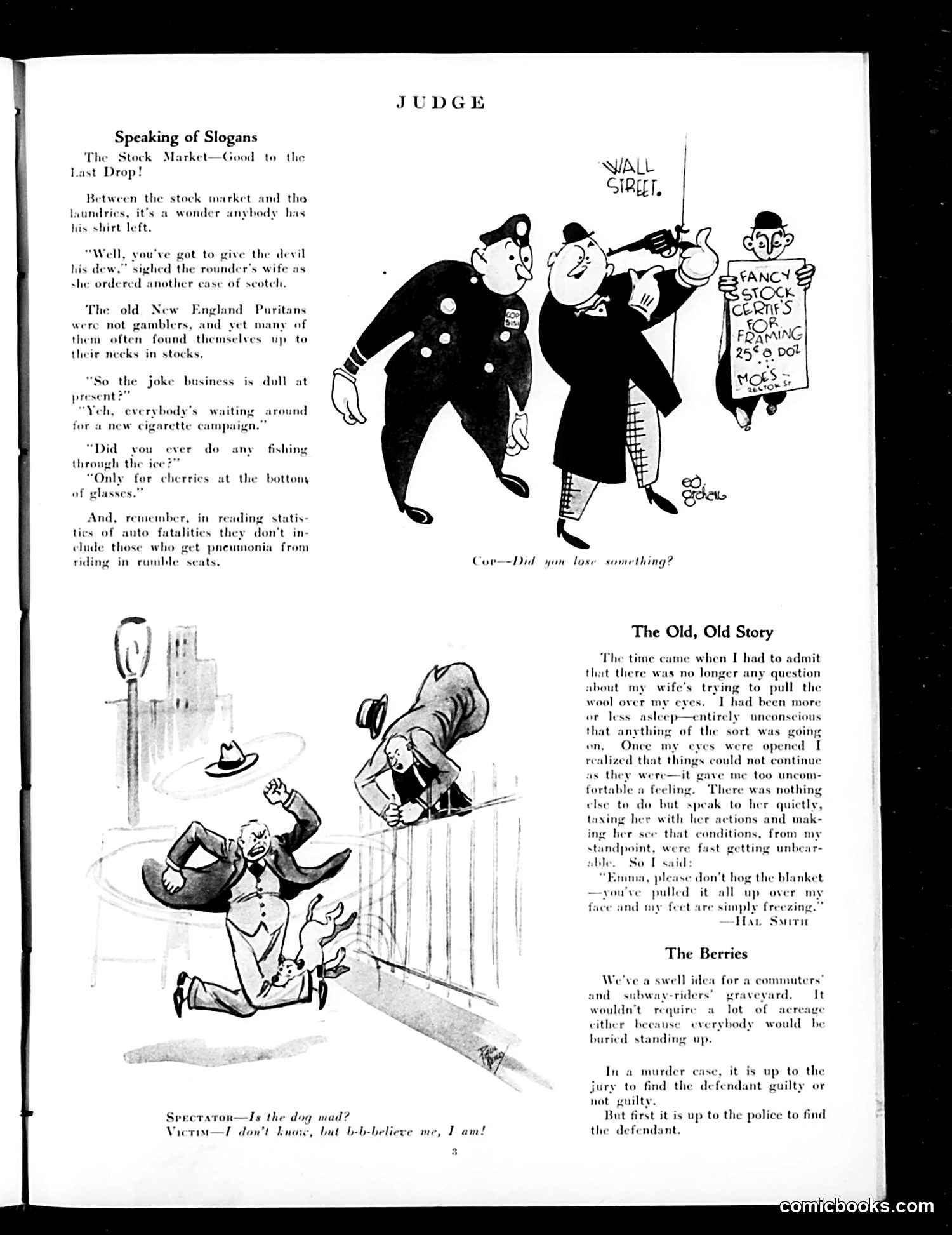
Analysis of Judge Magazine Page Top Cartoon ("Wall Street"): Two stock market traders confront a disheveled figure labeled with financial crimes and stock schemes. The satire targets Wall Street fraud and market manipulation—common concerns during economic downturns. The specific schemes mentioned (framing 25% margins, mobs) suggest this addresses contemporary stock market abuses, though the exact historical moment is unclear without dating. Bottom Cartoon ("Spectator-Is the dog mad?"): A slapstick scene of someone falling while a dog causes chaos. This appears to be simple physical comedy rather than political satire. Articles: "The Old, Old Story" and "The Berries" contain mild domestic and legal humor unrelated to the cartoons. The page primarily satirizes financial corruption through exaggerated caricature and visual chaos.
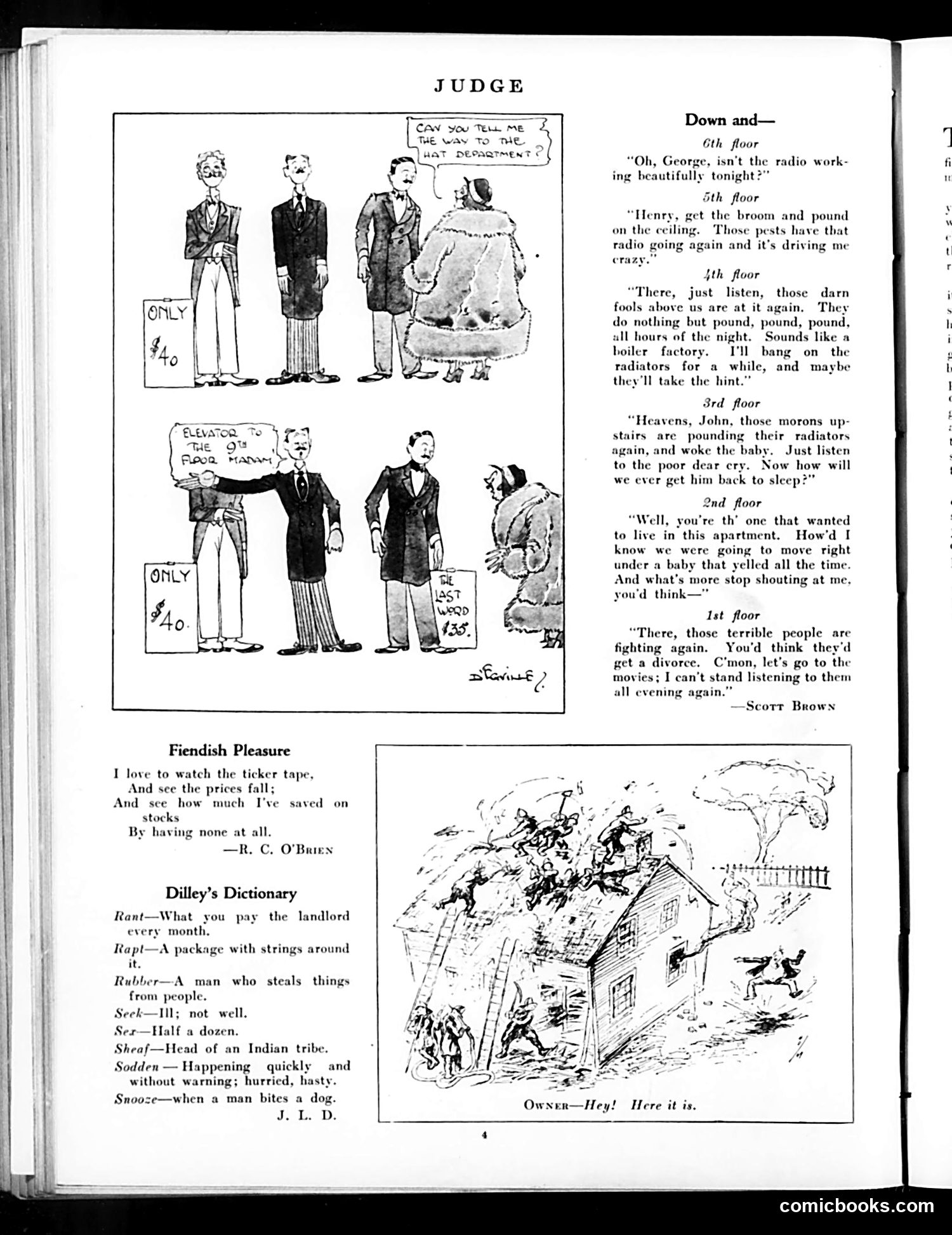
Judge Magazine Page Analysis The main cartoon satirizes apartment hunting and rental disputes. It shows three men (prospective tenants) viewing apartments marked "ONLY $40," with a landlord quoting inflated prices. The humor targets the disconnect between advertised and actual rental costs—a perennial urban complaint. The "Down and—" section presents neighbors complaining across multiple floors about noise: a radio upstairs, pounding on ceilings, children crying, and fighting couples. This satirizes the shared miseries of apartment living and how tenants blame each other rather than addressing root problems. The surrounding content includes humorous dictionary definitions and a Western sketch about pursuing a fugitive. The overall tone mocks both predatory landlords and the chaotic frustrations of urban apartment dwelling in what appears to be the early-to-mid 20th century.
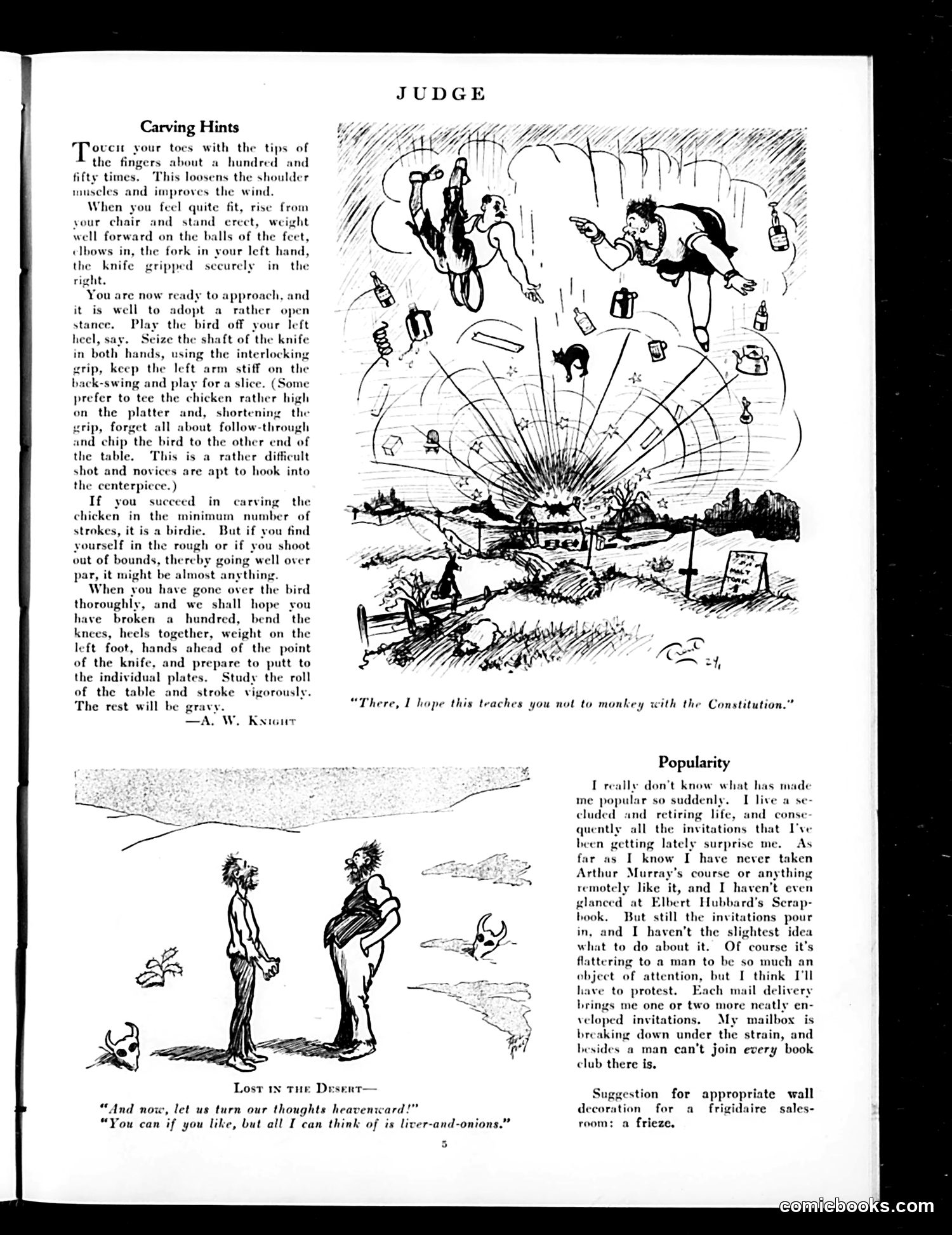
Analysis of Judge Magazine Page This page contains three unrelated sections: 1. "Carving Hints" by A.W. Knight—a humorous instructional piece on proper carving technique at dinner, written in mock-serious etiquette-guide style. 2. A large political cartoon showing explosions raining down on a landscape with the caption "There, I hope this teaches you not to monkey with the Constitution." This appears to reference constitutional conflict, likely from the early 20th century, though the specific dispute is unclear without dating information. 3. "Popularity" section—a personal essay about receiving unexpected social invitations, seemingly autobiographical commentary on the author's social life. 4. "Lost in the Desert" cartoon showing two thin men, with dialogue about "liver-and-onions." The page blends satirical commentary, practical humor, and personal reflection typical of Judge magazine's eclectic format.
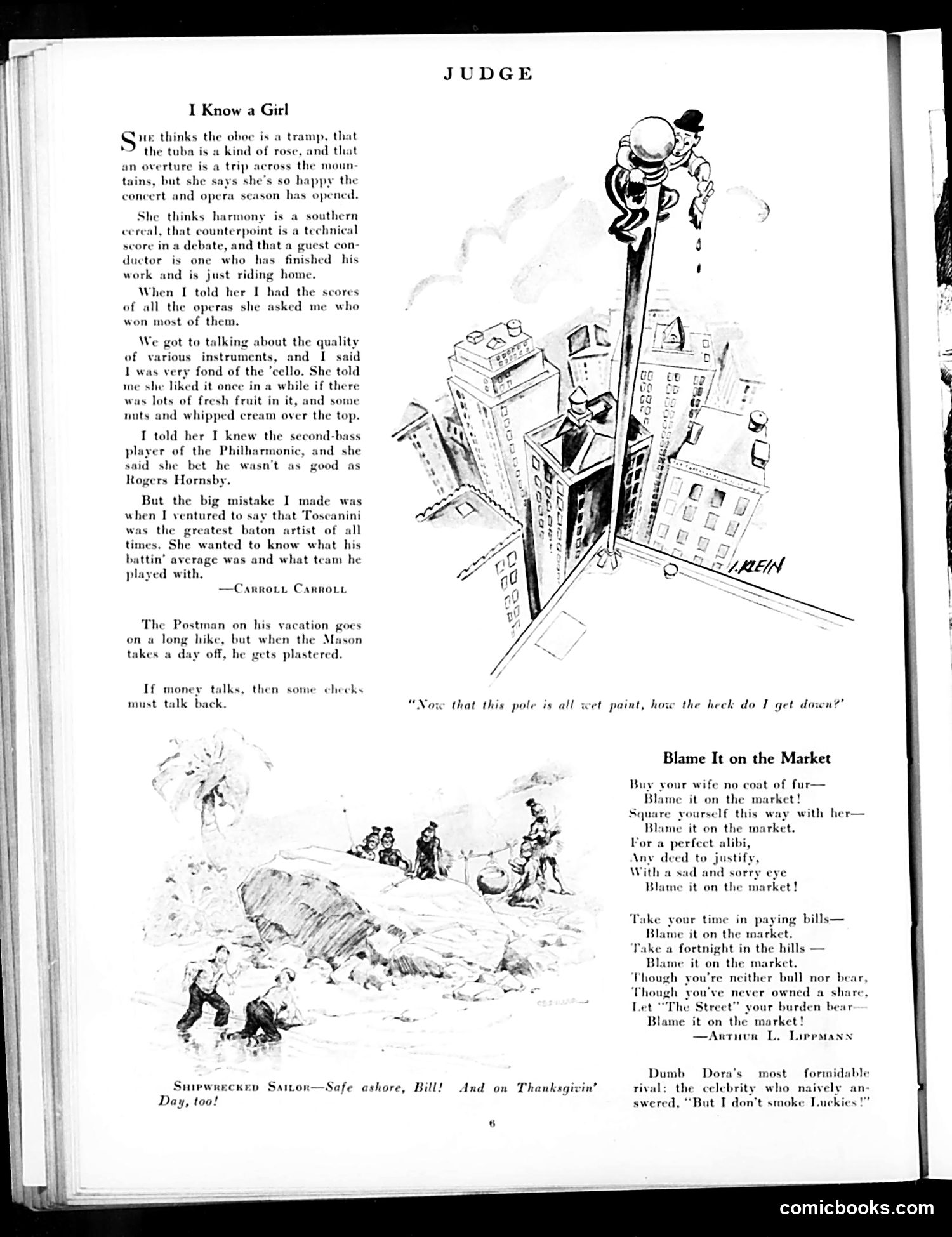
Analysis of Judge Magazine Page This page contains several satirical pieces lampooning middle-class anxieties and social pretensions circa early 20th century. The top cartoon shows a man atop a skyscraper conducting an orchestra, satirizing pretentious musical discussion. The accompanying text by Carroll Carroll mocks a woman who confuses operatic terminology with actual musical knowledge—she mistakes instruments, composers, and performers, exposing shallow cultural affectation. Below, "Blame It on the Market" by Arthur L. Lippmann uses rhyming verse to satirize how spouses blame external economic forces for financial irresponsibility—buying expensive coats or failing to pay bills while crediting "the market" rather than acknowledging personal excess. The bottom sketch depicts a shipwrecked sailor, likely commentary on maritime disaster or economic hardship, though context is limited. The humor targets pretension, financial irresponsibility, and marital blame-shifting among the middle class.
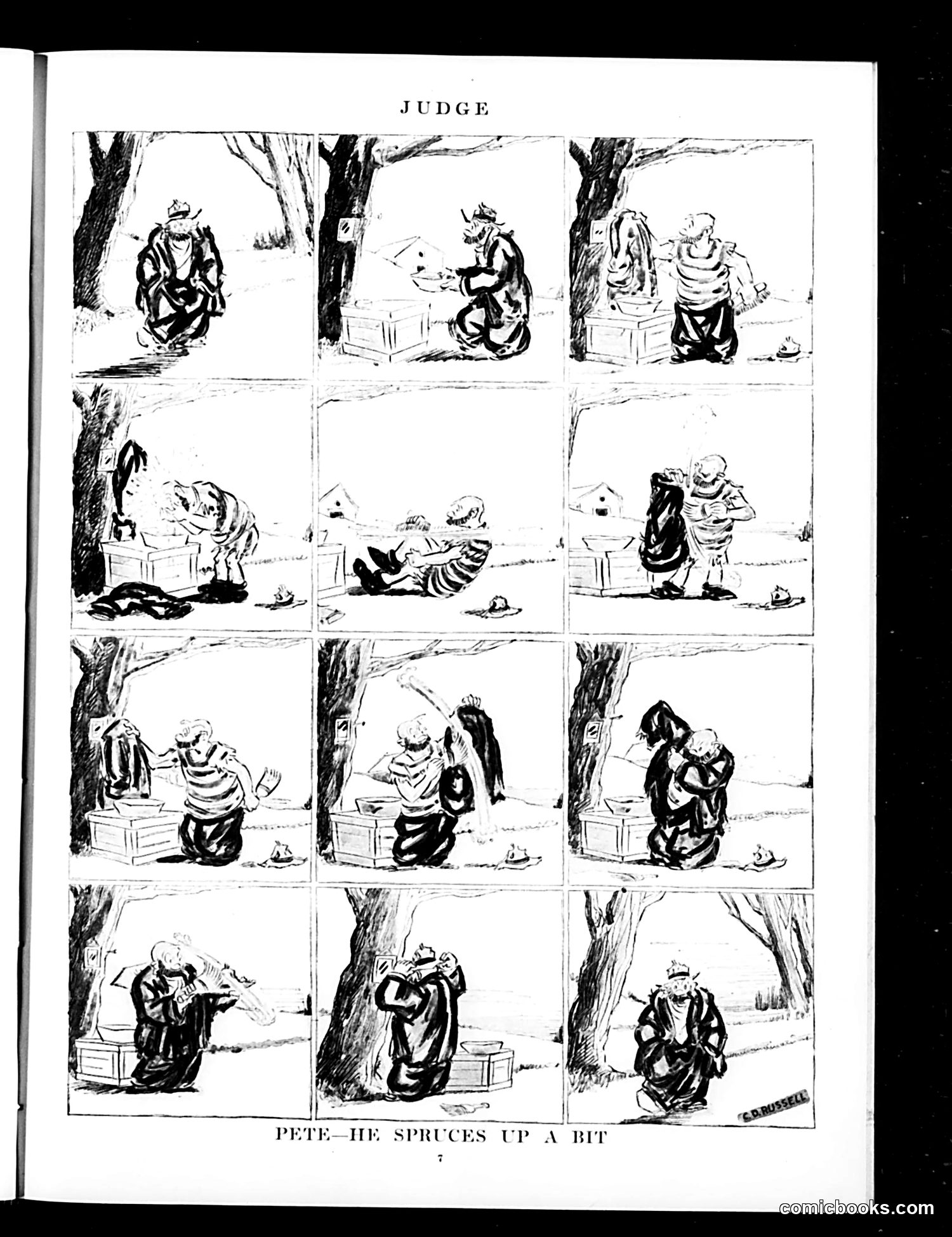
Analysis This is a 12-panel comic strip titled "Pete—He Spruces Up a Bit" from *Judge* magazine. The panels show a man named Pete gradually improving his appearance and behavior while sitting on a bench near a tree. The narrative appears to show Pete transforming from a slovenly, disheveled figure into a more respectable-looking gentleman through a series of grooming and behavioral adjustments—straightening his clothes, improving his posture, and becoming more presentable. The satire likely comments on self-improvement, social climbing, or the performative nature of respectability—suggesting that Pete is "sprucing up" his outward appearance, possibly to impress someone or gain social acceptance. Without additional context about the specific time period or *Judge*'s editorial stance, the exact satirical target remains unclear, though it appears to mock either vanity or superficial social advancement.
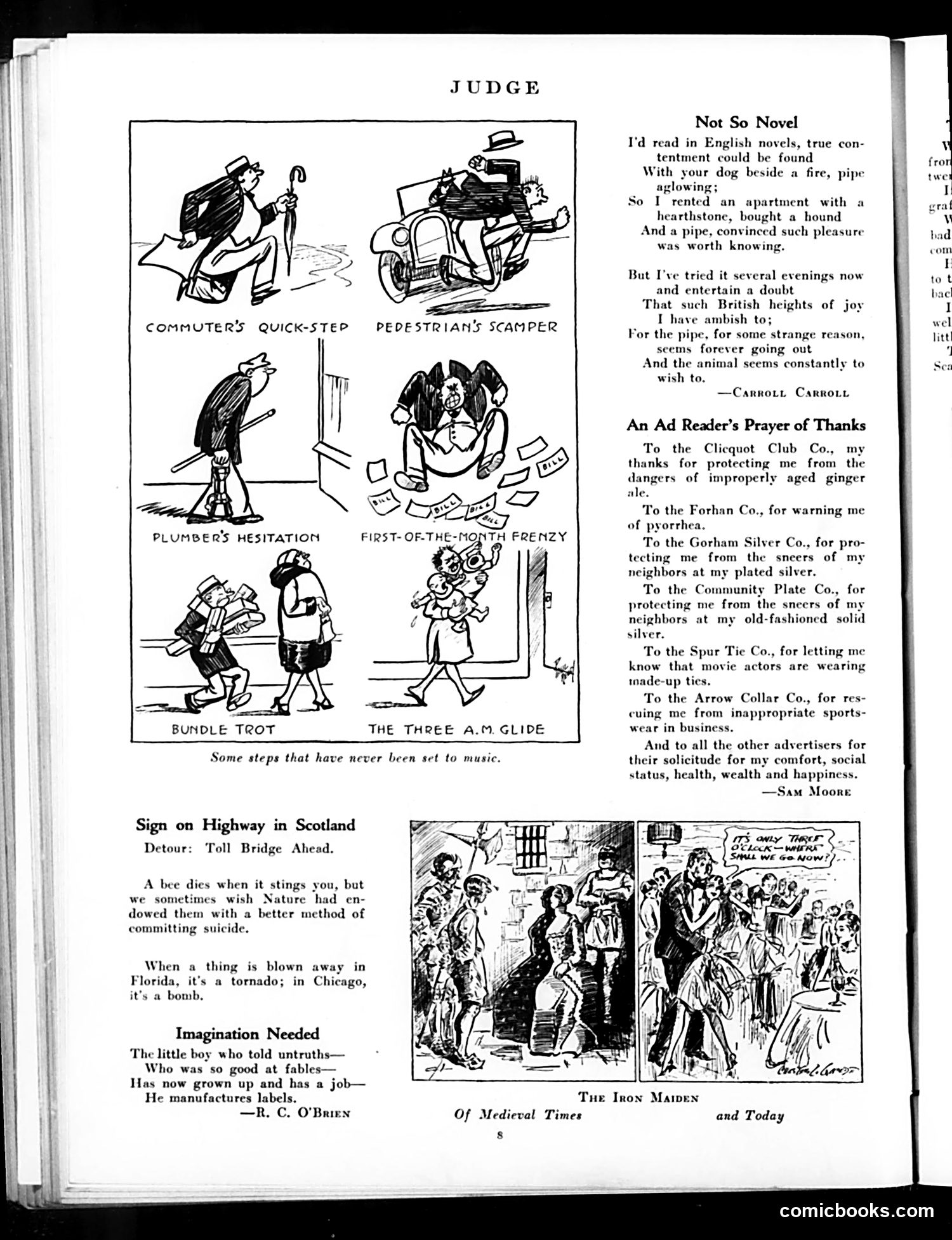
Analysis of Judge Magazine Page This page contains early 20th-century American humor satirizing modern urban life and advertising culture. "Some Steps That Have Never Been Set to Music" is a six-panel cartoon depicting exaggerated walking styles: commuters rushing, pedestrians fleeing, bill collectors frantically pursuing debtors ("First-of-the-Month Frenzy"), plumbers hesitating nervously, and people stumbling home drunk at 3 AM. The humor targets urban workers' hectic lives and financial anxiety. "Not So Novel" mocks the romanticized British literary ideal of contentment—a man, dog, and pipe by the fire—revealing reality: the pipe won't stay lit and the dog constantly wants out. It satirizes unrealistic expectations from literature. "An Ad Reader's Prayer of Thanks" is satirical commentary on advertising's manipulation. Moore ironically "thanks" various brands for creating artificial social anxieties—anxiety about ginger ale quality, silver plating, dental disease, improper neckwear—that only their products supposedly solve. This critiques how advertising exploits consumer insecurity. The remaining pieces are light political/social commentary on various topics, typical of Judge's satirical approach.
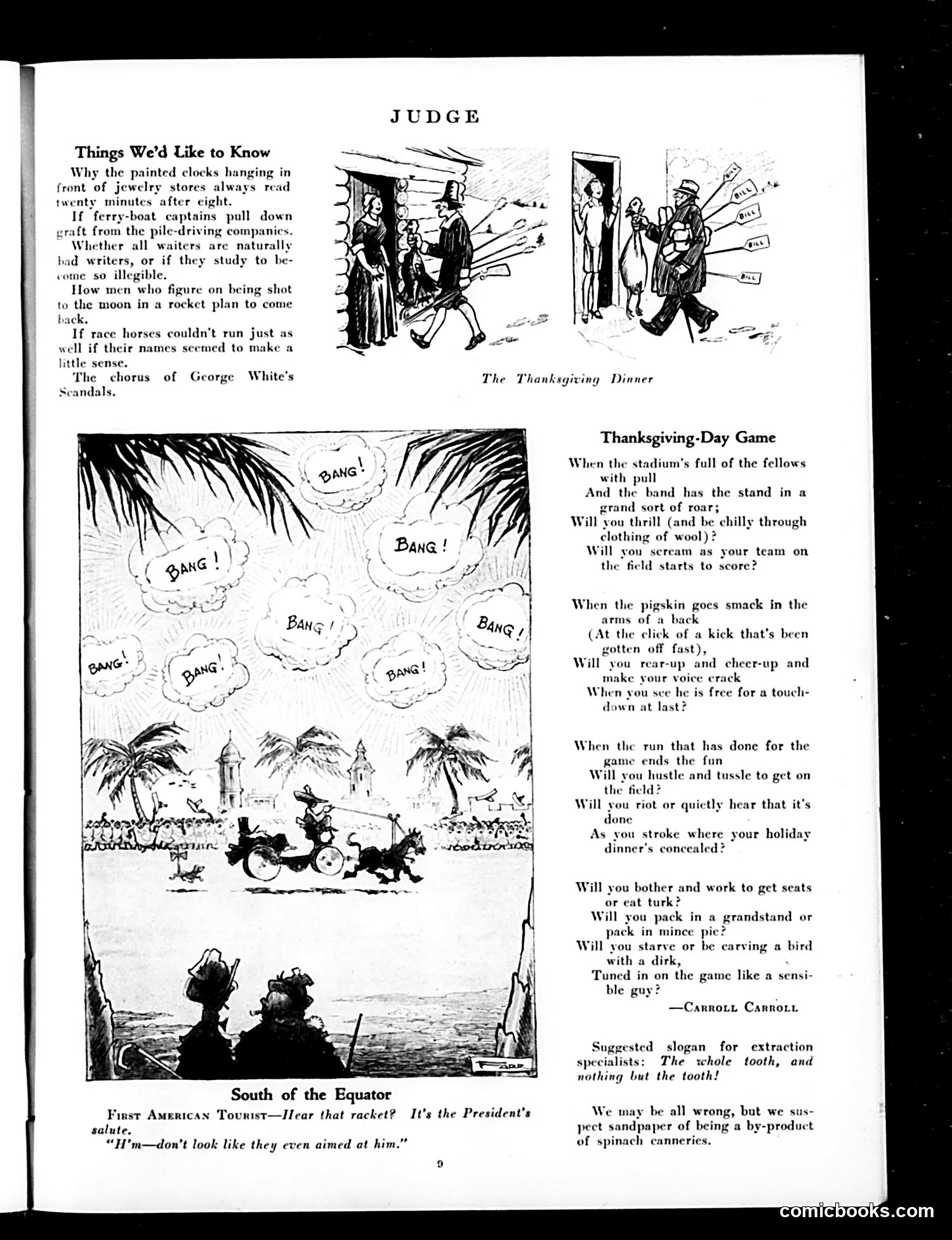
Judge Magazine Page Analysis This page from Judge contains several satirical pieces targeting American society and politics: "Things We'd Like to Know" presents humorous observations about everyday oddities—jewelry store clocks always showing 8:20, illegible waiter handwriting, and absurd racehorse naming conventions. "Thanksgiving-Day Game" is a poem by Carroll Carroll satirizing fair-weather football fans, mocking those who attend games for social status ("fellows with pull") rather than genuine enthusiasm, and those who prioritize eating holiday dinner over actually watching the game. "South of the Equator" cartoon depicts an American tourist observing gunfire, assuming it's a presidential salute but noting the shots seem poorly aimed—likely satirizing either Latin American political instability or the incompetence of foreign militaries. The final item mocks extraction specialists' advertising slogans, while another brief joke suggests spinach canneries produce sandpaper as a byproduct—pure absurdist humor typical of Judge's style.
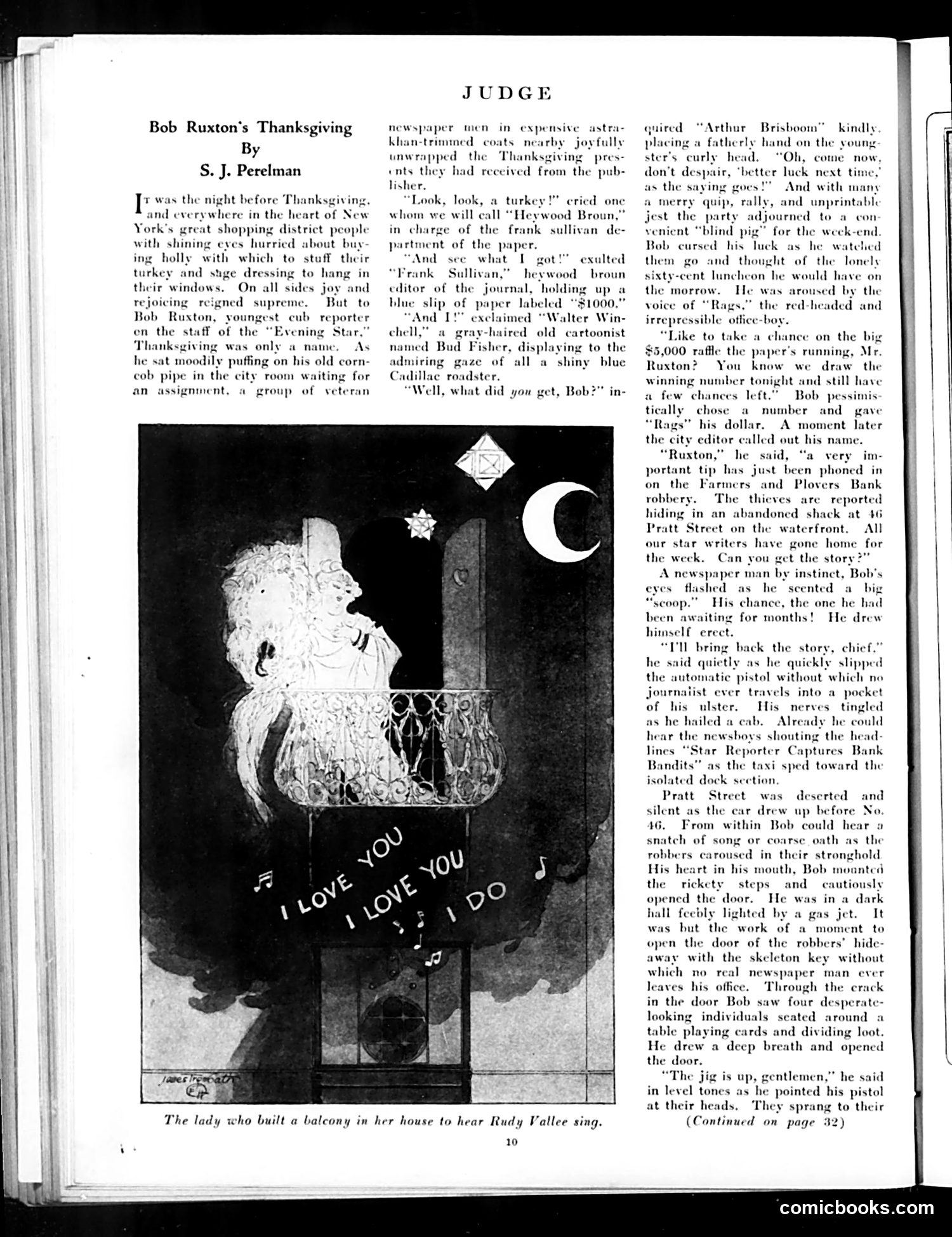
"Bob Ruxton's Thanksgiving" by S. J. Perelman This is a humorous short story (not primarily a political cartoon) satirizing the newspaper world. The narrative mocks the contrast between established journalists receiving lavish Thanksgiving gifts and young cub reporter Bob Ruxton, who gets nothing. The story references real or fictional newspaper figures of the era: "Heywood Broun," "Frank Sullivan," "Walter Winchell," and "Arthur Brisbane"—prominent journalists whom Perelman playfully names characters after. The illustration shows a woman on a balcony singing along to radio personality Rudy Vallée, contemporary cultural reference. The satire targets newspaper hierarchies and the romanticized "hard-boiled reporter" archetype: Ruxton compensates for his mundane position by pursuing a dangerous bank robbery story solo, armed with a pistol. Perelman gently ridicules both the journalism profession's competitive culture and the era's adventure-story conventions about intrepid newsmen.
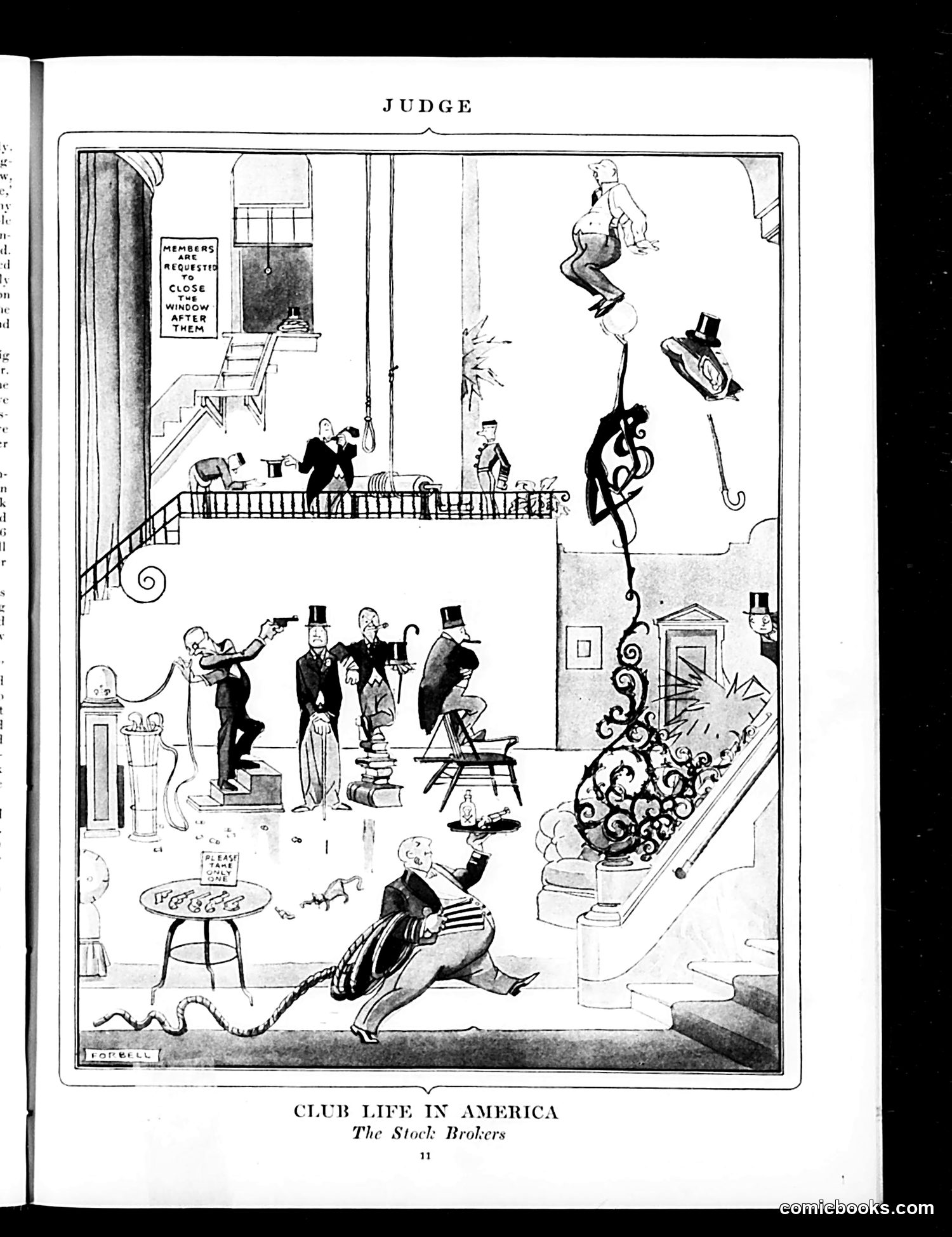
Judge Magazine: "Club Life in America - The Stock Brokers" This satirical cartoon depicts chaos at what appears to be an exclusive gentlemen's club where stock brokers gather. The scene shows well-dressed men in top hats engaged in frantic, undignified behavior—climbing walls, swinging from fixtures, grappling with each other, and generally behaving wildly. One man appears to be being chased or pursued across the floor. The satire mocks stock brokers as lacking the refined composure expected of club members. The cartoon suggests they are so obsessed with financial speculation and competition that they abandon all propriety and decorum when gathered together. The anarchic scene contrasts sharply with the club's formal setting and the posted sign requesting members "close the doors after them." This reflects contemporary anxieties about financial markets and the perceived volatility and questionable ethics of stock trading.
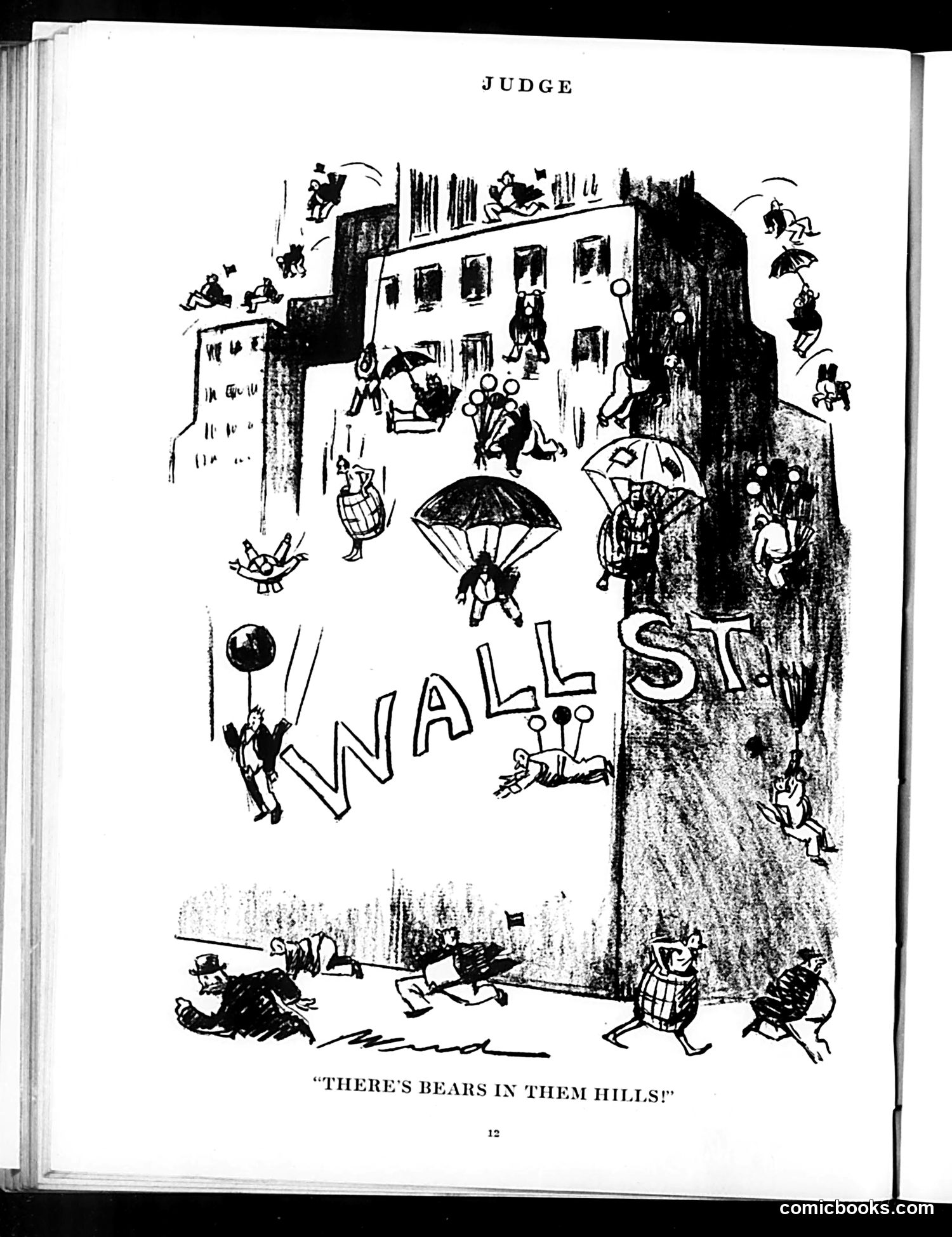
Analysis This cartoon satirizes panic or hysteria about a perceived threat. The massive fortified structure labeled "WALL ST." is under siege by figures descending from hills via parachutes and ropes. The caption "There's Bears in Them Hills!" references both the financial term "bears" (investors expecting market decline) and evokes a frontier warning cry. The imagery suggests Wall Street financiers are alarmed by economic threats approaching from outside their fortress. People are depicted fleeing, defending, or reacting with alarm within and around the building. The style and setting suggest early-to-mid 20th century Judge magazine satire, likely mocking wealthy financiers' anxiety about economic forces—whether labor movements, market crashes, or external economic pressure—beyond their control.
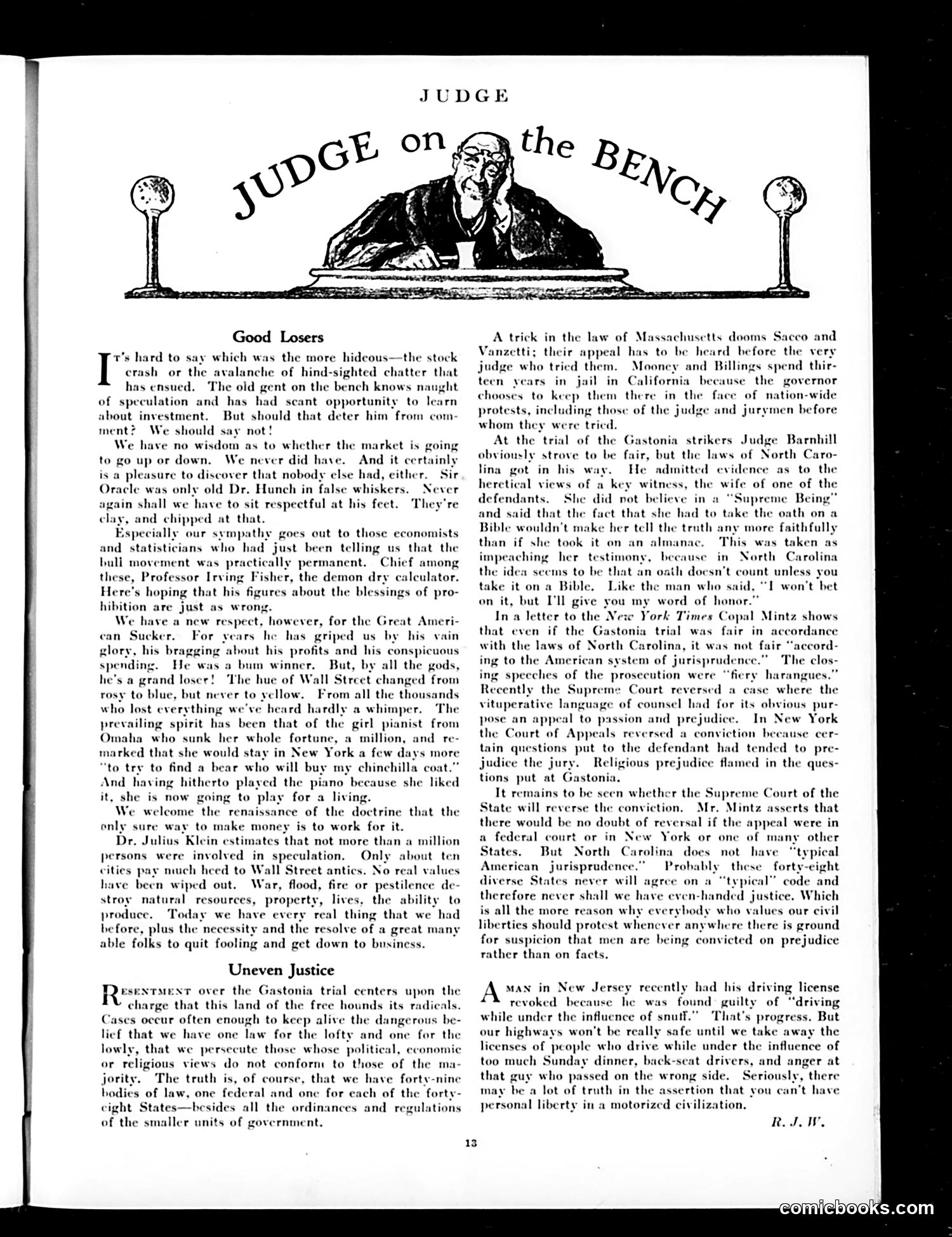
"Judge on the Bench" — A Critique of Post-Crash Commentary and Uneven Justice This two-part editorial page from *Judge* magazine addresses the 1929 stock market crash and the Gastonia trial. "Good Losers" mocks financial experts, particularly economist Irving Fisher, who confidently predicted the "permanent" bull market before the crash. The piece praises ordinary investors for their dignified response to losses while ridiculing the economists and speculators who profited beforehand but offered "hind-sighted chatter" afterward. It celebrates a millionaire pianist who lost her fortune but maintained grace, arguing the crash actually benefits America by forcing people back to honest work rather than speculation. "Uneven Justice" criticizes the Gastonia textile strike trials (1929), where strikers faced conviction while similar cases elsewhere received different treatment. The editorial highlights how a witness's refusal to swear on a Bible (due to her atheist beliefs) was used against defendants in North Carolina—illustrating how regional laws and prejudices create unequal justice. The piece cites comparable cases (Sacco-Vanzetti, Mooney-Billings) where political views influenced legal outcomes, suggesting America's forty-eight states effectively operate under different justice systems.
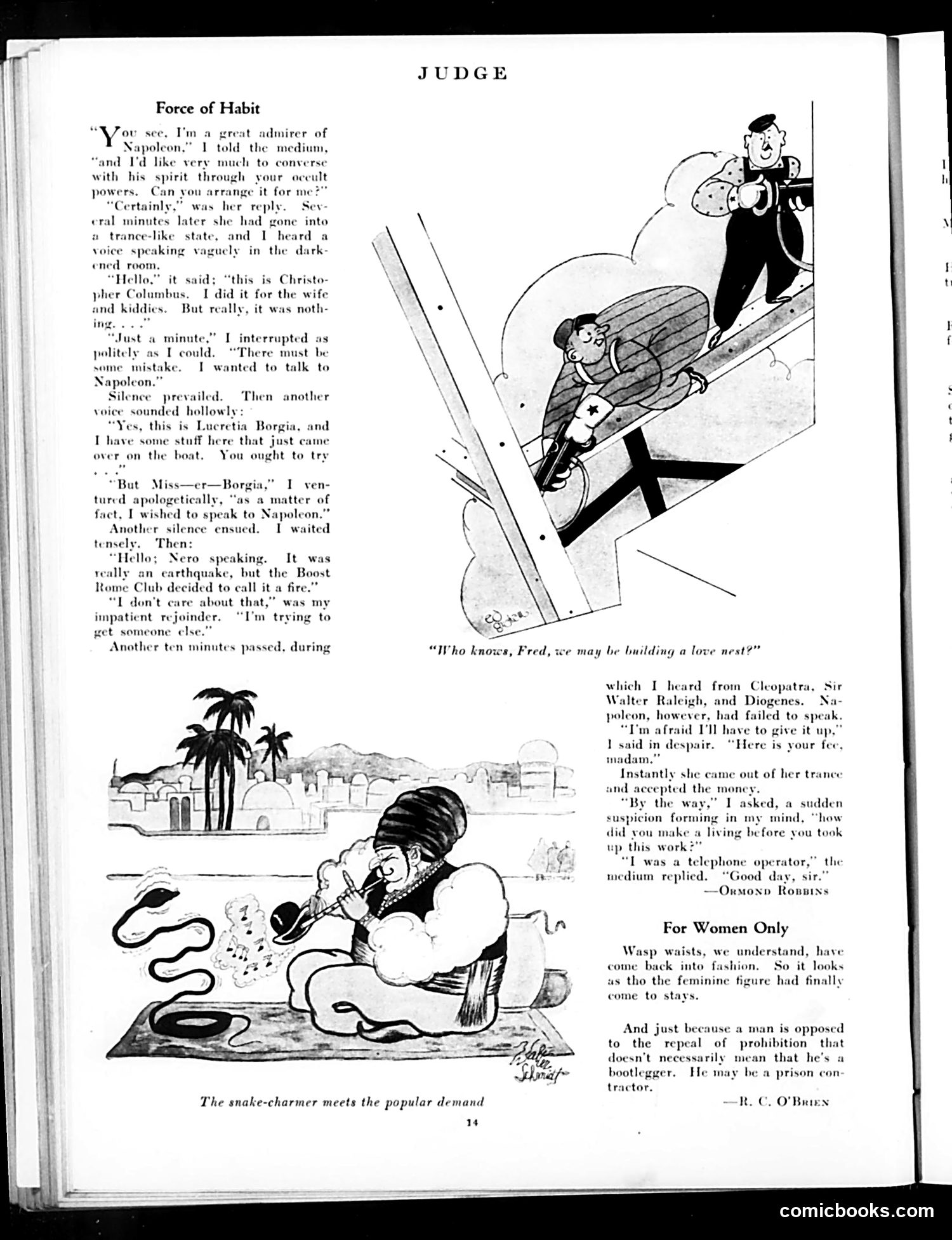
"Force of Habit" — Judge Magazine Satire This story satirizes spiritualist mediums and their fraudulent séances, popular in the early 20th century. A man seeks to contact Napoleon through a medium's "occult powers," but keeps reaching other famous historical figures (Columbus, Borgia, Cleopatra, Raleigh, Diogenes) instead—suggesting incompetence or that spirits don't actually cooperate with mediums' claims. The punchline reveals the medium's real profession: she was a telephone operator. The joke is "force of habit"—she's simply connecting callers to whoever comes through the line, just as she did with her telephone switchboard. This mocks both spiritualism's pretensions and suggests mediums are fundamentally con artists recycling ordinary skills. The accompanying cartoon about a snake charmer and the brief "For Women Only" quips about corsets and Prohibition appear unrelated filler pieces typical of Judge's mixed-content format.
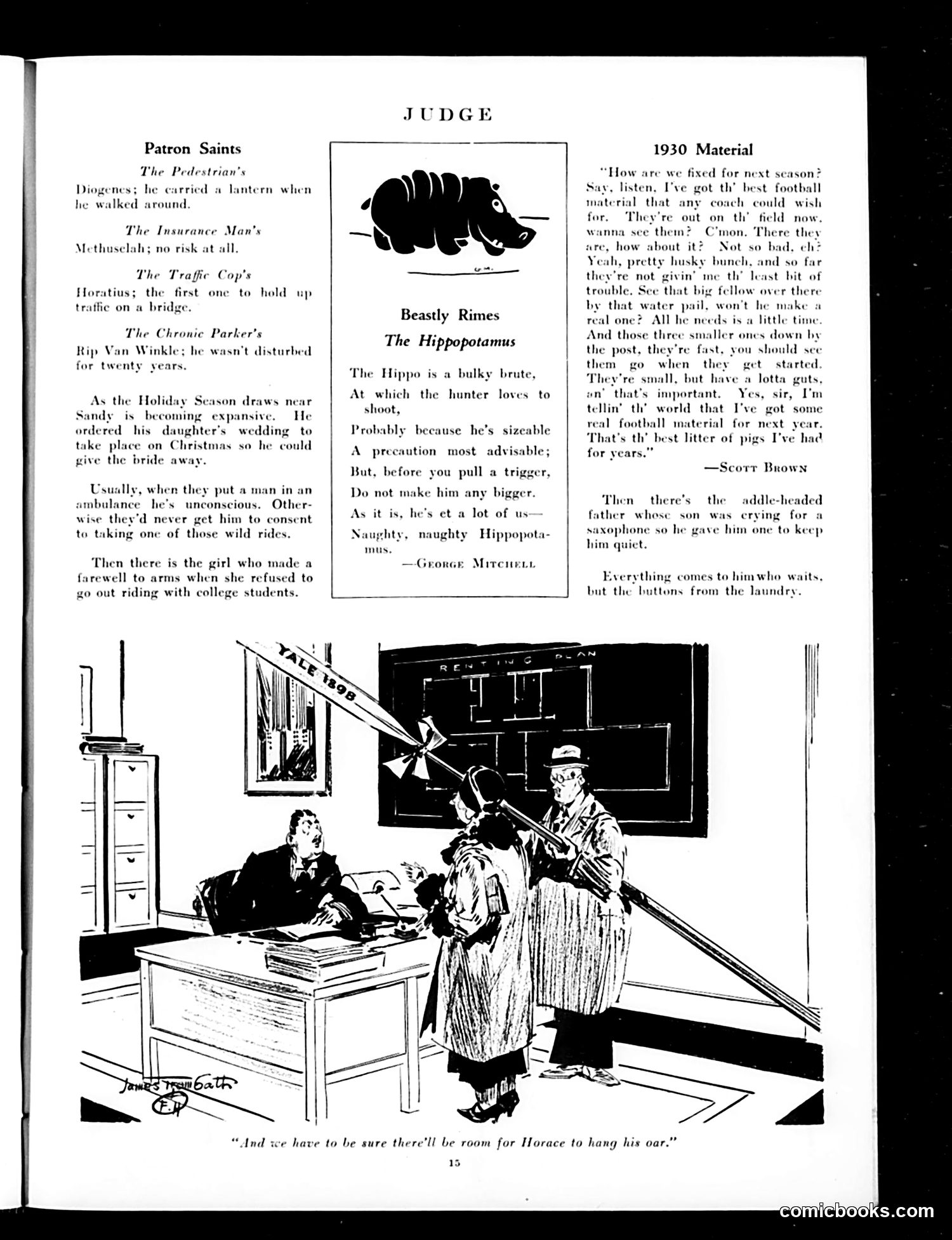
Analysis of Judge Magazine Page (1930) This page contains several satirical humor pieces typical of Judge's style: "Patron Saints" section mocks specific social types through ironic comparisons—the chronic parker to Rip Van Winkle (sleeping undisturbed for years), the traffic cop to Horatius (disrupting normal flow). The references ridicule everyday annoyances: inconsiderate parkers, reckless college students, and people who won't take ambulance rides. "Beastly Rimes" offers lighthearted verse about hippopotamuses, calling them "naughty" brutes—simple animal humor. "1930 Material" features a coach bragging about football recruits, but the joke—clarified in the cartoon below—is that his "material" consists of literal piglets. The coach describes their size and speed as if they were players, creating absurdist humor through the double meaning of "material." The cartoon depicts an office scene where a man holds a beam or oar, with the caption about making room for "Horace to hang his oar"—a visual pun playing on space constraints. The overall tone reflects Depression-era American humor: gentle, domestic, focusing on family life and common social frustrations rather than political commentary.
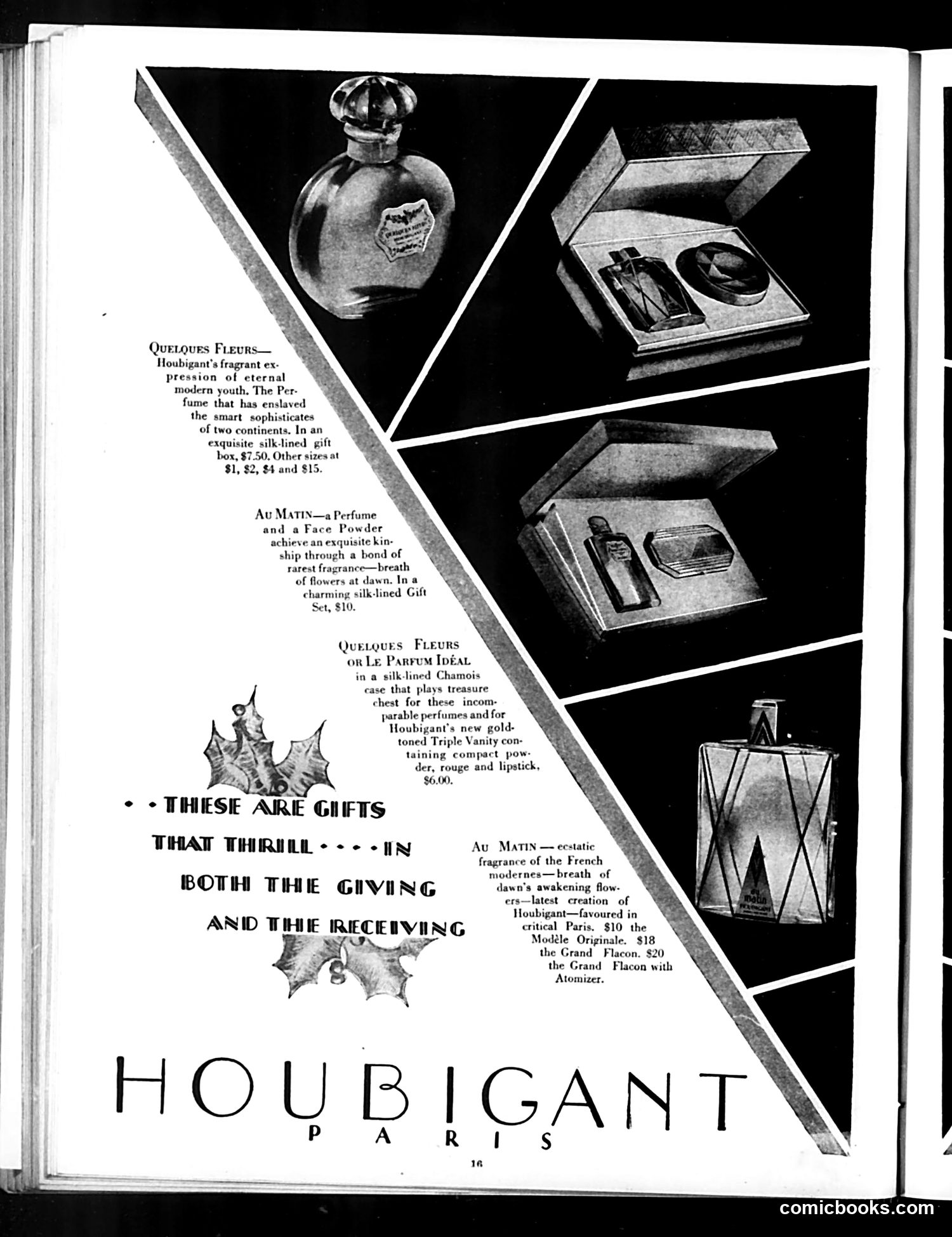
Analysis This is not a cartoon or satire page—it's a perfume advertisement for Houbigant Paris fragrances. The page showcases luxury French perfumes ("Quelques Fleurs," "Au Matin," "Le Parfum Idéal") in elegant gift packaging, with prices ranging from $6 to $20. The text emphasizes sophistication, appealing to wealthy consumers by highlighting that these perfumes have "enslaved the smart sophisticates of two continents." The decorative elements—ornate boxes, atomizers, and vanity sets in silk-lined cases—convey luxury goods targeting affluent gift-buyers. The central text ("These are gifts that thrill in both the giving and receiving") is pure advertising copy, not satire. Judge magazine context: Judge published both satire and paid advertisements. This page represents the commercial side of the publication, not editorial content. For modern readers, it documents 1920s-30s luxury consumer culture and marketing to wealthy Americans.
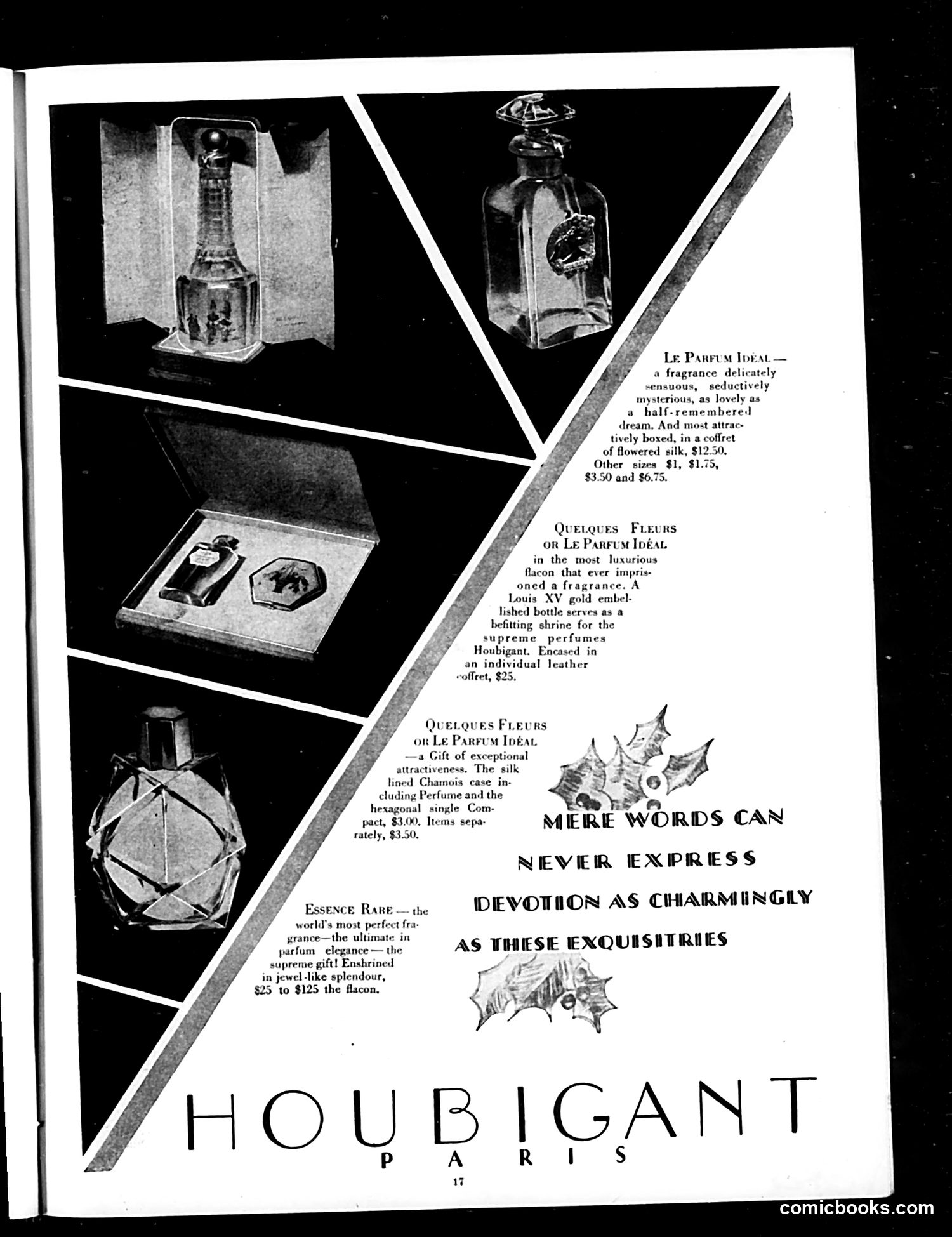
Analysis This is not a cartoon or satirical content—it's a luxury perfume advertisement for Houbigant Paris, a high-end French fragrance house. The page displays four product photographs showcasing different perfume bottles and packaging: "Le Parfum Idéal," "Quelques Fleurs," and "Essence Rare." The text uses flowery, romantic language typical of early 20th-century luxury marketing ("delicately sensuous," "mysterious," "supreme gift"). The central text—"Mere words can never express devotion as charmingly as these exquisitries"—is a marketing pitch suggesting perfume as an ideal romantic gift, playing on the emotional weight of gift-giving. The decorative holly leaf graphics reinforce this as likely holiday advertising. This represents Judge magazine's commercial advertising content rather than its satirical editorial material.
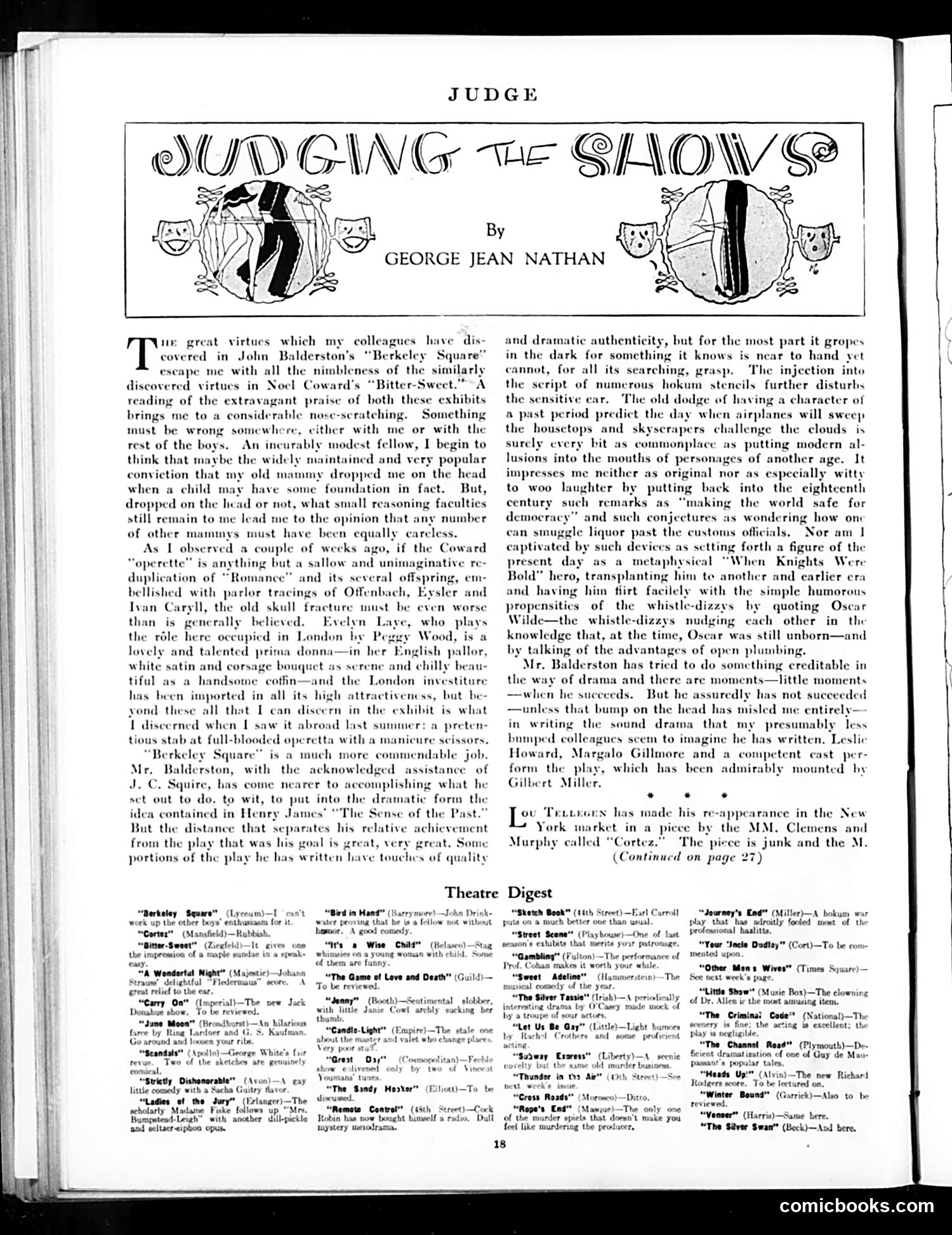
Judging the Shows: Theater Criticism from Judge Magazine This page contains theater criticism by George Jean Nathan reviewing Broadway productions. Nathan critiques two major shows: "Bitter-Sweet" (Coward's operetta) and "Berkeley Square" (Balderston's play based on Henry James). Nathan's satire targets what he sees as excessive critical praise for mediocre work. He dismisses "Bitter-Sweet" as an unoriginal derivative of "Romance," calling it a "pretentious stab" made with "manicure scissors." He's slightly more favorable toward "Berkeley Square" but criticizes its anachronistic dialogue—characters using modern phrases ("making the world safe for democracy," references to Oscar Wilde before his time) that break historical authenticity. The humor relies on Nathan's curmudgeonly persona, claiming his colleagues' enthusiasm suggests *they* are the ones with head injuries, not him. The "Theatre Digest" section below lists other current productions with brief witty dismissals.
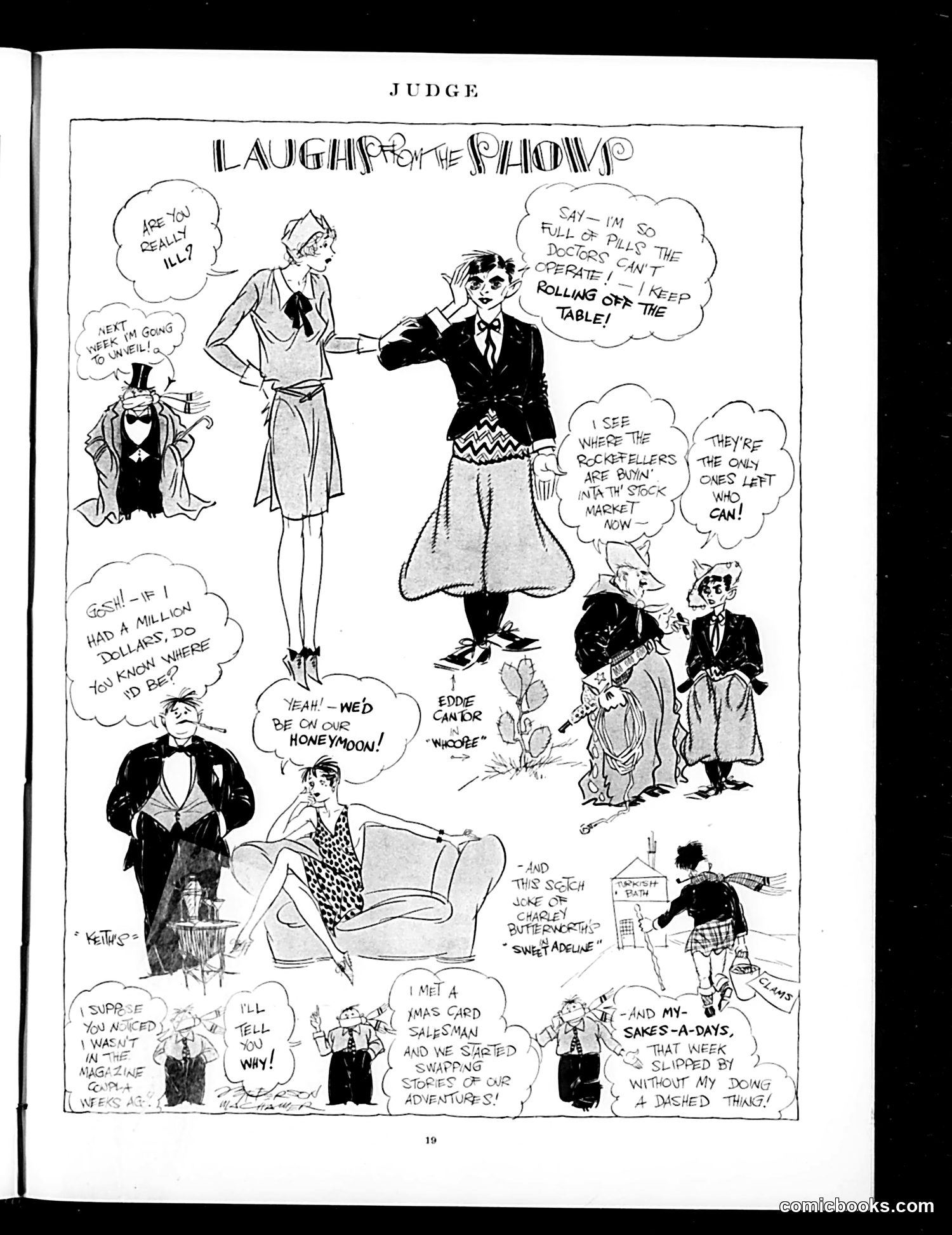
"Laughs of the Shows" - Judge Magazine Satire This is a theatrical humor page satirizing Broadway shows and entertainment gossip. The central figure appears to be a theatrical performer recounting show-business anecdotes to various characters. The jokes reference: - Stock market references (mentioning Rockefellers buying into the market) - Theatrical gossip (honeymoon tales, showgirl stories) - Economic humor (the wealthy Rockefellers, Christmas card salesmen) - Vaudeville/Broadway culture of the era The satire mocks the theatrical world's melodrama, wealth disparities during what appears to be a financial period, and the pretentious storytelling of stage performers. The scattered dialogue bubbles capture overheard conversations typical of theater-district gossip, poking fun at both entertainment industry figures and the public's fascination with celebrity scandals. The style and references suggest this is early-to-mid 20th century American entertainment satire.
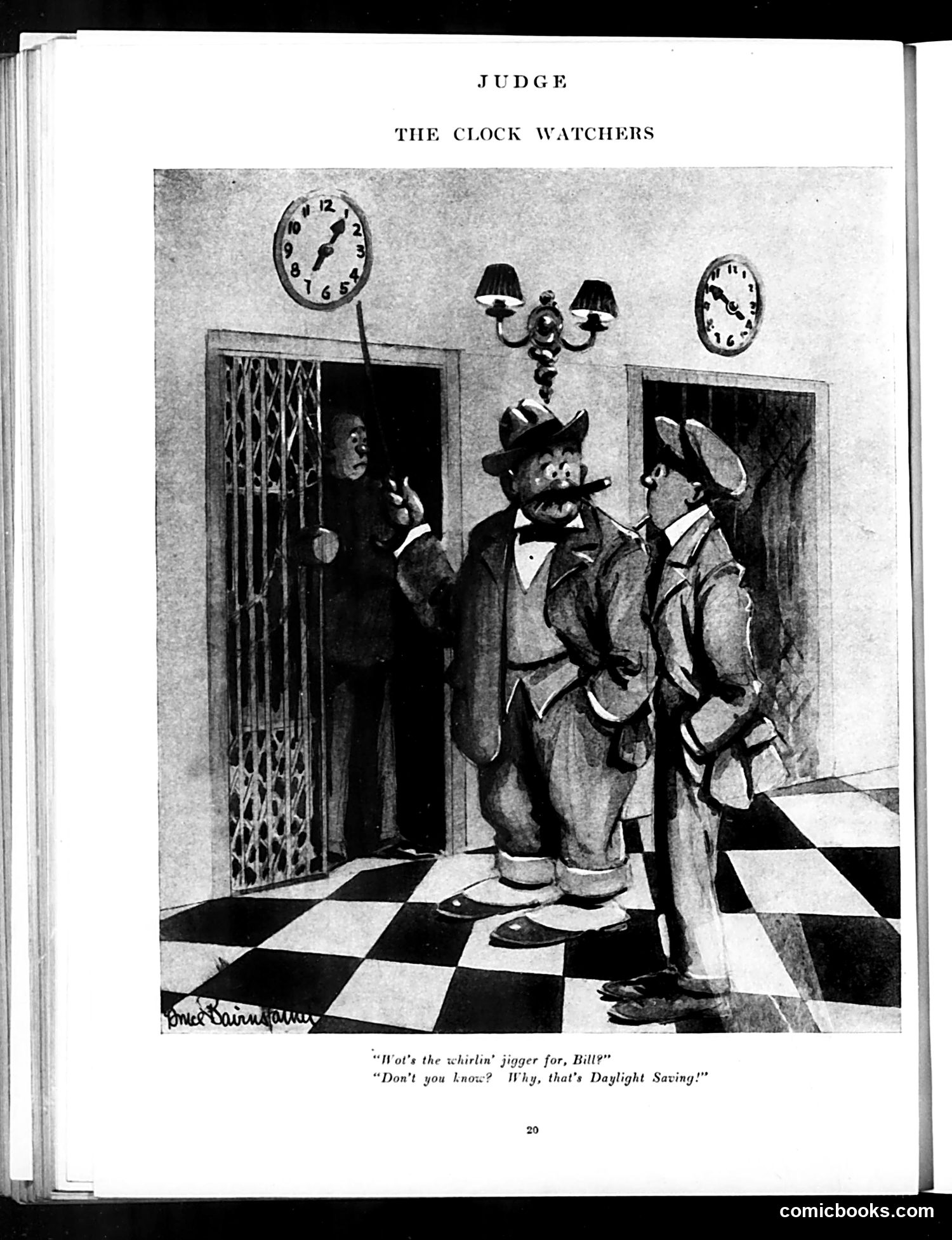
Analysis This Judge cartoon satirizes Daylight Saving Time, likely from the period when it was newly implemented or recently reinstated in America. The scene shows two working-class men ("Bill" and another) encountering a suited official at a doorway. Multiple clocks on the wall display different times, visualizing the confusion caused by the time shift. The men's bewilderment—one asking what "the whirlin' jigger" (the clock mechanism) is for—reflects public confusion and skepticism about the practice. The satire targets Daylight Saving as unnecessarily complicated and confusing for ordinary workers. The formal official contrasted with the working-class characters suggests the policy was imposed by authorities without public understanding or consent. The joke mocks both the policy's complexity and the gap between those implementing it and those affected by it.
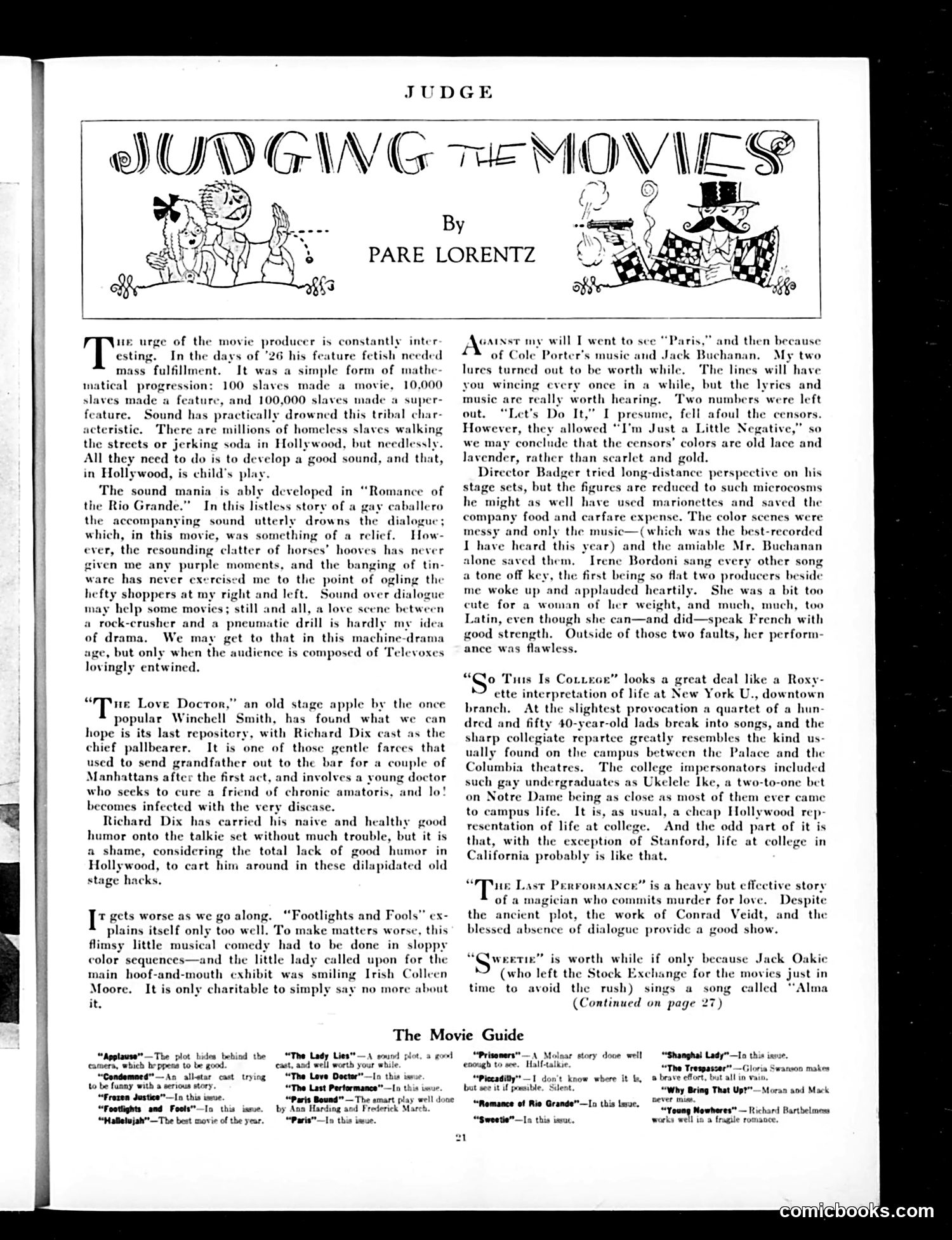
"Judging the Movies" by Pare Lorentz — Judge Magazine Film Criticism This page is a film review column critiquing recent Hollywood movies. Lorentz satirizes the film industry's obsession with sound technology as a cure-all for poor filmmaking. He mocks how studios prioritize loud sound effects over dialogue quality—comparing a love scene between "a rock-crusher and a pneumatic drill" to illustrate the absurdity. The reviews target specific films and actors: Richard Dix in the dated farce "The Love Doctor"; Irish actress Colleen Moore in the poorly executed musical "Footlights and Fools"; and Irene Bordoni in a Cole Porter musical adaptation. Lorentz praises "Hallelujah" as the best movie of the year while lamenting Hollywood's general creative bankruptcy—noting the industry employs thousands of unemployed actors ("slaves") doing soda-jerk work. The satire criticizes how producers use technical gimmicks and casting stars to mask weak scripts and lazy direction.
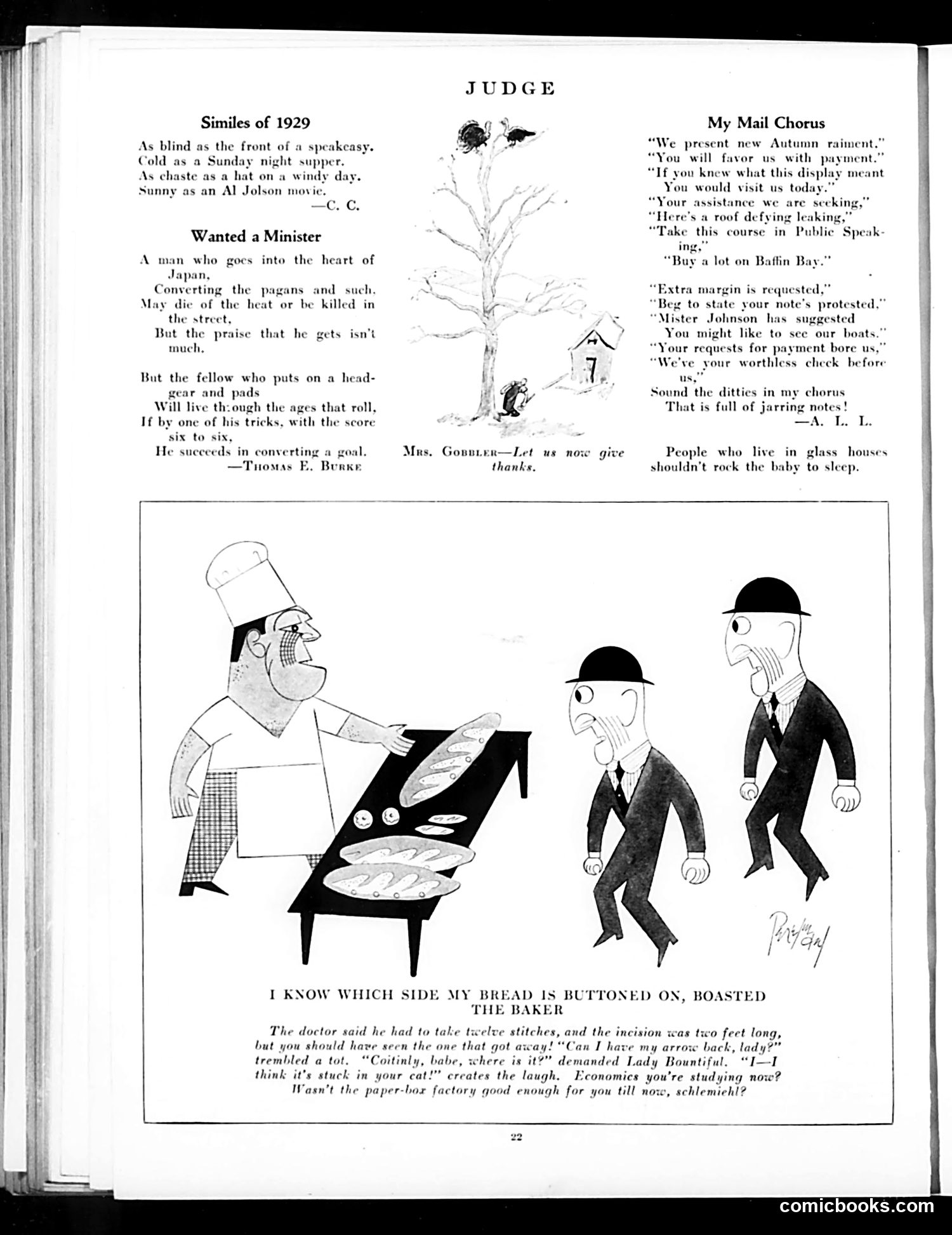
Analysis of Judge Magazine Page (1929) This page from Judge satirizes 1920s American life through humor and social commentary: Main Cartoon ("I Know Which Side My Bread Is Buttoned On"): A baker boasts to two businessmen about his bread's quality, using a colloquial expression about self-interest. The embedded anecdote mocks exaggeration and class pretension—a doctor's patient becomes increasingly absurd (stitches, arrow in cat), suggesting working-class tall tales. The final reference to "schlemiehl" (a Yiddish term for a foolish person) indicates immigrant or urban working-class humor typical of 1920s Judge. "Similes of 1929": Topical references include speakeasies (Prohibition), Al Jolson movies (entertainment), and football (the "six to six" goal reference). "Wanted a Minister": Contrasts missionaries' thankless work converting "pagans" with athletes' glory—satirizing American society's misplaced values. "My Mail Chorus": Parodies commercial solicitation letters, debt collection, and financial stress during the pre-Depression economic period. The page reflects 1920s concerns: Prohibition, consumerism, class dynamics, and economic anxiety.
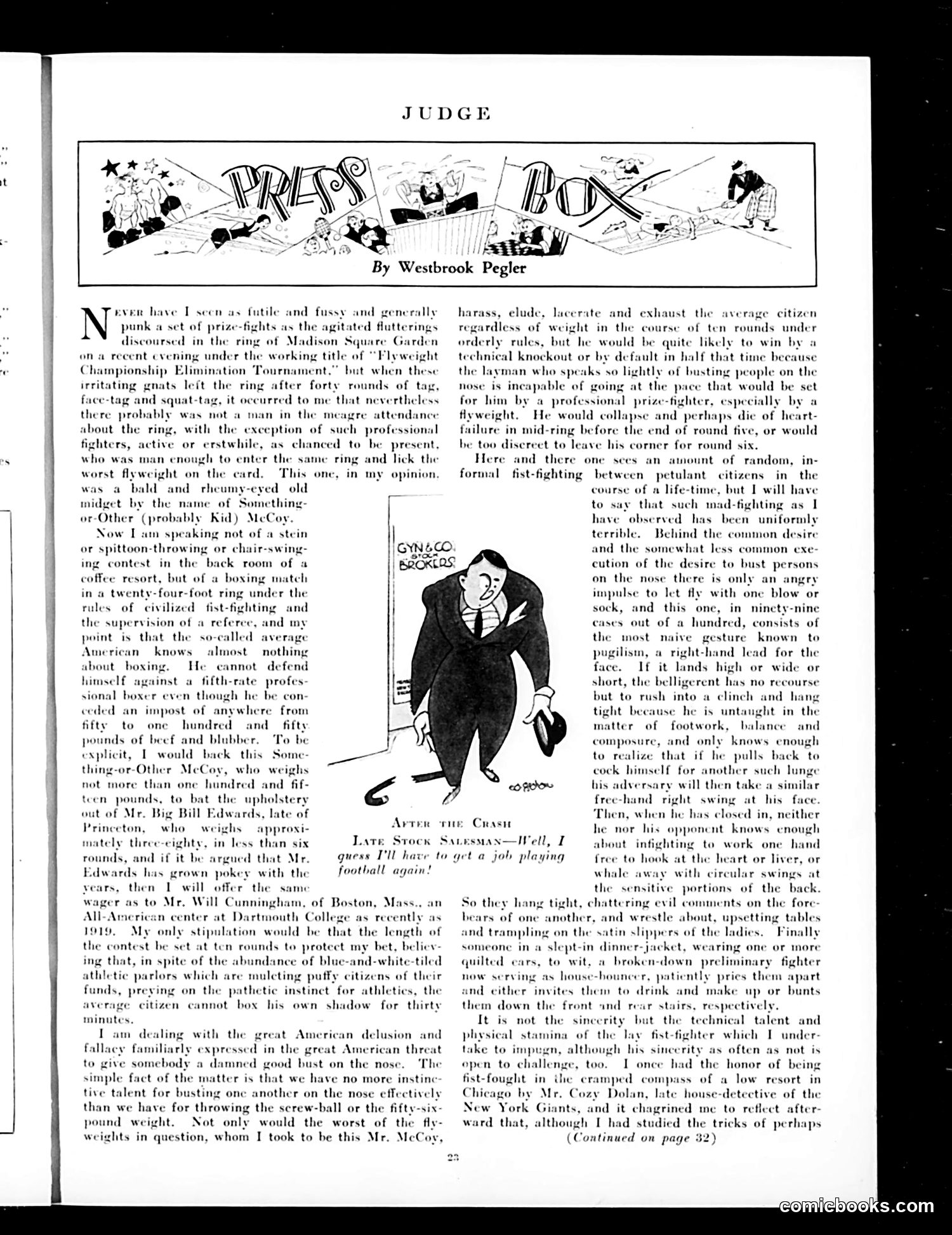
Analysis of Judge Page: "Press Box" by Westbrook Pegler This is a satirical sports column by Westbrook Pegler critiquing American boxing and the public's misunderstanding of the sport. The cartoon shows a hunched, elderly man labeled as "Kid" McCoy, a real flyweight boxer. Pegler's argument is that despite the tedious "Flyweight Championship Elimination Tournament" at Madison Square Garden, the average American—even athletic ones like "Big Bill Edwards" or a Dartmouth football star—couldn't defeat even the worst professional flyweight in an actual boxing match. He ridicules the American fantasy of being able to win a street fight by simply punching someone in the nose, arguing that professional boxing skill is a specialized talent most people lack entirely. The "Late Stock Salesman" caption offers ironic commentary on working-class aspirations. Pegler uses the piece to debunk popular delusions about masculine prowess and fighting ability among ordinary citizens.
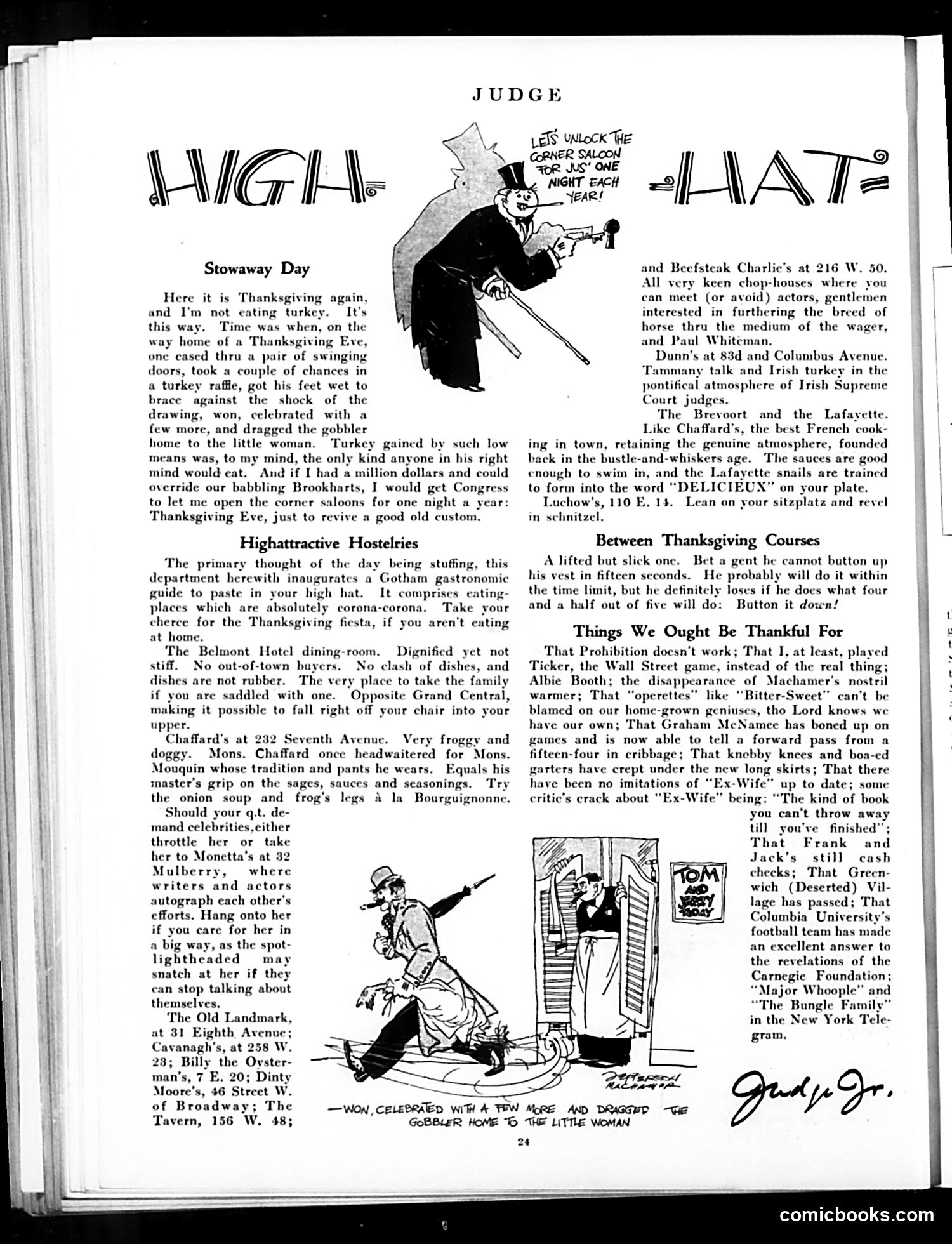
Judge Magazine Page Analysis This is a humorous Thanksgiving column by someone identified as "Judge Jr." (signature visible at bottom right). The main article, "Stowaway Day," is a nostalgic complaint about modern Thanksgiving versus the old custom of winning turkeys in saloon raffles on Thanksgiving Eve—a practice made illegal by Prohibition. The author laments losing this "low means" tradition and humorously suggests Congress should reopen corner saloons for one night annually. The bulk of the page comprises a restaurant guide recommending Manhattan establishments for Thanksgiving dinner, mixing high-end establishments (The Belmont Hotel, Chaffard's French cuisine) with working-class chop houses and famous spots like Dinty Moore's. A cartoon shows a man celebrated by returning with a turkey and a woman, illustrating the old raffle tradition. The "Things We Ought Be Thankful For" section contains topical 1920s references: Prohibition's failure, Albie Booth (likely a Yale football player), and Graham McNamee (a radio sports broadcaster). The satire targets Prohibition's ineffectiveness and nostalgia for pre-Prohibition customs.
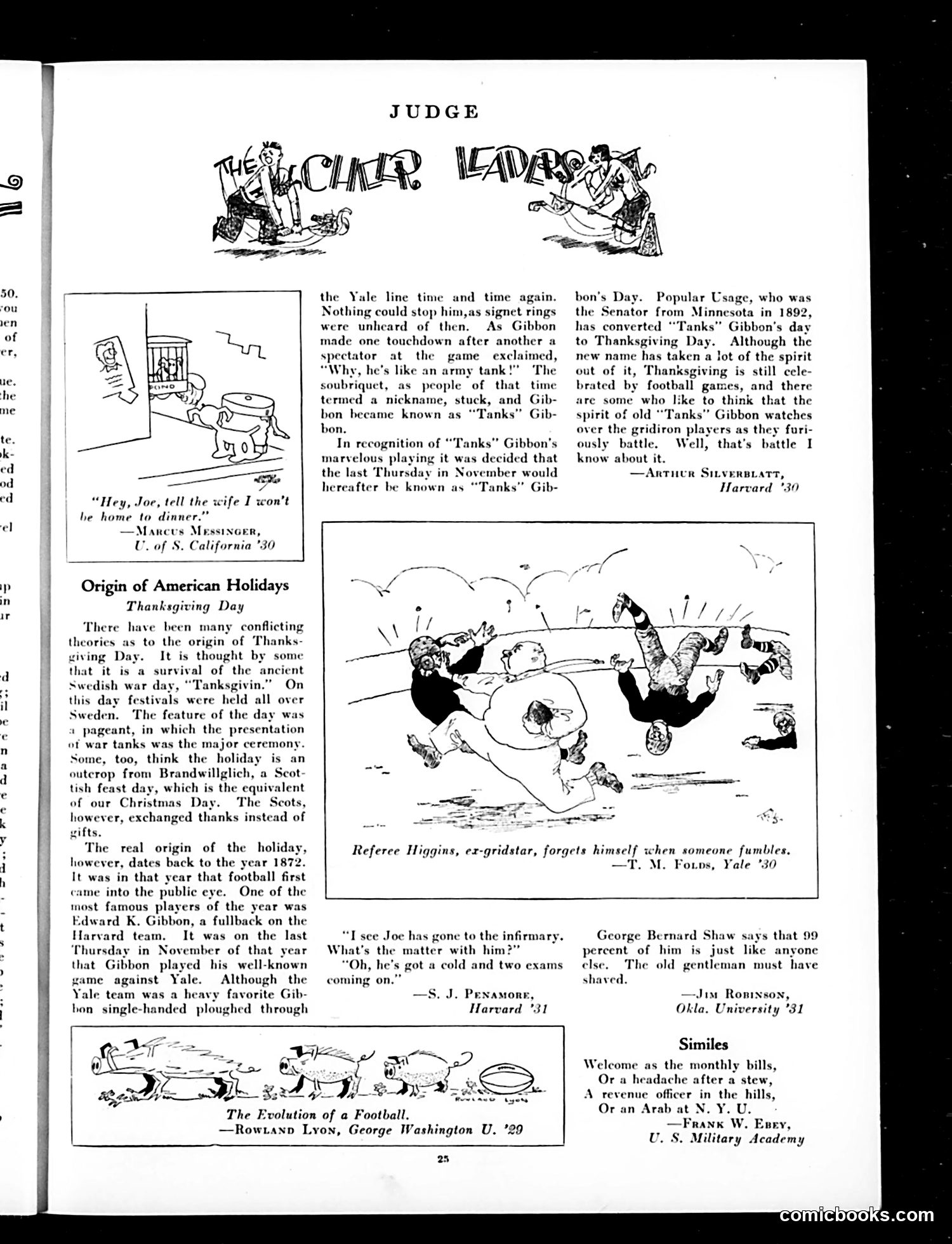
Judge Magazine Page Analysis This page from *Judge* contains humor pieces about American holidays and college life, primarily satirizing football culture and academic experiences. Main Content: The featured article humorously "traces" Thanksgiving's origin to 1872, when football player Edward K. Gibbon earned the nickname "Tanks" for his dominant performance against Yale. The joke invents a false etymology: that Thanksgiving was renamed from "Tanks Gibbon's Day" by a Minnesota senator in 1892. This is pure satirical fiction mocking how holidays gain dubious historical explanations. Cartoons & Jokes: - A sketch shows someone avoiding dinner, likely referencing college life priorities - "Referee Higgins" cartoon depicts a football official forgetting himself during play - "Evolution of a Football" shows the sport's progression - Brief jokes mock college exams, hangovers, and social awkwardness (the Arab at NYU reference suggests ethnic/cultural outsider humor typical of 1920s publications) Context: This reflects 1920s collegiate humor culture, where football dominated campus life and elaborate tall tales were common entertainment. The magazine targets college-educated readers familiar with university references.
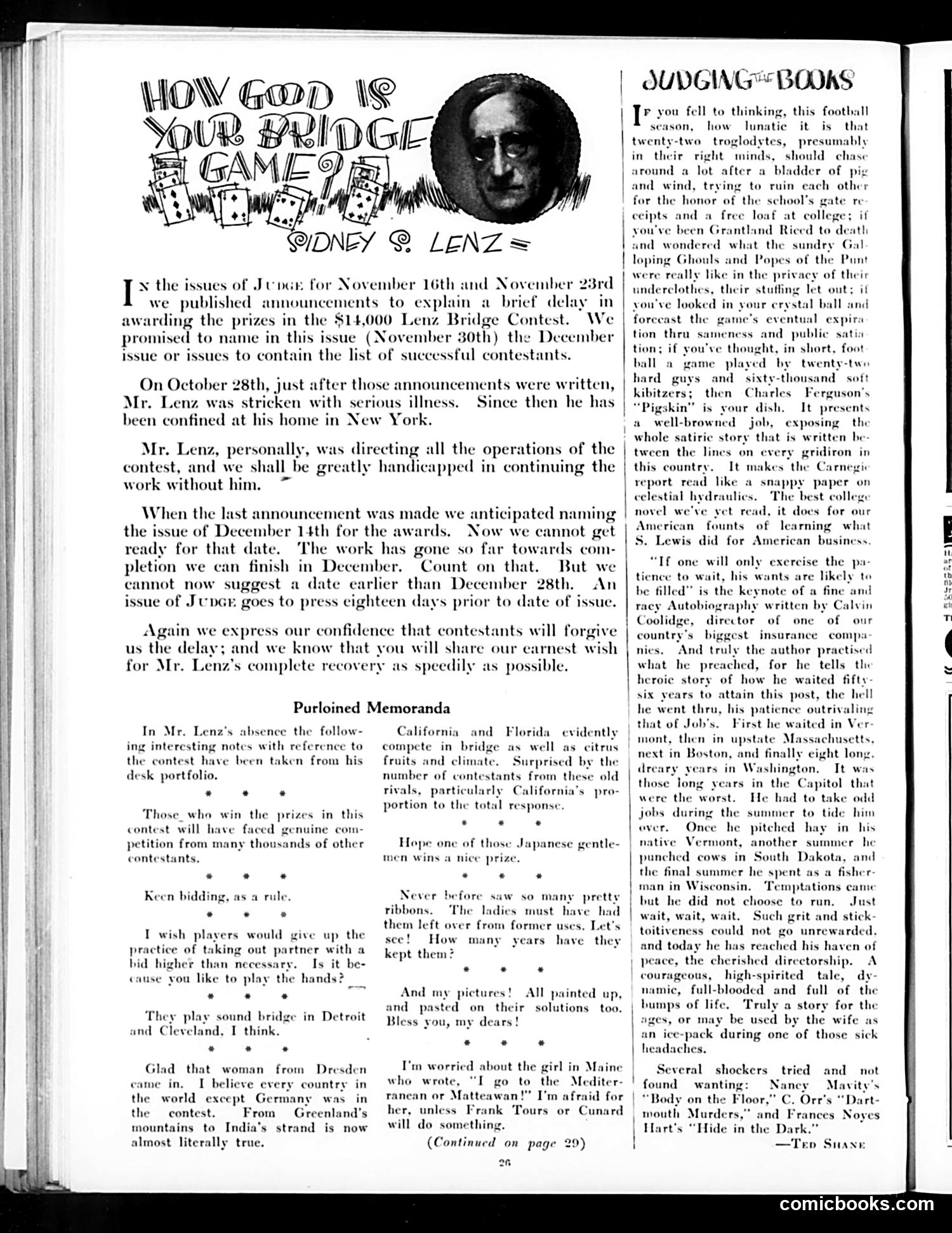
Explanation for a Modern Reader This page contains two unrelated sections from *Judge* magazine (circa November 1920s): Left side: An announcement about the "Lenz Bridge Contest," a $14,000 bridge-game competition. Mr. Lenz, the contest director, fell seriously ill on October 28th, forcing *Judge* to delay announcing winners. The announcement apologizes and promises results by December 28th at the latest. Right side: A book review titled "Judging the Books" praising Charles Ferguson's *"Pigskin,"* a satirical novel about college football. The reviewer notes Ferguson exposes the behind-the-scenes reality of college football—the "whole satiric story" beneath the glamorous public image—comparing Ferguson's work to Grantland Rice's sports writing. The cartoon at top celebrates bridge as a game ("How Good Is Your Bridge Game?") with playing cards illustrated. Both sections simply reflect *Judge's* contemporary interests: gaming/competitions and satirizing American institutions.
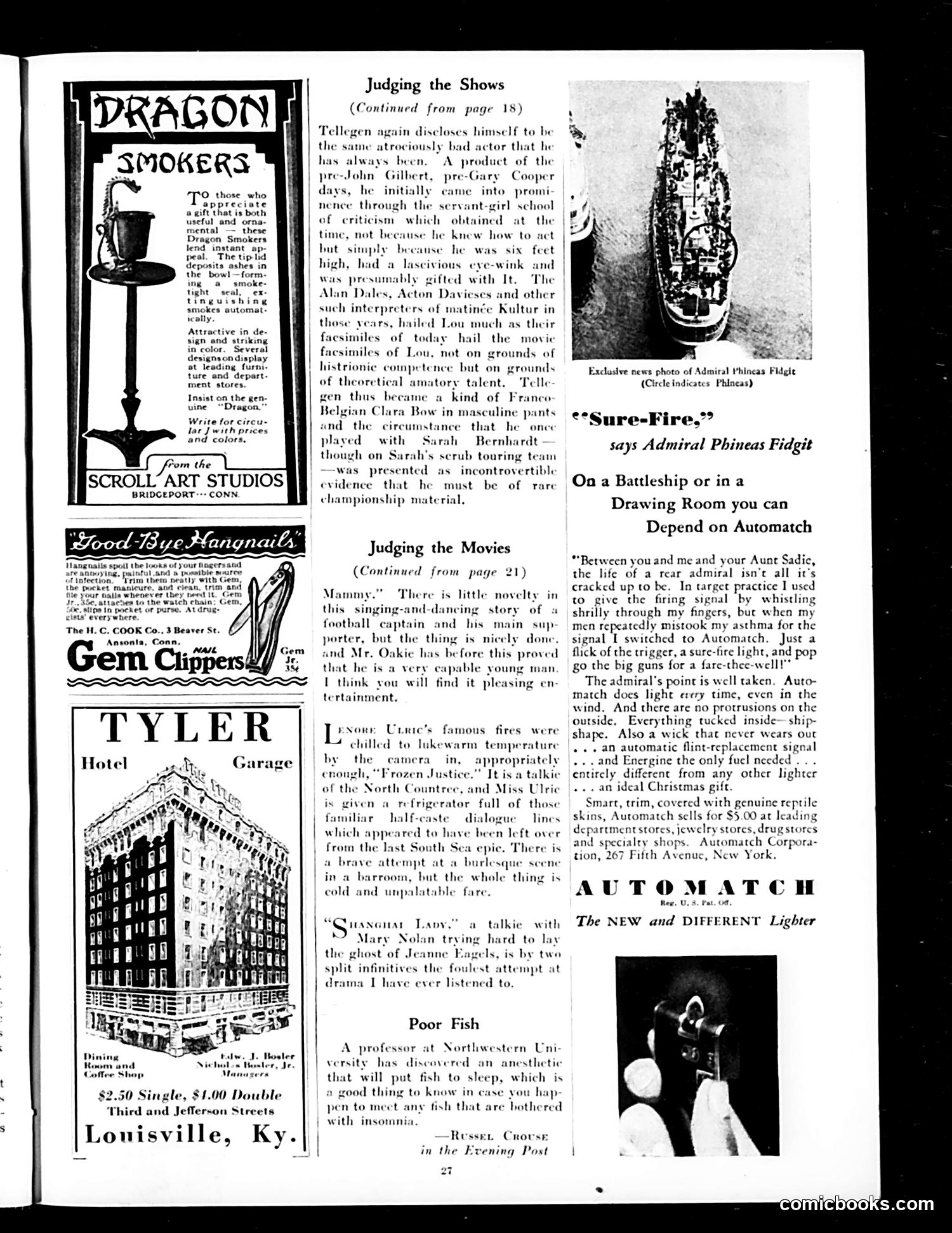
"Judge" Magazine Page Analysis This page is primarily advertising and entertainment reviews, not political satire. The content includes: Advertisements: Dragon Smokers (ash-catching pipe accessories), Gem Clippers, Tyler Hotel & Garage, and Automatch lighters (the main ad, featuring a humorous testimonial from "Admiral Phineas Fidgit" claiming the lighter works reliably even in difficult conditions like naval gunnery). Film/Theater Reviews: Brief critiques of contemporary movies and stage productions, discussing performances by actors like Bellegen and Oakie. The reviews are conventional critical commentary rather than satire—noting one actor as "atrociously bad" and evaluating whether films are "pleasing entertainment." Humor section: "Poor Fish"—a brief joke about a Northwestern University professor discovering an anesthetic for fish with insomnia. The page reflects 1920s consumer culture and entertainment journalism rather than political commentary. The "satire" is gentle product marketing humor typical of the era's advertising approach.
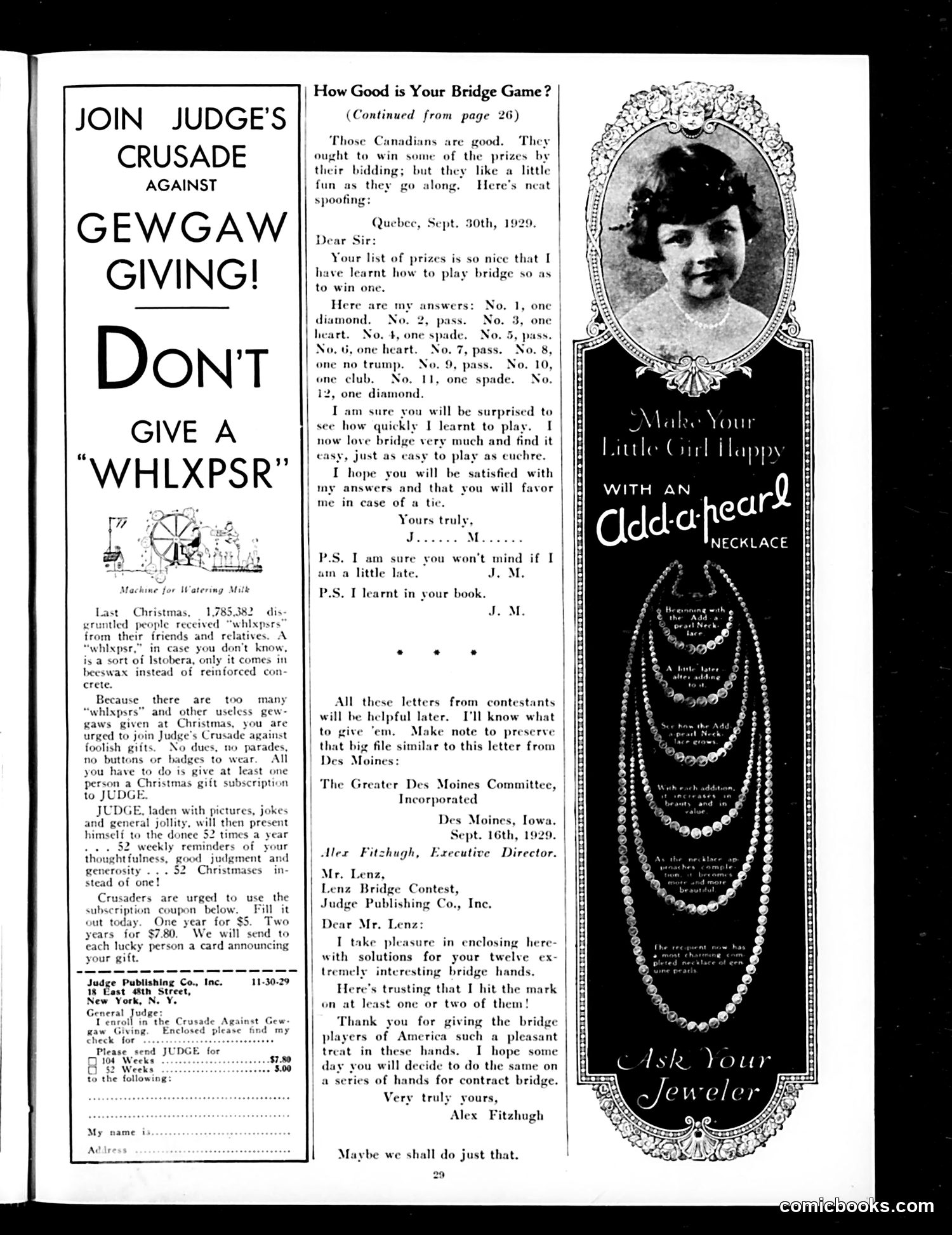
Analysis of Judge Magazine Page (November 30, 1929) This page contains two separate elements: a satirical crusade and advertisements, plus a bridge game contest feature. Left side: "Crusade Against Gewgaw Giving" Judge magazine launches a humorous campaign mocking frivolous Christmas gift-giving. The satire targets useless novelty items (the fictional "whixpsr"—a nonsensical object meant to represent pointless gadgets). The joke is that people give impractical trinkets instead of thoughtful gifts. Judge's solution: encourage readers to give *Judge magazine subscriptions* instead—a cleverly self-serving advertisement disguised as social criticism about consumer excess and poor taste. Center/Right: Bridge Contest and Jewelry Advertisement The page continues a bridge game contest, featuring playful responses from Canadian contestants. Below is a period advertisement for an "Add-a-Pearl" necklace—a jewelry marketing concept where recipients could gradually add pearls over time. Context: Published during the 1920s consumer boom before the October 1929 stock market crash, the "gewgaw" critique reflects emerging concerns about American materialism and mass-produced novelties.
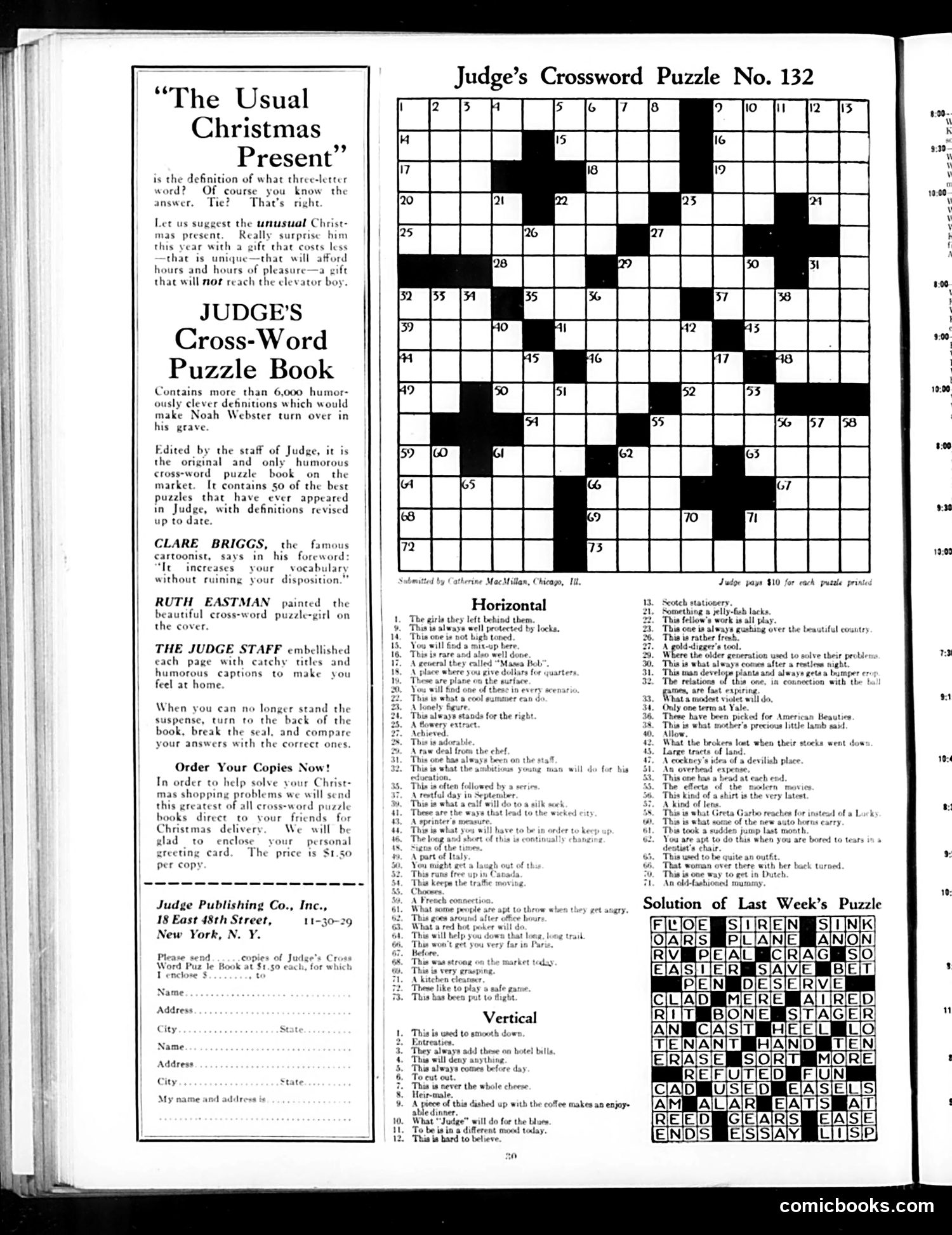
Judge Magazine Crossword Puzzle Page Analysis This page is primarily advertising and promotional content, not a political cartoon. It promotes Judge Publishing's crossword puzzle book as a Christmas gift alternative to the conventional choice mentioned in the headline: neckties. The humor is lighthearted and commercial. The text sarcastically notes that ties are "the usual Christmas present" and suggests this puzzle book as a more original, entertaining gift—one that "will not reach the elevator boy" (implying it's too valuable to regift to servants, a dated class reference). The page features endorsements from cartoonist Clare Briggs and artist Ruth Eastman, lending credibility. The actual crossword puzzle (#132) appears with humorous definitions typical of Judge's style—sophisticated wordplay for educated readers of the late 1920s. The modest price ($1.50) and mail-order convenience are emphasized to drive holiday sales. This is essentially a vintage direct-mail advertisement disguised within editorial content—common practice in magazines of that era.
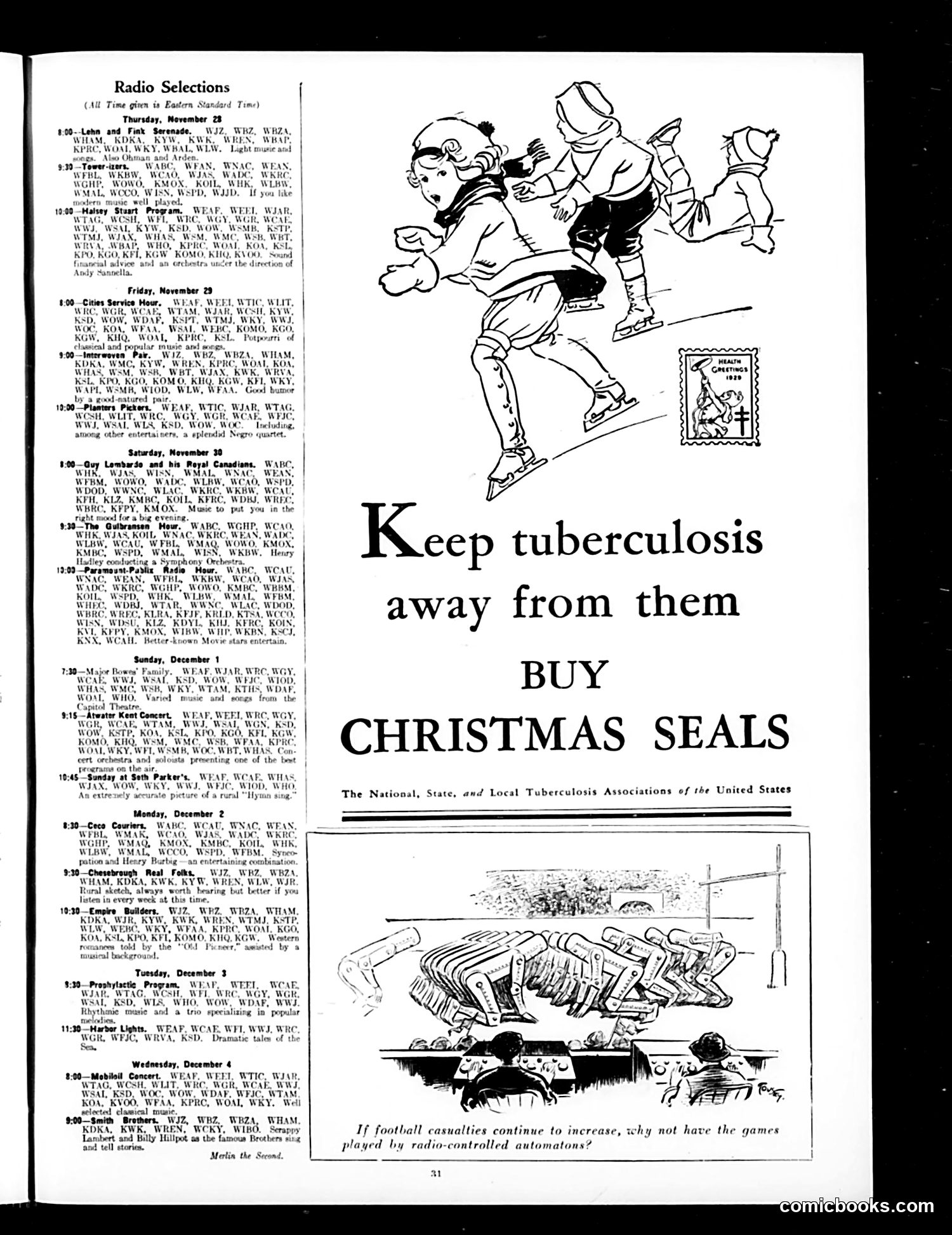
Radio Selections Page Analysis This page is primarily a radio programming guide for November 28 – December 3, listing station call letters and show descriptions. The actual satirical content appears in a public health advertisement occupying the right side. The advertisement features children running/playing and urges readers to "Keep tuberculosis away from them" by purchasing Christmas Seals—fundraising stamps sold by tuberculosis associations. Below, a cartoon depicts two figures observing a pile of football equipment, with the caption questioning why football games continue if casualties keep rising, suggesting they should use "radio-controlled automatons" instead. This reflects 1920s-30s concerns about tuberculosis as a major public health threat and growing anxieties about football safety and injuries. The dark humor juxtaposes holiday charity (Christmas Seals) with contemporary worries about disease and sports-related harm—advocating for both disease prevention and technological solutions to human vulnerability.
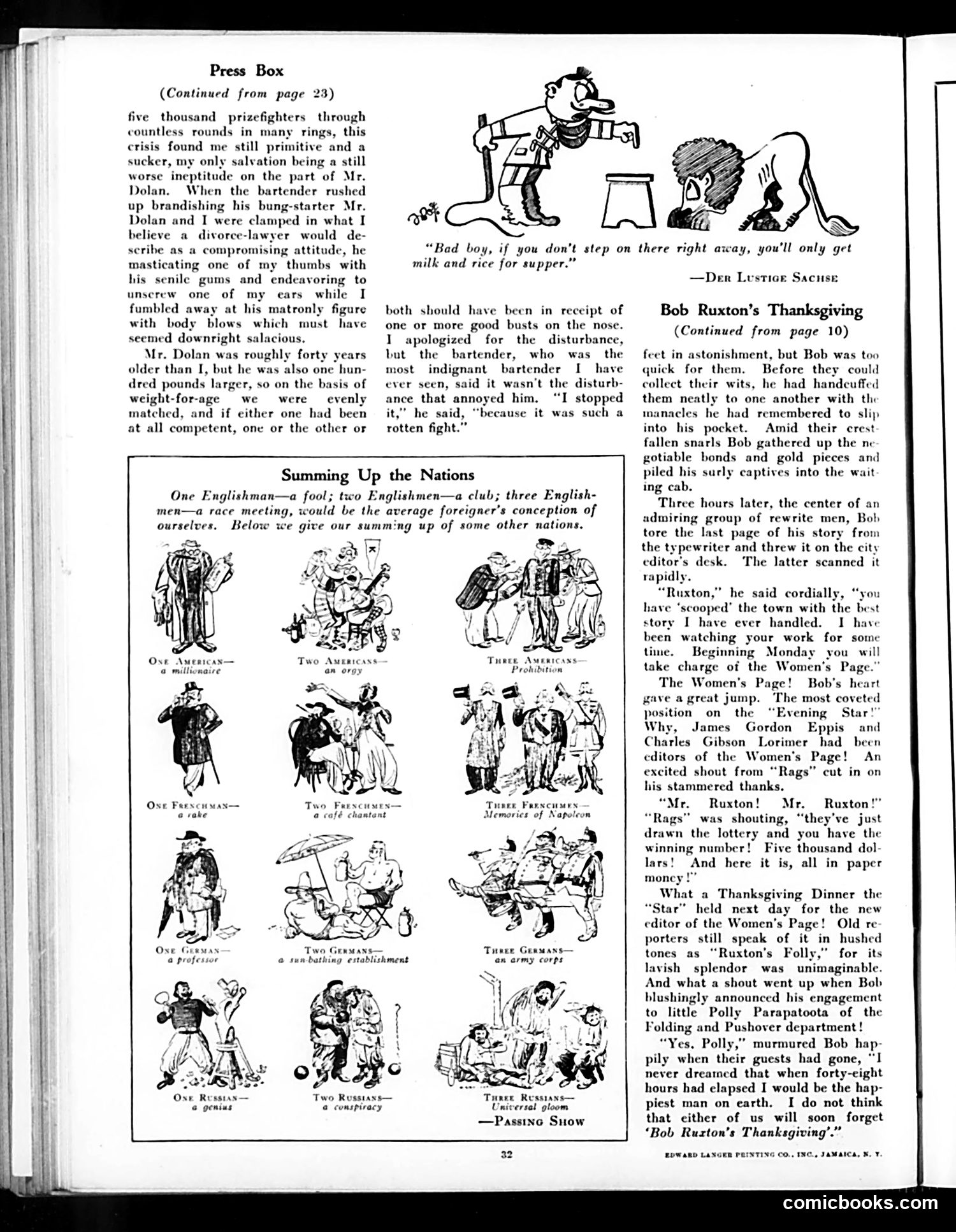
Judge Magazine Page Analysis This page contains two distinct pieces: "Press Box" (top): A humorous anecdote about a bar fight between the author and an elderly man named Dolan. The bartender stops their incompetent brawl, calling it "such a rotten fight." The joke satirizes amateur fighting incompetence. "Summing Up the Nations" (center): A comparative national stereotype chart. It presents crude caricatures of different nationalities: Americans as millionaires/drunks/prohibitionists; French as rakes/café patrons/Napoleonic nostalgics; Germans as professors/sunbathers/military; Russians as geniuses/conspirators in universal gloom. This reflects early 20th-century American attitudes toward foreigners—satirizing both foreign stereotypes and American smugness about them. "Bob Ruxton's Thanksgiving" (right): A serialized fiction story about a reporter who captures criminals, wins the lottery, and gets promoted to Women's Page editor—a satirical comment on unlikely journalistic success and the Women's Page as a prestigious position. The overall tone is light, satirical social commentary typical of Judge magazine's approach.
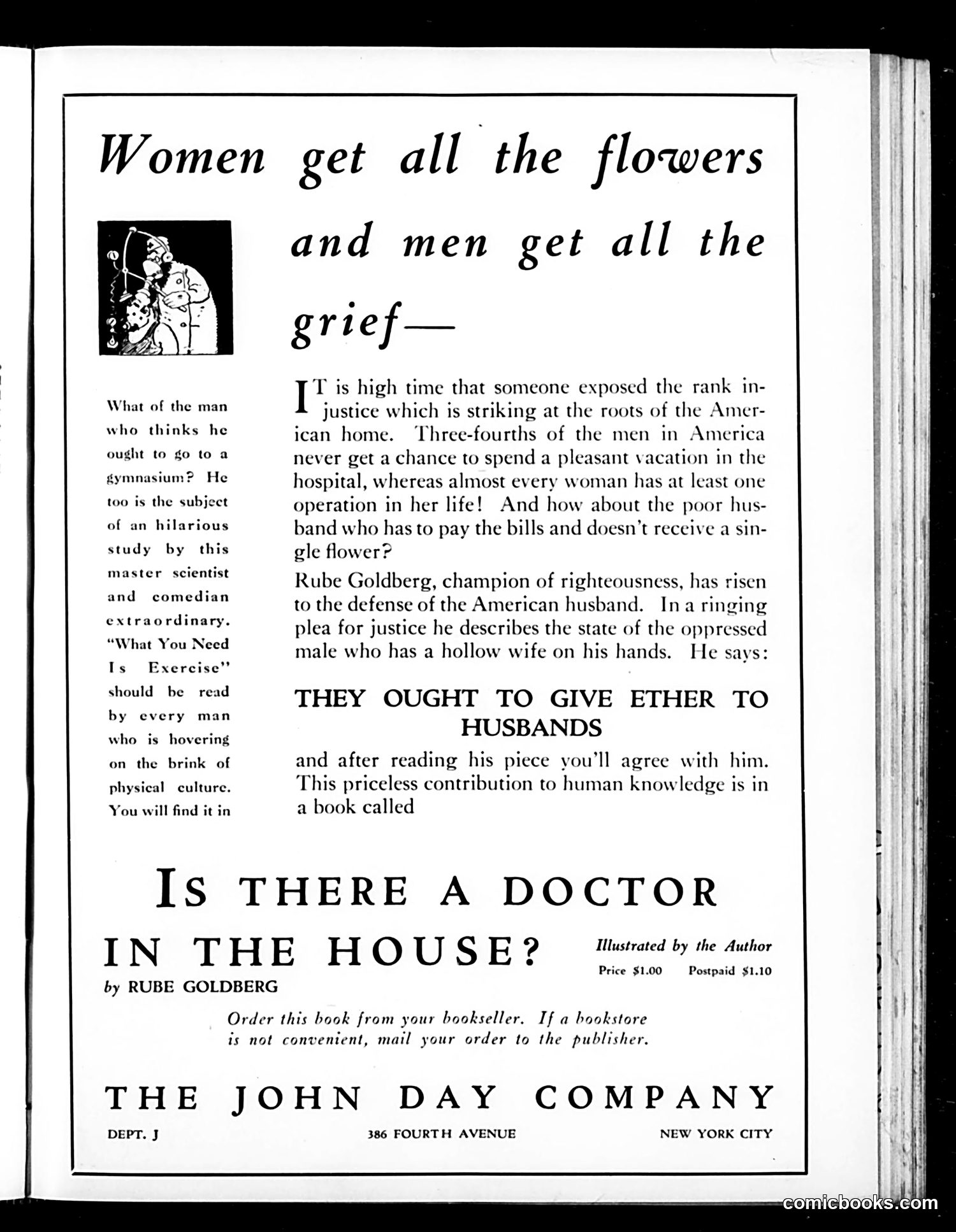
Understanding This Judge Magazine Advertisement This is primarily a book advertisement for Rube Goldberg's "Is There a Doctor in the House?" using satirical humor. The satire targets gender roles and marital grievances. The headline joke—"Women get all the flowers and men get all the grief"—sarcastically complains that women receive hospital flowers during surgeries while husbands bear financial burdens unpaid. The ad mocks the "oppressed American husband," claiming men never get hospital vacations while women enjoy multiple operations. Rube Goldberg (1883-1970) was a famous cartoonist and engineer known for satirical social commentary. Here he's positioned as "champion of righteousness" defending husbands, tongue-in-cheek. The ad's absurdist claim that husbands should receive "ether" (anesthesia) inverts sympathy toward male suffering in marriage. The joke reflects 1910s-20s anxieties about women's increasing independence and changing domestic arrangements, mocking both feminist progress *and* men's resentment of it simultaneously—Judge's typical satirical approach to social conflict.
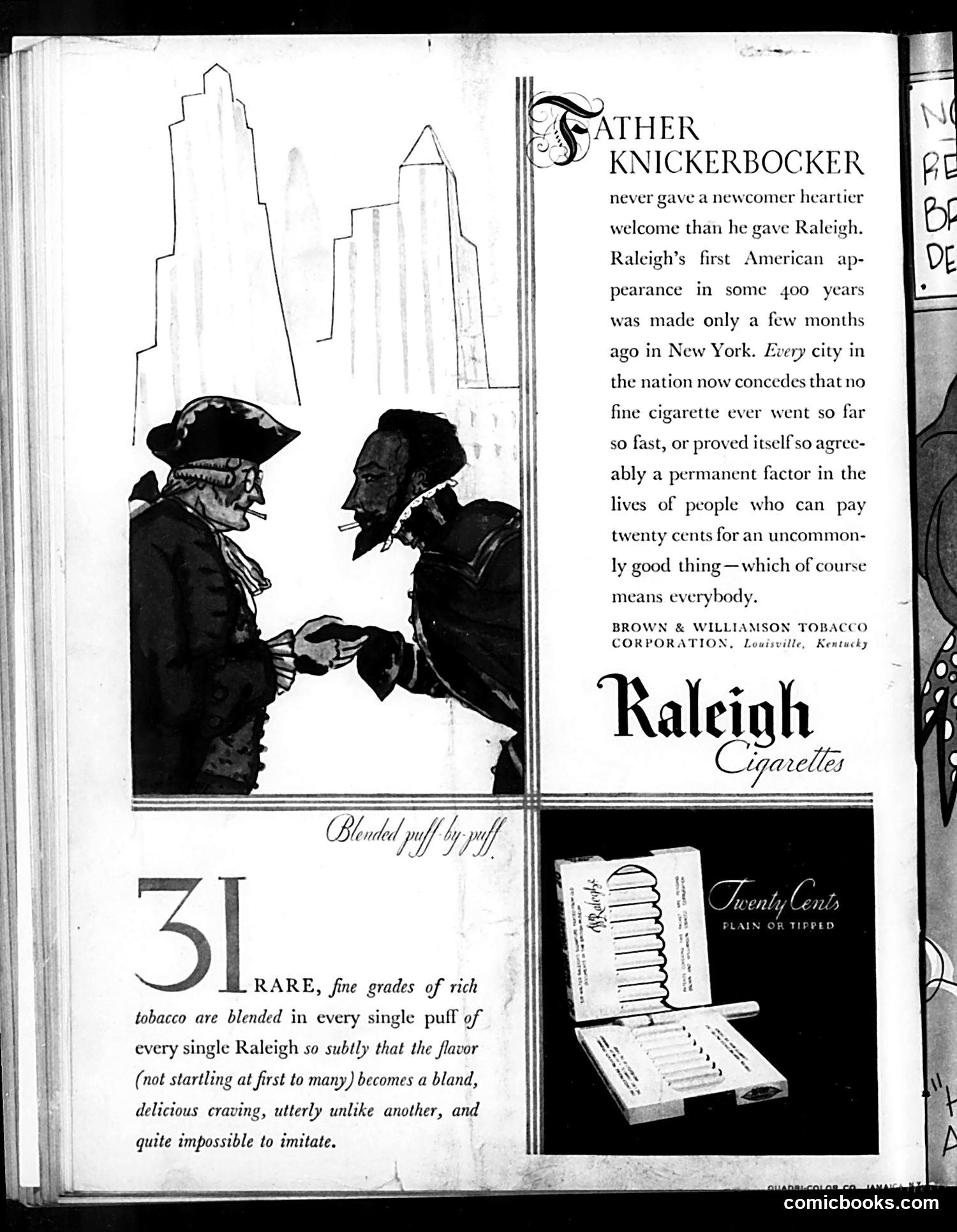
Analysis for Modern Readers This is tobacco advertising, not satire. The page uses historical humor to market Raleigh cigarettes. The cartoon depicts two colonial-era figures (likely representing Father Knickerbocker, a personification of New York, and Sir Walter Raleigh, the historical figure credited with introducing tobacco to Europe). The joke plays on Raleigh's 400-year absence from America—he's being welcomed back to the nation whose colonization he helped enable through tobacco. The ad claims Raleigh cigarettes are so popular that every American city now endorses them. The phrase "means everybody" sarcastically suggests only wealthy people (who can afford 20 cents) qualify as "everybody." The copy emphasizes the tobacco blend's subtlety—the flavor is described as "not startling at first" but becomes a "delicious craving," essentially acknowledging nicotine addiction while marketing it as desirable. This represents pre-regulation cigarette advertising that openly promoted smoking without health warnings.