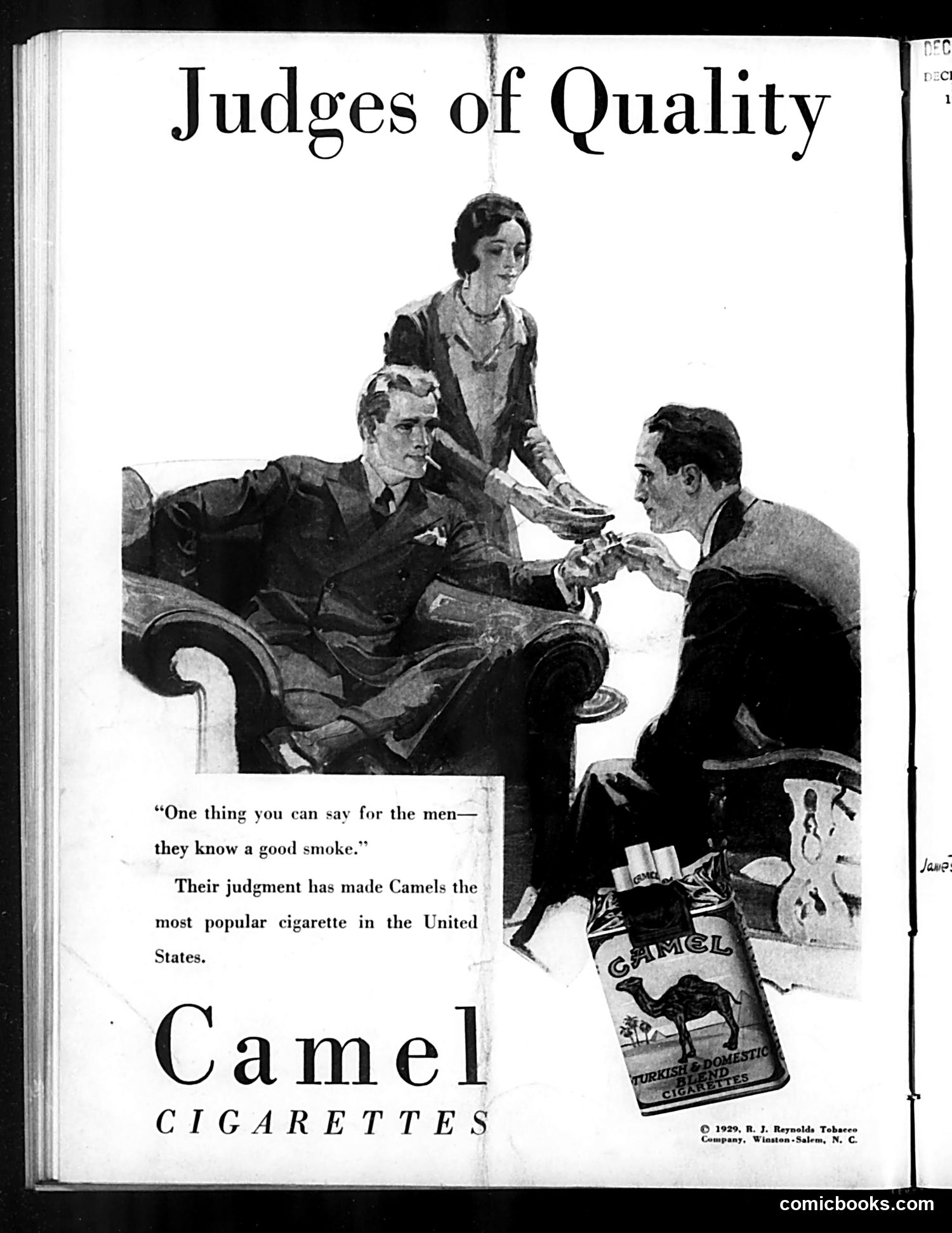
judge
Judge — December 7, 1929
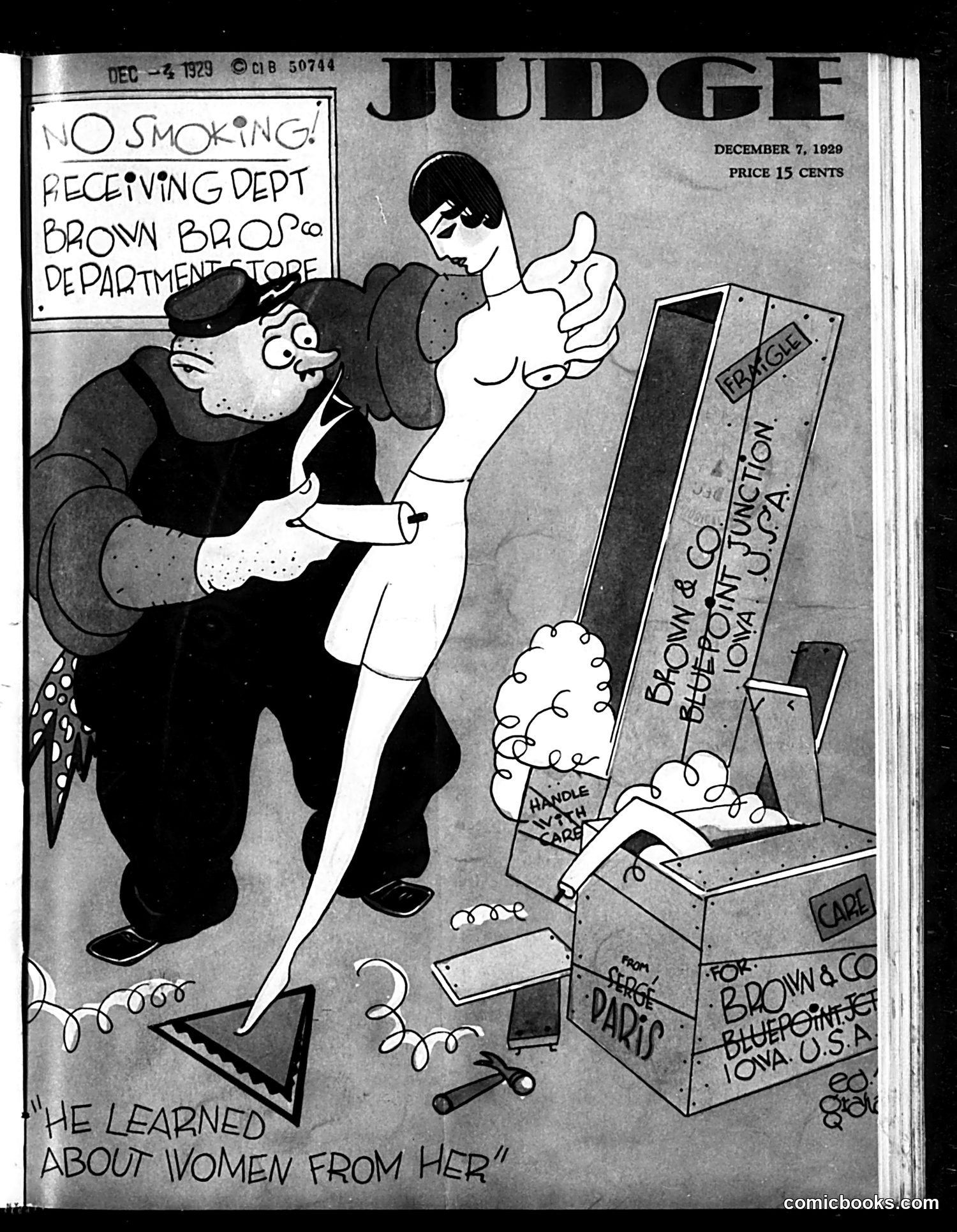
Judge Magazine Cover, December 7, 1929 This cover depicts a domestic delivery scene with sexual innuendo. A man in formal attire receives a package from a woman dressed as a delivery person or department store employee. The "Brown Bros. Department Store" sign references a real business. Scattered boxes labeled with shipping information (including "Paris," "fragile," and "handle with care") surround them. The caption reads: "He learned about women from her," suggesting the woman's knowledge or experience. The joke appears to rely on double entendre about "packages" and physical attraction—typical of 1920s-30s Judge humor targeting male readers. The "No Smoking" sign in the receiving department is incidental detail. This represents the magazine's characteristic bawdy, flirtatious cartoon style popular during the Jazz Age.
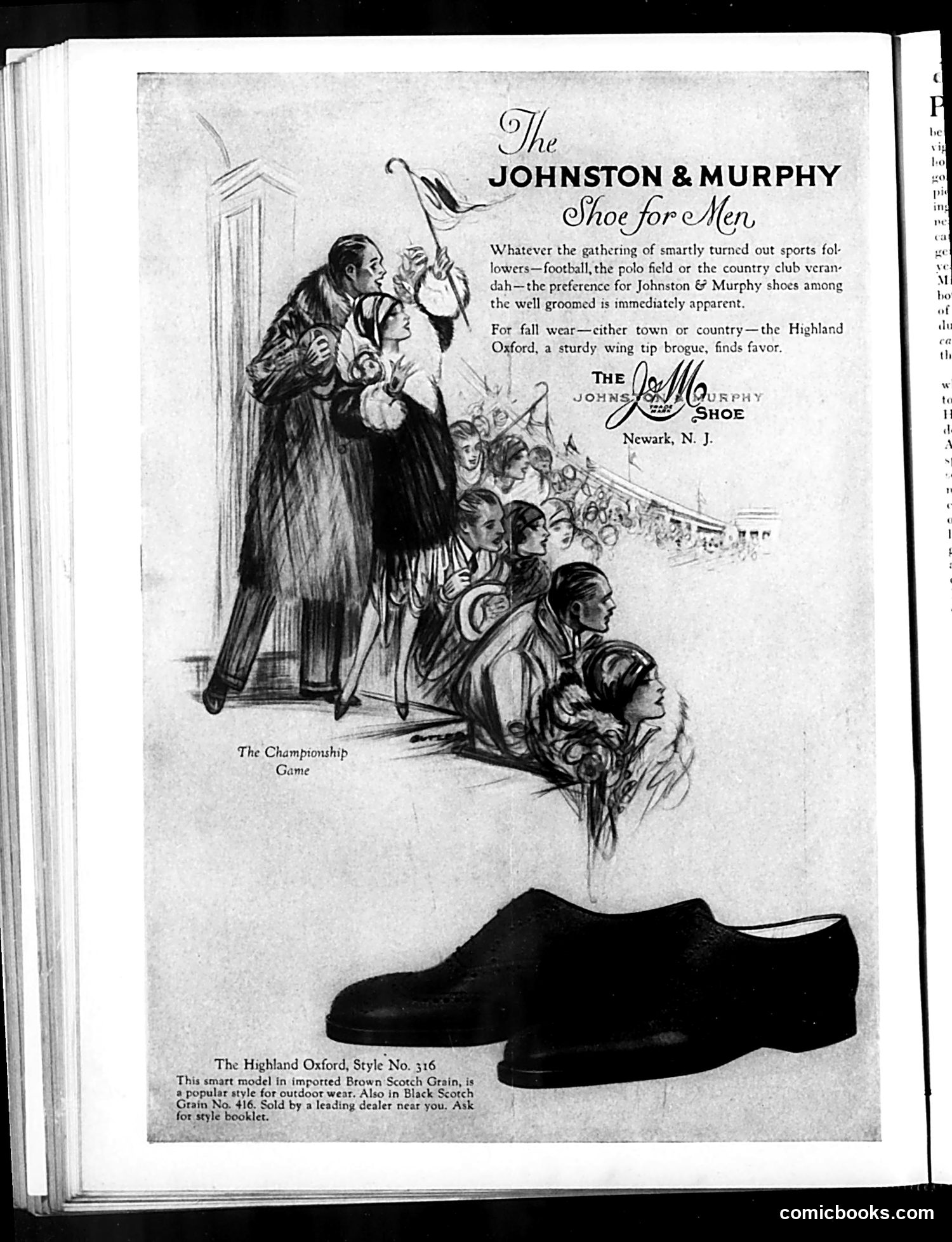
Johnston & Murphy Shoe Advertisement This is primarily a shoe advertisement, not political satire. It promotes Johnston & Murphy shoes for men, marketed as the preferred footwear among "smartly turned out sports followers" at sporting events like football and polo. The illustration depicts a well-dressed man and woman at what appears to be a sporting event (labeled "The Championship Game"), with spectators in the background. The ad emphasizes the "Highland Oxford" shoe style (No. 316), described as sturdy and suitable for fall wear in town or country settings. The image uses aspirational social messaging—associating the shoes with upper-class leisure activities and refined appearance—a standard advertising approach of the era. Located in Newark, N.J., this represents typical early 20th-century product marketing in *Judge* magazine.
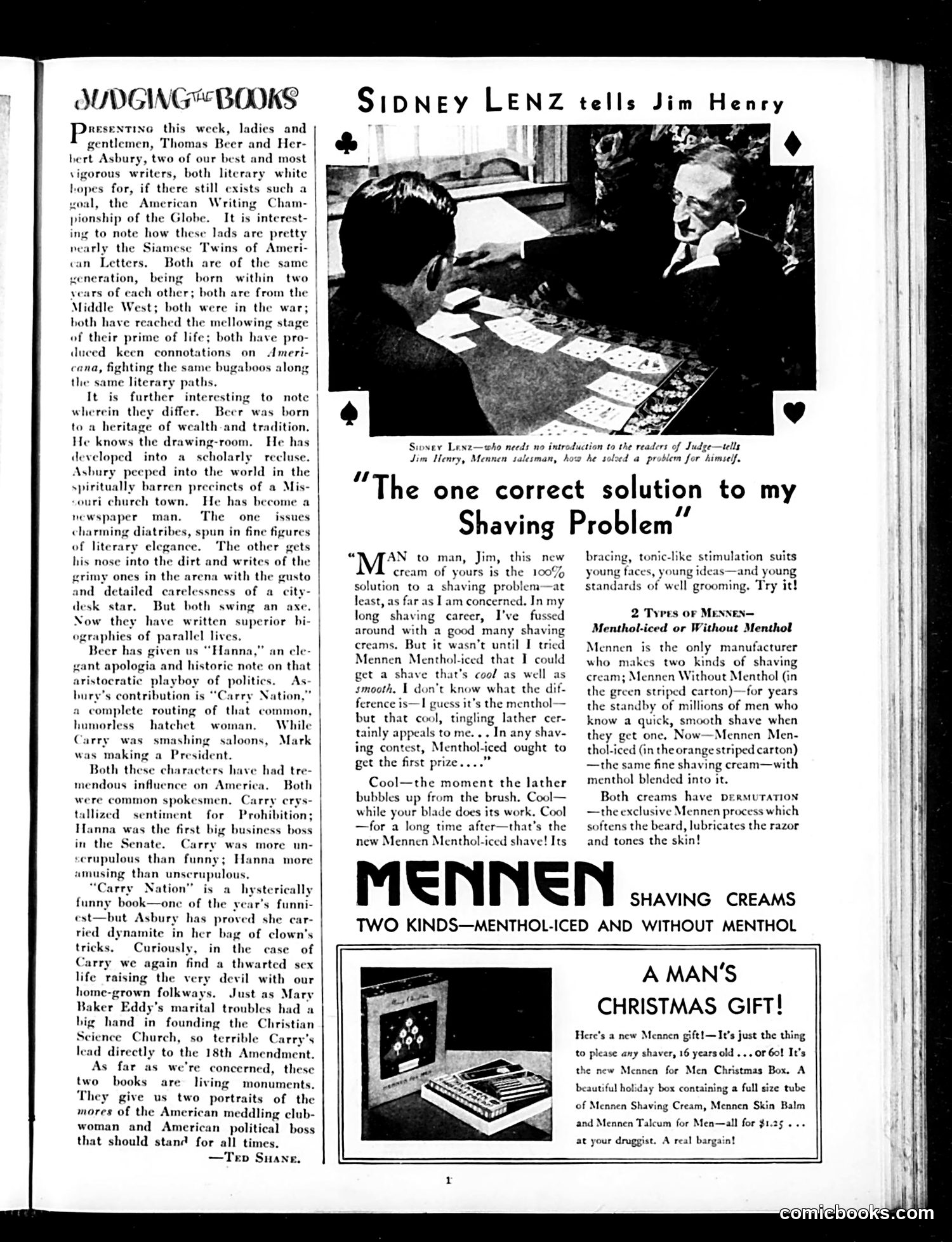
Analysis This page is primarily advertising with minimal editorial content. The main feature is a Mennen shaving cream advertisement disguised as an interview, where Sidney Lenz (identified in the caption) supposedly tells Jim Henry about discovering Mennen's product as "the one correct solution to my shaving problem." The left column contains a book review by Ted Shane discussing works by Thomas Beer and Herbert Asbury—literary commentary rather than political satire. No political cartoon appears on this page. The only illustration is a commercial product photograph showing a Mennen gift box. This represents typical Judge magazine content from the 1920s-30s era: mixing genuine literary criticism with advertorial content presented as editorial material, blurring the line between journalism and advertising in ways modern readers would immediately recognize as problematic.
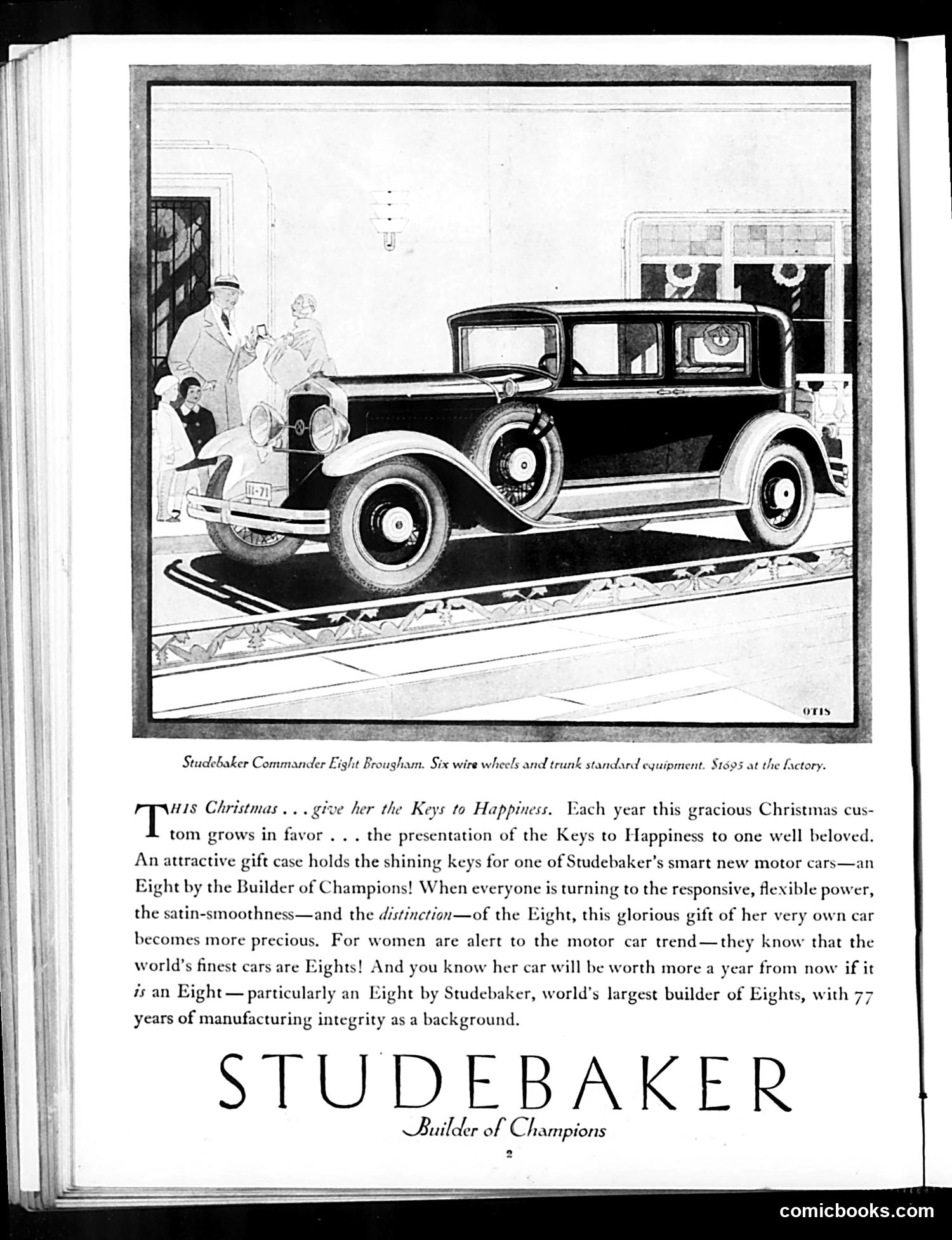
Analysis This page is primarily an advertisement, not satirical content. It promotes the Studebaker Commander Eight automobile as a Christmas gift, using the marketing concept of "Keys to Happiness." The illustration shows a luxury car in what appears to be an elegant showroom or garage, with well-dressed figures examining it. The accompanying text targets women as car buyers, arguing that an Eight-cylinder vehicle represents sophistication and holds its value well. The "satire" is gentle advertising copy rather than political commentary—it's aspirational marketing dressed in gift-giving language. The page reflects 1920s-30s consumer culture and gender dynamics, where automobile ownership signified status, and advertising specifically courted women as purchasers of luxury goods.
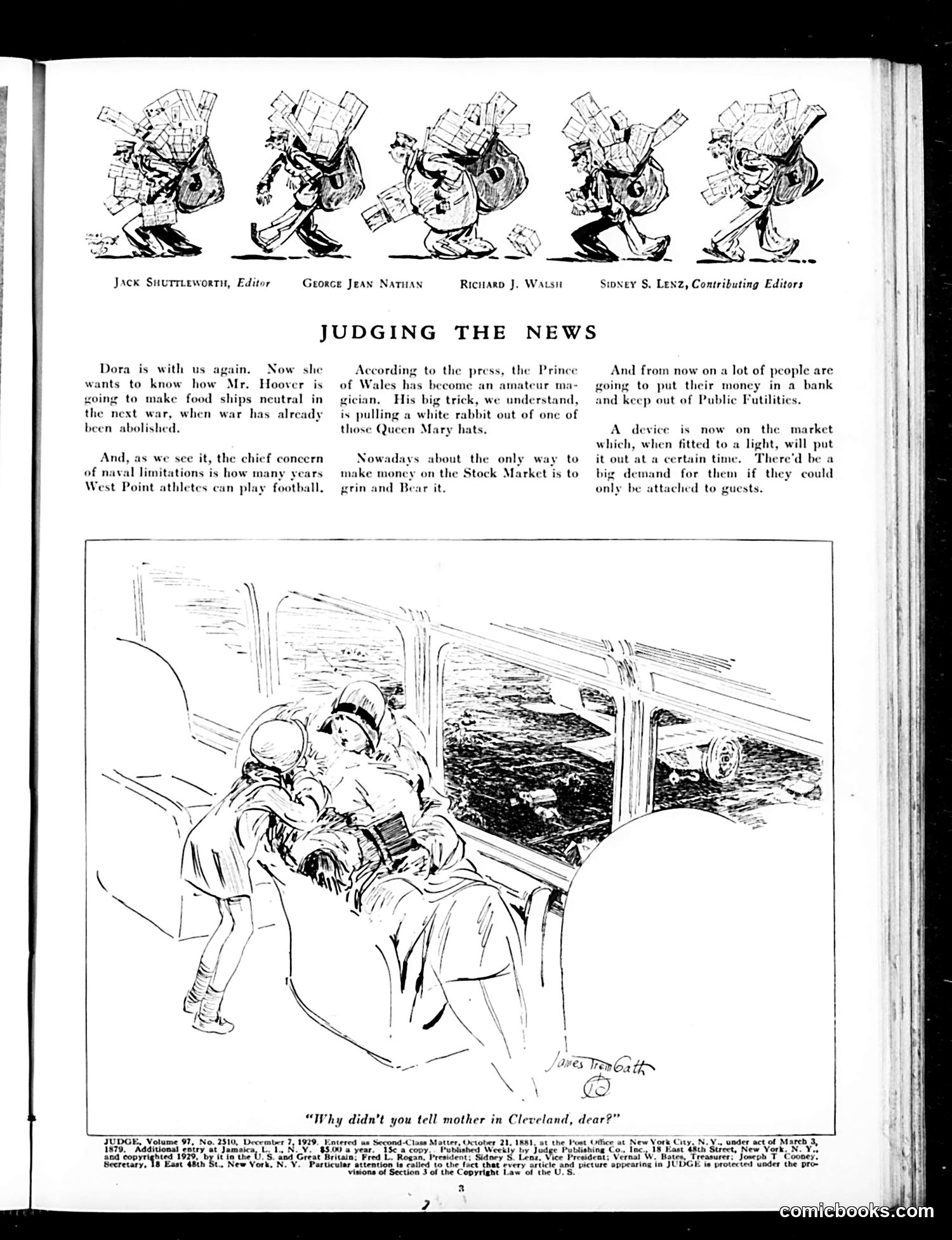
"Judging the News" - December 2, 1929 This page satirizes current events through brief commentary and a cartoon. The top section mocks several topics: Dora (likely a public figure), the Prince of Wales being an "amateur magician" (unclear reference), and West Point athletes playing football despite wartime restrictions. The main cartoon, captioned "Why didn't you tell mother in Cleveland, dear?" depicts soldiers in what appears to be a military vehicle or bunker viewing a battlefield landscape. The satire likely criticizes either military deception about war conditions, or soldiers' failure to report truthfully to families back home about the realities of combat. The specific historical event referenced remains unclear without additional context, though the December 1929 date and military subject suggest a post-WWI commentary.
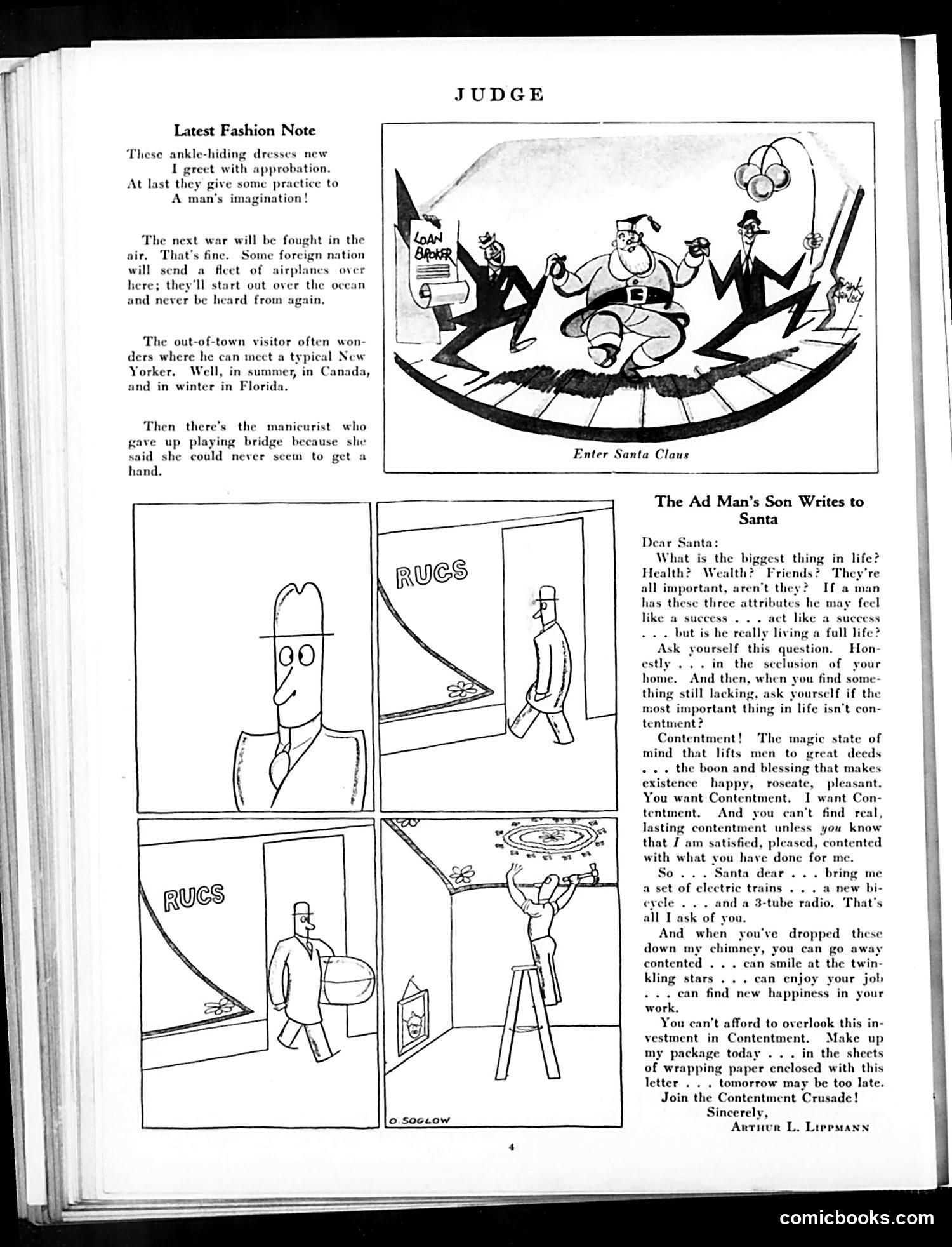
Analysis of Judge Page Top Cartoon ("Enter Santa Claus"): This satirizes post-WWI economic chaos. Santa arrives in a sleigh labeled "Loan Shark," surrounded by figures juggling financial instruments and military items. The satire suggests Santa (representing hope/relief) is being exploited by loan sharks and war profiteers capitalizing on post-war instability. Middle Comic Strip: A husband repeatedly encounters rolled-up rugs (labeled "RUGS") in his home. The visual gag plays on the phrase "beating a dead horse"—literally showing him struggling with oversized rugs, suggesting domestic frustration or marital discord through absurdist humor. Bottom Text: "The Ad Man's Son Writes to Santa" is a sincere (non-satirical) letter emphasizing contentment and spiritual fulfillment over material goods—a moralistic counterpoint to the page's cynicism above.
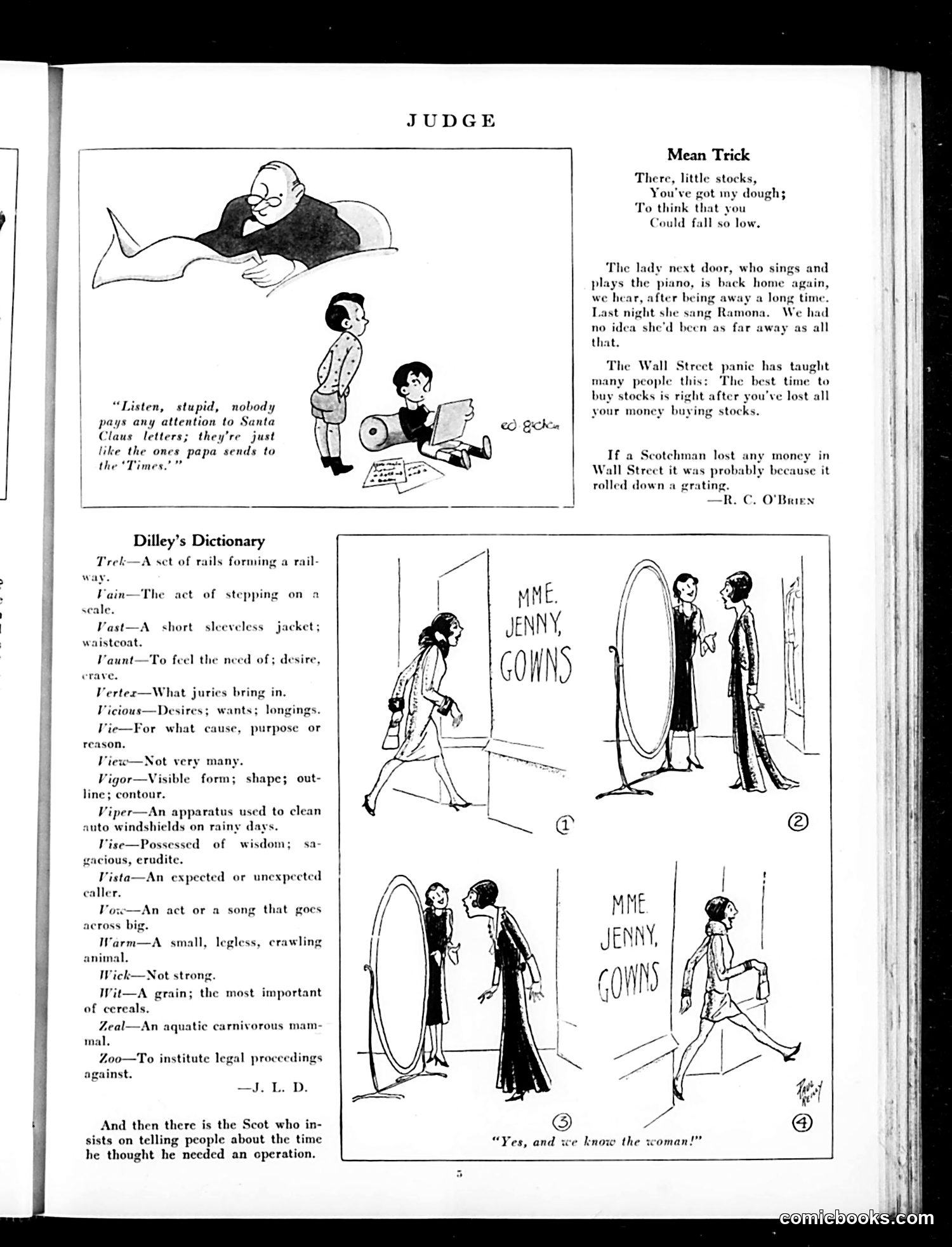
Judge Magazine Page Analysis "Judge" Cartoon (top): An adult figure lounges above two children studying stocks/investment materials. The caption mocks children for believing Santa Claus letters praising stocks—comparing them to newspaper financial advice. This satirizes how investment recommendations circulate like myths, potentially misleading naive investors, especially after stock market losses. "Mean Trick" Poem (right): Social commentary on Wall Street panic and poor investment timing—the lesson that buying stocks after losses is risky advice. "Mme. Jenny Gowns" Comic Strip (bottom): A four-panel sequence showing a woman visiting what appears to be a dressmaker's shop, examining gowns in mirrors. The final caption reads "Yes, and we know the woman!"—likely satirizing female vanity or fashion obsession, a common 1920s-era Judge theme.
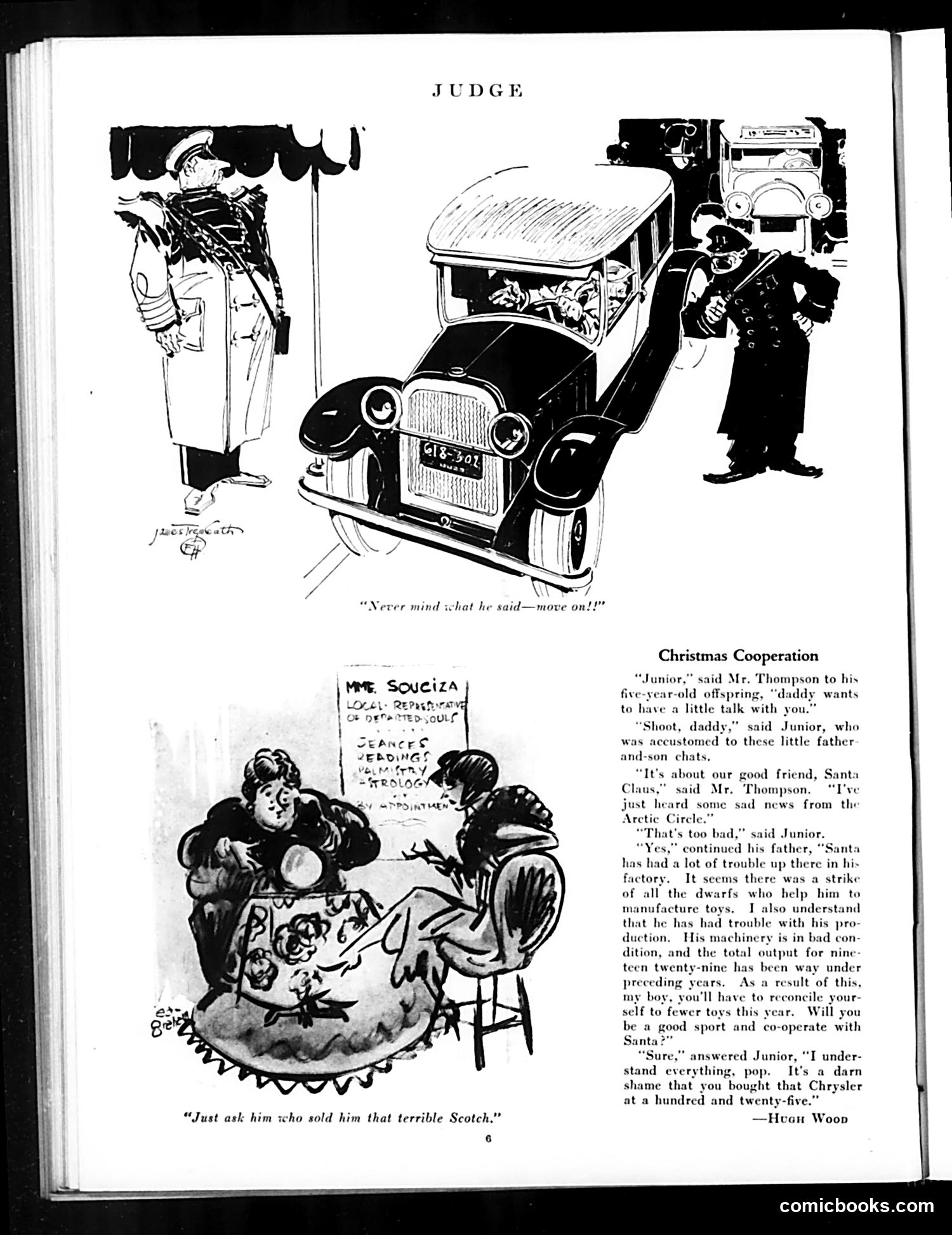
Analysis of Judge Page Top Cartoon ("Never mind what he said—move on!"): A traffic judge oversees three automobiles involved in what appears to be a collision. The caption suggests the judge is dismissing the incident without investigation, humorously commenting on judicial indifference to traffic violations or accidents—a social commentary on the inconsistency and carelessness of early automobile-era law enforcement. Bottom Story ("Christmas Cooperation"): A father-son dialogue about Santa Claus's factory troubles. Mr. Thompson explains Santa's production crisis due to strikes among dwarfs (toy manufacturers) and machinery problems, resulting in fewer toys. Junior agrees to accept fewer presents as a "good sport." The satire critiques labor strikes and economic disruption affecting holiday commerce and consumer expectations during the Christmas season.
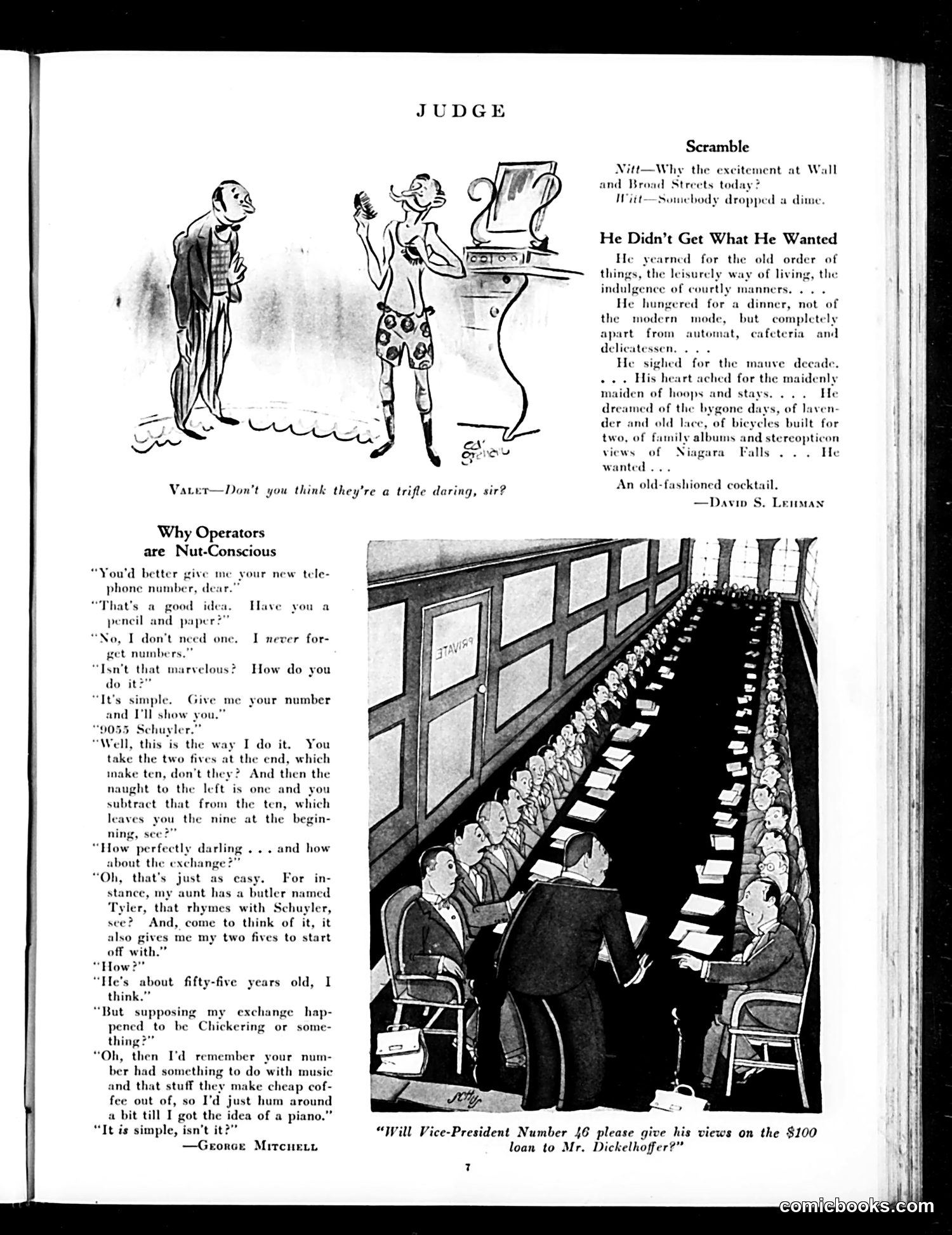
Judge Magazine Page Analysis This page contains three satirical pieces from Judge magazine (date unclear from image): "Scramble" mocks Wall Street's obsession with minor financial news—someone dropping a dime causes market excitement. "He Didn't Get What He Wanted" satirizes nostalgia for the pre-modern era. The figure longs for Victorian gentility (courtly manners, leisurely living, "mauve decade" aesthetics, Gibson Girls in bustles, stereopticon views) but is offered only an "old-fashioned cocktail"—implying modernity has stripped away genuine tradition, leaving only superficial retro gestures. "Why Operators are Nut-Conscious" jokes about a man's absurdly convoluted memory system for phone numbers, using nonsensical mathematical and associative logic (rhyming, musical references). The humor critiques both pretentious memory claims and the nuisance of remembering new phone numbers in an era of rapid technological change. The bottom cartoon's caption remains unclear without context about "Vice-President Number 46" and the "$100 loan to Mr. Dickelhoffer."
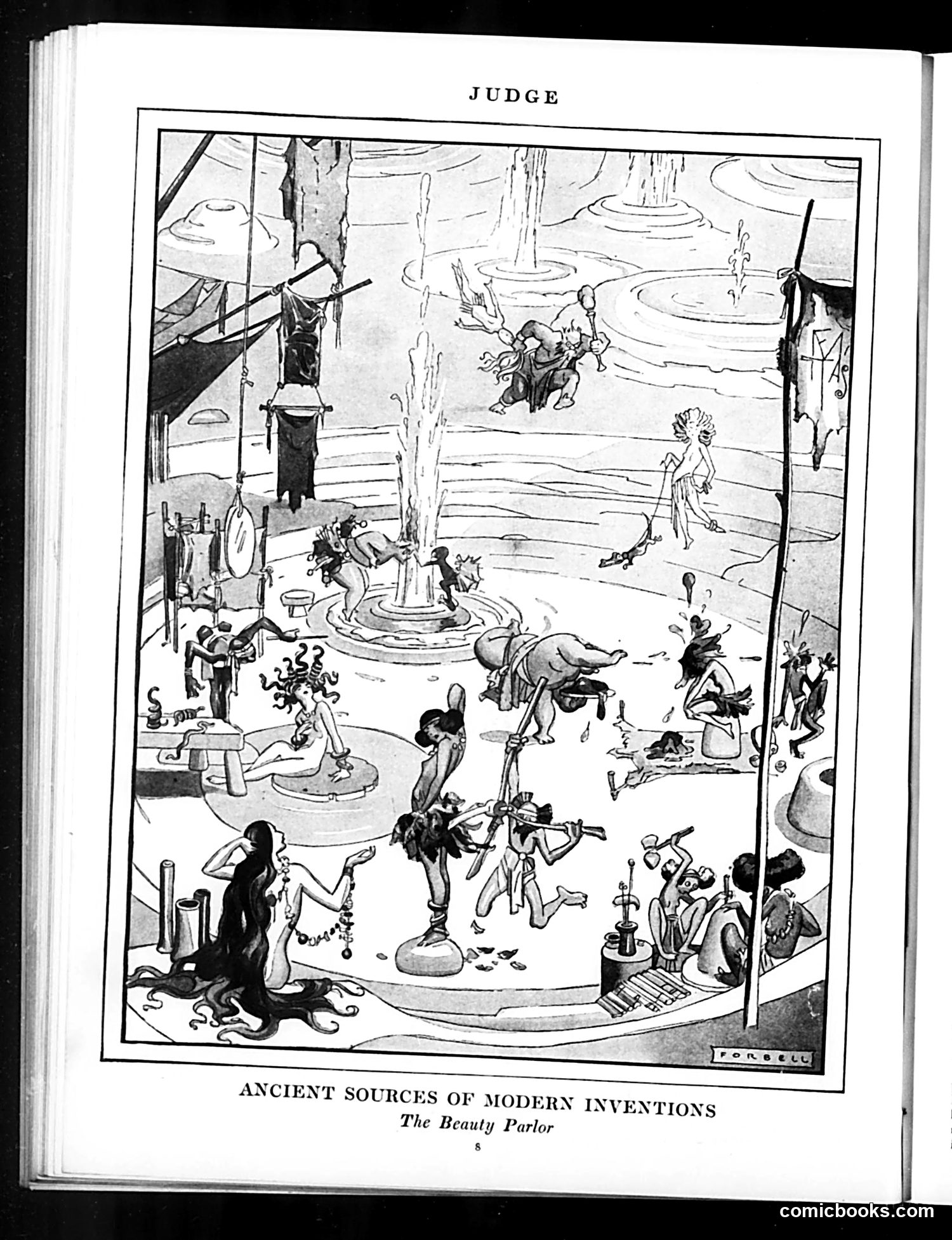
This satirical illustration from *Judge* magazine presents "The Beauty Parlor" as a mock-classical or fantastical underworld scene. The cartoon satirizes modern beauty treatments by depicting them as ancient or magical practices. Various figures engage in beauty rituals—applying cosmetics, styling hair, and undergoing treatments—rendered in an exaggerated, theatrical manner. The elaborate setting with columned structures and fountain-like features suggests a spa or salon reimagined as an otherworldly or classical temple. The satire likely mocks the extravagance and pseudoscientific claims of 1920s-30s beauty culture, presenting cosmetic and beauty procedures as absurdly elaborate rituals. By framing modern beauty practices as "ancient sources," the cartoon suggests these treatments aren't actually new innovations but rather reinventions of age-old vanity practices, poking fun at both women's beauty routines and the marketing claims surrounding them.
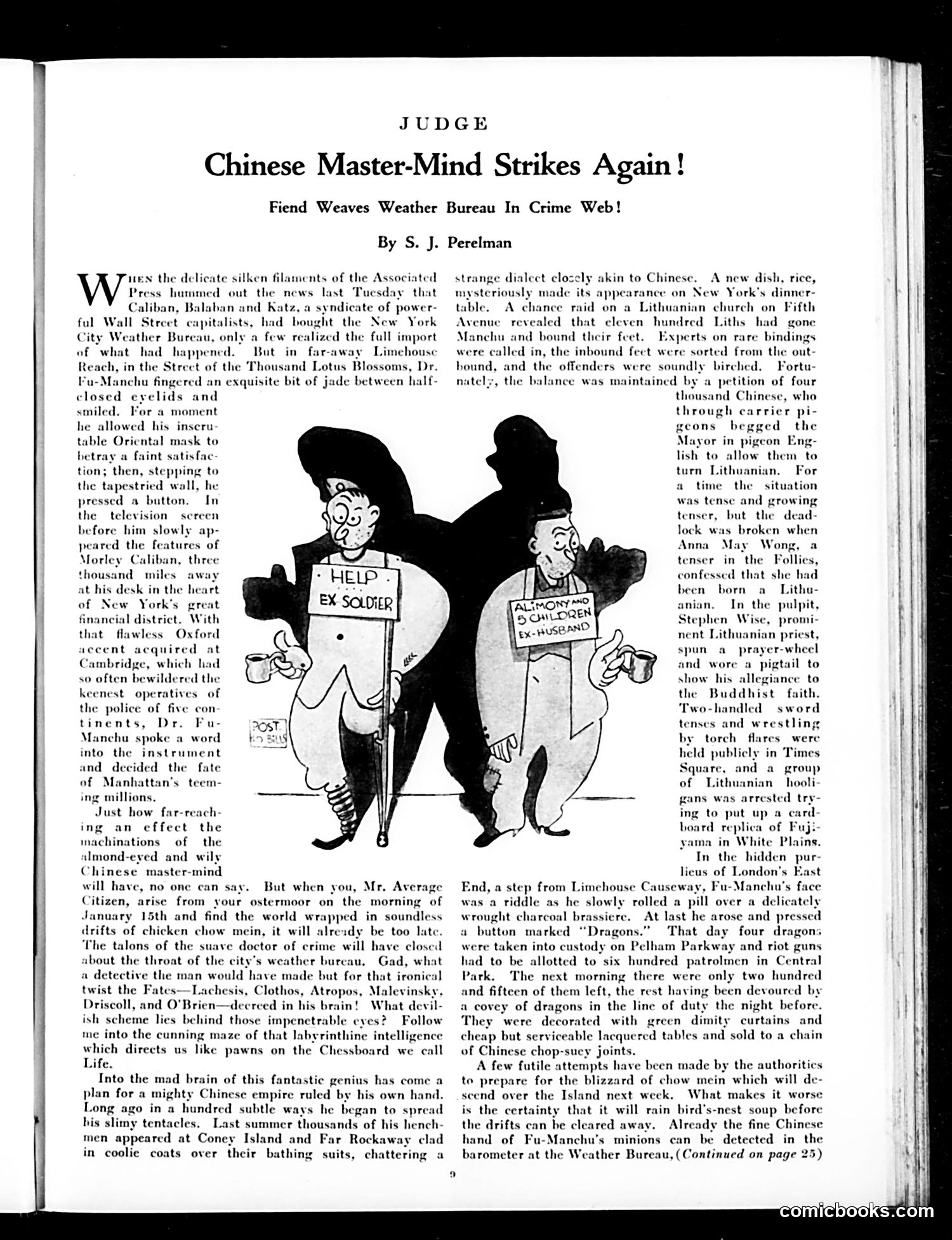
"Chinese Master-Mind Strikes Again!" This 1920s-era Judge satire targets Dr. Fu Manchu, the popular fictional "yellow peril" villain from contemporary pulp fiction and cinema. The cartoon mocks both the sensationalist Fu Manchu stories and contemporary anxieties about Chinese immigration and influence in America. The silhouette cartoon shows two caricatured figures (likely representing Fu Manchu manipulating American capitalists) engaged in some scheme. The accompanying article satirizes the melodramatic tropes of Fu Manchu narratives—a Chinese criminal mastermind supposedly infiltrating American institutions, here through control of the Weather Bureau. The humor relies on absurdist escalation: mysterious rice dishes, Lithuanian foot-binding incidents, Anna May Wong's involvement, and prayer wheels becoming fashionable. It's mock-sensationalist writing parodying both the overwrought Fu Manchu genre and period xenophobic fears about Chinese organized crime controlling American life. The satire ultimately lampoons American paranoia more than celebrating it, though modern readers should note the deeply offensive racial caricatures embedded throughout.
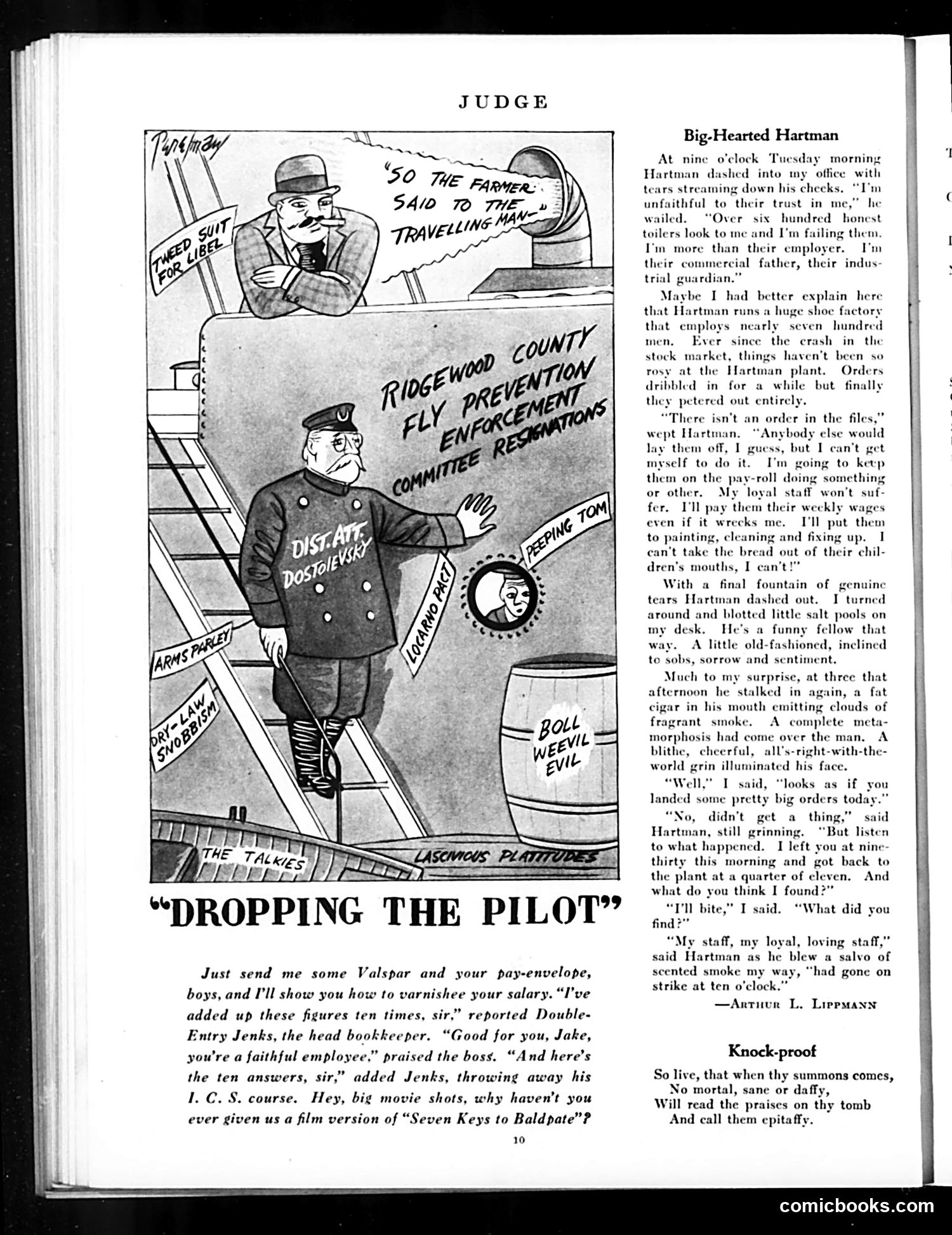
Analysis: "Dropping the Pilot" This cartoon satirizes bureaucratic incompetence and mismanagement during economic crisis. The central figure appears to be a government or corporate official labeled with various failed policies ("Ridgewood County Fly Prevention," "Arms Parcel," "Dry Law Snobbery," "Roll Weevil Evil," "Lascivious Platitudes"). A businessman at the bottom tries to push him aside, captioned "The Talkies." The title "Dropping the Pilot" references the famous Tenniel cartoon of Bismarck's dismissal, suggesting removal of a failed leader. The joke, per the caption, involves a bookkeeper who manipulates figures—the cartoon critiques how officials cook numbers while real workers suffer. The accompanying story about "Big-Hearted Hartman," a factory owner who keeps unemployed workers on payroll only to have them strike, appears to mock sentimental paternalism as equally impractical as government bungling. The satire targets early 1930s Depression-era responses: both bloated, ineffective bureaucracy and well-intentioned but economically naive management.
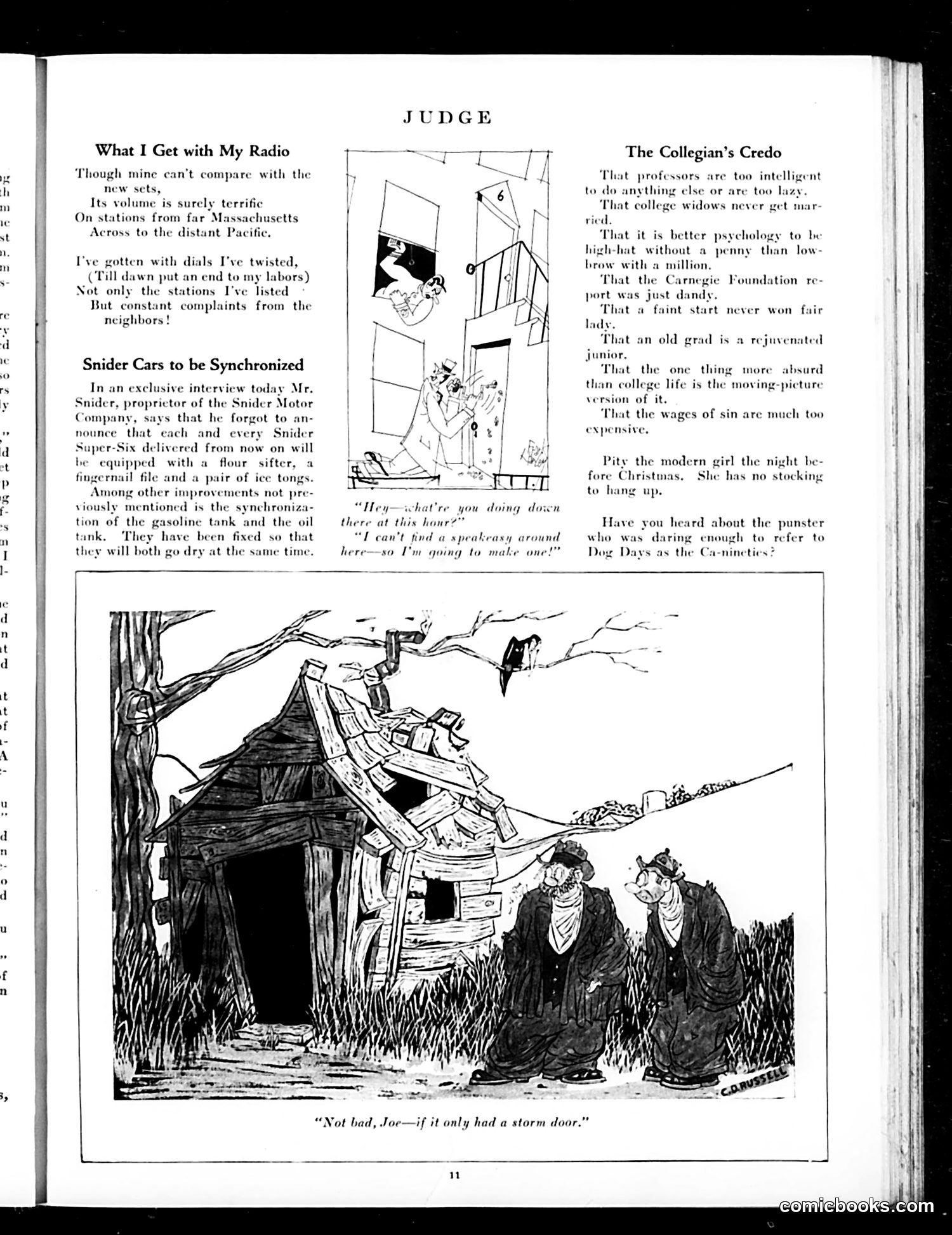
Analysis of Judge Magazine Page Top Section - Two Brief Items: "What I Get with My Radio" satirizes the early radio craze of the 1920s-30s. The joke: radios receive distant stations across the country, but their loud volume generates constant neighbor complaints—an unintended "feature." "Snider Cars to be Synchronized" mocks automobile marketing. The Snider Motor Company announces absurd "improvements" (flour sifter, fingernail file, ice tongs), culminating in the actual joke: synchronized gasoline and oil tanks so they both run empty simultaneously—a mechanical design flaw presented as intentional. Right Column - "The Collegian's Credo": A satirical list of collegiate attitudes, mocking student hypocrisy and pretension (professors are "too intelligent," wealth matters more than character, the Carnegie Foundation is overrated, etc.). Bottom Cartoon: Two men examine a dilapidated, partially collapsed house. One says, "Not bad, Joe—if it only had a storm door." The humor: absurd prioritization—fixating on a minor detail (storm door) while the entire structure is falling apart. This likely reflects Depression-era or post-WWI economic desperation.
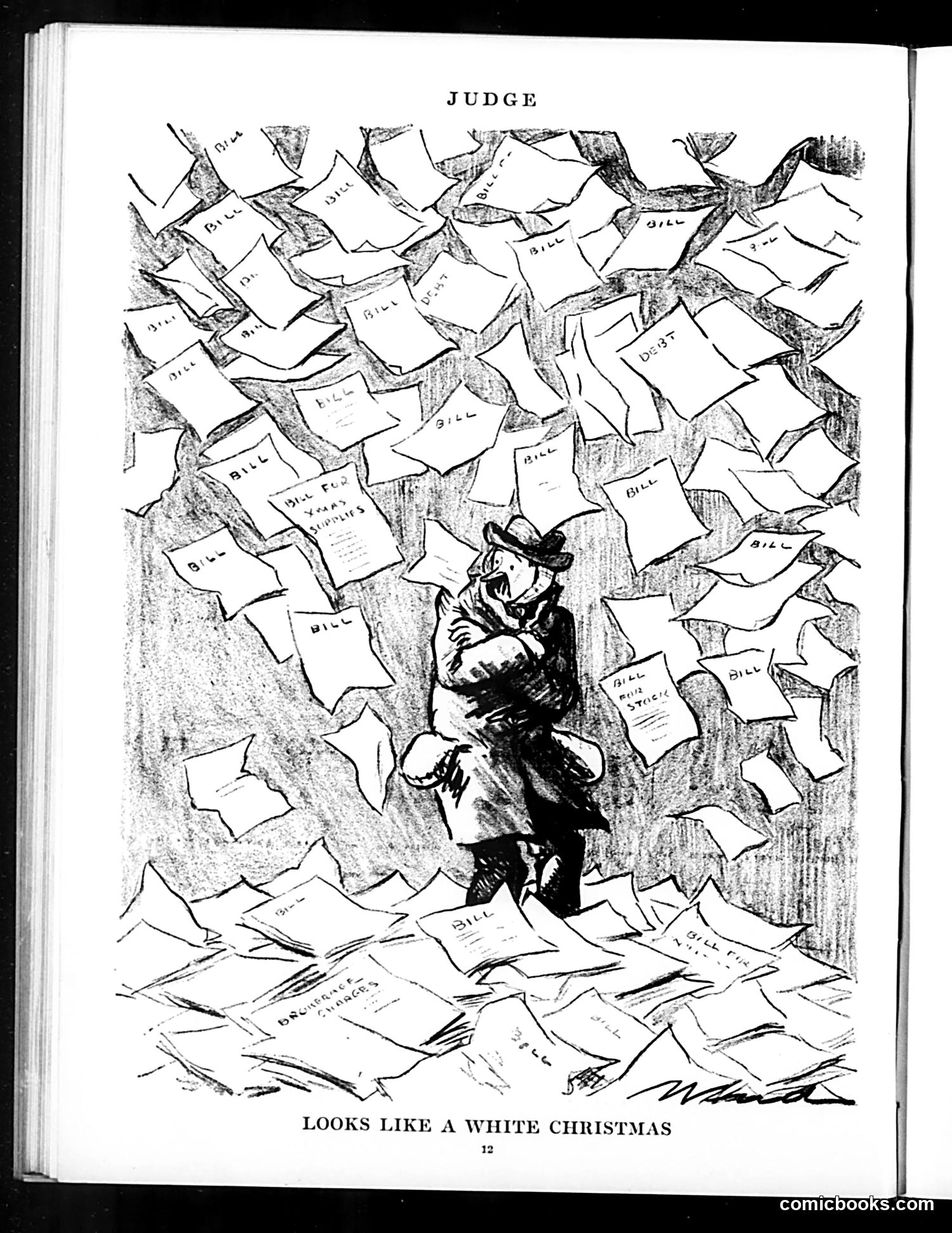
Cartoon Analysis This political cartoon titled "Looks Like a White Christmas" depicts a figure (labeled as "Judge") buried under an avalanche of papers labeled "BILL." The mountainous accumulation of legislation overwhelms the central character, who appears distressed by the sheer volume of proposed bills. The satire critiques excessive legislative activity—likely during a busy Congressional session. The "white Christmas" reference is ironic: instead of snow, bills are falling. The cartoon suggests that legislative bodies are burying themselves and governance under an unmanageable workload of proposed legislation. Without the publication date visible, the specific bills being addressed are unclear, but the cartoon's message is universal: Congress's productivity, if excessive and poorly managed, becomes counterproductive and overwhelming.
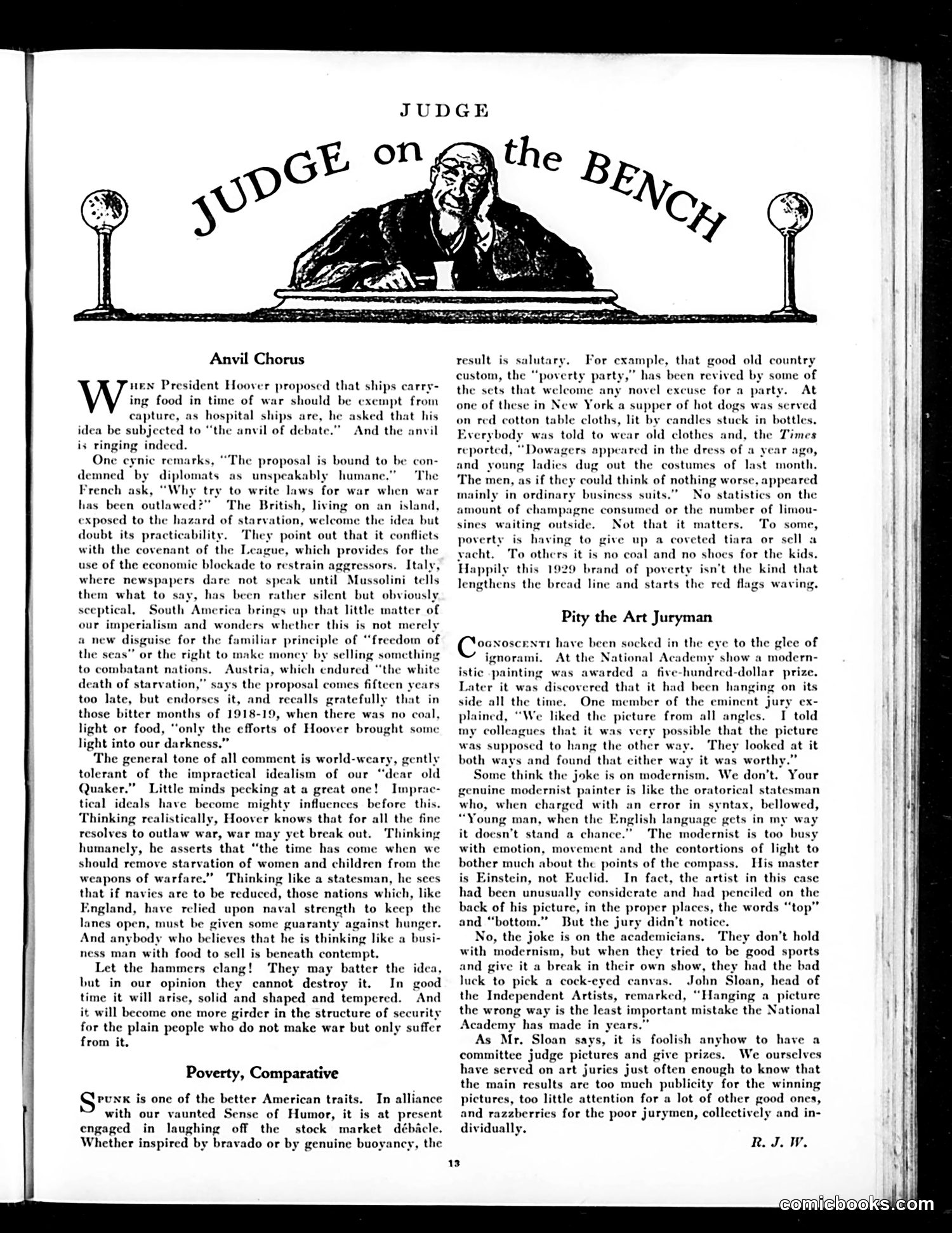
Judge Magazine Analysis: "Judge on the Bench" Page This page contains three opinion columns under the "Judge on the Bench" masthead (featuring an illustrated judge). "Anvil Chorus" discusses President Hoover's proposal to exempt food-carrying ships from capture during wartime—treating them like hospital ships. The piece satirizes international responses: France questions outlawing war while allowing it; Britain supports the idea but doubts its practicality; Italy stays silent under Mussolini's censorship; and South America cynically sees it as disguised American economic imperialism ("freedom of the seas"). Austria endorses it, recalling Hoover's WWI relief efforts. The column ultimately supports Hoover's humanitarian reasoning despite global skepticism. "Poverty, Comparative" mocks wealthy New Yorkers throwing "poverty parties" during the 1929 stock market crash—wealthy dowagers wearing old dresses, eating hot dogs by candlelight. The satire highlights the absurdity: to the rich, "poverty" means giving up tiaras; to actual poor people, it means no coal or shoes. "Pity the Art Juryman" (partially visible) appears to critique art competition judging, though the full text is cut off.
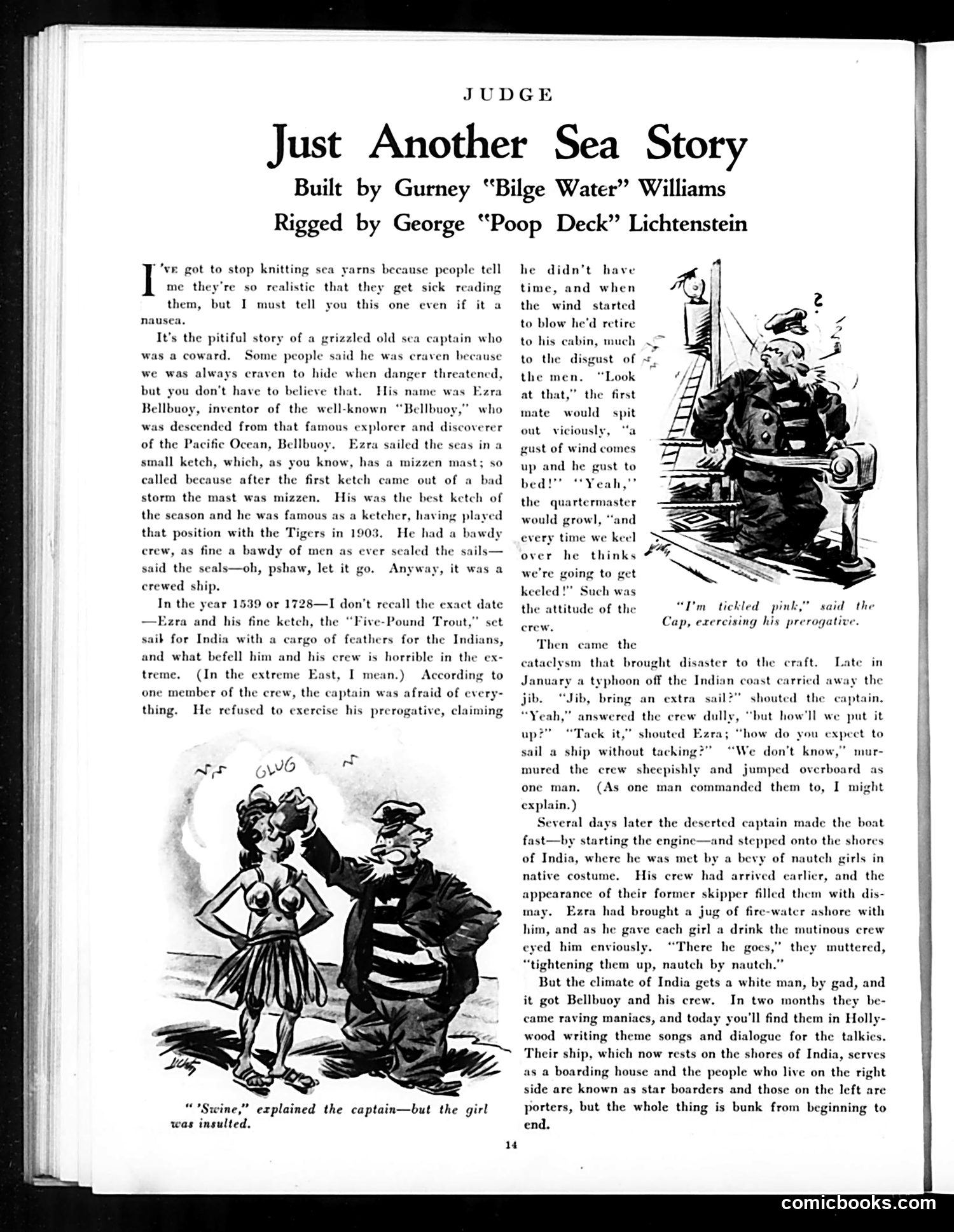
"Just Another Sea Story" — Judge Magazine Satire This is a humorous tall tale mocking nautical fiction and Hollywood's writing industry. The story follows Captain Ezra Bellbuoy, a cowardly ship's captain who refuses command during a typhoon, causing his crew to abandon ship in exasperation. The satire works on multiple levels: the bylines ("Bilge Water" Williams, "Poop Deck" Lichtenstein) signal this is deliberate nonsense; the narrative is riddled with puns and contradictions (dates "1539 or 1728," the crew's illogical obedience); and the punchline targets early talking-picture writers—the captain and crew end up in Hollywood "writing theme songs and dialogue for the talkies," transformed into "raving maniacs." The cartoons show the captain's incompetence at sea and his later exploitation of women ashore. The joke ultimately ridicules both overwrought nautical yarns and the desperation of writers churning out dialogue for the nascent sound-film industry.
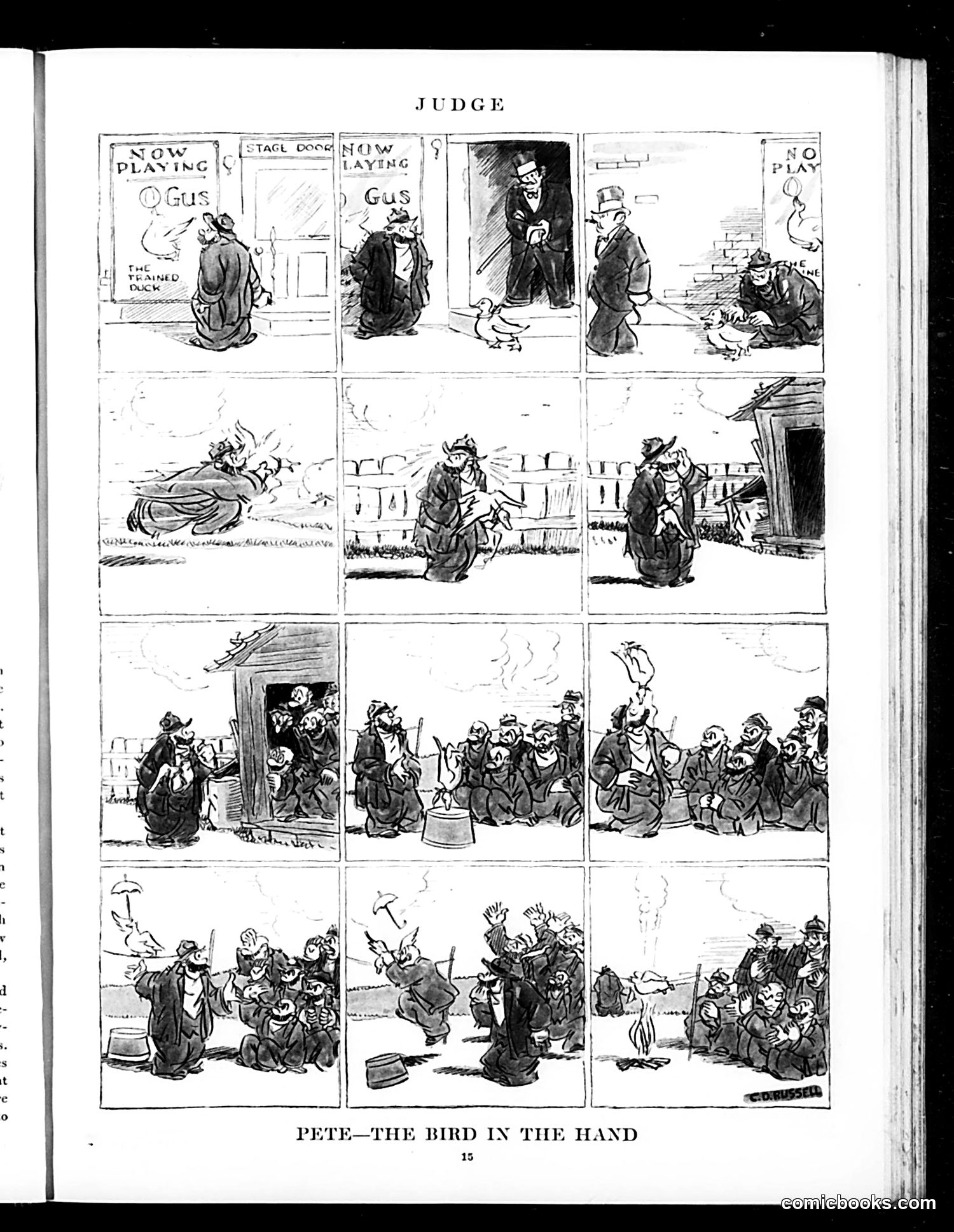
"Pete—The Bird in the Hand" This comic strip appears to satirize a theatrical performance or production called "Gus" (visible on marquees in the opening panels). The narrative follows characters pursuing what seems to be a live duck or bird through various urban and rural settings—theaters, streets, fences, and finally a gathering of men. The title references the proverb "a bird in the hand is worth two in the bush," suggesting the central joke involves characters literally chasing and attempting to capture a bird. The strip progresses from theatrical settings to increasingly chaotic pursuit scenes, culminating in a large group attempting to catch the creature. Without clearer historical context about the specific theatrical production "Gus" being referenced, the exact satirical target remains unclear, though it appears to mock both theatrical promotion and the absurdity of public pursuit of some commodity or person.
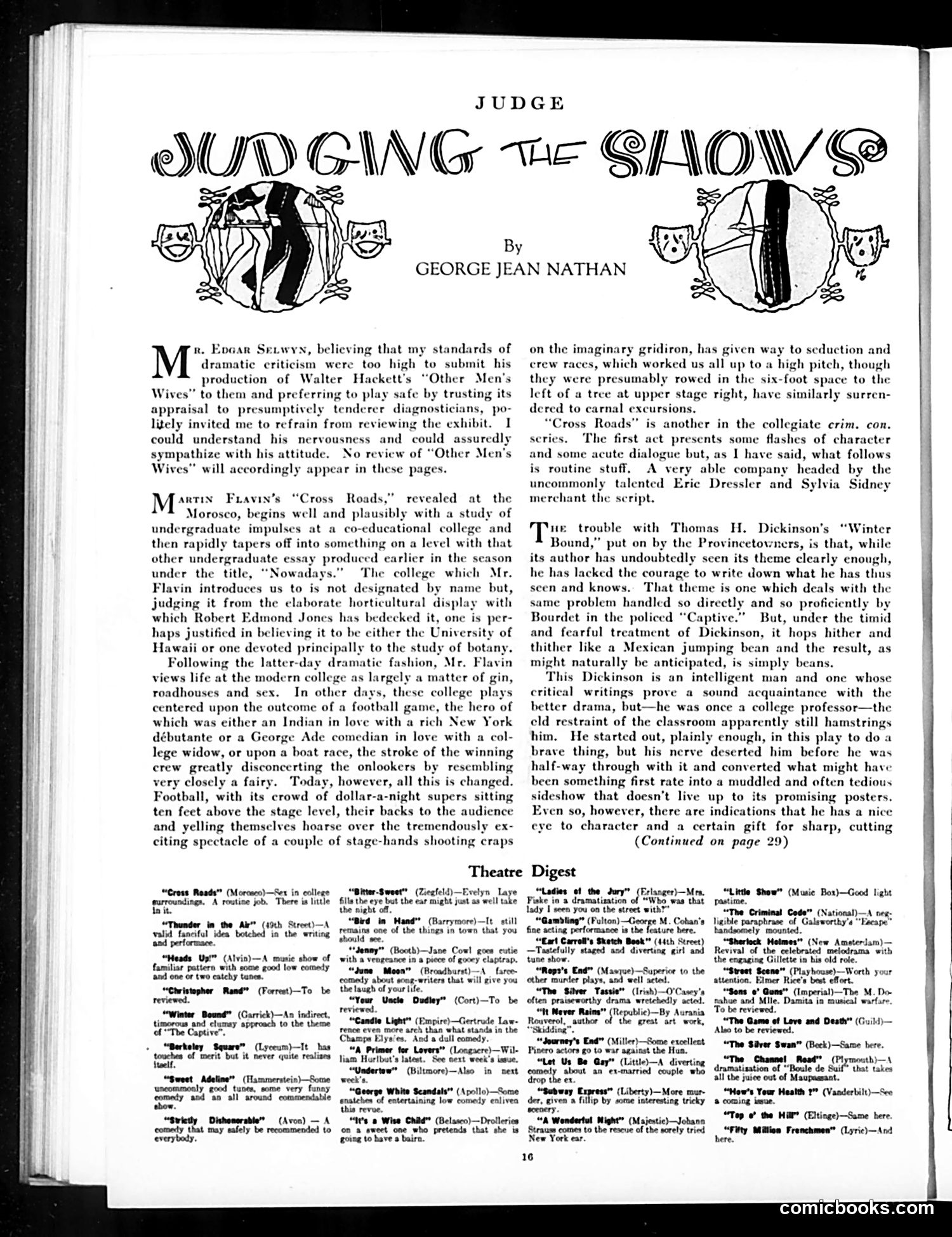
Judge Magazine Theatre Review Page Analysis This is a theater review page from Judge magazine by prominent critic George Jean Nathan. Rather than cartoons, the page contains Nathan's sardonic written critiques of three Broadway productions. Key content: 1. "Other Men's Wives" — Nathan pointedly *refuses* to review this Walter Hackett production, implying it's so poor the producer requested he skip it. This is satire through omission. 2. "Cross Roads" — Nathan dismisses this college-set play as beginning promisingly but devolving into "routine stuff," despite talented performers (including Eric Dressler and Sylvia Sidney). 3. "Winter Bound" — Nathan criticizes Thomas H. Dickinson's timid handling of mature themes. He notes Dickinson, a former college professor, lacks courage to fully explore his subject matter, converting potential "first rate" drama into a "muddled" sideshow. The satire: Nathan employs cutting wit and intellectual snobbishness typical of 1920s theater criticism, dismissing contemporary Broadway fare as intellectually lazy or artistically compromised.
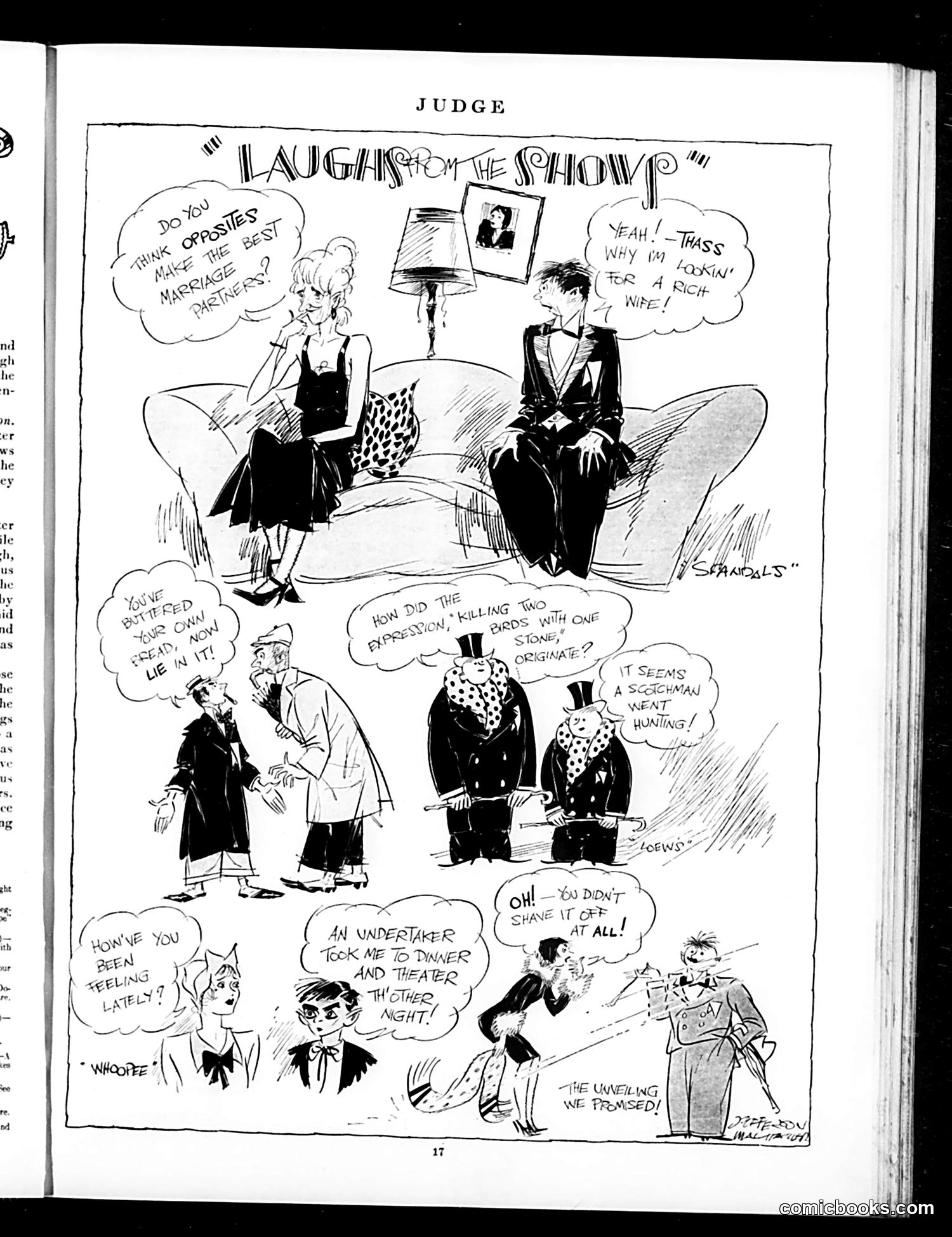
"Laughs of the Show" This Judge cartoon satirizes theatrical gossip and marriage stereotypes. The top panel shows a couple discussing whether "opposites make the best marriages" and "rich wives"—common romantic conversation topics of the era. The middle sections mock theatrical superstitions and social climbing: references to an undertaker at dinner, "killing two birds with one stone," and a monument unveiling. These vignettes appear to parody the pretensions and superstitions of show-business society. The bottom panels feature two couples with exclamations like "Whoopee!" and someone claiming they "shaved it off at all!"—likely referencing physical appearance or fashion changes, a common topic of entertainment-world humor. The overall joke targets the vapid, self-absorbed conversation and behavior of theatrical and wealthy social circles, mocking their obsession with marriage prospects, superstition, and superficial concerns.
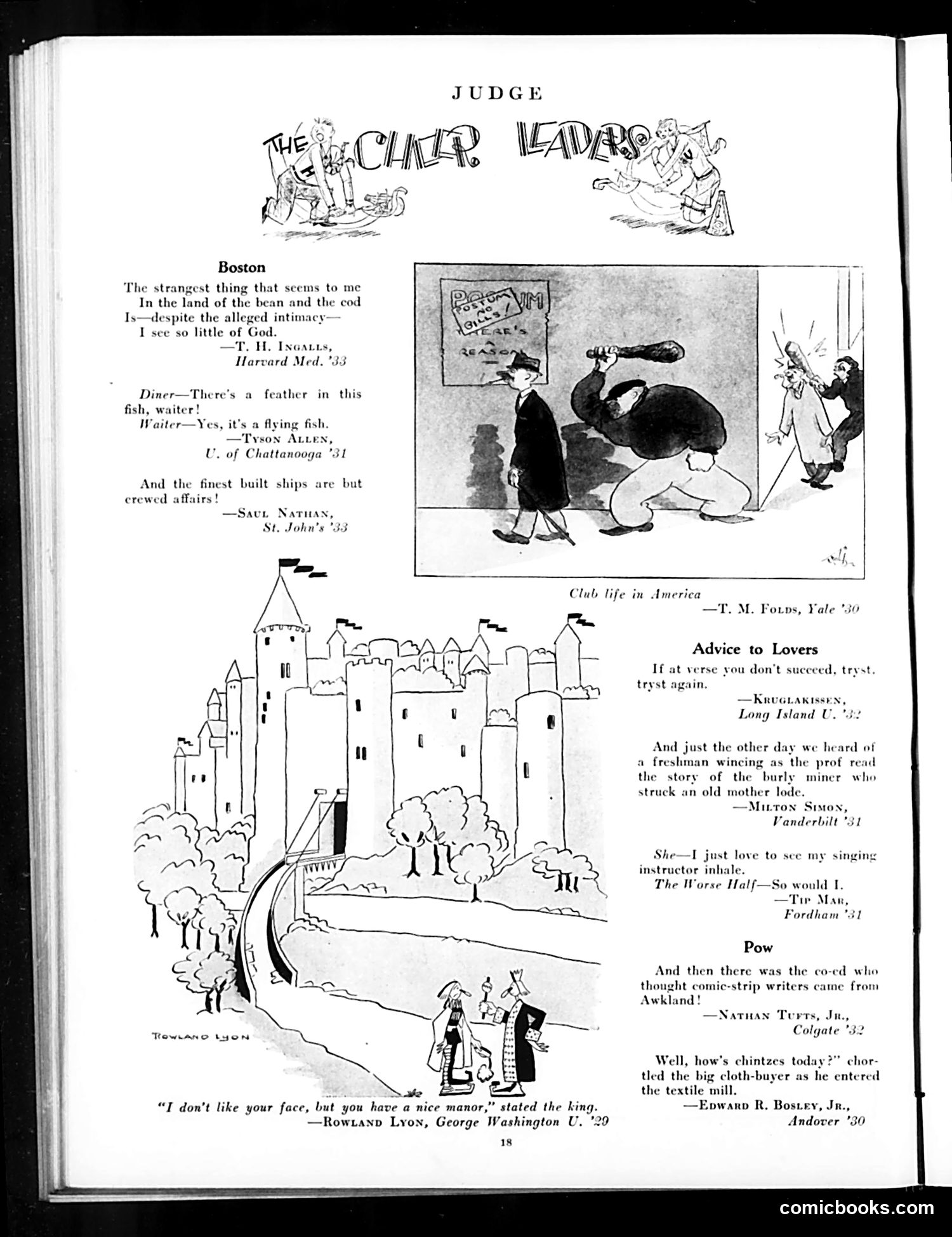
Judge Magazine Page Analysis This page from Judge magazine features college humor — witty one-liners and jokes submitted by university students, each credited with their school and class year. The content reflects 1930s collegiate sensibilities. The cartoons and quips satirize: 1. "Club life in America" (main cartoon): Shows students engaging in rowdy hazing or initiation behavior, mocking American college club culture as violent and absurd. 2. College life absurdities: Jokes mock pedantic professors (the "burly miner" double-entendre), tone-deaf instructors, and naïve co-eds who don't understand cultural references. 3. The castle illustration appears decorative rather than satirical, accompanying a quote attributed to Rowland Lyon about appearance versus status. The overall theme is lighthearted collegiate ribaldry — poking fun at university life, pretension, and romantic/social awkwardness among students. Judge positioned itself as a forum for college wit, publishing student submissions to appeal to educated, affluent readers. The satire is gentle rather than biting, reflecting Depression-era entertainment aimed at upper-class audiences.
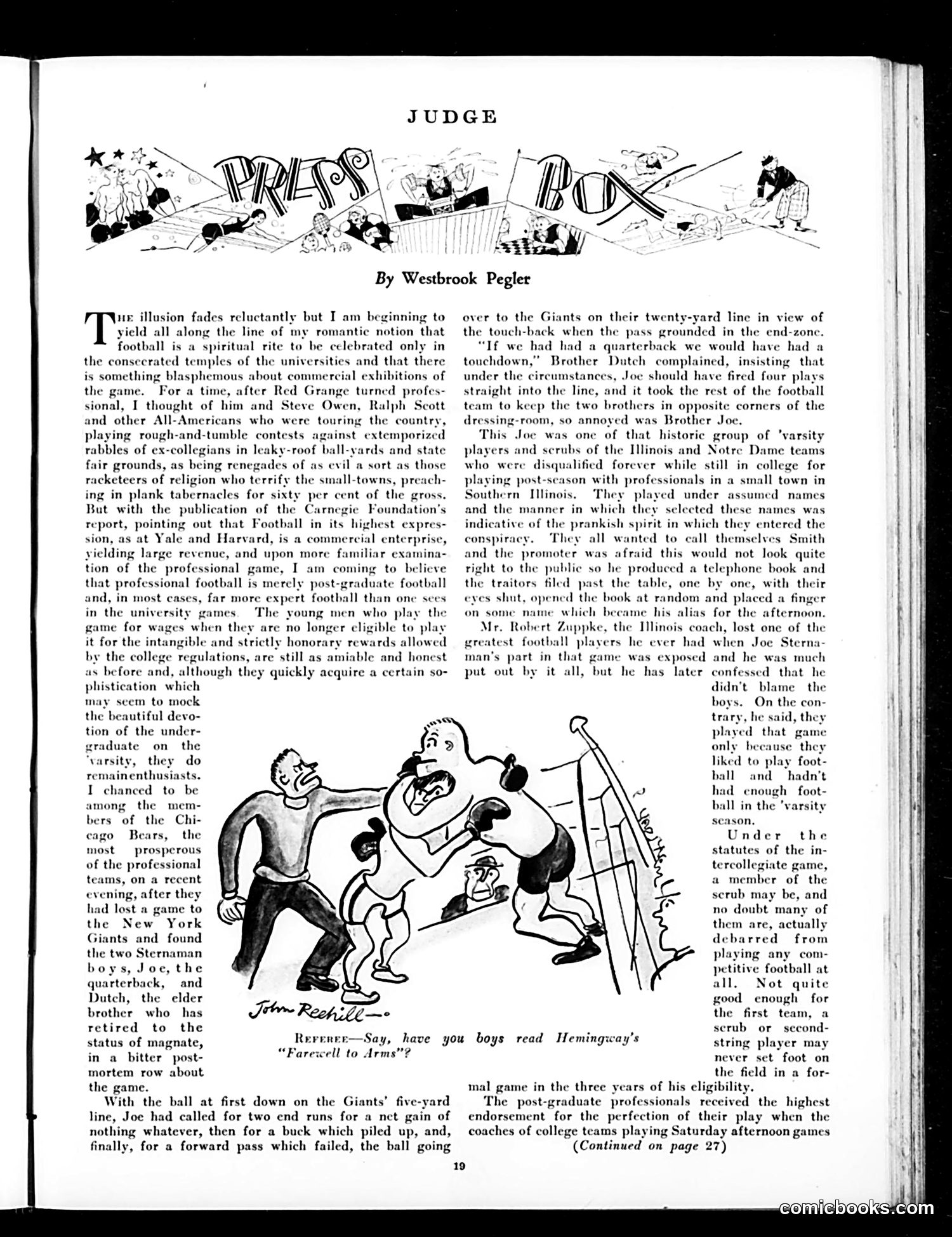
Explanation for Modern Readers This is a sports opinion column by Westbrook Pegler critiquing professional football's emergence in the 1920s. Pegler describes his changing view: he initially condemned pro football as a corruption of college football's amateur ideals, but now acknowledges that even elite universities like Yale and Harvard run commercial operations. The cartoon illustrates a specific anecdote: a heated argument between Joe Sternaman (quarterback of the Chicago Bears) and his brother Dutch over a failed play against the New York Giants. Dutch criticizes Joe's play-calling, nearly causing a fight in the locker room. Pegler uses this to discuss the Sternaman brothers' earlier disqualification from Illinois and Notre Dame for playing post-season games under assumed names—selected randomly from a telephone book. Coach Robert Zuppke was initially outraged but later admitted the players simply loved football and lacked sufficient varsity opportunities. The broader point: professional football represents honest enthusiasm for the game, not the corrupt commercialism Pegler initially feared.
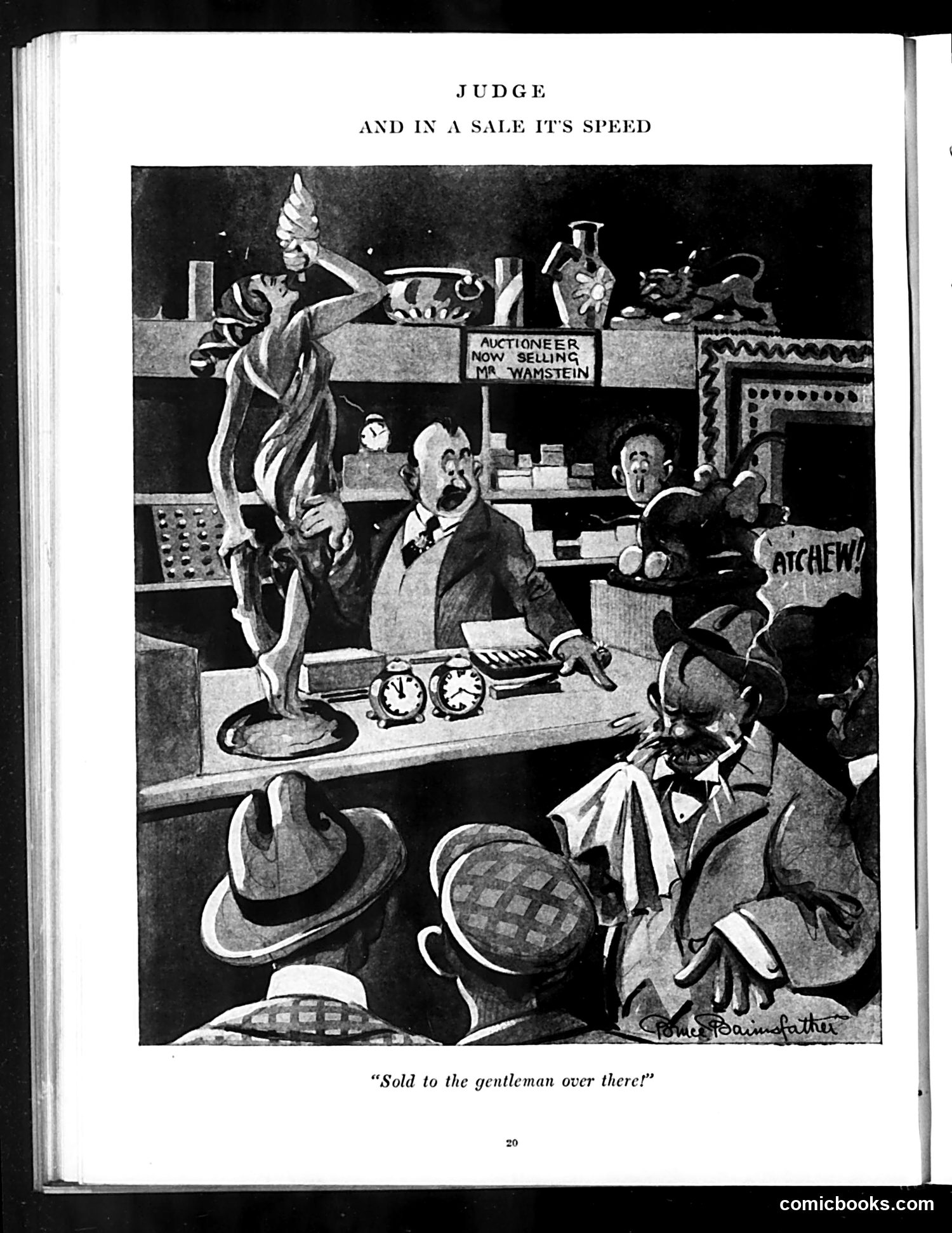
Analysis This satirical cartoon depicts an auction scene with the caption "Sold to the gentleman over there!" The sign identifies the auctioneer as "Mr. Wamstein." The cartoon appears to mock rapid-fire auction sales tactics—the title "AND IN A SALE IT'S SPEED" emphasizes the auctioneer's quick-talking style. The caricatured figures (likely depicting Jewish stereotypes common to early 20th-century American publications) and the name "Wamstein" suggest the satire targets Jewish auctioneers or merchants. The scene shows animated bidders in hats with exaggerated expressions, capturing the frenzy of auction bidding. The humor relies on period stereotypes about aggressive salesmanship and Jewish business practices—content that reflects the prejudices of Judge magazine's era, though it's offensive by modern standards.
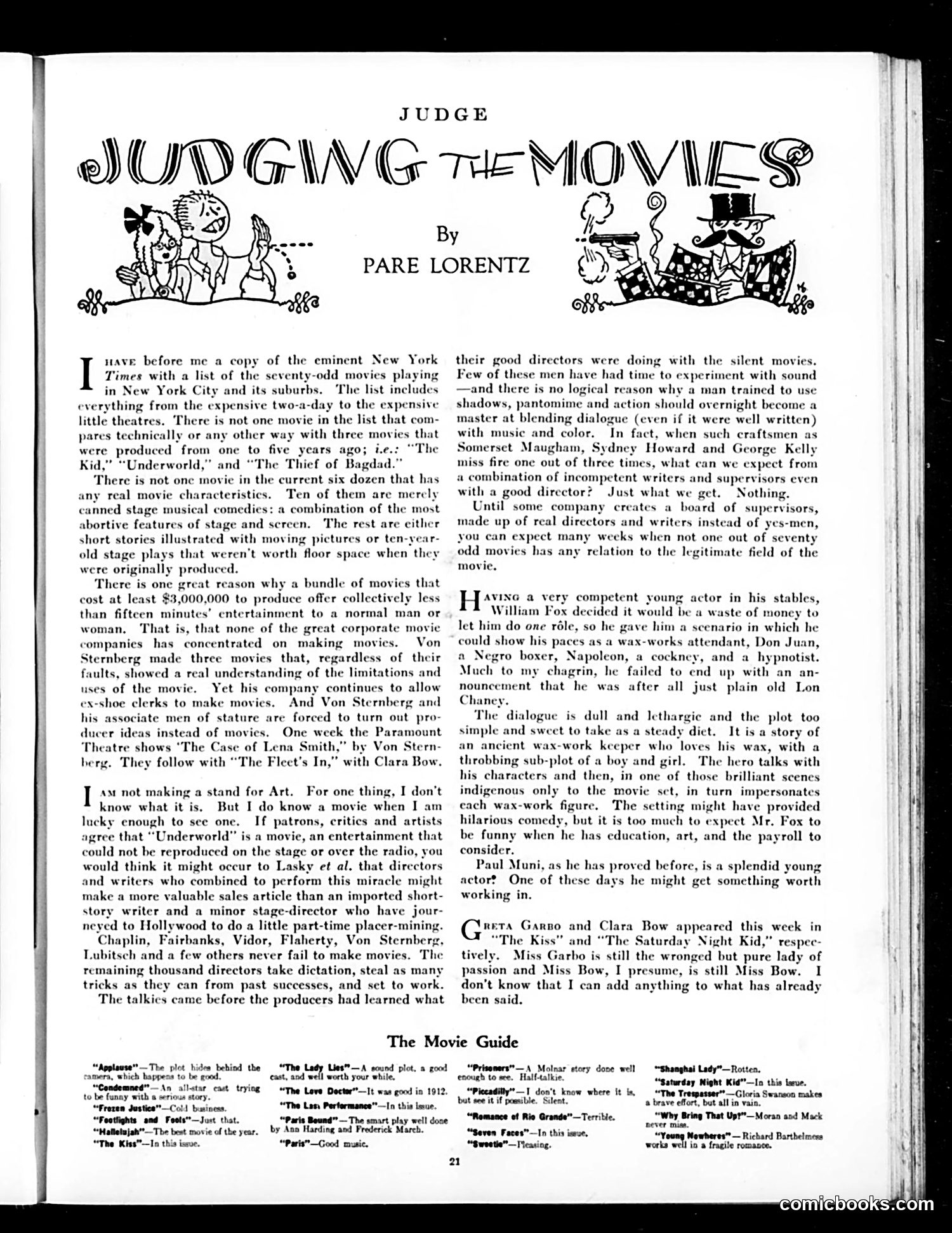
Judging the Movies: Lorentz's Critique of 1920s Cinema This article by Pare Lorentz critiques the state of contemporary American filmmaking. The central argument: despite millions spent producing seventy movies in New York, none match the quality of earlier films like Chaplin's "The Kid," "Underworld," or "The Thief of Bagdad." Lorentz identifies systemic problems: studios employ mediocre directors (dismissively called "ex-shoe clerks") while sidelining true filmmakers like Von Sternberg. Most current films are merely illustrated short stories or stage plays—lacking the visual sophistication cinema demands. The recent introduction of sound has worsened matters, forcing visual artists to master dialogue writing overnight. His solution: studios need boards of supervisors composed of actual directors and writers, not "yes-men," to elevate industry standards. The accompanying "Movie Guide" reviews current releases, offering quick judgments on their merits.
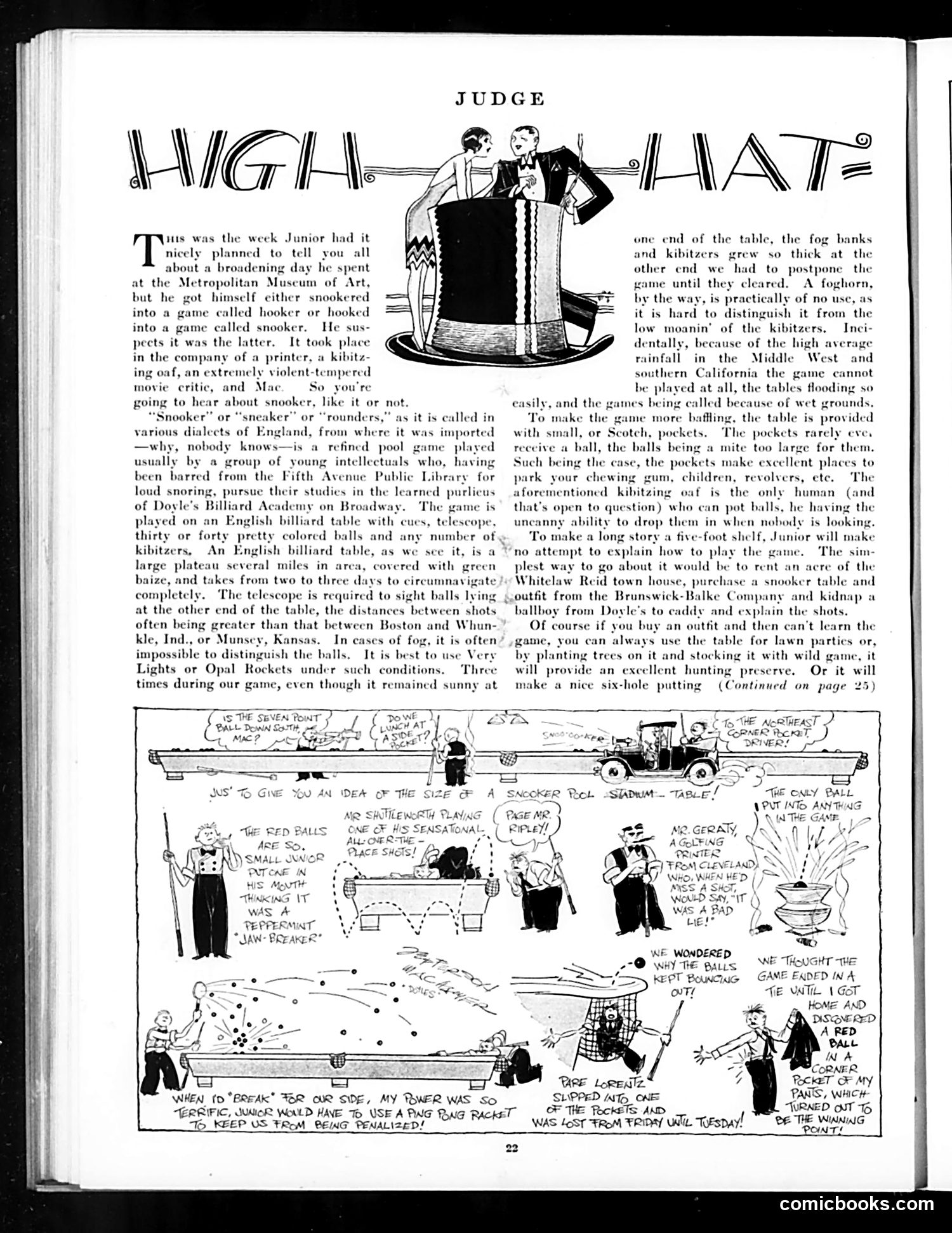
"High Hat" - Snooker Game Satire This Judge humor piece satirizes the game of snooker through exaggeration and absurdist comedy. The article describes snooker as played by "young intellectuals" barred from the New York Public Library, now studying at Doyle's Billiard Academy on Broadway. The satire works by inflating the game's complications: the billiard table is described as enormous (comparing distances to real American towns), requiring telescopes to sight balls and flares to penetrate fog. The accompanying cartoon shows characters playing amid this chaos, with dialogue detailing mishaps like lost balls and broken equipment. The humor targets both the pretension of calling pool-players "intellectuals" and New York's upper-class recreational culture. The "High Hat" title references fashionable snobbery—snooker here becomes an absurdly complicated marker of sophistication among people actually barred from legitimate institutions. It's gentle mockery of bohemian Manhattan leisure culture circa the 1920s-30s.
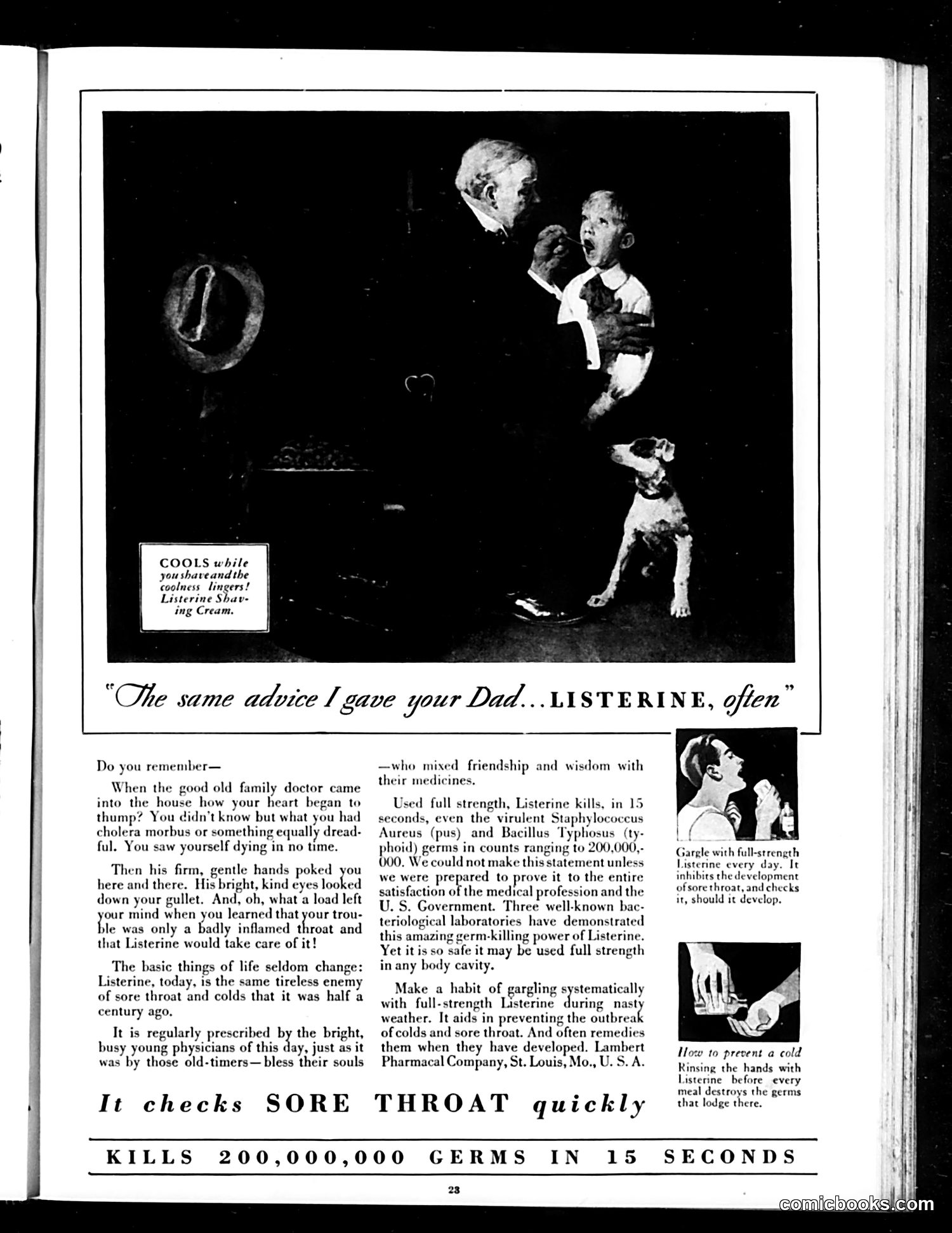
Listerine Advertisement Analysis This is primarily a Listerine mouthwash advertisement, not political satire. The page uses nostalgic imagery to market the product's antiseptic properties. The cartoon depicts an elderly doctor examining a child while an adult watches—evoking "the good old family doctor" mentioned in the text. This nostalgic framing suggests Listerine has been trusted medicine for generations. The advertisement emphasizes scientific credibility: it claims Listerine kills 200 million germs in 15 seconds and references approval from the U.S. Government and "three well-known bacteriological laboratories." This appeals to 1920s-30s consumer desire for modern, scientifically-validated products. The accompanying instructional photos show proper gargling and hand-rinsing techniques. The ad positions Listerine as preventative medicine for colds and sore throats—a common concern before antibiotics. The "Judge" magazine framing suggests this advertisement ran alongside satirical content, though this particular page is purely commercial.
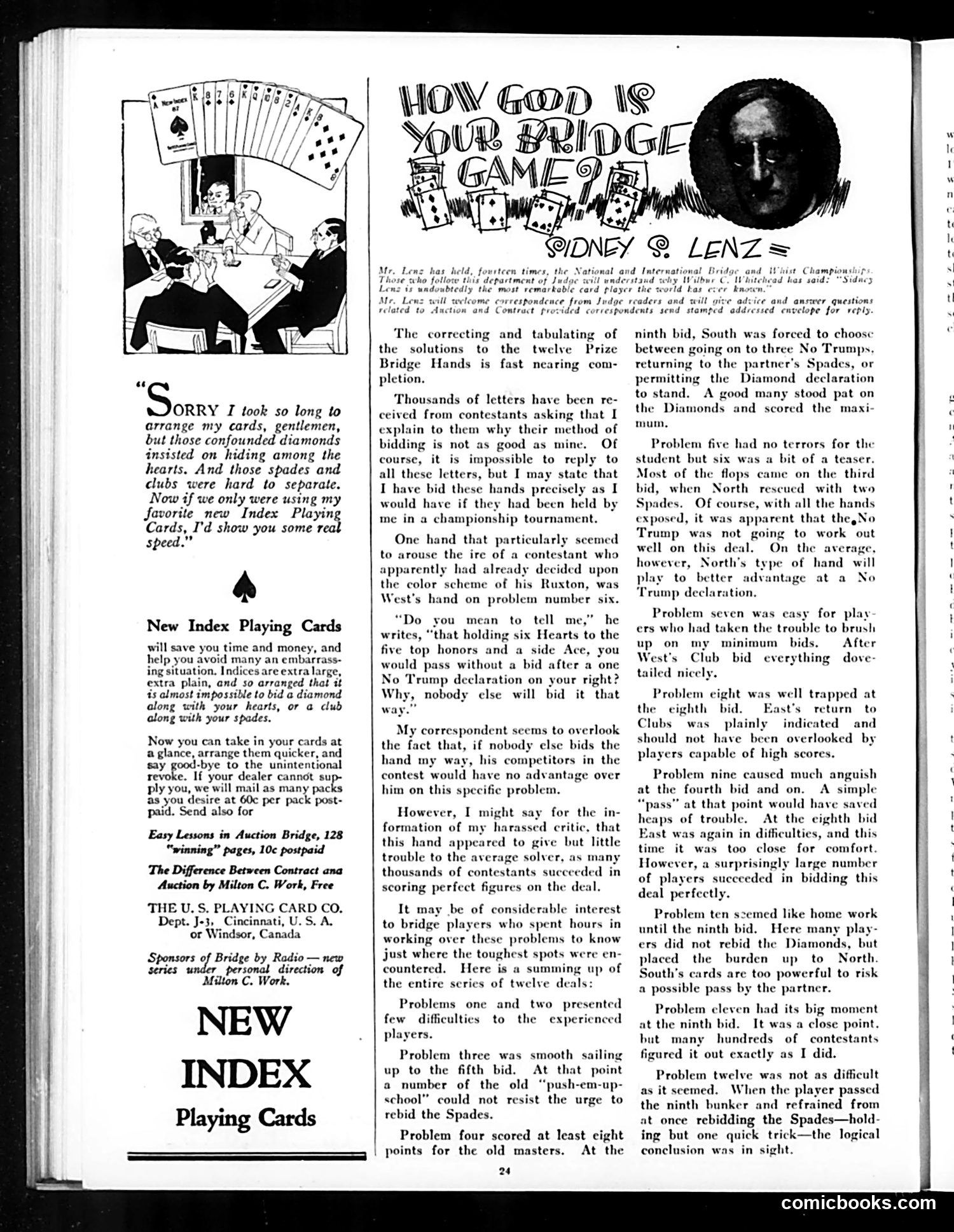
Analysis of This Judge Magazine Page This page combines bridge card game instructional content with advertising. The main cartoon (upper left) depicts three men playing cards, with one apologizing for slowly organizing his mixed suit cards—a setup for advertising the "New Index Playing Cards" with clearer markings. The right side features a profile portrait of Sidney S. Lenz, identified as a famous bridge player who won "fourteen times, the National and International Bridge and Whist Championship" and is called "the most remarkable card player the world has ever known." This appears to be a feature article about Lenz analyzing twelve difficult bridge hands from a contest, explaining which problems were most challenging for players. The page is primarily instructional and promotional—using Lenz's expertise to advertise both the card game itself (through the contest) and the improved playing cards. The satire is gentle: the opening cartoon jokes that even experts struggle with card organization, making the case for better-designed cards. Context for modern readers: This reflects bridge's peak popularity (1920s-1930s), when it was a major social activity and competitive game.
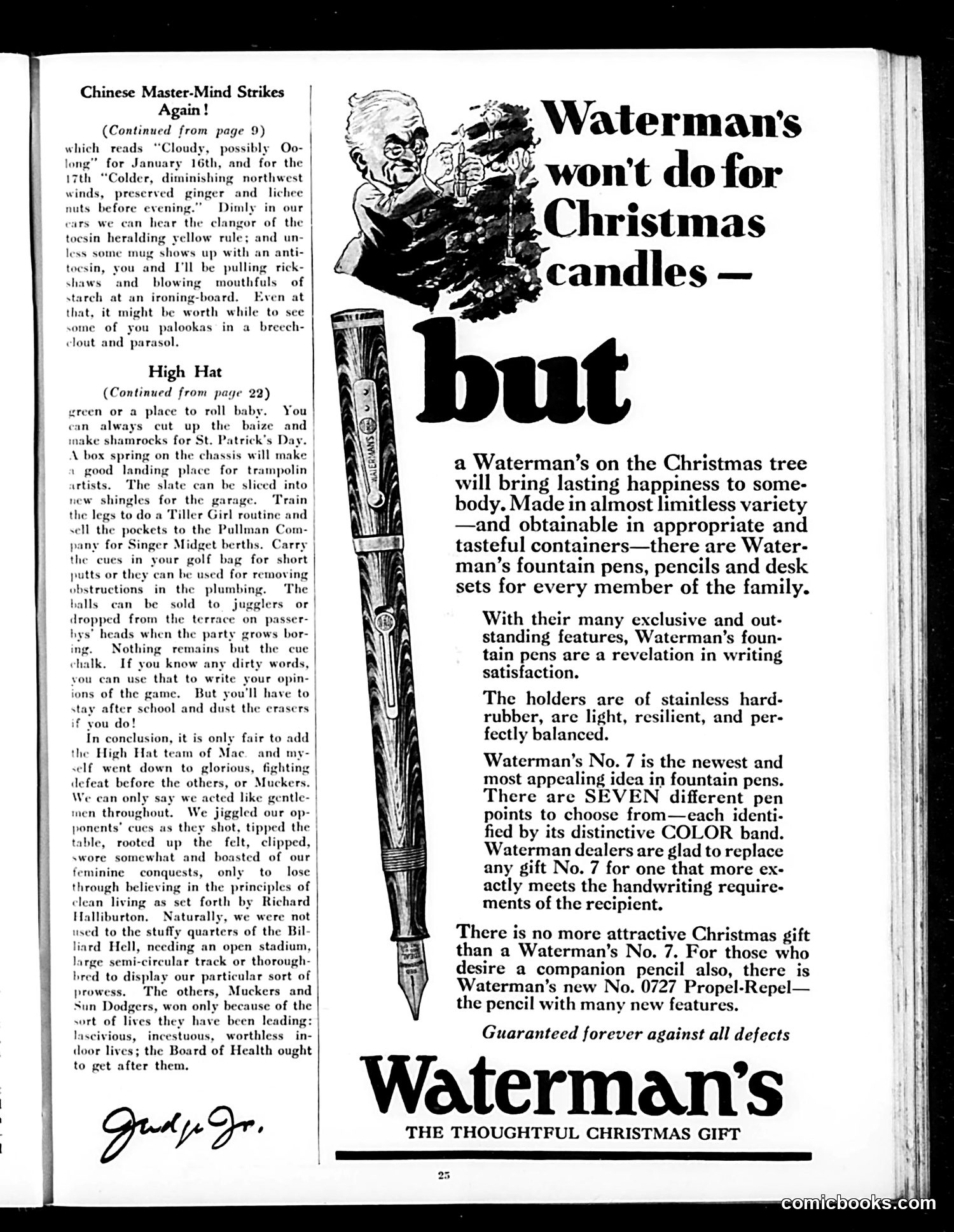
Analysis for Modern Readers This page contains two distinct elements: Left side: Two humor columns ("Chinese Master-Mind Strikes Again!" and "High Hat") from *Judge* magazine's satirical content. The first references period anxieties about Chinese immigration and influence (the "yellow peril" trope common in early 20th-century American media). The second is a gossipy account of a billiards competition, peppered with casual insults and boasting—typical of *Judge's* clubroom humor targeting wealthy men's leisure culture. Right side: A full-page advertisement for Waterman fountain pens positioning them as ideal Christmas gifts. The ad emphasizes quality, variety, and personalization—the pen had seven different color-coded points to suit individual handwriting needs. The juxtaposition is typical of magazine layout: satirical content subsidizes advertising. The ad's tagline, "The Thoughtful Christmas Gift," contrasts sharply with the crude humor dominating the editorial content.
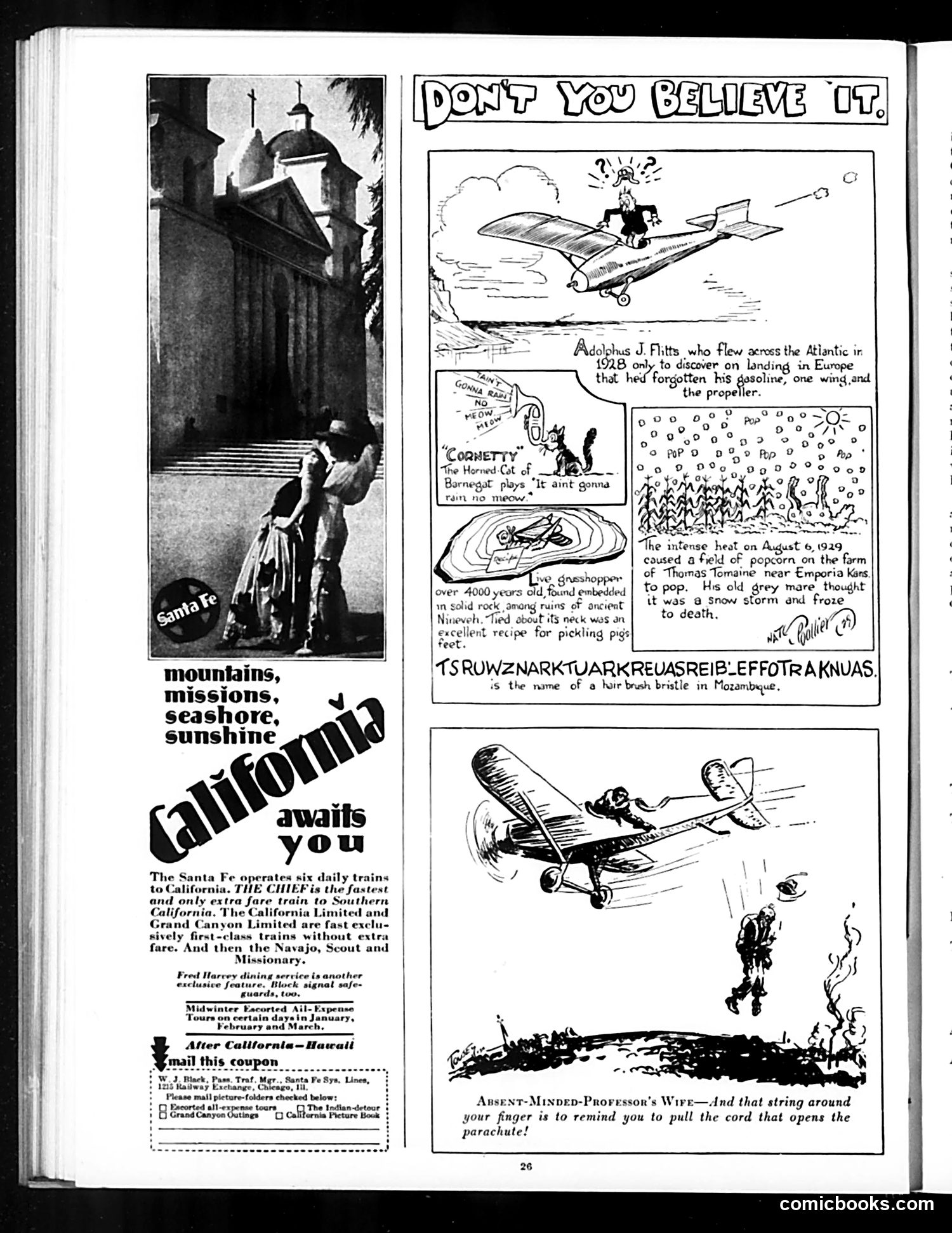
"Don't You Believe It" - Satirical Tall Tales This page features a satirical humor column presenting absurd, obviously false "facts" as if they're true. Each item ridicules credulous readers or mocks particular attitudes: The stories mock: - Aviation hubris: Adolphus J. Flitts flies across the Atlantic but forgets essential plane parts - Animal behavior anthropomorphism: A cat plays music ("it ain't gonna rain no meow") - Weather impossibilities: Extreme heat causes popcorn to spontaneously pop on a Kansas farm, confusing a horse - Archaeological nonsense: A 4,000-year-old grasshopper discovered in solid rock - Linguistic absurdity: An unpronounceable Mozambique brush name The final cartoon shows a professor's absent-minded wife with a parachute cord tied to her finger—implying she'll forget to pull it. Context: This reflects 1920s-30s era skepticism toward tall tales, scientific exaggeration, and the emerging aviation industry's grandiose claims. The Santa Fe railway advertisement on the page represents the magazine's commercial content.
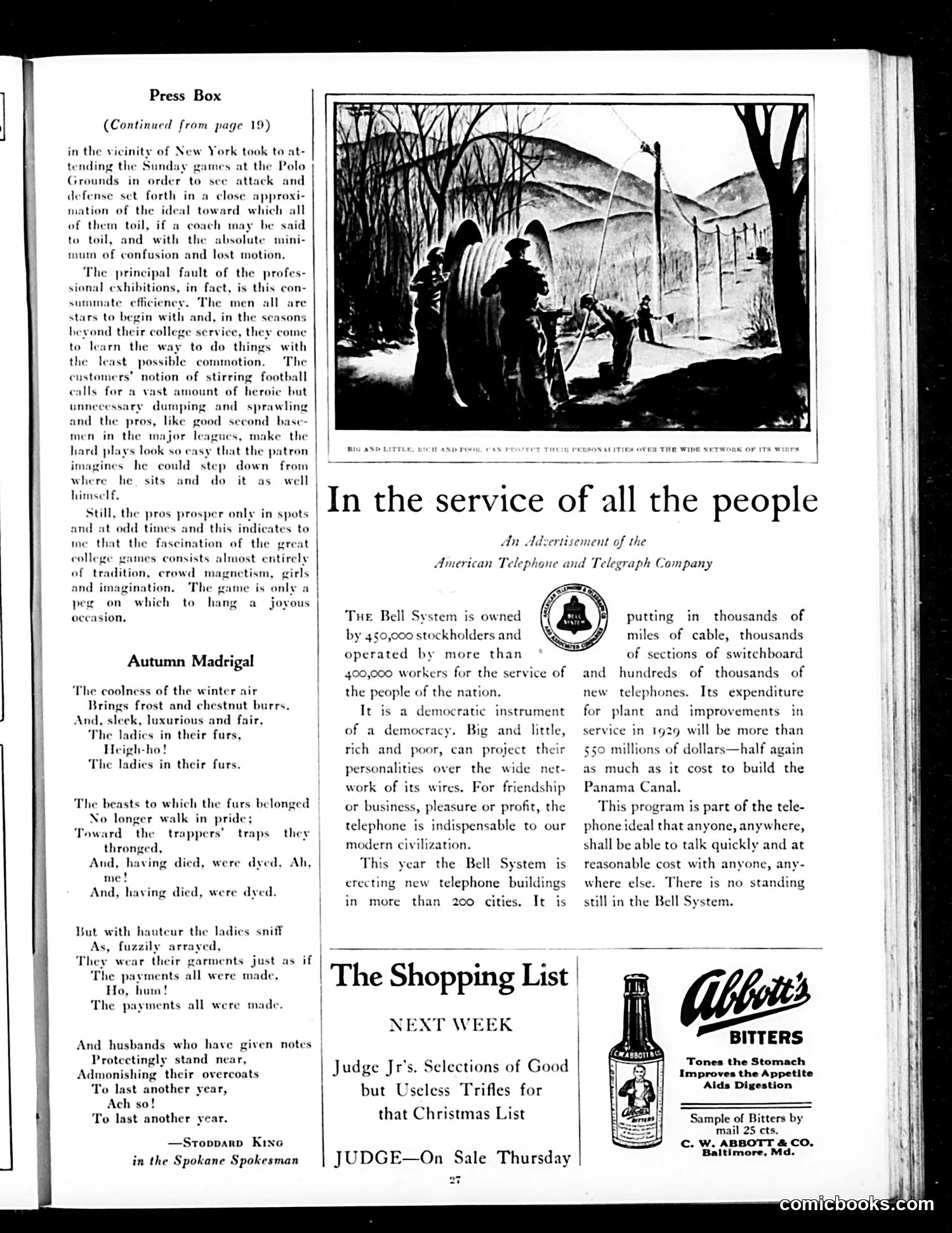
Judge Magazine Page Analysis This page combines literary content with advertising, typical of early 20th-century magazines. Literary Content: The "Autumn Madrigal" poem satirizes wealthy women's fur coats through mordant humor. It notes that ladies wear furs fashionably while "husbands who have given notes / Protectingly stand near"—mocking the financial strain of maintaining appearances. The dark joke about furs coming from dead animals ("And, having died, were dyed") undercuts the glamour with grim reality. The poem critiques conspicuous consumption and marital financial anxiety among the upper classes. Advertisements: A large Bell Telephone System ad emphasizes democratic access to communication ("anyone, anywhere, shall be able to talk quickly"), promoting corporate infrastructure investment as public service. An Abbotts Bitters patent medicine ad appears below. Image: The top photograph (caption unclear in OCR) shows what appears to be workers or laborers, possibly related to the telephone infrastructure mentioned in the adjacent ad. The page reflects Judge's typical mix of satirical verse mocking society's wealthy while accepting corporate advertising.
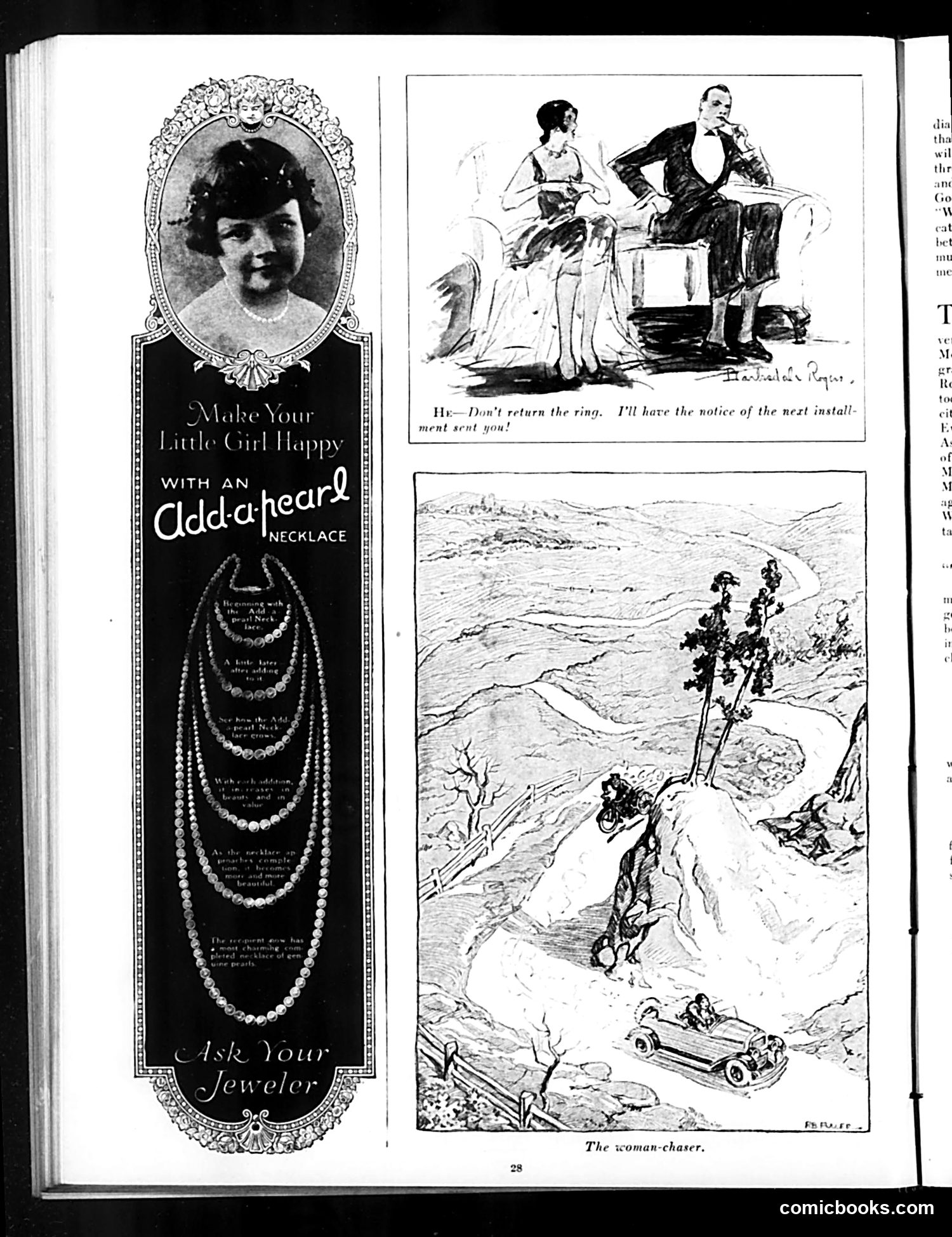
Page Analysis This page combines advertising and editorial cartoon content. The left side features a full-page advertisement for "Add-a-pearl" necklaces, targeting gift-givers wanting to make girls happy. The right side contains two illustrations: Top cartoon: A domestic scene where a man tells a woman "Don't return the ring. I'll have the notice of the next installment sent you!" This satirizes installment-plan purchasing—a common practice where buyers made monthly payments rather than paying upfront. The joke targets the financial burden of engagement rings, suggesting the man can barely afford it and must pay in installments while keeping up appearances. Bottom illustration: Titled "The woman-chaser," depicting figures pursuing someone across a landscape with various vehicles. This appears to be satirical commentary on romantic pursuit or courtship behavior, though the specific reference is unclear from context.
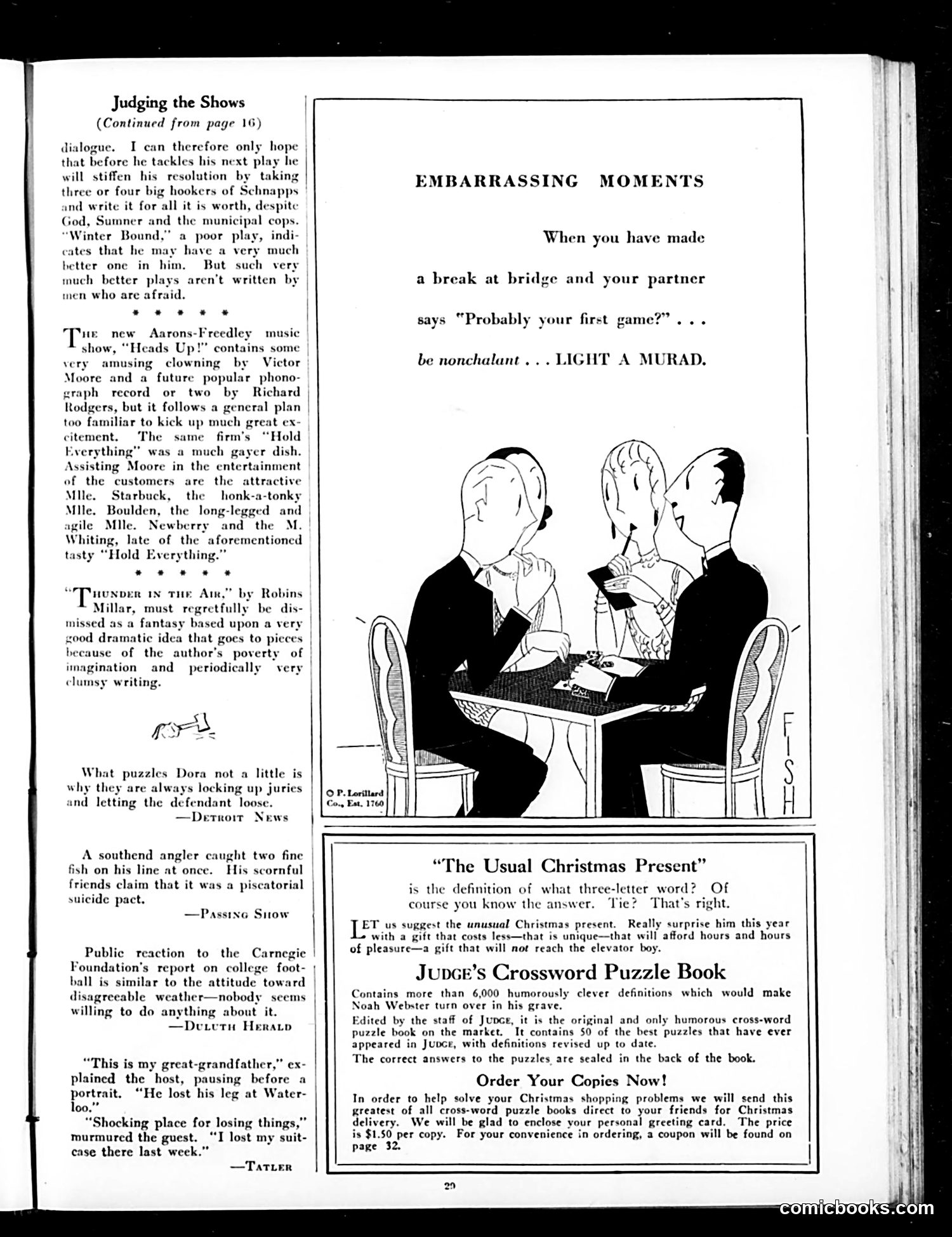
"Embarrassing Moments" Cartoon Analysis This single-panel cartoon illustrates a social embarrassment at a bridge game. Two men sit at a card table; one has clearly made a poor play, prompting his partner to ask "Probably your first game?"—a cutting remark implying incompetence. The caption advises the embarrassed player to "be nonchalant" and "LIGHT A MURAD"—a cigarette brand advertisement integrated into the humor. The joke relies on the period convention that smoking provided a dignified way to recover composure after a social gaffe. Context for modern readers: This reflects 1920s-30s etiquette where bridge was a popular social activity among the middle and upper classes, and where lighting a cigarette was considered a sophisticated, face-saving gesture. The cartoon also exemplifies how advertisements were seamlessly woven into entertainment content in vintage magazines. The page primarily consists of theater reviews and advertisement for Judge's Crossword Puzzle Book.
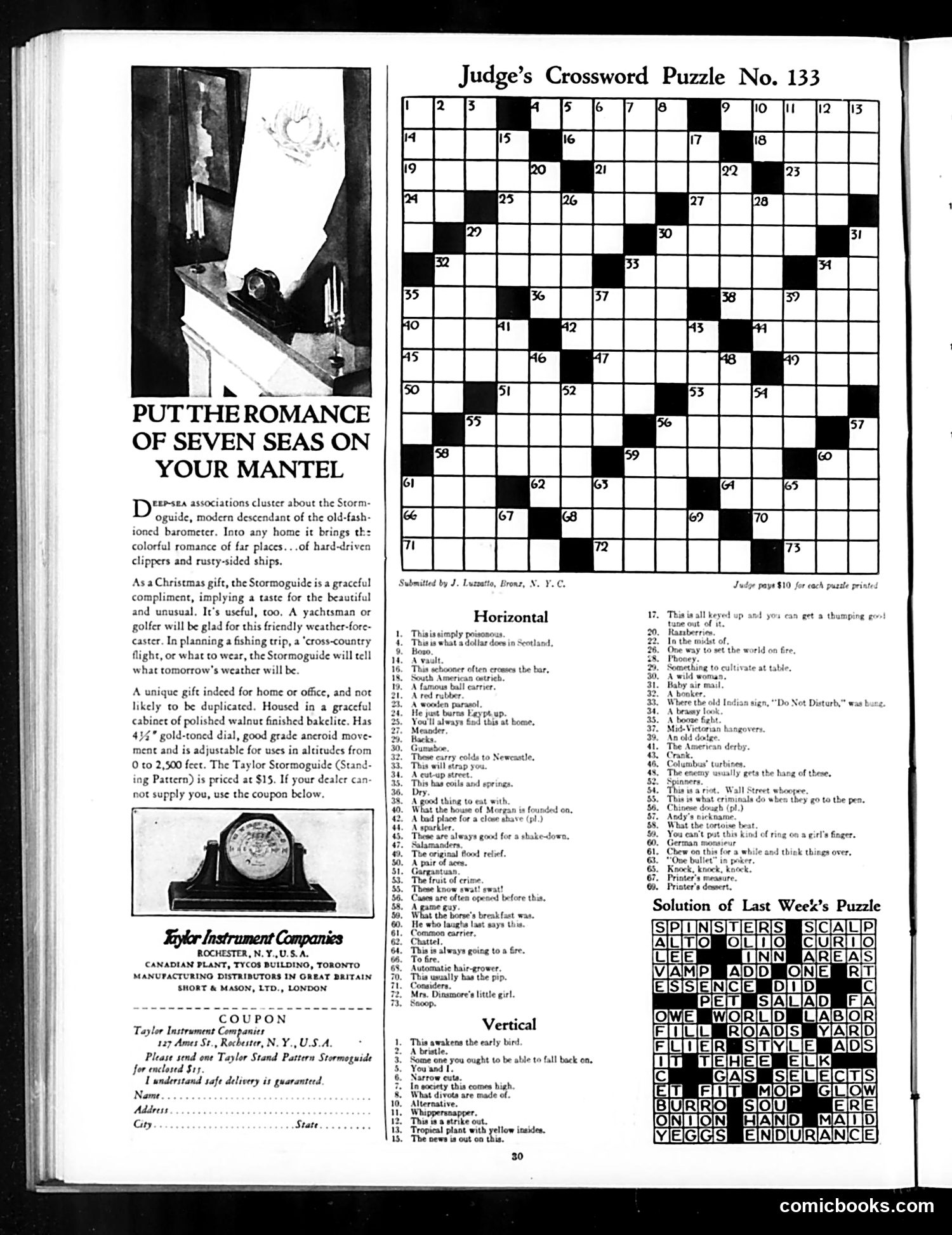
Judge Crossword Puzzle No. 133 (Analysis) This page is primarily advertising and puzzle content, not political satire. The main feature is a full-page advertisement for the Taylor Stormoguide, a barometer marketed as a luxury Christmas gift. The ad emphasizes its aesthetic appeal and practical weather-forecasting utility for yacht owners, golfers, and pilots—positioning it as a tasteful accessory for affluent consumers. The accompanying image shows the device in an ornate wooden cabinet with a gold-toned dial. Below this is a standard crossword puzzle with horizontal and vertical clues typical of early 20th-century word games. The previous week's solution is shown filled in. There is no political cartoon or satirical commentary on this page. The content reflects the magazine's dual role as both humor publication and platform for upscale consumer advertising during this era.
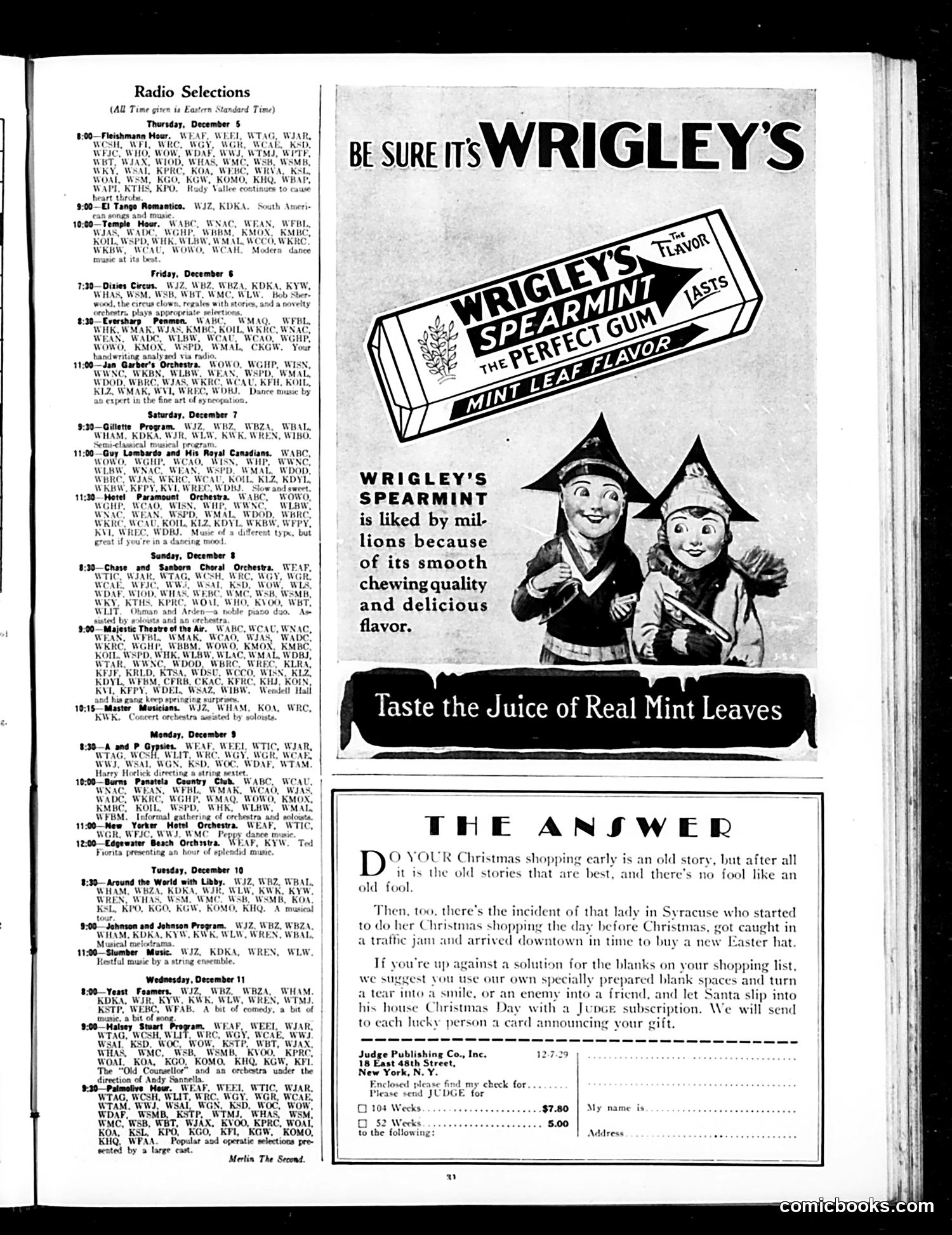
Analysis This page is primarily advertising and radio programming listings, not political satire. The main content consists of: 1. Radio Selections: A week-long schedule of radio broadcasts (December 5-11) listing station call letters and program times—typical of entertainment guides from this era. 2. Wrigley's Spearmint Gum Advertisement: A large commercial featuring two cartoon children in winter clothing endorsing the gum's "mint leaf flavor." The ad emphasizes the product's "smooth chewing quality and delicious flavor." 3. "The Answer" Section: A brief advice column addressing Christmas shopping procrastination, with a humorous anecdote about a Syracuse woman caught in holiday traffic. 4. Judge Publishing Co. subscription offer: A mail-in coupon for magazine subscriptions. There is no political cartoon or satire on this page. It's a standard magazine page combining program listings, product advertising, and reader advice—reflecting 1920s consumer culture and radio entertainment's growing popularity.
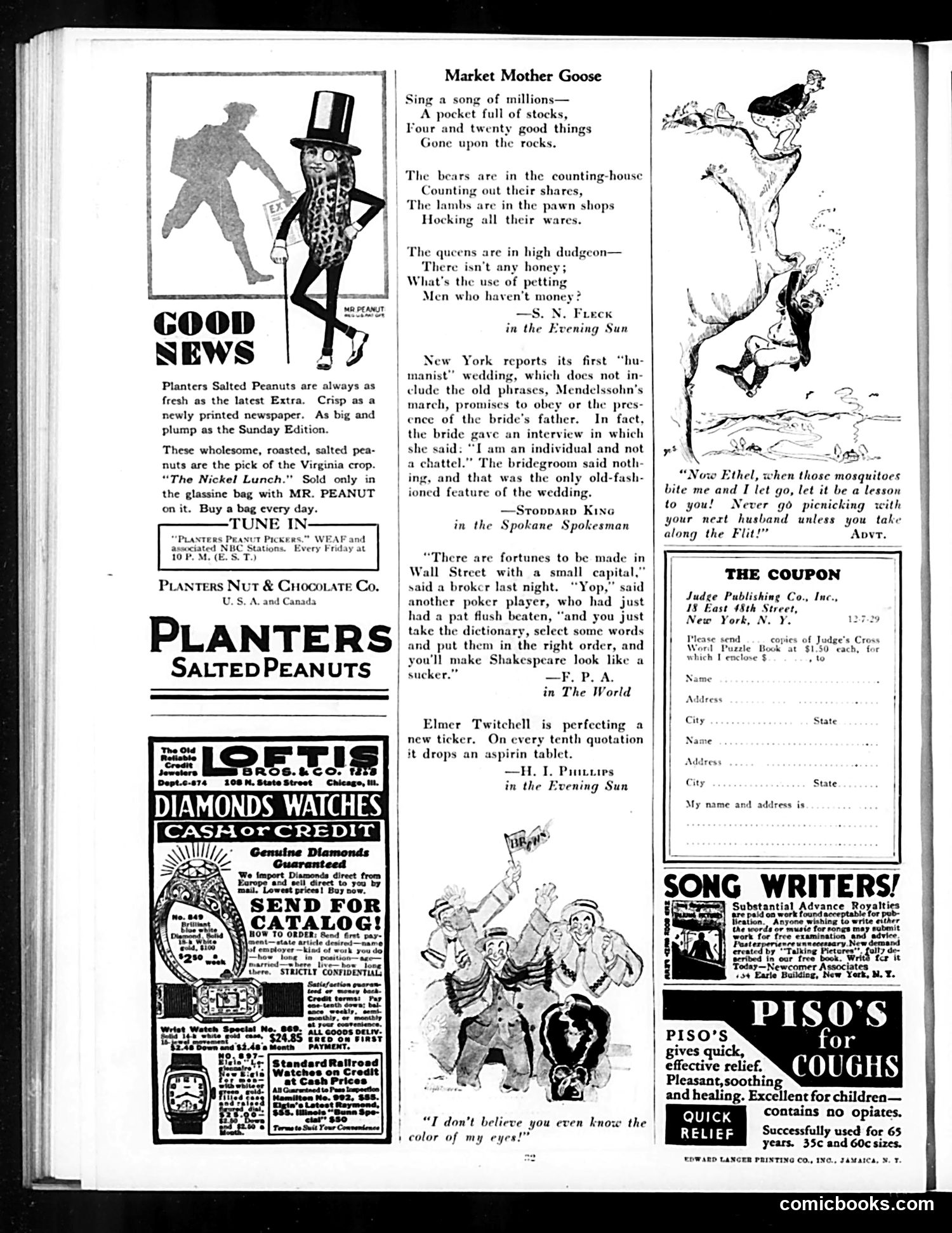
"Market Mother Goose" - Political Satire on the Stock Market Crash This page's main satirical content is the poem "Market Mother Goose," a darkly comic parody of the nursery rhyme responding to the recent stock market collapse (likely 1929). The poem uses familiar nursery-rhyme structure to mock financial devastation: "bears" and "lambs" are stock-market terminology (bear/bull traders), now depicted in the counting-house and pawn shops—suggesting investors ruined and forced to liquidate assets. "Queens in high dudgeon" with "no honey" satirizes wealthy women suddenly without money, their romantic value now worthless. The accompanying jokes reinforce themes of financial chaos and masculine disillusionment: a broker's promise of Wall Street fortunes is mocked by a poker player; an engineer's new ticker that "drops an aspirin tablet" jokes about market-induced stress. The overall message: the stock market disaster has inverted social hierarchies and destroyed wealth, affecting everyone from speculators to society women, with darkly humorous consequences.
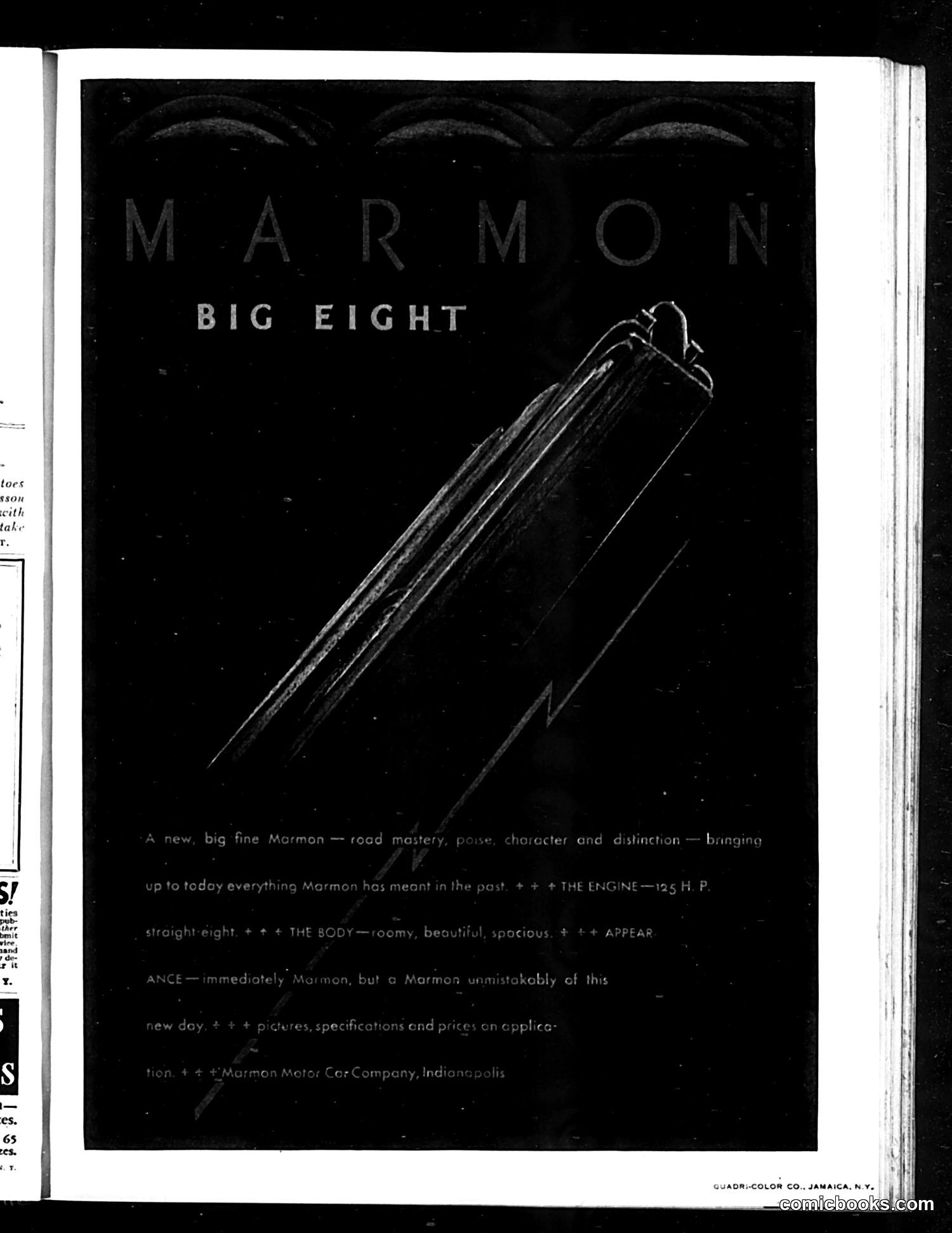
Marmon Automobile Advertisement This is a full-page automobile advertisement, not political satire. It promotes the Marmon "Big Eight" car, manufactured by the Marmon Motor Car Company of Indianapolis. The ad emphasizes the vehicle's technical superiority and luxury features—specifically highlighting the engine ("125 H.P."), spacious body design, and overall appearance as embodying everything Marmon had "meant in the past." The copy positions this as a new model representing the pinnacle of automotive engineering and craftsmanship. The diagonal illustration shows what appears to be the car's engine or mechanical components in sleek, modern styling—common advertising imagery for the era meant to convey innovation and power. This appears to be from an early-to-mid 20th century publication, when automobiles were luxury goods.