judge
Judge — December 14, 1929
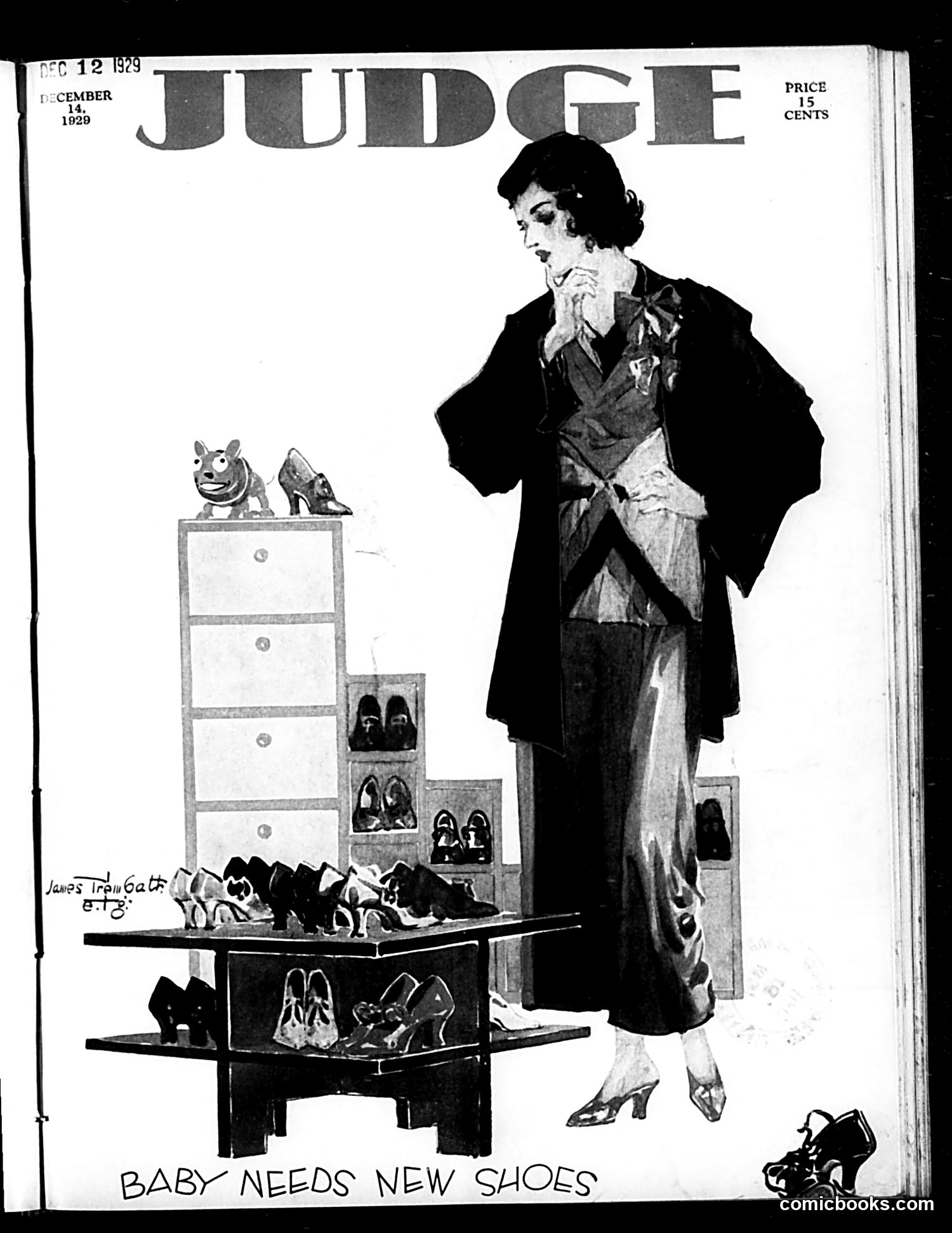
Analysis of Judge Magazine Cover, December 14, 1929 This cover satirizes excessive consumer spending on children's clothing, particularly shoes. A fashionably dressed woman stands amid elaborate display furniture showcasing numerous infant shoes and boots. The caption "BABY NEEDS NEW SHOES" delivers the joke: the absurd abundance of footwear suggests either parental overindulgence or the pressure of commercial marketing to constantly purchase new items for children. The timing is significant—December 1929, just weeks after the stock market crash. The cartoon likely critiques both pre-crash consumerism and the disconnect between frivolous spending on luxury baby goods and the economic crisis unfolding. The illustration satirizes the era's emerging consumer culture and advertising industry's ability to manufacture artificial "needs."
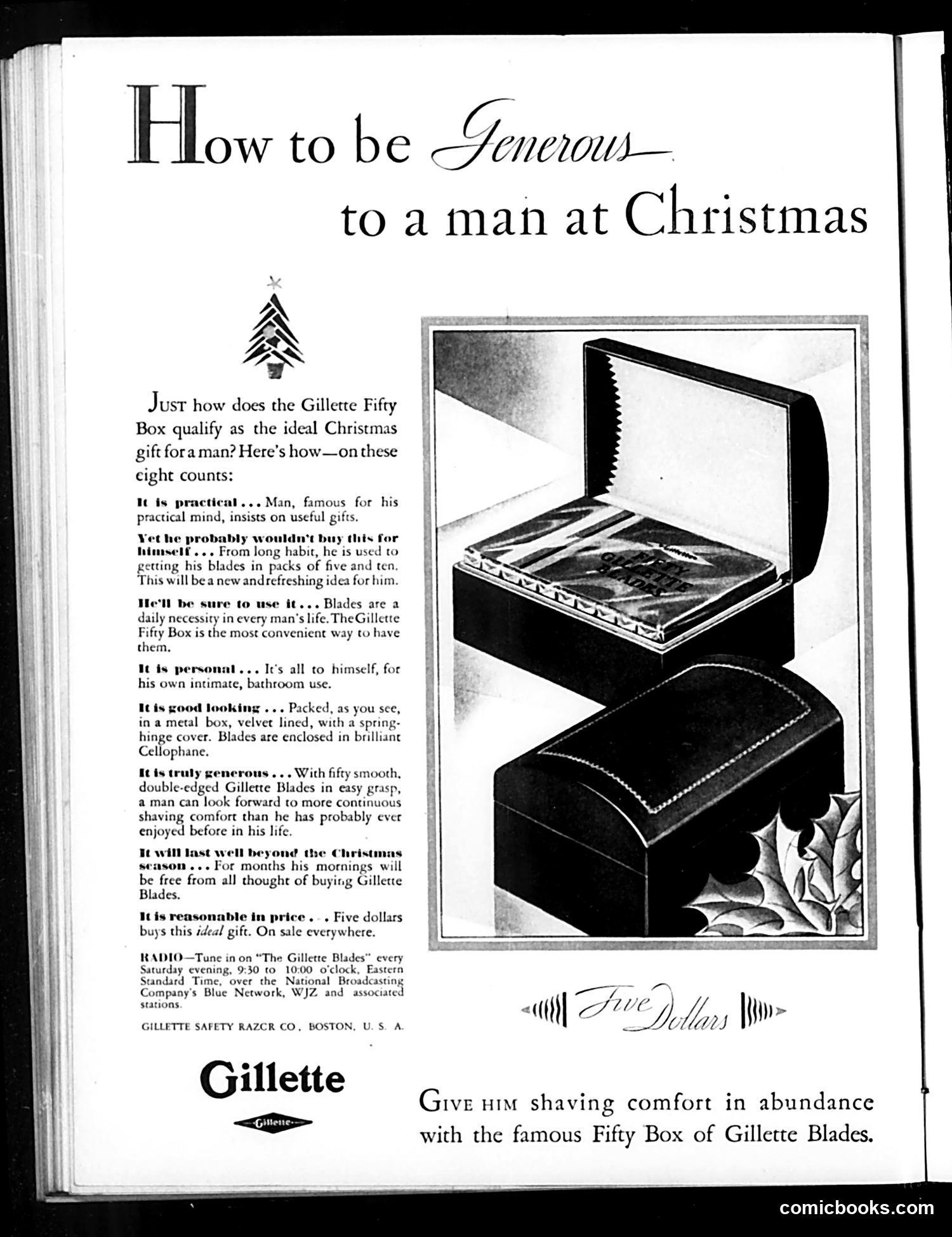
Analysis This is not a cartoon or satire page, but rather a straightforward advertisement for Gillette razor blades, disguised as editorial content. The page promotes the Gillette Fifty Box as an ideal Christmas gift for men. It lists eight selling points: practicality, novelty (men traditionally bought blades in smaller packs), daily utility, personal use, attractive packaging, superior shaving comfort, longevity, and affordable pricing at five dollars. The only visual humor is mild—the product presentation with holly decoration suggests Christmas gifting. This represents early 20th-century advertising strategy: presenting commercial messages as lifestyle advice rather than explicit sales pitches. There's no political satire or social commentary present; it's purely a consumer product endorsement.
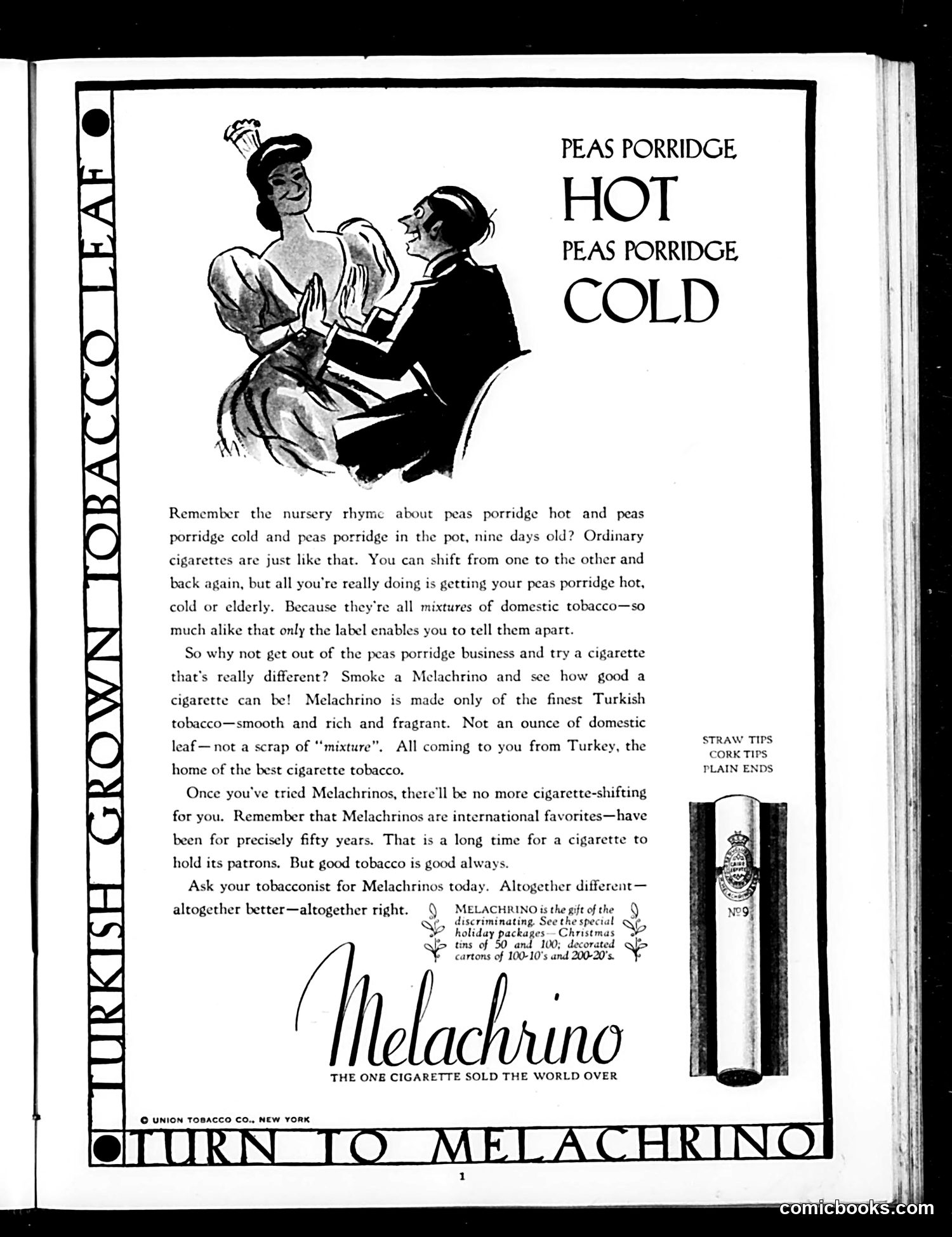
Melachrino Cigarette Advertisement This page is primarily a cigarette advertisement for Melachrino brand, not political satire. The illustration shows a couple in formal attire, with the man appearing to offer the woman a cigarette. The ad uses the "Peas Porridge" nursery rhyme as a hook—comparing switching between hot and cold peas porridge to switching between different cigarette brands. The copywriter argues that since all cigarettes are similar "mixtures of domestic tobacco," consumers should try Melachrino instead, marketed as made from "finest Turkish tobacco." The humor relies on the outdated premise that cigarette brands are interchangeable. This reflects early-20th-century advertising before health concerns were widely acknowledged. The tagline claims Melachrino has been "an international favorite" for fifty years.
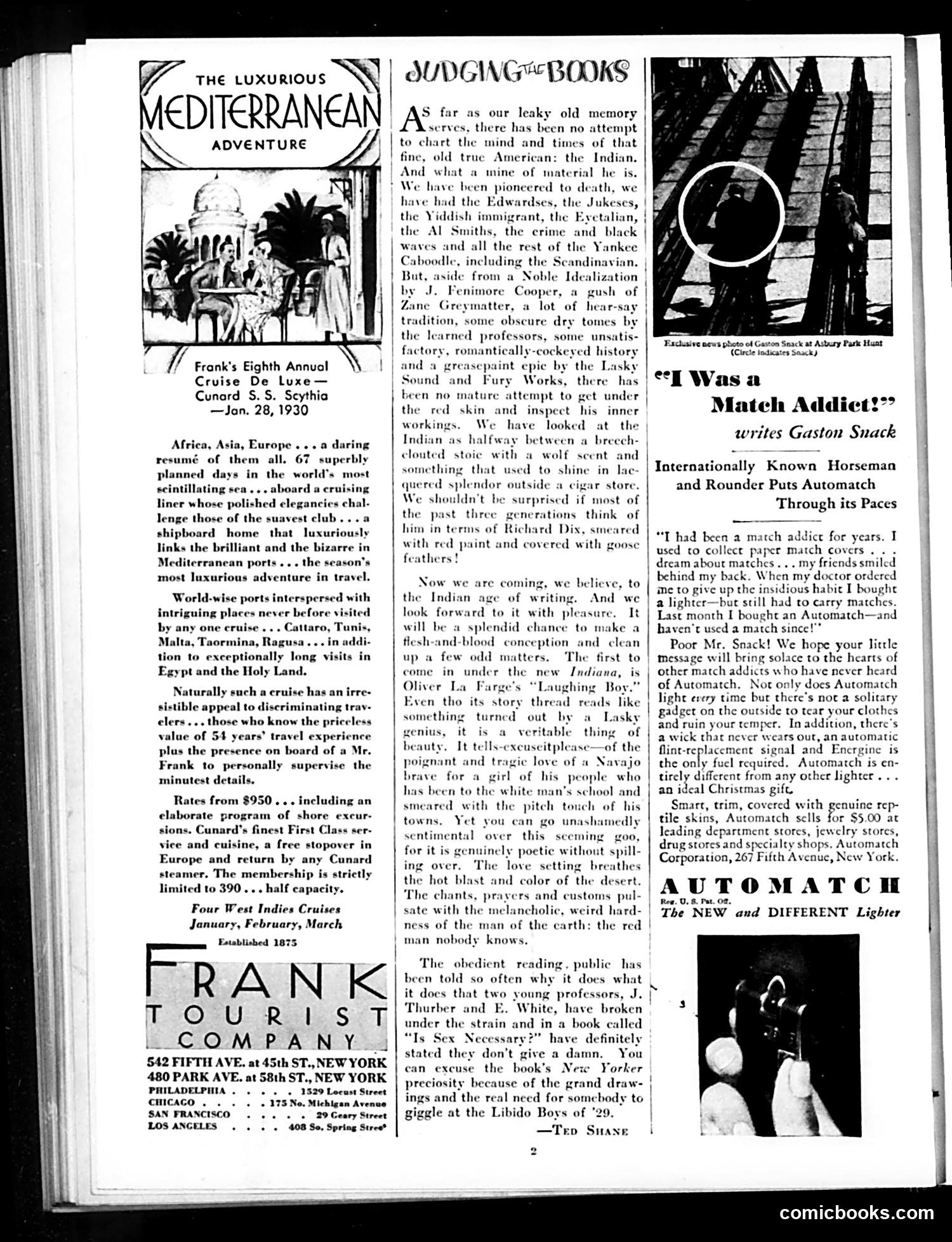
Page Analysis This page is primarily advertising and book reviews rather than political satire. The left side features ads for Frank Tourist Company's Mediterranean cruise (described as "luxurious adventure") and mentions their "Eighth Annual Cruise De Luxe" on the S.S. Scythia departing Jan. 28, 1930. The center contains "Judging the Books," a literary review section discussing new publications, including commentary on Native American representation in literature. The right side features an article titled "I Was a Match Addict?" by Gaston Snack about an "Automatch" product—a novelty lighter sold for $5.00. The piece humorously chronicles the author's obsession with collecting matchbooks before discovering this alternative. The page lacks significant political cartoons or social satire, instead showcasing Judge's commercial content typical of 1930s magazines.
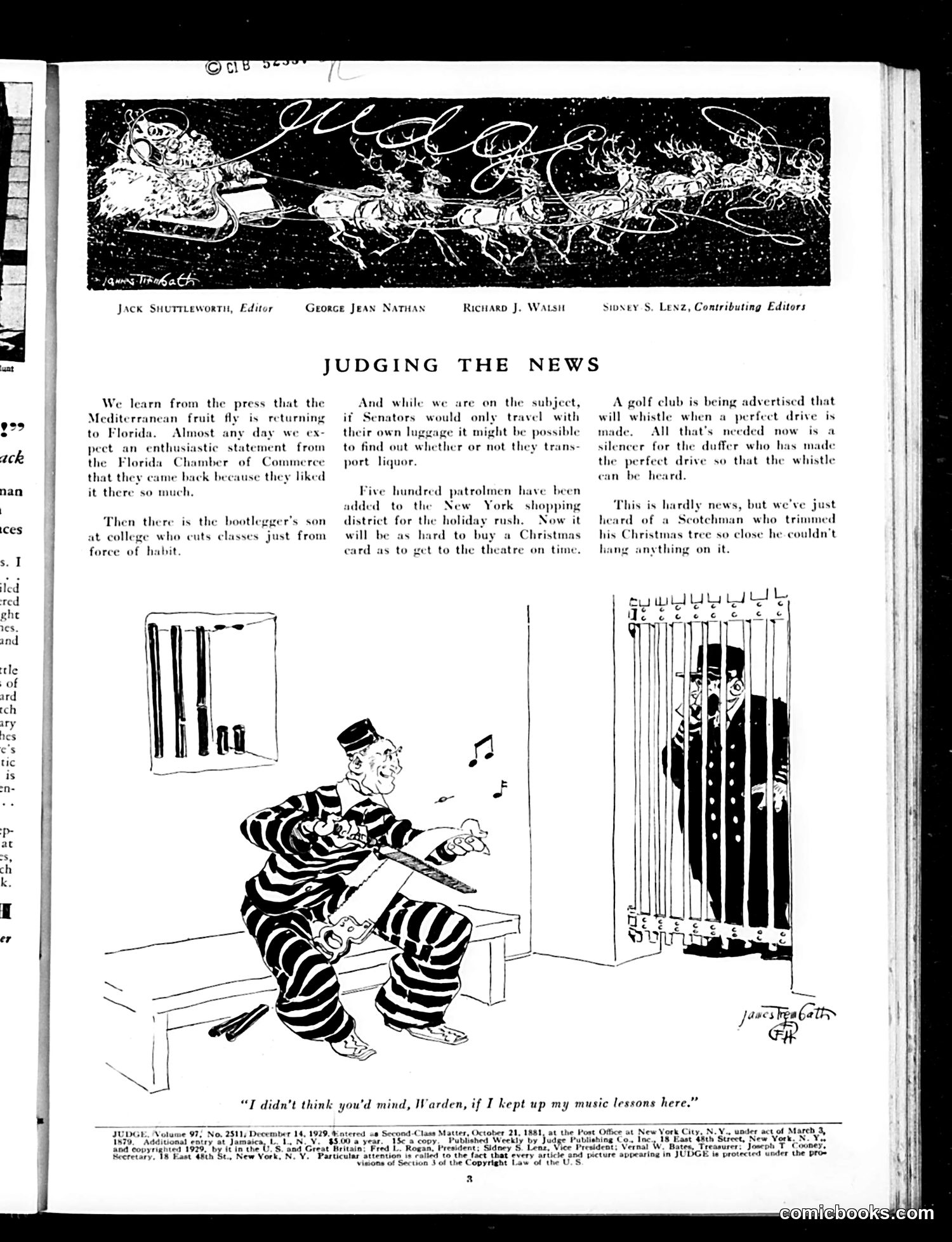
"Judging the News" - December 14, 1929 This page contains editorial commentary and two cartoons satirizing contemporary social issues. The main cartoon depicts a prisoner in striped uniform playing a flute while guards peer through cell bars, with the caption: "I didn't think you'd mind, Warden, if I kept up my music lessons here." The satire appears to mock either prison conditions or an inmate's audacity in demanding recreational privileges. The prisoner's casual demeanor contrasts with his confinement, suggesting commentary on either prisoner rights or absurd entitlement. The brief editorial items above joke about the Mediterranean fruit fly returning to Florida, a bootlegger's son skipping college classes, and holiday shopping congestion in New York—typical 1920s-era social observation and light satirizing of contemporary inconveniences.
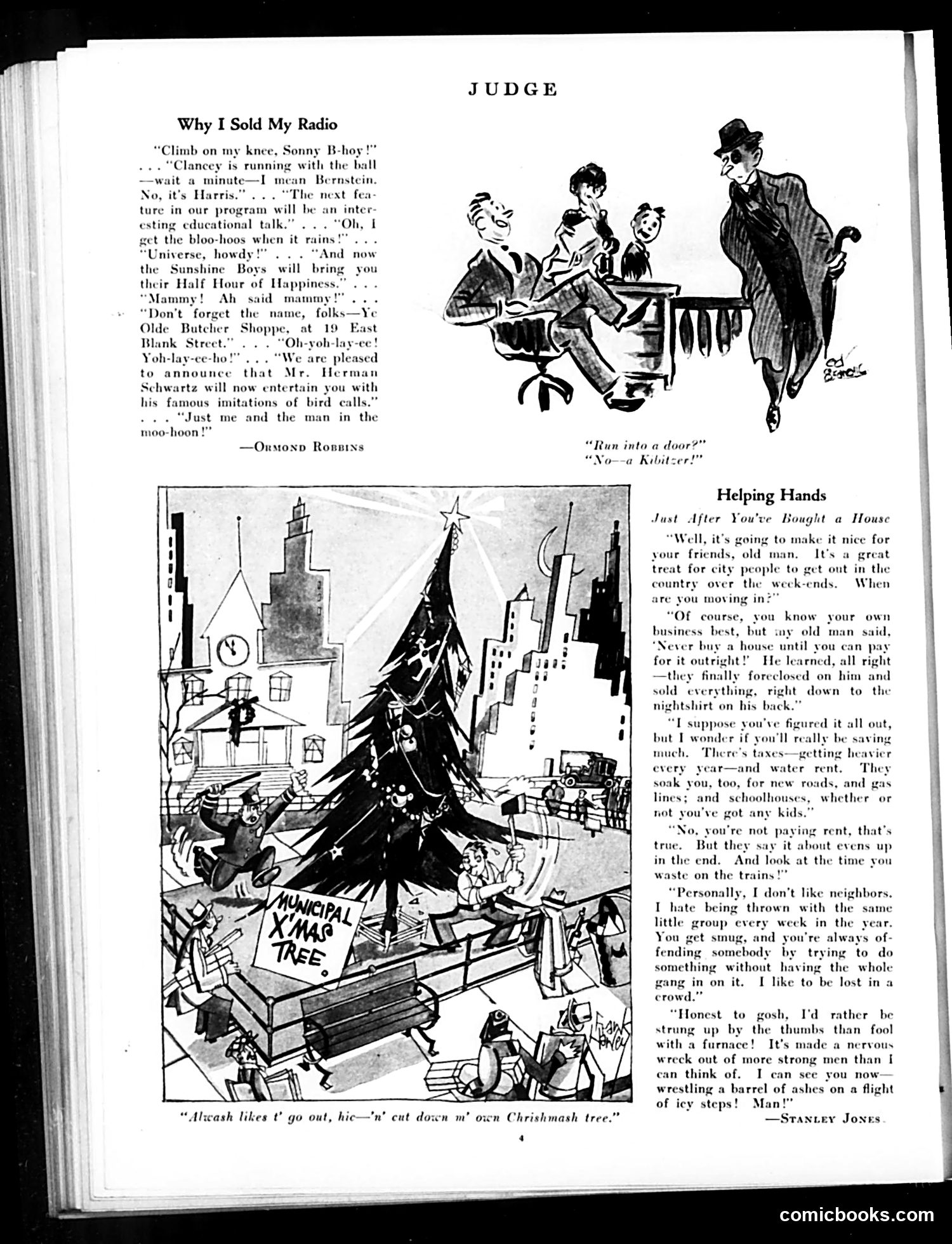
Analysis of Judge Magazine Page This page contains two separate pieces of satire: "Why I Sold My Radio" (top) mocks the proliferation of radio advertising and interruptions in the 1920s-30s. The author complains that radio programs constantly cut to advertisements and promotional announcements, making listening frustrating. The cartoon shows a family gathered around a radio being bombarded by commercial messages. "Helping Hands: Just After You've Bought a House" (bottom) satirizes post-purchase expenses for new homeowners. The large illustration depicts a chaotic Christmas tree decorated with bills and financial obligations—taxes, water rent, gas lines, schoolhouse expenses. The accompanying text humorously warns that homeownership costs far exceed the initial purchase price, with neighbors constantly soliciting for community improvements. It's social commentary on the hidden burdens of home ownership.
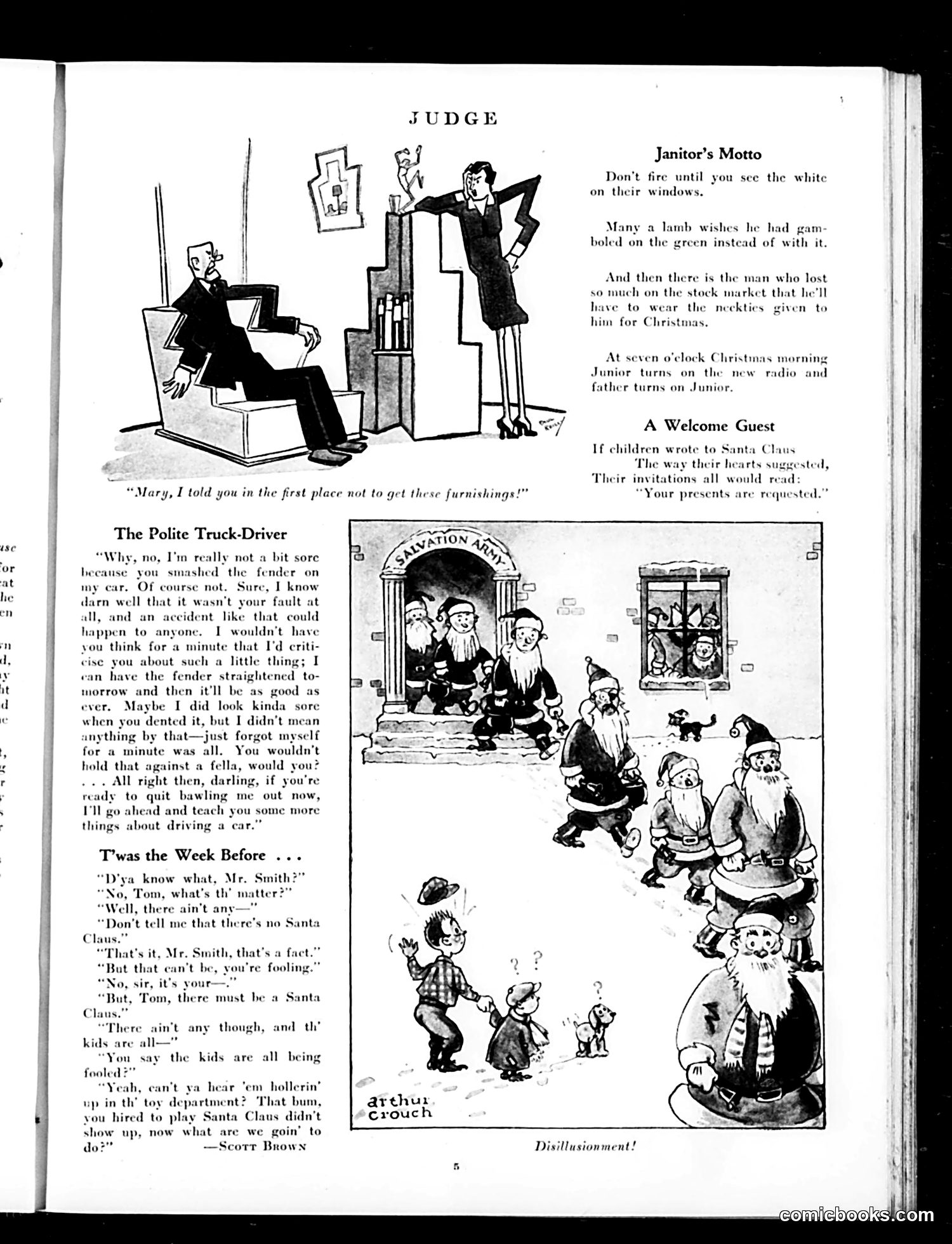
Judge Magazine Page Analysis This page contains three separate humor pieces from Judge magazine (a satirical publication): 1. "The Polite Truck-Driver" (top): A domestic scene where a husband apologizes excessively to his wife about a minor car fender-bender, exemplifying overly formal politeness in contrast to the crude stereotype of truck drivers. 2. "'Twas the Week Before..." (left): A dialogue satirizing the commercialization of Christmas and Santa Claus, mocking how department stores employ fake Santas while denying children's belief in the real Santa—critiquing holiday retail cynicism. 3. "A Welcome Guest" (right): Arthur Crouch's illustration showing Santa surrounded by children in a Salvation Army setting, humorously depicting children's Christmas wish letters requesting gifts rather than charitable donations—commenting on materialism versus charity. These pieces reflect early-to-mid 20th century concerns about commercialism, class dynamics, and holiday traditions.
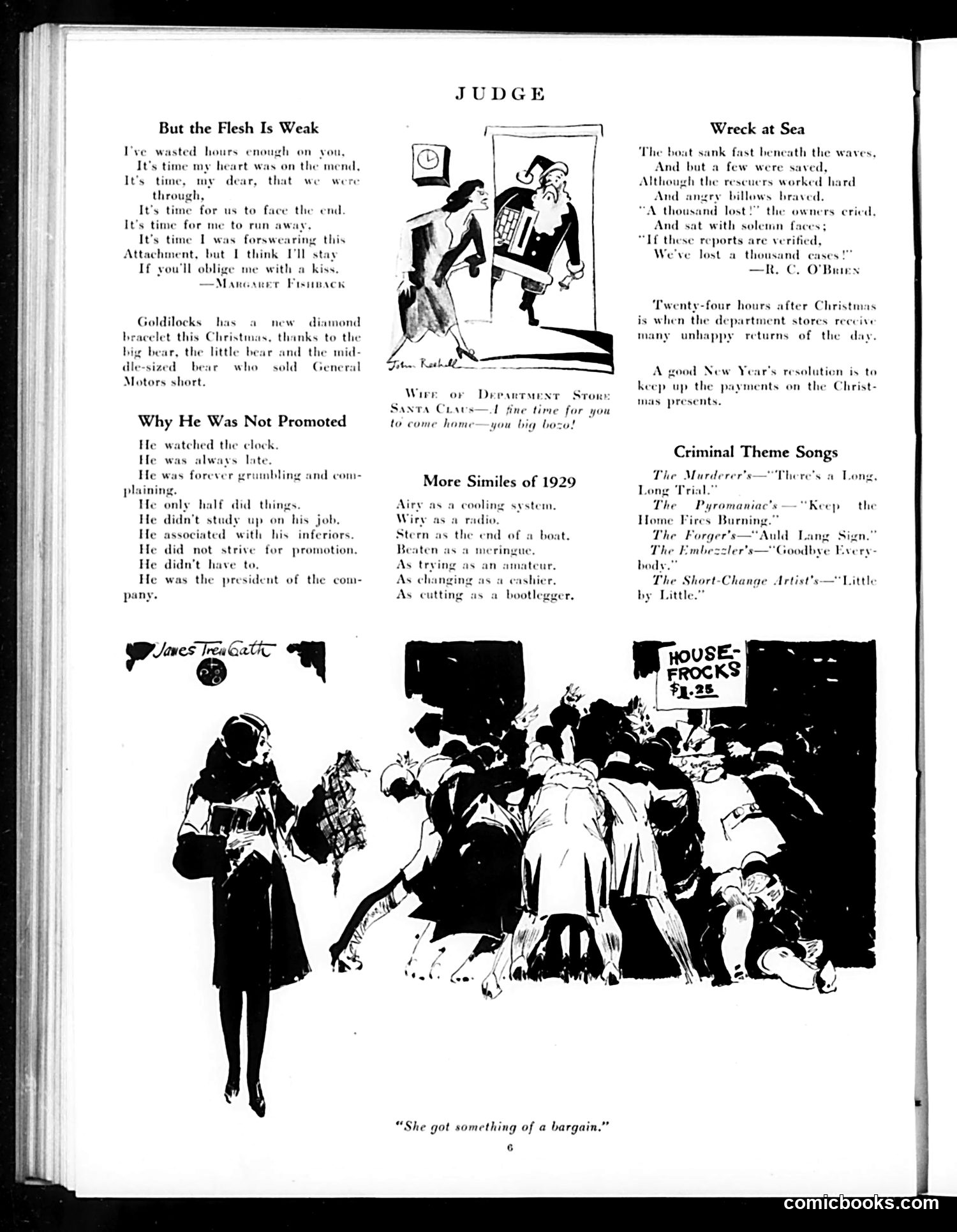
Analysis: Judge Magazine Page This page contains several satirical humor pieces typical of Judge magazine's 1920s content: "But the Flesh Is Weak" (top left): A poem by Margaret Fishback about romantic temptation, illustrated with a couple in an embrace. "Why He Was Not Promoted": A list of character flaws explaining workplace failure—laziness, incompetence, and association with inferiors. Standard workplace satire. "Wreck at Sea" and "More Similes of 1929": Poetry and observations about contemporary life and current events. Bottom cartoon: Depicts a woman at a "House Frocks $1.25" sale, surrounded by aggressive shoppers fighting over merchandise. The caption "She got something of a bargain" satirizes the chaos of bargain hunting—a relatable consumer culture critique showing how desperately people scrambled for cheap clothing during the economically uncertain late 1920s. The page reflects Jazz Age concerns about work, romance, and consumer behavior.
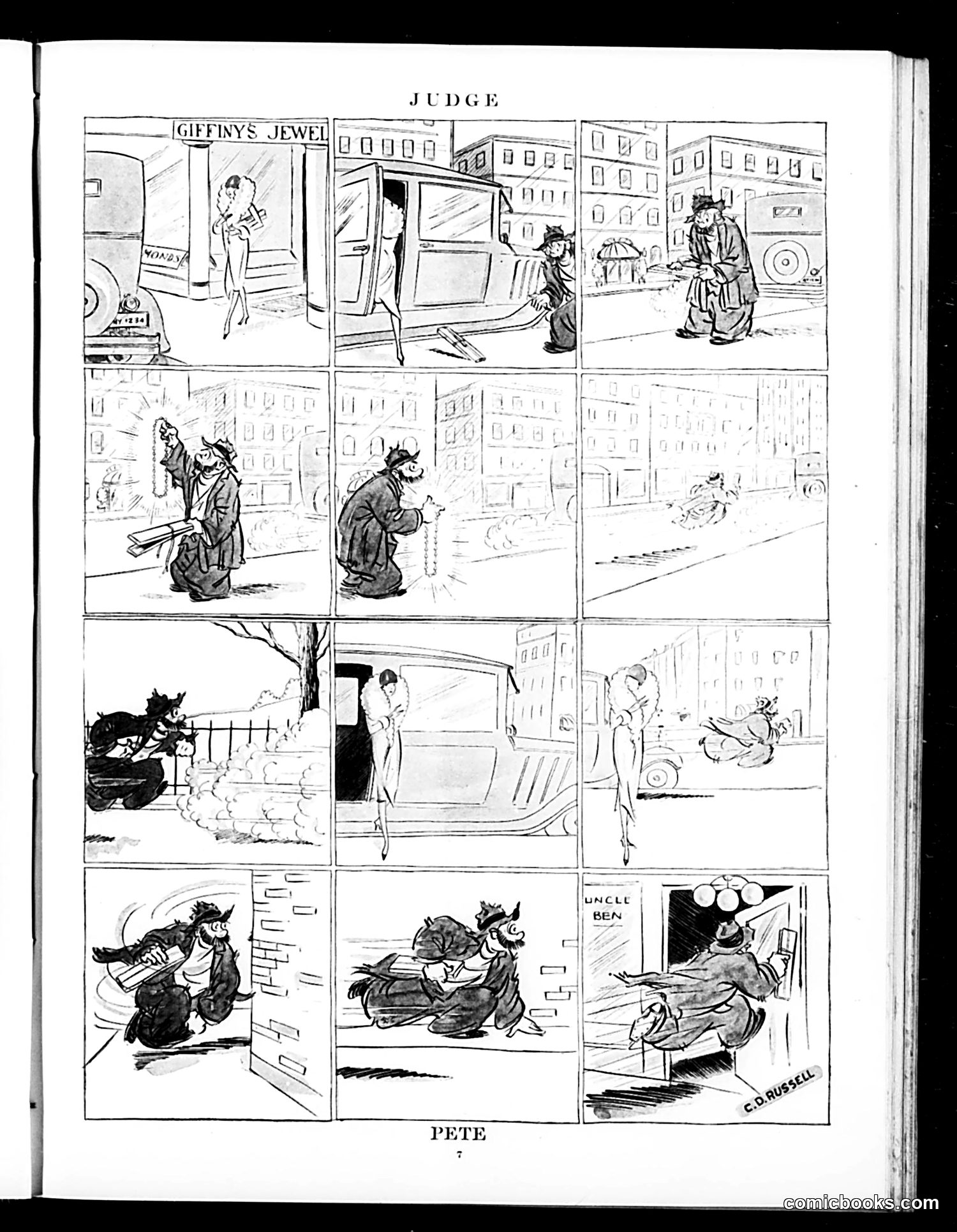
Judge Comic Page Analysis This page contains two separate comic strips: "Judge" (top) and "Pete" (bottom). The "Judge" strip appears to depict a series of urban street scenes involving what looks like a jewelry store robbery or theft ("Giffiny's Jewel" visible in first panel), with police and civilians responding to the crime. The narrative follows the incident's progression through the city. The "Pete" strip below uses exaggerated animal characters (appearing to be devils or imps) in domestic situations, likely satirizing everyday human behavior or social situations through absurdist humor. Both strips use the visual storytelling format typical of early 20th-century comic strips. Without clearer context about specific dates or contemporary events, the exact political or social references remain unclear, though the "Judge" strip's crime narrative suggests commentary on urban crime or law enforcement.
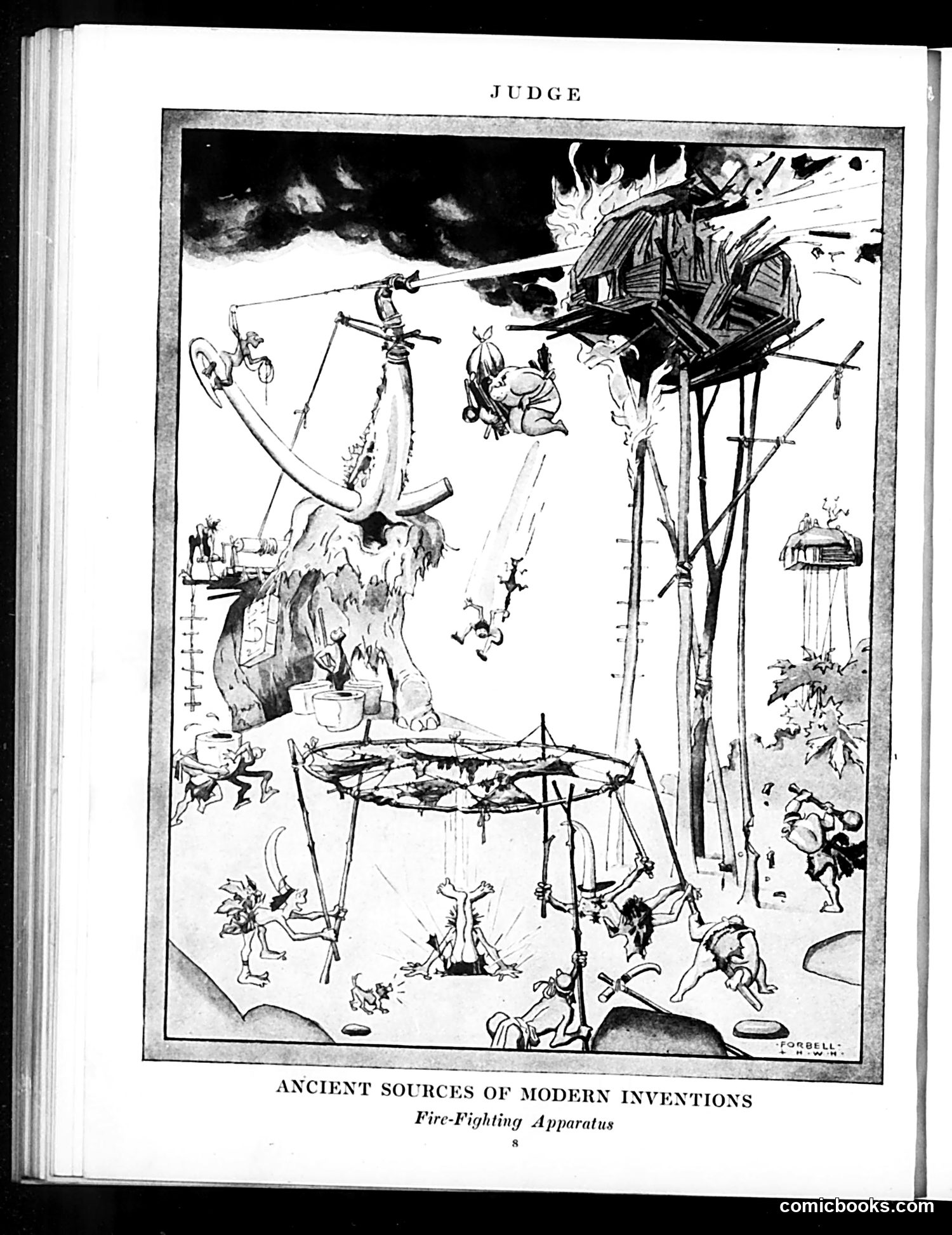
Judge Magazine: "Ancient Sources of Modern Inventions" This cartoon satirizes fire-fighting technology by depicting its supposed ancient origins. The illustration shows fantastical, absurdly primitive contraptions—bizarre mechanical devices, human-powered pulleys, and crude apparatus—all operated by small figures in chaotic activity. The humor works through contrast: modern fire-fighting equipment is presented as merely elaborate elaborations of ridiculous ancient methods. The elaborate machinery, pipes, and structures appear both impossible and comical, suggesting that firefighting innovation isn't as sophisticated or "modern" as contemporaries believed. The artist (signed "Forbell") mocks either technological progress itself or society's tendency to mythologize invention origins. This appears to be part of a recurring Judge series parodying how modern inventions are credited to ancient sources—a commentary on historical narrative or hubris about technological advancement.
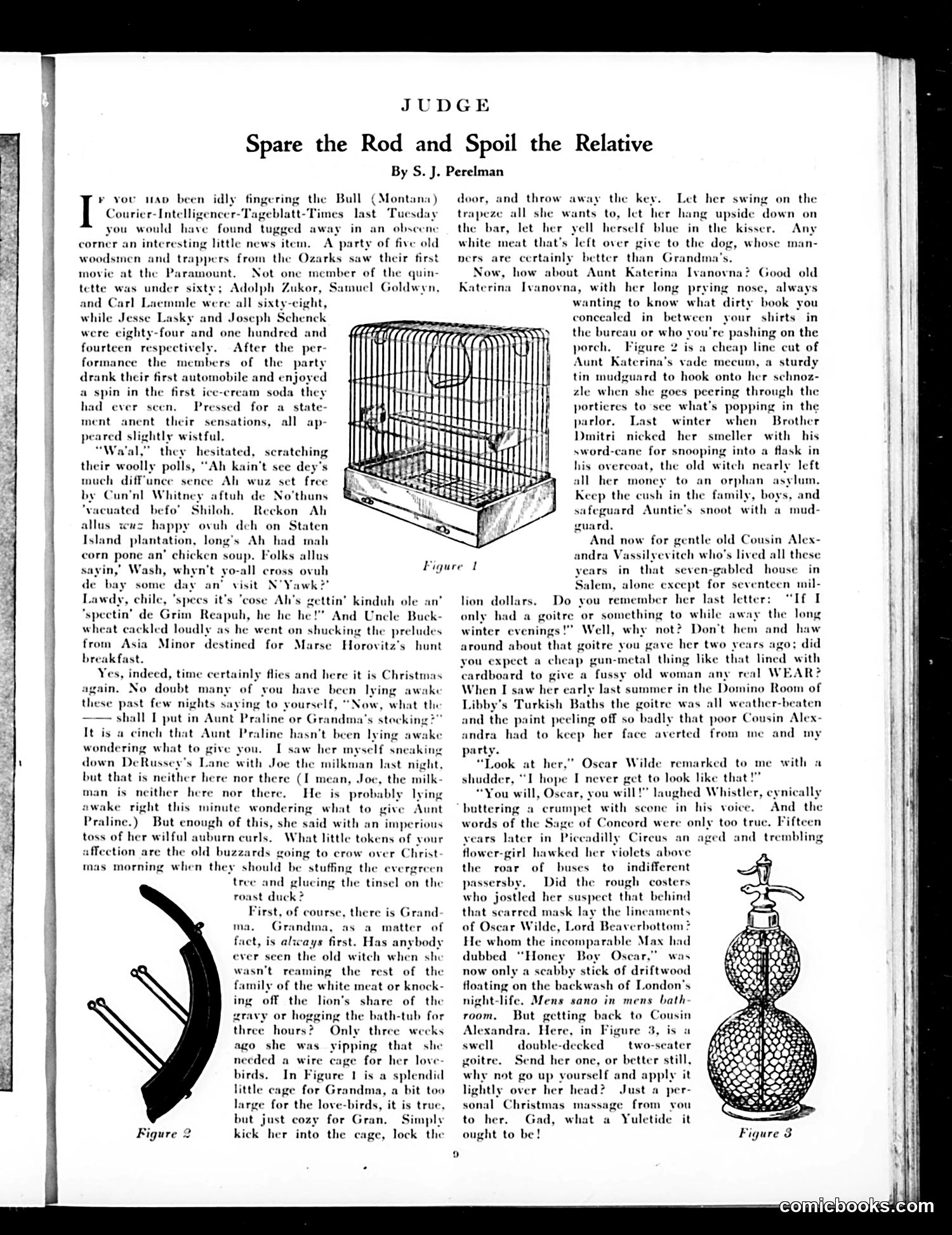
Analysis of "Spare the Rod and Spoil the Relative" This is a humorous essay by S.J. Perelman (a celebrated satirist) about Christmas gift-giving for difficult elderly relatives. The three figures shown are practical gifts with accompanying jokes: Figure 1 depicts a birdcage, presented as a "gift" for Grandma—the satire being that she's so annoying (hogging the bathtub, stealing food, complaining constantly) that the author suggests literally caging her. Figure 2 shows a horseshoe or restraint device, continuing the mock-serious tone about controlling troublesome relatives. Figure 3 appears to be a decorative perfume atomizer, humorously suggested for another relative (Cousin Alexandra) who's vain about her appearance and aging. The essay's humor relies on exaggeration and absurdist logic: since elderly relatives are burdensome and ungrateful, perhaps literal confinement or vanity-based gifts are solutions. This reflects 1920s-30s American attitudes toward aging relatives and family obligations, satirizing both their complaints and younger generations' impatience with them.
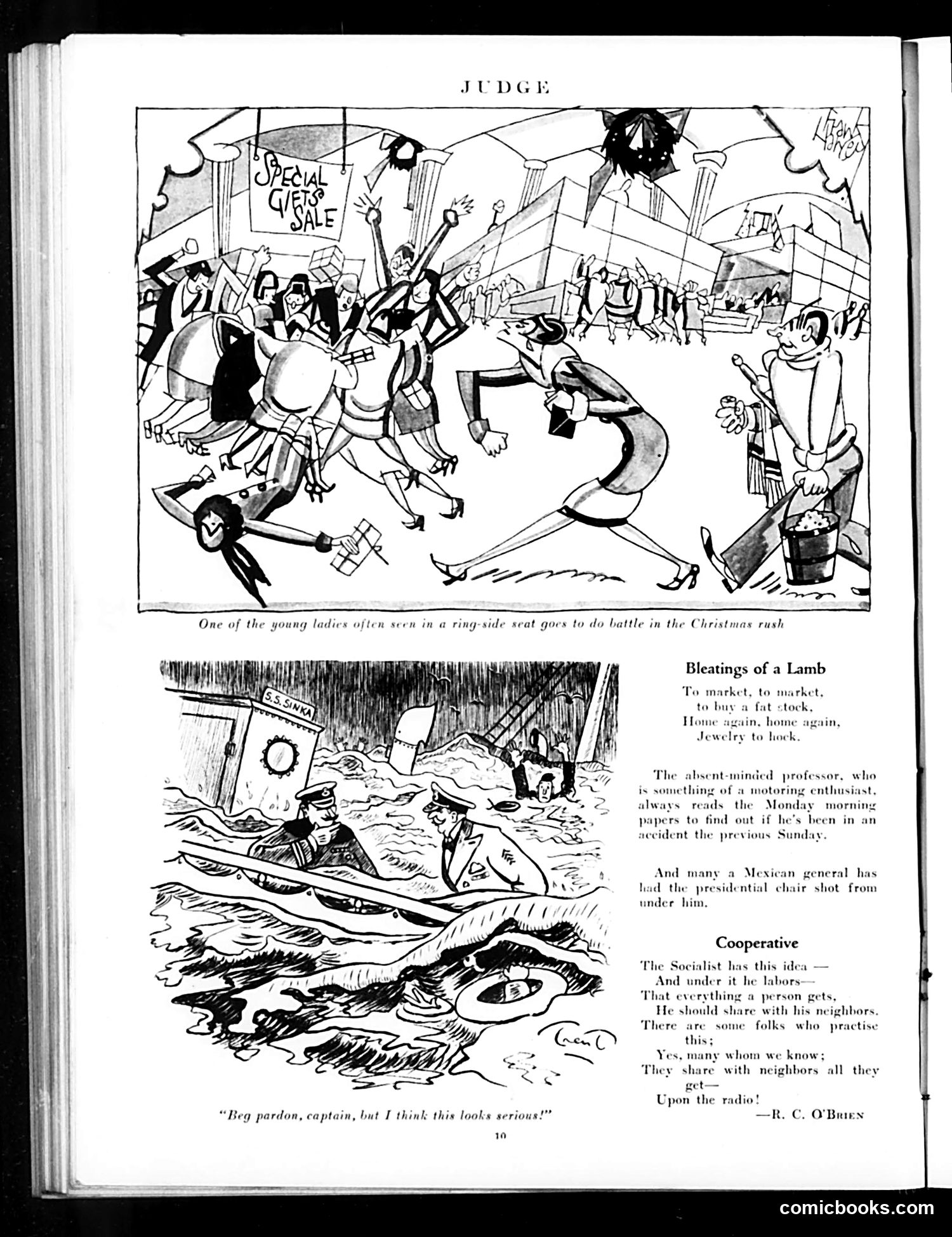
Judge Magazine Page Analysis This page contains three satirical pieces: Top cartoon: Depicts chaotic Christmas shopping, with women fighting over bargains at a "Special Clearance Sale." The caption jokes that young women "go to do battle in the Christmas rush"—satirizing the frenzy and aggression of holiday shopping. Middle cartoon: Shows a shipwreck or disaster scene with the caption "Beg pardon, captain, but I think this looks serious!" The humor appears to stem from massive understatement in a dire situation. Text sections: "Bleatings of a Lamb" mocks an absent-minded professor who reads Monday papers to learn if he had a car accident Sunday—satirizing both distracted intellectuals and dangerous driving. It also includes a jab at Mexican political instability. "Cooperative" poem: Satirizes Socialists' sharing ideology by suggesting people practice it only by broadcasting their radio programs loudly to neighbors—a joke about noise pollution and selective altruism. The overall page reflects Judge's conservative, satirical stance toward modern life, shopping culture, and progressive politics.
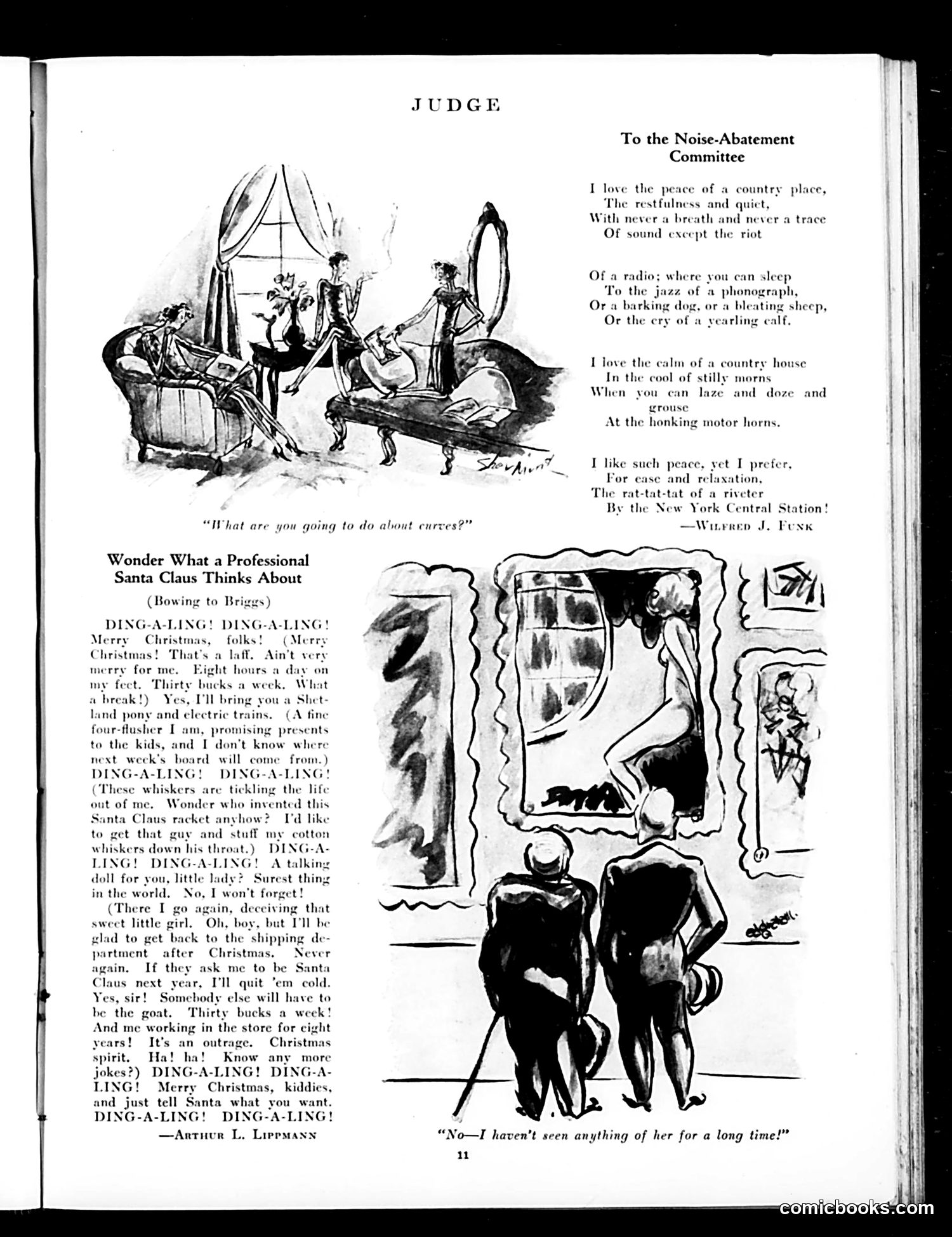
Judge Magazine Page Analysis This page contains two satirical pieces critiquing early 20th-century American life: "Wonder What a Professional Santa Claus Thinks About" (by Arthur L. Lippmann) mocks the disconnect between Santa's cheerful public persona and the exploited worker underneath. The Santa complains bitterly about low pay ($30/week), long hours, uncomfortable costume ("whiskers are tickling"), and the moral burden of lying to children about gifts he can't afford. The satire exposes commercial Christmas's hypocrisy and worker mistreatment—he's literally a "four-flusher" pretending holiday spirit while facing financial desperation. "To the Noise-Abatement Committee" (by Wilbur J. Funk) uses ironic praise of rural "peace and quiet" to expose modern urban noise pollution. The poem's twist reveals that country silence is constantly interrupted by radios, phonographs, barking dogs, and train horns—especially the "rat-tat-tat" of construction near New York Central Station. The satire highlights how industrialization and technology have made genuine quiet impossible, even in supposedly peaceful locations. Both pieces critique American modernity's human costs.
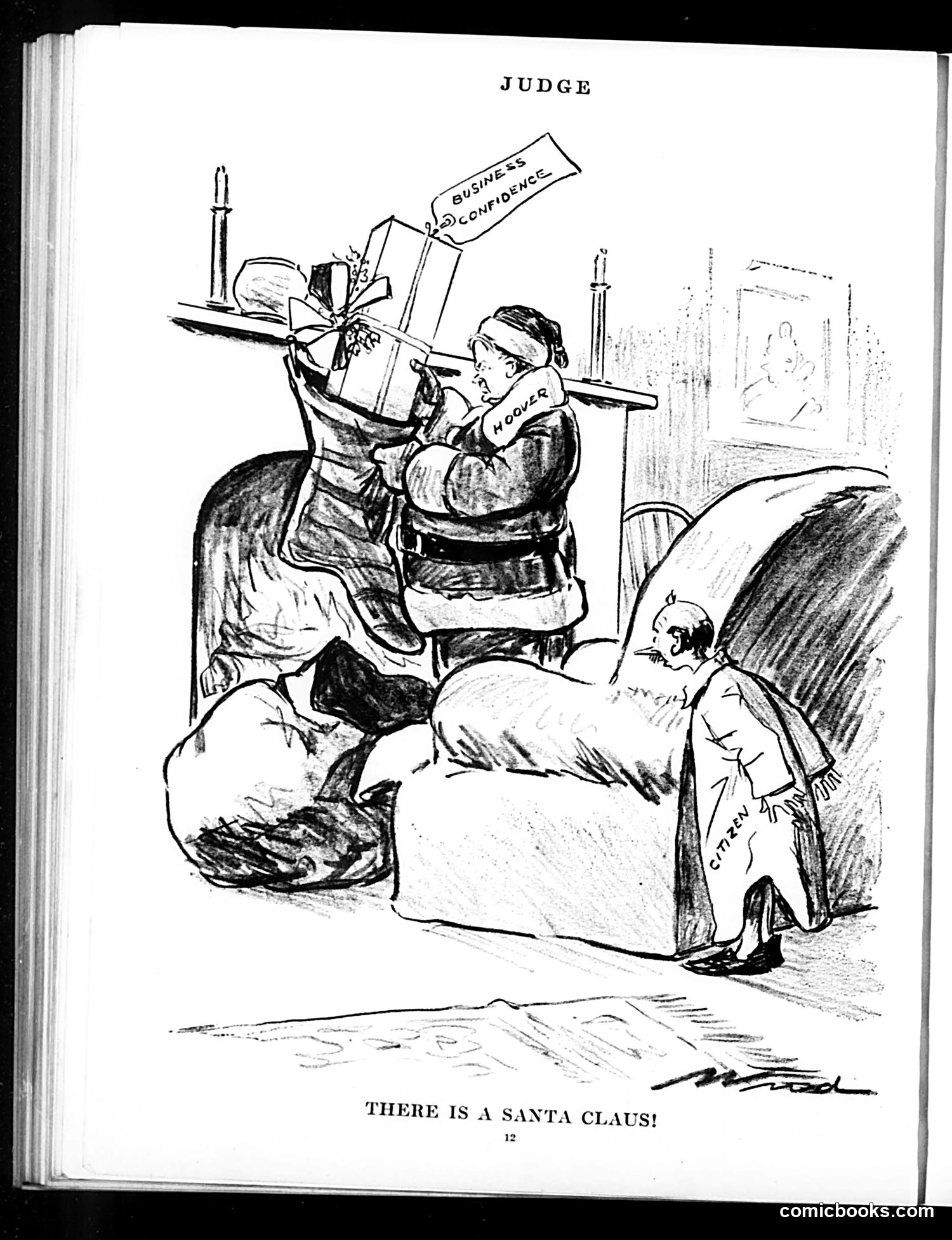
"There Is a Santa Claus!" This political cartoon depicts a judge figure manipulating a large marionette labeled "Business Confidence." The judge, labeled "Hoover" (likely President Herbert Hoover), holds the puppet's strings while a smaller figure labeled "Citizen" watches from below, appearing powerless. The satire suggests that during Hoover's presidency, "business confidence"—a concept the administration promoted as key to economic recovery—was merely an artificial construct controlled by judicial/executive authority rather than a genuine market force. The title's ironic reference to Santa Claus implies the comforting narrative about business confidence was a fairy tale being staged for public consumption. This likely comments on Hoover-era economic policies during the Great Depression, critiquing how confidence was manufactured rather than organically restored.
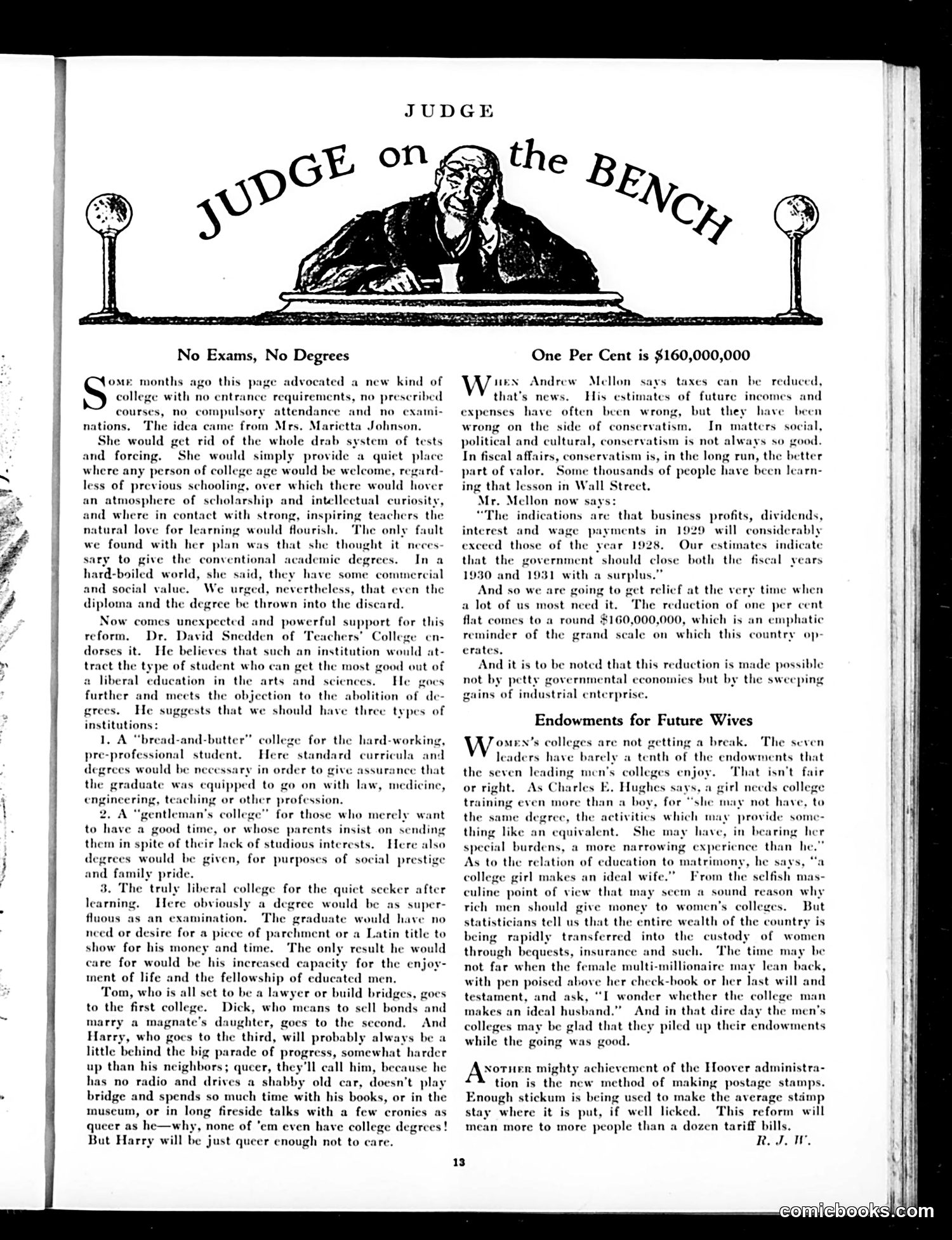
"Judge on the Bench" - Educational and Fiscal Satire This page combines two distinct satirical commentaries. The upper section mocks educational reformers (particularly Marietta Johnson and Teachers' College's David Snedden) who proposed eliminating entrance exams and degrees. Judge ridicules this through character archetypes: "Tom" the pre-professional, "Dick" the social climber, and "Harry" the genuine intellectual—who ironically will remain poor and socially ostracized despite his superior education because he lacks marketable credentials. The lower section attacks Treasury Secretary Andrew Mellon's tax reduction proposals. The satire observes that Mellon, despite his poor predictive track record on fiscal matters, claims 1929 will generate budget surpluses—allowing tax cuts precisely when ordinary Americans are struggling financially (likely referencing pre-crash Wall Street losses). The title references "One Per Cent is $160,000,000," suggesting tax relief primarily benefits the wealthy while common citizens suffer.
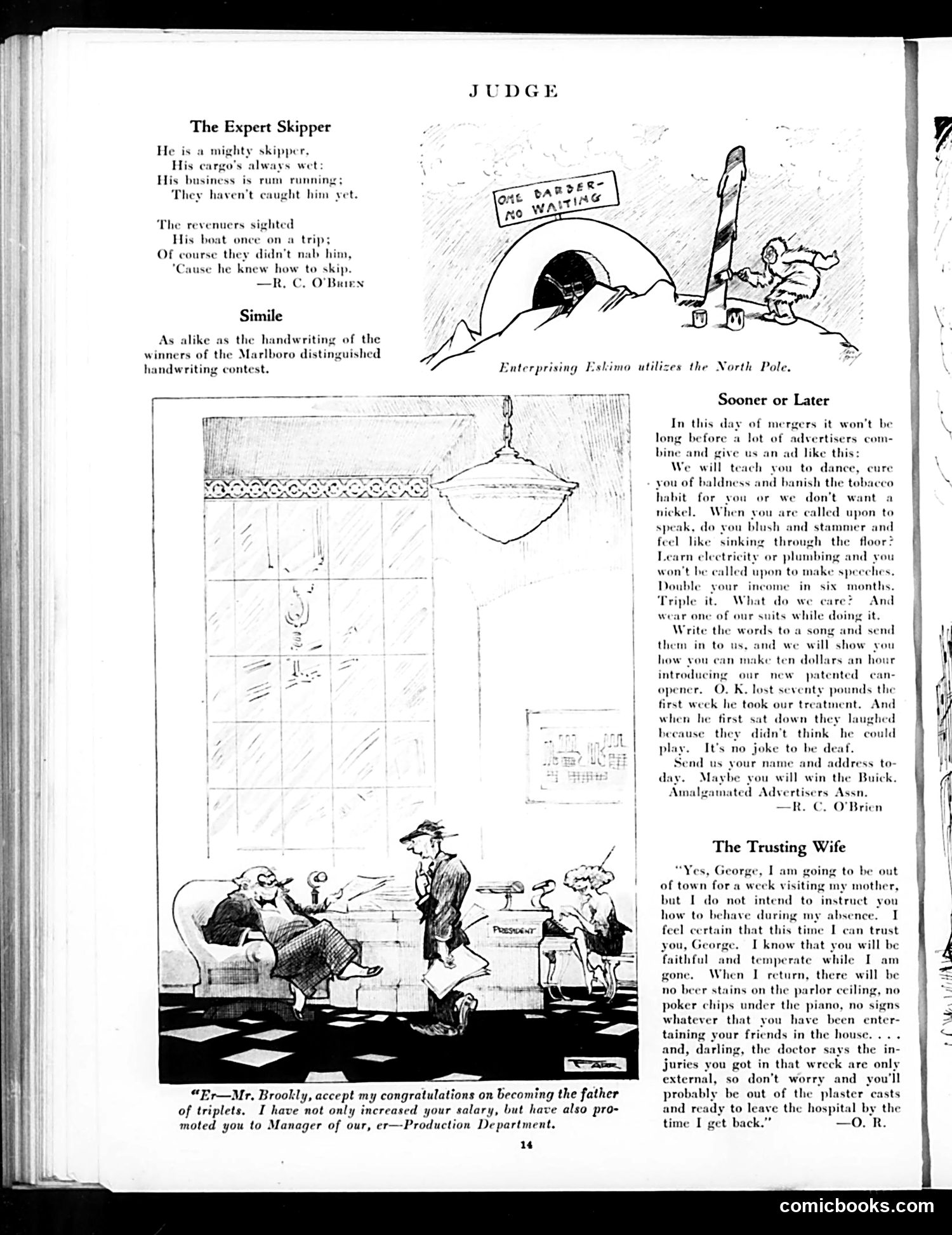
Judge Magazine Page Analysis This page contains three satirical pieces reflecting 1920s-30s American concerns: "The Expert Skipper" mocks Prohibition-era rum runners—illegal alcohol smugglers who evade federal revenue agents ("revenuers"). The joke is that these criminals operate with impunity because they're skilled at escape. "Simile" is a brief joke comparing the handwriting of Marlboro cigarette contest winners—implying the contest is rigged or the "winners" don't actually exist. "Sooner or Later" satirizes aggressive advertising by imagining a mega-merger where one absurd ad combines dancing lessons, baldness cures, tobacco cessation, electrician training, and a can-opener—all promising unrealistic results. It mocks the era's bombastic advertising claims. "The Trusting Wife" shows a wife naively trusting her husband alone while she visits her mother, listing things she *expects* he'll do wrong: get drunk ("beer stains"), gamble ("poker chips"), and entertain friends. The final cartoon shows her trust was misplaced when the husband injures himself in a wreck. All pieces reflect Jazz Age social anxieties: law-breaking, consumer deception, and marital infidelity.
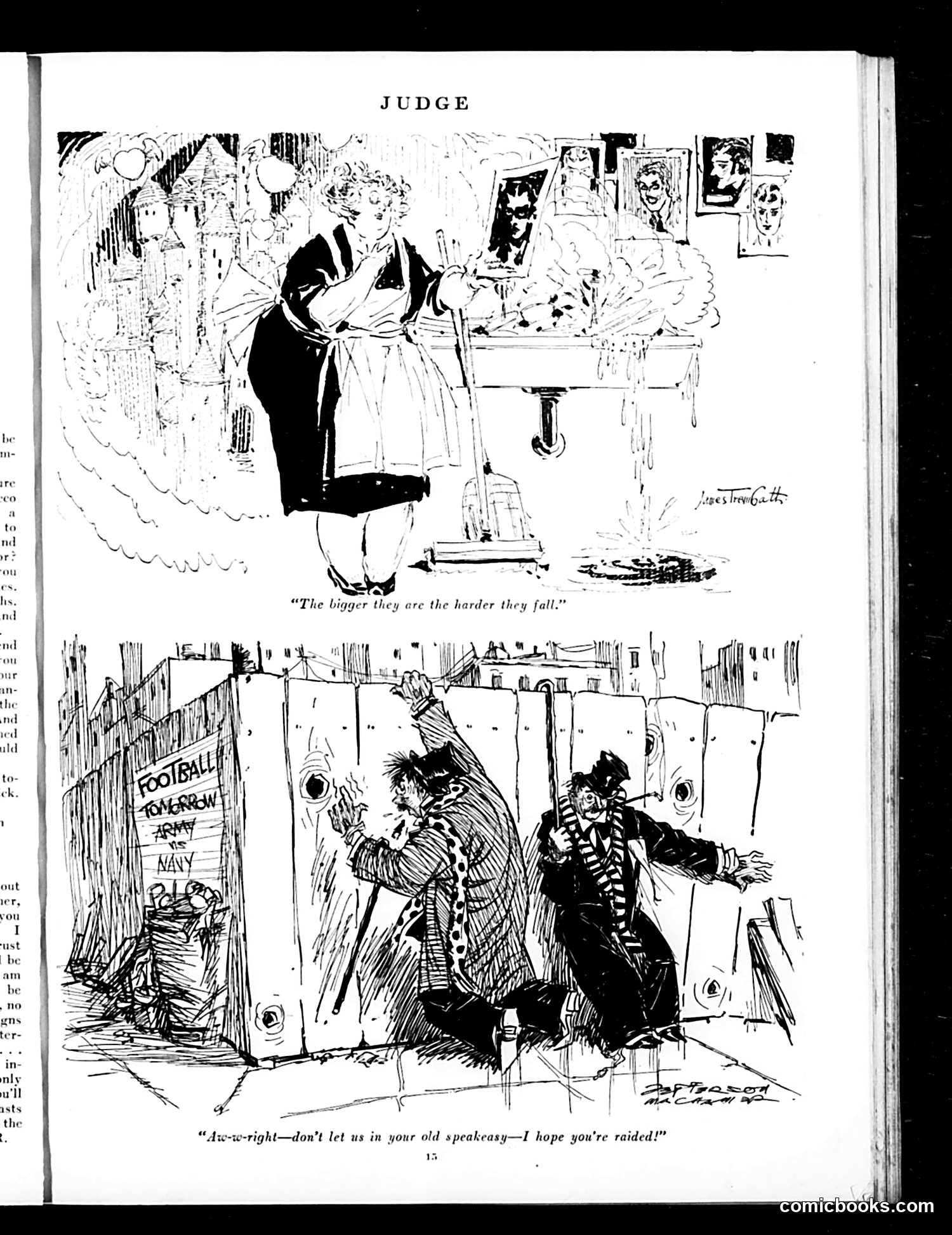
Judge Magazine Page Analysis This page contains two cartoons on a "Judge" theme about consequences and morality. The top cartoon depicts a woman at a vanity mirror with photographs on the wall, captioned "The bigger they are the harder they fall." This appears to be commentary on vanity and pride—likely referencing women's social ambitions or romantic pursuits. The bottom cartoon shows figures at what appears to be a speakeasy (marked "Football" and "Navy"), with the caption "Sis-s-right—don't let us in your old speakeasy—I hope you're raided!" This directly references Prohibition-era speakeasies and suggests moral judgment about those frequenting illegal establishments, with the "raided" reference implying hoped-for legal consequences. Both cartoons reflect early 20th-century Judge magazine's moralizing satire about social behavior and its repercussions.
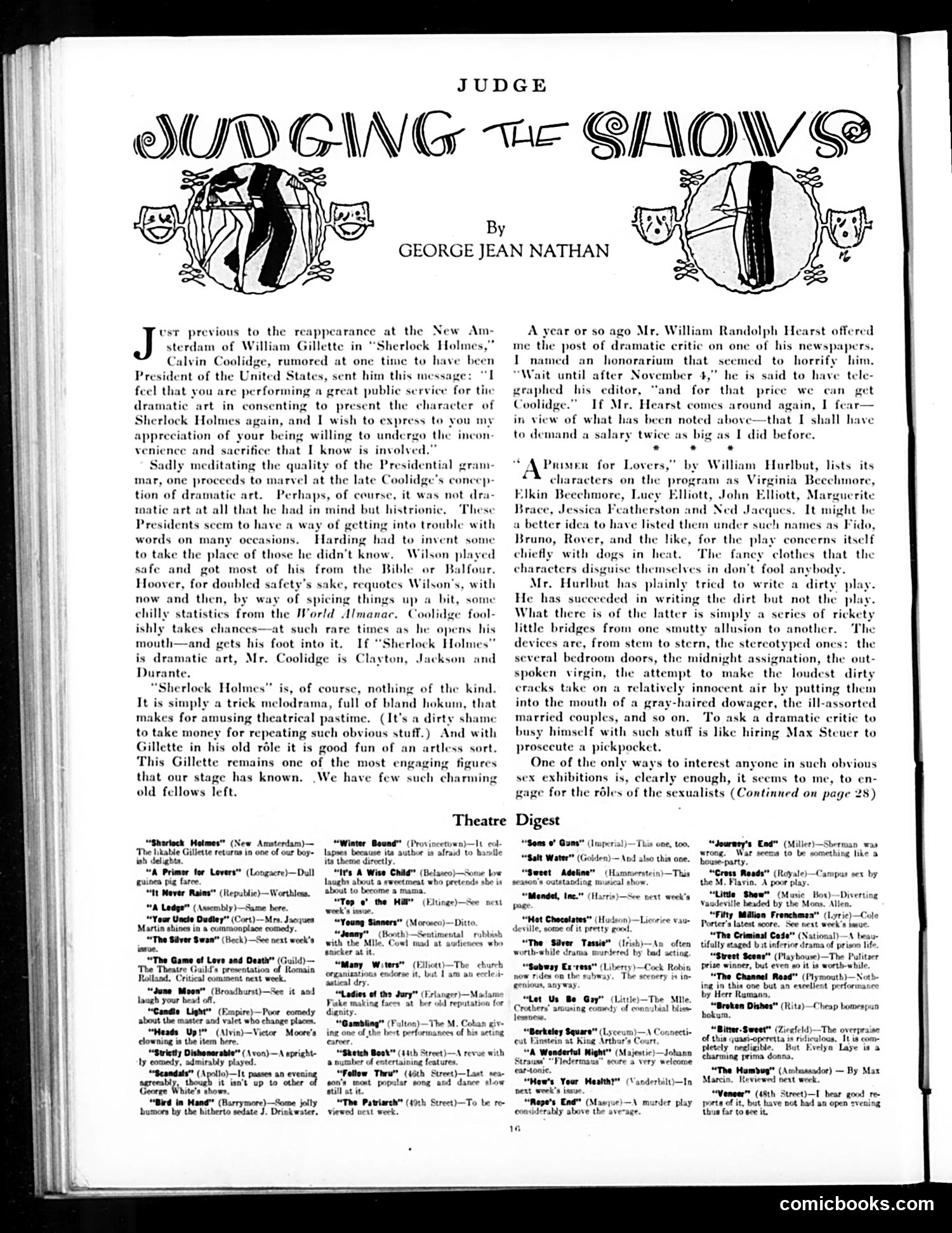
Analysis for Modern Readers This page from *Judge* magazine contains a theatrical criticism column by George Jean Nathan reviewing Broadway shows. The main satirical content targets President Calvin Coolidge, who had sent actor William Gillette a congratulatory message about reviving "Sherlock Holmes." Nathan's joke: Coolidge praised the production as "great public service for dramatic art," but Nathan argues it's actually just "trick melodrama" and "bland hokum"—not art at all. The satire mocks Coolidge's tendency to issue flowery, ill-considered statements. Nathan humorously catalogs how previous presidents (Harding, Wilson, Hoover) similarly struggled with public pronouncements—inventing words, quoting the Bible awkwardly, or hiding behind statistics. The "Theatre Digest" section provides brief, dismissive reviews of current Broadway productions, using Nathan's characteristic snark (calling plays "dull," "worthless," "rubbish"). Historical context: This reflects 1920s criticism of Coolidge as an intellectually limited figurehead, contrasting his "Silent Cal" public image with his tendency toward maladroit commentary.
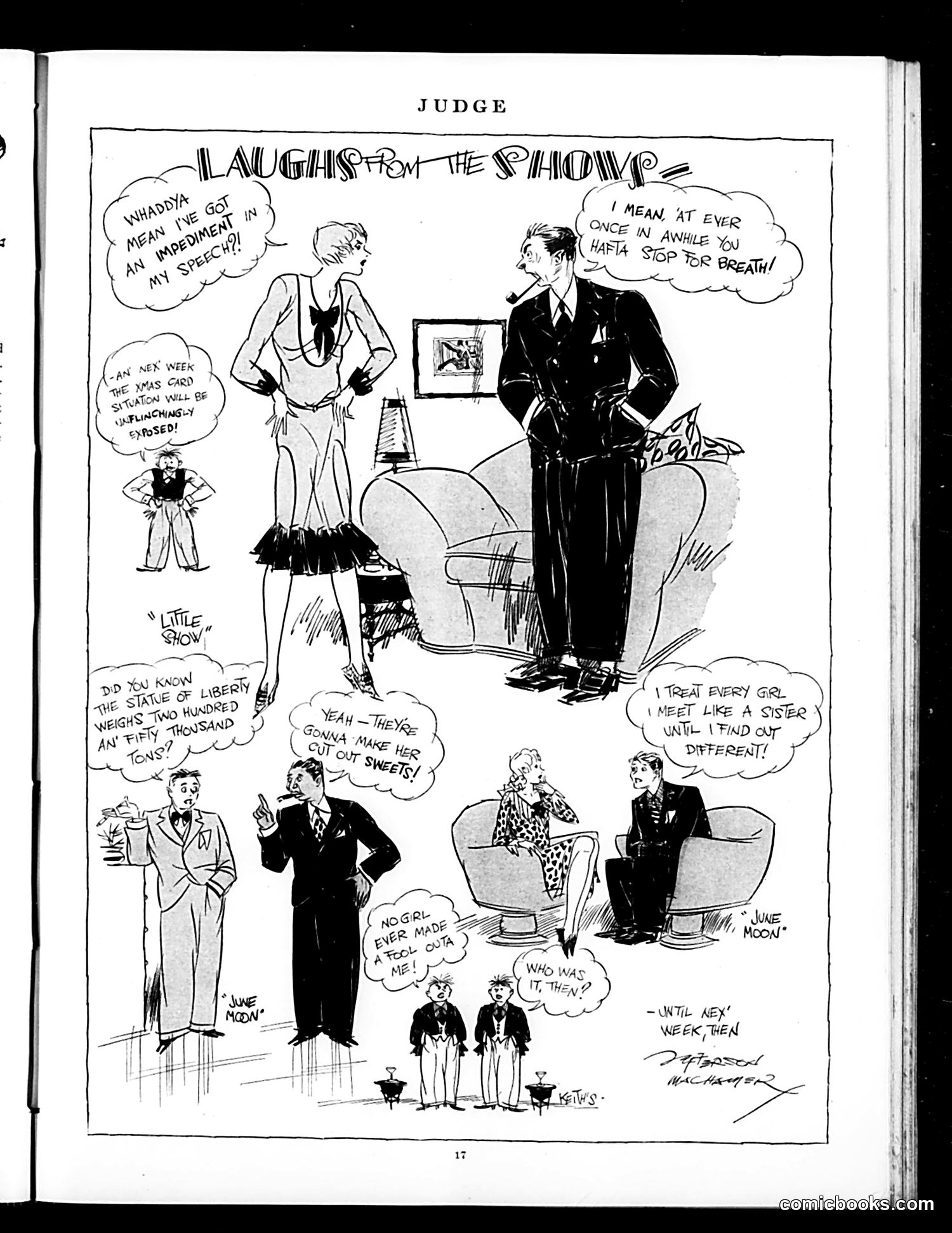
"Laughs from the Shows" This is a satirical cartoon about theatrical courting rituals. The central figure appears to be a sophisticated man (likely representing a theatrical producer or wealthy suitor) interacting with various women in social settings. The humor targets how men use exaggerated compliments and flattery to seduce women—claiming they treat "every girl like a sister" until finding one "different," stopping to catch breath during romantic pursuits, and boasting about their importance (referencing the Statue of Liberty's "fifty thousand tons"). The smaller figures at bottom appear to be chorus girls or performers, suggesting this satirizes the entertainment industry's dating dynamics and male predatory behavior toward showgirls. The cartoon mocks both the men's transparent manipulation tactics and the theatrical world's social hierarchies, where powerful men exploited young female performers.
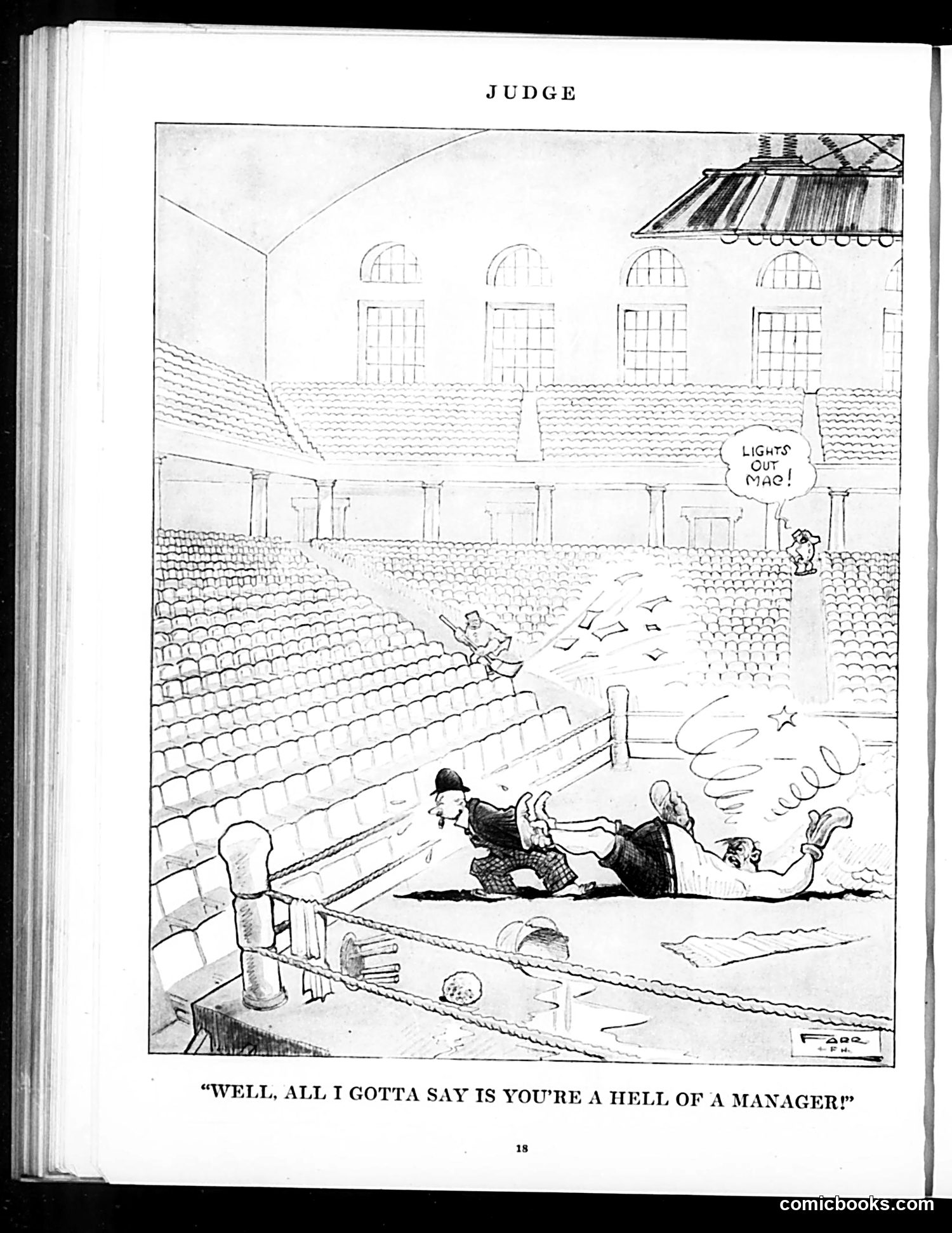
Explanation of Cartoon This is a baseball stadium cartoon satirizing managerial competence. A manager sits in the dirt of the playing field, apparently knocked down or ejected, while making a sarcastic compliment to someone (likely the opposing manager or an umpire). The setup suggests the manager has been physically removed from the game—a common occurrence when managers argue calls or lose their temper. The joke's humor derives from the irony: the fallen manager sarcastically praises whoever caused his ejection as "a hell of a manager," when his own visible predicament (sprawled on the ground) demonstrates his own poor management. This reflects Judge magazine's tradition of satirizing workplace incompetence and the gap between pretense and reality. The crowded stadium and "Lights Out, Mac!" speech bubble add to the chaotic scene.
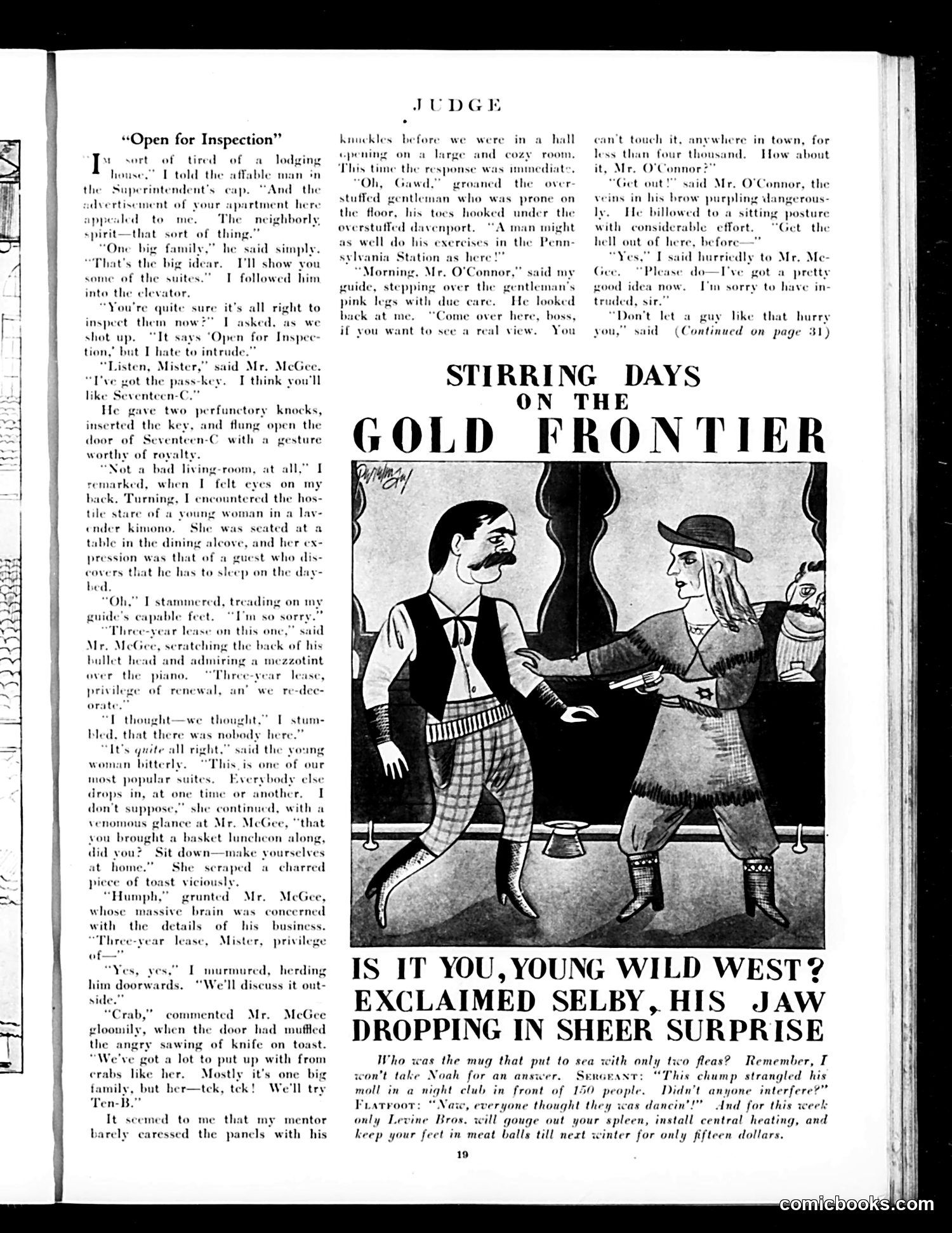
Analysis for Modern Readers This page contains two unrelated pieces from Judge magazine: Left side ("Open for Inspection"): A satirical article about apartment hunting. A superintendent shows prospective tenants "Seventeen-C," advertising it as part of a friendly "one big family" building. The joke: each unit is occupied. They encounter an angry woman in a negligee eating burnt toast, then a man doing floor exercises. The superintendent dismisses complaints, showing the absurdity of deceptive rental practices and how landlords exploit tenants while marketing apartments as desirable. Right side ("Stirring Days on the Gold Frontier"): An advertisement or story preview featuring what appears to be a Western pulp-fiction scene with men in frontier attire. The caption suggests surprise recognition between characters named Selby and "Young Wild West," typical of serialized adventure fiction popular in that era. The contrast between a mundane urban housing complaint and romantic Western fiction reflects the magazine's mix of satirical social commentary and entertainment advertising.
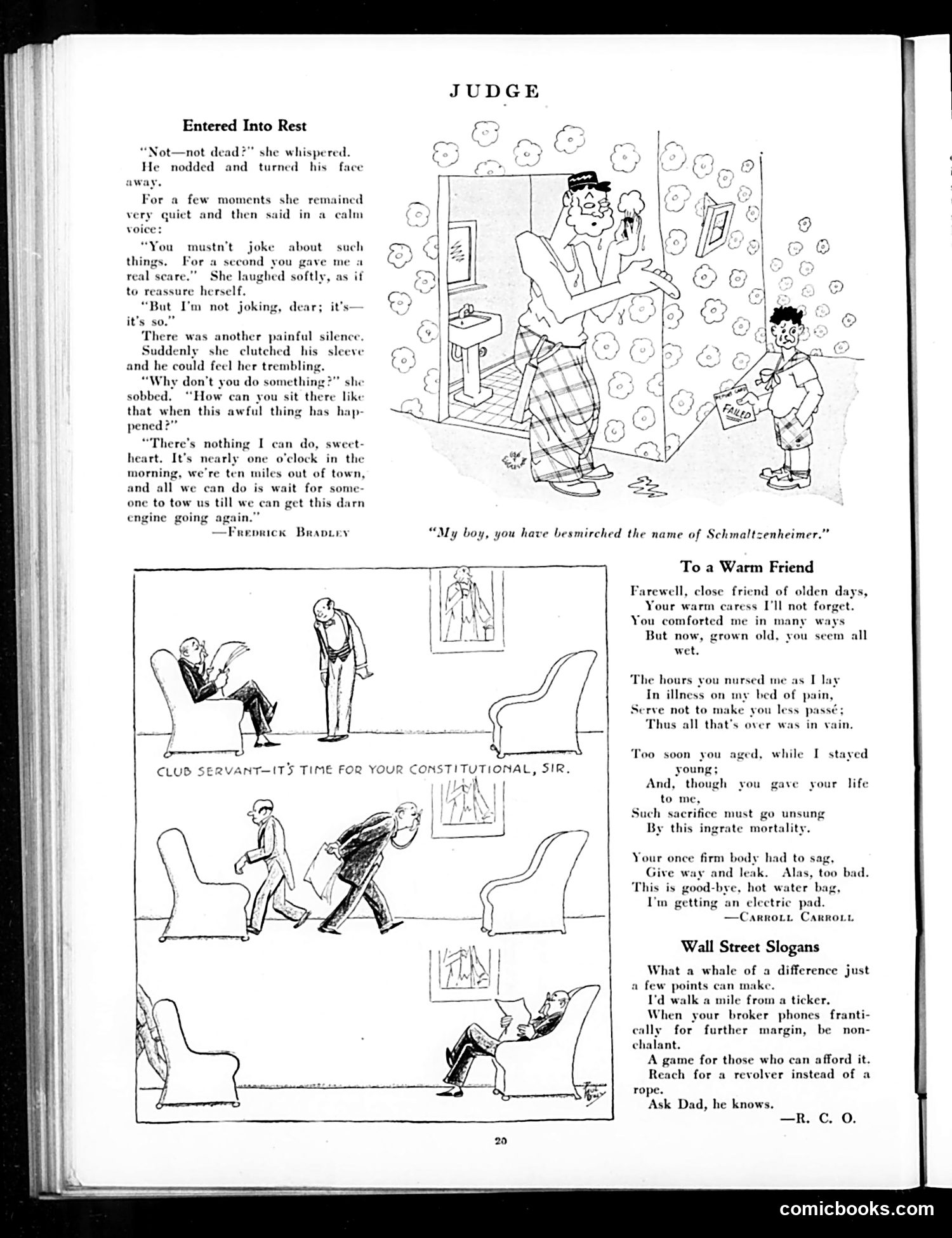
Analysis of Judge Page Content This page contains three distinct pieces of satirical content: "Entered Into Rest" (top): A dramatic story-cartoon by Frederick Bradley about a couple stranded in a broken-down car at night. The humor lies in the woman's escalating panic over a mechanical failure, while the man remains helplessly calm—a commentary on gender stereotypes and automotive anxiety. Main Comic Strip (center): Shows a club servant repeatedly interrupting a gentleman's rest with increasingly absurd "constitutional" exercises, satirizing health fads or wellness obsessions of the era. "Wall Street Slogans" (bottom right): Dark satire on the stock market, with gallows humor about financial ruin. References to "ticker" (stock ticker), broker margin calls, and the final line "Reach for a revolver instead of a rope" suggests suicide as an alternative to financial collapse—reflecting Depression-era anxieties about market gambling and bankruptcy. "To a Warm Friend": A sentimental poem bidding farewell to a hot water bottle, replaced by modern electric heating—light social commentary on technological progress making old comforts obsolete.
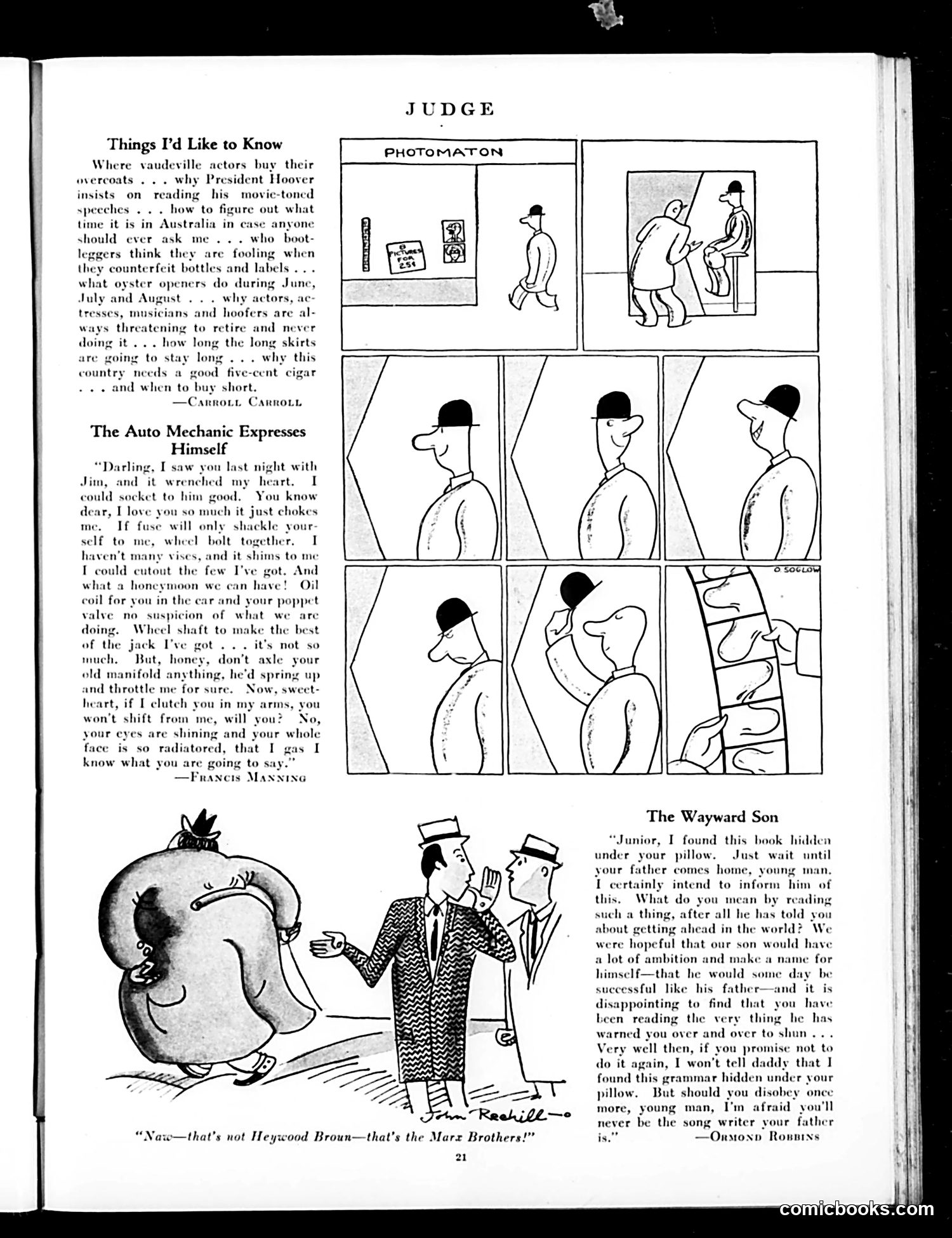
Judge Magazine Page Analysis This page contains three separate humorous pieces from Judge, a satirical magazine (the reference to "President Hoover" dates this to 1929-1933). "Things I'd Like to Know" is a list of absurdist questions poking fun at contemporary oddities—vaudeville actors' fashion choices, Prohibition bootleggers' delusional counterfeiting, and women's changing hemlines (a recurring 1920s-30s social debate). "The Auto Mechanic Expresses Himself" is a pun-heavy romantic monologue where a mechanic uses automotive terminology as double entendres ("socket," "wheel bolt," "clutch," "shift"). The humor relies on readers recognizing the mechanical jargon. "The Wayward Son" satirizes parental hypocrisy: a mother discovers her son reading a grammar book—the very thing she warns against—and threatens to tell his father, a "song writer." The joke implies the father, a creative artist, ironically discourages his son from intellectual pursuits despite his own profession requiring education. All three pieces use wordplay and social commentary typical of 1920s-30s American humor magazines.
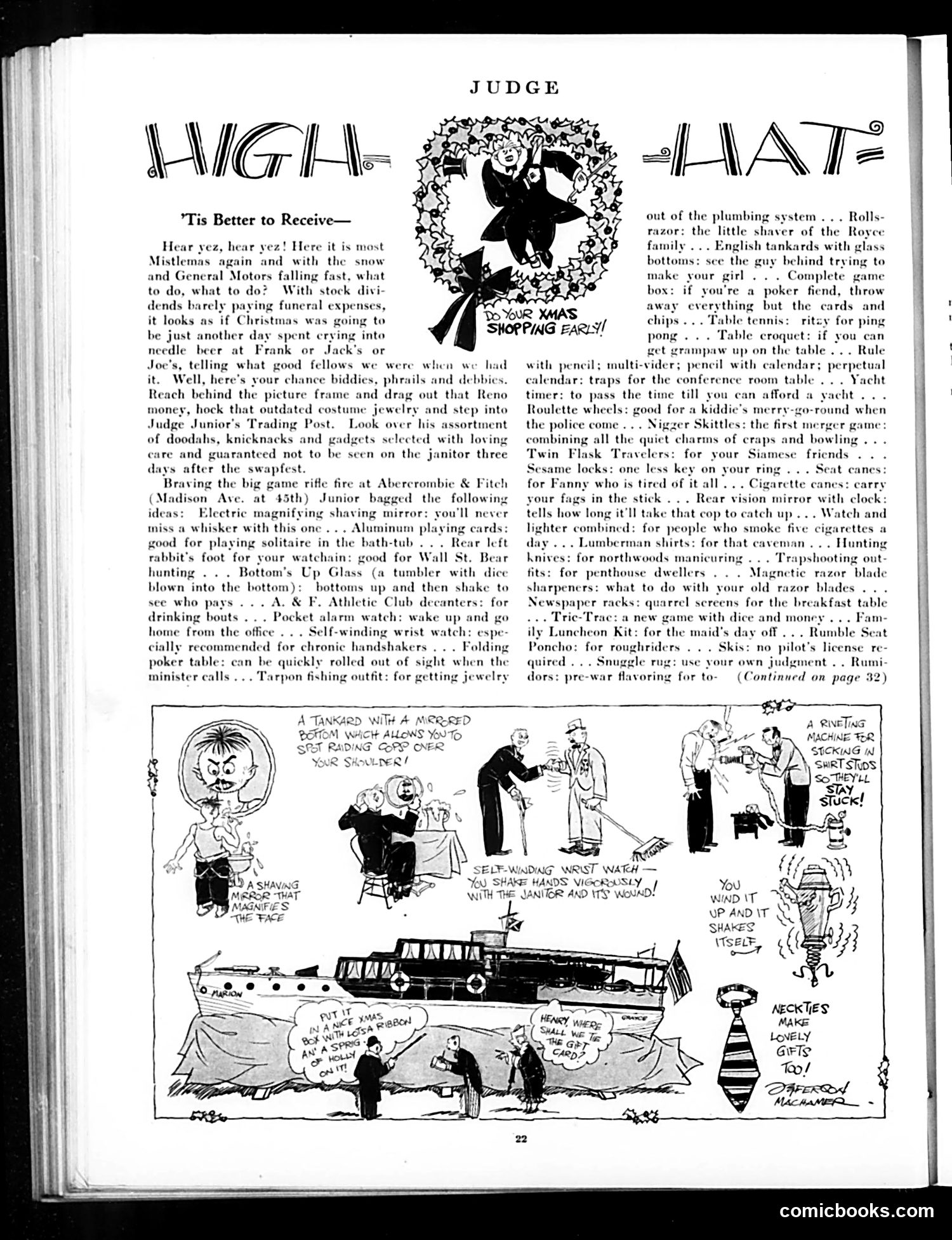
Judge Magazine: "High-Hat" Gift Guide This is a satirical gift guide from Judge magazine, likely from the late 1920s (referencing "General Motors falling fast" suggests economic decline). The page mocks wealthy Americans during financial hardship by suggesting absurd luxury gifts. The cartoon below illustrates novelty items with crude drawings of men in formal wear demonstrating gadgets: a self-winding wristwatch (activated by vigorous handshaking), a riveting machine for keeping shirt studs attached, and a truck display where men in a tent discuss gift options. The satire's point: While ordinary people struggle financially ("stock dividends barely paying funeral expenses"), the wealthy still seek frivolous, impractical luxuries. The "Judge Junior's Trading Post" presents increasingly ridiculous items—fishing outfits, mechanical watches, drinking glasses with dice—mocking conspicuous consumption and the gap between rich and poor during economic uncertainty. The crude cartoon style emphasizes the absurdity of these "status symbol" gifts.
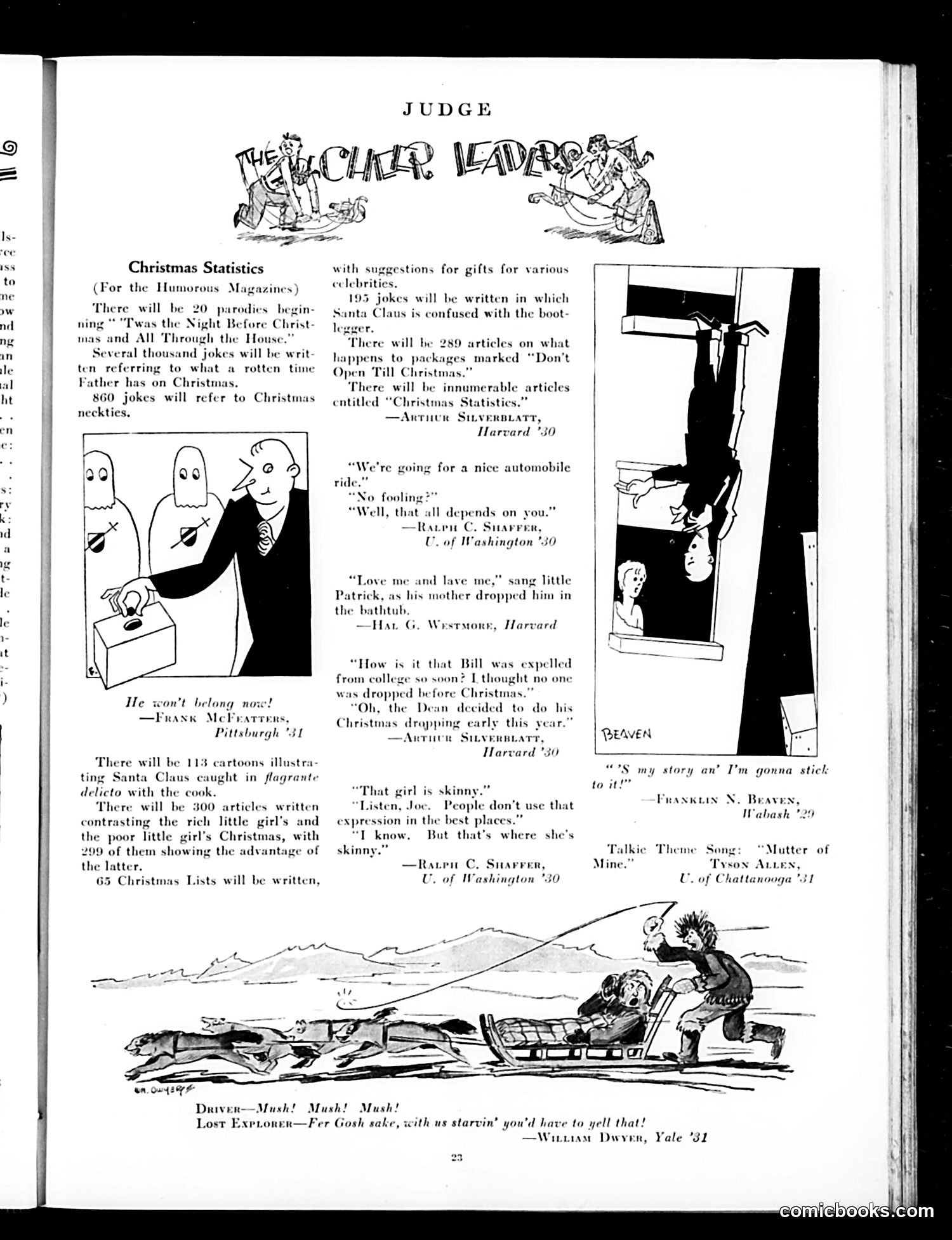
Judge Magazine Christmas Satire Page This is a 1920s-era humor page satirizing the predictability and commercialization of Christmas content in American magazines. The text mocks how publications will mechanically churn out identical Christmas material: twenty parodies of "'Twas the Night Before Christmas," 860 jokes about neckties as gifts, and countless articles contrasting rich versus poor children's Christmases. The cartoons are lighter fare: one shows a man presenting wrapped gifts to two ghost-like figures (labeled "He won't belong now"), another depicts a sled driver yelling "Mush!" to starving arctic explorers who sarcastically respond they'd need to sell their story to afford food. The humor relies on self-aware media criticism—Judge is essentially mocking the magazine industry's lazy repetition of seasonal material and predictable themes. The student-credited quotes and jokes scattered throughout represent the formulaic "humorous" content magazines publish annually. It's satirizing commercialism and editorial predictability rather than political issues.
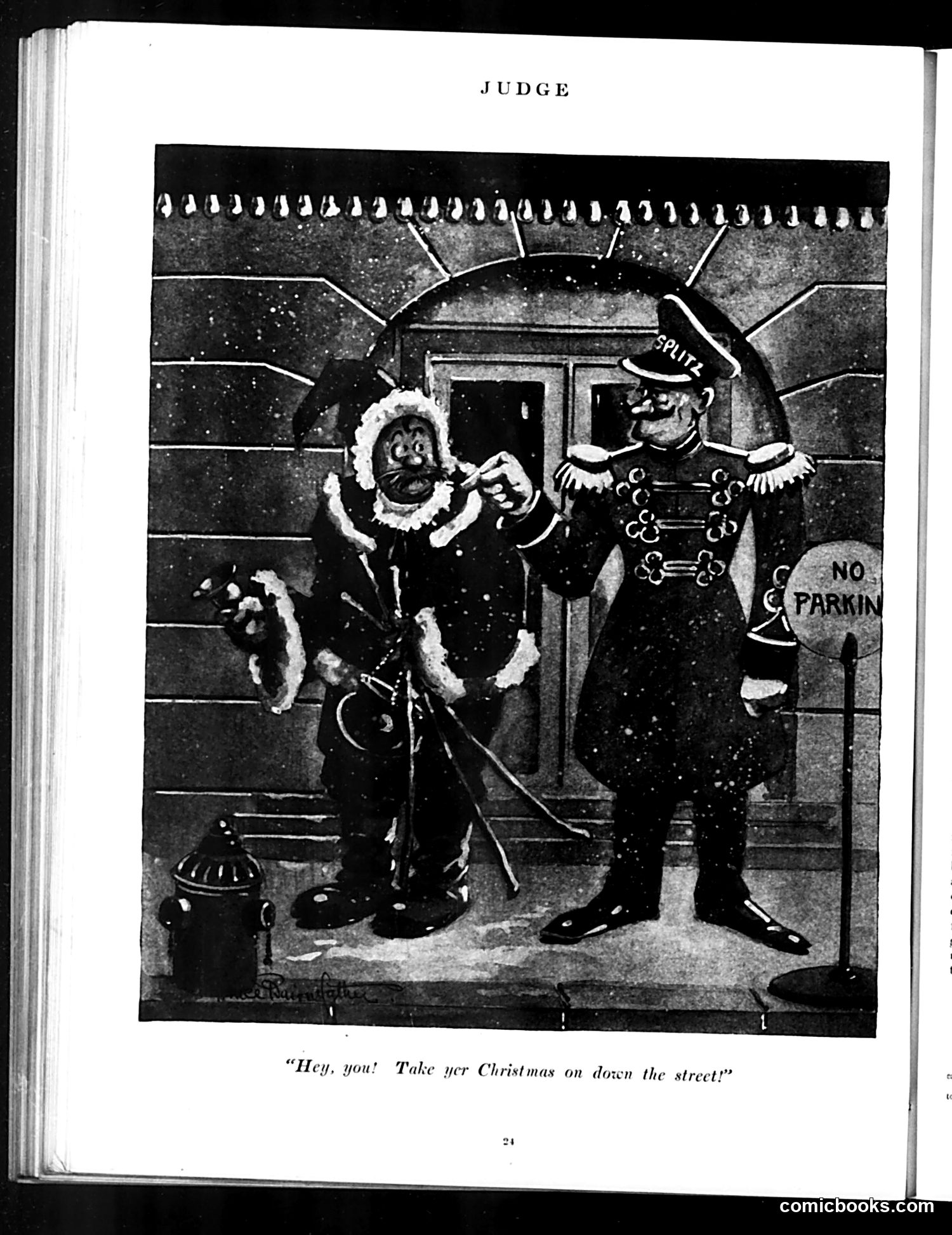
Analysis This cartoon depicts two figures in an urban setting near a building entrance marked "SMUT." On the left is a caricatured character in winter clothing (fur-trimmed coat and hat), apparently homeless or destitute, carrying belongings. On the right stands a stern authority figure in military or police uniform with ornate details, pointing the first character away. The caption reads: "Hey, you! Take yer Christmas on down the street!" The satire appears to target class inequality and urban homelessness during the Christmas season. The "respectable" authority figure is rejecting or displacing the poor person—denying them even minimal Christmas acknowledgment. The word "SMUT" on the building and "NO PARKING" sign suggest this occurs outside an establishment concerned with maintaining appearances. The cartoon critiques the callousness of removing poverty from public view rather than addressing it, using the holiday season's charitable ideals as ironic counterpoint.
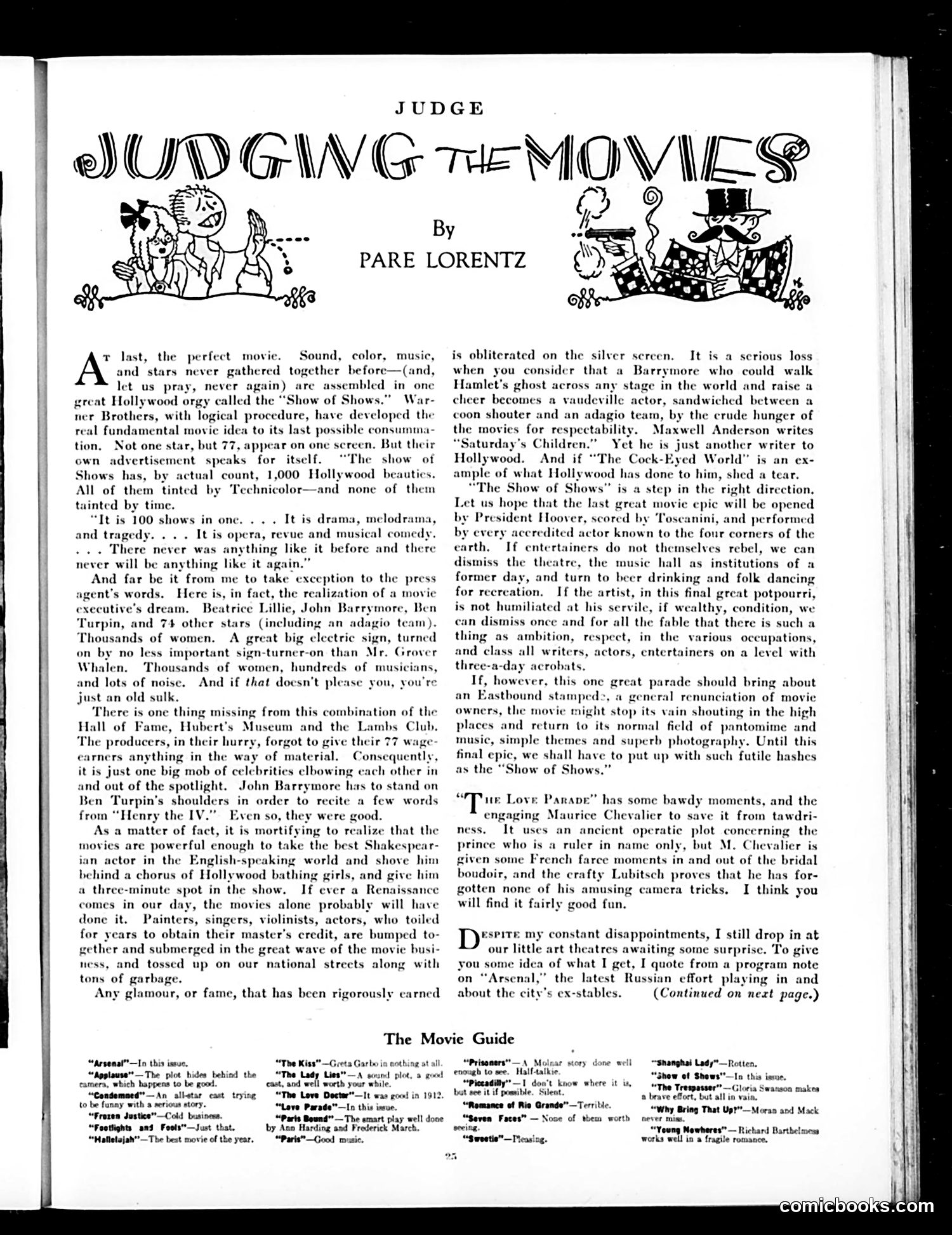
"Judging the Movies" by Pare Lorentz This is a critical review of Warner Brothers' "Show of Shows," a 1929 film featuring 77 major stars. Lorentz satirizes Hollywood's approach: the studio assembled an enormous cast—1,000 extras, musicians, elaborate sets—yet provided no meaningful script or dramatic material. The cartoon attacks how movies devalue serious artists. Lorentz argues that accomplished stage actors like John Barrymore are reduced to brief "vaudeville" spots between chorus girls, while respected playwrights become anonymous Hollywood employees. The review mocks the industry's conflation of spectacle with art. The satire's target: Hollywood prioritizes commercial "respectability" and sensation over substance, degrading artists to mere components in a profit machine. Lorentz suggests dismissing cinema entirely unless the industry reverses course—a pointed critique of early sound cinema's wasteful excess and contempt for talented performers forced into servile, wealthy anonymity.
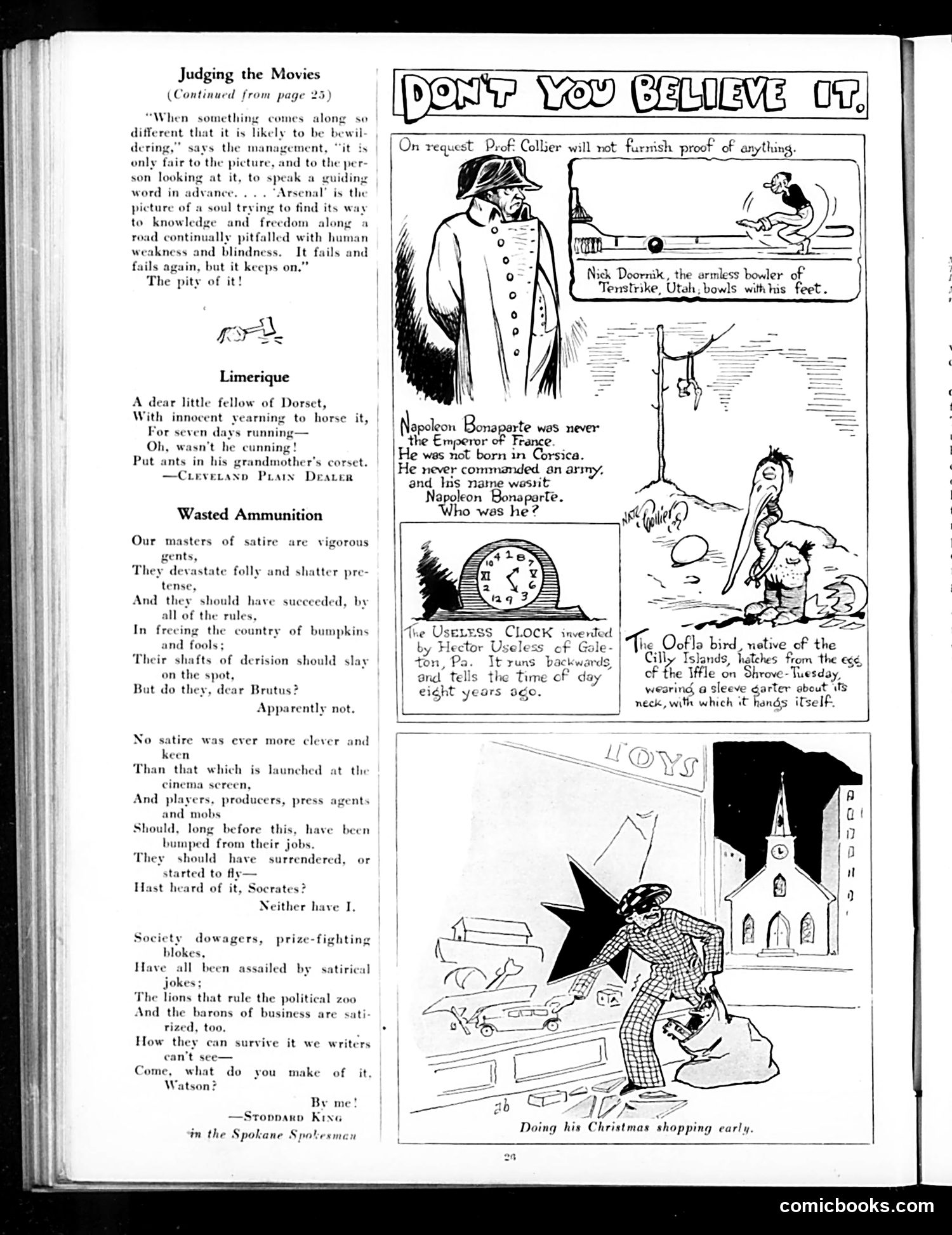
"Don't You Believe It" — Judge Magazine Satire This page satirizes absurd claims and misinformation. The left column critiques pretentious film criticism, particularly a movie called "Arsenal" that management insists audiences need guidance to understand. The satire mocks this as patronizing nonsense. The right panel, "Don't You Believe It," presents deliberately fake "facts"—clearly labeled as unbelievable: an armless bowler, false claims about Napoleon, a backwards clock, and an invented bird with implausible behavior. The humor relies on the reader recognizing these as obvious lies. The overarching joke targets how easily false information spreads, especially through cinema and popular media. By presenting absurdities so extreme they're comical, Judge mocks both credulous audiences and those who feed them misinformation—a satirical commentary on media literacy that remains remarkably relevant today.
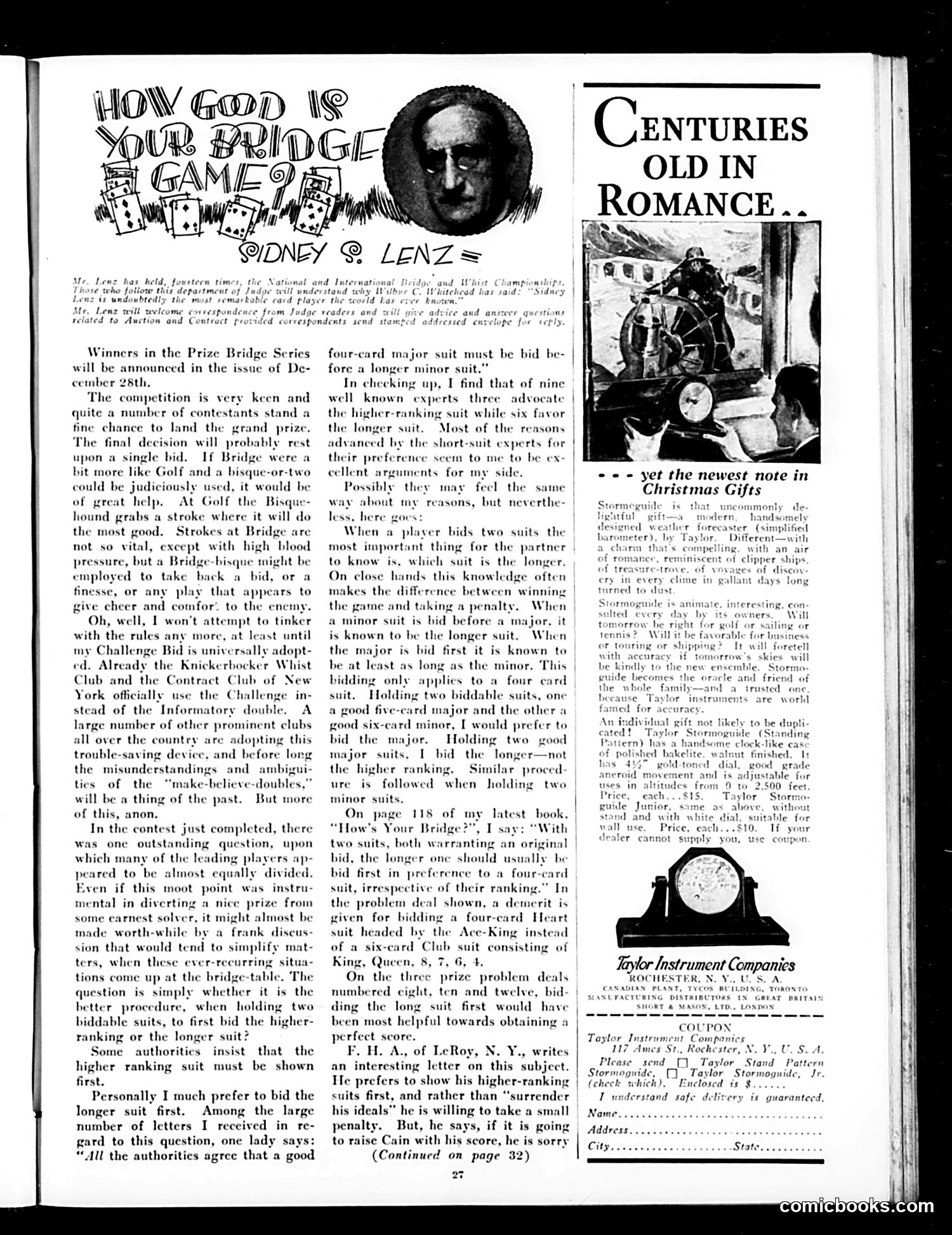
Judge Magazine Page Analysis This page combines bridge strategy content with period advertising. The main article, credited to Sidney Q. Lenz (whose portrait appears at top), discusses competitive bridge bidding strategy—specifically whether players should bid their higher-ranking or longer suit first when holding two bidable suits. The left column contains Lenz's analysis of a prize bridge competition, citing expert opinions (9 experts: 3 prefer higher-ranking suits, 6 prefer longer suits) and publishing reader correspondence about the bidding question. The right side features an advertisement for Taylor Stormguide watches, marketed as "the newest note in Christmas Gifts," emphasizing durability and accuracy for outdoor activities like golfing and sailing. Context for modern readers: This reflects bridge's popularity as both competitive game and social pastime in early-to-mid 20th century America, when such technical strategy discussions appeared in national magazines alongside consumer goods advertising.
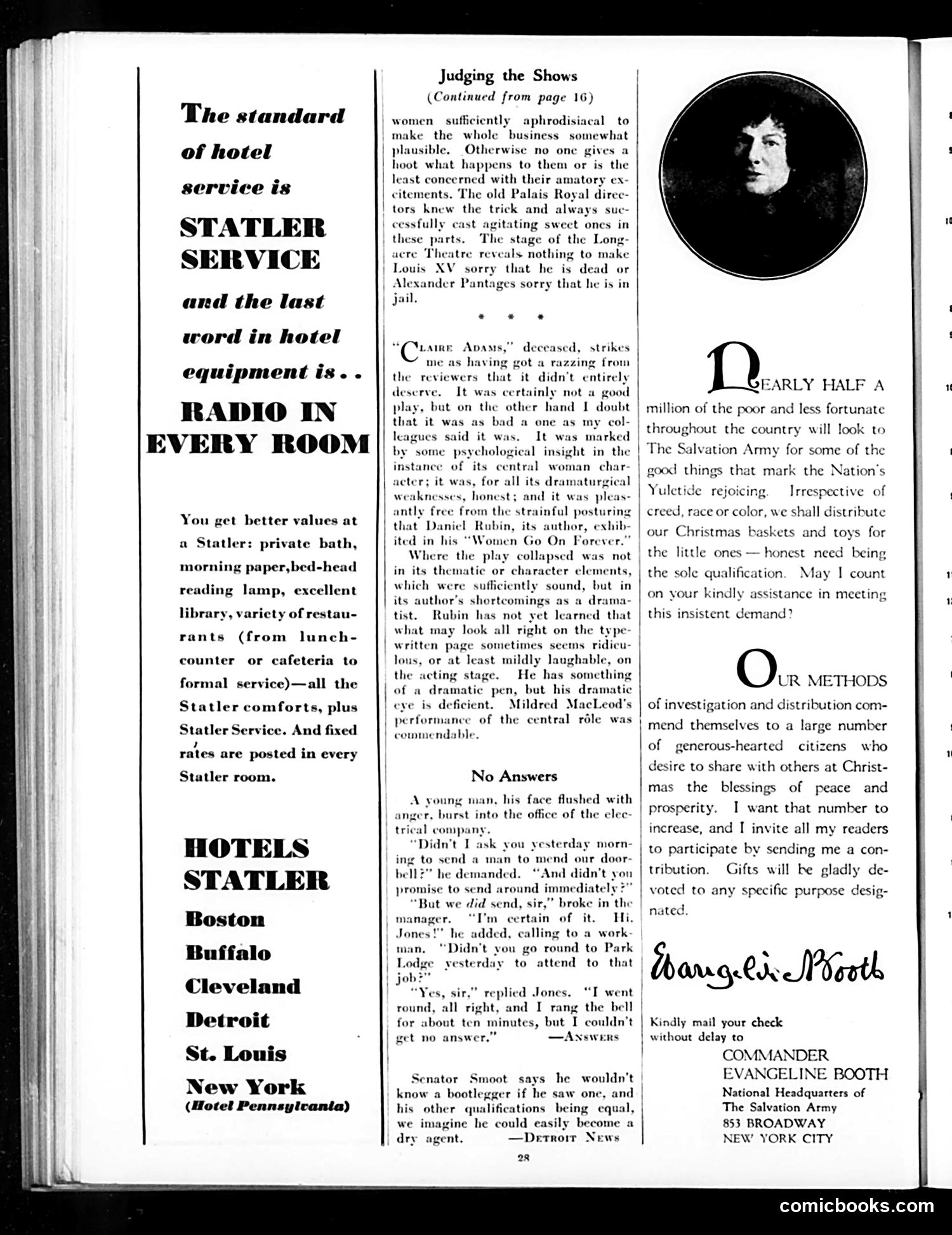
This page is primarily advertising and editorial content rather than satirical cartoons. The main elements are: Left side: A Statler Hotels advertisement promoting their service standards and amenities (private baths, radios in rooms, fixed rates) across multiple cities. Right side: A theater review column discussing plays, including criticism of a show called "Claire Adams" and commentary on actor Daniel Rubin's dramatic weaknesses. There's also a humorous anecdote ("No Answers") about a man angry that a repairman couldn't fix his doorbell because no one answered the door. Bottom section: A Salvation Army fundraising appeal from Commander Evangeline Booth requesting donations for Christmas baskets for the poor, emphasizing their distribution methods serve "all" regardless of "creed, race or color." The page reflects early 20th-century concerns: hotel modernization, theatrical criticism, and organized charity for the economically disadvantaged during the holiday season.
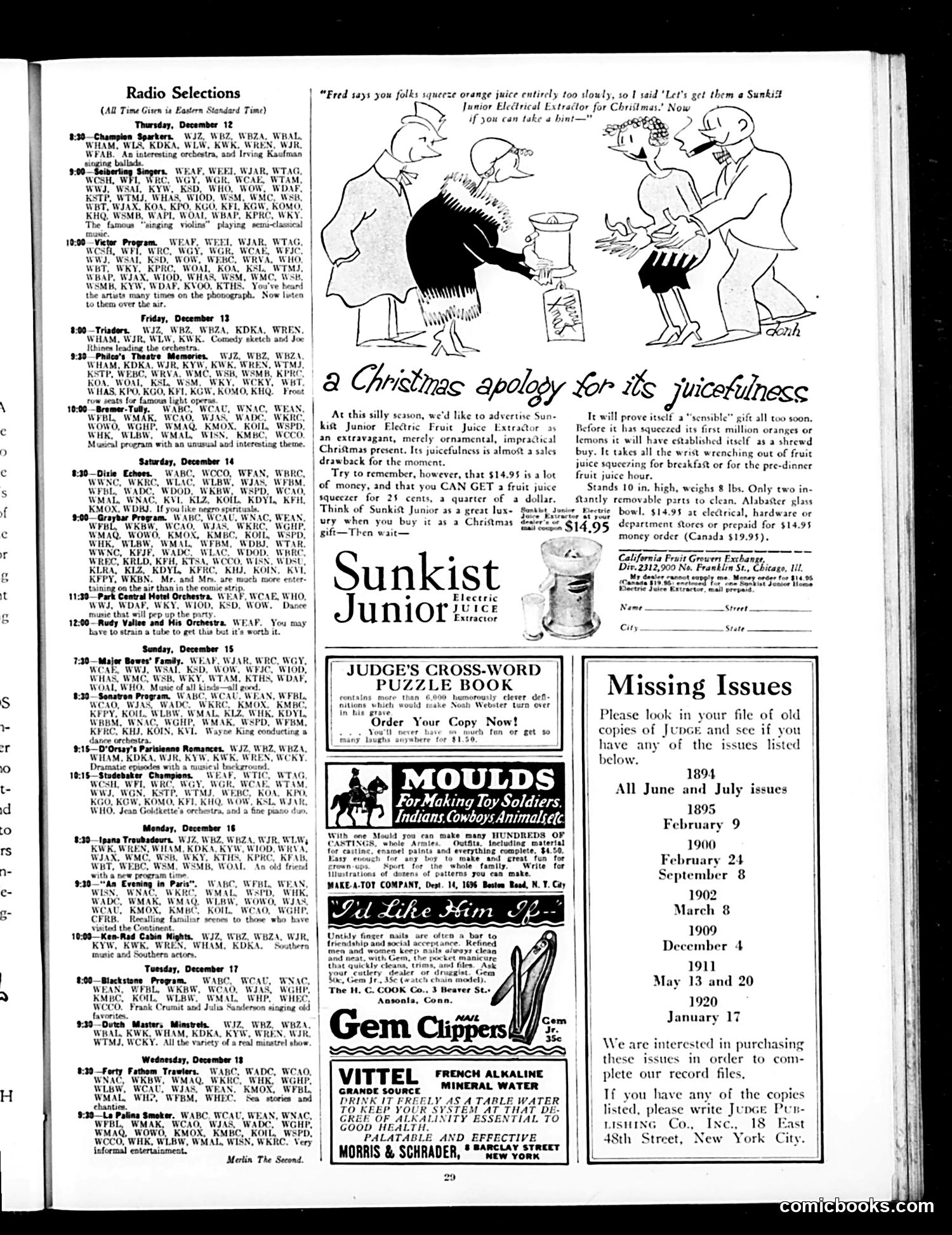
Judge Magazine Page Analysis This page is primarily advertising and radio listings, not political satire. The one cartoon visible depicts a domestic scene where a woman presents a Sunkist Junior Electric Fruit Juice Extractor as a Christmas gift to her husband. His exaggerated expression suggests skepticism about receiving kitchen appliance rather than something more traditionally masculine or luxurious. The satire is gentle and commercial: it's a gender-role joke common to 1920s advertising. The cartoon mocks both the impracticality of giving appliances as Christmas presents and, implicitly, the marketing strategy of selling "labor-saving devices" to housewives. The accompanying ad copy attempts to reframe the juicer as a practical, money-saving gift—a sales pitch disguised as helpful consumer advice. The page otherwise contains radio program schedules and advertisements for products like Moulds toy soldiers, Gem Clippers, and Vittel mineral water, reflecting 1920s consumer culture.
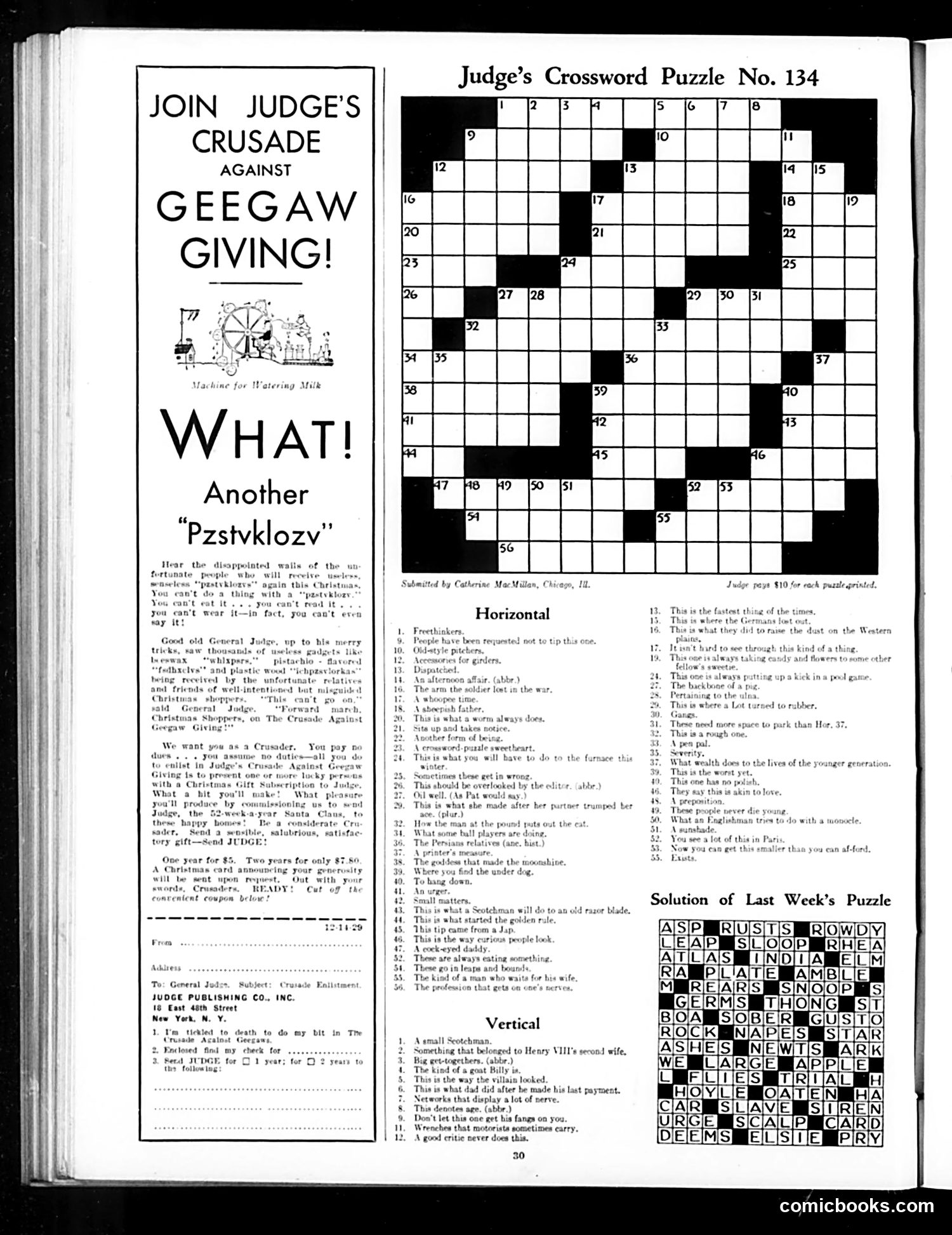
Judge Magazine Satire Analysis This page is primarily a crossword puzzle with an accompanying public service announcement rather than a traditional political cartoon. The "crusade" referenced targets "Geegaw Giving"—a satirical jab at excessive, frivolous gift-giving, particularly during the Christmas season. The small illustration shows a carnival/amusement park scene, suggesting wasteful consumer culture. The accompanying text mocks the trend of giving impractical trinkets ("geegaws") as gifts. It's positioned as a tongue-in-cheek morality campaign, suggesting readers should avoid participating in this wasteful practice. Context: This likely reflects 1920s concerns about materialism and consumerism during the prosperous post-WWI era. Judge magazine frequently satirized American consumer habits and social trends through such mock "crusades." The crossword itself appears designed to reinforce the anti-frivolity message through its clues, making satire participatory rather than purely observational.
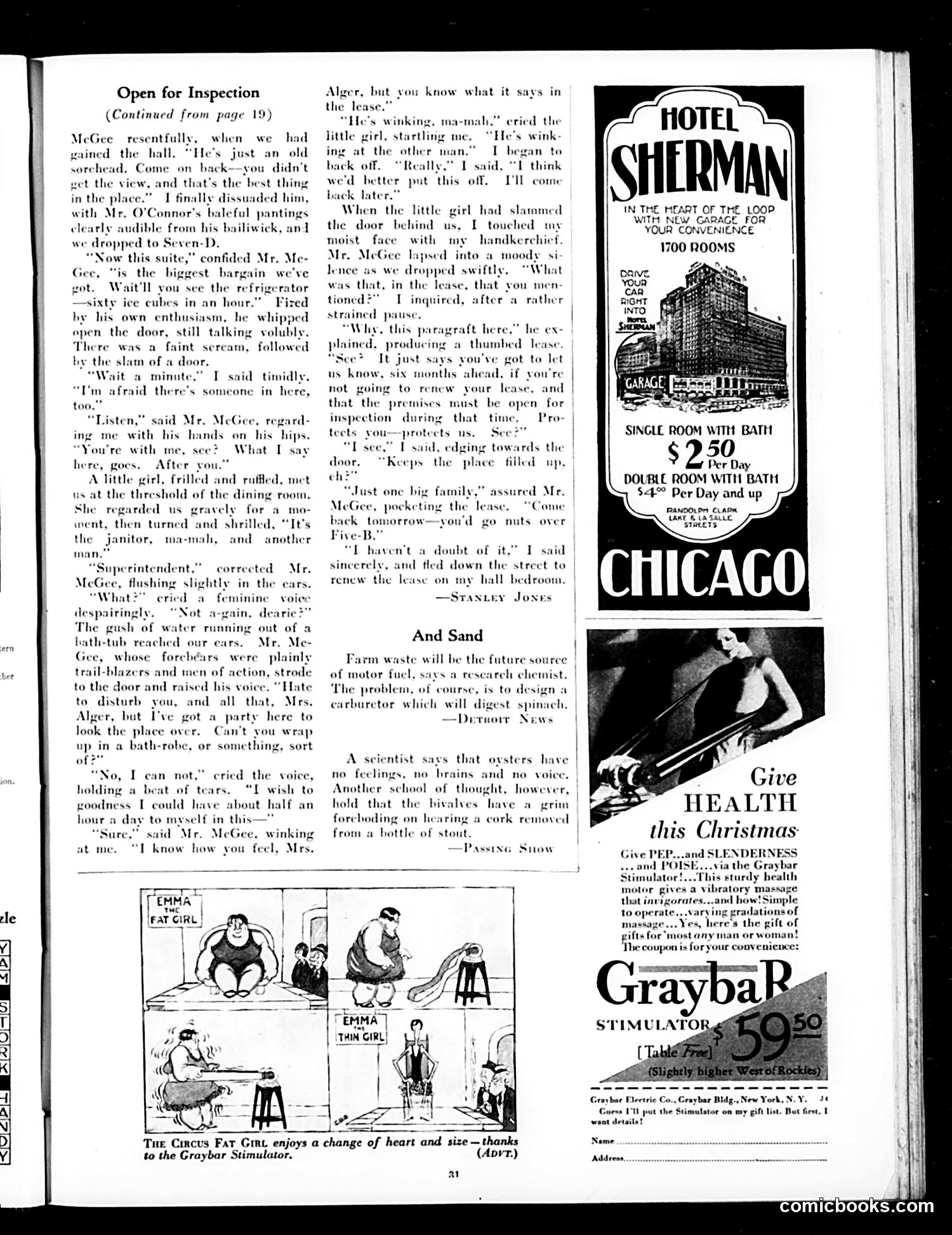
"Open for Inspection" — Judge Magazine Cartoon Analysis This page contains a satirical short story (continued from prior page) by Stanley Jones about apartment hunting in what appears to be 1920s urban America. The narrative mocks both greedy landlords and the indignities tenants face during property inspections. The Satire: Mr. McGee, an aggressively pushy building superintendent, drags the narrator through an apartment showing while current tenants are still living there—including a woman bathing. McGee callously dismisses her protests, citing a lease clause requiring six-month notice for non-renewal and permitting inspections. The story lampoons the power imbalance: landlords could demand access to occupied homes at will, while tenants had minimal privacy rights. The Joke: The humor derives from McGee's obliviousness to social decorum and the absurd situation—inspecting a woman in her bathtub, a child identifying him as a "winking" intruder. It's uncomfortable satire exposing real housing exploitation. The page also includes period advertisements (Hotel Sherman, Graybar Stimulator massage device) typical of Judge's commercial content.
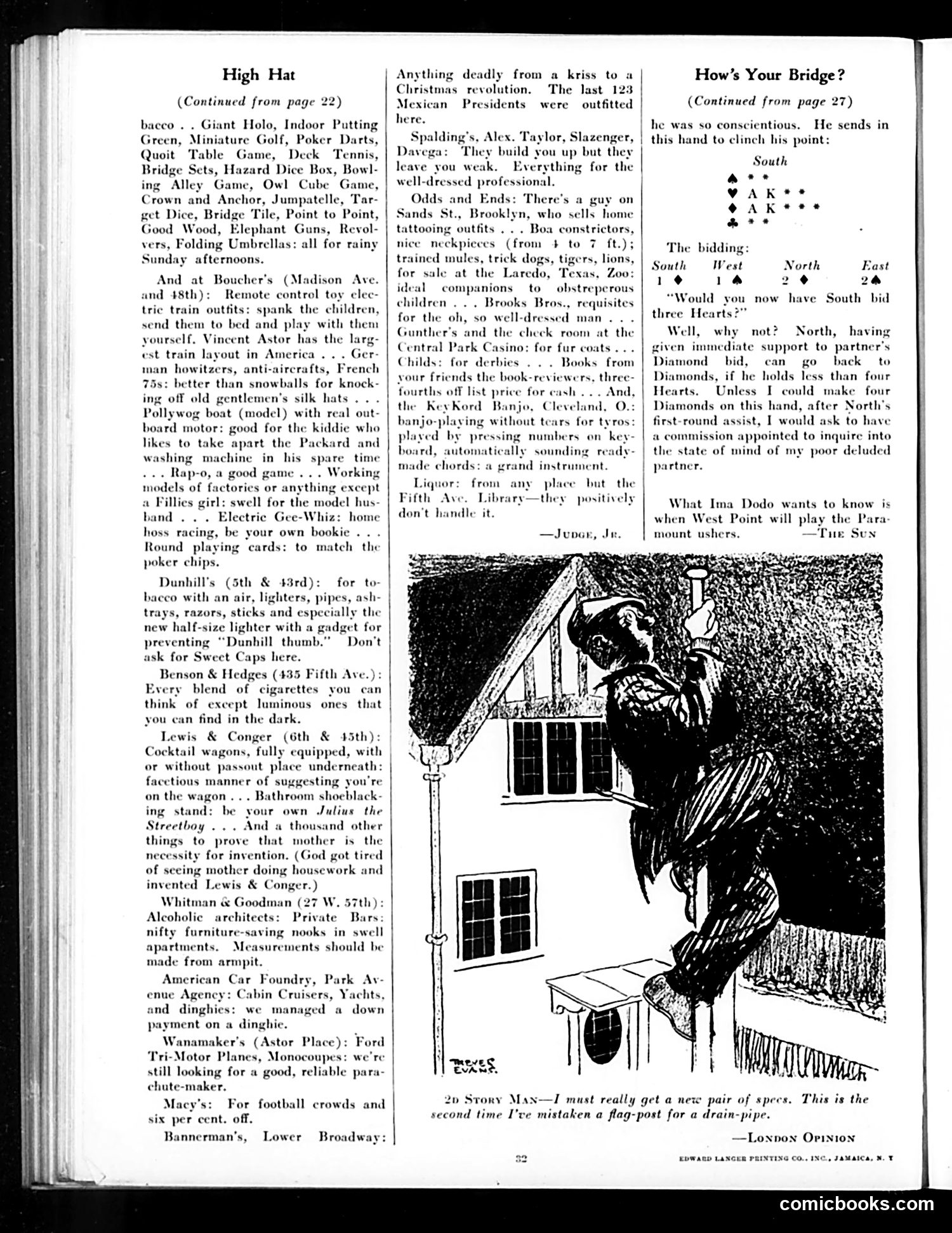
Political-Social Commentary in Judge Magazine This page from Judge (a satirical weekly) consists primarily of "High Hat," a consumer guide satirizing wealthy New Yorkers' shopping habits and leisure pursuits. The column mockingly catalogs luxury items and services—toy trains, private bars, cabin cruisers, expensive cigarettes—aimed at the idle rich. The satire targets conspicuous consumption: expensive toys for children (so parents can ignore them), elaborate home bars, and frivolous gadgets. References to Vincent Astor's toy train layout exemplify how the wealthy squander money on elaborate hobbies. The accompanying illustration shows a comically exaggerated figure climbing outside a building—likely satirizing the desperation or absurdity of pursuing status symbols and material goods. The "How's Your Bridge?" section is unrelated instructional content about the card game. Overall message: Judge ridicules 1920s-30s upper-class materialism and the obsession with fashionable consumer goods as markers of social standing.

Analysis This is primarily a Texaco Oil Company advertisement, not political satire. The page appeared in *Judge*, a humor magazine that accepted paid advertising. The headline uses a paradox ("Tiny Wheels, Giant Turbines") to showcase Texaco lubricants' versatility—claiming their products work equally well on small domestic machines (sewing machines) and massive industrial turbines powering entire cities. The large photograph shows industrial machinery in silhouette, emphasizing heavy manufacturing. The accompanying text argues that Texaco lubricants solve every industrial lubrication problem, from factories to power plants. The small illustration (bottom right) labeled "Research... The Guide to Progress" depicts scientists or engineers, positioning Texaco as scientifically advanced. This is corporate marketing masquerading as editorial content—common practice in mid-twentieth-century magazines. There is no satire or political commentary; rather, it's a straightforward (if grandiose) pitch for a petroleum company's products.
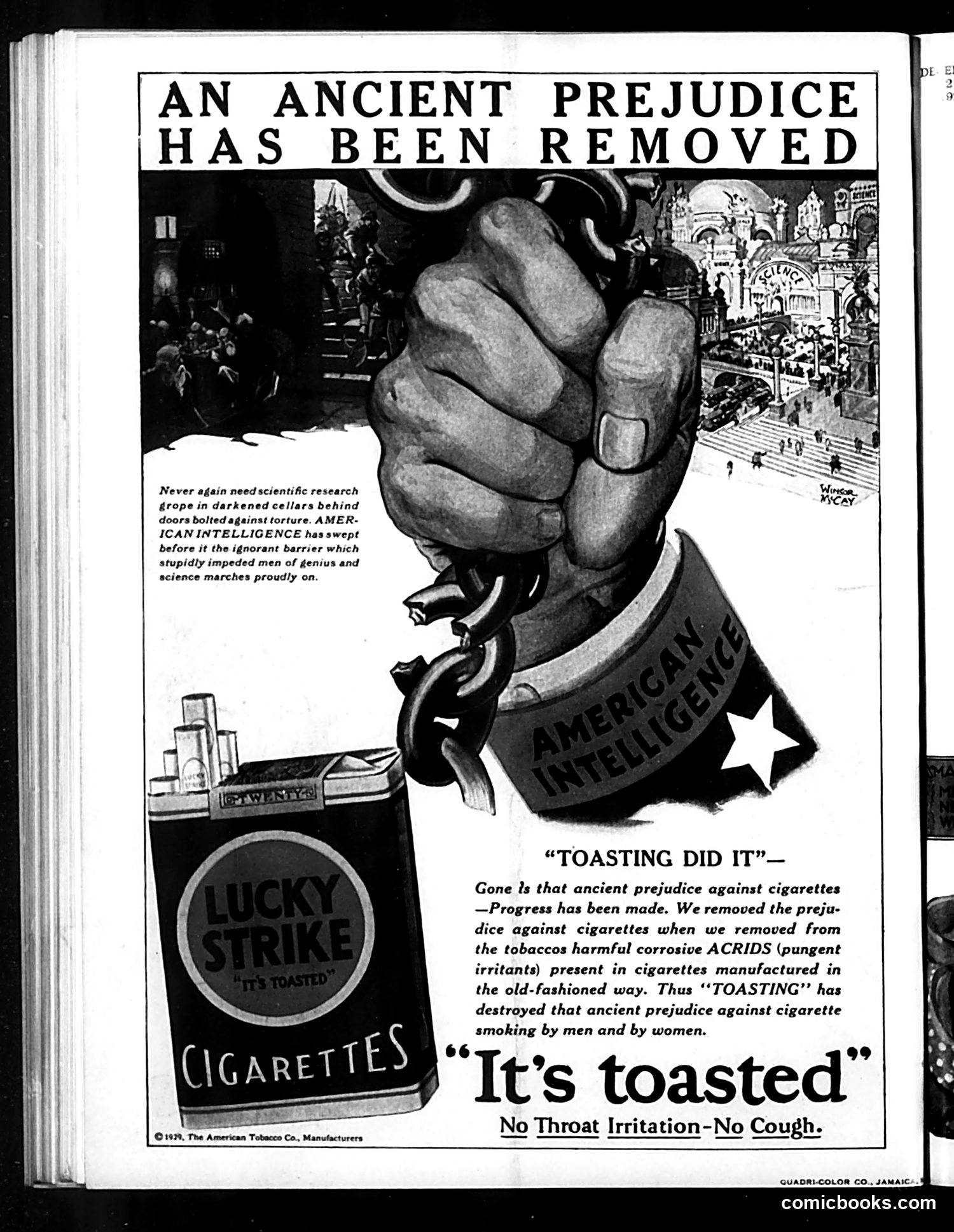
Lucky Strike Cigarette Advertisement Analysis This is primarily a cigarette advertisement, not satire. Lucky Strike uses patriotic and scientific rhetoric to market "toasted" cigarettes. The ad draws a parallel between American intelligence removing barriers to scientific progress and Lucky Strike removing "prejudice" against cigarettes. The fist breaking chains represents liberation from old restrictions. The key claim: Lucky Strike's "toasting" process removes harmful irritants (called "acrids") from tobacco, thereby eliminating throat irritation and cough—addressing the primary health objection to smoking. Context for modern readers: This represents pre-regulation tobacco marketing (pre-1964 Surgeon General warning). Companies could make health claims without evidence. The ad conflates scientific advancement with cigarette acceptance, equating smoking opposition with ignorance. What appears to be satire is actually earnest marketing that would be illegal today.