judge
Judge — December 21, 1929
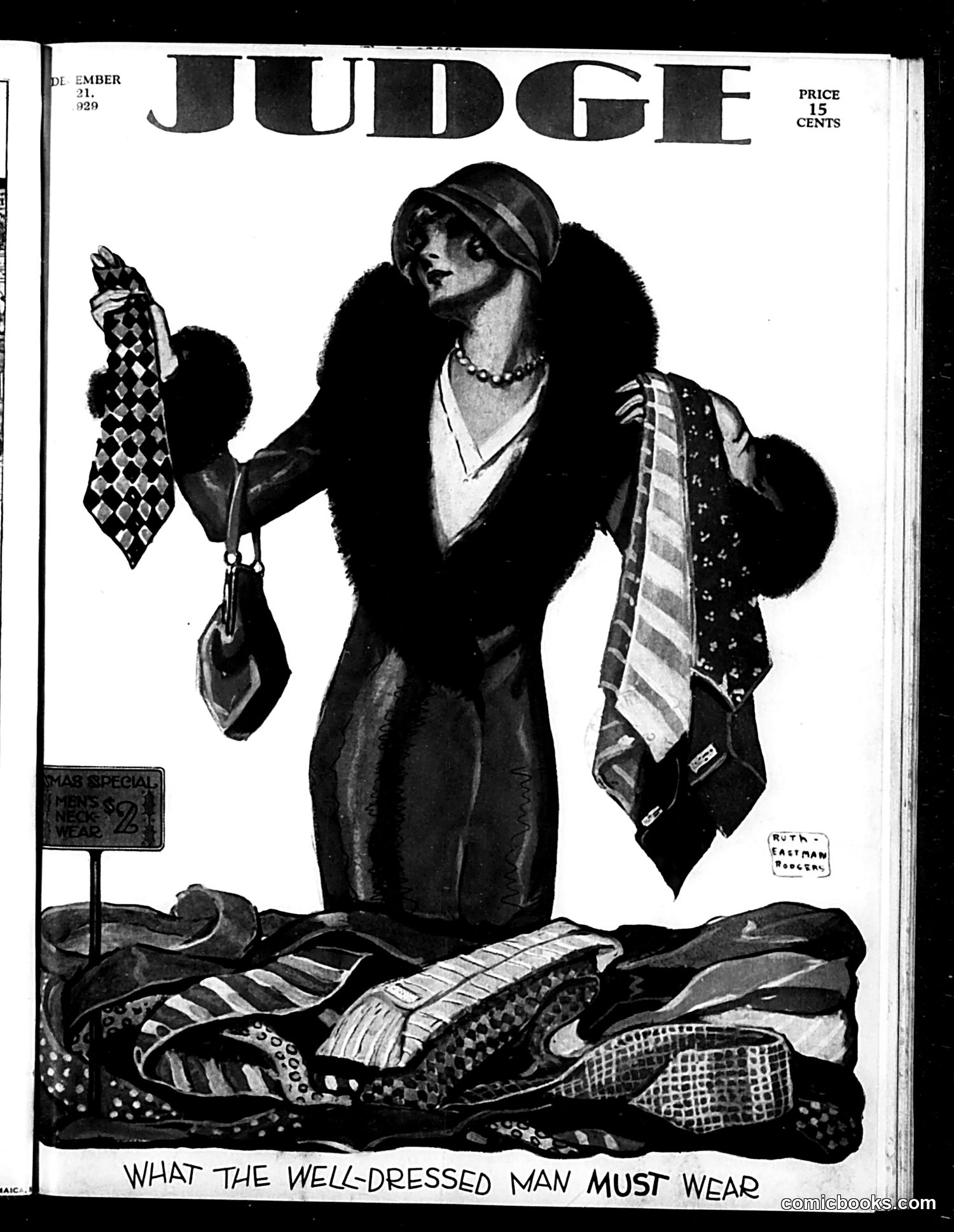
Judge Magazine Cover Analysis This December 21, 1929 *Judge* cover satirizes men's fashion and accessories during the Jazz Age. The illustration shows a stylishly dressed woman displaying various neckties and accessories—including patterned ties and decorative scarves—arranged both on her body and displayed below like merchandise. The caption "WHAT THE WELL-DRESSED MAN MUST WEAR" is ironic: a woman, not a man, is modeling these items. This likely satirizes either: 1. Women's growing influence on men's fashion choices in the 1920s 2. The absurdity of commercialized fashion trends and conspicuous consumption 3. Gender role disruptions during the flapper era The "Xmas Special" price sign ($2) suggests commercial advertising satire. The humor derives from the incongruity of feminine presentation selling masculine accessories.
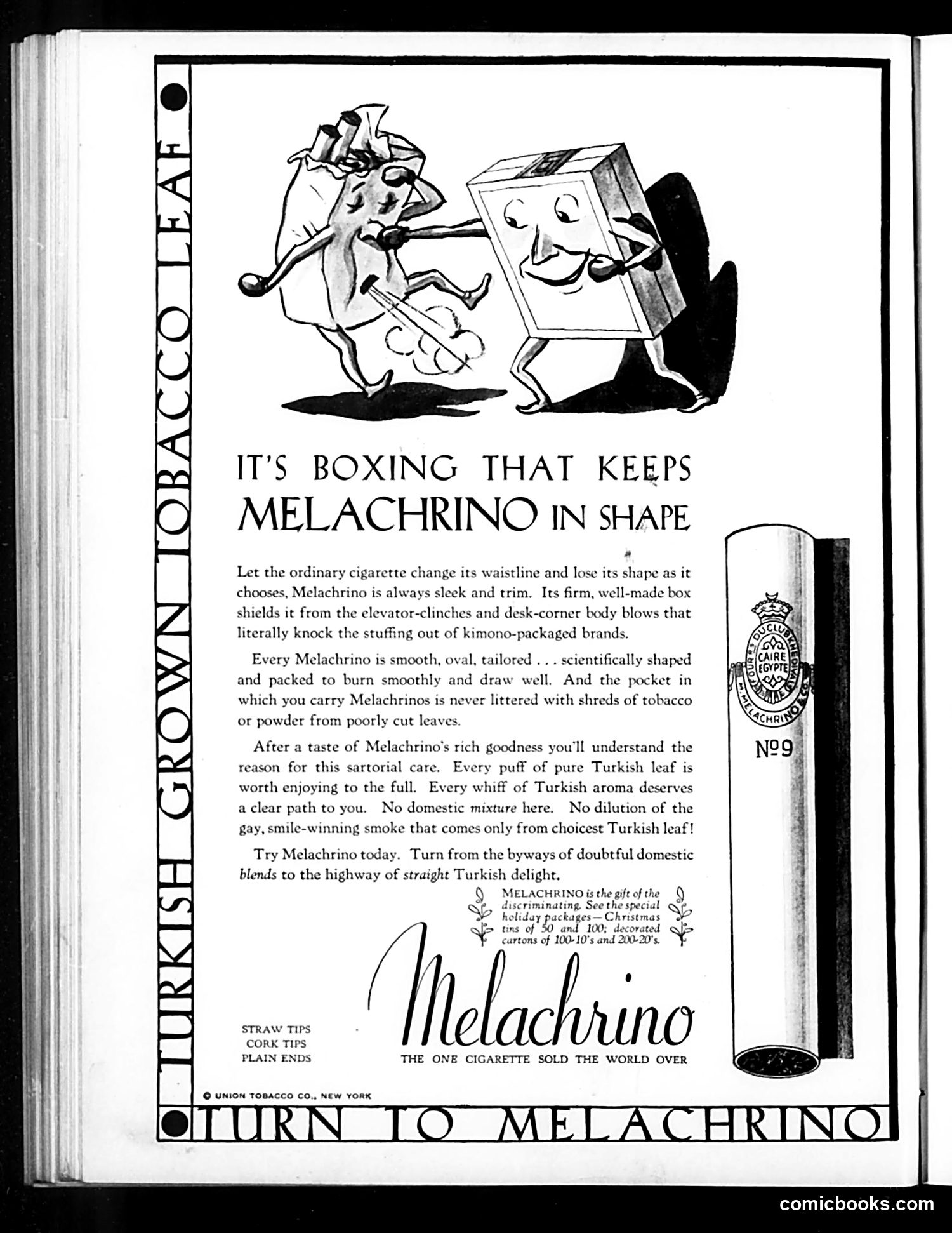
Content Analysis This page is primarily advertising, not political satire. It's a full-page advertisement for Melachrino cigarettes from Union Tobacco Co., New York. The cartoon shows two anthropomorphized characters—a cigar and a cigarette box—boxing, illustrating the ad's central claim: "It's Boxing That Keeps Melachrino in Shape." The humor is visual wordplay: the box's structural rigidity (from boxing/packaging) preserves the cigarette's quality during transport and handling. The ad emphasizes that Melachrino uses pure Turkish tobacco without domestic blends, positioning it as superior. The bottom lists available tip styles (straw, cork, plain), standard for cigarettes of this era. This appears to be from Judge's earlier advertising-heavy period, likely 1920s-1930s, before the magazine shifted toward more satirical content.
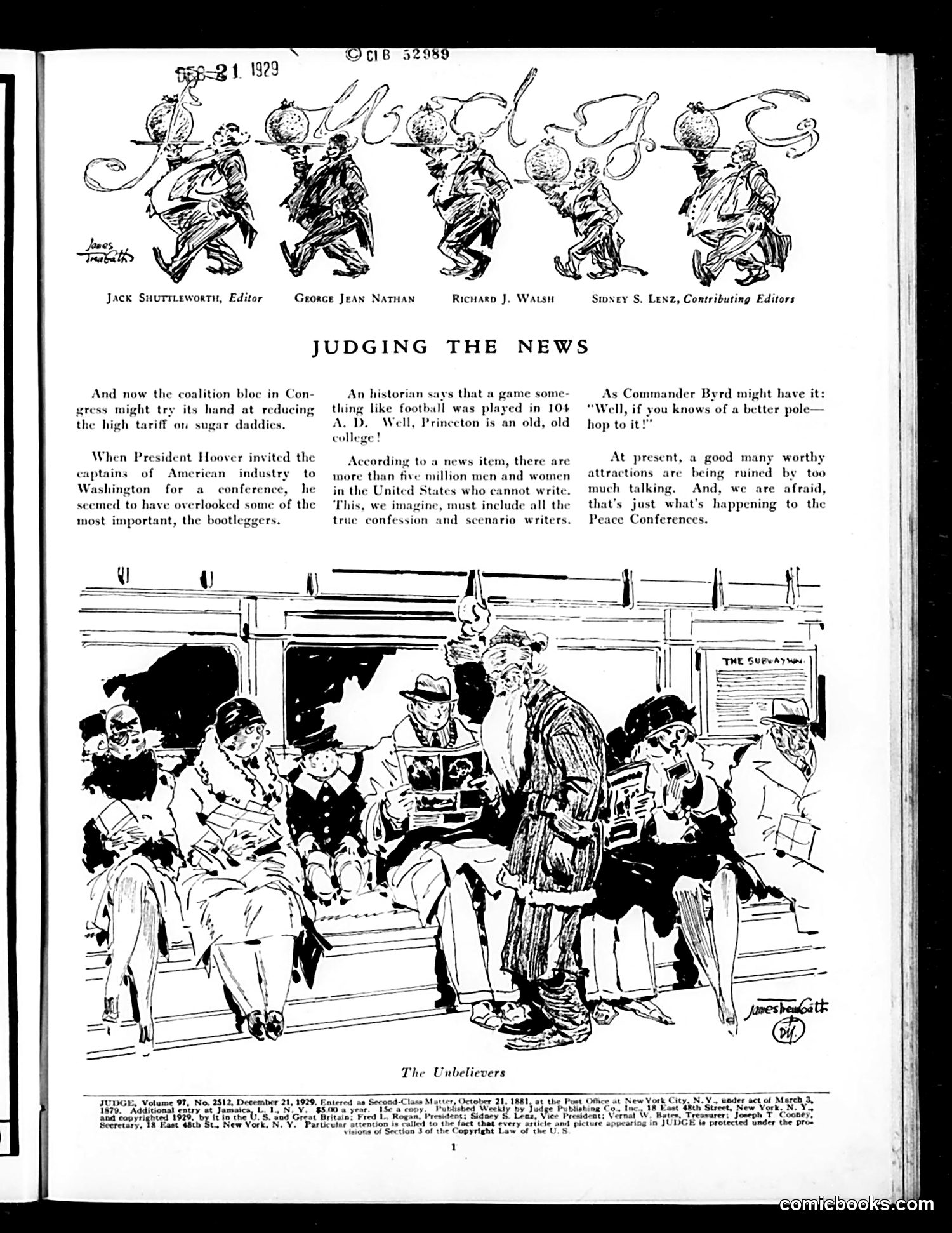
"Judging the News" - December 21, 1929 This satirical page comments on early Depression-era politics and society. The five cartoonists at top (Shuttleworth, Nathan, Walsh, Lenz) are credited as editors. The main cartoon, "The Unbelievers," depicts skeptical citizens in what appears to be a government or public office, examining documents. The satire likely critiques public doubt about government responses to economic crisis or policy announcements—a common theme in 1929 as the stock market crash's consequences became clear. The text snippets reference President Hoover's industrial conference, literacy statistics, and peace conference discussions, suggesting cynicism about whether leadership could effectively address contemporary crises. The cartoon's title "The Unbelievers" suggests citizens no longer trust official statements or promises.
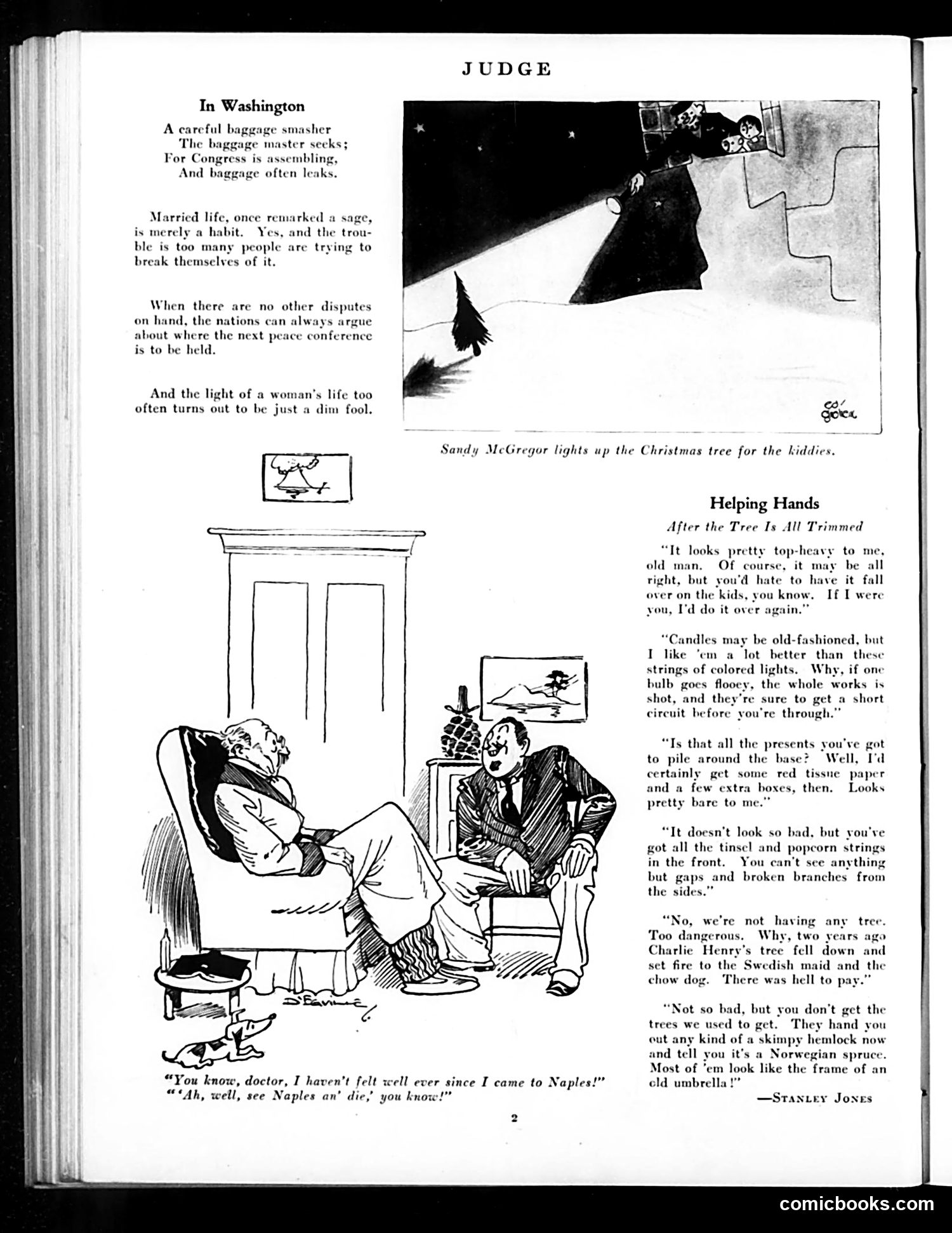
Analysis of Judge Magazine Page This page contains two distinct pieces: "In Washington" (top): Political verse mocking Congress—baggage handlers, marital dissatisfaction, and international peace conferences. The satire targets governmental dysfunction and the predictability of diplomatic disputes. "Helping Hands" (bottom): A domestic humor cartoon showing an elderly man and woman discussing Christmas tree decoration. They debate whether the tree looks "top-heavy," discuss decorating choices (candles vs. lights), and recount a cautionary tale about a neighbor's tree fire. The humor derives from elderly characters' nostalgic bickering over holiday traditions and their tendency toward worry. Both pieces reflect early 20th-century Judge magazine's approach: combining political commentary with gentle domestic comedy. The artwork style and sensibility suggest this is from approximately the 1910s-1920s era.
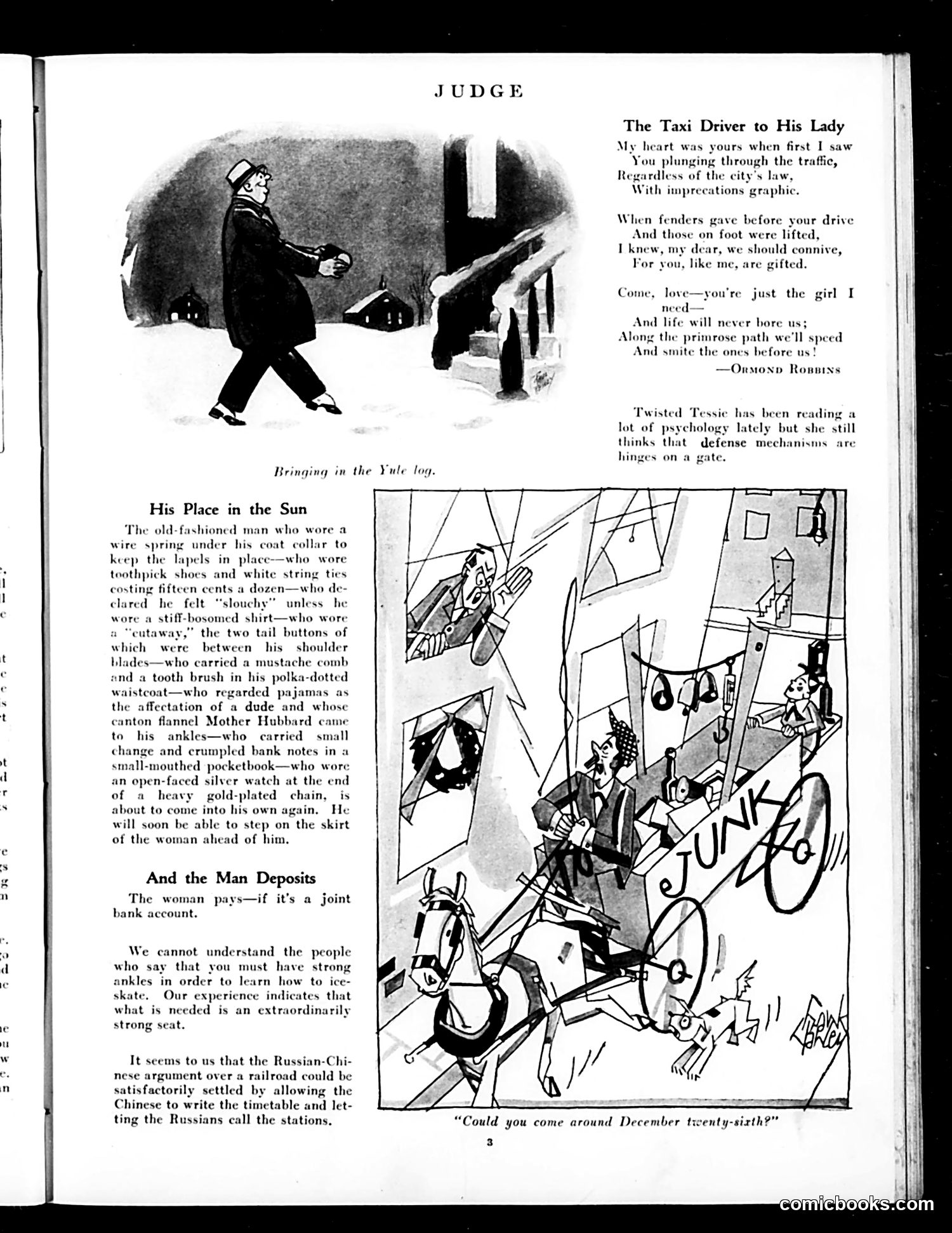
Analysis of Judge Magazine Page This page contains three distinct pieces: 1. "The Taxi Driver to His Lady" — A romantic poem by Ormond Robbins about a taxi driver courting a woman, playing on the idea that taxi drivers were seen as dashing, modern figures. 2. "His Place in the Sun" — A satirical piece mocking old-fashioned men clinging to outdated fashion (wire suspenders, polka-dotted waistcoats, etc.), suggesting they're relics of a bygone era. 3. "Bringing in the Yule Log" (cartoon) — A humorous domestic scene showing a cluttered apartment during Christmas preparations, with the caption "Could you come around December twenty-sixth?" The joke appears to reference post-holiday chaos and scheduling complications. The page reflects early 20th-century American humor about modern urban life, changing social customs, and domestic situations.
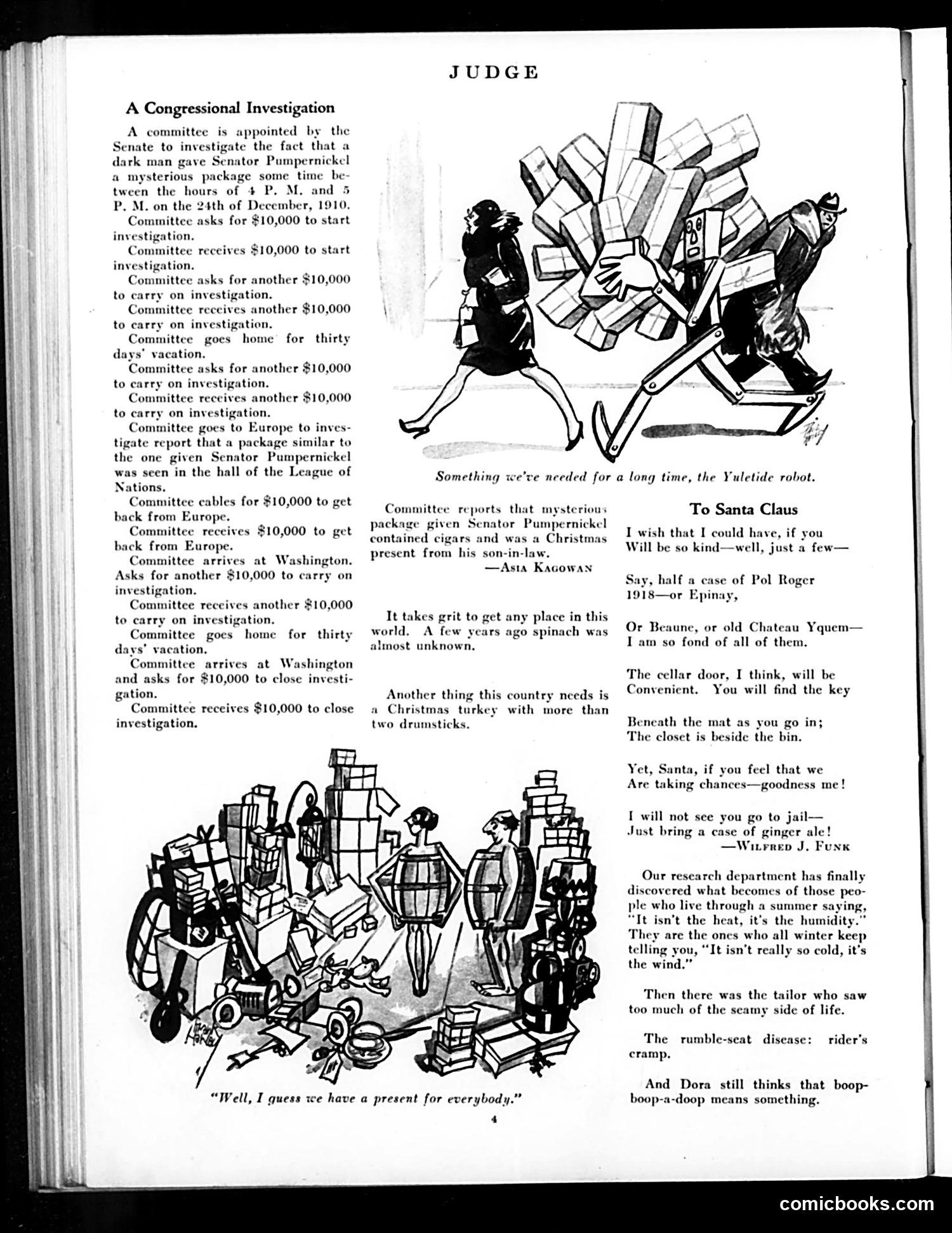
Analysis of Judge Magazine Page "A Congressional Investigation" (left column) satirizes wasteful government spending through repeated cycles: a committee investigates a mysterious package given to Senator Pumpernickle, requesting $10,000, receiving it, requesting more, taking vacations, requesting again—each step repeated multiple times before finally "closing" the investigation. The joke lampoons bureaucratic inefficiency and endless appropriations without apparent progress. The illustrations show government officials buried under packages/paperwork, humorously depicting bureaucratic excess. "To Santa Claus" section contains humorous holiday wish-list poems mocking various types of people—those claiming poverty, tailor observations of social problems, and general absurdities. The page targets government waste and institutional absurdity through exaggeration, typical of Judge magazine's satirical approach during the Progressive Era.
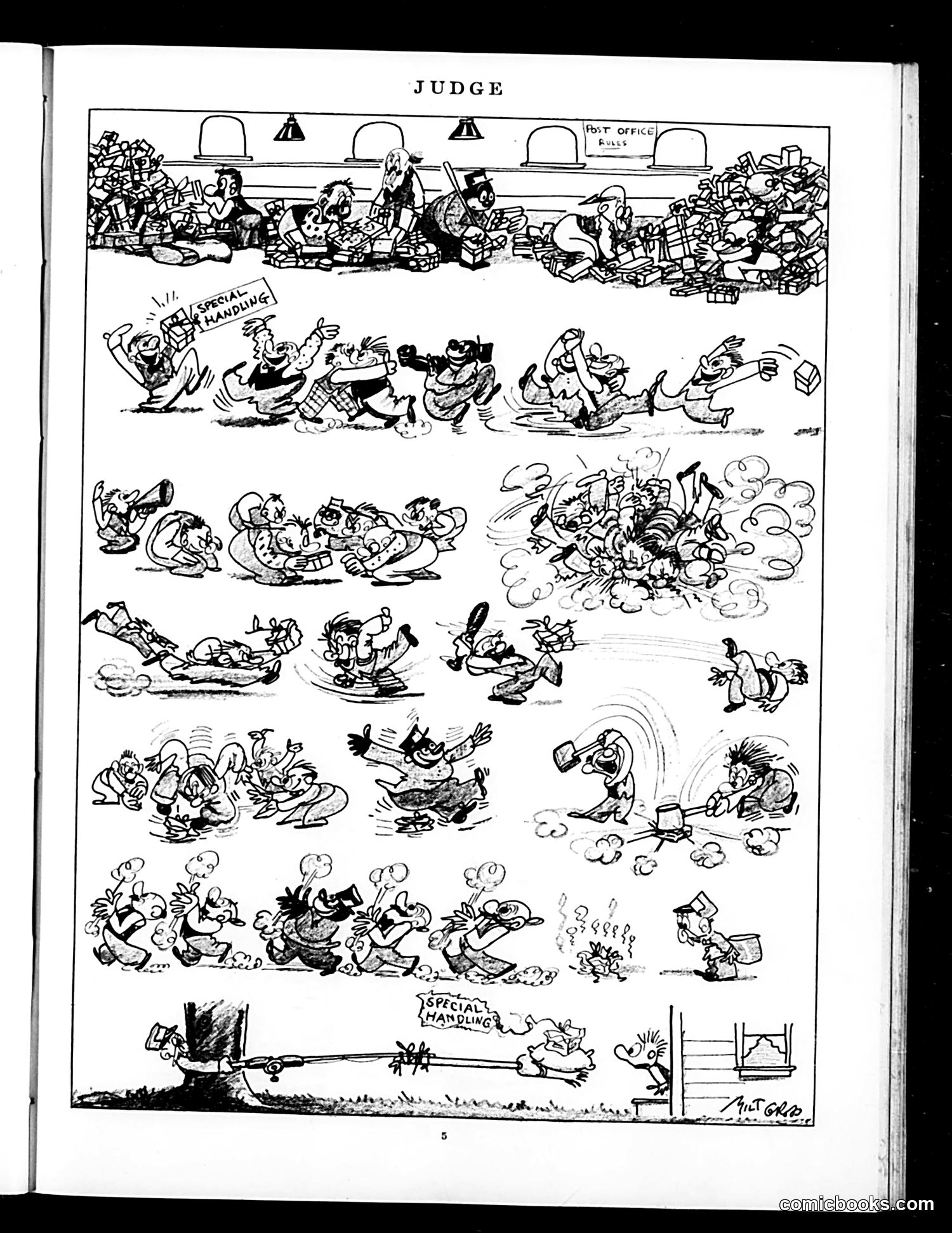
Analysis of Judge Page: "Special Handling" This political cartoon satirizes chaotic judicial or governmental mishandling of cases or matters. The top panel shows an overflowing courtroom or office ("Post Office" visible), suggesting bureaucratic disorder. The sequential panels below depict various figures—appearing to be lawyers, judges, or officials—literally juggling, dropping, and fumbling documents and cases marked "Special Handling." The chaos escalates through each panel, culminating in an explosion or complete breakdown. The bottom panel shows what appears to be a cannon or official shooting documents across a landscape, with a small figure caught in the crossfire—visualizing how "special handling" of important matters results in destructive incompetence rather than careful attention. The satire mocks institutional negligence and bureaucratic bungling.
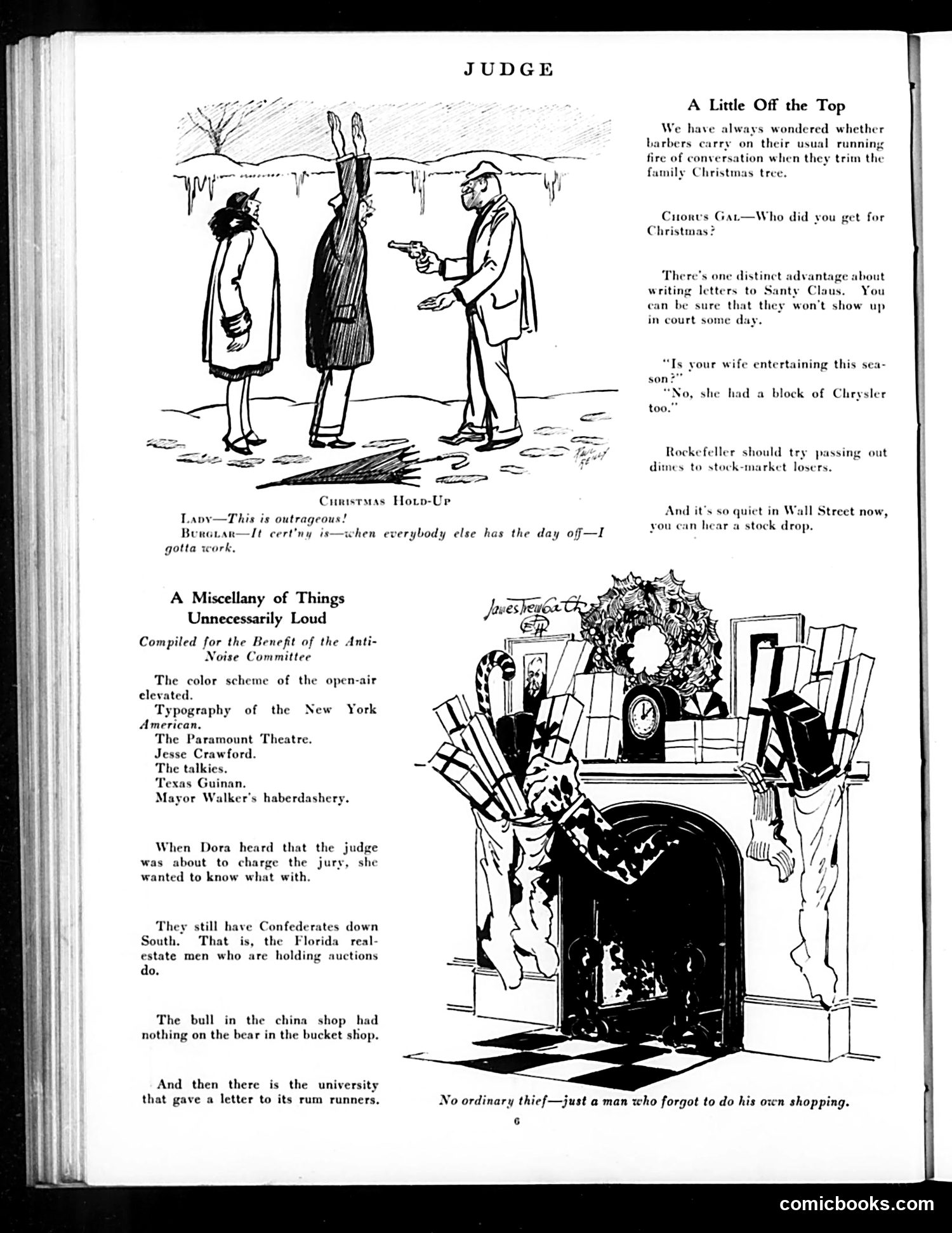
Analysis of Judge Magazine Page This page contains two separate satirical pieces: "Christmas Hold-Up" (top cartoon): Shows a burglar robbing a woman at gunpoint on a snowy street while another figure watches. The joke plays on the irony that crime continues even during the holiday season—the burglar uses the excuse "everybody else has the day off—I gotta work," suggesting criminals don't observe Christmas traditions. "A Miscellany of Things Unnecessarily Loud" (bottom): A collection of brief satirical observations about noisy urban annoyances, including typography, theater, and Wall Street. The main cartoon shows an overflowing mantelpiece of Christmas decorations, with the caption joking about a man who "forgot to do his own shopping"—likely depicting middle-class holiday stress and materialism. Both pieces mock urban life's contradictions and commercialism.
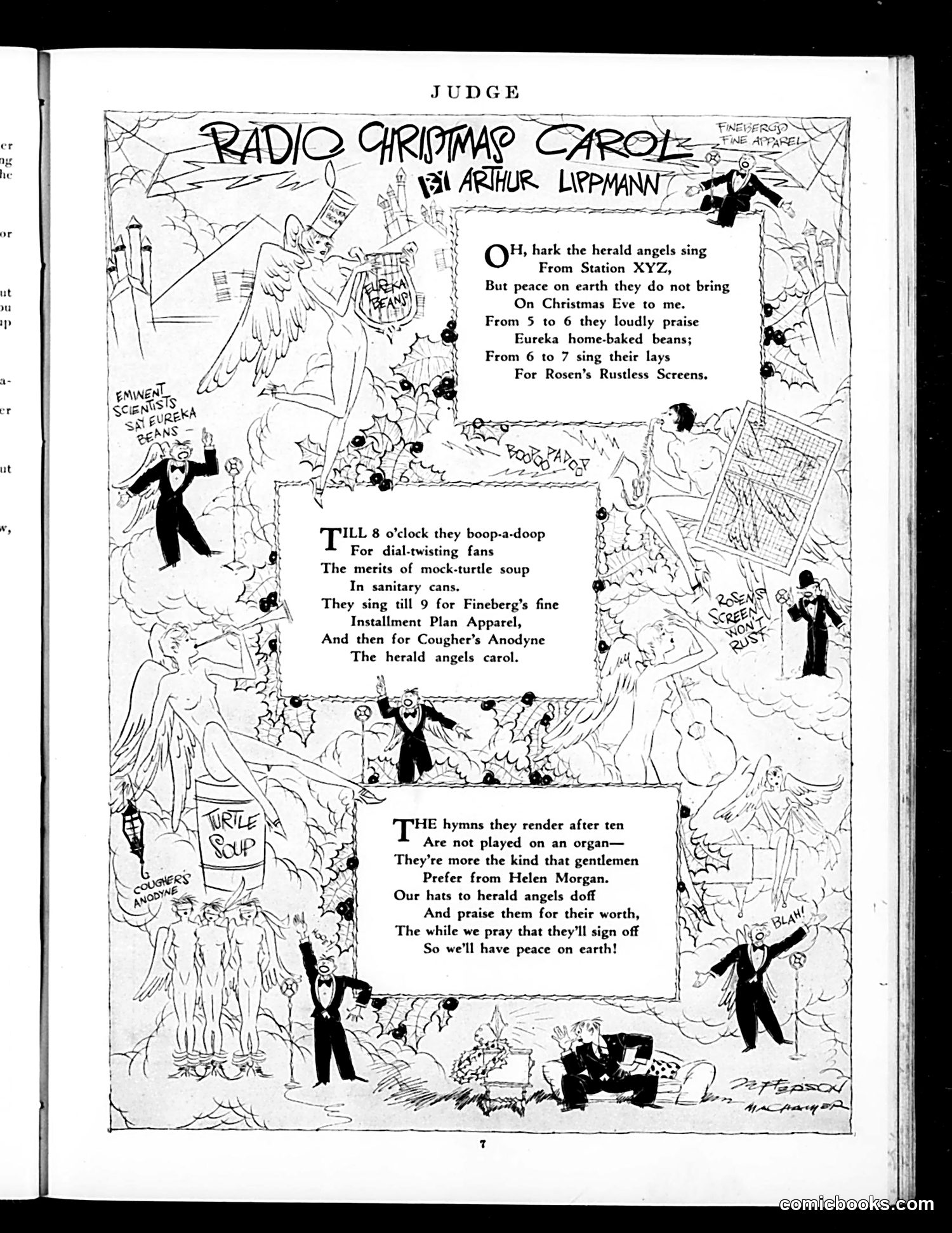
Radio Christmas Carol Satire This is Arthur Lippmann's parody of "Hark! The Herald Angels Sing," mocking radio advertising's invasion of Christmas programming. The cartoon depicts heaven's angels reduced to shilling commercial products on a fictional "Station XYZ." The satire targets radio stations' relentless product placement during the holiday season: Eureka vacuum cleaners, Rosen's screens, mock-turtle soup, Fineberg's apparel, and Cougher's cough medicine interrupt sacred carols. The final stanza references Helen Morgan, a popular cabaret singer, suggesting the stations replace hymns with secular entertainment. The joke: listeners desperately wish the angels—and their advertising—would "sign off" so they could actually experience "peace on earth." This reflects 1920s-30s frustration with American commercial radio's unapologetic commodification of Christmas tradition, turning religious observance into mere advertising vehicles.
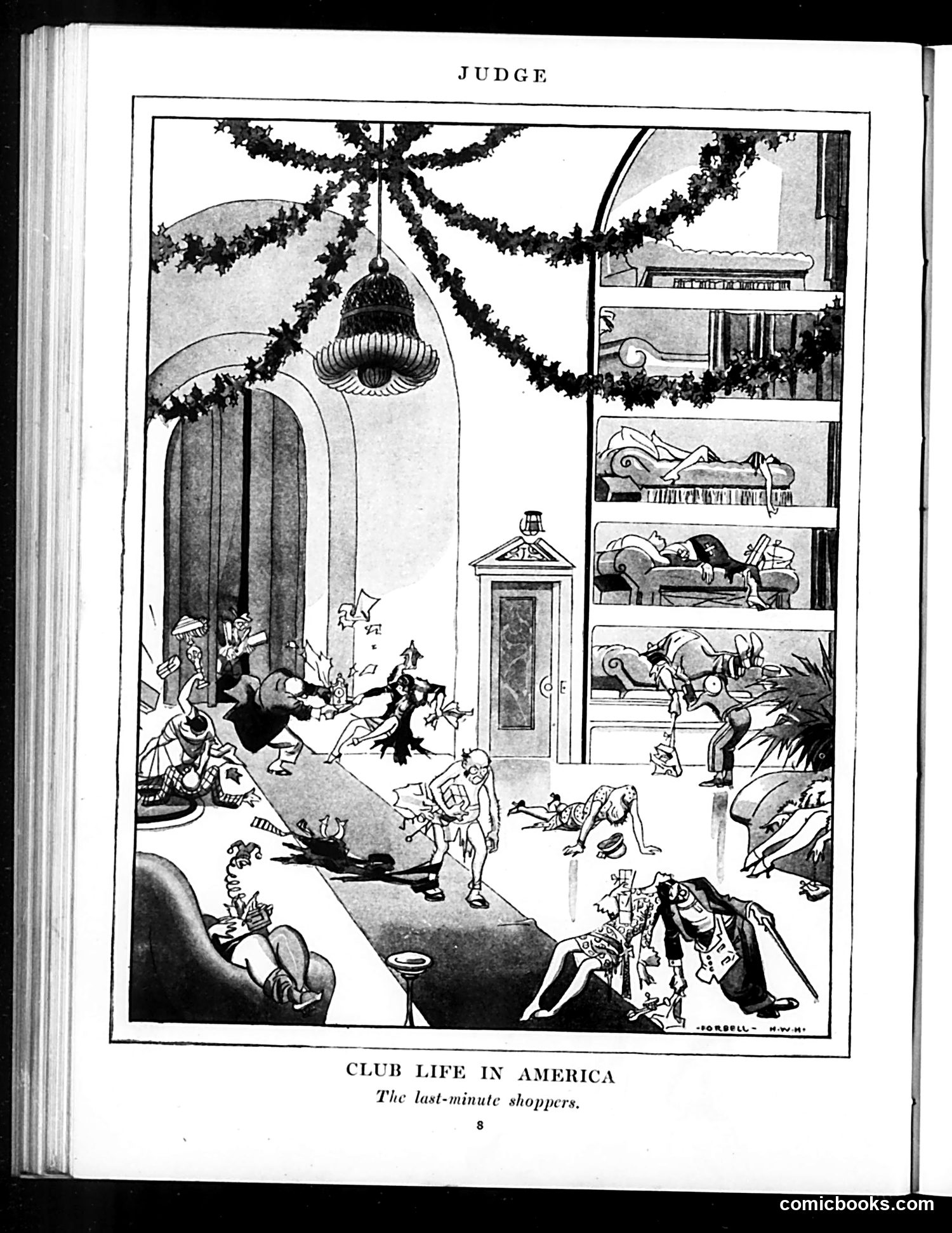
Analysis This is a satirical cartoon titled "Club Life in America: The last-minute shoppers," depicting frantic Christmas shopping at what appears to be an exclusive club or upscale venue. The illustration shows chaotic scenes of well-dressed people in various states of rushed gift-purchasing panic—some lounging exhausted, others frantically searching or carrying packages. The right panel shows sequential scenes of people in what looks like a club's shopping facilities or nearby stores. The satire targets the wealthy elite's last-minute holiday shopping habits and the comedic desperation that ensues even among the privileged classes. The humor relies on contrasting the sophisticated "club life" setting with the undignified, frenzied behavior of Christmas shopping season—a relatable theme suggesting that wealth doesn't exempt one from holiday stress.
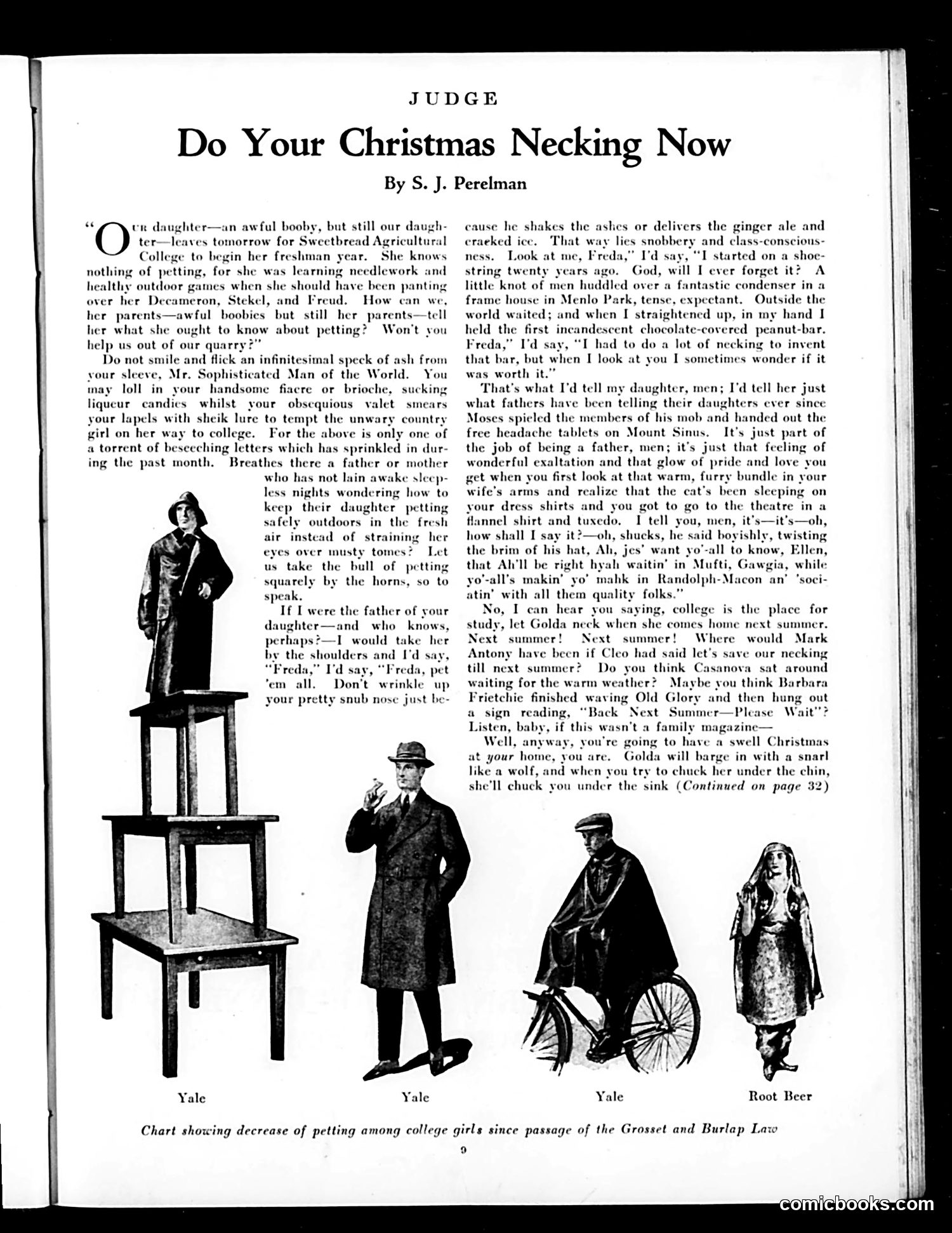
"Do Your Christmas Necking Now" - Judge Magazine Satire This humorous article by S.J. Perelman satirizes parental anxiety about college-aged daughters' romantic behavior and changing social norms. The piece mocks fathers seeking advice on how to prepare daughters for college by sarcastically encouraging "petting" (1920s-era slang for kissing/light physical affection). The joke targets: 1. Dated parental concerns: Parents worried daughters were learning "needlework" instead of understanding modern dating 2. Self-made-man mythology: A character boasts about inventing chocolate-covered peanuts through "necking," mocking how men justify their romantic past 3. The "Grosset and Burlap Law": A fictional regulation supposedly restricting college girls' petting—a jab at actual moral panic legislation of the era The accompanying illustrations (labeled "Yale" and "Root Beer") appear to be visual gags about college types and masculine stereotypes. The satire criticizes both parents' cluelessness about youth culture and society's hypocritical attitudes toward sexuality.
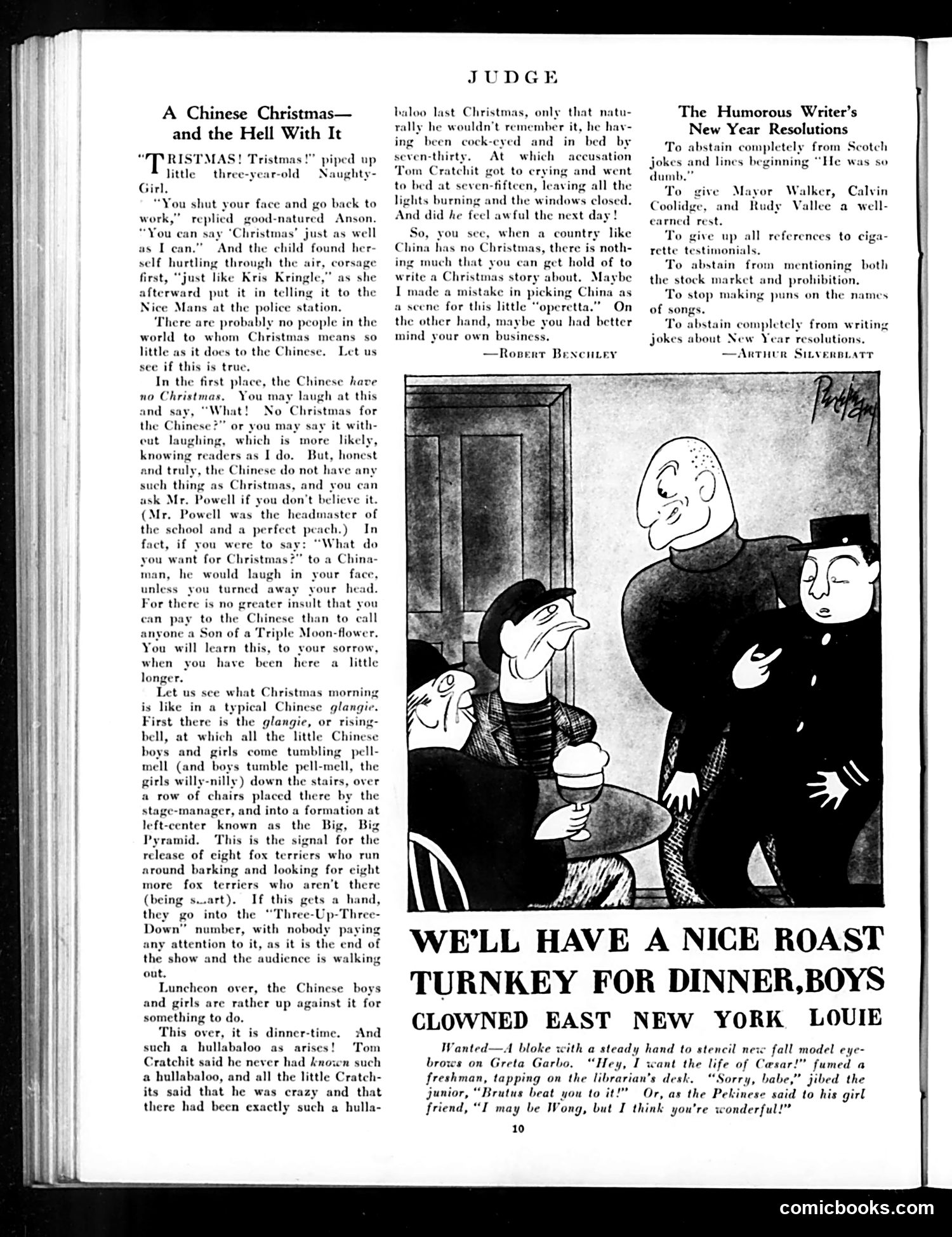
Judge Magazine Page Analysis This page contains satirical commentary on Christmas customs and American public figures circa the 1920s. Main Article ("A Chinese Christmas"): Robert Benchley's humorous essay mocks the difficulty of writing Christmas stories about China, which he claims has no Christmas tradition. The piece uses crude ethnic stereotyping typical of the era, describing Chinese children's chaotic Christmas morning antics with exaggerated comic detail. The satire targets not Chinese culture specifically but rather the limitations of American Christmas storytelling itself—Benchley admits he may have made "a mistake" choosing China as his subject. "New Year Resolutions" Section: Arthur Silverblatt lists humorously specific promises to avoid clichéd comedy topics: Scotch jokes, mentions of Mayor Walker, Calvin Coolidge, and Rudy Vallee (contemporary public figures), cigarette testimonials, stock market/prohibition references, song-name puns, and ironically, New Year resolution jokes themselves. Bottom Cartoon: Shows a man claiming they'll serve "roast turkey" to "East New York Louie"—likely a mobster reference, with the dark implication of violence rather than actual dinner.
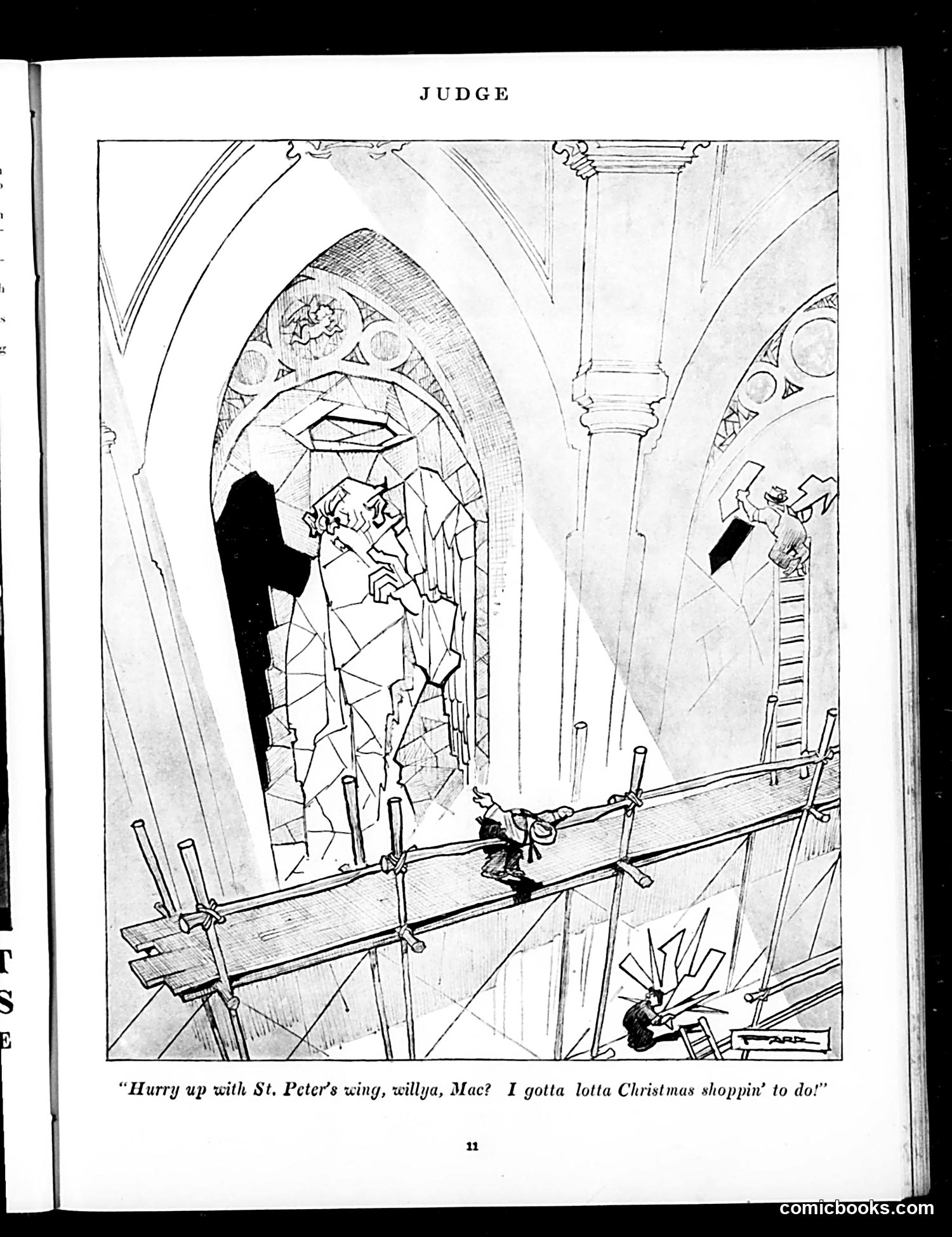
Explanation for Modern Readers This Judge magazine cartoon depicts construction workers on scaffolding inside what appears to be a cathedral or large religious building. One worker urges another to hurry with "St. Peter's wing," referencing the famous St. Peter's Basilica. The humor lies in the caption: "Hurry up with St. Peter's wing, willya, Mac? I gotta lotta Christmas shoppin' to do!" The joke satirizes the collision between sacred religious construction and crass commercialism—a worker treating the building of a monumental religious structure as merely an obstacle to holiday shopping. This reflects early-to-mid 20th century American anxieties about materialism overshadowing spiritual values during Christmas season, a theme Judge magazine frequently mocked through social satire.
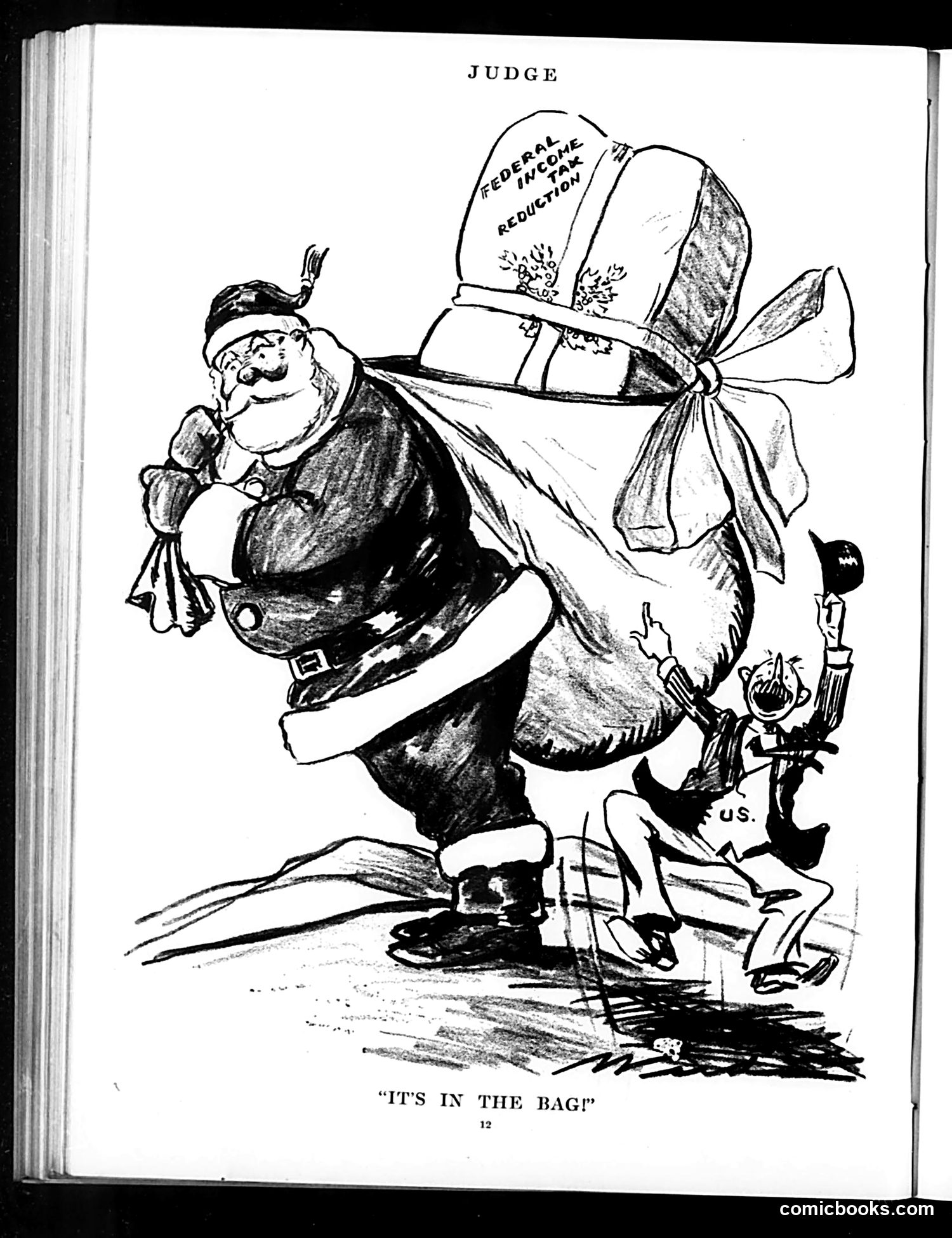
Political Cartoon Analysis: "It's in the Bag" This Judge magazine cartoon titled "Judge" depicts a jovial Santa Claus figure carrying a large sack labeled "Federal Income Reduction." The Santa is shown with exaggerated facial features characteristic of early 20th-century caricature, presenting the sack to what appears to be Uncle Sam (marked "U.S."), who sits looking somewhat skeptical or wary. The satire concerns federal income tax policy—likely commenting on promised tax cuts or reductions. The phrase "It's in the bag" suggests assurance or certainty, while the visual pun presents tax relief as a gift. The cartoon appears to critique either the credibility of such promises or political optimism about reducing federal taxation. Without the publication date visible, the specific historical context remains unclear, though this reflects broader early 20th-century American debates over federal taxation.
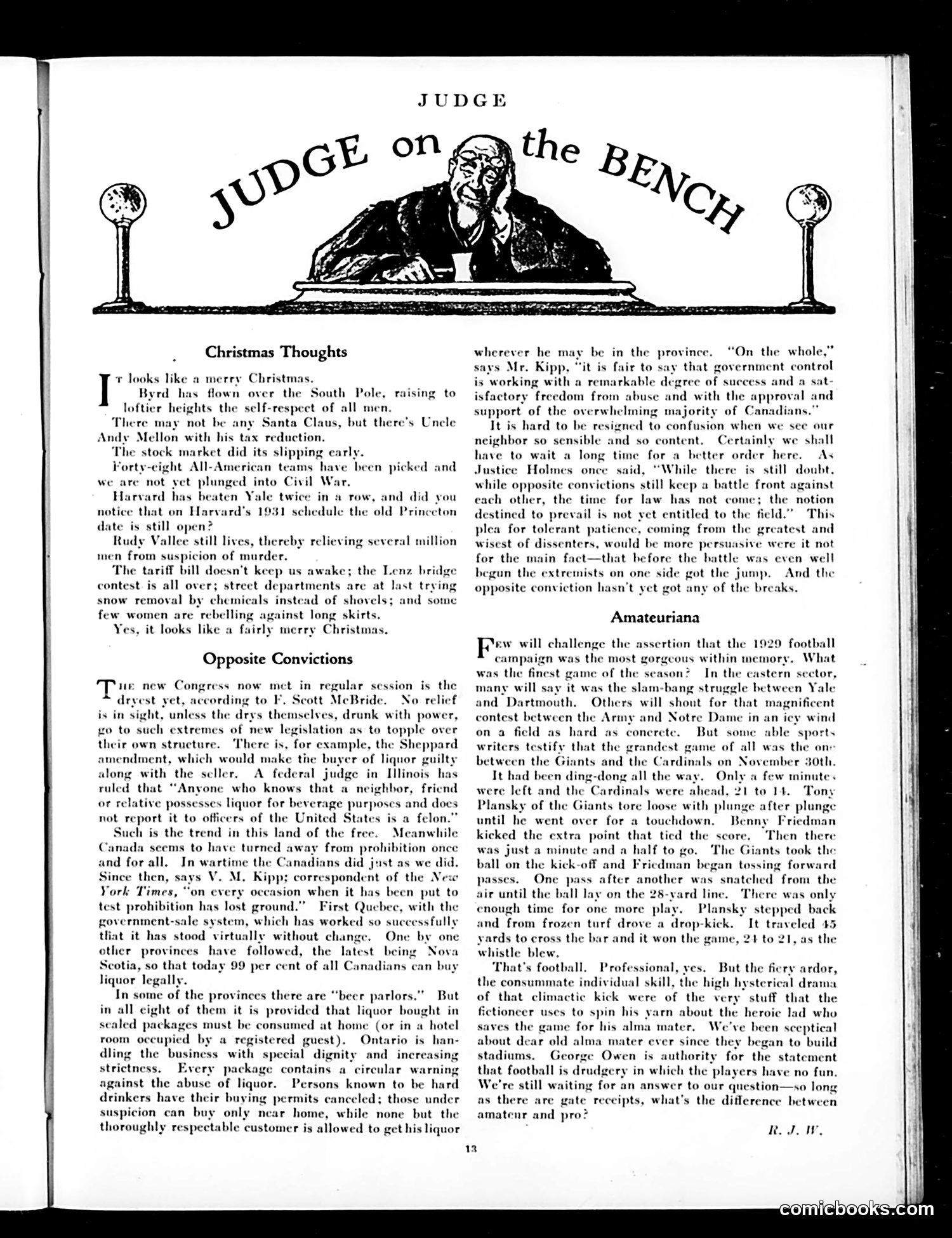
Judge Magazine Page Analysis This page from Judge magazine (likely early 1930s) contains three sections: "Christmas Thoughts" is a brief satirical list of holiday observations. References include: Byrd's South Pole flight, Treasury Secretary Andrew Mellon's tax cuts, the stock market crash, college football rankings, singer Rudy Vallée (apparently notable for survival), tariff debates, and fashion trends. The tone suggests wry acceptance of current troubles. "Opposite Convictions" compares American and Canadian prohibition policies. It argues Canada's government-controlled alcohol sales system works better than American prohibition, which the author sees as increasingly tyrannical (citing an Illinois judge's ruling that not reporting neighbors' liquor possession is felony). The piece quotes Justice Holmes advocating legal tolerance until one position clearly prevails. "Amateuriana" begins discussing 1929 college football, debating which game was best that season (mentioning Giants vs. Cardinals). The page reflects Depression-era anxieties about prohibition enforcement, government overreach, and economic uncertainty.
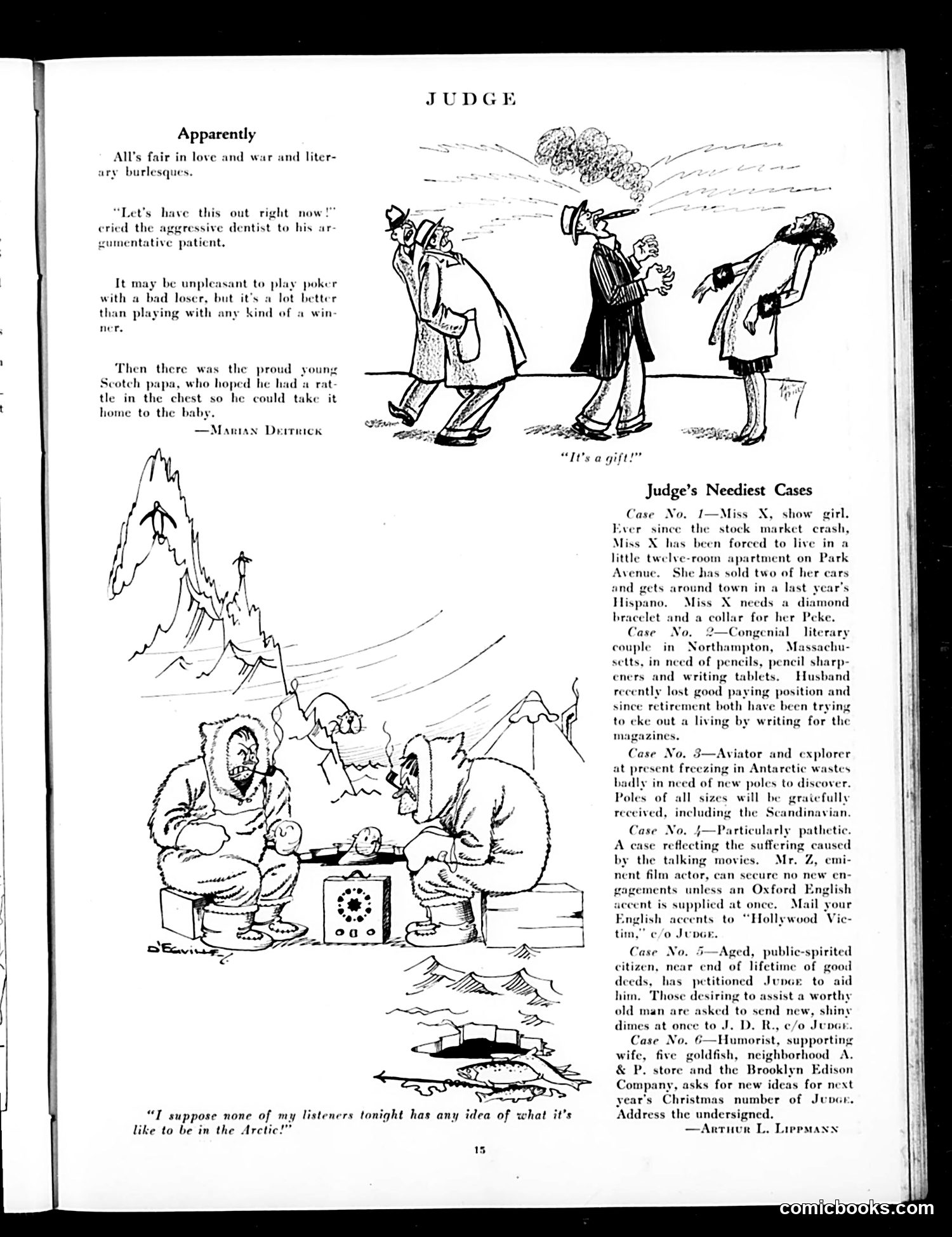
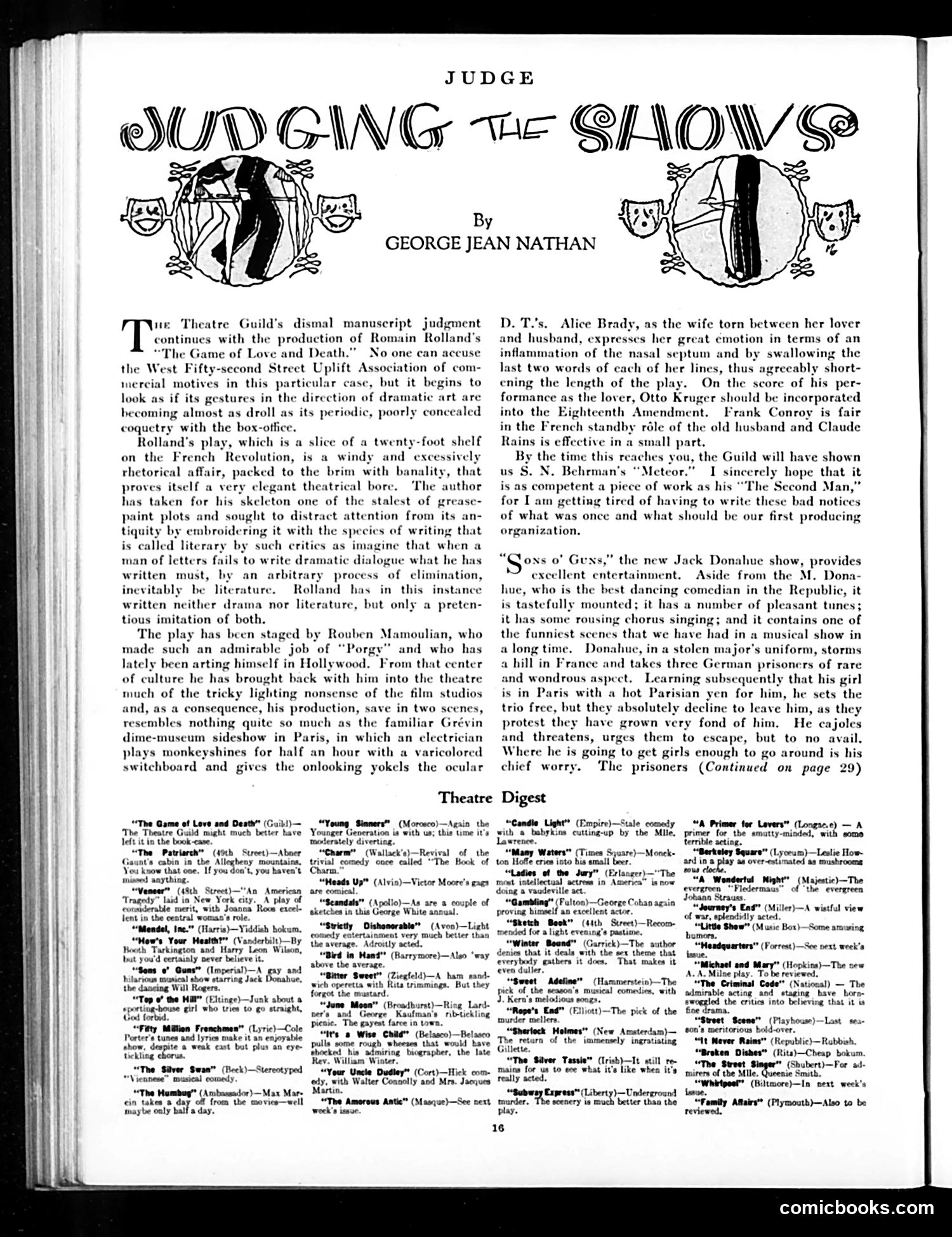
Judge Magazine Theater Critique: "Judging the Shows" This page contains George Jean Nathan's scathing theater reviews for Judge magazine's "Theatre Digest" section. The two illustrated cartoons with theatrical masks frame Nathan's critiques of contemporary Broadway productions. Nathan savagely attacks the Theatre Guild's production of Romain Rolland's "The Game of Love and Death," calling it pretentious and boring—criticizing both the play itself and director Rouben Mamoulian's overwrought film-studio lighting techniques. He mocks the performances, particularly Alice Brady's and Otto Kruger's efforts. He's considerably more favorable toward the musical "Sons o' Guns," praising dancer Jack Donahue as "the best dancing comedian in the Republic." The "Theatre Digest" section lists other current Broadway shows with brief one-line reviews—typical of Judge's theatrical coverage during this period (likely 1929, based on Mamoulian's film work timeline). Nathan's reviews exemplify Judge's sophisticated, caustic humor aimed at educated readers familiar with contemporary theater.
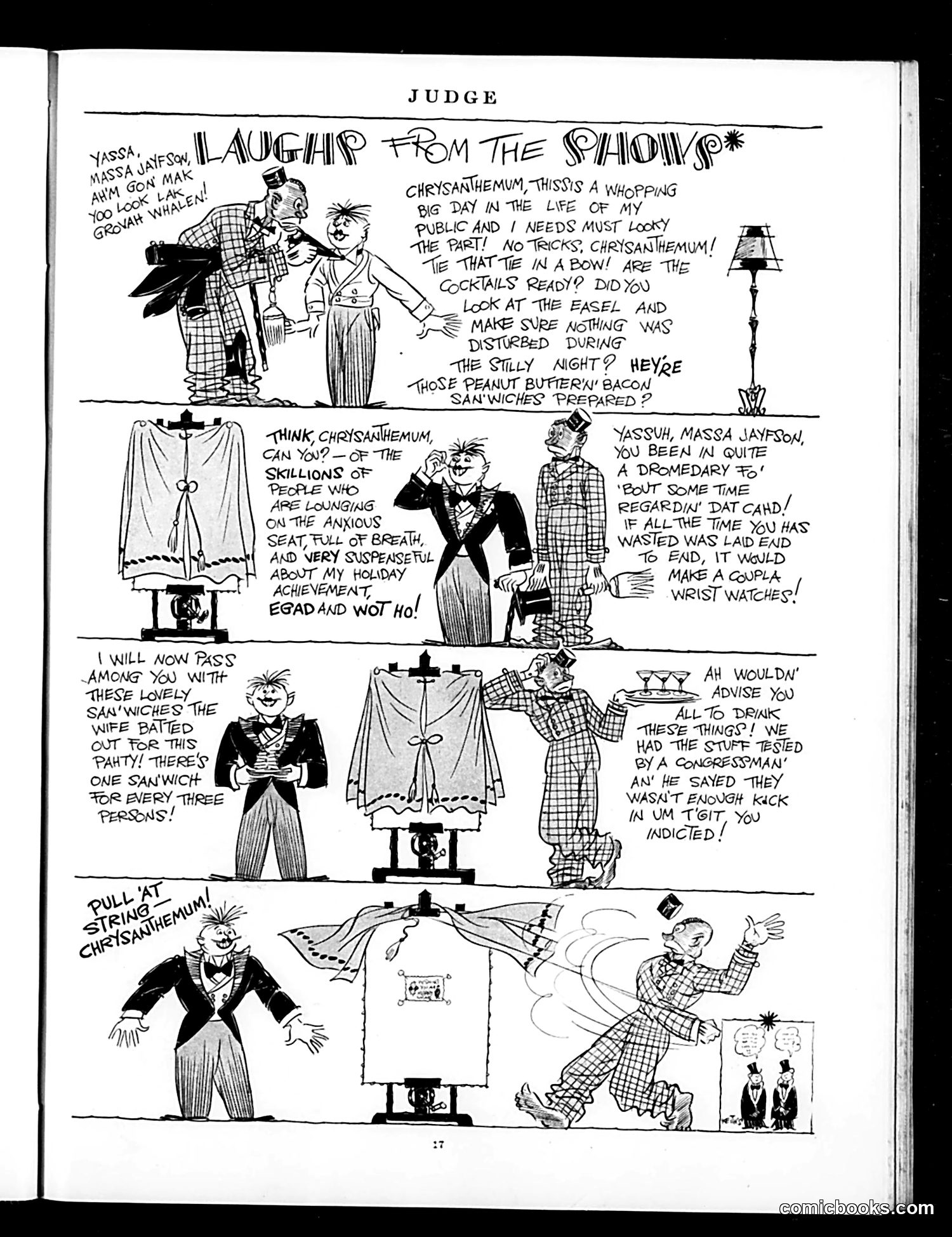
"Laugh from the Shock" - Judge Magazine Cartoon This single-panel comic satirizes a wealthy man's ("Chrysanthemum") elaborate party preparations. The figure in formal dress appears to be a society host fussing over details—cocktails, sandwiches, table settings—while addressing his servant (depicted in racist caricature as "Massa" and "Yassuh"). The satire targets upper-class pretension and anxiety about entertaining. The punchline involves the sandwiches being tested by a Congressman who deemed them insufficiently potent—a joke about Prohibition-era "kick" (alcoholic content). The implication is the host's fancy preparations are ludicrous or inadequate despite his fussing. The servant character reflects the page's early 20th-century origin and offensive racial stereotyping common to the period. The cartoon mocks wealthy social climbers more than anything else, using exaggerated concern about party minutiae as its primary target.
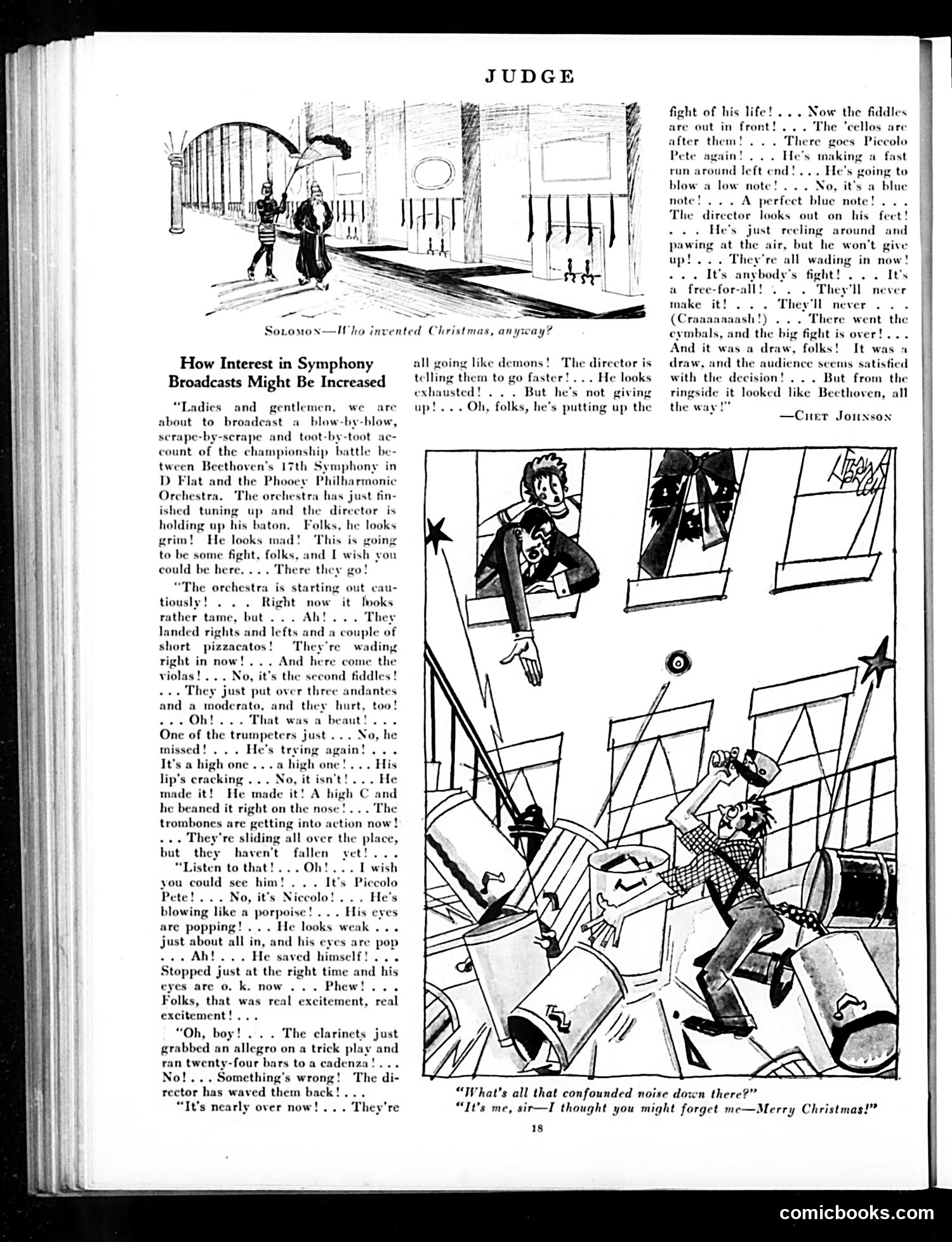
Judge Magazine Satire Analysis This page satirizes classical music broadcasts by applying sports commentary to a symphony performance. The humor relies on treating Beethoven's 17th Symphony versus the "Phooey Philharmonic Orchestra" like a boxing match or sports event, complete with a play-by-play announcer breathlessly describing musical passages as physical combat ("landed rights and lefts," "wading right in"). The satire targets two audiences: those finding classical music broadcasts tedious and pretentious, and radio enthusiasts craving exciting sports coverage. By reimagining orchestra sections as competing fighters (trumpeters, trombones, clarinets), the piece mocks both highbrow music appreciation and lowbrow sports broadcasting simultaneously. The secondary cartoon depicts a servant being forgotten during Christmas—a gentle social commentary on class dynamics during the holiday season, contrasting with the absurdist humor above it.
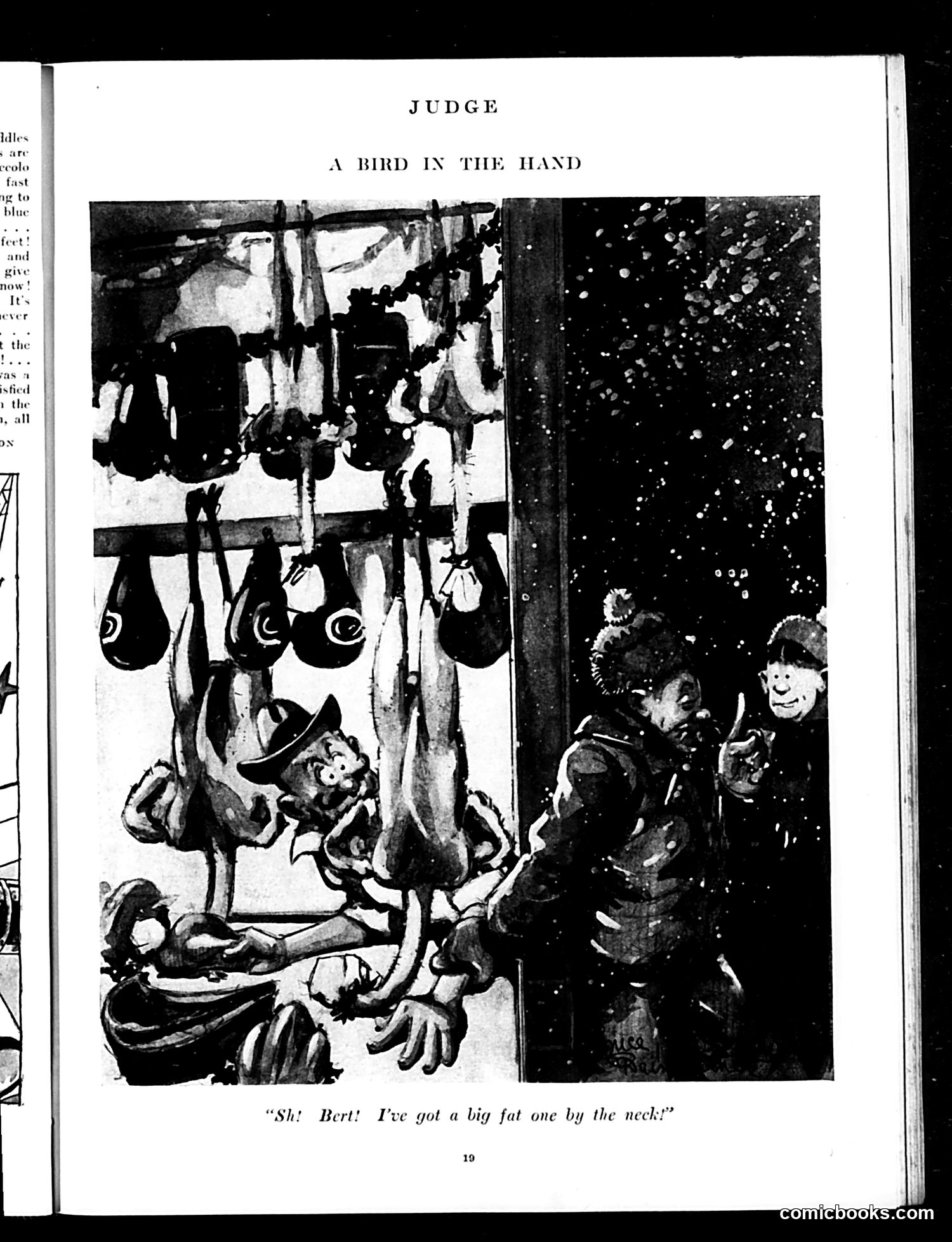
"A Bird in the Hand" This page from *Judge* magazine features an illustration satirizing Christmas holiday excess and materialism. The cartoon shows what appears to be working-class figures (possibly immigrants, suggested by their caricatured features) displaying hanging poultry and other provisions in a tenement or market setting. The caption—"Sh! Bert! I've got a big fat one by the neck!"—suggests the figures are proudly displaying their acquisition of food, likely through questionable means. The satire appears to mock either holiday greed, black-market dealings, or the desperation of poor urban residents attempting to secure holiday meals. The title references the proverb "a bird in the hand is worth two in the bush," inverting it to comment on securing tangible (perhaps illegally obtained) goods.
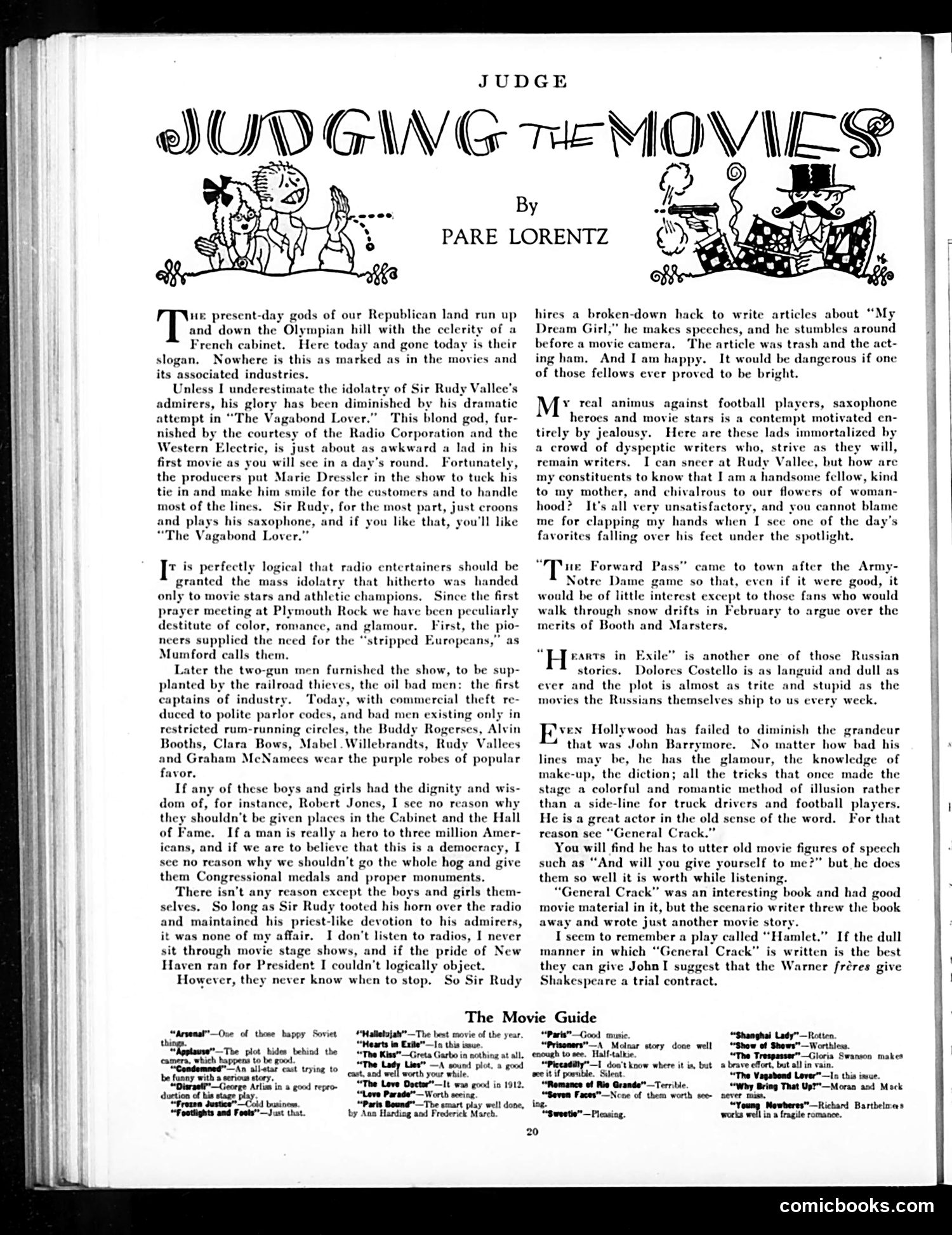
Analysis for Modern Readers This is a film criticism essay by Pare Lorentz titled "Judging the Movies," not a political cartoon. It critiques the celebrity worship of 1920s entertainment figures, particularly radio star Rudy Vallée. The Main Argument: Lorentz argues that entertainers like Vallée, though idolized by millions, shouldn't receive undue prestige—especially when they prove incompetent at acting (Vallée in "The Vagabond Lover"). He expresses contempt for their prominence and admits his jealousy stems from writers like himself being overshadowed by these "dyspeptic" celebrities. Key References: - Rudy Vallée: a crooner/saxophonist with enormous radio popularity - "The Vagabond Lover": Vallée's film debut (poorly reviewed here) - Marie Dressler: an established actress who "saved" the film - Contemporary stars mentioned: Buddy Rogers, Clara Bow, Mabel Willebrandt The Satire: Lorentz sarcastically suggests celebrities deserve Cabinet positions and monuments since they're worshipped like gods, then dismisses several current films with contempt.
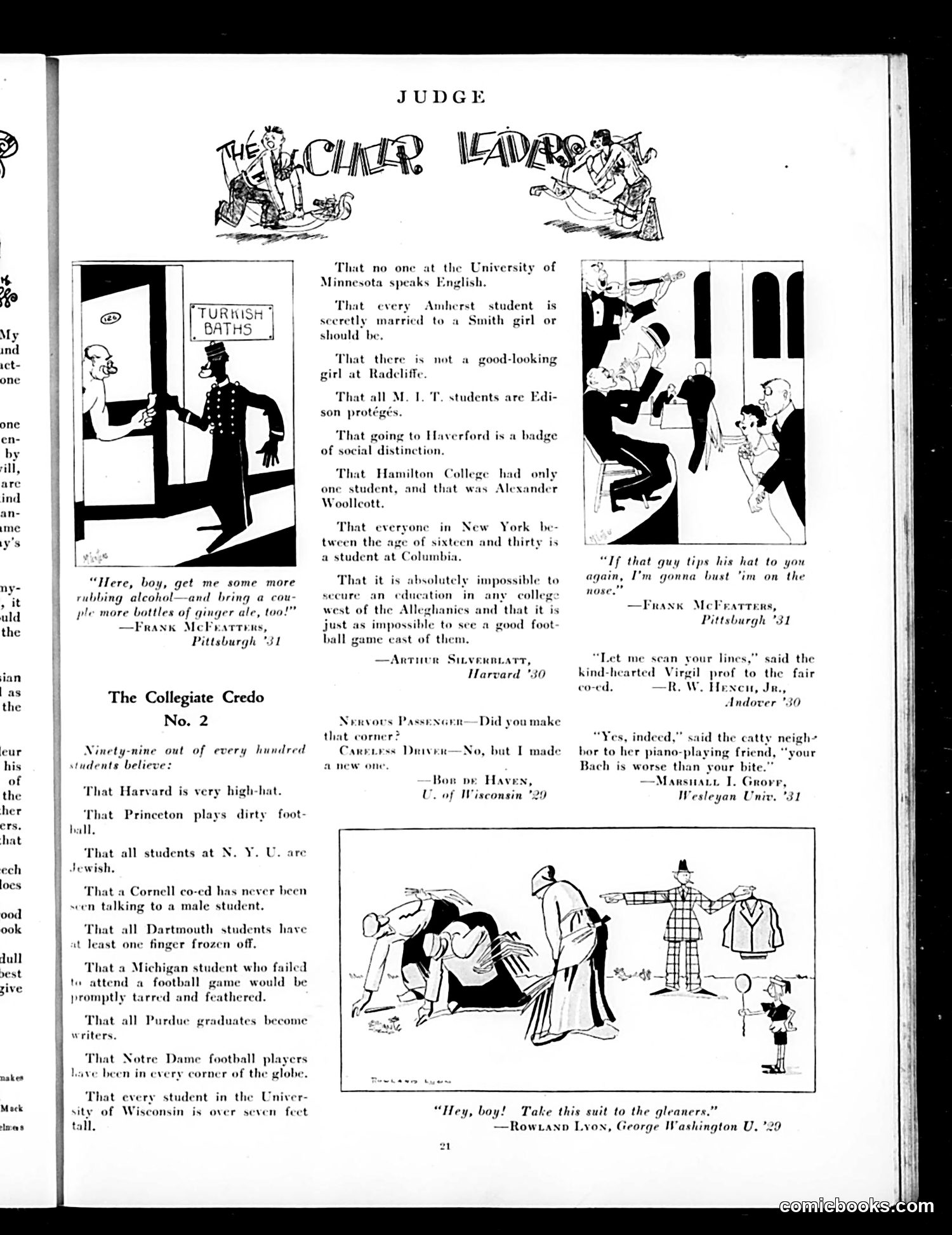
"The Collegiate Credo No. 2" This satirical piece mocks widespread stereotypes about American college students and universities circa 1930. The page presents exaggerated beliefs students supposedly hold about rival institutions—Harvard students are snobs, Princeton plays dirty, all NYU students are Jewish, Cornell women never speak to men, Dartmouth students have frostbite, etc. The accompanying cartoons and jokes reinforce these caricatures through period humor. One cartoon depicts someone ordering alcohol (referenced obliquely during Prohibition), while another shows a boy being told to take a suit to "the gleaners" (cleaners)—playing on class assumptions. The satire targets both the insularity of college culture and the prejudices embedded in how students view each other. The exaggerated claims—that Wisconsin students are all seven feet tall, Minnesota students can't speak English—are meant to expose how absurd such stereotyping becomes when taken to extremes.
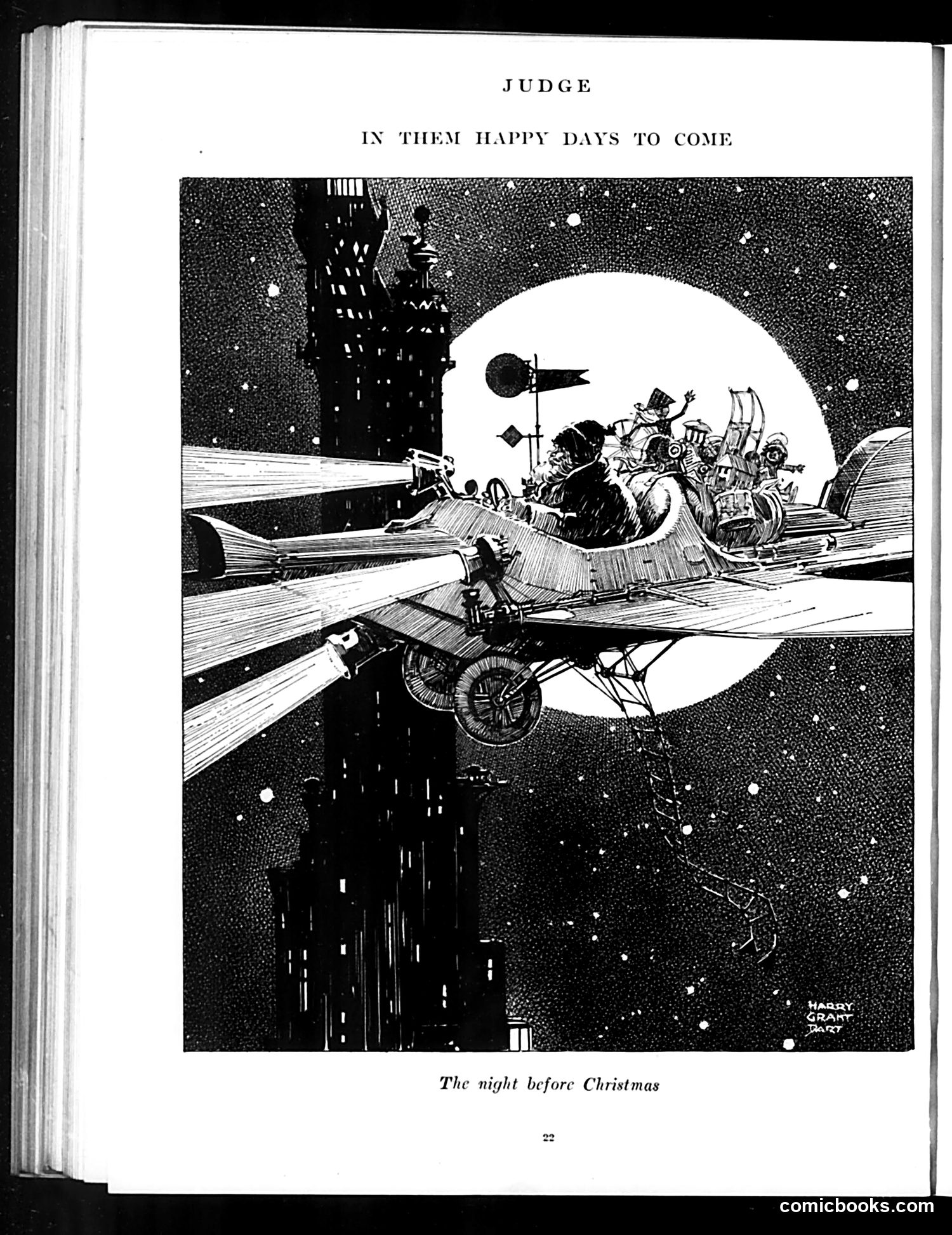
"In Them Happy Days to Come" This is a satirical illustration titled "The night before Christmas," signed by Harry Grant Dart. The cartoon depicts an fantastical nighttime scene with a tall city building on the left, while various figures in what appears to be a mechanical or airship vessel float in the starry sky on the right, with a large moon behind them. The satire likely mocks technological optimism and futuristic predictions popular in early 20th-century American culture. The mechanical conveyance and airborne Christmas scene suggest humor about imagined scientific advancement. The title "In Them Happy Days to Come" implies ironic commentary on utopian visions of the future, contrasting idealistic predictions with present-day reality. The specific satirical target remains unclear without additional context from the Judge magazine issue.
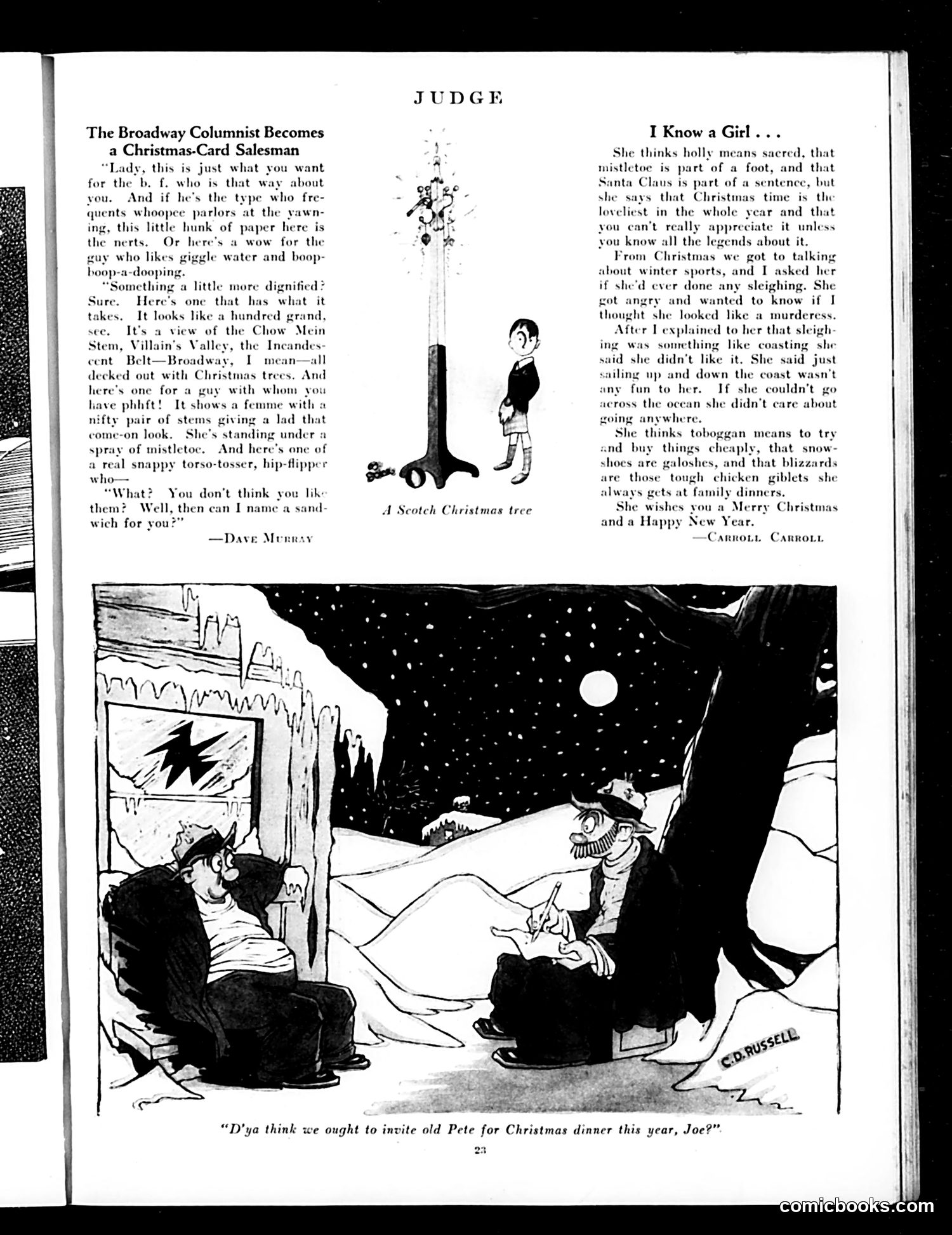
Explanation for Modern Readers This page contains three distinct pieces of 1920s satire: 1. "The Broadway Columnist Becomes a Christmas-Card Salesman" (Dave Murray): A columnist tries pitching Christmas cards by using period slang ("whoopee parlors," "giggle water," "phhft"—all references to jazz-age excess and casual romance). The joke mocks both Broadway's fast-talking culture and the idea of commercializing Christmas through cheap sentiment. 2. "A Scotch Christmas Tree" (C.D. Russell): A cartoon showing two figures in a snowy landscape. The caption suggests inviting "old Pete" for dinner, likely implying a Scotch person would be a cheap or miserly choice of guest—a stereotype-based joke. 3. "I Know a Girl..." (Carroll): Humorous portrait of a woman who misunderstands Christmas traditions—confusing "toboggan" with budget shopping, "snowshoes" with galoshes. The satire gently mocks urban women unfamiliar with winter activities. All three pieces reflect 1920s urban sophistication, period slang, and gentle mockery of both commercialism and social pretense.
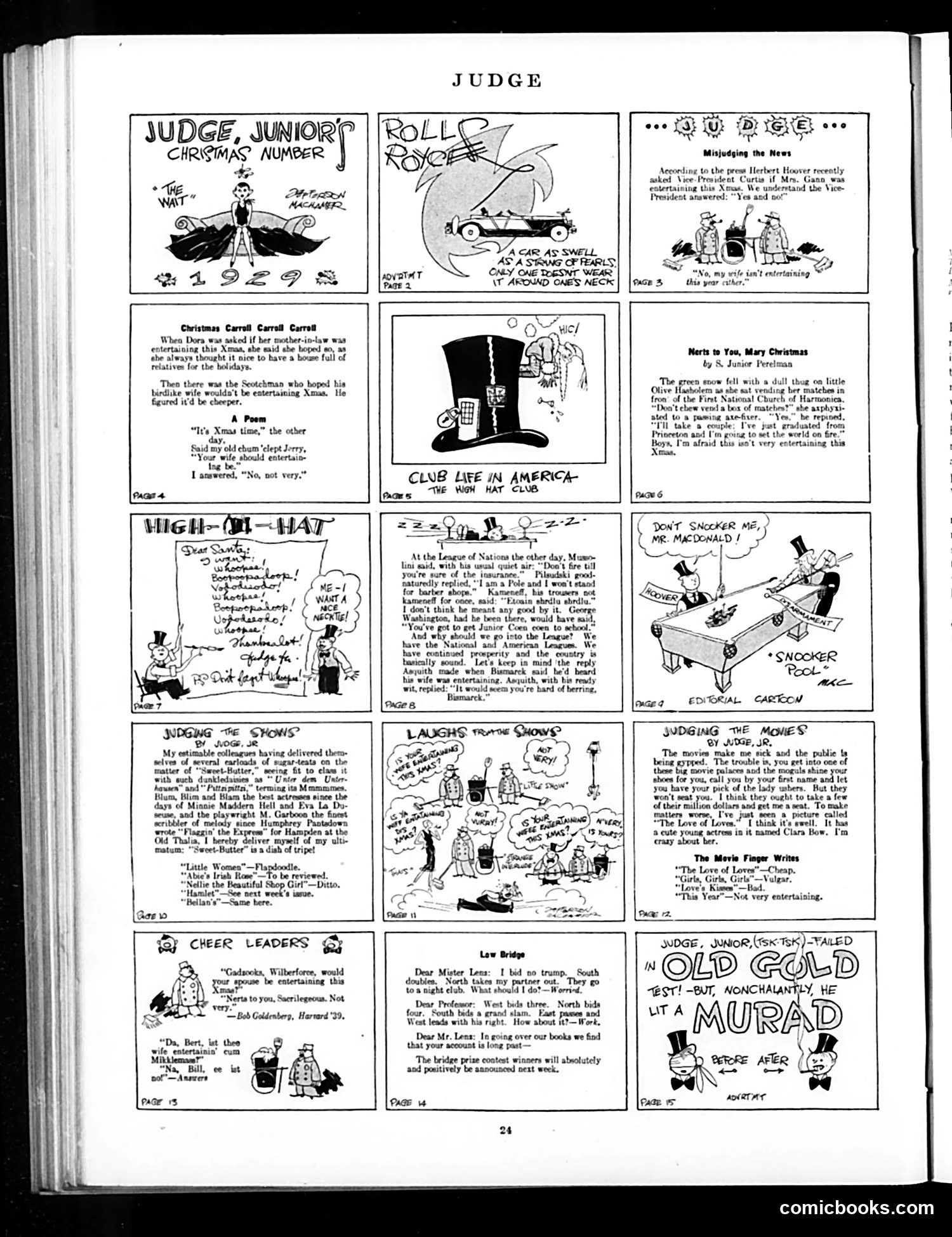
Judge Magazine Christmas Number - Content Explanation This is a Christmas-themed issue of Judge magazine mixing humor, cartoons, and brief satirical pieces. Key elements: Political References: "Misjudging the News" comments on Vice President Curtis and Mrs. Gann (likely referring to contemporary Washington scandal/gossip about entertaining during holidays). Social Satire: Multiple jokes target holiday entertaining conventions—a Scotsman hoping his wife *won't* entertain (to save money), and various quips about wives' entertainment duties, reflecting 1920s gender expectations. Entertainment Criticism: S. J. Perelman's piece mocks sentimental Christmas stories. The "Judging the Movies" section criticizes Hollywood excess and mentions actress Clara Bow. Miscellaneous: "Club Life in America" satirizes the "top hat club"; cartoons include bridge game humor and a snooker room scene labeled "Editorial Cartoon." The overall tone is light, society-focused humor typical of Judge's upper-class readership, with jazz-age references and cynicism about modern life mixed with traditional holiday themes.
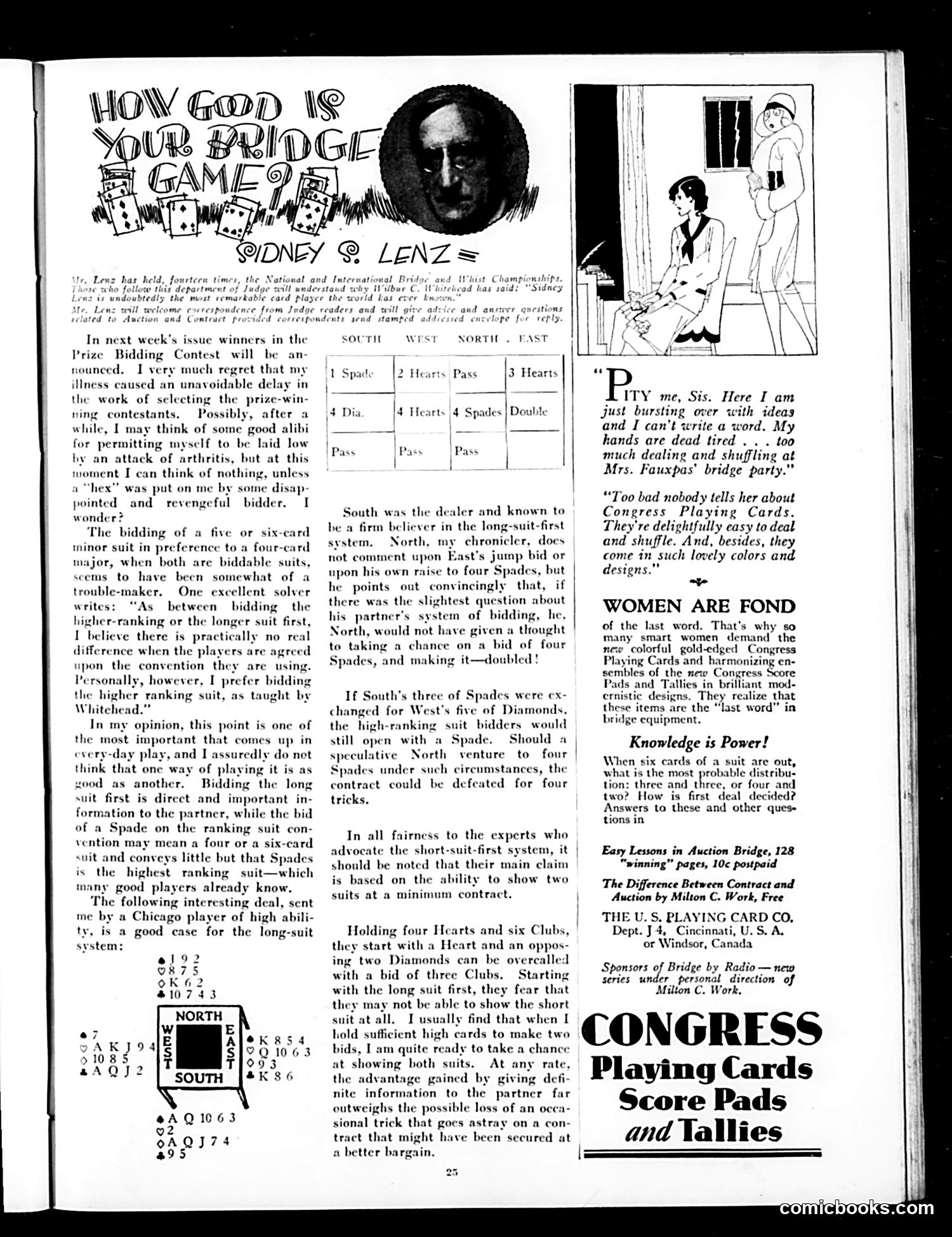
Judge Magazine Page Analysis This page primarily contains bridge card game strategy content, not political satire. The main article by Sidney Lenz discusses bidding conventions in contract bridge—specifically whether to bid longer or higher-ranking suits first. The cartoon (top right) depicts a woman exhausted from dealing cards at a "Mrs. Fauxpas' bridge party," complaining her hands are tired. Her sister recommends Congress Playing Cards as easier to shuffle and deal, noting they come in attractive colors. The page includes a bridge hand diagram showing card positions and an actual game deal analyzing bidding strategy. Context for modern readers: This reflects bridge's enormous popularity in early-to-mid 20th century America, when it was a major recreational activity. The advertisement leverages this by promoting playing cards as a practical solution to physical fatigue from shuffling—a genuine concern when bridge marathons were common social events. The content is essentially a bridge instruction column with integrated product advertising, not political commentary.
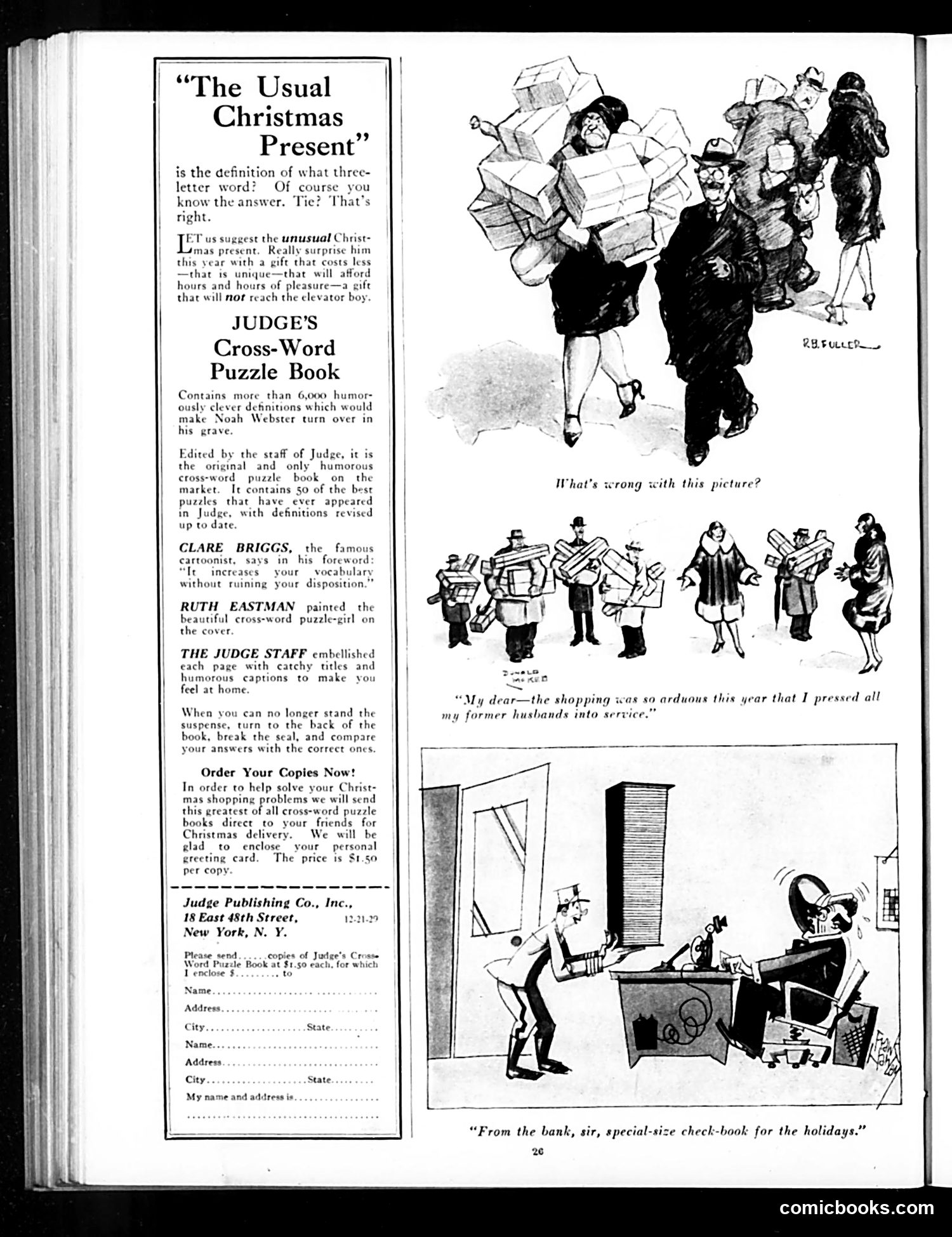
Judge Magazine Page Analysis This page primarily advertises Judge's Cross-Word Puzzle Book as a Christmas gift alternative to neckties—the stereotypical, unwanted holiday present (solving the riddle "The Usual Christmas Present"). The cartoons illustrate gift-giving anxieties of the era: Top cartoon: Shows exhausted shoppers laden with packages, satirizing the grueling Christmas shopping experience. Middle cartoon ("What's wrong with this picture?"): Depicts a woman casually mentioning she "pressed all my former husbands into service" for holiday shopping—dark humor about multiple marriages, likely referencing 1920s divorce scandals that fascinated Judge's readers. Bottom cartoon: A man receives a "special-size check-book for the holidays" from his bank, suggesting financial strain from Christmas spending. The ads reference cartoonist Clare Briggs and artist Ruth Eastman, establishing Judge's credibility. The magazine positions intellectual puzzles as superior to frivolous ties—an appeal to readers' vanity and gift-giving sophistication during the prosperous 1920s (date visible: 12-21-29).
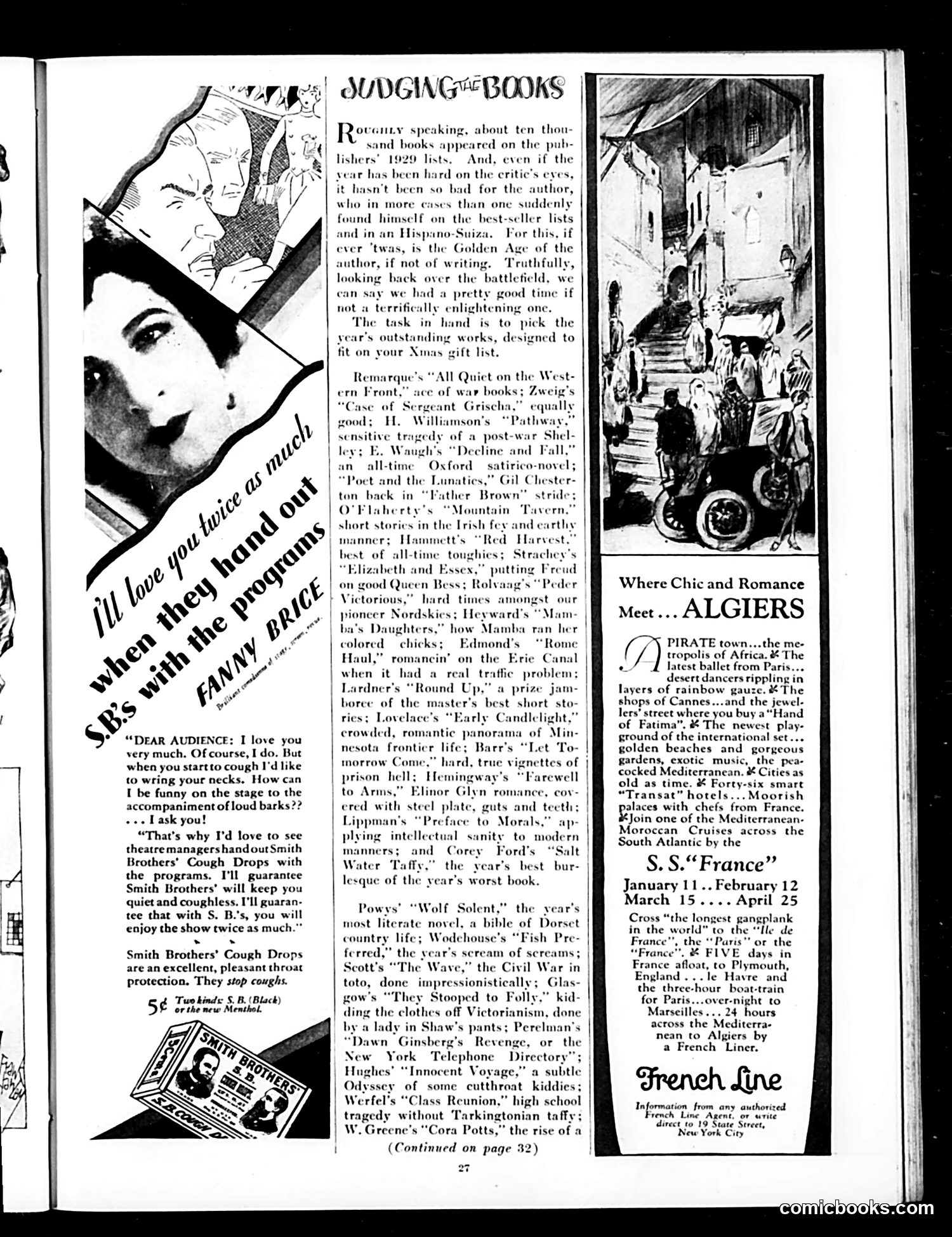
Judging the Books: A 1929 Book Review Page This is primarily a literary review page, not a political cartoon. The main content is a book criticism essay evaluating approximately 10,000 books published in 1929, selecting "outstanding works" for Christmas gift lists. The page lists acclaimed 1929 publications: Remarque's *All Quiet on the Western Front*, Hemingway's *Farewell to Arms*, Faulkner's work, and others—representing serious literature alongside lighter fare like Corey Ford's satirical parody of "the year's worst book." The left side contains a Smith Brothers' Cough Drops advertisement featuring a theatrical performer complaining about audience coughing during shows—a commercial using humor to pitch throat lozenges. The right sidebar advertises S.S. "France" Mediterranean cruises to Algiers, emphasizing exotic appeal and luxury travel. This is essentially a magazine page mixing literary criticism with period advertising, offering no significant political satire.
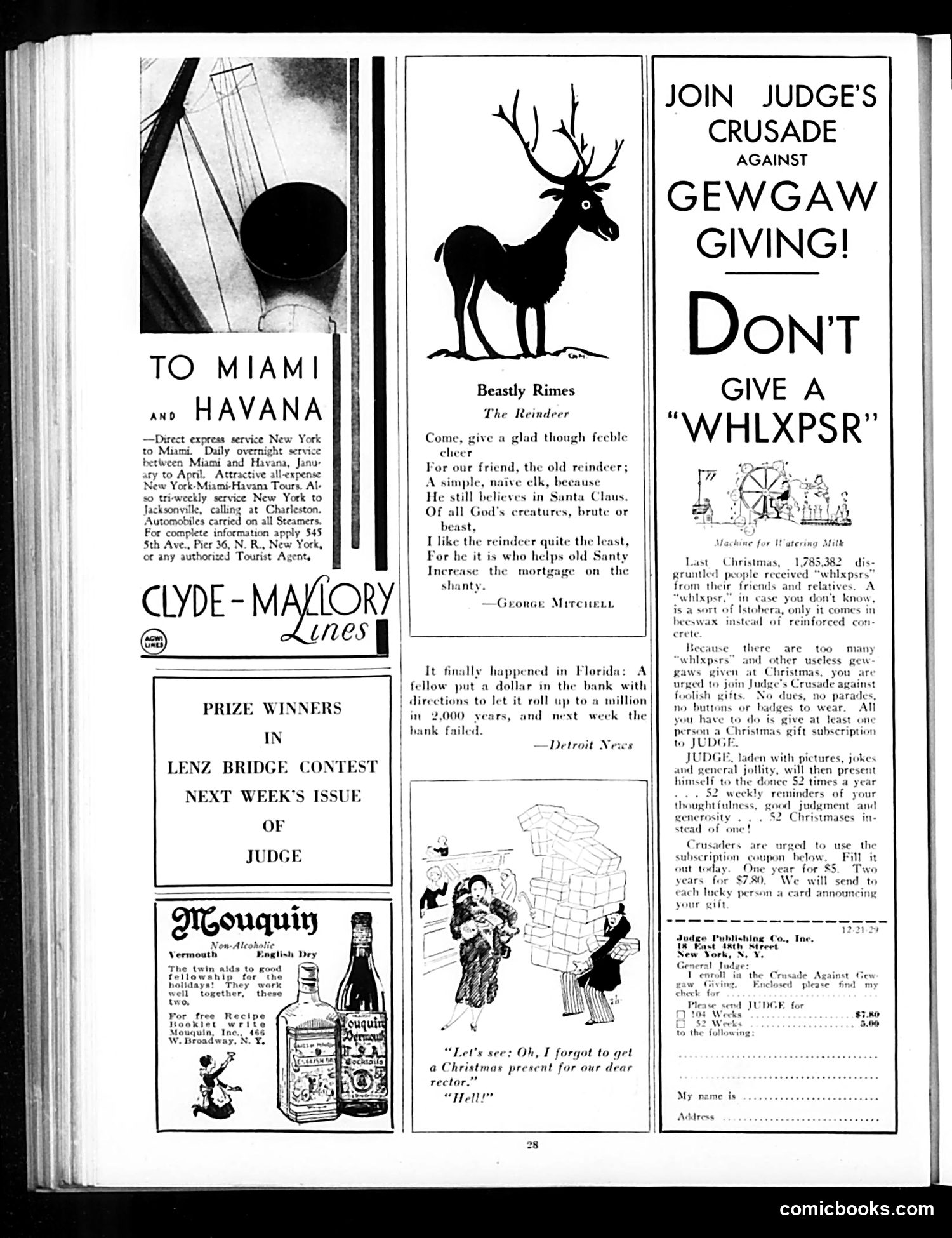
Analysis of Judge Magazine Page This page is primarily advertising and promotional content rather than satirical cartoons. The main editorial element is "Judge's Crusade Against Gewgaw Giving"—a anti-consumerism campaign urging readers to give practical gifts instead of cheap trinkets ("gewgaws"). The satire targets Christmas excess: a cartoon shows someone who forgot to buy a gift for "our dear rector," while the text mocks useless holiday purchases and promotes giving Judge magazine subscriptions instead. A humorous anecdote describes a Florida bank depositor who put a dollar in savings expecting compound interest over 2,000 years—the bank failed within a week, satirizing both naive financial optimism and banking instability (likely referencing Depression-era bank failures). The "Beastly Rimes" poem about reindeer appears to be light verse entertainment. The page otherwise contains standard period advertisements: Clyde-Mallory shipping lines (Miami/Havana service), Mouquin vermouth, and promotional notices for upcoming contests. The date appears to be December 1929 based on the "12-21-29" visible notation.
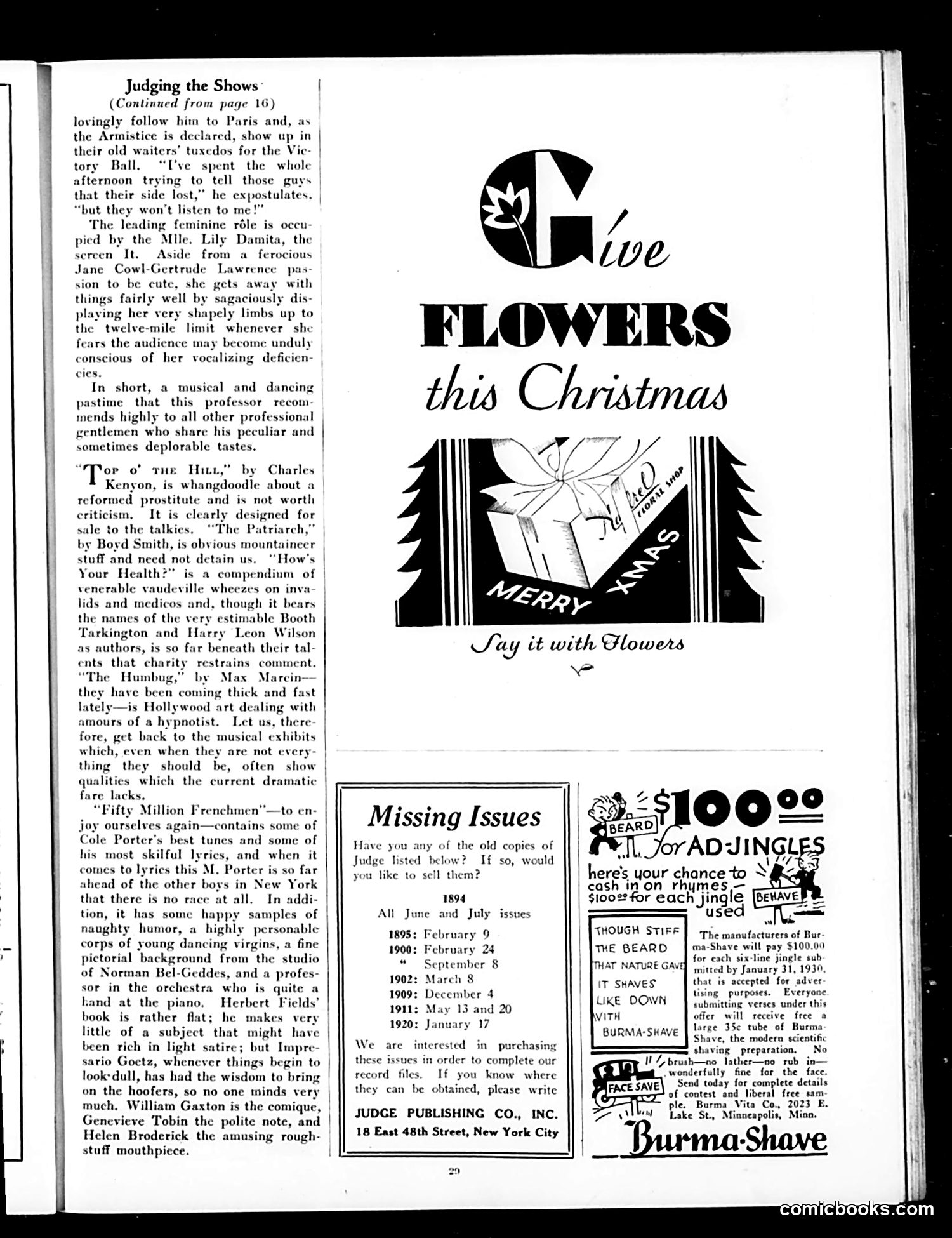
Page Analysis: Judge Magazine This page is primarily advertising and editorial content rather than political satire. The main text discusses theater reviews, critiquing several Broadway productions including "Fifty Million Frenchmen" (praised for Cole Porter's music) and dismissing others like "Top o' the Hit" and "The Humbug" as formulaic or weak. The advertisements are notable: - Give Flowers Christmas ad: A florist holiday promotion with decorative gift imagery - Missing Issues notice: Judge Publishing solicits old magazine copies from 1894-1920 - Burma-Shave jingle contest: Offering $100 for six-line advertising verses, promoting their brushless shaving cream The Burma-Shave ad is particularly interesting historically—this company became famous for roadside jingle signs in the 1930s-40s, and this represents an early promotional effort. The page contains no political cartoons or satire of note—it's a typical magazine interior page mixing entertainment criticism with period advertising.
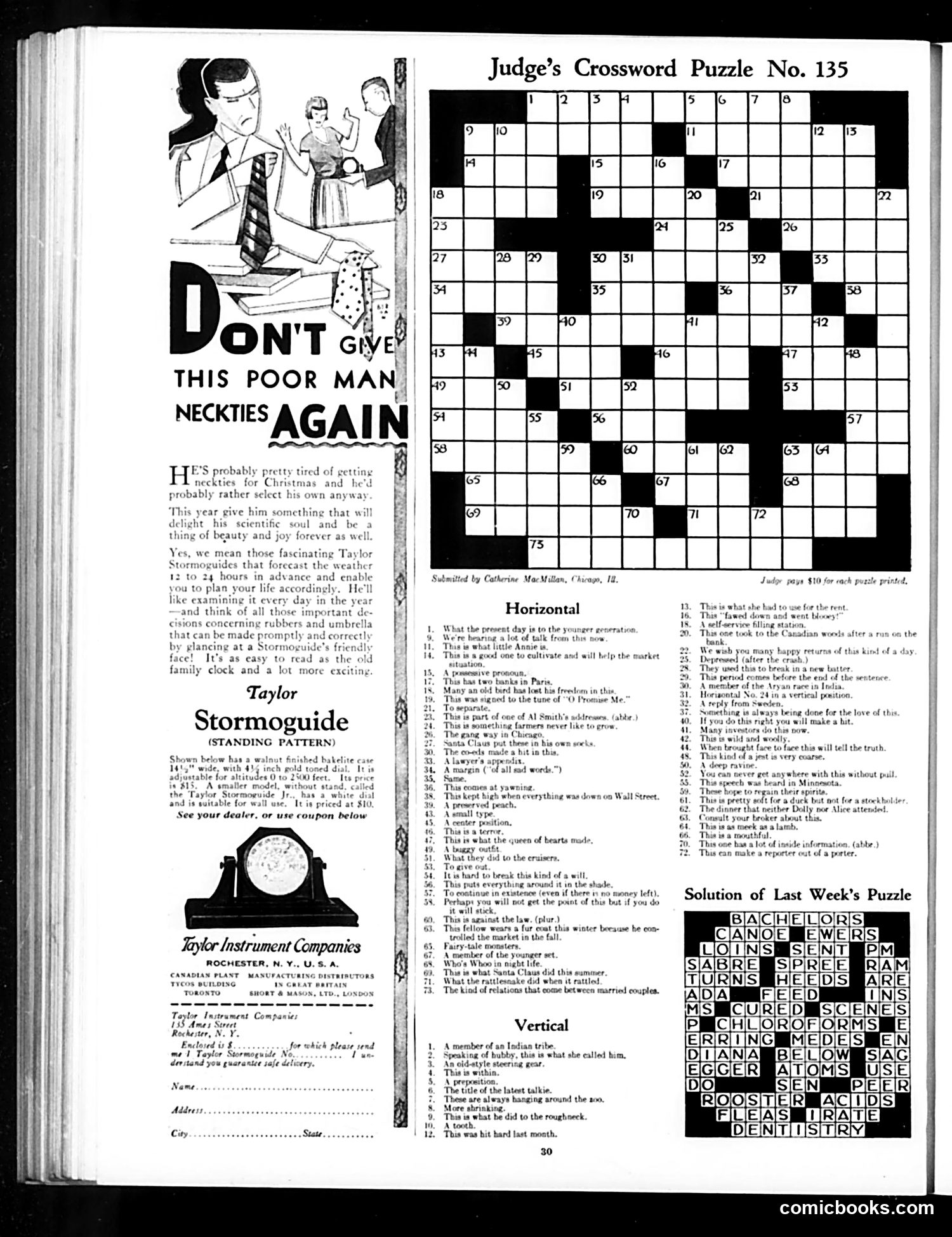
Analysis of Judge Magazine Page No. 135 This page is primarily advertising and puzzle content rather than political satire. The main visual element is an advertisement for Taylor Stormguide barometers, featuring an illustration of a man at a desk with colleagues in the background. The accompanying text uses humor to suggest gift-giving: a man tired of receiving neckties as Christmas presents should receive a Stormguide instead, which will help him plan outdoor activities and impress others with scientific knowledge. The bulk of the page contains Judge's Crossword Puzzle No. 135 with horizontal and vertical clues, plus the solution to the previous week's puzzle. The crossword clues use wordplay and mild humor typical of the era. There is no clear political or social satire visible here—this appears to be a standard magazine page mixing advertisements, puzzles, and light consumer-focused humor common in 1930s American periodicals.
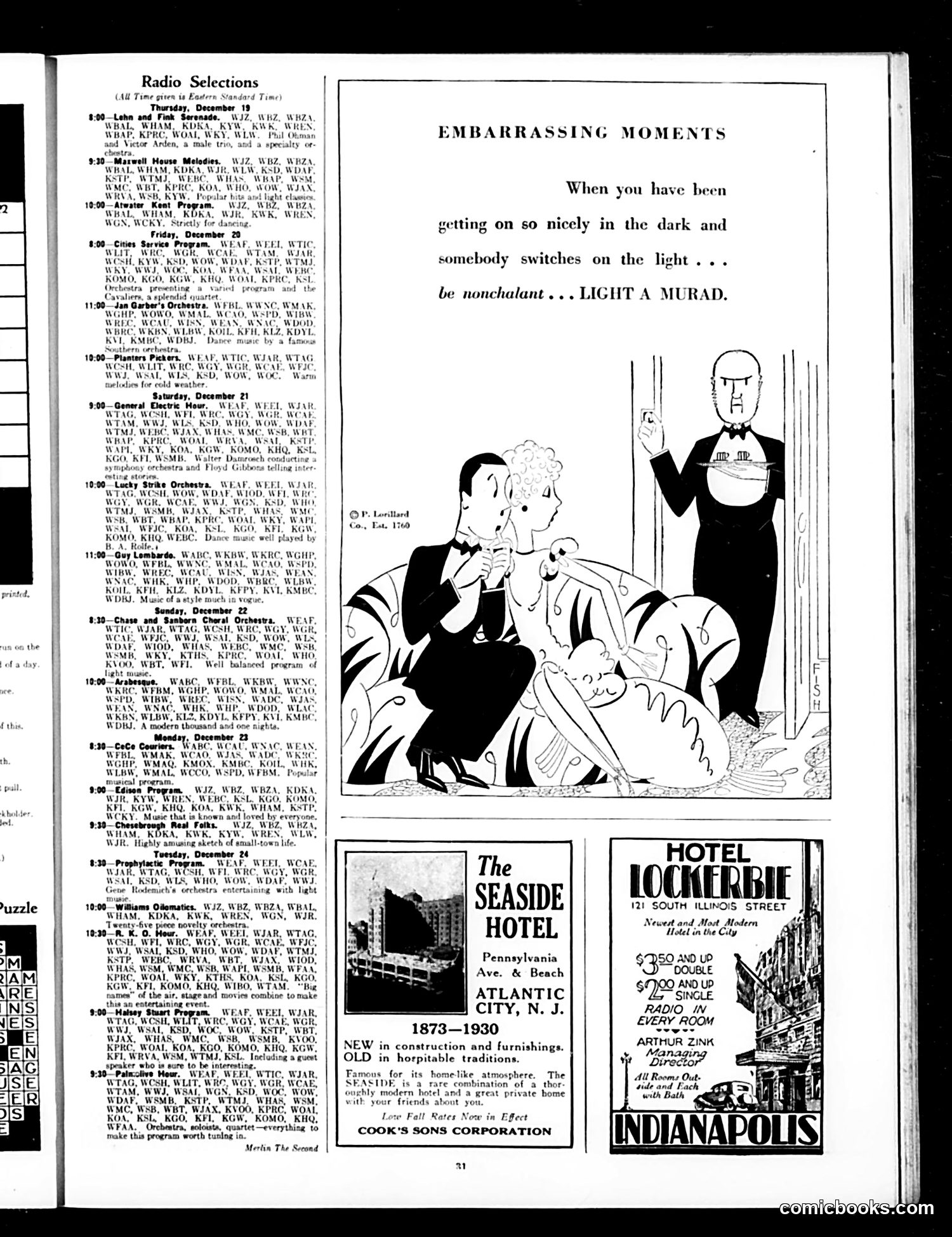
Analysis of Page Content This page is primarily radio programming listings and advertisements, not political satire. The small cartoon titled "Embarrassing Moments" depicts a social humor scenario: a couple in intimate darkness are suddenly exposed when someone switches on the light. The man holds a Murad cigarette, making the punchline an advertisement—"be nonchalant...LIGHT A MURAD"—suggesting the product helps one maintain composure in awkward situations. The cartoon references 1920s-30s courtship conventions where "petting" in darkness was risqué behavior that would cause embarrassment if discovered. The joke's humor relies on this social anxiety. The page otherwise contains dense radio station call letters and programming schedules (Eastern Standard Time), plus hotel advertisements for Atlantic City and Indianapolis establishments. It appears to be from Judge magazine's December 1930 issue, a period when radio was a dominant entertainment medium.
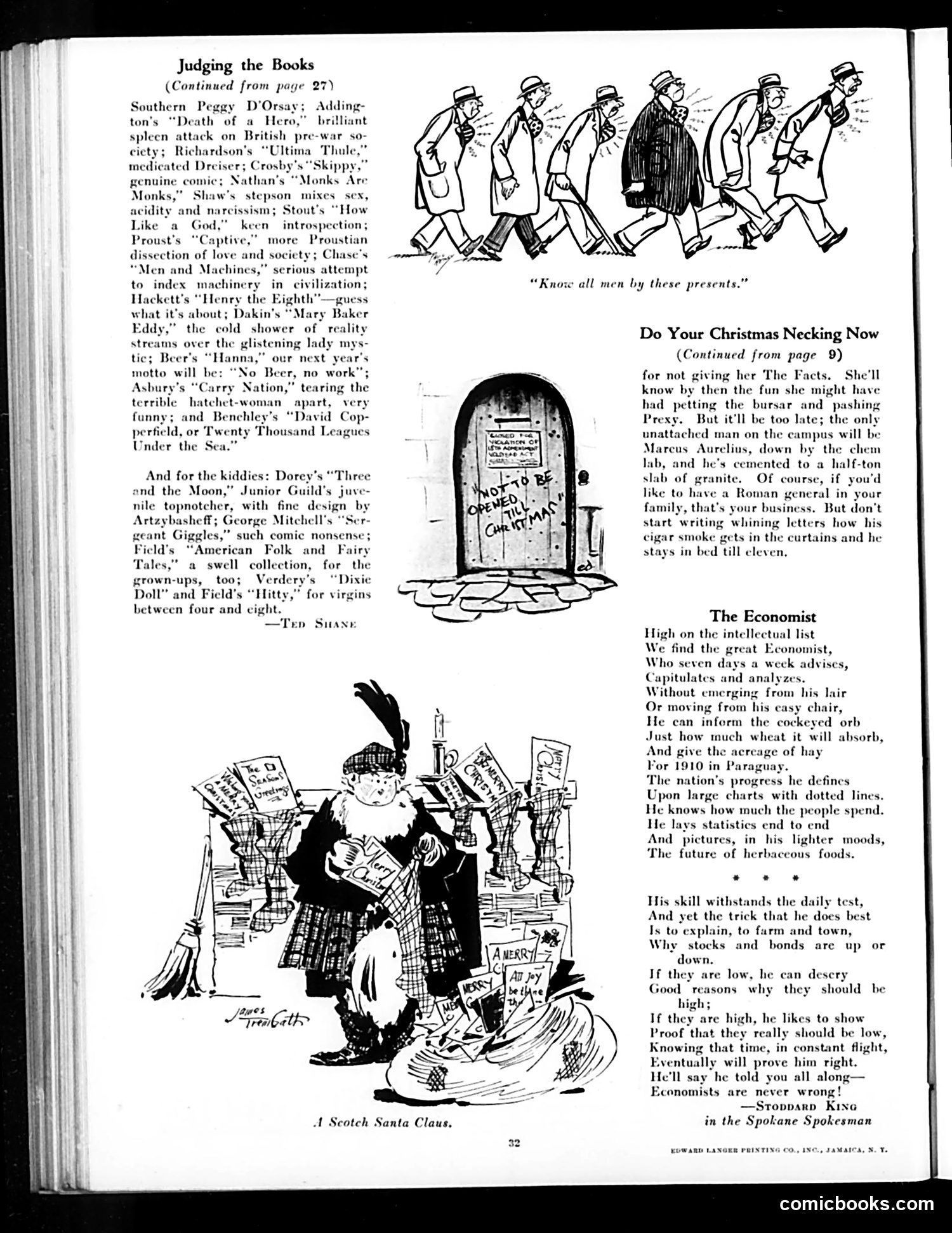
Explanation for Modern Readers This page from *Judge* magazine contains three distinct pieces: "Judging the Books" is a book review column discussing recently published novels and children's books, referencing authors like Dreiser, Proust, and Shaw. It's straightforward literary criticism. "A Scotch Santa Claus" (bottom illustration) depicts Santa surrounded by liquor bottles and newspapers—a joke about Scottish frugality and the "dry" (prohibition-era) movement. The caption suggests a Scottish Santa would give practical/cheap gifts rather than toys. "The Economist" is satirical verse mocking academic economists. The joke: economists make confident predictions about markets, stocks, and agricultural yields from comfortable offices—but they're never actually wrong because they rationalize any outcome (if stocks rise, they predicted it; if stocks fall, they also predicted it). This skewers the pretense of economic "science" and the profession's self-protective logic. The poem's final line—"Economists are never wrong!"—is sarcastic. The "Do Your Christmas Necking Now" piece is college-oriented romantic advice (now dated slang).
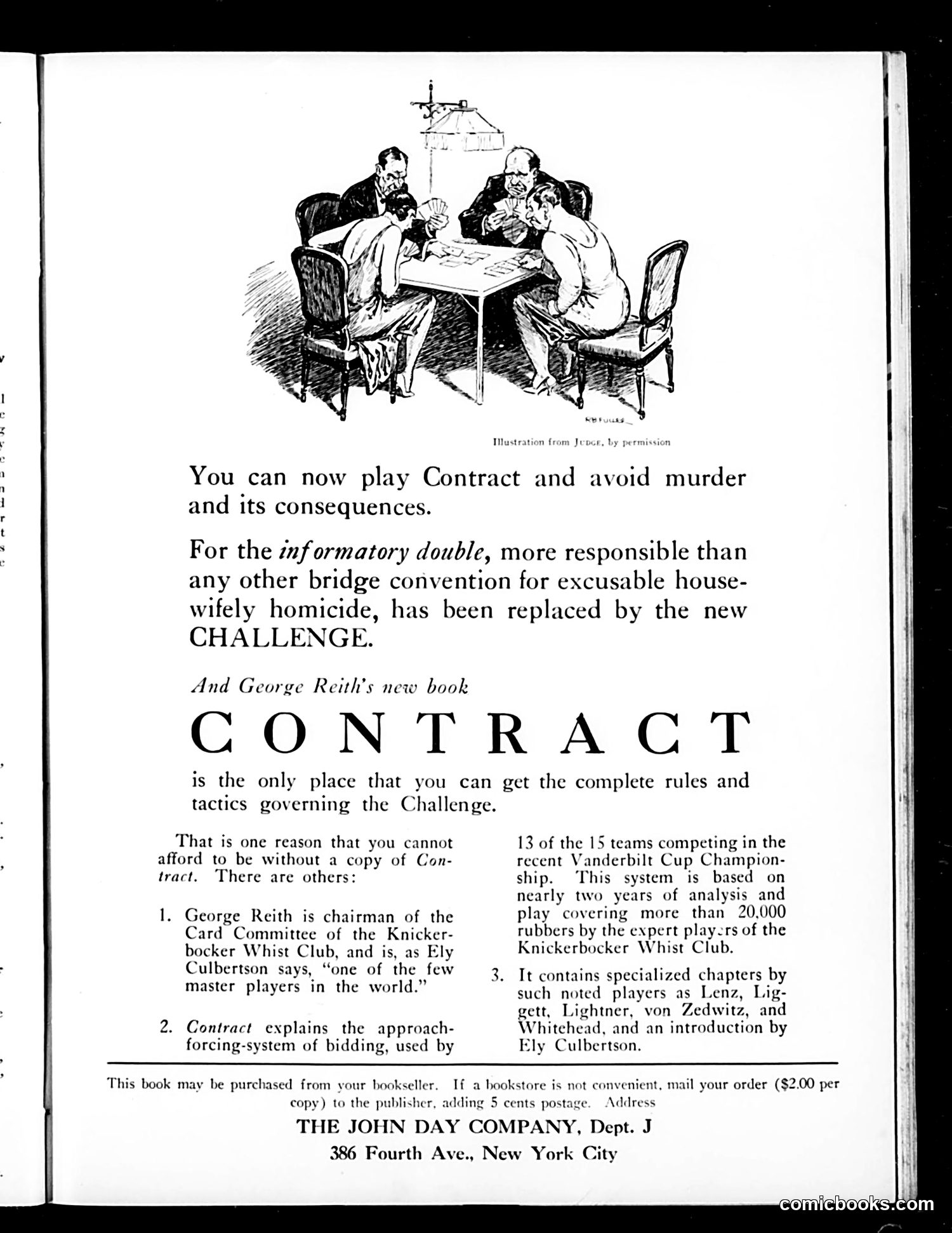
Analysis: Contract Bridge Advertisement from Judge Magazine This is primarily a book advertisement rather than political satire. The illustration shows four men playing cards around a table—a scene depicting the card game "Contract Bridge." The humor lies in the opening line: "You can now play Contract and avoid murder and its consequences." This is a satirical joke about marital conflict, suggesting that the previous bridge convention (the "informatory double") was so frustrating that it drove housewives to homicide. Contract Bridge, presented as a replacement, is humorously offered as a solution to domestic violence. The advertisement promotes George Reith's instructional book *Contract*, emphasizing its authority through endorsements from Ely Culbertson (a famous bridge expert) and the Knickerbocker Whist Club. It notes that 13 of 15 teams in a major championship used the bidding system Reith explains. The joke reflects early 20th-century attitudes treating spousal murder as a darkly comic subject, while the advertisement itself showcases bridge's popularity among the American social elite.
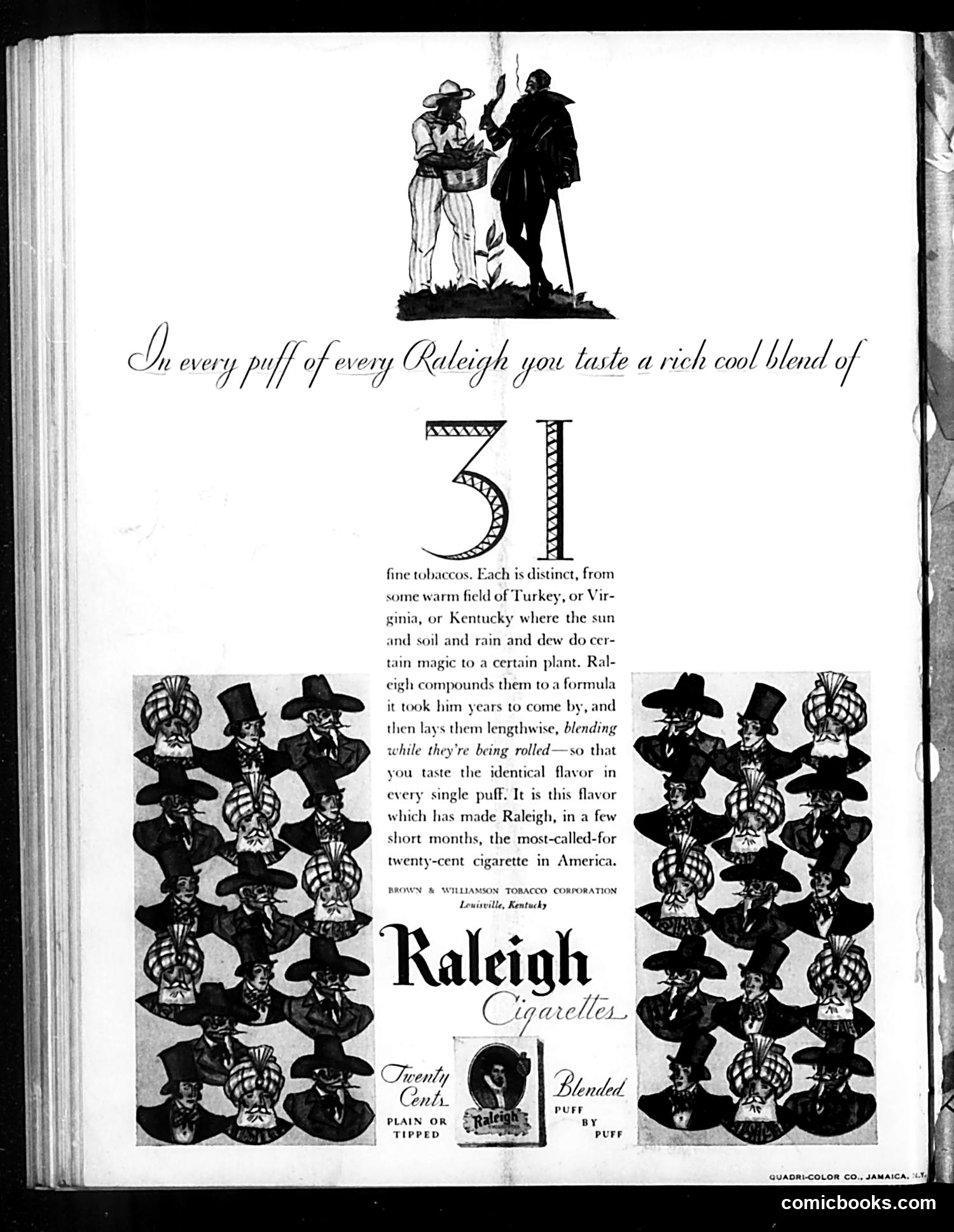
This page is a cigarette advertisement, not political satire. It promotes Raleigh cigarettes, manufactured by Brown & Williamson in Louisville, Kentucky. The imagery shows silhouetted figures in formal dress (top) and repeated decorative illustrations of men in top hats (sides), functioning as decorative branding rather than editorial commentary. The text emphasizes Raleigh's "blended" formula of tobacco from Turkey, Virginia, and Kentucky, claiming consistency across every puff. The advertisement highlights the product's affordability at "twenty cents" and notes it became "the most-called-for" cigarette quickly—a sales pitch rather than satire. This represents early-20th-century tobacco marketing, before health warnings were required.