judge
Judge — December 28, 1929
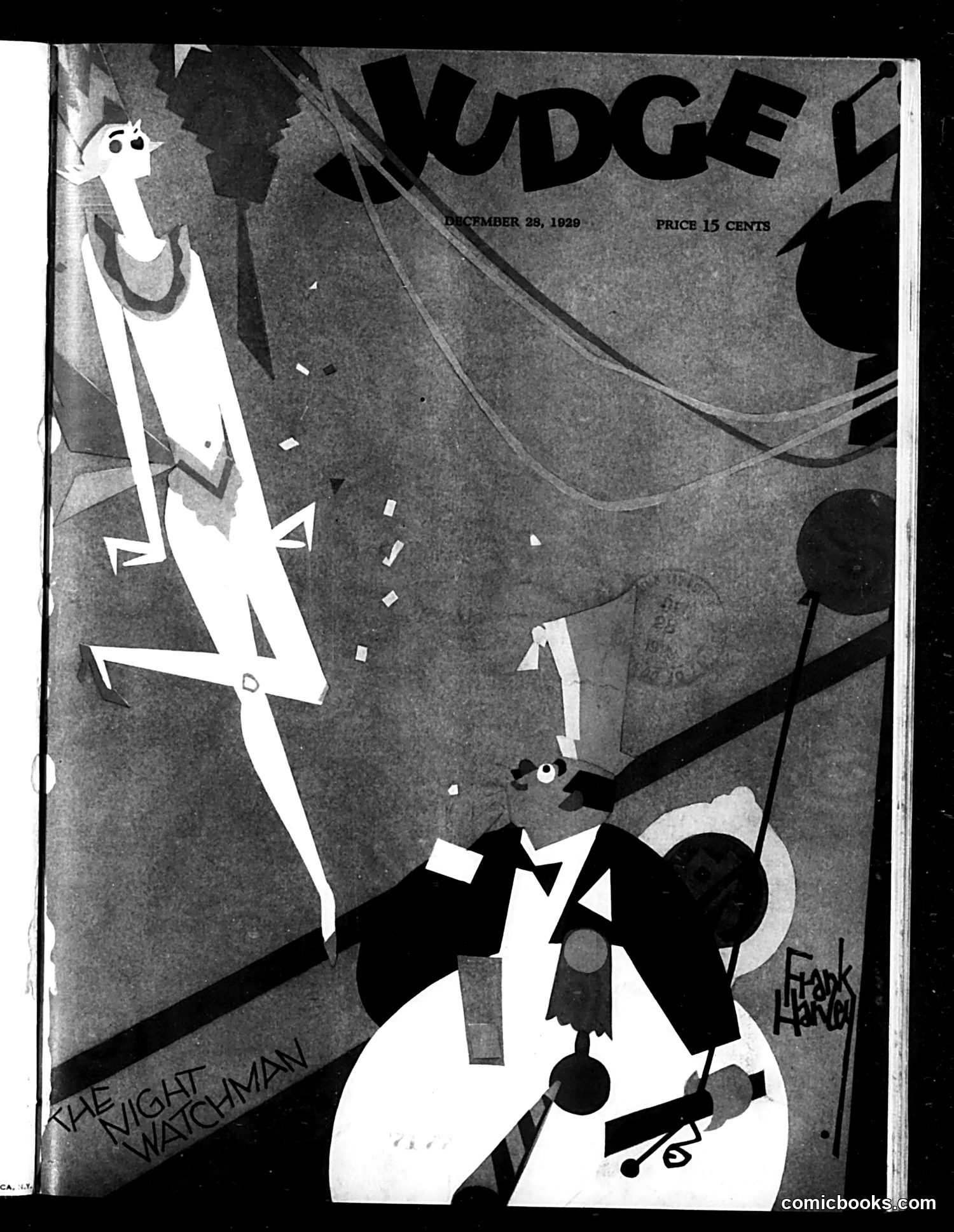
"The Night Watchman" - Judge Magazine, December 28, 1929 This Frank Hardly cartoon depicts a nighttime scene of chaos and disorder. The title "The Night Watchman" suggests commentary on law enforcement or social order during a period of crisis. The stylized figures and dramatic composition—with one character elevated above another in a seemingly chaotic arrangement—likely satirizes the inadequacy of authorities to maintain control during the Great Depression, which had just begun in October 1929. The magazine's publication date places this squarely in the economic collapse's immediate aftermath. The "watchman" figure appears overwhelmed or ineffectual, a common satirical trope for depicting governmental or institutional failure during national emergencies. The modernist art style was typical of Judge's 1920s aesthetic.
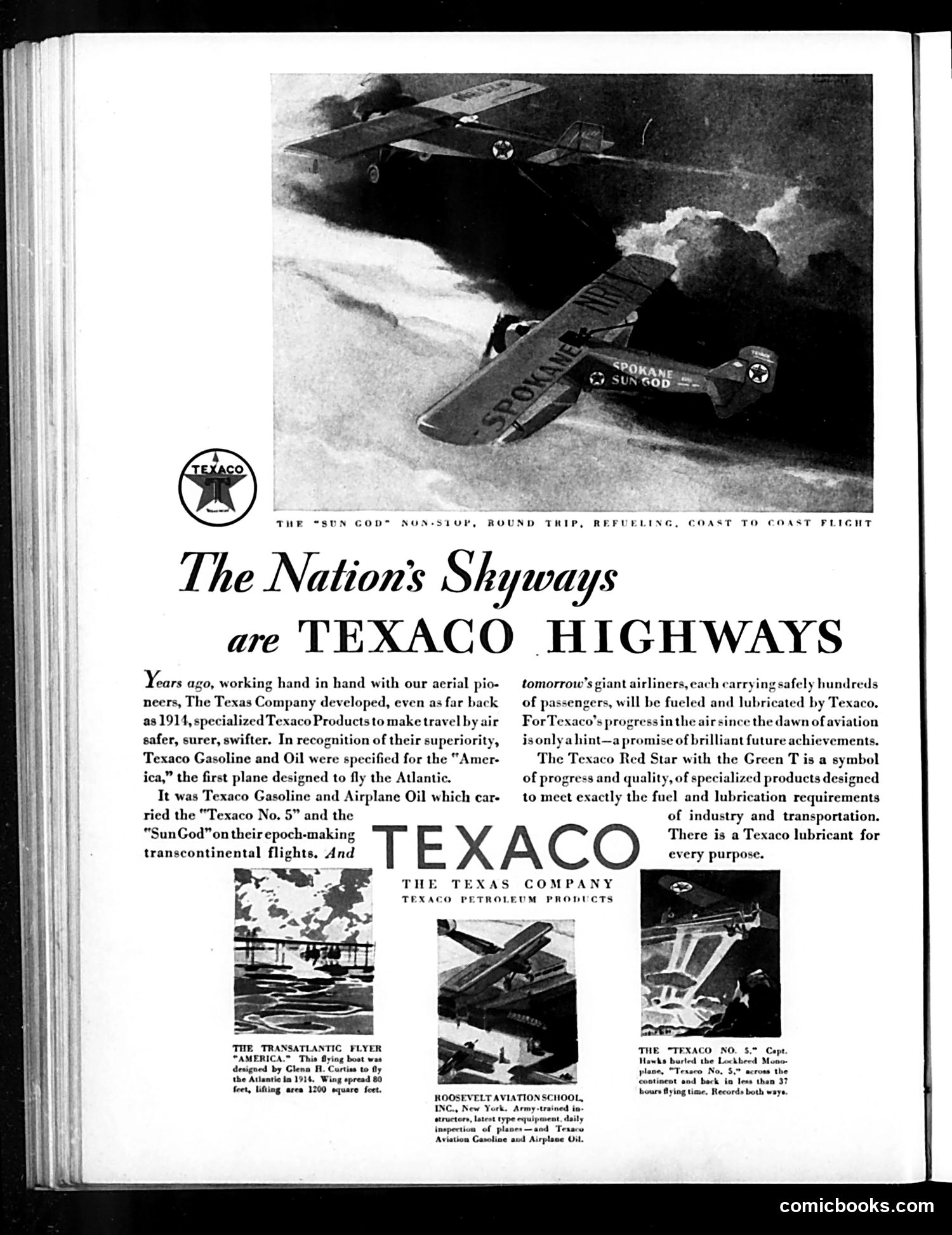
Analysis This is primarily a Texaco corporate advertisement, not political satire. The page celebrates Texaco's role in aviation history and fuel technology. The advertisement claims Texaco gasoline and oil powered early aviation achievements, including: - The "Texaco No. 5" plane (shown in photographs) - The "Sun God" on transcontinental flights - The Transatlantic Flyer - Roosevelt Aviation School operations The headline "The Nation's Skyways are TEXACO HIGHWAYS" uses patriotic language to associate the company with American technological progress and aviation advancement. The imagery of multiple aircraft in flight reinforces this message of reliability and superiority. This represents 1920s-era corporate propaganda—using aviation's cutting-edge glamour to promote fuel products to consumers and industry clients. There is no political cartoon or satire present on this page.
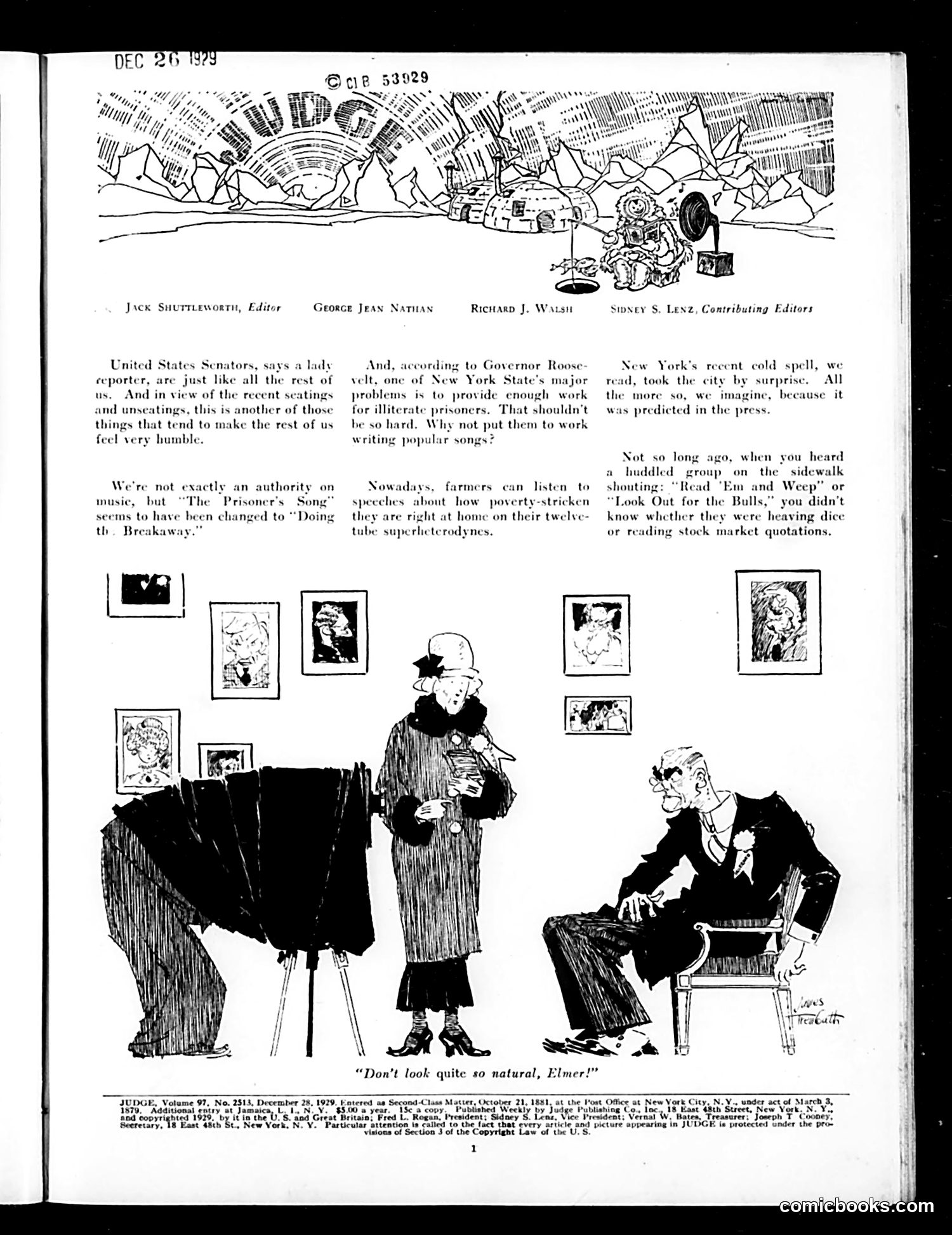
Analysis of Judge Magazine Page (December 26, 1929) The main cartoon depicts a scene labeled "Don't look quite so natural, Elmer!" showing a man posing stiffly for a portrait painter while a woman arranges his appearance. This appears to be satirizing artificial or forced social posturing—the joke being that "Elmer" looks too natural/relaxed, when the woman wants him to appear more refined or dignified for the portrait. The accompanying text discusses poverty relief and prison labor under Governor Roosevelt, farmers listening to radio broadcasts, and references to popular songs like "Read 'Em and Weep" and "Look Out for the Bulls." The overall theme seems to mock social pretense and class anxiety during the late 1920s, published just weeks after the 1929 stock market crash.
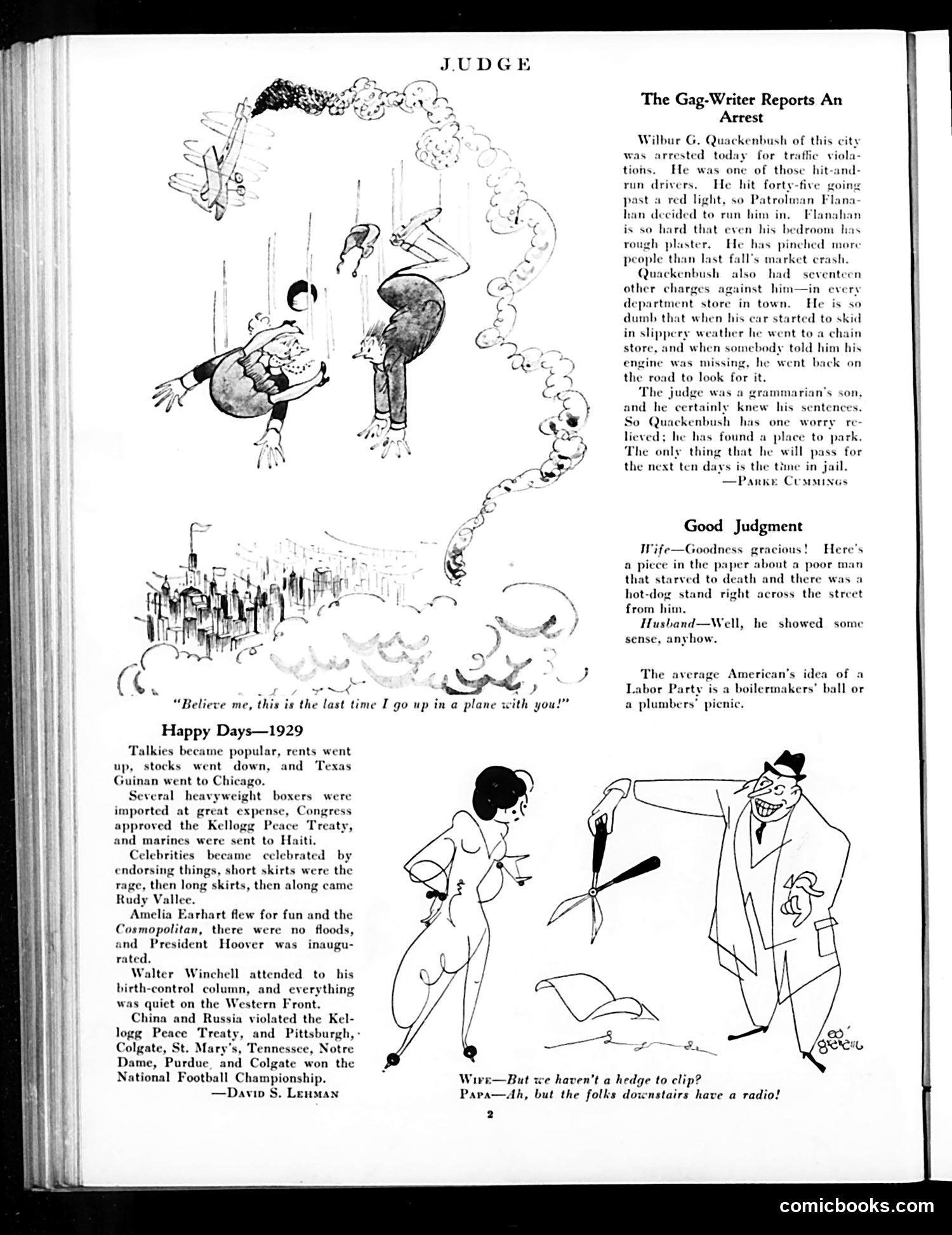
Judge Magazine Page Analysis This page contains three satirical pieces from 1929: "The Gag-Writer Reports An Arrest" mocks Wilbur G. Quackenbush, a reckless driver arrested for traffic violations. The cartoon illustrates his dangerous driving habits—running red lights, causing accidents. The satire targets careless motorists endangering public safety, a growing concern as automobile use increased in the 1920s. "Good Judgment" is a brief domestic joke about a poor man who starved to death near a hot-dog stand, suggesting the husband showed "sense" by dying rather than spending money. It's dark humor about economic hardship. "Happy Days—1929" summarizes notable 1929 events: talking pictures' popularity, stock market fluctuations, Amelia Earhart's aviation achievements, and college football championships. The tone is celebratory of American progress, published just before the October stock market crash.
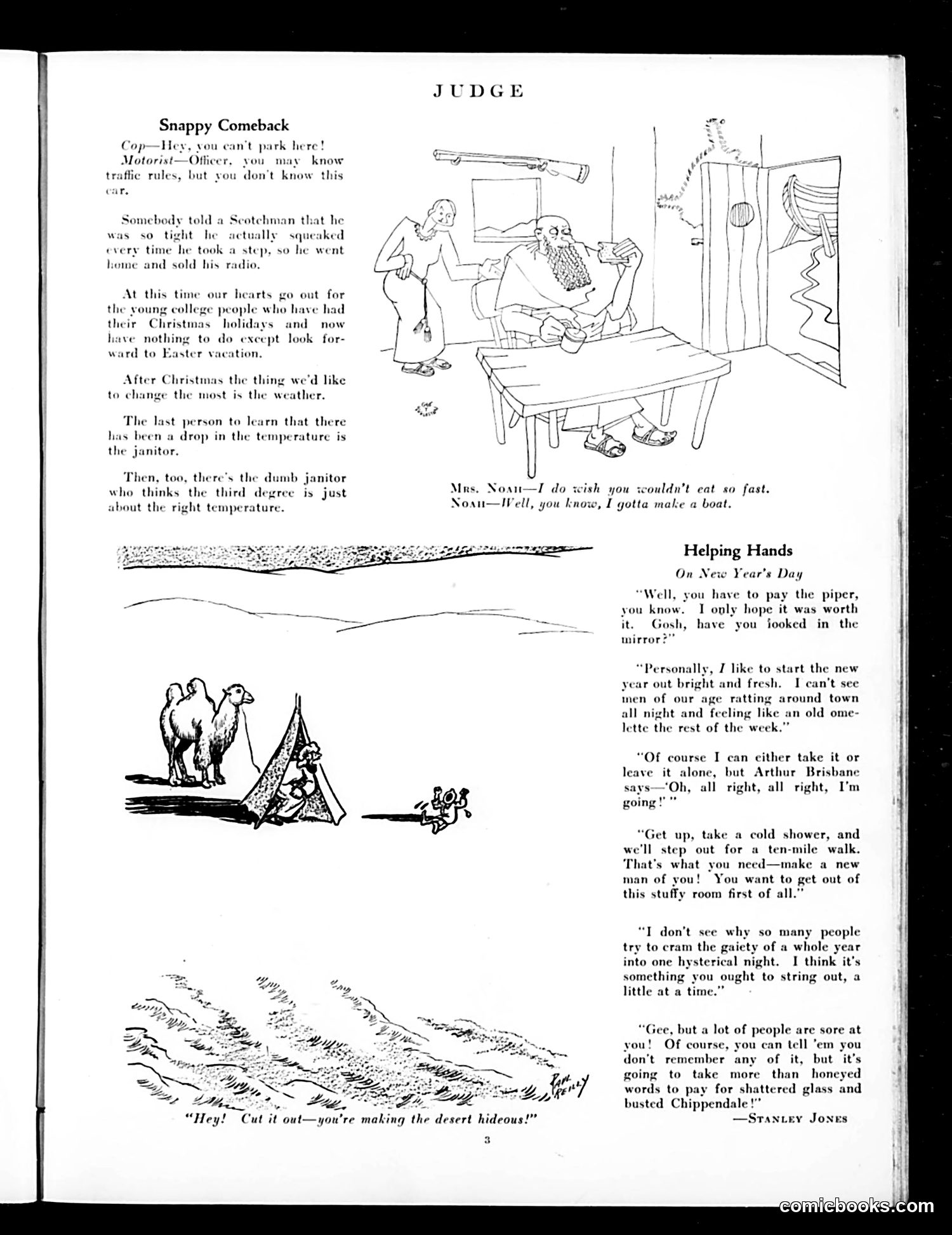
"Snappy Comeback" & "Helping Hands" - Judge Magazine "Snappy Comeback" depicts a traffic enforcement interaction where a cop confronts a motorist about illegal parking. The officer claims ignorance of traffic rules; the motorist responds with a Scottish anecdote about someone so constipated he squeaked with each step, then sold his radio. The joke targets bureaucratic incompetence—the officer represents authorities who enforce rules without understanding them. "Helping Hands" discusses New Year's resolutions and lifestyle changes. The dialogue advocates moderate celebration and physical activity (cold showers, ten-mile walks) rather than excessive drinking. The comic critiques how people compressed a year's indulgences into single hysteria-filled nights, arguing for measured self-improvement spread throughout the year. Both pieces reflect early-20th-century social commentary on urban life and personal conduct.
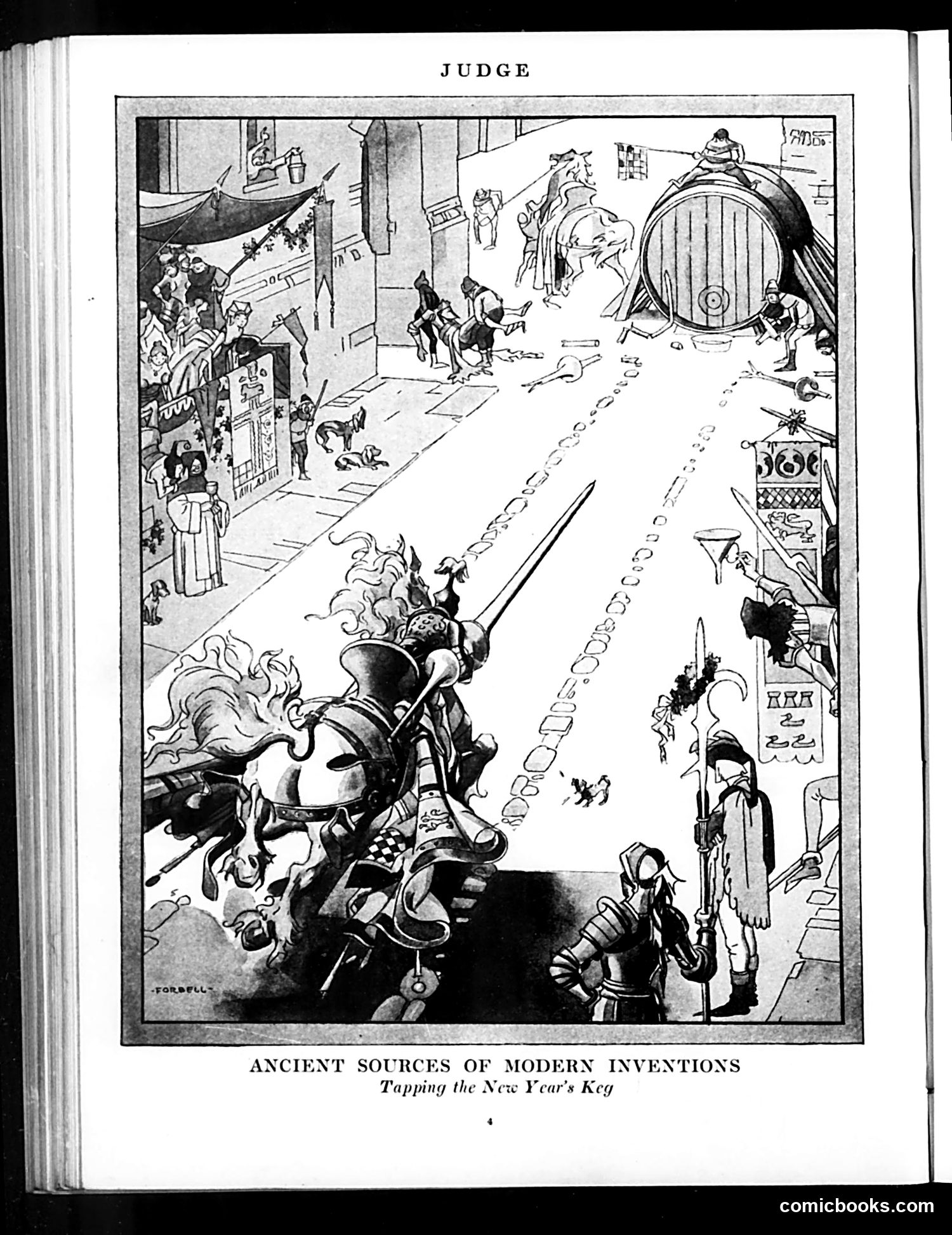
Analysis of "Ancient Sources of Modern Inventions" This Judge cartoon satirizes the idea that modern innovations have ancient origins. The subtitle "Topping the New Year's Key" suggests a New Year's themed piece playing on the phrase "turning over a new leaf." The central figure appears to be a knight or warrior on horseback wielding a large sword, depicted in classical/medieval style. The scene shows this ancient figure amid what appears to be a modern cityscape with contemporary buildings and people observing from windows and streets. The satire likely mocks either: (1) pseudointellectual claims that everything modern was invented in antiquity, or (2) the pretentious use of classical references in contemporary society. The contrast between the archaic warrior and the modern urban setting drives the humorous point about anachronism and misplaced nostalgia.
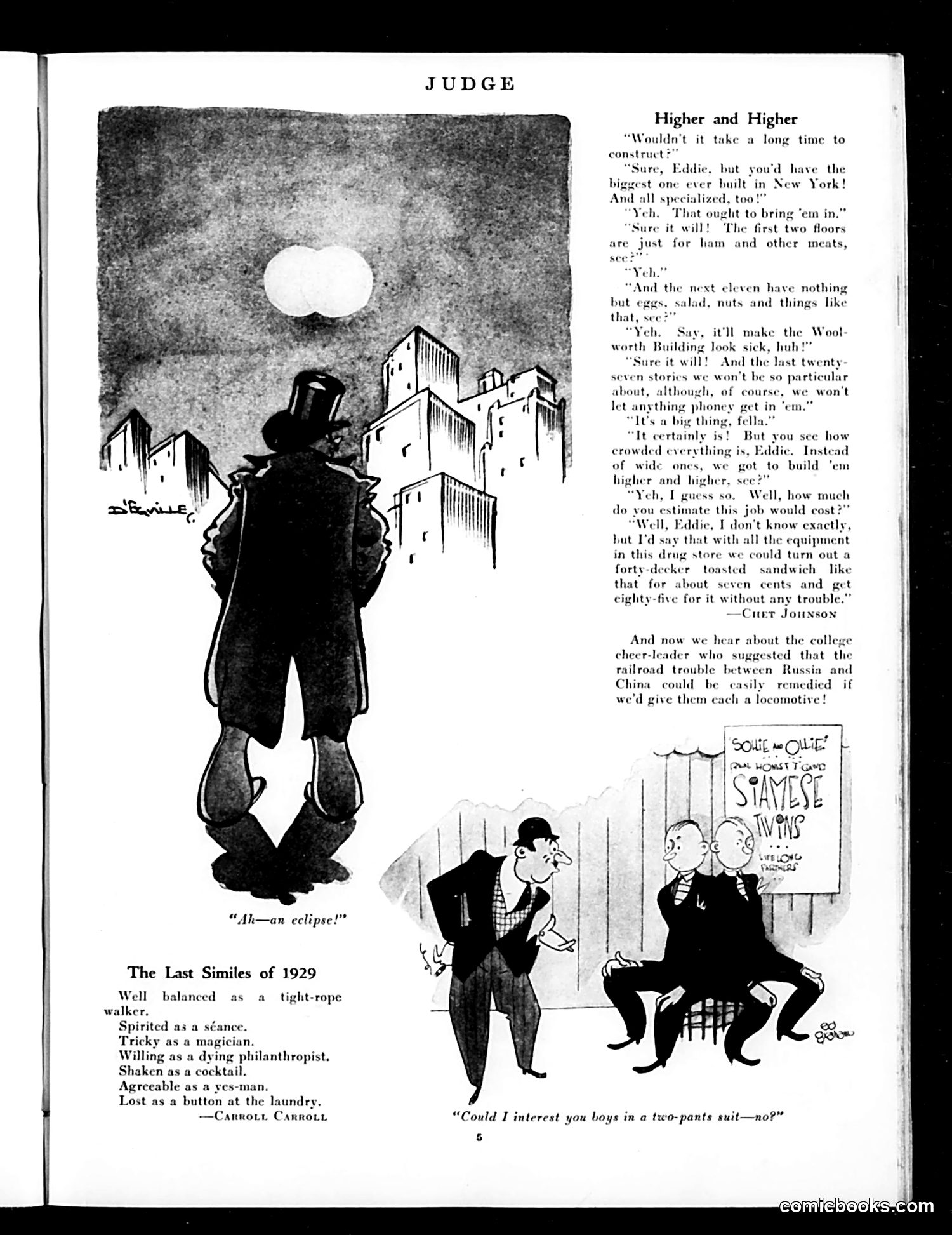
Analysis of Judge Page Main Cartoon ("Ah—an eclipse!"): A silhouetted figure gazes upward at tall buildings and a moon, captioned "Ah—an eclipse!" This appears to satirize the then-new skyscraper boom—the buildings are so tall they literally block out the sky/sun, creating an "eclipse" effect in urban areas. The joke critiques how aggressive construction was transforming city skylines. "Higher and Higher" Dialogue: A conversation between two men about constructing an enormous specialized building in New York with 29+ stories—poking fun at the era's obsession with ever-taller, increasingly absurd buildings and the competitive one-upmanship among developers. "The Last Similes of 1929": A humorous list comparing 1929 figures to objects (e.g., "Lost as a button at the laundry"). Bottom cartoon: Two men discussing a two-pants suit—likely commercial humor unrelated to politics.
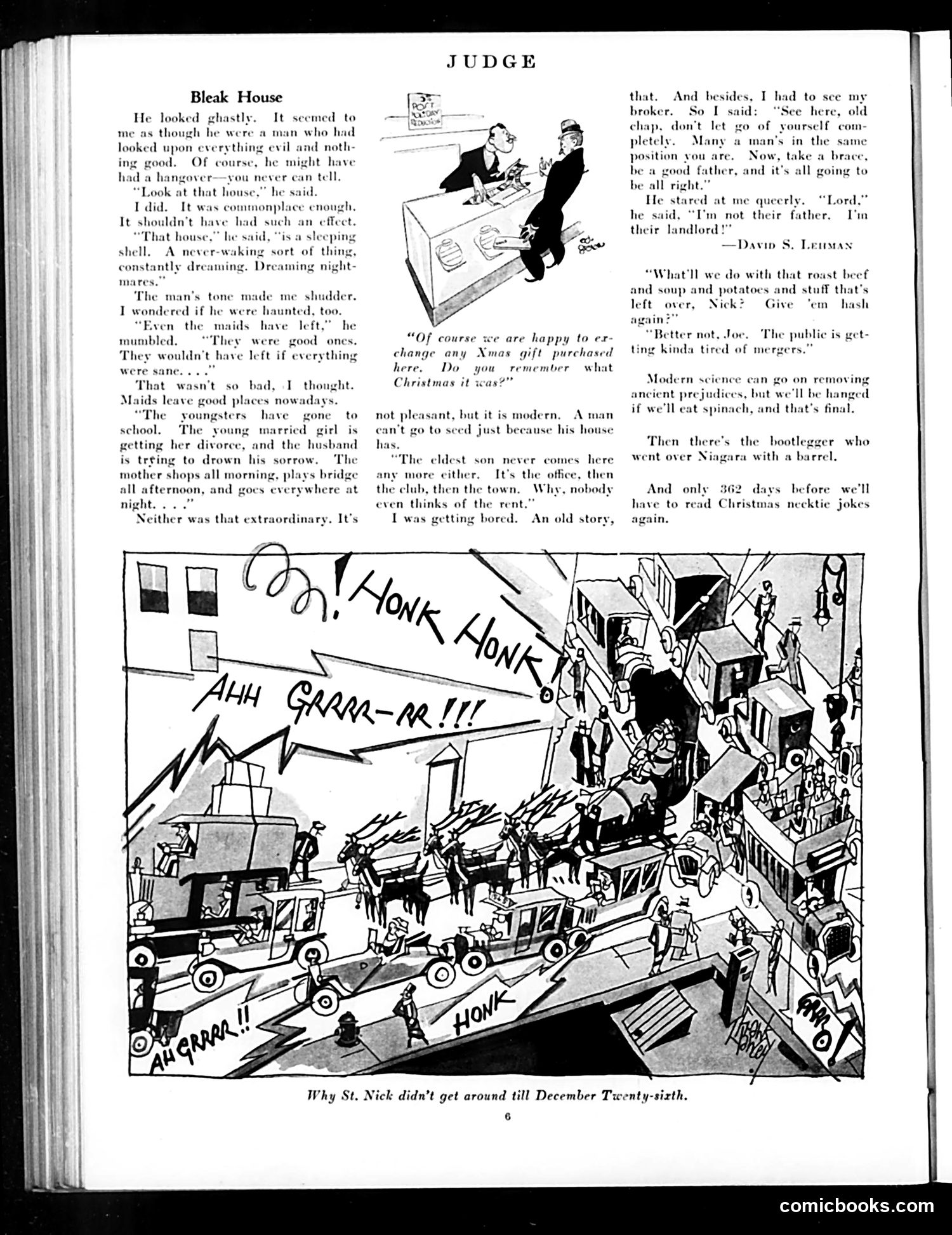
Analysis of Judge Magazine Page This page contains a story titled "Bleak House" and a cartoon about St. Nick (Santa Claus). The Story: A man describes visiting a broker's office, finding it depressingly gloomy. He reflects on how servants leaving good positions and modern domestic instability—young married women divorcing, mothers managing households alone—have made homes bleaker. He's bored by an "old story" about tenants not paying rent. The Cartoon: Depicts St. Nick struggling through a chaotic, noisy city street filled with traffic, horns, and crowds on December 26th. The caption jokes that Santa "didn't get around till December Twenty-sixth." The Satire: Both pieces critique modern urban/domestic life as increasingly dysfunctional—servants abandoning households, family instability, and city congestion making even Christmas deliveries impossible. The humor targets early 20th-century anxieties about societal decline and modern chaos disrupting tradition.
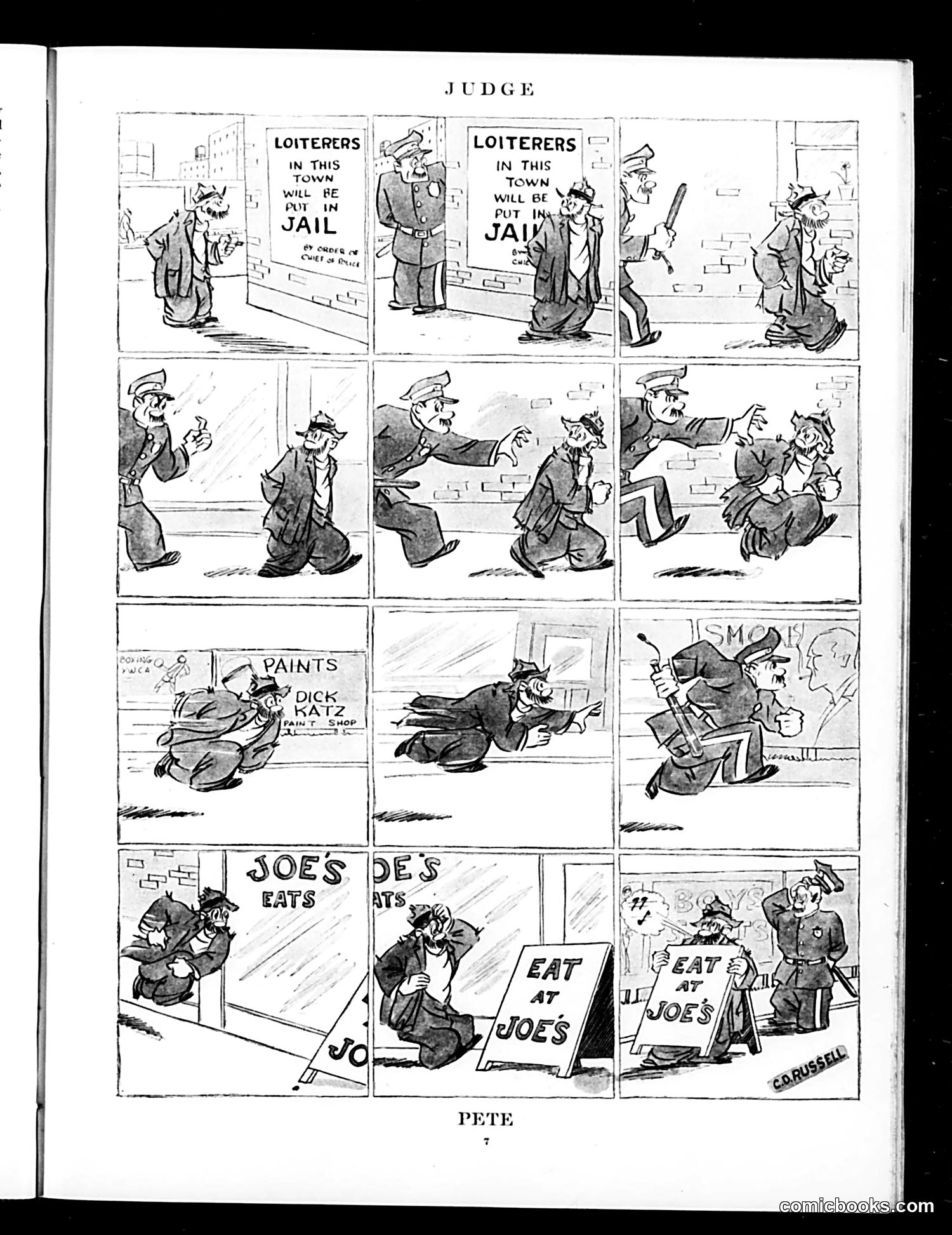
Analysis of "Pete" Comic Strip This comic strip satirizes law enforcement's selective enforcement of loitering laws. A judge posts warnings that loiterers will be jailed, but then is shown pursuing someone through town—apparently the judge himself is loitering or behaving disruptively. The figure flees past a "Paints & Dyes Katz" shop, then crashes into "Joe's" restaurant where the final panels show the judge among other patrons eating at Joe's establishment. The satire points to hypocrisy: authorities threatening ordinary citizens with jail for loitering while apparently exempt from the same rules themselves. The judge's undignified chase and tumble suggest his authority is undermined by his own behavior—he cannot credibly enforce laws he violates. This reflects broader Progressive-era critiques of corrupt or hypocritical urban governance.
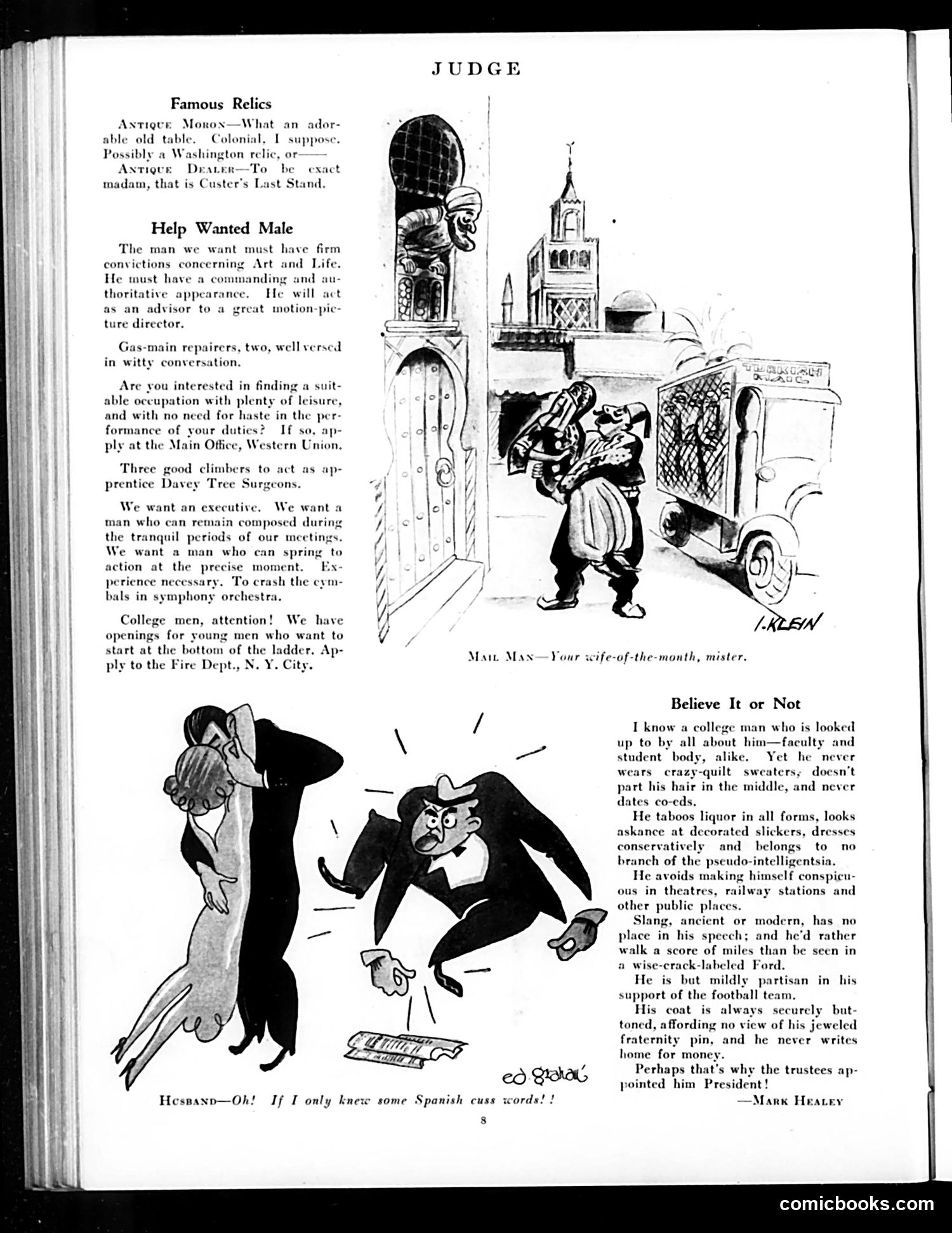
Judge Magazine Page Analysis This page contains satirical content mocking various social trends and conventions of the era (appears to be early 20th century). The "Famous Relics" exchange jokes about antique dealers misidentifying items—a woman mistakes a table for a Colonial Washington artifact, only to learn it's actually "Custer's Last Stand," humorously treating the famous military defeat as furniture. The "Help Wanted Male" section satirizes absurd job postings, including positions for "gas-main repairers" skilled in witty conversation and symphony cymbal-crashers requiring "experience"—mocking employers with ridiculous or contradictory qualifications. The "Mail Man" cartoon depicts a domestic dispute with slapstick violence, titled "Your wife-of-the-month, mister"—likely satirizing infidelity or casual attitudes toward marriage. The "Husband" cartoon shows a man seeking Spanish curse words, presumably to argue with someone. The "Believe It or Not" column ironically describes an exemplary college man who breaks all contemporary youth stereotypes (no wild sweaters, no drinking, no flashy behavior, conservative dress)—concluding that his very *normalcy* is what got him appointed college president, mocking both student excess and administrative hypocrisy.
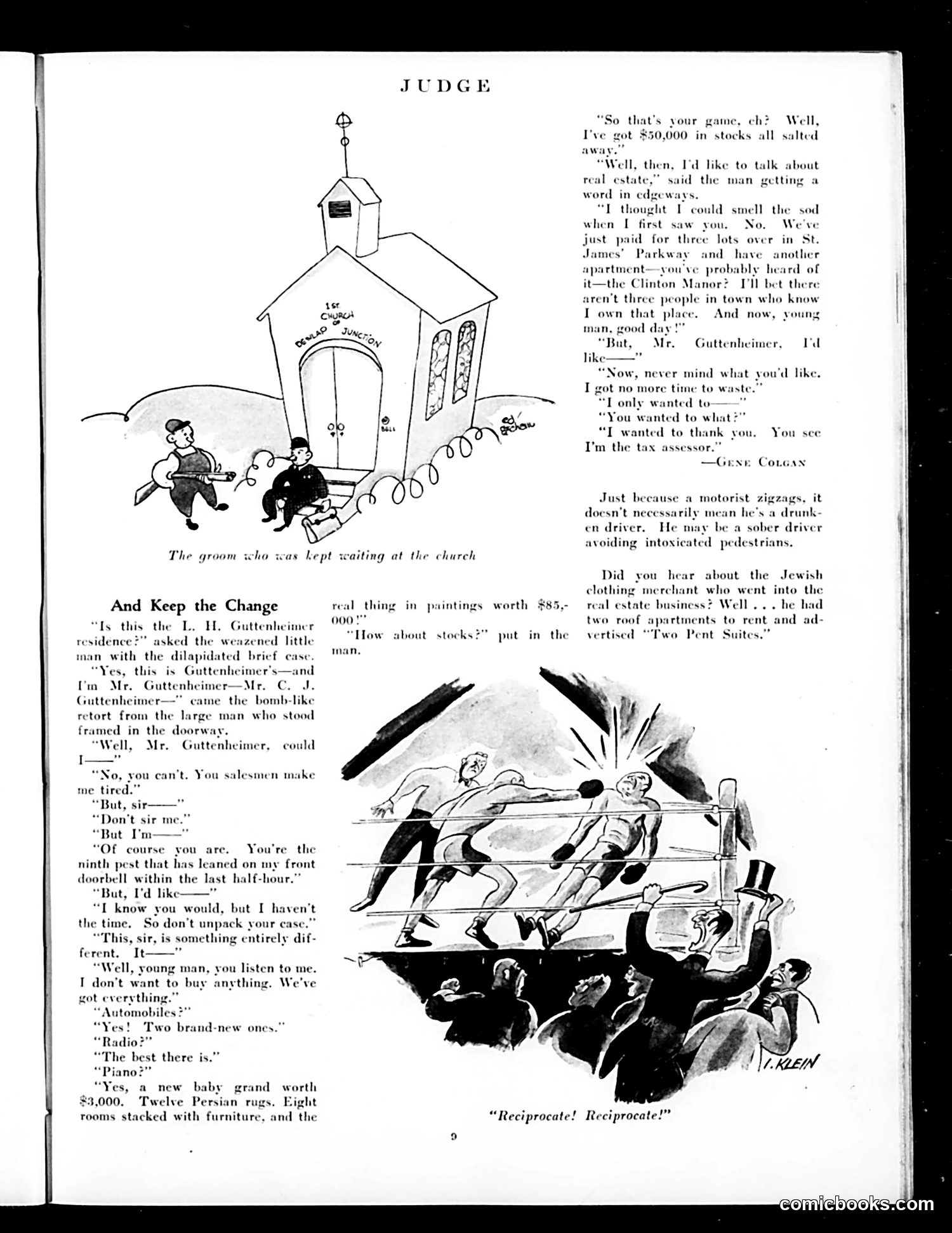
Analysis for Modern Readers This page contains two satirical pieces about wealth and materialism in early 20th-century America. "And Keep the Change" depicts a wealthy businessman (L.H. Guttenheimer) rudely rejecting a salesman at his door. The joke's twist: the "salesman" is actually the tax assessor trying to thank Guttenheimer—implying the man brags about his possessions (stocks, real estate, art) to everyone *except* the one person who matters: the tax collector. The satire mocks nouveau-riche boastfulness and tax evasion. The lower cartoon (titled "Reciprocate! Reciprocate!") shows a car accident with multiple people being thrown about, satirizing reckless driving. The accompanying text argues that zigzagging drivers aren't necessarily drunk—they may be sober drivers *avoiding* intoxicated pedestrians, reversing blame. The Jewish merchant joke stereotypes Jewish businessmen as shrewd but incompetent at ventures outside their traditional clothing trade (advertising "Pent Suites" instead of "Penthouses"). All three pieces reflect period attitudes toward wealth, driving safety, and ethnic stereotypes.
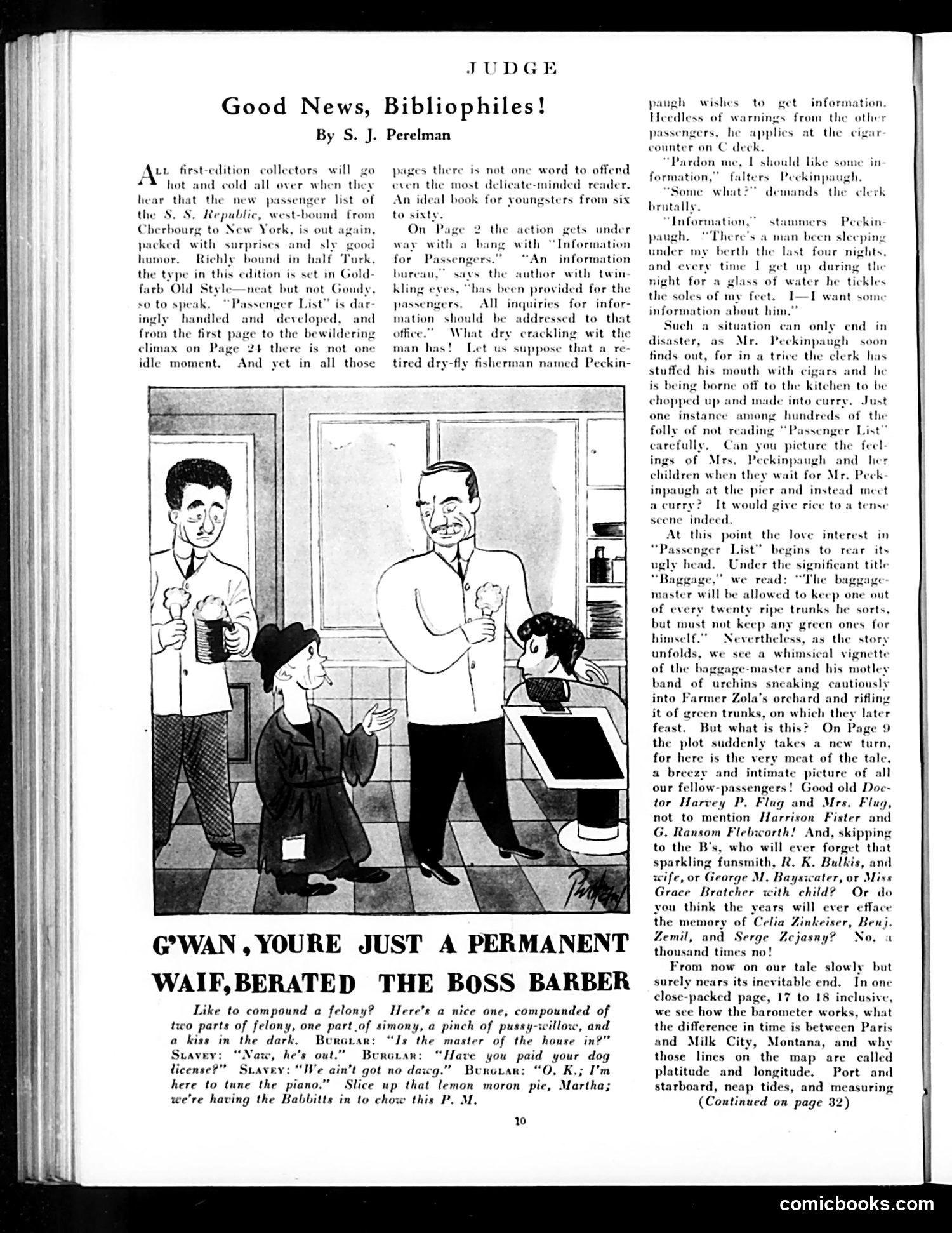
Explanation for Modern Readers This is a humorous book review by S.J. Perelman satirizing a fictional passenger list from the S.S. Republic cruise ship. The joke mocks the mundane tedium of such documents—supposedly an "ideal book for youngsters" despite containing nothing objectionable. The cartoon illustrates the absurd consequences: a passenger named Peckinpaugh innocently requests information from a clerk, only to have his mouth stuffed with cigars and be hauled to the kitchen to be made into curry. This darkly comic escalation mocks both the uselessness of the passenger list and the cruelty of trying to seek help aboard ship. Perelman names fictional passengers (Harvey P. Flug, Harrison Fister, R.K. Bulkis, etc.) to parody how tedious such lists are. The review's breathless enthusiasm about mundane details—the barometer explanation, time zone differences—further satirizes the absurd appeal of bureaucratic documents masquerading as entertainment. The piece is vintage Perelman: surreal, witty, and mocking middle-class publishing conventions.
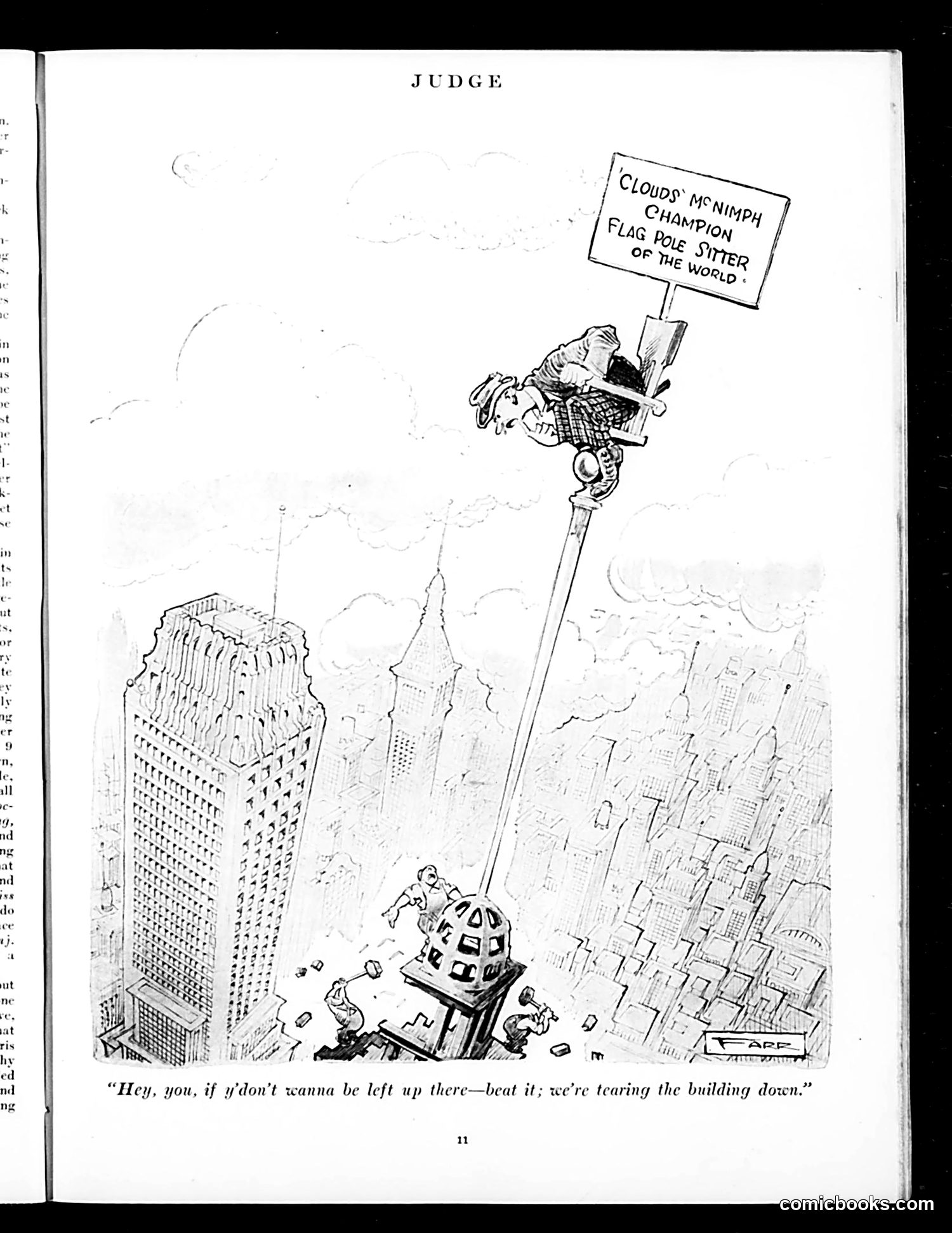
Analysis This political cartoon satirizes an absurdly ambitious real estate development project in an urban setting. At the cartoon's center, a figure atop a tall flagpole plants a banner reading "CLOUDS' McNIMPH CHAMPION FLAG POLE SITTER OF THE WORLD"—referencing the 1920s fad of flagpole sitting, where daredevils competed to sit atop poles for extended periods for publicity and prize money. Below, workers are literally dismantling a building to clear space for development. The caption's dark humor—"Hey, you, if you don't wanna be left up there—beat it; we're tearing the building down"—mocks both the flagpole sitter's obliviousness and aggressive urban development that destroys existing structures without concern for inhabitants. The satire critiques unchecked development ambitions and the era's obsession with publicity stunts.
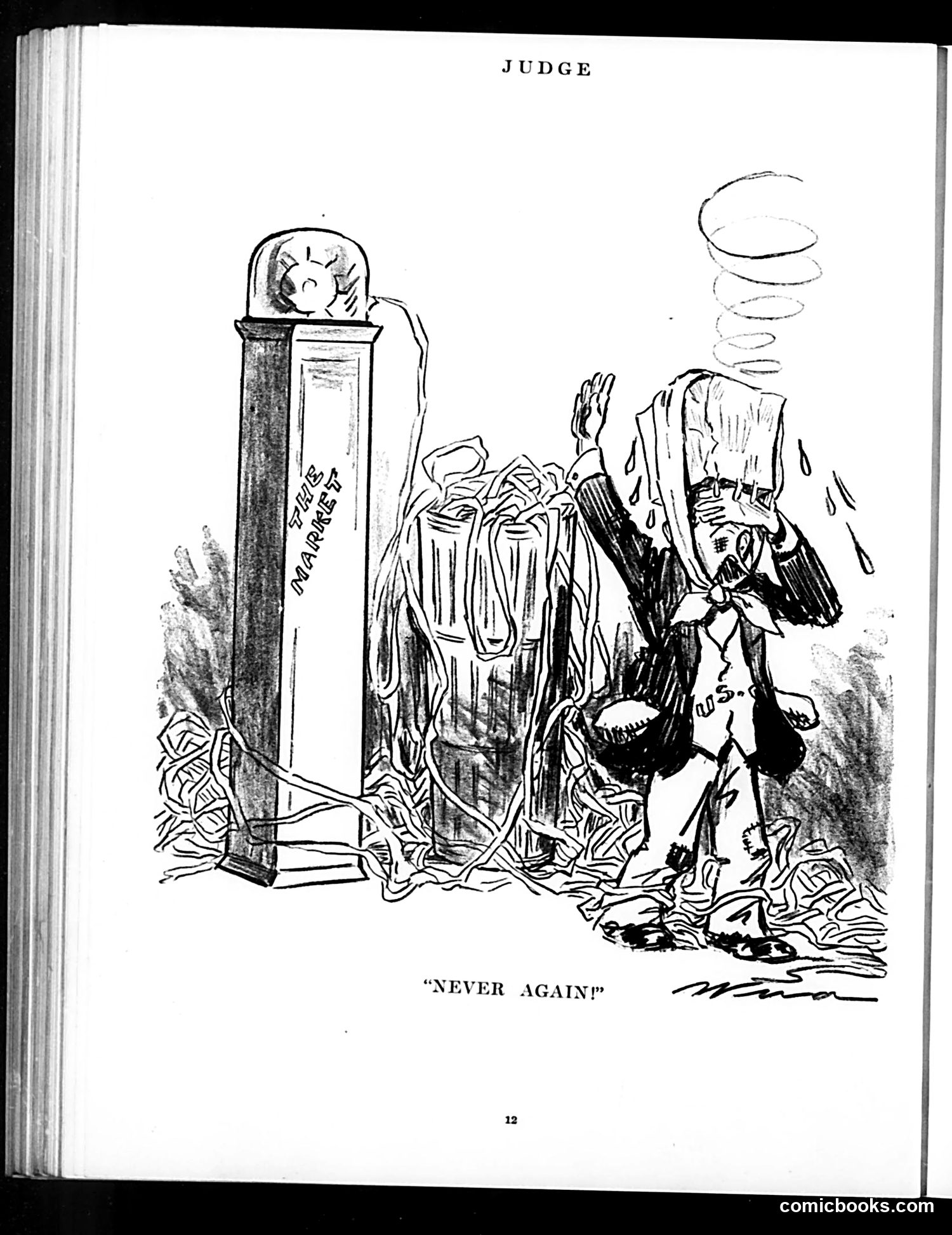
Political Cartoon Analysis: "Never Again!" This Judge magazine cartoon depicts a figure in judicial robes seated atop a tall pedestal labeled "IMPARTIALITY," surrounded by tangled rope or cord. Another robed figure stands nearby with raised hands, appearing distressed or exasperated, with a thought bubble above their head. The title "Never Again!" suggests protest against judicial overreach or a controversial court decision. The pedestal labeled "Impartiality" implies criticism that judges have abandoned neutrality. The tangled cords may represent complications or entanglement in legal proceedings. Without the publication date visible, the specific case or controversy remains unclear. However, the cartoon satirizes what the cartoonist views as judges compromising their impartial role—likely responding to a high-profile judicial ruling the magazine opposed.
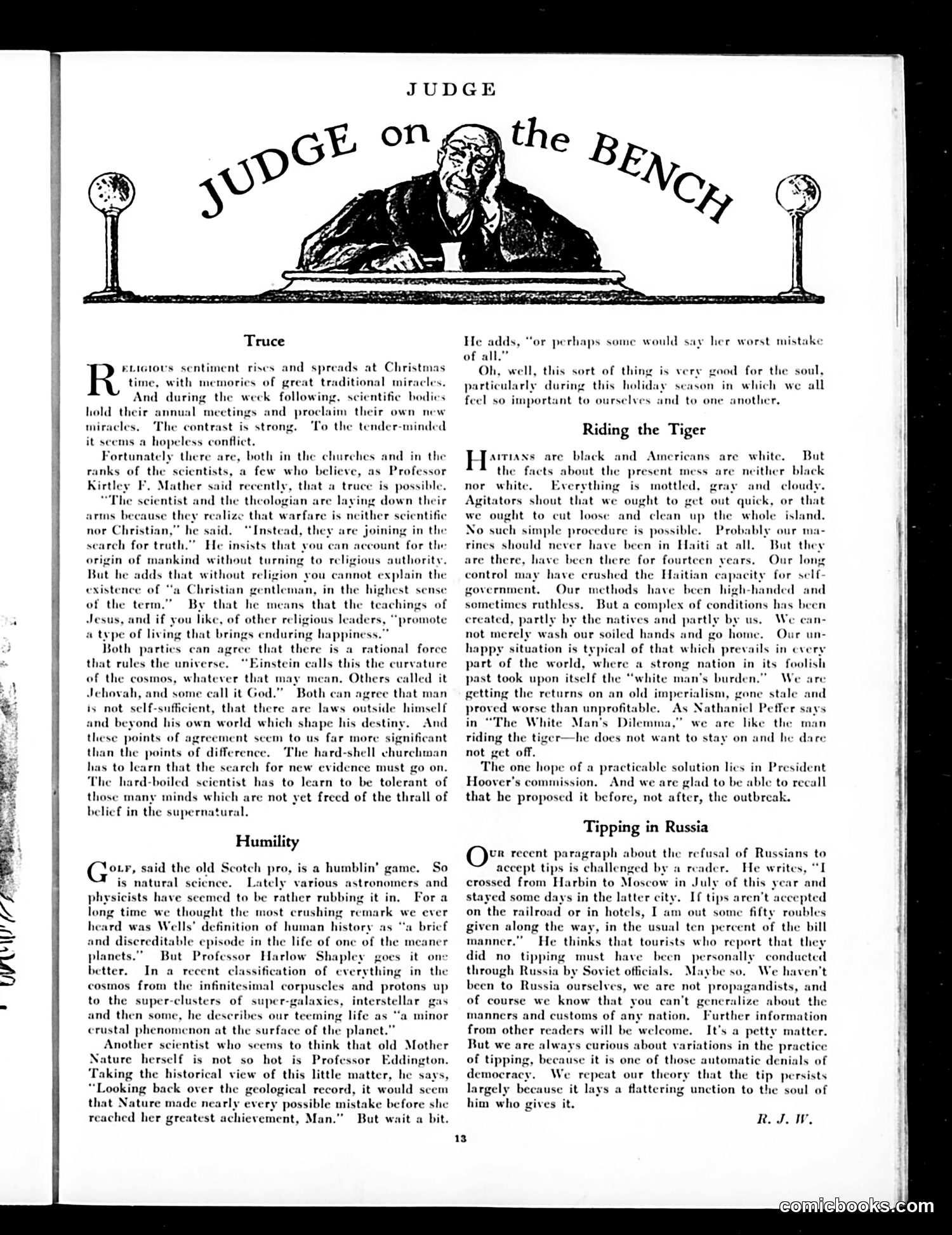
Judge Magazine Page Analysis This page contains three editorial essays under the "Judge on the Bench" masthead, addressing contemporary issues circa 1920s-1930s. "Truce" argues for reconciliation between religious and scientific worldviews, citing Professor Mather's view that both can coexist. It advocates for mutual tolerance—churches accepting new evidence, scientists respecting spiritual belief. "Humility" satirizes scientists' recent cosmic discoveries (likely referencing Shapley and Eddington's work on the universe's scale) that diminish humanity's significance. The piece notes this humbling perspective is actually spiritually healthy, despite making humans feel small. "Riding the Tiger" discusses American intervention in Haiti. The author argues against simplistic solutions—either immediate withdrawal or aggressive intervention—noting the U.S. has created complex conditions over fourteen years that cannot be easily resolved. It's presented as symptomatic of broader imperial entanglements worldwide where disengagement isn't straightforward. All three pieces reflect Progressive-era intellectual debates about science, religion, and American foreign policy.
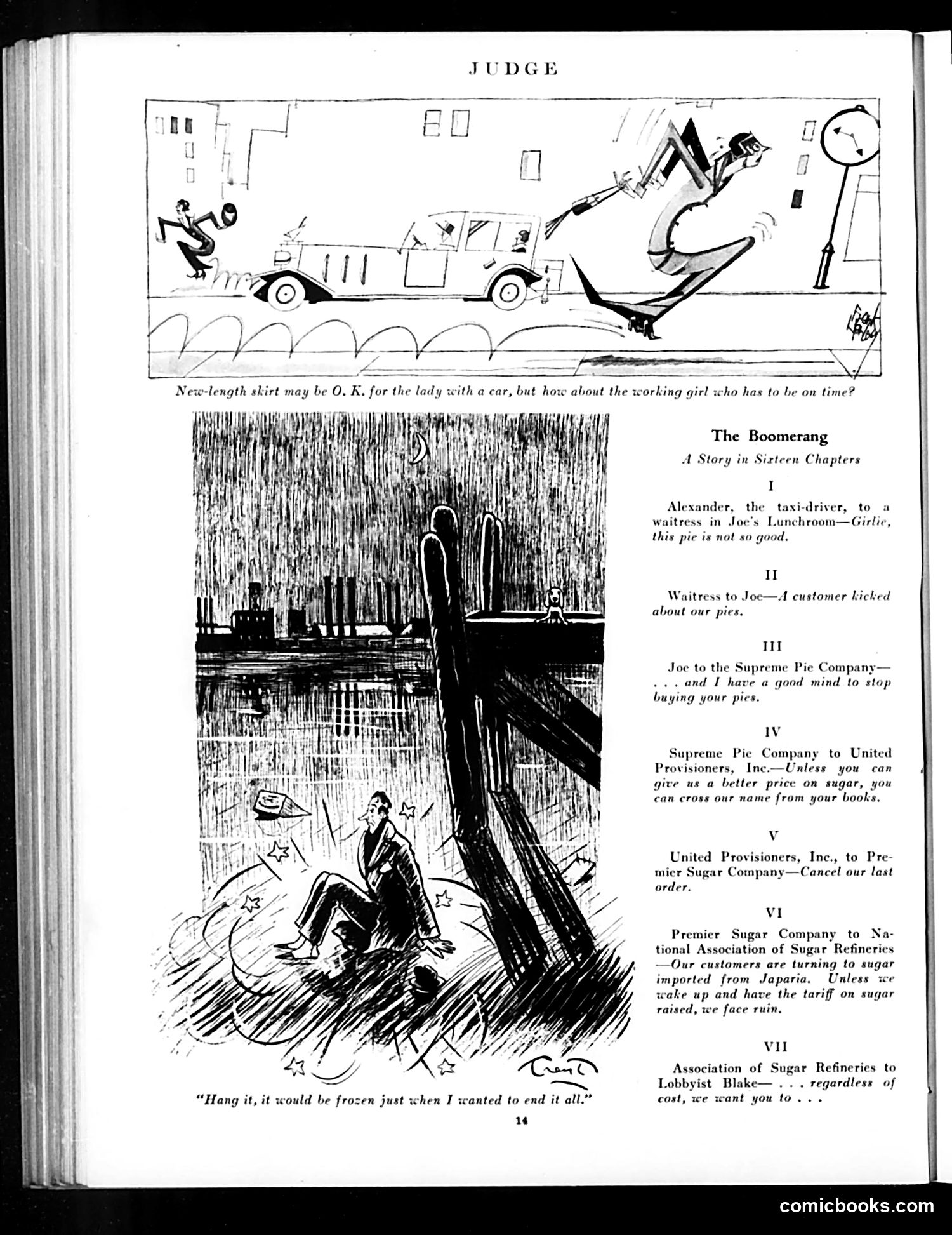
Political Satire Analysis The top cartoon satirizes women's fashion trends—specifically shorter skirts—by highlighting class disparity. While wealthy women with cars could afford impractical clothing, working-class women (like waitresses) needed practical attire to stay punctual for jobs. "The Boomerang" is a multi-panel satirical narrative about unintended consequences in business. A taxi driver's casual complaint about pie quality triggers a chain reaction: the diner reduces orders from suppliers, who demand cheaper sugar from their sources, who cancel orders, prompting sugar refiners to lobby for tariff protection against Japanese imports. The satire critiques how minor complaints cascade through economic systems and how industries use tariff arguments (protecting jobs/prices) to serve corporate interests rather than consumer welfare. The "boomerang" returns to potentially harm the original complainer through higher prices or economic disruption.
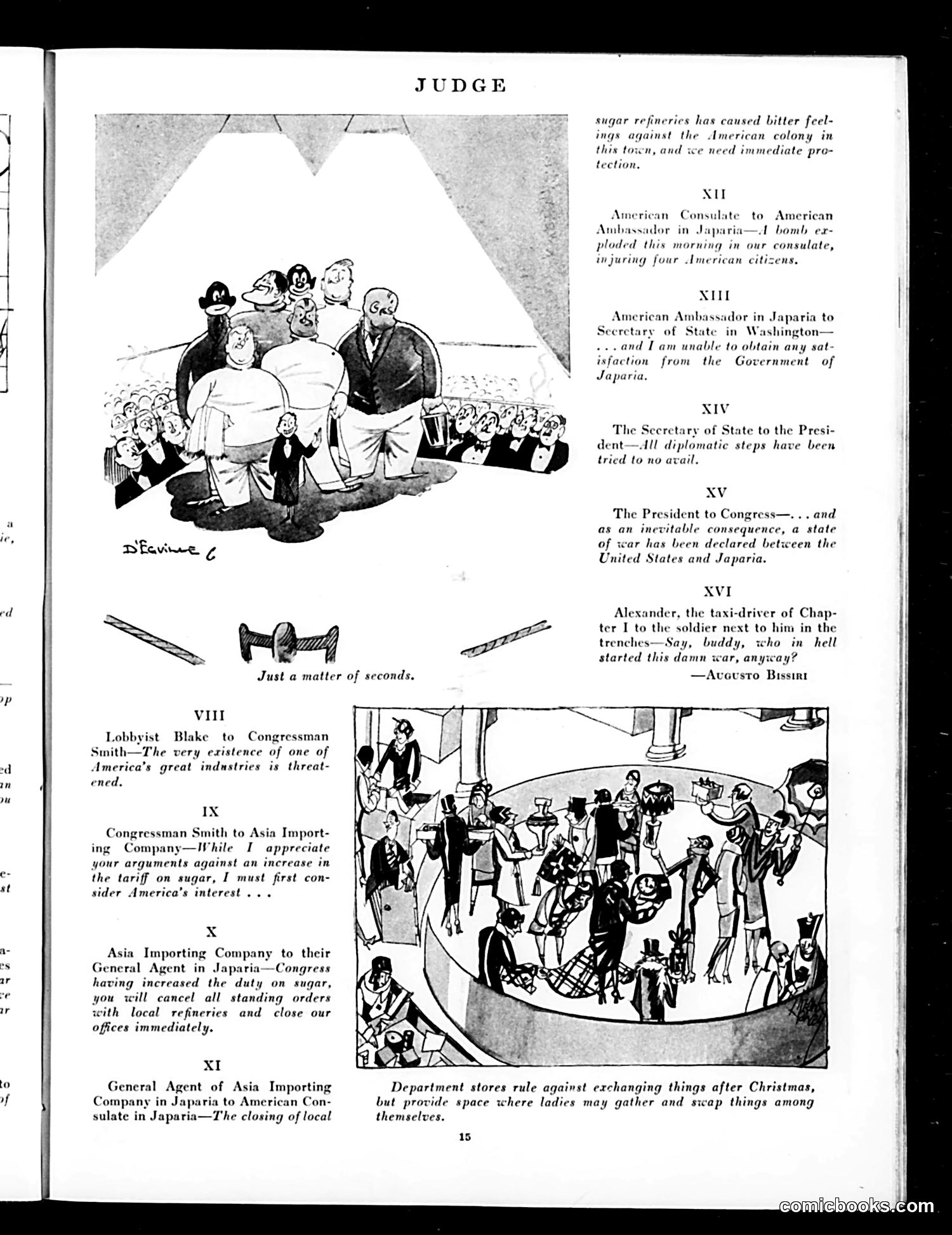
Judge Magazine Political Cartoon Analysis This page satirizes how commercial interests trigger international conflict. The sequence traces a chain reaction: A sugar tariff dispute between American business interests and Congress (sections VIII-X) leads the Asia Importing Company to cut ties with local Japanese refineries. This economic damage causes resentment in Japan, escalating to a consulate bombing and ultimately to war between the U.S. and "Japaria" (sections XII-XV). The final punchline (section XVI) reveals the satire's target: an ordinary soldier—"Alexander the taxi-driver"—fighting in trenches, unaware that his war stems from a minor commercial dispute orchestrated by lobbyists and congressmen prioritizing business profit over peace. The cartoon criticizes how corporate lobbying and protectionist tariffs, pursued by politicians for narrow economic gain, can precipitate unnecessary wars that ordinary citizens must fight and die in. The critique extends to how disconnect exists between those making policy decisions and those bearing the human costs.
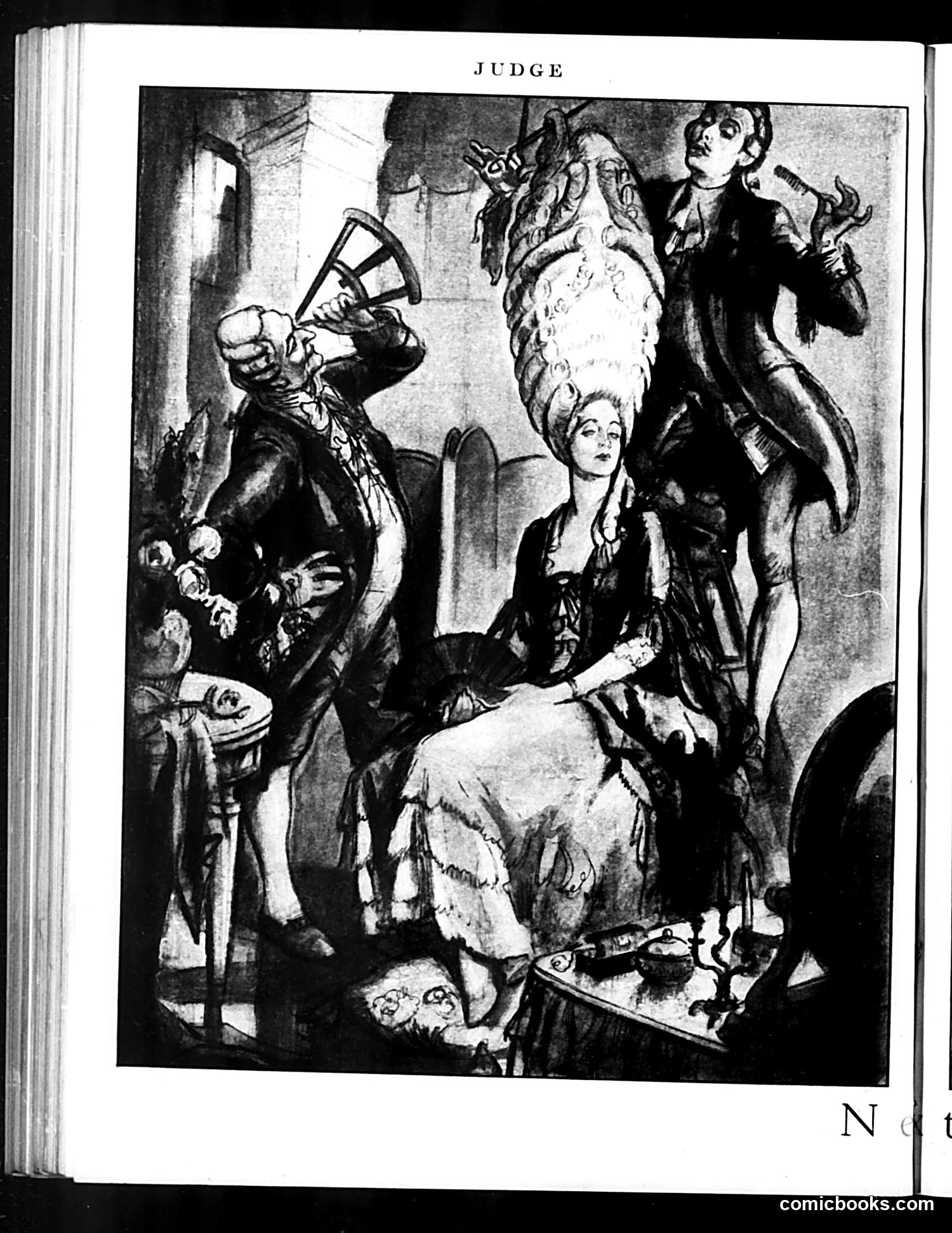
Judge Magazine Cartoon Analysis This appears to be a satirical courtroom scene titled "JUDGE." The image depicts what seems to be a legal proceeding with several figures in 18th or early 19th-century dress. A woman in elaborate clothing with a distinctive tall headdress sits centrally, appearing to be on trial or under judgment. Men in formal attire and wigs surround her—one gestures dramatically with what appears to be a gavel or judicial implement. The satire likely comments on a specific high-profile legal case or social scandal of the era, though without additional context or visible OCR text, I cannot identify the specific figures or precise historical reference. The theatrical composition and exaggerated poses suggest mockery of judicial proceedings or public morality trials common to the period Judge magazine covered.
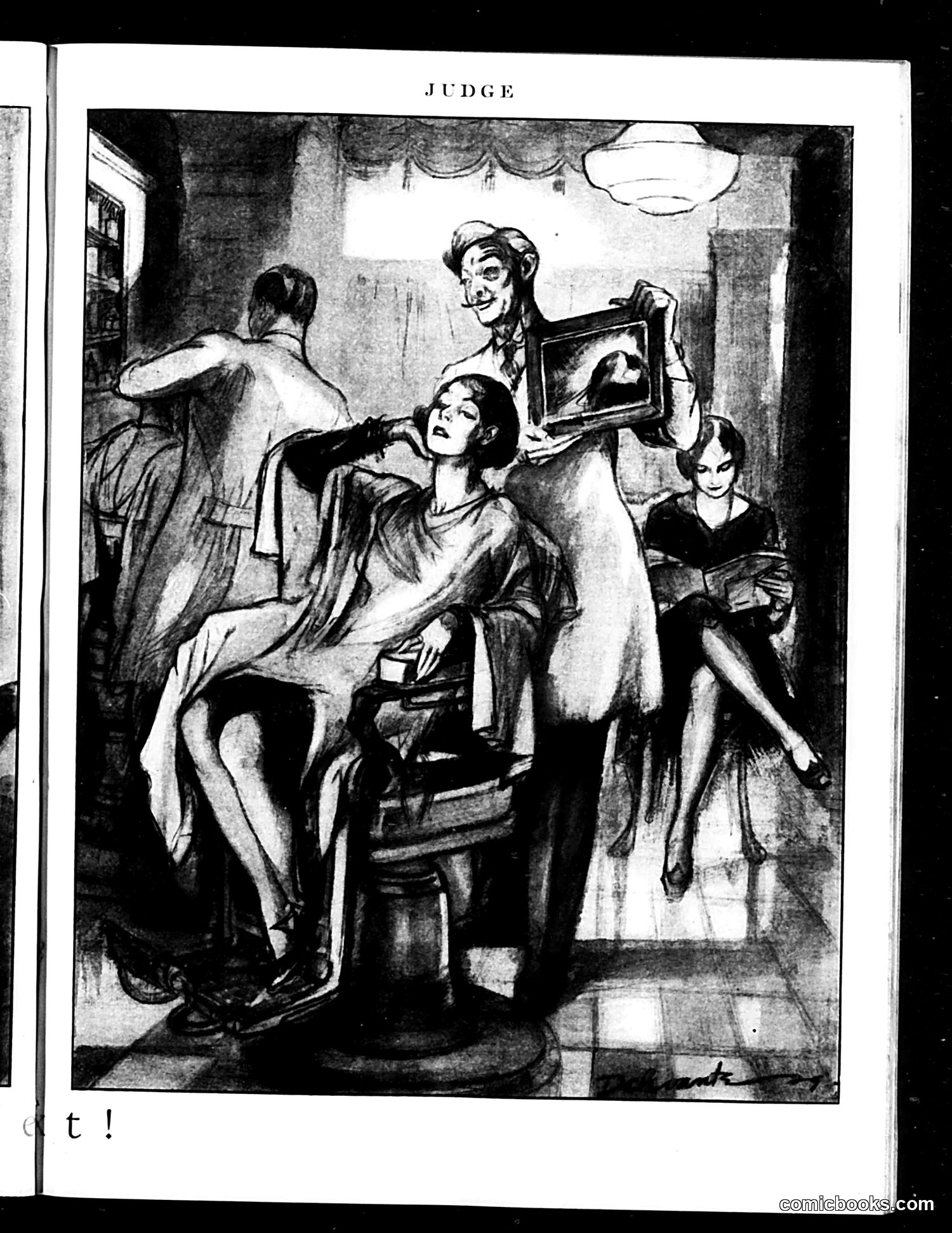
Judge Magazine Cartoon Analysis This appears to be a satirical cartoon titled "Judge" depicting a domestic scene. The image shows what seems to be an art dealer or con artist (the grinning man in the center-back holding a painting) presenting to a seated woman, while other figures observe. The composition suggests social satire about art appreciation or possibly art fraud—a common Judge magazine theme. The woman's upward gaze and the dealer's exaggerated smile suggest mockery of either pretentious art collecting or gullibility. The other onlookers' reactions reinforce this comedic critique. Without clearer text or dated context, the specific historical reference remains unclear, though the scene appears to satirize early 20th-century upper-class art market pretension or deception.
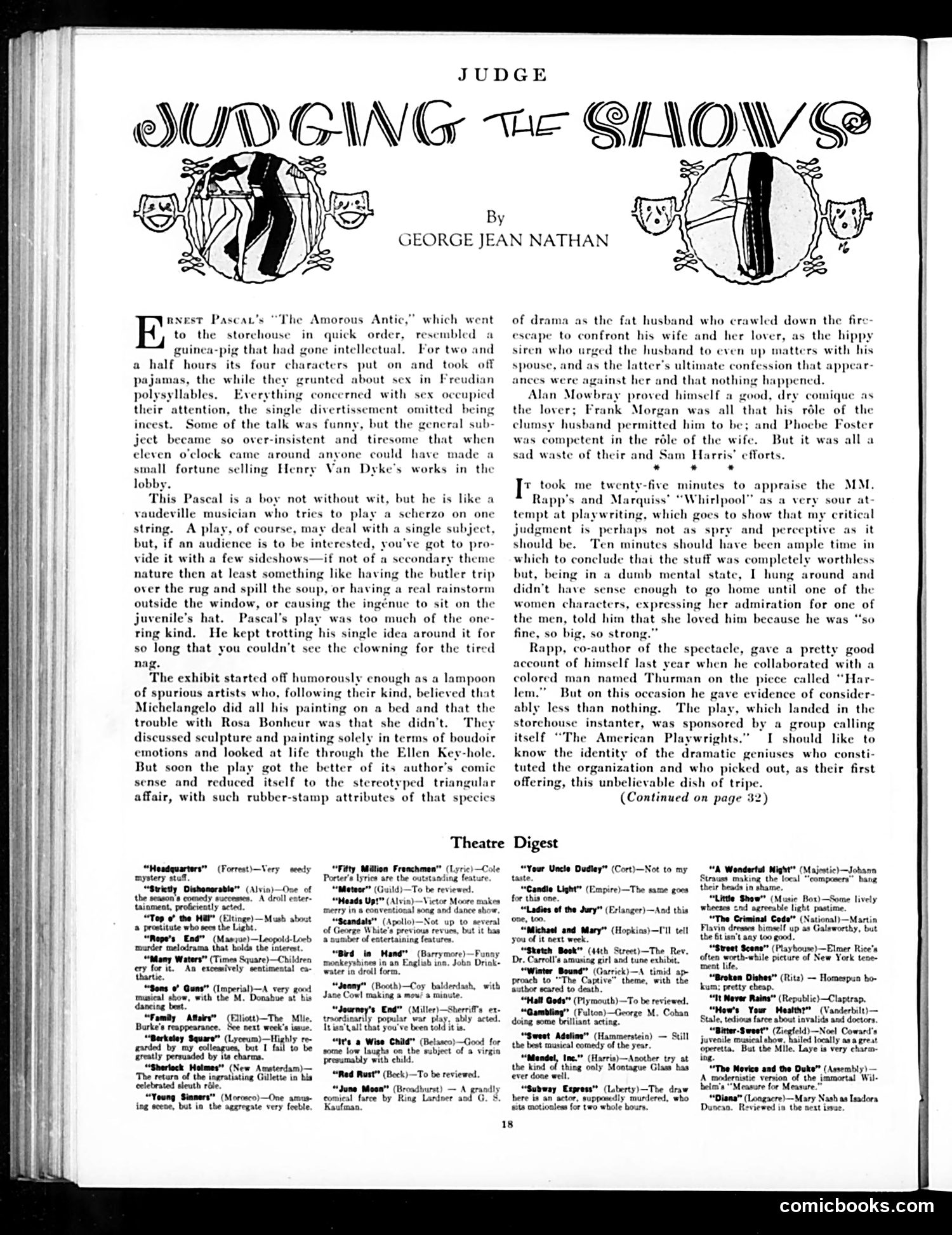
Judge Magazine Theater Review This page contains George Jean Nathan's theater criticism for Judge magazine. The main illustrated article reviews Ernest Pascal's play "The Amorous Antic," a sex-obsessed comedy that Nathan finds tediously one-note—comparing it to a vaudeville musician playing the same tired act repeatedly. Nathan criticizes the play for lacking variety and diversion, arguing that even single-subject plays need "sideshows" to maintain audience interest. He mocks its pretentious artistic characters who discuss painting and sculpture only in sexual terms, then devolves into a predictable romantic triangle with stereotyped characters. The review praises supporting actors Alan Mowbray and Frank Morgan but concludes the material itself is worthless—a criticism that, notably, Nathan admits took him an embarrassingly long time to recognize. The "Theatre Digest" section below lists contemporary Broadway shows with brief assessments, typical of Judge's entertainment coverage during this era (appears to be 1920s).
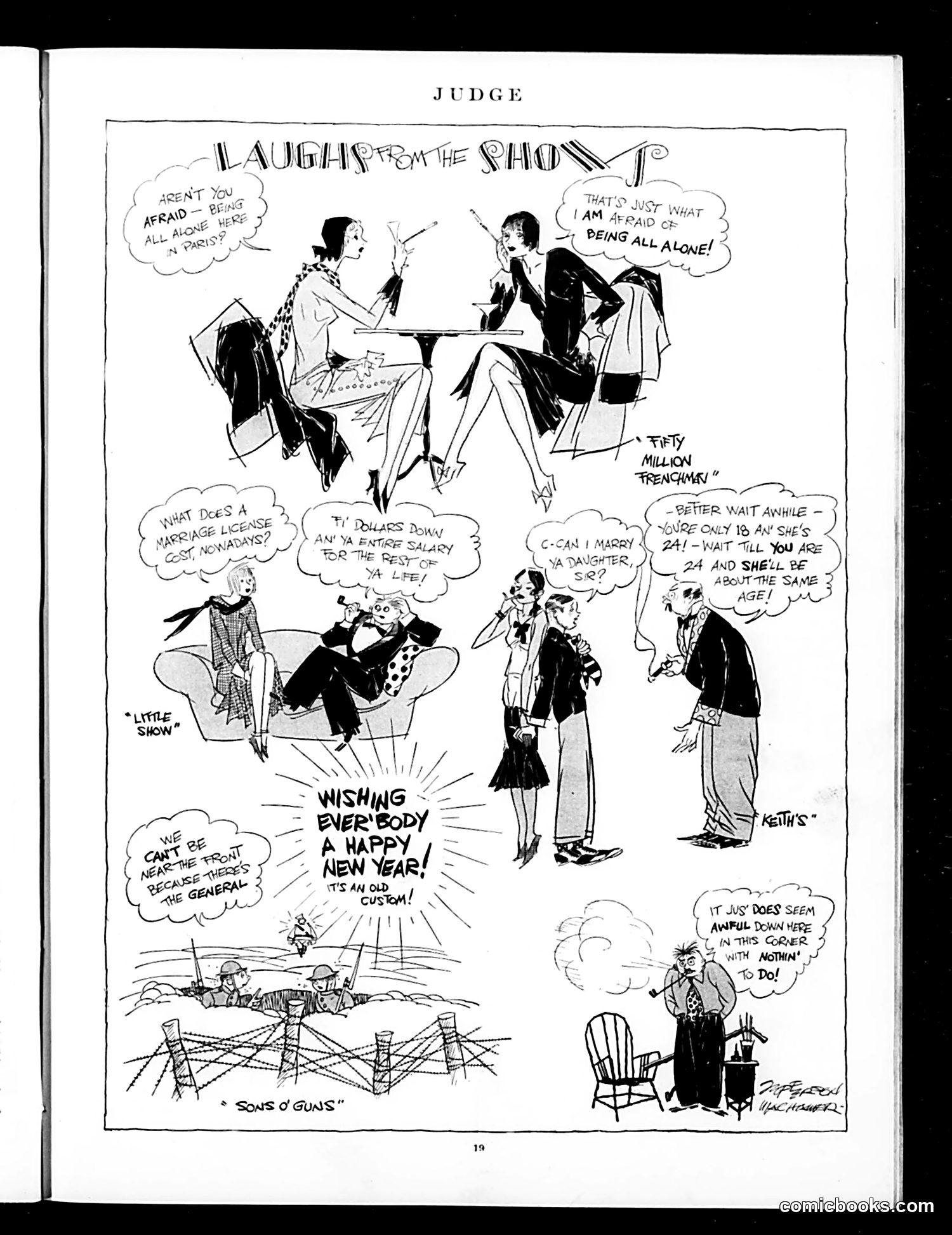
"Laughs from the Sad" — Judge Magazine Cartoon This satirical cartoon presents contrasting New Year's wishes across social classes. The top panel shows wealthy socialites discussing marriage prospects and "fifty million trenchant" wealth, embodying frivolous upper-class concerns. Below, working-class and military figures express grimmer sentiments: soldiers in trenches wishing for survival, a struggling family unable to afford basic needs, and an elderly person lamenting economic hardship. The satire criticizes the disconnect between the privileged elite—obsessed with marriageable daughters and financial status—and ordinary citizens facing poverty and wartime suffering. The titled centerpiece ("Wishing Everybody a Happy New Year!") ironically underscores this disparity. This likely dates to the World War I era, when Judge frequently contrasted wealthy indifference with public hardship. The cartoon's pointed irony suggests the "sad" laughs are those of the struggling majority.
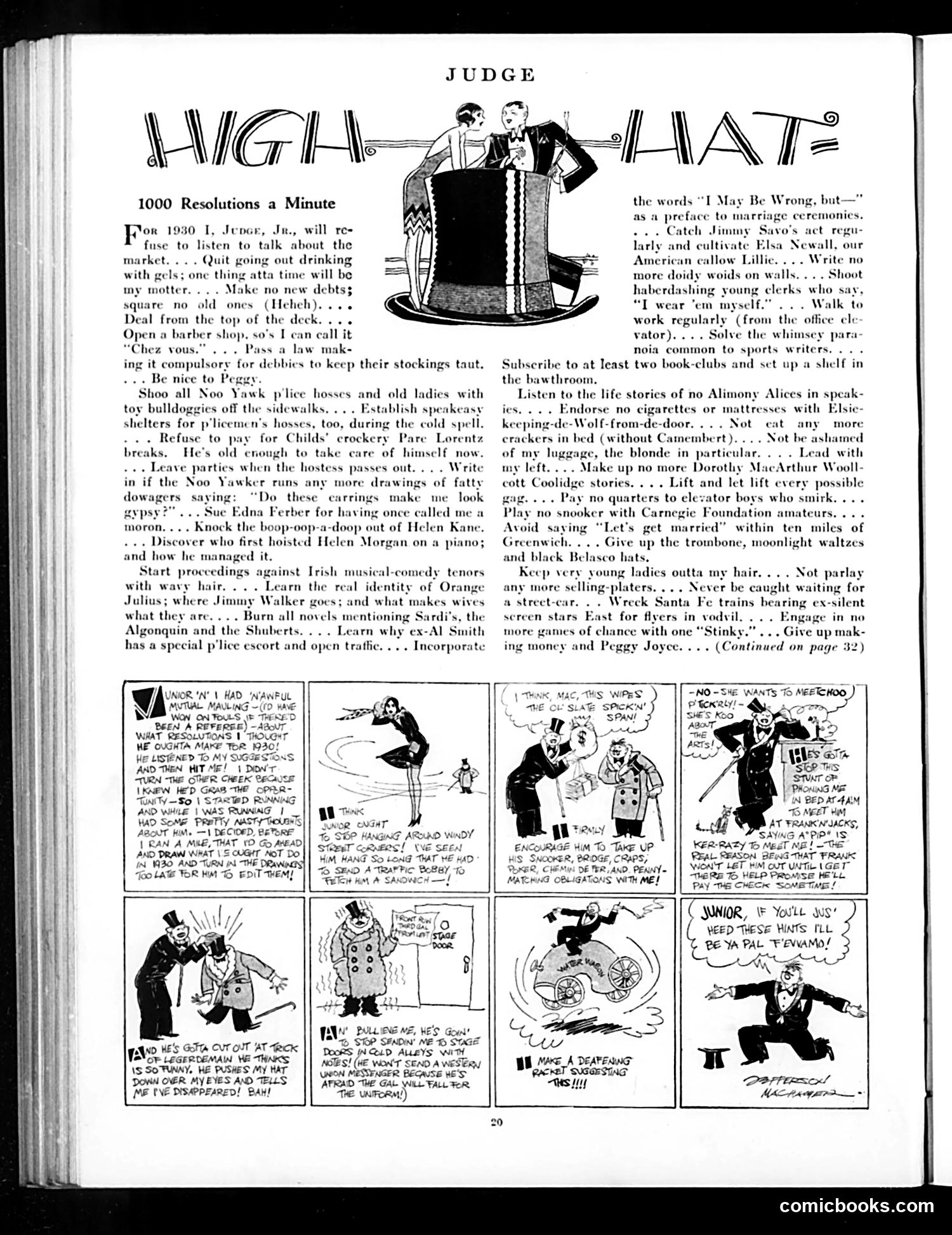
Judge Magazine: "High Hat" - 1000 Resolutions a Minute This page satirizes New Year's resolutions for 1930, presented as humorous "resolutions" a Judge editor supposedly makes. The left column lists absurd pledges (stop drinking, open a barber shop, refuse to listen to market talk) mixed with celebrity references (Jimmy Savo, Helen Morgan) and insider literary/theatrical jokes about 1920s Manhattan culture. The comic strips below depict a comedic conflict between "Junior" and an older man, apparently about boxing and pranks. Junior recounts poorly executed "resolutions" involving physical comedy—the older man pulling pranks (pushing his hat over his eyes, leading him into alleys), Junior retaliating. The final panel shows Junior proudly announcing he'll need hints to maintain promised good behavior. The satire targets upper-class New Yorkers' shallow, quickly-abandoned resolutions and the era's theatrical/literary celebrity gossip. Without specific dates or names visible, the exact identities of referenced figures remain unclear, though the tone suggests well-known 1920s personalities.
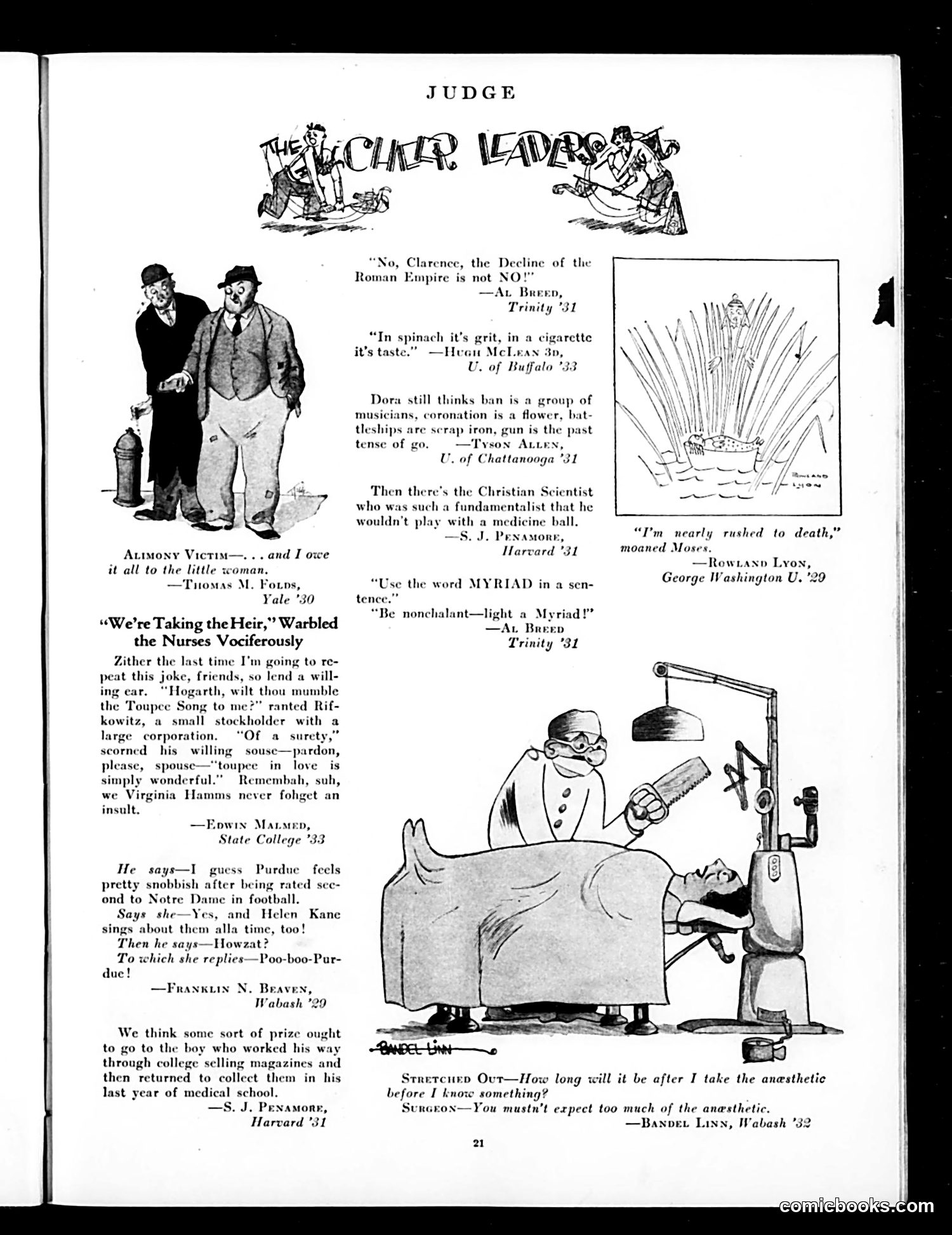
Judge Magazine Page Analysis This page from Judge magazine contains humorous submissions from college students (indicated by school attributions like Yale '30, Trinity '31, etc.). The content is primarily college humor—jokes about student life, relationships, and observations. Key elements: Left side: Jokes about alimony/marriage ("Alimony Victim"), college romance, and Purdue-Notre Dame football rivalry (the "Poo-boo-Purdue" joke). Right side: A cartoon showing a patient under anesthesia for surgery, with a joke about anaesthetics being ineffective at producing actual knowledge or improvement—a commentary on the limitations of medical science or a jab at the patient's intelligence. Top quotes: Brief witticisms mocking various targets: the "Decline of the Roman Empire" as classroom debate material, spinach/cigarette texture observations, and a Christian Scientist who won't use medicine. The page reflects 1930s college student sensibility—satirizing academics, romance, social pretension, and emerging medical practices. The humor is gentle, self-deprecating college-boy material rather than sharp political commentary.
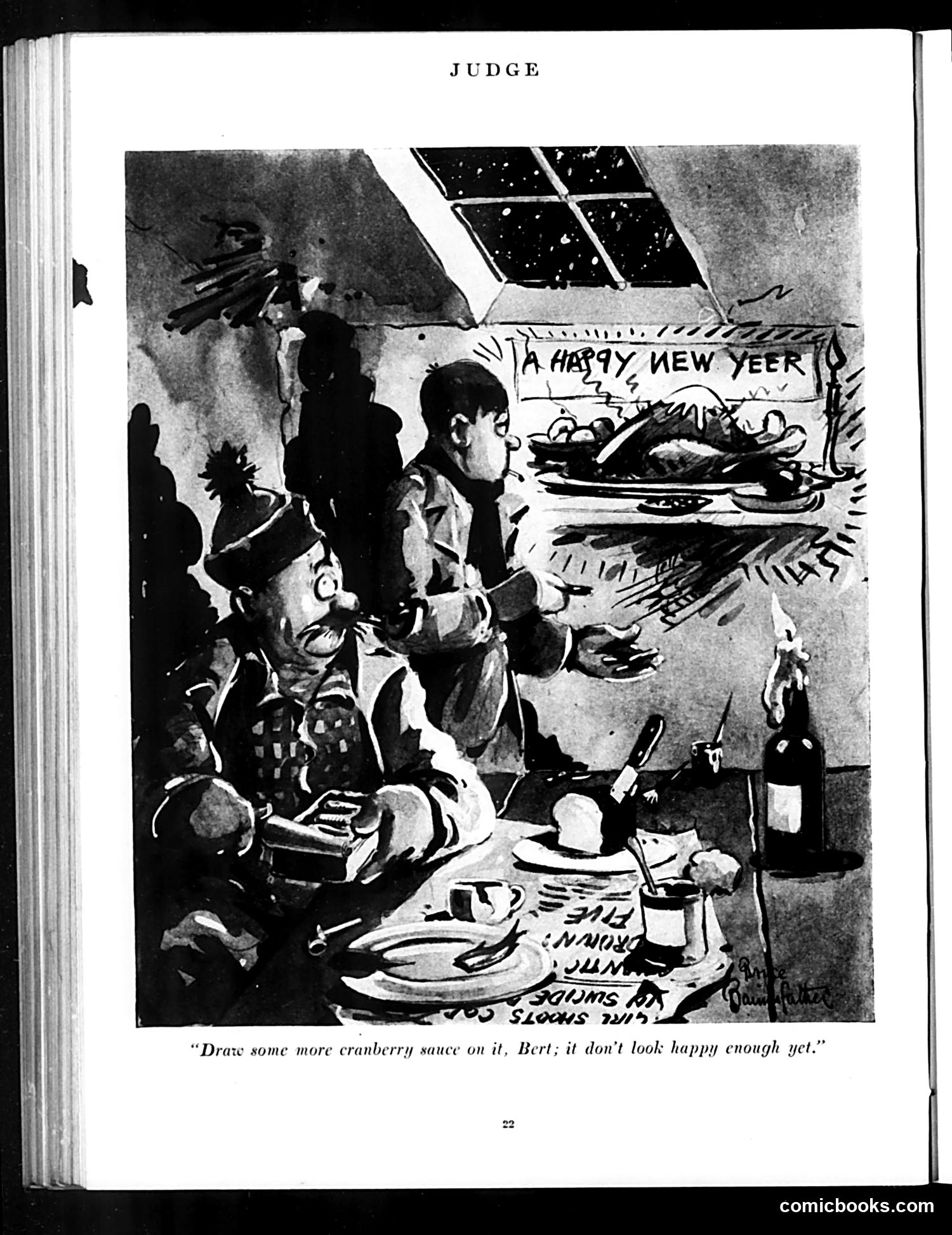
Analysis This is a single-panel cartoon satirizing New Year's celebrations, likely from the 1920s-30s based on the style. The scene depicts a dinner party with a "Happy New Year" banner visible through a window. The main figure (addressed as "Bert") is being asked to add more cranberry sauce to what appears to be a roasted turkey or similar holiday fowl to make the meal look more appetizing or festive. The satire appears to target the artificial cheerfulness expected during holiday celebrations—the need to artificially enhance appearances to create the right impression of happiness and abundance. The cartoon mocks how people go through elaborate motions to present an idealized holiday experience, even when the underlying reality may be less glamorous. The humor lies in treating food presentation as a performance rather than simple nourishment.
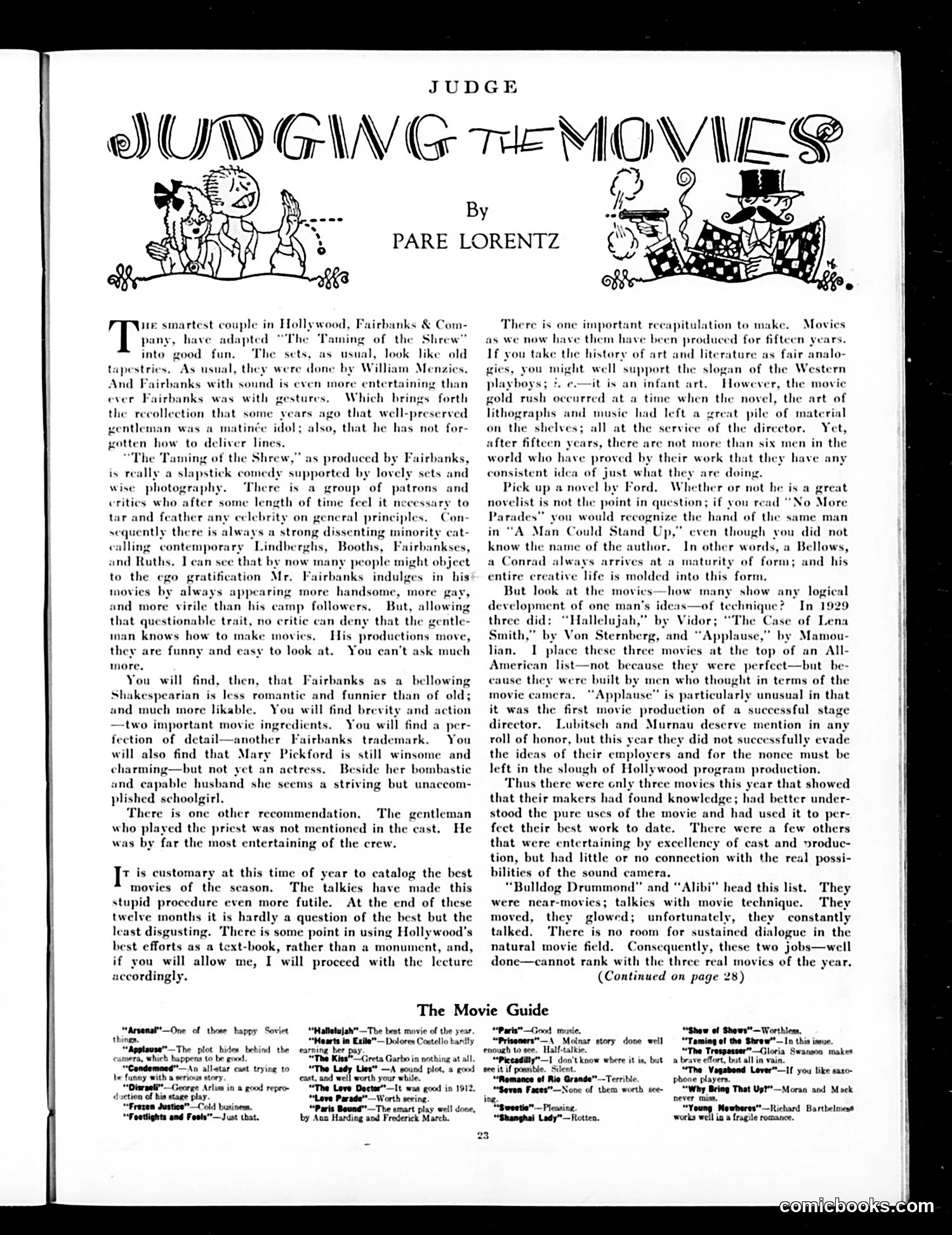
Judge Magazine: "Judging the Movies" by Pare Lorentz This is a film criticism essay, not a political cartoon. Lorentz reviews Douglas Fairbanks' sound-film adaptation of *The Taming of the Shrew* (likely the 1929 version with Mary Pickford). The argument: Movies are still an infant art form (only fifteen years old), yet Fairbanks demonstrates filmmaking competence through visual storytelling, pacing, and attention to detail. Lorentz praises Fairbanks' transition from silent-film star to sound-era performer, though he criticizes Pickford as an underdeveloped actress. The broader point: Lorentz laments that among thousands of films produced, only six directors show consistent artistic vision. He contrasts this with novelists like Ford and Conrad, whose individual style persists across works. Context for moderns: This reflects 1920s-30s debates about cinema's artistic legitimacy and whether Hollywood could produce sustained authorial vision—early film criticism establishing "auteur theory" decades before the French formalized it.
This page is not a cartoon or satirical content—it's a straightforward advertisement and announcement section from *Judge* magazine listing prize winners from a "Lenz Bridge Contest." The grand prize was a Ruxton automobile awarded to David Burnstine of New York City. Additional prizes listed include luxury items typical of 1920s-30s consumer goods: cruises, watches, furniture, radios, typewriters, and travel. Multiple winners are noted where ties occurred. The page serves as promotional content, showcasing desirable merchandise to *Judge*'s readership while announcing contest results. There is no satirical commentary, political reference, or cartoon humor present—it's purely informational advertising wrapped in the magazine's layout format.
Analysis This page contains no cartoon or satirical content—it is entirely a prize announcement list from Judge magazine's "Lenz Bridge Contest." The page announces winners of a bridge-playing competition organized by the magazine, divided into two difficulty levels ("Series of Eight Problems" and "Series of Four Problems"). Winners received merchandise prizes typical of the 1920s-30s era: steamship voyages on Cunard Line ships, radios, typewriters, watches, lamps, razors, and dinnerware. The prizes reflect middle-class aspirations of the period—international travel, modern electrical appliances, and luxury goods. The geographic distribution of winners (Cincinnati, Atlanta, Washington D.C., Massachusetts) suggests this was a nationally-advertised contest. This is essentially an advertising/results page, not editorial content requiring historical or political interpretation.
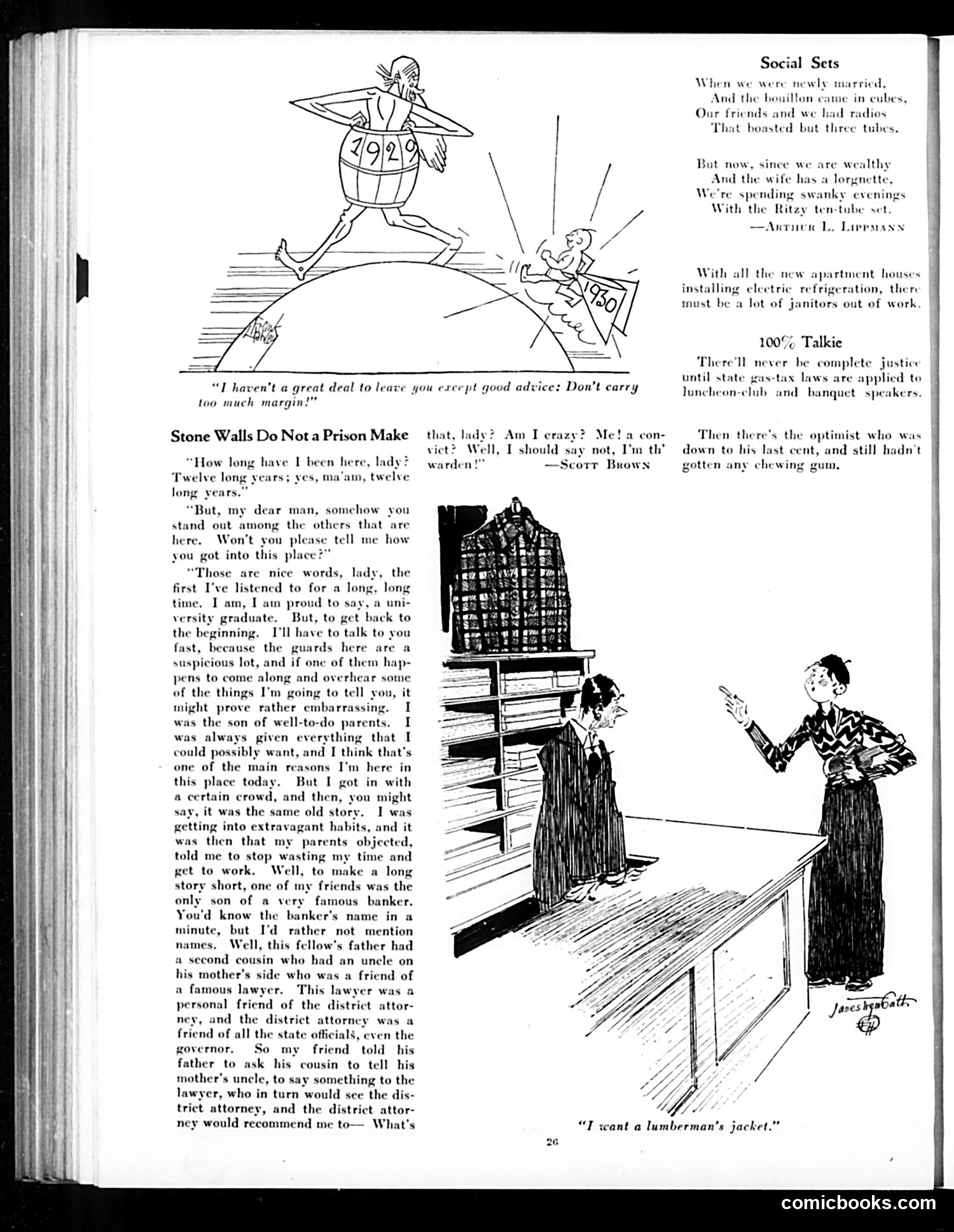
Explaining This Judge Magazine Page This page contains three satirical pieces from 1920s America: "Social Sets" mocks nouveau riche affectation—wealthy people flaunting status symbols. The poem contrasts their humble early marriage (cheap bouillon cubes, basic radios) with present extravagance (a "Ritzy ten-tube" radio set, the wife's lorgnette). The joke: wealth hasn't brought sophistication, just conspicuous consumption. "Stone Walls Do Not a Prison Make" features a long, rambling prisoner's confession. The satire targets the absurd chain of influence required to secure favors—the prisoner explains how his friend's father contacted his cousin to tell his uncle to speak to a lawyer, who knew the district attorney... The humor lies in exposing how corrupt patronage networks actually functioned in American politics and justice. The cartoon shows a woman at what appears to be a prison requesting a "lumberman's jacket," likely satirizing either fashion ignorance or prison bureaucracy. The page reflects 1920s anxieties about class mobility, corruption, and social pretension during the Jazz Age.
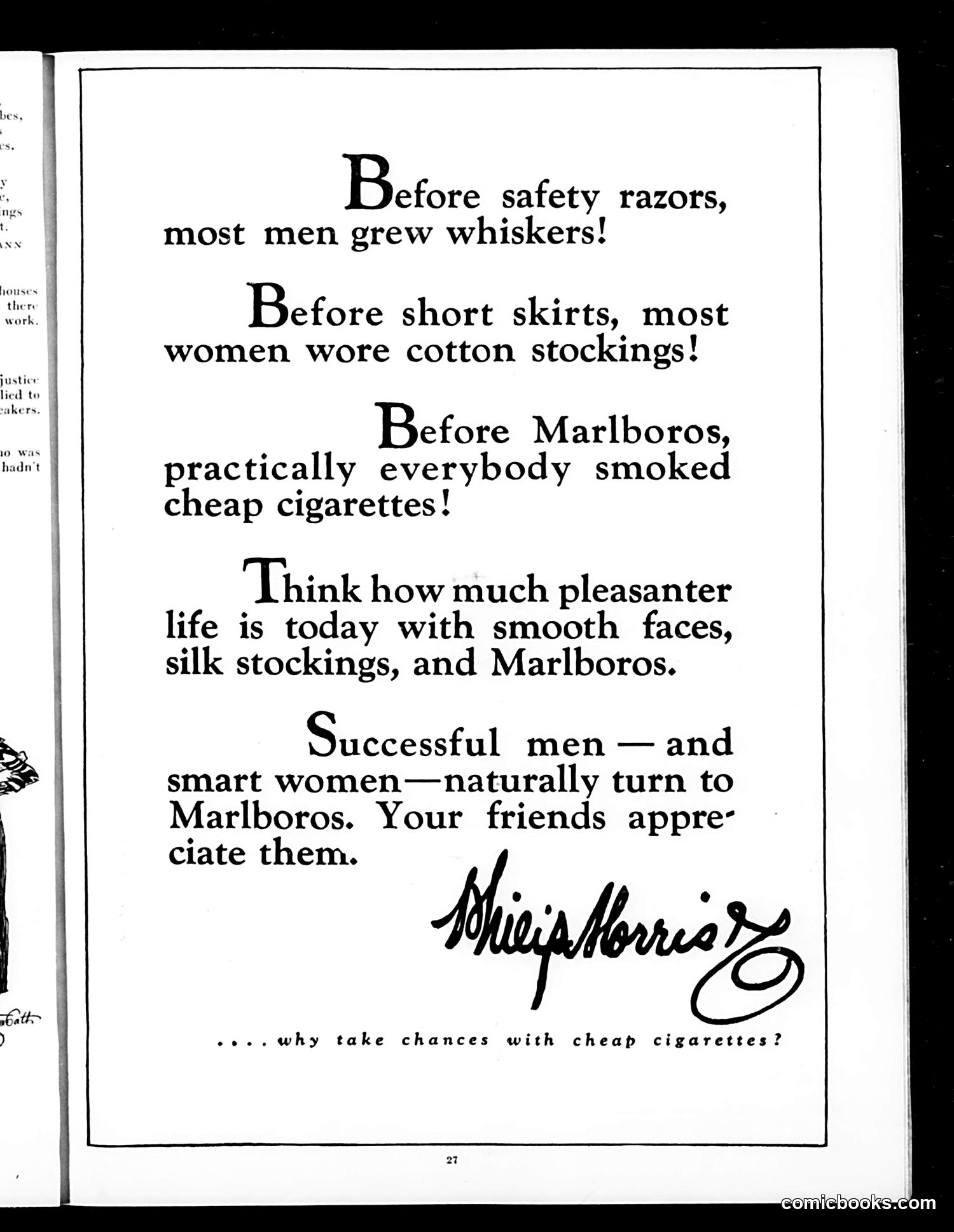
Marlboro Cigarette Advertisement (circa 1920s-1930s) This is a Marlboro cigarette advertisement, not political satire. It uses a common advertising technique: comparing "before" and "after" to suggest progress and modernity. The ad argues that just as society improved with safety razors (eliminating whiskers) and shorter skirts with silk stockings (replacing cotton), switching to Marlboros represents similar refinement. It appeals to aspirational values—associating the cigarette brand with success, intelligence, and social approval. The tagline "why take chances with cheap cigarettes?" positions Marlboros as premium and associates smoking them with status. This reflects early 20th-century tobacco marketing, before health risks were widely acknowledged or regulated.
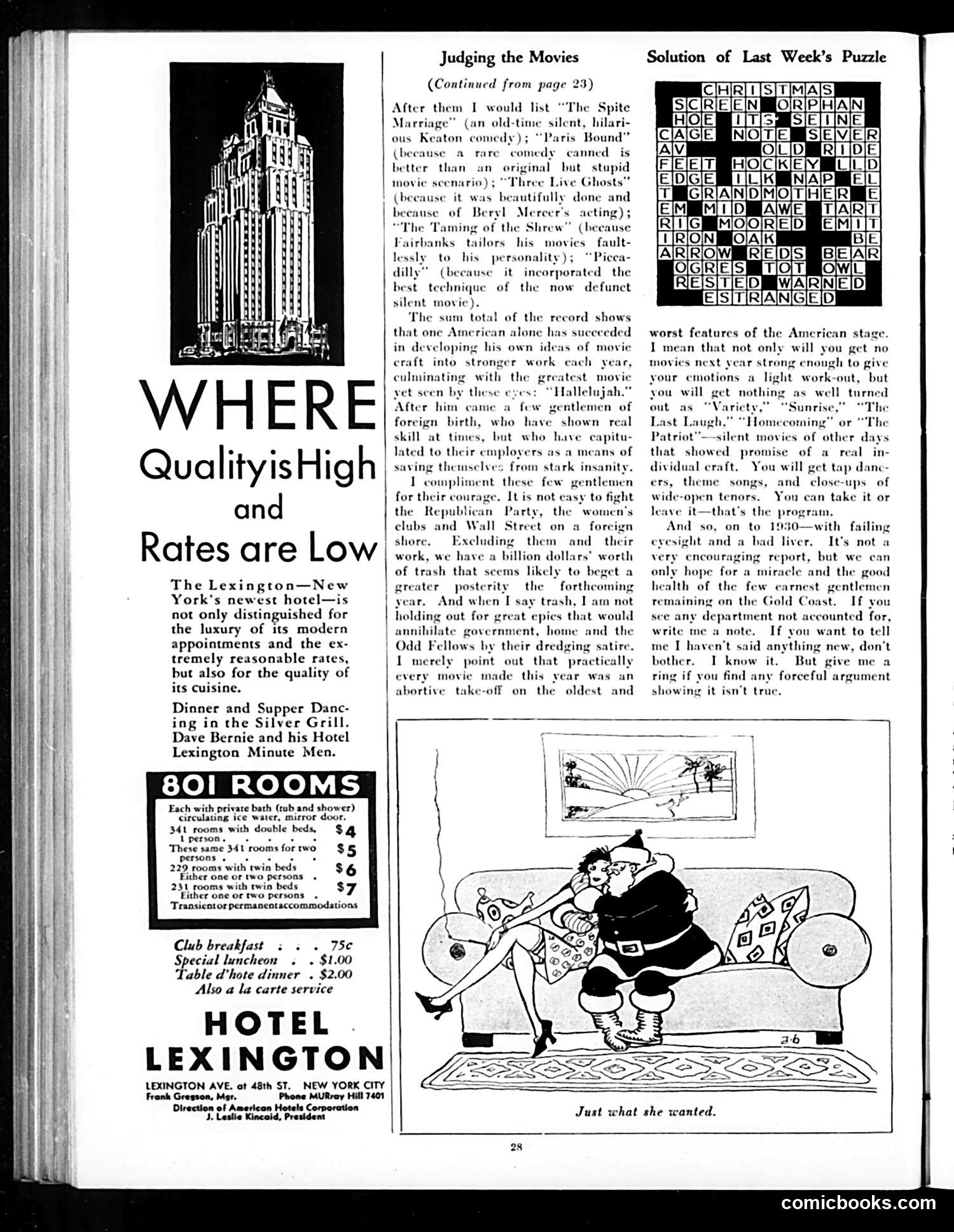
Analysis of Judge Magazine Page This page is primarily hotel advertising for the Lexington Hotel in New York, with a small amount of editorial content about cinema. The main cartoon (bottom right) shows Santa Claus on a couch with a woman—a mild flirtation joke captioned "Just what she wanted," likely playing on holiday gift-giving expectations. The editorial section ("Judging the Movies") critiques American filmmaking. The author praises a few directors (appears to reference Frank Borzage's work, though not named) who develop sophisticated craft, but condemns most 1920s movies as derivative trash copying the "oldest and worst features of the American stage." He dismissively dismisses the influence of "the Republican Party, the women's clubs and Wall Street" on artistic freedom—typical Judge magazine anti-establishment sentiment. The piece advocates for serious cinema over commercial drivel, positioning itself as culturally sophisticated critique. The tone is elitist, mocking mass-market entertainment while celebrating artistic integrity.
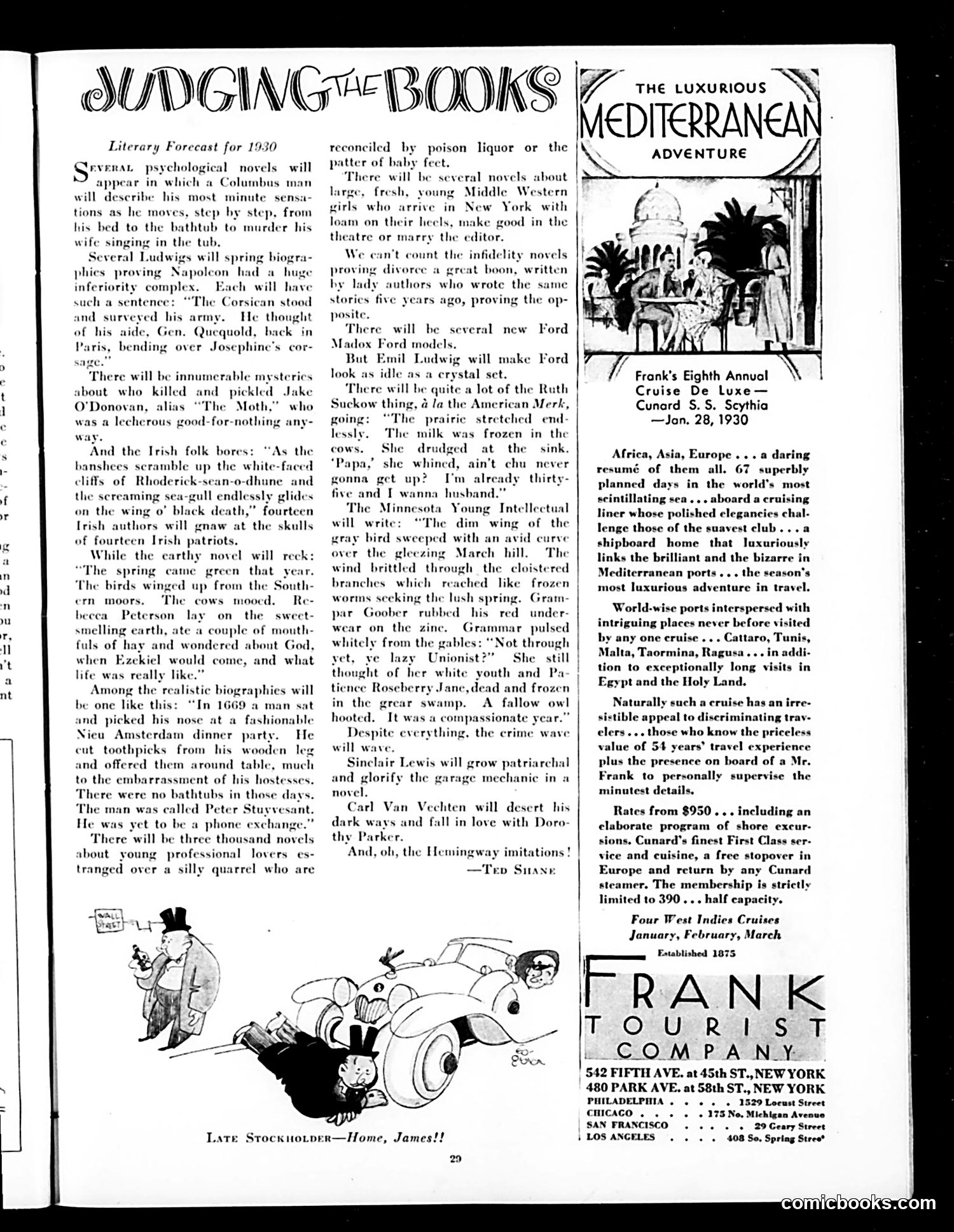
"Judging the Books": 1930 Literary Forecast This page satirizes predicted 1930 literary trends. The left column mocks emerging novel genres through exaggerated examples: psychological novels about mundane domestic violence; pseudo-Napoleonic biographies with pretentious prose; Irish folk narratives stuffed with affected dialect and banshee clichés; countless infidelity novels recycling old themes; and sentimental Midwestern fiction about girls seeking success in New York. The cartoon below depicts "Late Stockholder—Home, James!!" showing a wealthy man in a car, likely mocking the economic disparities of the pre-Depression era. The satire targets what the critic (Ted Shane) sees as formulaic, derivative, and self-important contemporary literature—particularly attacks on Emil Ludwig's biographical trend, Ruth Suckow's rural realism, and Hemingway-influenced minimalism. The piece suggests American literature was becoming predictable and commercialized. The right page advertises luxury Mediterranean cruises, contrasting sharply with the literary critique's acidic tone.
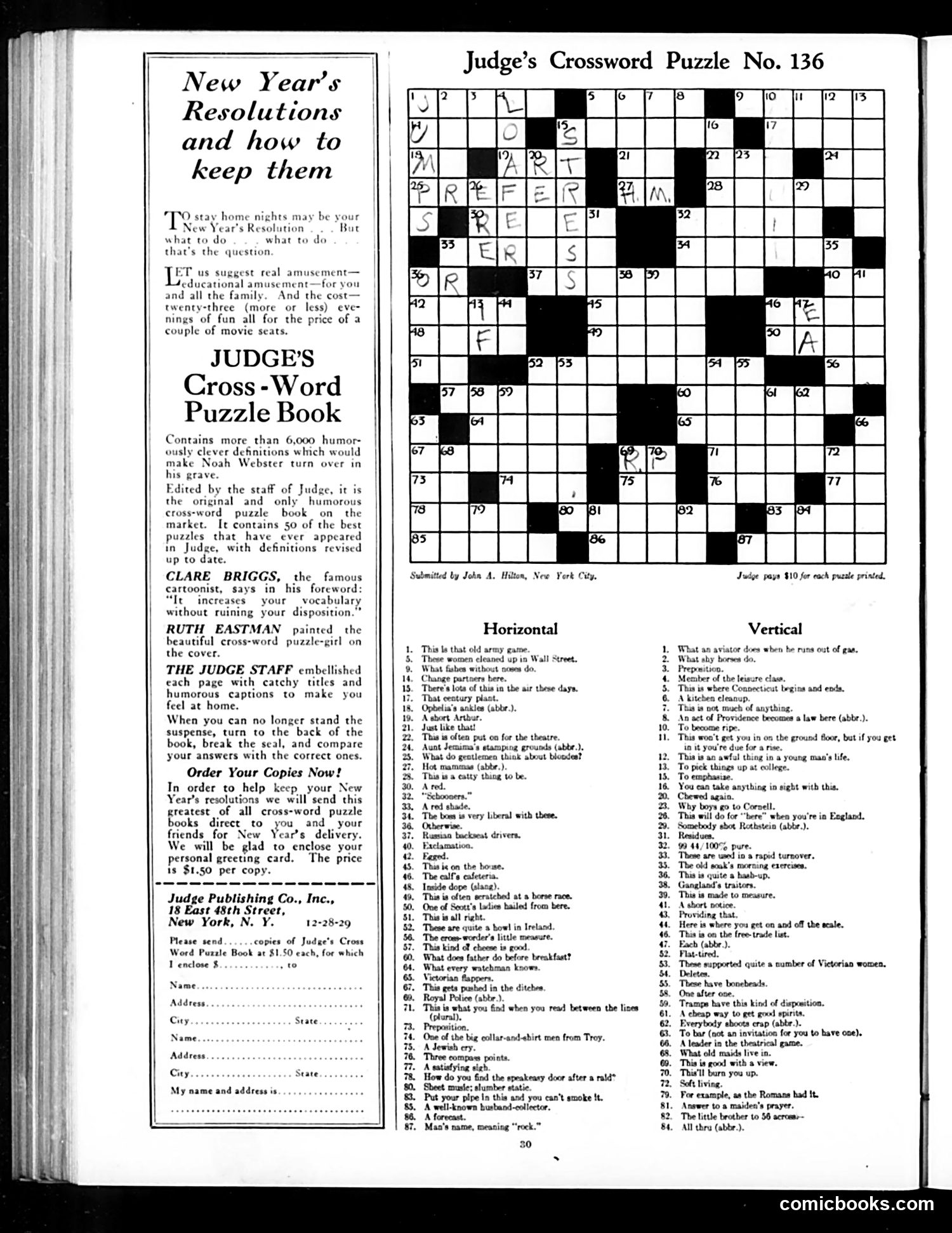
Judge's Crossword Puzzle No. 136 (c. 1929) This page is primarily advertising and puzzle content, not political satire. It promotes Judge Publishing Co.'s new "Cross-Word Puzzle Book"—a commercial product capitalizing on the 1920s crossword craze. The advertisement frames the book as a solution to New Year's resolutions, suggesting readers stay home with "educational amusement" instead of movies. It features endorsements from notable cartoonist Clare Briggs and illustrator Ruth Eastman. The puzzle itself contains humorous clues reflecting contemporary 1920s references: "These women cleaned up in Wall Street" (likely referencing female investors), speakeasy references ("find the speakeasy door after a raid"), and period slang ("hot mamas," "schooners"). These hints suggest Prohibition-era social commentary embedded within the wordplay. The page demonstrates how Judge magazine monetized its content and cultural relevance during the Jazz Age, selling leisure products to middle-class readers.
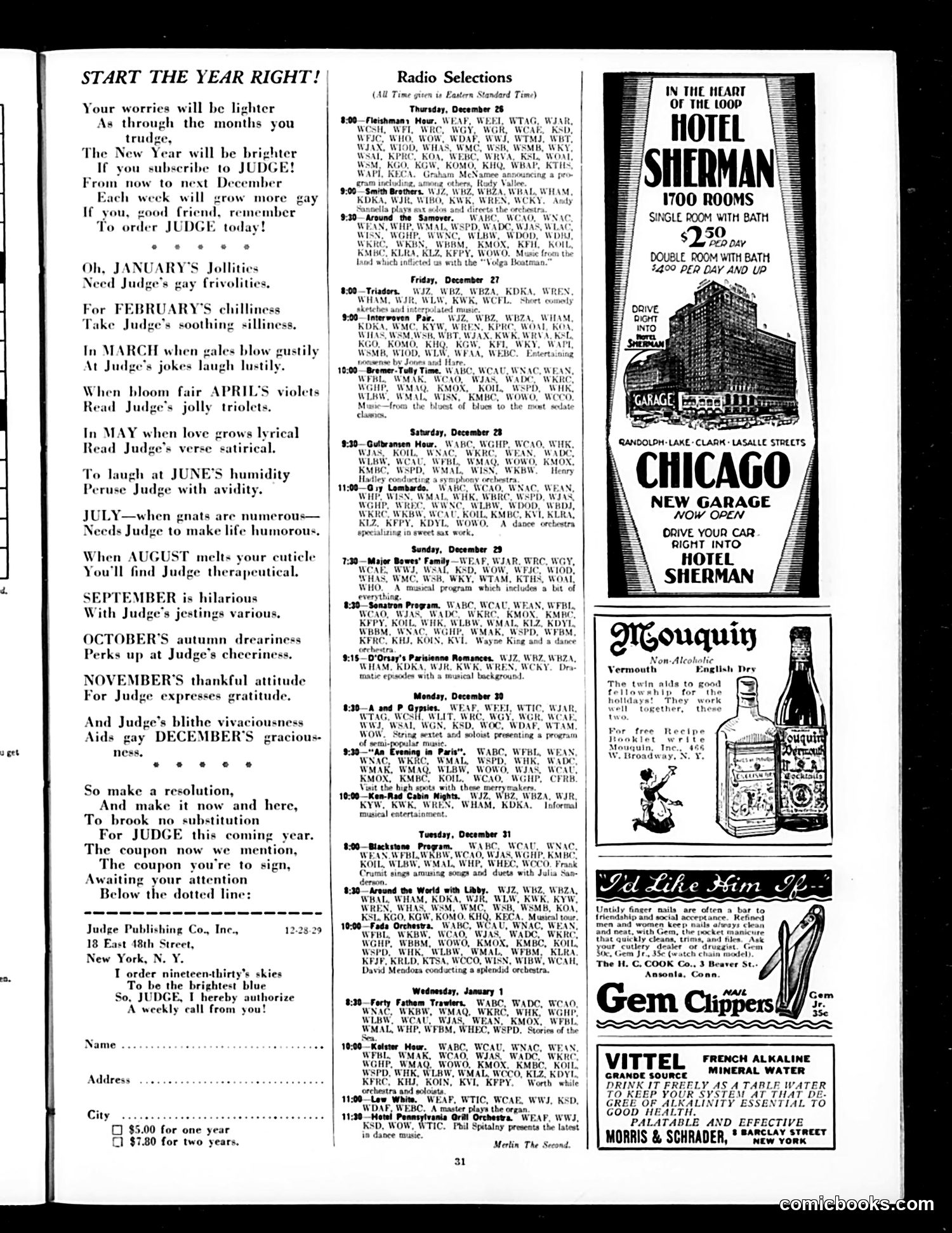
Judge Magazine Subscription Appeal (Late 1929) This page is primarily a subscription advertisement for Judge magazine itself, not a political cartoon. The left side presents a humorous poem encouraging readers to subscribe to Judge throughout 1929, with monthly puns ("JANUARY'S Jollities," "FEBRUARY'S chilliness," etc.) claiming the magazine will brighten their year. The right side features typical period advertisements: the Hotel Sherman in Chicago, Mesquin whisky, Gem Clippers, and Vittel mineral water. A subscription coupon appears at the bottom. The small text and radio listings suggest this is from late December 1929 (the page is dated 12-28-29). Notable context: This was published just weeks after the October 1929 stock market crash. The timing is ironic—Judge is promoting "soothing silliness" and humor as antidote to economic anxiety, though the ads themselves (expensive hotels, imported whisky) suggest a pre-crash affluence that was rapidly disappearing.
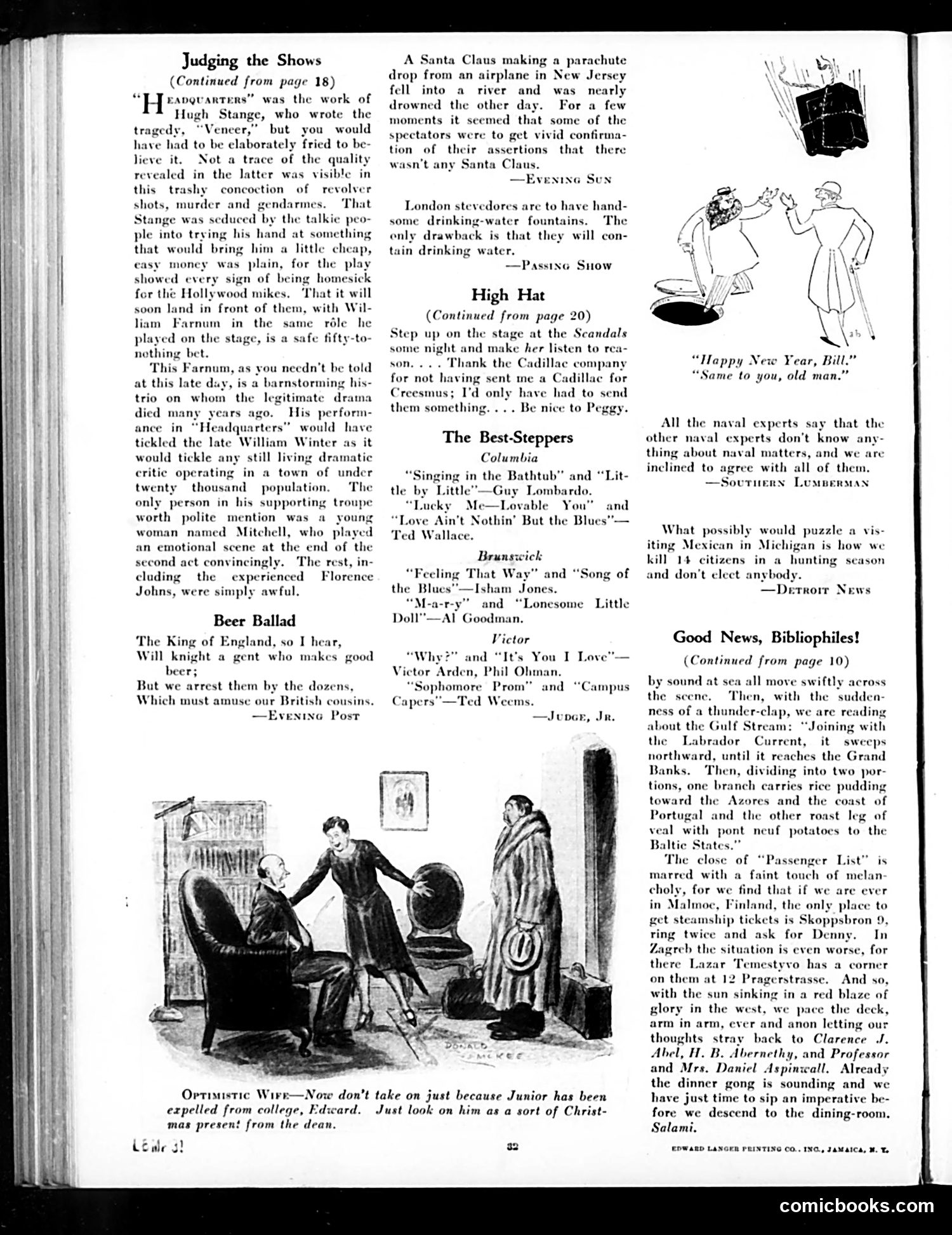
Analysis of This Judge Magazine Page This page from Judge magazine contains several satirical pieces commenting on 1920s American culture: Theater Reviews ("Judging the Shows"): The critic harshly pans Hugh Stange's play "Headquarters," accusing it of being cheaply sensational (featuring "revolver shots, murder and gendarmes") and criticizing actor William Farnum as a washed-up barnstormer whose career in legitimate theater died "many years ago." The satire targets Hollywood's corrupting influence on serious playwrights. "Beer Ballad": A brief joke contrasting British treatment of brewers (knighthood) with American Prohibition-era enforcement, which arrested brewery workers by the dozens. The cartoon "Optimistic Wire": Shows a parent reassuring another that their son's college expulsion should be viewed positively—as a "Christmas present from the dean"—satirizing parental delusion about educational failure. Various brief satirical notes mock contemporary absurdities: a "Santa Claus" parachute accident, London's ironic water fountains for stevedores, and hunting season deaths in Michigan without electoral consequences. The overall tone is acerbic commentary on American social and cultural contradictions.
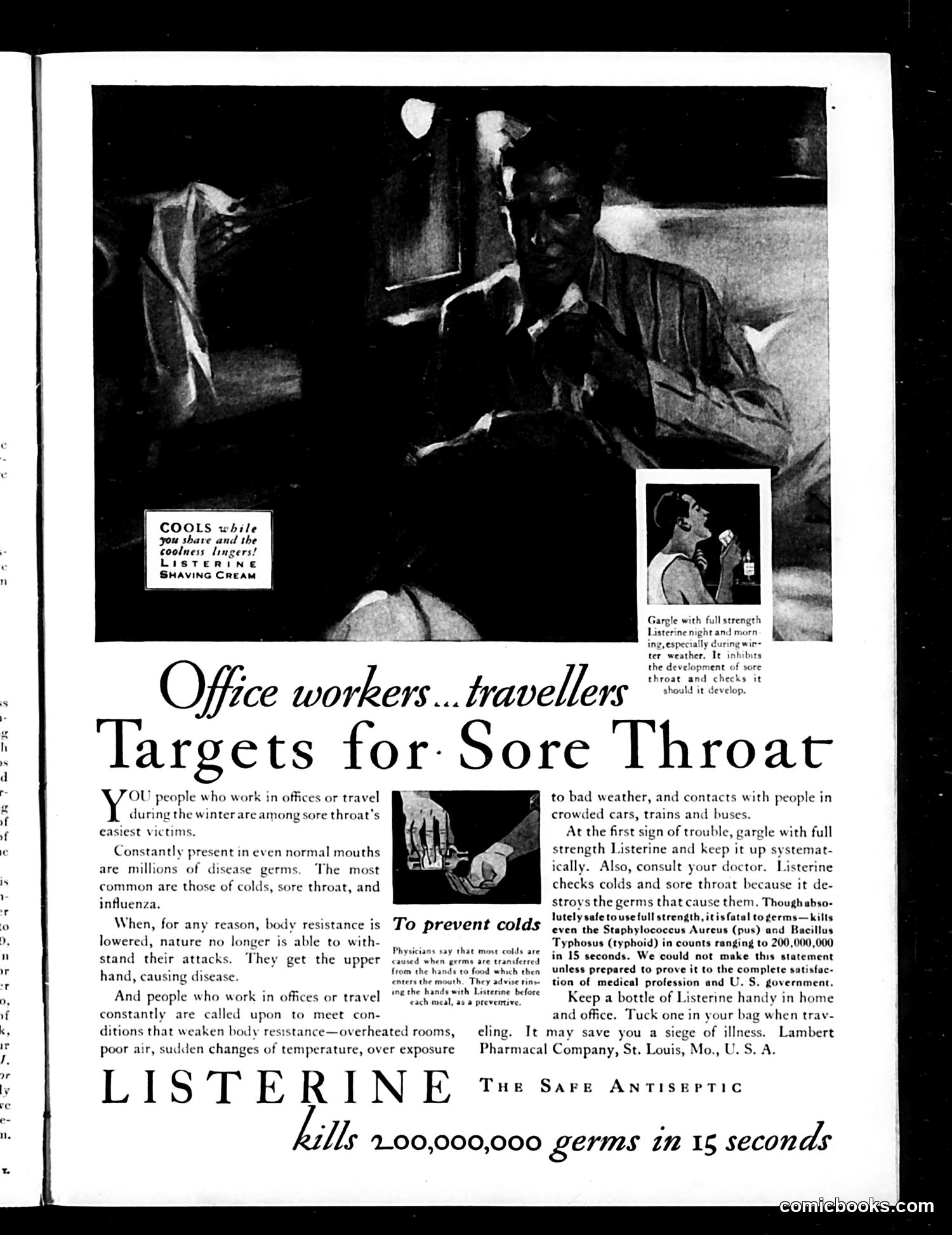
Analysis for Modern Readers This page is primarily advertisement, not satire. It's a Listerine mouthwash ad from Judge magazine disguised as health journalism. The "cartoon" shows an office scene where workers appear vulnerable to illness. The headline frames office workers and travelers as disease vectors—people who encounter crowded conditions, temperature fluctuations, and poor ventilation. The advertisement's strategy exploits early-20th-century germ anxiety. It claims Listerine kills 200 million germs in 15 seconds, targeting specific bacteria (Staphylococcus and Bacillus Typhosus) and explicitly invokes medical authority and government approval to establish credibility. The satirical element, if any, lies in how aggressively the ad weaponizes health fears to sell a product—a technique that would become standard in advertising but may have seemed exaggerated even then. The shaving cream reference at top suggests cross-promotion. This reflects the era's embrace of germ theory marketing before modern advertising standards existed.
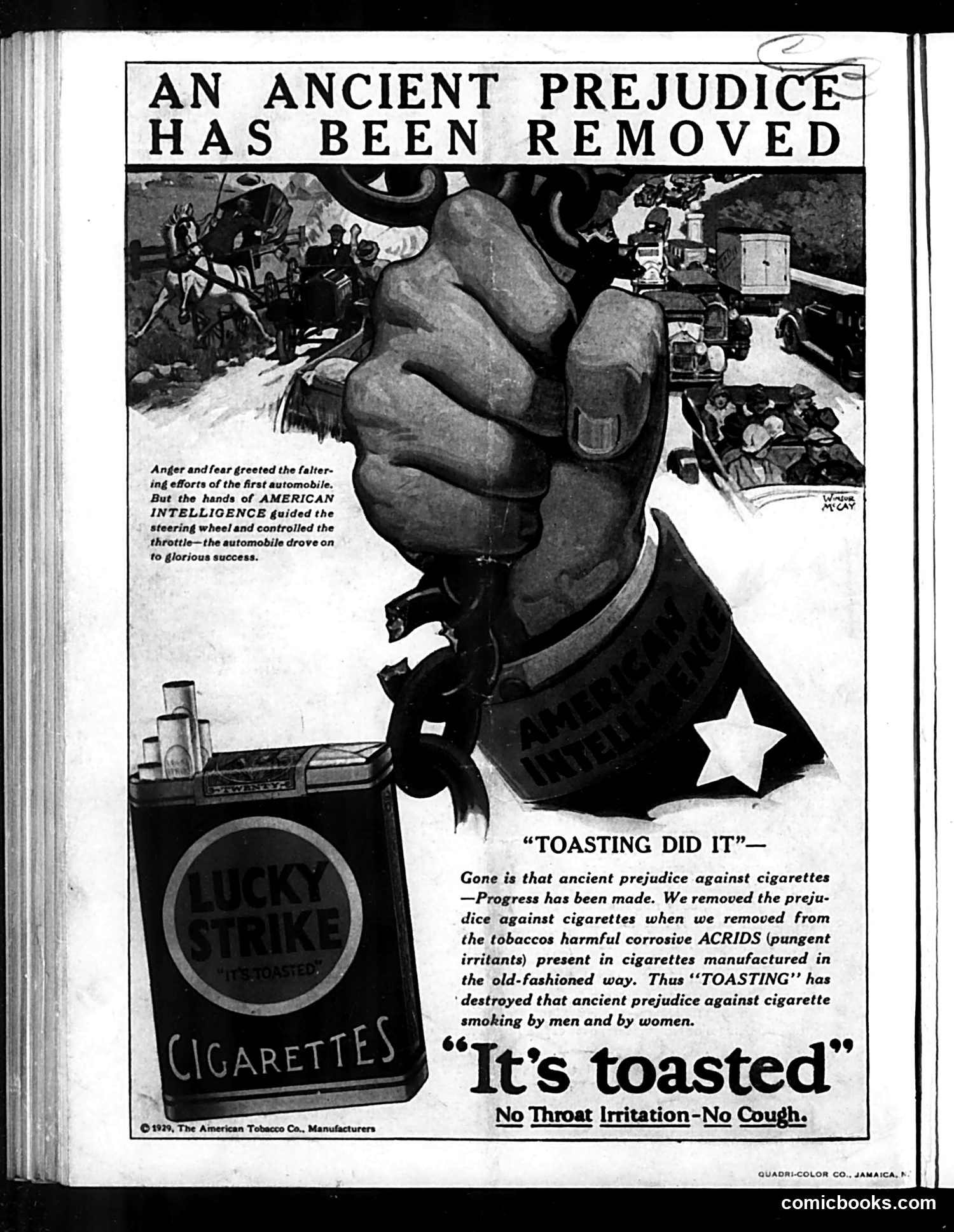
Lucky Strike Cigarette Advertisement This is a Lucky Strike cigarette ad, not political satire. It uses an automobile metaphor to promote smoking. The ad compares early automobiles—initially met with "anger and fear"—to cigarettes, claiming both succeeded through "American Intelligence." Just as cars overcame prejudice to become accepted, Lucky Strike argues cigarettes should be accepted once their "harmful corrosive ACRIDS" are removed through "toasting." The large fist represents American progress and innovation. The ad falsely claims the toasting process eliminates throat irritation and cough, positioning cigarettes as a modern, scientific product. This reflects early-20th-century tobacco marketing that exploited health concerns by claiming manufacturing improvements made smoking safe—a claim now known to be entirely false.

I can see this is a page from Judge magazine, but the image shows what appears to be a mostly blank or very faintly printed page with only binding marks visible on the left side. The OCR text provided is empty, containing no readable content. Without visible cartoon illustrations, captions, or legible text to analyze, I cannot identify specific figures, political references, or satirical points. This could be a blank page, a title page, or a page where the original print has faded significantly in this reproduction. To provide meaningful analysis of the satire and historical context, I would need a page where the cartoon artwork and accompanying text are clearly visible.