judge
Judge — January 4, 1930
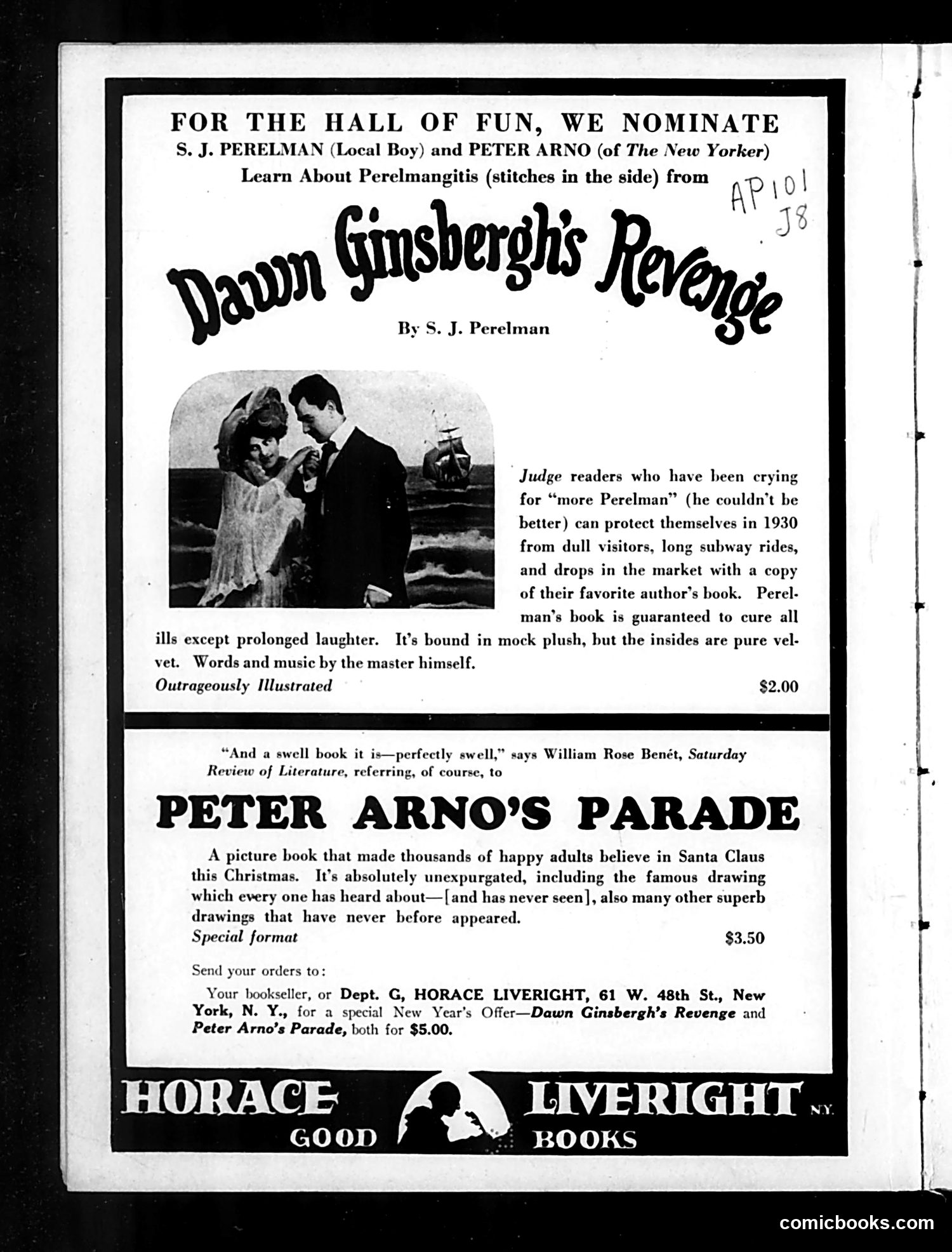
Analysis This page is primarily advertising, not political satire. It promotes two books by humorists: 1. "Dawn Ginsberg's Revenge" by S.J. Perelman—a collection of humorous essays. The ad jokes that the book cures "Perelmangitis (stitches in the side)," playing on the author's name. The photograph shows two figures in what appears to be a comedic scene. 2. "Peter Arno's Parade" by cartoonist Peter Arno—a picture book with drawings, including a famous Santa Claus illustration the ad promises readers have "heard about" but never seen. Both are marketed as entertainment for adults seeking relief from everyday boredom (subway rides, dull visitors, market downturns). The ads are placed by publisher Horace Liveright and cost $2.00 and $3.50 respectively.
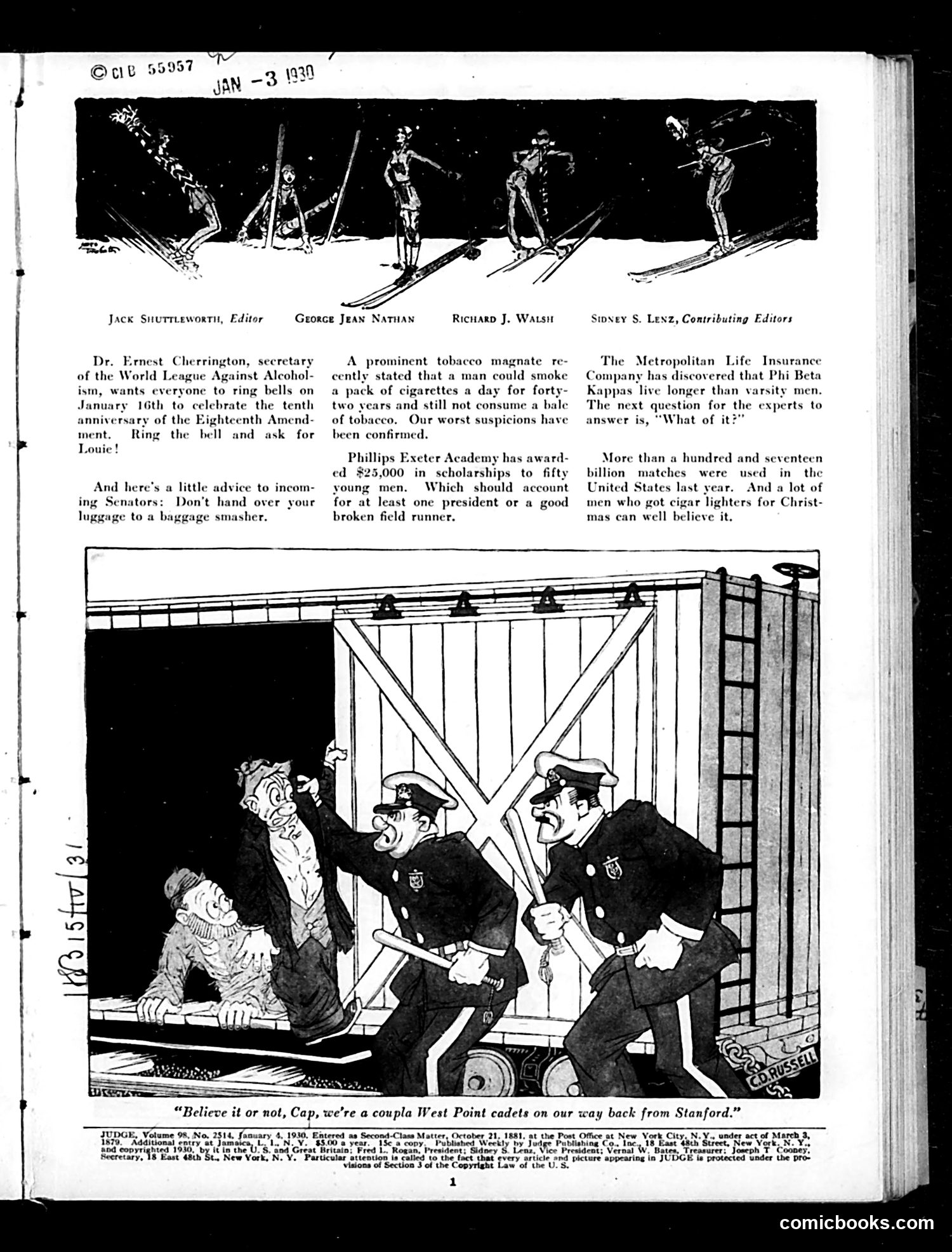
Judge Magazine Cartoon Analysis This 1930 Judge cartoon satirizes military discipline and the prestige of West Point. The caption reads: "Believe it or not, Cap, we're a coupla West Point cadets on our way back from Stanford." The joke targets the contrast between West Point's elite reputation and the cadets' current disheveled appearance—one appears intoxicated or rowdy, being restrained by what look like police or military officers. The humor comes from the absurdity of claiming prestigious West Point status while visibly violating military conduct standards, likely after revelry at Stanford (a West Coast university). The cartoon mocks both military pretension and the behavior of privileged young officers, suggesting that the Academy's graduates don't always live up to their institution's disciplinary ideals.
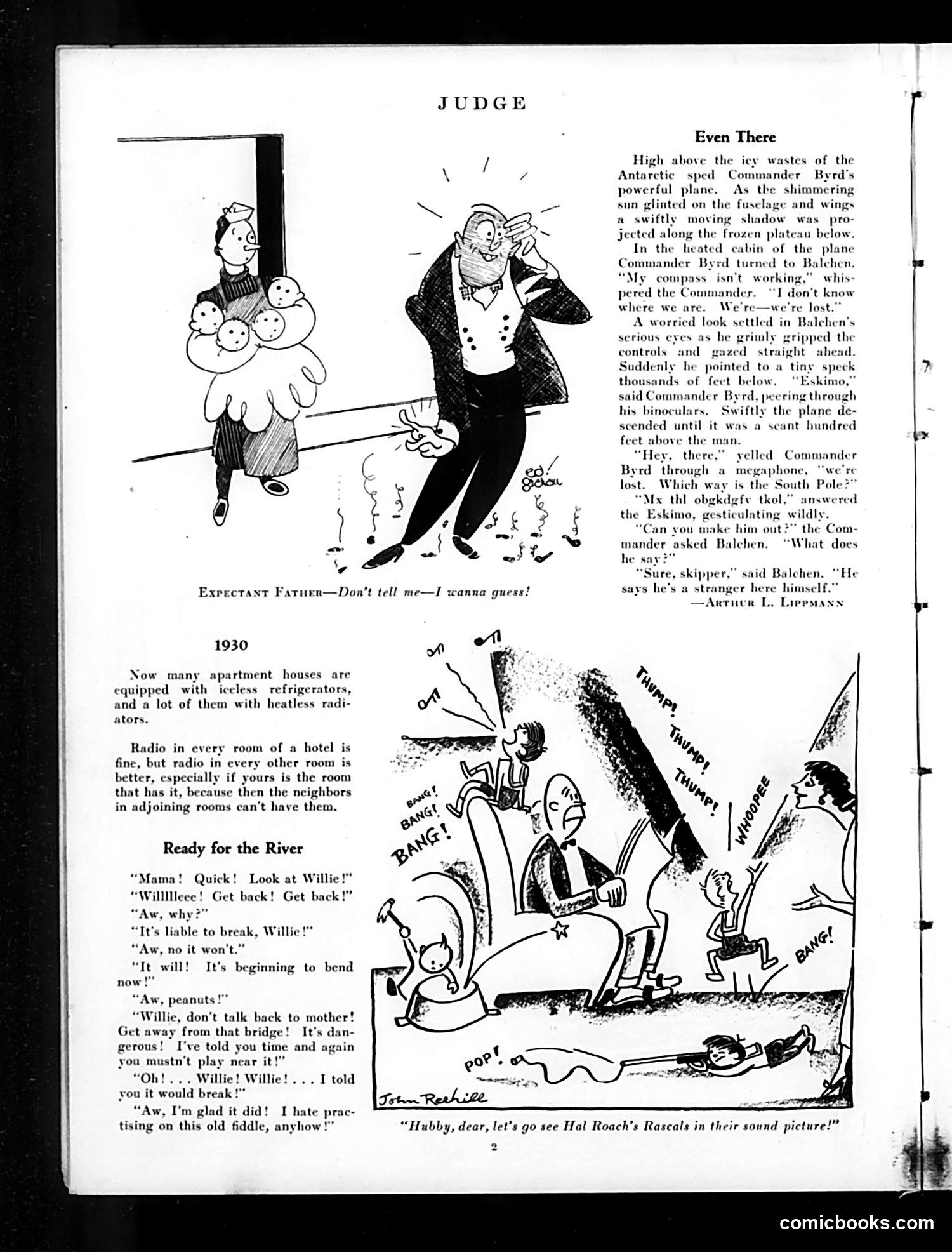
Analysis of Judge Magazine Page Top Cartoon: "Expectant Father" A man holding multiple spheres (likely representing eggs or offspring) asks "Don't tell me—I wanna guess!" The joke plays on the anxious anticipation of impending parenthood, with the visual gag suggesting he's about to become a father to many children simultaneously—a common source of domestic humor in 1930s satire. Middle Section: "1930" Commentary on modern apartment living with built-in refrigerators and "heatless radiators," suggesting technological progress made homes more efficient but potentially colder—likely social satire about modernization's tradeoffs. Bottom Cartoon: "Ready for the River" Depicts chaotic family scene with a child playing a loud instrument ("bangs," "thumps"), causing domestic disruption. The mother's exasperation ("I hate practicing on this old fiddle, anyhow!") satirizes both parental frustration with children's musical lessons and noise complaints in shared housing.
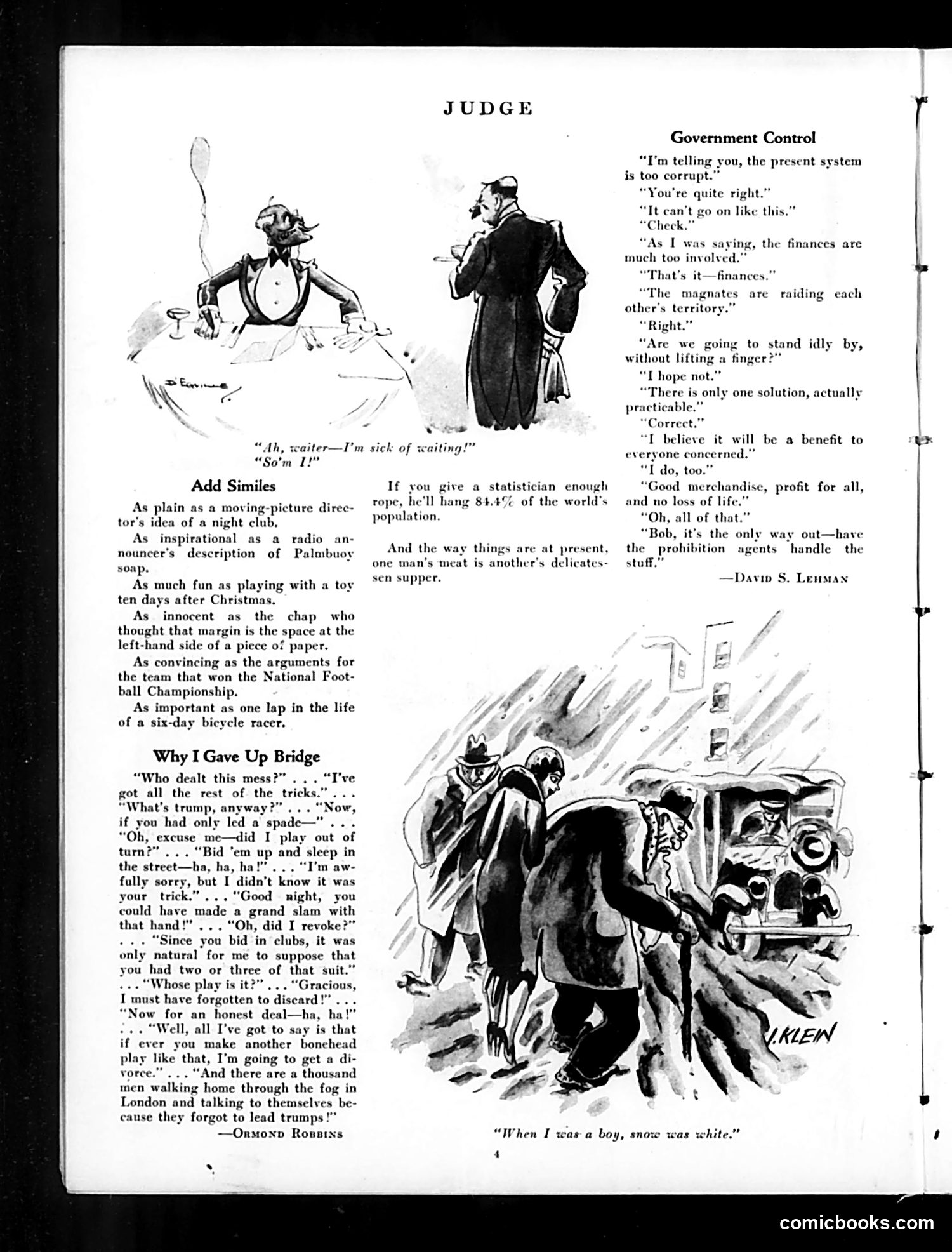
Analysis of Judge Magazine Page The top cartoon shows a waiter at a table with a seated diner, captioned "Ah, waiter—I'm sick of waiting!" / "So'm I!" This appears to be a simple visual pun about restaurant service complaints rather than political satire. The right panel titled "Government Control" presents a dialogue between two figures discussing systemic corruption—one warns that "the present system is too corrupt" and suggests prohibition agents should "handle the stuff" (apparently referring to alcohol enforcement). This satirizes Prohibition-era debates about government corruption and whether federal agents could effectively manage illegal substances. The lower illustration, signed by Klelein, shows figures examining an old automobile, captioned "When I was a boy, snow was white"—a nostalgic commentary on industrial pollution and environmental degradation.
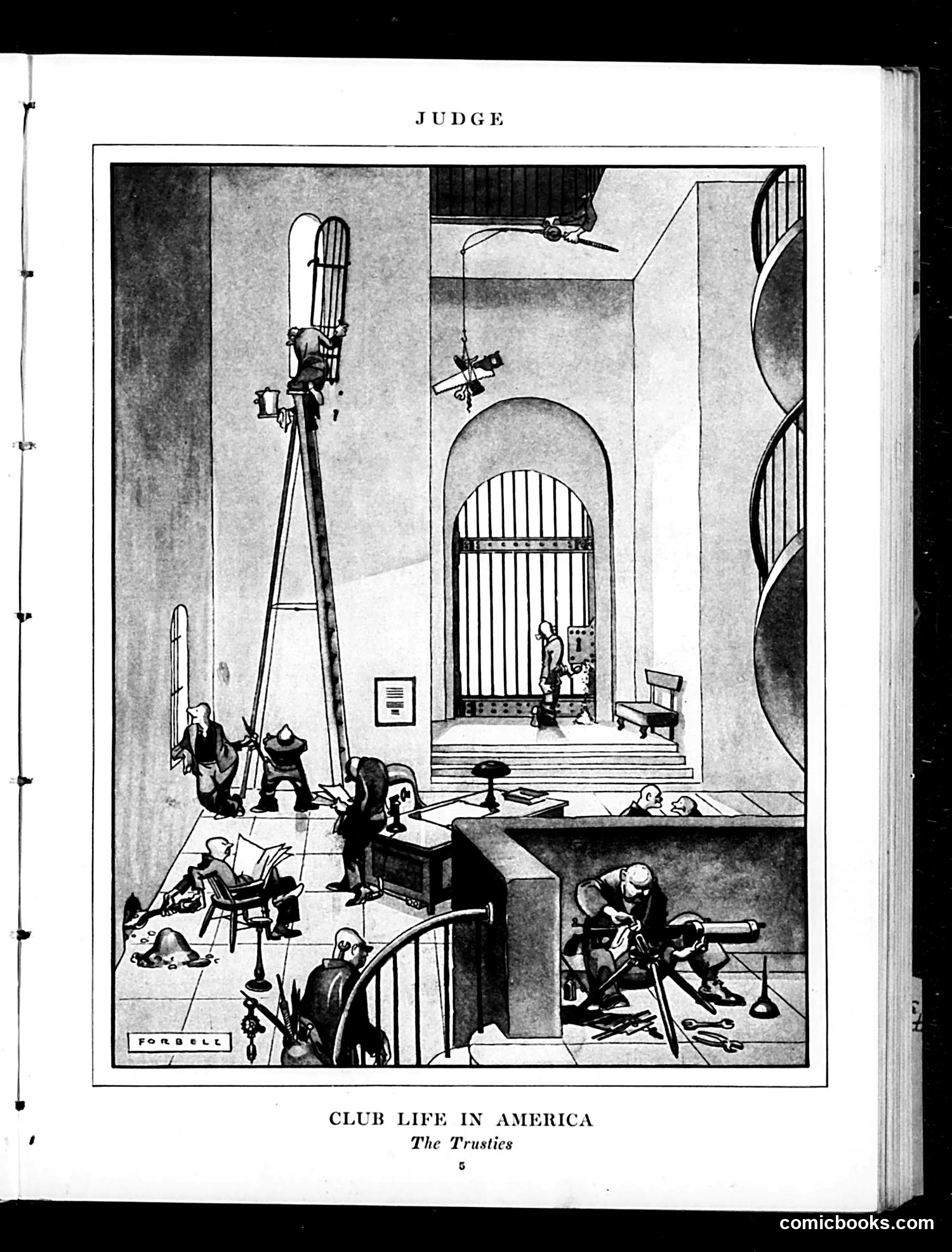
Analysis of "Club Life in America: The Trusties" This satirical cartoon depicts a wealthy gentlemen's club as a chaotic headquarters for industrial monopolies—"the Trusties." The multi-level scene shows suited men conducting business amid astronomical equipment (telescopes), suggesting they're viewing themselves as cosmic powers controlling markets. The architectural grandeur (arched doorways, formal furnishings) contrasts ironically with the frenetic activity below. The satire targets the growing power of business trusts in early 20th-century America. By portraying these industrial magnates as club members casually managing monopolies from an elite social space, the cartoon critiques how wealth and power concentrate among interconnected businessmen. The "Trusties" nickname mocks their control of industries while operating within society's upper echelons, essentially above normal accountability.
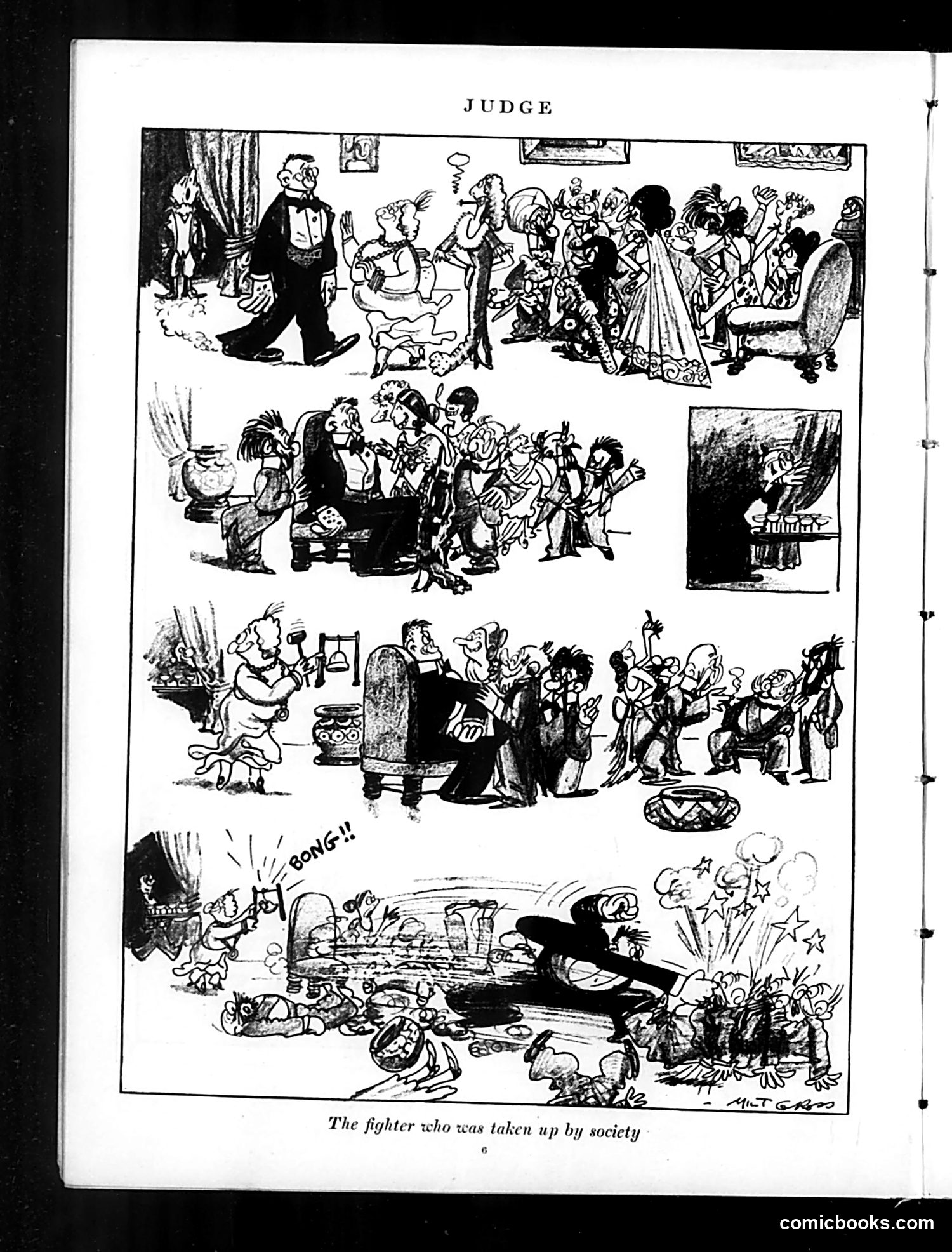
"The Fighter Who Was Taken Up by Society" This satirical cartoon from *Judge* magazine depicts the social elevation of a boxer through high society's embrace. The multi-panel narrative shows: 1. Top panels: A crude fighter is introduced to wealthy, fashionable society folk who adopt him as a novelty 2. Middle panels: He's dressed formally and paraded through social events, treated as an exotic curiosity 3. Bottom panel: The punchline—once "society" loses interest, he's literally knocked down and abandoned, surrounded by chaos The satire targets both the fighter's naïve ambition and society's shallow, fickle patronage. Wealthy elites elevate working-class figures temporarily for entertainment, then discard them without consequence. The cartoon critiques the class exploitation underlying Gilded Age celebrity culture and the disposability of outsiders once their novelty fades.
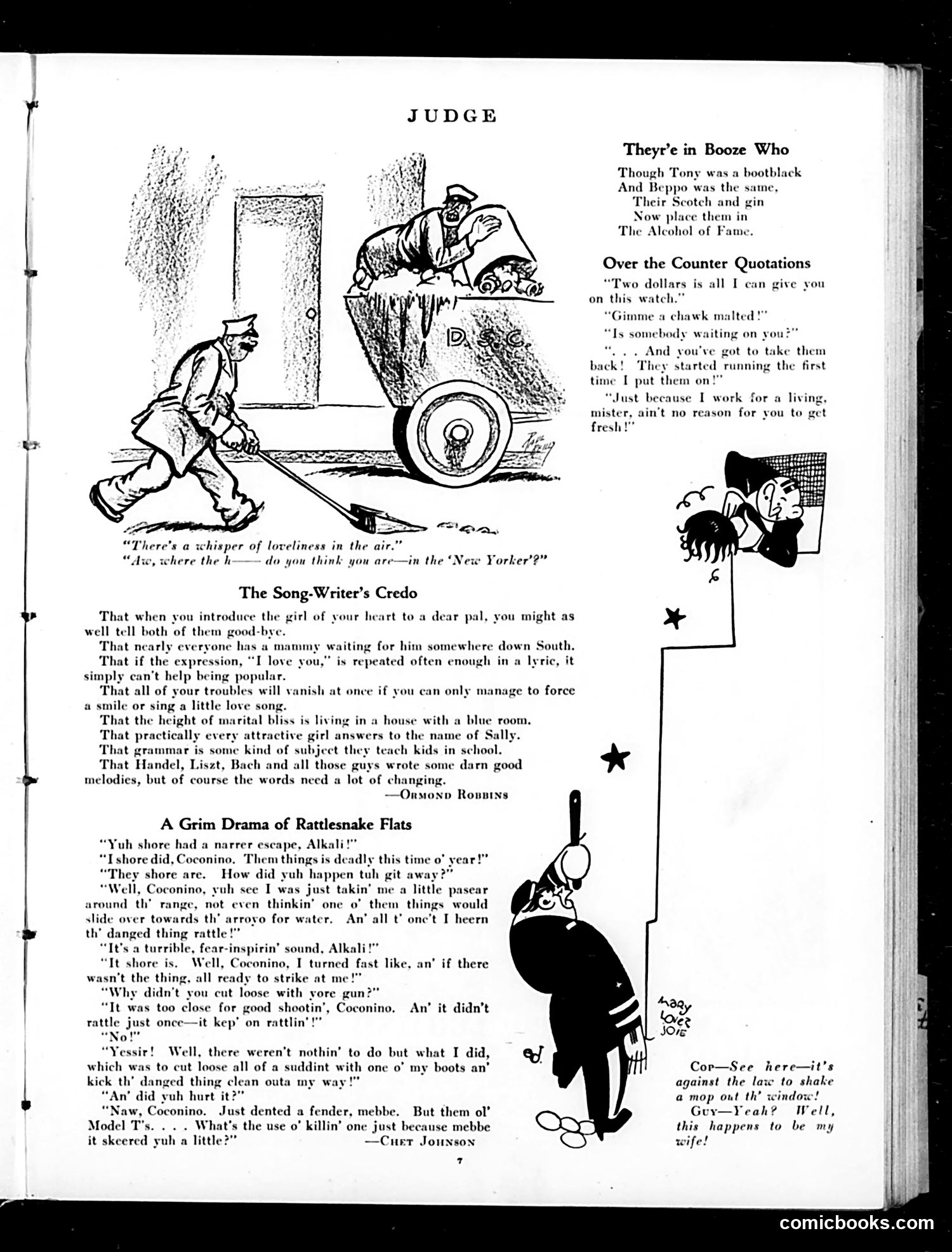
Judge Magazine Satire Analysis This page contains three distinct satirical pieces reflecting 1920s American concerns: "There's in Booze Who" mocks Prohibition-era celebrity worship, suggesting criminals ("bootblack" Tony and Beppo) achieve fame through illegal alcohol distribution—a sharp jab at how Prohibition created glamorous underworld figures. "Over the Counter Quotations" presents everyday working-class dialogue, with the final exchange mocking *The New Yorker* magazine's sophisticated pretensions, suggesting that publication caters to affected urban elites. "A Grim Drama of Rattlesnake Flats" parodies Western dialect stories and melodrama through exaggerated cowboy characters (Alkali, Coconino) discussing a rattlesnake encounter. The punchline—a man kicked his boot at the snake and merely dented a Model T Ford—deflates the Western genre's dramatic tension with mundane reality. The cartoons criticize both emerging mass media (celebrity criminals, literary snobbery) and tired literary conventions (Wild West tales), using humor to expose social pretense and changing American culture.
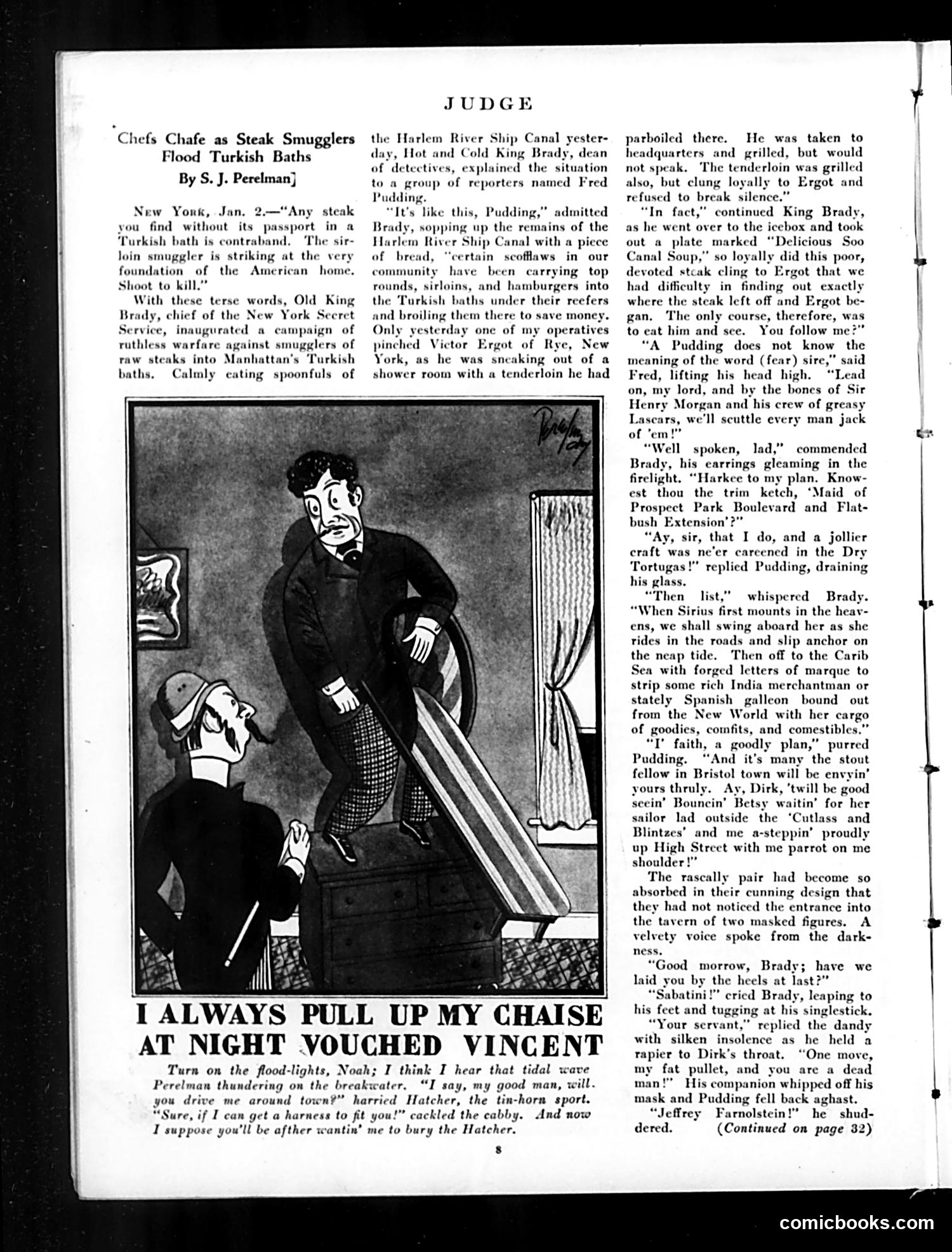
Explanation for Modern Readers This is a humorous short story by S. J. Perelman (a celebrated comic writer) satirizing the absurdity of Prohibition-era enforcement. The premise: authorities are cracking down on steaks being smuggled into Turkish baths—treating contraband meat like serious crime. The joke plays on how ridiculous law enforcement had become under Prohibition. Police chief "King Brady" speaks in mock-serious detective jargon about intercepting smuggled steaks, grilling suspects, and conducting surveillance—language better suited to actual criminal investigations. The accompanying illustration shows a dramatic interrogation scene. Below it runs an unrelated serialized adventure story parody in melodramatic style ("I Always Pull Up My Chaise at Night Vouched Vincent"), mocking overwrought pulp fiction. The satire targets both overzealous Prohibition enforcement and cheap serialized entertainment popular at the time. Perelman's absurdist humor became a Judge magazine trademark.
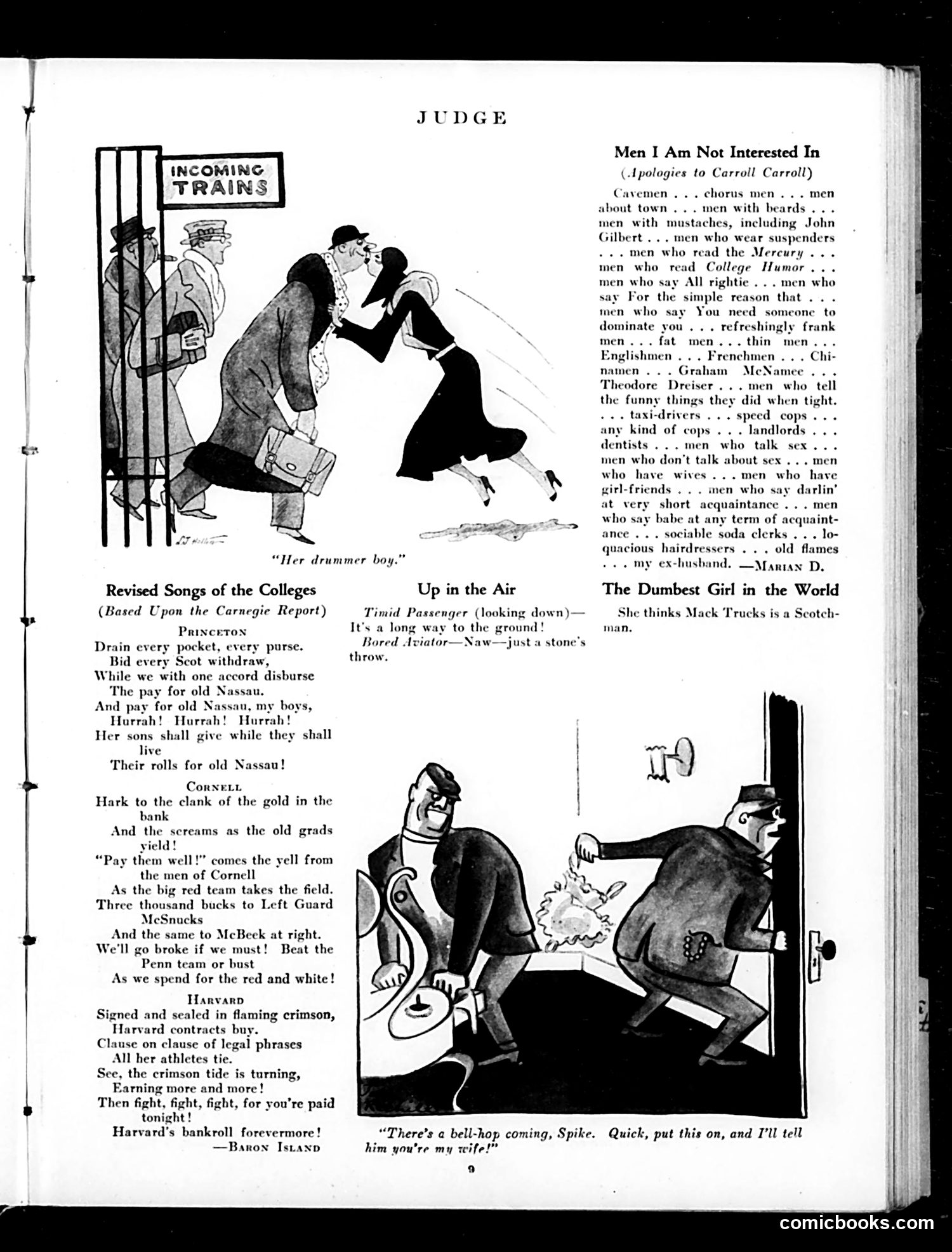
Judge Magazine Page Analysis This page contains three distinct pieces of satire: "Revised Songs of the Colleges" parodies college fight songs, satirizing how universities now financially exploit alumni. The verses mock Princeton, Cornell, and Harvard for openly demanding money from graduates and paying athletes enormous sums ("Three thousand bucks to Left Guard"). The satire targets the commercialization of college sports and fundraising, likely referencing the Carnegie Report mentioned in the subtitle—apparently a report on college athletics that exposed such practices. "Up in the Air" is a brief joke about airplane travel. A nervous passenger fears the height; the blasé aviator dismisses the danger casually. "Men I Am Not Interested In" is a humorous list (credited as parody of Carroll Carroll's work) cataloging types of men a woman rejects—ranging from cavemen to "old flames" and her ex-husband. It's social commentary on dating preferences and male stereotypes. "The Dumbest Girl in the World" is a one-liner joke: a woman mistakes "Mack Trucks" (the vehicle brand) for a Scottish person, playing on her supposed stupidity.
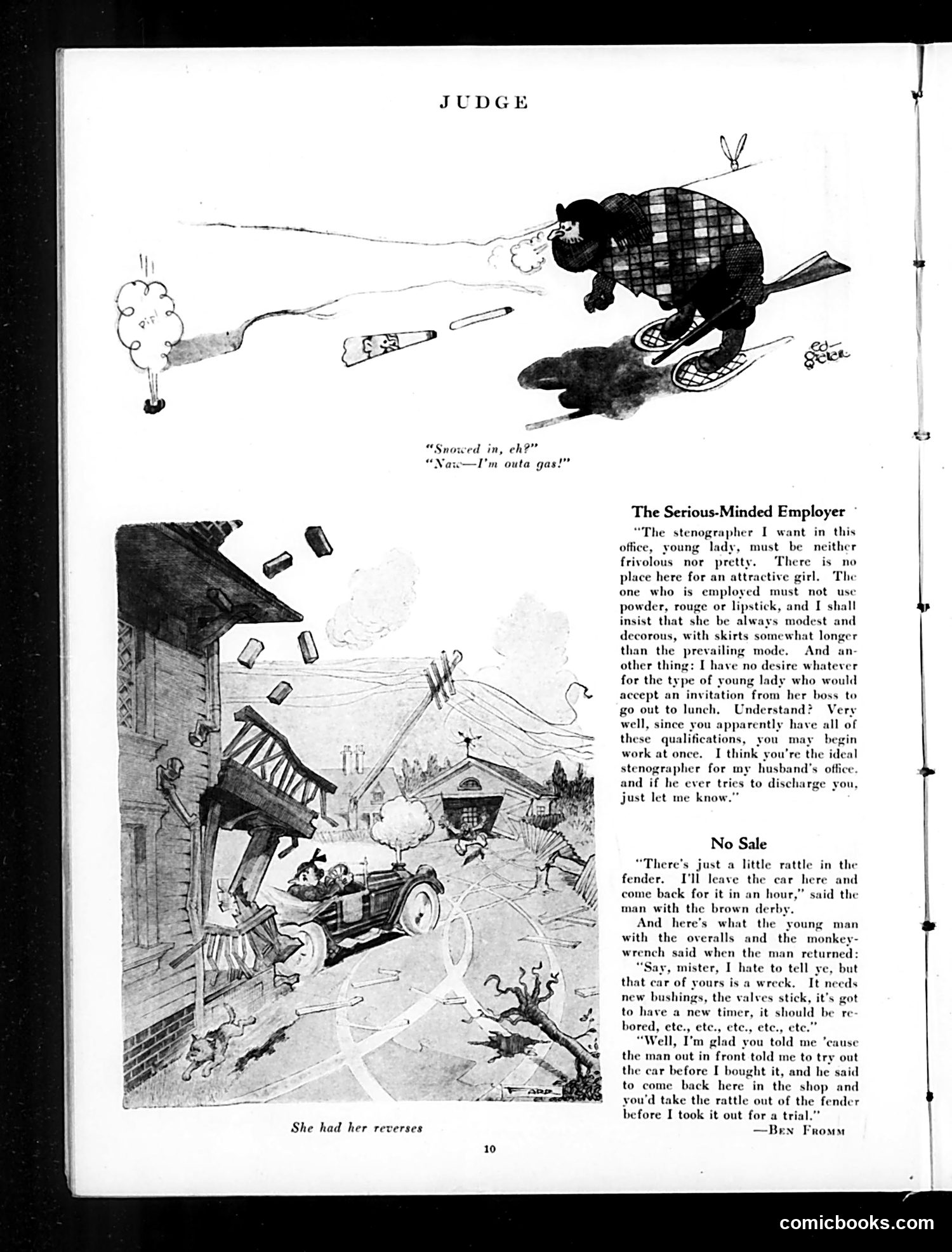
Judge Magazine Page Analysis This page contains three separate satirical pieces: Top cartoon ("Snowed in, eh?"): A skier in winter gear claims he's "outa gas" rather than snowed in—likely mocking the era's new automobile culture and the excuse-making around car breakdowns. "The Serious-Minded Employer": Satire of prudish, controlling bosses who demand stenographers be plain, modestly dressed, and makeup-free, while forbidding fraternization. The joke targets rigid Victorian workplace morality and hypocrisy. "No Sale": A mechanic exposes a used-car scheme. A dealer told a customer to have the shop "take the rattle out" before trial, but the mechanic discovers the car needs major repairs. The satire critiques deceptive auto sales practices and collusion between dealers and mechanics to hide vehicle defects. The page reflects early 20th-century concerns: automobile reliability issues, workplace gender dynamics, and consumer fraud.
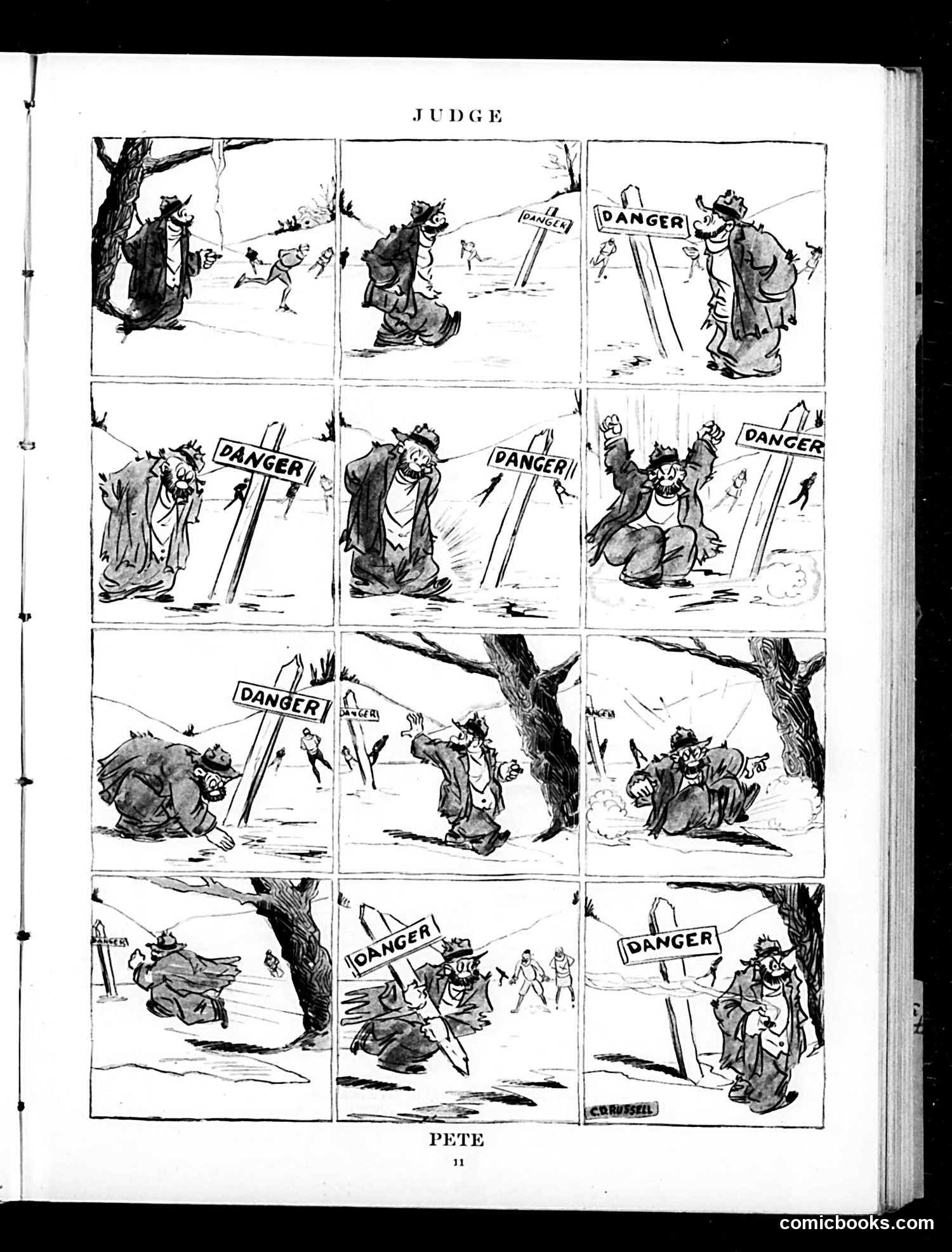
Analysis This is a comic strip titled "Judge" (credited to artist Pete/Brussell) showing a repeated narrative across twelve panels. A rotund figure repeatedly encounters "DANGER" warning signs near a tree. In each panel, the character appears to ignore or narrowly avoid the hazard, tumbling, slipping, or scrambling away from the danger zone. The satire likely critiques foolish persistence or stubbornness—a character who repeatedly courts disaster despite clear warnings. Without more specific historical context from Judge magazine's publication date, the identity of the caricatured figure remains unclear, though the exaggerated physical comedy and the repetitive "DANGER" motif suggest commentary on a public figure's reckless behavior or poor decision-making despite obvious warnings from society or authorities.
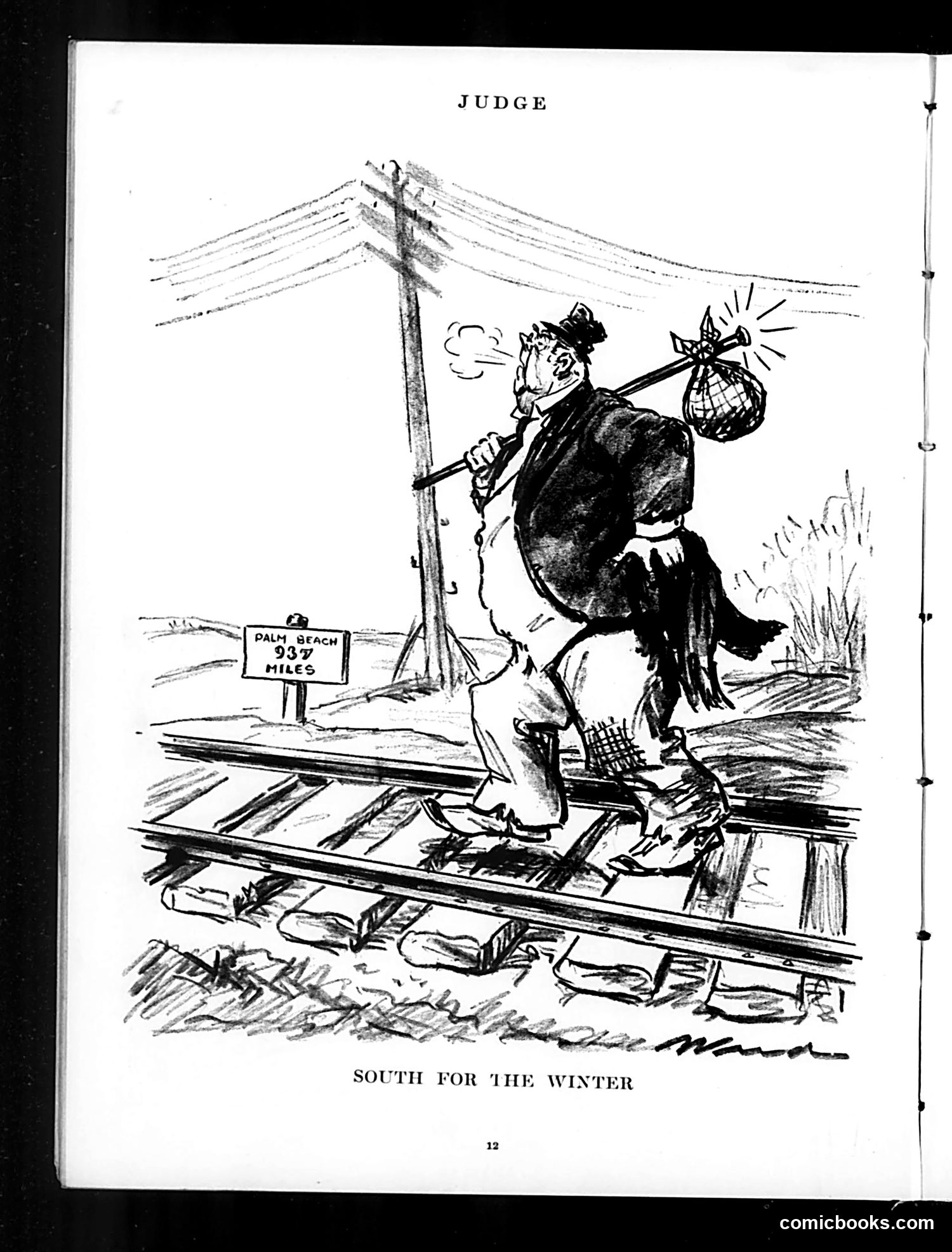
"South for the Winter" This political cartoon depicts a well-dressed judge character heading south, carrying a bindle (bundle) labeled with a globe/world symbol. The sign reads "Palm Beach 93½ Miles," and he's traveling by railroad. The satire likely comments on judicial corruption or favoritism—the judge appears to be literally fleeing with stolen goods (the globe suggests wealth or power). The "south for the winter" title suggests both the literal migration pattern of wealthy people to Florida resorts and a satirical comment about a judge abandoning his responsibilities or escaping consequences. The cartoon critiques either judicial misconduct, the perception of judges as self-serving, or possibly corruption tied to specific historical events. Without the publication date, the exact political target remains unclear.
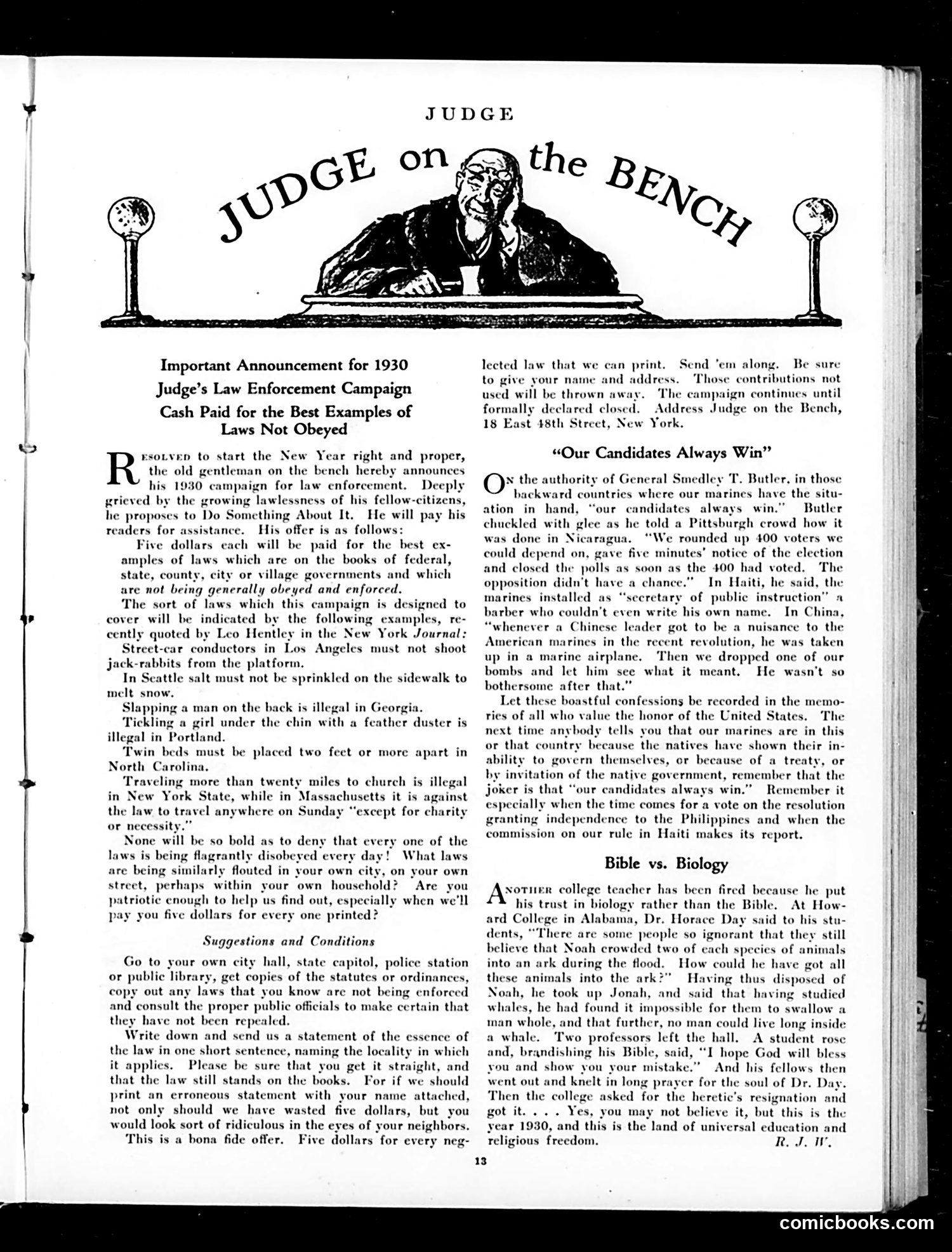
Judge Magazine, 1930: Two Satirical Pieces "Judge on the Bench" (Main Cartoon) The masthead shows a judge presiding over this satirical campaign. Judge magazine's editor announces a tongue-in-cheek "law enforcement" initiative: paying readers $5 for documenting absurd, unenforced laws still on the books. Examples listed—Los Angeles streetcar conductors can't shoot jack-rabbits, Seattle can't salt sidewalks, Georgia bans slapping women—are deliberately ridiculous. The satire targets widespread public lawlessness and selective enforcement during Prohibition and the Jazz Age, mocking both the laws themselves and society's casual disregard for them. "Our Candidates Always Win" This darker piece quotes General Smedley T. Butler's boastful confession about rigged elections in Nicaragua and China under American military occupation. Butler describes manipulating vote counts and eliminating inconvenient political opponents via aerial bombardment. The satire exposes U.S. imperial hypocrisy—preaching democracy abroad while orchestrating authoritarian control in occupied territories. This critiques American foreign policy and military overreach of the era.
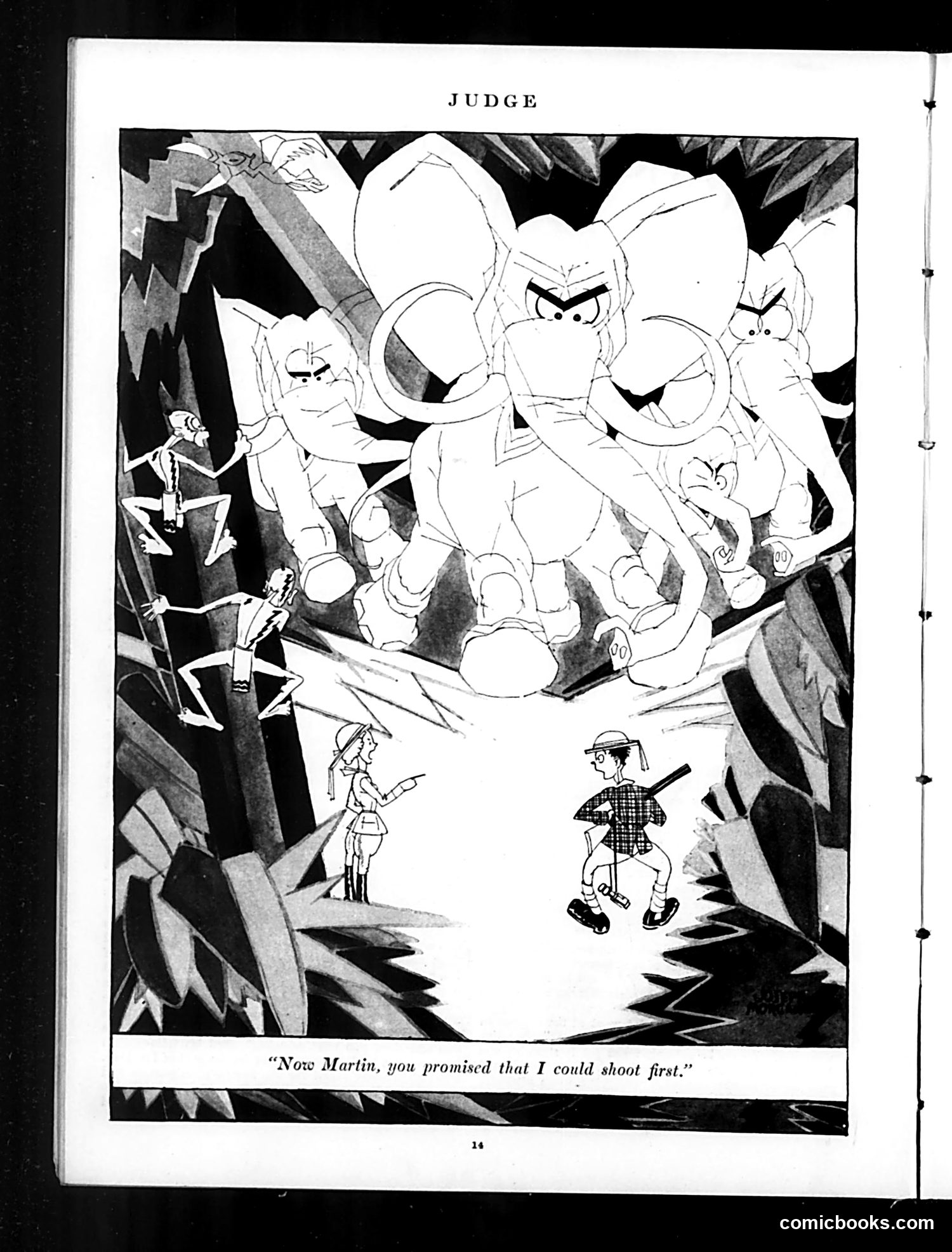
"Judge" Cartoon Analysis This cartoon depicts a conflict over shooting rights. The caption reads: "Now Martin, you promised that I could shoot first." The image shows two small human figures confronting a group of large, angry elephant-like creatures in what appears to be a jungle or cave setting. One figure (apparently named Martin) stands armed, while another protests that Martin violated a prior agreement about who gets to shoot first. The cartoon likely satirizes either a business or political dispute where partners or allies have competing claims or broken promises. The elephants represent a common threat both parties face, making their internal conflict over precedence absurd and counterproductive. Without additional context about the specific date or "Martin" reference, the exact political target remains unclear, though the humor derives from prioritizing personal advantage over collective survival.
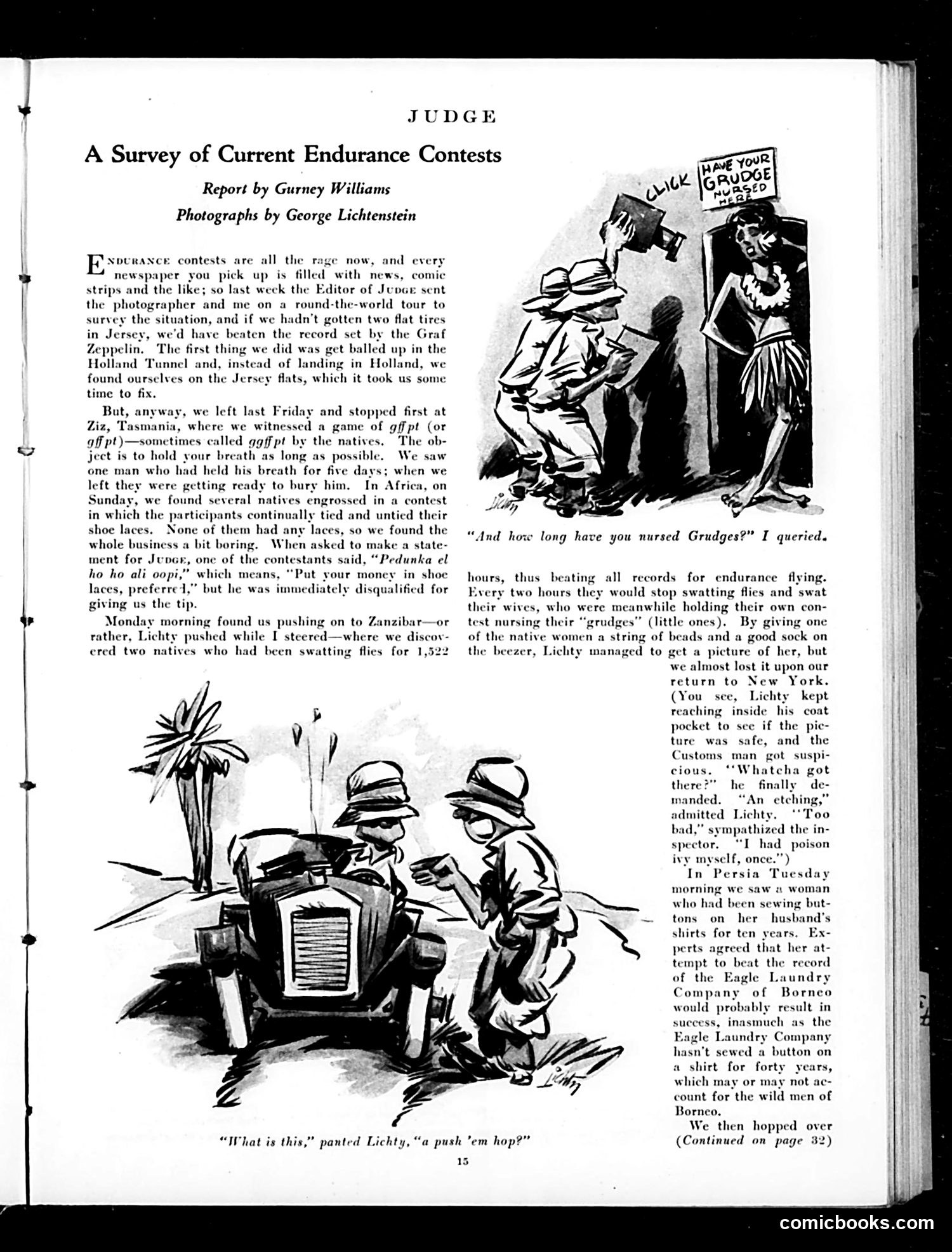
Explanation for Modern Readers This is a satirical article mocking the 1920s craze for endurance contests—absurd competitions (dance marathons, breath-holding, etc.) that were genuinely popular during this era and heavily covered by newspapers. The author and photographer claim to have traveled worldwide documenting bizarre contests: breath-holding in Tasmania, untying shoelaces in Africa, fly-swatting in Zanzibar, and button-sewing in Persia. The humor lies in the escalating absurdity and the deadpan tone treating ridiculous activities as newsworthy. The cartoon captions add visual satire: one shows a woman with a "grudge" (a baby), and another depicts the photographer's suspicious encounter with customs officials. The joke targets both the endurance-contest fad itself and the media's breathless coverage of such pointless competitions. By presenting fictional international examples, Judge suggests American obsession with these contests is equally ridiculous and worthy of mockery.
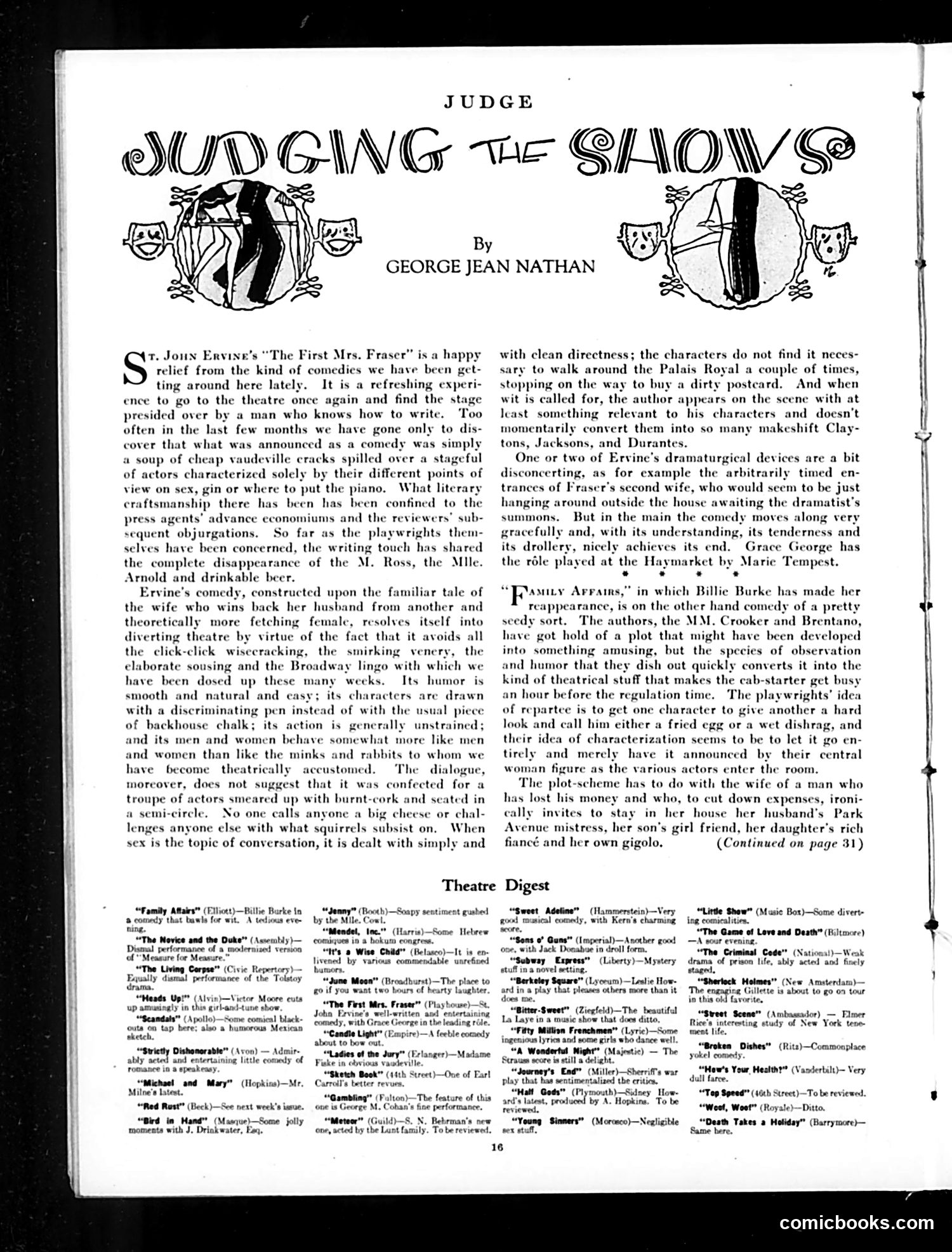
"Judging the Shows" – Theater Review Column This page is primarily a theater review column by George Jean Nathan, a prominent drama critic of the era. It's not a political cartoon but rather critical commentary on contemporary Broadway productions. Nathan praises St. John Ervine's "The First Mrs. Fraser" as a refreshing comedy with genuine wit and natural humor—a relief from the "cheap vaudeville cracks" and formulaic theatrical fare dominating recent seasons. He criticizes how many Broadway comedies rely on stock characters and crude jokes rather than craftsmanship. The column then lists brief reviews of other current productions, rating them from poor ("Family Affairs," "The Novice and the Duke") to entertaining ("Heads Up!," "Scandals"). Nathan's satire targets contemporary theater's tendency toward empty spectacle and lazy writing rather than addressing specific political figures or events.
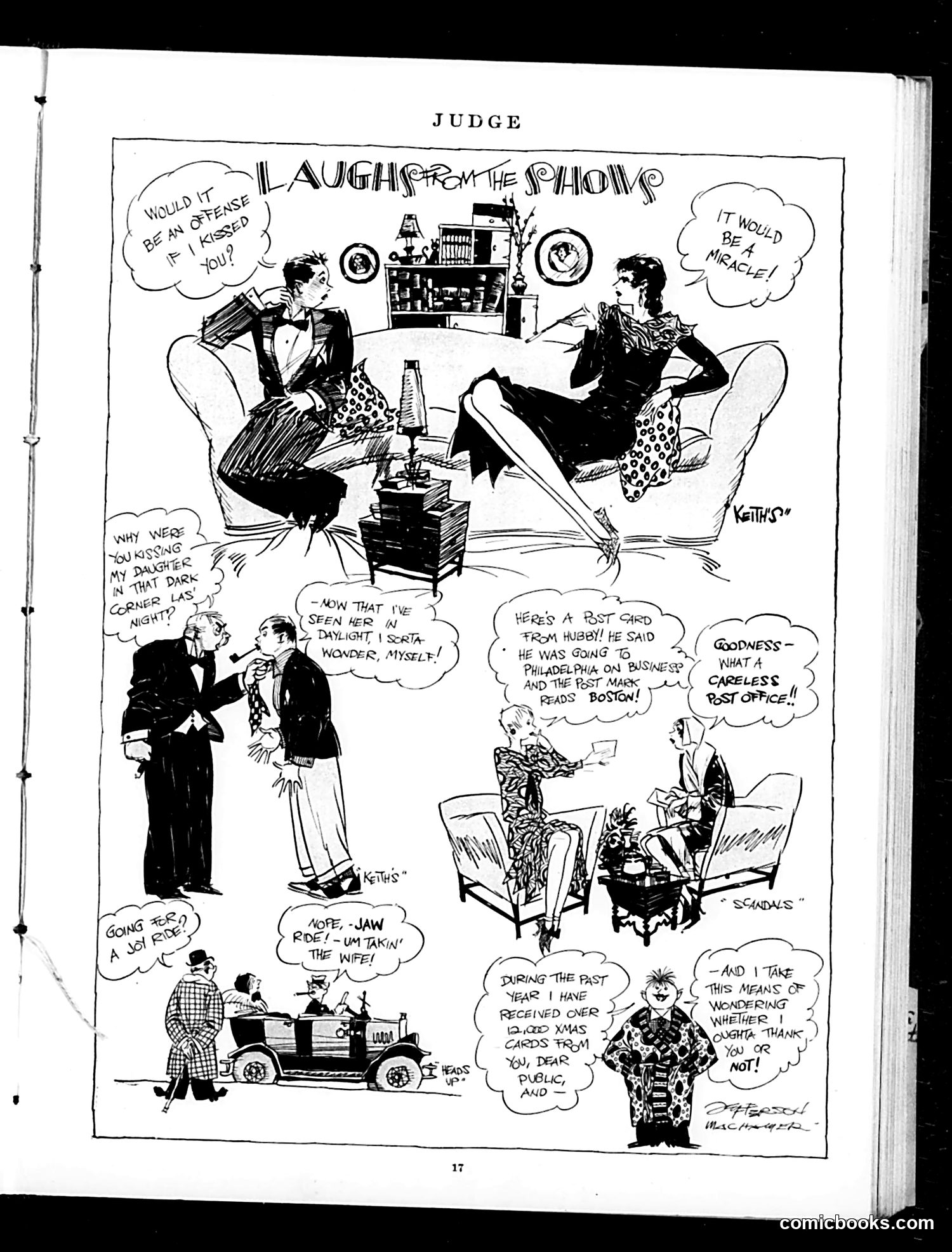
"Laughs from the Phone" - Judge Magazine Cartoon This is a multi-panel satirical cartoon about romantic and domestic miscommunications via telephone. The main scene shows a couple in an elegant room debating whether a kiss "from the phone" would constitute a genuine kiss—a playful commentary on telephone intimacy. The surrounding vignettes mock various telephone-related social situations: a man bragging about his daughter, another discussing a business trip to Philadelphia while his wife remains unaware of details, someone receiving unwanted Christmas cards, and a recipient ungratefully complaining about holiday correspondence. The overall satire targets the telephone as a modern technology creating confusion, misunderstandings, and social awkwardness—particularly around romance, business dealings, and holiday etiquette. The cartoon pokes fun at how this relatively new communication medium was disrupting traditional social interactions in early 20th-century American life.
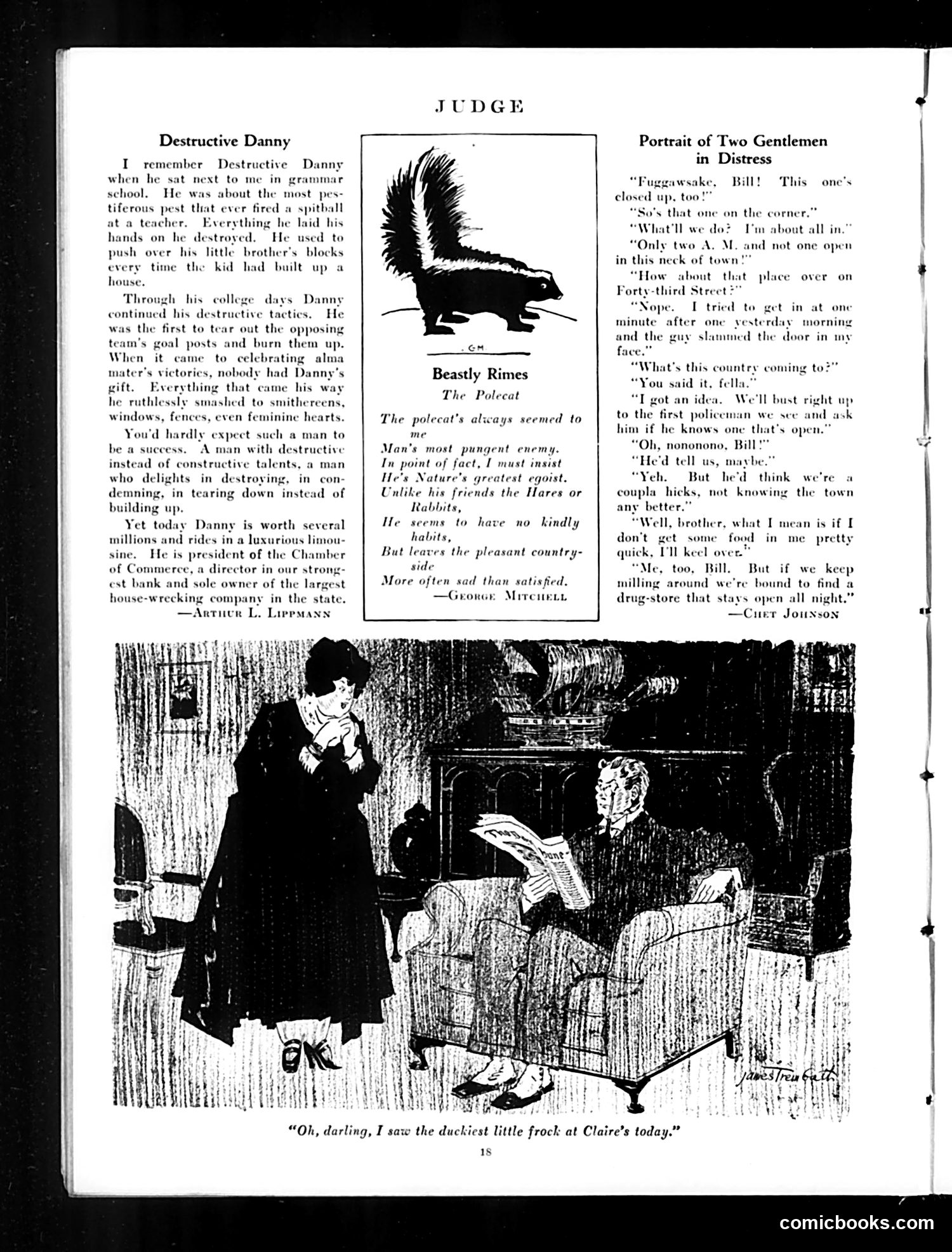
Analysis of Judge Magazine Page This page contains three distinct pieces of humor commentary: "Destructive Danny" (left) is a satirical story by Arthur L. Lippmann about a man whose childhood destructiveness—smashing toys, breaking property, vandalizing during college—paradoxically led to business success. He now heads the Chamber of Commerce and owns a wrecking company. The satire suggests irony: destructive impulses, when channeled into demolition work, become profitable and respectable. "Beastly Rimes: The Polecat" (center) is a humorous poem by George Mitchell personifying the polecat as nature's most selfish creature, leaving the countryside "sad" rather than satisfied—likely mocking human selfishness by comparison. "Portrait of Two Gentlemen in Distress" (right) depicts two men unable to find an open restaurant or drug store at night. Their dialogue captures period frustration with limited late-night establishments. The final panel cartoon shows a woman visiting someone, commenting on a dress—apparently unrelated social small-talk juxtaposed against the hungry men's plight. The humor relies on observational social commentary typical of *Judge*'s satirical approach.
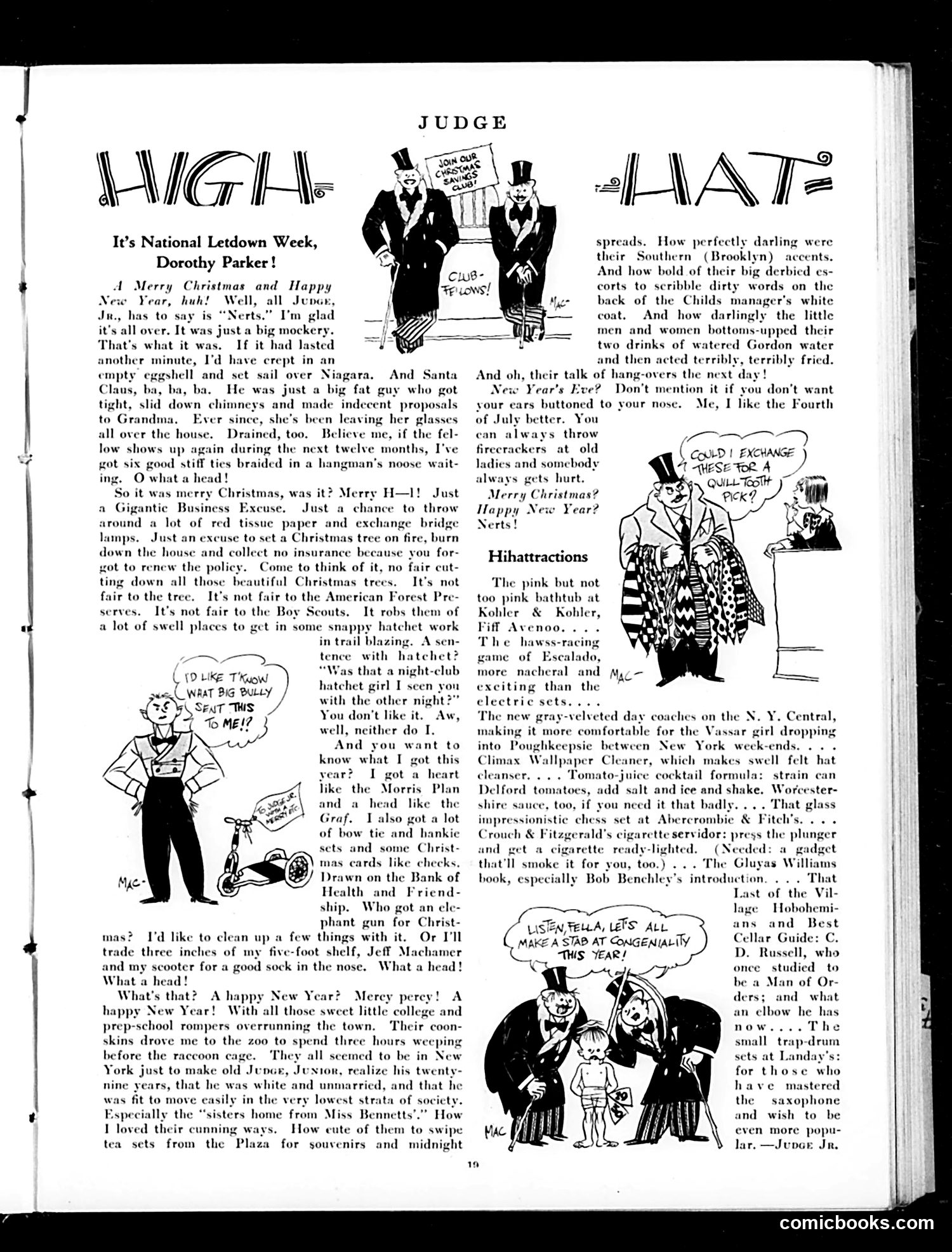
Judge Magazine Satire: "National Letdown Week" This is a post-holiday satirical piece by or about Dorothy Parker (the famous writer/wit), written in the caustic voice of someone thoroughly disgusted with Christmas and New Year celebrations. The humor targets the phoniness and excess of holiday season: the "big mockery" of Christmas commerce, the arbitrary gift-giving (bridge lamps), the drunk behavior of socialites, and the hypocrisy of families pretending joy while being miserable. Specific jabs include mockery of young wealthy women ("Vassar girls," "sisters home from Miss Bennetts'") for their pretentious behavior and theft; criticism of Brooklyn accents and working-class rowdiness; and complaints about holiday-season destruction (burning Christmas trees, damaging property while drunk). The cartoons show exasperated figures and a couple teaching a child materialistic greed ("Listen, tell's all make a start at generosity this year!"). The "Hihattractions" section lists consumer products and experiences as the *only* worthwhile aspects of the season—sarcastic acknowledgment that modern life is fundamentally commercial and hollow.
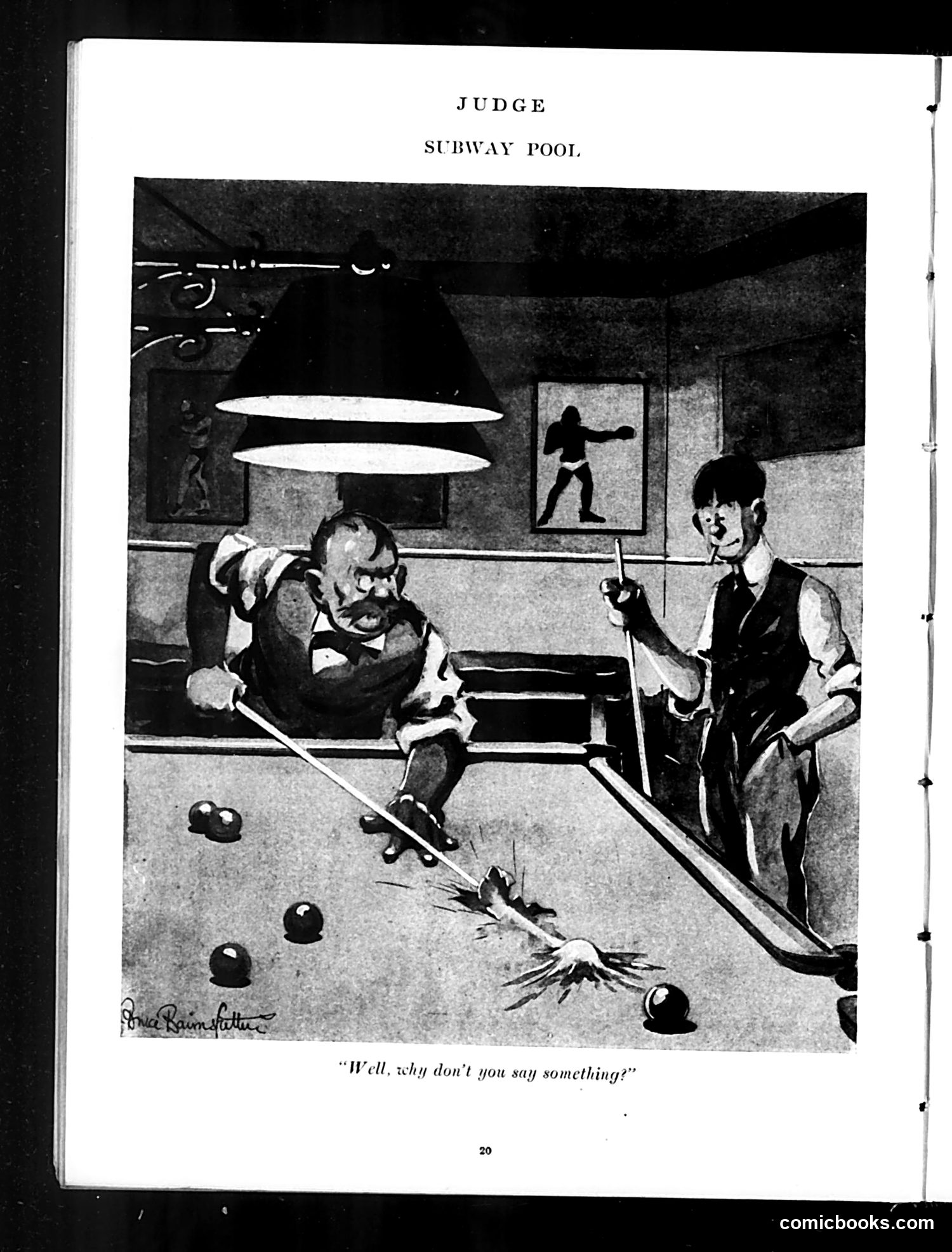
"Judge: Subway Pool" This cartoon satirizes the New York City subway system, depicting an underground pool hall rather than transit. Two men play pool on a subway car while a third figure stands by with a cue, amid scattered billiard balls. The caption—"Well, why don't you say something?"—suggests social awkwardness or tension between the figures. The satire likely mocks the subway as chaotic, lawless, or poorly managed, transforming it into an illicit gambling den. The title "Subway Pool" puns on both billiards and the subway system itself. This reflects contemporary anxieties about urban transit safety and crowding. The cartoon appears designed for *Judge* magazine's audience of middle-class readers who used or feared the subway system, presenting it as a space where civilized norms break down.
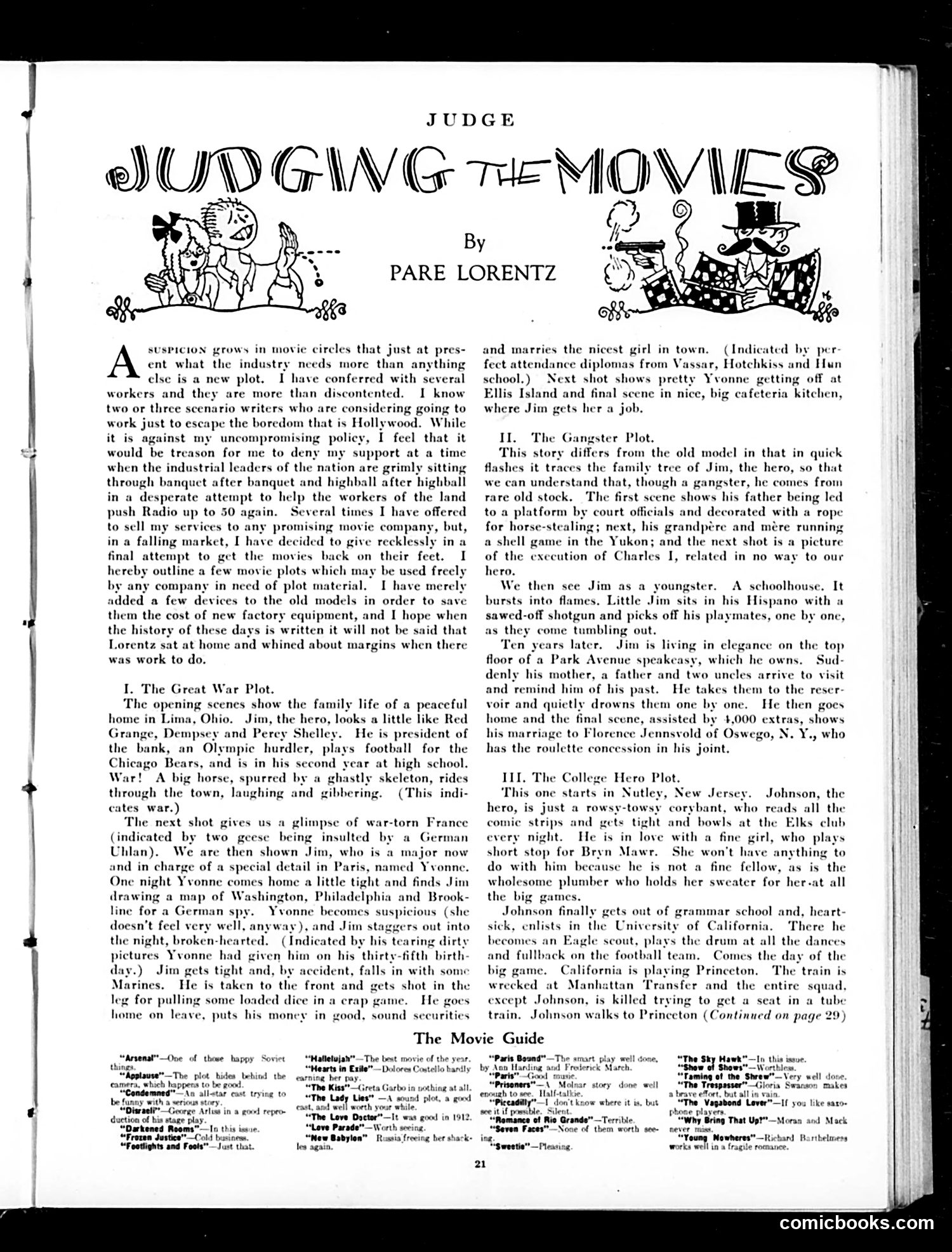
"Judging the Movies" by Pare Lorentz This is satirical film criticism disguised as "helpful" plot suggestions. Lorentz mocks Hollywood's creative bankruptcy by outlining three ridiculous movie formulas that were apparently common in the 1920s. The satire targets: 1. Absurd plotting: Each "plot" combines incompatible elements (Jim is simultaneously a bank president, Olympic athlete, football player, AND high school student) to ridicule lazy screenwriting. 2. Melodramatic tropes: War plots featuring contrived romance, moral ambiguity, and convenient redemption; gangster stories with implausible family backstories (tracing lineage to King Charles I's execution). 3. Studio desperation: The opening frame mocks an industry supposedly in crisis, needing "new plots" yet recycling the same tired formulas. Lorentz's tone is mock-helpful—he's "saving" studios money by repackaging old clichés. The real joke: Hollywood's plots are so predictable and formulaic that this parody barely exaggerates actual pictures of the era.
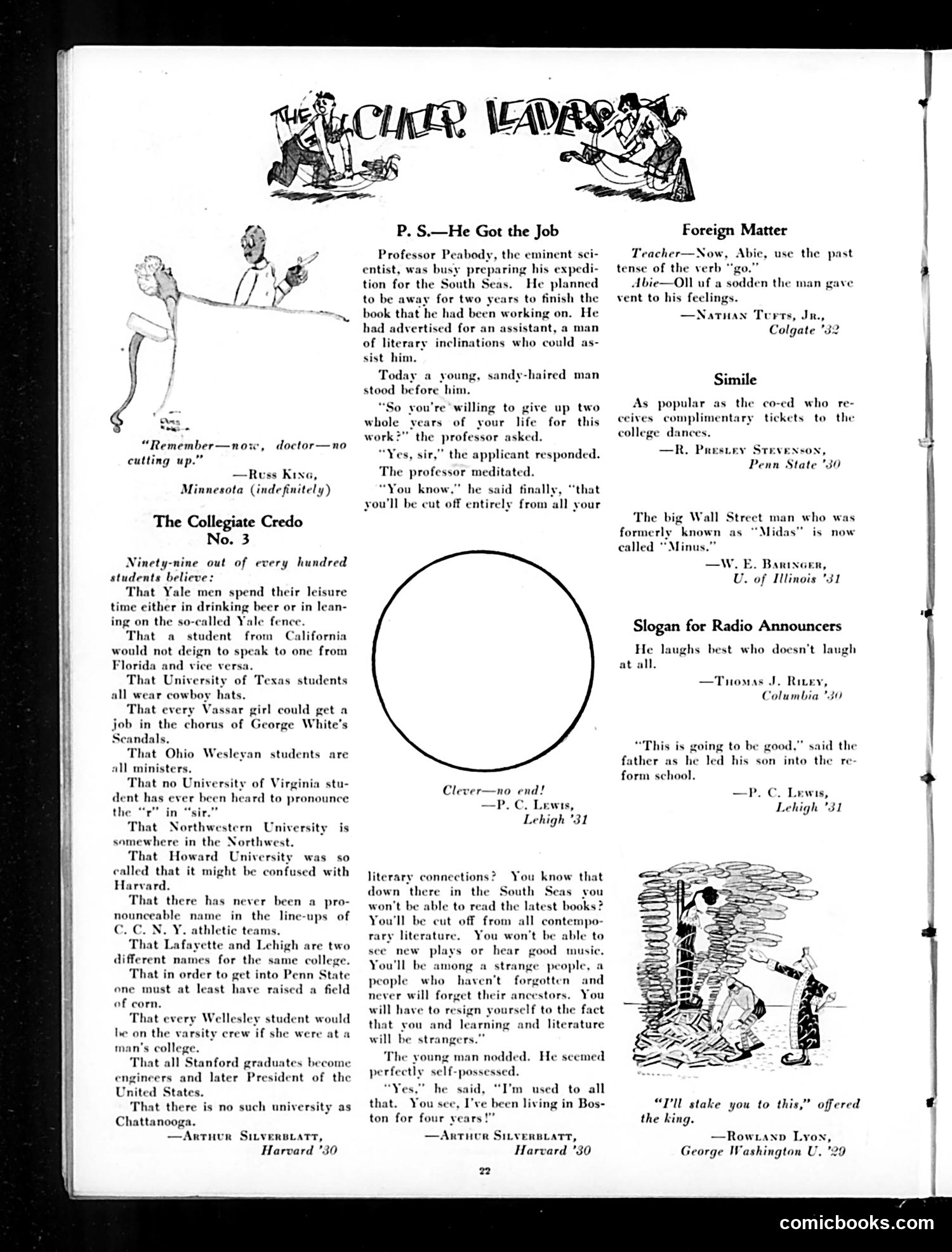
"The Collegiate Credo No. 3" This page satirizes stereotypical beliefs college students hold about other universities. Arthur Silverblatt (Harvard '30) catalogs absurd, exaggerated assumptions: Yale students drink and loaf; Texas students wear cowboy hats; Vassar girls all aspire to chorus lines; Northwestern's location is vague; Penn State requires agricultural background. The humor relies on recognizing these as ridiculous campus prejudices—regional biases, class assumptions, and ethnic caricatures typical of 1930s collegiate culture. The "Foreign Matter" section includes a dialect joke ("Abie") reflecting period casual antisemitism in humor publications. The "P.S.—He Got the Job" anecdote offers gentle irony: a Boston resident claims four years there equals the isolation of South Seas expedition—implying Boston's cultural insularity. These pieces reflect Judge magazine's satirical approach to American social pretensions and educational snobbery of the era.
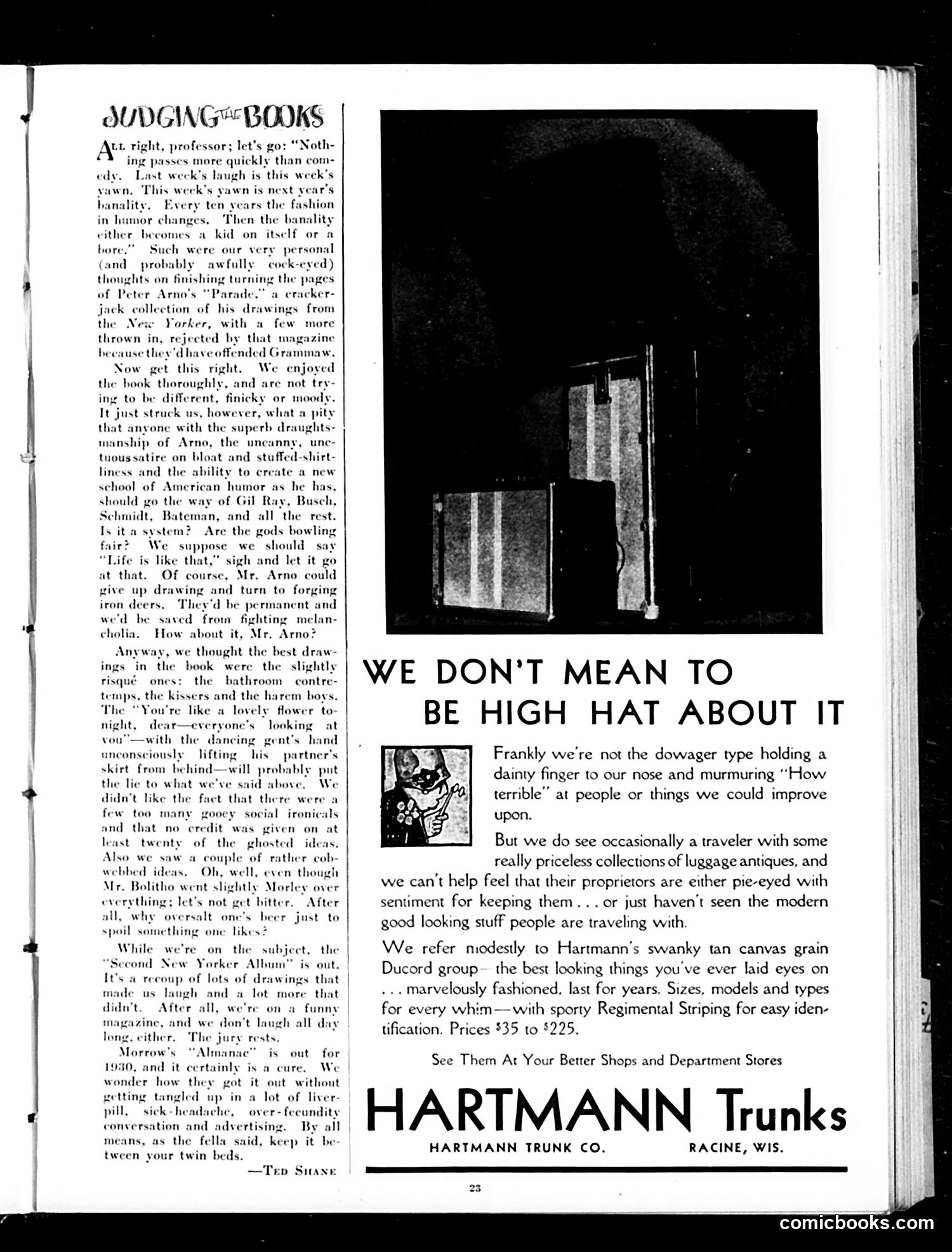
"Judging the Books" - Judge Magazine Review This page contains a literary review column by Ted Shane critiquing Peter Arno's cartoon collection "Parade" (drawn for *The New Yorker*). Shane praises Arno's superior draftsmanship and satirical edge but laments that he follows the formulaic path of other American humorists like Gil Ray and Busch, producing predictable work. Shane notes the best drawings are the risqué bathroom and harem scenes, suggesting commercial constraints limit Arno's potential. The second half is a Hartmann Trunks advertisement using the review's concluding tone—sarcastically positioning the luggage brand as superior to "priceless collections of luggage antiques," implying travelers clinging to old luggage are either sentimental or outdated. The ad exemplifies 1930s corporate messaging: equating modernity with good taste and consumption.
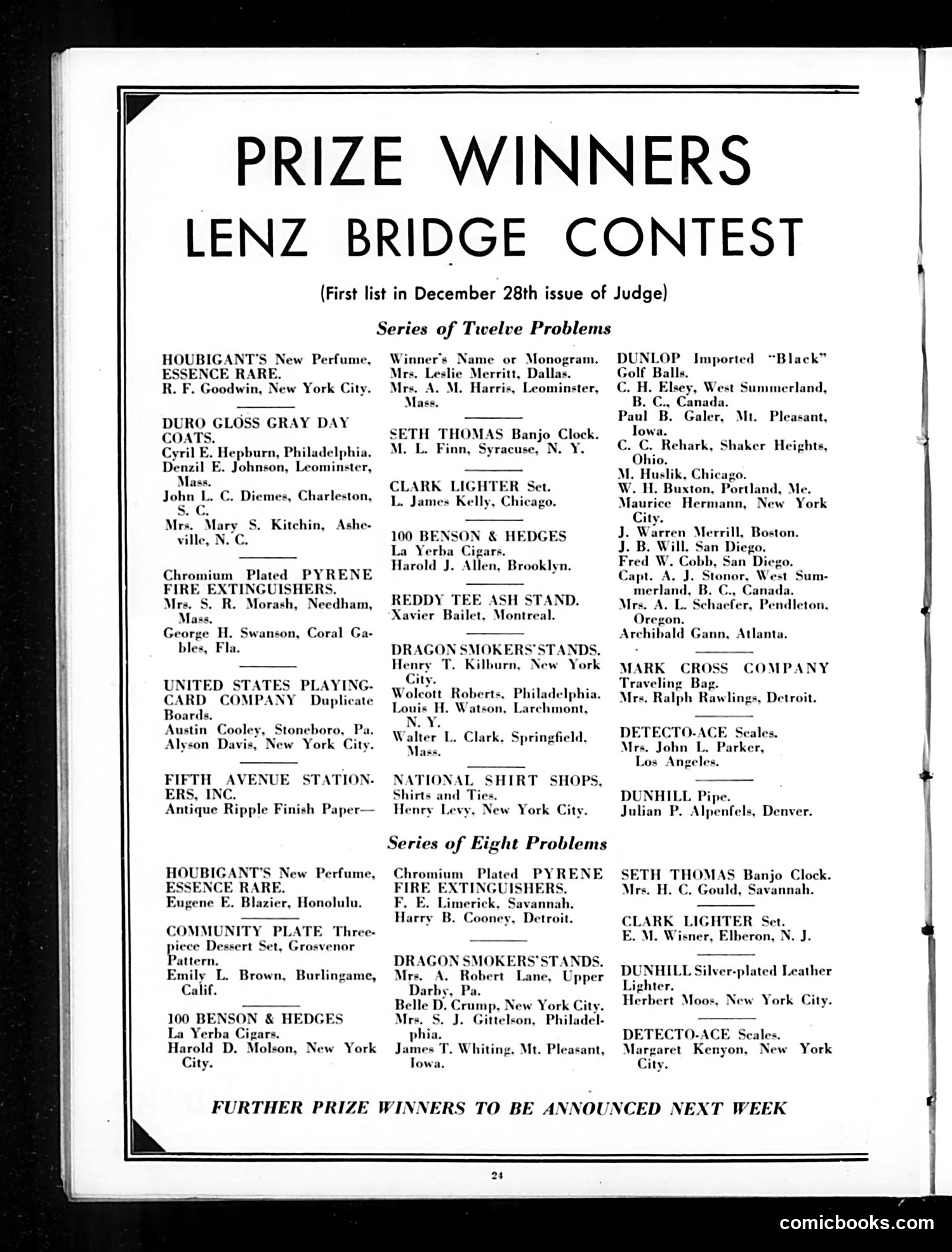
Prize Winners Page Analysis This page contains no cartoons or satire—it is purely administrative content from Judge magazine. It lists winners of the "Lenz Bridge Contest," a puzzle competition that Judge ran for readers. The page announces prize winners across two series: twelve problems and eight problems. Winners received merchandise prizes like perfume, playing cards, lighters, banjo clocks, golf balls, and smoking accessories—typical luxury goods of the era. The "Lenz Bridge" likely refers to a bridge-building puzzle (the card game or structural engineering variant), though the specific contest details aren't visible here. This was a common engagement tactic for magazines of this period—contests encouraged readership and subscriber participation. The note "Further Prize Winners to be Announced Next Week" indicates this was an ongoing contest with multiple installments published across successive issues.
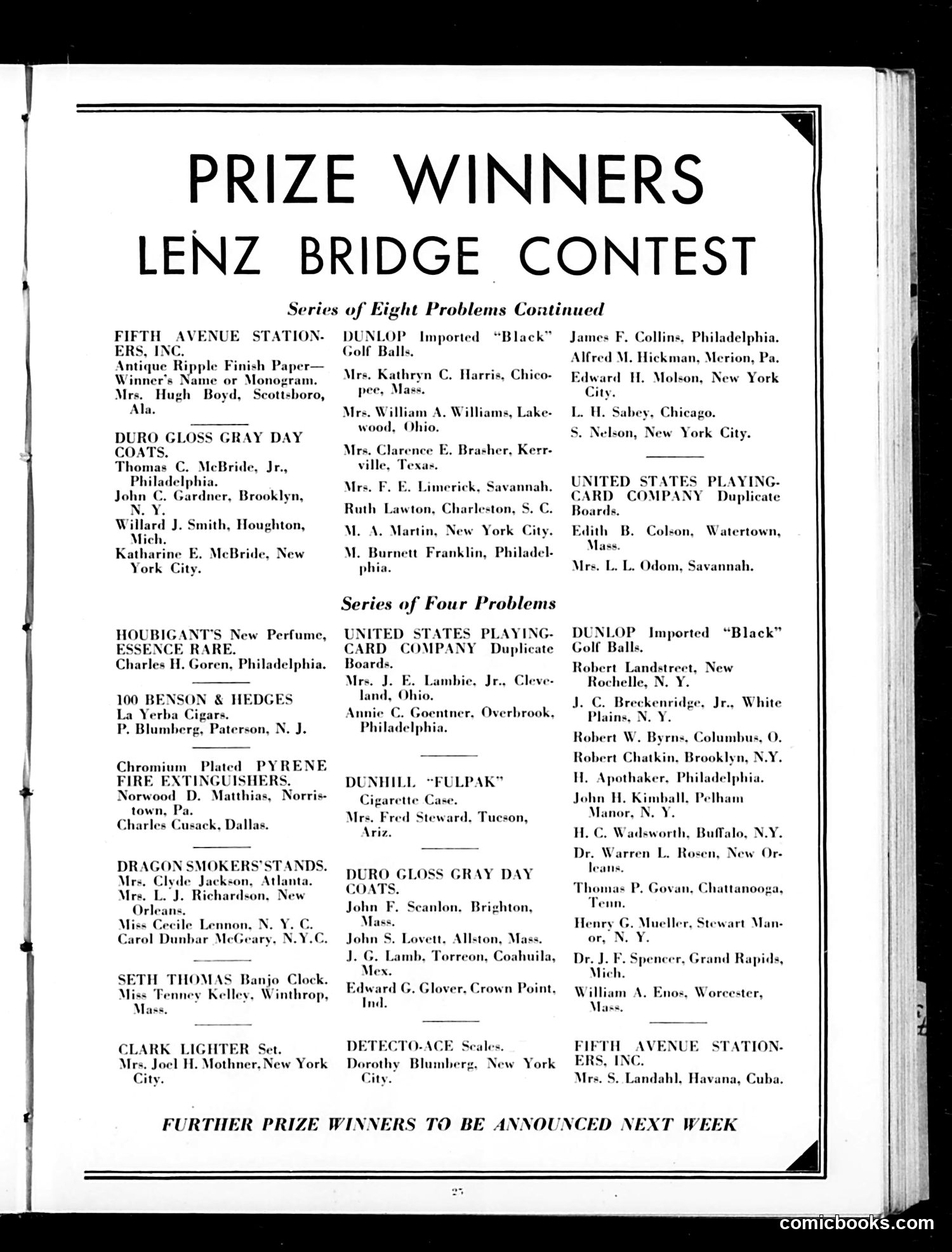
Prize Winners: Lenz Bridge Contest This page is not a cartoon or satire—it's a straightforward announcement of contest winners from *Judge* magazine. The "Lenz Bridge Contest" refers to a puzzle competition (likely involving the card game bridge), organized in a series of eight and four problems. Winners are listed by prize category: products like golf balls, cigarettes, perfume, clocks, and playing cards from manufacturers who apparently sponsored the contest. Names and cities are recorded for each winner. The note at bottom indicates more winners would be announced the following week. This represents the practical, advertiser-supported side of *Judge*—using reader contests to boost engagement and showcase sponsor products. There is no satirical content on this page.
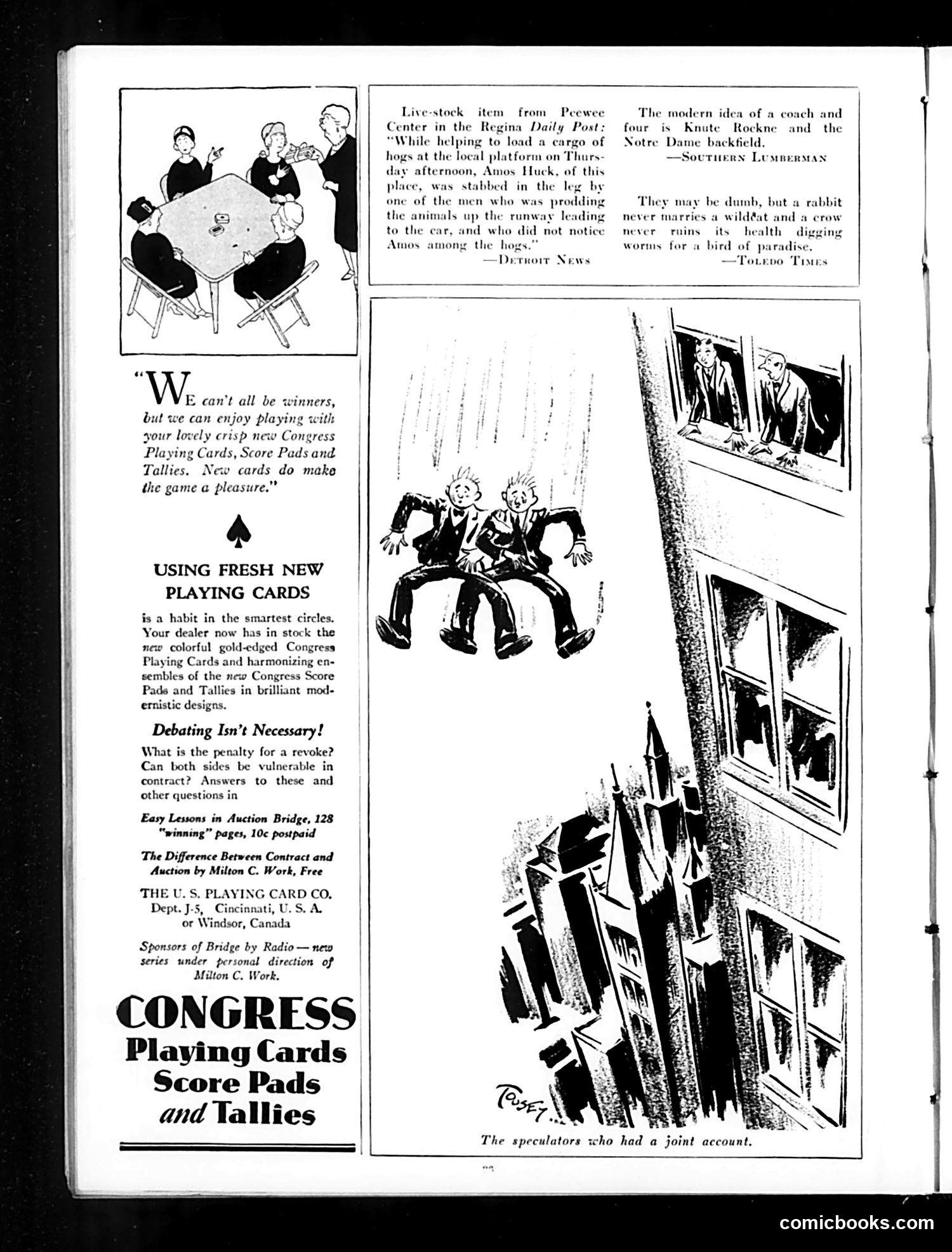
Content Analysis This page is primarily advertising for Congress Playing Cards, interspersed with brief humorous items and cartoons typical of Judge magazine's format. The main cartoon (bottom right) depicts two men peering from a window at a building facade below, captioned "The speculators who had a joint account." This appears to be a stock market joke—likely referencing the 1929 crash or its aftermath, when ruined investors famously jumped from buildings. "Joint account" is a pun: a shared financial account, but also suggesting they literally shared a "joint" (window) from which to fall. Sidebar items include brief humorous anecdotes: a livestock injury from a Regina newspaper, a Notre Dame football reference (Knute Rockne was famous coach), and animal sayings. These are typical filler content. The playing cards advertisement promotes Congress brand cards with modernistic designs and related bridge-game accessories—standard commercial content for the era. The page reflects early 20th-century magazine structure: mixing humor, social commentary, and advertising.
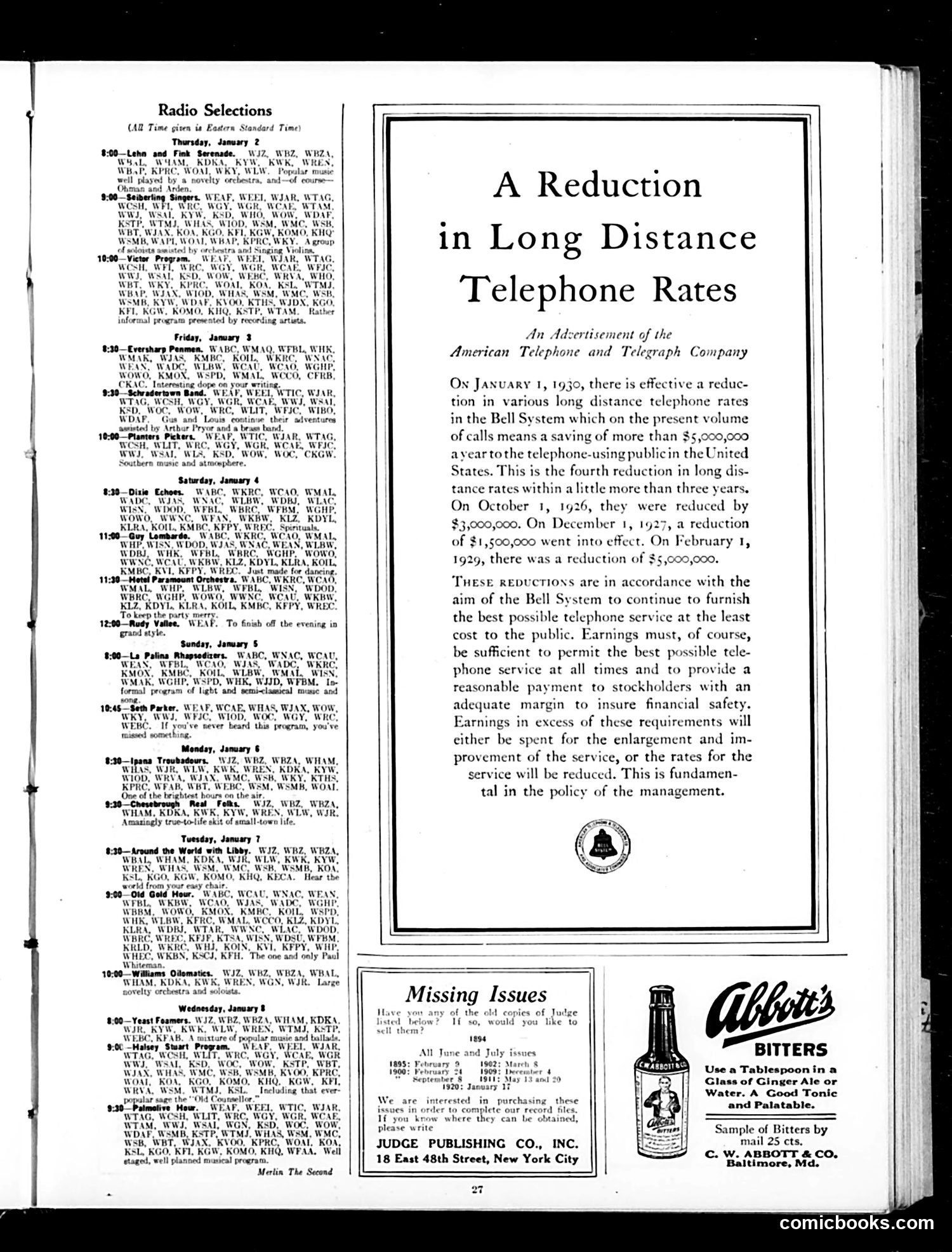
This page is primarily advertising and radio programming, not satire or political cartoons. The main content is a full-page advertisement from American Telephone and Telegraph Company announcing telephone rate reductions effective January 1, 1930. The ad states that Bell System rates are being reduced, saving the public over $5 million annually—the fourth reduction in roughly four years (following reductions in 1926 and 1927). The company justifies this by explaining that earnings must cover service improvements and stockholder returns while maintaining financial safety. The left column contains radio program listings for the week of January 2-7, listing station call letters and show titles. There is also a small "Missing Issues" notice from Judge Publishing seeking old copies of the magazine, and an advertisement for Abbott's Bitters at the bottom right. No political cartoons or satirical commentary appear on this page.
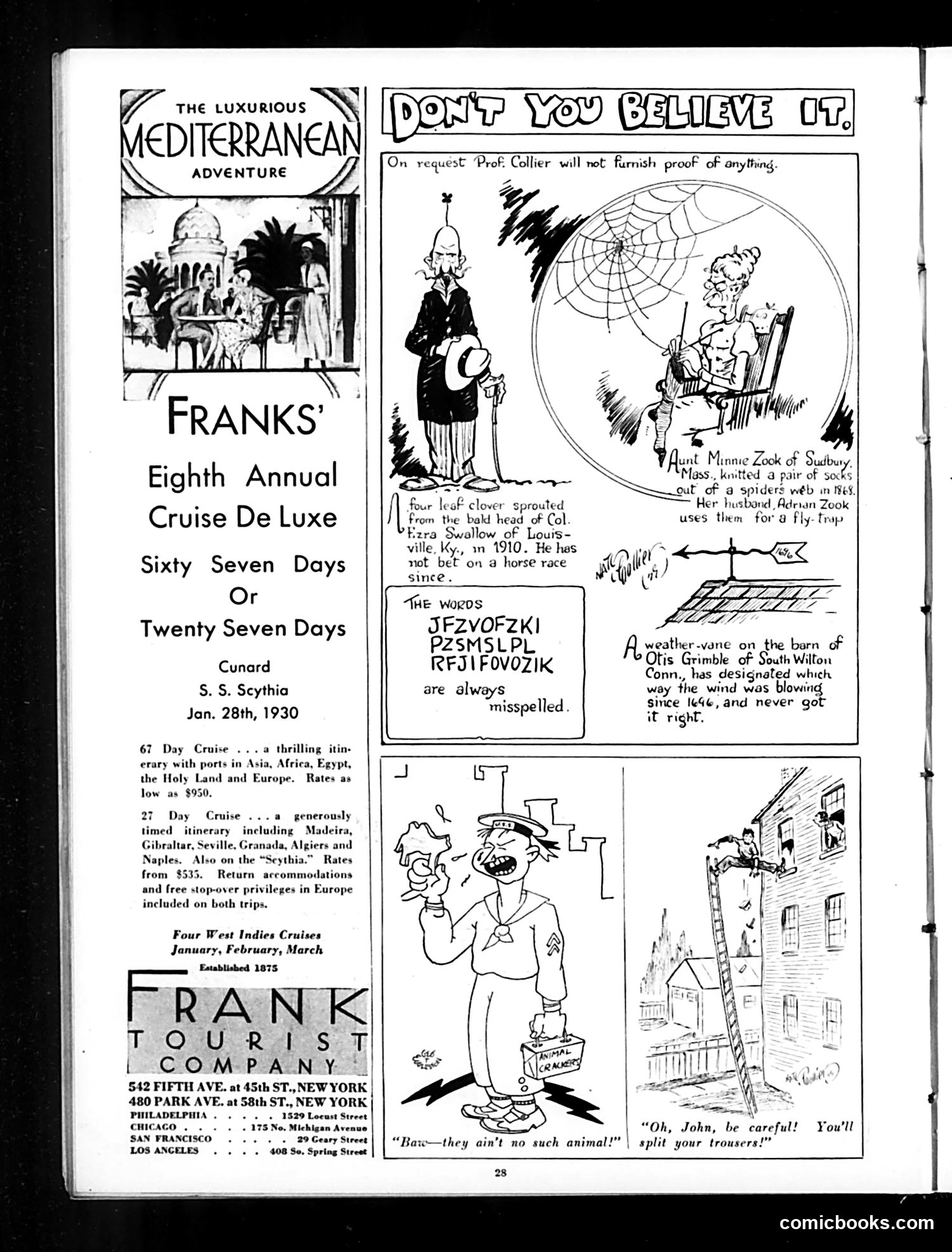
"Don't You Believe It" - Judge Magazine Satire Page This page combines cruise ship advertising with a satirical "believe it or not" column mocking dubious claims. The cartoons present absurd anecdotes presented as fact—a four-leaf clover growing from a bald man's head, spider-web socks knitted from actual webs, a weather vane that's been wrong since 1846. The repeated phrase "are always misspelled" jokes about unverifiable claims. The humor targets credulous readers and sensationalist journalism. The bottom cartoon shows a man demonstrating some impossible physical feat ("they ain't no such animal!"), poking fun at tall tales and exaggerated stories circulating in popular culture. The page juxtaposes this satirical debunking with luxury cruise advertisements—likely suggesting that both the fantastical claims and travel marketing represent similarly dubious promises to gullible consumers. The satire reflects 1920s-30s skepticism toward advertising and sensationalism.
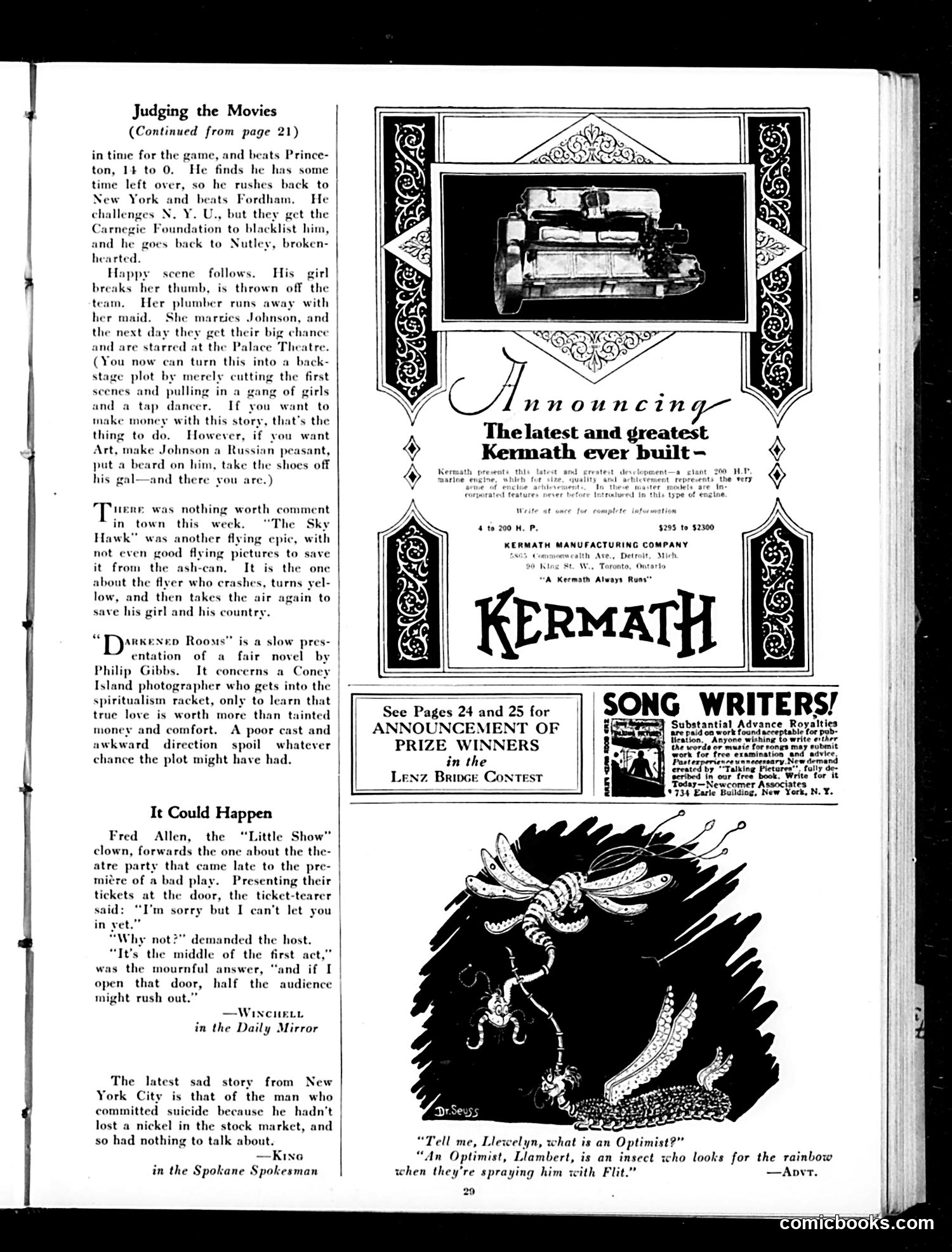
Explaining This Judge Magazine Page to Modern Readers This page consists primarily of movie reviews rather than political satire. The "Judging the Movies" column mocks contemporary 1920s films with cynical humor. The reviews ridicule plot formulas: one film about a football player who inexplicably also beats other teams and has romantic complications. Another is a flying picture (action film) with poor aviation footage. A third adapts a Philip Gibbs novel about spiritualism and romance. The humor relies on absurdist exaggeration—the columnist suggests if you want commercial success, add tap dancers and Russian peasants; for "Art," make characters exotic. The page also includes a Dr. Seuss cartoon (bottom right) making a Depression-era joke: an "Optimist" is an insect sprayed with Flit pesticide while looking for rainbows—meaning an optimist is hopelessly naive. The Kermath engine advertisement and song-writer notice are standard magazine filler. The brief anecdotes mock New York society (a man losing a nickel in stocks), reflecting 1920s economic anxieties.
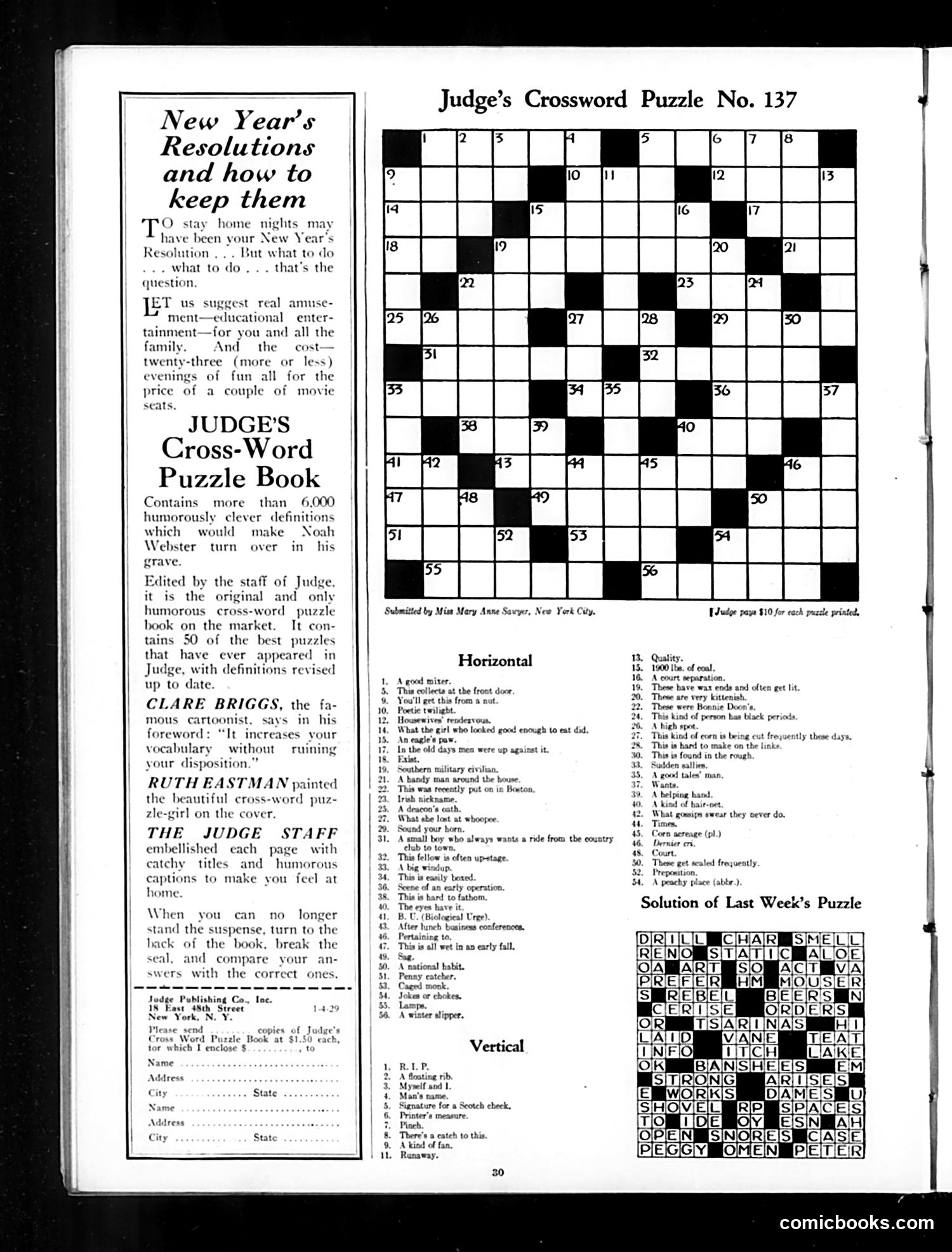
Judge Magazine Crossword Puzzle Page This page is primarily advertising and puzzle content, not satirical editorial material. It promotes Judge Publishing Co.'s new *Cross-Word Puzzle Book*, which contains 6,000 definitions and 50 puzzles previously published in Judge magazine. The marketing emphasizes the book as affordable family entertainment—costing the price of "a couple of movie seats" for "twenty-three evenings of fun." Famous cartoonist Clare Briggs endorses it in the foreword, claiming it increases vocabulary without "ruining your disposition," while artist Ruth Eastman illustrated the cover. The page displays Puzzle No. 137 with clues and the solution to the previous week's puzzle. The cultural reference to "Noah Webster" humorously suggests the definitions are comprehensive enough to amuse even the famous dictionary maker "in his grave." This reflects 1920s-era puzzle-solving as fashionable entertainment.
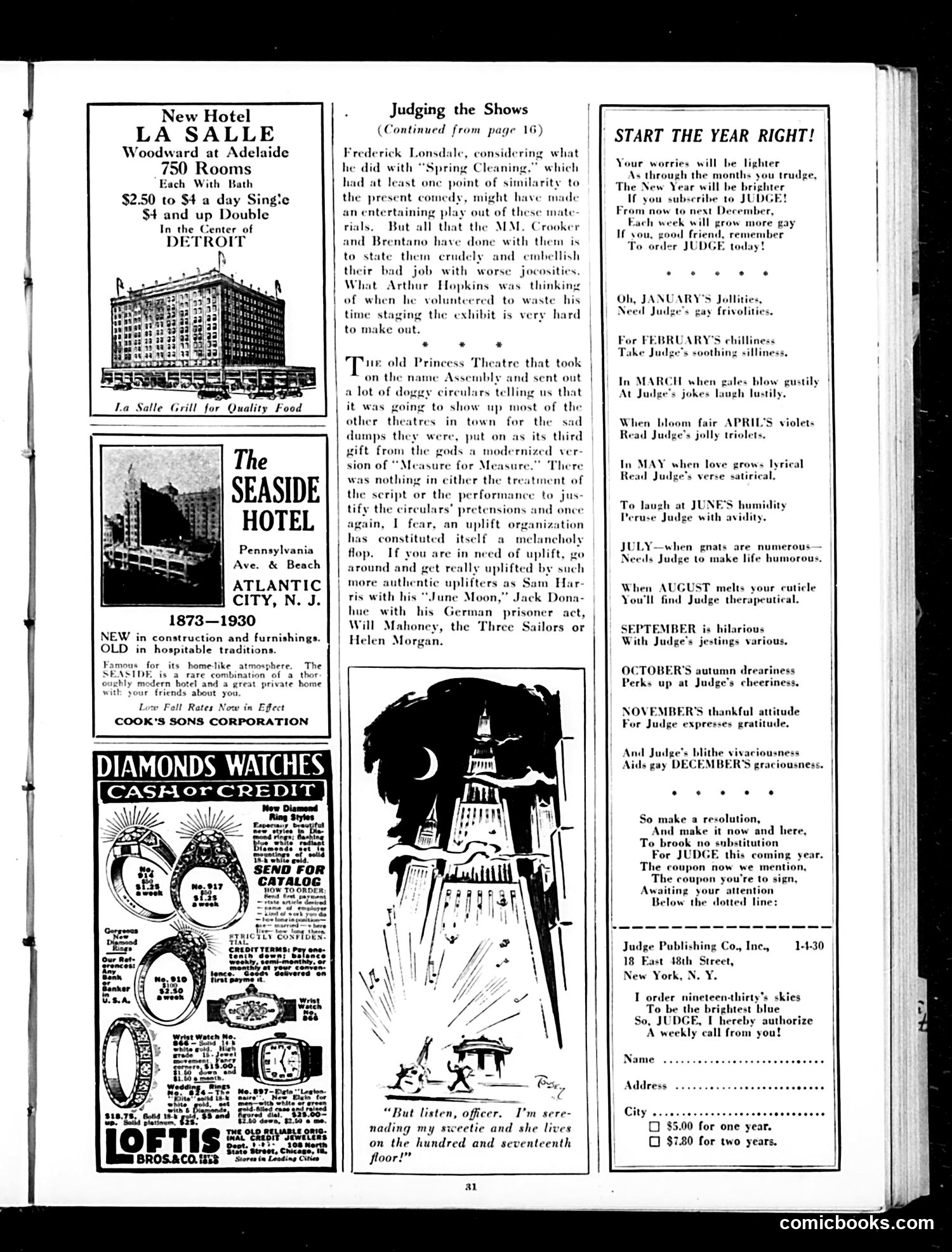
Explanation for Modern Readers This page is primarily advertising and subscription promotion for *Judge* magazine, a satirical publication. The main content includes: The Cartoon: A silhouetted figure serenades a woman from a skyscraper's 117th floor, with a policeman present. The joke plays on the absurdity of romantic gestures in the modern age of skyscrapers—the suitor's elaborate serenade is rendered ridiculous by the extreme height, making it impractical and comedic. The Subscription Campaign: The right column uses monthly personification ("January's Jollities," "February's Chilliness," etc.) as a sales pitch, arguing readers should subscribe to *Judge* year-round for humor suited to each season's mood. Hotel/Watch Advertisements: Supporting the satire magazine are period ads for the La Salle Hotel, Seaside Hotel, and Diamond watches sold on credit—typical 1920s-era luxury goods marketing. The page reflects *Judge*'s niche as entertainment for middle-class readers seeking sophisticated humor and modern urban commentary.
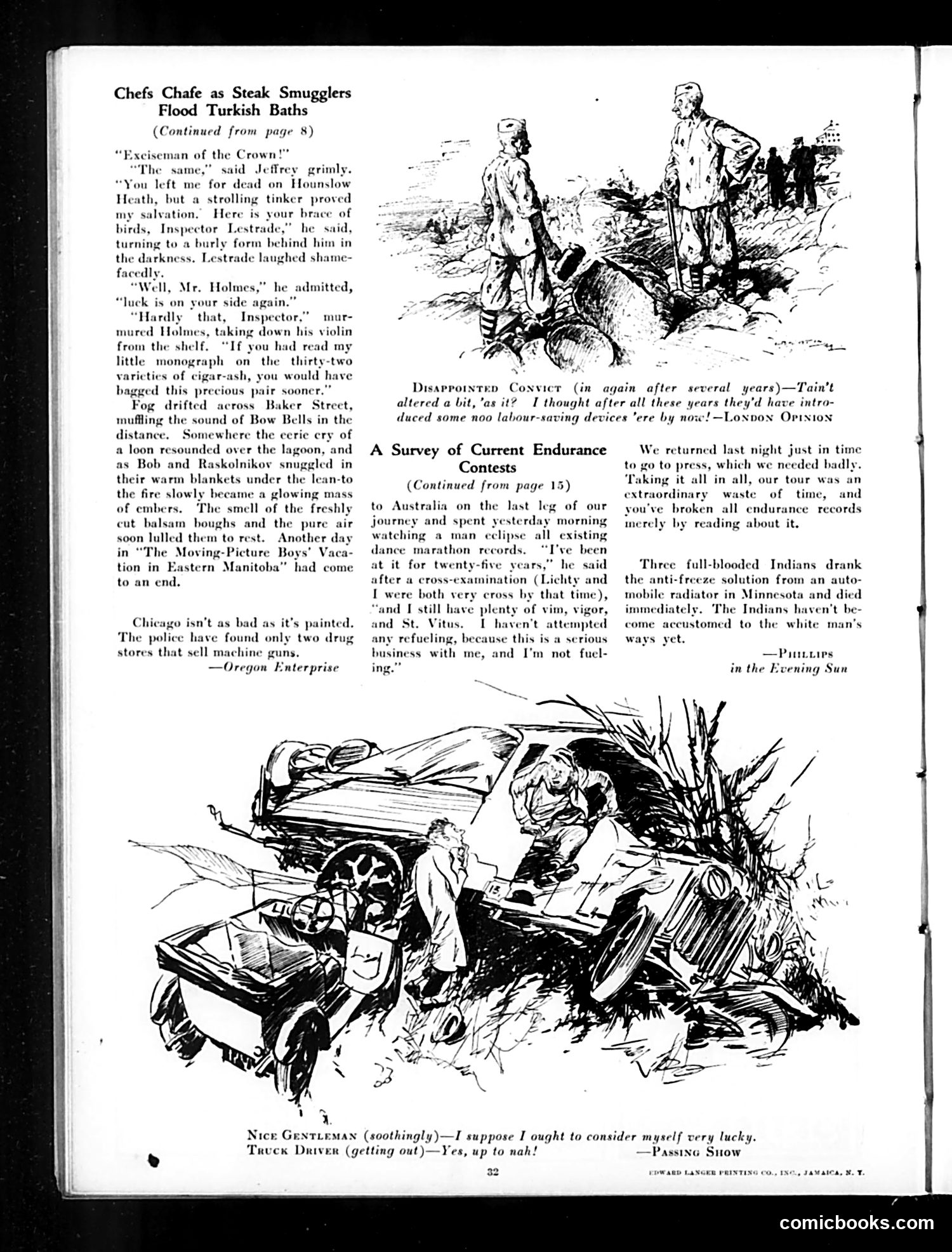
Judge Magazine Page Analysis This page contains three separate humorous pieces: 1. Top text: A Sherlock Holmes parody continuing a serialized story, mixing Holmes's characteristic deduction (cigar-ash analysis) with incongruous plot elements (Bob and Raskolnikov in Manitoba). The satire mocks overwrought Victorian detective fiction by juxtaposing Holmes's serious methods with absurd narrative shifts. 2. Middle cartoon: Shows a disappointed convict returning to prison after years away, remarking that they haven't introduced "labour-saving devices." The joke satirizes modern efficiency culture—even prison conditions are measured by industrial progress standards, making obsolescence a concern even for criminals. 3. Bottom cartoon: A car accident between a gentleman and truck driver. The gentleman expresses luck at surviving; the driver agrees "up to nah [now]"—implying his luck will run out. Dark humor about automotive accidents, a contemporary danger in the 1920s-30s era. The page represents Judge's typical mix of literary parody, social commentary, and visual gags targeting contemporary anxieties about modernity, efficiency, and technology.
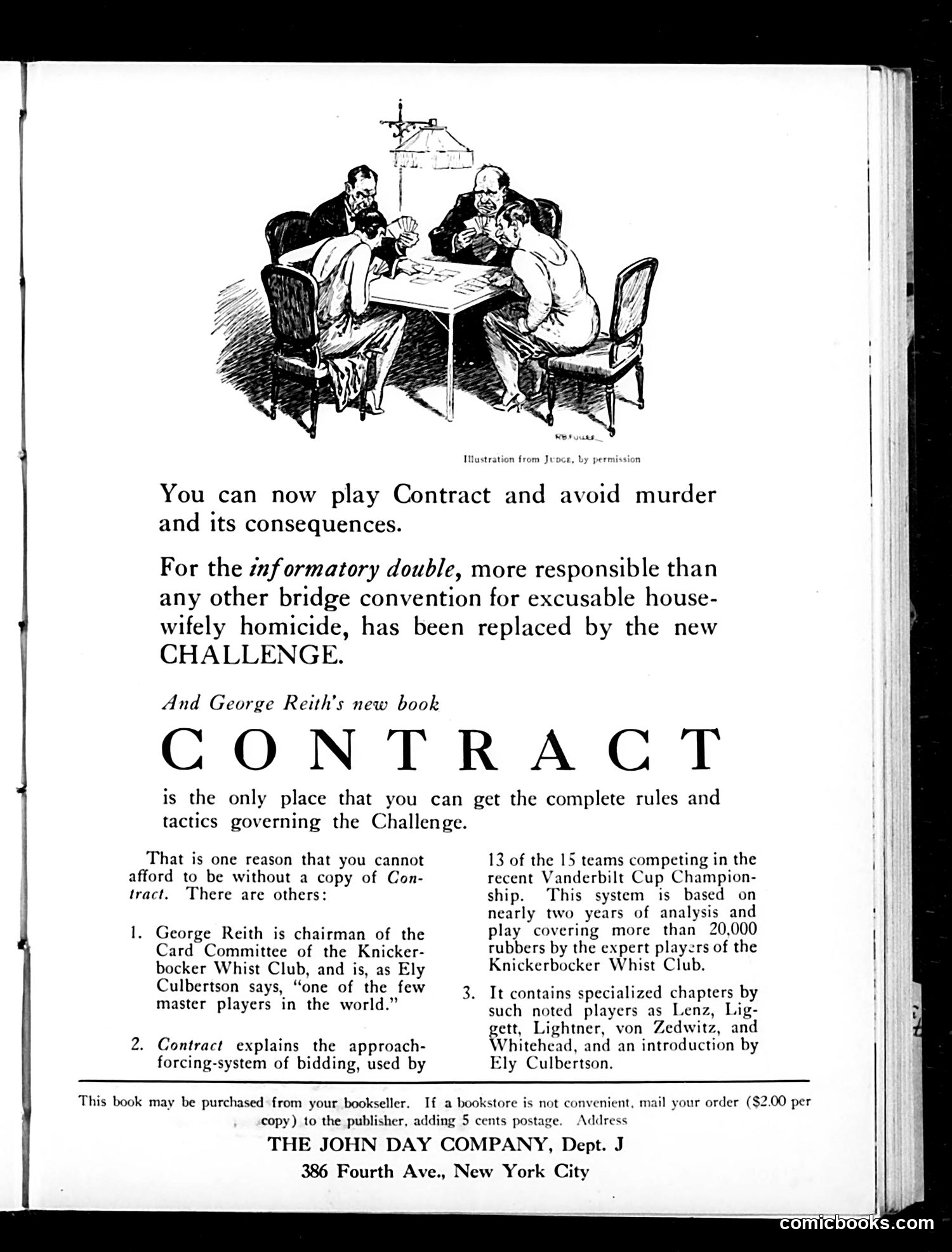
Analysis This is primarily an advertisement for George Reith's bridge instruction book, not political satire. The cartoon shows four bridge players at a table, illustrating the game's social popularity. The "joke" relies on period context: Contract bridge was then a fashionable, competitive card game among the upper-middle class. The opening line—"avoid murder and its consequences"—is hyperbolic humor suggesting that the old "informatory double" bridge convention was so frustratingly poor that it drove players to homicide. The new "Challenge" convention supposedly prevents such "housewifely homicide." This reflects early-1930s bridge mania: the game was so culturally significant that Judge could assume readers understood bridge terminology enough to find this funny. The advertisement emphasizes the book's authority through endorsements from prestigious players (Culbertson, Lenz, etc.) and the exclusive Knickerbocker Whist Club. The satire, if any, gently mocks the intensity with which society players took competitive bridge.
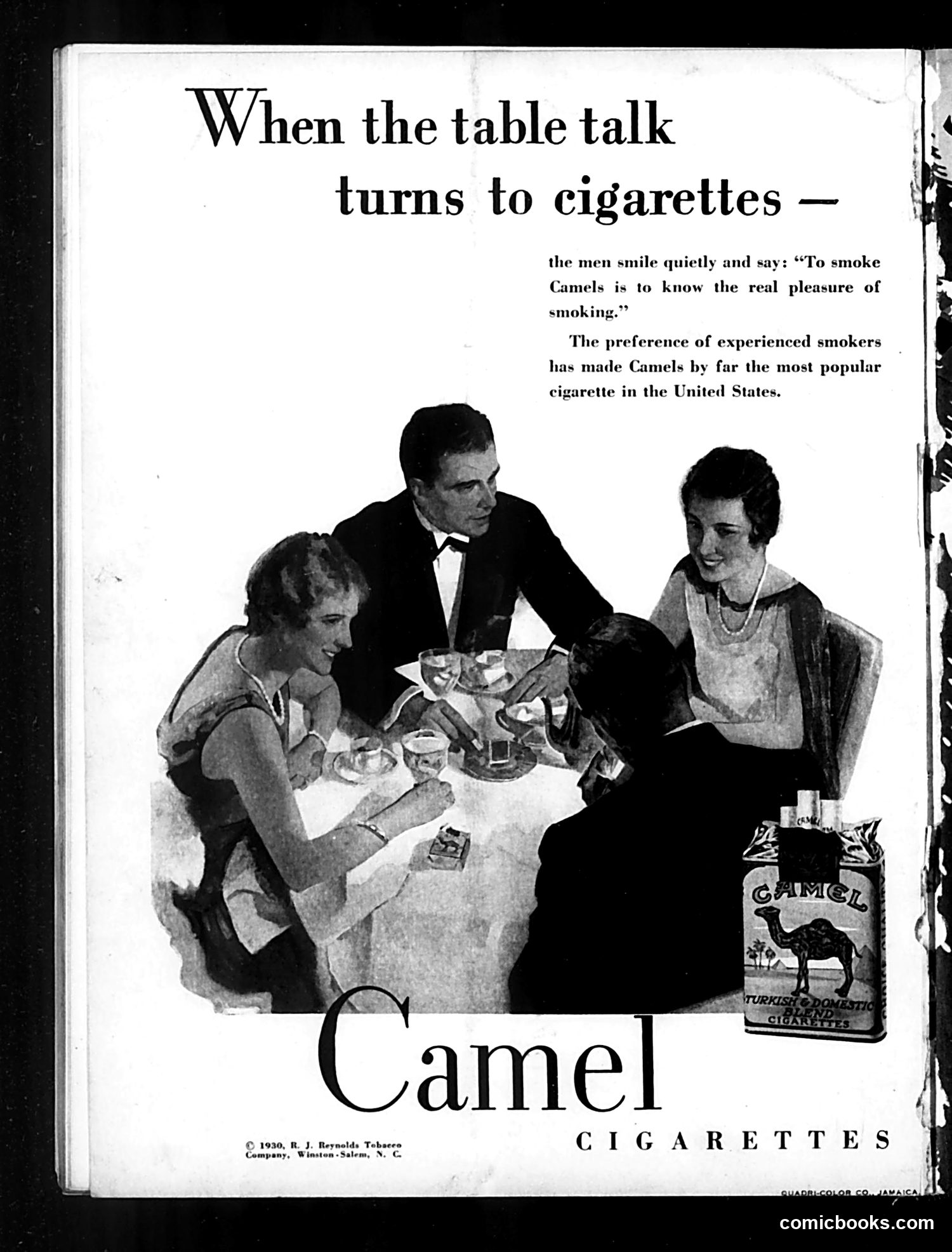
This is a Camel cigarette advertisement, not satire. The page depicts three well-dressed people (two women and a man) at what appears to be a social gathering, with the headline "When the table talk turns to cigarettes—" The ad claims that experienced smokers prefer Camels and that smoking them represents "the real pleasure of smoking." This reflects 1930s marketing that positioned cigarettes as sophisticated, socially desirable products associated with refined conversation and leisure. By modern standards, this advertisement is notable for its casual promotion of smoking without any health warnings—a stark contrast to today's regulated tobacco advertising. The aspirational imagery and endorsement-style messaging were standard advertising tactics of the era, before the health dangers of smoking became widely acknowledged.