judge
Judge — January 11, 1930
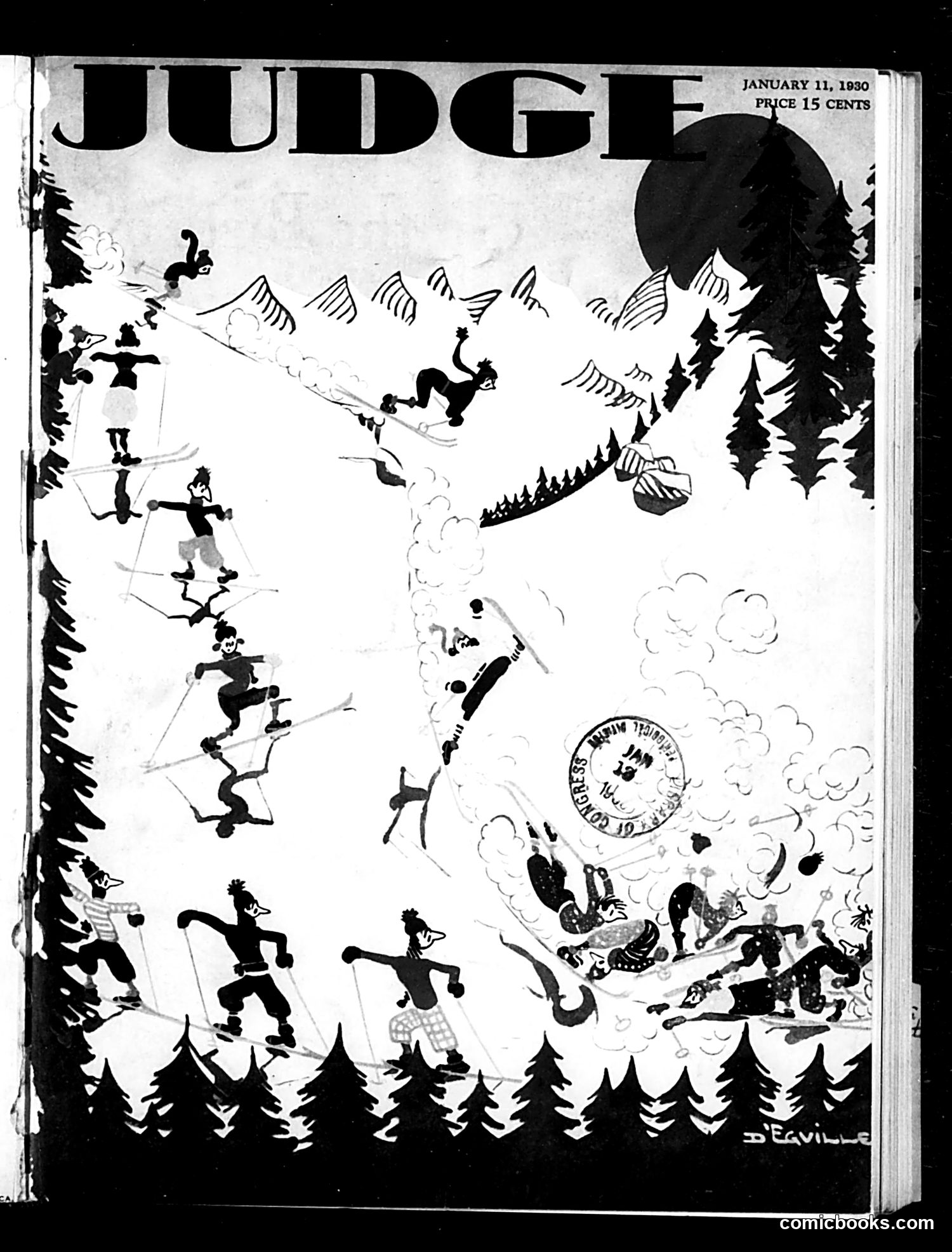
Judge Magazine Cover, January 11, 1930 This satirical cover depicts a chaotic winter skiing scene with multiple figures tumbling, colliding, and crashing down a snowy mountain. The exaggerated, slapstick style emphasizes the dangerous and comical nature of ski accidents. The timing is significant: January 1930 places this just weeks after the 1929 stock market crash. While the image doesn't explicitly reference the financial crisis, the avalanche-like chaos of bodies and the general disorder could serve as visual metaphor for the economic catastrophe unfolding in America. The skiing motif may also reference winter resort culture associated with wealthy Americans—potentially satirizing their sudden misfortune. The cover illustrates Judge's use of physical comedy and visual pandemonium to comment on contemporary events.
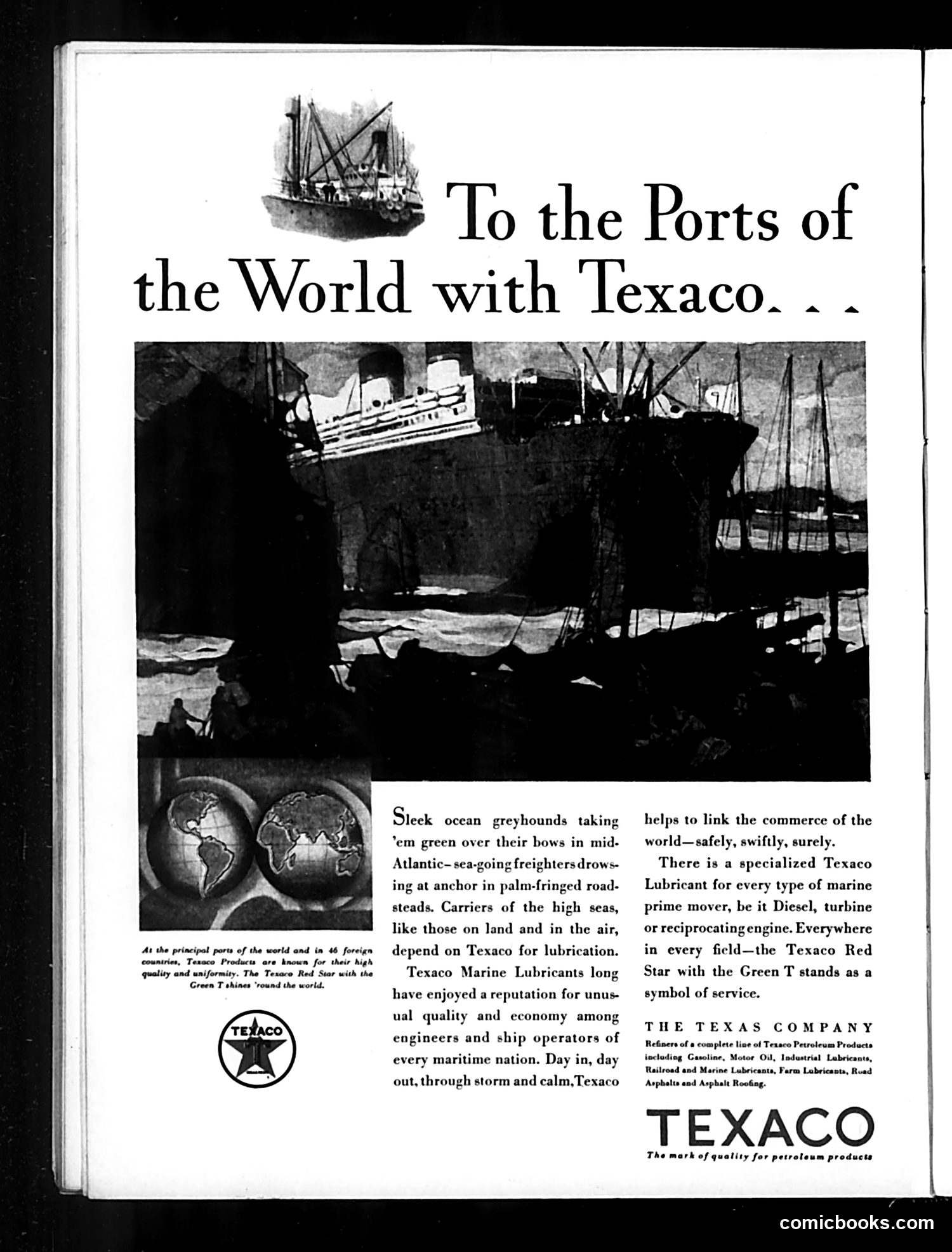
Analysis This page is primarily a Texaco advertisement, not political satire. It promotes Texaco marine lubricants to ship operators worldwide. The imagery shows commercial ocean freighters in port, emphasizing international maritime commerce. The globes in the lower left represent worldwide shipping routes. The ad's message: Texaco lubricants are essential for keeping ships running reliably across all seas and conditions. The tagline "The mark of quality for petroleum products" and references to the "Texaco Red Star" symbol establish brand identity. There is no political cartoon or satire on this page—Judge magazine simply carried paid advertisements like this one alongside its satirical content. This reflects early 20th-century advertising's emphasis on industrial reliability and global commerce.
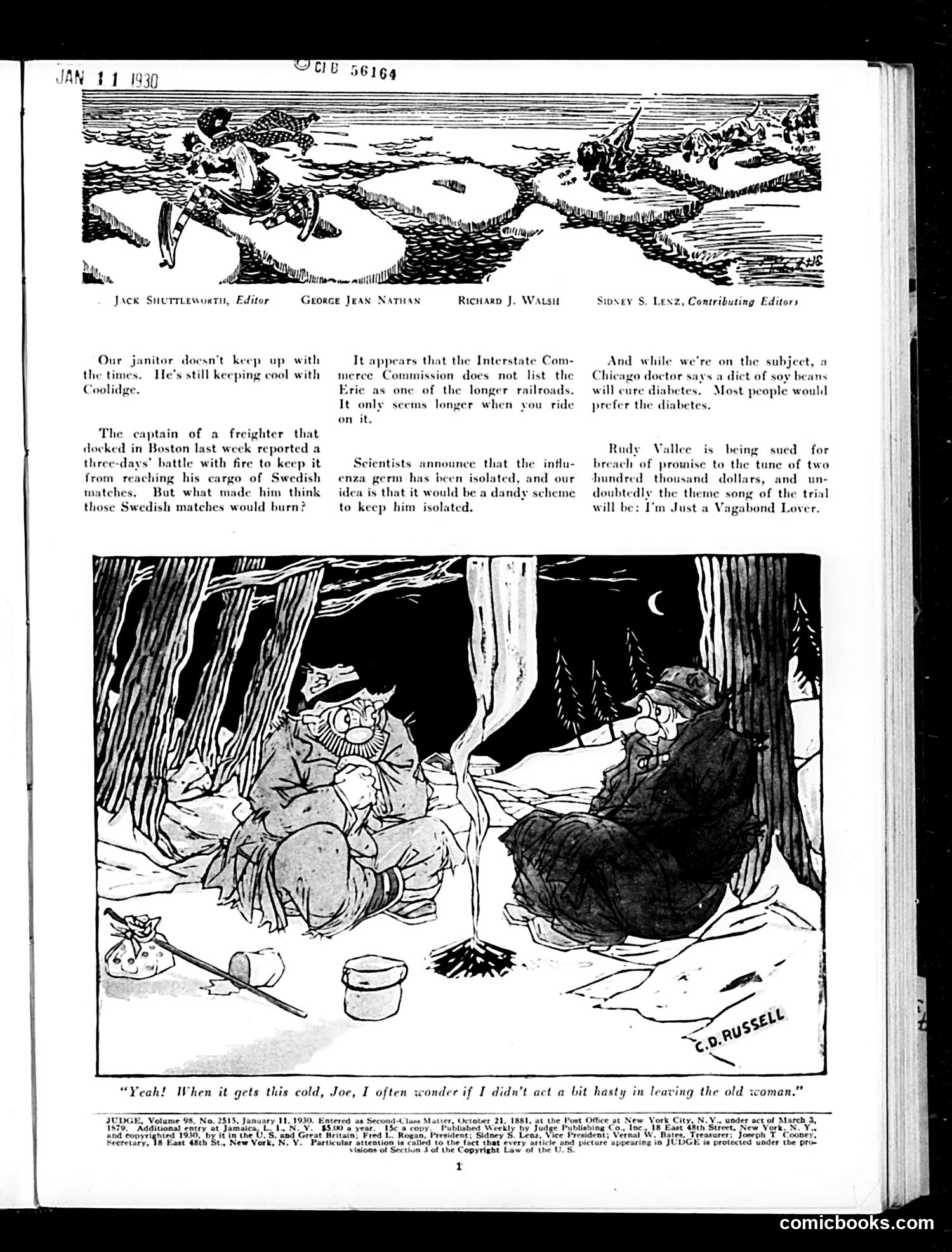
Analysis of Judge Magazine Page (January 11, 1930) The main cartoon by C.D. Russell depicts two men camping in a snowy forest. The caption reads: "Yeah! When it gets this cold, Joe, I often wonder if I didn't get a bit hasty in leaving the old woman." This is a domestic humor joke playing on the common trope of husbands escaping their wives for outdoor adventure, only to regret it during hardship. The irony—that leaving his wife now seems foolish when facing severe cold—was relatable to Depression-era readers. The text snippets above are brief jokes about transportation (railroad comfort), a shipping accident, influenza isolation, and a lawsuit against actor Rudy Vallée. These are typical of Judge's miscellaneous humor section, offering topical commentary mixed with universal observations.
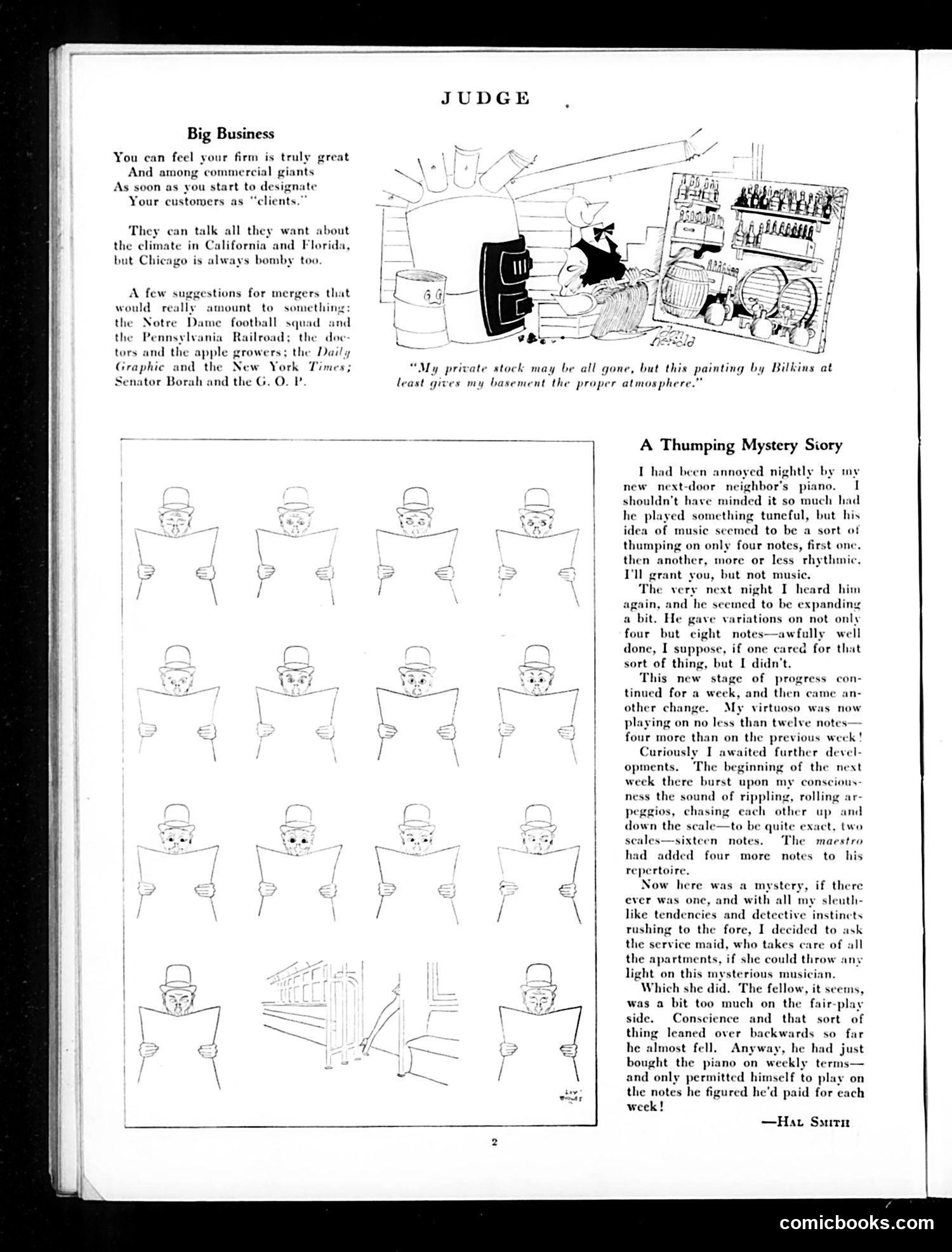
Analysis of Judge Page This page contains two unrelated pieces: "Big Business" (top): A satirical article mocking corporate expansion, suggesting that once a firm becomes large enough to call customers "clients," it considers itself among commercial giants. The accompanying cartoon shows a businessman with a painting, joking that while his stock portfolio has vanished, at least the artwork gives his basement "proper atmosphere"—likely referencing the 1929 stock market crash and resulting economic devastation. "A Thumping Mystery Story" (right): A humorous narrative by Hal Smith about a neighbor's increasingly elaborate piano playing. The accompanying cartoon grid shows repeated figures reading newspapers with mounting frustration, illustrating the escalating musical annoyance. The joke satirizes both intrusive neighbors and the neighbor's financial constraint—he can only play notes he's "paid for."
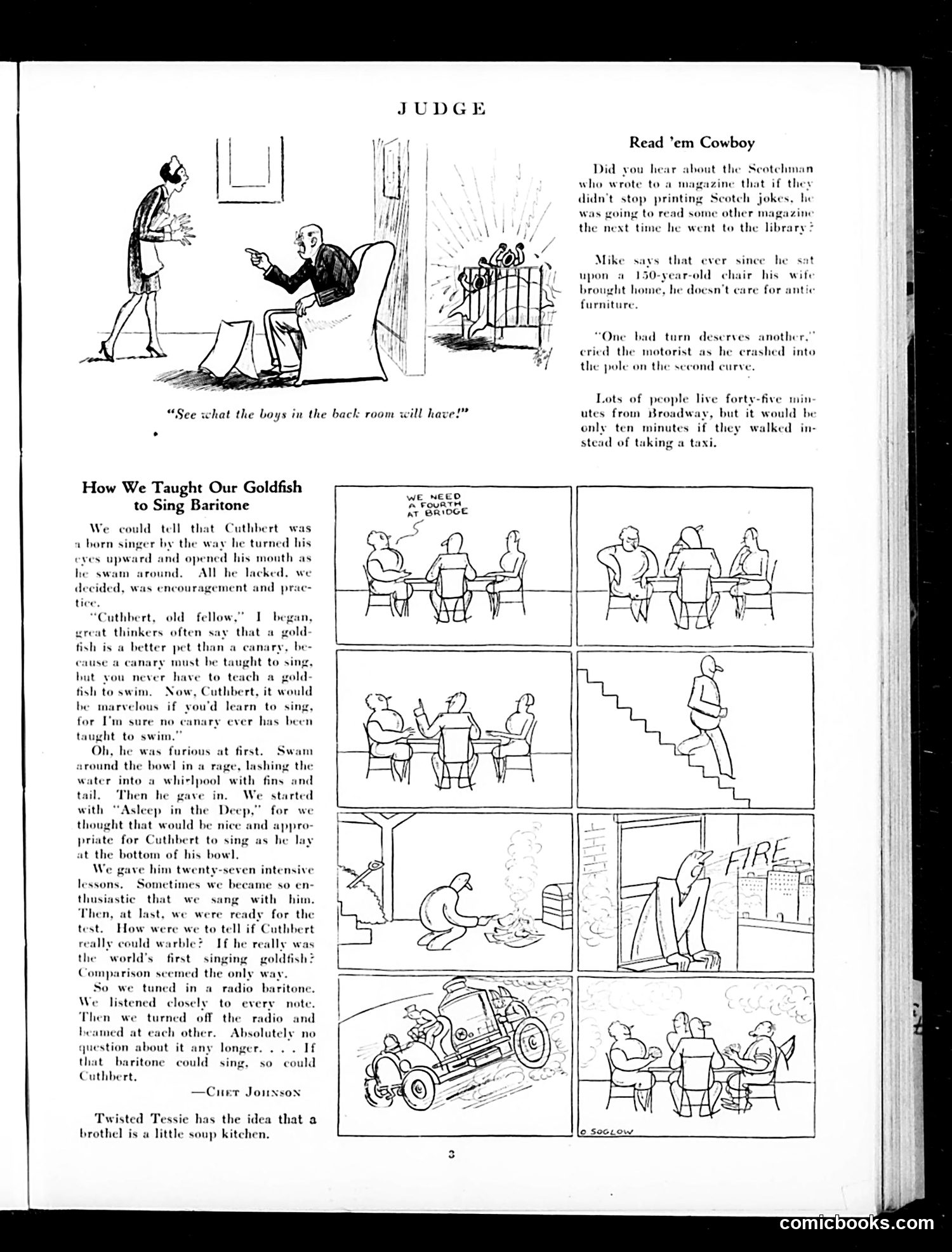
Analysis of Judge Magazine Page This page contains two distinct pieces of humor: "See what the bags in the back room will have!" (top cartoon): A boss sits at his desk pointing at papers while a secretary stands nearby. The joke appears to reference office gossip or workplace rumors—the boss is sarcastically suggesting scandalous items will be discovered in storage, likely mocking how office workers exaggerate or fabricate stories about workplace drama. "How We Taught Our Goldfish to Sing Baritone" (article with comic strip): A humorous account claiming to document training a goldfish to sing. The accompanying sequential comic strip shows absurd training methods—the fish eventually sings along with a radio baritone, then causes chaotic scenes (fire, car crash). The satire mocks pseudoscientific pet-training claims popular in the era while celebrating the absurd results.
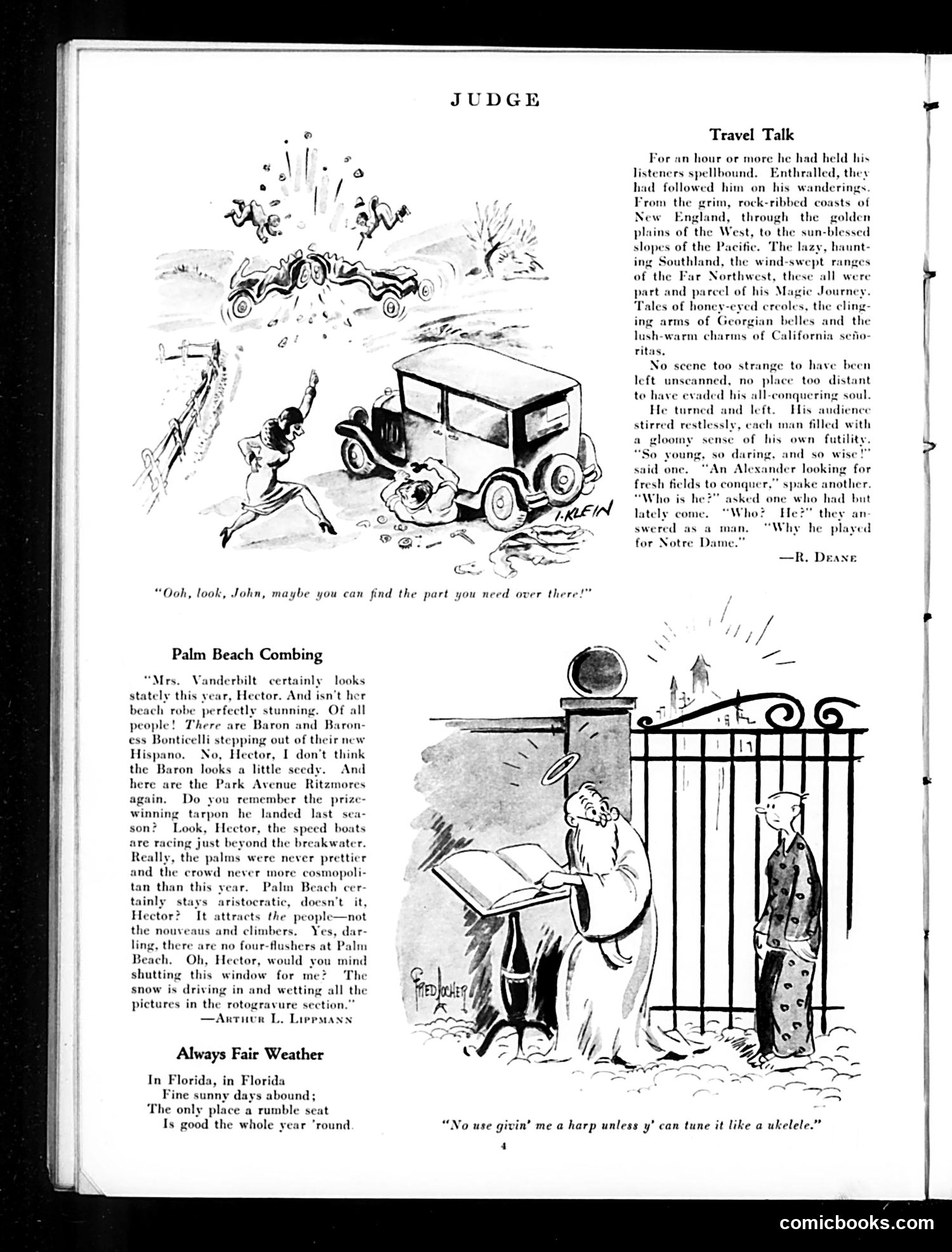
Page Analysis: Judge Magazine This page contains three separate pieces of humor content: 1. "Travel Talk" (top): A narrative poem by R. Deane about a young traveler captivating an audience with stories of American landscapes and adventures. The accompanying cartoon shows a broken-down car surrounded by animated listeners—likely satirizing the "magical journey" narrative versus automotive reality. 2. "Palm Beach Combing" (middle): A society-page satire by Arthur L. Lipscomb mocking wealthy Palm Beach residents and their pretensions. References to "Vanderbilt," "Baron and Baroness Bontelli," and aristocratic name-dropping suggest commentary on nouveau riche tourists and social climbing in this exclusive destination. 3. "Always Fair Weather" (bottom): A brief poem about Florida's perpetual sunshine, paired with a cartoon about a street musician playing harp. The overall tone is lighthearted social commentary on American leisure and aspiration.
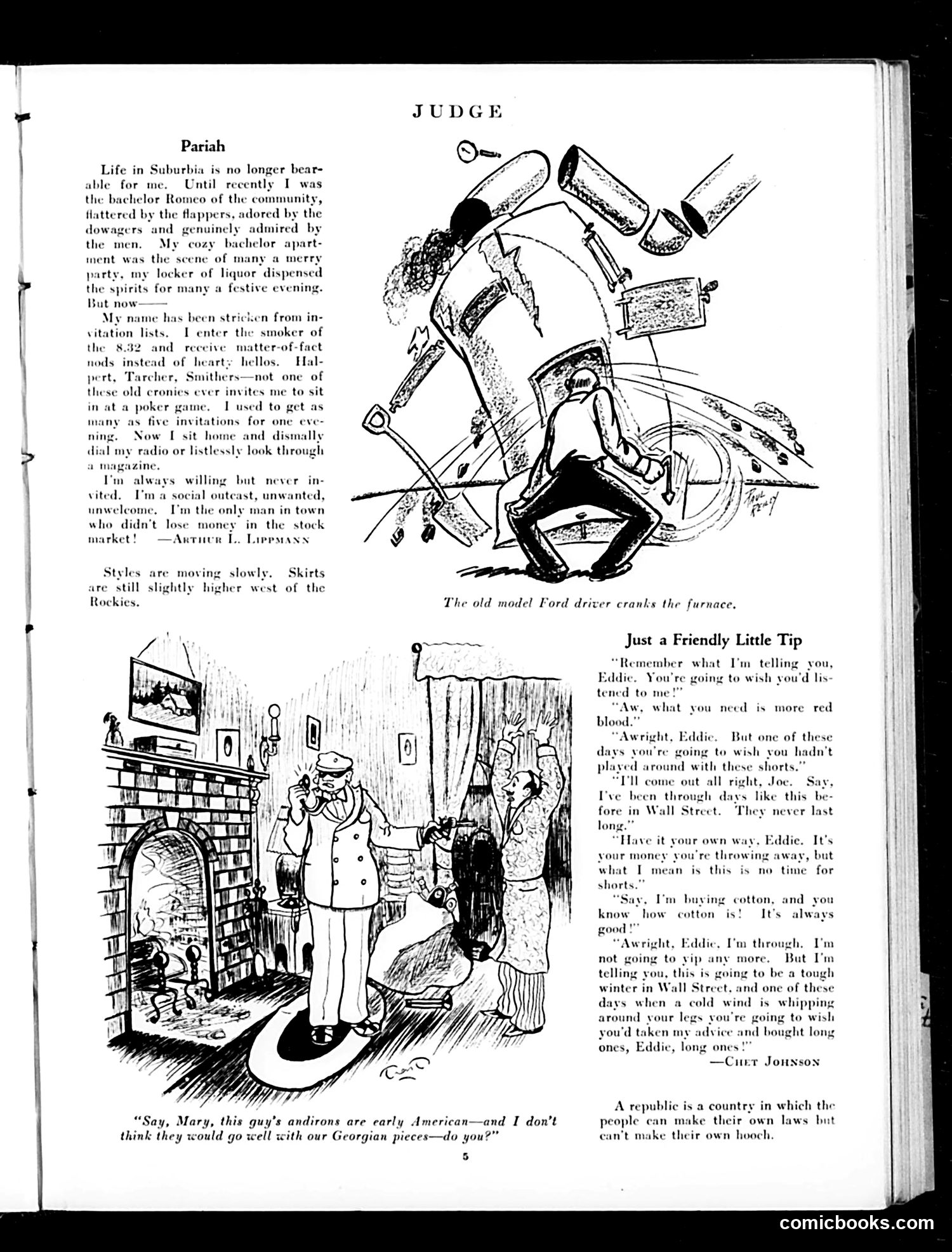
Analysis of Judge Magazine Page This page contains three distinct pieces: 1. "Pariah" - A social commentary by Arthur I. Lippmann about being excluded from Suburbia's social scene despite wealth, unable to attend poker games or parties. 2. Top cartoon - Shows an old Model Ford driver struggling to start the furnace (likely the car's crank starter), humorously depicting the mechanical difficulties of early automobiles. 3. "Just a Friendly Little Tip" - A dialogue between Joe and Eddie about financial advice during what appears to be the pre-1929 stock market boom. Joe warns Eddie to invest conservatively in cotton rather than speculate on Wall Street, predicting economic hardship ahead—likely prescient commentary on the impending Great Depression. The closing quote about republics suggests political commentary on American governance and individual liberty.
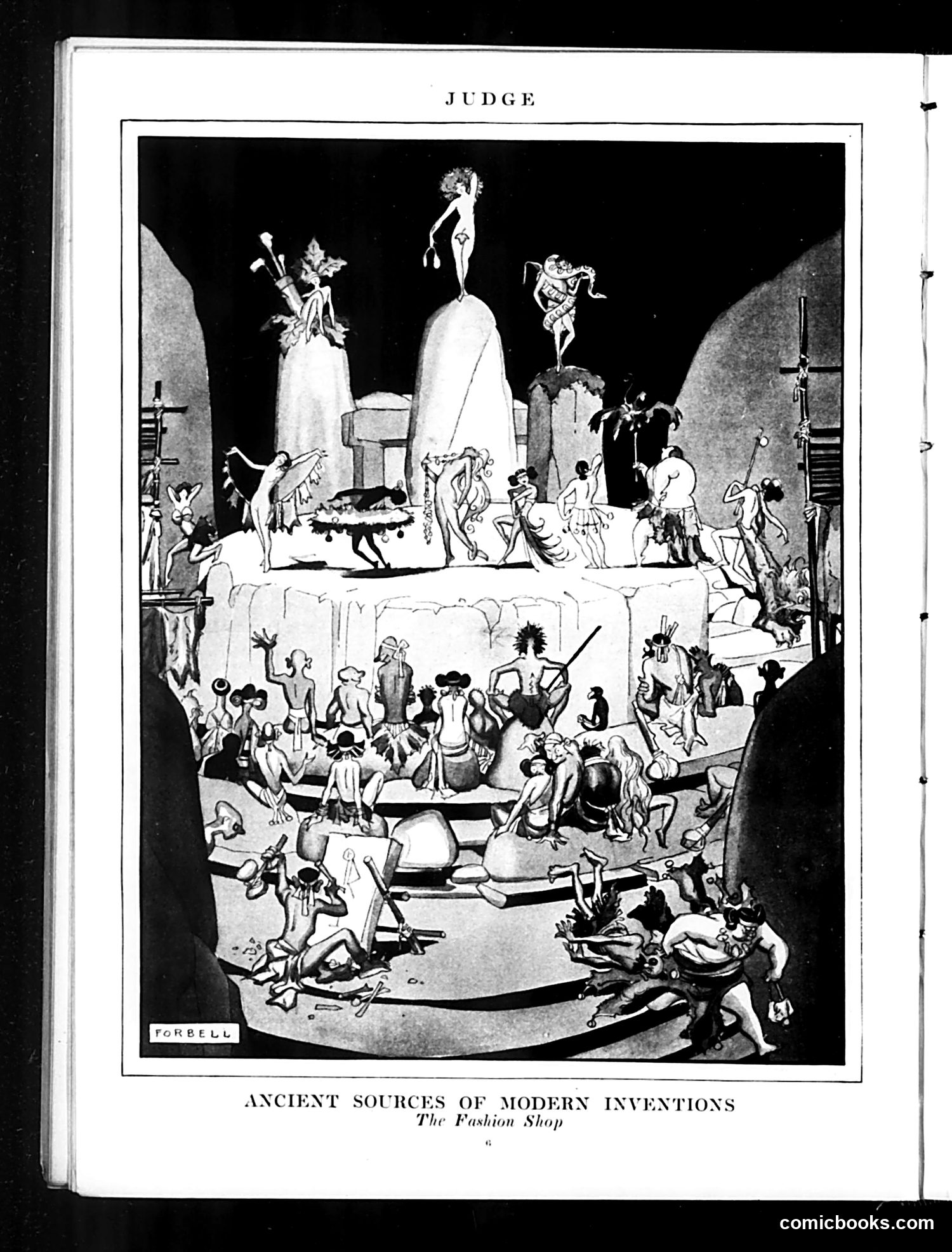
"Ancient Sources of Modern Inventions: The Fashion Shop" This satirical illustration depicts a chaotic underworld or hellish scene labeled as the supposed origin of modern fashion. The artwork uses a classic device: suggesting that contemporary fashion trends come from demonic or infernal sources rather than legitimate design. The crowded composition shows numerous demons, imps, and supernatural creatures engaged in various activities on tiered platforms, with fashionably-dressed figures observing above. The satire mocks the fashion industry itself—implying designers and fashionable people are either foolish for following ridiculous trends, or complicit with vice and sin. This represents common early-20th-century social criticism of fashion as frivolous, morally suspect, or absurdly trend-driven, using humor to critique both the industry and its consumers.
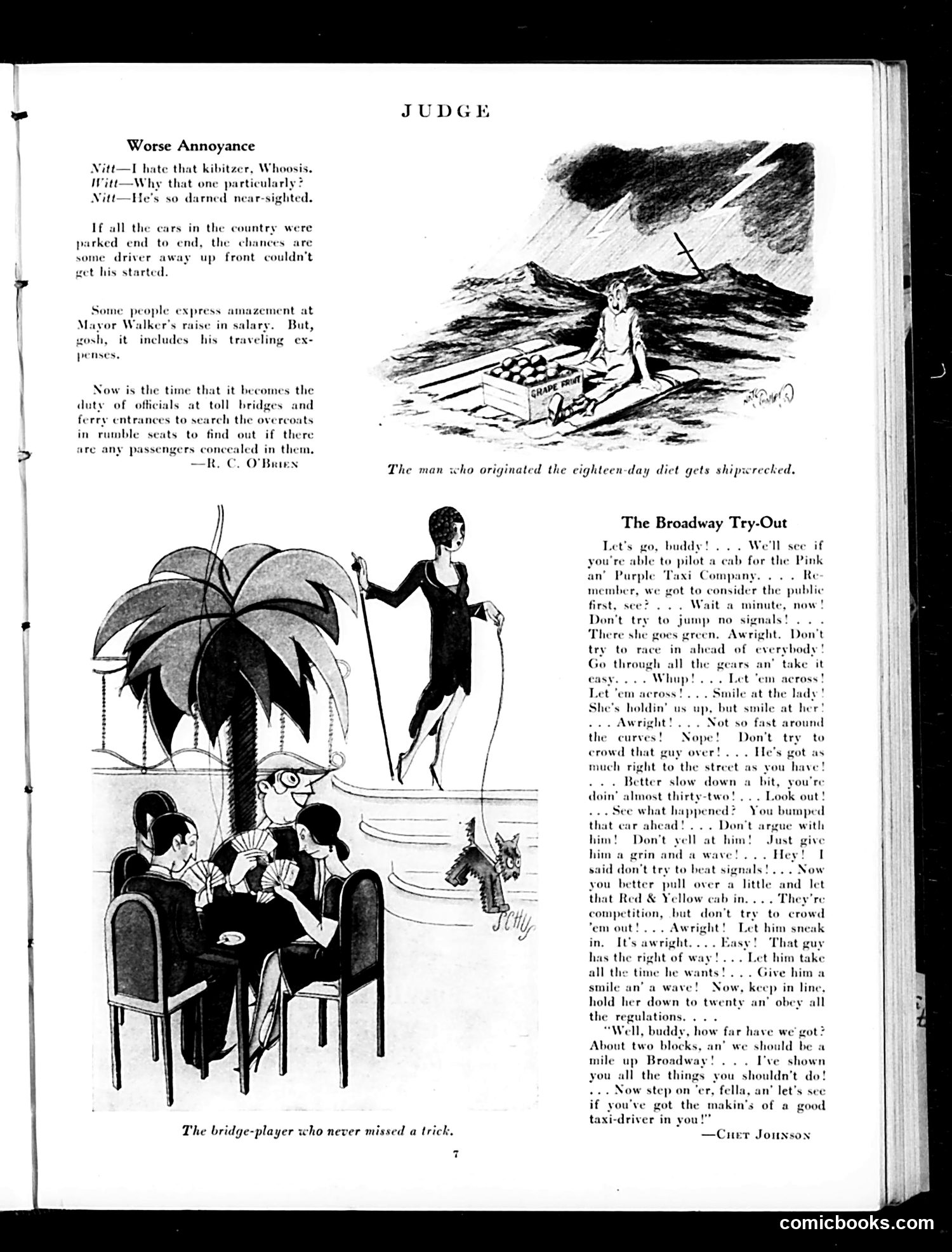
Judge Magazine Page Analysis This page contains three distinct satirical pieces from Judge magazine: "Worse Annoyance" mocks a bridge/card player who is near-sighted, with a quip about toll bridge officials needing to search rumble seats for stowaways during Prohibition (implied by the reference to concealed passengers). The shipwreck cartoon illustrates an ironic caption: "The man who originated the eighteen-day diet gets shipwrecked"—mocking fad diet trends by showing the originator literally wrecked at sea. "The Broadway Try-Out" is the main piece, satirizing taxi driver instruction. Written by Chet Johnson, it humorously depicts an instructor lecturing a new cabbie on contradictory rules: be polite to pedestrians, follow signals, yet also be aggressive and competitive. The joke is the impossibility of the task—after exhaustively listing what *not* to do, the instructor asks the driver to "show" his taxi skills in just two blocks. It's satire on New York City traffic chaos and unreasonable expectations. All pieces reflect 1920s urban American humor and social commentary.
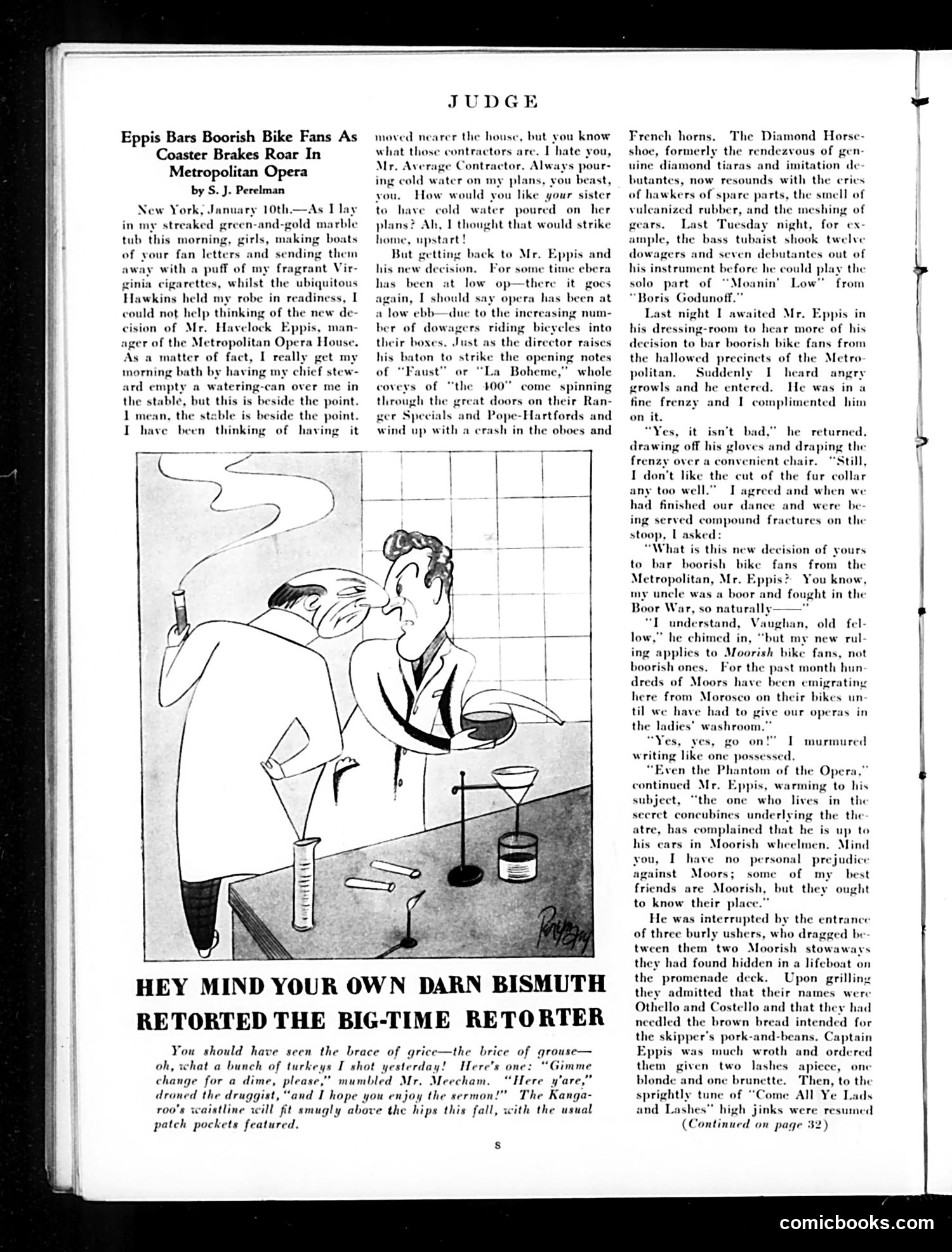
Judge Magazine Satire Analysis This is a humorous piece by S.J. Perelman satirizing the Metropolitan Opera House and its manager (likely based on a real figure). The central joke concerns opera's declining prestige: wealthy socialites ("dowagers" and debutantes from "the 400"—old money society) have begun arriving to performances on bicycles rather than in carriages, creating literal chaos during performances—they crash their bikes into the orchestra pit. The cartoon shows a man (presumably the opera manager) gesticulating dramatically while bathing or dressing, illustrating his exasperated response. The satire mocks both the pretentiousness of high society and opera's fall from cultural dominance. The closing section adds a pun: Eppis has barred "Moorish" (not "boorish") bike fans—playing on the similar-sounding words while referencing immigrants from Morocco arriving by bicycle. The piece reflects 1920s-30s anxieties about social change, immigration, and the declining authority of traditional cultural institutions.
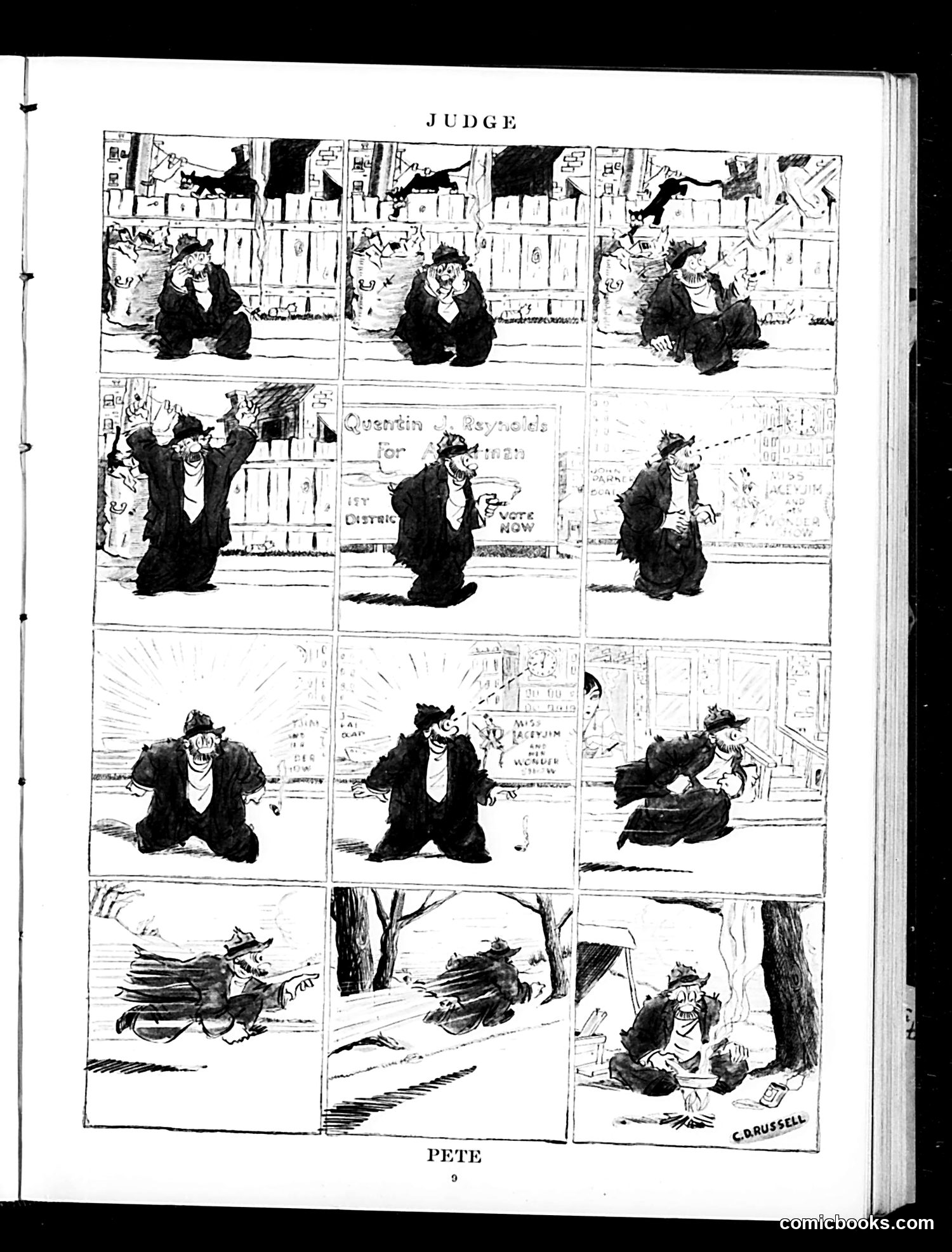
Judge Magazine Comic: "Judge" and "Pete" This is a satirical comic strip titled "Judge" and "Pete" (credited to C.B. Russell). The strip depicts a judge character experiencing escalating chaos and misfortune across multiple panels. In the opening panels, the judge sits calmly in what appears to be a courtroom or office. Progressively, he becomes increasingly disheveled and distressed—his composure dissolving through exaggerated facial expressions and body language. By the bottom panels, he's literally fleeing or collapsed outdoors, surrounded by scattered papers. The satire appears to mock judicial authority and dignity, showing how the demands or absurdities of the judge's role reduce an authority figure to chaos and desperation. The humor relies on visual slapstick and the contrast between the judge's initial composure and final degradation, typical of early 20th-century American comic sensibilities.
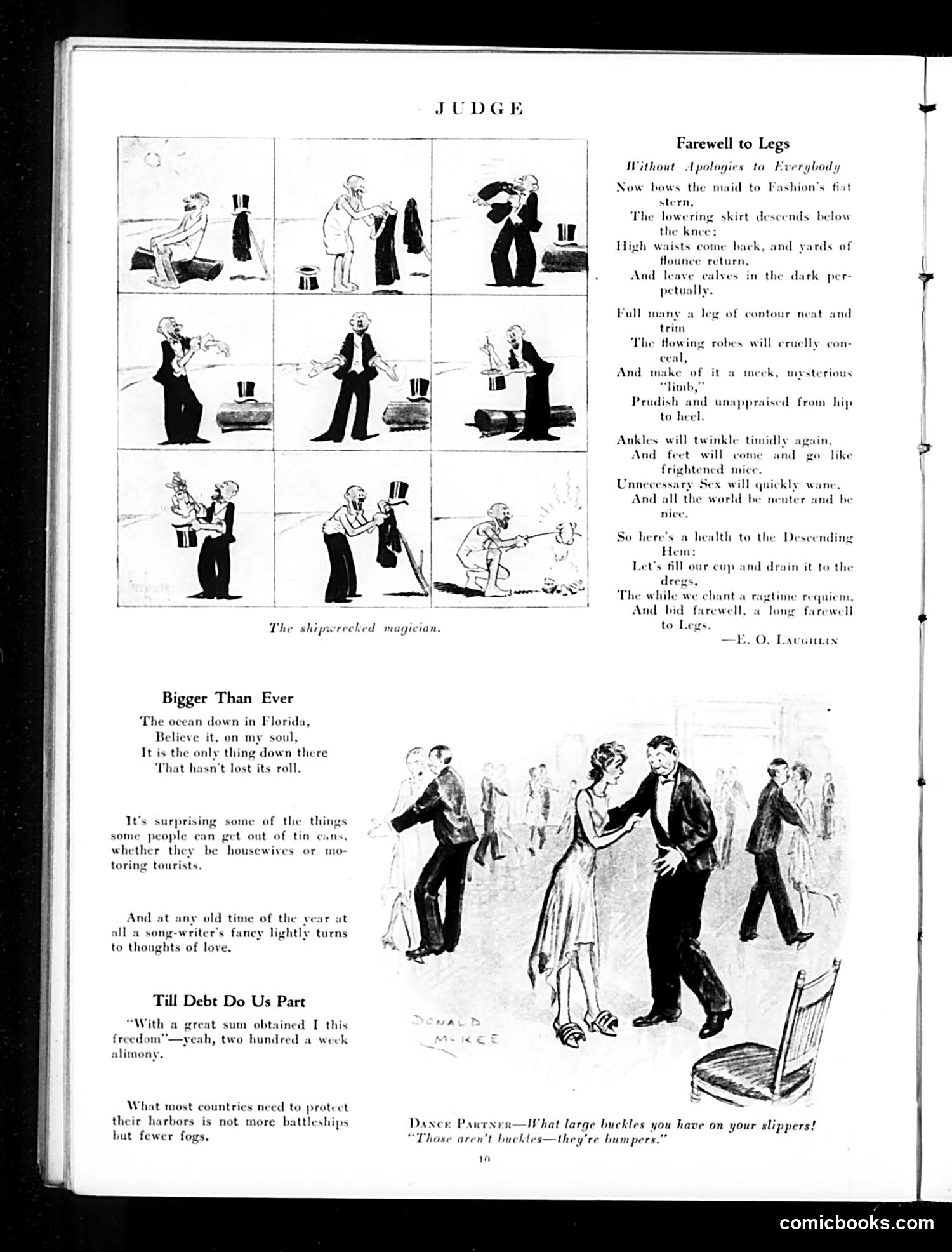
Explanation for Modern Readers This page from *Judge* magazine contains three satirical pieces commenting on 1920s social trends: "Farewell to Legs" mocks the shift toward longer hemlines and higher waistlines in women's fashion. The poem satirizes how modest dress trends will hide women's legs and reduce sexual appeal, suggesting society will become prudish and "neuter." This reflects anxiety about changing fashion standards during the era. "Bigger Than Ever" appears to be short satirical quips about Florida tourism and economic conditions—likely referencing the 1920s Florida real estate boom. "Till Debt Do Us Part" jokes about alimony obligations ($200/week), suggesting divorce and financial burdens on men were contemporary concerns. The cartoon at bottom shows a couple dancing. The "bumpers" joke about oversized shoe buckles references both fashion details and the physical contact involved in dancing—possibly ribald humor about modern dance behavior. The overall tone criticizes social and fashion changes perceived as restrictive or economically burdensome.
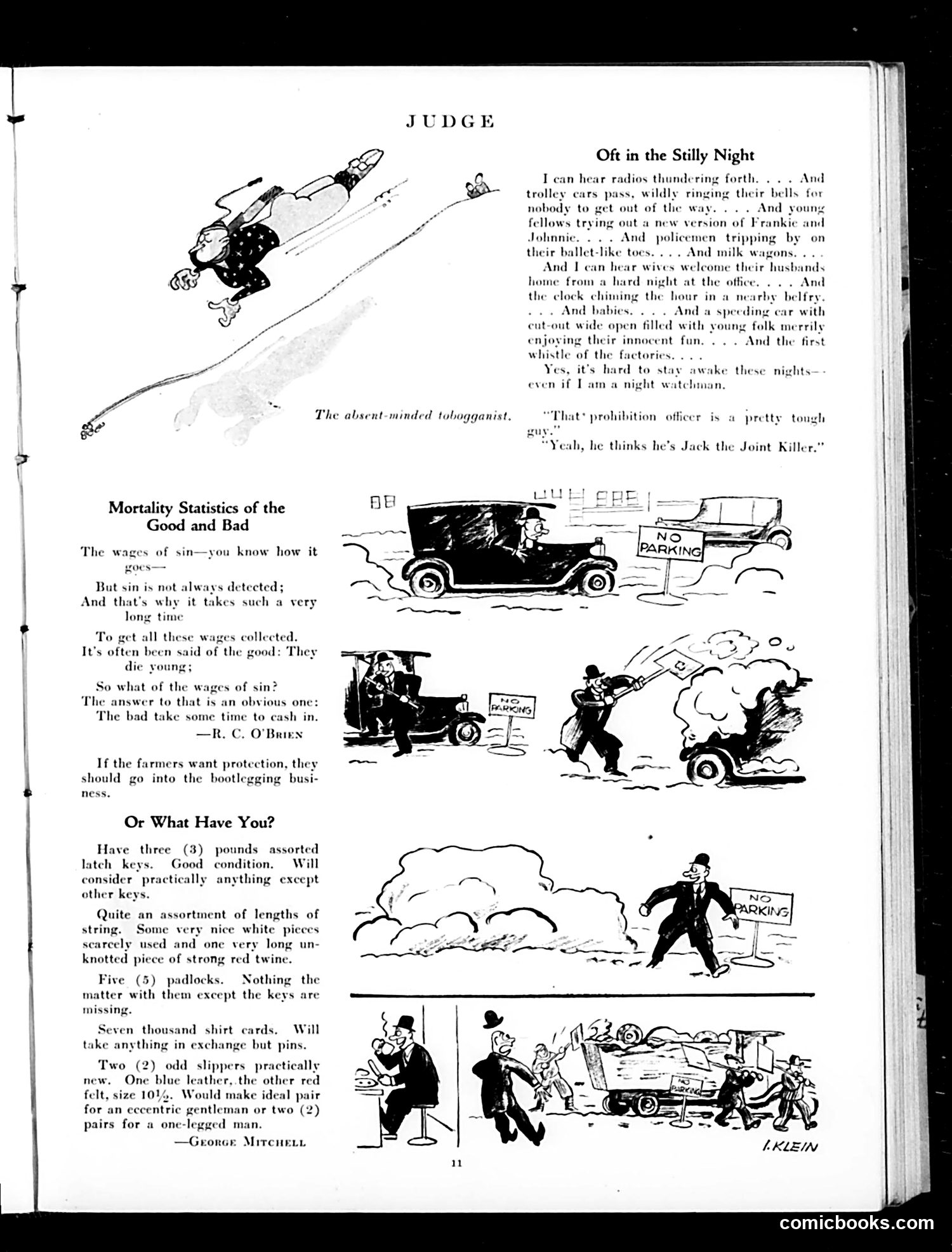
Judge Magazine Page Analysis This page contains satirical commentary on Prohibition-era American life (likely 1920s-early 1930s). "Mortality Statistics of the Good and Bad" is a philosophical poem by R.C. O'Brien playing on the proverb "the good die young"—arguing that sinners take longer to face consequences, so bad people accumulate wealth before punishment arrives. "Or What Have You?" by George Mitchell is a humorous classified-ad section listing absurd items for trade: broken keys, string, padlocks without keys, mismatched slippers, and shirt cards. This satirizes both Depression-era scavenging and the bizarre barter economy created by Prohibition's illegal bootlegging. "Oft in the Stilly Night" satirizes a night watchman's insomnia amid urban chaos—radios, trolleys, police raids, milk wagons, and speeding cars with "cut-outs" (modified exhausts). The cartoons (credited to Klein) depict Prohibition enforcement: police raiding bootleggers' operations, cars being seized, and a joke about a "tough" prohibition officer being "Jack the Joint Killer"—slang for someone who shuts down illegal bars. The overall theme: Prohibition's chaotic social consequences.
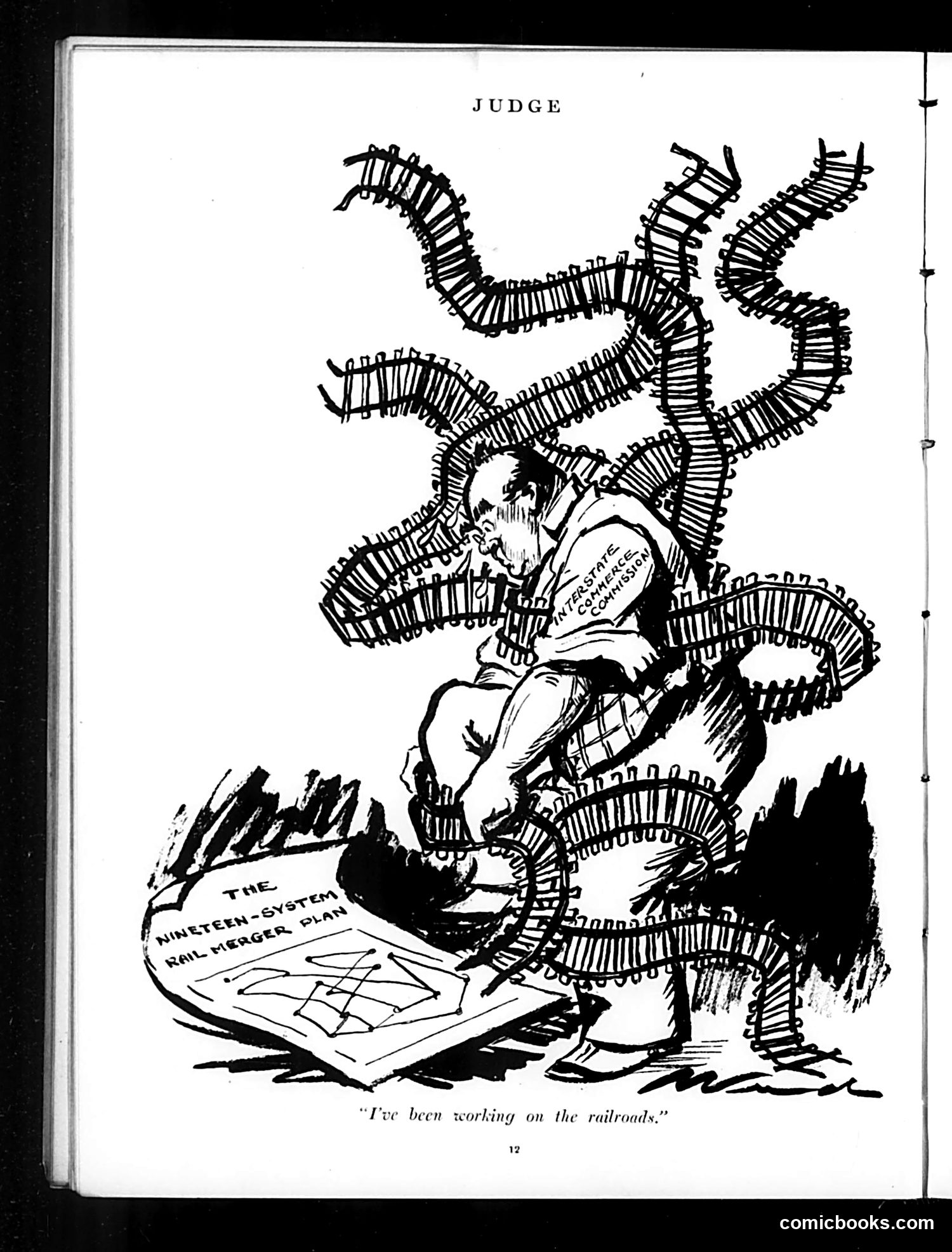
Political Cartoon Analysis: "Judge" Magazine This cartoon satirizes a judge who has been working on railroad matters. The figure, labeled with "The Nineteen-System Rail-Merger Plan," is depicted as an octopus—a common metaphor in early 20th-century political cartoons representing monopolistic corporate control. The multiple tentacles likely symbolize the complexity and far-reaching grasp of railroad consolidation schemes. The judge appears entangled or overwhelmed by his own railroad merger plan, suggesting the cartoon criticizes judicial involvement in facilitating large corporate consolidations. The phrase "I've been working on the railroads" (a play on the folk song) adds ironic commentary on judicial authority being applied to railroad industry matters rather than upholding justice.
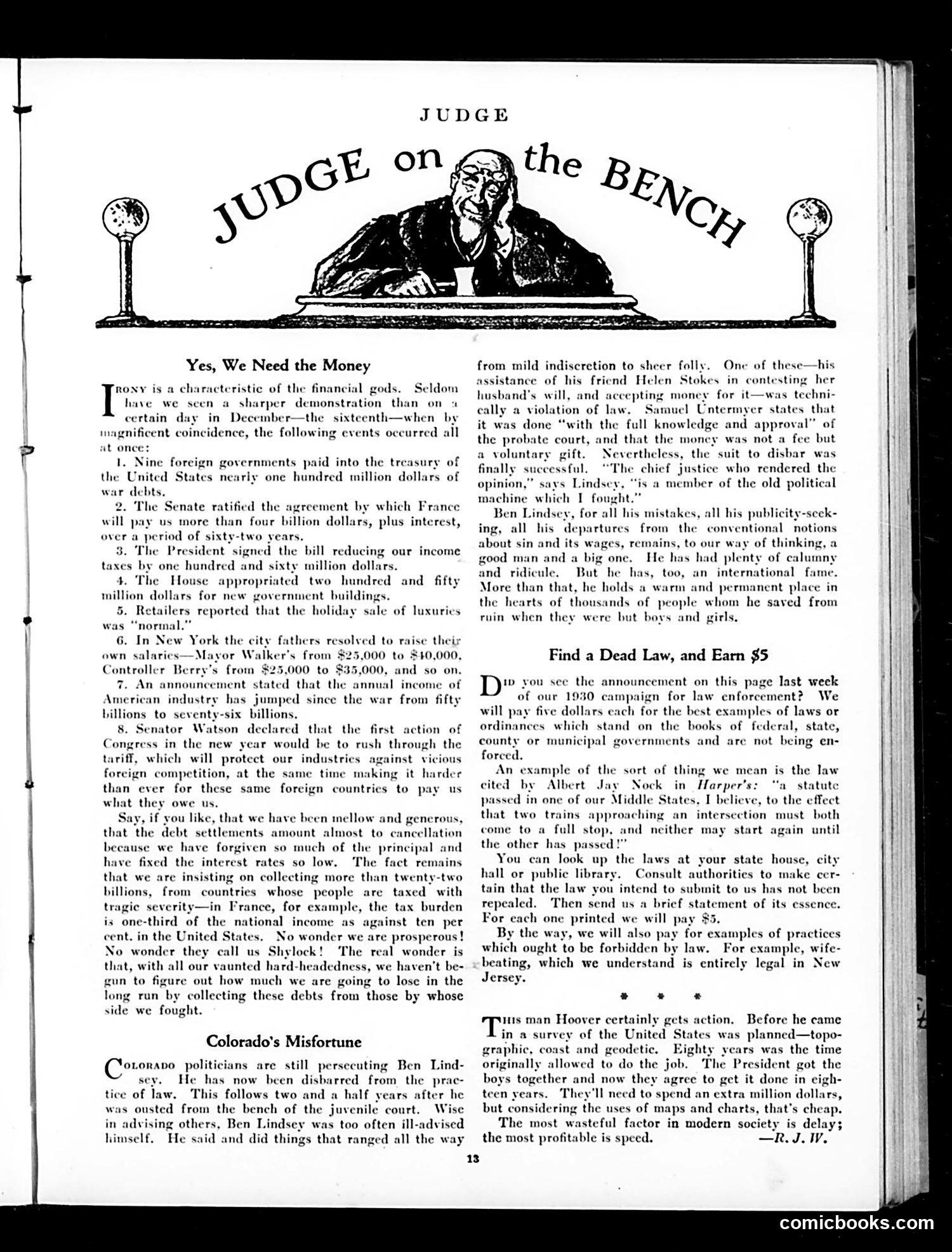
"Judge on the Bench" - December 1923 This page contains two satirical pieces targeting American political hypocrisy in the early 1920s. "Yes, We Need the Money" mocks the contradiction between America's generosity toward war debts and its harsh collection practices. The article lists eight simultaneous events (all occurring December 16th) showing how the U.S. simultaneously collected nearly $100 million from foreign governments while reducing its own taxes and increasing government spending. The satire's point: Americans claim generosity toward impoverished allied nations, yet demand repayment that crushes them (France's tax burden is one-third of income vs. America's ten percent). The reference to "Shylock" (Shakespeare's moneylender) emphasizes the perceived greed. "Colorado's Misfortune" defends Ben Lindsey, a Colorado judge disbarred after 2.5 years following his juvenile court removal. Though admitting his indiscretions, Judge sarcastically calls him "a good man and a big one," suggesting his persecution by Colorado's "old political machine" was excessive and politically motivated—a cautionary tale of how reformers face retaliation.
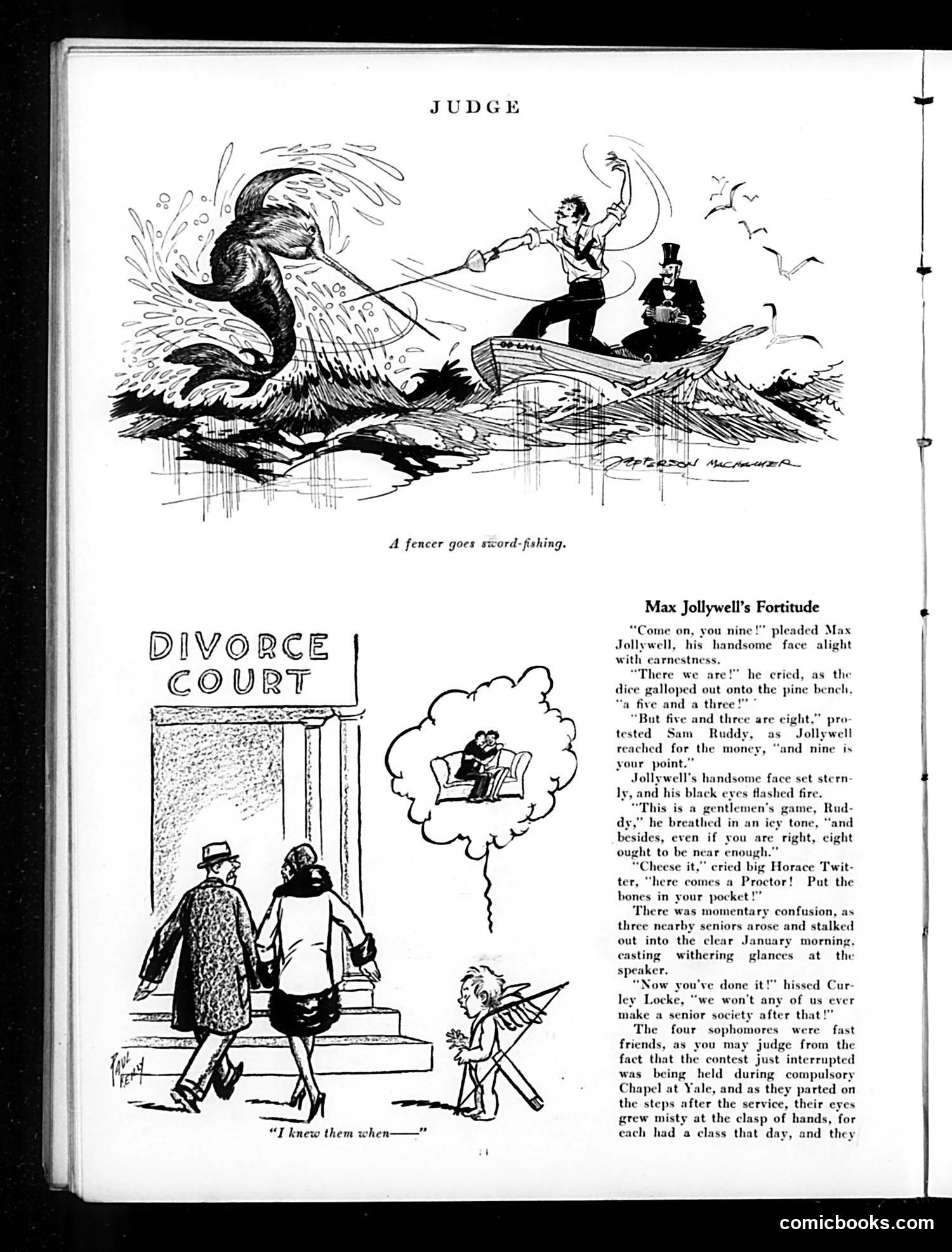
Political/Social Satire Analysis Top cartoon: "A fencer goes sword-fishing" is a visual pun mocking the legal profession. A man in formal dress fences (duels with a sword) while sitting in a boat with another man, literally "sword-fishing"—treating litigation like sport or entertainment. This satirizes lawyers as combative and self-serving rather than serious professionals. Bottom story: "Max Jollywell's Fortitude" depicts Yale sophomores gambling (shooting dice) during mandatory Chapel—a serious violation of college rules. When caught by a Proctor (college official), the students face social consequences: exclusion from senior societies. The satire targets undergraduate hypocrisy: boys claiming friendship while prioritizing social status, and the arbitrary moral enforcement of elite institutions that punish minor infractions severely. Both pieces mock pretension and rule-breaking among privileged men.
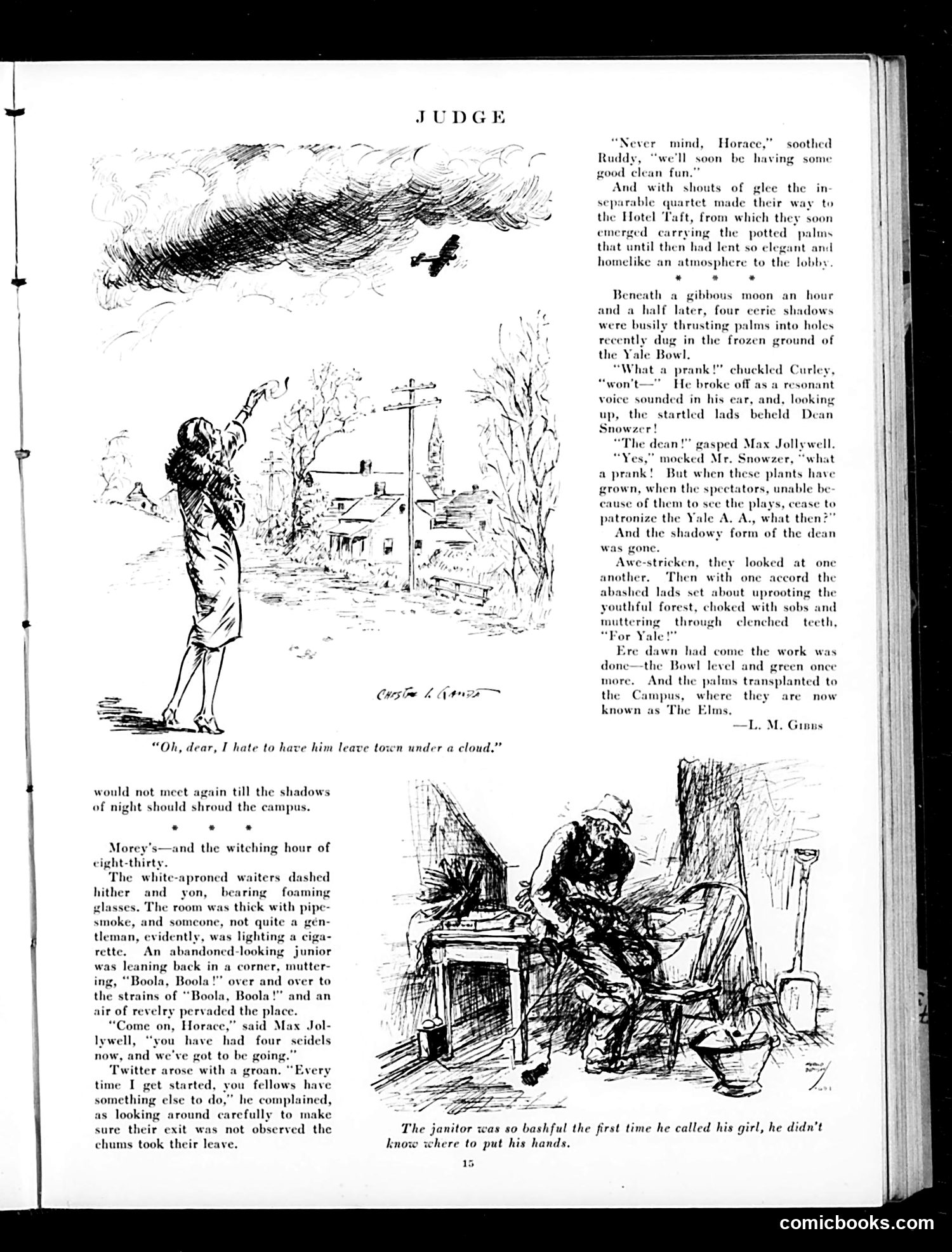
Analysis for Modern Readers This page contains two separate pieces of humor from *Judge* magazine: Main Story/Cartoon (top): College students at Yale pull an elaborate prank—stealing potted palms from the Hotel Taft to plant them overnight in the Yale Bowl (the athletic stadium). They're caught by Dean Snowzer, who cleverly turns their mischief into a benefit: once the palms grow, spectators will pay to see Yale athletic events, funding the athletic association. The students sheepishly undo their prank. The joke mocks both youthful pranks and administrative cleverness. Bottom Illustration: A separate, unrelated gag about a bashful janitor too shy to know where to put his hands while calling his girlfriend—a mild joke about awkwardness in courtship. The content reflects early-20th-century college culture, where pranks were common entertainment, and Yale athletics held significant institutional importance. The satire targets both student mischief-making and administrative spin-doctoring.
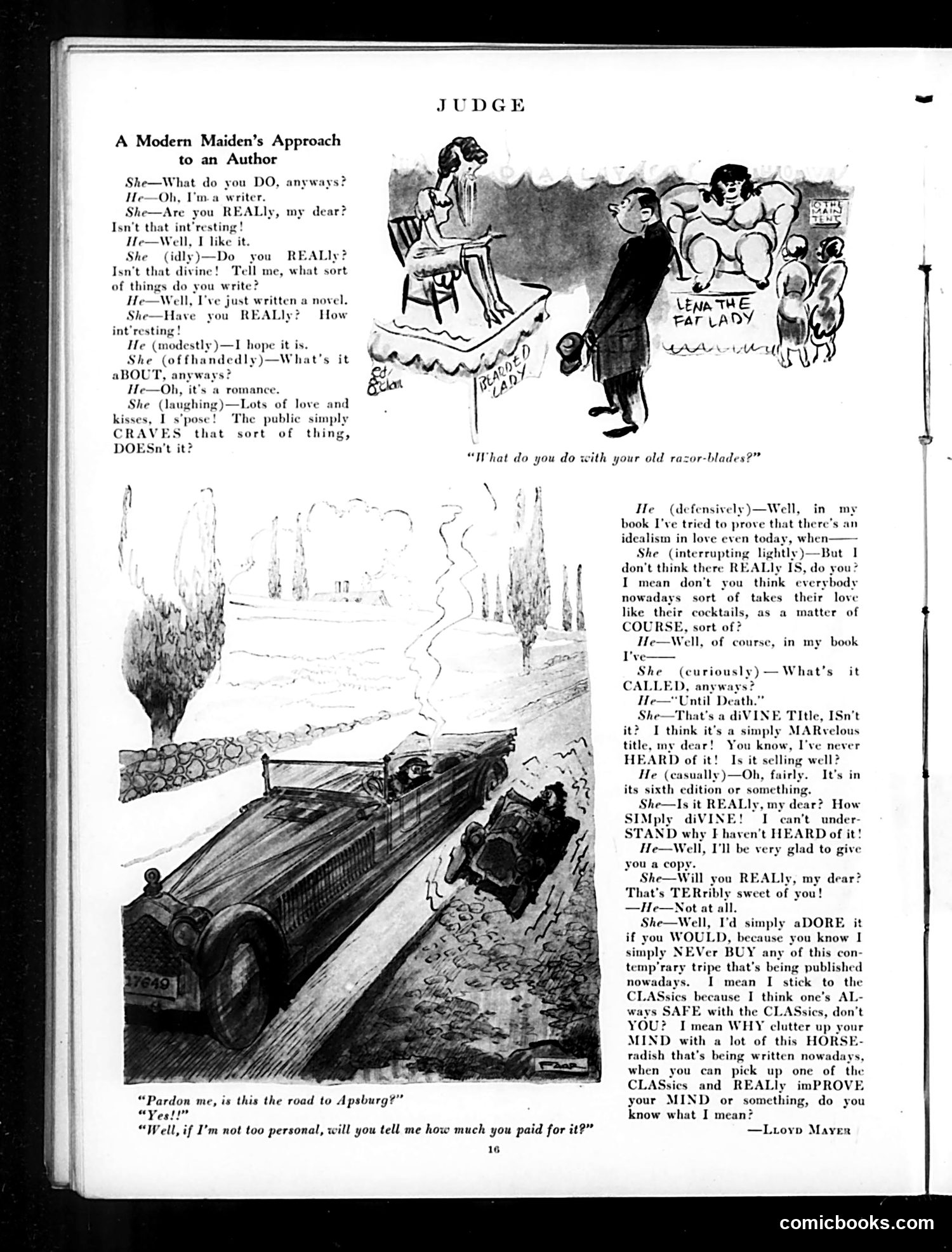
Satire of a Superficial Young Woman Meeting an Author This two-part page satirizes a shallow modern woman's encounter with a novelist. The dialogue shows her repeatedly using "REALLY" with exaggerated emphasis while displaying complete disinterest in his actual work. She asks condescending questions (what he "does"), then immediately pivots to asking his book's price—revealing her mercenary nature. The humor escalates when she claims never to have heard of his sixth-edition novel, then contradicts herself by praising its "divine" title while announcing she never buys contemporary books, only classics. Her flowery language masks intellectual laziness and social pretension. The lower cartoon appears unrelated—a car scene with dialogue about directions to Apsburg and payment. Together, the page mocks 1920s-30s high-society women who perform cultured sophistication while revealing themselves as vain, materialistic, and genuinely indifferent to art or literature.
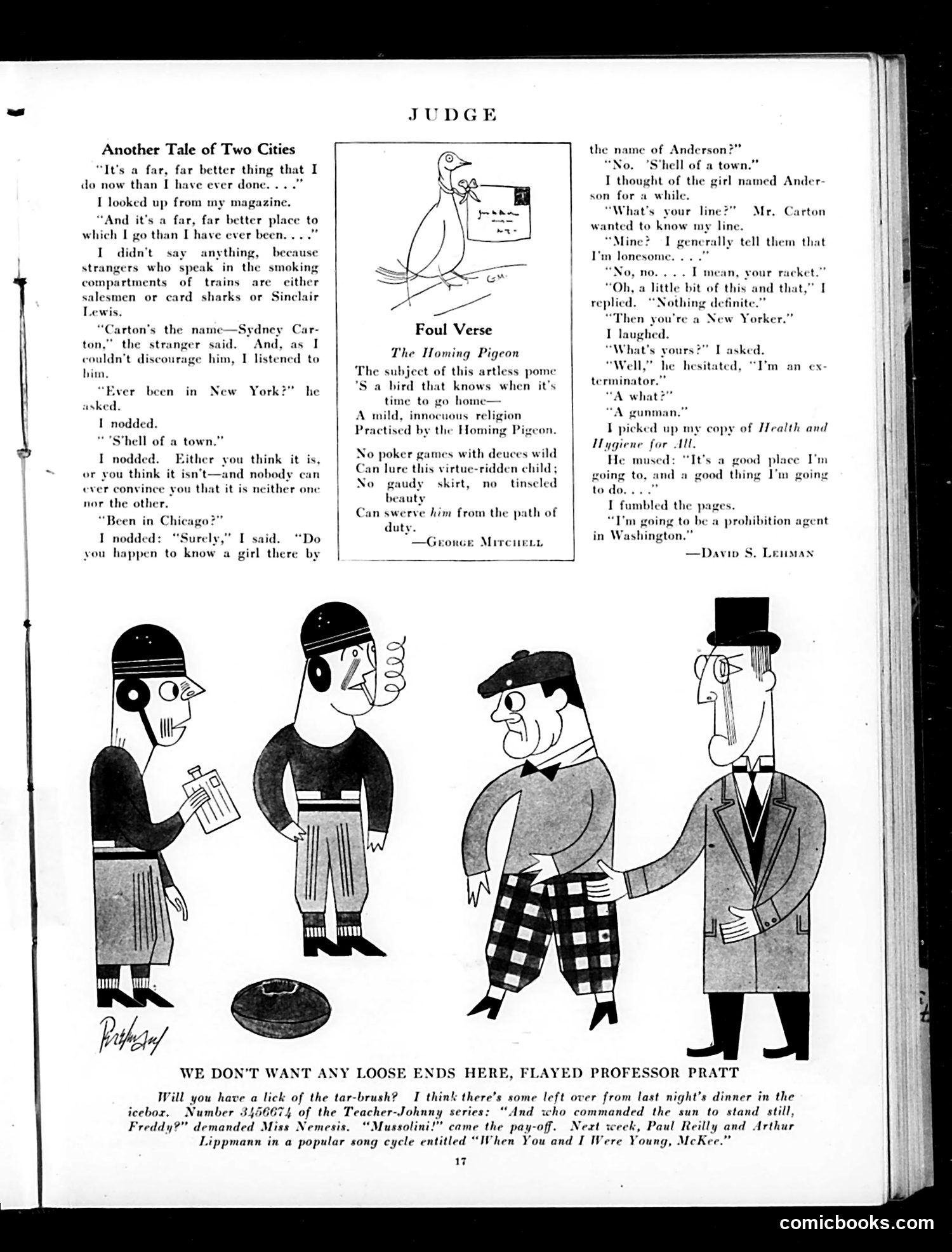
Analysis of Judge Magazine Page This page contains satirical fiction and cartoons from an early 20th-century American humor magazine. "Another Tale of Two Cities" is a short story parodying *A Tale of Two Cities* (Dickens), following a train conversation between the narrator and a man claiming to be "Sydney Carton." The story mocks casual conversation—the narrator learns the stranger is a prohibition agent heading to Washington. The satire targets both the banality of small talk and prohibition-era politics. "Foul Verse: The Homing Pigeon" is a poem praising birds that faithfully return home, contrasting virtue against temptation—likely satirizing moral hypocrisy of the era. The bottom cartoon titled "We Don't Want Any Loose Ends Here, Flayed Professor Pratt" shows four caricatured figures. The caption suggests this references a "Teacher-Johnny" series and contains a punchline about "Mussolini," referencing the Italian fascist leader. The specific reference remains unclear without additional context, though it appears to mock authority figures or educational pretension.
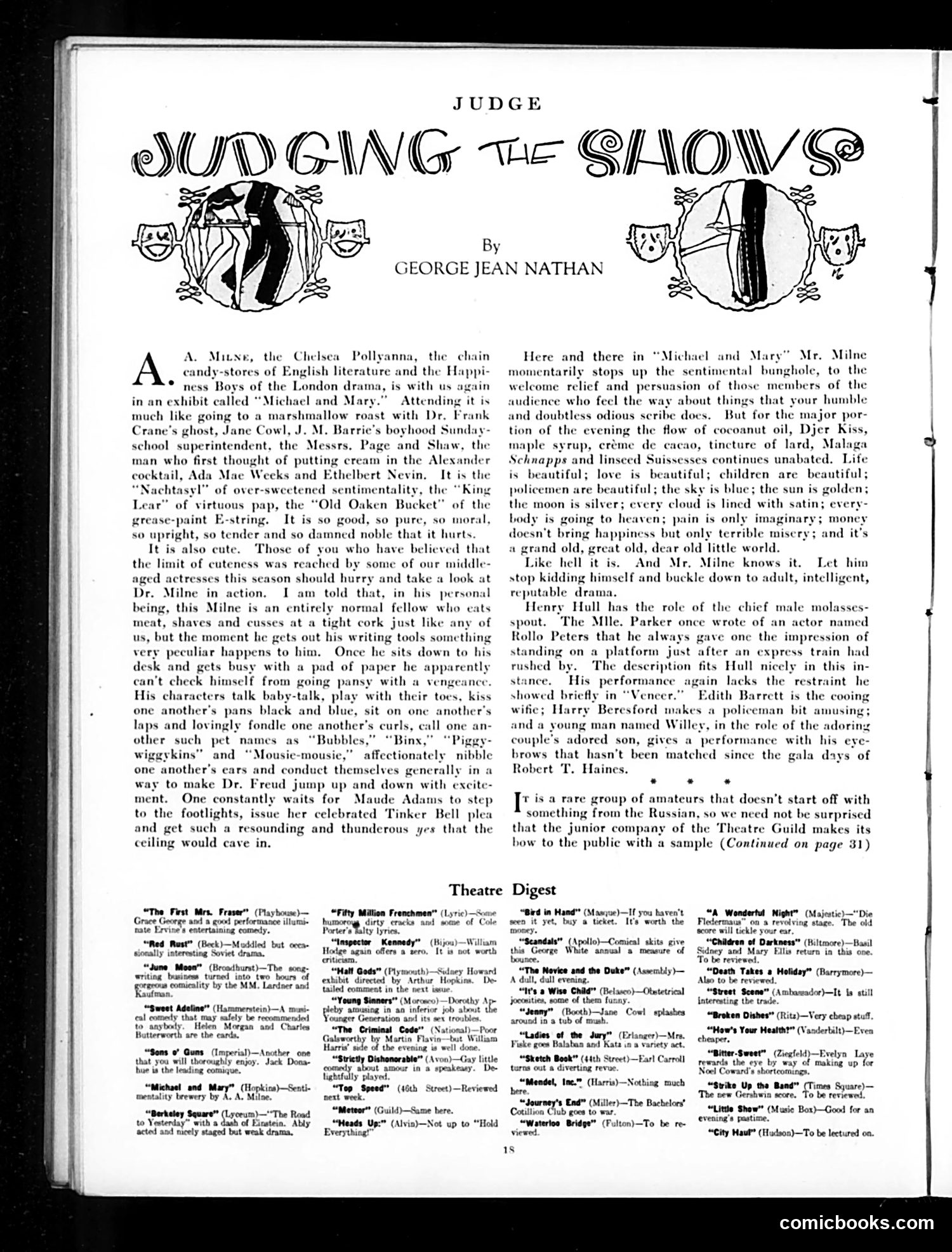
Judge Magazine: "Judging the Shows" - A Theater Critic's Review This is a theater criticism column by George Jean Nathan reviewing A.A. Milne's play "Michael and Mary." Nathan satirizes Milne's sentimental, overly cutesy writing style—both in drama and children's literature. The review mocks how Milne's characters use baby-talk pet names ("Bubbles," "Piggy-wiggins," "Mousie-mousie"), fondle each other excessively, and embody saccharine virtue. Nathan compares this to treacly children's entertainment, suggesting Milne treats adult audiences like infants needing Disney-fied sweetness rather than genuine drama. The column also lists other Broadway productions with brief reviews—typical theater-page content of the 1920s-30s period. The satire's point: sophisticated audiences shouldn't accept Milne's cloying sentimentality masquerading as serious drama. Nathan uses acidic, witty language to deflate what he sees as artistic dishonesty.
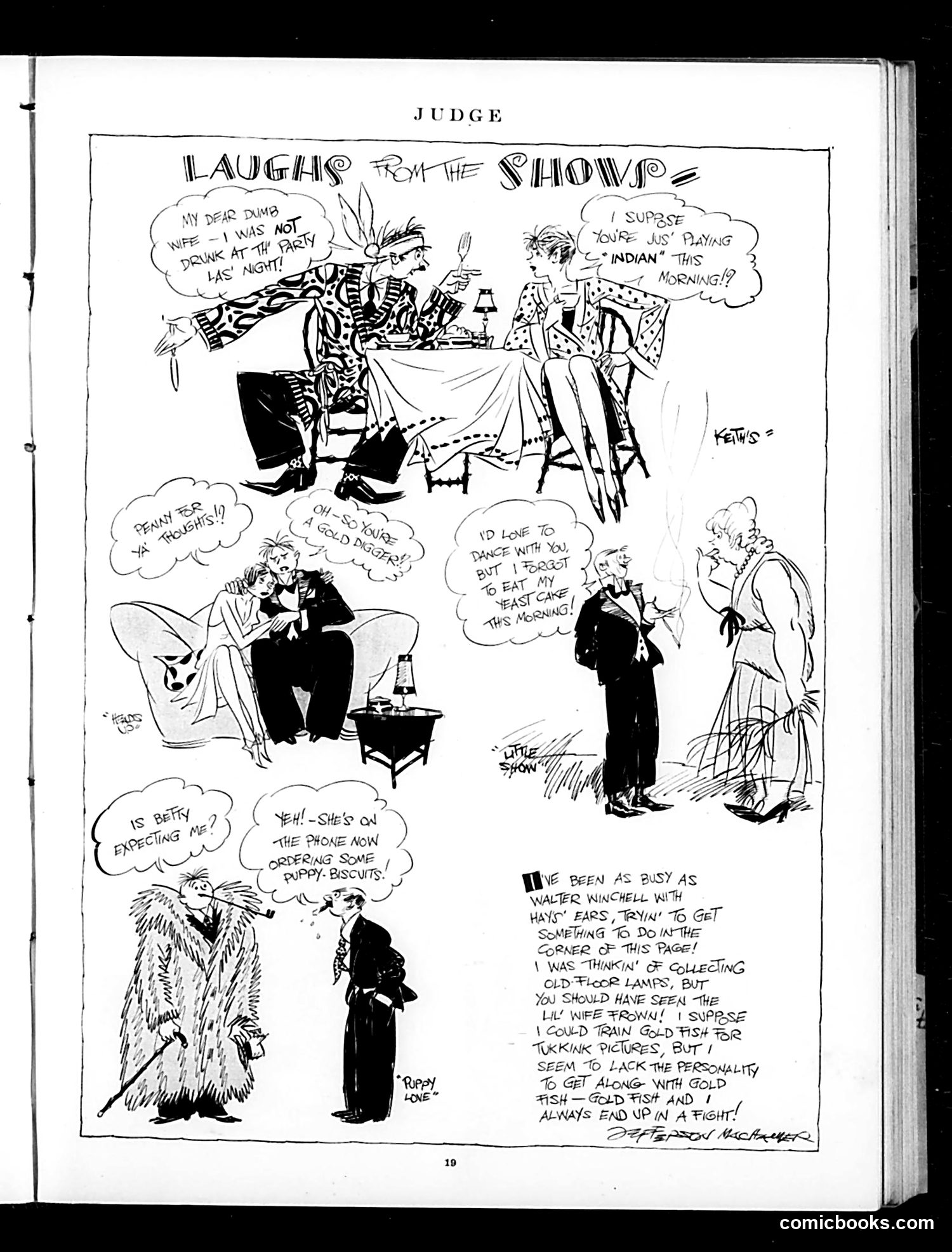
Judge Magazine Cartoon Analysis This page features multiple domestic comedy vignettes satirizing married life and social pretension. The central scene shows a couple at breakfast where the husband is caught in an obvious lie—claiming he wasn't drinking despite his disheveled appearance. The surrounding scenes depict various marital squabbles: a wife expecting a baby, a couple arguing about dancing, and a woman ordering "puppy biscuits" over the phone. The caption references Walter Winchell, the famous gossip columnist, humorously suggesting the cartoonist has been as busy as Winchell gathering material. The humor targets typical upper-middle-class domestic friction—drinking, forgetfulness, conflicting social plans, and the absurdities of maintaining appearances. These were standard Judge magazine tropes: satirizing the pretensions and compromises of American married life during what appears to be the early-to-mid 20th century.
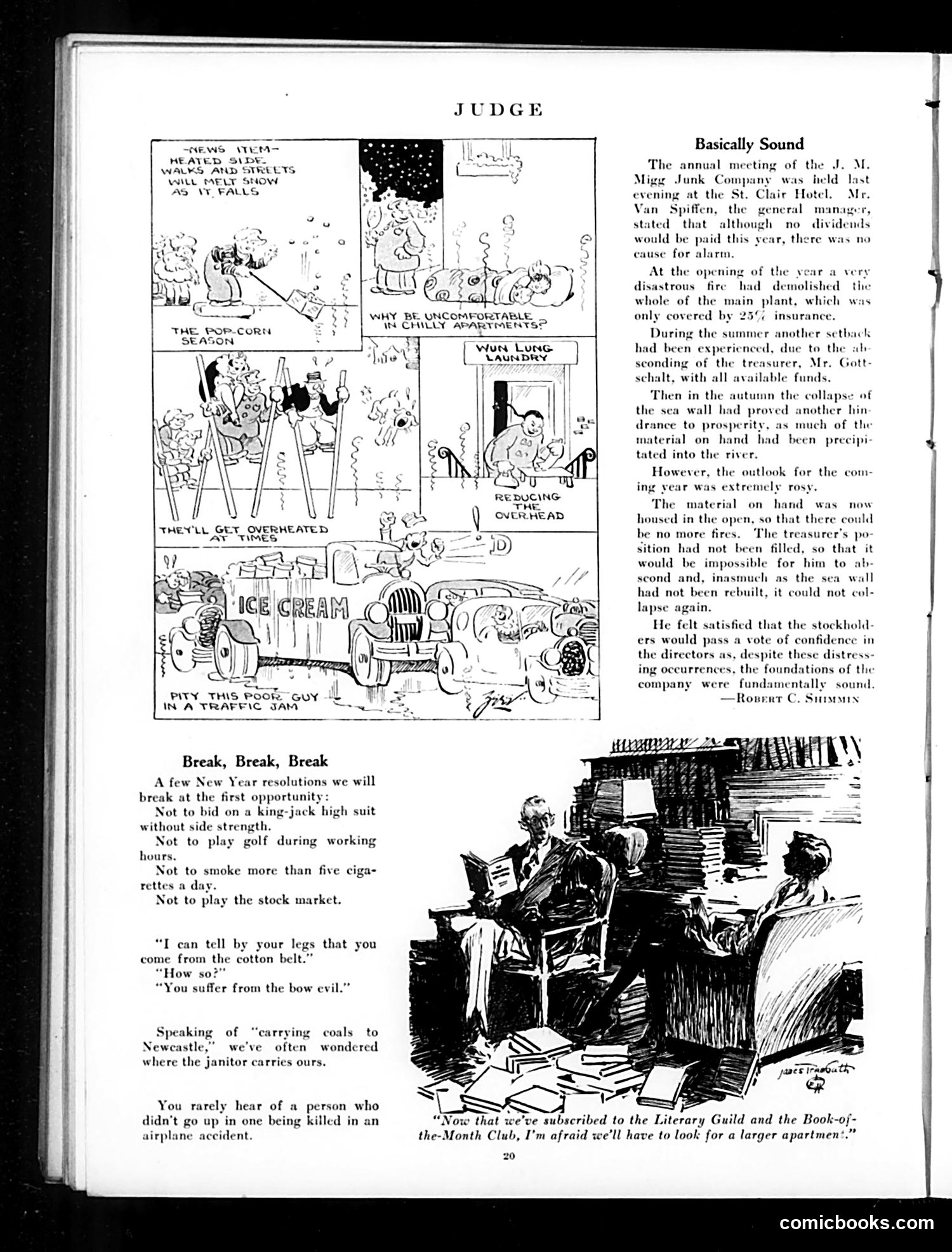
Explanation for Modern Readers This page from *Judge* magazine contains several satirical pieces mocking early 20th-century American business and social life. The main article, "Basically Sound," ridicules corporate optimism despite catastrophic failures. A junk company's manager assures stockholders there's "no cause for alarm" after a fire destroyed their plant (covered by only 25% insurance), the treasurer embezzled all funds, and a sea wall collapsed dumping inventory into a river. His "solution": store materials outdoors (preventing future fires) and leave the treasurer position vacant (preventing future embezzlement). The satire targets executives who spin disaster into positive narratives through absurd logic. The cartoon strips above mock everyday absurdities: pop-corn vendors selling in winter, overcrowded apartments, and traffic jams. The final section, "Break, Break, Break," humorously lists New Year's resolutions people will immediately break, including not gambling on stocks—a timely jab at 1920s speculation. The illustration at bottom satirizes intellectuals acquiring expensive book club memberships despite insufficient living space.
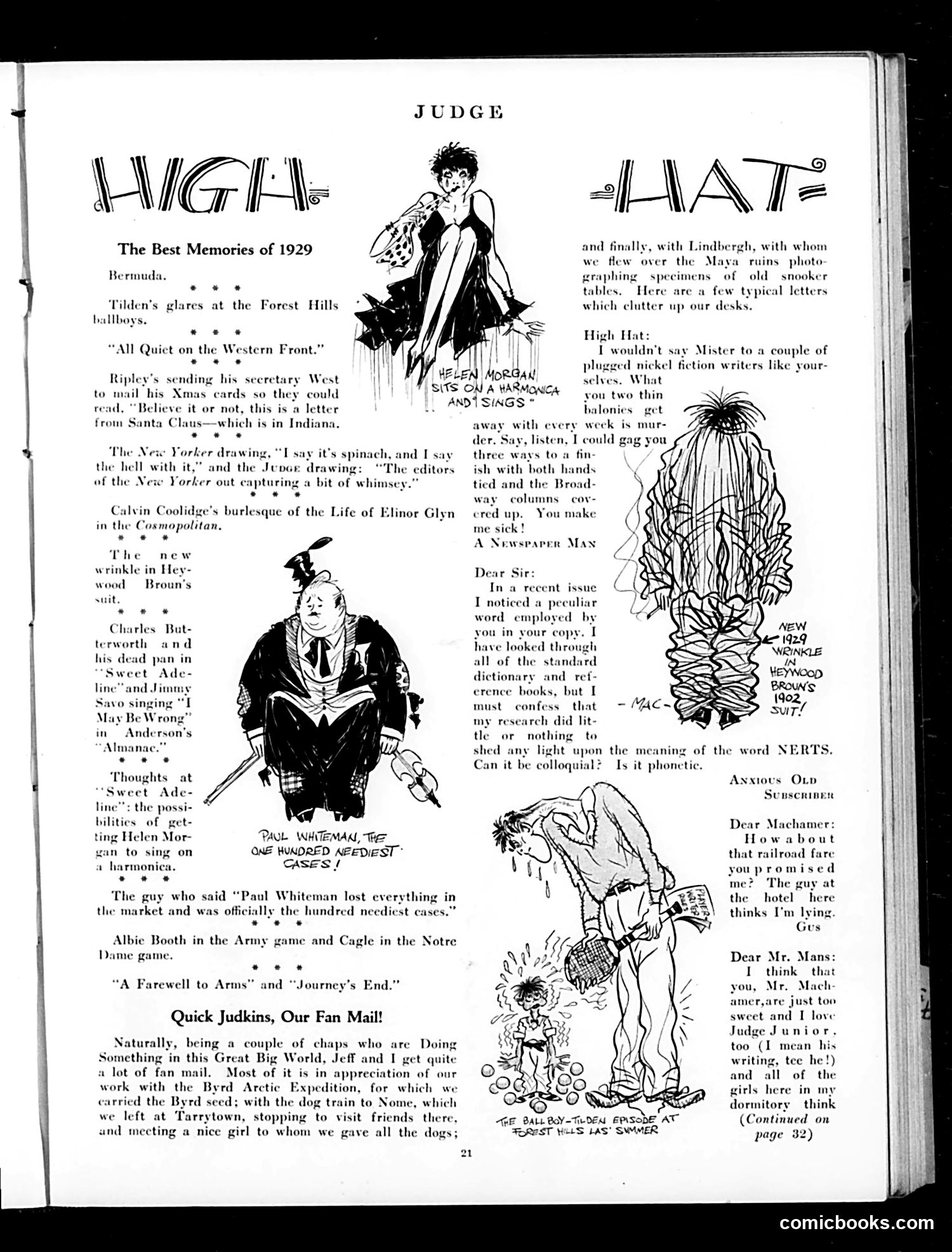
Judge Magazine, 1929: "High Hat" and "High Hat" This page celebrates 1929's memorable moments and features reader fan mail addressed to cartoonists Judkins and Machamer. The cartoons mock contemporary celebrities and events: Paul Whiteman (a famous bandleader) allegedly losing money in the stock market crash; Bill Tilden's angry glares at Forest Hills tennis ballboys; and various Broadway/entertainment personalities. The satire targets 1920s popular culture—phonograph records, Broadway shows, Arctic exploration adventures. The reader mail parodies fan correspondence, with complaints about the cartoonists' work, questions about slang ("NERTS"), and one reader claiming unpaid debts. The illustrations show exaggerated character types typical of Judge's satirical style. Overall, this reflects Judge's role as a humor magazine skewering current celebrities, sports figures, and entertainment trends for educated urban audiences of the Jazz Age.
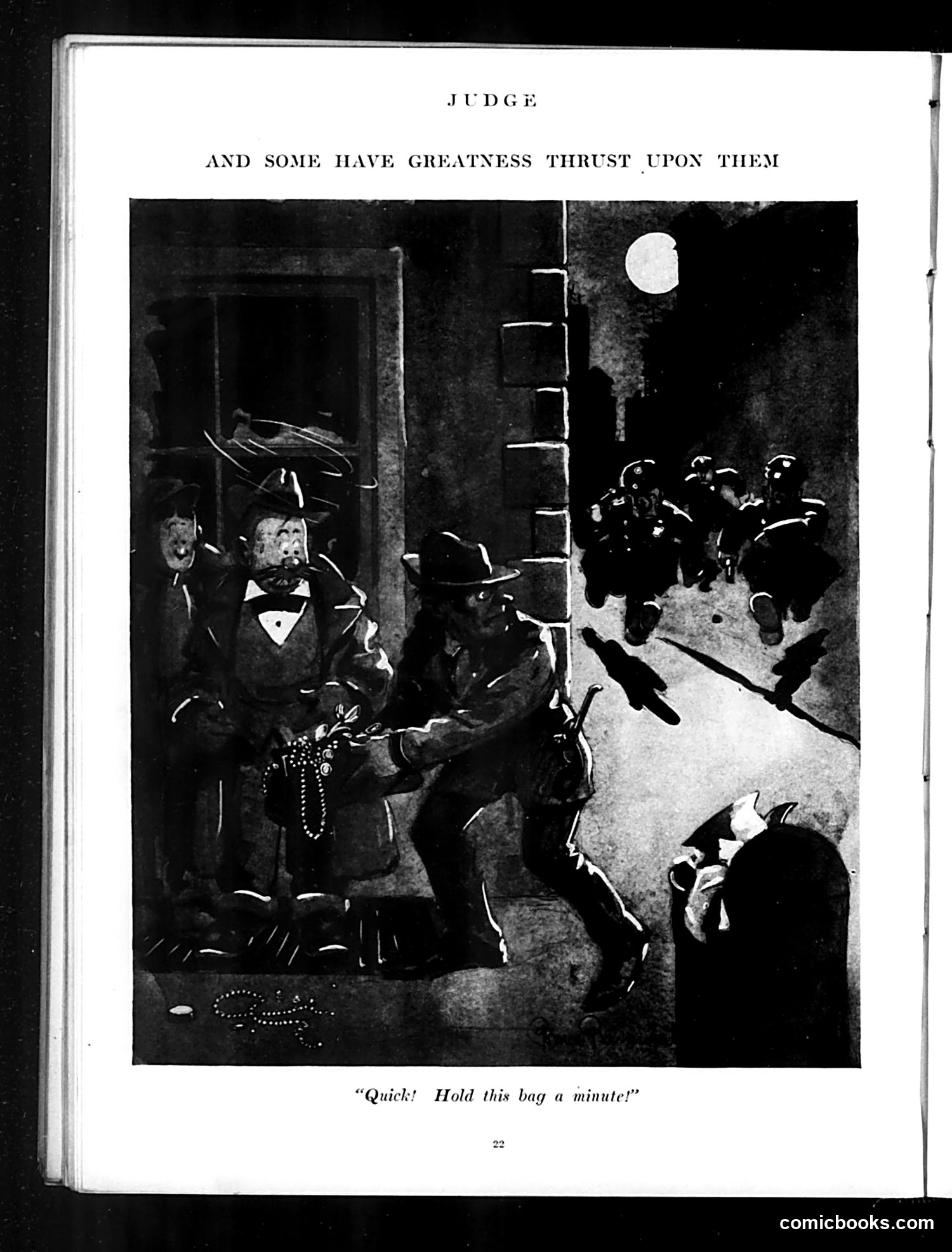
Analysis This appears to be a satirical cartoon about sudden, unwanted responsibility or authority. The scene shows what looks like a nighttime street encounter where one figure is urgently pressing another to "hold this bag"—a classic setup for tricking someone into an awkward or compromising situation. The headline "AND SOME HAVE GREATNESS THRUST UPON THEM" (a Shakespeare reference) suggests the joke is about how some people are forced into positions—here, literally holding something that may implicate them—without their consent or preparation. The crowd of onlookers in the background implies the unsuspecting person is being set up for public embarrassment or blame. The satire likely comments on unwilling assumption of responsibility, particularly in political or social contexts where people are made scapegoats.
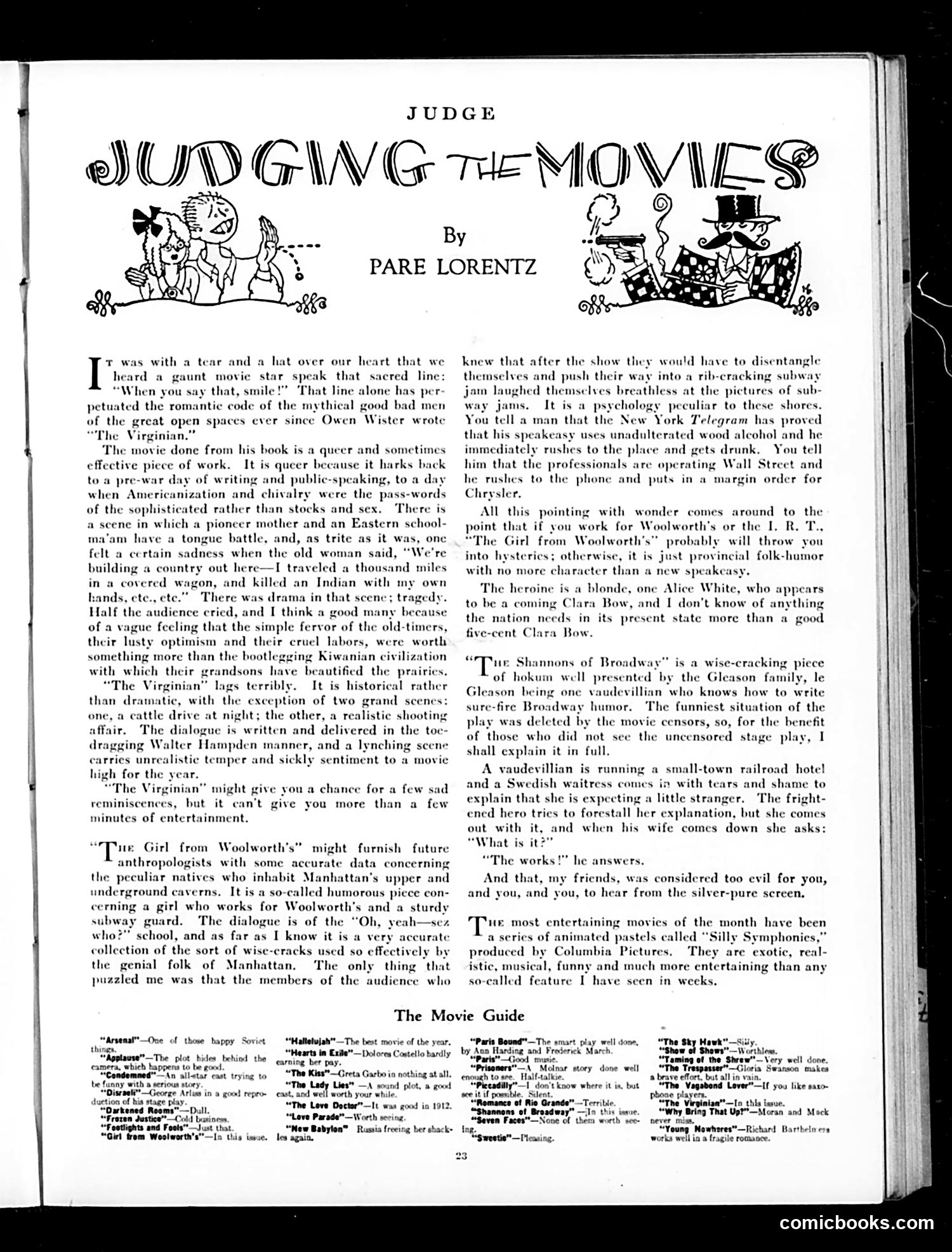
Judging the Movies: Pare Lorentz's Film Criticism This is a film review column by critic Pare Lorentz examining three recent movies. The page isn't satirical political cartooning—it's entertainment criticism in Judge magazine. Lorentz discusses "The Virginian," praising its historical authenticity but criticizing its slow pacing and melodramatic dialogue (performed by actor Walter Hampden in an overly theatrical manner). He dismisses "The Girl from Woolworth's" as provincial humor with shallow characterization, noting its heroine Alice White is being promoted as the next Clara Bow. "The Shannons of Broadway," featuring the Gleason family vaudeville performers, he finds entertaining but notes the movie censors deleted the funniest scene. The reviews reflect 1920s attitudes toward cinema—nostalgia for frontier values, dismissal of working-class humor, and concern about film censorship—while the decorative header artwork simply establishes the "Judge" brand and lighthearted tone.
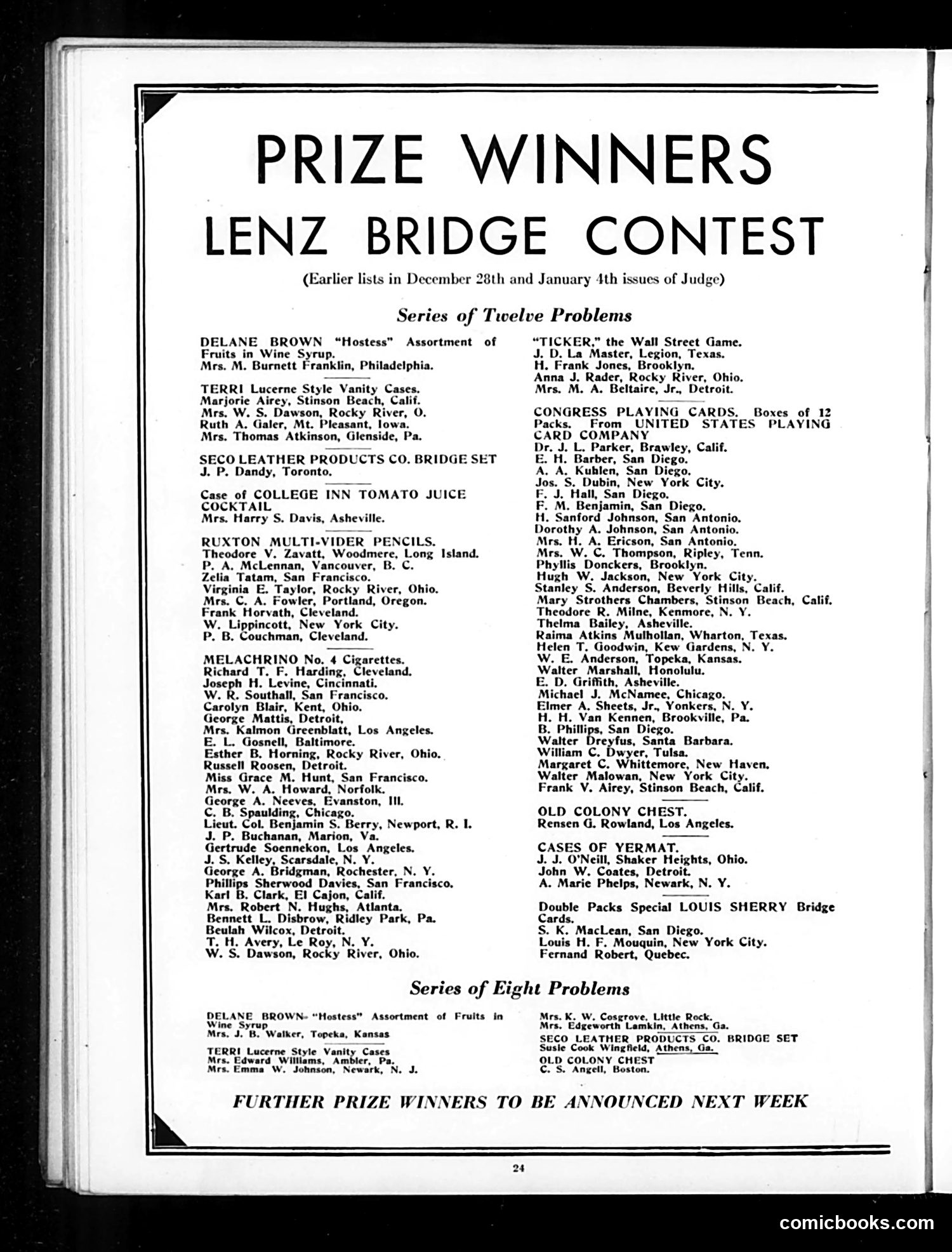
This page is a contest results announcement, not a cartoon. Judge magazine ran a "Lenz Bridge Contest"—a puzzle competition based on the card game bridge. The page lists prize winners across two difficulty levels ("Series of Twelve Problems" and "Series of Eight Problems"), organized by the prizes they won: Delane Brown fruit assortments, Terri vanity cases, leather bridge sets, cigarettes, playing cards, and other consumer goods. There is no satirical content or political commentary here. This is straightforward advertising and contest administration—Judge used such competitions to boost readership and engagement during the 1920s-30s. The geographic spread of winners (from California to New York to Canada) demonstrates the magazine's national circulation. The note "Further prize winners to be announced next week" indicates ongoing promotion.
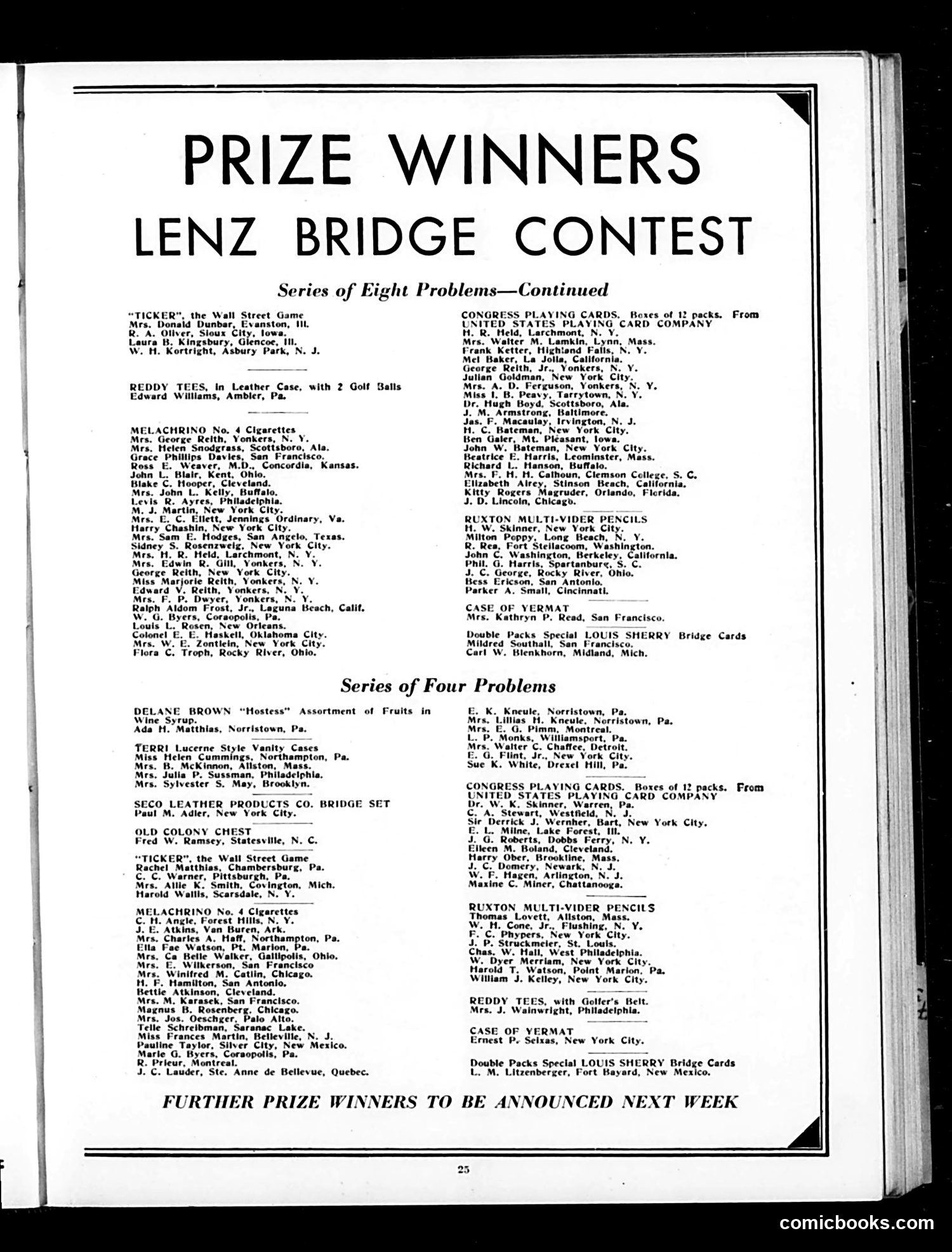
Prize Winners Page from Judge Magazine This page is not a cartoon but rather a contests results announcement — specifically prize winners from the "Lenz Bridge Contest," a puzzle/game competition Judge magazine ran. The page lists hundreds of readers who won various merchandise prizes for solving bridge-related problems. Prizes included novelty items popular in the era: "Ticker" (a Wall Street stock-market game), golf equipment, cigarettes, playing cards, leather goods, and vanity cases. Historical context: Bridge was a hugely popular card game in early 20th-century America, and Judge magazine (a humor publication) regularly ran reader contests to boost circulation. These sweepstakes were typical marketing vehicles for magazines of the period, encouraging subscriber participation and loyalty. The note "Further Prize Winners to Be Announced Next Week" indicates this was a multi-week announcement, stretching dramatic interest across several issues.
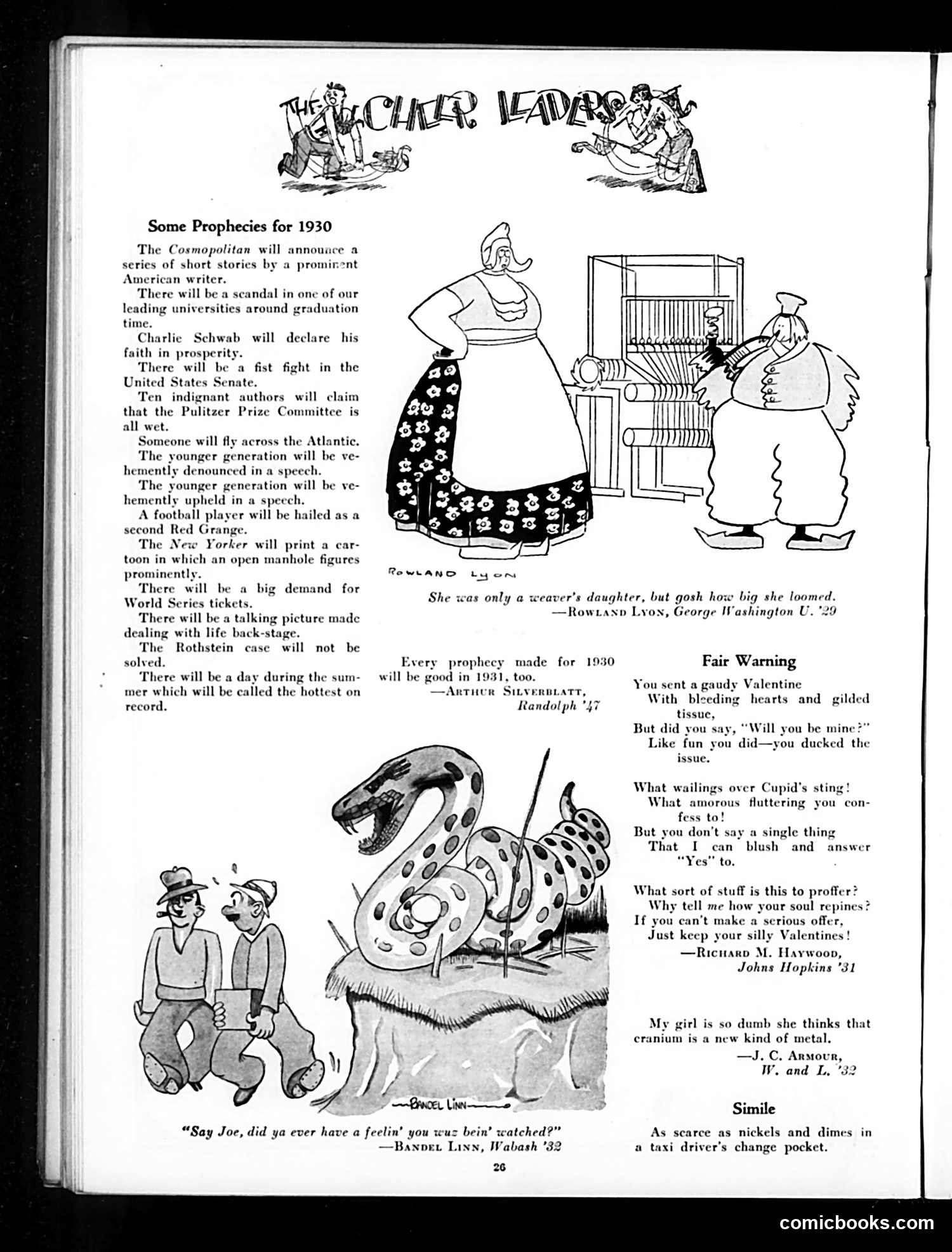
"Some Prophecies for 1930" This is satirical humor from Judge magazine predicting events for 1930 with tongue-in-cheek cynicism. The prophecies mock recurring patterns in American life: Charlie Schwab (a prominent industrialist) will inevitably declare faith in prosperity; the Senate will have fistfights; authors will complain about the Pulitzer Prize; someone will fly the Atlantic (frequent aviation achievements); the younger generation will be both denounced and praised in separate speeches; a new football star will rival Red Grange; and the Rothstein murder case will remain unsolved. The cartoons and accompanying humorous submissions from college students provide additional satirical commentary. The overall message is that 1930 will simply repeat 1929's patterns—nothing truly novel happens. This reflects the cynicism of the Jazz Age toward American institutions and human behavior, presented as timeless absurdities.
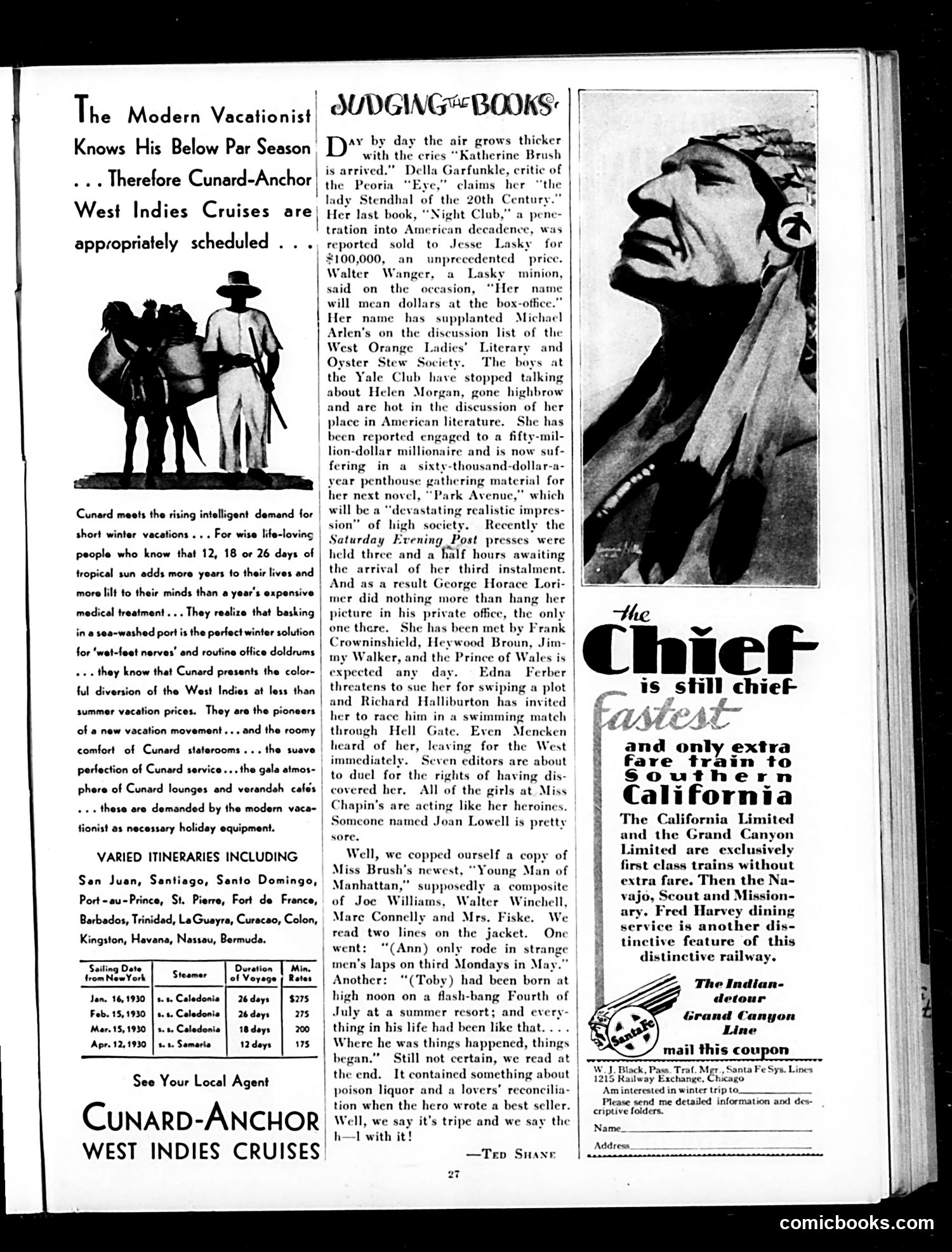
Explanation for Modern Readers This page consists primarily of advertisements rather than political satire. The left side advertises Cunard-Anchor West Indies cruises, targeting affluent vacationers with appeals to health benefits and luxury service—a marketing approach typical of 1930. The right side contains a book review column titled "Judging the Books," mocking the literary celebrity of Katherine Brush, a popular 1920s-30s author. The satire ridicules how Brush's novel "Young Man of Manhattan" (a composite of famous men like Walter Winchell and Joe Williams) has generated absurd hype: publishers holding presses, editors dueling for credit, society figures competing for her attention, even the Prince of Wales allegedly interested. The review's deadpan tone—pretending to find the actual prose vapid while documenting the media frenzy—is the joke. It satirizes celebrity authorship and literary hype rather than politics. The "Chief" train advertisement below is unrelated commercial content.
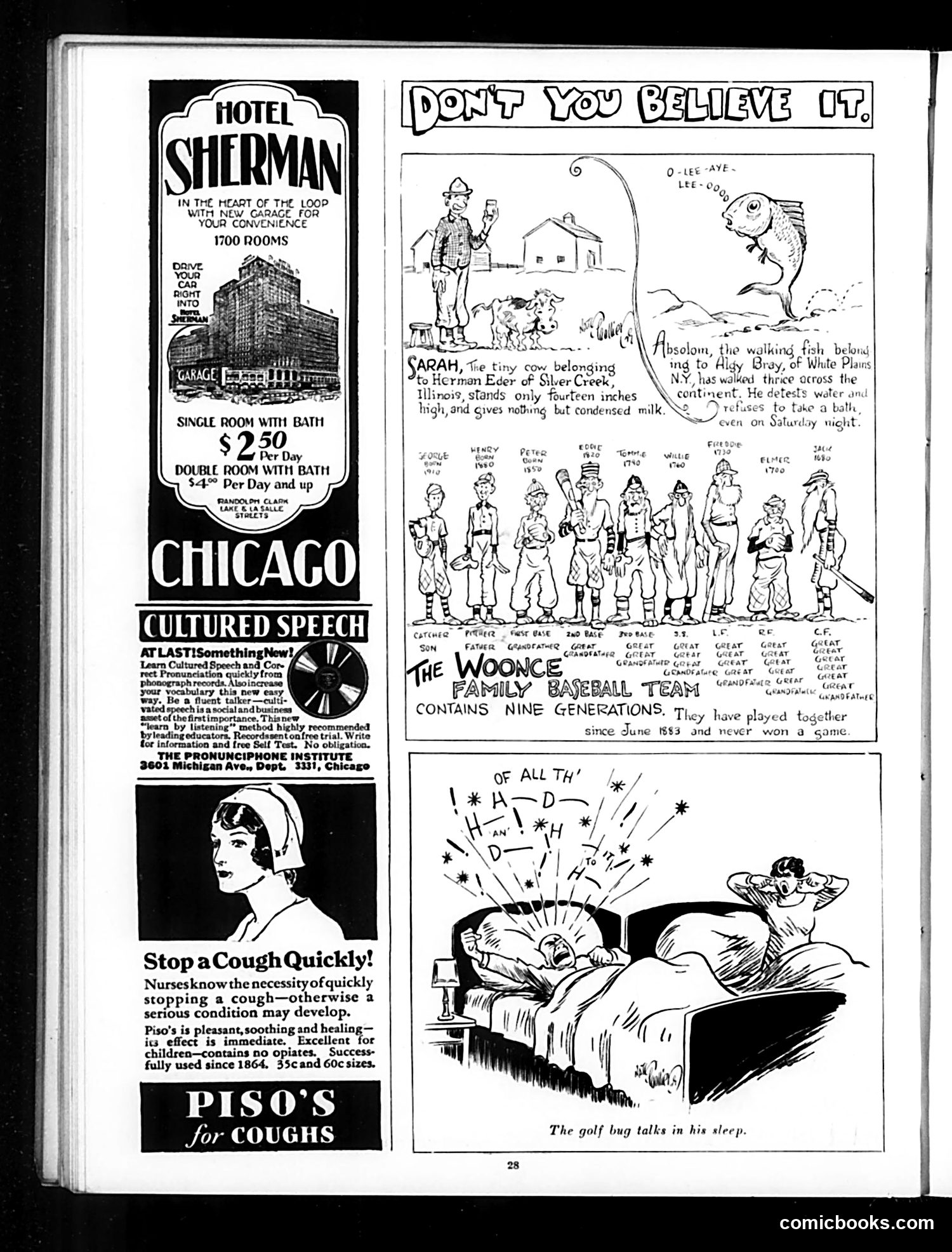
"Don't You Believe It" — Judge Magazine Satire This page features three tall-tale cartoons mocking exaggerated claims and tall stories. The main cartoon presents "The Woonce Family Baseball Team," depicting nine generations of a family that has supposedly played baseball together since 1853 without ever winning a game—an absurd premise satirizing both family pride and sports obsession. Supporting vignettes mock other dubious claims: Sarah, a tiny cow giving only condensed milk; Absolom, a walking fish crossing continents who refuses to bathe; and a golfer so obsessed he talks about golf while sleeping. The satire targets the American love of boastful exaggeration and "believe it or not" type stories that were popular entertainment. Judge uses these ridiculous scenarios to poke fun at readers who might accept such implausible yarns at face value. The overall message: don't be gullible. The advertisements (Hotel Sherman, Piso's Cough Medicine, Pronunciphone Institute) represent typical Judge content from this era.
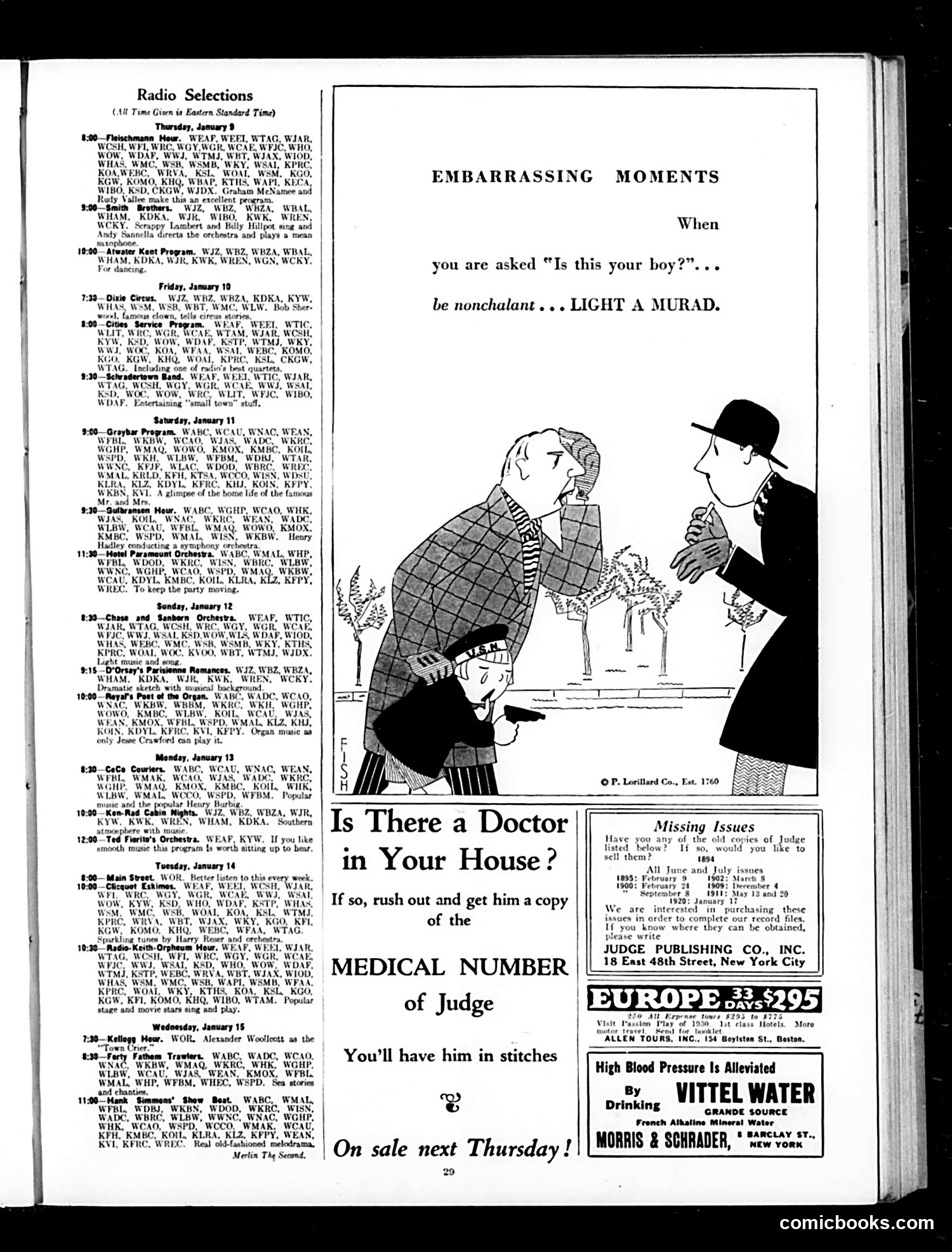
Explanation for Modern Readers This page is primarily a radio programming guide for January 1930, listing broadcast schedules across American stations. The main cartoon depicts an embarrassing social scenario: a man is asked if a child is his son. The satire's punchline—"be nonchalant... LIGHT A MURAD"—advertises Murad cigarettes (made by P. Lorillard Co.) as a solution to social awkwardness. The humor relies on 1930s assumptions: lighting a cigarette was a casual, sophisticated gesture. By smoking, the man could deflect the uncomfortable question through affected nonchalance. This reflects period attitudes where smoking signified maturity and worldliness. The page also includes advertisements for "Medical Number of Judge," a Europe travel tour, and Vittel Water, alongside a request for missing back issues of the magazine. The content reflects Judge's role as both satirical commentary and commercial advertising vehicle in early 20th-century American print media.
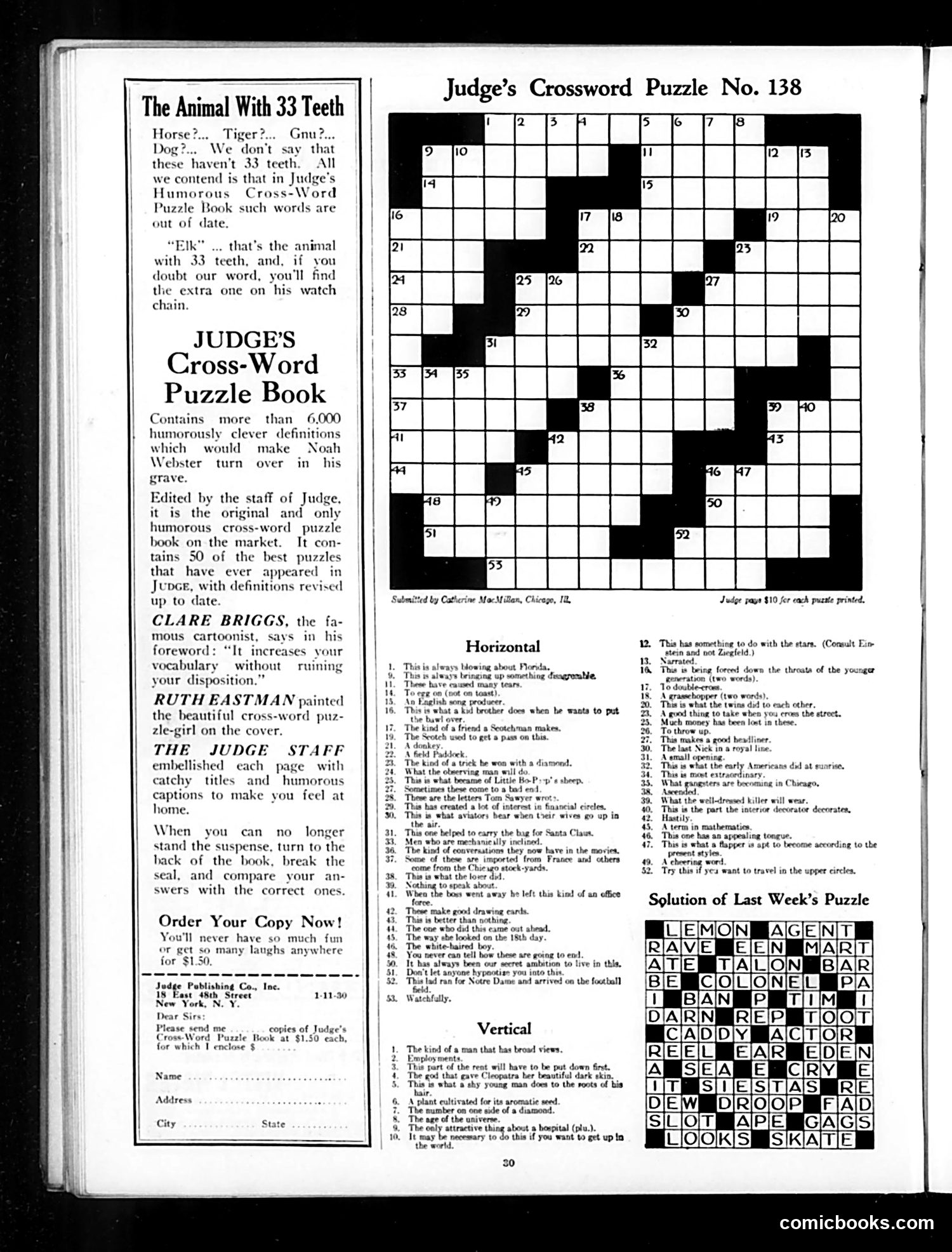
Judge Magazine Crossword Puzzle Advertisement This page is primarily advertising for Judge's Cross-Word Puzzle Book, not a political cartoon. The bulk consists of promotional copy and the actual crossword puzzle (No. 138). The opening section humorously addresses which animal has 33 teeth — claiming it's an "elk," not a gnu or horse — a joke setup that the puzzle book supposedly clarifies with updated definitions. The advertisement emphasizes the book contains 6,000 "humorously clever definitions" with endorsements from cartoonist Clare Briggs and artist Ruth Eastman. The publication notes these are the "50 of the best puzzles that have ever appeared in Judge" with revised definitions "up to date." This reflects early 20th-century magazine marketing: Judge sold both entertainment (satirical content) and supplementary products to readers. The puzzle book promised humor through wordplay and clever definitions—standard highbrow entertainment for the era's educated audience.
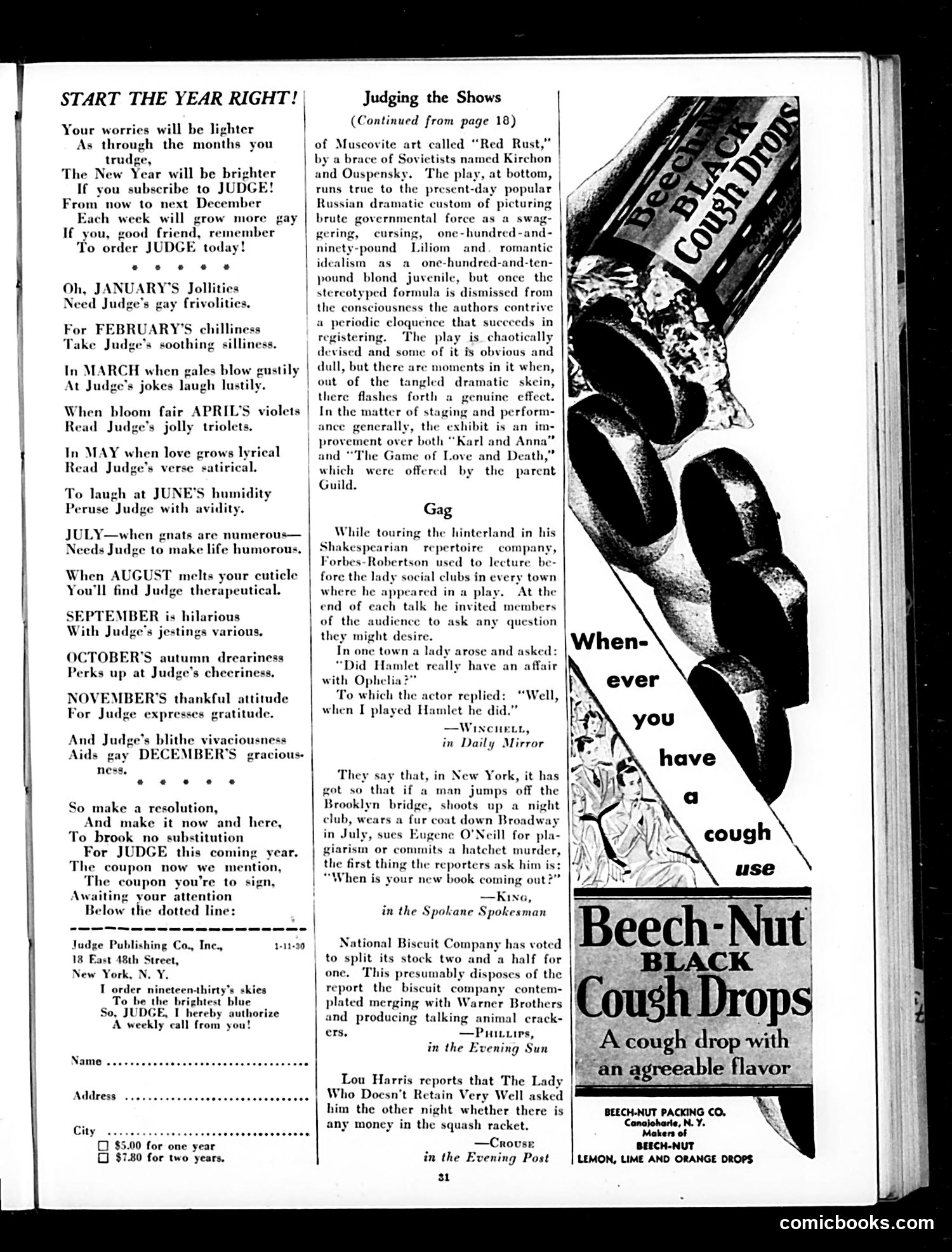
Analysis of This Page from Judge Magazine This page is primarily a subscription pitch for Judge magazine itself, disguised as humorous verse. The left column urges readers to subscribe by promising comedic relief month-by-month ("January's frivolities," "February's silliness," etc.). The main content area contains theater reviews and humorous anecdotes under "Judging the Shows." Notable items include: - A review of a Muscovite play called "Red Rust" - An anecdote about actor Forbes-Robertson touring with Shakespeare, lecturing to women's clubs and inviting audience questions - A joke about New York's sensationalism: if someone commits a crime, reporters ask "When is your new book coming out?" - A brief note about National Biscuit Company (Nabisco) splitting its stock The right side features a Beech-Nut cough drops advertisement with a stylized illustration. This is essentially a magazine back page blending self-promotion, entertainment gossip, and advertising—typical of Judge's satirical but commercially-driven format from this era (circa 1929-1930, based on "nineteenthirty's skies").
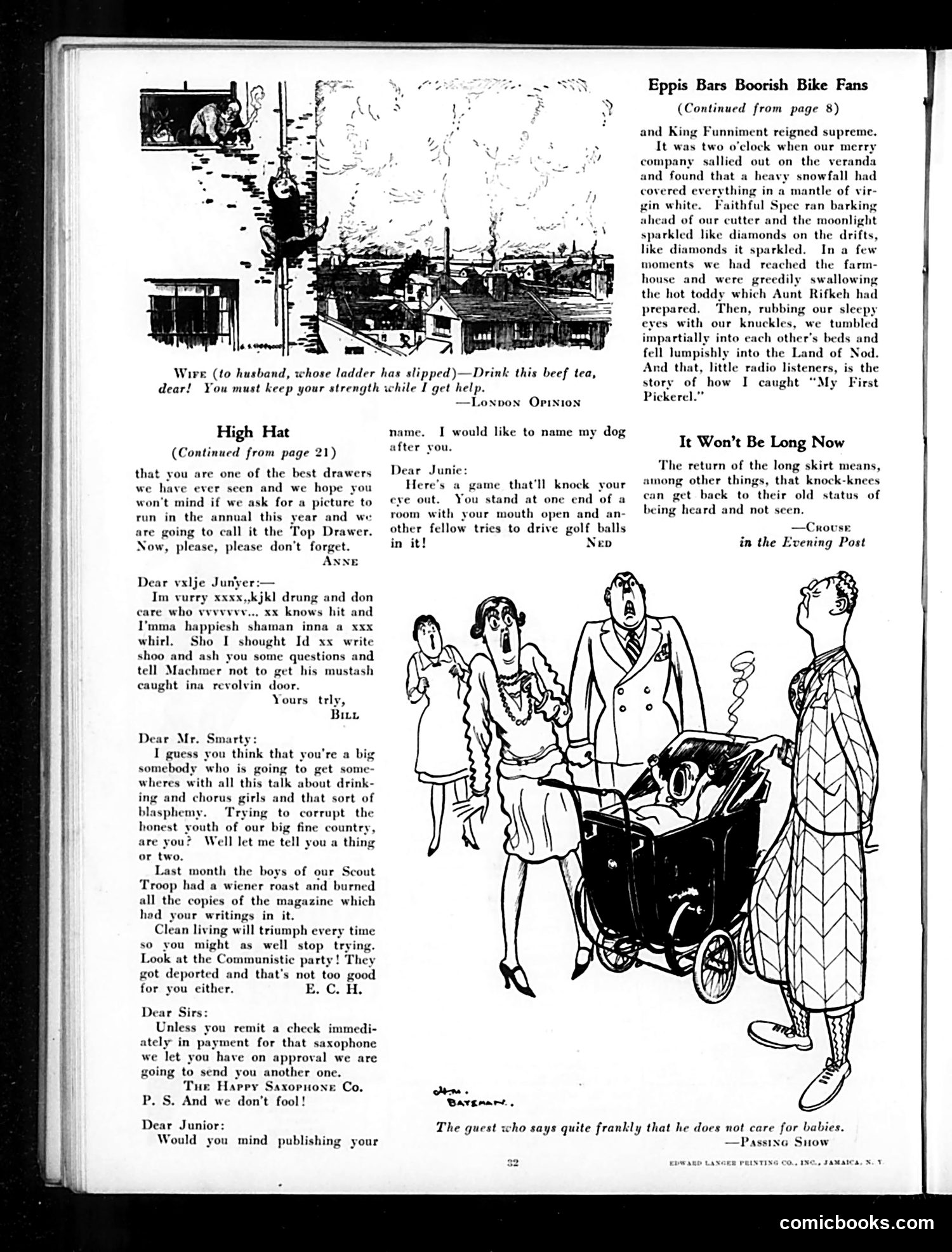
Judge Magazine Page Analysis This page contains reader letters and humorous responses typical of Judge's editorial section, plus one cartoon illustration. The main cartoon (bottom right, credited to "Bateham") depicts a woman with a baby carriage confronting a fashionably-dressed man. The caption reads: "The guest who says quite frankly that he does not care for babies." It's social satire about Victorian-era politeness—mocking the man's blunt honesty as socially offensive, since admitting indifference to babies violated era conventions that everyone should coo over infants. The reader letters are humorous complaints and absurdities: one from a Scout Troop burning copies of Judge for corrupting youth; a saxophone company threatening to send duplicate instruments as debt collection; and a crude letter written in misspelled gibberish. These appear designed to amuse through exaggeration and the contrast between earnest complaint and ridiculous content. The "High Hat" and "Eppis Bars" sections are story continuations from earlier pages, not analyzable without context. The overall tone is lighthearted satirical humor about urban American life, youth behavior, and social pretense.
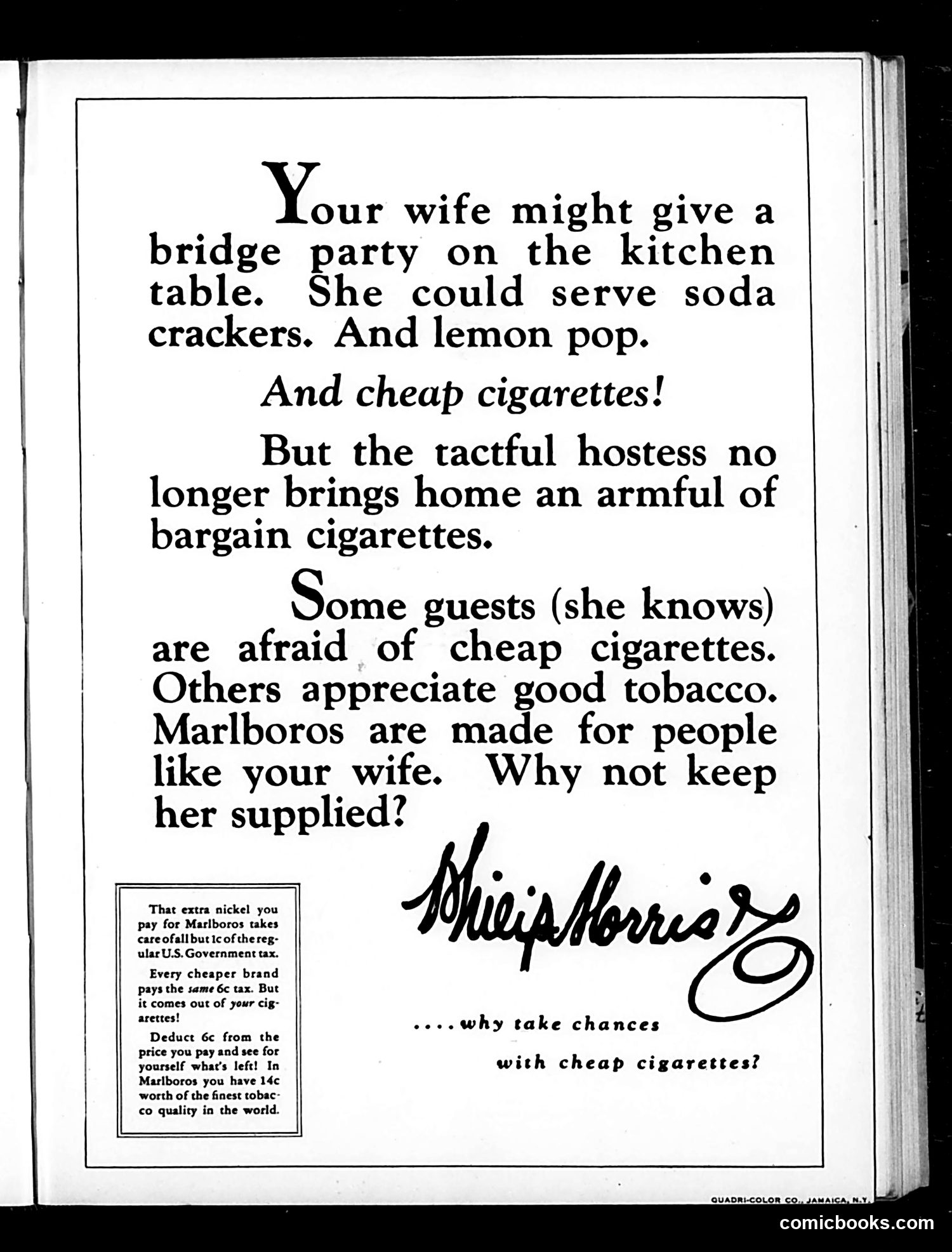
Marlboro Cigarette Advertisement Analysis This is a cigarette advertisement, not satire or political cartoon. It's a vintage Marlboro ad targeting husbands, using their wives as a persuasion angle. The pitch: A wife hosting a bridge party (a popular 1930s-40s social activity) shouldn't serve cheap cigarettes to guests. Some guests allegedly fear bargain brands; others appreciate quality tobacco. Therefore, husbands should keep their wives "supplied" with premium Marlboros. The economic argument: The ad claims that a 6¢ government tax applies equally to all cigarettes. Deduct this from Marlboro's price, and you get 14¢ worth of "finest tobacco quality"—implying competitors waste money on cheap filler. Context we'd miss: This reflects an era when cigarette advertising was unregulated, could make health/quality claims freely, and openly targeted women through domestic/social scenarios. The gendered marketing (appealing to male breadwinners about their wives' social standing) was standard for the period.
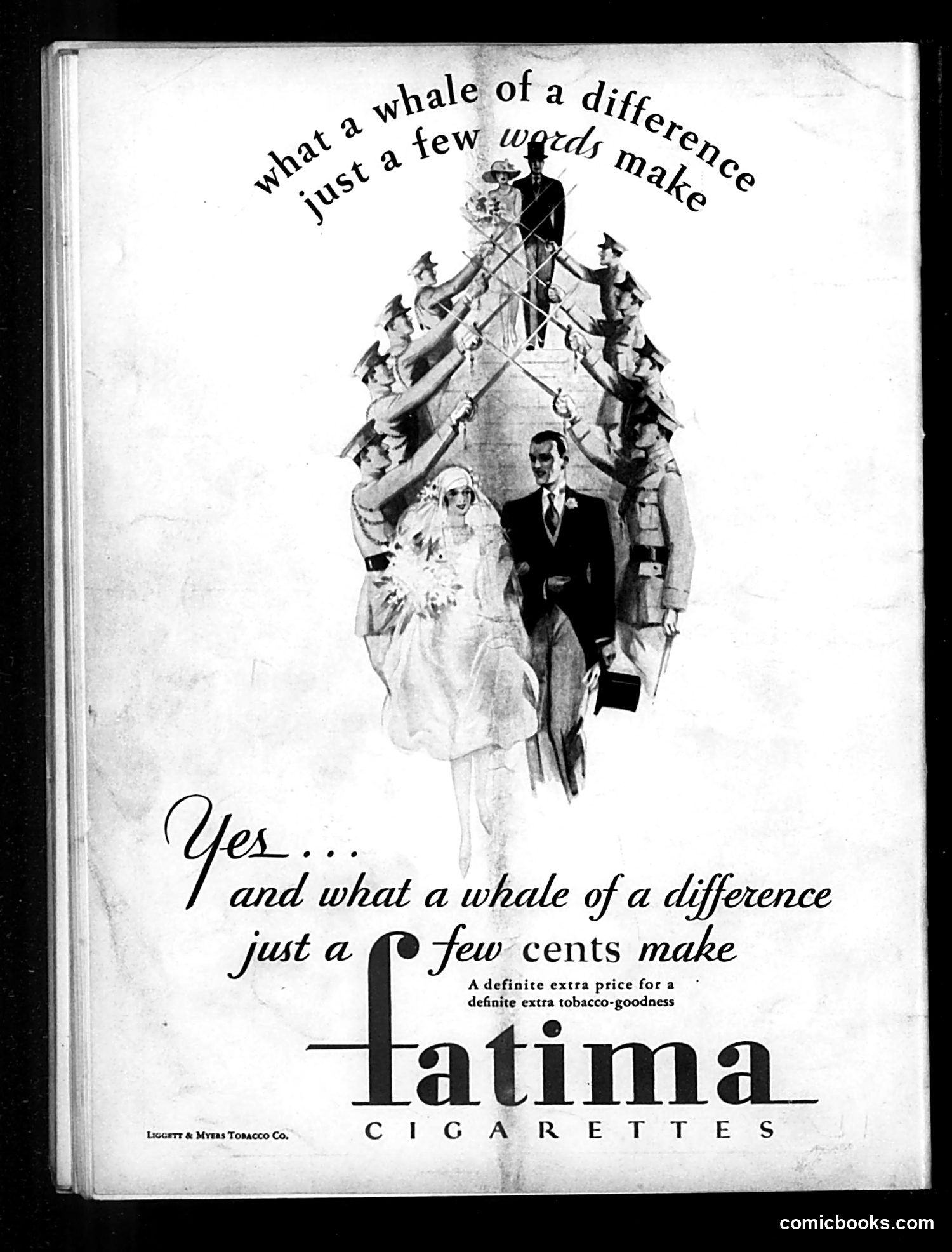
This is a Fatima Cigarettes advertisement, not political satire. The ad uses a visual pun: "what a whale of a difference just a few words make" appears at top, with an illustration showing multiple small figures climbing on a large whale-shaped form containing a well-dressed couple at its center. The wordplay contrasts "a few *words*" with "a few *cents*" — arguing that spending just pennies more on Fatima cigarettes yields dramatically superior quality ("a whale of a difference"). The climbing figures and whale imagery are purely decorative visual metaphors for the size/magnitude of the quality improvement. This was typical early 20th-century advertising copy emphasizing value and product superiority through clever language and striking imagery.