judge
Judge — January 18, 1930
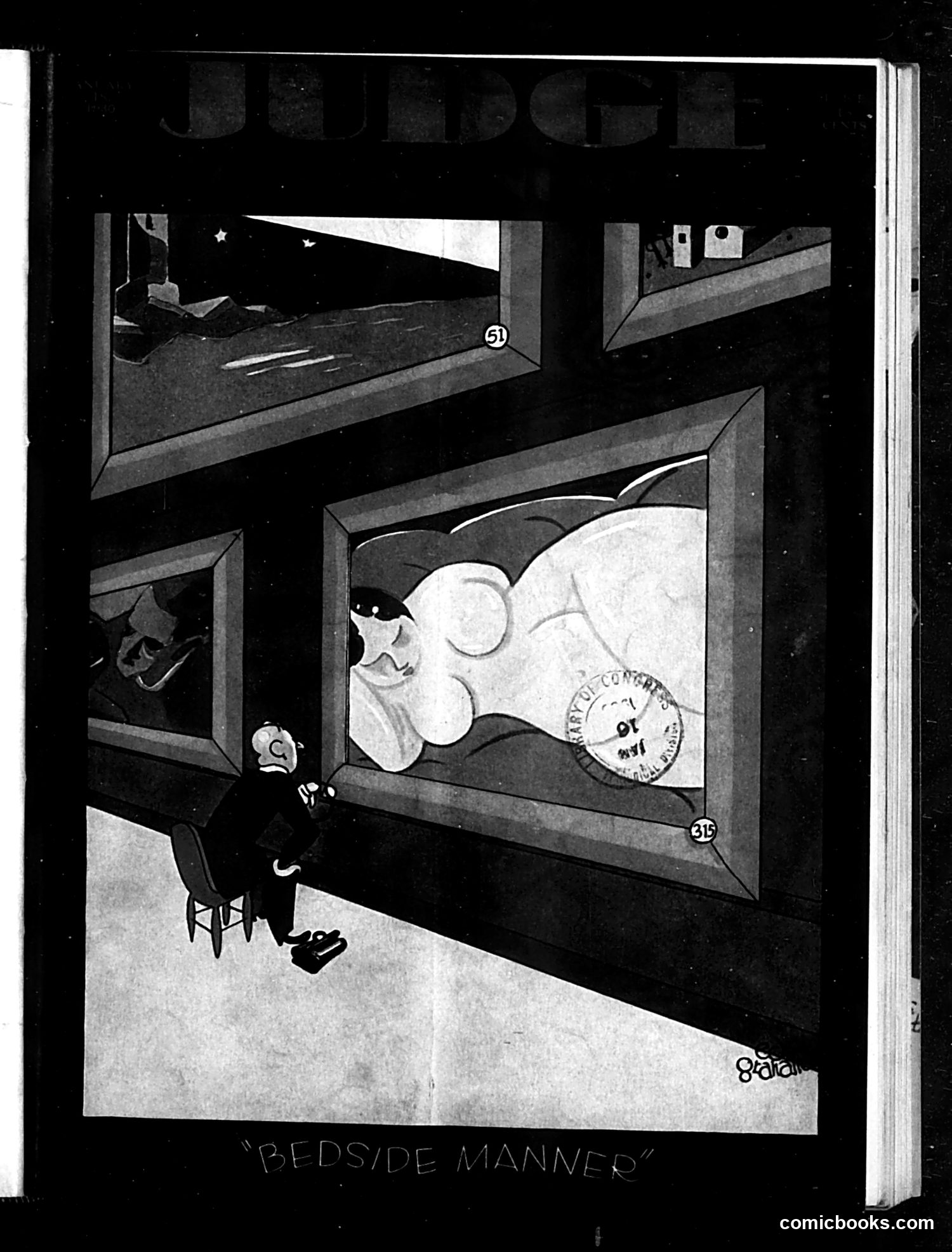
"Bedside Manner" This cartoon satirizes medical theater and public spectacle in early 20th-century America. A well-dressed man sits observing a large framed display of what appears to be a medical procedure or patient examination. The theatrical staging—with dramatic lighting, an audience setup, and the formal framing—suggests doctors were treating medical cases as public entertainment rather than private professional matters. The title "Bedside Manner" is ironic: traditionally this phrase means a physician's professional demeanor toward patients, implying sensitivity and care. Here, the satire critiques physicians who prioritized public attention and sensationalism over patient privacy and genuine medical ethics. The cartoon mocks the era's tendency toward medical exhibitions and celebrity doctors performing for crowds.
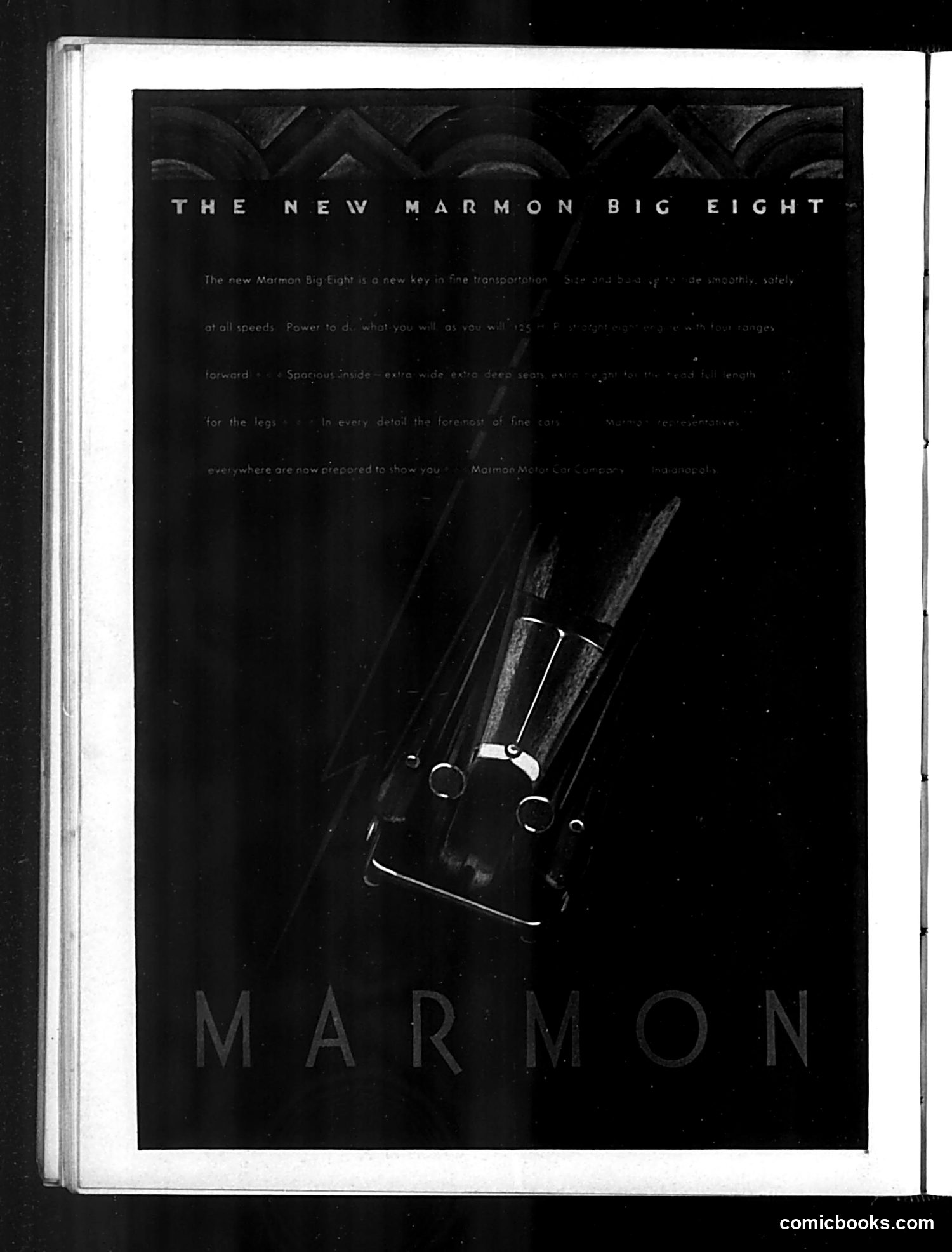
The New Marmon Big Eight This page is primarily an advertisement for the Marmon Motor Car Company's Big Eight automobile. The text emphasizes the vehicle's performance features: power at all speeds, "Spacious Inside" with extra-wide seating, and fine engineering details. The dramatic black-and-white photograph shows the car's distinctive dual exhaust pipes photographed from above, highlighting the vehicle's mechanical sophistication and power. The styling and layout suggest this is a luxury car advertisement positioned as a prestige product for affluent consumers. This is not political satire but rather a high-end automotive advertisement using Judge magazine's premium advertising space to reach its educated, wealthy readership during the automobile boom era (appears to be 1920s-1930s based on styling).
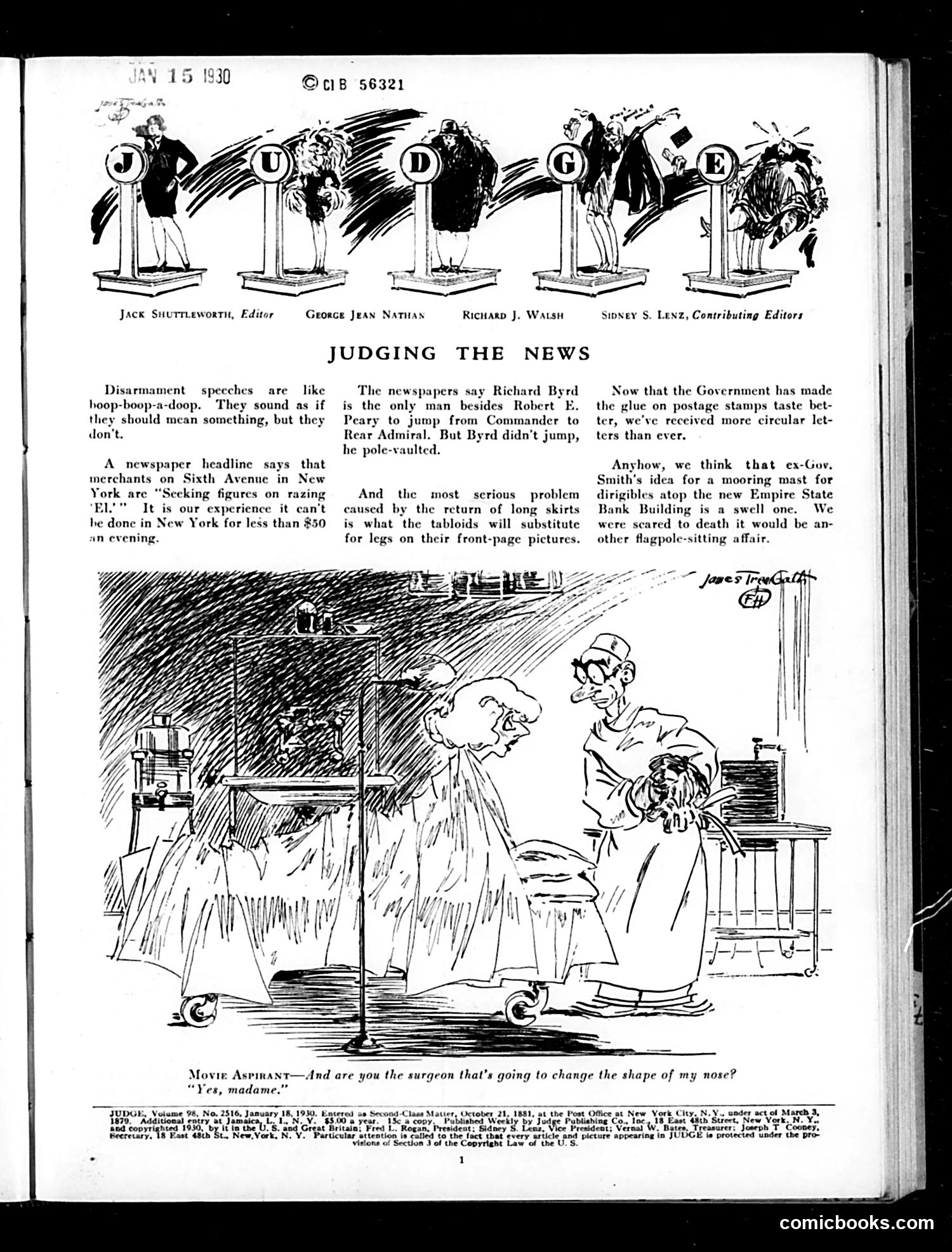
Analysis of Judge Magazine Page (January 15, 1930) The page's main cartoon depicts a "Movie Aspirant" asking a surgeon: "And are you the surgeon that's going to change the shape of my nose?" This satirizes 1930s Hollywood culture, where aspiring actresses pursued cosmetic surgery to achieve fashionable looks—reflecting both the industry's appearance obsession and the emerging cosmetic surgery industry. The upper section, titled "Judging the News," contains brief editorial commentaries mocking various current events: disarmament speeches, merchant pricing on Sixth Avenue, Richard Byrd's Antarctic expedition, long skirts returning to fashion, and proposed public works projects like a mooring mast for airships near the Empire State Building. The magazine lampoons contemporary news and cultural trends through satirical humor.
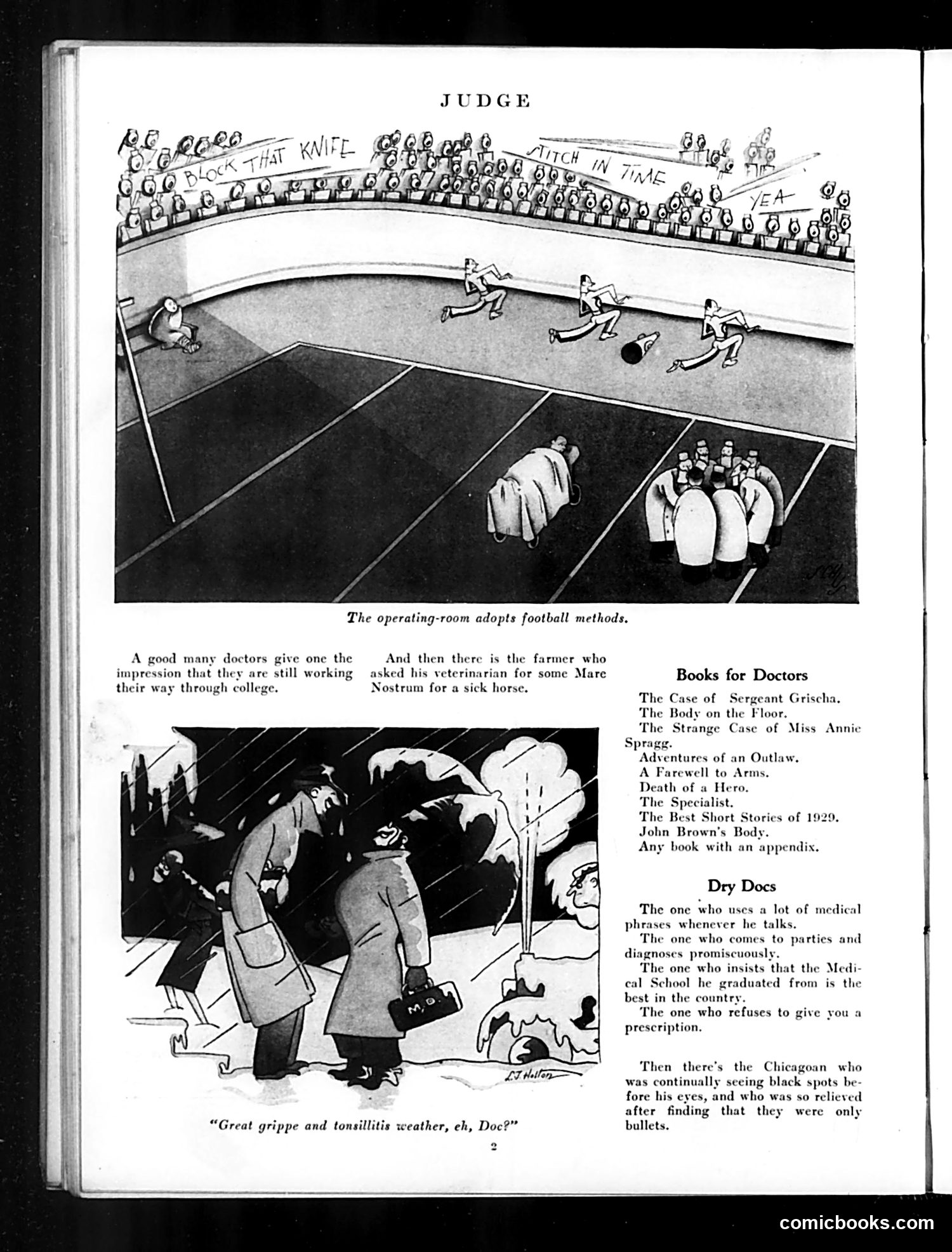
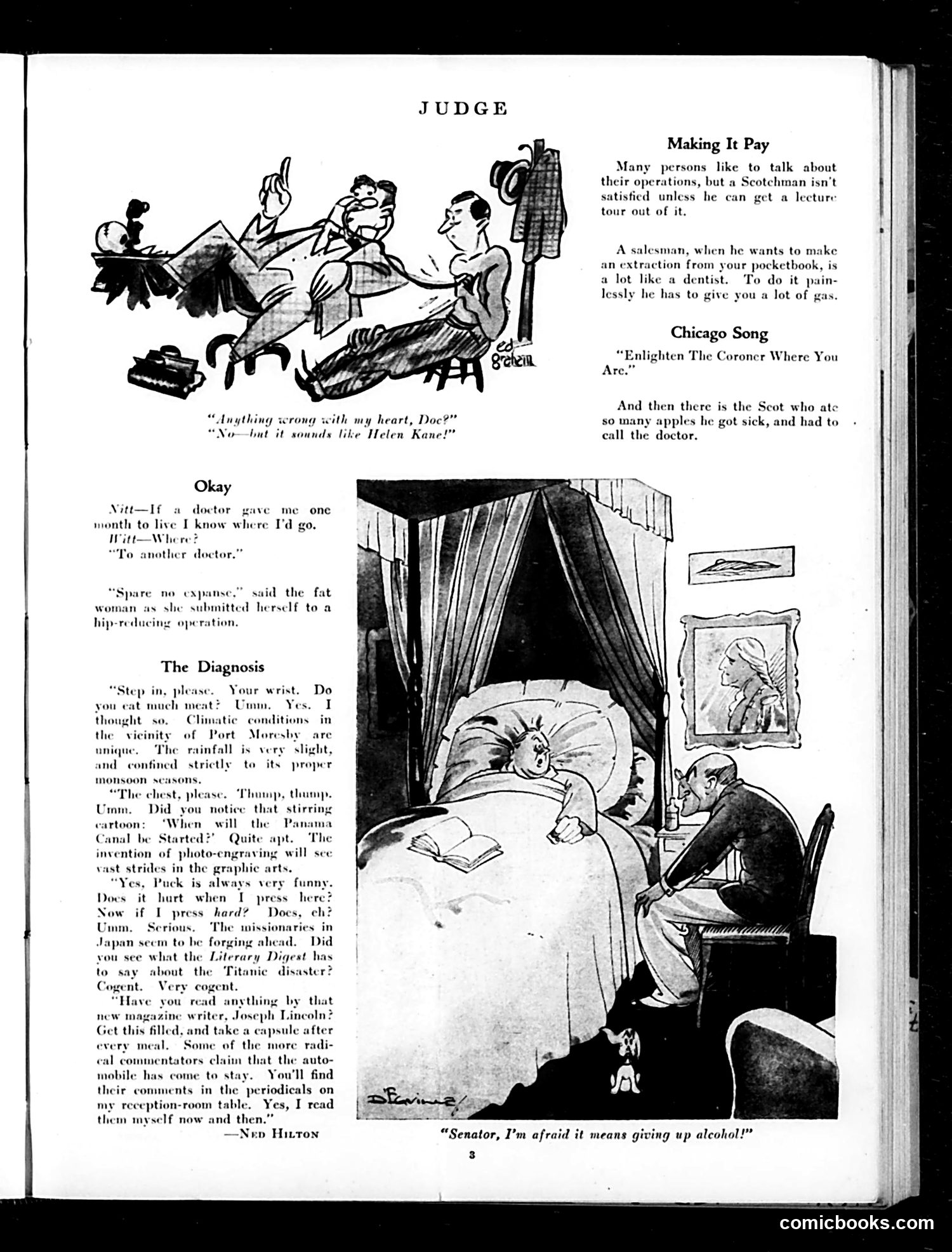
Analysis of Judge Magazine Page This page contains three separate humor sections satirizing doctors and medical practice. Top cartoon: Shows a patient complaining to a doctor about heart problems, with the doctor suggesting the patient resembles "Helen Kane"—likely referencing the 1920s "Boop-Boop-a-Doop" singer. The joke plays on the patient's physical appearance. "Okay" section: Satirizes doctors' financial motivations, showing a patient asking where to go if dissatisfied—the punchline being "another doctor," suggesting doctors primarily care about fees. "The Diagnosis" section: Features a lengthy monologue from a doctor examining a patient, showcasing medical jargon and pretentious name-dropping (Literary Digest, Titanic disaster, Joseph Lincoln). The accompanying illustration shows a senator in a patient's bed, with the caption "Senator, I'm afraid it means giving up alcohol!"—satirizing politicians' fondness for drinking during Prohibition.
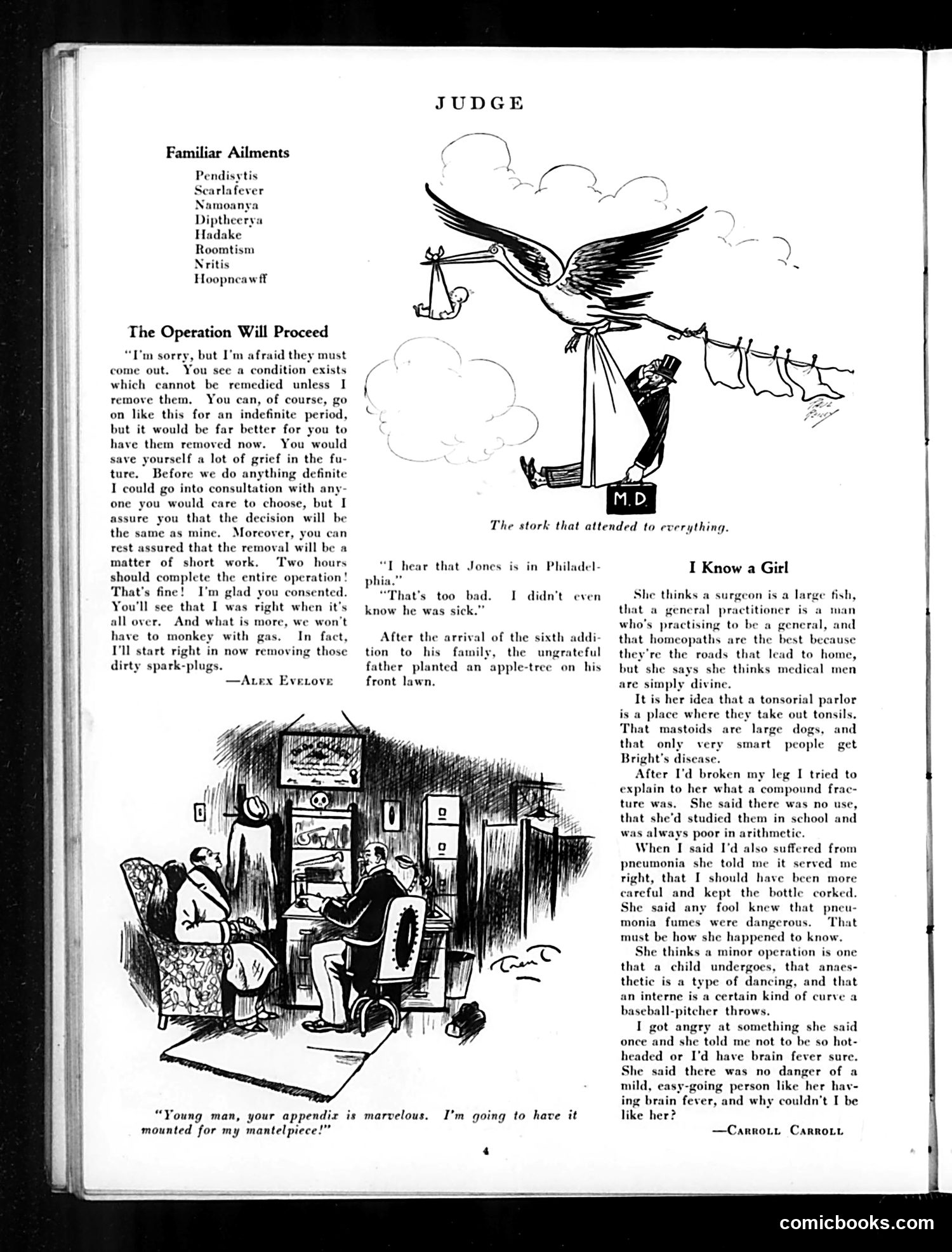
Analysis of Judge Magazine Page This page contains three separate pieces: 1. "Judge" (top): A stork cartoon delivering a baby to a doctor marked "M.D." — a visual pun on doctors "delivering" babies, mocking medical professionals. 2. "The Operation Will Proceed": A medical consultation scene where Dr. Alex Evelove advises a patient about surgery. The satire targets both doctors' authority and patients' blind trust in medical expertise. The joke centers on removing "dirty spark-plugs" — treating the human body mechanically rather than medically. 3. "I Know a Girl": Carroll Carroll's humorous piece about a woman with absurd misconceptions about medicine — confusing surgeons with fish, thinking tonsils are large dogs, misunderstanding fractures and pneumonia. It satirizes public medical ignorance of the era. All three pieces mock both medical professionals and public understanding of medicine.
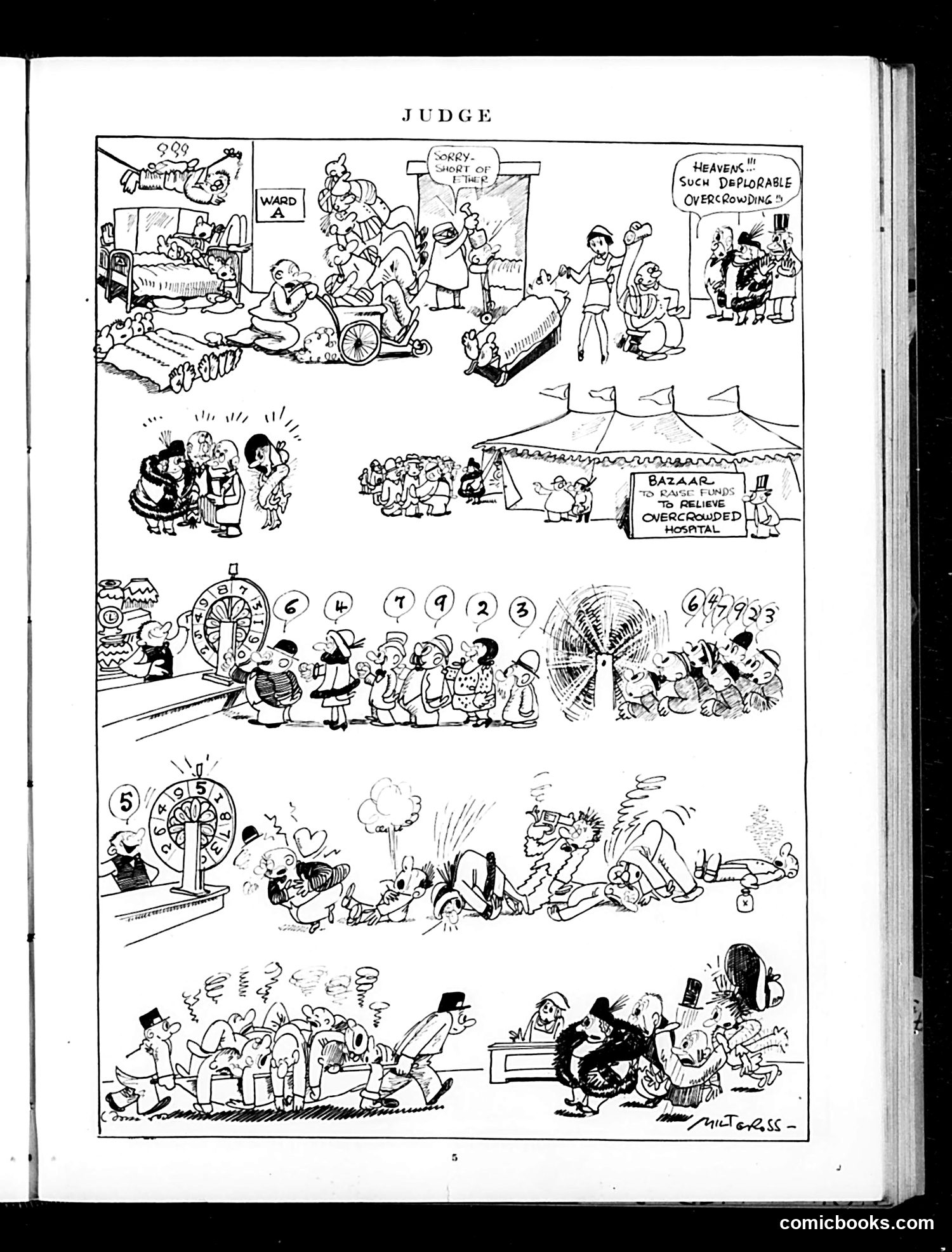
Political Cartoon Analysis: "Judge" Page - Hospital Overcrowding This satirical page critiques severe hospital overcrowding in early 20th-century America. The top panel shows a chaotic ward and a bazaar fundraiser "to relieve overcrowded hospital," suggesting charitable efforts were inadequate to address the crisis. The numbered sequences below depict people literally being processed through a wheel-like apparatus and dispensed like products, visual metaphors for hospital inefficiency. One panel shows a fan creating chaos among patients—perhaps commenting on inadequate ventilation or poor facility conditions. The final panel depicts patients and staff in disarray, emphasizing administrative breakdown. The overall message satirizes how overcrowded hospitals dehumanized patients, treating them as objects rather than individuals requiring care. The cartoon advocates for better hospital infrastructure and capacity.
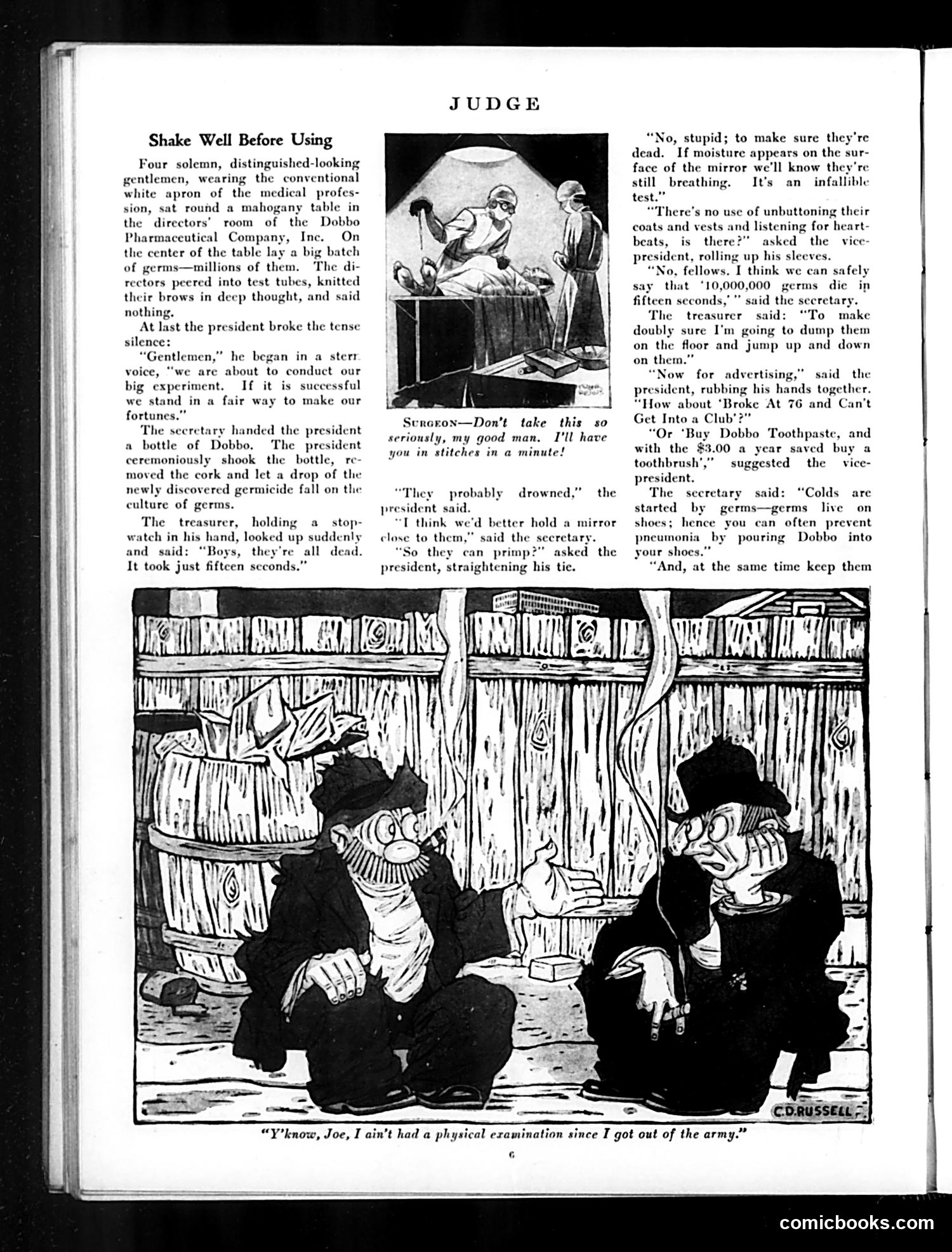
Judge Magazine Page Analysis This page satirizes early 20th-century anxieties about germs and hygiene products. The top cartoon depicts executives of the Dobbo Pharmaceutical Company conducting a bizarre experiment with a culture of germs, appearing to test whether germs can survive various treatments. The humor relies on the absurdity of treating this dangerous experiment as a casual business meeting. The bottom cartoon, credited to C.D. Russell, shows two men in what appears to be a basement or warehouse, with the caption "Y'know, Joe, I ain't had a physical examination since I got out of the army." This jokes about poor hygiene and lack of medical care among working-class or vagrant men, reflecting Depression-era concerns about public health and economic hardship.
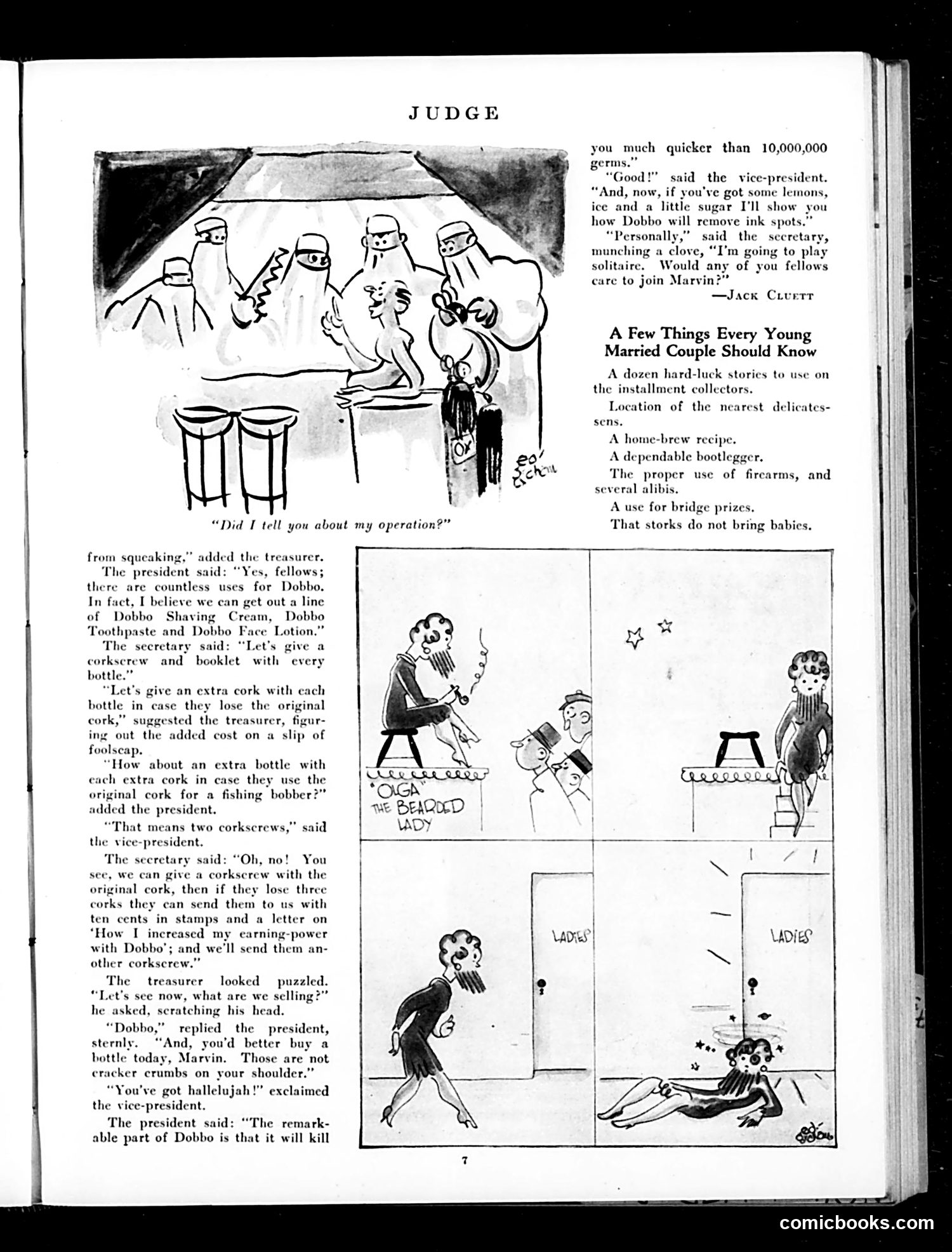
Satire Explanation for Modern Readers This page satirizes corporate marketing excess during Prohibition-era America (1920s-30s). The top cartoon mocks a fictional product called "Dobbo"—a cure-all cleaner. Company executives obsess over increasingly absurd marketing schemes: bundling corks, offering extra bottles, creating promotional contests around trivial uses. The joke exposes how corporations manufacture artificial "added value" to justify inflated prices. The lower comic strip, "A Few Things Every Young Married Couple Should Know," darkly satirizes 1920s marriage realities: dealing with debt collectors, home-brewed alcohol (illegal under Prohibition), bootleggers, firearms, and alibis. The punchline—that "storks do not bring babies"—suggests young couples need practical sex education, a scandalous topic for the era. Both items mock commercial manipulation and social hypocrisy during Prohibition's reign.
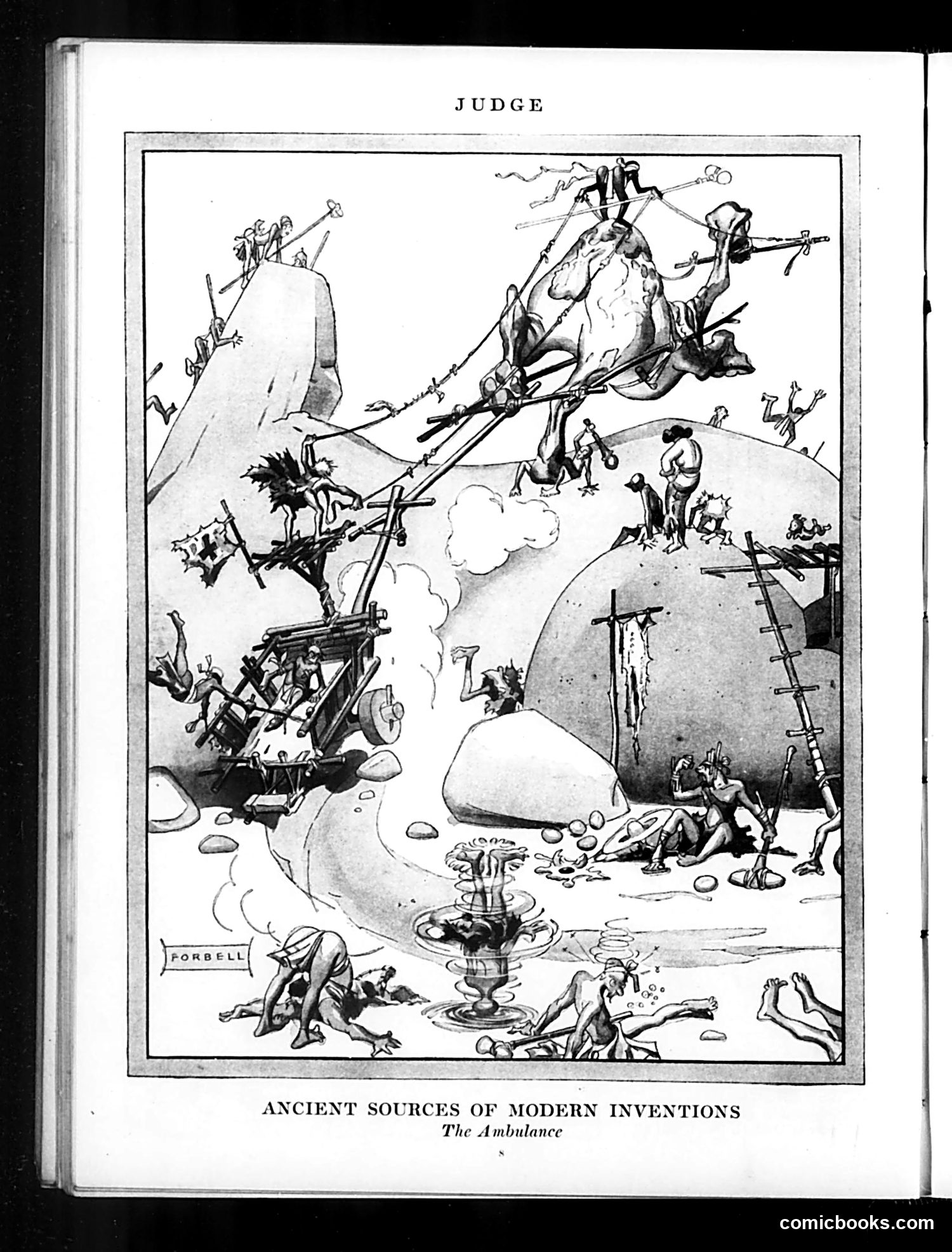
Analysis This cartoon satirizes the ambulance as a "modern invention" by tracing its concept back to ancient times. The central image depicts a chaotic scene with tiny figures operating various primitive contraptions and mechanisms across surreal, boulder-like landscapes. The satire suggests that ambulances—seemingly modern medical vehicles—actually derive from ancient, crude methods of transporting the injured or sick. The elaborate mechanical devices, pulleys, and makeshift stretchers shown humorously illustrate how people have always improvised ways to move patients, whether through sophisticated modern means or primitive ancestral methods. The cartoonist (signed "Forbell") uses exaggeration and absurdist imagery to make a pointed joke: there's nothing truly new under the sun—we're simply refinishing old ideas.
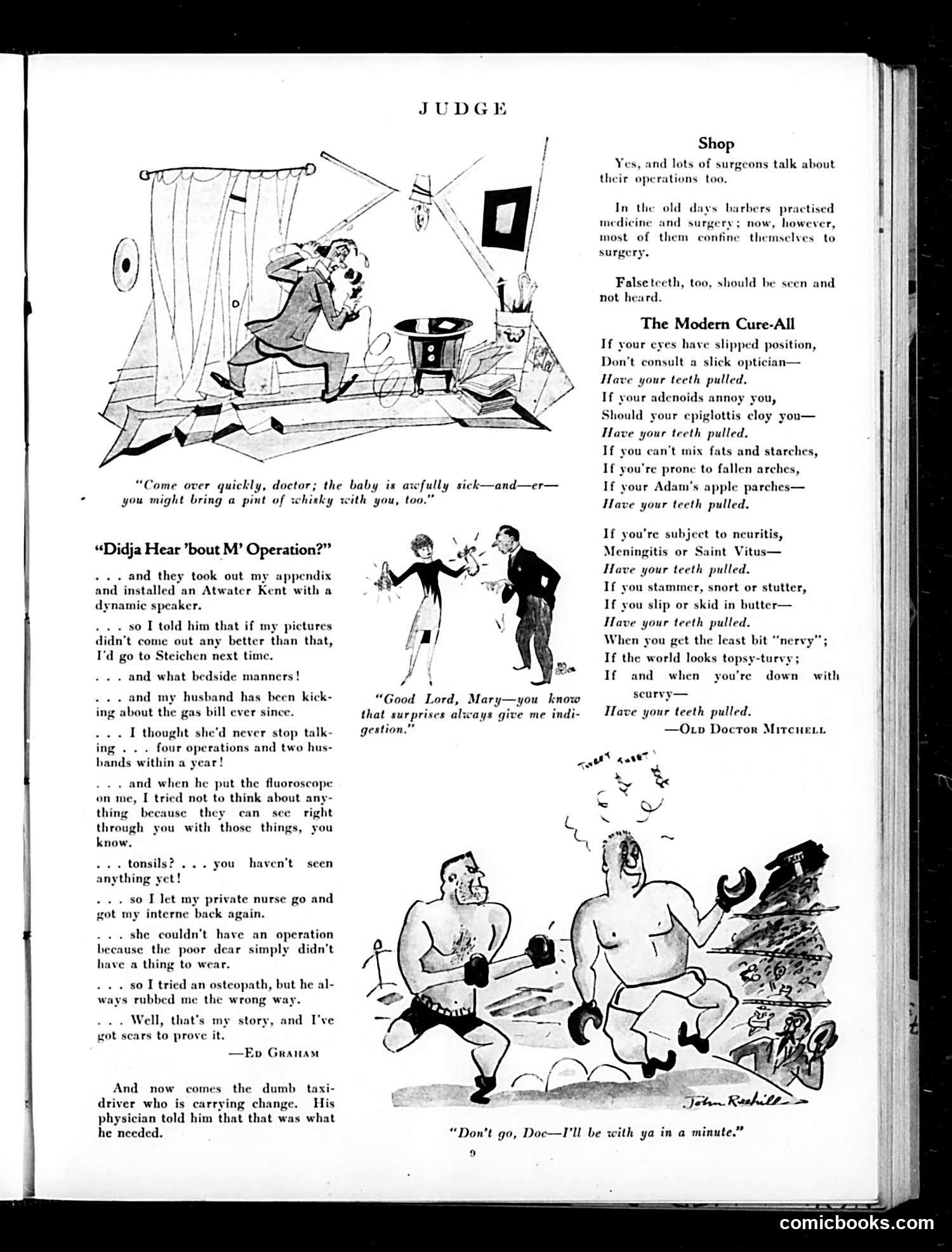
Judge Magazine Satire Analysis This page satirizes the 1920s-30s American obsession with medical procedures, particularly tooth extraction as a supposed cure-all remedy. The Main Cartoons: The top cartoon mocks patients who casually ask doctors to bring alcohol while making house calls—a dig at Prohibition-era hypocrisy. The middle section features monologues from patients boasting about surgeries, with absurd claims (like having an Atwater Kent radio installed during appendix removal), satirizing how people competed to discuss their medical procedures as status symbols. "The Modern Cure-All" poem is the page's central satire: it ridicules the era's genuine medical trend of extracting teeth to treat completely unrelated ailments—neuritis, stuttering, fallen arches, even nervousness. Dentists and physicians actually practiced this, believing focal infections caused systemic disease. The bottom cartoon shows two men boxing over a woman, with one saying he'll be ready "in a minute"—a non-sequitur suggesting the absurdity continues throughout. The page mocks both medical fads and patients' eager participation in them.
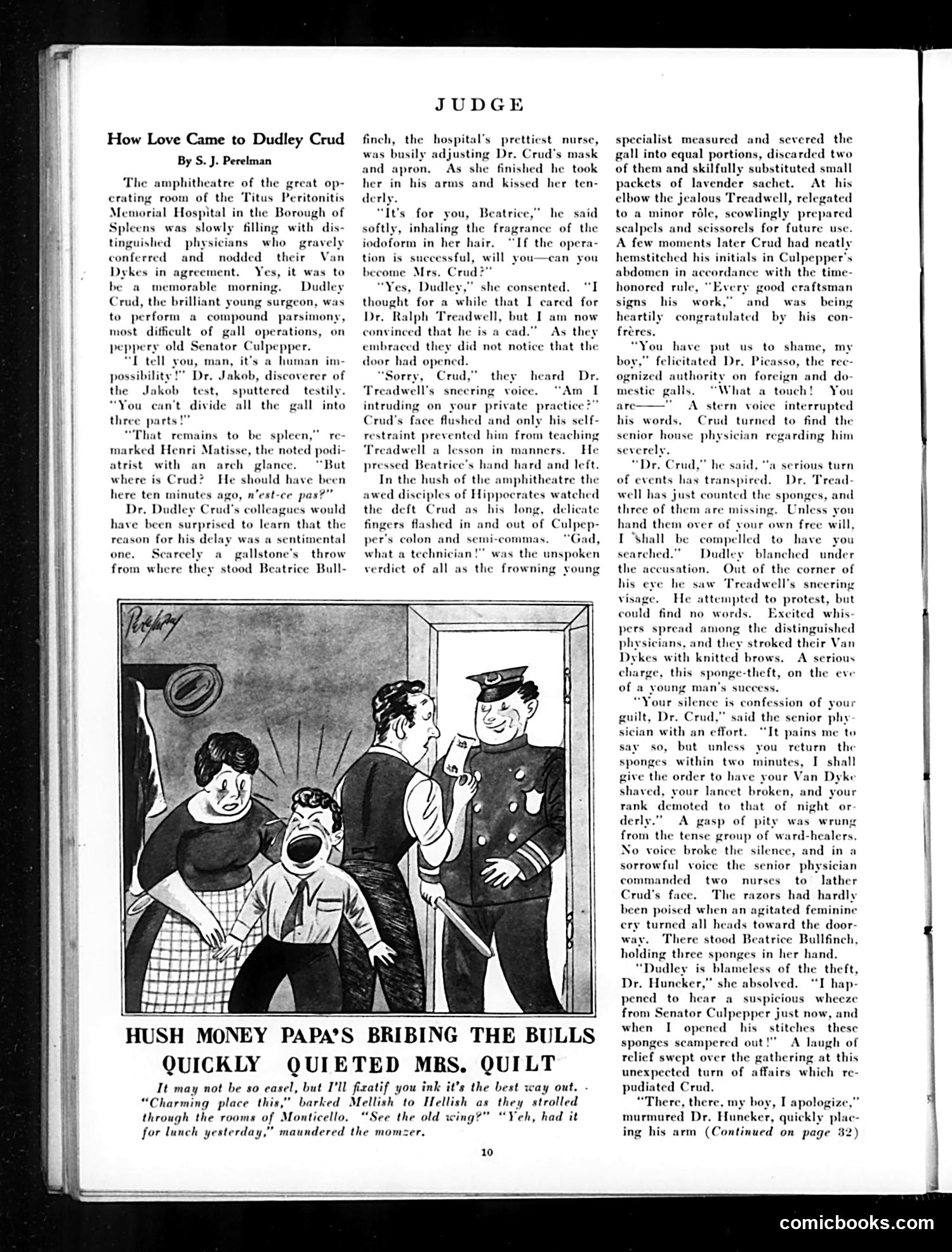
Understanding This Judge Magazine Page This S. J. Perelman satirical story spoofs medical melodrama and professional jealousy. The plot follows surgeon Dudley Crud performing complex gall bladder surgery on Senator Culpepper while romantically entangled with nurse Beatrice Bullfinch. His rival, Dr. Treadwell, witnesses Crud kissing Beatrice and, motivated by jealousy, frames Crud by allegedly "misplacing" surgical sponges—a serious breach of operating room protocol. The cartoon illustration shows hospital staff and the bribery subplot referenced in its caption: "Hush Money Papa's Bribing the Bulls Quickly Quieted Mrs. Quilt," suggesting corruption occurs alongside the medical drama. Perelman uses medical jargon and absurdist humor ("compound parsimony," "semi-commas," "hemstitched his initials") to mock both pretentious medical professionals and overwrought romance narratives. The satire targets early 20th-century sensationalism and professional pomposity in medical circles.
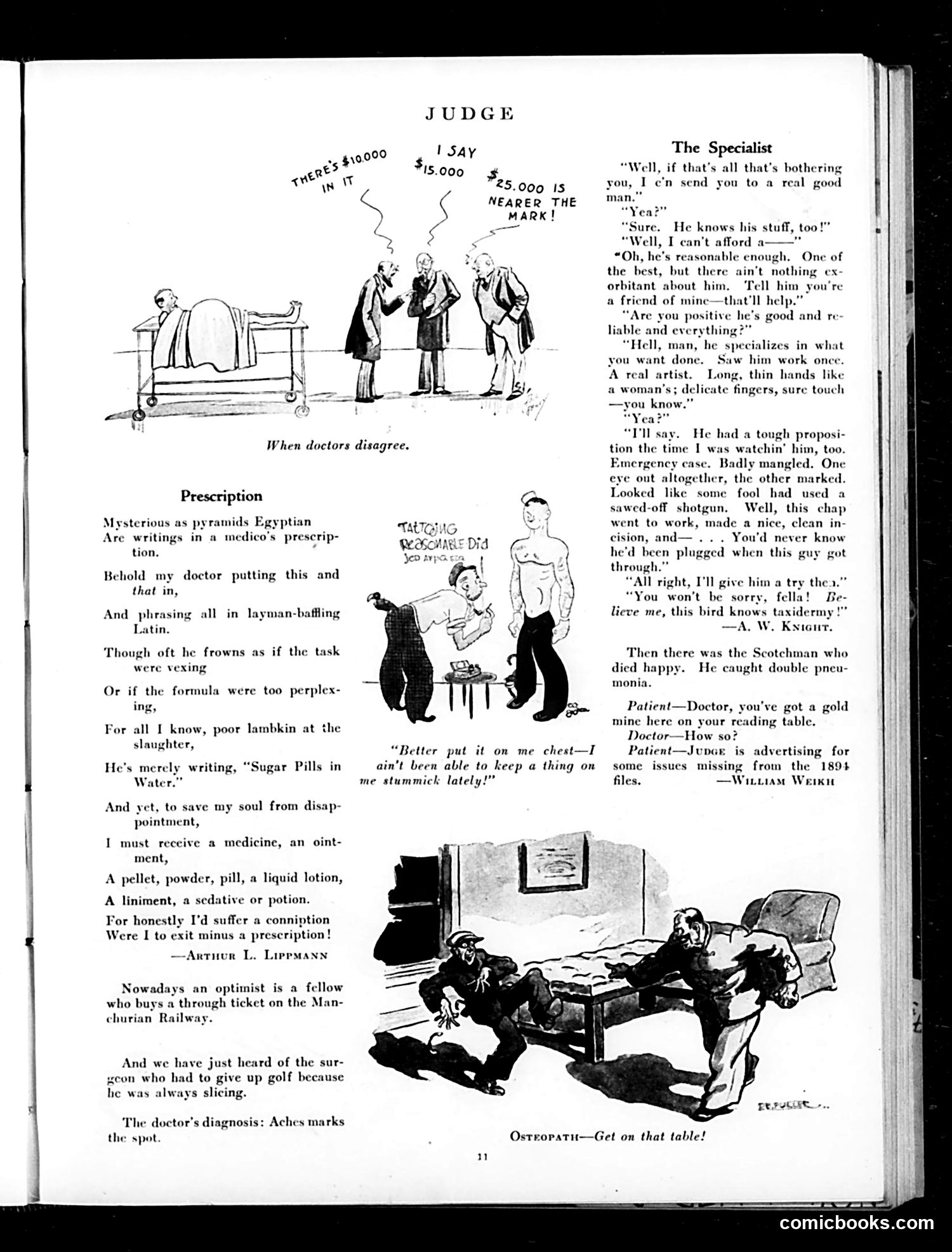
Judge Magazine Page Analysis This page satirizes medical practice through multiple cartoons and humorous pieces: "When Doctors Disagree" (top cartoon): Shows three doctors debating a patient's treatment while quoting wildly different fees ($10,000 to $25,000), mocking physicians' disagreement and financial motivations. "The Specialist" (right column): A conversation praising a surgeon's skill, with dark humor about his emergency work ("sawed-off shotgun" injuries, "plugged"). The punchline calls him expert at "taxidermy"—implying his reconstructive surgery makes patients look embalmed rather than healed. "Prescription" (center/left): A poem lamenting doctors' incomprehensible prescriptions written in Latin, where the doctor merely writes "Sugar Pills in Water" while the patient expects mysterious remedies. Additional jokes include quips about optimists buying Manchurian Railway tickets (likely referencing Russo-Japanese War tensions) and a surgeon who quit golf because he was "always slicing." The satire targets physician pretension, medical jargon, high fees, and questionable competence—common Judge themes criticizing professional charlatanism.
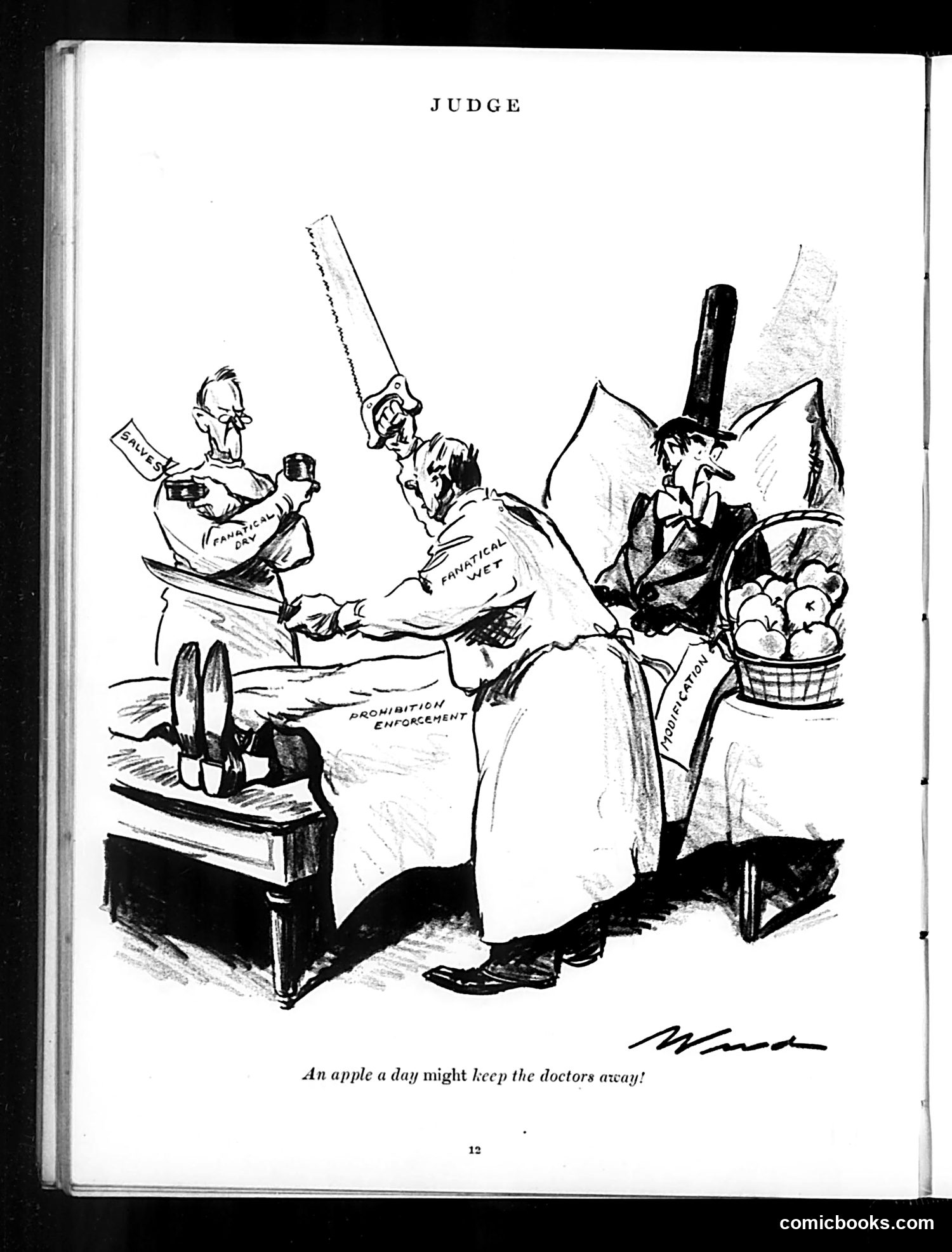
Political Cartoon Analysis: "An apple a day might keep the doctors away!" This Judge cartoon satirizes Prohibition enforcement efforts. The central figure labeled "Prohibition Enforcement" wields a large club against various violators. To the left stands a figure labeled "Banks" holding what appears to be contraband. On the right, "Corruption" sits amid a basket of apples—likely representing bribery or payoffs that undermine enforcement efforts. The cartoon critiques the Prohibition era's fundamental problem: despite aggressive enforcement (the club-wielding official), corruption and financial incentives (the apples/bribes) subvert the law's intent. The caption's play on "an apple a day keeps the doctor away" suggests that corruption is so endemic that it effectively negates enforcement efforts. The satire targets the naiveté of believing Prohibition could succeed against entrenched interests and systemic corruption.
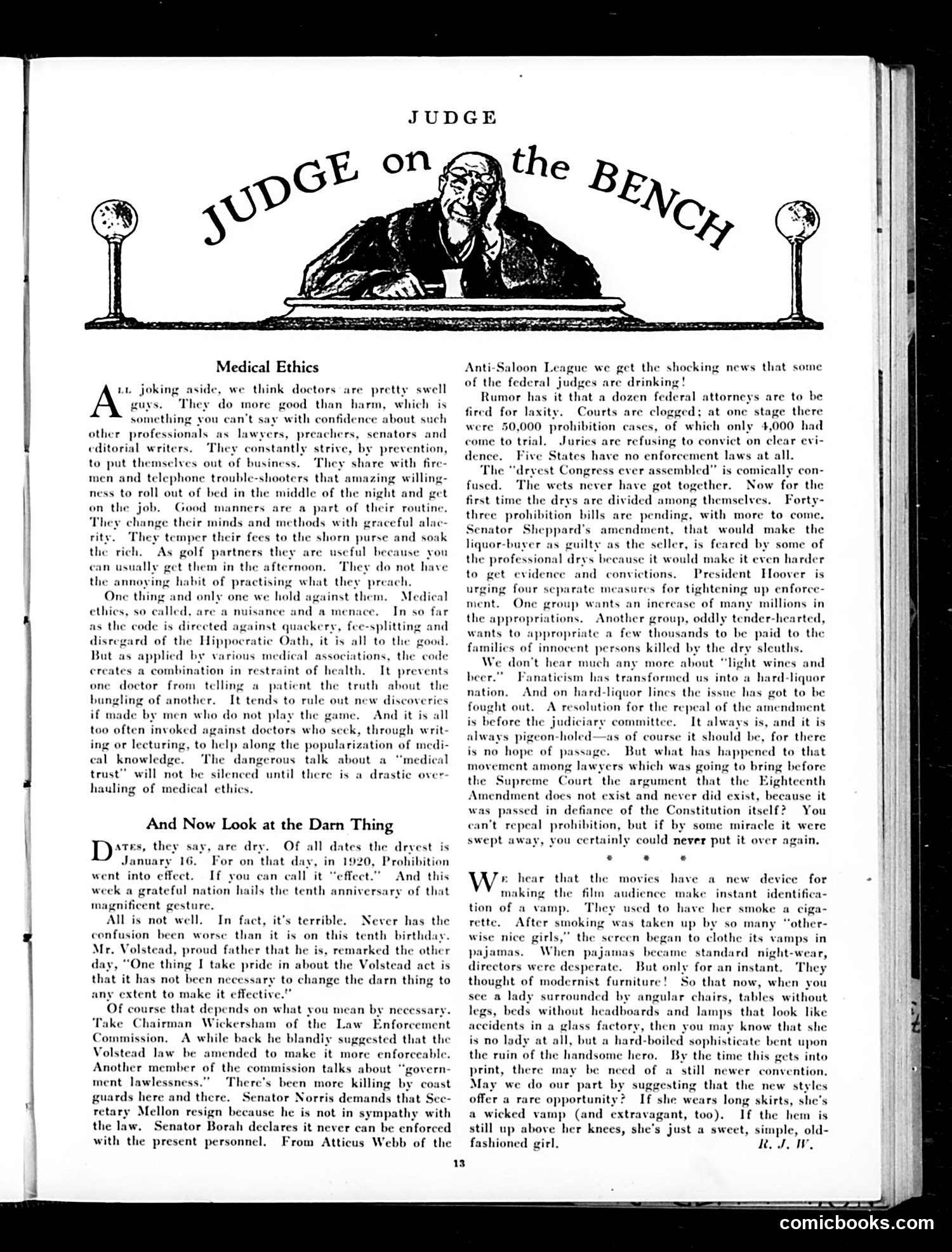
Judge Magazine: "Judge on the Bench" (circa 1930) This page contains two satirical essays attacking different targets: "Medical Ethics" criticizes medical associations for using ethics codes to prevent competition and silence criticism rather than protect patients. The author praises individual doctors while condemning professional organizations that restrict information-sharing and punish innovators. "And Now Look at the Darn Thing" mocks Prohibition's tenth anniversary (January 1920). The satire catalogs the law's catastrophic failure: 50,000 pending cases with only 4,000 tried, federal judges drinking, jury nullification, coast guard violence, and internal chaos among "dry" (pro-Prohibition) advocates. Even Volstead Act author Volstead claims no amendments were needed—an absurdity given the text's evidence of complete failure and confusion. The piece satirizes government overreach and the impossibility of enforcing unpopular laws, while highlighting how well-intentioned legislation creates worse problems than it solves.
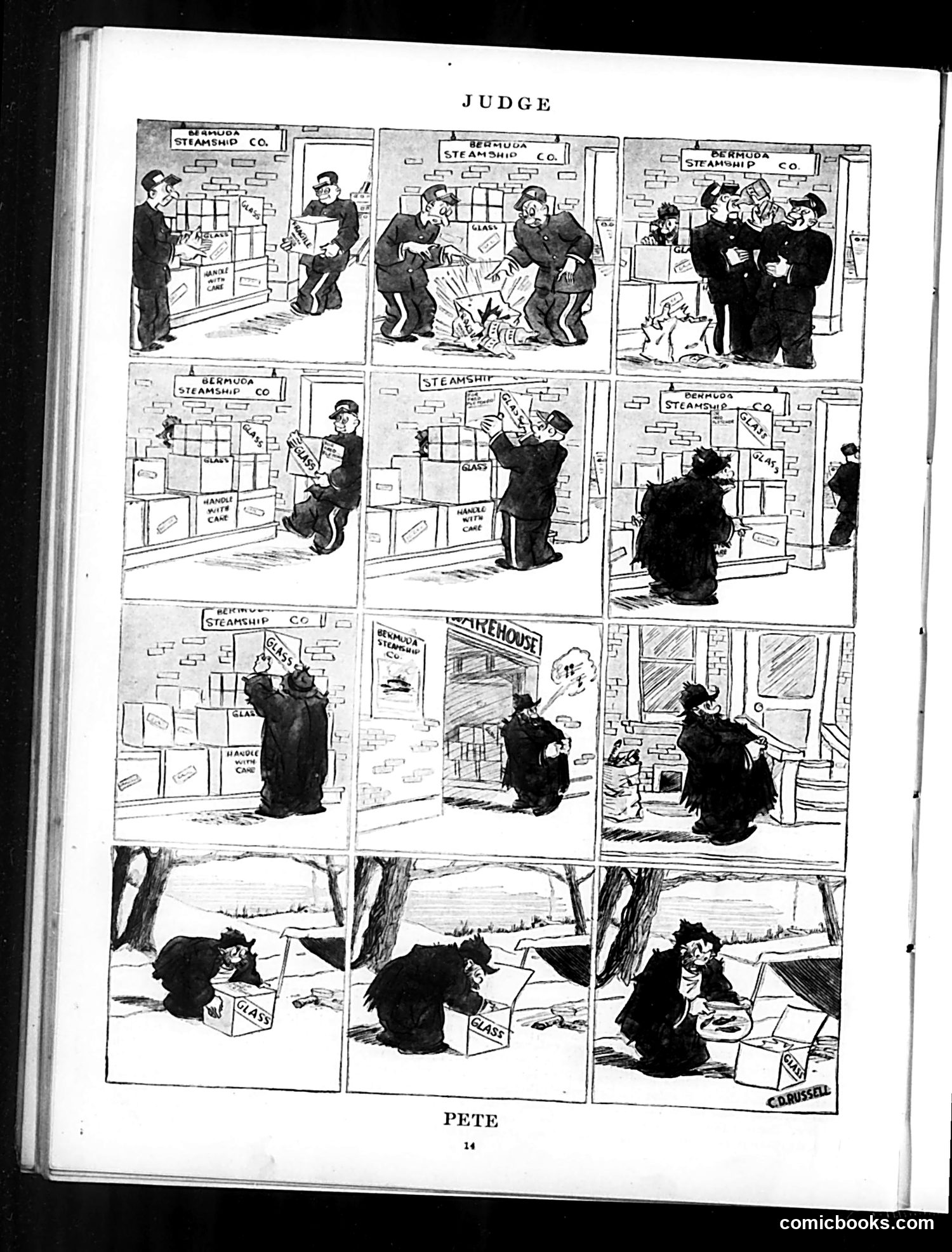
"Judge Pete" - A Satirical Comic Strip This appears to be a multi-panel comic strip titled "Judge Pete" by Crussell, satirizing bureaucratic inefficiency at the Bermuda Steamship Company. The narrative follows a character (likely a customs official or shipping agent named "Pete") attempting to process cargo through increasingly absurd warehouse procedures. Each panel shows him encountering glass containers labeled "GLASS" in various warehouse locations, suggesting repeated, circular bureaucratic obstacles. The visual progression—from organized office scenes to the character sitting outside in the cold—implies the system's frustrations ultimately overwhelm him. The satire targets early 20th-century corporate red tape and administrative incompetence, likely resonating with readers frustrated by shipping regulations or government procedures. The humor derives from the protagonist's persistent, futile attempts to navigate an irrational system.
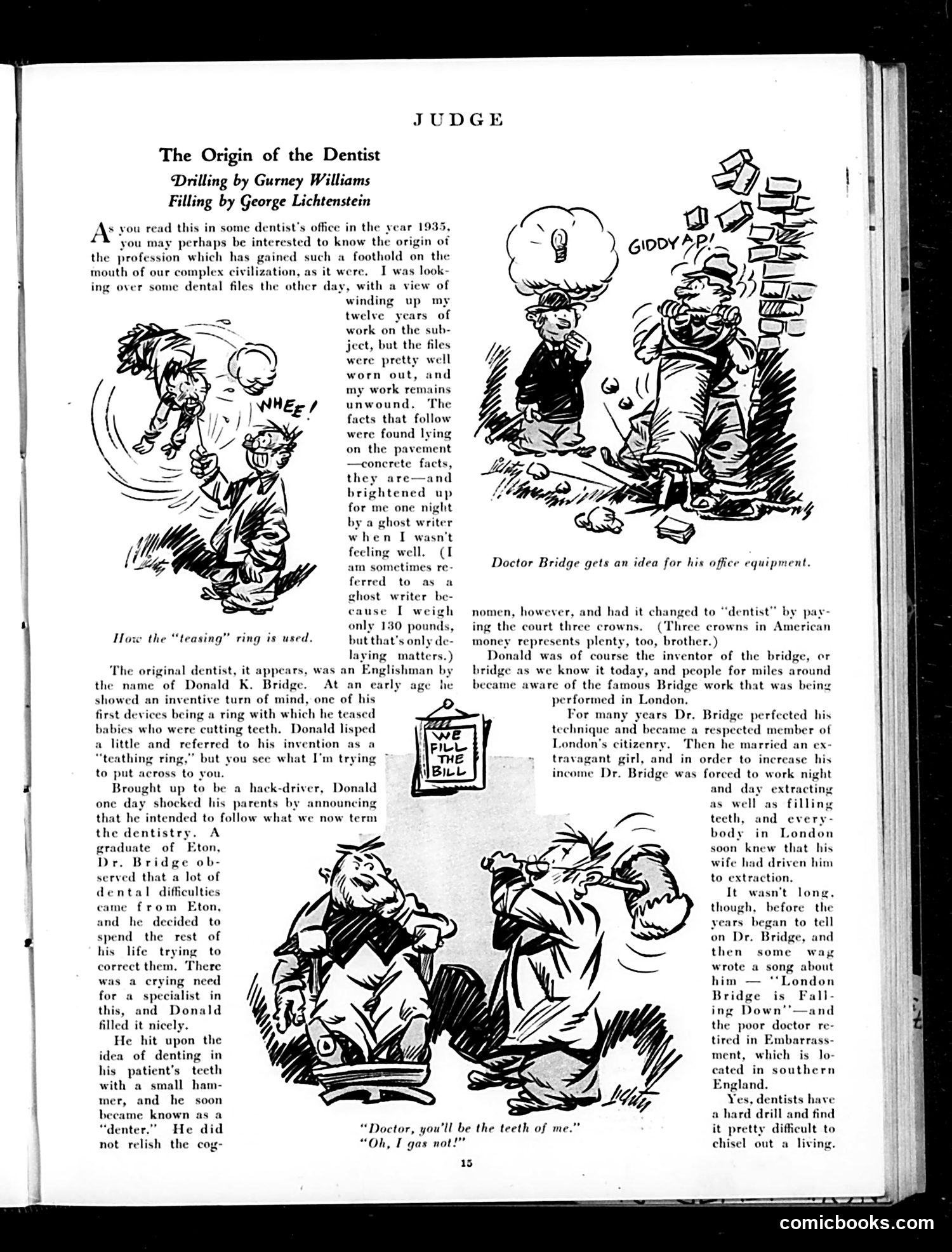
"The Origin of the Dentist" — Judge Magazine This humorous article traces dentistry's fictional origins to one "Donald K. Bridge," an Eton graduate who invented dental work through increasingly absurd methods—first a "teasing ring" for babies (a lisp for "teething"), then hammering teeth into patients' mouths as a "denter." The satire plays on the name "Bridge" to construct puns: the famous "London Bridge" structure becomes dental "bridge work," and eventually the nursery rhyme "London Bridge is Falling Down" mocks the fictional doctor's breakdown from overwork. His wife's demand he work nights to extract teeth drives him to literal "extraction" (nervous breakdown). The piece mocks dentistry as a profession through wordplay and exaggeration—portraying dentists as bumbling experimenters rather than skilled professionals. The cartoons show slapstick tooth-pulling and dental mayhem. Written for a 1935 audience, it satirizes dentists' reputation as somewhat crude practitioners still gaining professional respectability in early 20th-century society.
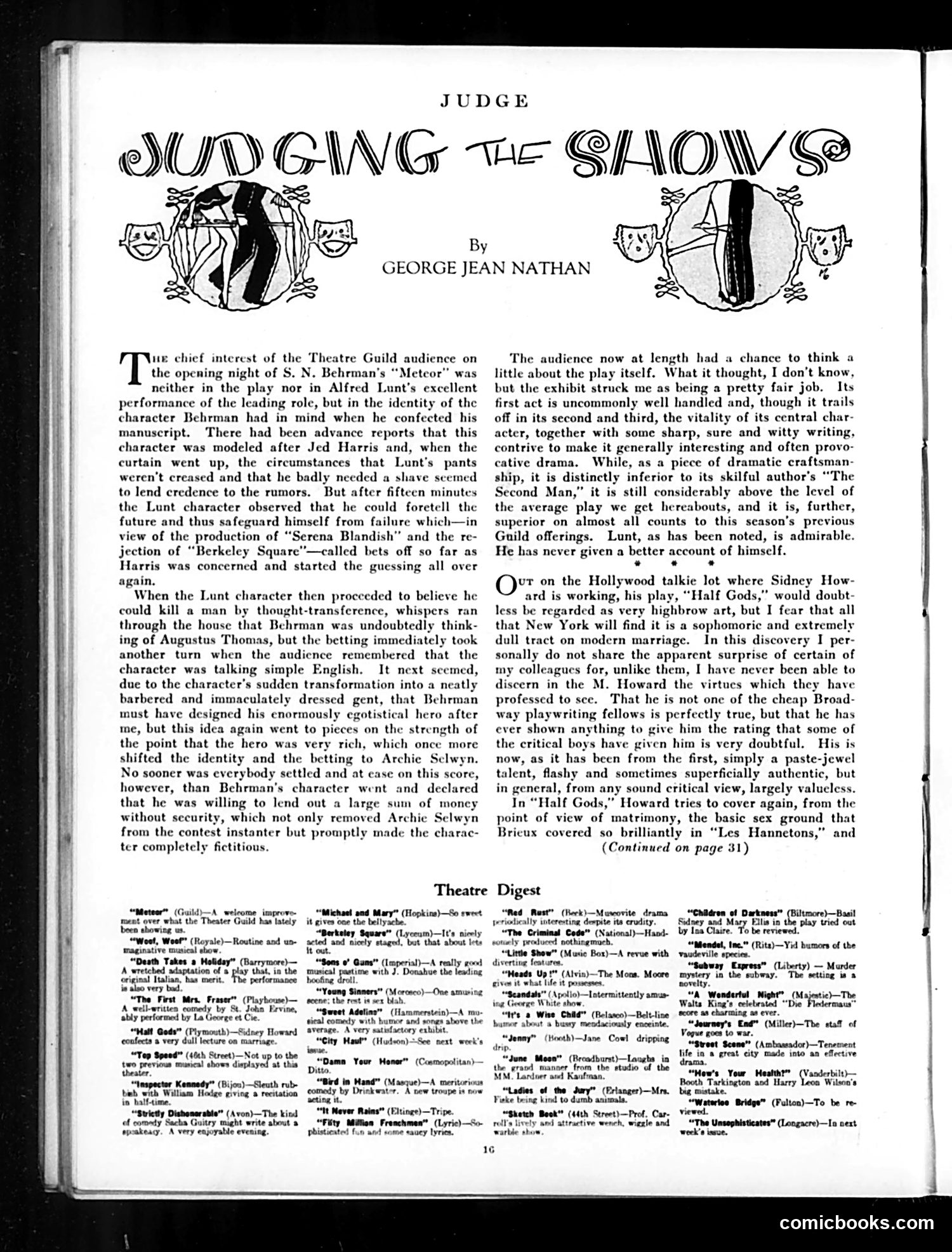
"Judging the Shows" by George Jean Nathan This theater review page mocks Broadway insiders' obsession with identifying real-life figures behind fictional characters. When S.N. Behrman's play "Meteor" premiered with Alfred Lunt, the Theatre Guild audience spent opening night playing detective—debating whether Lunt's unkempt appearance referenced Jed Harris, whether the ambitious protagonist was based on Augustus Thomas or producer Archie Selwyn. Nathan satirizes this gossip-driven criticism: once the character reveals he'd lend money without security (apparently ruling out the notoriously stingy Selwyn), the audience finally "had a chance to think a little about the play itself." The satire targets critics and audiences who prioritize theatrical scandal over artistic merit, reducing drama to a guessing game about which powerful figure is being skewered.
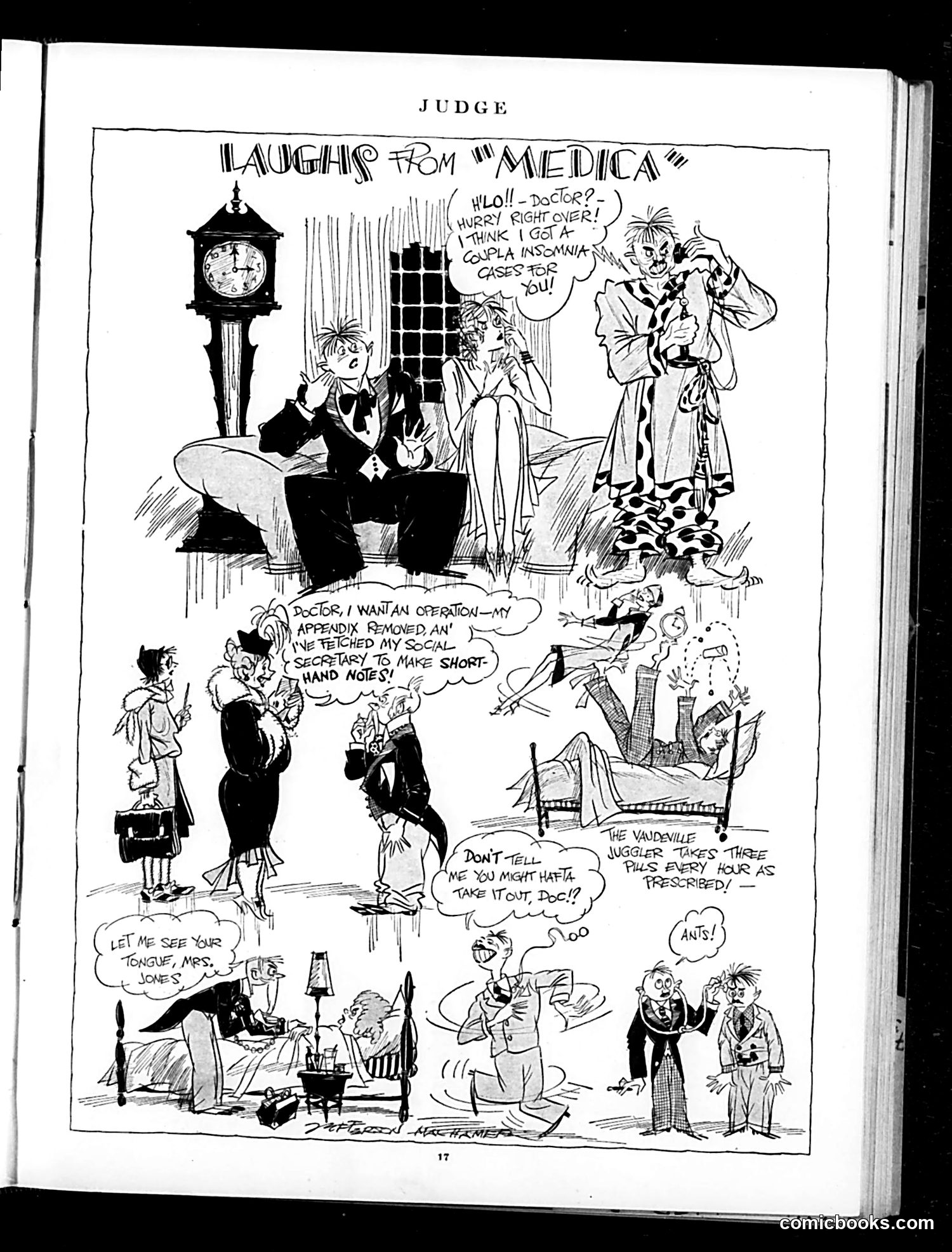
"Laughs from 'Medica'" - Judge Magazine Satire This multi-panel cartoon mocks medical practices and patient behavior of its era. The central joke involves a doctor's patient who insists on having their social secretary present during a medical examination to take shorthand notes—suggesting the absurdity of making a personal medical visit into a business transaction. Other panels satirize: - Patients demanding unnecessary operations - A doctor examining a patient's tongue for diagnosis - A "Vaudeville Juggler" who performs medical procedures, suggesting medical incompetence or charlatans - "Ants!" as a punchline, likely referring to some dated medical concern or misdiagnosis The satire targets both overly medicalized society and the pretension of treating medicine as another social performance requiring secretarial documentation—poking fun at modern efficiency culture intruding into healthcare.
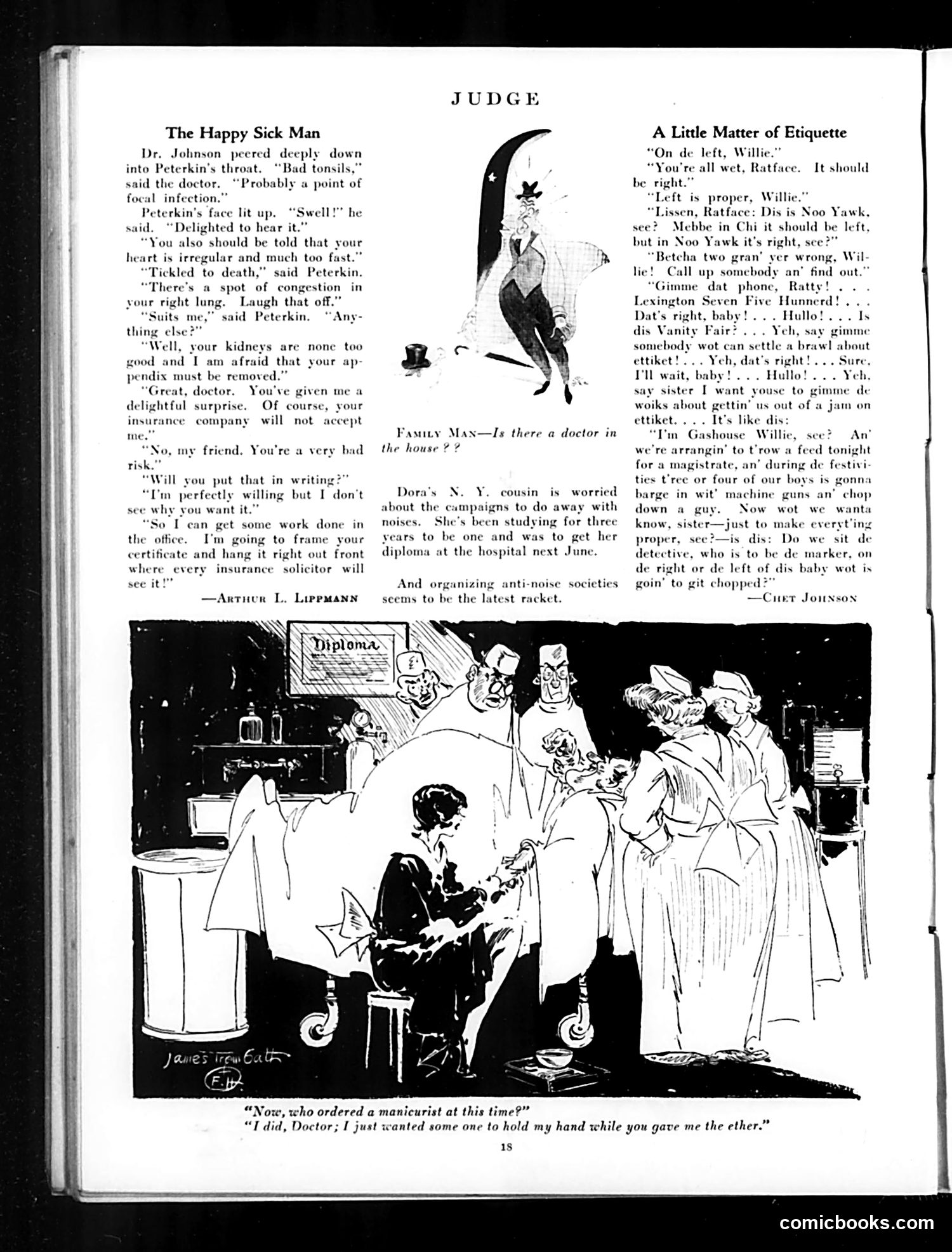
Explanation for Modern Readers This page contains two distinct pieces from Judge magazine: "The Happy Sick Man" (top): A doctor tells a patient he has multiple serious conditions—bad tonsils, irregular heartbeat, lung congestion, kidney problems requiring appendix removal. The patient is delighted by each diagnosis. The joke satirizes patients who welcome any medical attention or diagnosis, and doctors who document ailments to justify insurance claims. The patient wants the diagnosis "in writing" to show insurance adjusters—mocking how people exploited medical certificates for financial gain. "A Little Matter of Etiquette" (bottom): Two New York characters (rendered in ethnic dialect) argue about proper etiquette for a dinner event where they plan to have gang members "chop down a guy" with machine guns. They call someone to ask whether the detective should sit on the left or right. The satire mocks both organized crime's casual violence and absurd adherence to social propriety—treating a murder as a minor breach of dinner etiquette. Both pieces satirize early 20th-century social anxieties: medical fraud and gang violence in urban America.
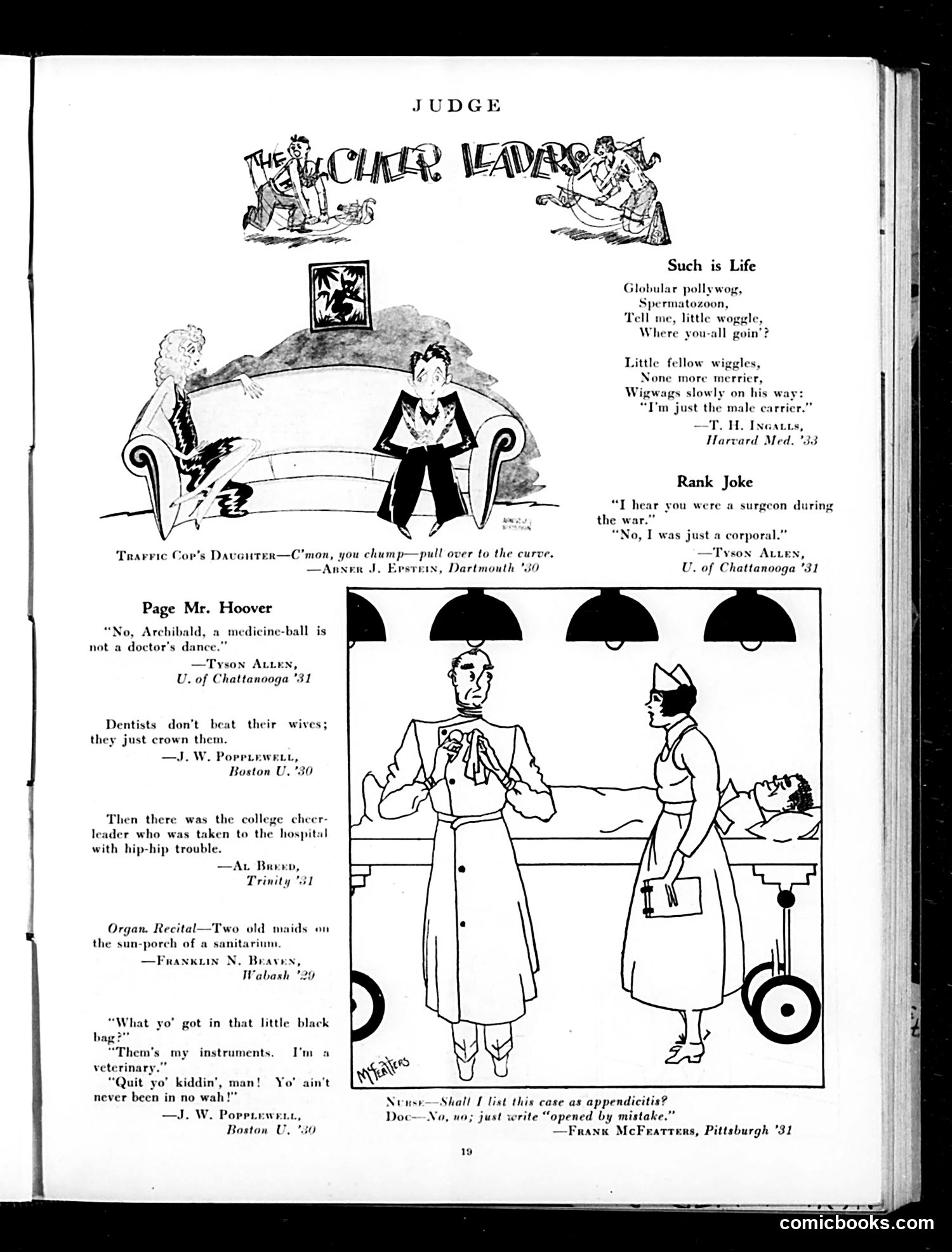
Judge Magazine Page Analysis This is a humor page from Judge magazine featuring short jokes and cartoons, likely from the early 1930s (based on attributed dates like '31, '30, '29). The content includes: Main cartoon: A doctor examining a patient while a nurse holds a stethoscope. The joke plays on medical incompetence—the doctor mistakenly opened the patient thinking it was an appendicitis case, when it wasn't. Jokes reference: - College life and dating ("Dentists don't beat their wives; they just crown them") - Medical/hospital humor - A pun on "hip-hip" trouble (likely referencing "hip-hip hooray") - A microscopic sperm joke with dialectal speech ("you-all goin'") - A World War I reference (someone claiming military service when they were only a corporal) The humor is gentle, collegiate-oriented satire targeting professional classes (doctors, dentists) and playing on puns and wordplay. The attribution credits suggest these are student-submitted jokes from various universities. The overall tone reflects 1930s-era medical humor and light social commentary.
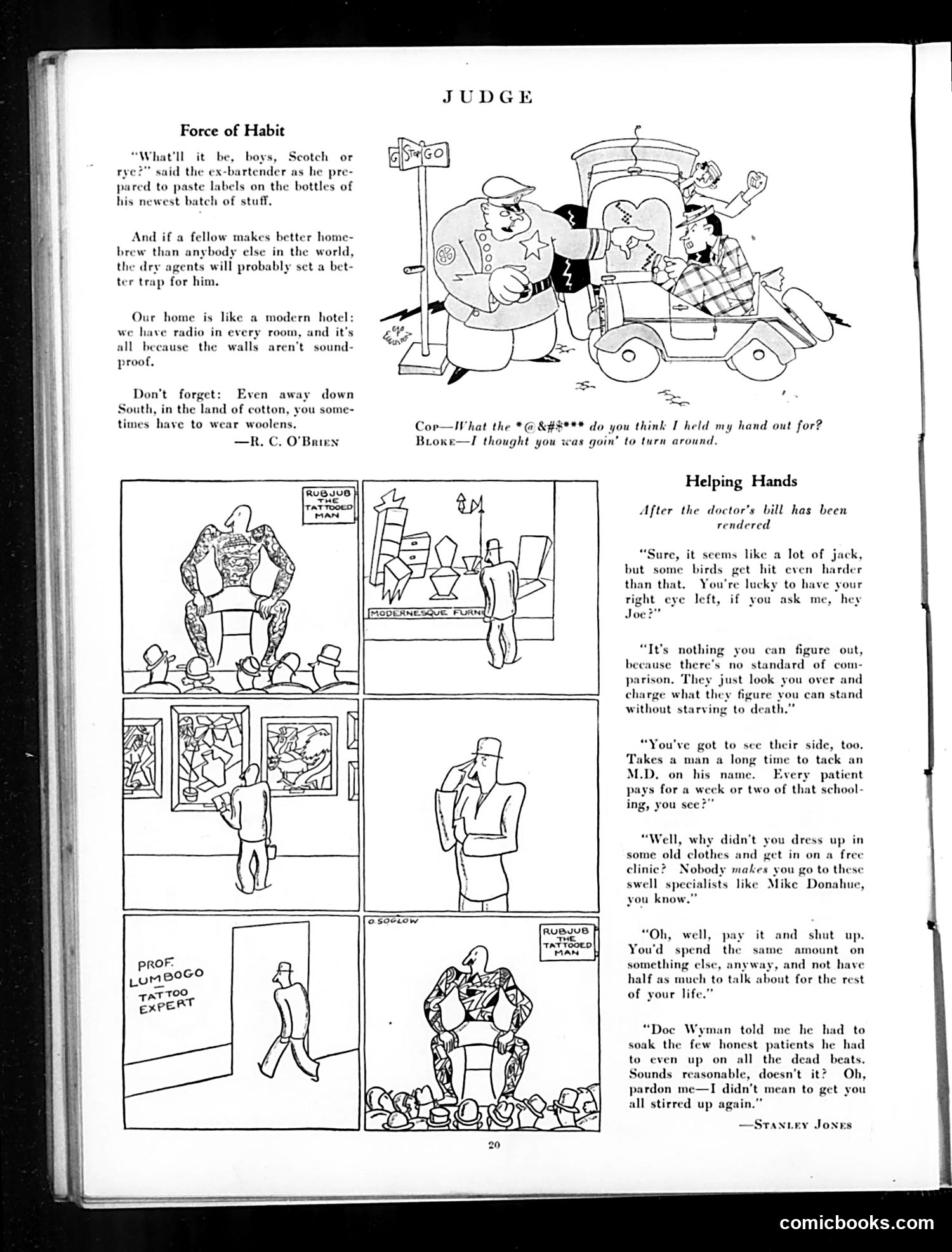
Judge Magazine Page Analysis This page contains two separate satirical pieces reflecting 1920s-30s American concerns: "Force of Habit" (top) satirizes Prohibition-era hypocrisy. An ex-bartender now labels homemade alcohol, and the text mocks how federal agents trap successful home-brewers while Americans openly flout alcohol bans. The humor targets both the absurdity of Prohibition enforcement and widespread illegal brewing. "Helping Hands" (bottom) satirizes medical costs and doctor-patient relationships. A conversation between patients discusses how doctors charge whatever patients can afford, lacking fee standards. The joke critiques physicians for inflating bills and "soaking honest patients" to offset unpaid cases from poorer patients. The final panel shows a tattooed man—likely representing a criminal or rough character—suggesting ironic commentary on who can/cannot afford medical care. Both pieces reflect working-class frustration with legal restrictions and professional exploitation during the Depression era.
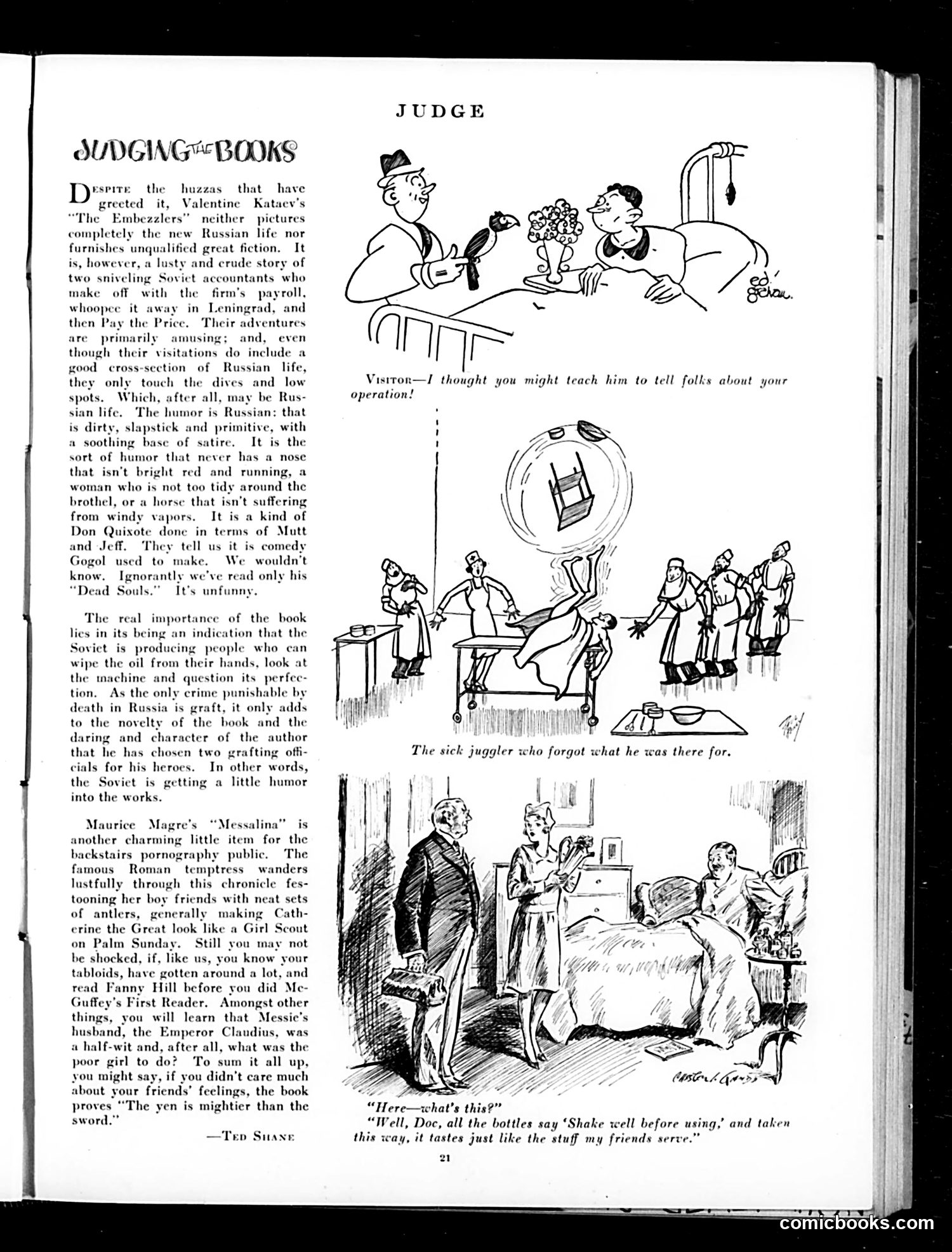
Political/Social Context for Modern Readers This page from *Judge* magazine reviews Soviet literature while satirizing Soviet society. The main text discusses Valentine Kataev's novel "The Embezzlers"—a work about two Soviet accountants who steal from their firm. The reviewer notes the book's significance: it shows the Soviet state tolerating criticism (through fiction about corrupt officials), suggesting the regime is "getting a little humor into the works." The cartoons mock Soviet life: one depicts a hospital visitor suggesting a patient teach others about his operation (a jab at Soviet propaganda), and another shows someone drinking "medicine" that tastes like homemade alcohol—satirizing Soviet shortages and improvisation. The overall tone is darkly humorous about Soviet brutality and dysfunction, reflecting American Cold War-era skepticism toward the USSR while acknowledging emerging Soviet cultural sophistication.
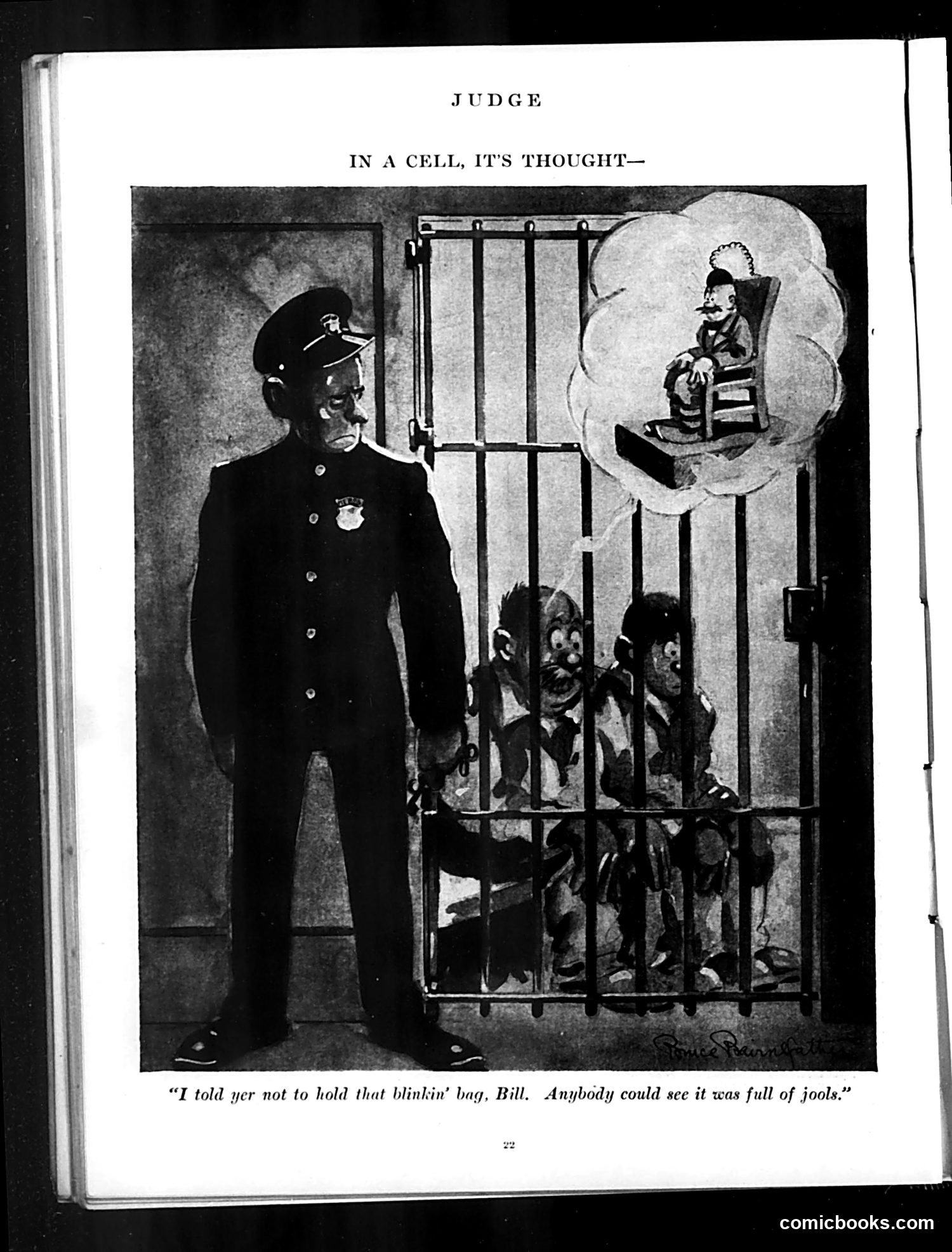
Analysis This is a single-panel cartoon titled "In a Cell, It's Thought" depicting a police officer standing guard outside a jail cell containing several prisoners. A thought bubble shows a well-dressed man sitting in a chair—apparently the judge referenced in the title. The caption reads: "I told her not to hold that blinkin' bag, Bill. Anybody could see it was full of jools." The satire appears to target judicial leniency or the disconnect between law enforcement and the bench. The prisoners are presumably criminals caught red-handed (with a bag visibly "full of jewels"), yet the thought bubble suggests the judge will likely acquit or dismiss charges due to some technicality or weakness in evidence presentation. The cartoon mocks the gap between obvious guilt and legal outcomes, criticizing either judicial incompetence or corruption.
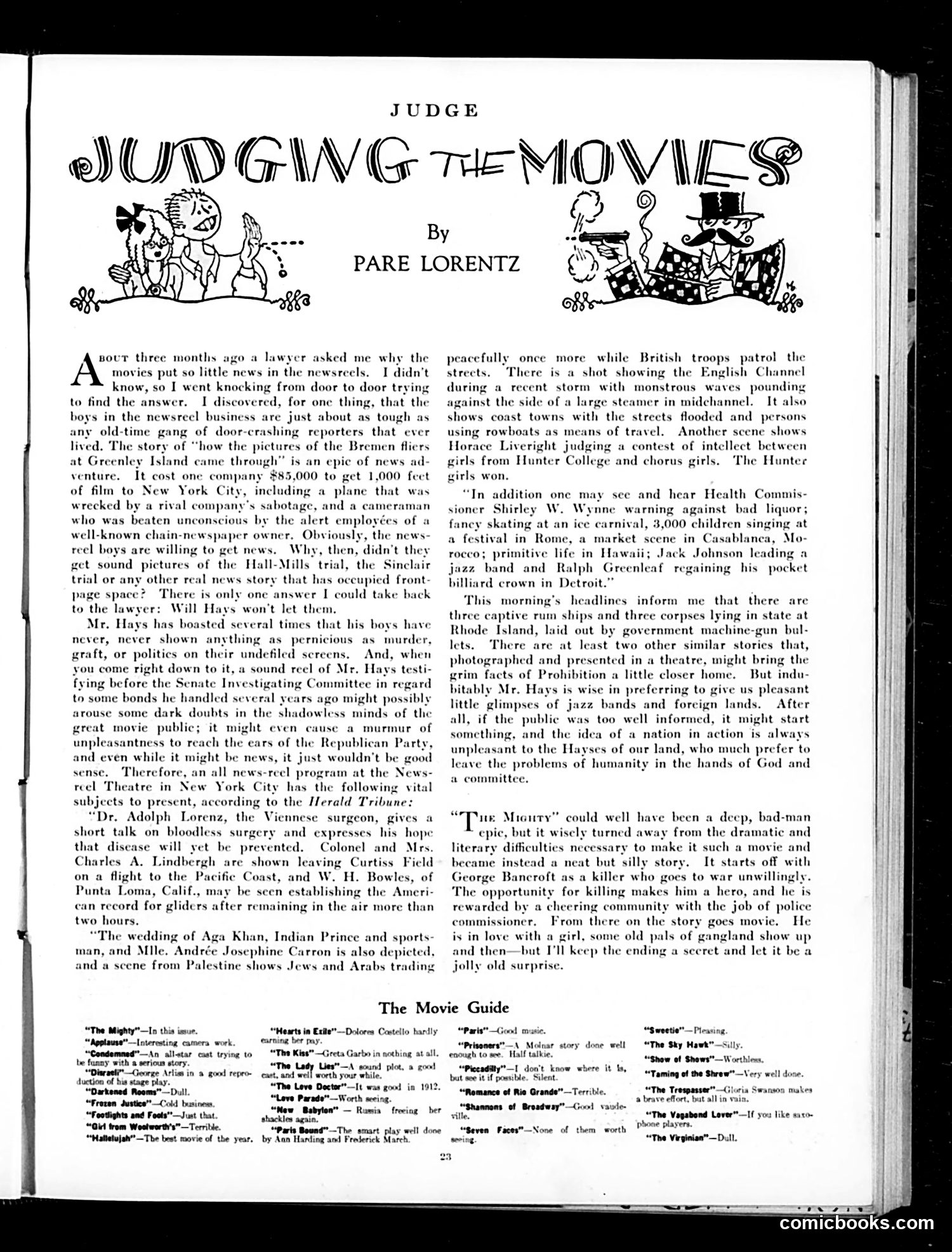
"Judging the Movies" - Judge Magazine This article by Pare Lorentz critiques Will Hays, head of film censorship (the Motion Picture Producers and Distributors of America), for suppressing newsreel content. Lorentz argues that Hays deliberately prevents newsreels from showing controversial news—murders, graft, politics, and Prohibition violence—claiming they're "pernicious." The satire is pointed: Hays boasts his films never depict such subjects, yet newsreel companies spend enormous sums covering dangerous stories. Lorentz sardonically notes that an informed public might "start something"—implying Hays fears public outrage over political corruption and Prohibition's violent consequences. The article exposes how film industry censorship serves political interests by keeping audiences ignorant of pressing social problems, presenting instead innocuous stories about surgeons, aviators, and socialite weddings.
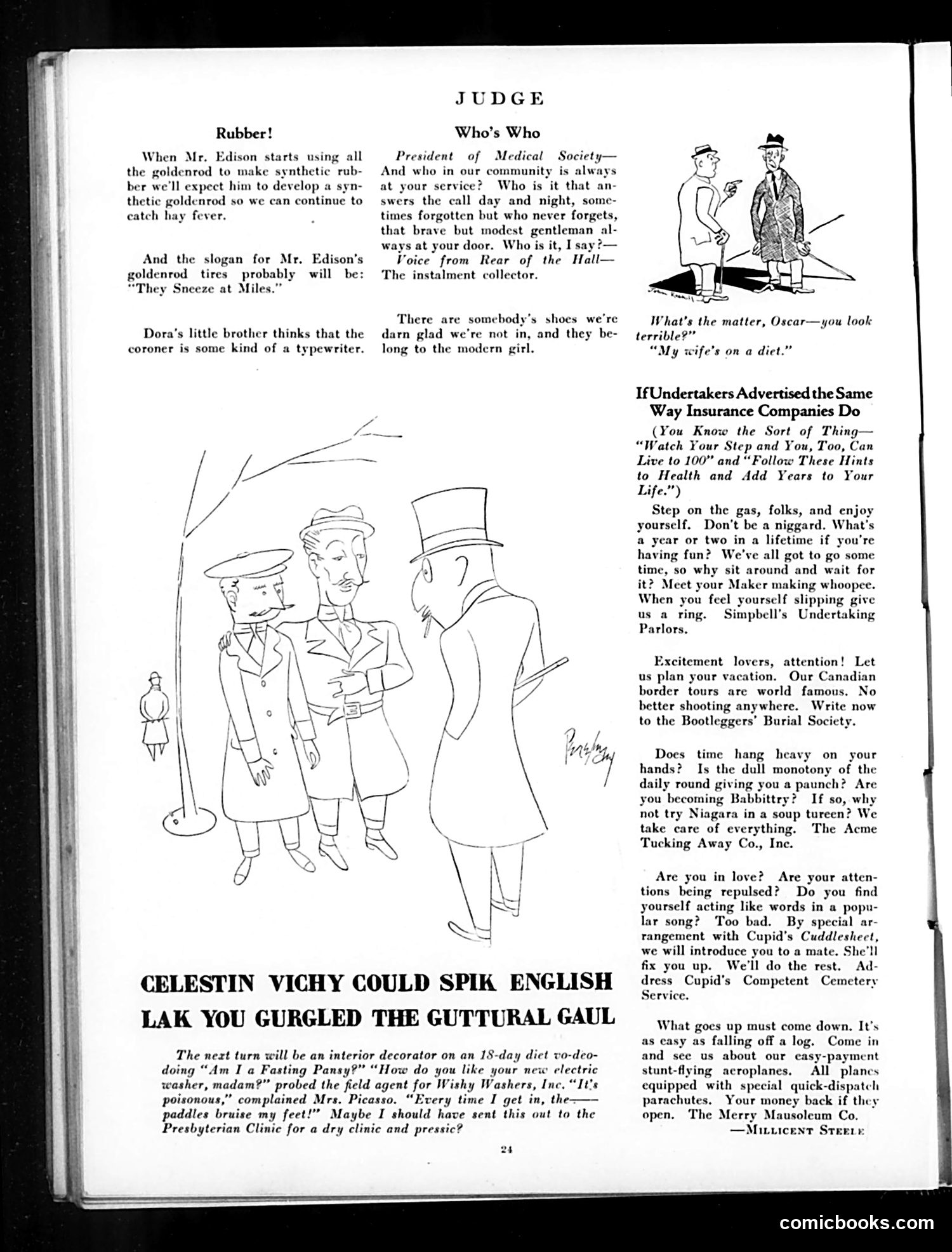
Judge Magazine Page Analysis This page from *Judge* (a major American satirical magazine) contains multiple humor pieces mocking contemporary institutions and trends circa the 1920s-30s. The central cartoon depicts three officials (appearing to be politicians or bureaucrats) in a satirical "Who's Who" segment. The joke subverts pretentious society announcements: while the "President of Medical Society" is being formally introduced as always available, an anonymous voice reveals the real answer is "the instalment collector"—a debt collector. The satire attacks installment-buying culture and suggests creditors are more omnipresent than respectable professionals. Surrounding text includes mock advertisements where undertakers and other service businesses advertise recklessly (like insurance companies touting longevity), satirizing both funeral industry practices and the era's frivolous consumerism. References to Prohibition ("Bootleggers' Burial Society," "Canadian border tours") suggest illegal alcohol smuggling. The humor assumes readers recognize contemporary anxieties: rapid consumer credit, organized crime, and the gap between official respectability and actual social realities.
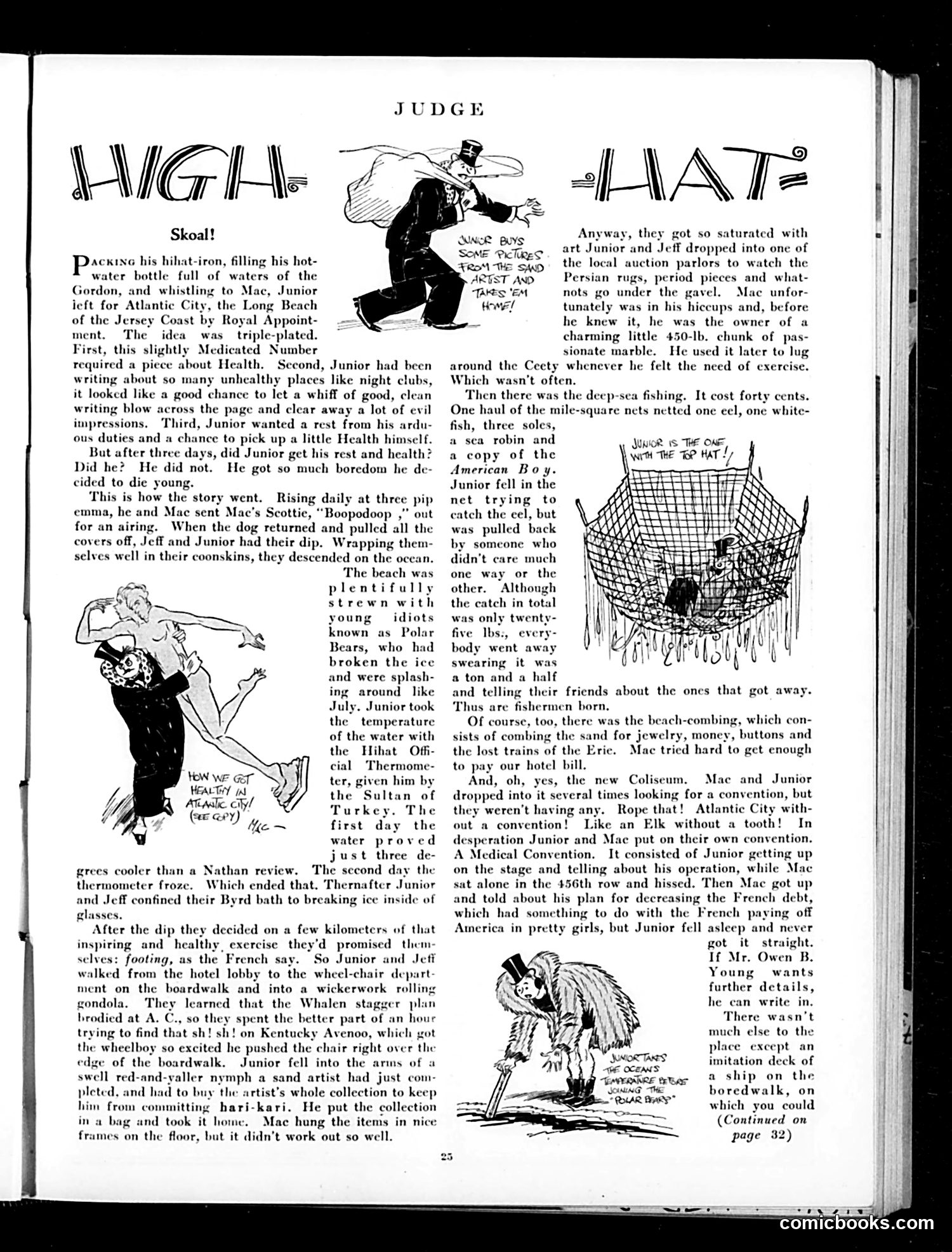
Judge Magazine Satire Analysis This page satirizes a wealthy man's ("Junior's") attempt at a health vacation to Atlantic City. The humor lies in the gap between his pretentious intentions and comedic failures. The Setup: Junior travels to Atlantic City with his hot-water bottle and Scottish terrier, claiming he needs rest and "health" after writing about disreputable places like nightclubs. The Satire: Every activity becomes absurd: - Morning ocean dips occur at 3 AM in freezing water - A "health walk" becomes a wheelbarrow ride where he's knocked off the boardwalk into a sand sculpture - He's forced to buy the entire artwork collection - Deep-sea fishing yields mostly trash (including a copy of *American Boy* magazine) - Beach-combing and auction-house browsing replace actual exercise The Point: Junior's pretentious health regime is transparently fake—he's really just a wealthy idler seeking entertainment while maintaining an air of self-improvement. The cartoon mocks the affectations of leisure-class vacationing and the comedy of plans meeting reality.
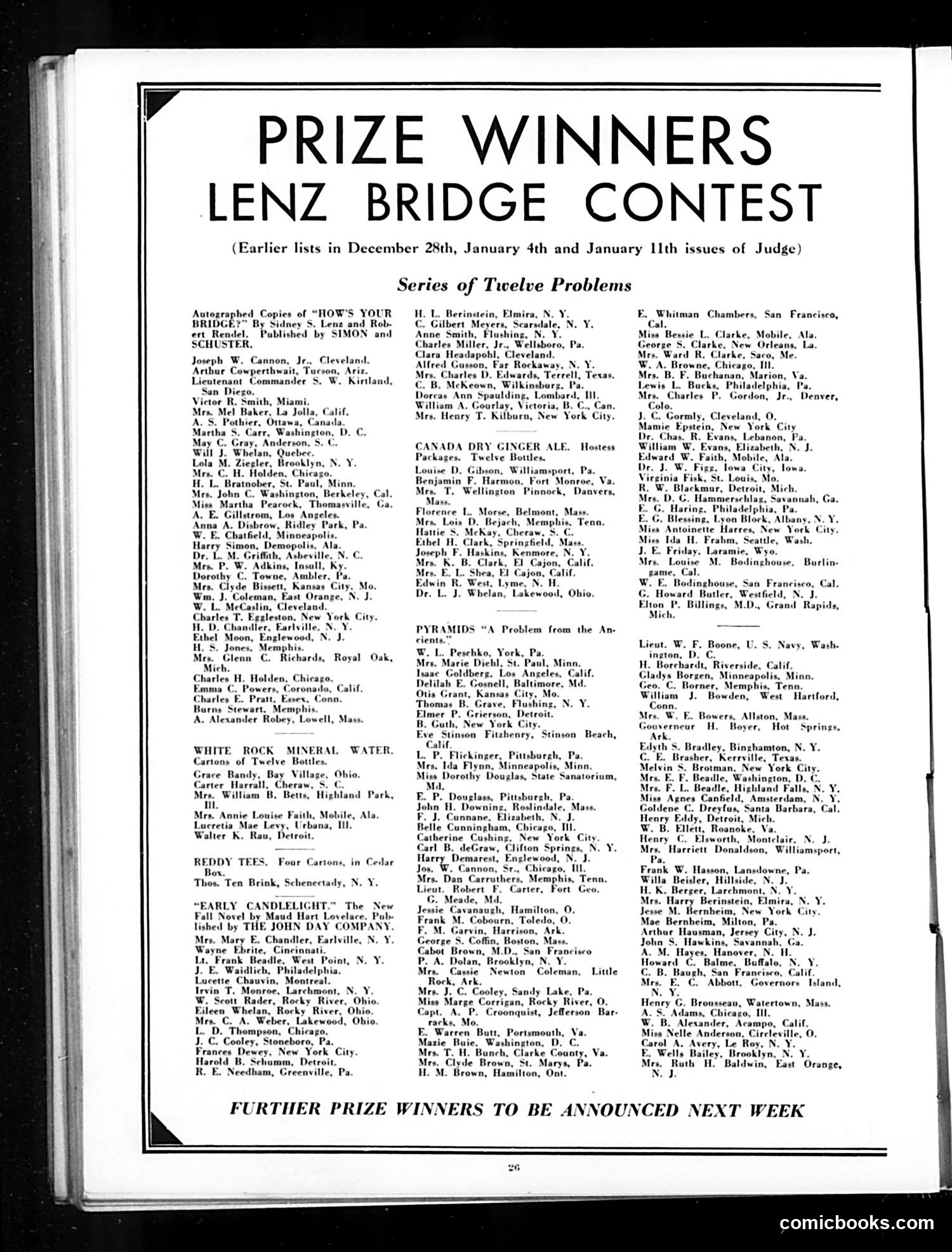
Prize Winners List from Judge Magazine This page is not a cartoon or satirical content—it's a prize announcement list for the "Lenz Bridge Contest," a competition Judge magazine ran. The page lists winners of various prizes across multiple categories: - "How's Your Bridge?" by Simon and Schuster (autographed copies) - White Rock Mineral Water (cases of twelve bottles) - Reddy Tees (golf equipment) - "Early Candlelight" (a novel by John Day Company) - Canada Dry Ginger Ale (hostess packages) - Pyramids (described as "A Problem from the Ancients") The contest apparently involved solving twelve problems. Winners came from across North America—places like Miami, Los Angeles, Toronto, and various U.S. cities. A note at bottom states "Further Prize Winners to Be Announced Next Week," indicating this was part of an ongoing series (with earlier lists published December 28th, January 4th, and 11th). This is essentially advertising disguised as editorial content—a common practice in early 20th-century magazines.
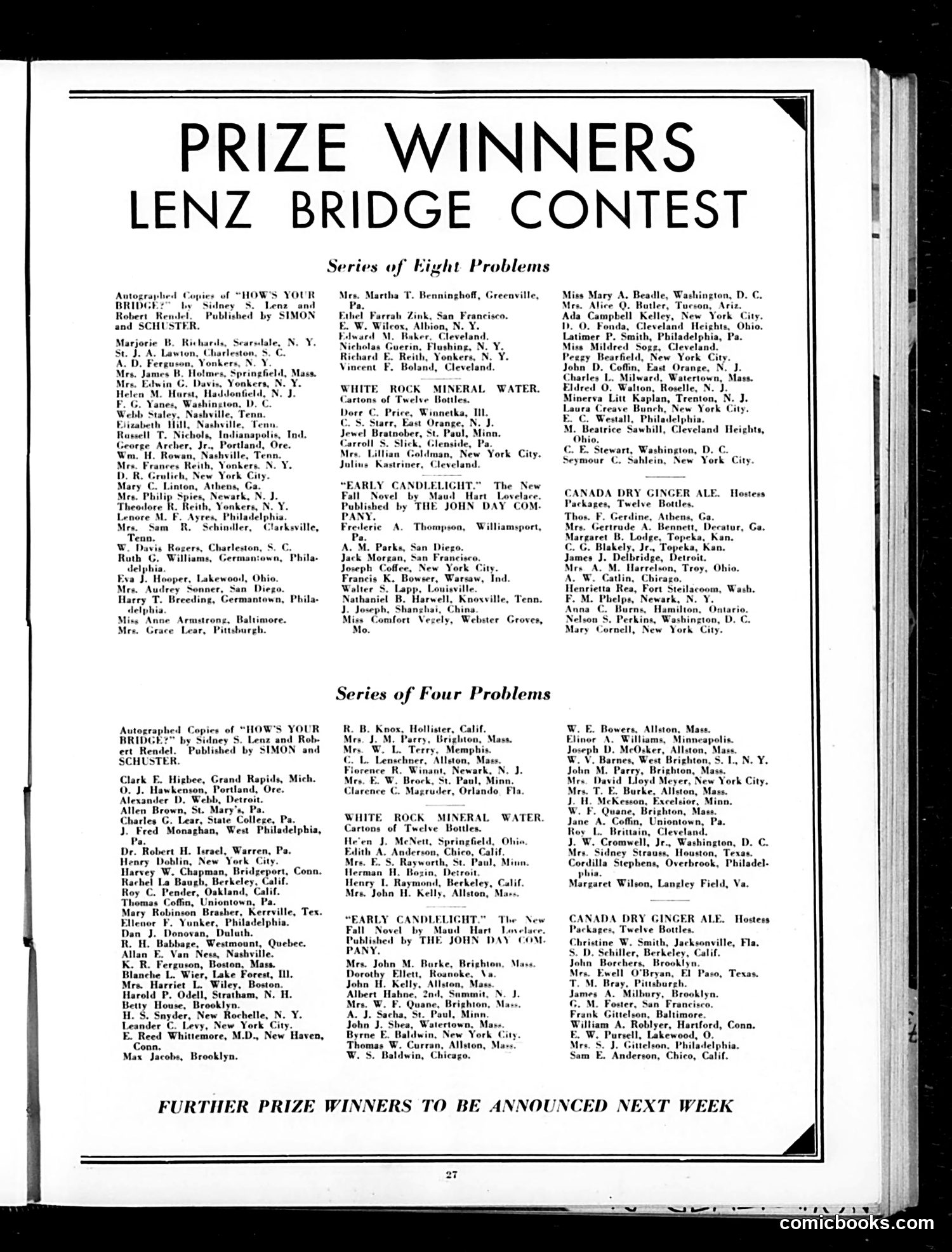
This page is not a cartoon or satirical content—it's a contest results announcement from Judge magazine. The page lists prize winners from the "Lenz Bridge Contest," a bridge card game puzzle competition. The contests were divided into difficulty levels: "Series of Eight Problems" and "Series of Four Problems." Winners received prizes including: - Autographed copies of "How's Your Bridge?" (a card game instruction book by Sidney Lenz and Robert Rendel) - "Early Candlelight" (a novel by Maud Hart Lovelace) - Practical household products like White Rock Mineral Water and Canada Dry Ginger Ale The names listed are ordinary Americans from across the country who solved bridge problems correctly. This reflects Judge's dual nature: while primarily a humor magazine, it also featured puzzles and contests as reader engagement features. A note promises "Further Prize Winners to Be Announced Next Week."
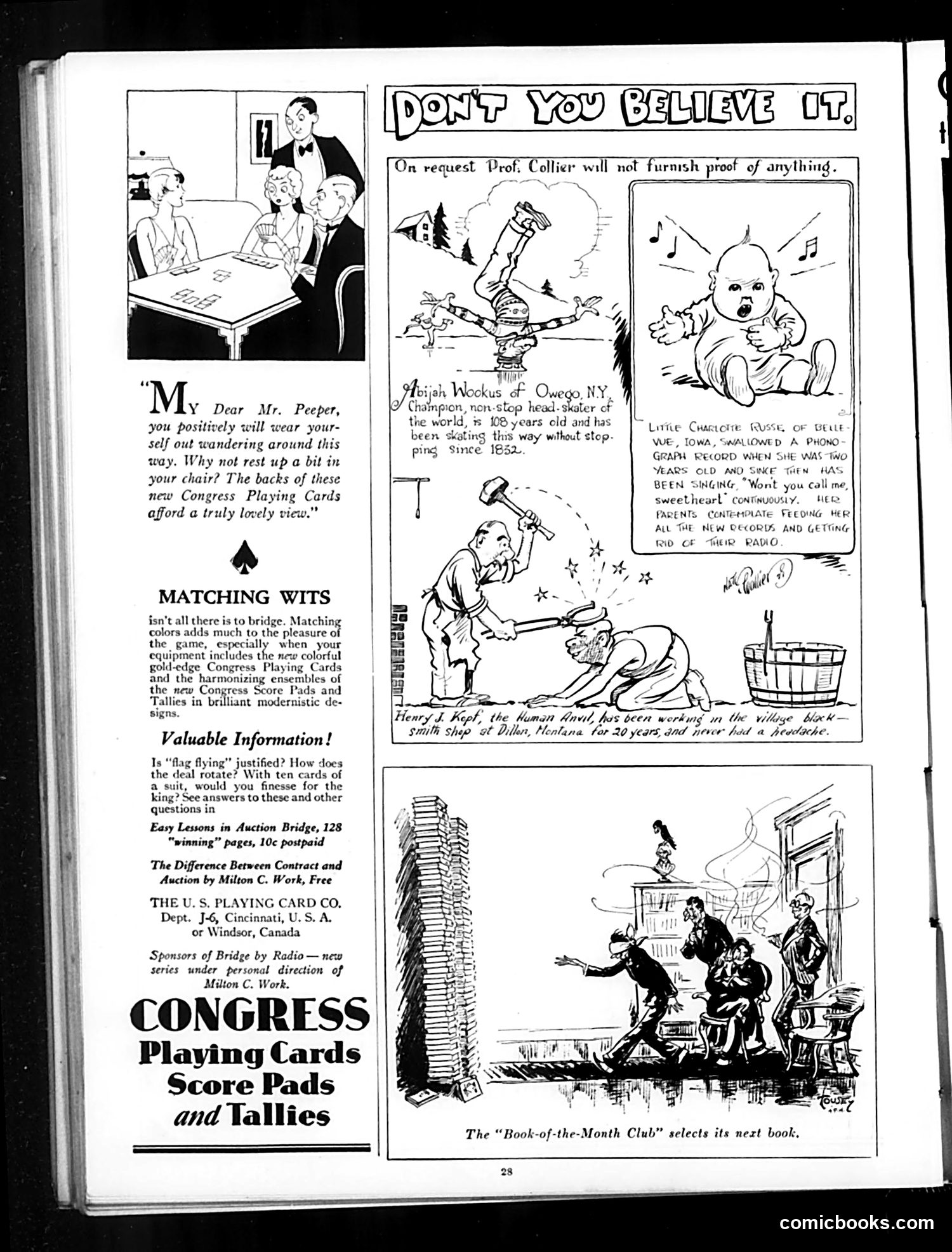
"Don't You Believe It" Analysis This page features humorous "tall tales" satirizing implausible claims—a common Judge magazine format. The cartoons mock exaggerated stories: Josiah Wockus allegedly skated continuously for 108 years since 1852—physically impossible, mocking claim-making and record-seeking. Little Charlotte Rose swallowed a phonograph record at age two and has sung "Won't You Call Me Sweetheart" continuously ever since—absurd medical impossibility played for laughs about modern technology and radio culture. Henry J. Kept worked 20 years without a headache—ridiculing health claims and manual labor romanticization. The page's main content is advertising for Congress Playing Cards and bridge instruction materials. The satirical cartoons serve as editorial filler between ads, typical of Judge's format mixing humor with commerce. The "Don't You Believe It" title frames these as obvious fabrications meant to amuse readers through their sheer implausibility.
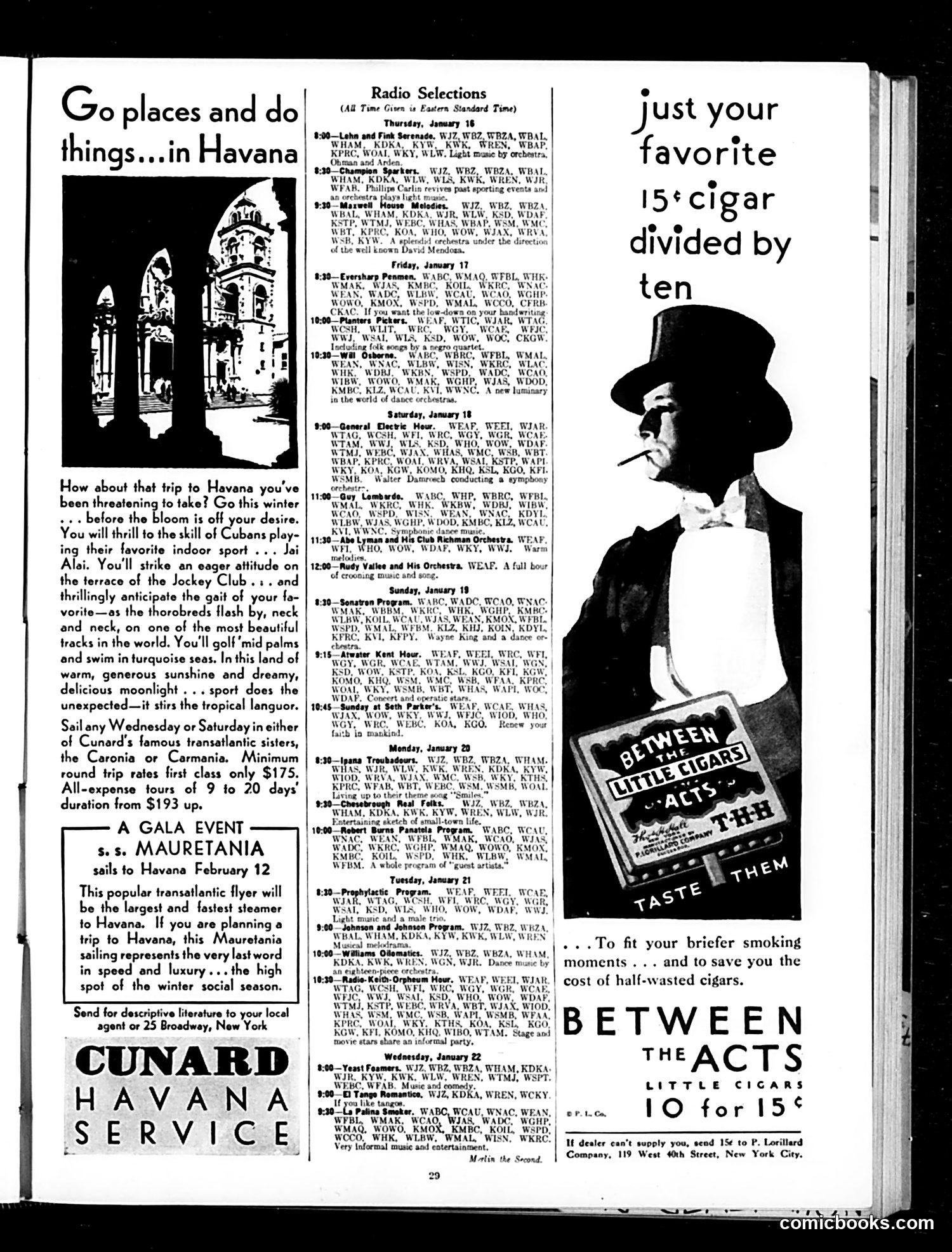
Judge Magazine Page Analysis This page combines travel advertising with radio programming and a cigar advertisement—typical of 1920s magazine content. Main Content: The left side promotes luxury ocean liner travel to Havana via the Cunard Line (the S.S. Mauretania and Caronia), emphasizing glamorous activities like jai alai, horse racing at the Jockey Club, golf, and swimming. This reflects the era's fascination with Caribbean tourism for wealthy Americans. Right Side Advertisement: "Between the Acts" little cigars advertises 10 for 15 cents, pitched at men wanting brief smoking moments without waste. The image shows a man in a top hat—likely meant to suggest sophistication and leisure. Center Section: Extensive radio programming schedules list network broadcasts across major U.S. cities (WJZ, WEAF, WABC, etc.), showing radio's dominance in 1920s entertainment. The page reflects pre-Depression American prosperity, leisure culture, and the era's advertising to affluent male readers.
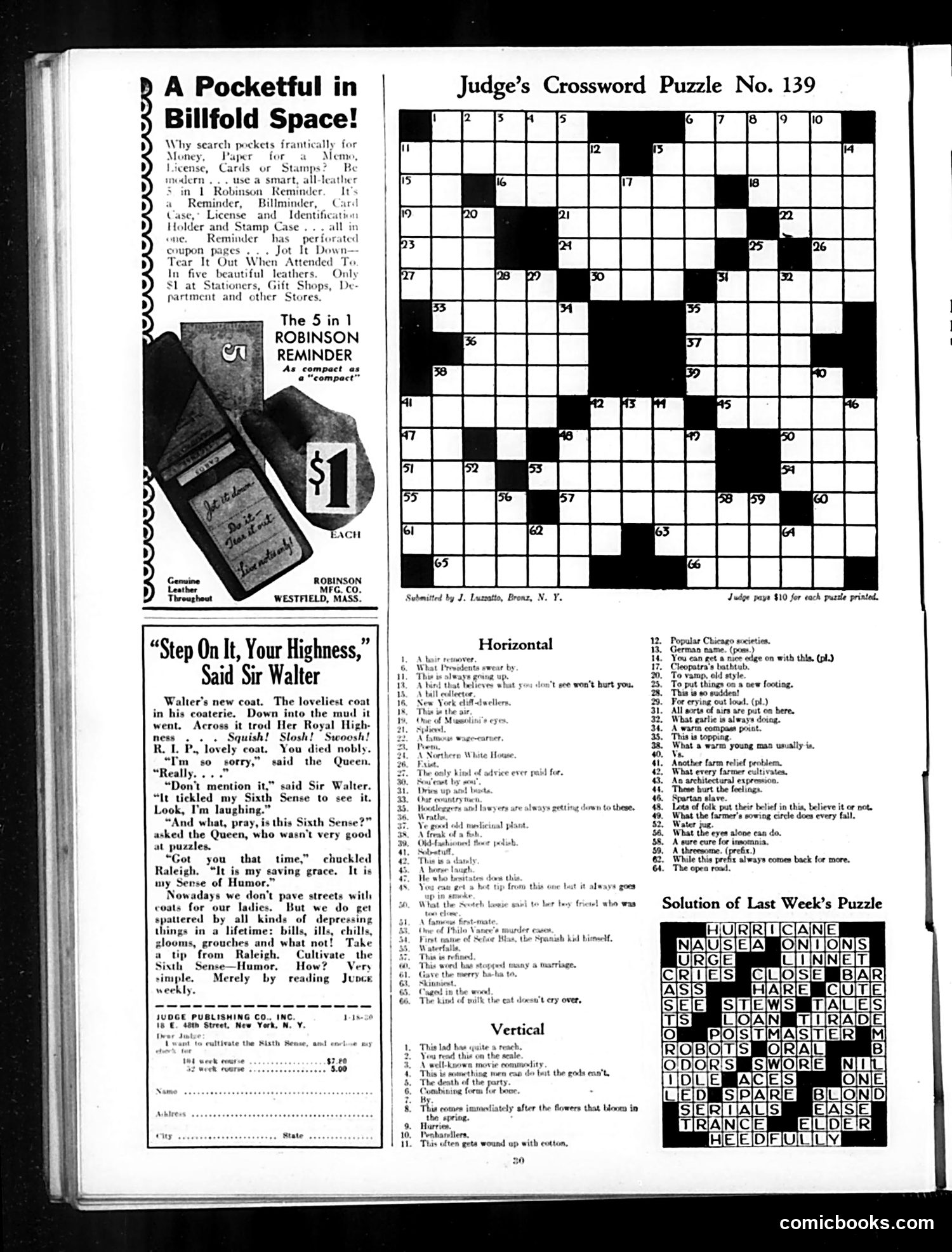
Judge Magazine Page Analysis This page is primarily advertising and puzzle content rather than political satire. The main feature is a crossword puzzle (#139) with accompanying clues. The notable narrative content is a short humorous story titled "Step On It, Your Highness," Said Sir Walter, featuring an exchange between Sir Walter Raleigh and Queen Elizabeth I. The joke hinges on Raleigh's "Sixth Sense"—his sense of humor—which he claims saves him from life's miseries. The story illustrates this through an anecdote where the Queen ruins his new coat by stepping on it; Raleigh responds with laughter rather than complaint, demonstrating the value of humor in facing disappointment. The Robinson Reminder advertisement (top left) promotes a multi-function leather organizer combining billfold, memo pad, and card holder—a practical consumer product. The page's messaging is straightforwardly aspirational and commercial: cultivate humor to endure life's troubles, and organize your life with modern products. There is no discernible political satire or historical reference requiring modern context.
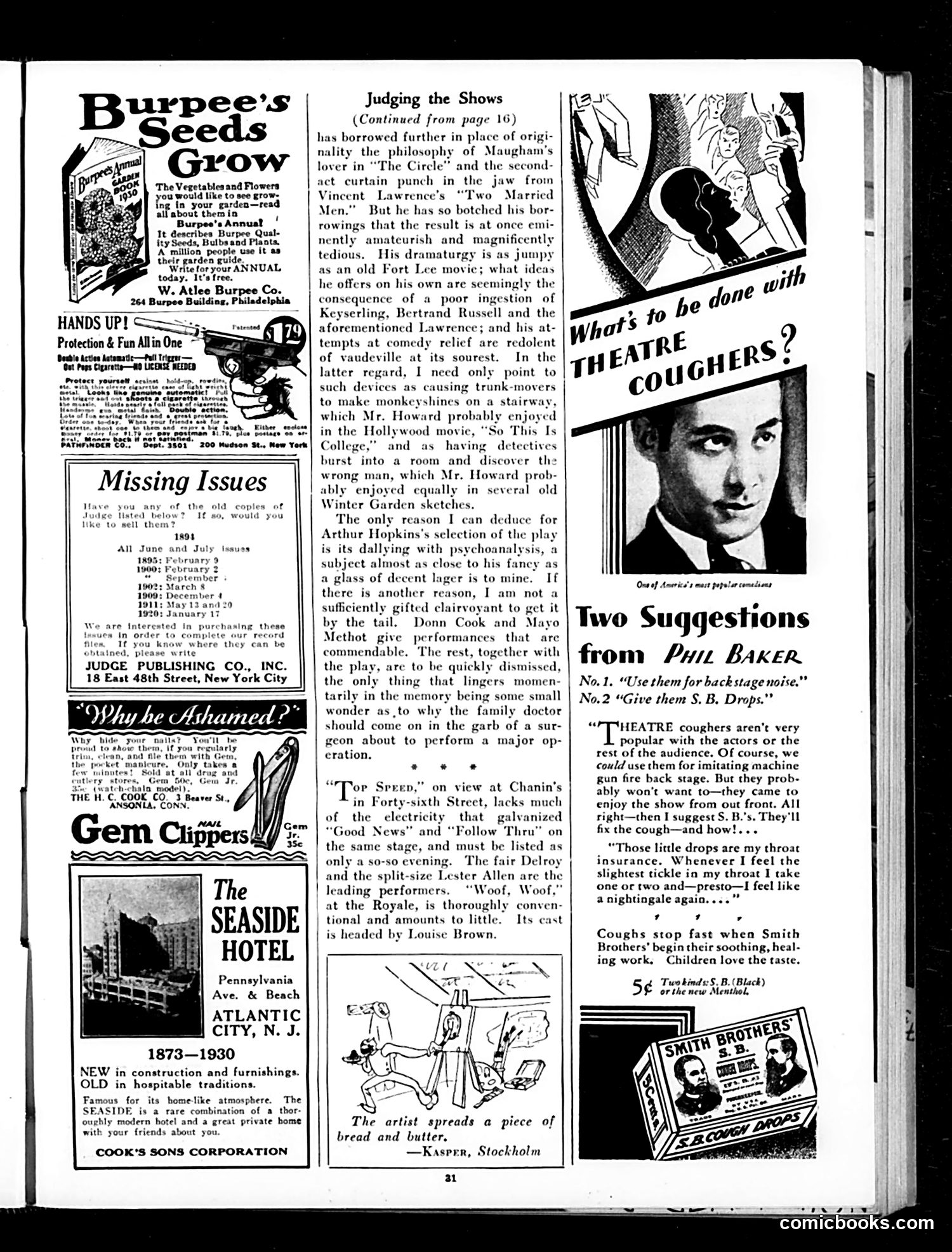
Analysis of Judge Magazine Page This page is primarily advertising and theater criticism, not political satire. The main content is a theater review ("Judging the Shows") critiquing several Broadway productions. The reviewer dismisses a play by Arthur Howard as derivative—borrowing from Somerset Maugham and others but executing poorly. He criticizes its clumsy comedy (like having stagehands make "monkeyshines" on stairs) and heavy-handed psychoanalysis. He praises actors Donn Cook and Mayo Methot but finds little else worthwhile. The page also features advertisements: Burpee Seeds, a pistol called "Hands Up!", The Seaside Hotel in Atlantic City, and most prominently, Smith Brothers cough drops. The cough drops ad includes a humorous panel by cartoonist Kasper showing bread and butter—apparently a visual pun on throat relief. There is no discernible political satire or caricature on this page. It's a standard magazine layout mixing editorial content with period advertising.
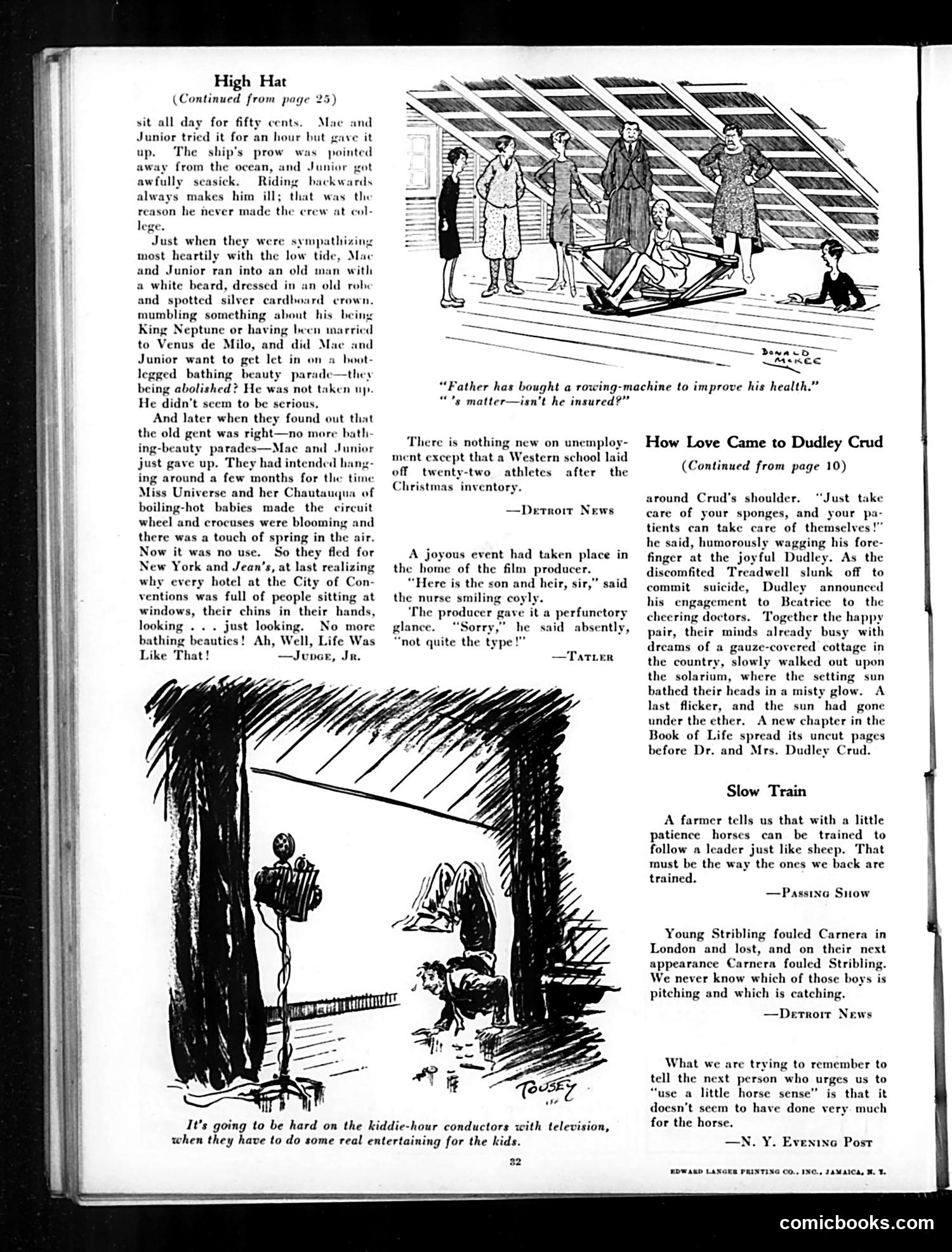
Analysis of Judge Magazine Page 32 This page contains several satirical pieces typical of Judge's humor: "High Hat" (continued story): A narrative about characters Mae and Junior visiting Atlantic City's beach, where they encounter a costumed man claiming to be King Neptune warning that bathing-beauty parades are being abolished. The satire mocks the commercialization of seaside entertainment and the disappointment when attractions disappear. The cartoon below shows a figure in what appears to be a barn or shelter—the caption jokes about "kiddie-hour conductors with television" needing to actually entertain children, satirizing early television's low entertainment standards. "How Love Came to Dudley Crud": A romantic medical melodrama conclusion where a doctor announces his engagement. Brief humor items ("Slow Train," "Young Stribling") use horse racing and boxing references to make jokes about following leaders blindly and boxing match fouls. The overall tone reflects 1920s-30s American satire mocking consumer culture, entertainment industries, and social follies—nothing requiring specific current event knowledge, mostly gentle social observation.
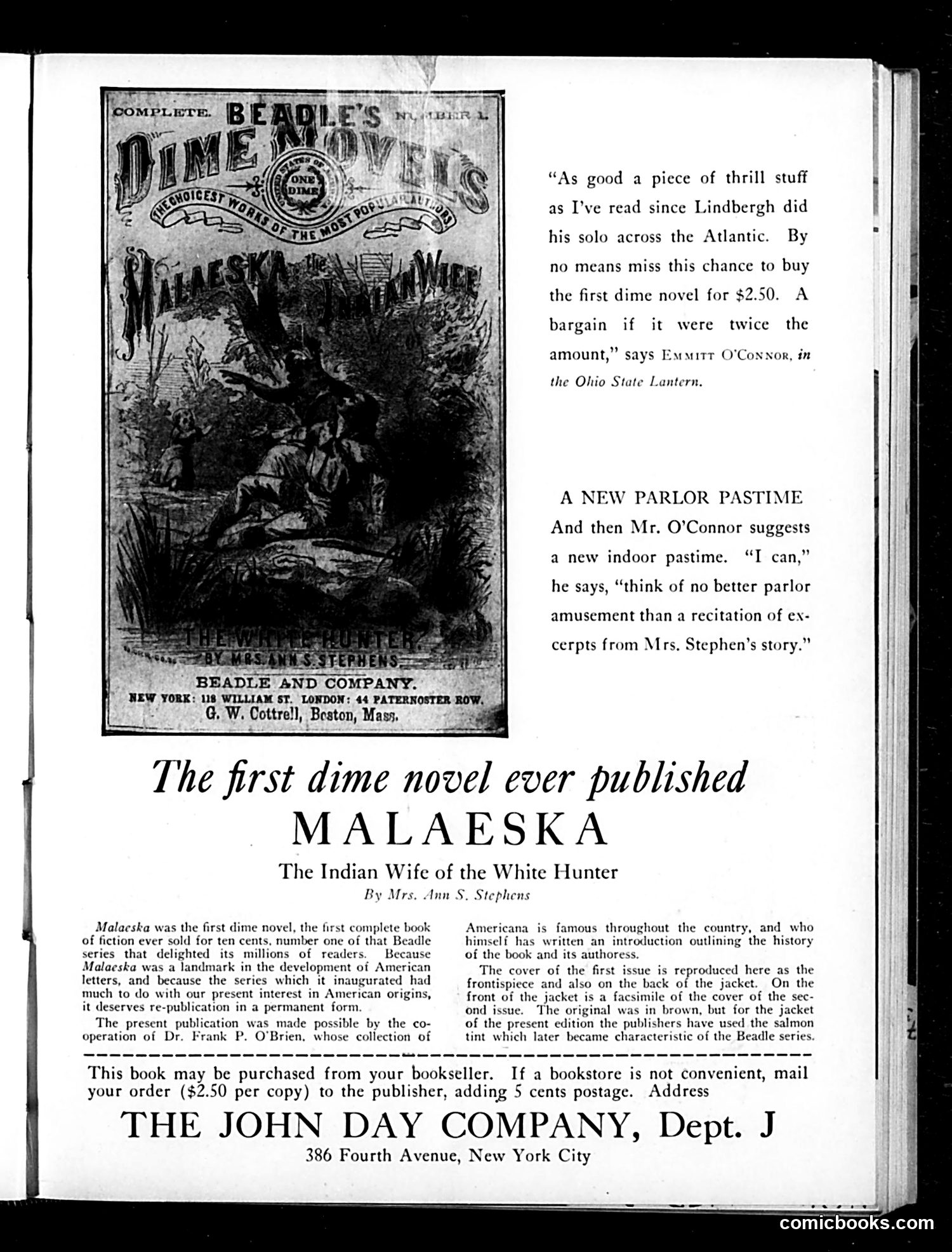
"Malaeskа" Advertisement in Judge Magazine This page is primarily a book advertisement, not political satire. It promotes the republication of *Malaaska: The Indian Wife of the White Hunter* by Mrs. Ann S. Stephens—claimed as the first dime novel ever published. The "satire" is subtle: the quoted review from Emmitt O'Connor in the Ohio State Lantern humorously compares the novel's thrills to Lindbergh's 1927 Atlantic solo flight, elevating popular pulp fiction to the status of major historical achievement. The joke about "parlor amusement" through reading excerpts suggests genteel entertainment value. The advertisement emphasizes the book's historical significance as an American landmark in publishing and popular culture. The facsimile cover artwork and detailed provenance (including Dr. Frank P. O'Brien's collection) present this as serious cultural recovery, not mere entertainment—a somewhat tongue-in-cheek positioning for what was originally cheap popular fiction. Price: $2.50 (substantial for the era).
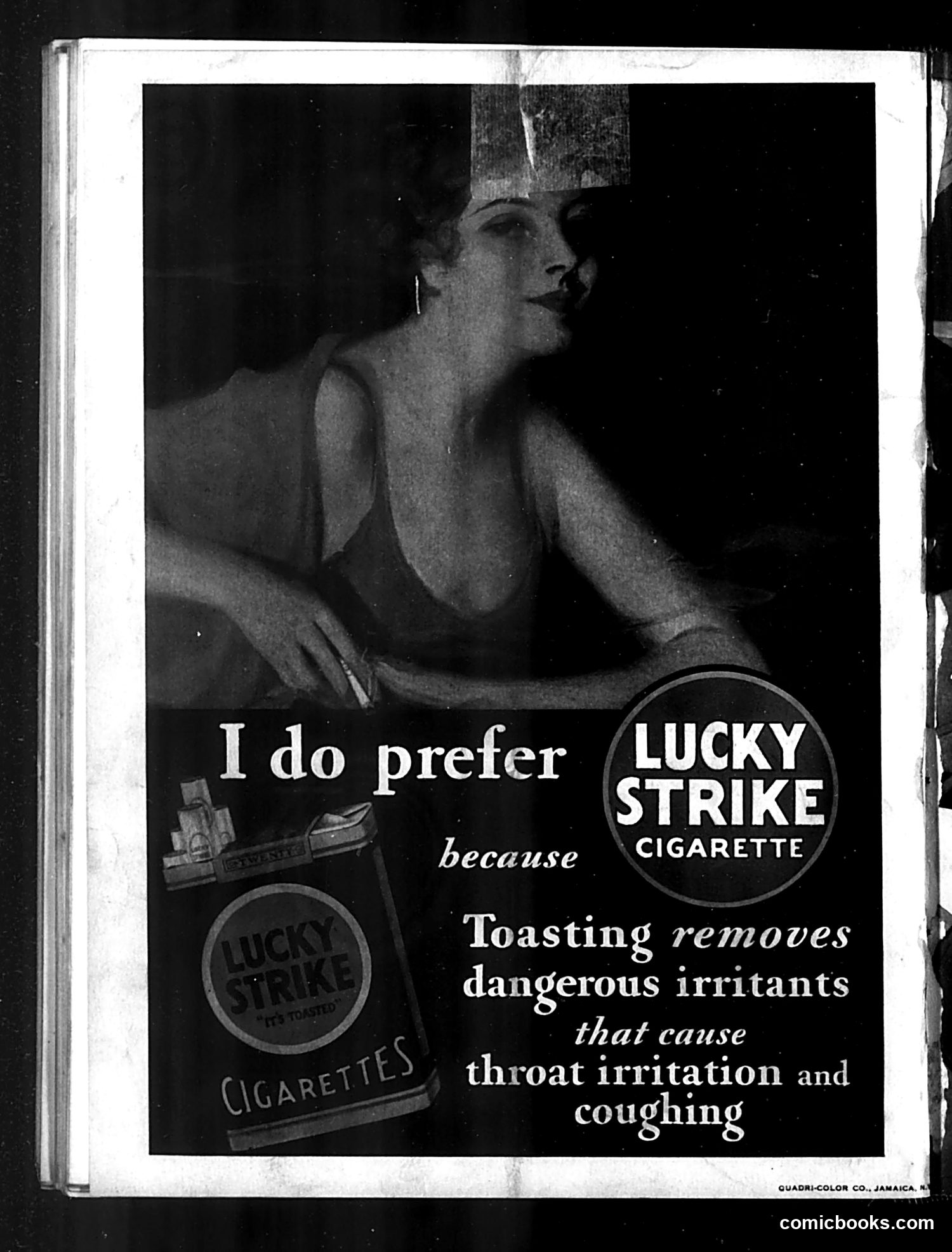
Advertisement Analysis This is a Lucky Strike cigarette advertisement, not a political cartoon. It features a shirtless man in profile with the slogan "I do prefer Lucky Strike Cigarette because Toasting removes dangerous irritants that cause throat irritation and coughing." Modern context: This represents vintage tobacco advertising's deceptive health claims. Lucky Strike promoted their "toasting" process as a health benefit, claiming it reduced throat irritation—a marketing strategy that exploited consumer concerns about smoking's harmful effects while selling a dangerous product. The ad exemplifies how cigarette companies once made unsubstantiated medical claims in mainstream publications before advertising restrictions and surgeon general warnings existed. It's a striking historical document of corporate manipulation preceding modern tobacco regulation.