judge
Judge — January 25, 1930
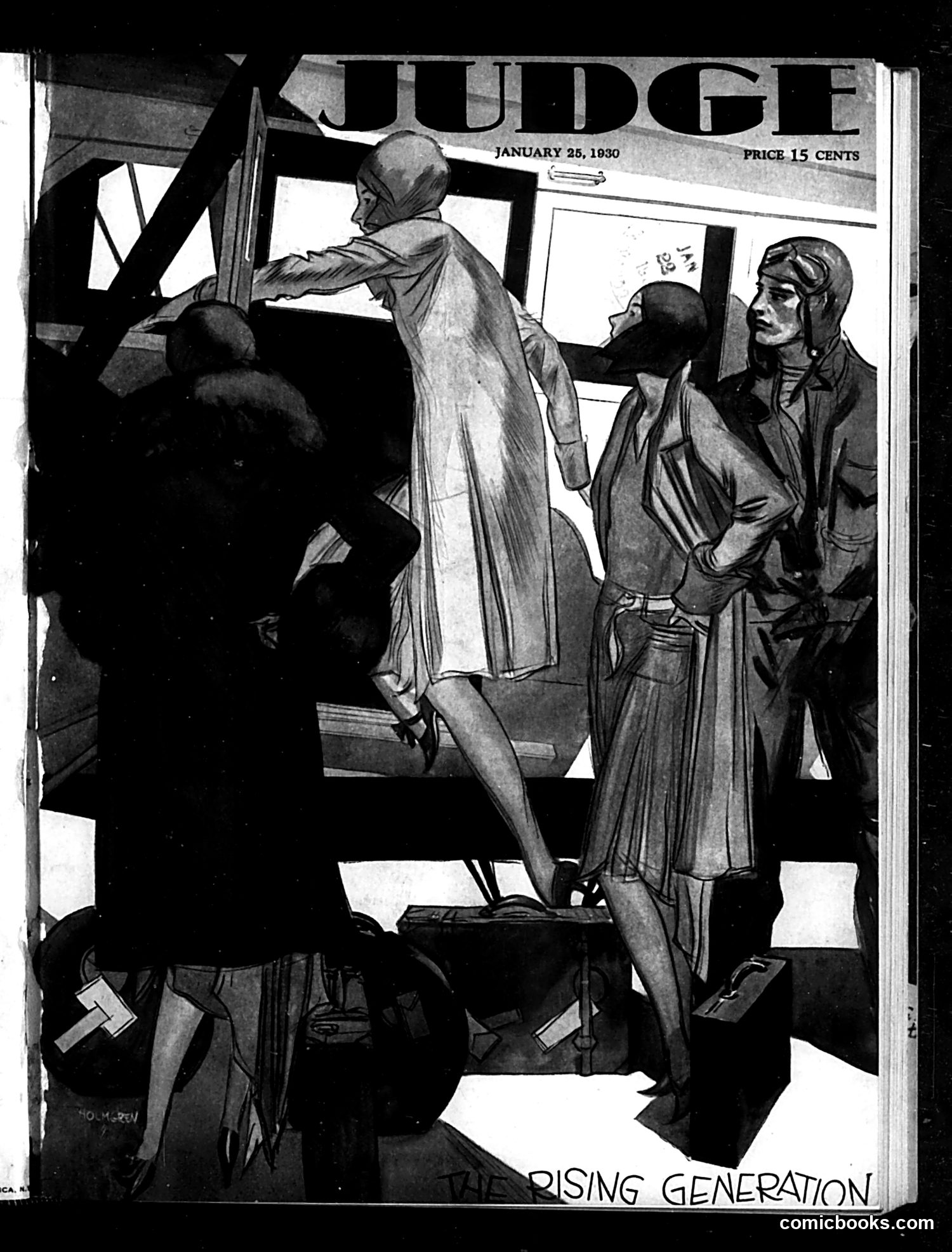
Analysis of Judge Magazine Cover, January 25, 1930 This cover illustration titled "The Rising Generation" depicts a scene aboard what appears to be a ship or train. A young woman in revealing clothing stands prominently, interacting with several male passengers. The composition and title suggest satire about youth culture and changing social mores in the late 1920s-early 1930s. The "rising generation" likely refers to the younger cohort coming of age during the Jazz Age, known for challenging Victorian social conventions. The woman's abbreviated dress and forward behavior would have been considered scandalous to conservative readers, making her a target for satirical commentary about perceived moral decline among youth. The price of 15 cents and 1930 date place this during the Great Depression's onset, a period of significant social anxiety.
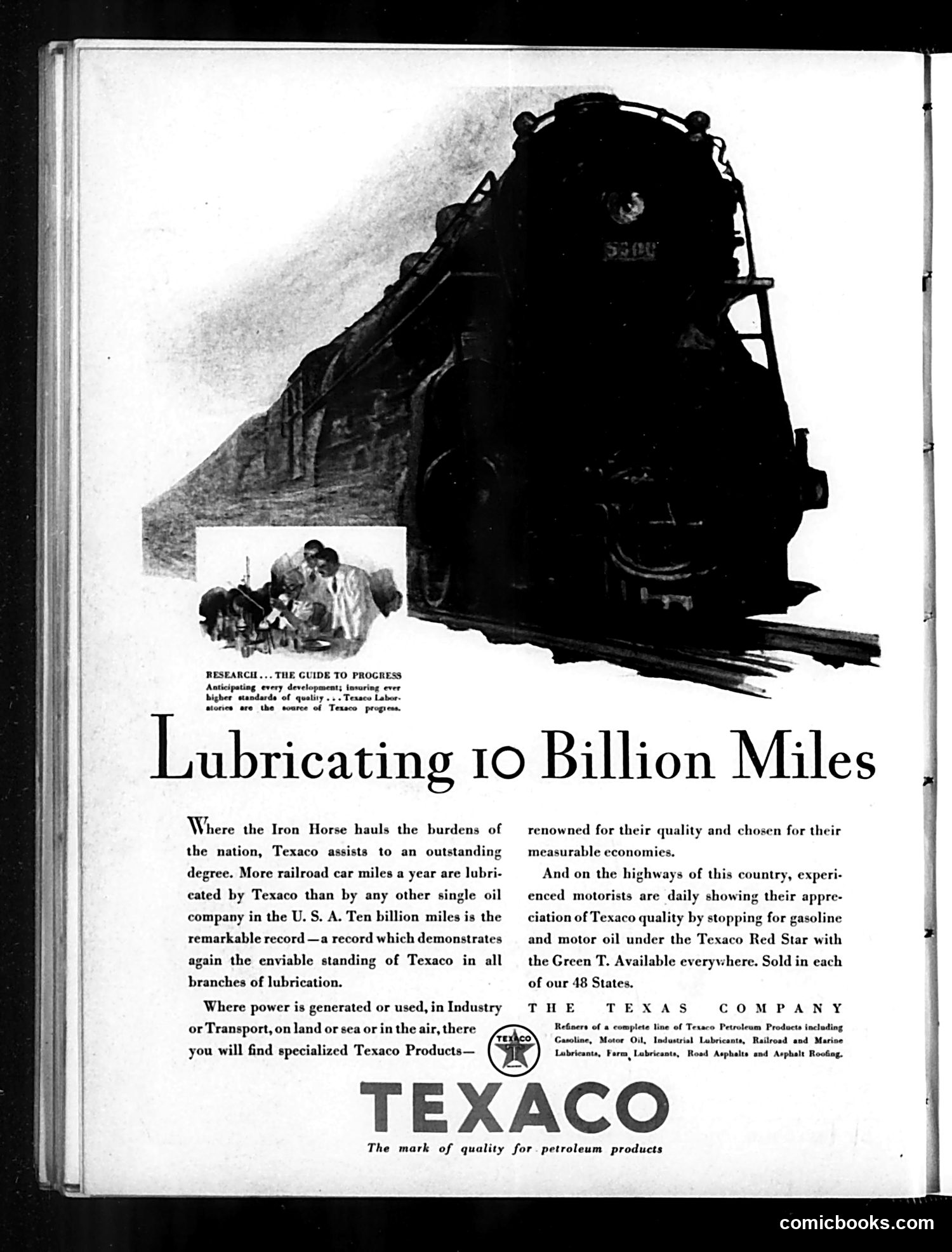
Analysis This page is primarily a Texaco oil company advertisement, not satirical content. The dominant image shows a massive steam locomotive with the headline "Lubricating 10 Billion Miles." The small inset illustration (lower left) appears to show workers or laborers, accompanying text emphasizing Texaco's research and quality control—"Anticipating every development; insuring ever higher standards of quality." The advertisement claims Texaco lubricates more railroad miles than any competitor and appeals to motorists appreciating their gasoline and motor oil. It emphasizes availability across 48 states. There is no discernible political satire or cartoon here. This is straightforward corporate marketing from the early-to-mid 20th century, using industrial imagery (the Iron Horse) to associate Texaco with American progress and reliability.

Analysis This is primarily an advertisement, not satire or political cartoon. It promotes the 14th edition of Encyclopedia Britannica as an educational tool for families, marketed as an affordable "home education" resource. The page features a photograph showing a family (appears to be parents and children) gathered around the encyclopedia set, illustrating the product's appeal as a family educational centerpiece. The ad emphasizes that 40,000 families already own it and highlights its 15,000 illustrations and articles by 3,500 world authorities. The "satire" element, if present, is subtle—the ad's breathless claims about how this encyclopedia will transform family life and children's ambitions likely struck some contemporary readers as hyperbolic marketing. However, this appears to be straightforward commercial promotion rather than critical satire typical of Judge magazine's usual content.
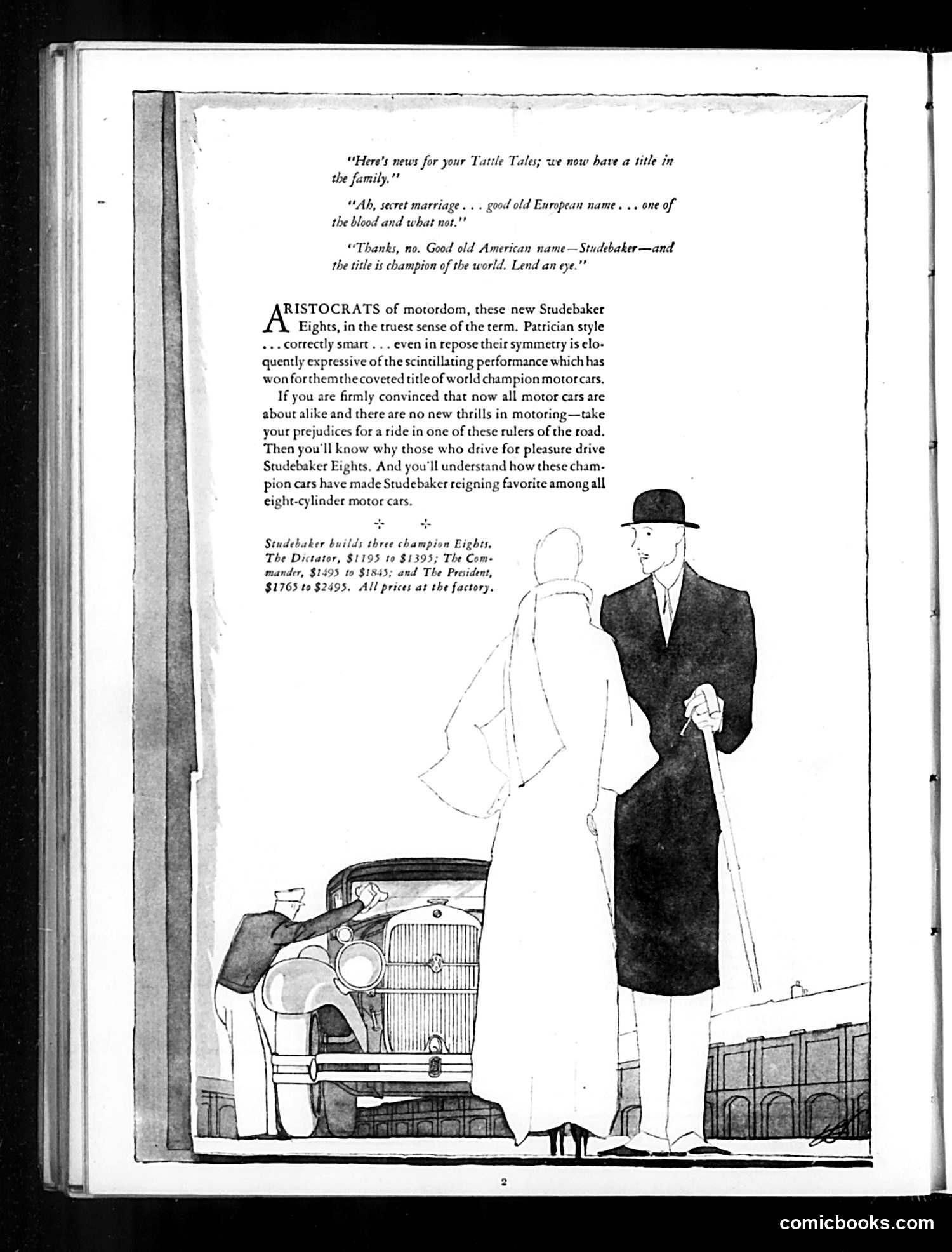
Analysis of Studebaker Advertisement This is primarily a luxury car advertisement rather than political satire. The page promotes Studebaker "Eight" automobiles as status symbols for the wealthy elite ("aristocrats of motordom"). The illustration depicts an elegant couple—likely representing upper-class consumers—examining a Studebaker vehicle. The ad's humor is gentle mockery aimed at car enthusiasts, suggesting that driving a Studebaker Eight proves superiority over other eight-cylinder cars and provides thrills to those who think "all motor cars are about alike." The text lists three "champion" models: The Dictator, Commander, and President, with factory prices ranging from $1,195 to $2,455. The naming strategy suggests aspirational power and prestige associated with automobile ownership during the prosperous 1920s.
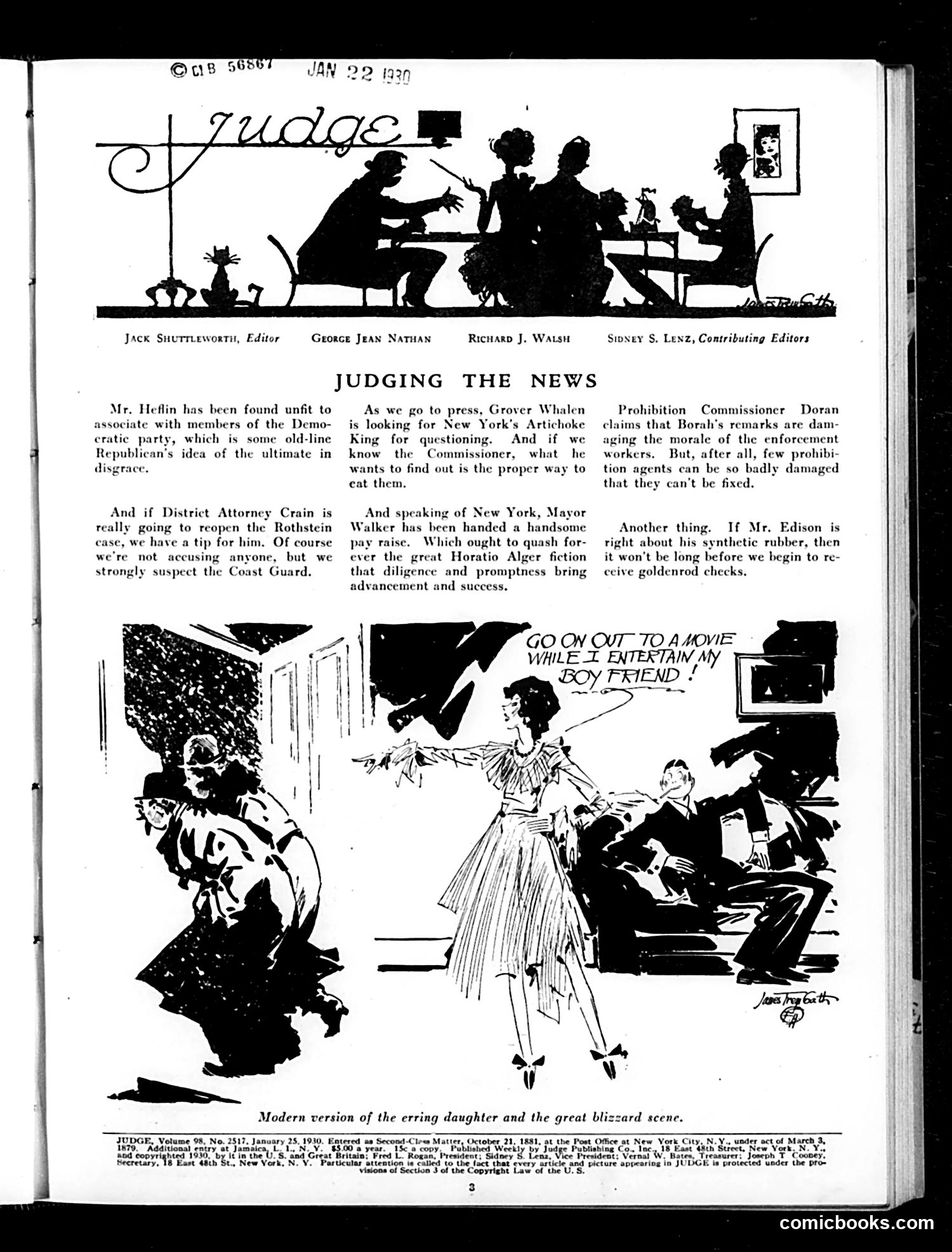
"Judging the News" - January 22, 1930 This editorial page criticizes several political figures and issues: Top section attacks Democratic Party leadership (Hedin, District Attorney Crain) for alleged scandals, while praising Republican priorities. Middle cartoon satirizes Mayor Walker of New York, who apparently received a pay raise despite questions about his competence. The satire suggests that "diligence and promptness" shouldn't automatically bring advancement—a dig at patronage and undeserved promotion. Bottom cartoon ("Modern version of the erring daughter and the great blizzard scene") appears to mock social/moral hypocrisy, showing a woman entertaining a male visitor while disapproving onlookers judge her. The caption suggests outdated moral standards applied selectively. The page reflects 1930s urban political corruption concerns and changing social attitudes.
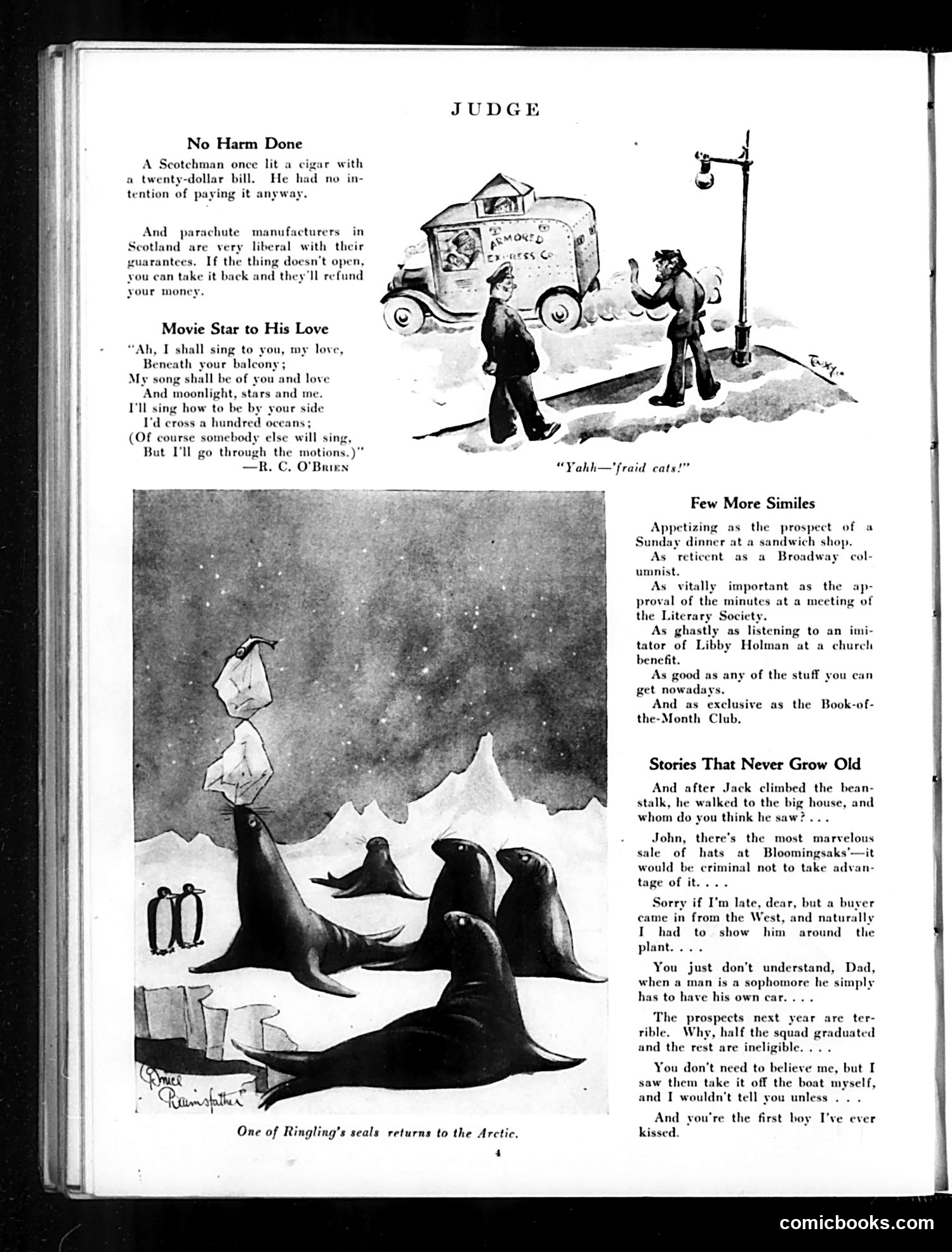
Judge Magazine Page Analysis This page contains three separate humor pieces: 1. "No Harm Done": A Scottish man lit a cigar with a twenty-dollar bill, intending not to pay. The joke satirizes Scottish stereotypes about frugality. 2. "Movie Star to His Love": A romantic poem by R. C. O'Brien, mocking overwrought Hollywood sentiment and theatrical clichés ("I'll go through the motions"). 3. "Few More Similes": A collection of brief comic comparisons about mundane situations, using deliberately weak comparisons to create humor. 4. "Stories That Never Grow Old": A humorous dialogue between a father and son about collegiate life and romance, poking fun at coming-of-age narratives and predictable family exchanges. The lower illustration shows seals in an Arctic setting, captioned "One of Ringling's seals returns to the Arctic"—likely referencing Ringling Bros. circus animals.
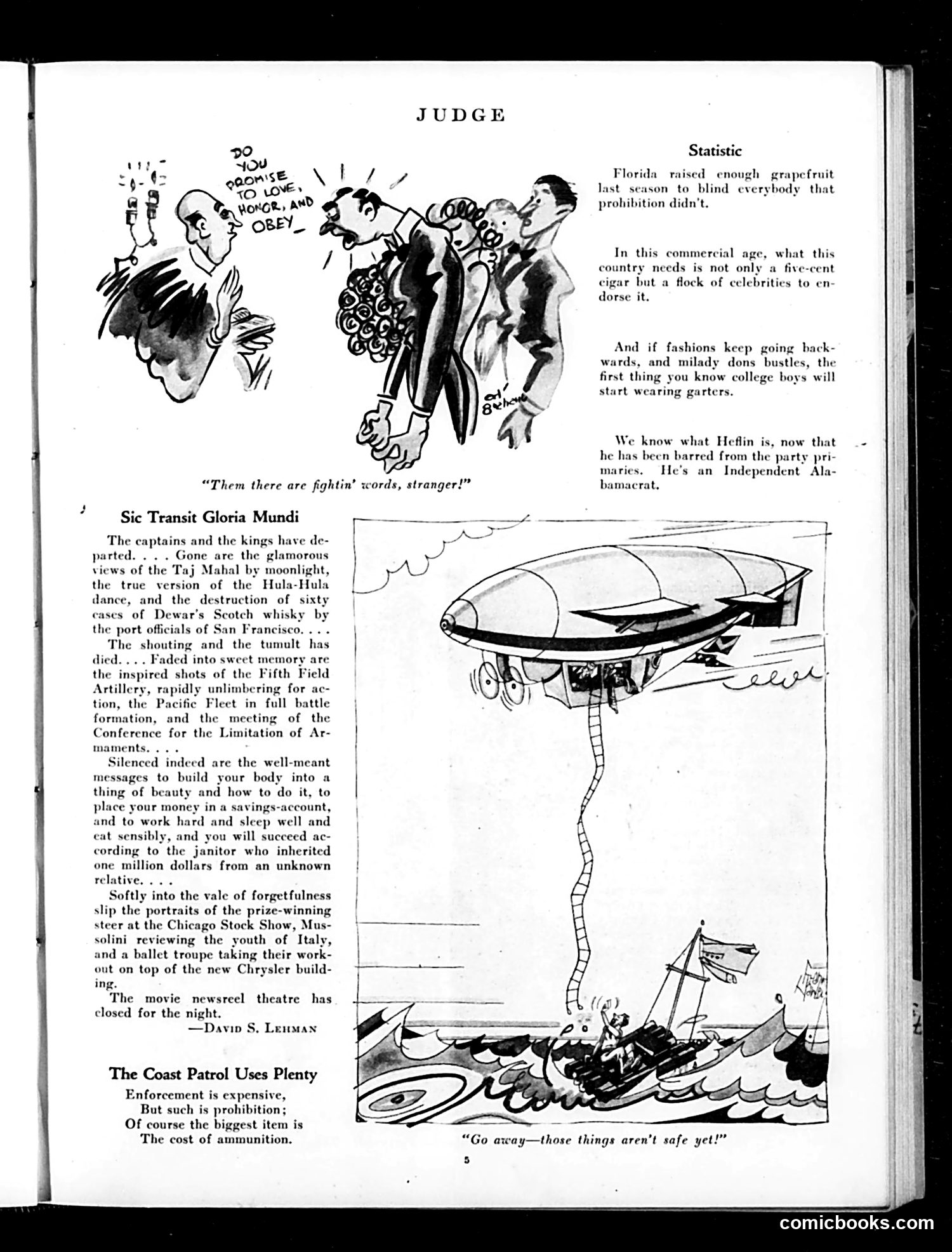
Analysis of Judge Magazine Page The top cartoon satirizes political rhetoric, showing a figure (likely a politician) spouting promises of "promise, love, honor, and obey" while others react with skepticism. The caption "Them there are fightin' words, stranger!" suggests the absurdity of such platitudes. The second section, "Sic Transit Gloria Mundi" by David S. Lehman, is a prose commentary lamenting how wartime glories fade into obscurity—referencing dimmed memories of WWI battles, the Pacific Fleet, and disarmament conferences. The bottom illustration humorously depicts an experimental airship or aircraft being lowered toward a boat, with the caption "Go away—those things aren't safe yet!" This appears to satirize early aviation technology as dangerously unreliable. The page reflects post-WWI American concerns about military spending, technological progress, and political dishonesty.
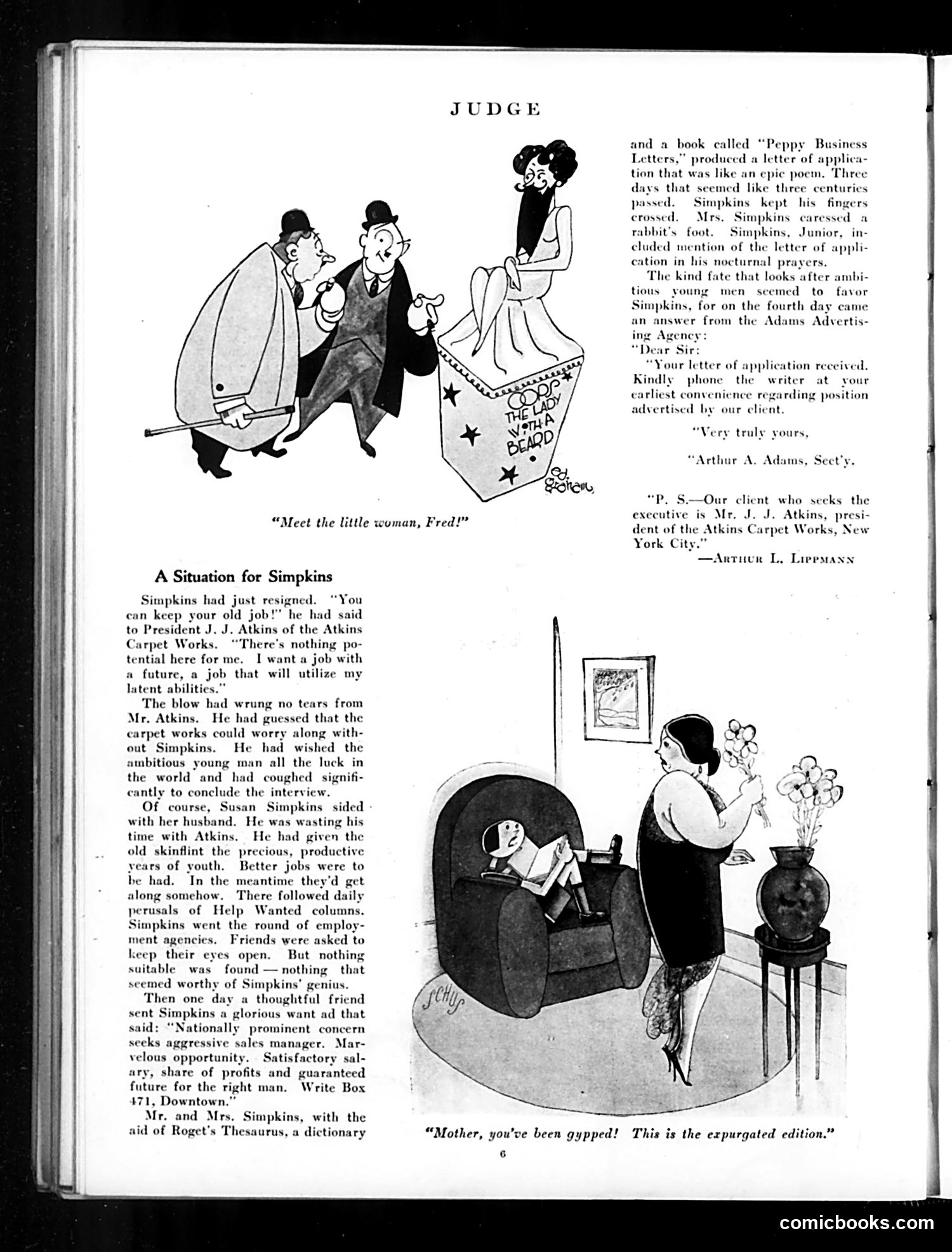
Analysis of Judge Magazine Page This page satirizes the job-hunting struggles of an ambitious young man named Simpkins. The main narrative describes his frustration after resigning from the Atkins Carpet Works, seeking a position worthy of his talents. Despite efforts through employment agencies and help-wanted columns, nothing suitable materializes. The cartoon "Meet the little woman, Fred!" depicts two men presenting Simpkins to a woman in a box—likely satirizing how job applicants were treated as commodities to be "packaged" and presented to employers. The bottom cartoon shows Simpkins' mother, who has apparently been exaggerating his qualifications to others. Her remark about the "exaggerated edition" jokes that she's been overselling her son's abilities to potential employers—a commentary on both maternal pride and the desperation of job-seeking during this era.
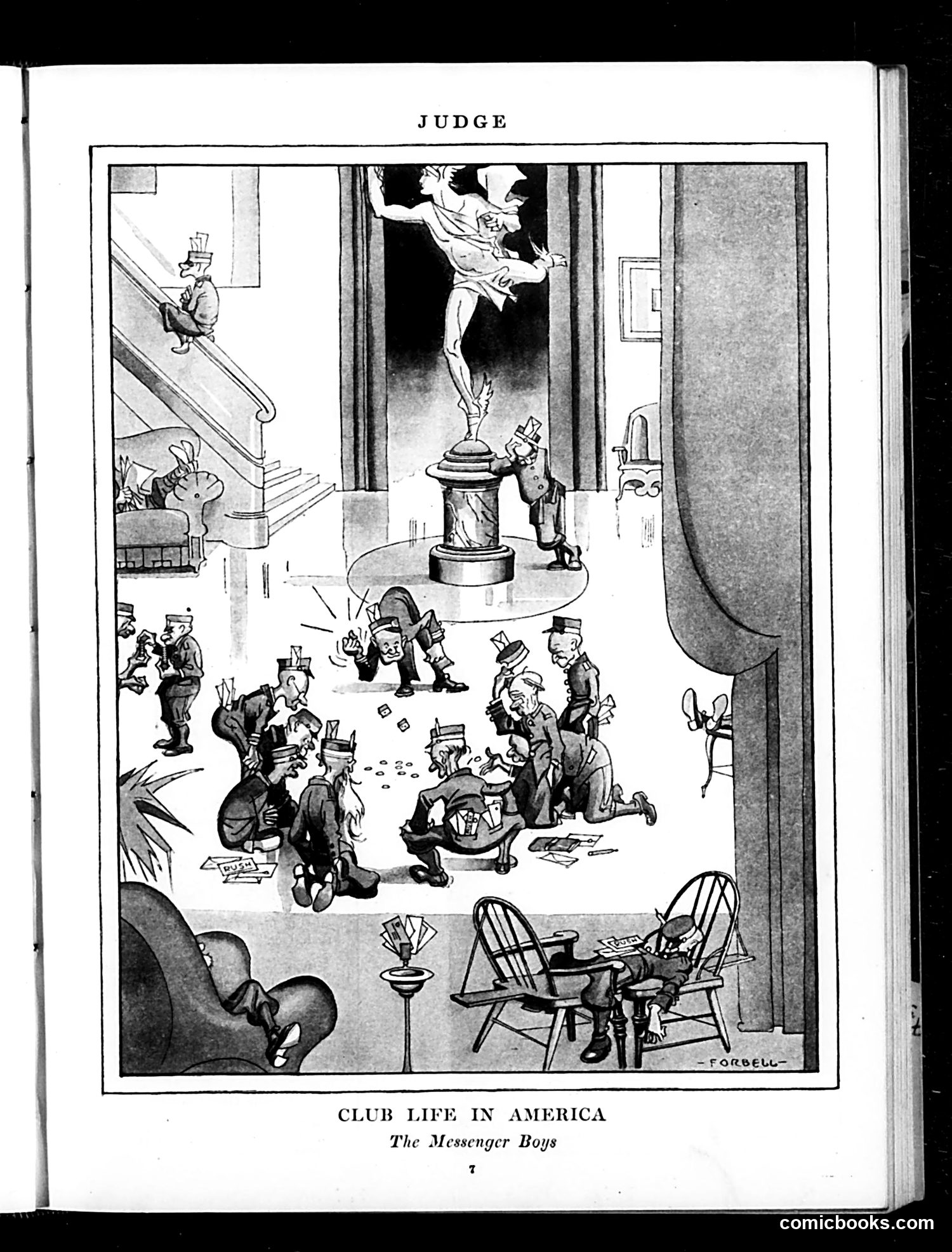
Judge Cartoon Analysis: "Club Life in America - The Messenger Boys" This satirical illustration depicts a chaotic scene of "messenger boys" (young male couriers common in early 20th-century urban America) conducting business in what appears to be an exclusive club. The cartoon mocks the incongruity of these working-class youths operating openly within an elite gentleman's club setting—they're shown gambling, exchanging money, and conducting illicit dealings while lounged members observe from chairs below. The satire targets corruption and impropriety in American clubs, suggesting that messenger boys (possibly running illegal betting operations or other schemes) have infiltrated supposedly respectable institutions. The exaggerated chaos and the gentlemen's apparent indifference critique both the boys' lawlessness and the club's failure to maintain standards. The artist (signed Forbell) uses this absurdist scenario to comment on social disorder and the infiltration of proper society by criminal or unsavory elements.
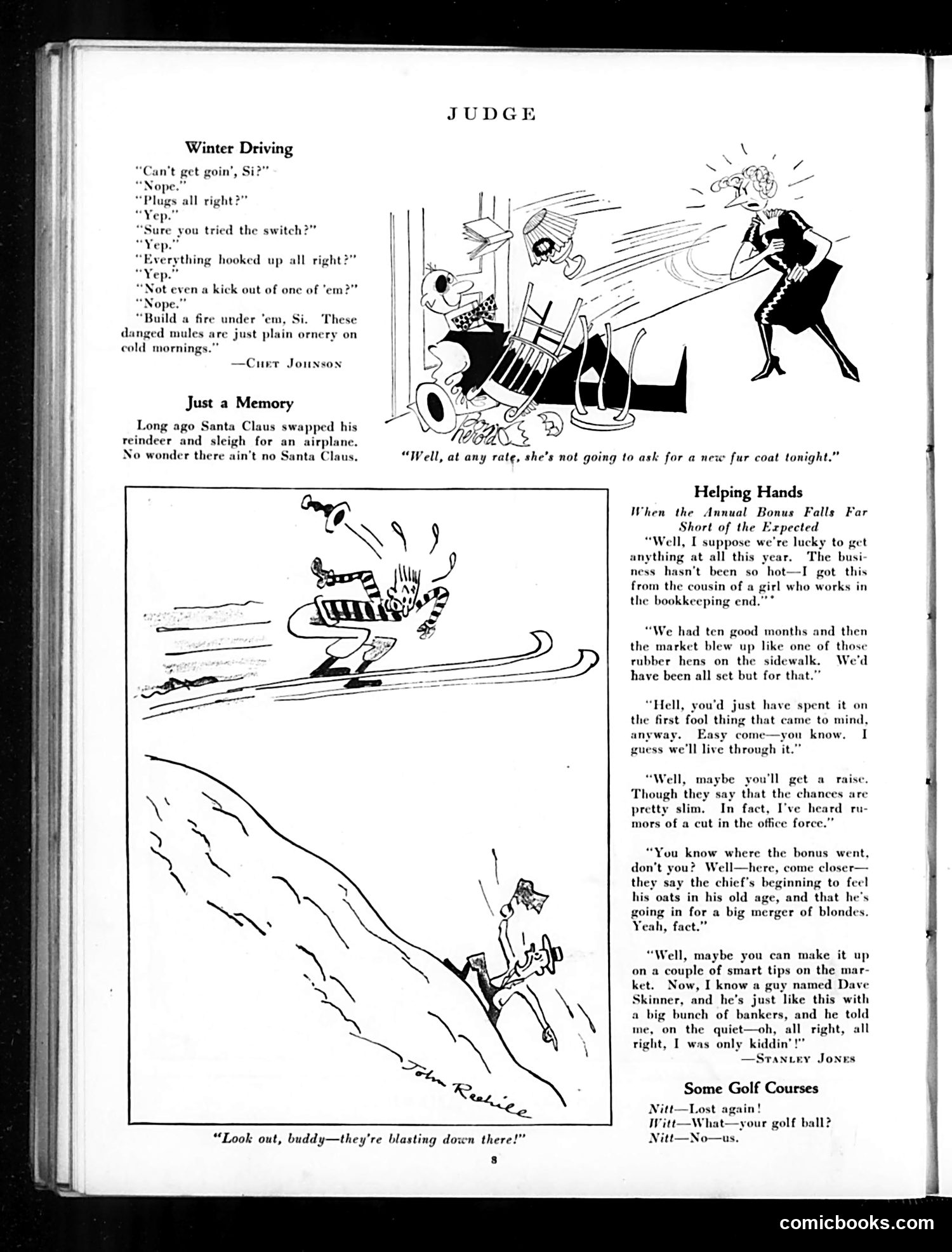
Judge Magazine Page Analysis This page from the satirical magazine *Judge* contains three humorous pieces satirizing early 20th-century American life: "Winter Driving" mocks the unreliability of early automobiles through dialogue between two men trying to start a car. The joke's punchline—that the speaker suggests building a fire under the vehicle and compares it to stubborn mules—suggests cars are no more reliable than animals. This reflects widespread frustration with early automotive technology. "Just a Memory" is a brief joke about Santa Claus abandoning his sleigh for an airplane, lamenting the loss of Christmas magic to modern transportation. "Helping Hands" satirizes corporate culture during economic downturns, depicting employees gossiping about a meager bonus. The humor targets office politics, corporate mismanagement, stock market crashes, and rumored executive infidelity—suggesting workers cope with financial disappointment through workplace rumors and dubious investment tips. The golf jokes at bottom are simple wordplay about losing golf balls and losing at the game itself.
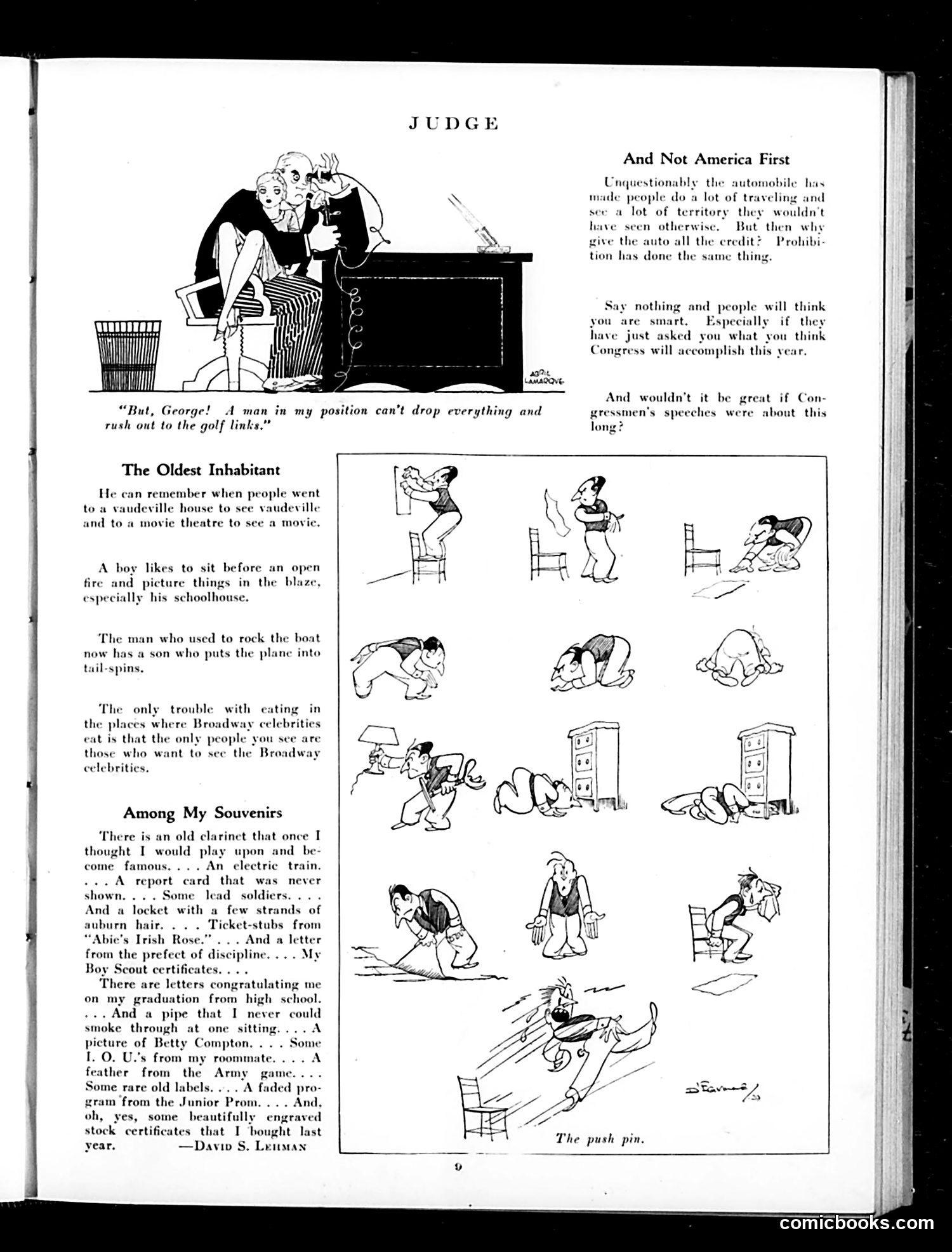
Analysis of Judge Magazine Page This page contains three satirical pieces typical of 1920s-era Judge magazine: "Judge" cartoon (top): A businessman at his desk tells his secretary he cannot leave for golf because of his position's demands—satirizing how professional men use work as excuse while actually wanting leisure time. "The Oldest Inhabitant": Nostalgic commentary on changing entertainment and technology. References vaudeville theaters, movies, and boats being replaced by airplanes doing "tail-spins." The joke: progress and generational change make old pastimes obsolete. "Among My Souvenirs": A humorous list of keepsakes from youth—school certificates, toys, love letters, theater tickets—ending with "beautifully engraved stock certificates I bought last year," satirizing how adults replace sentimental memories with financial investments. The author is David S. Lensman. The "And Not America First" sidebar mocks Prohibition by noting it made Americans travel as much as automobiles (implying people fled to find alcohol), and suggests congressmen should give shorter speeches. All reflect 1920s middle-class American life and values.
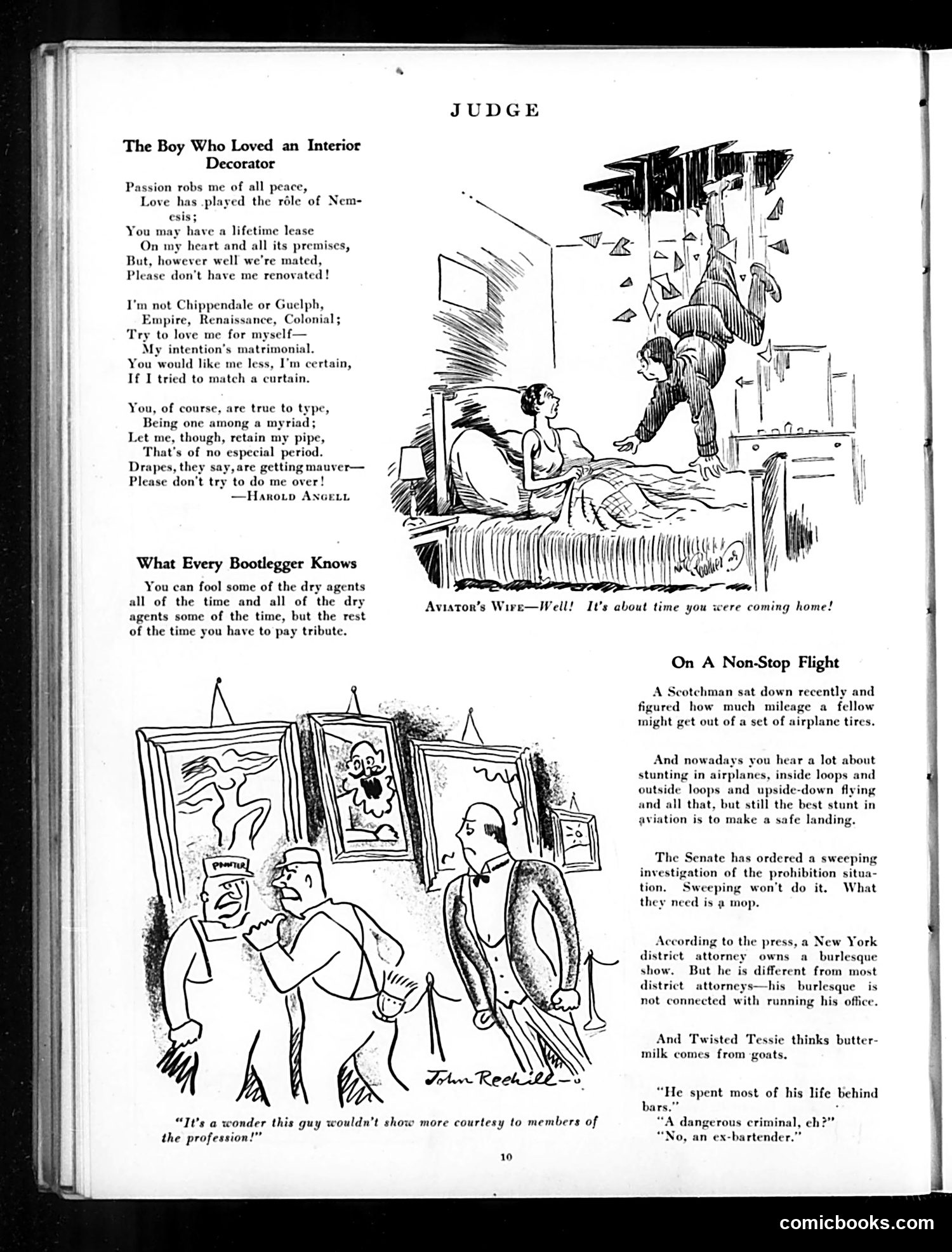
Judge Magazine Page Analysis This page contains several satirical pieces typical of 1920s Judge magazine: "The Boy Who Loved an Interior Decorator" is a humorous poem by Harold Angell about a man resisting his girlfriend's desire to redecorate him—treating romantic love as interior design. The joke is the absurdist comparison of remaking a person to redecorating furniture. "What Every Bootlegger Knows" satirizes Prohibition enforcement, playing on Lincoln's famous quote about fooling people. It jokes that bootleggers can evade some dry agents sometimes, but ultimately must pay bribes—reflecting the widespread corruption during Prohibition. "On A Non-Stop Flight" contains several short jokes about aviation and contemporary politics, including mockery of Senate investigation into Prohibition as ineffectual ("needs a mop, not sweeping"). The cartoon shows men viewing nude artwork, captioned about professional courtesy—likely satirizing art world hypocrisy. These pieces reflect 1920s concerns: romantic relationships, Prohibition's failure and corruption, and early aviation. The tone is lighthearted social commentary typical of the era's satirical magazines.
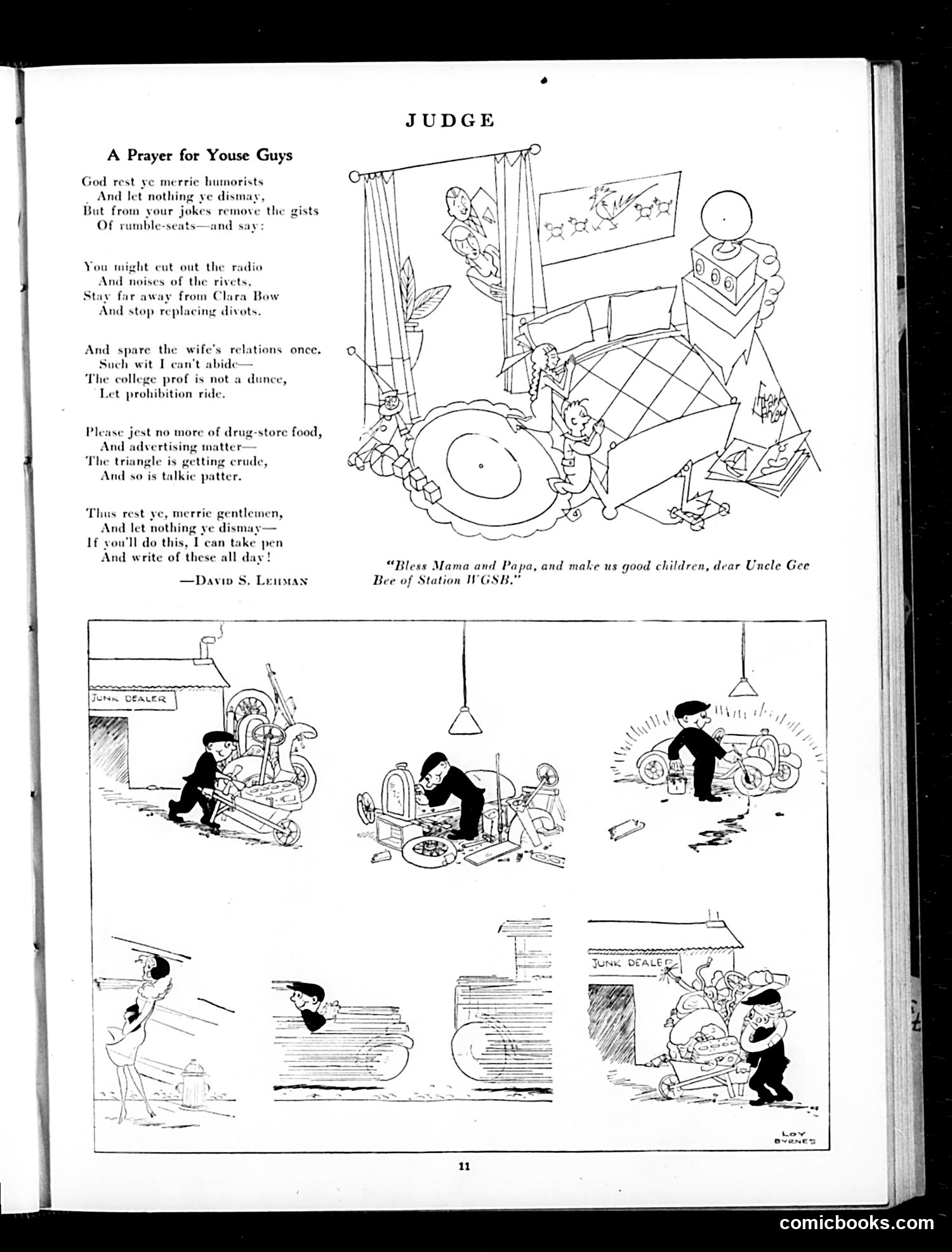
Judge Magazine Page Analysis This page satirizes 1920s American humor and popular culture. The poem "A Prayer for Youse Guys" by David S. Lehman pleads with comedians to retire tired joke subjects: rumble seats (car features), radios, rivets, Clara Bow (silent film star), prohibition, college professors, wives' relatives, drug-store food, and "talkie patter" (early talking pictures). The accompanying comic strip shows boys engaging in mischief—building contraptions, dealing junk, and generally behaving badly—illustrating the "youse guys" audience the prayer addresses. The caption references "Uncle Gee Bee of Station WGSB," a radio personality, parodying children's radio programming prayers. The satire critiques both the exhaustion of 1920s comedy clichés and the emerging mass media (radio, talkies) reshaping entertainment and humor.
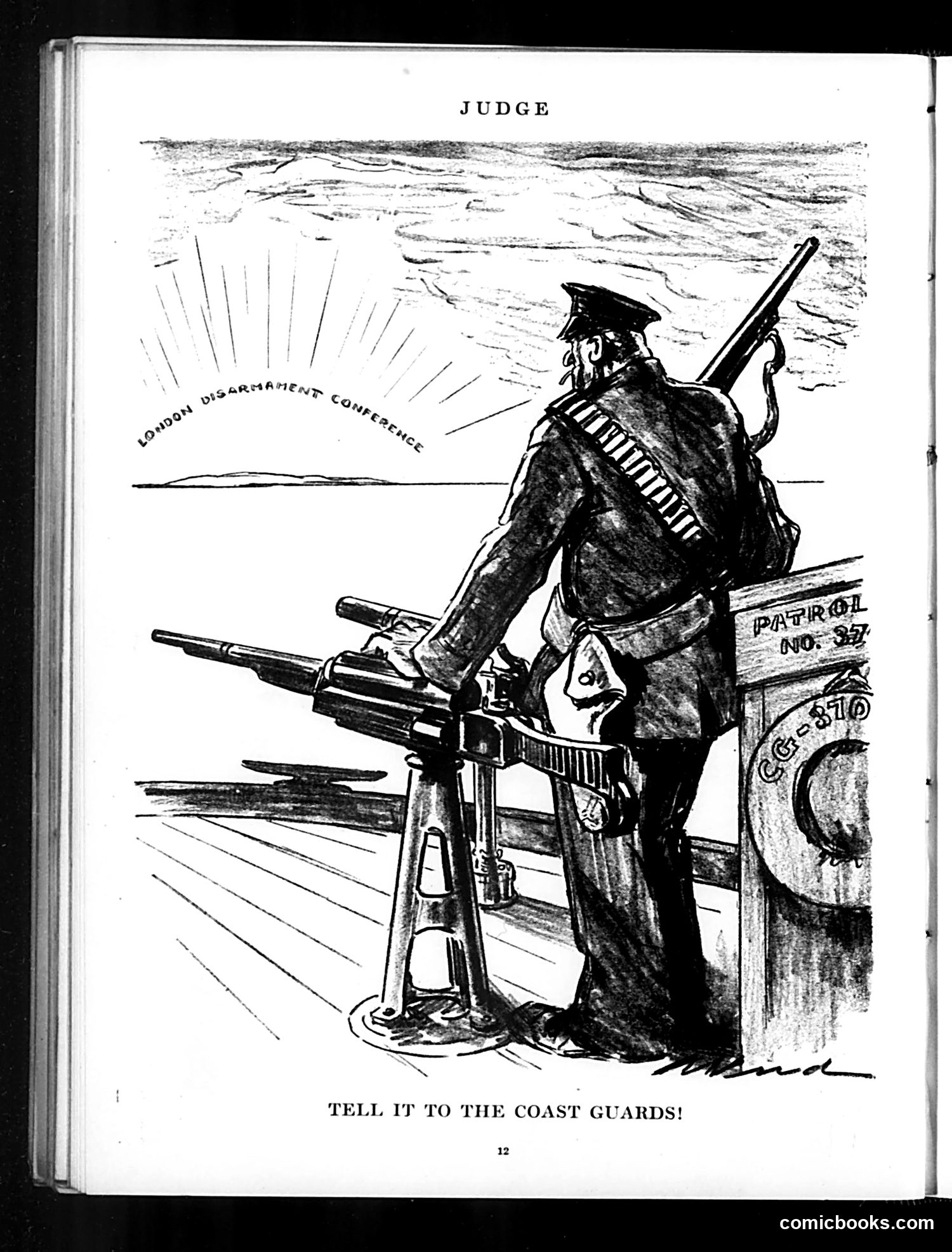
Political Cartoon Analysis: "Judge" Magazine This political cartoon depicts a military figure at a coastal gun emplacement during what appears to be the London Disarmament Conference era. The soldier operates a large naval gun while a sunrise labeled "LONDON DISARMAMENT CONFERENCE" appears in the background. The caption reads "TELL IT TO THE COAST GUARDS!" The satire critiques disarmament efforts: while politicians debated reducing military weapons at international conferences, the cartoon suggests such negotiations were meaningless—the military would continue armed regardless. The figure's casual stance at the gun suggests military preparedness persists despite diplomatic attempts to limit armaments. This reflects early 20th-century skepticism about whether treaties could genuinely reduce military capability or merely represented performative politics.
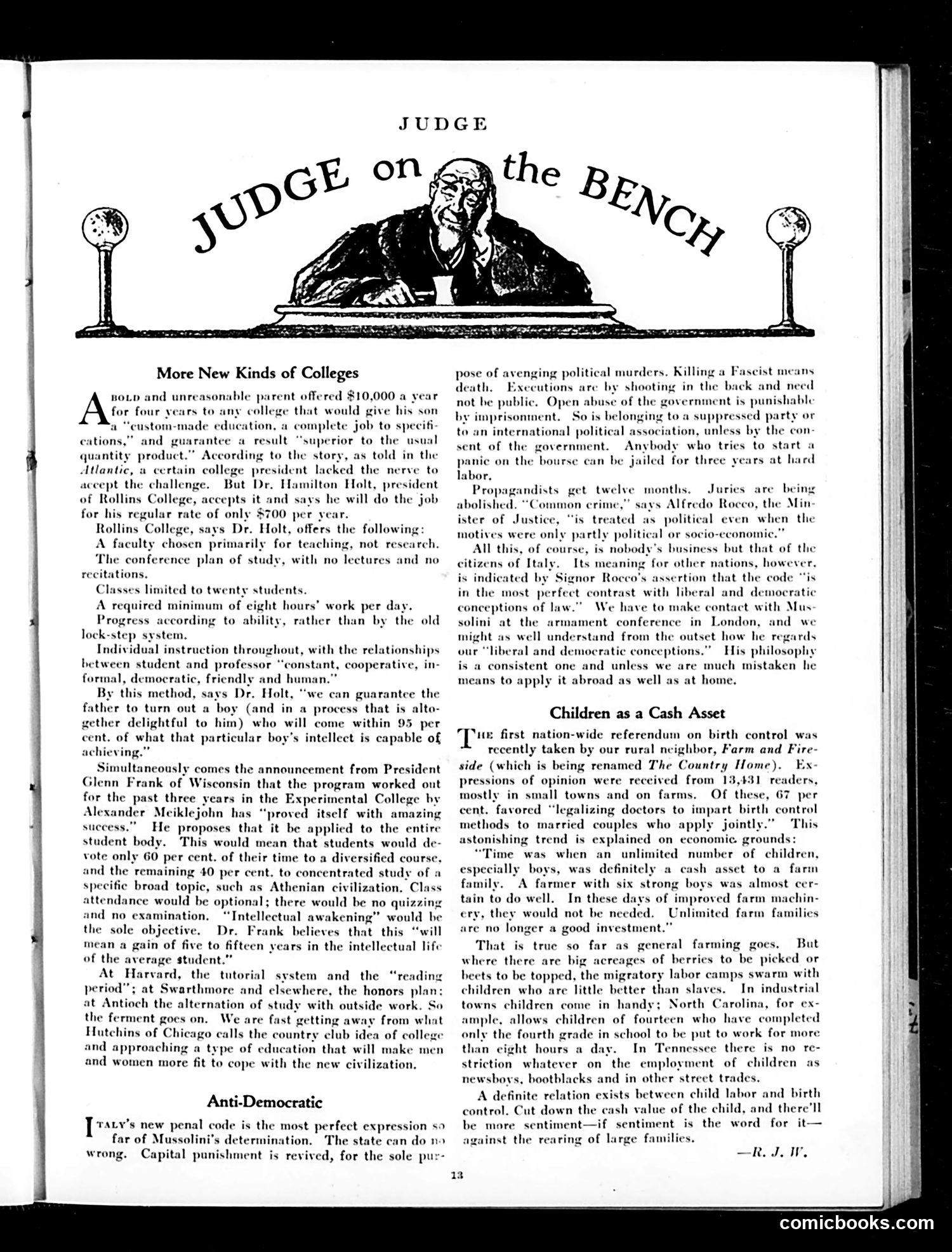
Judge Magazine Page Analysis This page from Judge contains three distinct opinion pieces criticizing contemporary developments: "More New Kinds of Colleges" (top): Satirizes the commercialization of education. Dr. Hamilton Holt of Rollins College has accepted a challenge to provide "custom-made education" for $700/year, guaranteeing results like a manufactured product. The piece mocks this consumerist approach while acknowledging progressive educational experiments at Wisconsin, Harvard, Swarthmore, and Antioch that emphasize smaller classes and individualized instruction. "Children as a Cash Asset": Discusses a rural referendum on birth control, noting farmers viewed large families as economic assets for farm labor. The author argues this economic calculus is changing as mechanization reduces children's labor value. "Anti-Democratic" (bottom): Condemns Mussolini's Italian fascist penal code, which punishes political speech, abolishes juries, and executes political opponents. The writer warns Americans to understand fascism's authoritarian nature before diplomatic engagement in London. The "Judge on the Bench" masthead frames these as editorial commentary from the magazine's perspective.
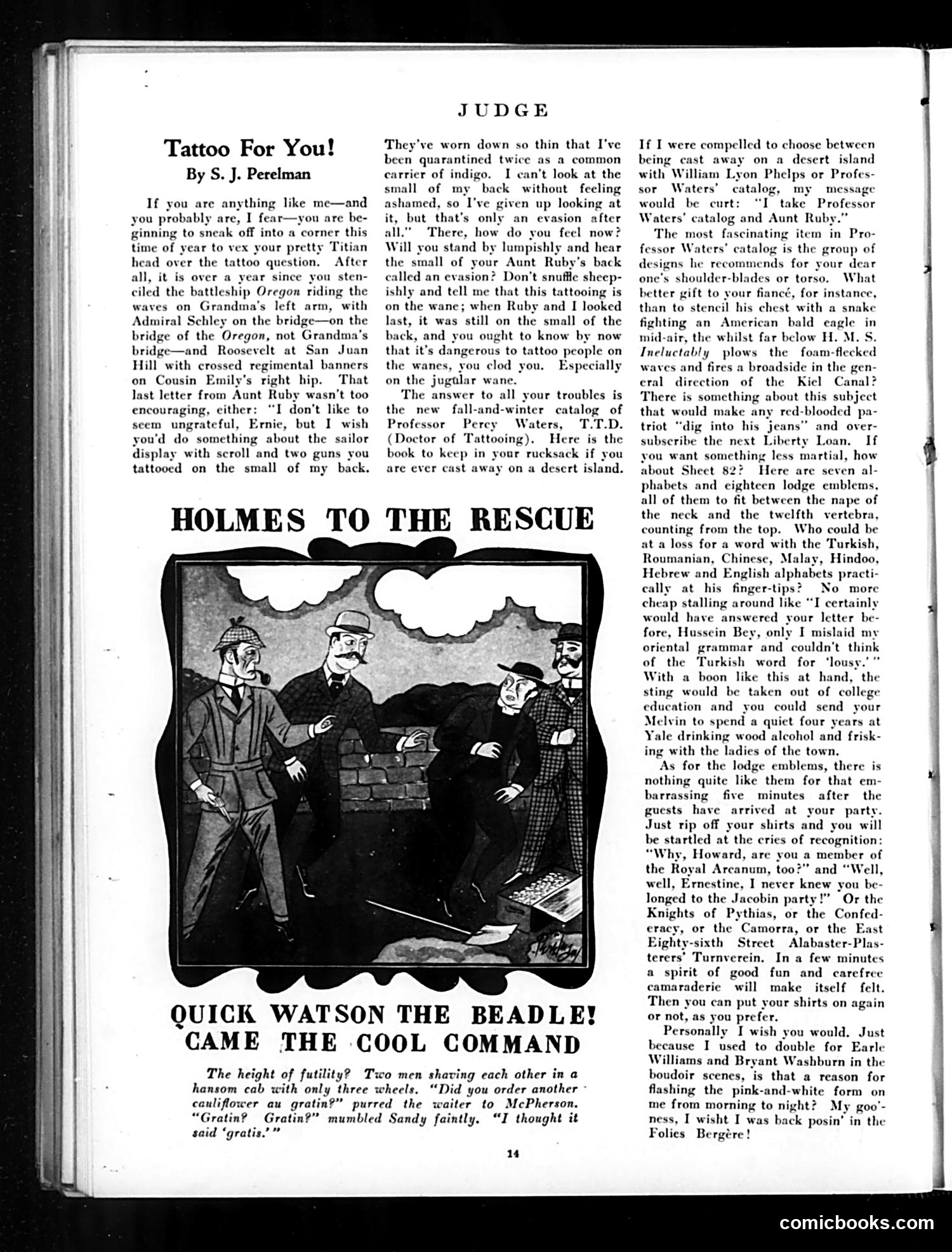
Analysis for Modern Readers This page contains two satirical pieces by S.J. Perelman mocking American cultural obsessions of the era. "Tattoo For You!" humorously critiques the prevalence of patriotic tattoos popular around the Spanish-American War period. Perelman references actual historical figures—Admiral Schley, Roosevelt at San Juan Hill—whose images were common tattoo subjects. He mocks this trend by suggesting absurdly elaborate naval and lodge-emblem tattoos as gifts, sarcastically praising the "educational" value of having multiple alphabets (Turkish, Hebrew, Chinese) tattooed on one's body instead of attending college. "Holmes to the Rescue" is a visual joke (caption below illustration) referencing Sherlock Holmes stories, particularly Watson's role as sidekick. The humor appears to derive from the incongruity of the scene depicted—though the image quality makes the specific joke unclear. Both pieces employ Perelman's characteristic exaggerated, digressive style to mock contemporary fashions and pretensions, assuming readers recognized these cultural references.
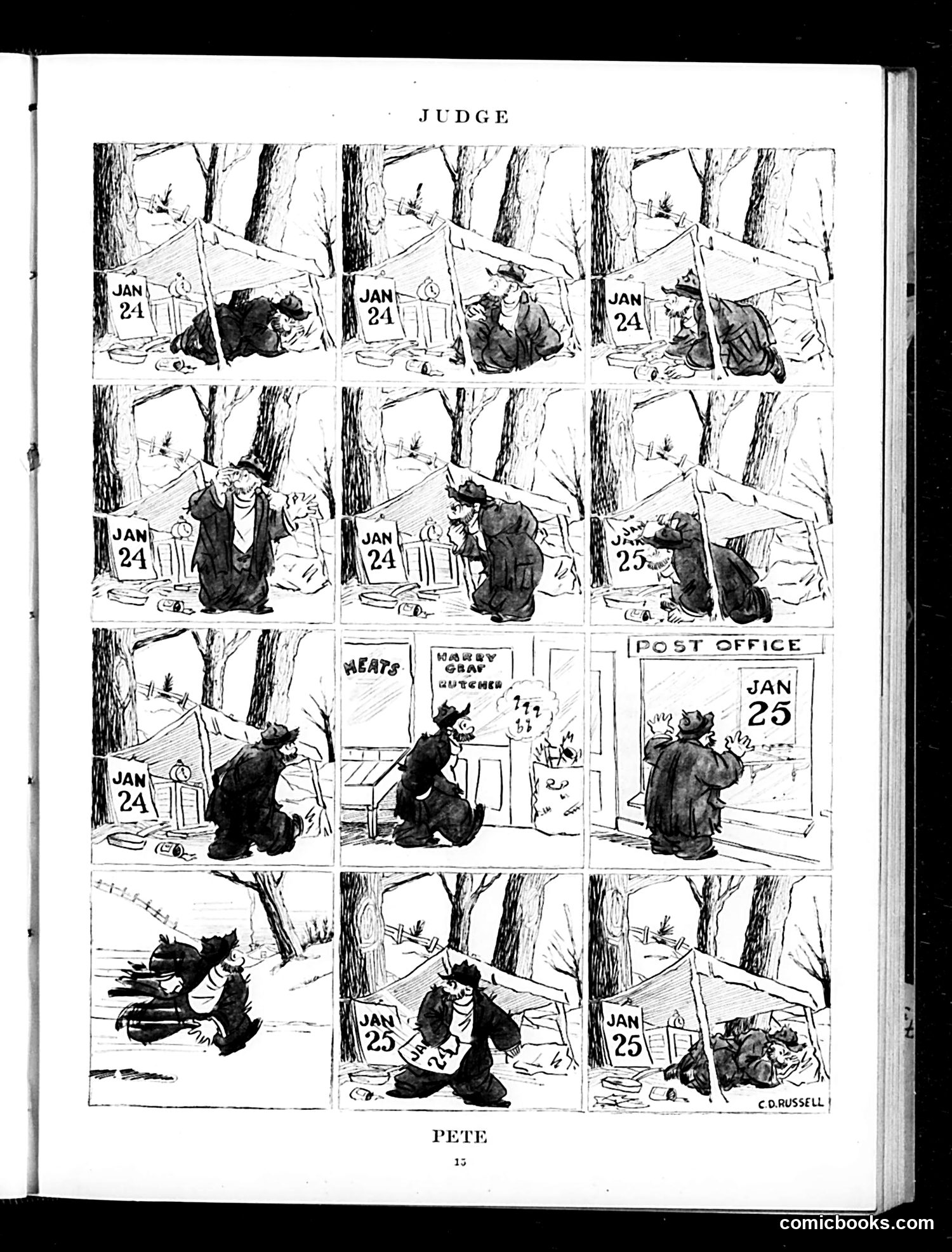
"Pete" - A Homeless Narrative This is a sequential comic strip titled "Pete" by C.D. Russell, tracking a character's circumstances from January 21-25. The narrative appears to depict someone experiencing homelessness or severe poverty during winter. The strip shows Pete sheltering under a tent in snowy woods, gradually moving toward civilization. He passes a "Meats" butcher shop and "Harry Gray, Costumer" (likely a tailor or clothing shop), finally reaching a Post Office on January 25. The exact satirical message is unclear without additional context, but the sequence likely comments on urban poverty, charitable institutions, or social welfare—common subjects for Judge magazine's social satire. The progression from wilderness to civilization may suggest either redemption or the inadequacy of available assistance for the destitute.
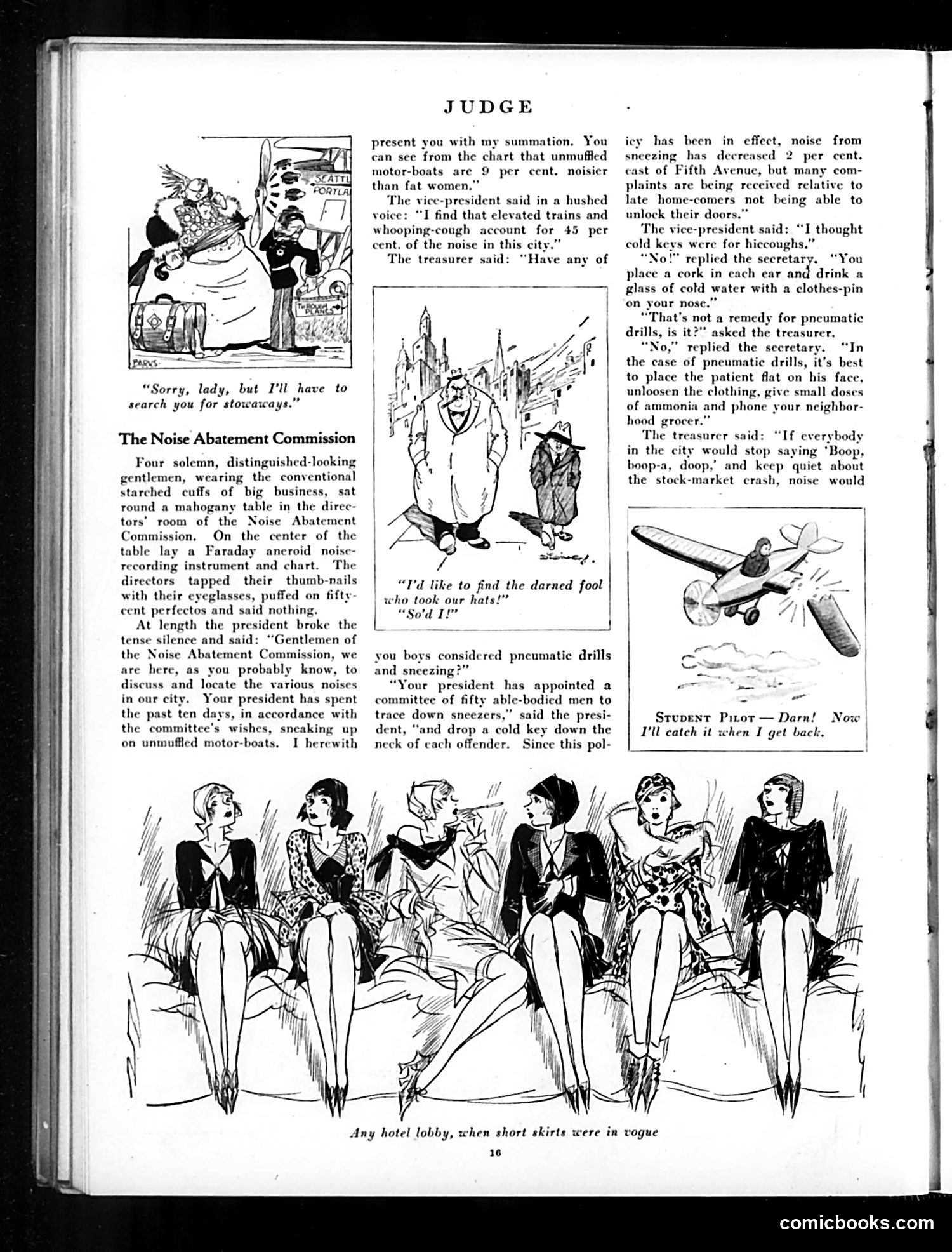
Explanation for Modern Readers This Judge magazine page satirizes the absurdity of a newly formed "Noise Abatement Commission"—a response to genuine urban noise complaints in early 20th-century cities. The main cartoon mocks the commission's serious efforts to quantify and control noise through ridiculous "research": their data claims unmuffled motor-boats are noisier than "fat women," and their proposed solutions are comically impractical (dropping cold keys down sneezers' necks, placing pneumatic drill patients flat on their faces). The satire targets both urban noise pollution—a real problem from trains, cars, and construction—and the era's tendency to form official commissions to address social problems with bureaucratic inefficiency and pseudoscientific methods. The side cartoons provide additional social humor: a "Student Pilot" joke and a reference to "short skirts" fashion, offering period color. The overall message: city noise is real, but the proposed "solutions" reveal how laughably disconnected official bodies can be from practical reality.
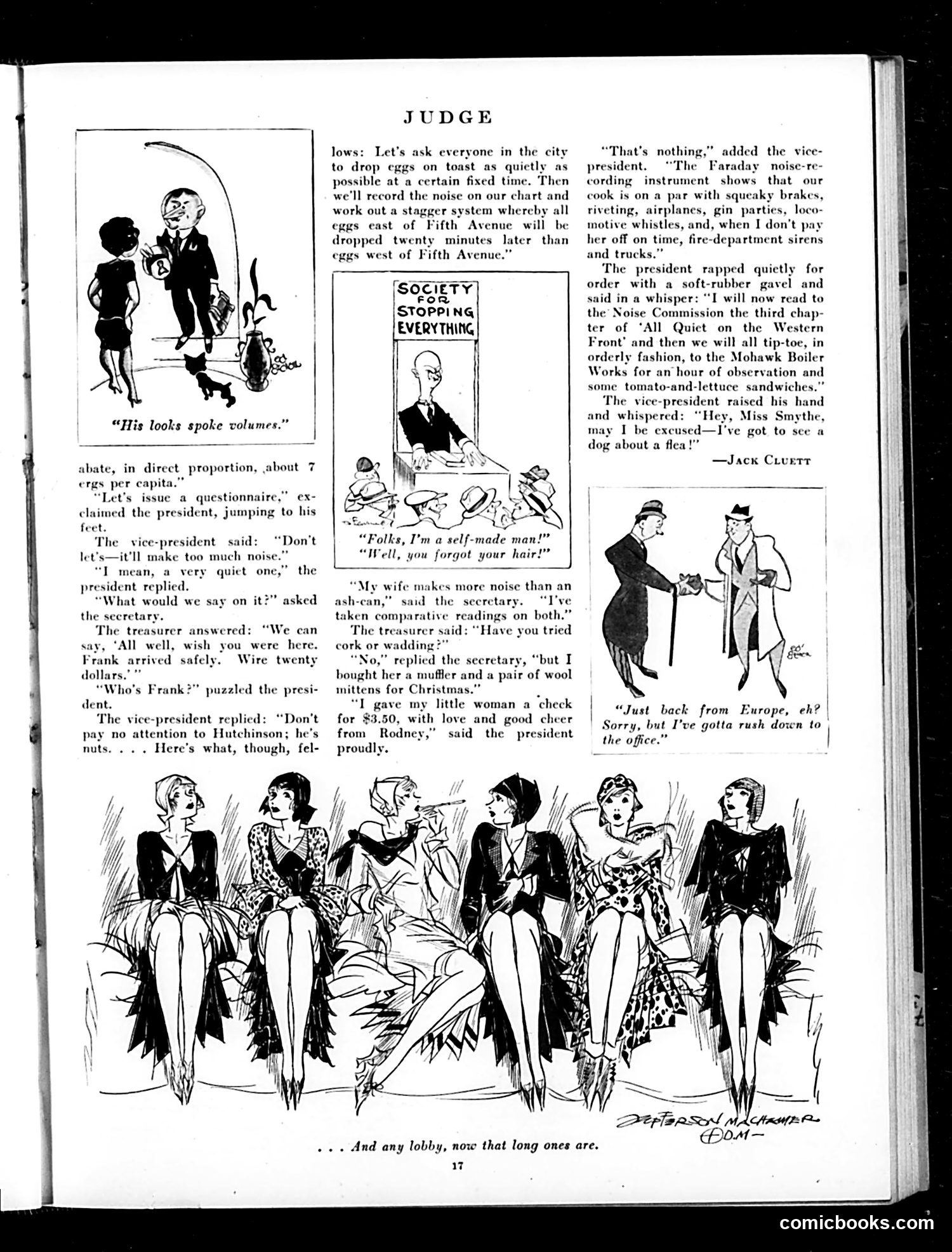
Explanation for Modern Readers This satirical piece mocks noise pollution concerns and municipal bureaucracy in the early 20th century. A group of officials—apparently government administrators—attempts to address urban noise by organizing a coordinated "egg-on-toast" dropping experiment to measure sound levels scientifically. The humor lies in the absurdity: rather than addressing actual noise sources (factories, trains, sirens), they propose a ridiculous citizen-participation scheme with staggered timing across Fifth Avenue. A secondary joke about a woman making excessive noise leads to the punchline about buying her a muffler and wool mittens. References to "All Quiet on the Western Front" (an anti-war novel) and "Mohawk Boiler Works" (industrial noise source) heighten the irony—they're studying noise while ignoring its real causes. The cartoons satirize ineffectual government response to public problems, using slapstick absurdity to critique how officials create elaborate, impractical solutions rather than meaningful reform.
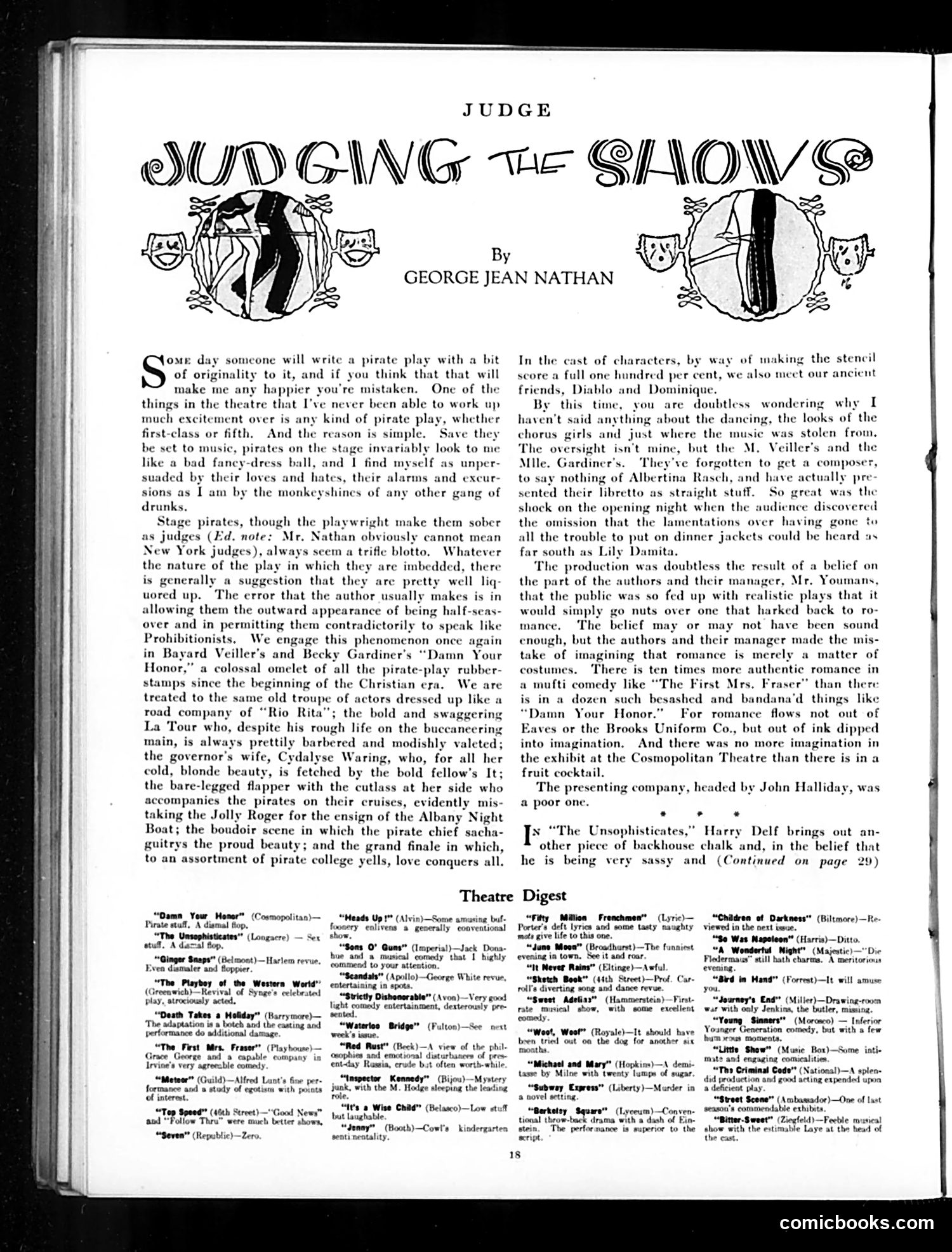
Judge Magazine Satire: "Judging the Shows" This theater review by George Jean Nathan satirizes pirate-themed Broadway plays as formulaic nonsense. Nathan ridicules "Damn Your Honor," a new musical by Bayard Veiller and Becky Gardiner, as merely recycling tired pirate-play clichés: the roguish buccaneer hero, the governor's wife seduced by his charm, the bare-legged female pirate, and romantic finale where "love conquers all." His key complaint: these plays mistake *costumes* for genuine romance. Nathan argues stage pirates invariably appear like "a bad fancy-dress ball"—actors unconvincingly portraying swashbucklers while speaking like Prohibitionists (a topical reference to the era's alcohol ban). He contrasts this with authentic romance found in realistic comedies. The satire mocks both the predictable theatrical formula and audiences' appetite for such tired spectacles.
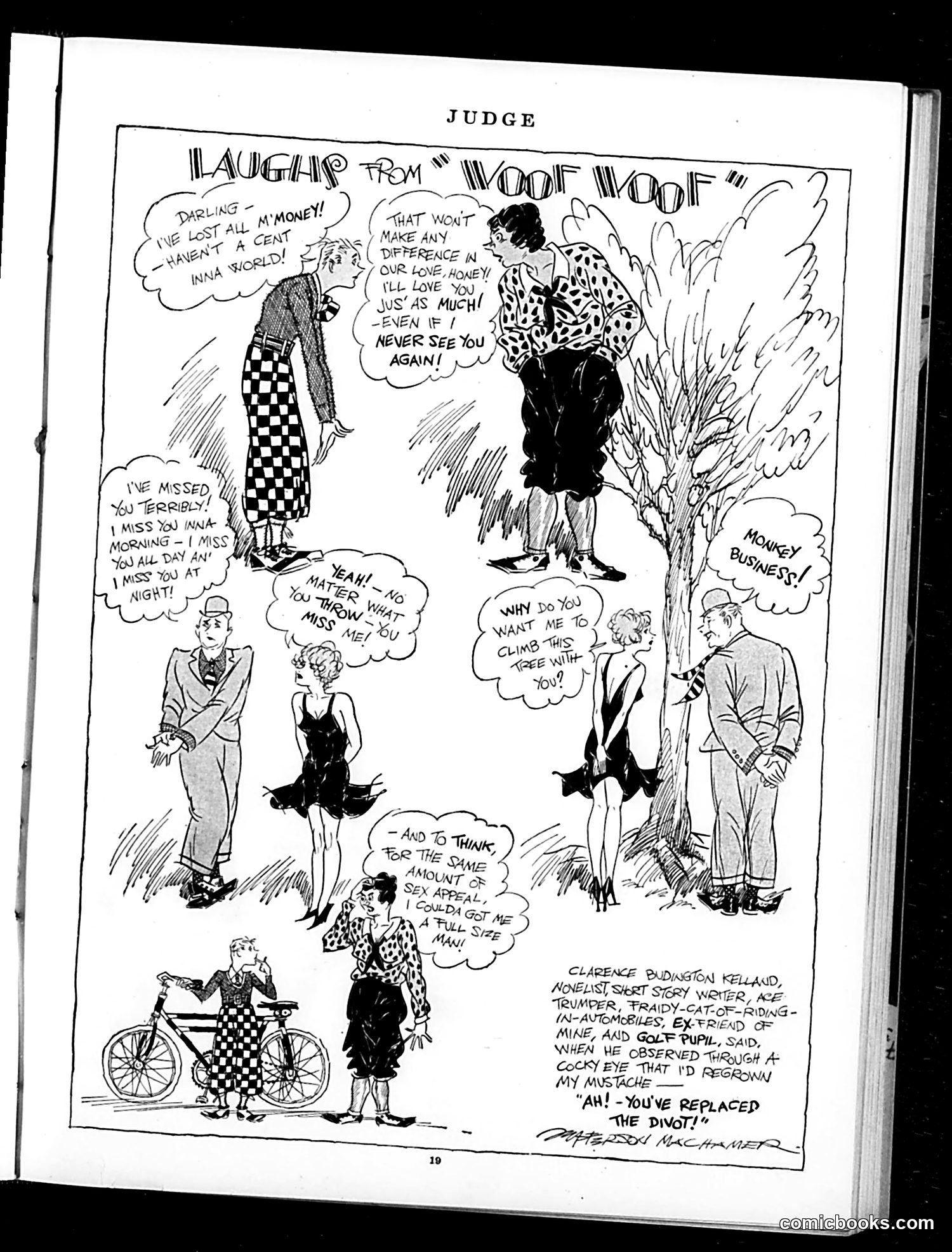
Explanation for Modern Readers This satirical cartoon from *Judge* magazine mocks a wealthy couple experiencing financial hardship. The husband laments losing "all my money" and being "broke," while the wife insists her love remains unchanged—yet their subsequent dialogue reveals shallow materialism undermining the marriage. The satire's target is clear: the wife's affection proves conditional on wealth. She asks him to "climb this tree," suggests he engage in "monkey business," and ultimately thanks him for the "amount of sex appeal" he could offer as compensation for lost riches. The final panel's caption—about Clarence Budington Kelland (a contemporary popular writer)—suggests this represents typical behavior among the wealthy elite during an era of economic instability (likely post-1920s). The joke: when money disappears, so does romance. The wife has literally "replaced the divot" (golf terminology for restoration)—replacing her husband's romantic value with crude transactionalism. It's social commentary on materialistic marriage and class pretension.
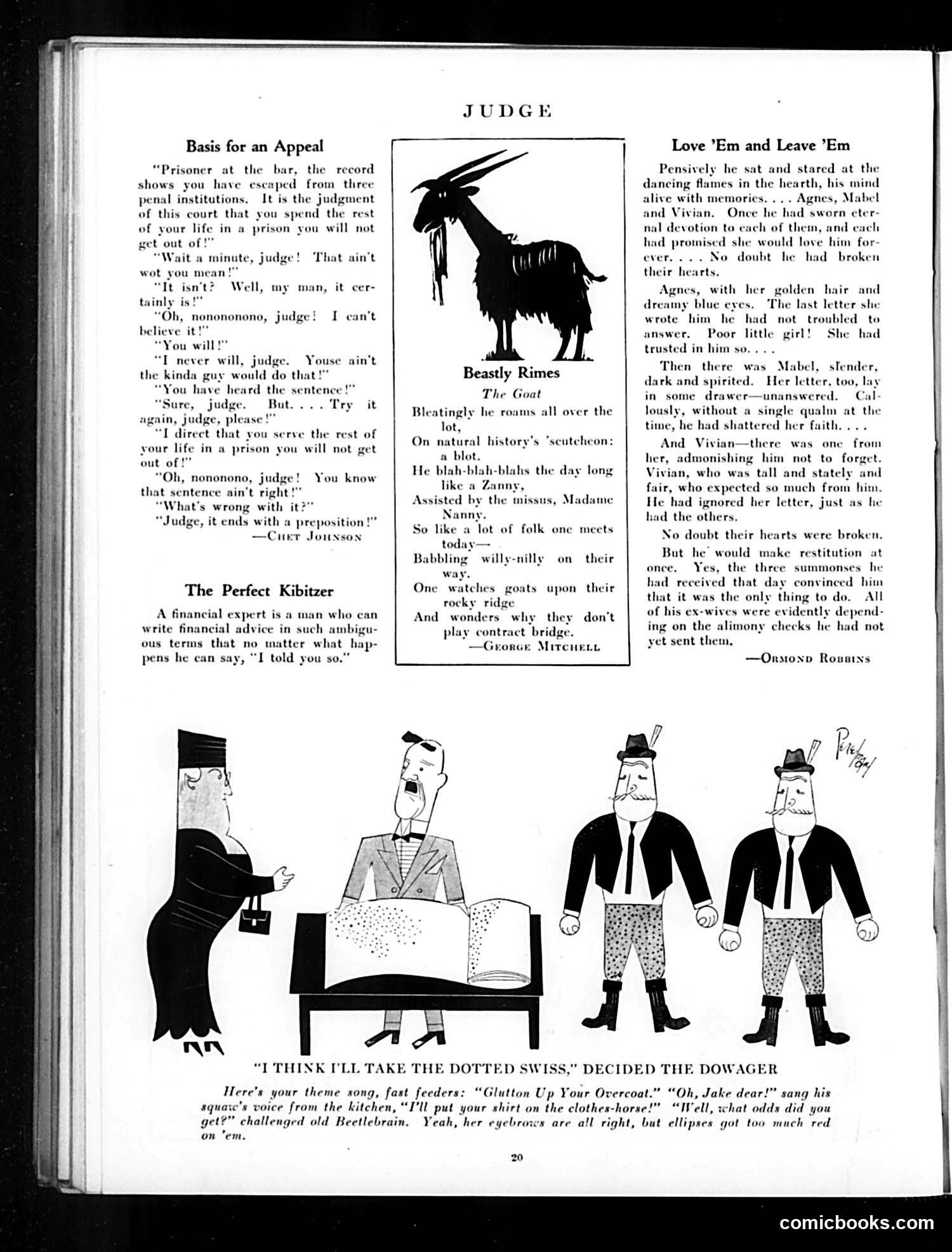
Analysis of Judge Magazine Page "Basis for an Appeal" satirizes a prisoner's grammar pedantry. A man sentenced to life imprisonment objects not to the sentence itself, but to the judge's use of a preposition at the sentence's end—a violation of prescriptive grammar rules. The joke mocks both the prisoner's misplaced priorities and, implicitly, rigid adherence to grammatical rules over substance. "The Perfect Kibitzer" defines a financial expert as someone whose vague advice allows him to claim prescience regardless of outcomes. This targets financial advisors' tendency to use ambiguous language as cover for poor predictions. The bottom cartoon depicts a dowager selecting fabric ("dotted swiss"), with accompanying domestic banter about laundry and appearance. The humor appears to center on upper-class marital dynamics and the woman's vanity about her eyebrows. "Love 'Em and Leave 'Em" presents a man who abandoned three women (Agnes, Mabel, Vivian) emotionally, only to face legal consequences: the three summonses are alimony demands. He'll finally "make restitution"—not from conscience, but from legal obligation.
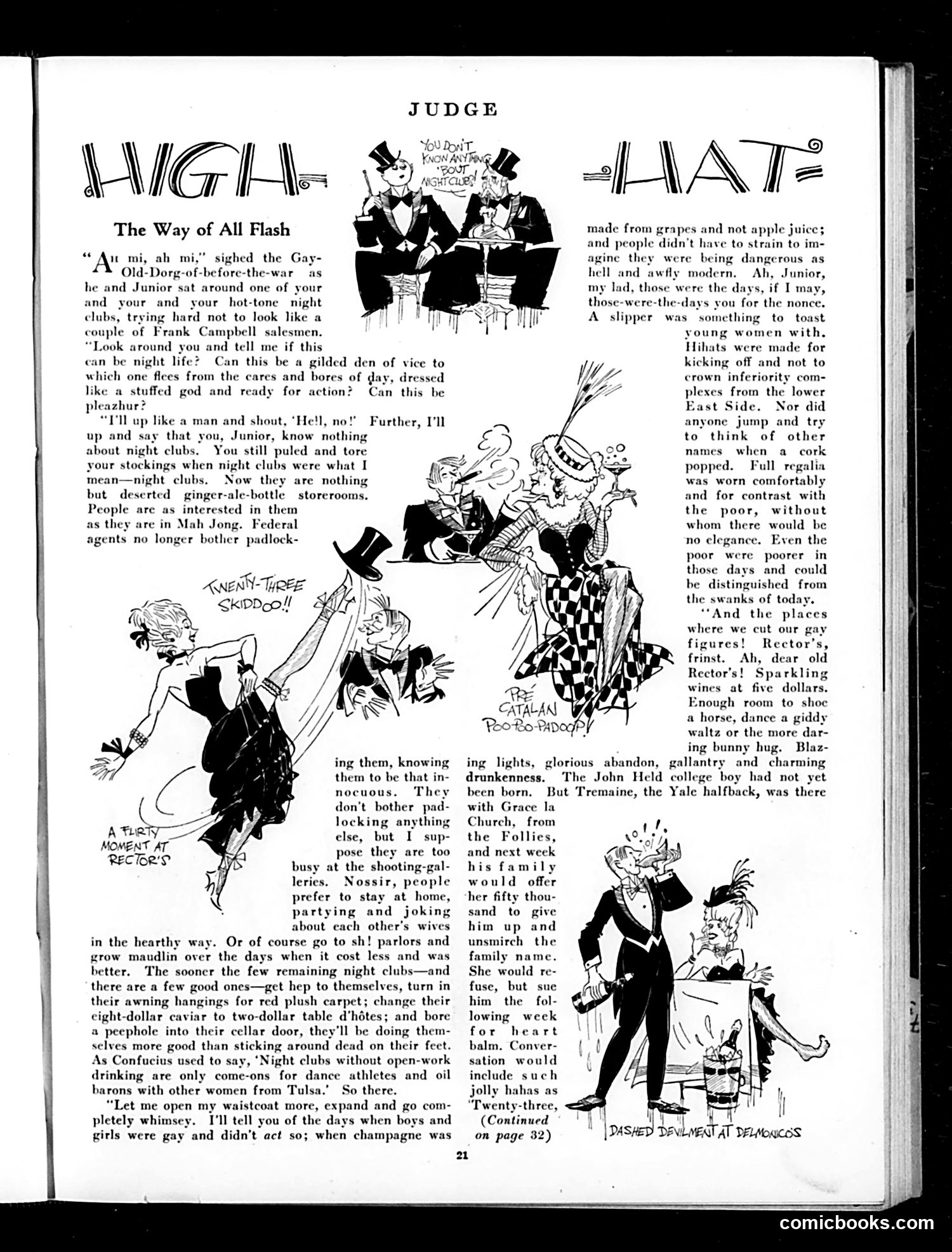
Analysis of Judge Magazine Page: "The Way of All Flash" This satirical piece mocks Prohibition-era night clubs through a nostalgic elder's complaint to "Junior." The author contrasts the glamorous pre-Prohibition nightlife (referencing famous venues like Rector's) with the degraded present—where clubs have become mere "ginger-ale-bottle storerooms" serving non-alcoholic drinks. The satire targets multiple subjects: speakeasies disguised as legitimate establishments (with "peepholes into their cellar door"), the federal agents ("Nennin-Three Skidoo") enforcing Prohibition, and working-class patrons ("oil barons...from Tulsa") trying unsuccessfully to seem sophisticated. References to 1920s social figures like "the Yale halfback" Tremaine and "Grace la Church" from the Follies ground the nostalgia in that era's celebrity culture. The cartoons illustrate the "artificial" gaiety—stiff, forced fun replacing genuine elegance. Essentially, Judge ridicules how Prohibition destroyed authentic nightclub culture, leaving only pretentious fakery where real vice once thrived openly.
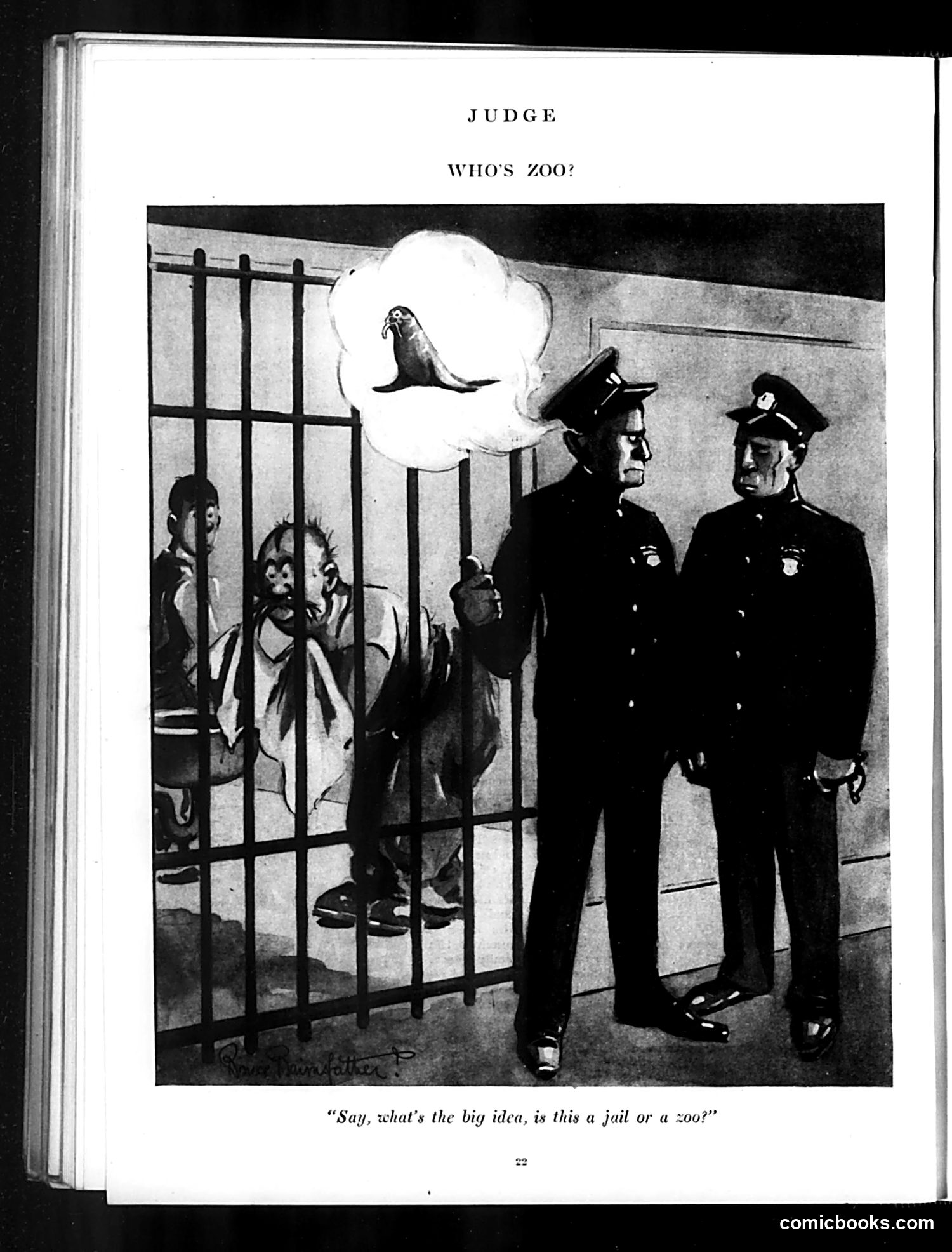
"Who's Zoo?" - Judge Magazine Cartoon This single-panel cartoon presents a visual pun on the title "Who's Zoo?" Two uniformed guards stand before a jail cell containing what appears to be a disheveled prisoner. Above them floats a thought bubble depicting a seal or sea lion—an animal you'd see at a zoo. The joke conflates jails with zoos through the guard's confused question: "Say, what's the big idea, is this a jail or a zoo?" The cartoon suggests that prisoners are treated like animals in cages, or conversely, that jails resemble zoos in their confinement of living creatures. This is likely social satire criticizing prison conditions of the era, equating incarceration with the dehumanizing display of animals.
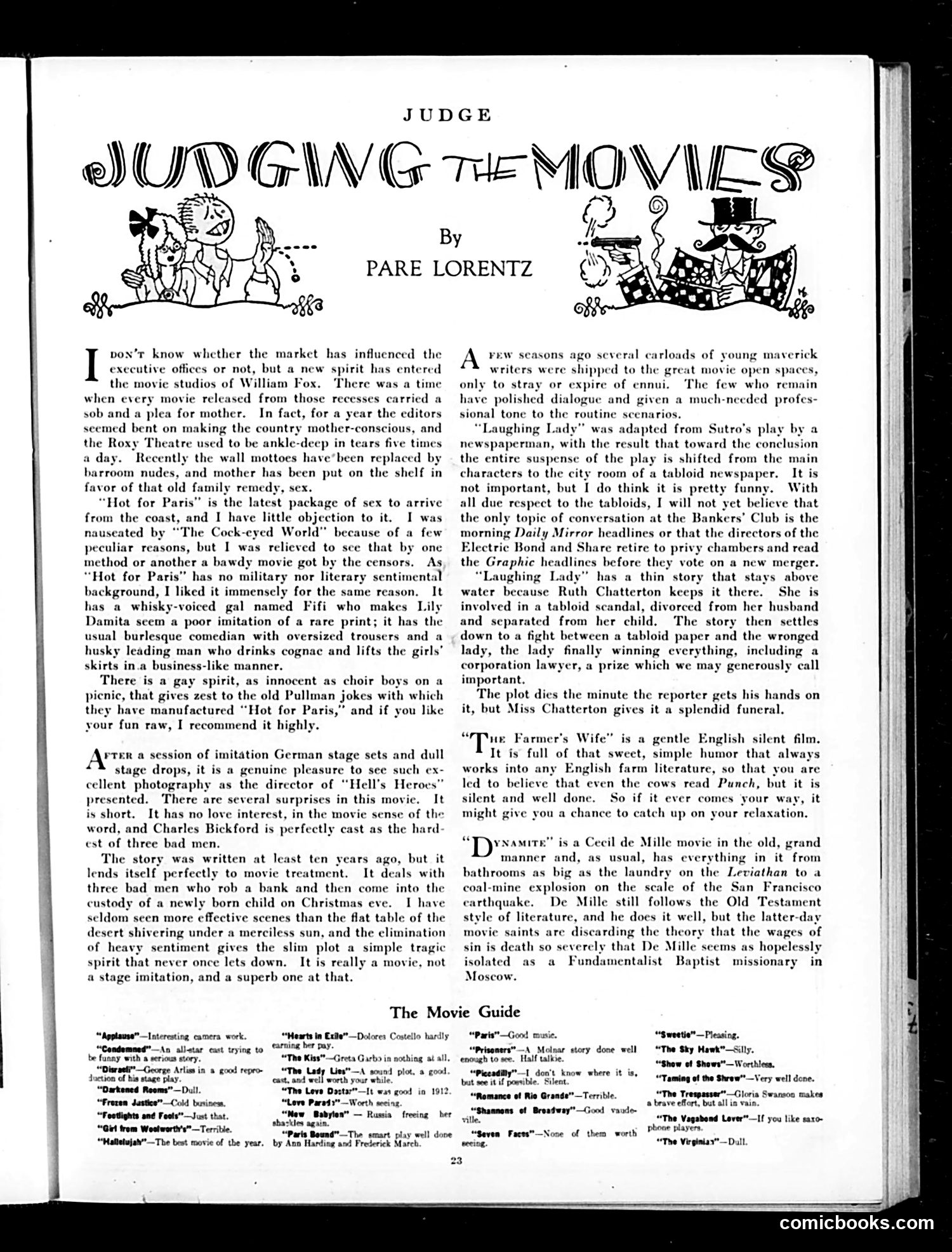
"Judging the Movies" by Pare Lorentz This is a film criticism column reviewing contemporary movies. The cartoons (showing theatrical figures) are decorative headers typical of Judge magazine's satirical style. Lorentz critiques recent films with sharp social commentary. He notes that William Fox studio films shifted from sentimentalizing motherhood to emphasizing sex—a commentary on changing Hollywood values and what audiences would accept. He reviews "Hot for Paris" (dismissing it as raw but harmless fun), "Hell's Heroes" (praising its photography and emotional restraint), and "Laughing Lady" (criticizing how a newspaper subplot undermines the plot, while also gently mocking tabloid journalism culture—suggesting that bankers' clubs and corporate boardrooms discuss newspaper headlines before major decisions). The underlying satire critiques both Hollywood's shameless pivot to sex and the absurd prominence of sensationalist newspapers in American life.
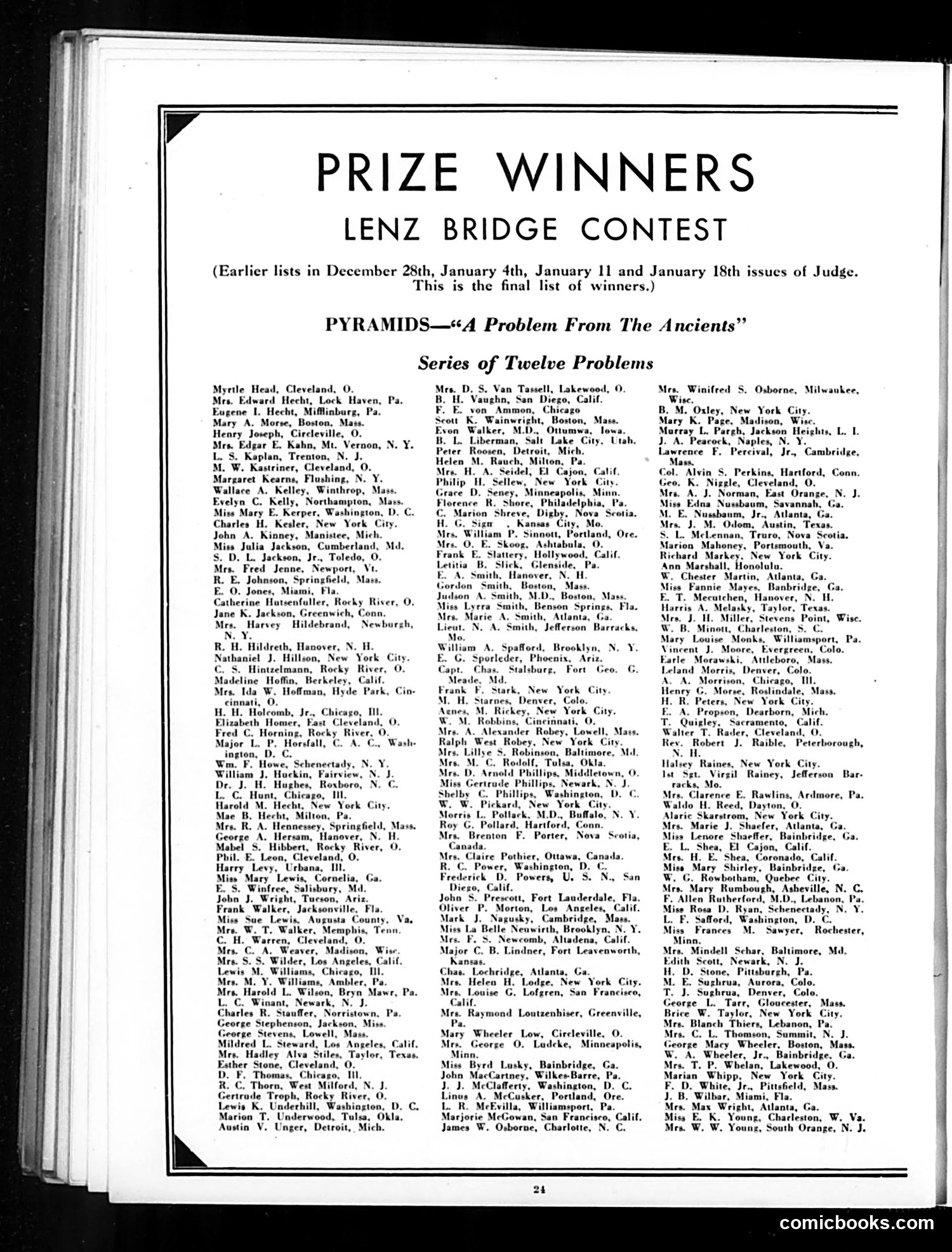
This page is a prize-winners list, not a cartoon. It announces the final results of the "Lenz Bridge Contest" run by *Judge* magazine—a puzzle competition titled "A Problem From The Ancients" (the Pyramids series), consisting of twelve problems. The page lists hundreds of names of winners from across the United States and Canada, organized alphabetically by last name. Each entry includes the winner's city and state. There is no satirical content or cartoon imagery visible here. This is purely administrative—a publication of contest results to acknowledge participants and likely boost the magazine's credibility and reader engagement. Such contests were common promotional tools for magazines in this era, encouraging reader participation and loyalty. The multiple earlier announcements (referenced in smaller text at the top) suggest the contest was popular enough to warrant phased result publications across several issues.
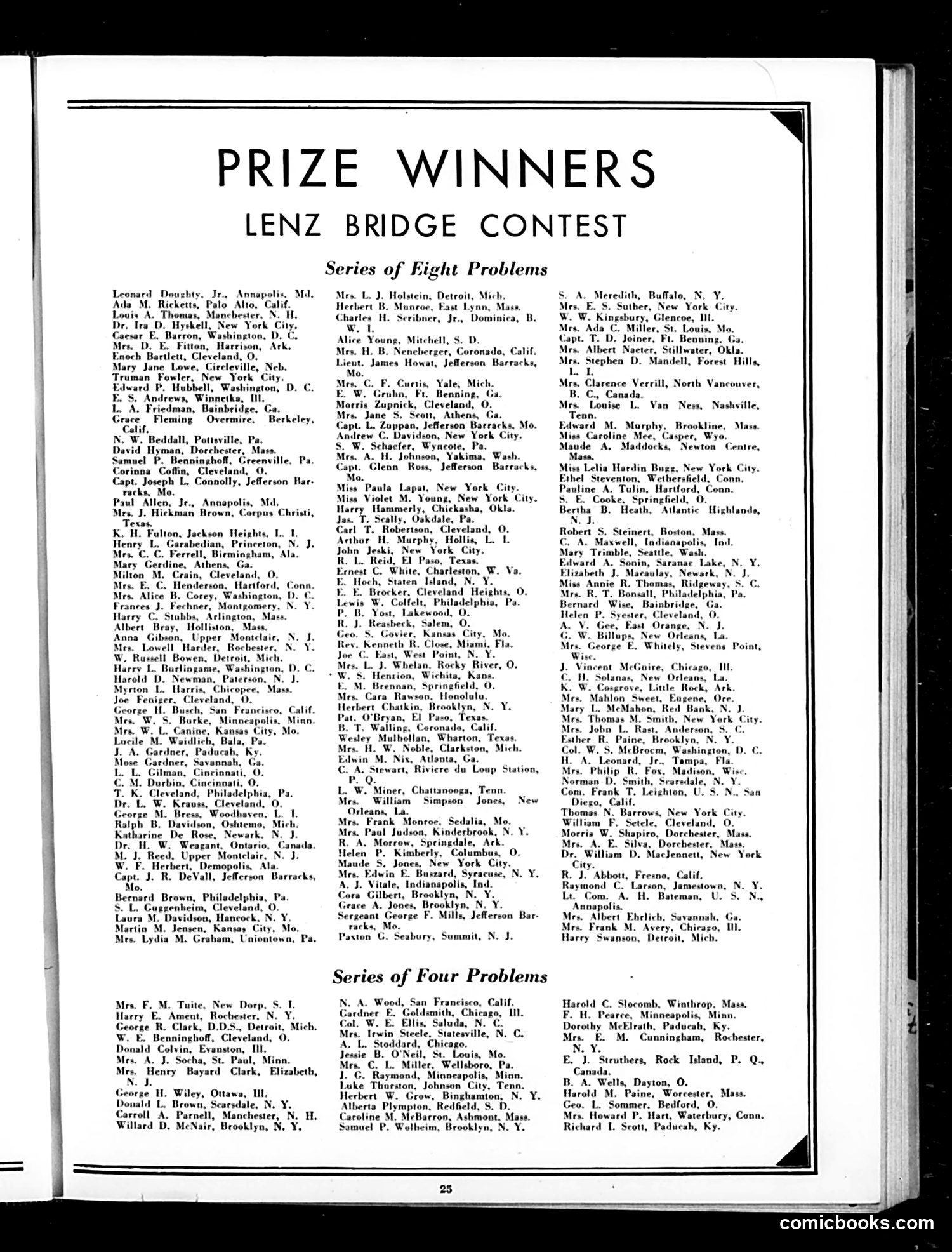
Prize Winners for the Lenz Bridge Contest This page is not a cartoon or satire — it's a straightforward list of contest winners from Judge magazine's "Lenz Bridge Contest," organized by difficulty level (Eight Problems and Four Problems series). The "Lenz Bridge" refers to a chess problem composition contest, not a physical structure. Bridge problems were popular puzzle competitions in early 20th-century publications. The names listed are amateur solvers from across the United States (and Canada) who successfully solved the chess puzzles. Judge magazine regularly hosted such contests as reader engagement features. Winners are identified by name and hometown, suggesting this was a prestigious accomplishment within the puzzle-solving community. The geographic spread reflects the magazine's national circulation. This is essentially a results announcement, similar to modern contest winner lists — no satire or political commentary intended.
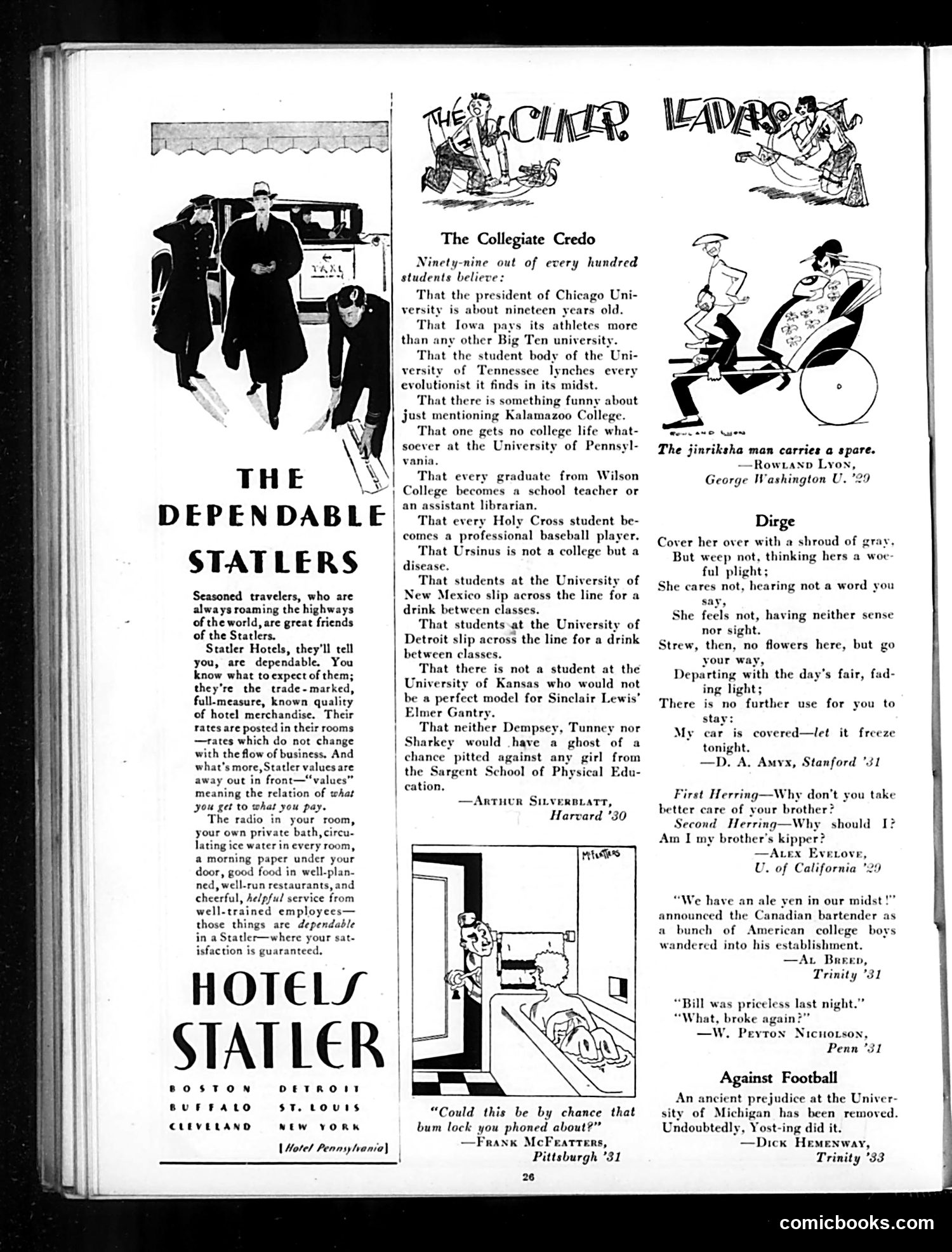
This page from *Judge* magazine is primarily advertising and collegiate humor, not political satire. The left side features a Statler Hotels advertisement promoting their reliability and amenities to traveling businessmen and students. The right side contains "The Collegiate Credo"—satirical observations about stereotypes and misconceptions college students hold about various universities. Examples mock beliefs like: the University of Tennessee students "lynch" evolutionists, Kalamazoo College is inherently funny, University of Pennsylvania offers no social life, and Wilson College graduates become librarians. This reflects 1920s-30s collegiate culture and regional college stereotypes. Below are brief humor submissions from students at different universities, mostly playing on wordplay ("kipper" for brother, "ale yen" pun, "Yost-ing" referencing Michigan's coach). The cartoon illustrations are generic collegiate scenes—bathing, socializing, dating. The satire targets college folklore and exaggeration rather than politics, capturing how students perpetuated myths about rival institutions and each other's schools.
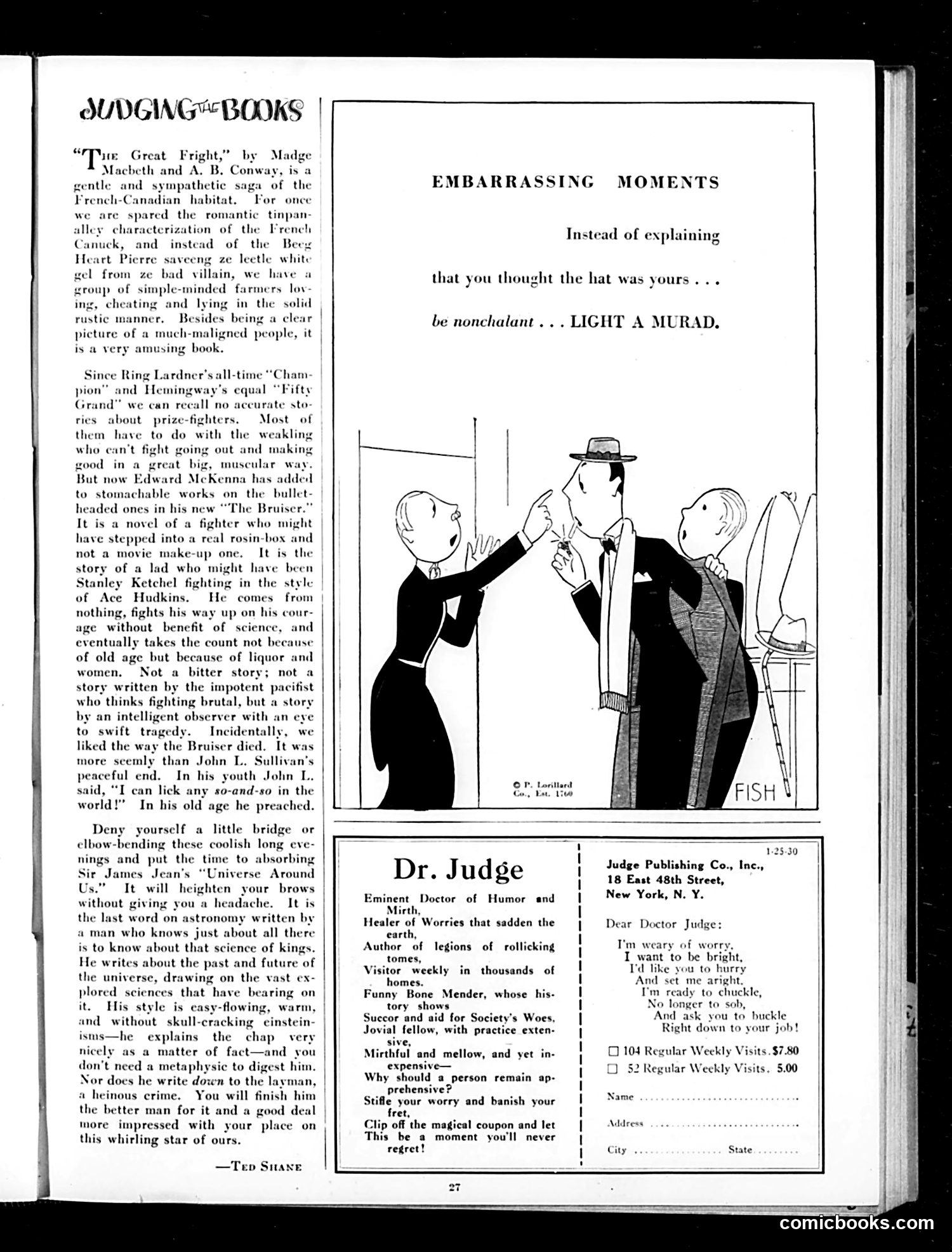
Explanation for Modern Readers This page contains a book review section and an advertisement disguised as humor. The Cartoon: Shows a man awkwardly trying to claim a hat that another man is wearing, while onlookers watch. The caption suggests lighting a Murad cigarette to seem nonchalant in embarrassing social situations. This is a straightforward advertisement for Murad cigarettes, using humor to sell the product by implying smoking conveys confidence and sophistication. The "Dr. Judge" Section: This is an advertisement for Judge magazine subscriptions, personifying the publication as a "Doctor" who heals worry and provides humor. Readers could clip a coupon and subscribe to weekly visits (issues) for either $7.80 or $5.00, depending on frequency. The Book Reviews (left column): Ted Shank reviews recent novels about boxing and scientific works, typical of 1920s-30s literary criticism. The page blends editorial content with advertising in a style common to early 20th-century magazines, where ads were often designed to entertain rather than simply inform.
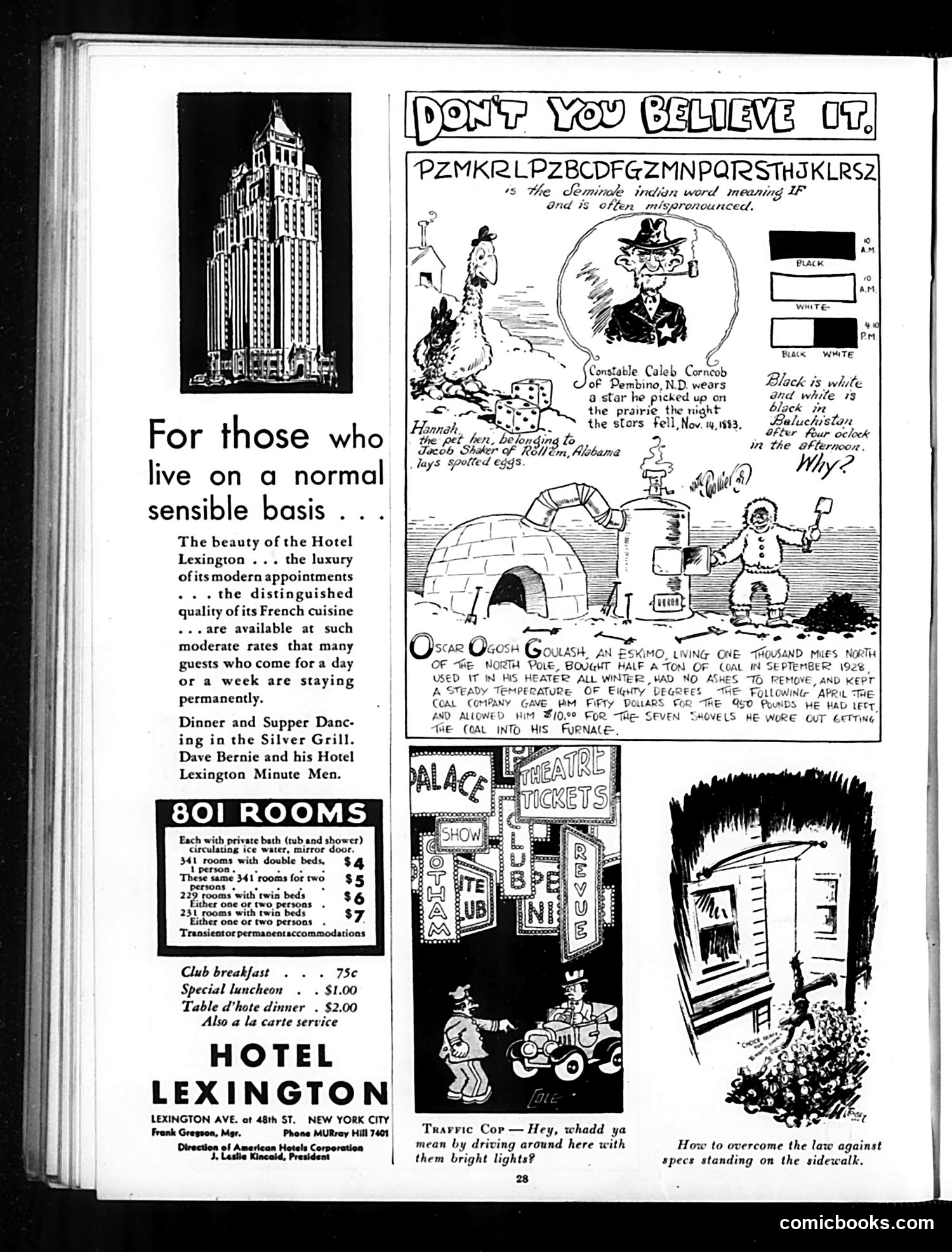
Judge Magazine Page Analysis This page mixes Hotel Lexington advertising with satirical cartoons typical of Judge magazine's humor. The main cartoons present absurdist "facts": 1. Top cartoon: Claims an incomprehensible Seminole word means "IF" and is often mispronounced. Features Constable Caleb Corncob of Pembina, North Dakota, who found a star on the prairie in 1883—nonsensical tall-tale humor. 2. Middle cartoon: An Eskimo named Ogus Ogosh supposedly bought half a ton of coal in September 1928, used it all winter with no ash removal, then received $50 and $10.50 compensation—absurd accounting humor. 3. Bottom cartoons: Brief gags about traffic cops and jaywalkers—everyday urban nuisances. The page satirizes gullibility and belief in unlikely stories ("Don't You Believe It" is the header), mocking readers who accept dubious claims. The cartoons use invented characters and implausible scenarios as jokes, reflecting 1920s-30s comic conventions valuing punchline-driven absurdism over political commentary.
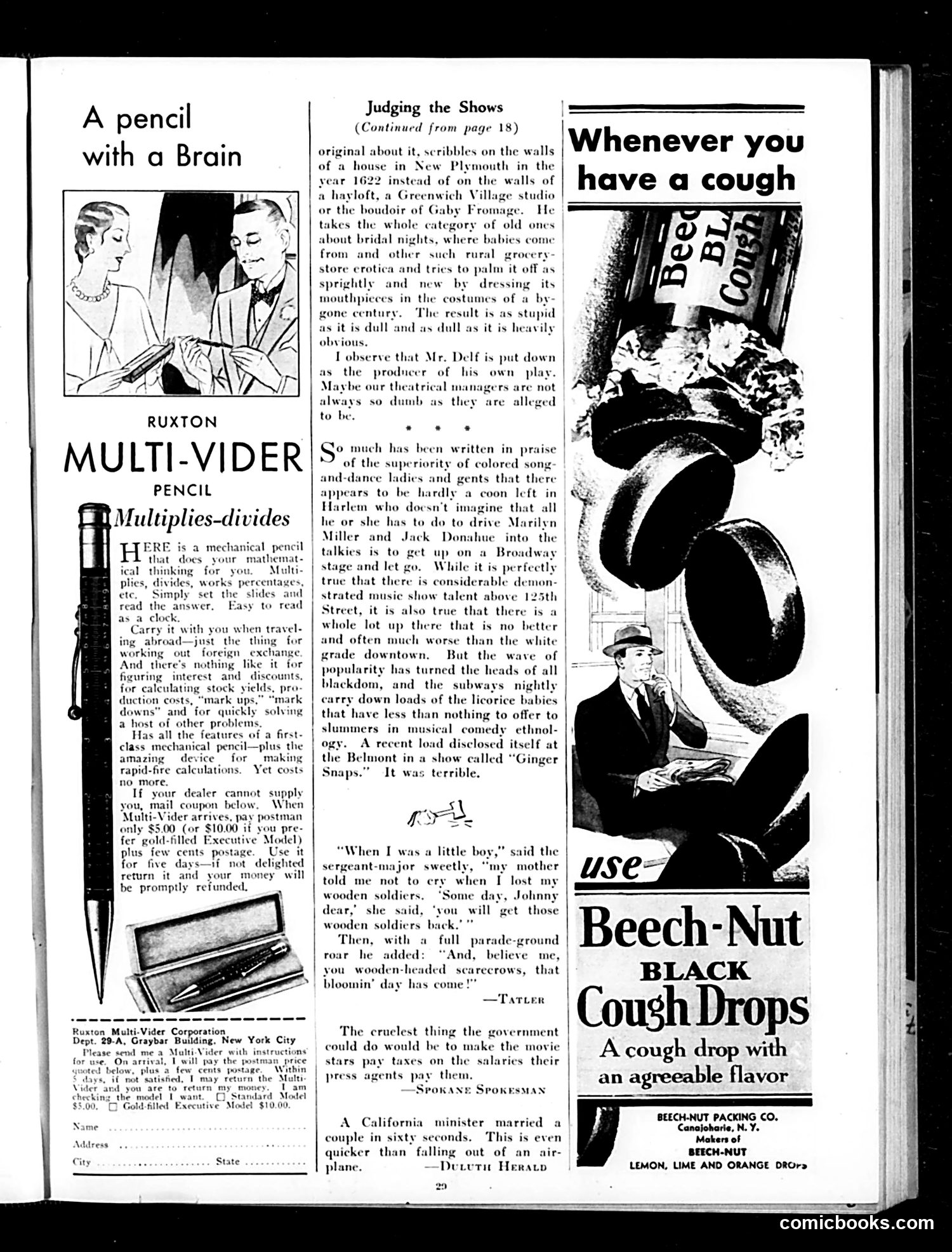
Analysis of Judge Magazine Page This page contains mixed content: a product advertisement (Ruxton Multi-Vider Pencil), theater criticism, and a Beech-Nut cough drops advertisement. "A Pencil with a Brain" advertises a mechanical calculating pencil—a slide-rule device for performing mathematical operations. The cartoon shows a couple examining it, likely appealing to professionals and travelers needing quick calculations without portable calculators. "Judging the Shows" critiques Broadway productions, using period-appropriate language (the term "coon" reflects 1920s theatrical terminology for African American performers). The critic dismisses derivative plotlines and argues that merely being African American performers doesn't guarantee talent—a backhanded commentary on the Harlem Renaissance's popularity. The sergeant-major anecdote is a sentimental joke about accepting loss, framed nostalgically around WWI ("wooden soldiers"). The page reflects 1920s entertainment discourse, advertising targeting business professionals, and social attitudes toward emerging African American entertainers during this era.
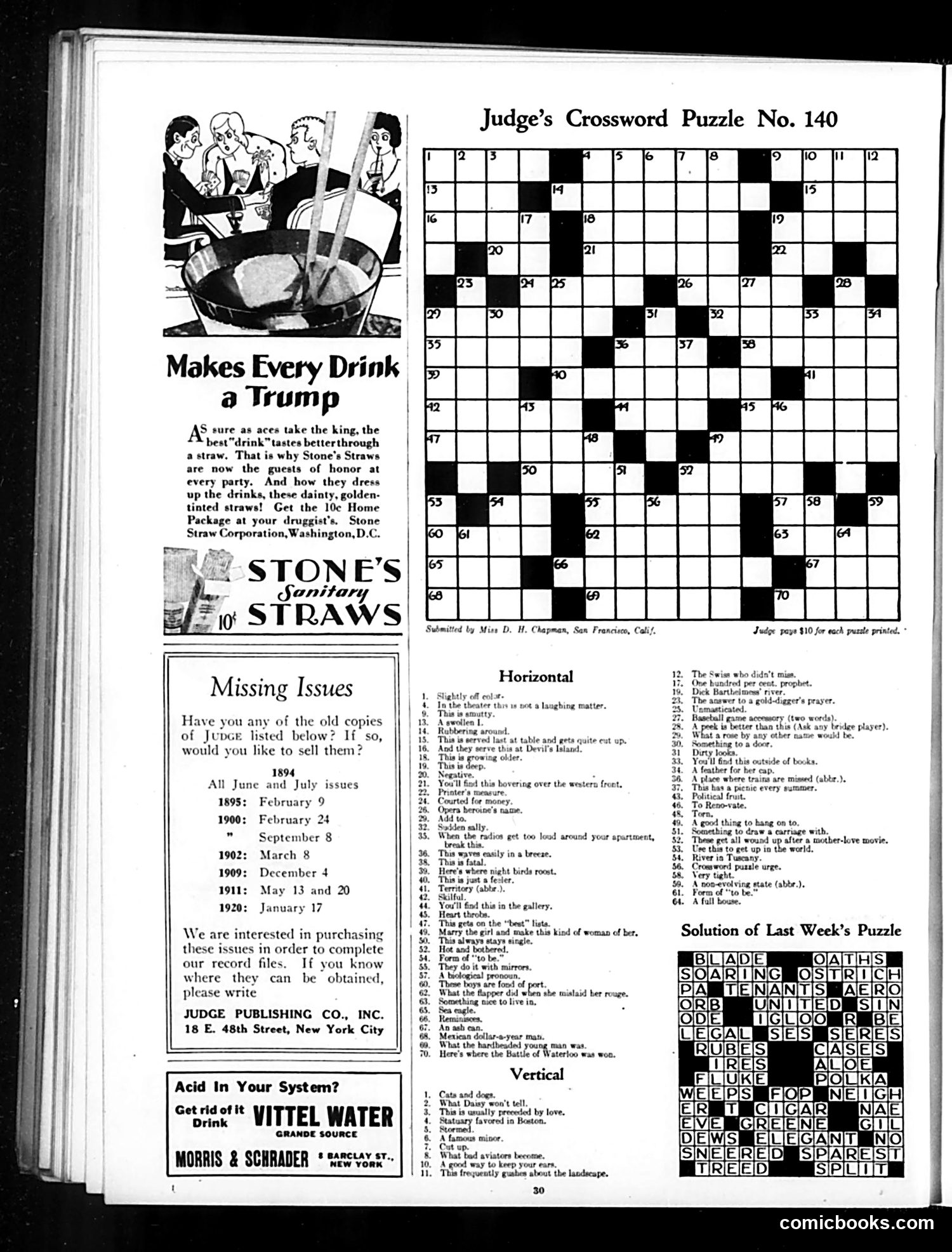
Judge Crossword Puzzle Page Analysis This page is primarily advertising and puzzle content from Judge magazine, not political satire. The main feature is a crossword puzzle (#140), with clues that appear to reference 1920s-era social situations and slang. The only substantive advertisement is Stone's Sanitary Straws, which uses mild humor ("Makes Every Drink a Trump") to market drinking straws as party accessories that "dress up the drinks." The phrase "trump" here simply means an excellent or winning thing—common 1920s slang. A secondary ad for Vittel Water addresses digestive concerns ("Acid in Your System?"), reflecting period anxieties about health. The page also includes missing issue notices for Judge's archive and the solution to the previous week's crossword. There are no political cartoons or caricatures visible—this is essentially a puzzle and advertising page with no satirical content requiring historical context.
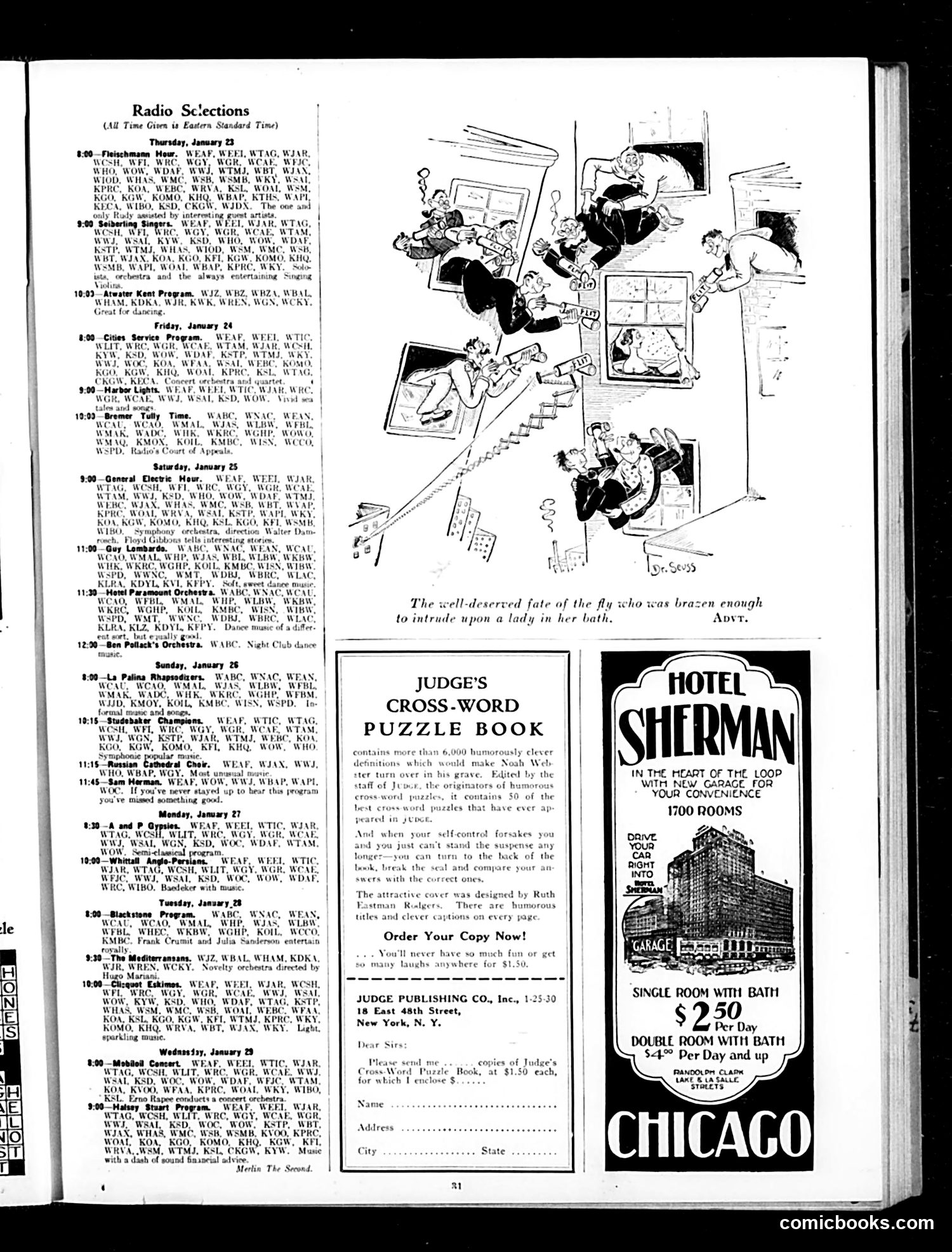
Analysis of Judge Magazine Page This page is primarily advertising and radio programming listings, not editorial content. The left side contains detailed radio station call letters and broadcast schedules for January 23-29 (appears to be from the 1920s-1930s era based on the radio stations listed). The only cartoon visible is a small illustration at top right showing figures amid scattered papers and photographs, with a caption reading: "The well-deserved fate of the fly who was brazen enough to intrude upon a lady in her bath." This is a straightforward humorous domestic scene—no political satire involved. The page also features advertisements, including a Judge's Cross-Word Puzzle Book order form and a Hotel Sherman Chicago hotel advertisement promoting rooms with bath at $2.50-$4.50 per day. The content reflects early 20th-century American popular culture: radio entertainment dominance, puzzle book popularity, and hotel advertising targeting travelers.
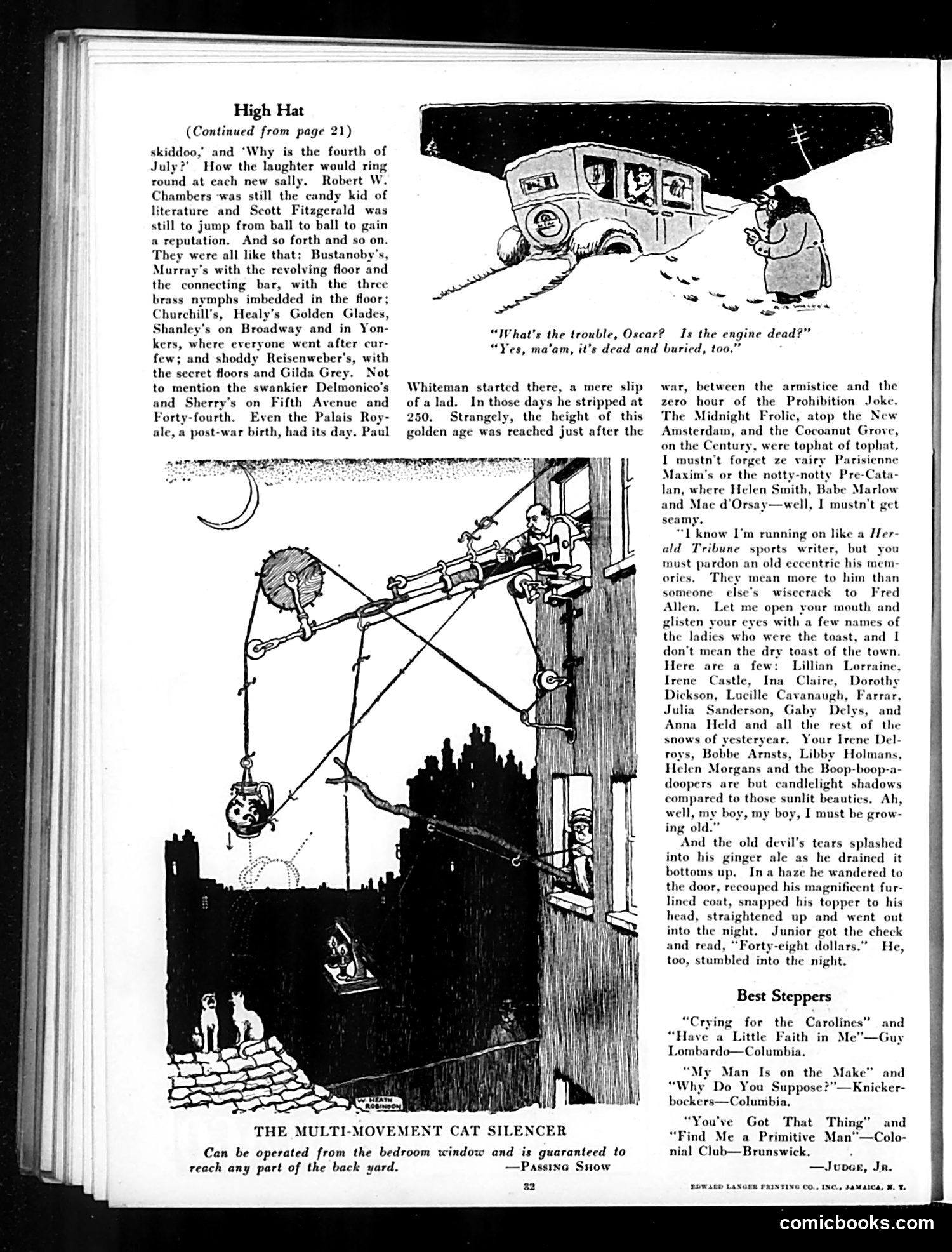
Analysis of Judge Magazine Page This page contains two distinct elements: Top Section ("High Hat"): A continuation of a serialized story featuring various Broadway venues and social venues of what appears to be the 1920s Prohibition era. The text references speakeasies and jazz-age nightlife locations. Main Cartoon ("The Multi-Movement Cat Silencer"): A humorous faux-advertisement showing an elaborate contraption extending from a bedroom window to silence a cat in the yard below. The joke satirizes urban nuisances—specifically neighborhood cats—during the Prohibition era. The caption claims the device "can be operated from the bedroom window and is guaranteed to reach any part of the back yard," playing on readers' frustration with nocturnal cat noise. Bottom Section ("Best Steppers"): Brief advertisements for popular songs and dance music of the period, reflecting Jazz Age entertainment culture. The humor relies on exaggerated mechanical solutions to everyday modern problems.
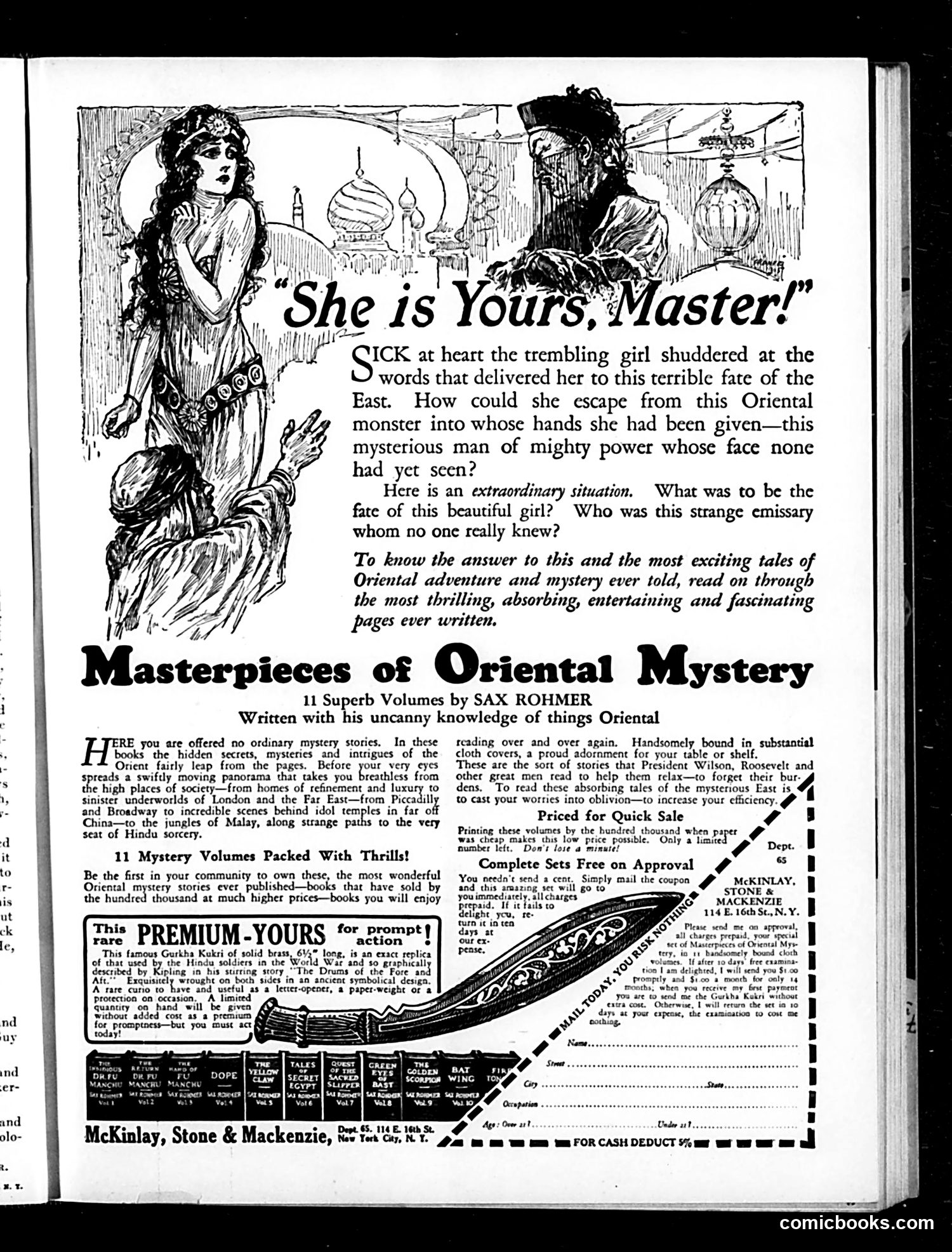
"Masterpieces of Oriental Mystery" Advertisement This page is primarily a book advertisement, not satire. It promotes Sax Rohmer's 11-volume mystery series featuring exotic Oriental settings and intrigue. The dramatic illustration depicts a "trembling girl" being delivered to an "Oriental monster"—typical pulp fiction imagery emphasizing danger and the "mysterious East." The text promises adventure narratives set across London, Broadway, China, and Hindu temples. The advertisement appeals to respectable audiences by citing endorsements from President Wilson and Theodore Roosevelt as readers of such escapist fiction. A "premium" Gurkha Kukri knife (a curved blade used by Hindu soldiers in WWI) is offered as incentive. For modern readers: This reflects early 20th-century popular culture's fascination with "Oriental" exoticism and danger—a genre trope heavy with racial stereotyping. The marketing strategy targets middle-class consumers seeking affordable, thrilling escapism through mail-order book sets.
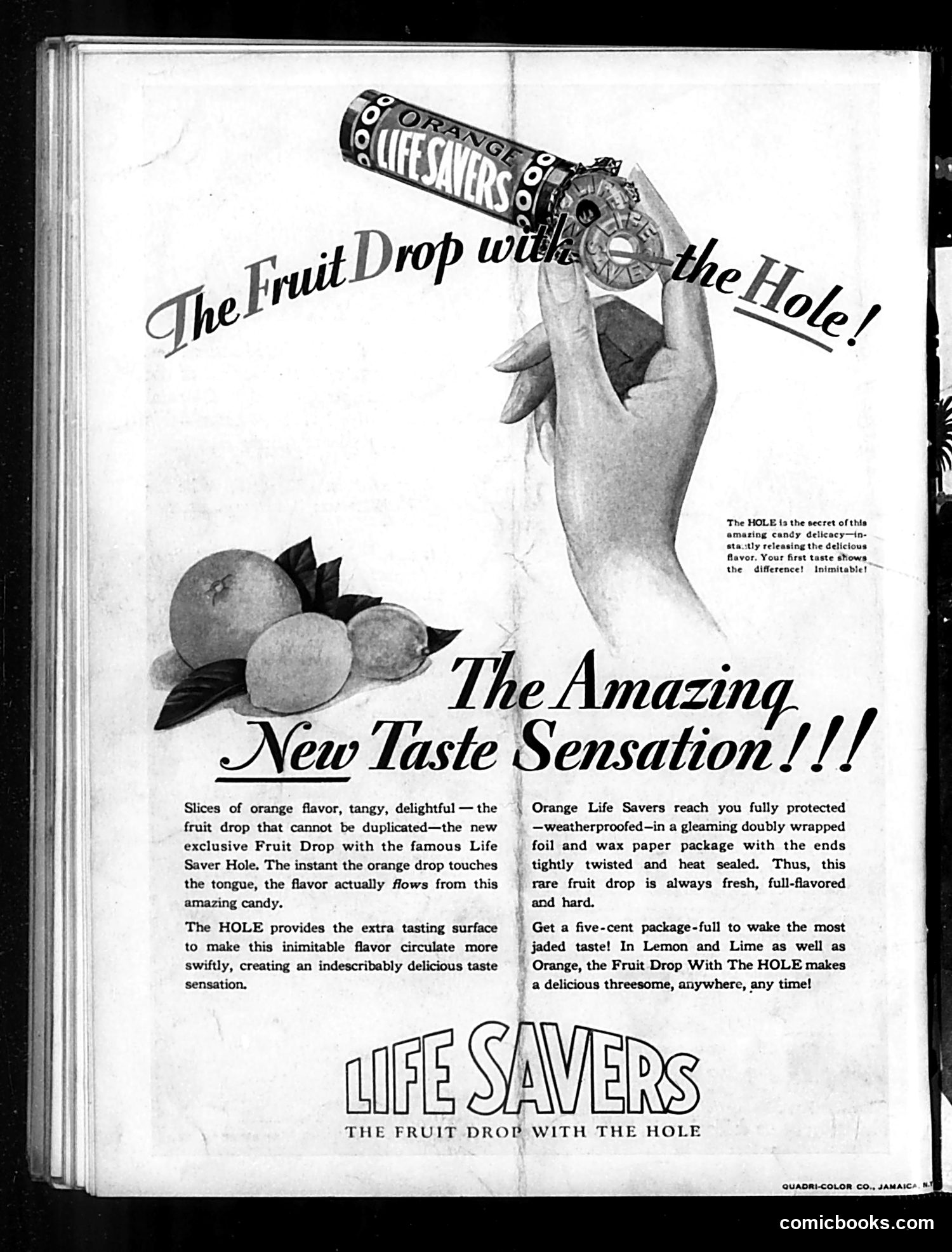
Analysis This is a Life Savers candy advertisement, not political satire. It promotes the fruit drop candy featuring the distinctive hole that became the brand's trademark. The ad emphasizes the hole as a selling point—claiming it provides "extra tasting surface" and allows flavor to "circulate more swiftly," creating superior taste. The visual shows a hand holding an Orange Life Savers roll overhead dramatically. For modern readers: This reflects early 20th-century candy marketing, when the hole was genuinely novel and marketed as a functional feature rather than incidental design. The breathless language ("Amazing New Taste Sensation!!!") and pseudo-scientific explanation of how the hole enhances flavor are typical period advertising hyperbole. Today we know the hole's main purpose was manufacturing efficiency and product differentiation, but this ad treats it as a deliberate quality innovation. The five-cent price and emphasis on protective packaging date this to the pre-WWII era.