judge
Judge — February 1, 1930
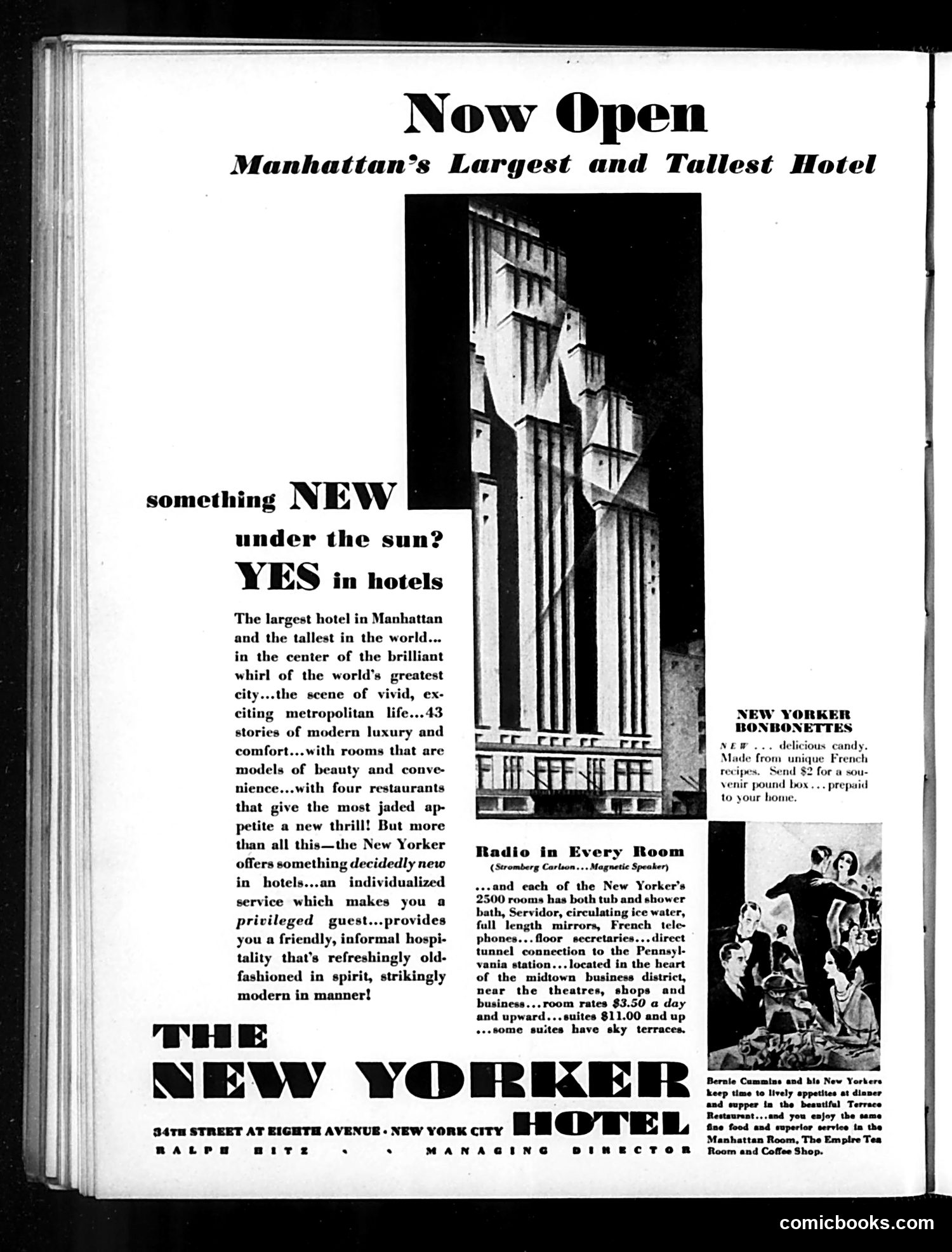
The New Yorker Hotel Advertisement This page is primarily a hotel advertisement, not a political cartoon. It announces the opening of the New Yorker Hotel on 34th Street at Eighth Avenue in New York City, marketed as "Manhattan's Largest and Tallest Hotel." The ad emphasizes luxury amenities: 43 stories, four restaurants, 2,500 rooms with modern conveniences (radios, full mirrors, French telephones, circulating ice water), and competitive pricing ($3.50 and up daily). It highlights the hotel's convenient location near theaters, shops, and Penn Station. The page includes supplementary advertisements for New Yorker Bonbonettes candy and what appears to be evening entertainment, but these are minor elements within a primarily commercial advertisement.
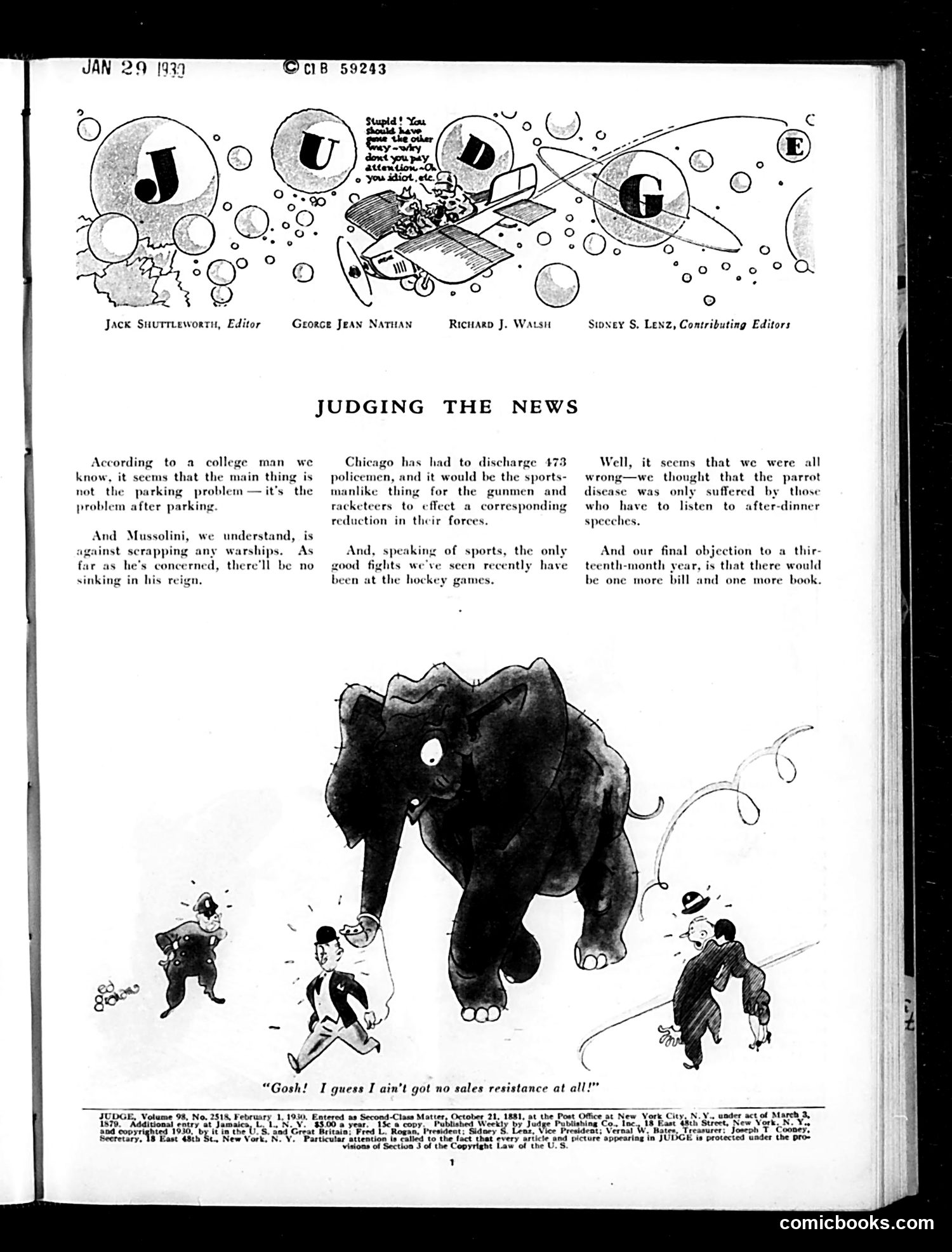
Explanation of "Judging the News" (January 29, 1933) This satirical page comments on contemporary news events through brief quips and a political cartoon. The text references: - Parking problems as America's main issue - Mussolini and warship-scrapping (likely referencing 1930s disarmament discussions) - Chicago police discharging 173 officers, which the editors sarcastically suggest gangsters should match - Hockey games as the only good recent fights - A complaint about having "one more bill" in a thirteen-month year The main cartoon depicts an elephant (the Republican party symbol) as an uncontrollable force, with small men struggling to restrain it via a rope. The caption "Gosh! I guess I ain't got no sales resistance at all!" suggests the GOP cannot resist spending or political pressure—likely satirizing Republican inability to control government expenditure during the Depression era.
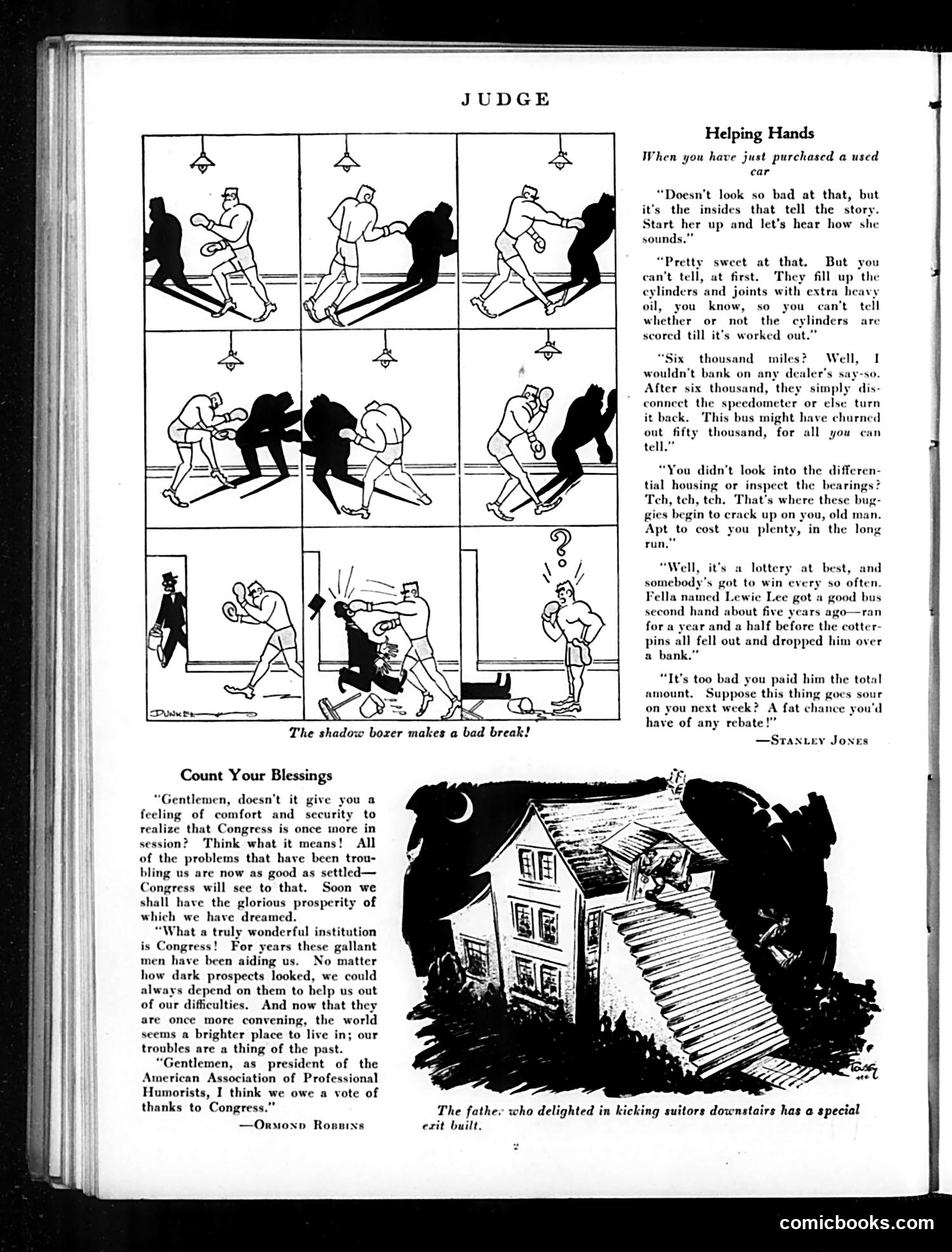
Analysis Top Comic Strip ("The shadow boxer makes a bad break!"): Satirizes used-car buying. A buyer and seller (shown as black silhouettes, a period convention for anonymous figures) engage in a sparring match over a vehicle's true condition. The buyer discovers hidden mechanical problems—burned-out cylinders, faulty bearings, disconnected speedometer—after purchase. The joke: inspecting a used car is like boxing in the dark; you only discover damage after you've already been "hit." The advice column warns buyers that dealers exploit ignorance about mechanical condition and past mileage. Bottom Section ("Count Your Blessings"): A political speech praising Congress for solving economic troubles. The accompanying illustration shows a father gleefully kicking servants downstairs—a darkly humorous commentary on how prosperity benefits the wealthy while working people remain exploited.
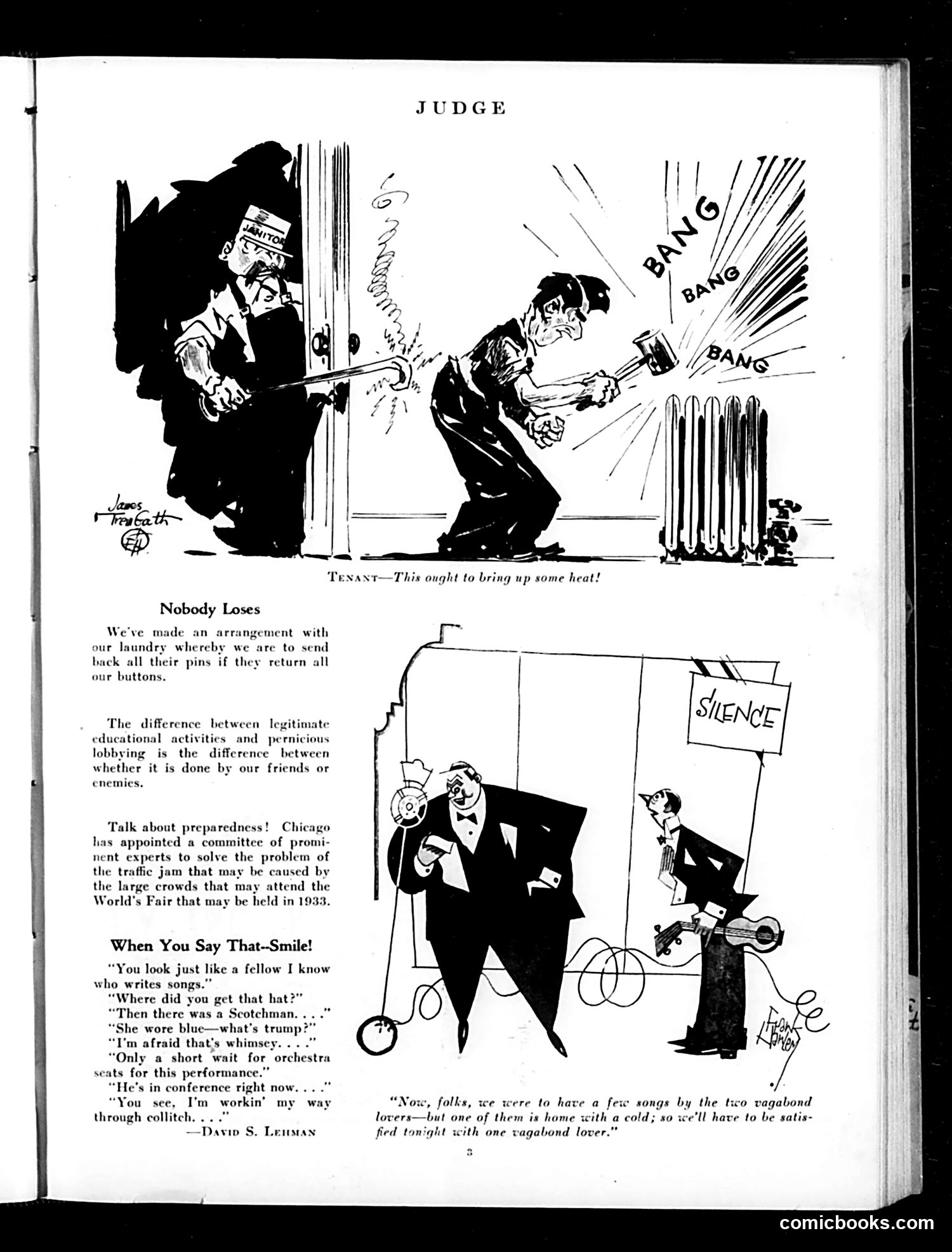
Political Cartoon Analysis: Judge Magazine The top cartoon depicts a Judge (likely a court official) confronting a Tenant about heating. The tenant complains "This ought to bring up some heat!"—a pun on the radiator's literal function and his demand for adequate warmth. The Judge's stern demeanor suggests this reflects contemporary tenant-landlord disputes over heating obligations. The lower cartoon appears to reference Chicago's preparations for a 1933 World's Fair, showing officials (one marked "SILENCE") dealing with traffic and crowd control problems. The vagabond performers' dialogue jokes about compensating with fewer musicians due to illness, an unrelated vaudeville gag. The miscellaneous text items—about laundry arrangements, lobbying definitions, and song-writing anecdotes—fill the page as filler content typical of Judge's mixed satirical format.
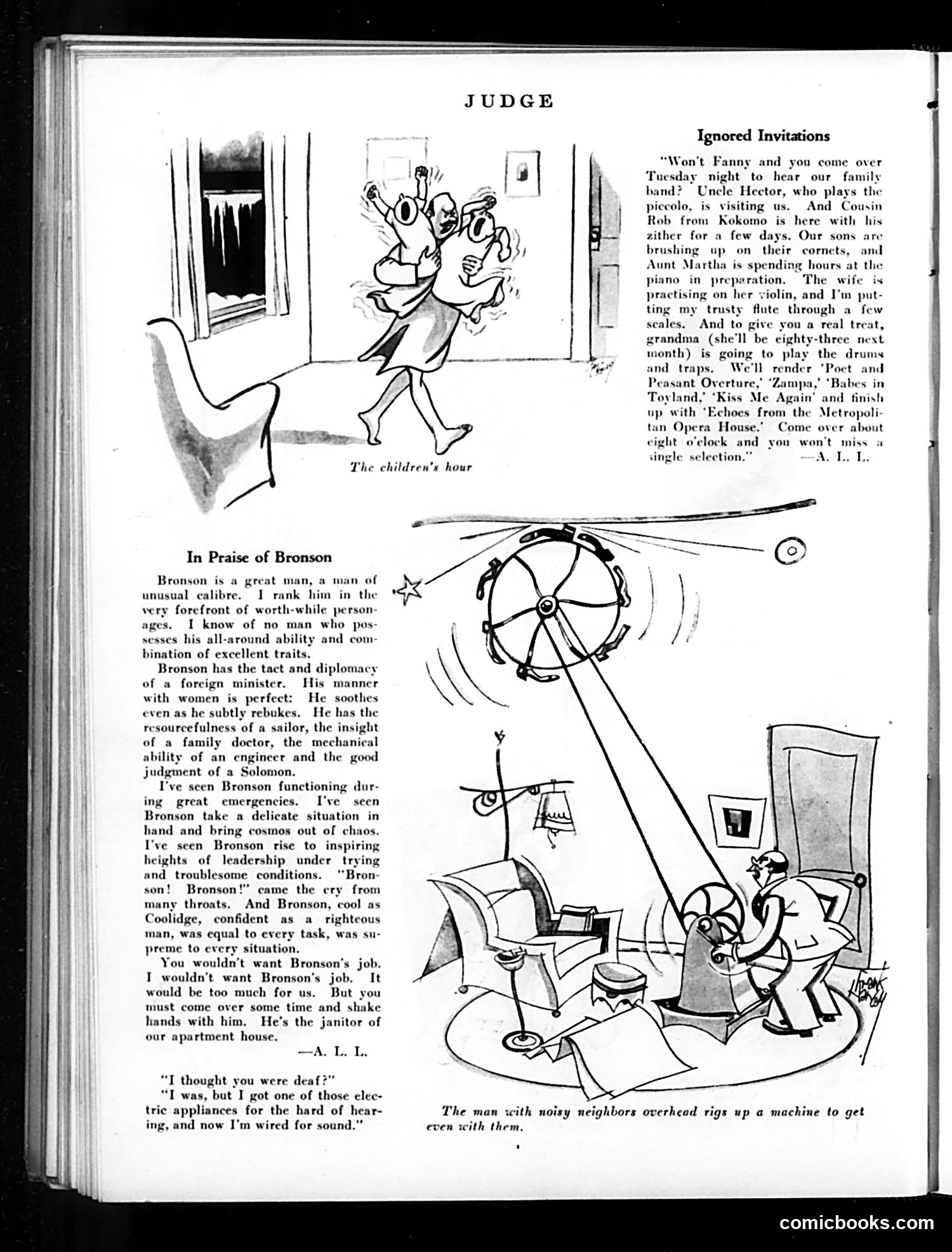
Judge Magazine Page Analysis This page contains three distinct pieces of humor: 1. "The children's hour" (top): A cartoon showing children enthusiastically greeting an arriving guest—typical domestic humor about chaotic family welcomes. 2. "In Praise of Bronson" (left): A testimonial praising someone named Bronson as an exceptionally talented diplomat and problem-solver. The author notes Bronson excels at difficult situations and difficult people, but warns that his job is so demanding ("You wouldn't want Bronson's job") that one should occasionally offer him rest and companionship. 3. "The man with noisy neighbors" (bottom right): A cartoon showing an elaborate mechanical contraption—apparently a humorous solution for dealing with noisy neighbors. The caption suggests he built this machine to "get even with them." The page mixes domestic comedy with professional praise and neighbor conflict humor typical of early-20th-century American satire.
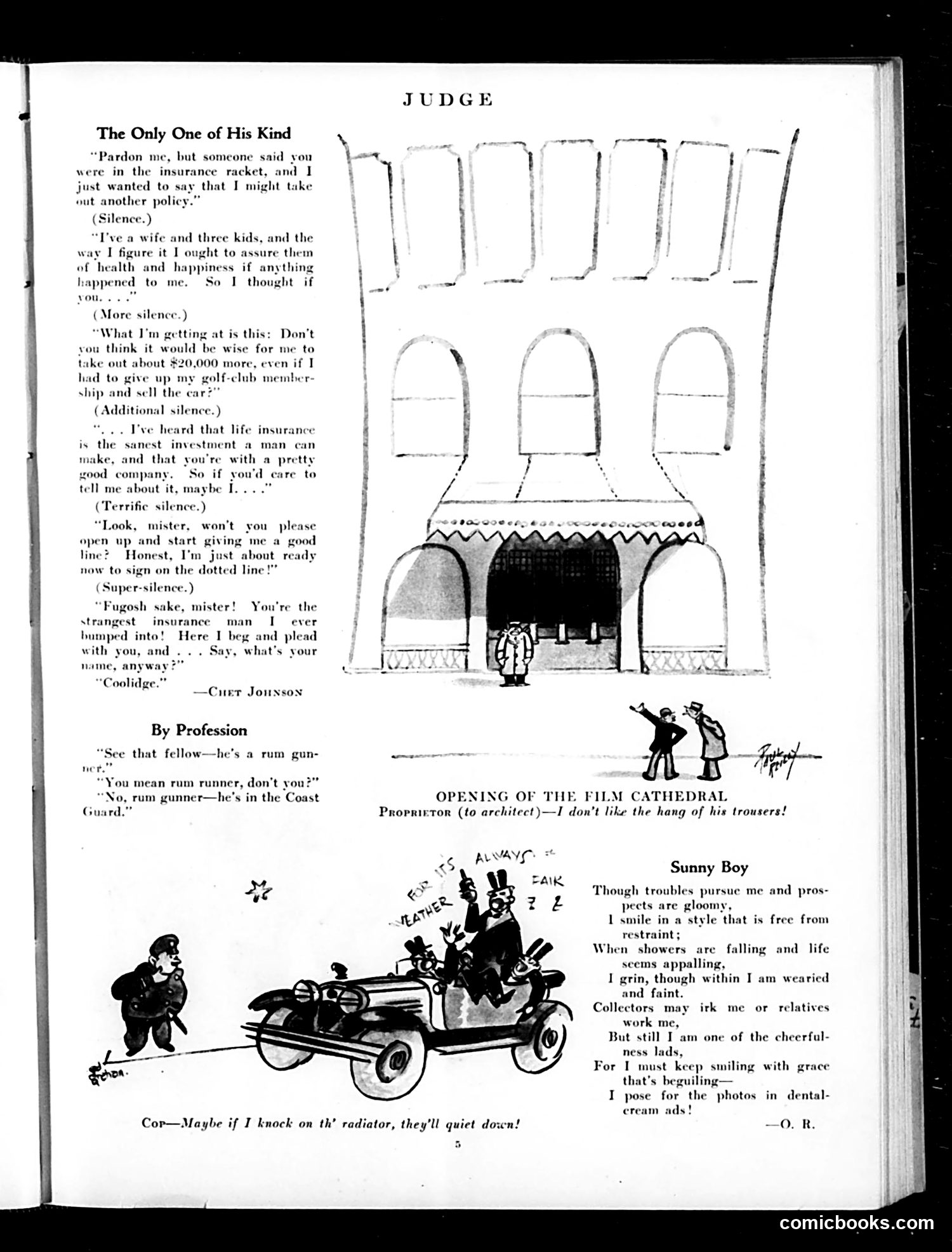
Judge Magazine Page Analysis This page contains early 20th-century humor pieces addressing insurance and professional matters: "The Only One of His Kind" satirizes an overly cautious insurance salesman pressuring a client to buy excessive life insurance policies. The humor relies on the salesman's persistence despite the client's clear reluctance—a commentary on aggressive sales tactics common in that era. "By Profession" is a brief joke about terminology: a "rum gunner" (bootlegger) versus a "rum runner" (Coast Guard officer), reflecting Prohibition-era anxieties. "Opening of the Film Cathedral" mocks an architect's concern about film projection equipment affecting his building's appearance. The page primarily demonstrates Judge's focus on middle-class anxieties, sales culture, and contemporary professions rather than direct political satire.
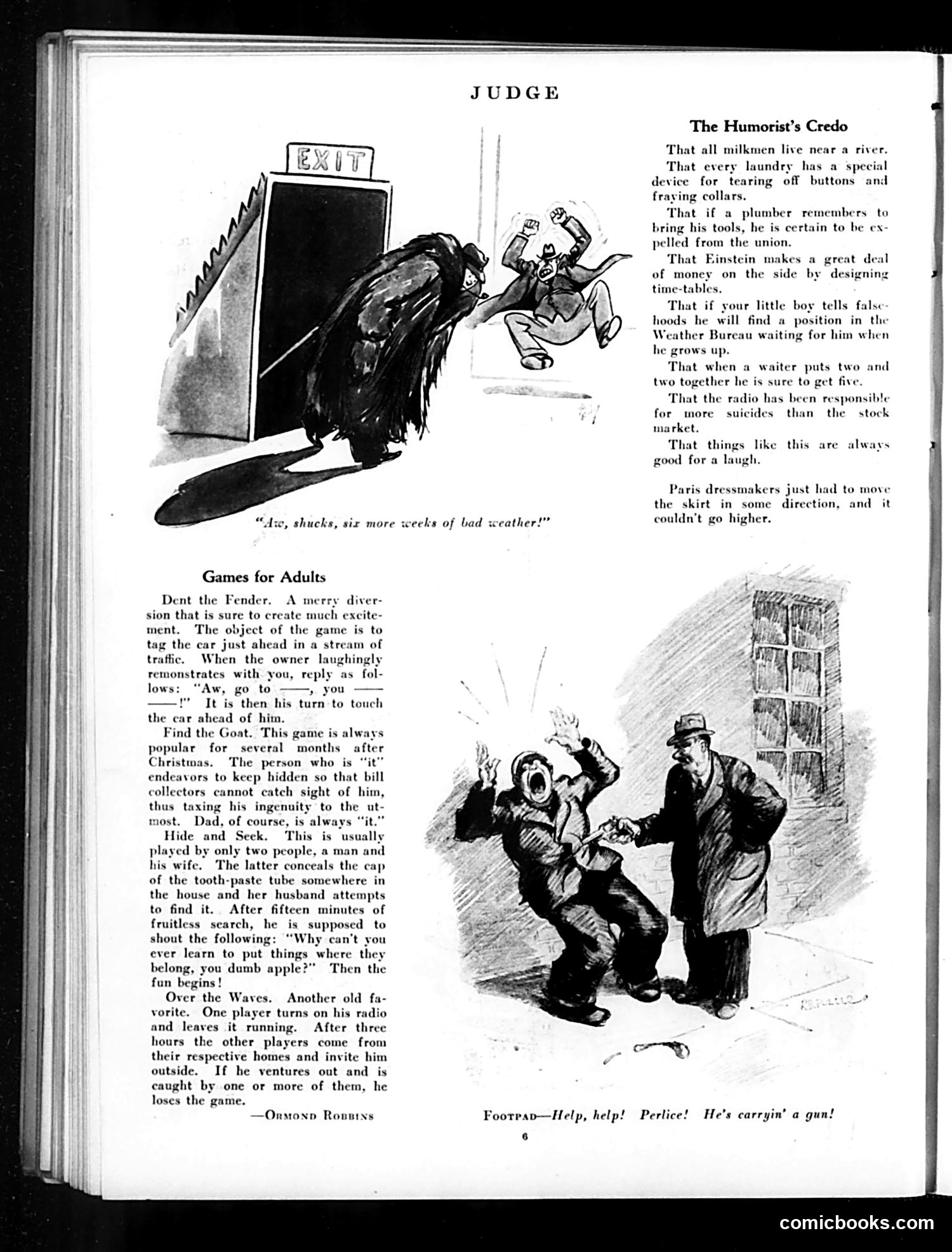
Page Analysis: Judge Magazine This page contains two distinct sections: Top Cartoon ("Exit"): Shows a disheveled man being forcibly ejected from what appears to be a theater or establishment, with the caption "Six, shucks, six more weeks of bad weather!" The joke references Groundhog Day folklore—the tradition that if a groundhog sees its shadow on February 2nd, six more weeks of winter follow. The cartoon satirizes how people blame this superstition for prolonged bad weather. Lower Section: "Games for Adults" by Osmond Robbins describes humorous pranks and party games, including "Dent the Fender" and "Find the Goat." These appear to be satirical suggestions mocking foolish adult behavior disguised as entertainment. Right Column: "The Humorist's Credo" lists satirical observations about modern life, including jabs at laundries, plumbers, Einstein, weather forecasting, and fashion trends.
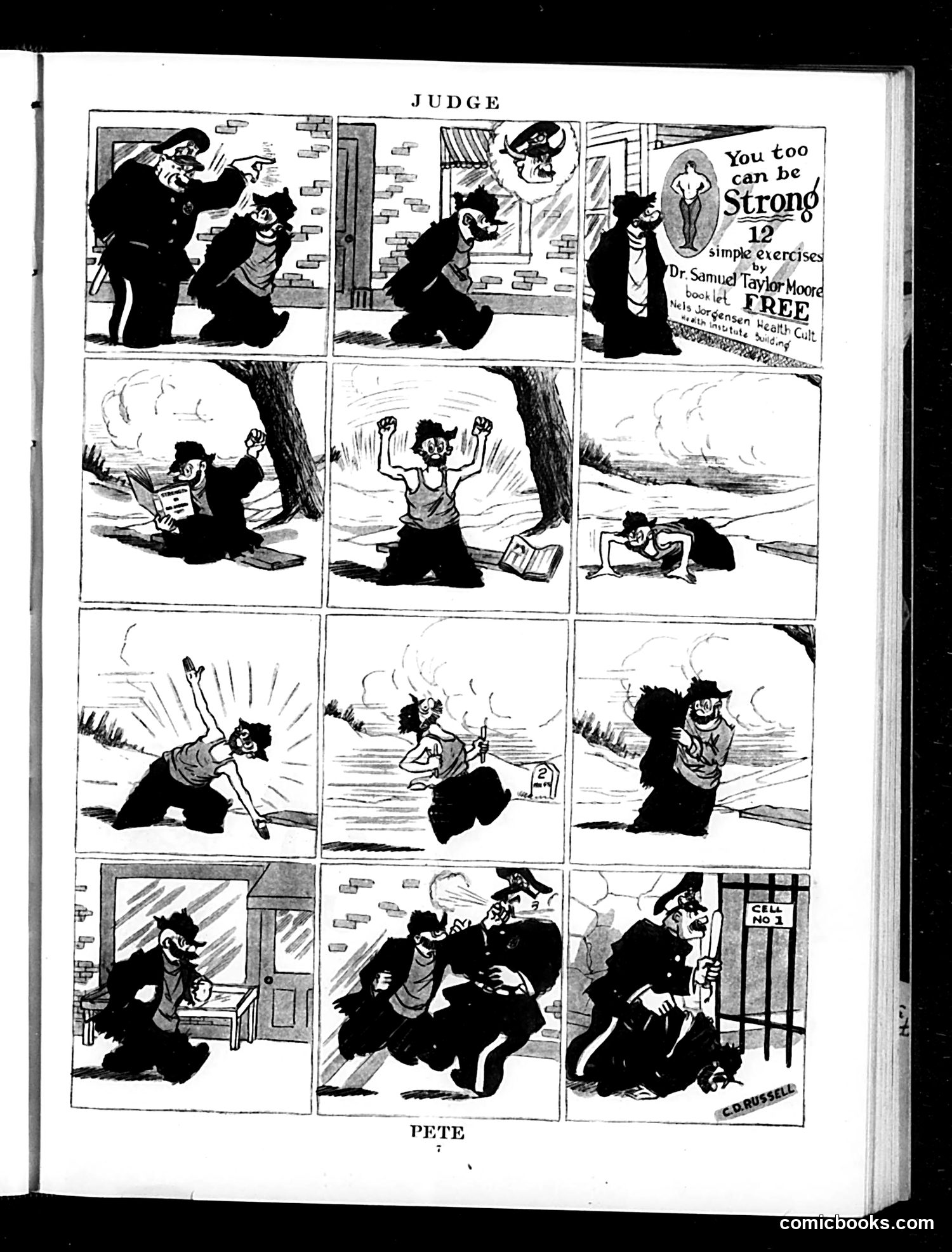
Analysis of Judge Magazine Page This page contains two comic strips. The top strip, "Judge," shows a man being arrested and taken to jail—likely satirizing law enforcement or the legal system through physical comedy and exaggeration. The bottom strip, "Pete," depicts a character performing outdoor exercises before a natural backdrop, which connects to the adjacent advertisement promoting "You too can be Strong"—a booklet offering "12 simple exercises" by Dr. Samuel Taylor Moore, marketed as a free health publication. The juxtaposition suggests this page combines entertainment with product promotion common to Judge magazine. The specific social satire or political references remain unclear without additional historical context about the characters or time period.
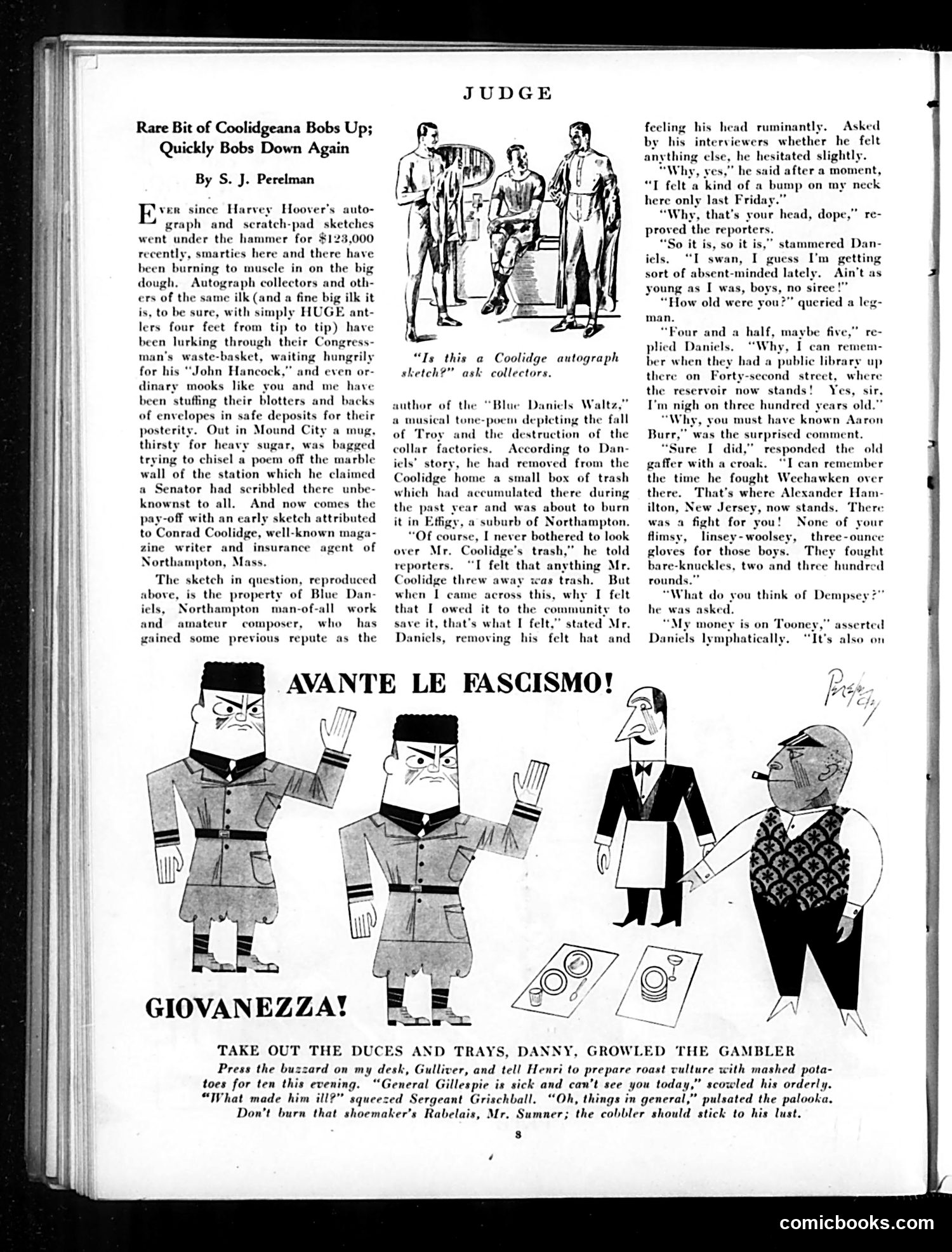
Explanation for Modern Readers This Judge magazine page contains two distinct pieces of satirical content: Top Article: "Coolidgeana" by S.J. Perelman mocks the craze for celebrity autographs following Harvey Hoover's $123,000 auction. It lampoons a Massachusetts man claiming to possess a poem by President Calvin Coolidge (humorously called "Conrad Coolidge"), which he found in Coolidge's trash. The article satirizes both autograph-collecting mania and the dubious authenticity of such discoveries, with the man's increasingly absurd claims (being 300 years old, knowing Aaron Burr) highlighting the ridiculous nature of the scheme. Bottom Cartoon: "Avante le Fascismo!" depicts two militaristic fascist figures with the Italian phrase ("Down with Fascism!"), alongside a well-dressed man and what appears to be a portly figure. The caption references removing "duces and trays"—likely satirizing fascist leadership. This reflects 1920s-30s American concern about European fascism, presenting it as absurd and contemptible through caricature.
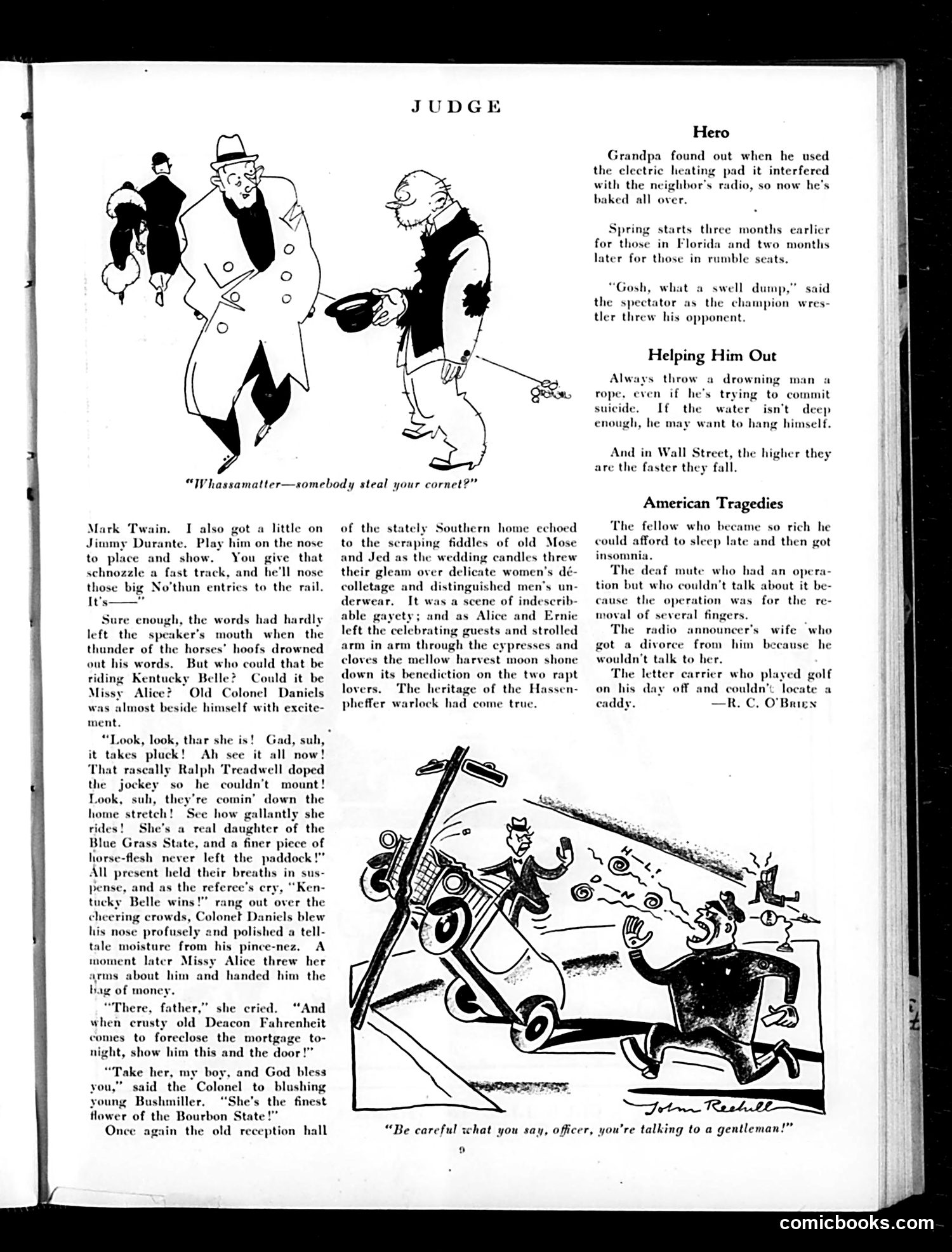
Judge Magazine Page Analysis This page contains two distinct satirical pieces: Top cartoon: Shows a man confronting another about a stolen cornet, attributed to Mark Twain. The accompanying story is a melodramatic parody of Southern plantation fiction—complete with a resourceful young woman (Missy Alice) who rides a horse in a race to save her father's home from foreclosure, then marries a young man and receives blessing from "Colonel Daniels." It mocks the overwrought romance and honor-obsessed narratives of popular Southern literature of the era. Bottom cartoon & text sections: Includes quips about modern inconveniences (electric heating pads interfering with radios, rumble seats), observations about wealth and Wall Street speculation, and a final cartoon showing a police officer being corrected by a man claiming gentlemanly status—satirizing class pretension and how social position supposedly shields one from ordinary accountability. The page represents Judge's typical blend of literary parody, social commentary on contemporary technology and class, and visual humor targeting American pretensions.
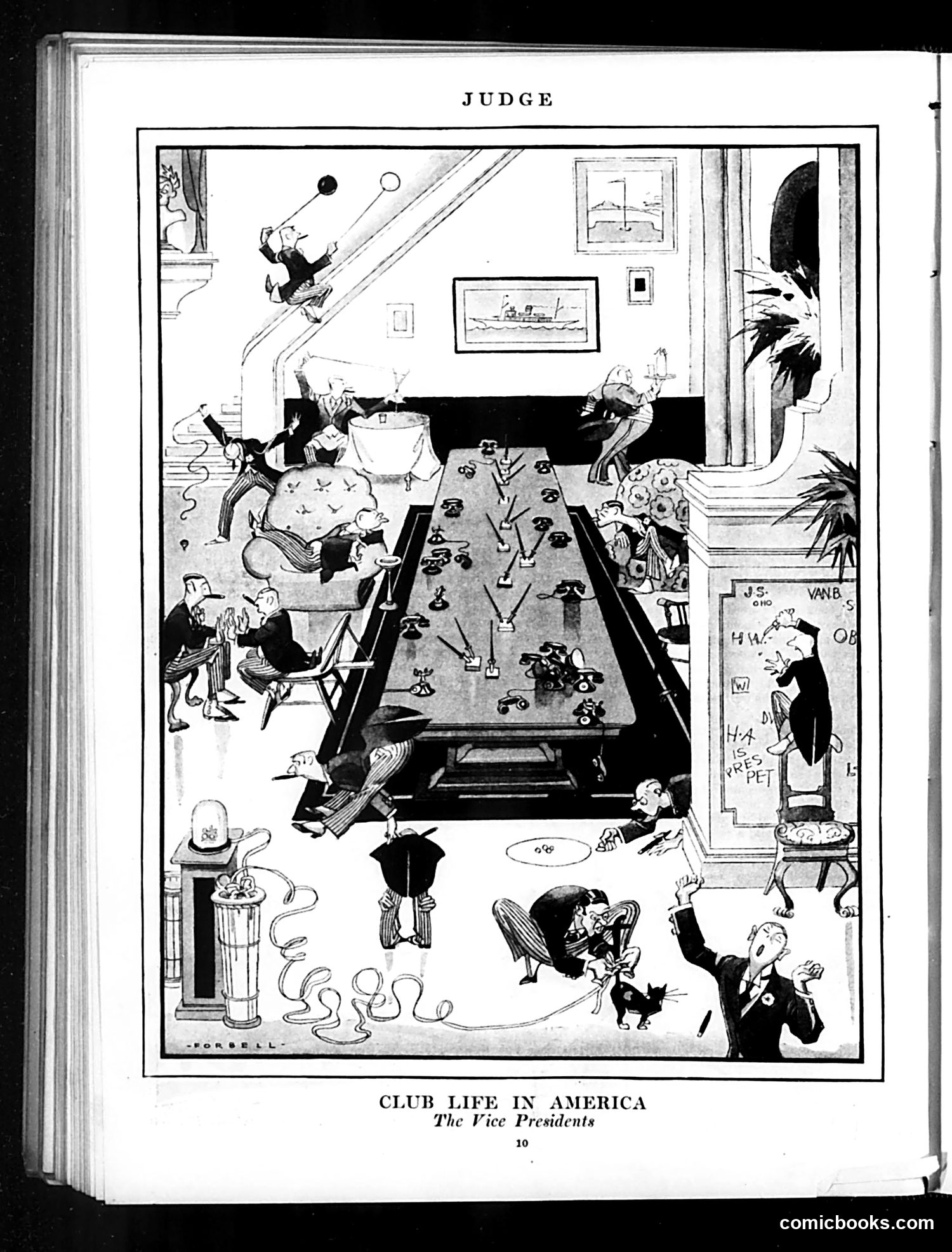
Analysis of "Judge" Page: "Club Life in America - The Vice Presidents" This cartoon satirizes the leisure activities of American Vice Presidents through an elaborate club scene. The illustration depicts various figures engaged in frivolous pursuits—juggling, lounging, playing billiards, and socializing—within an ornate indoor setting with artwork and furnishings. The satire's point: Vice Presidents are portrayed as idle, ineffectual office-holders with nothing substantive to do but entertain themselves in exclusive clubs. This reflects a historical perception of the Vice Presidency as a ceremonial, powerless position unworthy of serious men. The cartoon mocks both the office itself and the type of privileged gentlemen who held it. The artist is signed "Forbel" (or similar). Without specific dates or identified individuals visible, the cartoon likely targets late-19th or early-20th-century Vice Presidents generally, rather than one particular administration.
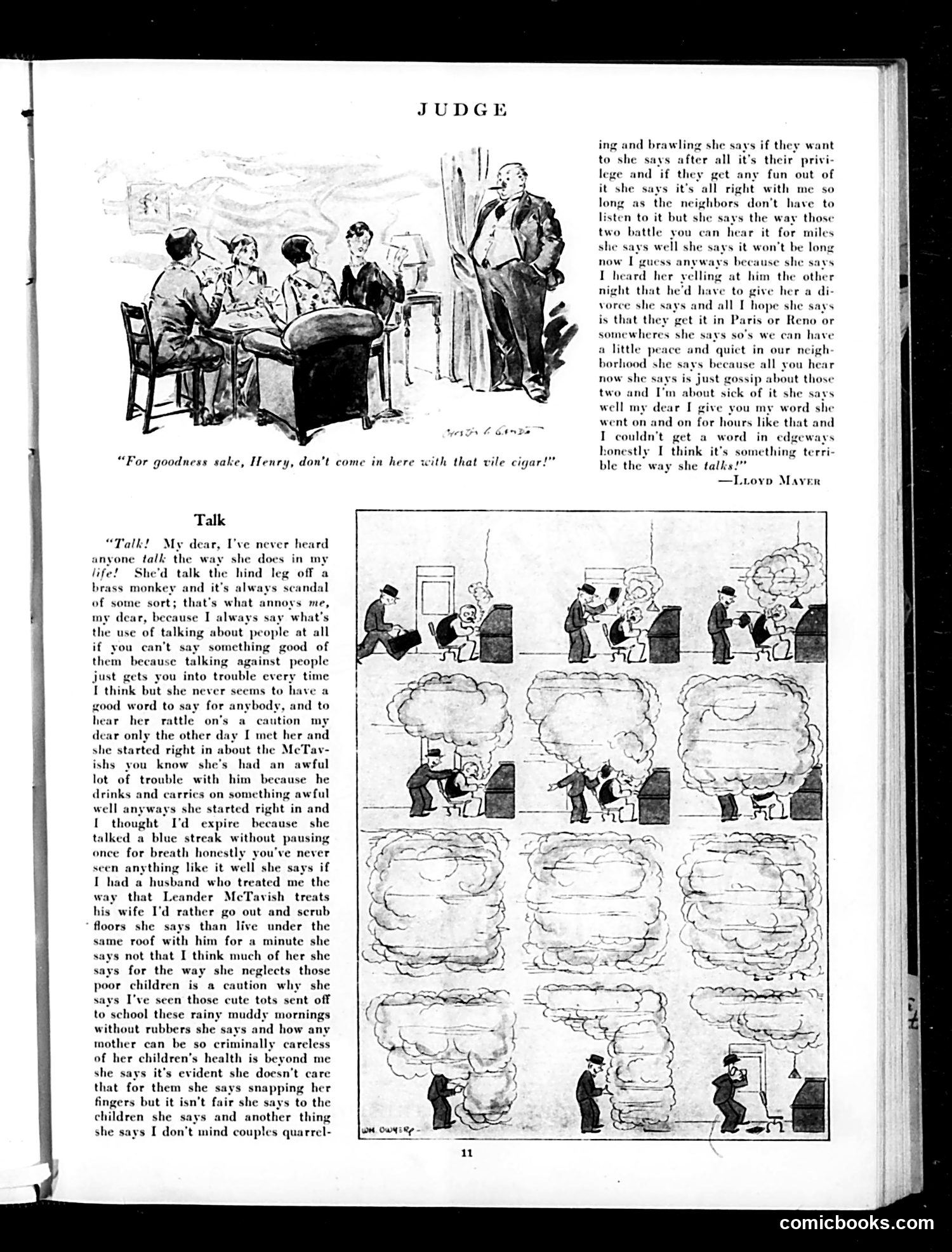
Judge Magazine Page Analysis This page satirizes excessive female gossip and talkativeness. The top cartoon shows a woman complaining about a neighbor's loud marital fighting, while the accompanying comic strip (credited to artist Cesare Cesarini) visually depicts a woman talking continuously—represented by increasingly large speech bubbles that eventually consume the panels entirely, with her listener reduced to a tiny figure. The accompanying text, attributed to Lloyd Mayer, is a monologue mimicking this gossiping woman's incessant chatter about another neighbor's troubled marriage, drinking husband, and neglectful parenting. The piece satirizes not just female gossip itself but the circular, unstoppable nature of it—the speaker complains about the gossip while engaging in it endlessly. The humor relies on early 20th-century gender stereotypes portraying women as naturally verbose, scandal-prone, and unable to refrain from criticizing others' domestic affairs. The opening cartoon's caption ("For goodness sake, Henry, don't come in here with that vile cigar!") contrasts the woman's concern for propriety while tolerating her own social impropriety.
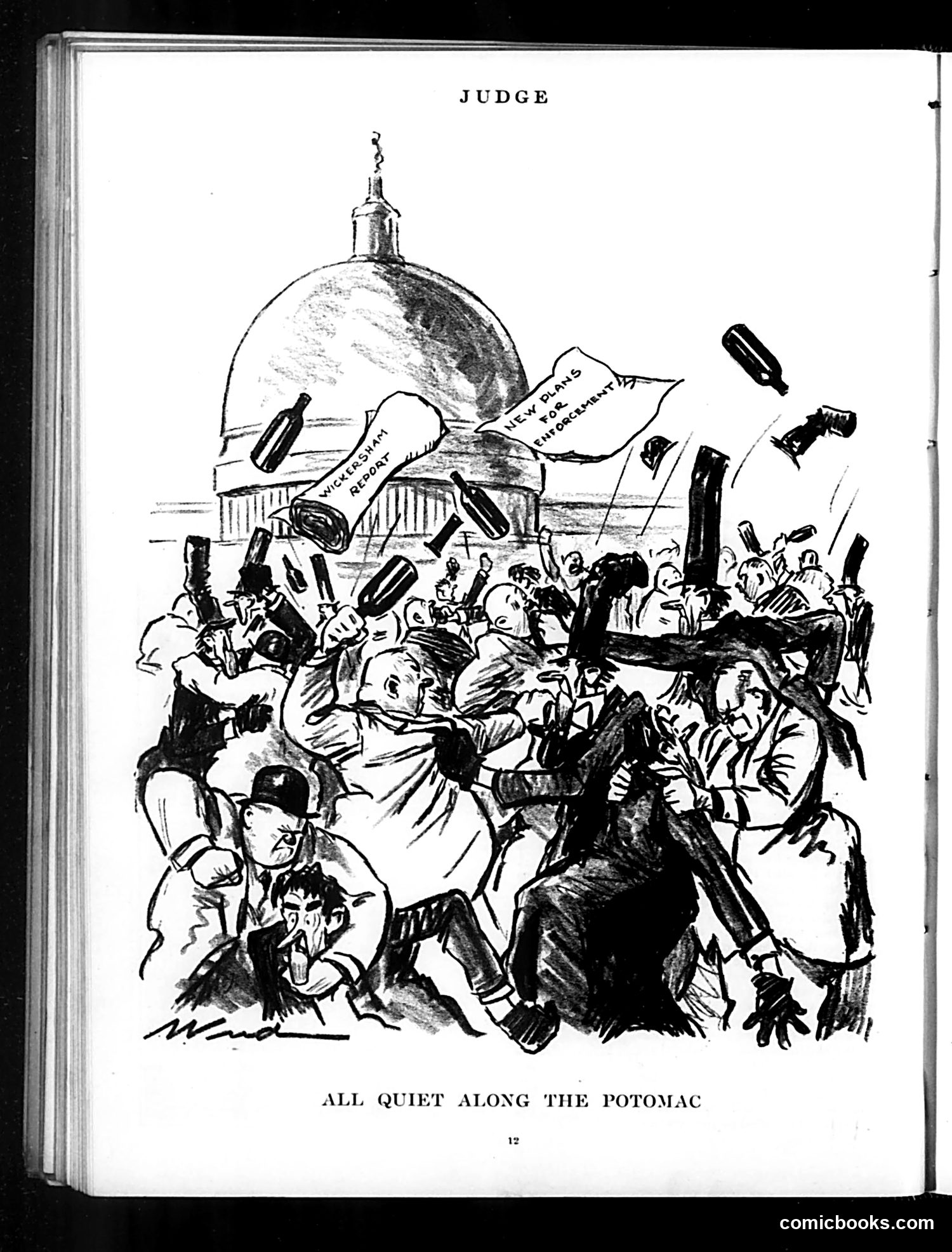
Political Cartoon Analysis: "All Quiet Along the Potomac" This Judge cartoon depicts chaos erupting at the U.S. Capitol building, with bottles flying and a crowd of men in formal dress engaged in what appears to be violent disorder. The title "All Quiet Along the Potomac" is ironic—a famous Civil War phrase suggesting peace—directly contradicting the depicted pandemonium. The cartoon satirizes Congressional discord and political turmoil in Washington. The flying bottles suggest drinking and rowdiness among lawmakers. Various documents labeled with references to legislation or political matters appear scattered. The Capitol dome dominates, emphasizing that this governmental chaos occurs at the nation's seat of power. Without a visible date, the specific crisis is unclear, but the cartoon mocks the contradiction between publicly proclaimed political order and actual Congressional dysfunction.
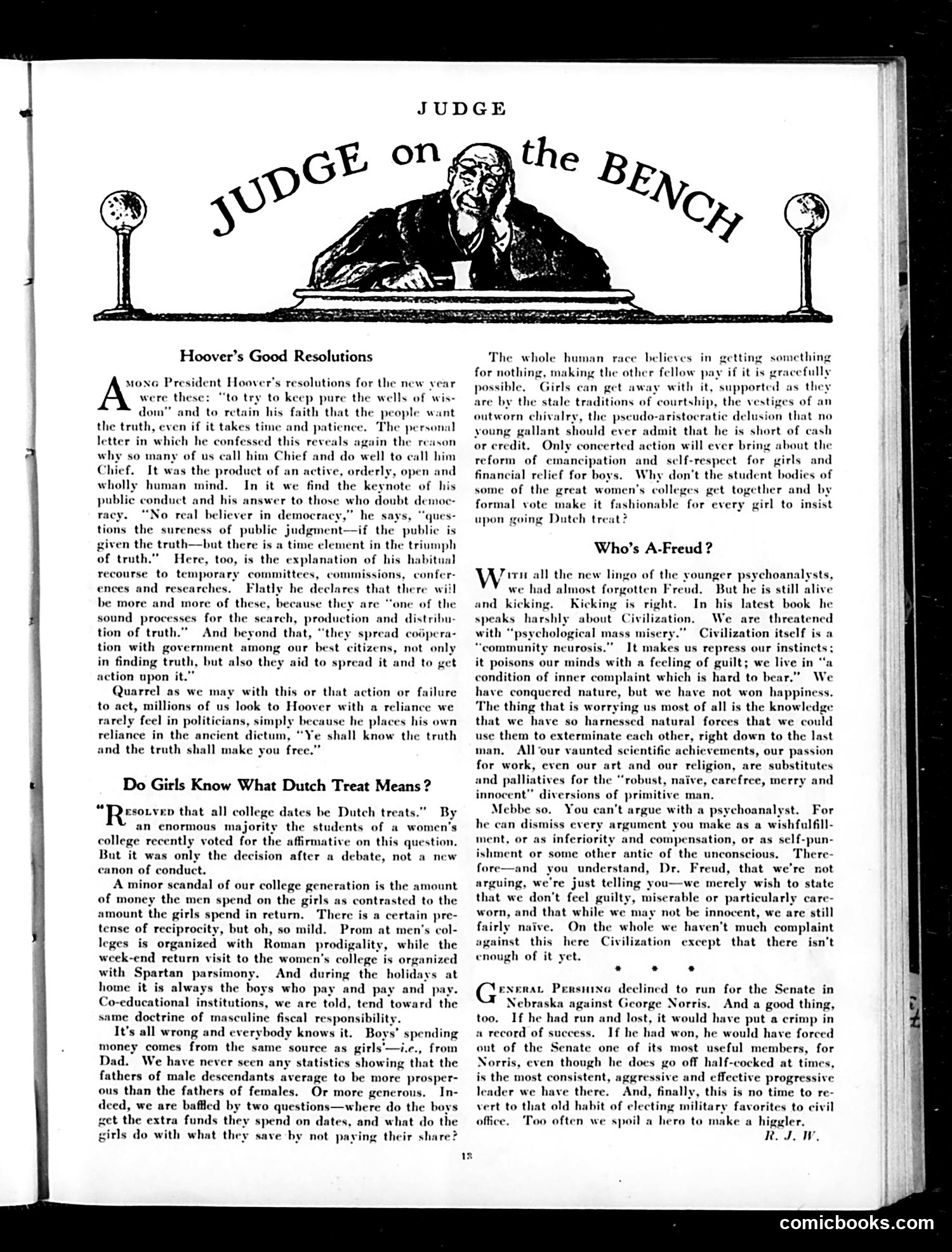
Judge Magazine Page Analysis This page from Judge magazine contains three opinion columns attacking social trends of the era (appears to be 1930s based on Hoover reference). "Hoover's Good Resolutions" praises President Hoover's faith in truth and democracy, defending his reliance on committees and commissions as legitimate mechanisms for discovering and spreading truth. "Do Girls Know What Dutch Treat Means?" satirizes college dating customs where men consistently pay for dates while women don't reciprocate equally. The author argues this perpetuates outdated chivalry myths and questions why girls don't demand equal financial responsibility—a proto-feminist critique unusual for the era. "Who's A-Freud?" dismisses younger psychoanalysts' enthusiasm for Freud while acknowledging his continued relevance. The author criticizes how psychoanalysis allegedly excuses human failings through pseudo-intellectual justification rather than promoting genuine moral reform. All three pieces adopt a conservative, moralistic tone criticizing what the author sees as contemporary social weakness or delusion.
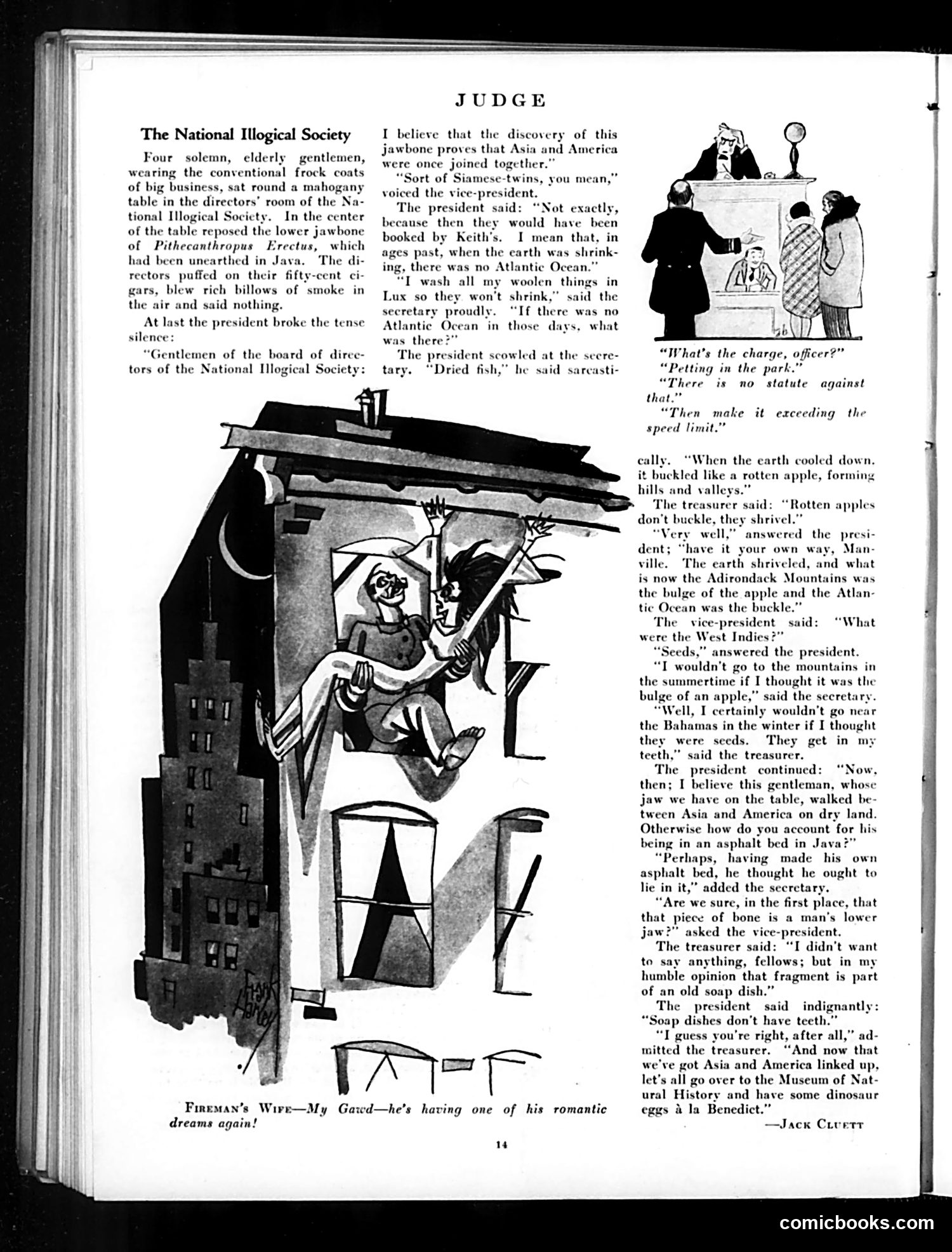
Explaining "The National Illogical Society" (Judge Magazine) This satirical piece mocks the pretensions of wealthy businessmen serving on a fictional "National Illogical Society." The joke centers on their incompetent discussion of a *Pithecanthropus erectus* jawbone (an early human ancestor discovered in Java), which they claim proves Asia and America were once connected. The humor comes from these supposedly educated "gentlemen of big business" making absurd, contradictory arguments—comparing continental drift to rotten apples, confusing geological processes with laundry detergent, and culminating in the treasurer's revelation that the "jawbone" is likely just an old soap dish. The satire targets early 20th-century pseudoscientific clubs and the ignorance of wealthy dilettantes who lent their names and money to organizations without understanding actual science. Their self-important pomposity—smoking expensive cigars while spouting nonsense—underscores the mockery throughout.
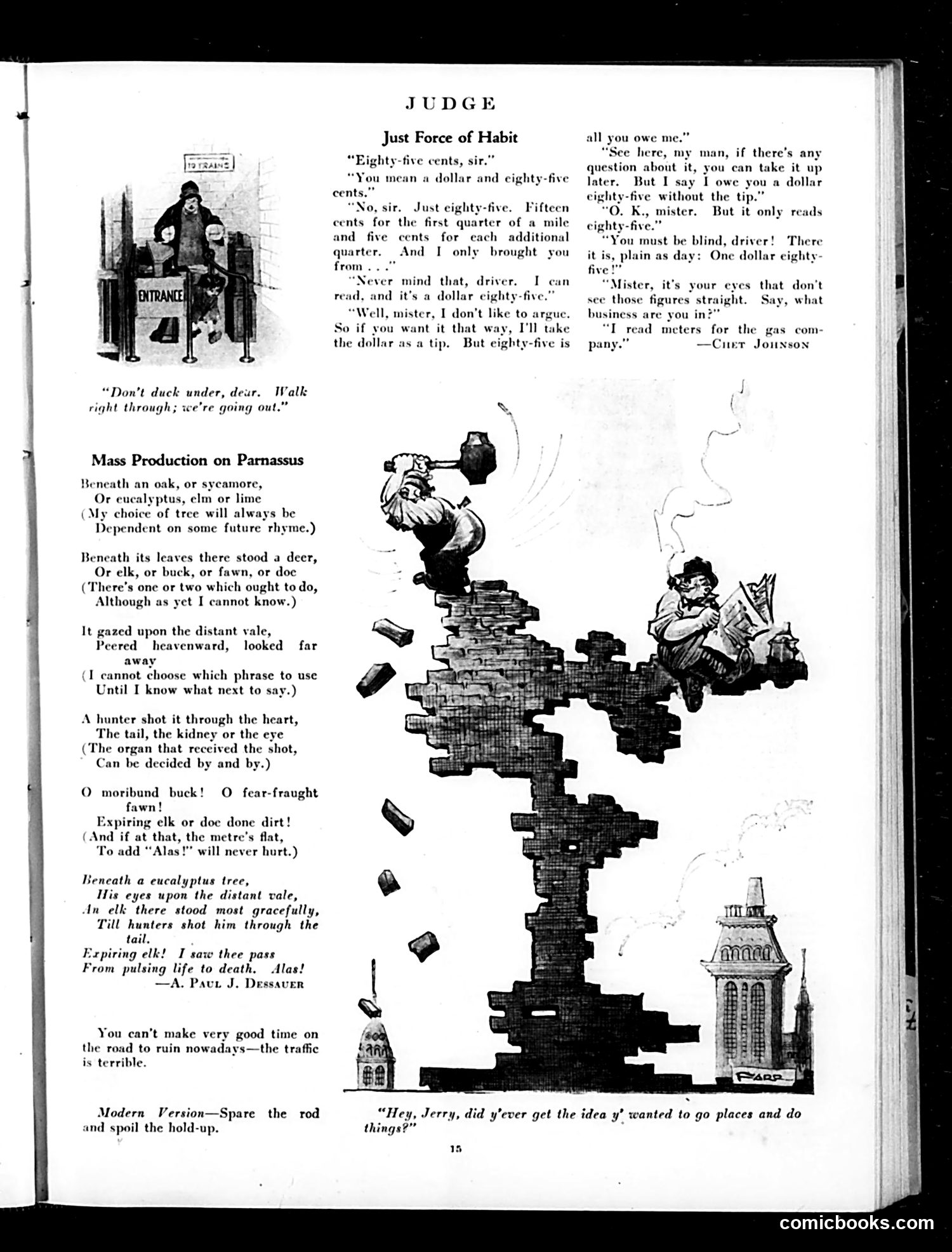
Explanation for Modern Readers "Just Force of Habit" satirizes a taxi driver's automatic dishonesty. The passenger correctly pays the metered fare (85 cents), but the driver expects a dollar eighty-five—likely his usual overcharge. When the passenger refuses the inflated amount, the driver persists despite being told the actual debt. The punchline reveals the driver reads gas meters professionally, making his inability to read his own taxi meter absurd. The satire targets habitual corruption: the driver is so accustomed to cheating fares that he defaults to dishonesty even when caught. "Mass Production on Parnassus" mocks modern commercial poetry writing. The poem, attributed to "A. Paul J. Dessauer," shows a poet so focused on meter and rhyme scheme that he can't decide which animal to write about, which body part gets shot, or what adjective fits—filling blanks later. It satirizes formulaic, mass-produced verse prioritizing technical rules over genuine meaning or emotion, suggesting poetry has become industrial hack-work rather than art.
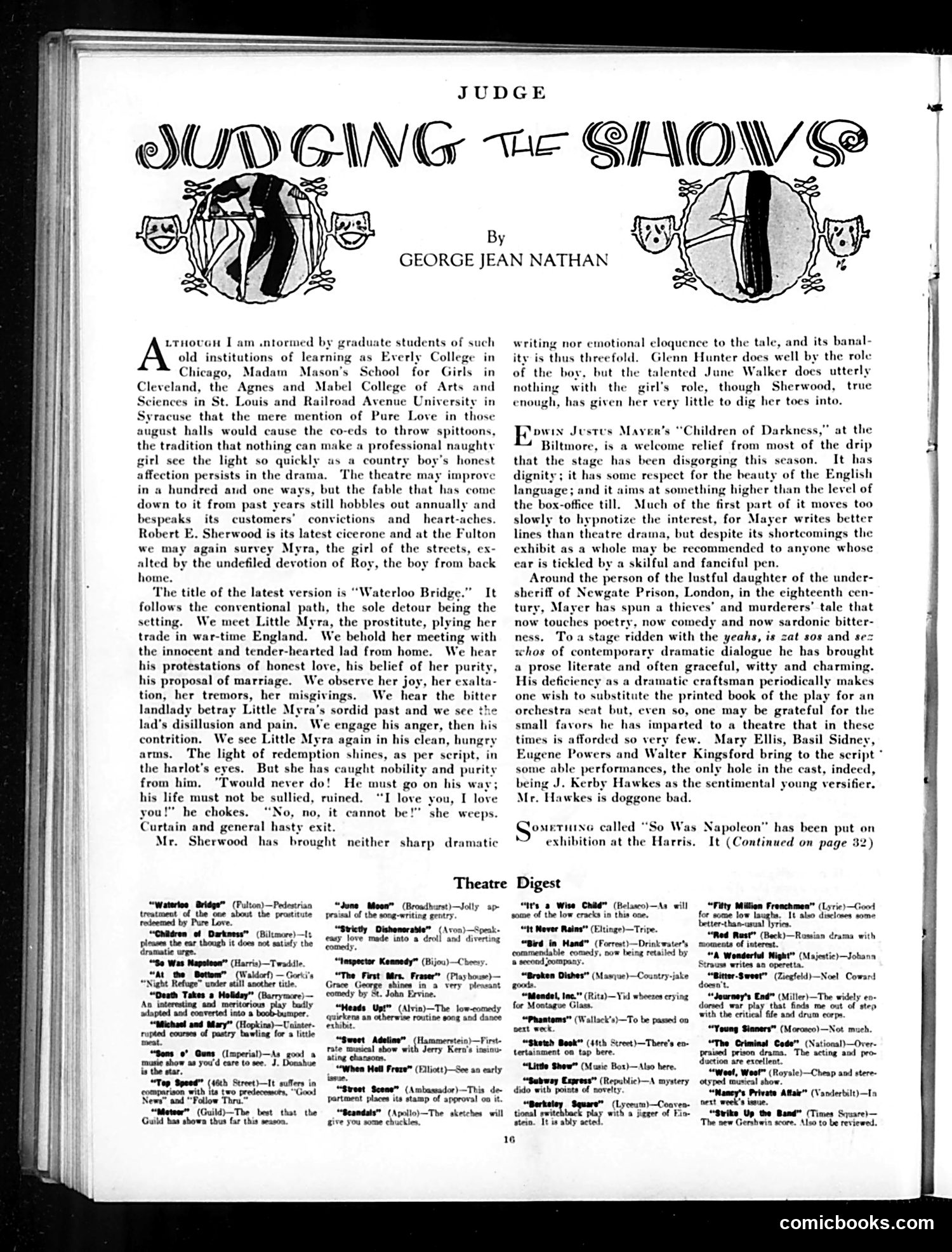
Judge Magazine Theater Review: "Judging the Shows" This is a theater review column by George Jean Nathan, a prominent drama critic of the era. The main subject is Robert E. Sherwood's play "Waterloo Bridge" at the Fulton Theatre. Nathan critiques the play's predictable plot: a prostitute (Little Myra) meets an innocent country boy (Roy) in WWI-era England, falls in love, and ultimately sacrifices their happiness for his "purity." Nathan dismisses this as a tired theatrical cliché—the redemption-through-love narrative that has persisted since earlier drama. He notes the story follows convention mechanically without genuine drama or emotion. Nathan praises June Walker's talent but faults both her limited role and Glenn Hunter's adequate but uninspired performance. The review is dismissive: Sherwood brought "neither sharp dramatic writing nor emotional eloquence" to the familiar tale. The page also lists other contemporary Broadway productions with brief critical assessments, typical of Judge's theater digest section.
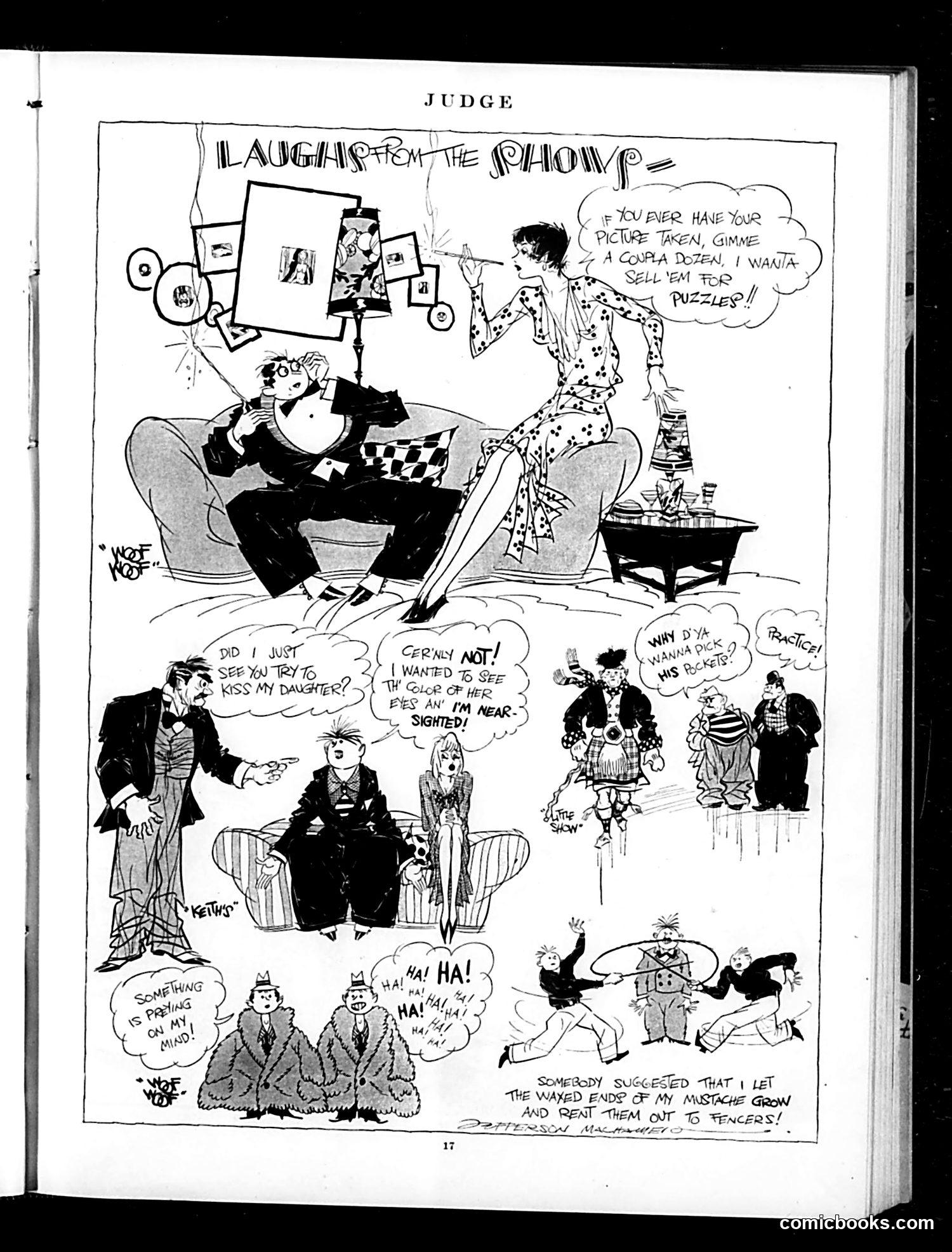
"Laughs from the Phone" This is a multi-panel comic satirizing domestic life and vanity. The top panel shows a couple at home—the woman pressuring the man to have their picture taken for sale as puzzles, while he resists. Lower panels depict various comedic domestic scenes: a man apologizing for kissing someone's daughter, another claiming he wanted to see the "glory" of her eyes but she's "nearsighted," and men laughing about something foolish. The final panel jokes about a man who, following someone's suggestion, let his mustache wax grow and treated the ends as fencers—absurd male vanity. The satire targets marriage dynamics, male foolishness, and the petty vanities of everyday life. The crude caricatures and broad humor are typical of Judge magazine's early-20th-century comedic style.
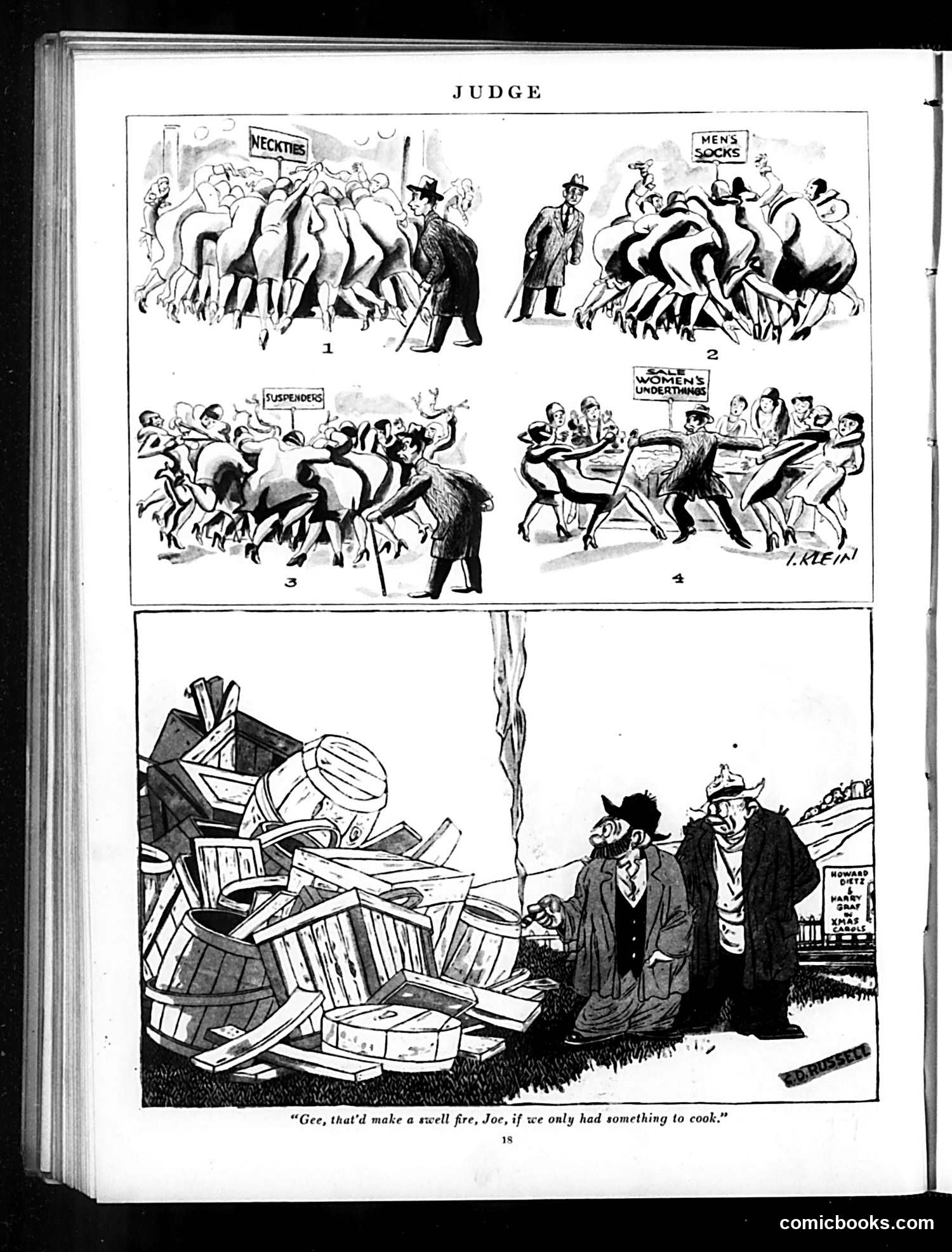
Political Cartoon Analysis This page from *Judge* contains four numbered satirical panels (top) plus a larger cartoon (bottom). The top panels depict crowds of people around labeled products—"Neckties," "Men's Socks," and "Women's Underthings"—suggesting consumer goods or merchandise controversies. Panel 3 shows "Suspenders." The bottom cartoon is the primary commentary: two men in coats examine a massive pile of broken wooden crates and debris, with one saying they'd make a good fire "if we only had something to cook." This appears to satirize economic hardship or scarcity—having fuel but no food—likely referencing Depression-era poverty or unemployment. The contrast between available materials and lack of necessities underscores the era's desperation and resource misallocation. Without a visible date, the exact event remains unclear, but the theme suggests early-to-mid 20th century economic criticism.
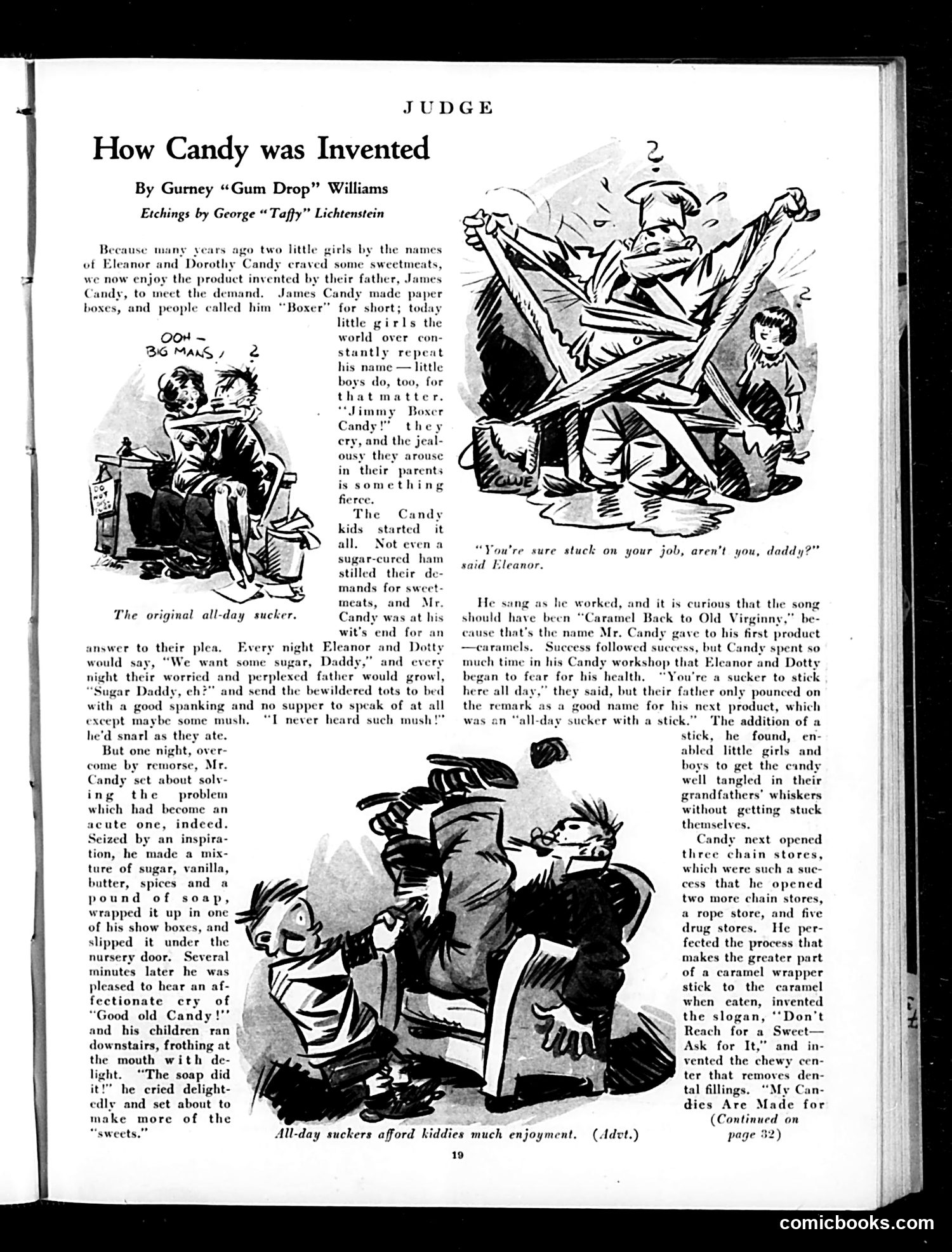
"How Candy Was Invented" — Judge Magazine This is a humorous fictional origin story attributing candy's invention to a practical father named James Candy, who nicknamed "Boxer" (a pun on his box-making business). The joke centers on a domestic problem: his daughters Eleanor and Dorothy constantly demand sweets, driving their exasperated father to distraction. The satire's humor lies in the absurd solution—Candy accidentally discovers candy works by mixing sugar, vanilla, butter, spices, and *soap*, then wrapping it in his paper boxes. The children's delighted response ("frothing at the mouth") plays on the soap ingredient for comedic effect. The piece gently mocks both parental frustration with children's demands and product-naming conventions of the era. Subsequent innovations (the lollipop stick, "all-day sucker" branding, chain stores, advertising slogans) parody how commercial success builds from a single idea—treating mundane business expansion with mock-heroic importance.
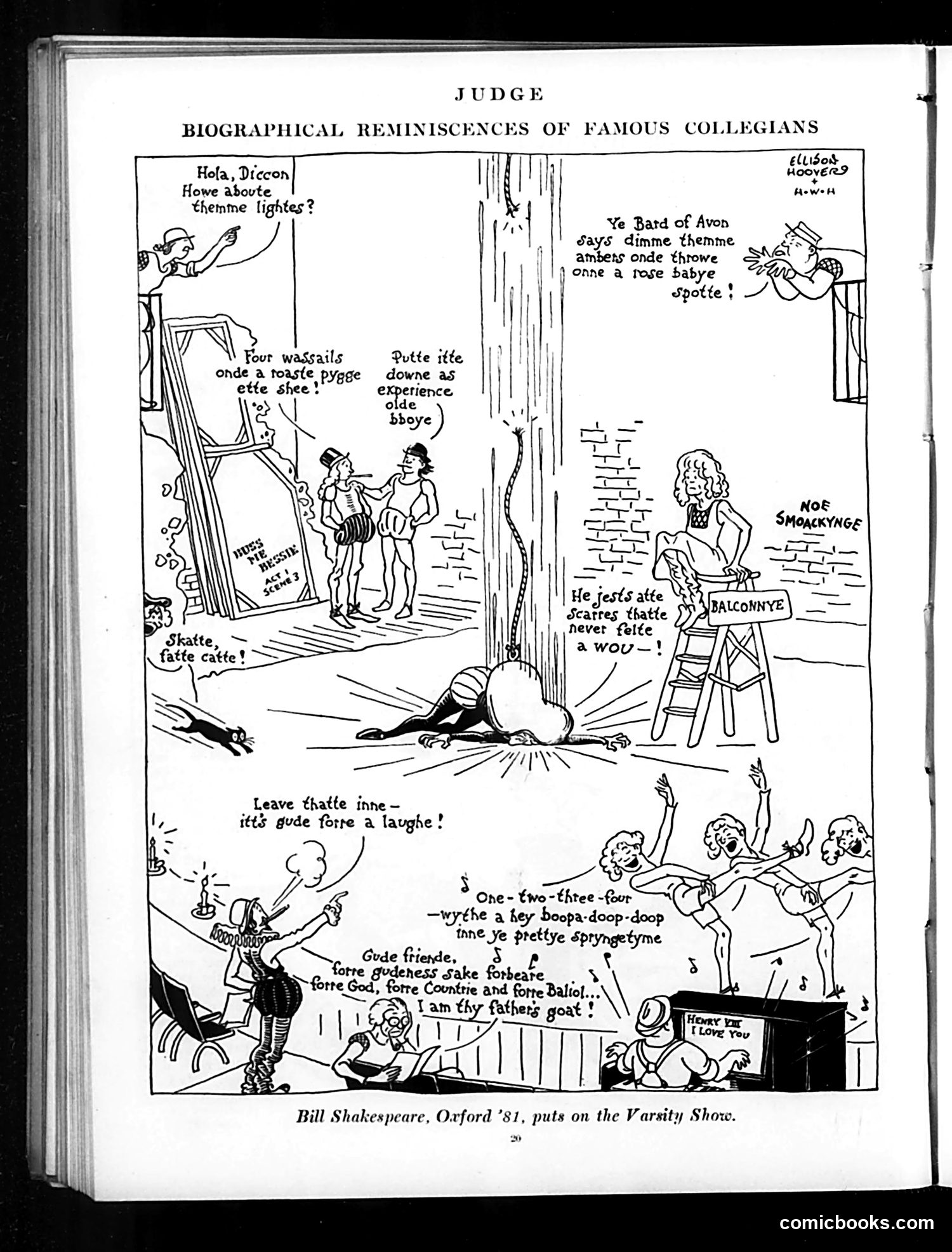
Explanation for Modern Readers This is a satirical cartoon from *Judge* magazine mocking college theatrical productions, specifically referencing Bill Shakespeare from Oxford University's class of 1881 performing in the "Varsity Show" (college theater). The joke satirizes overly earnest, affected Shakespearean performances by college students. The cartoon depicts various characters using exaggerated pseudo-Elizabethan/mock-Middle English dialect ("themme lightes," "gude forre a laughe"), physical comedy (someone sprawled on the ground), and theatrical bombast. The satire targets: - College actors' pretension when performing classical literature - Overwrought historical/poetic affectation in amateur theater - The gap between genuine Shakespeare and reverent but clumsy collegiate interpretations The caption's naming of "Bill Shakespeare" as an Oxford student is the setup—treating the actual playwright as if he were just another college performer, which heightens the absurdity of the amateur theatrics depicted above.
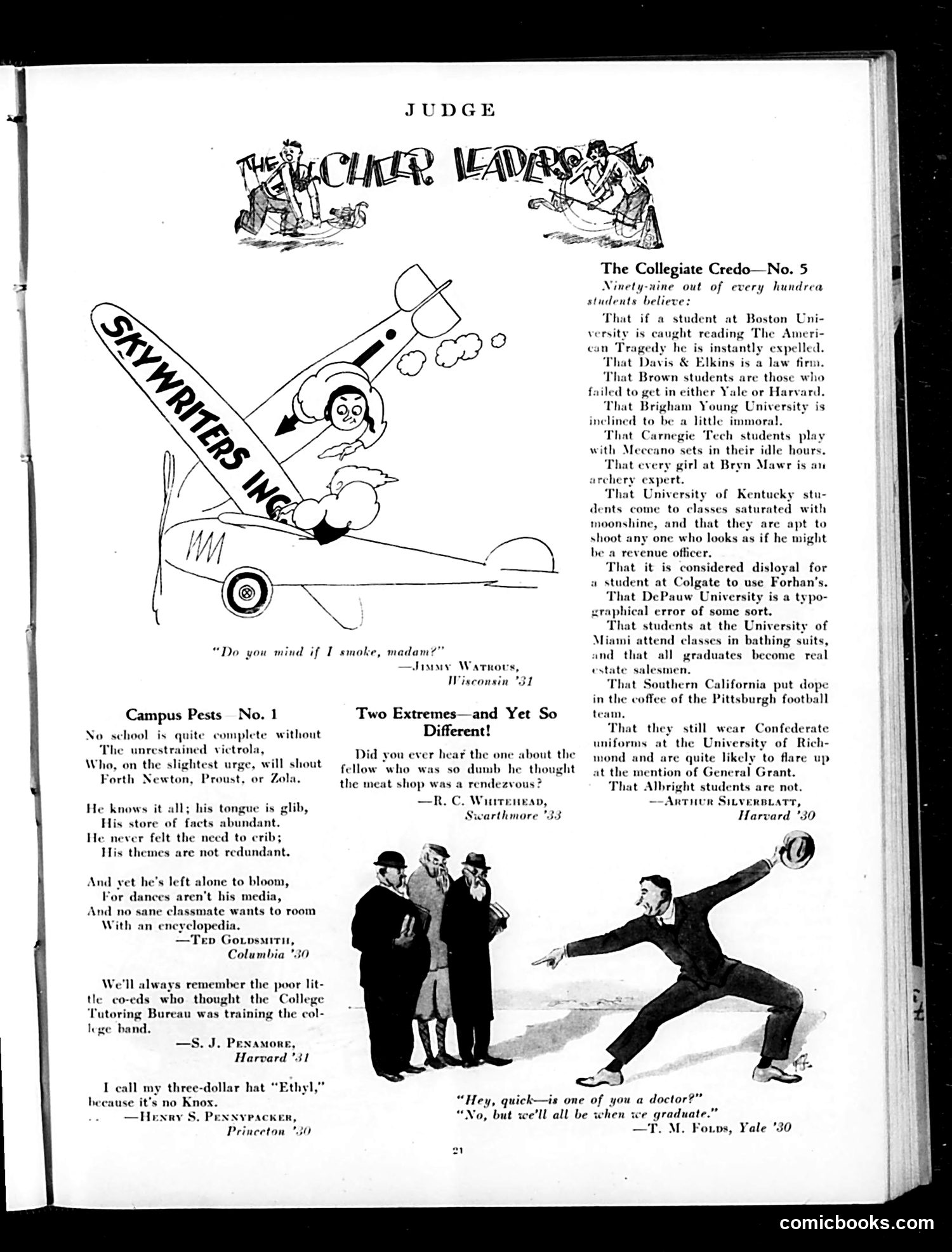
Judge Magazine Page Analysis This page from *Judge* contains three satirical sections mocking college life and student stereotypes circa 1930. "Campus Pests No. 1" ridicules the know-it-all student who owns a victrola (phonograph) and constantly pontificates about literature and facts, yet is socially isolated—a living encyclopedia nobody wants to room with. "Two Extremes—and Yet So Different!" presents a visual gag (cartoon of someone being knocked off a roof) accompanying a joke about someone so stupid they misunderstood "meat shop" as "rendezvous"—the humor relies on the absurdity of the misinterpretation. "The Collegiate Credo—No. 5" catalogs 99 ridiculous false stereotypes about various American colleges: Boston University's strict censorship, Kentucky students' moonshine consumption, Southern schools' Confederate loyalty, Miami's bathing-suit classes. The satire mocks both regional prejudices and the absurd myths college students believed about rival institutions. The final cartoon jokes that pre-med students will all graduate as doctors regardless of actual medical training.
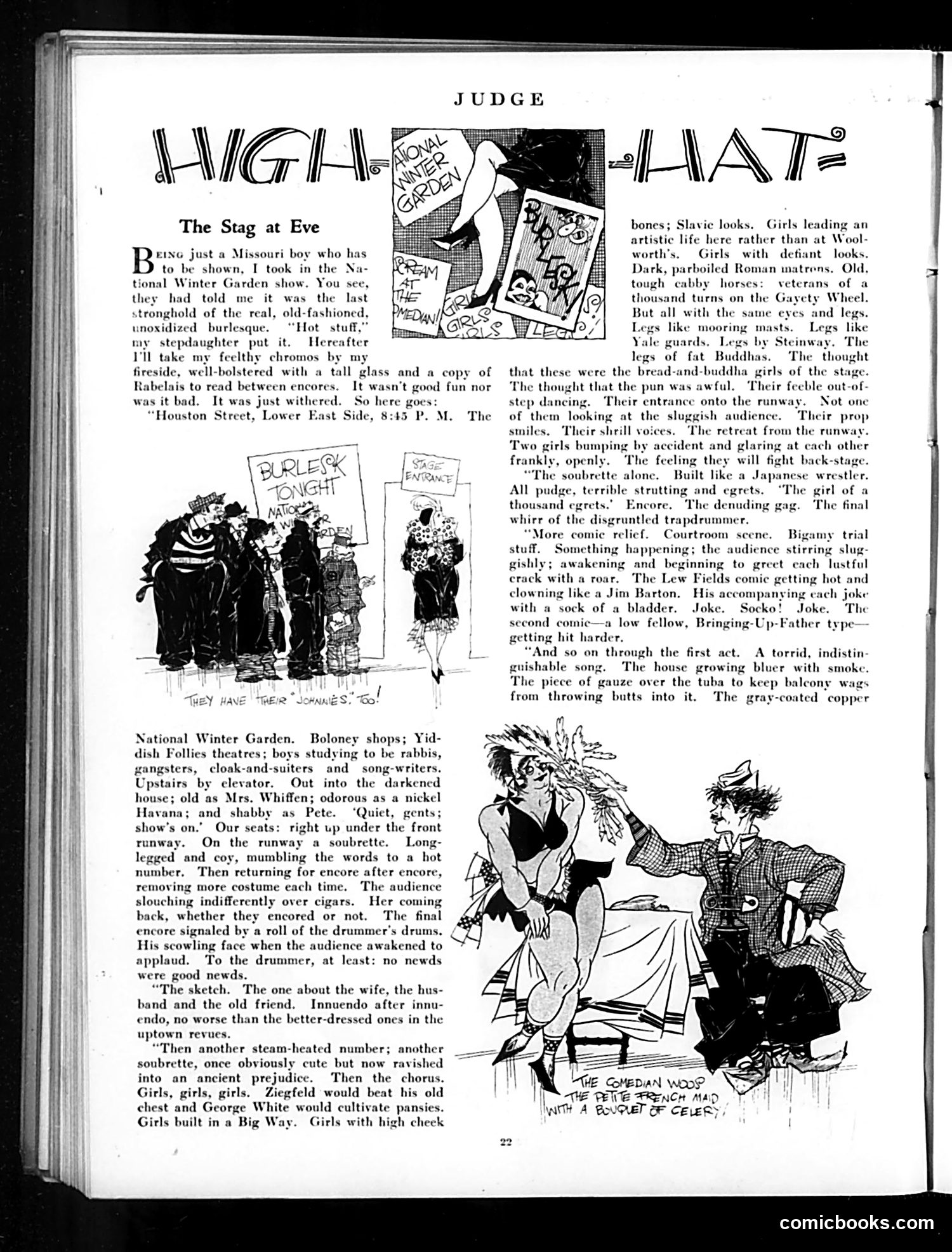
"The Stag at Eve" - Judge Magazine Review This is a theater review of a burlesque show at the National Winter Garden on Houston Street (Lower East Side). The critic, a "Missouri boy," attends what was promoted as authentic "old-fashioned" burlesque but finds it disappointing and "withered." The satire targets the degraded state of burlesque entertainment: dancers who are aging, jaded, and physically worn-out ("veterans of a thousand turns on the Gayety Wheel"); performers going through motions without engagement; crude comedy sketches relying on innuendo; and an indifferent audience of cigar-smoking patrons. The accompanying cartoons illustrate the seediness—the theater's location among Yiddish theaters and shops, the shabby venue, and the low-quality entertainment. The review mocks both the performers' decline and the audience's tolerance for mediocrity, suggesting burlesque had lost whatever appeal or vitality it once possessed.
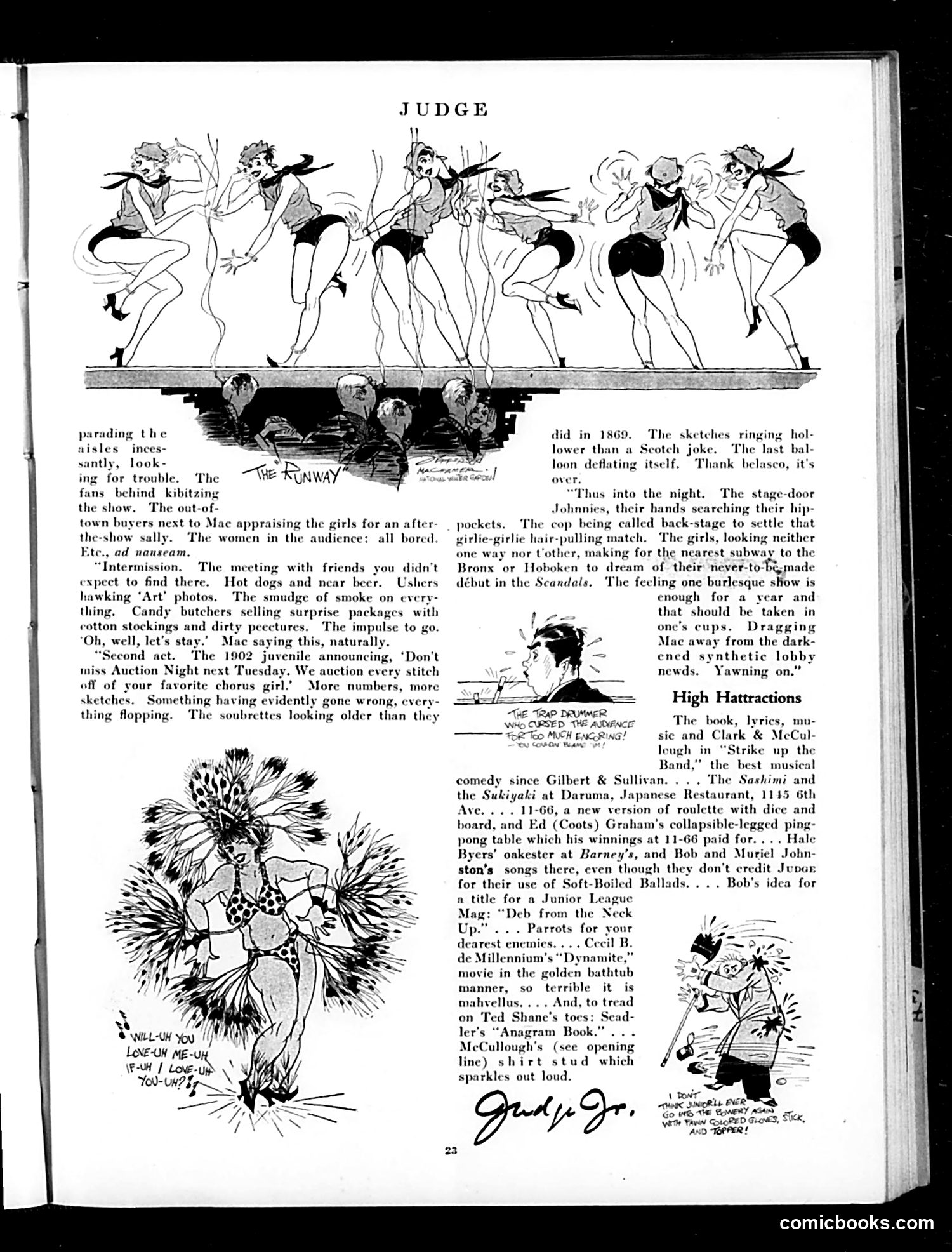
Judge Magazine Page Analysis This page satirizes the burlesque theater experience of the early 1900s. The top cartoon shows chorus girls parading across a runway while male audience members below—depicted as leering "stage-door Johnnies"—ogle them. The satire targets the predictable, degrading nature of burlesque: bored female audience members, out-of-town businessmen appraising girls "for an after-the-show sally," and the tired theatrical formula of failing sketches and aging performers. The accompanying text mockingly narrates a typical evening—from ushers hawking indecent photos to the climactic promise of an "Auction Night" where "every stitch" of a chorus girl's clothing will be sold. The piece critiques both the seediness of the venue and the desperation of young performers hoping for legitimate theatrical debuts in the *Scandals*. The "High Hattractions" section reviews contemporary entertainment venues and products, maintaining the magazine's gossipy, entertainment-focused tone.
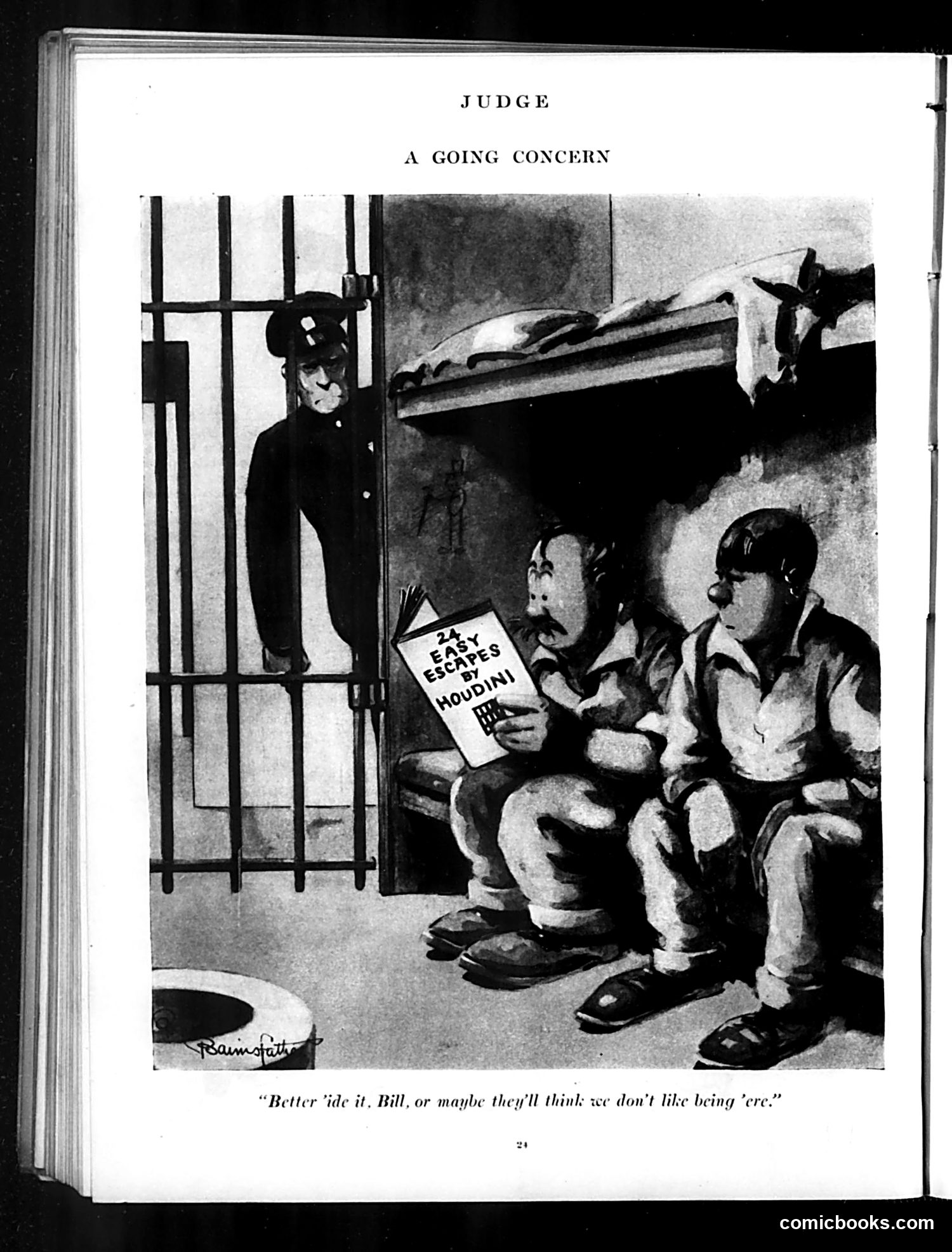
Analysis This is a cartoon titled "A Going Concern" depicting a prison cell scene. Two men sit reading a pamphlet labeled "EASY ESCAPES BY HOUDINI" while a jailer stands guard behind bars. The caption reads: "Better 'ide it, Bill, or maybe they'll think: we don't like being 'ere." The satire mocks prisoners who study escape techniques while confined—the joke being they're pretending contentment to avoid suspicion, despite possessing an escape manual. The reference to "Houdini" (the famous illusionist and escape artist) adds topical humor, likely from the early 20th century when Houdini was performing. The cartoon satirizes either prison conditions or prisoner behavior, suggesting inmates must hide their desire for freedom from authorities.
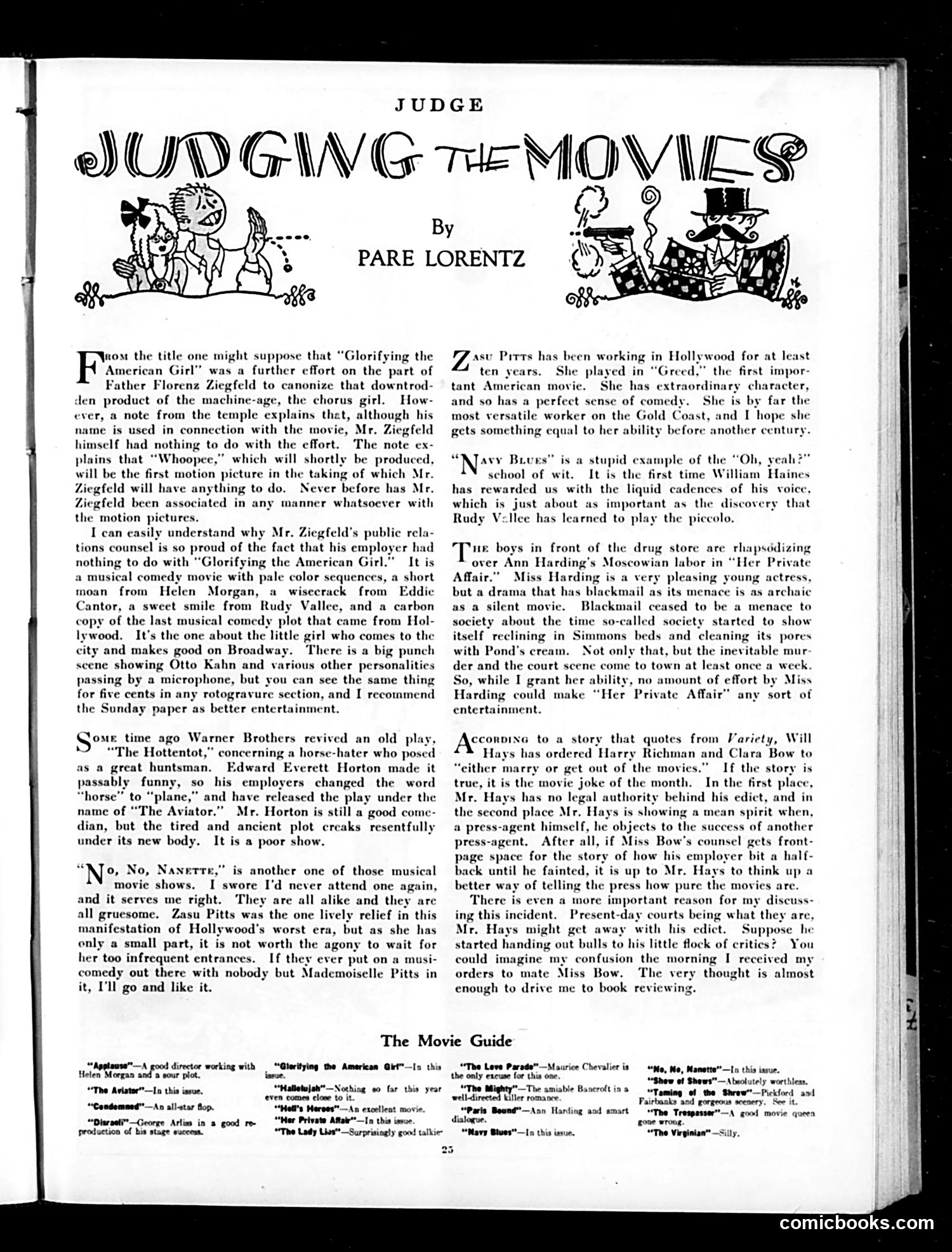
"Judging the Movies" - A Film Critic's Column This is a film review column by Pare Lorentz critiquing recent Hollywood releases circa late 1920s. The decorative masthead depicts theatrical figures and entertainers. Lorentz dismisses several current movies as formulaic and mediocre: - "Glorifying the American Girl": A Florenz Ziegfeld-titled film (though Ziegfeld had no involvement) featuring pale color sequences, Helen Morgan, Eddie Cantor, and Rudy Vallée. Lorentz finds it derivative—recycled plot about a girl succeeding on Broadway. - "The Aviator": Warner Brothers recycled an old play, merely changing "horse" to "plane," starring Edward Everett Horton. Lorentz calls it tired. - "No, No, Nanette": Another tedious musical, redeemed only by Zasu Pitts's small role. - "Navy Blues": William Haines's talking picture debut exemplifies cheap "Oh, yeah?" style humor. - "Her Private Affair": Ann Harding performs adequately, but blackmail as a plot device is outdated and unbelievable. The underlying critique targets Hollywood's reliance on recycled plots and celebrity names over genuine storytelling.
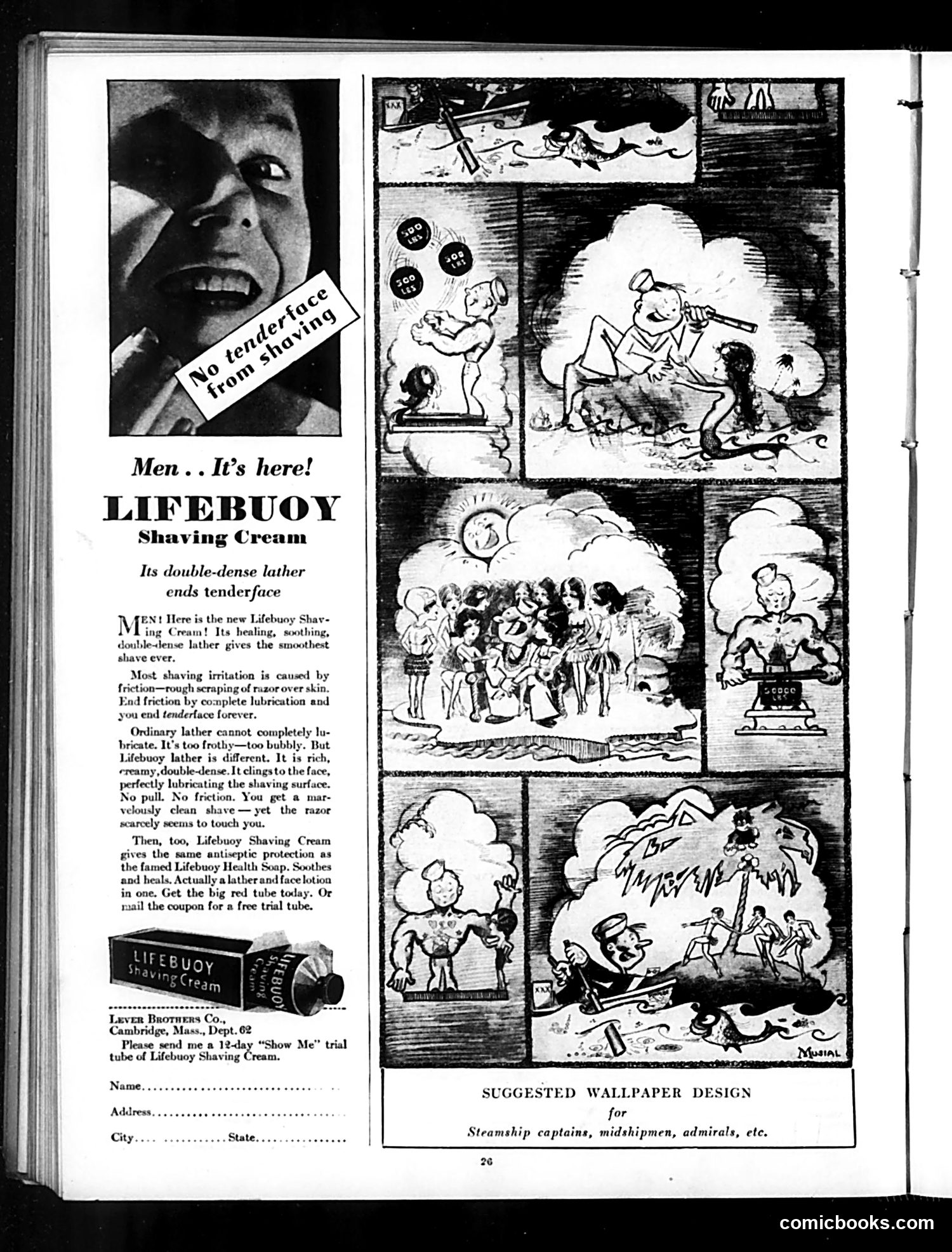
Analysis This page is primarily a Lifebuoy Shaving Cream advertisement occupying the left side, with an unrelated cartoon on the right. The Ad: Features a stern-faced man with the tagline "No tenderface from shaving." The copy emphasizes that Lifebuoy's "double-dense lather" reduces razor friction and irritation—a common shaving problem. It also claims antiseptic properties matching Lifebuoy's soap line. This is straightforward product marketing targeting male consumers. The Cartoon: A multi-panel comic titled "Suggested Wallpaper Design for Steamship captains, midshipmen, admirals, etc." depicts whimsical nautical scenes—cherubs in clouds, sailors, maritime adventures, and ship-related imagery. The humor appears to be gentle, playful maritime decoration suited to naval professionals' tastes, rather than sharp satire. The page reflects typical Judge magazine advertising practice: blending commercial endorsements with light editorial cartooning.
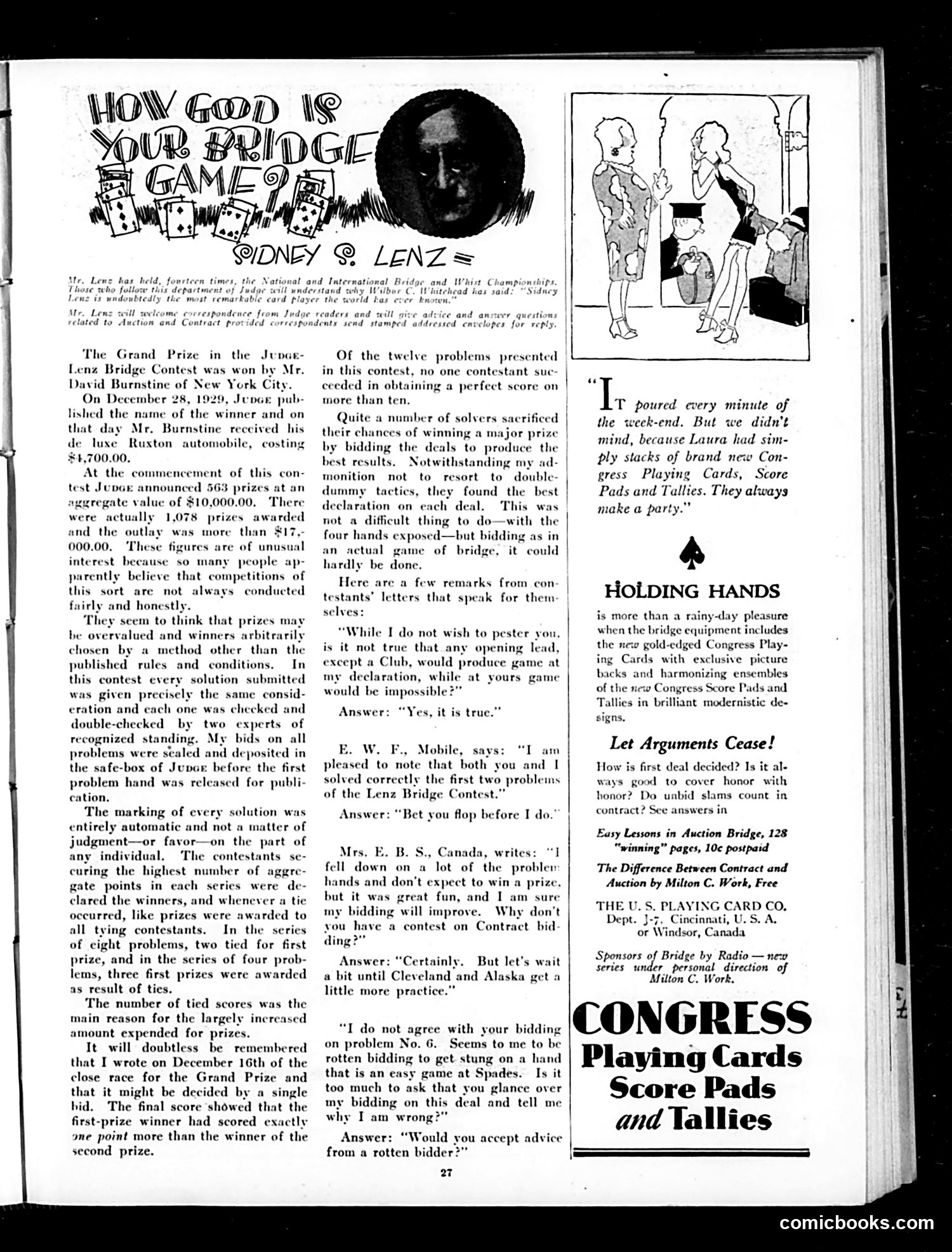
Analysis: "How Good Is Your Bridge Game?" - Judge Magazine This page documents Sidney Lenz's bridge card game contest, a real 1929 competition Judge magazine sponsored. The circular portrait shows Lenz, a renowned bridge player and champion. The main cartoon (upper right) humorously depicts a social scene where someone has brought playing cards to what should be a formal occasion, causing domestic disruption—satirizing the era's bridge craze among American society. The text below presents genuine contest correspondence: players writing to contest organizer Lenz with complaints and questions about his bidding solutions. Lenz's responses are characteristically dismissive ("Would you accept advice from a rotten bidder?"), conveying the competitive tension and ego involved in high-stakes bridge. The page reflects 1920s-30s American culture: bridge was a fashionable obsession among the wealthy and middle class. Judge uses the contest to mock both the game's complexity and players' humorless competitiveness about winning prestigious prizes (the grand prize was a luxury automobile worth $1,700).
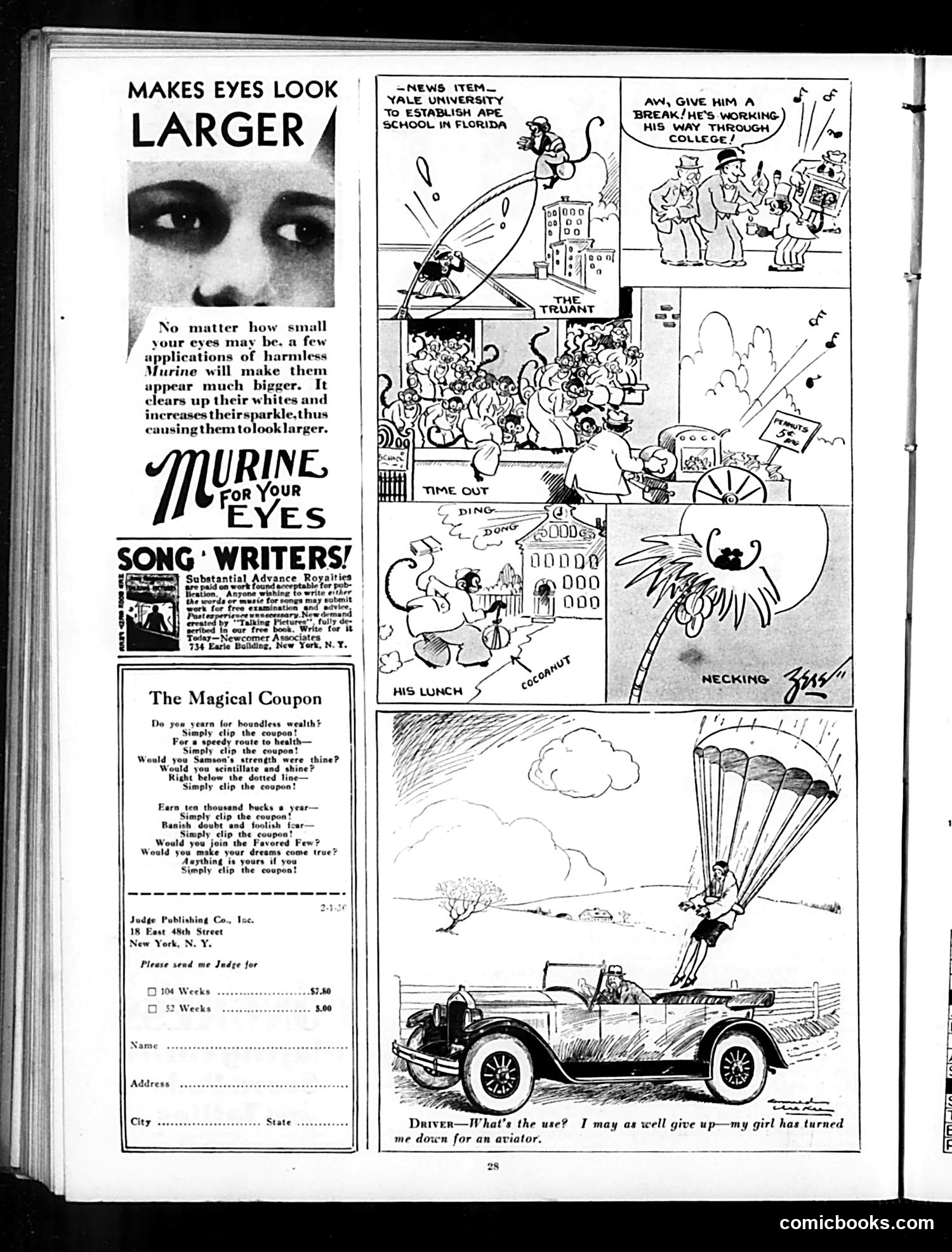
Page Analysis: Judge Magazine This page combines advertisements with satirical comics mocking Yale University's plan to establish an ape research facility in Florida. Main Cartoon (right): The multi-panel comic ridicules the news item about Yale's ape school. It depicts chaos—monkeys operating machinery, causing mayhem in an academic setting labeled "The Truant"—suggesting the absurdity of such an institution. The satire targets Yale's credibility and the impracticality of the venture. Bottom Cartoon: A romantic comedy bit where a man gives up pursuing his girlfriend because she's chosen an aviator instead. The joke plays on 1920s fascination with aviation as glamorous and competitive with traditional romance. Left Side: Advertisements for Murine eye drops and a "Magical Coupon" from Judge Publishing, plus a song-writing opportunity ad—typical magazine filler of the era. The page satirizes both academic pretension and contemporary popular enthusiasms (aviation). The ape school mocking appears to be Judge's editorial commentary on what it considered a ridiculous institutional decision.
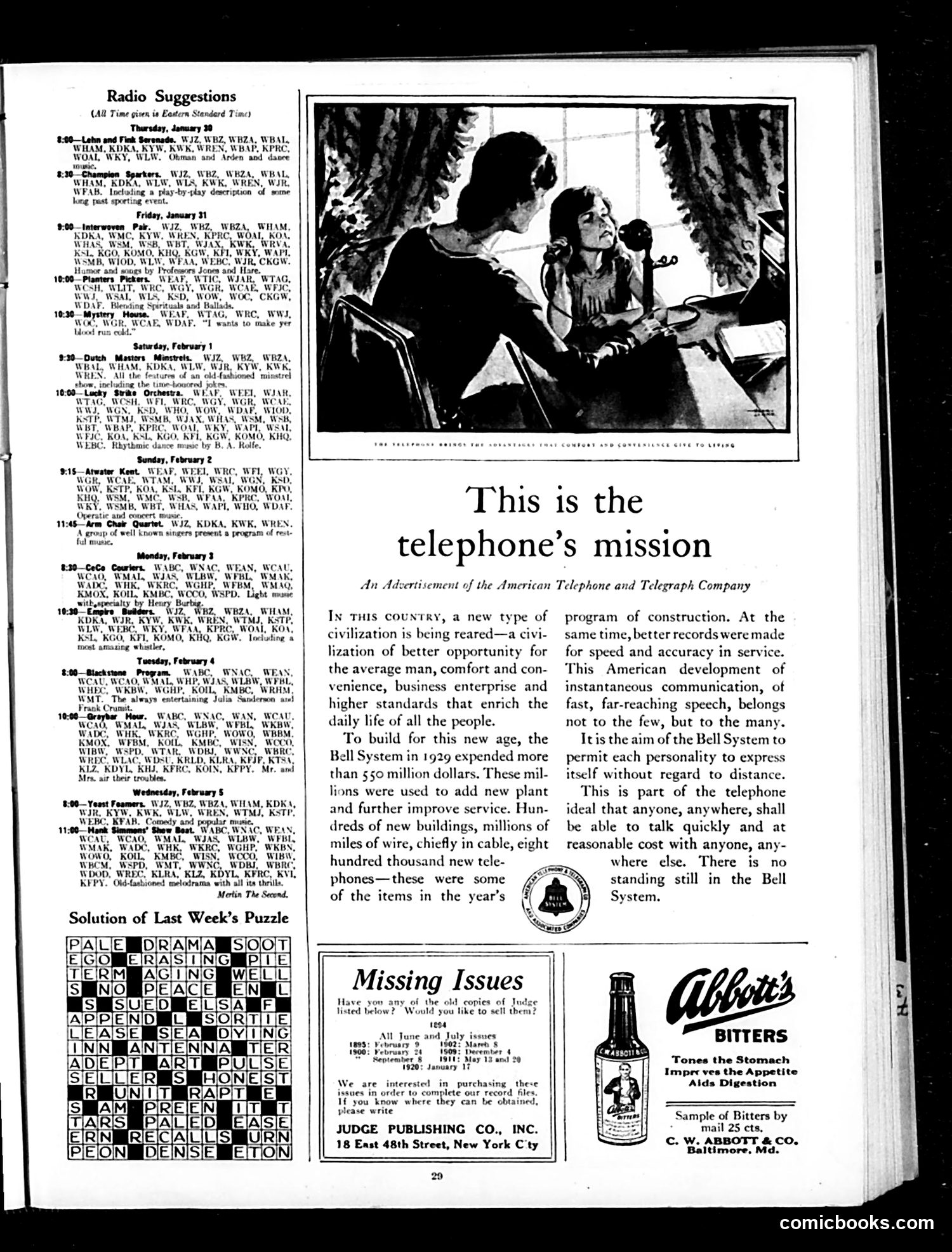
What This Page Means This page is primarily a radio programming guide for Judge magazine readers in late January/early February 1930, listing broadcast schedules across numerous American radio stations (WJZ, KDKA, etc.). The main visual content is a full-page advertisement for AT&T's Bell System telephone service. The photograph shows people using a telephone, illustrating the ad's message about the telephone's "mission" in modern American civilization. The text celebrates the Bell System's 1929 capital investment of $550 million in infrastructure—new buildings, telephone lines, and phones—framing telephone service as essential to America's progress and opportunity for "the average man." This reflects the 1920s-30s optimism about technological modernity and corporate development. The ad equates telephone infrastructure with civilization itself and economic mobility. The page also includes a crossword puzzle solution and a small Abbott's Bitters advertisement, typical of magazine monetization of the era.
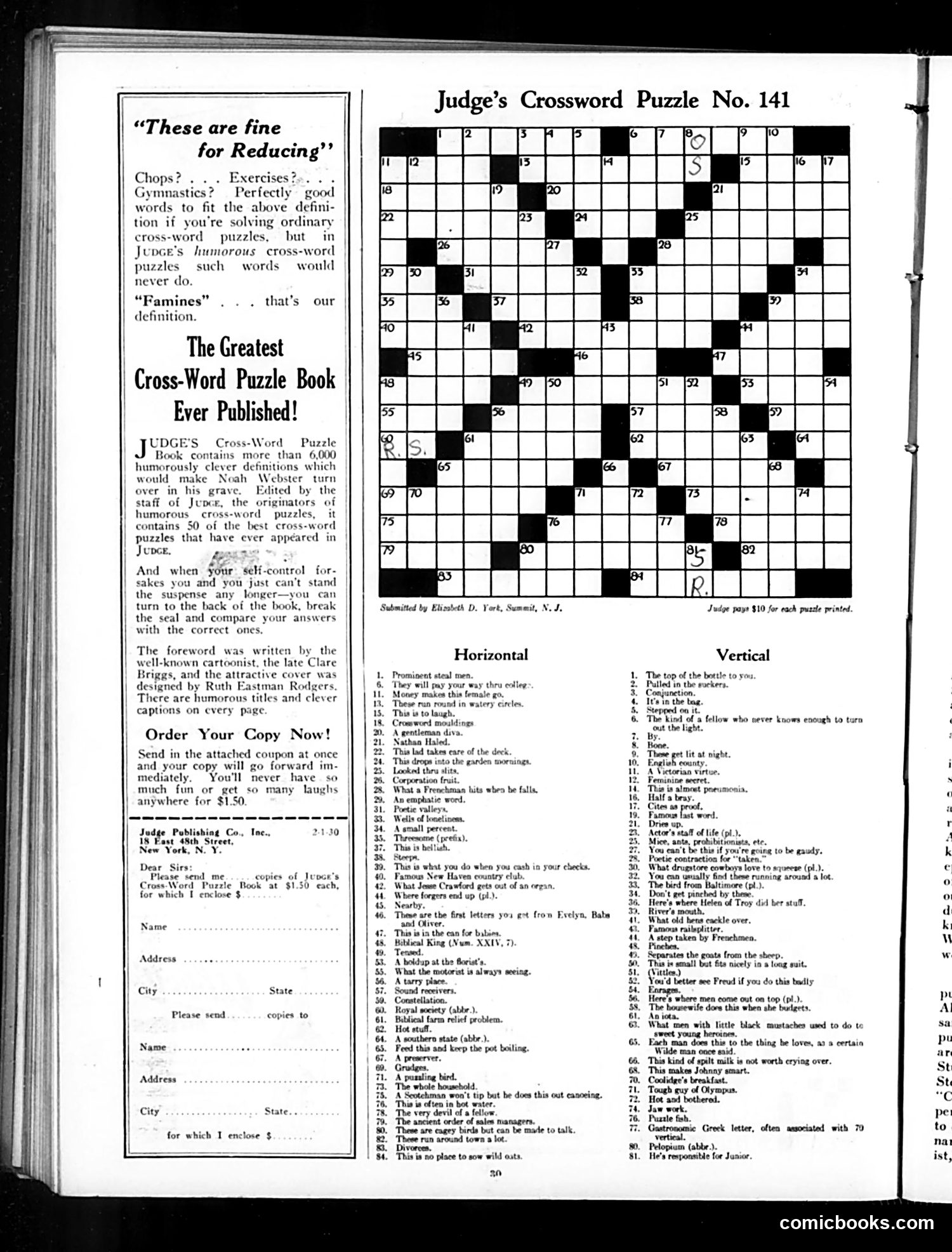
Judge's Crossword Puzzle No. 141 This page is primarily advertising and promotional material for Judge Publishing Company's crossword puzzle book, not a political cartoon. The left side contains a sales pitch claiming Judge's crossword puzzles are superior because they use humorously clever definitions rather than standard ones. Examples given include "Famines" = "that's our definition" and "Chops" = "Perfectly good words to fit the above definition." The bulk of the page shows an actual crossword puzzle with its clues (Horizontal and Vertical). The clues themselves are the "humor"—they're intentionally oblique or punny definitions meant to amuse solvers. For example, horizontal clue 1: "Prominent steal men" (answer likely: TYCOONS). The bottom contains an order form encouraging readers to purchase the full puzzle book for $1.50. Context for modern readers: This represents crossword puzzles as a major commercial entertainment trend of the era. The advertising emphasizes that Judge's version uniquely combined puzzle-solving with comedic writing—treating the definitions themselves as jokes rather than straightforward clues.
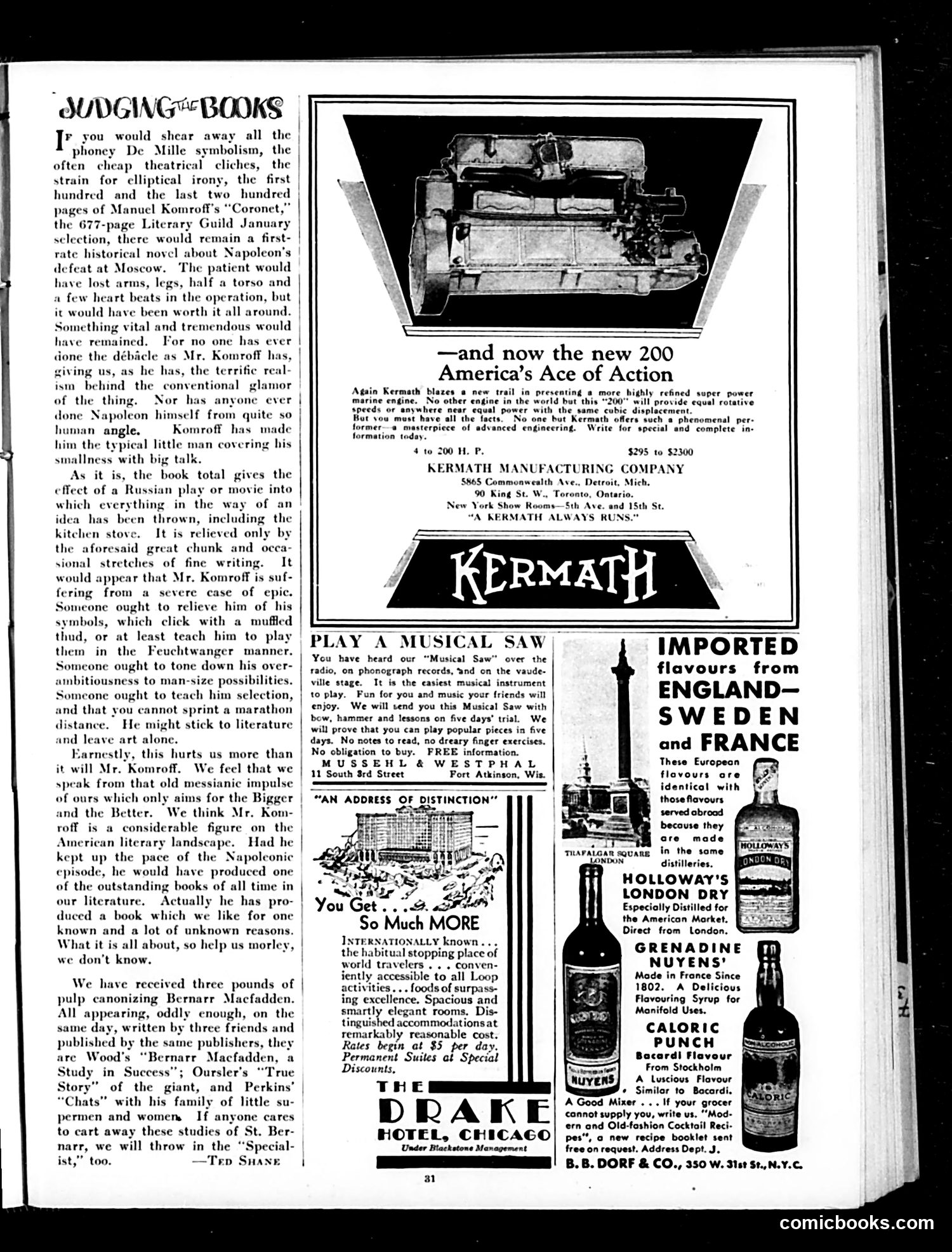
Analysis of Judge Magazine Page This is primarily an advertising and book review page rather than a political cartoon page. The main content is "Judging the Books," a book review by Trp Shane criticizing Manuel Komroff's novel *Coronet* about Napoleon's defeat at Moscow. The critic praises the core historical narrative but condemns the book's excessive length, overwrought "De Mille symbolism," and pretentious style—arguing Komroff should have maintained the quality of his Napoleon episode throughout rather than padding the work. The page also notes humorous publication timing: three separate Bernarr Macfadden biography books arrived simultaneously from different publishers and friends, prompting the reviewer's joke about throwing in another Macfadden book (*The Specialist*) if anyone wants them. The remaining content consists entirely of period advertisements: Kermath marine engines, musical saws, hotels, and imported liqueurs from Sweden and France.
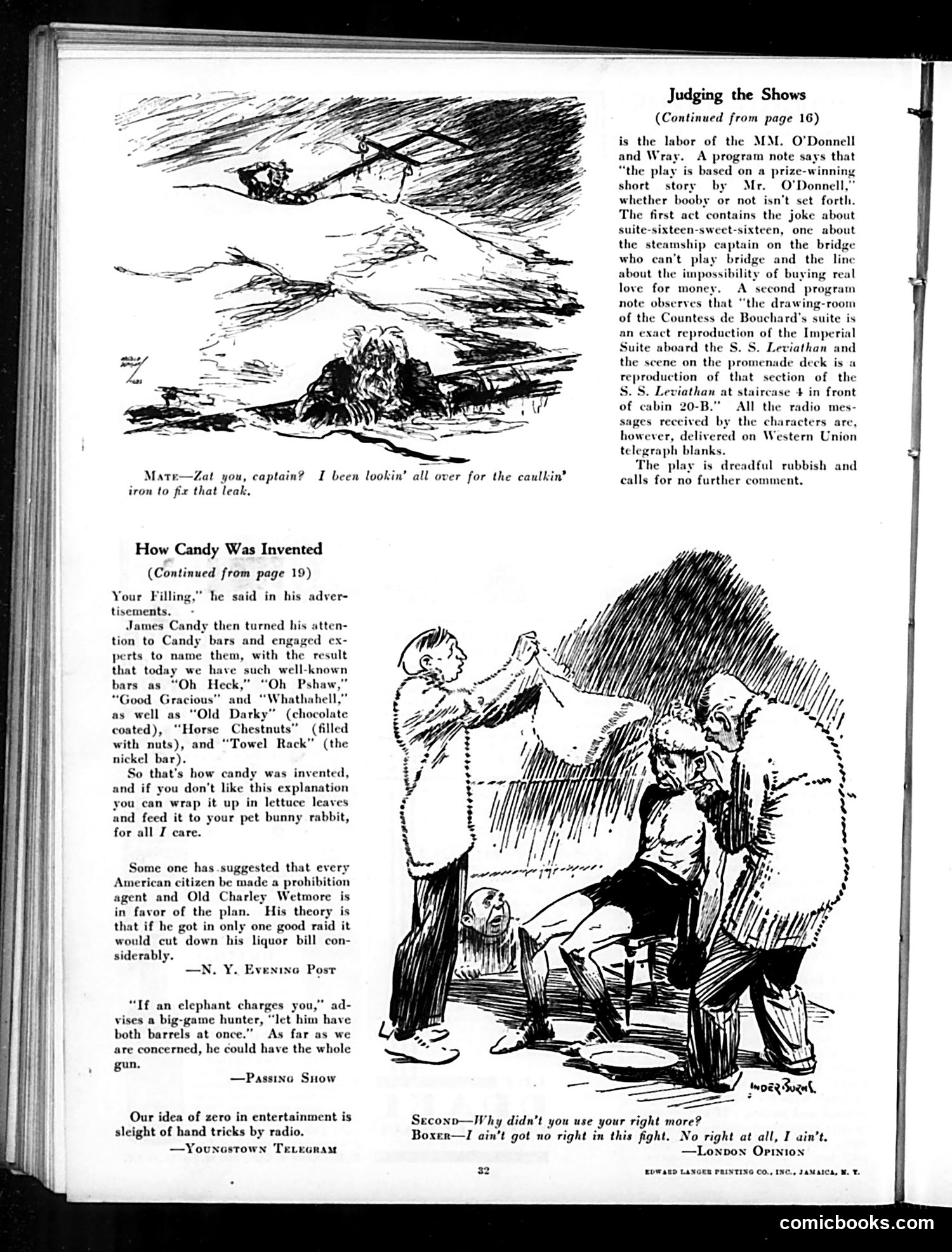
Judge Magazine Page Analysis This page contains two main satirical pieces: "Judging the Shows" (top): A theater review mocking a play based on O'Donnell's story. The joke targets the production's overwrought authenticity—the program notes boast that a drawing room reproduces the S.S. *Leviathan* liner exactly, and that radio messages use actual Western Union telegraph blanks. Judge ridicules this pretentious attention to trivial detail while the play itself is "dreadful rubbish." The cartoon above shows a ship's mate searching for caulking materials, illustrating literal-minded incompetence. "How Candy Was Invented" (bottom): A humorous origin story for candy bar names like "Oh Heck," "Good Gracious," and "Old Darky." The accompanying cartoon depicts boxers in a fight. The joke below it plays on boxing terminology: one boxer explains he has "no right" in the fight—a pun on the boxing term "right hand" versus literal absence of fighting skill or fairness. Both pieces exemplify Judge's satirical style: deflating pretension and finding humor in wordplay and social absurdity.
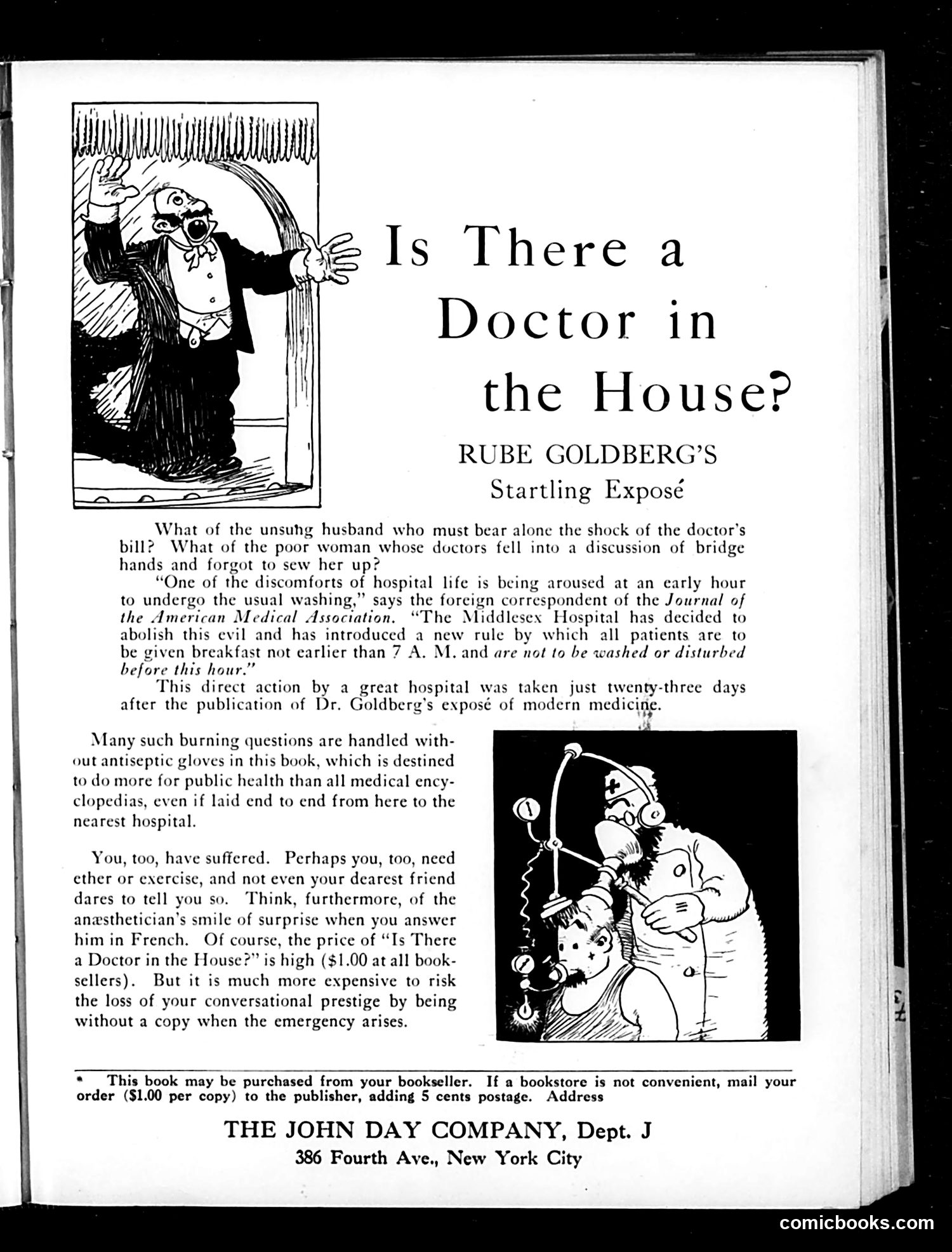
"Is There a Doctor in the House?" - Rube Goldberg Advertisement This is an advertisement for cartoonist Rube Goldberg's book satirizing modern medicine and hospitals. The page mocks medical practices through humorous complaints: inattentive doctors (distracted by bridge games during surgery), early morning hospital wake-ups, and expensive medical bills. The two cartoon illustrations show exaggerated medical scenarios typical of Goldberg's style—absurd, over-complicated situations. The ad's humor targets hospital inefficiency and doctor negligence, presenting the book as a public health exposé. The copy satirically suggests that owning this book is essential for social prestige—you'll be embarrassed without it when "emergencies arise." At $1.00 (plus 5¢ postage), it's positioned as an affordable luxury. The ad cites a real hospital (Middlesex) allegedly reforming practices after Goldberg's publication, adding mock-credibility to the book's satirical "exposé" of medical absurdities.
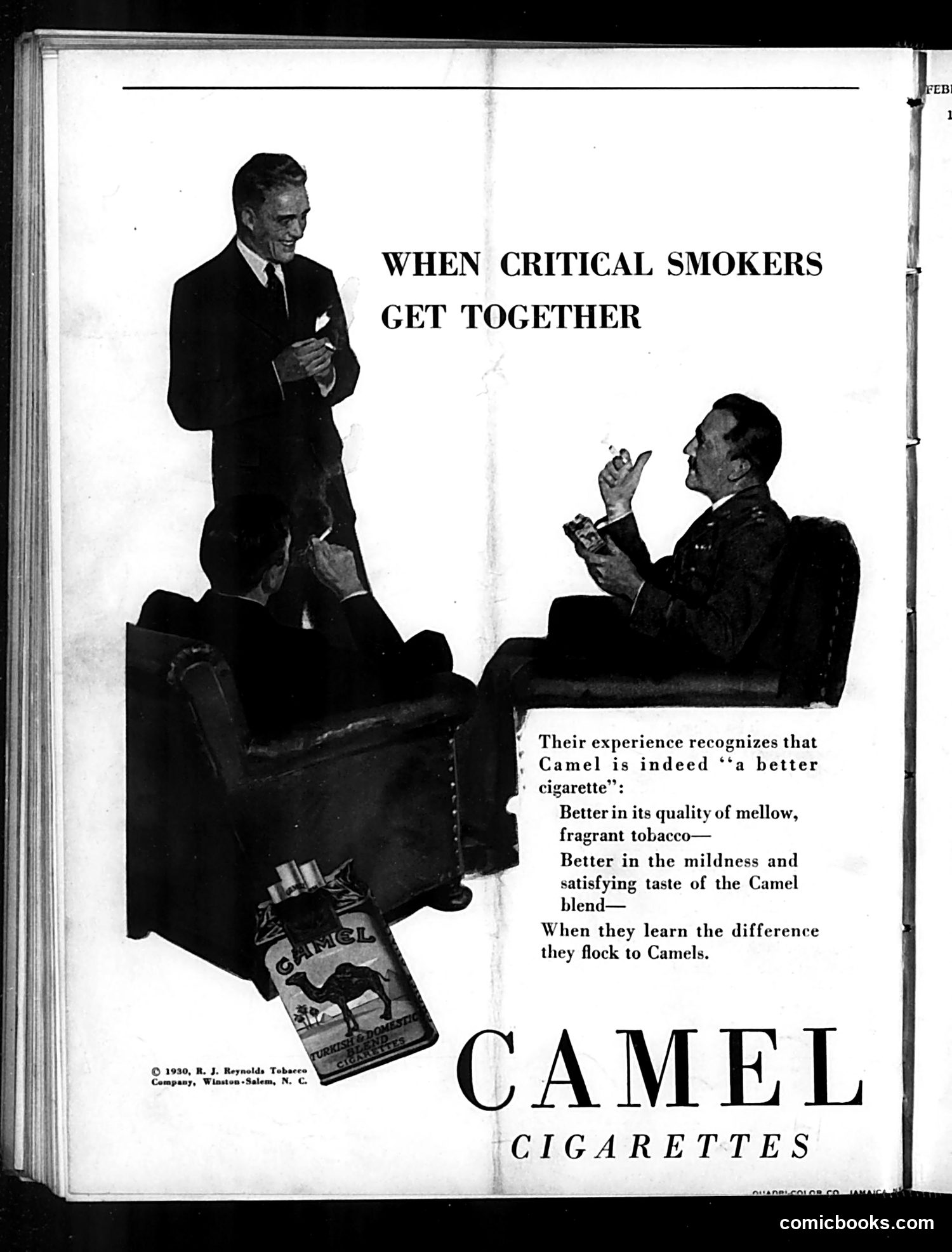
Camel Cigarettes Advertisement (1930) This is a cigarette advertisement, not political satire. It depicts two well-dressed men in business suits having a conversation, with one standing and gesturing while the other sits smoking. A Camel cigarette pack is prominently displayed at the bottom. The ad uses the concept of "critical smokers"—experienced, discerning men—to suggest that knowledgeable consumers prefer Camel cigarettes. The copywriting claims Camel offers superior "mellow, fragrant tobacco" and a "satisfying taste." This represents early 20th-century advertising strategy: using masculine authority figures and appeals to expertise to market cigarettes as a quality product. The 1930 copyright date reflects the era before cigarette health dangers were widely acknowledged. Modern readers should recognize this as now-banned advertising that normalized smoking by associating it with professional success and good taste.