judge
Judge — February 8, 1930
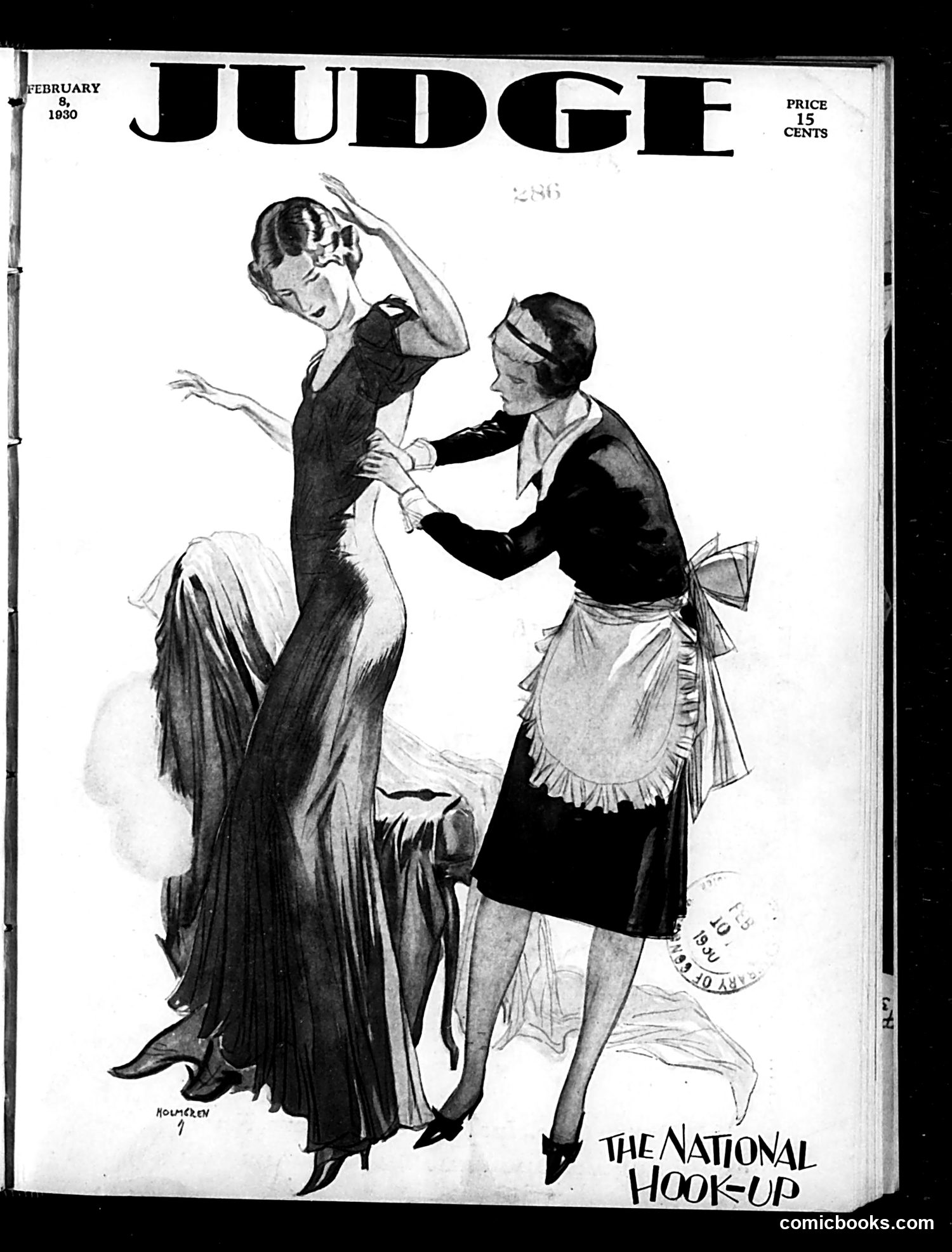
"The National Hook-Up" - Judge Magazine, February 1930 This cartoon satirizes the emerging phenomenon of radio network broadcasting. The illustration shows two women: one elegantly dressed, being "hooked up" or connected by another woman dressed as a maid or servant. The title "The National Hook-Up" references the newly-formed radio networks that "connected" America through synchronized broadcasts. The visual pun plays on the phrase—literally depicting women being physically linked together, mirroring how radio networks linked cities and audiences nationwide. This reflects 1930s anxieties about rapid technological change and mass media's power to standardize American culture. The satirical tone suggests ambivalence toward this new interconnected society, using the intimate domestic scene to make the abstract concept of national broadcasting tangible and somewhat absurd.
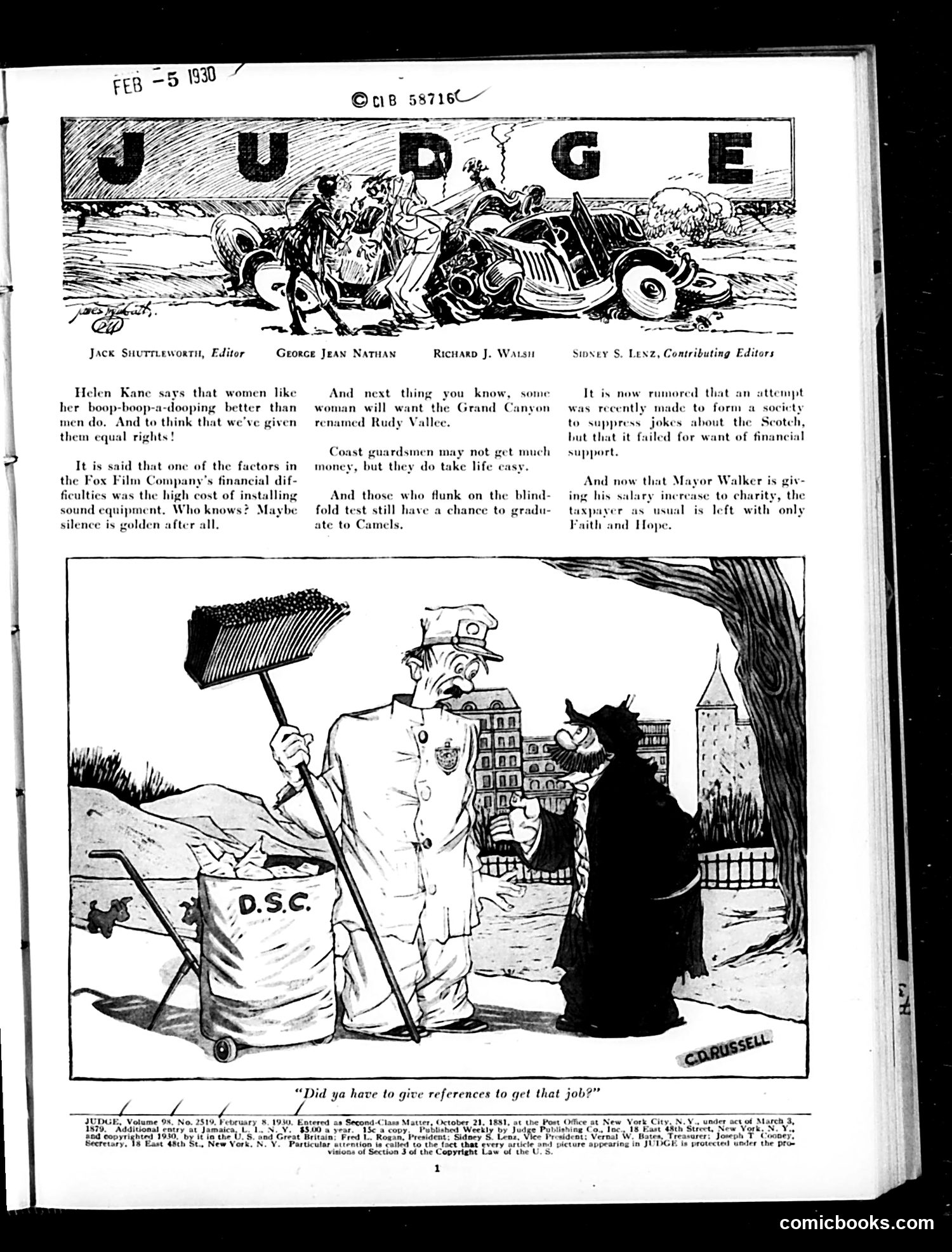
Explanation of This Judge Magazine Page (February 5, 1930) The main cartoon depicts a figure labeled "D.S.C." (likely the District of Columbia or a government agency) sweeping filth while confronting a sinister dark figure—apparently representing political corruption or misconduct in Washington, D.C. The caption "Did ya have to give references to get that job?" suggests satirical commentary on nepotism, patronage, or unqualified appointments in government employment. The surrounding text contains brief satirical commentary on contemporary issues: Helen Kane and women in entertainment, the Fox Film Company's financial troubles with sound equipment, and Mayor Walker's salary increase despite taxpayer hardship—references to 1920s-30s New York politics and the early Depression era. The overall message critiques government inefficiency and corruption during this period.
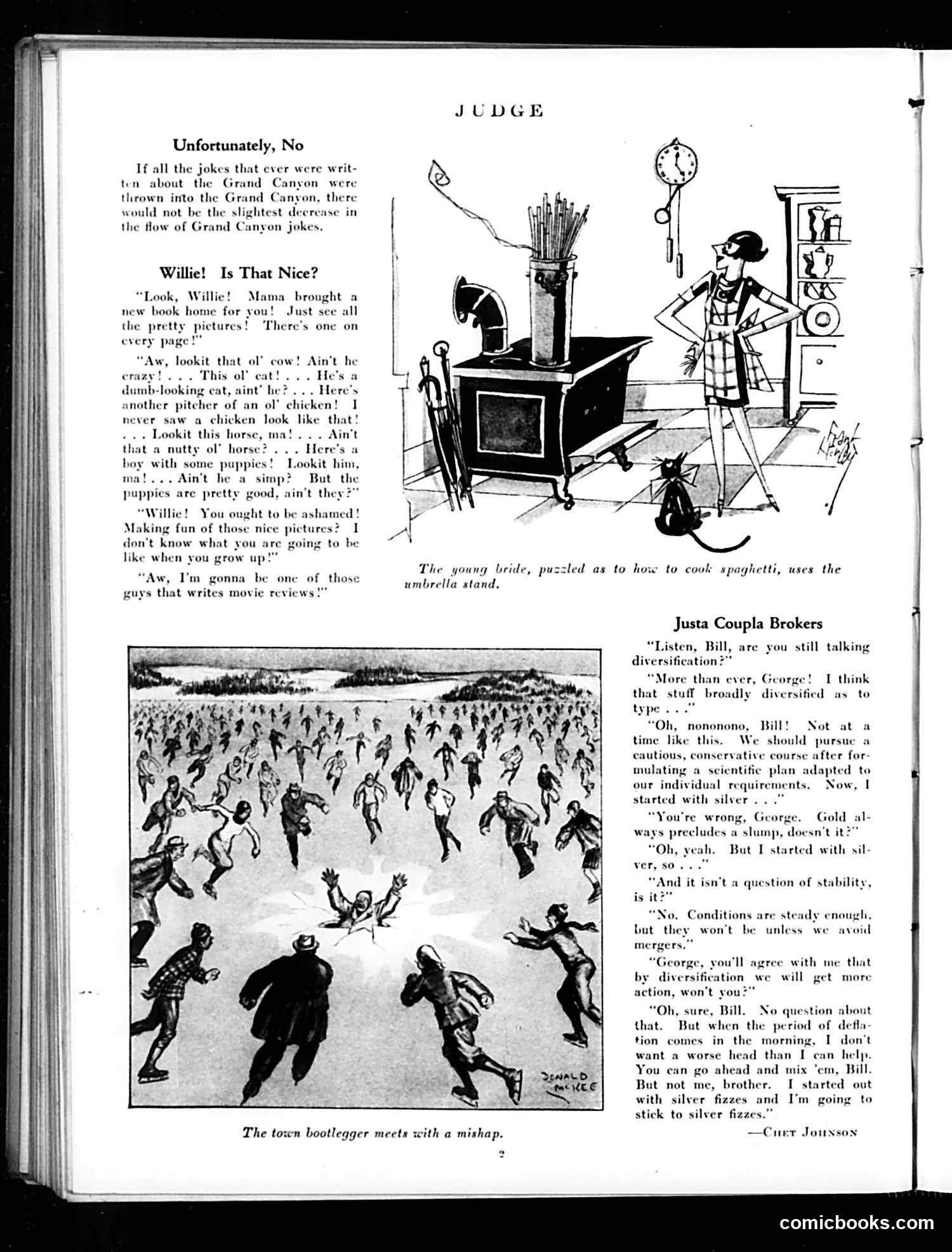
Analysis of Judge Magazine Page This page contains three unrelated pieces: 1. "Unfortunately, No" - A humorous piece about Grand Canyon jokes with a child named Willie mispronouncing animals in a picture book (calling a horse a "simp," etc.). 2. "Willie! Is That Nice?" - A cartoon showing a young bride confused about cooking spaghetti, using an umbrella stand as a pasta holder. The joke relies on domestic incompetence humor common to the era. 3. "Justa Coupla Brokers" - A dialogue between Bill and George about investment diversification, debating whether to use gold or silver for financial stability. This appears to be financial satire, though the specific market conditions referenced are unclear without dating information. The page reflects early-to-mid 20th century American humor: domestic stereotypes, financial speculation commentary, and wordplay.
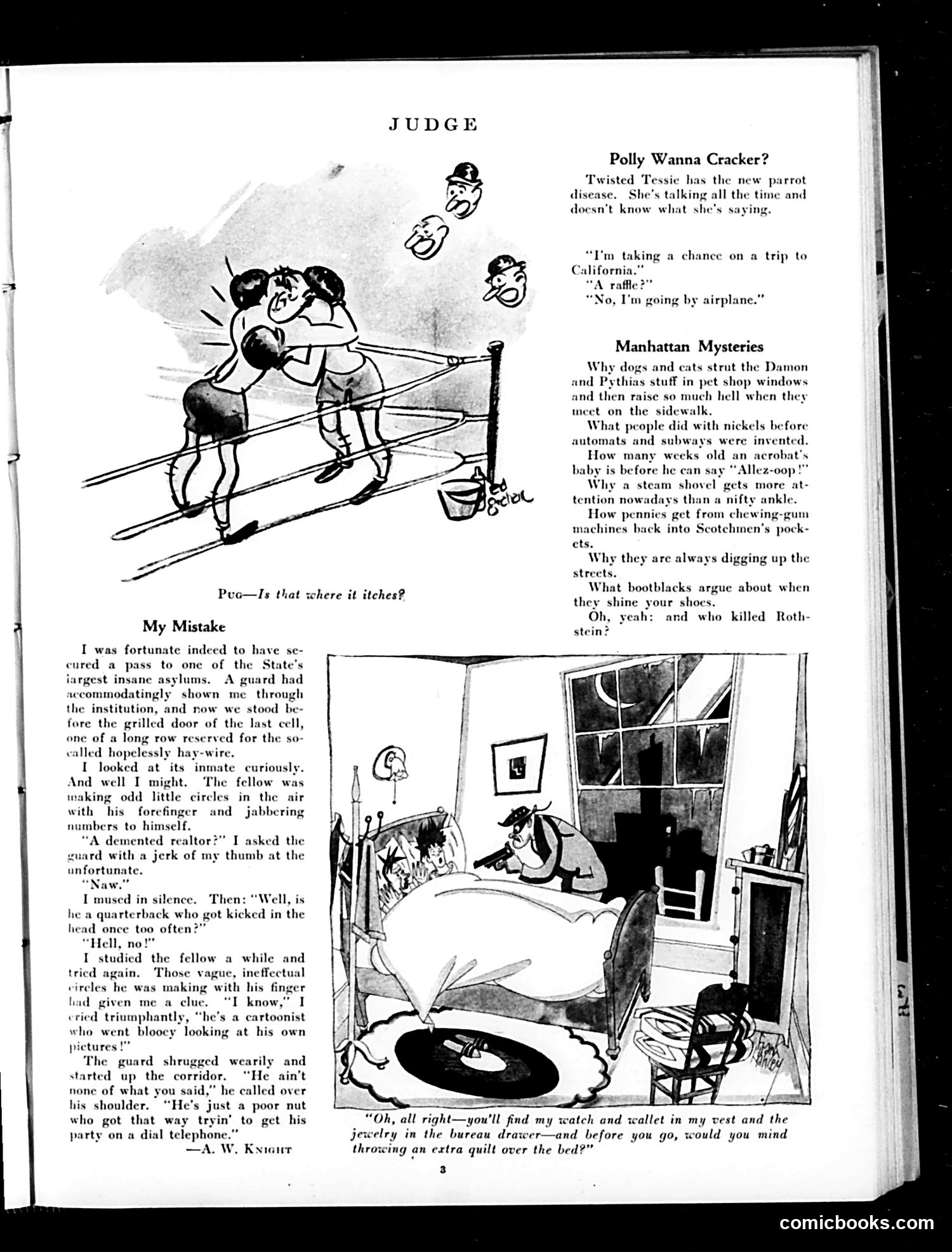
Analysis of Judge Magazine Page Top Cartoon ("Pug—Is that where it itches?"): A person scratches a pug dog while three fleas leap away. The humor is visual wordplay—"pug" sounds like "poke" or suggests scratching, and the fleas' exaggerated expressions convey annoyance at being disturbed. "My Mistake" Story: A narrator describes visiting a state insane asylum and misidentifying a patient making circular finger motions as a "demented sailor." The guard corrects him: the man is actually a cartoonist drawing his own pictures. The joke mocks both cartoonists' seemingly mindless repetitive work and the thin line between artistic obsession and mental illness—common contemporary humor about creative professions. Right Column: "Manhattan Mysteries" lists absurdist urban questions typical of Judge's humorous filler content.
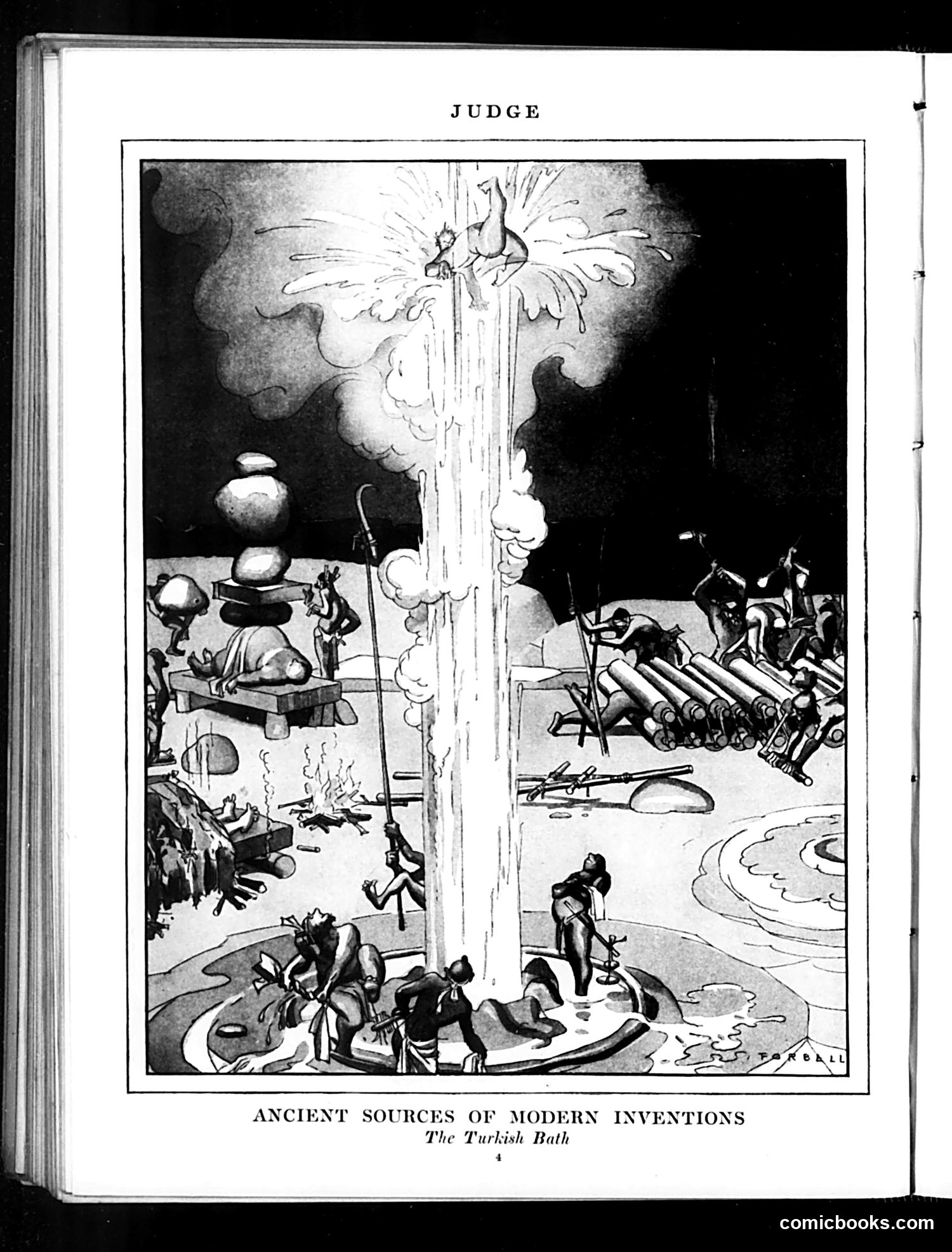
Analysis This Judge magazine page presents a satirical cartoon titled "Ancient Sources of Modern Inventions: The Turkish Bath." The illustration depicts a split scene contrasting two bathing scenarios. On the left appears to be an ancient Turkish bath setup with primitive heating apparatus and small figures. On the right is a modern bathroom with more sophisticated equipment and plumbing. The satire's point is likely that modern bathroom innovations—particularly steam bathing and hot-water systems—derive from ancient Turkish bathing practices. By labeling these "ancient sources," Judge humorously suggests that despite considering themselves modern inventors, contemporary Americans were actually reviving or copying long-established practices from other cultures. The cartoon criticizes either Western claims to originality or perhaps mocks the fashionable adoption of "exotic" Ottoman customs among Americans.
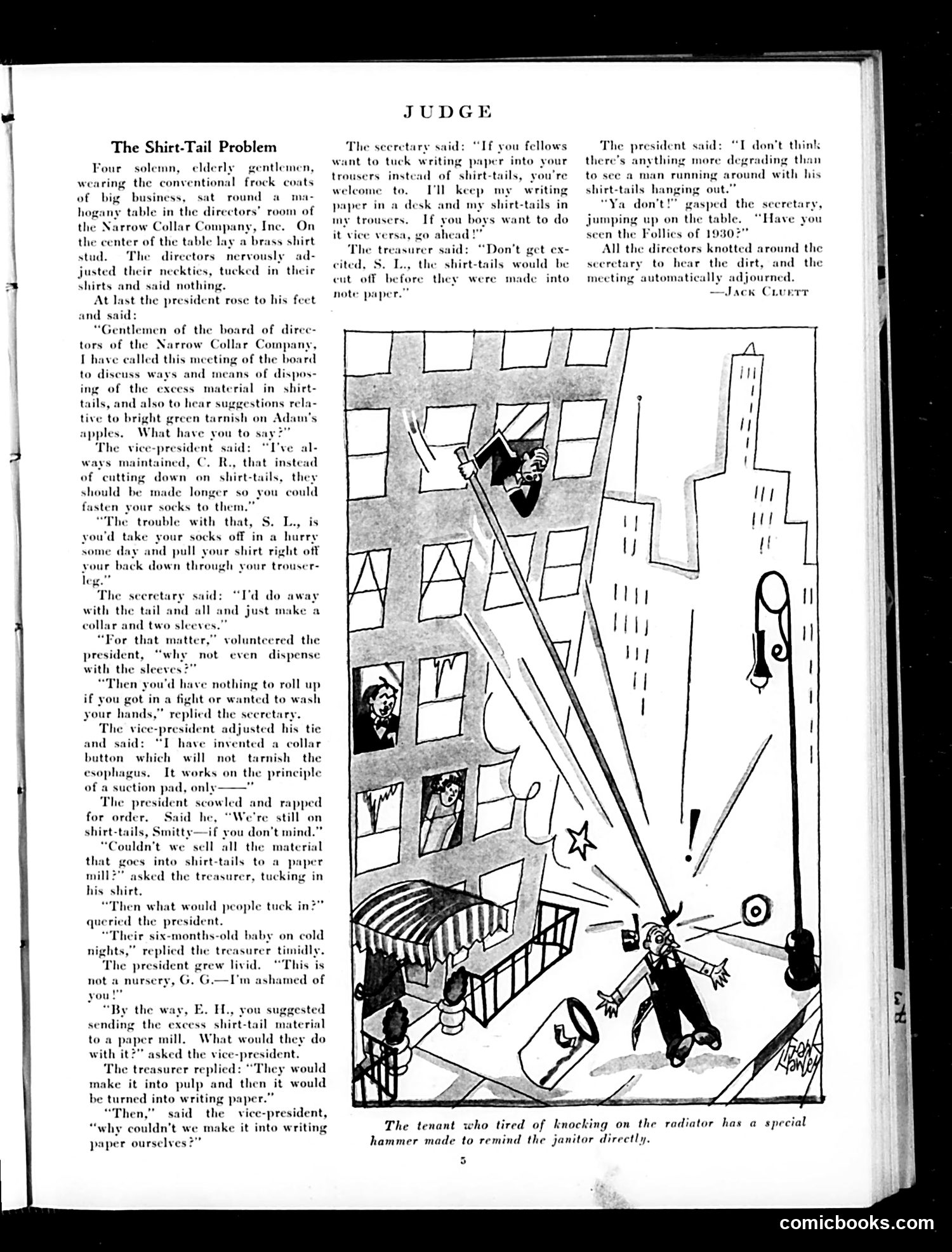
"The Shirt-Tail Problem" This satirical piece mocks a board meeting of the Narrow Collar Company debating how to market shirt-tails—the loose fabric extending below a shirt's hem. The joke hinges on absurd corporate problem-solving: executives propose increasingly ridiculous solutions, from removing shirt-tails entirely to inventing special collar buttons. The accompanying cartoon illustrates the chaos this creates: a man hangs from a building's exterior, his shirt-tail caught or tangled, while a janitor below uses a hammer on the radiator to signal him. The visual gag satirizes how impractical clothing "innovations" create real-world hazards. The satire targets corporate meeting culture—how businessmen earnestly debate trivial matters while ignoring obvious practical consequences.
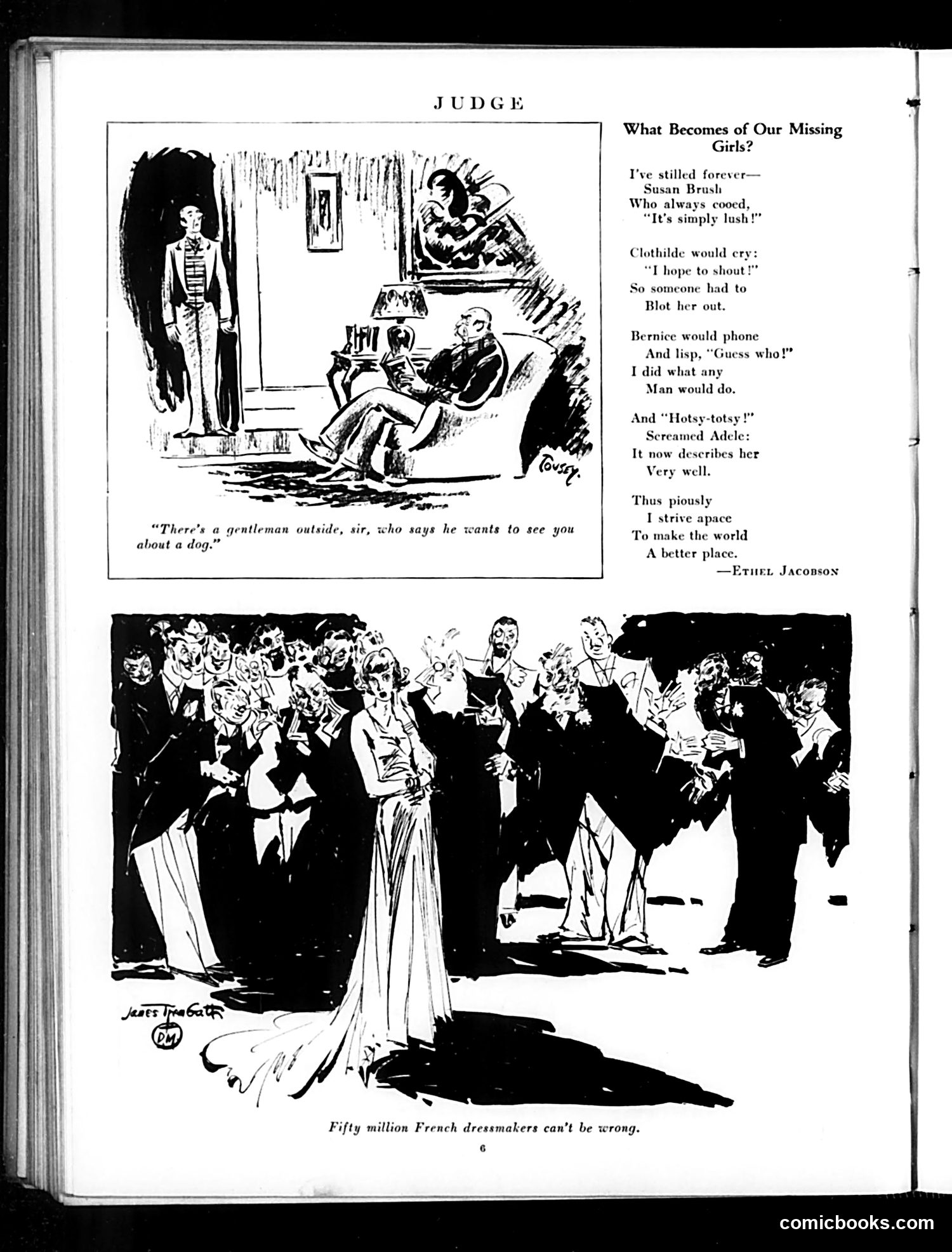
Analysis of Judge Page This page contains two satirical cartoons about women and gender roles. The top cartoon shows a man claiming a gentleman outside wants to see the man "about a dog"—a euphemism for illicit affairs or improper business. The joke targets men's excuses and deceptions. The bottom cartoon, captioned "Fifty million French dressmakers can't be wrong," depicts an elegant woman in a flowing gown surrounded by admiring men in formal attire at what appears to be a social event. The satire mocks both female fashion dependence and male susceptibility to women's appearance—suggesting that fashion (specifically French fashion) manipulates both women and men through vanity. The accompanying poem "What Becomes of Our Missing Girls?" by Ethel Jacobson satirizes women who use their attractiveness and wit to disappear from respectable society, with dark humor about their fates.
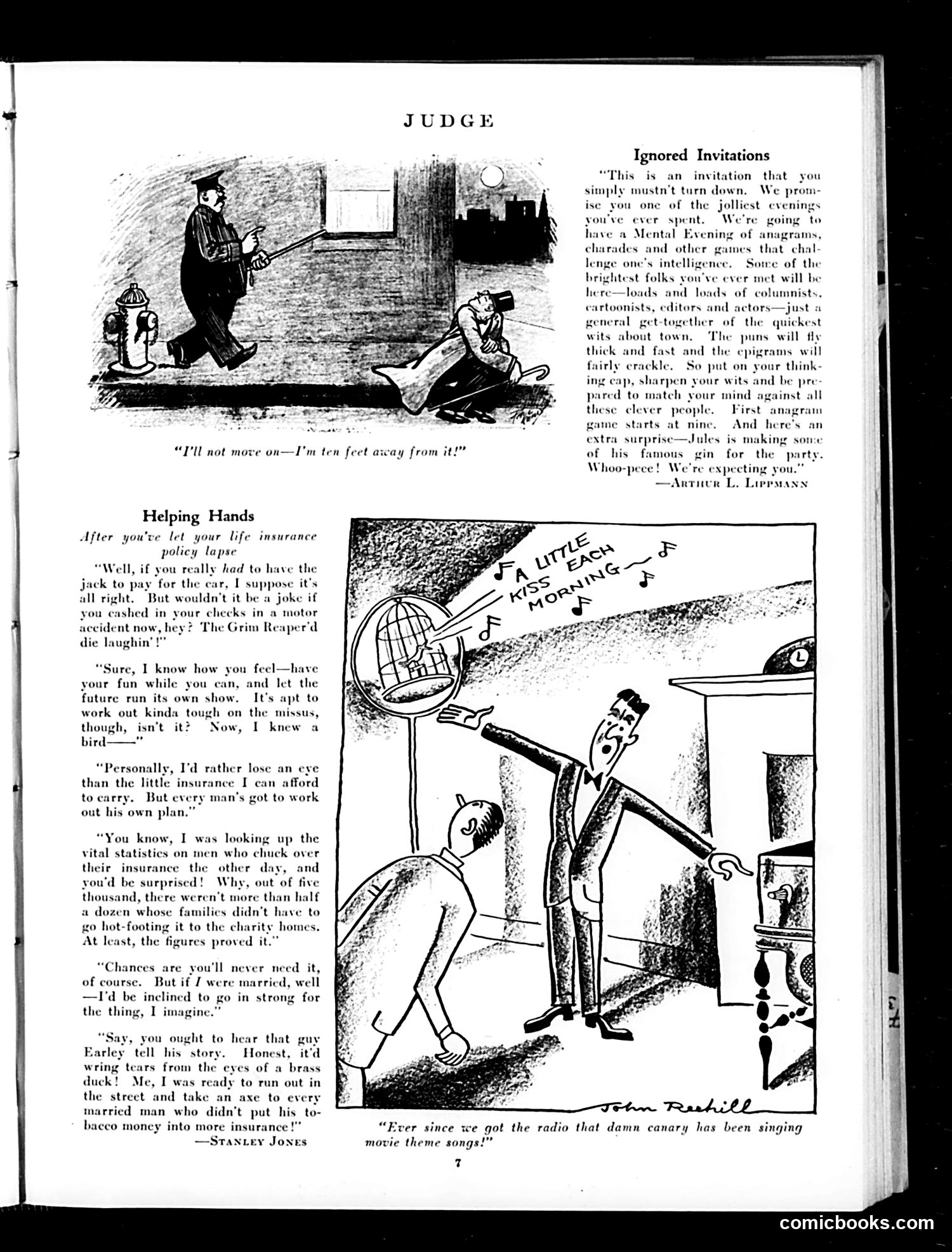
Judge Magazine Page Analysis This page contains two satirical pieces typical of early-20th-century American humor magazine content. "Ignored Invitations" mocks pretentious social gatherings. The invitation promises an evening with "the brightest folks"—columnists, cartoonists, editors, and actors—who will engage in witty wordplay and anagrams. The satire targets the affected intellectualism of such events and the social pressure to attend gatherings where one must perform cleverness. The cartoon shows someone literally unable to approach the event ("I'll not move on—I'm ten feet away from it!"), suggesting the difficulty or unpleasantness of such obligatory socializing. "Helping Hands" satirizes life insurance through a series of conversations where one character persuades another not to let their policy lapse. The piece mocks both the insurance industry's scare tactics and human shortsightedness about financial responsibility. The cartoon features a man being pestered by a radio about an annoying canary singing movie theme songs—a humorous non-sequitur illustrating life's irritations, paralleling how financial mistakes create long-term troubles. Both pieces critique human behavior: social pretension and financial irresponsibility.
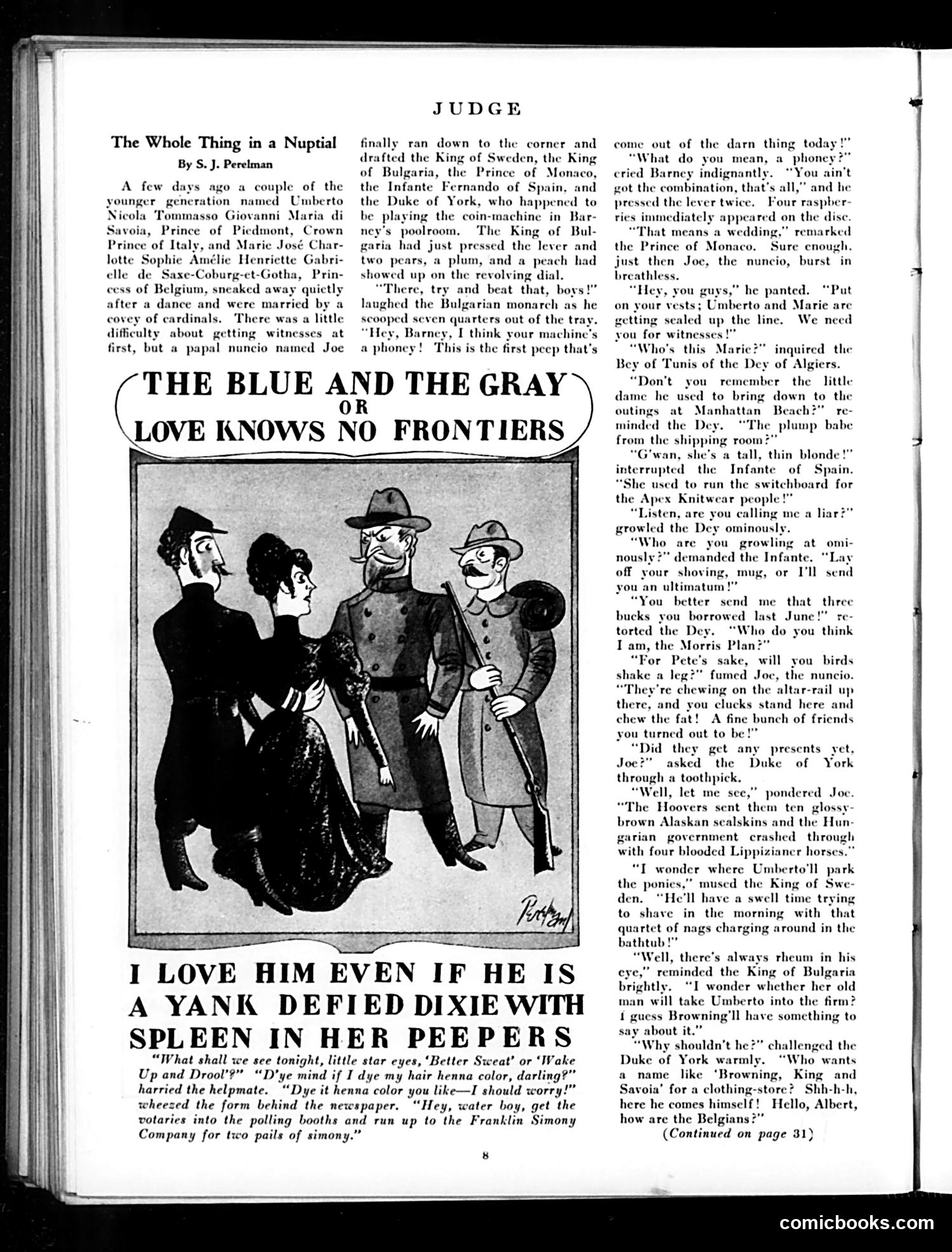
"The Blue and the Gray" Cartoon Analysis This satirical piece mocks the international marriages of European royalty to American wealth during the Gilded Age. The cartoon depicts four European nobility—apparently including the King of Sweden, King of Bulgaria, Prince of Monaco, and Duke of York—gathered in casual conversation, discussing a wedding involving "Umberto and Marie." The humor derives from contrasting their elevated status with mundane American concerns: they discuss a coin-operated machine, borrowed money, and practical wedding gifts (Hoover vacuum cleaners, horses). The dialogue peppers their speech with slang and American colloquialisms ("For Pete's sake," "mug") while they obsess over petty debts and gossip. The title "Love Knows No Frontiers" is ironic—these marriages are transparently transactional, uniting European titles with American money. The satire targets both the European aristocracy (reduced to caricature) and American high society's willingness to trade wealth for social prestige through these unions. The nuncio (papal representative) present underscores the Catholic dynasties involved in such matches.
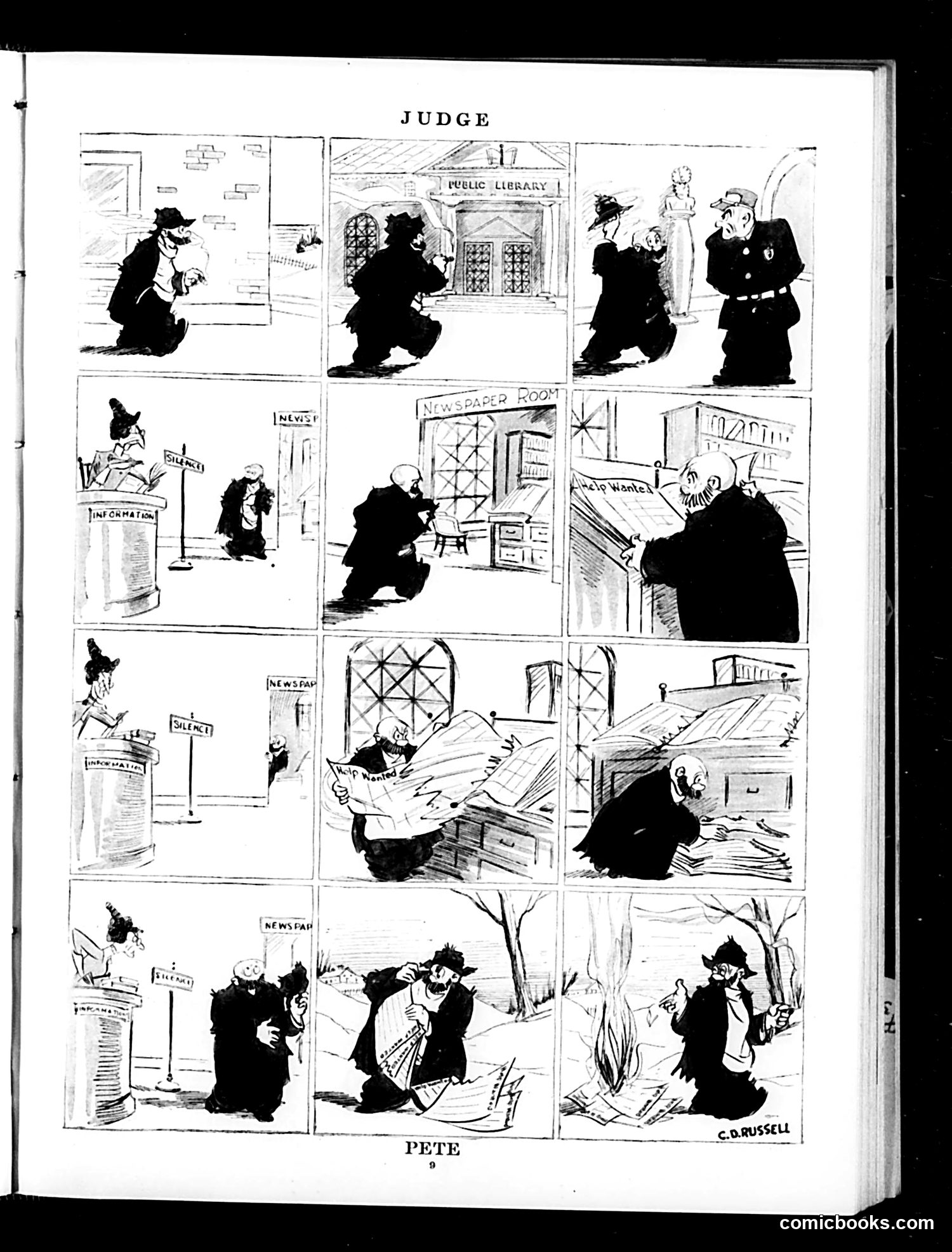
"Judge" Page: "Judge" and "Pete" This page contains two sequential comic strips by C.B. Russell satirizing bureaucratic incompetence. "Judge" (top) follows a judge moving through various public institutions—a library, newspaper room, and bedroom—appearing increasingly disheveled and frantic. The strip seems to mock judicial inefficiency or the judge's inability to maintain composure across different settings. "Pete" (bottom) depicts a character repeatedly consulting newspapers and information boards, then eventually destroying them in frustration. The satire likely critiques either newspaper reliability, information overload, or public confusion created by media contradictions. Both strips employ exaggerated physical comedy and visual progression typical of early-20th-century editorial cartooning. The specific political targets remain unclear without additional context about contemporary events Judge was referencing.
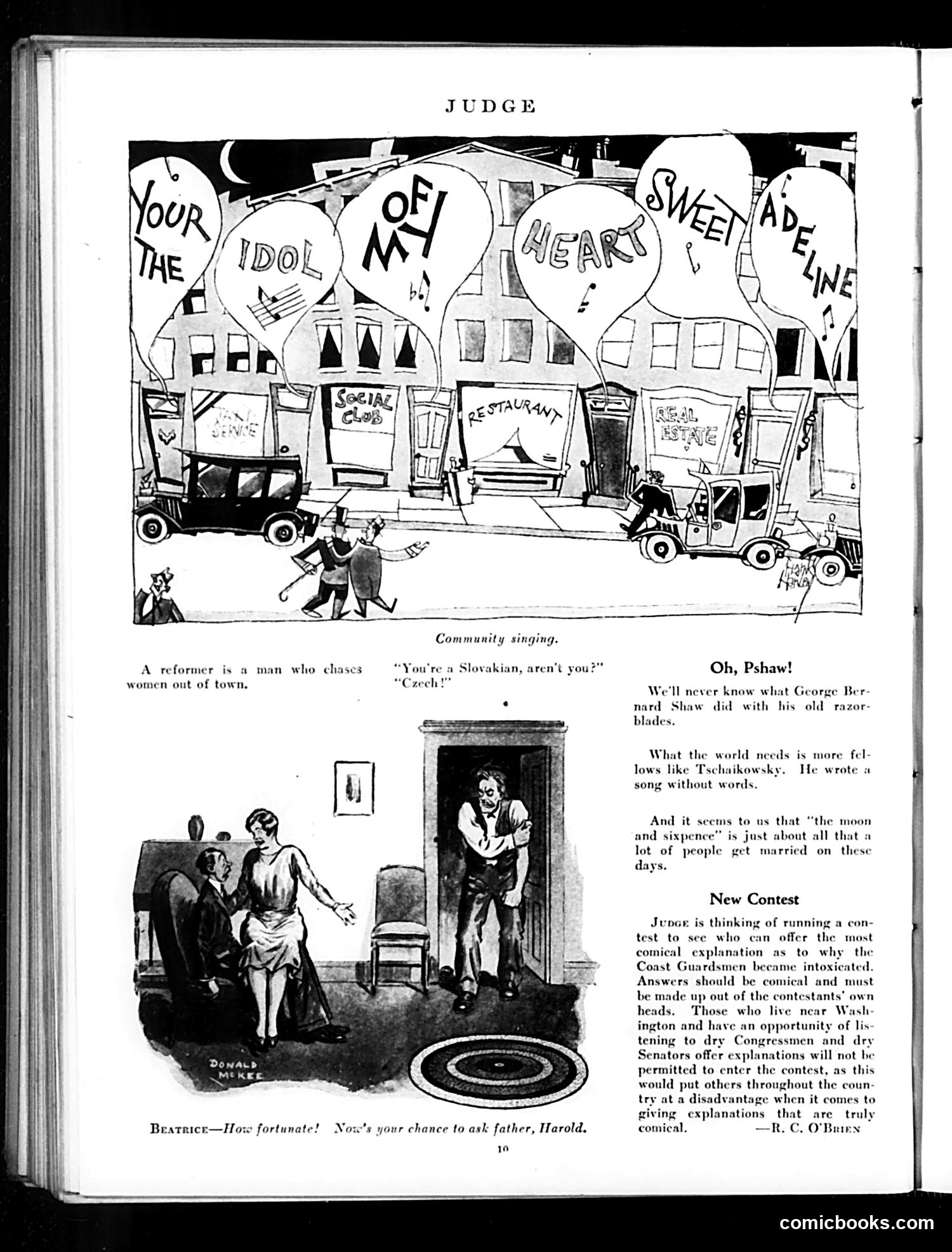
Analysis The top cartoon depicts "community singing" on a city street, with storefronts and cars. Speech bubbles contain cultural/ethnic stereotypes ("You're a Slovakian, aren't you?"), satirizing how diverse immigrant communities were viewed and mocked in 1920s America. Below are brief jokes: one mocking "reformers" who chase women from towns; references to George Bernard Shaw and Tchaikovsky; and commentary on marriage ("the moon and sixpence"). The "New Contest" section announces Judge's satirical contest seeking humorous explanations for why "Coast Guardsmen became intoxicated"—a Prohibition-era joke. The rule excluding people near Washington from entering cleverly mocks Congressmen and Senators as naturally dry speakers, implying they could offer genuinely funny explanations simply by speaking normally. The bottom illustration shows a couple, with "Beatrice" telling Harold he can finally ask his father a question—likely about marriage or courtship.
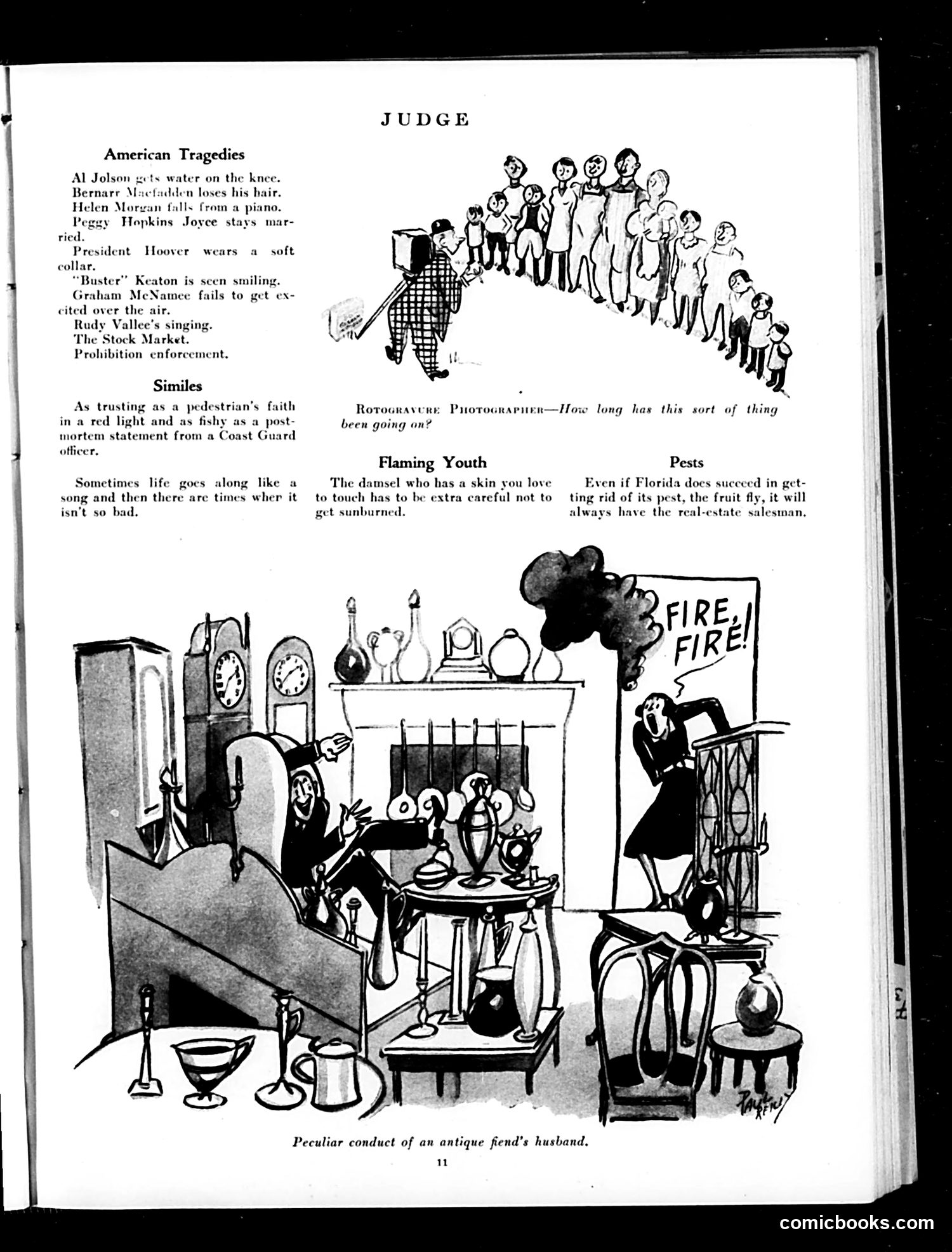
Judge Magazine Page Analysis This page from *Judge* magazine features satirical commentary on 1920s American culture: "American Tragedies" lists celebrity mishaps as dark humor—Al Jolson's knee injury, Bernarr Macfadden's piano fall, and notably "President Hoover wears a soft collar" and "The Stock Market" and "Prohibition enforcement," treating economic/political failures as comparable to personal disasters. This likely reflects post-1929 crash anxiety. "Similes" compares unreliable things (pedestrian safety, Coast Guard honesty) with dark wit typical of the era. "Flaming Youth" and "Pests" sections mock contemporary concerns: sunburned flappers and Florida's fruit fly problem (also satirizing real-estate salesmen as worse than pests). The large cartoon below depicts an "antique fiend's husband" conducting peculiar behavior amid his wife's collection—likely mocking obsessive collecting habits and marital discord, a common *Judge* theme. The page overall reflects 1920s anxieties about modernity, prohibition, the market crash, and changing social norms.
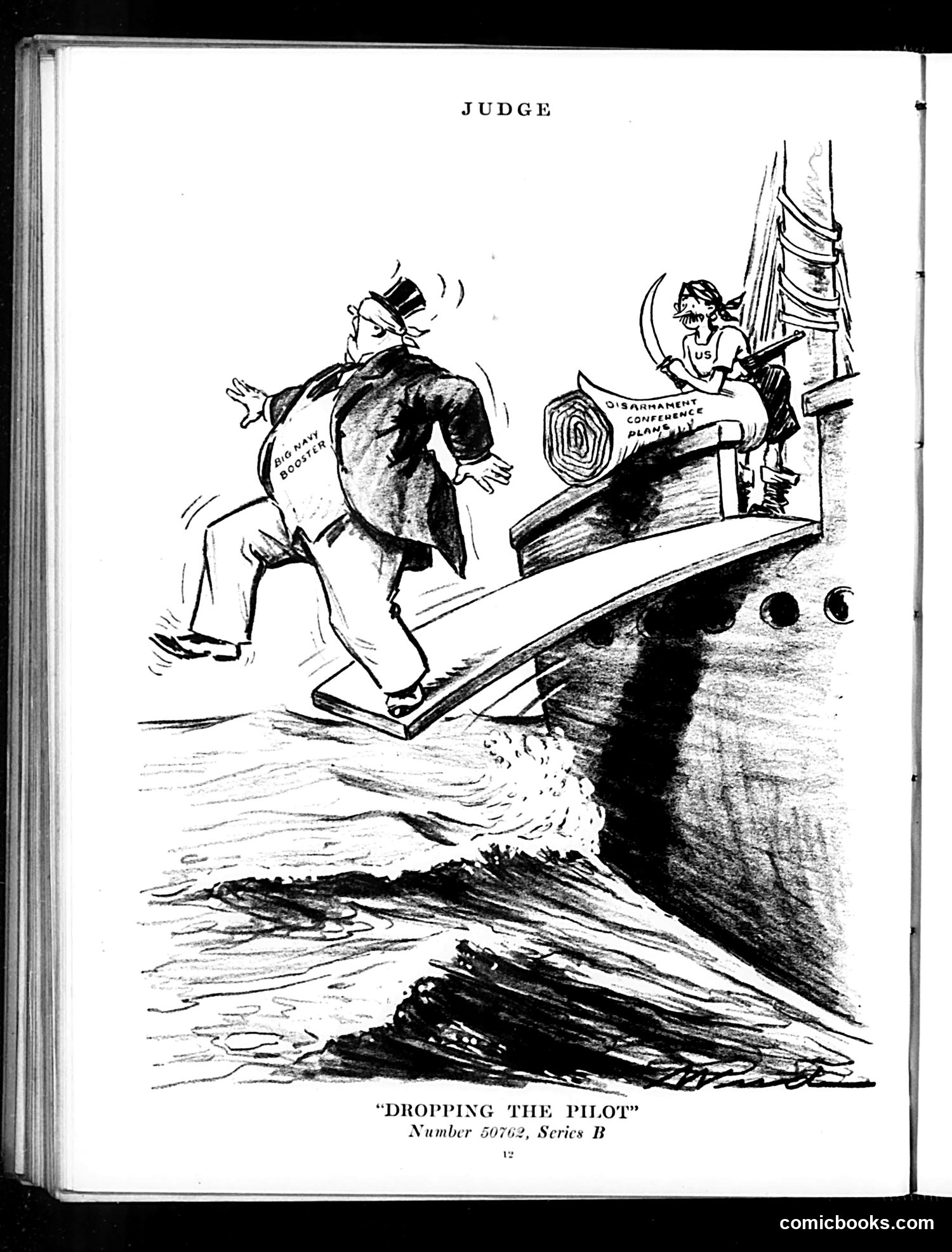
"Dropping the Pilot" Analysis This Judge cartoon satirizes political leadership changes. The figure on the left labeled "BIG BOSTON DEMOCRAT" appears to be a prominent Democratic politician being pushed overboard from a ship by a figure on the right (likely representing the party or electorate). The vessel displays "DISARMAMENT CONFERENCE PLANS" and carries the U.S. flag. The title "Dropping the Pilot" references removing experienced leadership. The cartoon suggests a Boston Democrat is being removed from a disarmament policy position, possibly during a political shift. The nautical metaphor—jettisoning the pilot (navigator/leader)—implies this removal will leave the ship directionless. Without the publication date, the specific Boston Democrat and disarmament conference referenced remain unclear, though this appears to critique removing someone with relevant expertise from important policy matters.
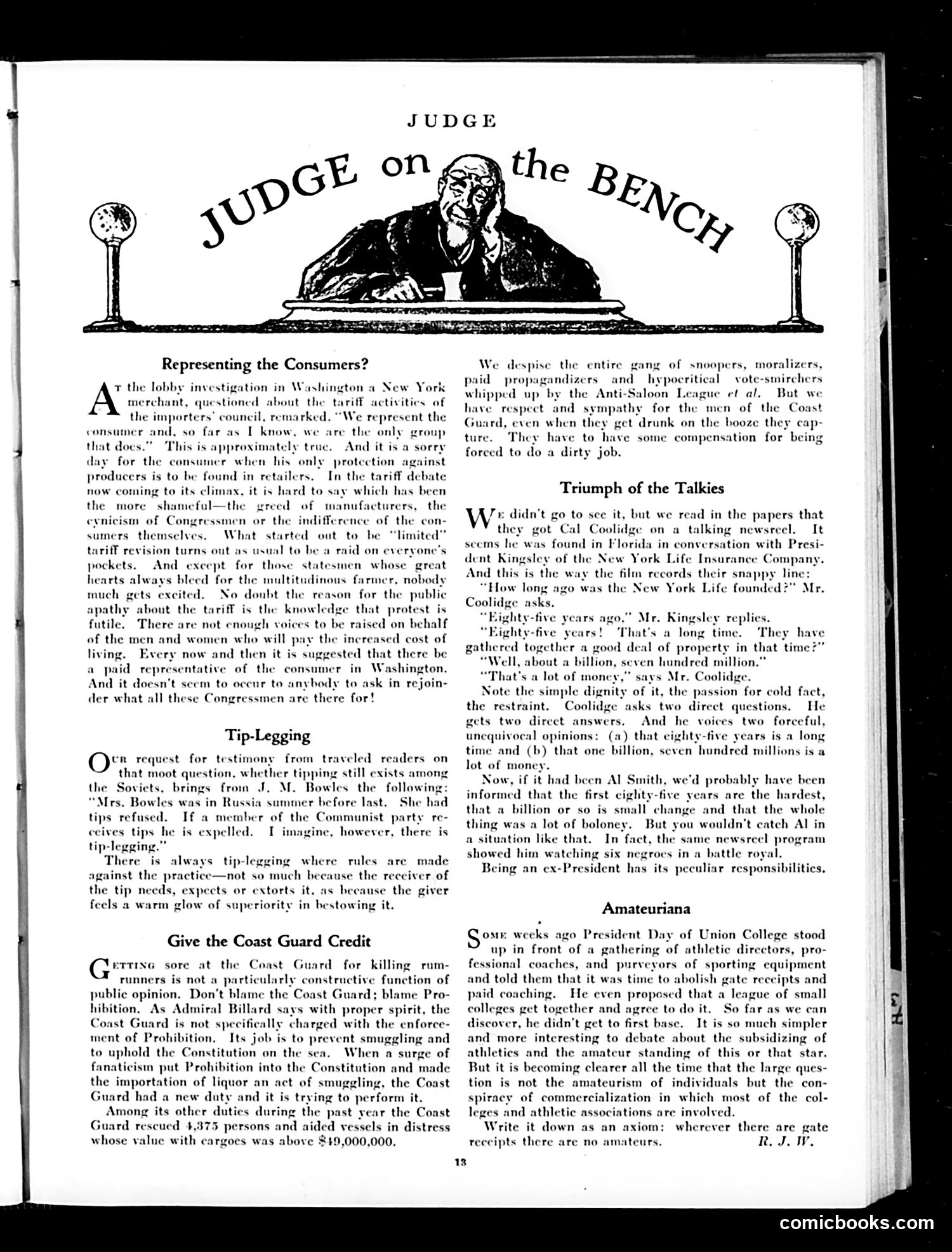
Judge Magazine Satire Analysis This page contains four satirical pieces critiquing American politics and society circa the 1920s: "Representing the Consumers?" mocks the tariff debate in Congress, arguing that while importers claim to represent consumers, Congress itself ignores ordinary people's interests entirely—yet no one bothers questioning why congressmen are there at all. "Tip-Legging" jokes about Soviet communist hypocrisy: while the USSR officially banned tipping, the practice persists anyway ("tip-legging"), because people enjoy the superiority of giving tips regardless of rules. "Give the Coast Guard Credit" defends the Coast Guard's rum-running interdiction despite Prohibition being unpopular, praising them for rescue work—while simultaneously mocking the "snoopers" and "moralizers" behind Prohibition. "Triumph of the Talkies" satirizes President Calvin Coolidge's famous emotional restraint and dry personality through a scripted newsreel conversation with an insurance executive—mocking his stilted, factual exchanges as notably devoid of genuine human warmth.
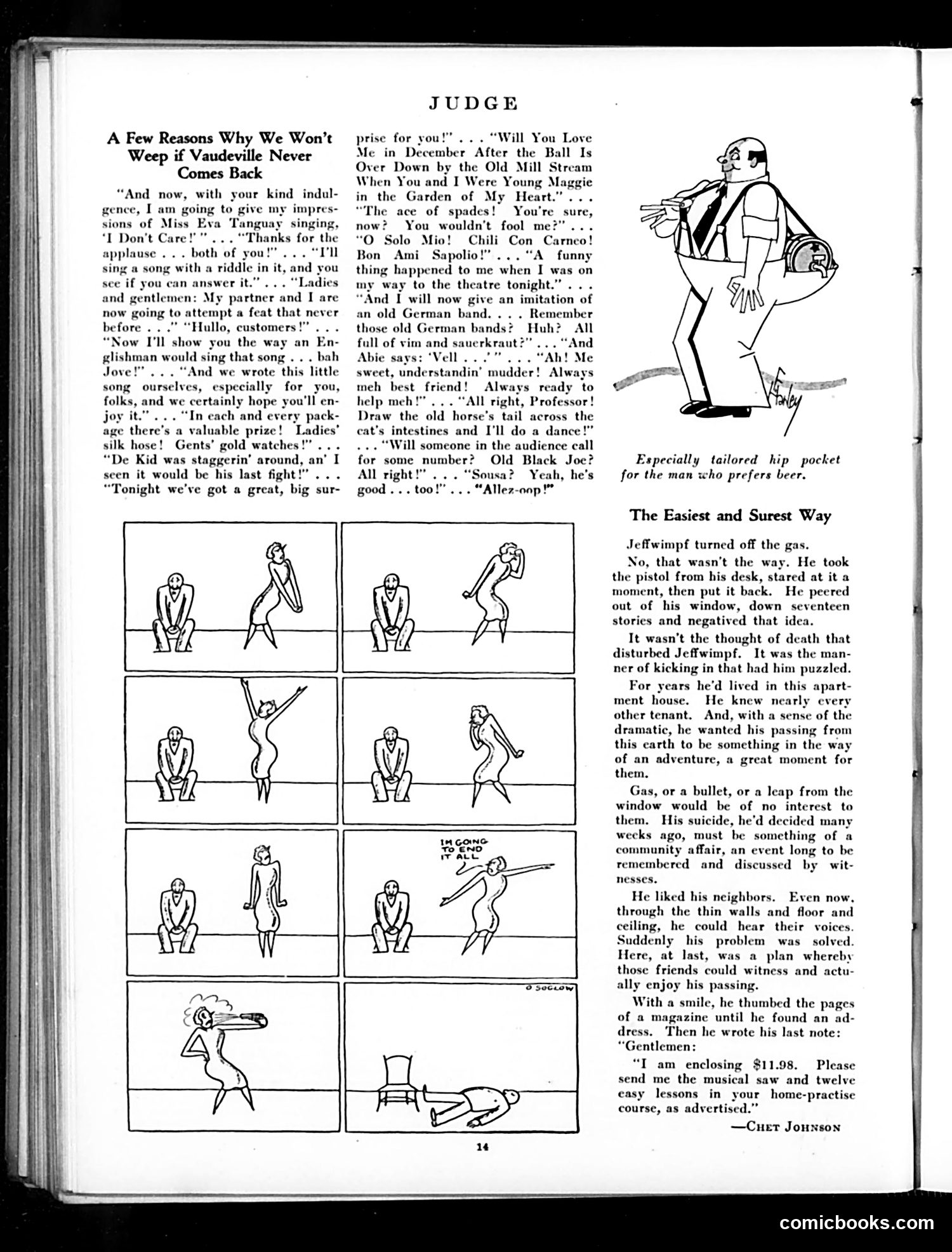
Judge Magazine Page Analysis Top Section - "A Few Reasons Why We Won't Weep if Vaudeville Never Comes Back": This is satirical commentary on vaudeville performers' tired, repetitive acts. The text mocks the clichéd material: worn-out song titles, "impressions" (character acts), audience participation gimmicks, self-promotional patter, and desperate attempts at novelty. The author lists generic vaudeville tropes—German band imitations, old songs, audience sing-alongs—as proof the entertainment form had become stale and formulaic. This reflects post-WWI sentiment that vaudeville was declining as a theatrical form. Bottom Section - "The Easiest and Surest Way": A dark comedy story by Chet Johnson about a man (Jeffwimpf) contemplating suicide. The joke: he wants his death to be a memorable "community affair" rather than mundane. After rejecting gas, guns, or jumping, he solves his problem by ordering a "musical saw" course by mail—implying the lessons will be so unbearably bad that neighbors will kill *him* first, or he'll die of embarrassment. It's gallows humor mocking both mail-order instructional ads and vaudeville's continued existence.
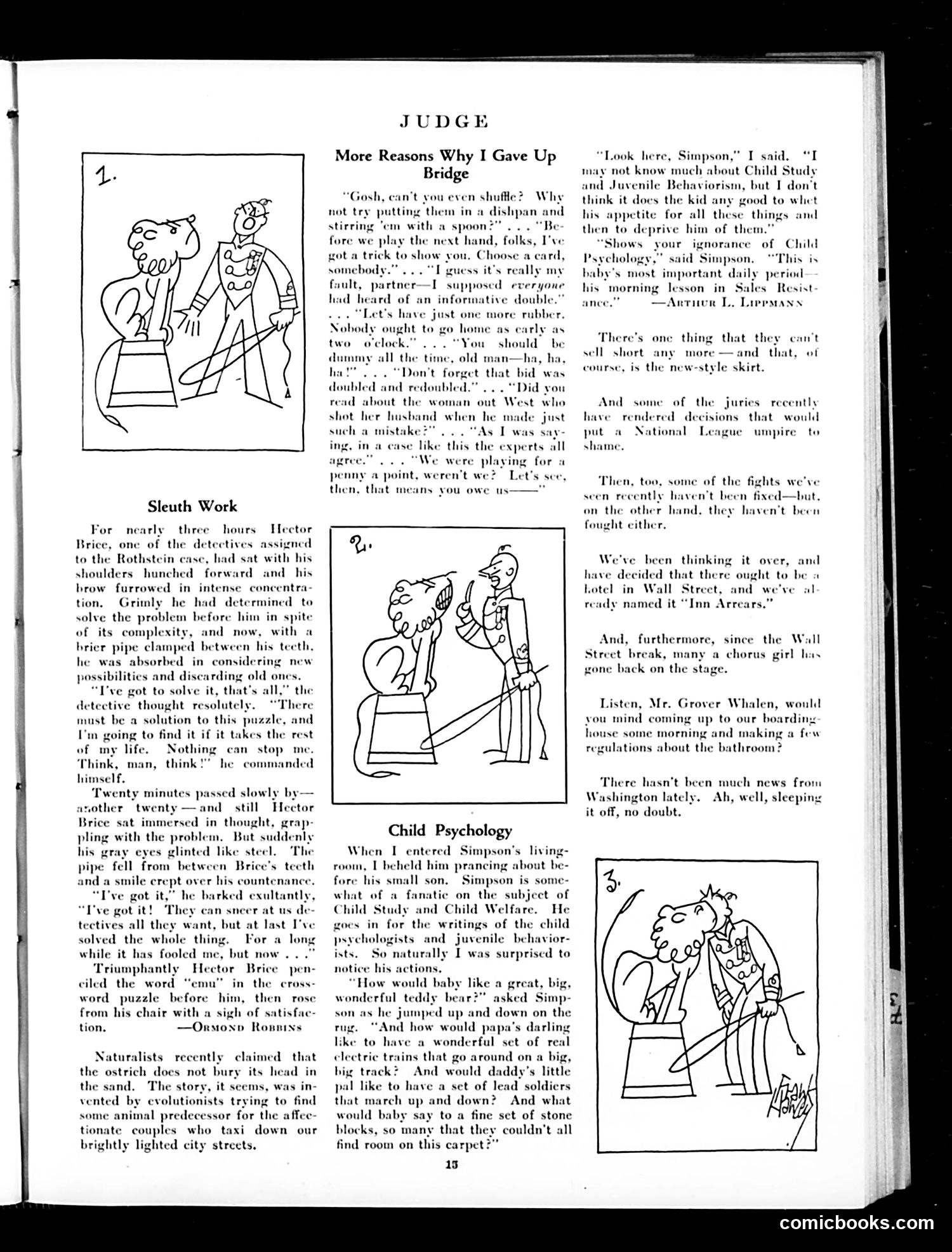
Judge Magazine Page Analysis This page from *Judge* (a satirical magazine) contains three humor pieces: "Sleuth Work": A detective solving the "Rothstein case" (likely Arnold Rothstein, a famous 1920s gangster/gambler) sits intensely for hours—only to realize he was doing a *crossword puzzle*. The satire mocks both the famous unsolved murder and the obsessive nature of puzzle-solving. "More Reasons Why I Gave Up Bridge": Mock complaints about bridge partners—nitpicking about shuffling, unwanted card tricks, people wanting to leave early, rules disputes. The humor targets bridge's social pretentiousness and tedious gameplay among the middle/upper class. "Child Psychology": A father enthusiastically offers his son toys (teddy bear, electric trains, lead soldiers, blocks) while jumping around. When corrected, he claims this teaches "Sales Resistance"—teaching the child to *want* things he can't have. This satirizes the era's pseudo-scientific parenting trends and modern consumerism's psychological manipulation of children.
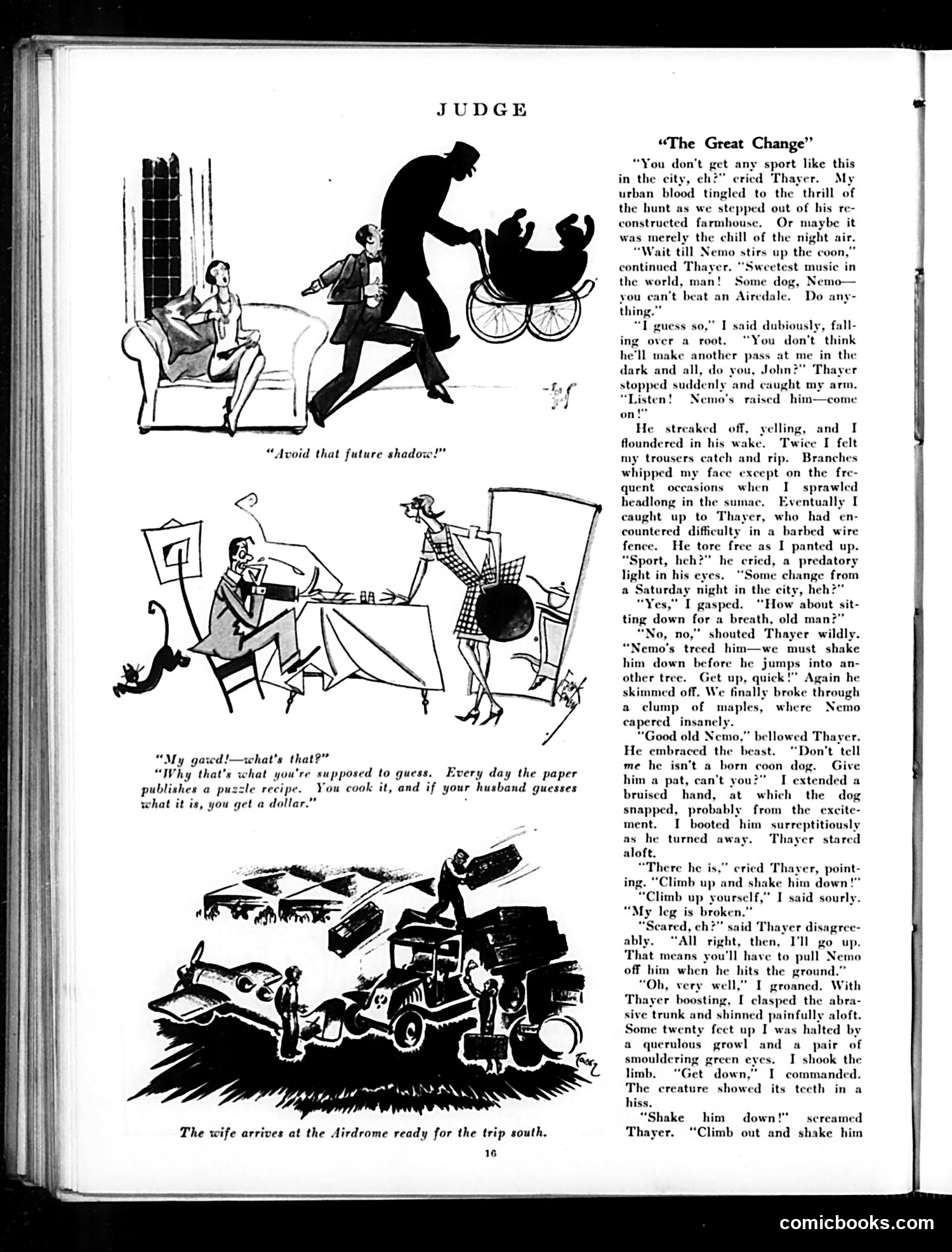
Judge Magazine Page Analysis This page contains a humorous short story illustrated with cartoons about urban versus rural leisure. The protagonist Thayer, a city dweller, has purchased a reconstructed farmhouse and invites a friend on a country hunt using his Airedale dog named Nemo to tree a raccoon. The satire targets early 20th-century urban nostalgia for rural life. Thayer romanticizes country sport as superior to city entertainment, but the story comically undermines this: the narrator repeatedly falls, gets scratched, catches his pants in barbed wire, and nearly gets bitten by the dog. When they finally tree the raccoon, he's forced to climb the tree while Thayer watches safely below—hardly the dignified "sport" promised. The joke mocks both Thayer's pretentious enthusiasm for reconstructed farmhouse living and the actual discomforts and dangers of rural recreation, suggesting the city dweller's nostalgia is naïve.
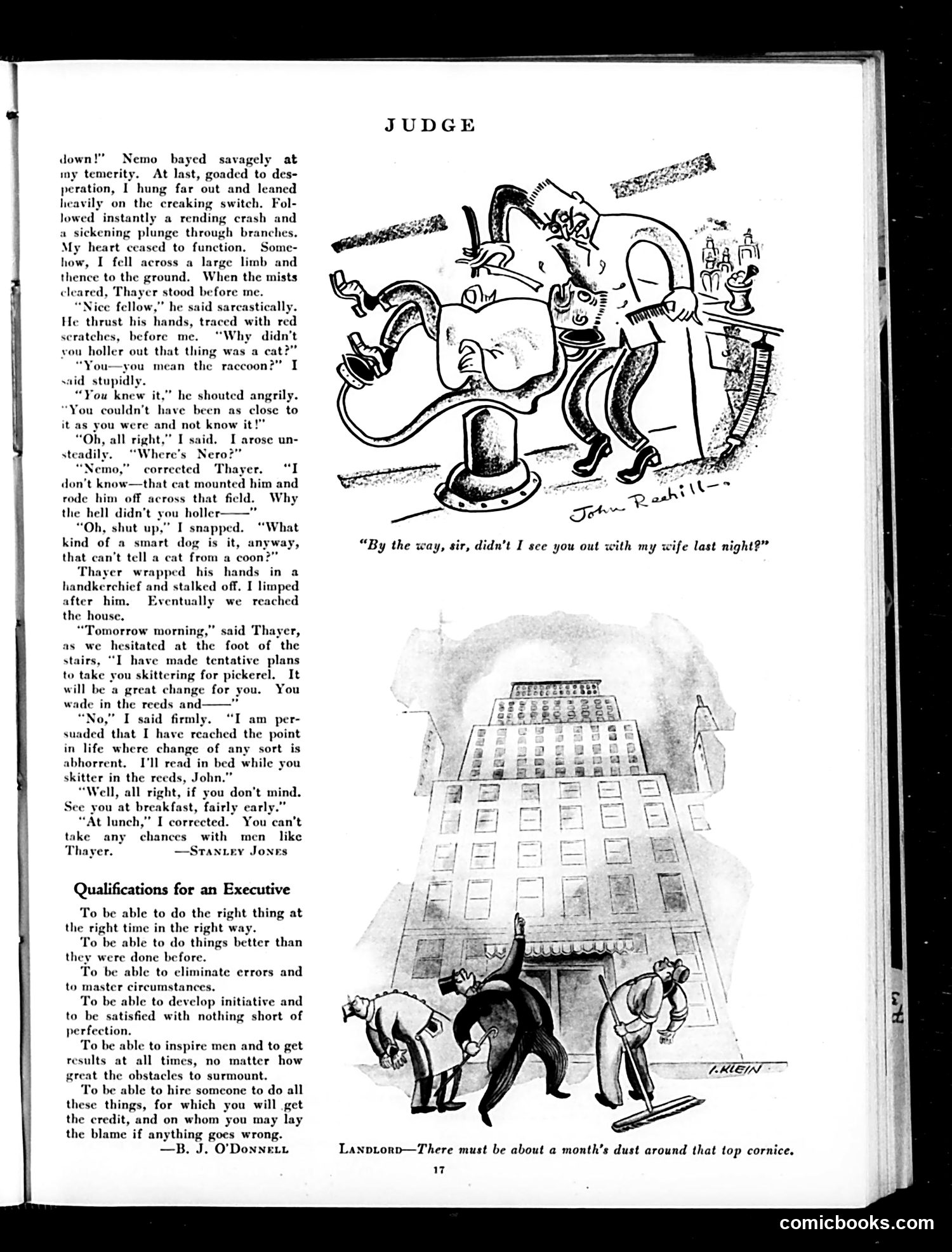
Judge Magazine Page Analysis This page contains two distinct satirical pieces: Upper section: A humorous narrative (by Stanley Jones) about a disastrous hunting/outdoor adventure. The protagonist mistakes a raccoon for a cat, causing a dangerous fall from a tree. The joke relies on physical comedy and the absurdity of the mishap—the narrator's incompetence and denial ("You mean the raccoon?") after nearly killing himself. Lower section: Two cartoon jokes: 1. "Qualifications for an Executive" (attributed to B.J. O'Donnell) is a cynical corporate satire listing ideal executive qualities, culminating in the punchline: hire someone else to do everything, take credit for success, and blame them for failure. This mocks corporate management practices and accountability-dodging. 2. "Landlord" cartoon: A landlord confronts a tenant about dust on a high cornice, while the tenant deflects by asking if the landlord was out with his (the tenant's) wife. It's a joke about inappropriate extramarital behavior and using it as a distraction tactic. Both pieces target early-20th-century social hypocrisy and incompetence.
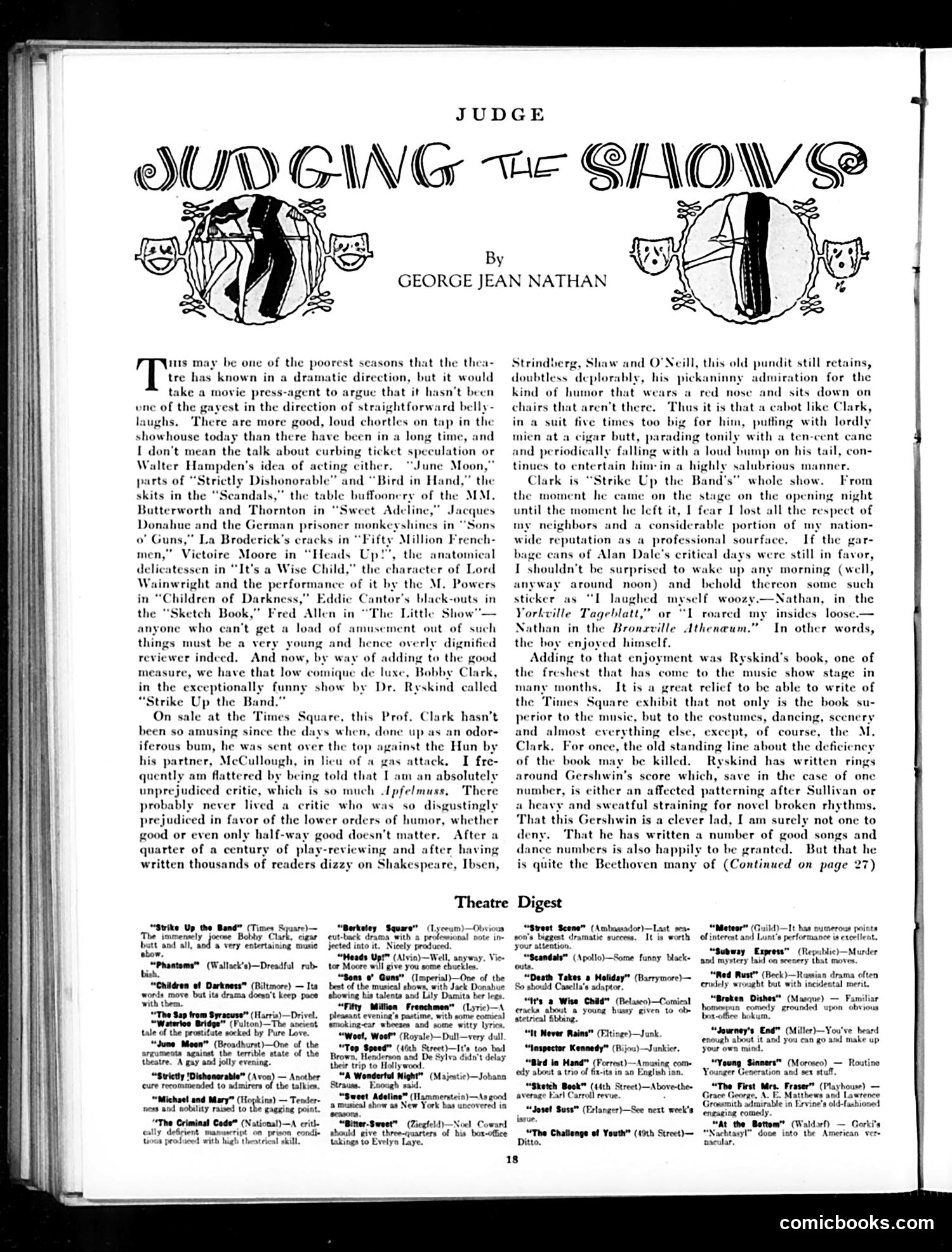
"Judging the Shows" by George Jean Nathan This is a theater review column, not a political cartoon. Nathan critiques the current Broadway season (appears to be late 1920s based on show titles), arguing that while dramatically weak, it offers excellent comedy. He praises Bobby Clark's physical comedy in "Strike Up the Band," calling Clark a "low comique de luxe" whose slapstick—oversized suits, cigar-butt pantomime, pratfalls—delights Nathan despite his sophisticated credentials. Nathan self-mockingly admits his "prejudice" favoring lowbrow humor over serious drama, joking that critics like Alan Dale would mock his enthusiasm. The piece celebrates vaudeville-style comedy performers (Butterworth, Cantor, Allen) and Ryskind's "fresh" book for the musical. It's essentially an intellectual defending his enjoyment of populist entertainment—a common 1920s-30s cultural tension between "high" and "low" art forms.
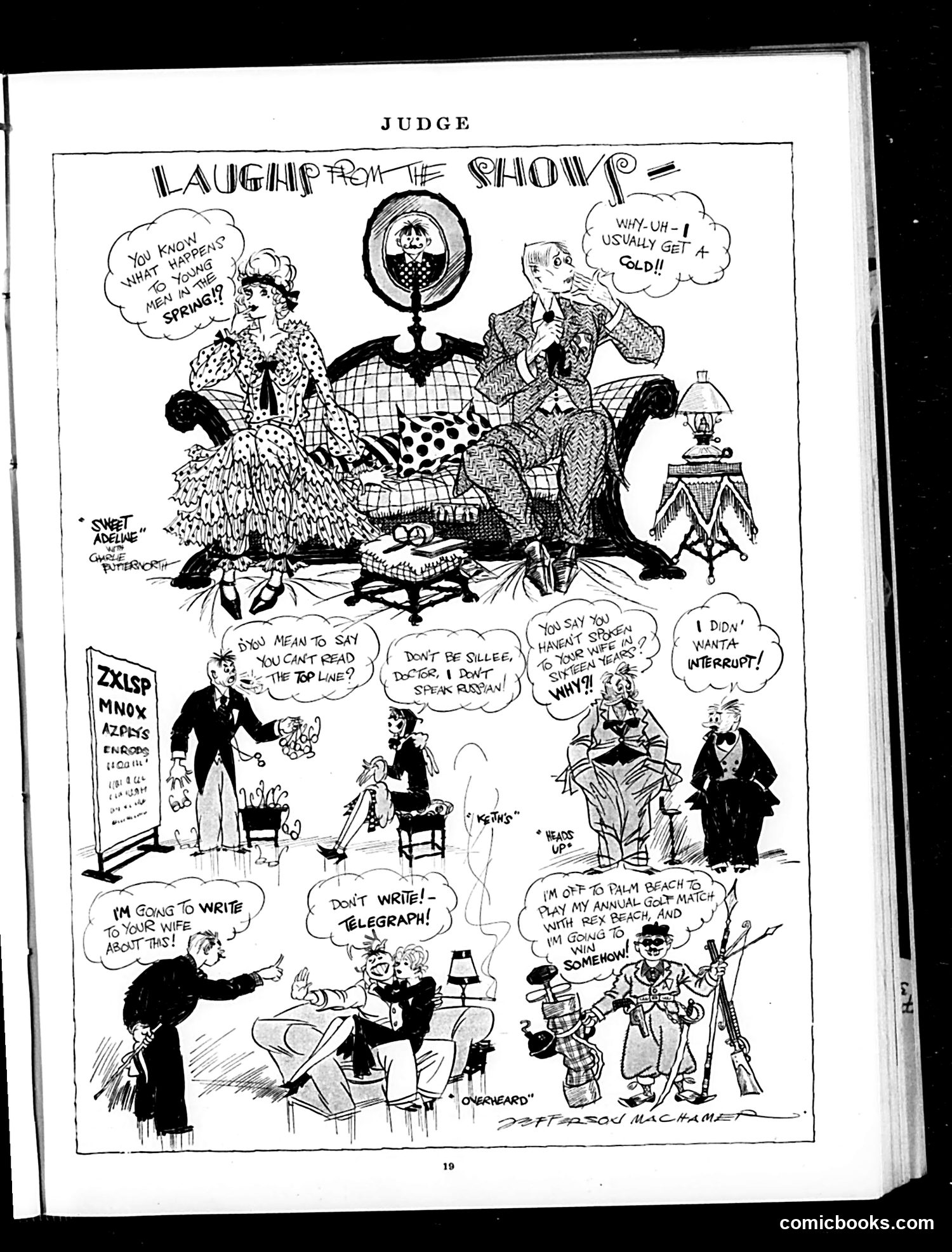
"Laugh from the Shows" This satirical cartoon mocks wealthy socialites and their pretensions during what appears to be the early 20th century. The top panel shows an ostentatiously dressed couple on a sofa, with the woman asking about "happenings at the Springs" (likely a resort). Below are vignettes of various upper-class situations: a man threatening to write his wife about something, another refusing to write a telegraph, and someone planning a golf match at Palm Beach instead of attending to serious matters. The humor targets the superficiality, marital discord, and frivolous priorities of the wealthy leisure class—their obsession with resorts, golf, and social appearances while ignoring substantive concerns. The crude drawing style and exaggerated expressions emphasize the satire's contempt for their vanity and disconnectedness from ordinary life.
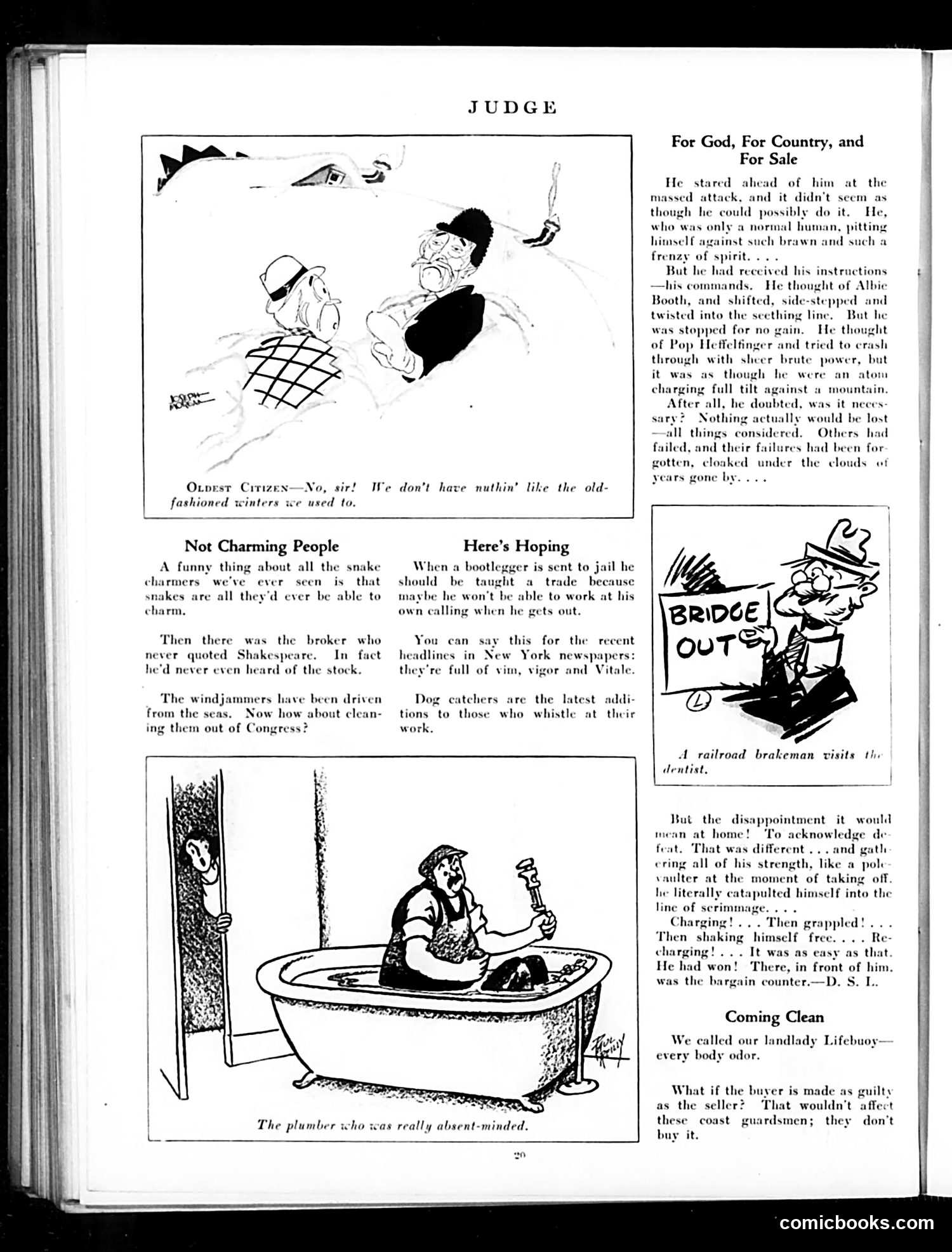
Analysis of Judge Magazine Page This page contains short satirical commentary pieces typical of Judge magazine's format—brief social observations disguised as humor. "Not Charming People" mocks various professions: snake charmers (limited talents), an ignorant stock broker, and windjammers (sailors), with a Congressional jab suggesting politicians are as useless as displaced sailors. "Here's Hoping" sarcastically suggests bootleggers should learn trades in jail—a reference to Prohibition-era criminal enforcement. The cartoon shows a railroad brakeman visiting a dentist, apparently unrelated. "For God, For Country, and For Sale" appears to be a longer narrative (likely continued elsewhere) about someone facing a difficult challenge, possibly military or athletic, invoking references to Albie Booth and Pop Heffelfinger (football figures). The ending reveals the "battle" was actually fighting through a department store bargain counter—satirizing American consumer culture and commercialism. "Coming Clean" mocks hypocrisy: if buyers faced guilt like sellers do, even Coast Guard officials (presumably corrupt during Prohibition) wouldn't purchase contraband. The page satirizes American society during the Prohibition era.
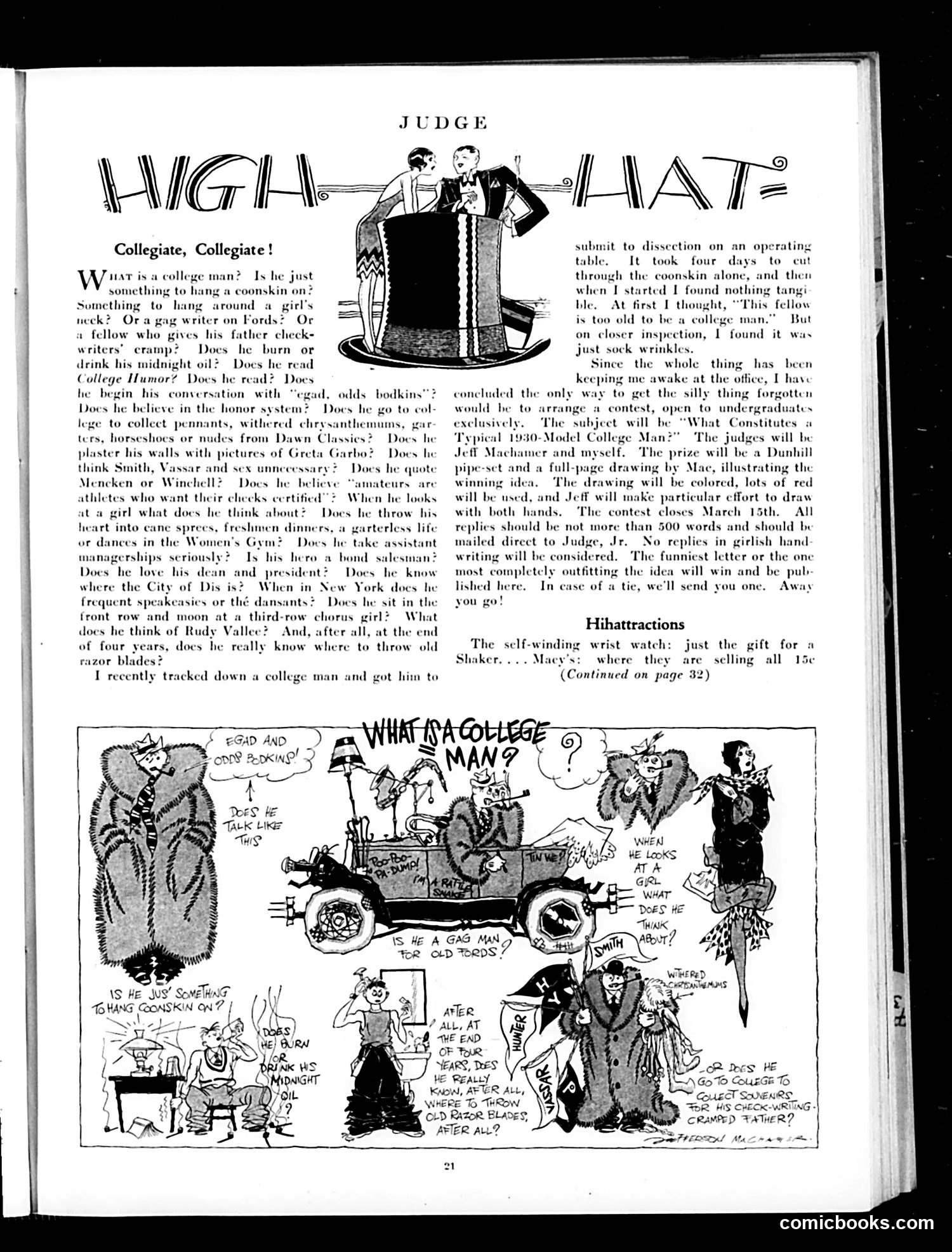
Explaining "High-Hat" to Modern Readers This Judge magazine page satirizes the stereotypical "college man" of the 1920s-30s era. The main article mockingly catalogs clichéd collegiate behaviors: wearing coonskin coats, collecting pennants and memorabilia, quoting H.L. Mencken or Walter Winchell, mooning over chorus girls, and affecting sophistication while remaining intellectually hollow. The cartoon below visualizes these stereotypes through exaggerated character types asking "What is a college man?" — depicting empty-headed flappers, fast-living athletes in jalopy cars, and pretentious socialites. The joke is that despite four years of education, a college man amounts to nothing substantive, just "sock wrinkles." Judge announces a contest asking readers to define what actually constitutes a "1930-Model College Man," offering a Dunhill pipe as prize, with winning entries illustrated and published. The satire targets the superficiality and phoniness of collegiate culture during the Jazz Age.
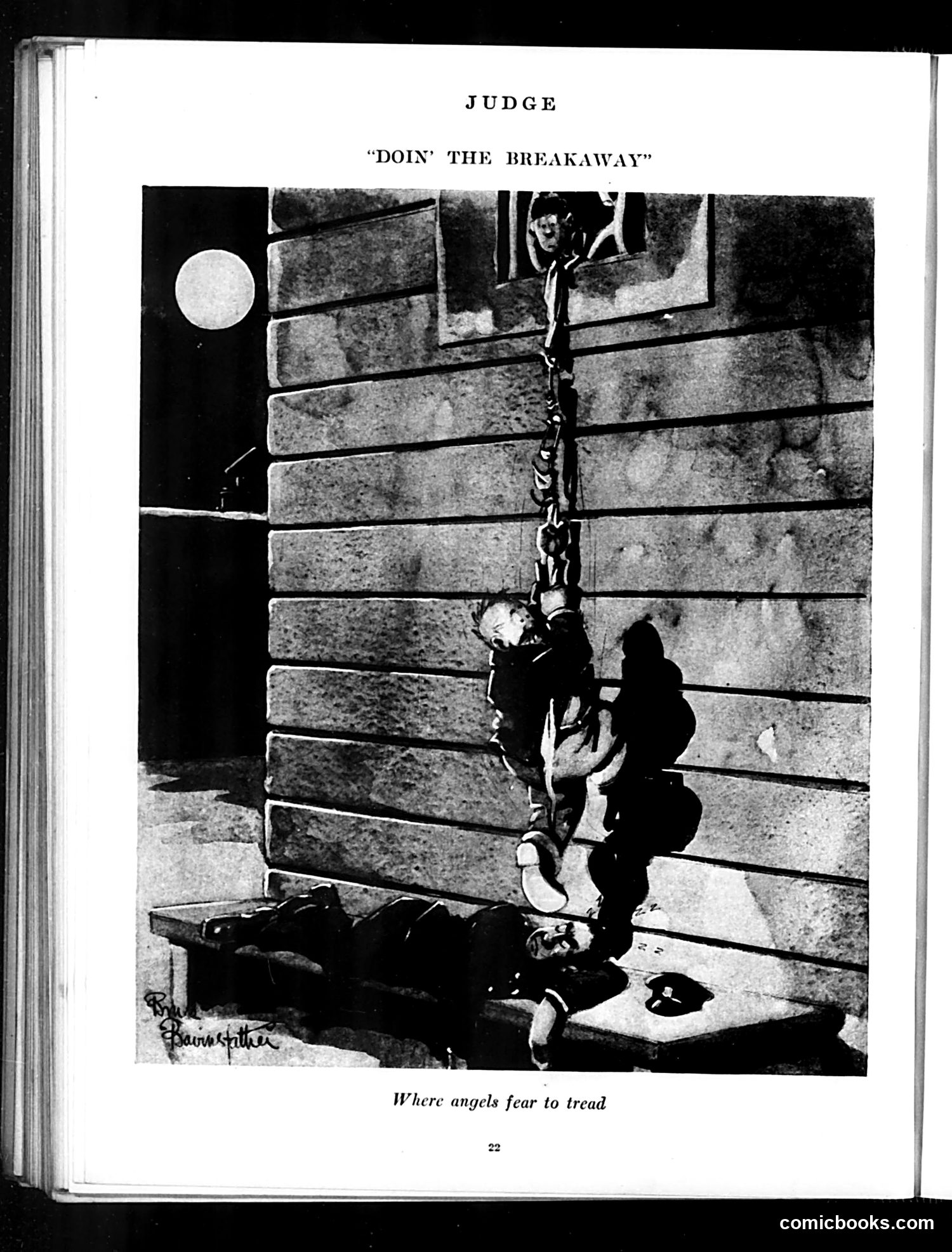
This Judge magazine illustration depicts a dramatic prison escape scene titled "Doin' the Breakaway" with the caption "Where angels fear to tread." The image shows figures climbing down what appears to be a prison wall using a chain or rope, with guards visible above and a body lying on the ground below. The satire likely mocks either a notorious prison escape attempt of the era or critiques the justice system's security failures. The biblical reference "where angels fear to tread" suggests the escapees are engaging in reckless or morally questionable behavior. Without the publication date visible, the specific historical event referenced remains unclear, but the cartoon exemplifies Judge's typical social commentary through dramatic imagery and wordplay.
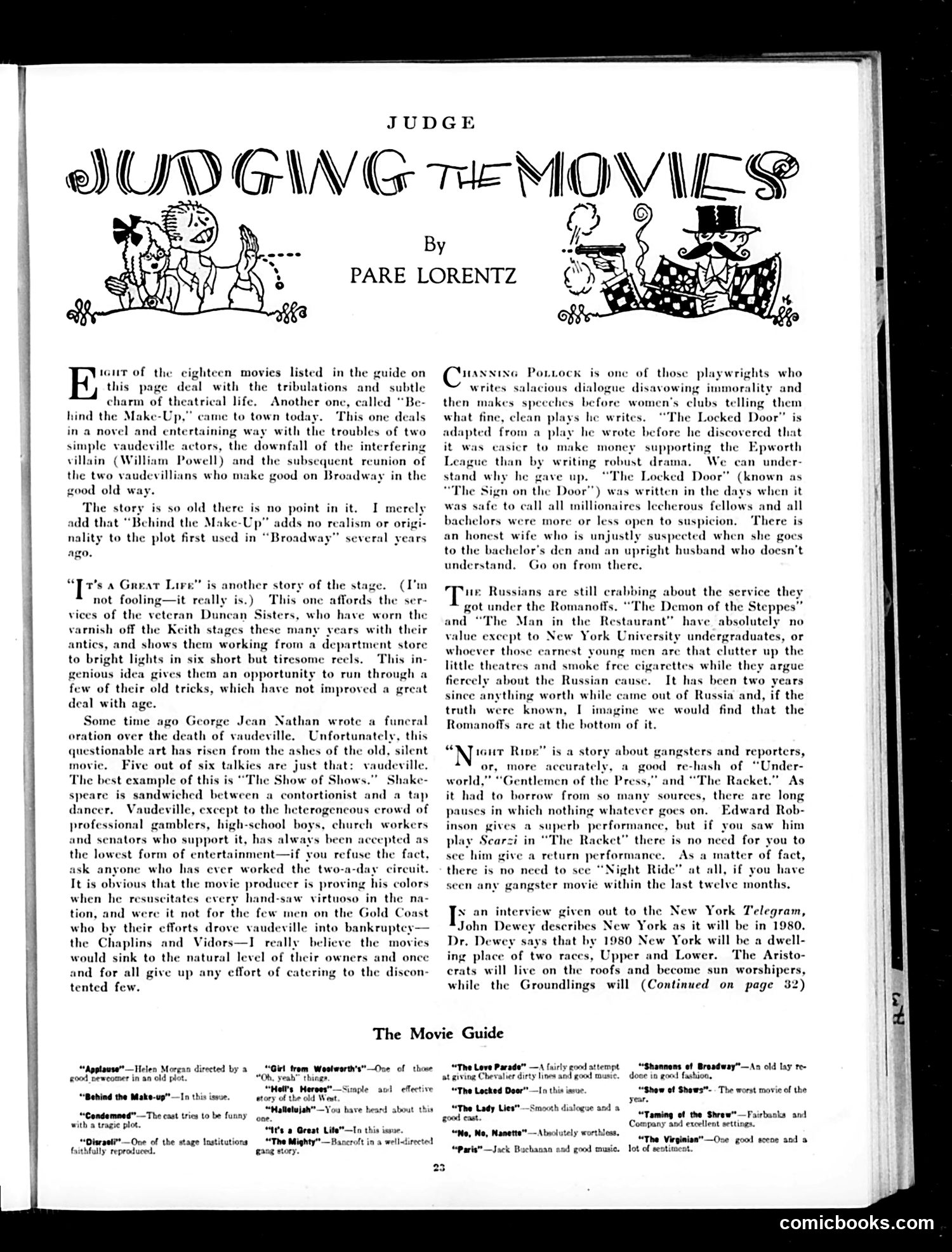
Judging the Movies: A 1920s Film Critique This page from Judge magazine contains film reviews by critic Pare Lorentz, not political cartoons. The decorative header illustrations show theatrical/vaudeville figures—jester-like performers suggesting the page's focus on entertainment. Lorentz reviews recent "talkies" (early sound films) with heavy skepticism. He dismisses movies recycling old vaudeville material as low-brow entertainment, criticizing producers for reviving "hand-saw virtuosos" when serious filmmakers like Chaplin and Vidor have elevated cinema. He mocks specific films: "Behind the Make-Up" and "It's a Great Life" for recycling tired stage plots; playwright Channing Pollock for writing morally questionable plays while lecturing women's clubs; and Russian films ("The Demon of the Steppes") as having value only for undergraduates. The satire targets Hollywood's desperation to fill talkies with recognizable vaudeville talent rather than developing original film art—a real anxiety during cinema's transition to sound in the late 1920s.
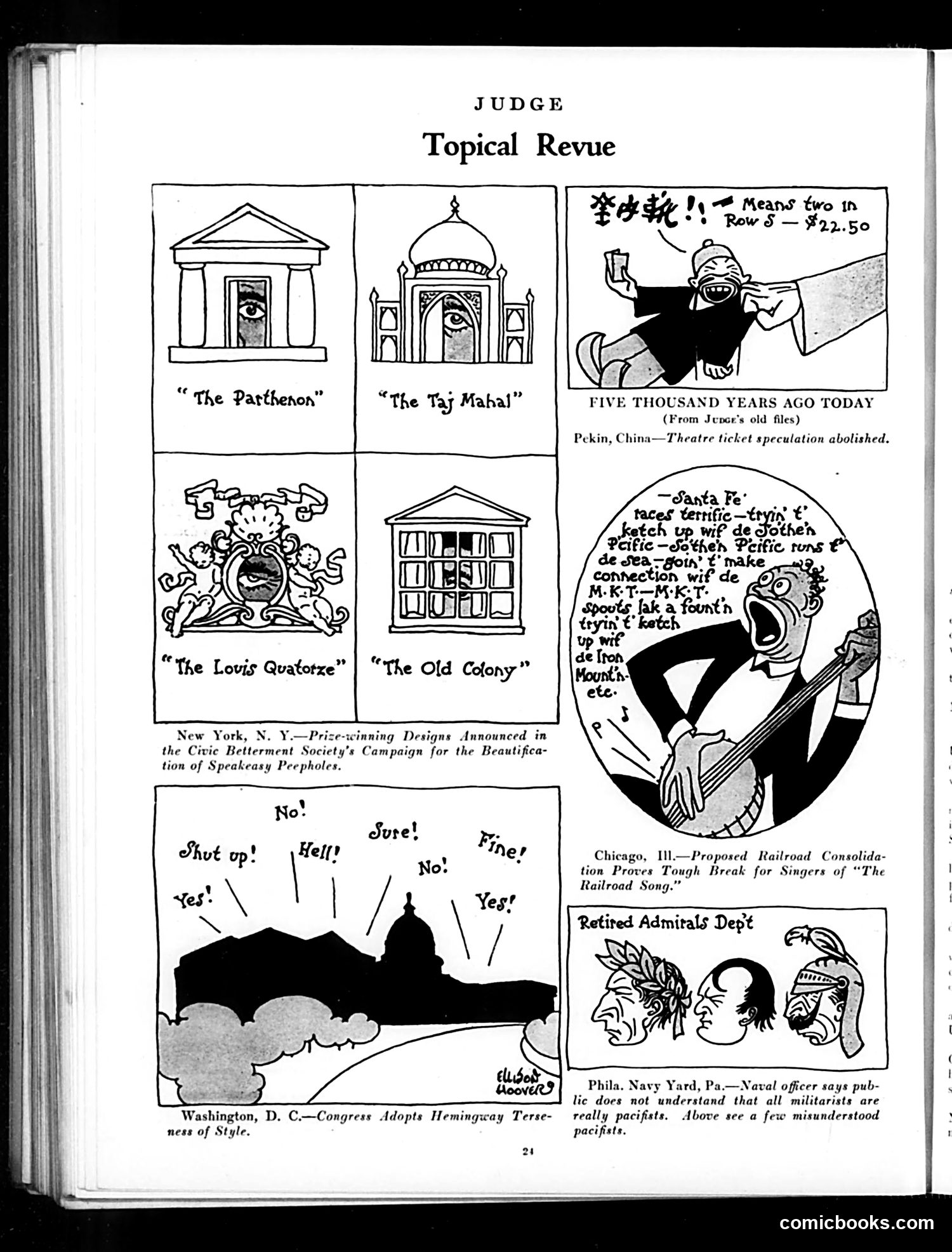
Judge Magazine Topical Revue Analysis This satirical page mocks contemporary 1920s-30s American issues through absurdist humor: "Five Thousand Years Ago Today": A gag suggesting that ancient Chinese theater ticket scalping mirrors modern problems—implying such corruption is timeless and unsolvable. Speakeasy Peepholes: Mocks Prohibition-era speakeasies (illegal bars) by satirizing civic beautification efforts as absurdly focused on decorating hidden bar entrances, highlighting the hypocrisy of Prohibition enforcement. Railroad Consolidation: A joke about railroad mergers potentially harming performers of "The Railroad Song," likely referencing folk or popular music. Congress and Hemingway: Satirizes Congress for adopting Ernest Hemingway's famously terse writing style—suggesting governmental communication has become overly minimalist. Naval Pacifists: Ironically depicting military officers as "misunderstood pacifists," satirizing military leadership's contradictory rhetoric about peace while maintaining armament. The page exemplifies Judge's formula of topical, irreverent political and social commentary through absurdist scenarios.
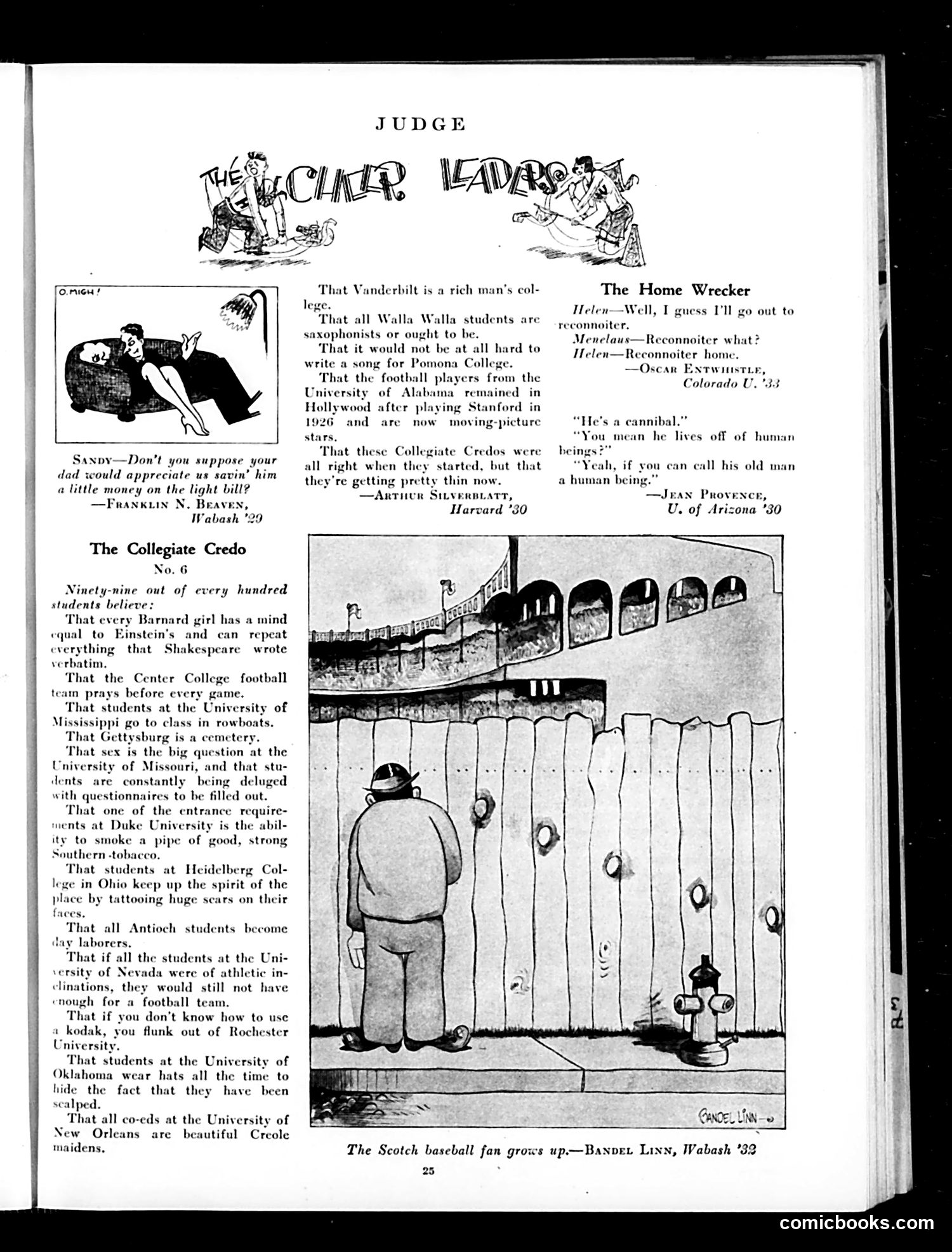
Judge Magazine Page Analysis This page features satirical humor about American college culture circa 1930. The main content is "The Collegiate Credo No. 6"—a list mocking exaggerated stereotypes about different universities. Each item pokes fun at false beliefs students hold about other schools: that Mississippi students need rowboats to attend class, that Heidelberg students scar themselves, that Oklahoma students wear hats to hide scalping scars, etc. The accompanying cartoon "The Scotch baseball fan grows up" (by Bandel Linn) depicts a large man looking at hanging baseball players—a visual pun suggesting the Scotch character's miserliness has darkened into something sinister. Brief humor pieces like "The Home Wrecker" and exchanges between students provide additional comedy. The overall satire targets collegiate pretension and the absurd myths students perpetuate about rival institutions. By 1930, these stereotypes were already wearing thin—acknowledged in the credo's final jab.
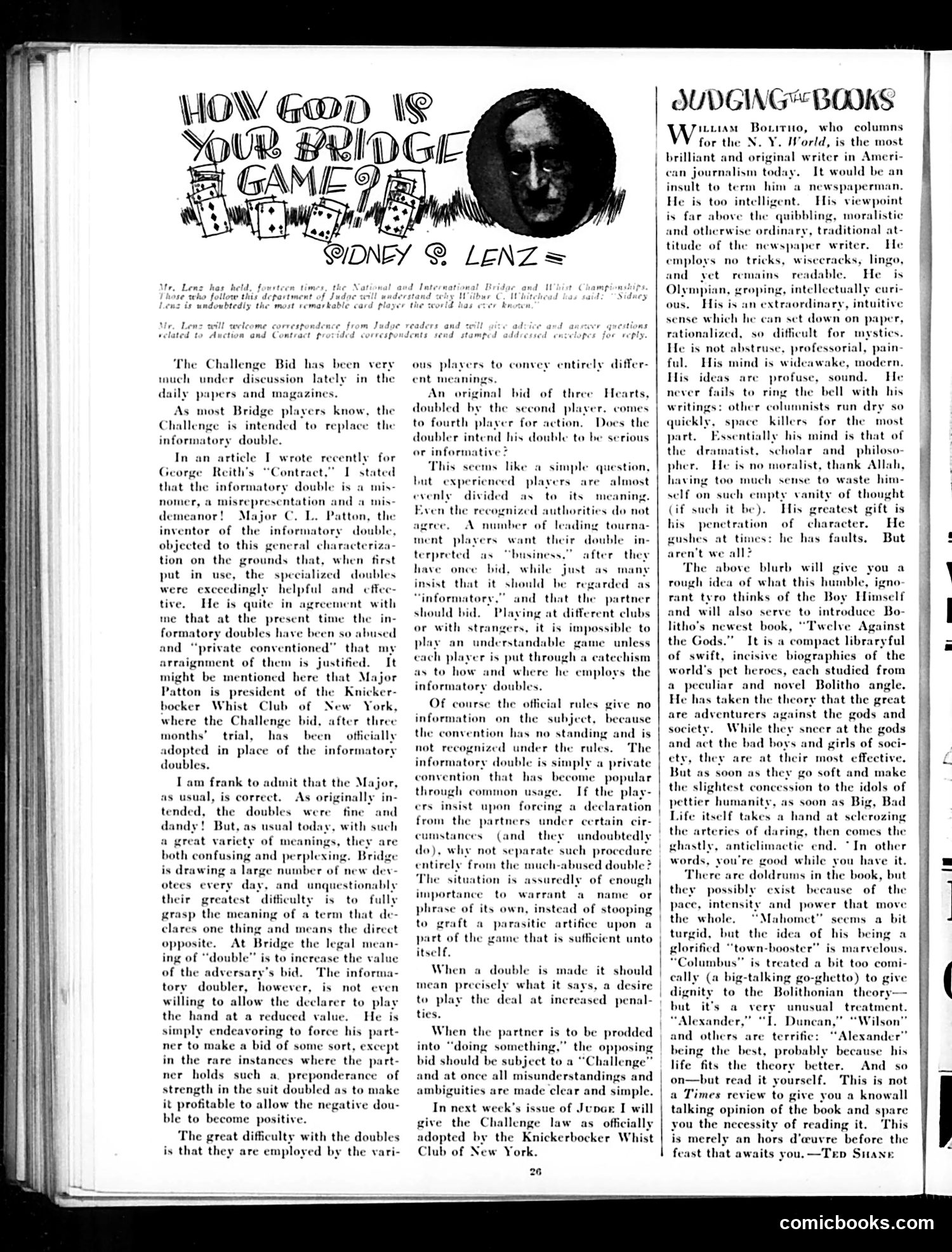
Bridge Game Strategy Article in Judge Magazine This page features an article by Sidney Lenz (identified in the masthead portrait) about bridge card game strategy, specifically debating the "Challenge Bid" versus the "informatory double." The Context: Lenz argues that the informatory double—a bidding convention in contract bridge—has become confusing because players use it inconsistently. He proposes replacing it with a clearer "Challenge Bid" system that was officially adopted by the prestigious Knickerbocker Whist Club of New York. The Satire: The cartoon's title "How Good Is Your Bridge Game?" puns on bridge terminology while the article's earnest technical discussion reflects the intellectual obsession with bridge strategy that was fashionable among educated Americans in the 1930s. The Social Reference: The Knickerbocker Whist Club reference signals this is elite-level bridge discussion—the game was a marker of sophisticated society. Lenz's byline notes he's won national and international championships, establishing his authority.
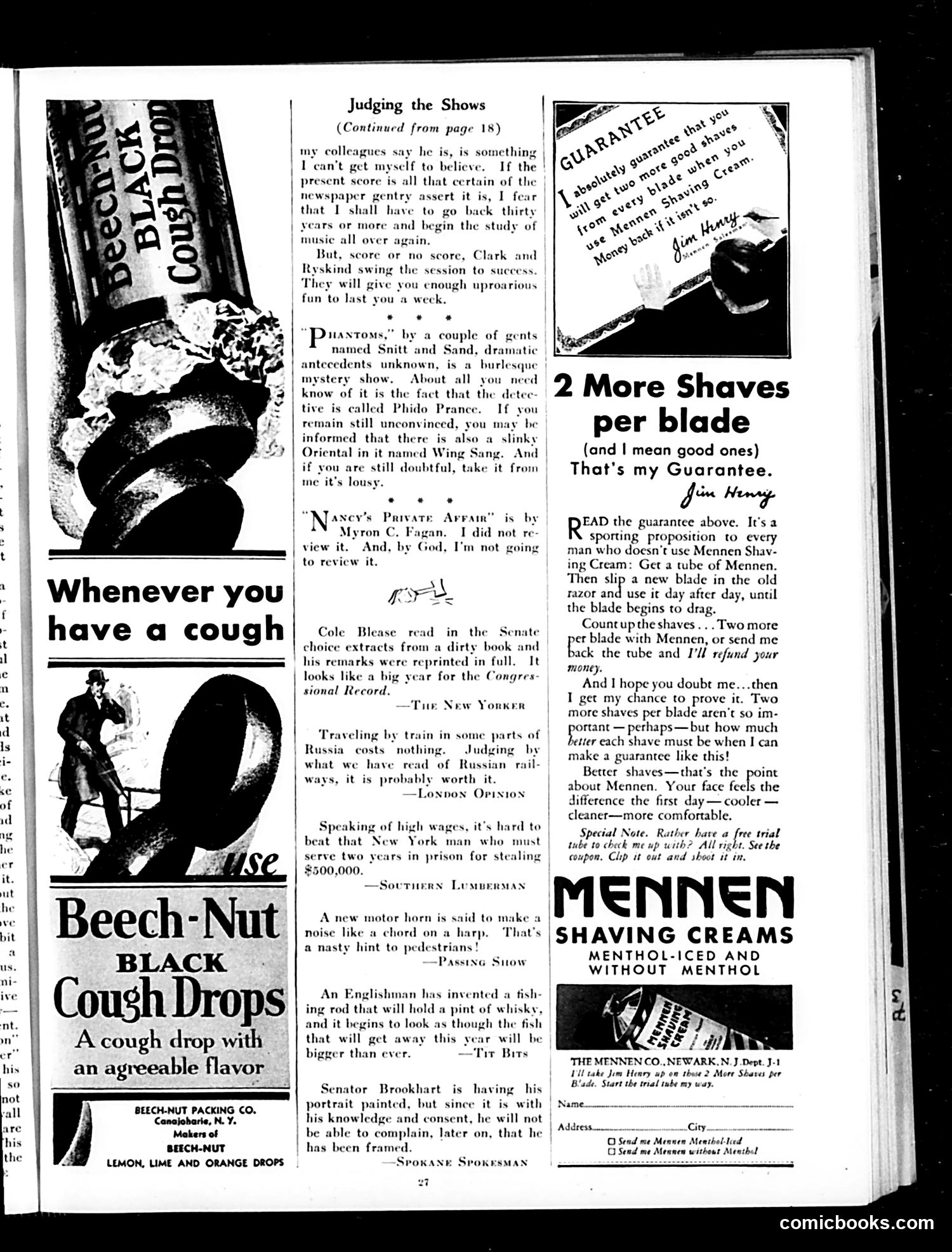
Page Analysis: Judge Magazine This page combines theater criticism with vintage advertising. The main content critiques recent Broadway productions, including a musical by Clark and Ryskind, a burlesque mystery called "Phantoms" (featuring a detective named "Phido Prance"), and "Nancy's Private Affair" by Myron C. Fagan—the critic dismissing the last without reviewing it. The page also reprints witty one-liners from other publications mocking contemporary politics and society—including a jab at Senator Cole Blease reading "dirty" material in Congress, and a joke about a New York man imprisoned for stealing $500,000. The advertisements dominate the page: Beech-Nut cough drops and Mennen shaving cream, the latter featuring an unusual money-back guarantee promising "2 More Shaves per blade." The Mennen ad includes a coupon readers could clip and mail. This reflects Judge's dual nature as both satirical commentary and advertising vehicle for the 1920s consumer market.
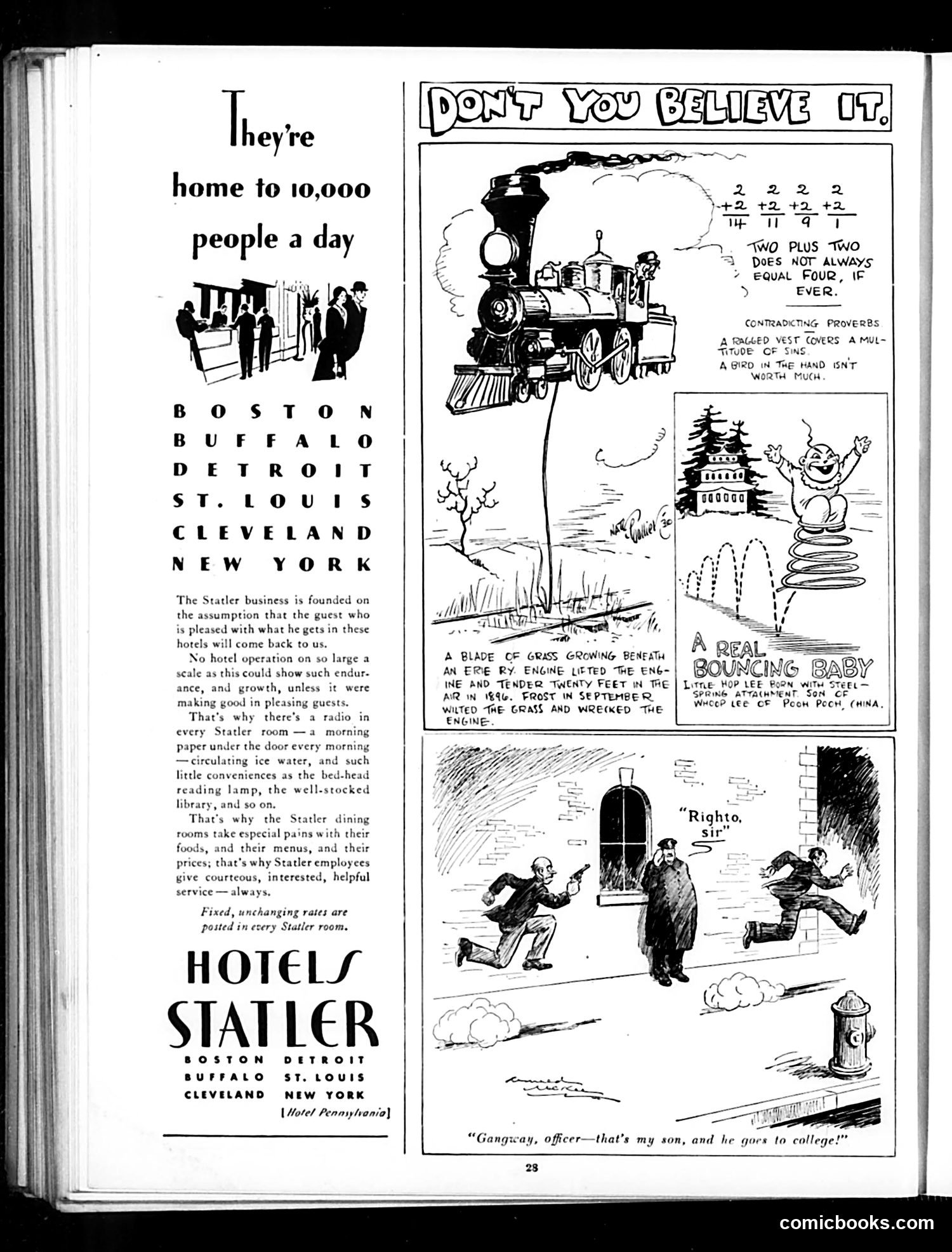
Analysis of Judge Magazine Page This page mixes hotel advertising with satirical humor. The left side promotes Hotels Statler, emphasizing their modern conveniences (radios, ice water, reading lamps) and courteous service across major cities. The right side, titled "Don't You Believe It," presents comic vignettes mocking common sayings and beliefs: - Math paradox: "2+2+2+2" doesn't always equal "four" - Contradicting proverbs about sin-covering vests and birds in hand - A train engine destroying grass beneath it (mocking the strength of nature) - A snowman at Christmas (seasonal humor) - A scene of police chasing someone who boasts their son attends college The cartoons satirize how conventional wisdom often contradicts itself or fails in reality. The humor is gentle, early-20th-century style—poking fun at platitudes rather than serious political targets. The page demonstrates Judge's mix of advertising and whimsical comic commentary on everyday life.
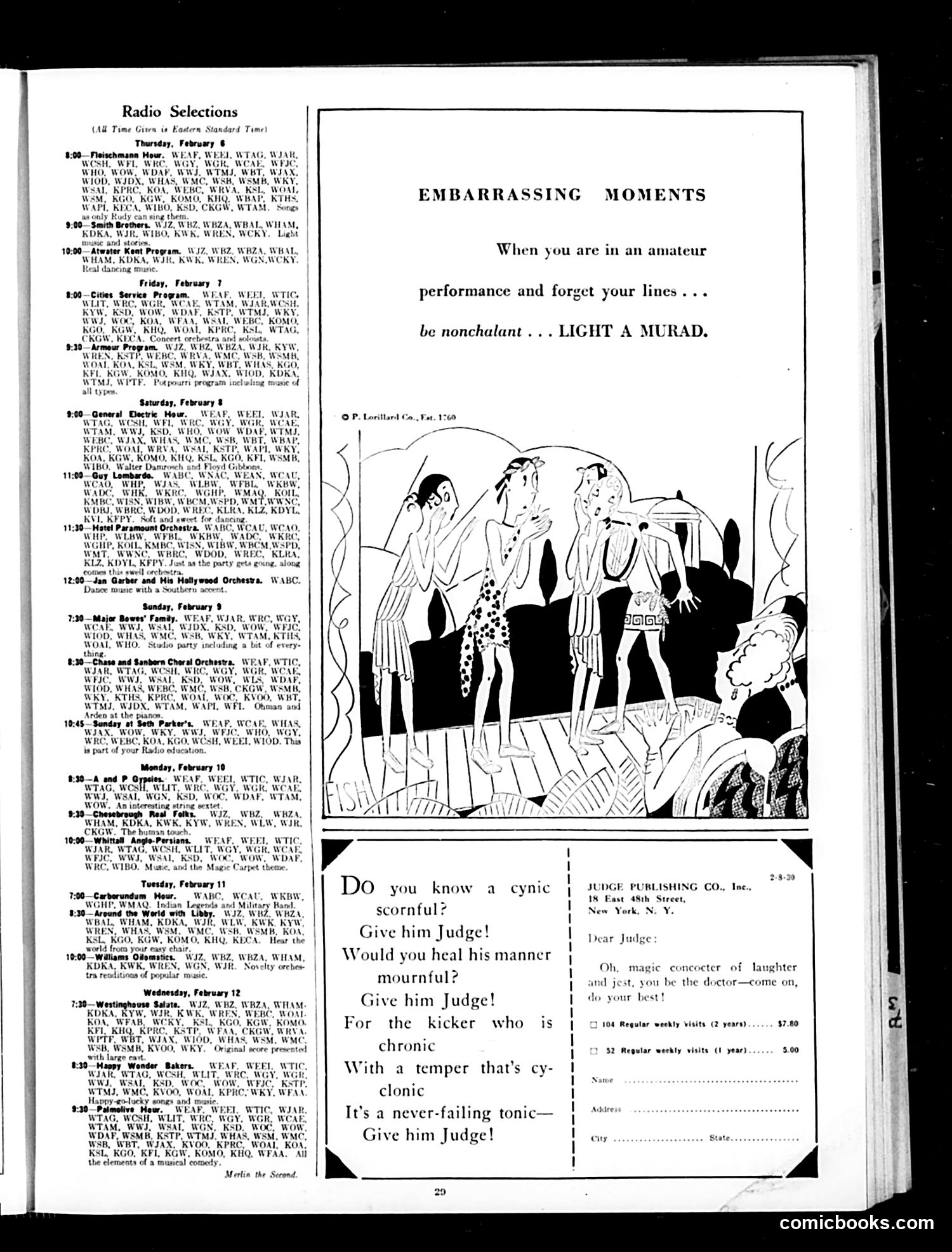
Explanation for Modern Readers This page from *Judge* magazine (appears to be February 1929) contains two main elements: The Cartoon ("Embarrassing Moments"): A humorous illustration depicts an amateur theatrical performer who has forgotten their lines mid-performance. Rather than panicking visibly, the character coolly lights a cigarette (a "Murad" brand). The joke satirizes performative nonchalance—pretending calm indifference to cover up anxiety. The cartoon is fundamentally an advertisement disguised as humor. The Advertisement ("Give him Judge!"): Below is a mock-serious advertisement for *Judge* magazine itself, humorously "prescribing" the publication as a cure for cynics and bad-tempered people. It's self-promotional satire, suggesting *Judge* will improve one's disposition through laughter. Both elements are typical of *Judge*'s satirical approach: using light social observation and visual humor to comment on contemporary behavior while seamlessly blending editorial content with advertising—a common magazine practice of the era.
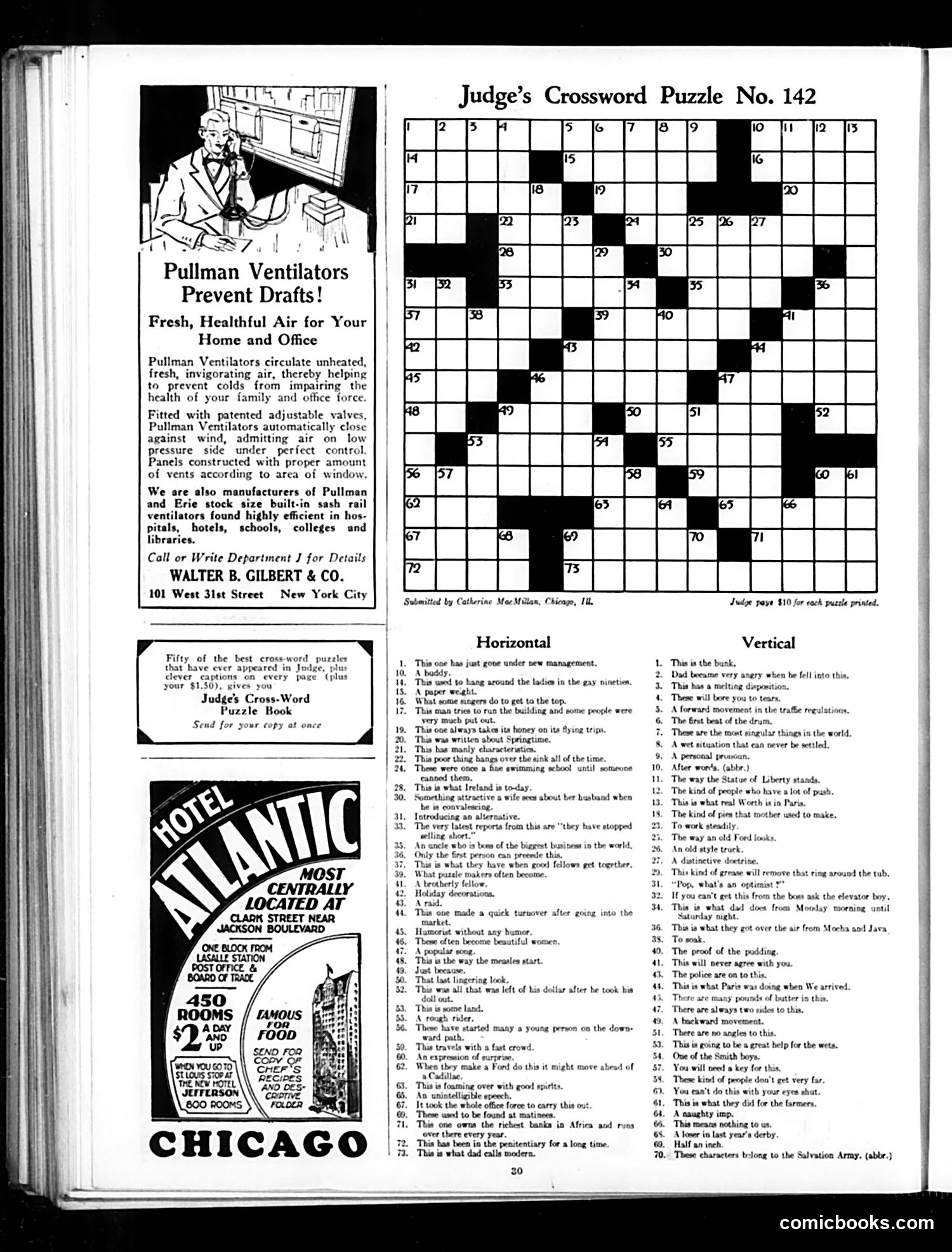
Judge's Crossword Puzzle No. 142 (c. 1920s) This page is primarily a crossword puzzle with accompanying advertisements—not political satire. The puzzle itself contains wordplay and contemporary references typical of 1920s America. The advertisements are notable: Pullman Ventilators (promoting home ventilation systems) and the Hotel Atlantic in Chicago (advertising cheap lodging near Jackson Boulevard). These reflect post-WWI consumer marketing. The puzzle clues reference 1920s culture: "flying trips" (early aviation), "measles," "Ford" automobiles, "Cadillac," and social behaviors like courtship and marriage. One clue mentions "good fellows get together," possibly referencing Prohibition-era social gatherings. The clue mentioning "they have stopped selling short" appears to reference stock market terminology, suggesting some financial awareness among readers. Overall, this is entertainment and advertisement—a commercial crossword book promotion offering $10 per published puzzle, rather than political commentary.
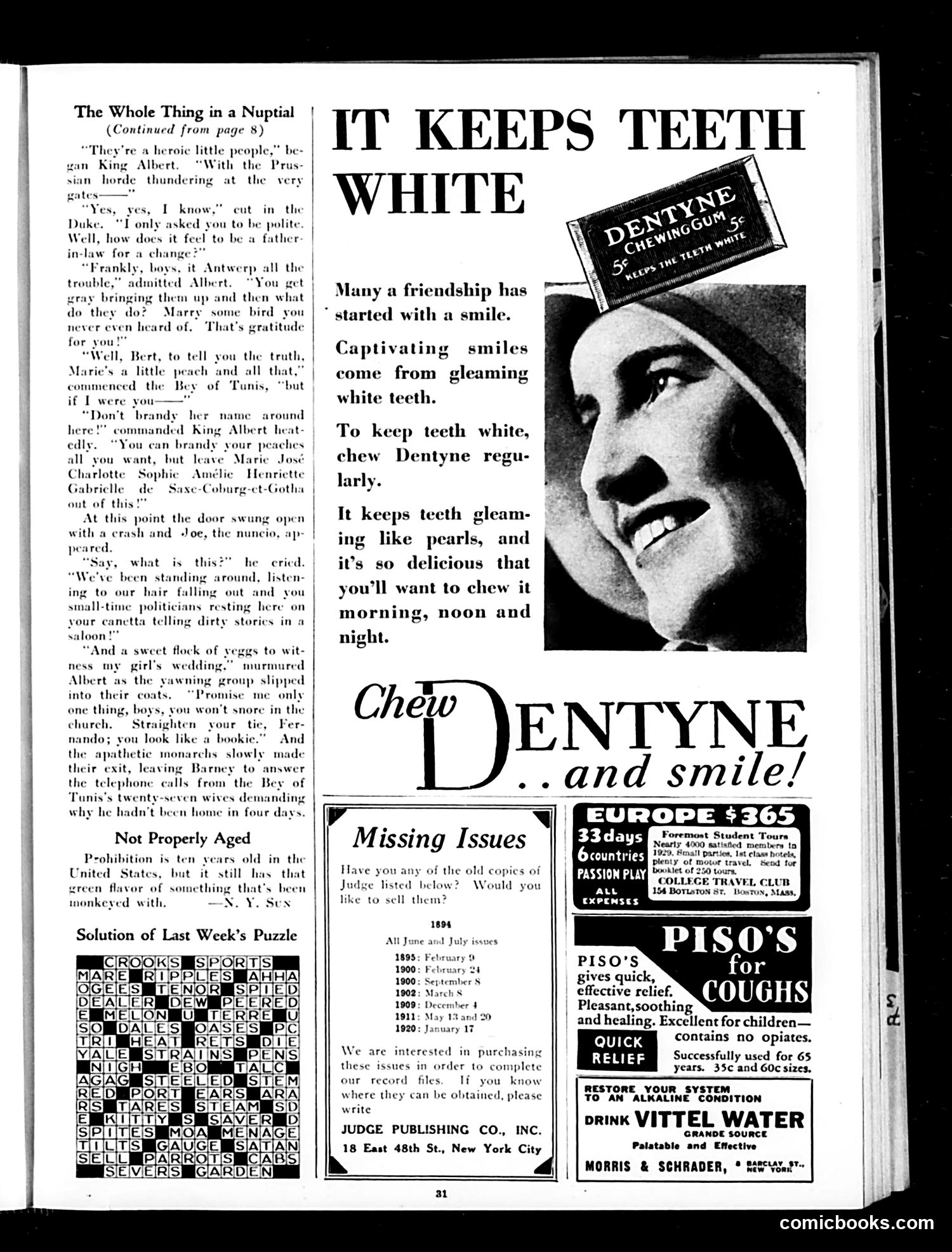
Analysis of Judge Magazine Page This page is primarily advertising and editorial content rather than political satire. The main feature is a serialized fiction story ("The Whole Thing in a Nuptial," continued from page 8) depicting a royal wedding involving King Albert and various European monarchs, including a reference to the "Bey of Tunis." The humor appears to be lighthearted domestic comedy about marriage and family rather than sharp political commentary. The dominant content is advertising: Dentyne chewing gum (promising white teeth and friendship), Piso's cough medicine, Vittel mineral water, Europe travel packages, and a "Missing Issues" appeal from Judge's own publishing office seeking back copies from 1894-1920. A small section titled "Not Properly Aged" briefly satirizes Prohibition as a poorly-executed ten-year-old policy with a "green flavor." The page reflects early-to-mid 20th century print culture: serialized fiction mixed liberally with period advertisements for patent medicines and consumer goods now obsolete or regulated differently.
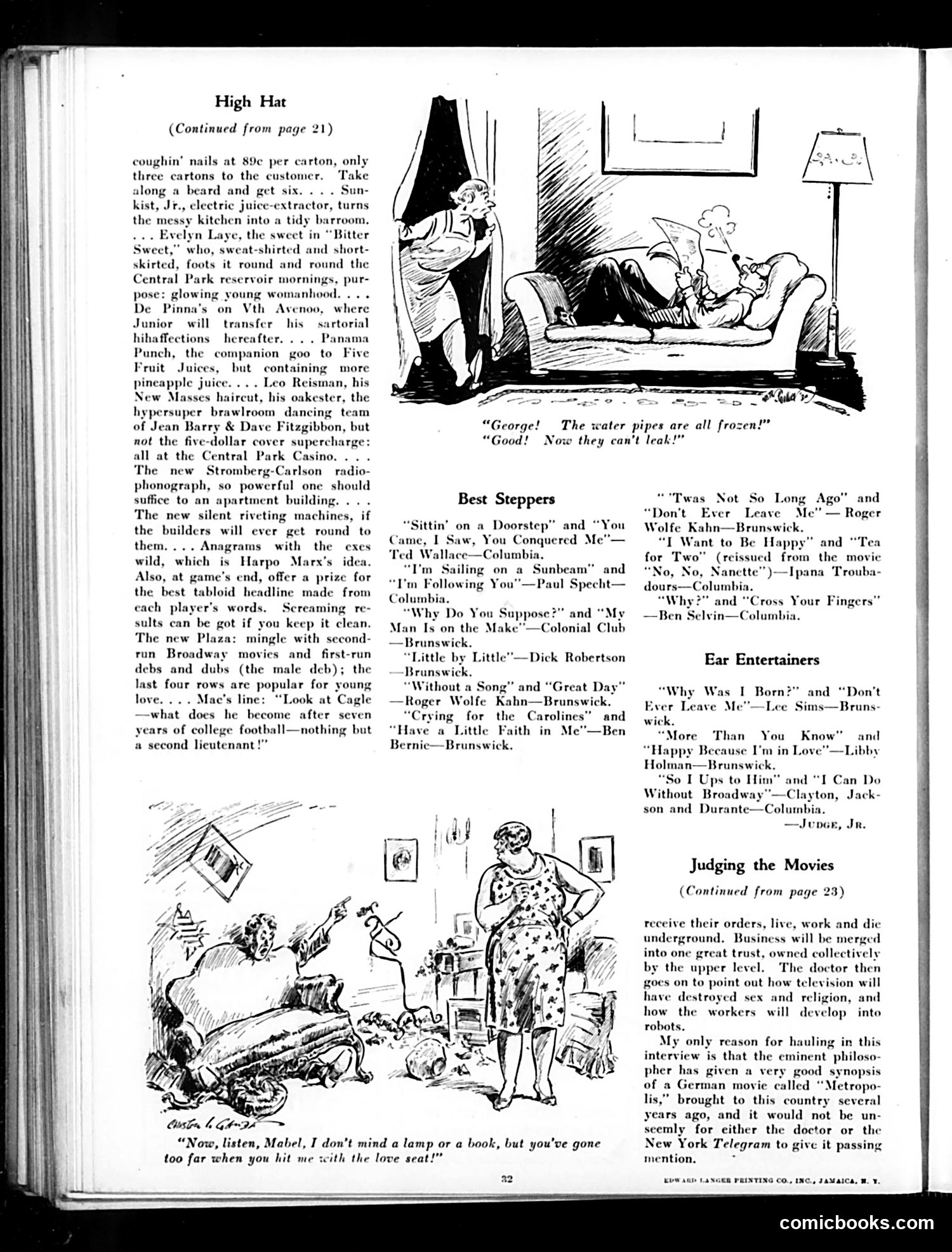
Analysis of Judge Magazine Page This page contains entertainment gossip and reviews rather than political satire. The "High Hat" column lists celebrity sightings and nightlife recommendations—Evelyn Laye exercising at Central Park, new consumer products like radios and juice extractors, and nightclub venues like the Central Park Casino. The cartoon shows a couple on a couch; the woman has hit the man with a love seat cushion. The joke plays on the double meaning: he's complaining she's gone too far with "the love seat" (the furniture), a domestic squabble joke typical of 1920s humor. The "Best Steppers" and "Ear Entertainers" sections list popular songs and performers of the era—Brunswick and Columbia record labels, artists like Roger Wolfe Kahn. The "Judging the Movies" section reviews a German film called "Metropolis," discussing its dystopian plot about class division and workers becoming robots—social commentary wrapped in entertainment criticism. This reflects 1920s anxieties about technology and labor.
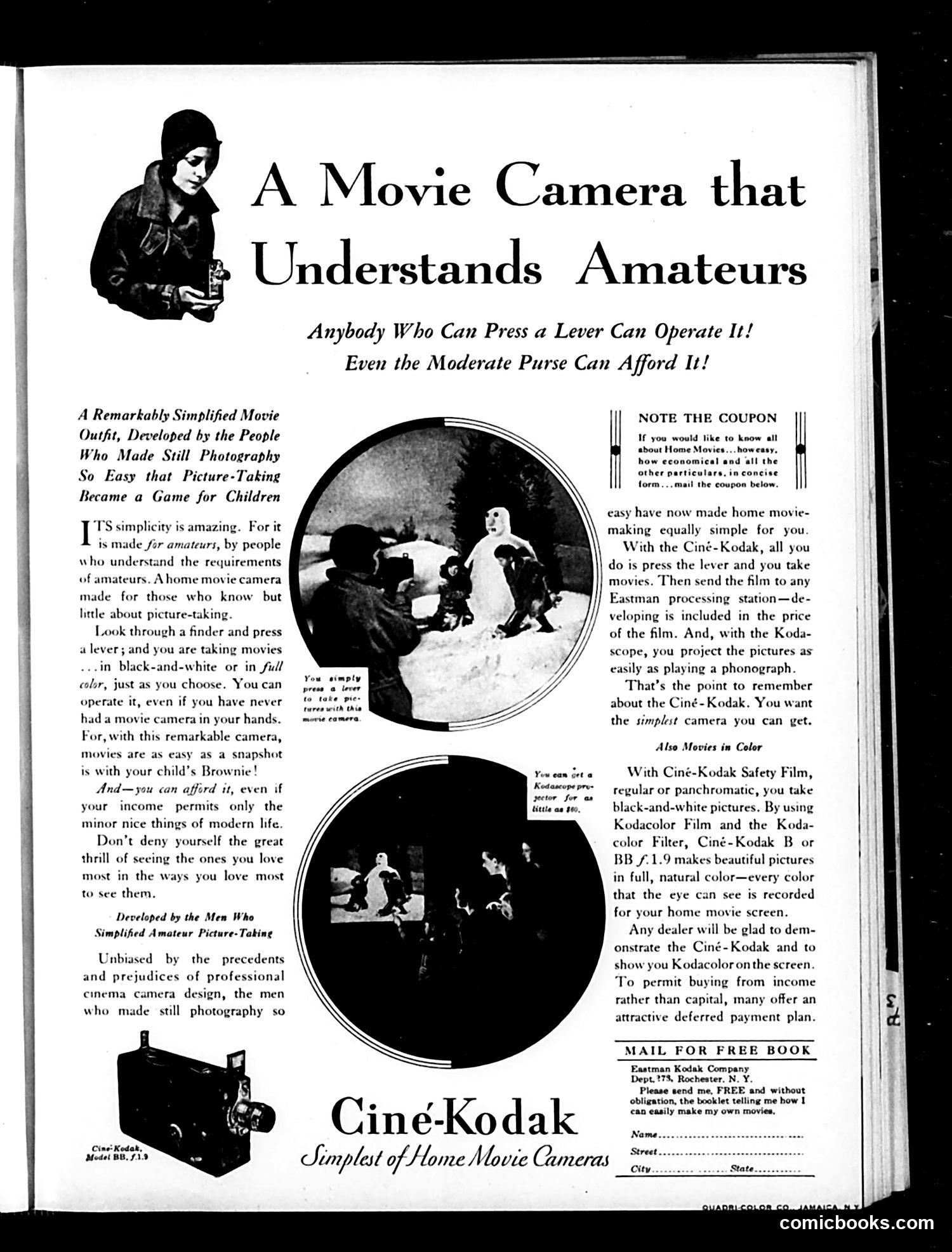
Analysis This is not a cartoon or satire—it's a product advertisement for the Ciné-Kodak home movie camera, placed in Judge magazine. The page promotes Eastman Kodak's simplified film camera designed for amateur users. The central appeal is democratization through ease: the copywriting emphasizes that "anybody who can press a lever" can operate it, and even modest budgets can afford it. The two circular photographs show sample home movies—domestic scenes of families and children, illustrating the intended use case. The smaller image of the camera itself (Model BB) anchors the product pitch. This reflects 1920s-30s consumer culture, when photography technology was being marketed to middle-class households as entertainment and memory-preservation. The tone assumes many readers have never used a movie camera and positions Kodak as having solved the "professional complexity" problem through design simplification—echoing their earlier success with still cameras marketed to children. The coupon at bottom was standard advertising practice for collecting consumer interest data.
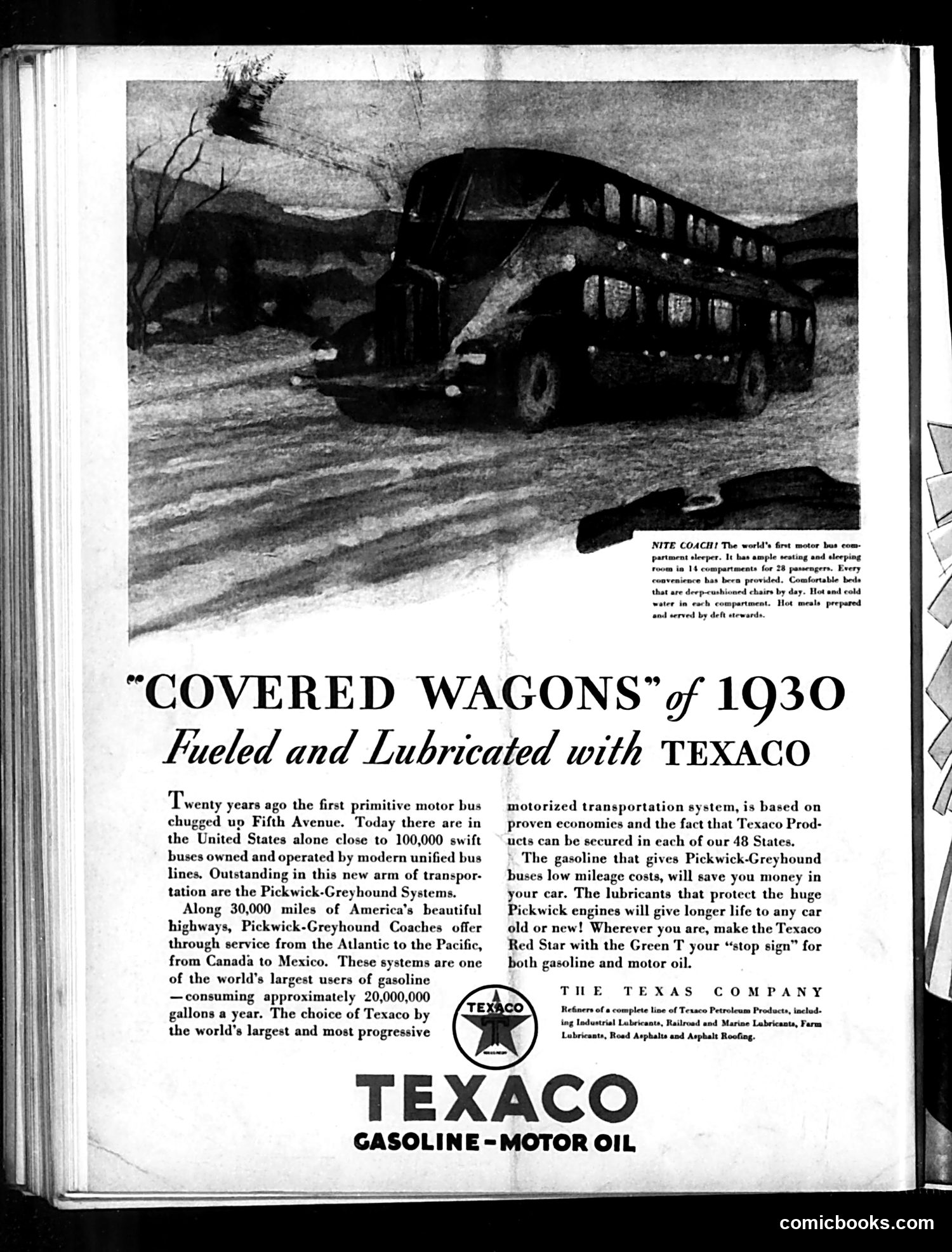
"Covered Wagons" of 1930: A Texaco Advertisement This is primarily a Texaco gasoline advertisement, not a political cartoon. The page uses the metaphor of "covered wagons" to compare modern motorcoaches to westward expansion—positioning 1930s bus travel as the latest frontier. The "satire" is gentle corporate messaging: the Nite Coach image shows the "Pickwick-Greyhound" bus system (a major real carrier), highlighting its luxury sleeping compartments and amenities. The text celebrates America's motorized transportation boom—100,000 buses now operating nationwide, consuming 20 million gallons annually. The joke/appeal is the historical parallel: just as covered wagons opened the West a century prior, these modern buses represent progress and connectivity across America. By emphasizing that Pickwick-Greyhound uses Texaco products, the ad positions the fuel company as essential to this transportation revolution. This reflects genuine 1930s optimism about technology and interstate commerce during the pre-Depression recovery period.