judge
Judge — February 15, 1930
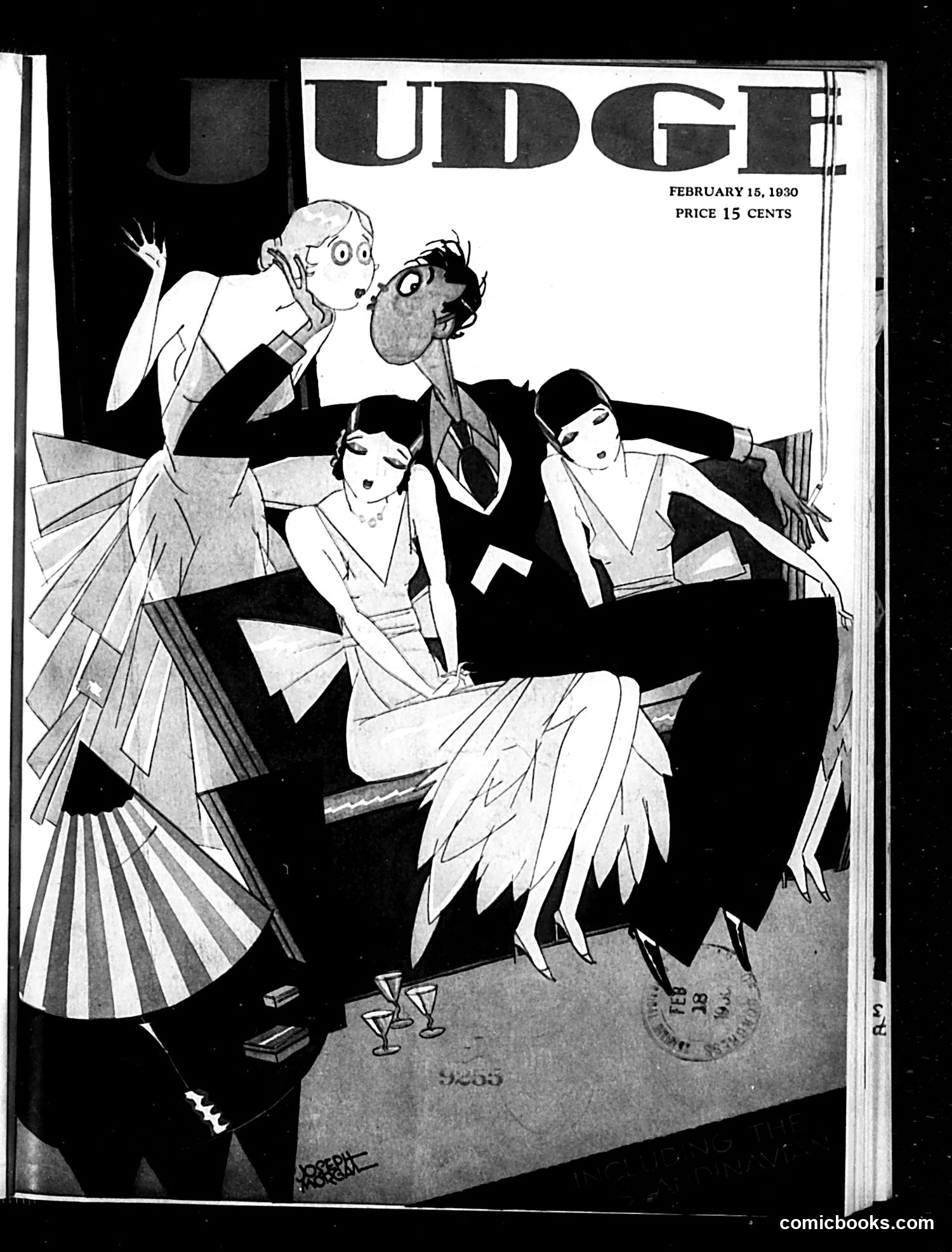
Judge Magazine Cover, February 15, 1930 This cover depicts a lively party scene with exaggerated, caricatured figures in 1920s evening wear—flapper dresses with dramatic pleats and a man in a tuxedo. The artistic style employs the grotesque facial exaggeration typical of satirical magazines of this era. The specific satire is unclear without additional context or visible text identifying the figures. However, given Judge's focus on social commentary, this likely mocks either: - High society's excess during the economic prosperity of the late 1920s (just months before the 1929 stock market crash's full consequences became apparent) - Contemporary entertainment or nightlife culture - Fashion trends of the period The cartoonist's signature appears at bottom left. The cover price of 15 cents reflects 1930 economics.
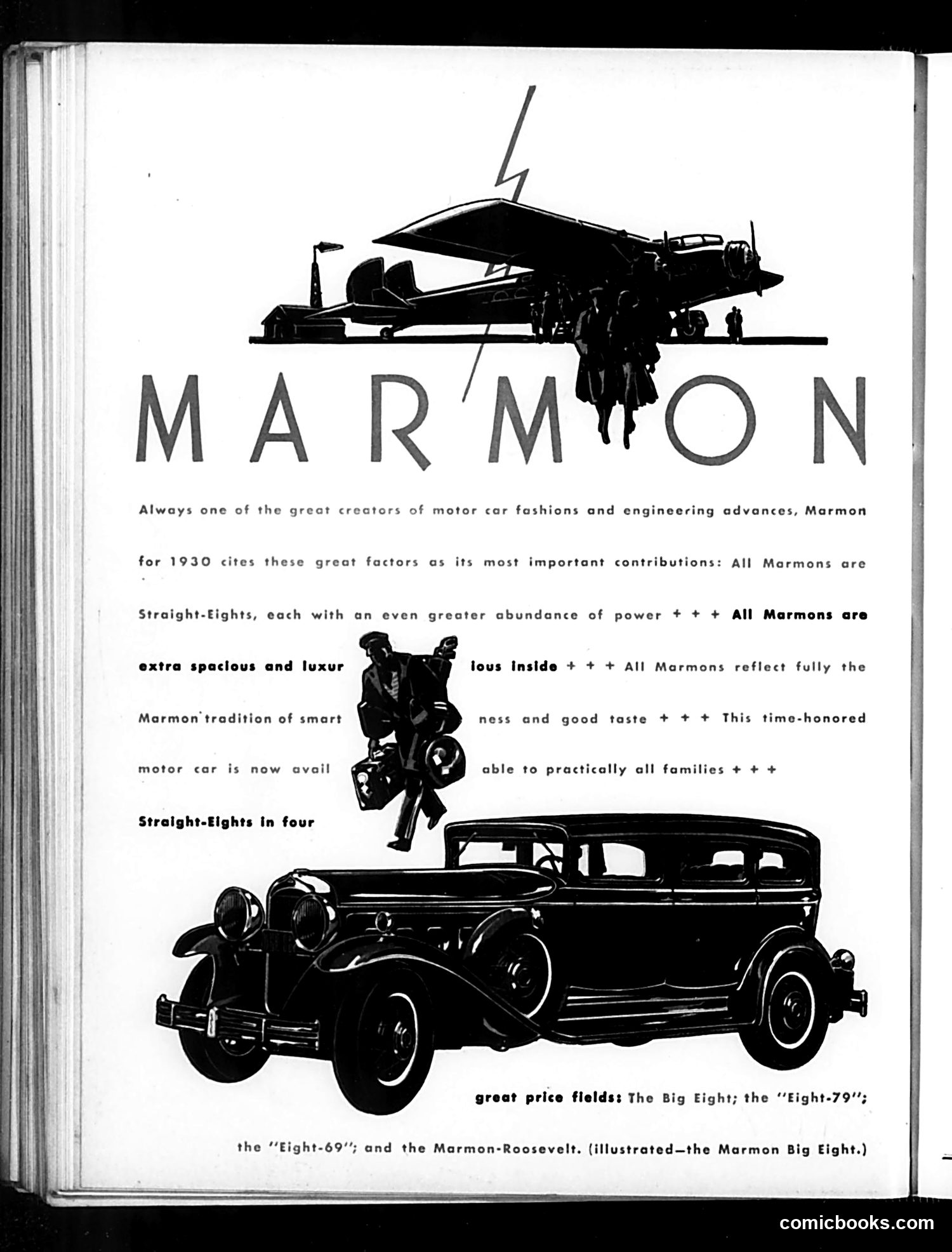
Marmon Automobile Advertisement This page is primarily advertising content rather than satire or political commentary. It promotes Marmon automobiles for 1930, emphasizing engineering advances and luxury features. The imagery includes a stylized airplane at the top (suggesting modernity and speed) and a 1930s sedan below, accompanied by illustrations of fashionably dressed figures. The text highlights Marmon's reputation as "one of the great creators of motor car fashions and engineering advances," touting straight-eight engines with increased power, spaciousness, and luxury as the brand's key selling points. The advertisement references several models: the Big Eight, Eight-79, Eight-69, and Marmon-Roosevelt, positioning these vehicles as accessible to "practically all families" while maintaining the brand's tradition of "smartness and good taste."
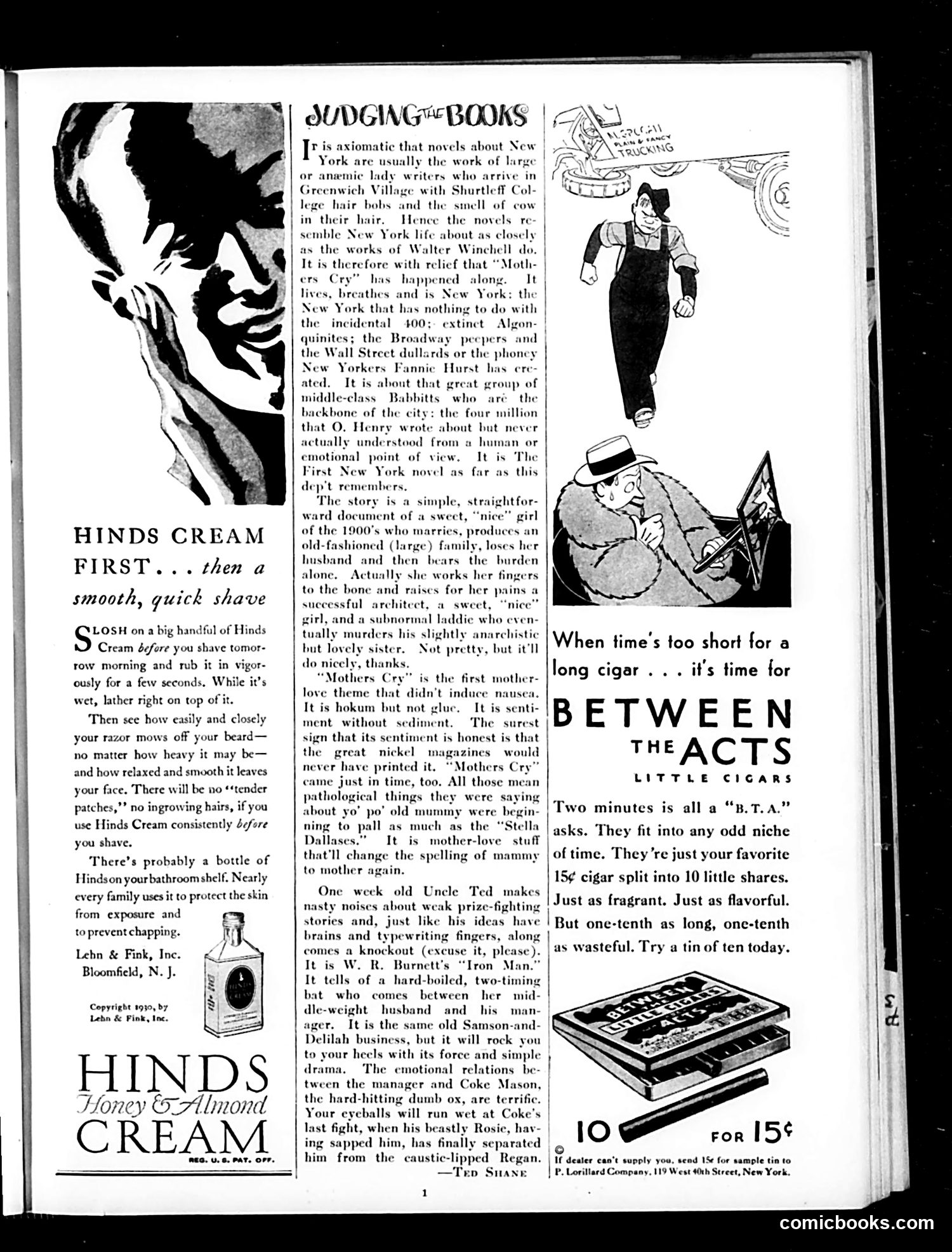
"Judging the Books" - Book Review Page This page is primarily book reviews and advertising rather than political satire. The main content is a column titled "Judging the Books" that critiques novels about New York life. The reviewer discusses "Mothers Cry," praising it as an honest portrayal of working-class family struggles—notably the first mother-love story the reviewer claims didn't induce nausea. Other books mentioned include works featuring "weak prize-fighting stories" and a tale comparing a manager-boxer relationship to the biblical Samson and Delilah story. The page includes advertisements for Hinds Cream (shaving product) and Between the Acts Little Cigars (10 for 15¢). These ads use period-appropriate marketing appeals rather than satire.
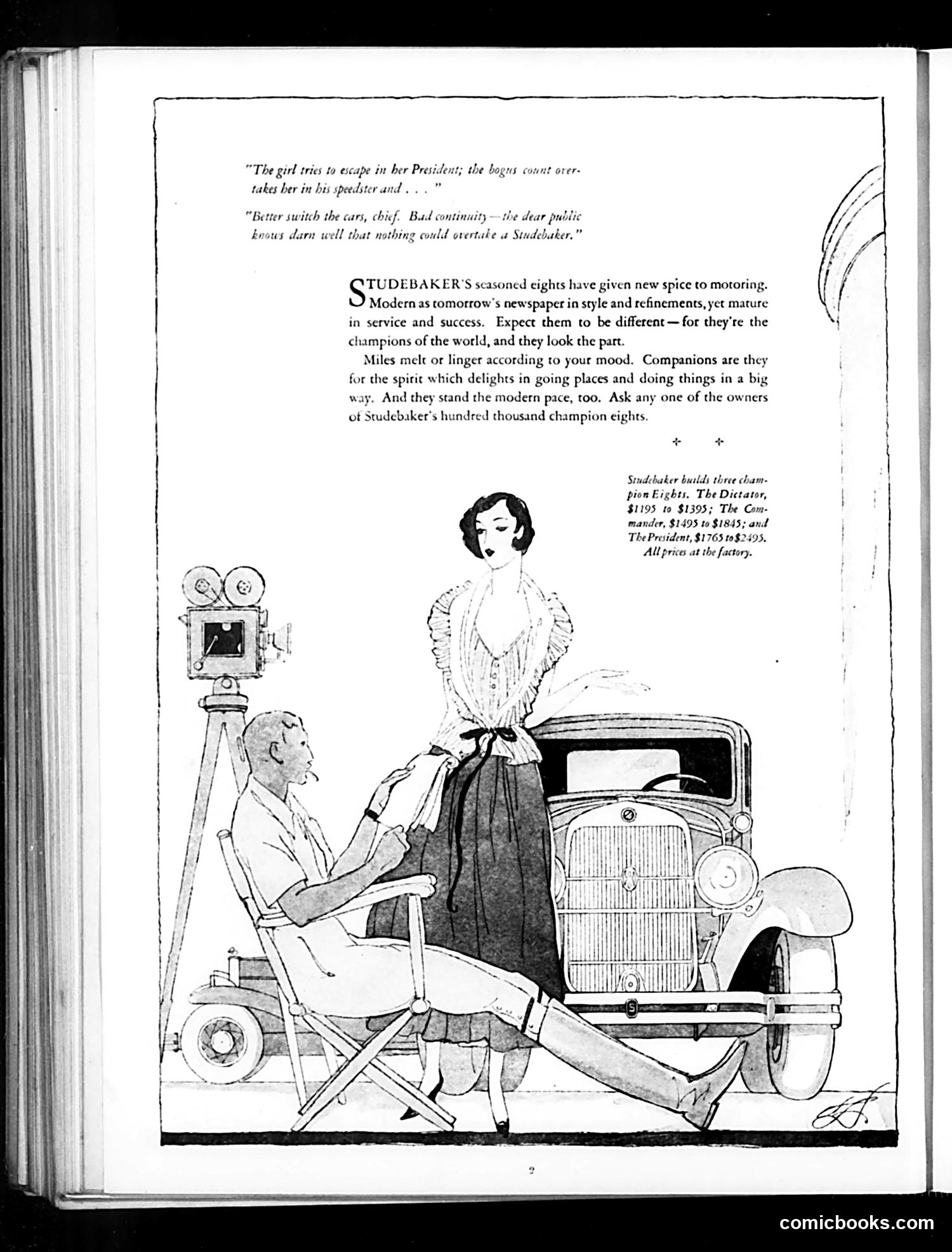
Analysis This appears to be a Studebaker automobile advertisement disguised as editorial content in *Judge* magazine. The text praises Studebaker's "seasoned eights" as modern, successful vehicles for sophisticated owners who appreciate quality and performance. The illustration depicts a film production scene: a cameraman films a woman posing next to a Studebaker automobile. The satire likely works on two levels—both celebrating Studebaker's appeal to wealthy, glamorous consumers and gently mocking the advertising industry's use of attractive women and cinematic spectacle to sell products. The quoted dialogue at top references "the President" and appears unrelated to the car content, suggesting this was assembled from multiple magazine pieces. This mixed-media approach was common in early 20th-century magazine advertising.
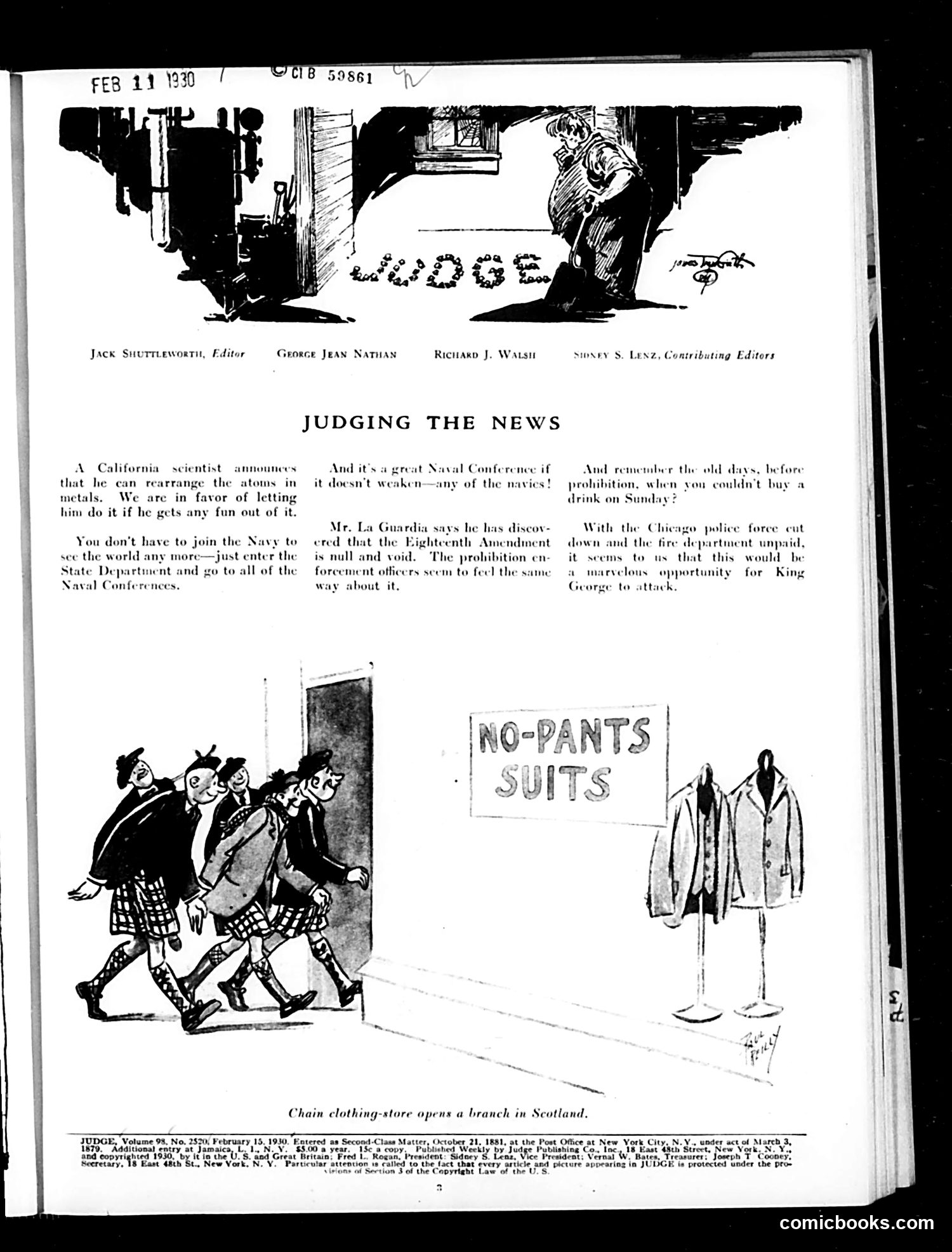
"Judging the News" - February 11, 1930 This satirical column comments on contemporary events. The main cartoon depicts Scottish men in kilts entering a "No-Pants Suits" clothing store—a visual pun playing on the Scots' traditional dress. The joke references a chain clothing store opening a Scottish branch, with the irony being that kilts are the Scottish national garment, making "no-pants suits" redundant or absurd for that market. The text above discusses a California scientist's atomic theory, Naval Conferences, Prohibition enforcement (referencing Chicago police and King George), and Mr. La Guardia's views on the Eighteenth Amendment. These represent typical early 1930s American concerns: scientific advancement, military policy, and alcohol prohibition debates.
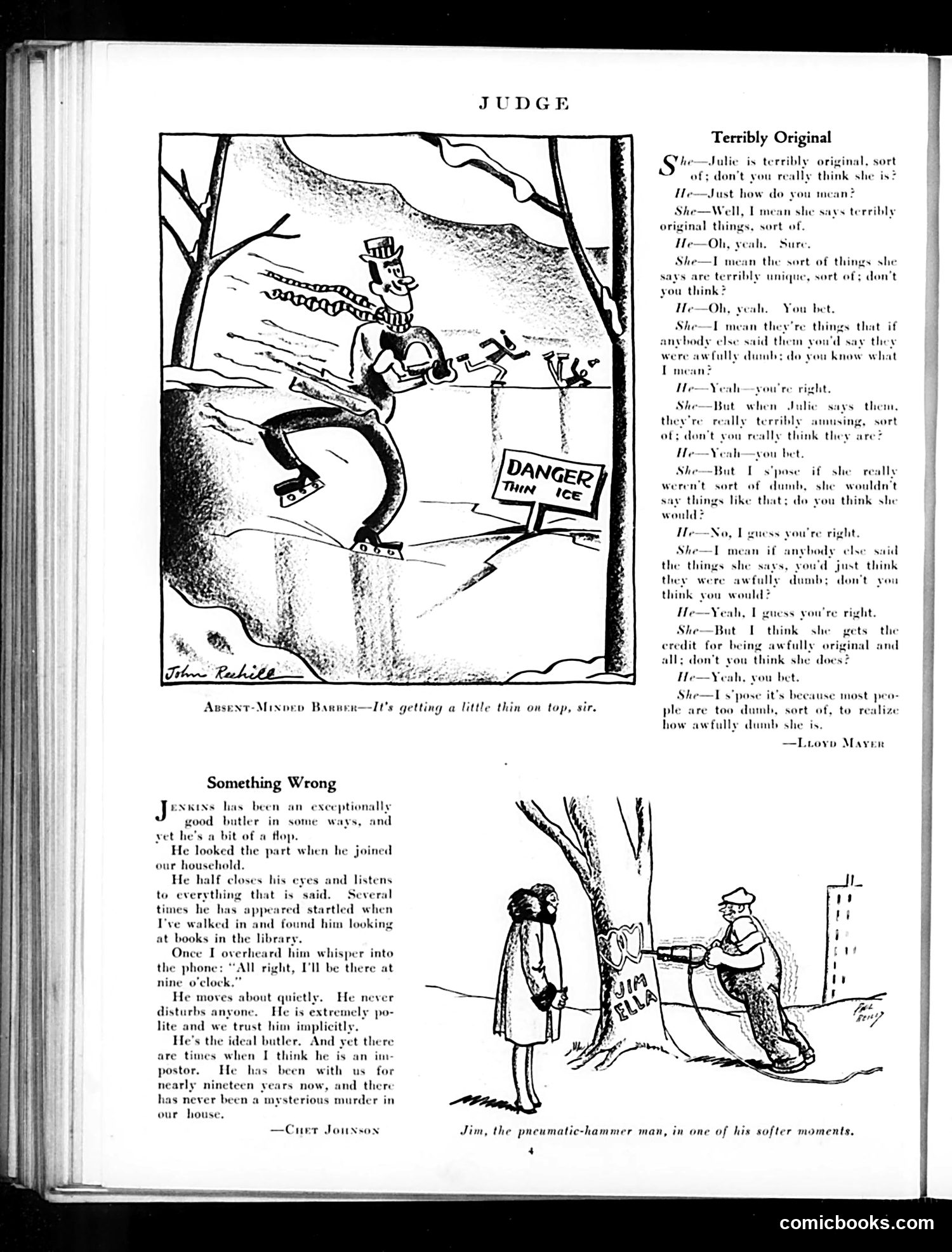
Judge Magazine Page Analysis Top Cartoon - "Terribly Original": A dialogue between a man and woman debating whether a woman named Julie is genuinely original or merely says outlandish things. The joke satirizes intellectual pretension—the couple questions whether Julie's "terribly original things" are actually clever or just deliberately absurd statements designed to seem unique. The humor targets people who confuse shocking behavior with genuine originality. Bottom Section - "Something Wrong": An anecdote about Jenkins, described as an "exceptionally good butler" who appears suspiciously perfect—he's observant, quiet, trustworthy, and has served nearly nineteen years without incident. The joke's implication: his flawless behavior seems suspicious, suggesting he may be hiding something criminal. The accompanying cartoon shows "Jim, the pneumatic-hammer man" in a softer domestic moment.
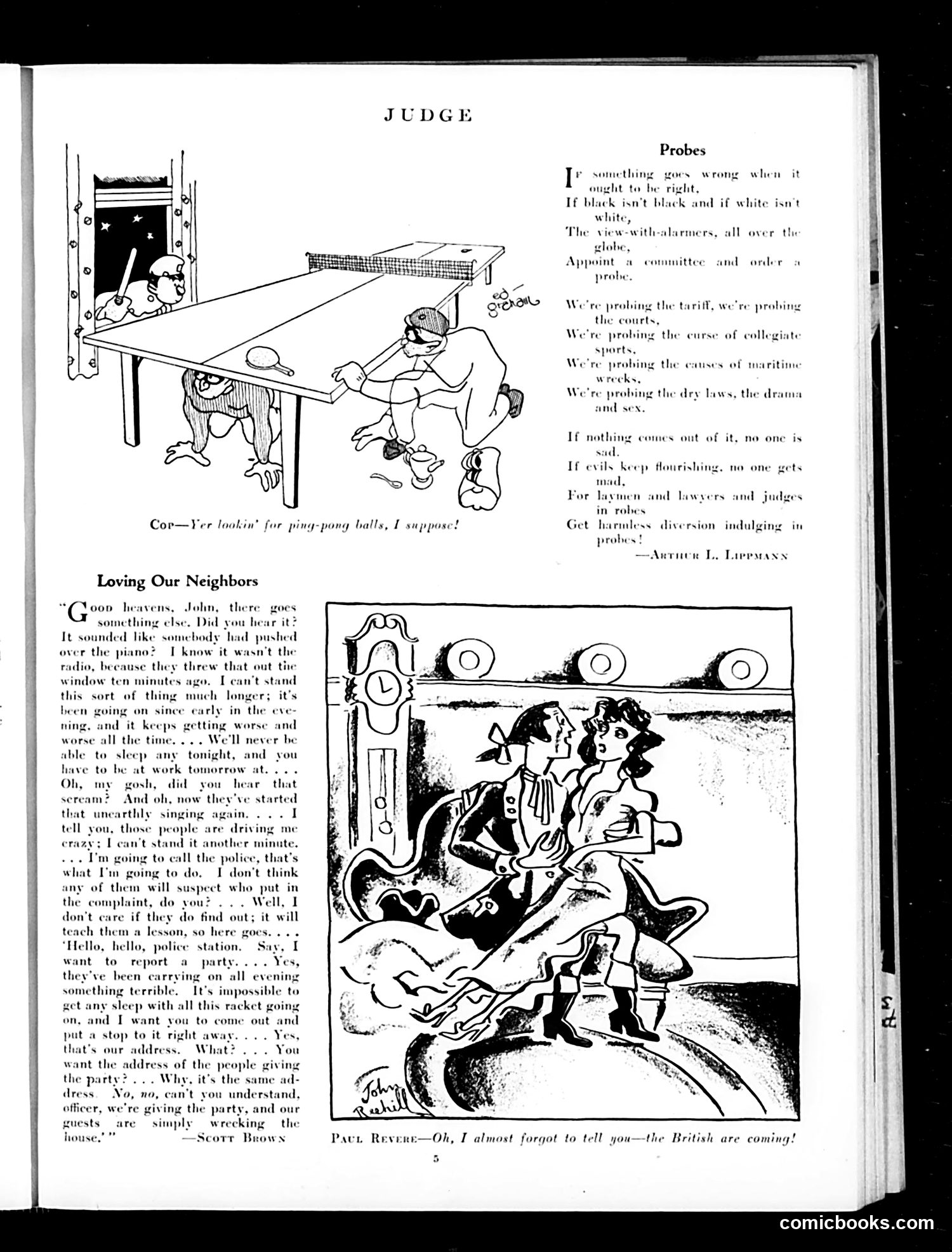
Analysis "Judge" was a prominent American satirical magazine, and this page contains two separate items: Top: "Probes" - A poem by Arthur L. Lippmann mocking Congressional investigations ("probes"). The accompanying cartoon shows figures at a ping-pong table with someone peering through a window—likely satirizing how investigations become public spectacles or distract from substantive governance. Bottom: "Loving Our Neighbors" - A dialogue by Scott Brown where an exasperated neighbor complains about a noisy party next door. The cartoon illustrates two people relaxing indoors while chaos erupts outside their window, with cars visible. The final caption references "the British are coming," suggesting this is wartime satire—likely WWI era—where citizens struggle with domestic annoyances while military concerns dominate. The humor stems from mundane complaints during serious times.
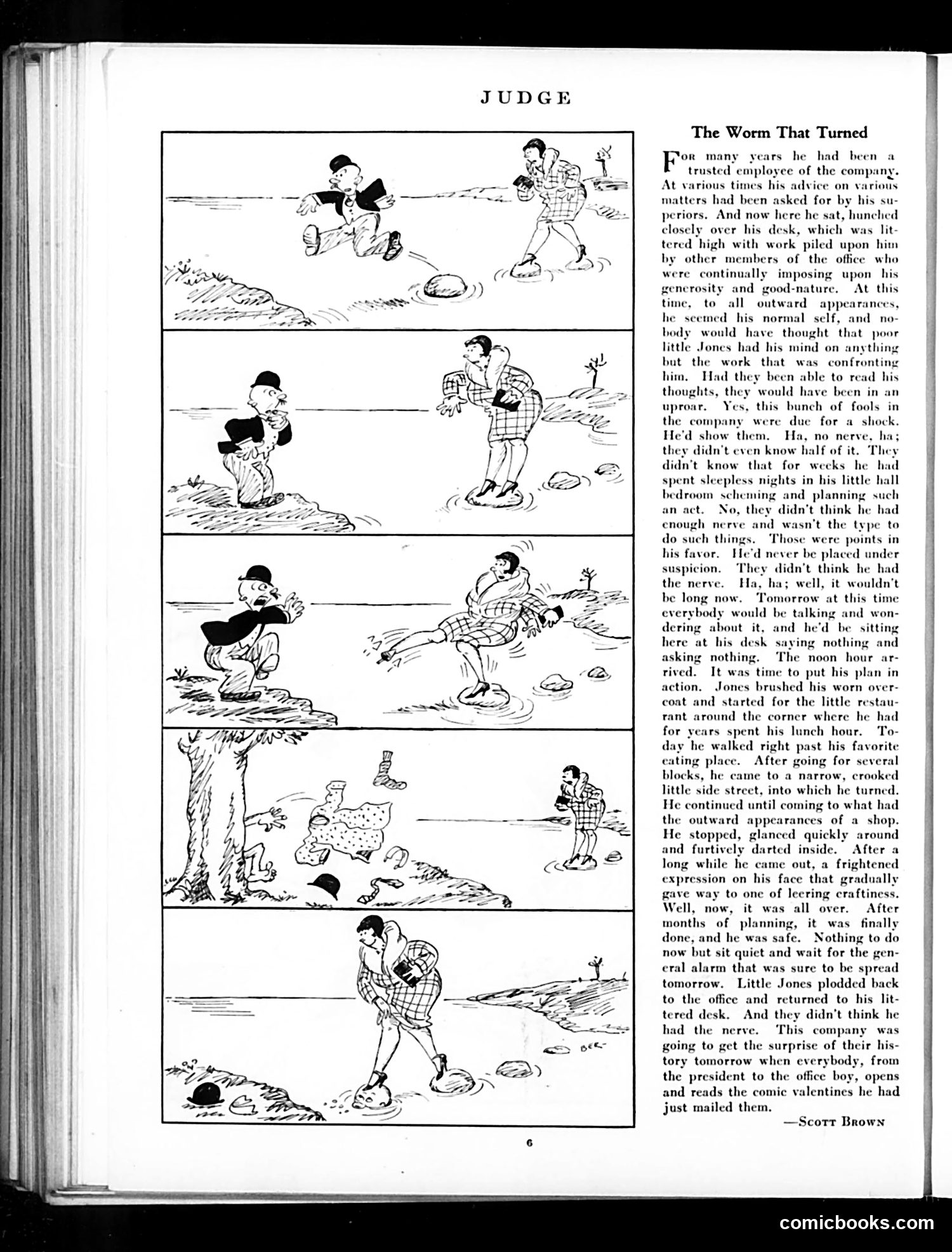
"The Worm That Turned" by Scott Brown This comic strip depicts an office employee's revenge fantasy. A long-suffering, mild-mannered worker (Little Jones) endures years of being overlooked and imposed upon by colleagues who take advantage of his good nature. The narrative shows Jones planning an elaborate prank: he sneaks out during lunch, goes to a side street, and appears to commit suicide by jumping from a tree. His coworkers discover his apparent body. The satire mocks both the exploited employee and his callous coworkers. The "worm" (Jones) finally "turns"—turning tables through an elaborate hoax meant to shock those who never appreciated him. It's a darkly humorous commentary on workplace dynamics and the resentment built through years of being taken for granted, culminating in a revenge fantasy.
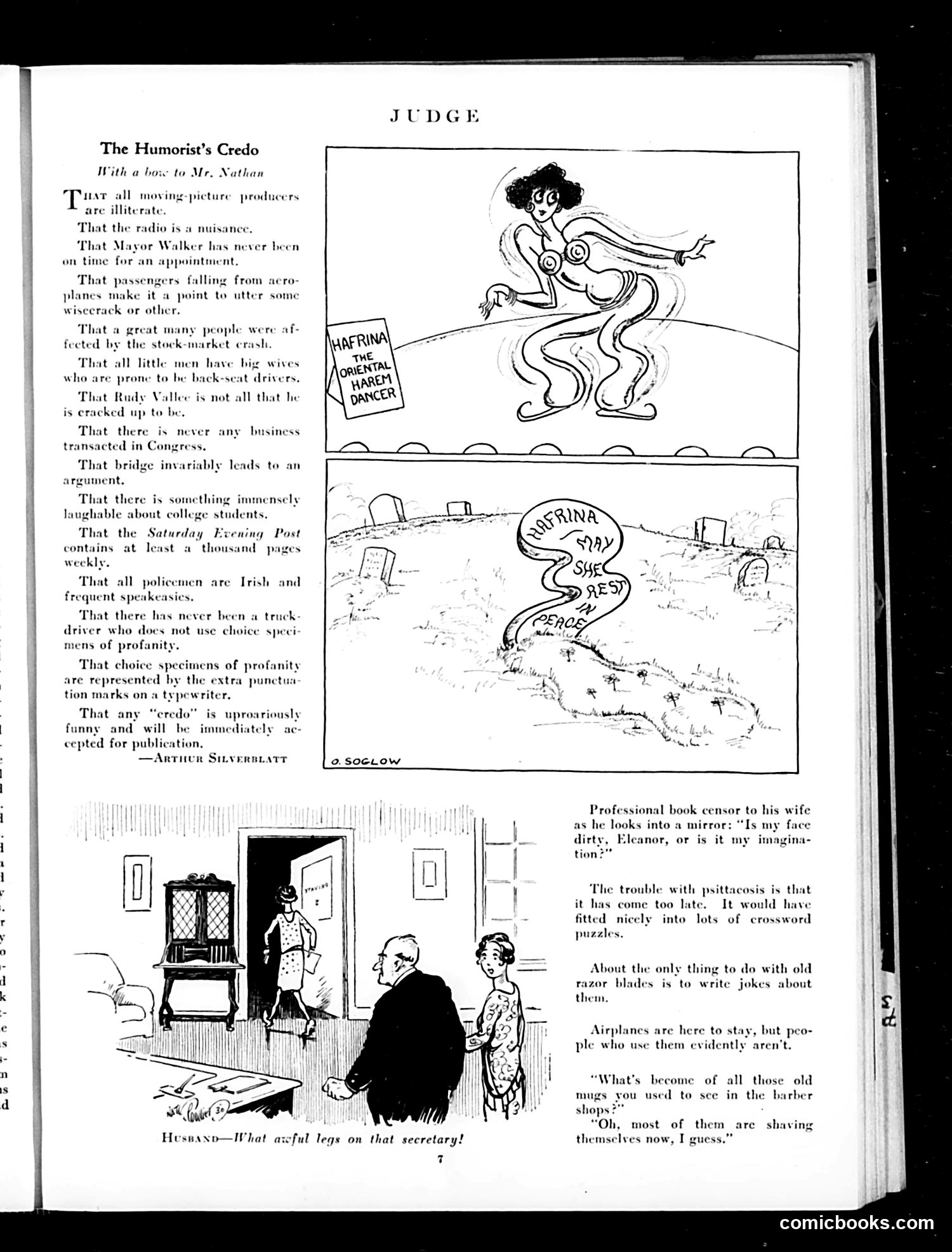
Judge Magazine Page Analysis This page contains satirical commentary on 1920s-30s American life. "The Humorist's Credo" by Arthur Silverblatt mockingly lists tired clichés that humorists rely on: illiterate movie producers, radio as nuisance, Mayor Walker's tardiness (a NYC political figure), the stock market crash's effects, and stereotypes about policemen and truck drivers using profanity. The cartoons include two surreal strips featuring "Marfina the Oriental Harem Dancer" (likely spoofing exotic dance fads) and several one-liner jokes about contemporary concerns—psittacosis (a disease), old barber shop mugs, and secretaries' legs. The "professional book censor" joke references 1920s censorship debates. Overall, the page satirizes both mass entertainment formulas and modern anxieties about technology (radio, airplanes), morality, and social change, while gently mocking the magazine's own reliance on predictable humor.
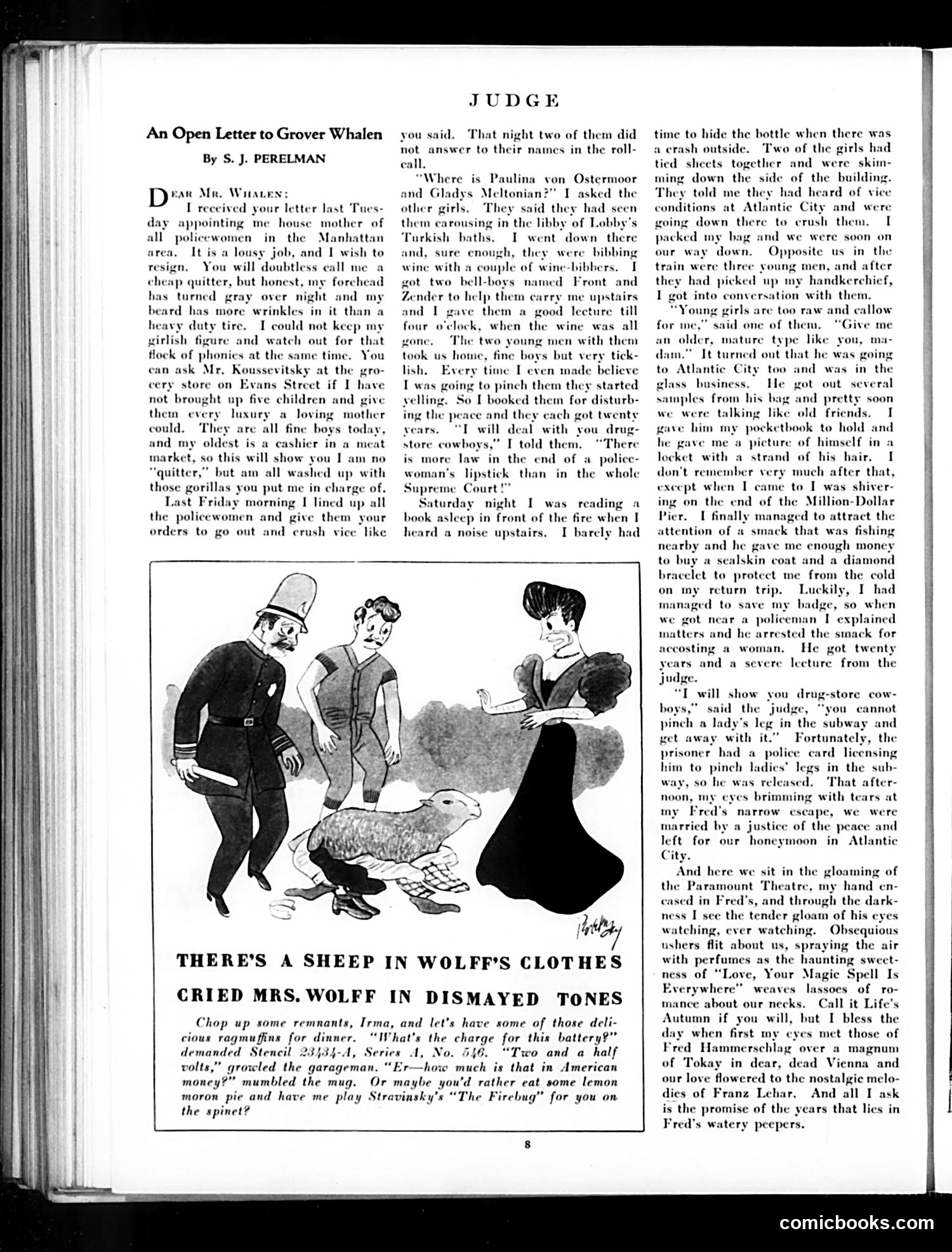
Judge Magazine Satire Analysis This page satirizes Grover Whalen, New York City's public relations figure and police commissioner, through a mock "open letter" by humorist S.J. Perelman. The joke: Whalen appointed Perelman as "house mother" overseeing policewomen tasked with "crushing vice" in Manhattan. Perelman's letter describes comical chaos—policewomen getting drunk in Turkish baths, young men tickling officers (resulting in 20-year sentences), and Perelman herself being seduced and robbed by a smooth-talking confidence man ("the smack"). The satire targets: - Whalen's aggressive moral policing campaigns of the era - The absurdity of treating grown policewomen like unruly children needing supervision - The ineffectiveness of crusades against urban vice—criminals outwit the enforcers - Gender dynamics: the "house mother" framing undermines female officers' authority The accompanying cartoon shows an elegant woman lecturing three figures (likely representing police/authority), reinforcing the theme of ineffectual moralizing. The text's embedded advertisements parody prohibition-era prudishness, asking whether to serve "lemon moron pie" instead of alcohol.
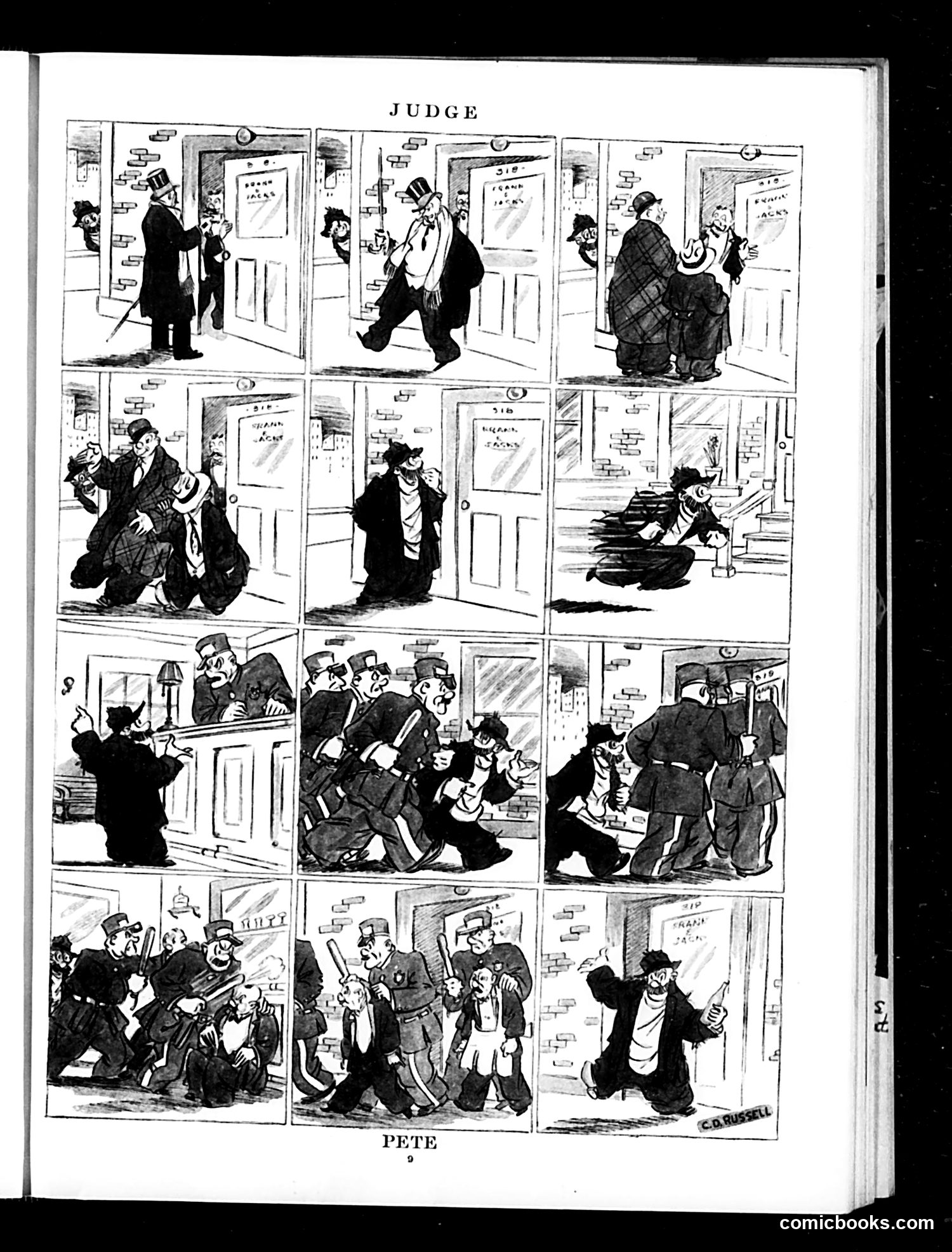
"Judge" - "Pete" Comic Strip This is a multi-panel comic strip titled "PETE" (credited to C.B. Russell) depicting a man's chaotic encounters at what appears to be a government building, likely a courthouse or judge's office (given the "JUDGE" header). The narrative shows Pete repeatedly entering and exiting through doors marked with office numbers, creating escalating comedic situations. Other men in suits and hats—appearing to be officials, lawyers, or clerks—react with confusion and alarm to his presence. The comedy derives from Pete's apparent inability to locate the correct office or navigate bureaucratic spaces, resulting in physical comedy and collisions. The satire likely mocks the frustrations of navigating government bureaucracy in early 20th-century America, a common theme in Judge magazine's satirical humor.
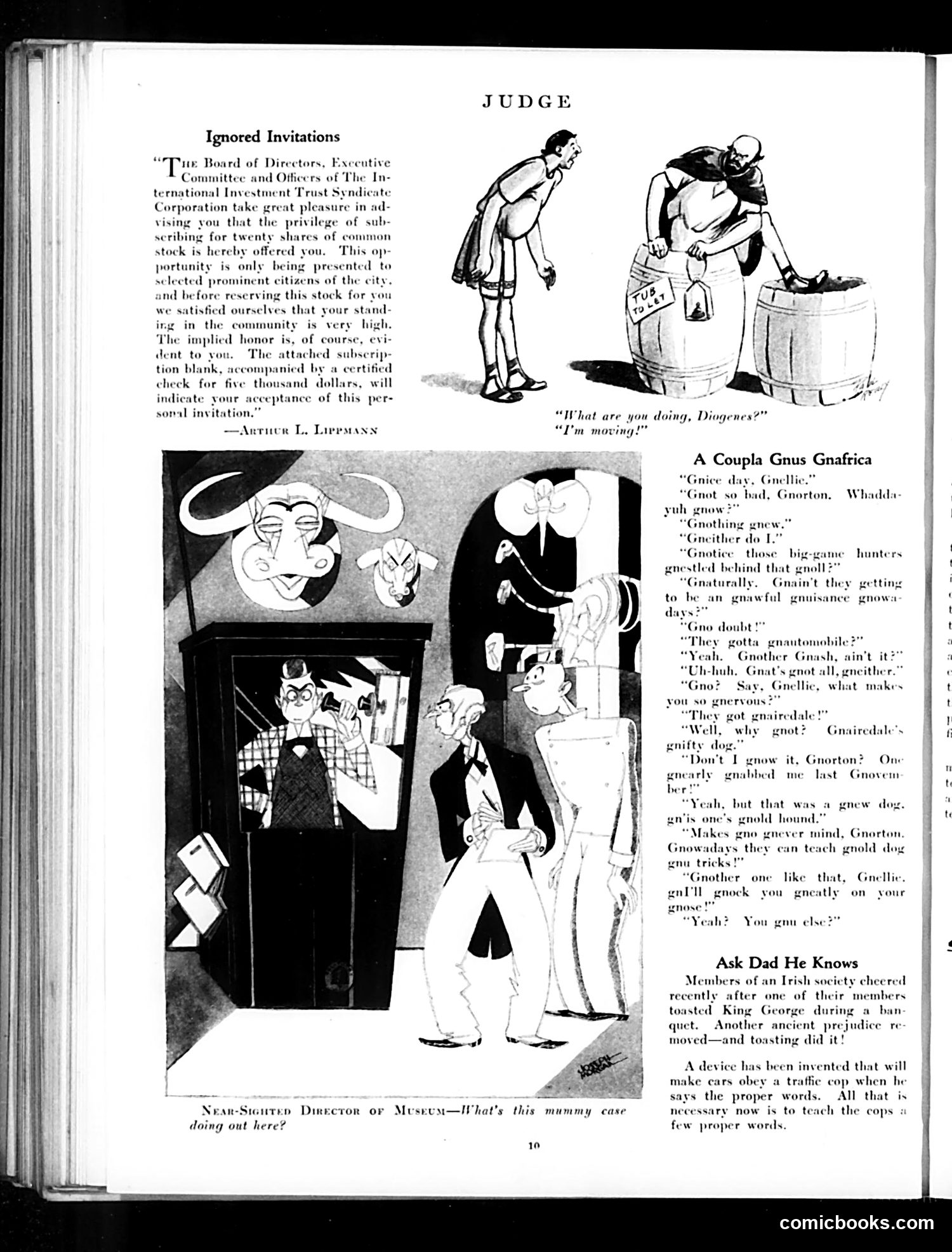
Judge Magazine Page Analysis Top Cartoon: "Ignored Invitations" This satirizes aggressive investment solicitation. A well-dressed man presents stock subscription offers to prominent citizens, using flattery about their standing in the community. The humor lies in the transparent sales tactic—the "honor" is clearly just targeting wealthy marks. The accompanying text by Arthur L. Lippmann mocks how such invitations exploit vanity. Middle Cartoon: "Near-Sighted Director of Museum" Shows a museum director confused by what appears to be a mummy case, asking "What's this mummy case doing out here?" The humor derives from his apparent obliviousness to his own museum's contents—a joke about absent-minded authority figures or poor administrative oversight. Right Column: "A Coupla Gnus Gnafrica" A pun-heavy dialogue between two gnu characters using forced "gn-" sound wordplay ("gnew," "gnaw," etc.). This is primarily a joke vehicle for phonetic humor rather than social satire. "Ask Dad He Knows" A brief item noting an Irish society toasted King George, suggesting prejudice was overcome. It concludes with a joke about needing to teach police "proper words"—likely an ethnic stereotype about Irish speech.
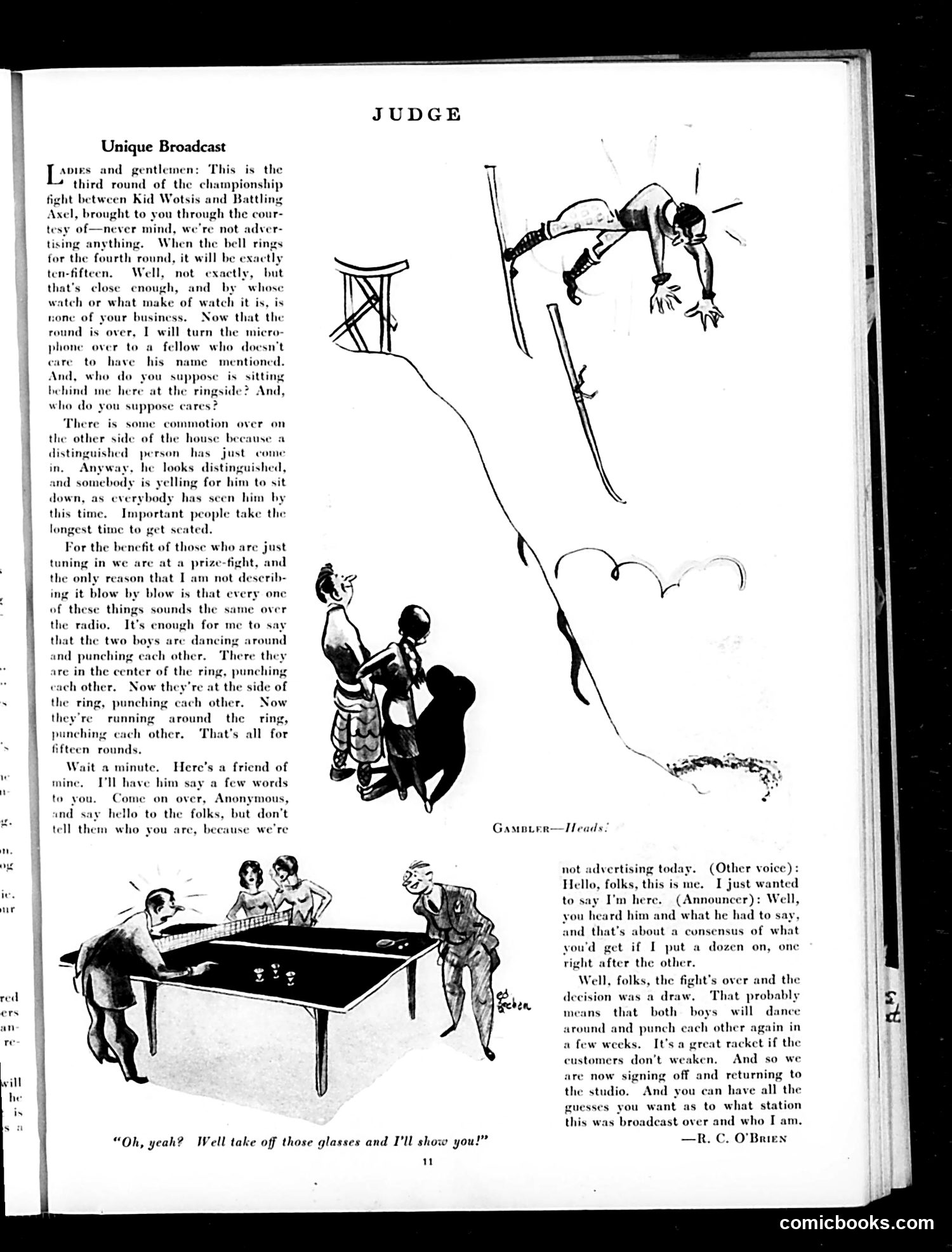
Judge Magazine Satire: "Unique Broadcast" This page satirizes radio boxing commentary during the early broadcast era (likely 1920s-30s). The unnamed announcer mocks the conventions of live sports radio: vague sponsorship disclaimers, anonymous guests, tedious play-by-play descriptions that all sound identical, and the absurd mystique surrounding "distinguished" arrivals at ringside. The humor targets radio's artificiality—the announcer explicitly refuses to describe the fight blow-by-blow because "every one of these things sounds the same over the radio," admitting the medium itself is inherently repetitive and uninformative. The anonymous guest who says nothing meaningful, the refusal to name sponsors or stations, and the final draw result (guaranteeing another fight and more ads) all mock radio broadcasting's commercial cynicism and theatrical pomposity. The cartoons illustrate the contrast between the excitement of live boxing and the dull reality of hearing it described through a microphone.
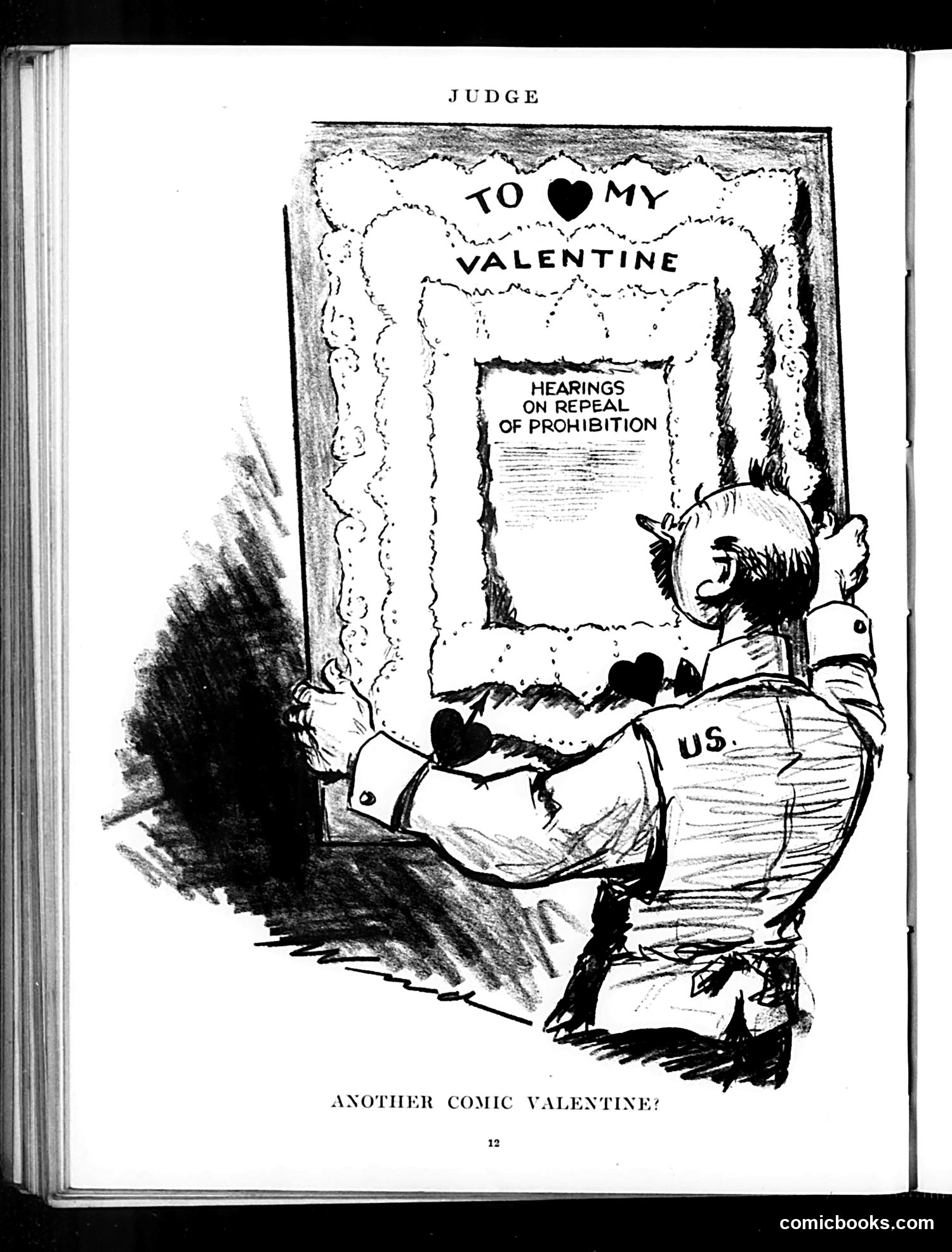
Explanation This satirical cartoon from *Judge* magazine depicts Uncle Sam (labeled "US") holding a Valentine's Day card addressed "TO MY VALENTINE," but the card's contents show "HEARINGS ON REPEAL OF PROHIBITION" instead of romantic sentiment. The joke is political satire about Prohibition repeal hearings. The cartoon sarcastically suggests that Uncle Sam's true "love" or romantic interest is not in romance itself, but in the contentious political debate over ending Prohibition—the federal ban on alcohol in effect from 1920-1933. The caption "ANOTHER COMIC VALENTINE?" indicates this is ironic mockery: rather than sweet romance, the nation is consumed by legislative hearings about alcohol policy. The cartoon lampoons how Prohibition repeal dominated American political discourse, treating this dry policy battle as America's peculiar obsession rather than genuine matters of the heart.
Judge Magazine: "Government as Social Welfare" (circa 1920s) This page critiques competing visions of government spending. The article contrasts state governments (particularly Governor Roosevelt's New York) that frame themselves as "social welfare" agencies funding schools, hospitals, and aid to the poor, with the federal government under President Hoover, where 72% of expenditures go to military costs. The author argues states deserve more citizen attention and support since they control two-thirds of government spending and direct it toward human welfare, while the federal government remains militaristic despite Hoover's modest cost-cutting efforts. The secondary section satirizes naming the 1920s. Dr. Julius Klein (a real government economist) proposed "the startling era," but the author mocks this through humorous alternative names from various citizens ("The Tedious Twenties," "The Tipsy Twenties"), suggesting the decade's material progress masks deeper social problems like noise pollution, tabloid sensationalism, and alcohol prohibition conflicts.
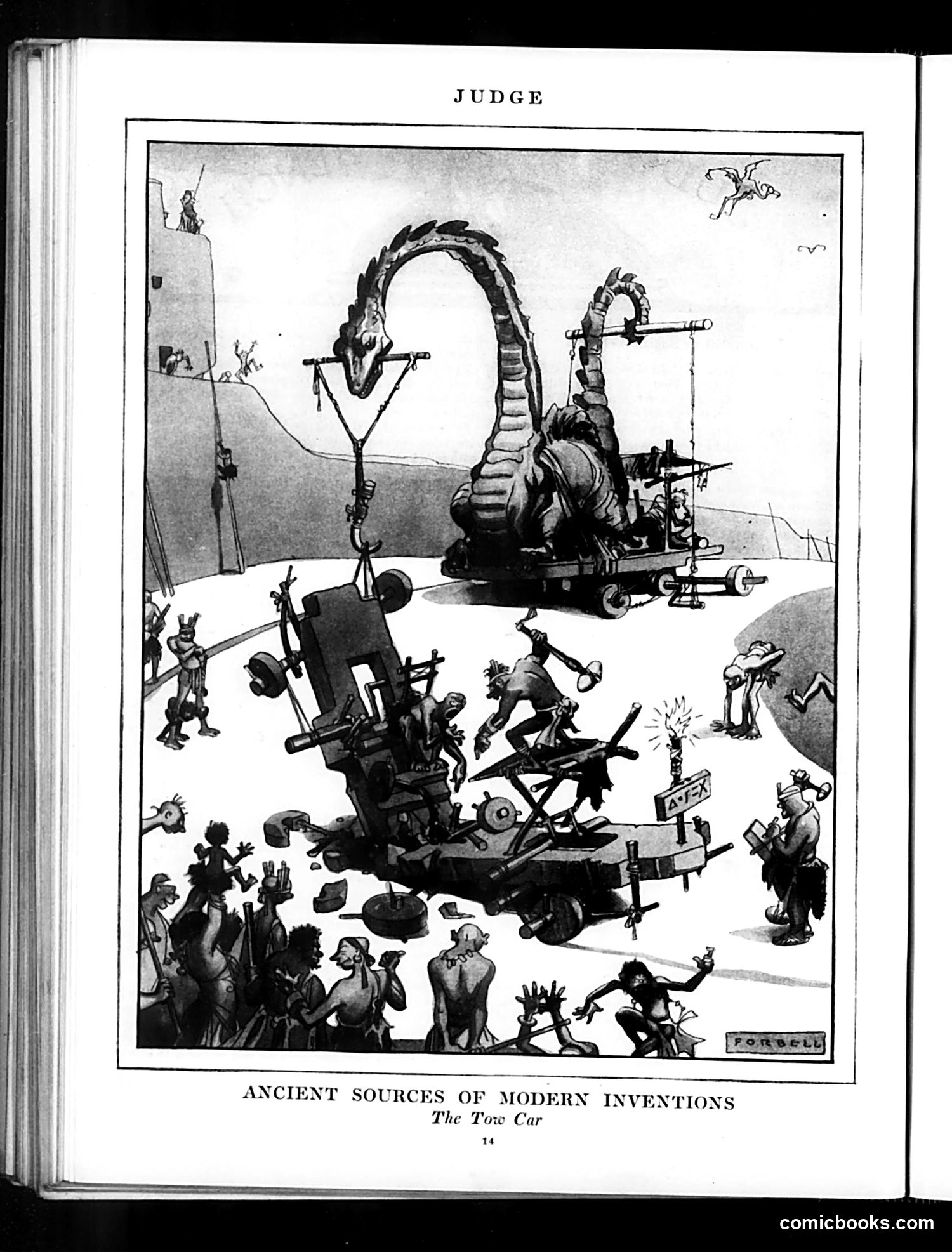
Explanation for Modern Readers This cartoon satirizes the supposed "ancient origins" of modern inventions through absurdist humor. The title "Ancient Sources of Modern Inventions: The Tow Car" is ironic—it depicts a fantastical creature (appearing to be a dragon or serpent-like beast harnessed with mechanical apparatus) as the supposed ancestor of the automobile. The cartoon shows tiny human figures operating primitive mechanical devices around this beast, suggesting they're attempting to "invent" vehicles by controlling it. The humor derives from the ridiculous premise that such a mythical creature represents any legitimate historical precedent for car technology. This appears to be part of a Judge magazine series mocking pseudo-intellectual claims about historical origins, using exaggeration and visual absurdity to lampoon popular theories or pretentious explanations for technological progress.
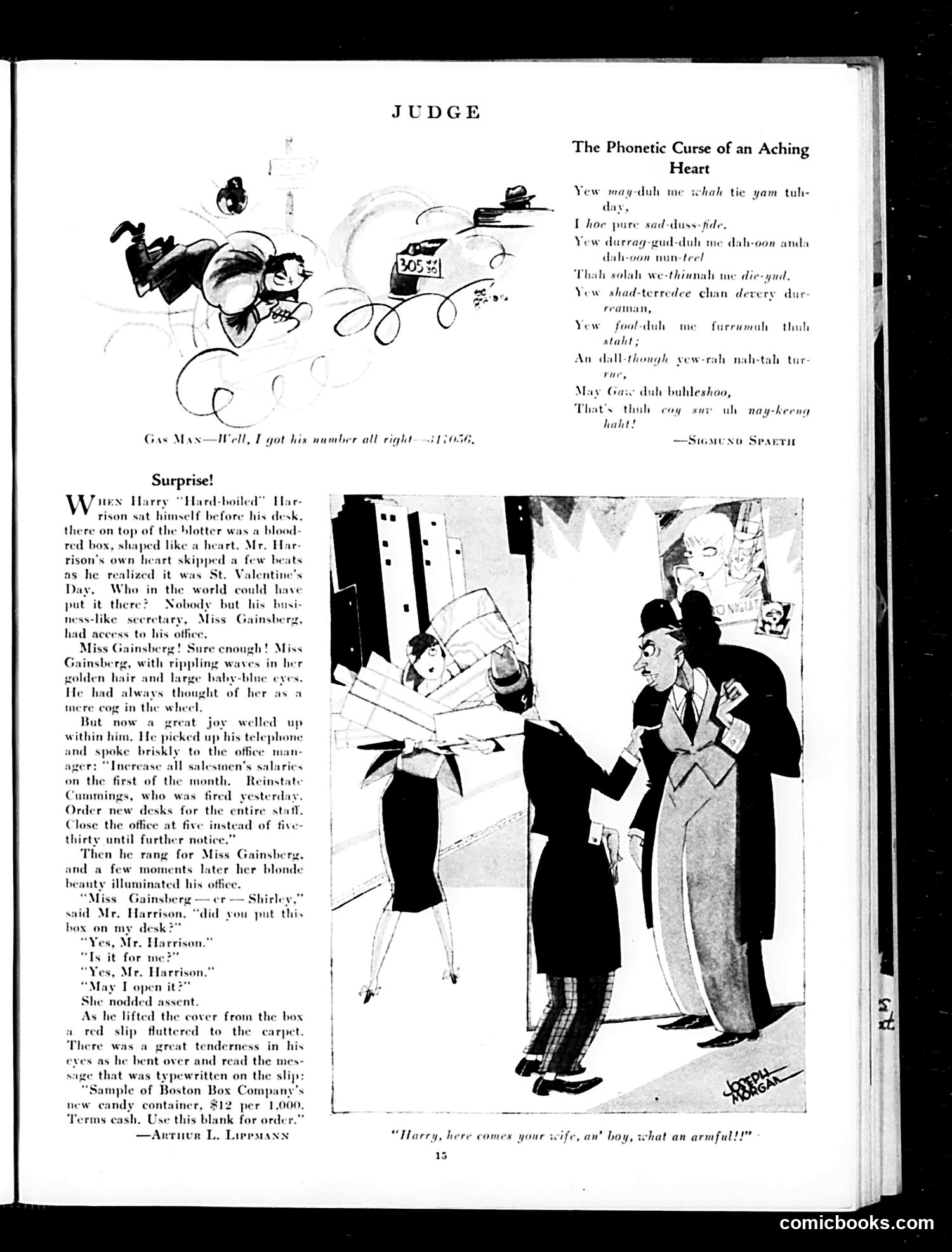
Analysis for Modern Readers The main cartoon, "Surprise!," is a romantic comedy about office dynamics. Mr. Harrison, a hard-boiled businessman, receives a heart-shaped Valentine's Day box on his desk and assumes his secretary Miss Gainsberg left it as a romantic gesture. Moved, he immediately raises salaries and improves working conditions. However, the "surprise" reveals the box is merely a *sample* of a candy container—a sales product, not a love token. His romantic interpretation was completely wrong. The satire mocks masculine sentimentality and how easily even tough businessmen can be manipulated by romantic symbolism. It also critiques how quickly workplace decisions change based on personal emotion rather than business logic. The second item, "The Phonetic Curse of an Aching Heart," appears to be humorous phonetic spelling attempting to represent emotional/romantic speech—likely poking fun at sentimental love poetry or accented speech patterns common in period humor.
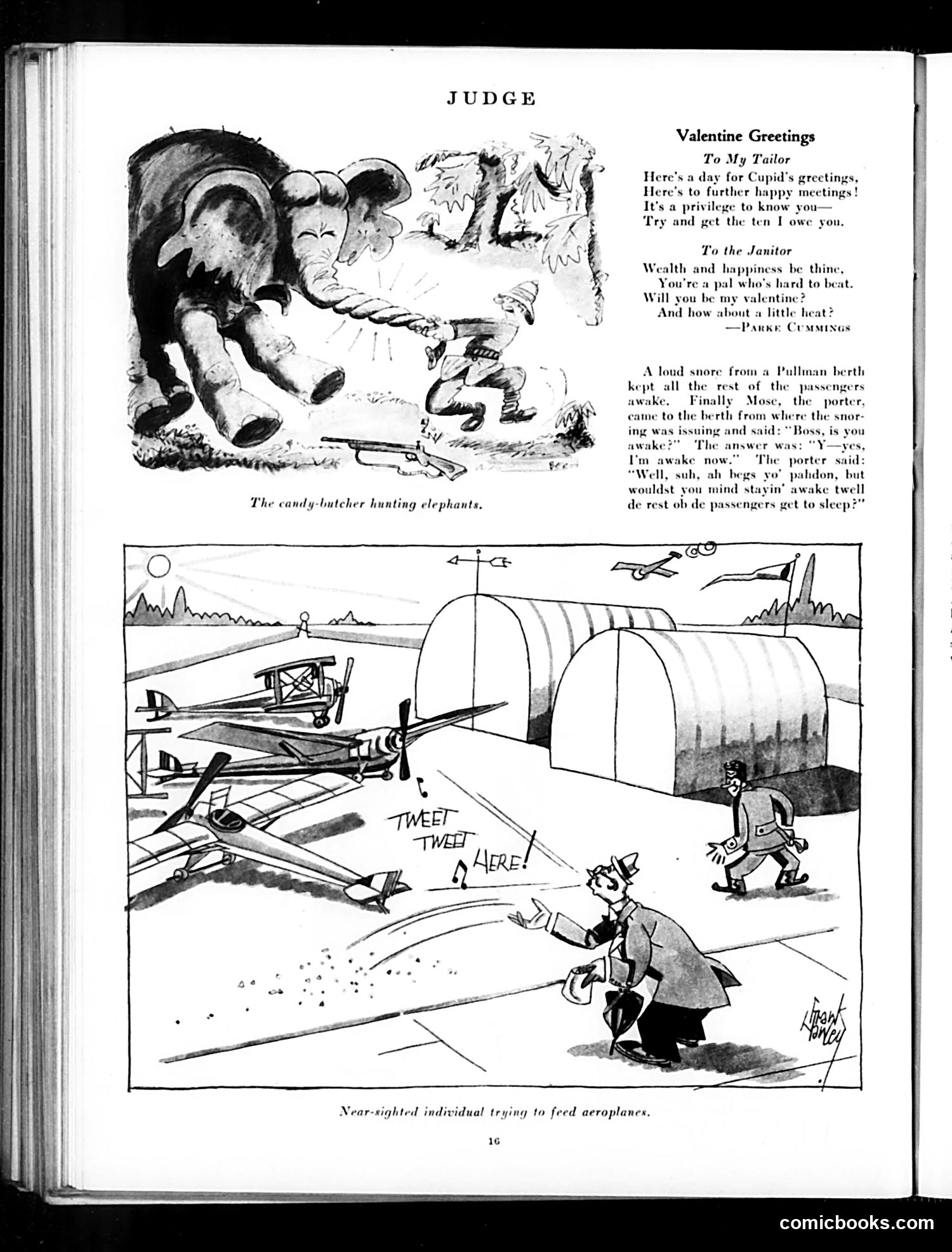
Judge Magazine Page Analysis This page contains Valentine's Day humor and two separate cartoons satirizing early 20th-century American life. The Valentine greetings mock everyday relationships through comic verses: a debtor playfully "valentines" his tailor (owing ten dollars), and a tenant addresses the janitor, pointedly requesting heat along with affection—satirizing poor heating in apartment buildings. The Pullman car anecdote depicts a common travel complaint: a loud snorer disturbs passengers. Mose, the porter (a Black character drawn in period stereotypical style), politely but firmly asks the snorer to stay awake so others can sleep. The bottom cartoon shows a "near-sighted individual trying to feed aeroplanes"—likely satirizing either the novelty of early aviation or people's confusion about new technology. The figure appears to be scattering food toward planes at an airfield, the absurdity being the humor. These reflect Judge's focus on relatable social irritations and the bewilderment surrounding emerging modern technology.
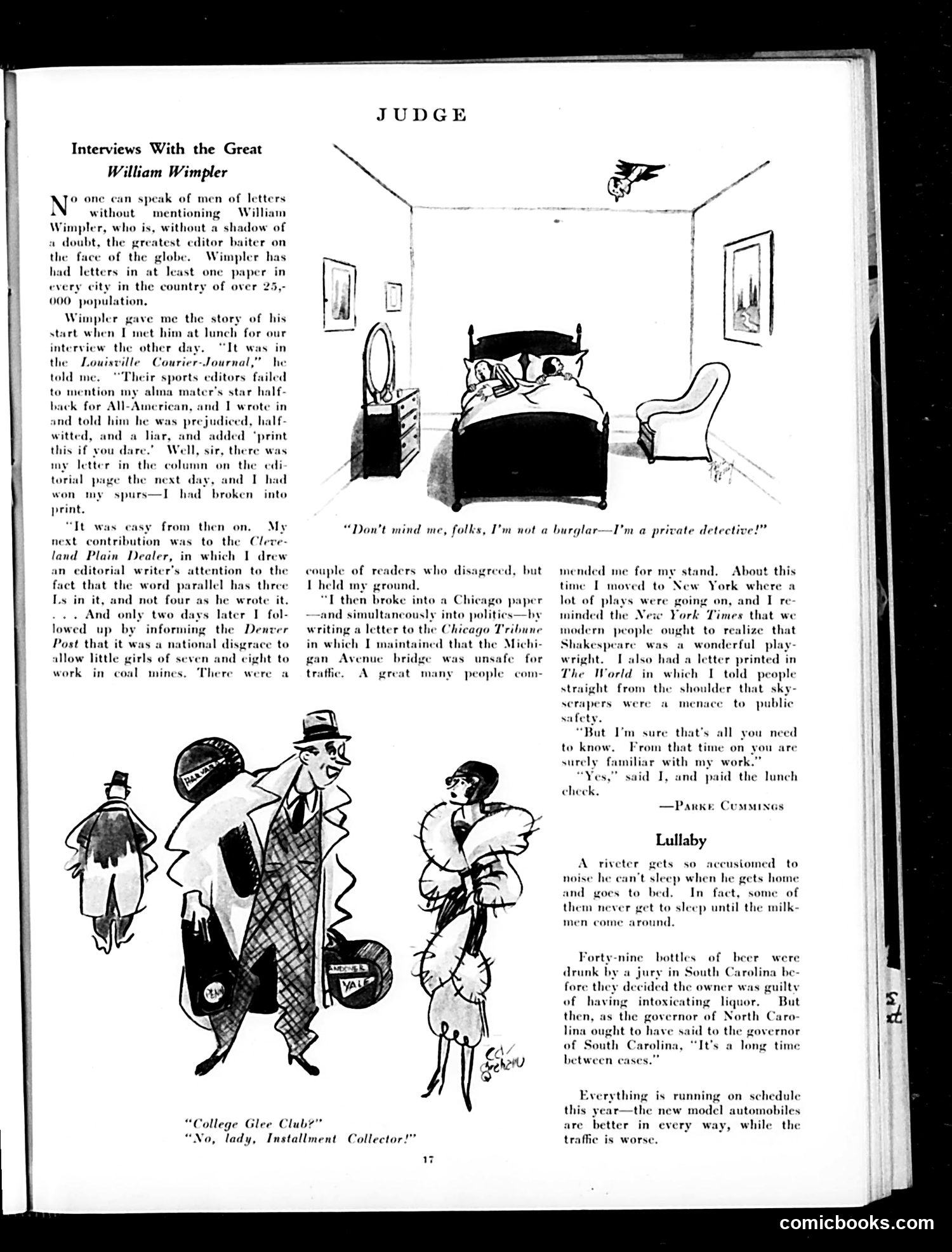
Judge Magazine Page Analysis This page contains an interview with "William Wimpler," a fictional character satirizing self-important newspaper letter-writers. The satire mocks people who obsessively write complaints to editors about trivial matters—a misspelled word, grammatical errors, factual quibbles—and view themselves as crusaders for truth. Wimpler boasts of breaking into print by insulting sports editors, then progressing to increasingly petty corrections and moral grandstanding (about coal-mining child labor and skyscraper safety). The upper cartoon shows a bedroom scene with the caption "Don't mind me, folks, I'm not a burglar—I'm a private detective!" This appears to be a separate joke about mistaken identity or deception. The lower cartoon shows three figures with the caption "College Glee Club? / No, lady, Installment Collector!"—likely satirizing debt collection or financial hardship during this era. The brief items below offer miscellaneous social commentary about riveting workers, a jury's beer consumption, and automobiles.
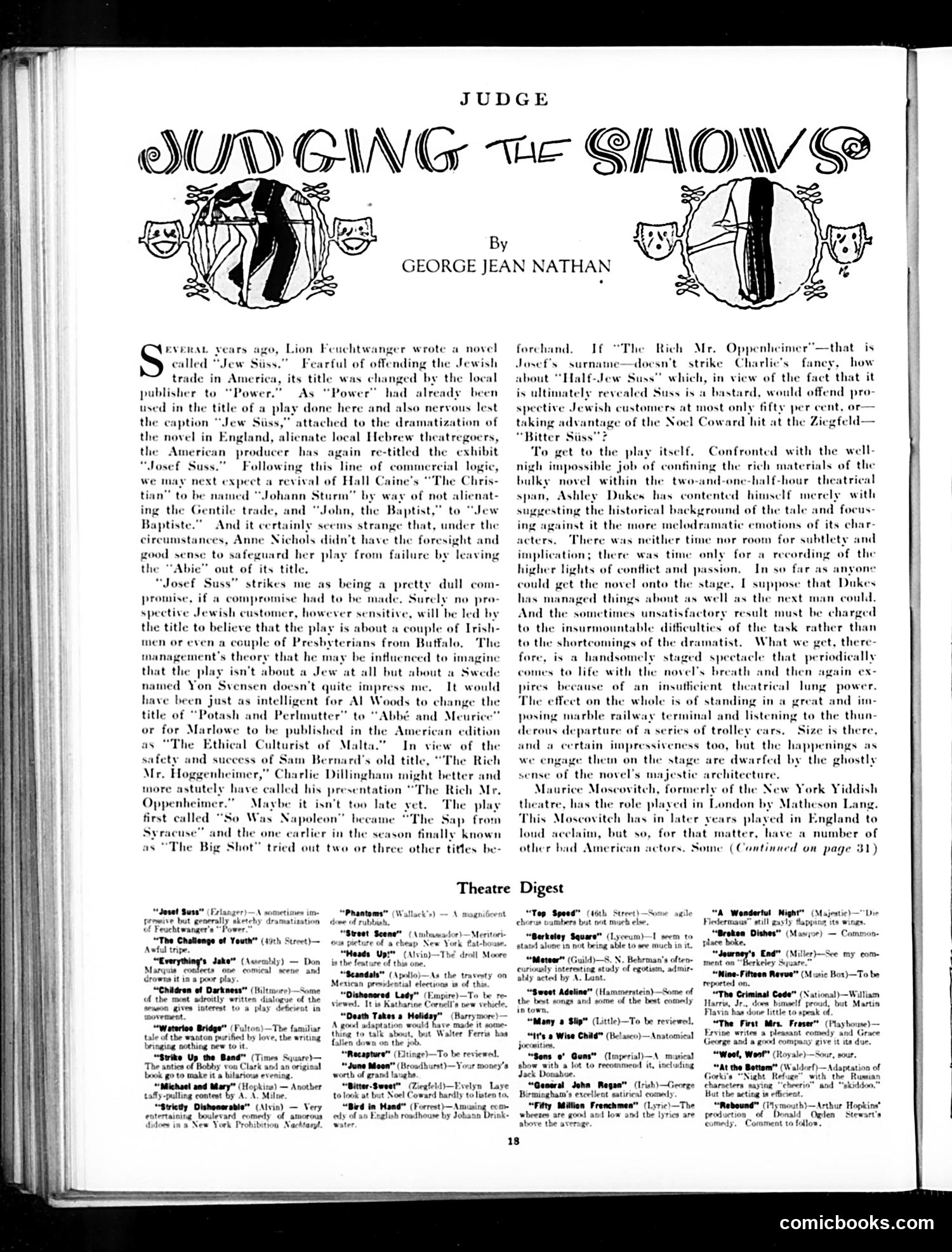
"Judging the Shows" by George Jean Nathan This is a theater review column, not a political cartoon. Nathan critiques recent Broadway productions, but opens with commentary on a specific controversy: the retitling of Lion Feuchtwanger's novel "Jew Süss" when adapted for American stage. Nathan satirizes theatrical producers' timidity about Jewish-themed content. He notes that to avoid offending Jewish audiences and merchants, the play was renamed—yet argues this overcaution is absurd. He compares it to hypothetically retitling successful plays with Irish or working-class characters (like "Abie's Irish Rose") to remove ethnic markers, suggesting such sanitization is both cowardly and unnecessary. The piece reflects 1920s anxieties about ethnic representation in entertainment and Jewish consumer power, while mocking producers' assumption that audiences were so sensitive that even titles needed euphemism. Nathan's position: artistic integrity shouldn't require erasure of cultural identity. The remainder contains brief reviews of contemporary Broadway shows.
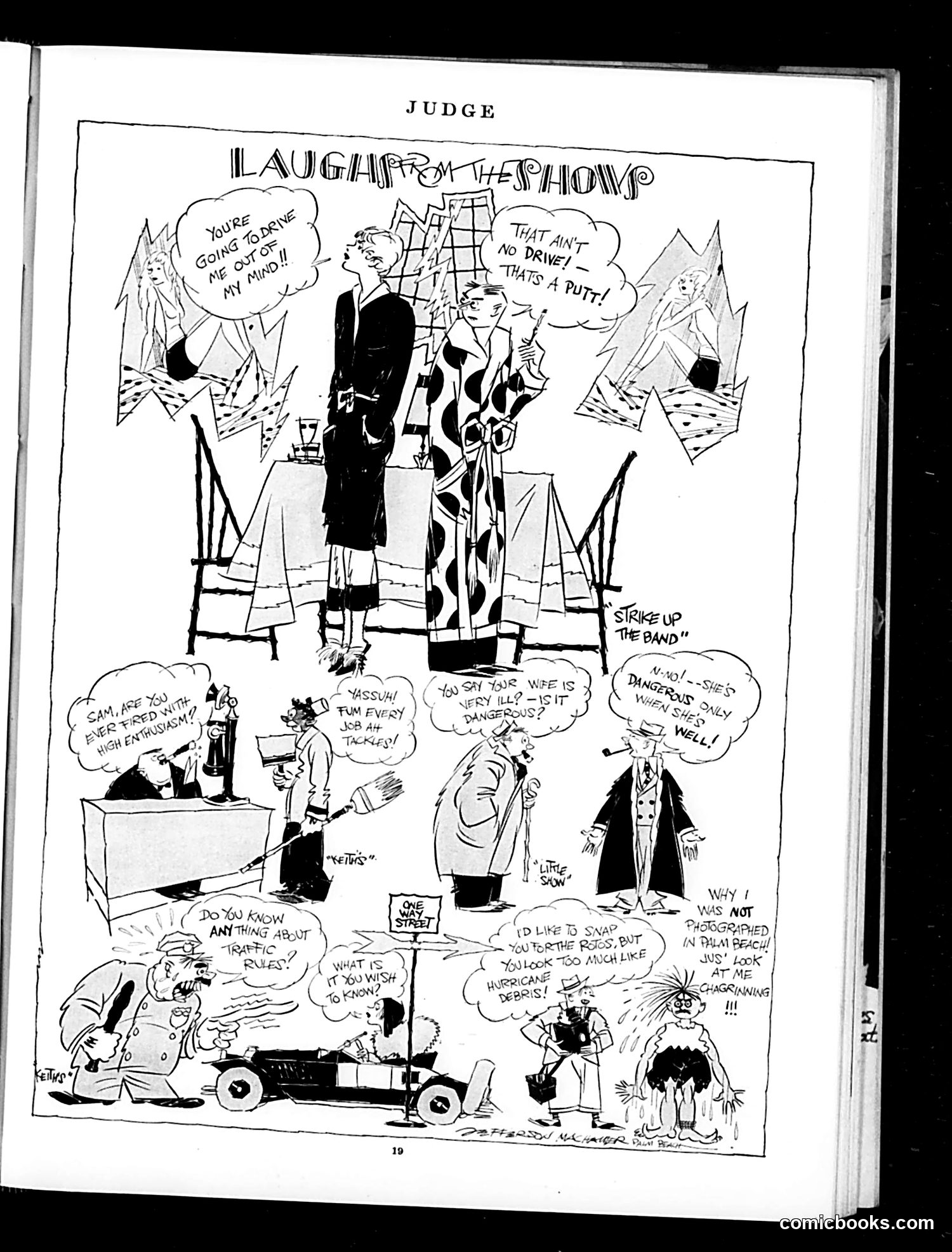
"Laugh From The Show" - Judge Magazine Cartoon This multi-panel cartoon satirizes high society and leisure activities, likely from the 1920s-30s based on style and references. The top panel shows fashionable people at what appears to be a social gathering or show, with jokes about golf and driving. Lower panels mock various social types: a man bragging about "papers from everywhere," someone discussing a wife's dangerous job, and references to "Hurricane Debris" and being "photographed in Palm Beach"—suggesting wealthy people's trivial concerns during tourism season. The final panel shows someone who "wasn't photographed" and looks "charming," implying satirical commentary on the vanity of high society's obsession with appearance and social status. The humor targets the pretensions and shallow concerns of the wealthy leisure class.
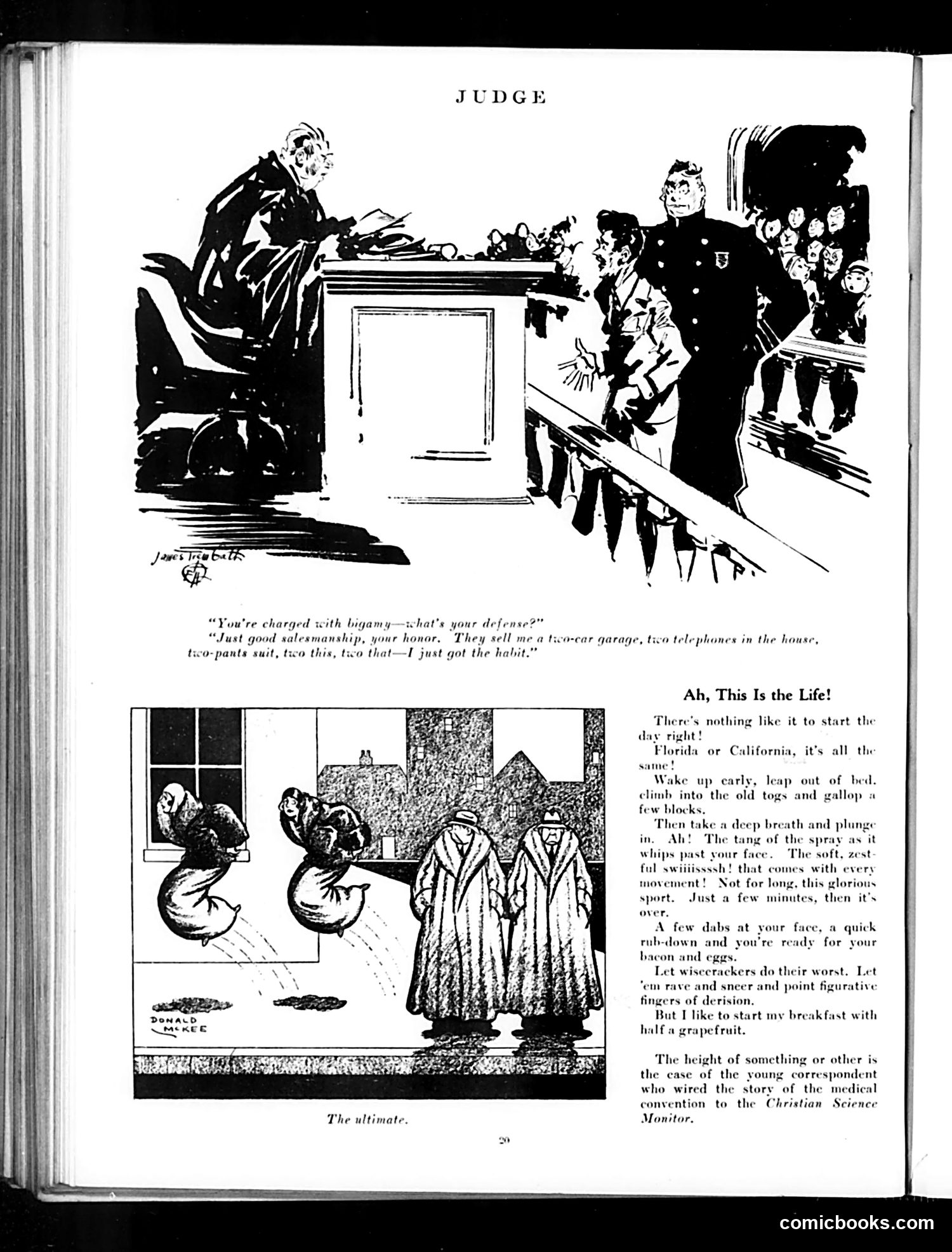
Analysis of Judge Magazine Page Top Cartoon: A courtroom scene satirizing consumer culture and salesmanship. A man charged with bigamy (having two wives) defends himself by claiming he's simply a good salesman—he got "the habit" from being sold duplicate goods (two-car garages, two telephones, two-pants suits, etc.). The joke equates aggressive American marketing tactics of the era with marital infidelity, mocking both the proliferation of consumer goods and the excuse-making defendant. Bottom Section: "Ah, This Is the Life!" describes morning swimming as a health fad, with humorous exaggeration about the invigorating ocean spray and quick breakfast recovery. The final paragraph jokes about a correspondent reporting a Christian Science Monitor convention story—likely implying ironic contradiction between Christian Science teachings (which reject material medicine) and journalistic convention coverage. Both items satirize American consumer excess and cultural trends, typical of Judge's social commentary.
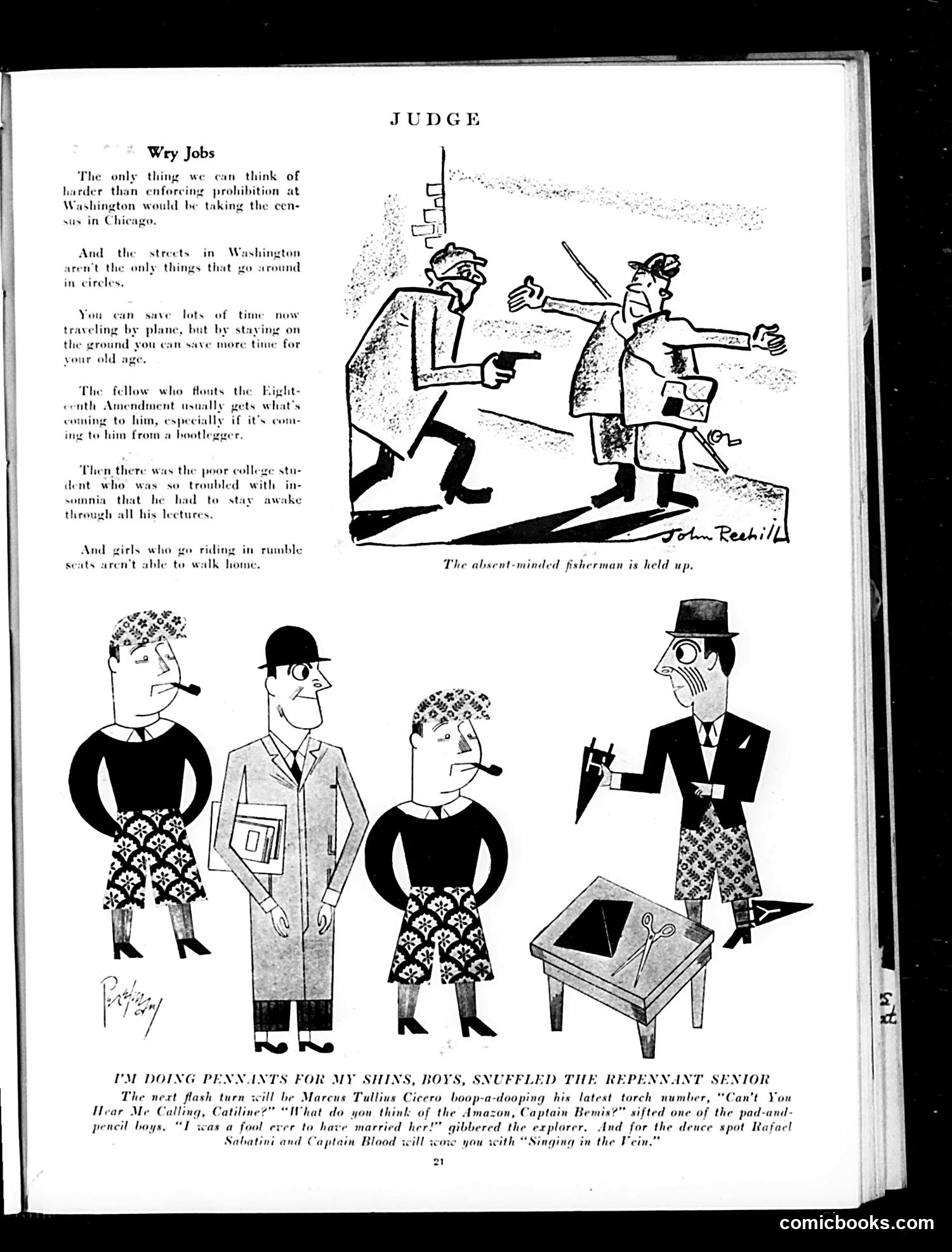
Analysis of Judge Magazine Page This page contains satirical commentary on Prohibition enforcement, presented through both text quips and cartoons. The "Wry Jobs" section mocks Prohibition's ineffectiveness—suggesting the only way to enforce it in Washington would be taking the census in Chicago (implying corruption/circular logic). Other jokes target college students, rumble-seat dating culture, and bootleggers profiting from the law. The main cartoon depicts "The absent-minded fisherman is held up"—showing a fisherman robbed at gunpoint, likely satirizing how Prohibition created opportunities for criminals and gangsters to prey on citizens. The lower section appears to be entertainment gossip or parody, referencing classical literature (Cicero), contemporary explorers/adventurers (Captain Bemis, Rafael Sabatini's "Captain Blood"), mixing highbrow and lowbrow cultural references humorously. The overall message: Prohibition is unenforceable, breeds crime, and creates social absurdities—a common Judge magazine stance during this era.
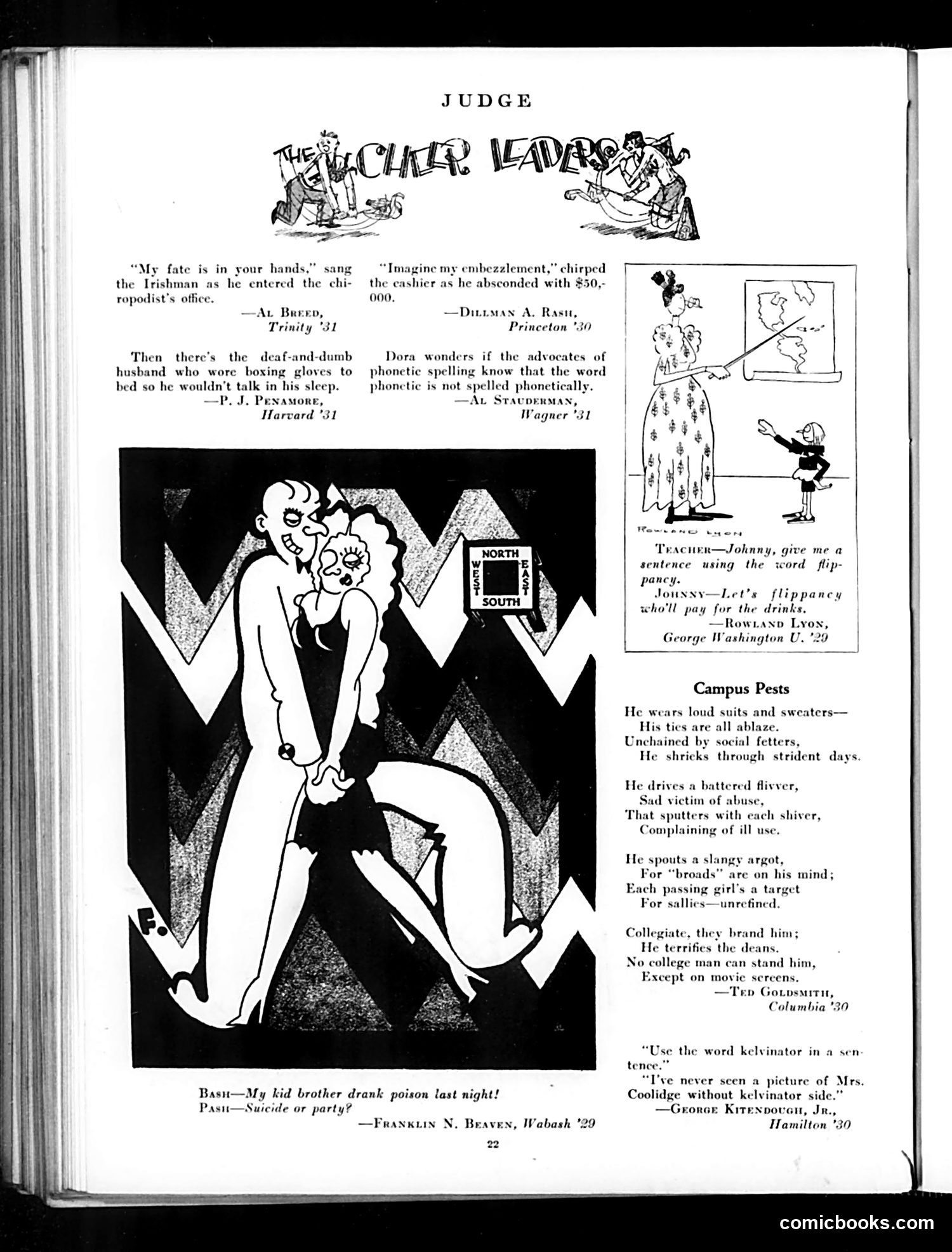
Judge Magazine Page Analysis This page contains student humor from circa 1929-1931, presented as jokes and satirical observations submitted by college contributors. The content targets several subjects: The humor relies on: - Puns and wordplay: An Irishman at a chiropodist (foot doctor) jokes about fate being "in your hands" (feet); a cashier's embezzlement pun; phonetic spelling ironies. - Dark/crude jokes: References to poison, suicide, and domestic dysfunction reflect the irreverent tone of college humor publications. - Campus stereotypes: The "Campus Pests" poem satirizes the loud, uncouth male student—wearing garish clothes, driving a broken jalopy ("flivver"), using slang, and objectifying women ("broads"). - Product placement humor: References to "Kelvinator" (a refrigerator brand) as an unavoidable cultural fixture, even in photos of First Lady Coolidge. The large central illustration appears to show a fortune teller or circus performer, though its specific satirical target is unclear from the visible text. This represents typical Jazz Age college humor—irreverent, occasionally offensive, emphasizing wordplay and social observation.
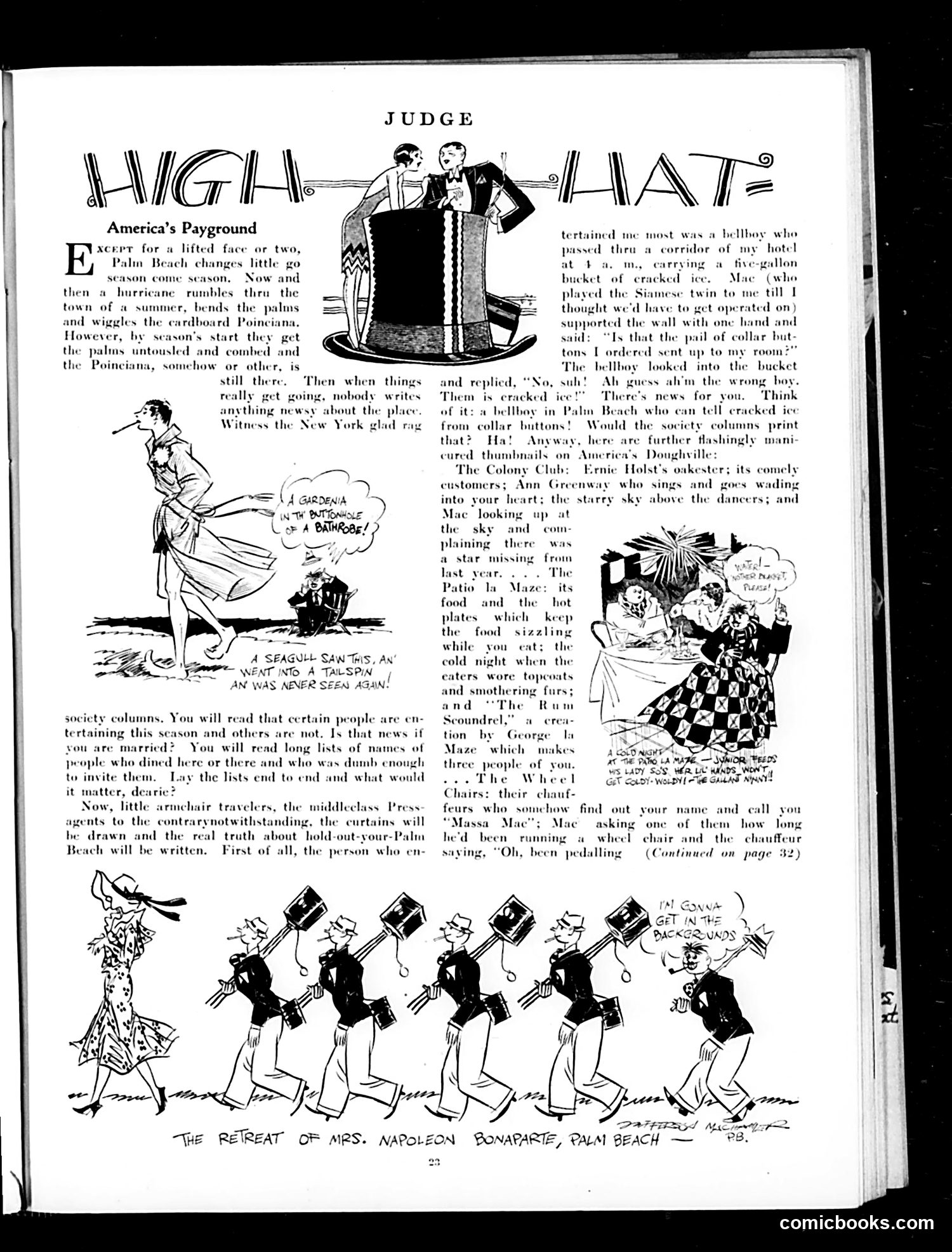
"High-Hat" Social Satire from Judge Magazine This page satirizes Palm Beach's pretentious high society during the social season. The author mocks how society columns obsessively report trivial details—who dined where, who entertained whom—as if such gossip constitutes "news." The satire targets the gap between the glamorous image of Palm Beach and its mundane reality. The cartoons illustrate absurd social moments: a seagull's reaction to witnessing fashionable antics; a bellboy unable to distinguish cracked ice from collar buttons (suggesting the foolishness of wealthy guests); and figures carrying society pages like military supplies in "The Retreat of Mrs. Napoleon Bonaparte, Palm Beach." The piece attacks the middleclass press agents who manufacture artificial excitement around wealthy people's trivial activities. By exposing the formulaic nature of society reporting—the endless name-dropping, the manufactured drama—Judge ridicules both the social climbers seeking coverage and the publications enabling their vanity.
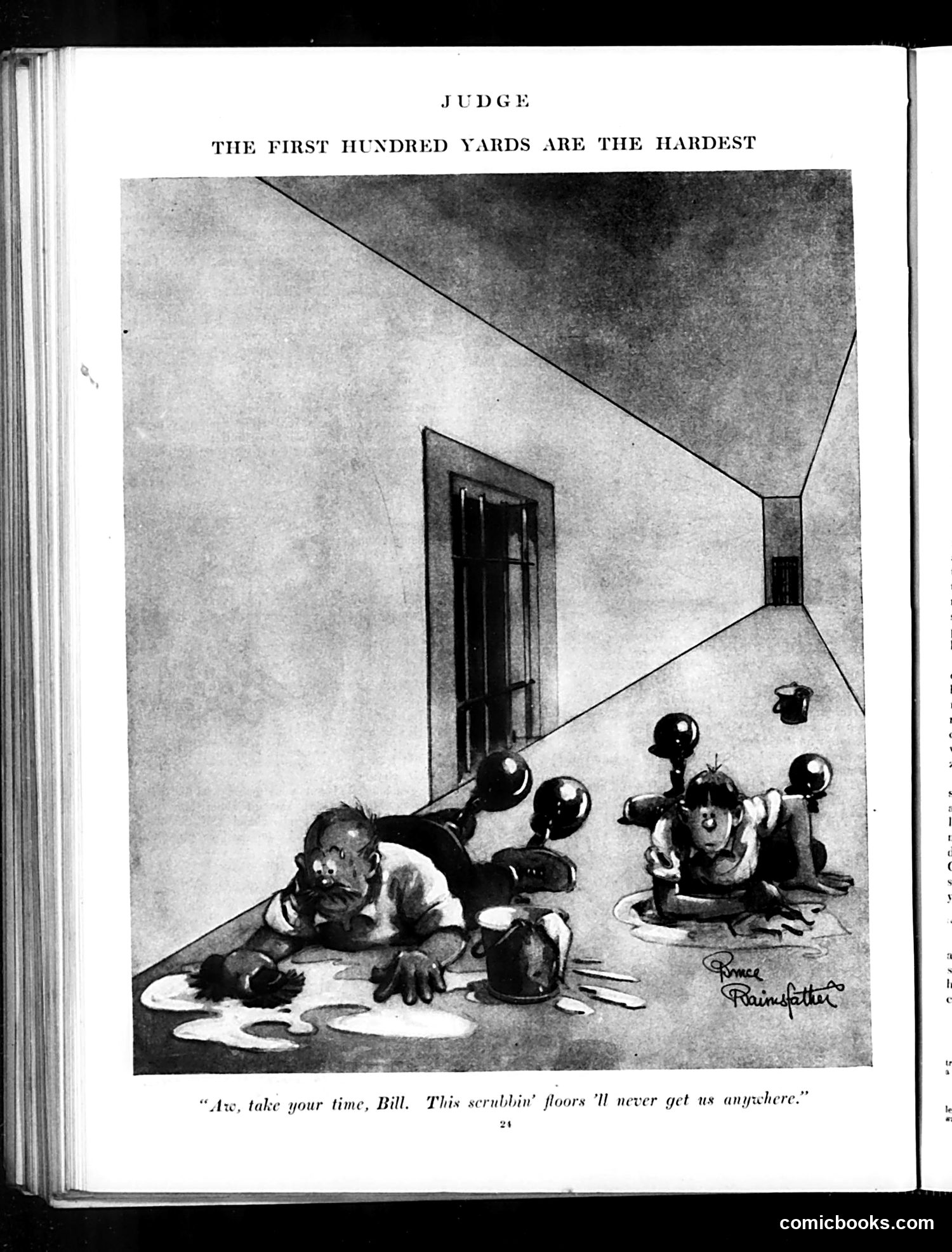
Judge Cartoon Analysis: "The First Hundred Yards Are the Hardest" This cartoon depicts two men scrubbing prison or institutional floors, appearing exhausted and discouraged. The caption shows one character (Bill) telling his companion not to rush—their menial labor will never improve their circumstances. The satire critiques the futility of low-wage manual work and suggests social immobility. The figures appear to be working-class or incarcerated individuals facing endless, hopeless toil. The title "The First Hundred Yards Are the Hardest" implies a long, punishing journey ahead with no real progress possible. This reflects early 20th-century *Judge* magazine's commentary on labor conditions, poverty, and the harsh realities facing working-class Americans. The joke's bleakness suggests social resignation—that systemic barriers prevent meaningful advancement through hard work alone.
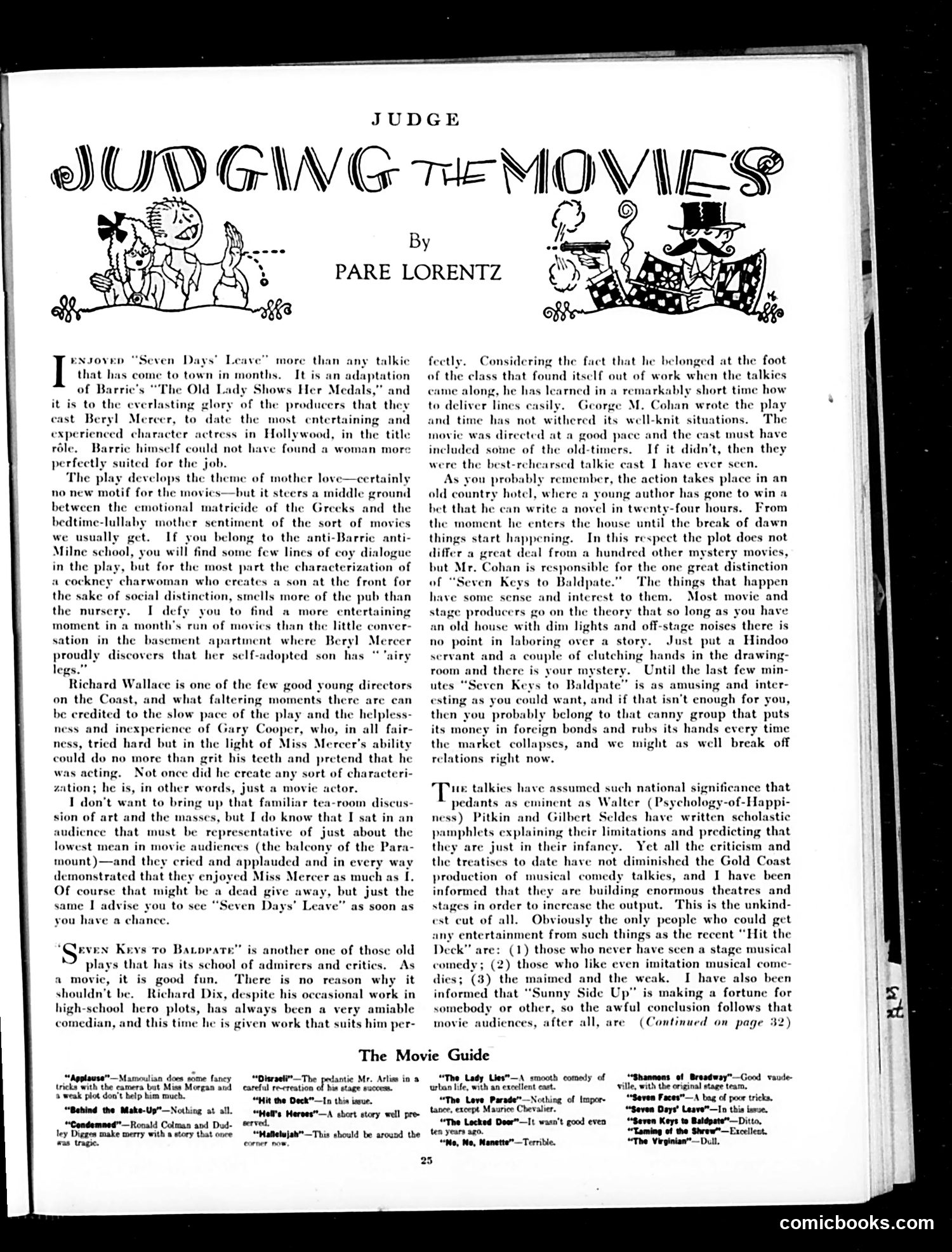
Judge Magazine: "Judging the Movies" by Pare Lorentz This is a film criticism column reviewing recent talkies (sound films), a relatively new technology at this time. The author discusses three productions: an adaptation of J.M. Barrie's "The Old Lady Shows Her Medals" starring Beryl Mercer, "Seven Keys to Baldpate," and mentions of other films. The piece critiques both the films and contemporary film culture. Lorentz praises Mercer's performance and director Richard Wallace but faults Gary Cooper's inexperience. He satirizes producers' formulaic approach to mystery plots—simply adding "dim lights and off-stage noises" without developing actual stories. The author also mocks contemporary film criticism itself, noting that talkies have gained such cultural importance that intellectuals like Walter Pitkin write scholarly analyses of them. The concluding reference to audiences in "the balcony of the Paramount" (lower-class viewers) suggests class-consciousness about film appreciation.
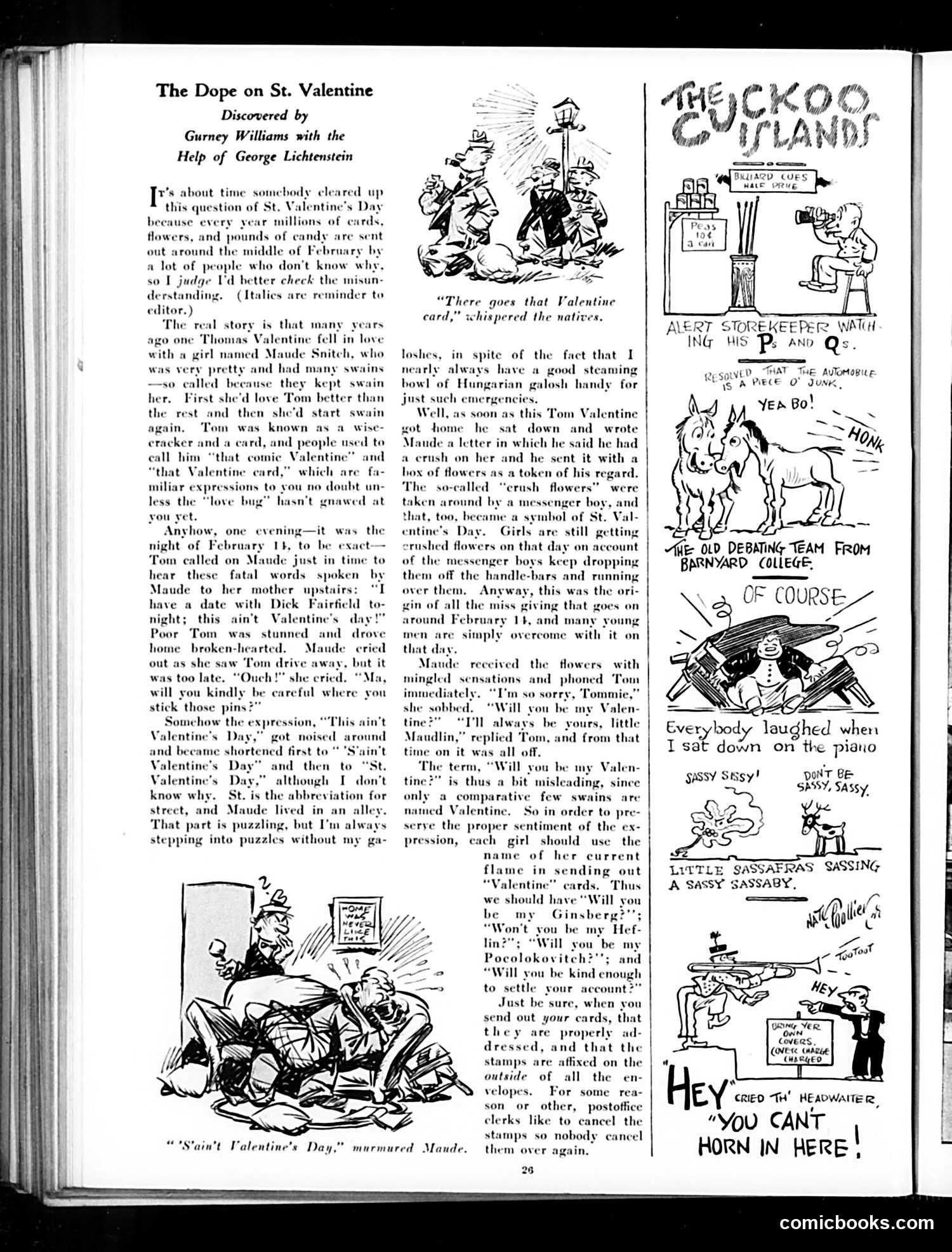
"The Dope on St. Valentine" — Judge Magazine This page combines a humorous essay with comic strips satirizing Valentine's Day customs. Main Article: Gurney Williams humorously debunks St. Valentine's Day confusion through a comedic anecdote. Tom Valentine sends flowers to Maude, who's upset because she has a date with another man (Dick Fairchild) and views Tom's romantic gesture as interference with her evening plans. The satire mocks the commercialization and obligatory nature of Valentine's observances—the "crush flowers" sent by messenger boys, the expectation that women must reciprocate sentimentally, and postal service quirks around card-sending. Comic Strips (Right): "The Cuckoo Islands" features absurdist humor: a storekeeper protecting his "P's and Q's," a debating team from "Barnyard College," a character named "Little Sassafras" being sassy, and a restaurant headwaiter refusing entry to someone trying to "horn in." These appear to be running gags rather than connected narratives—typical Judge filler comics mocking social pretension and etiquette. The overall thrust ridicules both romantic sentimentality and rigid social conventions.
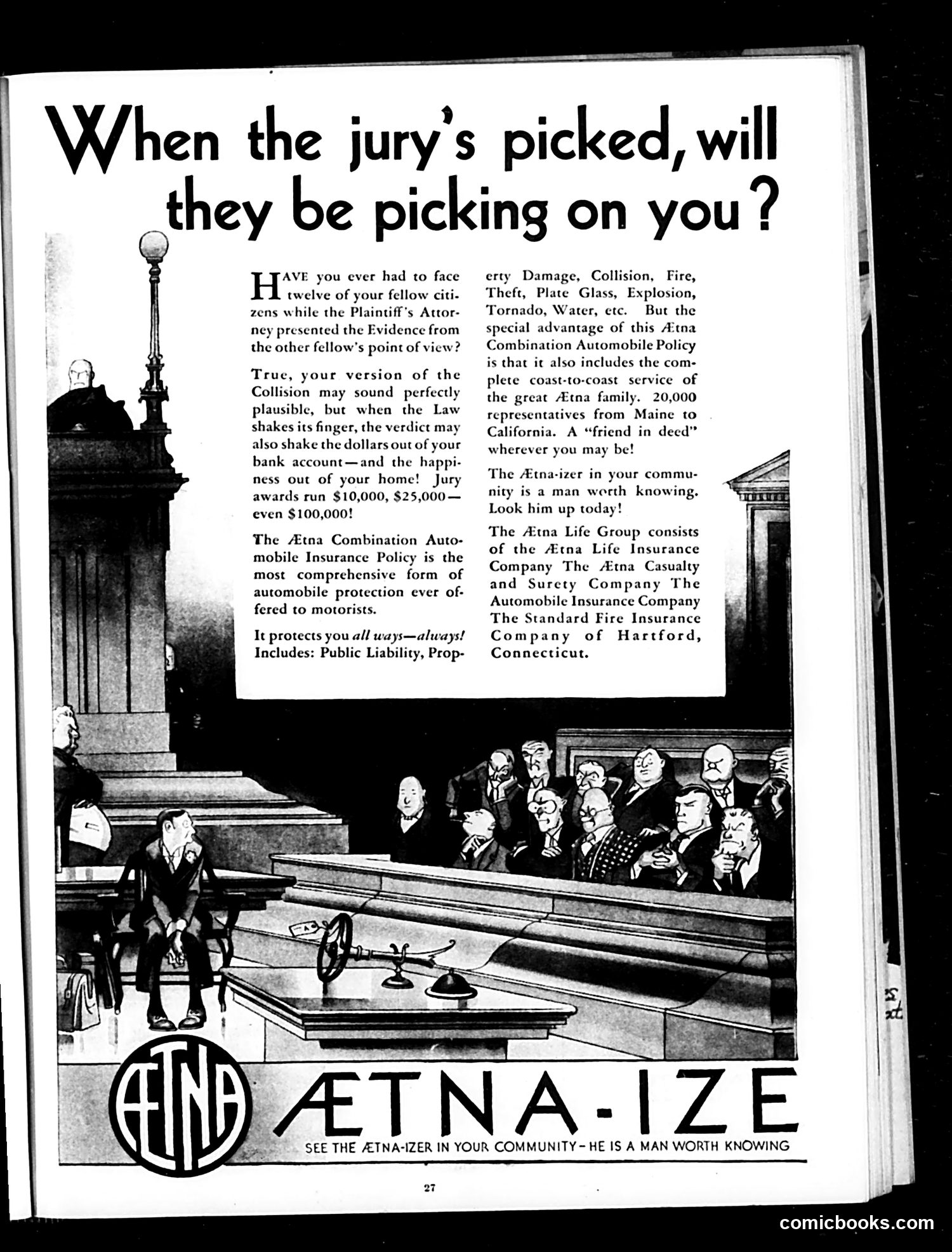
Analysis This is an insurance advertisement, not political satire. It uses a courtroom scene to sell Aetna automobile insurance to anxious readers. The cartoon depicts a jury box filled with stern-faced jurors observing a trial. The ad's pitch exploits fear: if you're sued for an auto accident, a jury might award massive damages ($10,000–$100,000—substantial sums in this era) that could bankrupt you and "shake the happiness out of your home." The solution: Aetna's "Combination Automobile Policy," promoted as comprehensive protection covering liability, collision, theft, fire, and more across all 48 states through 20,000 local agents (called "Aetna-izers"). The appeal is pure anxiety marketing—the implicit threat being that without proper insurance, an ordinary traffic accident could financially devastate your family via jury verdict. The jovial courtroom scene masks a darker message: the legal system is unpredictable and dangerous to your wallet.
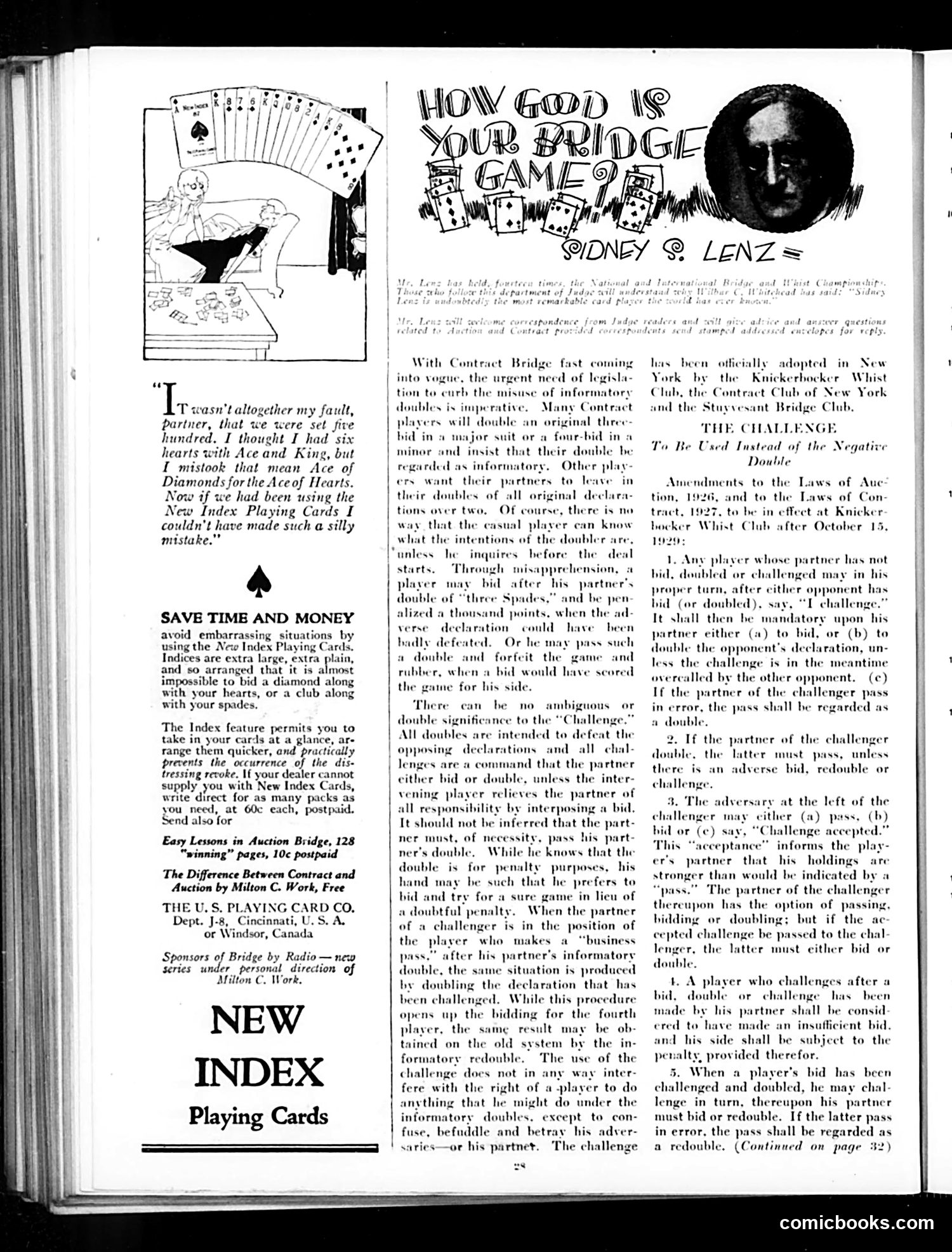
Judge Magazine Page Analysis This page contains two distinct elements: a bridge card game advertisement and instructional text about contract bridge rules. The Advertisement (Left): A cartoon shows a frustrated bridge player explaining his costly mistake to his partner. He confused the Ace of Diamonds with the Ace of Hearts during play, resulting in a "five hundred" point penalty. The ad for "New Index Playing Cards" satirizes this common problem by promoting larger, clearer card indices that prevent such embarrassing mix-ups. The humor lies in the player's sheepish admission and the product's promise to solve this widespread frustration among bridge enthusiasts. The Right-Hand Content: Dense instructional material about "Contract Bridge" rules, specifically new amendments adopted by New York bridge clubs (the Knickerbocker Whist Club, Contract Club of New York, and Stuyvesant Bridge Club). This appears to be serious rule clarification rather than satire, addressing competitive bridge conventions from the 1920s. The page reflects bridge's popularity as a widespread social game during this era, with both casual players making mistakes and serious clubs establishing standardized rules.
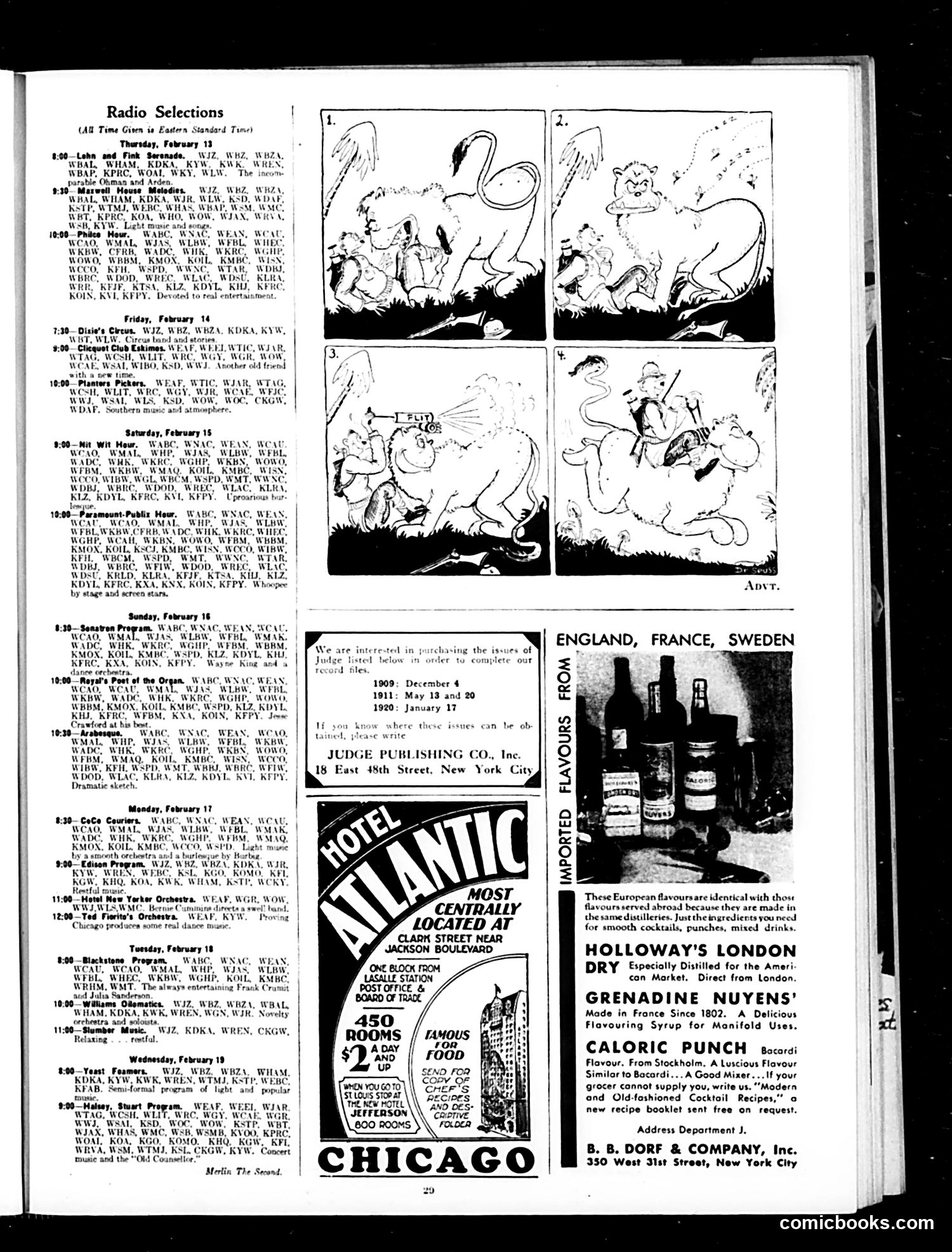
Analysis of This Judge Magazine Page This page is primarily a radio program schedule for Eastern Standard Time (Thursday-Tuesday, mid-February), listing dozens of stations and entertainment offerings—vaudeville acts, orchestras, dramatic sketches, and comedy programs. The page includes four cartoon panels (numbered 1-4) depicting what appears to be a hippo or large animal character interacting with small human figures in comedic situations. The humor seems physical/slapstick in nature, though without captions visible, the specific satirical point is unclear. The advertisements are notable: the Hotel Atlantic in Chicago emphasizes its central location and food service; Holloway's London Dry Gin, Grenadine Nuyens, and Caloric Punch are prominently featured—all alcoholic beverages advertised during Prohibition (1920-1933). This reflects Judge's satirical, anti-Prohibition stance typical of the era. The page's primary function is practical (radio listings) rather than primarily satirical or editorial.
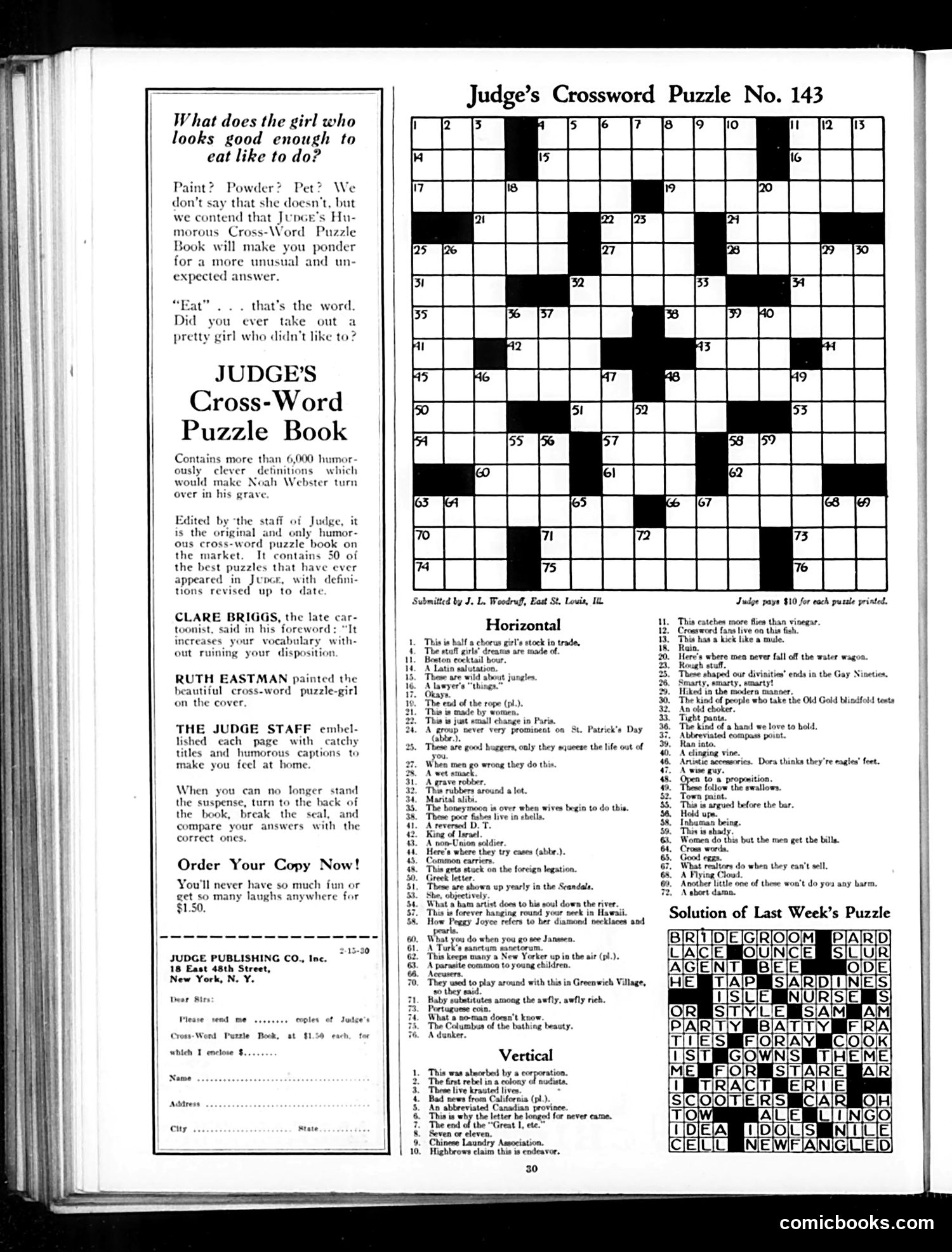
Judge Magazine, Page 30: Crossword Puzzle Advertisement This page is primarily an advertisement for Judge's *Cross-Word Puzzle Book*, a collection of 50 humorous crossword puzzles from the magazine. The opening riddle—"What does the girl who looks good enough to eat like to do?"—sets up a cheeky answer: "Eat." It's a mild sexual innuendo typical of Jazz Age humor, playing on the phrase "eat like" (to kiss/seduce). The advertisement emphasizes the book's "humorously clever definitions" that would surprise even Noah Webster. It credits cartoonist Clare Briggs's foreword and artist Ruth Eastman's cover illustration. The page includes Puzzle No. 143 itself and its clues, which contain period-specific references (Broadway "Scandals," Greenwich Village bohemians, bathing beauty culture, Portuguese coins) and 1920s slang. Below is the solution to "last week's puzzle," demonstrating the book's actual content. This is marketing material targeting readers seeking intellectual entertainment with risqué humor—typical Judge demographic appeal.
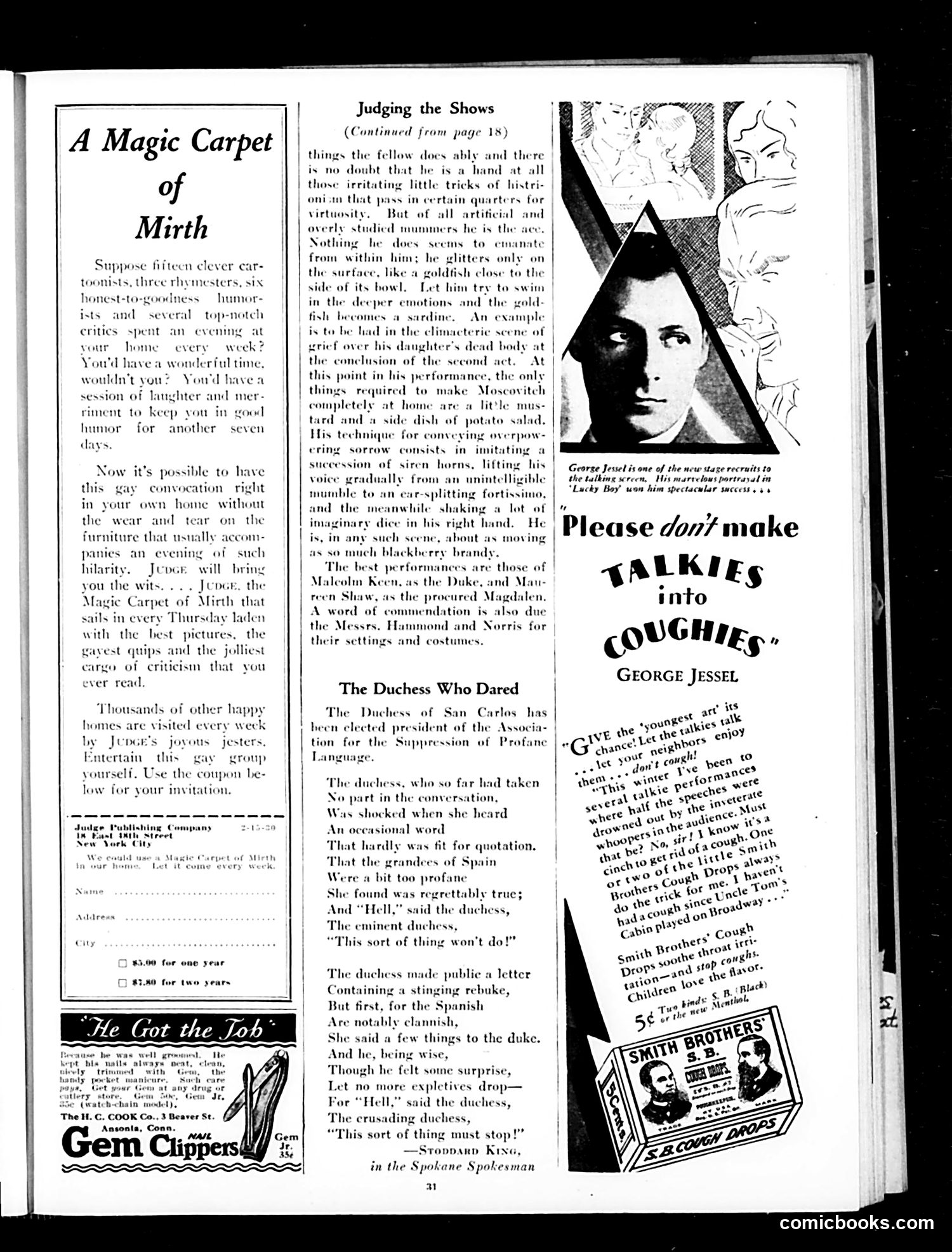
Explanation for Modern Readers This page contains theatrical criticism and entertainment advertising from Judge magazine, circa the early sound-film era. "Judging the Shows" critiques stage performances, particularly attacking an unnamed actor (likely a contemporary theatrical star) for artificial, superficial acting—described as glittering "only on the surface, like a goldfish." The critic praises Malcolm Keen and Maureen Shaw's performances instead. "The Duchess Who Dared" is light satirical verse about the Duchess of San Carlos, elected president of an Association for Suppressing Profane Language. The irony: when she hears swearing, she responds by swearing herself ("Hell"), undercutting her moral mission. The joke relies on hypocrisy humor common to the era. The George Jessel advertisement warns against converting "talkies" (sound films) into "coughies"—a pun on early sound-film technical problems where actors' coughs and throat-clearing were audible. Jessel is promoted as a successful early talkie star, implying his clear diction avoids such embarrassments. The page is primarily advertising Judge's subscription service as wholesome home entertainment.
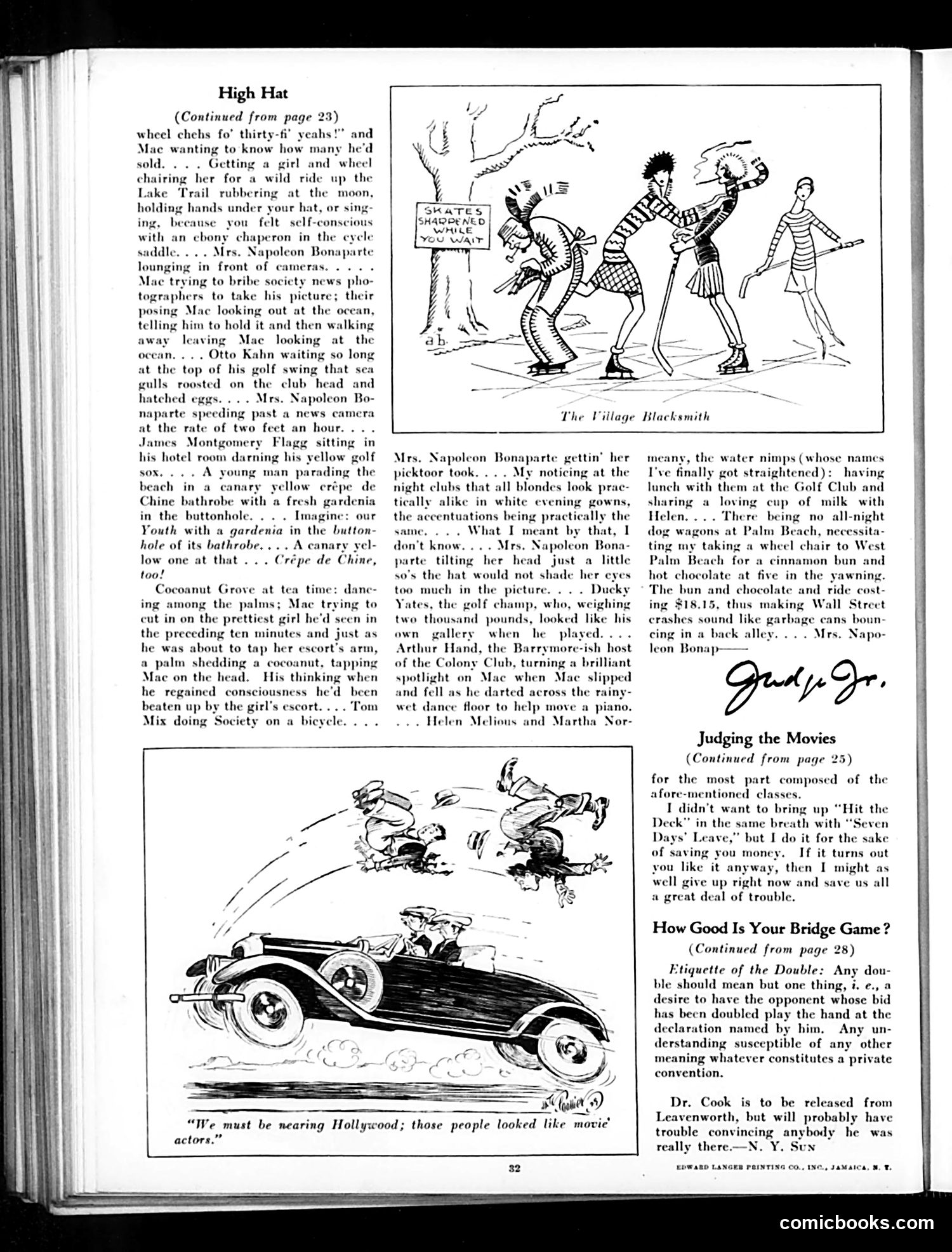
"High Hat" - A 1920s Society Satire This page satirizes wealthy Jazz Age socialites and their absurd pursuits. The "High Hat" column mocks the leisure activities of the rich—particularly a character named Mae (likely Mrs. Napoleon Bonaparte, a society figure) and her circle at exclusive venues like Cocoanut Grove and the Colony Club. The humor targets their vanity: Mae bribing photographers, obsessing over fashionable details (yellow crepe de Chine robes, gardenias), and engaging in ridiculous activities like "doing society on a bicycle" (Tom Mix). The accompanying cartoon "The Village Blacksmith" depicts exaggerated figures roller-skating, mocking their affected poses and costumes. The satire ultimately portrays wealthy socialites as shallow, vain, and disconnected from reality—more concerned with appearing fashionable and being photographed than anything substantive. This reflects 1920s class consciousness and the cultural critique of the "idle rich" during the era.
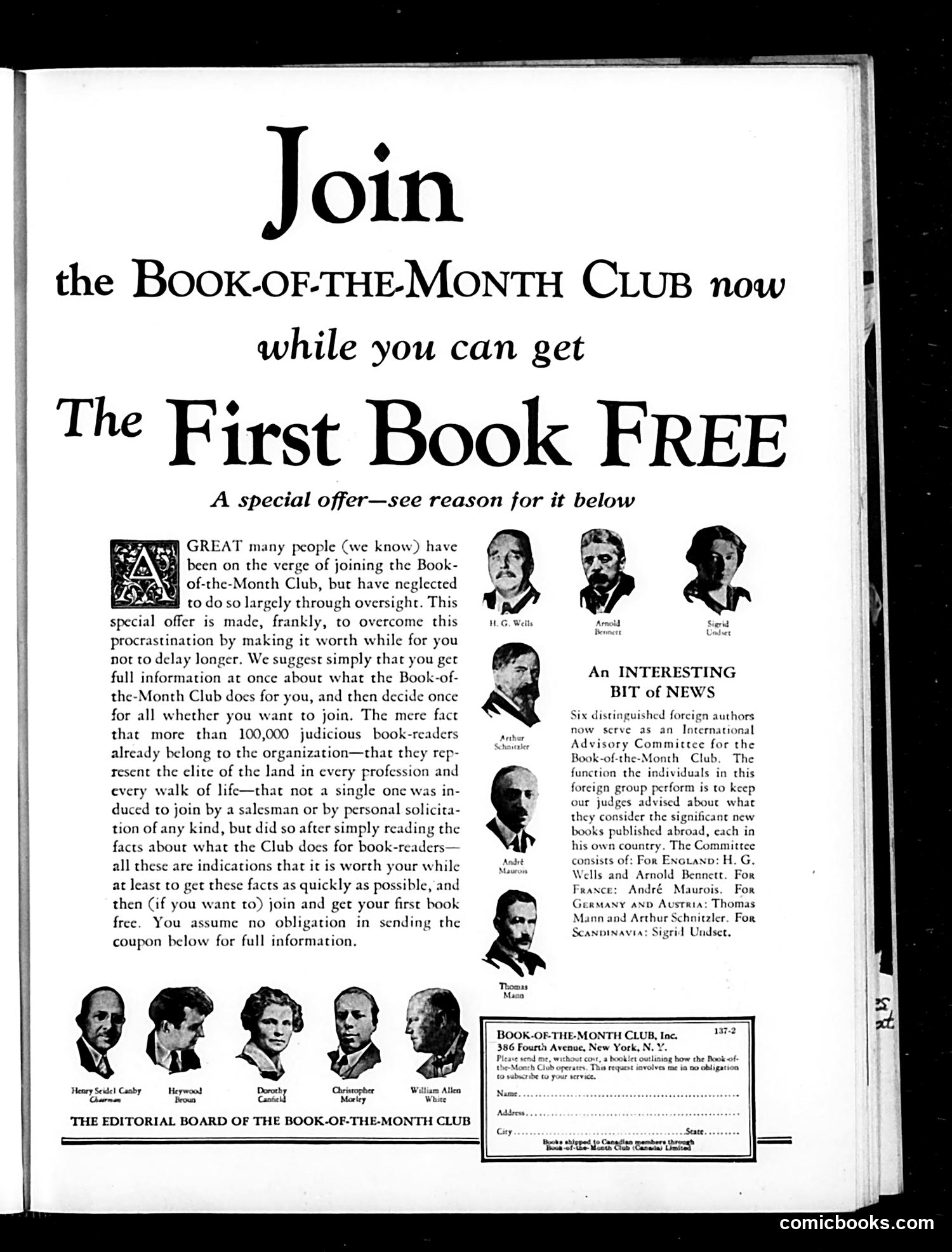
Analysis This is primarily advertising, not satire or political commentary. It's a 1920s-era promotion for the Book-of-the-Month Club, a mail subscription service for curated book selections. The page features portraits of the club's editorial board—prominent American literary figures like H.G. Wells (identified), along with names like Henry Seidel Canby and Dorothy Canfield—positioned to establish the club's cultural authority and prestige. The "interesting bit of news" section highlights an international advisory committee of famous European authors (Thomas Mann, André Maurois, Sigrid Undset), presented as validation that the club selects serious, globally-significant literature. The sales pitch emphasizes that 100,000 "judicious book-readers" joined voluntarily—without salesmen or solicitation—suggesting the club's credibility stems from word-of-mouth rather than hard sell. The free-first-book offer targets procrastinators, framing it as removing barriers to joining an elite cultural institution. This reflects early 20th-century American middlebrow aspirations: positioning book clubs as markers of refined taste and education.
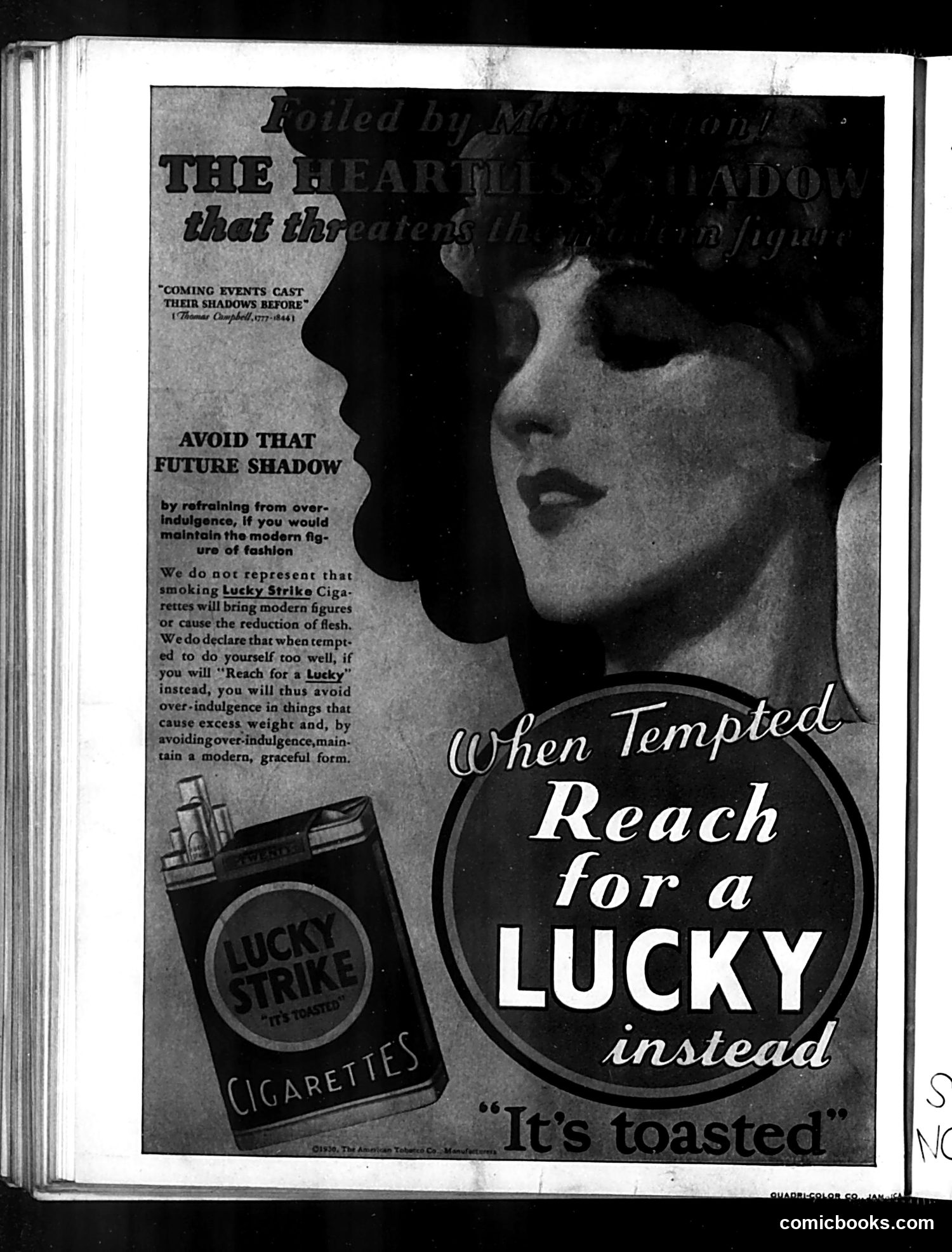
Analysis This is primarily a Lucky Strike cigarette advertisement, not satire or political content. The ad features a silhouetted woman's profile alongside the slogan "When Tempted / Reach for a LUCKY instead." The advertisement uses a quote attributed to Thomas Campbell (1777-1844) about "coming events cast their shadows before" to suggest that smoking Lucky Strikes helps women avoid future weight gain and maintain "modern figure of fashion." The ad explicitly disclaims that Lucky Strikes cause weight loss, yet implies that choosing cigarettes over food prevents "over-indulgence" and maintains a "modern, graceful form." This reflects early 20th-century marketing that positioned cigarette smoking as appetite suppression—a common advertising strategy targeting women concerned with maintaining fashionable slenderness.