judge
Judge — February 22, 1930
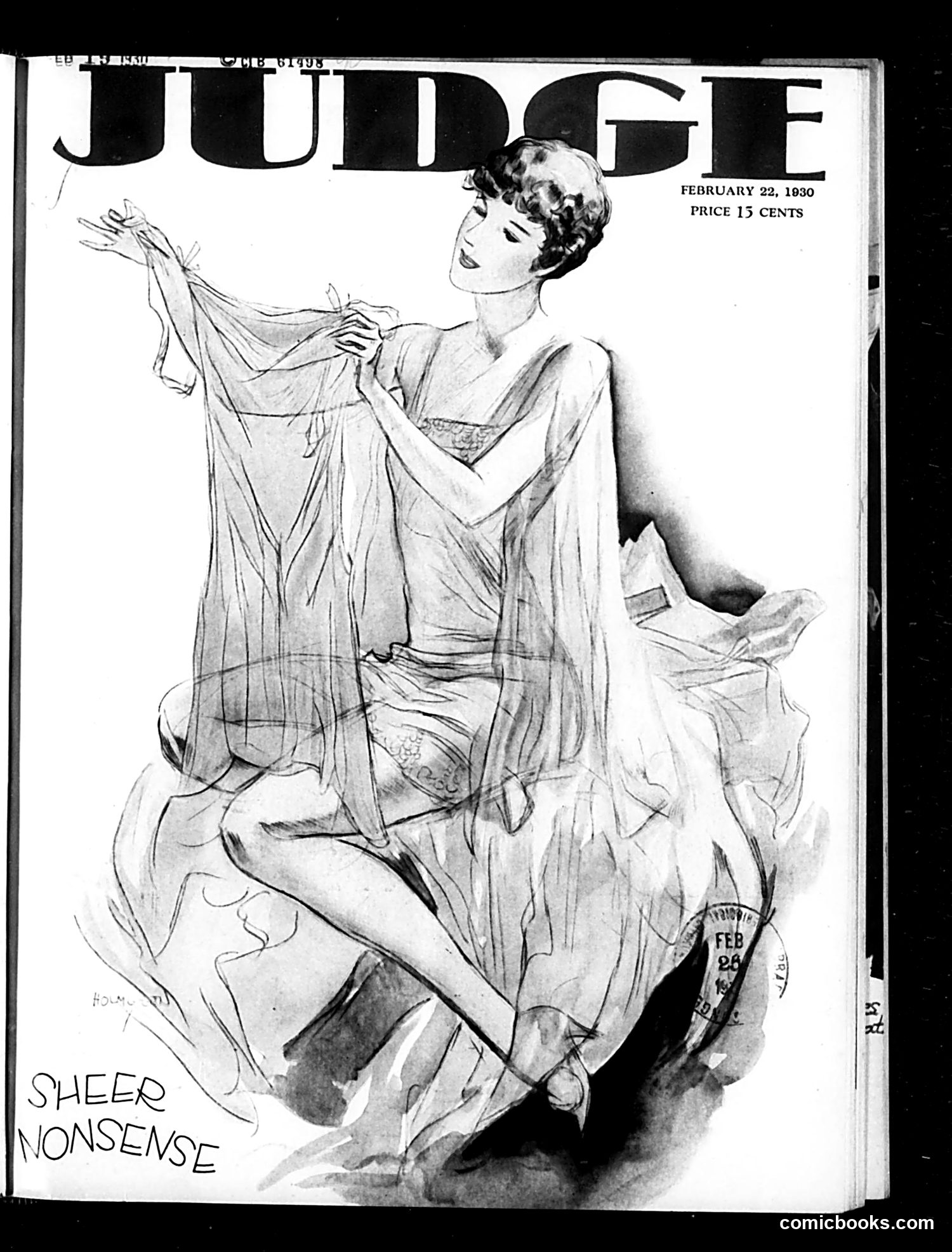
Judge Magazine Cover Analysis - February 22, 1930 This cover illustrates a woman in diaphanous, flowing negligee examining delicate fabric or lace she's holding up. The title "SHEER NONSENSE" is the primary joke. The humor operates on a double meaning: "sheer" refers both to the transparent quality of the garments depicted and to the nonsensical nature of the content. This appears to be a lighthearted commentary on women's intimate apparel or fashion—particularly the transparency and impracticality of contemporary sleepwear styles. The illustration style and artistic treatment are typical of Judge's satirical approach to social and domestic life. At 15 cents, this February 1930 issue predates the Great Depression's full impact, when such luxury items and leisurely domestic humor remained culturally relevant topics for a middle-class readership.
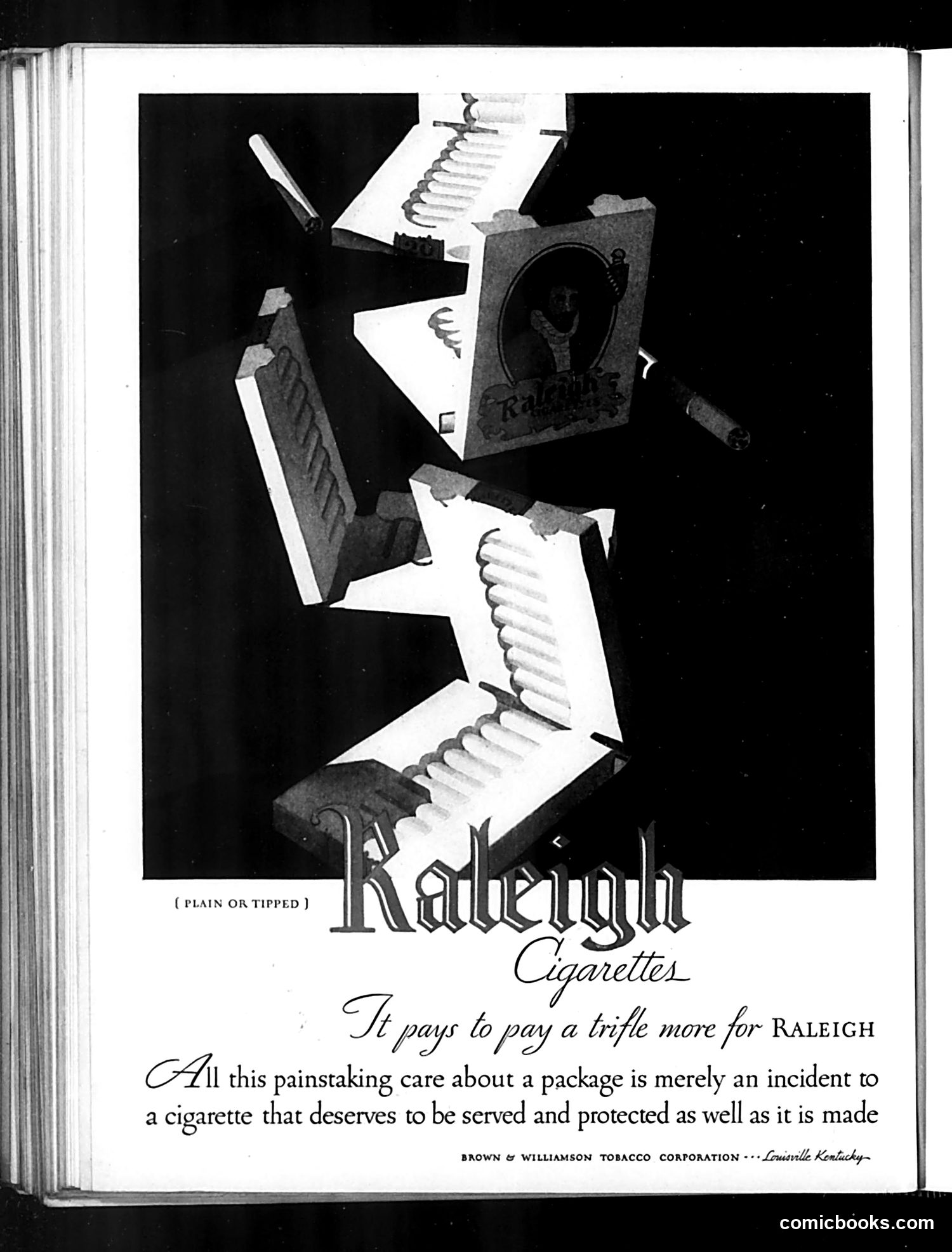
Analysis This page is primarily a cigarette advertisement, not political satire. It promotes Raleigh cigarettes, manufactured by Brown & Williamson Tobacco Corporation in Louisville, Kentucky. The ad features decorative packaging imagery—ornate cigarette boxes and cases arranged artistically—emphasizing the product's presentation. The tagline "It pays to pay a trifle more for RALEIGH" and the closing statement about "painstaking care about a package" position premium packaging as justification for higher cost. The notation "(PLAIN OR TIPPED)" indicates the cigarettes came in two varieties. There is no political cartoon or satirical commentary on this page—it is straightforward mid-twentieth-century tobacco advertising that would be illegal today due to modern restrictions on cigarette marketing.
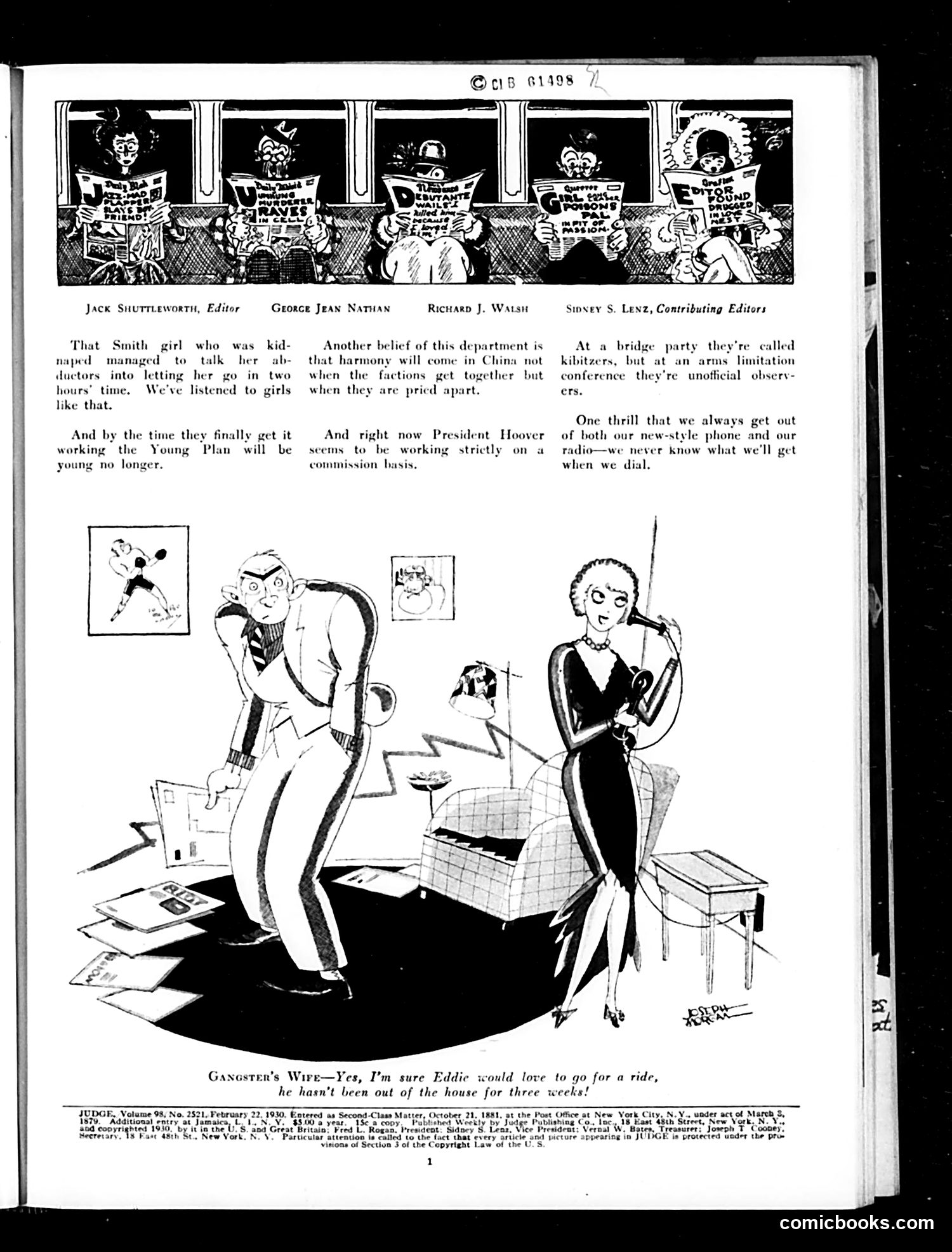
Analysis This Judge magazine page from February 22, 1930 contains editorial commentary and a cartoon titled "Gangster's Wife." The Cartoon: A stylized drawing shows a woman in an evening dress wielding a rifle or gun, standing with a man in a suit amid scattered money and documents. The caption reads: "Yes, I'm sure Eddie would love to go for a ride, he hasn't been out of the house for three weeks!" The Satire: The cartoon satirizes Prohibition-era gangster culture and the domestic lives of organized crime figures. The phrase "go for a ride" was contemporary slang for execution. The joke plays on the irony of a gangster's wife casually referencing her husband's imprisonment indoors while casually handling weapons—depicting the criminal underworld's violence and paranoia as mundane domesticity. The accompanying editorial discusses political factions and President Hoover's commission-based governance.
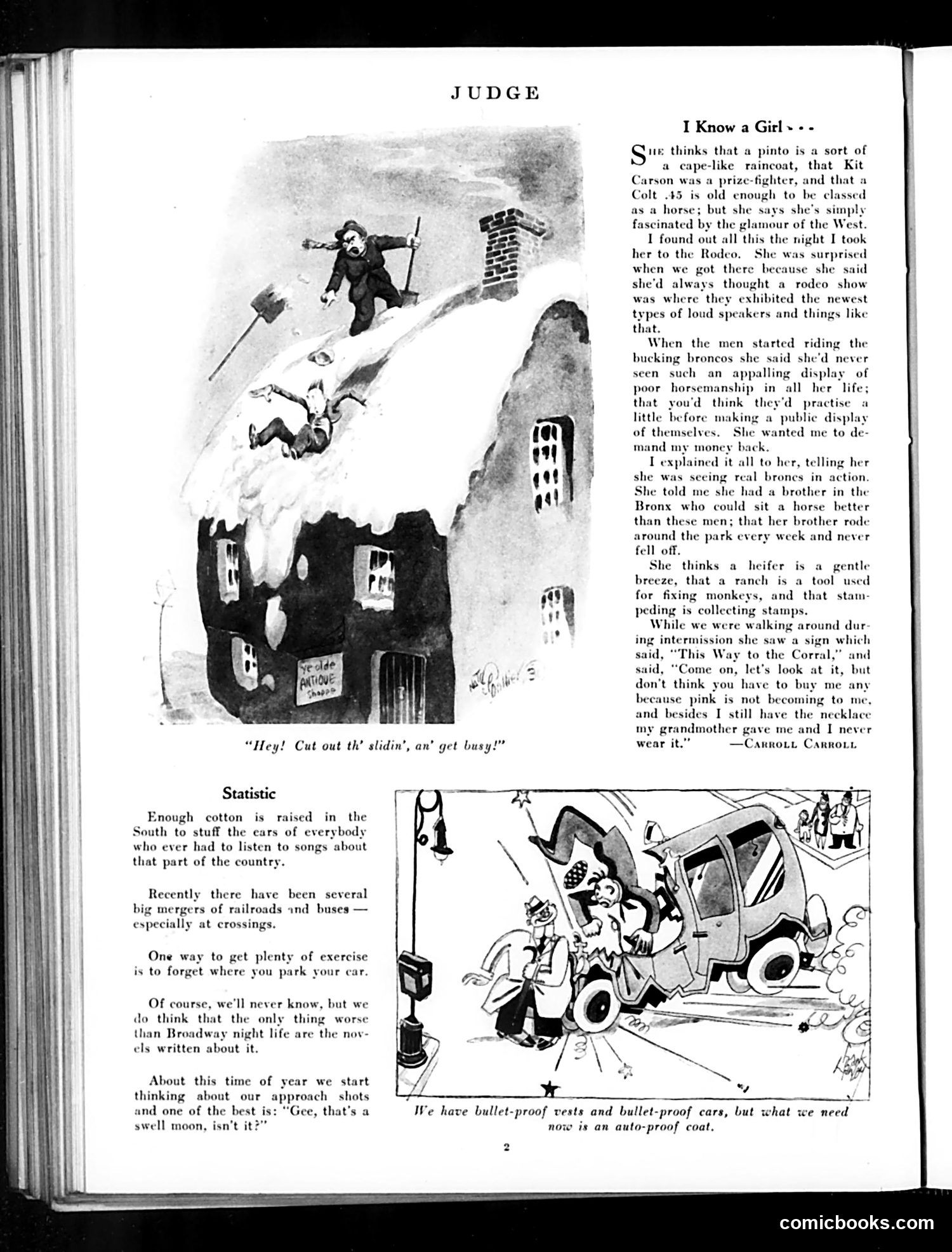
Analysis of Judge Magazine Page The page contains two distinct pieces: Top illustration ("Hey! Cut out th' slidin', ain't git busy!"): Shows people sliding down a snowy rooftop of a tenement building. The satire appears to target urban poverty and unsafe living conditions, depicting working-class recreation as dangerous improvisation on dilapidated housing. "I Know a Girl" article: A humorous anecdote about a girl's misconceptions of Western culture—confusing rodeos with theatrical spectacle, misidentifying horse equipment (thinking a ".45 is old enough to be classified as a horse"). The humor relies on urban naivety about frontier life. "Statistic" section: Brief satirical commentary on railroad/bus mergers, traffic safety, and New York social life—typical period concerns about modernization and urban congestion. The overall tone is gentle mockery of contemporary social observations.
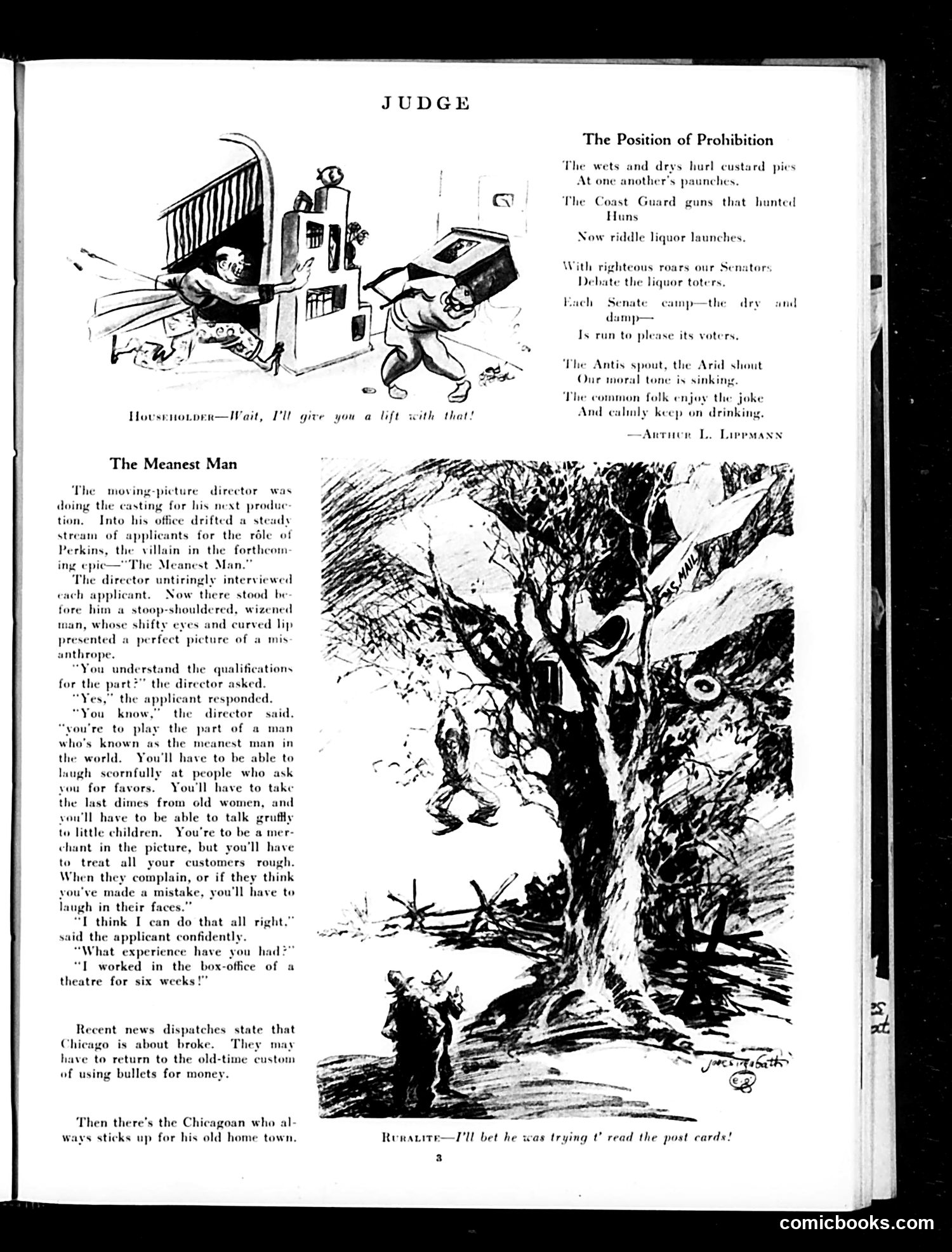
Analysis of Judge Magazine Page "The Position of Prohibition" (top cartoon): This satirizes Prohibition-era enforcement. The cartoon shows a householder offering a bribe to what appears to be a law enforcement officer at a distillery or liquor operation. The accompanying poem mocks the contradictions of Prohibition: senators debate "liquor toters" while "riddle liquor launches" operate, and citizens joke about drinking despite the ban. The satire suggests Prohibition is unenforced and hypocritical—officials debate while illegal operations flourish and common people openly flout the law. "The Meanest Man" (bottom section): This is primarily a humorous anecdote about a film director casting for a villain role. An applicant describes six weeks' box office experience, and the director sarcastically assigns him the part of "the meanest man in the world," requiring him to be cruel to customers and staff. It's light workplace humor with no apparent political significance.
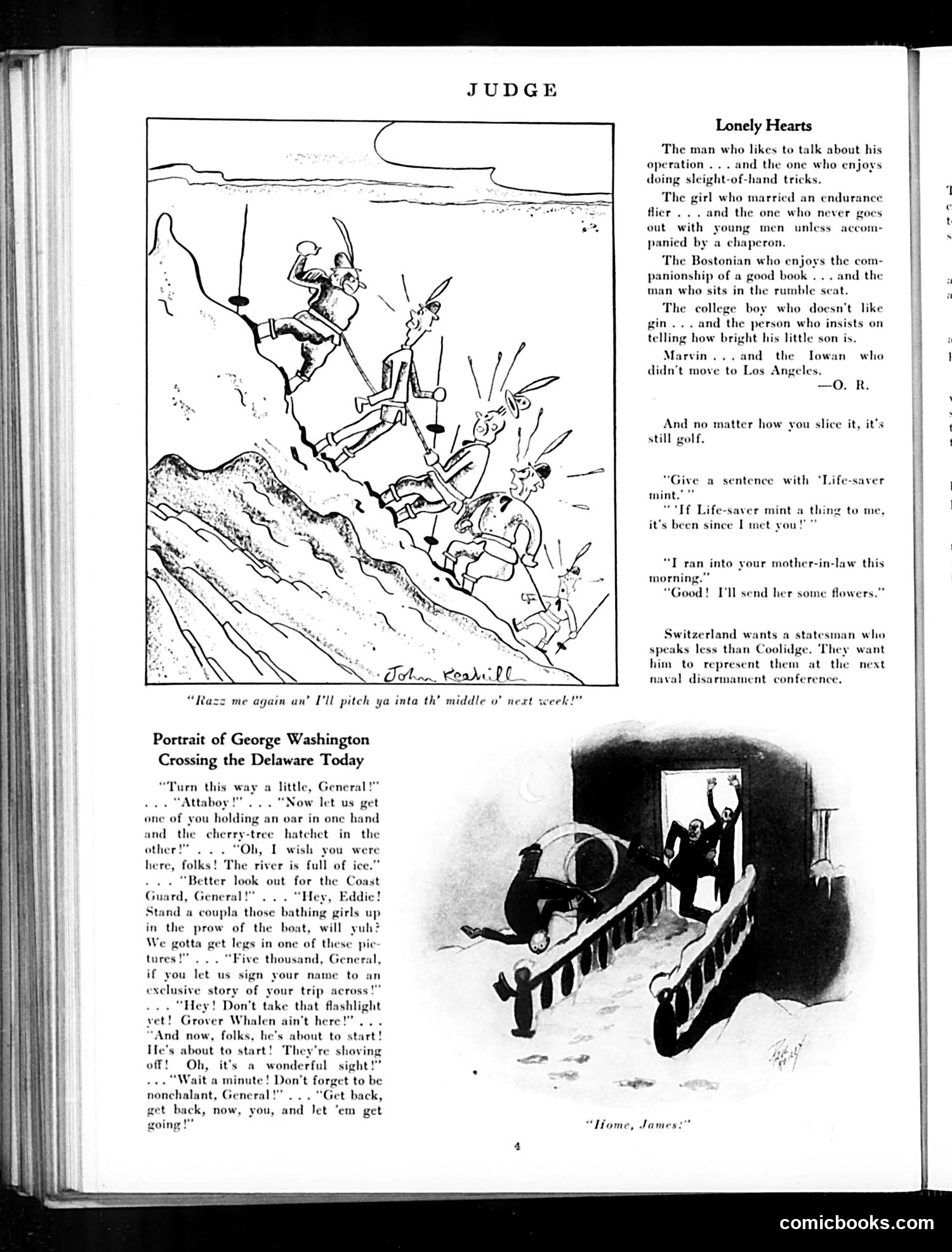
Judge Magazine Page Analysis The top cartoon depicts skiers tumbling down a snowy slope in chaotic disarray, captioned "Razz me again an' I'll pitch ya inta th' middle o' next week!" This appears to be physical comedy about ski mishaps rather than political satire. Below is a section titled "Portrait of George Washington Crossing the Delaware Today," which reimagines the famous historical crossing with modern elements—soldiers holding oars, references to "bathing girls," ice hazards, and casual banter. This satirizes how modern mundane concerns and casual attitudes contrast sharply with the gravitas of Washington's actual 1776 crossing, poking fun at contemporary culture's trivialization of historical significance. The lower cartoon shows people with a barrel on an inclined track, captioned "Home, James!"—likely domestic humor about transportation.
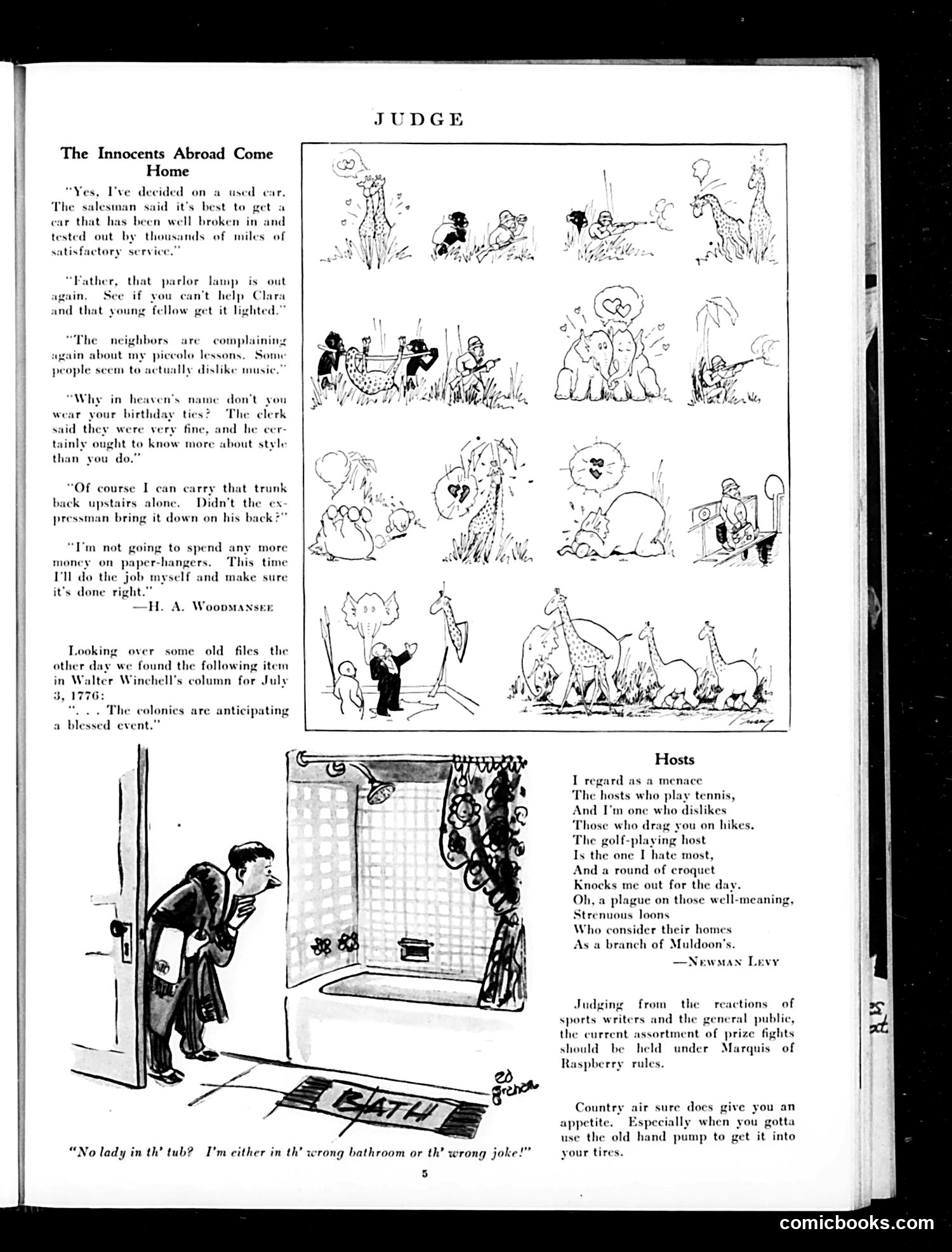
Analysis of Judge Magazine Page This page contains two main satirical pieces: "The Innocents Abroad Come Home" (top): A multi-panel comic strip depicting Americans returning from European travel, now affecting pretentious mannerisms. The quoted dialogue shows returning travelers adopting superior attitudes about fashion, music, and home décor—mocking the common phenomenon of Americans gaining inflated sophistication from brief foreign visits. "No lady in th' tub?" (bottom left): A single-panel cartoon showing a man peering into a bathroom. The joke plays on confusion about bathroom etiquette or a misunderstanding, likely satirizing social awkwardness or misconceptions about proper household behavior. "Hosts" (right): A humorous poem by Newman Levy listing types of annoying hosts—tennis players, golf enthusiasts, croquet players—portraying hosts as using their homes primarily for entertaining rather than genuine hospitality. The overall theme critiques American social pretension and uncomfortable social situations.
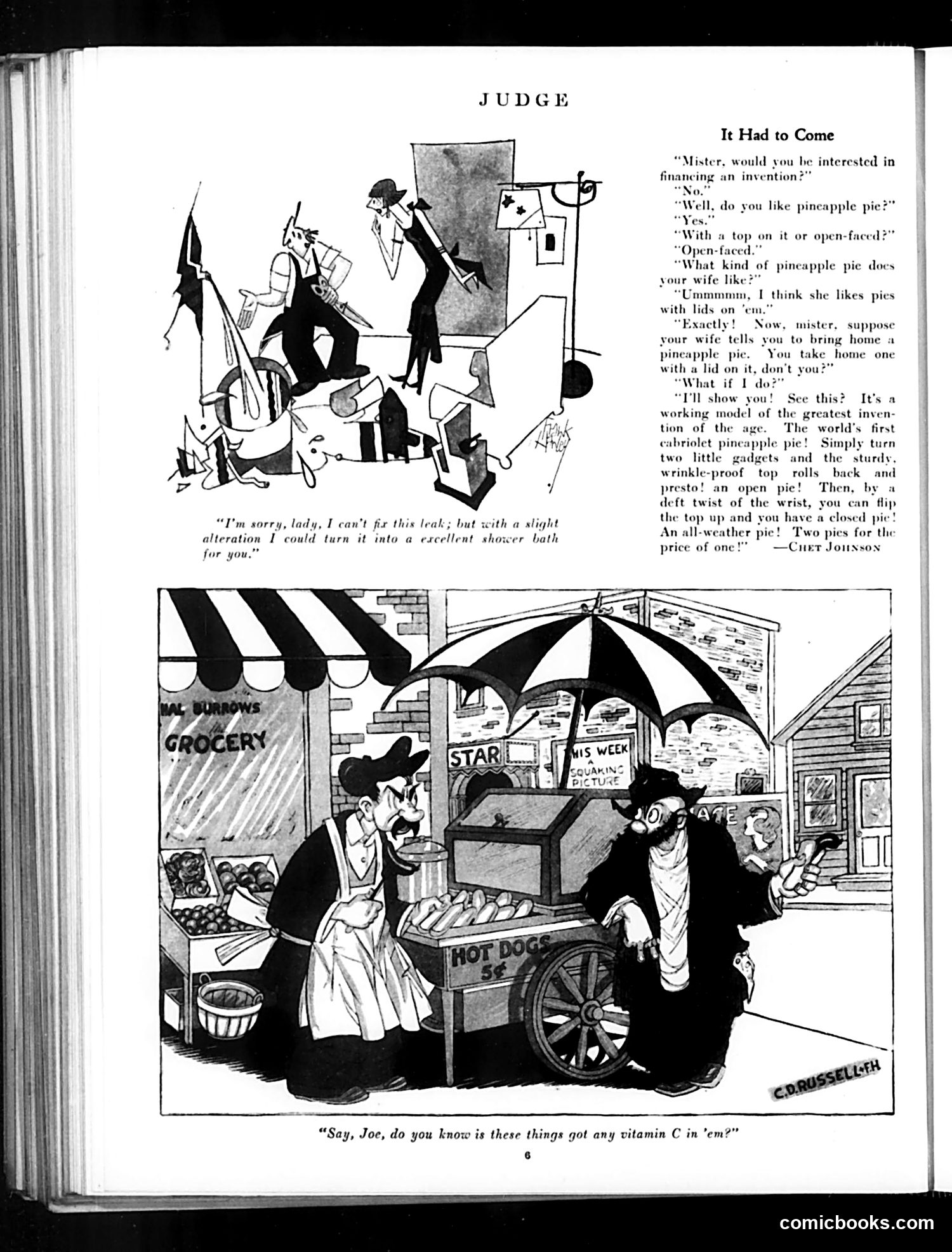
Analysis of Judge Magazine Page This page contains two satirical cartoons mocking American consumer culture and business schemes. The top cartoon depicts a chaotic inventor's workshop where a businessman pitches an absurd "cabaret pineapple pie"—a novelty dessert with a hinged, flip-top lid. The satire targets both gullible investors willing to finance ridiculous inventions and the era's obsession with gadgetry disguised as innovation. The bottom cartoon shows street vendors selling hot dogs and other food items. The caption "Say, Joe, do you know if these things got any vitamin C in 'em?" satirizes Americans' newfound concern with nutritional science and vitamins, suggesting vendors and consumers alike are clueless about what they're actually consuming—mocking both commercial food safety standards and public health awareness of the period.
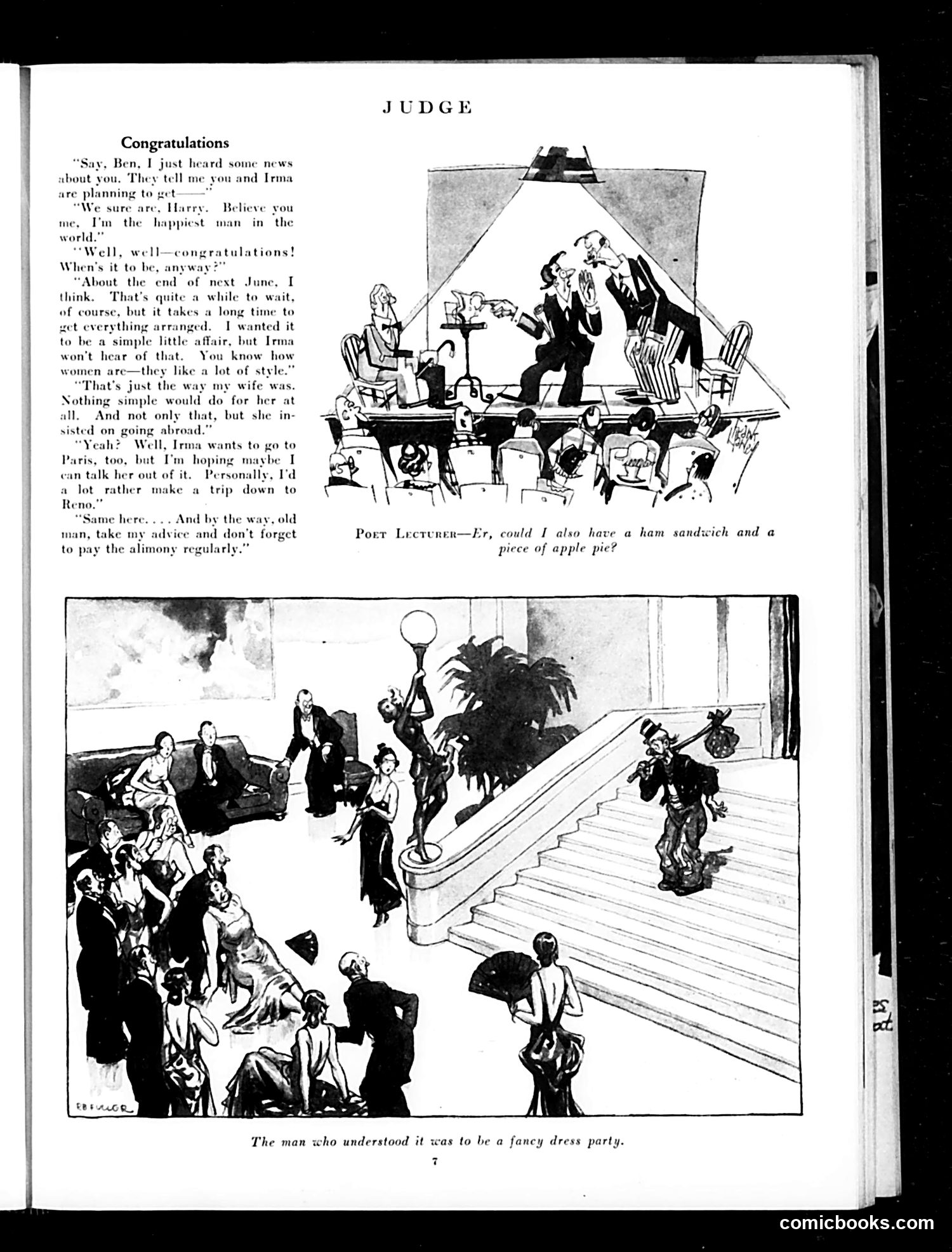
Analysis This page contains two satirical pieces about marriage and social expectations in early 20th-century America. The top conversation mocks the elaborate planning and expense of weddings. Ben announces his engagement to Irma, but expresses frustration that she insists on an elaborate affair in Paris rather than a simple ceremony. The humor culminates in a cynical punchline: an older man advises Ben to "pay the alimony regularly"—suggesting that marriage inevitably ends in divorce and financial obligation. This reflects contemporary anxieties about marital instability and the growing expense of modern weddings among the wealthy. The lower cartoon depicts a fancy dress party misunderstanding: a working-class man (likely a laborer, based on the figure on the stairs) has interpreted "fancy dress party" literally and arrived in costume, oblivious to the sophisticated social gathering. The humor derives from class confusion and the gap between literal and colloquial meanings—a common source of satire in Judge magazine's commentary on American social hierarchies.
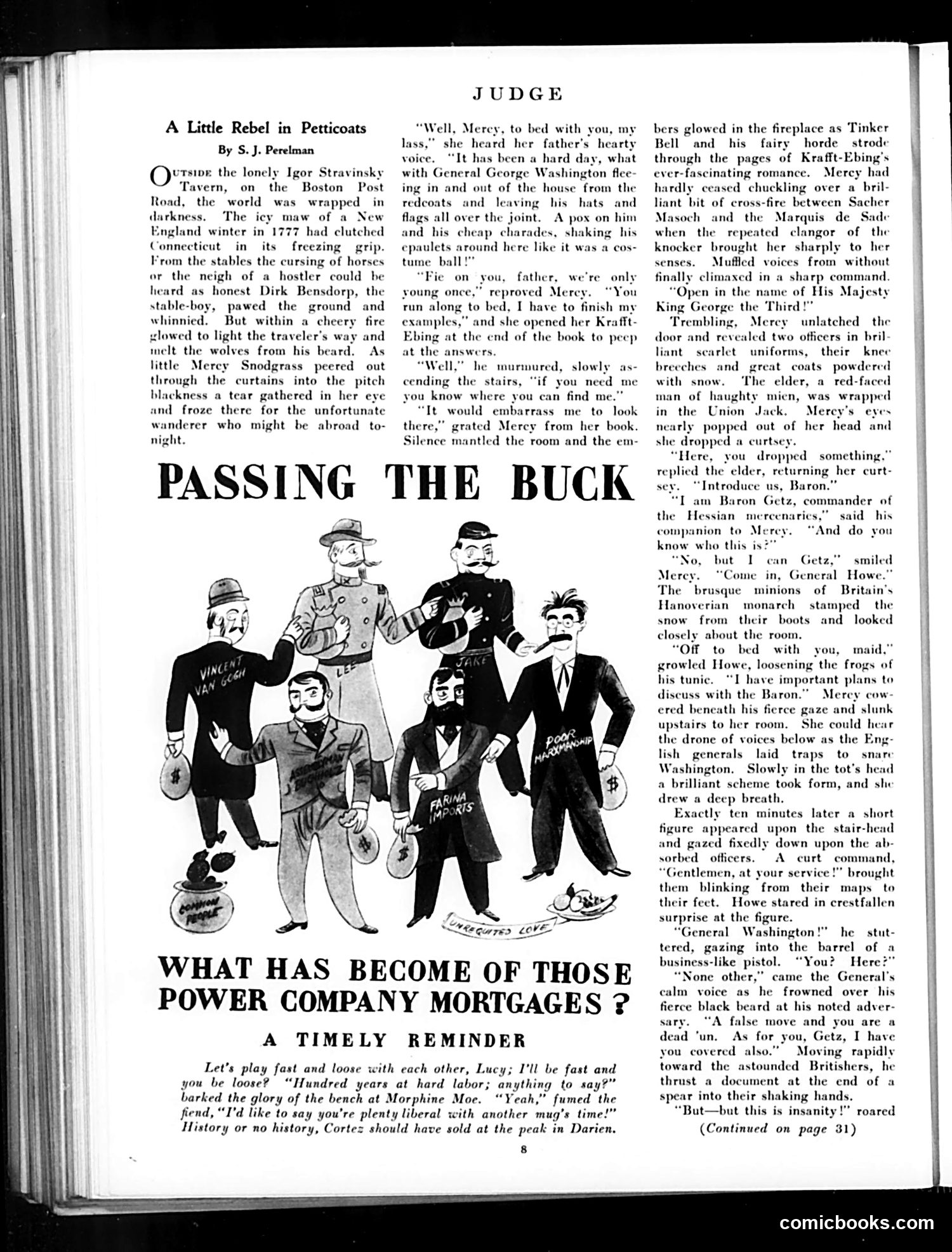
Political Satire Analysis: Judge Magazine Page This page contains two distinct pieces: "A Little Rebel in Petticoats" (by S.J. Perelman): A humorous short story set during the American Revolution, satirizing overwrought period fiction. It's a parody of melodramatic spy stories, featuring exaggerated characters (a stable-boy who "whinnies," absurd references mixing historical and anachronistic elements like Krafft-Ebing's psychology texts). "Passing the Buck" (main cartoon): The central illustration depicts six caricatured political/business figures passing a spherical object labeled with various financial schemes. The caption asks: "What has become of those power company mortgages?" This is a direct political satire attacking corporate corruption and financial misconduct by utility companies—likely referencing real power company scandals involving hidden mortgages or misappropriated funds. The "passing the buck" metaphor shows officials avoiding responsibility by shifting blame/liability among themselves. The bottom text reinforces themes of legal corruption and financial malfeasance. The cartoon targets early 20th-century corporate fraud in the utility industry.
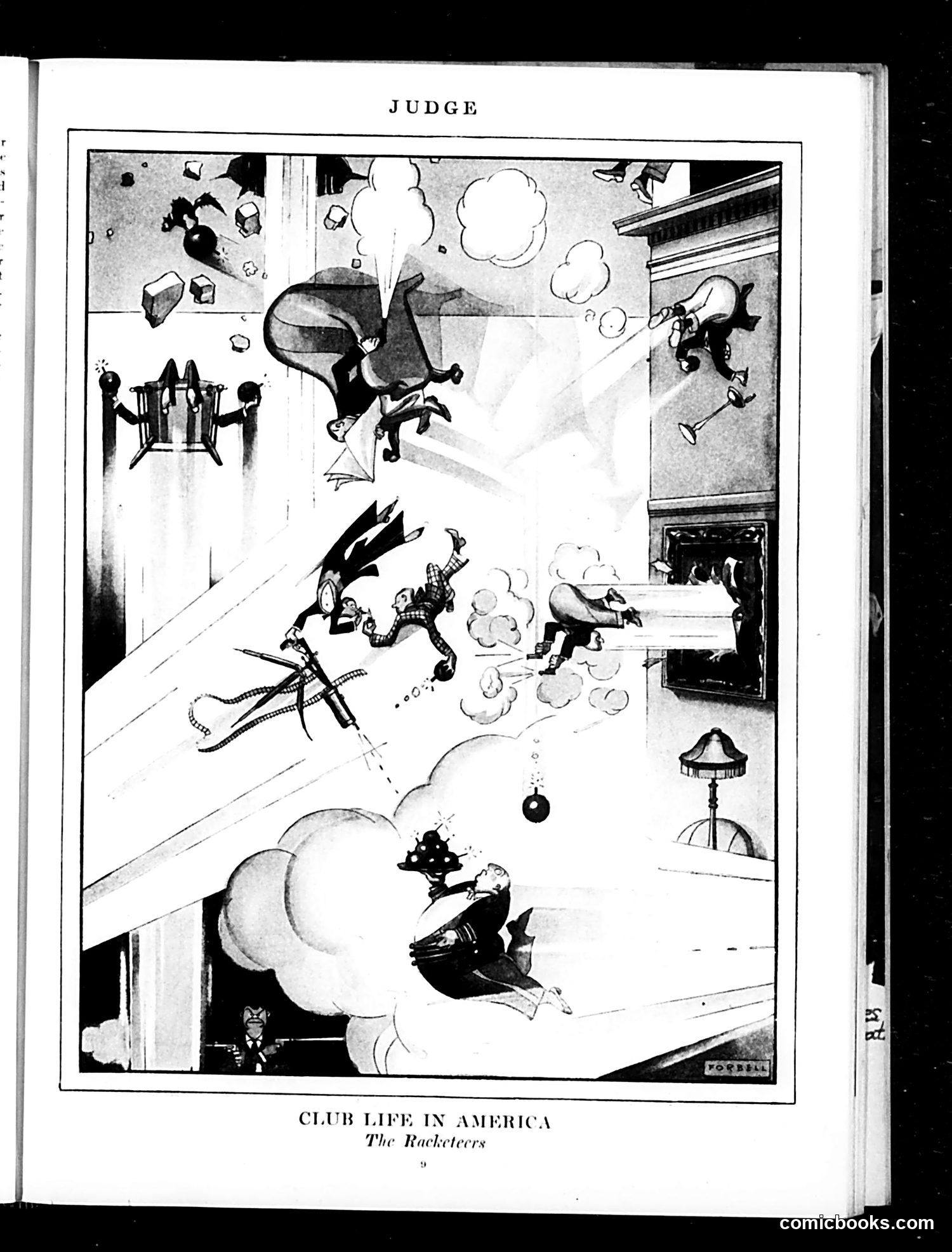
"Club Life in America: The Racketeers" This Judge cartoon satirizes organized crime and corrupt "club life" during what appears to be the Prohibition era. The illustration depicts chaotic violence and criminal activity—figures wielding weapons, explosions, and general mayhem occurring within what seems to be an upscale establishment. "Racketeers" refers to organized crime figures who ran illegal gambling, bootlegging, and protection schemes. The cartoon mocks how such criminal enterprises operated openly under the guise of "clubs" during Prohibition (1920-1933), when legitimate nightclubs became fronts for illegal alcohol sales and gangster activity. The satirical point: American "club life" had been corrupted by organized crime, turning supposedly respectable social venues into battlegrounds for competing criminal gangs.
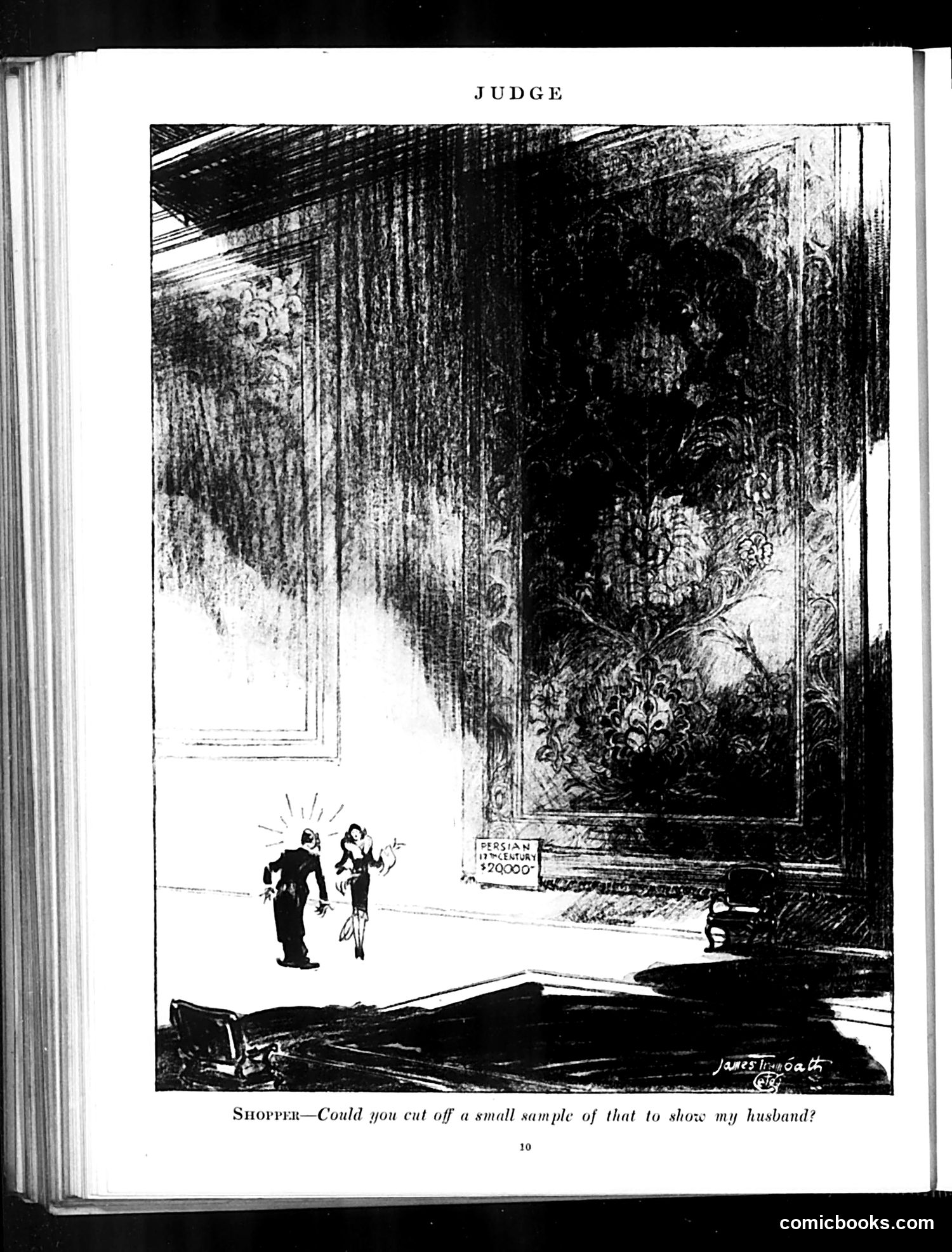
Analysis This single cartoon depicts a woman (labeled "Shopper") in an art museum or gallery, standing before what appears to be an expensive Persian tapestry or artwork (marked "$70,000"). She's asking a guard or attendant if he could cut off a small sample to show her husband. The satire targets wealthy women's extravagant spending habits and materialism. The joke is absurd—asking to damage a priceless artwork for a home shopping errand—suggesting the shopper views even museum-quality treasures as mere commodities to purchase. It mocks both the frivolousness of affluent female consumers and the impracticality of their desires. The humor relies on the incongruity between proper museum conduct and casual consumer behavior.
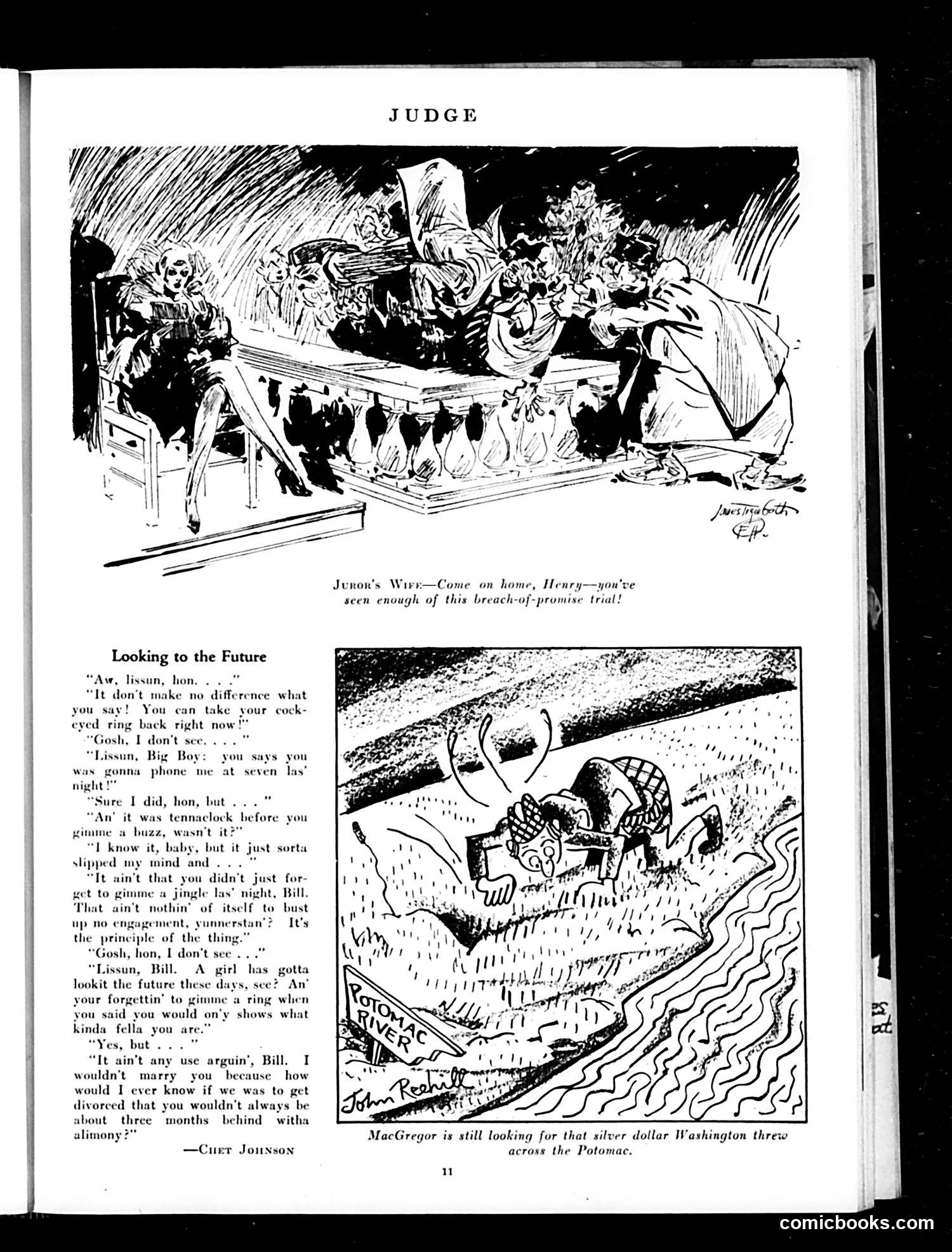
Analysis for Modern Readers Top Cartoon: This depicts a courtroom "breach of promise" trial—a now-obsolete legal action where someone could sue for damages if their fiancé broke an engagement. The judge's wife interrupts, sarcastically suggesting her husband come home after seeing enough of such frivolous litigation. The satire mocks how common these lawsuits were in the era. Bottom Comic: A domestic dispute between "Bill" and a woman over a missed phone call. She argues his forgetfulness about their agreed call proves he's unreliable, so she won't marry him—because he'd inevitably fall behind on alimony payments if they divorced. The humor (credited to Cliff Johnson) lies in her cynical, calculating logic: she's already planning for divorce before marriage, revealing contemporary anxieties about failed engagements and financial obligations. Historical Context: Both pieces satirize 1920s-30s relationship drama and the legal/financial consequences of broken engagements—concerns largely vanished from modern culture.
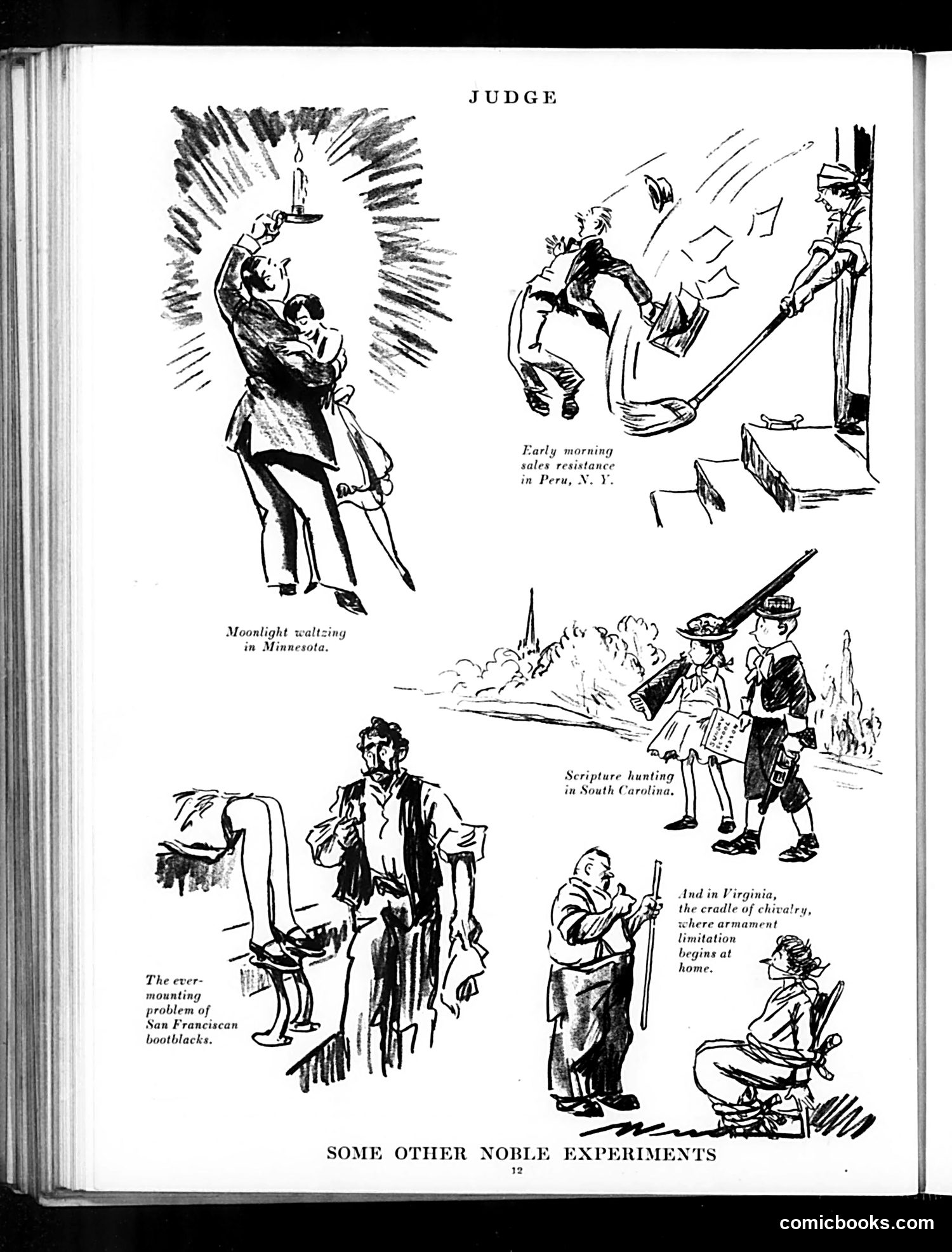
This Judge cartoon satirizes Prohibition ("noble experiments") through regional vignettes. The page mocks enforcement failures across America: - "Early morning sales resistance in Peru, N.Y." shows a judge struggling with a baby, implying local officials can't control illegal alcohol sales - "Moonlight waltzing in Minnesota" depicts drunk dancing, suggesting speakeasies operate openly - "Scripture hunting in South Carolina" shows people with weapons near a church, likely referencing bootleggers disguising illegal activity - "San Franciscan bootblacks" depicts shoe-shiners, a profession supposedly used as a front for alcohol distribution - "Virginia" scene shows children with weapons, mocking the irony of "armament limitation" rhetoric while Prohibition violence spreads The cartoon ridicules the gap between Prohibition's idealistic goals and its chaotic, corrupt reality—with judges, churches, and everyday professions all implicated in widespread law-breaking.
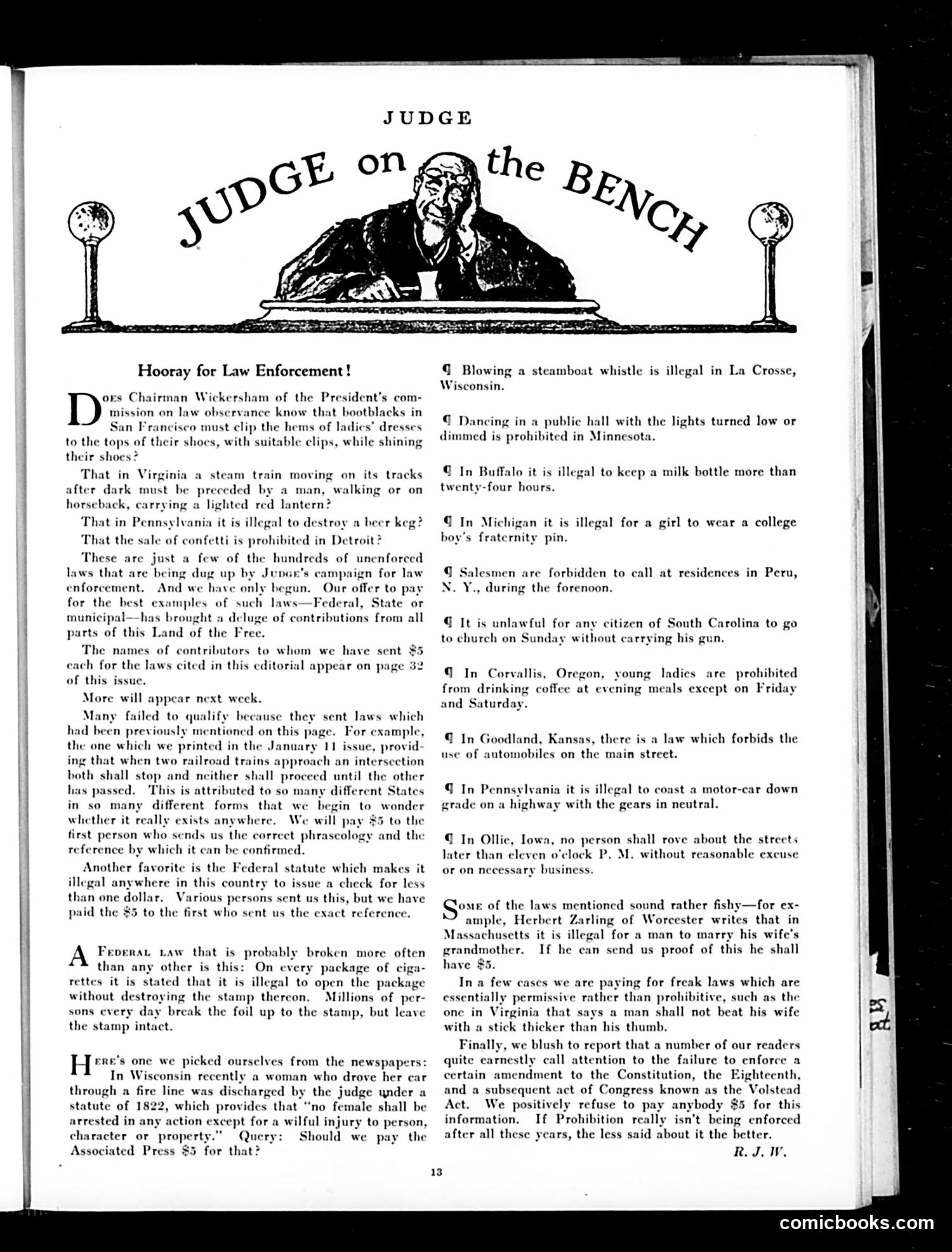
"Judge on the Bench" - Law Enforcement Satire This editorial page satirizes Chairman Wickersham's (President Taft's) campaign for law enforcement by highlighting hundreds of absurd, unenforced laws across America. The cartoon header shows a stern judge presiding over this critique. Judge magazine's satire works through irony: while Wickersham crusades for law enforcement, countless ridiculous statutes remain on the books—banning steamboat whistles in Wisconsin, prohibiting low lighting while dancing in Minnesota, forbidding milk bottles older than 24 hours in Buffalo, requiring guns at church in South Carolina. The publication invited readers to submit such laws for $5 payment, exposing the arbitrary and often nonsensical nature of local legislation. The satire suggests that selective enforcement of laws—ignoring these peculiar ones while aggressively pursuing others—reveals the hypocrisy of "law and order" campaigns. By cataloging these laws, Judge mocks both the legislators who created them and reformers who ignore obvious legal absurdities.
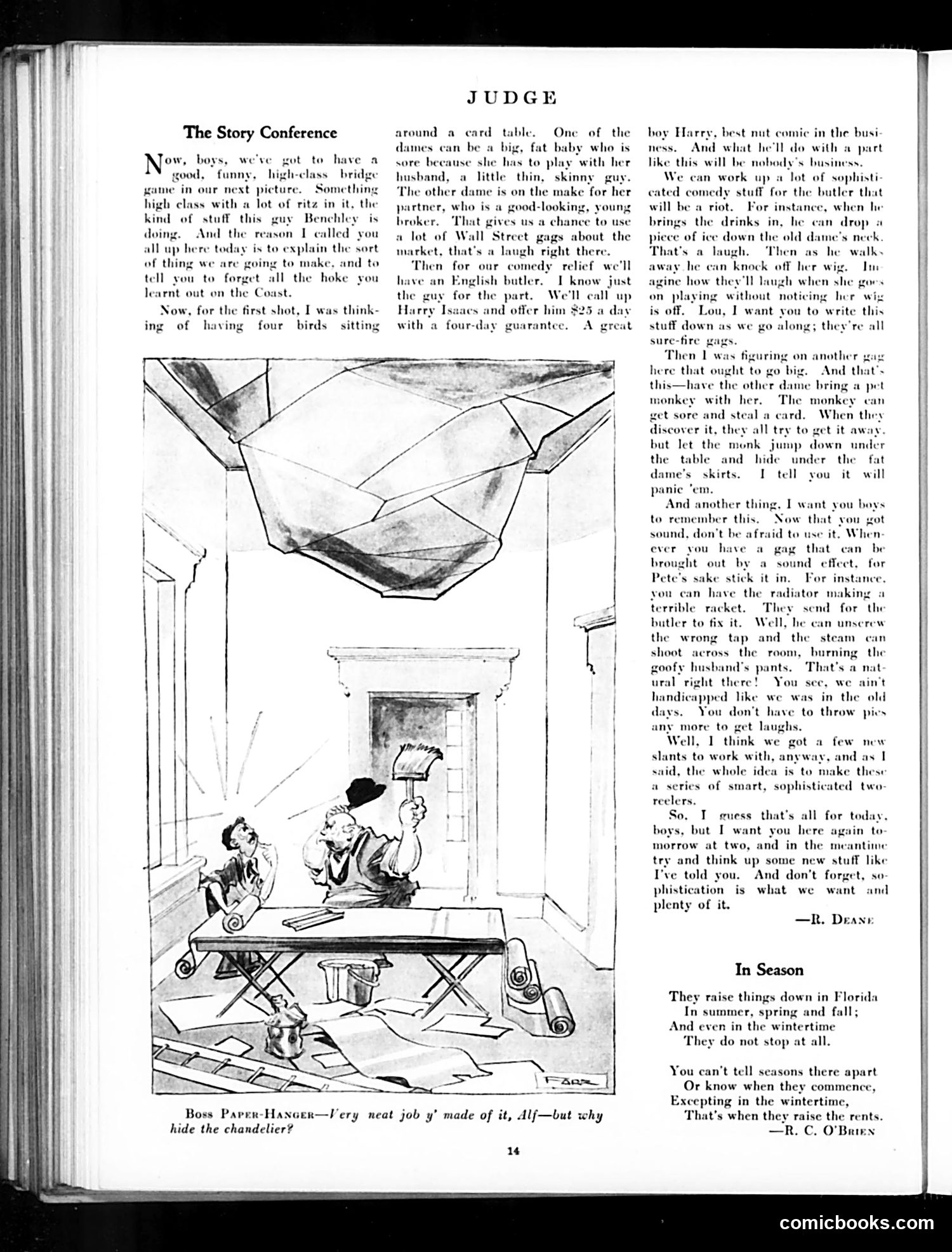
"The Story Conference" — A Hollywood Satire This page satirizes early Hollywood film production, specifically the absurd creative process behind comedy shorts. A studio boss explains to his writing team how they'll construct a "sophisticated" two-reeler film around a card-table scene. The satire targets several things: the pretension of calling lowbrow slapstick "sophisticated," the cynical formula-driven approach to comedy (fat wife, handsome lover, bumbling servant), and the obsession with sound effects as a novelty. The boss's suggestions escalate absurdly—a monkey stealing cards, steam shooting across the room setting a man's pants on fire—while he insists this represents clever, modern filmmaking. The cartoon likely reflects Judge magazine's skepticism toward Hollywood's rapid transformation during the early sound era, when filmmakers were learning to exploit audio effects, often clumsily. The illustration of the boss gesturing grandly beneath a chandelier emphasizes his pompousness about fundamentally stupid ideas.
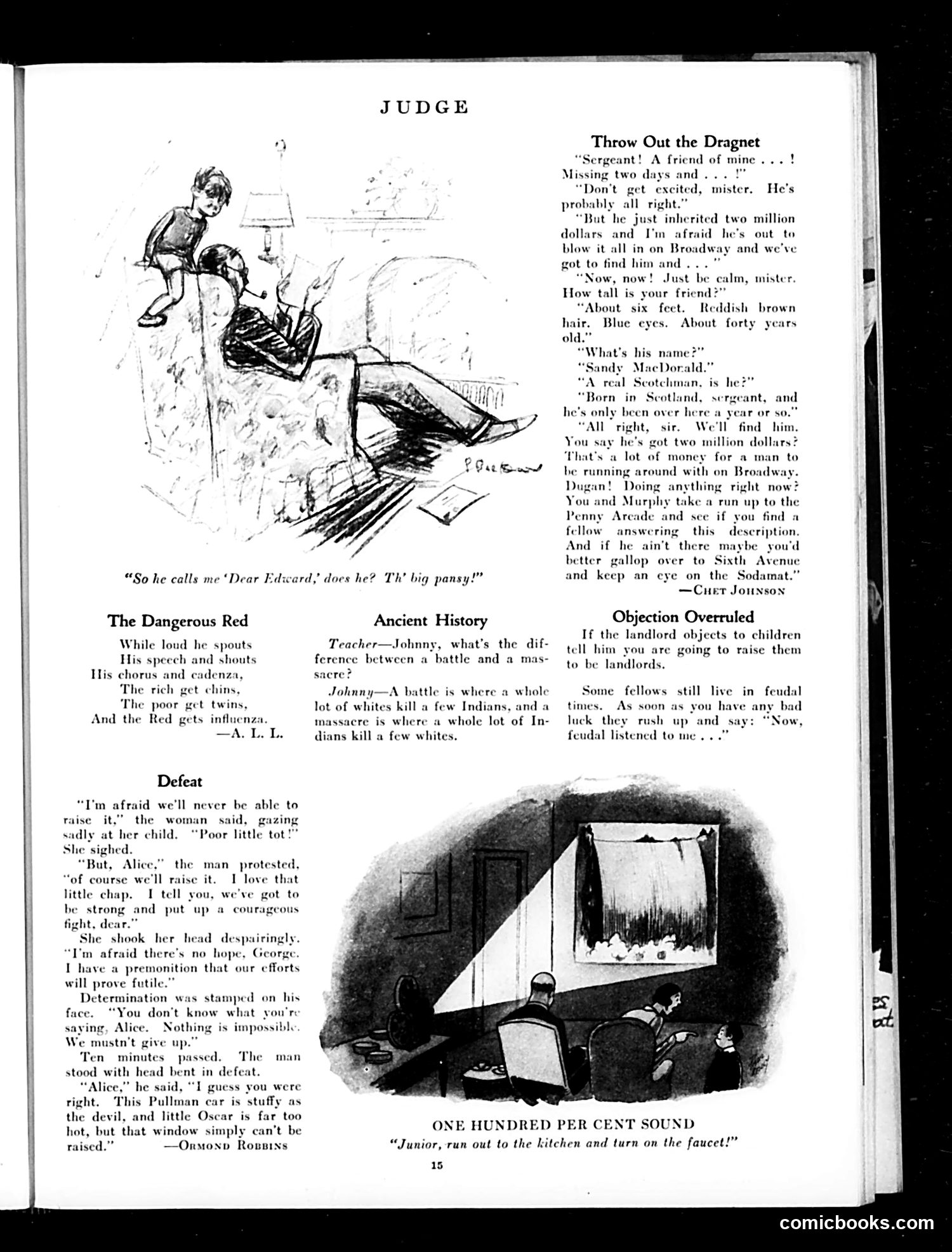
Judge Magazine Page Analysis This page contains several short satirical pieces typical of early 20th-century American humor: "The Dangerous Red" mocks radical/socialist politics, suggesting communist agitators deserve influenza as punishment—reflecting post-WWI anti-communist sentiment common in Judge. "Defeat" is domestic humor: a couple cannot open a stuck window on a Pullman train car despite the husband's determination, ending in comedic surrender. "Ancient History" is a schoolroom joke playing on racist stereotypes—the "joke" relies on reducing Native American history to body counts, reflecting the era's casual bigotry. "Throw Out the Dragnet" humorously depicts police searching for a wealthy Scottish immigrant on Broadway, implying he'll squander his inheritance on entertainment venues. "Objection Overruled" offers cynical class commentary: if landlords complain about tenants raising children, tell them you'll raise them to *become* landlords. The cartoons and text reflect 1920s attitudes: anti-radical politics, domestic absurdism, and class-conscious (if crude) social observation.
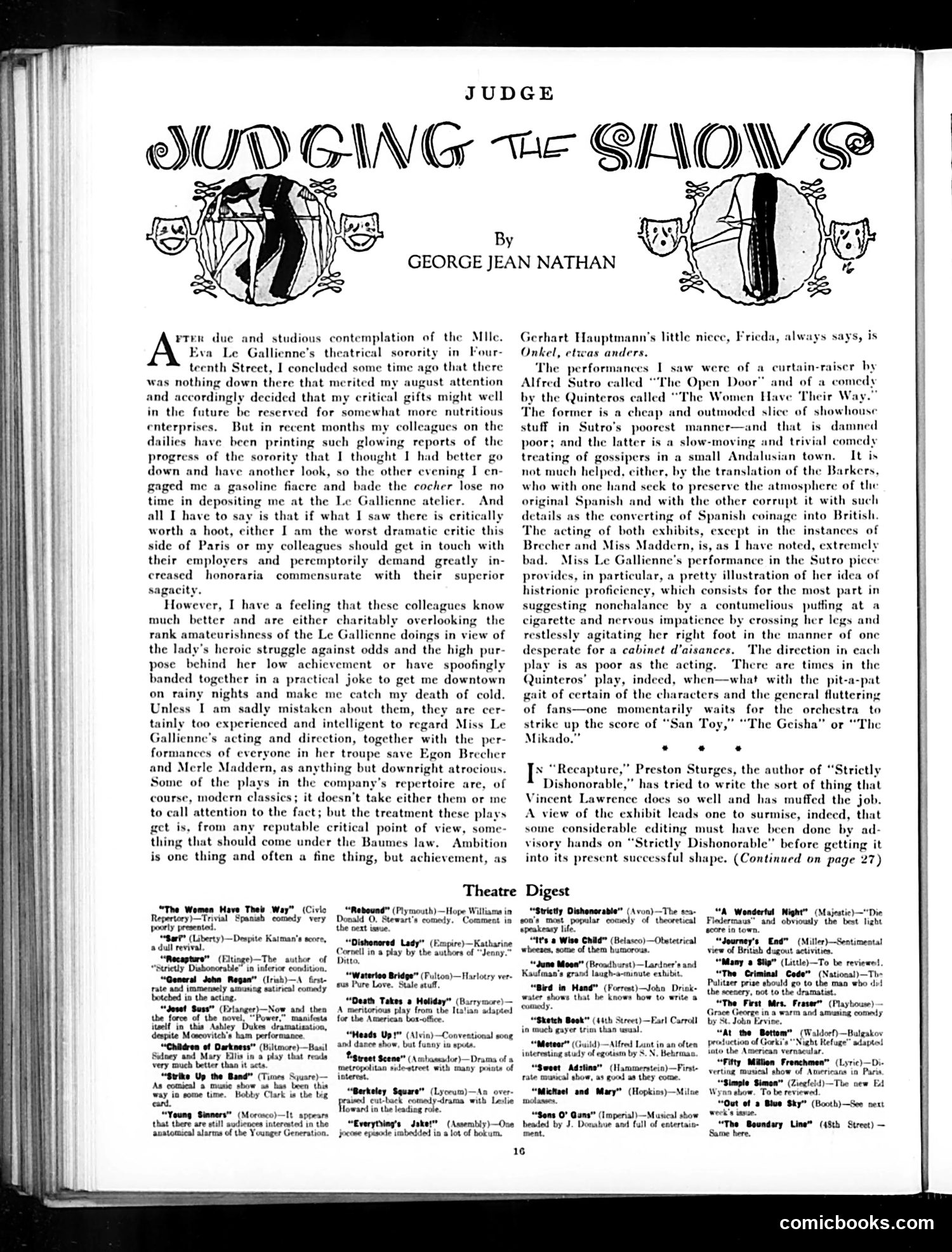
"Judging the Shows" by George Jean Nathan This is a theater review by prominent drama critic George Jean Nathan, critiquing Eva Le Gallienne's theatrical company on 14th Street in New York. Nathan dismisses the productions as amateurish and poorly executed, despite his colleagues' more charitable coverage. He specifically attacks two plays: Alfred Sutro's "The Open Door" (calling it cheap and outdated) and the Quinteros' "The Women Have Their Way" (slow-moving). He particularly mocks Le Gallienne's own acting technique—her reliance on cigarette-puffing and restless leg-crossing to convey emotion—and criticizes the direction as incompetent. Nathan suggests his fellow critics are either overlooking mediocrity out of sympathy for Le Gallienne's struggle as a theater entrepreneur, or pranking him into attending. The page includes a "Theatre Digest" section listing other productions, but Nathan's scathing review dominates.
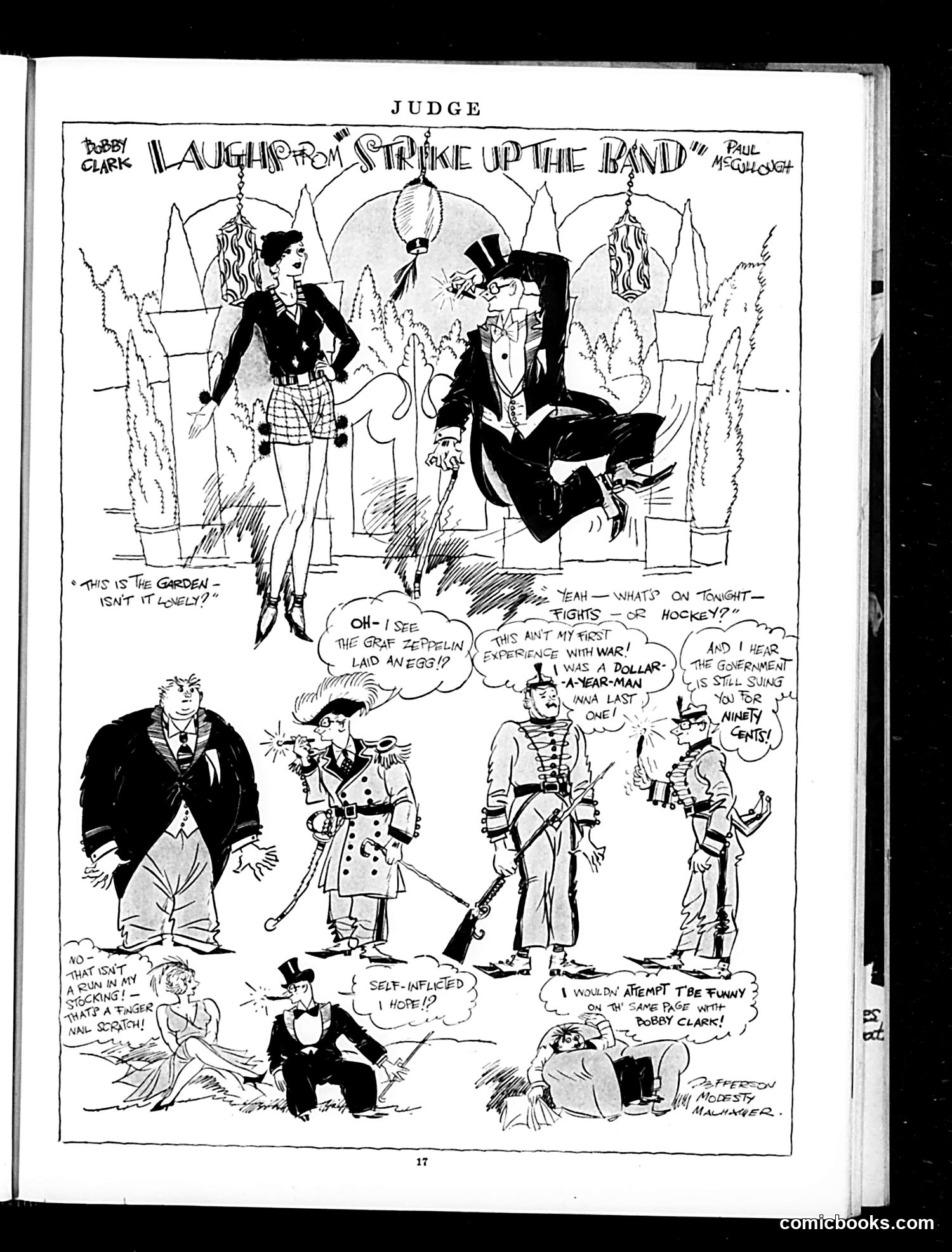
"Laugh or Strike Up the Band" - Judge Cartoon Analysis This cartoon satirizes post-WWI veterans and their complaints. The setting shows wealthy civilians enjoying leisure (the garden, evening plans), while uniformed military men interrupt with grievances about their wartime experiences and current hardships. The joke: veterans are portrayed as tedious bores, constantly referencing their war service and financial struggles (a dollar-a-year salary, government benefits), derailing polite conversation. One figure mentions the "Graf Zeppelin" (German airship), suggesting inflation or outdated concerns. The satire targets both the veterans' perceived neediness and civilian indifference to their plight—the civilians want entertainment (hockey, theater) while the soldiers demand recognition and compensation. The title suggests civilians should either laugh off these complaints or "strike up the band" (distract themselves). This reflects post-1920s American attitudes: ambivalence toward veteran welfare and impatience with their continued demands for support.
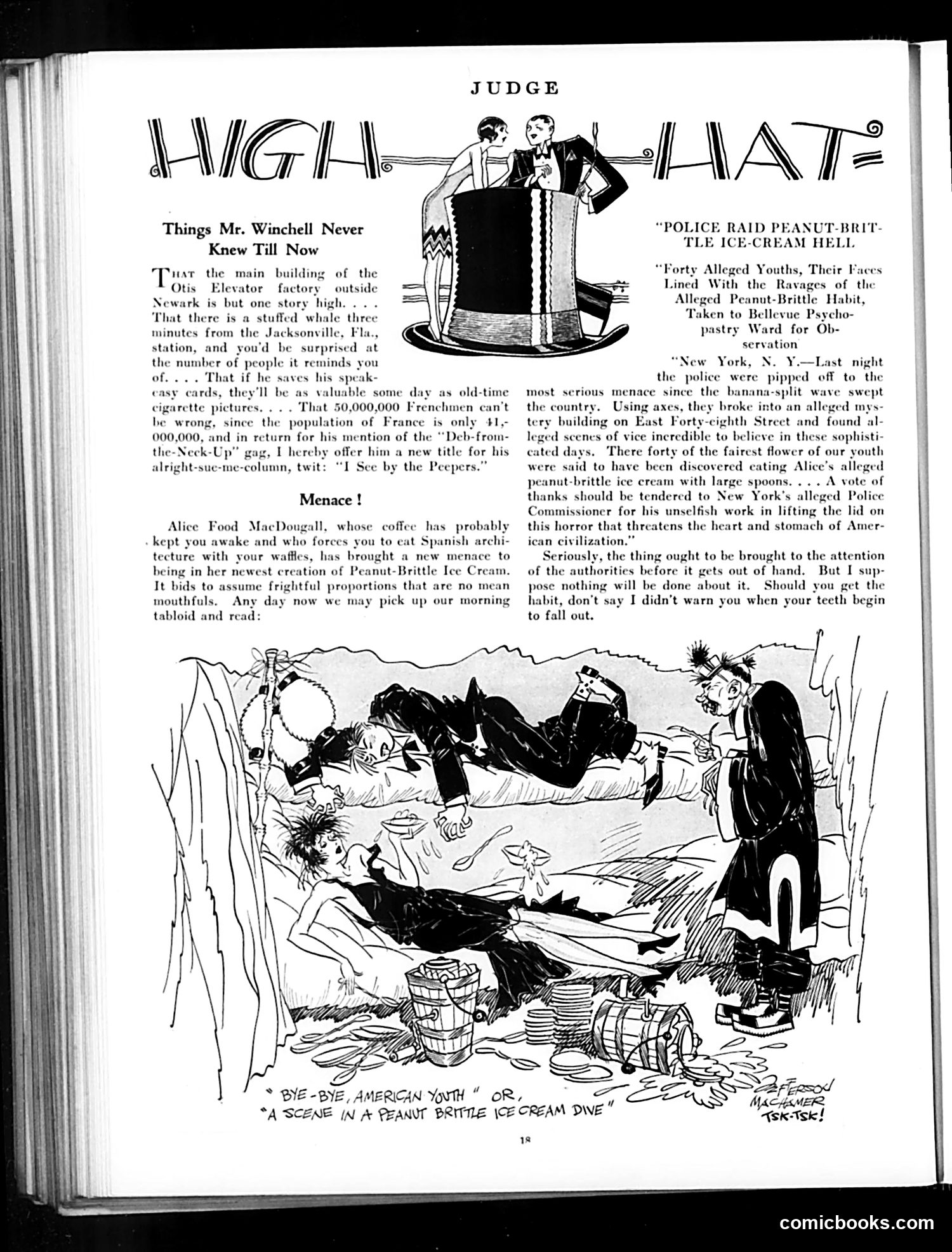
Judge Magazine Satire Analysis This page satirizes columnist Walter Winchell (referenced as "Mr. Winchell") and food writer Alice Foote MacDougall, who created a new Peanut-Brittle Ice Cream product. The satire works on two levels: 1. Top section mocks Winchell's gossipy column style with trivial "facts" he supposedly missed—a jab at his breathless reporting of inconsequential tidbits. 2. Main cartoon exaggerates MacDougall's ice cream as a social menace, parodying 1920s-30s moral panic journalism. The mock police raid headline imagines youth addicted to the product, sent to psychiatric observation at Bellevue Hospital. The cartoonist suggests MacDougall's creation is so dangerously appealing it warrants government intervention—absurdly treating dessert like an illicit drug threat. This reflects contemporary anxiety about modern consumer goods and youth culture, while mocking both celebrity food entrepreneurs and sensationalist crime reporting.
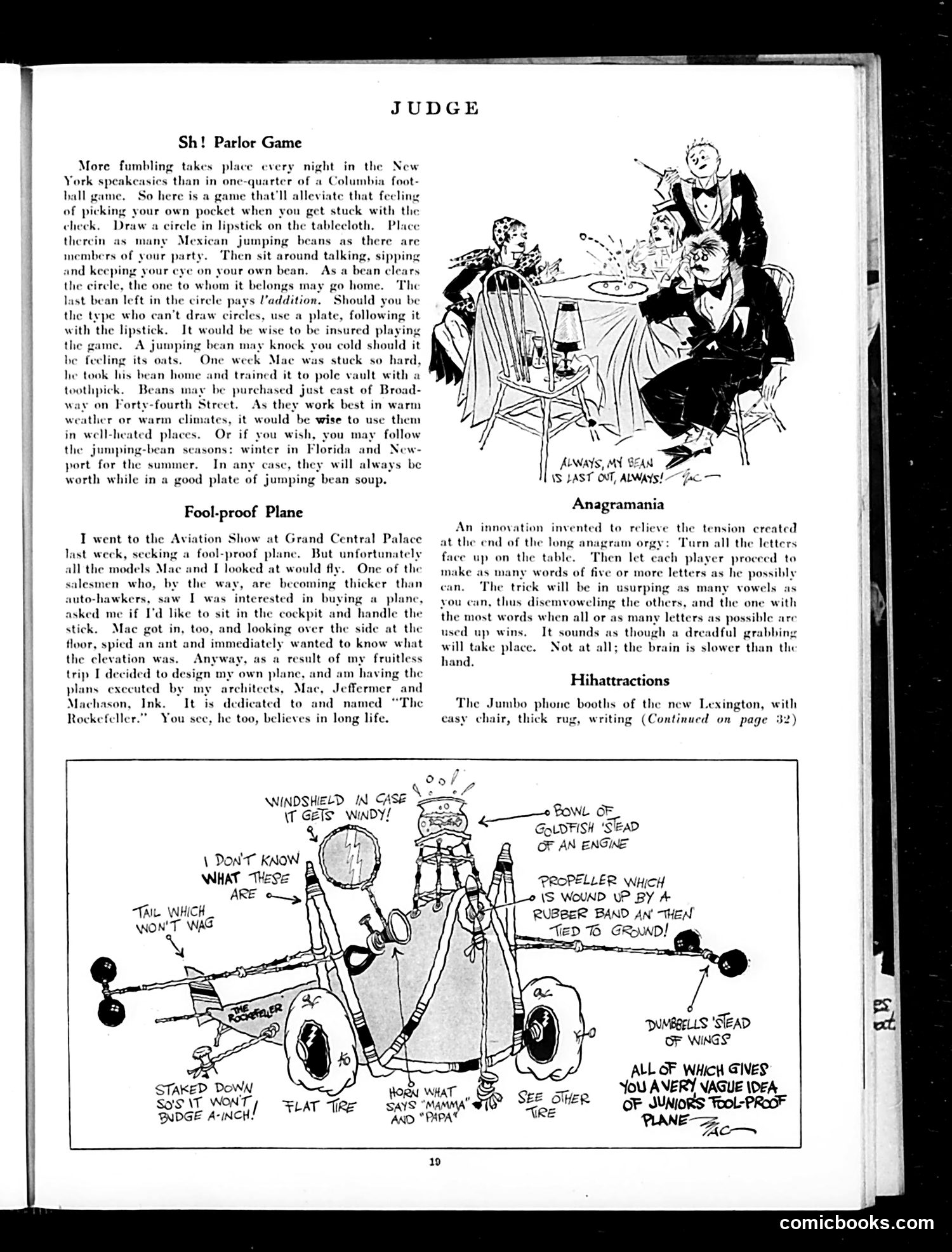
"Fool-Proof Plane" Cartoon Analysis This 1920s-era Judge cartoon satirizes aviation industry hype and salesmanship. The author attended an Aviation Show seeking a "fool-proof plane" but found all models actually flew—disappointing him. He then commissioned architects to design his own deliberately flawed aircraft, named "The Rockefeller." The labeled diagram humorously identifies absurd "safety features": a windshield that gets windy, a tail that won't wag, flat tires, a propeller wound by rubber band, dumbbell-shaped wings, and a goldfish-head engine. The satire targets two things: the aviation industry's exaggerated safety claims during early aviation's chaotic period, and the wealthy's pretentious commissioning of custom designs. The joke—that an intentionally bad plane somehow represents sophistication—mocks both aviation snake-oil salesmanship and upper-class affectation. The cartoon reflects public skepticism about early flight technology's reliability.
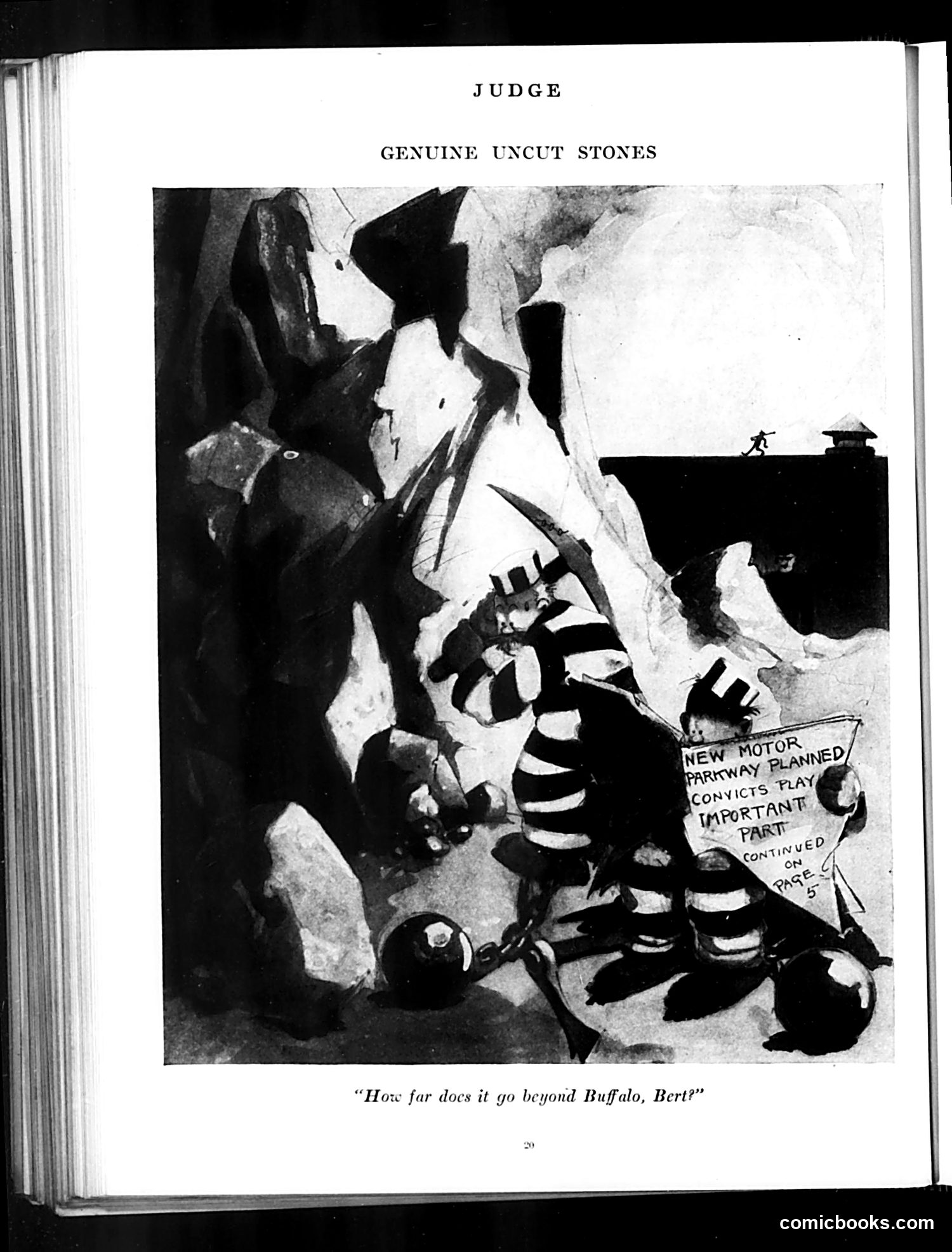
Analysis This page from *Judge* magazine presents a satirical cartoon titled "How far does it go beyond Buffalo, Bert?" The image shows exaggerated caricatured figures examining what appears to be gemstones or diamonds. A label references "NEW MOTOR PARKWAY PLANNED / CONVICTS PLAY / IMPORTANT PART / CONTINUED ON PAGE 5," suggesting the cartoon relates to a Long Island Motor Parkway construction project involving convict labor. The title's reference to "Buffalo, Bert" (likely Buffalo Bill or a contemporary figure) and "uncut stones" creates a double meaning—the cartoon likely satirizes either the quality of the motorway project or critiques the use of convict labor as "rough" or unrefined work. The exaggerated physical features typical of early 20th-century satirical cartooning reinforce the mockery. Without seeing page 5's continuation, the full satirical point remains partially unclear.
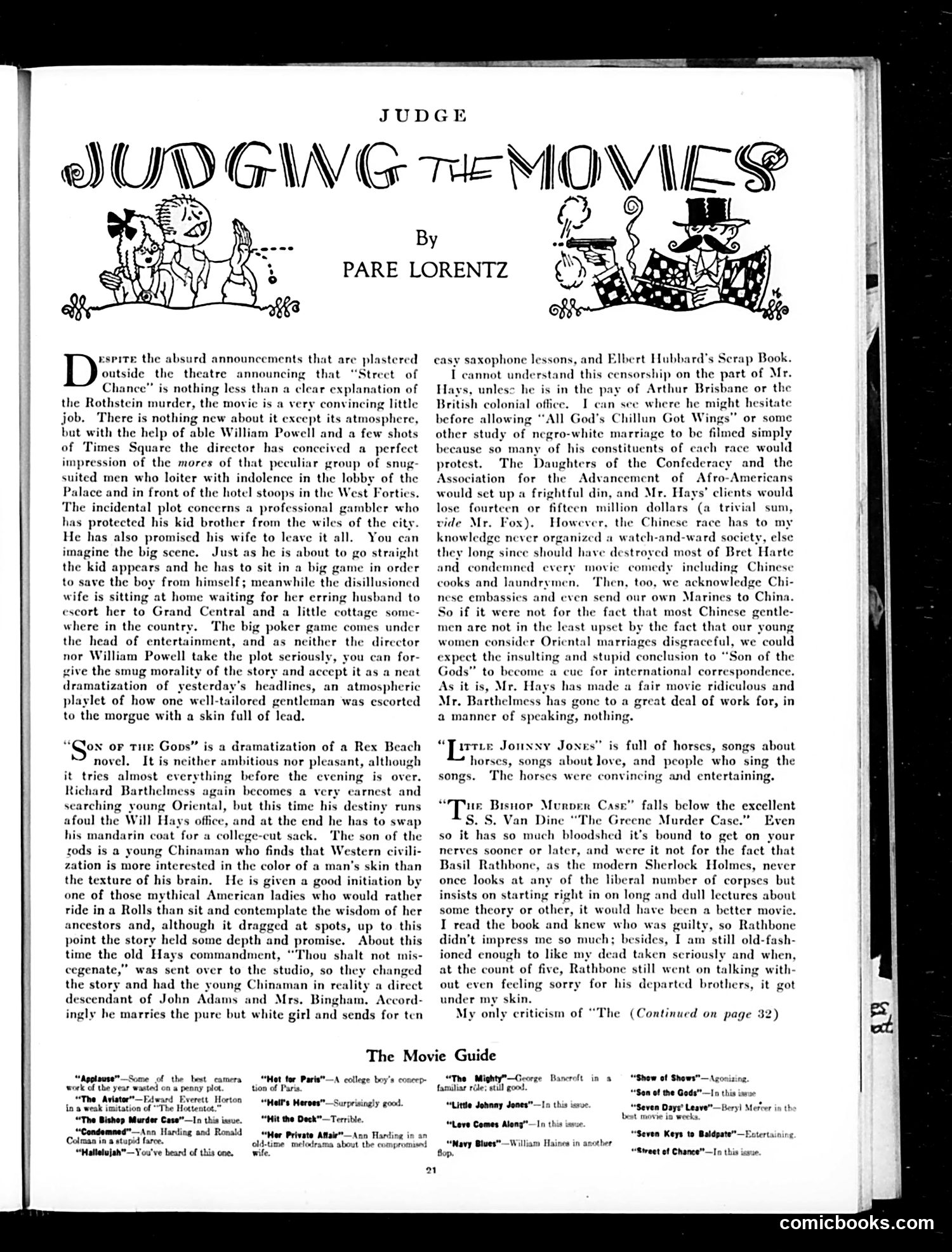
Judge Magazine: "Judging the Movies" by Pare Lorentz This is a film criticism column reviewing contemporary movies. Lorentz critiques several films, notably objecting to censorship by Will Hays (head of Hollywood's moral censorship board). Key points: - "Street of Chance" depicts gangster/gambling culture around Times Square and the Rothstein murder case - "Cow or the Gods" stars Richard Barthelmess as a Chinese man; Lorentz criticizes Hays for imposing the "miscegenation" ban—forcing filmmakers to rewrite the ending so the character becomes secretly descended from John Adams rather than allowing an interracial romance - Lorentz attacks this censorship as absurd, suggesting Hays fears boycotts from white supremacist groups (Daughters of the Confederacy) and Black rights organizations alike The satire targets Hollywood's cowardly self-censorship driven by fear of offending segregationist audiences, revealing the racist constraints on 1920s filmmaking.
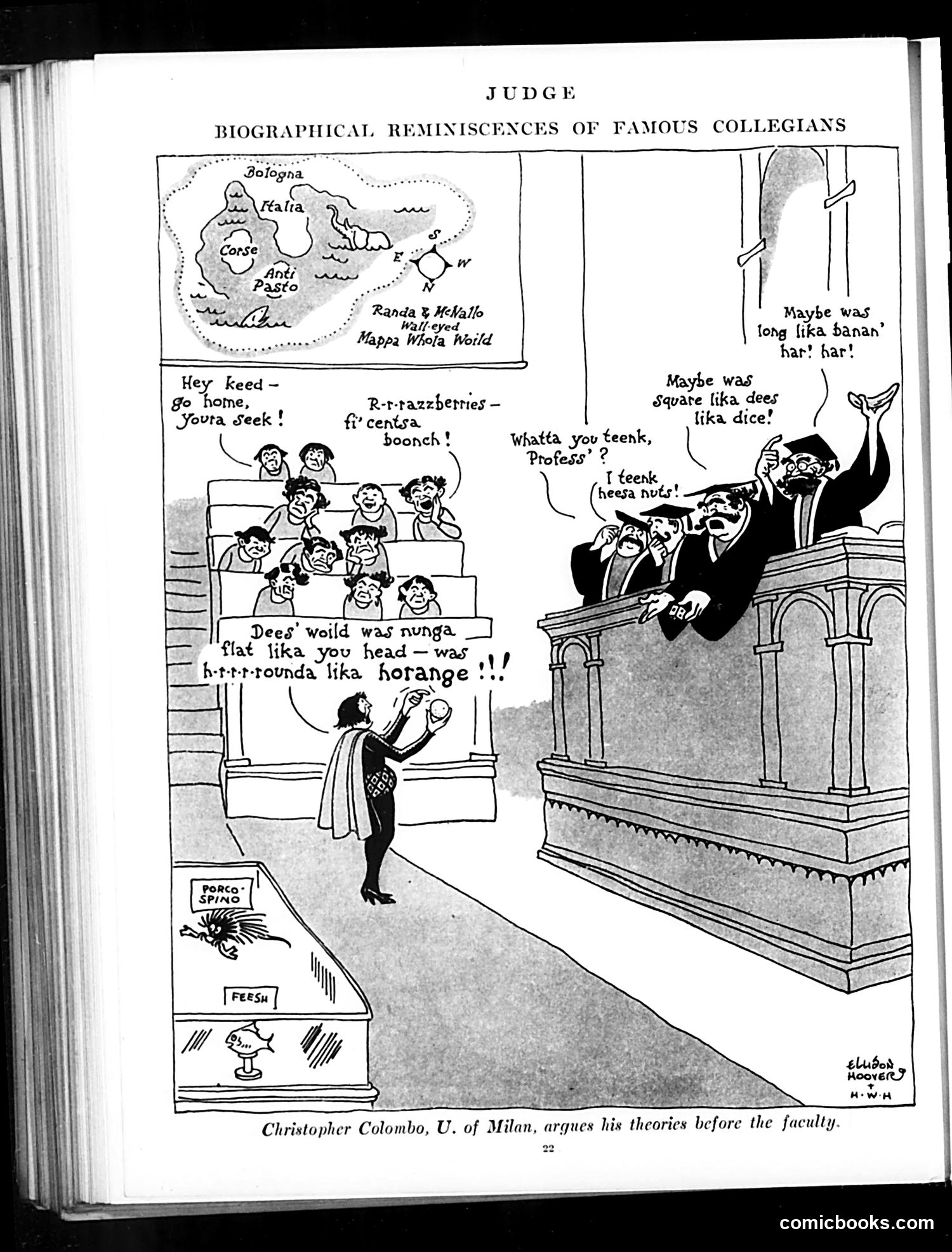
Analysis of Judge Magazine Cartoon This satirical cartoon mocks Christopher Colombo (Colombus) of the University of Milan, shown presenting his geographical theories to faculty members on a raised platform. The humor centers on ethnic caricature and dialect. Colombo speaks in exaggerated Italian-accented English ("Whatta you teenk, Profess?" "dees' woild was nunga flat"). He argues the world is "round like an orange," supported by crude visual "evidence"—labeled boxes containing items like "Porco Spino" (porcupine) and "Fresh" fish—apparently meant to represent natural specimens proving his theories. The faculty members above respond with equally mocking Italian dialect ("R-r-razzberries," "Jovta Seek"), treating his ideas as laughable. The satire targets: Italian immigrants' accents and education levels, presenting Colombus/Columbus as an outsider with absurd "scientific" claims. The cartoon reflects early 20th-century American attitudes mocking immigrant intellectuals and their credibility, using crude linguistic humor as the primary comedic device.
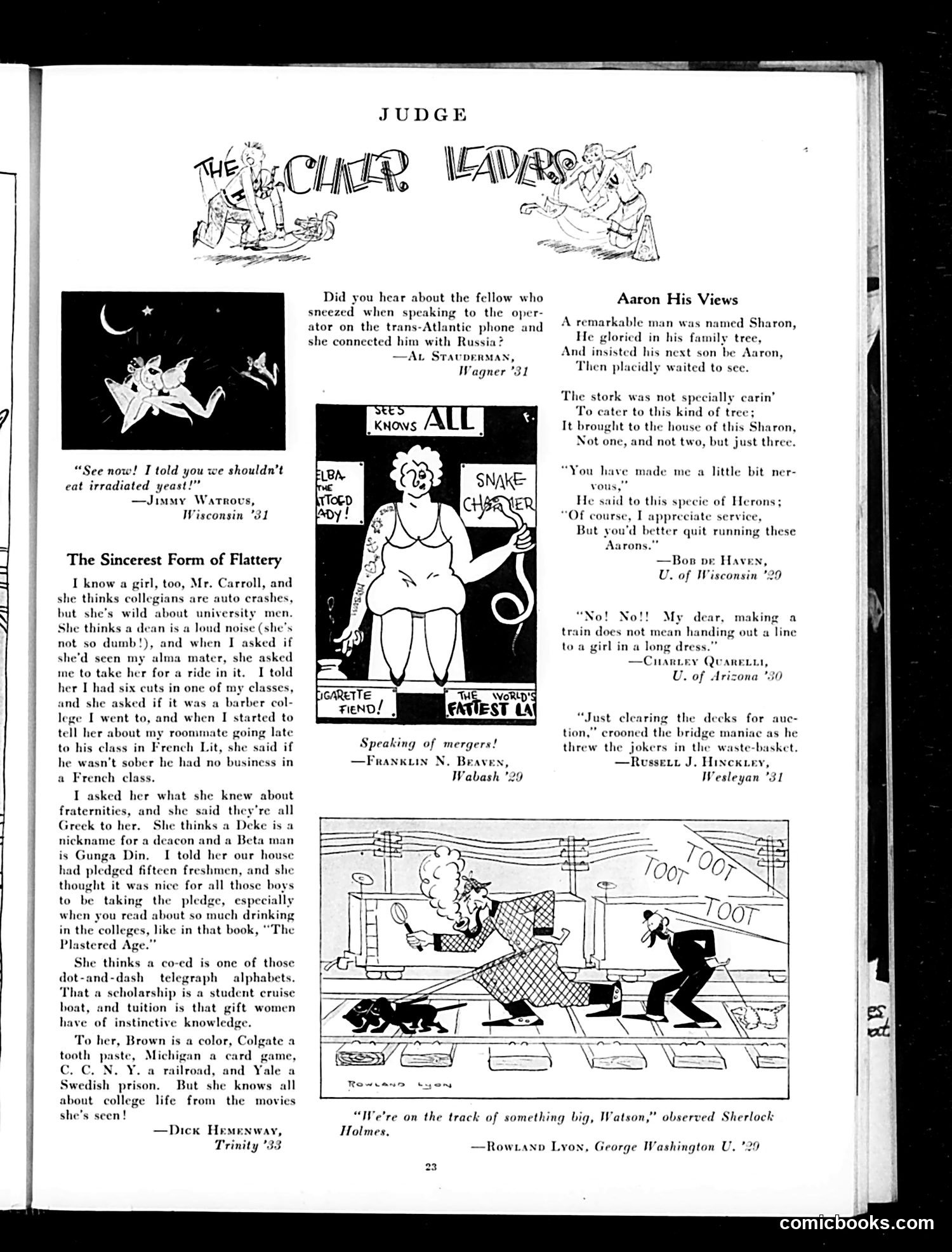
Judge Magazine Page Analysis This page contains humorous college-themed material from Judge magazine (likely 1920s-30s based on cited years). The main cartoons satirize: 1. Trans-Atlantic phone technology: A joke about early telephone connections being unreliable—sneezing during a transatlantic call supposedly connected someone to Russia instead, mocking both the novelty and fragility of international communications. 2. College girls' ignorance: "The Sincerest Form of Flattery" mocks a young woman's complete misunderstanding of university life and terminology. She confuses fraternity names with unrelated things (Beta man = Gunga Din, Deke = deacon), mistakes college institutions for irrelevant concepts (Yale = Swedish prison, Brown = a color), and thinks fraternities are about temperance pledges. 3. Various student humor: Scattered jokes about train travel, card games, bridge playing, and stork deliveries with multiple babies—typical collegiate magazine fare. The cartoons rely on period-specific references (transatlantic phones, fraternity culture, movie knowledge) that needed explaining even then—the humor assumes readers' familiarity with these contexts.
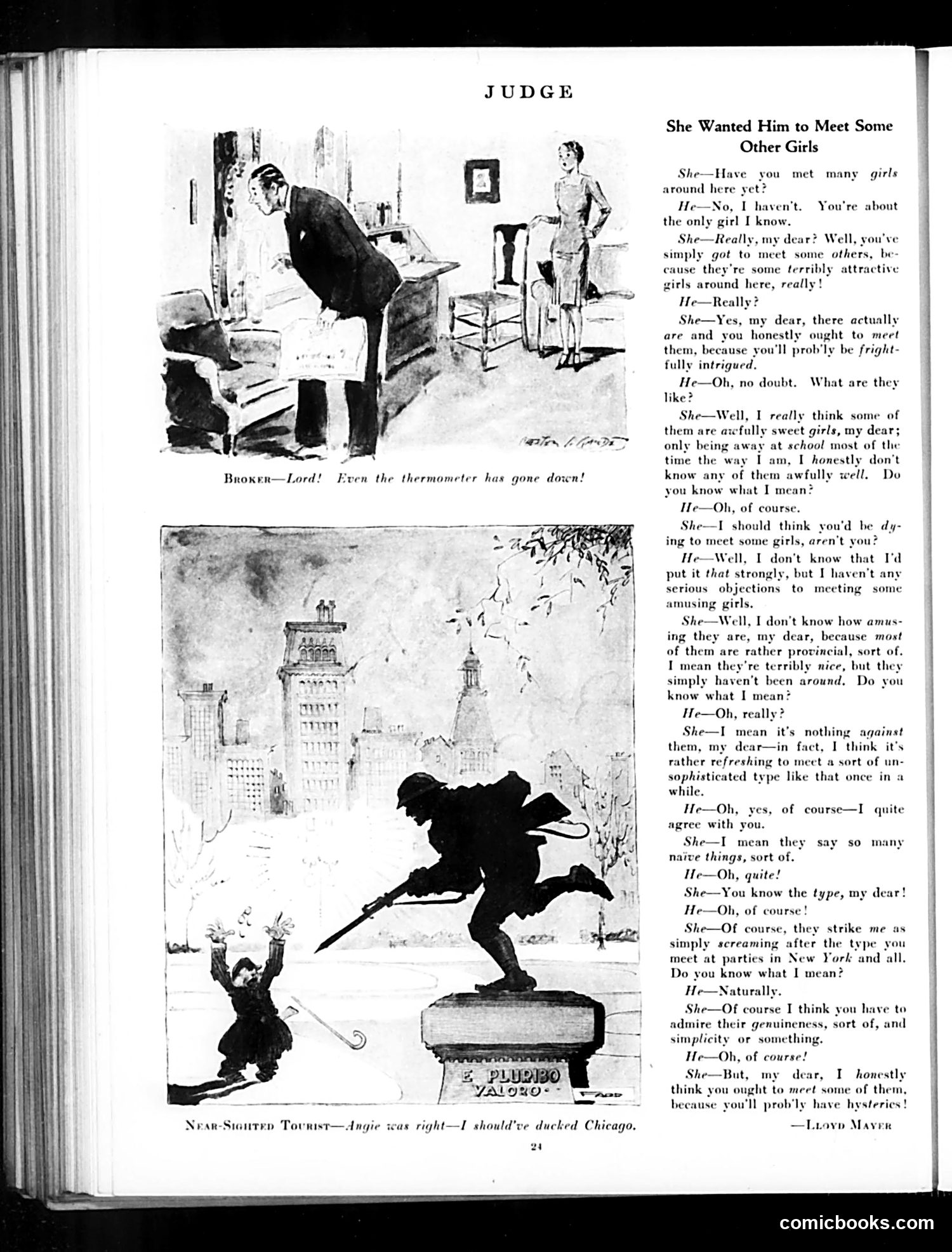
Analysis This page contains two separate Judge cartoons satirizing early 20th-century social types and behavior. Top cartoon: A broker panics over plummeting stock prices (the thermometer reference), depicting the anxiety of financial markets. Bottom cartoon: "Near-Sighted Tourist" shows a man narrowly avoiding a statue, with the caption suggesting he should have "ducked Chicago"—likely mocking both tourists' obliviousness and the city itself. Main dialogue feature: "She Wanted Him to Meet Some Other Girls" satirizes a woman's relentless social matchmaking. She repeatedly describes other girls as "terribly attractive," "awfully sweet," and "provincial" while contradicting herself—claiming they're unsophisticated yet also "screaming" (fashionable), never admitting she barely knows them. The satire targets upper-class women's gossipy, shallow social maneuvering and their tendency to talk endlessly while saying nothing substantive. The man's robotic agreement ("Oh, of course") mocks masculine passivity in such conversations. The humor derives from recognizing these as familiar social archetypes of the era.
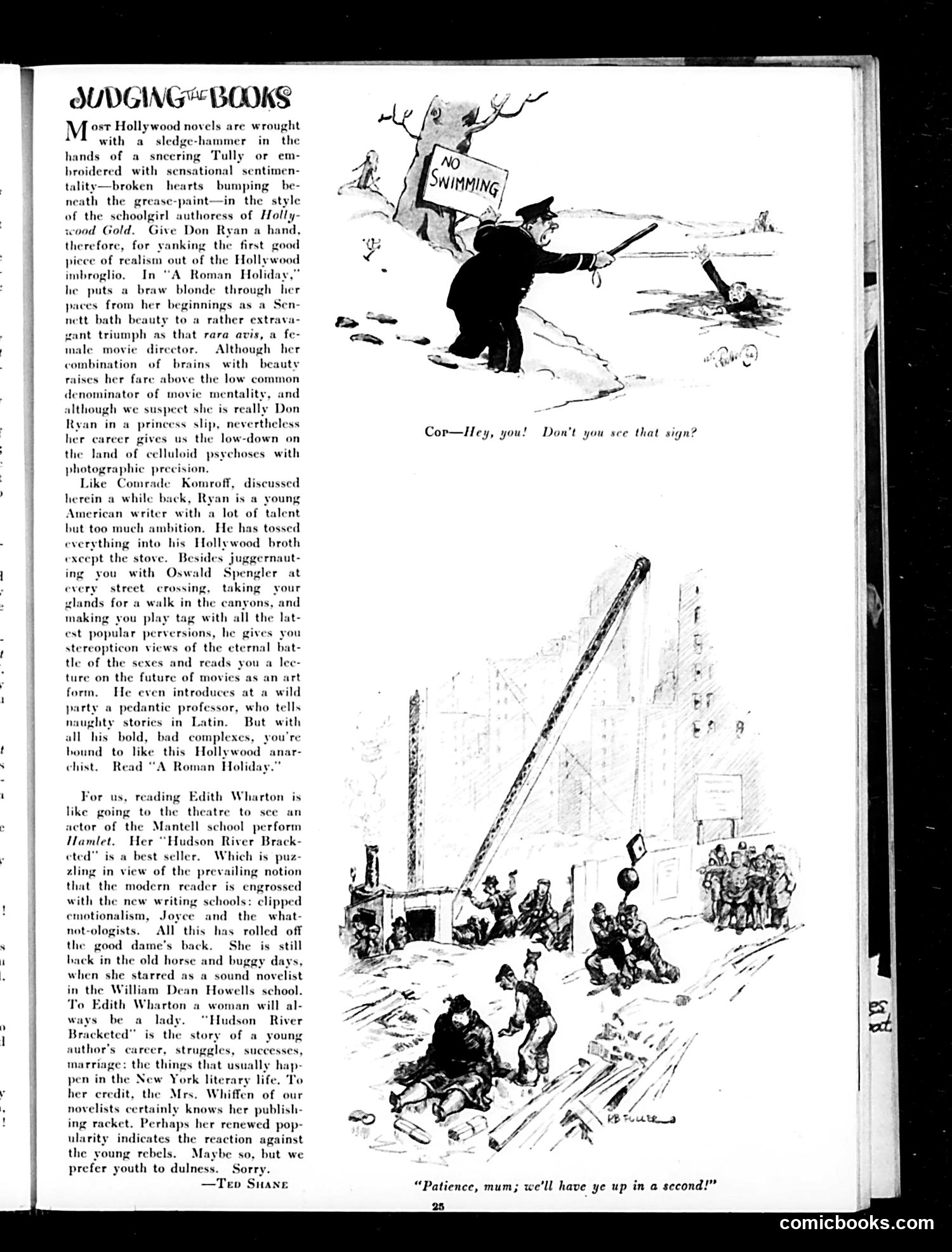
Judging the Books: Book Review Satire This page contains two book reviews by Ted Shane, accompanied by illustrative cartoons rather than political satire. Don Ryan's "A Roman Holiday": The review praises Ryan for injecting realism into Hollywood fiction, which typically relies on melodrama and sentimentality. The cartoon shows a man posting a "No Swimming" sign, humorously illustrating the book's satirical take on Hollywood's absurdities. Edith Wharton's "Hudson River Bracketed": Shane critiques Wharton as old-fashioned, still writing in the 19th-century style of William Dean Howells despite modern literary trends (Joyce, experimental "what-not-ologists"). The lower cartoon depicts construction workers, seemingly illustrating the novel's period setting or old-fashioned world. Shane's tone is dismissive toward both authors—praising Ryan's ambition while calling him an "anarchist," and gently mocking Wharton's refusal to modernize, though acknowledging her commercial success. The reviews reflect 1920s literary debates about realism versus experimentation.
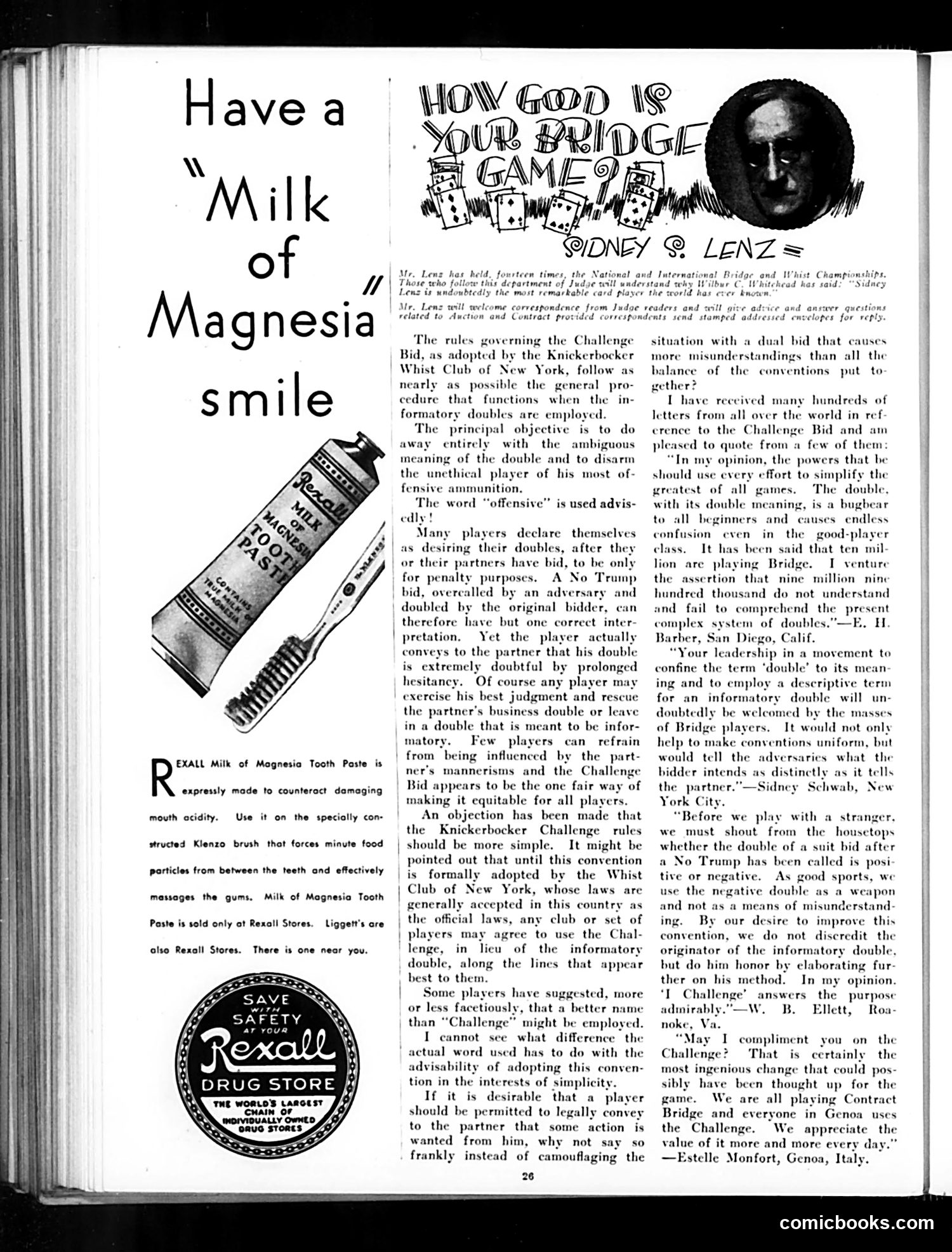
Content Analysis for Modern Readers This page combines advertising (left side) with bridge card game commentary (right side). The Milk of Magnesia ad promotes toothpaste with the slogan "Have a 'Milk of Magnesia smile'"—a typical 1920s-30s advertisement using a product name as aspirational branding. The main content is a Judge magazine column by Sidney S. Lenz (the photograph shows him) addressing bridge players. Lenz discusses the "Challenge Bid," a proposed rule simplification for contract bridge, which was a major leisure activity among educated Americans at this time. The satire/point: The column represents bridge as a serious, complex intellectual pursuit worthy of extended debate in a humor magazine. Letters from readers suggest confusion about bridge's double-bidding conventions. The satire is subtle—Judge legitimizes Lenz as an authority figure discussing arcane card-game rules as if they were matters of national importance. This reflects early 20th-century American culture where bridge was elite entertainment, and rule standardization was genuinely debated.
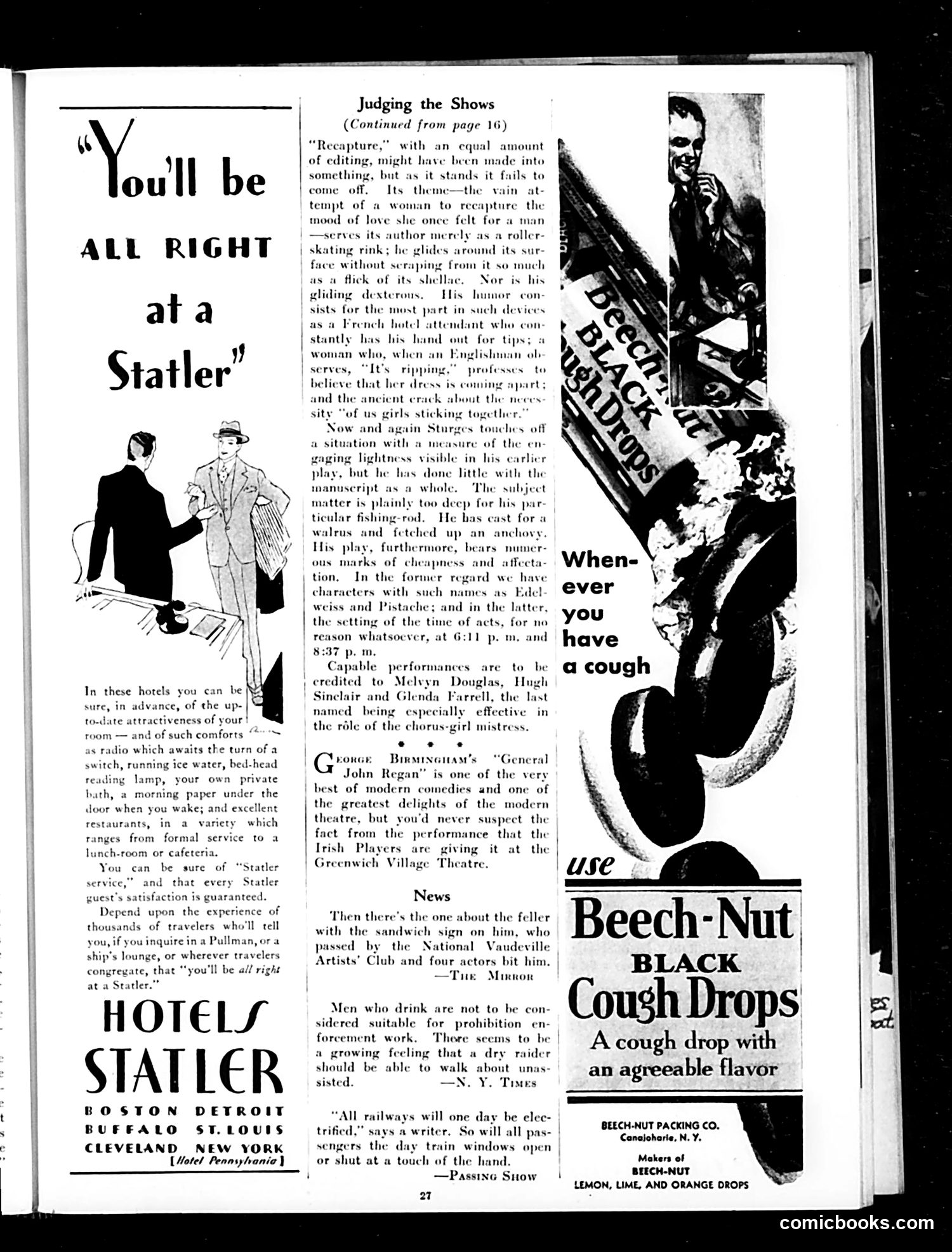
Judging the Shows Page from Judge Magazine This page mixes theater criticism with period advertisements. The main content reviews contemporary plays, including harsh critique of a work called "Recapture" (plot: a woman attempts to recapture past romantic feelings). The reviewer finds it shallow and poorly constructed, though he praises the performances of actors Melvyn Douglas, Hugh Sinclair, and Glenda Farrell. There's also brief praise for George Birmingham's "General John Regan" at the Greenwich Village Theatre, performed by Irish Players. The "News" section contains period humor: a joke about actors punching a man with a sandwich-board sign near the National Vaudeville Artists' Club; commentary on prohibition enforcement officers being drunk; and a quip about future electrified trains. The left side features a Statler Hotels advertisement with cartoon imagery of well-dressed travelers, emphasizing modern hotel amenities. The right side advertises Beech-Nut Black Cough Drops.
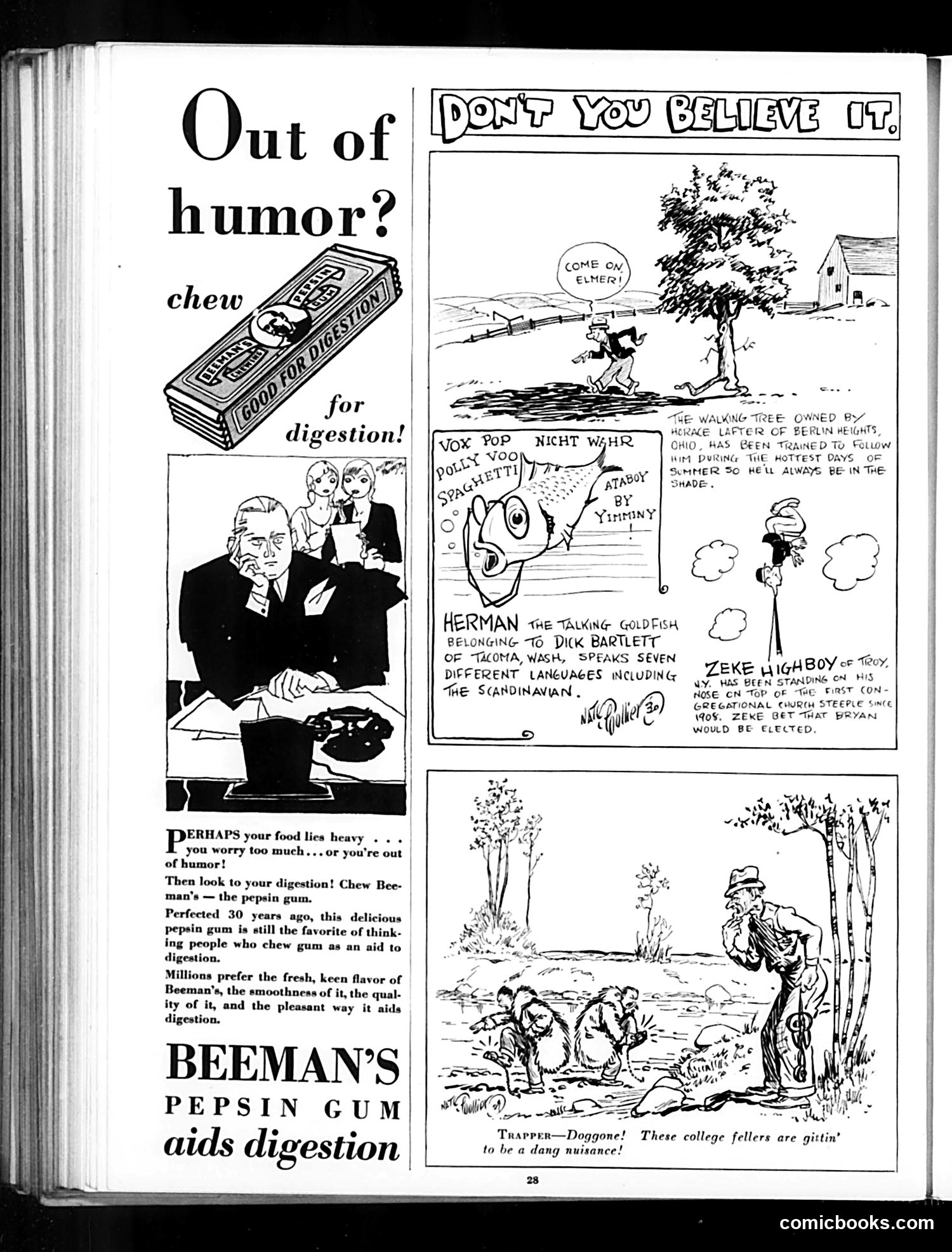
Political Cartoon & Comics Analysis This page combines a Beeman's Pepsin Gum advertisement (left) with humorous feature comics (right) from Judge magazine. The Advertisement: Uses pseudo-scientific reasoning typical of early 20th-century marketing—claiming gum aids digestion and improves mood. The anxious businessman illustration reinforces the sales pitch that digestive worry causes unhappiness. "Don't You Believe It" Comics: Three tall-tale sketches mocking gullible Americans: - A "walking tree" trained to follow shade - A talking goldfish speaking seven languages - A man standing on a church steeple since 1900 over a bet that Bryan (William Jennings Bryan) would be elected president The Satire: The right-side comics mock exaggerated claims and foolish beliefs—likely a commentary on people believing dubious advertisements like the pepsin gum pitch on the same page. The trappers' final comment dismisses college students promoting such nonsense. The juxtaposition suggests Judge is satirizing both credulous consumers and dubious commercial claims.
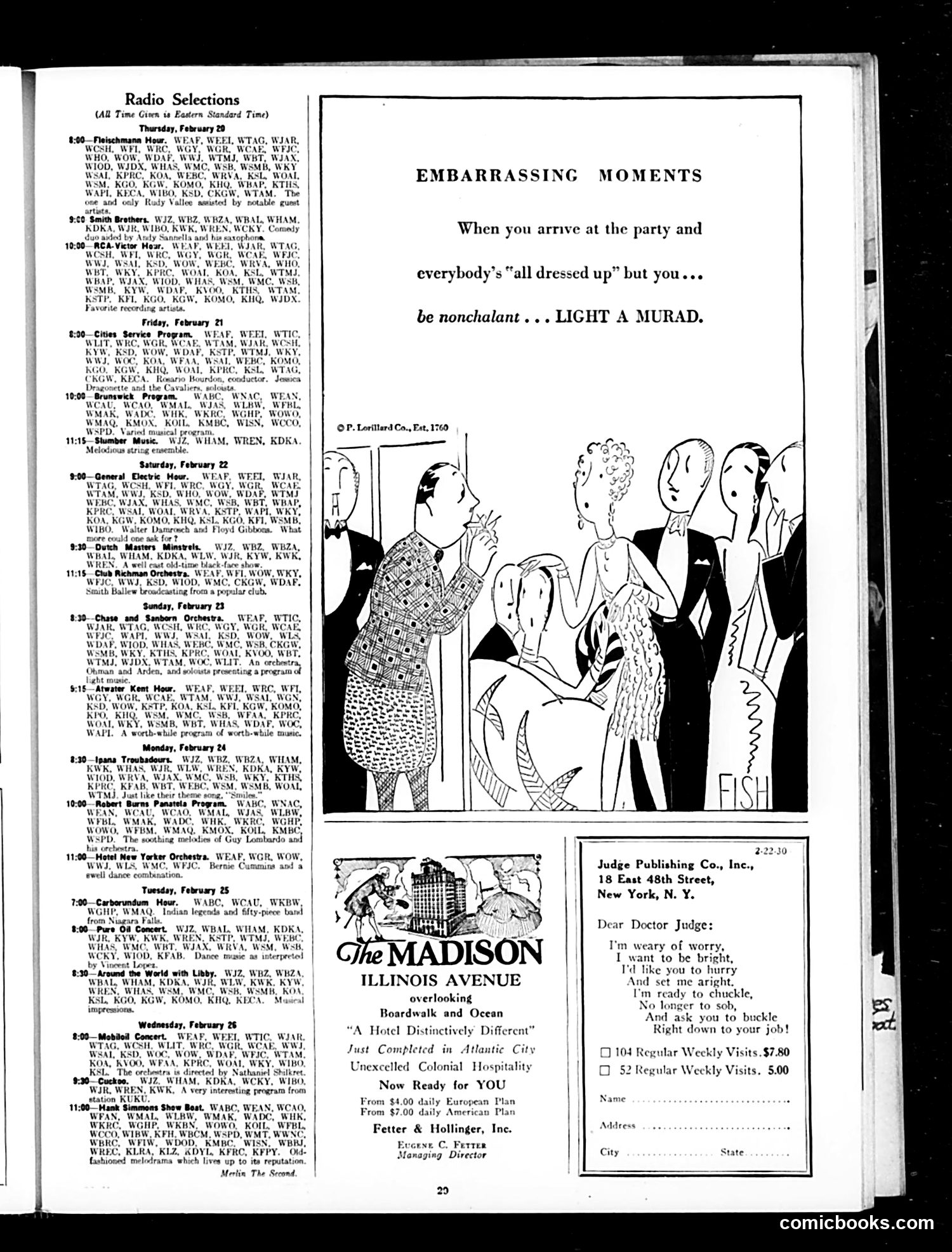
"Embarrassing Moments" Cartoon Analysis This is a satirical cartoon about social anxiety at formal events. The caption reads: "When you arrive at the party and everybody's 'all dressed up' but you... be nonchalant... LIGHT A MURAD." The Joke: A poorly dressed man arrives at an elegant party where everyone else wears formal attire. The cartoon suggests he should mask his embarrassment by casually lighting a Murad cigarette—implying that confident smoking behavior can cover social awkwardness. Context: This is a cigarette advertisement disguised as humor. Murad was a popular cigarette brand in the 1920s-30s. The ad exploits a relatable social anxiety (dress code mishaps) to sell the product, suggesting that smoking conveys sophistication and composure. For Modern Readers: This reflects an era when cigarette advertising was pervasive and unregulated, openly targeting insecurities. The crude gender dynamics (five formally-dressed women judge the underdressed man) and the notion that cigarettes solve social problems now seem absurd and exploitative.
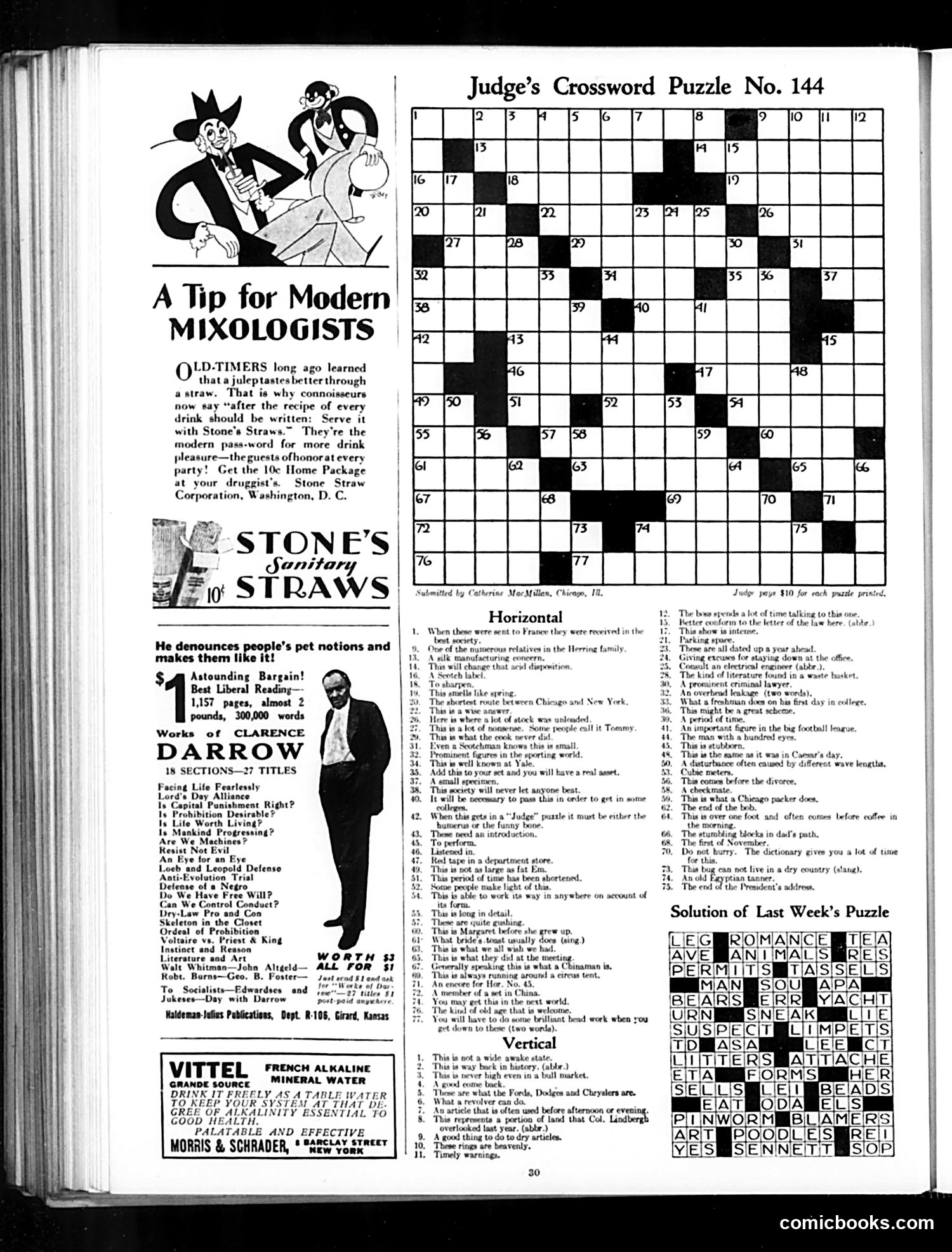
Judge Magazine Page Analysis This page is primarily a crossword puzzle (No. 144) with advertisements, not a political cartoon. The main content is a word puzzle with horizontal and vertical clues aimed at 1920s-era readers. The single cartoon at top left shows a caricatured figure (unclear who specifically) denouncing people's "pet notions" and making them "like it"—likely satirizing a bombastic public figure or politician known for aggressive rhetoric. The advertisements are the real focus: Stone's Straws (drinking straws for cocktails, playing on Prohibition-era drinking culture), Clarence Darrow's collected works (the famous defense lawyer), and Vittel mineral water. The clues reveal period preoccupations: references to Prohibition ("dry country"), aviation (Lindbergh), automobiles (Ford, Dodge, Chrysler), and social attitudes (college freshmen, divorce, servants). The crossword itself was entertainment—not commentary. This is essentially a puzzles-and-ads page rather than satirical content.
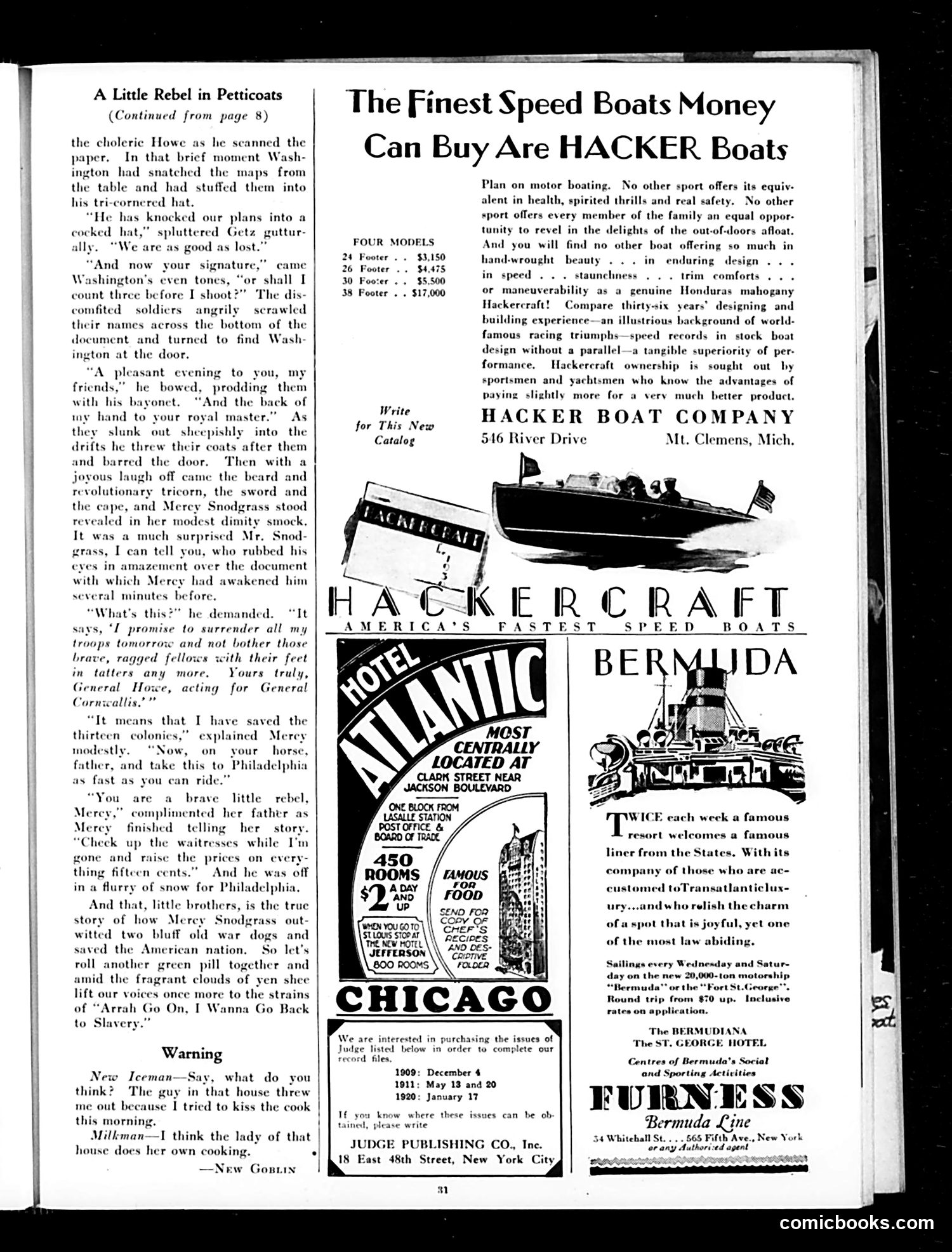
Page Analysis: Judge Magazine Advertisement Page This page is primarily advertisements with a serialized story continuation, not political satire. The Story Section ("A Little Rebel in Petticoats") is a Revolutionary War-era adventure narrative about a young woman named Mercy Snodgrass who impersonates General Washington, infiltrates British officers, and steals their surrender plans—saving the American colonies. The closing "Warning" section contains two brief jokes about domestic servants (an iceman and milkman making advances to cooks), playing on working-class stereotypes. The Advertisements dominate the page: Hacker Boats (speedboats), the Hotel Atlantic in Chicago, and the Bermuda steamship line. These reflect 1920s leisure culture and consumer goods marketing. The page contains no political cartoons or sophisticated satire—it's a commercial publication page mixing light adventure fiction with period advertising.
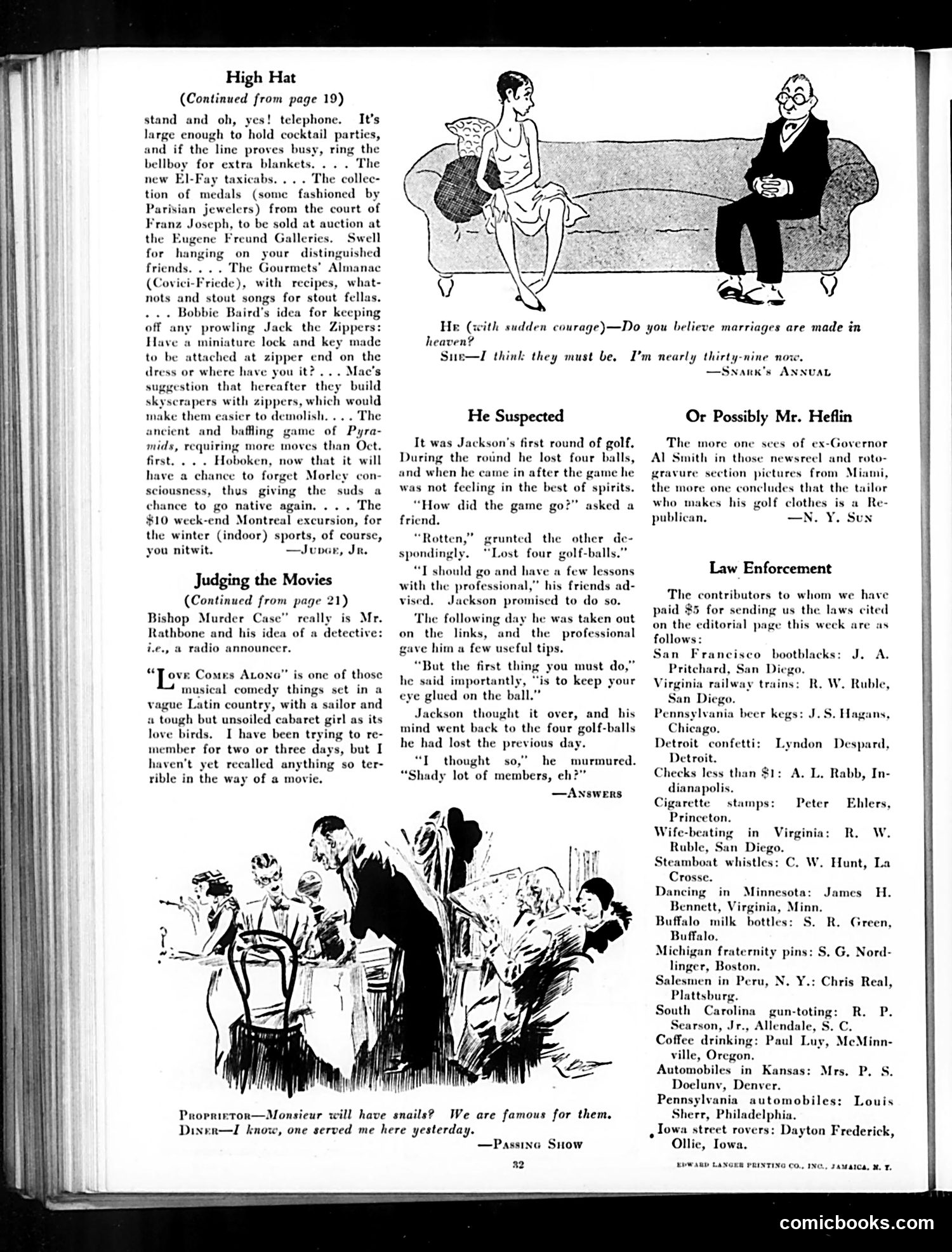
Explanation for Modern Readers This page from *Judge* magazine contains several distinct satirical pieces: "High Hat" mocks luxury consumer goods and absurd modern conveniences—zippers on skyscrapers, miniature locks for women's dresses to prevent theft, and expensive guidebooks for gourmands. "He Suspected" is a golf joke: Jackson loses four balls during play, then a pro advises him to "keep your eye glued on the ball." Jackson sarcastically replies there's a "shady lot of members"—implying the other golfers are thieves who stole his balls. The cartoon dialogue features a man asking a woman if she believes marriages are made in heaven. Her response—"I'm nearly thirty-nine now"—suggests desperation about remaining single, a common anxiety played for laughs in this era. "Law Enforcement" is a humorous list of regional violations (bootlegging in San Francisco, beer-making in Pennsylvania), likely satirizing Prohibition-era lawbreaking across America. The illustrations use period caricature styles typical of 1920s satirical magazines.
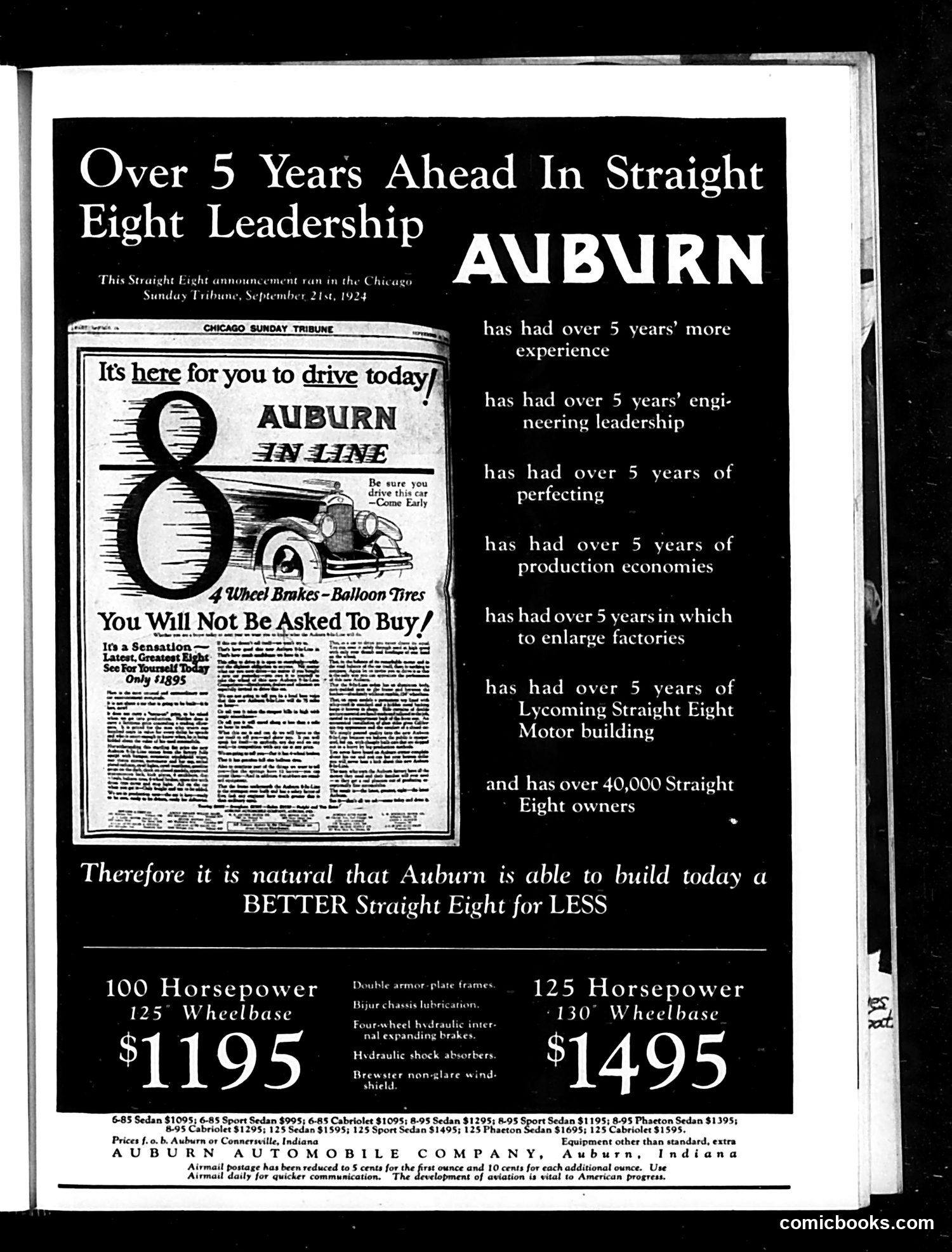
Auburn Automobile Advertisement This is primarily an advertisement, not satire. It ran in the Chicago Sunday Tribune (September 21, 1924) promoting Auburn automobiles' Straight Eight engines. The ad argues Auburn deserves leadership in this emerging automotive category because of five years of prior experience in engineering, production, and motor building—claiming over 40,000 satisfied owners. A facsimile of an earlier Auburn ad from the Tribune is reproduced to establish this track record. The sales pitch is straightforward: Auburn can build a "BETTER Straight Eight for LESS" money. Two models are offered at $1,195 and $1,495, with technical specifications listed (horsepower, wheelbase, brakes, etc.). For modern readers: This reflects 1920s automobile marketing emphasizing reliability through experience—a competitive advantage claim when automotive technology was rapidly evolving and consumer trust in manufacturers was uncertain.
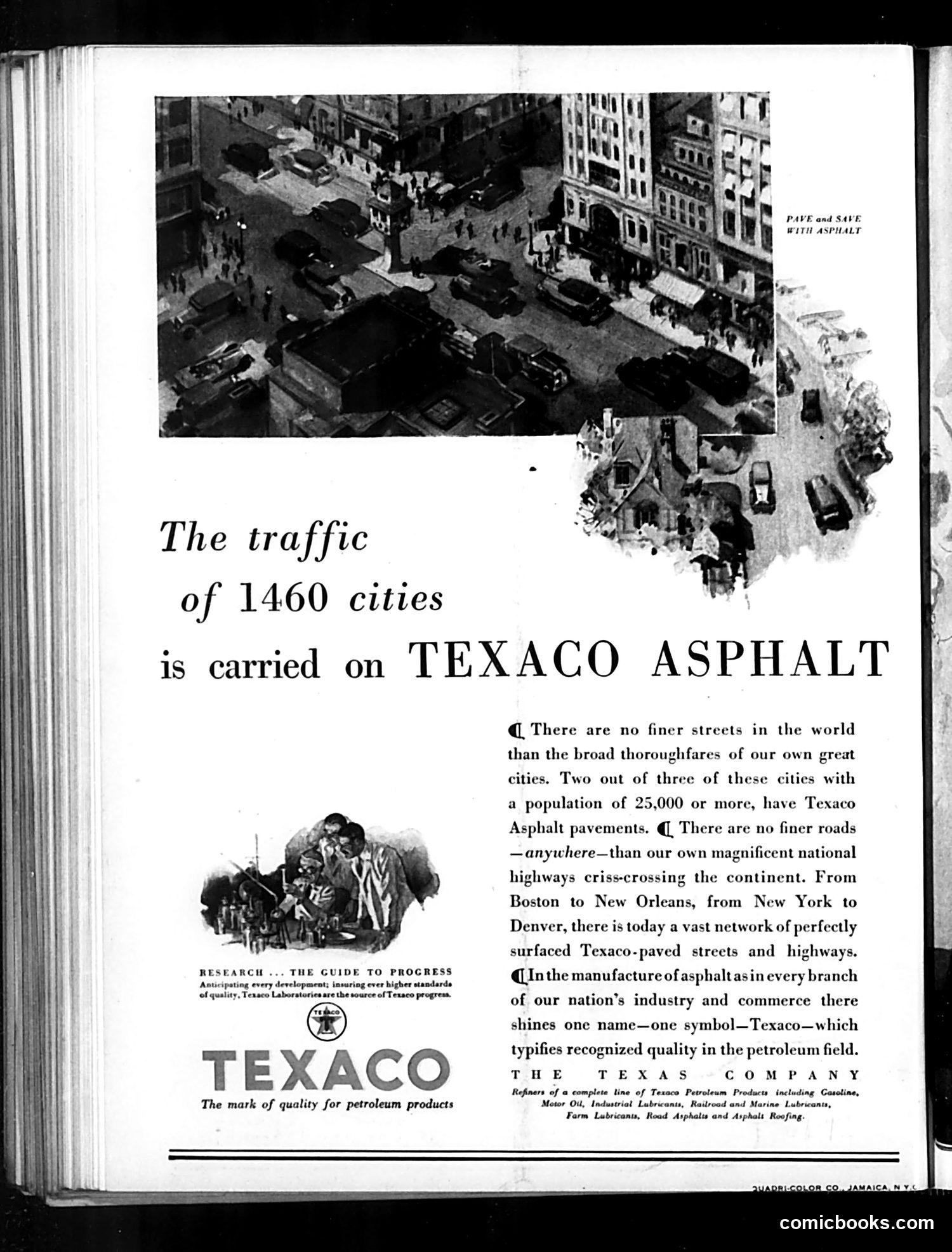
Analysis This is primarily a Texaco oil company advertisement, not a political cartoon or satire. It appears in *Judge* magazine but functions as corporate advertising rather than editorial content. The page promotes Texaco Asphalt for road construction. The images show urban traffic scenes and highway infrastructure. The text boasts that 2 out of 3 major American cities use Texaco pavement, and that national highways across the continent are Texaco-paved—from Boston to New Orleans and New York to Denver. The only potentially satirical element is the small sidebar labeled "RESEARCH... THE GUIDE TO PROGRESS," which appears to mock corporate research departments by suggesting Texaco anticipates developments and maintains quality standards. However, this reads more as marketing copy than genuine satire. The advertisement reflects 1920s-30s American confidence in automobile infrastructure and corporate brand-building through infrastructure claims.