judge
Judge — March 1, 1930
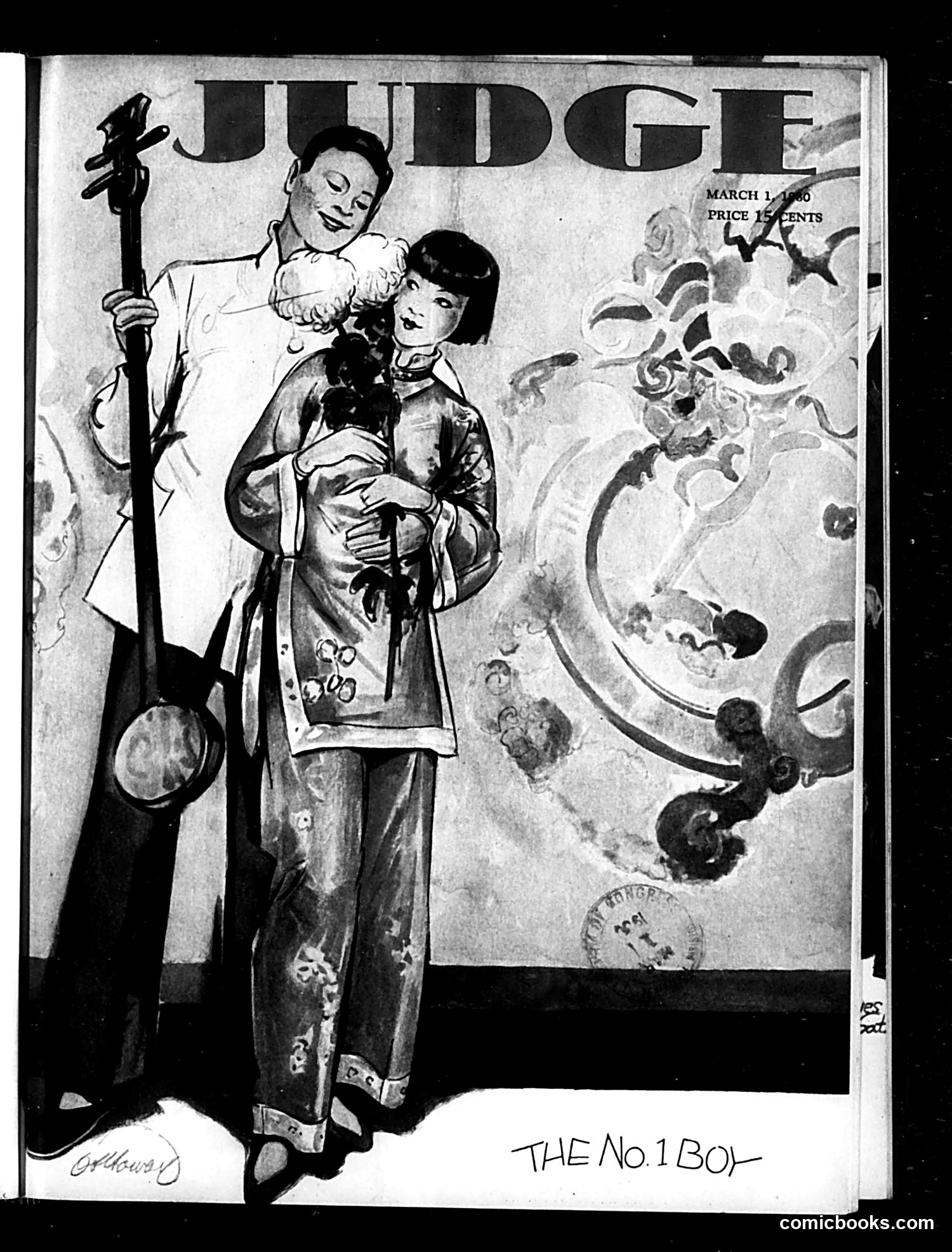
Analysis of Judge Magazine Cover, March 1, 1930 This cover illustration titled "The No. 1 Boy" depicts an Asian man in traditional Chinese clothing holding a baby, while a figure in white (likely representing Justice or Authority) stands behind him approvingly with a judicial staff. The satire appears to reference immigration policy or citizenship law, possibly commenting on Chinese exclusion laws or restrictions on Chinese immigrants and their children's legal status in America. The "No. 1 Boy" title likely refers to a racial stereotype of the era—a term used to describe Chinese domestic servants or workers in a derogatory hierarchy. The image seems to mock or critique prevailing attitudes toward Chinese immigrants and their rights, though without additional context, the specific legislative or social event referenced remains unclear.
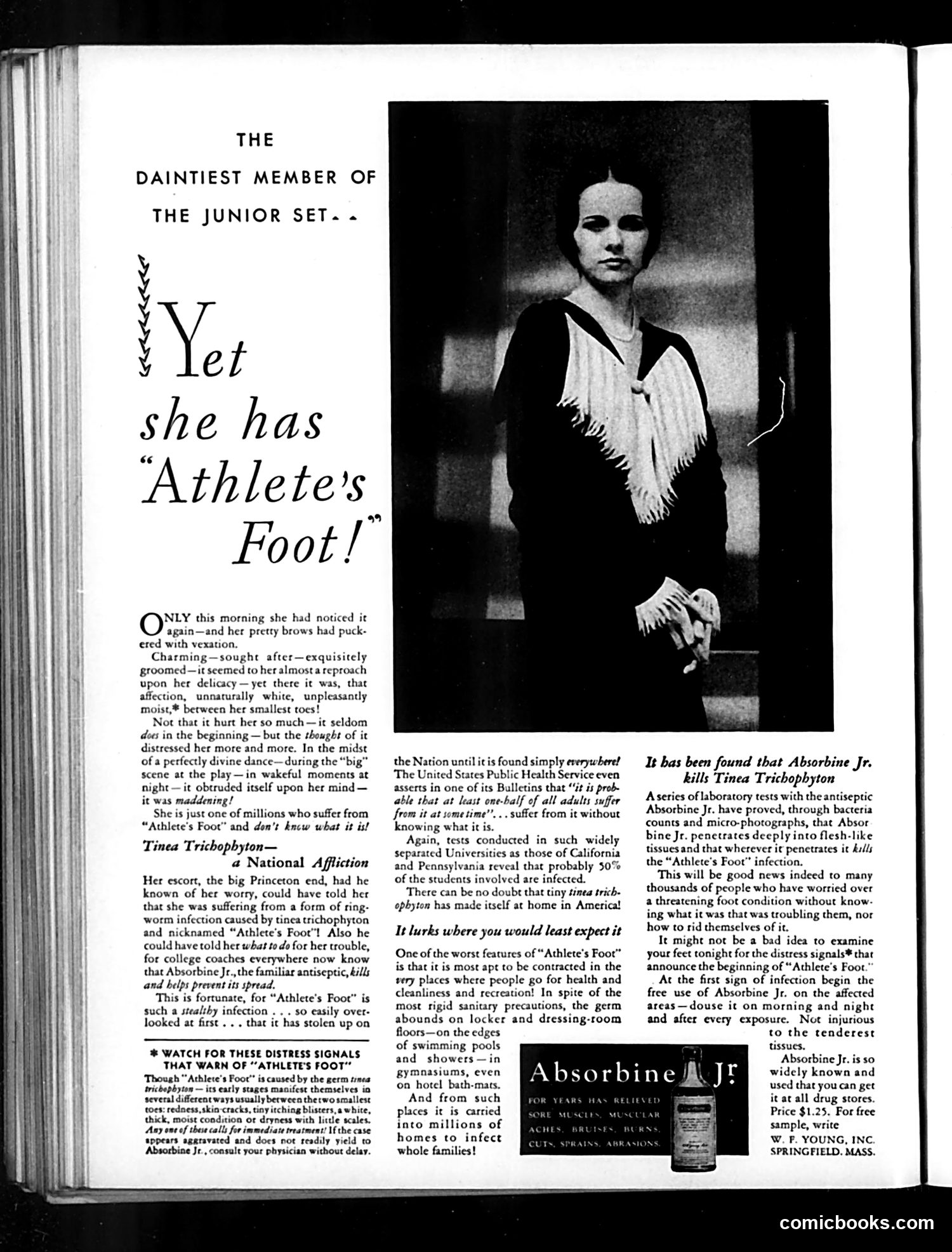
Analysis This is primarily a medical advertisement, not political satire. It promotes Absorbine Jr., a liniment product marketed for treating "Athlete's Foot"—a fungal infection. The page uses social satire about class and vanity: the headline mocks "the daintiest member of the junior set" who, despite being "exquisitely groomed," suffers from the embarrassing foot condition. The accompanying photograph shows an elegantly dressed woman, implying that even wealthy, refined people aren't immune to this affliction. The satire critiques both the prevalence of athlete's foot (spread in public pools and gymnasiums) and society's shame about discussing such conditions openly. The ad emphasizes that this is "a very timely infection" spread through communal spaces—suggesting modern hygiene failures. The text references university studies confirming the condition's widespread nature, lending medical authority to the advertisement.
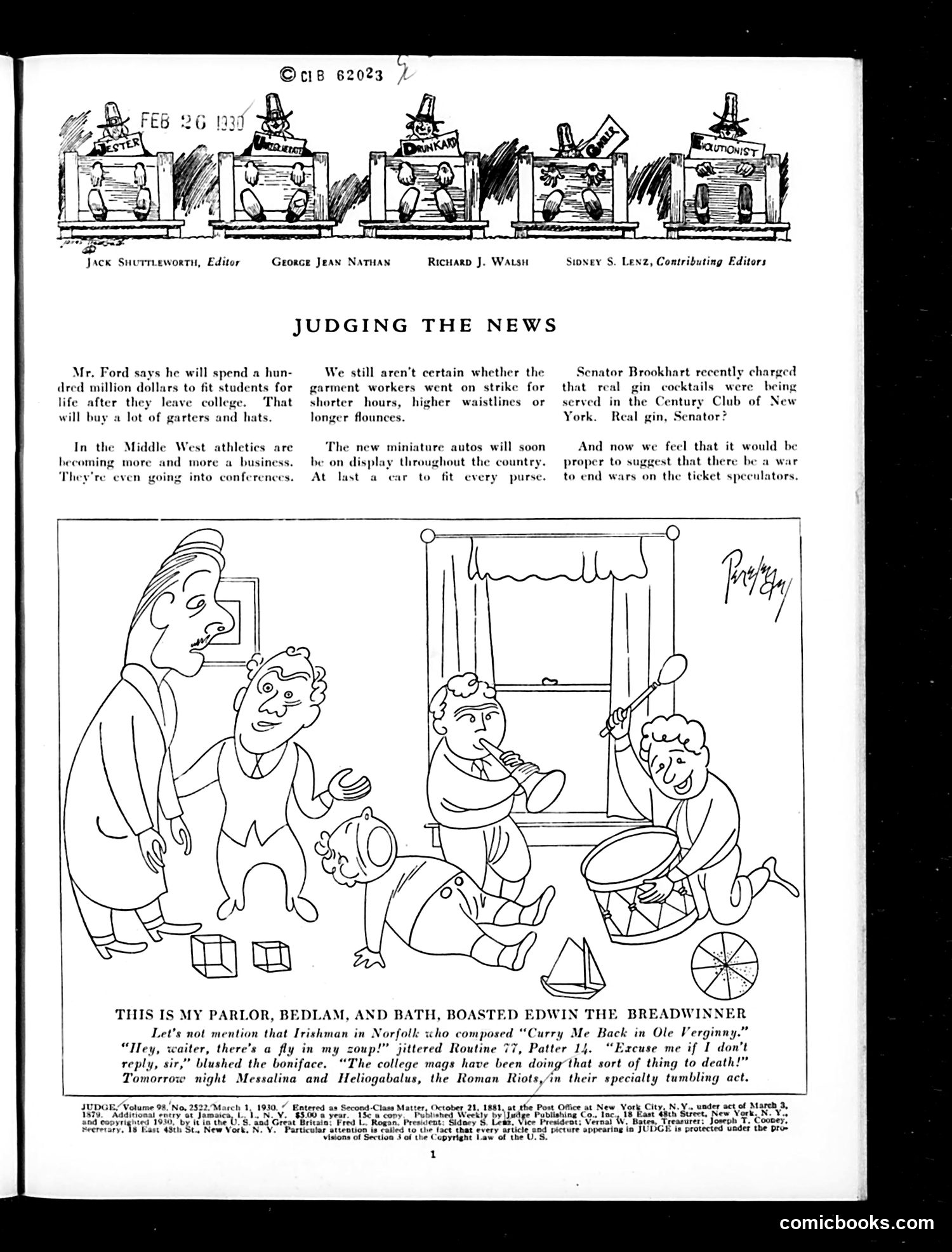
Analysis of Judge Magazine Page (March 1, 1930) The "Judging the News" section contains three brief satirical commentaries on current events, followed by a cartoon. Top Commentary: Mocks Henry Ford's claim he'd spend a million dollars fitting college students with "garters and hats"—implying Ford's actual spending on youth was minimal and frivolous. Main Cartoon: Depicts a man boasting to visitors about his "parlor, bedroom, and bath" while children play with toys on the floor. The caption references a Tin Pan Alley song ("Hello, Central, Here's a Rig in my Soup") and sarcastically notes colleges are "doing that sort of thing to death." The joke satirizes Americans' materialism and boastfulness during the prosperous 1920s, contrasting claimed wealth with humble reality. Overall tone: Mocking middle-class pretension and consumerism during the pre-Depression era.
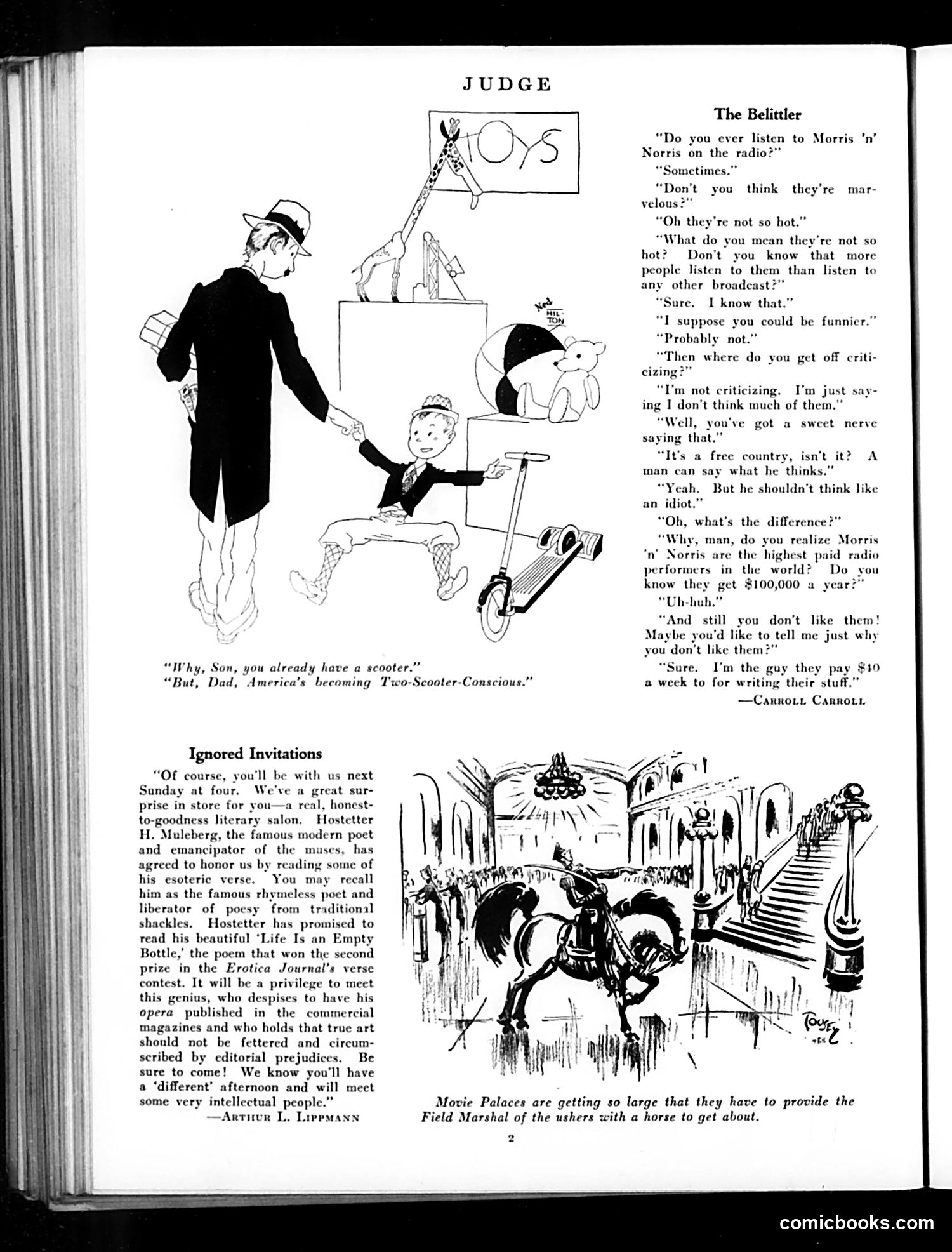
Analysis The top cartoon satirizes American consumerism and parenting trends. A father protests his son already owning a scooter, while the boy demands one anyway—illustrating "America's becoming Two-Scooter-Conscious." This mocks middle-class materialism and children's escalating consumption expectations. "The Belittler" dialog critiques radio personality Morris 'n' Norris, whom the speaker dismisses despite their reportedly earning $100,000 yearly. The joke highlights how critics disparage popular entertainers regardless of their commercial success—a commentary on intellectual snobbery versus mass-market appeal. "Ignored Invitations" describes a literary salon featuring H. Melchior (unclear if real or fictional), described as a "famous modernist poet" and "liberator of poesy." The accompanying cartoon mocks movie palace size by showing a marshal on horseback—exaggerating architectural grandeur through visual absurdity.
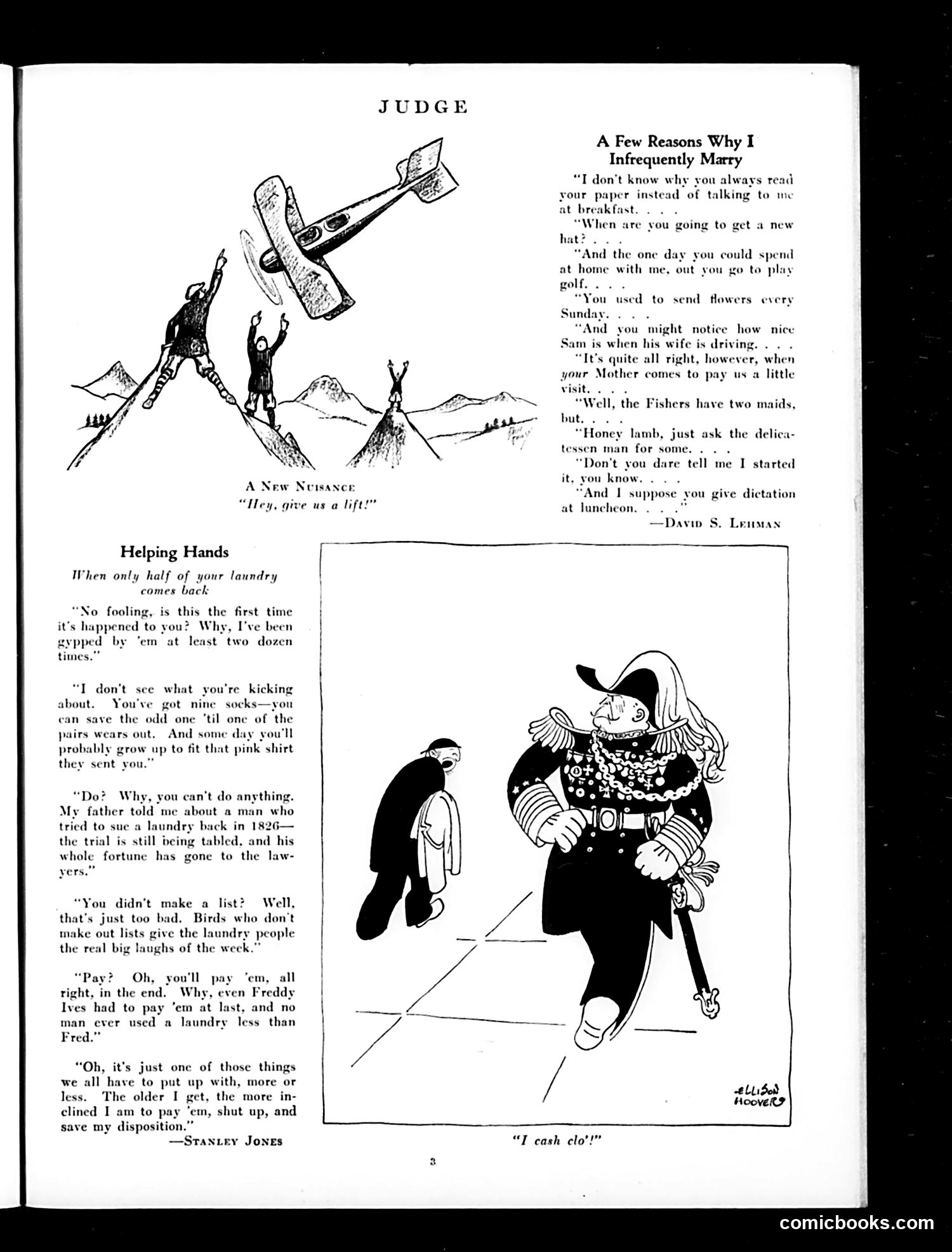
Judge Magazine Page Analysis This page contains three humor pieces satirizing early 20th-century domestic life: 1. "A New Nuisance" (top): Depicts a judge wielding an axe, seemingly crushing petitioners. The caption "Heg, give us a lift!" suggests satire of judicial burden or frivolous lawsuits overwhelming courts. 2. "A Few Reasons Why I Infrequently Marry" (right): Lists complaints attributed to David S. Lehman about married life—wives reading newspapers at breakfast, his golf time being curtailed, diminished flower-giving, mother-in-law visits, and giving lunch dictation. Standard domestic humor mocking husbands' loss of freedom after marriage. 3. "Helping Hands" (left): Dialogue about missing laundry. The joke concerns incomplete laundry service returns, with characters debating whether to file complaints. It satirizes the inconvenience and expense of laundering services for working-class men. The overall theme: domestic frustrations and marital compromises.
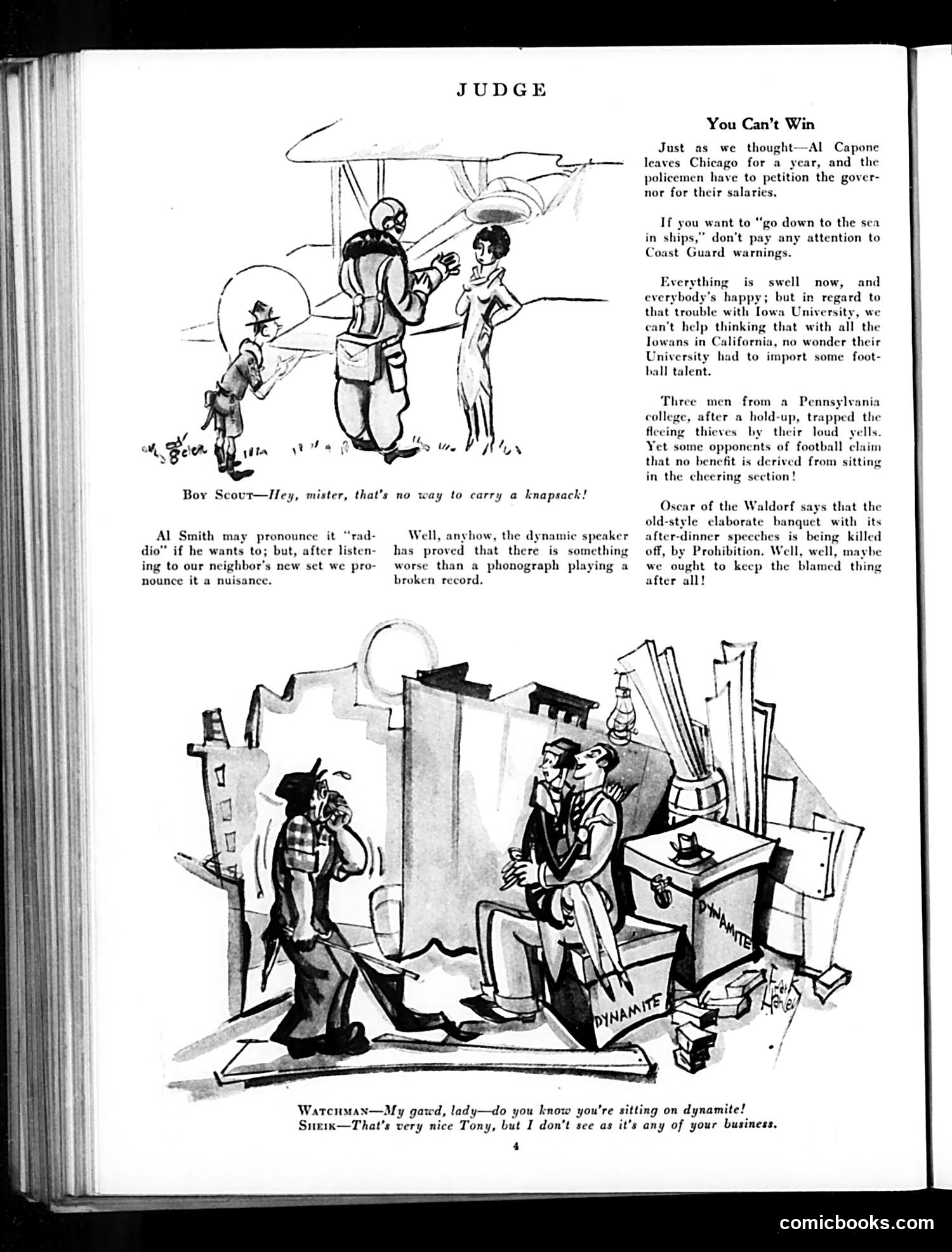
Analysis of Judge Page This page contains two satirical cartoons commenting on contemporary issues: Top cartoon: A Boy Scout encounters what appears to be a large military figure carrying a knapsack, criticized for improper carrying technique. This likely satirizes either military preparedness concerns or the Boy Scout movement itself. Bottom cartoon: A watchman warns a woman she's "sitting on dynamite," while a sheik responds dismissively. This appears to reference post-WWI anxieties about anarchist violence and radical threats, combined with satirizing the "sheik" craze—a 1920s fad of romanticizing Middle Eastern figures. The text column "You Can't Win" critiques various social problems: Al Capone, Coast Guard warnings, Iowa University athletics, Pennsylvania college football fraud, and Prohibition's effects. The overall theme: modern society's insoluble contradictions and inevitable failures.
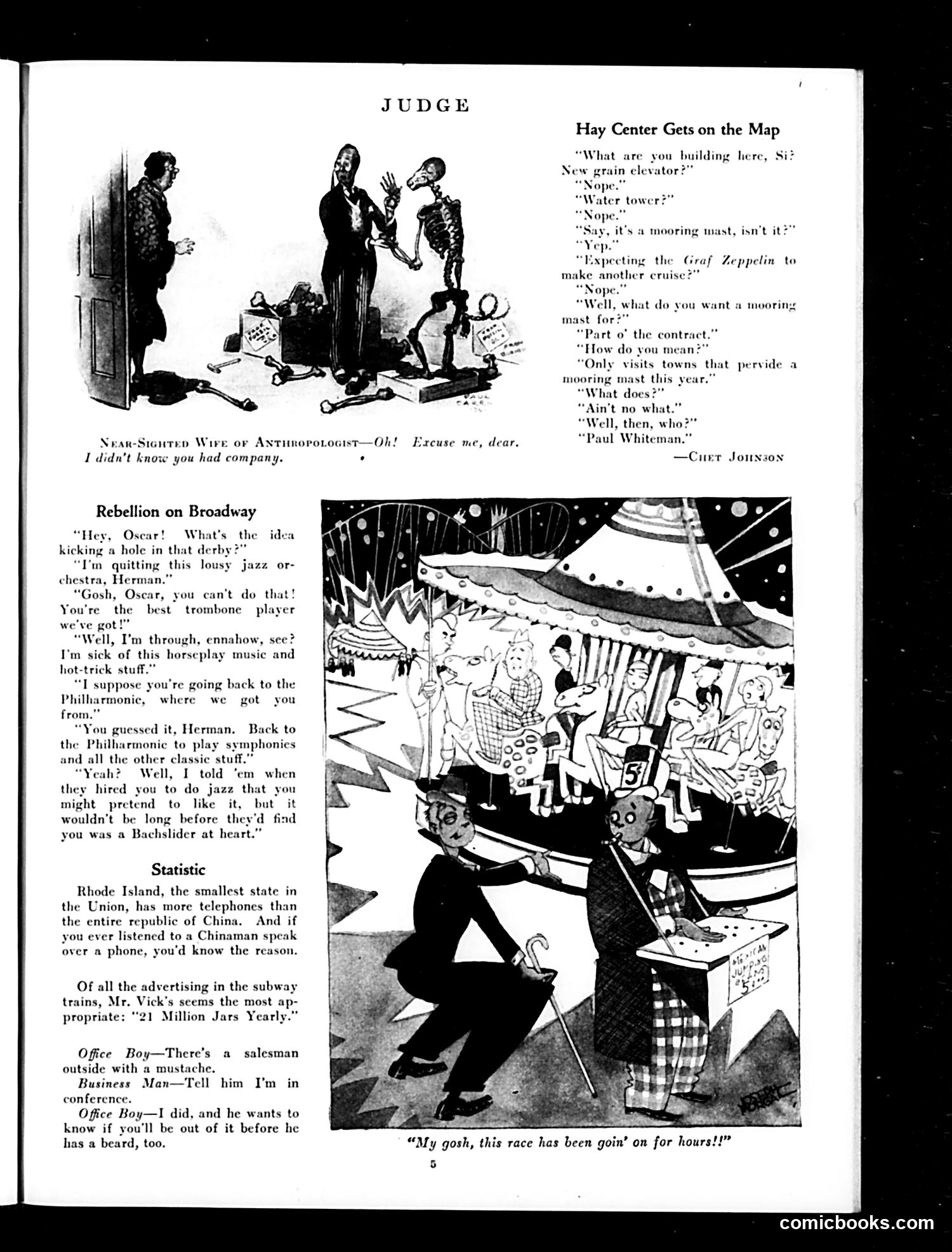
Analysis of Judge Page This page contains three unrelated satirical pieces typical of early 20th-century Judge magazine: 1. "Near-Sighted Wife of Anthropologist" (top): A visual joke about mistaken identity—a wife encounters her husband with what she assumes is company, but are actually skeletal specimens or anatomical models he's brought home. 2. "Hay Center Gets on the Map" (top right): A dialogue joke about a town's attempts to become notable, discussing plans for a mooring mast (likely referencing the Graf Zeppelin airship trend of the 1920s-30s). The humor relies on small-town aspirations. 3. "Rebellion on Broadway" (bottom left): A conversation between orchestra members about replacing jazz with classical music—reflecting 1920s cultural tensions between modern jazz and traditional symphonic music. 4. "Statistic" section: Brief one-liners about Rhode Island's telephones and subway advertising.
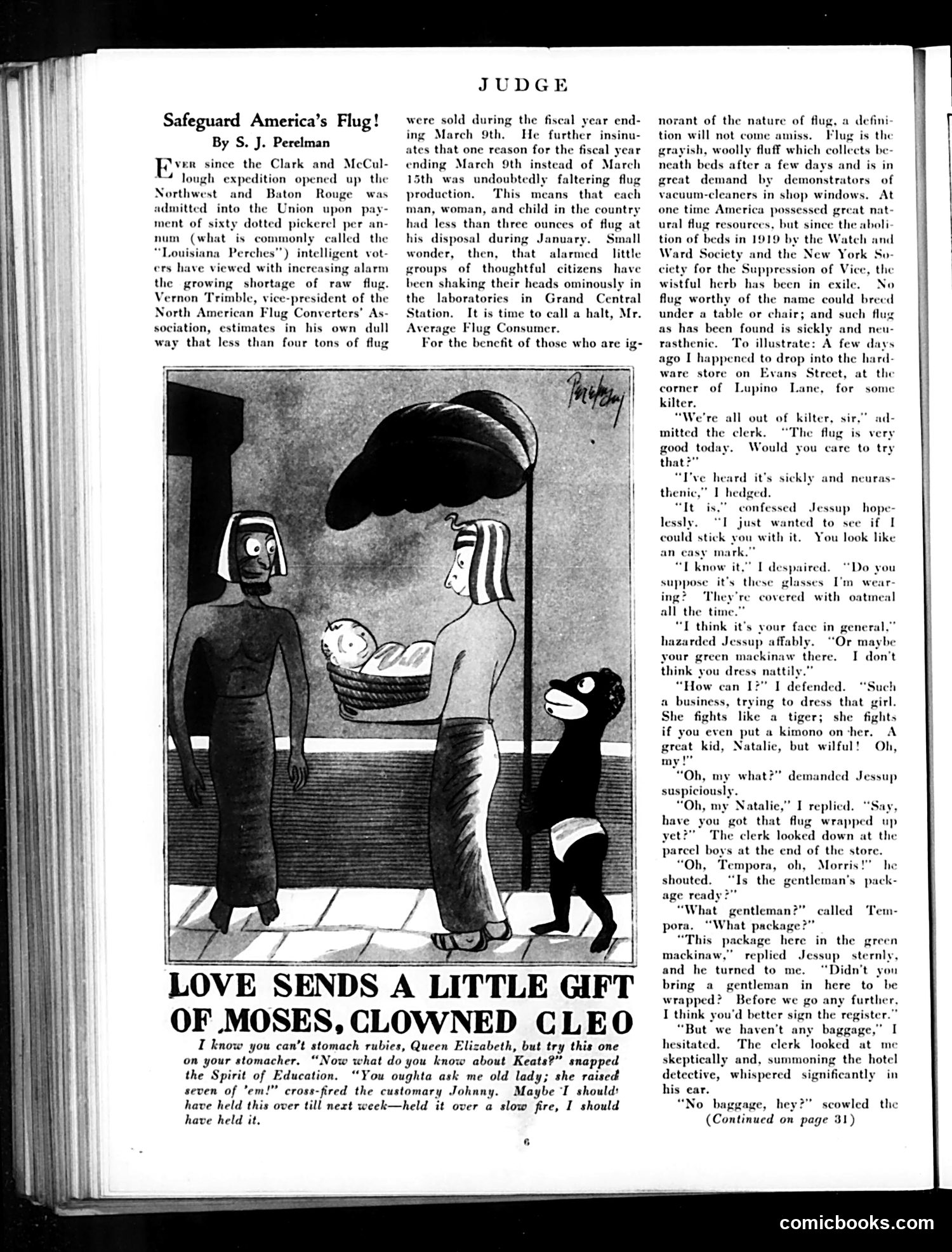
Judge Magazine Page Analysis This page contains two distinct pieces: "Safeguard America's Flug!" by S.J. Percelman (top) is a satirical article about a critical shortage of raw flug during World War II, attributed to the Ever the Clark and McCullough expedition. Percelman mock-seriously warns that flug production has dropped significantly, causing alarm among citizens. The piece appears to be absurdist satire—"flug" seems a fabricated substance—likely mocking wartime shortages and panic buying. "Love Sends a Little Gift of Moses, Clowned Cleo" (bottom) is a humorous comic story illustrated with a cartoon showing a woman at a window counter with a cat, discussing a packaged item with a clerk. The narrative involves confusion about wrapping and delivering something, playing on comedic miscommunication. Both pieces exemplify Judge's characteristic irreverent, absurdist humor common to 1940s satirical magazines.
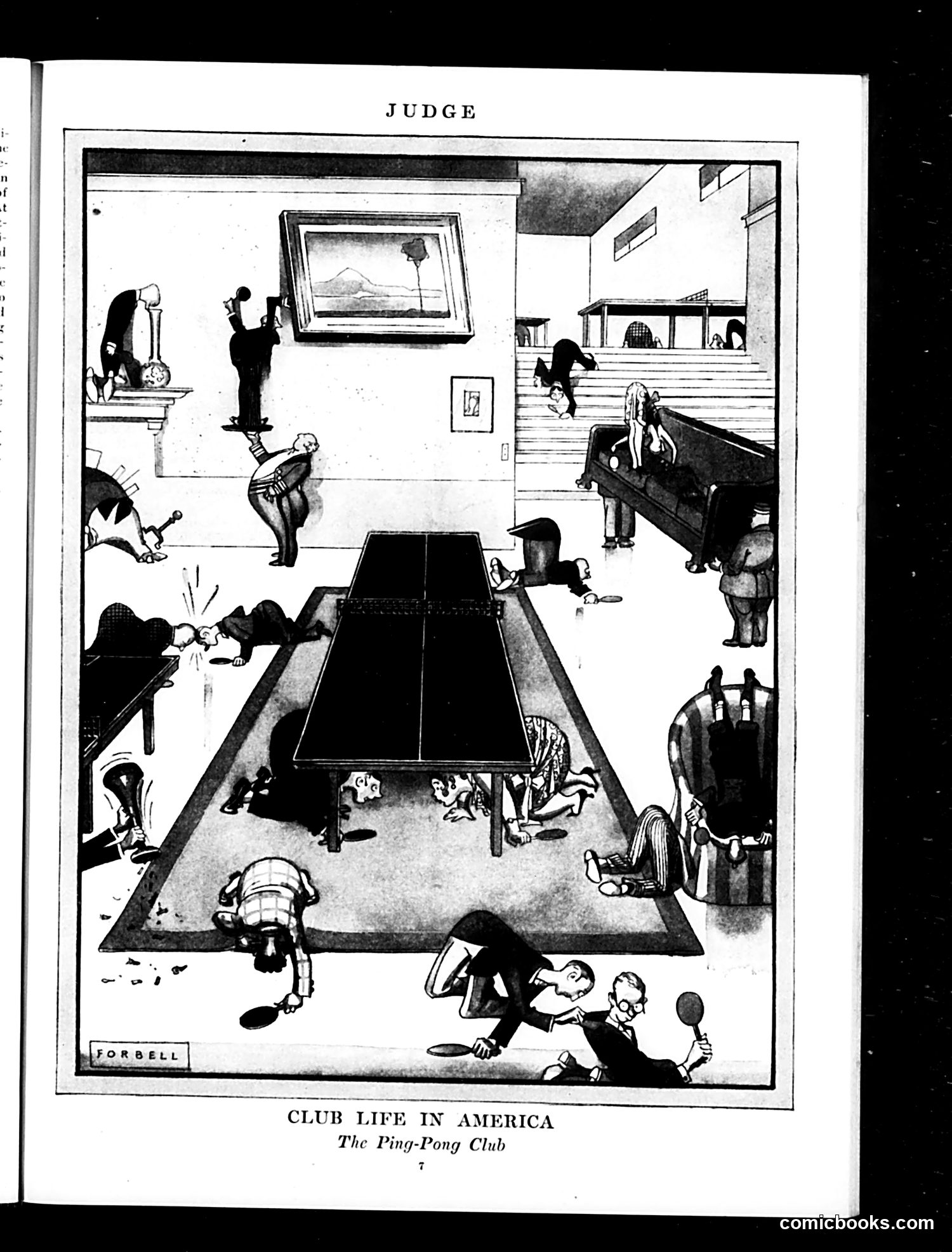
"The Ping-Pong Club" - Judge Magazine Satire This cartoon satirizes American club culture by depicting a chaotic ping-pong establishment. The central table dominates the composition, surrounded by various clubgoers engaged in unrelated activities—drinking, socializing, sketching, moving furniture, and childish play. The satire appears to mock the pretentiousness of American "club life" by showing that despite the formal veneer, these establishments are actually sites of disorder, frivolity, and undignified behavior. Members are portrayed as both overly serious and absurdly silly simultaneously. The artist (signed "Forbell") suggests that American clubs, despite their aspirations toward sophistication and exclusive gentility, devolve into scenes of chaos where adult patrons behave childishly. It's social criticism wrapped in observational humor about class aspirations and leisure culture.
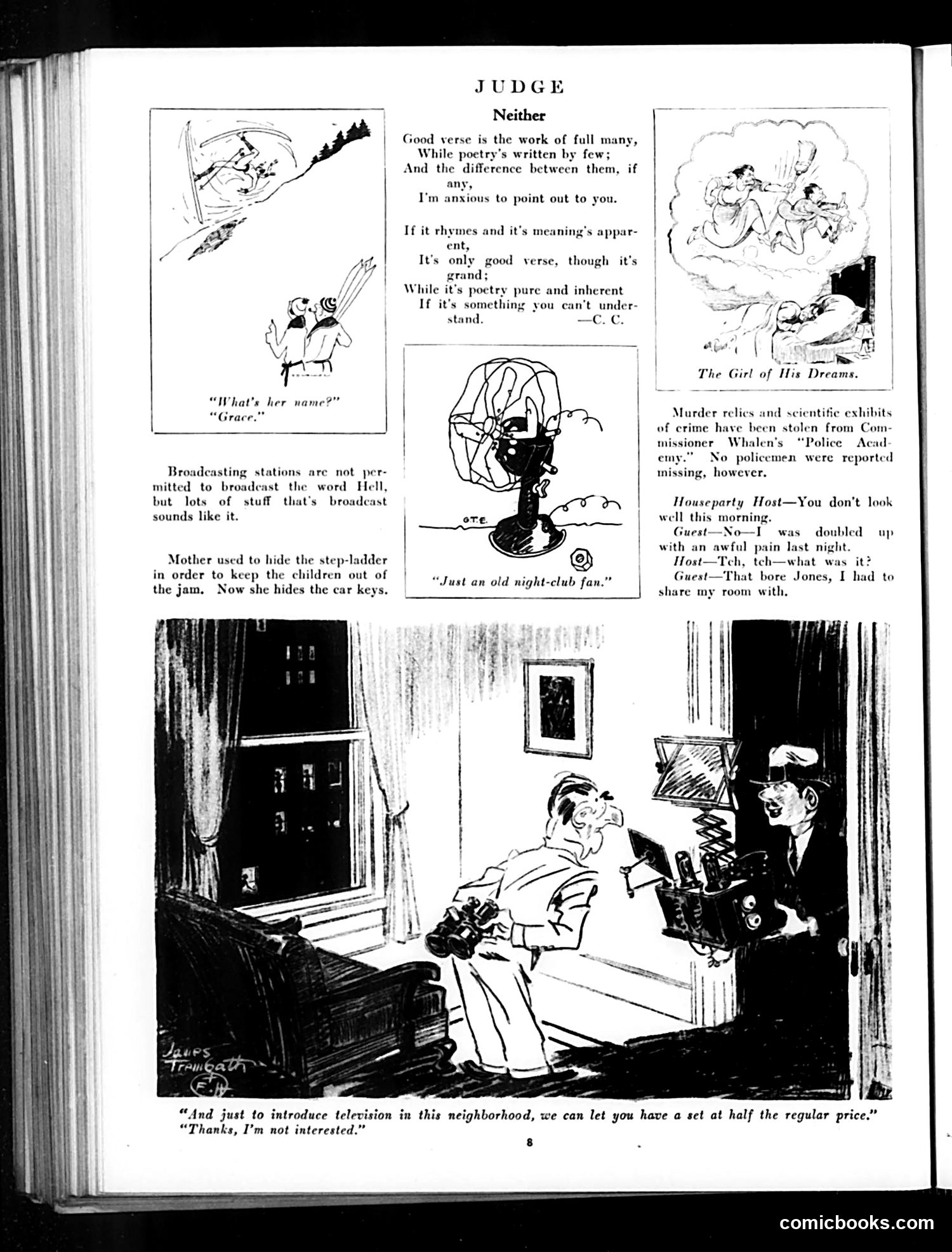
Judge Magazine Page Analysis This page contains several satirical items mocking 1920s-30s American culture: Main cartoon (bottom): A salesman pitches a television set at half price to a householder, who refuses. The satire targets early television adoption—the technology was new, expensive, and many viewed it as an unnecessary luxury during economically uncertain times. Upper cartoons & text snippets mock: - Radio broadcasting censorship (can't say "Hell" but broadcasts other objectionable content) - Modern parenting (mothers now hide car keys instead of step-ladders, suggesting teens joyriding was a contemporary concern) - Poetry criticism (distinguishing "good verse" from incomprehensible "poetry") - Crime exhibits being stolen from police academies The page reflects 1920s anxieties about new technology (radio, television, automobiles), changing social norms, and modern entertainment. The tone is lighthearted social commentary typical of Judge magazine's satirical approach.
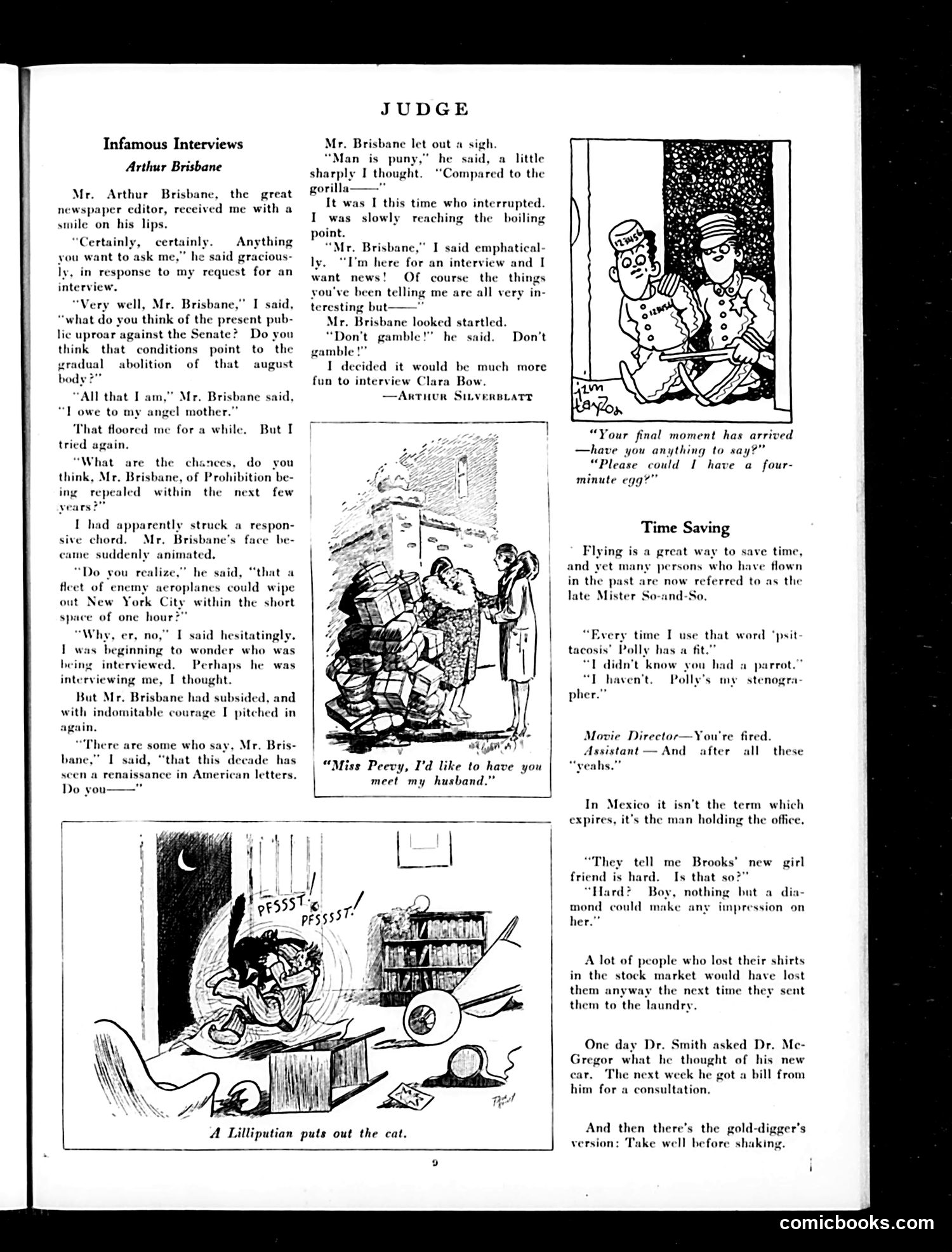
Judge Magazine Page Analysis This page from *Judge* satirizes newspaper editor Arthur Brisbane, a real public figure known for sensationalism and tangential commentary. The interview depicts Brisbane as absurdly evasive and alarmist—when asked about Senate reform and Prohibition, he instead pivots to apocalyptic warnings about enemy aircraft destroying New York City, frustrating the interviewer who actually wants *news*. The satire targets Brisbane's editorial style: his tendency to digress into fear-mongering, philosophical musings, and non-sequiturs rather than address substantive political questions. The final joke—that the interviewer decides to interview Clara Bow (a famous silent film star) instead—suggests Brisbane is too unreliable for serious journalism. The accompanying comics and quips are unrelated humor pieces typical of *Judge*'s miscellaneous comedy format, including sight gags and one-liners about flying deaths, office romance, and financial disasters.
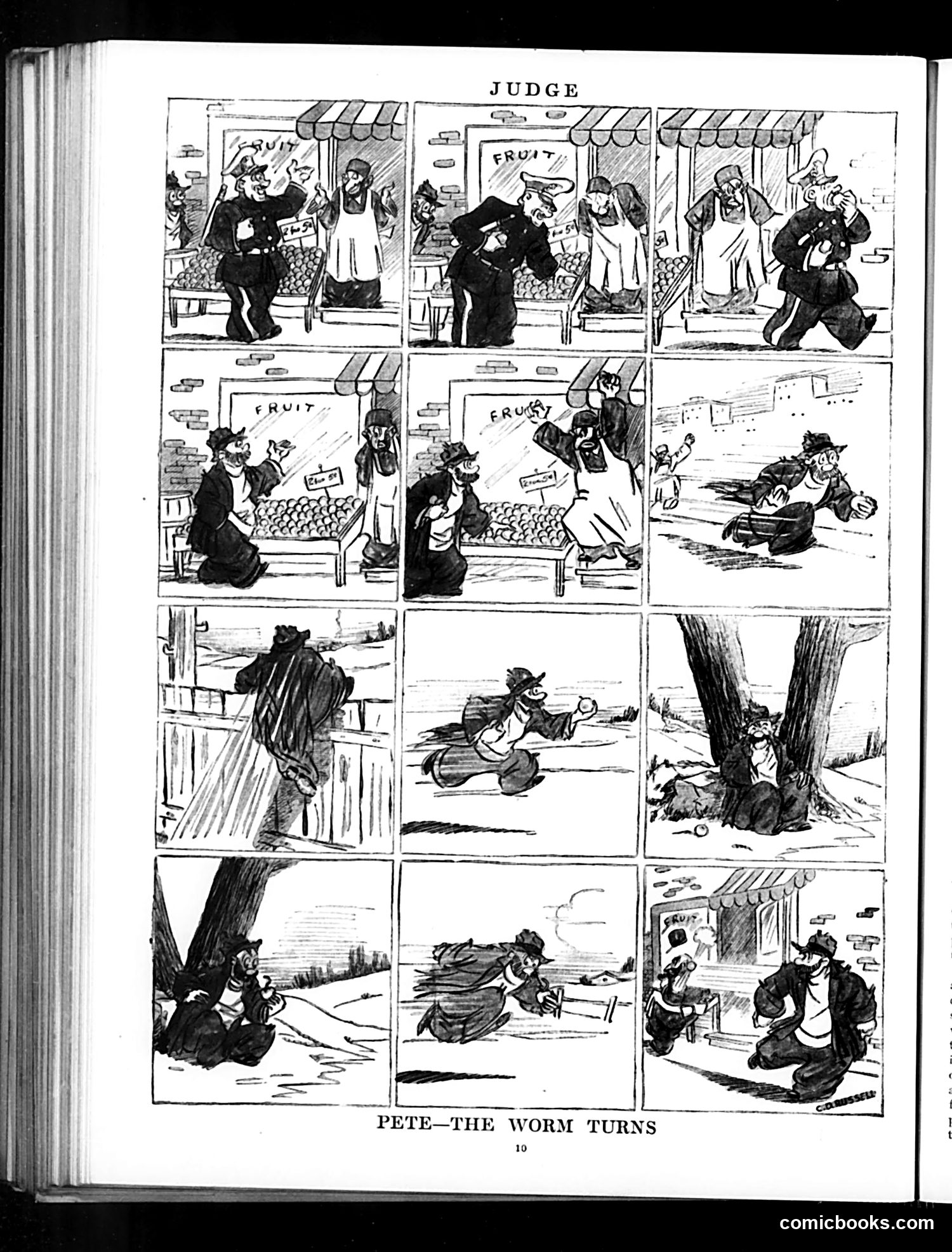
Analysis: "Pete—The Worm Turns" This Judge cartoon depicts a figure (Pete) experiencing a reversal of fortune. The narrative progresses from Pete being mistreated at fruit stands (top panels), where he appears to be a customer or worker, through increasingly severe consequences—being thrown out, falling, hiding, and ultimately appearing destitute in natural settings. The title "the worm turns" references the proverb about a worm eventually fighting back when pushed too far. However, rather than Pete gaining victory, the cartoon shows continued degradation and suffering. This appears to be satirizing either a specific public figure or the general fate of someone pushed to society's margins—suggesting that even when the "worm turns," consequences prove inescapable. The exact identity of Pete remains unclear from the image alone.
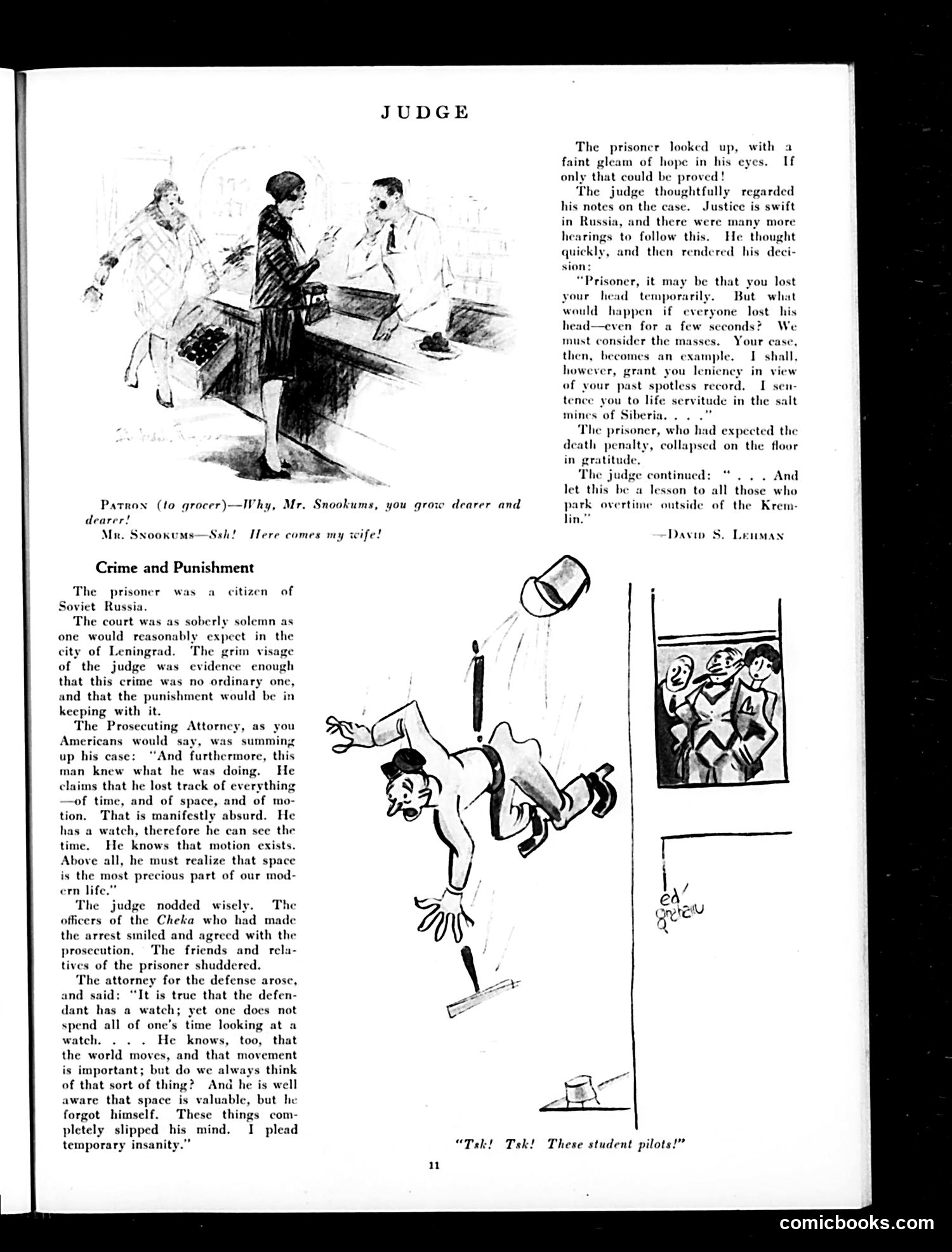
Crime and Punishment in Soviet Russia This satirical story mocks Soviet (specifically Leningrad/Cheka) justice as absurd and severe. A prisoner's crime involves losing track of "time, space, and motion"—likely a euphemism for being late or absent from work. The prosecution argues this is inexcusable because the defendant owns a watch and should understand time's value. The defense pleads "temporary insanity." The judge, unmoved by either argument, sentences the man to life in Siberian salt mines anyway, then bizarrely lectures about how this should deter others from "park overtime outside of the Kremlin"—suggesting even minor infractions face draconian punishment in Soviet Russia. The cartoon below ("These student pilots!") appears unrelated satire about incompetent aviators. The piece satirizes Soviet authoritarianism: absurd laws, show trials with predetermined outcomes, and disproportionate punishments for minor offenses.
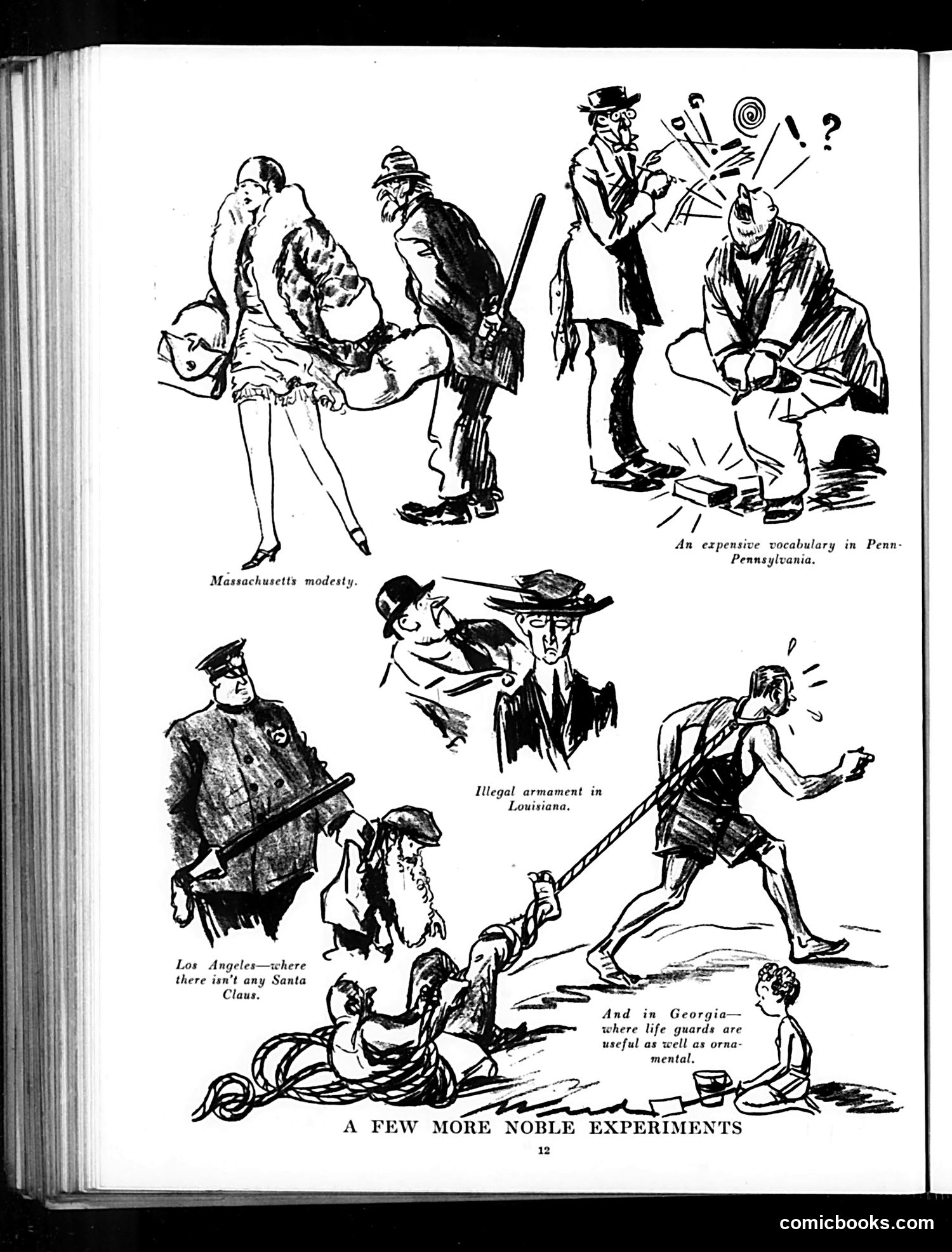
"A Few More Noble Experiments" This satirical cartoon mocks Prohibition and regional law enforcement, titled after the "noble experiment" (Prohibition itself). Each panel ridicules how different states handled alcohol bans: - Massachusetts modesty: A woman with exposed legs represents perceived sexual looseness accompanying illegal drinking. - Pennsylvania's "expensive vocabulary": Men discussing elaborate slang terms for bootleg liquor. - Louisiana's "illegal armament": Armed men suggest violence connected to illegal alcohol trade. - Los Angeles: References absent moral authority ("no Santa Claus"), implying lawlessness. - Georgia's "life guards": Shirtless figures suggest armed enforcers needed to maintain order around illegal activities. The cartoons suggest Prohibition created unexpected social chaos—sexual liberation, organized crime, violence, and the need for private enforcement—rather than improving morality. The satire critiques the policy's unintended consequences across America.
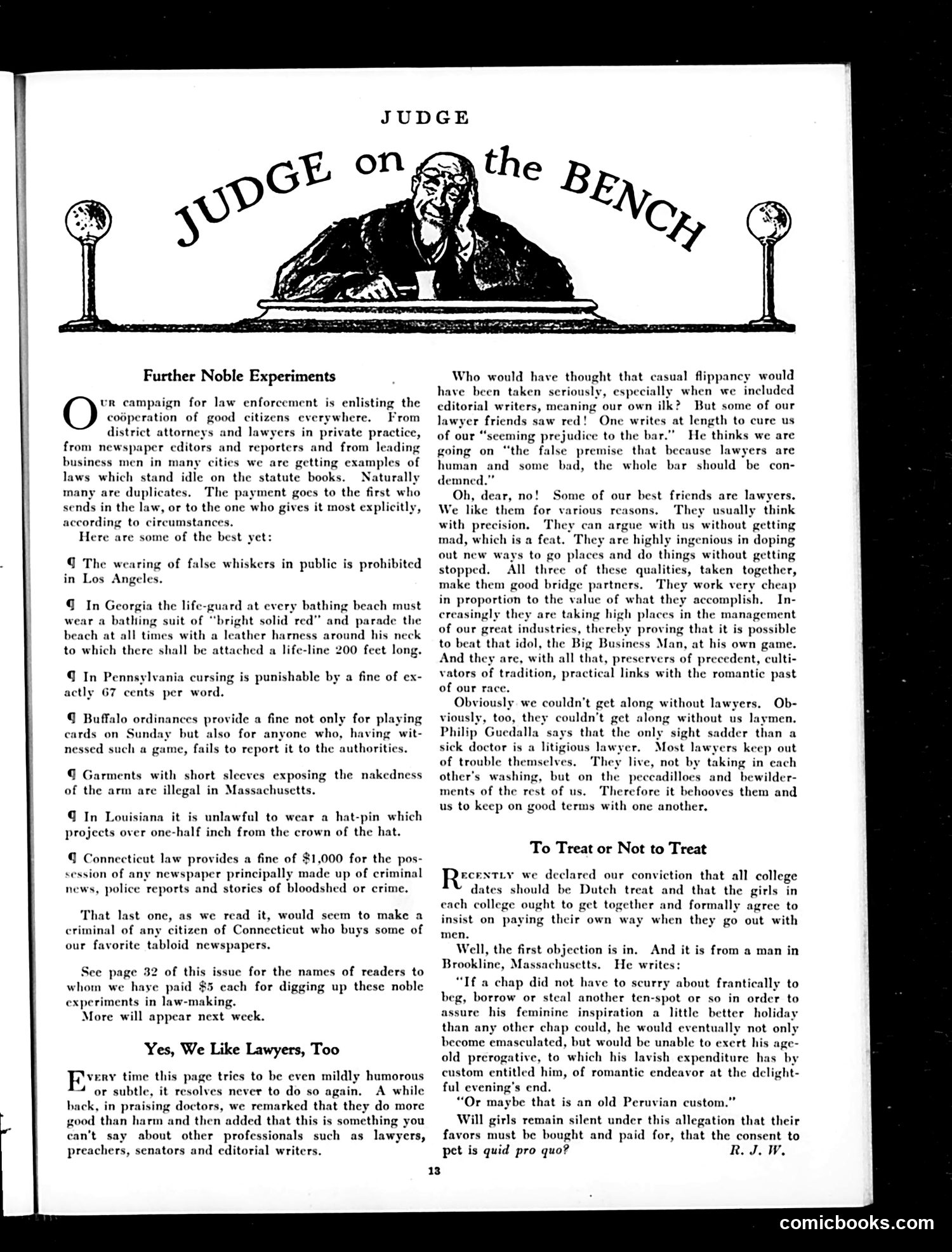
Judge Magazine: "Further Noble Experiments" and "Yes, We Like Lawyers, Too" This page satirizes absurd, obsolete laws still on American statute books. Judge's editors solicited readers to identify ridiculous ordinances—offering $5 rewards—including prohibitions on false whiskers (Los Angeles), penalties for cursing at 67 cents per word (Pennsylvania), and regulations on lifeguard harnesses (Georgia). The satire targets legislative absurdity and inertia: laws that persist despite being practically unenforceable or nonsensical. The second section responds to lawyer complaints about an earlier anti-lawyer joke. The editors sarcastically defend lawyers while backhanded complimenting them: praising their precision, argumentativeness, ingenuity at legal maneuvering, and affordability relative to their value. The Philip Guedalla quote—that only a litigious lawyer equals a sick doctor—further implies lawyers are naturally disputatious. The satire mocks both legislative dysfunction and professional defensiveness.
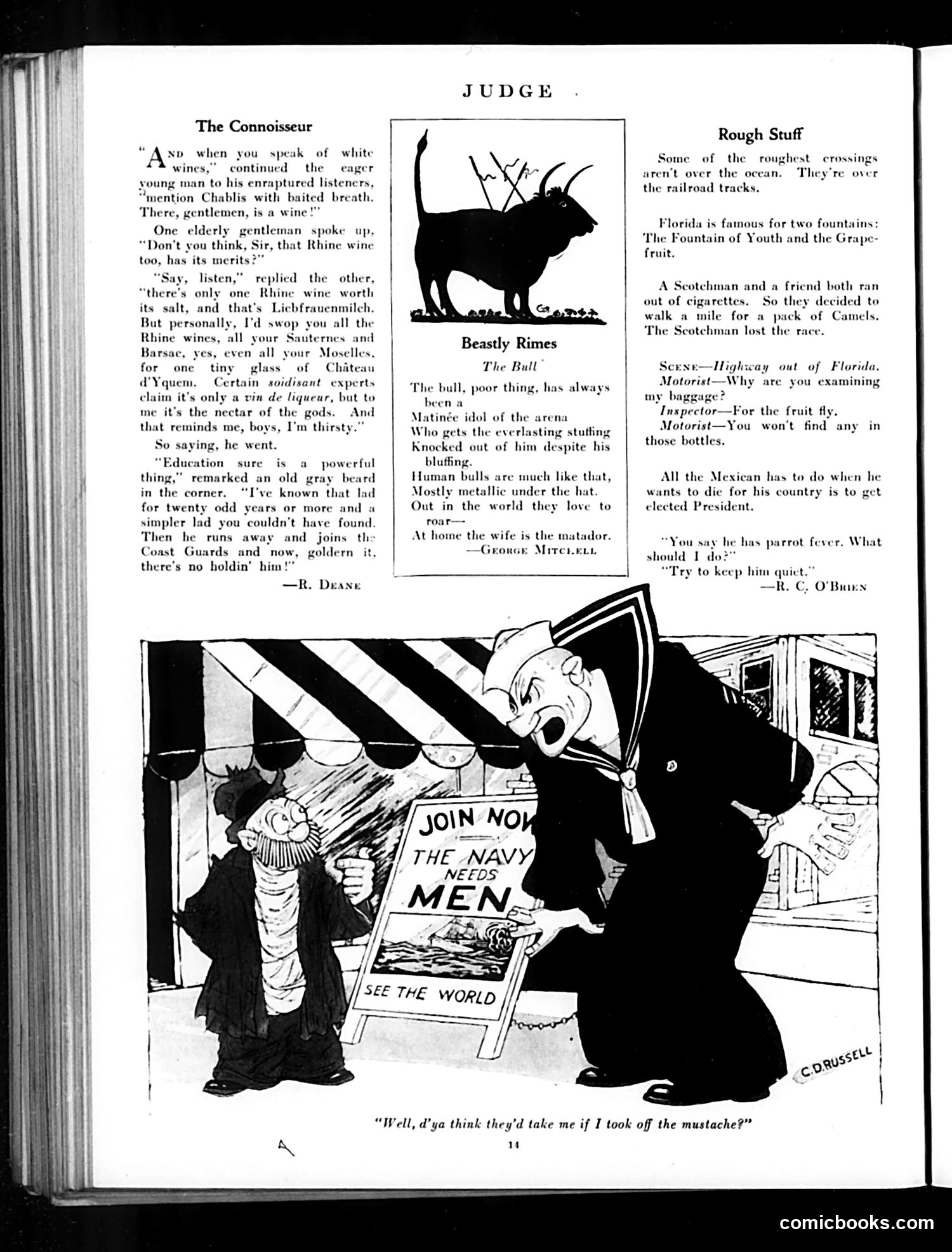
Analysis This page from *Judge* contains several humor pieces and a political cartoon. The Main Cartoon (bottom): Shows a small man with a prominent mustache looking at a Navy recruitment poster ("JOIN NOW / THE NAVY NEEDS MEN / SEE THE WORLD"). A tall Uncle Sam figure looms over him. The caption reads: "Well, d'ya think they'd take me if I took off the mustache?" This satirizes Navy recruitment standards and physical appearance requirements—the joke being that the man's mustache is so distinctive it might disqualify him, yet he'd rather shave than be rejected. Supporting Content: The page also includes: - *The Connoisseur*: Satirizes wine snobs and their pretentious knowledge - *The Bull* poem: Uses bullfighting as metaphor for henpecked husbands - *Rough Stuff*: Brief humorous observations about travel, Florida, and Mexican politics The cartoon appears to reference WWI-era military recruitment (likely 1917-1918), when the U.S. Navy expanded significantly and had strict physical standards for enlistment.
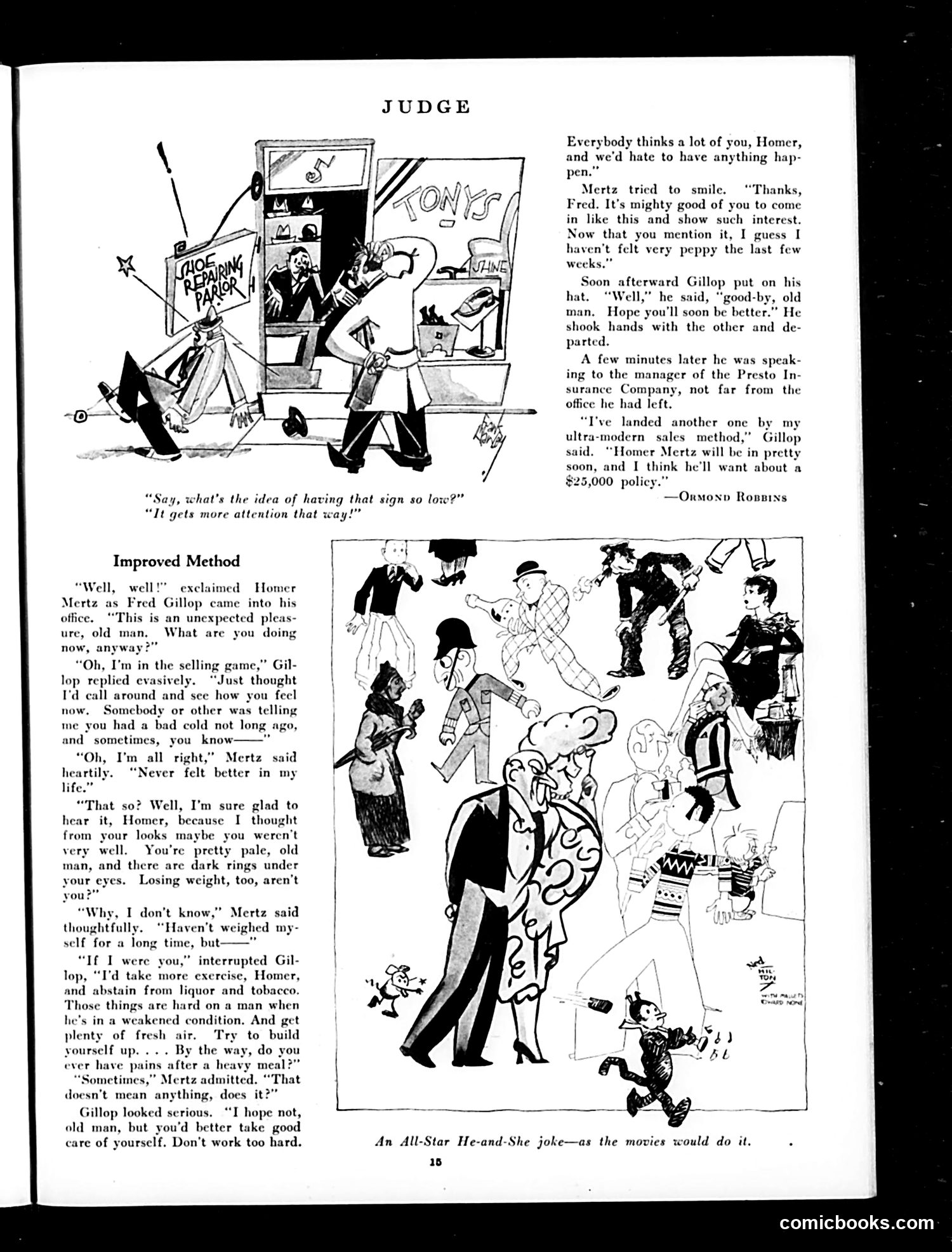
Judge Magazine Cartoon Analysis This page satirizes aggressive insurance sales tactics of the early 20th century. The narrative follows salesman Fred Gillop employing what the text calls an "ultra-modern sales method"—manipulating a client named Homer Mertz by appearing solicitous about his health while actually manufacturing health concerns to create anxiety. Gillop feigns friendly concern, then systematically observes (or invents) signs of poor health: paleness, weight loss, dark under-eye circles. He recommends lifestyle changes while subtly implying serious illness, priming Mertz to purchase a $25,000 insurance policy out of manufactured worry. The cartoon mockingly illustrates this predatory technique: a salesman uses false concern as a weapon. The satire critiques the insurance industry's manipulation of ordinary people through psychological pressure rather than honest salesmanship. The "improved method" is ironic—improved for the salesman's commission, not the client's welfare.
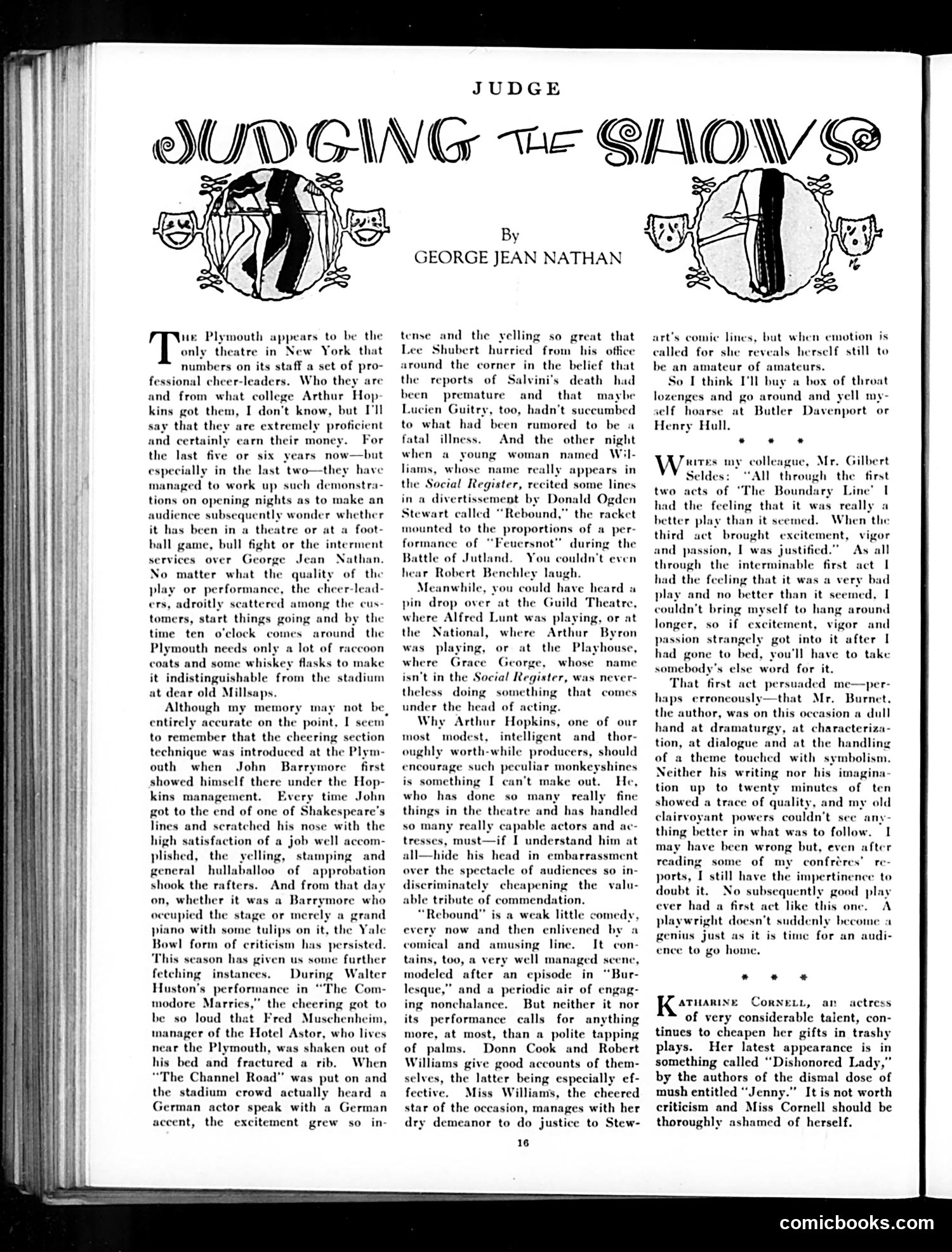
Judge Magazine - "Judging the Shows" (Theater Criticism) This is not a political cartoon but a theater review column by George Jean Nathan, a prominent drama critic of the 1920s. Nathan satirizes the Plymouth Theatre's practice of organizing "professional cheer-leaders" at opening nights—audiences that artificially manufacture enthusiasm through coordinated applause and yelling. Nathan's complaint: this artificial enthusiasm degraded legitimate theatrical appreciation. He traces the practice to John Barrymore performances under producer Arthur Hopkins, where enthusiastic responses became so loud they disturbed neighboring residents (one fractured a rib). The satire criticizes how even mediocre plays like Donald Ogden Stewart's "Rebound" receive standing ovations, while superior productions at rival theaters (Guild, National, Playhouse) attract quieter, more discerning audiences. Nathan argues Hopkins, an otherwise intelligent producer, should be embarrassed by audiences "cheapening the valuable tribute of commendation" through manufactured noise rather than genuine artistic appreciation.
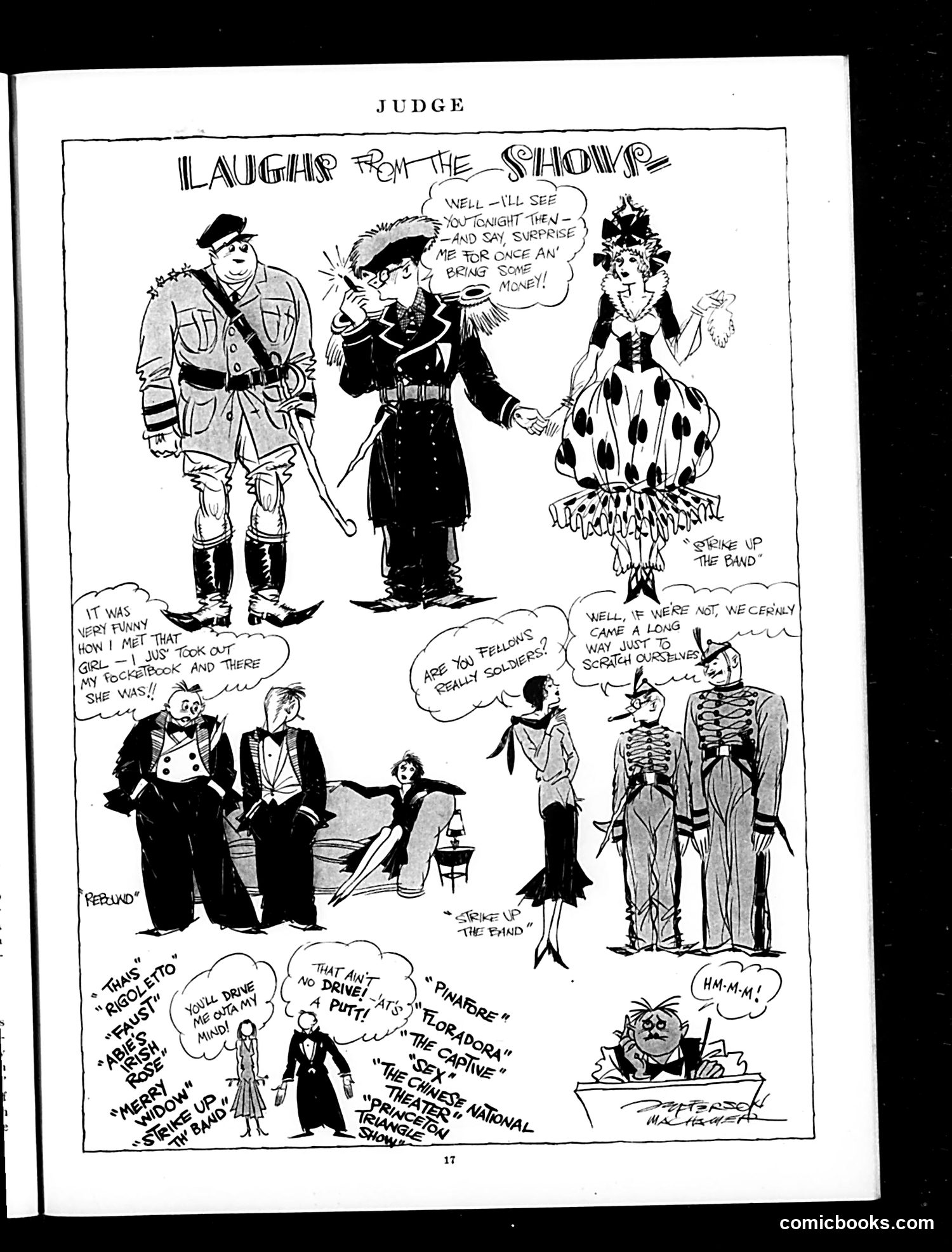
"Laughs from the Shows" - Judge Magazine Satire This page satirizes popular theatrical entertainment, likely from the 1920s-30s. The cartoons mock various stage productions and their clichéd tropes: Upper section: A military officer, exotic performer, and Queen character represent typical "exotic" show stereotypes—the satire suggests audiences expect predictable entertainment involving soldiers, foreign dancers, and theatrical royalty. Lower sections: Listed show titles ("Thais," "Rigoletto," "The Captive," etc.) and dialogue mock both highbrow operatic fare and lowbrow vaudeville. One panel jokes about soldiers complaining shows are just excuses to "scratch ourselves"—mocking how servicemen viewed mandatory or promotional entertainment. Bottom: A judge figure (labeled "Judge") surveys this theatrical landscape with amusement, embodying the magazine's role as satirical arbiter of public taste. The satire targets entertainment industry predictability and the gap between what producers offer versus what audiences actually want.
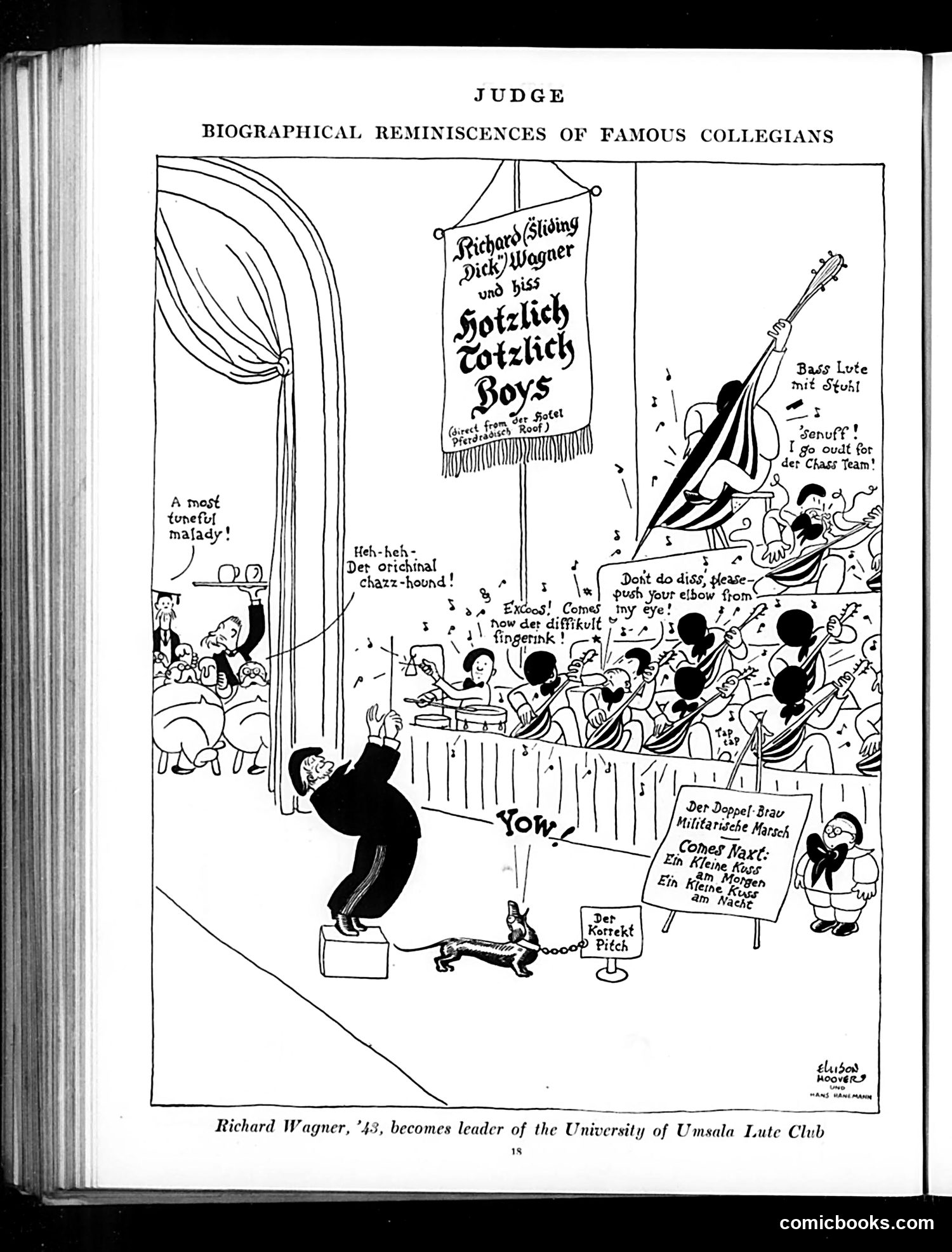
Explanation for Modern Readers This is a satirical cartoon mocking Richard Wagner ('43, a college student) becoming leader of the University of Umsala's Lute Club. The humor plays on German musical stereotypes: Wagner is the famous German composer, and the cartoon depicts a chaotic German student musical ensemble performing with exaggerated Germanic accents and mannerisms. The joke satirizes both pretentious college musical clubs and German cultural stereotypes popular in early 20th-century American humor. German phrases ("Der Korrekt Pitch," "Der original chazz-hound") and comical mispronunciations emphasize foreignness. The bass lute player's dramatic pose, the conductor's frantic gestures, and scattered musical chaos suggest the group is hilariously incompetent despite their earnest formality. This appears in Judge magazine's "Biographical Reminiscences of Famous Collegians" section, which used recognizable names (here, the composer Wagner) as comic vehicles for college life satire.
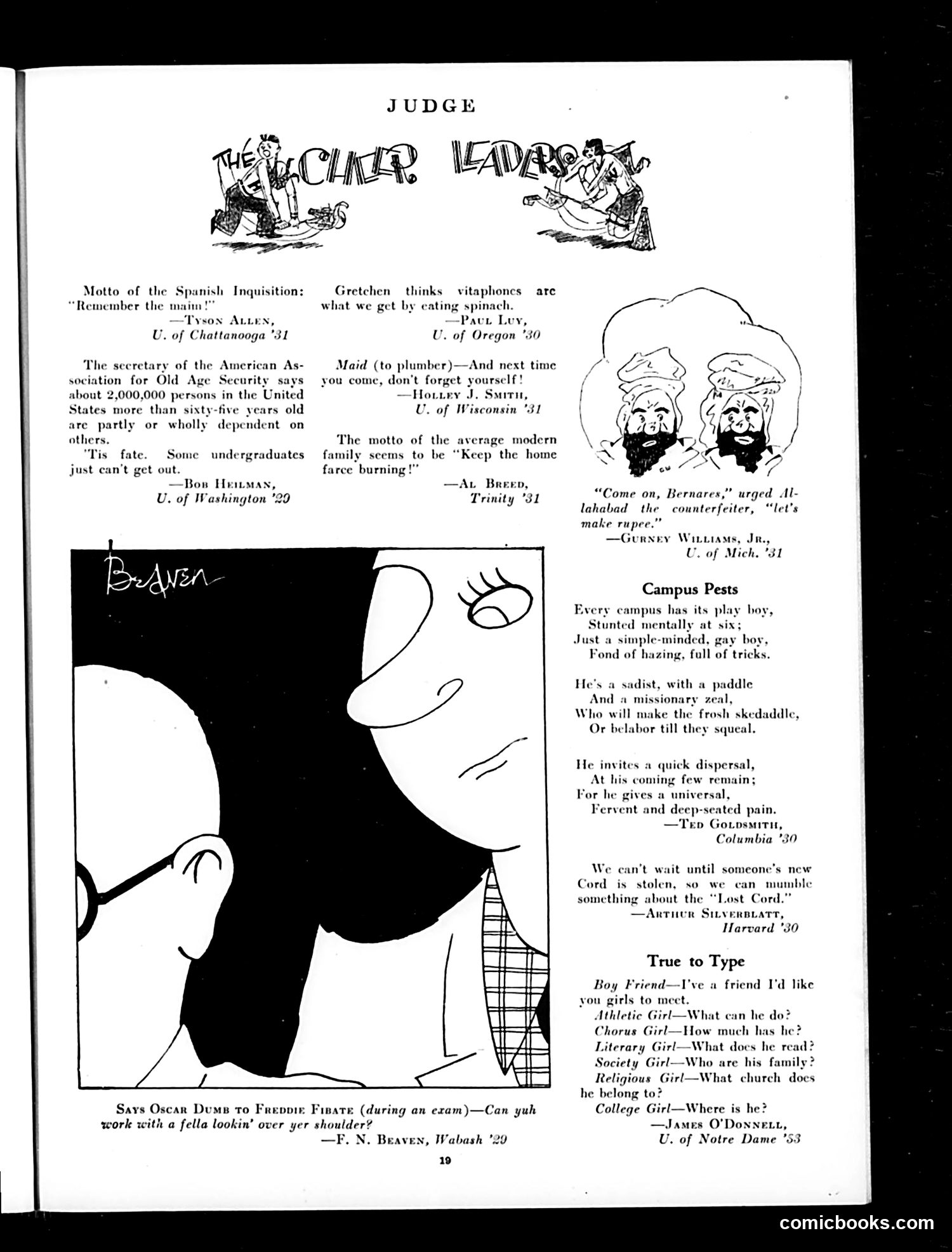
Analysis of Judge Magazine Page This page from Judge magazine consists of humorous quotes from college students (circa 1930-31) and satirical observations about campus life. The main cartoon depicts a large silhouette of a man in formal attire looking over another student's shoulder during an exam—illustrating the caption about cheating discomfort. The satire mocks academic dishonesty. The "Campus Pests" poem targets the stereotypical college hazing culture: upperclassmen who psychologically and physically torment freshmen ("frosh") for entertainment, wielding paddles and causing suffering under the guise of tradition. This reflects real, widespread hazing practices of that era. "True to Type" satirizes different female college archetypes' priorities when evaluating a potential suitor—the religious girl asks about church affiliation, the society girl about family connections, while the pragmatic "college girl" simply wants to know his location, suggesting she's the most direct and least concerned with social pretense. The miscellaneous quotes mock student life: spinach-related health fads, elderly dependency, family dysfunction, and economic hardship during the Depression era.
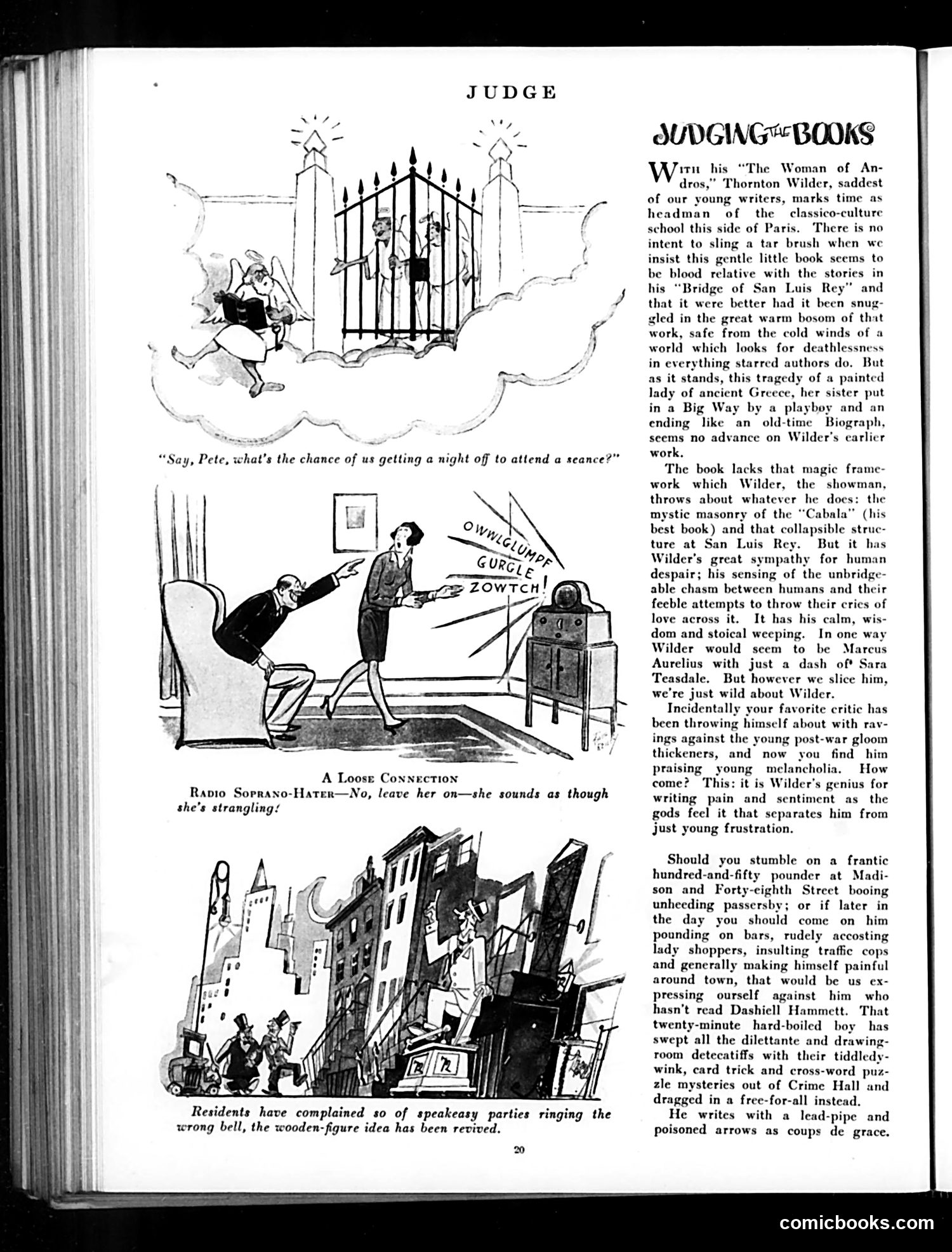
Judge Magazine Book Review Page This page contains satirical cartoons and a literary review section titled "Judging the Books." The cartoons mock contemporary social absurdities: The top cartoon depicts someone at heaven's gates asking about attending a séance—likely satirizing the 1920s spiritualism craze. The middle cartoon, "A Loose Connection," shows a radio soprano-hater requesting a performer be left on because "she sounds as though she's strangling"—humor about early radio technology and bad singers. The bottom cartoon references Prohibition-era speakeasy parties where residents complained about wrong doorbells being rung; the solution shown is reviving wooden dummy door-knockers—absurdist satire on Prohibition enforcement difficulties. The book review praises Thornton Wilder as a leading young writer, comparing him favorably to Dashiell Hammett while critiquing Wilder's latest work as derivative. The critic contrasts Wilder's poetic, philosophical approach to human suffering against Hammett's hard-boiled detective fiction, which had recently displaced genteel mystery stories.
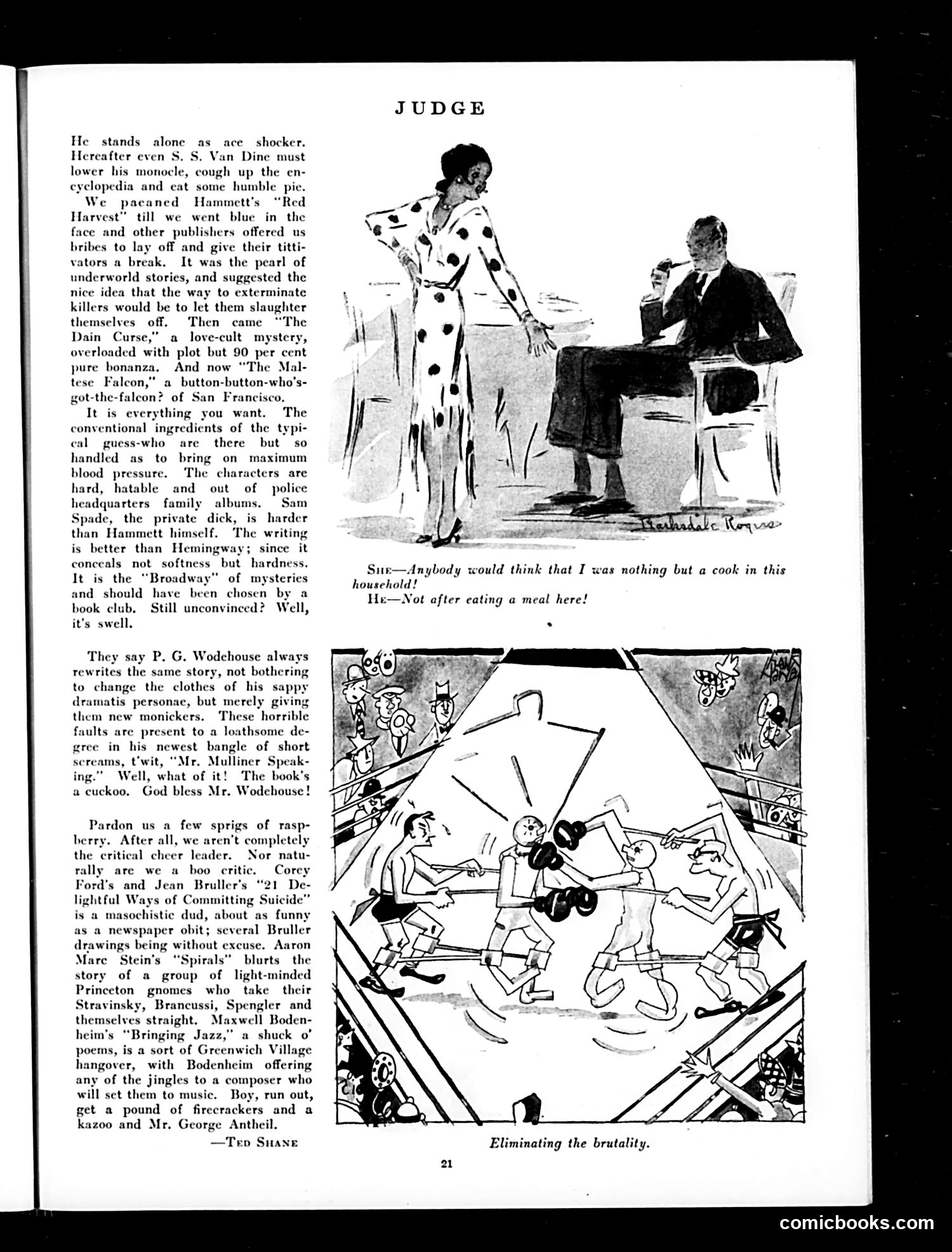
Analysis of Judge Magazine Page This page contains a literary review section praising Dashiell Hammett's detective novel "The Maltese Falcon," comparing it favorably to his earlier works "Red Harvest" and "The Dain Curse." The reviewer credits Hammett with creating hardboiled crime fiction that surpasses even S.S. Van Dine's mystery writing. The top cartoon depicts a woman in a polka-dot dress speaking to a seated man—a domestic joke about cooking. She protests being seen as "nothing but a cook," and he replies that after tasting her meal, nobody would make that assumption (implying the food is terrible). The lower cartoon, labeled "Eliminating the brutality," appears to satirize slapstick comedy, showing figures engaged in chaotic physical comedy—likely mocking lowbrow entertainment trends of the era. The page also briefly critiques P.G. Wodehouse for repetitive storytelling and dismisses other contemporary works as mediocre or pretentious, reflecting Judge's role as a satirical arbiter of cultural taste.
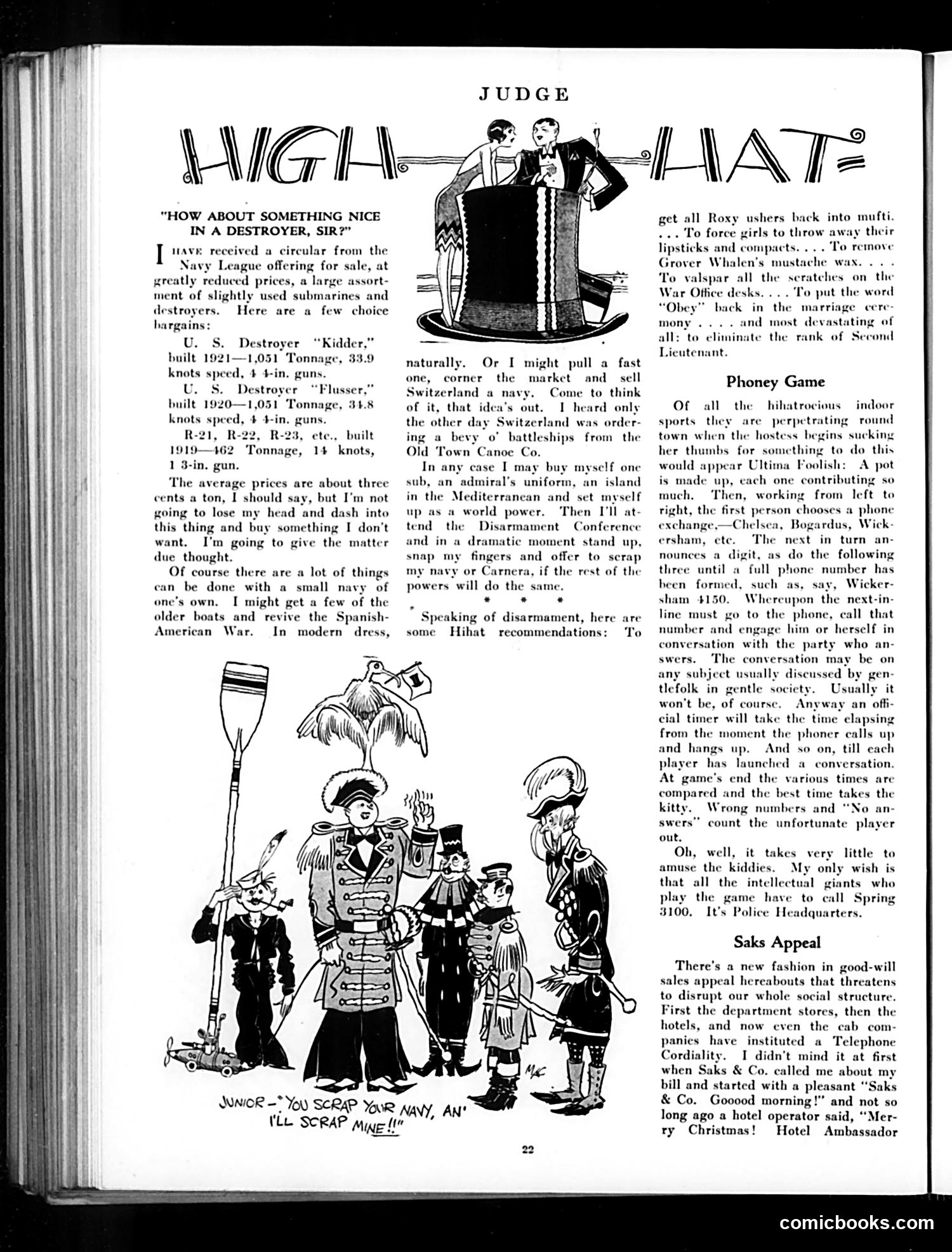
Judge Magazine Page Analysis This page satirizes post-WWI disarmament and American social trends circa the 1920s. The Main Cartoon depicts a military officer surrounded by children, captioned "You scrap your navy, and I'll scrap mine!" This mocks international disarmament conferences (likely the Washington Naval Conference of 1921-22) by suggesting world powers make hollow promises while maintaining military strength—presented absurdly through a children's game analogy. The opening column jokes about buying surplus U.S. Navy destroyers at bargain prices, then humorously proposes buying "Switzerland a navy" or establishing himself as a "world power" with a Mediterranean island—satirizing both post-war military surplus and the era's geopolitical instability. The sidebar sections mock contemporary society: disarmament rhetoric, a parlor game called "Phoney Game" where socialites call random phone numbers, and criticism of department stores' overly-friendly sales tactics. The humor targets both upper-class affectation and commercialism of the era. The overall tone is cynical about both international diplomacy and American consumer culture.
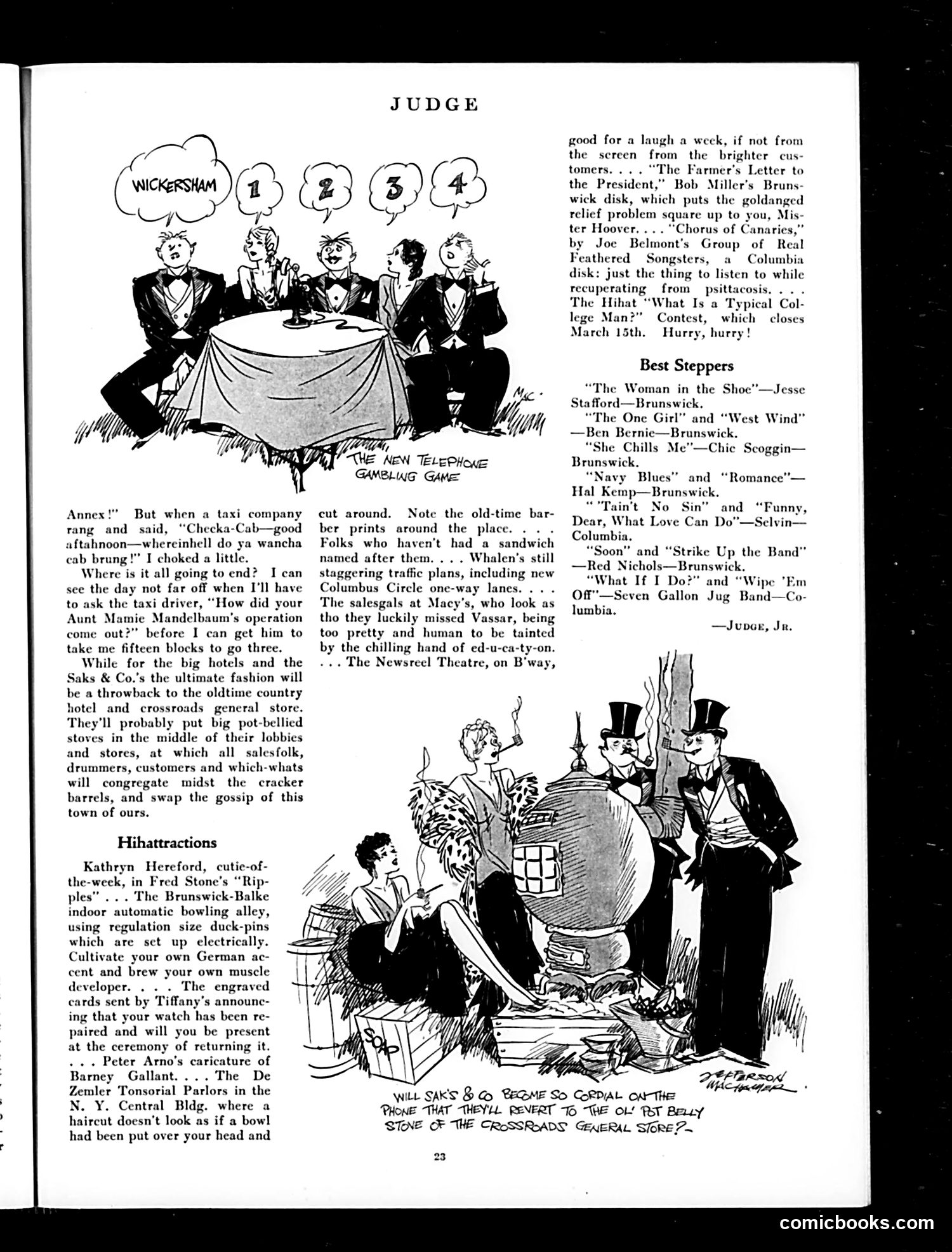
Judge Magazine Page Analysis This page from Judge contains social commentary on 1920s American life. The main cartoon depicts five men labeled "Wickersham" (numbered 1-4) playing "the new telephone gambling game"—satirizing how telephone technology was being adopted for illicit gambling, a contemporary social concern. The text discusses how informal, colloquial speech is infiltrating even formal service industries (taxi drivers, hotels). The author laments that high-end establishments like Saks & Co. will soon adopt a "throwback" aesthetic to old-time country stores with pot-bellied stoves and cracker barrels—mocking a nostalgic trend among wealthy retailers. The "Hihattractions" section lists entertainment, products, and cultural observations, including references to Fred Stone (a popular performer), bowling alleys, and various musical recordings. The lower cartoon mocks Saks & Co.'s pretension about converting to this "general store" style. The satire targets both lowbrow informality creeping upward and wealthy affectation of rustic nostalgia.
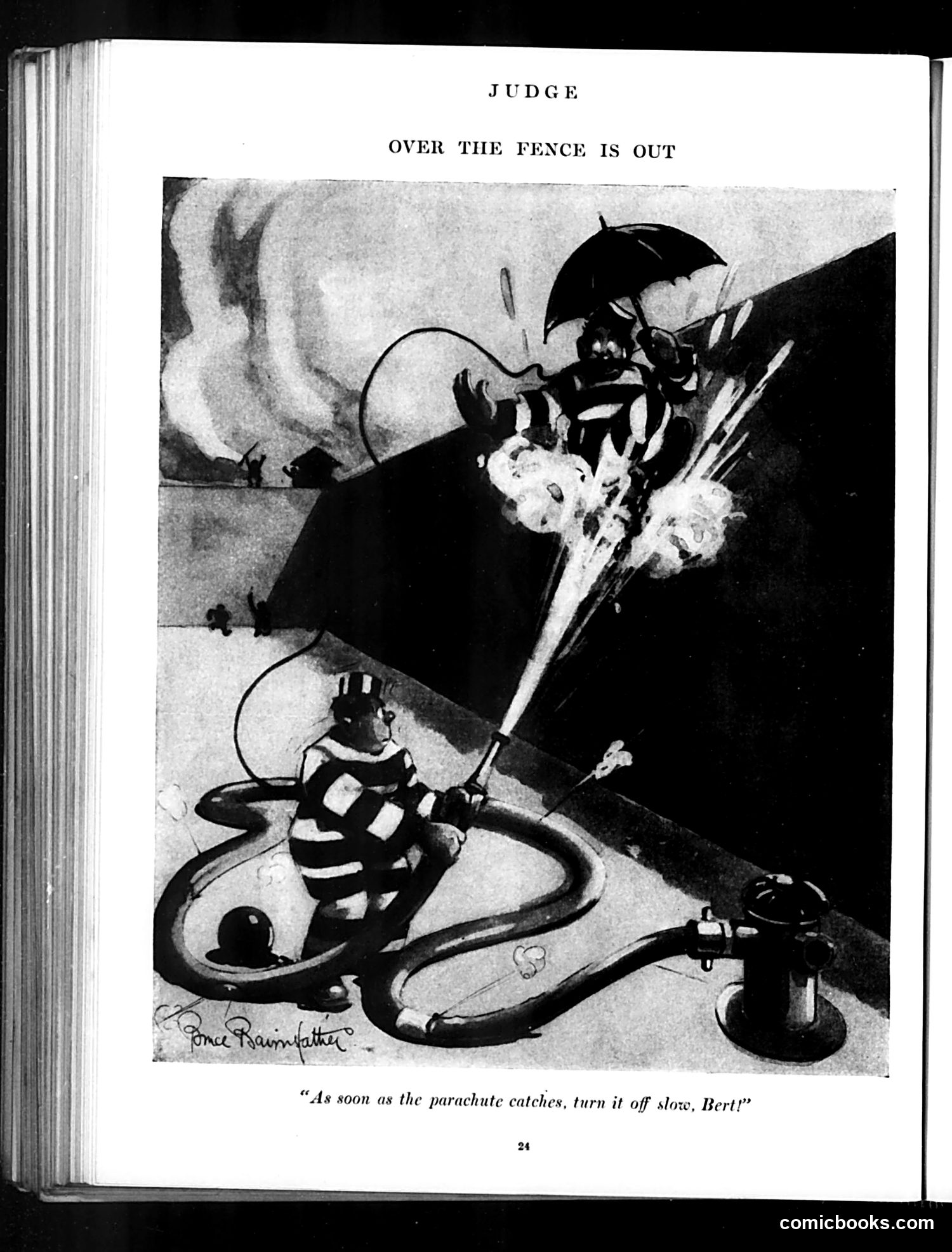
"Over the Fence Is Out" This cartoon satirizes military incompetence during what appears to be WWI-era aviation operations. The title references a baseball phrase meaning something is out of play—here applied to a malfunctioning parachute system. The scene shows two figures: a military officer with an umbrella above and a soldier below in what appears to be a defective parachute rig (shown as tangled rope). The caption—"As soon as the parachute catches, turn it off slow, Bert!"—mocks absurdly casual instructions for dangerous equipment. The satire targets either military procurement failures, inadequate safety equipment, or incompetent officers giving contradictory orders to soldiers. The careless tone of the advice emphasizes how the military sent unprepared men into lethal situations with substandard gear. This reflects period anxieties about soldier welfare and military mismanagement.
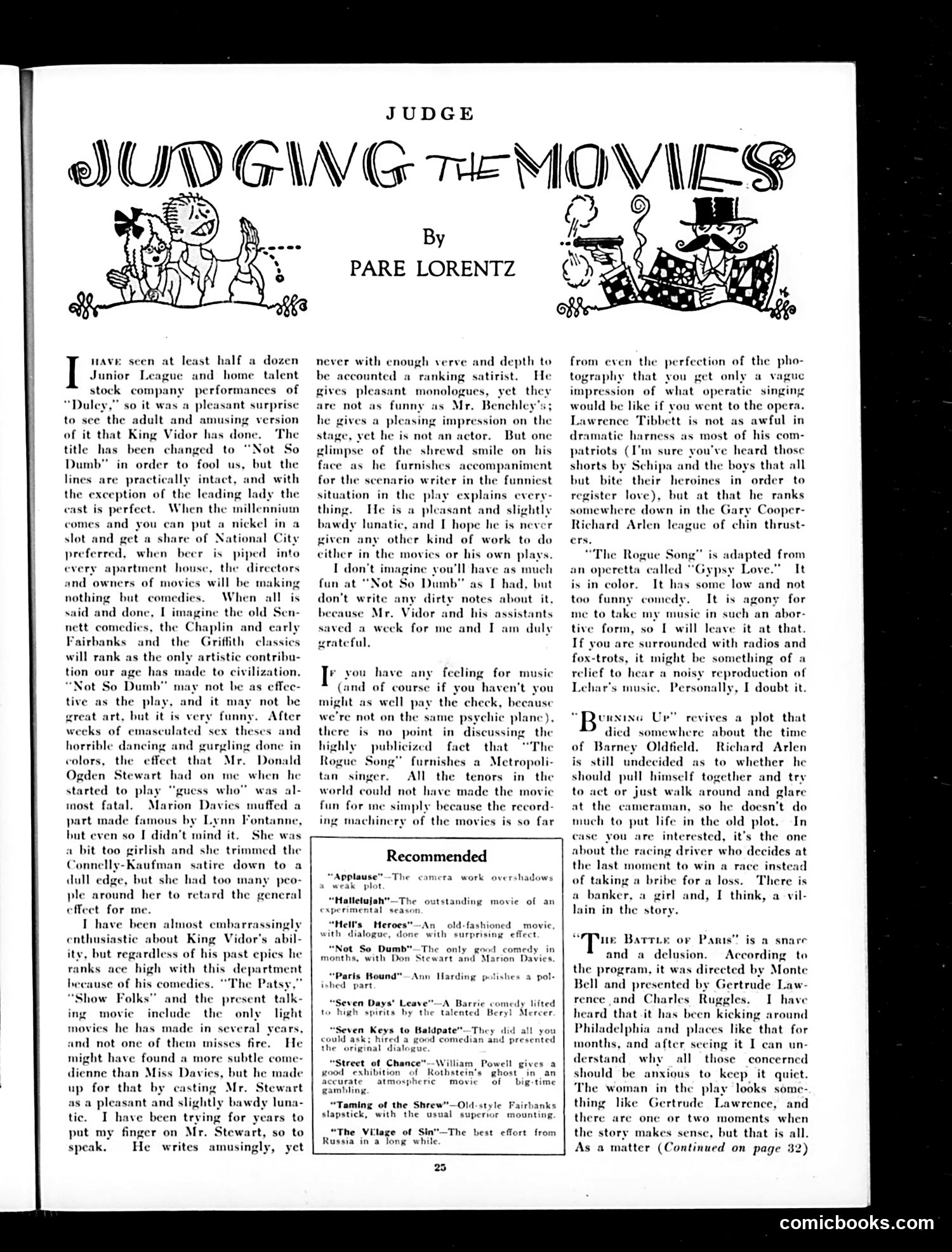
Judging the Movies: Pare Lorentz's Film Criticism (1920s) This is a film review column, not a political cartoon. Critic Pare Lorentz discusses several 1920s movies, primarily "Not So Dumb" (King Vidor's adaptation of the play "Duley," starring Marion Davies and Donald Ogden Stewart). Lorentz praises Vidor's comedic direction, comparing it favorably to Chaplin and early Fairbanks films as civilization's genuine artistic contribution. He critiques Davies as too girlish but credits Stewart's subtle comic timing. He expresses frustration with "The Rogue Song"—a Metropolitan opera vehicle—noting the movie medium cannot improve poor source material. The "Recommended" sidebar lists contemporary films with brief assessments: "Hallelujah" as experimental, "Hell's Heroes" as old-fashioned, etc. The cartoons (visible at page top) are decorative illustrations typical of Judge's masthead style, featuring caricatured figures unrelated to the review's content.
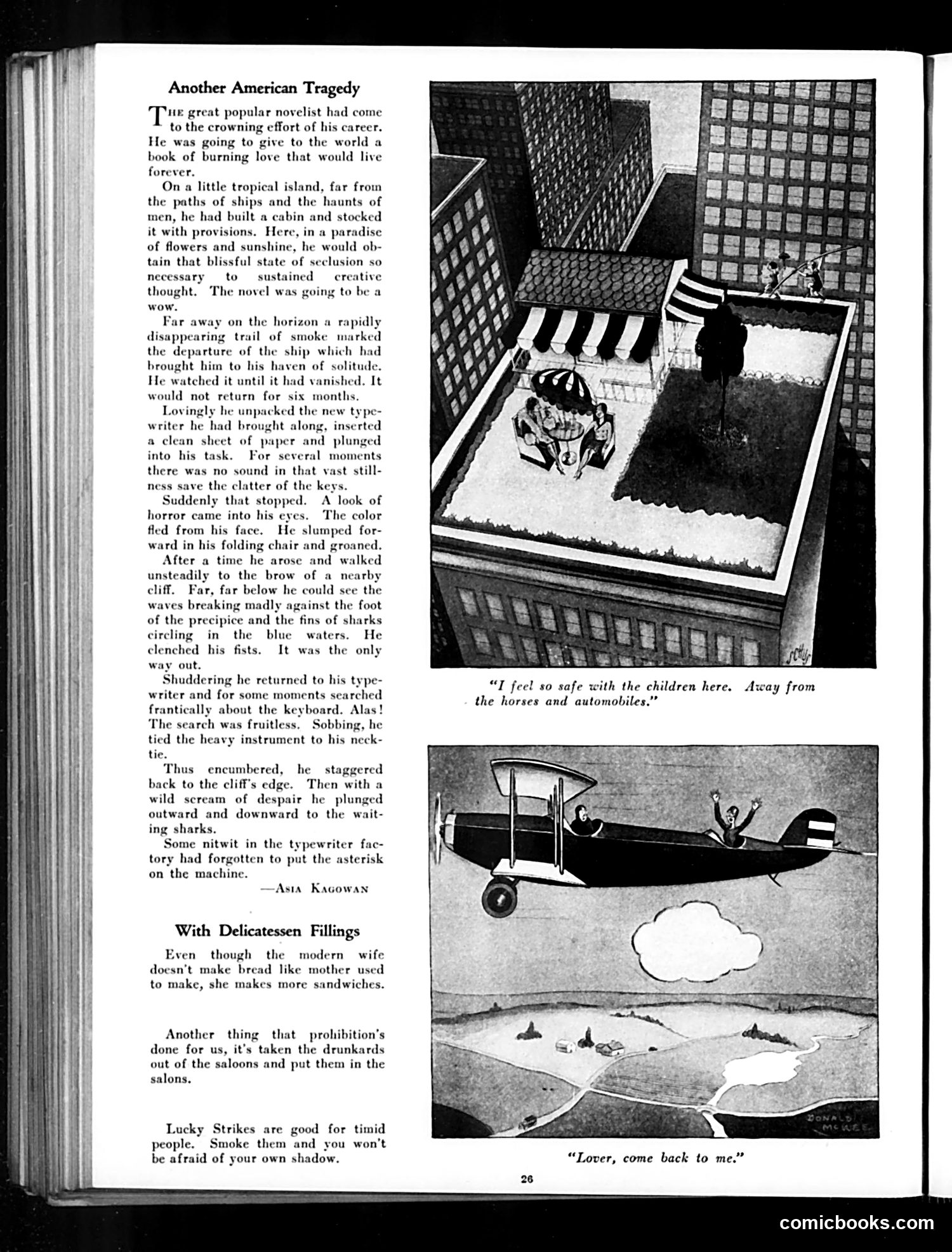
"Another American Tragedy" This satirical story mocks overly dramatic literary pretension. A famous novelist retreats to an isolated tropical island to write his masterpiece—a passionate novel he believes will be immortal. After six months of solitude and romantic inspiration, he sits at his typewriter and immediately encounters catastrophic writer's block. Driven to despair by his inability to write, he decides suicide is his only option. He ties his typewriter around his neck and prepares to jump off a cliff into shark-infested waters below. The punchline: A factory worker forgot to include an asterisk key on the machine. This trivial manufacturing defect—not artistic failure or lack of inspiration—is what prevented him from writing. The satire targets both pretentious authors who treat writing as life-or-death drama and the gap between artistic ambition and mundane reality. The title echoes Theodore Dreiser's *An American Tragedy* (1925), a serious novel about desperation and social forces.
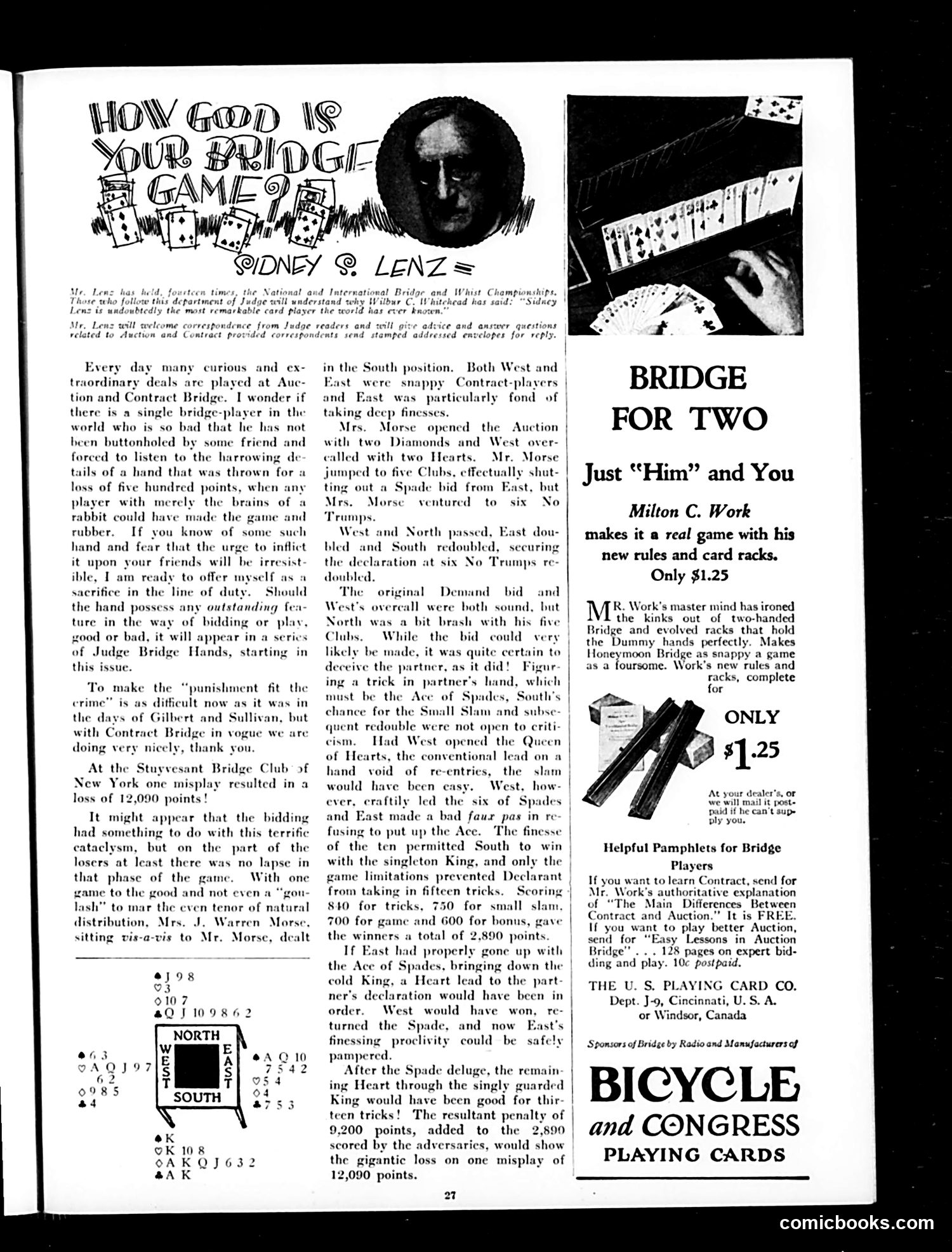
Analysis for Modern Readers This Judge magazine page (circa 1920s-30s) contains bridge game content, not political satire. The top features Sidney Lenz, a famous bridge champion whose portrait and accomplishments are celebrated. The page explains Lenz's expertise and invites readers to submit difficult bridge hands for publication in Judge's series. The main article details a catastrophic bridge hand played at New York's Stuyvesant Bridge Club, where players—including "Mrs. J. Warren Morse"—lost 12,090 points due to a single strategic error in card play. The article dissects the bidding and play-by-play to illustrate how a seemingly sound contract failed. The remaining space is advertising: Milton C. Work's new two-handed bridge rules and card racks ($1.25), plus U.S. Playing Card Company promotions for Bicycle and Congress playing cards. For modern readers: This reflects bridge's peak popularity in early 20th-century American leisure culture—when complex card-game strategy warranted serious magazine coverage and advertisement.
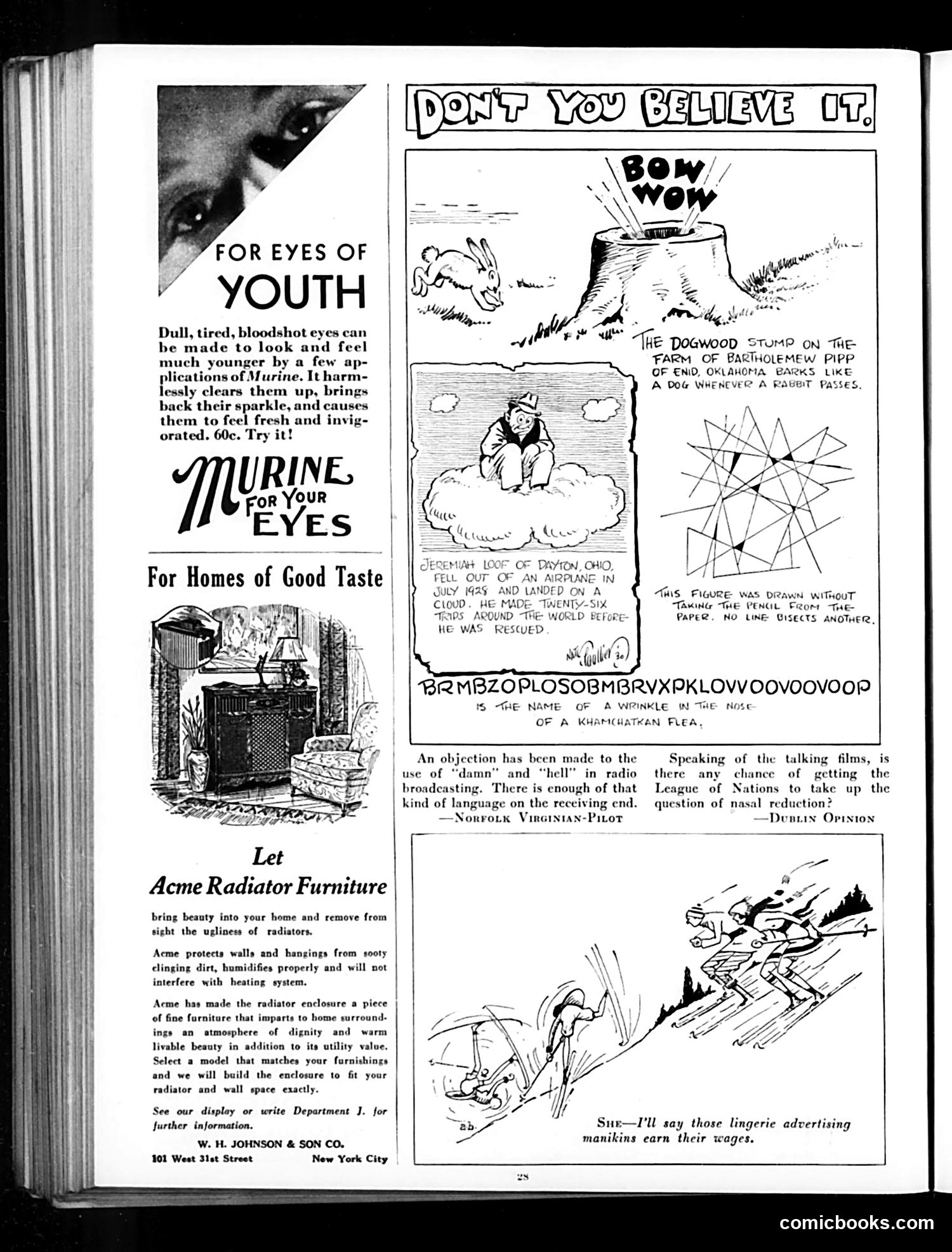
"Don't You Believe It" Comic Analysis This page from *Judge* magazine features a humor section titled "Don't You Believe It," presenting absurdist tall tales as satire. The three anecdotes mock credulous readers: 1. A rabbit in Oklahoma barks like a dog when a "rageit" (likely "rage fit" or similar) passes—impossible animal behavior presented as fact. 2. A man fell from an airplane in 1929, landed on a cloud, and made 26 trips around the world before rescue—physically impossible. 3. A nonsense word string names a wrinkle on a flea's nose—meaningless pseudo-scientific naming. Below, two editorial comments mock social concerns: one critiques objections to profanity in radio as hypocritical (the "receiving end" is already coarse), and another sarcastically suggests the League of Nations address "nasal reduction"—mocking both cosmetic surgery trends and international bodies' tendency toward trivial concerns. The humor targets gullibility and absurdist social anxieties of the era.
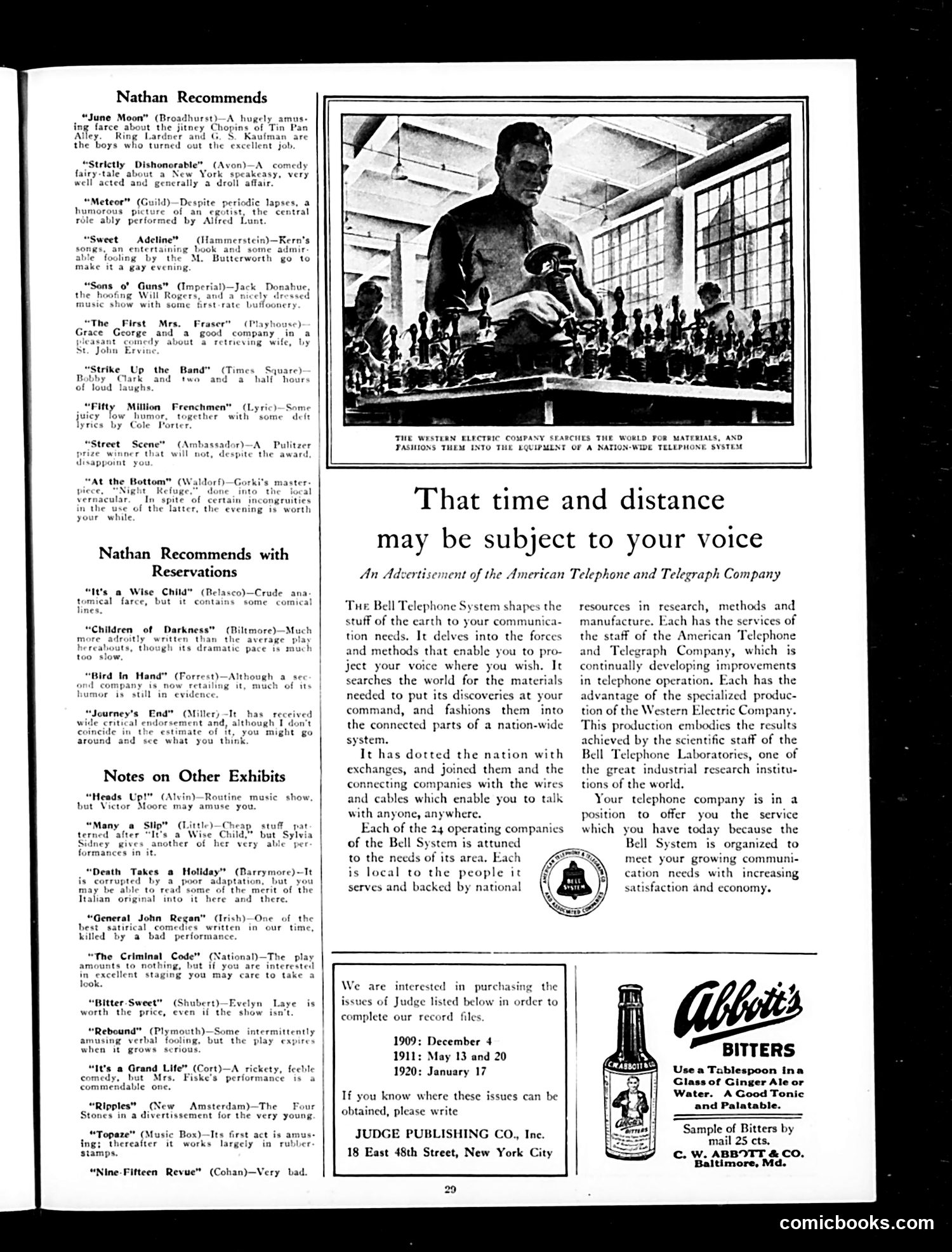
Analysis for Modern Readers This page is primarily theater reviews and advertisements, not political satire. Nathan (likely drama critic Burns Mantle) recommends Broadway shows from the 1920s, rating plays like "June Moon," "Strictly Dishonorable," and "Street Scene." The large central image shows Western Electric Company's telephone equipment manufacturing—workers assembling materials for the Bell Telephone System. This is a corporate advertisement promoting how the company sources materials globally to build nationwide telephone infrastructure. The satire is absent or subtle: This appears to be a straightforward theatrical criticism page with advertising. The telephone ad emphasizes technological progress and national connectivity—typical 1920s corporate messaging about modern innovation. Context for modern readers: Judge magazine mixed entertainment criticism with advertising. The telephone ad represents pre-Depression optimism about technological advancement, while the theater reviews reflect Broadway's thriving commercial scene.
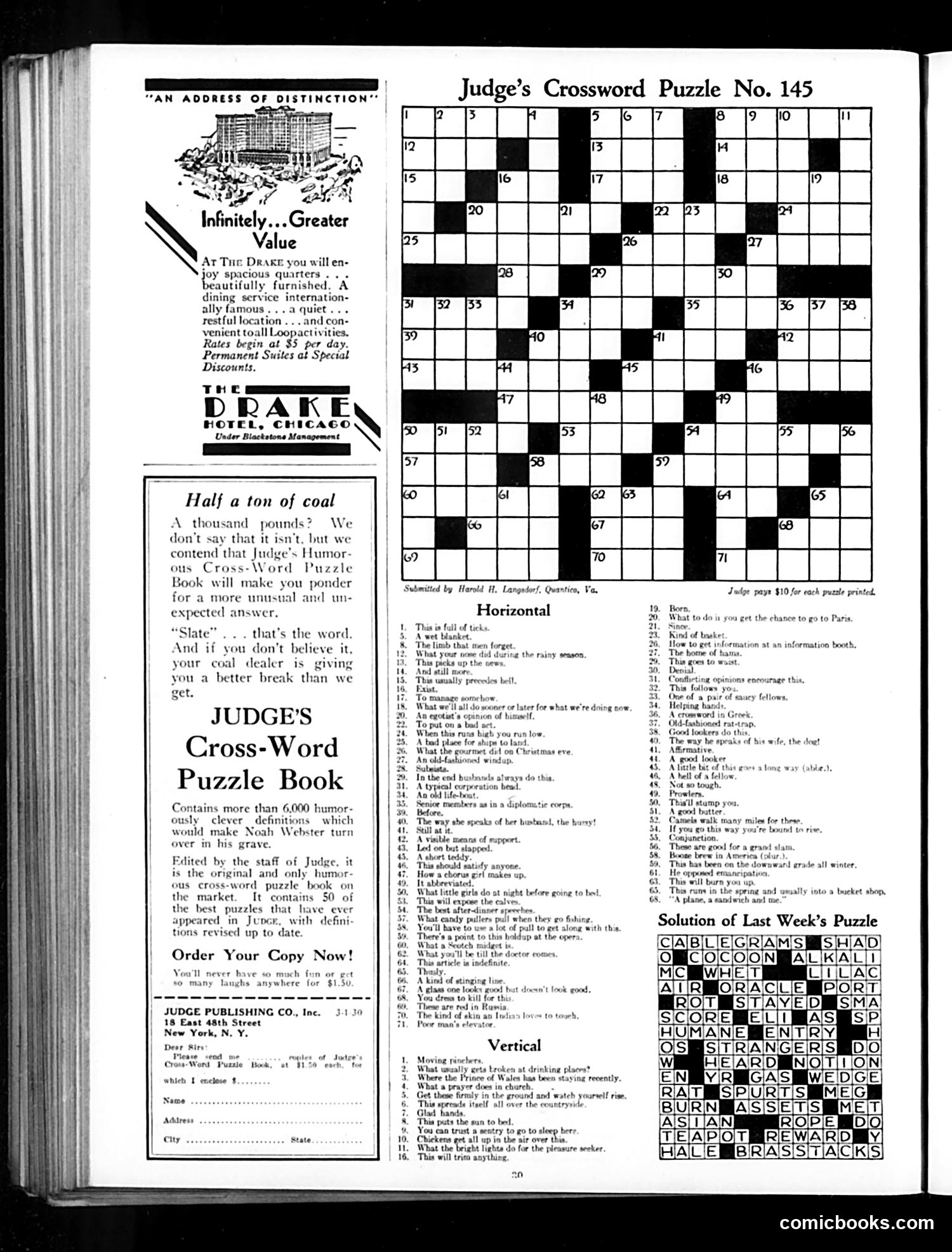
This page is primarily advertising and puzzle content, not political satire. The main elements are: 1. Drake Hotel ad (top left): A straightforward luxury hotel advertisement emphasizing spacious rooms, fine dining, and reasonable rates ($5/day). 2. Judge's Cross-Word Puzzle Book promotion (center-left): Humorous copy advertising a puzzle book, using a clever wordplay joke—a "half ton of coal" riddle where the answer is "slate" (rather than pounds), demonstrating the book's wit. 3. Crossword Puzzle No. 145 (right side): The actual puzzle grid with clues, representing Judge magazine's regular puzzle feature. 4. Solution (bottom right): Answer key from the previous week's puzzle. There is no political cartoon or satire visible on this page. It's a standard magazine interior page mixing commercial advertisements with entertainment content typical of Judge's format during this period.
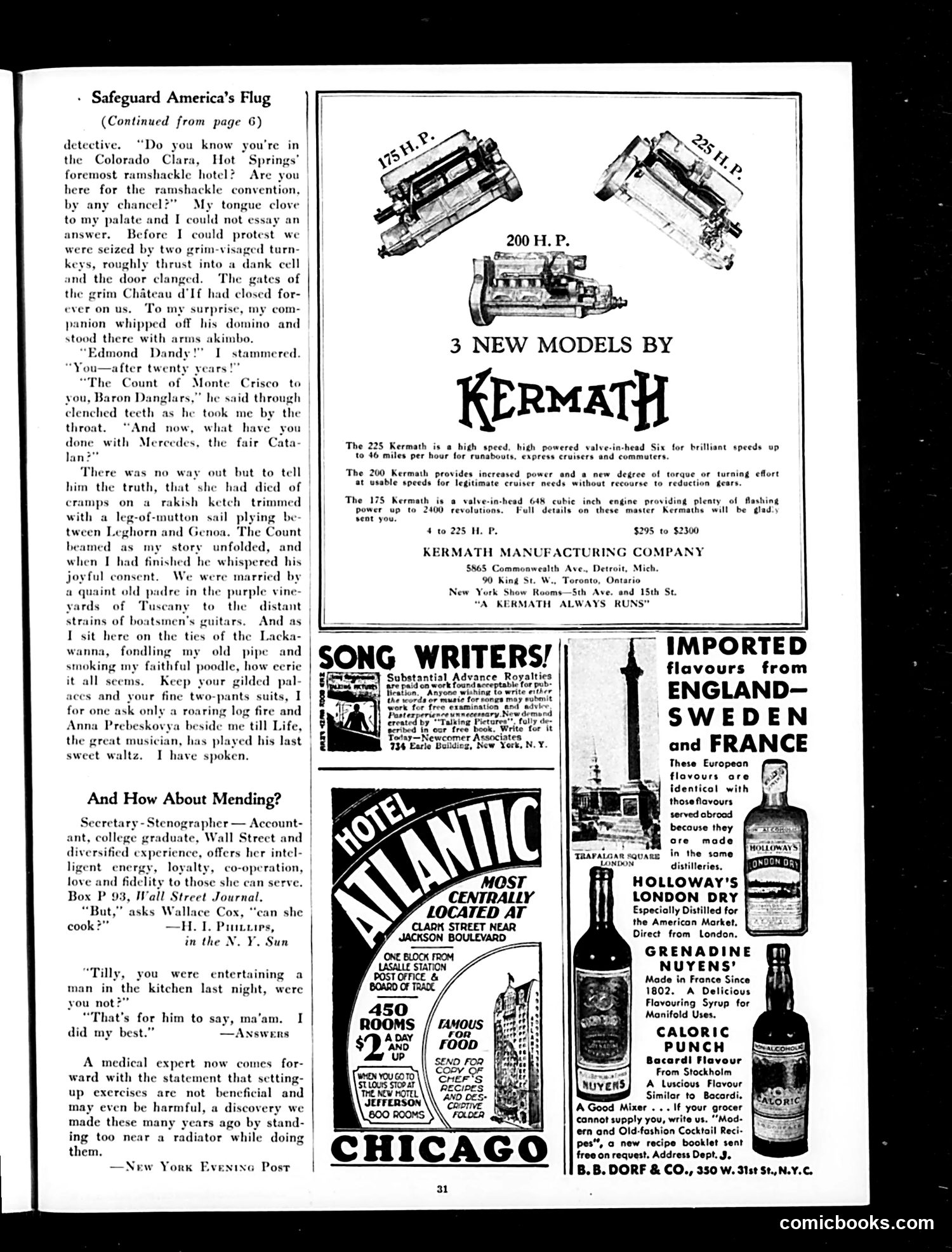
Page Analysis: Judge Magazine Advertisement Page This is primarily an advertising page from Judge magazine, not a satirical cartoon page. The content consists mainly of commercial advertisements from the 1920s era. Notable advertisements include: - Kermath engines (top): Marine motors for speedboats and cruisers, promoting various horsepower models - Hotel Atlantic (Chicago): A budget hotel advertisement highlighting 450 rooms at "$2 a day and up" - Imported liqueurs (right side): European spirits including Holloway's London Dry gin, Grenadine Nuyens syrup, and Caloric Punch, marketed as imported from Sweden and France Upper left content appears to be a serialized fiction story ("Safeguard America's Flag," continued from page 6) featuring melodramatic references to *The Count of Monte Cristo*—a literary parody or adventure narrative. The page also includes small job-wanted and advice columns ("And How About Mending?"), typical filler for the era. This is a representative advertising/content mix page rather than a satirical commentary page.
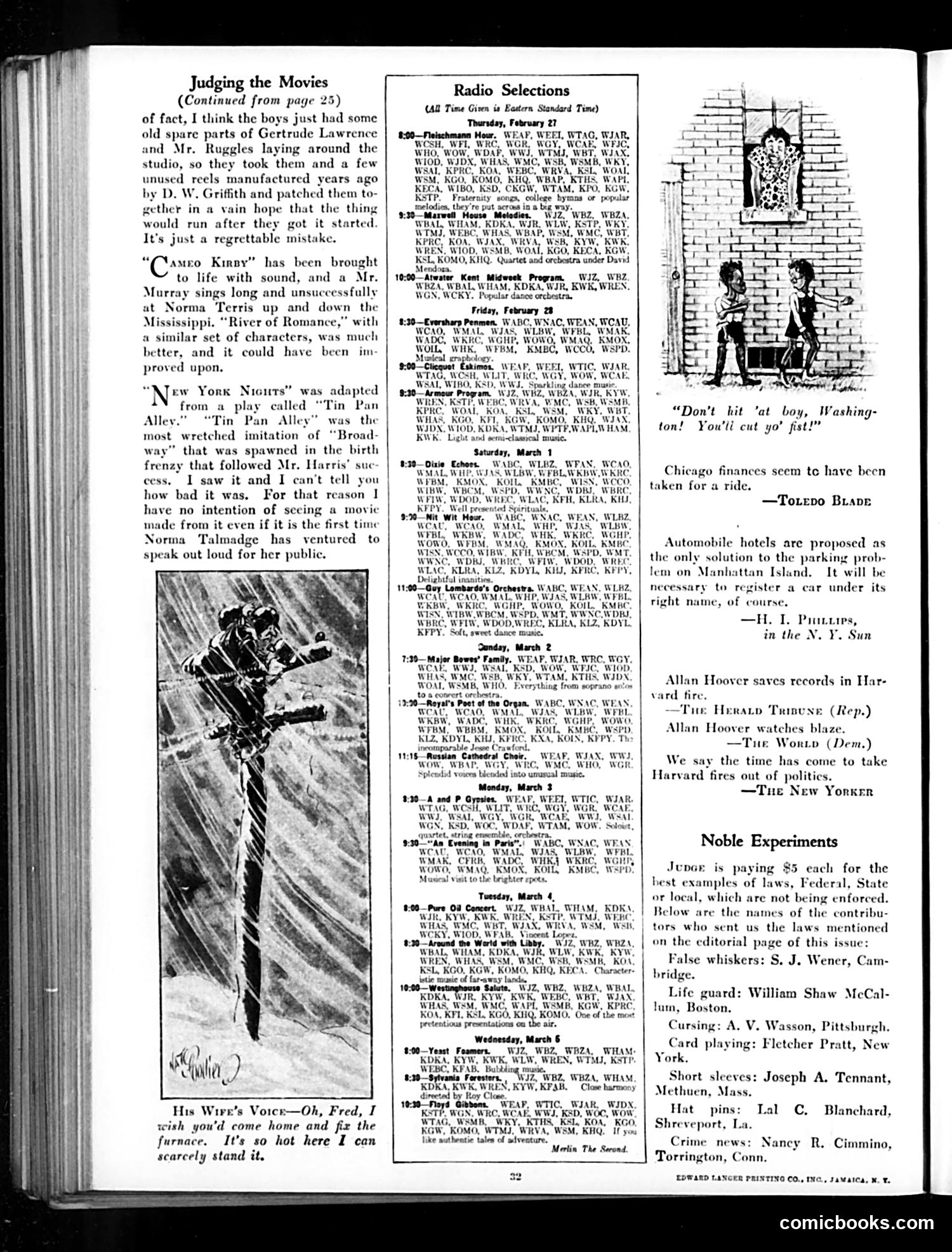
"Judging the Movies" and Related Content This page from *Judge* magazine features a film critic's reviews of early sound movies (circa 1929). The main article discusses recent films like "Cameo Kirby" and "New York Nights," dismissing them as poorly made or derivative works. The critic particularly mocks "Tin Pan Alley," calling it a "wretched imitation" of a Broadway play. The small cartoon below depicts a domestic scene where a wife complains about the furnace to her absent husband—a relatable joke about household maintenance and marital dynamics. The page primarily consists of radio program listings for the week, showing station call letters and broadcast times—essential reference material for *Judge* readers in this pre-television era. The cartoon illustration shows someone working on pipes or furnace equipment, reinforcing the domestic theme of the accompanying caption about home repairs.
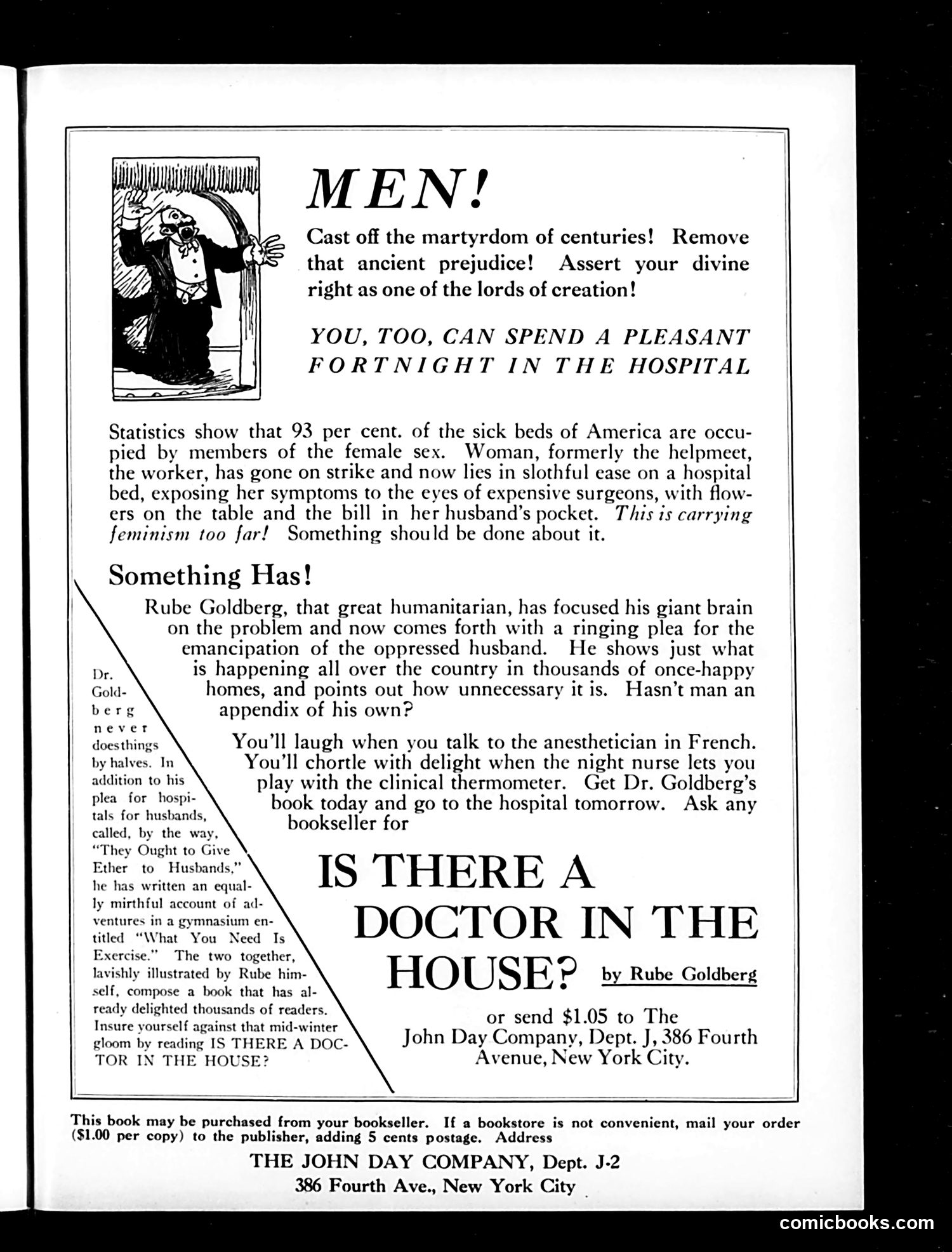
Judge Magazine Advertisement Analysis This is primarily a book advertisement masquerading as satirical commentary. The page mocks the women's suffrage/feminism movement by claiming women have "gone on strike" and occupy 93% of hospital beds in "slothful ease," burdening husbands with medical bills. The satire targets feminism itself: The headline sarcastically urges men to "cast off martyrdom" and claim their "divine right," inverting feminist language to argue women's liberation has gone too far. Rube Goldberg (the famous cartoonist/inventor) is portrayed as a "humanitarian" offering the solution: a humorous book titled *"Is There a Doctor in the House?"* The advertisement promises men will laugh about hospital experiences, treating male hospitalization as comedic relief from female "emancipation." The underlying message is anti-feminist: women seeking medical care and asserting independence are presented as burdensome and ridiculous. This reflects early 20th-century resistance to women's rights, using humor to delegitimize feminist concerns.
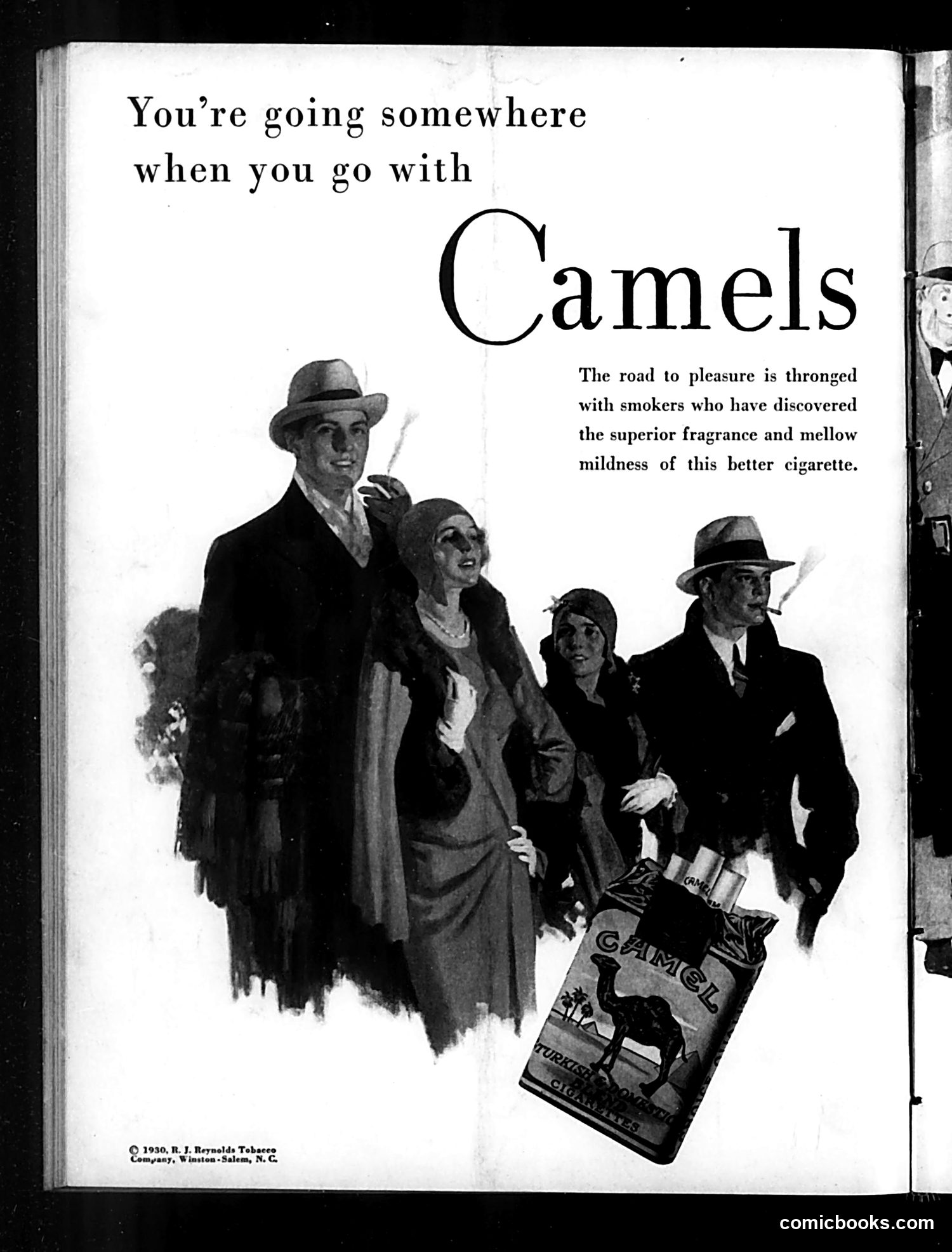
Analysis This is a Camel cigarette advertisement, not satire. The 1930 ad depicts four well-dressed, fashionable people (two men in suits and hats, a woman in elegant dress and fur, and a younger figure) walking together, each smoking. The tagline promises that choosing Camel cigarettes puts you "going somewhere"—associating the brand with success, sophistication, and social advancement. The advertisement exploits aspirational messaging: smoking Camels signals belonging to an elegant, upwardly mobile crowd. The "superior fragrance and mellow mildness" claims are typical of early cigarette marketing, which emphasized quality before health dangers were widely acknowledged. This represents pre-regulation advertising freely appearing in mainstream publications, promoting smoking as a lifestyle marker of refined taste and social status.