judge
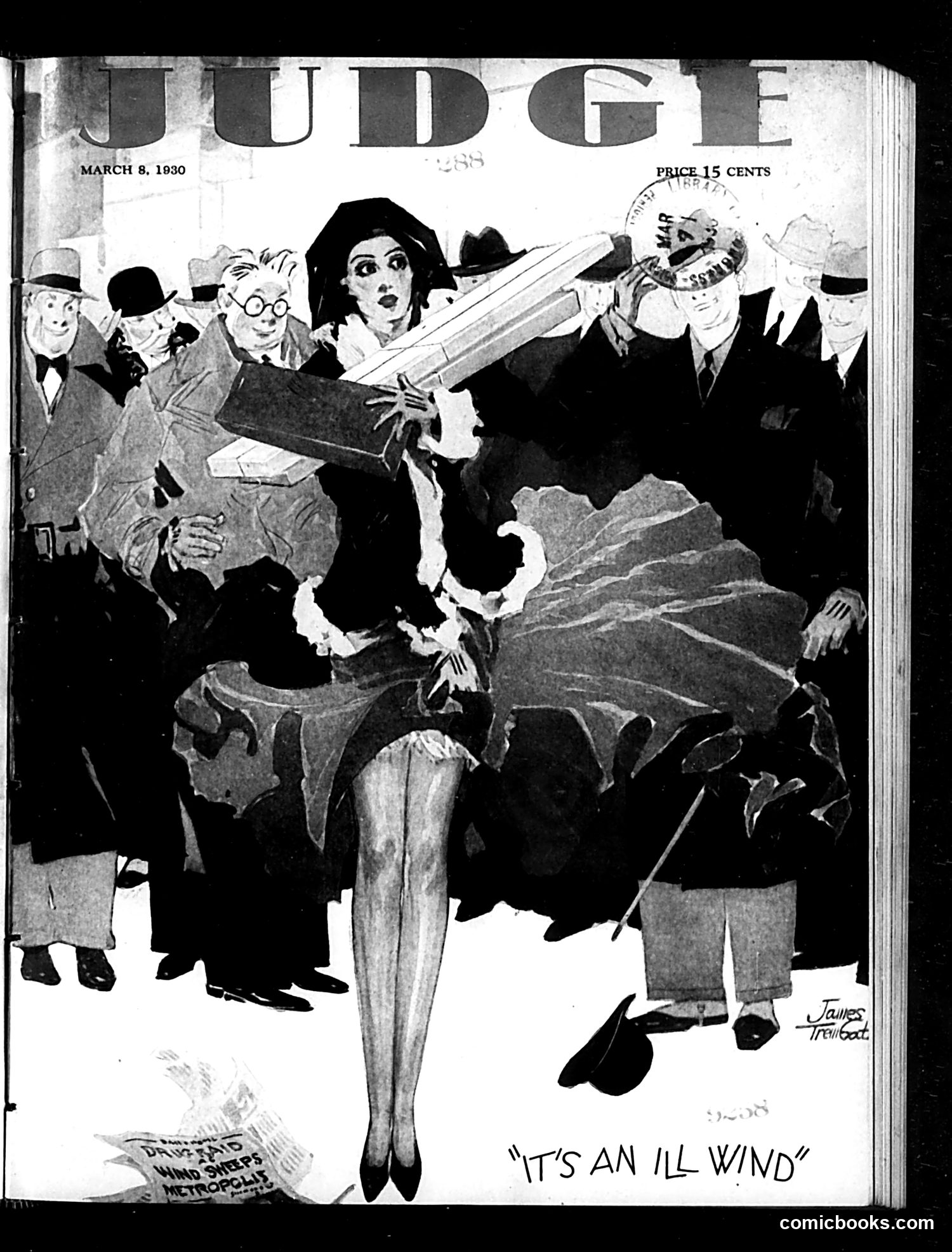
Judge — March 8, 1930
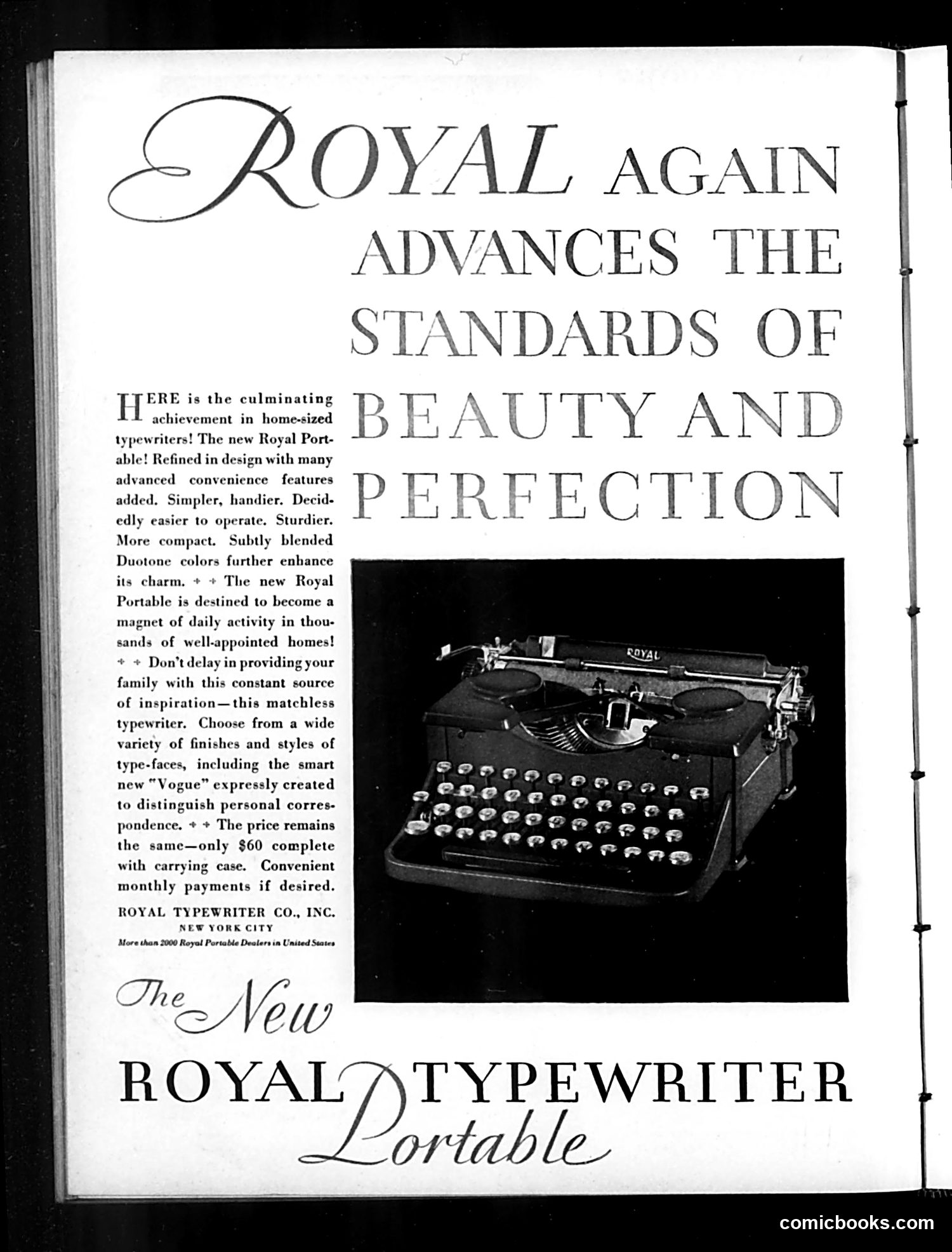
Analysis This is not a cartoon or satire page — it's a straightforward advertisement for the Royal Portable Typewriter. The page promotes the new Royal Portable model by emphasizing its improvements: refined design, compact size, easier operation, "Duotone colors," and a new "Vogue" typeface. The ad highlights convenience features and sturdiness, positioning it as essential for "well-appointed homes." The photograph shows the typewriter itself — a desktop portable model typical of the era. The text promises affordability ($60 complete with carrying case) and flexible payment options. The appeal is to middle-class consumers seeking both functionality and aesthetic refinement for home use. This appears in *Judge*, a satirical magazine, but this particular page is purely commercial content, not editorial commentary or political satire.
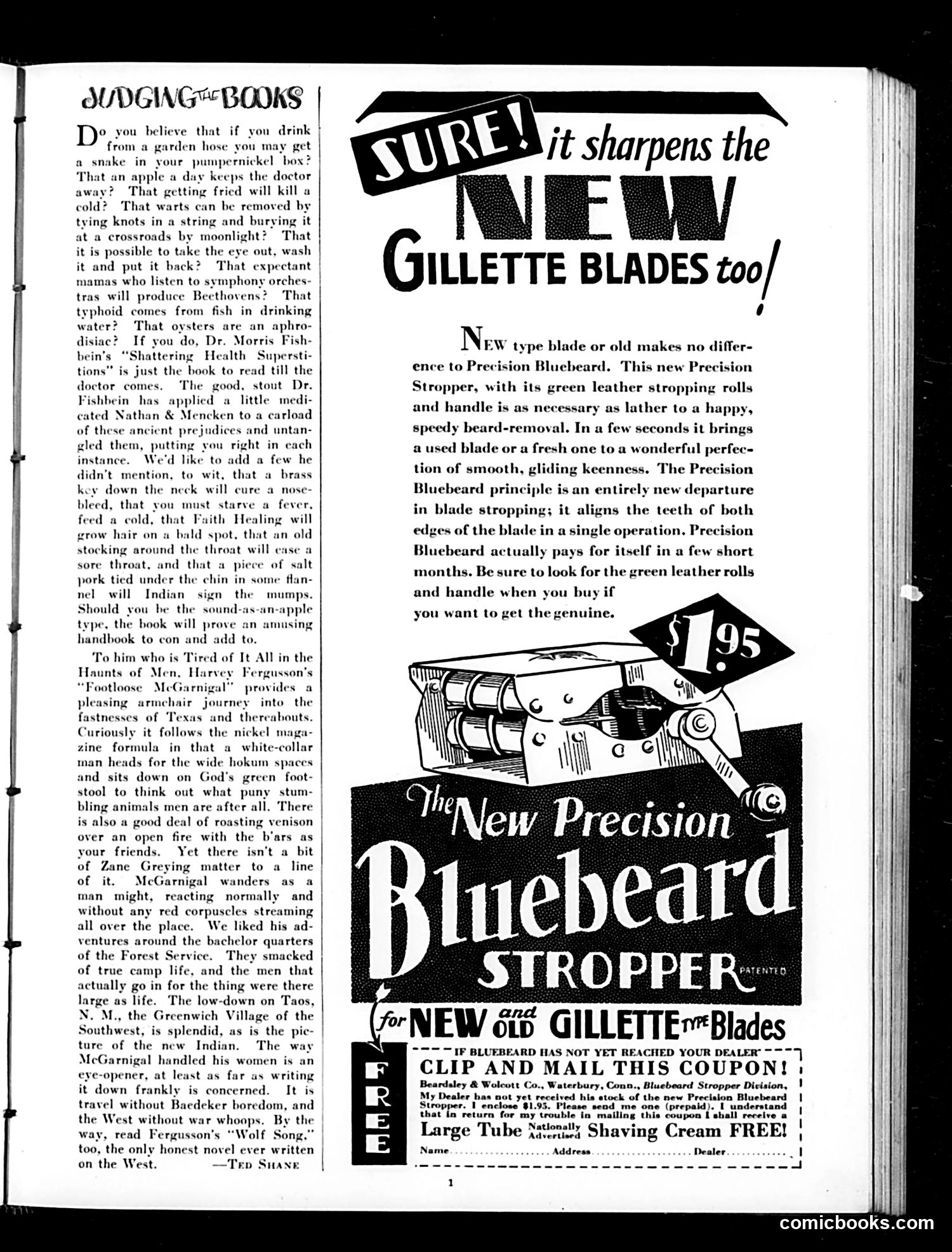
Page Analysis: Judging the Books & Bluebeard Stropper Ad This page is primarily advertising content rather than political satire. The left column contains "Judging the Books," a book review section discussing various publications including Dr. Morris Fishbein's health guide and Harvey Ferguson's "Footloose McGarry." The dominant right side features a full-page advertisement for the Precision Bluebeard Stropper razor blade sharpener, priced at $1.95. The ad emphasizes the device's ability to restore used blades to near-new condition, claims it works on "any type blade or old makes," and includes a coupon for free shaving cream. This is straightforward commercial advertising from the interwar period, not satirical commentary. The "Bluebeard" product name references the folklore villain, likely chosen for marketing appeal rather than social critique.
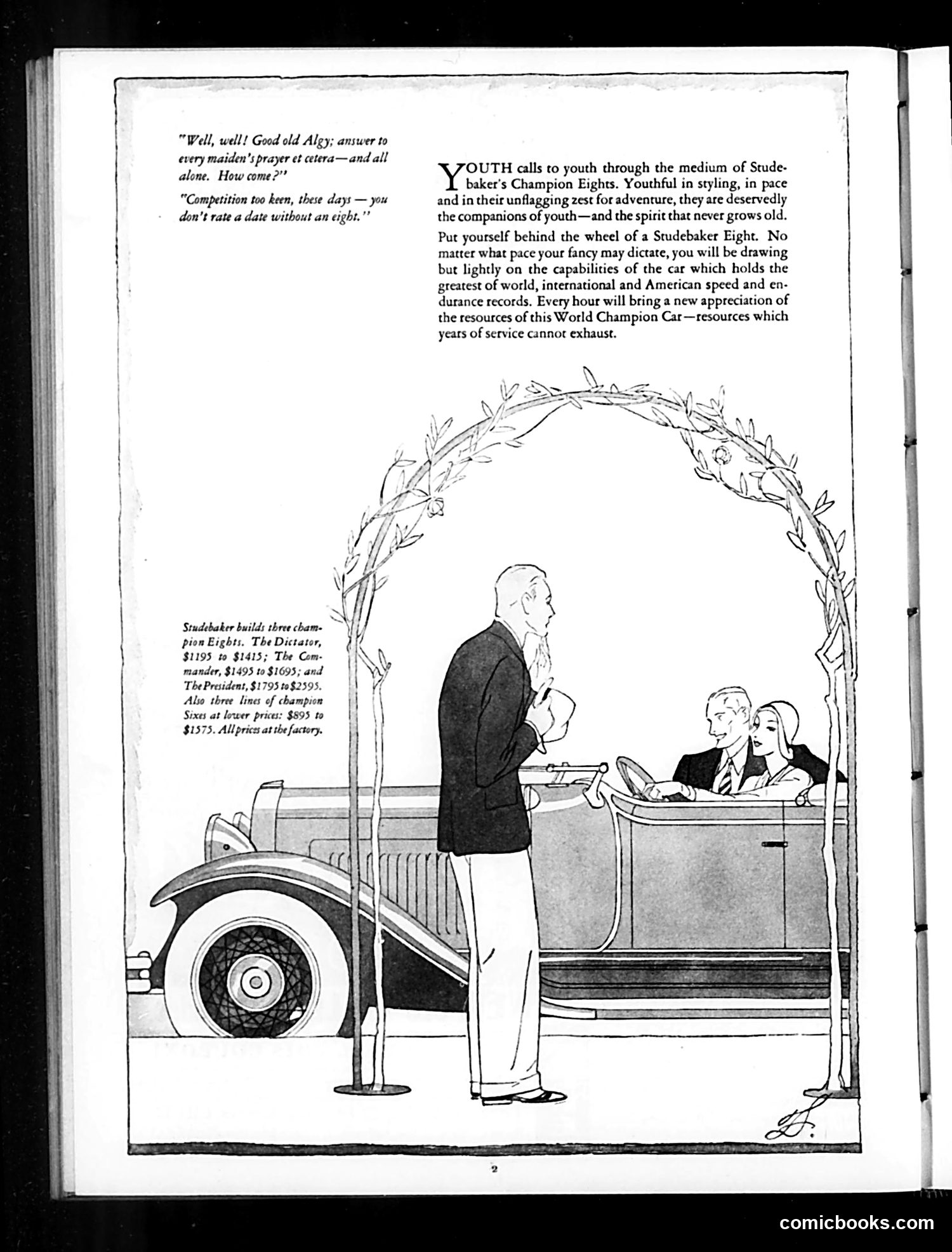
Analysis This appears to be a Studebaker automobile advertisement masquerading as editorial content in Judge magazine. The illustration shows a well-dressed man presenting a Studebaker Eight to a young couple in an idealized garden setting. The ad appeals to youth culture and aspirational values, claiming the car embodies "speed and endurance records" and offers "new appreciation of...World Champion" capabilities. The accompanying text emphasizes the vehicle's durability ("years of service cannot exhaust"). The poetic framing device—the dialogue about youth and adventure at the page's top—romanticizes car ownership as a lifestyle choice. Specific pricing for three "champion Eight" models is listed, suggesting this hybrid advertising-editorial format was common in Judge during this period. The content targets affluent, young consumers.
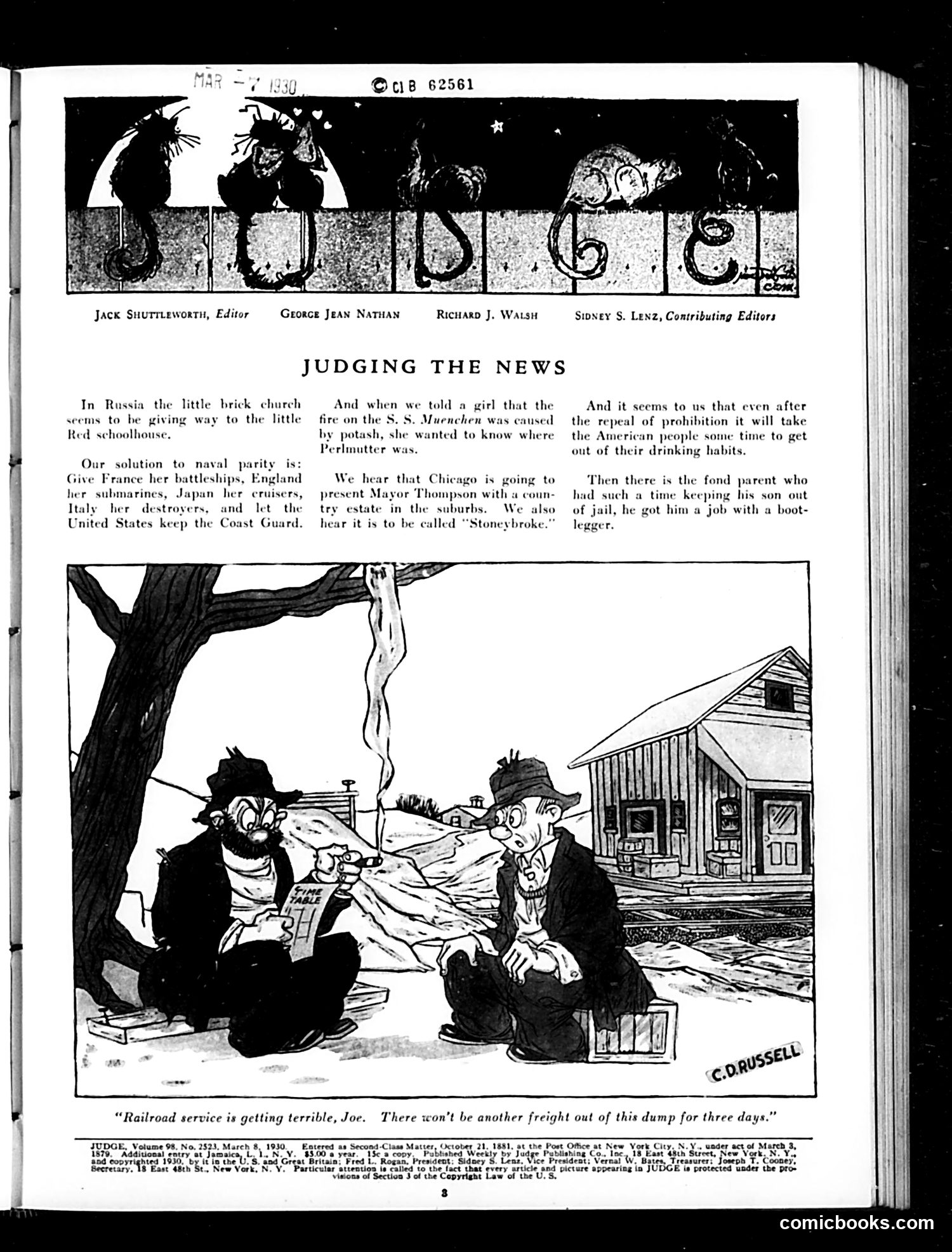
Judge Magazine Cartoon Analysis This page from *Judge* contains editorial commentary titled "Judging the News" with several brief satirical items about contemporary issues, followed by a cartoon by C.D. Russell. The main cartoon depicts two men in shabby clothes beneath a tree, reading a newspaper. One says to the other: "Railroad service is getting terrible, Joe. There won't be another freight out of this damp for three days." The satire targets railroad service quality during what appears to be an economic downturn (likely the 1920s-30s based on styling). The joke equates vagrant hobos—who typically hitched illegal rides on freight trains—with legitimate passengers, sarcastically suggesting even they can't find adequate service. It's commentary on deteriorating American railroad infrastructure and reliability during this period.
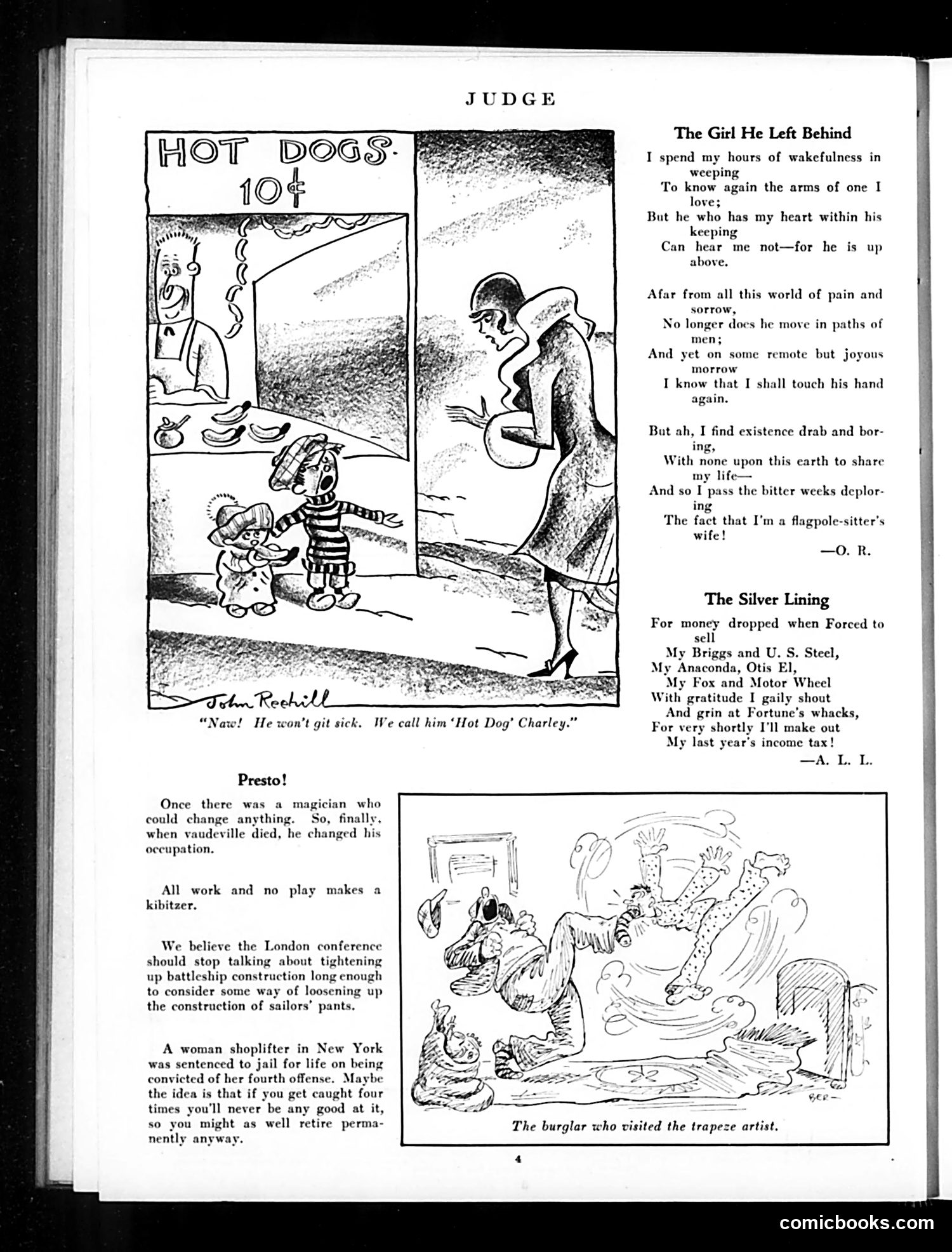
Judge Magazine Page Analysis This page contains humor typical of early-20th-century American satire: "Hot Dogs" cartoon (top left): A street vendor selling hot dogs for 10 cents is labeled "Hot Dog Charley." The joke plays on the common slang term "hot dog" and stereotypes about cheap street food and working-class vendors—likely referencing a contemporary figure or type. "The Girl He Left Behind" (right): A sentimental poem about romantic separation, common in period literature and popular songs. "Presto!" (center text): Jokes about occupational changes and work-life balance, with commentary on sailors' uniforms and London conferences—typical of Judge's mix of social observation and light satire. "The burglar who visited the trapeze artist" (bottom cartoon): A humorous illustration showing a burglar encountering circus performers, playing on the absurdist humor Judge frequently featured.
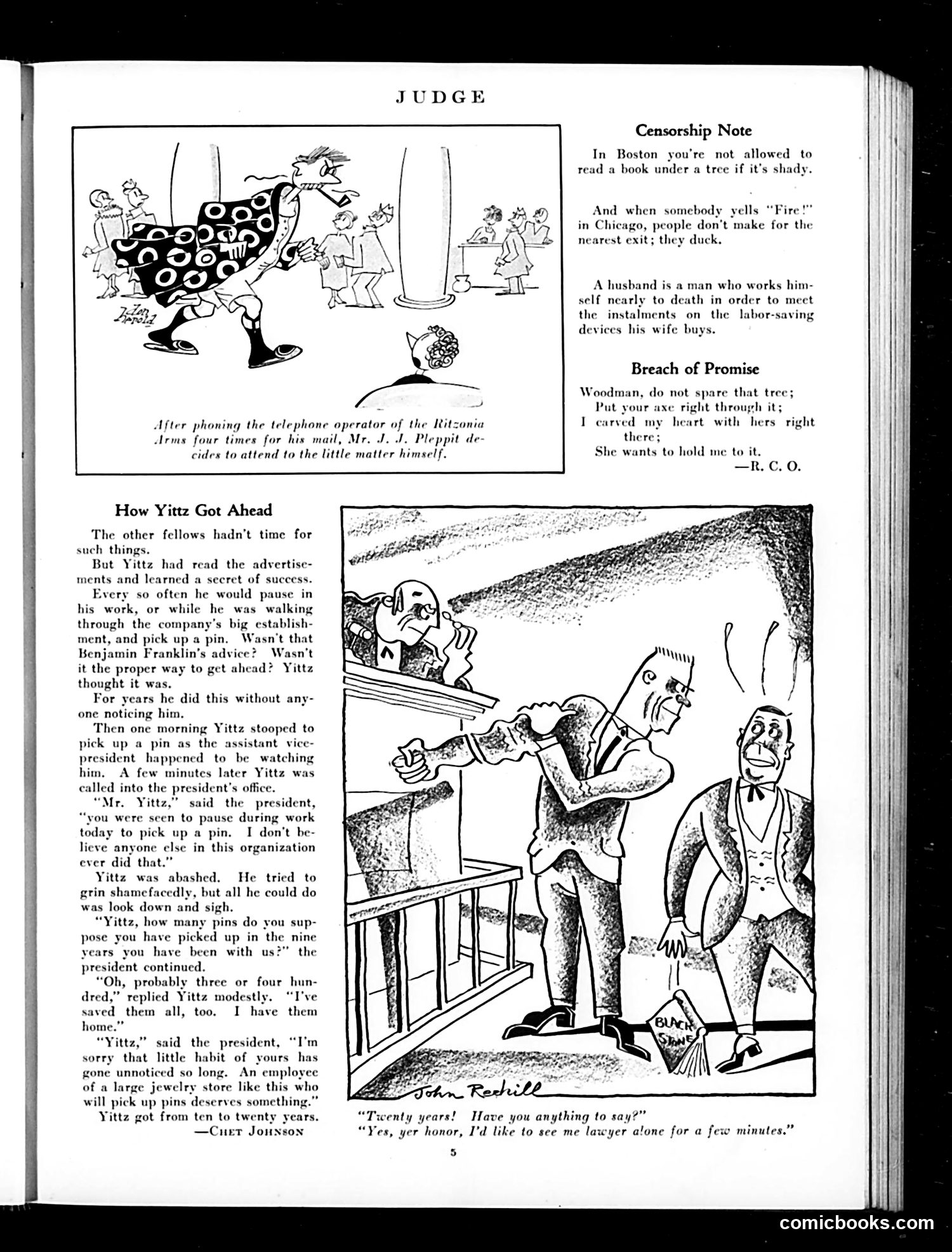
Judge Magazine Page Analysis Top Cartoon ("Judge"): Shows a man with a large polka-dotted chicken fleeing chaos, illustrating the caption about phoning the Ritzonia Arms hotel operator. The joke appears to satirize incompetent hotel management—the operator creates such disorder that the manager must personally intervene in trivial matters. "How Yittz Got Ahead": This story and accompanying cartoon by John Redckill depict workplace success through shrewd observation. The protagonist Yittz gains promotion by noticing the company president's habit of pausing to pick up pins during work. When questioned, Yittz reveals he's collected hundreds of these pins over years—demonstrating that small attentiveness and thriftiness, not major achievements, drive corporate advancement. The cartoon shows the president rewarding this calculated, penny-pinching behavior with promotion.
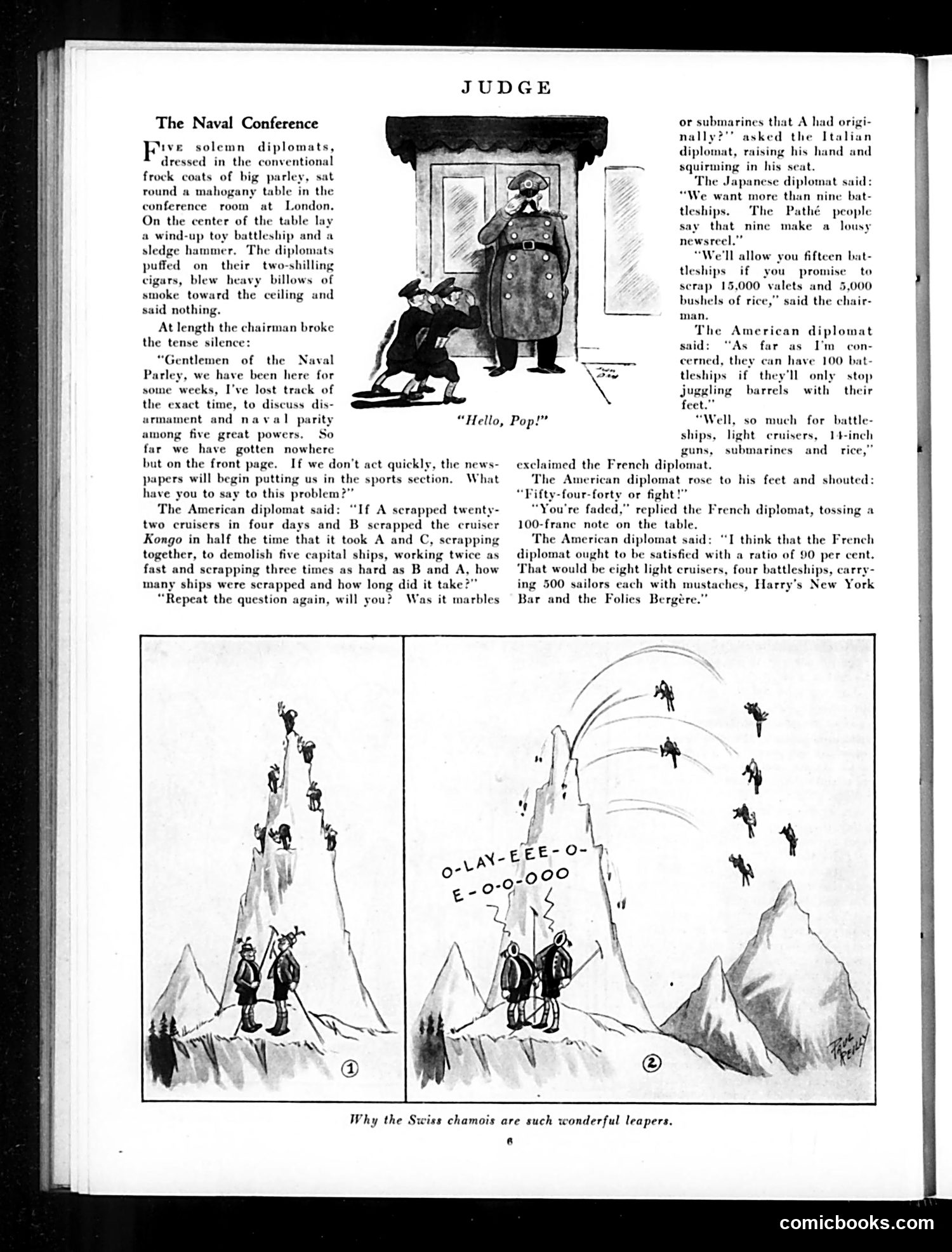
"The Naval Conference" — Judge Magazine This page satirizes naval disarmament negotiations among world powers. Five diplomats debate battleship ratios in a London conference room. The cartoon depicts them as stubbornly deadlocked: an American diplomat argues for scrapping twenty cruisers, the French diplomat counters with demands for fifteen battleships and rice supplies, while figures bicker over exact vessel ratios (90 percent, 100-franc notes, etc.). The humor mocks diplomatic posturing and nationalist self-interest masquerading as negotiation. The bottom cartoon about "Swiss chamois" leapers appears unrelated—likely a separate joke about mountain climbers. The satire suggests international arms-reduction talks produce endless quibbling rather than meaningful agreement.
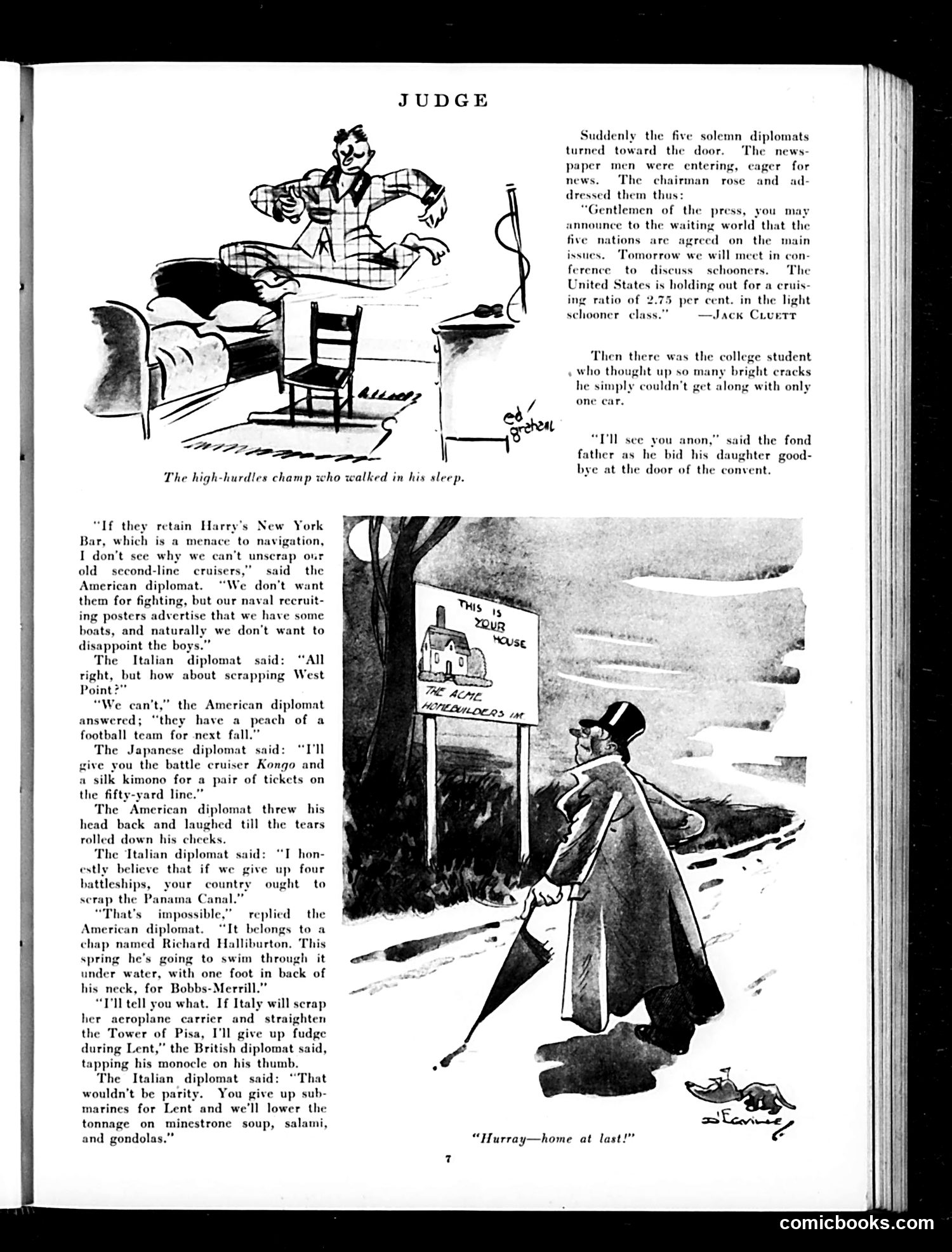
Judge Magazine Satire Analysis This page satirizes international naval disarmament conferences of the 1920s-30s, when world powers negotiated limits on military vessels. Five diplomats (American, Italian, Japanese, British, Italian) debate reducing their fleets with absurd logic. The satire works by having diplomats propose increasingly ridiculous "sacrifices"—scrapping the Panama Canal, West Point football program, and the Leaning Tower of Pisa. References like Richard Halliburton (a famous 1920s adventurer planning to swim the Canal) and Harry's New York Bar anchor the humor in contemporary celebrity/landmarks. The joke: diplomatic negotiations about weapons reduction devolve into nonsensical barter involving unrelated national treasures, suggesting the conferences themselves were equally farcical. The lower cartoon shows a child arriving home from convent school—context unclear, likely a separate satirical piece about education or family life. The overall message mocks how serious international talks about disarmament become exercises in protecting national pride rather than genuine security measures.
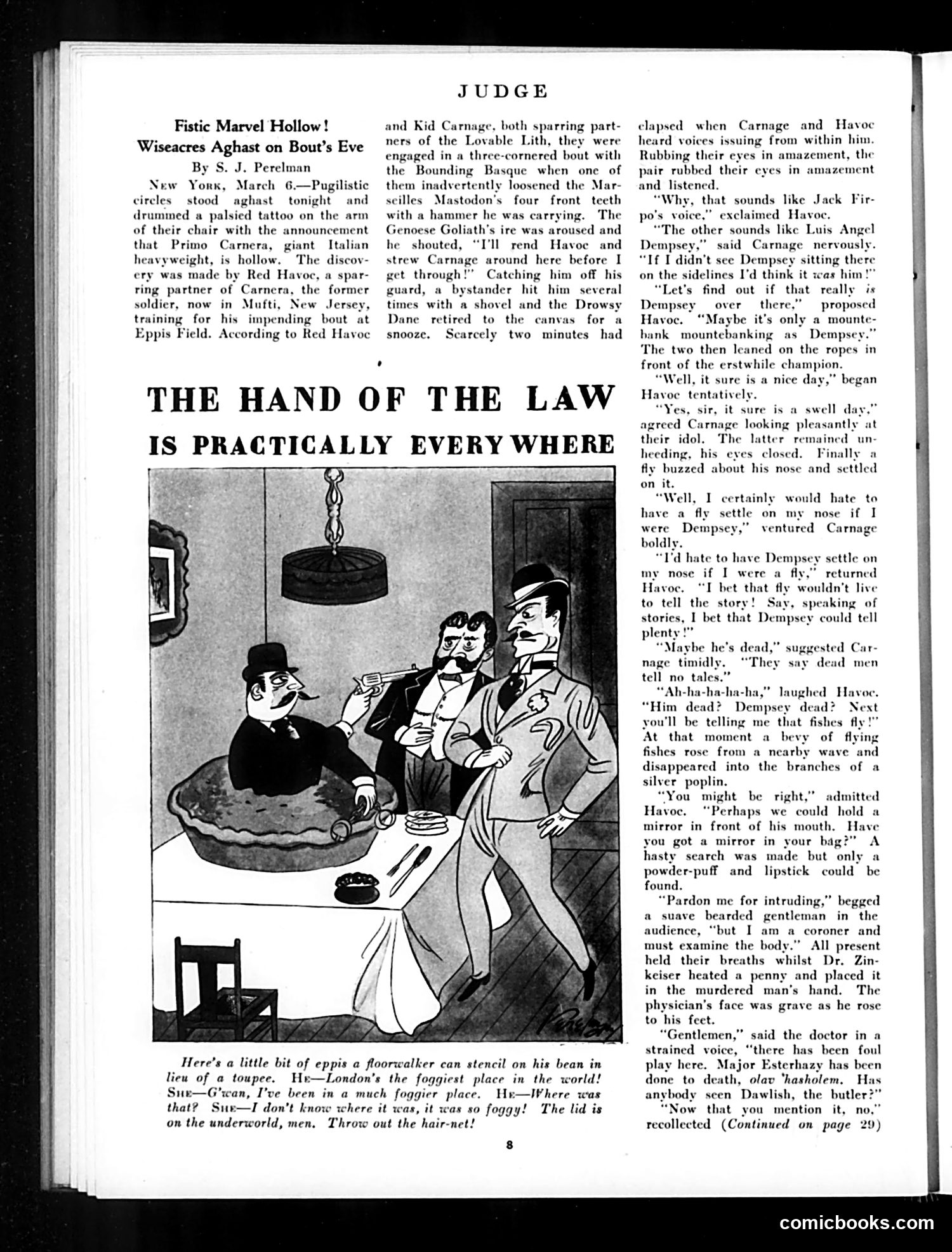
Explanation for Modern Readers This page contains two satirical pieces from *Judge* magazine: "Fistic Marvel Hollow!" (top): A humorous sports column by S.J. Perelman mocking boxer Primo Carnera. The joke plays on rumors about Carnera's legitimacy as a heavyweight champion—the column absurdly claims he's "hollow," with famous boxers' voices (Jack Firpo, Luis Angel Dempsey, Jack Dempsey) supposedly heard emanating from inside him. This satirizes doubts about whether Carnera was a genuine fighter or a manufactured celebrity. "The Hand of the Law Is Practically Everywhere" (cartoon): Shows three men arresting or confronting someone in a bathtub, illustrating the pervasiveness of law enforcement. The accompanying dialogue parodies detective/noir fiction with absurd logic and tangential conversations, likely mocking overwrought crime drama conventions. Both pieces exemplify *Judge*'s satirical style: topical sports humor and parodic crime fiction, aimed at educated urban readers familiar with contemporary boxing culture and popular literature tropes.
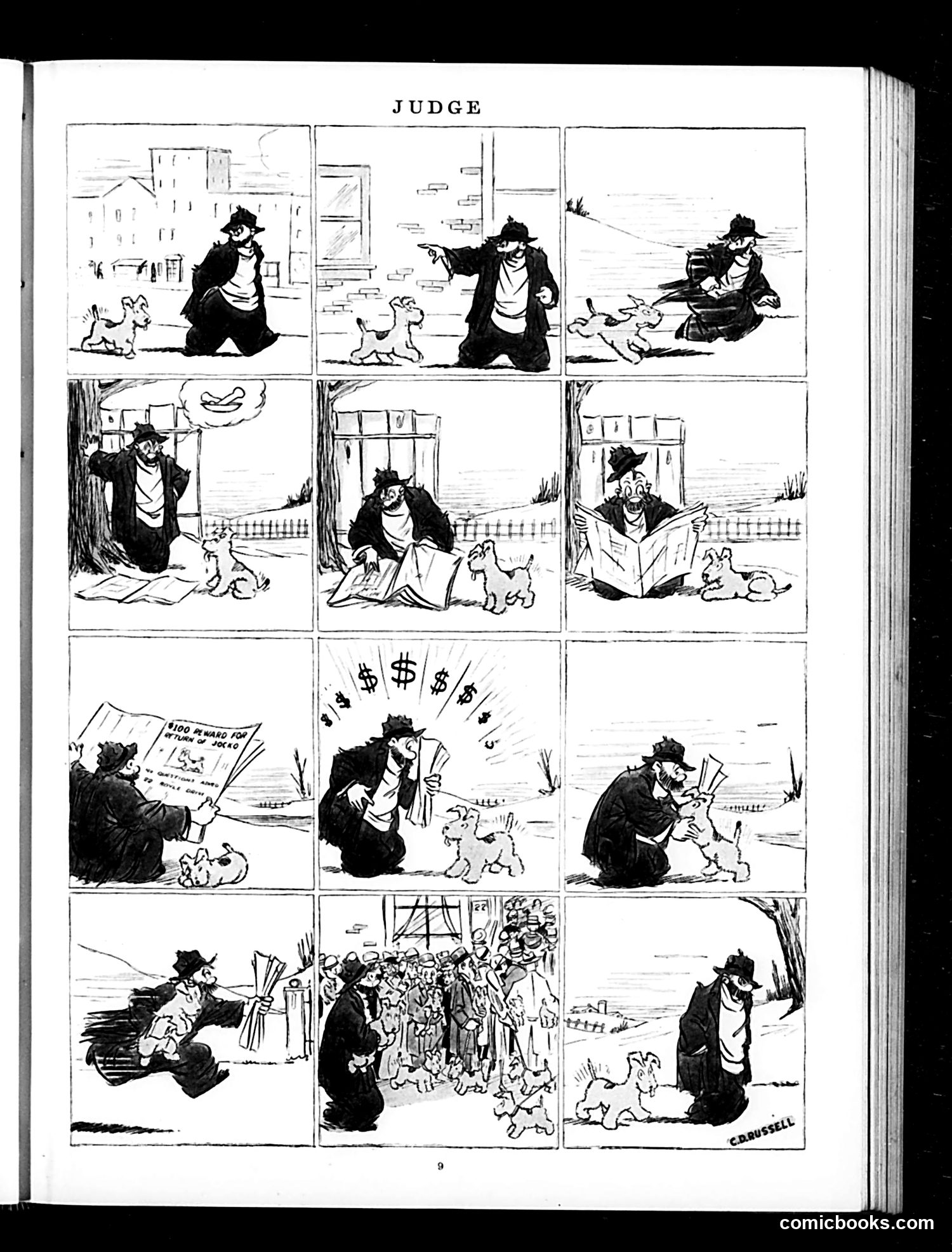
"Judge" Comic: "Judge" This is a sequential comic strip satirizing judicial corruption or judicial leniency toward wealth. A well-dressed judge character repeatedly encounters small dogs (or similar animals) throughout his day—reading newspapers, in his chambers, and outdoors. The strip's humor centers on the judge's escalating bribery: dollar signs appear prominently in the middle panels, suggesting the dogs represent petitioners or defendants offering money. By the final panels, the judge appears to have been successfully corrupted, surrounded by a large crowd, possibly indicating he's now dispensing favorable rulings for payment. The satire likely critiques the early 20th-century problem of judicial corruption, suggesting judges could be bought off even by absurd or insignificant parties. The artist is Cesrusell (visible signature).
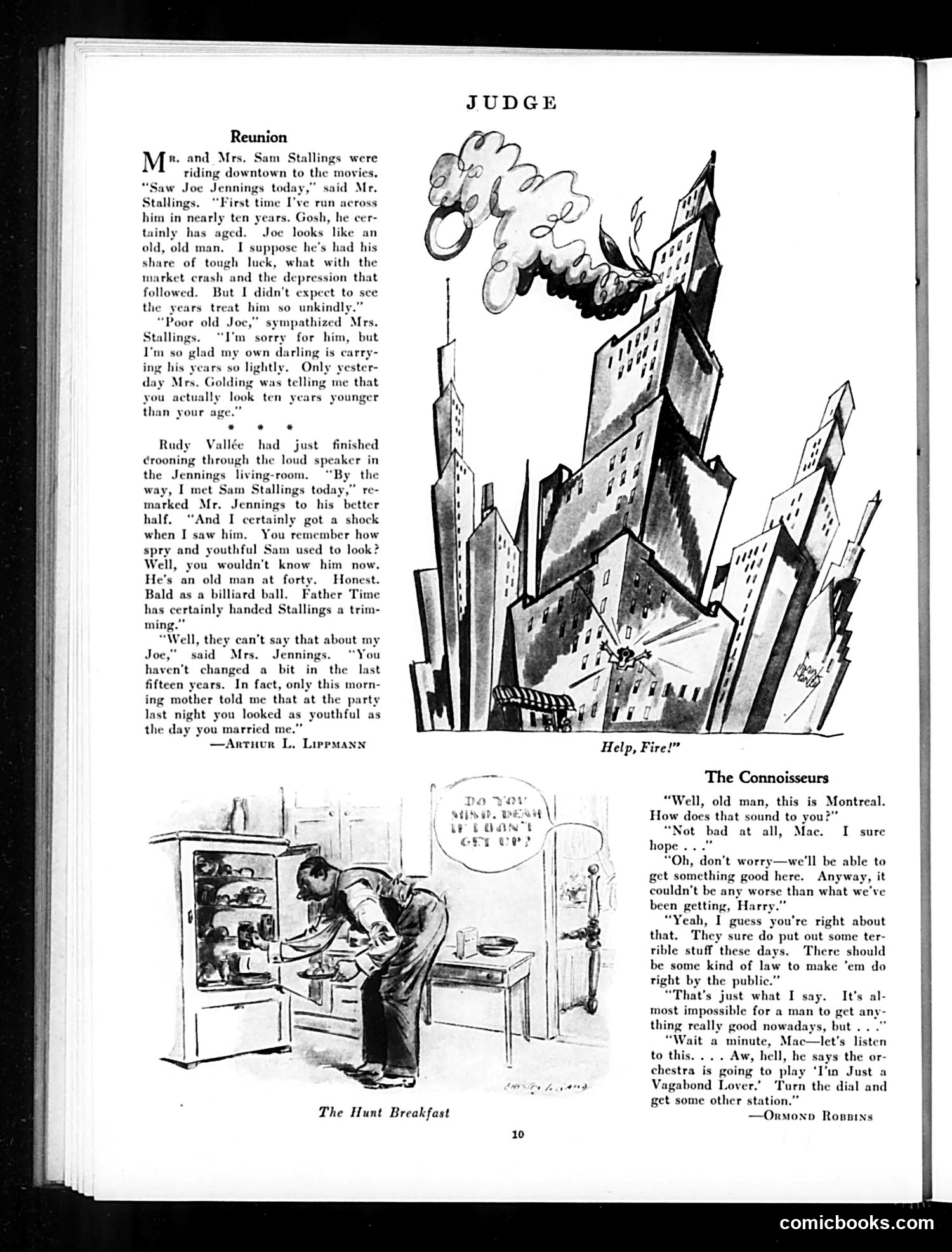
Analysis of Judge Magazine Page This page contains three humorous pieces satirizing American social pretense and consumerism in the Depression era. "Reunion" depicts married couples encountering old acquaintances and boasting about how well *their own* spouses have aged, while criticizing how badly the others have aged. The irony: Mrs. Jennings claims her husband looks as youthful as their wedding day, while Mr. Jennings simultaneously complains that Sam Stallings looks ancient. The satire targets vanity and self-deception about aging and the effects of economic hardship (market crash, depression). "Help, Fire!" shows a man fleeing a burning building—likely satirizing panic or overreaction, though the specific reference is unclear from this image alone. "The Connoisseurs" depicts two men discussing Montreal dining/entertainment, complaining that quality has declined everywhere. Their solution: they immediately reject a radio station's classical selection for something else, undermining their own standards. This satirizes people who claim to value quality while settling for mediocrity—or who mistake constant complaint for genuine discernment. All pieces mock middle-class pretension and inconsistency.
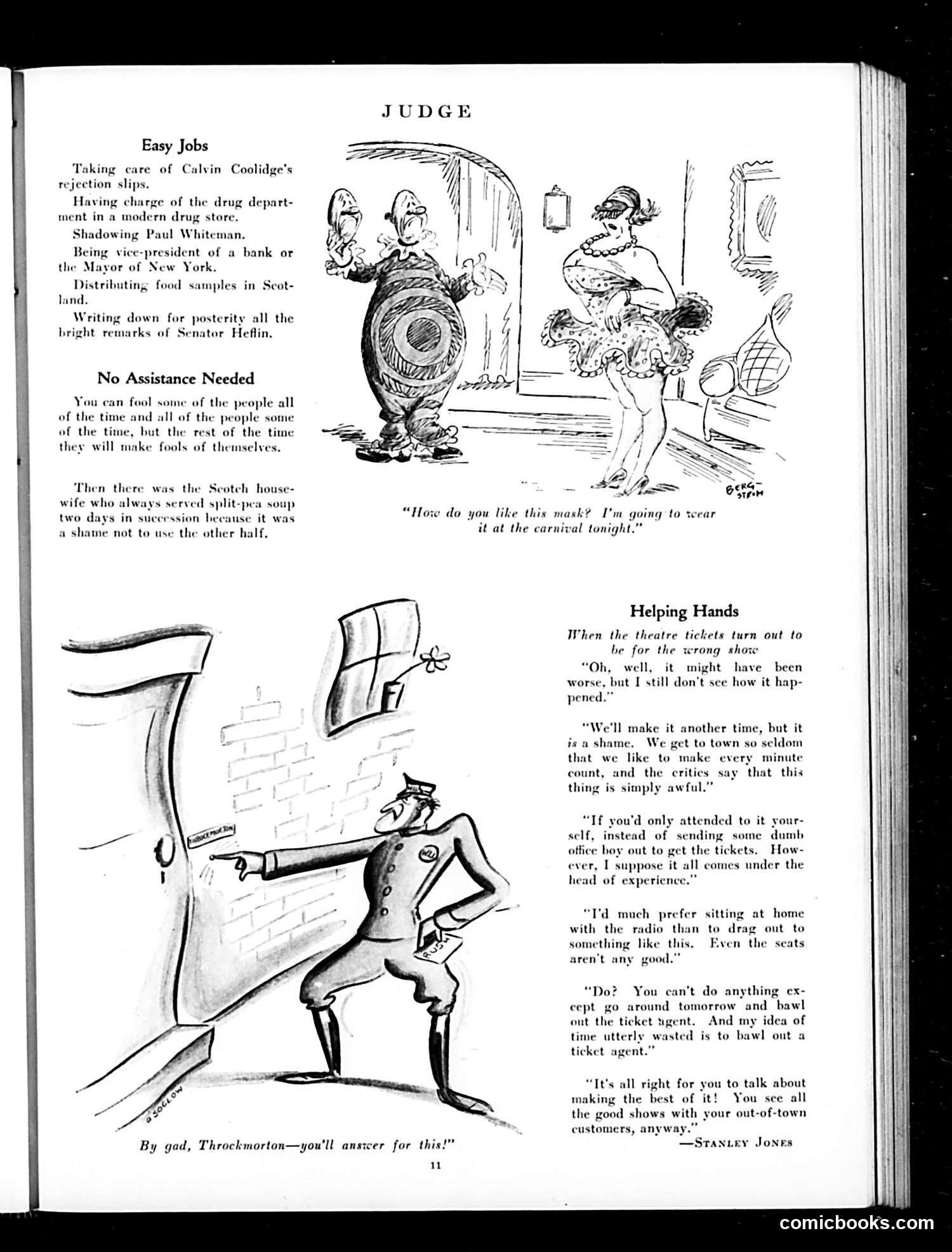
Judge Magazine Page Analysis This page contains satirical humor typical of 1920s Judge magazine. The "Easy Jobs" section lists absurdly trivial or impossible tasks—notably mentioning Calvin Coolidge (president 1923-1929), suggesting his reputation for inactivity or minimal public statements. References to Paul Whiteman (famous bandleader) and Senator Heflin (likely James Thomas Heflin, Alabama politician known for verbose speeches) are contemporary figures readers would recognize. The main cartoon depicts a couple at a carnival where the man wears a grotesque mask. The "Helping Hands" dialogue below mocks domestic marital conflict—a woman angrily blames her husband for sending an office boy to buy theatre tickets for the wrong show, with escalating complaints about wasted time and poor seating. The humor targets middle-class frustrations with minor domestic disasters and the performative irritability of married couples. The "By god, Throckmorton" caption references office/social embarrassment. The page satirizes everyday American anxieties and petty domestic disputes rather than specific political events.
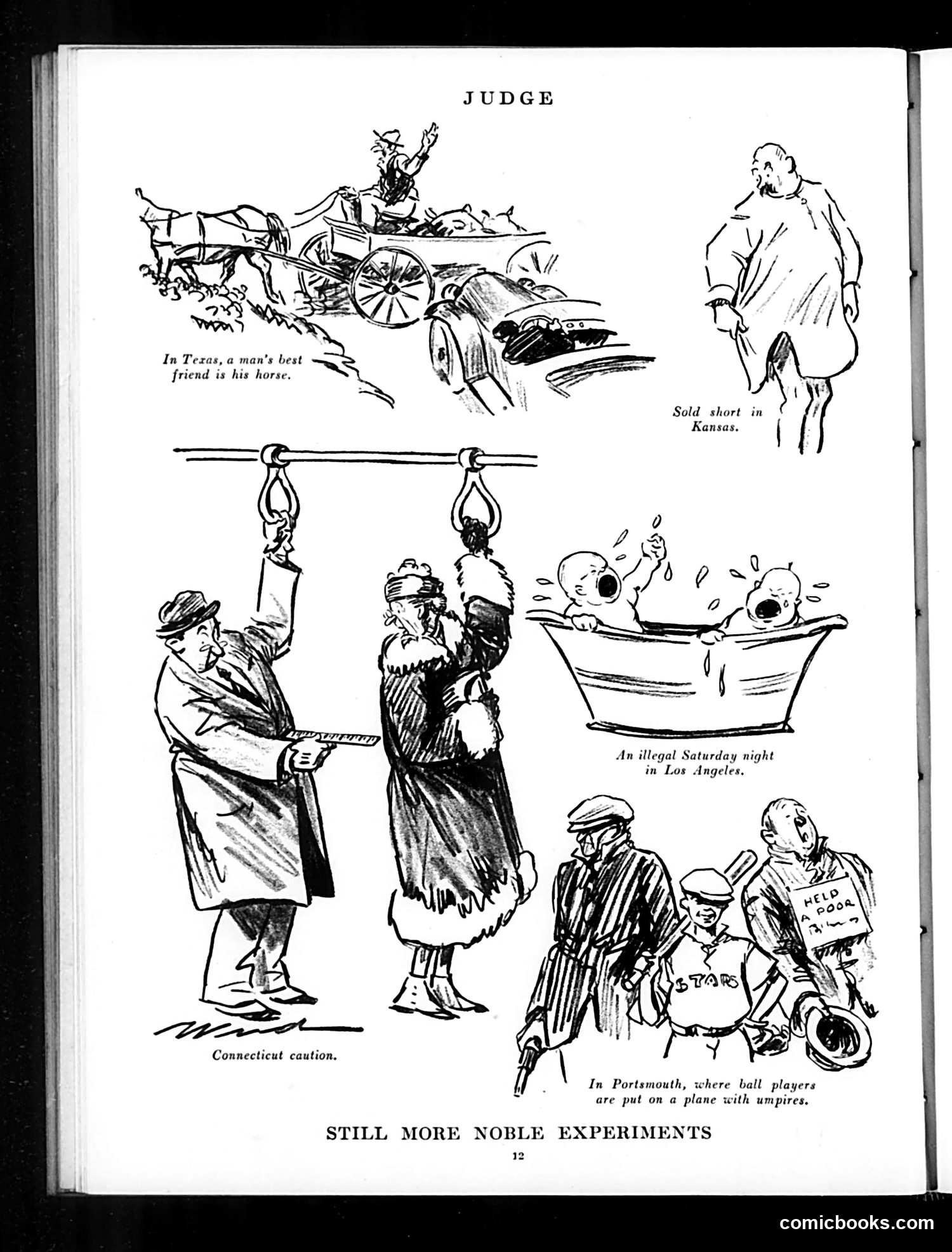
JUDGE Page Analysis: "Still More Noble Experiments" This is a satirical page mocking Prohibition-era enforcement and regional hypocrisy. Each cartoon presents a different state's approach to alcohol laws: - Texas: Man and horse in accident—suggests Texans rely on horses, implying widespread drinking - Kansas: "Sold short"—stocks reference suggests failed prohibition enforcement - Los Angeles: Illegal bathtub gin party—depicts open violation of Prohibition laws - Connecticut: Man hanging from noose with woman—dark joke about strict enforcement ("caution") - Portsmouth: Baseball players and umpires on a plane—unclear reference, possibly about transporting contraband or evading local laws The title "Still More Noble Experiments" sarcastically invokes Prohibition as Hoover's failed "noble experiment," showing how differently states enforced it and how widespread alcohol consumption continued despite federal law. The cartoons mock both enforcement inconsistency and public defiance.
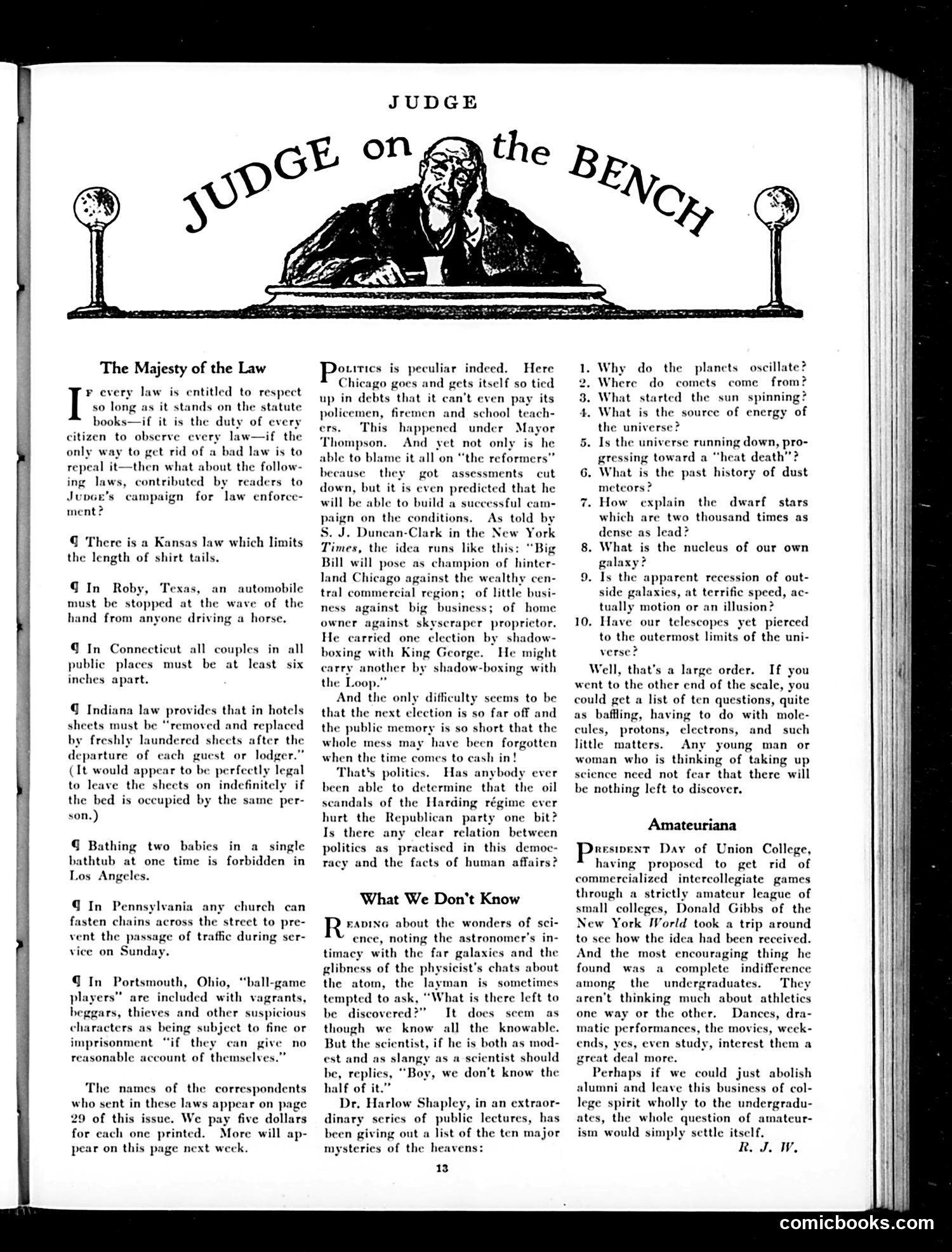
Judge Magazine Page Analysis This page from Judge magazine satirizes American civic absurdities and scientific mysteries, likely from the 1920s. "The Majesty of the Law" ridicules ridiculous state and local laws through reader submissions—a Kansas law limiting shirt-tail length, Connecticut requiring six-inch spacing between couples in public, Pennsylvania churches blocking traffic on Sundays. The satire mocks how citizens must respect laws while legislatures pass nonsensical ones, undercutting the principle that "every law is entitled to respect." "Politics" section criticizes Chicago Mayor Thompson (implied but not named) for creating municipal debt yet successfully blaming "reformers" while positioning himself as champion of working people against wealthy interests. The writer notes voters have short memories, comparing it to how Harding's oil scandals seemingly didn't hurt Republicans—suggesting politics disconnects from actual consequences. "What We Don't Know" features astronomer Harlow Shapley listing ten cosmic mysteries, countering public assumptions that science has answered everything. The tone contrasts naive confidence in human knowledge with scientific humility.
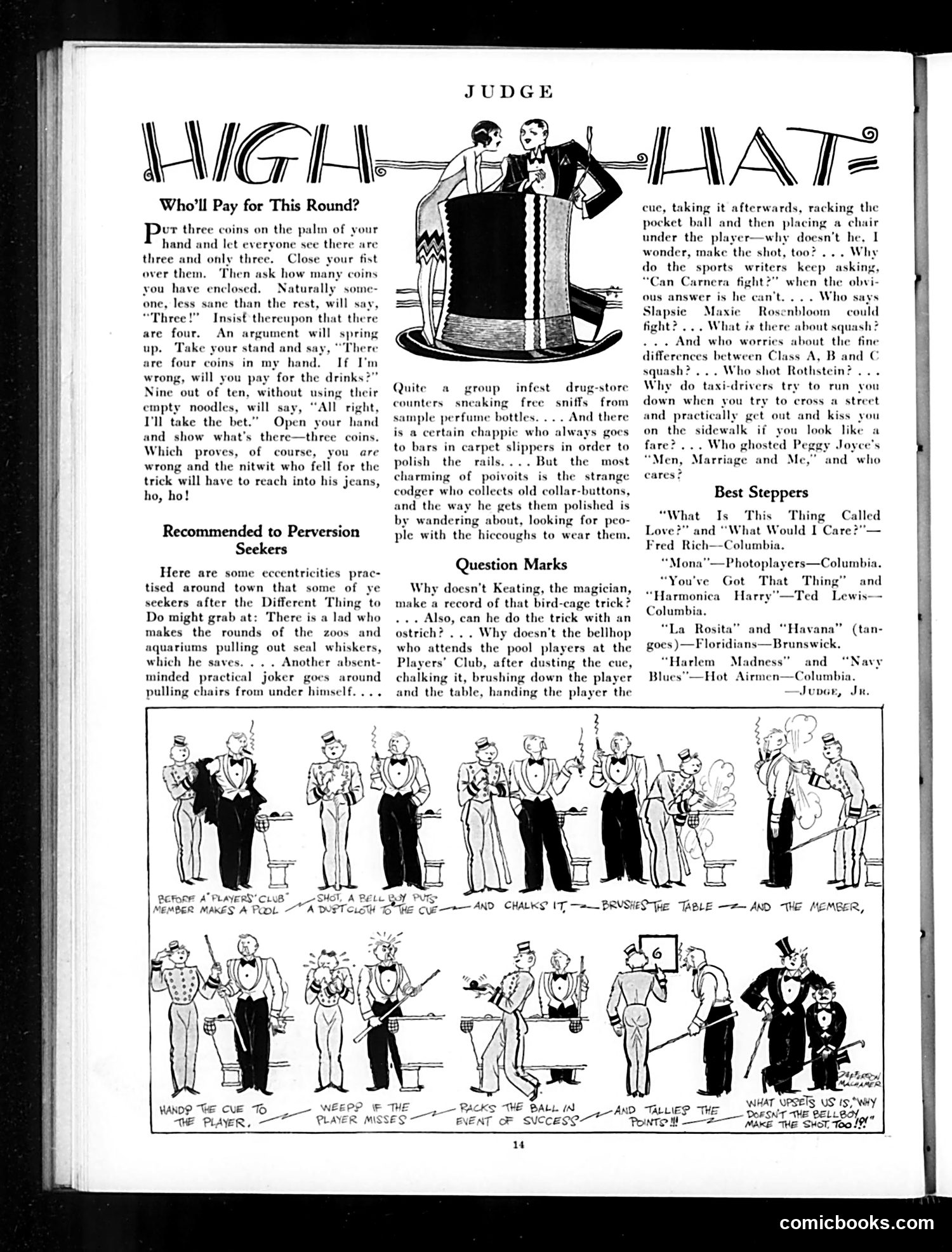
Judge Magazine Page Analysis This page from Judge presents humorous social commentary through several sections: "Who'll Pay for This Round?" is a con-artist's trick—a betting game where the mark loses money by miscounting coins in a closed fist. It's presented as practical-joke humor targeting gullible people. "Recommended to Perversion Seekers" satirizes eccentric behaviors around 1920s New York: zoo visitors stealing seal whiskers, practical jokers pulling chairs away, people sneaking free perfume samples, men wearing carpet slippers to bars, and an odd collector obtaining used collar-buttons from hiccoughing people. The satire targets absurd urban oddities and minor vandalism presented as quirky entertainment. "Question Marks" lists rhetorical questions about contemporary celebrities and entertainers (magician Keating, boxer Carnera), sports, and popular songs—mocking senseless media questions and public obsessions. "Best Steppers" reviews popular phonograph records and films of the era. The bottom comic strip illustrates a pool-hall con where someone manipulates a player into paying after deliberately sabotaging their shot.
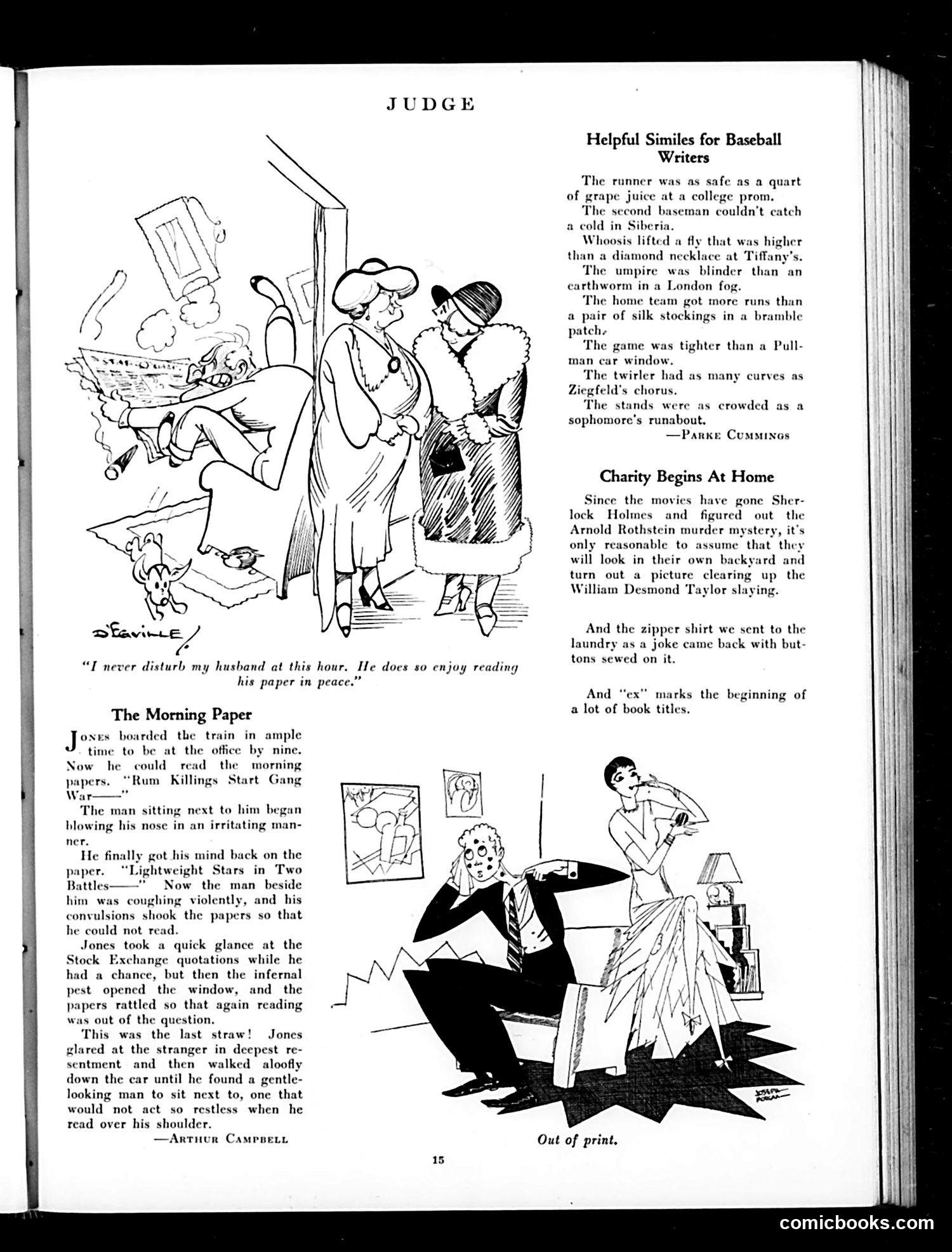
Explanation for Modern Readers This page contains three satirical pieces from Judge magazine: 1. "Helpful Similes for Baseball Writers": A humor list mocking overwrought sports journalism by offering absurd comparisons. References include Prohibition-era "grape juice" (code for illegal alcohol), Tiffany's luxury goods, and Ziegfeld's chorus girls (famous 1920s performers known for beauty). The jokes target how baseball writers use tired, exaggerated metaphors. 2. "The Morning Paper": A short story by Arthur Campbell about a commuter (Jones) trying to read his newspaper on a train while constantly disturbed by a neighboring passenger's sneezing, coughing, and window-opening. It satirizes urban commute annoyances and the difficulty of peace during travel—relatable to early 20th-century transit culture. 3. "Charity Begins At Home": A brief commentary noting that since movies solved fictional murder cases (referencing the Arnold Rothstein scandal and William Desmond Taylor slaying—real crimes), Hollywood should tackle unsolved domestic cases. It's social criticism via ironic suggestion. The top cartoon illustrates marital dynamics around newspaper reading.
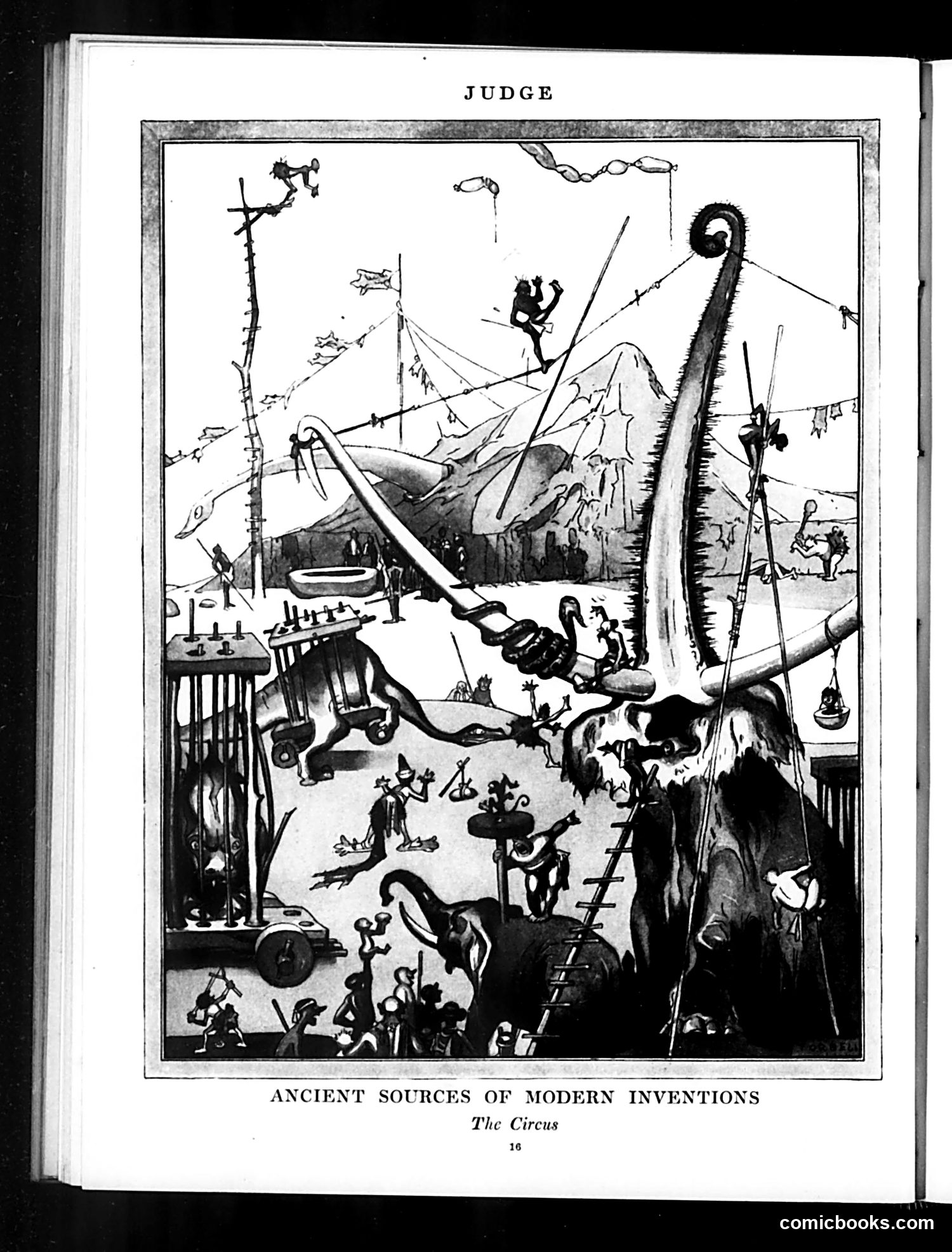
Analysis This is a satirical illustration titled "Ancient Sources of Modern Inventions: The Circus." The cartoon uses a chaotic circus scene to suggest that modern mechanical and entertainment innovations have ancient origins in circus performance. The image depicts a fantastical circus with acrobats, trapeze artists, and performers using elaborate equipment—ropes, pulleys, platforms, and mechanical devices. The visual joke appears to be that the circus, as an ancient form of entertainment, prefigures modern technology: the trapeze anticipates engineering principles, acrobatics demonstrate physics, and the mechanical apparatus suggests proto-industrial design. The satire likely mocks either the pretension of "modern" inventions (implying they're not truly new) or celebrates human ingenuity across centuries. Without additional context, the specific target remains somewhat unclear, though the tone suggests gentle mockery of technological progress claims.
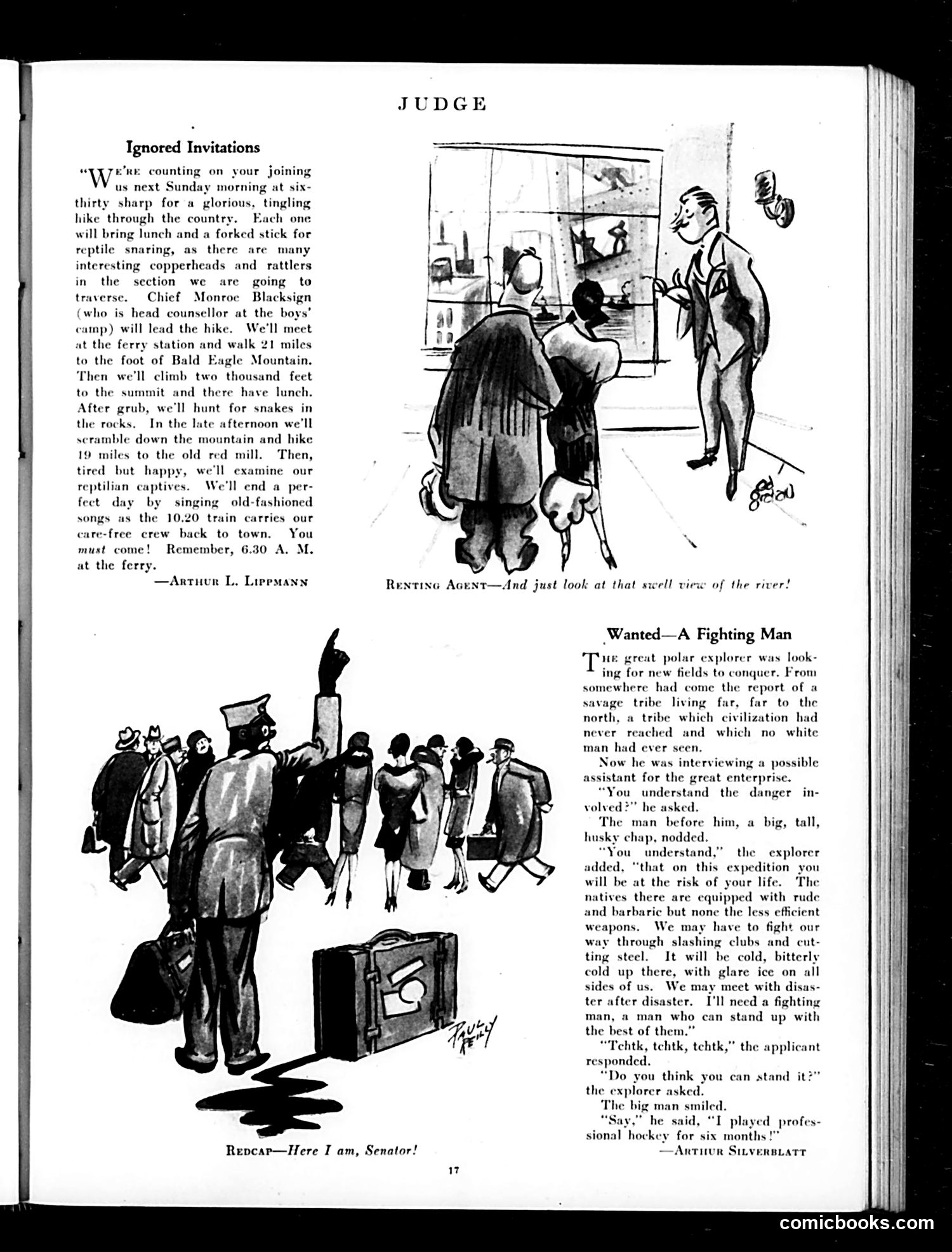
Judge Magazine Page Analysis "Ignored Invitations" (top): A satirical invitation to an exhaustingly ambitious Sunday hike—21 miles to a mountain, snake-hunting, lunch at the summit, 19 miles back—designed to sound appealing but deliberately grueling. The cartoon shows a woman and man looking out a window while receiving this invitation, their expressions suggesting polite horror at the prospect. The joke is that such elaborate, punishing outings are extended as social obligations that people desperately want to avoid. "Wanted—A Fighting Man" (bottom): A polar explorer seeks a dangerous expedition assistant, warning of life-threatening hardships: hostile natives, brutal weapons, extreme cold. The applicant's qualification? He "played professional hockey for six months." The satire mocks how minor, unrelated experience gets absurdly inflated as adequate preparation for genuine peril—suggesting both the applicant's delusional confidence and the explorer's lowered desperation.
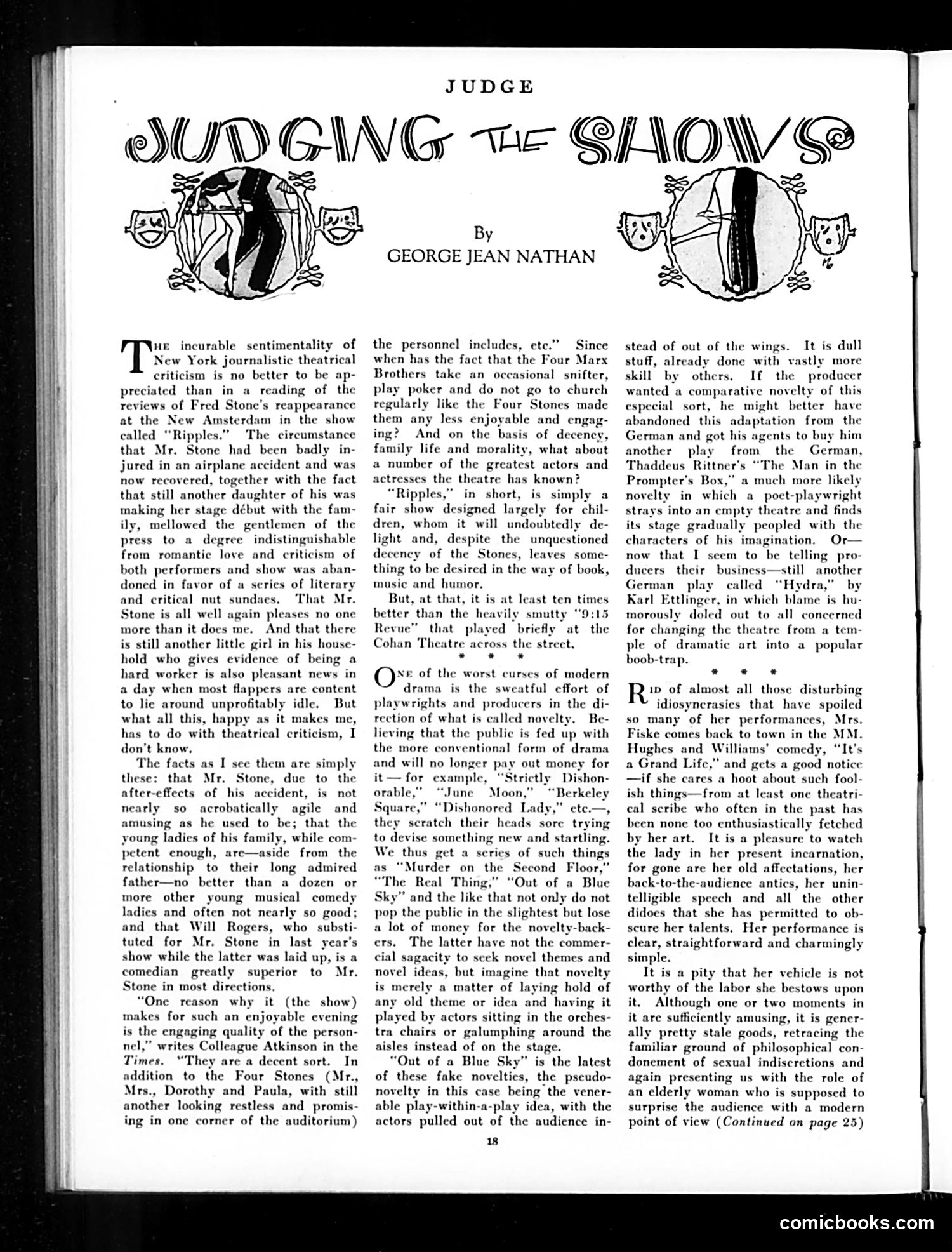
"Judging the Shows" - Judge Magazine Theatre Criticism This is George Jean Nathan's theatre column critiquing the Broadway musical "Ripples," starring Fred Stone—an established performer who recently recovered from a serious airplane accident. Nathan's satirical point: New York theatre critics have abandoned objectivity, allowing sentiment about Stone's recovery and his daughter's stage debut to cloud their reviews. He argues critics gave the show undeserved praise based on the "decent" Stone family's personal circumstances rather than theatrical merit. Nathan contends the show is merely adequate children's entertainment, but critics treated it as superior because of Stone's comeback narrative. He pointedly notes that morality and family respectability shouldn't determine theatrical quality—other great actors haven't required such virtue. The broader satire: Nathan mocks how producers chase "novelty" by gimmicks rather than genuine innovation, wasting money on derivative ideas performed in unconventional settings. His critique emphasizes that sentimental journalism and commercial desperation both distort honest dramatic criticism.
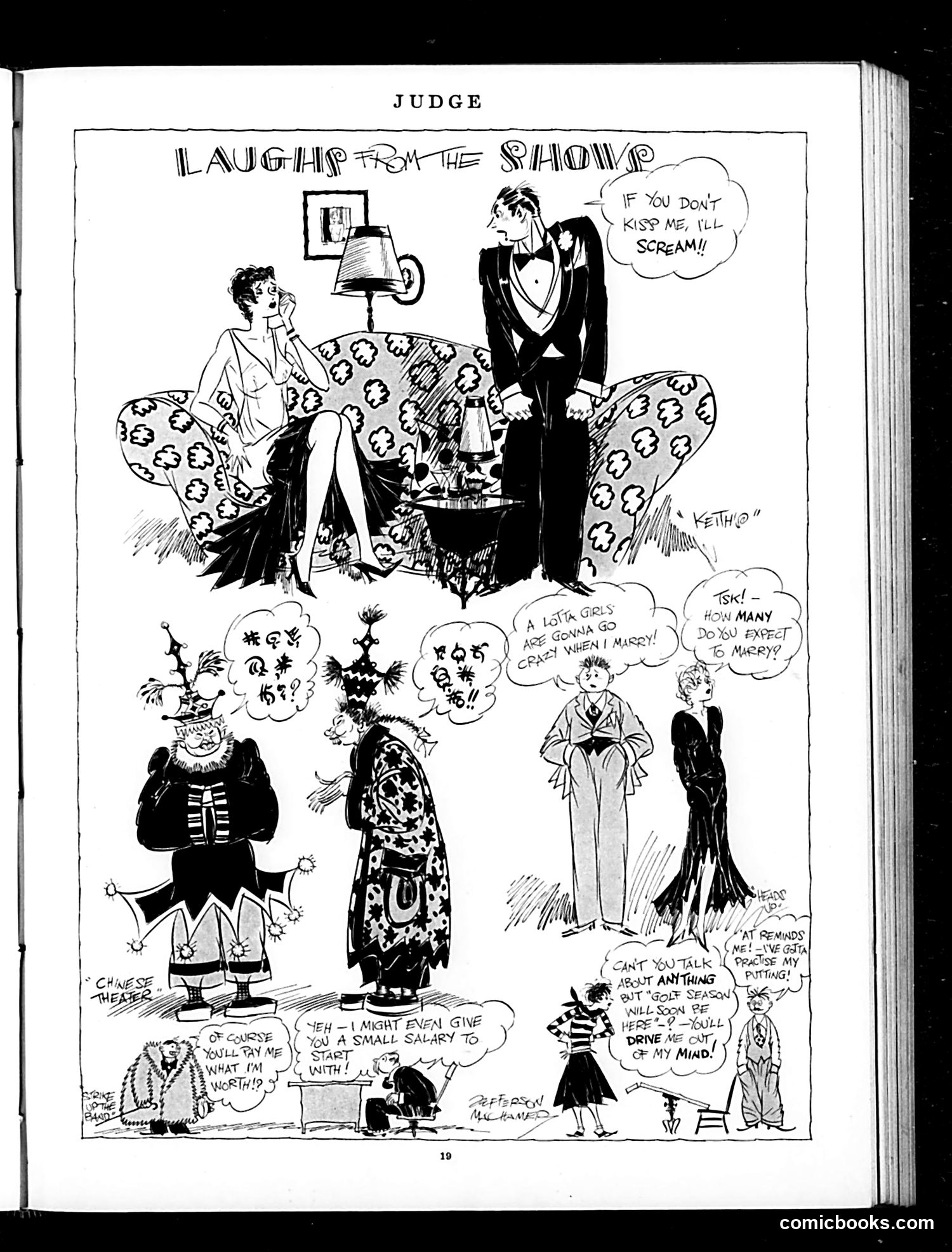
"Laughs in the Showup" - Judge Magazine Satire This cartoon satirizes the theatrical world and romantic entanglements of show business performers. The top panel shows a well-dressed man pressuring a woman to kiss him, threatening he'll "scream" if she refuses—mocking aggressive male behavior and coercion dressed up as flirtation. The lower panels depict various theatrical types (performers, dancers, possibly opera singers based on the exaggerated costumes) with thought bubbles revealing their preoccupations: concerns about salary, marriage prospects, and romantic drama. The satire targets both the vanity and financial desperation of performers, as well as the melodramatic emotional chaos of show-business relationships. The overall point appears to be mocking the superficiality, greed, and romantic turmoil endemic to theatrical society—a common satirical target for Judge magazine, which frequently ridiculed urban entertainment culture and its participants.
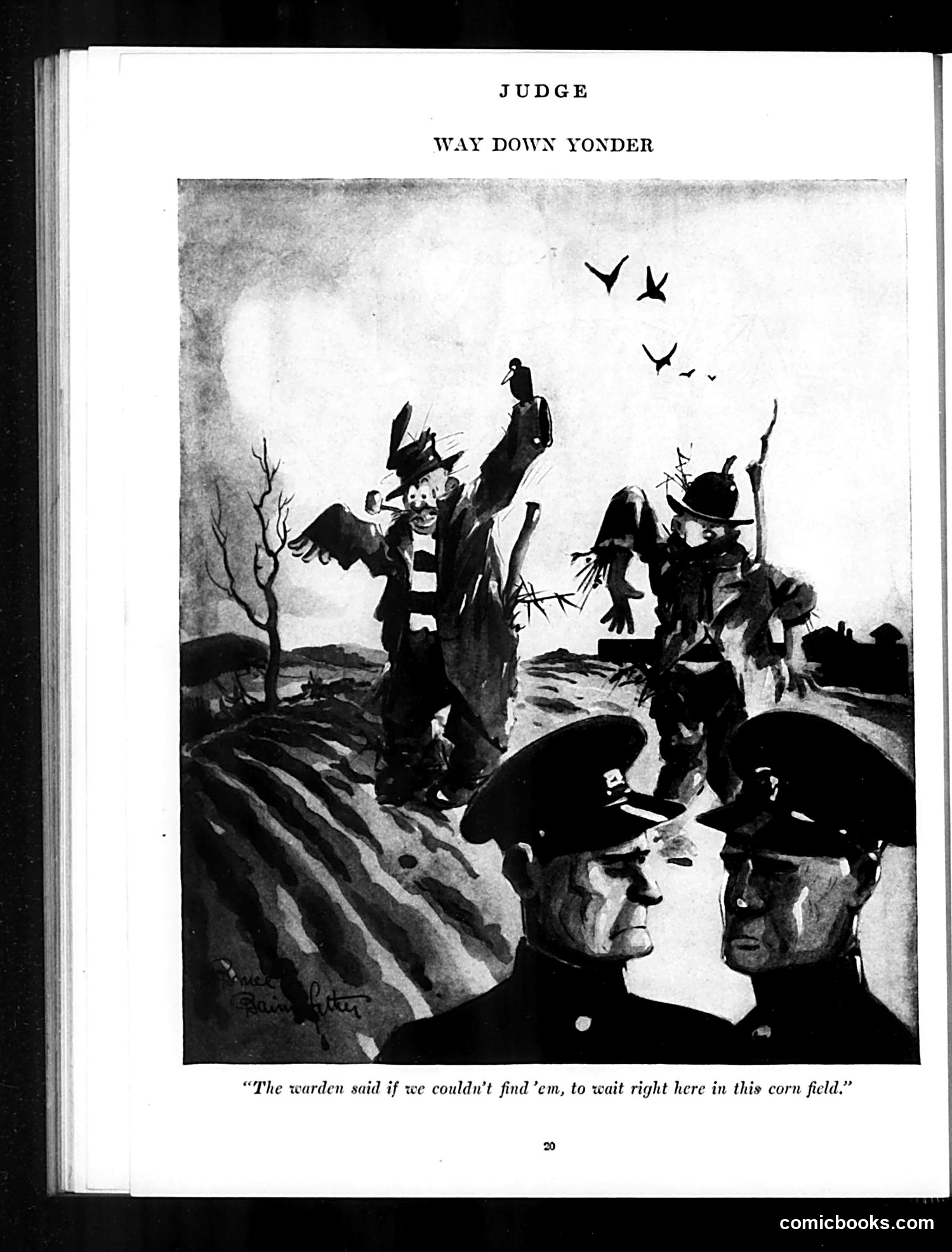
Analysis This appears to be a satirical illustration titled "Way Down Yonder" depicting what seems to be escaped prisoners or fugitives hiding in a cornfield. Two uniformed officers (likely prison guards or law enforcement, identifiable by their caps and formal attire) stand in the foreground, while ghostly or skeletal figures emerge from the corn behind them—suggesting either actual escaped prisoners or supernatural/demonic imagery used for comedic effect. The caption's casual dialect ("if we couldn't find 'em") and the warden's instruction to wait in the cornfield suggests the joke involves either incompetent law enforcement or the deliberate use of an obviously bad hiding spot. The supernatural imagery likely heightens the absurdist humor. Without additional context about Judge magazine's date or current events, the specific satirical target remains unclear, though it may reference contemporary criminal justice or law enforcement failings.
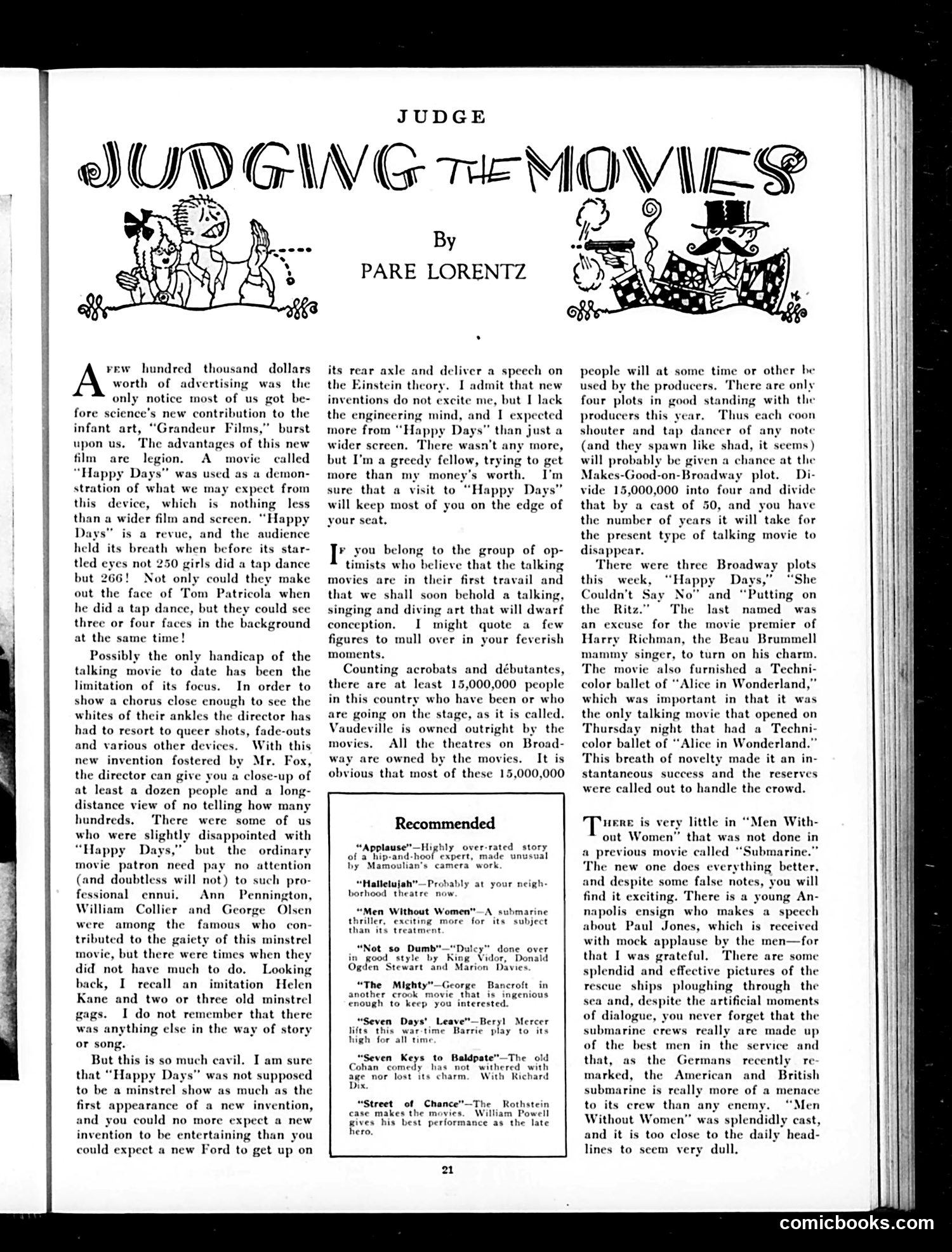
"Judging the Movies" by Pare Lorentz This is a film criticism column reviewing early talking pictures and new cinema technology. The author discusses "Happy Days," a musical revue demonstrating "Grandeur Films"—a wide-screen format (likely Fox's Grandeur system) that allows cinematographers to show wider shots with multiple performers in focus simultaneously, solving a technical limitation of earlier cinema. Lorentz expresses cautious skepticism: while acknowledging the innovation's technical merit, he found the actual film disappointing as entertainment, lacking narrative substance beyond its novelty. He sarcastically compares expecting entertainment from a new invention to expecting a new Ford automobile to "get up on its rear axle and deliver a speech." The column includes film recommendations (with brief reviews of contemporary releases like "Applause" and "Hallelujah"), reflecting Judge's role as both satirical publication and popular entertainment guide. The tone is witty and slightly condescending toward technological novelty without substance.
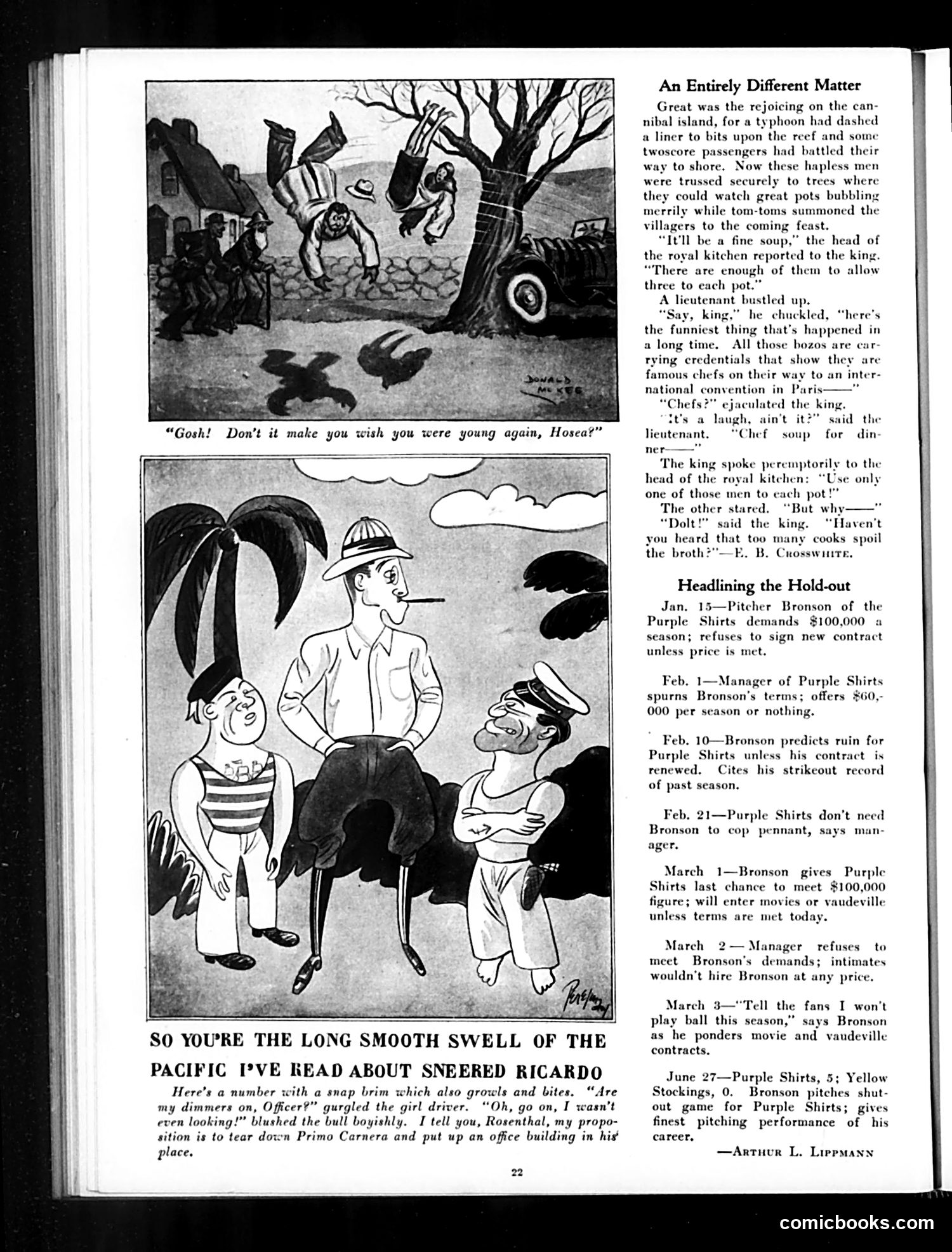
Judge Magazine Page Analysis This page contains three separate humorous pieces typical of early 20th-century satirical magazine content: Top cartoon: Shows men stranded on a cannibal island watching cooking pots. The joke satirizes both colonial-era "cannibal" stereotypes and contemporary professional vanity—the punchline involves chefs carrying credentials to a Paris convention, leading to a "too many cooks spoil the broth" joke about using only one chef per pot. Middle cartoon: Appears to be sports/entertainment humor about a fashionable character and a girl driver, with a reference to boxer Primo Carnera (famous 1930s heavyweight), suggesting the joke involves mockery of Carnera's abilities. Bottom section ("Headlining the Hold-out"): A satirical timeline of baseball salary negotiations between pitcher "Bronson" and the "Purple Shirts" team (likely fictional), tracking his escalating demands from January through his eventual triumph pitching a shutout in June—mocking the common sports holdout drama of contract disputes. The page reflects period humor conventions: racial stereotypes, slapstick scenarios, and baseball culture commentary.
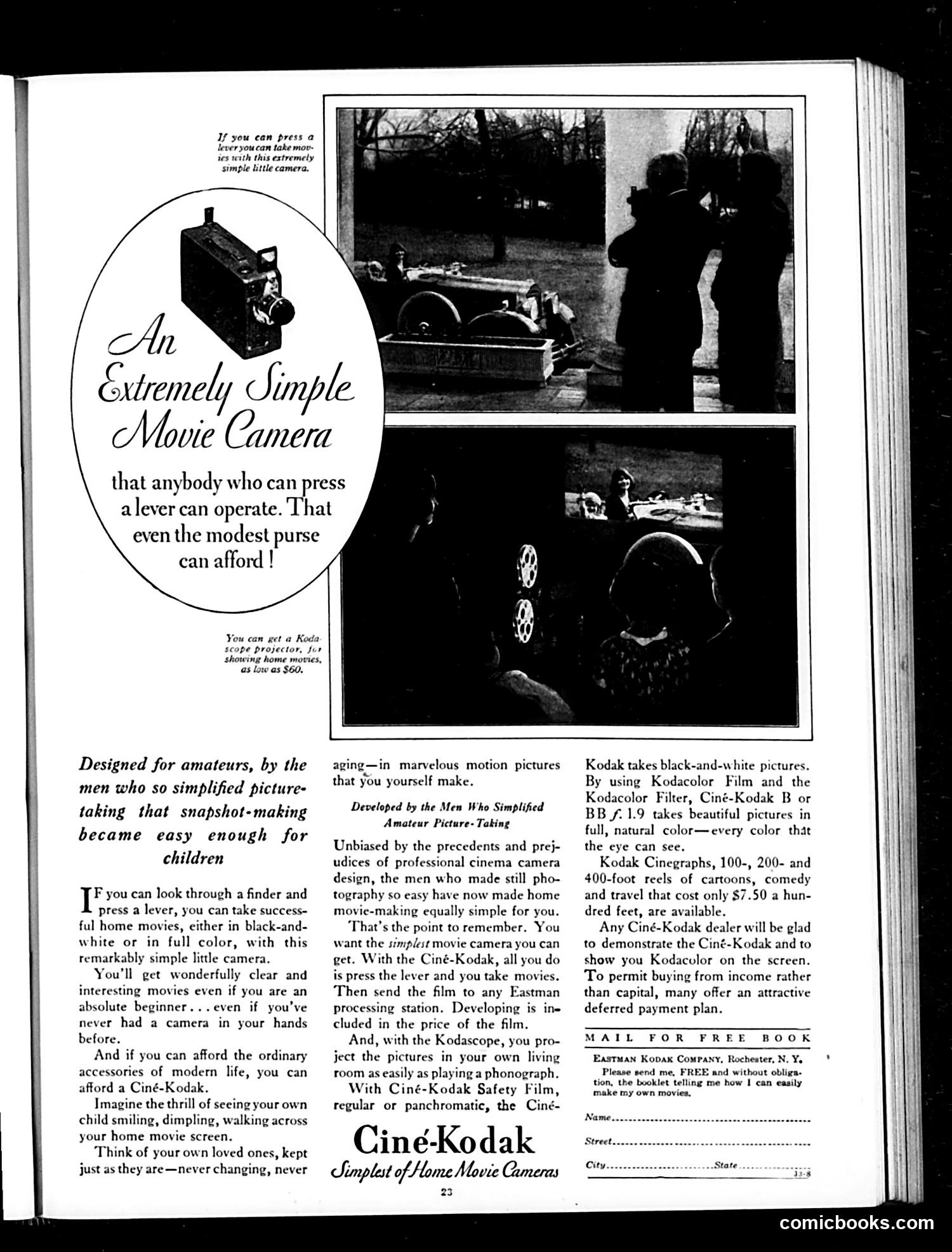
This Page Contains No Political Satire This is primarily a Kodak advertisement for the Ciné-Kodak home movie camera, not a Judge magazine cartoon or satirical piece. The page promotes the camera's simplicity—"anybody who can press a lever can operate" it—and targets amateur filmmakers who want to record family moments affordably. The accompanying photographs show people using the camera in domestic settings. The advertising copy emphasizes democratizing filmmaking technology, making it accessible to people without professional experience or large budgets. There is no visible political commentary, caricature, or satirical humor. This appears to be a standard commercial advertisement that Judge magazine published, likely from the 1930s-40s based on the styling and technology described.
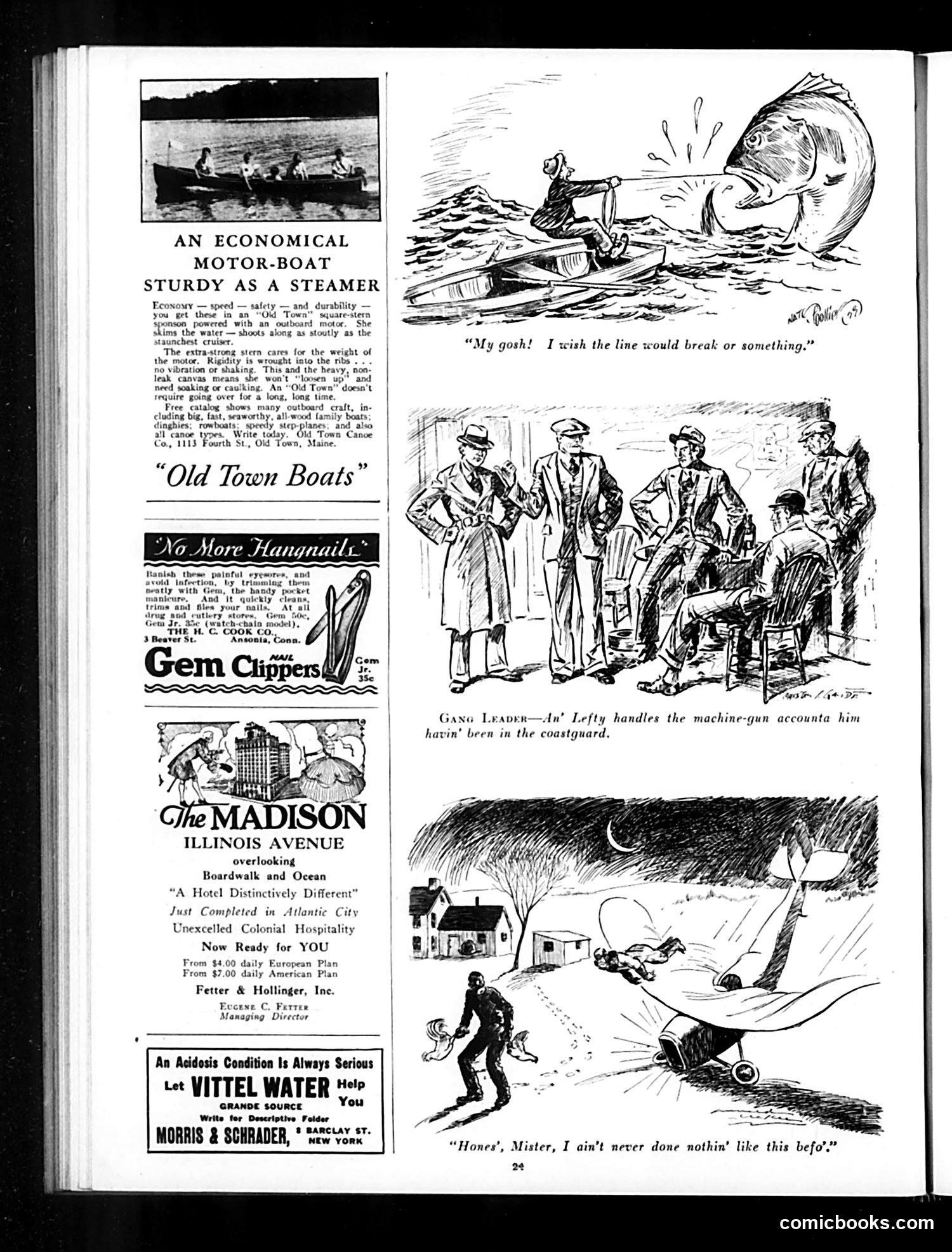
Judge Magazine Page Analysis This page from *Judge* contains three illustrated comedic scenes unrelated to the advertisements. Top cartoon: A man struggles with a large fish on a line, expressing frustration that the line won't break—suggesting the fish is so powerful it's become a burden rather than a prize. Middle cartoon: Labeled "Gang Leader," depicts several men in suits and hats. The caption indicates the "gang leader" character (left, with prominent features) supposedly has experience with machine guns from coastguard service, establishing him as a tough-guy stereotype. Bottom cartoon: Shows a farm worker (rendered in stereotypical rural dialect: "Hones', Mister") learning to operate farm machinery at night, marveling at the experience. These scenes appear to be humorous vignettes about ordinary Americans in various situations—fishing mishaps, urban criminals claiming false credentials, and rural labor. The humor relies on character types and dialect rather than specific political references. The page is primarily advertisement-driven, with these cartoons serving as filler content.
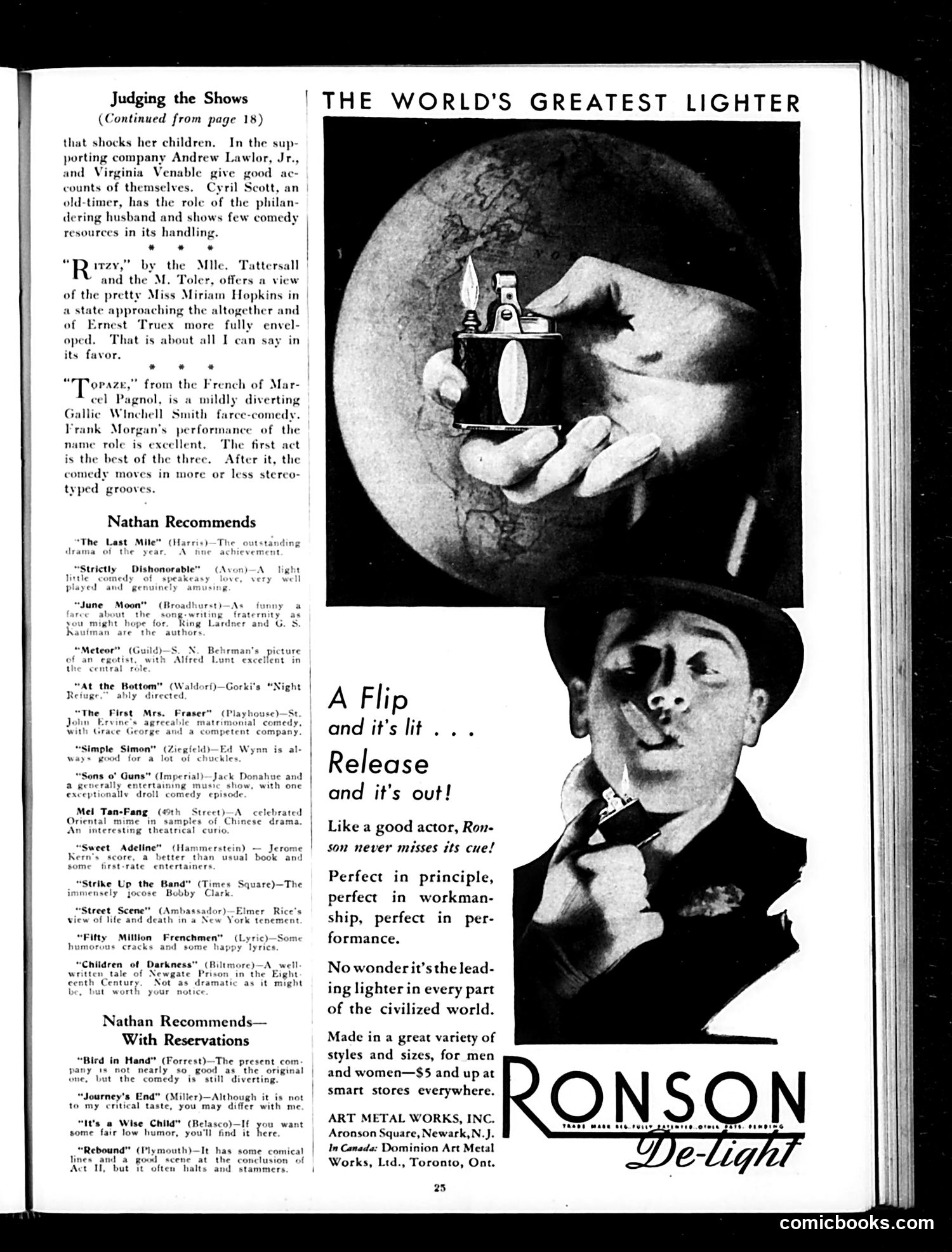
Page Analysis This page combines theater reviews with a full-page advertisement. The left column continues "Judging the Shows," offering brief critiques of Broadway productions—some positive (praising performers like Frank Morgan and Miriam Hopkins), others dismissive (one show is "about all I can say in its favor" regarding Hopkins appearing nearly nude). Below that, Nathan's theater recommendations highlight current Broadway hits like "The Last Mile" and musicals featuring performers Jack Donahue and Ed Wynn. The right side is a Ronson lighter advertisement disguised as editorial content. It uses an actor metaphor—"Like a good actor, Ronson never misses its cue!"—to pitch the lighter as reliable and professional. The image shows a man demonstrating the flip-and-light mechanism. The ad emphasizes the product's ubiquity ("leading lighter in every part of the civilized world") and price point ($5+), positioning it as an aspirational luxury item for "smart stores everywhere." This blending of reviews and advertising was typical of 1920s-30s magazines, where sponsorship and editorial content often merged seamlessly.
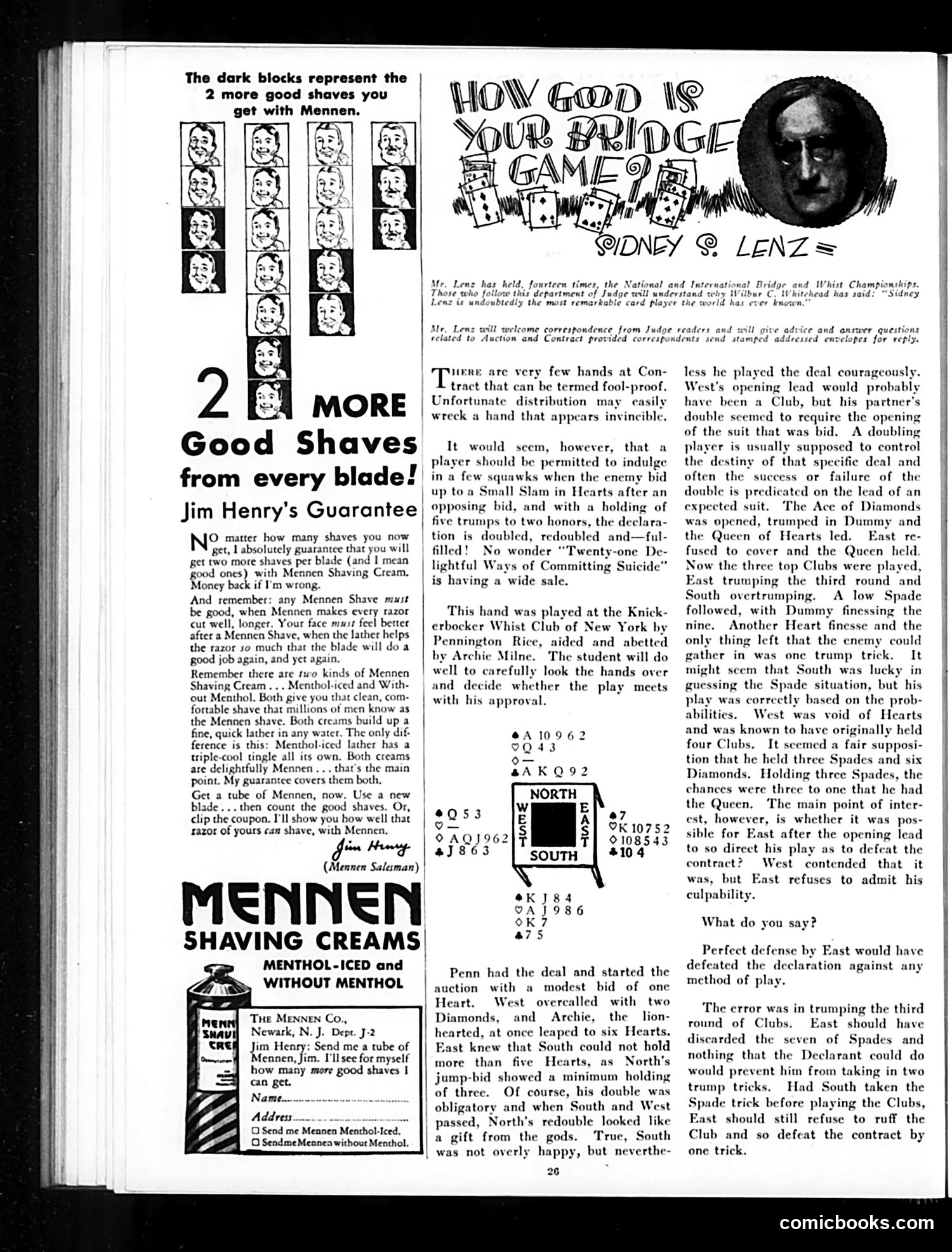
Analysis for Modern Readers This page contains two distinct elements: a Mennen shaving cream advertisement (left side) and a bridge card game column (right side). The advertisement features "Jim Henry," a Mennen salesman, guaranteeing extra shaves per blade—a common early 20th-century consumer pitch emphasizing product superiority and money-back guarantees. The bridge column, titled "How Good Is Your Bridge Game?" by Sidney S. Lenz, discusses a specific hand played at the Knickerbocker Whist Club in New York. Lenz was apparently a notable card player whom Judge readers could write to for advice. The column analyzes whether East's defensive play was sound in a contract bridge game involving Pennington Rice and Archie Milne. The "satire" is gentle: the hand's title, "Twenty-one Delightful Ways of Committing Suicide," jokes that aggressive bidding leads to impossible contracts. The page primarily serves as practical instructional content mixed with advertising—typical for Judge magazine's era, when it balanced satire with useful lifestyle features for its affluent readership.
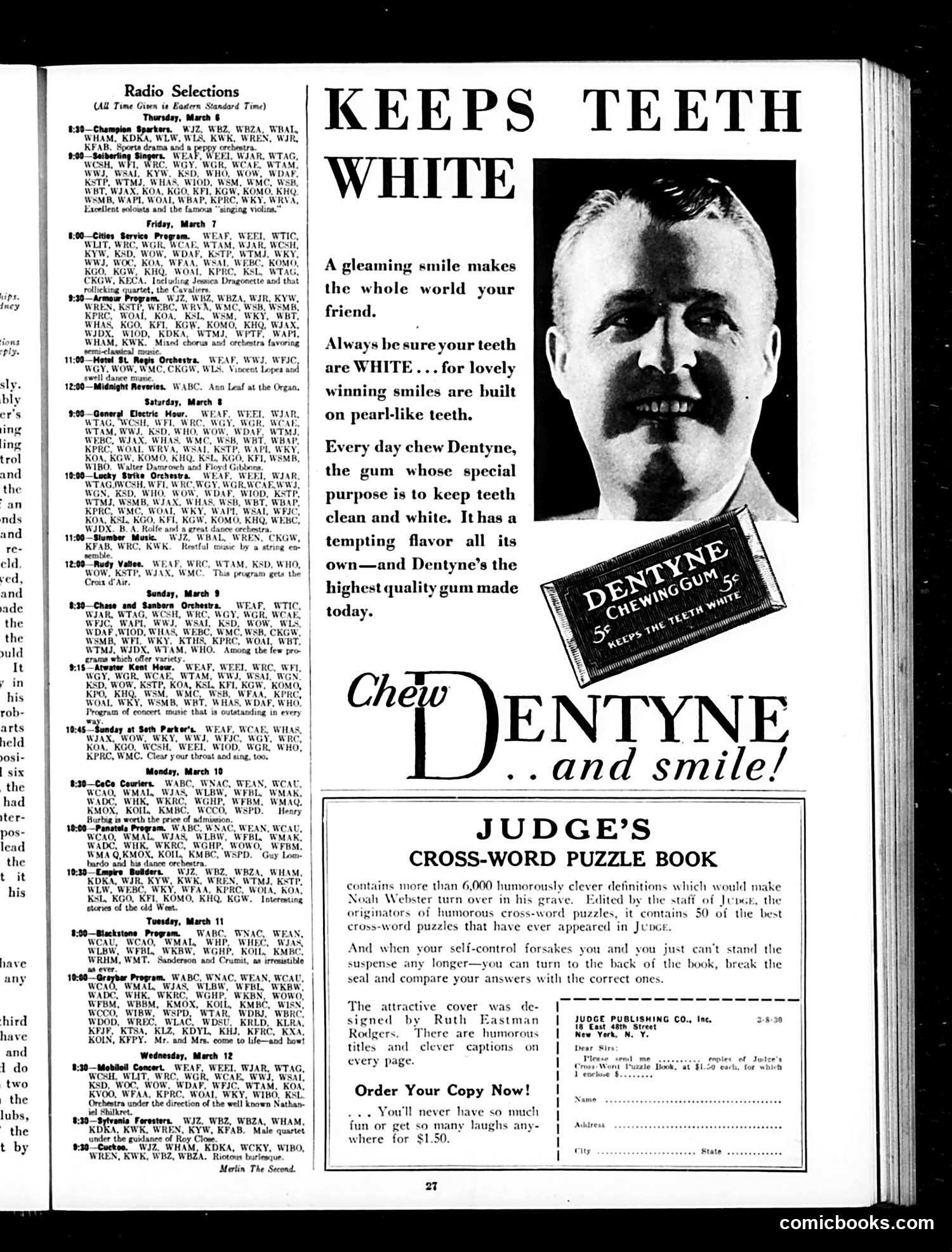
Analysis of This Judge Magazine Page This page is primarily advertising and radio listings, not political satire. The dominant content is a Dentyne chewing gum advertisement featuring a photograph of a man with a prominent mustache, smiling to display white teeth. The ad copy emphasizes that "a gleaming smile makes the whole world your friend" and promotes Dentyne gum for keeping teeth "white" and clean. Below the main ad is a Judge's Cross-Word Puzzle Book advertisement, offering over 6,000 definitions and 50 puzzles for $1.50. The left side contains extensive radio program listings for the week of March 6-11, typical of 1930s-era magazines that served as programming guides for radio audiences. There is no political cartoon or satire visible on this page. The "satire" element of Judge magazine is absent here—this appears to be a purely commercial and informational page, reflecting how mid-century magazines blended editorial content with substantial advertising.
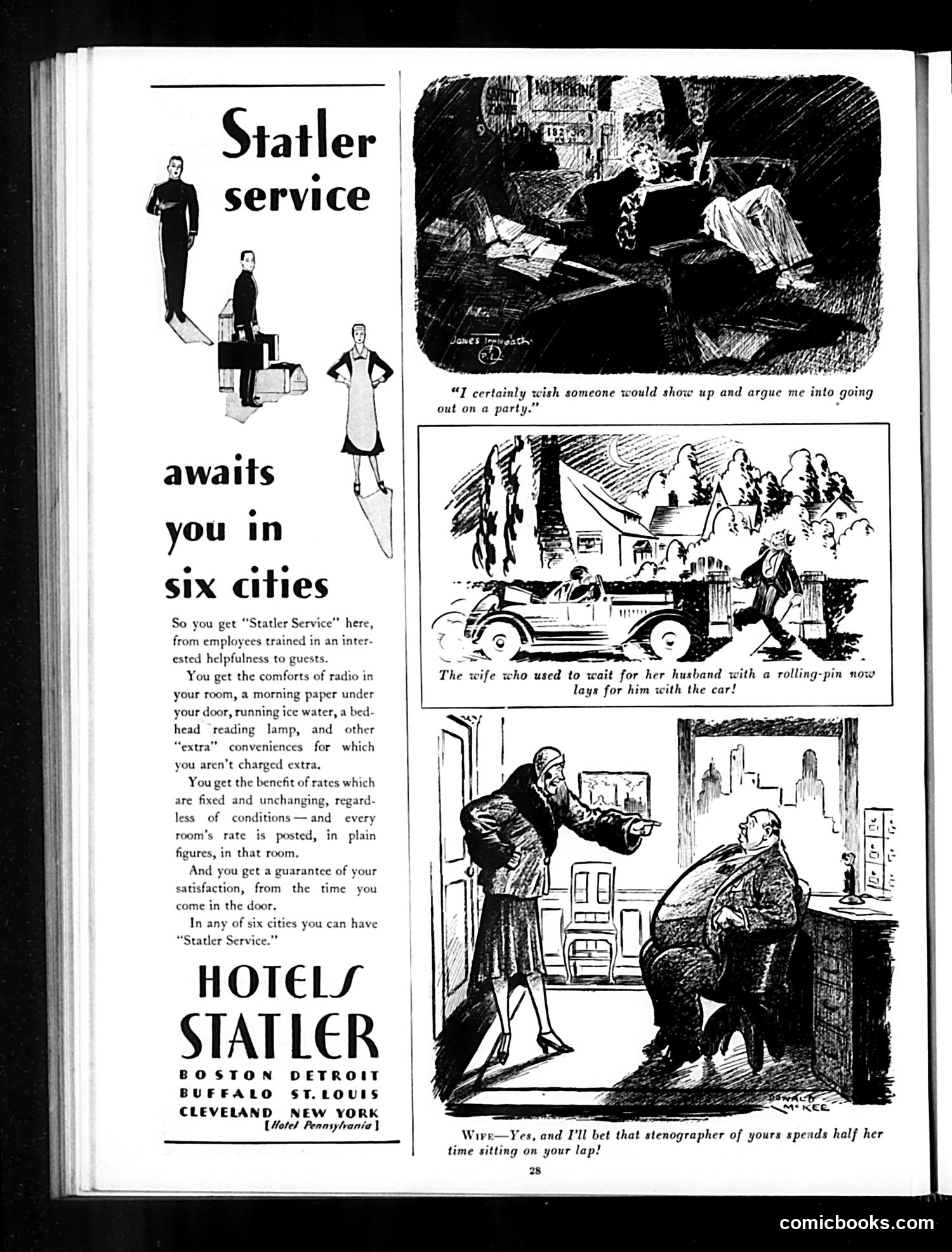
Analysis for Modern Readers This page combines a hotel advertisement with three comic vignettes satirizing marital discord. The Statler Hotels ad promotes standardized amenities (radio, reading lamp, fixed rates) across six cities—targeting business travelers seeking reliable, no-surprise accommodations. The three cartoons joke about wives' changing behavior and marital jealousy: 1. Top: A husband wishes someone would "argue me into going out on a party"—implying his wife prevents his social life. 2. Middle: A wife now "lays for him with the car" instead of a rolling pin—replacing physical domestic violence with vehicle-based ambush, likely as he returns home. 3. Bottom: A wife accuses her husband of his secretary sitting on his lap at work—a jealousy joke about workplace flirtation. The satire's context: These comics reflect early-20th-century anxieties about shifting gender dynamics and wives gaining independence (owning/using cars, questioning husbands' behavior), presenting "nagging" wives as comedic threats to male freedom.
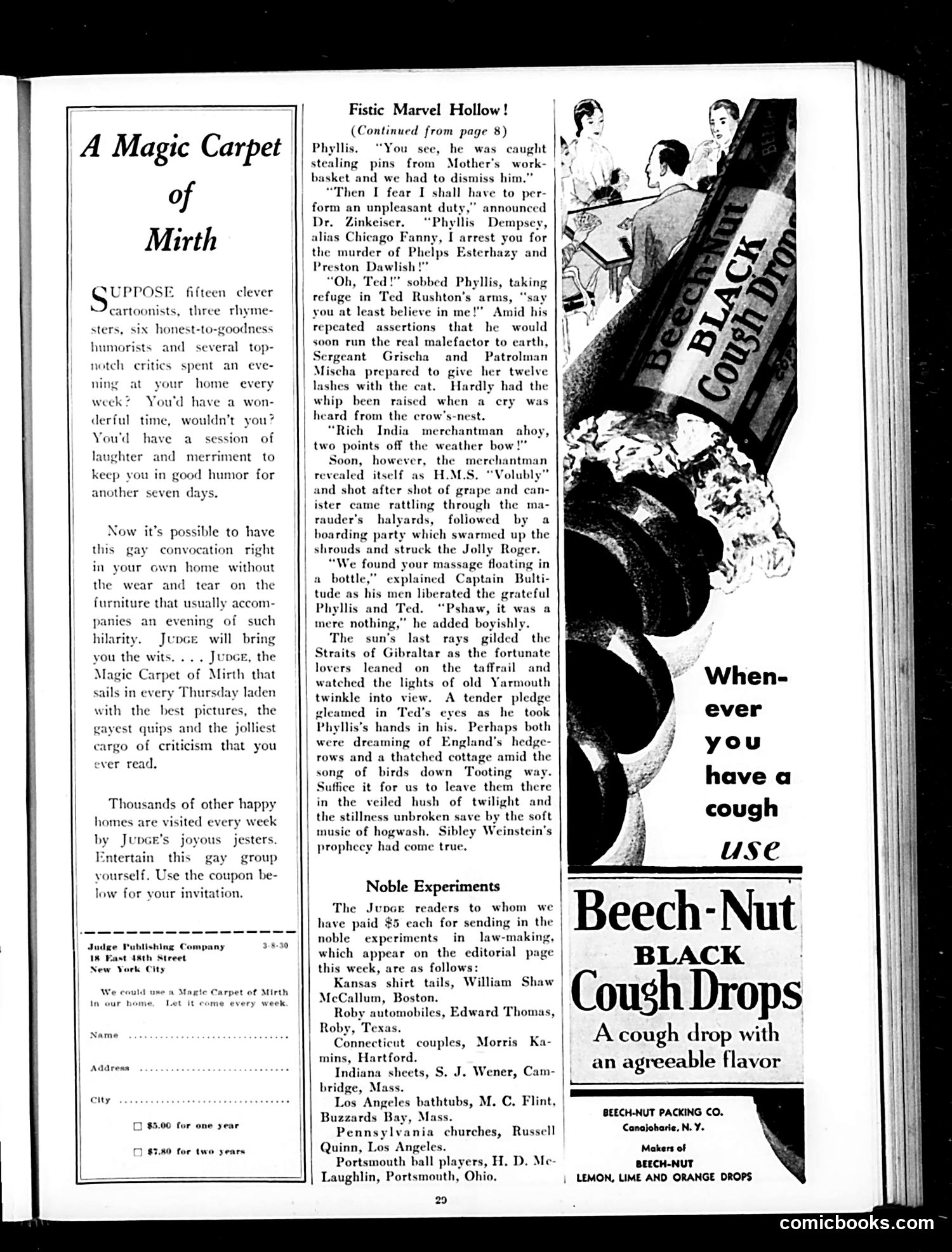
Judge Magazine Page Analysis This page from Judge magazine combines two main elements: Left side: A subscription advertisement for Judge itself, humorously styled as a "Magic Carpet of Mirth." The pitch suggests that subscribing to Judge weekly ($5/year or $7.50 for two years) delivers entertainment—cartoons, jokes, and criticism—without the wear-and-tear of hosting actual comedians and critics in your home. It's a meta-joke promoting the magazine's own satirical content. Center: "Fistic Marvel Hollow!" appears to be a serialized comedic story (continued from page 8), featuring melodramatic plot elements—a murder mystery involving characters named Phyllis Dempsey and Ted Rushton, plus absurdist twists like a naval engagement and messages in bottles. The florid, overwrought language parodies pulp fiction. Right side: A Beech-Nut cough drops advertisement. The page exemplifies Judge's format: satirical editorial content alongside commercial ads, targeting educated middle-class readers with disposable income willing to pay for weekly humor.
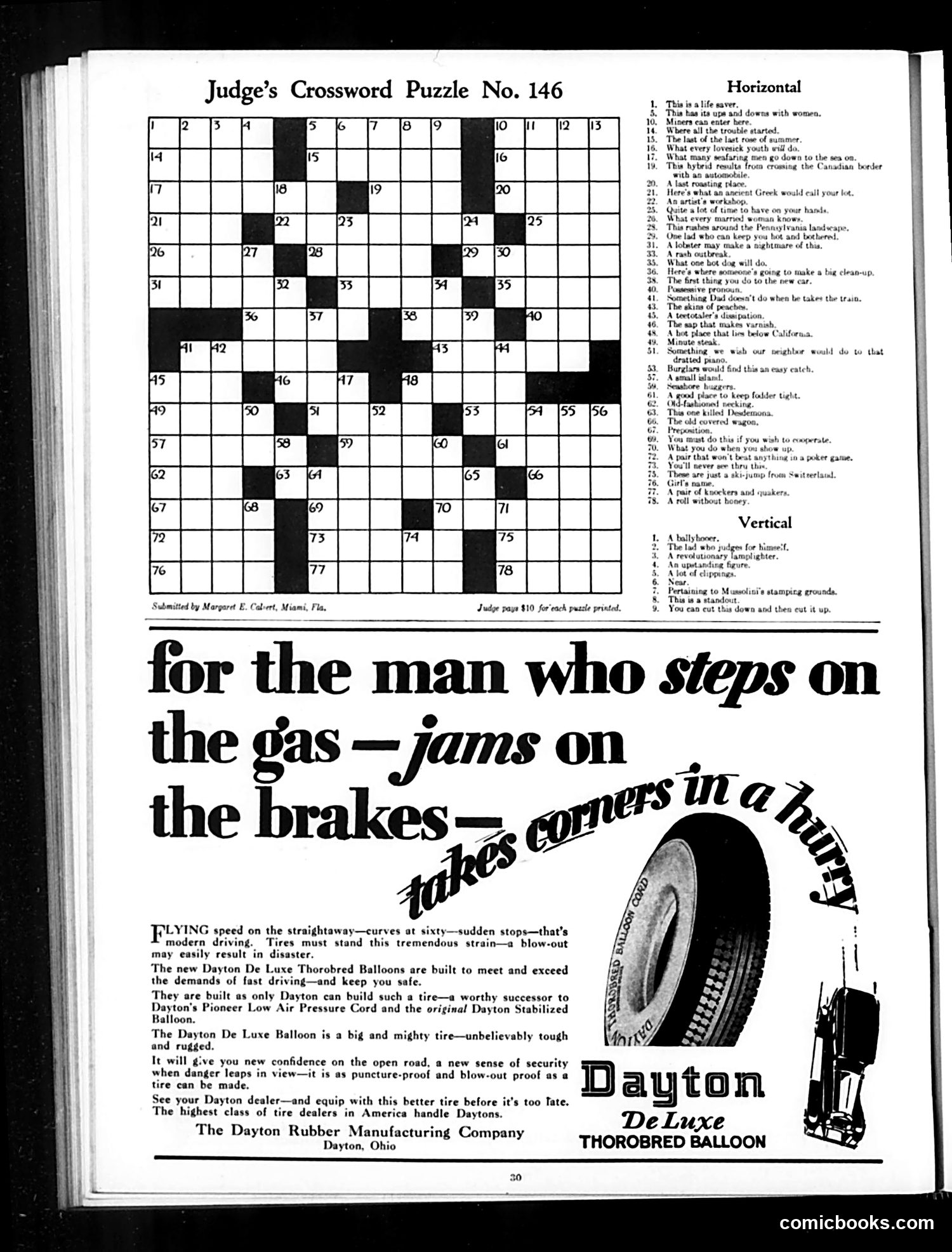
Judge Magazine Page Analysis This page is primarily advertising, not satire or political cartoon. The dominant content is a full-page advertisement for Dayton De Luxe Thorobred Balloon tires, using safety messaging to market the product. The ad's headline plays on a driving metaphor: "for the man who steps on the gas—jams on the brakes—takes corners in a hurry." This references the dangers of modern high-speed driving in the 1920s-30s era, when automobiles were becoming faster and road accidents more common. The copy emphasizes that Dayton tires can handle "tremendous strain," "blow-outs," and "puncture-proof" performance—addressing real safety concerns of the period. The crossword puzzle above the ad is incidental filler content typical of Judge magazine. The advertisement reflects the era's emerging automotive safety consciousness, using fear-based marketing to sell tires as essential safety equipment for the "modern driver."
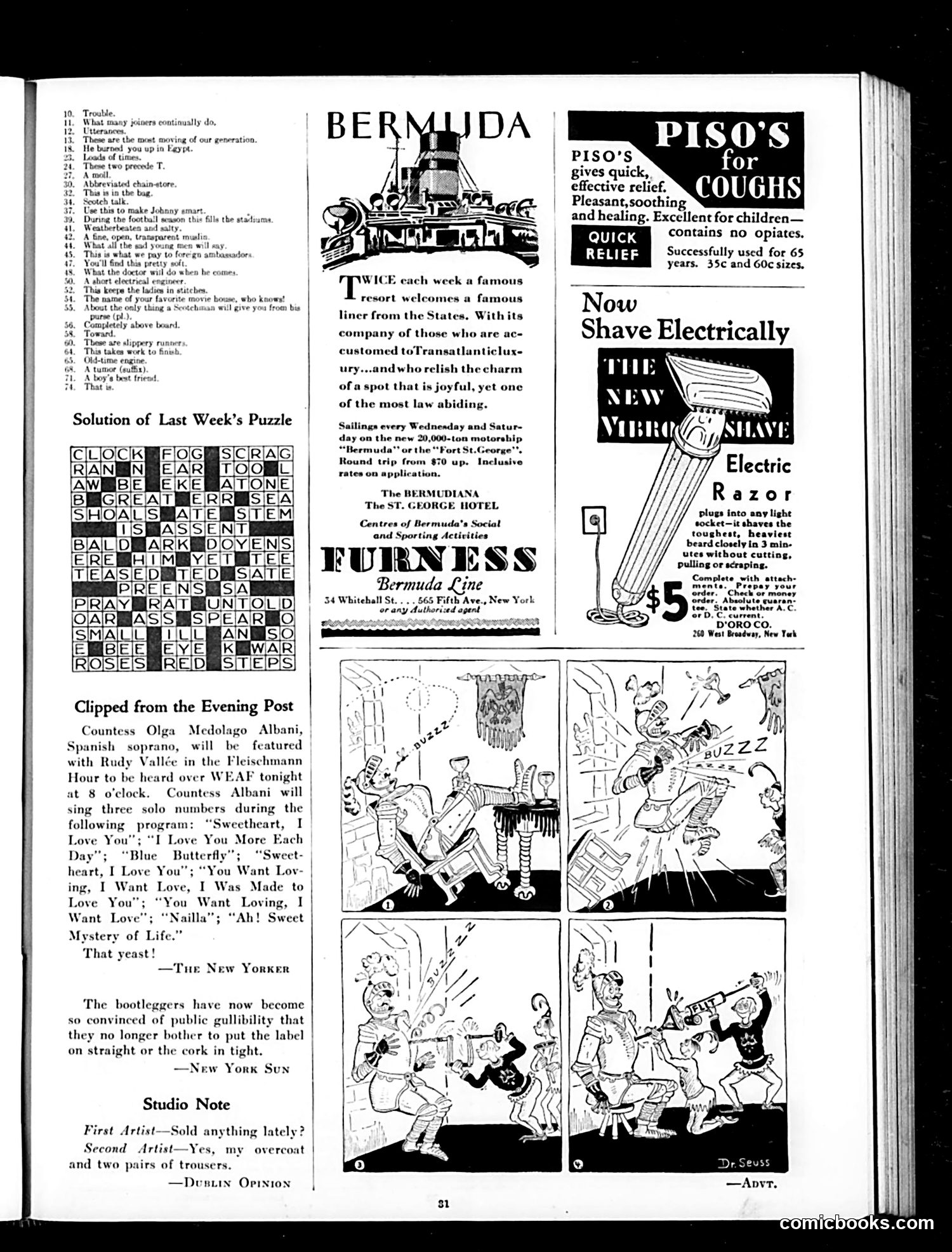
Analysis of Judge Magazine Page This page is primarily advertising and filler content from a vintage issue of Judge magazine, with minimal political or satirical cartooning. The page includes: 1. A crossword puzzle solution (top left) 2. Four humorous brief quotes from various publications—standard magazine filler making light observations about artists selling work, bootleggers' carelessness, and a soprano's repetitive song selections 3. Three product advertisements: Piso's cough medicine, an electric razor, and a Bermuda cruise line 4. A comic strip by Dr. Seuss (bottom) showing absurdist, slapstick humor—characters in chaotic situations with sound effects. This appears to be generic comedic illustration rather than political commentary. There is no identifiable political satire, caricature, or topical commentary visible on this page. It represents typical magazine padding from the era—advertisements, puzzles, and lighthearted humor meant to fill space between more substantial content elsewhere in the publication.
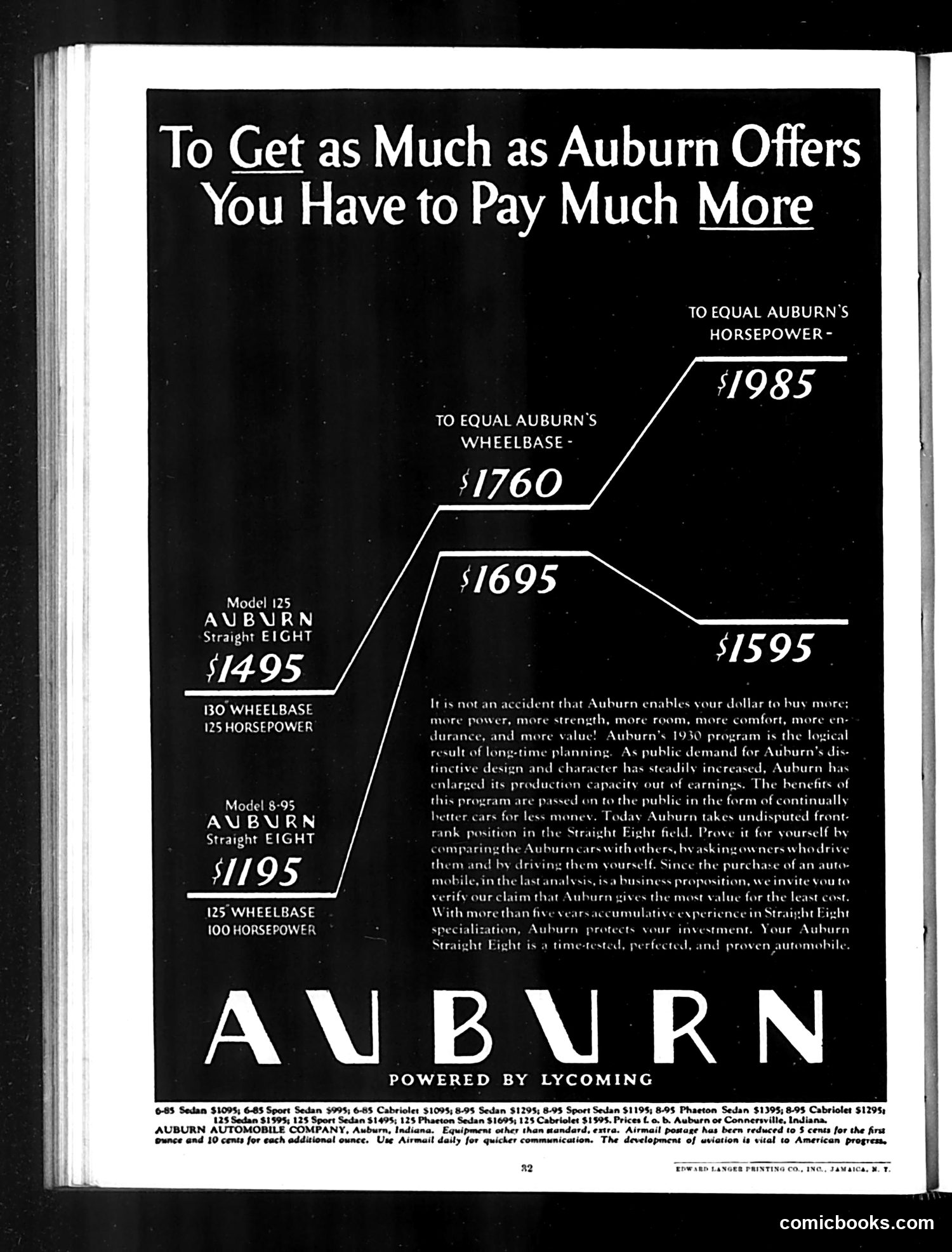
Analysis This is an automobile advertisement, not a political cartoon. It's a 1930 Auburn car company ad from Judge magazine promoting their Straight Eight models. The visual diagram uses a stepped pricing chart to argue Auburn's value proposition: to match Auburn's horsepower, wheelbase, and features, competitors charge significantly more ($1,760-$1,985 versus Auburn's $1,195-$1,595). The accompanying text emphasizes Auburn's competitive advantages—more power, room, comfort, and durability at lower prices—attributing this to their expanded production capacity and five years of Straight Eight specialization. This reflects 1930s consumer marketing strategy: competing on value during the Great Depression era. The ad targets business-minded buyers by framing car purchase as a rational investment decision, not just a luxury item.
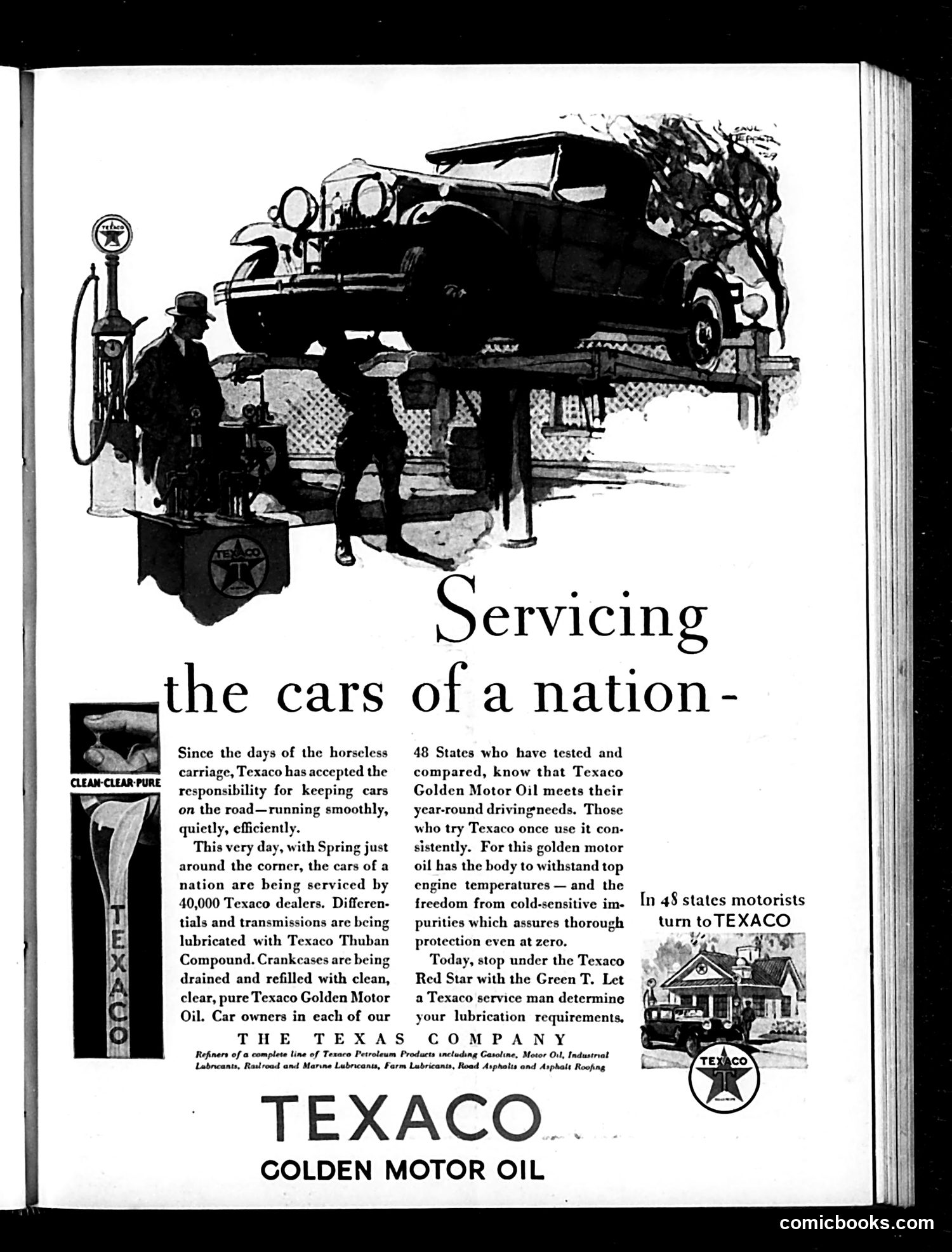
Analysis This is not a political cartoon or satire—it's a straightforward advertisement for Texaco Golden Motor Oil, appearing in *Judge* magazine (likely 1920s-30s based on the car style and aesthetic). The illustration depicts a service station scene with workers servicing an automobile on a lift, accompanied by a gas pump. The ad emphasizes Texaco's nationwide network of 40,000 dealers and the superiority of their motor oil across "48 States" (all states then in the Union). The marketing message targets car owners transitioning from horse-drawn carriages to automobiles, positioning Texaco as a trusted provider of automotive maintenance. Key selling points include the oil's ability to withstand extreme temperatures and perform year-round. This represents early automotive-era advertising, before television, targeting the growing American car-owning public with promises of reliability and nationwide service infrastructure.
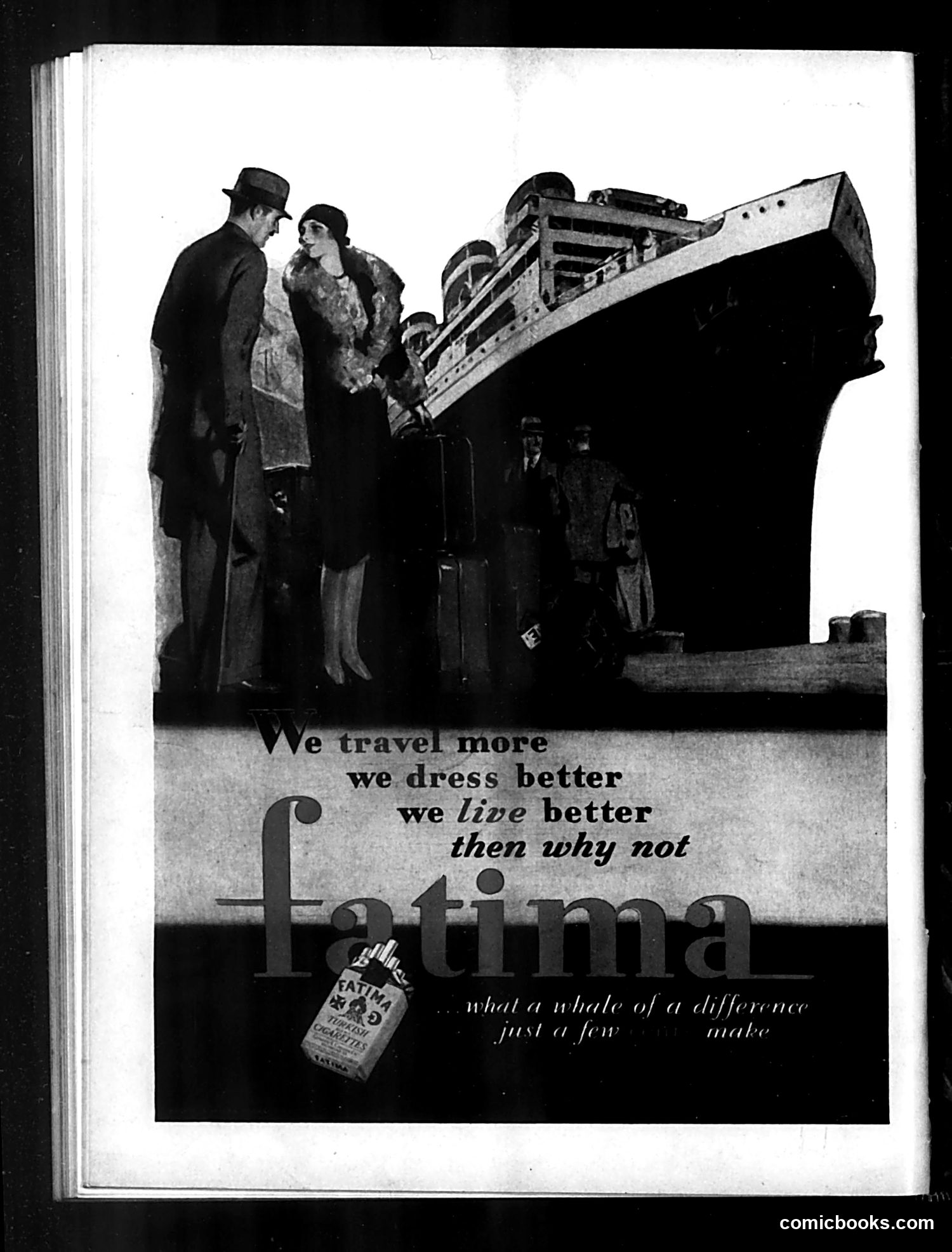
Fatima Advertisement Analysis This is a Fatima cigarette advertisement, not political satire. The ad uses an aspirational travel and fashion pitch: "We travel more we dress better we live better then why not Fatima—what a whale of a difference just a few make." The image shows well-dressed travelers boarding a ship, suggesting cosmopolitan sophistication. The ad's appeal is lifestyle-based—smoking Fatima cigarettes supposedly signals refined taste and social elevation, positioning the product as an accessory to worldly, elegant living. This represents early 20th-century advertising strategy: associating consumer goods with aspirational middle/upper-class identity rather than the product's actual qualities. The phrase "just a few" likely refers to cost-effectiveness—luxury lifestyle at modest expense.