judge
Judge — March 15, 1930
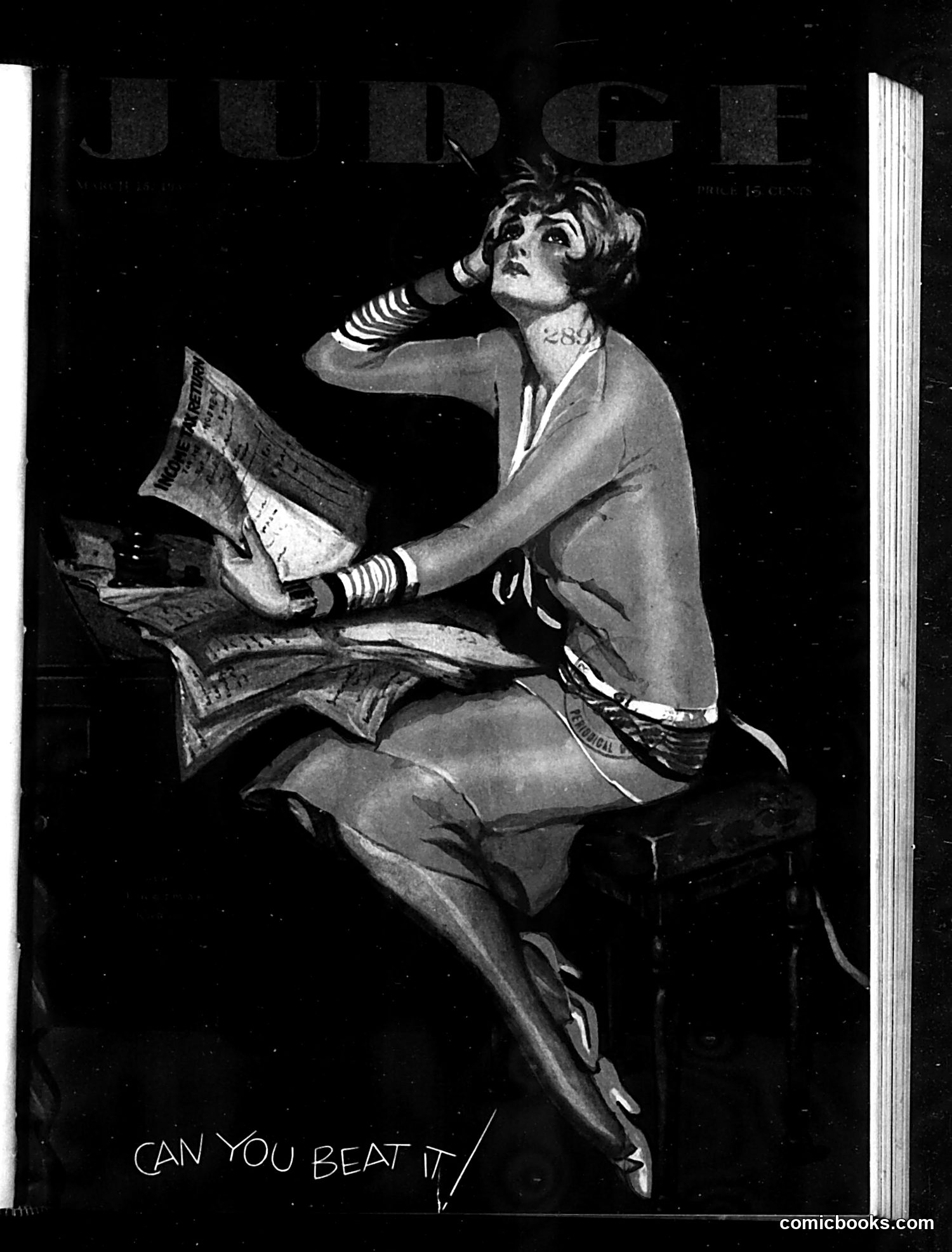
Judge Magazine Satire Analysis This appears to be a vintage Judge magazine cover featuring a stylized illustration of a young man in casual 1920s-30s attire (striped shirt, loose pants with decorative bands). He's depicted in an exaggerated, dynamic pose reading what appears to be a newspaper, with his expression showing surprise or shock. His hair is styled in a period-typical wave. The caption "CAN YOU BEAT IT?" suggests mockery of contemporary news or social trends. Without additional context or visible dateline, the specific target remains unclear—it likely satirizes either newsworthy events, popular culture trends, or social behaviors of that era that Judge's readers would have immediately recognized. The dramatic black-and-white photography and athletic pose emphasize comedic exaggeration typical of the magazine's style.
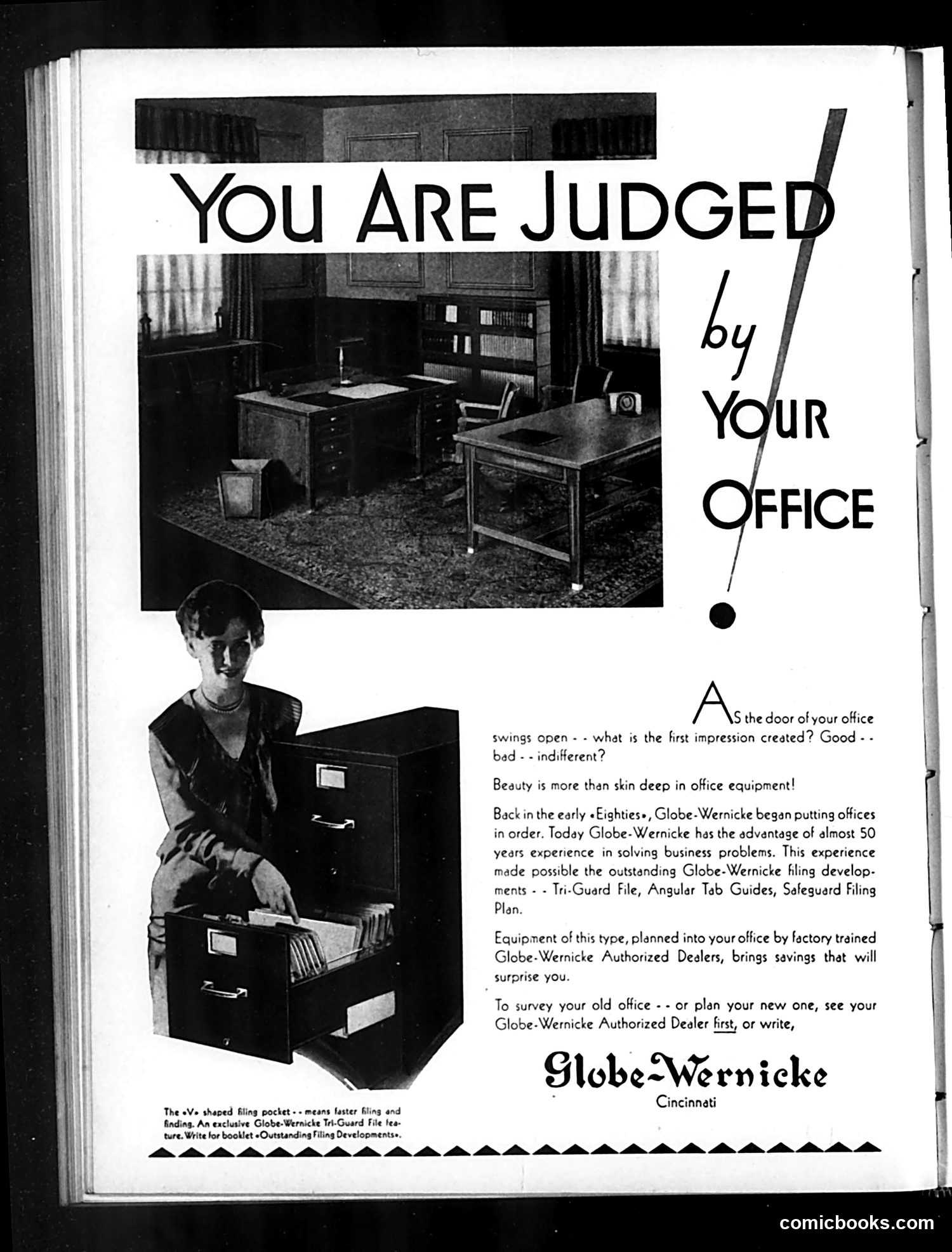
Analysis This appears to be primarily advertising rather than satire. The page is a Globe-Wernicke office furniture advertisement from Cincinnati, disguised as editorial content in Judge magazine. The headline "YOU ARE JUDGED BY YOUR OFFICE" uses a play on Judge's name to suggest that office appearance reflects professional competence. The accompanying photograph shows an organized filing system and office setup. The ad's premise—that good office equipment demonstrates business acumen—is itself mildly humorous, though not satirical. The copy emphasizes Globe-Wernicke's 50 years of experience in office organization and filing systems (Tri-Guard File, Angular Tab Guides, Safeguard Filing Plan). Rather than mocking anything, this is straightforward commercial persuasion: buy quality office furniture to project success. The "satire" framing appears to be an advertising technique to fit Judge's editorial style.
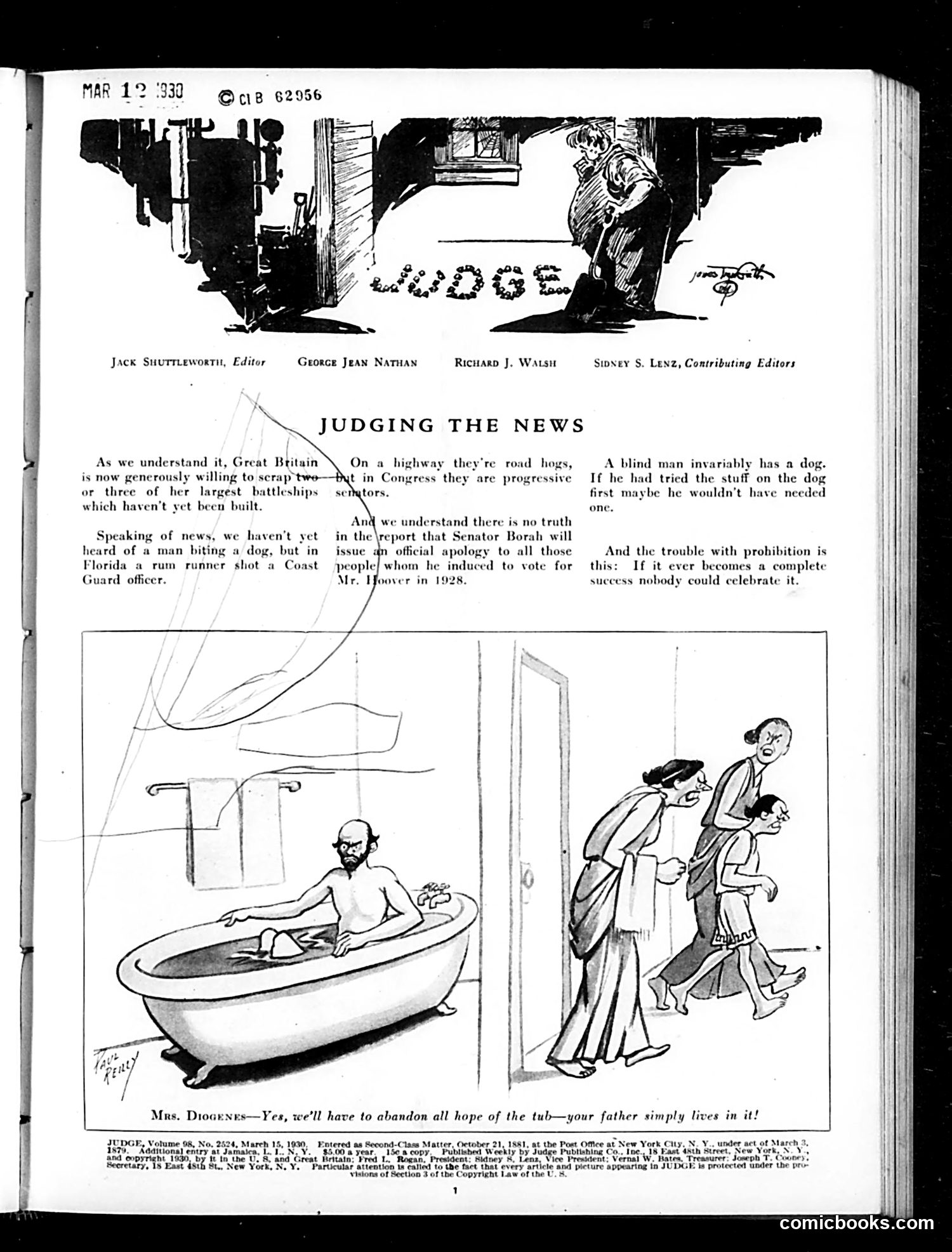
Analysis of Judge Magazine Page (March 12, 1930) The page contains a satirical editorial section titled "Judging the News" that mocks current events through brief commentary and cartoons. The main cartoon depicts a man in a bathtub labeled "Mrs. Diggines—Yes, we'll have to abandon all hope of the tub—your father simply lives in it!" This appears to satirize domestic life and family dynamics of the era, suggesting a humorous complaint about someone hogging the bathroom. The editorial mentions Great Britain scrapping battleships, Senator Borah issuing an apology, and commentary on Prohibition's failure. The cartoon's humor relies on relatable domestic frustration rather than political commentary—a common Judge format of mixing serious political satire with lighthearted domestic humor for broad appeal to Depression-era readers.
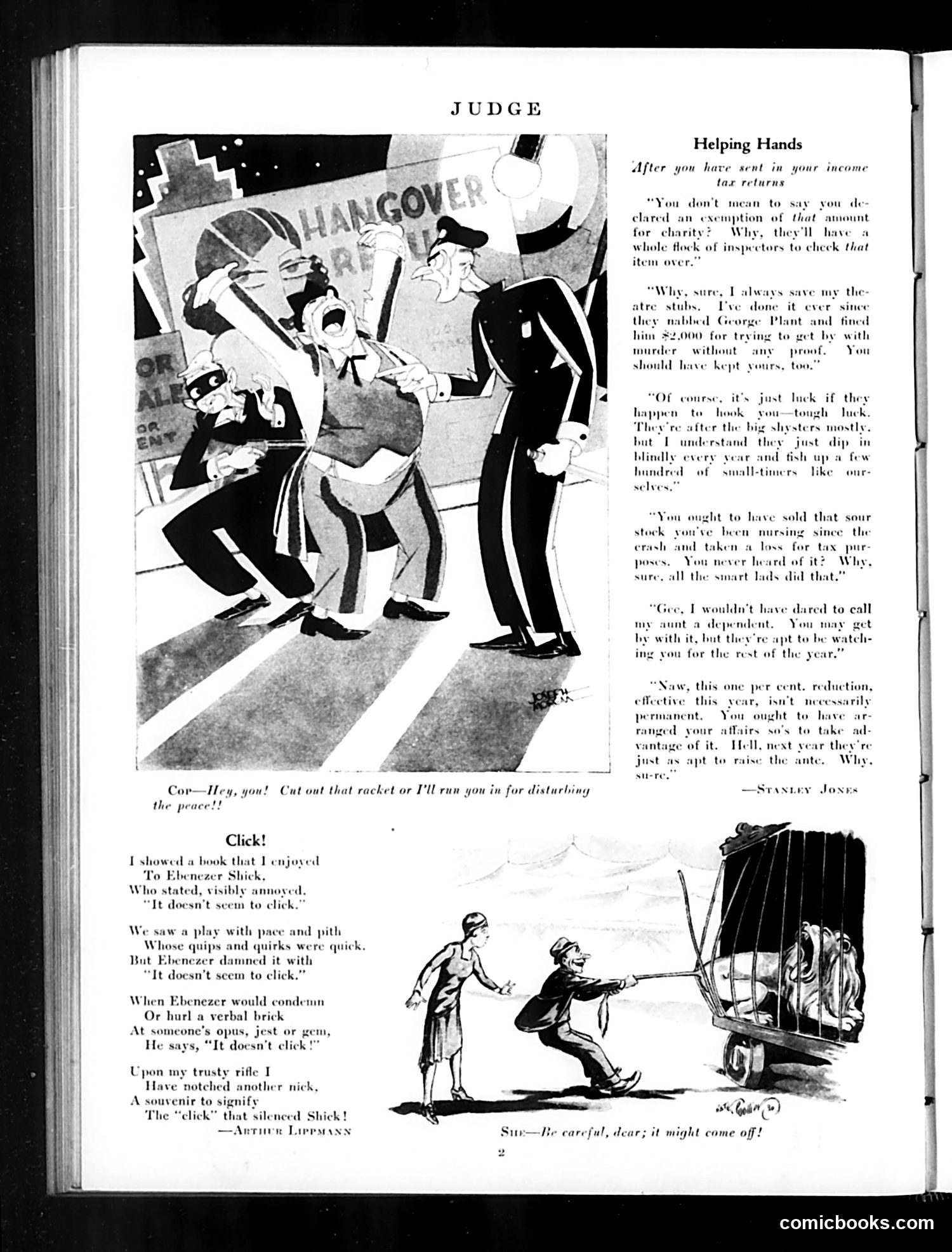
Analysis of Judge Magazine Page The top cartoon satirizes tax deductions. A man loudly protests claiming charitable donations while an inspector examines his finances. The satire targets wealthy individuals claiming inflated charitable deductions to reduce taxes—a common evasion tactic. The dialogue humorously exposes how people game the system by saving theater stubs and small expenses as false "charitable" write-offs. The "Click!" poem below mocks theater critic Ebenzer Slick, who apparently dismissed a play by saying "It doesn't seem to click"—implying his criticisms are superficial catchphrases rather than substantive analysis. The bottom cartoon shows a man carefully towing an overloaded cart, cautioning his companion it "might come off"—likely a visual pun about precarious situations or unstable ventures.
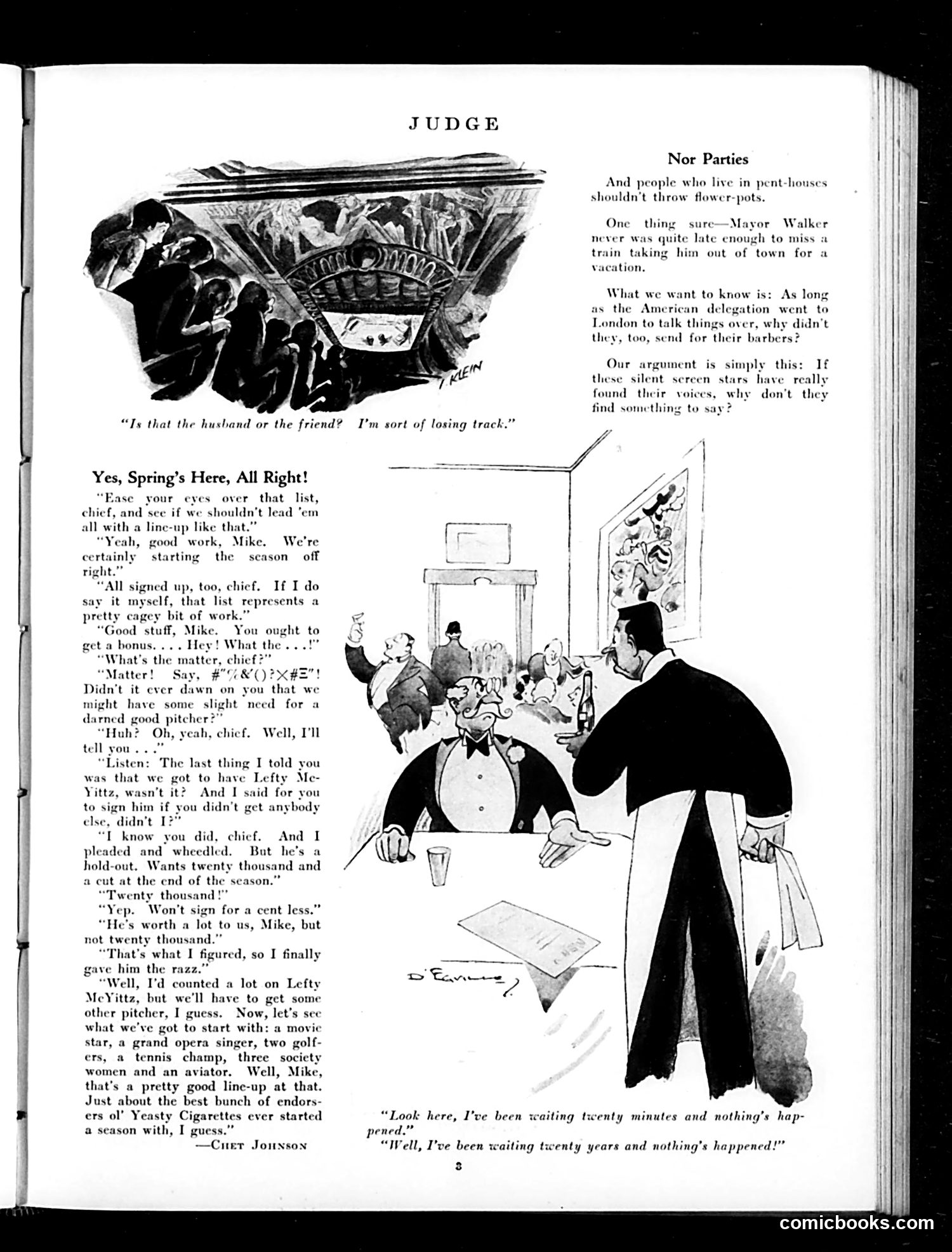
Analysis of Judge Magazine Page This page contains two distinct pieces of satire: "Nor Parties" (top right): A brief editorial criticizing silent film stars for not using their newfound voices after the advent of "talking pictures." The joke: if silent-screen actors have finally found their voices, why remain silent on social/political issues? "Yes, Spring's Here, All Right!" (bottom): A dialogue between baseball manager and player "Mike" discussing signing endorsements for the upcoming season. They're negotiating with a player named "Lefty McYittz" (likely ethnic caricature humor typical of the era). The illustration shows a social scene where a woman complains about waiting "twenty minutes" with nothing happening, while a man responds he's been "waiting twenty years and nothing's happened"—a joke about marriage or romantic stagnation. The content reflects 1920s-30s American popular culture preoccupations with baseball, entertainment, and domestic life.
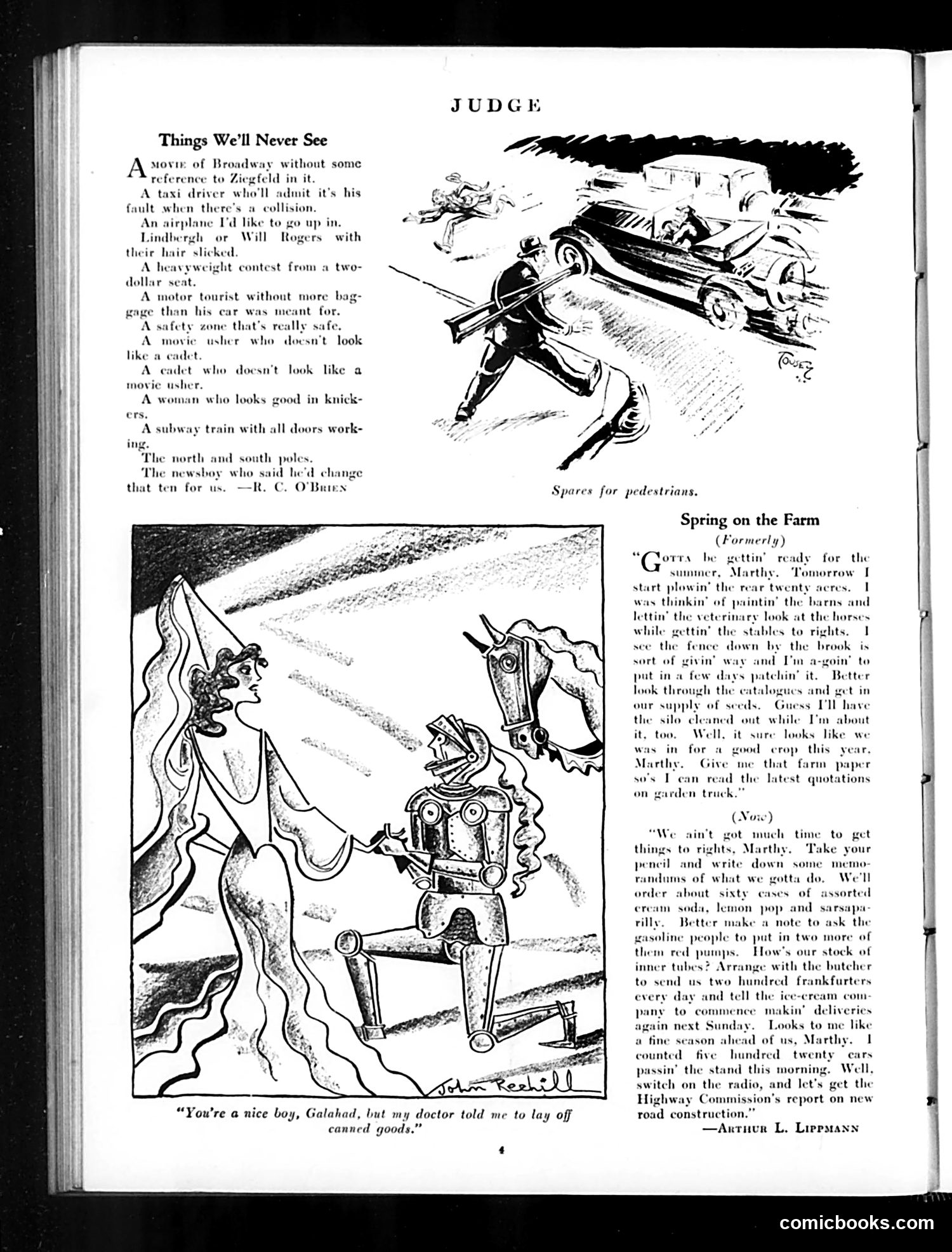
Analysis of Judge Magazine Page The page contains two distinct sections: "Things We'll Never See" (left): A humorous list of impossibilities, including a taxi driver admitting fault, an airplane with messy passengers, and a "woman who looks good in knickers." This is light social satire about everyday frustrations. "Spring on the Farm" (right): A dialogue between a farm wife (Martha) and her husband about spring preparations—plowing, veterinary care, seed ordering, and farm supplies. The husband mentions listening to a Highway Commission radio report about road construction. Lower cartoon: Shows a woman and robot-like figure. The caption reads "You're a nice guy, Galahad, but my doctor told me to lay off canned goods"—a pun playing on "canned" (preserved food) and the robot's mechanical appearance. The page reflects 1920s-30s rural and domestic life, with gentle humor aimed at period audiences.
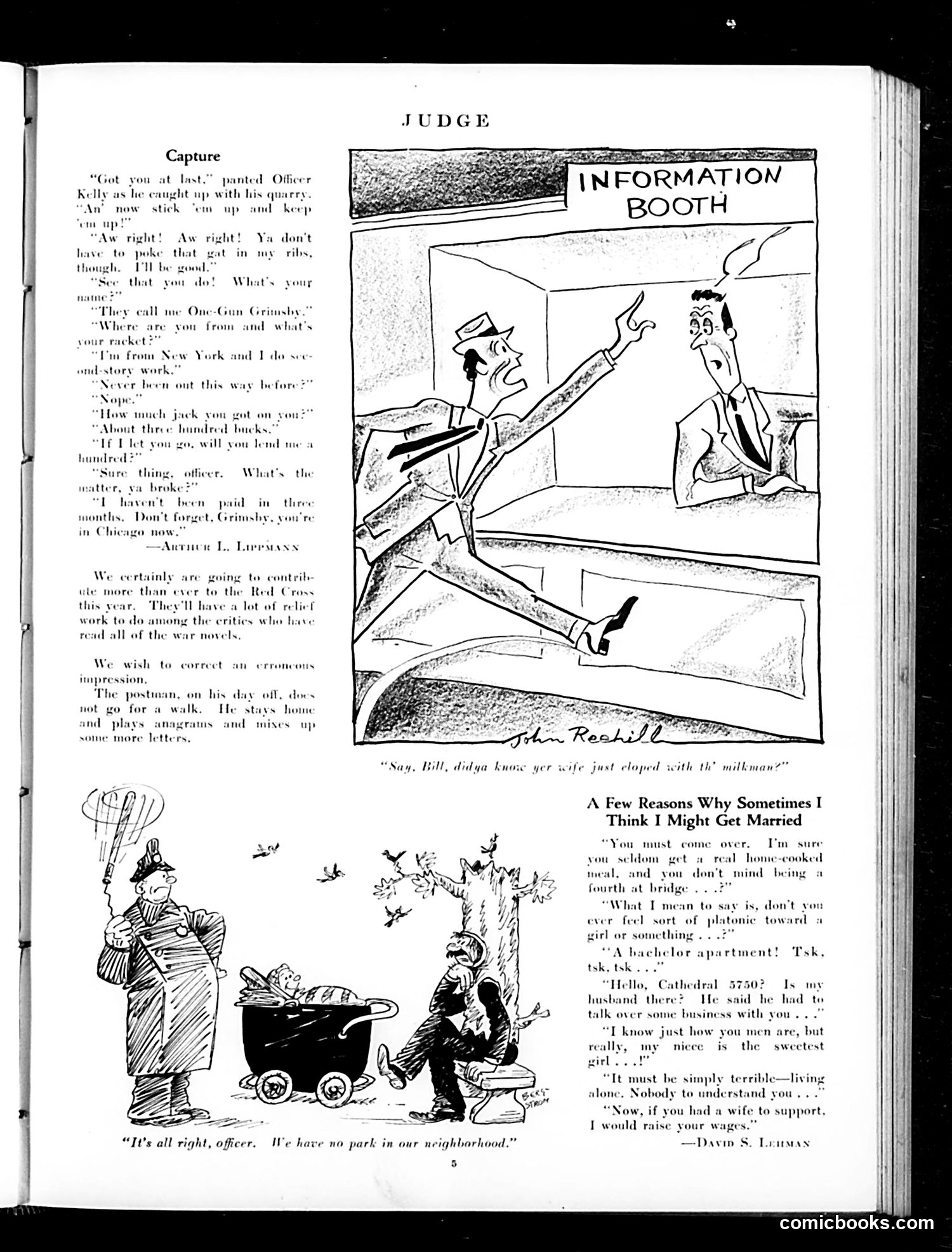
Analysis of Judge Magazine Page This page contains two separate satirical pieces: "Information Booth" (top): A cartoon showing a man at an information booth gesturing expansively while speaking to an attendant. The dialogue reveals the man is "One-Gun Grimsby" from New York, a criminal boasting about his crimes ("About three hundred bucks"). The joke satirizes criminals' braggadocio and suggests they'd openly confess their exploits to anyone. "A Few Reasons Why Sometimes I Think I Might Get Married" (bottom): Humorous commentary listing bachelors' motivations for marriage—home-cooked meals, companionship, financial support. The accompanying cartoon shows a man with a baby carriage, humorously depicting the domestic responsibilities marriage entails. The satire mocks bachelors' superficial reasons for marriage while highlighting the practical demands of family life. Both pieces use humor to critique contemporary social attitudes toward crime and matrimony.
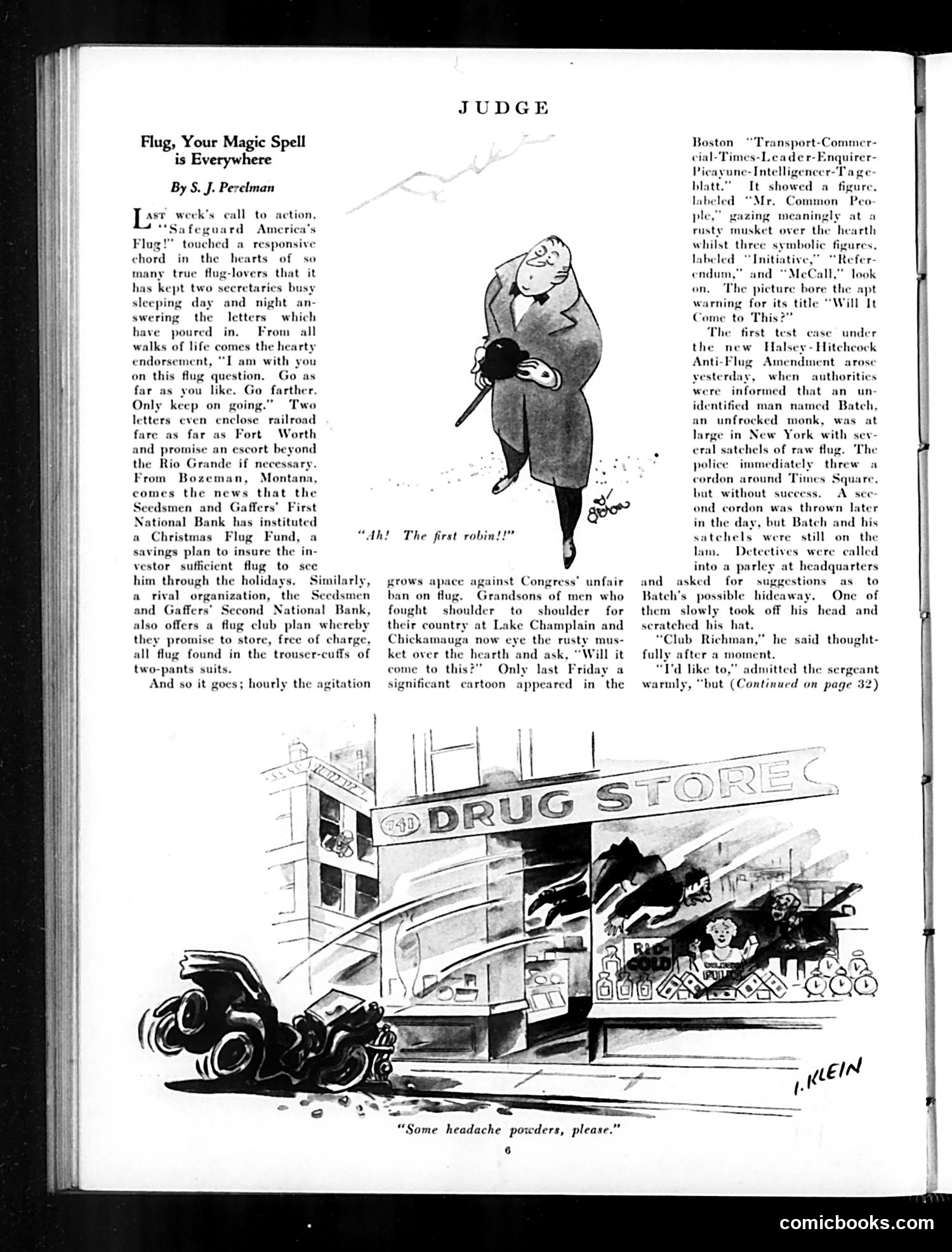
Political Cartoon Analysis This page from *Judge* contains two satirical pieces about American patriotism and commerce during what appears to be a period of flag-related controversy. Top cartoon ("Ah! The first robin!"): Depicts a man holding a large flag with apparent satisfaction. The article references a "Safeguard America's Flag" campaign and mentions Congressional debate over flag regulations. The cartoon appears to mock excessive patriotic displays or commercialization of flag sentiment. Bottom cartoon ("Some headache powders, please"): Shows a car crash outside a drugstore. The satire likely comments on the chaos or unintended consequences of patriotic fervor—the "headache" being figurative (social disruption) made literal through the accident's comedic aftermath. Both pieces seem critical of how flag-related activism disrupts ordinary life.
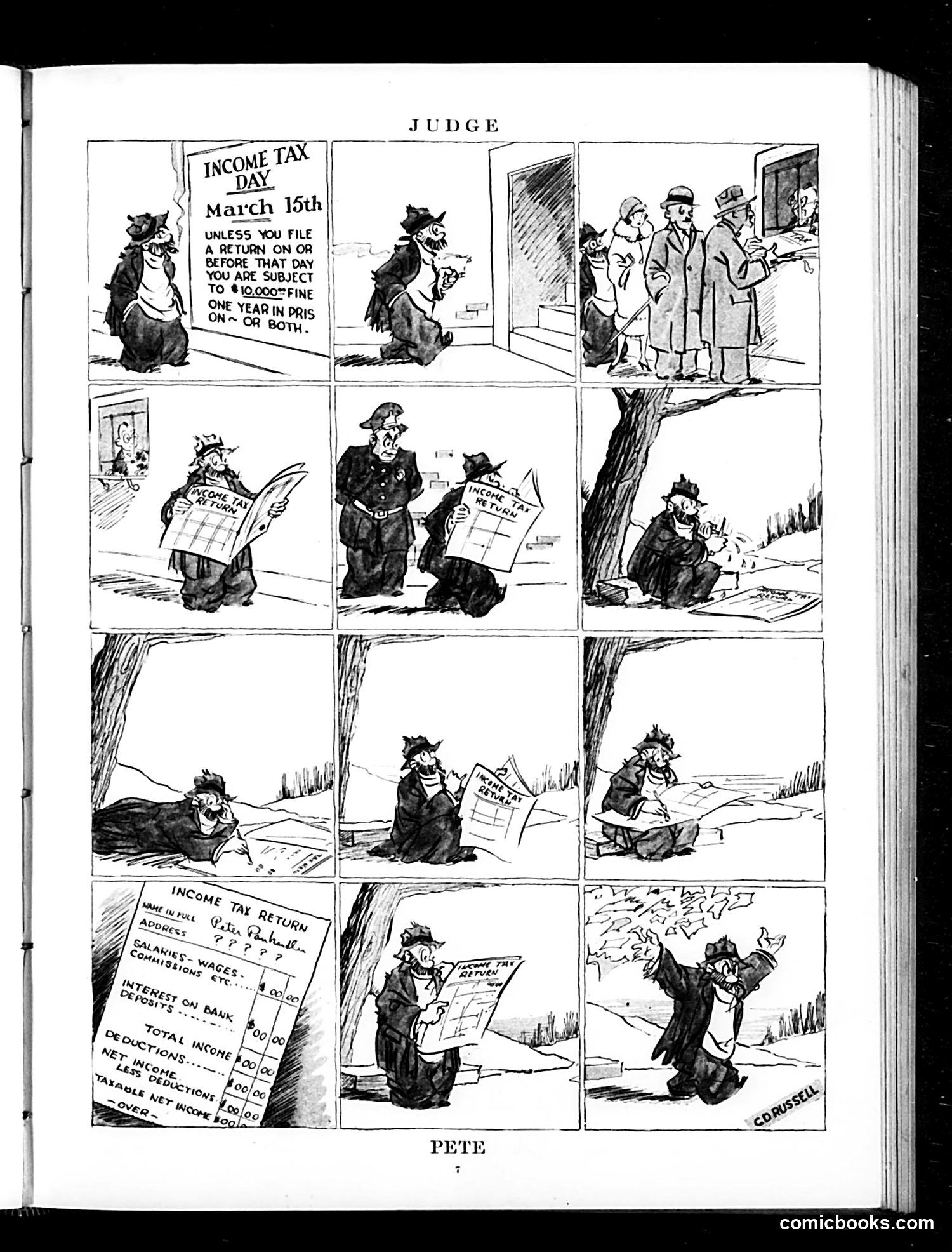
Political Cartoon Analysis: "Judge" - Income Tax Day This is a sequential comic strip satirizing the stress of income tax filing, with March 15th as the deadline. The Devil character (representing the IRS or tax burden) menaces citizens throughout, warning of a $10,000 fine and imprisonment for non-compliance. The narrative follows an everyman taxpayer's mounting anxiety: he receives the threatening notice, attempts to complete his complex return (shown with detailed line items), grows increasingly distressed, and ultimately appears to lose his mind—ending in what looks like a breakdown or escape into nature. The satire mocks both the complexity of tax forms and the government's intimidating enforcement tactics. For modern readers, this reflects early-20th-century Americans' frustration with the relatively new federal income tax system and its Byzantine requirements—a frustration that remains culturally resonant today.
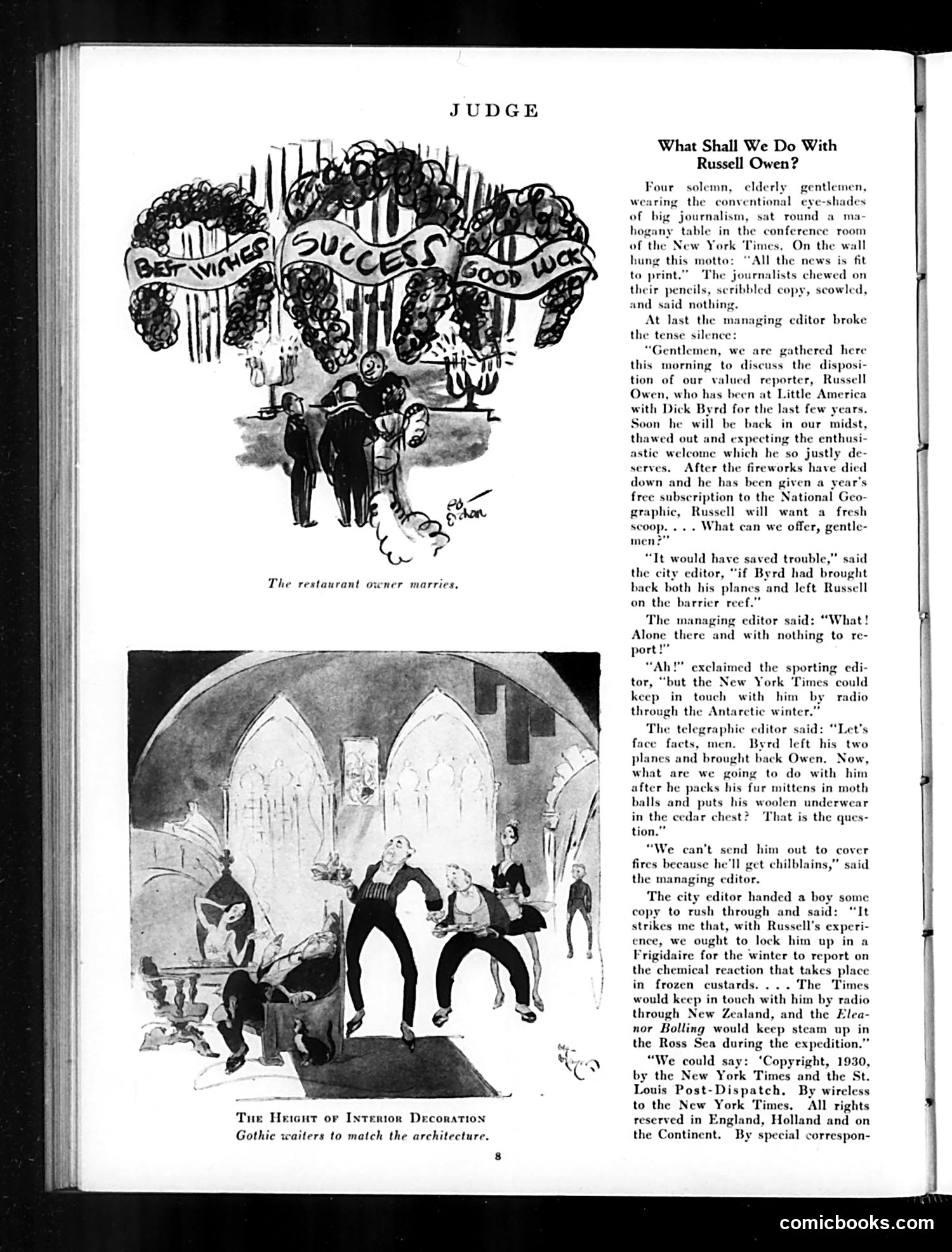
What This Page Means This 1930 Judge satirical piece mocks the New York Times' obsession with sensationalizing reporter Russell Owen's return from Dick Byrd's Antarctic expedition. The cartoon depicts Times editors debating what assignment to give Owen after his famous polar expedition, joking that he's become a one-trick explorer unsuitable for normal reporting. The satire targets the era's yellow journalism: editors seriously propose locking Owen in a refrigerator to report on frozen custard reactions, or keeping him in constant radio contact with Antarctica—absurd ideas meant to squeeze more expedition-related content from him. The joke exposes how major newspapers exploited dramatic expeditions for circulation, and how little value they placed on actual investigative journalism once a reporter's exotic appeal faded. The motto "All the news is fit to print" hangs ironically overhead.
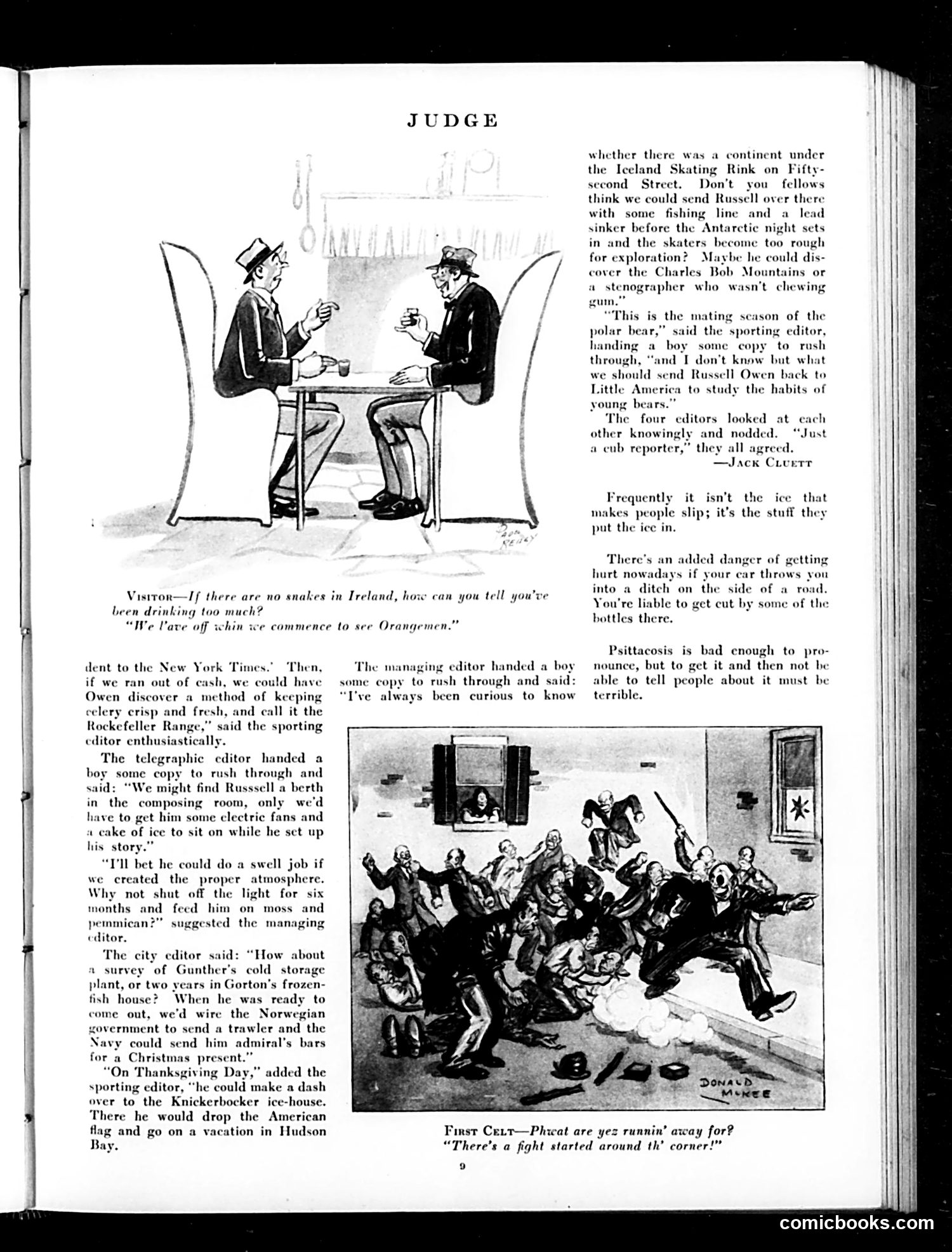
Explanation for Modern Readers This page satirizes newspaper editors brainstorming absurd assignment ideas for an explorer named Russell Owen (a real polar explorer of the era). The top cartoon shows two men at a table in what appears to be an editorial meeting, with the visitor making an Irish drinking joke. The text presents four editors competing to propose the most ridiculous expeditions—sending Owen to explore under an ice rink, study polar bears during mating season, or spend years in cold storage plants. The joke is that they're treating these dangerous, impractical ideas as actual journalism assignments. The punchline ("Just a cub reporter") suggests Owen is inexperienced enough to actually accept such nonsense. The bottom cartoon shows tenement residents running from a street fight, unaware of danger. The sidebar jokes mock Prohibition-era drinking culture, dangerous driving, and a disease called psittacosis—typical satirical commentary on contemporary social problems.
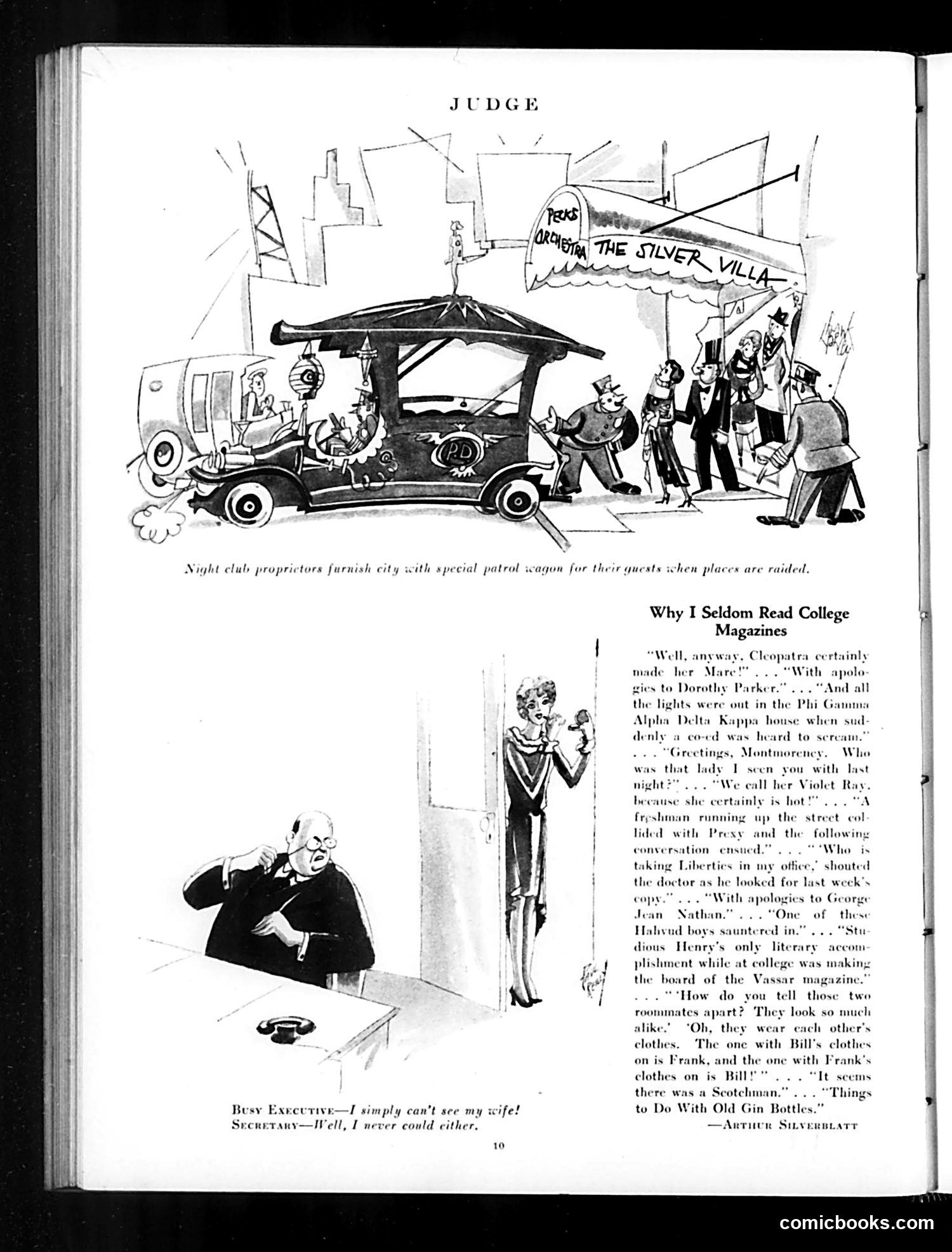
Political Cartoon & Satire Analysis The top cartoon satirizes Prohibition-era nightclub raids. It depicts a luxurious vehicle labeled "The Silver Villa" (a nightclub) equipped with a canopy and serving drinks—functioning as a mobile speakeasy. The joke: nightclub owners provide their own "patrol wagon" to transport guests during police raids, allowing patrons to continue partying while evading arrest. This mocks both the brazen defiance of Prohibition laws and law enforcement's apparent inability to stop it. The lower section, "Why I Seldom Read College Magazines," parodies pretentious undergraduate literary efforts—forced references to famous authors (Dorothy Parker), melodramatic clichés ("lights were out"), and forced sophistication. The brief dialogue joke about indistinguishable twin roommates comments on collegiate conformity and homogeneity.
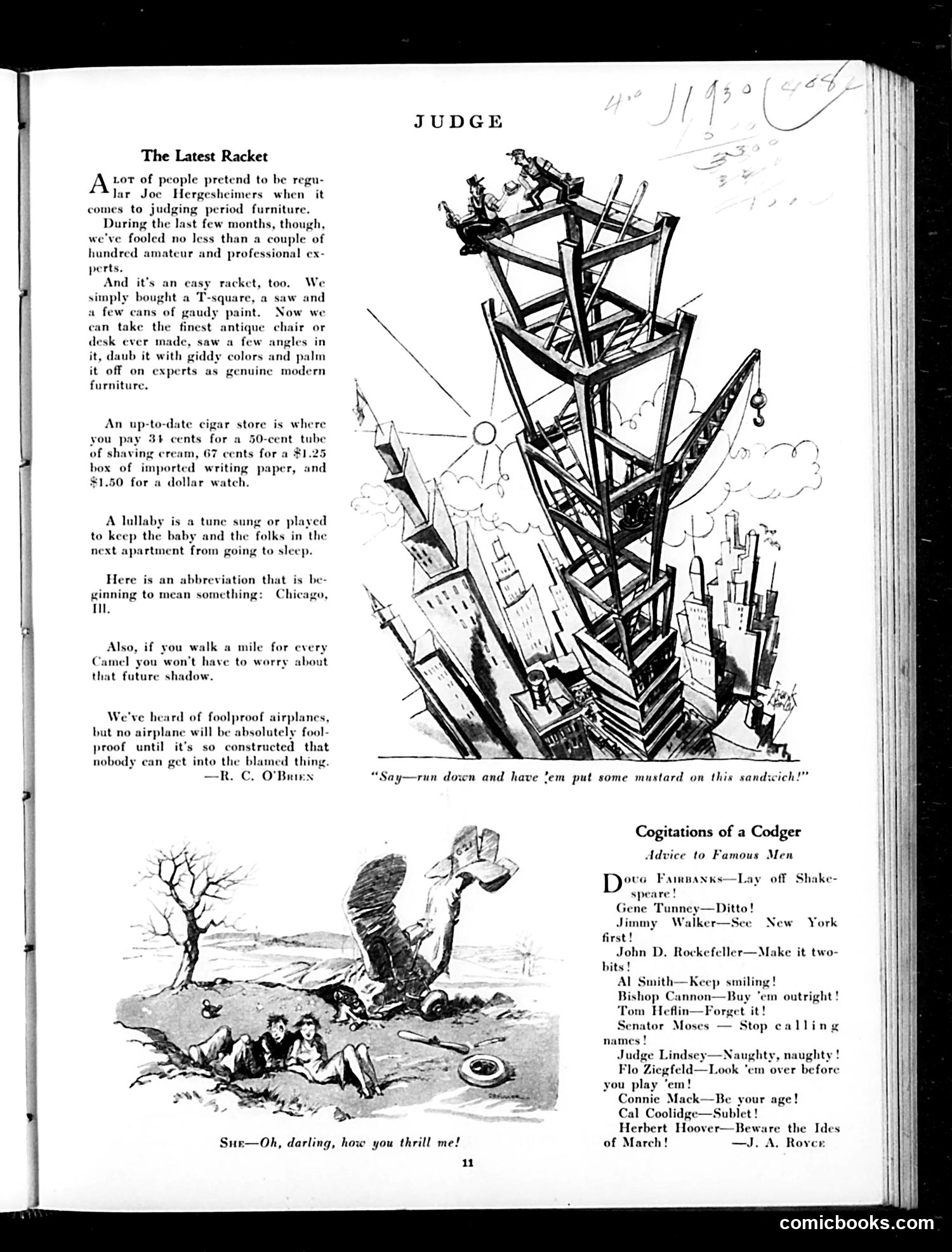
Explanation for Modern Readers This Judge magazine page contains satirical commentary on 1920s American culture: "The Latest Racket" mocks the era's obsession with "modernism" in furniture design. The joke: anyone can take a fine antique chair, saw random angles into it, paint it garishly, and sell it as genuine modern furniture to foolish "experts." This satirizes both the pretentiousness of modernist aesthetics and the gullibility of wealthy collectors trying to appear sophisticated. The sidebar quips mock contemporary consumer culture—overpriced cigars, inflated prices at modern stores. "Cogitations of a Codger" offers tongue-in-cheek "advice to famous men" of the day, including: Prohibition-era gangster references (Bishop Cannon), politician Gene Tunney, and public figures like John D. Rockefeller and Herbert Hoover. The humor relies on readers recognizing these celebrities and finding ironic humor in the absurd advice given. The page reflects 1920s preoccupation with modernism, consumerism, and celebrity culture during the Jazz Age.
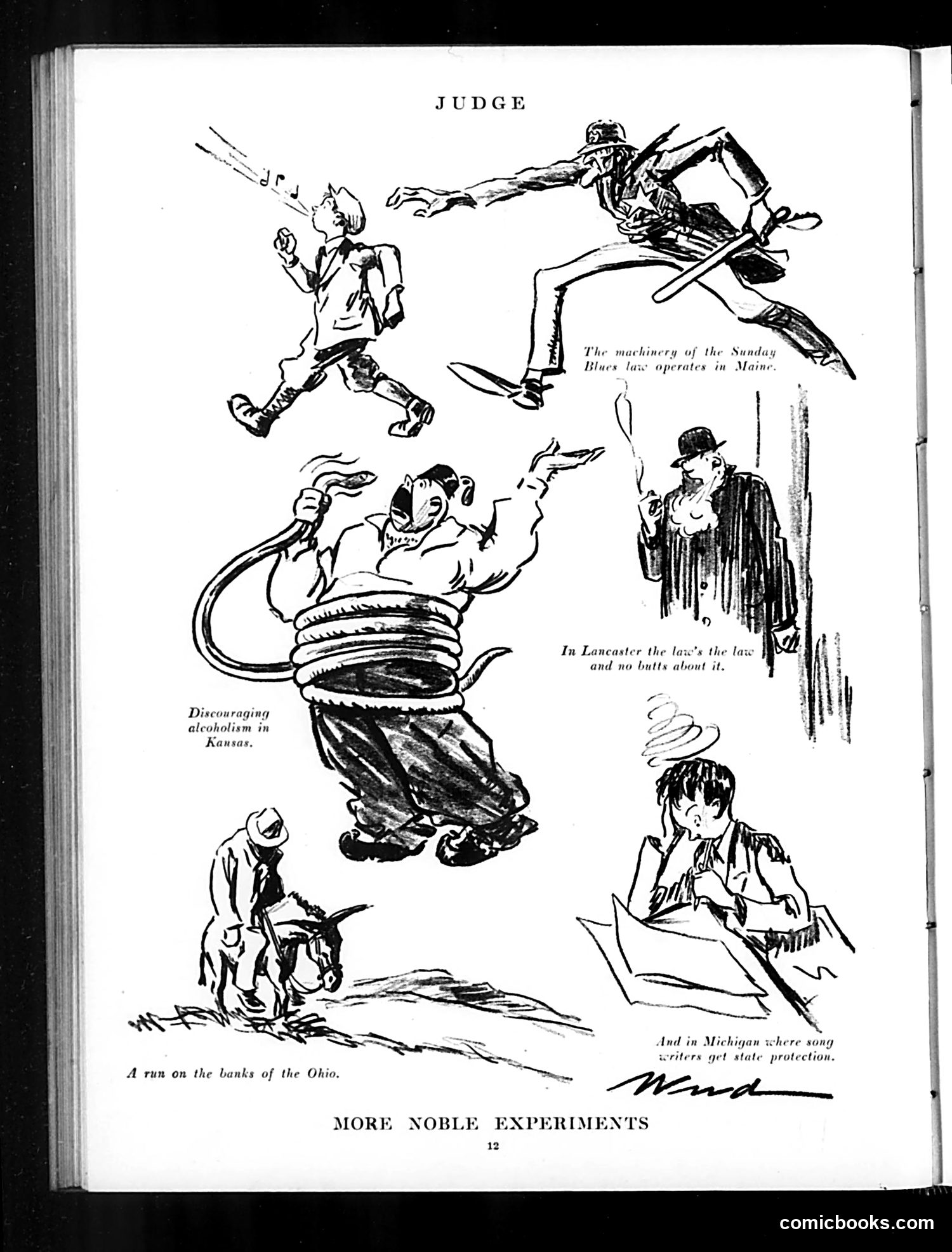
"More Noble Experiments" This Judge page satirizes Prohibition and related "reform" laws of the 1920s. Each cartoon mocks different states' enforcement efforts: - Maine's "Sunday Blues law": Shows a skeletal judge chasing someone, criticizing rigid enforcement of alcohol restrictions. - Kansas anti-alcoholism efforts: Depicts a bloated figure being wrung out by reformers, suggesting aggressive but ineffective campaigns. - Lancaster's strict enforcement: "The law's the law and no butts about it" mocks zero-tolerance policies. - Michigan's "song writers get state protection": Unclear reference, but likely mocks inconsistent or absurd regulations. - Ohio bank run: Suggests economic chaos from Prohibition's enforcement. The overall title "More Noble Experiments" is sarcastic, referencing Prohibition as Hoover's "noble experiment." Judge opposed Prohibition, using these cartoons to ridicule state-level enforcement as heavy-handed, ineffective, and economically damaging.
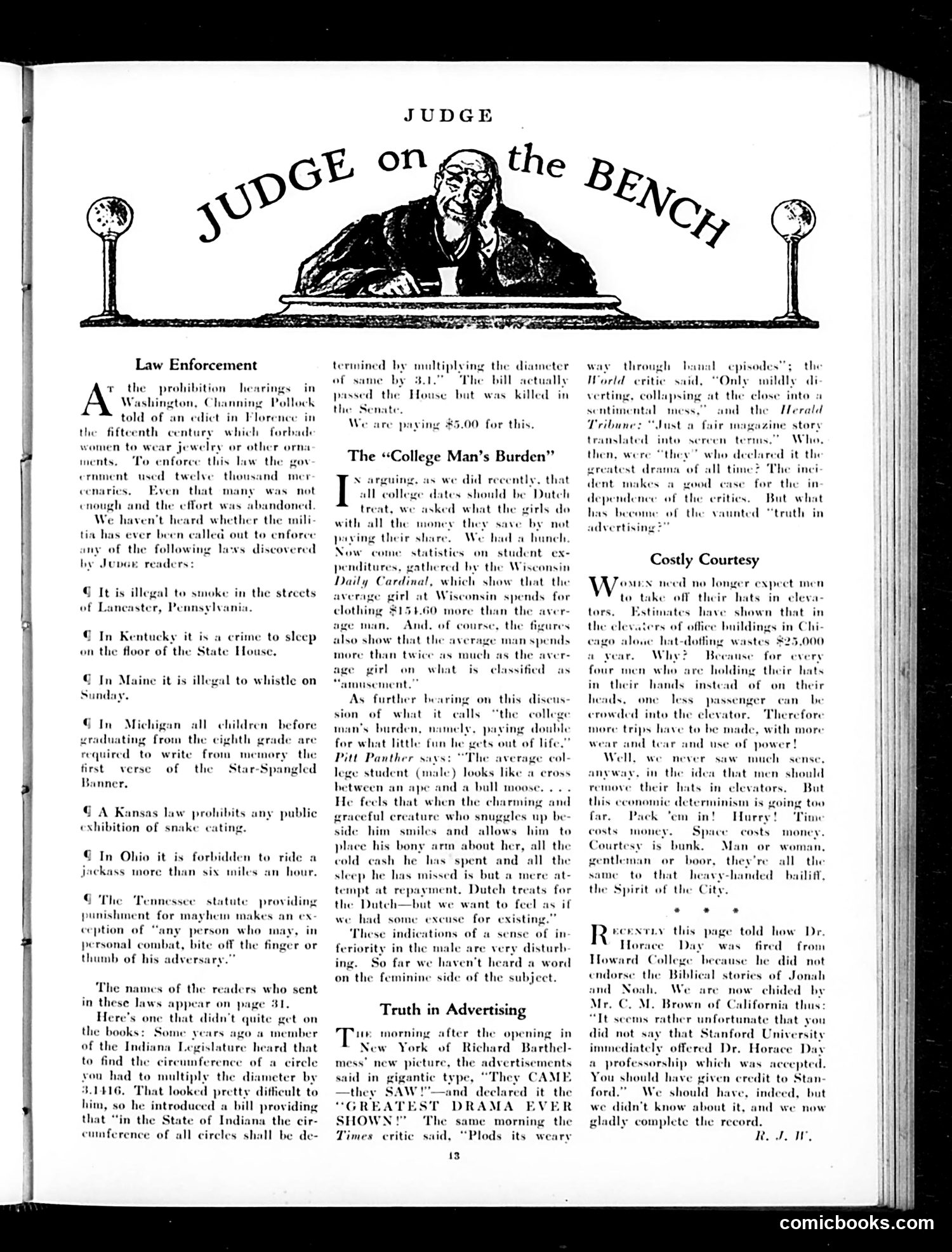
Judge Magazine Page Analysis This page from Judge magazine contains several satirical pieces targeting American laws and social customs: "Law Enforcement" mocks absurd state laws readers submitted—banning snake exhibitions in Kansas, whistling on Sundays in Maine, sleeping on State House floors in Kentucky. The humor lies in their ridiculousness and selective enforcement. "The College Man's Burden" satirizes gender economics among college students. Statistics show Wisconsin coeds spend $154.60 more annually than male students, yet expect "Dutch treat" (split bills). The *Pitt Panther* humorously likens the average college man to "a cross between an ape and a bull moose"—a beast accepting financial exploitation from his date while receiving minimal affection in return. The satire critiques both coeds' financial expectations and men's passive acceptance. "Truth in Advertising" attacks Broadway theater advertising. A play opening received scathing reviews ("banal," "sentimental mess") from the Times and Herald Tribune, yet advertisements proclaimed it "the GREATEST DRAMA EVER SHOWN"—quoting only positive sources while ignoring critical consensus. It's satirizing deceptive advertising practices.
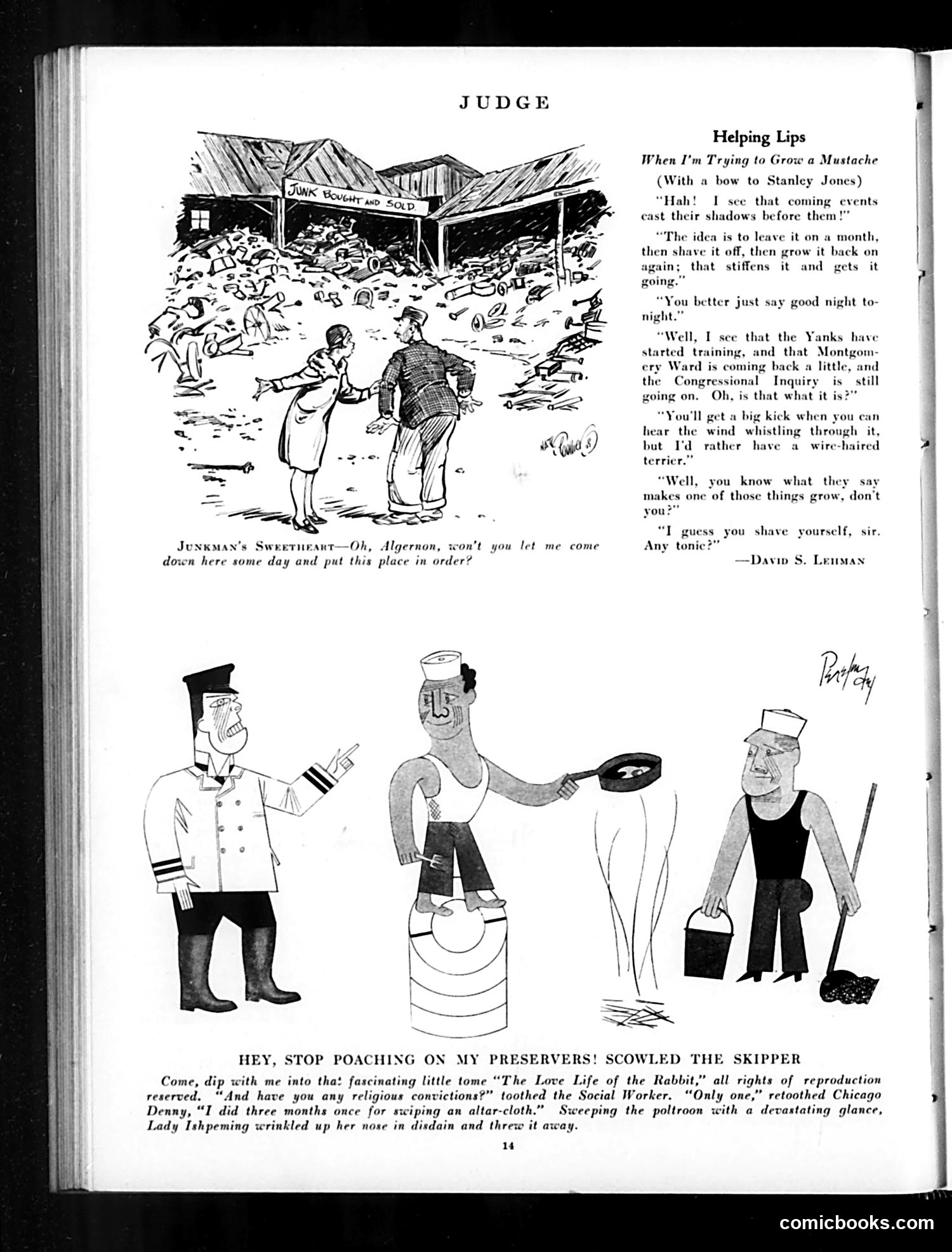
Judge Magazine Page Analysis This page contains two distinct satirical pieces from Judge magazine (likely early 20th century): Top cartoon: A junkyard scene with romantic/domestic humor. The caption jokes about a messy junkman's yard, with his sweetheart asking him to clean it up. The humor is straightforward domestic satire—contrasting romantic sentiment with squalid reality. "Helping Lips" column: A humorous advice piece about growing a mustache, referencing topical 1920s events: Yankee baseball training, Montgomery Ward's business recovery, and an ongoing Congressional Inquiry (likely post-WWI government investigation). The joke plays on someone mishearing conversation, thinking personal grooming advice relates to major news events. Bottom section: Three cartoons depicting various characters (a ship's officer, someone cooking, a janitor) with an absurdist story involving a rabbit book, a social worker interrogating someone about "swiping an altar-cloth" (theft), and a character named "Lady Ishpeming." The humor is surreal and punny, typical of Judge's comedic style. The satire targets everyday American life and bureaucratic absurdity rather than specific politics.
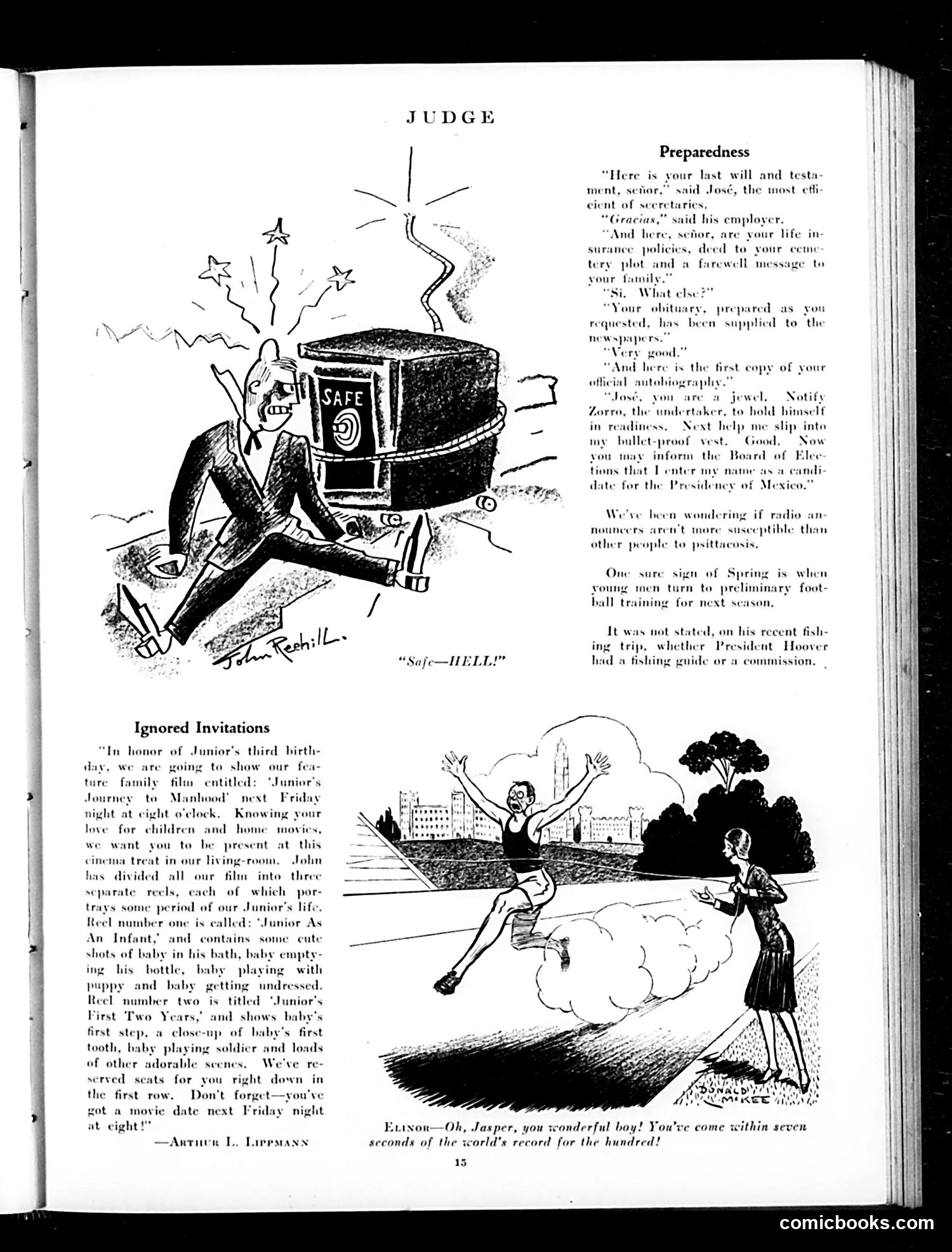
Political Cartoons from Judge Magazine Top Cartoon ("Safe—HELL!"): A man sits atop an exploding safe, his hair and clothing blown away. The satire targets people's obsession with protecting valuables and documents during uncertain times—likely referencing anxiety about economic security or political instability in the pre-Depression era. The irony is that the safe itself becomes the danger. Bottom Cartoon ("Ignored Invitations"): Depicts a woman jumping rope while another watches. The accompanying text mocks the social obligation to attend tedious home movie screenings of other people's children. The satire criticizes boring suburban social customs and the pressure to feign interest in neighbors' domestic films—a relatable complaint about unwanted social engagements. "Preparedness" Article: A satirical piece about a Mexican businessman preparing exhaustively for his death/presidency run, arranging everything from life insurance to his autobiography. It mocks excessive preparedness and the absurdity of Mexican political ambitions.
Judge Magazine Theater Criticism Page This is George Jean Nathan's theatrical review column criticizing contemporary Broadway productions. The page contains NO political cartoons—it's entirely text-based drama criticism. Nathan compares John Wexley's "The Last Mile" favorably to Norman MacOwan's "The Infinite Shock," arguing the latter is dramatically dead and relies on tired clichés (spirit-versus-flesh conflict, actresses in hip-hugging gowns). He mocks MacOwan's pretentious use of Sartor Resartus quotations as hollow literary window-dressing. Nathan then discusses Ed Wynn's comic talents, sarcastically quoting a Times review praising Wynn for lifting "tomfoolery into the realms of fantasy"—Nathan finds this absurd, arguing Wynn is simply a skilled clown and mime artist, not an artistic visionary. The satire targets inflated theater criticism that over-intellectualizes vaudeville performance.
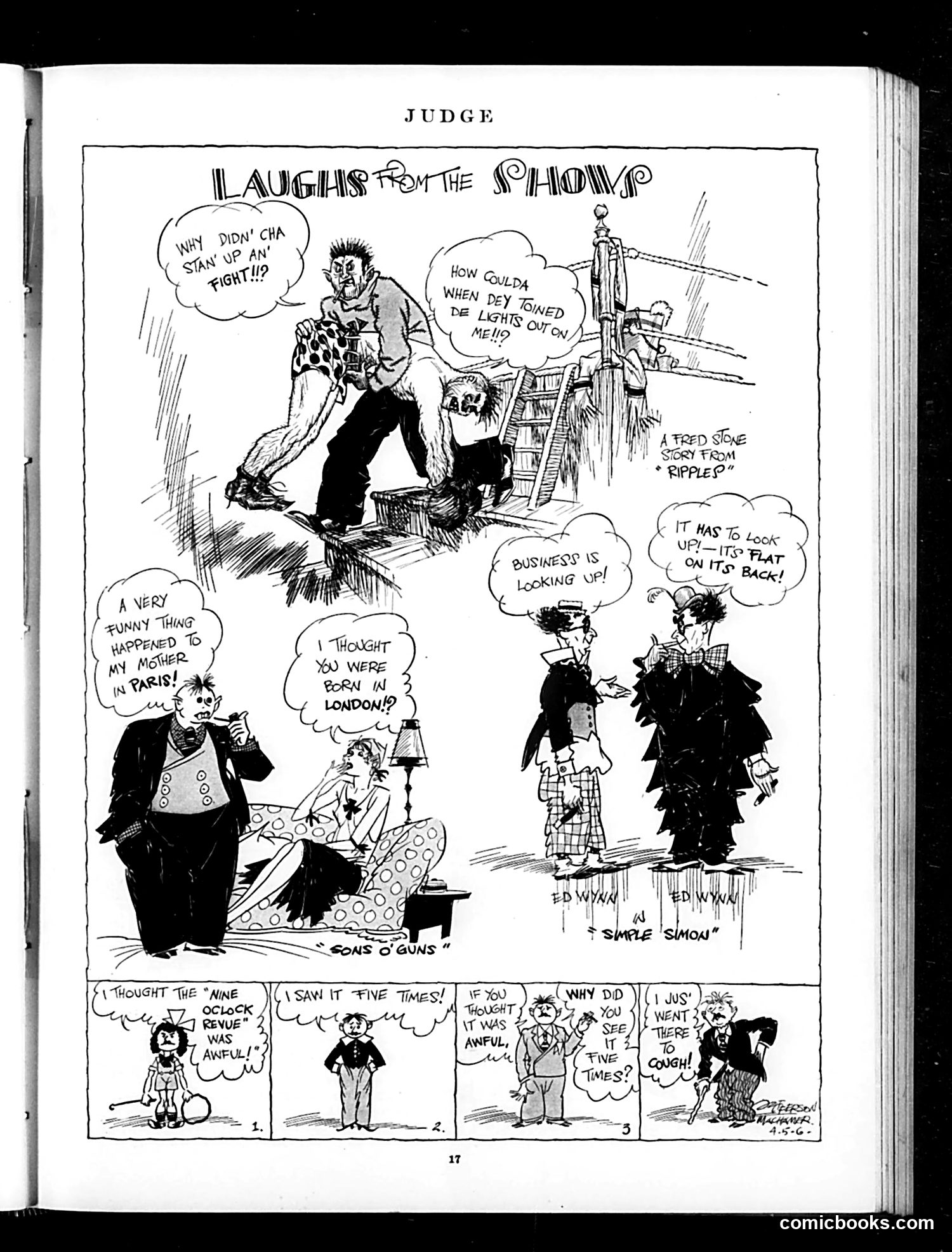
"Laughs for the Show" - Judge Magazine Page This page collects several brief humorous anecdotes presented as jokes told at social gatherings. The top illustration shows an animated raconteur telling stories to an audience. The vignettes below feature characters recounting absurd or ironic incidents—one about an unusual occurrence in Paris, another about a London birth, and others involving misunderstandings or comedic situations. The format reflects a common Judge magazine practice: reprinting witty anecdotes and parlor jokes meant to entertain readers with clever wordplay and situational humor. The last comic strip sequence appears to depict someone repeatedly attending an awful theatrical performance ("The Nine O'Clock Revue"), questioning why they kept returning despite finding it dreadful. The satire targets human nature—our tendency toward irrational behavior and our susceptibility to repeating mistakes. Without seeing specific publication date, exact identifications remain unclear, though the style and sensibilities suggest early-to-mid 20th century American humor.
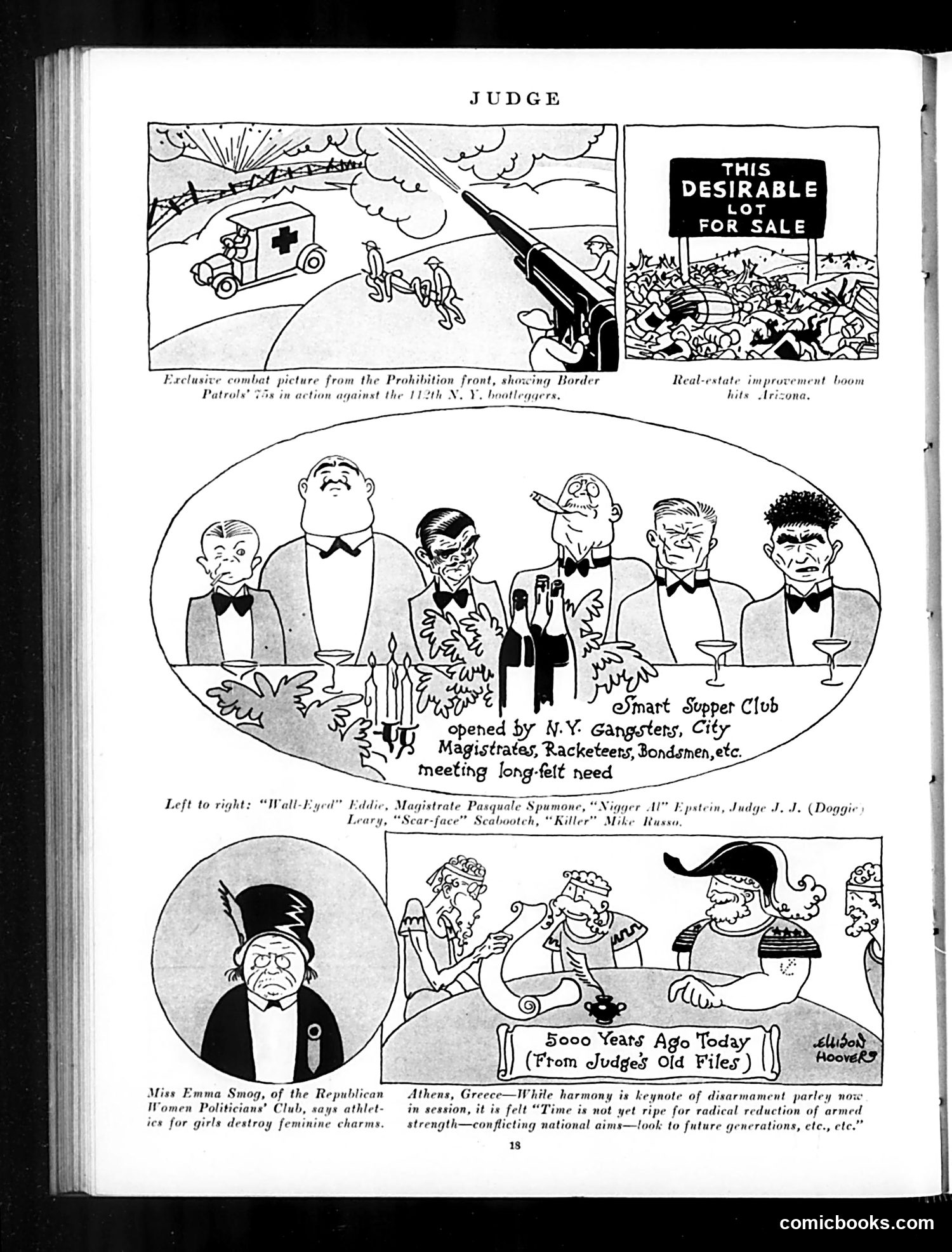
Judge Magazine Satire Analysis This page satirizes several 1920s American concerns: Top panels: Mockery of Prohibition enforcement. The left cartoon shows Border Patrol vehicles and ambulances fighting bootleggers during the "Prohibition front"—treating illegal alcohol smuggling as a wartime conflict. The right panel mocks Arizona's real-estate boom by depicting it alongside Prohibition violence, suggesting land development occurs amid lawlessness. Center panel: A "Smart Supper Club" opened by named gangsters, judges, and magistrates—satirizing the corruption enabling speakeasies to operate openly despite Prohibition. The joke is that criminals and officials openly "meet long-felt need" together. Bottom left: Emma Smog of the "Republican Women Politicians' Club" discussing athletics for girls—likely satirizing women's changing social roles post-suffrage. Bottom right: A historical comparison to ancient Athens, sardonically suggesting modern disarmament talks are as ineffective as ancient ones, with nations unwilling to reduce military strength due to conflicting interests. The overall theme: American hypocrisy—Prohibition unenforced, officials complicit with criminals, and international peace efforts doomed.
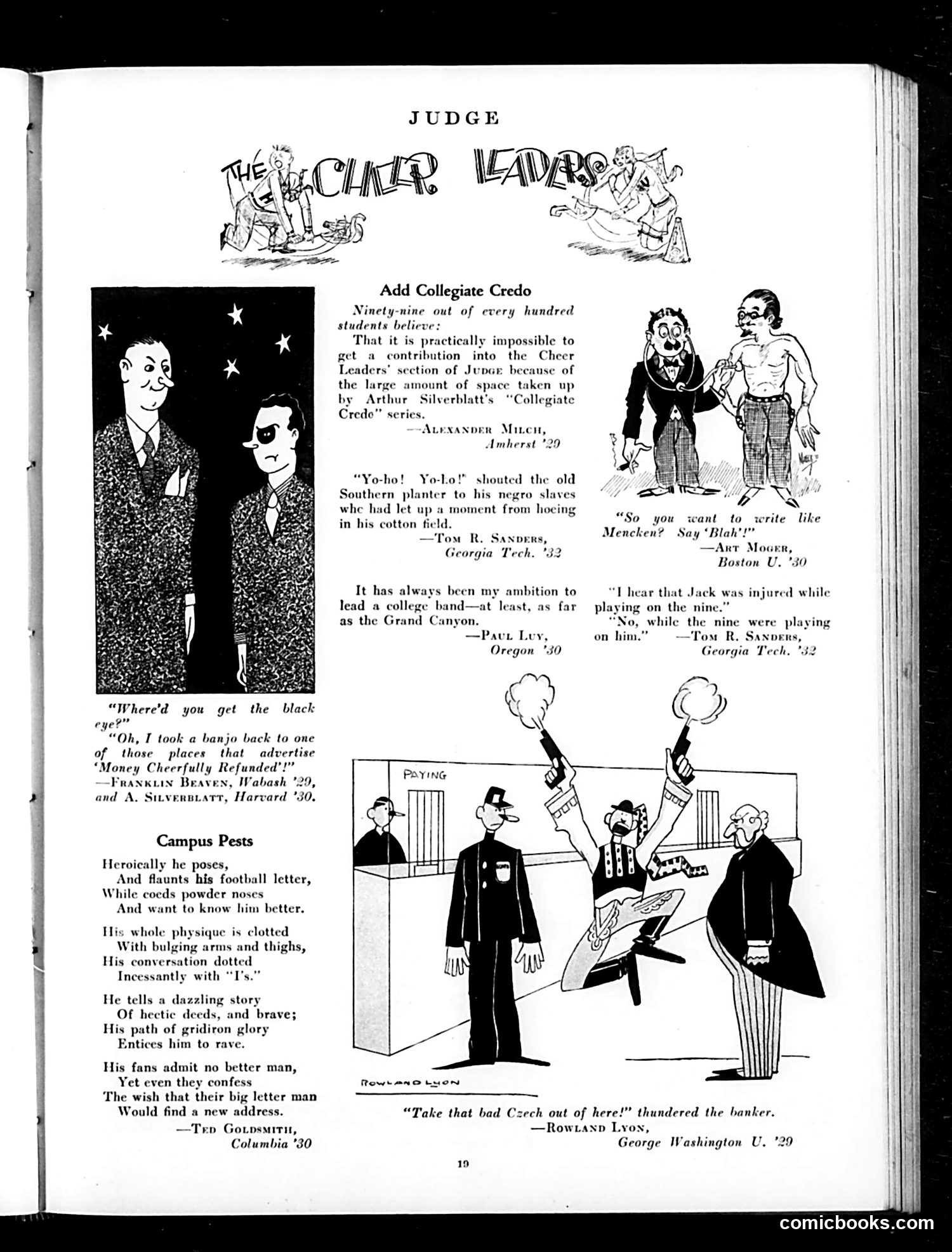
Analysis of Judge Magazine Page This page collects student humor contributions satirizing college life circa 1929-1932. The central targets are: "Collegiate Credo": A running series by Arthur Silverblatt that apparently monopolizes Judge's student submission section, so thoroughly that contributors joke it's impossible to get published otherwise. The "Campus Pests" poem: Mocks the stereotypical letter-man athlete—physically impressive but intellectually vapid, constantly boasting about his gridiron exploits and using "I" obsessively. The bottom cartoon: References anti-immigrant sentiment of the era; a banker demands removal of a "bad Czech"—likely alluding to xenophobic attitudes toward Eastern European immigrants during the 1920s-30s. Other jokes: Include crude racial humor (a plantation reference) and gentle mockery of aspiring writers and sports injuries. The page reflects period college attitudes: athletic hero-worship, literary pretension among students, and casual prejudices (racial and ethnic) considered acceptable for satirical humor at elite institutions.
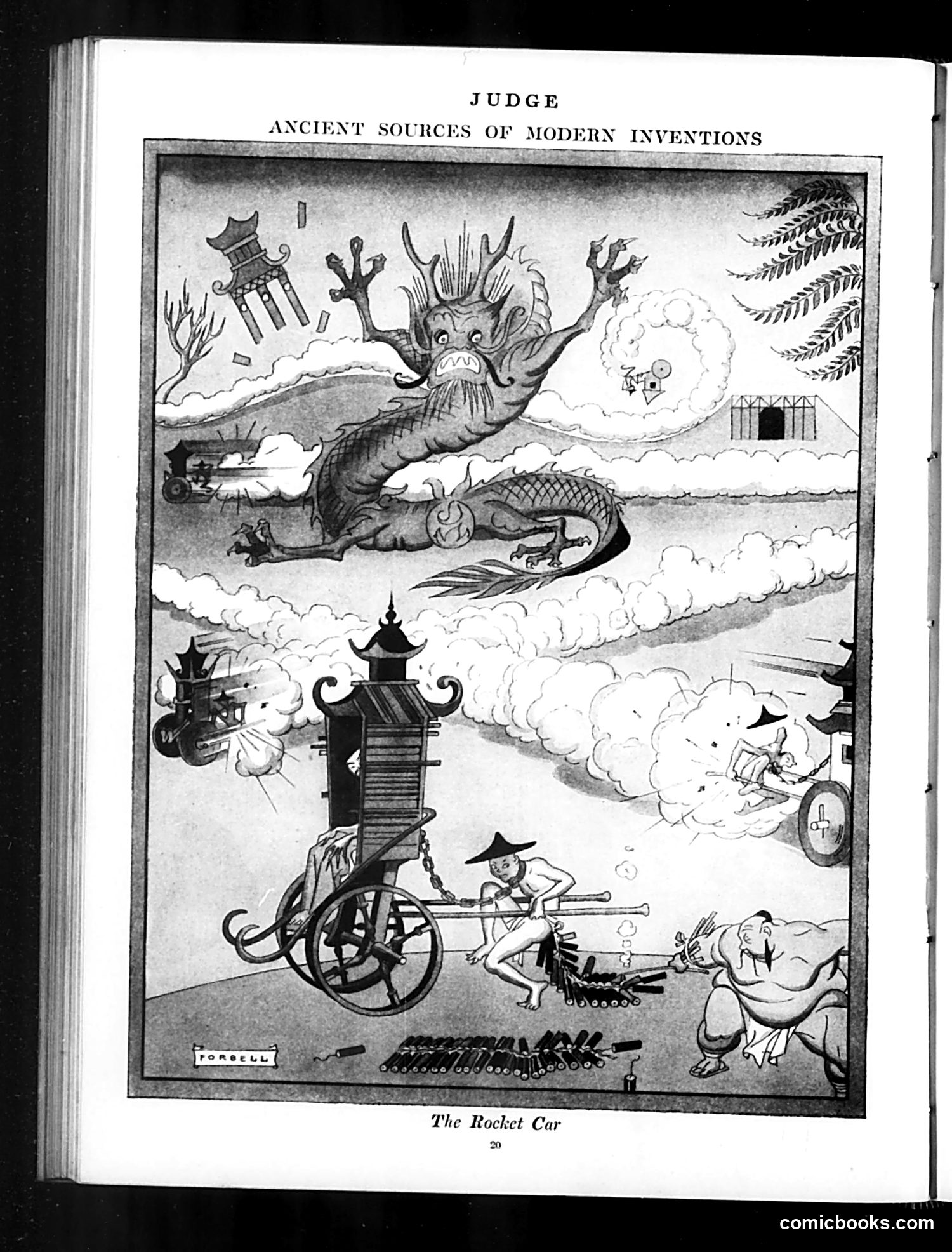
Analysis: "The Rocket Car" This is a satirical illustration titled "Ancient Sources of Modern Inventions," a common Judge magazine theme mocking how supposedly "modern" technologies actually derive from historical or mythological sources. The cartoon depicts a fantastical dragon-like creature in the clouds alongside various mechanical contraptions—vehicles, cannons, and rockets operated by small human figures below. The satire works by visually suggesting that ancient myths (the dragon, magical creatures) are the "sources" for contemporary inventions like automobiles and weapons. The humor relies on absurdist juxtaposition: treating mythological beings as if they were precursors to modern engineering. This mocks both scientific pretension and the era's fascination with technological progress by implying these "innovations" aren't actually new—just repackaged ancient fantasies. The page appears satirical rather than serious commentary.
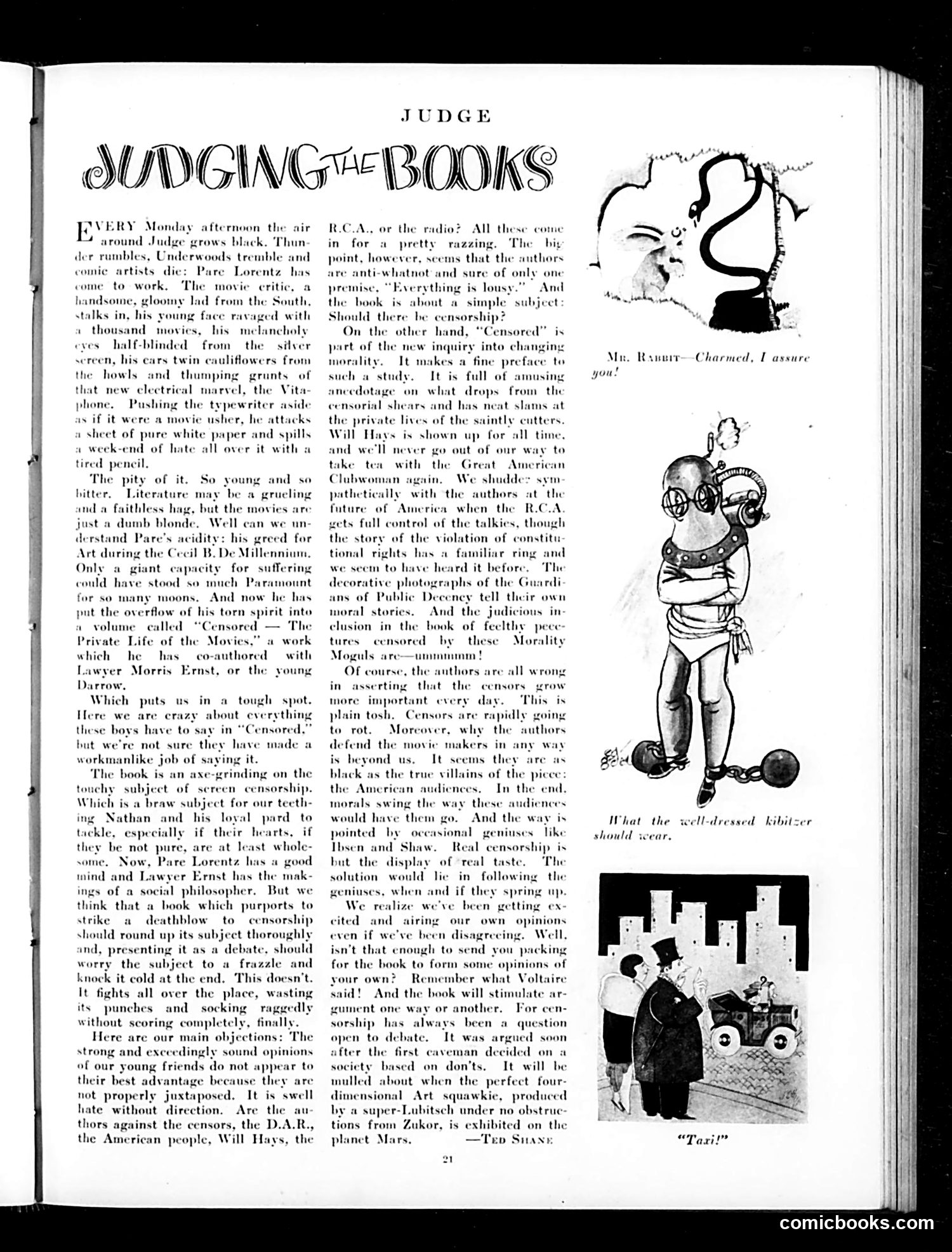
"Judging the Books" - Judge Magazine Satire This is a literary review critiquing a book called *"Censored: The Private Life of the Movies"* co-authored by Pare Lorentz (a film critic) and Lawyer Morris Ernst, attacking movie censorship. The reviewer mocks their "axe-grinding" approach: while sympathizing with their anti-censorship stance, he argues they lack focus and coherence, fighting "all over the place" without a clear target—uncertain whether they oppose censors, the D.A.R., "Will Hays" (the film industry's censor), or the American public itself. The cartoons illustrate the absurdity: one shows a disheveled figure labeled "What the well-dressed kibitzer should wear," satirizing armchair critics. Another depicts a robot-like figure on Mars labeled "Taxi," likely mocking science fiction escapism. The reviewer's core point: the authors blame everyone except the real culprits—American audiences themselves, whose taste drives content. Censorship is secondary to public demand.
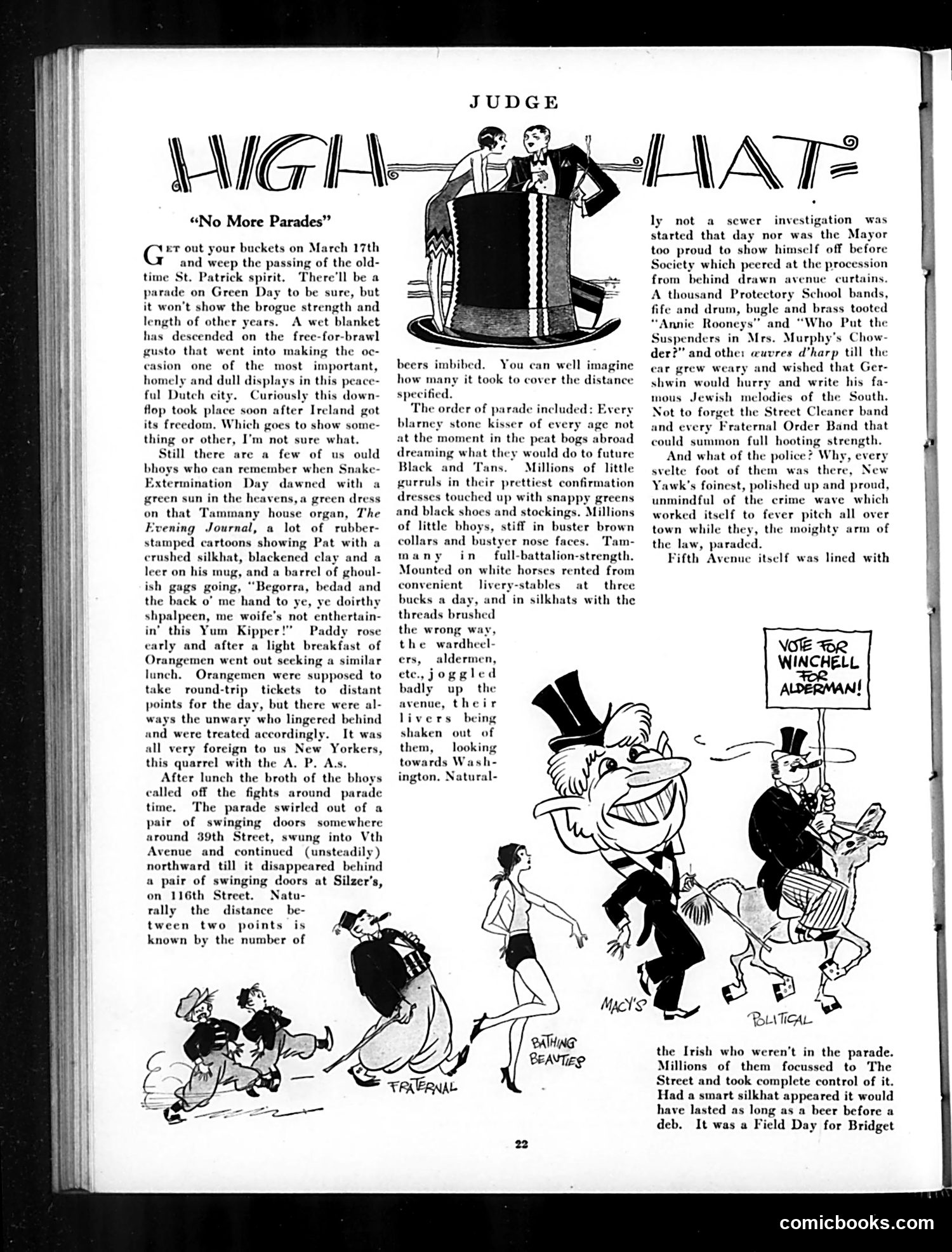
"No More Parades" — Judge Magazine Satire This article mourns the decline of rowdy St. Patrick's Day celebrations in New York following Irish independence. The author nostalgically recalls when the holiday meant drunken brawls, fights between Irish and "Orangemen" (Protestant Irish), and chaotic parades through Manhattan—a tradition apparently dampened by Ireland gaining freedom. The piece satirizes both Irish-American stereotypes (heavy drinking, fighting, crude humor) and the corruption of Tammany Hall Democrats who exploited ethnic celebrations for political gain. It mocks police who paraded proudly while crime surged unchecked elsewhere in the city. The cartoons by Tal Reitgal and Macy's depict the parade's wild atmosphere and ethnic tensions. The reference to "Winchell for Alderman" (bottom right) suggests contemporary political commentary, likely about a candidate seeking Irish-American votes. The tone is satirical but affectionate—lamenting that respectability and Irish independence have killed the disorderly spirit that once defined the holiday in immigrant New York.
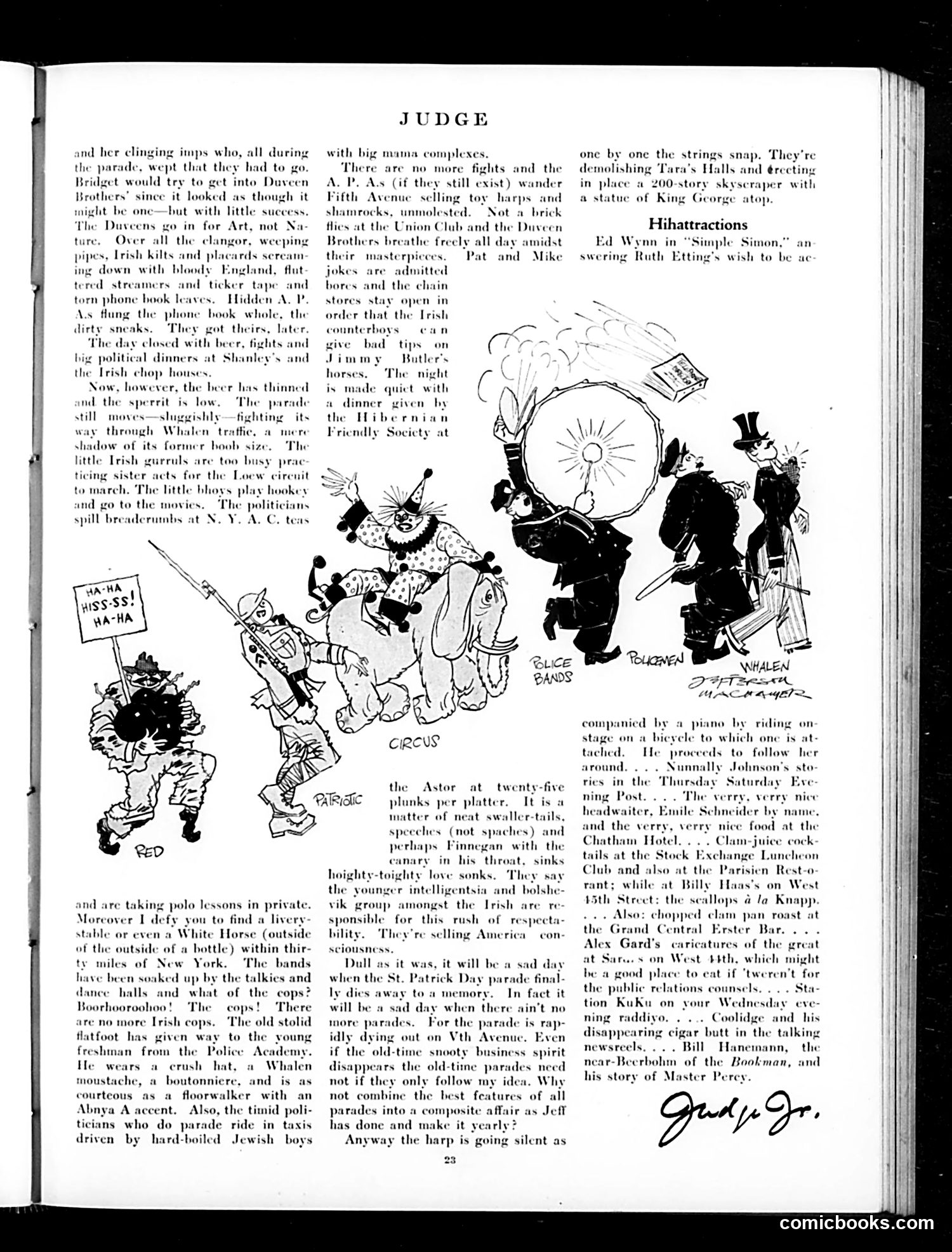
Satire of the Declining St. Patrick's Day Parade This piece nostalgically mocks the diminishment of New York's St. Patrick's Day parade. Once a boisterous, raucous Irish-American celebration featuring fights, drunkenness, and civic disruption, the parade has become respectable and orderly—which the author presents as a loss. The cartoons depict the parade's traditional chaos: marching bands, circus performers, and general mayhem. The text laments that "younger intelligentsia" and "bolshevik" Irish are making their community "respectable," replacing old-time rowdiness with refined dinners at the Astor and polo lessons. Traditional symbols—fights, drunken cops, Irish stereotypes—have vanished. The satire's point: modernization and assimilation, while socially progressive, have stripped away the parade's authentic character. The author ironically mourns this "improvement," suggesting respectability is duller than the old ethnic chaos. It reflects 1920s anxieties about Irish-Americans abandoning their distinct cultural identity.
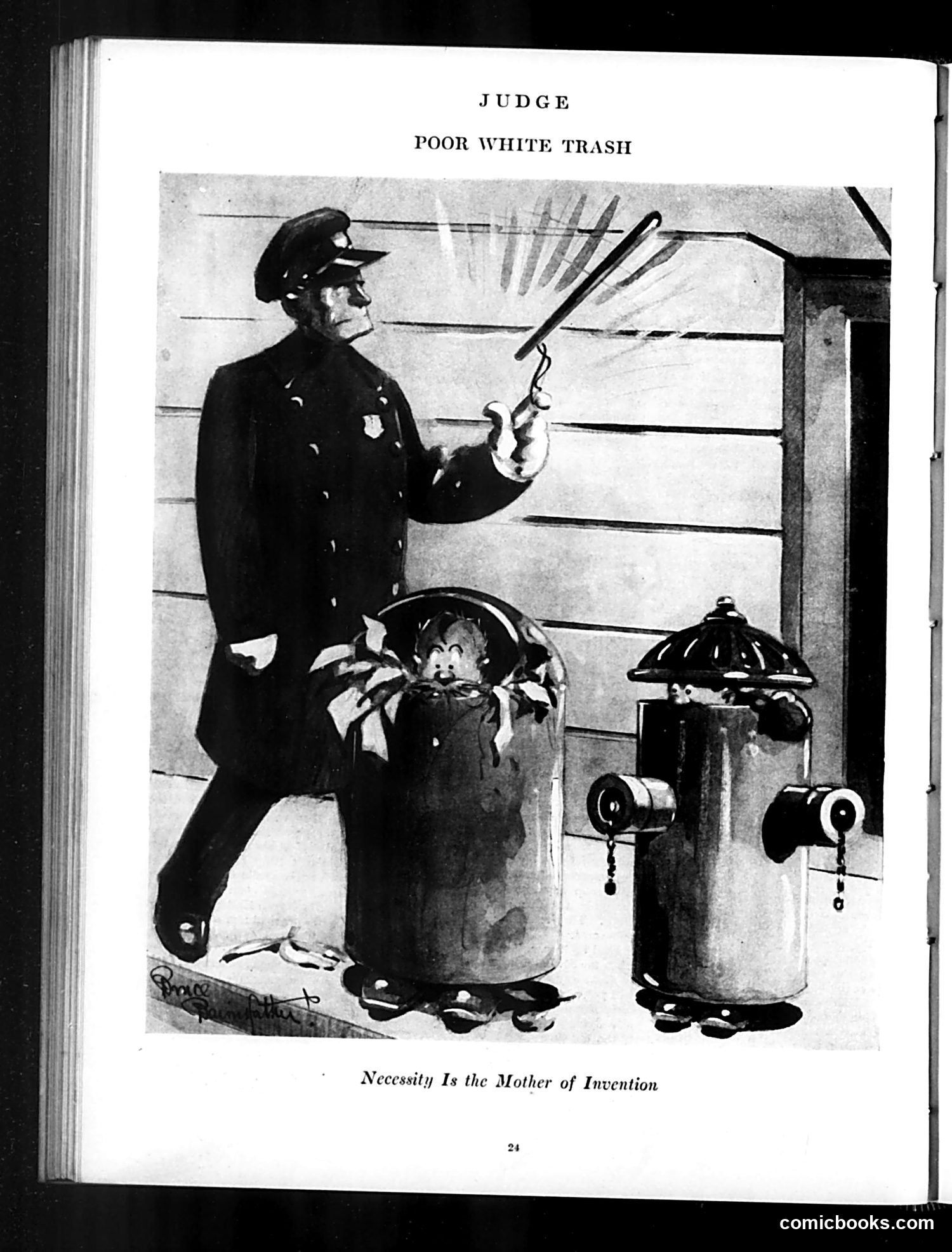
"Poor White Trash: Necessity Is the Mother of Invention" This Judge cartoon satirizes economic desperation and makeshift resourcefulness. A uniformed police officer holds aloft a crude rake or tool constructed from scrap materials, standing beside improvised trash-can contraptions. The caption's proverb suggests that poverty forces people to invent solutions from garbage and refuse. The satire likely targets either: - The resourcefulness of impoverished Americans (potentially sympathetic) - The absurdity of "poor white trash" attempting civilization through crude invention (potentially mocking) The officer's presence and formal uniform contrast sharply with the shoddy materials, emphasizing class disparity. Without more historical context about Judge's editorial stance during the specific period, the exact target of ridicule—poverty itself, or the poor—remains ambiguous, though the derogatory title phrase suggests contempt for the depicted subjects.
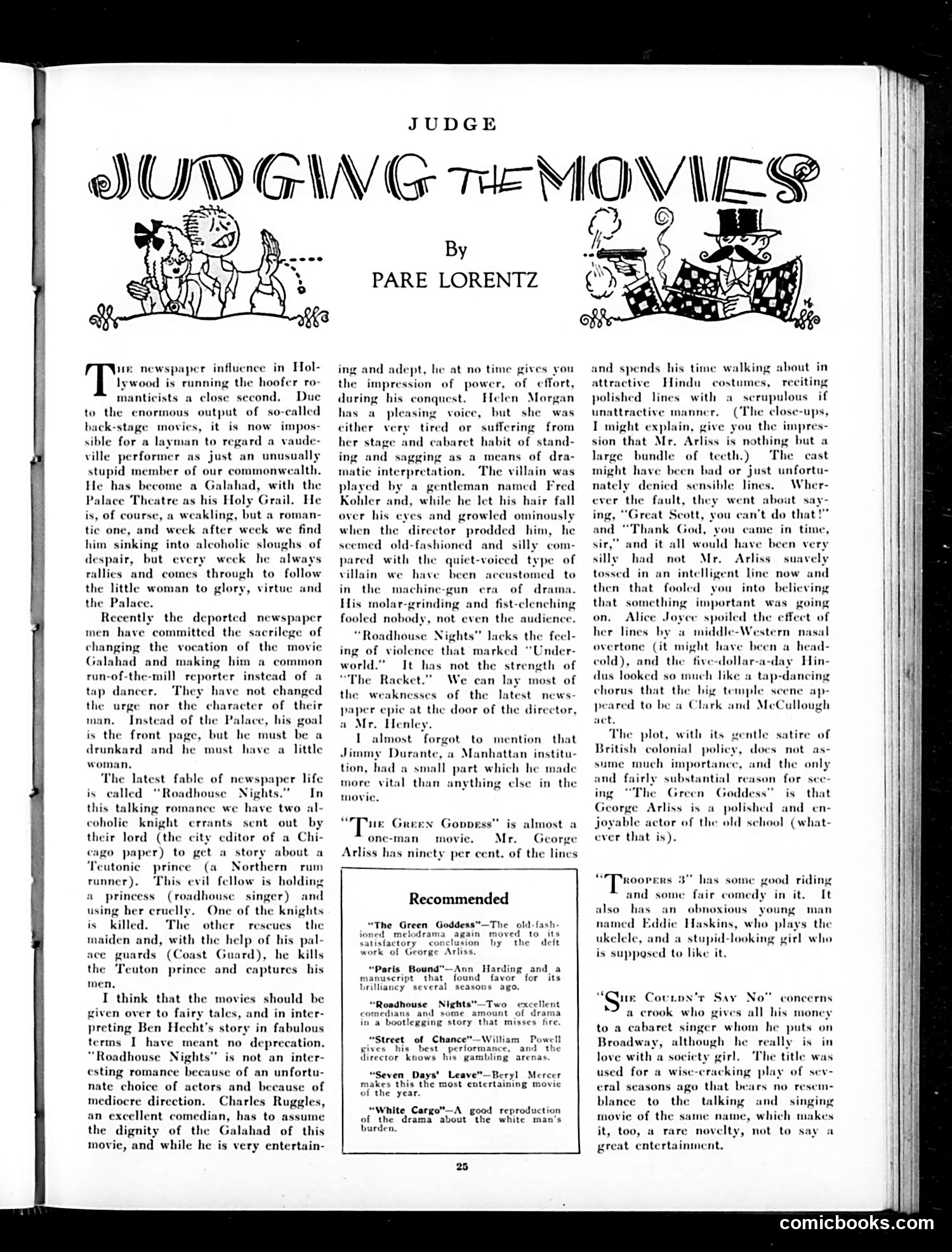
Judge Magazine: "Judging the Movies" by Pare Lorentz This is a film criticism essay, not a political cartoon. Lorentz critiques how Hollywood has distorted both vaudeville and journalism through sentimentalized "back-stage" movies. The Satire: Hollywood transforms ordinary performers and reporters into romantic "Galahads" pursuing noble quests (the Palace Theatre, the front page) while battling personal demons—always redemption through a "little woman." Lorentz argues this formula ignores reality: performers are "stupid," reporters are workday professionals, not noble drunkards. Specific Films Discussed: - "Roadhouse Nights"—a Prohibition-era crime story miscast with Charles Ruggles and Helen Morgan, poorly directed - "The Green Goddess"—a vehicle for George Arliss - Jimmy Durante appears in a minor role, noted as genuinely vital The Point: Movies shouldn't pretend journalistic or theatrical life is inherently dramatic or romantic. Lorentz advocates for fairy tales as honest escapism rather than false glamorization of ordinary professions. This reflects 1920s criticism of film's superficiality and formulaic sentimentality.
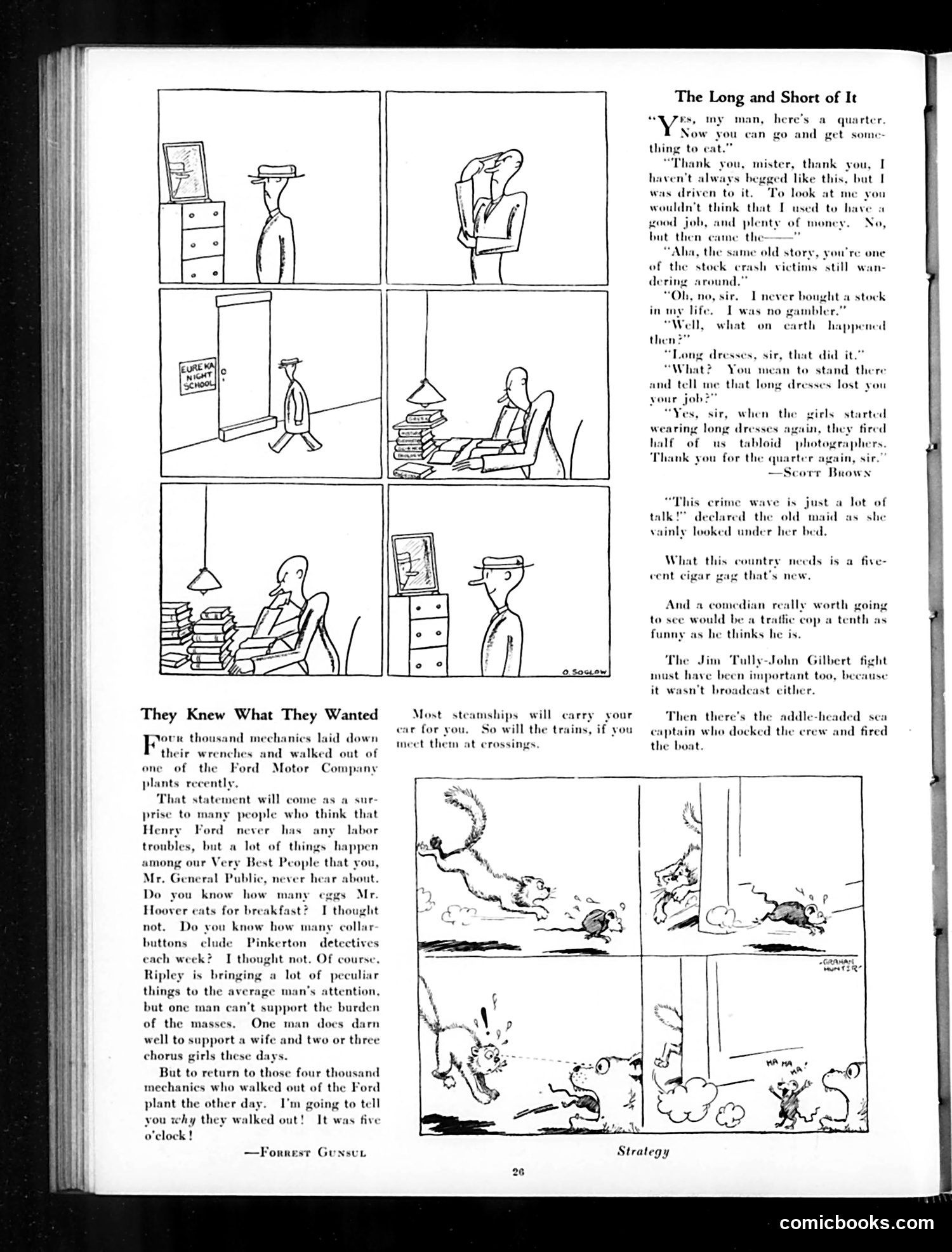
Analysis of Judge Magazine Page This page contains two main commentaries on 1920s American life: "They Knew What They Wanted" (left column) discusses a strike of 4,000 mechanics at a Ford Motor Company plant. The author, Forrest Gunsul, challenges the public's perception that Henry Ford runs a trouble-free operation, referencing rumors of Hoover (likely President Herbert Hoover) employing Pinkerton detectives and columnist Walter Winchley exposing scandals. The point: even America's most admired industrialists have labor problems the public doesn't hear about. The strike occurred at 5 o'clock—likely a complaint about working hours or conditions. "The Long and Short of It" (right) uses brief satirical observations to critique contemporary culture: a jobless man attributing his downfall to long dresses (presumably referencing 1920s fashion and women entering the workforce), commentary on media sensationalism regarding the Jim Tully-John Gilbert fight, and jabs at crime reporting and entertainment. The accompanying cartoon strip "Strategy" appears to depict slapstick animal humor unrelated to the text.
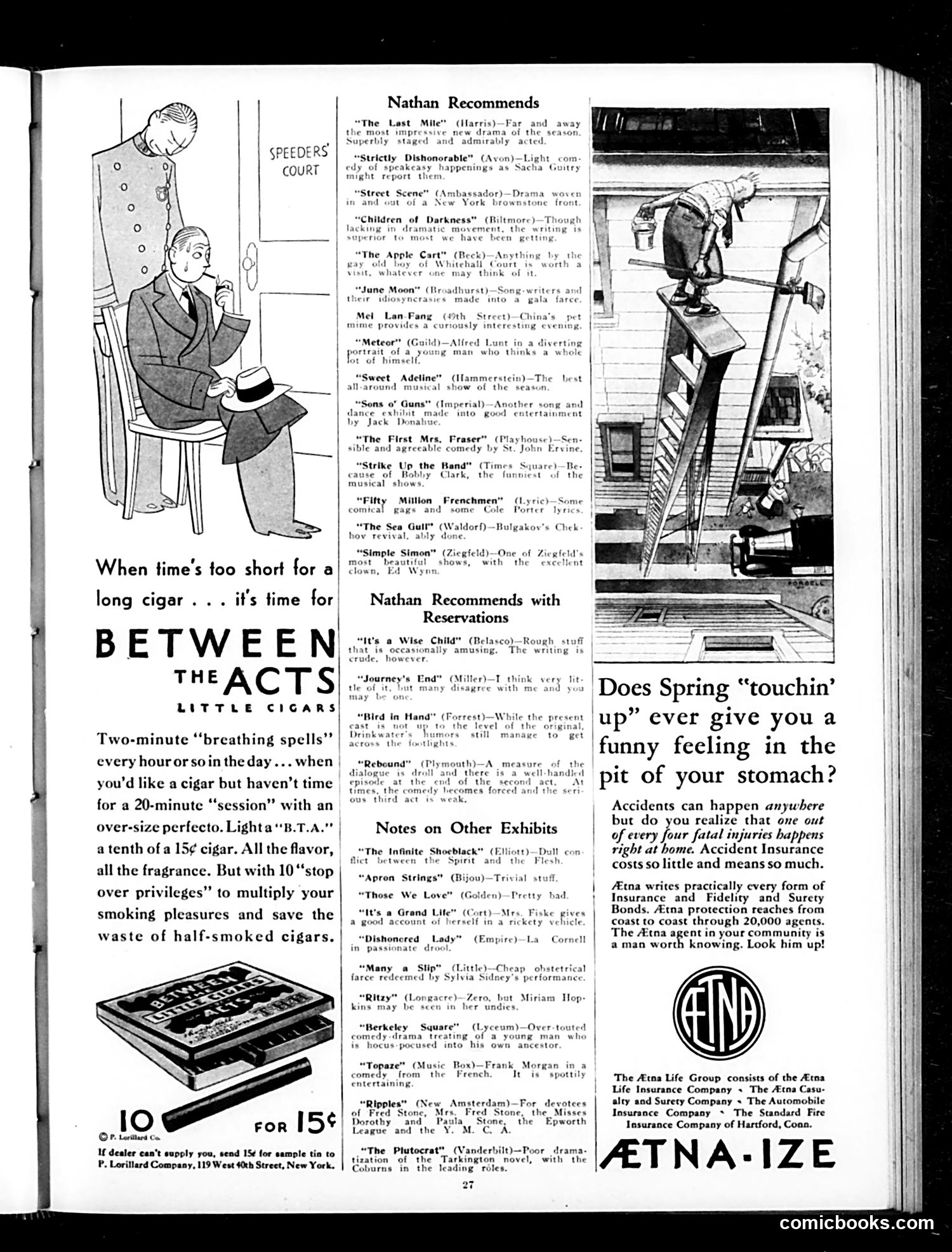
Judge Magazine Page Analysis This page consists primarily of theater reviews and advertisements rather than political satire. Content Overview: The page features "Nathan Recommends"—theater critic George Jean Nathan's Broadway reviews from what appears to be the 1920s. He evaluates contemporary plays like "The Last Mile," "Strictly Dishonorable," and "The Apple Cart," offering brief critical assessments (praising or reserving judgment on various productions). Advertisements: The left side advertises "Between the Acts" little cigars—positioning them as quick smoking breaks during theater intermissions. The right side features an Aetna Insurance ad emphasizing accident coverage. Historical Context: For modern readers: this represents pre-cinema American entertainment culture when Broadway theater was the dominant popular entertainment. The casual reference to speakeasies in one review reflects Prohibition-era (1920s) content. The page demonstrates how magazines monetized critical authority through integrated advertising tied to leisure activities. No political cartoons or caricatures appear on this page—it's primarily advertising and entertainment criticism.
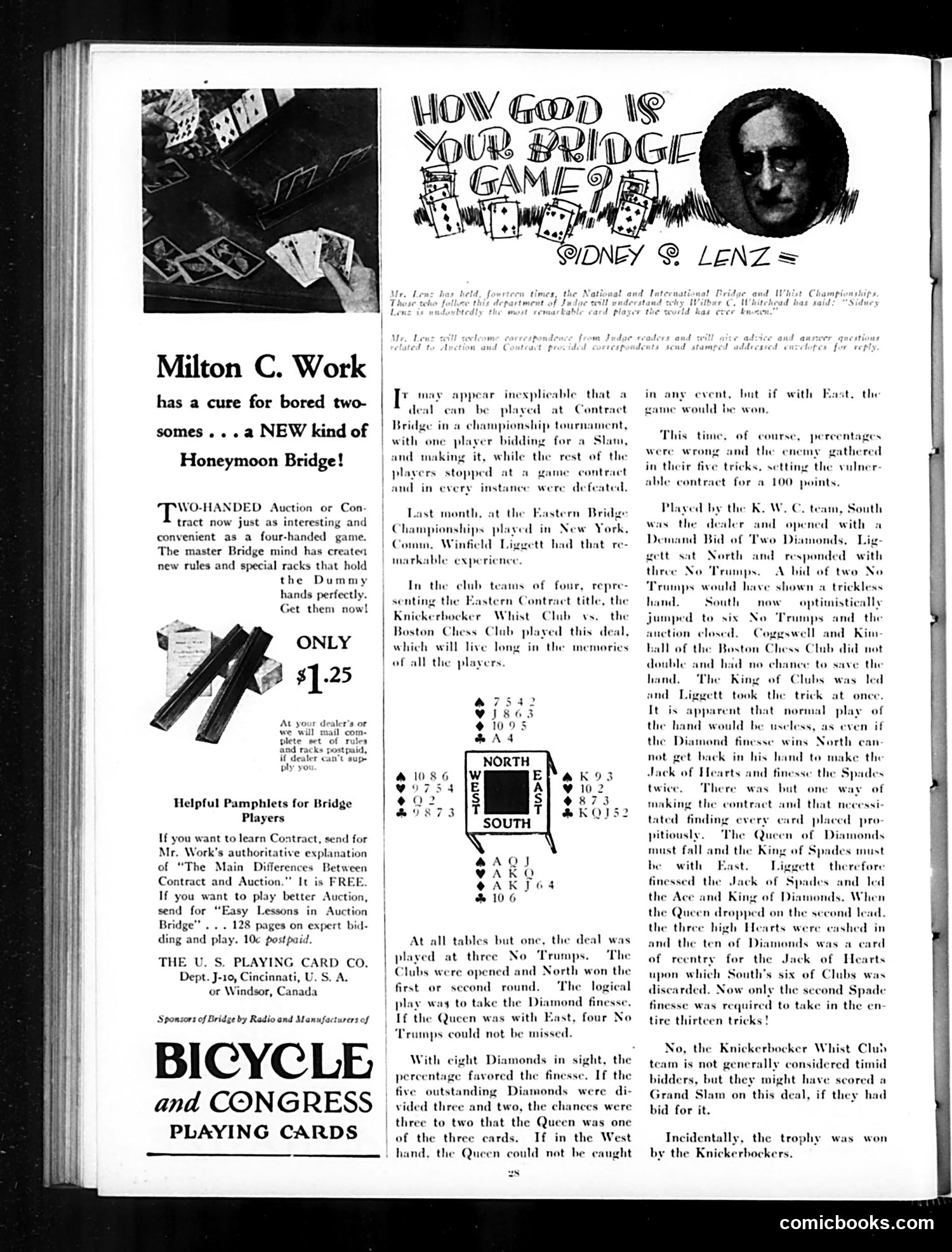
Page Analysis: Judge Magazine Bridge Content This page is primarily advertising and instructional content, not political satire. It features: Main Content: Milton C. Work's promotion of "Honeymoon Bridge," a two-handed card game variant allowing couples to play without needing additional players. The ad emphasizes this solves boredom for newlyweds. Supporting Material: A detailed bridge hand analysis from a championship tournament between the Knickerbocker Whist Club and Boston Chess Club, showcasing a remarkable contract-bridge play by Winfield Liggett. The article discusses bidding strategy and probability in the game. Advertising: U.S. Playing Card Company promotes Bicycle and Congress brand cards, offering instructional pamphlets on Contract and Auction Bridge. Context for Modern Readers: Contract bridge was enormously popular in early-to-mid 20th century America as sophisticated entertainment. This content reflects that cultural moment when bridge competitions received magazine coverage similar to modern poker or esports coverage. There is no political cartoon or satire on this page.
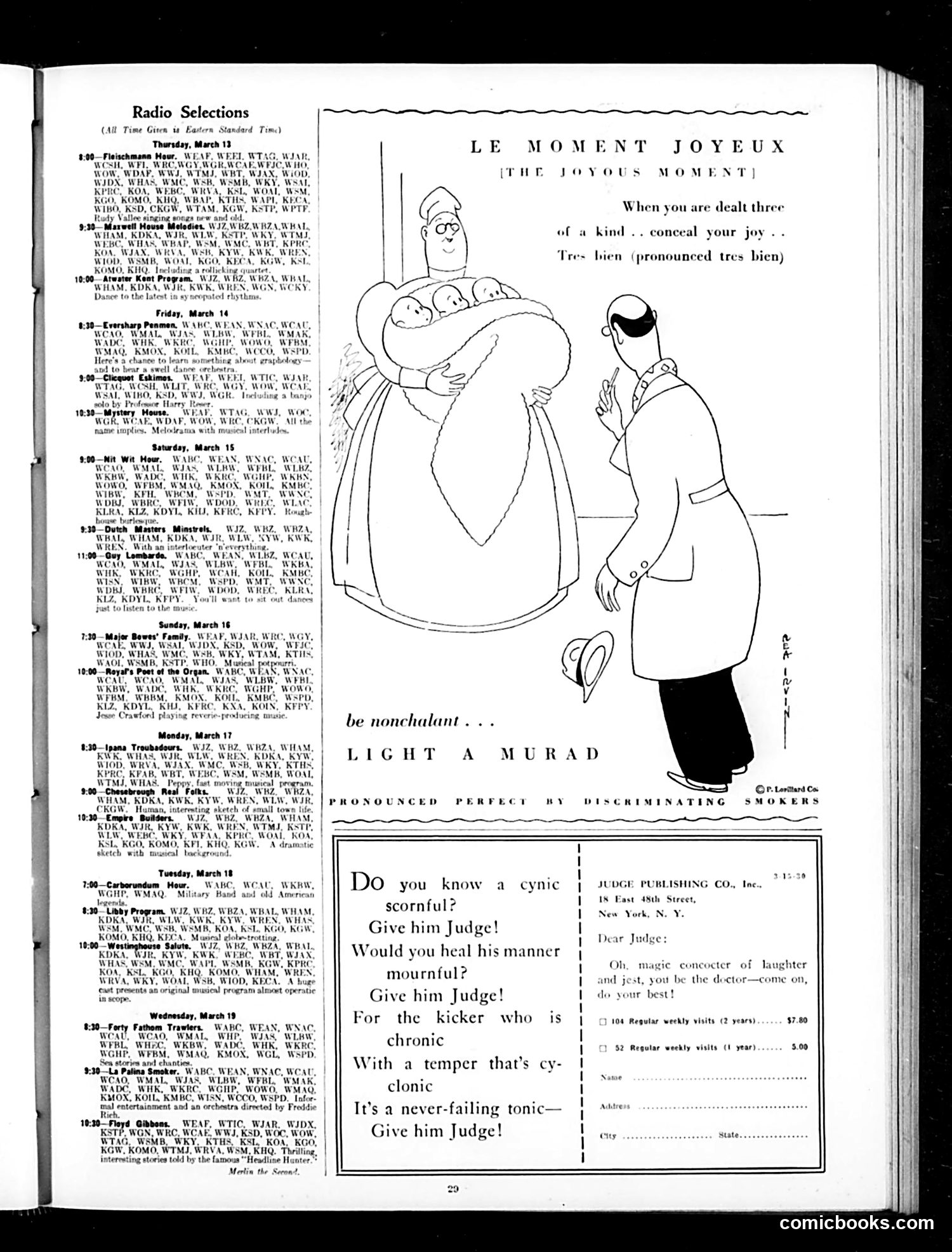
Judge Magazine Page Analysis This page is primarily a radio programming guide for the week of March 13-19, listing broadcast times and station call letters for popular shows of the era. The cartoon and accompanying text on the right side constitute the editorial content. The illustration shows a portly figure being embraced by another man, with text reading "LE MOMENT JOYEUX" (The Joyous Moment) and "be nonchalant... LIGHT A MURAD." Below this is an advertisement for Judge Publishing Co., promoting their magazine as "a never-failing tonic" for cynics and chronic complainers—implying Judge magazine itself serves as humorous relief from life's irritations. The page reflects 1930s mass media: radio's cultural dominance, cigarette advertising without health warnings, and Judge's role as a humor magazine offering satirical commentary on contemporary life. The specific figures or events referenced in the cartoon are unclear from the image alone.
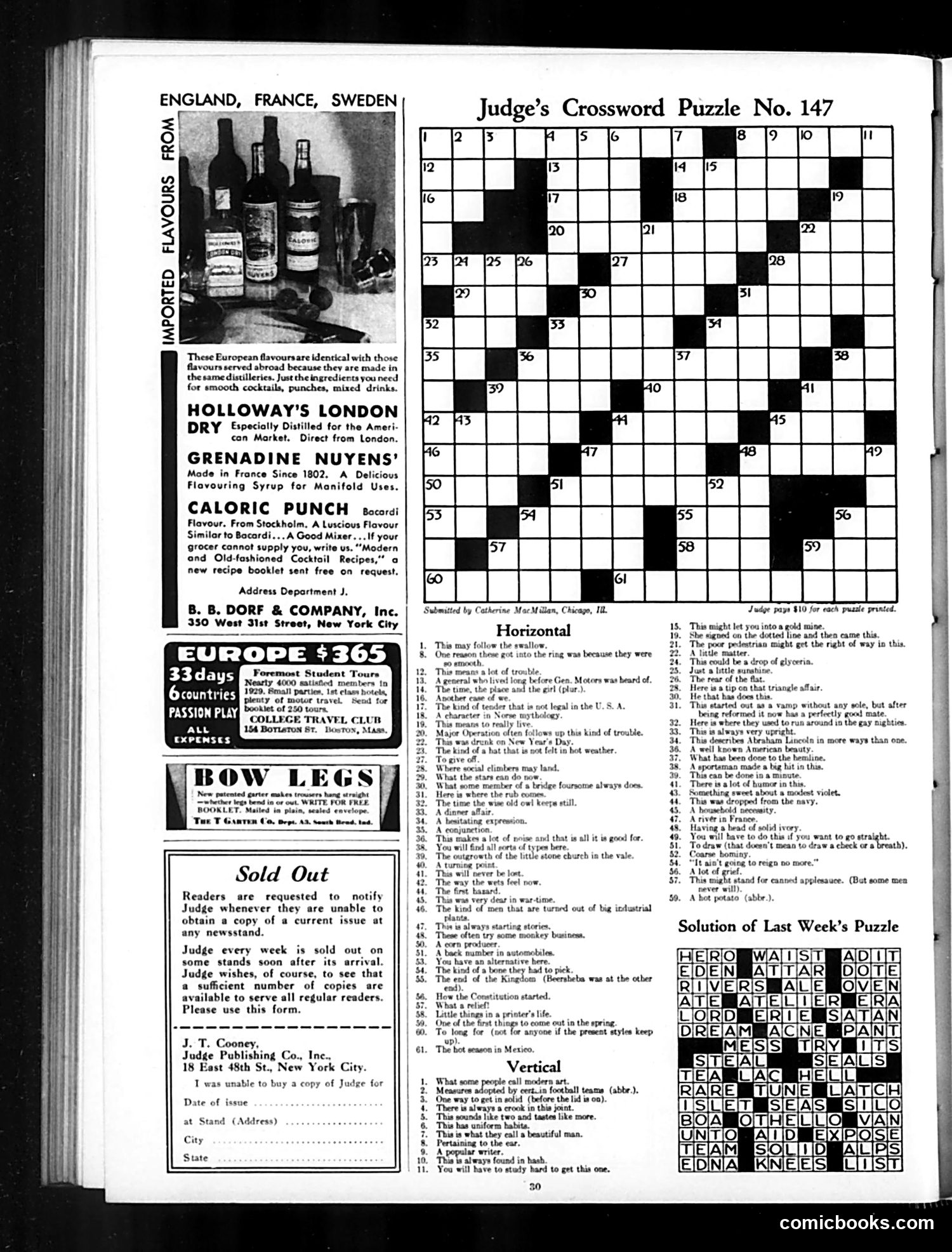
Judge Magazine Page Analysis This page is primarily advertising and administrative content rather than satirical cartoons. The main visual element is a photograph of imported liquor bottles (from England, France, and Sweden) promoting brands like Holloway's London Dry gin, Grenadine Nuyens, and Caloric Punch—clearly targeting American consumers during the Prohibition era's end or shortly after. Below are advertisements for European student tours, a garter product, and notices about Judge's distribution issues. The bulk of the page contains a crossword puzzle with clues referencing contemporary 1920s-30s cultural references: automobiles (General Motors), fashion trends, cocktails, and social customs. The clues reflect Judge's satirical sensibility—mocking modern fashions, dating culture, and social climbing—but without explicit political commentary. The "Sold Out" notice indicates Judge's popularity and distribution challenges during this period. This is essentially a service/advertising page rather than satirical content.
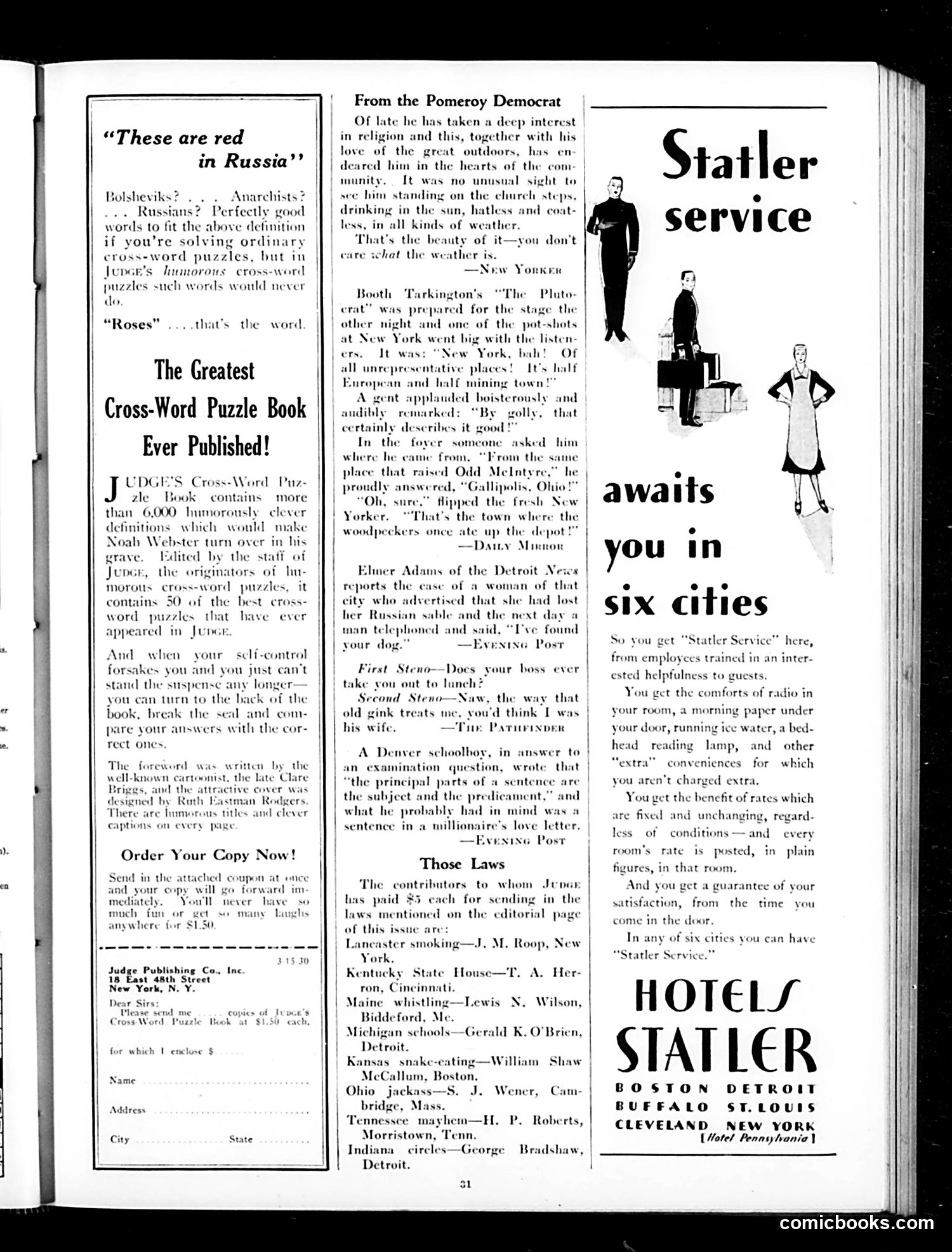
Analysis of This Judge Magazine Page This page is primarily advertising and editorial content rather than political satire requiring historical context. The main cartoon element is a humorous cross-word puzzle book advertisement. The joke in the opening text plays on cross-word puzzle solving: the clue "These are red in Russia" typically has answers like "Bolsheviks," "Russians," or "Anarchists," but the puzzle book claims to use cleverly humorous alternative definitions—suggesting "Roses" as an answer instead. This is gentle wordplay rather than political commentary. The page includes unrelated filler content: brief humorous anecdotes from various newspapers (Pomeroy Democrat, Daily Mirror, Evening Post) about everyday life—a religious man, theater reviews, lost pets, office banter, and exam mistakes. The bottom section lists contributors paid $5 each for submitting humorous "laws" (like "Lancaster smoking," "Kansas snake-eating," "Ohio jackass")—essentially crowdsourced jokes. The right side is a full Statler Hotels advertisement promoting their service in six cities. This appears to be a typical magazine issue mixing humor, reader contributions, and advertising rather than focused political satire.
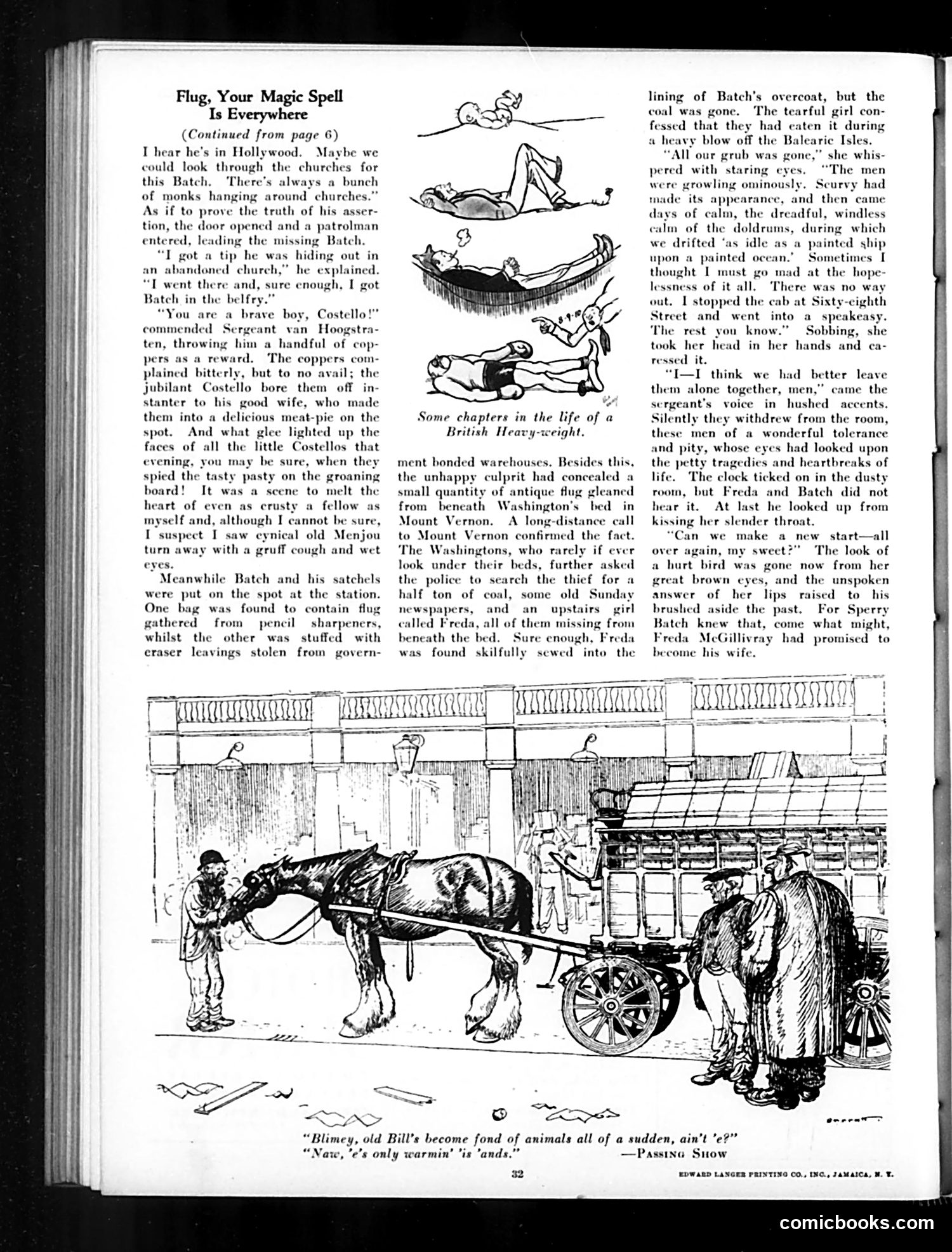
Analysis of Judge Magazine Page This page contains two distinct pieces: Upper Section - Story Continuation: A serialized humorous narrative about a character named "Batch" who steals miscellaneous items (pencil shavings, erasers, and notably, items from George Washington's home at Mount Vernon). The story includes romantic melodrama with a character named Freda and references to cinema (Hollywood, actor Adolphe Menjou). It's satirical pulp fiction poking fun at overwrought romantic narratives popular in the era. Lower Section - Cartoon: A simple visual gag about a working-class man (depicted in period working clothes) warming his hands near a horse. The caption's cockney dialect joke plays on ambiguity: observers think he's become sentimental about animals, but he's actually just using the horse for warmth—a practical, unsentimental act. The cartoon satirizes working-class conditions and false assumptions about sentimentality among laborers. Both pieces are light satirical humor typical of Judge magazine's content.
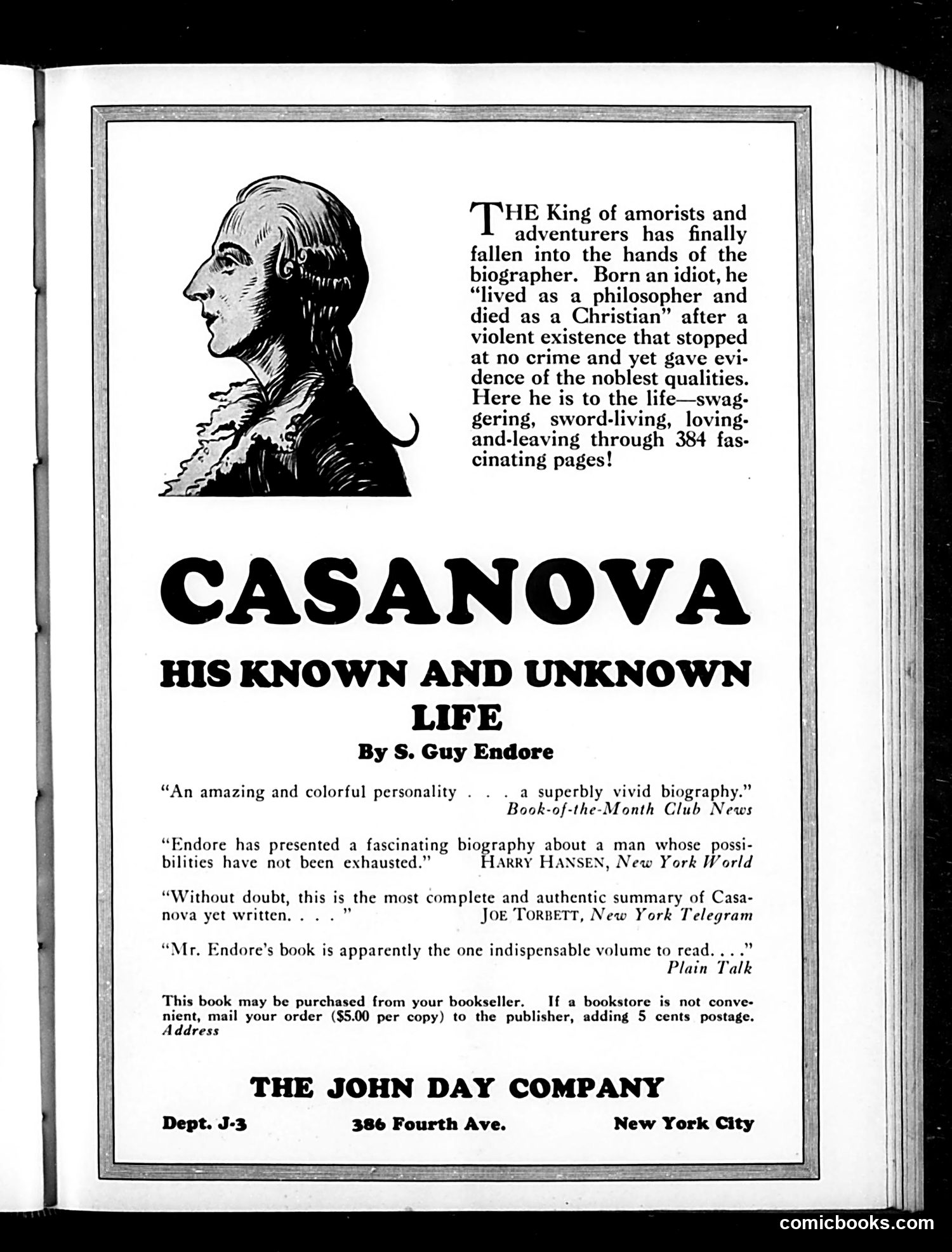
Analysis This is primarily a book advertisement, not political satire. It promotes S. Guy Endore's biography of Casanova, the famous 18th-century Venetian adventurer and seducer. The portrait shows Casanova in period dress. The accompanying text sardonically describes him as born "an idiot" who "lived as a philosopher and died as a Christian"—a tongue-in-cheek characterization of his notorious life of seduction and escapades contrasted with a deathbed conversion. The advertisement appeals to readers' appetite for scandalous biography, emphasizing his "violent existence" and "loving-and-leaving" through 384 pages. Multiple contemporary reviews are quoted approvingly (from *Book-of-the-Month Club News*, *New York World*, etc.), establishing the book's credibility and cultural cachet. The satirical framing—treating an infamous womanizer's life as worthy serious biography—reflects 1920s-30s intellectual interest in debunking Victorian propriety and exploring controversial historical figures openly.
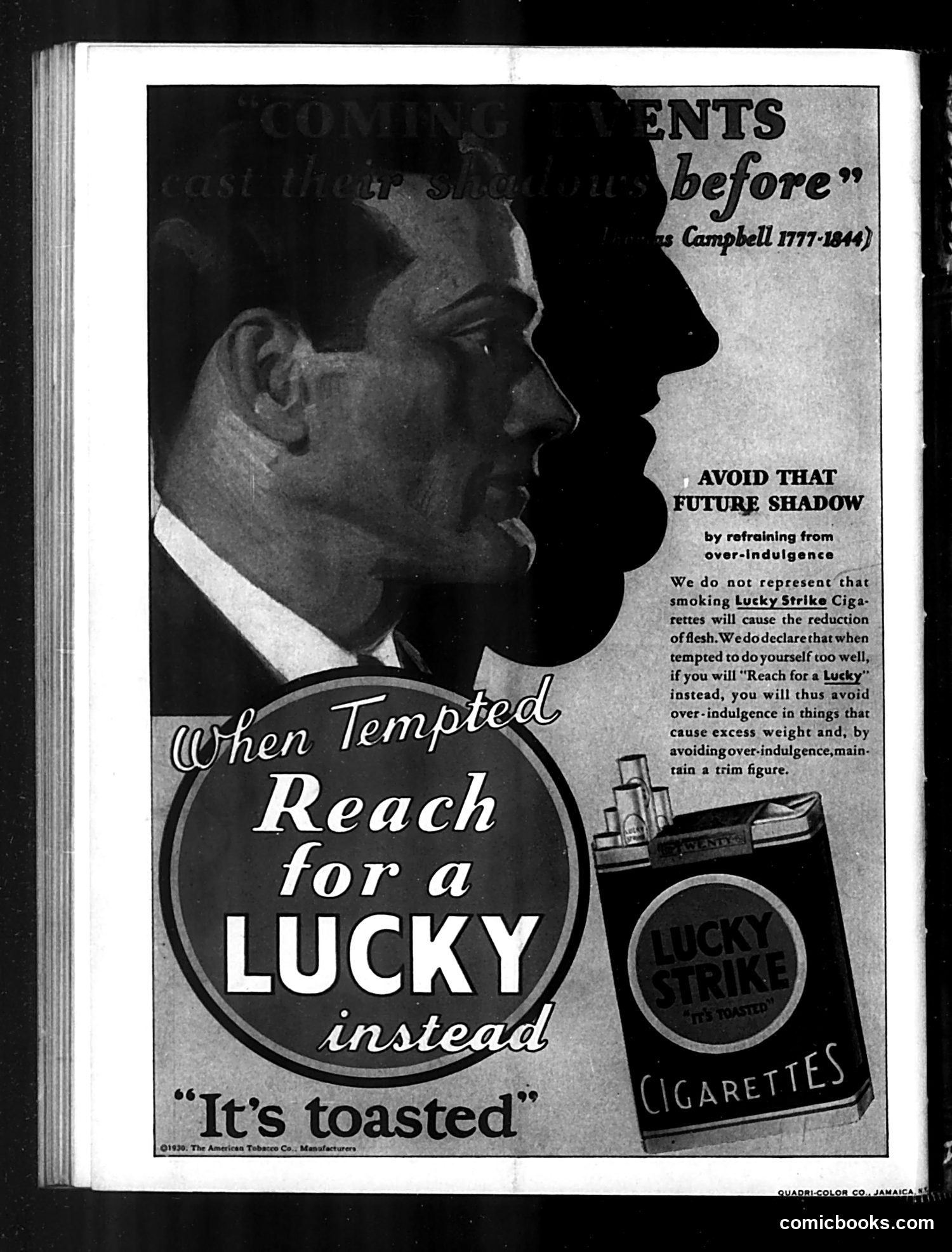
Lucky Strike Cigarette Advertisement This is a cigarette advertisement, not political satire. It's a Lucky Strike ad from approximately 1930 (based on the style and copyright mark visible). The image shows a silhouette comparison: a man in profile next to his potential future "shadow"—an obese silhouette—to illustrate weight gain. The ad's pitch is darkly humorous by modern standards: smoking Lucky Strikes will help you *avoid overeating* and maintain a trim figure. The tagline "Reach for a Lucky instead" suggests cigarettes as an appetite suppressant. The disclaimer ("We do not represent that smoking Lucky Strike Cigarettes will cause the reduction of flesh") was legally required language acknowledging the health claim wasn't medically proven—yet the entire ad's premise relies on that exact claim. This reflects 1930s advertising before cigarette health dangers were widely acknowledged, when such ads openly marketed smoking as a diet aid.