judge
Judge — March 22, 1930
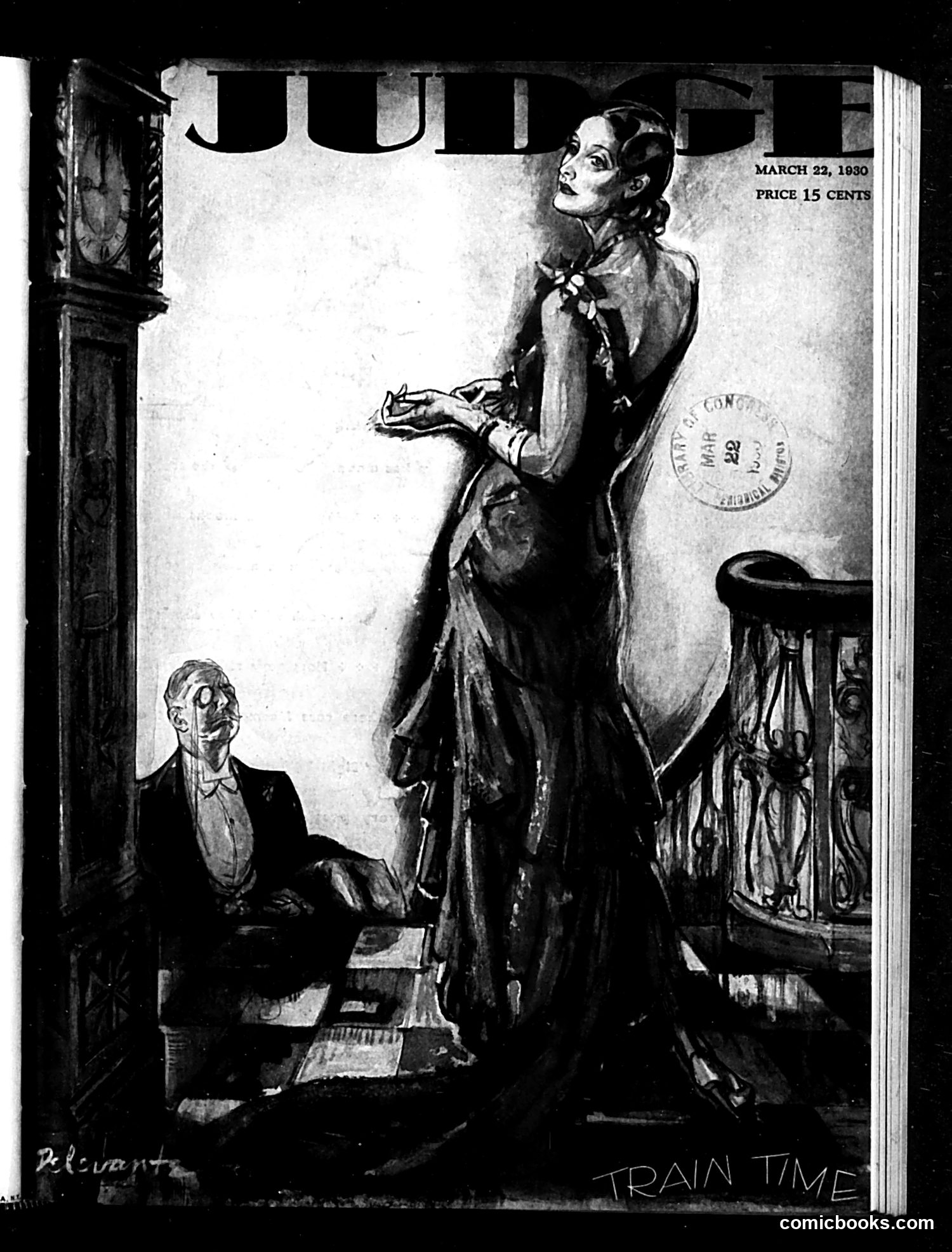
Analysis of Judge Magazine Cover (March 22, 1930) This cover illustration, titled "Train Time," depicts a woman in an elegant evening gown standing on a chair while a man sits below looking up at her. The satire appears to comment on gender dynamics and social behavior, likely mocking either: 1. Female vanity or exhibitionism—the woman's exaggerated pose suggests she's deliberately drawing attention to herself 2. Male subservience—the seated man's deferential gaze suggests men catering to women's demands The 1930 date places this during the Jazz Age's tail end, when changing gender roles and women's increased social freedoms were frequent targets of satirical magazines. The artwork's style and composition are characteristic of Judge's sophisticated, slightly risqué humor aimed at upper-class readers.
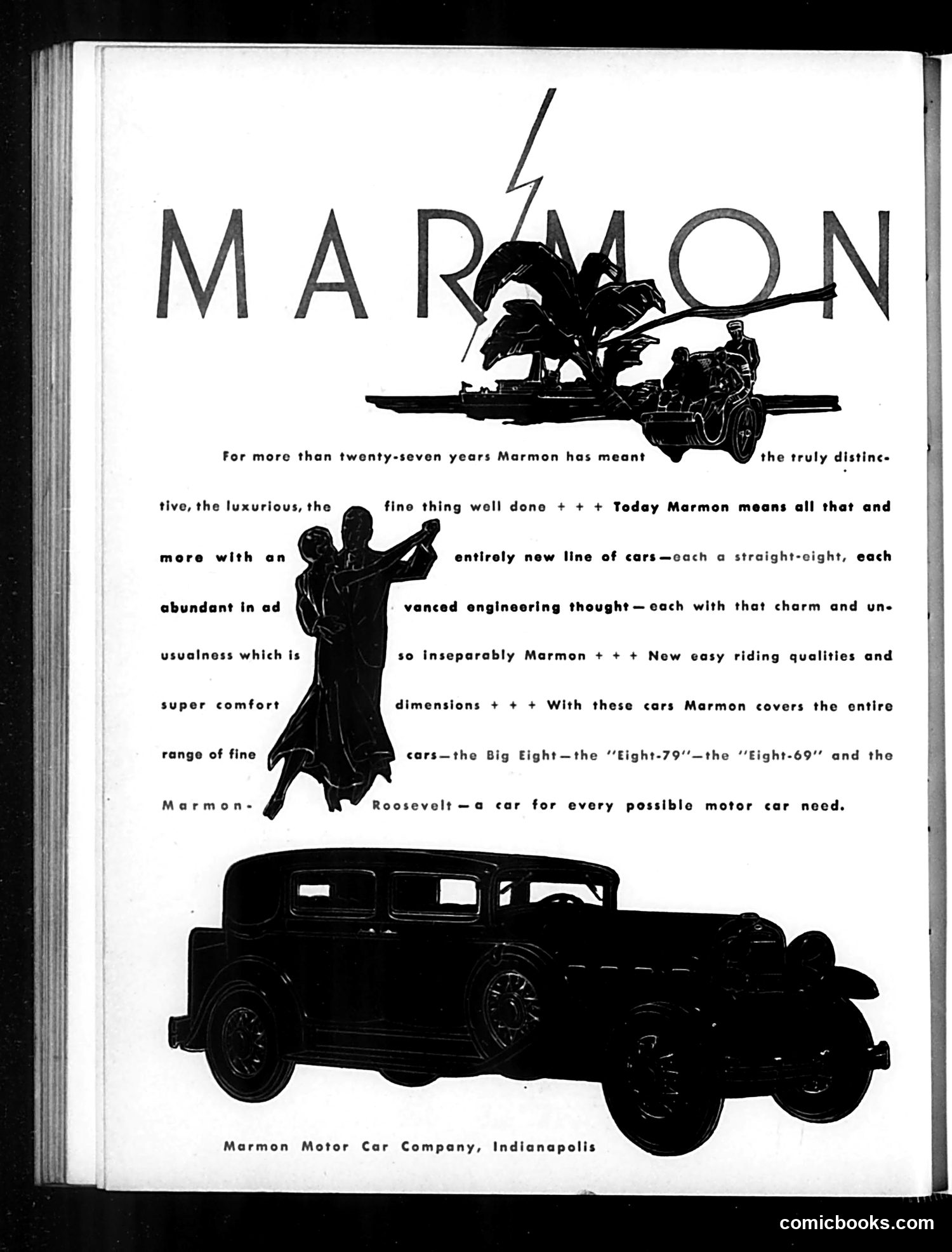
Analysis This page is primarily a product advertisement for Marmon automobiles, not political satire. The Marmon Motor Car Company of Indianapolis marketed their vehicles through Judge magazine. The visual elements include: - A stylized lightning bolt through the "MARMON" text (suggesting speed/power) - An airplane silhouette (representing modernity and progress) - A classical figure gesturing upward (symbolizing aspiration or achievement) - A photograph of an actual Marmon sedan The ad copy emphasizes Marmon's 27-year reputation for luxury and engineering quality, promoting their new model line including the "Eight-79" and "Eight-69." The messaging stresses comfort, design innovation, and vehicles "for every possible motor car need." There is no apparent satire or political commentary—this is straightforward automotive advertising targeting Judge's affluent readership.
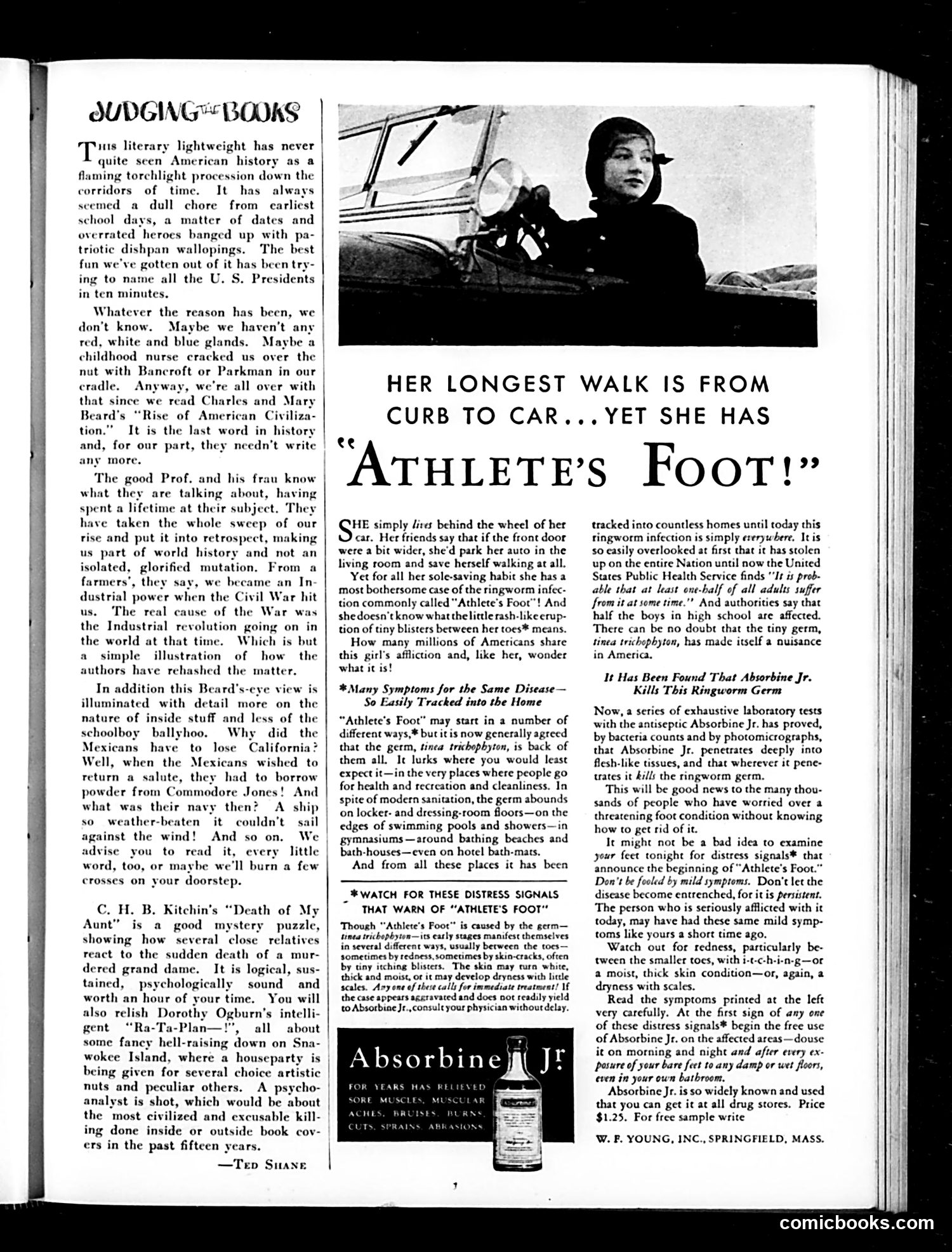
Analysis This page is primarily advertising, not political satire. The main content is a large advertisement for "Absorbine Jr.," a patent medicine marketed to treat "Athlete's Foot" (ringworm infection). The advertisement uses a photograph of a woman in a car with the headline "Her longest walk is from curb to car... yet she has 'Athlete's Foot!'" The copy emphasizes how widespread this fungal infection was among Americans and warns of symptoms like itching between toes and skin scaling. The left column contains book reviews unrelated to the ad. While Judge was a satirical magazine, this particular page focuses on commercial promotion rather than political or social commentary. The "satire" is purely commercial—using humor and relatability to sell a medical product to ordinary readers.
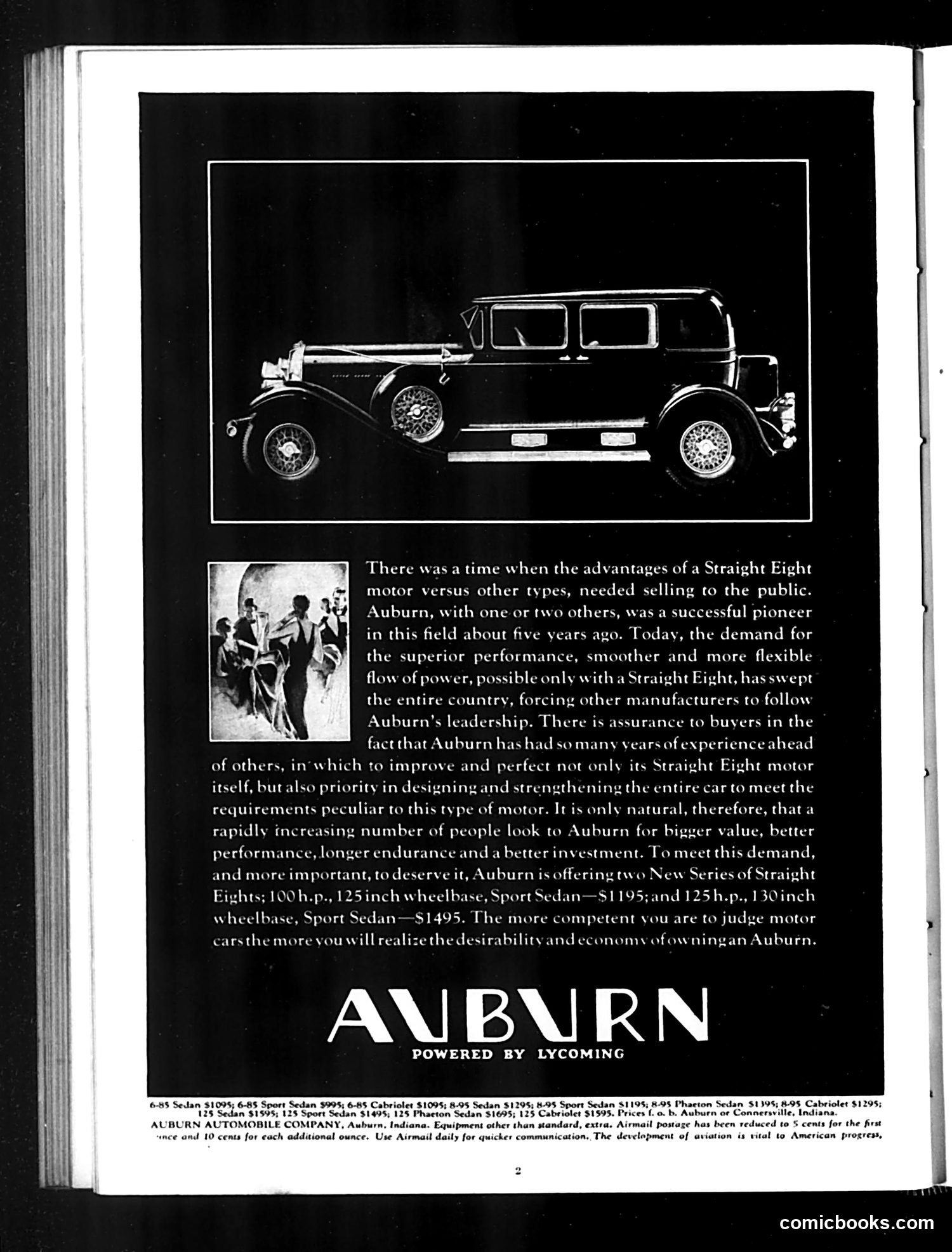
Analysis This page is primarily advertising, not satire or political commentary. It's a full-page advertisement for Auburn automobiles, featuring a side-profile illustration of a luxury sedan at top. The ad's text celebrates Auburn's "Straight Eight motor" technology, claiming it offers superior performance and reliability compared to competitors. Auburn marketed itself as an innovative leader that forced other manufacturers to follow its engineering example. The small photograph shows what appears to be businessmen or salespeople—likely representing Auburn's successful dealers or executives—though the specific individuals are not identified. The ad emphasizes Auburn's experience, quality engineering, and value proposition to prospective buyers. This is commercial promotion, not editorial cartooning or social satire.
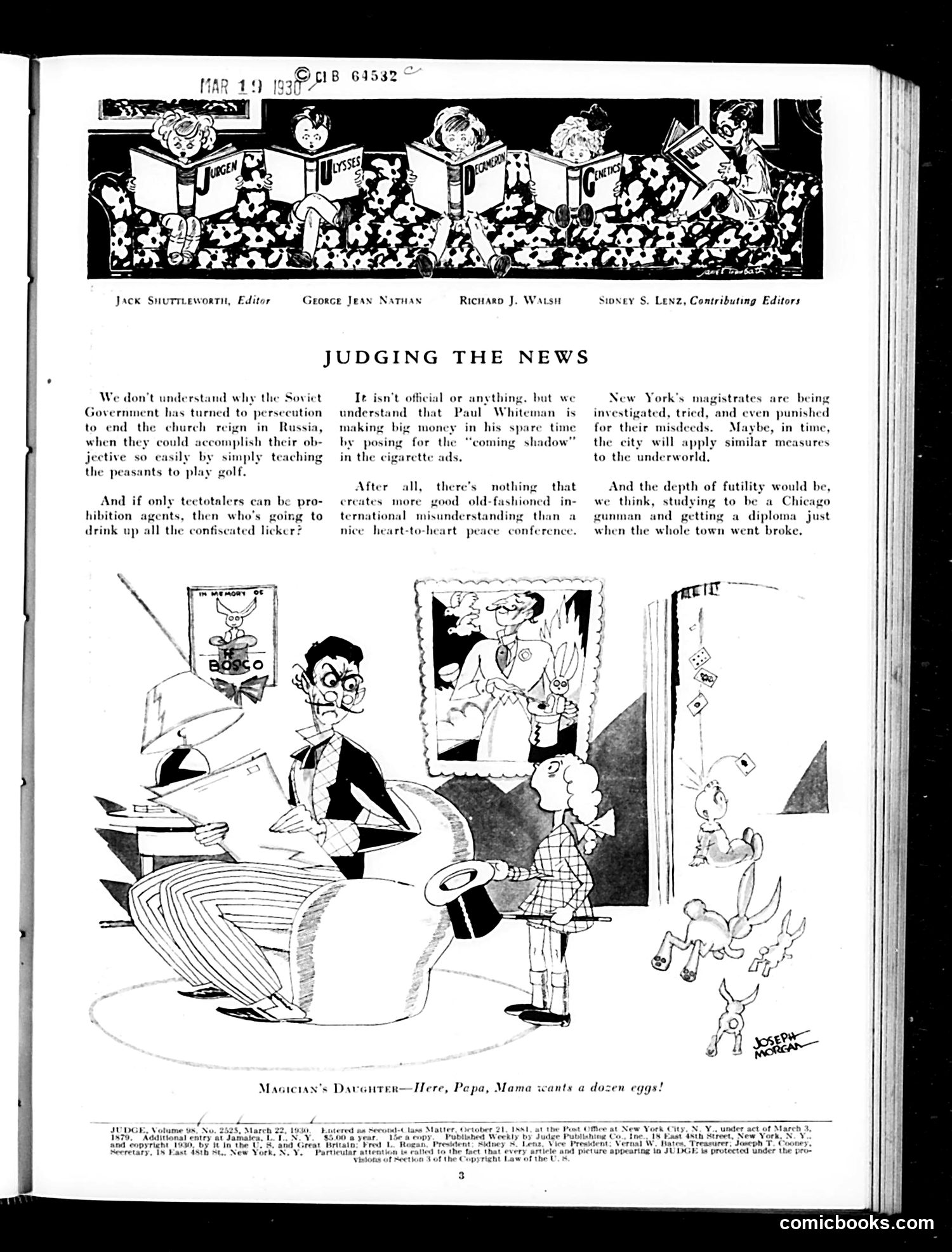
Analysis of "Judging the News" - Judge Magazine, March 27, 1930 This satirical page critiques several contemporary issues through commentary and cartoons: The text mocks Soviet efforts to eliminate the Russian Orthodox Church, questions Paul Whiteman's (a famous bandleader of the era) business ventures in cigarette advertising, and comments on New York City magistrates investigating corruption. The main cartoon, "Magician's Daughter," depicts a magician pulling endless eggs from a hat while a young girl watches in amazement. This likely satirizes either economic abundance claims during the Depression or a magician/illusionist's act as metaphor for false promises—possibly referencing financial manipulation or political deception of 1930. The cartoon's humor relies on the visual contrast between the girl's wonder and the implicit absurdity of the "magic."
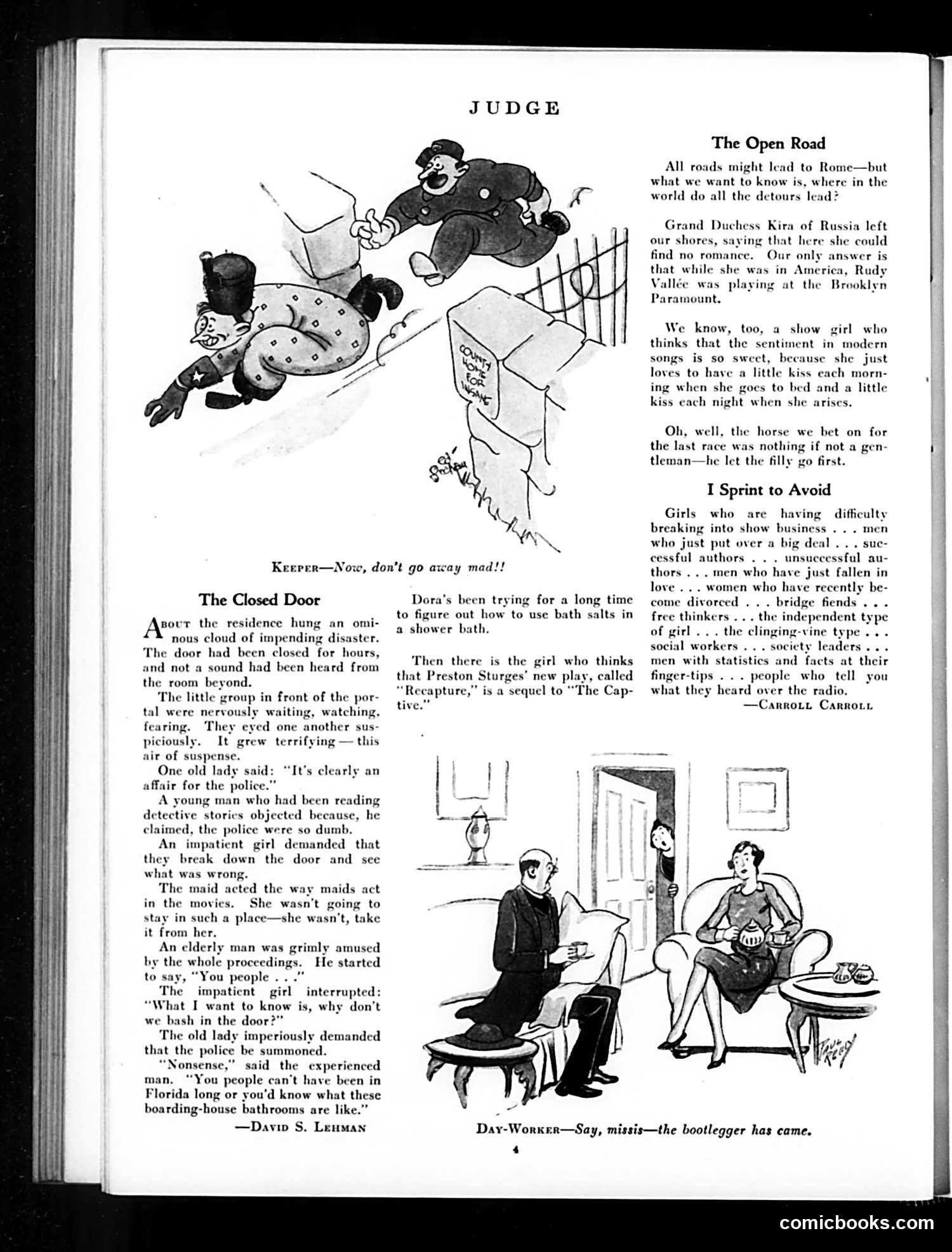
Analysis of Judge Page Content This page contains three separate satirical pieces typical of early 20th-century Judge magazine: 1. "The Closed Door" (by David S. Lehman): Satirizes public anxiety about a mysterious locked door at a residence. The satire mocks both sensationalism and police incompetence—an old lady demands investigation, an impatient girl wants answers, and a young man reading detective stories expects drama, while an elderly man pragmatically notes that boarding-house bathrooms are simply inadequate. 2. "I Sprint to Avoid" (by Carroll Carroll): A humorous list of social types to escape—unsuccessful authors, free thinkers, society leaders, gossips. 3. "Day-Worker" cartoon: Depicts what appears to be a domestic or boarding-house scene where a "bootlegger has came" (likely referencing Prohibition-era illegal alcohol distribution). The overall tone reflects 1920s American urban anxieties and social commentary.
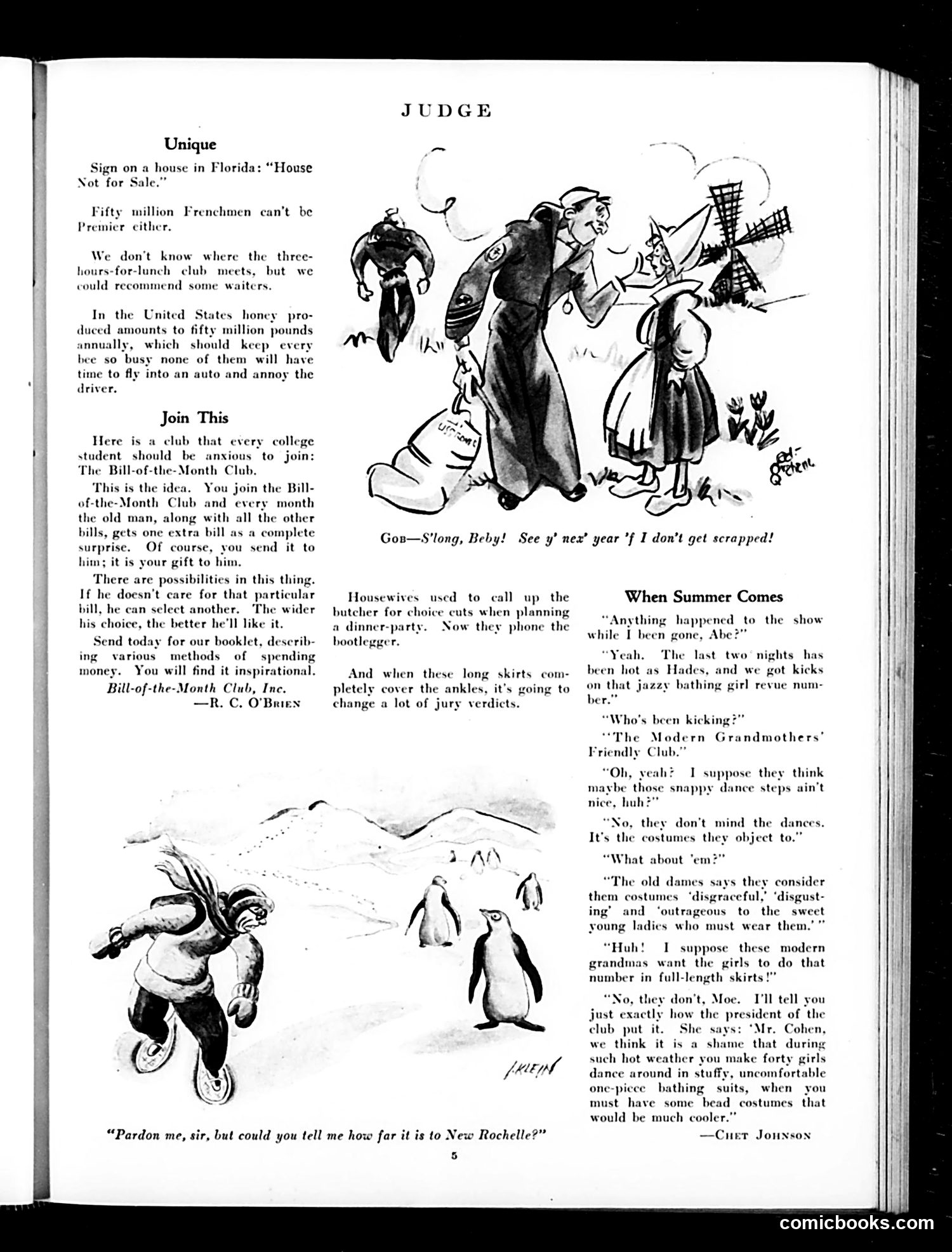
Analysis of Judge Magazine Page This page contains three distinct sections: humorous short items, a political cartoon, and a theatrical gossip column. The top cartoon depicts a man chasing a woman with a windmill, illustrating the caption about not getting "scrapped" next year—likely referencing romantic pursuits or marriage anxieties of the era. The bottom cartoon shows a portly man on a bicycle asking directions to New Rochelle, a wealthy Westchester County suburb. This appears to satirize nouveau riche aspirations or the commuting class. The "When Summer Comes" section discusses theater gossip, particularly complaints from older women ("dames") in a club about modern dancers' costumes—objecting to shorter, less modest attire. This reflects period anxieties about changing fashion and youth culture challenging traditional standards of decorum. The overall tone reflects early 20th-century American upper-class concerns about social propriety and modern change.
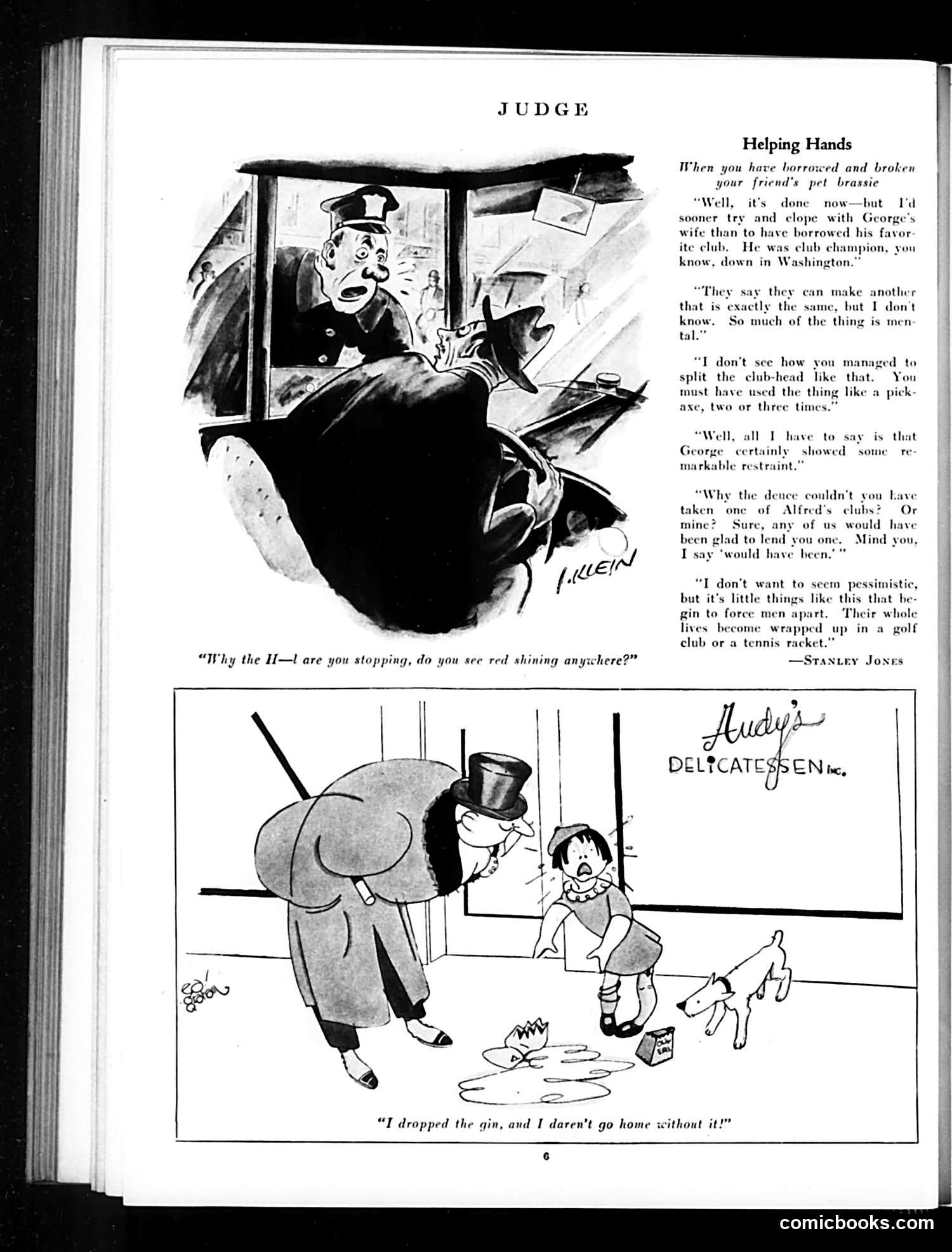
Analysis of Judge Magazine Page This page contains two cartoons satirizing upper-class social conduct. Top cartoon ("Helping Hands"): A traffic judge stops a driver who's borrowed and damaged his friend's car. The accompanying text, attributed to Stanley Jones, satirizes how wealthy men excuse themselves from lending to friends by claiming their clubs or equipment aren't available—while actually protecting their possessions from damage. The joke critiques the pretense and selfishness underlying upper-class friendship rituals. Bottom cartoon: A well-dressed man has dropped gin at a delicatessen and frantically searches for it among scattered items, unwilling to leave without recovering it. This satirizes alcoholic dependency and the priorities of wealthy drinkers during Prohibition. Both cartoons mock the hypocrisy and moral failings of the privileged classes.
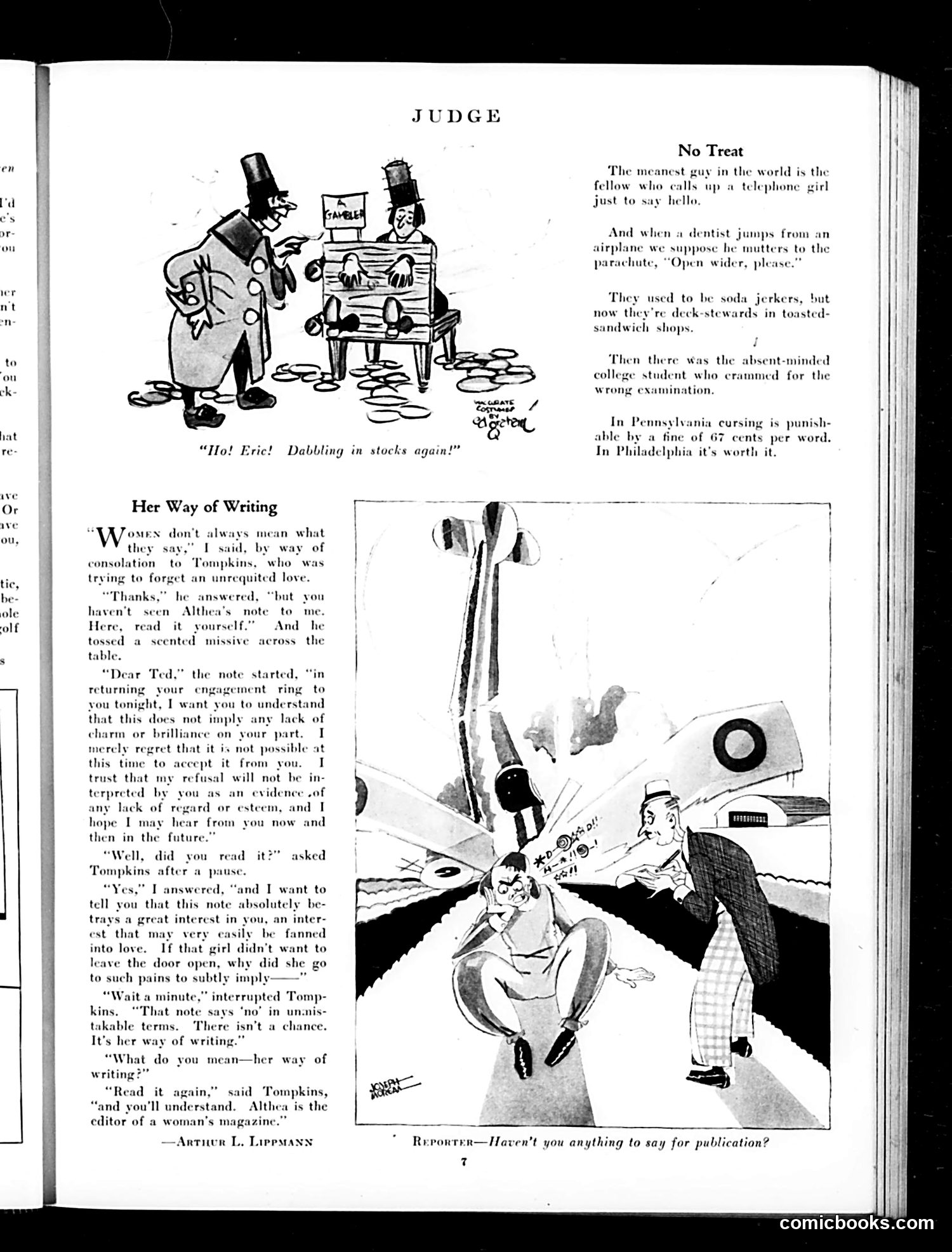
Analysis of Judge Magazine Page "Her Way of Writing" (main story): A man, Tompkins, receives a rejection note from his fiancée Althea that uses extremely polite, euphemistic language to decline returning to him. The joke's punchline: Althea edits a women's magazine, so her rejection letter is deliberately written in the flowery, indirect style typical of women's magazine prose—saying "no" while appearing to leave the door open. The satire mocks both the affected writing conventions of women's publications and the gap between what polite language says versus means. "No Treat" (humor column): A series of brief satirical observations about modern life: cruel telephone pranksters, dentist parachutists, soda jerks becoming ship stewards, and Pennsylvania's absurdly high fines for cursing (contrasted with Philadelphia's indifference). These are topical jabs at contemporary social behavior and regional differences. Top cartoon: Shows a stock-market speculator ("Hlo! Erie! Dabbling in stocks again!"), likely referencing Erie Railroad stock scandals—a common Judge target reflecting 1920s-30s financial speculation anxieties.
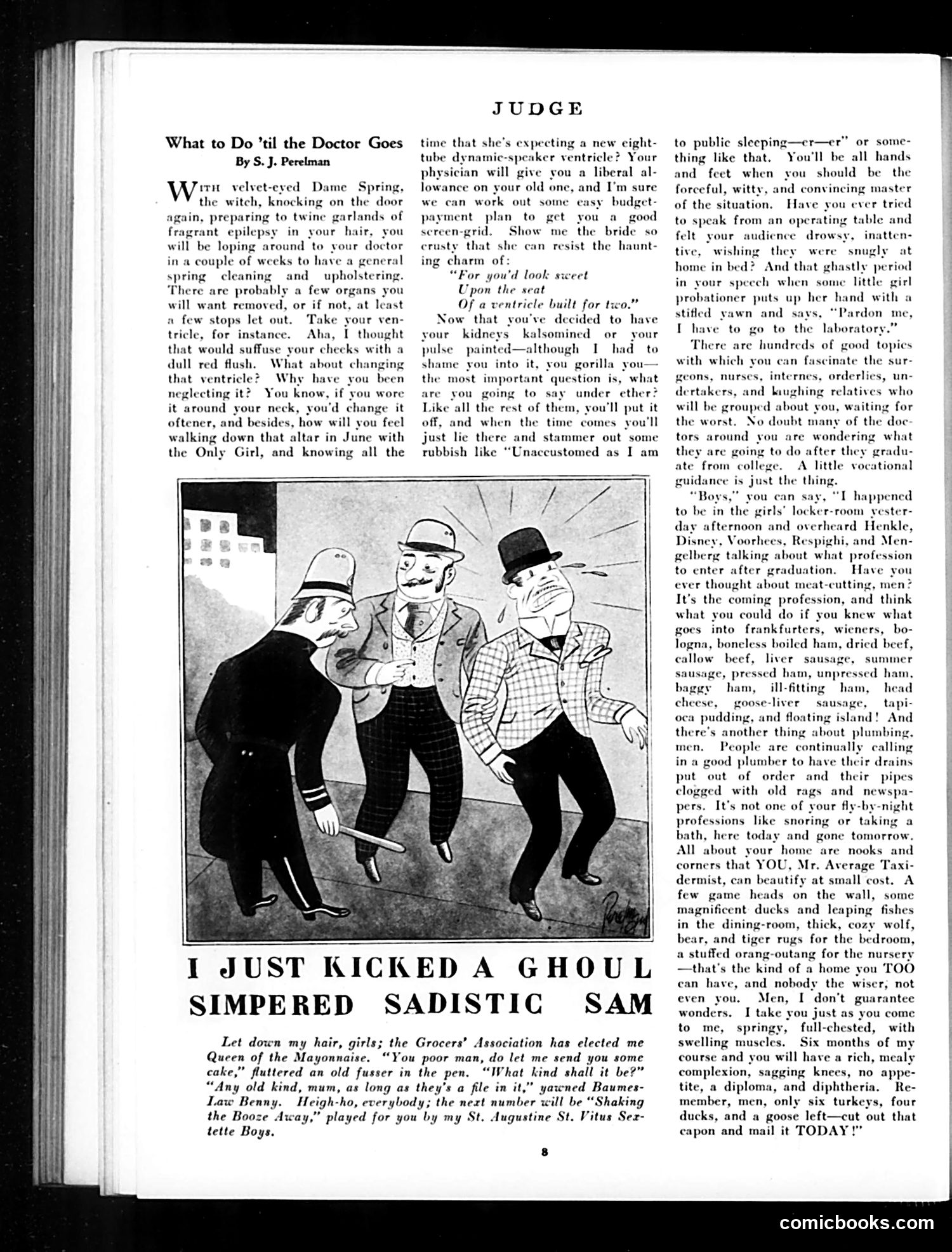
Analysis of Judge Magazine Page This page contains two distinct pieces of 1920s-era satirical humor: "What to Do 'til the Doctor Goes" is S.J. Perelman's humorous essay advising readers on medical procedures before spring—a comedic riff on the common practice of scheduling doctor visits seasonally. The joke targets hypochondriacs and medical anxiety, playing on fears about surgery and anesthesia. "I Just Kicked a Ghoul Simpered Sadistic Sam" is a separate humor piece (author unclear) mocking a Grocers' Association queen. The cartoon image shows three men in hats apparently engaged in physical altercation or commotion—likely illustrating the "sadistic Sam" character's violent behavior. The surrounding text consists of disconnected humorous quotes and song titles, typical of Judge's vaudeville-influenced comedy style. Both pieces exemplify Judge's target audience: educated, middle-class readers amused by wordplay, mock-serious advice columns, and broad physical comedy. The overall tone is lighthearted absurdism rather than pointed social criticism.
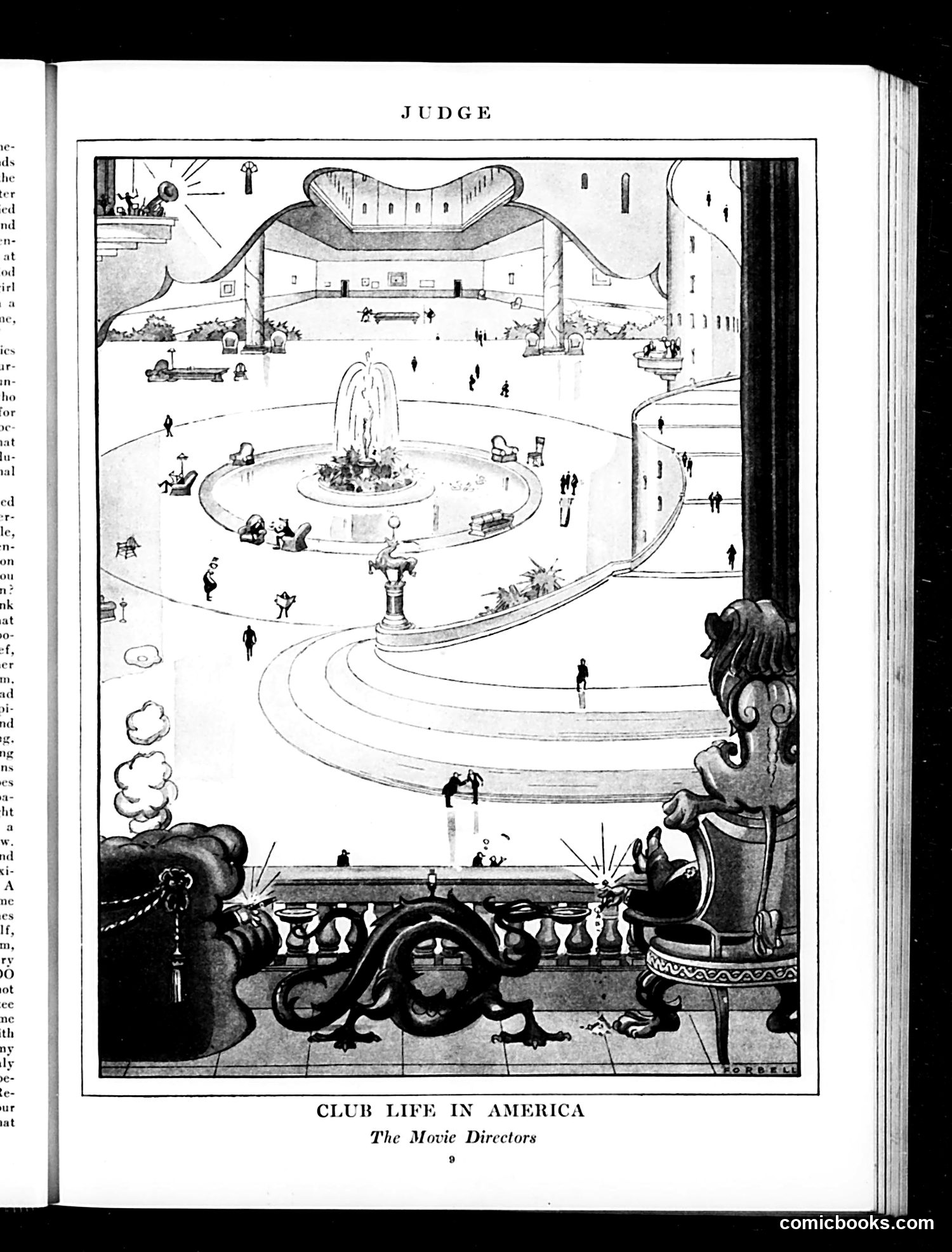
"The Movie Directors" - Judge Magazine Satire This cartoon satirizes the movie industry's early directors as pretentious or self-important figures. The image depicts an elaborate, theatrical architectural space—suggesting the grandiose scale of film production—viewed from an ornate balcony in the foreground (where we, the viewers, sit). The scene shows a sprawling plaza with fountains, buildings, and small figures of activity below, rendered in exaggerated perspective. The title "Club Life in America / The Movie Directors" suggests these directors inhabit an exclusive, rarefied world detached from ordinary American life. The satire likely mocks directors' pretensions to high art and their separation from common experience, presenting their world as artificially elaborate and self-congratulatory—a critique common in Judge's commentary on American celebrity and wealth.
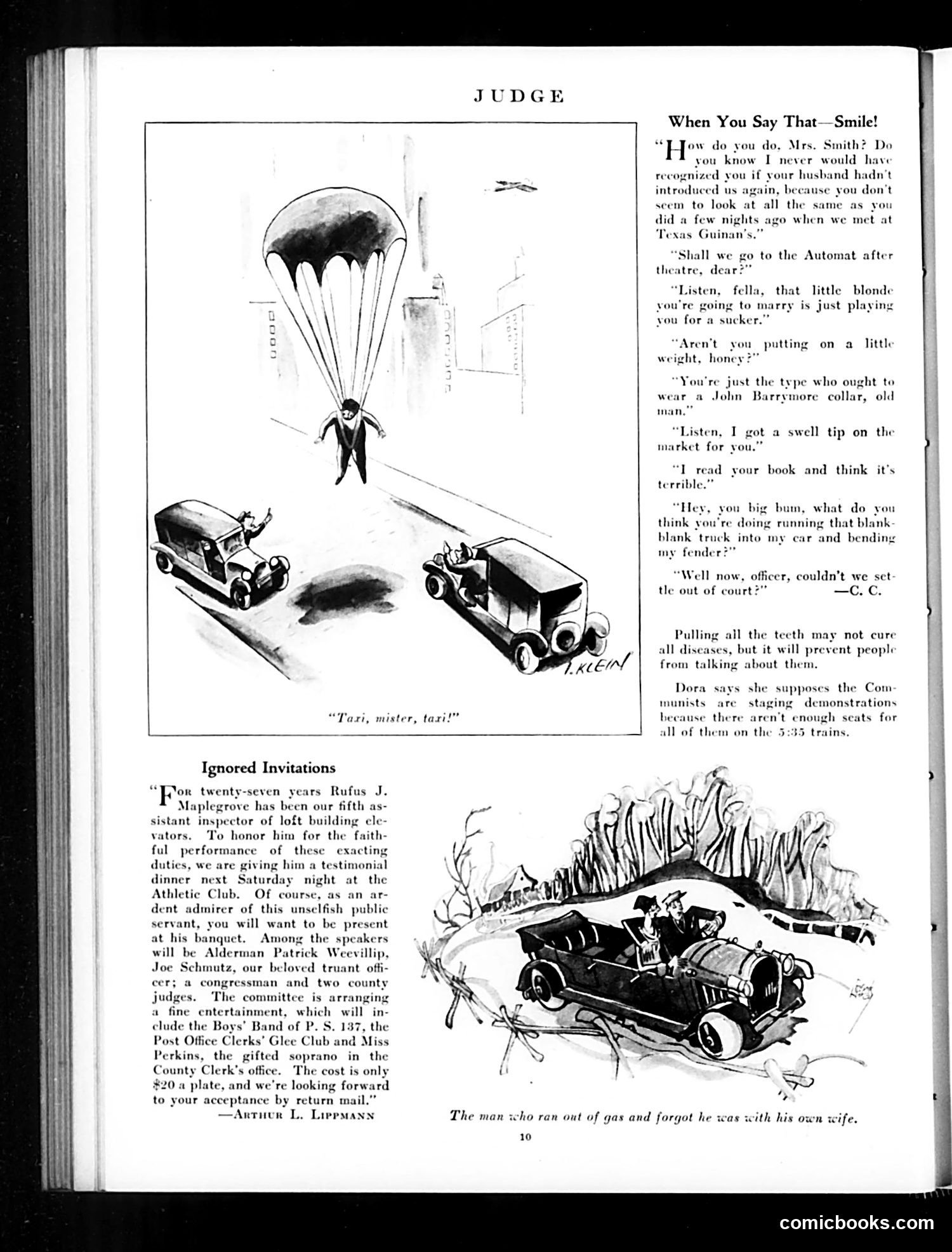
Judge Magazine Page Analysis Main Cartoon ("Taxi, mister, taxi!"): Shows a man descending by parachute toward two taxis on a street. The joke appears to satirize reckless urban transportation—the man is choosing an absurdly dangerous method (parachute) over normal taxis, possibly mocking either taxi drivers' reputations for wild driving or the desperation of finding transportation. "When You Say That—Smile!" section: A collection of backhanded insults and awkward social comments (forgetting someone's face, calling someone fat, insulting their book). The satire targets insincere social politeness—people say cutting remarks while pretending friendliness, hence "smile" while delivering the insult. "Ignored Invitations": Parodies pompous corporate testimonial dinners. The invitation for a minor bureaucrat's honor banquet lists mediocre entertainment (boys' band, glee club) while requesting $20 attendance fees—satirizing how organizations mask obligation as honor. Bottom cartoon: Shows a crashed car in a ditch, captioned about a man who ran out of gas and forgot his wife was with him—a joke about marital neglect during crisis.
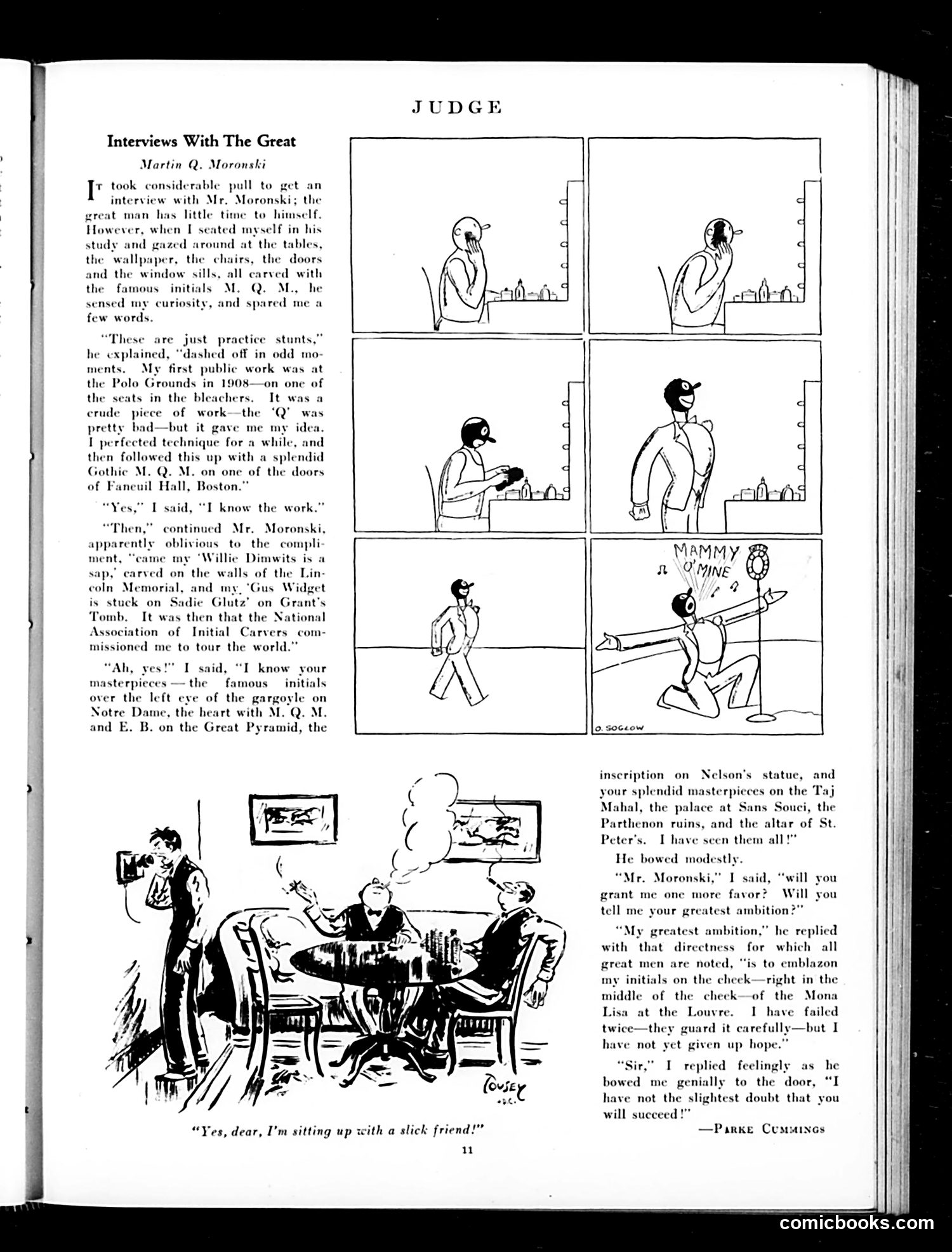
"Martin Q. Moronski" - Judge Magazine Satire This is a satirical interview mocking graffiti artists and vandals. "Moronski" is a fictitious character whose name itself signals the joke—a play on "moron." The satire works by treating this vandal as a celebrated artist. The interview credits him with carving initials into famous landmarks: the Lincoln Memorial, Grant's Tomb, Notre Dame's gargoyle, the Great Pyramid, Nelson's Column, the Taj Mahal, Parthenon, and St. Peter's Altar. His "greatest ambition" is defacing the Mona Lisa in the Louvre. The humor lies in the absurd elevation of common property destruction into a prestigious career, complete with an "Association of Initial Carvers" commissioning world tours. The accompanying comic strips show Moronski repeatedly carving his initials in everyday settings. The bottom cartoon mocks similarly questionable social climbing, with the caption "Yes, dear, I'm sitting up with a slick friend!"—implying association with disreputable people. The satire targets both actual vandals and perhaps the cultural pretentiousness that might glamorize destructive behavior.
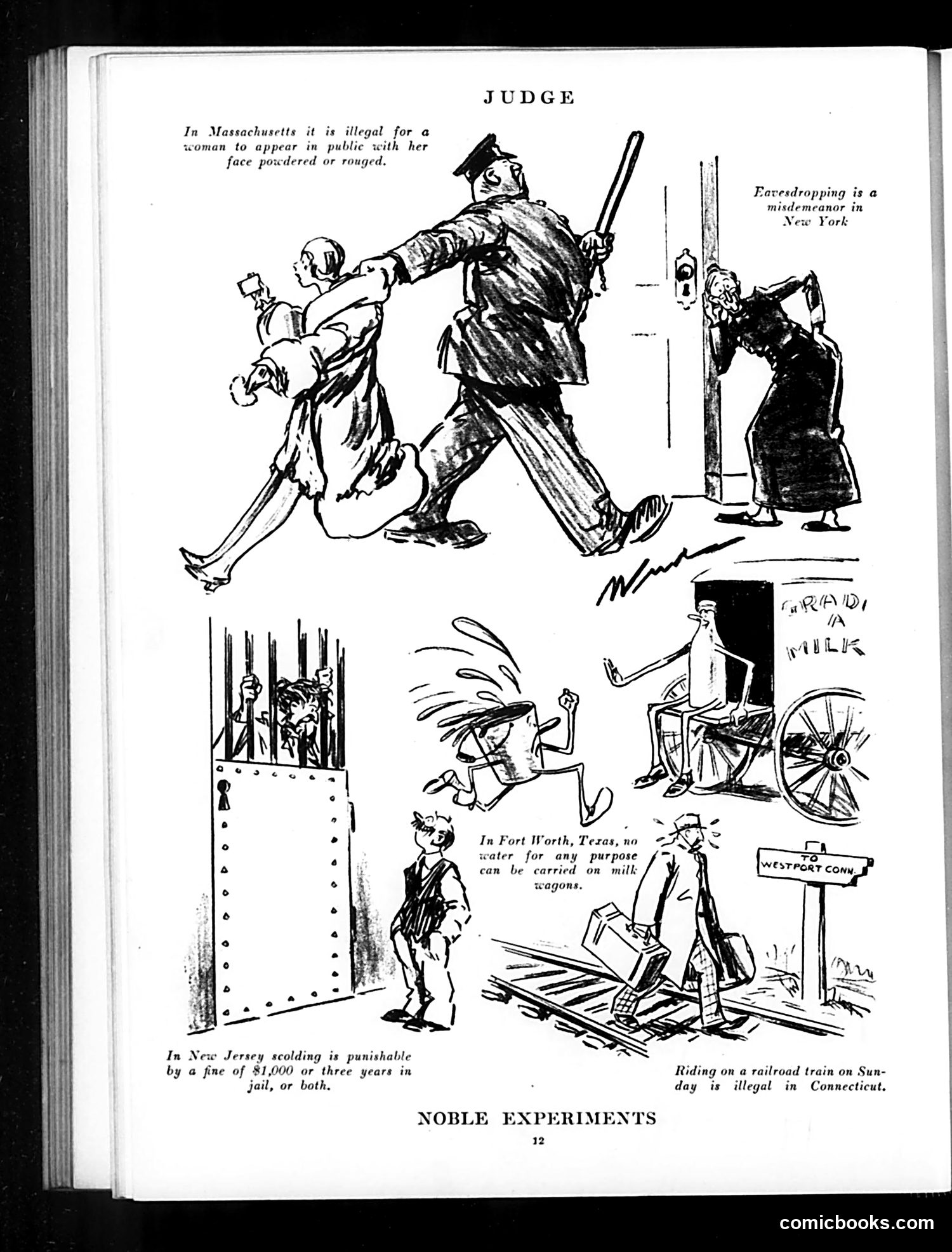
"Noble Experiments" - Judge Magazine Satire This page satirizes absurd or outdated state laws by illustrating their practical consequences. Each panel depicts a different ridiculous statute: - Massachusetts: A judge physically restrains a woman for wearing makeup - New Jersey: A man is jailed for scolding - New York: Someone is caught eavesdropping - Fort Worth, Texas: A milk wagon cannot carry water - Connecticut: Sunday train travel is prohibited The cartoon's point is clear: these laws, though technically "on the books," are either unenforceable, antiquated, or so absurd they mock the legislative process itself. By showing literal enforcement of these statutes, Judge ridicules the gap between written law and social reality—suggesting lawmakers create impractical regulations that highlight legal absurdity. The title "Noble Experiments" uses irony to critique legislative overreach and the criminalization of trivial behaviors.
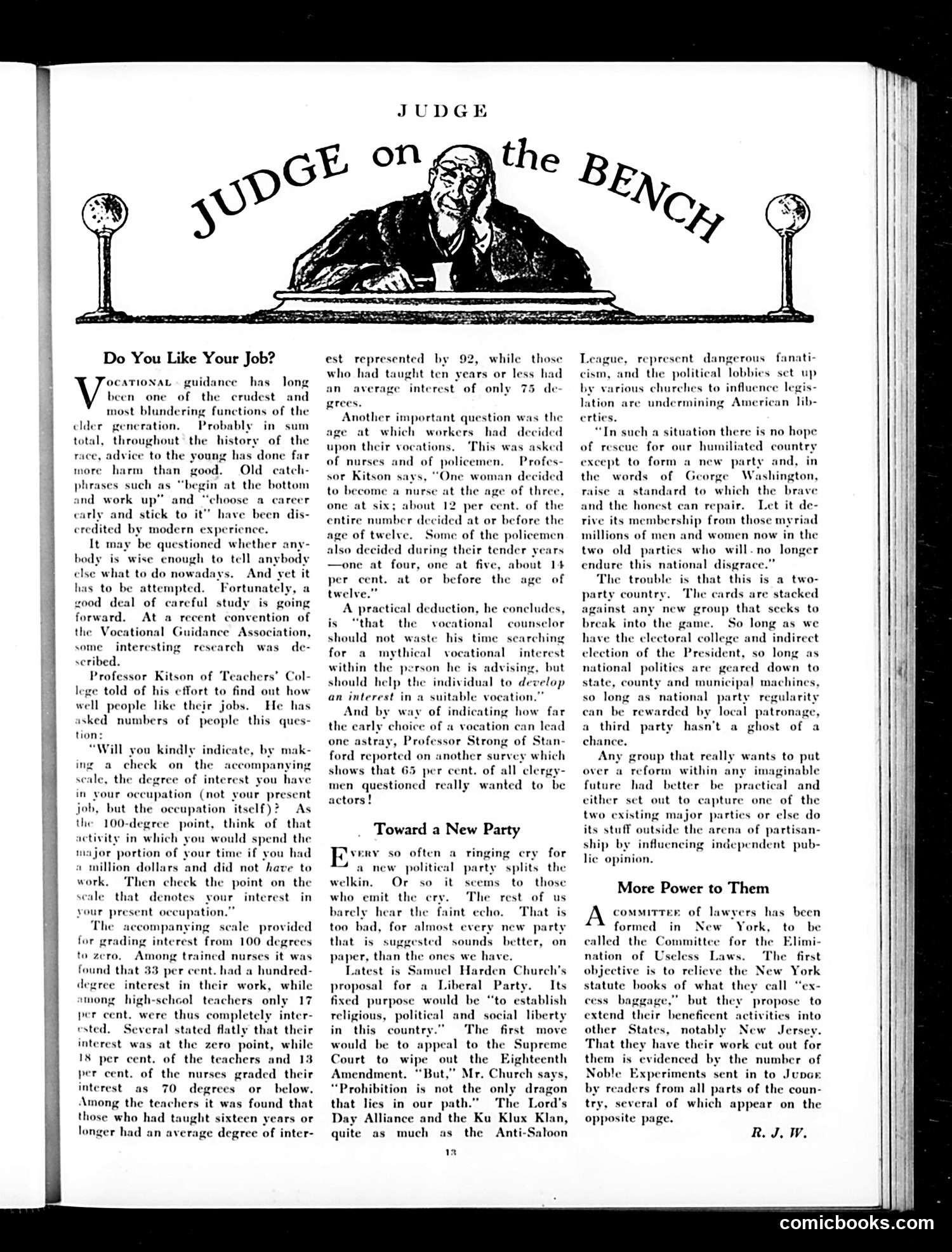
"Judge on the Bench" - Page Analysis This page contains two distinct articles from Judge magazine (a satirical publication): Top Section - "Do You Like Your Job?": Reports on vocational guidance research by Professor Kitson. The satire concerns mismatches between job interest and reality: trained nurses showed 33% high interest in their work, but high school teachers only 17%, with some at zero interest. Notably, the piece mocks that 65% of clergy questioned actually *wanted to be actors*—exposing the gap between chosen profession and genuine passion. Bottom Section - "Toward a New Party": Satirizes recurring proposals for new political parties. It references Samuel Harden Church's proposal for a "Liberal Party" opposing Prohibition and the Eighteenth Amendment, positioning itself against the Ku Klux Klan and Lord's Day Alliance. The satire suggests such third-party movements are perennial and often sound better "on paper" than existing parties—a critique of idealistic but impractical political splinters. Both pieces lampoon professional and political disillusionment in early 20th-century America.
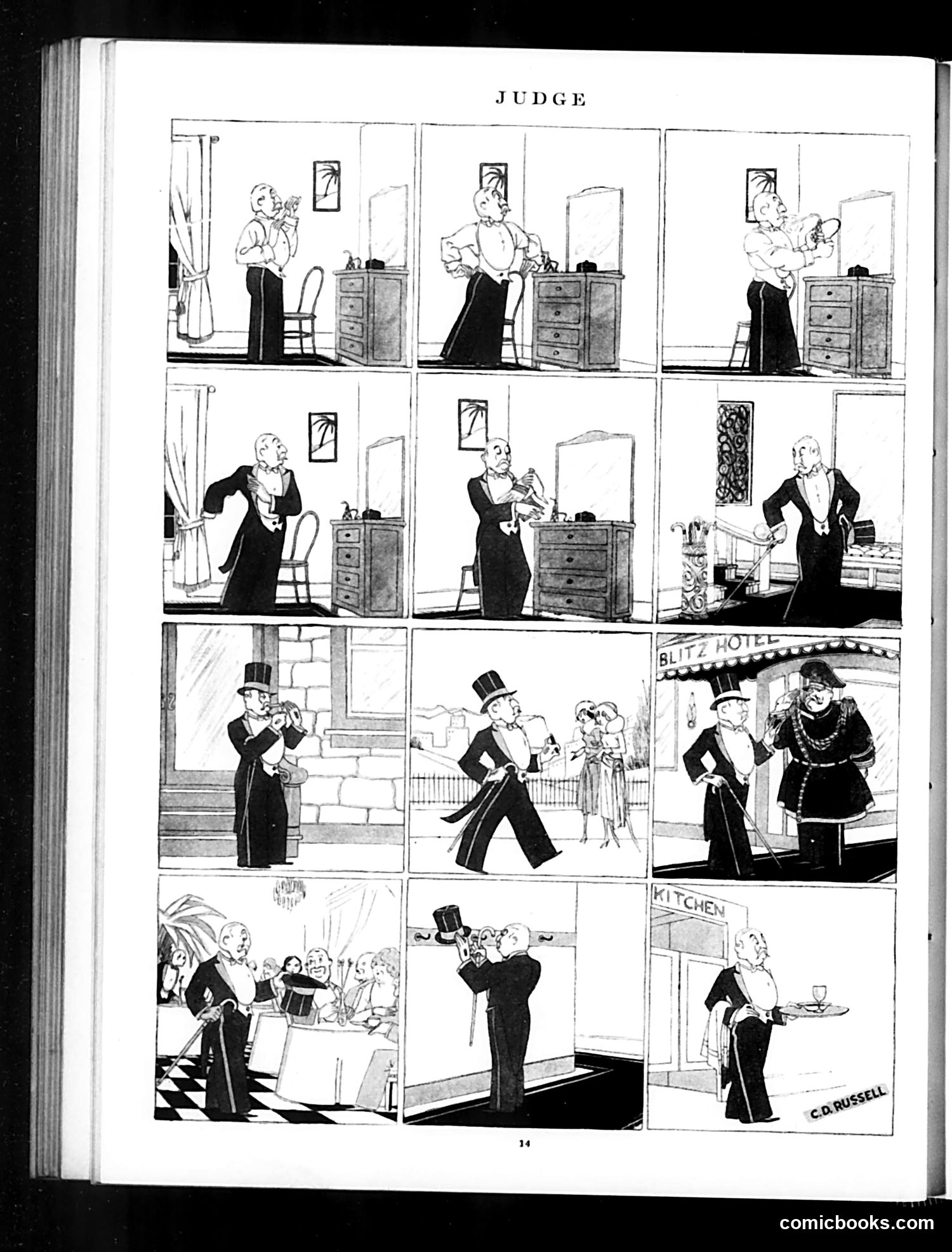
Judge Magazine - "Judge" Comic Page This is a sequential comic strip titled "Judge" (signed by C.D. Russell) that appears to be social satire about a pompous judicial or legal figure. The narrative follows a man in formal attire—top hat, tailcoat—through his daily routine: dressing, primping before a mirror, departing from what appears to be the Blitz Hotel, and eventually ending in a kitchen. The humor likely satirizes pretentious formality and self-importance. The progression from elaborate grooming and public strutting to the domestic reality of kitchen work suggests deflation of vanity or mockery of someone whose grand public persona contrasts absurdly with ordinary domestic circumstances. Without additional context about the specific date or political figures of Judge magazine's era, the precise target remains unclear, though the visual joke about pretension and its comeuppance is evident.
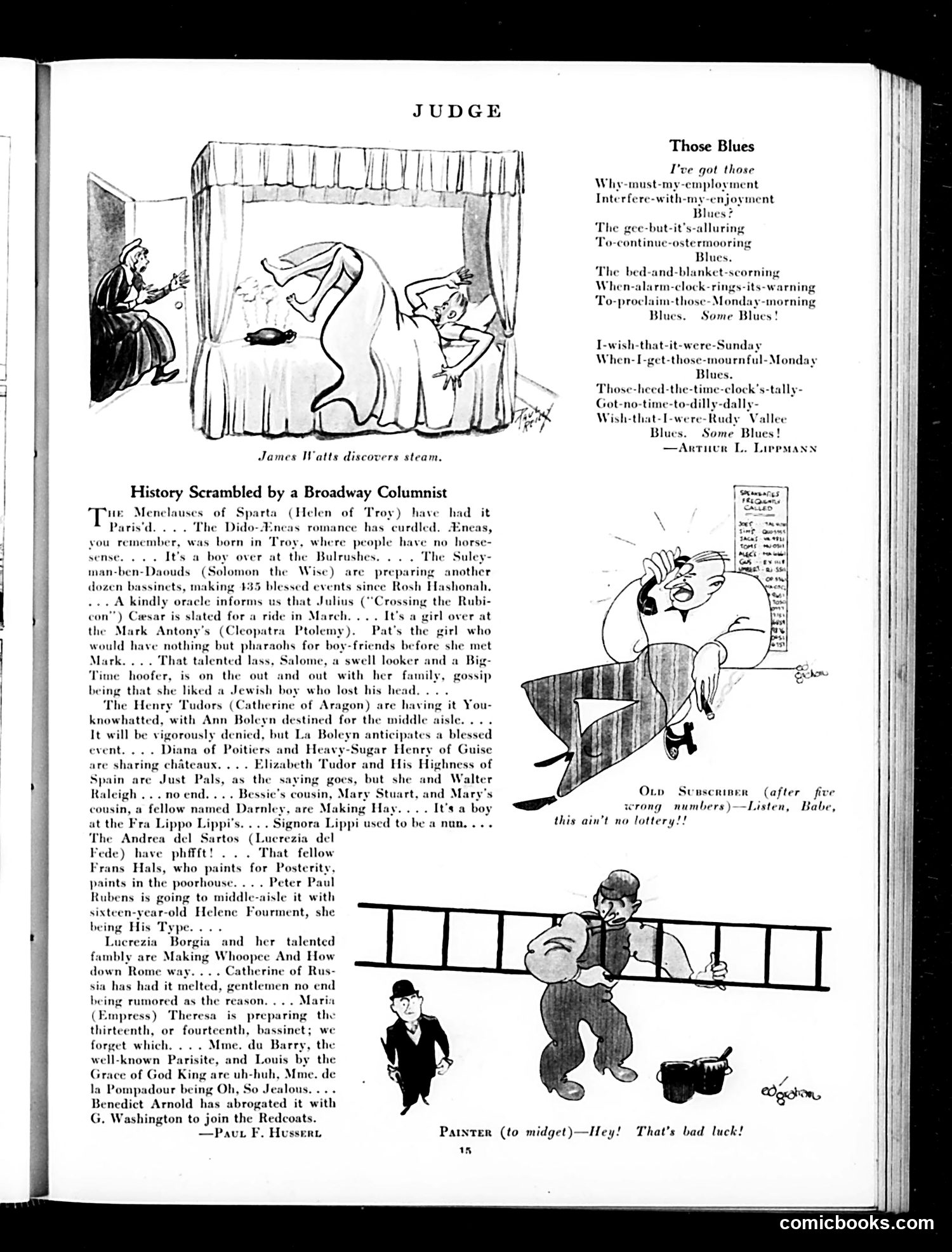
Judge Magazine Page Analysis This page contains two distinct satirical pieces: "Those Blues" (top right): A humorous song-poem by Arthur L. Lippmann mocking the modern working person's complaints—Monday blues, alarm clocks, time-clock drudgery, and wishing to be like Rudy Vallée (a popular 1920s-30s singer/entertainer). The satire targets middle-class employment dissatisfaction. "History Scrambled by a Broadway Columnist" (center): Paul F. Hüssell deliberately mangles historical and classical references—mixing Sparta's Menelauses with Helen of Troy, treating biblical and royal figures as contemporary gossip-column subjects ("It's a girl over at Mark Antony's"). The joke is scrambling serious history into tabloid trivia, mocking both Broadway gossip culture and reader ignorance of history. The cartoons complement this: one shows James Watt "discovering" steam (historical reference), another depicts an "Old Subscriber" complaining this "ain't no lottery," and a painter telling a midget "That's bad luck!"—all reinforcing the page's theme of deflating pretension through wordplay and visual gags.
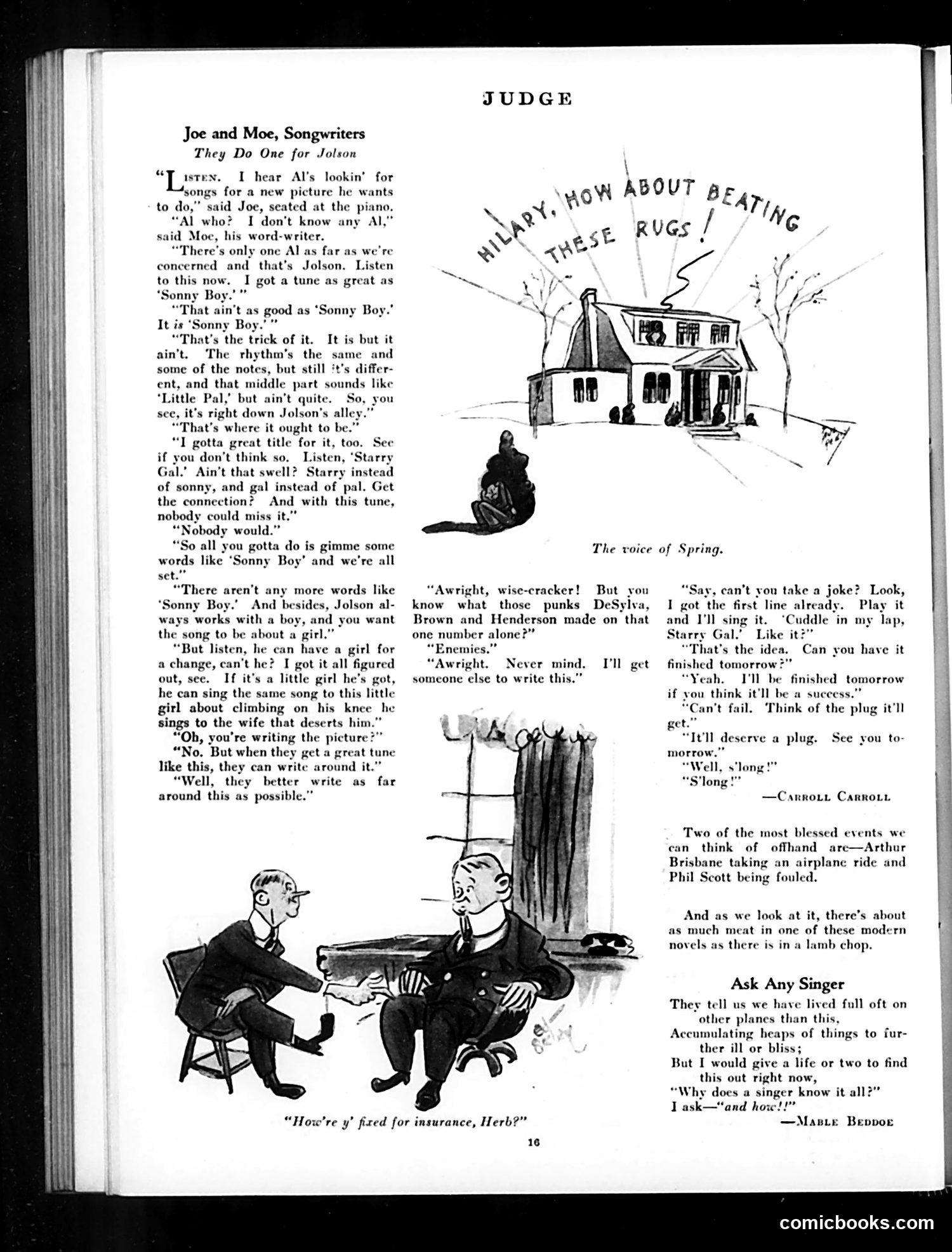
Judge Magazine Page Analysis This page satirizes Tin Pan Alley songwriting in the 1920s, specifically targeting the formula-driven approach to creating hit songs for entertainer Al Jolson. The Setup: Two songwriters, Joe and Moe, discuss writing a new picture song for Jolson. Joe proposes "Starry Gal"—essentially a recycled version of Jolson's famous "Sonny Boy," merely substituting "gal" for "pal" and changing pronouns. The satire mocks how interchangeable popular songs were: writers could mechanically swap words without altering melody or structure. The Joke: When Moe questions this lazy approach, Joe reveals the cynical industry truth: studios would "write around" a great tune regardless of logic (here, having Jolson sing sentimentally to a child instead of his wife). The cartoonist ridicules both songwriting mediocrity and Hollywood's willingness to accommodate it. The bottom cartoon caption, "How're y' fired for insurance, Herb?" appears to be a separate gag about employment/insurance claims, unrelated to the main piece.
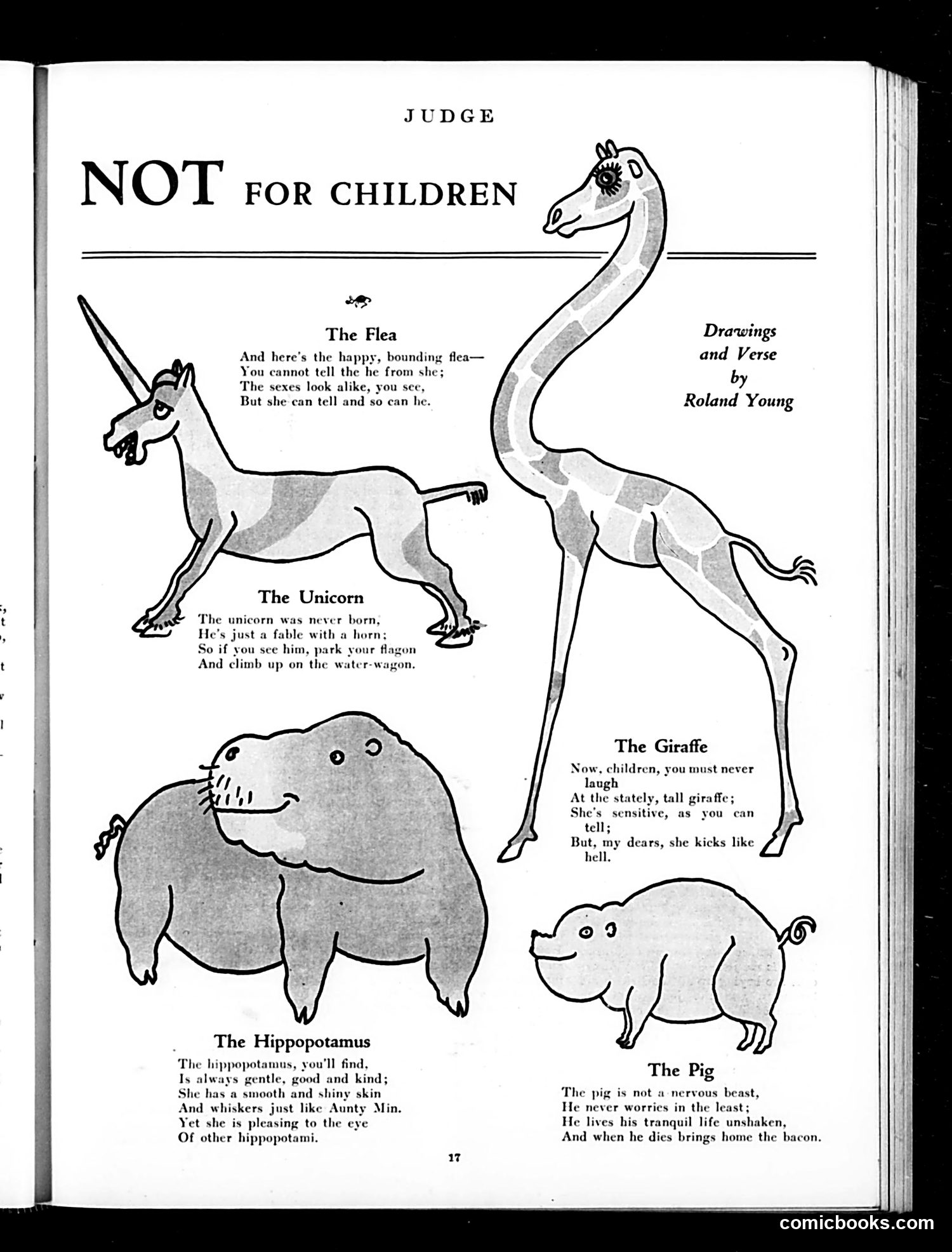
Analysis This is a humorous illustrated poem collection by Roland Young titled "Not for Children"—the irony being that it's explicitly *not* suitable for young readers, despite appearing to be children's verse about animals. The satire lies in the contrast between innocent animal subjects and crude, adult humor embedded in each poem: - The Flea: Sexual double entendre about indistinguishable male/female fleas "telling" each other apart - The Unicorn: Playful nonsense about a mythical creature - The Giraffe: Mock-serious warning about her sensitivity, followed by crude language ("kicks like hell") - The Hippopotamus: Gentle description undercut by implicit reference to Aunty Min's appearance - The Pig: Dark joke about pork/bacon following death The title's promise of wholesomeness—paired with children's-book-style illustrations and verse—is the joke itself. Judge magazine's sophisticated, adult audience would appreciate how the seemingly innocent format conceals adult irreverence. This reflects early 20th-century satirical magazine humor: subverting expectations of propriety.
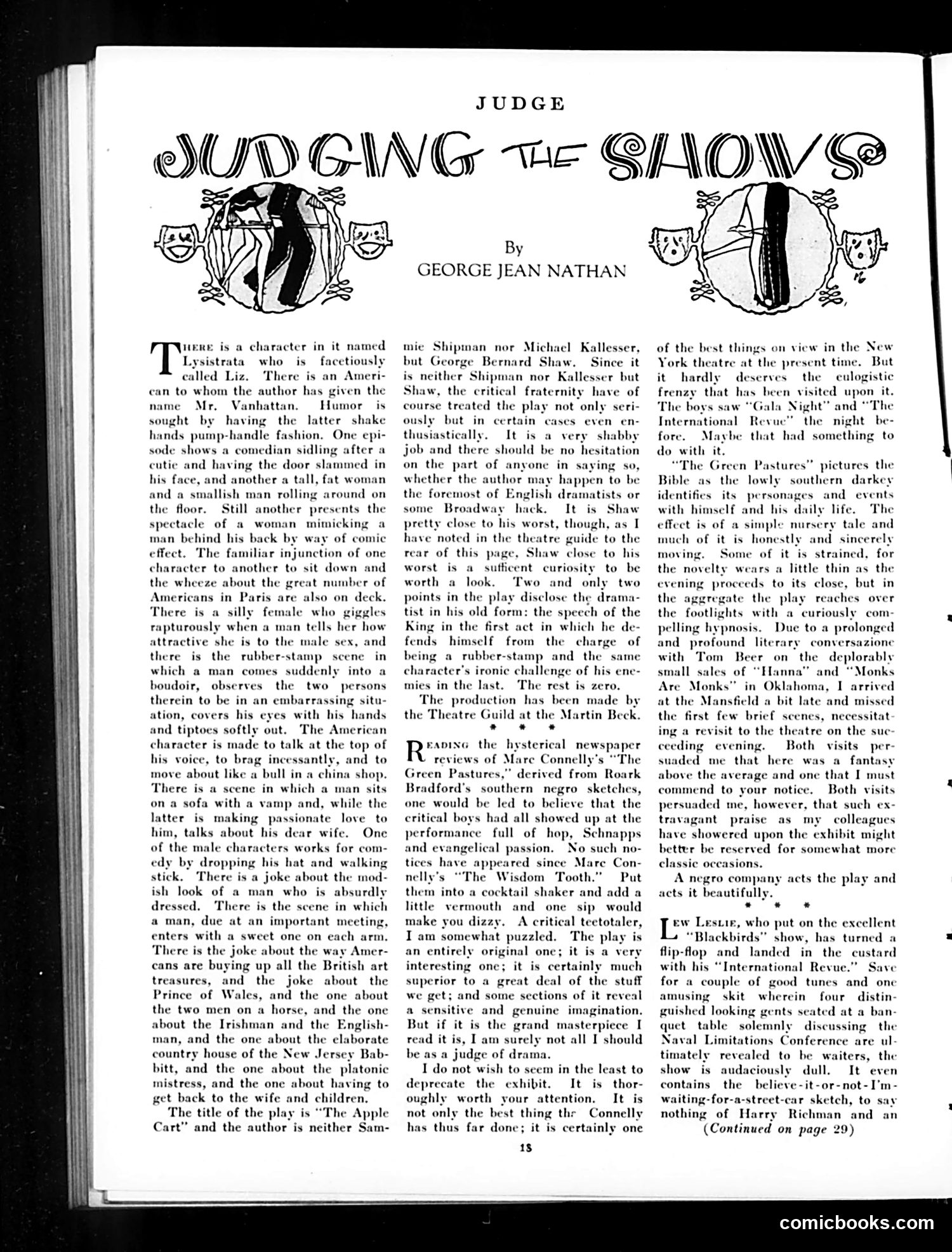
Judging the Shows: George Jean Nathan's Theater Criticism This is a theater review column by prominent critic George Jean Nathan. The page critiques two Broadway productions: "The Apple Cart" by George Bernard Shaw is Nathan's primary target. Despite Shaw's reputation as a foremost English dramatist, Nathan dismisses it as "a very shabby job" and "pretty close to his worst." He catalogs the play's cheap comedic devices—slapstick, pratfalls, exaggerated American characters talking loudly and boastfully, adultery jokes—arguing these are beneath Shaw's talent. "The Green Pastures" by Marc Connelly receives cautious praise. Nathan notes critics have praised it excessively (suggesting they attended drunk: "full of hop, Schnapps and evangelical passion"). He acknowledges it's "entirely original" and "interesting," but resists calling it a masterpiece, positioning himself as a sober, independent judge resisting herd criticism. Nathan's stance emphasizes critical integrity: quality matters regardless of an author's reputation; popularity and critical consensus deserve skepticism.
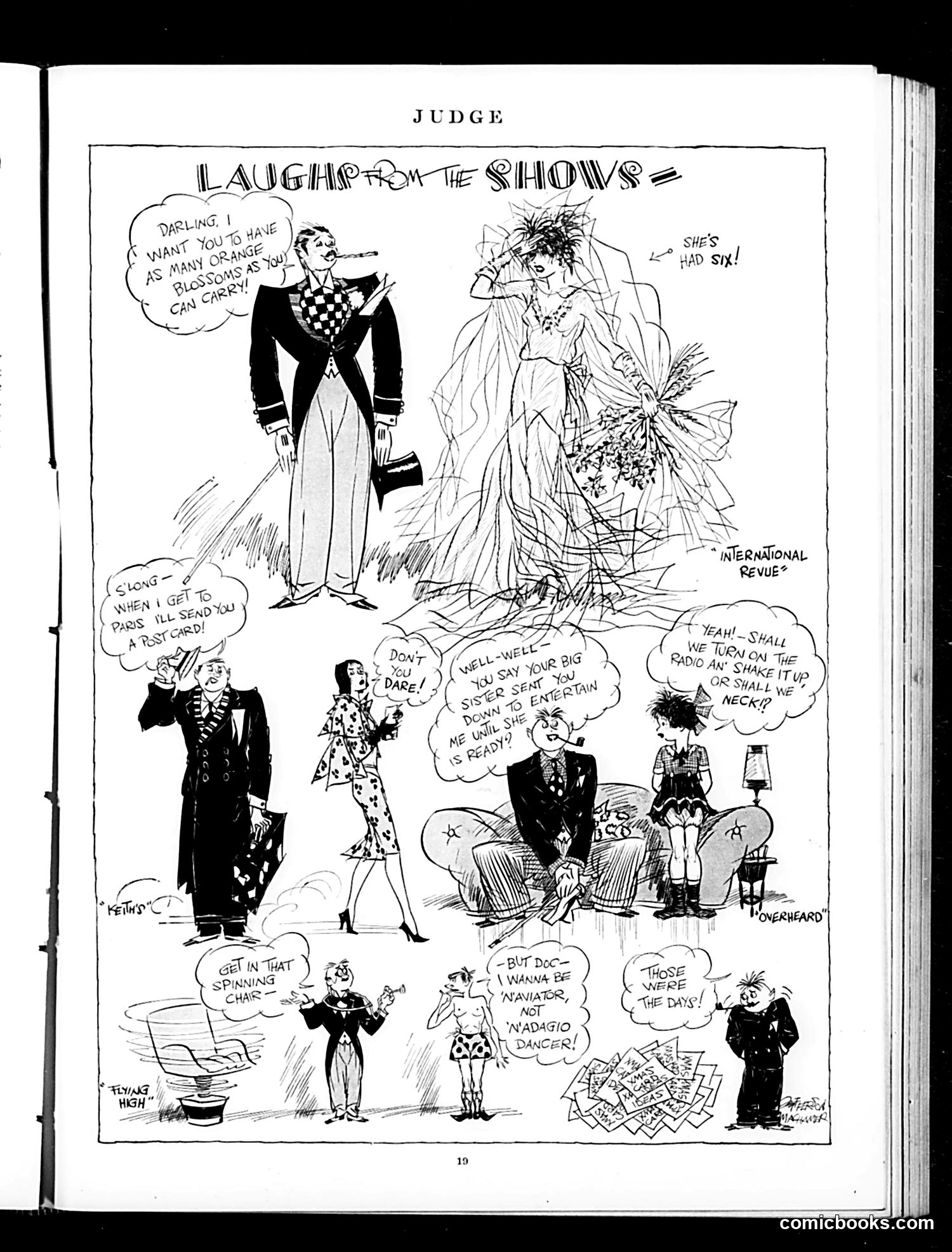
"Laughs at the Shows" This Judge cartoon satirizes theatrical performers and their ambitions. The central figures appear to be show business personalities discussing their career prospects and performance types. The satire targets several show-business clichés: a man boasts about acquiring orange blossoms (suggesting marriage prospects), someone mentions performing in Paris, and there's mockery of dancers aspiring to roles they're unsuited for—particularly the joke about wanting to be a "navigator" rather than an "adagio dancer." The cartoon lampoons the pretensions and desperation of performers seeking better roles and opportunities, the financial pressures driving show business decisions, and the tension between performers' self-perception and their actual talents or prospects. The various characters represent different theatrical stereotypes and their often-unrealistic ambitions during what appears to be the early 20th century theatrical era.
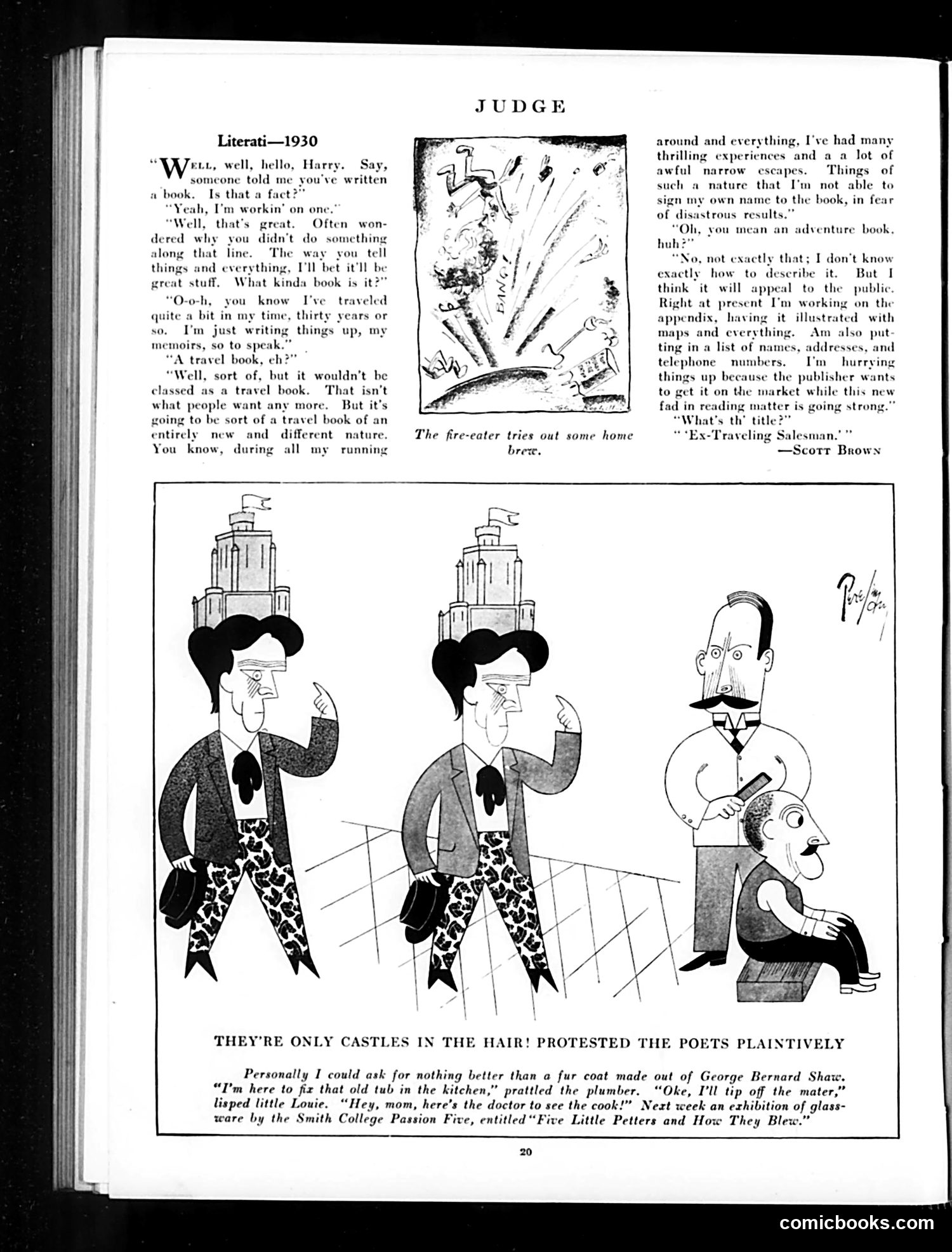
Judge Magazine, 1930: Content Analysis The page contains two satirical pieces: Upper section ("Literati"): A dialogue between two men discusses writing a scandalous memoir disguised as a travel book. The author plans to include names, addresses, and phone numbers of people involved in "thrilling" but legally dangerous incidents he witnessed over thirty years. The satire mocks both the publishing industry's appetite for sensationalism and authors who exploit others' secrets for profit while protecting themselves through anonymity. Lower cartoon: Titled "They're Only Castles in the Hair," it ridicules affected, pretentious poetry and artistic language. The visual gag shows absurdly tall hairstyles styled like castles, mocking poets' overwrought descriptions. The caption includes deliberately terrible puns and double-entendres ("Passion Five," "Petters and How They Blew"), satirizing both pretentious art criticism and lowbrow humor—suggesting the era's cultural divide between highbrow and populist entertainment.
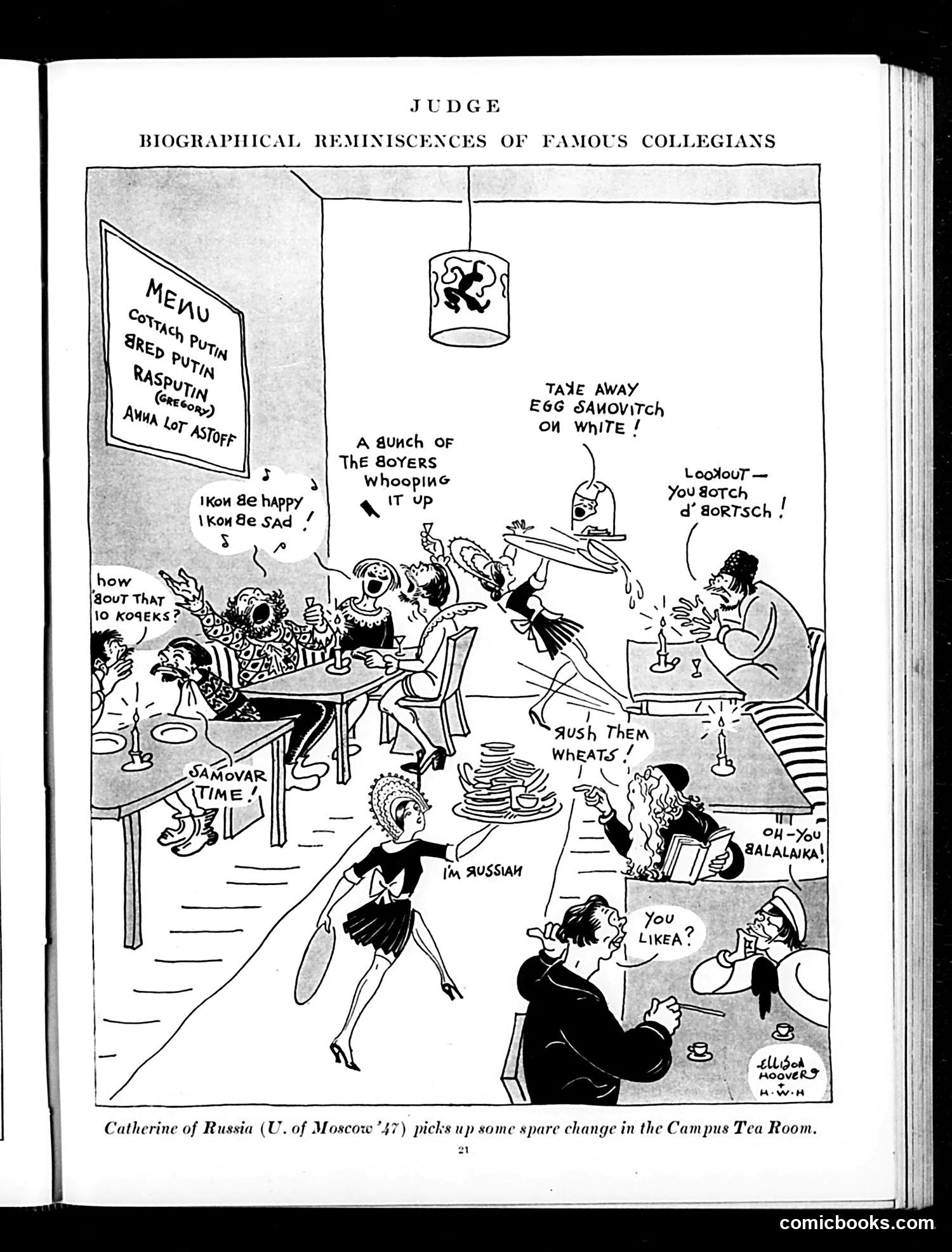
Analysis This Judge magazine cartoon satirizes a Russian female student ("Catherine of Russia, U. of Moscow '47") dining in an American campus tea room. The humor centers on ethnic/national stereotyping and Cold War tensions. The menu posted on the wall lists Russian dishes (borscht, piroshki, etc.), establishing her identity. Other diners make exaggerated comments in fake accents ("Lookout—you botsch d'bortsch!" "Oh-yoi, balalaika!") while she sits among them. The satire targets post-WWII American attitudes toward Russians—portraying them as exotic, culturally foreign, and comedic subjects. The crowded, chaotic scene with numerous onlookers gawking suggests American college students' fascination and mockery of a Soviet peer during the early Cold War era. The cartoon reflects 1940s anxieties about Russian presence in American institutions and prevailing prejudices against Eastern European immigrants or visitors.
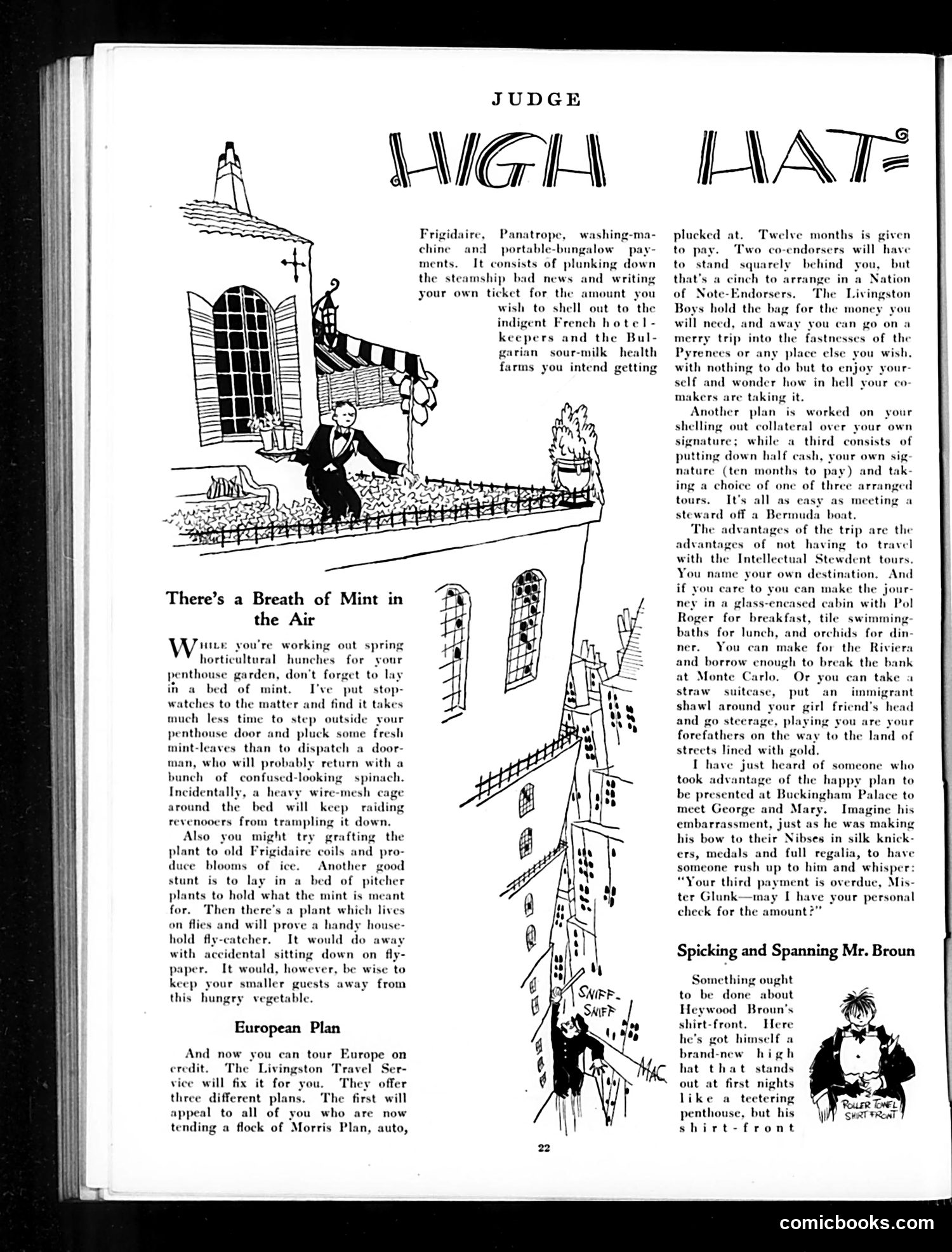
Judge Magazine Satire Analysis This page contains three separate humorous pieces satirizing 1920s American consumer culture and social pretension: "Breath of Mint in the Air" mocks wealthy penthouse dwellers obsessed with fashionable gardening, suggesting absurd solutions like grafting mint to refrigerator coils and keeping pitcher plants—satirizing upper-class frivolity. "European Plan" targets the newly accessible credit system that allows aspirational Americans to finance European vacations they can't afford. The satire focuses on the irresponsibility: traveling on borrowed money to impress (the fantasy of presenting oneself at Buckingham Palace), while co-signers bear the financial risk. The joke about "Mr. Glunk" being interrupted mid-bow to royalty to learn his payment is overdue epitomizes the contradiction between pretended sophistication and actual financial instability. "Spicking and Spanning Mr. Broun" appears to ridicule theater critic Heywood Broun's comically oversized new top hat—a minor vanity observation typical of Judge's social commentary. All three pieces share a theme: mocking the Jazz Age middle class's desperate, often absurd attempts at appearing wealthy and cultured.
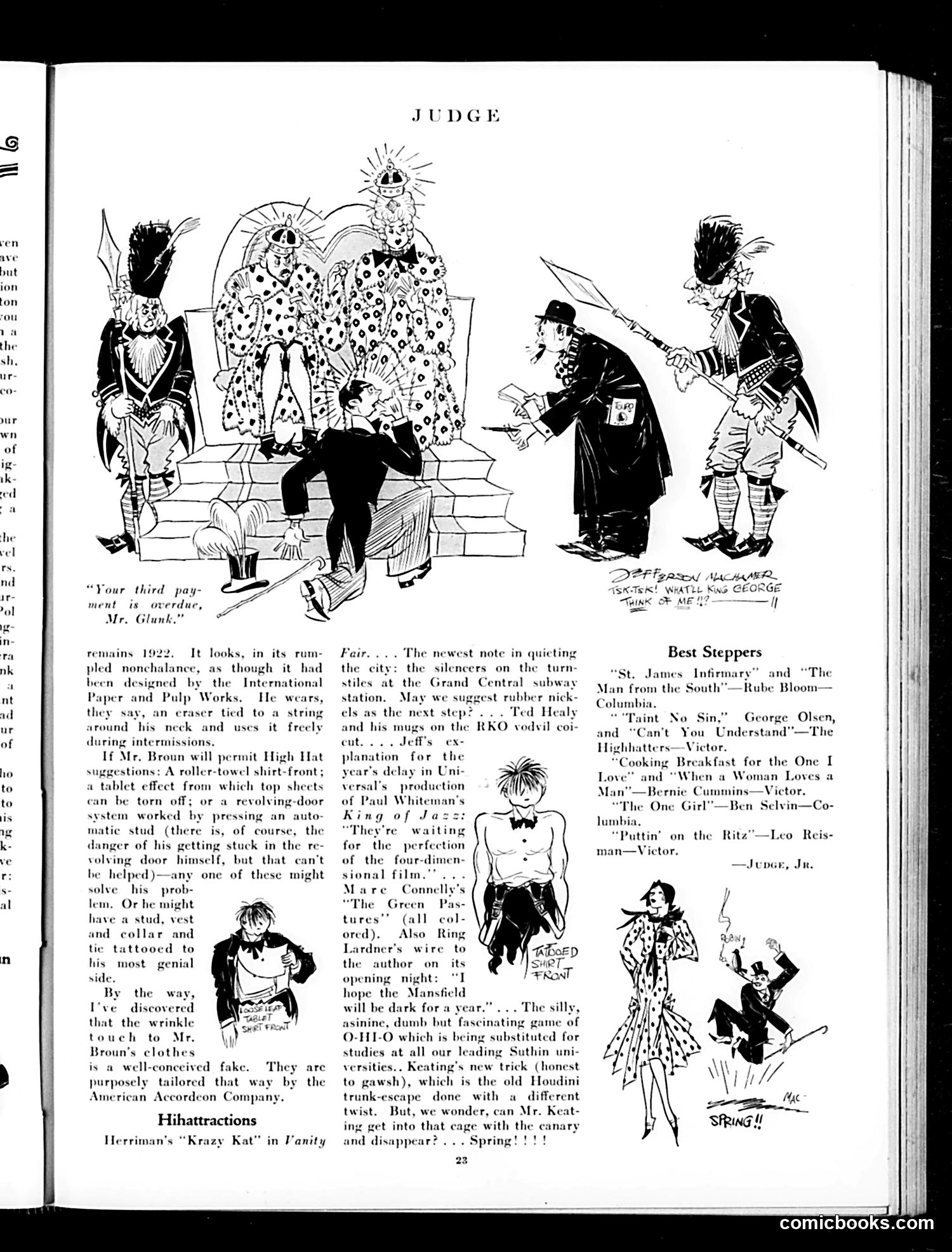
Judge Magazine Page Analysis This page from *Judge* (a satirical magazine) contains two main sections: Top Cartoon ("Judge"): A caricatured judge sits elevated on a throne-like seat while a disheveled man in a bowler hat stands before him. The caption reads "Your third payment is overdue, Mr. Glank." The satire mocks both judicial authority and debt collection—the elaborate, pompous judge contrasts with the humble debtor, suggesting the legal system's weight falls heavily on ordinary citizens struggling with financial obligations. Text Section: The remainder discusses theatrical and entertainment gossip, including references to Heywood Broun (a prominent journalist/critic), vaudeville acts, and film productions. There's a joke about Paul Whiteman's film delay and criticism of Keating's escape act. "Best Steppers": Lists popular jazz and pop songs of the era, including titles from performers like Bernie Cummins and George Olsen. The page reflects 1920s concerns with debt, theatrical entertainment, and popular music culture.
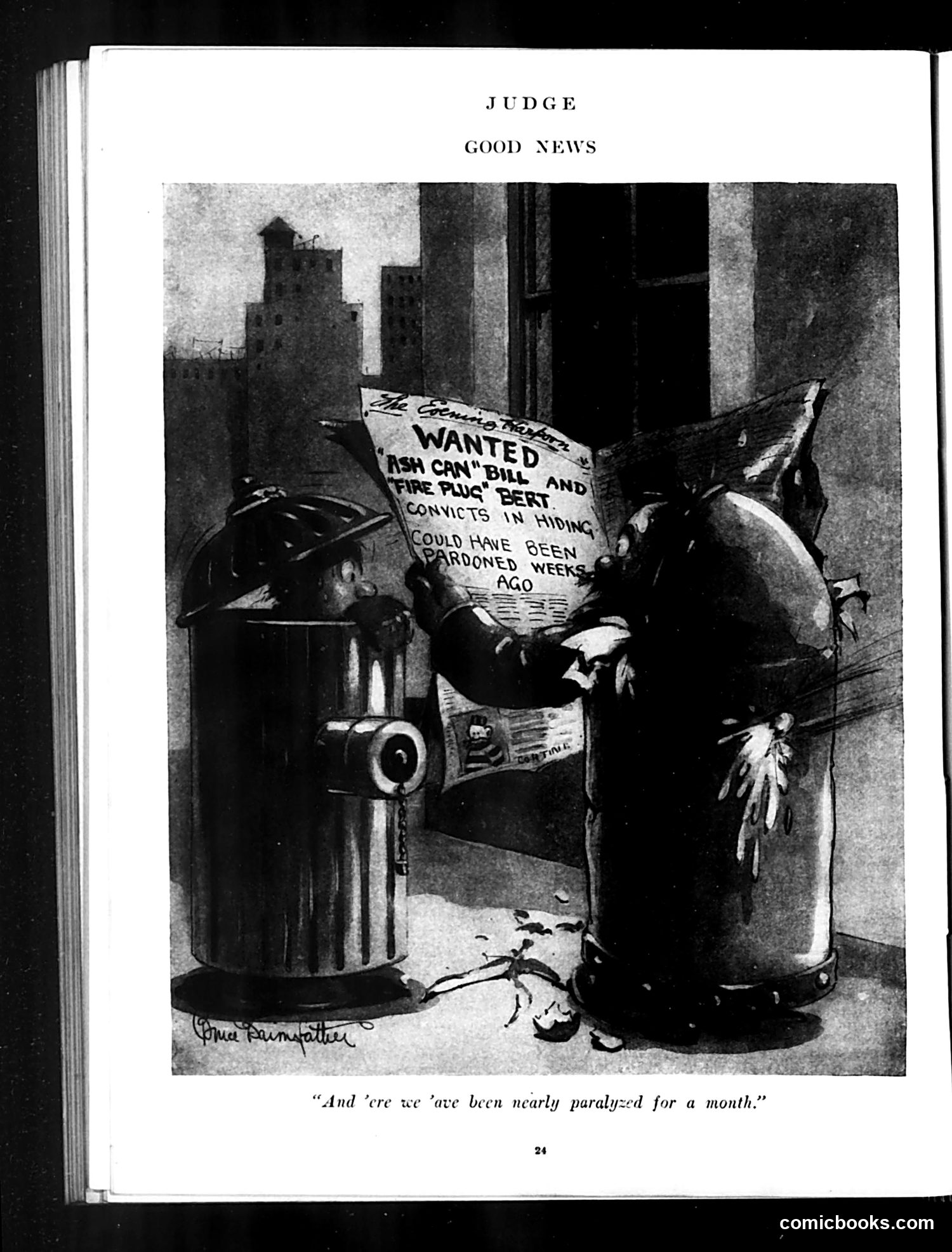
Cartoon Analysis: "Judge - Good News" This political cartoon depicts two anthropomorphized trash cans discussing a wanted poster. The poster advertises rewards for criminals ("Ash Can" Bill and "Fire Plug" Pete), noting they "could have been pardoned weeks ago." The satire appears to target the criminal justice system's inefficiency or corruption—specifically that dangerous criminals could have been released through pardons but weren't, leaving law enforcement "nearly paralyzed" by their continued threat. The trash-can characters likely represent either the police force or the justice system itself, rendered as lowly, unsavory figures reduced to dealing with society's refuse. The humor is darkly satirical: those responsible for public safety are depicted as literal garbage, while criminals slip through bureaucratic loopholes. Without a visible date, the specific criminals referenced remain unclear.
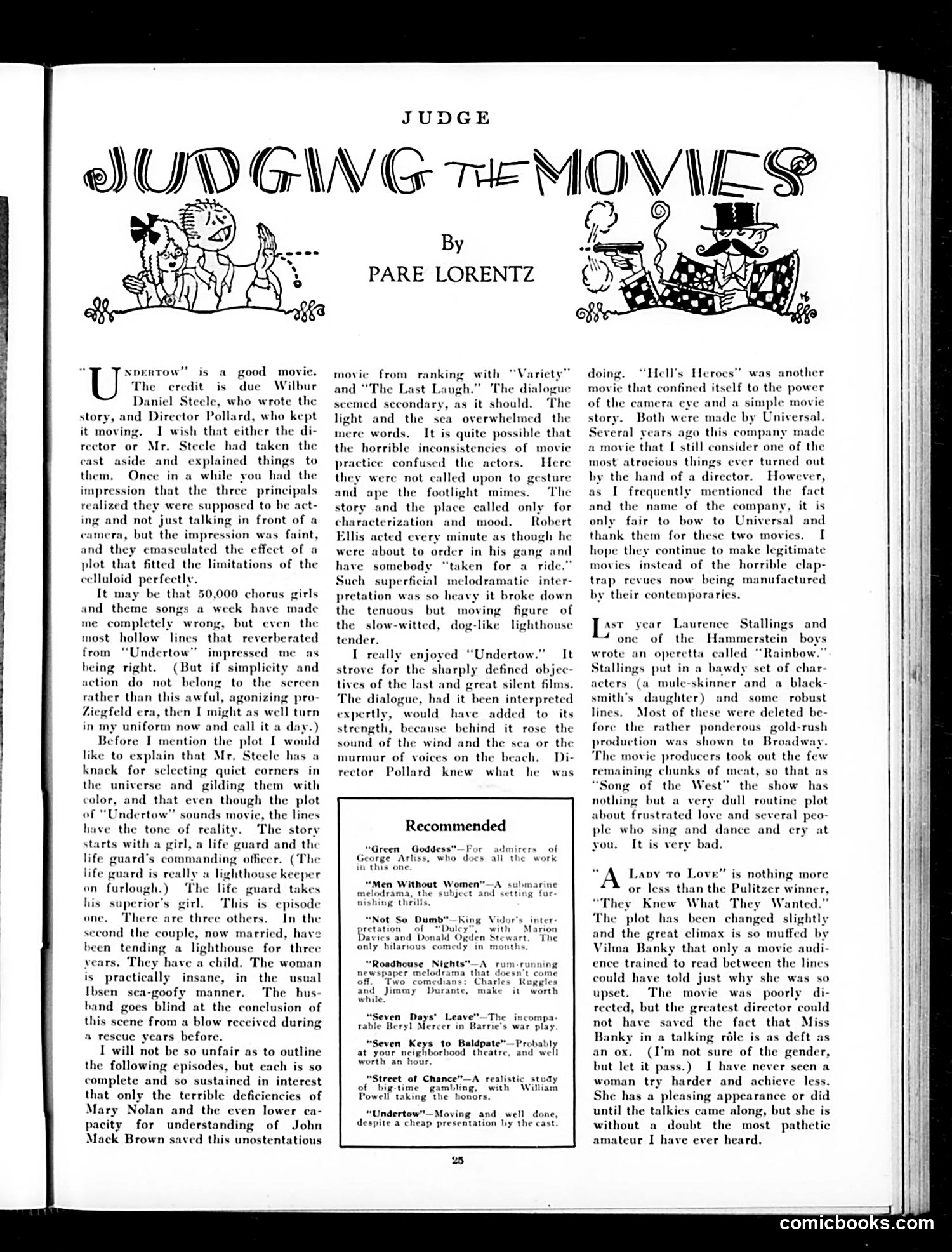
"Judging the Movies" by Pare Lorentz This page is a film review column from Judge magazine. The critic discusses silent films, primarily praising "Undertow" (directed by Pollard, written by Wilbur Daniel Steele) despite weak performances by lead actors Mary Nolan and John Mack Brown. The reviewer criticizes Nolan and Brown's acting as overwrought and melodramatic—particularly Brown, who played a lighthouse keeper, acting "as though he were about to order in his gang and have somebody 'taken for a ride'" (a gangster reference). The critic argues their hammy interpretations undermined the film's subtle emotional power. The page also includes a "Recommended" section listing other current films with brief reviews. The critic values atmospheric storytelling and restraint over theatrical gesture, reflecting 1920s debates about what silent cinema should be.
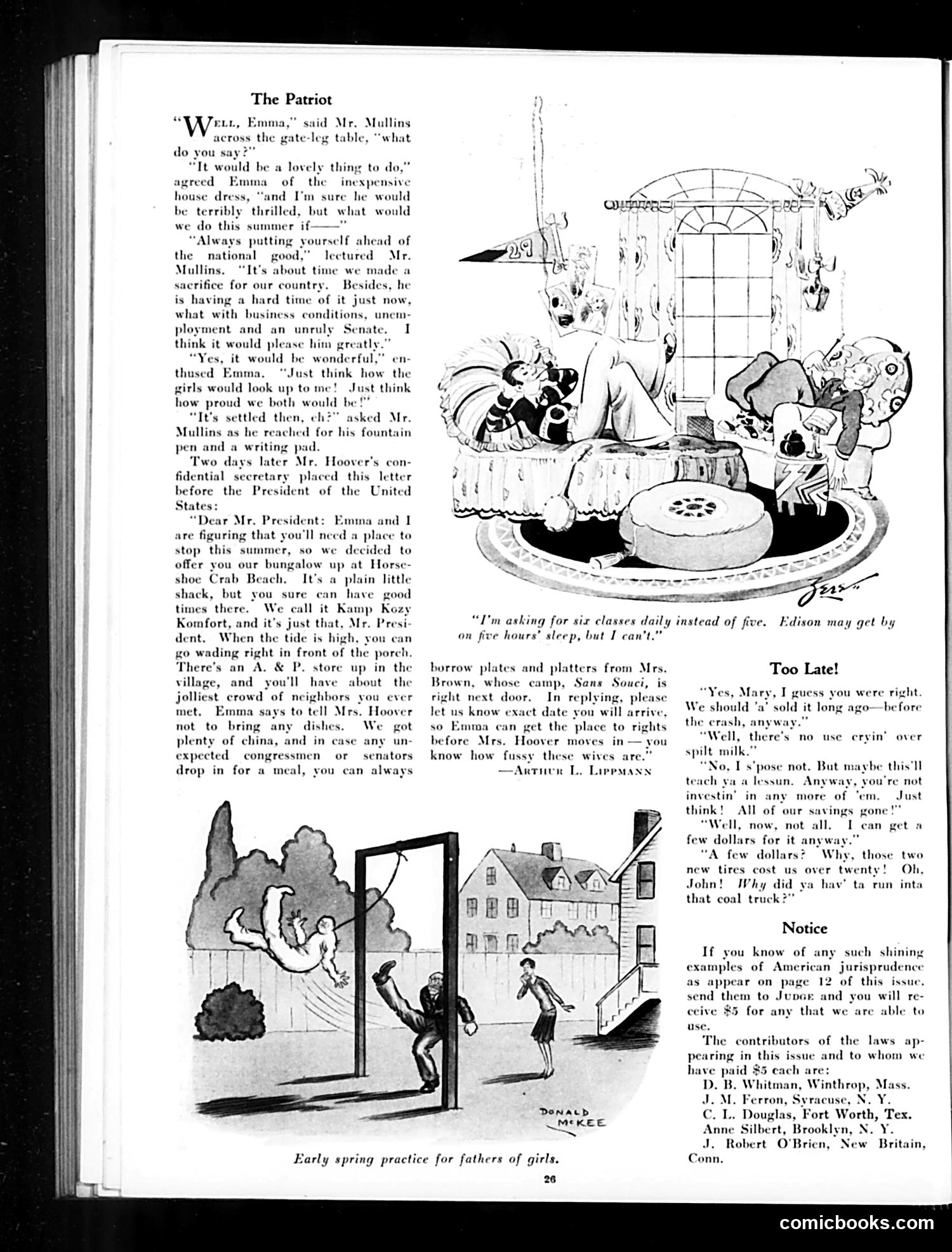
"The Patriot" - Judge Magazine Satire This page satirizes wealthy Americans' hollow patriotism during economic hardship (likely early 1930s Depression era). Main Cartoon: Mr. Mullins lectures his wife Emma about "sacrifice for our country," pressuring her to offer their beach bungalow to President Hoover as a patriotic gesture. The satire lies in the contrast: Mullins preaches national duty while admitting Hoover "is having a hard time of it just now with business conditions, unemployment"—yet offering a humble shack hardly constitutes real sacrifice. The couple congratulate themselves on their "patriotism" while making minimal actual contribution. Bottom Cartoon: "Early spring practice for fathers of girls" depicts girls on a swing, illustrating fathers' concern about their daughters' activities and safety—a social anxiety of the era. "Too Late!" Dialogue: A couple regrets not selling property before the stock market crash, lamenting lost savings—reflecting contemporary financial anxiety. The satire critiques performative patriotism: privileged Americans making token gestures while ordinary citizens suffer economic collapse.
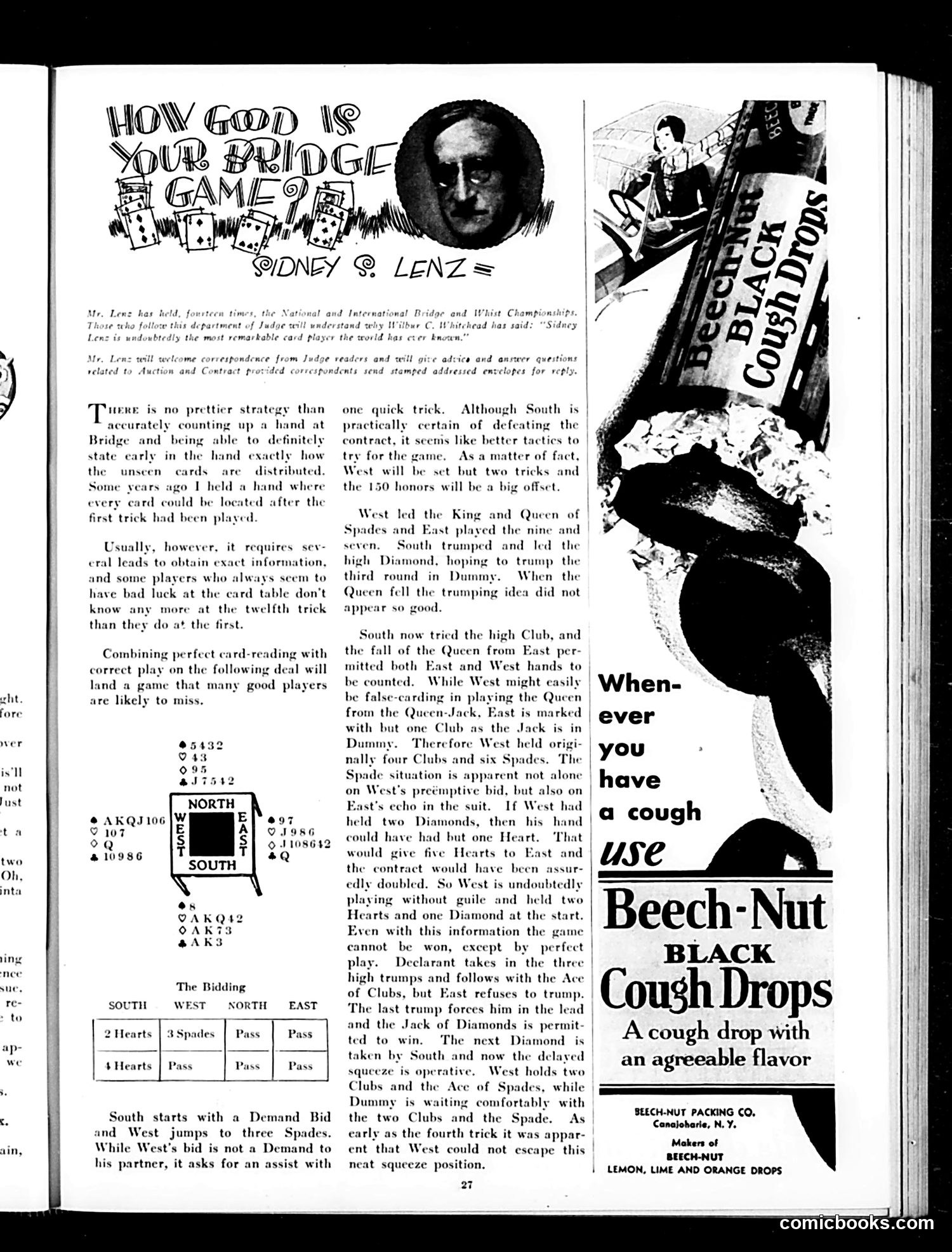
Explanation for Modern Readers This Judge magazine page combines bridge strategy instruction with advertising. The main content is a technical article by Sidney Lenz, a renowned bridge champion (identified in the header as a four-time National and International Bridge champion). The article teaches advanced card-reading and play strategy through a specific dealt hand. The cartoon element is minimal—primarily the illustrated portrait of Lenz at the top. The satire is subtle: Judge presents bridge expertise as almost mystical skill-reading, positioning Lenz as an authority figure whose analytical prowess borders on mind-reading ("How Good is Your Bridge Game?"). The right side features a Beech-Nut cough drops advertisement, unrelated to the editorial content—typical of magazine layouts from this era, where ads were interspersed with articles without thematic connection. The page demonstrates Judge's dual purpose: satirical commentary on American culture alongside practical advice and commercial advertising.
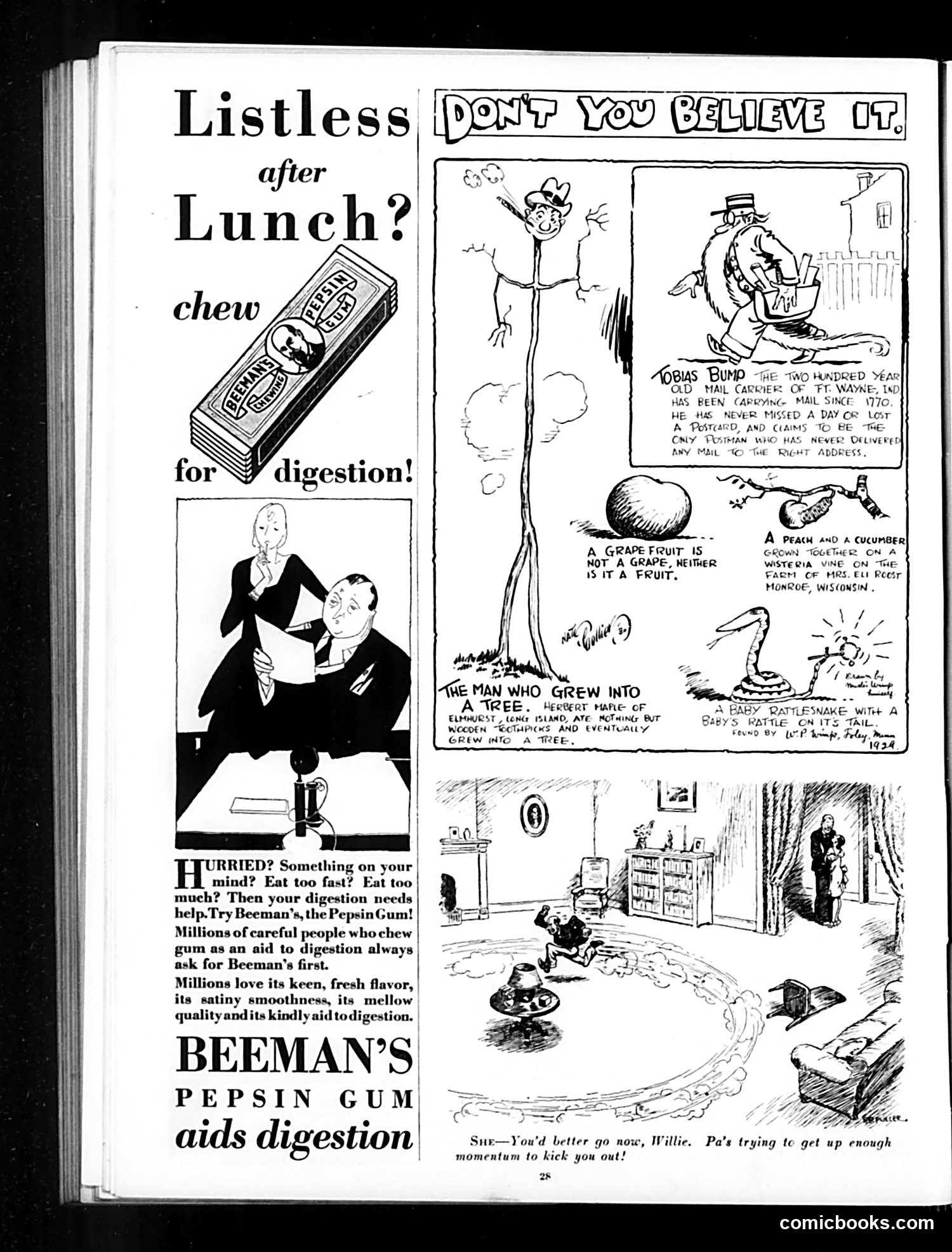
Page Analysis: Judge Magazine This page combines advertisement with humorous tall tales. The left side is a Beeman's Pepsin Gum advertisement targeting digestive complaints—a common pitch in early 20th-century advertising when medicinal products were heavily marketed for stomach issues. The right side features "Don't You Believe It!"—a recurring Judge feature presenting absurd, impossible claims as fake news/urban legends. Examples include: a postal carrier who's never delivered mail to the correct address (since 1770), a grapefruit that isn't actually a fruit, a man who grew into a tree after eating only wooden toothpicks, and a baby rattlesnake with a rattle on its tail. The bottom cartoon depicts a domestic scene where a wife warns her son Willie to leave before his father ("Pa") gains enough momentum to physically eject him—slapstick humor typical of the era. The satire targets gullible readers and absurd folk tales, while the advertisement exploits digestive anxiety—both reflective of 1930s popular culture.
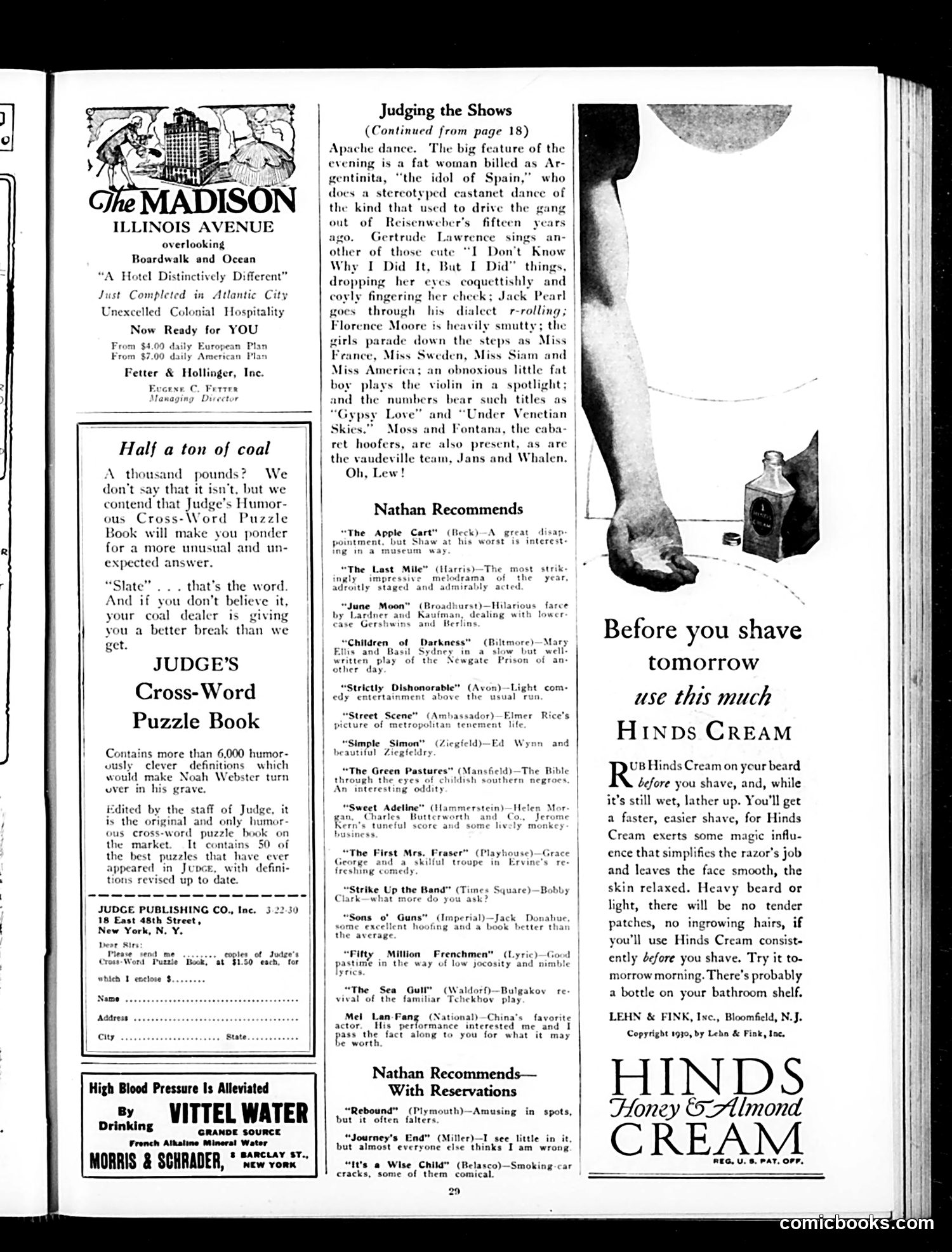
What This Page Means This is primarily an advertising and entertainment review page from Judge magazine, likely from the late 1920s. The main content is theater criticism by "Nathan" (likely drama critic George Jean Nathan), reviewing Broadway shows of the era. His reviews are brief, witty assessments—some favorable ("The Last Mile"), others dismissive (he found "Journey's End" overrated). The shows mentioned include musicals and comedies now-obscure. The satire appears subtle: a "Humor-ous Cross-Word Puzzle Book" advertisement jokes that a coal dealer gives a better price than Judge does for its own puzzle book, implying Judge's rates were absurdly high. The page is otherwise filled with period advertisements—a hotel in Atlantic City, mineral water, and notably a Hinds Cream shaving product with detailed instructions, typical of early 20th-century grooming ads targeting men. The tone throughout is lighthearted, aimed at educated urban readers interested in theater and consumer goods.
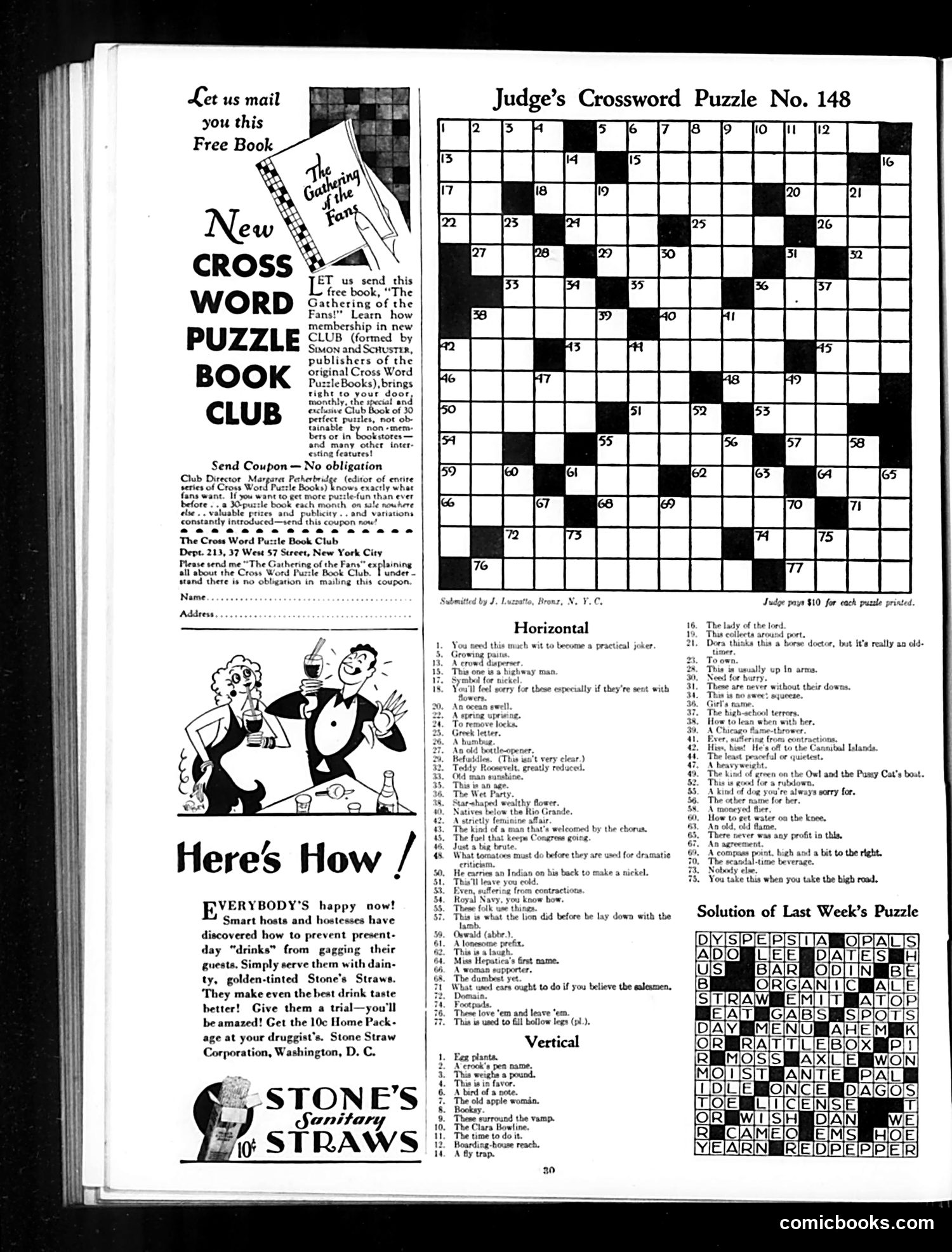
Judge Magazine Crossword Puzzle Page (Undated) This page is primarily advertising and puzzle content, not satire. It features: Main Content: - Judge's Crossword Puzzle No. 148 (a standard grid puzzle) - A subscription pitch for a new "Cross Word Puzzle Book Club" offering monthly exclusive puzzle books - The solution to the previous week's puzzle Advertising: The page includes a prominent ad for Stone's Sanitary Straws (10¢), promoting them as a solution to making alcoholic drinks more palatable—a reference to Prohibition-era concerns about "drinks" that "gag" guests. The ad humorously suggests serving cocktails through straws improves the drinking experience. Historical Context: This appears to be from the crossword puzzle craze of the 1920s-30s, when such puzzles were wildly popular entertainment. The ad's Prohibition reference dates it to roughly that era. The cartoonish illustration shows two formally-dressed men enjoying drinks—typical Judge magazine style humor. The page primarily serves as a revenue vehicle through puzzle subscriptions and product advertising rather than delivering satirical commentary.
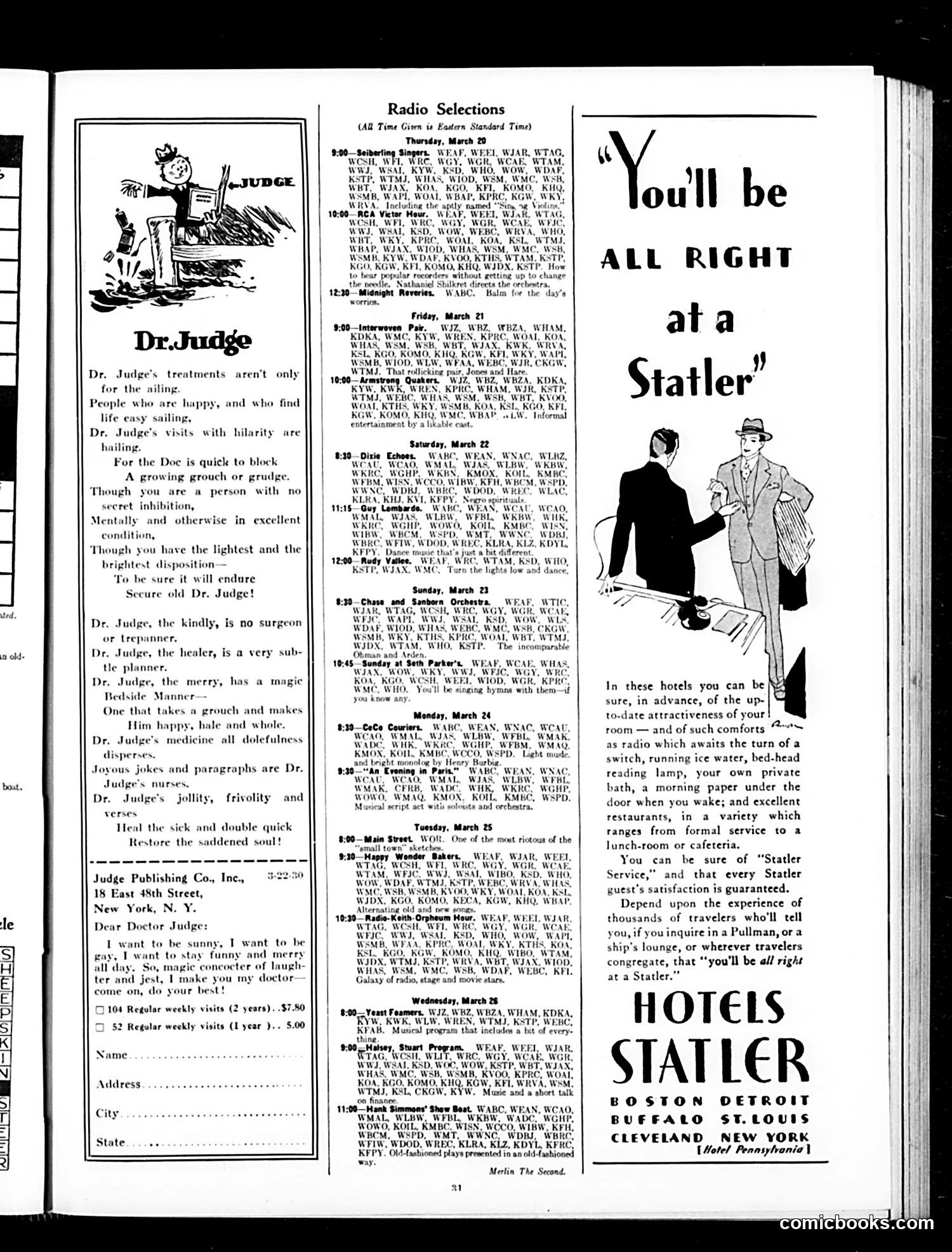
Dr. Judge Advertisement and Radio Programming This page contains advertising and editorial content for *Judge* magazine itself, not political satire targeting external figures. The left side promotes "Dr. Judge"—a personified metaphor for the magazine itself. Judge positions its humor as medicinal: it cures unhappiness, blocks "grudges," and provides "jollity" and "frivolity" as healing treatments. This was common early 20th-century advertising rhetoric, presenting humor magazines as remedies for modern life's anxieties. The right side advertises the Statler Hotel chain, emphasizing advance reservation guarantees and comfort amenities (private bath, newspaper, radio). Modern readers should note: this reflects an era when such features were luxury selling points. The center lists radio programming schedules—relevant because radio was the dominant entertainment medium competing with print magazines for audience attention in the 1930s. No specific political figures or events are caricatured here. The content is primarily commercial and self-promotional.
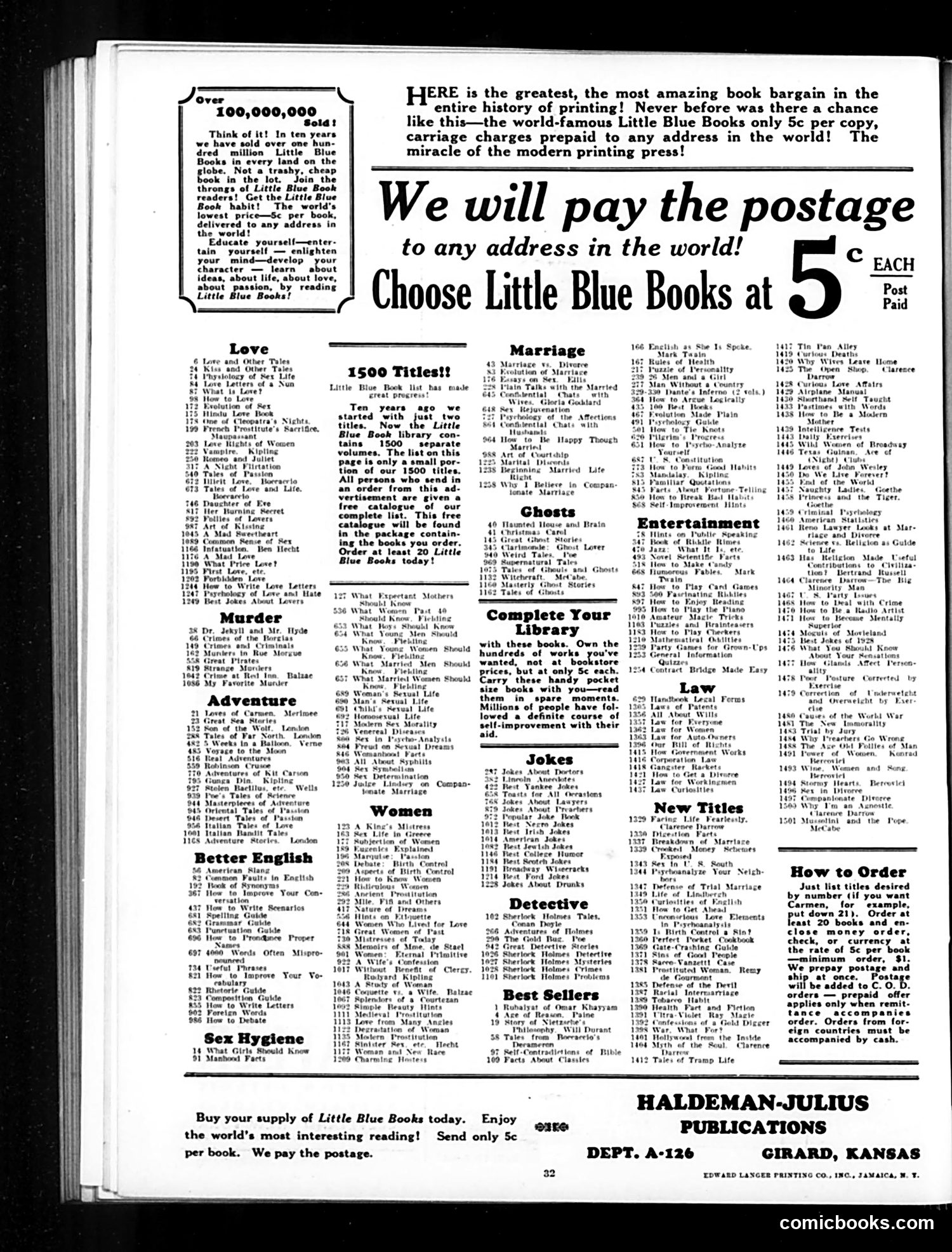
Little Blue Books Advertisement This is a mail-order book advertisement, not a political cartoon. The page promotes Haldeman-Julius Publications' "Little Blue Books"—inexpensive pocket-sized volumes selling for 5 cents each with prepaid postage. The catalog lists approximately 1,500 titles across categories: literature (adventure, romance), self-help (sex education, public speaking), classics, detective stories, and humor. The heavy emphasis on sex-related content (marriage, birth control, venereal disease, homosexuality, prostitution) reflects 1920s-30s progressive publishing—educational works considered scandalous by mainstream standards. The marketing pitch targets self-improvement seekers: "Educate yourself—enlighten your mind." This reflects early 20th-century democratic ideals about affordable mass education. The boast of "100,000,000 sold" advertises the publisher's success reaching working-class readers who couldn't afford expensive hardcover books.
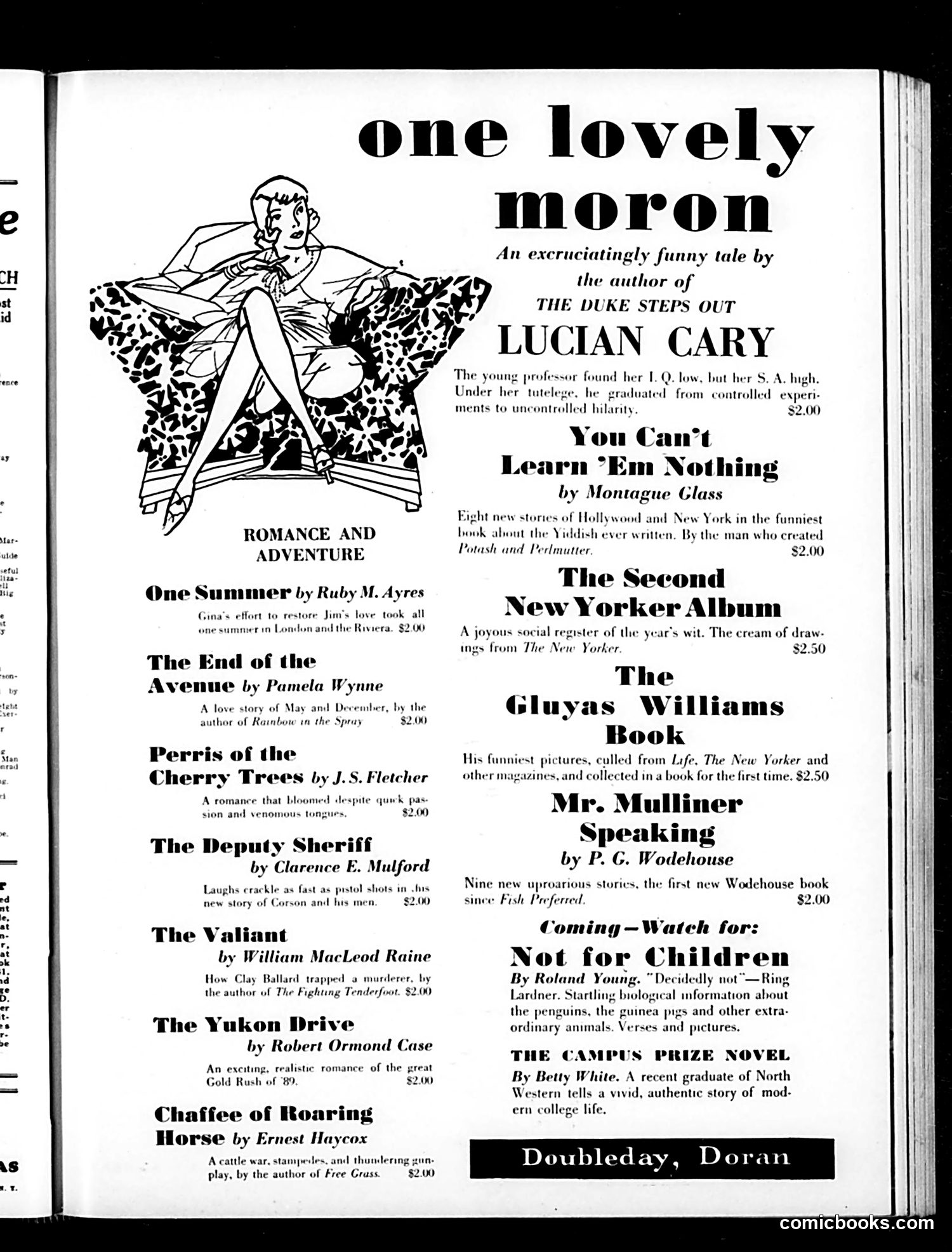
Judge Magazine Book Advertisement Page This is primarily a book advertisement page, not a political cartoon. The central illustration shows a stylized woman in 1920s fashion reclining on a patterned chair—a typical "cheesecake" style advertisement image common to the era, promoting "One Lovely Moron" by Lucian Cary. The page lists various books for sale, mostly light fiction and humor collections. Notable titles include works by P.G. Wodehouse and collections from *The New Yorker* magazine. The ad copy uses period humor—the featured book's description plays on 1920s concerns about intelligence testing ("I.Q. low, but her S.A. high"). The content reflects Judge's focus: satirical commentary through humor writing and cartooning, rather than hard-hitting political satire. This appears to be a publisher/bookseller advertisement section rather than editorial content—essentially Judge's version of a modern book review or promotion page.

Analysis This is primarily a Texaco oil company advertisement, not political satire. It appears in *Judge*, a satirical magazine, but functions as a full-page commercial rather than commentary. The ad emphasizes Texaco's global reach, claiming the product is sold in 46 foreign countries and 48 U.S. states. The photograph shows a crowded street scene in Singapore, establishing an exotic, international setting. The advertisement's central message is that American consumers can buy identical Texaco Golden Motor Oil abroad as at home—positioning the product as universally reliable across extreme climates (Singapore's heat, Iceland's cold). The implicit boast is American industrial superiority and quality control: Texaco's consistency worldwide proves its excellence. There's no visible satire or caricature here—rather, it's straightforward corporate messaging leveraging globalism as a marketing strength during an era when international distribution was noteworthy and prestigious.