judge
Judge — March 29, 1930
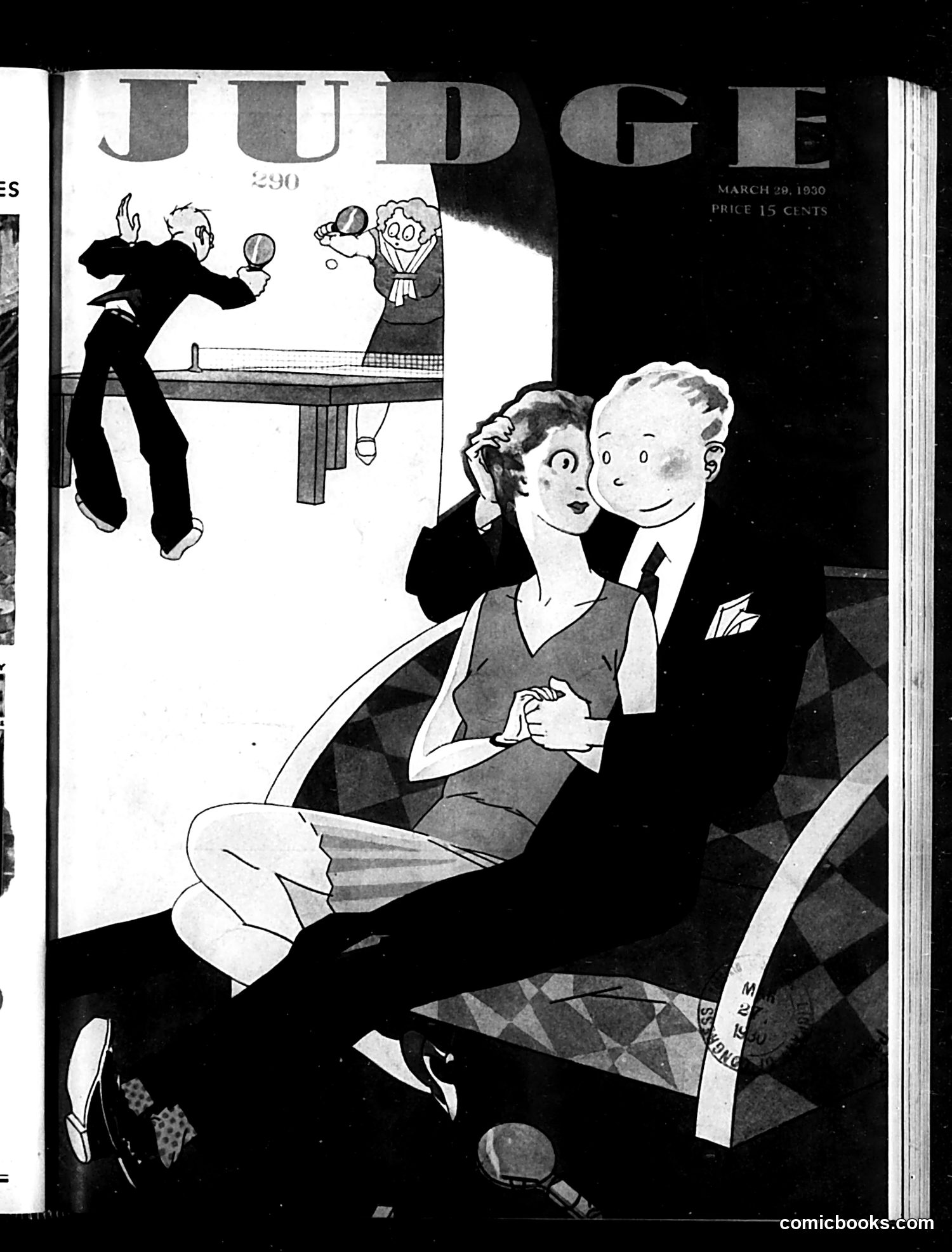
Judge Magazine, March 28, 1950 This cover depicts a couple watching ping-pong players through what appears to be a window or viewing area. The man has an exaggerated, vacant expression while the woman leans affectionately against him. The humor likely plays on the contrast between the energetic, competitive activity shown in the background (the ping-pong game) and the couple's passive leisure—suggesting they're absorbed spectators at a social venue, possibly a recreation club or sports facility. The man's comically blank expression may satirize male disengagement or boredom despite being out socially. The piece reflects 1950s leisure culture and gender dynamics, where such recreational activities were popular middle-class pastimes. The specific satirical point—whether directed at the couple's relationship, social customs, or entertainment culture—isn't entirely clear from the image alone.
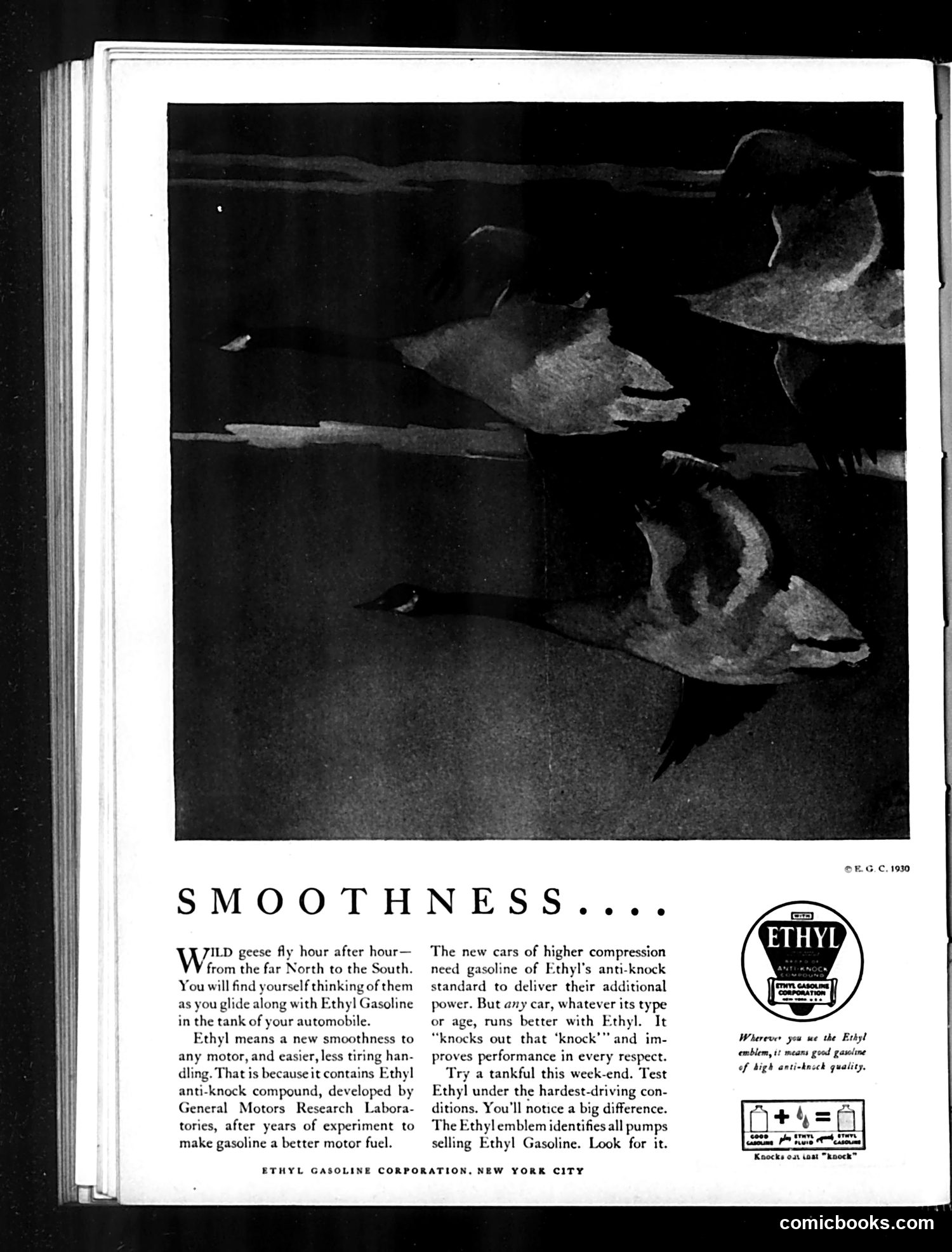
Analysis This page is primarily a paid advertisement, not satirical content. It's an Ethyl Gasoline Corporation ad from 1930 promoting their anti-knock fuel product. The image shows flying geese in formation, used metaphorically: the "smoothness" of geese flying in coordinated flight represents the smooth engine performance Ethyl Gasoline promises. The ad claims that modern high-compression cars require Ethyl's special formula to eliminate engine "knock" and improve performance. The text emphasizes Ethyl's anti-knock compound (developed by General Motors Research Laboratories) as superior to standard gasoline. The call-to-action encourages readers to test Ethyl fuel themselves. This reflects 1930s automotive marketing, when anti-knock gasoline was a significant innovation and competitive selling point.
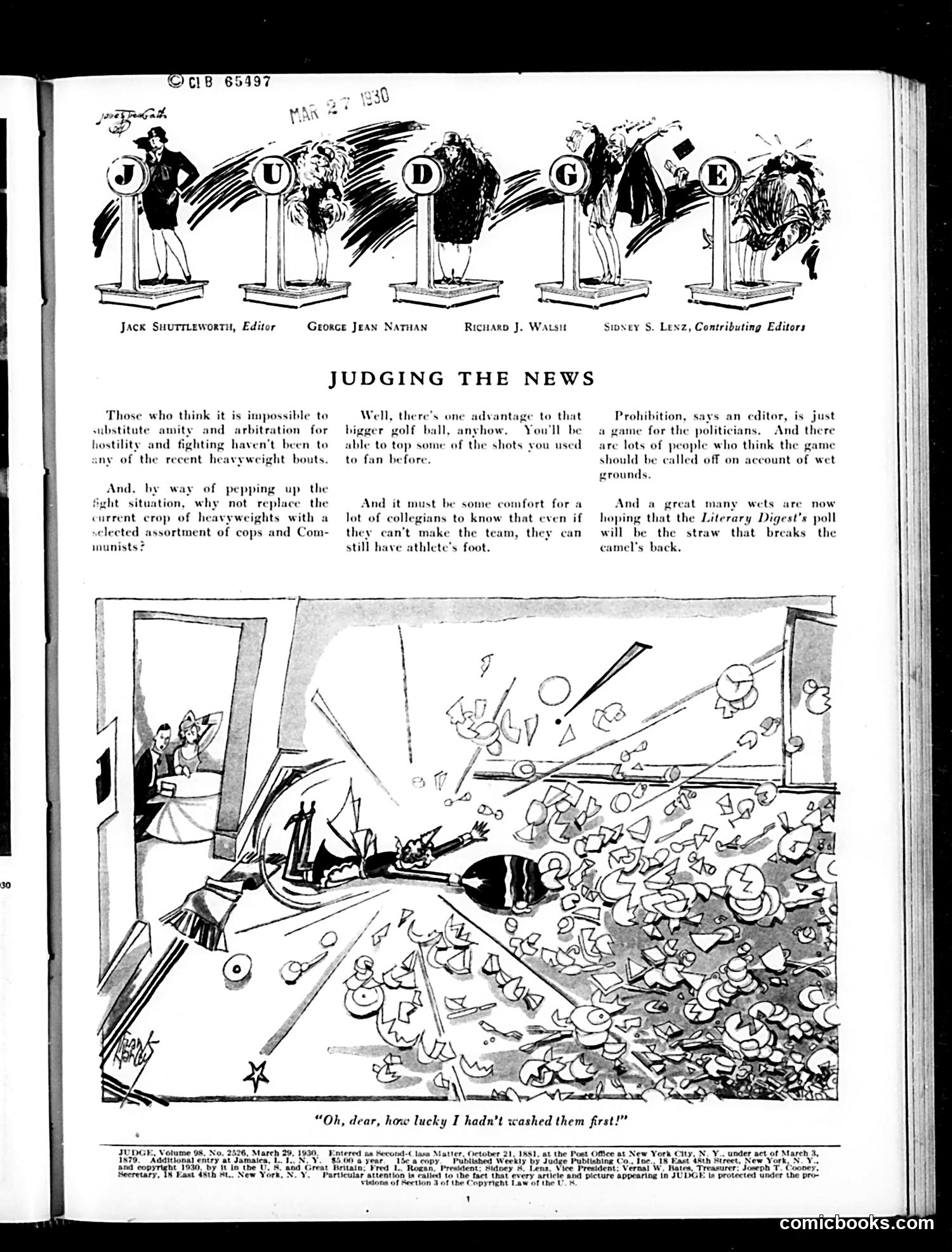
"Judging the News" - March 29, 1930 This satirical page critiques editorial decisions about what constitutes newsworthy content. The header features five editors labeled J, U, D, G, and E (spelling "JUDGE"), representing the magazine's editorial team including Jack Shuttleworth (Editor) and George Jean Nathan. The main cartoon depicts a domestic catastrophe—a room in chaos with broken items everywhere—captioned "Oh, dear, how lucky I hadn't washed them first!" The satire contrasts trivial domestic concerns with serious news judgment. The accompanying text mocks editors who sensationalize minor conflicts while debating replacing "current crop of heavyweight bouts" with other content, suggesting editorial obsession with scandal over substance. The piece criticizes how news judgment becomes a political game manipulated by those seeking coverage.
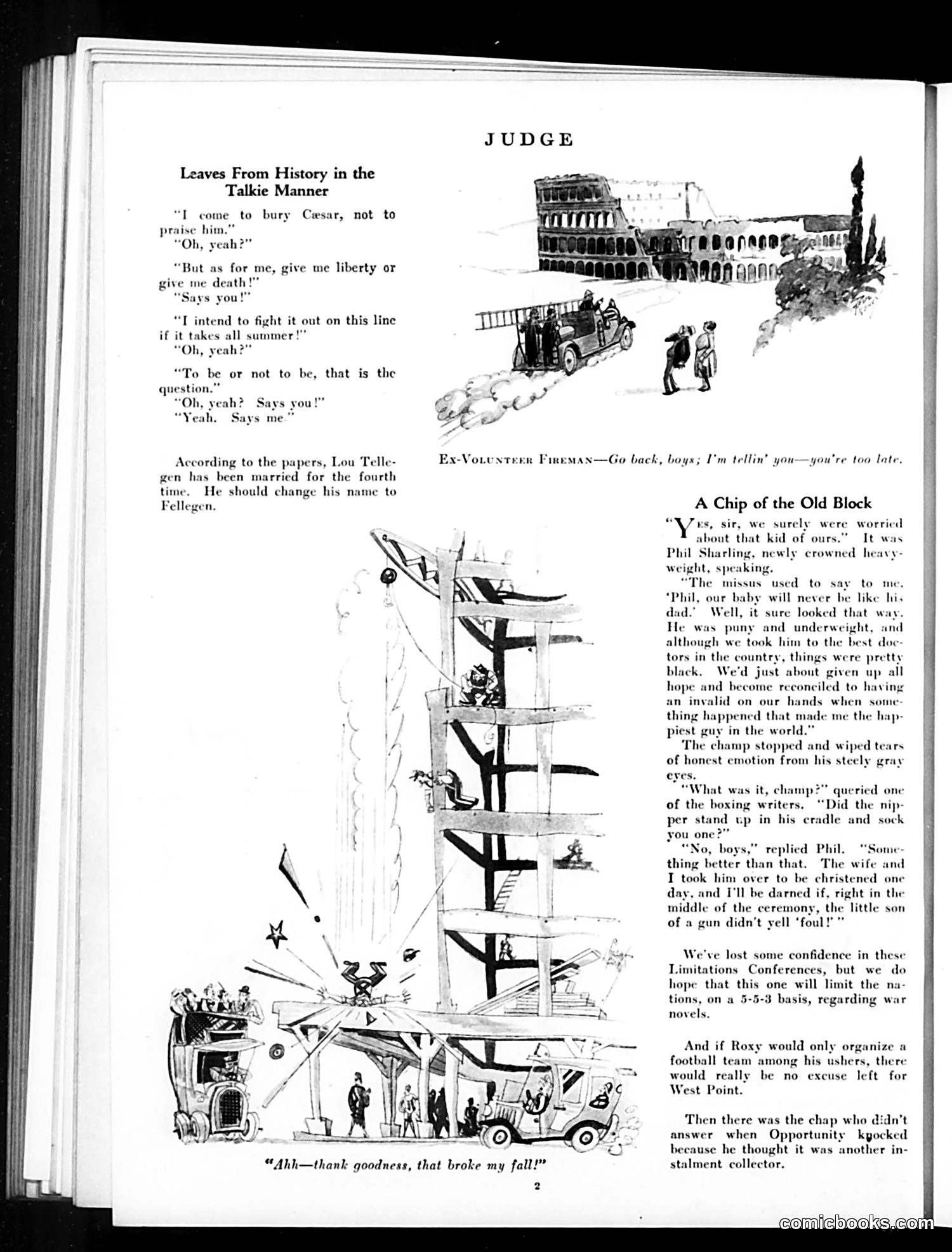
Analysis of Judge Magazine Page This page contains two distinct sections: Left side ("Leaves From History"): A Shakespeare parody featuring famous lines from *Julius Caesar*, presented as modern dialogue with "Oh, yeah?" responses. This satirizes contemporary speech patterns by contrasting them with classical literature—a common humor device mocking modern colloquialism. Right side ("A Chip of the Old Block"): A story about Phil Starling, a newly crowned heavyweight boxing champion. The narrative describes his humble origins and physical weakness as a child, contrasting with his current success. The accompanying illustration shows a multi-story building collapse with figures at various levels, captioned "Ahh—thank goodness, that broke my fall!"—a visual gag unrelated to the text above it. The page reflects Judge's blend of literary satire and sports-focused humor typical of early-to-mid 20th century American magazines.
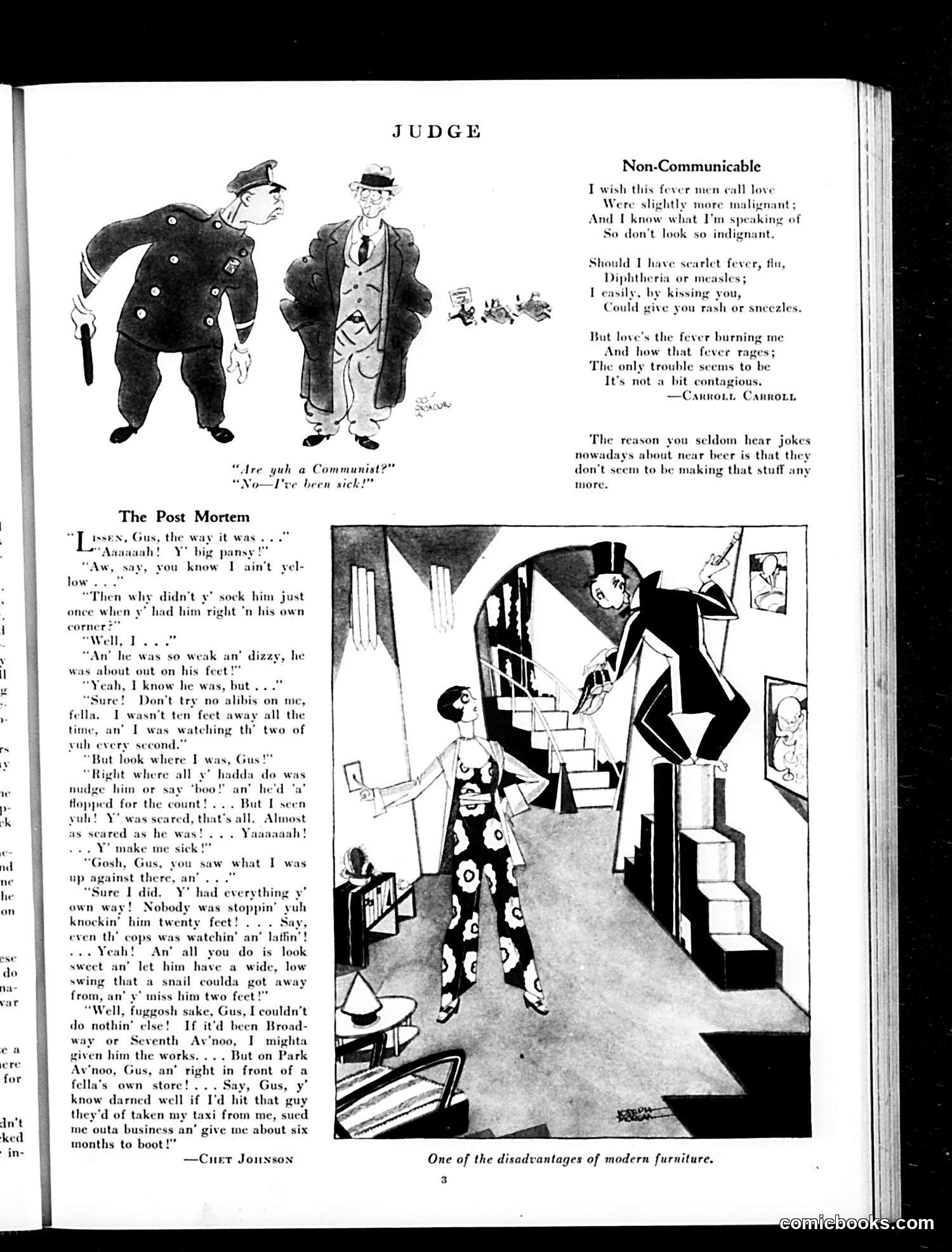
Analysis of Judge Magazine Page Top Cartoon: Shows a military officer interrogating a civilian, asking "Are yuh a Communist?" The civilian replies "No—I've been sick!" This appears to satirize anti-communist paranoia, possibly from the Red Scare era, mocking how authorities suspected anyone who was absent or unwell of political radicalism. "The Post Mortem" Story: A humorous anecdote about a man who accidentally hit someone during a street fight, with consequences for his taxi business. It's character-driven humor rather than political satire. Bottom Illustration: Captioned "One of the disadvantages of modern furniture," shows a tall, spindly-legged chair unable to support a woman's weight—social satire about impractical contemporary design prioritizing aesthetics over function.
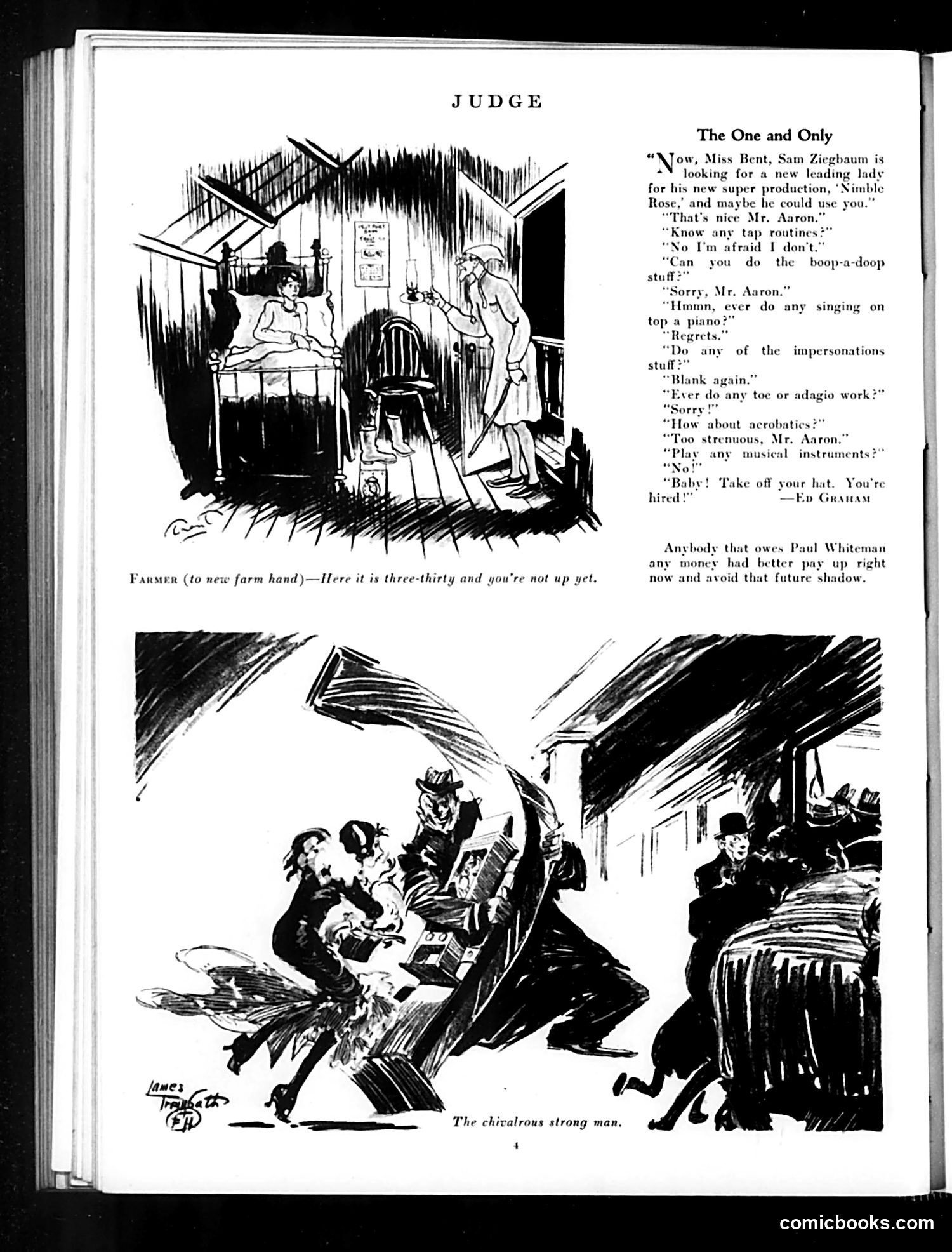
Analysis This page contains two separate satirical cartoons from *Judge* magazine. Top cartoon ("The One and Only"): Shows a theatrical casting director interviewing a performer. The dialogue mocks a talentless vaudeville act, with the director asking increasingly absurd questions ("Can you do the hoop-a-doop doop?" "Ever do any singing on a piano?") to which the performer desperately answers "Sorry, Mr. Aaron" or "Regrets." The joke satirizes the entertainment industry's desperation to find talent for "super production" films. Bottom cartoon ("The chivalrous strong man"): Depicts a brawling street scene with multiple figures fighting. The title's irony suggests commentary on masculine violence or disputes over money, referencing a warning about Paul Whiteman debts. Both target early 1920s entertainment industry absurdities and financial conflicts.
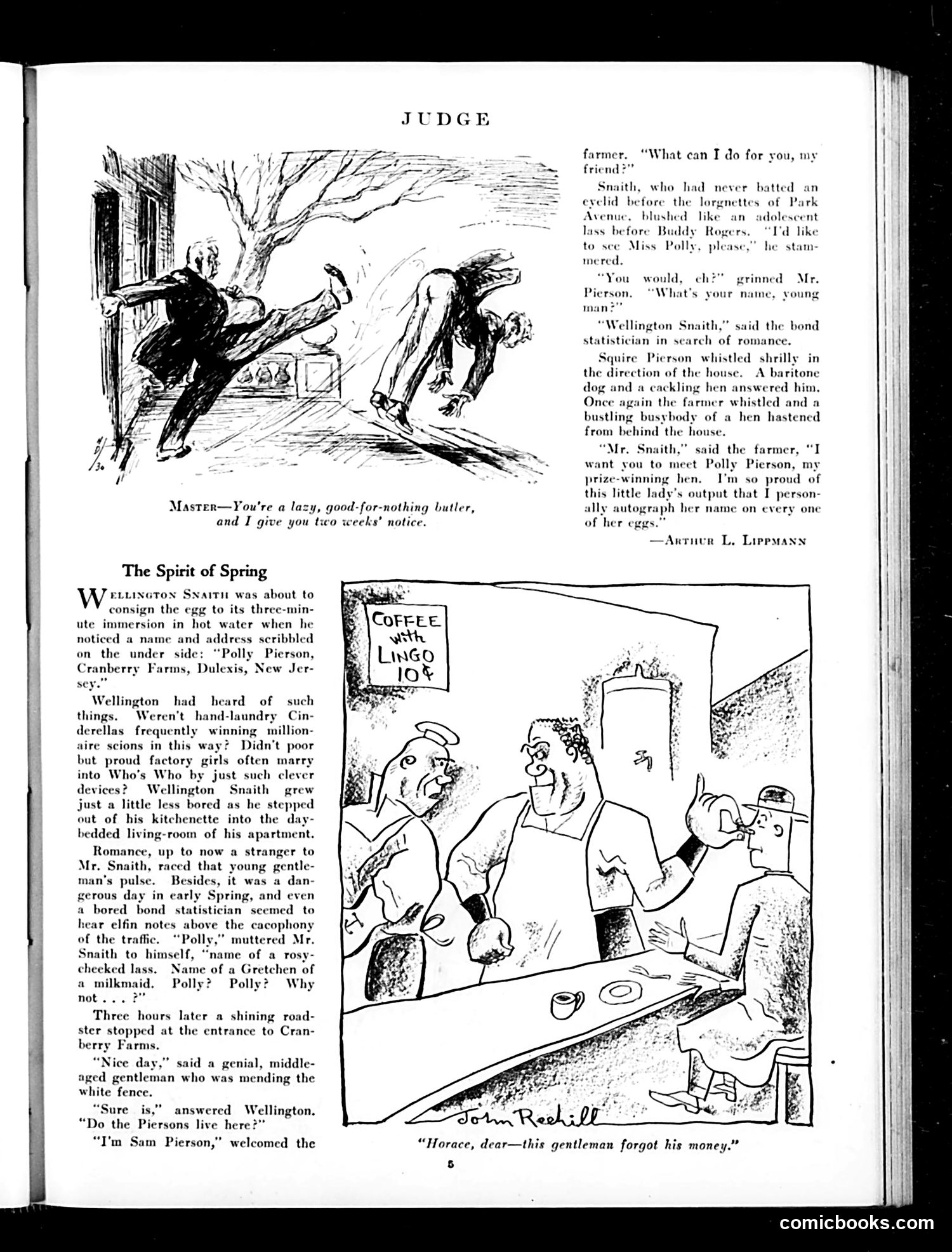
Analysis of Judge Magazine Page This page contains two unrelated pieces: a top cartoon titled "Judge" showing a man being kicked out by a farmer (with caption about being a "lazy, good-for-nothing butler"), and below it a humorous story "The Spirit of Spring" by Arthur L. Lippmanns. The main story concerns Wellington Smith, who discovers an egg labeled "Polly Pierson, Cranberry Farms, Dulcesis, New Jersey." Through the narrative, we learn Polly is a prize-winning hen whose owner has autographed her eggs. The accompanying cartoon shows a coffee shop scene where a gentleman has forgotten his money—the humor deriving from everyday domestic or commercial mishaps rather than political satire. This appears to be general-interest humor content typical of early-20th-century Judge magazine.
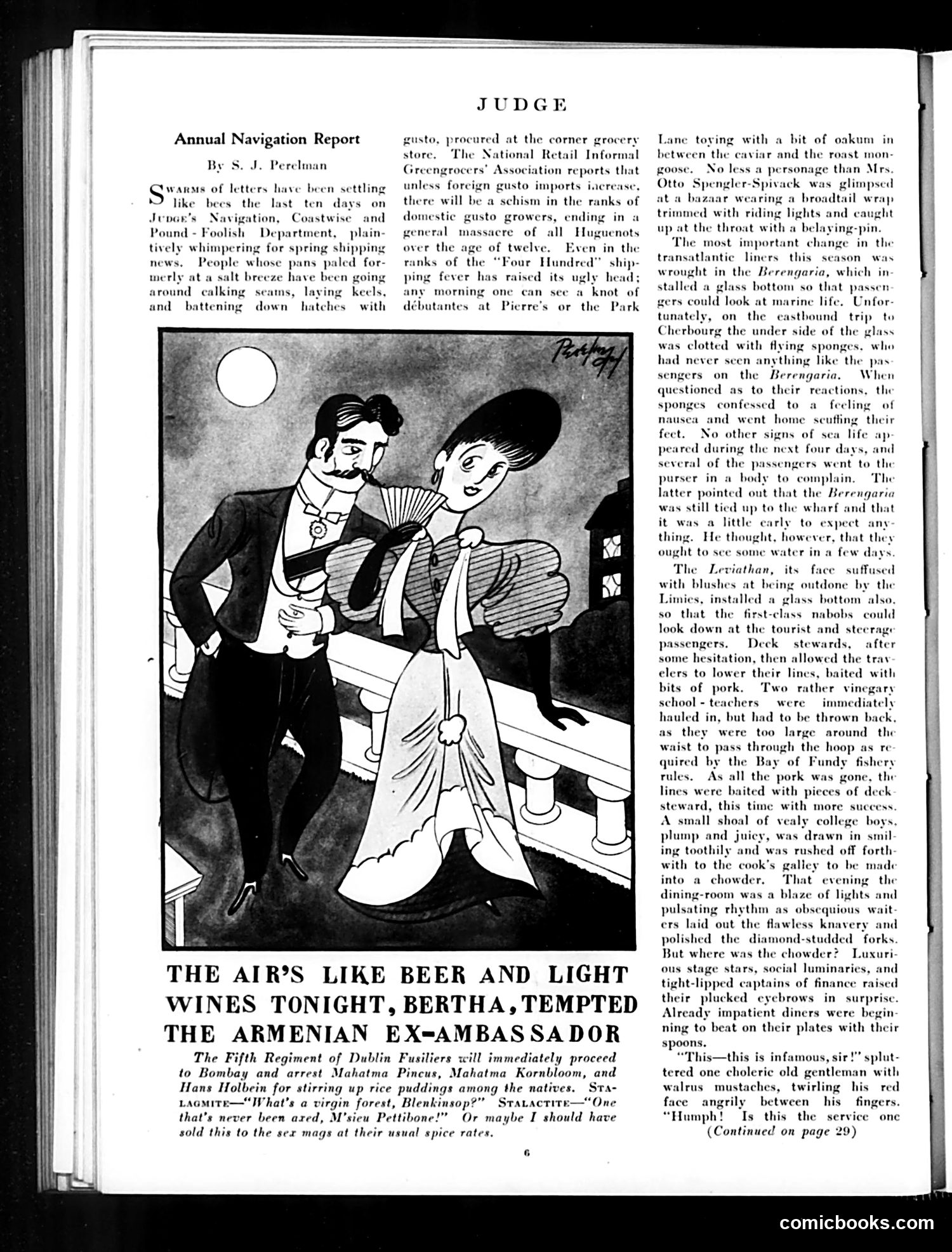
Analysis of Judge Magazine Page This page contains a humorous illustration titled "The Air's Like Beer and Light Wines Tonight, Bertha, Tempted the Armenian Ex-Ambassador." The cartoon depicts a well-dressed man and woman on what appears to be a ship's deck, with the man offering her a drink. The caption references Mahatma Pincus, Mahatma Kornbloom, and other Jewish-sounding names, alongside food references (pudding, rice) and Yiddish-inflected English dialogue ("Blenkinsop?"). The humor appears to target Armenian and Jewish immigrant communities through ethnic stereotyping common to 1920s satirical magazines. The accompanying article discusses ocean liner amenities and passenger experiences, suggesting this is leisure-travel satire combined with ethnic caricature typical of Judge's era.
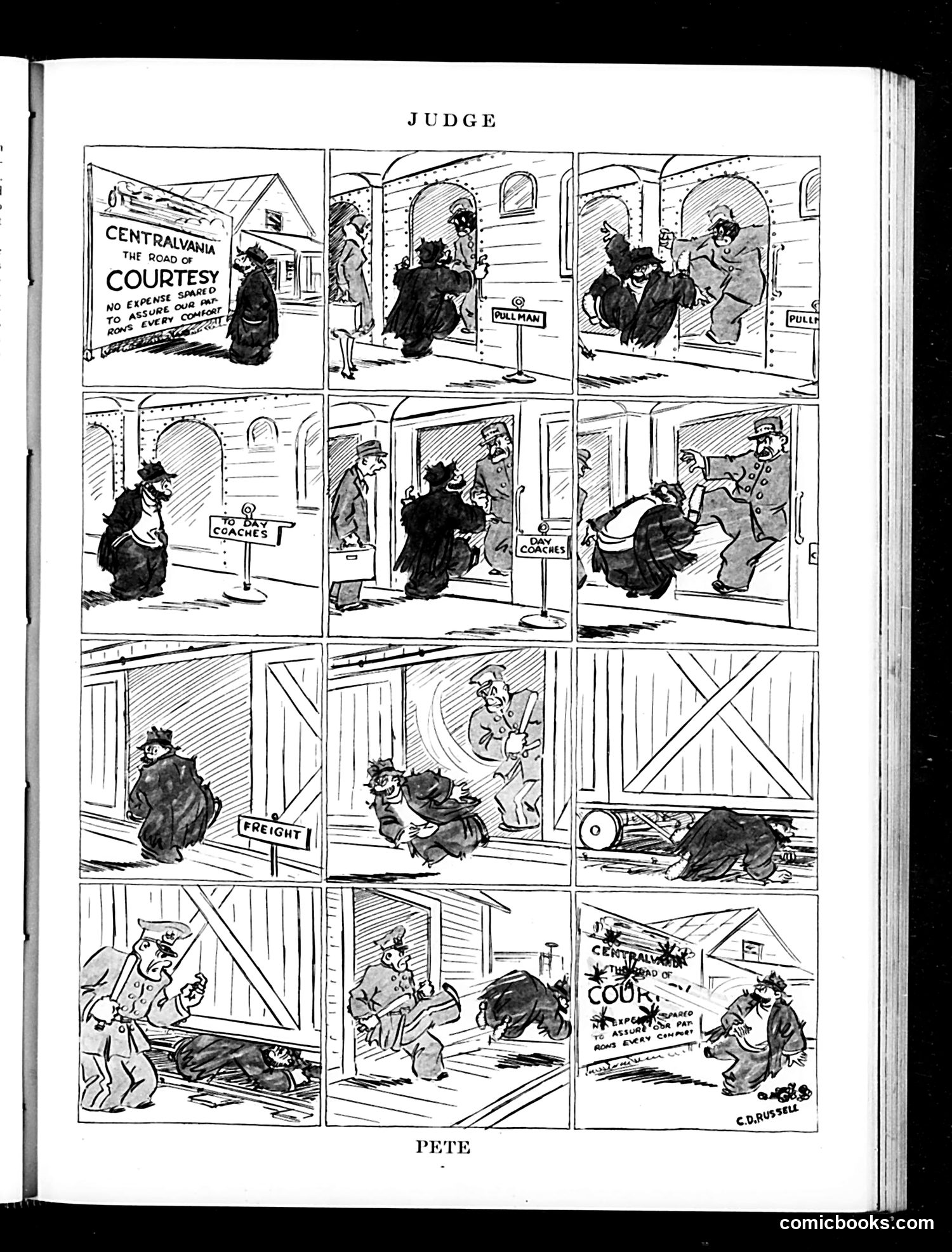
Analysis This comic strip satirizes the Central Railroad's "Road of Courtesy" slogan through the journey of a passenger named Pete. The narrative shows stark contrast between the railroad's advertised promises of comfort and courtesy versus the actual experience: overcrowded conditions, rude staff, poor service in dining cars, and inadequate facilities (marked "FREIGHT" and "COACHES"). The humor derives from the gap between corporate marketing rhetoric and reality. Each panel progressively undermines the railroad's courtesy claims—crowded platforms, dismissive conductors, chaotic meal service, and substandard accommodations. The final panel, showing Pete outside a "Centralvania Cook" establishment, suggests the railroad experience was so poor he's relieved to be done with it. This represents typical Progressive-era muckraking journalism in *Judge*, targeting corporate hypocrisy and poor service to common travelers.
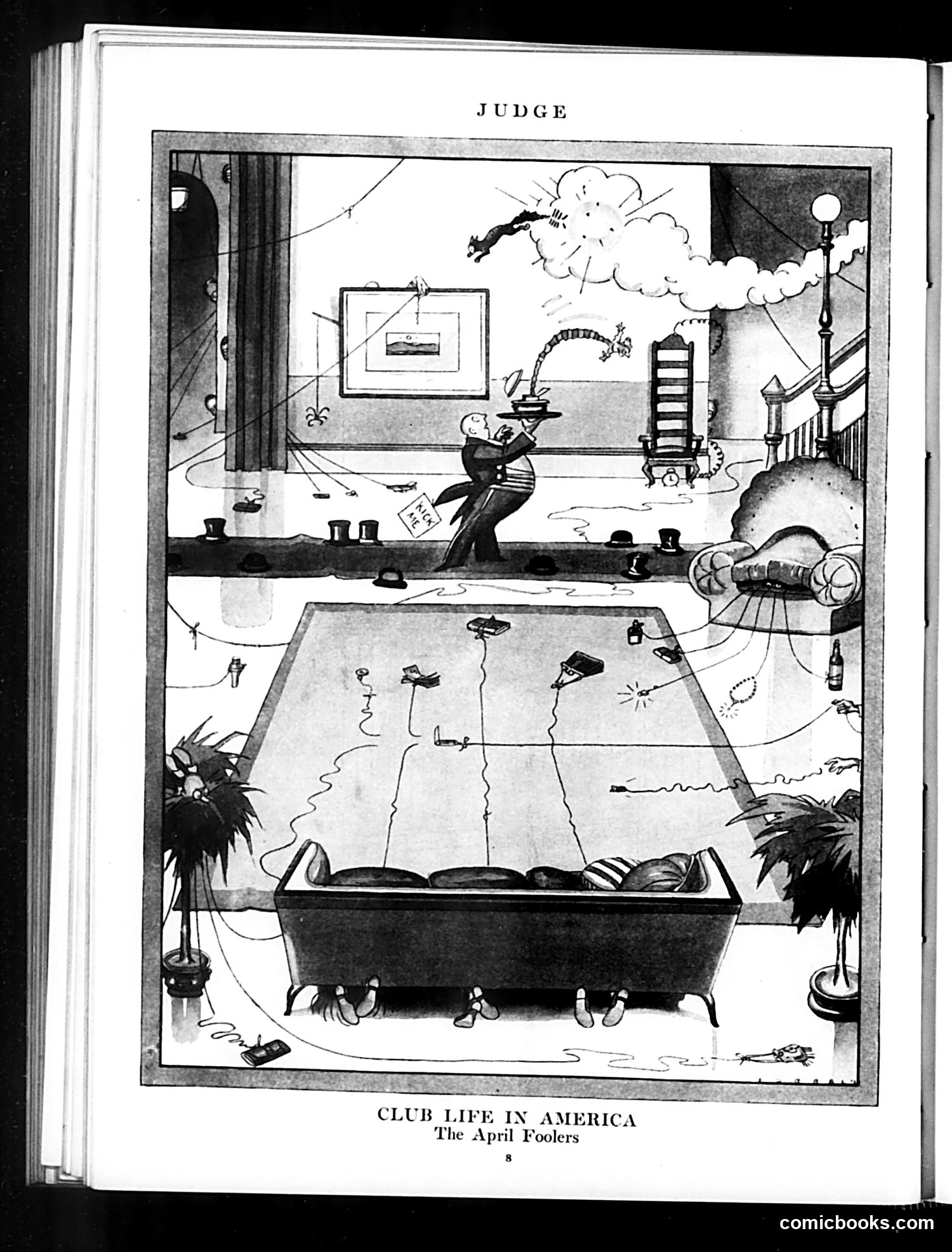
"Club Life in America: The April Foolers" This cartoon satirizes an exclusive men's club during April Fools' Day. The scene depicts chaos in what appears to be a gentlemen's club—a well-appointed space with a large bathtub, palm plants, and period furnishings. A well-dressed man (likely a club member or servant) stands amid mayhem: explosives detonate, objects fly about, and pranks unfold everywhere. The title "April Foolers" suggests club members are engaging in elaborate April 1st practical jokes and tomfoolery. The satire targets wealthy club culture and its members' juvenile behavior—despite their refined setting and social pretensions, they devolve into childish antics. The cartoon mocks both the exclusivity of such clubs and the foolishness of grown men abandoning dignity for pranks.
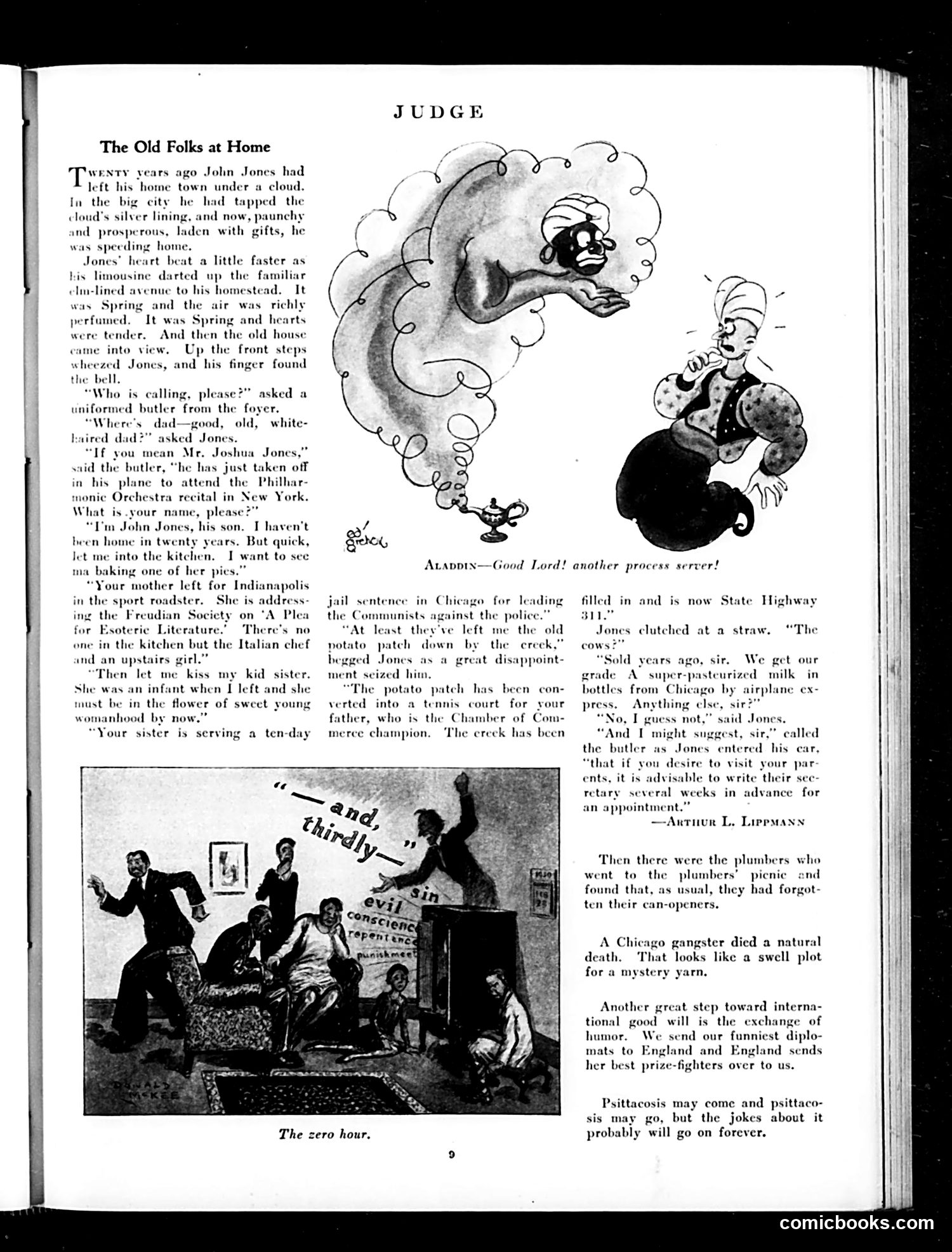
"The Old Folks at Home" — Judge Magazine Satire This story satirizes the hollowness of American success and the erosion of traditional family life by modern excess. John Jones, who left his hometown twenty years ago in disgrace, has become wealthy in the city. Returning home expecting a sentimental reunion, he finds his entire family has abandoned their modest roots: - His father attends Philadelphia orchestra recitals by plane - His mother lectures on Freudian psychology in Indianapolis - His sister serves jail time for Communist activism - The family's humble potato patch is now a tennis court; cows are replaced by pasteurized milk delivery The butler's final suggestion—that Jones must schedule visits weeks in advance—delivers the punchline: modern prosperity has made family connection impossible. The accompanying cartoon "The Zero Hour" depicts moral decay ("sin," "evil conscience," "punishment"), reinforcing the satirical message that material success corrupts traditional values and family bonds. The satire targets both nouveau riche pretension and the rapid social upheaval of the Jazz Age era.
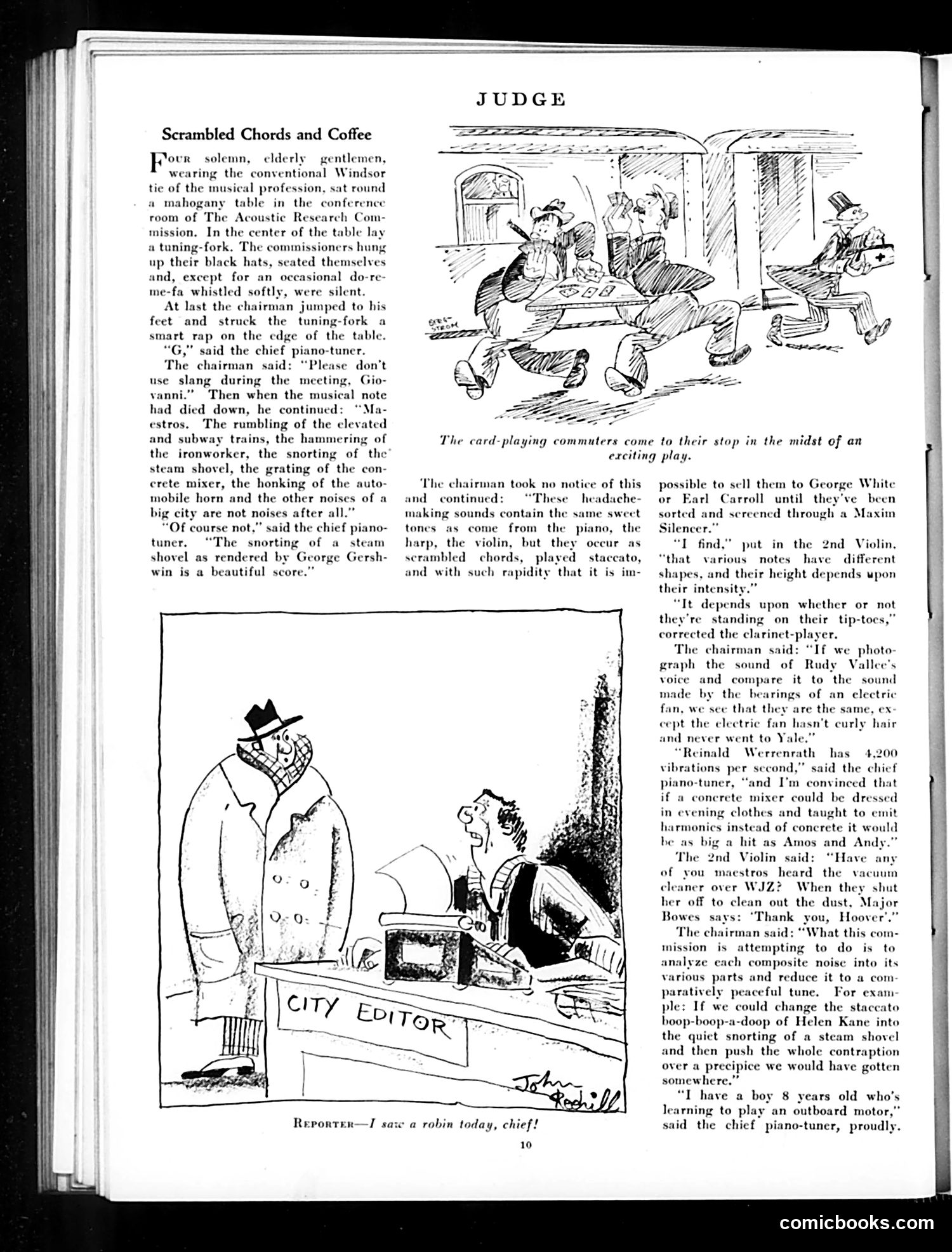
Explanation for Modern Readers This satirical piece mocks the pretentiousness of classical musicians and music theorists who attempt to find artistic legitimacy in urban noise. The "Acoustic Research Commission"—four stuffy gentlemen in Windsor ties—convenes to argue that city sounds (subway rumbles, jackhammers, car horns) are actually "scrambled chords" worthy of serious musical consideration. The joke operates on multiple levels: it ridicules both the musicians' snobbery (rejecting "slang" terminology) and their absurd pseudo-scientific approach to noise. References to composer George Gershwin, crooner Rudy Vallée, and singers Helen Kane and Reinald Werrenrath anchor the satire in 1920s-30s popular culture—these are contemporary entertainers the theorists might reluctantly acknowledge. The separate cartoon shows a harried newspaper "City Editor" besieged by demands, satirizing journalism's chaos as equally worthy of musical composition. The underlying satire: pretentious intellectuals will rationalize anything as art, no matter how ridiculous.
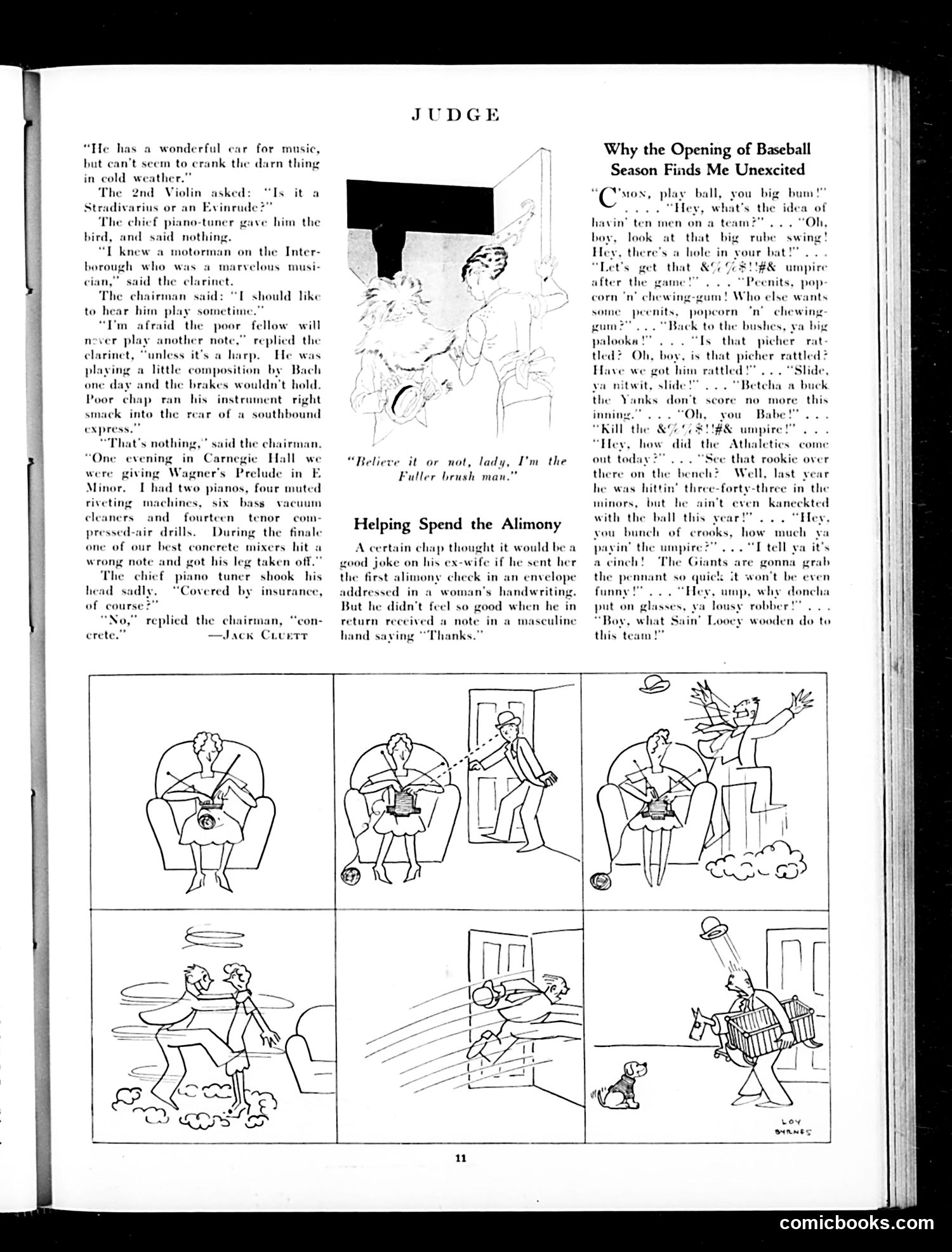
Judge Magazine Page Analysis This page contains three separate humor pieces typical of early 20th-century American satire: "Judge" column (top left): A series of anecdotes mocking musicians and orchestras, playing on the idea that even skilled musicians face ridiculous mishaps. The jokes reference classical composers (Bach, Wagner) and absurdist scenarios—a violinist who can't start his instrument in cold weather, a motorman-musician killed when his brakes fail, and a concert disrupted by industrial machinery hitting wrong notes. "Fuller Brush Man" cartoon (center): A visual gag about a man's divorce scheme—he sends his ex-wife an alimony check in feminine handwriting to make her jealous, but she responds in masculine handwriting with "Thanks," implying she's spending the money on a new romantic interest. "Baseball Season" commentary (right): Satirizes baseball fan culture through overheard stadium dialogue—capturing the cacophony of vendor calls, heckling, complaints about players and umpires, and general crowd noise. It mocks fan obsession and superstition (references to the Giants, Yankees, Athletics). All three pieces reflect period humor emphasizing domestic situations, workplace absurdities, and popular entertainment culture.
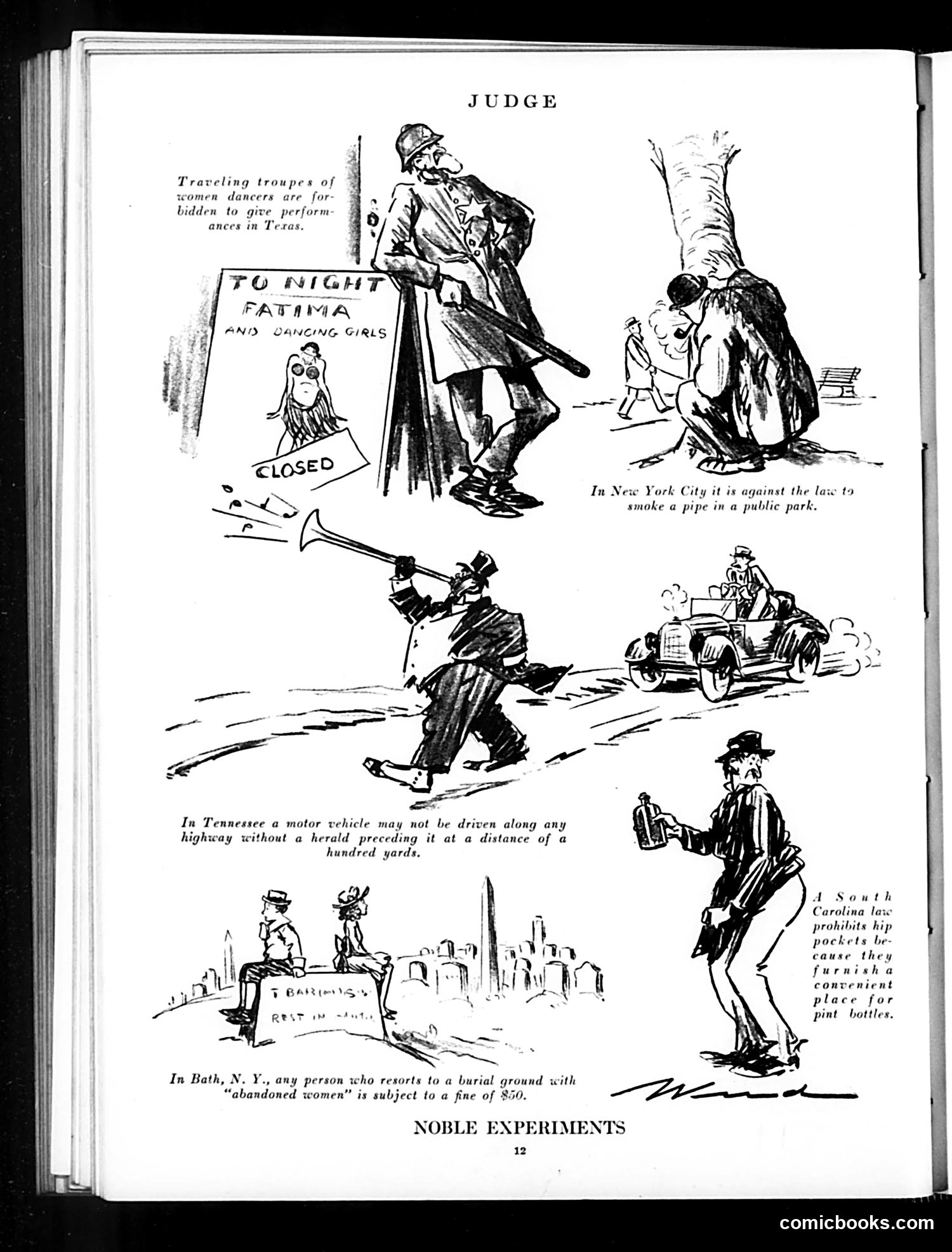
Analysis of "Judge" Cartoon Page: "Noble Experiments" This satirical page mocks absurd state and local laws through exaggerated drawings. Each vignette illustrates an actual (or plausibly real) regulation: - Texas bans female dancers: A judge closes a "Fatima and Dancing Girls" theater, referencing exotic dance performances that were considered scandalous. - New York pipe law: A man in a park faces enforcement of an oddly specific smoking restriction. - Tennessee herald requirement: A motorist must have someone announce his vehicle's arrival—an anachronistic, impractical regulation. - South Carolina hip pockets: A law supposedly prohibits hip pockets to prevent concealing bootleg alcohol (Prohibition-era context). - Bath, NY burial ground rule: A fine for visiting cemeteries with women of questionable morality. The cartoon title, "Noble Experiments," ironically celebrates these laws as well-intentioned but ridiculously ineffective attempts at social control. The satire targets government overreach and the gap between legislative intent and practical consequence.
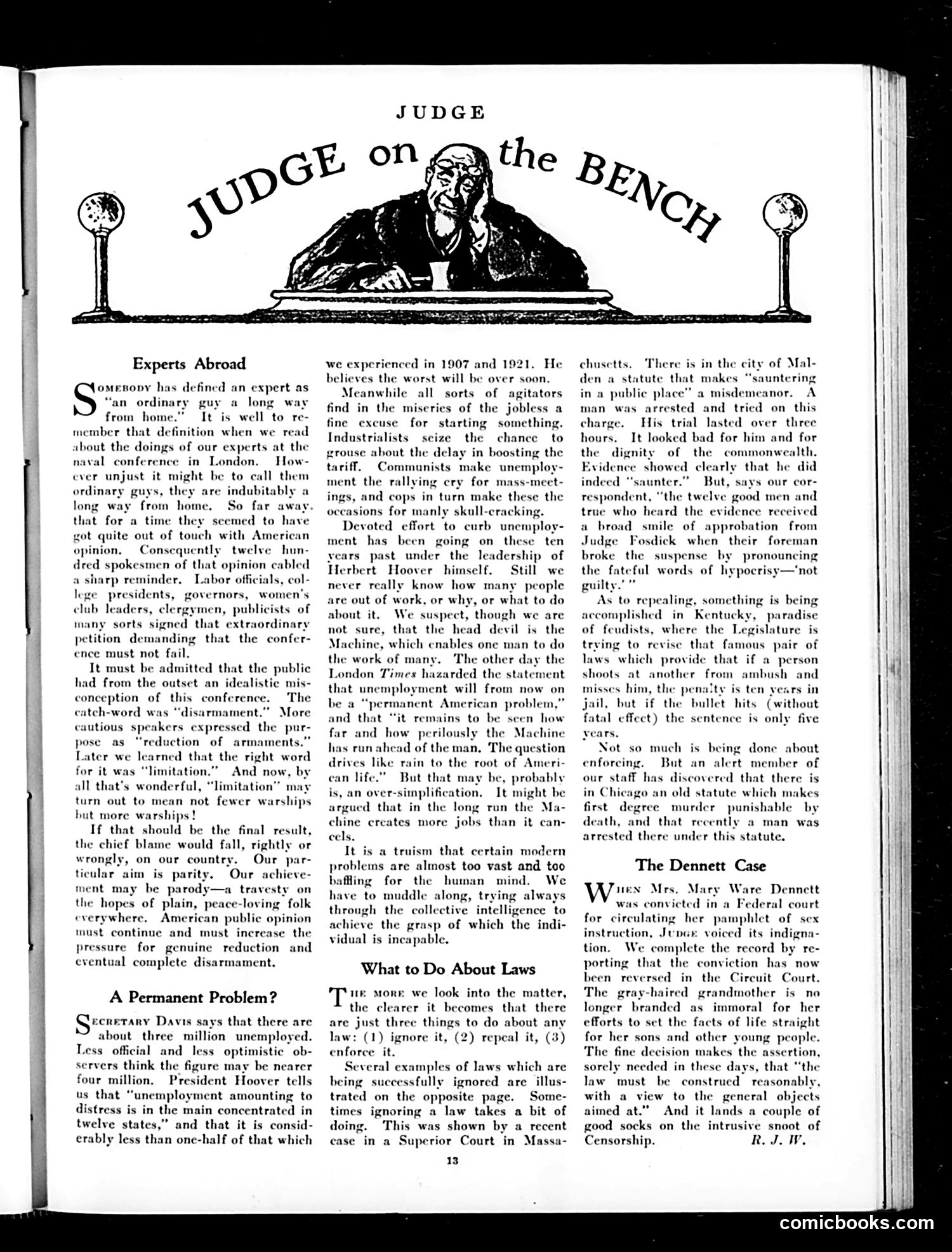
Judge Magazine Page Analysis This page from the satirical magazine *Judge* contains three distinct opinion pieces critiquing American governance and policy circa the late 1920s or early 1930s. "Experts Abroad" mocks U.S. naval negotiators at the London naval conference, accusing them of abandoning genuine disarmament goals ("reduction of armaments") in favor of mere "limitation"—which paradoxically means building *more* warships rather than fewer. The satire suggests American negotiators have strayed from public expectations of peace. "A Permanent Problem?" addresses unemployment (Secretary Davis claims 3 million jobless; critics estimate 4 million). The piece criticizes President Hoover's optimism while satirizing various groups exploiting joblessness—industrialists, communists—for their own agendas. It attributes unemployment partly to mechanization replacing workers. "What to Do About Laws" begins discussing three approaches to laws: ignore, repeal, or enforce them. The incomplete text references Massachusetts cases of laws being successfully ignored, setting up examples on the opposite page. The masthead illustration shows a stern judge, reinforcing the magazine's critical judicial tone toward government policies and enforcement.
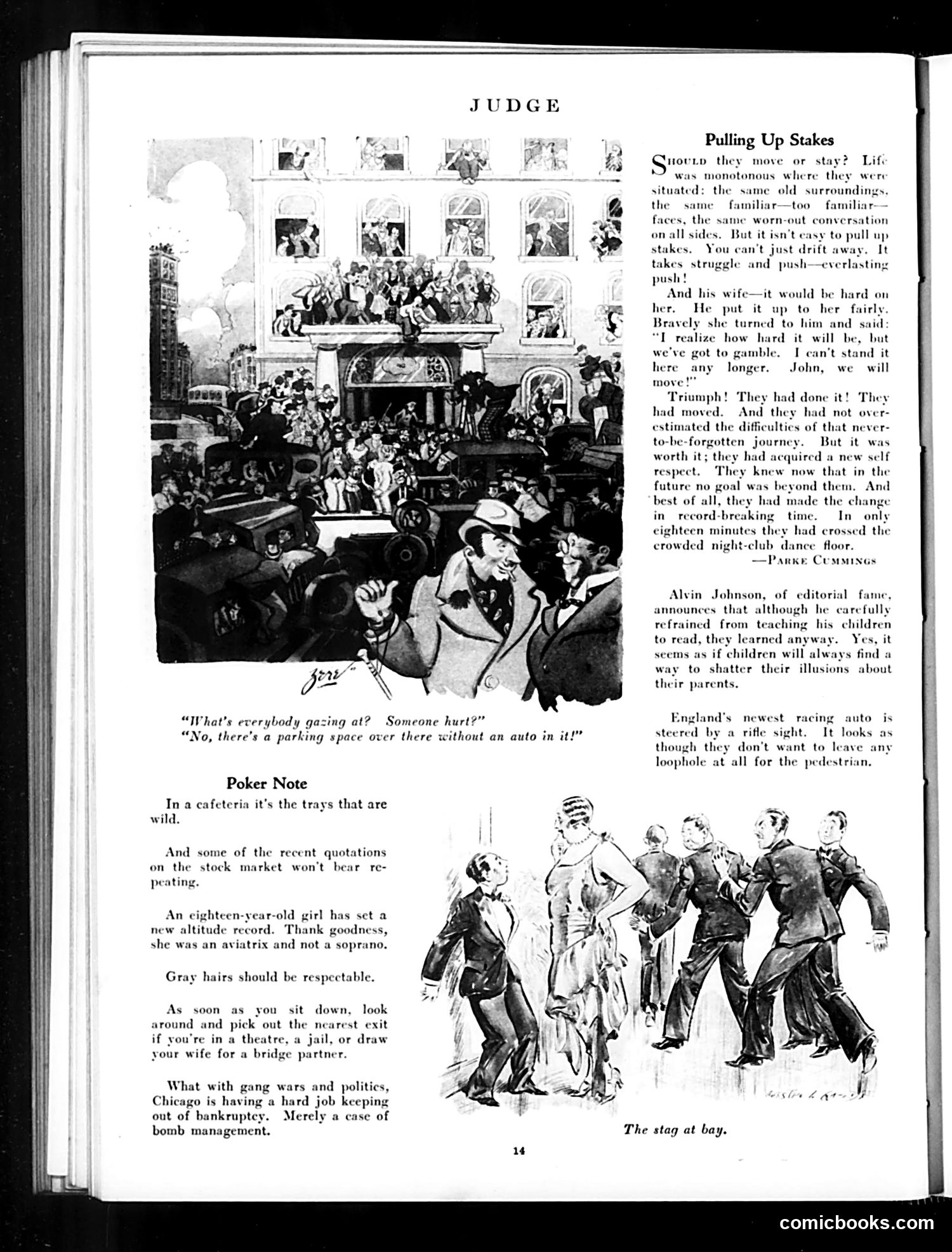
Judge Magazine Page Analysis This page contains two distinct pieces of satire: "Pulling Up Stakes" (main story with illustration): A humorous narrative about a couple deciding to leave their monotonous social circle. The joke's punch line reveals they spent eighteen minutes crossing a crowded nightclub dance floor—their dramatic "move" is merely relocating to another spot in the same venue. It satirizes people's desire for change while their actual circumstances remain identical. "Poker Note" (right column): A series of brief satirical observations on contemporary life, including references to stock market volatility (likely post-1920s crash context), gang violence and political corruption in Chicago, and social behaviors. These are gentle, observational humor about American society. The bottom illustration, "The stag at bay," depicts men in formal wear surrounding a woman, playing on the hunting metaphor—suggesting men pursuing romance. The page exemplifies Judge's style: urbane, middle-class satire targeting social pretension and modern anxieties, with no specific political figures or dated references dominating the content.
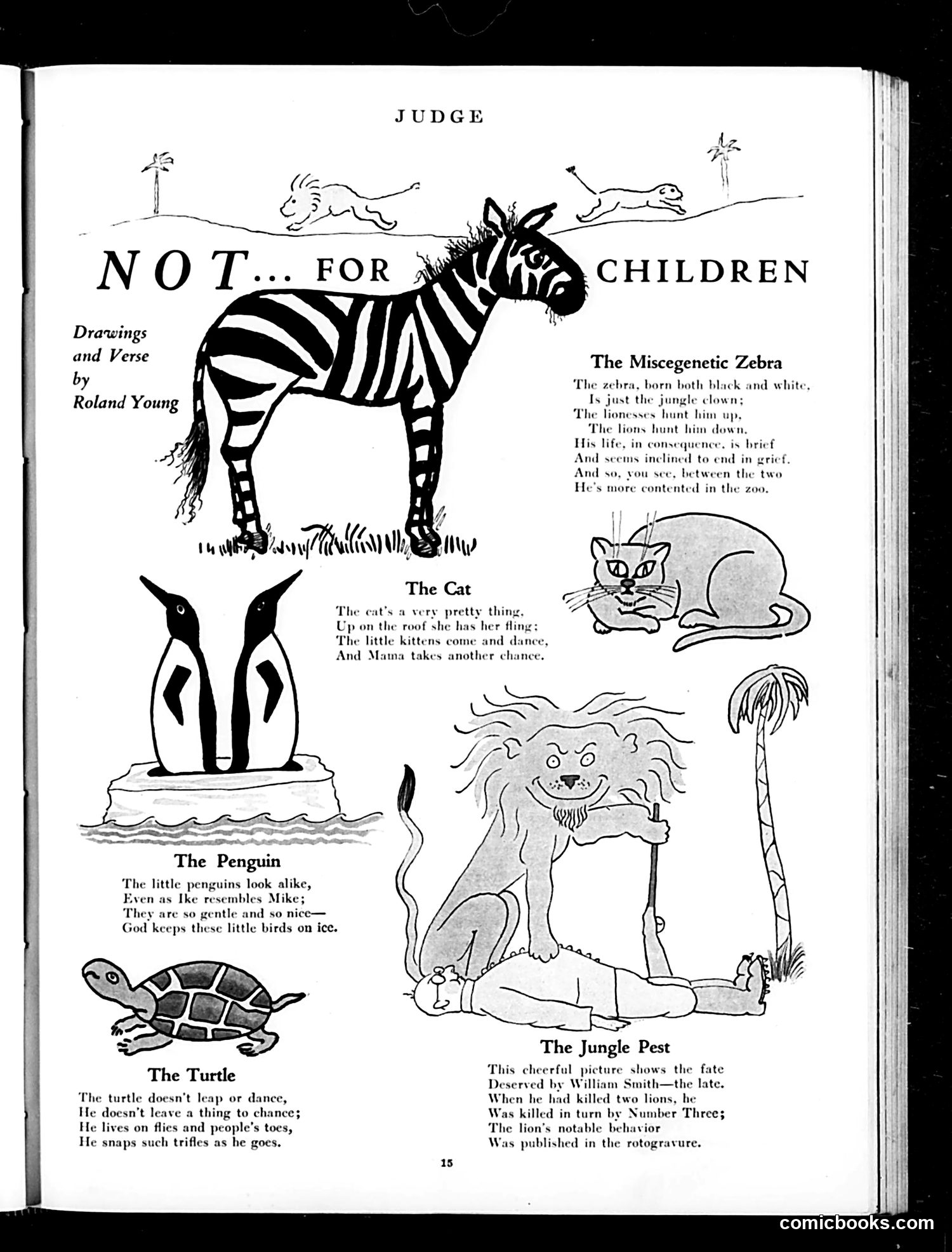
Analysis for Modern Readers This is a humorous children's page from *Judge* magazine featuring animal verses and illustrations by Roland Young. Rather than political satire, it's lighthearted animal humor with moralistic undertones typical of early 20th-century children's literature. The content includes absurdist animal portraits: a zebra described as a "jungle clown" caught between predators, a cat with mischievous kittens, penguins who "look alike," a cautious turtle, and "The Jungle Pest"—a darkly comic drawing showing a man killed by lions after killing two others. One reference requires context: "William Smith—the late" appears to reference a real or fictional person, but without additional sources, the specific identity remains unclear. The rotogravure mention suggests this appeared in a newspaper supplement. The satire is gentle—poking fun at animal behavior and human folly—rather than targeting contemporary political figures or events. The title "Not...For Children" is ironic; the content actually *is* children's material.
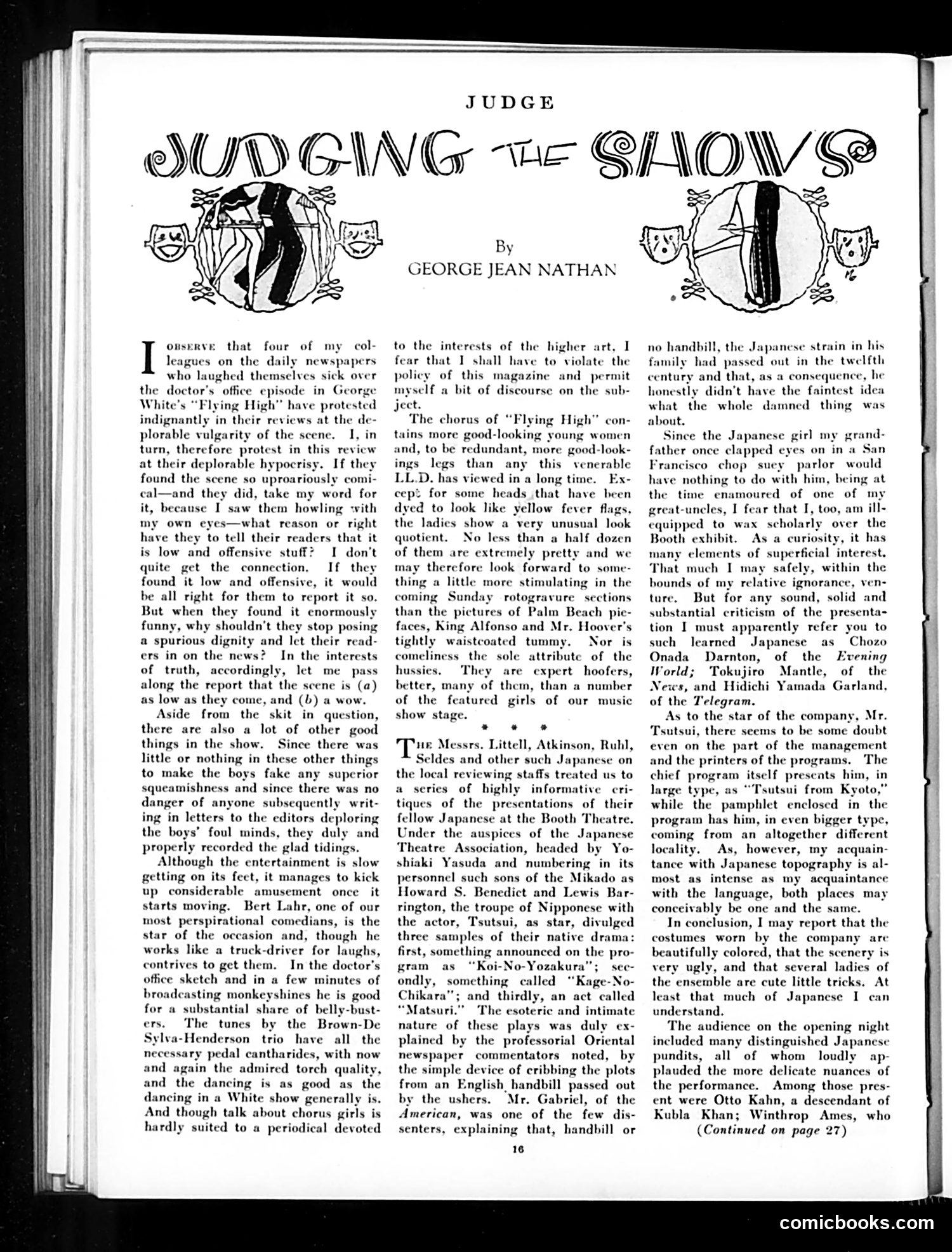
Judge Magazine Satire Analysis This page reviews George White's Broadway musical "Flying High," featuring comedian Bert Lahr. Critic George Jean Nathan attacks his fellow newspaper reviewers' hypocrisy: they privately laughed at a vulgar doctor's-office scene but publicly condemned it as "low and offensive." Nathan calls out this moral posturing, arguing they should either honestly report what amused them or not pretend offense. The review praises the show's chorus line as exceptionally beautiful and talented—more so than typical Broadway dancers. Nathan sarcastically notes their good looks will provide better material for Sunday newspaper photo sections than the usual celebrity coverage of "King Alfonso and Mr. Hoover's tightly waistcoated tummy" (political figures of the era). A secondary section discusses Japanese theatrical performers at the Booth Theatre, reviewing native Japanese plays, though the text cuts off mid-discussion. The satire targets journalistic double standards and stuffiness among theater critics.
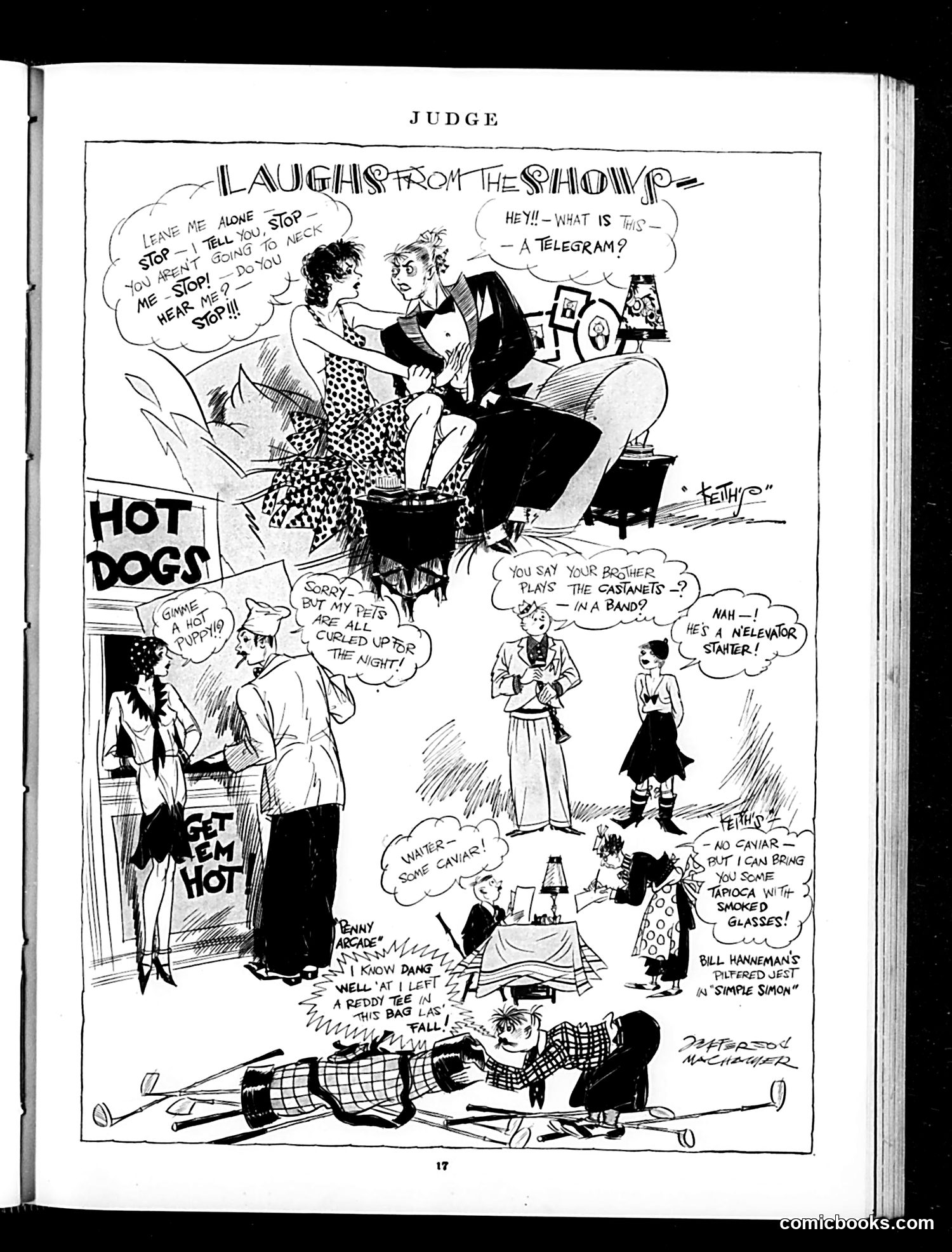
"Laughs From The Shop" - Judge Magazine Cartoon This is a multi-panel satirical comic about social pretension and class aspiration, likely from the 1920s-30s era based on style. The central joke involves characters attempting to impress others by exaggerating accomplishments or adopting affectations. The "hot dogs" vendor scene contrasts working-class commerce with affected sophistication—someone claims their brother plays castanets "in a band," but the punchline reveals he's merely an "elevator starter." The caviar/tapioca joke mocks someone trying to seem refined while actually having humble means. The title references appear to credit Bill Hanneman's humor, adapted for "Simple Simon." The overall satire targets American social climbing: people inflating minor jobs or possessions to seem wealthier or more cultured than reality permits. It's gentle mockery of ordinary people's aspirational pretenses.
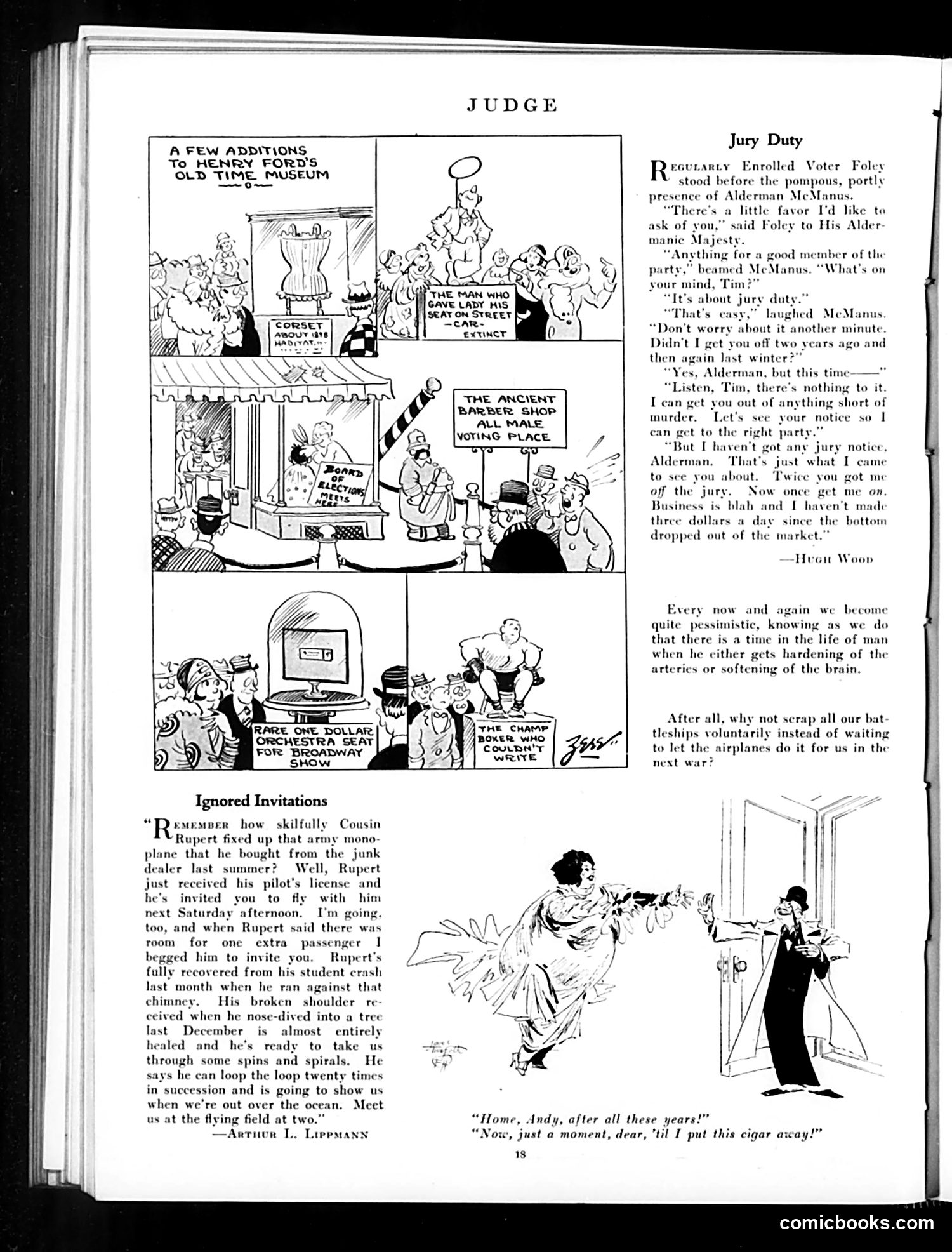
Judge Magazine Page Analysis This page contains three distinct satirical pieces: "Jury Duty" (top): A comic strip mocking political corruption. Voter Foley approaches Alderman McManus seeking help avoiding jury duty. McManus confidently offers to use his political connections to get Foley excused—he's already helped twice before. The joke exposes how urban political machines operated: aldermen wielded influence over civic institutions like courts, trading favors for party loyalty. Foley's surprise that he didn't receive a notice suggests the system was so corrupt that proper procedures didn't matter. "A Few Additions to Henry Ford's Old Time Museum" (left): References Ford's famous "Edison Institute" museum of Americana. The cartoon mocks modern urban life as outdated, showing exhibits of obsolete items (corsets, barbershops, streetcars) alongside commentary that these things are nearly extinct—satirizing rapid industrialization and changing social customs. "Ignored Invitations" (bottom): A domestic humor piece where Arthur Lippmann recounts how his friend Cousin Rupert—an inexperienced pilot who's crashed before—invited them flying. The humor lies in the narrator's deadpan acceptance of obvious danger.
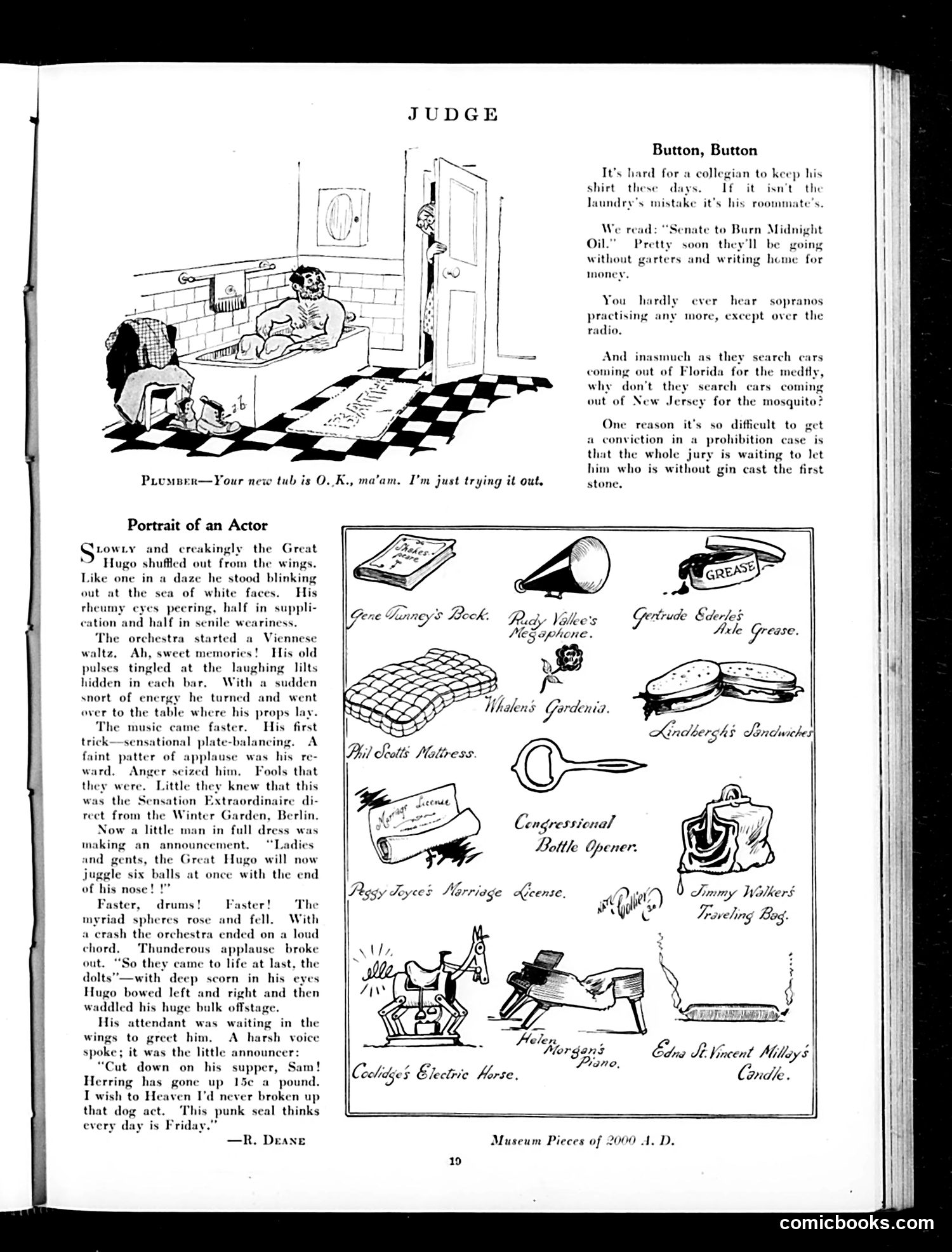
Explanation for Modern Readers This *Judge* page contains two distinct pieces of 1920s satire: Top section ("Button, Button"): Short quips mocking contemporary issues: collegians losing shirts to laundry mishaps, the Senate's late-night sessions, sopranos only practicing over radio now, and—most pointedly—Prohibition enforcement. The final joke satirizes jury nullification in prohibition cases, where jurors sympathetic to illegal alcohol refuse to convict, making conviction impossible. "Portrait of an Actor": A longer story mocking an aging vaudeville performer ("the Great Hugo") whose juggling act has become pathetic. He's reduced to balancing plates and juggling balls—once prestigious circus skills now performed in declining vaudeville theaters. The satire targets fading entertainment forms and forgotten stars, with the closing detail that he's ruined financially, regretting he "broke up that dog act." The "Museum Pieces of 2000 A.D." illustration satirizes modern consumer products as future museum artifacts—a joke about 1920s materialism.
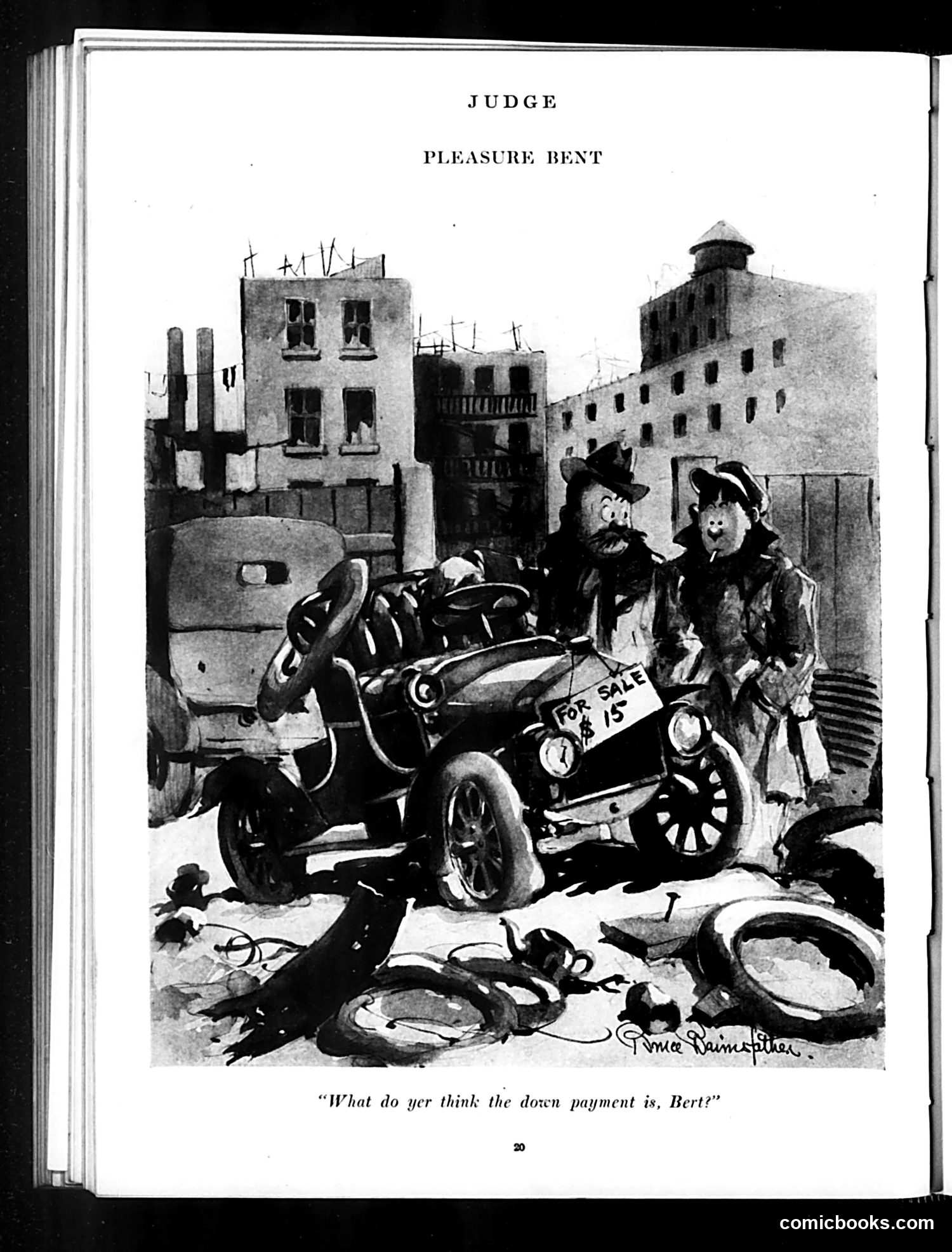
Judge Magazine Cartoon Analysis This satirical cartoon titled "Pleasure Bent" depicts two working-class men (likely named Bert and another character) examining a dilapidated automobile marked "FOR SALE" in a bombed-out or war-damaged urban setting. The joke targets the post-WWI economic reality: despite visible poverty and destruction, ordinary people aspired to purchase automobiles—a symbol of modern prosperity. The men's question about the "down payment" suggests bemused skepticism about affording such a luxury during hard times. The cartoon satirizes either post-war economic hardship or the American consumer impulse to buy beyond one's means during economic uncertainty. The contrast between the ruined buildings and the men's desire for this status symbol encapsulates Judge magazine's typical social commentary on class aspirations and economic realities.
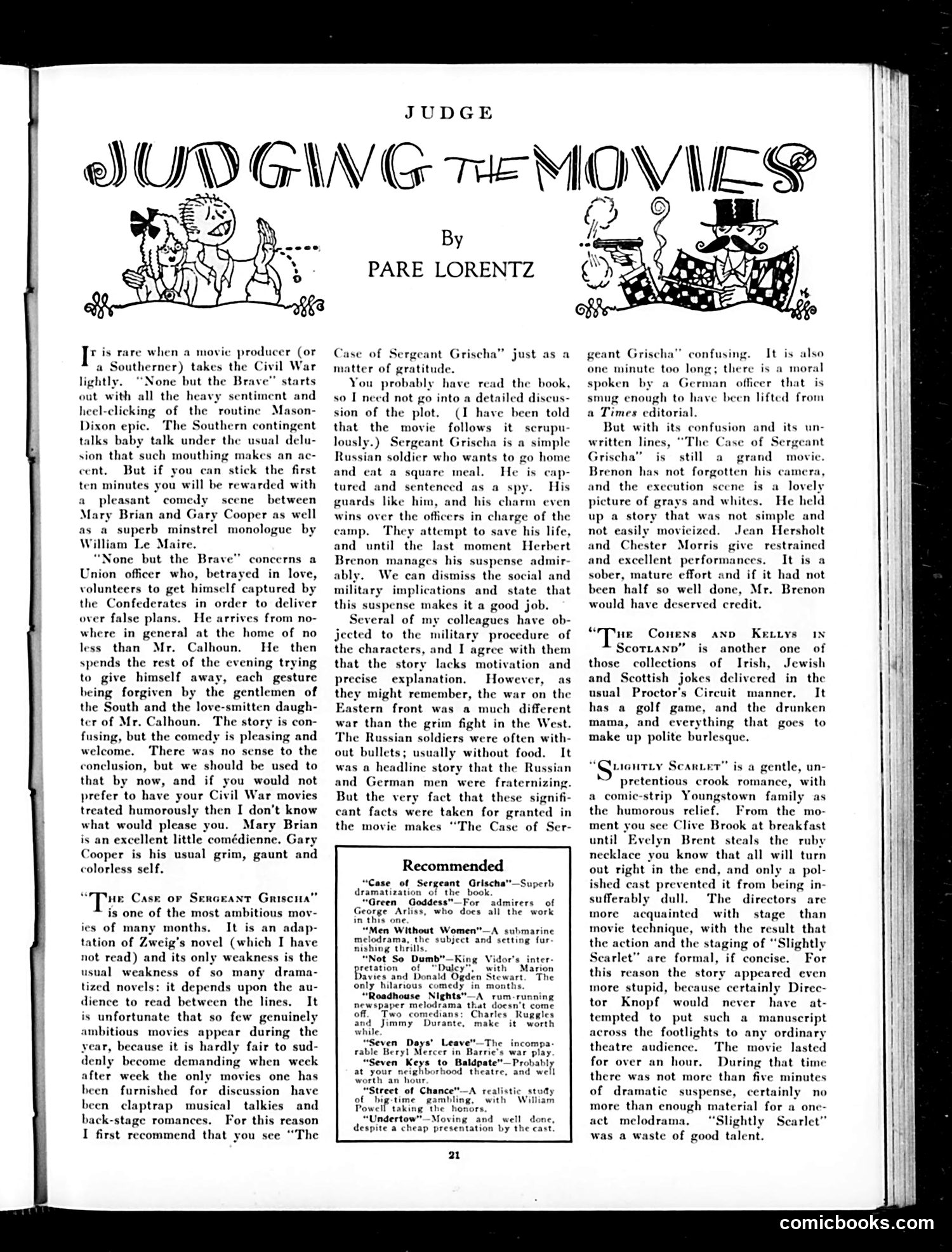
Judge Magazine Movie Review Analysis This page contains film reviews by critic Pare Lorentz from Judge magazine. The content is textual criticism rather than political cartoons—it reviews three 1920s films. Key points: - "None but the Brave" - A Civil War film criticized for initial heavy sentimentality and mocking Southern dialect ("baby talk"), though it improves with comedy scenes featuring Mary Brian and Gary Cooper. - "The Case of Sergeant Grischa" - Adapted from Stefan Zweig's novel about a Russian soldier captured as a spy during WWI's Eastern Front. Lorentz praises it despite its narrative weaknesses, defending the film's depiction of fraternization between Russian and German soldiers as historically accurate—soldiers lacked food and bullets on the Eastern Front. - The reviews reflect 1920s film criticism standards: heavy sentiment was expected in historical dramas, while comedic relief was increasingly welcomed. The mention of "back-stage romances" and "musical talkies" indicates early sound film conventions the critic finds tiresome. The decorative header illustration shows playful theatrical figures but carries no specific satirical message.
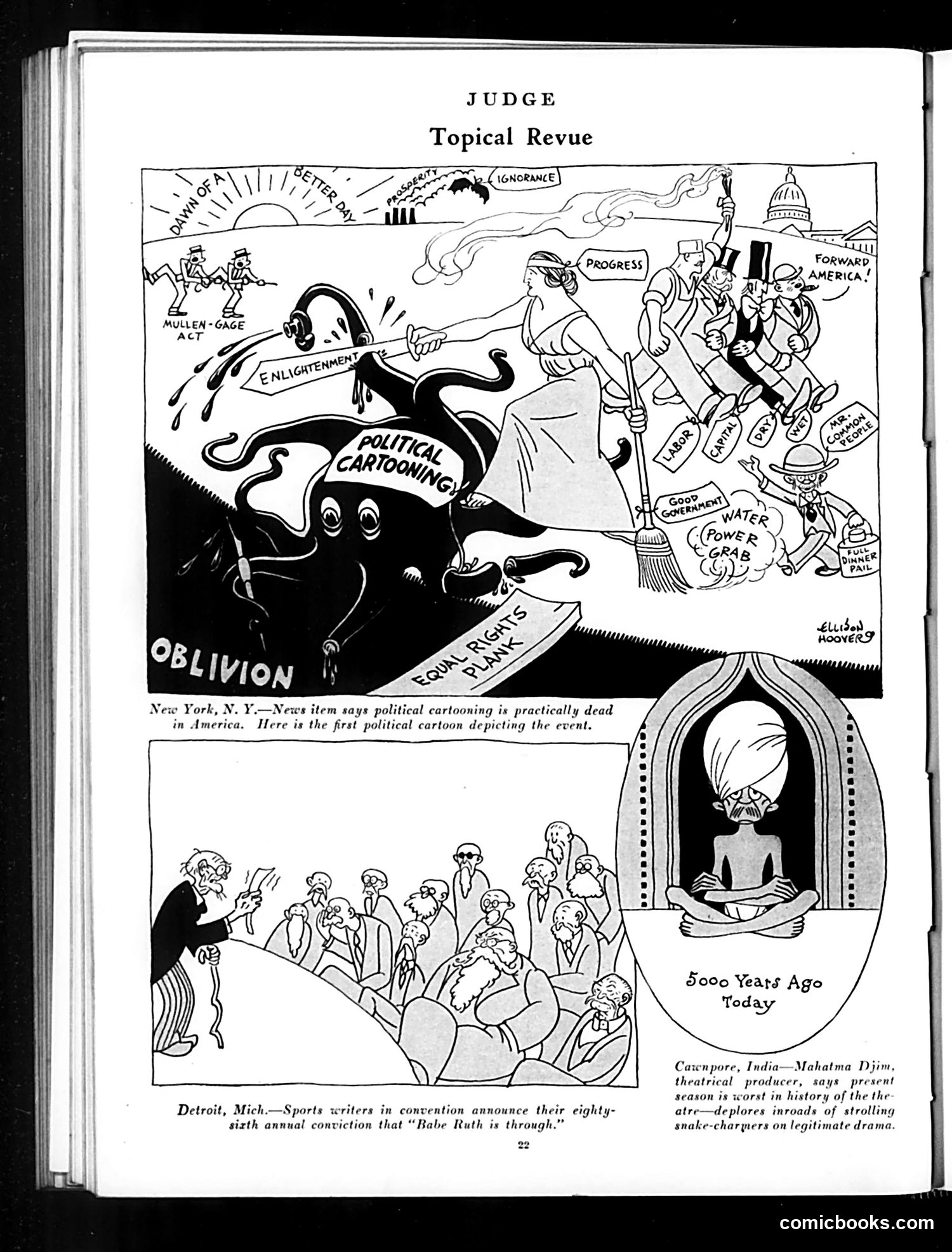
Explanation for Modern Readers This Judge magazine page satirizes American social and political stagnation through three jokes: Top cartoon: A multi-tentacled octopus labeled "Political Cartooning" is being attacked by figures representing "Enlightenment" (wielding the "Mullen-Gage Act"), while the beast of "Oblivion" looms below. The satire mocks a news report claiming political cartooning is dead in America—presenting this very cartoon as ironic proof that it survives, despite censorship attempts and public indifference. Lower left: Sports writers annually declare "Babe Ruth is through"—a running joke about predictable, repetitive sportswriting. Lower right: An Indian theater producer complains that snake-charmers undermine "legitimate drama"—absurdist humor comparing artistic decline to low entertainment (snake-charming) infiltrating serious theater. The page's theme: American institutions produce the same tired commentary and complaints year after year, achieving no real "progress."
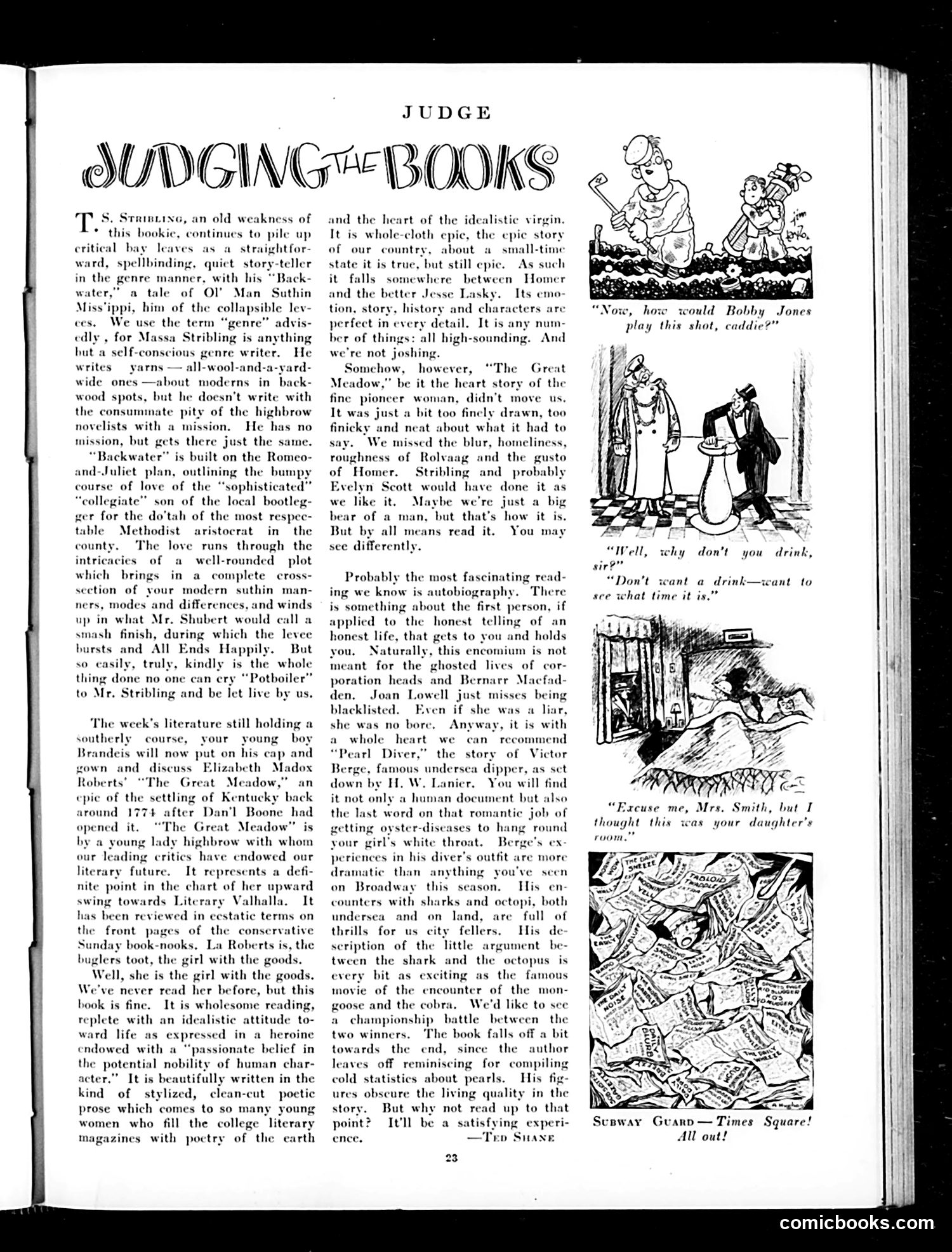
Judging the Books This is a book review column by Judge magazine's literary critic. The page critiques three contemporary books: 1. T. S. Stribling's "Backwater" — praised as an unpretentious, well-crafted Southern story about a bootlegger's daughter and a "sophisticated" young man, built on Romeo-and-Juliet themes. The reviewer appreciates Stribling's lack of self-conscious "mission." 2. Elizabeth Madox Roberts' "The Great Meadow" — a Kentucky frontier epic set around 1774. Though beautifully written with "idealistic" heroic values, the reviewer finds it overly refined and precious, lacking the rawness of Homer or Ole Rolvaag. It's "too finely drawn, too finicky." 3. Joan Lowell's "Pearl Diver" — an autobiography about an undersea diver, recommended despite Lowell's questionable truthfulness, because honest first-person narratives compel readers. The cartoons illustrate these reviews with period-appropriate scenes. The critic values authenticity and emotional power over literary polish.
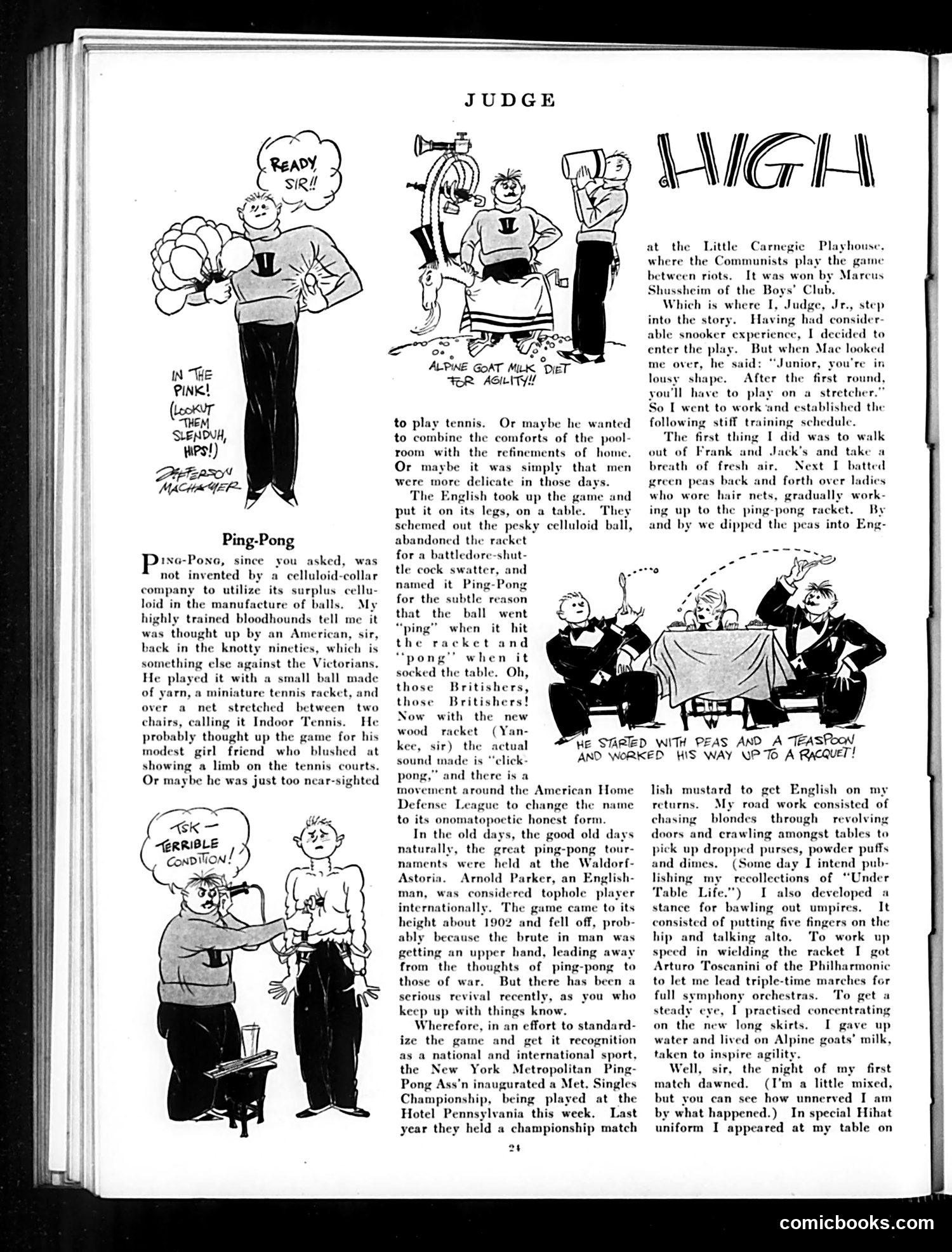
"Judge High" - Ping-Pong Satire This article mocks the recent boom in ping-pong as a fashionable sport among American elites. "Judge, Jr." (the author's persona) enters a Metropolitan Ping-Pong Championship at the Hotel Pennsylvania, treating the parlor game with absurd seriousness. The satire targets several things: the pretentiousness of "Communists" playing at the Little Carnegie Playhouse; the game's English origins and its fussy naming conventions; and most pointedly, the narrator's excessive training regimen (Alpine goat's milk for "agility," practicing on blondes, leading orchestras for "speed") that parodies how wealthy Americans elevate trivial pursuits into serious athletic endeavors. The cartoons show the narrator's physical deterioration and conditioning mishaps. The piece gently ridicules how leisured society constantly searches for novel fashionable activities, treating ping-pong with the gravity of professional sport despite its origins as a parlor game for people "too near-sighted" for real tennis.
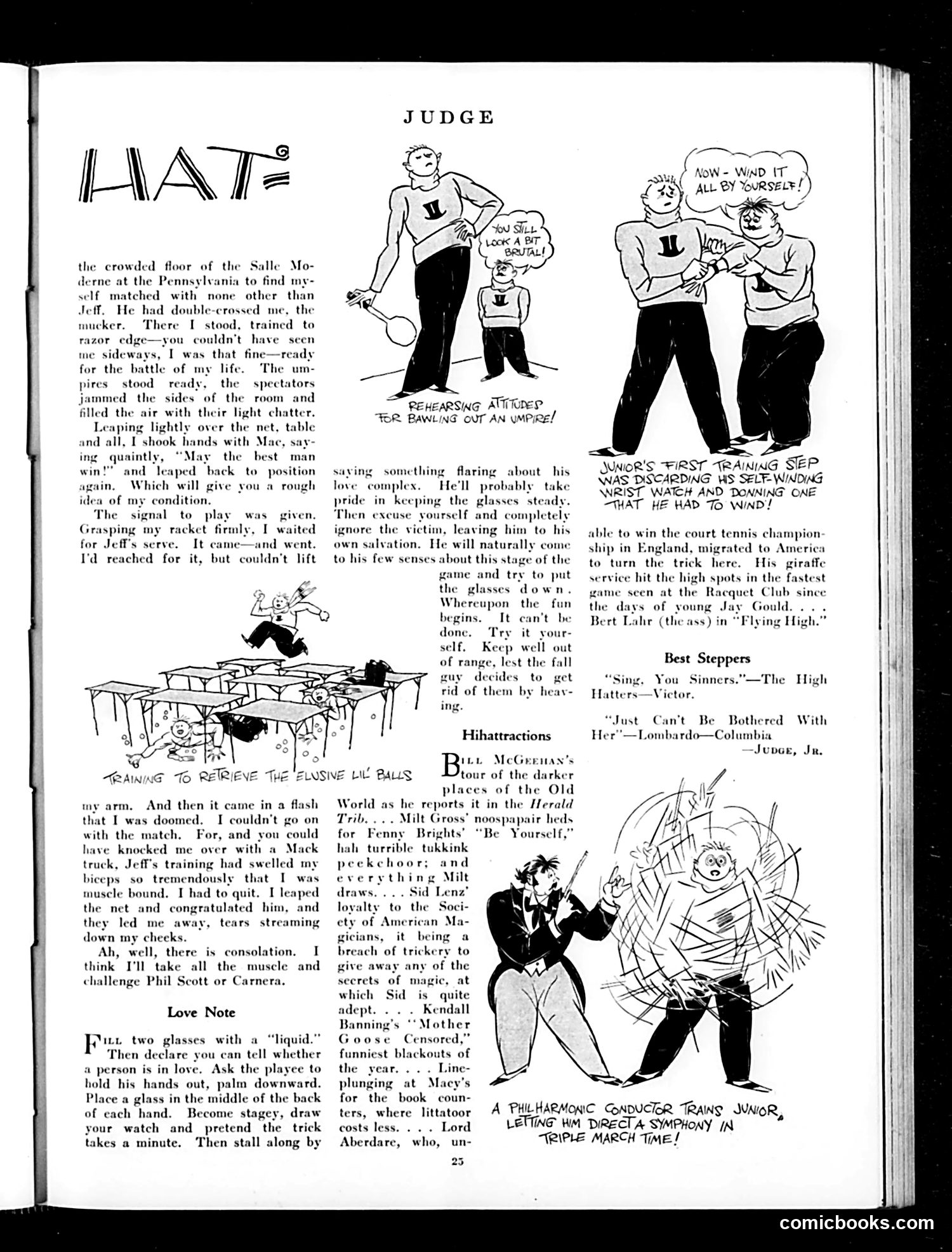
Judge Magazine Page Analysis This page from the satirical magazine Judge contains humor pieces mocking overtraining and physical conditioning fads of the era. The main cartoon "HATE" depicts a tennis player whose coach has over-trained him so intensely that his biceps are now "muscle bound"—he literally cannot lift his arm to play. The satire targets the obsessive physical culture movement and athletic trainers who pushed extreme conditioning methods. The smaller cartoons mock similar excess: one shows a father training his young son so aggressively in tennis that the boy must wind his watch manually (having traded his self-winding one), and another depicts a music conductor training a junior so rigidly that he conducts symphonies in "triple march time." The humor lies in the absurdist exaggeration—trainers so dedicated to their methods that they paradoxically render their charges *unable* to perform. It's social satire on the American obsession with physical self-improvement and the pseudo-scientific training crazes of that era (likely 1930s based on style).
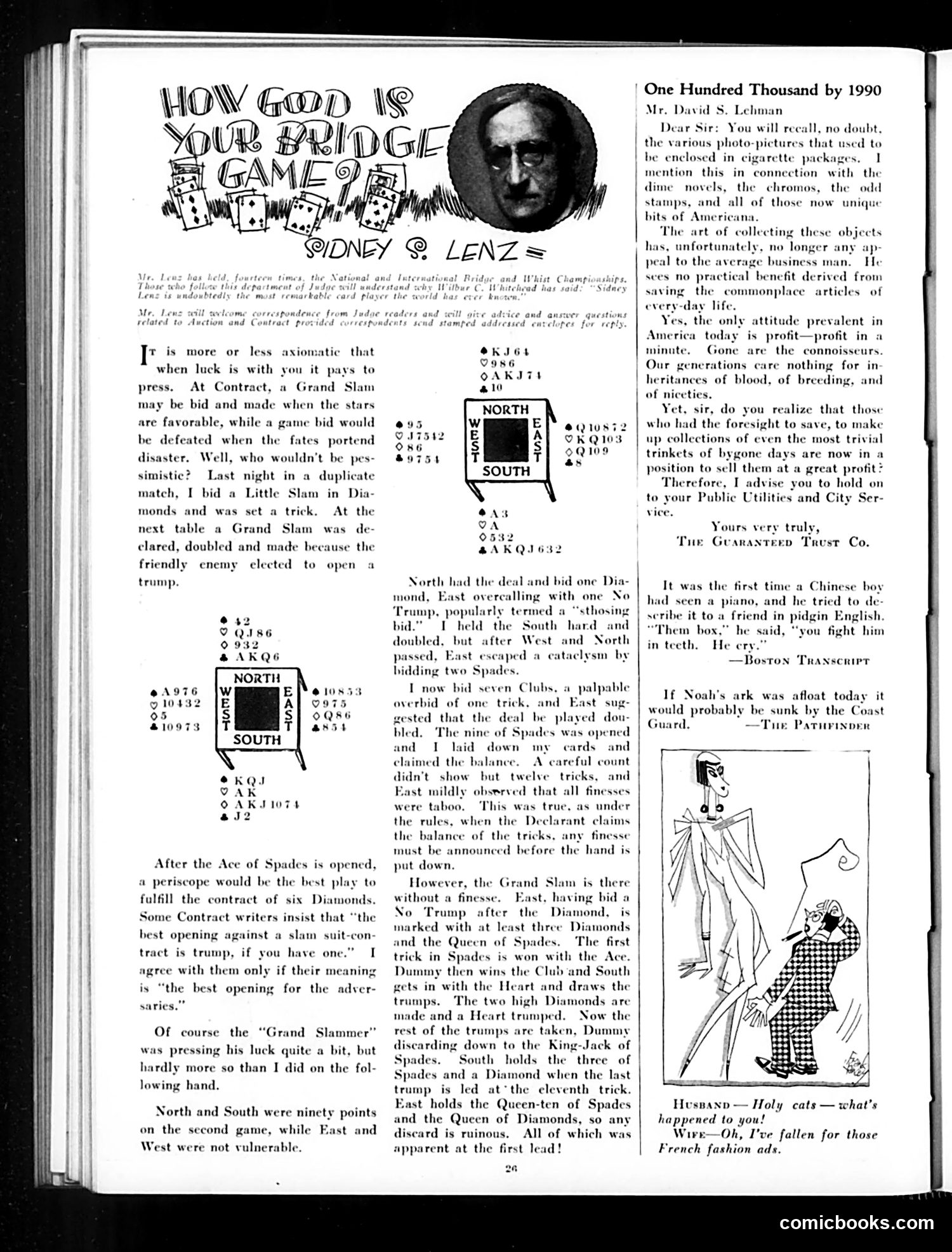
Analysis for Modern Readers This page contains two distinct pieces from *Judge* magazine: Main Content: Bridge Column The bulk of the page is a bridge (card game) strategy column by Sidney S. Lenz, a famous bridge player. It discusses contract bridge bidding and play techniques through hand examples. This reflects bridge's peak popularity in early-20th-century American leisure culture—similar to how chess or poker columns appear in modern publications. Side Column: "One Hundred Thousand by 1990" A letter satirizing American materialism and collecting habits. It mocks how earlier generations collected cigarette card photographs and other promotional items for sentimental/artistic reasons, whereas modern collectors (implied: post-WWI era) only care about resale value and profit. The satire critiques the loss of cultural appreciation in favor of pure commercialism—a common concern during the Roaring Twenties. Bottom: Miscellaneous Humor Brief jokes, including one about a Chinese immigrant's first encounter with a piano, rendered in stereotypical "pidgin English" (reflecting period attitudes toward immigration).
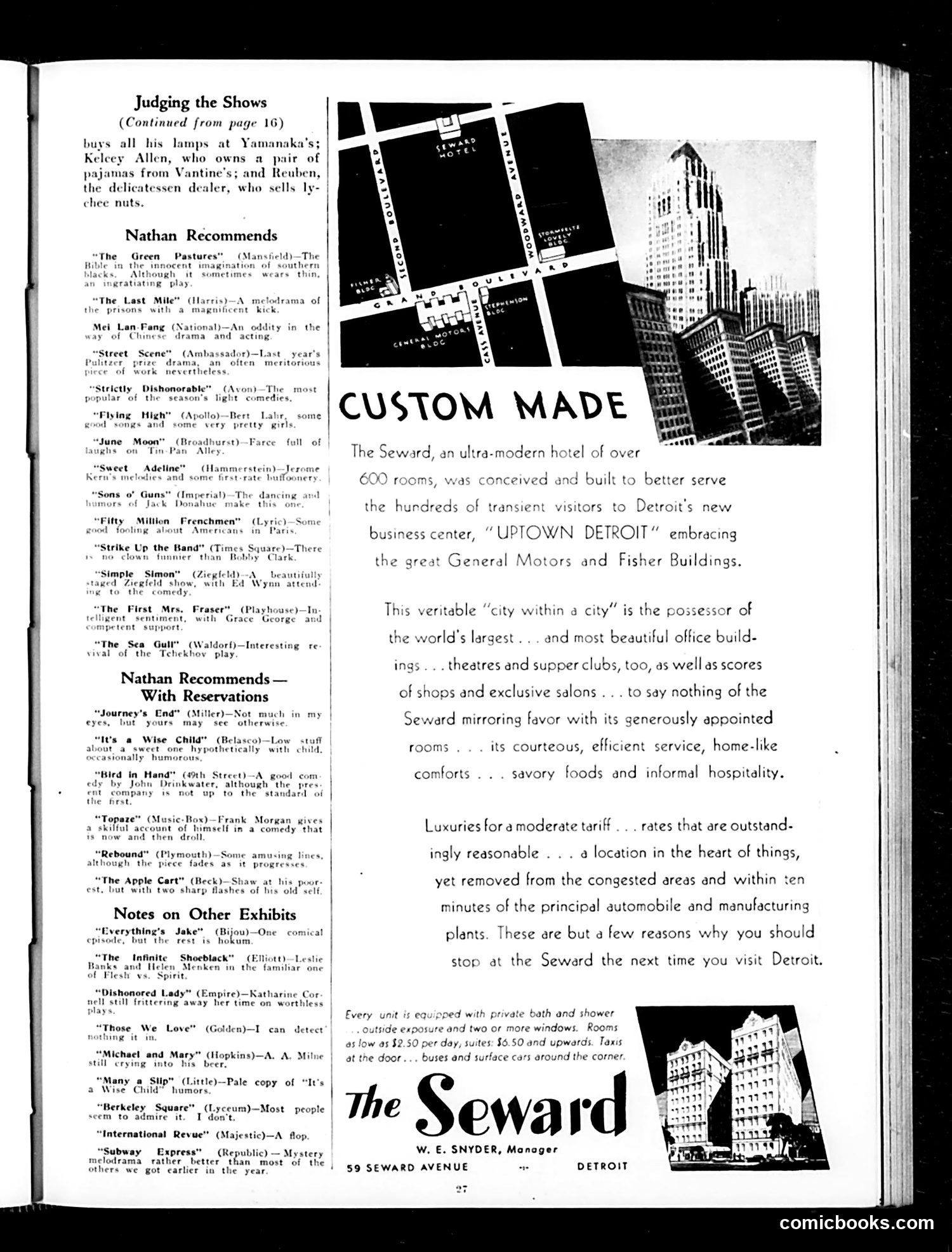
Page Analysis This page is primarily advertising, not editorial content. The upper left contains theater reviews ("Judging the Shows" and "Nathan Recommends"), listing Broadway productions with brief critical comments—standard Judge magazine fare from the 1920s-30s. The dominant content is a full-page advertisement for the Seward Hotel in Detroit. The ad emphasizes the hotel's modern amenities, location near General Motors and Fisher Buildings in "Uptown Detroit," and moderate pricing ($2.50-$6.50 per night). It appeals to business travelers and tourists visiting Detroit's automotive manufacturing center. There is no cartoon or satire on this page. The architectural photograph and building sketches are promotional imagery. The reviews, while occasionally witty, are straightforward theater criticism rather than political or social satire. This appears to be a standard magazine page mixing editorial content with paid advertising—common practice for Judge during this era.
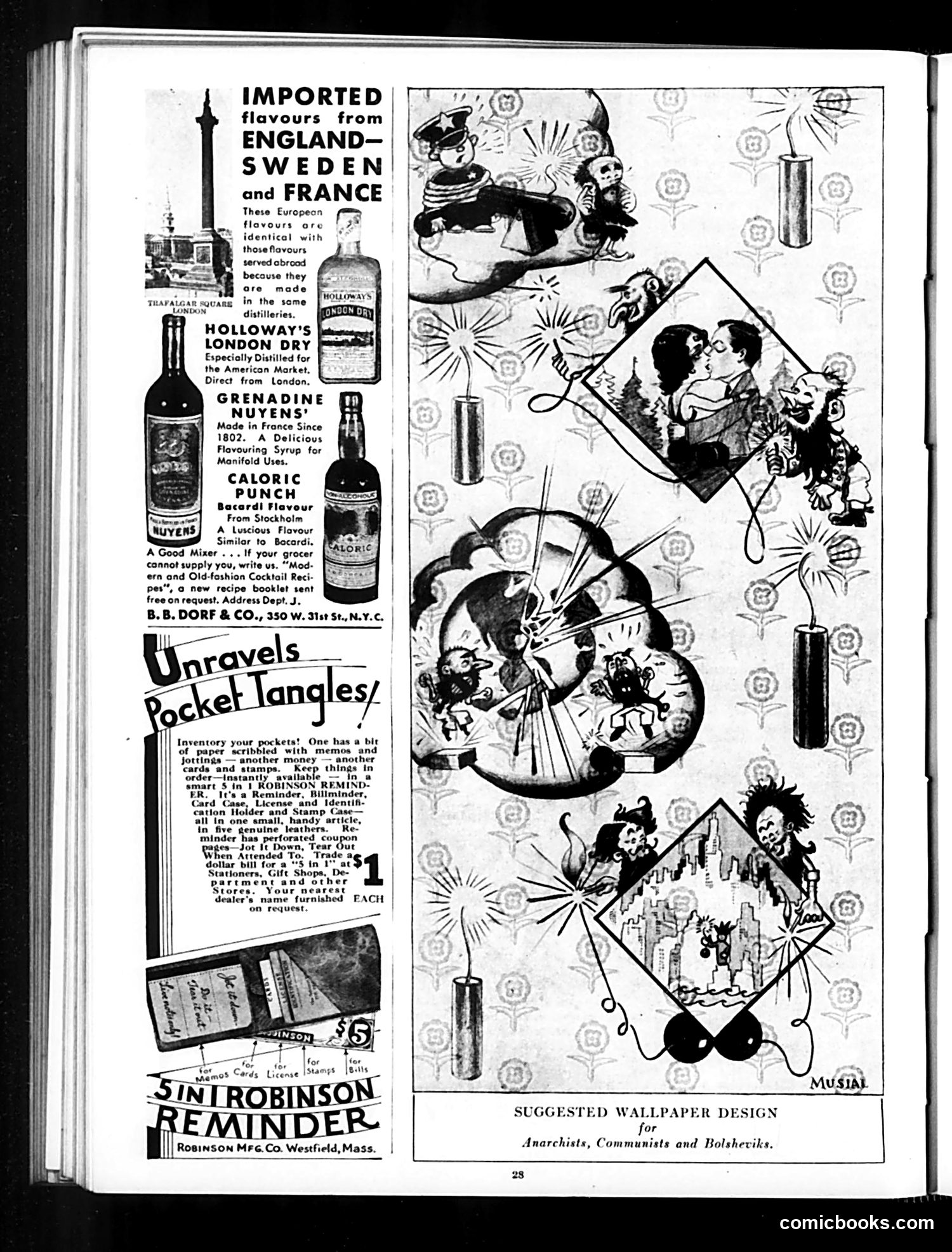
Political Cartoon Analysis: "Suggested Wallpaper Design" The right-hand cartoon is a satirical attack on radical political movements. The caption explicitly identifies the targets: "Anarchists, Communists and Bolsheviks." The design depicts caricatured figures engaged in violent or chaotic activities—explosions, destruction of buildings, and general mayhem—connected by lines suggesting they're all "wired together" as a unified threat. The imagery plays on contemporaneous Red Scare fears (likely 1920s-1930s era, given the Bolshevik reference). The satire's punch lies in the absurd premise: suggesting this violent, chaotic imagery as a *wallpaper design*—as if one would decorate a home with revolutionary propaganda. This mocks both the radicals' supposed villainy and perhaps also American hysteria about these movements. The rest of the page consists of alcohol and product advertisements, typical Judge magazine filler content.
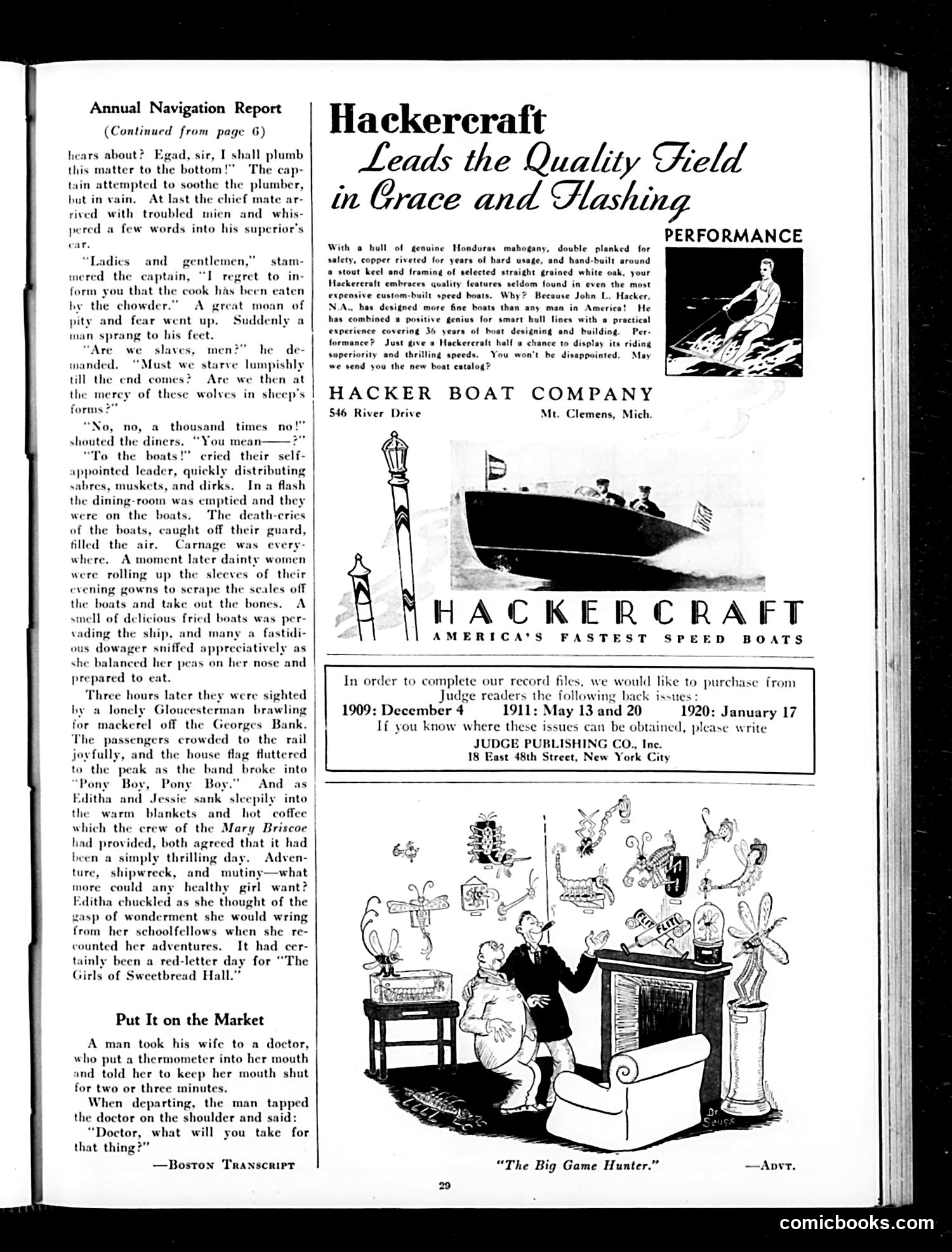
"The Big Game Hunter" Cartoon Analysis This page is primarily advertising and editorial content rather than political satire. The main cartoon, "The Big Game Hunter," depicts a salesman or showman displaying various taxidermied animals and curiosities to a wealthy couple—likely satirizing the period's fascination with exotic collectibles and conspicuous consumption. The joke appears to mock wealthy people's appetite for acquiring rare specimens as status symbols. The page also contains a humorous short story about shipwreck passengers eating their own boat, which is absurdist comedy typical of Judge magazine's style. The dominant content is advertisements: a Hackercraft speedboat company ad emphasizing quality American manufacturing and performance, and Judge Publishing's plea for readers to help locate specific back issues (1909, 1911, 1920). The "Put It on the Market" joke at bottom is a typical one-liner: a man asks his doctor to sell him the thermometer that kept his talkative wife silent—a mild joke about marital discord.
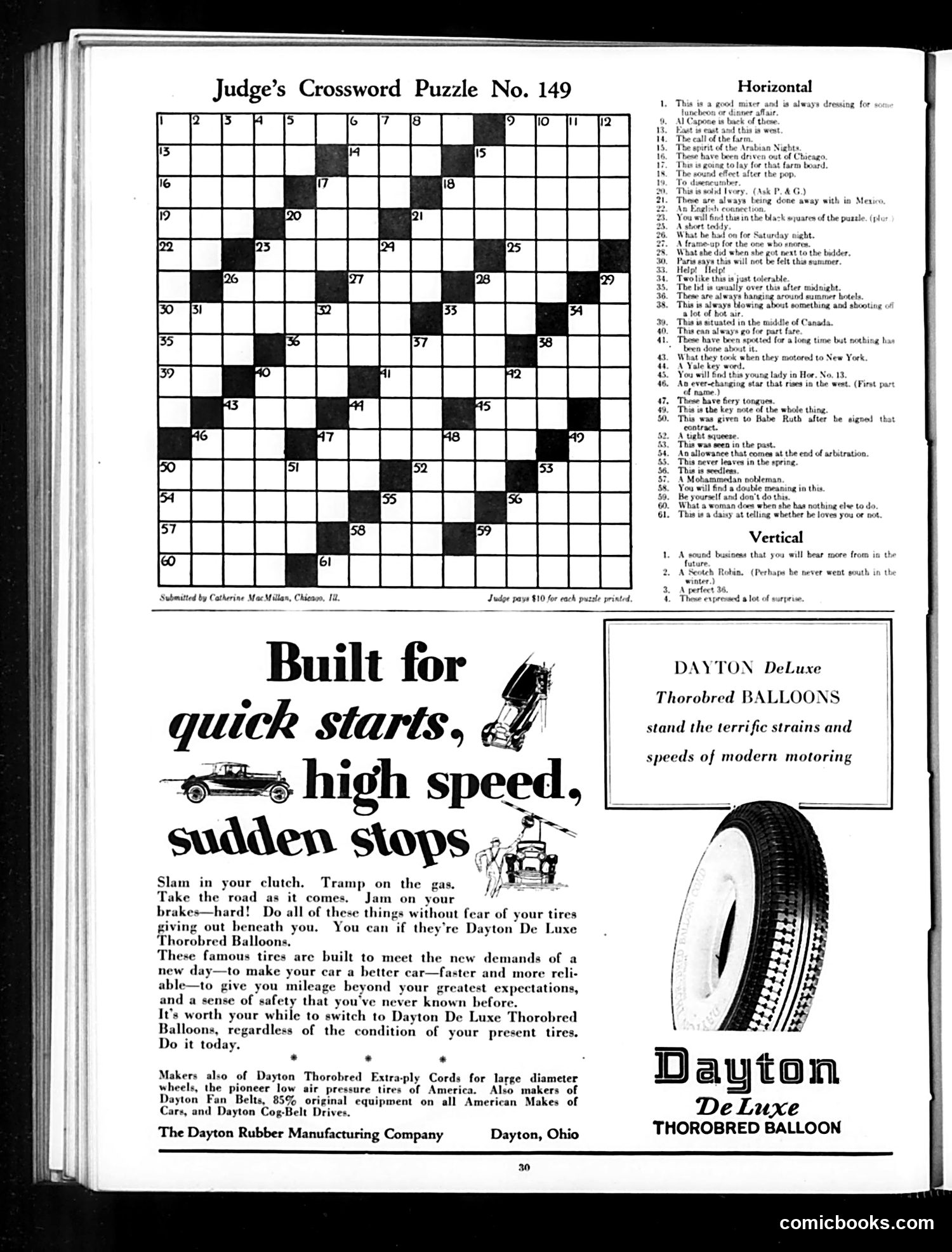
Judge Magazine Page Analysis This page is primarily advertising with a crossword puzzle, not political satire. The top half features "Judge's Crossword Puzzle No. 149"—a standard word puzzle with clues referencing popular culture and contemporary life of the era (references to Babe Ruth, Yale, Mexico, hotels). The clues are lighthearted observations rather than satirical commentary. The bottom half is dominated by a Dayton Tire Company advertisement for "DeLuxe Thorobred Balloon" tires. The ad uses period automotive marketing language, emphasizing the tires' ability to handle "quick starts, high speed, sudden stops" without failure. The copy appeals to motorists' desires for safety and reliability during an era of improving automobiles and road conditions. There is no political cartoon or satire visible. This appears to be a standard magazine page mixing entertainment (the puzzle) with commercial advertising—typical of Judge's business model during this era.
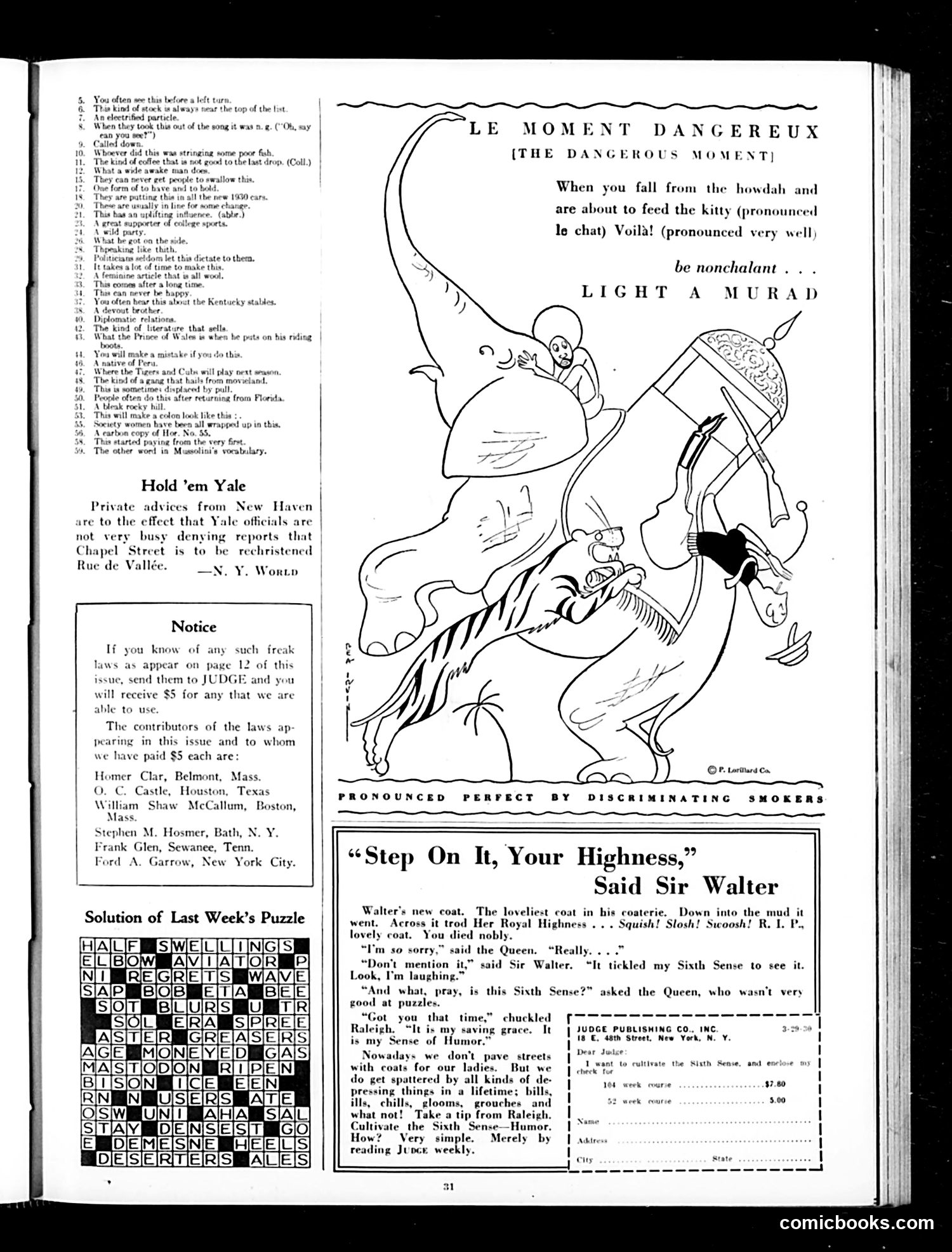
"Le Moment Dangereux" and Related Content This page contains two satirical pieces: "Le Moment Dangereux" (top): A cartoon advertisement for Murad cigarettes depicting someone falling from an elephant's howdah (carriage) while about to feed a large cat. The joke: remaining composed ("nonchalant") in a dangerous situation—and smoking a Murad—demonstrates sophisticated sophistication. The French phrases add comedic pretension. "Step On It, Your Highness" (bottom): A humorous dialogue where Sir Walter allows a queen to deliberately step through his new coat into mud. He claims this "tickled my Sixth Sense"—defined as a sense of humor. The satire mocks upper-class affectation: Walter performs exaggerated good humor about ruined property to appear sophisticated. The piece concludes by promoting *Judge* magazine as the source for cultivating this "Sixth Sense." Both pieces target wealthy, pretentious audiences through gentle mockery of their mannerisms and values.
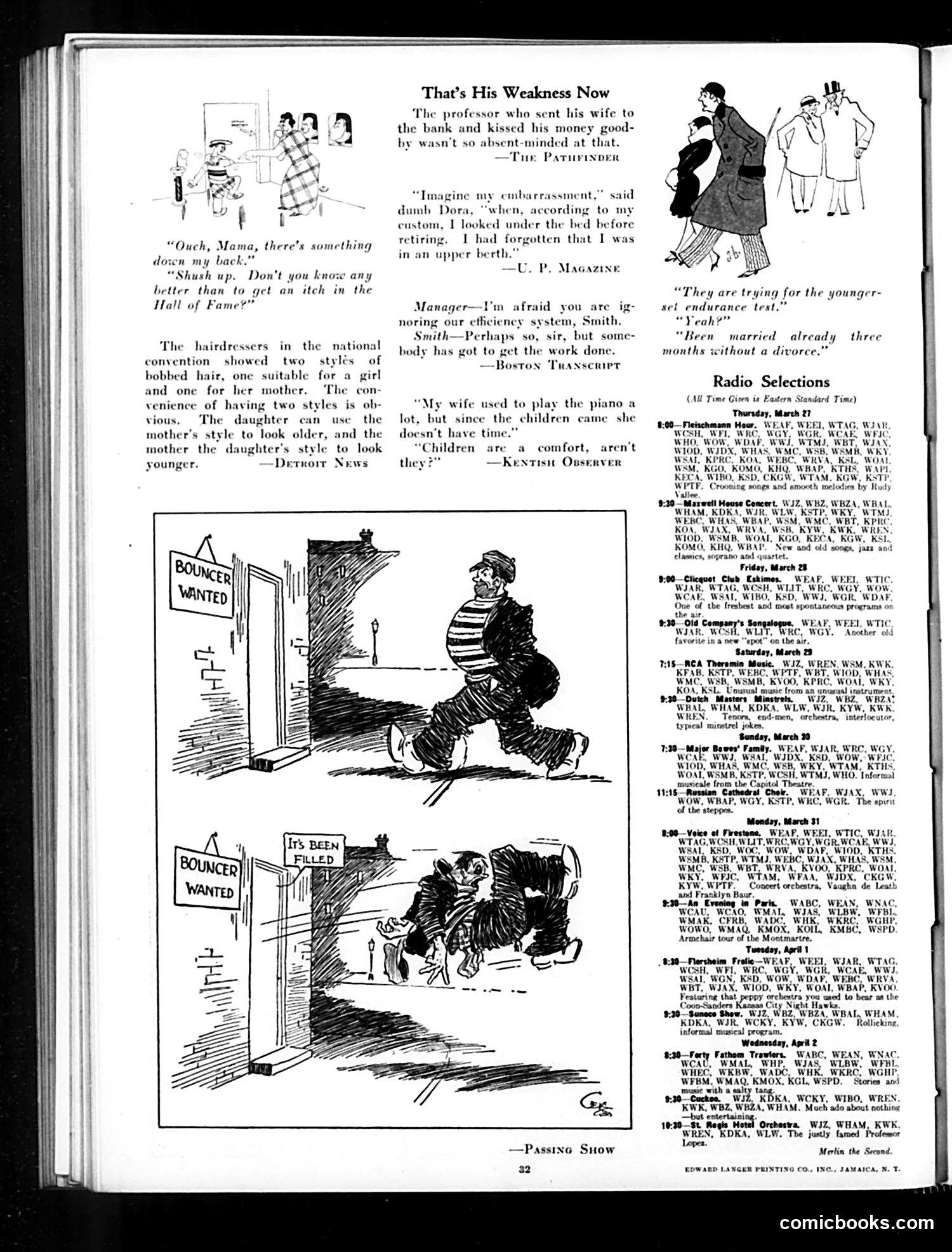
Analysis of Judge Magazine Page This page contains several short humor pieces typical of 1920s-30s Judge magazine: The "Hall of Fame" cartoon jokes about a child with an itch on their back while in a museum—the parent shushes them, treating the Hall of Fame as so sacred one shouldn't have bodily discomforts there. It's gentle social satire about reverence for institutions. "That's His Weakness Now" plays on the absent-minded professor stereotype—a man who carefully sends his wife to the bank but absent-mindedly kisses his money goodbye, suggesting money is what he truly cares about. The "Bouncer Wanted" cartoon shows a man being repeatedly ejected from a building, then returning with a woman. The joke appears to be about persistent romantic pursuit or the man needing a "bouncer" to keep him away. The remaining items are brief anecdotes about marriage inconveniences, hairdressing fashions, and piano-playing—typical light domestic humor of the era. The Radio Selections section lists available broadcasts by station and time, reflecting radio's growing prominence in American entertainment during this period.
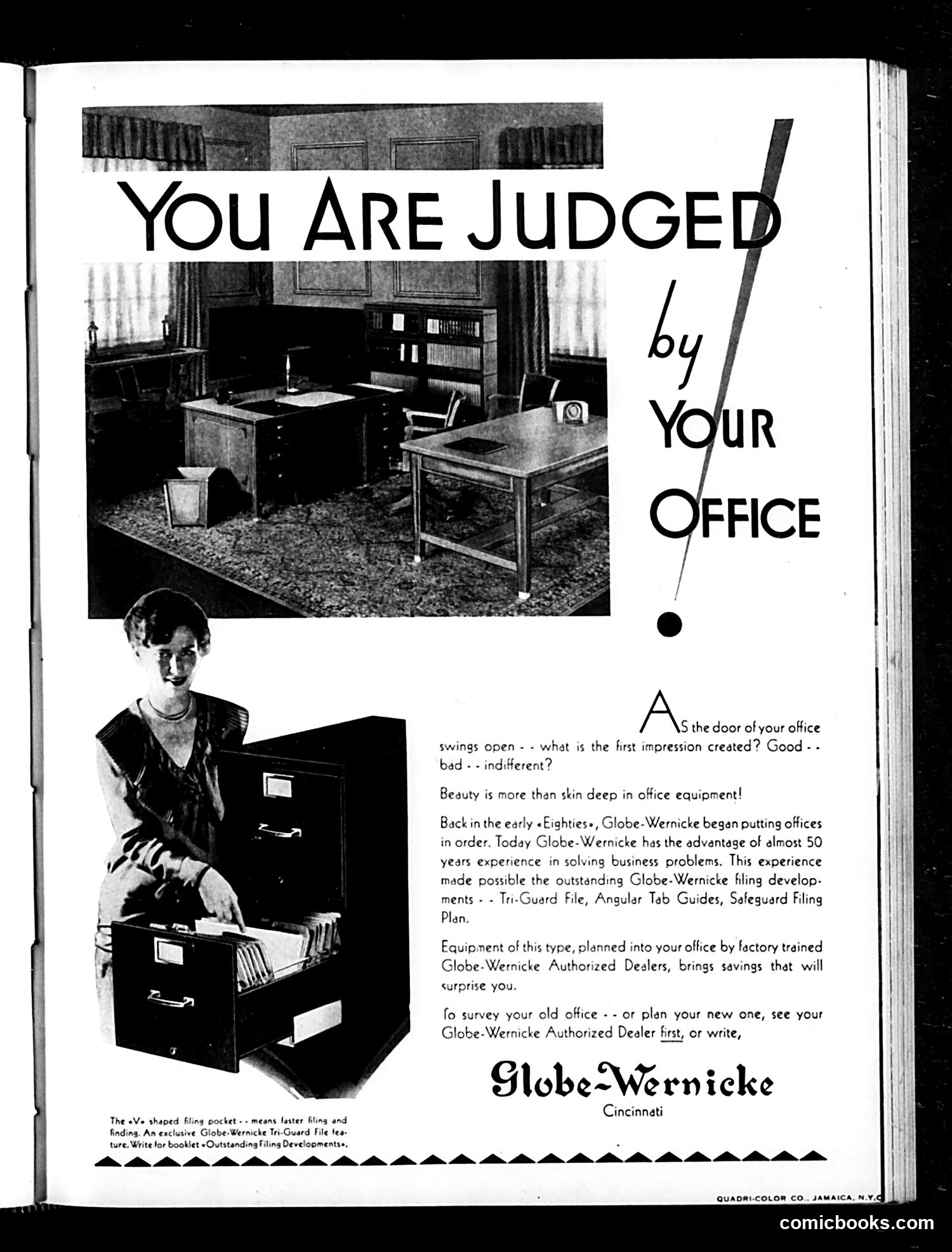
Analysis This is primarily an advertisement, not political satire. Globe-Wernicke, a Cincinnati office furniture company, uses the headline "YOU ARE JUDGED BY YOUR OFFICE" to argue that first impressions matter in business. The ad features: - A stylized office interior (top) - A woman at filing cabinets (left), representing modern office workers The "satire" is gentle social commentary: the ad suggests that office appearance reflects on a business's competence and professionalism. The pun—appearing in *Judge* magazine—plays on the word "judged." The copy emphasizes Globe-Wernicke's 50 years of filing system innovations (Tri-Guard Files, Angular Tab Guides) as evidence of reliability. The pitch is that proper office equipment, installed by authorized dealers, creates positive impressions and improves efficiency. This reflects 1920s-30s business culture emphasizing modernization, organizational systems, and the emerging professional office workspace.
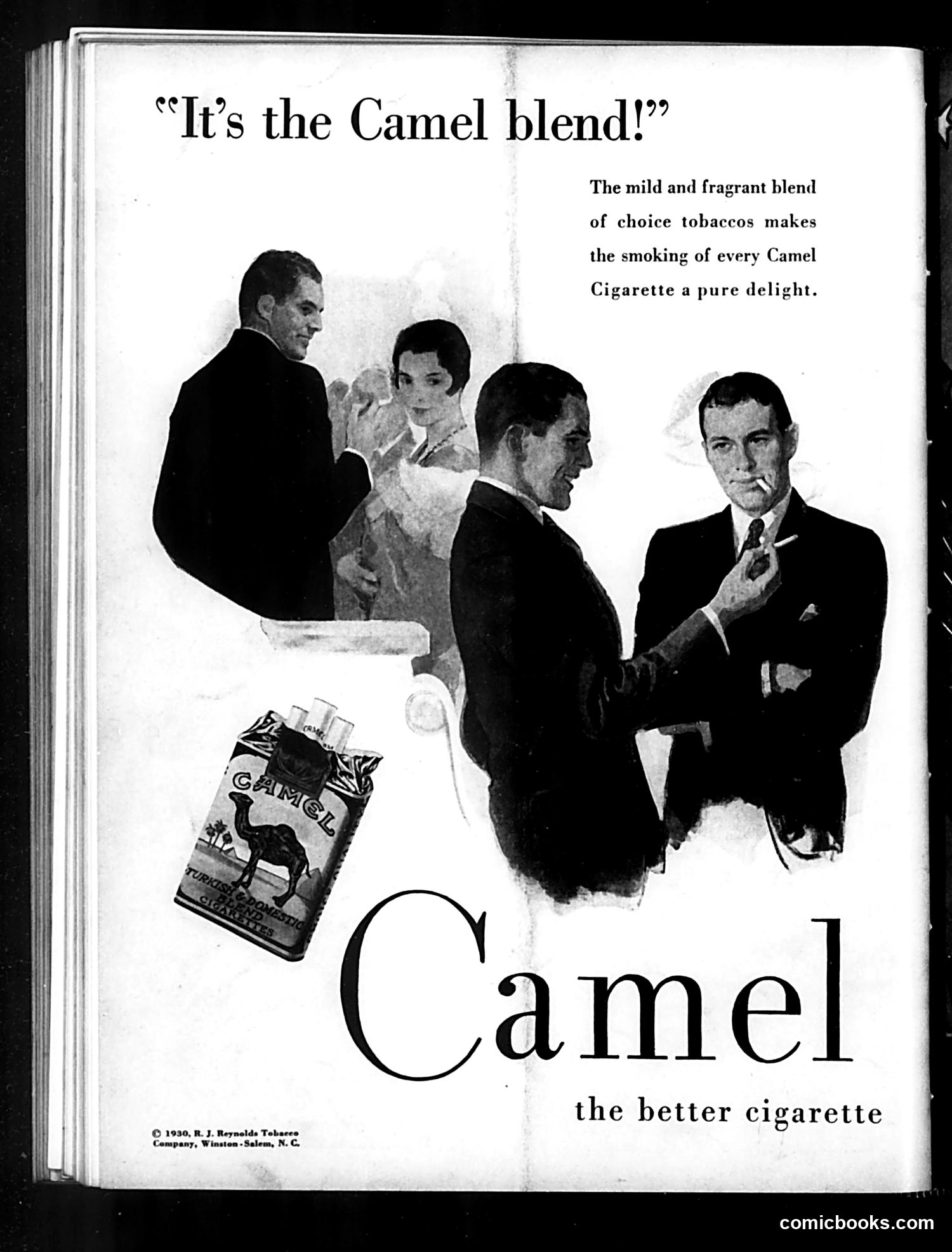
This is a cigarette advertisement, not political satire. The 1930 Camel ad features four well-dressed men in business attire, with one actively smoking. The tagline "It's the Camel blend!" emphasizes the product's tobacco mixture as superior. The ad uses social aspiration marketing—depicting sophisticated, professional men to associate smoking Camel cigarettes with success and refinement. The woman in the background appears decorative, common in period advertising. This represents pre-health-warning tobacco marketing, when cigarettes were openly advertised in mainstream publications without disclosed health risks. The "pure delight" claim and emphasis on the blend reflect advertising strategies from an era before cigarette dangers were widely acknowledged or regulated.