judge
Judge — April 5, 1930
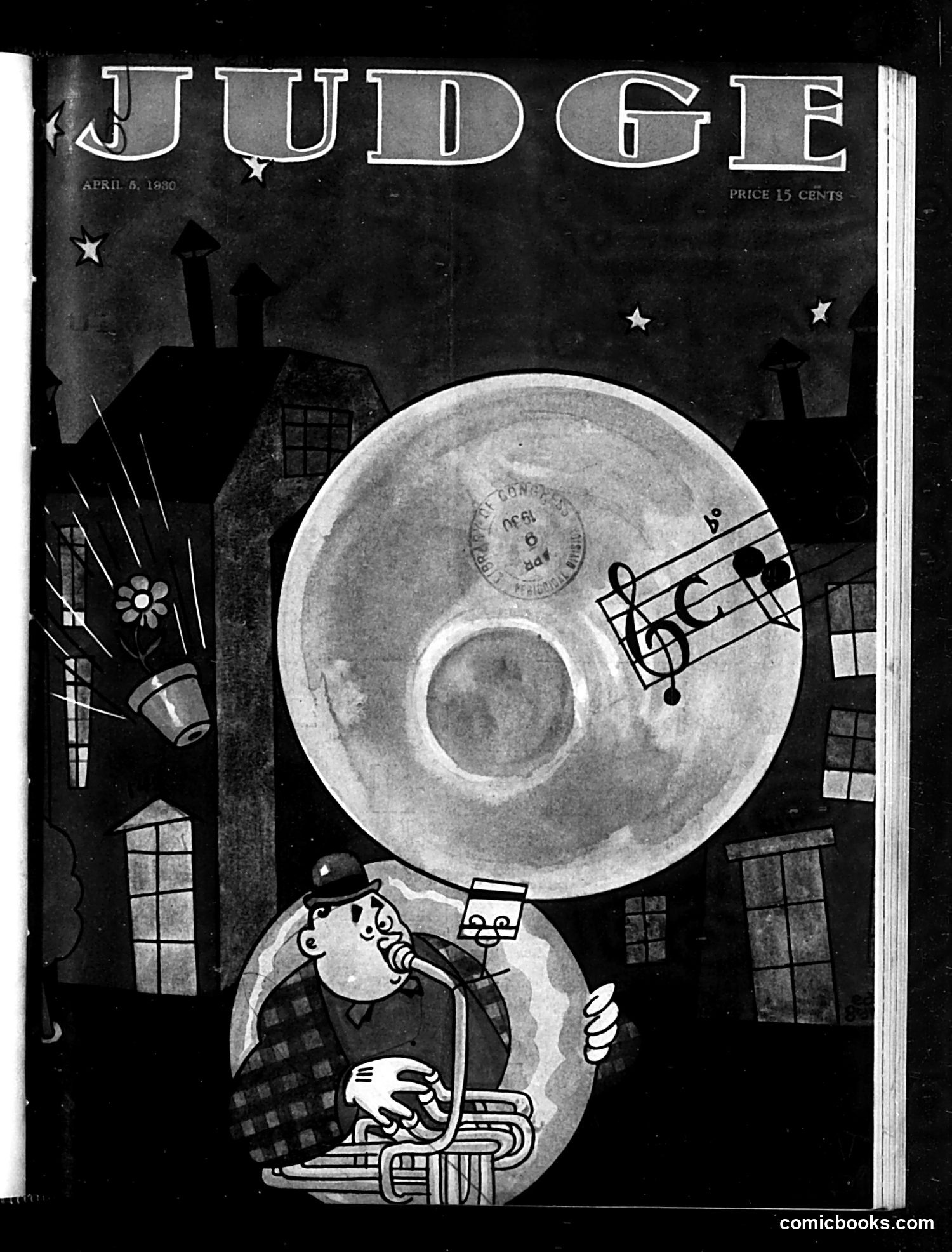
Judge Magazine Cover Analysis (April 5, 1930) This cover depicts a cartoonist or musician juggling a large phonograph record while conducting music, set against a nighttime cityscape. The figure appears to represent the entertainment industry navigating the early sound-recording era. The musical notes and gramophone suggest satire about the transition from silent to sound technology in entertainment—a major disruption of the late 1920s. The precarious juggling act implies the industry's struggle to adapt: phonograph records were competing with radio and cinema, while musicians faced uncertain futures. The "Judge" masthead and "Price 15 cents" date this to early Depression, when technological disruption threatened livelihoods. The comic commentary likely criticizes how quickly the entertainment business had to reinvent itself.
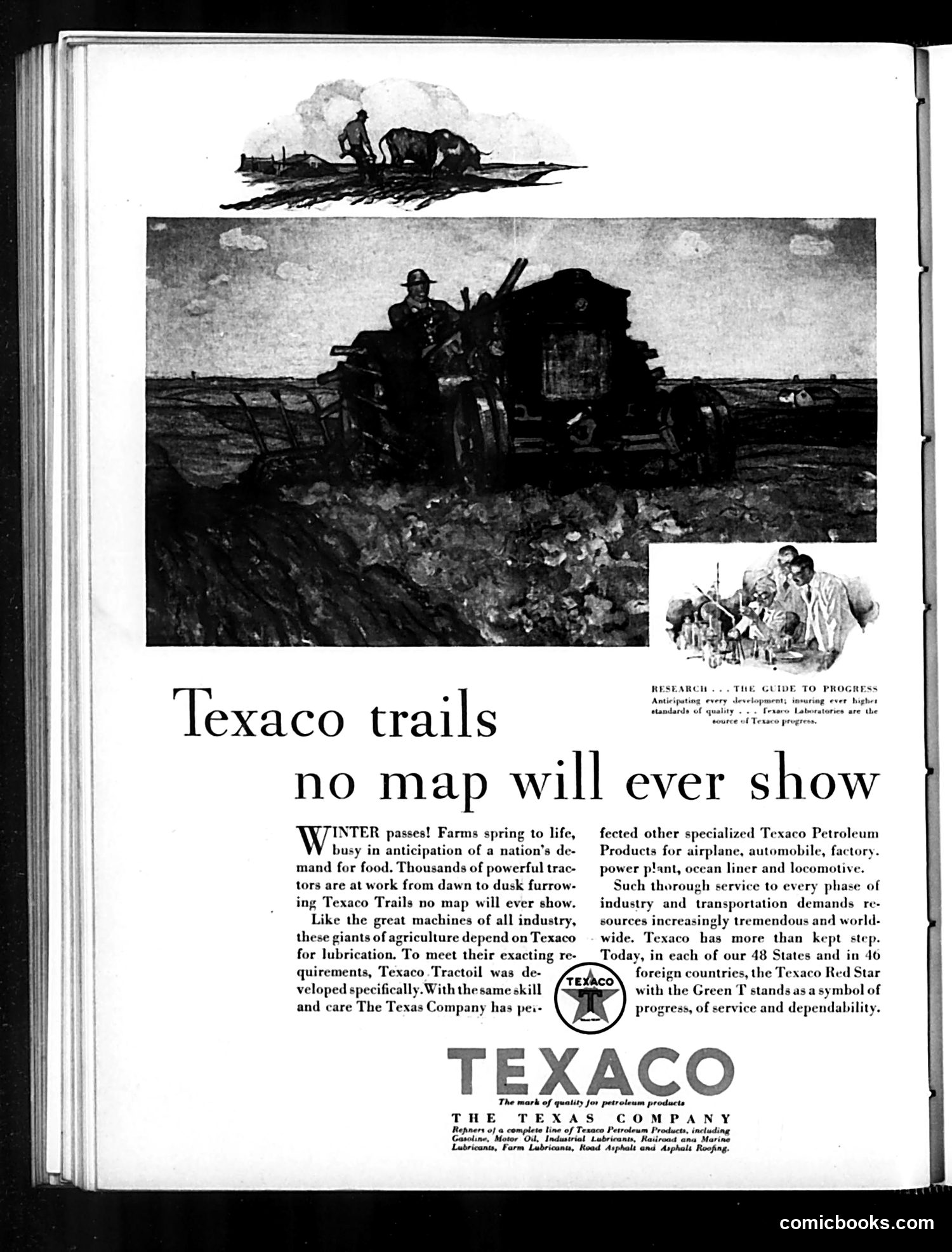
Analysis This page is primarily a Texaco petroleum company advertisement, not satire or political commentary. The headline "Texaco trails no map will ever show" uses agricultural imagery to promote Texaco Tractoil lubricant for farm equipment. The advertisement features photographs of a tractor in a field and farmers at work, positioned above text celebrating how Texaco products serve agriculture and industry. A small illustration labeled "RESEARCH... THE GUIDE TO PROGRESS" appears in the upper right, emphasizing the company's commitment to quality standards. The "satire" appears minimal—this is straightforward marketing content appearing in *Judge* magazine, likely placed as paid advertising rather than editorial content. The imagery emphasizes rural labor and industrial progress rather than critiquing either.
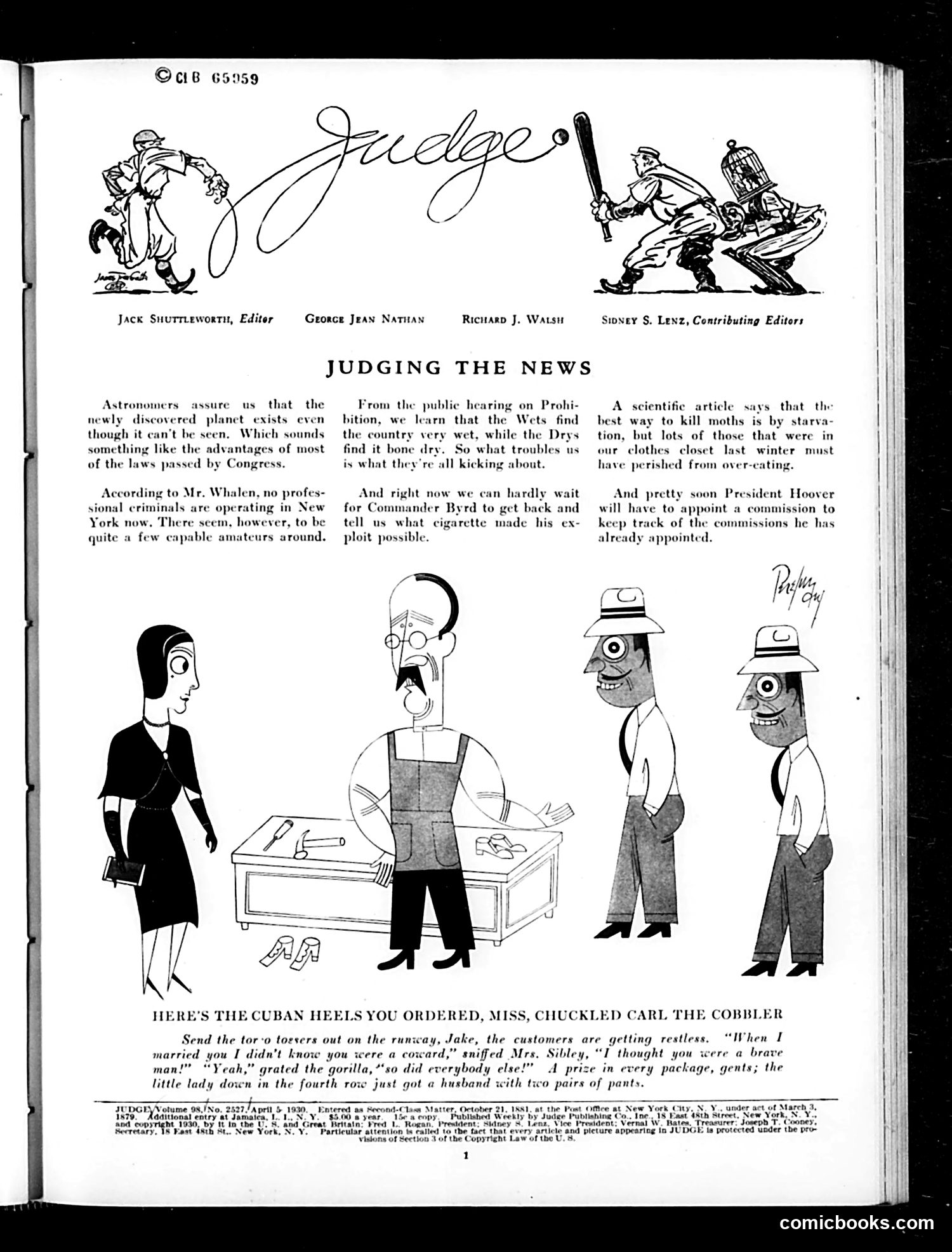
Explanation of Judge Page Content This page satirizes early 1930s news stories through short commentary pieces and a cartoon. "Judging the News" section mocks: - Congressional discovery of a new planet (likely astronomical news) - New York professional criminals ("amateurs" despite their capabilities) - Prohibition enforcement (Wets vs. Drys debate about wet/dry counties) - Commander Byrd's Antarctic expedition and cigarette promotion - President Hoover's commission appointments Main cartoon titled "Here's the Cuban Heels You Ordered, Miss" depicts a cobbler workshop scene where Carl the cobbler has apparently delivered the wrong item to a woman customer. The humor plays on the 1920s-30s fashion trend of "Cuban heels" (a shoe style), with the cobbler's confusion or mishap creating comedic confusion. The detailed caption suggests a domestic misunderstanding about footwear orders.
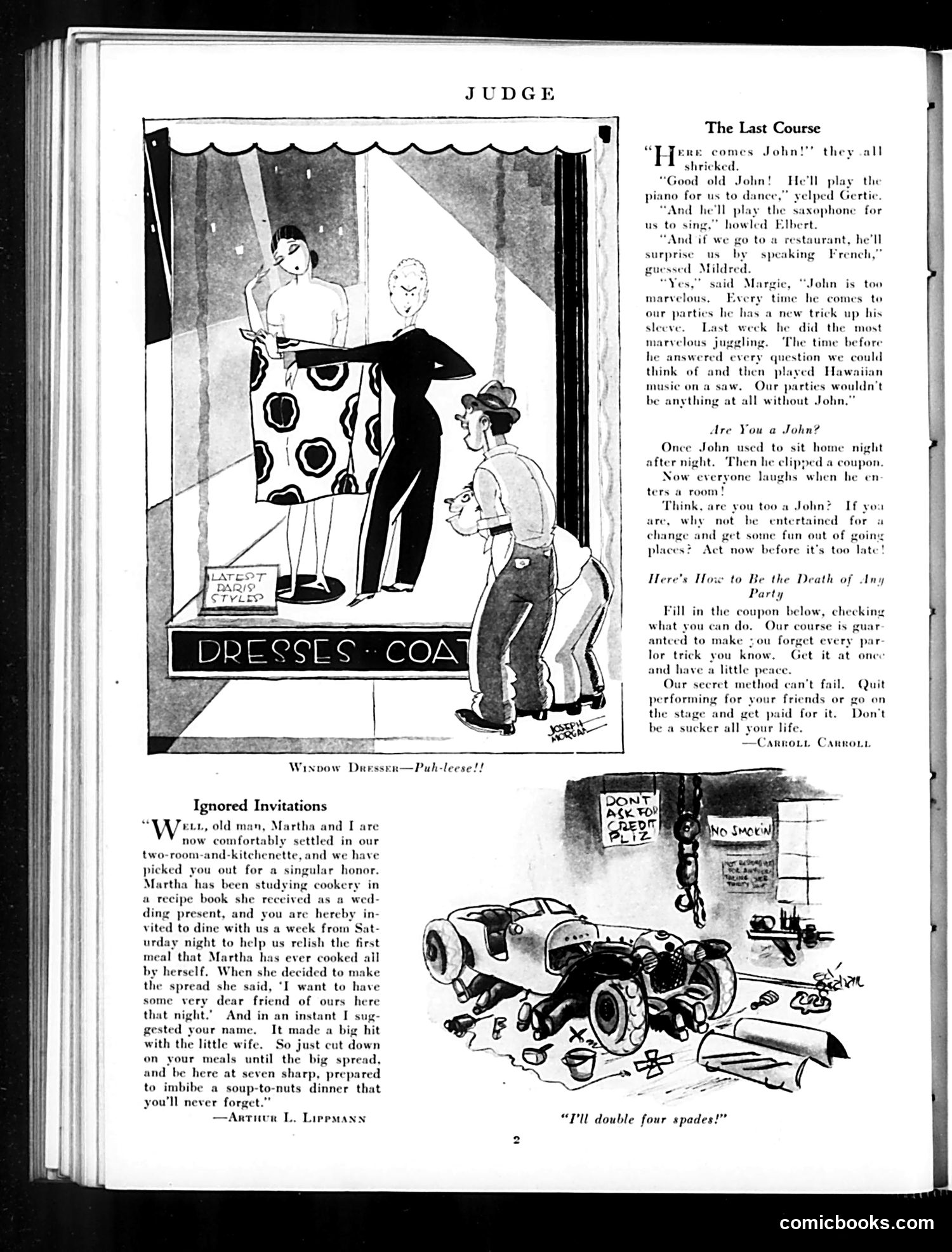
Analysis of Judge Page This page contains three separate items: 1. "Window Dresser—Pub-lease!!" (top): A cartoon mocking fashion display workers. A window dresser shows off dresses and coats to passersby, with the humor appearing to center on the performative nature of retail display and the dresser's apparent desperation for attention ("Pub-lease!!"). 2. "The Last Course" (right): Humorous advice about entertaining with a character named John who performs party tricks (piano, saxophone, French-speaking, juggling). The joke satirizes the social obligation to be perpetually entertaining for friends. 3. "Ignored Invitations" (bottom): A letter humorously declining a dinner invitation with elaborate excuses, ending with the witty threat "I'll double four spades!"—a bridge-playing reference suggesting the writer prefers card games to socializing. These are light social satire typical of Judge's era.
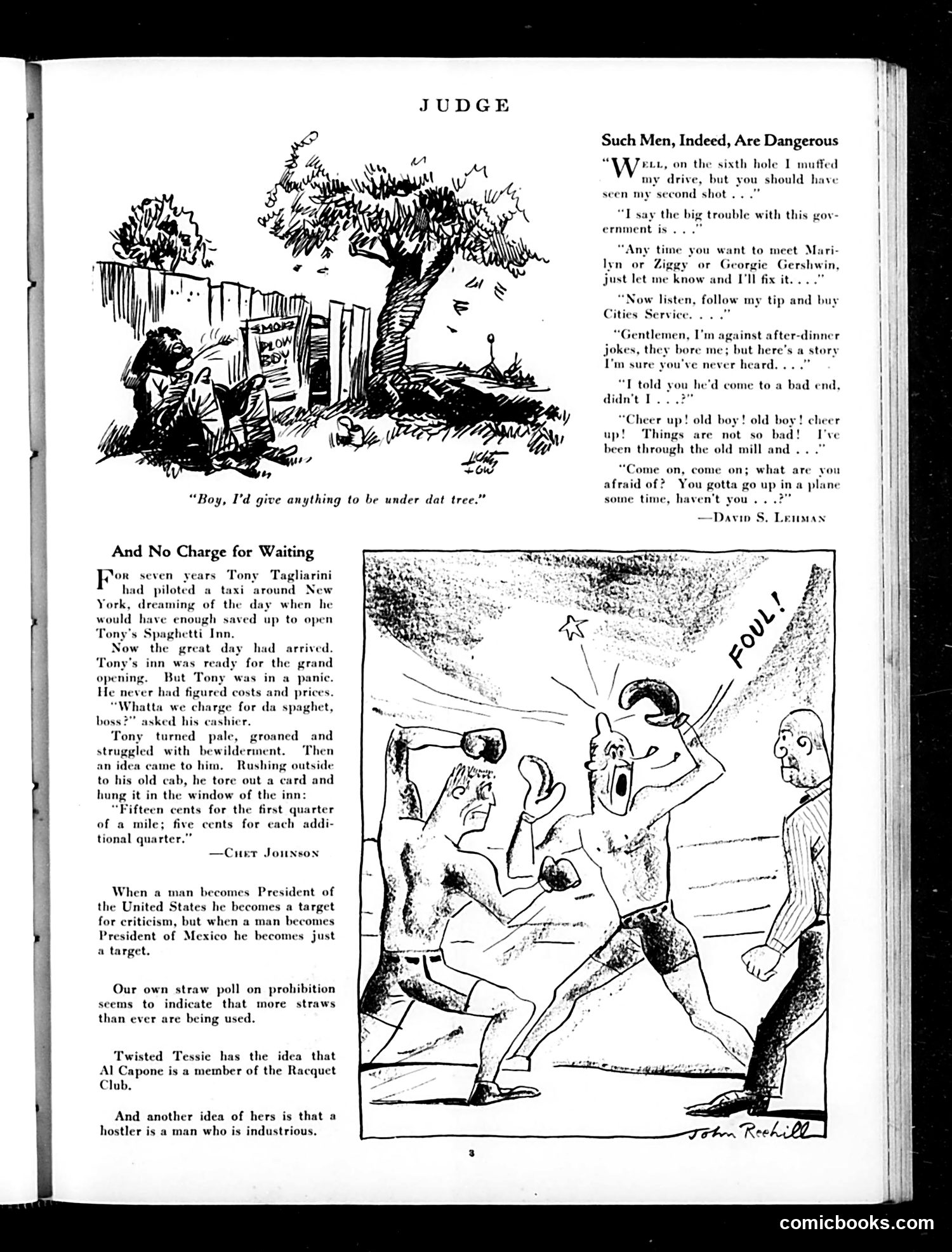
Analysis of Judge Page Top Section ("Such Men, Indeed, Are Dangerous"): This appears to be a humorous advice column satirizing dangerous or foolish suggestions. The quotes mock various scenarios—unsafe driving, fixing problems through connections, and dismissing concerns about flying. The final quote attributes these "dangerous" ideas to David S. Lehman, likely a public figure of the era. Bottom Section ("And No Charge for Waiting"): A story about Tony Tagliarini, a taxi driver who saved for seven years to open a spaghetti restaurant. When opening day arrives, he panics over pricing. A cabbie suggests "fifteen cents for the first quarter of a mile; per cent for each additional quarter"—applying taxi rates to spaghetti portions. The joke satirizes absurd business logic by inappropriately mixing industries.
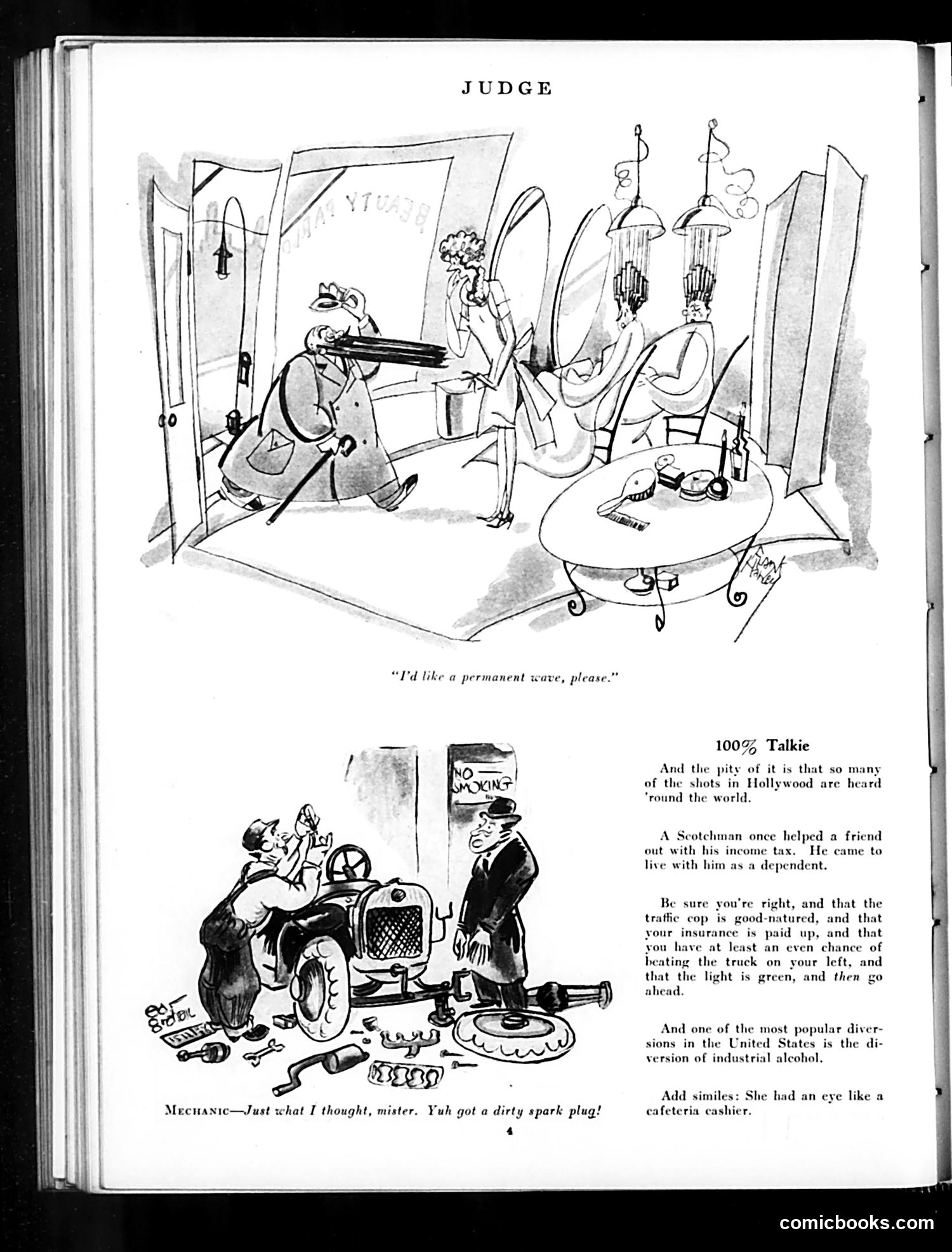
Page Analysis: Judge Magazine Top Cartoon ("Judge"): A woman at a beauty salon requests "a permanent wave, please." The satire likely mocks vanity or the absurdity of salon culture during this era, though the specific target remains unclear without additional context. Bottom Cartoon ("Mechanic"): A man with a broken-down vehicle confronts a mechanic, who diagnoses a "dirty spark plug." The humor derives from the automobile's state of disrepair and the mechanic's casual dismissal of serious mechanical problems as trivial. Text Section ("100% Talkie"): This discusses Hollywood sound films ("talkies"), referencing how movie dialogue is now heard worldwide. Anecdotes follow about income tax troubles and industrial alcohol diversion—suggesting Prohibition-era concerns about bootlegging.
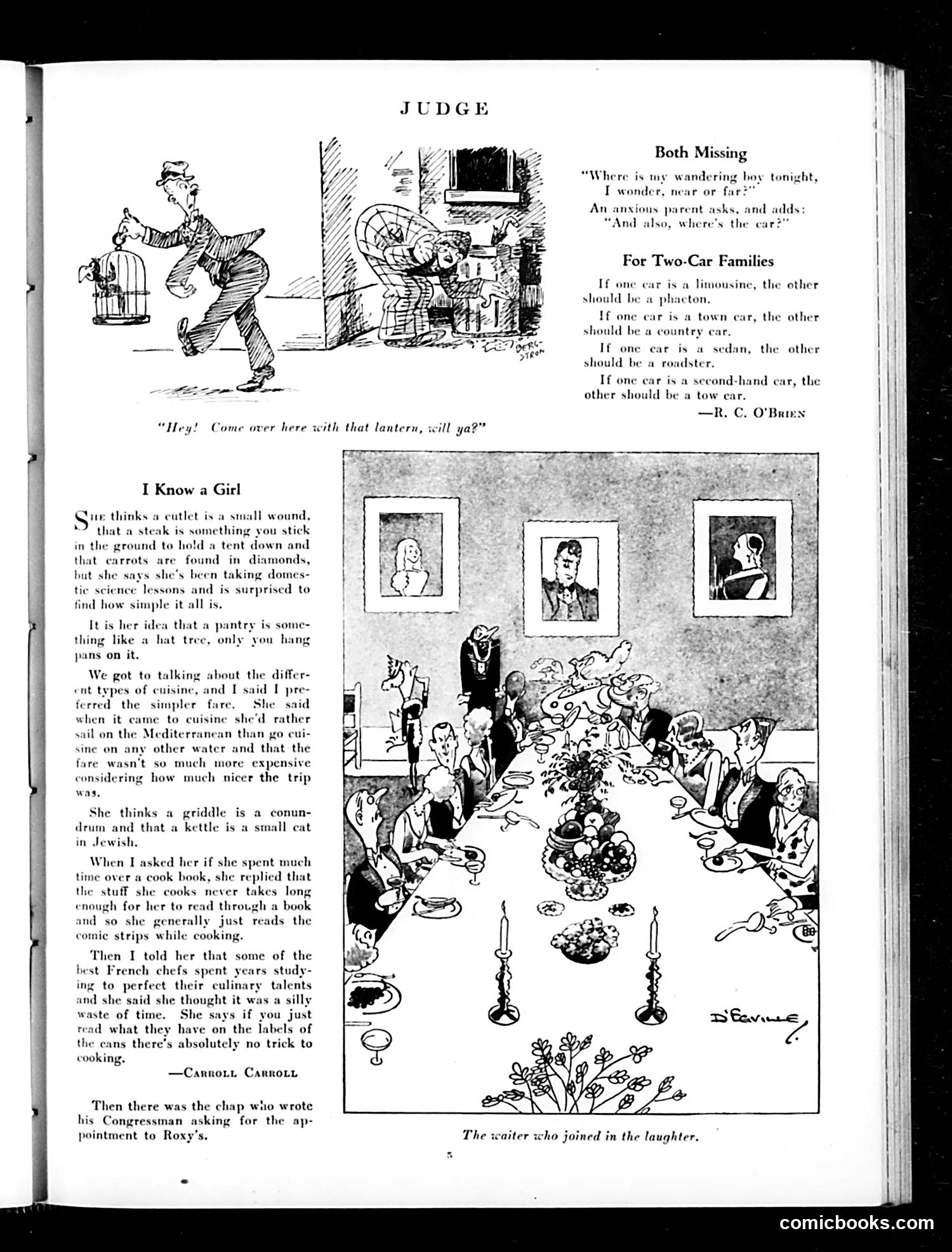
Analysis The top cartoon shows a judge chasing someone with a birdcage, captioned "Hey! Come over here with that lantern, will ya?" This appears to be a visual pun about judicial authority—the judge pursuing someone, likely depicting a courtroom or legal scenario in humorous fashion. The right column contains two short humor pieces: "Both Missing" jokes about a couple's missing son and car, and "For Two-Car Families" offers absurdist matching-car recommendations (if one is a limousine, the other should be a hearse, etc.). "I Know a Girl" by Carroll Carroll is a longer anecdotal piece mocking a woman's misconceptions about cooking and culinary knowledge. The large illustration shows a formal dinner party, captioned "The waiter who joined in the laughter," depicting social comedy around dining etiquette.
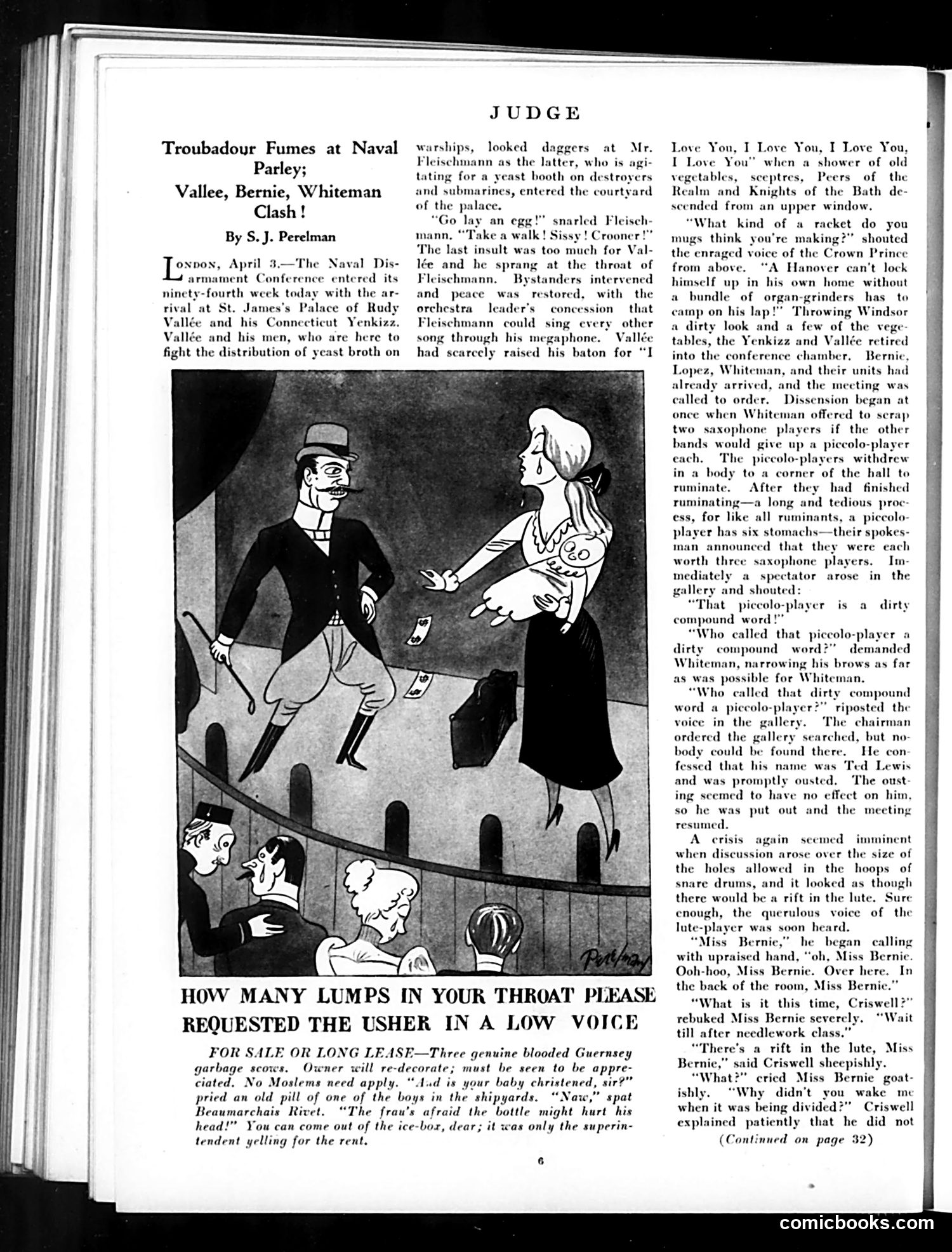
Analysis of Judge Magazine Page This page satirizes the Naval Disarmament Conference at St. James's Palace, where delegates including Rudy Vallee, Bernie Whiteman, and others gathered to discuss yeast broth distribution. The cartoon depicts a man in formal attire meeting a woman, illustrating the story's premise: a troubadour (Vallee) and his men attempt to settle a dispute by offering saxophone players to other bands. The satirical narrative ridicules the conference through musical absurdity—piccolo-players with "six stomachs," compound insults about "dirty" musical terms, and a missing Ted Lewis. The humor mocks both the naval conference's actual proceedings and American entertainment personalities of the era by casting them as absurd bureaucratic disputants. The advertisements below contain period-specific product offerings now largely obsolete.
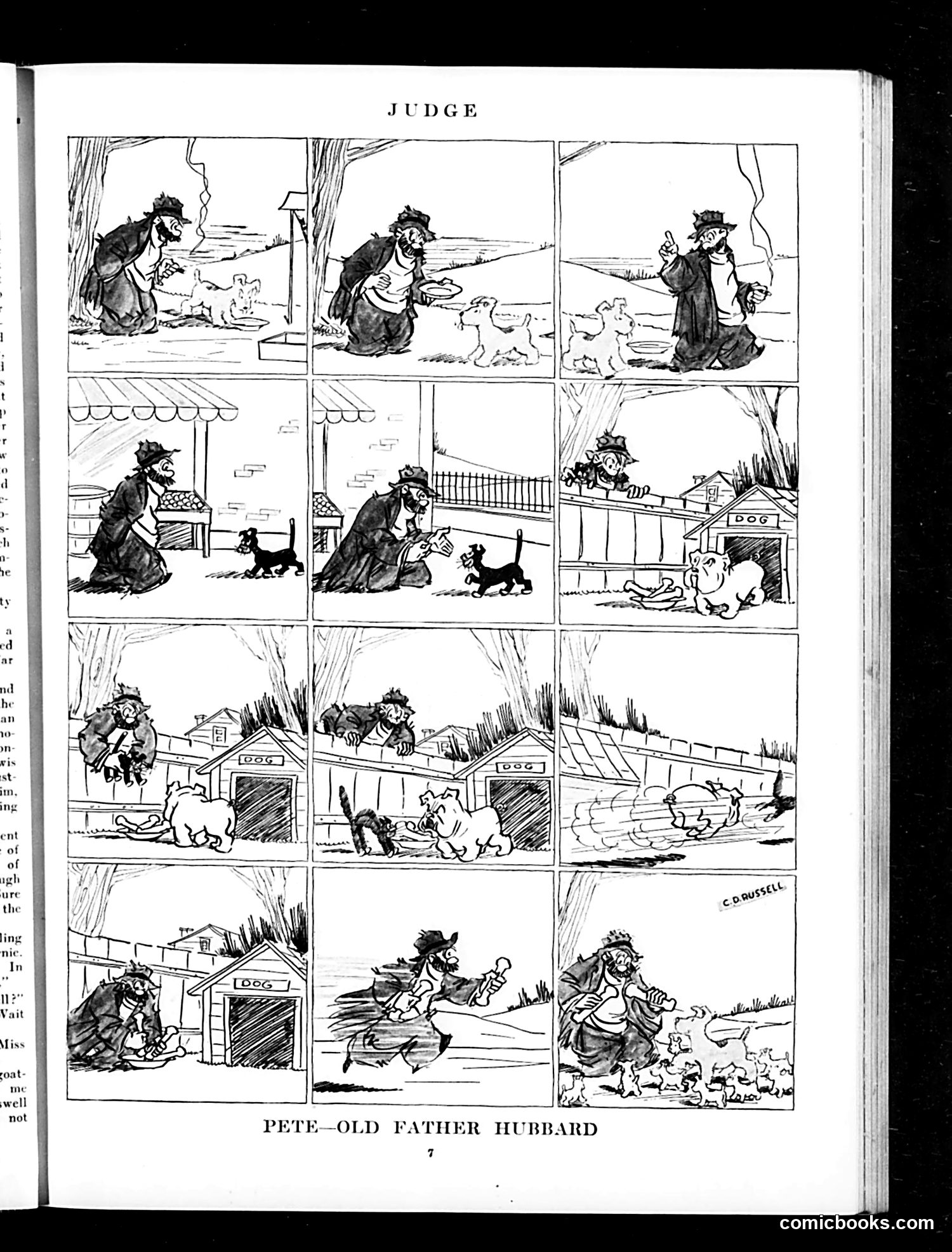
Analysis This is a single-panel comic strip titled "Pete—Old Father Hubbard," a visual parody of the nursery rhyme "Old Mother Hubbard." The strip shows a character (an old man, "Father Hubbard") attempting to manage or judge multiple small dogs—the humor derives from the chaos of controlling numerous animals simultaneously. The satirical point appears to reference governance or management of difficult situations. The "Judge" title at the top suggests this may be social or political commentary about someone trying to maintain order amid chaos, though the specific historical figure or event being referenced is unclear without additional context. The narrative arc shows escalating mayhem as the character attempts unsuccessfully to corral the dogs, suggesting incompetence or futility in the task at hand.
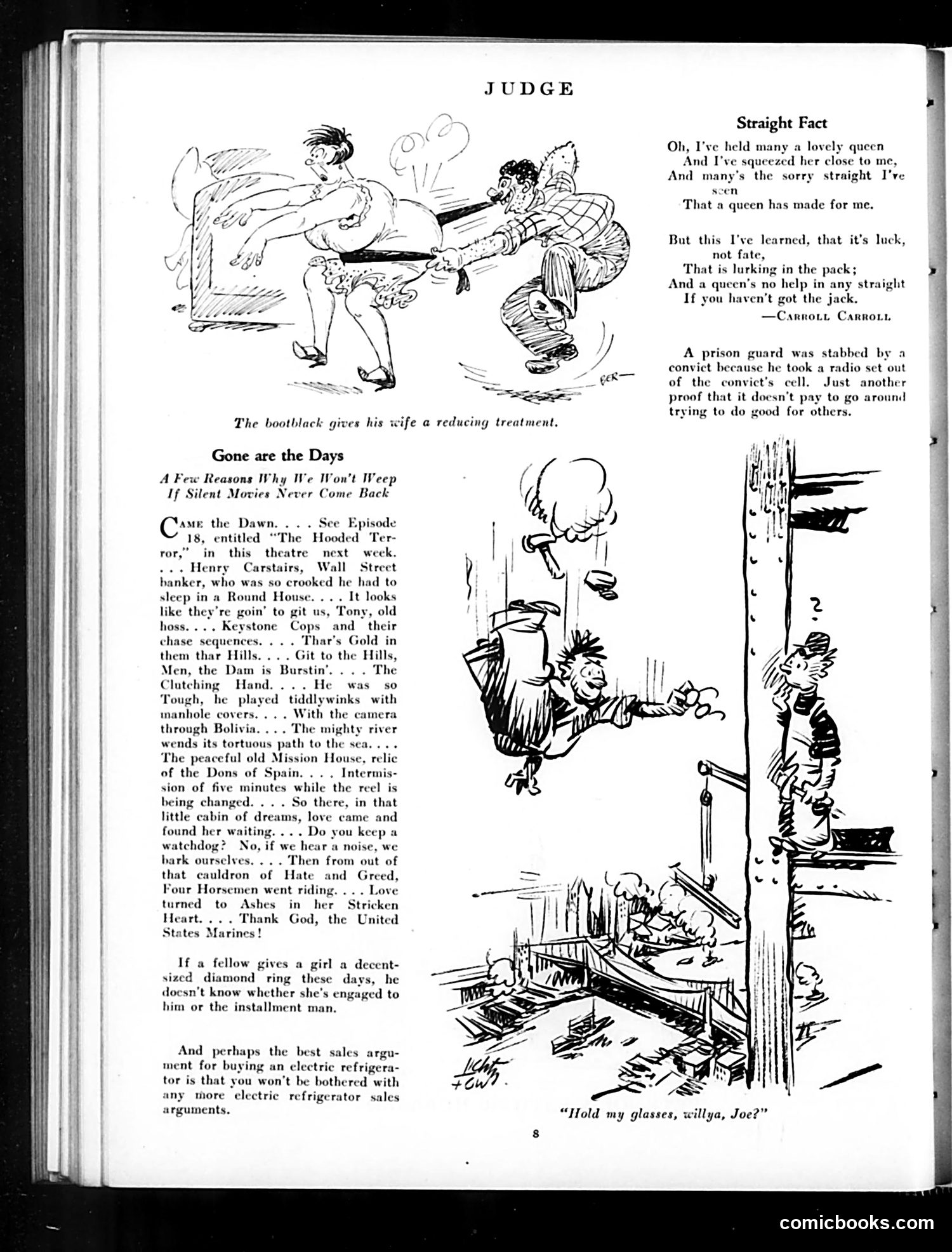
Judge Magazine Page Analysis This page contains satirical humor typical of 1920s-era Judge magazine: Top Cartoon: "The bootblack gives his wife a reducing treatment" shows a domestic violence scene where a man kicks his wife, playing on the cruel "humor" of spousal abuse as entertainment—reflecting attitudes toward women that modern readers would find deeply offensive. "Straight Fact" Poem: A poker-themed verse attributed to Carroll Carroll, using card-game metaphors to discuss romantic relationships and luck versus fate—lighthearted romantic cynicism. Prison Guard Anecdote: A brief item mocking rehabilitation efforts, suggesting that trying to help convicts (removing a radio) is futile and dangerous—reflecting cynical attitudes toward criminal reform. "Gone are the Days": A satirical list praising the death of silent films, mocking common melodramatic plot devices: crooked bankers, Keystone Cops chases, dams bursting, "Four Horsemen" imagery. This suggests Judge favored talkies over silents. Bottom Cartoon: A construction/building accident scene with the caption "Hold my glasses, willya, Joe?"—dark humor about workplace injury. The page reflects 1920s entertainment preferences and social attitudes now considered offensive.
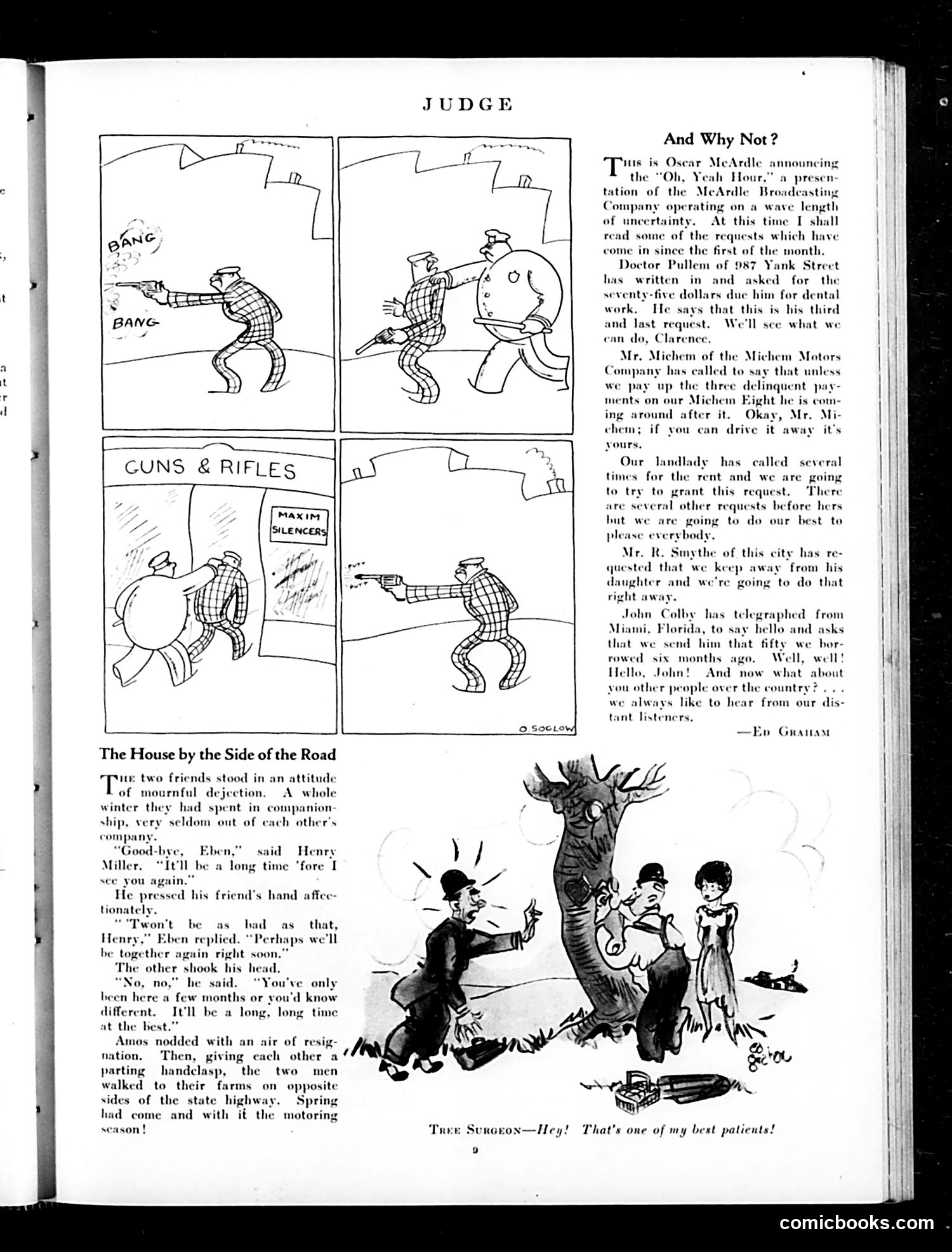
Analysis of Judge Magazine Page This page contains two distinct pieces of satire: Top Comic Strip ("And Why Not?"): A mock radio broadcast parody where Oscar McArdle's "Oh, Yeah Hour" takes listener requests—but they're all complaints and demands for payment. A dentist wants $75 owed him, a car company threatens repossession, the landlady demands rent, and someone demands the broadcaster stay away from his daughter. The satire mocks both the novelty of radio broadcasting in the 1920s and the financial desperation of ordinary Americans, suggesting that broadcast "requests" reveal the economic struggles behind everyday life. Lower Story ("The House by the Side of the Road"): Two rural farmers bid farewell, expecting separation. One laments it will be "a long time" before they meet again—but the final sentence reveals the punchline: spring has brought the "motoring season," meaning cars now make visiting easy. The satire targets how automobiles were transforming rural isolation, disrupting the expected melancholy of farm life's separation. Both pieces humorously reflect 1920s anxieties about new technologies (radio, automobiles) reshaping American society.
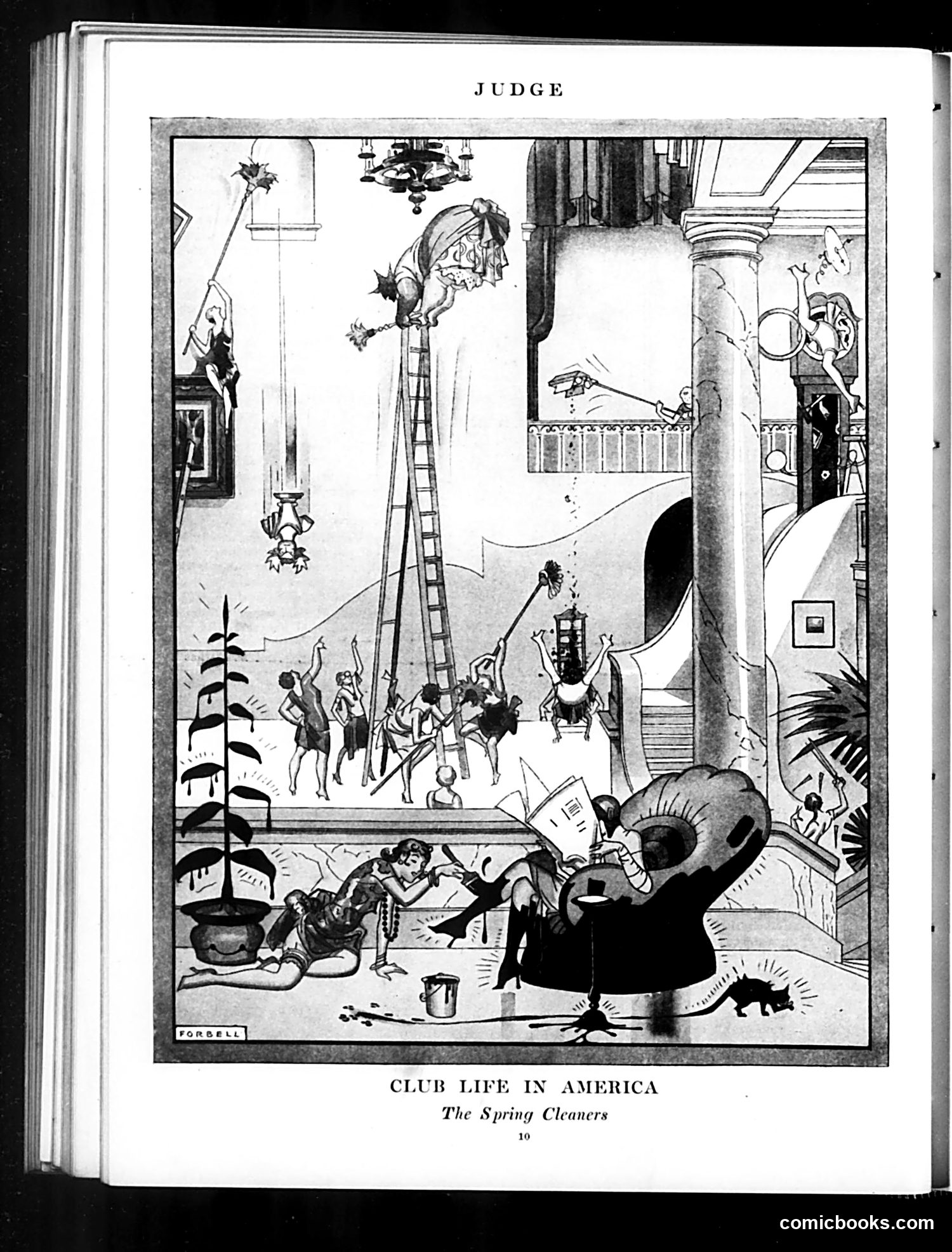
"The Spring Cleaners" - Judge Magazine Cartoon This satirical illustration depicts spring cleaning chaos in an upper-class American home. The cartoon shows servants and household staff engaged in vigorous, comedic cleaning activities—hanging carpets from windows, scrubbing, climbing ladders, and generally creating mayhem throughout an elegant interior space. The satire targets the seasonal ritual of spring cleaning, particularly mocking the disruption and absurdity it causes. The exaggerated physical comedy—people dangling from ropes, dust clouds, overturned furniture—ridicules how this domestic practice turns orderly homes into temporary disaster zones. The title "Club Life in America" (above the cartoon) suggests this depicts wealthy, leisured-class households. The joke appears aimed at both the frivolous concerns of the wealthy and the theatrical nature of domestic labor performance during this seasonal tradition. The artist's signature reads "Forbell" (or similar).
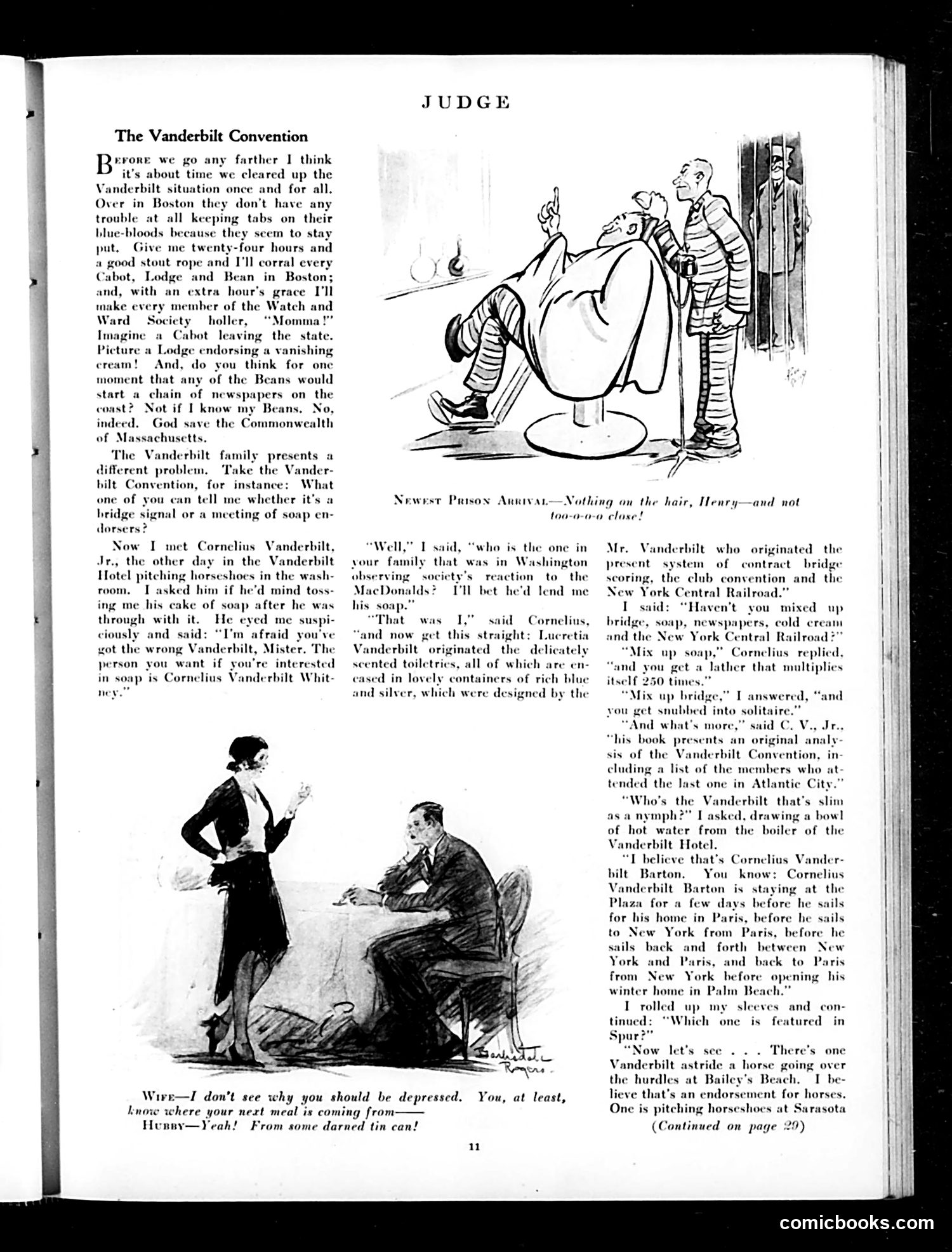
"The Vanderbilt Convention" - Judge Magazine Satire This article satirizes the wealthy Vanderbilt family's commercialization and fragmentation compared to Boston's old-money establishment. The author contrasts Boston's stable "blue-bloods" (Cabots, Lodges) with the scattered, celebrity-endorsing Vanderbilts, who appear in newspapers promoting various products—soap, cold cream, bridge-scoring systems, and even horses. The joke hinges on the family's size and visibility: there are so many Vanderbilts doing endorsements that the narrator struggles to identify *which* Vanderbilt originated what enterprise. The satire targets the Gilded Age practice of prominent families lending their names to commercial products, treating aristocratic status as a marketing commodity rather than maintaining dignified privacy. The cartoon illustrates this chaos through absurdist scenarios—Vanderbilts endorsing everything from household goods to sporting activities—mocking the loss of traditional upper-class restraint.
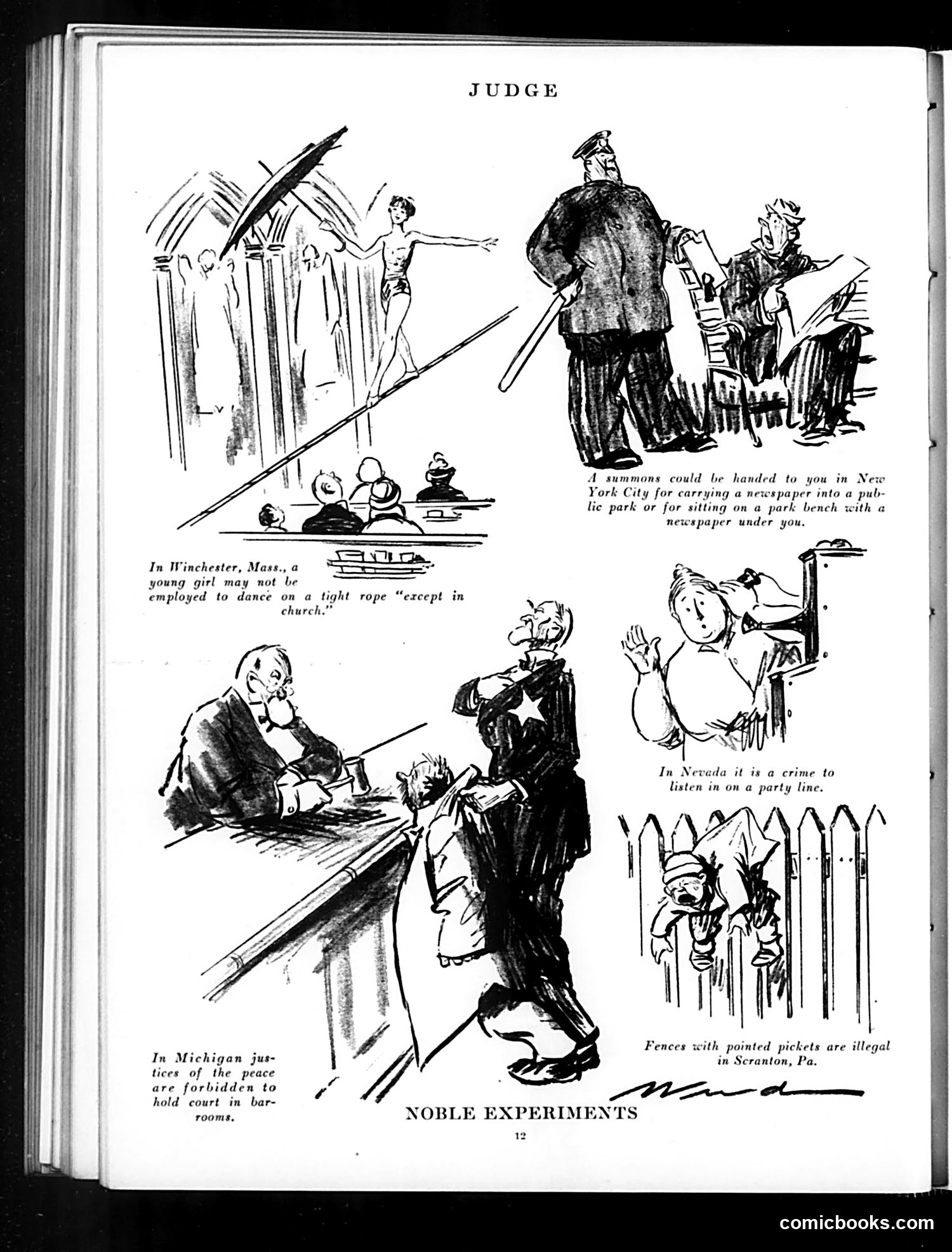
Analysis: "Judge" Magazine - "Noble Experiments" Page This page satirizes absurd or contradictory local laws across America, likely from the Prohibition era (early 20th century). The title "Noble Experiments" ironically references Prohibition itself—a major federal "experiment" that many considered foolish. Each illustrated vignette mocks a specific state's peculiar legislation: - Winchester, Mass.: A girl can't perform tightrope dancing anywhere except church (absurd exception) - New York City: You can't bring newspapers into parks or sit on benches with them - Michigan: Justices of the peace can't hold court in bars - Nevada: Listening to party-line phone conversations is criminal - Scranton, Pa.: Pointed fence pickets are illegal The cartoons depict these laws being enforced, highlighting their impracticality and social obtuseness. The satire suggests that while authorities worried about controlling minor behaviors, they missed larger issues—or that excessive regulation produced laughably contradictory rules.
Judge Magazine Page Analysis This page from Judge magazine contains three satirical pieces: "The New Patriotism" celebrates the 100th anniversary of westward expansion (likely 1930, marking the 1830 wagon trains). It praises President Hoover's call to commemorate pioneers, but shifts the definition of American patriotism from aggressive jingoism ("one Yankee could lick four") to respect for conquering nature itself—a more "contemplative patriotism." "Percival" mocks the unfortunate connotations of the name Percival, suggesting that naming a newly-discovered planet after it would restore dignity to the name (the reference appears to be Percival Lowell's observatory discovery). "They're Not All Ancient Laws" satirizes America's proliferation of unenforced, obsolete laws. It notes that while some are ancient relics, modern legislators equally produce scatter-brained statutes. A Columbia Law School dean is quoted: approximately 250,000 statutes have passed since 1900, vastly expanding government control over individual liberty "to an extent unknown in modern history." The overall tone criticizes both nostalgia and modern legislative overreach.
Judge Magazine Page Analysis This page contains two separate humorous pieces typical of early 20th-century American satire. "The New Job" mocks young men entering the workforce during economically tight times. The narrator's nephew reluctantly accepts a shipping clerk position despite overqualification, working long hours for minimal pay. The accompanying cartoon shows a man tap-dancing while opening a bottle—suggesting workers kill time or drink on the job rather than advance themselves, undercutting the narrator's optimism about the nephew's prospects. "The Servant Problem Solved" satirizes wealthy women's chronic complaints about domestic staff turnover. Mrs. Brown reveals her "secret": she deliberately sabotages her electric refrigerator every two weeks to summon repair men, using this as an excuse to keep her maids distracted and occupied. The joke exposes both the absurdity of the "servant problem" (a genuine upper-class anxiety of the era) and wealthy women's manipulative tactics to control household help—all while casually eating pastries.
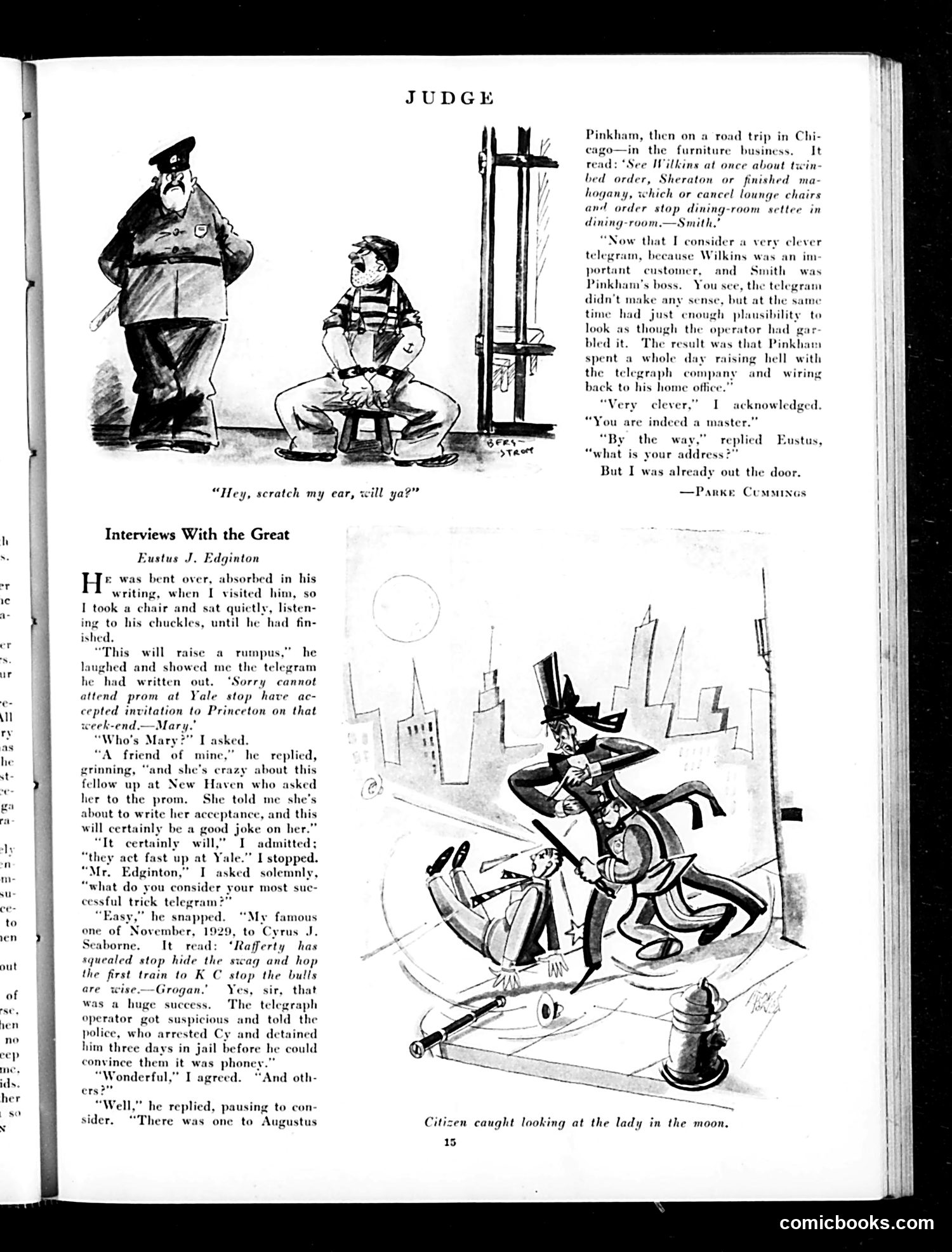
Judge Magazine Satire Analysis This page satirizes "trick telegram" pranks—a common early-20th-century practical joke exploiting telegraph operators' potential errors or mischief. The Setup: An interview with "Eustus J. Edginton," presented as a master of sending deliberately garbled or confusing telegrams to embarrass recipients. The Jokes: 1. A fake breakup telegram to sabotage a Yale student's romance 2. A 1929 telegram mimicking gangster slang ("hide the swag") that got an innocent man arrested—played for laughs 3. A deliberately nonsensical furniture order telegram sent to a businessman's important customer, designed to confuse and embarrass him The Satire: Judge mocks the casual cruelty of these pranks and their real consequences (wrongful arrest, damaged business relationships). The humor derives from the absurdity and the interviewer's abrupt exit—suggesting even he recognizes Edginton's character is morally dubious. Context: Telegrams were serious, expensive business communications; pranking them was socially transgressive, making this satirical "interview" commentary on thoughtless pranksterism.
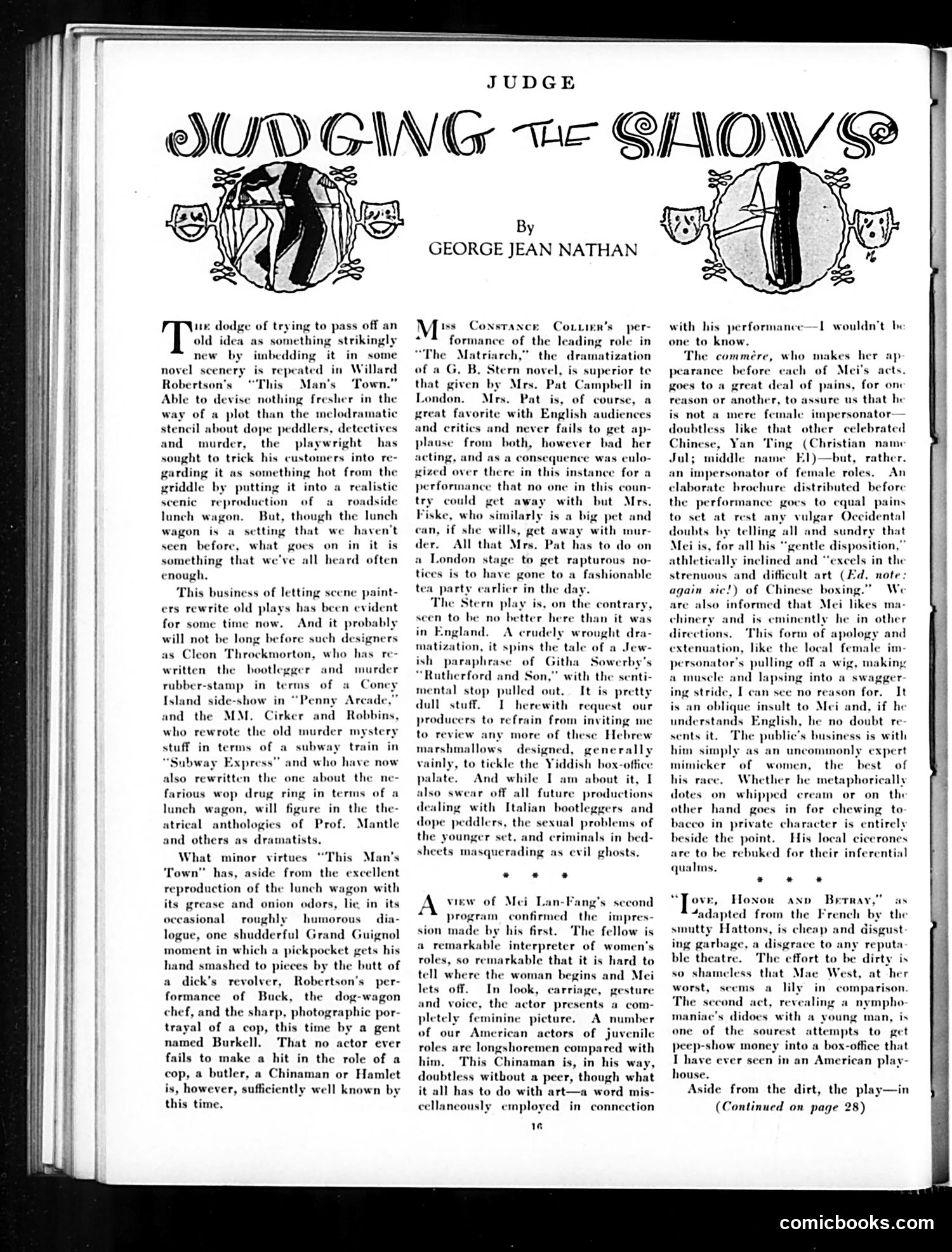
"Judging the Shows" - Theater Criticism by George Jean Nathan This page contains theater reviews, not political cartoons. Nathan criticizes several contemporary Broadway productions: "This Man's Town" gets harsh treatment for recycling melodramatic plots (dope peddlers, detectives, murder) dressed up with realistic scenic design—specifically a roadside lunch wagon set. Nathan mocks the trend of having set designers essentially "rewrite" old plays through elaborate staging, naming designers like Cleon Throckmorton as culprits. "The Matriarch" is reviewed favorably for Constance Collier's performance, though Nathan dismisses the underlying play as derivative and "dull"—a crude dramatization of Githa Sowerby's work. He facetiously swears off reviewing more productions about "Italian bootleggers and dope peddlers." Mei Lan-Fang's performance (a Chinese actor) receives praise for his remarkable portrayal of female roles, presented as superior to American actors in similar juvenile parts. The reviews reflect 1920s theater culture: Nathan's caustic style, complaints about formula plots, and interest in international theater.
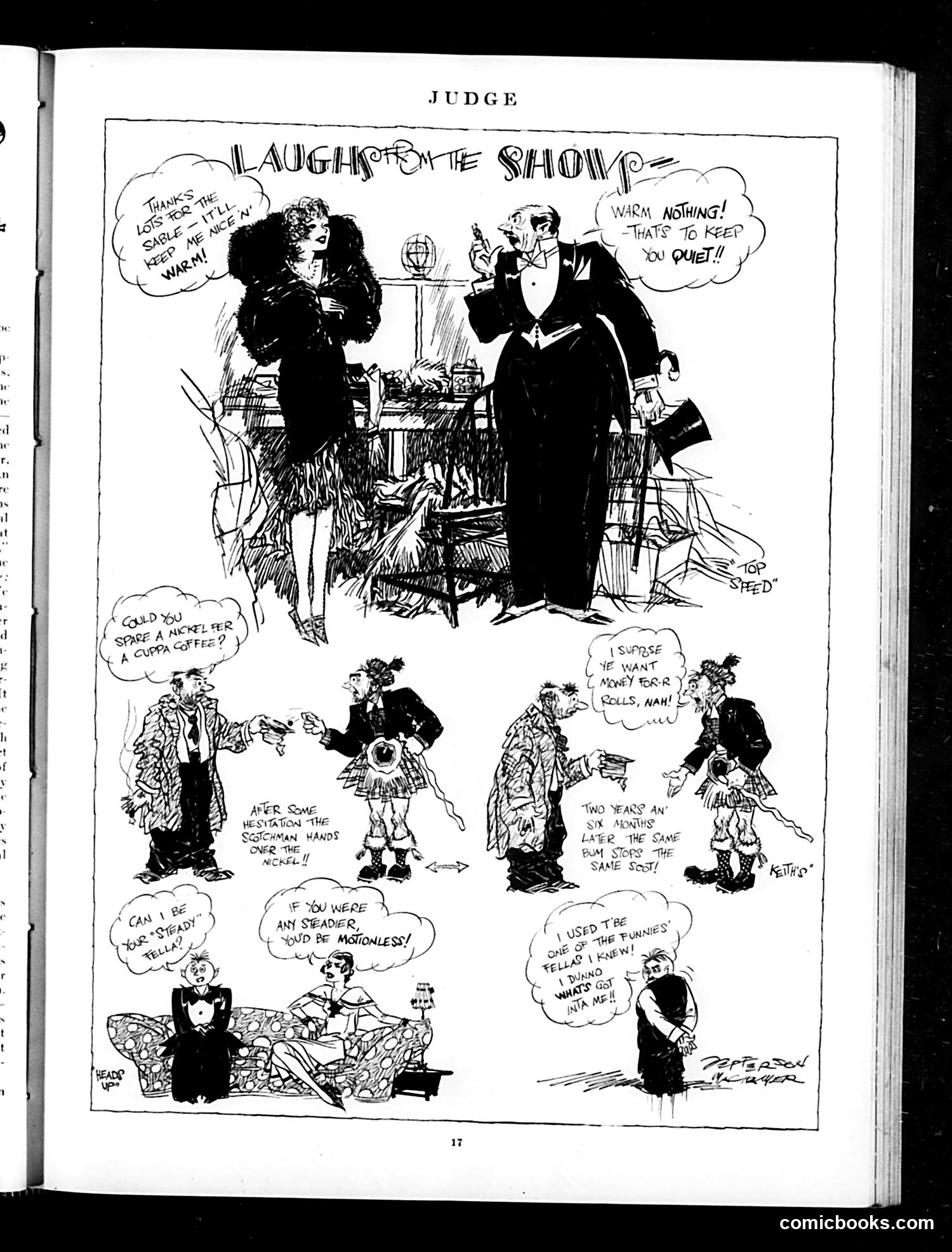
"Laughs at the Shop" - Judge Magazine Cartoon This comic satirizes wealthy couples' shopping behavior and marital dynamics. The main panel shows an elegantly dressed couple at what appears to be an upscale boutique or department store. The husband warns his wife to stay quiet, suggesting she talks excessively while shopping. The subsequent panels depict a running gag: a shopkeeper demonstrates items to the couple, but the wife interrupts with unsolicited commentary about previous purchases—mentioning she already owns similar items from months prior. The joke targets: 1. Conspicuous consumption among the wealthy class who buy redundantly 2. Wives as spendthrifts (a common stereotype of the era) 3. Marital tension over shopping habits and excessive talking The husband's exasperation contrasts with the wife's obliviousness to her repetitive buying patterns. The satire mocks both frivolous wealthy shopping culture and gender stereotypes about women's chattiness and materialism.
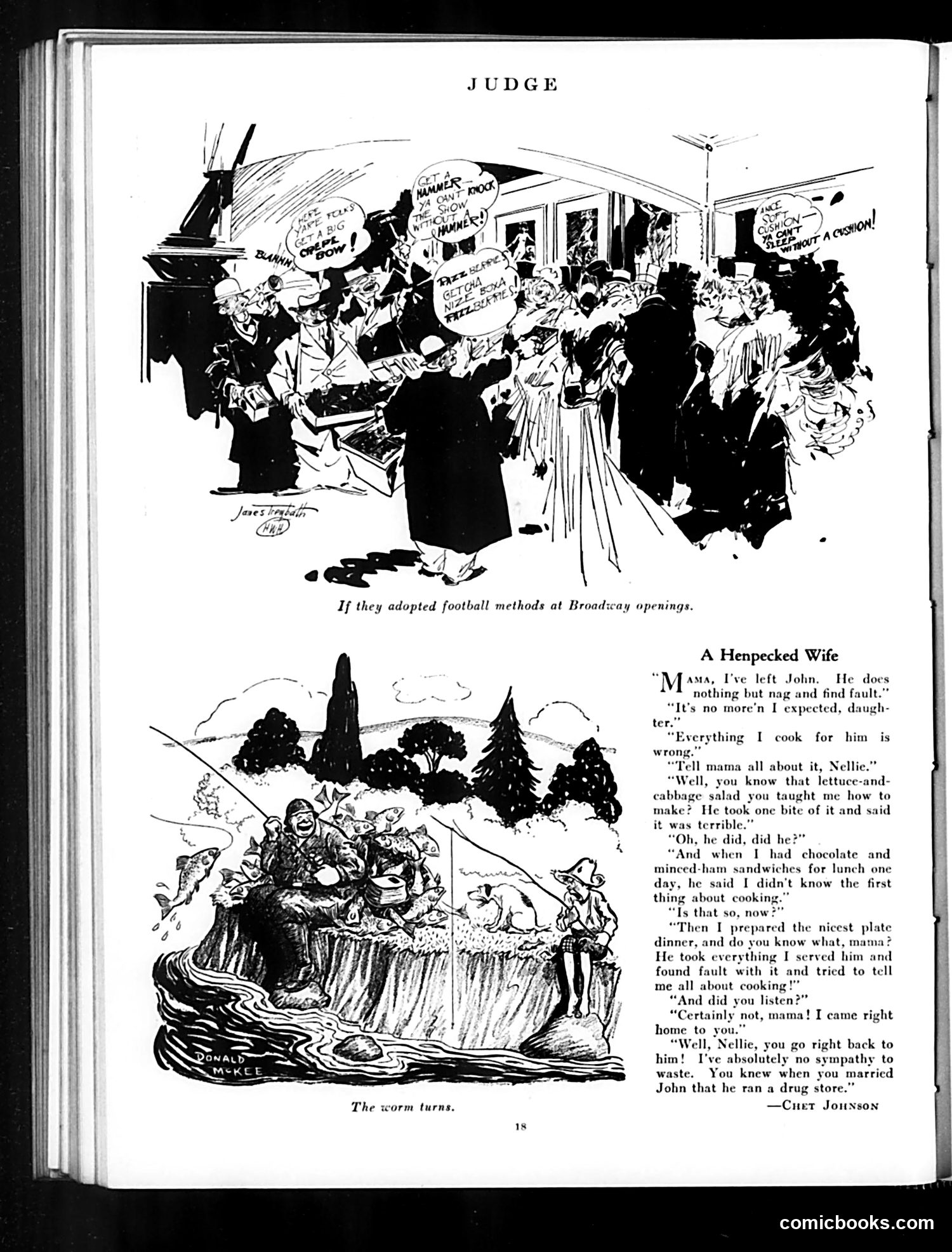
Political-Social Satire Analysis Top Cartoon: This untitled sketch satirizes Broadway theater openings by depicting them as chaotic mob scenes with aggressive tactics borrowed from football—crowds pushing, shoving, and using physical force to gain entry. The joke mocks both the frenzied celebrity culture around Broadway premieres and the violent competitiveness of American football, suggesting opening nights have become barbarous spectacles rather than refined cultural events. "A Henpecked Wife": This domestic comedy story by Chet Johnson depicts a wife complaining to her mother about her husband John's constant criticism of her cooking. The mother's harsh response—that the wife should return to John because she "knew when you married John that he ran a drug store"—reveals the satire's target: the presumption that any employment (however humble) excuses a husband's tyrannical behavior. The joke portrays both the wife's nagging mother and the dismissive attitude toward female domestic labor as equally problematic.
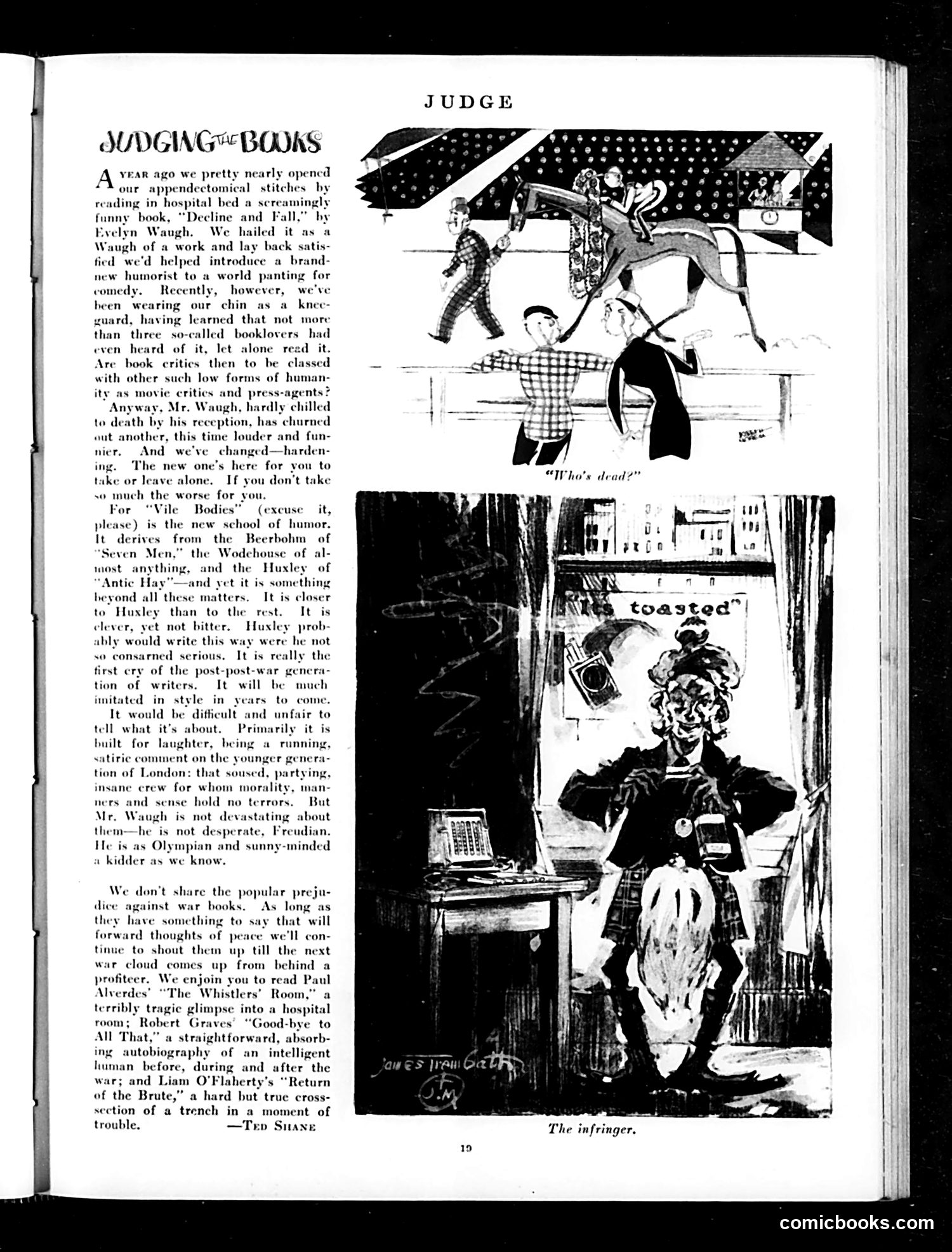
Judge Magazine Book Review Page This is a literary criticism column titled "Judging the Books." The reviewer (Ted Shane) discusses Evelyn Waugh's novel *Vile Bodies*, praising it as representing a new post-WWI generation of humor writing. The two cartoon illustrations satirize book criticism itself. The top cartoon, captioned "Who's dead?" shows figures reacting dramatically to a book—mocking the overwrought, pretentious responses critics and "booklovers" supposedly have to literature. The bottom illustration, "The infringer," depicts someone reading a book labeled "toasted"—likely satirizing how quickly readers forget or misremember what they've read, or how superficially people engage with literature. The column's broader point: genuine literary merit often goes unrecognized by casual readers, while critics themselves may be no more reliable than movie critics or press agents in identifying quality work.
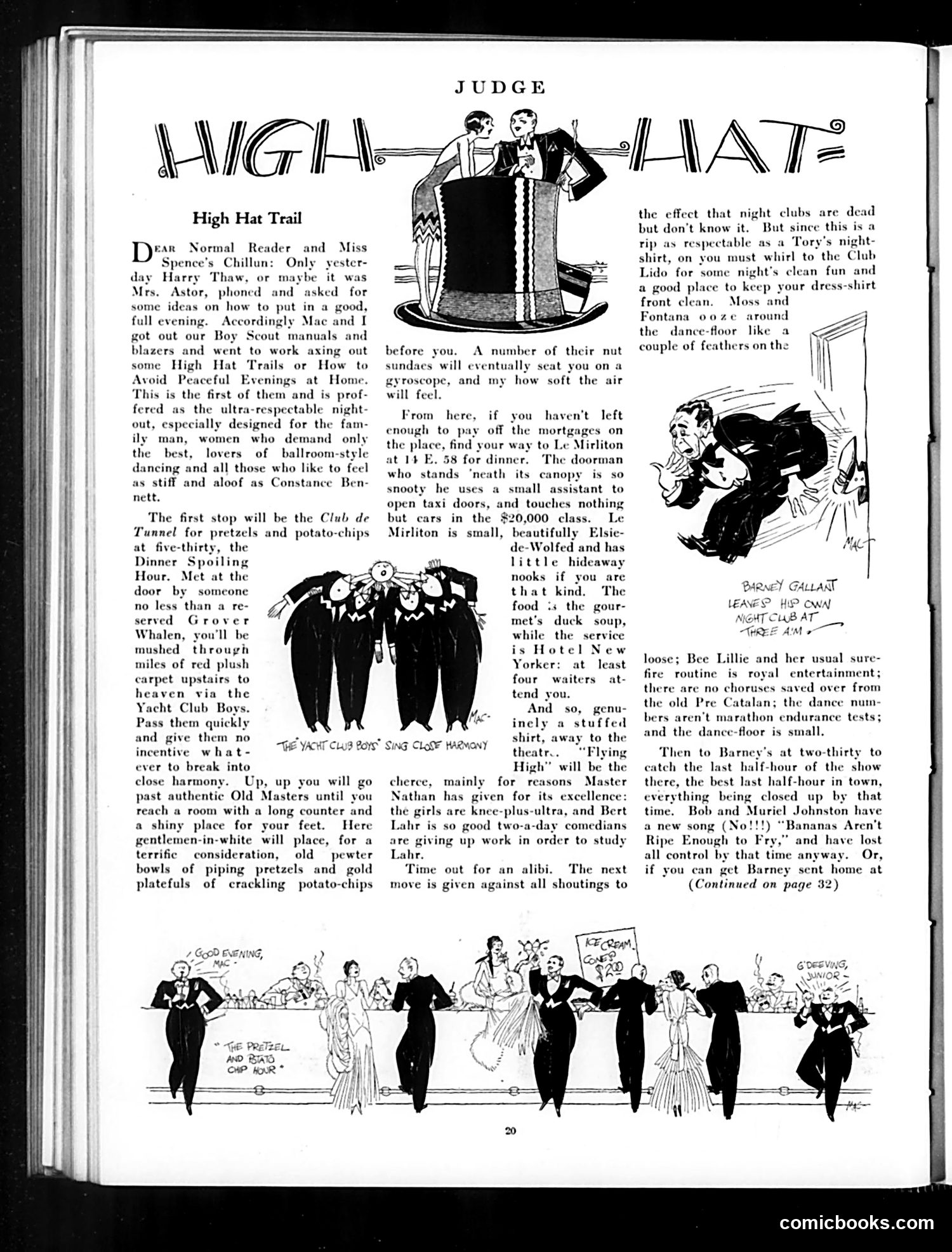
High Hat Trail: A Satire of Elite Manhattan Nightlife This piece satirizes the pretentious nightlife culture of wealthy 1920s New Yorkers. Written as mock advice for an evening out, it references real society figures (Harry Thaw, Mrs. Astor, Constance Bennett) and actual Manhattan venues (Club de Tunnel, Le Mirliton, Club Lido). The satire targets the affectation and stuffiness of high-society entertainment: snooty doormen, overpriced food, rigid formality, and the desperate performance of wealth and sophistication. Judge mocks how the wealthy must endure uncomfortable venues and mediocre shows merely to maintain their social status—"as stiff and aloof as Constance Bennett." The cartoons illustrate the mechanical, joyless nature of this nightlife circuit. References to performers (Bert Lahr, Bee Lillie, Barney) and the detail about "stuffed shirt" entertainment underscore the hollow pretense. The piece suggests that authentic enjoyment is sacrificed entirely for maintaining appearances among Manhattan's elite.
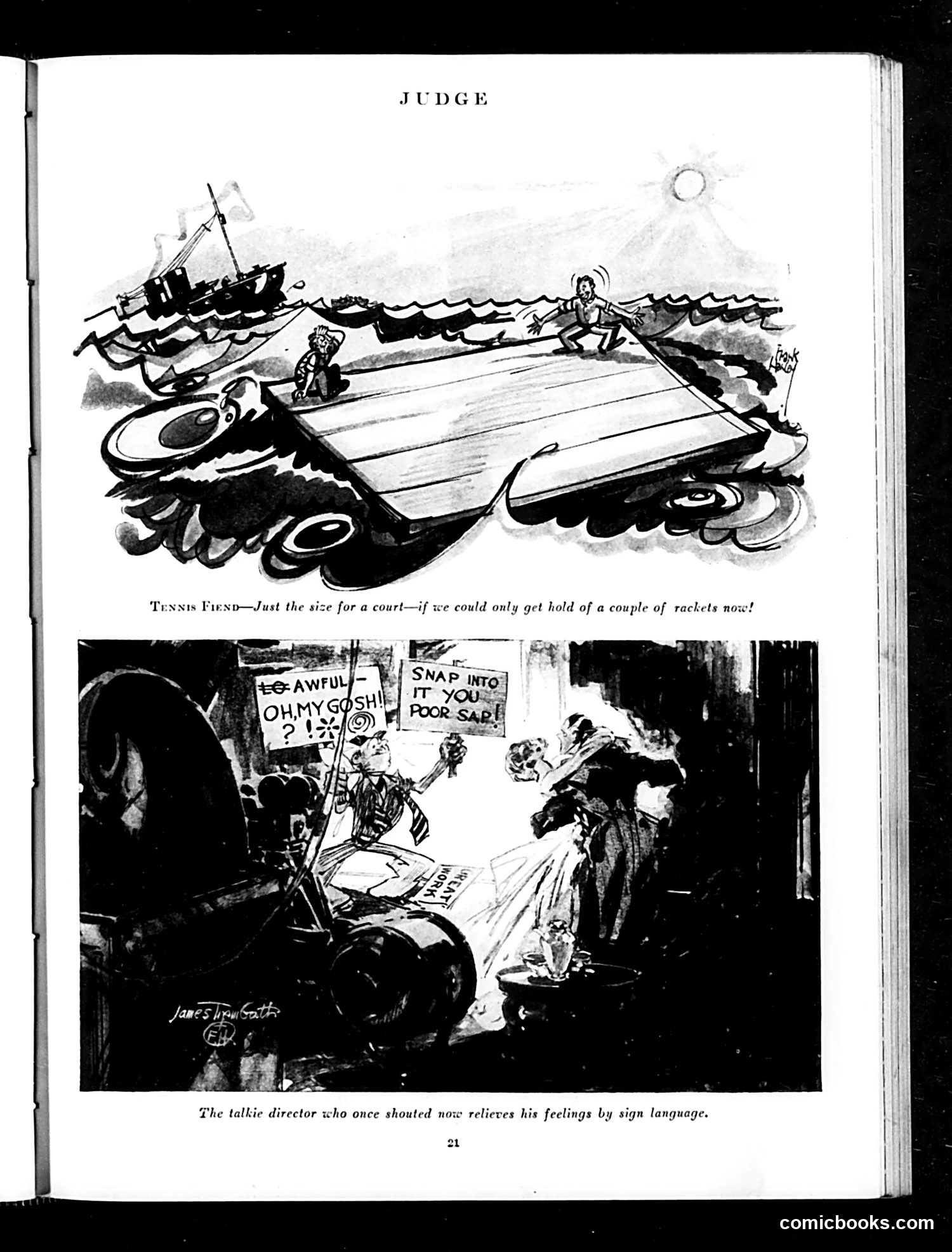
Judge Page Analysis This page contains two cartoons satirizing the transition from silent films to "talkies" (sound films) in early cinema. Top cartoon: Shows a tennis court sized like a film set, joking that directors needed space equivalent to a tennis court just to hold "a couple of rackets"—a pun on both tennis equipment and microphones. Bottom cartoon: Depicts a film director using exaggerated sign language on a movie set, with speech bubbles showing characters saying "OH MY GOSH!" and "SNAP INTO IT YOU POOR SAP!" The caption explains the satire: directors who once *shouted* directions to silent-film actors now resort to sign language instead—a humorous commentary on how sound recording required quieter on-set conditions, forcing directors to communicate differently with their casts. Both jokes mock the practical chaos of the transition to sound cinema.
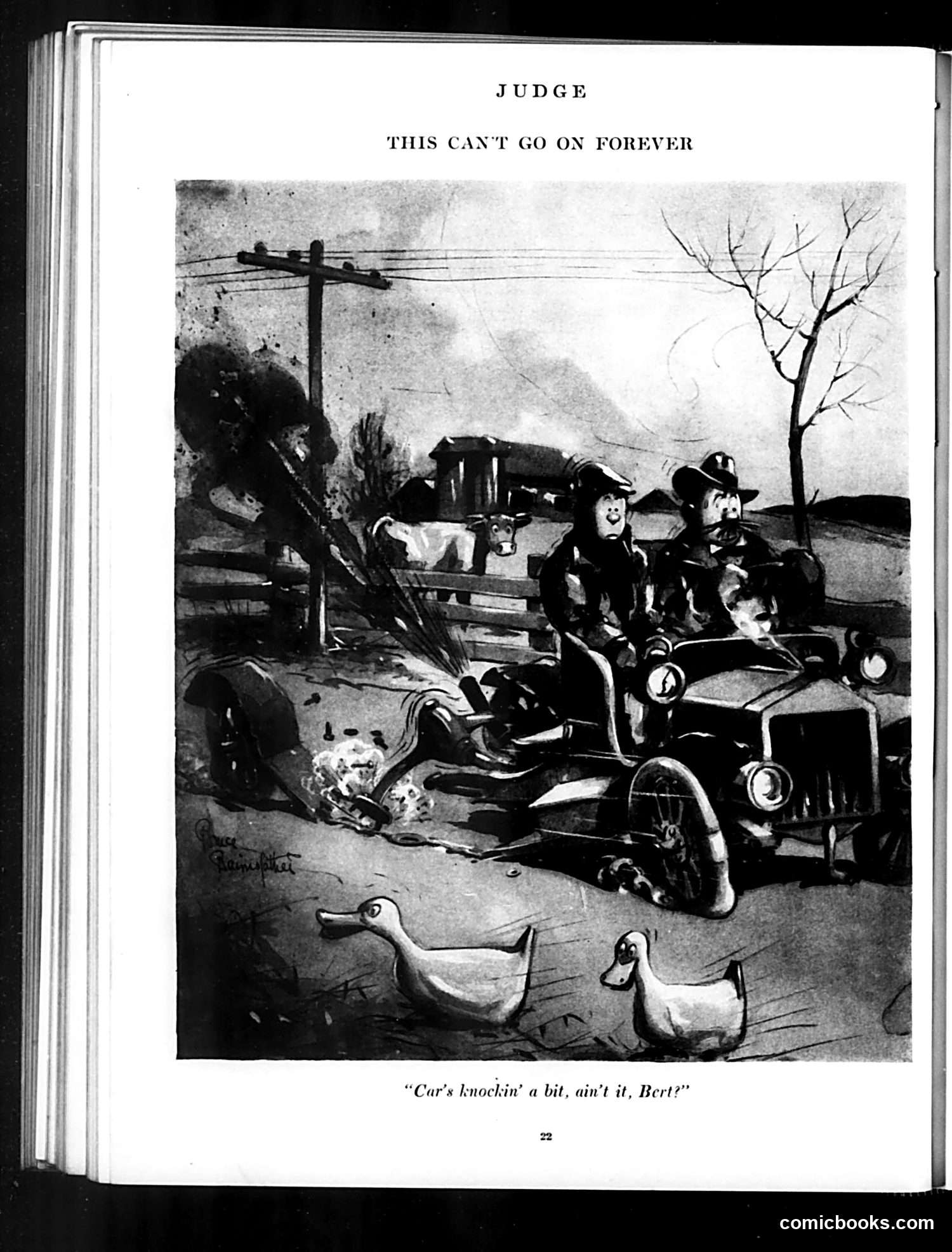
Analysis This cartoon satirizes early automobile culture and mechanical unreliability. The title "This Can't Go On Forever" suggests frustration with persistent car troubles. Two men in an old automobile discuss engine problems ("Car's knockin' a bit"), while ducks casually cross their path—implying these vehicles are so slow and unreliable that even farm animals move freely around them without concern. The cartoon mocks the novelty and impracticality of early cars. Rather than representing progress, these automobiles appear temperamental and undependable compared to traditional rural transportation. The rural setting (fence, bare tree, utility pole) emphasizes the gap between modern machinery and practical farm life. The humor targets both automobile owners' frustrations and broader skepticism about whether automobiles represent genuine improvement over established methods.
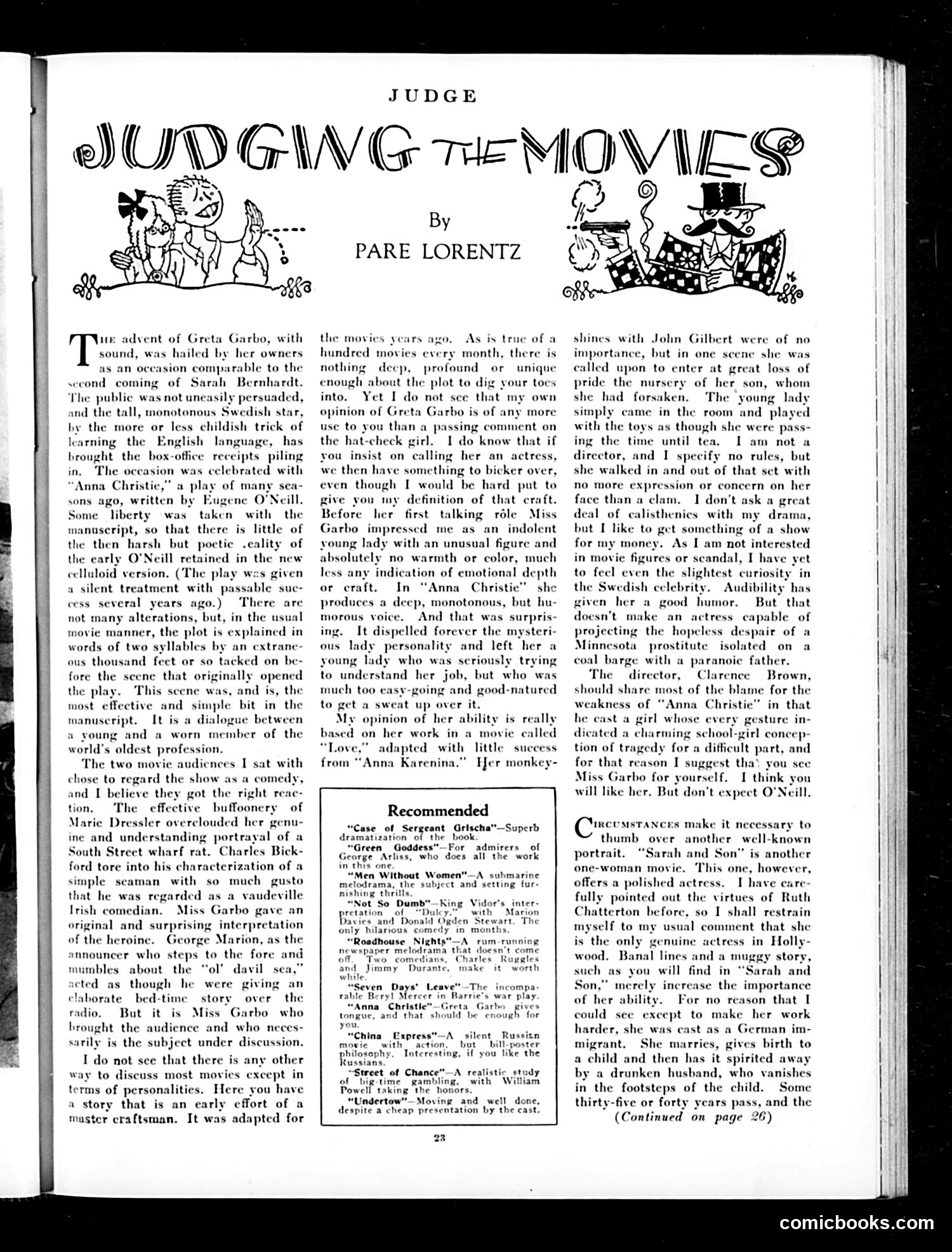
Judging the Movies: Greta Garbo Critique This is a film review column by Pare Lorentz critiquing Greta Garbo's performance in "Anna Christie." The author argues that Garbo, then a celebrated Swedish silent-film star, is not genuinely an actress but rather a figure whose popularity rests on her physical presence and mystique rather than acting ability. Lorentz claims Garbo displays "no warmth or color" and lacks emotional depth. Her acclaimed monotonous voice in this talking picture, he suggests, paradoxically *improves* her work by revealing her as simply a "young lady seriously trying to understand her job"—not a master craftsperson. He dismisses the film's plot as shallow and criticizes the adaptation of O'Neill's play for over-explanation, arguing the original opening scene was most effective. The review typifies contemporary skepticism about silent stars transitioning to sound cinema.
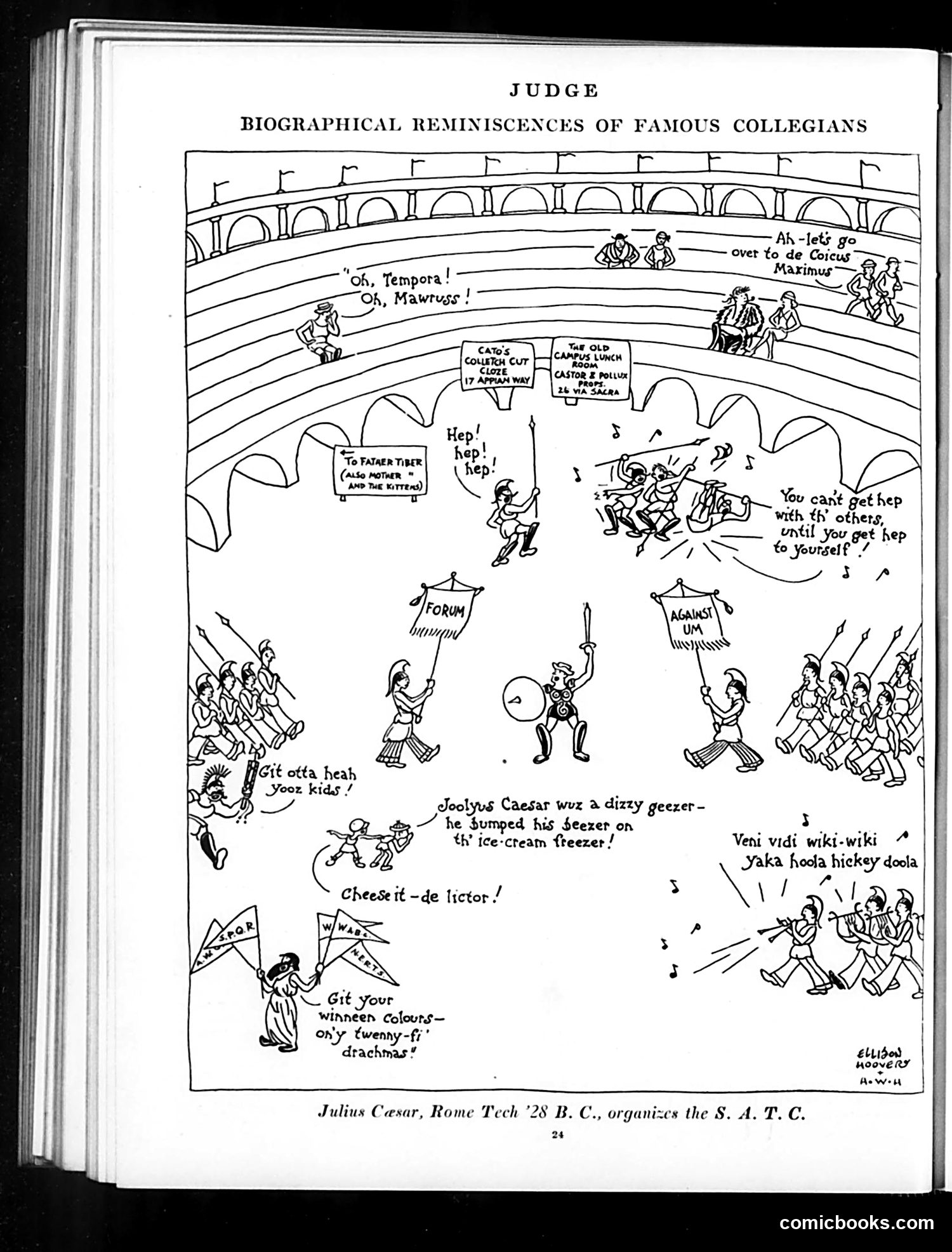
Political Cartoon Analysis This is a humorous cartoon mocking college hazing and initiation rituals through a classicist lens. It depicts Julius Caesar (labeled "Rome Tech '28 B.C.") organizing the S.A.T.C. (Student Army Training Corps), a real WWI-era military training program on college campuses. The satire conflates ancient Rome with modern college life: Caesar and other figures speak in exaggerated slang ("Git otta heah," "Cheese it-de lictor") while performing typical hazing activities—marching, chanting, and roughhousing in an amphitheater-like setting. The joke mocks how hazing supposedly "initiates" newcomers into collegiate culture through violent or degrading rituals, presented here as timeless and absurd. References to "hep" (being in-the-know), campus gossip, and forced conformity satirize the peer pressure inherent in such traditions. The artist treats serious military training as equivalent to pointless college hazing—suggesting both are equally ridiculous performance theater.
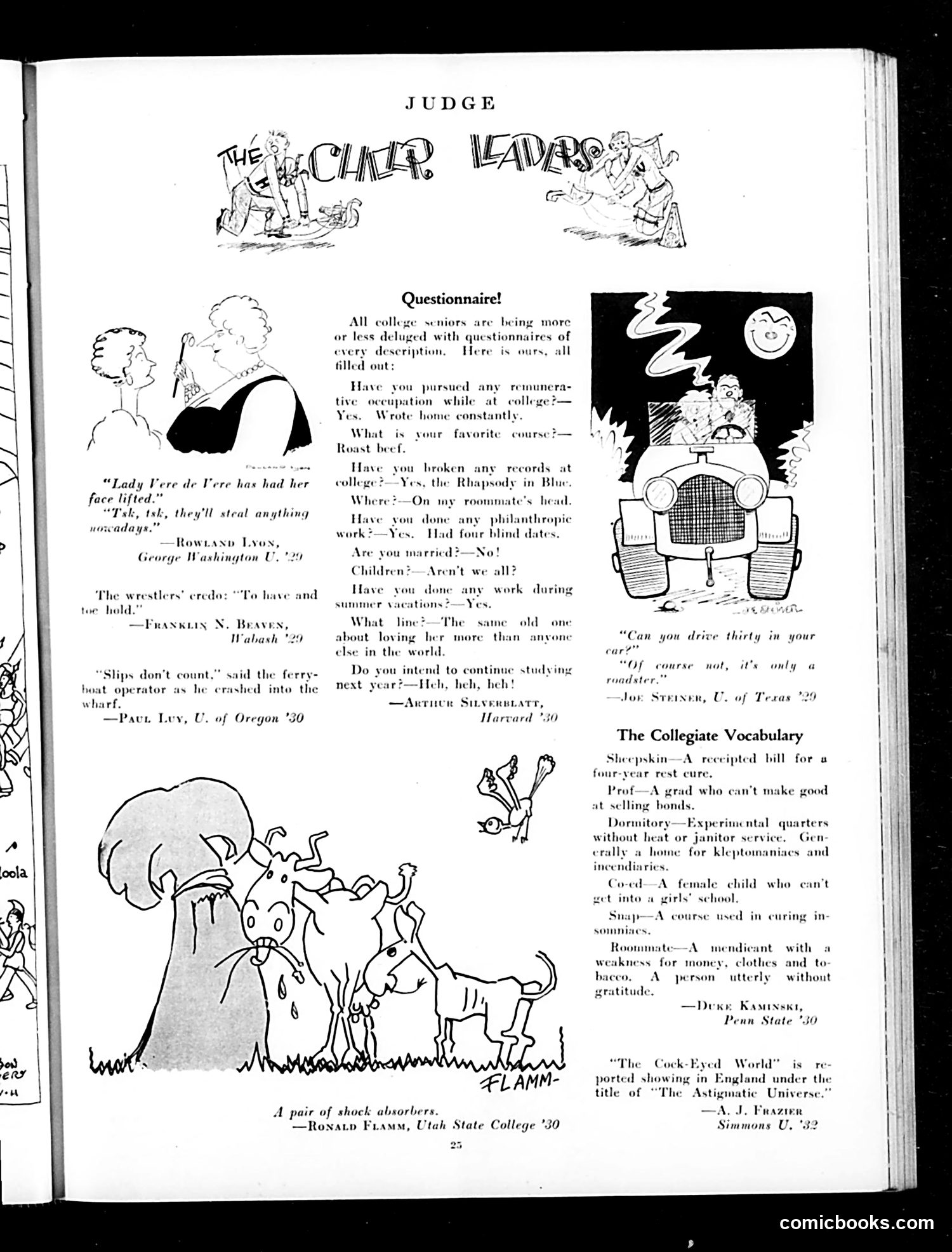
Judge Magazine Page Analysis This page from Judge presents college humor targeting seniors circa 1930. The central feature is a satirical questionnaire purporting to survey college graduates, with humorous fake answers that mock student life. The jokes reveal period college stereotypes: students who never work yet write home constantly; favorite foods being "roast beef"; breaking records by playing phonographs loudly on roommates' heads; "four blind dates" as philanthropy; and romantic line-spouting about loving "her more than anyone else in the world." The accompanying "Collegiate Vocabulary" section defines college terms cynically—a diploma is a "four-year rest cure," professors are failed salesmen, dorms house "kleptomaniacs," and roommates are penniless freeloaders obsessed with money and clothes. The cartoons (particularly the car scene and "shock absorbers" illustration) reinforce these themes of youthful excess, recklessness, and materialism. The satire targets privileged college youth as shallow, irresponsible, and romantically dishonest.
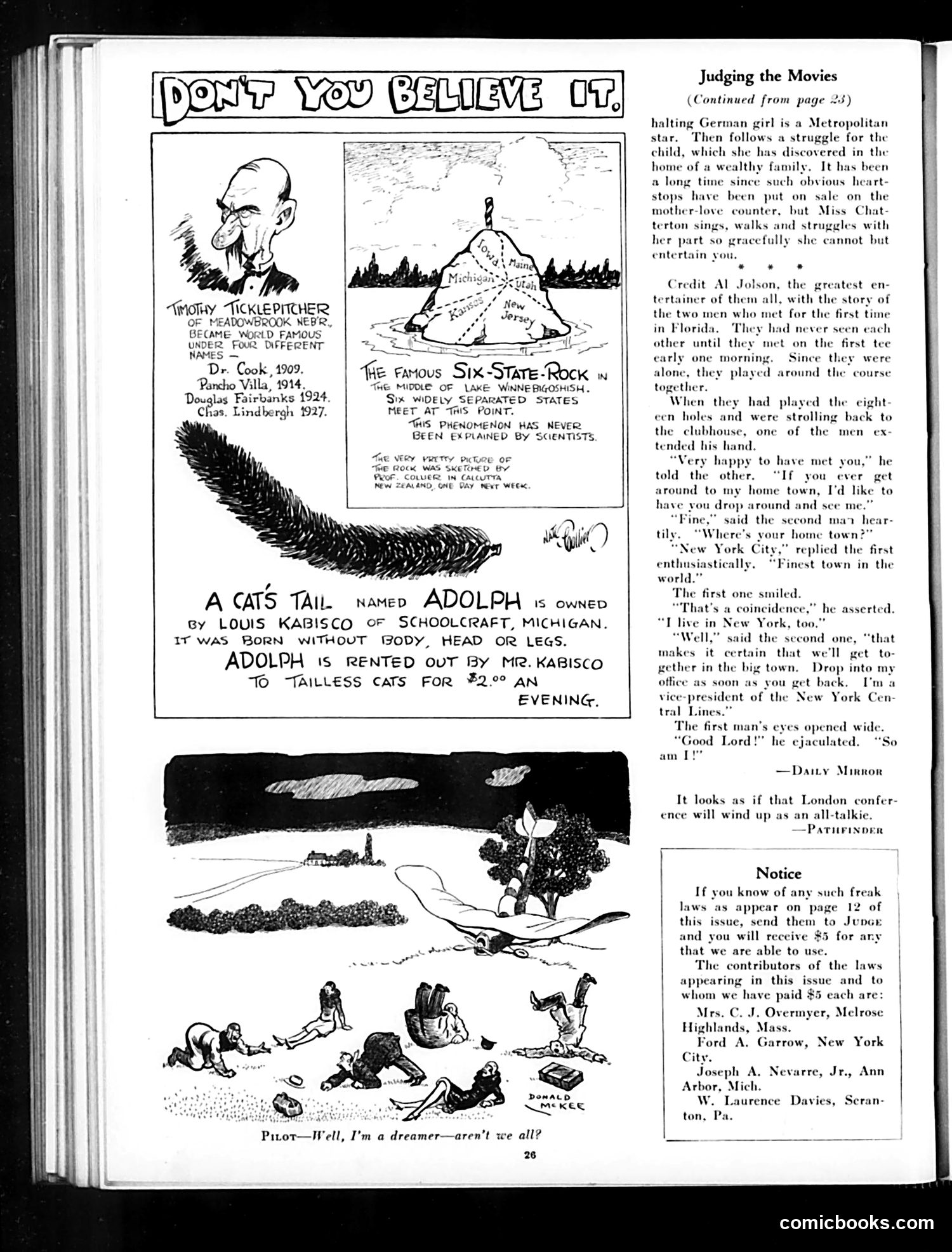
"Don't You Believe It" - Judge Magazine Satire This page contains several unrelated satirical items typical of Judge magazine's format: Top cartoon: Mocks a man from Nebraska who allegedly impersonated four famous figures across different decades (Dr. Cook 1909, Pancho Villa 1914, Douglas Fairbanks 1924, Charles Lindbergh 1927). The satire targets how easily the public was fooled by imposters and celebrity obsession during this era. Six-State Rock: A humorous "freak phenomenon" claiming a rock in Minnesota sits at the border where six states meet—presented as unexplained by science. This mocks pseudoscientific curiosities popular in the period. Adolph the Cat: A joke about a bizarre "tailless cat" (born without body, head, or legs—essentially just a tail) that's rented out to other cats. This absurdist humor is nonsensical satire. Right column: Film criticism discussing contemporary movies and stars, plus a section soliciting reader submissions of unusual local laws for $5 payment. The overall effect satirizes American gullibility, celebrity culture, and fascination with oddities.
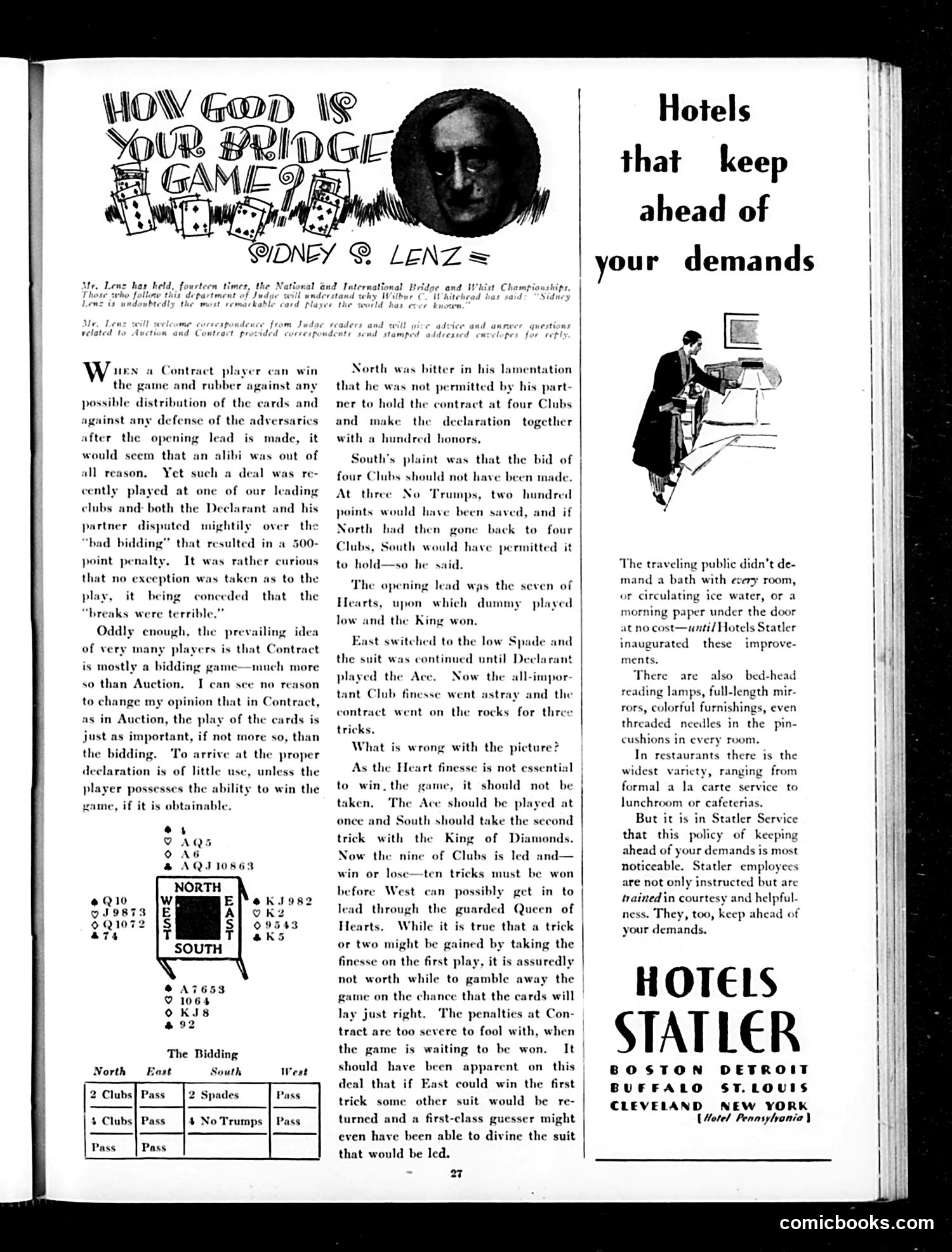
Judge Magazine Page Analysis This page contains a bridge column (not a political cartoon) discussing Contract bridge strategy, paired with a Hotel Statler advertisement. The bridge content analyzes a recent game where North and South blamed their "bad bidding" for a 500-point penalty, when the real problem was faulty play. The column argues that in Contract bridge, skillful card play matters as much as bidding strategy—contrary to popular opinion among players. The advertisement (right side) promotes Hotel Statler's customer service innovation. It claims Statler pioneered amenities now taken for granted: private baths in every room, ice water, morning newspapers, reading lamps, and full-length mirrors. The ad's key message: Statler employees are "trained in courtesy and helpfulness" to anticipate guests' needs before they ask. This reflects early-20th-century hotel competition, where Statler differentiated itself through attentive service and modern conveniences—positioning luxury hospitality as predictive rather than merely responsive to customer demands.
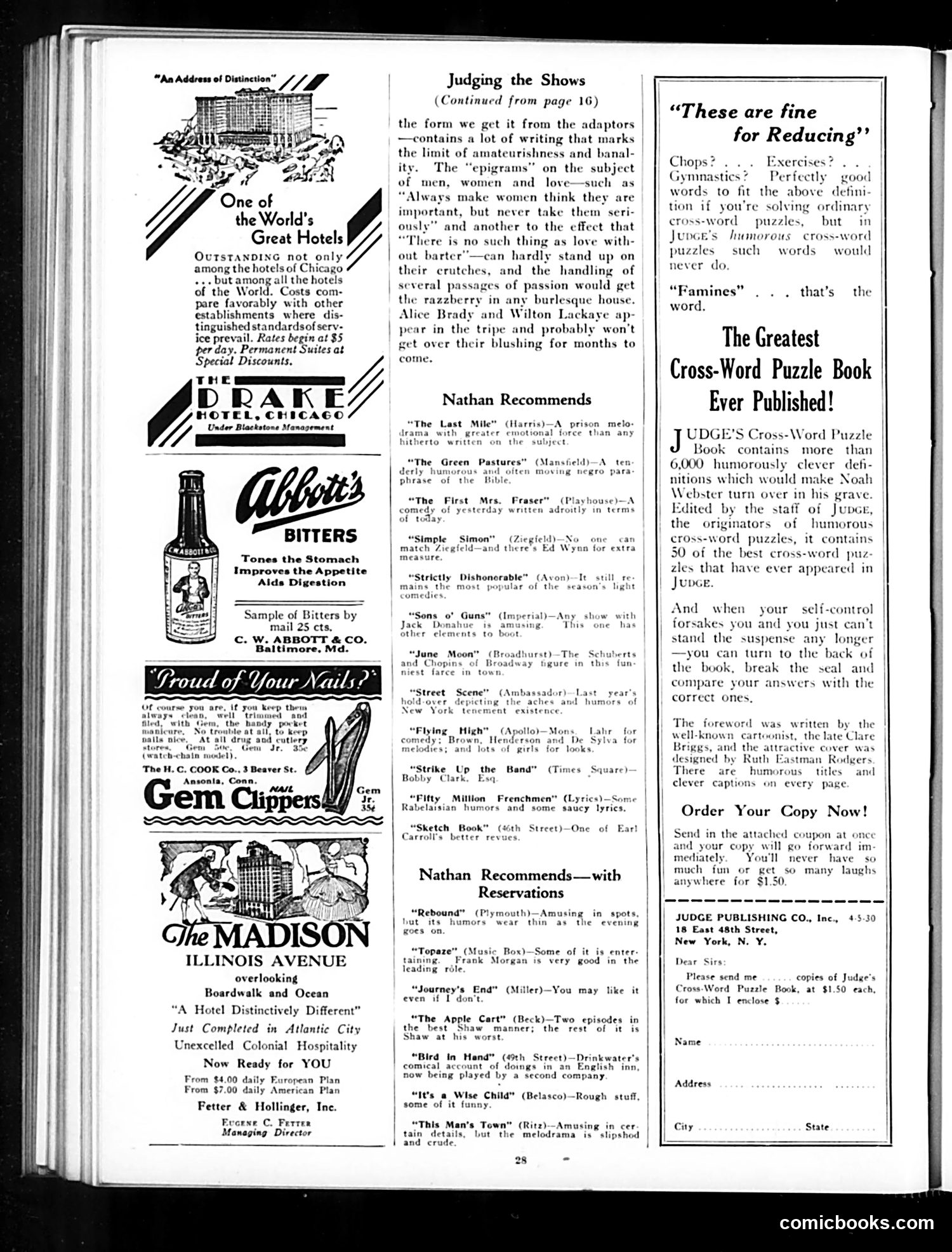
Analysis for Modern Readers This page is primarily advertisements and theater reviews, not political satire. The small amount of content includes: Theater Reviews ("Nathan Recommends"): Critic George Jean Nathan evaluates current Broadway shows with brief, sardonic assessments—praising *The Last Mile* (prison drama) and *The Green Pastures* while dismissing *The First Mrs. Fraser* as amateurish drivel. His tone is witty but purely entertainment-focused. Main Advertisement: A large plug for "Judge's Cross-Word Puzzle Book," marketed as superior because its clue definitions are humorous rather than straightforward. It jokes that standard puzzle answers like "Chops" or "Gymnastics" would be rejected in favor of clever wordplay. Secondary Ads: Hotels (Drake, Madison), digestive bitters, nail clippers—typical 1920s-30s magazine advertising. The Point: This reflects Judge magazine's shift toward lifestyle content and away from political cartooning. There is no political satire visible here—just entertainment industry commentary and consumer advertising targeting an affluent readership.
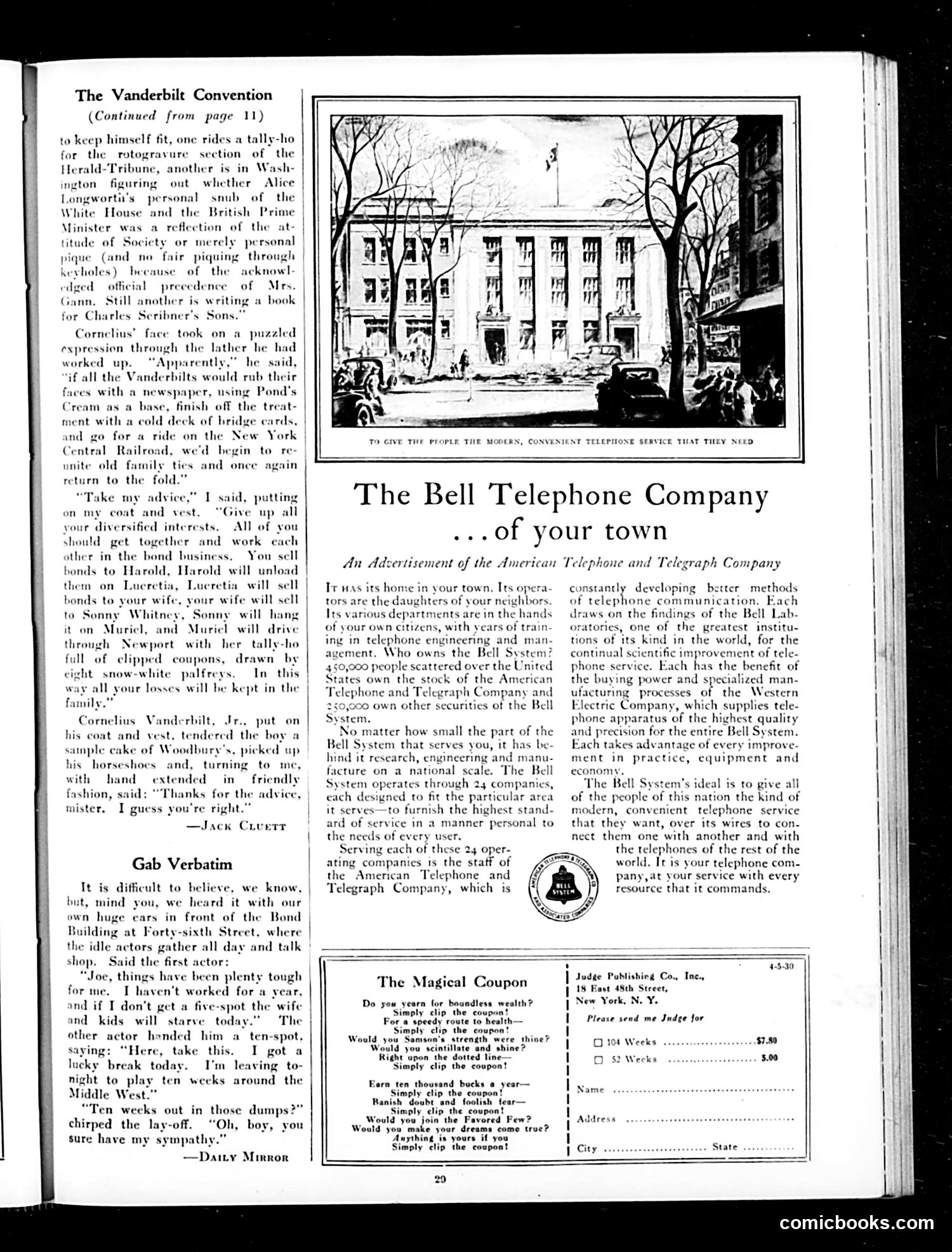
Analysis for Modern Readers This page contains two distinct sections: Upper half: "The Vanderbilt Convention" - A satirical short story mocking the wealthy Vanderbilt family's internal squabbles. The narrative lampoons their petty disputes, social pretensions, and financial maneuvering. The joke centers on suggesting they resolve conflicts by consolidating wealth through circular bond-trading within the family—a darkly comic commentary on how the ultra-rich recycle money among themselves while ordinary people struggle. Lower half: Bell Telephone Company advertisement - A corporate PR piece emphasizing that Bell's local operations employ townspeople and are locally managed, despite being part of a massive national system. This appears designed to counter potential antitrust concerns or public skepticism about monopolistic practices during an era of growing corporate regulation. The page juxtaposes satirical critique of inherited wealth against corporate messaging about benevolent capitalism—suggesting Judge magazine's audience comprised educated readers skeptical of both Gilded Age excess and corporate consolidation.
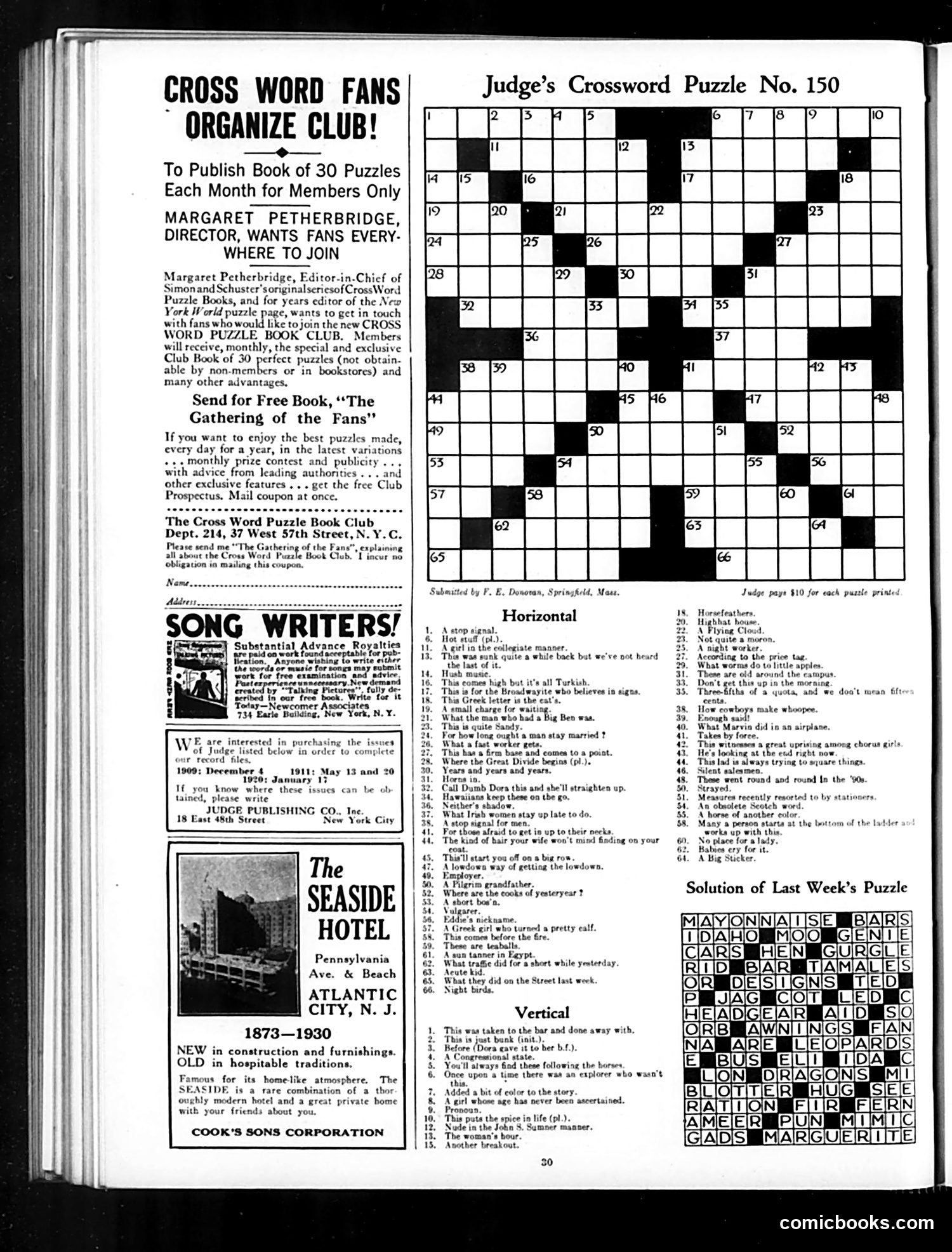
Judge Magazine Page Analysis This page is primarily advertising and organizational content rather than satirical cartoon material. The main content announces the formation of a Cross Word Puzzle Book Club directed by Margaret Petherbridge, editor of the New York World's puzzle page and Simon & Schuster's crossword series. This reflects the crossword craze of the 1920s-30s—puzzles were a massive popular phenomenon, and publishers capitalized on this by creating subscription clubs offering exclusive monthly puzzle collections. The page also contains classified advertisements: songwriters seeking royalties, a publisher seeking old Judge issues, and hotel promotions (Seaside Hotel in Atlantic City). The actual crossword puzzle itself (No. 150) occupies the right side, with clues listed below. The clues are typical of era puzzles—some playful ("This was sunk quite a while back but we've not heard the last of it"—likely the Lusitania), some cryptic wordplay. For modern readers: This shows how crosswords functioned as both entertainment and consumer commodity, driving magazine subscriptions and club memberships during their golden age.
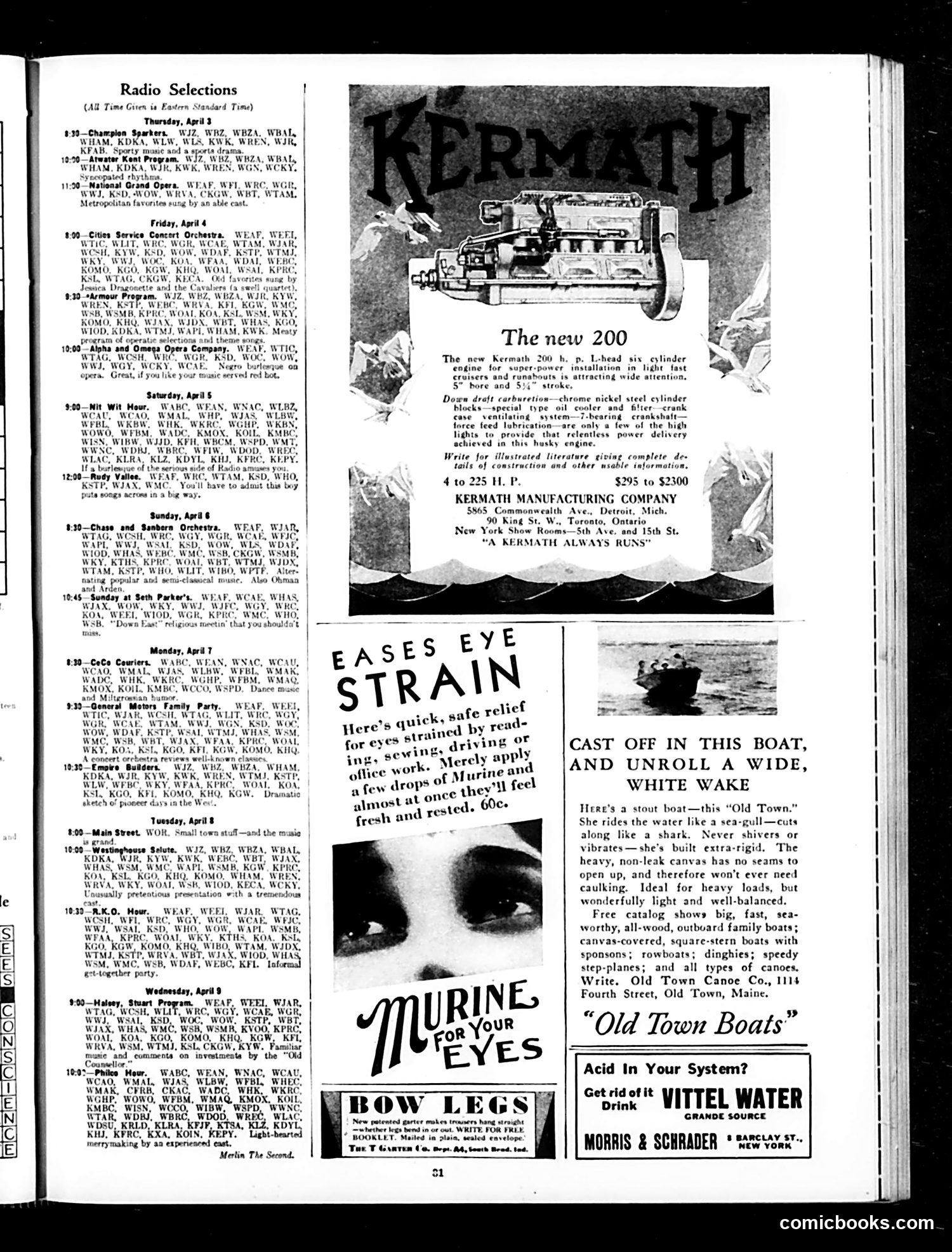
Page Analysis: Judge Magazine Radio & Advertising Page This page is primarily advertising and radio programming listings, not political satire. It contains: 1. Radio Selections: Extensive daily radio schedules (April 3-9) listing station call letters and program times—typical content for a 1920s magazine serving radio listeners. 2. Advertisements: - Kermath Manufacturing Company: promoting a new 200 h.p. marine engine - Murine eyedrops: offering relief for eye strain from reading/sewing/office work - Old Town Canoe Co.: advertising canvas boats - Vittel Water: promoting mineral water for digestive health - Bow Legs: a medical treatment device This appears to be a filler/miscellaneous content page from Judge magazine, mixing practical consumer information with advertising. There are no political cartoons or satirical commentary visible. The page reflects 1920s consumer products and the era's emerging radio culture.
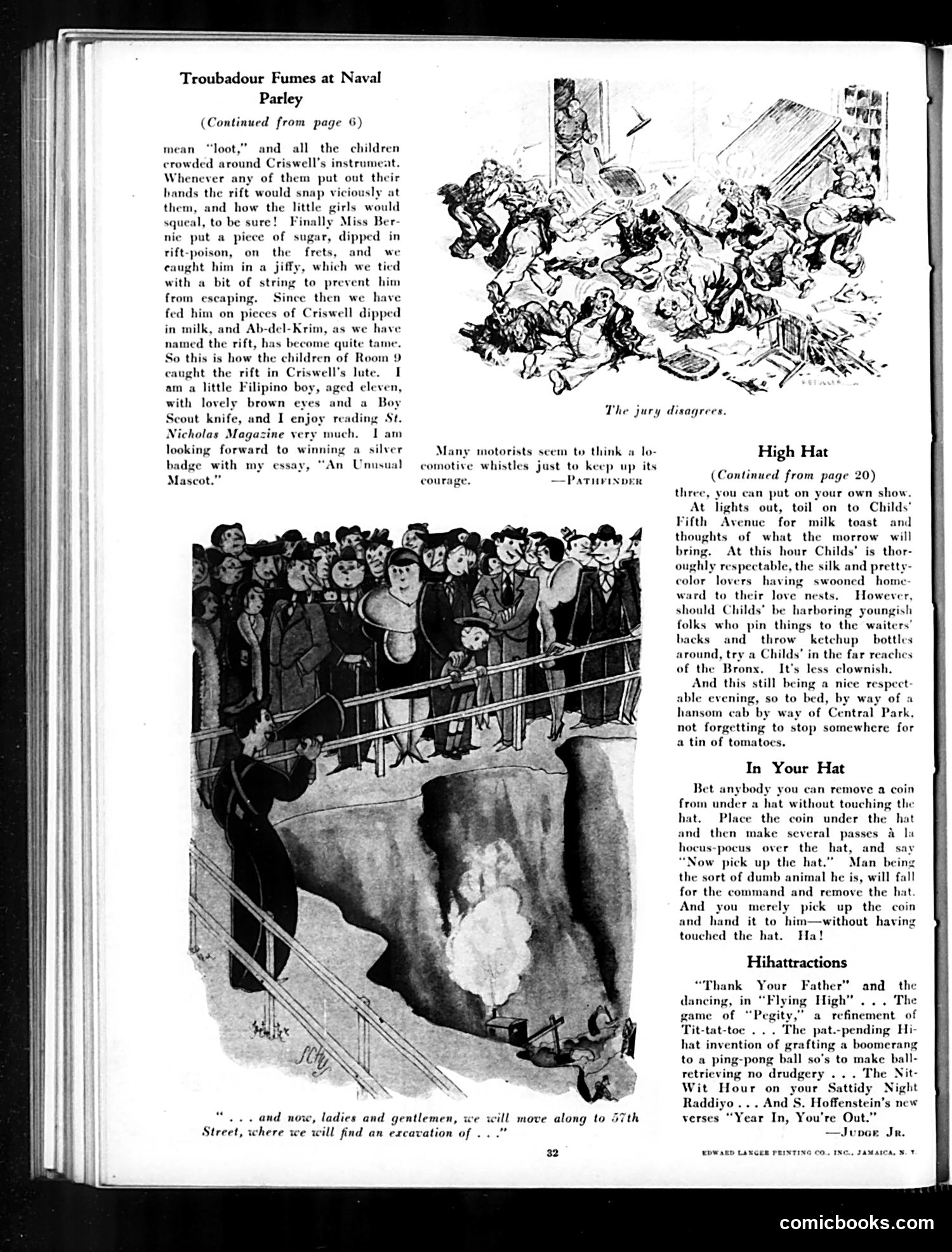
Analysis for Modern Readers This page from *Judge* magazine contains two unrelated pieces: "Troubadour Fumes at Naval Parley" (top): A whimsical story contribution from a Filipino Boy Scout describing how children caught a "rift" (a small creature, apparently) in a musical instrument and tamed it with poisoned sugar. The text appears to be a young reader's submission to the magazine—likely humorous in its earnest, innocent narrative rather than satirical. "High Hat" and "In Your Hat" (right column): These are lifestyle/entertainment tips. "High Hat" describes a fashionable evening out at Childs' Restaurant (a real chain). "In Your Hat" explains a parlor magic trick involving removing a coin from under a hat. "Hihattractions" lists current entertainment recommendations. The large illustration shows a crowded scene at what appears to be a public spectacle or excavation site on 57th Street, though context for its specific satirical meaning is unclear from this page alone. The page is primarily entertainment and reader contributions rather than pointed political satire.
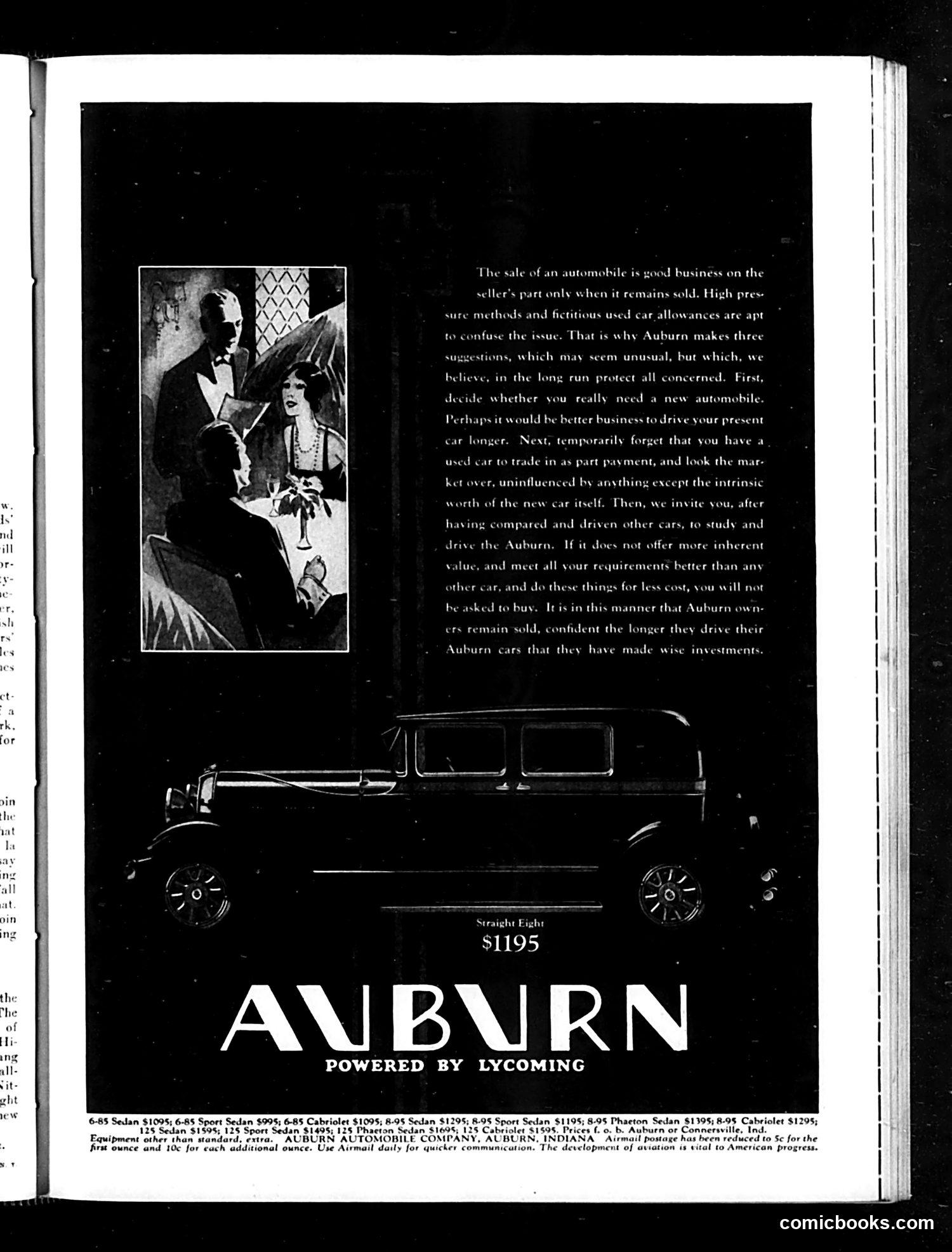
Auburn Automobile Advertisement Analysis This is primarily a car advertisement rather than political satire. The page features an Auburn automobile with a Lycoming engine, priced at $1195 for the Straight Eight model. The illustration shows a well-dressed couple (man and woman in 1920s attire) examining or discussing the vehicle, representing the target affluent consumer demographic. The ad's text emphasizes Auburn's ethical sales approach—unusually, it *discourages* high-pressure tactics and inflated trade-in allowances, instead advising customers to carefully evaluate their actual needs and compare the Auburn's intrinsic value against competitors. This marketing strategy positions Auburn as the honest alternative to aggressive dealership practices common in the automobile industry of this era. The emphasis on buyer protection and rational decision-making was apparently Auburn's competitive pitch to middle-class and upper-middle-class consumers who could afford $1195 vehicles during what appears to be the late 1920s.
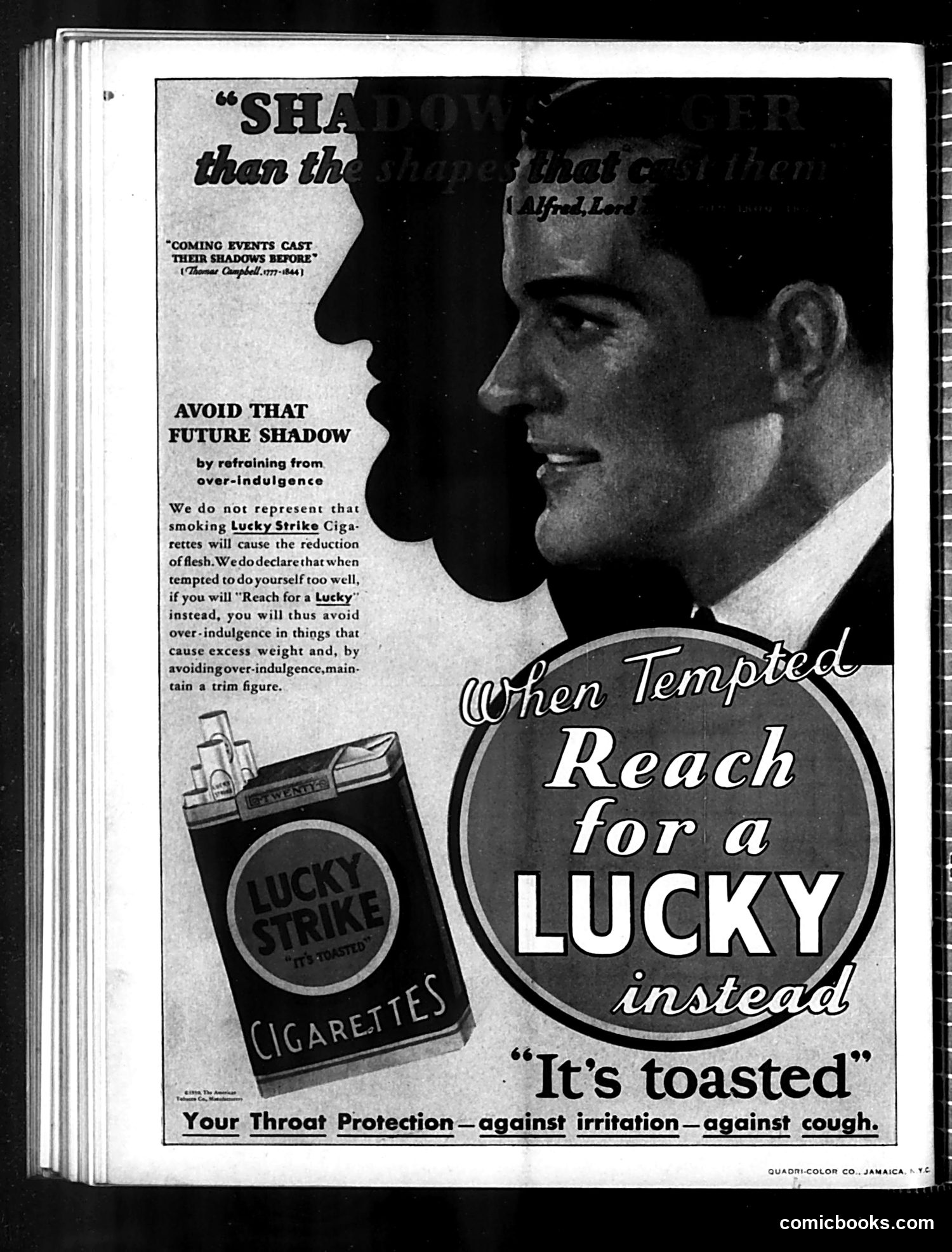
Analysis for Modern Readers This is a Lucky Strike cigarette advertisement, not satirical content. It uses fear-based marketing targeting weight-conscious consumers, likely women. The stark silhouette contrasts an overweight "future shadow" with a trim-figured man, suggesting cigarettes prevent weight gain through appetite suppression. The ad explicitly disclaims that Lucky Strikes *cause* weight loss, but claims smoking instead of eating maintains a "trim figure." This exploits 1920s-30s diet anxiety while capitalizing on cigarettes' genuine appetite-suppressing effects. The phrase "It's toasted" was Lucky Strike's signature marketing claim about their manufacturing process. The reference to "Coming Events Cast Their Shadows Before" (a Thomas Campbell quote) dramatizes the consequences of indulgence. By modern standards, this advertisement is remarkable for openly using cigarettes as a weight-control product—a health claim now illegal and scientifically discredited.