judge
Judge — April 12, 1930
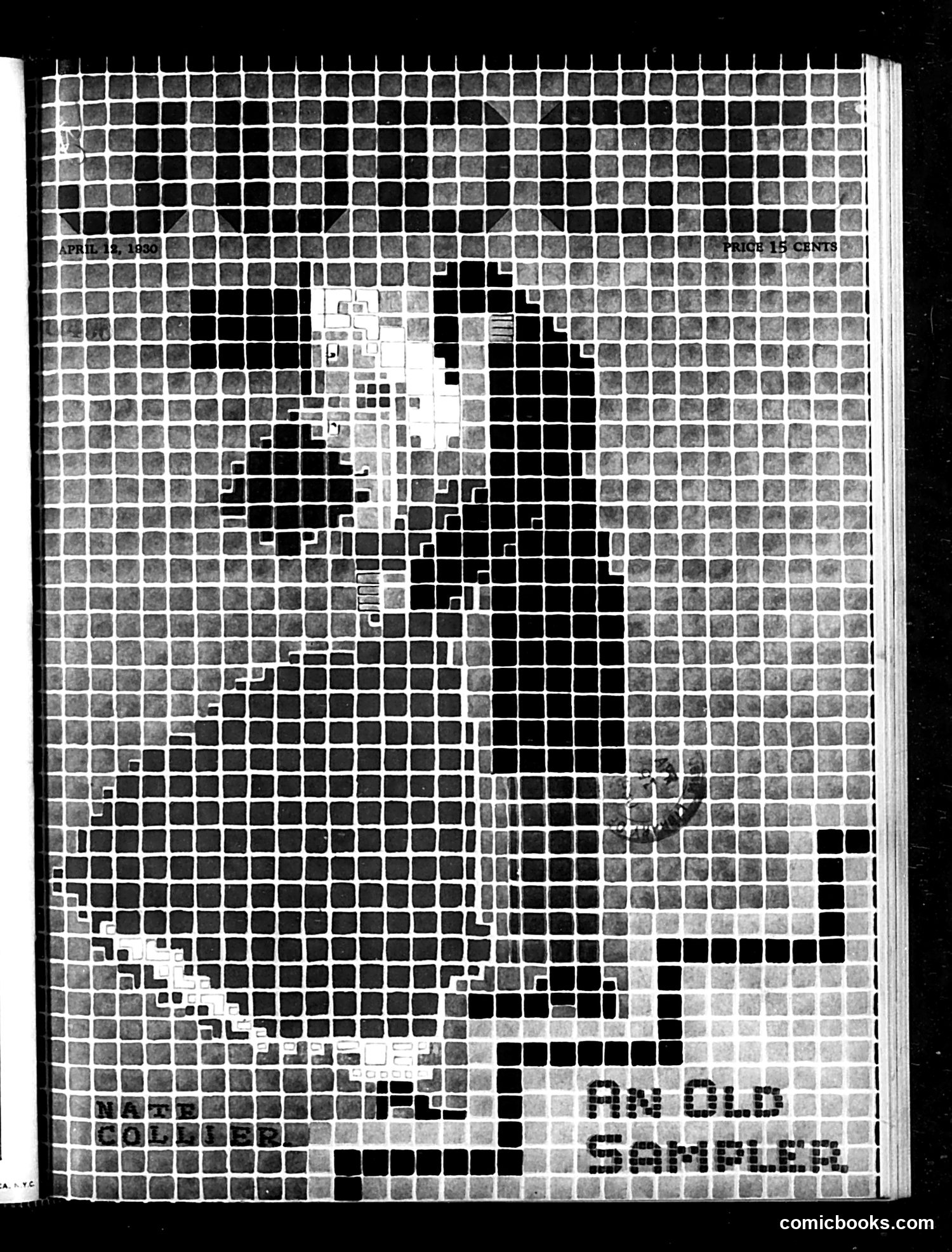
I can see this is a page from *Judge* magazine with "AN OLD SAMPLER" printed at the bottom, but the image quality and pixelation make it difficult to read the OCR text clearly or identify specific figures with certainty. The page appears to be a grid-based illustration or comic, possibly using a sampler or needlepoint aesthetic (suggested by the title), with black, white, and gray squares creating a pattern or image. However, without legible text or clearer details, I cannot confidently identify which political figures, events, or social commentary this satire references. To provide accurate historical analysis, I would need either a higher-resolution image or clearer OCR text. I'd rather acknowledge these limitations than speculate.
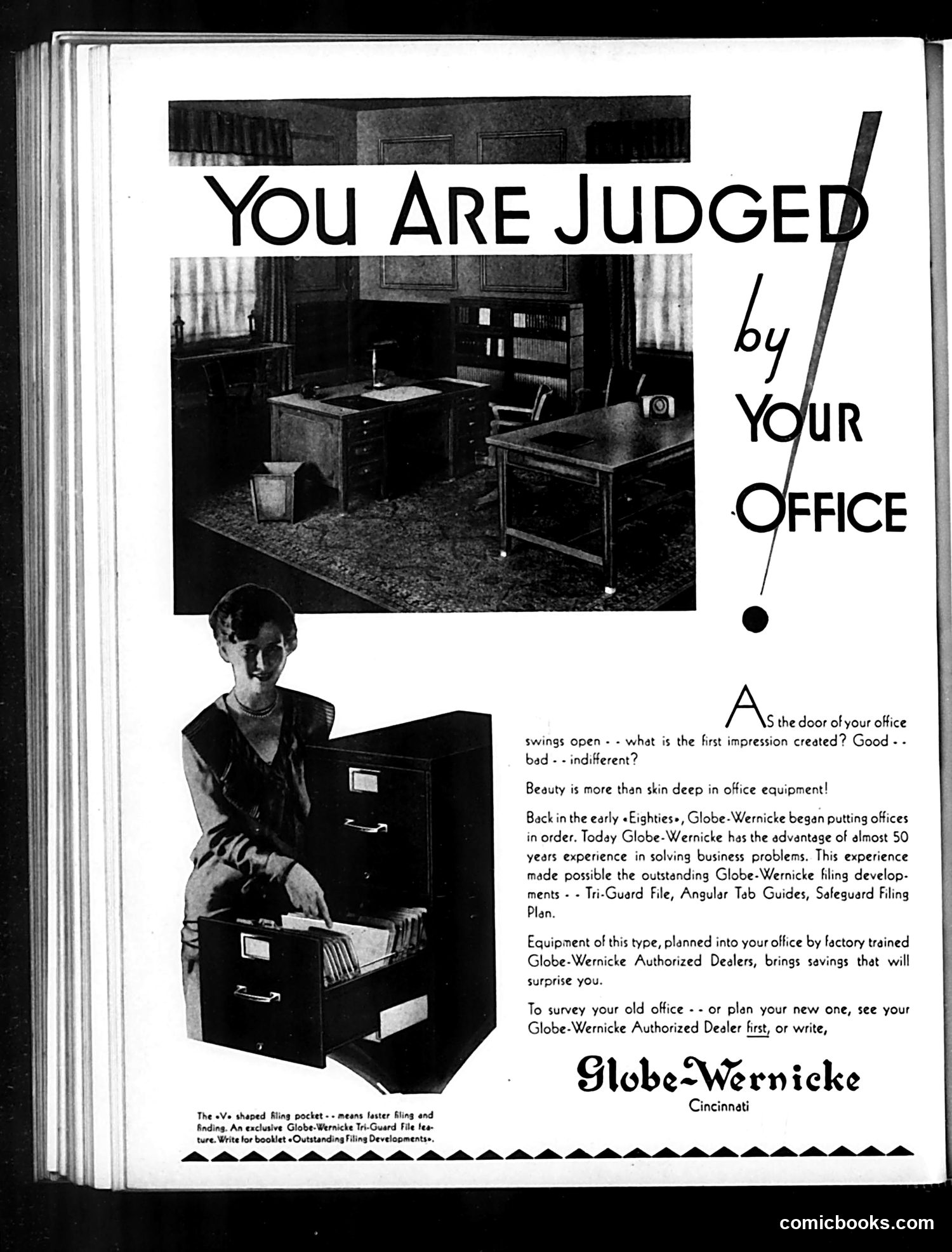
Analysis This is primarily a Globe-Wernicke office furniture advertisement, not political satire. The headline "YOU ARE JUDGED BY YOUR OFFICE!" plays on workplace anxieties common in 1920s-30s America, when modern office culture was expanding. The ad argues that office appearance reflects professional competence and character. It features a filing cabinet and office interior, positioning Globe-Wernicke's products (particularly their Tri-Guard File system) as solutions for creating a respectable workspace. The satirical angle—implicit rather than explicit—mocks how businessmen's social standing depends on superficial office aesthetics: "Beauty is more than skin deep in office equipment!" The ad exploits white-collar workers' status anxiety to sell furniture, a common advertising tactic of the era. This is advertising content, not editorial political cartoon.
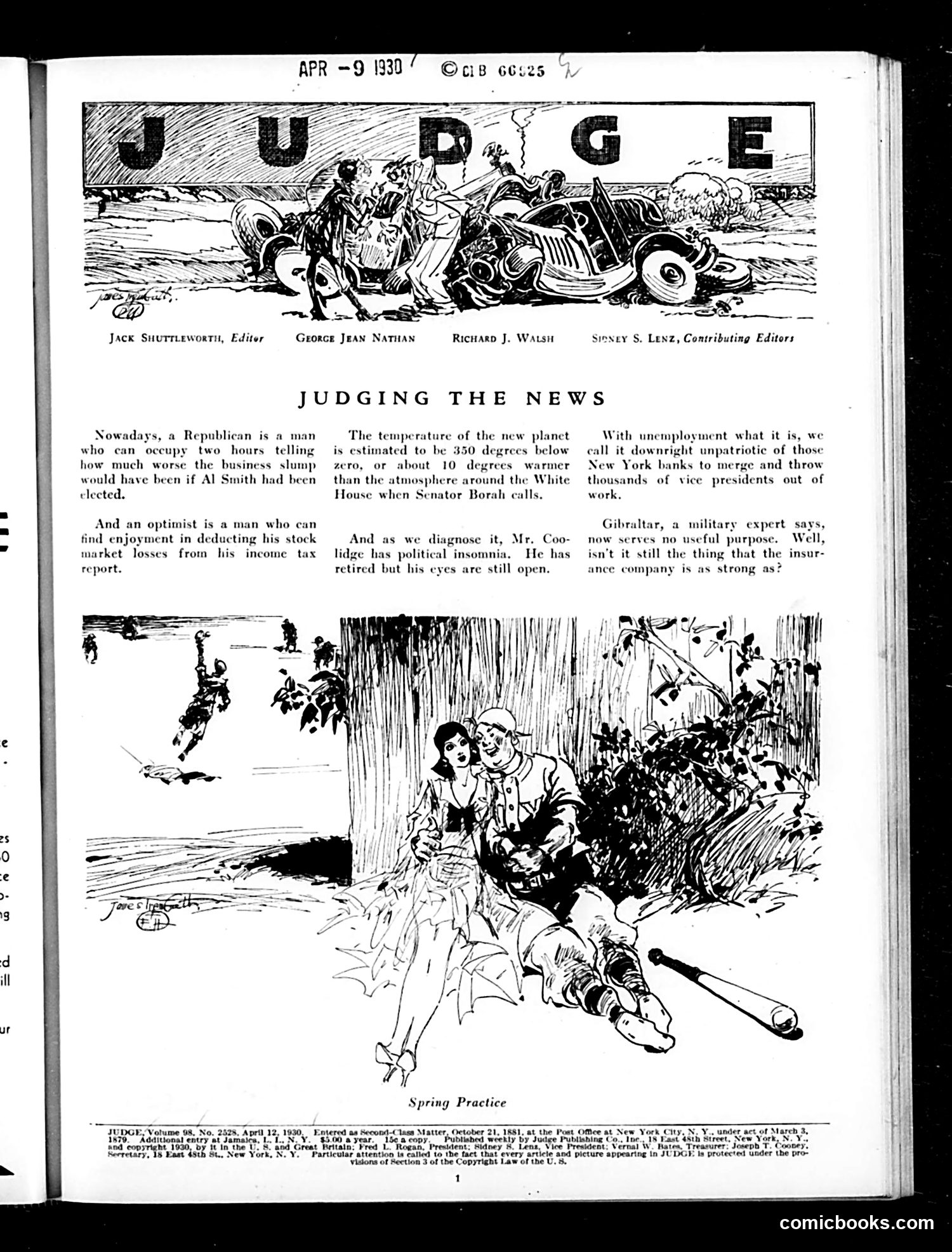
Judge Magazine - April 9, 1930 "Judging the News" Section: This satirical commentary page contains three brief political jokes: 1. Republican hypocrisy: A jab at Republicans who talk extensively about business while claiming it would have fared better under Al Smith (the 1928 Democratic presidential candidate). 2. Optimism about stocks: Mocking optimists who find silver linings in stock market losses by deducting them as tax write-offs. 3. Senator Borah and planetary discovery: References Senator William Borah, apparently commenting on a newly discovered planet with extreme temperatures—the joke being Borah's "political insomnia" keeps his eyes open despite such news. "Spring Practice" cartoon (lower image): Shows young people in romantic/recreational activities, likely commenting on seasonal courtship traditions. The page reflects Depression-era skepticism about political and financial rhetoric.
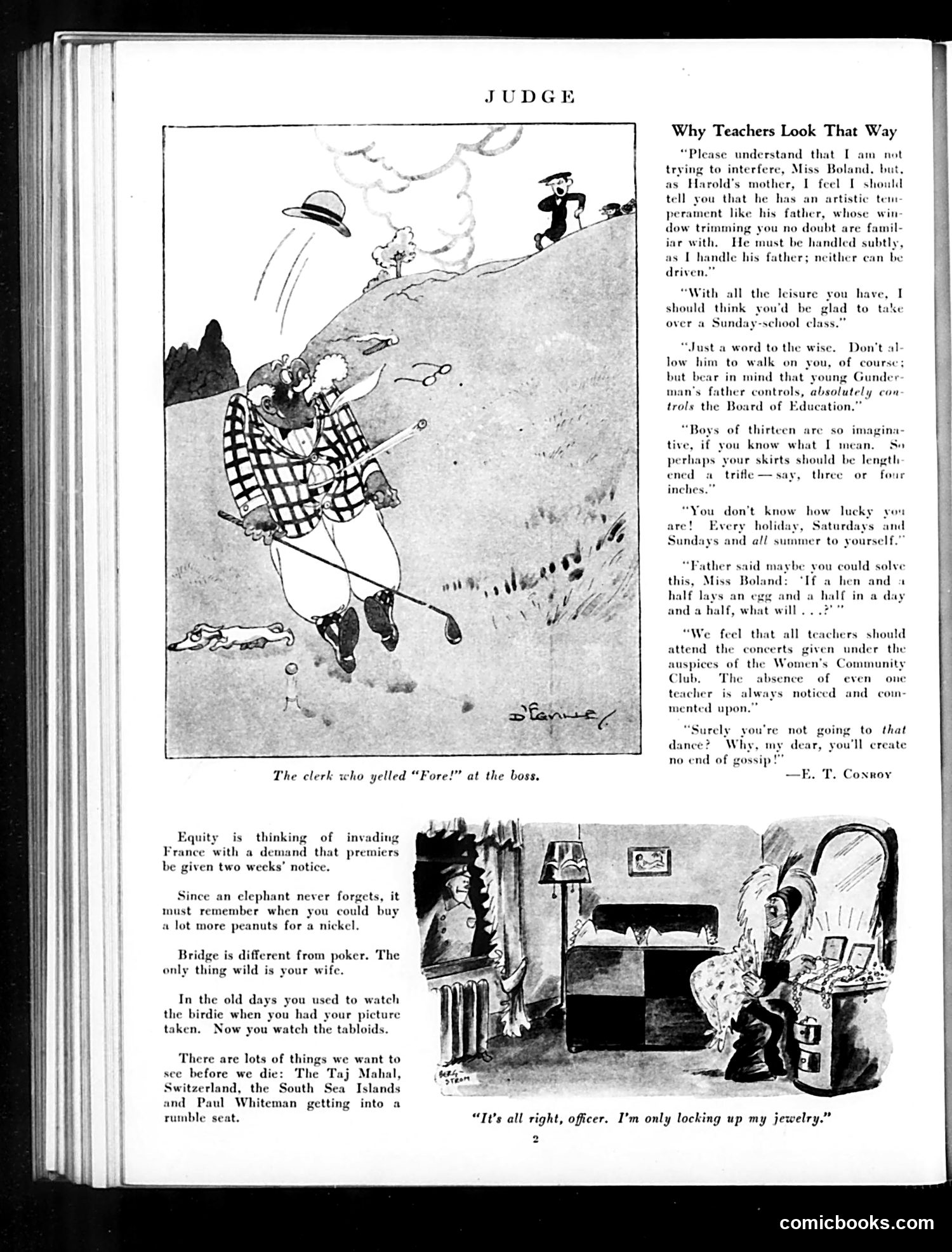
Judge Page Analysis This page contains two separate cartoon commentaries: Top cartoon ("Why Teachers Look That Way"): Satirizes teacher discipline through a golf scene where a woman golfer has struck a ball wildly. The accompanying text presents complaints from a parent (Miss Boland) defending her son Harold's behavior and "artistic temperament," while criticizing teachers for being too strict. The joke mocks overindulgent parents who blame teachers rather than disciplining their own children—the wild golf swing visualizes the chaos of undisciplined youth. Bottom cartoon ("It's all right, officer"): Shows a woman telling a police officer she's "only locking up my jewelry," implying marital suspicion or infidelity concerns. This is a domestic humor gag about trust in marriage. Both target social anxieties about authority, parenting, and relationships circa early 20th century.
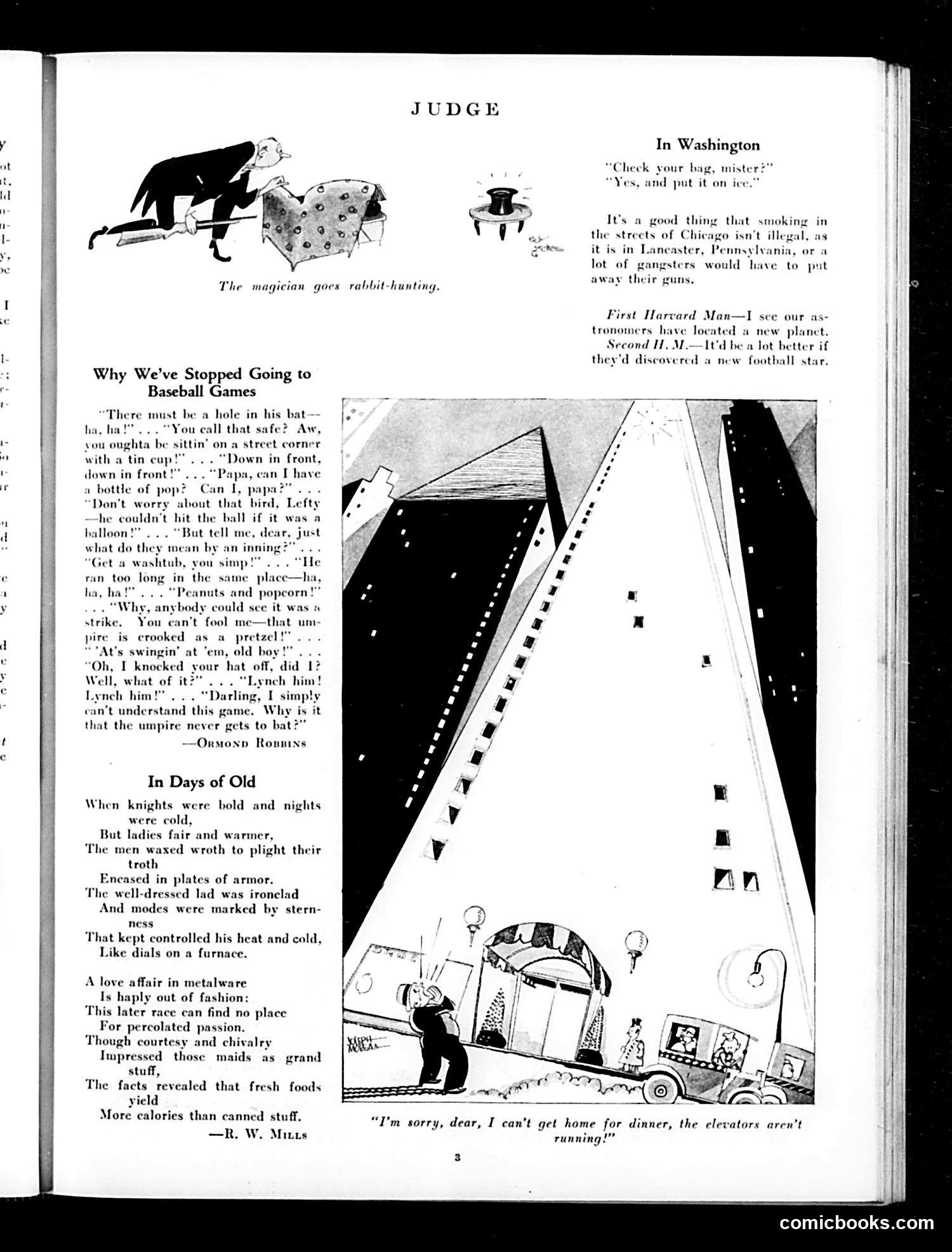
Analysis of This Judge Magazine Page Top cartoon ("The magician goes rabbit-hunting"): A magician pulls a rabbit from a hat, satirizing sleight-of-hand deception—likely commenting on political or social illusions of the era. "Why We've Stopped Going to Baseball Games": Quotes the chaotic experience of attending games—fans shouting contradictory demands ("hole in bat," "tin cup," "get a washtub"), umpires making questionable calls. The satire mocks the rowdy, argumentative nature of baseball crowds and the sport's disputes. "In Days of Old": A romantic poem by R.W. Mills contrasting medieval knights in armor with modern fashion and courtship, suggesting nostalgia for older social codes. Bottom cartoon: A man tells his wife he can't come home for dinner because "the elevators aren't running"—satirizing modern urban dependency on technology and infrastructure.
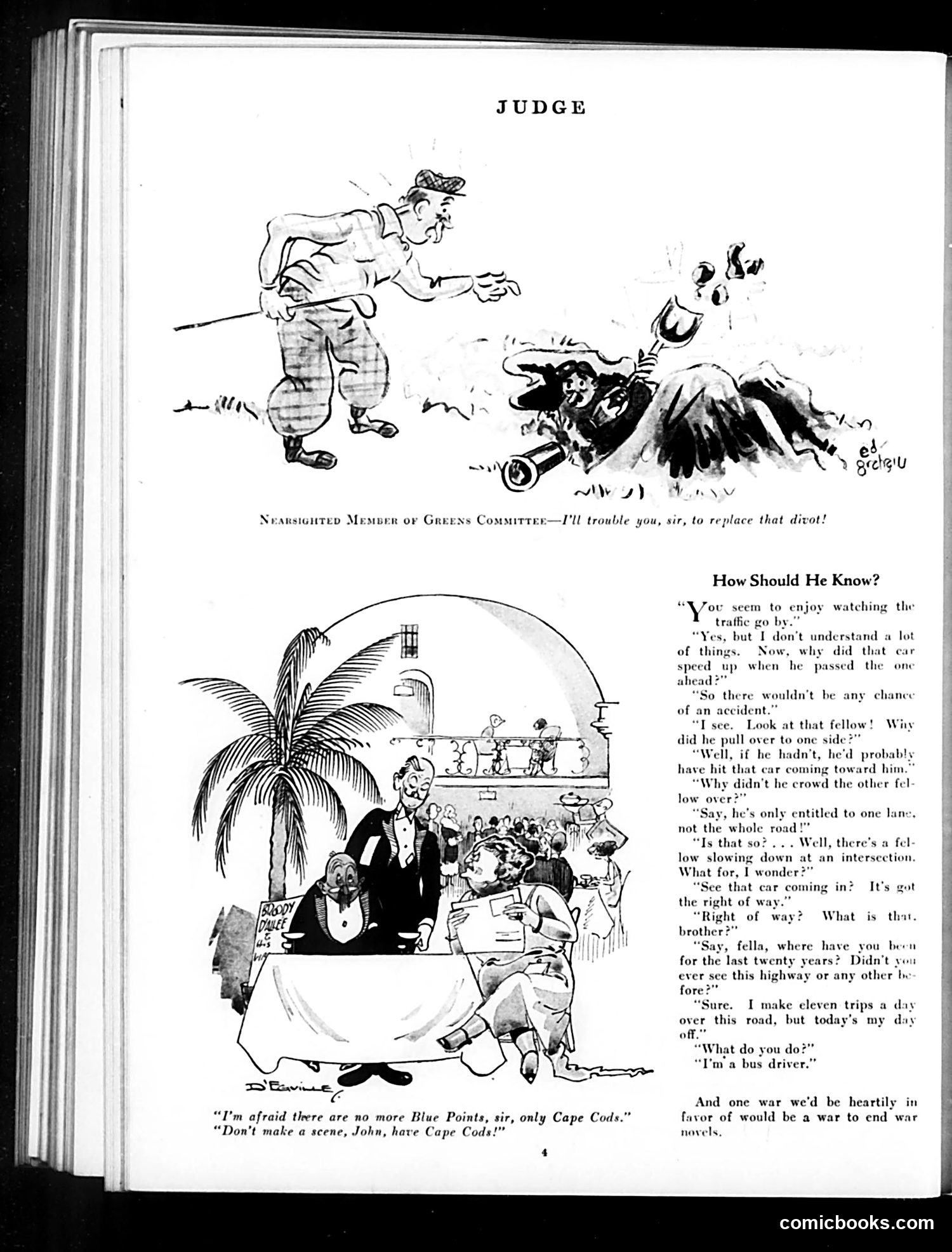
Analysis of This Judge Magazine Page Top Cartoon: A man labeled "Nearsighted Member of Greens Committee" swings a golf club wildly, hitting what appears to be a small animal or object instead of a golf ball. The caption reads, "I'll trouble you, sir, to replace that divot!"—a joke about his poor eyesight causing him to strike the wrong target entirely. Bottom Cartoon & Article: Titled "How Should He Know?", this depicts a waiter at what appears to be a fancy restaurant or hotel. The dialogue satirizes traffic rules and right-of-way disputes, ultimately revealing the man is a bus driver unfamiliar with driving rules despite his profession. It's social satire about incompetence in public service roles. Both pieces use humor about ordinary incompetence and professional negligence.
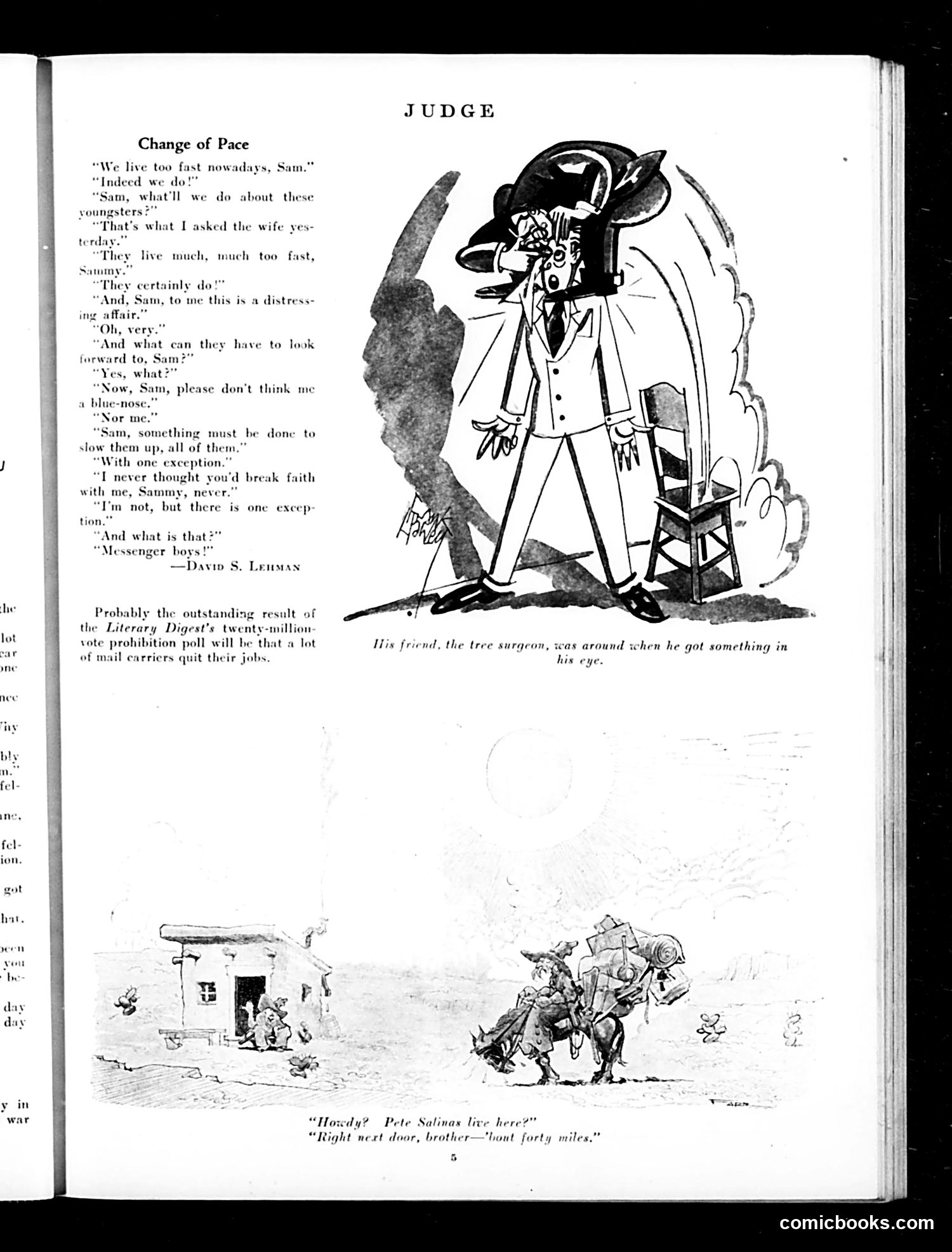
Analysis of Judge Magazine Page This page satirizes modern youth culture and speed obsession through a dialogue titled "Change of Pace." An older man (Sam) complains to his wife that young people "live much, much too fast," calling it "a distressing affair." His wife responds pragmatically that something must be done to slow them down. The top cartoon depicts a caricatured figure (likely representing a "messenger boy" or young delivery worker) operating at frantic speed, suggesting the frenetic pace of urban youth life—possibly referencing telegraph messengers or similar rapid-transit workers common in early 20th-century cities. The bottom illustration shows a rural scene, possibly illustrating the "slower pace" alternative the dialogue proposes. The satire critiques generational anxiety about modernization and accelerating urban lifestyles.
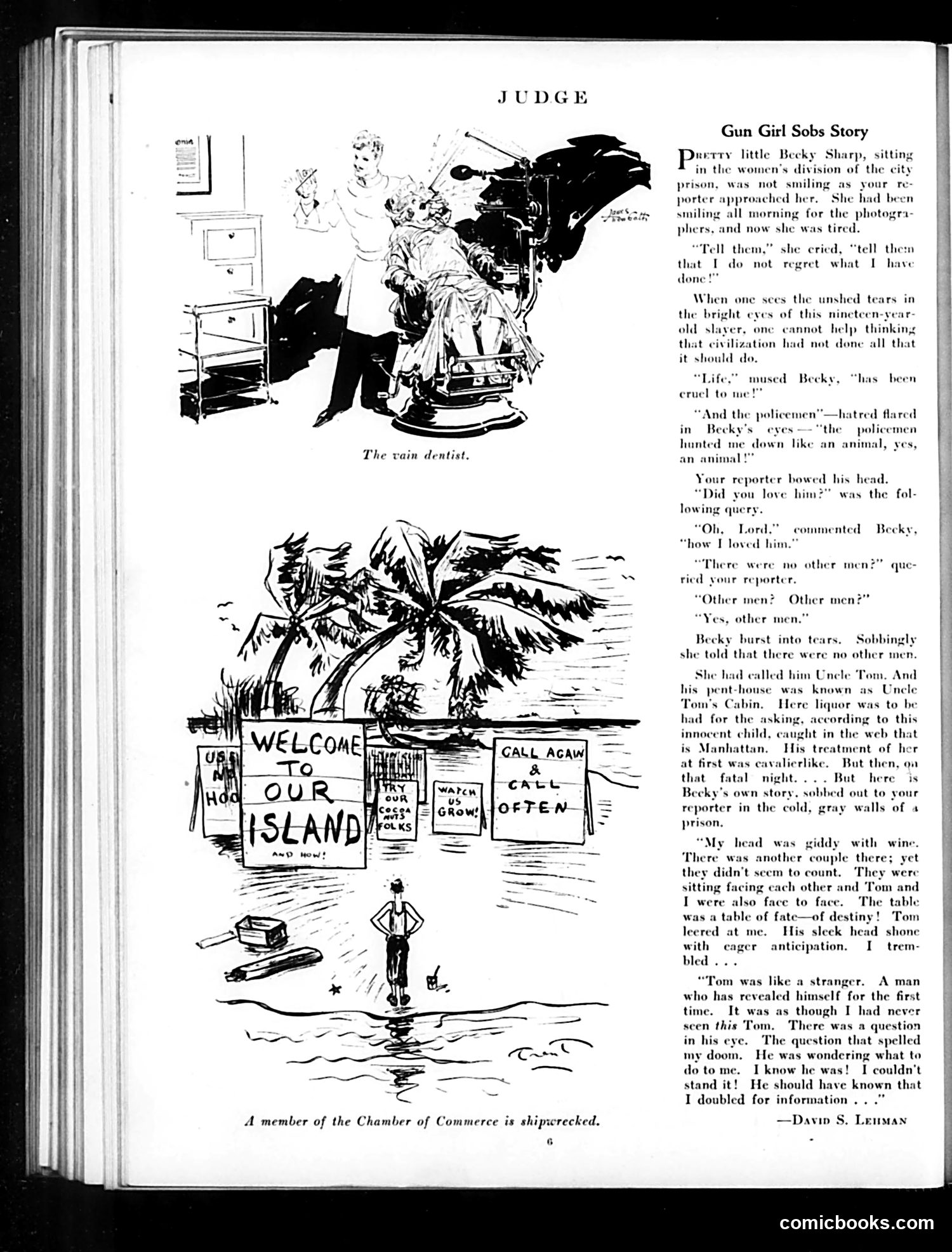
"Gun Girl Sobs Story" — Judge Magazine This page presents a first-person narrative by "Becky Sharp," a 19-year-old woman imprisoned in the city jail, reflecting on her life choices. The accompanying illustrations satirize her situation: one shows a dentist (labeled "The vain dentist"), another depicts a tropical island welcome sign with shipwrecked figures. Becky's account reveals she had a relationship with "Uncle Tom" at "Uncle Tom's Cabin" (a brothel), describing him as the only man she loved. She mentions drinking, other couples present, and Tom's mysterious, questioning nature that troubled her. The satire critiques urban vice, moral corruption of youth, and likely contemporary social anxieties about prostitution and criminality. The "Gun Girl" reference suggests she may have committed armed crime. The story employs sentimental confession to mock sensationalism around fallen women.
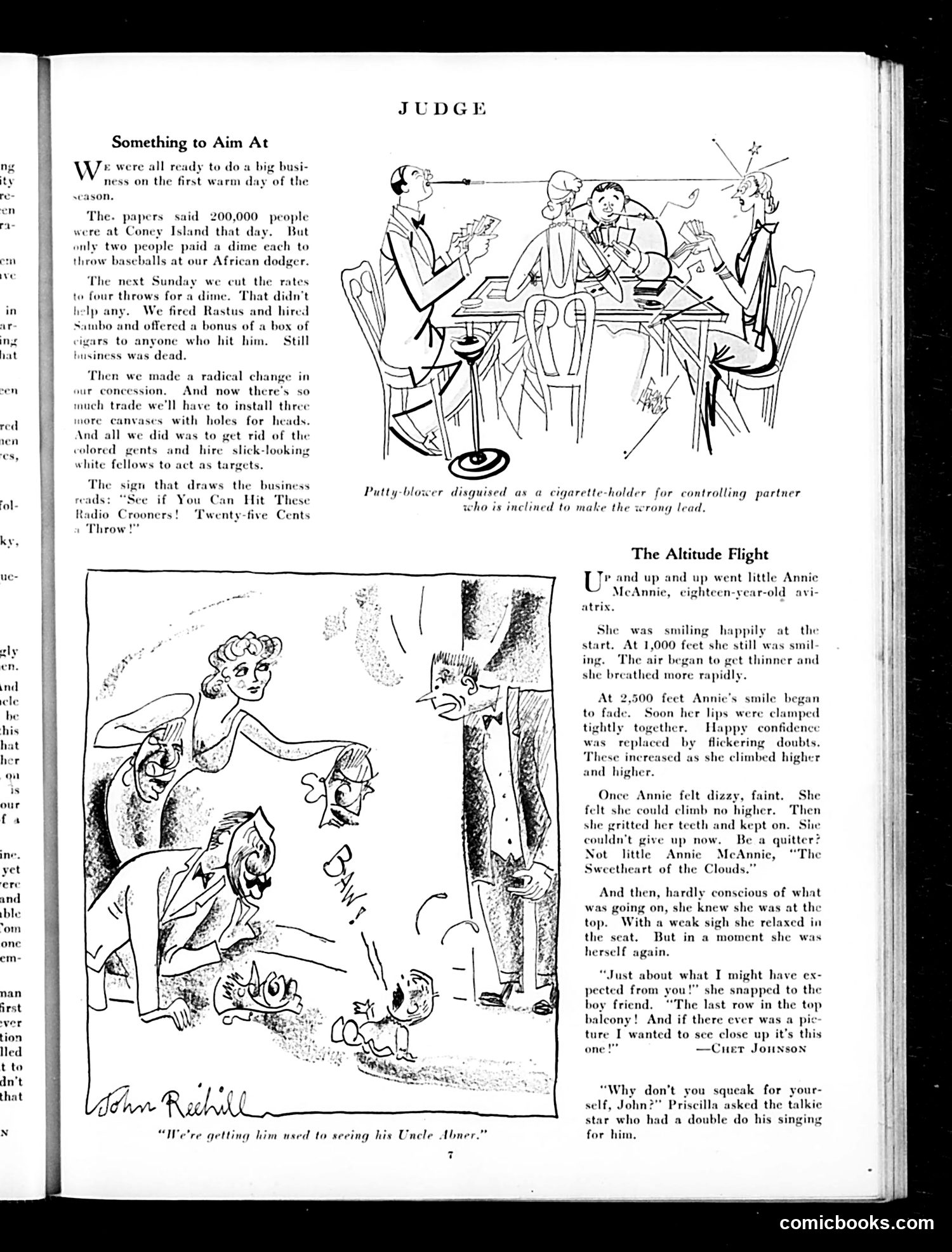
Judge Magazine Page Analysis This page contains two distinct pieces of early 20th-century satirical content: "Something to Aim At" (top): A carnival operator describes a racist shooting gallery attraction. Originally featuring Black men ("African dodger," "Rastus," "Sambo") as targets, business was poor. The operator then replaced the Black workers with "sick-looking white fellows" and business boomed—the joke being that audiences preferred shooting at white targets. The satire appears to mock both the racist premise of such attractions and American attitudes about who was considered acceptable to harm for entertainment. "The Altitude Flight" (bottom): A brief story about Annie McAnnie, an eighteen-year-old female aviator, enduring altitude sickness during a high-altitude flight. The narrative celebrates her perseverance despite physical distress, presenting her as brave ("Sweetheart of the Clouds"). This appears genuinely admiring rather than satirical, reflecting early aviation-era fascination with pioneering female pilots. Both pieces reflect early 1900s American attitudes and entertainment practices now recognized as deeply offensive.
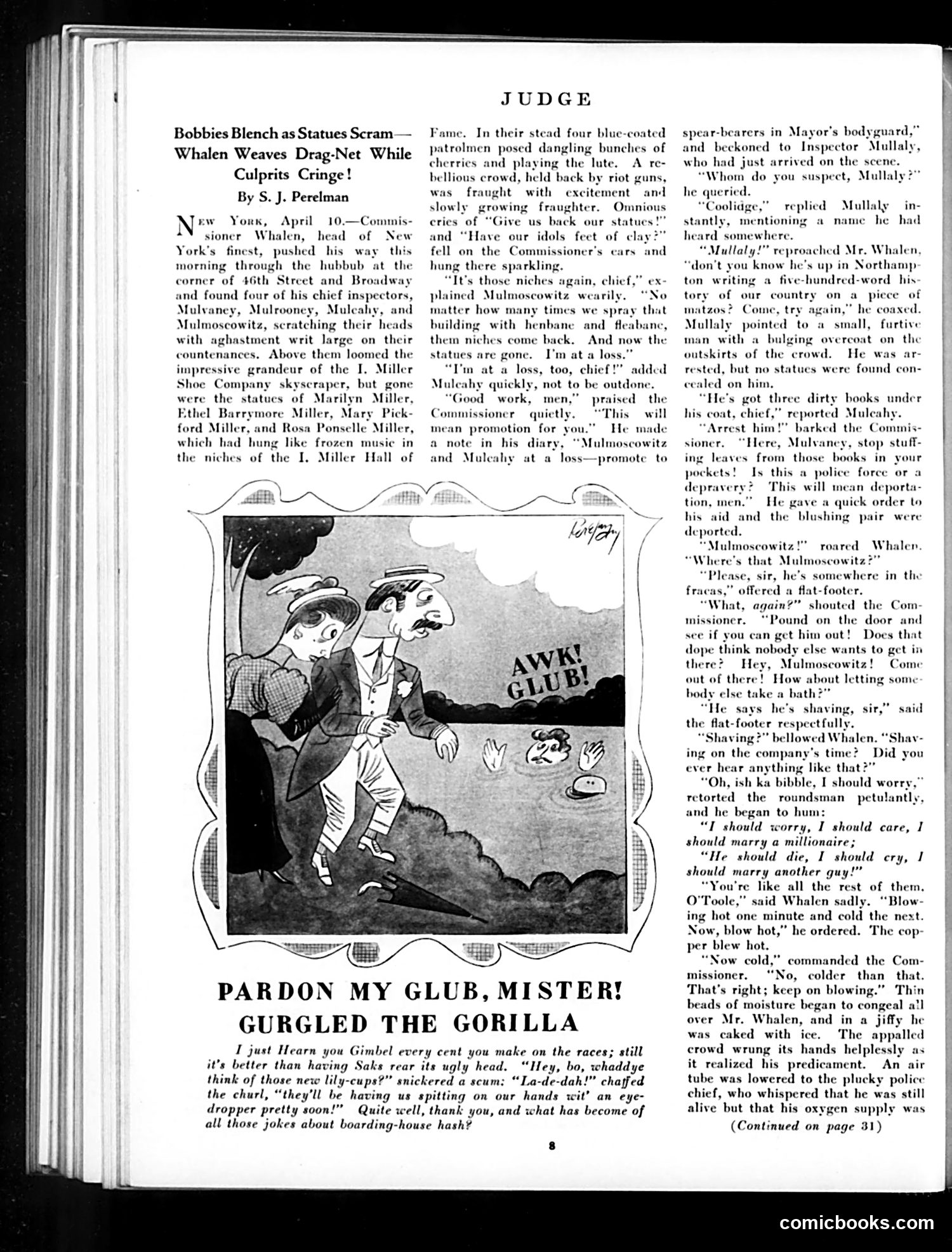
Explanation for Modern Readers This Judge magazine page satirizes NYC Police Commissioner Whalen's crime-fighting efforts through absurdist humor. The main cartoon depicts four inspectors (Irish-named characters like Mulvaney, Mulroon, Mulcahy, Mulmoscowitz) baffled by stolen statues from the I. Miller building—a real 1920s Broadway landmark. The satire mocks incompetent police work: the inspectors are promoted despite finding nothing, and officers follow nonsensical orders to blow air hot then cold. The humor relies on ethnic stereotyping (the Irish officers with exaggerated names) and slapstick bureaucratic absurdity typical of 1920s comedy. The lower section's references to "Gimbel" and "Saks" (department stores) and "boarding-house hash" appear to be separate comedic vignettes using period slang and working-class humor, though context is unclear without fuller text.
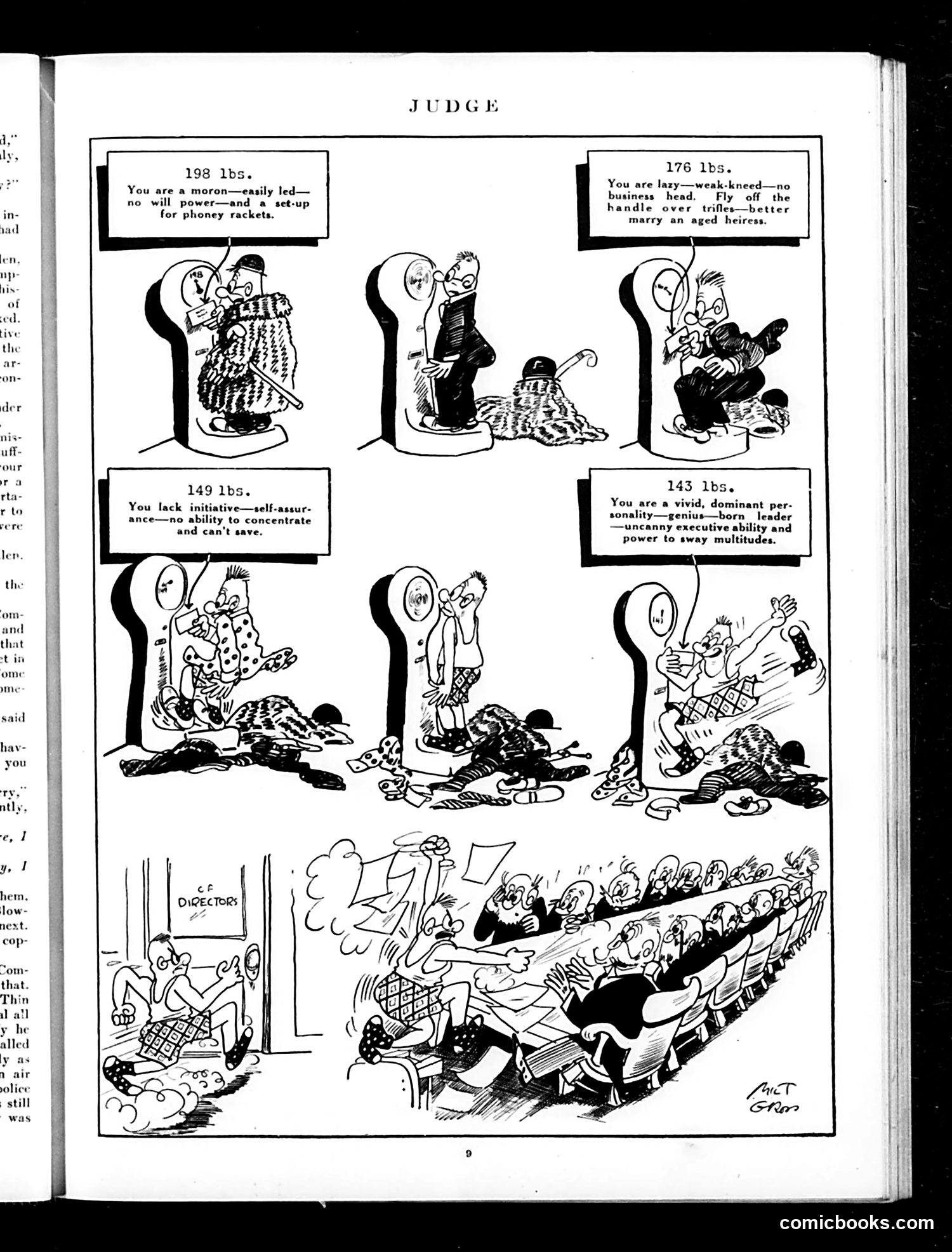
"Judge" Magazine Weight Satire This page satirizes pseudoscientific weight-based character assessment, likely popular in early-to-mid 20th century. The cartoon shows a scale-wielding "judge" (authority figure) making wildly different personality evaluations based solely on a person's weight—198 lbs earns insults (moron, gullible), 176 lbs gets mild criticism (lazy, weak), while 143 lbs produces effusive praise (genius leader). The bottom panel shows the absurd result: the heaviest people are dismissed as failures while lighter ones are celebrated as natural leaders, despite presumably identical individuals. The satire mocks both the pseudoscience of physiognomy/somatotyping and the arbitrary prejudices that reduce human character to physical measurements. The joke exposes how such "scientific" judgments were actually baseless superstition dressed in authority.
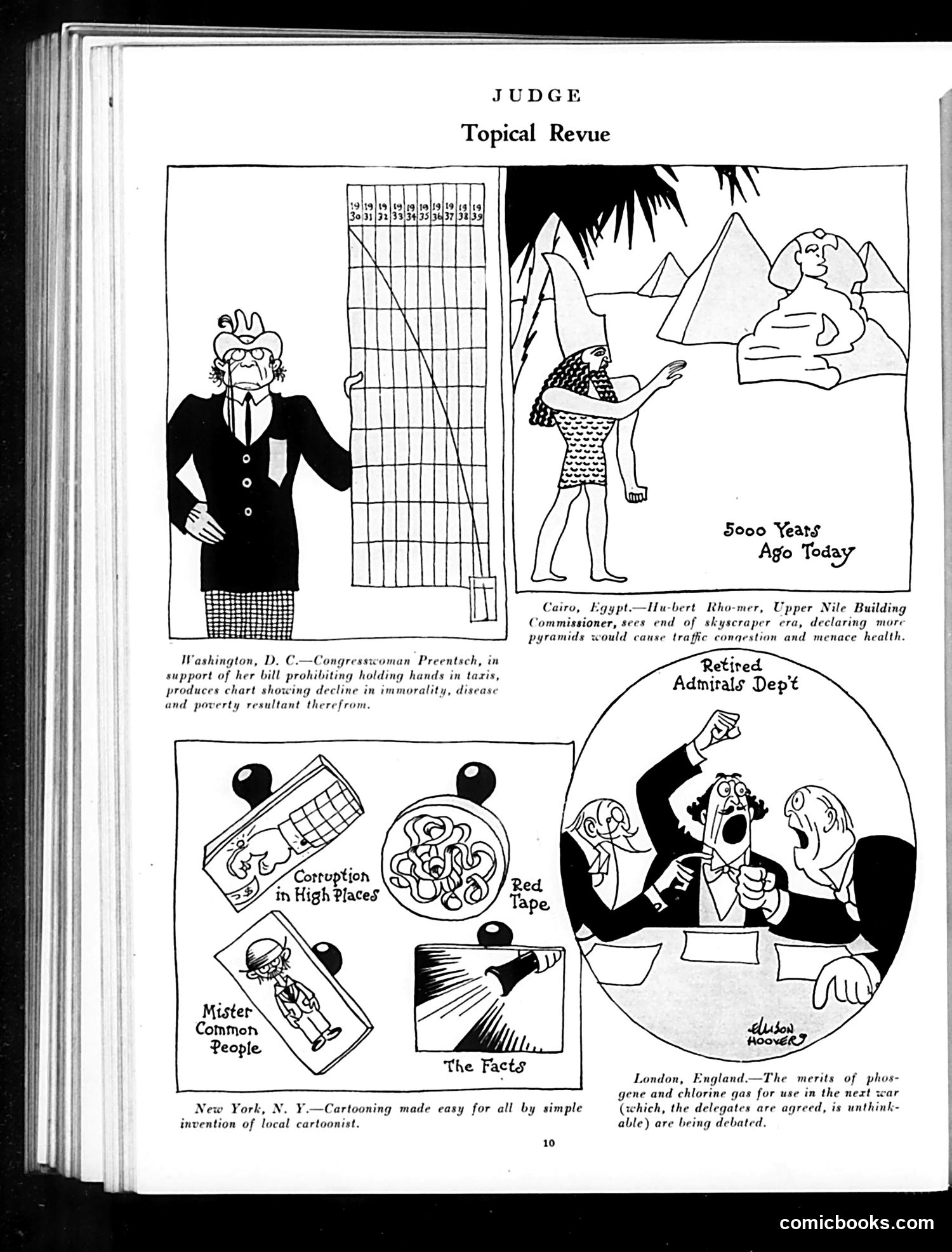
Judge Magazine: "Topical Revue" This page satirizes contemporary absurdities through four cartoons: 1. Washington taxi bill: A congresswoman proposes prohibiting hand-holding in taxis, claiming it reduces immorality and poverty—mocking legislative overreach and naive social engineering. 2. Egyptian bureaucrat: An official declares pyramids should stop being built due to traffic concerns, humorously suggesting modern bureaucratic thinking applied to ancient monuments. 3. Simple cartooning template: A New York cartoonist's invention showing interchangeable symbols (corruption, red tape, common people, "the facts") lampoons mass-produced editorial cartooning and formulaic satire. 4. London gas debate: British diplomats debate chemical weapons for a future war they claim is "unthinkable"—sharp irony about post-WWI disarmament conferences that simultaneously planned for the next conflict. The page overall mocks political hypocrisy, bureaucratic absurdity, and the arms race mentality of the interwar period.
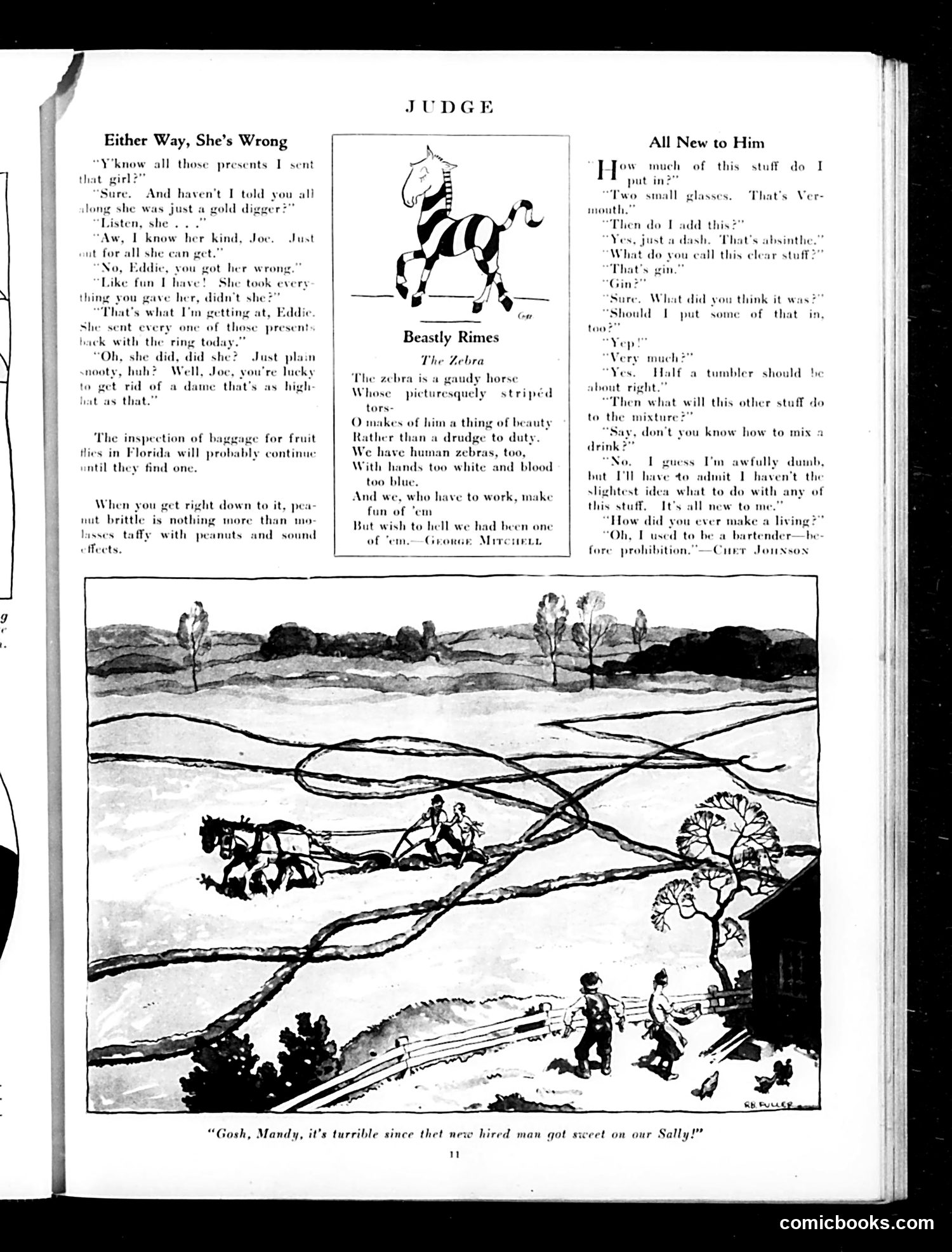
Judge Magazine Page Analysis This page contains three distinct humorous pieces typical of Judge's satirical style: "Either Way, She's Wrong" presents a dialogue between two men debating a woman's character. One man criticizes her for accepting gifts (calling her a "gold digger"), while the other criticizes her for *returning* the engagement ring. The joke is the logical trap: she's condemned regardless of her actions—a satire of men's contradictory, unfair standards for women. "Beastly Rimes: The Zebra" is a brief poem comparing zebras to wealthy people with "white hands and blue blood" (aristocratic imagery). It satirizes the upper class, suggesting they're decorative rather than useful, while working people grudgingly admire them. "All New to Him" depicts a former bartender (before Prohibition) attempting to teach cocktail-making. He's completely lost with the ingredients, revealing that Prohibition has made bartending knowledge obsolete—a topical joke about alcohol's illegality. The bottom illustration shows rural life disruption, captioning social tension over a hired man's romantic interest.
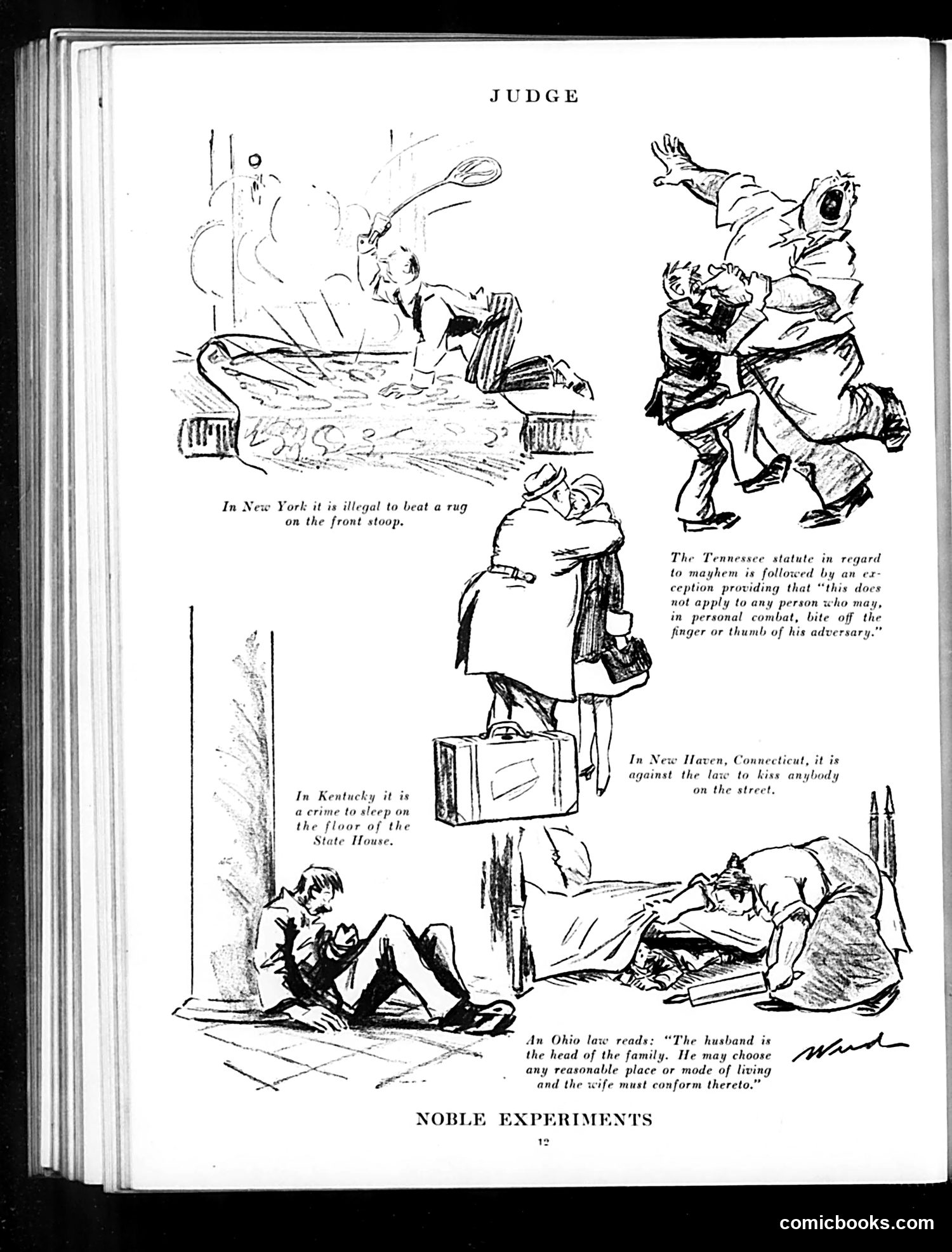
"Noble Experiments" - Judge Magazine Satire This page satirizes absurd or outdated state laws through illustrated vignettes. The title "Noble Experiments" mockingly references these regulations as if they were grand civic achievements. The cartoons depict: - New York: A man beating a rug on his front stoop (illegal) - Tennessee: Armed men fighting, illustrating a law permitting finger-biting in "personal combat" - Connecticut: A couple kissing on the street (prohibited) - Kentucky: A sleeping man inside the State House (illegal) - Ohio: A domestic scene illustrating marital authority laws granting husbands absolute control over household arrangements The satire targets the disconnect between these laws and modern sensibilities—highlighting outdated, absurd, or oppressive statutes that persist in American legal codes. The Ohio law especially critiques patriarchal authority. Judge uses humor to ridicule these "noble experiments" in legislation as ridiculous relics of an earlier era.
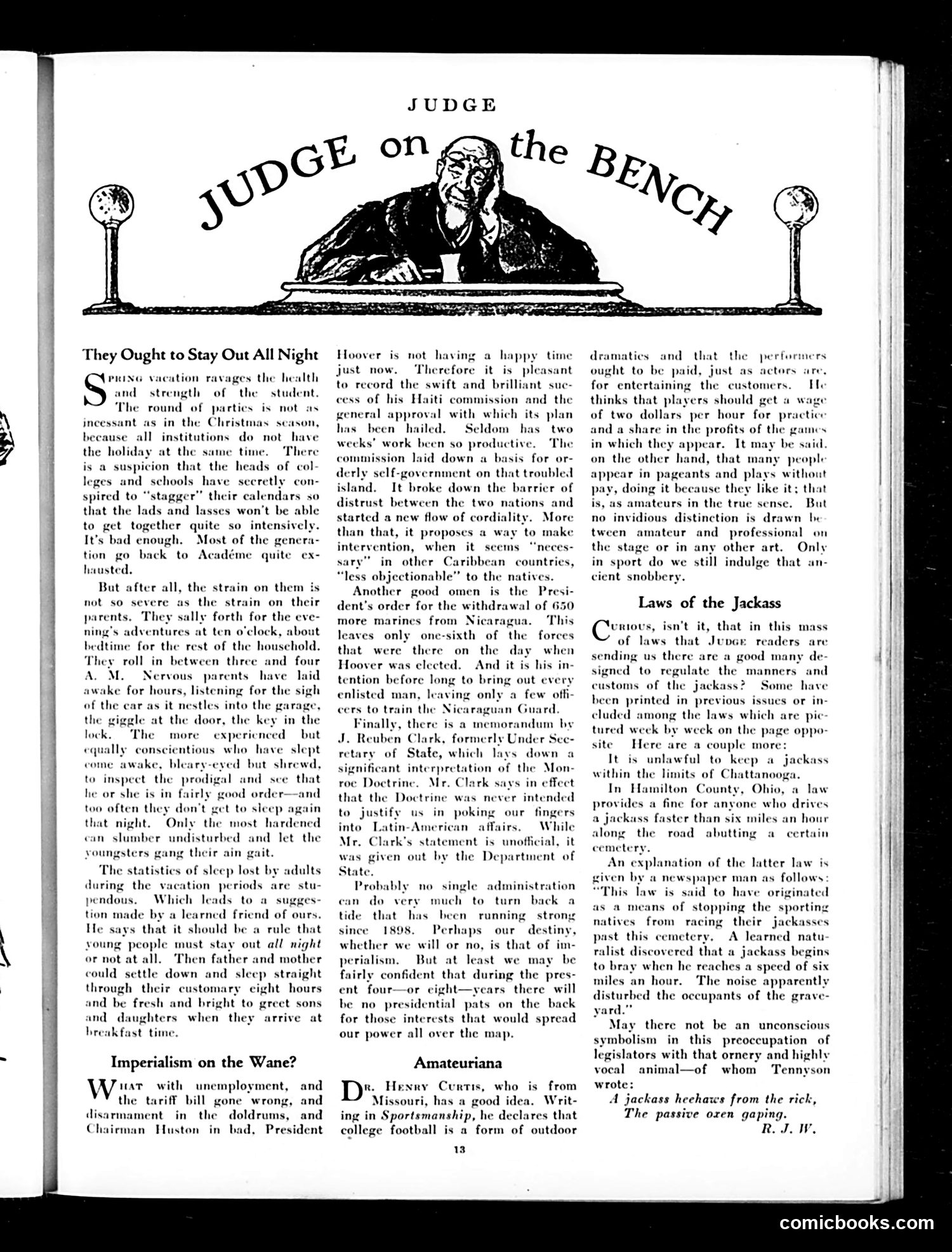
Judge Magazine Page Analysis This page from Judge magazine contains three opinion pieces rather than political cartoons. The masthead shows "Judge on the Bench"—the magazine's editorial voice. "They Ought to Stay Out All Night" satirizes anxious parents whose sleep is disrupted by college-age children returning home late during spring break. The writer suggests parents should accept either all-night outings or none, allowing uninterrupted sleep. "Imperialism on the Wane?" discusses President Hoover's foreign policy successes, particularly his Haiti commission and troop withdrawals from Nicaragua. It references the Monroe Doctrine and the Clark Memorandum (J. Reuben Clark's reinterpretation limiting U.S. intervention in Latin America). The piece optimistically suggests America may be moving away from imperialist interventionism, though the author remains skeptical. "Laws of the Jackass" and "Amateuriana" are brief notes about obscure topics regarding racing jackasses and college football as amateur sport—likely humorous fillers typical of the era.
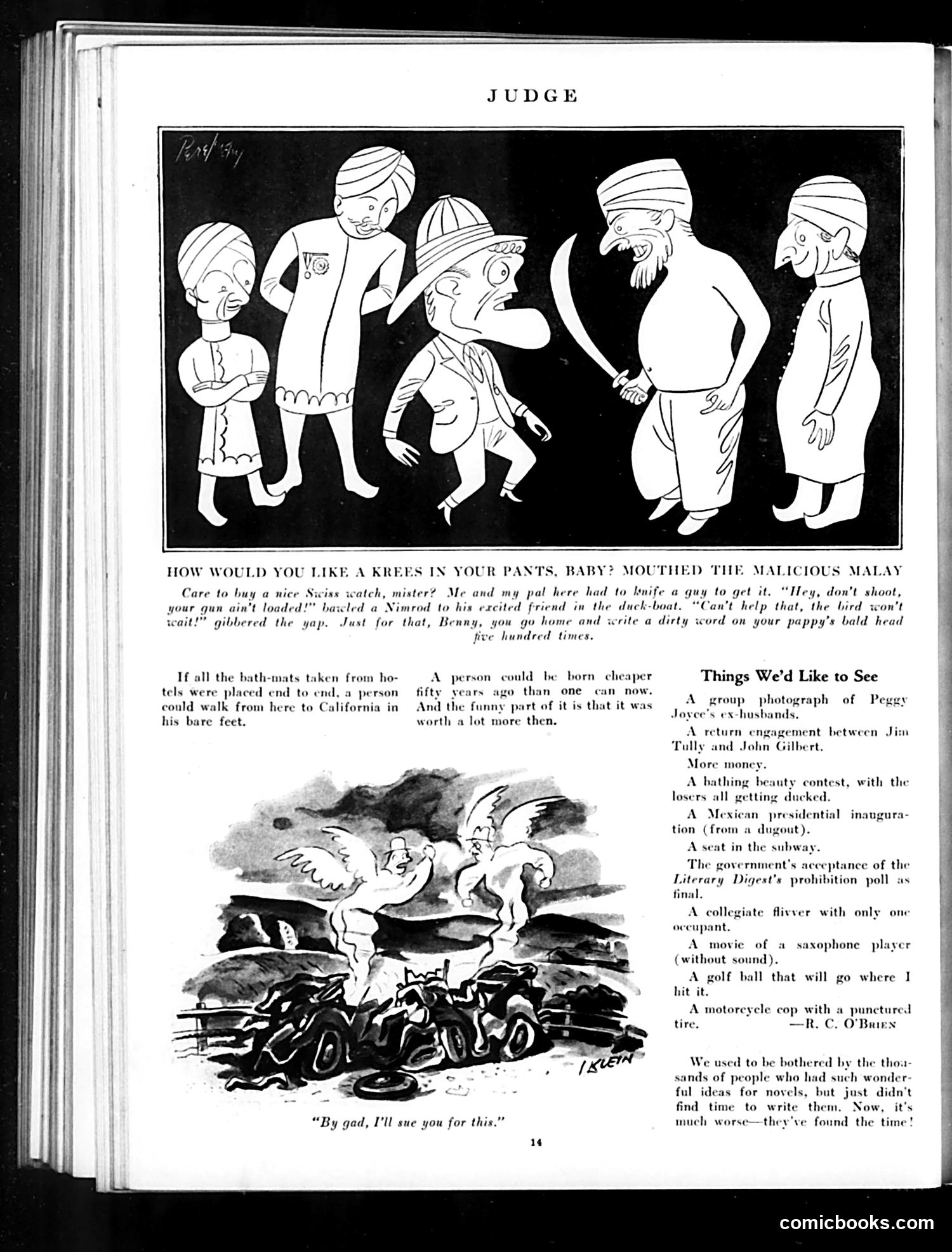
Understanding This Judge Magazine Page This page contains multiple satirical humor pieces typical of 1920s Judge magazine. The top cartoon depicts stereotypical "criminal types" - including what appears to be a "Malay" character and other exoticized foreign figures - engaging in petty crimes (watch theft, knife attacks). This reflects period attitudes portraying immigrants and non-Western peoples as inherently criminal and dangerous. Below are brief humorous observations and the "Things We'd Like to See" list - satirical wishes poking fun at contemporary issues: Peggy Joyce's numerous marriages, bathing beauty contests, Prohibition enforcement, saxophones, golf, and traffic enforcement. The final item jokes that would-be novelists are finally writing their "wonderful ideas" - though now they're presumably terrible. The humor is period-specific, relying on 1920s cultural references, stereotypes, and concerns that required historical context to fully parse today.
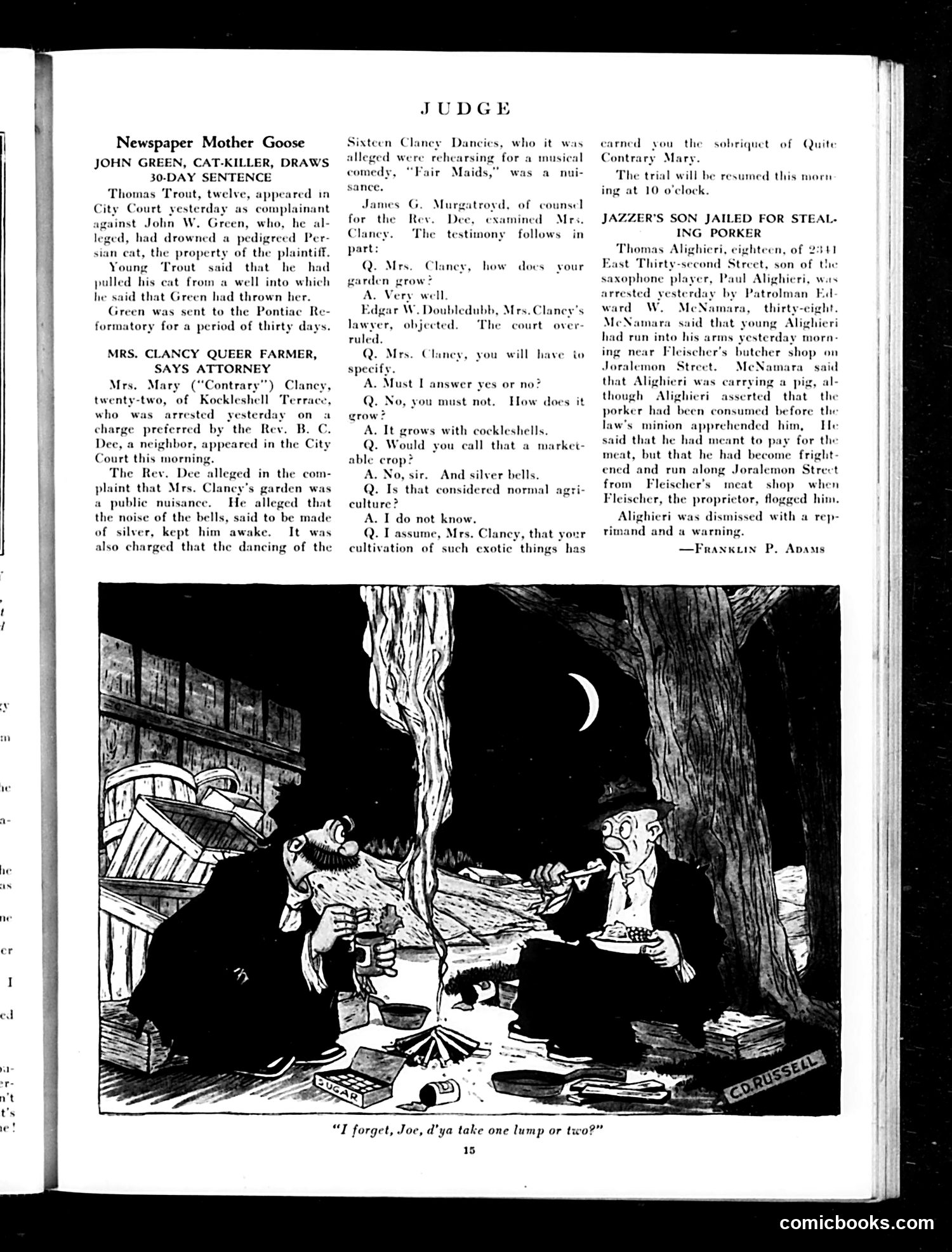
Judge Magazine Satire Analysis This page presents three mock-serious legal stories satirizing mundane urban disputes by treating them as major news, in the style of "Nursery Rhyme" parodies—a Judge magazine specialty. "John Green, Cat-Killer": A boy who drowned a Persian cat receives reformatory time, mocking how the legal system treats minor infractions with disproportionate severity. "Mrs. Clancy Queer Farmer": A play on the nursery rhyme "Mary, Mary, Quite Contrary." A woman is prosecuted for growing an exotic garden (with "cockleshells and silver bells") because it disturbs her neighbor-priest. The satire ridicules both overzealous legal complaints and arbitrary ordinances against harmless eccentricity. "Jazzer's Son Jailed for Stealing Porker": A jazz musician's son steals meat but receives only a warning after the butcher flogs him—satirizing lenient treatment of actual theft versus harsh prosecution of victimless behavior. The cartoon below depicts a nighttime hobo scene, illustrating urban poverty and underclass life. Together, these pieces mock society's misplaced priorities and legal inconsistencies.
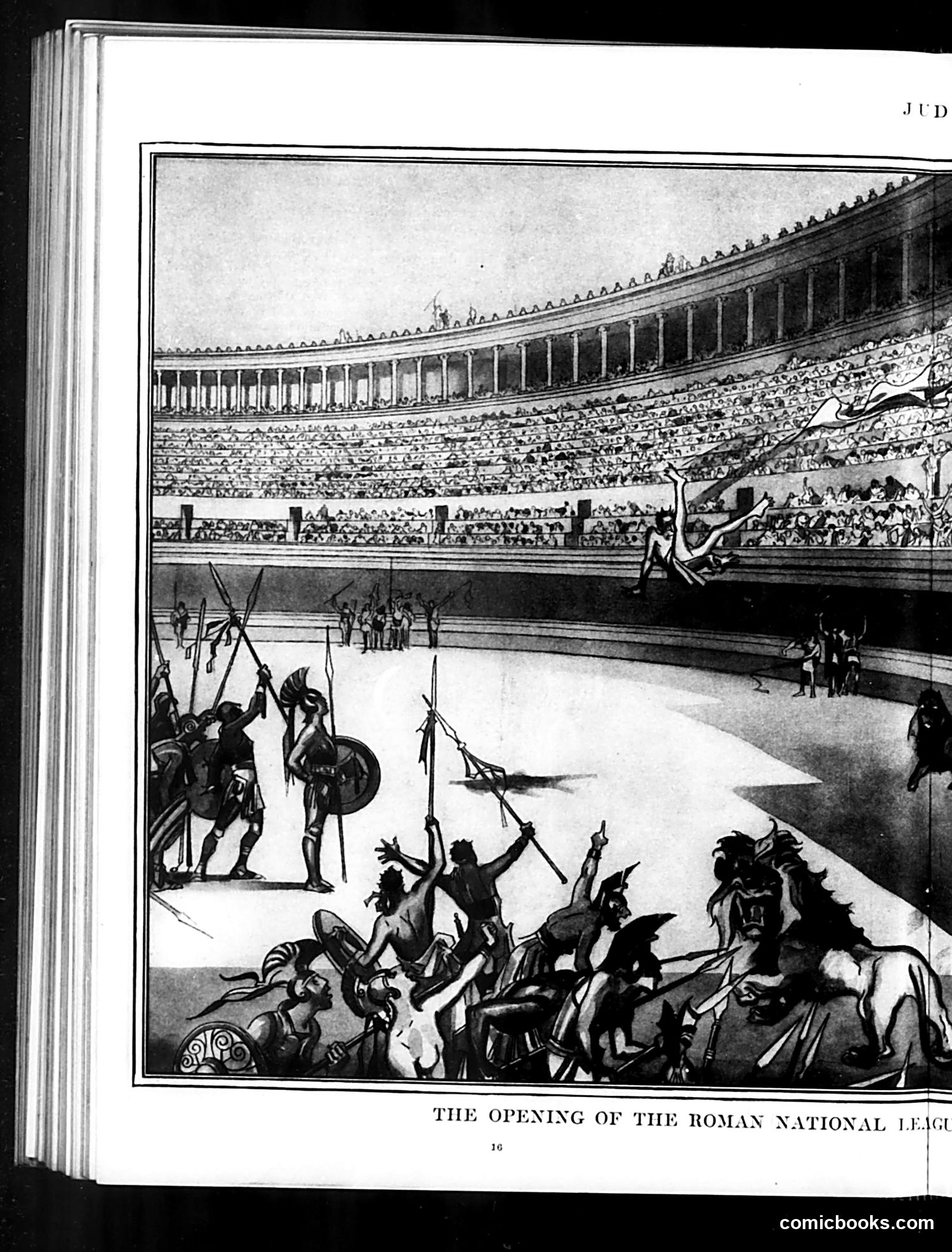
"The Opening of the Roman National League" This appears to be a satirical illustration depicting the inauguration of a Roman amphitheater or gladiatorial games. The image shows a massive coliseum-style structure packed with spectators, while armed gladiators and soldiers occupy the arena floor below. The satire likely comments on American sports culture or political spectacle by comparing it to Roman gladiatorial games—suggesting that modern public entertainment mirrors ancient Rome's violent spectacles. The elaborate architecture and crowded stands emphasize the scale and public obsession with such events. Without additional context from Judge magazine's publication date, the specific political target remains unclear, though the comparison implies criticism of how contemporary American society engages with spectacle and entertainment, paralleling Rome's eventual decline.
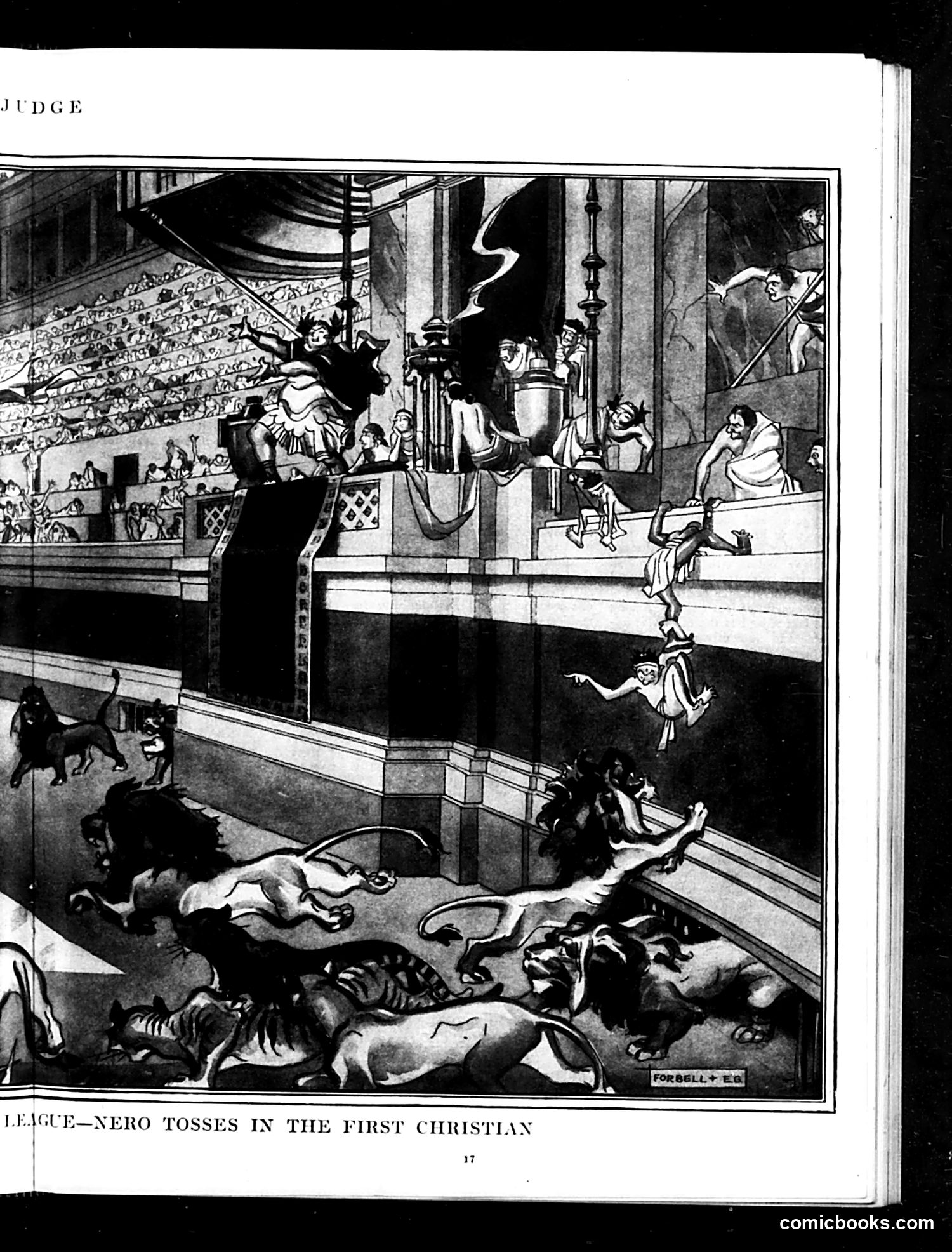
Explanation for Modern Readers This illustration depicts Nero, the Roman emperor, presiding over what appears to be a gladiatorial arena or amphitheater. The caption reads "Nero Tosses in the First Christian," referencing the historical (though disputed) legend that Nero persecuted early Christians by throwing them to lions or in gladiatorial combat. The cartoon appears to be political satire comparing contemporary American figures or policies to Nero's tyranny. By invoking Nero—history's archetypal cruel despot—the artist suggests that whoever or whatever "Judge" is criticizing represents authoritarian oppression of a persecuted group (labeled here as "Christian," likely representing some contemporary minority or political faction). Without knowing the specific publication date, the exact target remains unclear, but the satire equates current American politics with ancient Roman brutality and religious persecution.
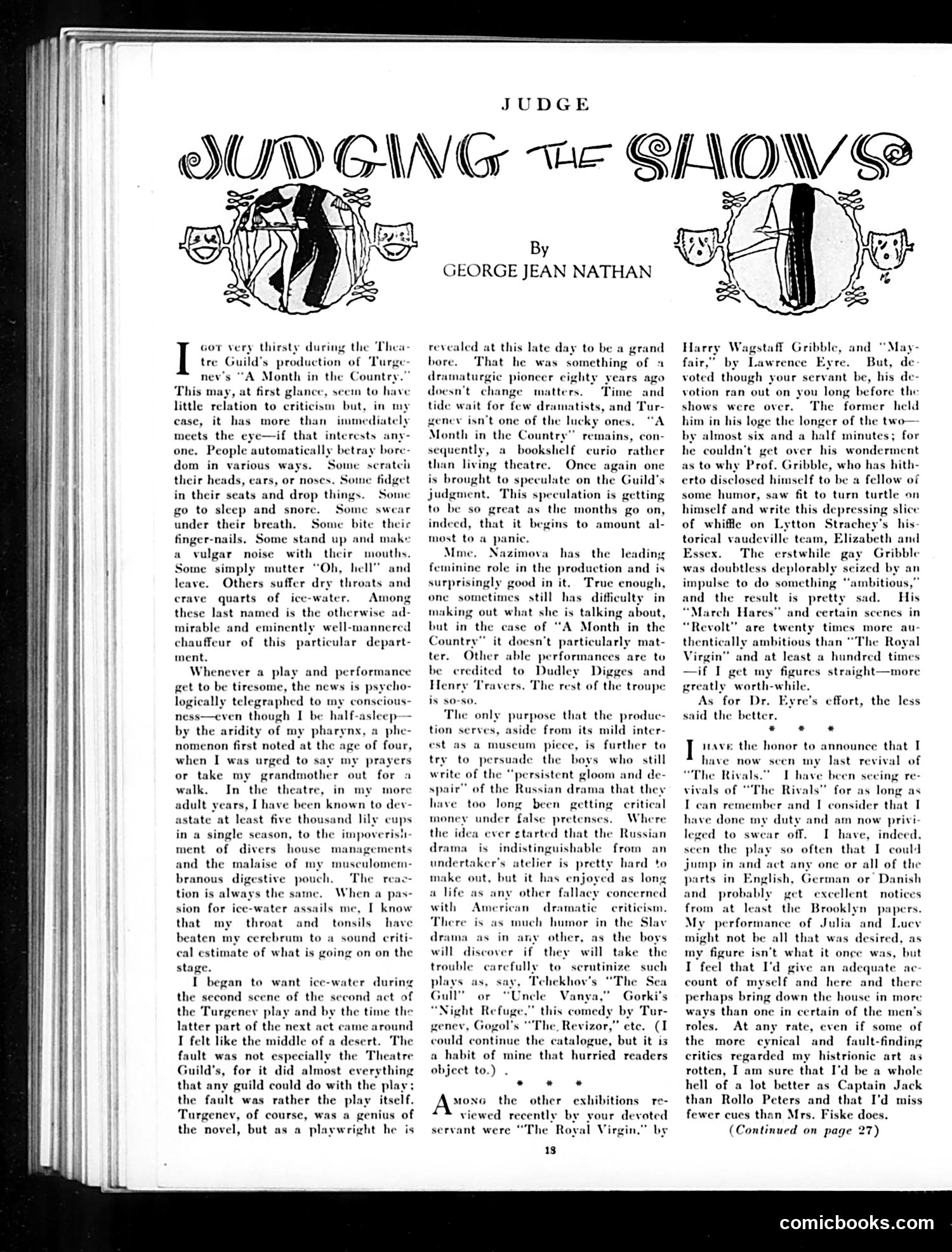
Judge Magazine Page Analysis This is a theater criticism essay by George Jean Nathan, Judge's drama critic, reviewing the Theatre Guild's production of Turgenev's "A Month in the Country." The Satire: Nathan uses humorous self-deprecation—claiming he got so thirsty during the play that he consumed thousands of paper cups—to critique the production's tedium without directly attacking it. The joke is that his physical discomfort signals the play's failure to engage audiences. The Argument: Nathan argues that while Turgenev was a literary genius, his plays haven't aged well. He critiques the Theatre Guild's judgment in reviving this "bookshelf curio" rather than living theater. He praises Mme. Nazimova's lead performance and Dudley Digges, dismissing others as "so-so." Social Context: The essay challenges the era's romanticization of Russian drama as inherently somber and serious, arguing Russian writers actually included considerable humor—a point Nathan supports by citing Chekhov, Gorky, and Gogol. The decorative theatrical masks frame the text, typical of Judge's visual design.
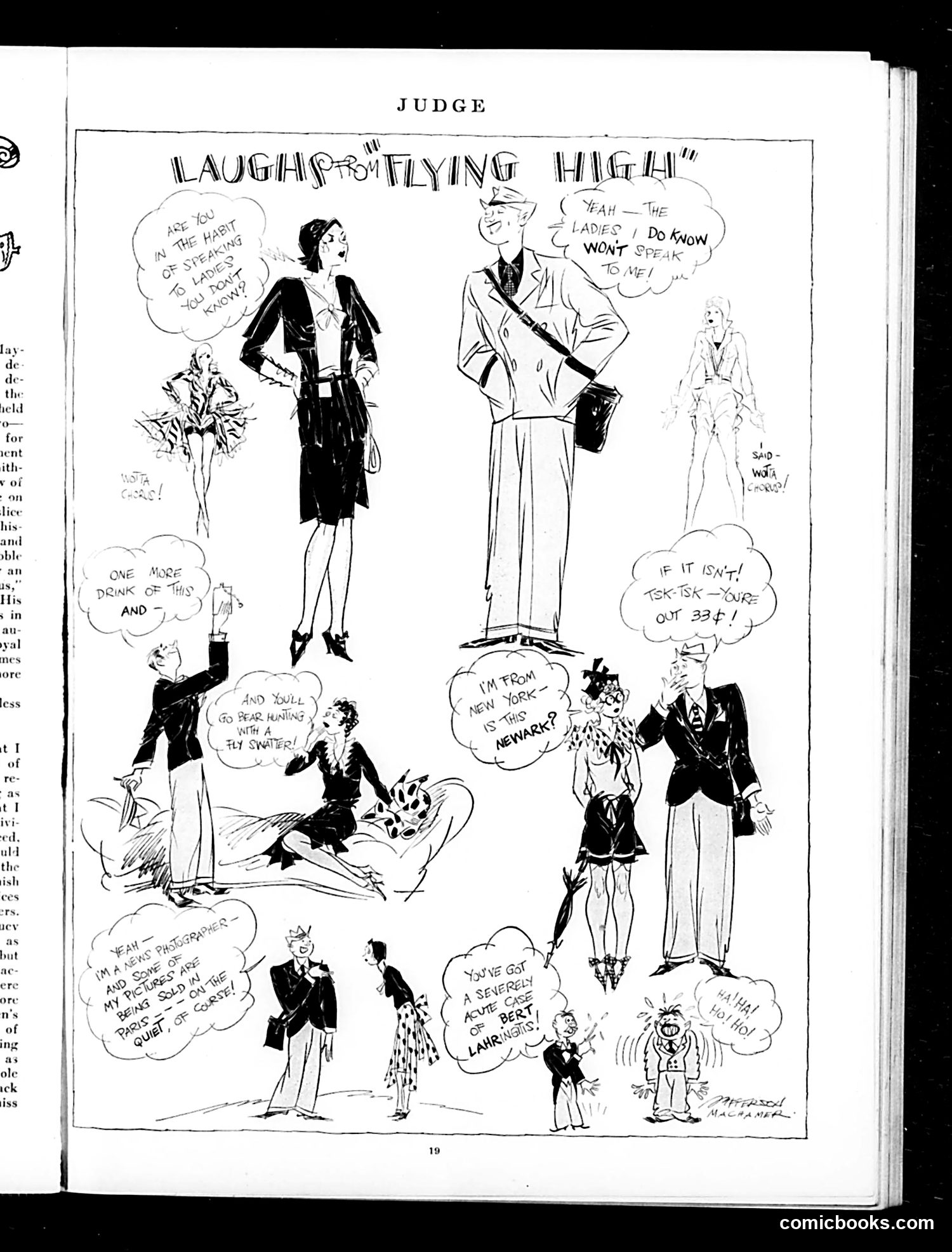
"Laughs from Flying High" This Judge cartoon satirizes wealthy socialites and their pretentious behavior during what appears to be the Prohibition era (based on references to drinks and speakeasies). The central figure is a tall woman in fashionable dress, surrounded by various society types engaging in scandalous activities—drinking illegally, making crude jokes, and boasting about their social status. The humor targets the hypocrisy of the upper class: they publicly maintain respectable appearances while privately flouting laws and displaying poor manners. Characters brag about New York connections, make vulgar comments, and discuss illicit drinking with casual indifference. The "flying high" title suggests intoxication alongside the social climbing these figures practice. The cartoon mocks how wealthy people believe their status exempts them from rules that bind ordinary citizens.
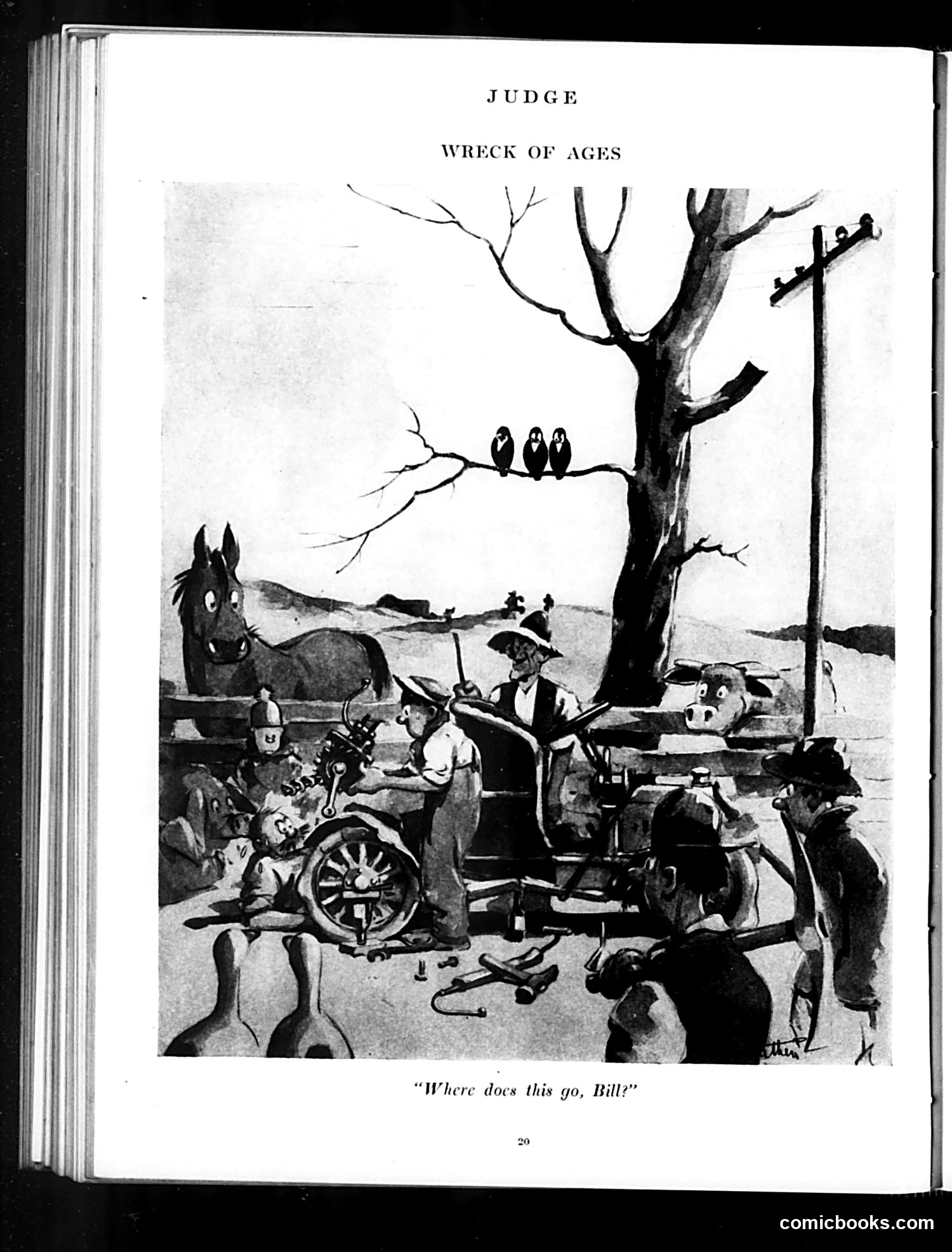
"Wreck of Ages" This political cartoon satirizes automotive chaos and breakdown. The illustration depicts an accident or collision scene with multiple vehicles, anthropomorphic animals (a horse and cow), and human figures amid wreckage and mechanical parts scattered about. The caption—"Where does this go, Bill?"—suggests confusion and incompetence during a disaster. The dead tree and desolate landscape reinforce themes of decay and ruin. Given the title "Wreck of Ages," this likely comments on societal or political collapse, possibly critiquing industrial progress, poor transportation safety standards, or government mismanagement circa early 20th century. The chaotic jumble of machine parts and confused figures conveys disorder and the failure of progress to deliver civilization.
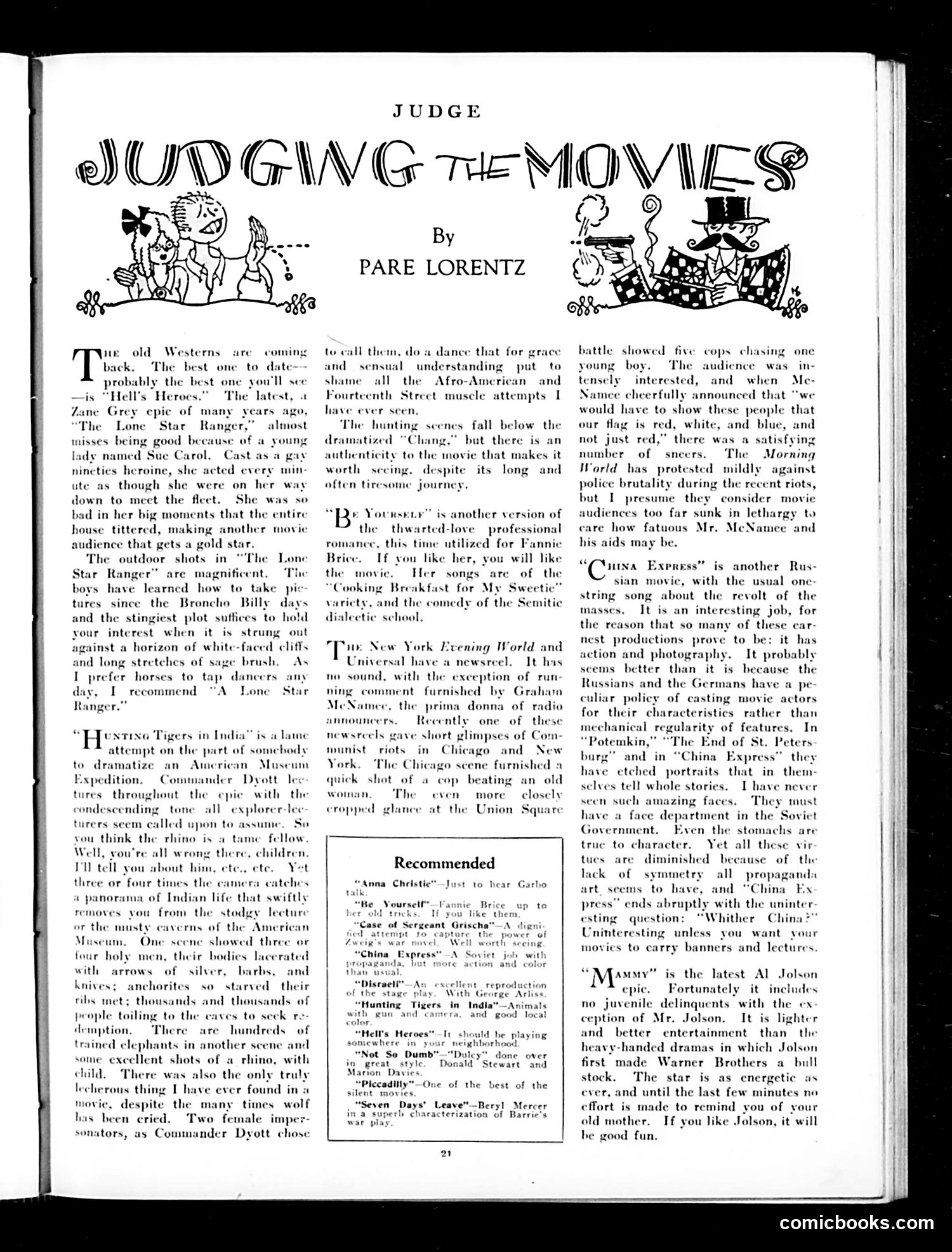
Judging the Movies by Pare Lorentz This is a film review column from *Judge*, a satirical magazine. The main content critiques recent movies, but the satire emerges in Lorentz's discussion of newsreel coverage of communist riots in Chicago and New York. When describing footage of police beating protesters, Lorentz notes that radio announcer Graham McNamee cheerfully declared Americans must show "these people" that "our flag is red, white, and blue, and not just red"—a mocking reference to the communist flag. Lorentz sarcastically suggests McNamee was suggesting patriotic violence against rioters. The satire targets both the sanitized newsreel narrative (presenting brutality as patriotic duty) and the *Morning World* newspaper for only mildly protesting police violence while assuming audiences are too apathetic to care about "fatuous" commentary justifying it. The page's decorative cartoons appear unrelated to the political content—simply illustrating the "judging movies" theme.
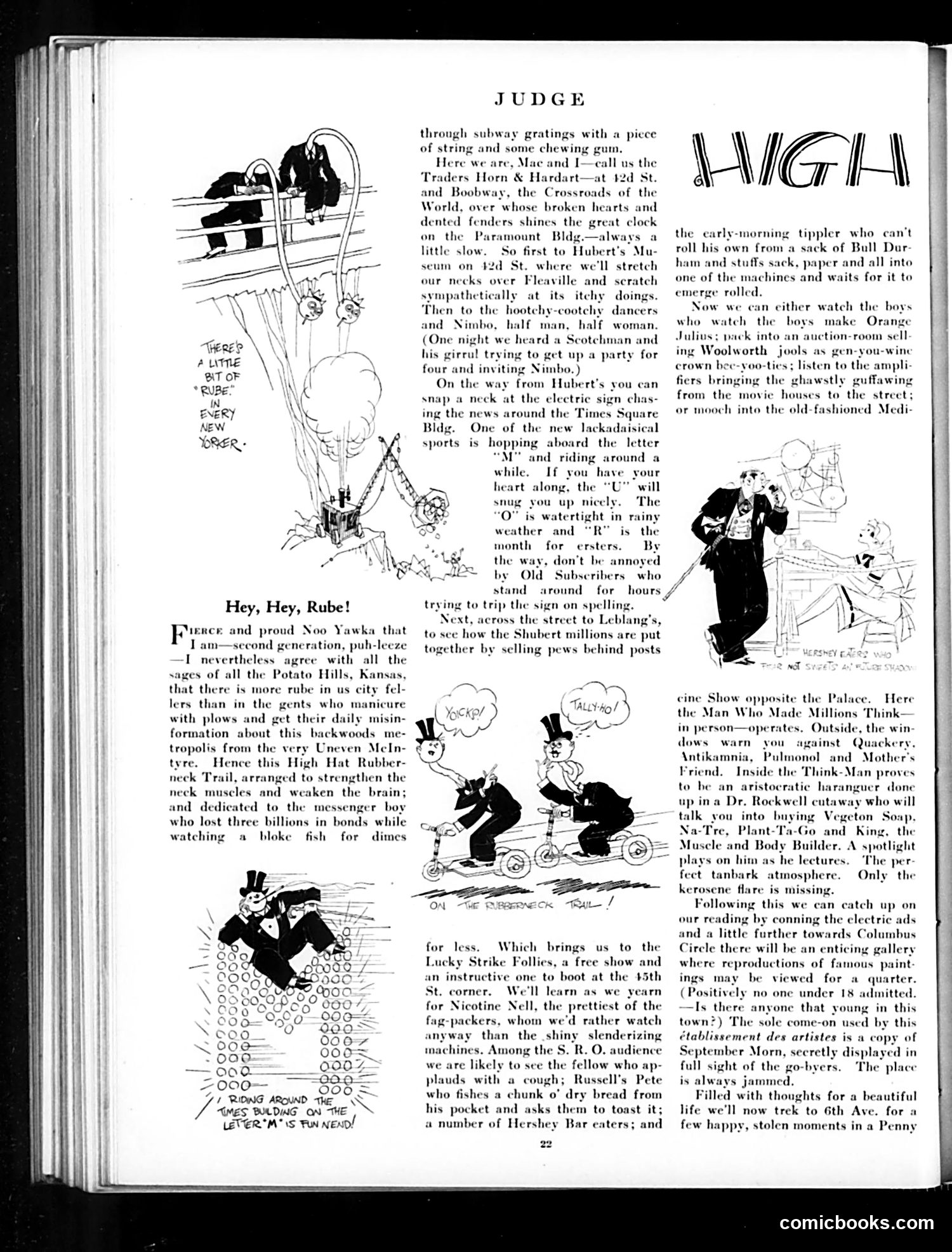
Analysis of "Judge" Magazine Page This page satirizes the tourist experience of 1920s New York City, specifically Times Square and 42nd Street attractions. The narrator ("Noo Yawka") mocks both out-of-town rubes and city dwellers, claiming second-generation New Yorkers possess superior sophistication—yet ironically describes visiting the same tacky attractions: Hubert's Museum (featuring "Fleaville" and "Nimbo, half man, half woman"), the Times Square news sign, movie houses, and cheap theaters. The cartoons depict men engaging with newfangled urban amusements and street entertainment. The satire targets the commercialization of entertainment, aggressive advertising, and the blurring of respectability—references to nicotine advertising, "fag-packers" (cigarette girls), and establishments offering dubious entertainment suggest moral anxiety about urban vice masquerading as legitimate attractions. The phrase "Hey, Hey, Rube!" (carnival slang) emphasizes how thoroughly commodified and performative modern city life had become.
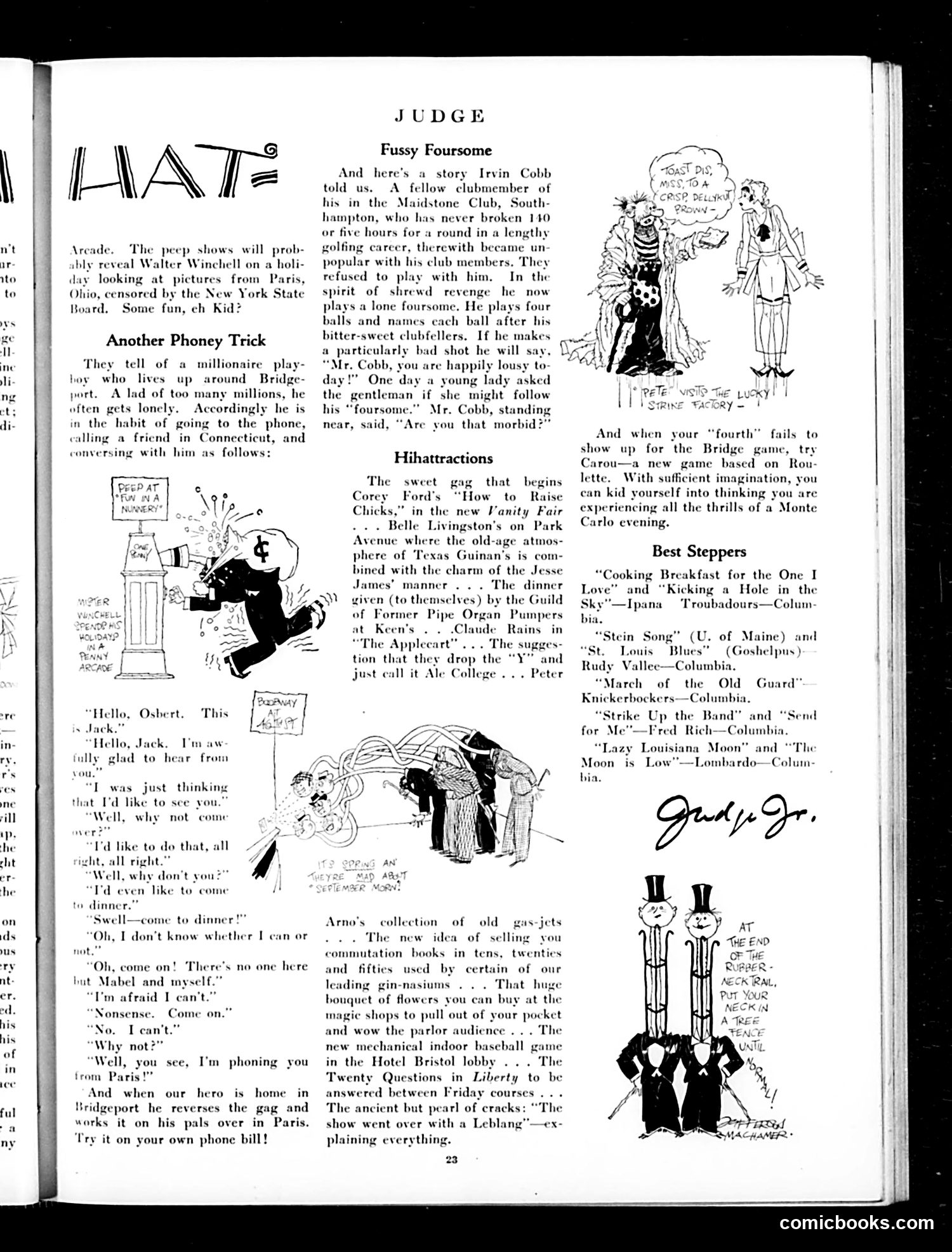
Judge Magazine Page Analysis This page from Judge magazine contains three humorous pieces targeting upper-class social behavior: "Another Phoney Trick" mocks wealthy playboys who fake loneliness by calling friends long-distance for elaborate social invitations, only to decline—the joke being the extravagant phone bills this generates. It's satire of both idle rich behavior and newfangled telephone technology's absurd possibilities. "Fussy Foursome" recounts humorist Irvin Cobb's anecdote about a mediocre golfer banned from club play who retaliates by playing alone while naming each ball after club members he resents, insulting them aloud during bad shots. The satire targets both golf snobbery and petty social revenge. "Hihattractions" and "Best Steppers" are lighter entertainment columns reviewing shows, songs, and cultural events—typical Judge content mixing mild satire with celebrity gossip and popular music recommendations (Rudy Vallée, etc.). The cartoons illustrate the absurdity described. Overall, the page satirizes Jazz Age excess, class pretension, and conspicuous consumption among the wealthy.
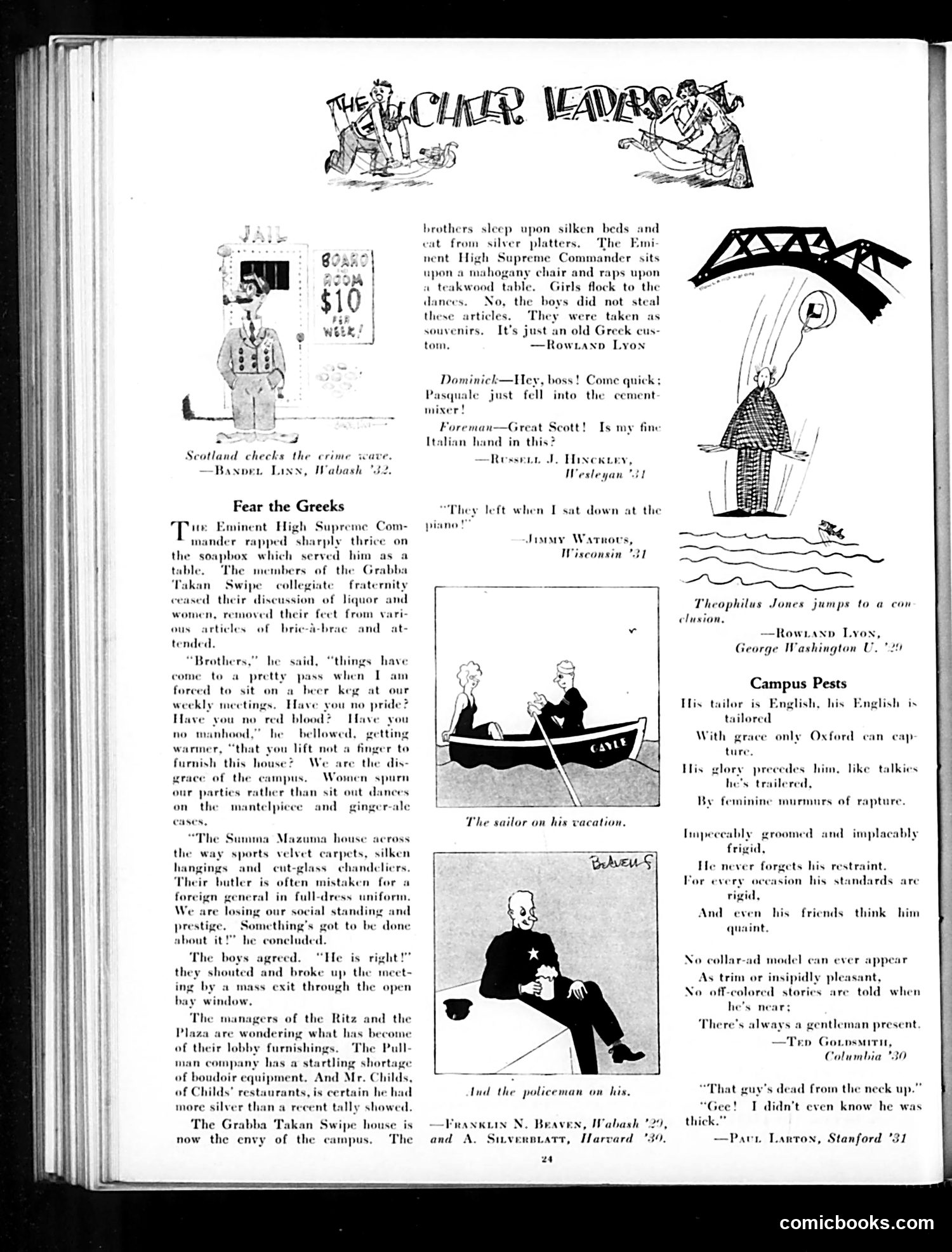
Explanation for Modern Readers This *Judge* magazine page contains satirical humor aimed at 1920s college audiences. "Fear the Greeks" mocks fraternity culture. A fraternity leader ("High Supreme Commander") complains that members lack pride because they sit on beer kegs rather than luxurious furniture. The joke's twist: the fraternity then steals expensive items (silk beds, silver platters, mahogany chairs) from hotels and restaurants, justifying it as "an old Greek custom." The satire targets fraternity entitlement and petty theft normalized as tradition—while hotels like the Ritz notice their missing furnishings. Other brief jokes include workplace mishaps (a worker falling into a cement mixer), social awkwardness (a pianist clearing a room), and character sketches of "Campus Pests"—particularly mocking an overly formal, English-influenced tailor who is rigidly proper yet emotionally cold. The humor relies on insider college references and assumes readers recognize fraternity stereotypes, hotel theft as a known problem, and class anxiety about pretentious behavior.
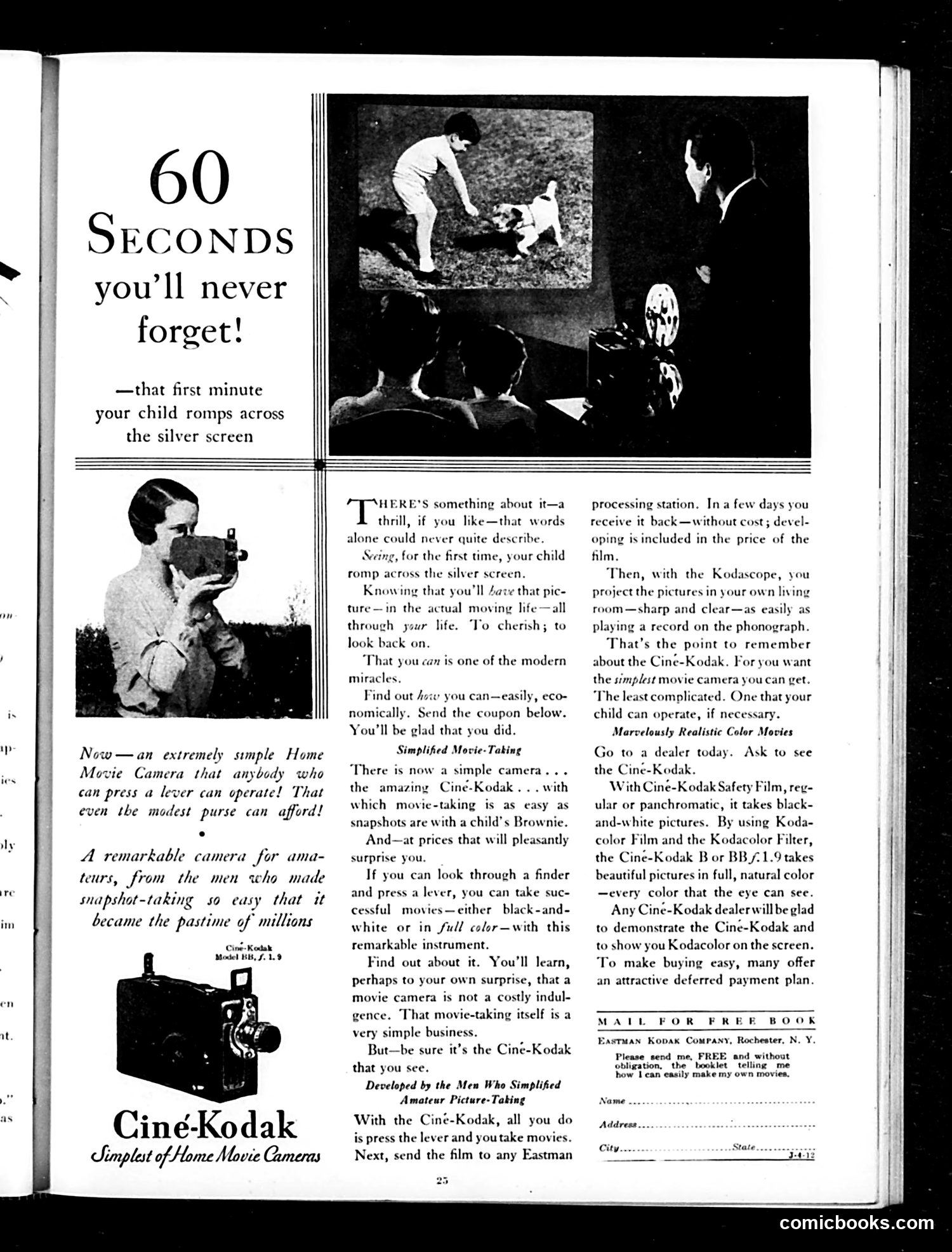
Analysis This page is not a political cartoon or satire—it's a full-page advertisement for the Kodak Cine-Kodak home movie camera, likely from the 1920s-1930s. The appeal is emotional and aspirational: the ad emphasizes that ordinary families can now afford to film their children and preserve precious moments. The repeated phrase "60 SECONDS you'll never forget" centers on the emotional thrill of seeing your child's image on screen for the first time. The copy stresses simplicity and affordability—"anybody who can press a lever can operate" it, and prices will "pleasantly surprise you." The ad also mentions color film capability and a payment plan to make purchase easier. The photographs show a father operating the camera and families watching projected home movies, depicting the new consumer technology's promise of domestic bonding and memory-keeping. This reflects early 20th-century marketing that transformed photography from a specialty into a mass-market family activity.
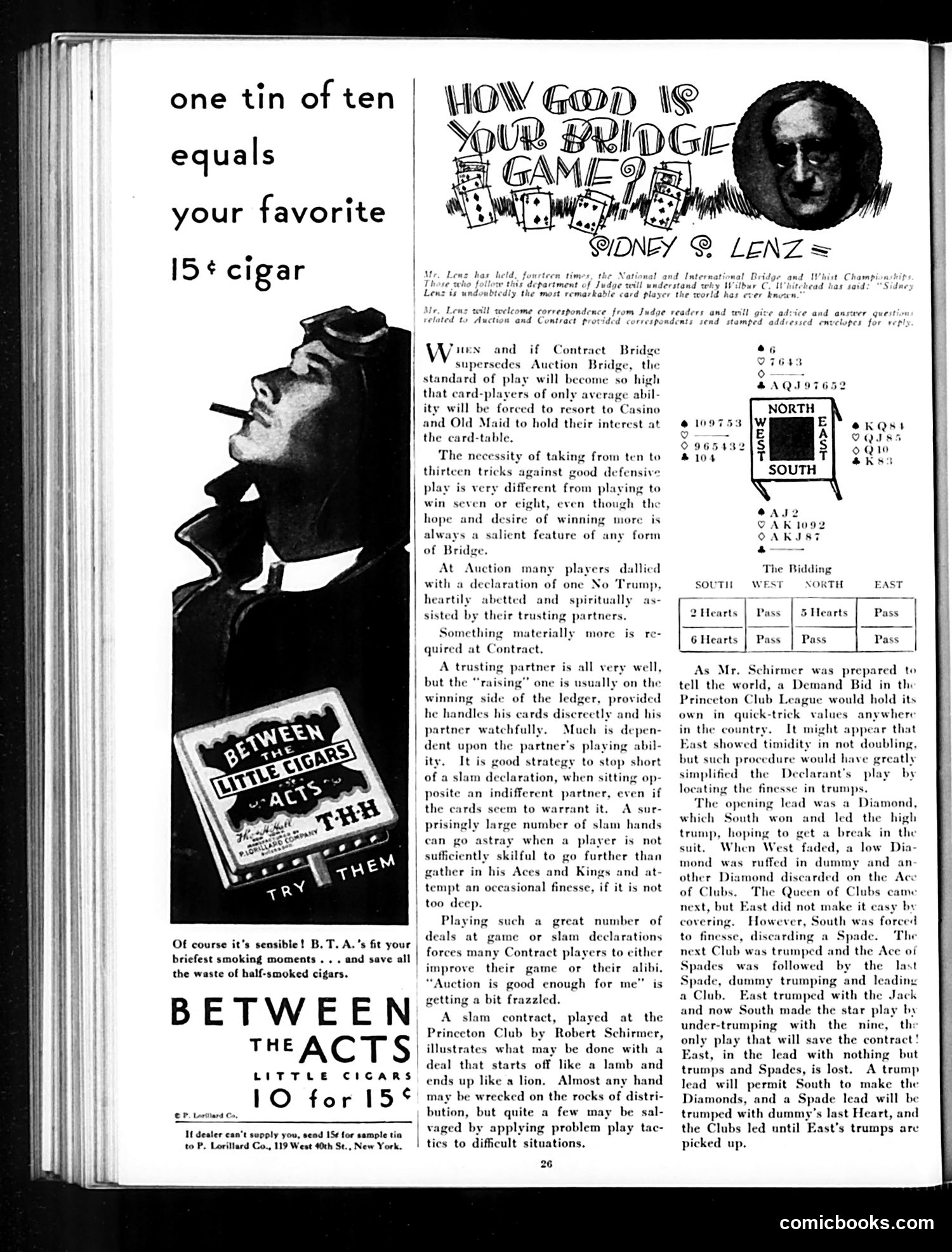
Judge Magazine Page Analysis This page combines two distinct elements: a cigarette advertisement and a bridge card game article. The Advertisement: The left side promotes "Between the Acts" little cigars (10 for 15¢) through a caricatured image of a man smoking. The ad uses the slogan "one tin of ten equals your favorite 15¢ cigar," arguing these shorter smokes prevent waste from partially-smoked cigars. This reflects early 20th-century marketing emphasizing economy and practicality. The Bridge Article: The right side features an article titled "How Good Is Your Bridge Game?" by Sidney S. Lenz, a renowned bridge player. The piece illustrates contract bridge strategy through a specific hand from the Princeton Club, explaining advanced tactics like "problem play" and under-trumping. This reflects bridge's status as a popular intellectual pastime among the educated classes during this era. The page reflects Judge's dual purpose: satirical commentary mixed with lifestyle content and advertisements targeting affluent readers interested in both refined hobbies and consumer goods.
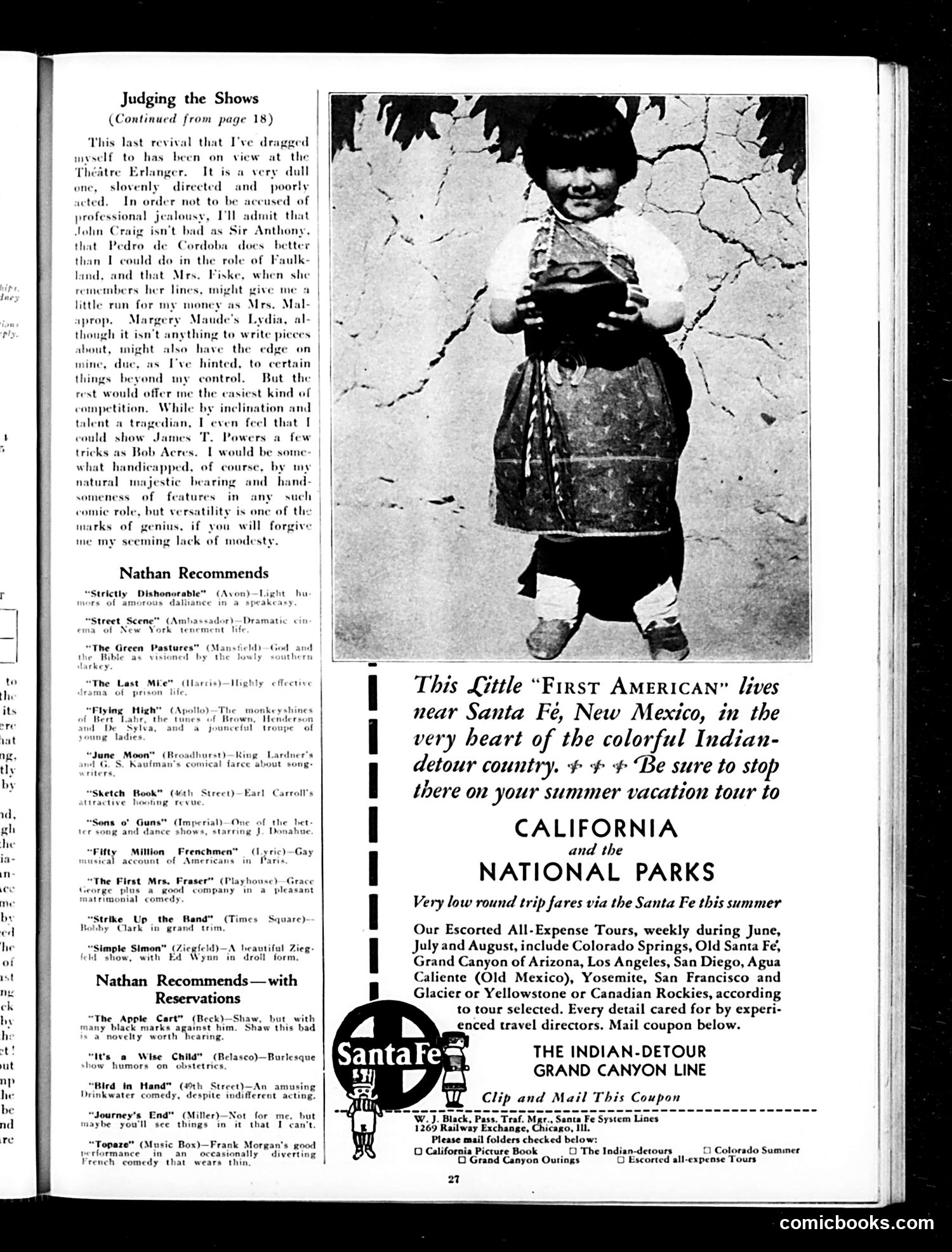
Content Analysis: Judge Magazine Page This page combines theater criticism with tourism advertising, typical of 1920s magazine layouts. Main Content: Theater Reviews The top section continues a theater critic's (likely George Jean Nathan's) review of Broadway shows. He discusses a revival at the Theatre Erlanger, critiquing various actors including John Craig and Pedro de Cordoba. Nathan employs characteristic self-aggrandizing humor, claiming he could outperform the actors despite his "natural majestic bearing"—the satire lies in his absurd modesty about his own theatrical superiority while criticizing professionals. The "Nathan Recommends" section lists current Broadway productions (mostly 1929-era shows like "Strictly Dishonorable" and "The Apple Cart"), offering brief, often backhanded praise. Advertisement The lower half advertises Santa Fe Railway's "Indian-Detour" tours to the Southwest and California. The photograph shows a young Native American child, used to market the "colorful Indian-detour country" as exotic tourist attraction—reflecting period attitudes treating Indigenous peoples as scenic curiosities rather than living communities.
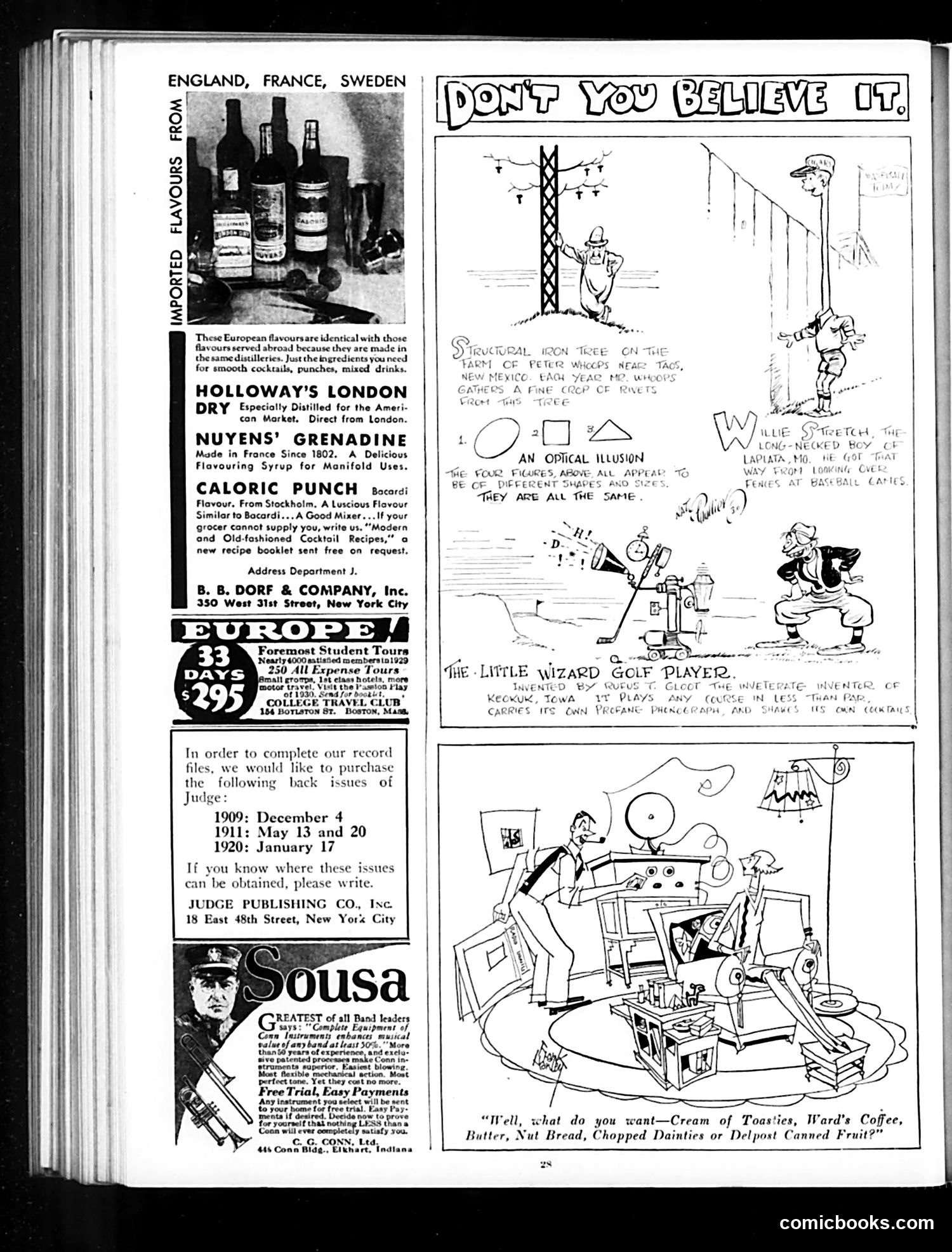
Political Cartoons & Satire from Judge Magazine This page contains three unrelated cartoons in Judge's "Don't You Believe It" section, which debunks common misconceptions through humor: 1. Structural Iron Tree: Satirizes rural gullibility—a farmer believes a structural steel tower is a "tree" because someone told him so. The joke mocks credulity about obviously false claims. 2. Optical Illusion: A technical puzzle showing shapes that appear different but are identical—commenting on how perception deceives us. 3. The Little Wizard Golf Player: A tall tale about "Rufus T. Gloor" from Keokuk, Iowa, who supposedly invented a mechanical caddy and plays golf using profanity instead of clubs. This absurdist humor mocks exaggerated tall tales and folk mythology. The cartoons collectively ridicule how Americans spread and believe outlandish stories. The page also contains vintage advertisements for imported spirits and musical instruments—typical Judge revenue sources.
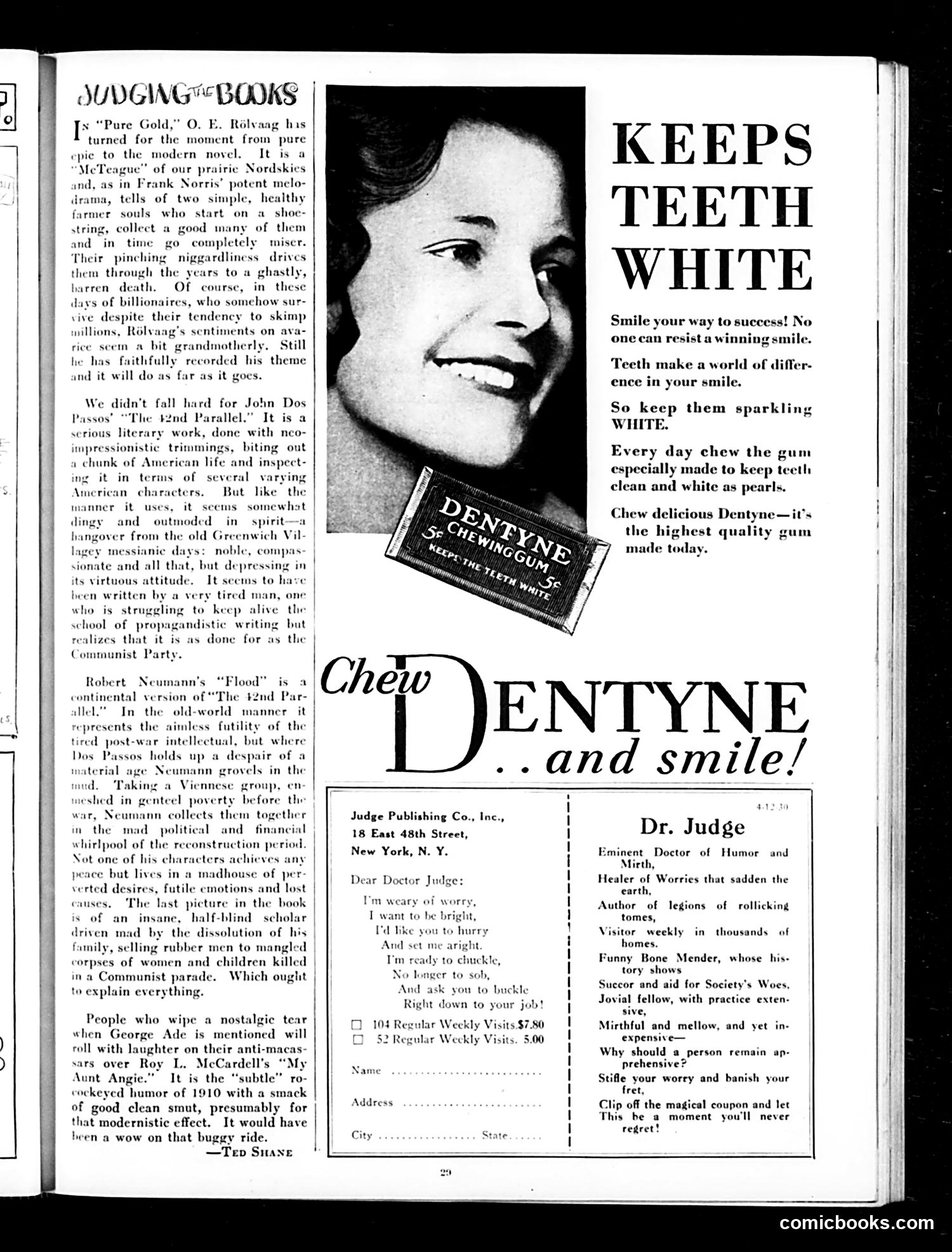
Analysis of Judge Magazine Page This page combines book reviews with a chewing gum advertisement. The reviews criticize 1920s literary works for their dated, morose sensibilities. The critic dismisses John Dos Passos' "The 42nd Parallel" and Robert Neumann's "Flood" as depressing, propagandistic relics of Greenwich Village bohemianism and Communist-sympathetic writing—styles the reviewer suggests are "as done for as the Communist Party." The large Dentyne gum advertisement uses a "Dr. Judge" persona (Judge magazine's mascot) to promote teeth-whitening and optimism. This placement is ironic: the reviews mock writers obsessed with despair and futility, while the ad aggressively hawks consumerist solutions to worry and sadness. The contrast satirizes competing American impulses of the era—intellectual pessimism versus commercial cheerfulness. The ad's aggressive positivity ("Smile your way to success!") directly counters the literary gloom being critiqued above.
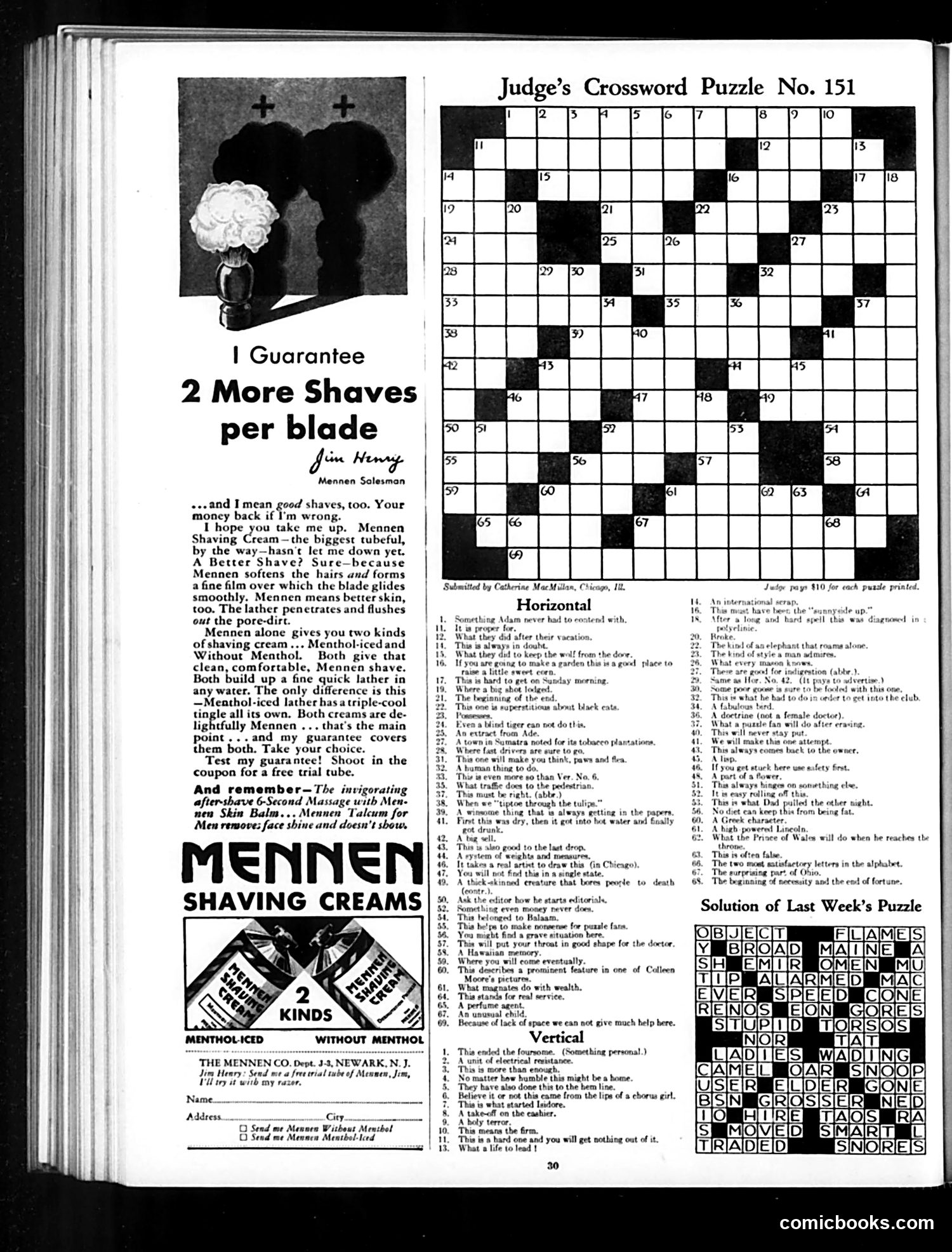
Judge Magazine Crossword Advertisement Analysis This page is primarily a Mennen shaving cream advertisement disguised as editorial content, featuring a testimonial from "Jim Henry, Mennen Salesman." The ad's central claim is that Mennen shaving cream guarantees "2 More Shaves per blade"—a competitive selling point in an era when razor blades were expensive and reusable. The testimonial emphasizes that Mennen softens facial hair and creates superior lather, making blades last longer. The accompanying crossword puzzle serves as reader engagement, offering a free trial tube as incentive. The image shows a flower vase casting shadows of two figures wearing hats—likely representing satisfied male customers. This represents early 20th-century advertising strategy: Judge magazine, a satirical publication, monetized its audience by publishing sponsored content that mimicked editorial material. The crossword provided entertainment value while promoting the product to the magazine's male-skewing readership.
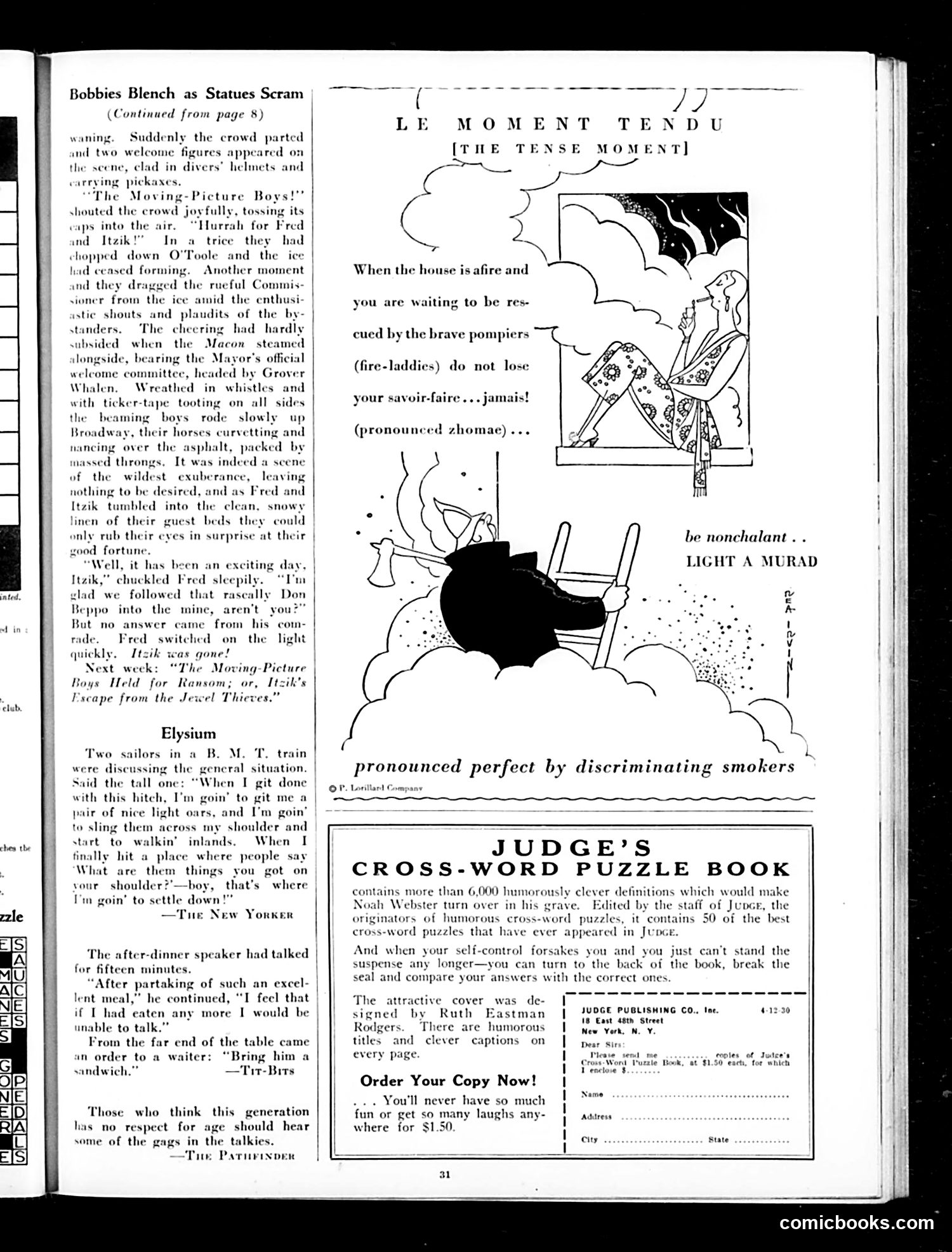
Judge Magazine Page Analysis This page mixes fiction serialization with humor and advertising. The main content continues "The Moving-Picture Boys," a serial adventure story about Fred and Itzik, who heroically rescue a frozen commissioner from ice during what appears to be a 1920s New York civic crisis. The narrative employs melodramatic language ("raseally D. Beppo," "Jewel Thieves") typical of silent-film adventure stories that Judge was apparently serializing for entertainment. The cartoon titled "Le Moment Tendu" (The Tense Moment) humorously depicts French firefighting culture, using French phrases ("savoir-faire," "jamais," "nonchalant") to satirize European sophistication—the joke being that even during a house fire, one must maintain composure and light a "Murad" cigarette. Below are vintage humor pieces from *The New Yorker* and *Tit-Bits*, plus an advertisement for Judge's own cross-word puzzle book. The page reflects 1920s popular entertainment: adventure serials, cultural satire, and the crossword puzzle craze.
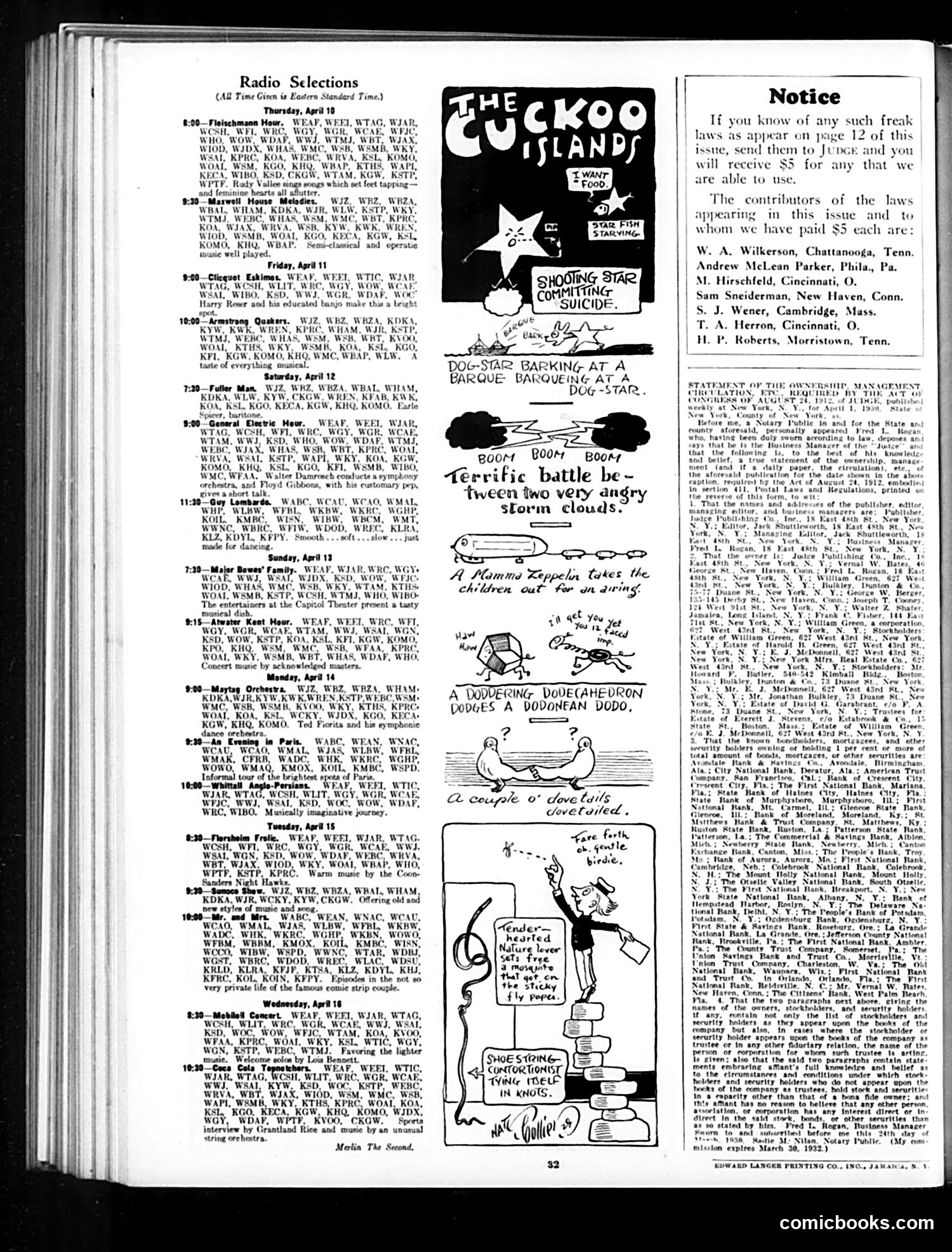
"The Cuckoo Islands" Comic Strip Analysis This page is primarily a radio programming guide for Eastern Standard Time, listing station call letters and broadcast schedules for April 10-15 (appears to be 1920s era, given radio station formats). The central cartoon feature is "The Cuckoo Islands," a comic strip satirizing early aviation and bizarre island adventures. The visible panels depict: - Shooting stars causing comic chaos - A zeppelin/airship abducting children for "diving" - A dodo bird being pursued on a surreal island - A conductor character struggling with musical notation turned literal (the staff lines become physical obstacles) The humor relies on visual puns and absurdist logic typical of 1920s comics—treating metaphorical phrases literally (musical "staff," "taking children for a dive"). The strip mocks contemporary fascinations with aviation technology and exotic exploration while employing slapstick physical comedy. The "Notice" section lists contributors paid $5 each, establishing this as a reader-submission publication.
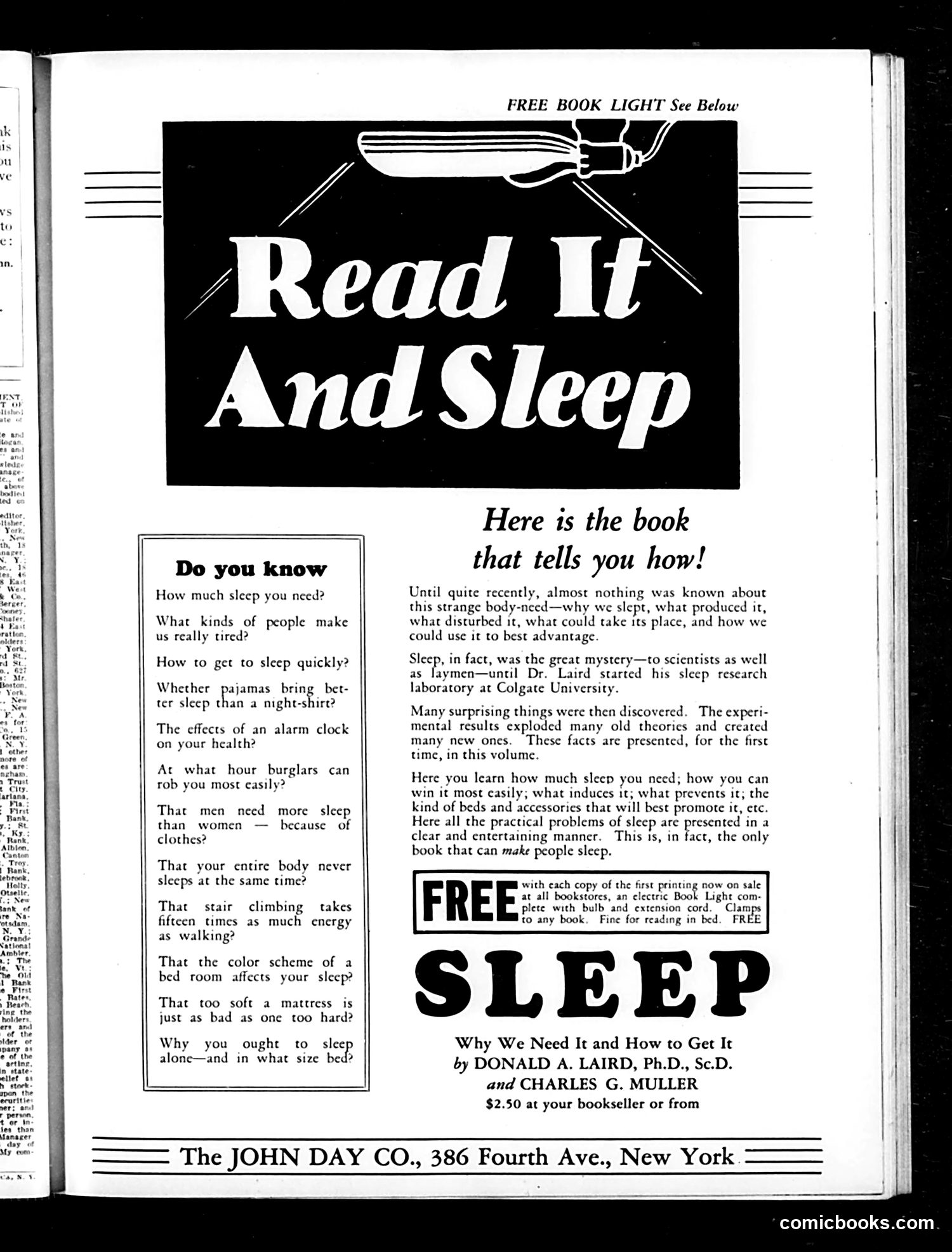
Analysis of Judge Magazine Advertisement Page This page is primarily a book advertisement, not a political cartoon. It promotes *Sleep: Why We Need It and How to Get It* by Donald A. Laird and Charles G. Muller, published by John Day Company. The advertisement cleverly uses rhetorical questions to create intrigue—"Do you know" how much sleep you need? Whether pajamas beat nightshirts? Why burglars succeed most easily at certain hours?—positioning the book as revealing scientific secrets about sleep. The key selling point: Dr. Laird's "sleep research laboratory at Colgate University" had allegedly discovered surprising facts that "exploded many old theories." This appeals to early 20th-century readers' fascination with scientific authority and self-improvement through expert knowledge. The free promotional "Book Light" (a clamp-on reading lamp) was a common marketing incentive of the era. The overall tone emphasizes modernism and scientific progress—sleep is presented as a "mystery" recently unlocked by rigorous research.
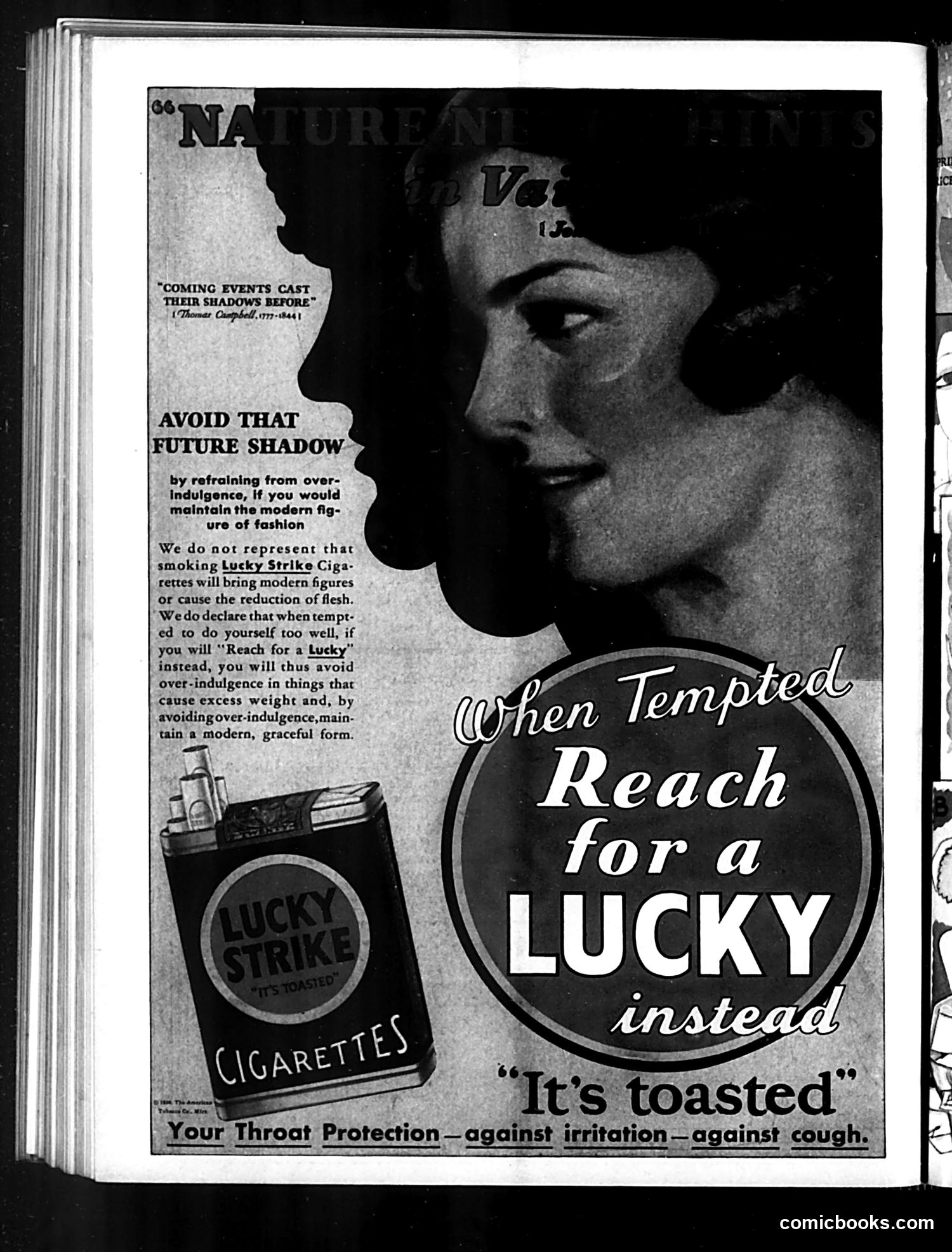
Analysis: Lucky Strike Cigarette Advertisement This is a cigarette advertisement, not political satire. It features a stylized profile of a woman with 1920s-era styling and sunglasses, alongside a Lucky Strike cigarette pack. The ad promotes smoking as a weight-control strategy—a common marketing tactic of the era. The text explicitly claims that when tempted to overeat, smokers should "reach for a Lucky instead," positioning cigarettes as appetite suppressants to maintain a fashionable, slim figure. The headline "Avoid That Future Shadow" references fears about weight gain and loss of physical attractiveness. The advertisement also mentions "throat protection," a dubious health claim typical of early cigarette marketing. This reflects 1920s-1930s attitudes toward women's appearance and smoking's normalization, before health dangers were widely acknowledged.