judge
Judge — April 19, 1930
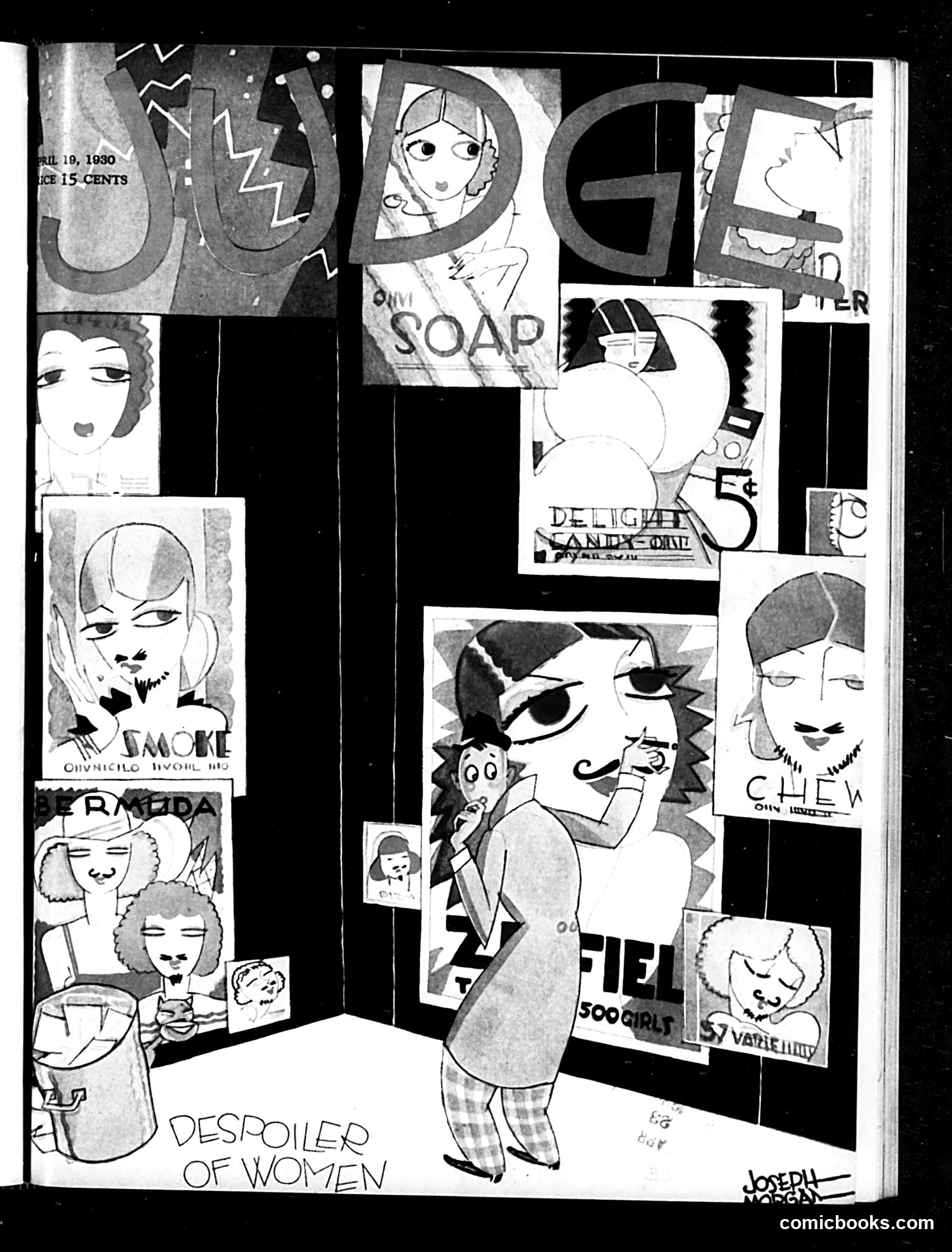
Judge Magazine, April 19, 1930 This page appears to be primarily advertising collage rather than political satire. The large central illustration shows a woman examining or admiring various product advertisements and cosmetic/beauty product boxes arranged around her—including visible text for "SOAP," "DELIGHT CANDY," "CHEW," and "SMOKE." The caption "DESPOILER OF WOMEN" suggests satirical commentary on consumer marketing and advertising's manipulative appeal to female consumers. The composition itself—with the woman surrounded by branded products and alluring advertisements—critiques how commercial messaging targets and "corrupts" or "despoils" women through consumerism and materialism. The artwork is credited to Joseph Hirsch. This reflects 1930s concerns about advertising's growing cultural influence during the Depression era.

Analysis This page is primarily a Texaco company advertisement, not satirical content. It appears in Judge magazine but represents paid advertising rather than editorial satire. The ad emphasizes Texaco's quality control through rigorous laboratory testing—claiming "over 3 million refinery tests a year" across 17 refineries. The large photograph shows an industrial refinery facility with testing equipment and personnel. The accompanying smaller image shows trucks and transportation, illustrating Texaco's distribution network across "48 States" and worldwide markets. The copy emphasizes scientific rigor and reliability as selling points for petroleum products and lubricants to "leading industrialists" and motorists. There is no apparent political satire or social commentary—this is straightforward corporate marketing emphasizing industrial quality standards.
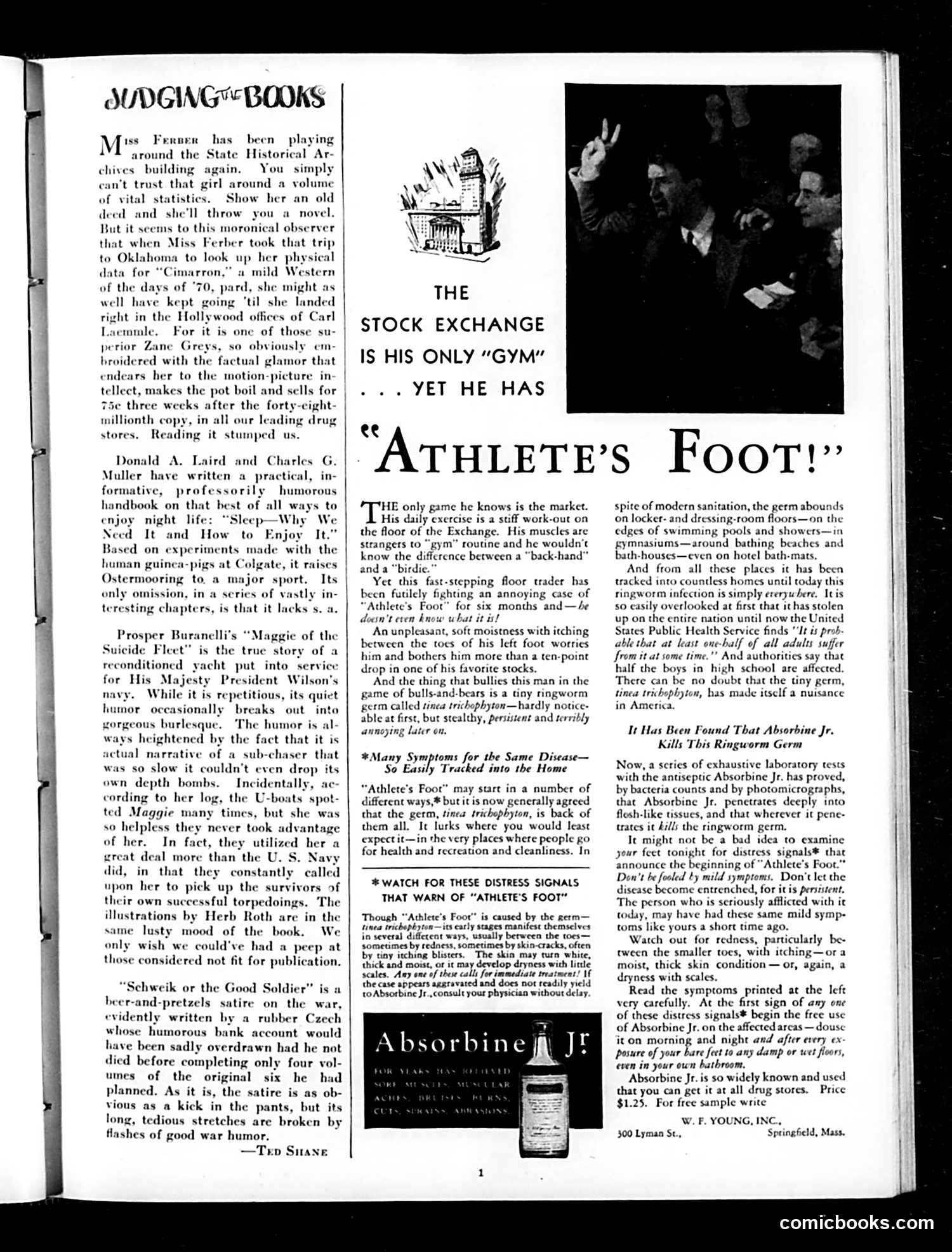
"Athlete's Foot" - Judge Magazine Satire This page satirizes a man obsessed with stock market trading who neglects his physical health. The large illustration shows him hunched over trading activity, described as his only "gym." The satire suggests the stock exchange has become his sole form of exercise and preoccupation. The accompanying article discusses "Athlete's Foot"—a fungal infection—with detailed medical symptoms. The joke appears to be a pun: this sedentary trader has developed an actual athlete's foot despite being anything *but* athletic. The irony mocks how he treats the stock market as vigorous activity while his body deteriorates from inactivity, resulting in actual physical ailments. The Absorbine Jr. advertisement below reinforces the theme, offering a remedy for such afflictions.
Analysis This page is not a cartoon or satire—it's a paid advertisement for Auburn automobiles. The headline "As Others See Us" frames a testimonial claiming to be excerpted from an independent analytical report by Cram (a financial analysis firm) praising Auburn's business practices. The ad emphasizes Auburn's dealer relationships, conservative production policies, and stable product lines as competitive advantages. It quotes R. H. Faulkner, Auburn's Vice President, positioning the company as uniquely fair to dealers and consumers. This represents typical 1920s-30s advertising strategy: leveraging purported third-party validation to build credibility. The "Judge" magazine placement suggests this reached an affluent, business-minded readership interested in automotive investment and industry analysis.
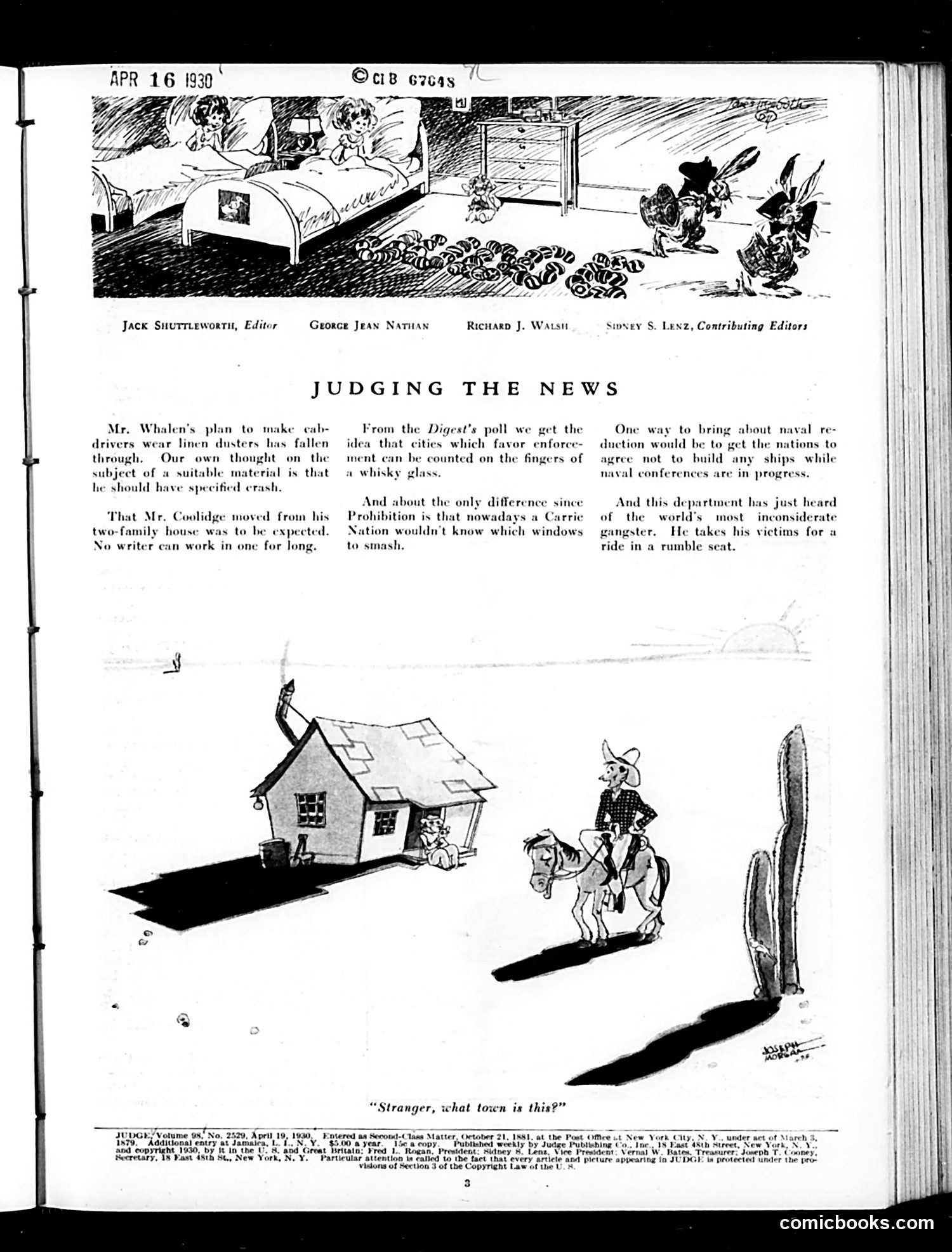
"Judging the News" - April 16, 1930 This editorial page satirizes current events through three brief commentary pieces and a cartoon. The main cartoon depicts two figures on horseback encountering a cactus, asking "Stranger, what town is this?"—likely commentary on the American Southwest or frontier conditions. The text discusses Mr. Whalen's plan regarding "railroad clusters," Calvin Coolidge's move from a two-family house, Prohibition-era Carrie Nation references, and naval policy concerns. The satire mocks Prohibition's inconsistency and critiques a "considerate gangster" who supposedly requests victims ride in rumble seats. The cartoons employ visual humor typical of 1930s Judge magazine—absurdist scenarios and exaggeration to comment on contemporary social and political issues, though specific figures remain unclear without additional historical context.
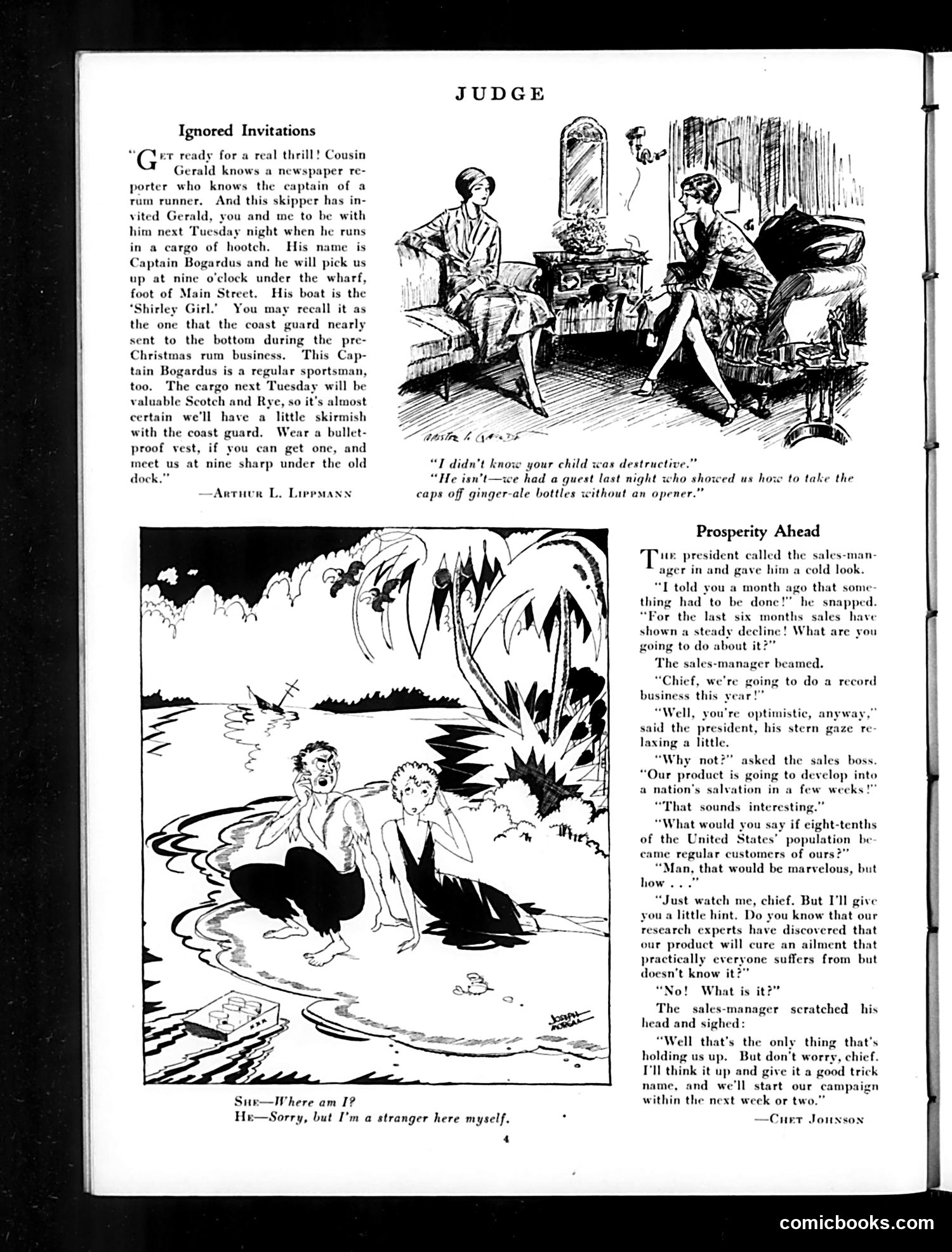
Analysis of Judge Magazine Page This page contains two unrelated pieces of satirical humor: "Ignored Invitations" (top): Arthur L. Lippmann's piece humorously warns "Cousin Gerald" about accepting an invitation to join a newspaper reporter for a nighttime boat adventure near the docks. The satire suggests that such invitations—offering excitement and thrills—often lead to trouble. The accompanying sketch shows two people in casual conversation. "Prosperity Ahead" (bottom): A corporate satire depicting a sales manager optimistically pitching a dubious product to his skeptical boss. The manager claims their product will "cure an ailment that practically everyone suffers from but doesn't know it" and promises a major sales campaign within weeks. The cartoon mocks corporate overconfidence and misleading marketing tactics of the era.
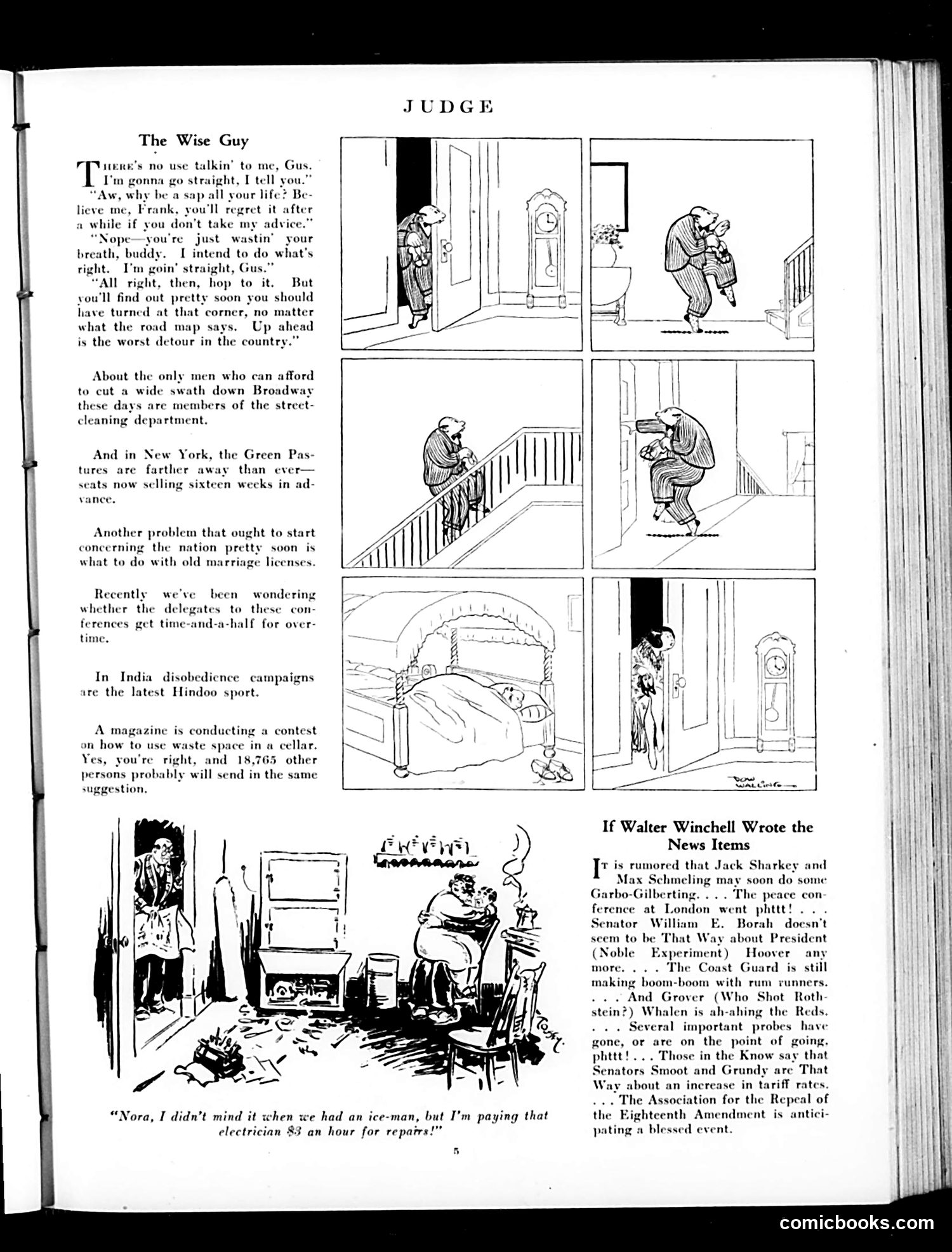
"The Wise Guy" - Judge Magazine Satire This page satirizes a man dispensing unsolicited advice to his friend Frank about life decisions. The comic strip shows the "wise guy" following Frank around—into bathrooms, up stairs, and even into bed—persistently offering guidance despite Frank's clear lack of interest. The joke targets a recognizable social type: the know-it-all who corners people with unwanted counsel. The humor comes from the escalating absurdity of the adviser's persistence, intruding into increasingly private moments. The surrounding text discusses contemporary issues: Broadway street conditions, New York theater seat prices, marriage licenses, and Hindu "disobedience campaigns" as a sport. The lower cartoon depicts a messy home repair scenario, satirizing domestic incompetence. These snippets reflect typical Judge content—commentary on everyday American social problems and foibles.
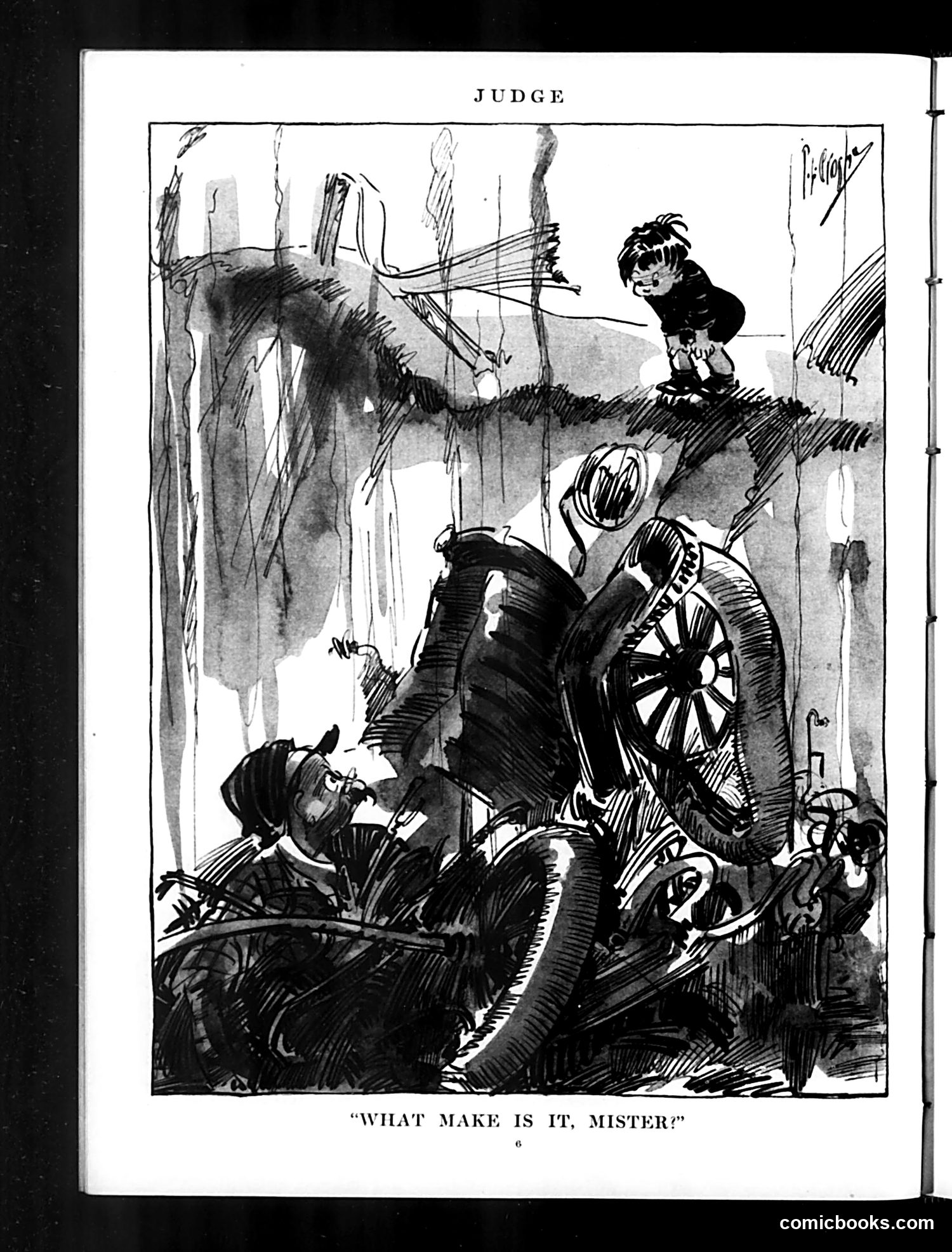
Analysis of "What Make Is It, Mister?" This Judge cartoon depicts a wealthy gentleman examining a damaged automobile with two working-class men. The caption's awkward grammar ("What make is it, mister?") suggests the speakers are immigrants or working-class laborers unfamiliar with fine automobiles. The satire appears to target wealthy car owners and early automotive culture. The gentleman's fine clothing contrasts sharply with the workers' shabby dress. The wrecked vehicle—with its wheel prominent—suggests either the dangers of early automobiles or their unreliability. The joke likely mocks both the pretensions of automobile ownership among the wealthy and the incomprehension of ordinary people toward this new technology, playing on class divisions in early 20th-century America.
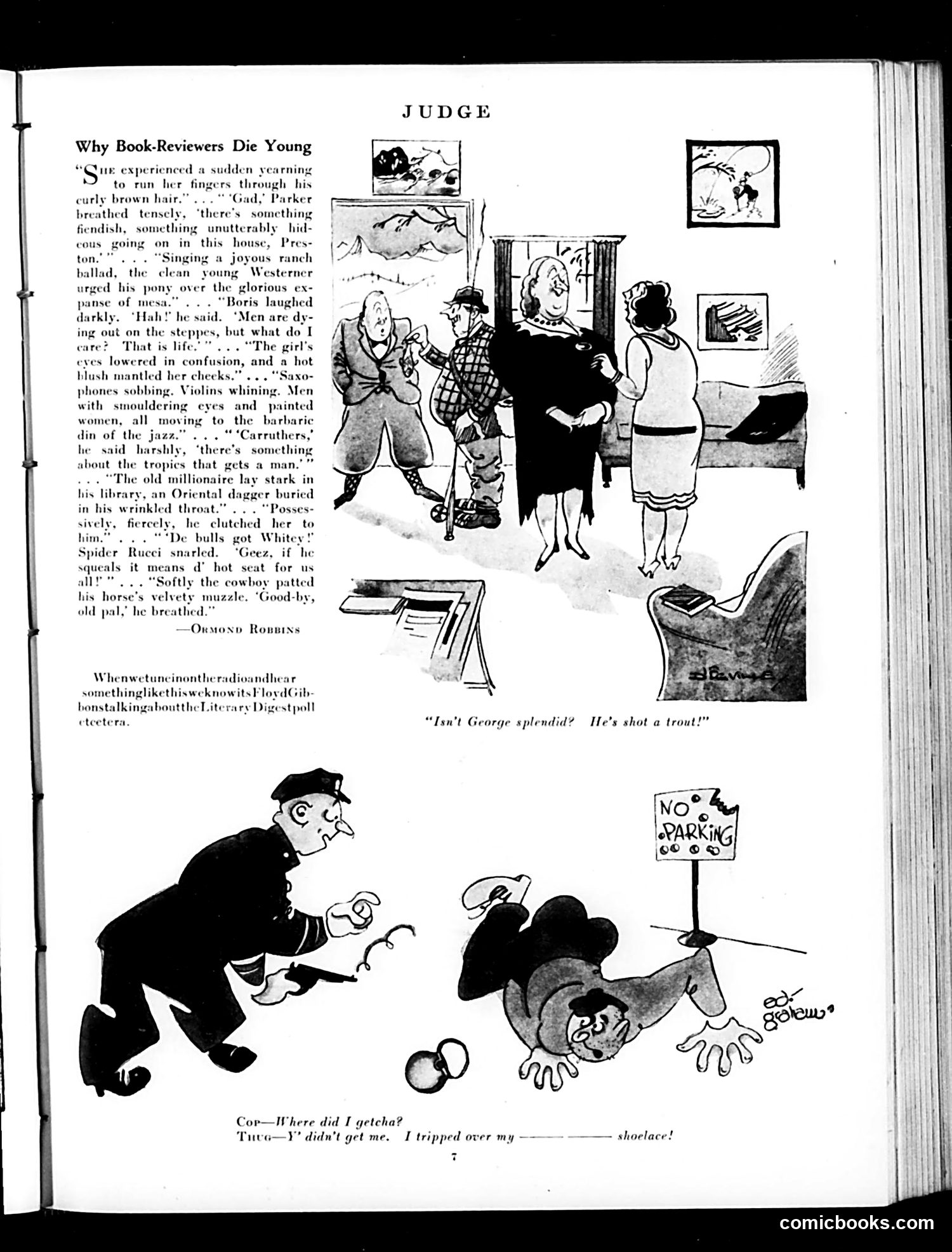
"Why Book-Reviewers Die Young" This page satirizes book reviewers and literary critics who are exhausted by overwrought prose in popular novels. The top article quotes purple passages from contemporary fiction—melodramatic descriptions of romance, adventure, and emotion ("breathed tensely," "laughed darkly," "clutched her fiercely"). The satire suggests these clichéd, overwrought writing styles in mass-market novels literally exhaust critics who must read and review them constantly. The bottom cartoon appears unrelated—a physical comedy scene involving a police officer and someone who tripped over their shoelace near a "No Parking" sign, likely a separate joke about traffic enforcement. The piece credits Ormond Robbins and references a radio broadcast and "Literary Digest poll" (likely topical to Judge's publication date), though the specific context is unclear.
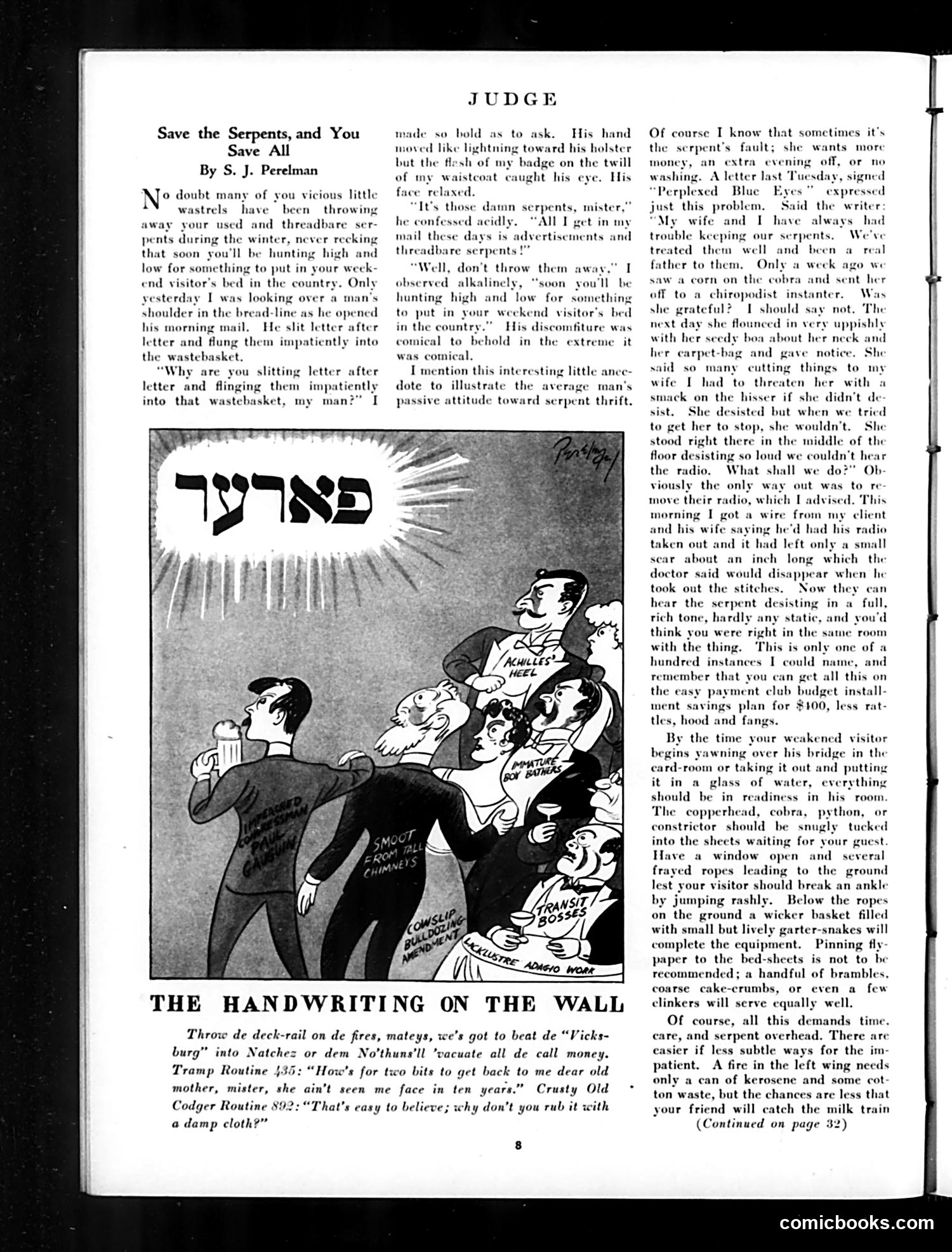
"Save the Serpents, and You Save All" - Judge Magazine Satire This is S.J. Perelman's absurdist humor piece mocking the era's etiquette advice columns and household management tips. The cartoon illustrates the article's central conceit: treating pet snakes as domestic help/servants that require management. The satire works by treating snakes (serpents) as if they were servants or housemaids—temperamental employees who demand time off, threaten to quit, and require careful handling. References to "serpent thrift," their complaints about working conditions, and strategies for keeping them happy parody real servant-management anxieties of the era. The cartoon shows a man surrounded by various labeled snakes (cobra, boa, python, etc.), treating them as household staff to be maintained and deployed—here, specifically hidden in guests' beds as pranks. The piece's humor lies in the incongruity: applying sincere domestic advice to obviously absurd situations, creating deadpan comedy typical of 1920s-30s Judge magazine satire.
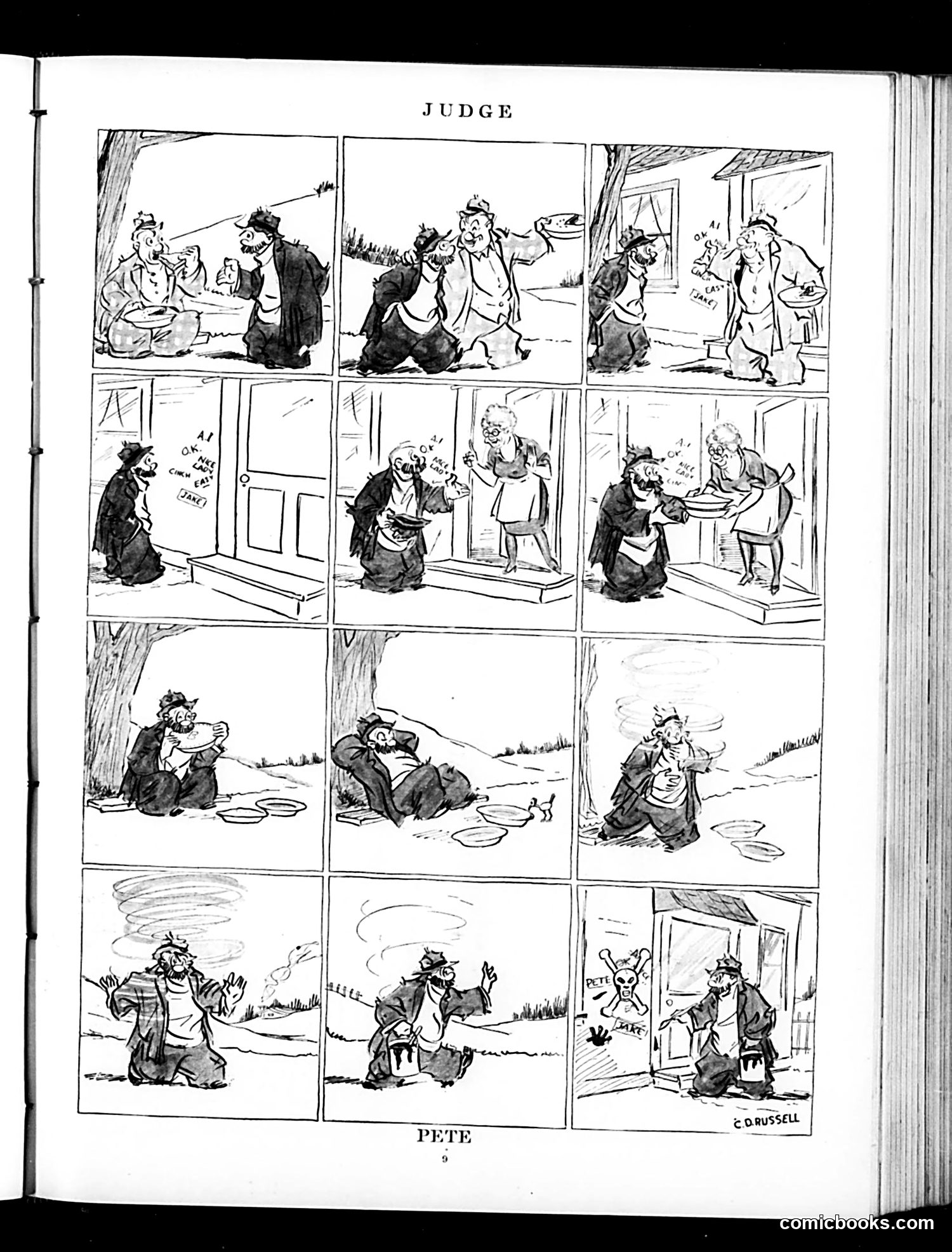
Analysis of "Judge" Comic Page This is a comic strip titled "Judge" (with "Pete" credited at bottom, artist C. Orussell). The narrative appears to depict a beggar or vagrant character repeatedly attempting to obtain food or money from various people—knocking on doors, approaching diners, and begging in the street. The satire likely comments on poverty, social inequality, or the treatment of the destitute during the Gilded Age or early 20th century. Each panel shows the character being rejected or dismissed by more affluent figures, culminating in what appears to be harsh responses. The comic's "Judge" title suggests commentary on social judgment and class distinctions—how society judges and treats its poorest members. Without additional context or clearer OCR of any captions, the exact political target remains somewhat unclear.
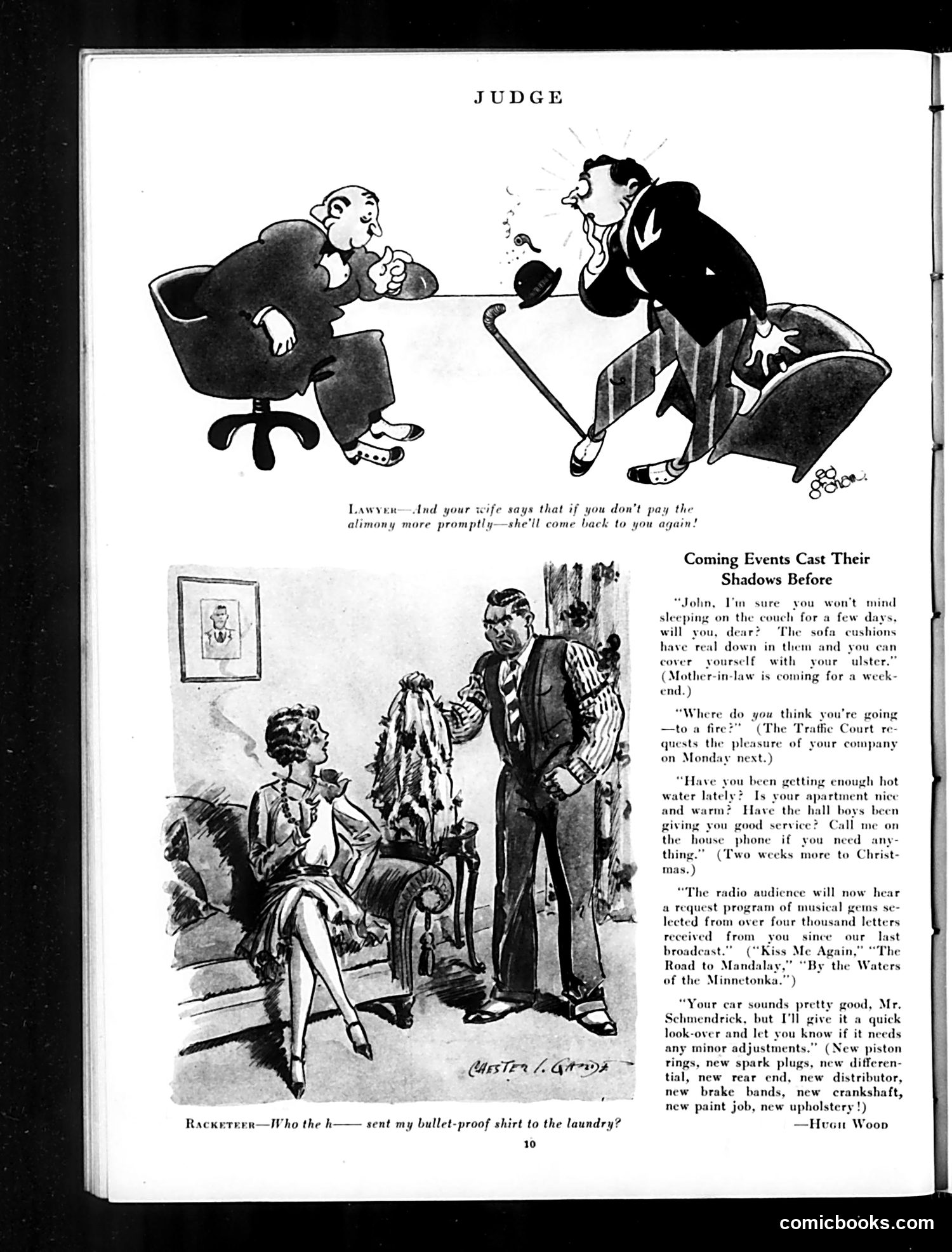
Analysis: "Judge" Magazine Page This page contains two satirical cartoons about marital and social hardship, likely from the 1920s-30s. Top cartoon ("Judge"): A lawyer tells a man that his wife threatens to return if he doesn't pay alimony promptly—the joke being that non-payment is preferable to her actually coming back. This satirizes both failed marriages and the legal/financial burden of alimony. Bottom cartoon ("Racketteer"): A gangster demands to know who sent his bullet-proof shirt to the laundry—absurd because a criminal would need such protective gear. This mocks organized crime figures and their peculiar logistics. Right column ("Coming Events Cast Their Shadows Before"): A series of humorous domestic/social scenarios where people hint at unwanted upcoming obligations (mother-in-law visits, court dates, holiday expenses, radio requests, car repairs). The satire targets everyday life's mounting financial and social burdens during economically uncertain times. Overall tone: cynical humor about money troubles, legal entanglements, and social obligations.
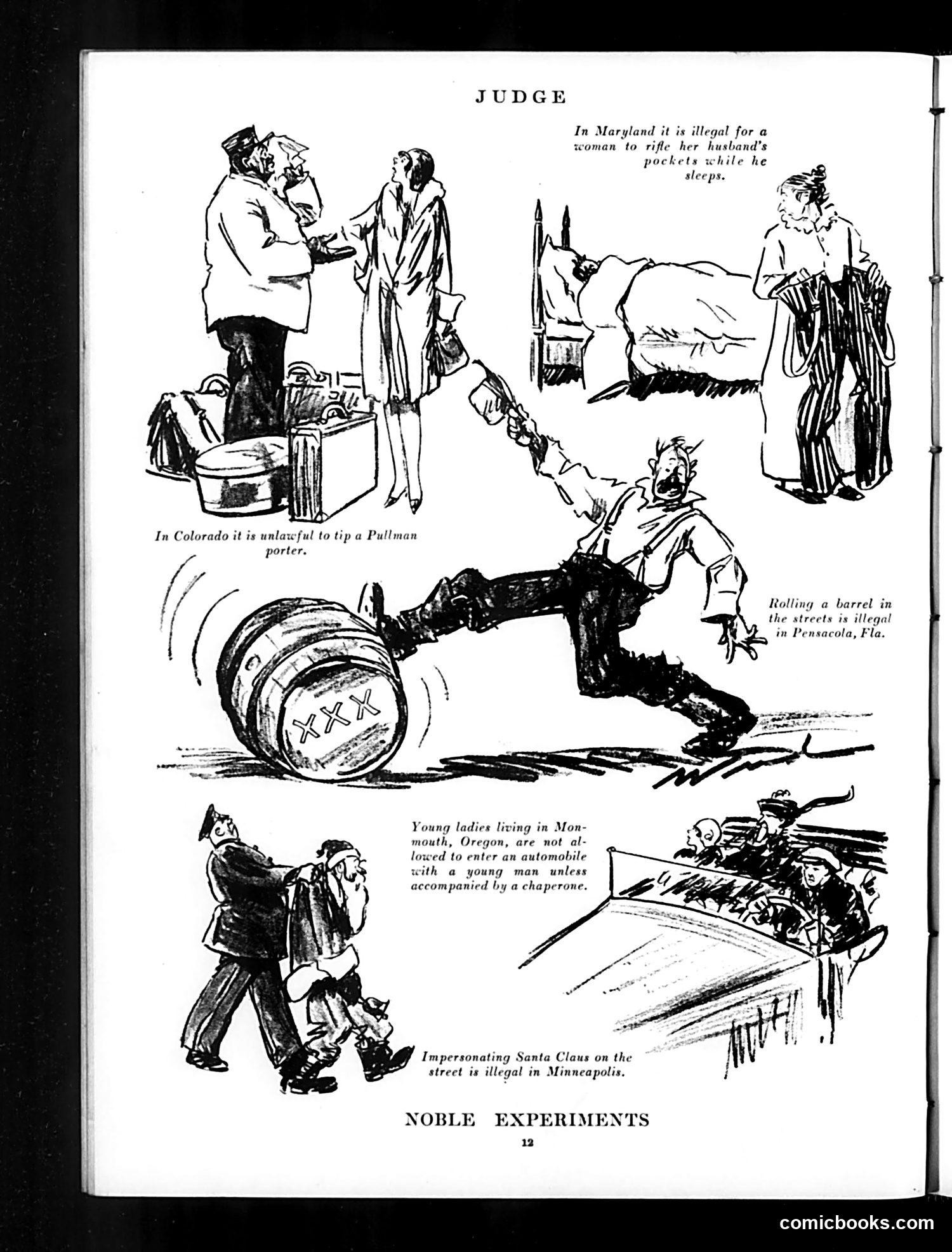
Judge Magazine: "Noble Experiments" This satirical page mocks absurd or overly restrictive laws from various American states and cities. Each cartoon illustrates a bizarre local statute, presented as ridiculous examples of legislative overreach. The jokes target laws that seem either pointlessly intrusive (a wife searching her sleeping husband's pockets in Maryland) or oddly specific (tipping Pullman train porters in Colorado; rolling barrels in Pensacola). The "chaperone" requirement for Oregon young women reflects turn-of-the-century social control of female behavior. The title "Noble Experiments" suggests ironic praise for these dubious legal innovations. The cartoons are drawn in early 20th-century Judge style—simple line drawings with exaggerated figures conveying physical comedy. Without a visible date, the era remains unclear, but the automobile reference and social attitudes suggest early 1900s. The satire critiques state and municipal legislatures for passing impractical or privacy-invading laws.
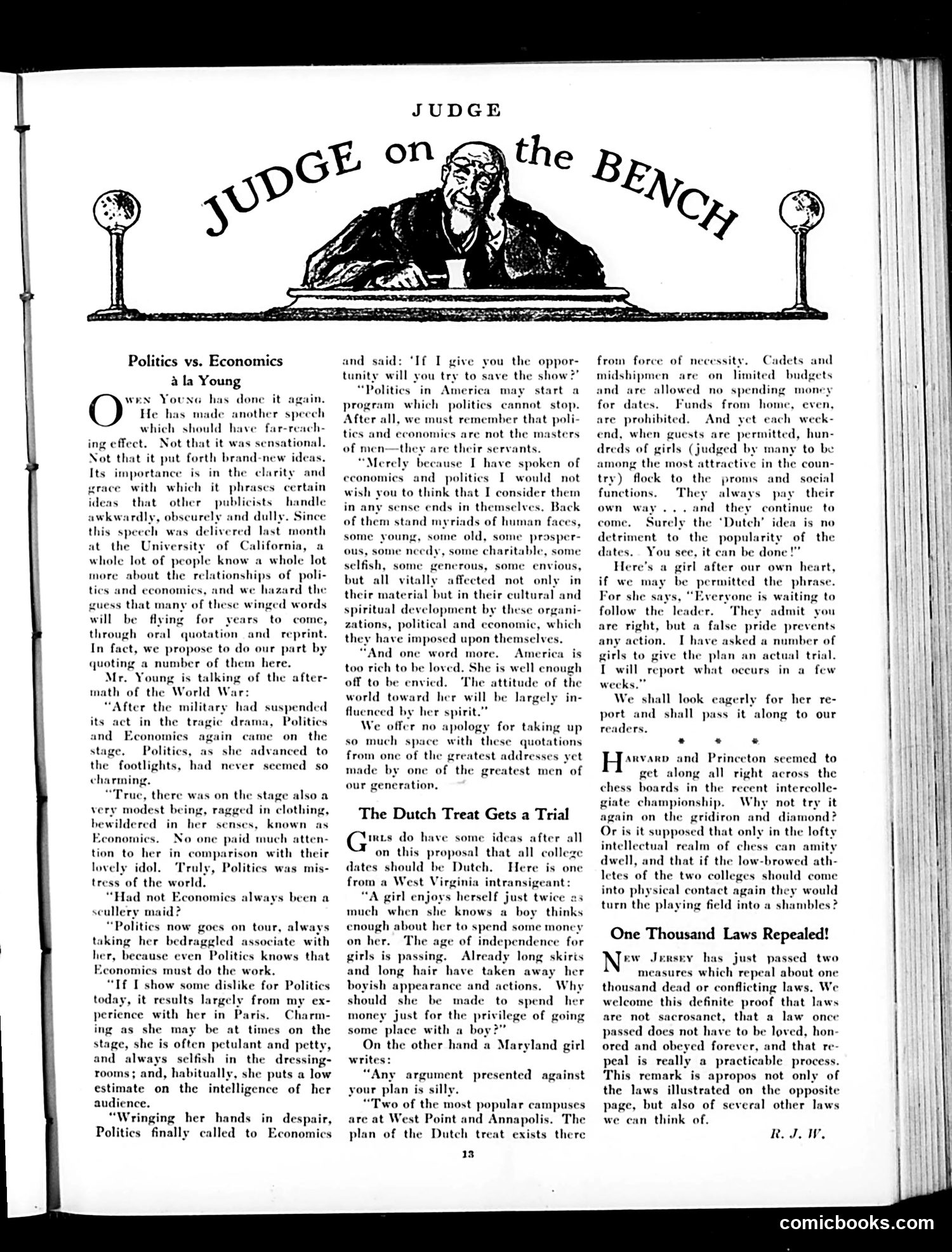
Judge Magazine: "Politics vs. Economics" (circa 1920s) This page satirizes a recent speech by Owen D. Young (prominent businessman and General Electric executive) delivered at the University of California. The editorial praises Young for articulating—with unusual clarity and eloquence—the relationship between politics and economics. Young's central argument, presented through theatrical metaphor: Politics is glamorous but ineffectual; Economics is unglamorous ("scullery maid") but does the actual work. Politics cannot function without Economics' labor. Young warns America, being wealthy and envied globally, must cultivate the right "spirit" to maintain goodwill. The page also includes a sidebar about "Dutch treat" dating (splitting costs), debating whether college women should pay their own way—presented as a modern debate between traditional romance (a woman enjoying a man's generosity) versus gender equality and military academy practicality. The cartoon's judge figure symbolizes authoritative commentary on public discourse.
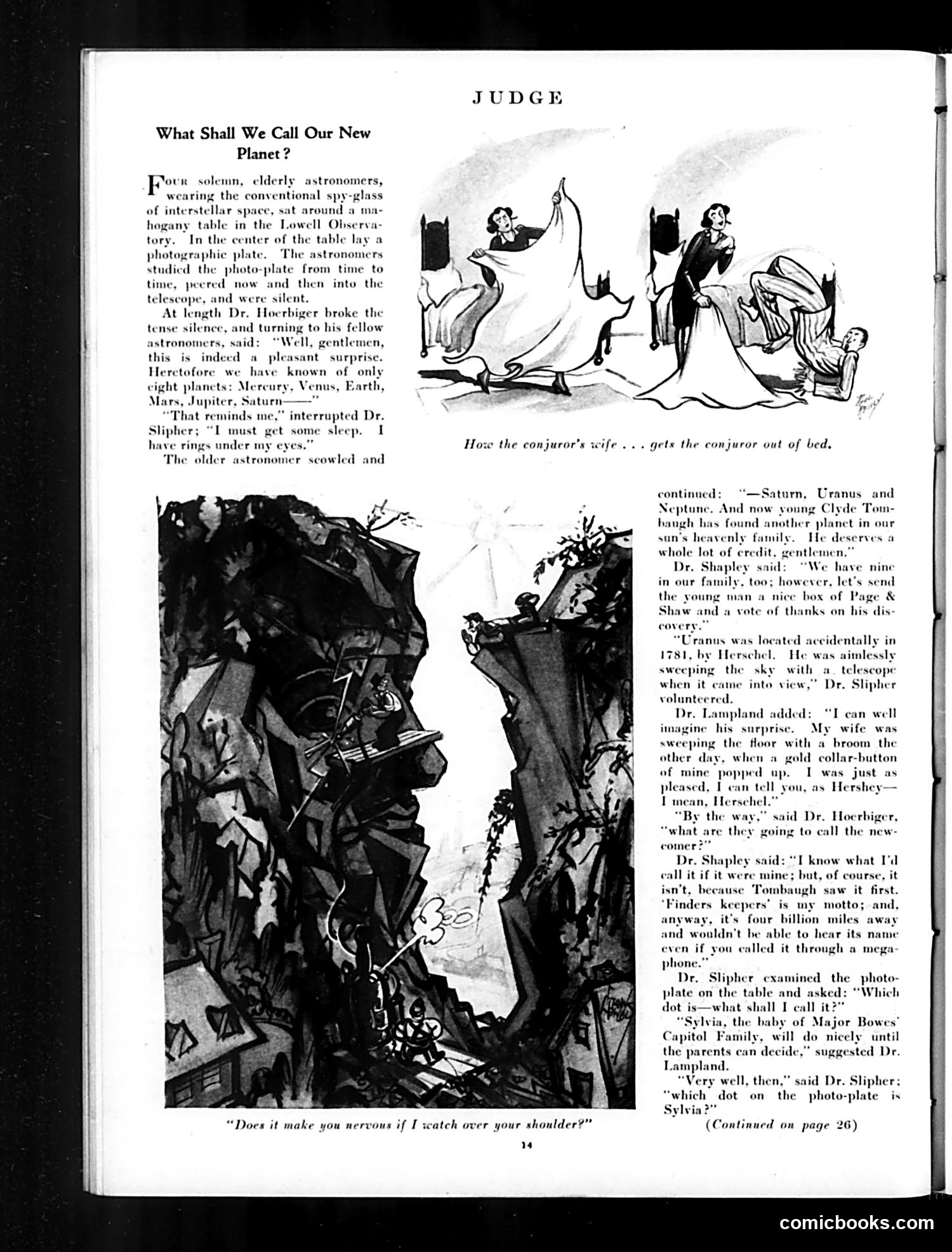
What Shall We Call Our New Planet? This satirical piece from Judge magazine celebrates the 1930 discovery of Pluto by astronomer Clyde Tombaugh. The main cartoon depicts elderly astronomers at an observatory debating what to name the newly discovered ninth planet. The humor works on multiple levels: Dr. Slipher's quip about having "rings under my eyes" plays on Saturn's famous rings; references to everyday discoveries (a gold collar button) humorously compare finding a planet to household accidents; and the final suggestion to name it "Sylvia" after a character from the popular radio show "Major Bowes' Capitol Family" satirizes how arbitrarily important celestial bodies get named. The accompanying illustration of a conjuror's wife waking him for bed provides unrelated comic relief—typical magazine filler mixing astronomical humor with domestic comedy.
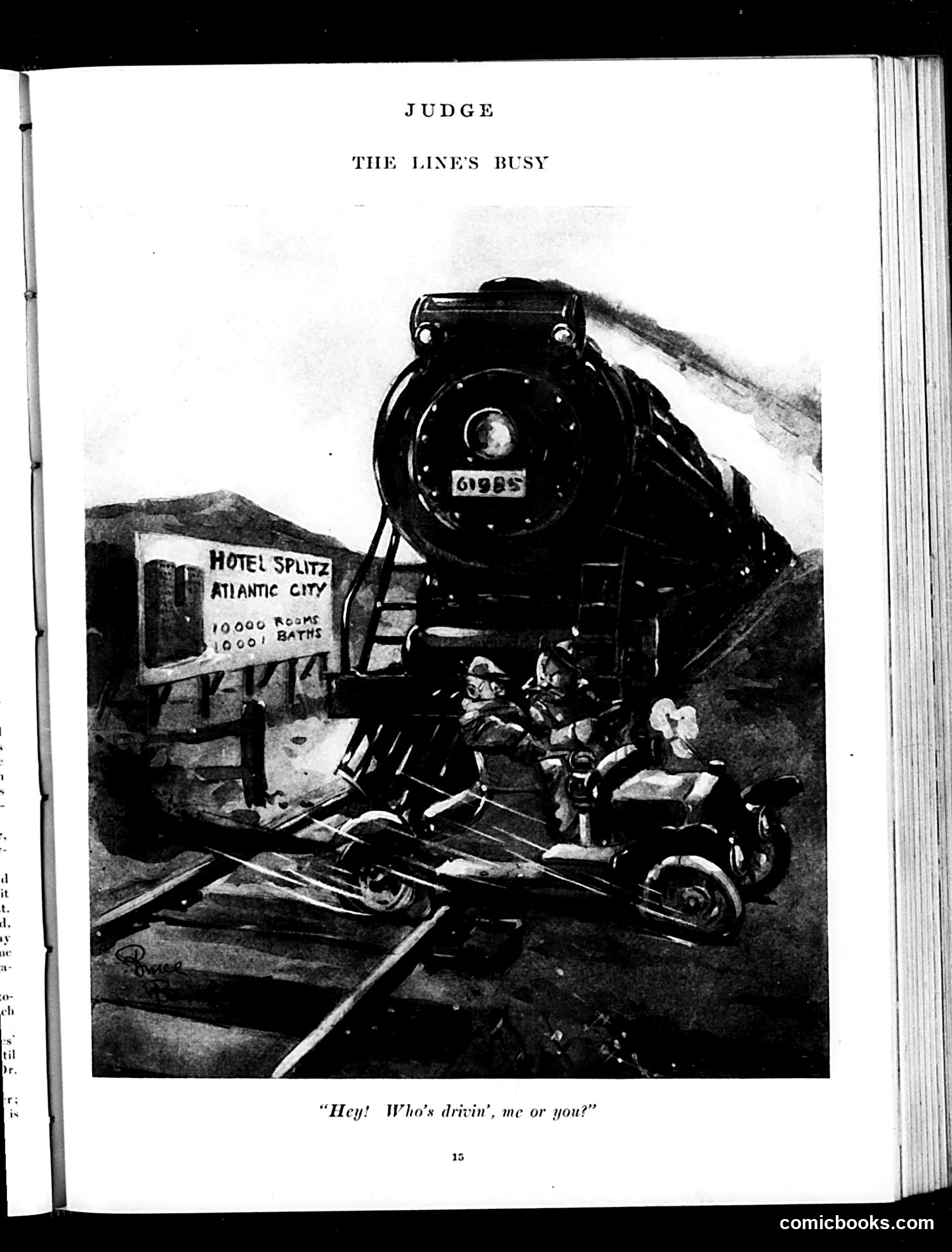
"The Lines Busy" - Judge Magazine Cartoon This cartoon satirizes the booming tourist traffic to Atlantic City during the early 20th century. The image shows a speeding locomotive numbered 61985 with a sign advertising "Hotel Splitz" (10,000 rooms, 1,000 baths) alongside toy cars racing on parallel tracks, all heading toward Atlantic City. The caption—"Hey! Who's drivin', me or you?"—humorously depicts the frantic competition between rail and automobile transportation during this era. The joke mocks how aggressively both modes of transport competed to shuttle tourists to the resort destination, each trying to outpace the other in this "line's busy" (overcrowded) rush. The exaggerated hotel advertisement and cartoon style poke fun at Atlantic City's explosive commercial growth and the industry's desperate competition for tourist dollars during the Roaring Twenties era.
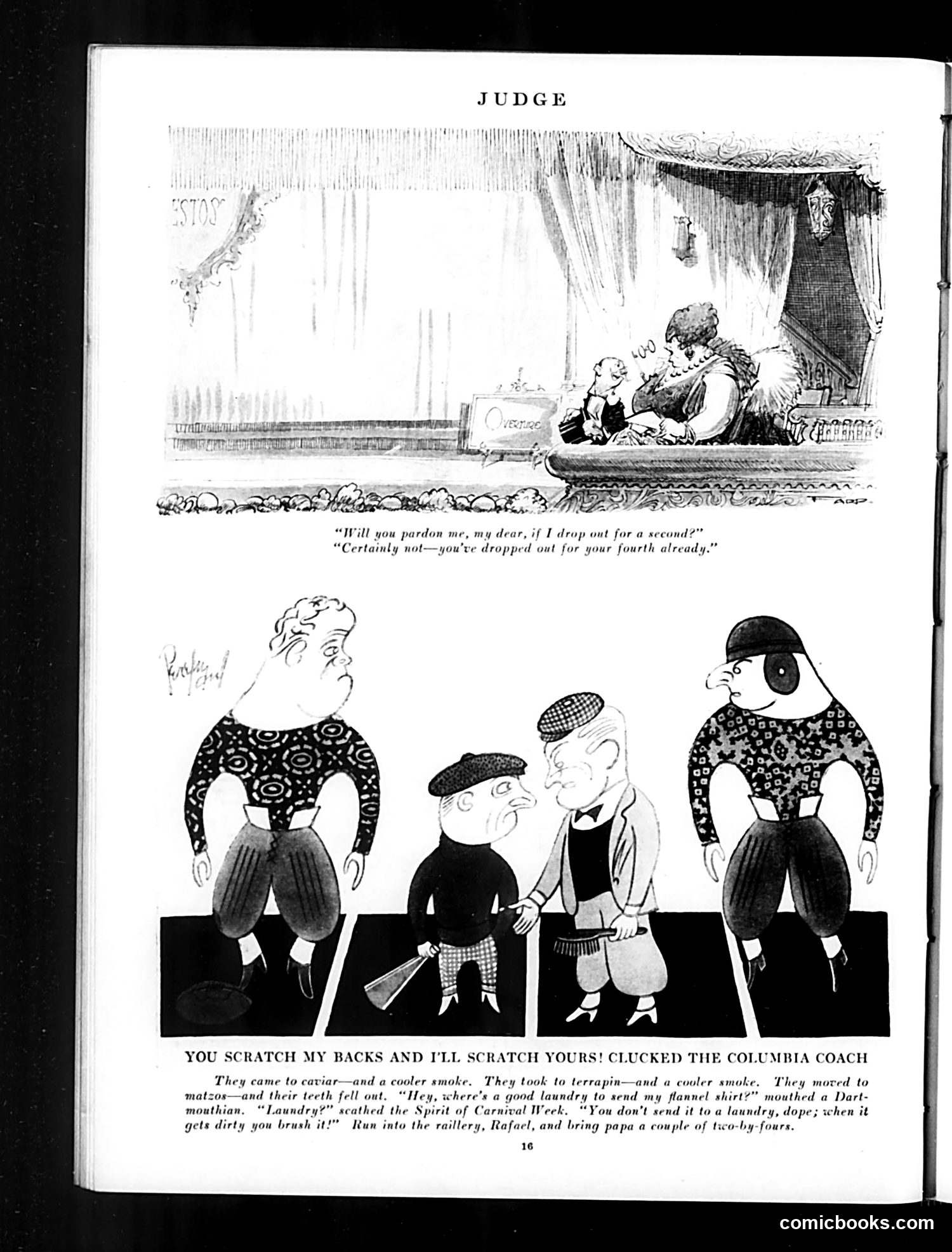
Explanation for Modern Readers This page contains two separate cartoons satirizing college social life and athletics, likely from the early 20th century. The top cartoon mocks theater etiquette—a man repeatedly asks to leave his seat, and his companion notes he's already done so four times, suggesting he's a chronic fidgeter or attention-seeker. The bottom cartoon, titled "You Scratch My Backs and I'll Scratch Yours! Clucked the Columbia Coach," satirizes college coaching corruption. It depicts three caricatured figures (appearing to represent different ethnic stereotypes, referenced by names like "Rafael" and "Dartmouthian") engaging in what seems to be bribery or favorable treatment. The narrative mocks how coaches allegedly provided special favors (fancy foods, laundry service) to players in exchange for athletic performance. The crude dialogue and ethnic caricatures reflect the publication's dated approach to satire.
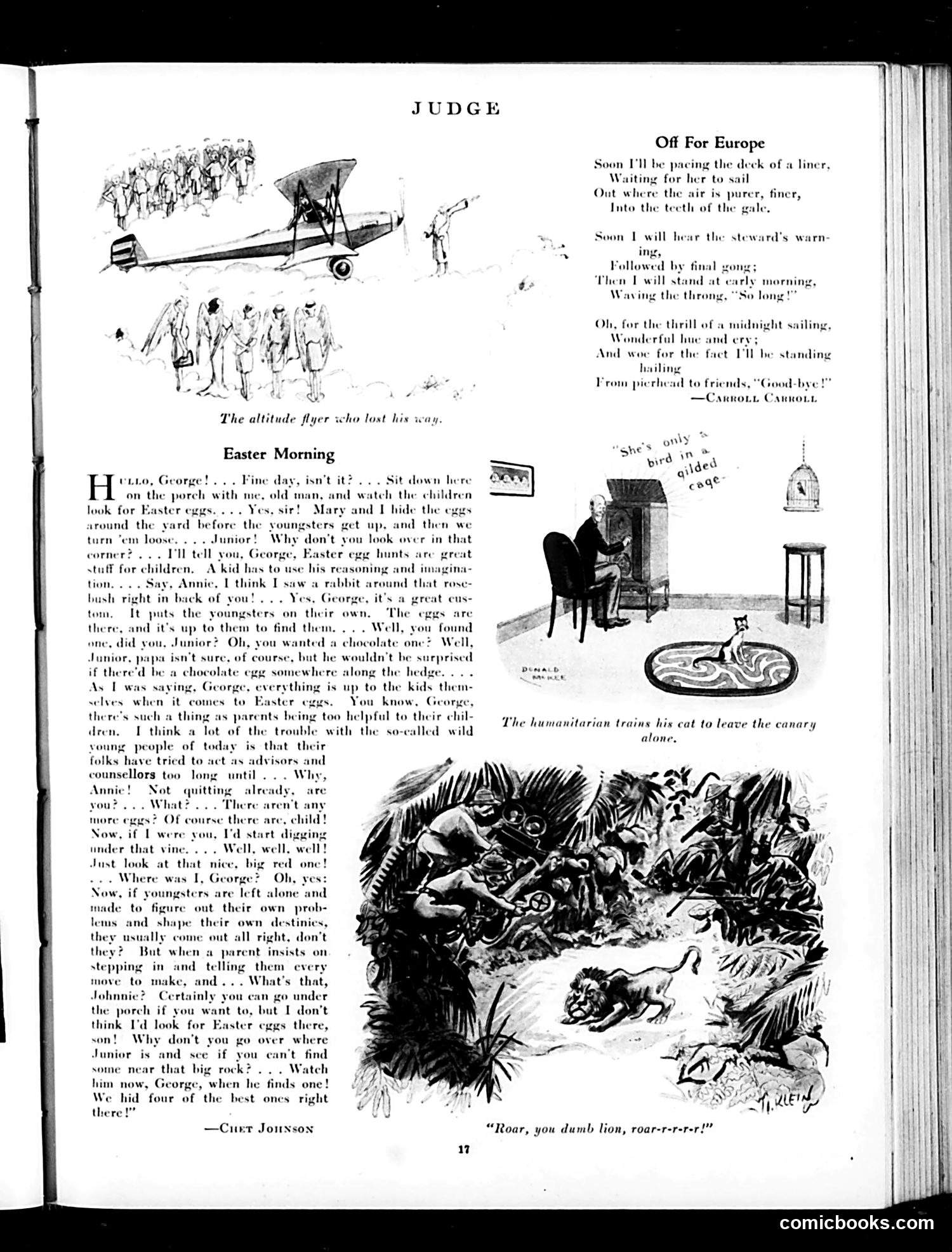
Analysis of Judge Magazine Page This page contains two distinct pieces of humor: "Off For Europe" (top right): A poem by Carroll Carroll about sailing to Europe, celebrating the romance of ocean travel and escape from domestic life. It reflects early 20th-century leisure culture when transatlantic voyages were aspirational experiences. "Easter Morning" (left/center): A lengthy comic dialogue by Curt Johnson satirizing parenting philosophy. An older man (George) lectures a younger parent about child-rearing, emphasizing that children should be independent problem-solvers rather than coddled. The irony is subtle—while praising self-reliance, George actually directs every step of the Easter egg hunt, contradicting his own philosophy. This likely mocks contemporary debates over "progressive" versus traditional parenting. Bottom cartoon: Shows a man training a cat to leave a canary alone, captioned "Roar, you dumb lion, roar-r-r-rer!"—absurdist humor about attempting the impossible. The page reflects early-to-mid 20th-century American anxieties about parenting, leisure travel, and social change.
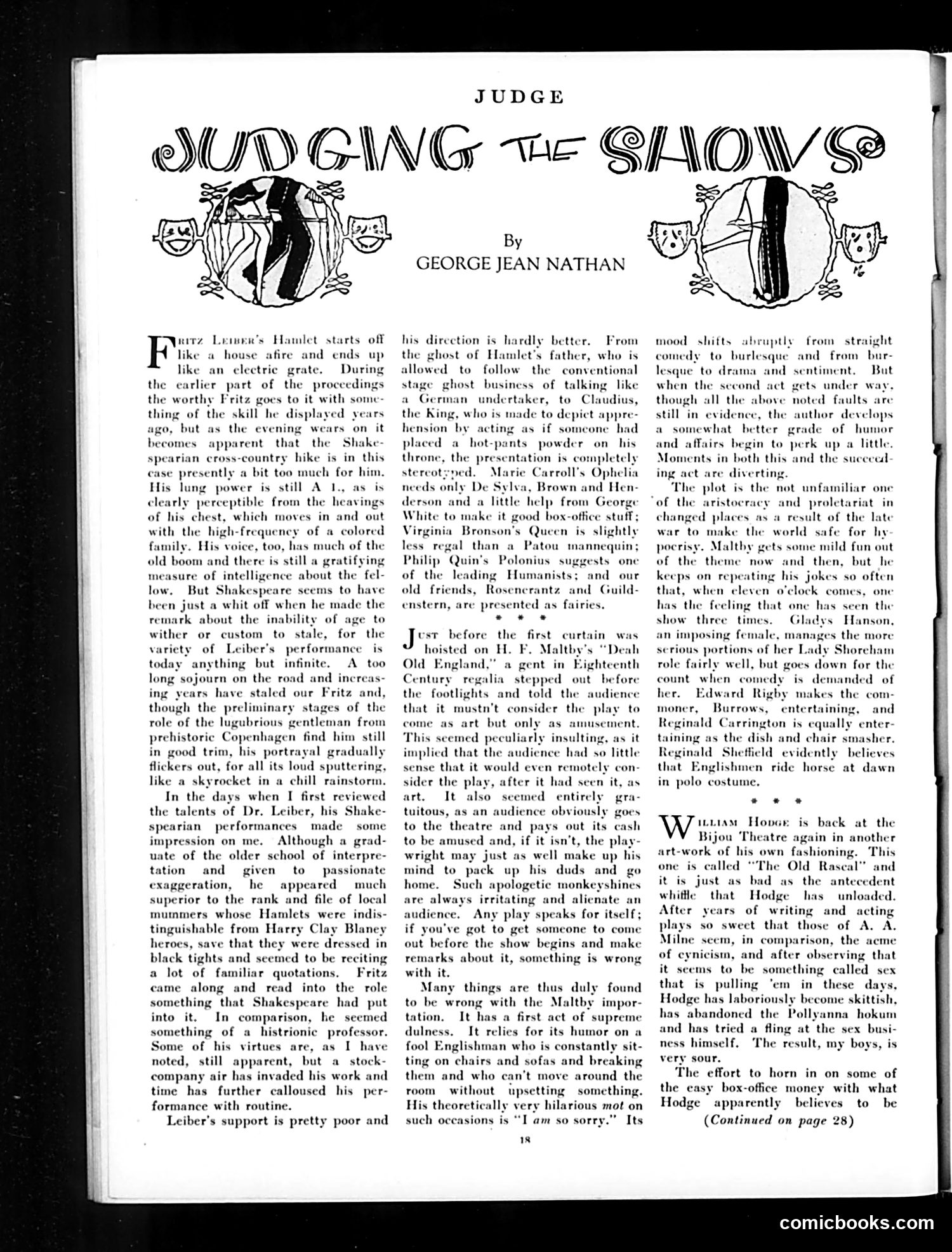
Judge Magazine Theater Review: "Judging the Shows" This is a theater review column by George Jean Nathan critiquing contemporary Broadway productions. The page contains two separate reviews: Fritz Leiber's Hamlet: Nathan reviews actor Fritz Leiber's performance, praising his energetic early scenes but criticizing how his stamina deteriorates through the evening—comparing it to "a skyrocket in a chill rainstorm." Nathan notes Leiber's once-impressive interpretive skills have become routine over years of touring. He also faults the supporting cast (describing them with biting sarcasm) and direction as stereotyped. H.F. Maltby's "Dear Old England": Nathan ridicules this play's opening, where an actor apologizes to the audience before the show begins, implying they shouldn't expect art. Nathan sarcastically notes this insults the audience's intelligence and reveals the play's fundamental weakness. The reviews exemplify Judge's satirical theater criticism—sophisticated, witty commentary on popular entertainment for educated readers familiar with Broadway productions of this era (appears to be 1920s-30s).
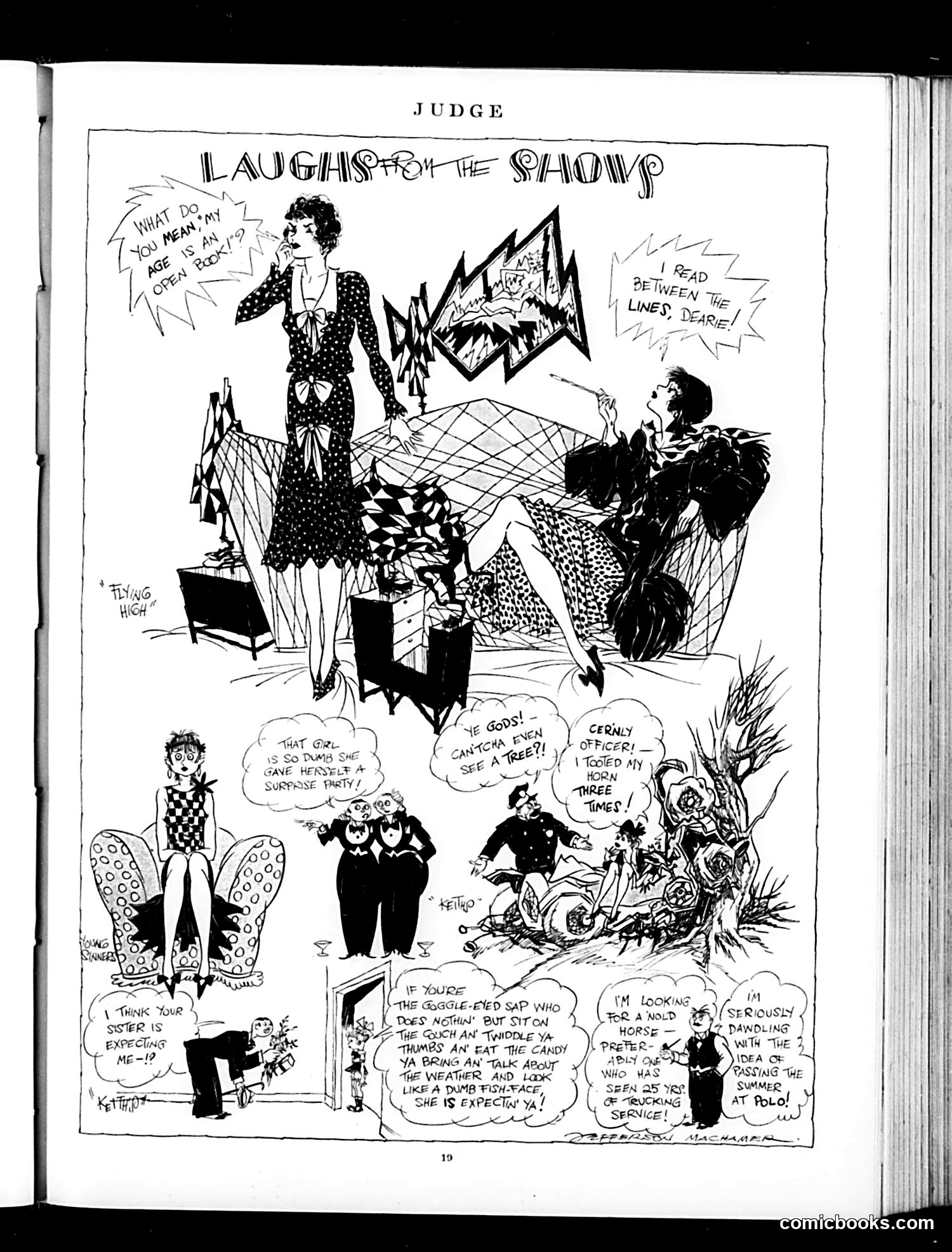
"Laugh at the Show" — Judge Magazine Satire This page satirizes theatrical entertainment and audience behavior, likely from the 1920s-30s based on the art style and fashion. The central scene depicts a stage show where performers display exaggerated, absurd acts to an audience. The cartoon mocks both performers and spectators: characters criticize each other's theatrical choices while audience members make crude, rude observations. One figure complains about a "goggle-eyed sap" who sits passively eating candy and making inane comments about the weather—mocking the stereotypical dim-witted theater patron. Another character boasts about honking a horn repeatedly, suggesting performers resort to cheap noise-making for laughs. The satire targets the low quality of popular entertainment of the era—emphasizing physical comedy, slapstick, and lowest-common-denominator humor over wit or substance. It also critiques audiences who accept and reward such mediocre performances, perpetuating the cycle of tasteless shows.
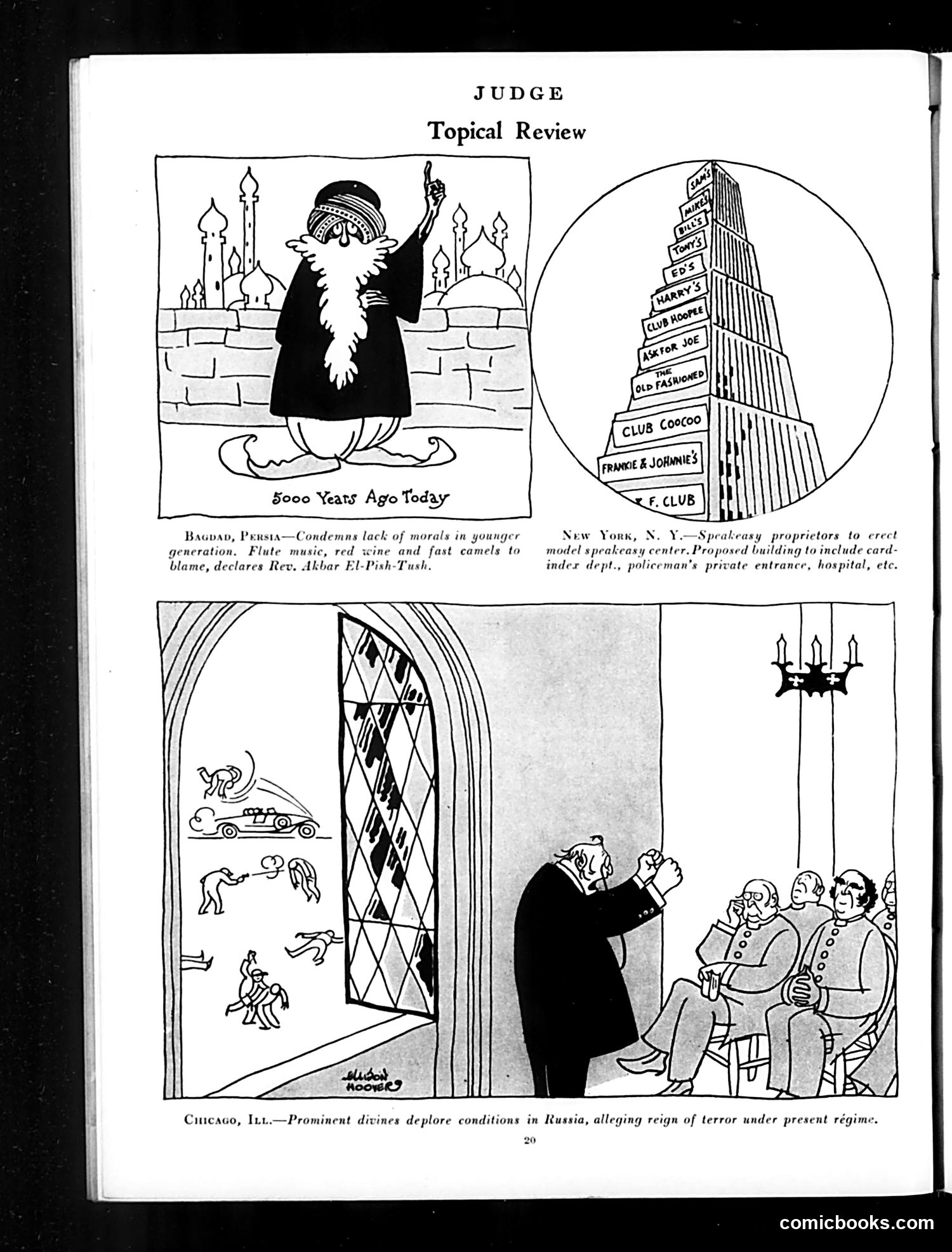
Judge "Topical Review" - Satire Explanation This page contains three cartoons mocking contemporary issues: 1. Top left: A Persian religious figure blames Western decadence (flute music, wine, fast camels) for youth moral decline—satirizing how foreign clergy scapegoat Western culture. 2. Top right: A tall building labeled with speakeasy names (Club Cocoa, Old Fashioned, etc.) ridicules Prohibition-era NYC. The caption jokes that speakeasy owners plan a building with a "policeman's private entrance," mocking corruption—police were bribed to ignore illegal bars. 3. Bottom: Clerics peer through a window at Russian scenes of chaos and violence, condemning the Soviet regime's "reign of terror." This likely references post-revolution violence or Soviet repression, with the cartoon mocking religious figures' selective outrage about distant atrocities. All three satirize hypocrisy: religious authority figures condemning others while ignoring systemic problems.
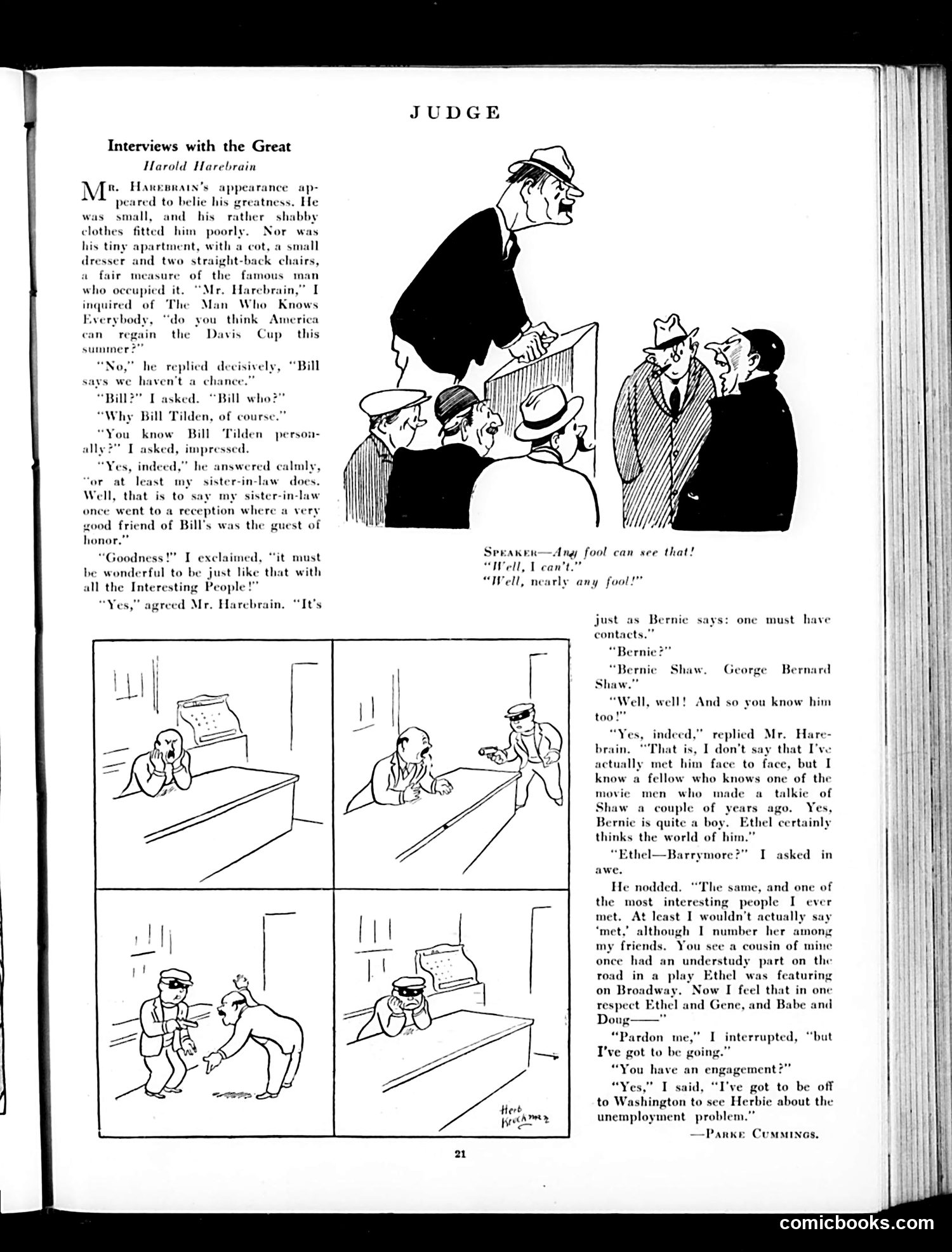
"Interviews with the Great: Harold Harebrain" This satirical piece mocks social climbers and name-dropping culture. Harold Harebrain claims to "know" famous people—Bill Tilden (a legendary tennis player), George Bernard Shaw, and Ethel Barrymore—but his actual connections are absurdly tenuous: he knows someone whose sister-in-law attended a reception where a friend of Tilden's was present; Shaw's connection comes through a movie producer linked to a talkie; Barrymore through a cousin's understudy role. The humor lies in exposing the pretentiousness of people who manufacture prestige through increasingly distant and fabricated "contacts." The four-panel comic strips below (showing physical comedy with a dog) provide visual relief from the text's dry absurdity. The piece satirizes American social pretension and the desire to associate with celebrities, no matter how tenuously.
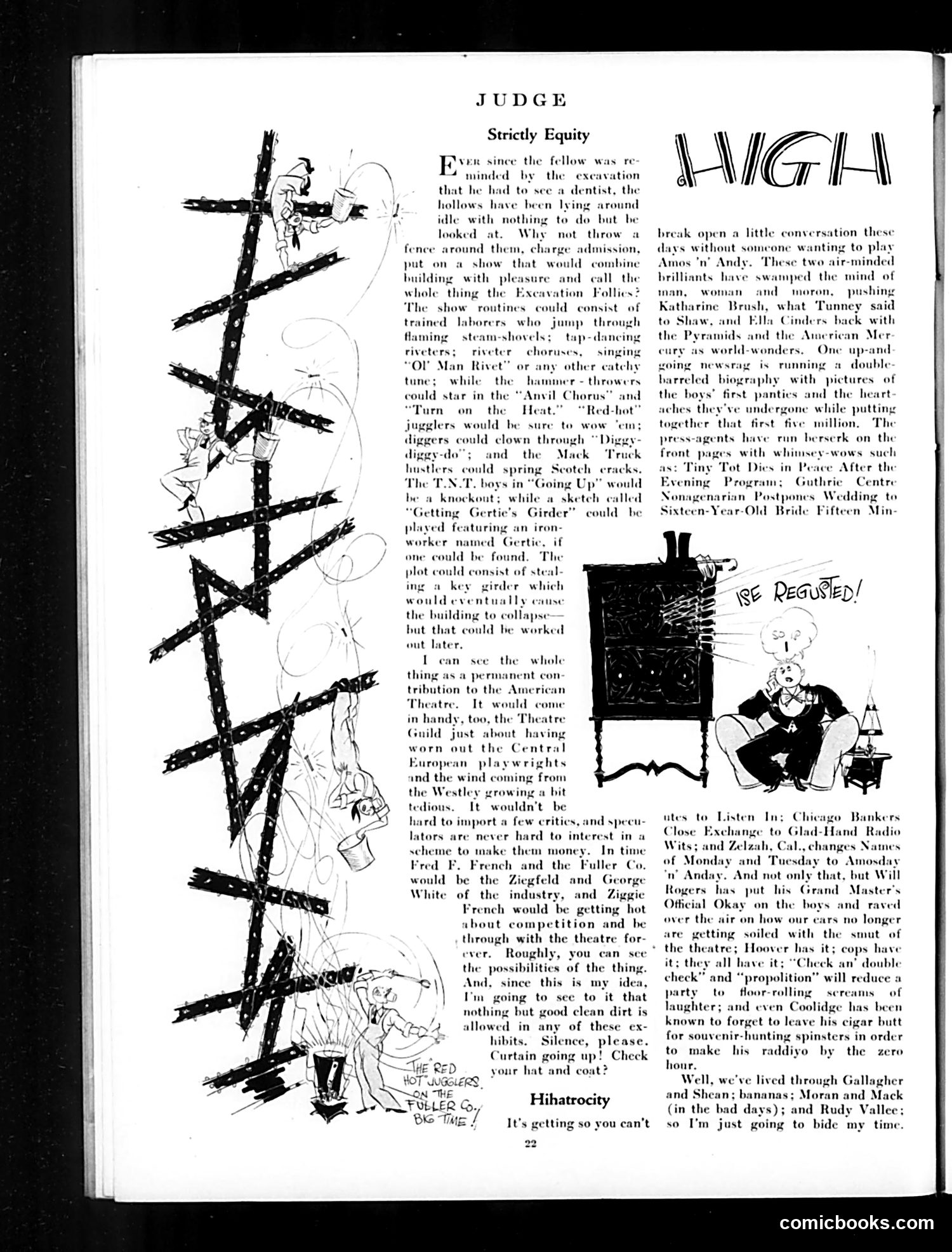
Judge Magazine Satire Analysis This page satirizes the craze surrounding the radio comedy duo Amos 'n' Andy, whose popularity had reached fever pitch in American culture. The left column's main piece mockingly proposes turning construction work into a theatrical spectacle—a absurdist idea suggesting entertainers were mining every possible subject for content. The "Hihatrocity" section (right) directly attacks the Amos 'n' Andy phenomenon. The author complains that you cannot have a casual conversation without someone impersonating the characters. The piece criticizes how aggressively the media and public have embraced them—newspapers run extensive biographies, celebrities endorse them (including Will Rogers and President Coolidge), and their catchphrases ("Check an' double check") have saturated popular discourse. The cartoon of an exasperated woman saying "BE DISGUSTED!" illustrates public fatigue with the mania. The author resignedly concludes he'll "bide [his] time" until this craze, like previous fads (Gallagher and Shean, Moran and Mack, Rudy Vallee), inevitably passes. The satire reflects 1920s-30s anxiety about mass media saturation and manufactured celebrity culture.
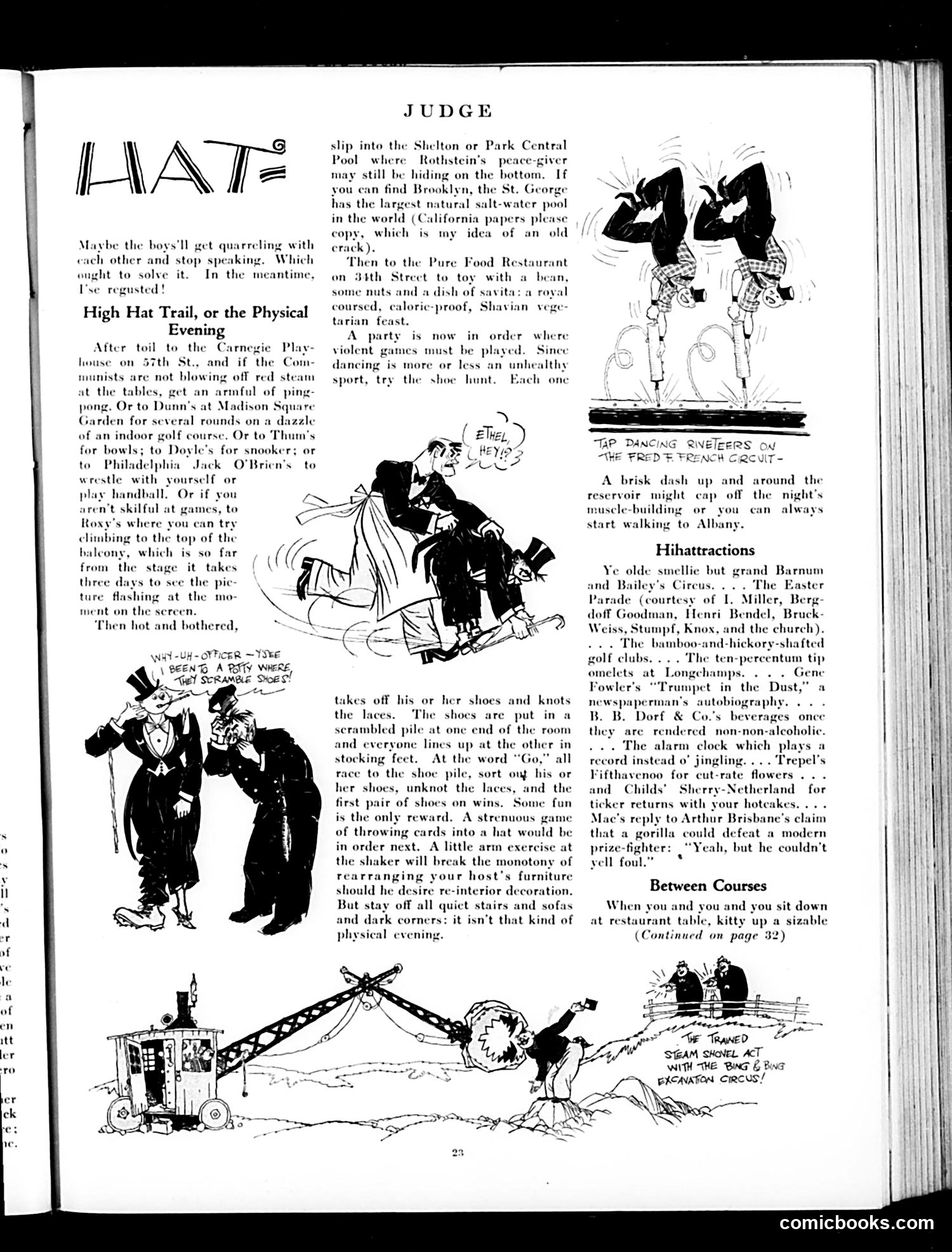
"High Hat Trail" - A Satirical Evening Out This page satirizes the Jazz Age leisure activities available to wealthy New Yorkers. The main article describes an elaborate evening of entertainment—from Carnegie Playhouse to indoor golf, swimming pools (including a dig at Arnold Rothstein, a notorious gangster whose body was allegedly dumped in a pool), vegetarian restaurants, and increasingly absurd party games like the "shoe hunt." The cartoons illustrate these activities with slapstick humor: men in formal wear scrambling over shoes, couples dancing frantically. The satire mocks both the pretentiousness of "high hat" culture and the frantic, exhausting nature of fashionable social life. The "Hihattractions" section continues the mockery, listing trendy spots (Barnum & Bailey Circus, Easter Parade fashion designers, expensive restaurants) alongside absurdist complaints—alarm clocks that jingle, overpriced flowers. Overall, Judge ridicules the wealthy's desperate pursuit of entertainment and status during the prosperous 1920s, suggesting their "physical evening" is less relaxation than performative exhaustion.
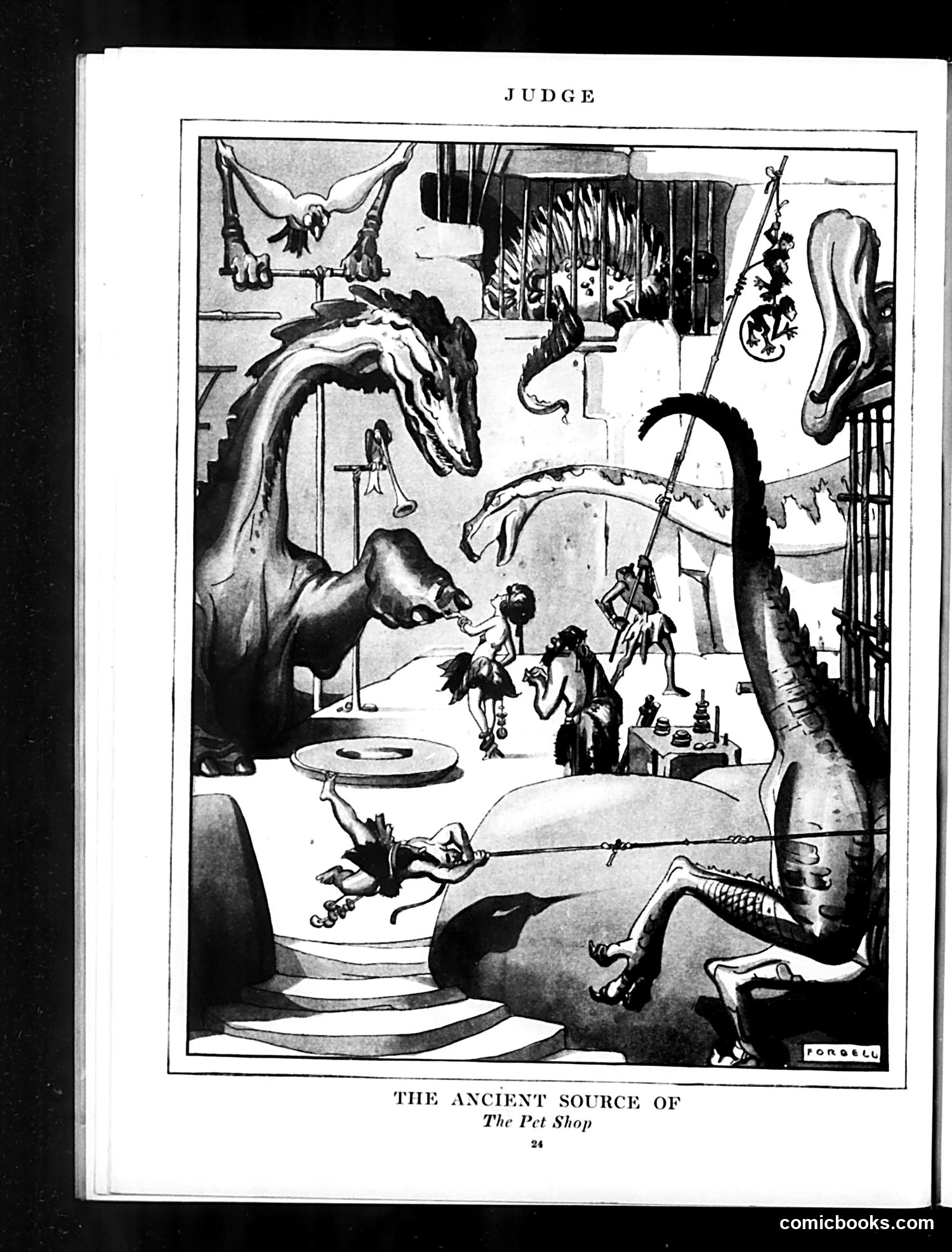
Analysis This satirical cartoon is titled "The Ancient Source of The Pet Shop," suggesting that modern pet shops have historical antecedents. The image depicts what appears to be a fantastical or mythological scene: large serpentine or dragon-like creatures in an elaborate underground or cavernous setting, with small human figures (possibly demons or mythological beings) engaged in commerce or activity below them. The satire likely mocks the pet shop trade by tracing it to absurdly ancient or fantastical origins—perhaps suggesting that keeping exotic animals captive is an old, questionable practice. The elaborate, surreal staging emphasizes the ridiculousness of this "ancient source." Without additional context about contemporary 1920s-era pet shop controversies, the exact target remains somewhat unclear, but the cartoon appears to satirize either the pet trade itself or attitudes toward animal captivity.
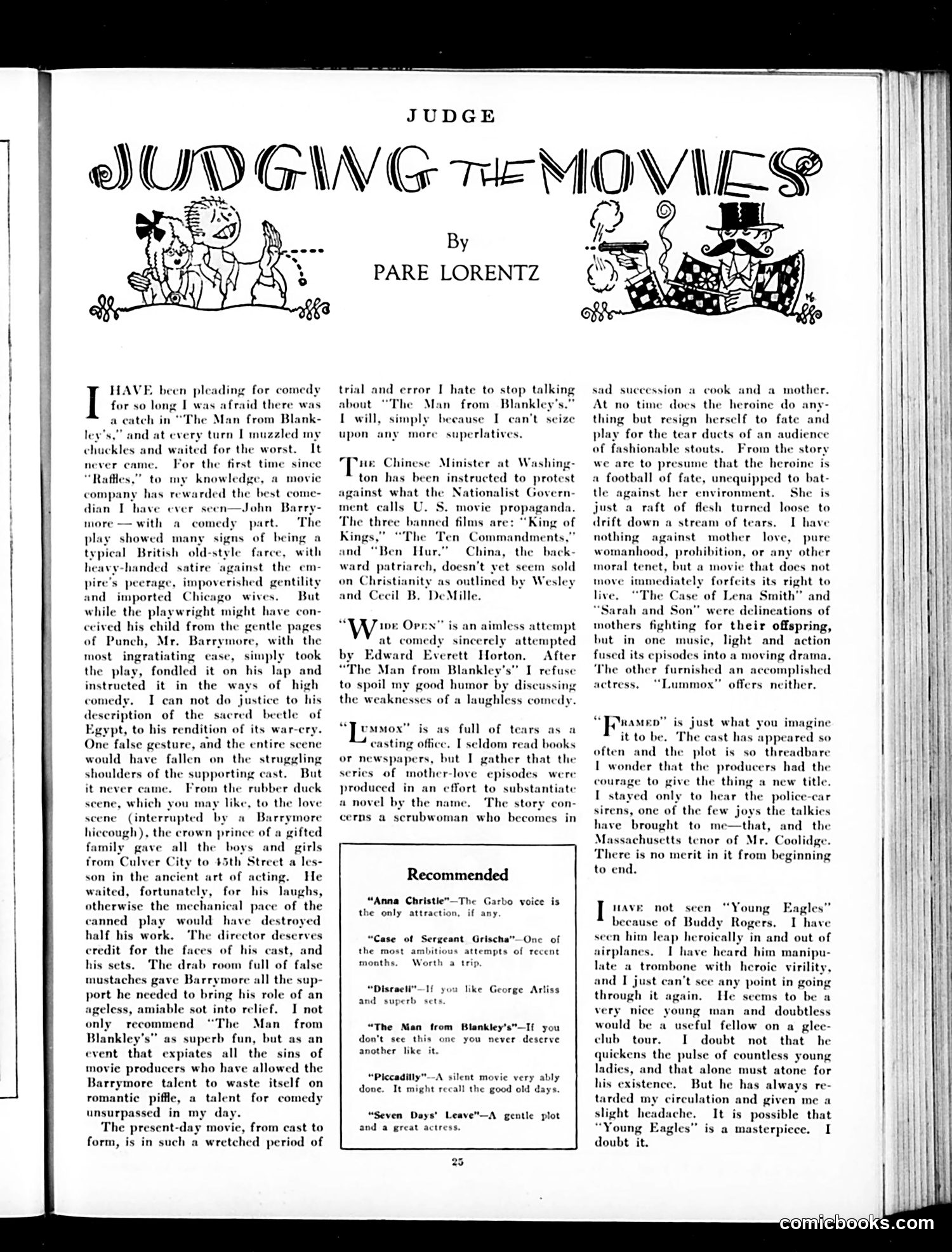
Judge Magazine Movie Review Column This is a film criticism column by Pare Lorentz reviewing current movies. The page contains no political cartoons—instead, it's an illustrated review section with decorative headers showing theatrical characters. Lorentz praises John Barrymore's comedic performance in *"The Man from Blankley's,"* calling it a rare opportunity for the Shakespearean actor to showcase comic talent. He criticizes several other films: *"Wide Open"* (Edward Everett Horton comedy), *"Lemmon"* (a melodramatic mother-love story), and others. A notable detail: The Chinese Minister in Washington has protested American film propaganda, banning three movies—*"King of Kings,"* *"The Ten Commandments,"* and *"Ben Hur"*—because China's "backward patriarch" government (referring to traditional Nationalist leadership) objects to Christian messaging promoted by these films. The "Recommended" section lists other current films worth seeing, including Greta Garbo in *"Anna Christie."*
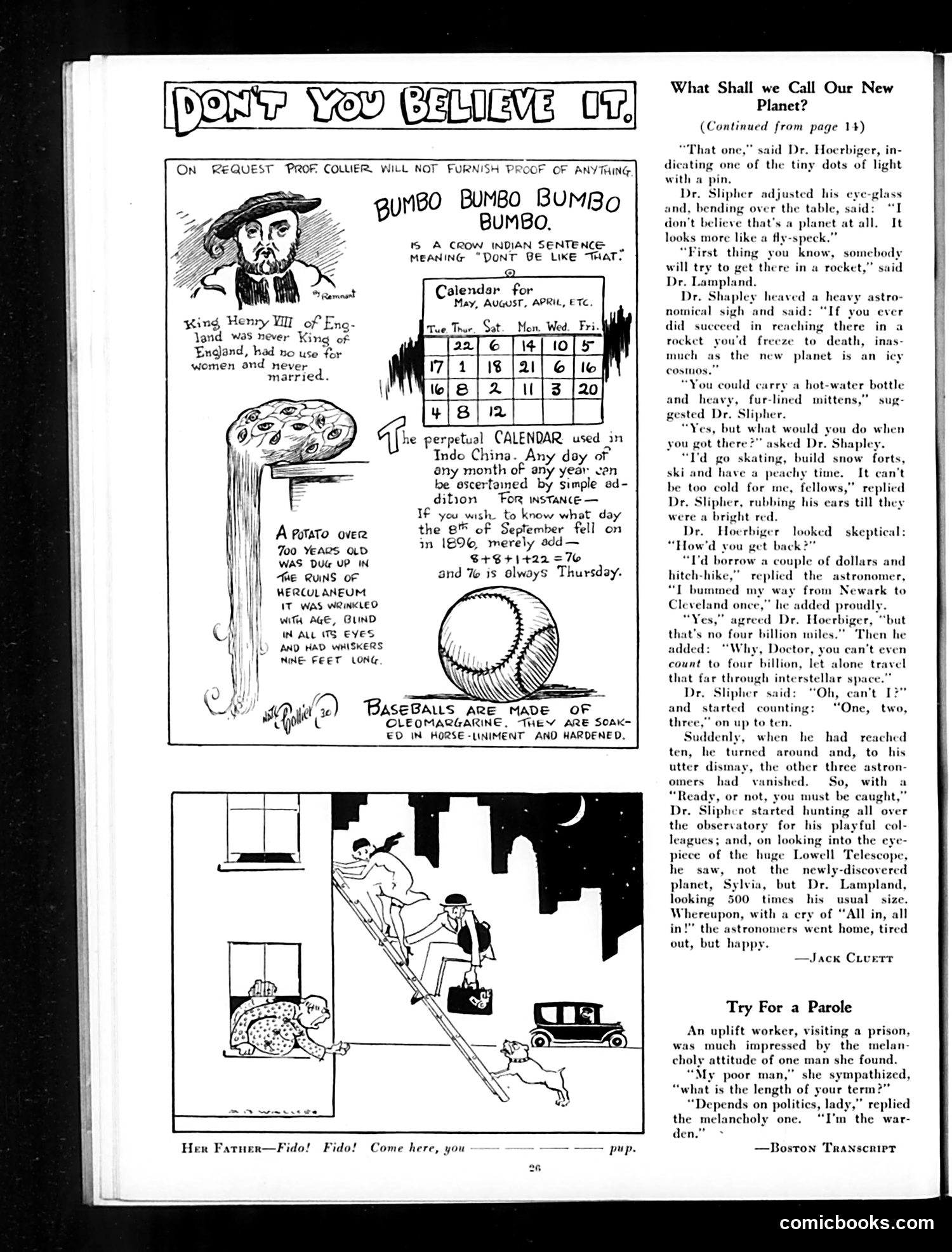
"Don't You Believe It" — Judge Magazine Satire This page combines humorous fake-facts with a science fiction story. The left side presents absurd "facts" (King Henry VIII never married, potatoes with nine-foot whiskers, baseballs made of margarine) — obvious nonsense meant to mock pseudoscientific claims and gullible readers who believe dubious information without verification. The caption mocks Professor Collier for refusing to provide proof. The right side continues a lighthearted story about astronomers debating a newly-discovered planet. The scientists (Hoerbriger, Slipher, Shapley, Lampland) discuss practical obstacles to space travel with increasingly ridiculous suggestions (hot-water bottles, hitching rides), eventually devolving into a game of hide-and-seek. The satire targets both scientific pretension and popular fascination with space exploration. The contrast between serious astronomical discussion and childish behavior suggests skepticism about grandiose space-travel claims then circulating in popular culture.
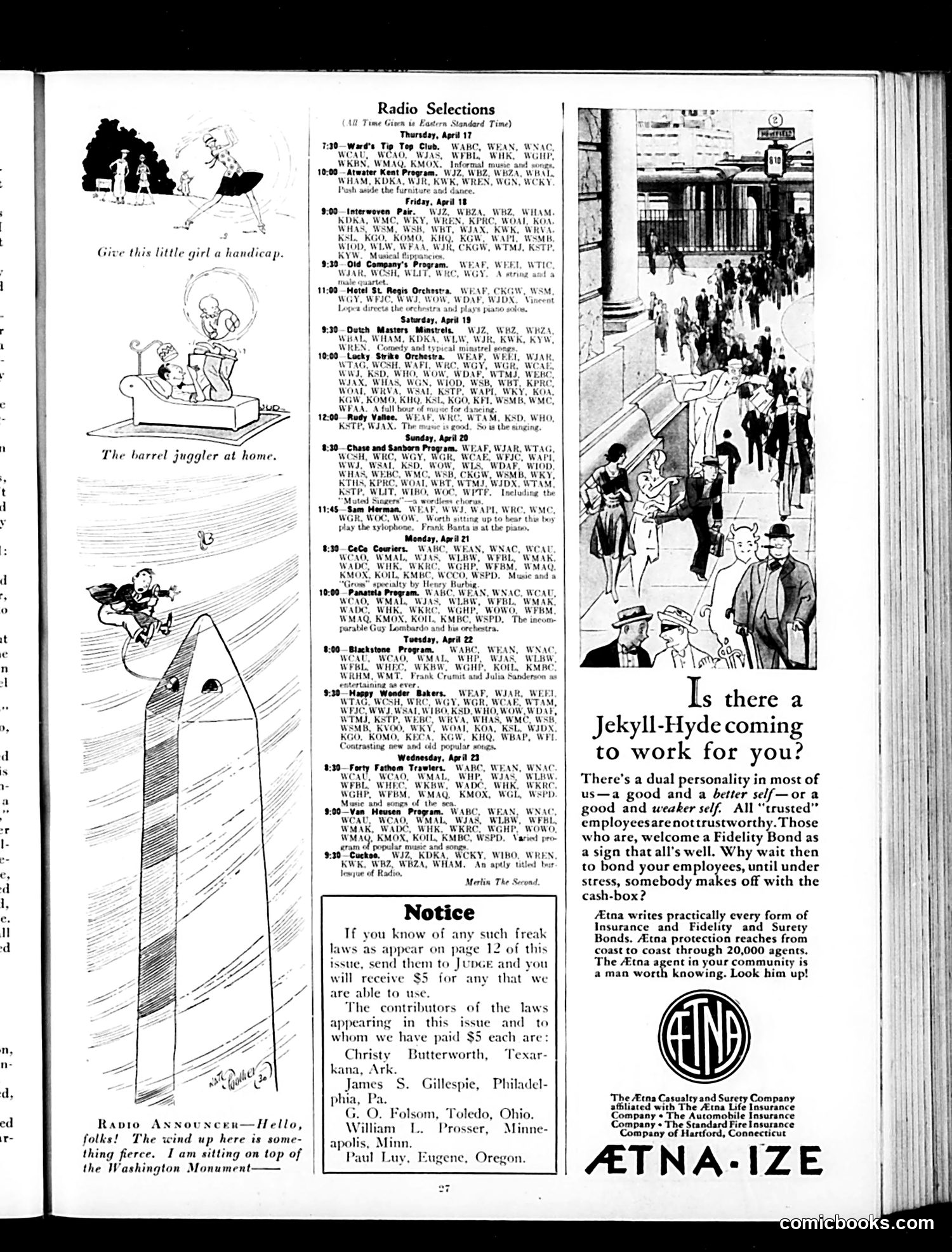
Radio Selections and Advertisements (Judge Magazine Page) This page is primarily practical content rather than satire: a detailed radio programming schedule for April 17-23, listing call letters and show times across multiple stations—reflecting the novelty and expansion of commercial radio broadcasting in the late 1920s. The left side contains humorous illustrations (captioned "Give this little girl a handicap," "The barrel juggler at home," and a radio announcer atop the Washington Monument) that are visual jokes unrelated to the schedule. Below the listings is a "Notice" offering $5 bounties for submissions of absurd or contradictory laws—a recurring Judge feature satirizing legislative absurdity. The right side advertises Ætna-Ize insurance, using a "Jekyll-Hyde" metaphor to suggest that employees without fidelity bonds are potential moral risks—a period marketing approach playing on anxieties about trustworthiness and crime. The page serves primarily as functional radio guide and advertising, with light humor inserted around the margins.
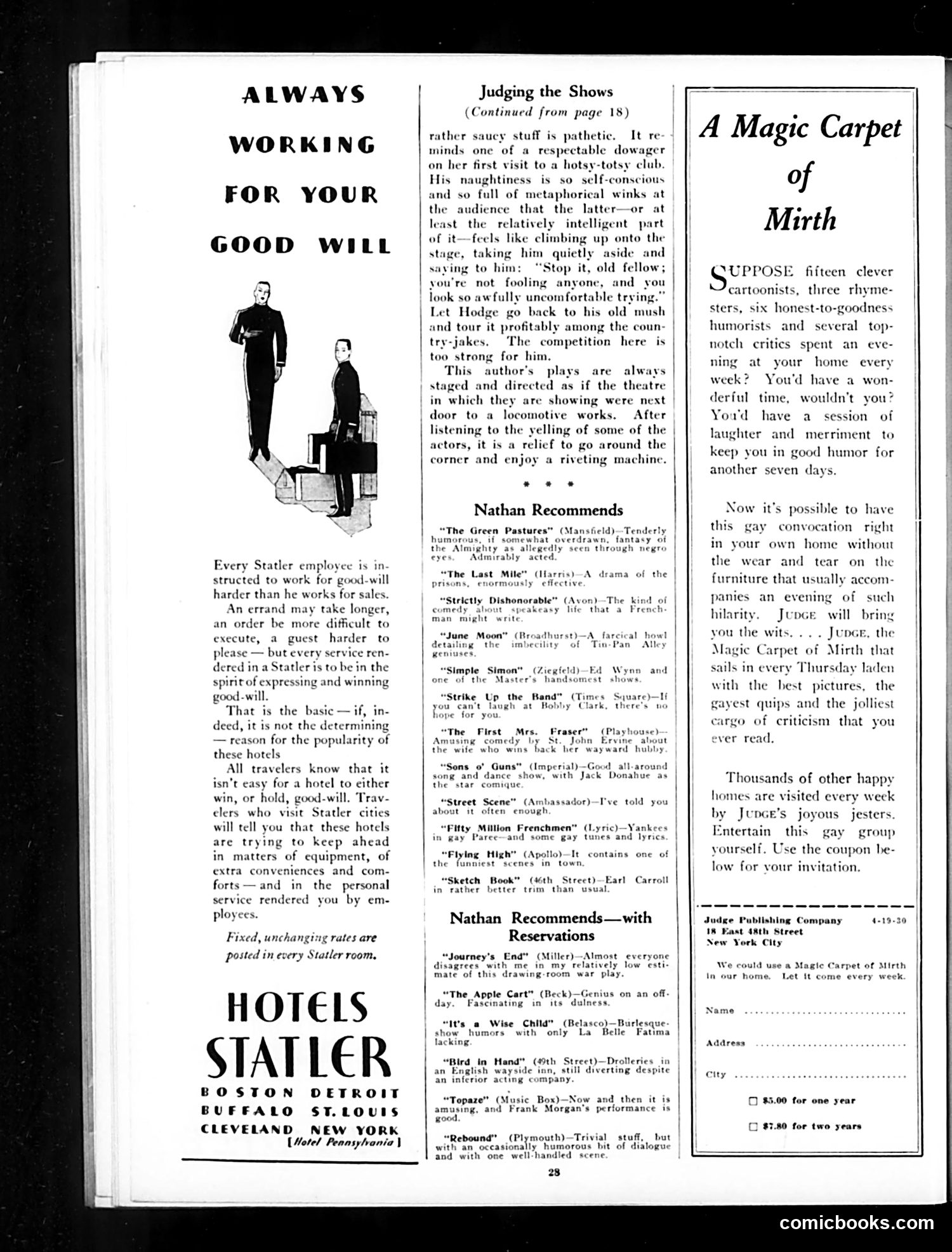
Explanation for Modern Readers This page is primarily advertising and theater criticism, not political satire. The left side features a Statler Hotels advertisement emphasizing customer service and fixed rates—targeting business travelers concerned about reliability. The center contains theater reviews by critic Nathan (likely George Jean Nathan), recommending Broadway shows of the era with brief, often cutting commentary. He praises "The Green Pastures" and "Strictly Dishonorable," while mocking overly theatrical productions that seem designed for noise rather than subtlety. The right side advertises Judge magazine's "Magic Carpet of Mirth"—a proposed subscription service delivering weekly collections of cartoons, humor, and criticism to homes. It's a circulation pitch, positioning the magazine as entertainment that would keep readers "in good humor for another seven days." There are no political cartoons visible. This is a commercial page from a humor magazine, showing how publications monetized content through both advertising and subscription drives in the 1930s.
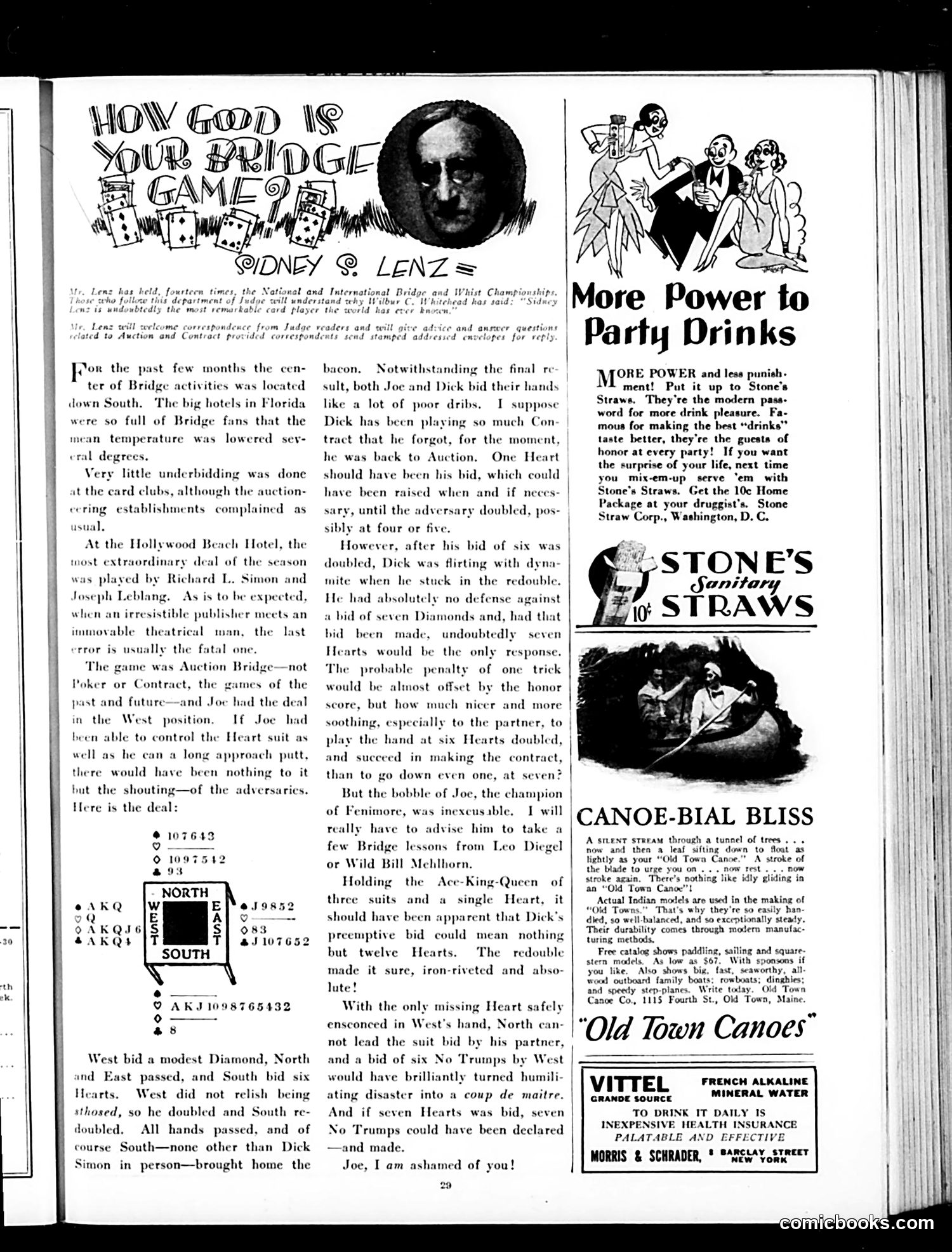
Judge Magazine Page Analysis This page centers on a bridge card game scandal involving prominent figures. The main article "How Good Is Your Bridge Game?" features Sidney Lenz (the circular portrait), a celebrated bridge player, discussing an embarrassing hand played at the Hollywood Beach Hotel. The story describes how Joe Leblang (a theatrical producer) and Dick Simon bungled an auction bridge game through poor bidding and play. Leblang made a terrible redouble; Simon failed to recognize what the bid meant. The satire mocks these wealthy, prominent men for their incompetence at a game then fashionable among the elite—bridge was a status symbol in 1920s-30s high society. The surrounding advertisements (Stone's Straws, Canoe-Bial Bliss, Vittel mineral water) target the same affluent audience, reinforcing that this magazine addressed wealthy readers who played bridge and socialized at resort hotels. The humor relies on public recognition of these figures' social prominence, making their card-game failure particularly embarrassing.
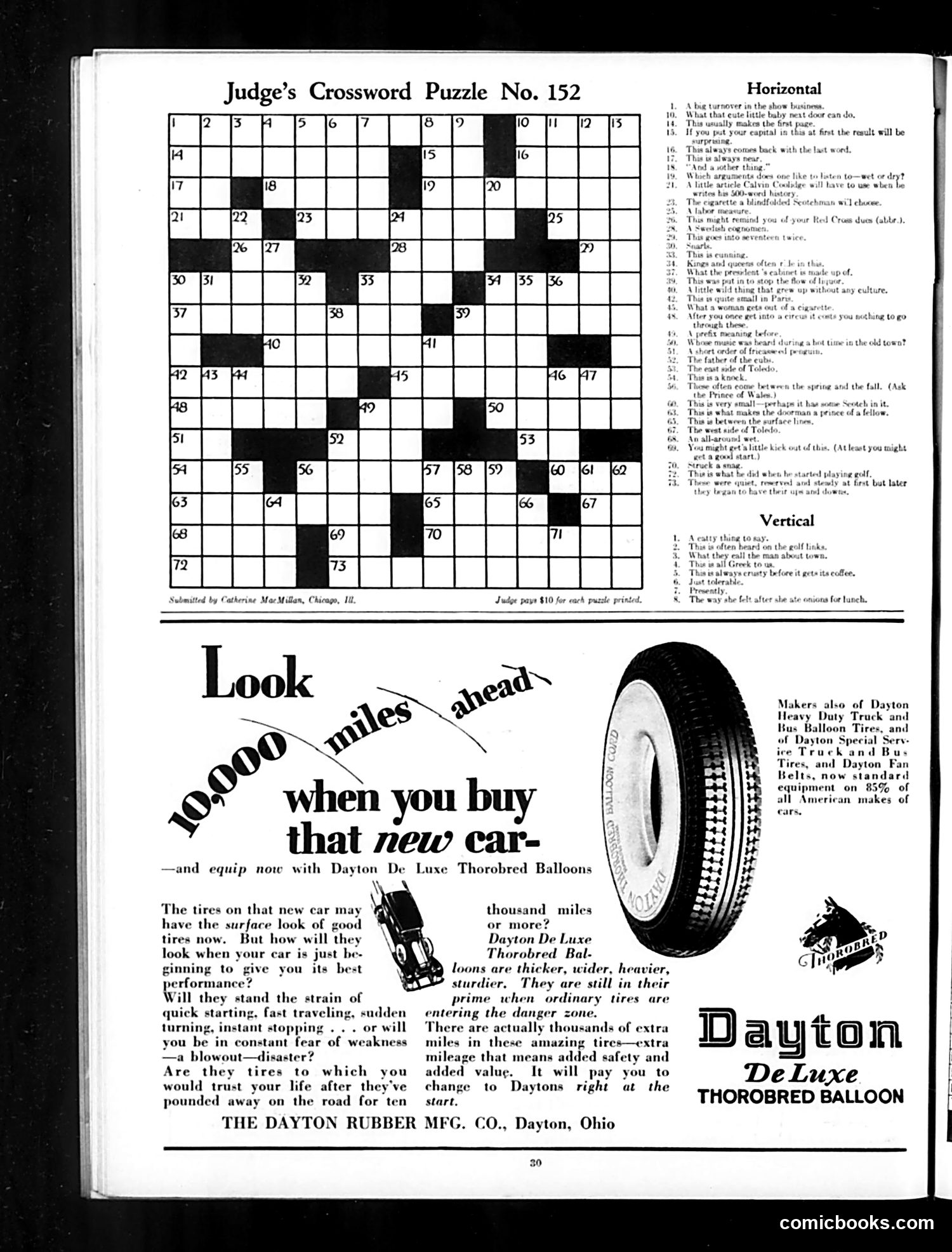
Judge Magazine Page Analysis This page is primarily advertising content, not political satire. It features a full-page advertisement for Dayton De Luxe Thorobred Balloon tires, along with a crossword puzzle above it. The tire ad uses persuasive marketing rhetoric common to the early automotive era. It appeals to new car owners by warning that tires may look good initially but will deteriorate with use. The copy emphasizes durability and safety, claiming Dayton tires are "thicker, wider, heavier, sturdier" and contain "thousands of extra miles" compared to ordinary tires. The ad includes a tire illustration and the Dayton company logo. A sidebar notes that Dayton equipment is standard on 85% of American car makes—a credibility claim. The crossword puzzle above appears to be standard magazine filler content. There is no identifiable political satire, caricature, or social commentary on this particular page—it is straightforward commercial advertising typical of Judge magazine's revenue model.
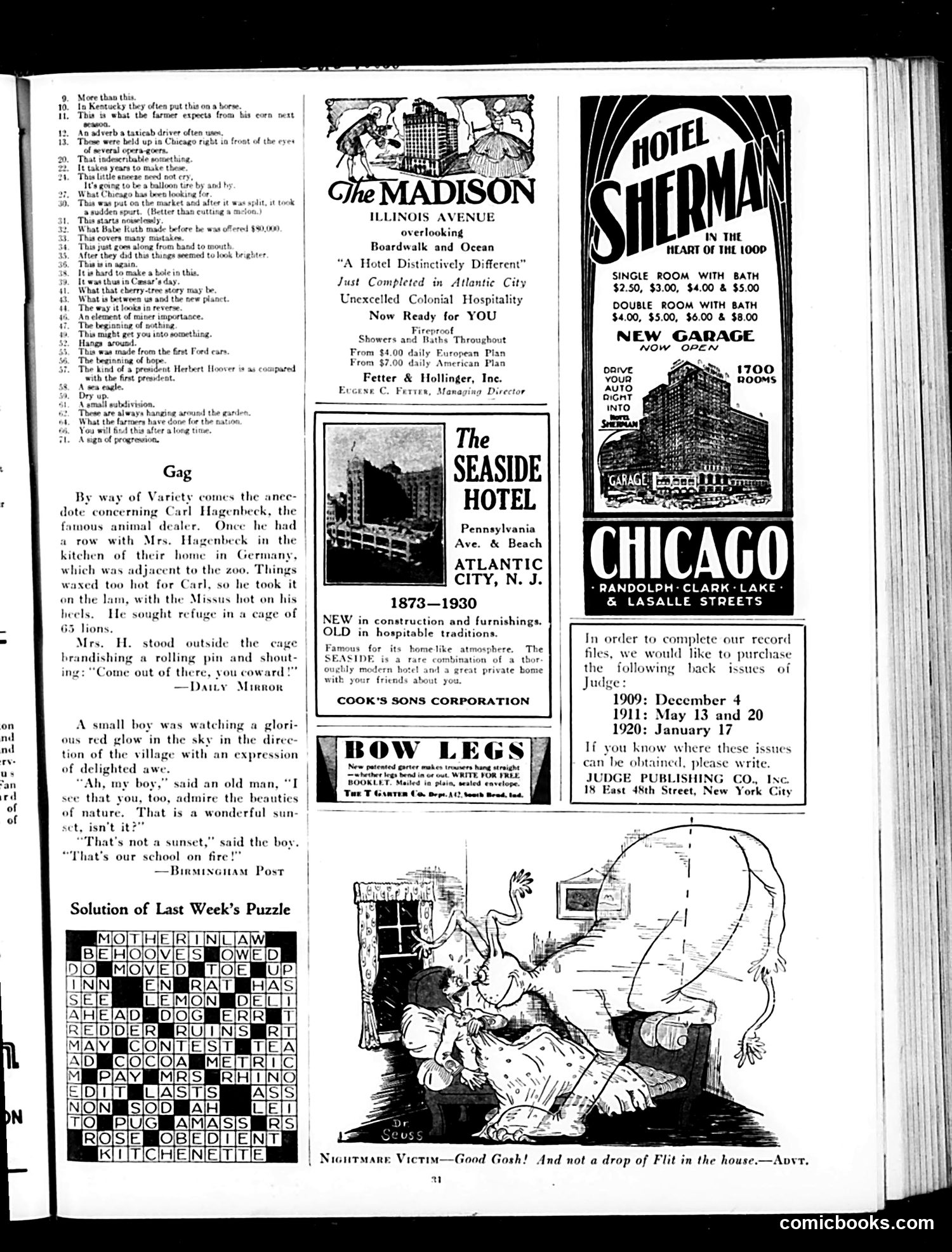
Analysis of Judge Magazine Page This page is primarily advertising and administrative content rather than editorial cartoons. The main cartoon—"Nightmare Victim: Good Gosh! And not a drop of Flit in the house"—is a commercial advertisement for Flit insecticide. It depicts a person being attacked by mosquitoes or flies, expressing frustration at lacking Flit pesticide spray. This is a period advertisement playing on common household pest anxieties of the 1920s-1930s. The page also contains hotel advertisements (The Madison, The Seaside Hotel, Hotel Sherman) and a recruitment notice for back issues of Judge magazine from 1909, 1911, and 1920. The puzzle solution and anecdotes about Carl Hagenbeck (the animal dealer) and a schoolhouse fire represent filler content typical of satirical magazines. There is no significant political or social satire on this particular page—it functions primarily as a commercial and promotional page.
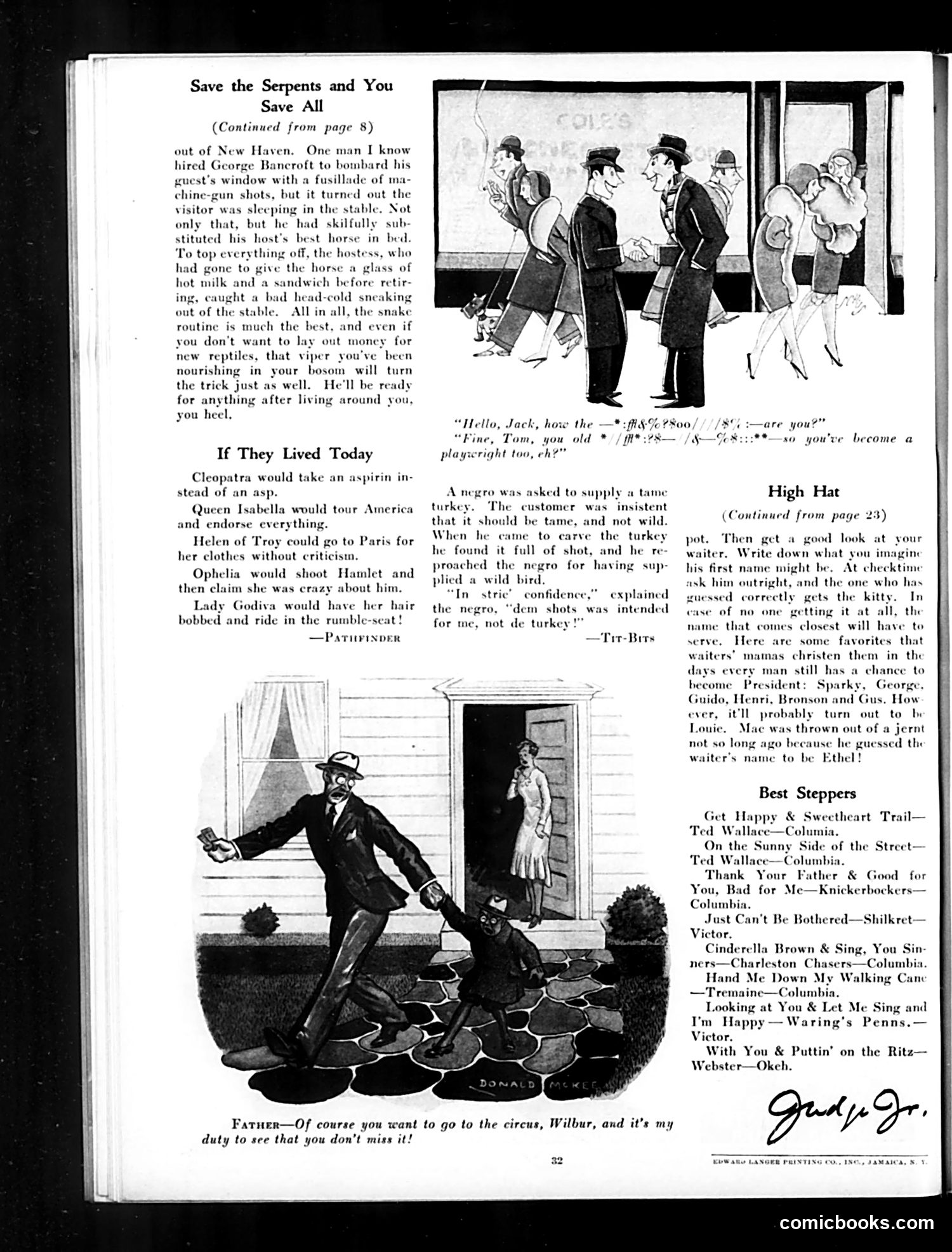
Analysis of Judge Magazine Page This page contains satirical humor typical of 1920s-era Judge magazine, mixing political commentary with social satire. "If They Lived Today" imagines historical figures in modern contexts—Cleopatra taking aspirin instead of poison, Queen Isabella endorsing products, Helen of Troy shopping in Paris without scandal, Ophelia shooting Hamlet and claiming insanity, and Lady Godiva bobbing her hair and riding in a rumble-seat. The satire mocks contemporary celebrity culture, consumerism, and changing social mores (women's fashion, divorce/mental health claims). The turkey joke relies on racial stereotyping, depicting a Black servant's dialect and supposed confusion between "shots" (gunfire) and "shot" (ammunition pellets)—a crude, offensive punchline standard to the era. "High Hat" offers a restaurant game: guess your waiter's name. The humor assumes waiters are typically named common nicknames (Sparky, Louie, Mac) rather than "Ethel," playing on gender and class assumptions. "Best Steppers" lists popular songs and recordings of the period. The page reflects 1920s attitudes toward race, class, and gender that modern readers would find deeply offensive.
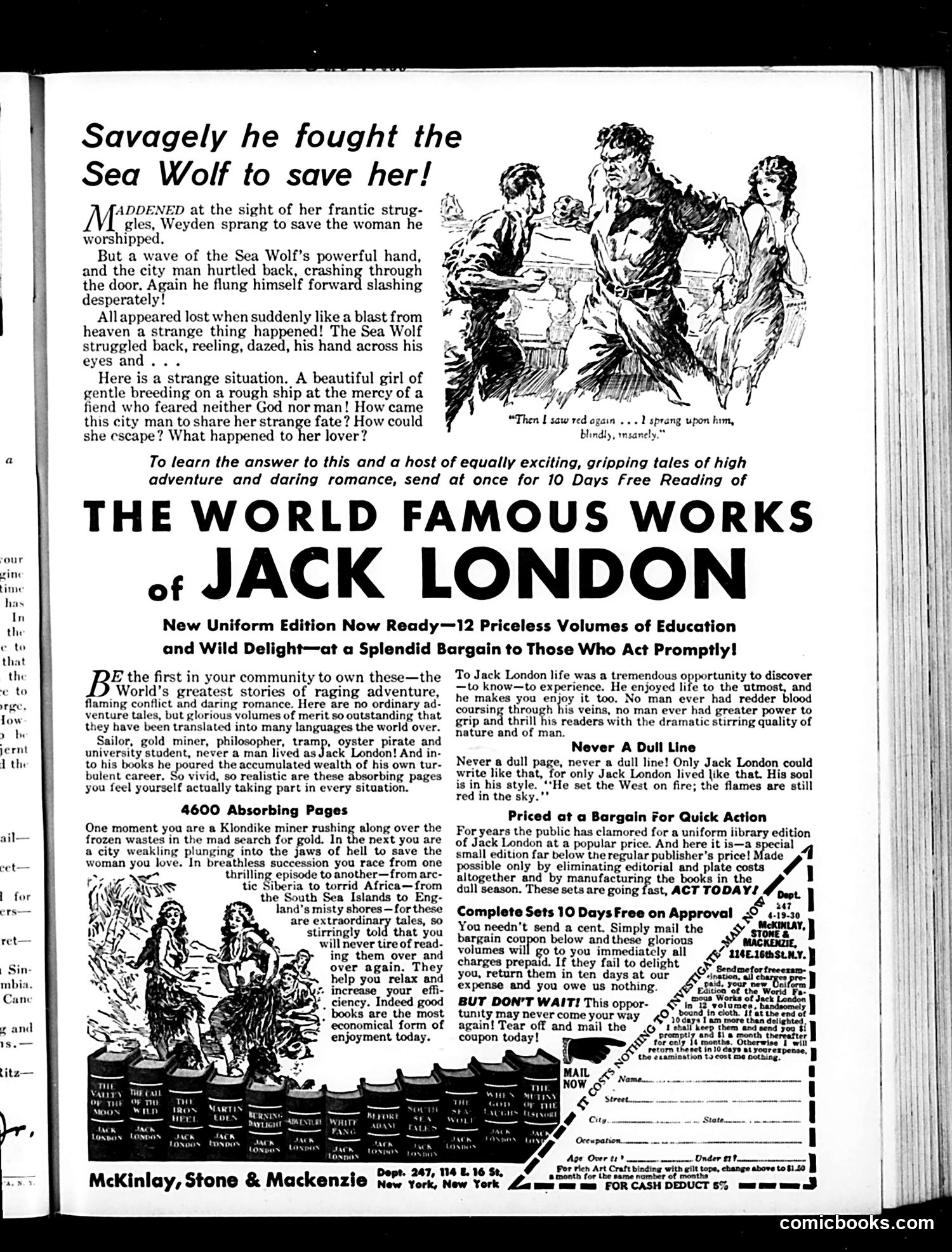
Analysis for a Modern Reader This page is primarily a book club advertisement, not political satire. It promotes Jack London's collected works through McKinlay, Stone & Mackenzie publishers. The dramatic narrative excerpt and illustration at the top depict a scene from one of London's adventure novels—a "Sea Wolf" confrontation where a male character ("Weyden") fights to rescue a woman. This pulp-style drama was used as marketing bait to entice readers. The advertisement emphasizes London's adventurous life credentials (Klondike miner, sailor, oyster pirate) to authenticate his storytelling. The pitch targets middle-class readers wanting to own a "uniform edition" of his works affordably—a common early 20th-century marketing strategy for classic literature. The coupon at bottom promises "10 Days Free Reading on Approval," a no-risk sales tactic. This appears in Judge magazine, which while satirical, regularly included such advertisements alongside actual humorous content.
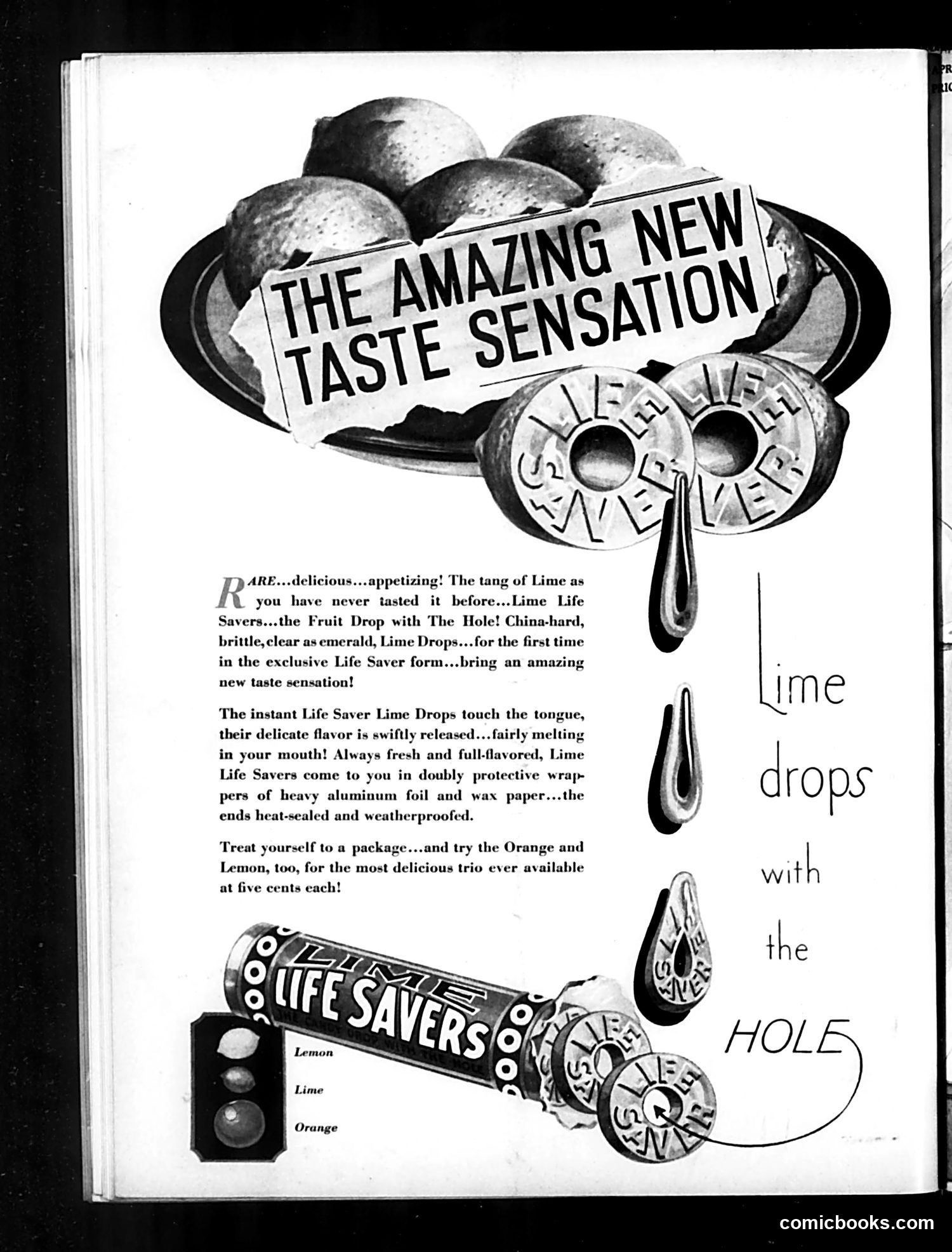
Analysis This is not a political cartoon or satire—it's a Life Savers candy advertisement from Judge magazine. The page promotes Life Savers' new lime-flavored drops, emphasizing their distinctive hole and hard, clear texture ("China-hard, brittle, clear as emerald"). The visual shows the candies in a bowl, individual drops, and the product packaging, highlighting the protective aluminum foil and wax paper wrapping. The "amazing new taste sensation" language reflects typical 1920s-30s advertising hyperbole. The ad mentions three flavors (Lime, Orange, Lemon) available at five cents each—standard pricing for the era. There is no political commentary, caricature, or satirical intent here. Judge magazine, while known for satire, also carried straightforward advertisements. This page is purely commercial product promotion.