judge
Judge — April 26, 1930
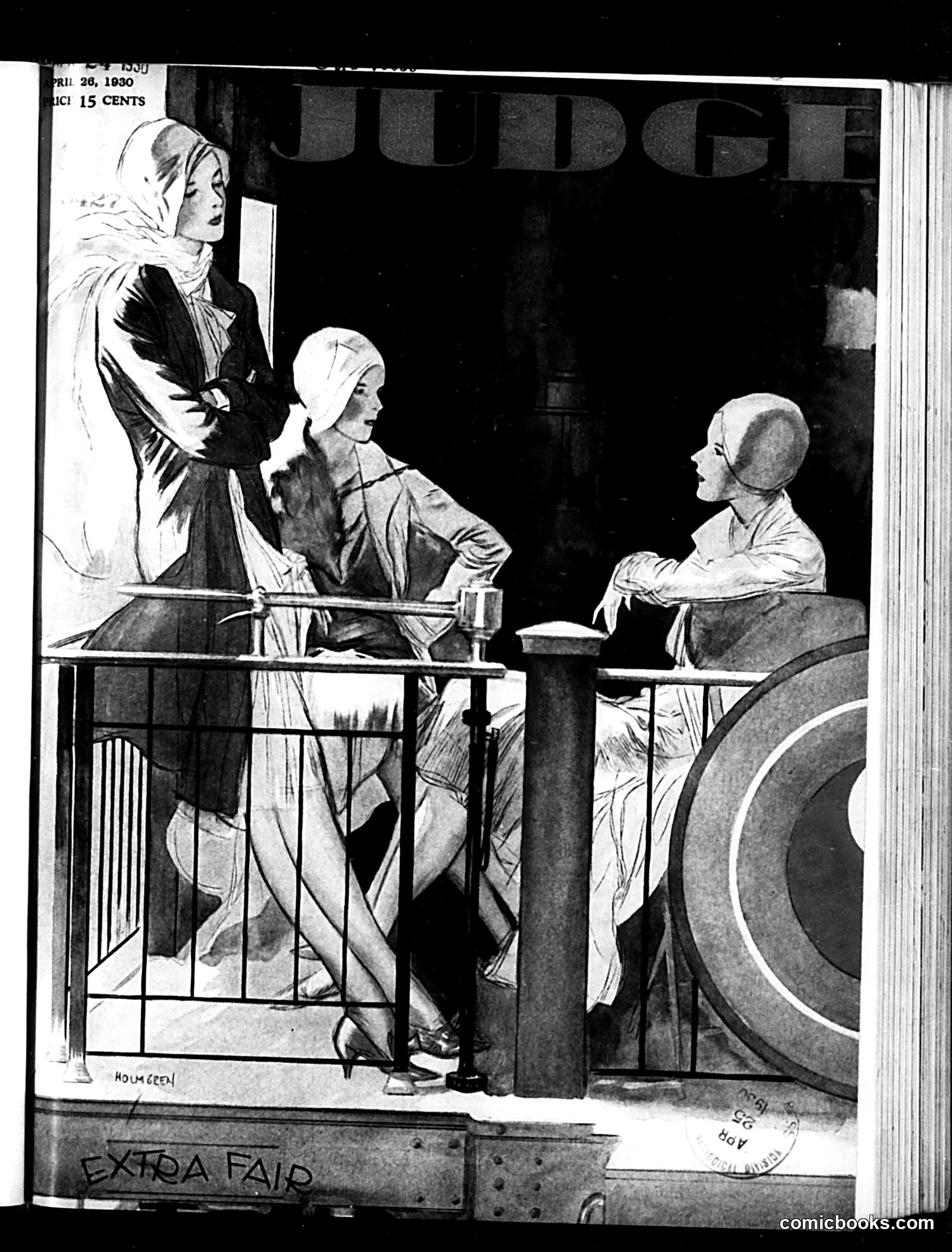
Analysis of Judge Magazine Page (April 30, 1930) This cartoon, titled "EXTRA FAIR," depicts three women in what appears to be a laundry or washing facility, suggested by the large barrel or drum visible on the right. One woman stands elevated, gesturing to the two seated figures below her. The satire likely comments on women's labor conditions or domestic work during the Depression era. The "EXTRA FAIR" title and the positioning suggest commentary on fair wages or treatment for female workers—possibly critiquing either inadequate compensation or unfair working conditions. The elevated figure may represent management or authority explaining (or failing to explain) why conditions remain problematic. Without additional context about contemporary events from April 1930, the specific industrial or labor dispute referenced remains unclear.
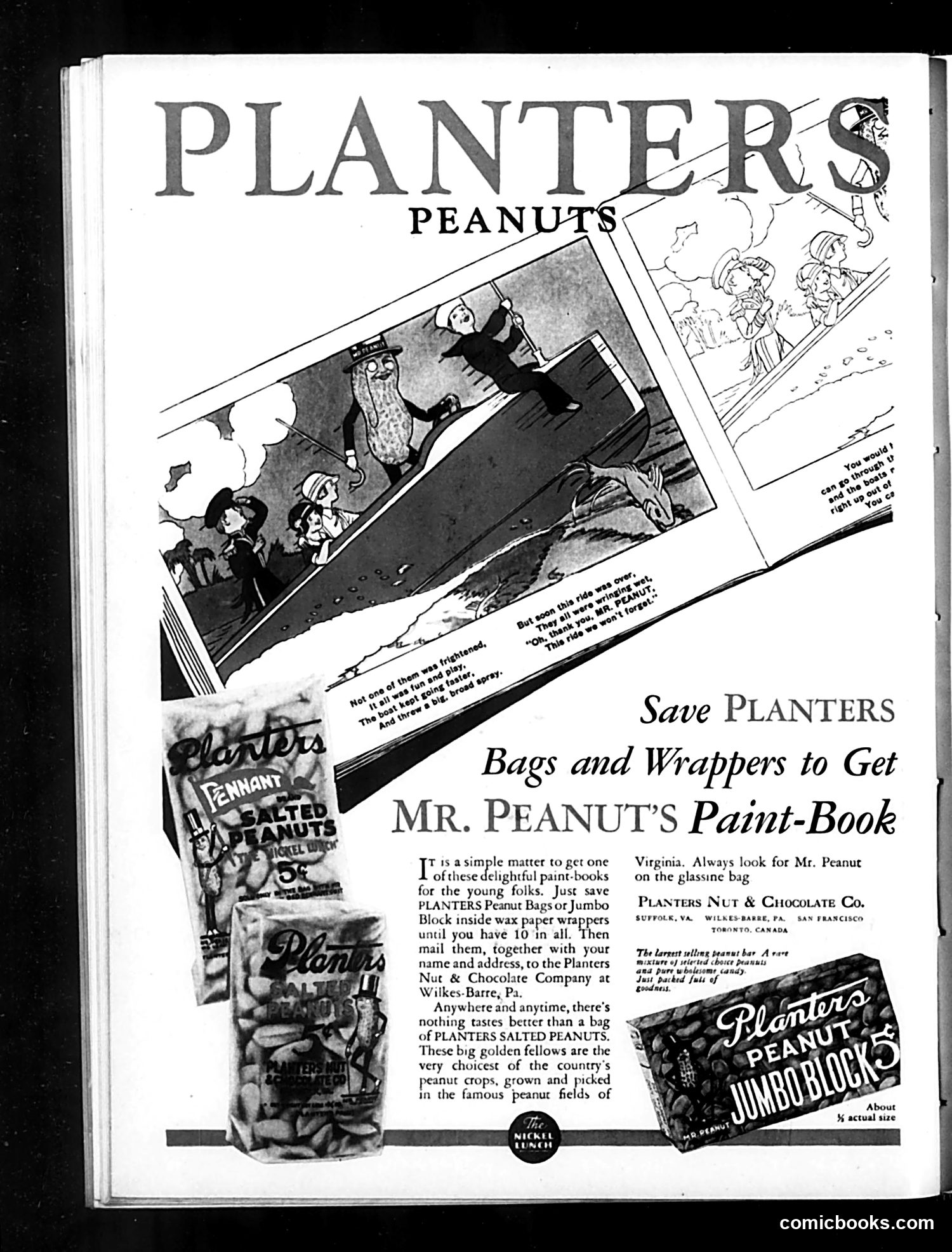
Analysis This page is primarily a Planters Peanuts advertisement rather than political satire. The main content promotes a mail-in promotion: consumers could collect 10 Planters Peanut bags or Jumbo Blocks to obtain a free "Mr. Peanut's Paint-Book" for children. The cartoon illustration shows Mr. Peanut (the brand's monocled mascot) as a distinguished gentleman, along with other figures in what appears to be a whimsical scene—likely designed to appeal to young audiences and justify the paint-book premium offer. The ad emphasizes Planters' product quality and heritage from Virginia peanut fields. Two product images (Salted Peanuts and Jumbo Block) are displayed. The advertising strategy targets families by offering a collectible children's item, a common marketing tactic of the era.
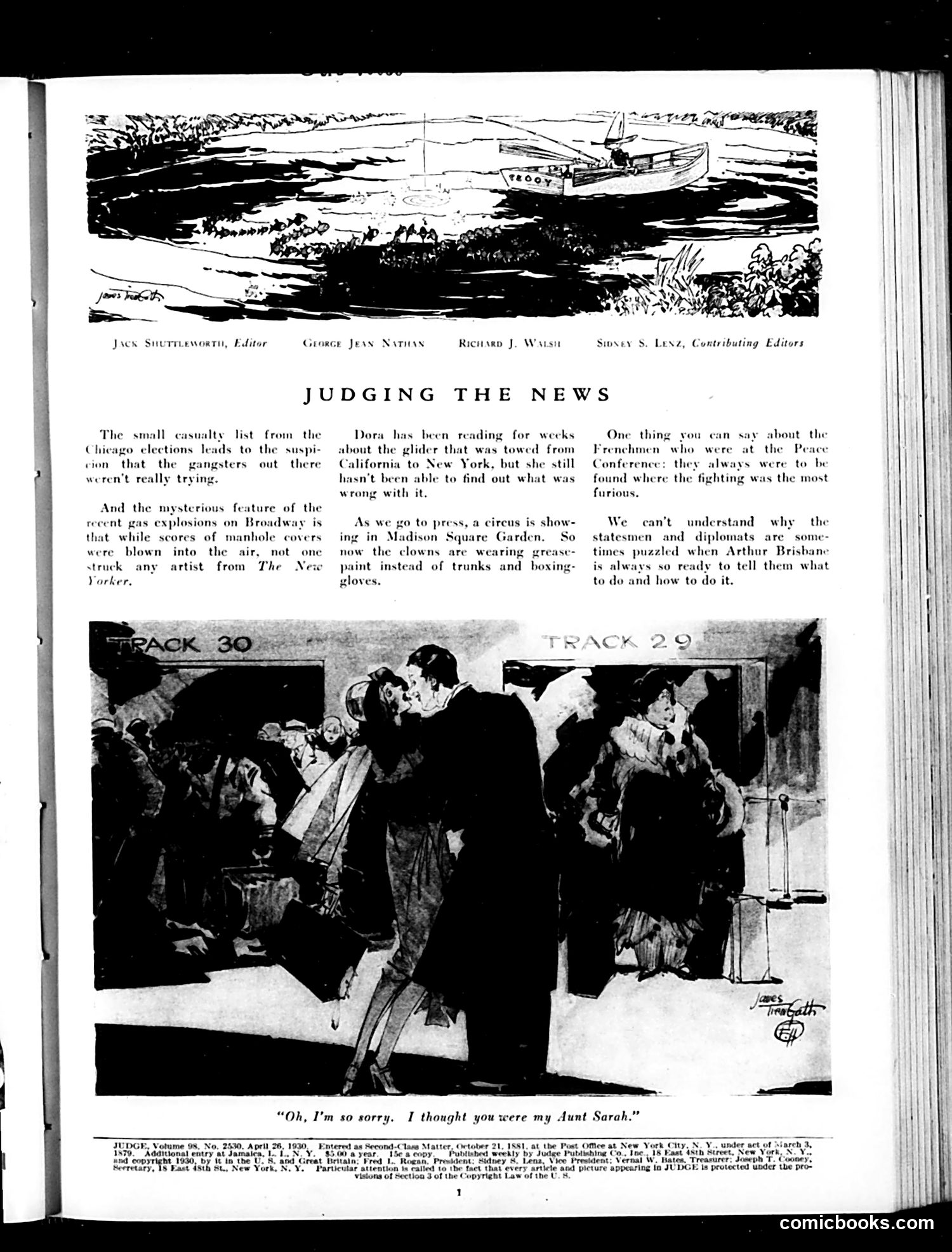
Analysis of "Judging the News" Page This page from *Judge* magazine contains a satirical column and a single cartoon. The column discusses current events including Chicago election fraud suspicions, Broadway explosions, and a circus in Madison Square Garden. The main cartoon, captioned "Oh, I'm so sorry. I thought you were my Aunt Sarah," depicts two women at what appear to be train platform tracks (labeled 30 and 29). One woman has apparently grabbed or accosted another, mistaking her identity. The humor relies on the awkward social situation of public embarrassment—a common theme in early 20th-century humor where mistaken identity leads to comedic mishaps. The crowded platform setting suggests urban transit chaos, a frequent subject of period satire.
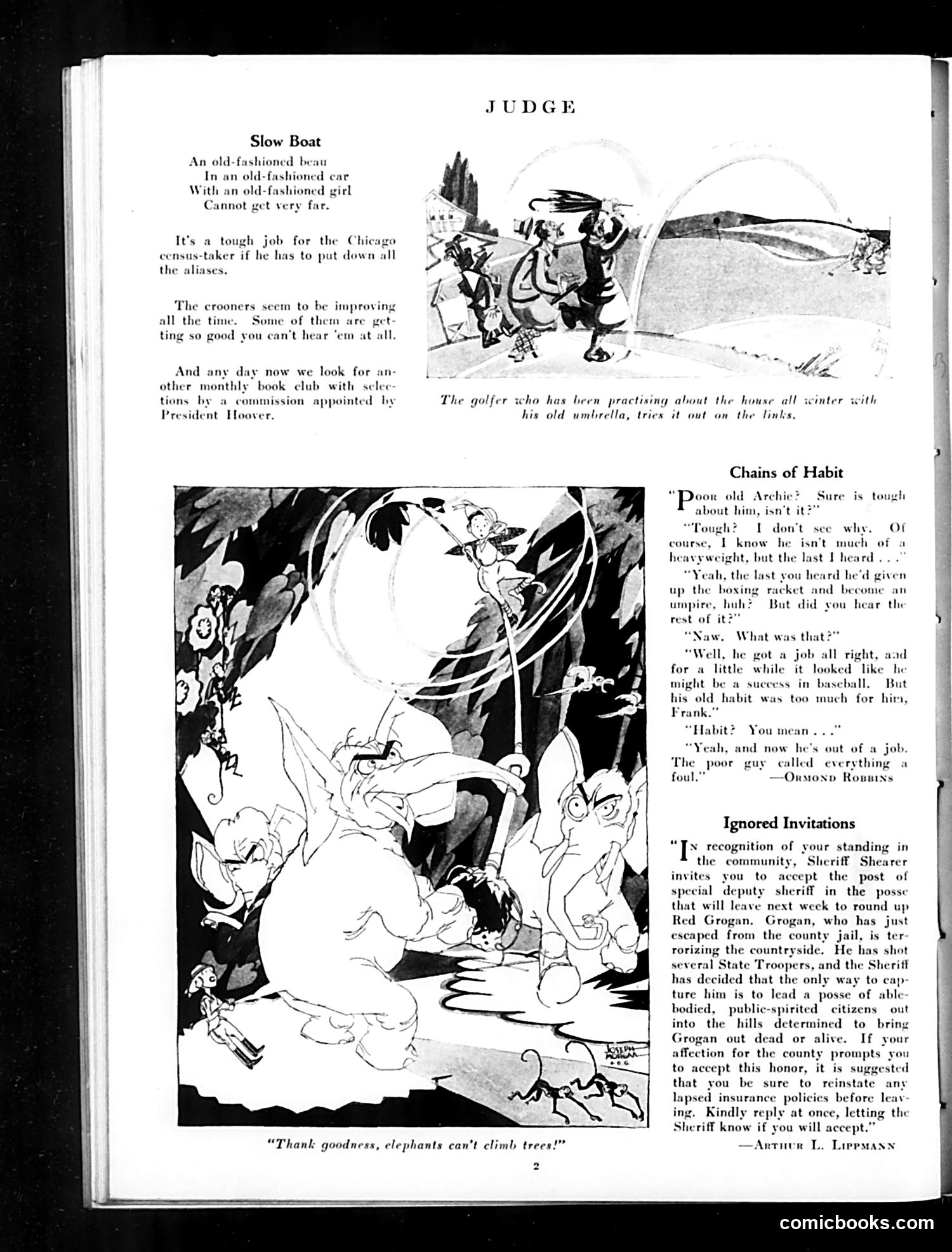
Judge Magazine Page Analysis This page contains three separate satirical pieces from Judge magazine: 1. "Slow Boat" (top): A brief poem mocking old-fashioned courtship—an elderly couple in an old car cannot progress romantically. The satire targets outdated romantic conventions. 2. "Chains of Habit" (right): A dialogue about "Poor old Archie" who gave up boxing to get a job, only to lose it. The joke critiques how habits trap people—he's now unemployed but his old ways ruined his prospects. Quote attributed to Osmond Robbins. 3. "Ignored Invitations" (bottom right): A humorous invitation from Sheriff Shearer asking someone to become special deputy sheriff to pursue an escaped criminal, Red Grogan. The satire plays on bureaucratic formality in urgent situations. The large illustration (bottom left) appears to show cartoon animals in an animated scene, captioned "Thank goodness, elephants can't climb trees!"—likely slapstick humor unrelated to the text above.
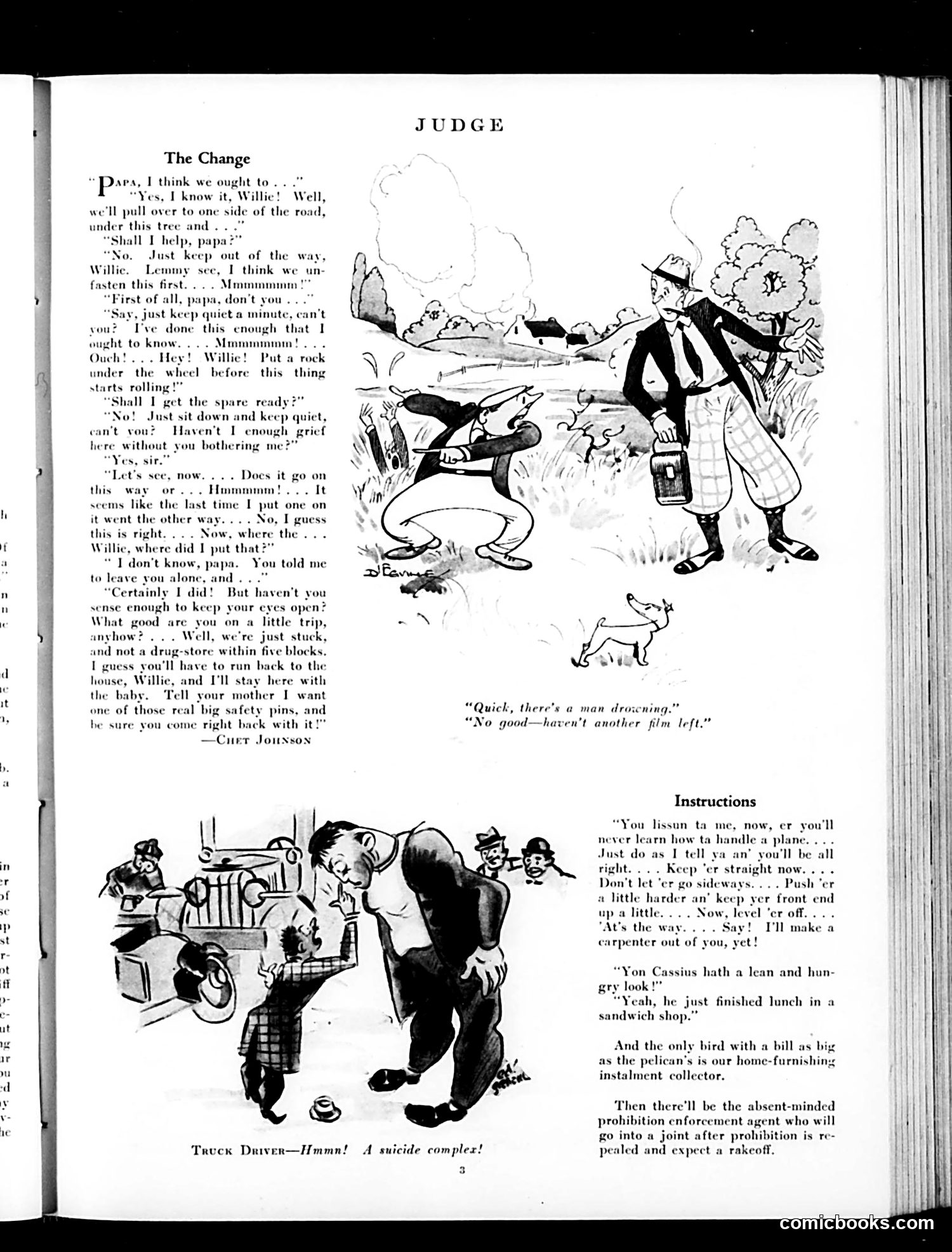
Analysis of Judge Page This page contains two satirical pieces from Judge magazine: "The Change" depicts a family car breakdown. A father and son argue about repairs while the mother waits with a baby—likely satirizing early automobile frustrations and gender roles, with the father trying to appear competent while actually incompetent at mechanical problems. "Instructions" below mocks flying lessons and Prohibition enforcement. The cartoon shows a flight instructor with a student, accompanied by commentary about "lean and hungry" appearance and sandwich shops. The final section references "prohibition enforcement agents" preparing for a "rakeoff" (likely "rake-off"—a bribe), satirizing corruption among Prohibition officials. Both pieces use humor to critique contemporary American anxieties: automobile ownership challenges and the widespread corruption accompanying alcohol Prohibition enforcement.
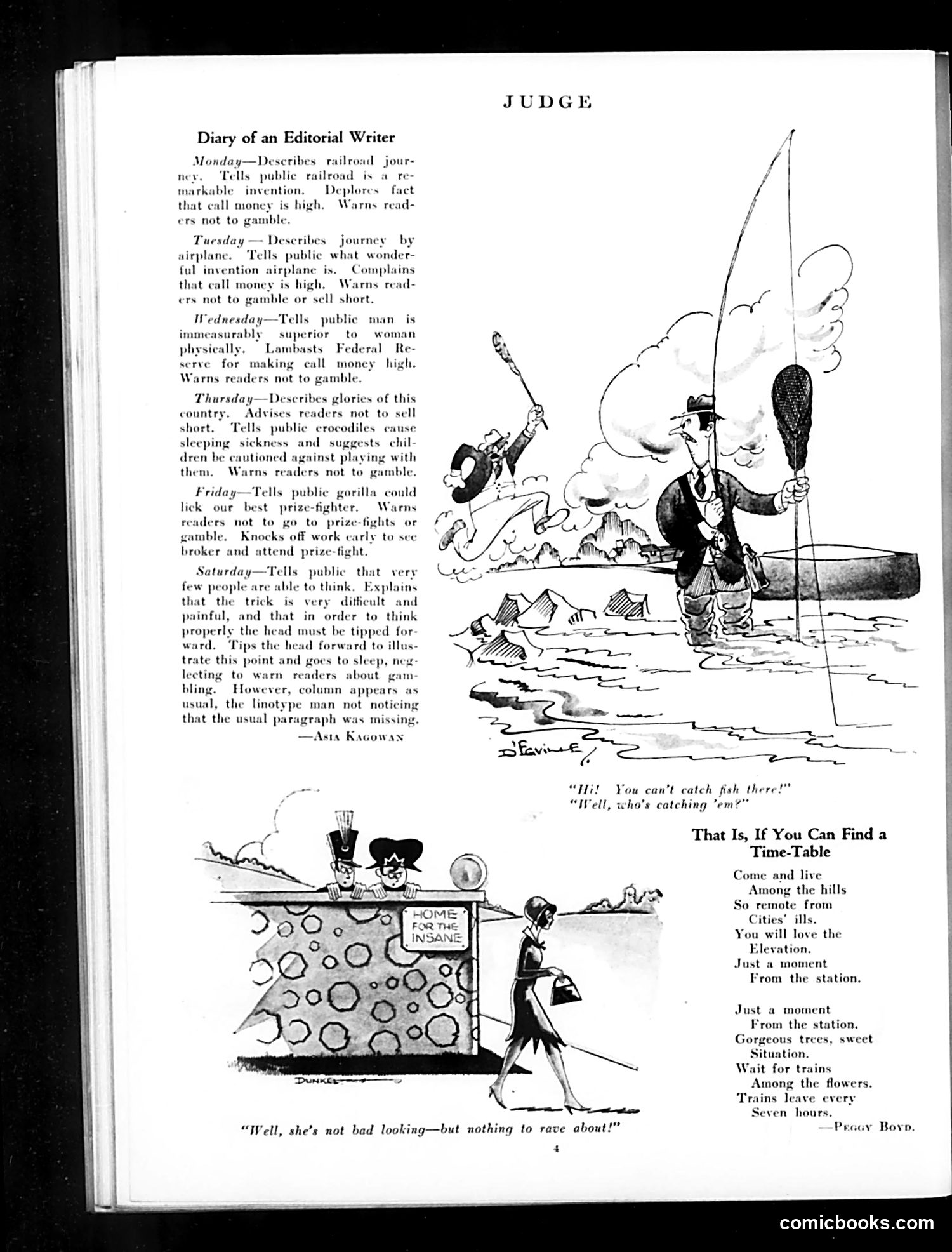
Judge Magazine Page Analysis This page satirizes an editorial writer's predictable weekly formula. "Diary of an Editorial Writer" mocks how such columnists recycled identical themes—warning readers against gambling and financial speculation while claiming moral superiority—regardless of actual events. The top cartoon depicts a fisherman catching fish, illustrating the writer's consistent message about avoiding "get-rich-quick" schemes. The bottom cartoon shows a "Home for the Insane," implying editorial writers lack independent thought. The accompanying poem "That Is, If You Can Find a Time-Table" advertises rural living as escape from cities—likely referencing early 20th-century back-to-nature trends. The humor lies in exposing editorial predictability: same warnings, same moral posturing, week after week, regardless of news.
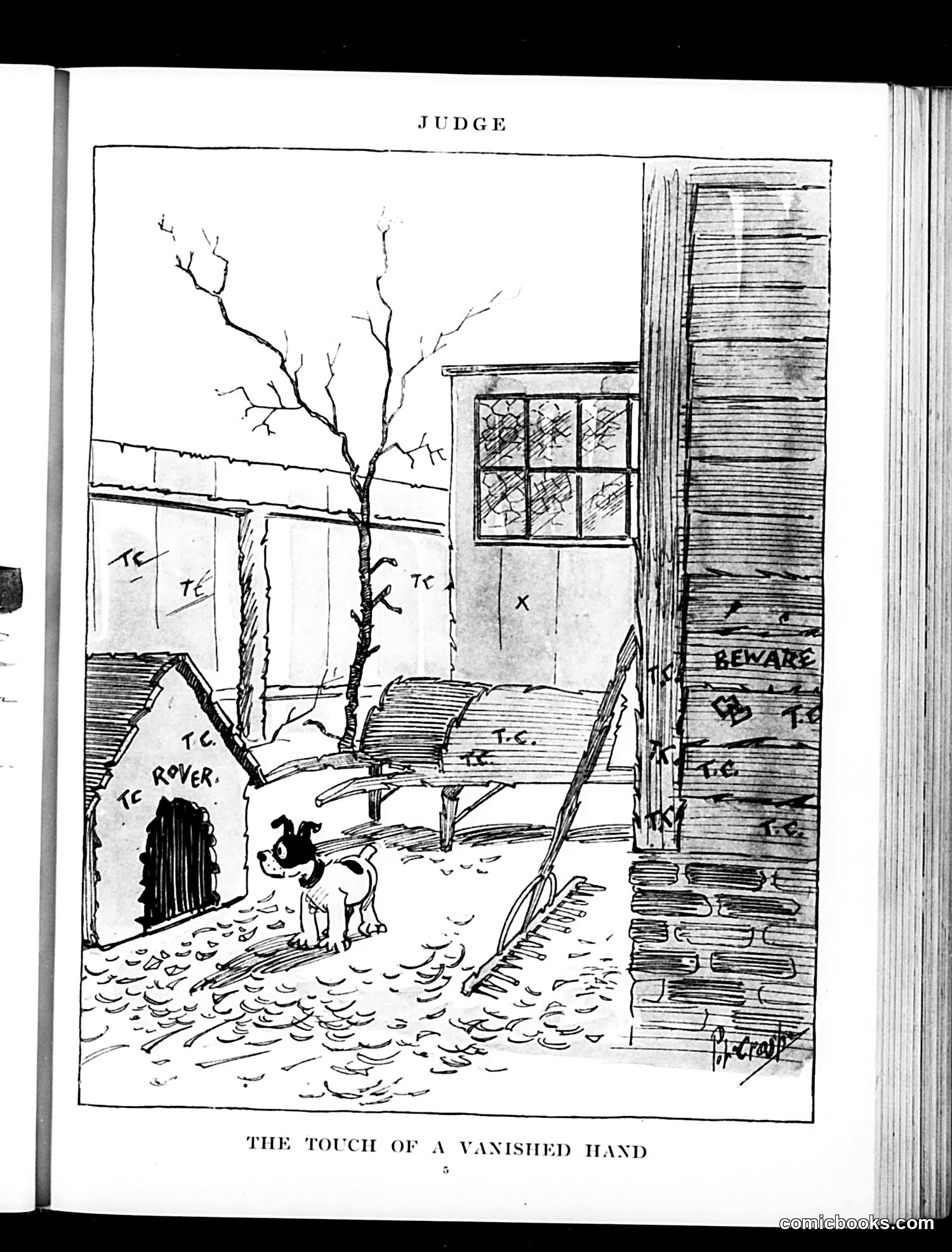
"The Touch of a Vanished Hand" This cartoon depicts a dog named Rover in a desolate courtyard, appearing to respond to or be touched by an invisible presence. The barren landscape—bare tree, boarded windows marked "BEWARE," empty benches—suggests abandonment or loss. The title "The Touch of a Vanished Hand" indicates the cartoon's subject is a supernatural or ghostly encounter. Without additional context from the magazine's date or accompanying text, the specific political or social reference remains unclear. The image could satirize spiritualism (popular in early 20th-century America), grief, loss of leadership, or possibly a departed public figure. The loyal dog's response to absence may comment on fidelity, memory, or longing for something lost.
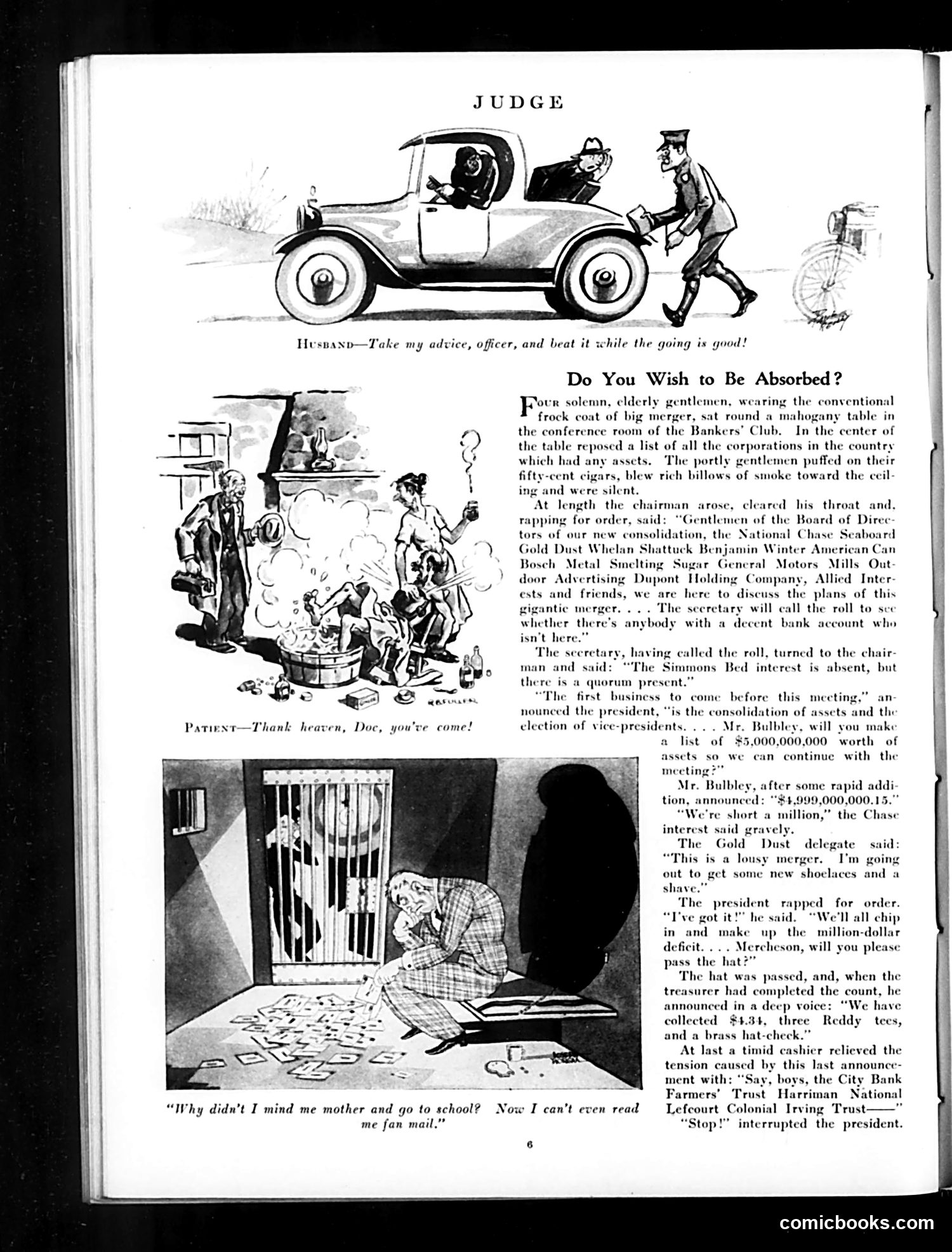
Analysis of Judge Magazine Page This page satirizes corporate consolidation in early 20th-century American business. The top cartoon mocks a husband seeking a police officer's help to escape his wife—a domestic humor setup. The main article "Do You Wish to Be Absorbed?" depicts elderly bankers at an exclusive club discussing a massive corporate merger involving major industrial companies (National Chase Seaboard, Gold Dust Whelan, Benjamin Moore, American Can, Bosch Metal Smelting, Sugar, General Motors, Mills, and others). The satire targets the merger mania of that era—the absurdly large consolidation, the focus on asset totals and deficit-filling rather than actual business value, and the casual tone of powerful industrialists casually reshaping the economy. The humor lies in treating gigantic financial machinations as casually as discussing a missing hat.
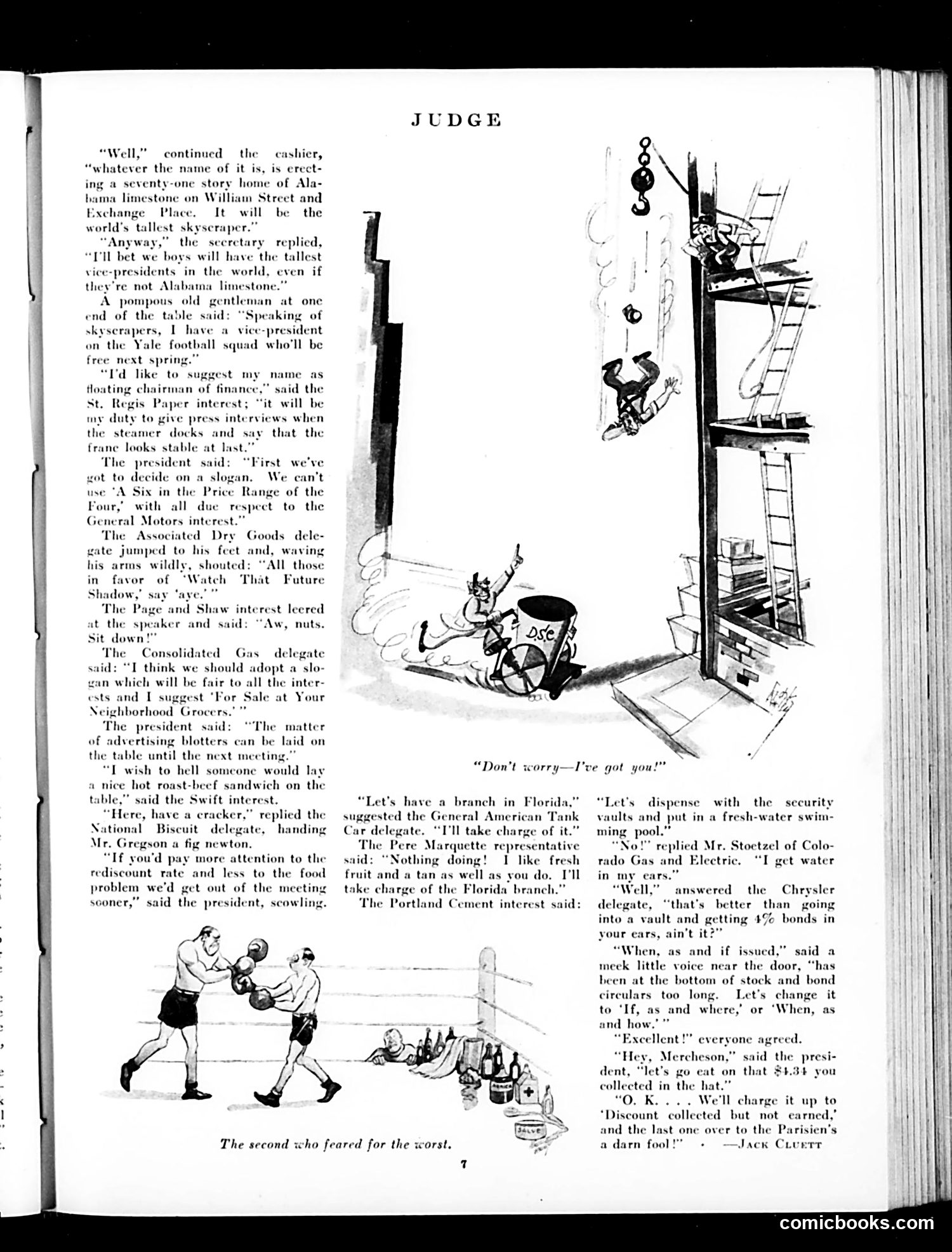
"Judge" Page Analysis: Corporate Satire of the 1920s This page satirizes corporate board meetings and advertising culture of the Jazz Age. The main text depicts executives from competing industries (General Motors, Associated Dry Goods, Consolidated Gas, Swift meat company, National Biscuit, Pere Marquette railroad, Portland Cement, Chrysler) meeting to decide on a building's slogan and advertising strategy. The satire targets how corporate interests constantly jockey for favorable publicity, each delegate promoting their own industry's image. The humor lies in their absurd suggestions ("Watch That Future Shadow") and their petty self-interest—they can't even feed themselves properly or agree on basic matters without each faction demanding recognition. The boxing illustration (captioned "The second who feared for the worst") is separate, likely unrelated political/sports commentary, though its exact reference is unclear from this page alone. The final exchange mocking accounting practices ("charge it to 'Discount collected but not earned'") suggests corporate financial manipulation and fraud—a common satirical target during this era of unregulated business practices.
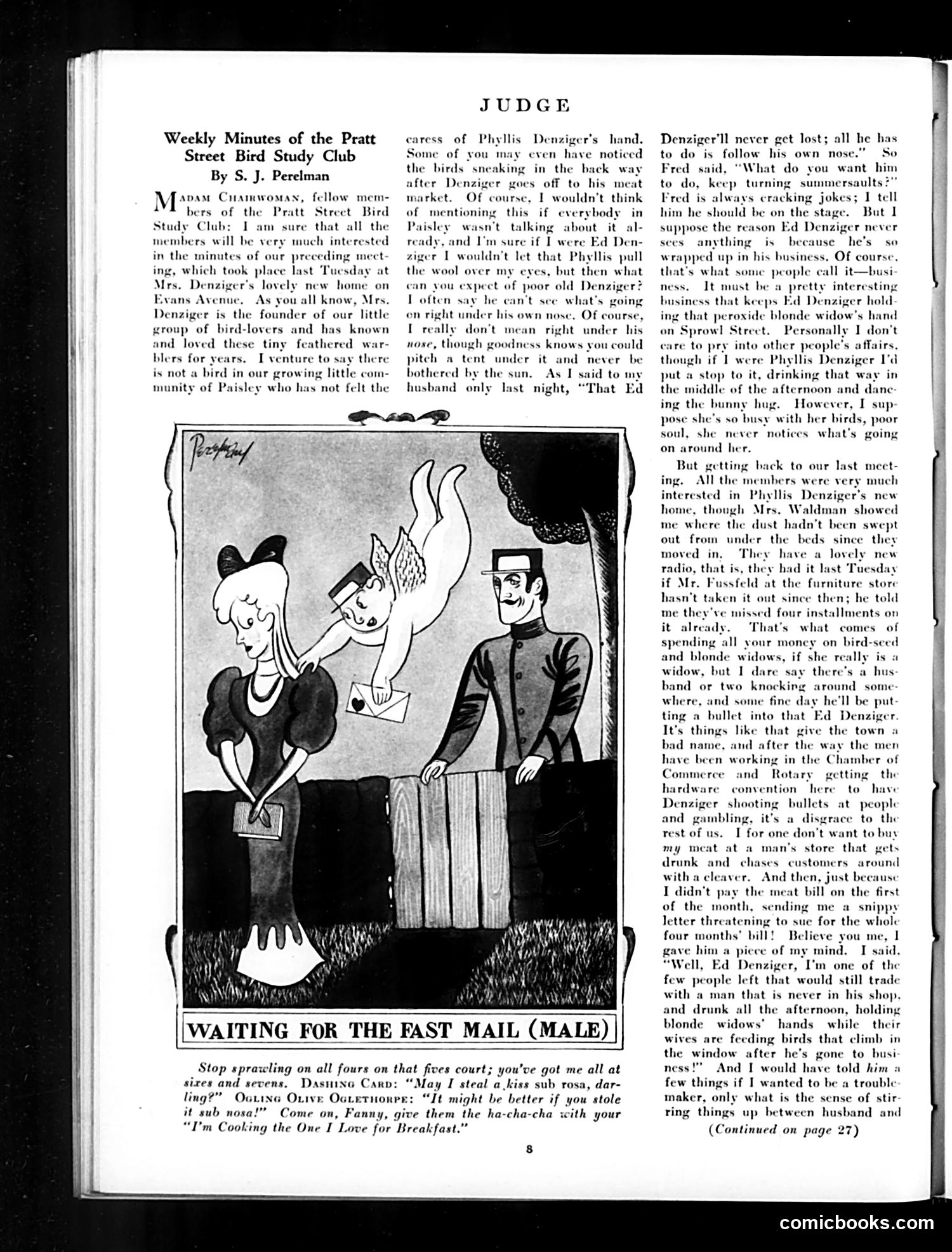
Explanation for Modern Readers This page presents S.J. Perelman's satirical "Weekly Minutes" of a bird-watching club meeting. The cartoon depicts a gossipy woman speaking to a man in formal attire, likely representing the club's secretary reporting minutes. The satire targets small-town social hypocrisy and petty gossip. Under the guise of discussing a bird study club meeting at Mrs. Denziger's home, the narrator launches into vicious character assassination: questioning Mrs. Denziger's husband Ed's fidelity with a "peroxide blonde widow," mocking her housekeeping, criticizing their unpaid furniture installments, and attacking a local butcher for aggressive debt collection. The humor lies in the contrast between the innocent topic (bird-watching) and the narrator's relentless, catty attacks on her neighbors' finances, appearances, and moral conduct. Perelman satirizes how small communities use social organizations as covers for spreading damaging gossip while maintaining a veneer of respectability. The detailed nature of the attacks—specifics about unpaid bills and alleged affairs—parodies how thoroughly gossips document others' failings.
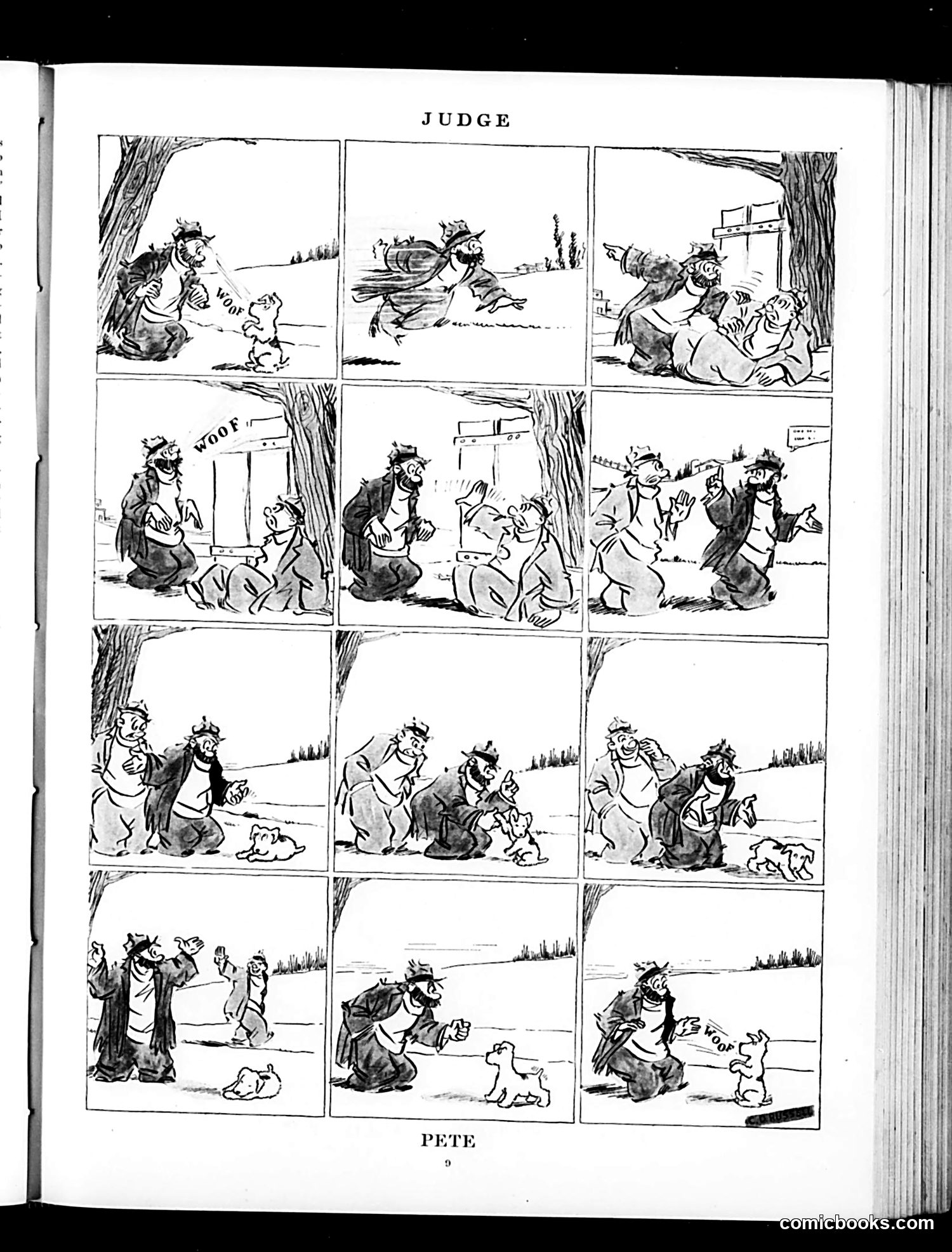
"Judge" Page Analysis: "Judge" and "Pete" This appears to be a multi-panel comic strip titled "Judge" at the top and "Pete" at the bottom, likely referring to a character name rather than a specific political figure. The narrative follows what seems to be an authority figure (the "Judge," depicted with exaggerated features suggesting caricature) interacting with a small child or young person named Pete. The progression shows the Judge attempting various forms of discipline or instruction—initially stern, then increasingly frustrated or physical—while Pete remains unresponsive or mischievous. The satire likely critiques ineffective parenting, judicial authority, or disciplinary methods of the era. Without clearer context about publication date or specific references, the precise political/social commentary remains unclear, though it appears to mock both the authority figure's methods and the child's defiance.
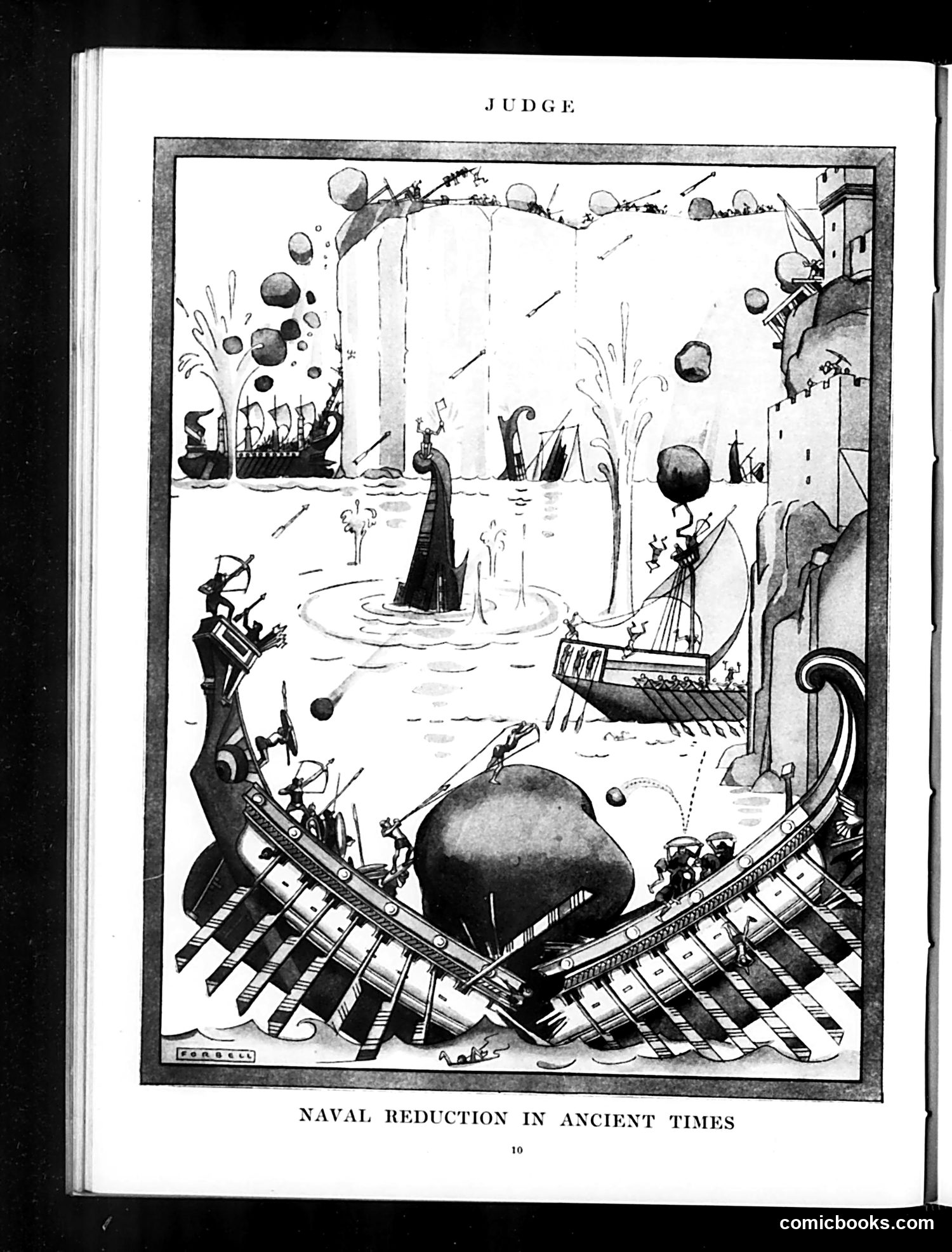
Naval Reduction in Ancient Times This satirical cartoon depicts warships from an ancient civilization engaged in naval combat in shallow waters. The image shows vessels with heavy military fortifications actively attacking each other—soldiers man the decks firing weapons while large spherical projectiles (cannonballs) splash into the water and arc through the air. The caption's irony is the key: it's titled "Naval Reduction in Ancient Times," but depicts *escalating* naval warfare with substantial destruction. This likely satirizes contemporary political debates about military spending and naval reduction. The cartoon suggests that proposed "reductions" in military budgets would paradoxically lead to more conflict or less effective defense—a commentary on disarmament advocates or pacifist policies of Judge magazine's era (likely early 20th century).
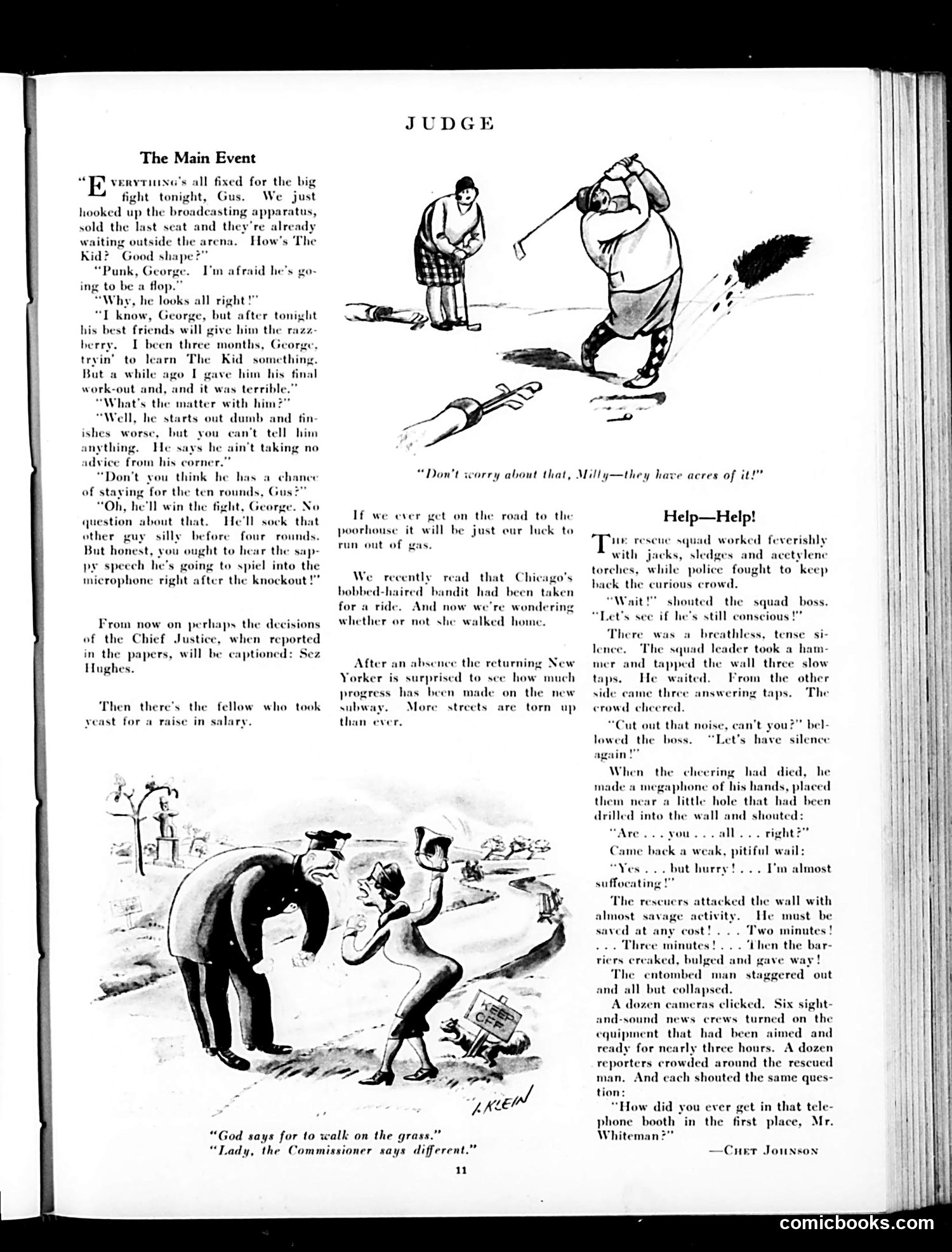
"Judge" Page Analysis This page contains three satirical pieces typical of Judge magazine's humor: "The Main Event" discusses a boxing match broadcast, mocking both the fighter (portrayed as dim-witted) and anticipating the inevitable embarrassing speech he'll make into the microphone after winning. The joke plays on early radio broadcasting's novelty and the contrast between physical prowess and verbal incompetence. Brief social commentary includes jokes about a Chicago "bobbed-haired bandit" (a 1920s criminal type), New York City subway construction, and a quip about the Chief Justice's decisions being reported like boxing commentary. "Help—Help!" satirizes the era's obsession with telephone booths as confined spaces, depicting a dramatic rescue operation. The punchline—reporters asking how the man got trapped in a phone booth—mocks both sensationalist journalism and the absurdity of the situation itself. The cartoons use exaggerated caricature and slapstick humor typical of 1920s-era satirical magazines targeting urban, middle-class readers.
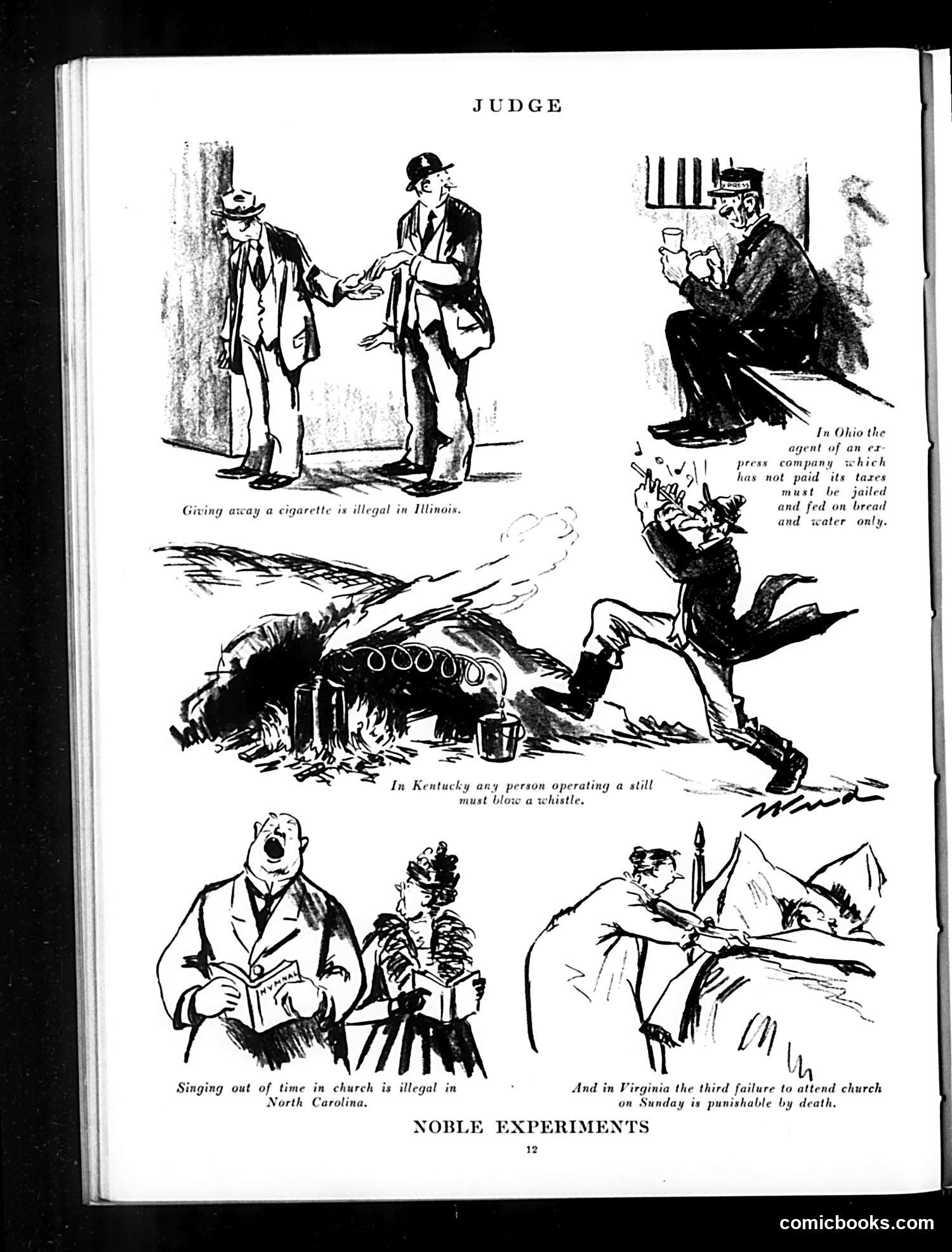
"Noble Experiments" - Judge Magazine Satire This page satirizes absurd or archaic state laws through mock-serious illustration. Each panel presents a ridiculous legal requirement from different U.S. states: - Illinois: Making cigarette-giving illegal - Ohio: Jailing and bread-watering a tax-delinquent express agent - Kentucky: Requiring still operators to blow whistles - North Carolina: Criminalizing off-key church singing - Virginia: Death penalty for third church-absence offense The title "Noble Experiments" likely mocks Prohibition-era legislative overreach and state-level moral regulation. The cartoons use exaggerated, comedic illustrations to ridicule what the magazine presents as excessive or nonsensical state intervention in private conduct and religious practice. The satire targets both the laws themselves and the impulse toward strict legal enforcement of morality and behavior.
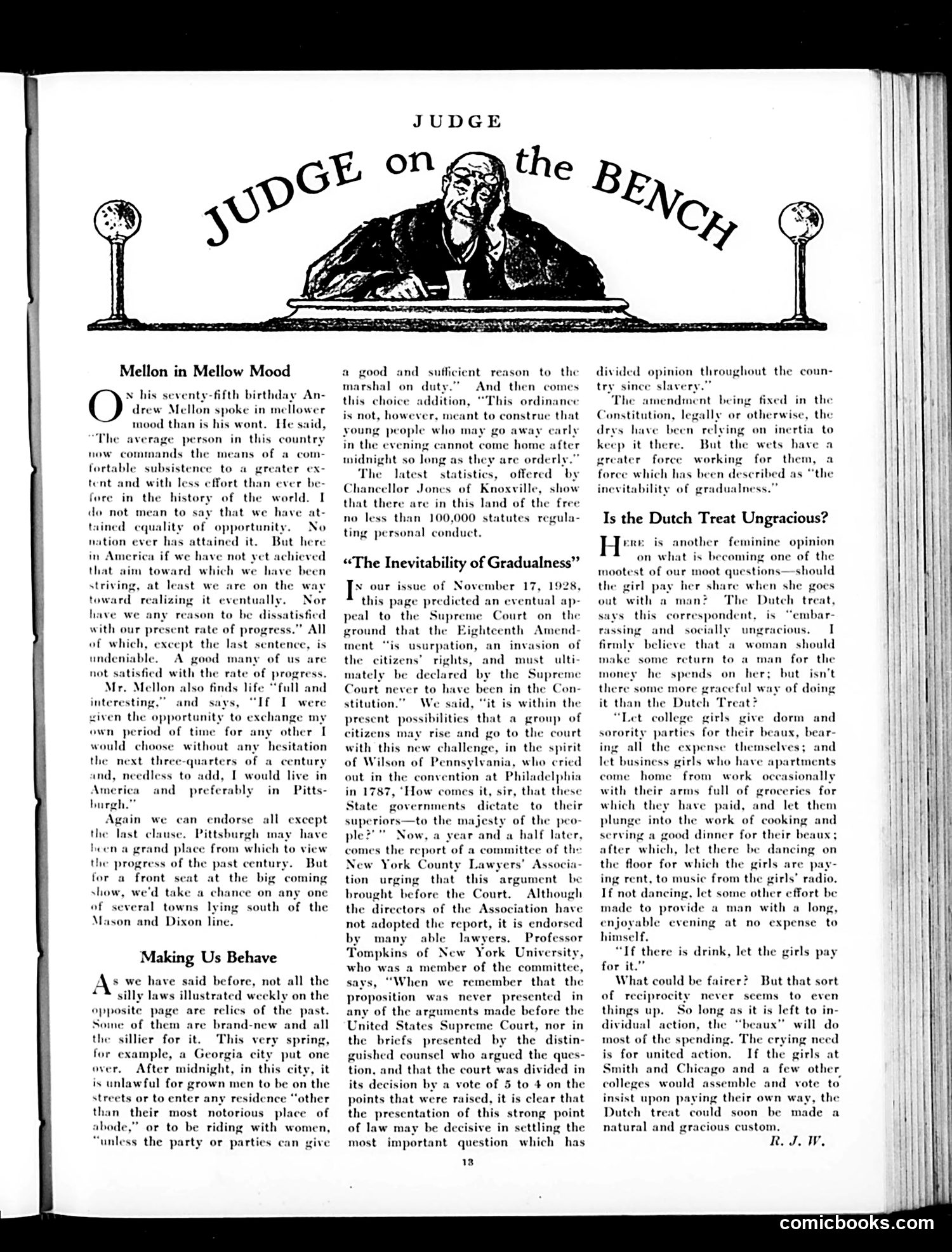
Judge Magazine Page Analysis This page from Judge presents three satirical columns about contemporary American issues circa 1928-1929: "Mellon in Mellow Mood" mocks Treasury Secretary Andrew Mellon's optimistic seventy-fifth birthday speech claiming America offers unprecedented opportunity and prosperity. The satire notes that while Mellon endorses his own rosy assessment, readers shouldn't accept his praise of Pittsburgh—the implication being that wealthy industrialists like Mellon benefit from the current system while ordinary Americans disagree about progress. "Making Us Behave" ridicules absurd local laws regulating personal conduct, particularly a Georgia ordinance restricting grown men's evening movements and association with women after midnight. The satire highlights how legislatures pass hundreds of thousands of silly regulations under the guise of moral governance. "The Inevitability of Gradualness" discusses a potential Supreme Court challenge to Prohibition (the Eighteenth Amendment), predicting its eventual overthrow based on a previously unraised constitutional argument about federal overreach—a prescient prediction given Prohibition's repeal in 1933.
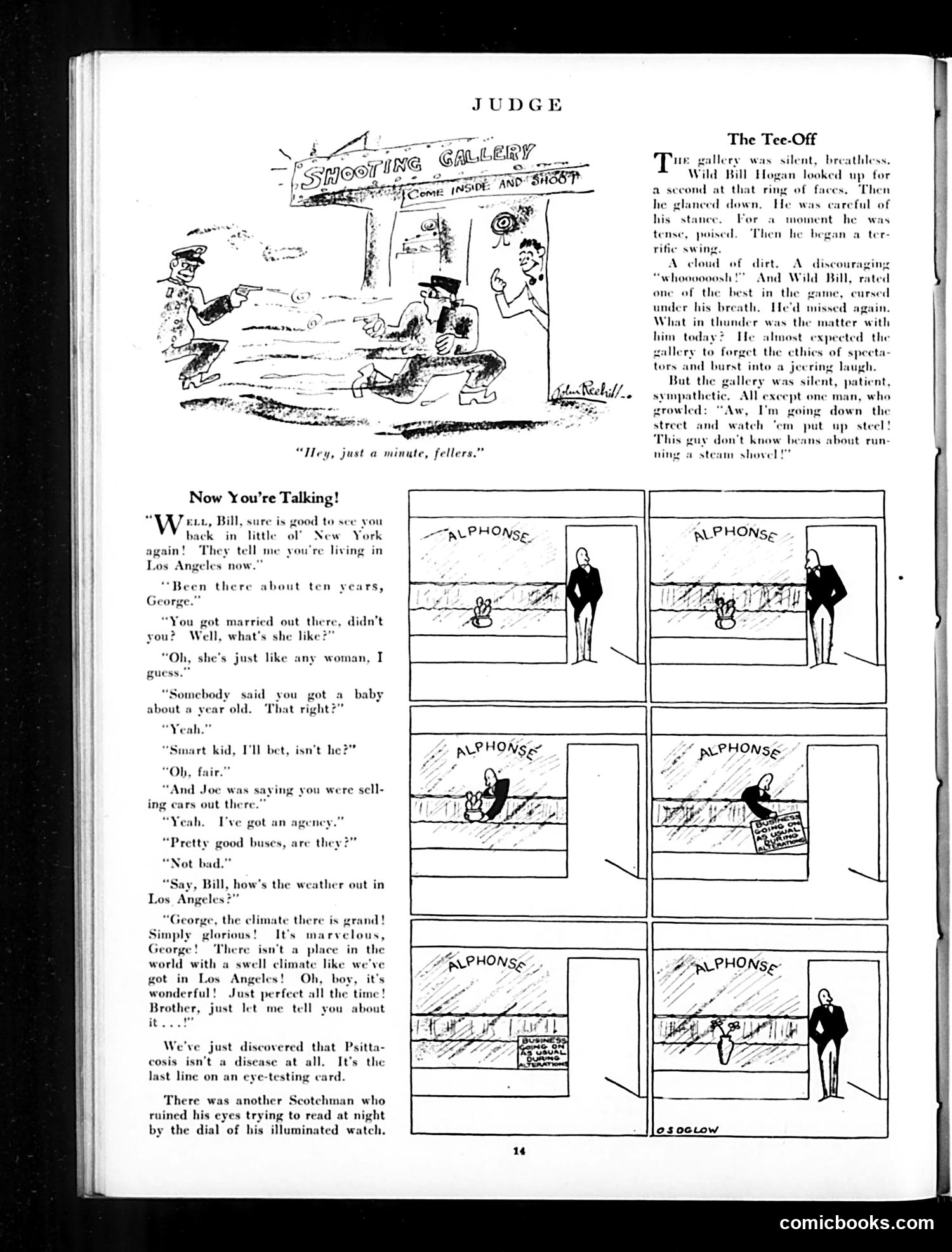
Analysis: "Judge" Magazine Page "The Tee-Off" (top): A golf cartoon satirizing Wild Bill Hogan's missed shot. The gallery of spectators maintains polite silence—except one man who rudely announces he's leaving to watch steel construction instead. The joke mocks the spectator's crude indifference to sporting etiquette and suggests golf audiences contain uncultured individuals. "Now You're Talking!" (bottom): A dialogue between two men—one recently returned from Los Angeles. The New Yorker asks standard questions; Bill enthusiastically praises LA's climate in exaggerated terms ("marvelous," "glorious," "perfect"). The satire targets Californians' obsessive boasting about their weather and lifestyle superiority—a recognizable complaint about LA transplants even in this era. Other jokes: Brief quips mock psittacosis (a disease), eye-testing, and a Scotsman's penny-pinching (reading by watch dial light rather than buying a lamp). The page exemplifies *Judge's* satirical approach: mild social commentary on manners, regional stereotypes, and contemporary American life.
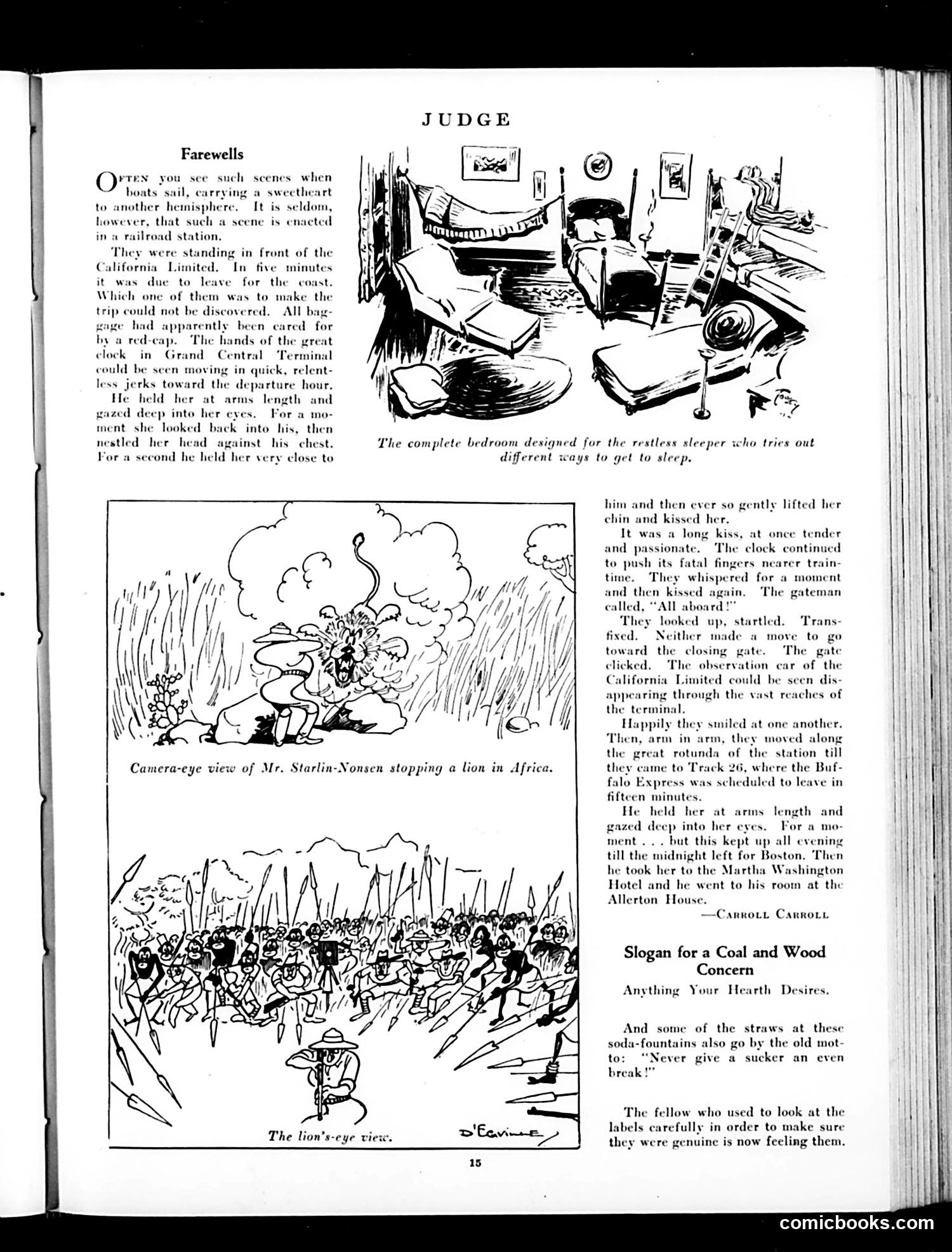
Analysis for Modern Readers This page contains a romantic short story titled "Farewells" about a couple saying goodbye at Grand Central Terminal before one boards a train to California. The humor lies in the twist: they're so absorbed in kissing that they miss the California Limited entirely. Rather than separating, they simply repeat the emotional farewell scene at another track (the Buffalo Express leaving later that night), creating a cycle of prolonged goodbyes. The accompanying illustrations show humorous sketches: one depicts a man stopping a lion in Africa (captioned as "Camera-eye view"), and another shows the lion's perspective in return—visual gags unrelated to the main story. The bottom section contains two brief unrelated items: an advertisement slogan ("Anything Your Hearth Desires") and a quip about label-checking. The page exemplifies Judge's characteristic blend of sentimental romance and gentle comedic deflation.
Judge Magazine: "Judging the Shows" This is a theater review column by George Jean Nathan critiquing Broadway productions. The page contains no political cartoons—it's primarily text discussing recent theatrical performances. Nathan sarcastically reviews several plays: Mann Page's "House Afire" (which he finds absurdly plotted—a woman burns her suburban home to move to New York for opera and plays), Maurice Chevalier's brief Fulton Theatre engagement (praising Chevalier but mocking the thin material), and "Broadway Shadows" at the Belmont Theatre (dismissing it as incomprehensible nonsense). The humor is theatrical criticism—Nathan employs witty complaints about budget-conscious productions, weak scripts, and audience taste. He jokes about hat-stealing during intermission and compares Chevalier's talent favorably to Duke Ellington's jazz band, concluding the review continues on page 29.
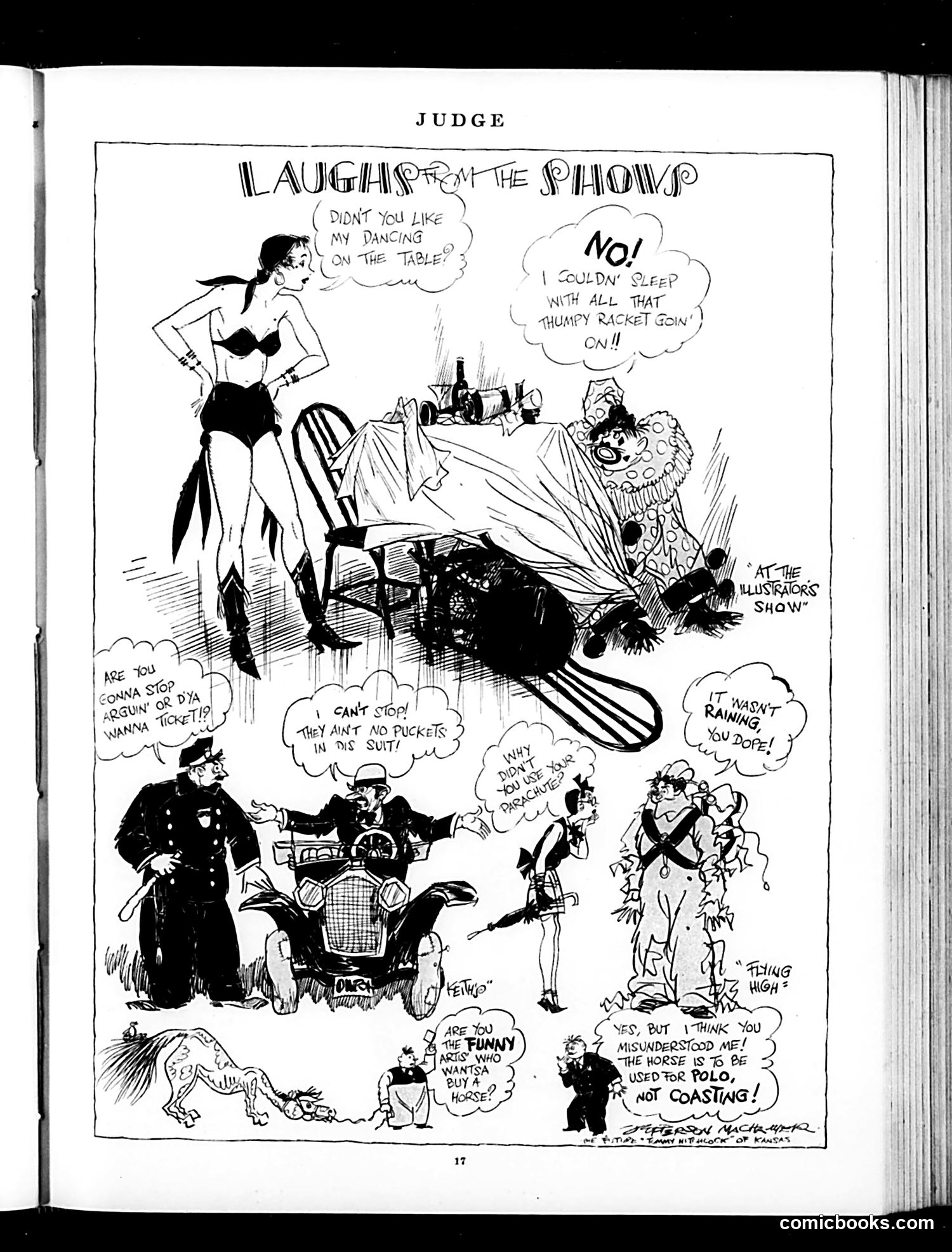
"Laugh at the Show" — Judge Magazine Cartoon This is a satirical cartoon mocking various circus and vaudeville performers at "The Illustrators' Show." The humor derives from a series of comedic misunderstandings and complaints: A woman performs table-dancing; a sleepy audience member objects to the noise. A policeman confronts a performer about costume pockets (suggesting indecency). Other characters debate whether a horse should be used for "polo" or "coasting" (sledding)—apparently someone misunderstood its purpose. The cartoon ridicules both the performers' questionable talents and the audience's complaints, capturing early 20th-century attitudes toward vaudeville entertainment. The crude caricatures and exaggerated dialogue typify Judge magazine's style: satirizing popular culture through absurdist humor and visual comedy. The specific performers or event referenced remains unclear without additional context.
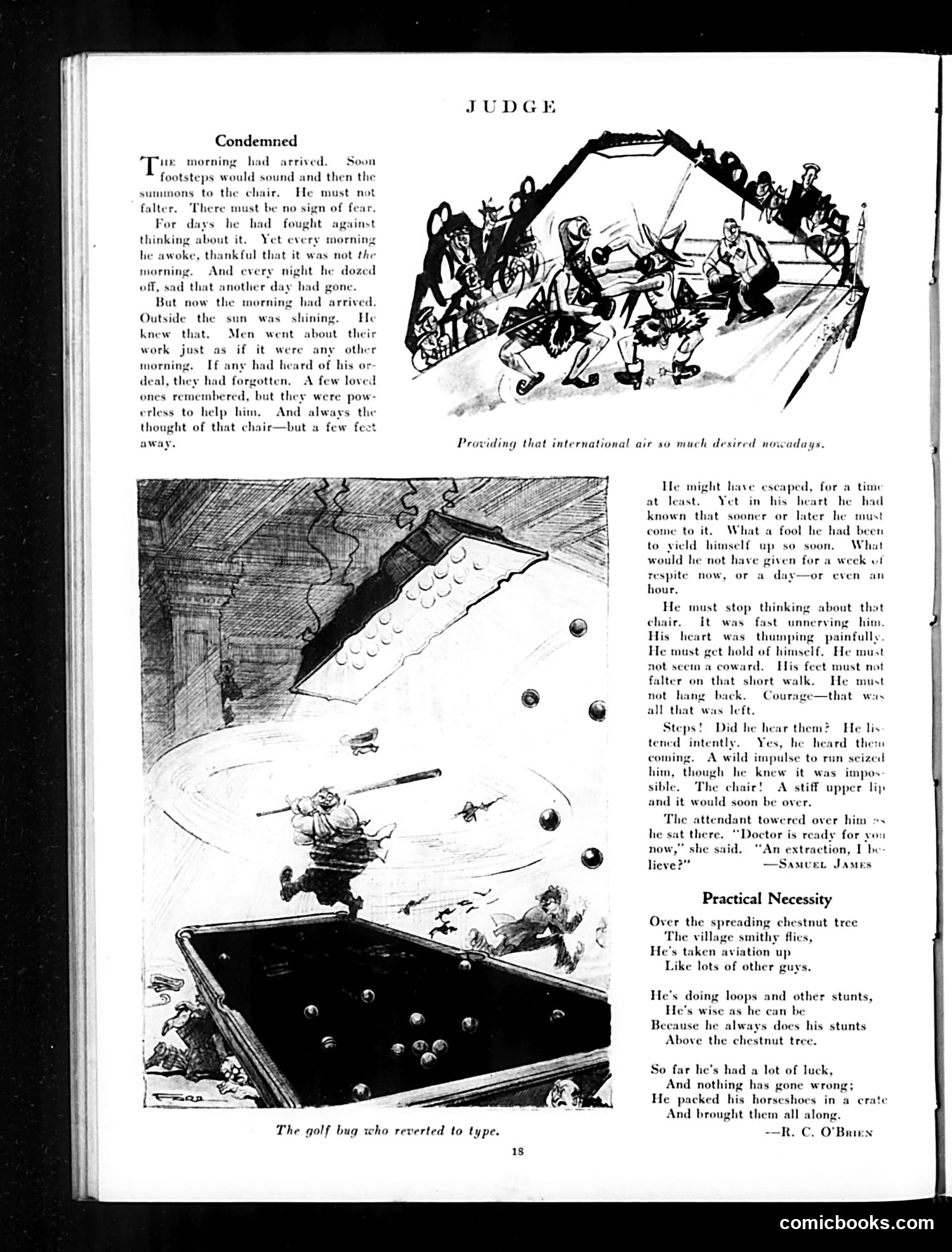
Page Analysis: Judge Magazine This page contains two unrelated pieces of humor: "Condemned" is a dramatic short story about a man facing execution in an electric chair—building suspense about his final morning. The twist ending reveals he's actually at a dentist's office awaiting tooth extraction, not capital punishment. The humor relies on misdirection: readers expect a death-row narrative but get a mundane dental appointment instead. "Practical Necessity" (with accompanying cartoons) satirizes aviation crazes of the early 20th century. The village blacksmith—traditionally associated with grounded, practical work—has taken up stunt flying. The joke suggests aviators must perform dangerous loops above trees to justify the impracticality of their hobby. The reference to "horseshoes in a crate" is unclear but appears to relate to good luck superstitions or practical precautions. Both pieces mock contemporary anxieties: fear of modern medicine and the period's fascination with risky aviation trends.
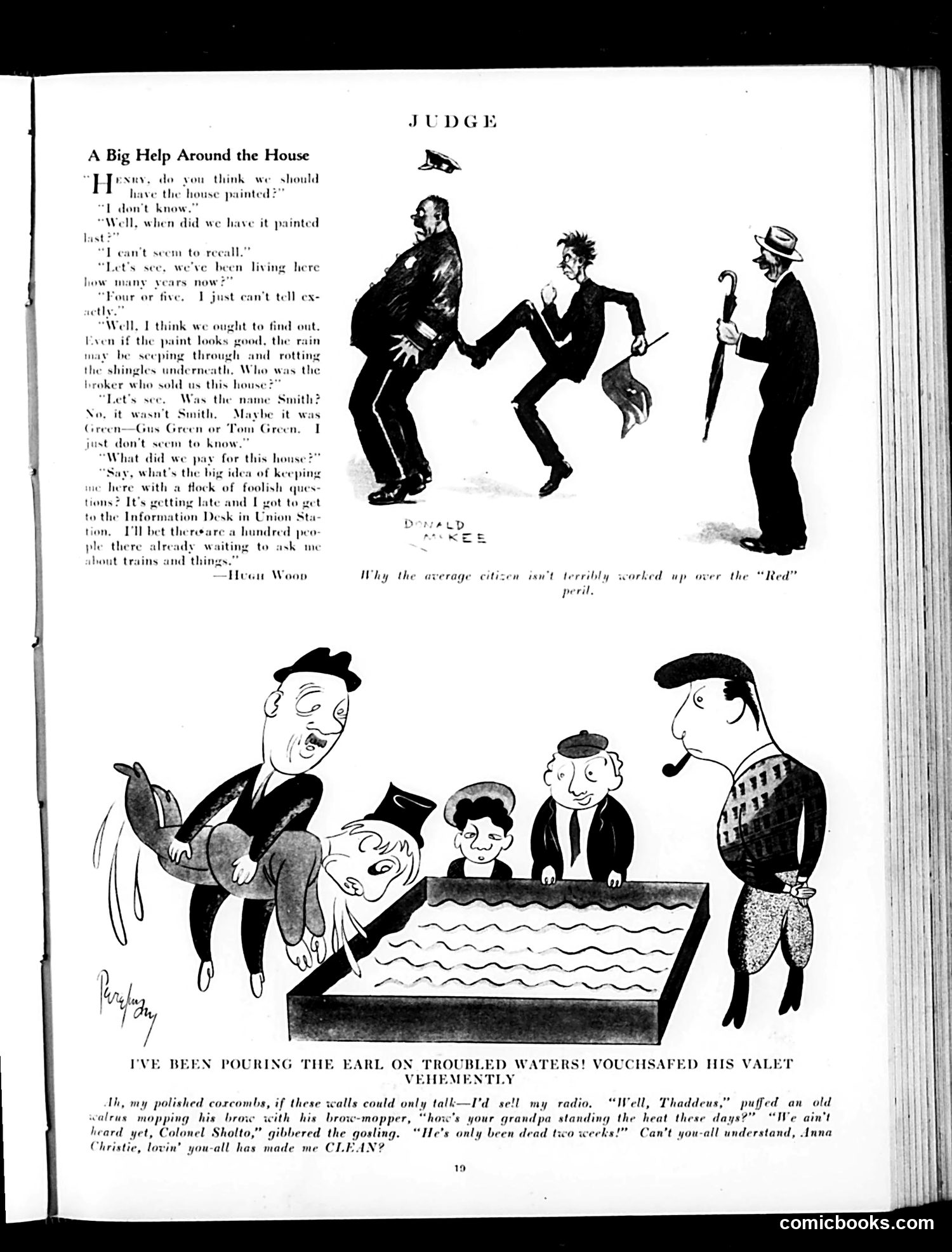
Explaining This Judge Magazine Page This page contains two satirical cartoons about domestic incompetence and class dynamics: "A Big Help Around the House" (top): A husband cannot recall basic facts about his own home—when it was painted, by whom, what they paid. The wife grows frustrated as he delays her with ignorant questions while she needs information. The satire targets husbands' domestic uselessness and detachment from household management. "I've Been Pouring the Earl on Troubled Waters" (bottom): A valet boasts to other servants about managing his aristocratic employer (an "Earl"). The lower-class servant positions himself as indispensable to maintaining the nobleman's composure and appearance. The satire mocks both the pretentious upper-class employer and the servant's inflated sense of importance in that relationship. Both cartoons use humor to expose gender and class dynamics: wives handling real problems while husbands deflect, and servants secretly controlling their "betters." The magazine's satirical approach critiques social hierarchies by revealing incompetence and dependency beneath surface status.
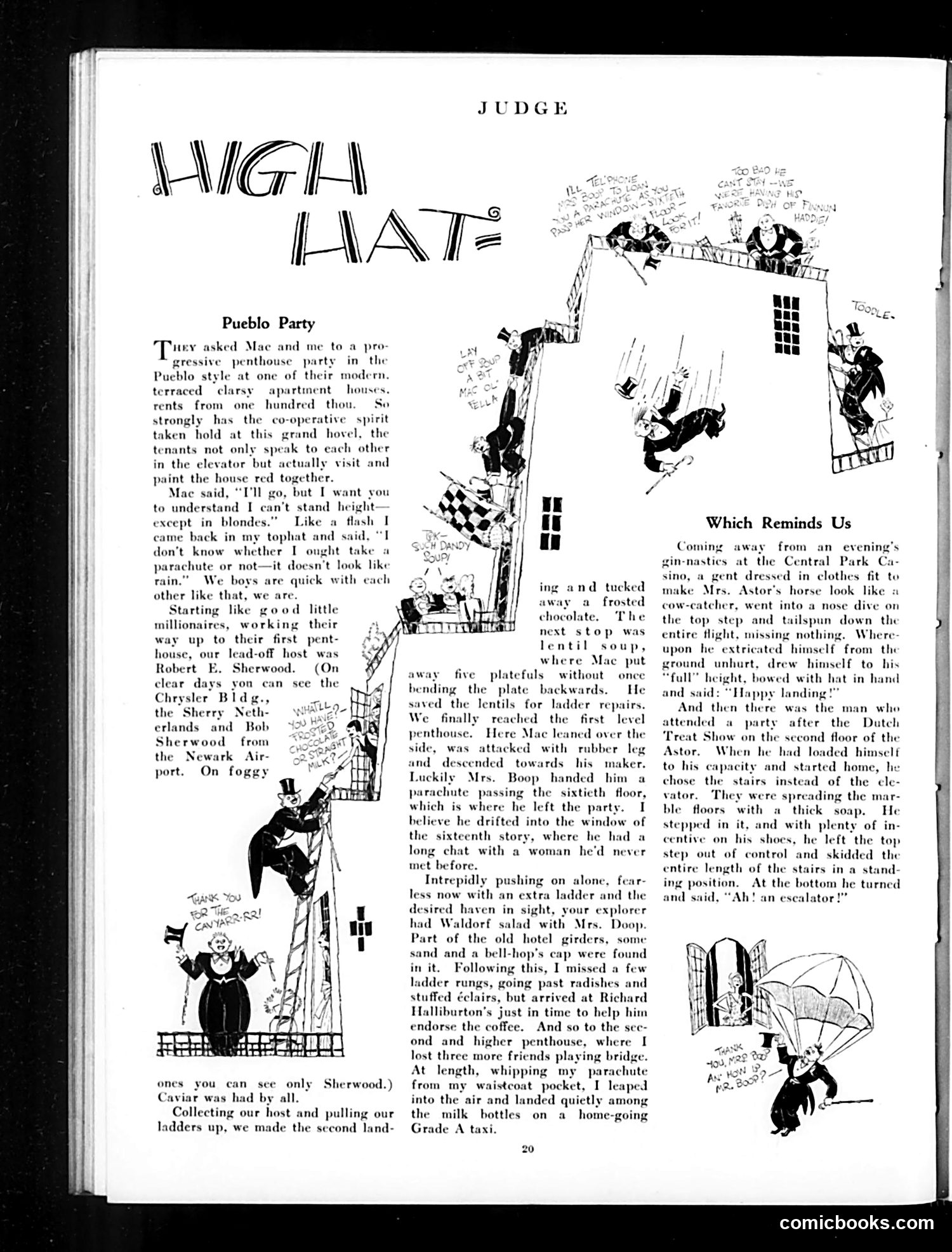
"High Hat" - Judge Magazine Satire This piece satirizes 1920s Manhattan high society and the nouveau riche "penthouse culture" phenomenon. The narrator and "Mac" attend a progressive Pueblo-style penthouse party hosted by Robert E. Sherwood (a real playwright/wit of the era), climbing through multiple penthouses via ladders in a surreal, escalating sequence. The satire targets: 1. Social climbing: Working-class millionaires aspiring to sophistication while remaining ridiculous 2. Penthouse obsession: The era's fascination with ultra-high apartment living 3. Forced casualness: Wealthy people performing ease and wit while behaving absurdly 4. Geographic one-upping: References to landmarks visible from high altitudes mock status-consciousness The cartoon's visual humor shows people literally climbing building exteriors, with one guest deploying a parachute mid-party—an absurdist commentary on the precariousness of maintaining upper-class pretense. The accompanying anecdote about men falling down stairs while drunk reinforces the theme: even the wealthy are ridiculous, their dignity illusory.
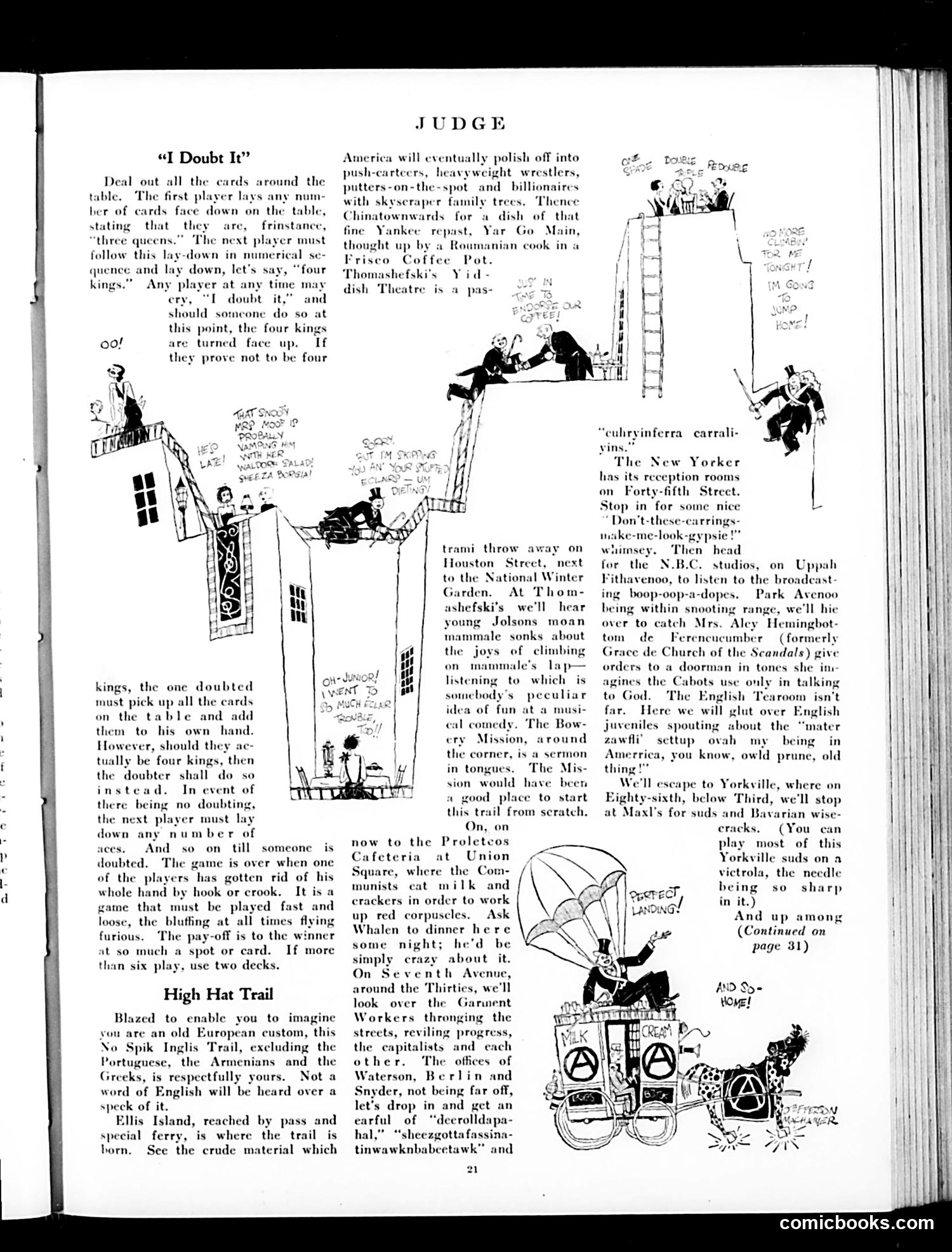
Analysis of Judge Magazine Page This page satirizes New York City's immigrant neighborhoods and working-class culture through two pieces: "I Doubt It" is simply a card game explanation—not satirical content. "High Hat Trail" is the actual satire. It's a mock-tour of immigrant enclaves, written in exaggerated dialect and condescending language. The narrator describes a journey starting at Ellis Island (where immigrants arrived) through: - Chinatown and Yiddish theater districts (mocking Eastern European Jewish immigrants) - The Bowery and communist gathering spaces (satirizing radical labor organizers) - Garment workers on Seventh Avenue (depicted as "reviling progress") The satire works through linguistic mockery—representing immigrant speech as incomprehensible gibberish ("sheezgottafassinatinwawknbabeetawk"). The tone is patronizing: immigrants are portrayed as crude raw material America will "polish off" into respectable citizens. This reflects 1920s elite anxiety about immigration and labor radicalism. The piece ridicules both immigrant cultures *and* the Marxist politics emerging in working-class neighborhoods, presenting them as equally foreign and ridiculous to the magazine's presumed educated, native-born audience.
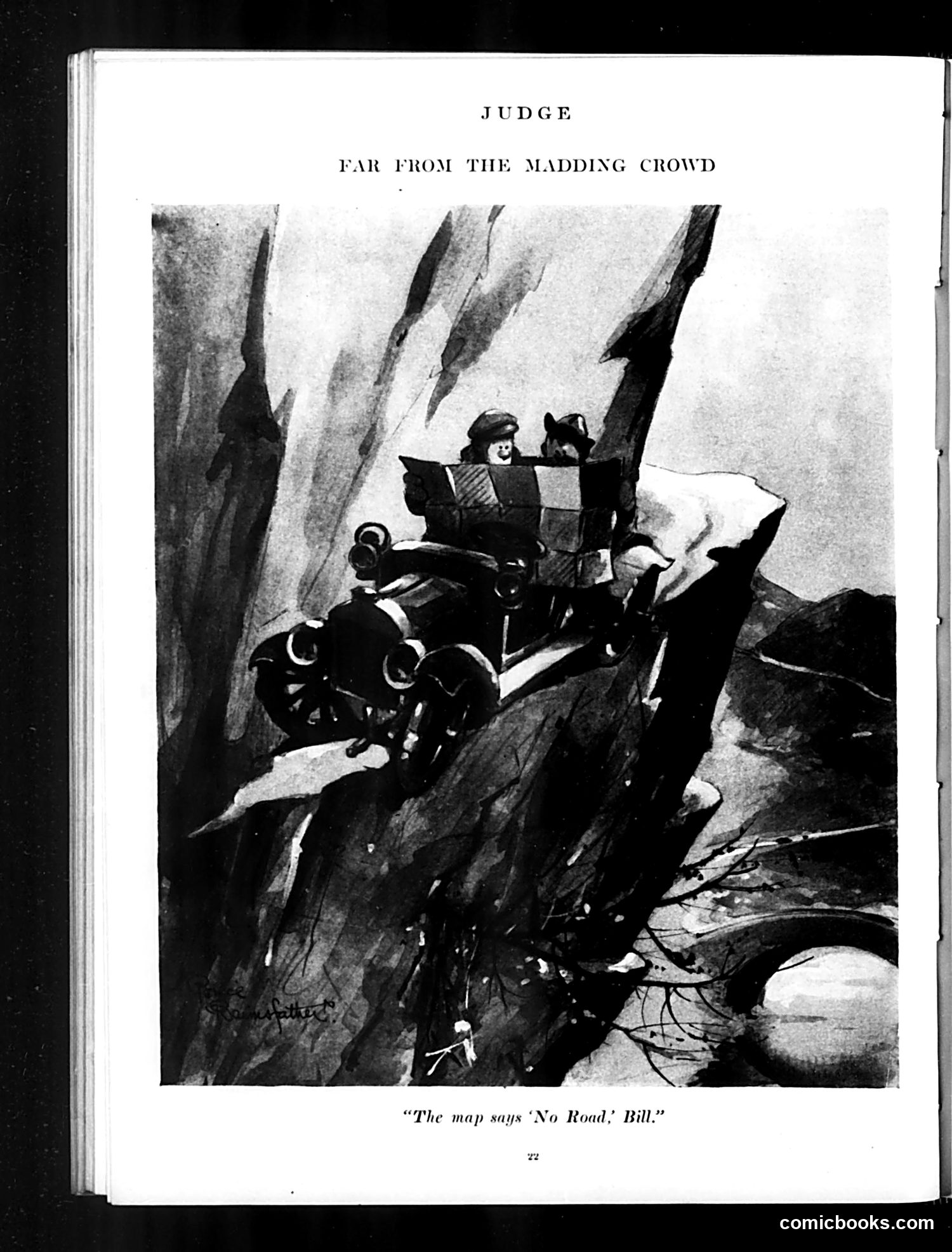
Analysis This cartoon depicts two figures in an early automobile navigating treacherous, rocky terrain. The caption—"The map says 'No Road, Bill'"—suggests they're following outdated or unreliable directions despite obvious obstacles ahead. The satire likely comments on early automobile culture and the unreliability of road maps in the early 20th century, when car travel was still novel and infrastructure poorly documented. The "madding crowd" reference (from Thomas Hardy) suggests these adventurers have ventured far from civilization into wilderness. The humor derives from the drivers' blind faith in their map despite clear visual evidence they shouldn't proceed. This mocks both the limitations of early automotive navigation aids and perhaps the obstinate optimism of early motorists who believed technology and printed guides would solve all travel challenges.
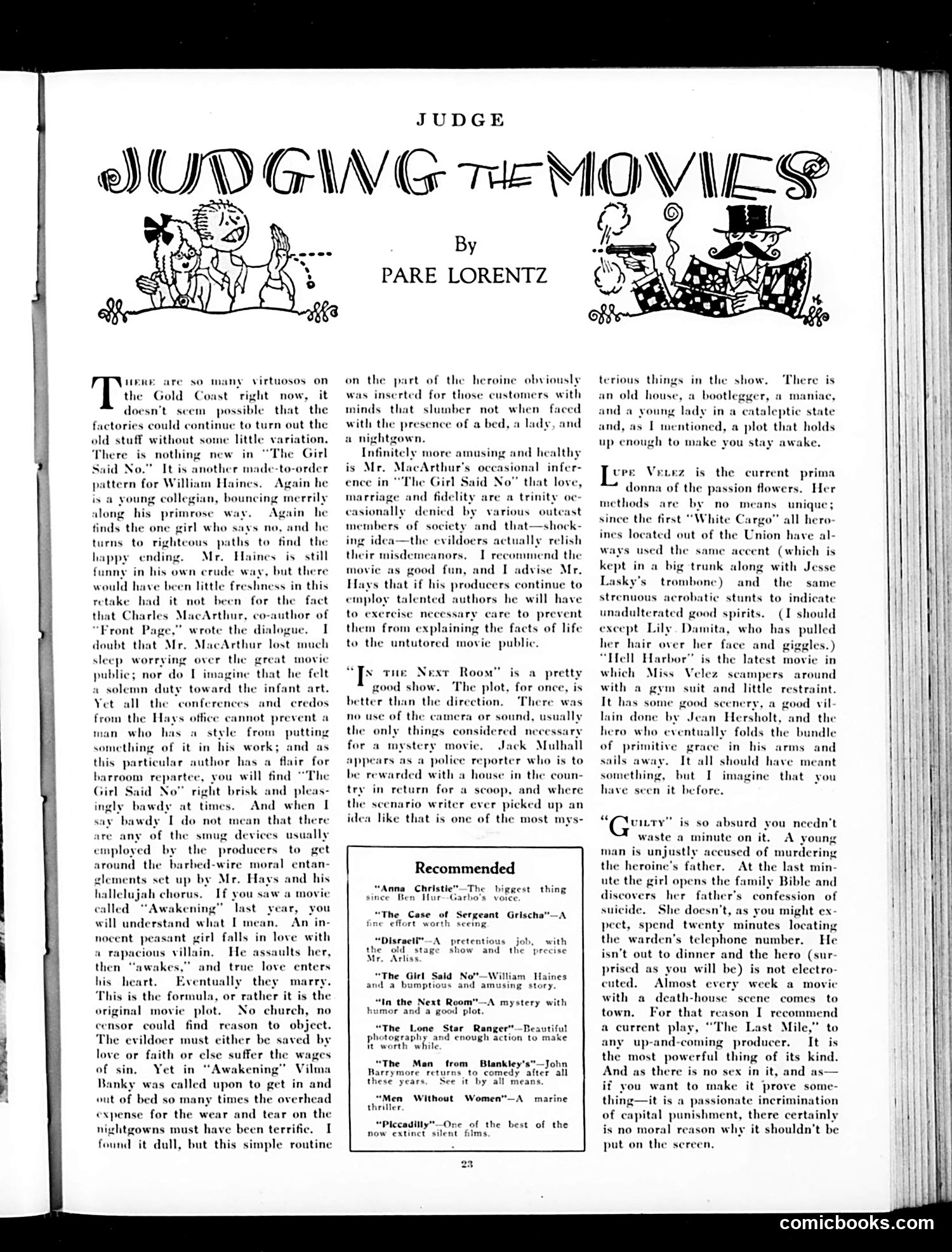
"Judging the Movies" by Pare Lorentz — Judge Magazine Film Review This is a film criticism column reviewing contemporary movies, likely from the late 1920s. The reviewer discusses William Haines comedies and other silent films, critiquing their plots and moral content. Key references: - "The Girl Said No" (Haines vehicle) — criticized for recycling formulaic "reformed villain" plots, though praised for dialogue by MacArthur - The Hays Office — the film industry's censorship body, mocked for restricting content while producers use visual tricks (like excessive bed scenes in "Awakening" with Vilma Banky) to titillate audiences anyway - MacArthur — likely Charles MacArthur, a respected playwright whose involvement elevates the film - Jack Mulhall, Greta Garbo — contemporary stars mentioned The satire targets Hollywood's hypocrisy: strict moral codes enforced by censors coexist with suggestive visuals designed to circumvent them. The reviewer advocates for honest storytelling over prudish pretense—a progressive stance for 1920s film criticism.
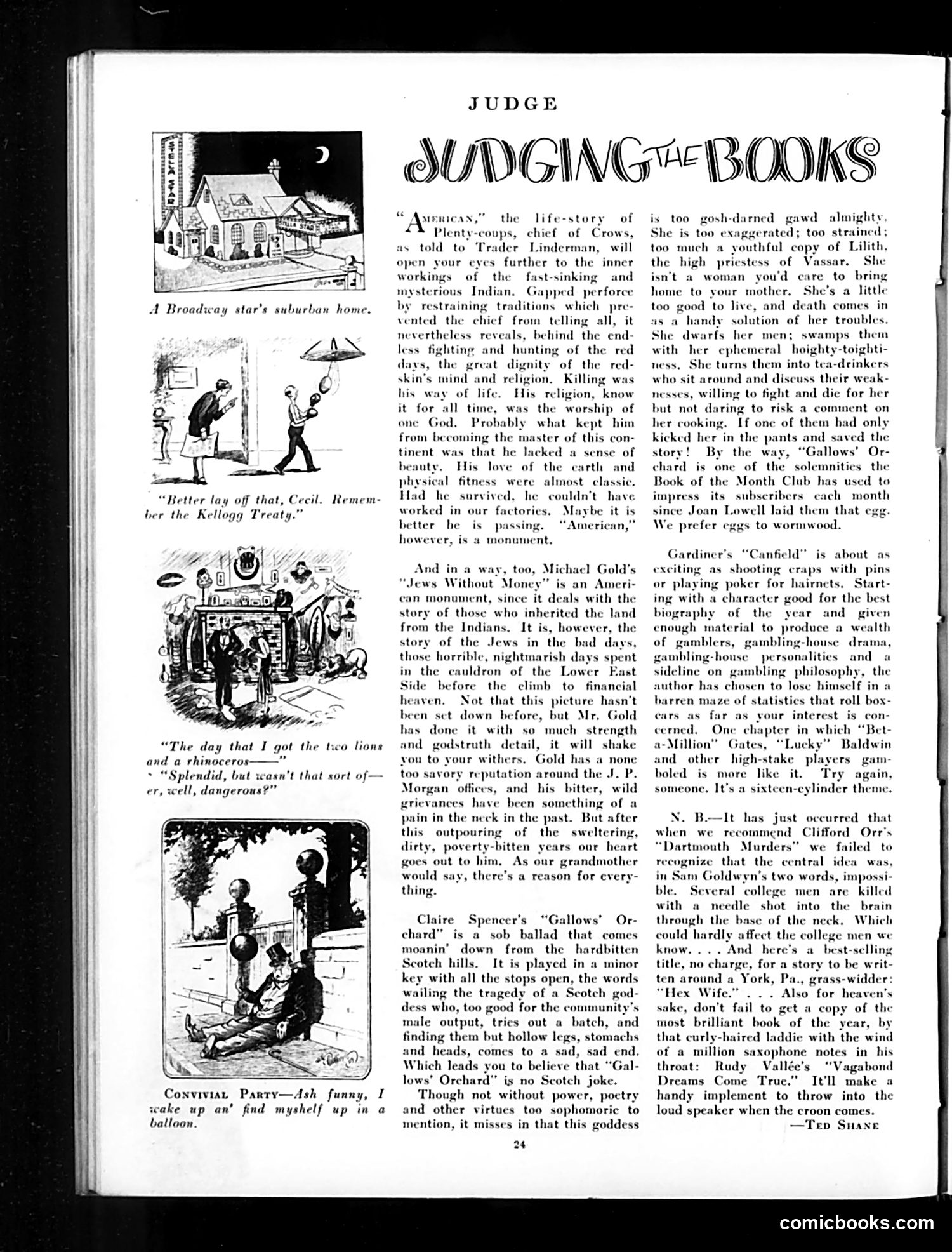
Judging the Books: Understanding Judge Magazine's Book Reviews This page contains book reviews illustrated with satirical cartoons. The top cartoons mock casual conversation: one shows a man cautioning his companion about discussing dangerous hunting adventures, referencing the "Kellogg Treaty" (likely the 1928 peace pact), suggesting frivolous wealthy people discussing dangerous exploits. Another depicts a drunk man's tall tale about waking in a balloon. The reviews discuss serious literature: Plenty-coups's autobiography revealing Native American dignity; Michael Gold's "Jews Without Money," chronicling Lower East Side Jewish immigrant poverty; and Claire Spencer's "Gallows' Orchard," a Scottish tragedy. The reviewer criticizes Spencer's protagonist as an overwrought, pretentious character—a "high priestess of Vassar" type who emasculates men and lacks authenticity. The satire targets both overly sentimental literature and the Book of the Month Club's promotional choices, suggesting they favor melodrama over genuine storytelling.
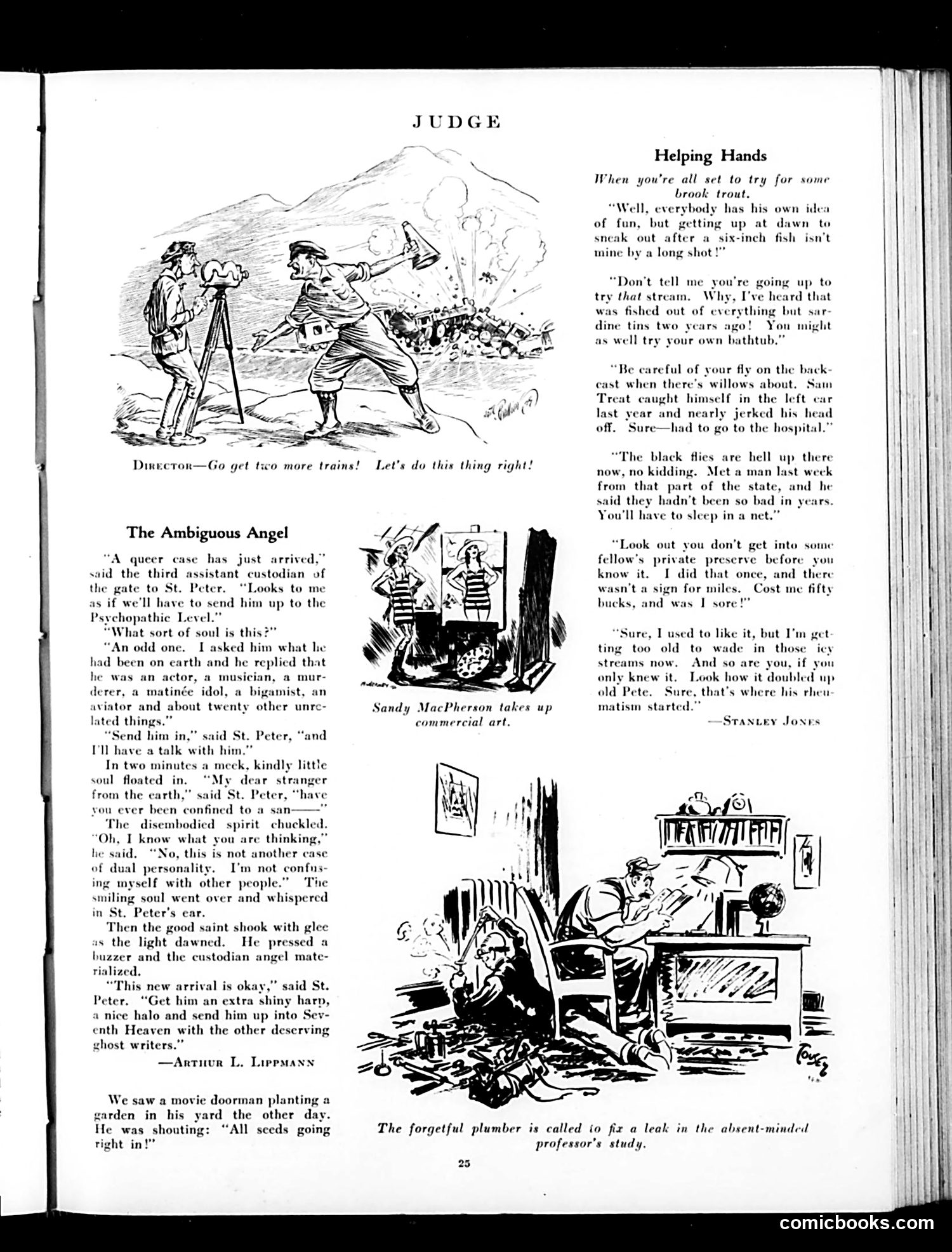
"The Ambiguous Angel" and Related Humor "The Ambiguous Angel" satirizes a man who claims multiple contradictory professions (murderer, musician, matinee idol, aviator, etc.). St. Peter initially questions his sanity but ultimately admits him to Heaven—revealing the joke: he's a "ghost writer." This puns on the term's double meaning: someone who writes for others without credit, and literally a ghost. The satire mocks ghost writers as having confused, insubstantial identities, fitting heavenly placement among "deserving ghost writers." The page's other cartoons are straightforward humor: a fishing discussion where an experienced angler discourages a friend with exaggerated warnings (depleted streams, black flies, trespassing fines, rheumatism), and a plumber creating chaos in an absent-minded professor's study. These require no special historical context—they're universal workplace and recreational comedy.
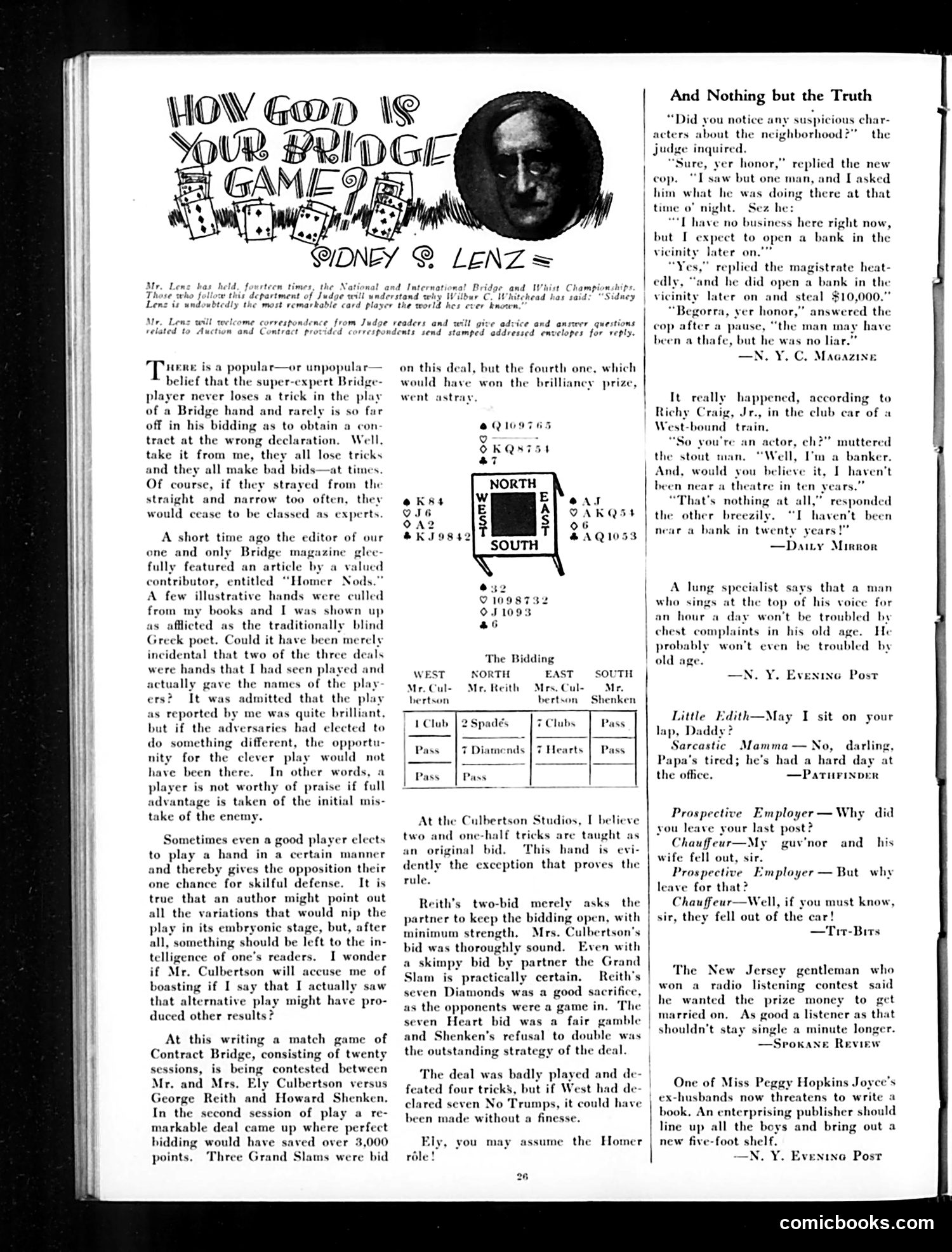
Judge Magazine Page Analysis This page from *Judge* magazine centers on contract bridge — a card game that was enormously popular among American elites in the 1920s-30s. The main article discusses a high-profile match between Ely Culbertson (a famous bridge champion and author) and his wife versus George Reith and Howard Shenken. The cartoon at top credits Sidney Lenz, apparently a competitor or rival bridge expert, with the joke "How Good Is Your Bridge Game?" — mocking someone's skills. The article itself is technical bridge analysis, critiquing bidding strategy and play in a specific hand from their match. The author defends expert players against overly harsh criticism, arguing they shouldn't be faulted when opponents make poor defensive choices. The sidebar humor pieces ("And Nothing but the Truth") are unrelated anecdotes — a typical *Judge* format mixing sports/games content with scattered comic vignettes. For modern readers: this reflects bridge's status as serious, respectable entertainment for educated Americans, warranting magazine space and competitive celebrity drama comparable to today's chess or poker coverage.
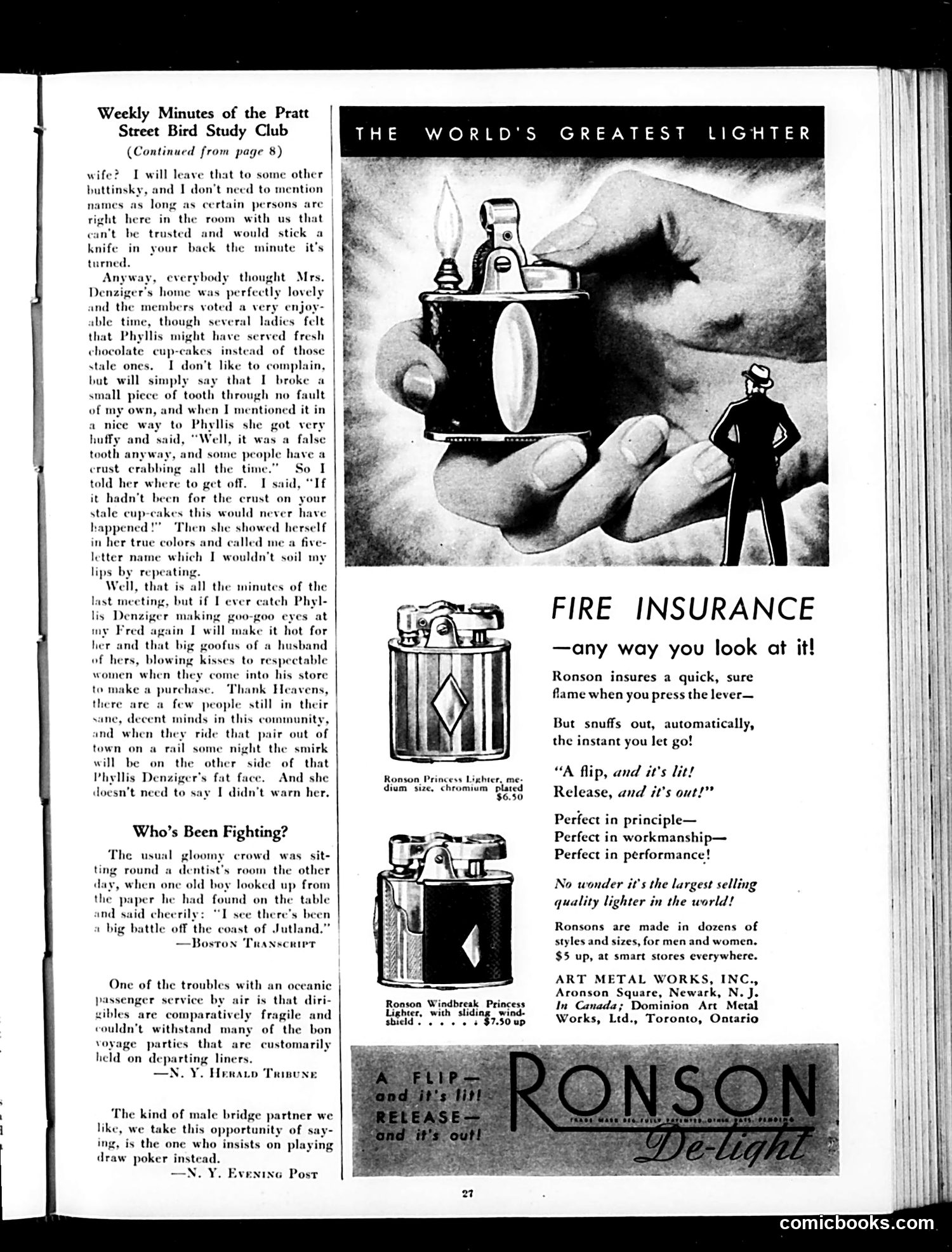
Analysis for Modern Readers This page contains satirical social commentary alongside advertising, typical of Judge magazine's format. The Main Content: "Weekly Minutes of the Pratt Street Bird Study Club" is a gossip-filled account of a club meeting that devolves into petty complaints. The narrator obsesses over stale cupcakes, a broken tooth, and alleged infidelities—revealing small-town social jealousy and backstabbing. The humor stems from the narrator's self-righteous indignation over trivial matters while making serious accusations. It satirizes how women's social clubs could become venues for vicious rumor-mongering and personal feuds masked by civility. The Sidebar Jokes: Brief quips mock dentist waiting rooms (people reading old news), ocean liner fragility, and bridge-playing partners—typical period social observations. The Advertisement: A full-page Ronson lighter ad emphasizing reliability and style—this premium product cost $5 up (significant money in this era), targeting affluent readers. The page's juxtaposition of petty female drama with luxury goods advertising reflects Judge's target audience: educated, middle-to-upper-class readers amused by satirizing their own social circles.
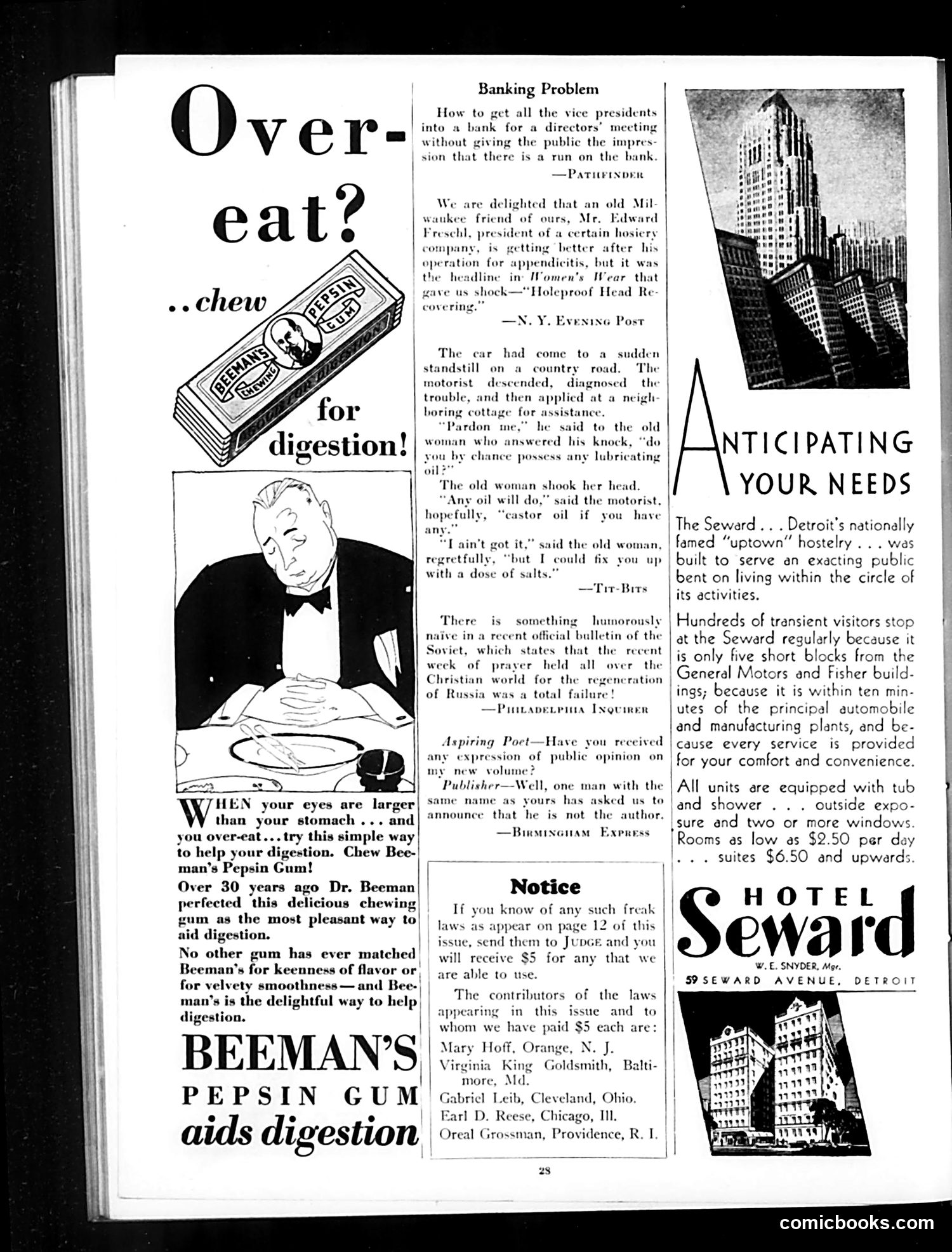
Judge Magazine Page Analysis This page is primarily advertising with a small satirical section. The main content includes: The "Over-eat?" advertisement (left) promotes Beeman's Pepsin Gum as a digestive aid—a common early-20th-century product claim. The cartoon depicts an overstuffed man at a table, playing on period anxieties about digestion and overconsumption. The "Banking Problem" satirical item mocks the difficulty of discreetly assembling bank vice presidents for meetings without triggering public panic about a bank run—a real concern during economically unstable periods. Additional brief jokes reference a hosiery company executive's appendicitis ("Holeproof Head") and a motorist seeking lubricating oil from a rural woman who offers Epsom salts instead. The Hotel Seward advertisement (right) promotes Detroit lodging near automobile manufacturing plants. The page reflects early-20th-century commercial anxieties: digestive health, banking stability, and automotive industry growth. Most content is straightforward advertising rather than political satire.
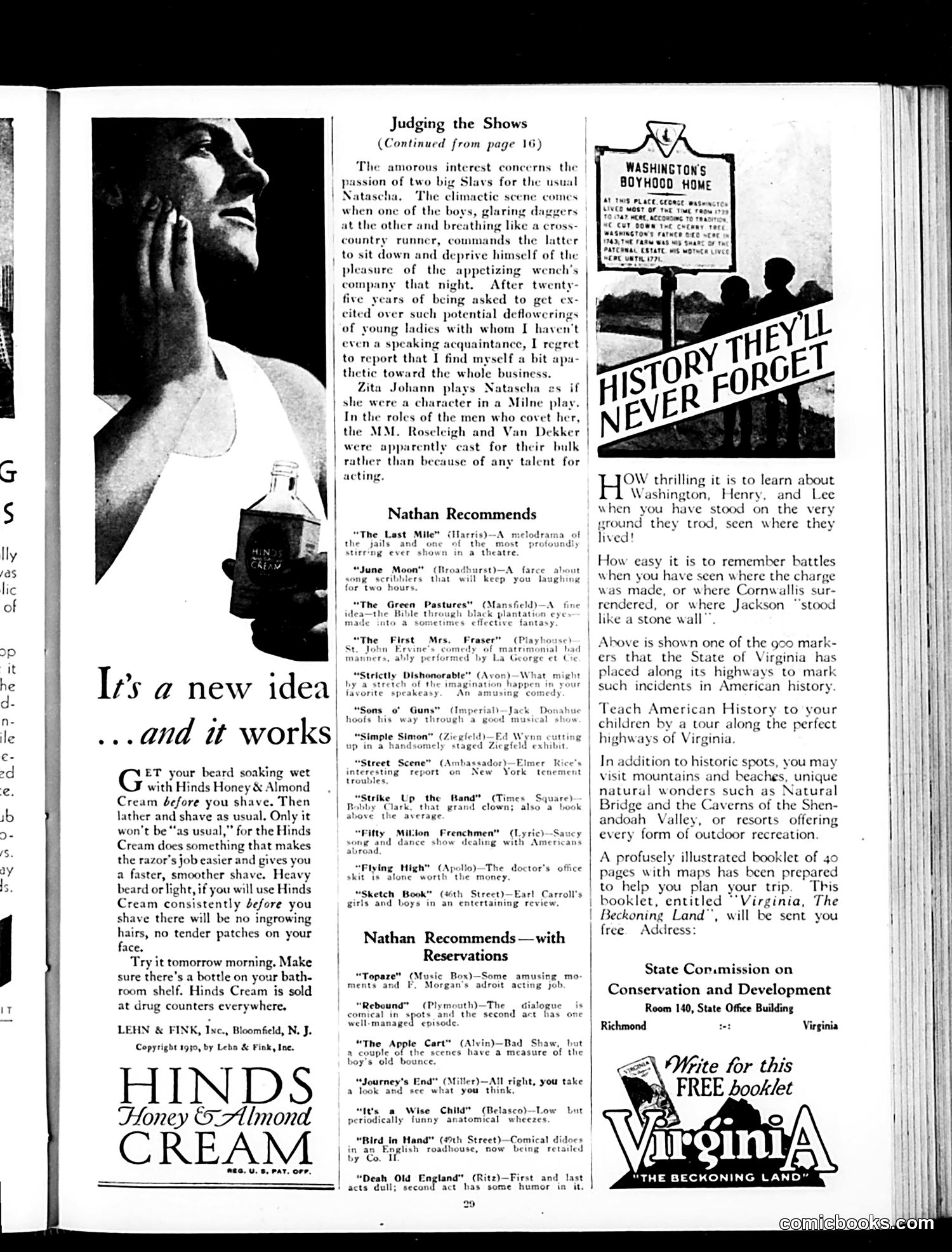
Analysis for Modern Readers This page is primarily advertising and entertainment listings, not political satire. The main content includes: 1. Hinds Honey & Almond Cream advertisement (left): A shaving cream ad promoting a "new idea"—pre-shaving with moisturizing cream to prevent razor burn and ingrown hairs. The appeal to modernity ("new idea...and it works") was typical 1930s marketing. 2. Theater reviews by Nathan (center): Critic Nathan recommends Broadway shows including "The Last Mile," "June Moon," and others—typical entertainment journalism of the era. 3. Virginia tourism advertisement (right): Promotes historical sites related to Washington, Henry, and Lee, encouraging educational travel. The marker shown celebrates American Revolutionary history. There is no political cartoon or satire visible. The page reflects 1930s consumer culture, theatrical entertainment, and patriotic tourism promotion.
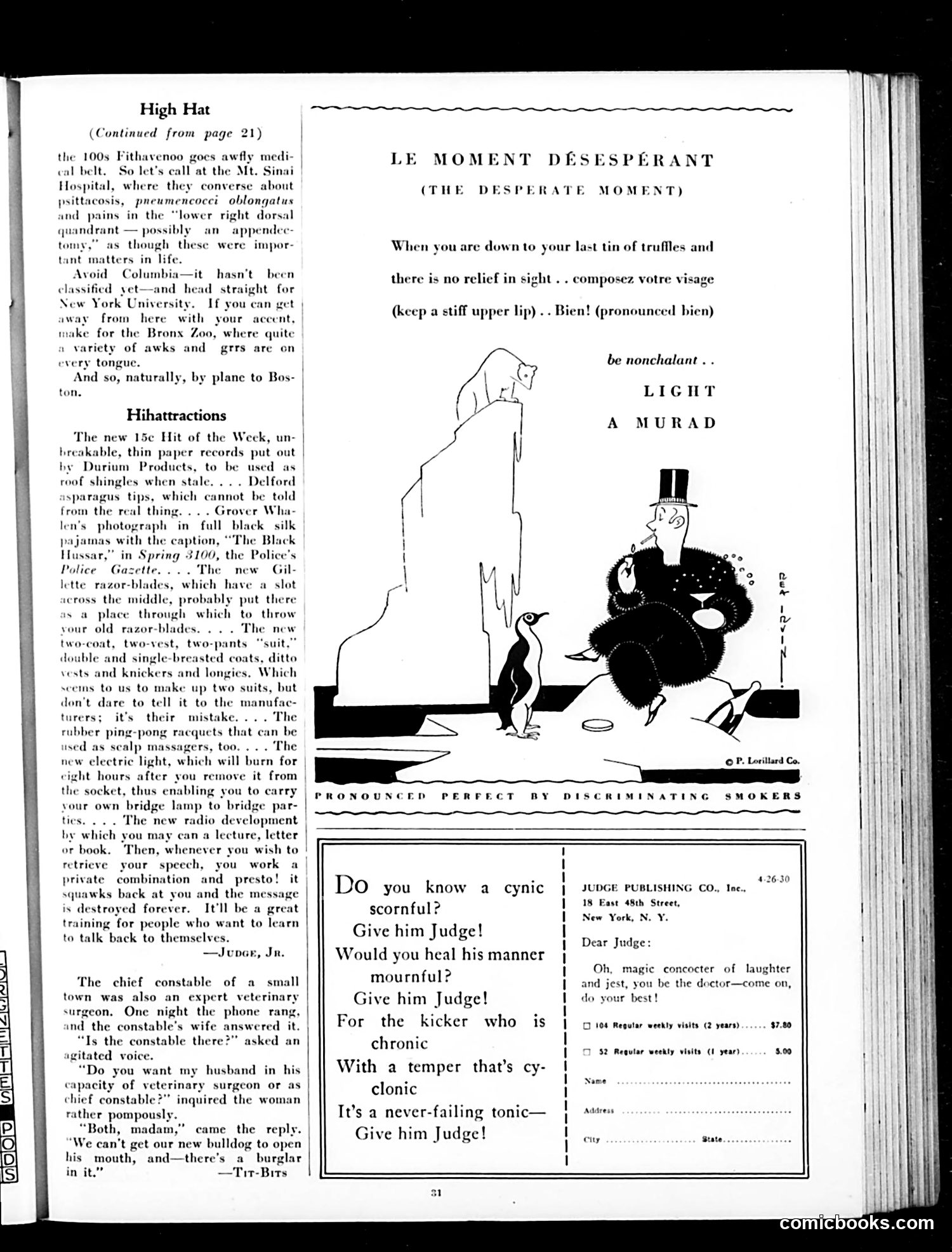
Analysis of Judge Magazine Page This page contains two main elements: a cartoon advertisement and subscription materials. The central illustration depicts a wealthy, formally-dressed man in a top hat sitting at what appears to be a dining table with a penguin. The caption reads "Light a Murad," advertising Murad cigarettes as "pronounced perfect by discriminating smokers." The joke plays on class pretension—the fancy gentleman and penguin represent refined, discriminating taste, suggesting that smoking Murad signals social sophistication and discernment. Below is a subscription pitch using comedic verse, encouraging readers to "Give him Judge!" as a cure for cynicism, sorrowfulness, and bad temperament. It's essentially advertising the magazine itself as therapeutic entertainment. The left column contains miscellaneous items and jokes typical of Judge's satirical content, including commentary on inventions and absurdist humor. The overall message: Judge markets itself and its advertisers' products to readers seeking wit, sophistication, and superior taste.
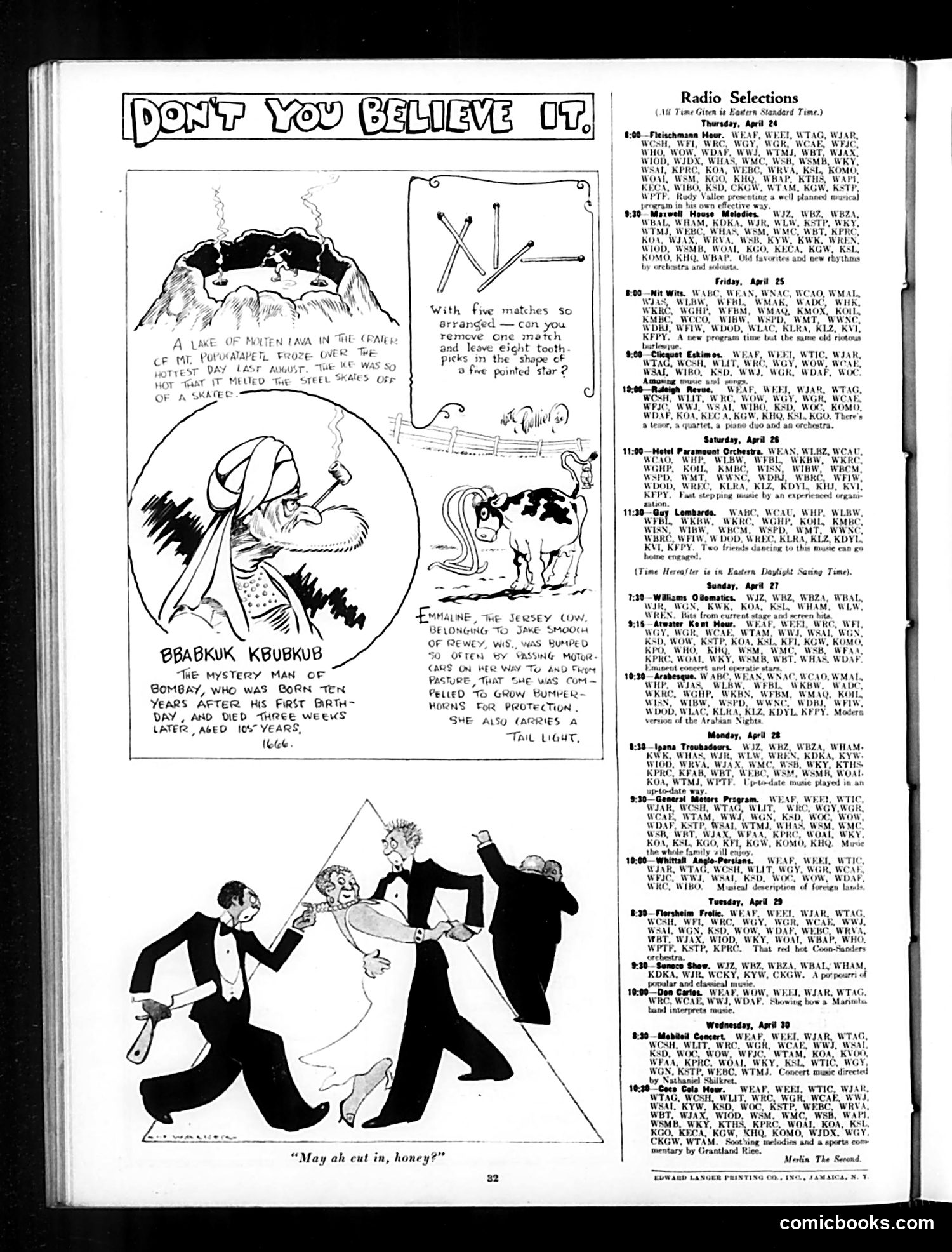
Judge Magazine Page Analysis This page from Judge combines humor content with a radio programming guide—typical for 1920s-30s magazines. The cartoons present absurdist "believe it or not" curiosities: 1. Top section: A match puzzle and illustration of "Bbabkuk Kbubkub," described as a mysterious Jersey cow born in Bombay that grew protective horns and died at 105 years old. This mimics the "Ripley's Believe It or Not!" format popular at the time. 2. Bottom cartoon: Titled "May oh cut in, honey?" shows men in formal wear apparently dancing with or approaching a woman, depicting the "cutting in" custom at dances—a social practice where one male partner replaces another mid-dance. The joke implies the woman is desirable enough to warrant this repeated interruption. The radio listings filling the right side represent the era's broadcasting schedules across numerous stations, reflecting radio's dominance as mass entertainment before television.
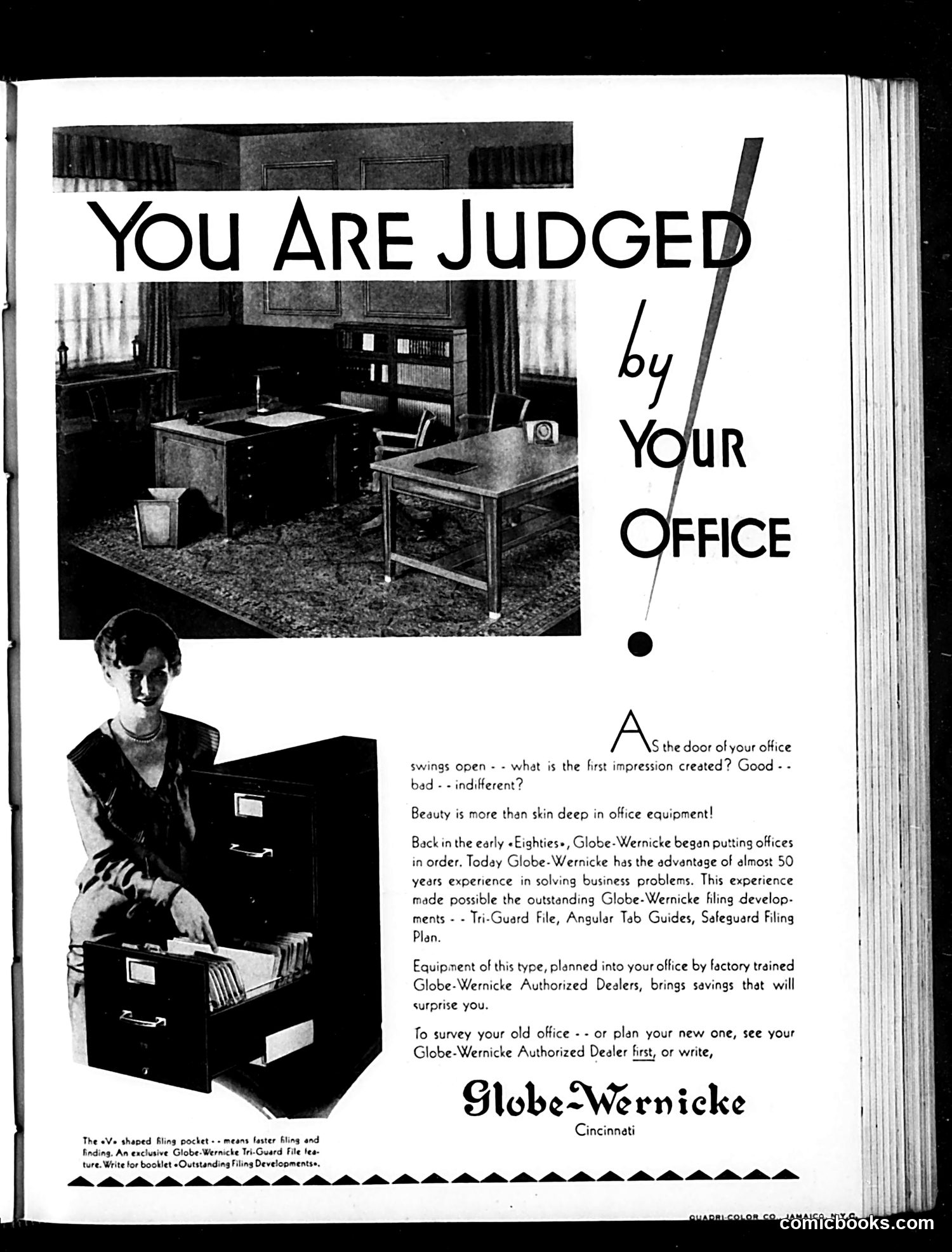
Analysis This is primarily a business advertisement, not political satire. It's a Globe-Wernicke filing equipment ad from Judge magazine. The page uses the headline "YOU ARE JUDGED BY YOUR OFFICE" as a marketing hook—playing on social anxiety about professional impressions. The image shows an office interior and a woman with filing cabinets, positioning office organization as a status symbol. The satire is mild and self-promotional: the ad ironically uses Judge's format to argue that office *appearance* (and by extension, Globe-Wernicke's filing systems) reflects on a business's competence. The company claims 50 years of experience solving "business problems" through superior filing innovations. There are no political figures or events referenced. This is essentially a vintage corporate advertisement leveraging the prestige of appearing in Judge magazine to sell office furniture to business owners concerned about projecting professionalism and efficiency.
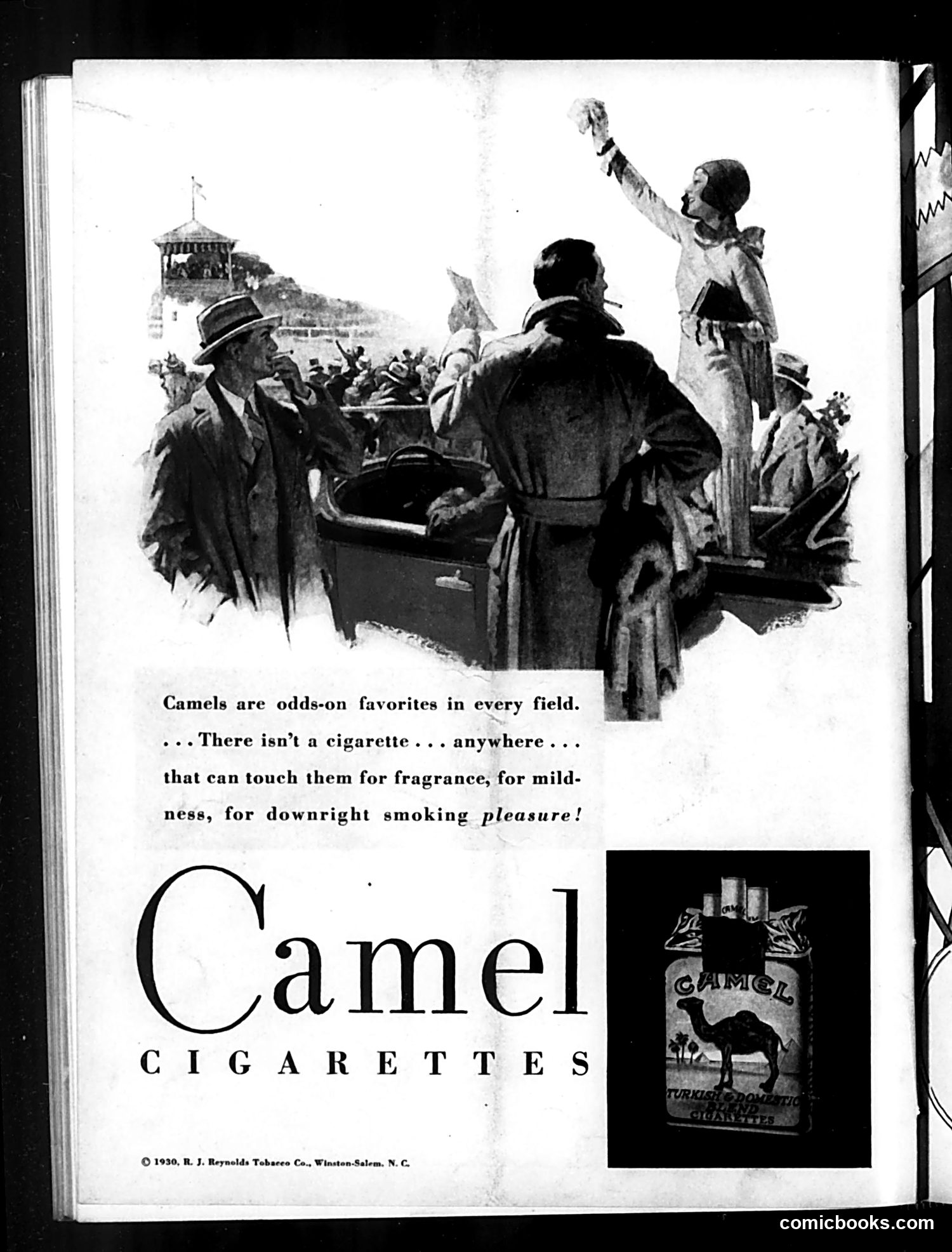
Camel Cigarettes Advertisement (1930) This is a cigarette advertisement, not political satire. The illustration depicts a crowd of well-dressed men at what appears to be a public event or gathering (possibly near water, given the tower in background). The ad's message uses the phrase "odds-on favorites in every field" to suggest Camel cigarettes are universally superior and popular across all social contexts. The text makes health claims typical of 1930s tobacco marketing—"fragrance, mildness, downright smoking pleasure"—claims that would be illegal today. The image implicitly associates smoking Camels with sophistication and social success by showing affluent, formal-dressed men in public settings. This was standard advertising strategy before tobacco health dangers were widely acknowledged.