judge
Judge — May 3, 1930
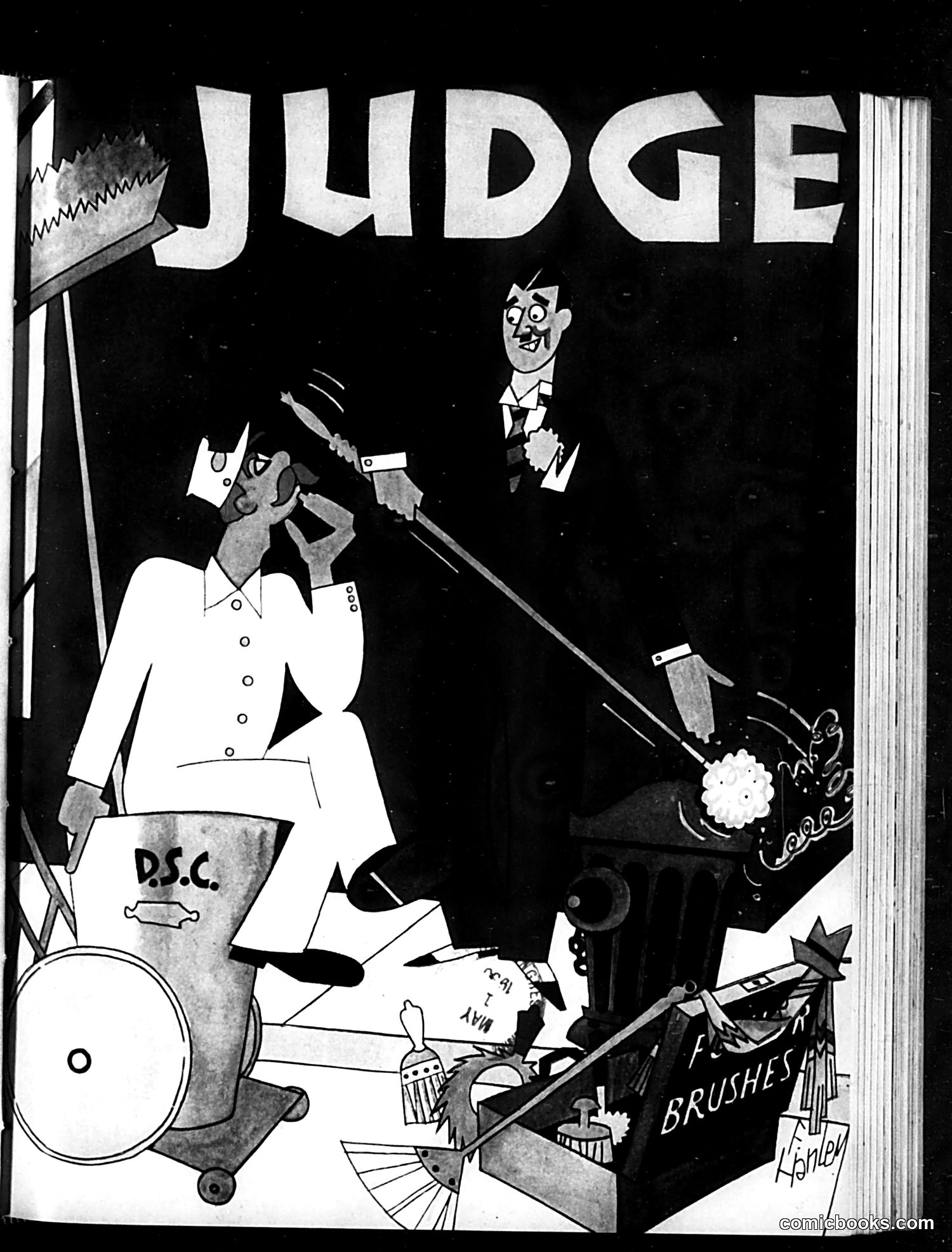
Judge Magazine Cartoon Analysis This appears to be a cover or advertisement for Judge magazine itself, using satirical imagery rather than commentary on a specific political event. The cartoon shows two figures in formal attire appearing to conduct or "judge" painting supplies and brushes displayed below them. The "B.S.C." marking on one figure's outfit and the "BRUSHES" label suggest this is advertising art supplies or painting materials. The satire likely plays on Judge's role as an arbiter of taste and humor—positioning the magazine's editors as literal "judges" evaluating commercial products. The exaggerated, cartoonish style of the figures and their theatrical poses emphasize the absurdity of taking such judgment seriously. Without additional context or visible date information, the specific product line or campaign remains unclear.

Analysis This page is primarily advertising, not satire or political commentary. It's an Ethyl Gasoline Corporation advertisement from Judge magazine, likely 1920s-1930s based on styling. The crane image illustrates the ad's metaphor: "The graceful crane depends on its perfect control," paralleling how cars need better fuel for safe handling. The advertisement promotes Ethyl gasoline's anti-knock compound, claiming it improves engine performance and responsiveness—particularly important for new high-compression engines becoming common. The text targets drivers concerned with traffic safety and car performance, positioning Ethyl as a premium product that delivers "control" and "dependable power." There is no political satire present—this is straightforward product marketing using nature imagery to convey reliability and grace.
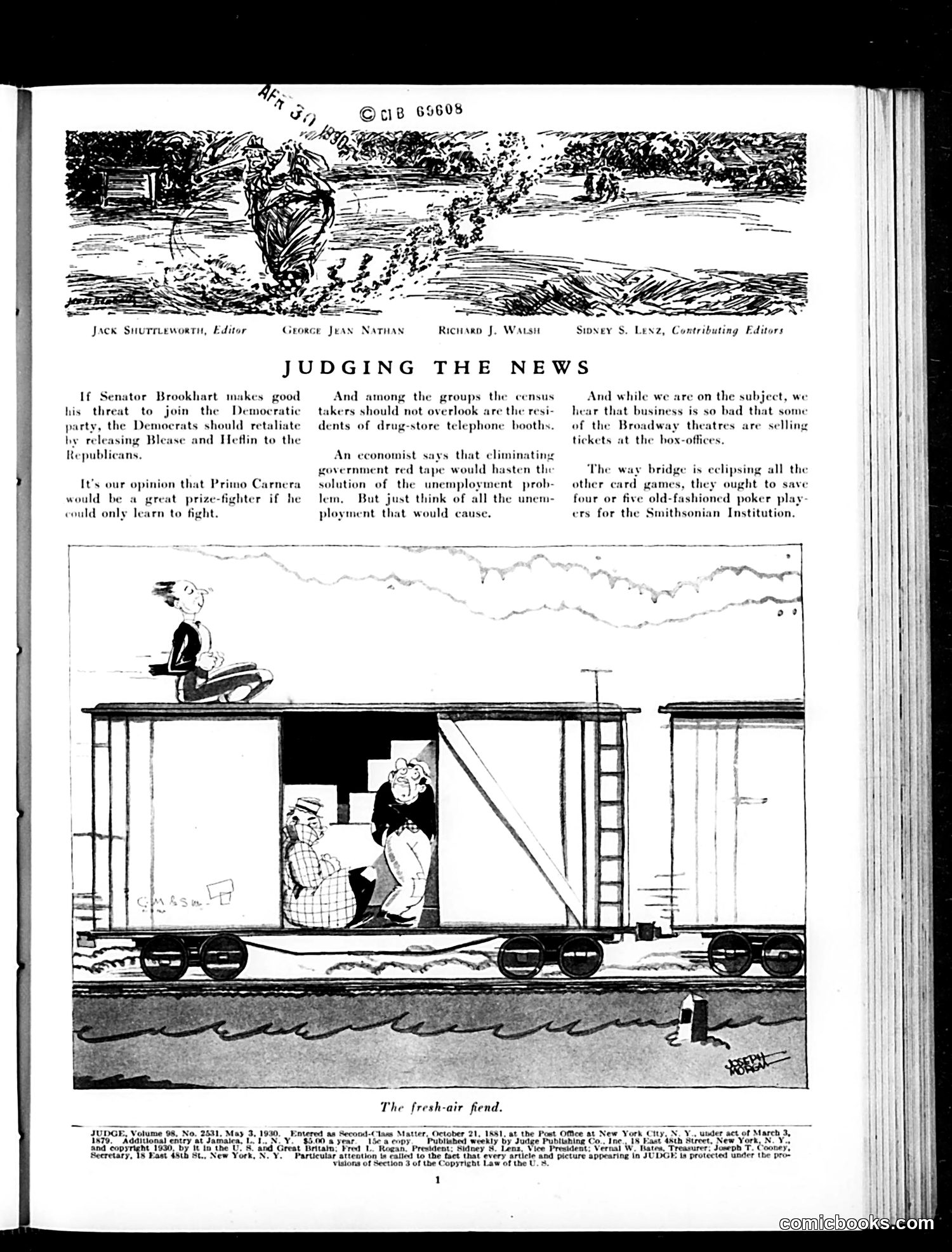
"The Fresh-air Fiend" - Judge Magazine Cartoon Analysis This cartoon satirizes the early 20th-century "fresh air" movement—a progressive reform promoting outdoor exposure for poor urban children. The image shows a railroad car where working-class passengers are being forced to endure open windows despite crowded, uncomfortable conditions. The satire targets well-intentioned but impractical reformers who prioritized fresh air ideology over actual comfort and practical needs of ordinary people. The figure on top of the car appears to be enthusiastically promoting this principle, while passengers below suffer the consequences—cramped quarters with forced ventilation. The joke reflects common skepticism toward progressive reformism: good intentions applied rigidly without considering real human circumstances or preferences. It's social satire aimed at sanctimonious do-gooders.
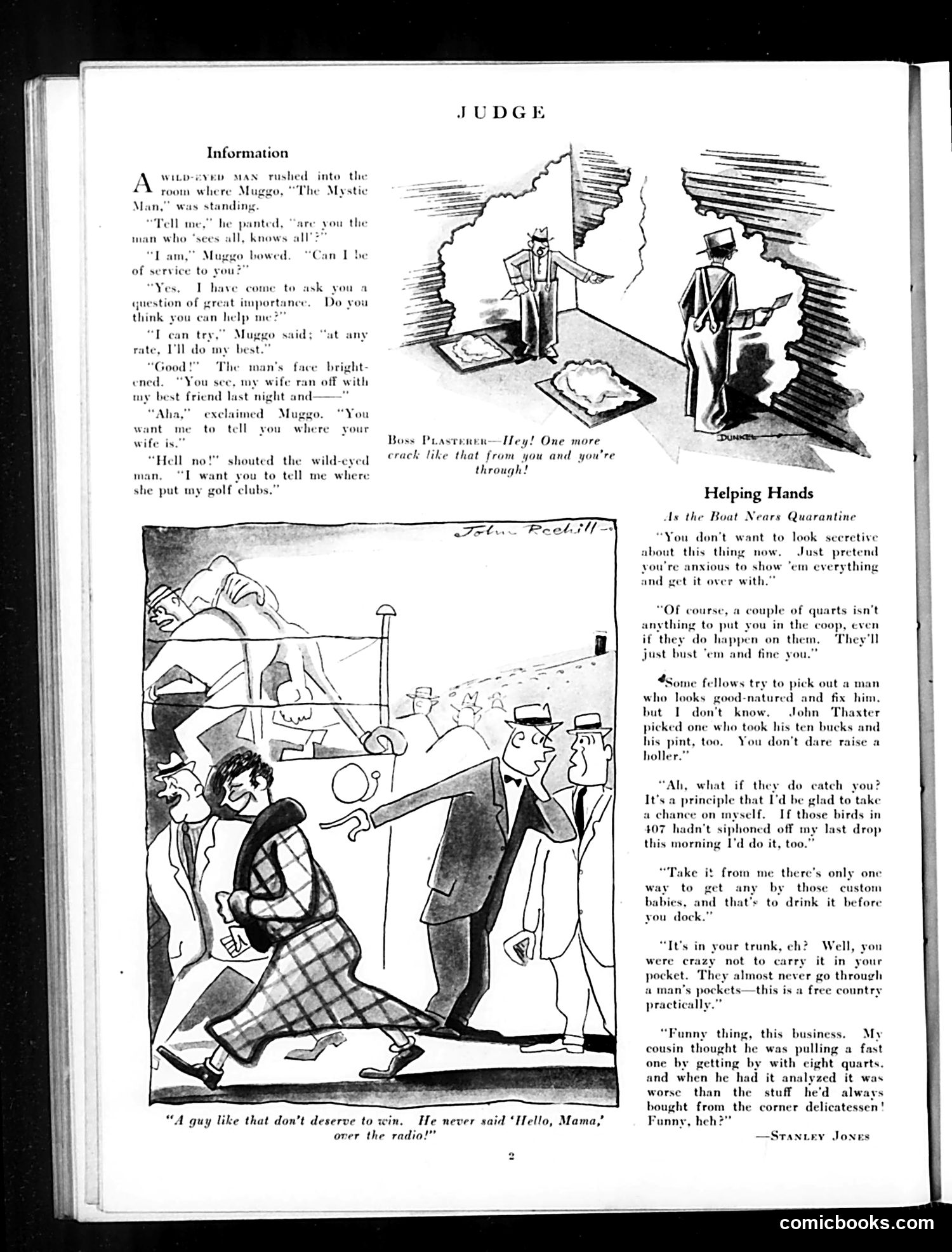
Analysis of Judge Magazine Page This page contains two distinct pieces: Top cartoon ("Boss Plasterer"): A construction supervisor instructs a worker to apply plaster "one more crack" to break through a wall. This appears to be generic workplace humor about shoddy construction rather than specific political satire. Bottom cartoon & article ("Helping Hands"): The large cartoon depicts what appears to be a domestic dispute or arrest scene, with the caption "A guy like that don't deserve to win. He never said 'Hello, Mamo,' over the radio!" The accompanying article by Stanley Jones discusses Prohibition-era bootlegging—hiding alcohol in trunks and discussing customs enforcement tactics. The humor centers on absurd justifications for criminal behavior and the casual attitude toward breaking alcohol laws during Prohibition. The content reflects 1920s social attitudes toward Prohibition enforcement.
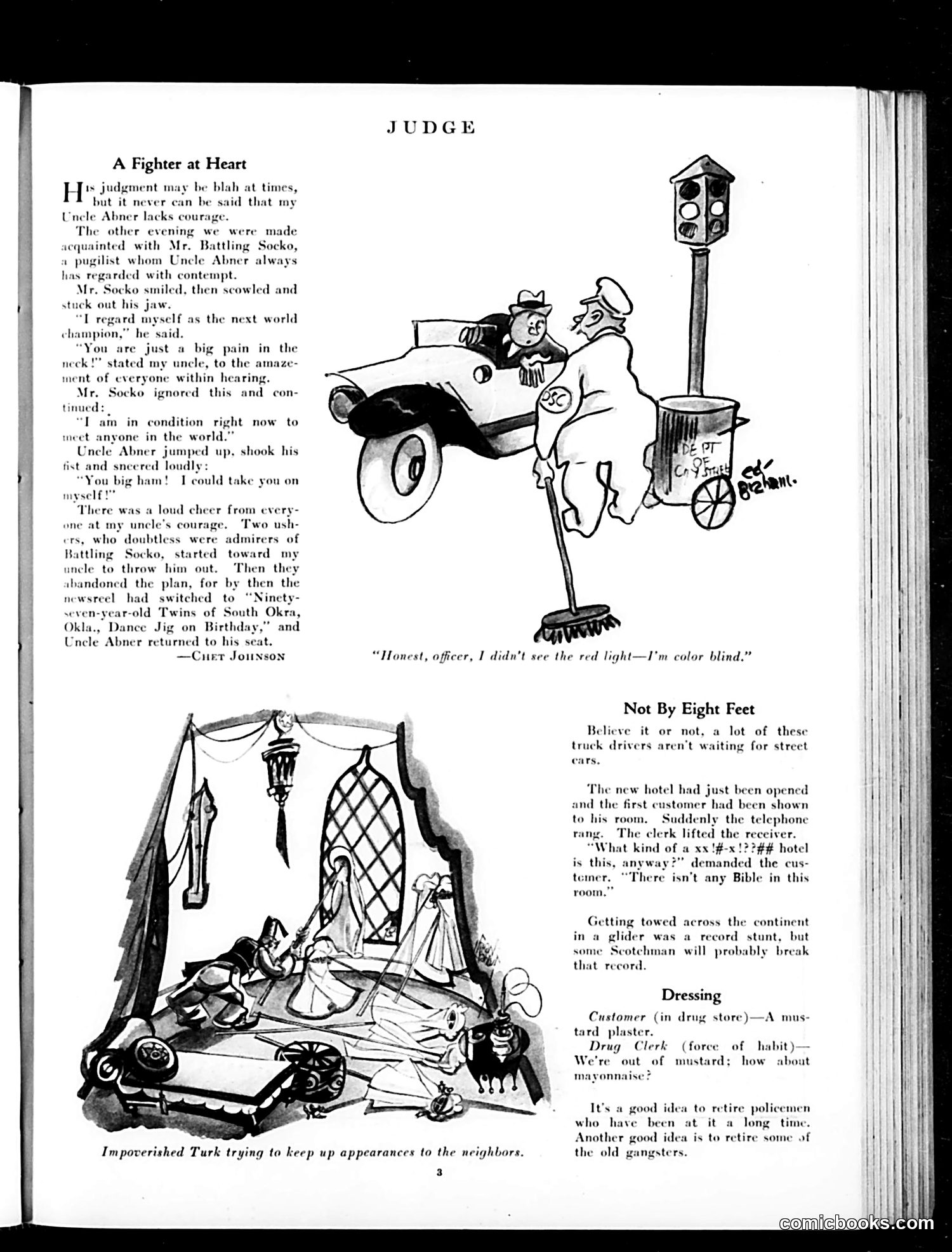
Judge Magazine Page Analysis This page contains two satirical pieces: "A Fighter at Heart" depicts Uncle Abner defending his honor against Mr. Battling Socko, a pugilist. The joke satirizes working-class masculinity and honor culture—Uncle Abner's willingness to fight despite his age and condition to maintain respect, though he's clearly outmatched physically. "Not By Eight Feet" and accompanying cartoons mock various social absurdities: a hotel clerk's obscene phone manner, the impracticality of glider aviation across continents, and the phrase "Impoverished Turk trying to keep up appearances to the neighbors"—satirizing economic pretense and class performance. The "Dressing" section presents brief humorous customer-clerk exchanges about product availability, typical Judge humor about retail and consumer culture.
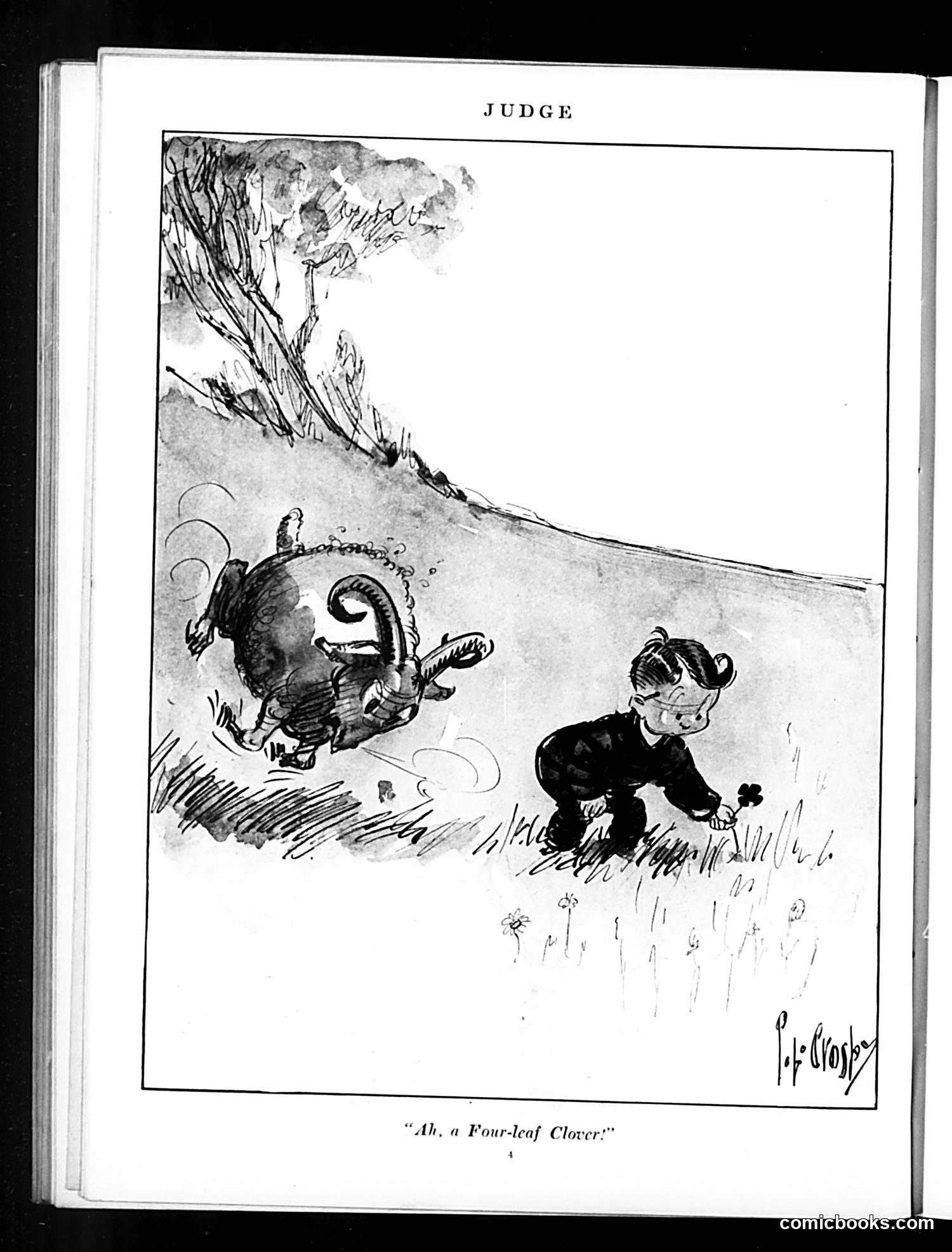
"Ah, a Four-leaf Clover" This cartoon depicts two figures in a pastoral setting. On the left, a character appears to be tumbling or falling down a hillside, drawn in an exaggerated, comedic style suggesting misfortune or clumsiness. On the right, another figure in dark clothing discovers what they believe is a lucky four-leaf clover in the grass. The satire likely plays on contrasting luck: one character's obvious bad fortune versus another's discovery of a symbol of good luck. The juxtaposition suggests irony about how luck is distributed or perceived. Without additional context about Judge magazine's specific political moment, the exact targets remain unclear, though the humor appears to rest on visual comedy rather than specific political commentary.
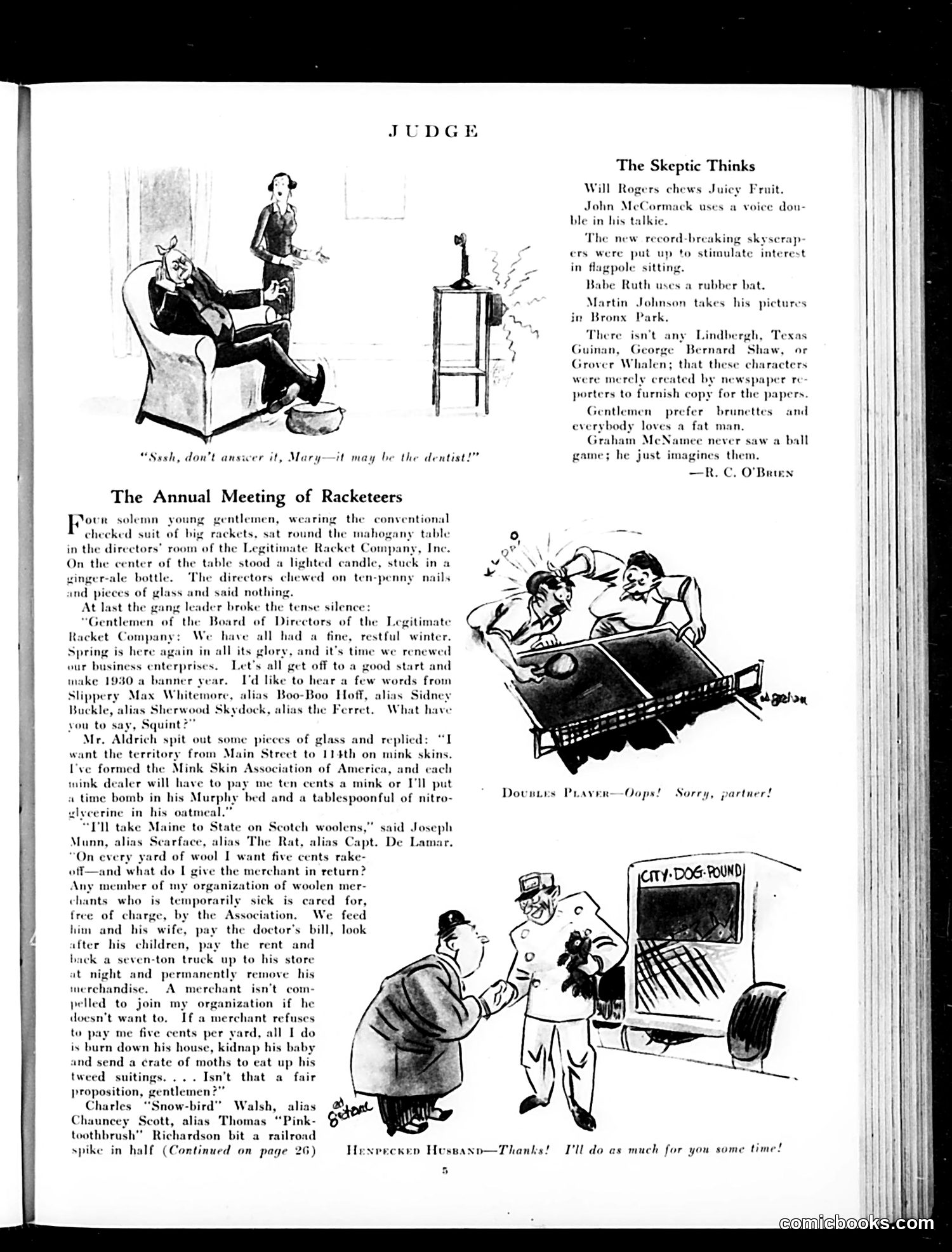
Analysis of Judge Page This page contains two satirical pieces: "The Skeptic Thinks" (top right) mocks contemporary celebrities and their activities—Will Rogers chewing juicy fruit, John McCormack's voice, skyscrapers, Babe Ruth's rubber bat, and Marion Johnson photographing in the Bronx. The author (H.C. O'Bries) skeptically suggests these famous figures were invented by newspapers for copy rather than being genuinely significant. "The Annual Meeting of Racketeers" (main article) satirizes organized crime syndicates posing as legitimate business. It depicts mobsters with aliases (Scarface, The Rat, Snow-bird, Pink-toothbrush) conducting a formal corporate meeting where they divvy up territory and establish protection rackets. The satire highlights how organized crime operated with corporate structure during Prohibition-era America. Both pieces use humor to critique American society and celebrity culture.
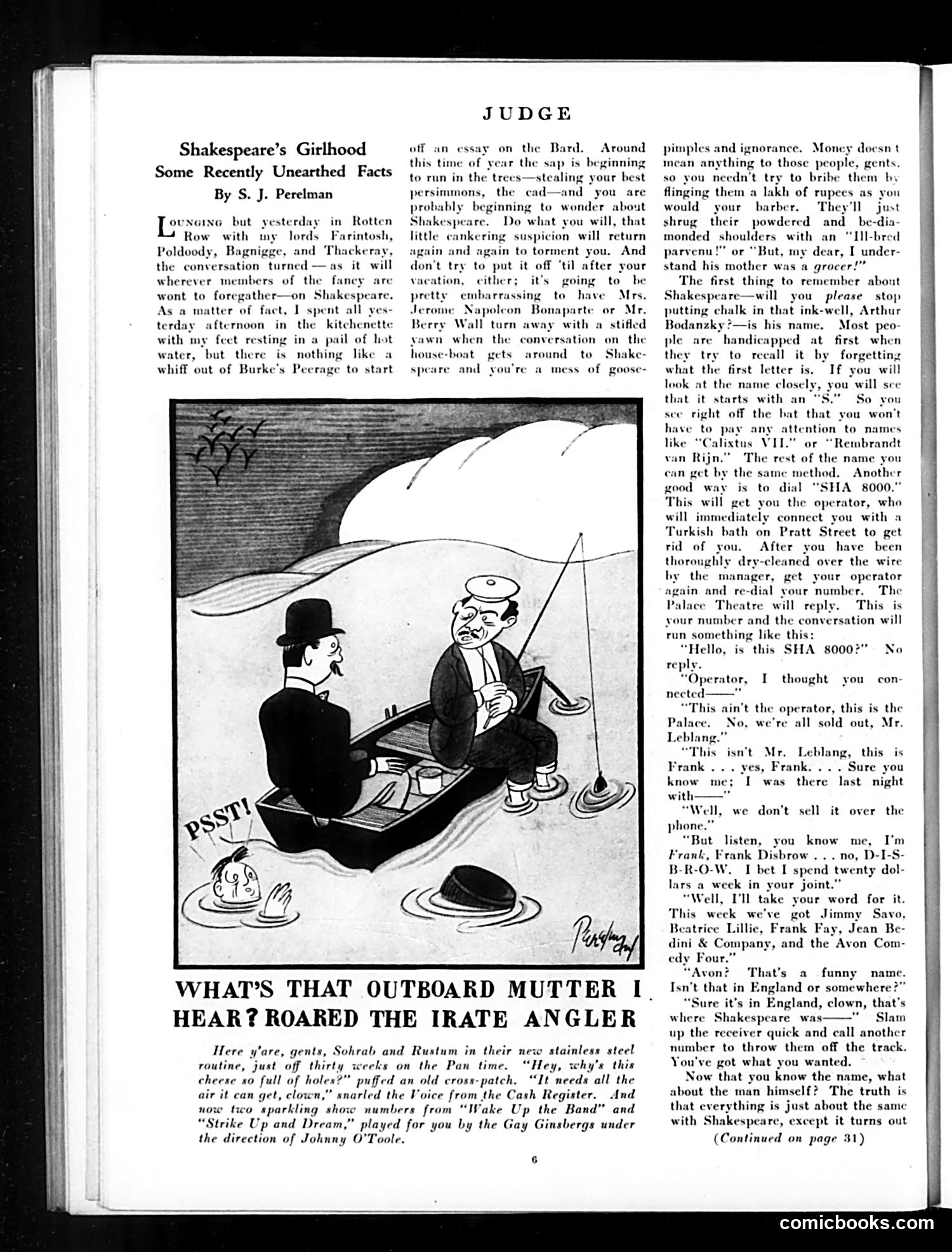
Analysis of Judge Magazine Page The cartoon "What's That Outboard Mutter I Hear? Roared the Irate Angler" depicts two men fishing in a small boat. One appears distressed by an "outboard mutter" (likely an outboard motor's sound), while the other fishes nearby. The joke plays on the emerging technology of motorized boats disrupting traditional fishing—a common early 20th-century complaint about mechanization invading pastoral activities. The article above, "Shakespeare's Girlhood" by S.J. Perelman, is satirical commentary mocking obsessive Shakespeare scholarship and fandom. The humor targets how enthusiasts endlessly discuss and analyze the playwright, turning casual conversation into embarrassing pedantry. Together, these pieces reflect Judge's satirical stance: mocking both technological disruption of leisure and the pretentiousness of literary obsessives—familiar targets for this era's humor magazine.
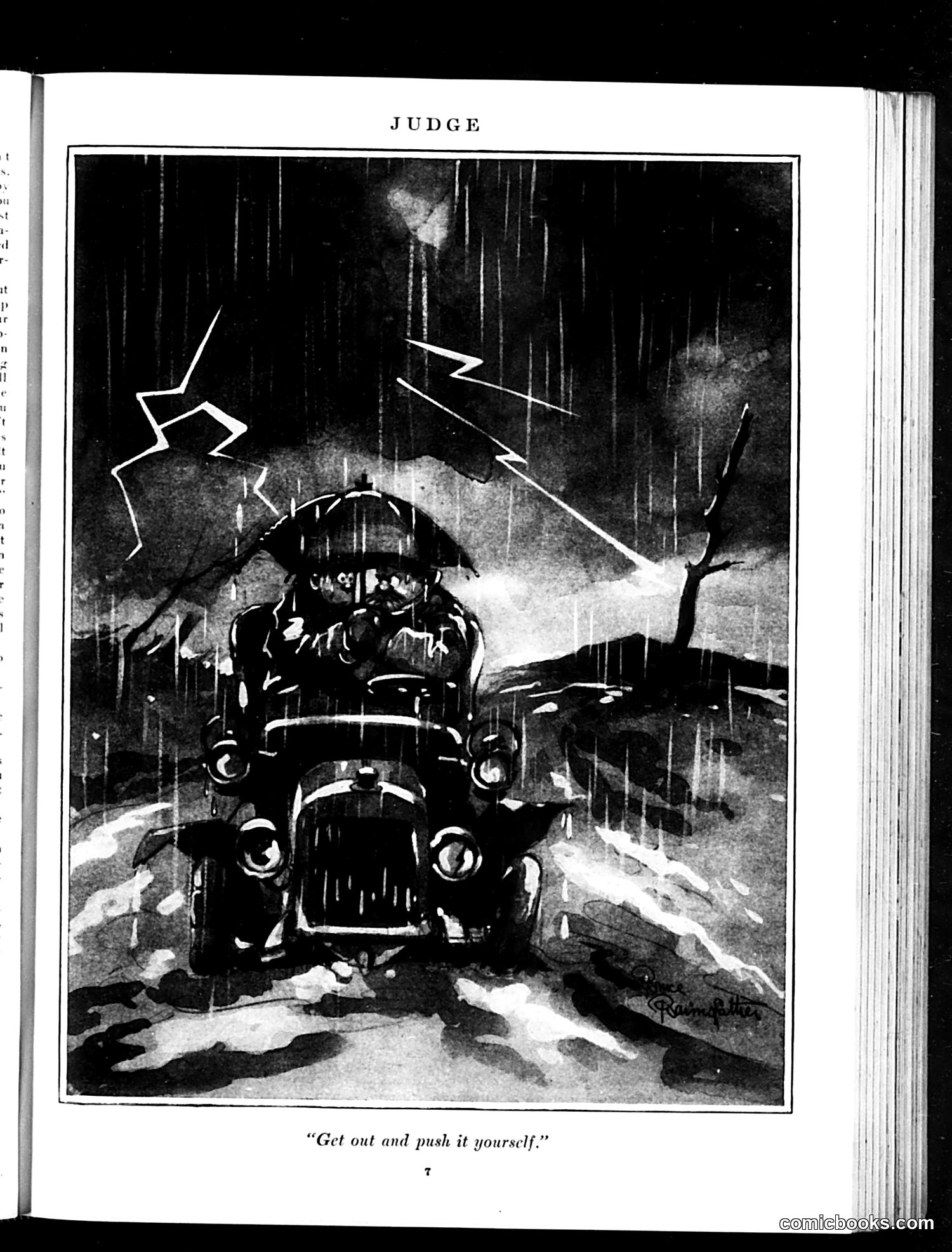
Analysis of Judge Cartoon Page This single political cartoon depicts a car stuck in mud or snow during heavy rain/storm, with lightning bolts above. A driver sits helplessly in the vehicle while receiving the caption's dismissive command: "Get out and push it yourself." The cartoon likely satirizes political leadership during a crisis—possibly referencing a president or public official who appears ineffectual or unwilling to take direct action during difficult circumstances. The vehicle's predicament symbolizes the nation's troubles, while the command suggests criticism that leaders should personally address problems rather than remain passive. Without additional context about Judge's publication date, the specific political figure or crisis referenced remains unclear, though the imagery conveys frustration with governmental passivity.
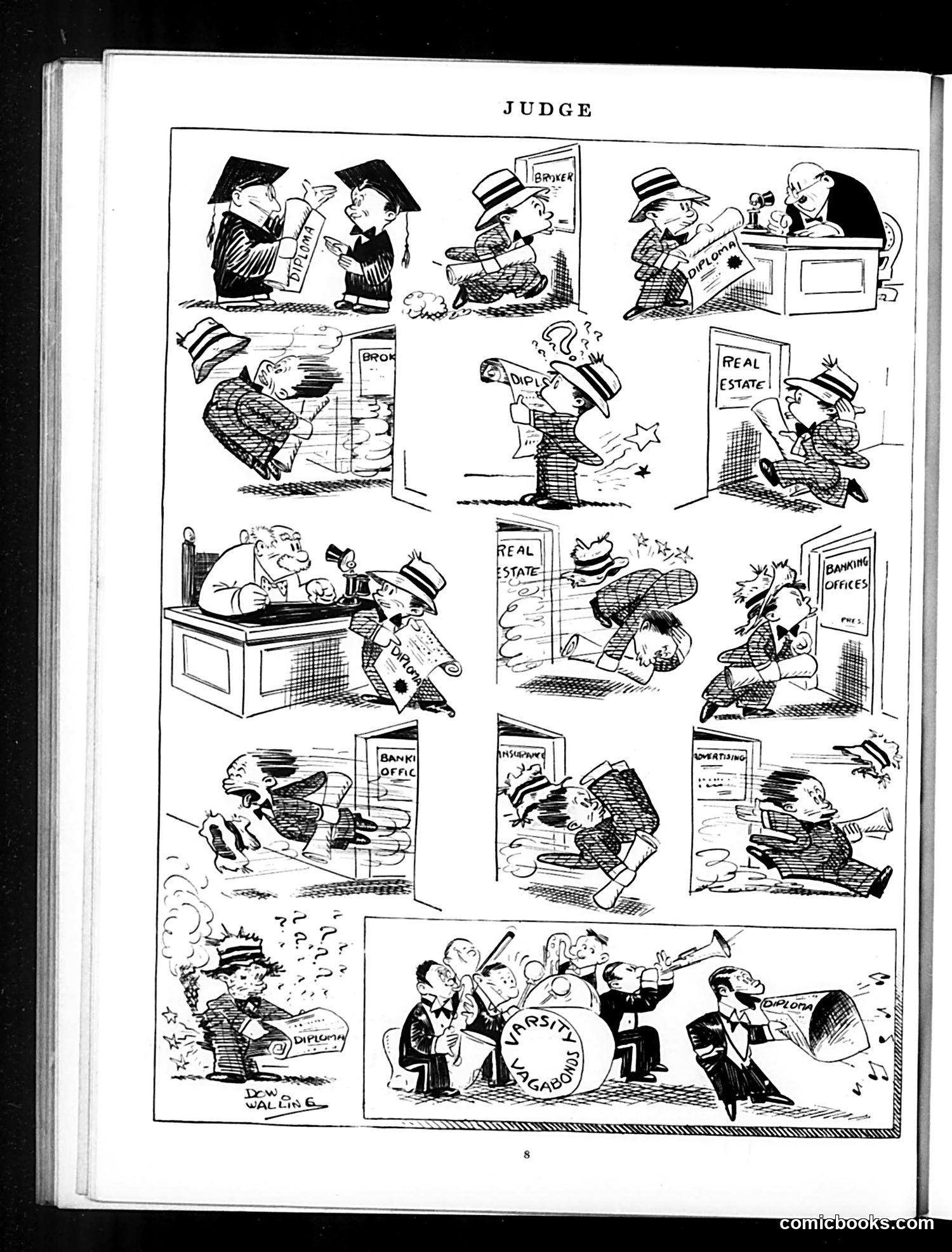
Analysis of Judge Page This is a multi-panel satirical comic depicting a con artist or swindler (identifiable by his striped suit and hat) being chased through various professional offices and institutions. The sequence shows him running from: - Brokers' offices - Real estate agencies - Banking offices - Insurance companies The final panel shows him being pursued by what appears to be law enforcement or officials (marked "VARSITY CHASERS"). The satire targets financial fraud and deception prevalent in early 20th-century American business. The repeated pattern—the schemer fleeing legitimate businesses—suggests widespread public concern about unscrupulous operators exploiting citizens through various fraudulent schemes in banking, real estate, and investment sectors.
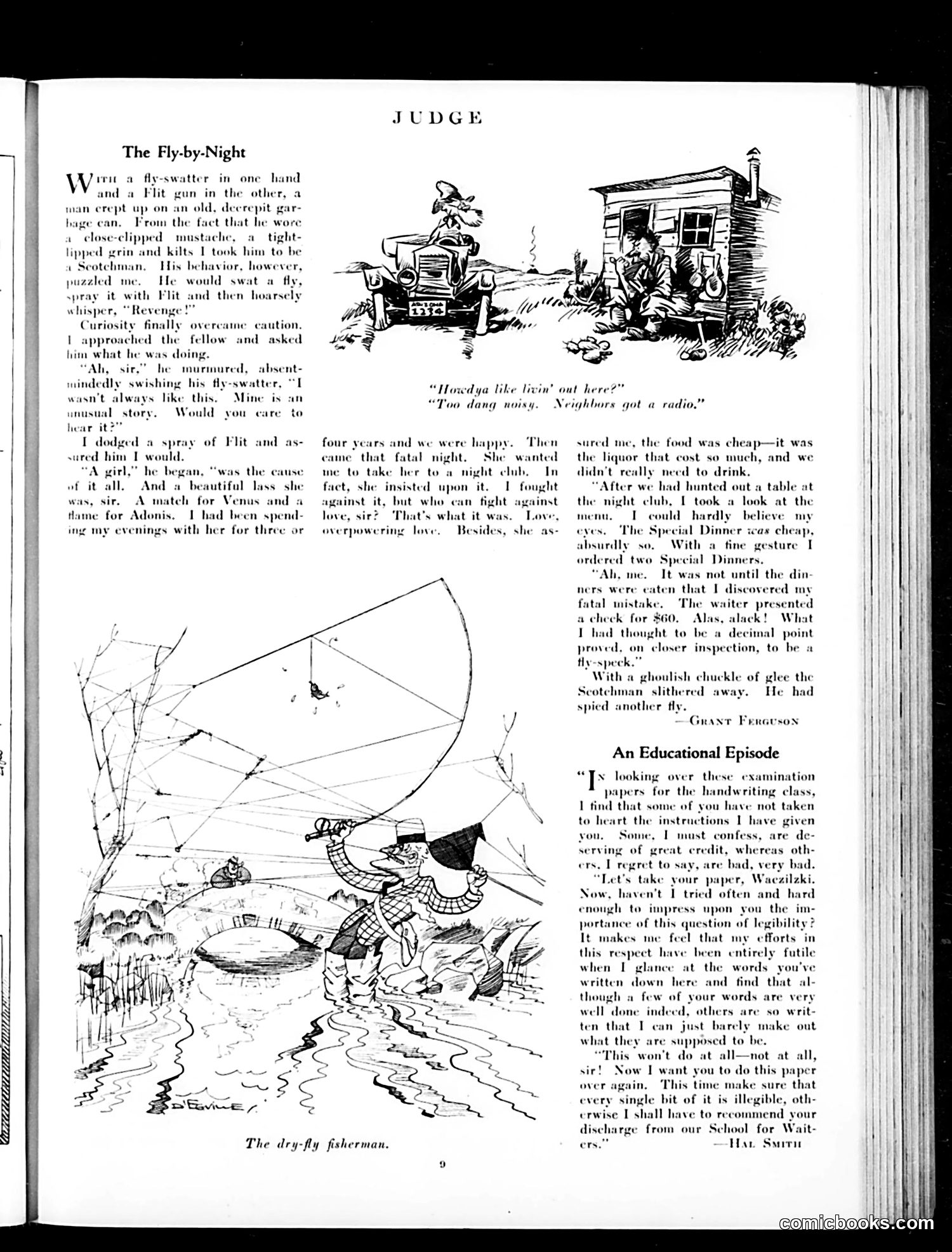
Two Satirical Stories from Judge Magazine "The Fly-by-Night" depicts a kilted Scotsman obsessively swatting flies and spraying Flit (a commercial insecticide brand) while whispering "Revenge!" He explains to a curious observer that his compulsion stems from a romantic betrayal: a woman lured him to an expensive nightclub where he discovered an inflated dinner bill—the "fatal mistake" that ruined him. The joke satirizes how trivial modern annoyances (flies, commercial products like Flit) trigger disproportionate emotional responses, and how people blame external circumstances rather than their own poor decisions. "An Educational Episode" mocks a pompous school administrator criticizing a student's illegible handwriting. The teacher demands the student rewrite the paper ensuring "every single bit of it is illegible"—revealing the administrator's actual indifference to legibility standards. The satire targets bureaucratic hypocrisy and performative discipline in educational institutions. Both stories use exaggerated character types and absurdist logic typical of Judge's humor.
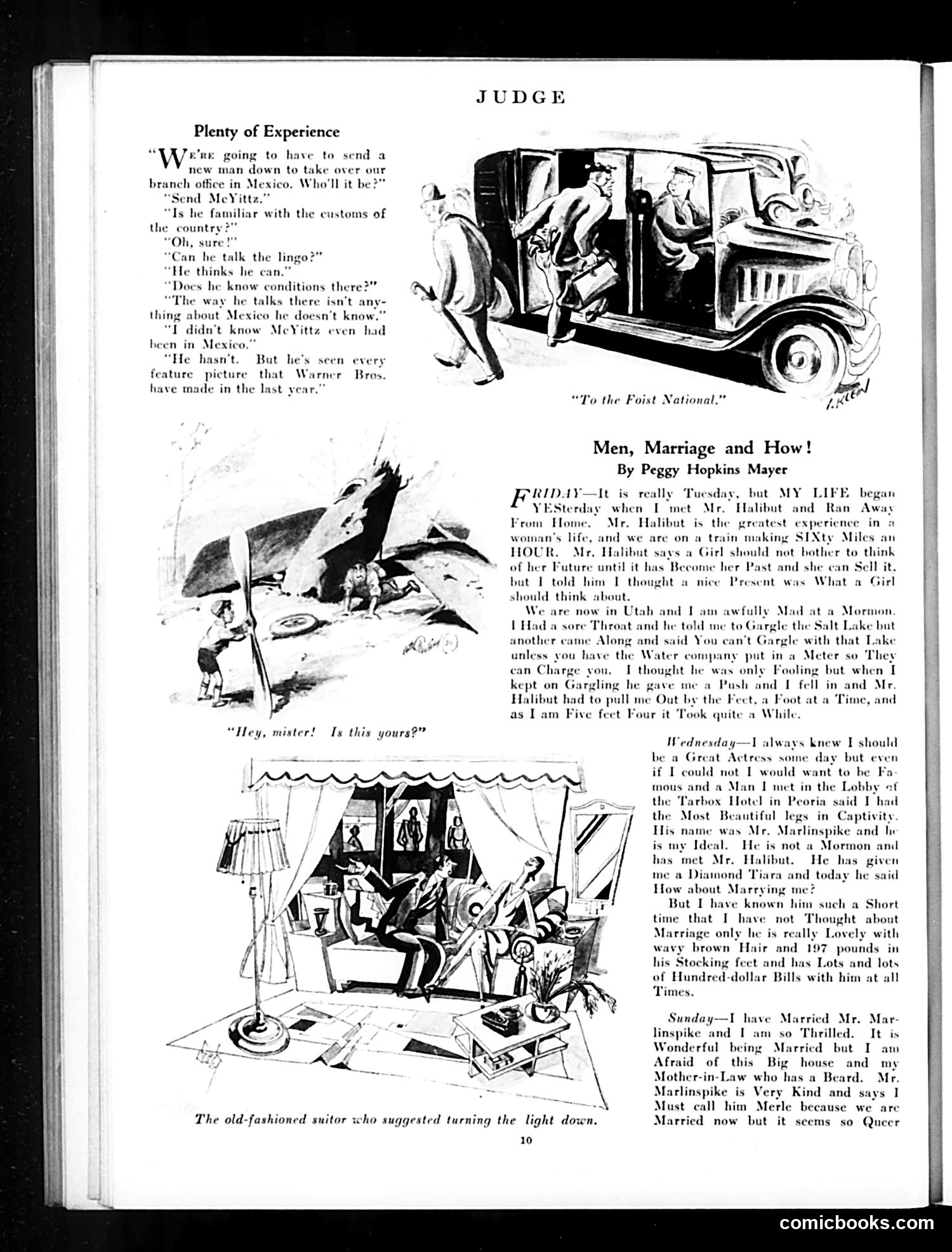
Judge Magazine Page Analysis Top Cartoon ("Plenty of Experience"): A joke about corporate incompetence. An executive suggests sending "McYittz" to manage a Mexican branch office, claiming he's qualified because he's seen every Warner Bros. feature film about Mexico—despite never actually visiting Mexico and knowing nothing about the country, language, or local conditions. The satire mocks both corporate hiring practices and Hollywood's role in shaping Americans' false perceptions of foreign places through movies. Bottom Section ("Men, Marriage and How!"): A serialized humor column by Peggy Hopkins Mayer (likely a pseudonym or reference to the actress known for multiple marriages) satirizing modern women and romantic impulsiveness. The narrator impulsively runs away with "Mr. Halibut," then meets "Mr. Marlinspike" days later and marries him for his wealth and appearance, despite barely knowing him. The piece mocks both women's fickleness and materialism, and men's superficiality, using exaggerated capitalization for comedic effect.
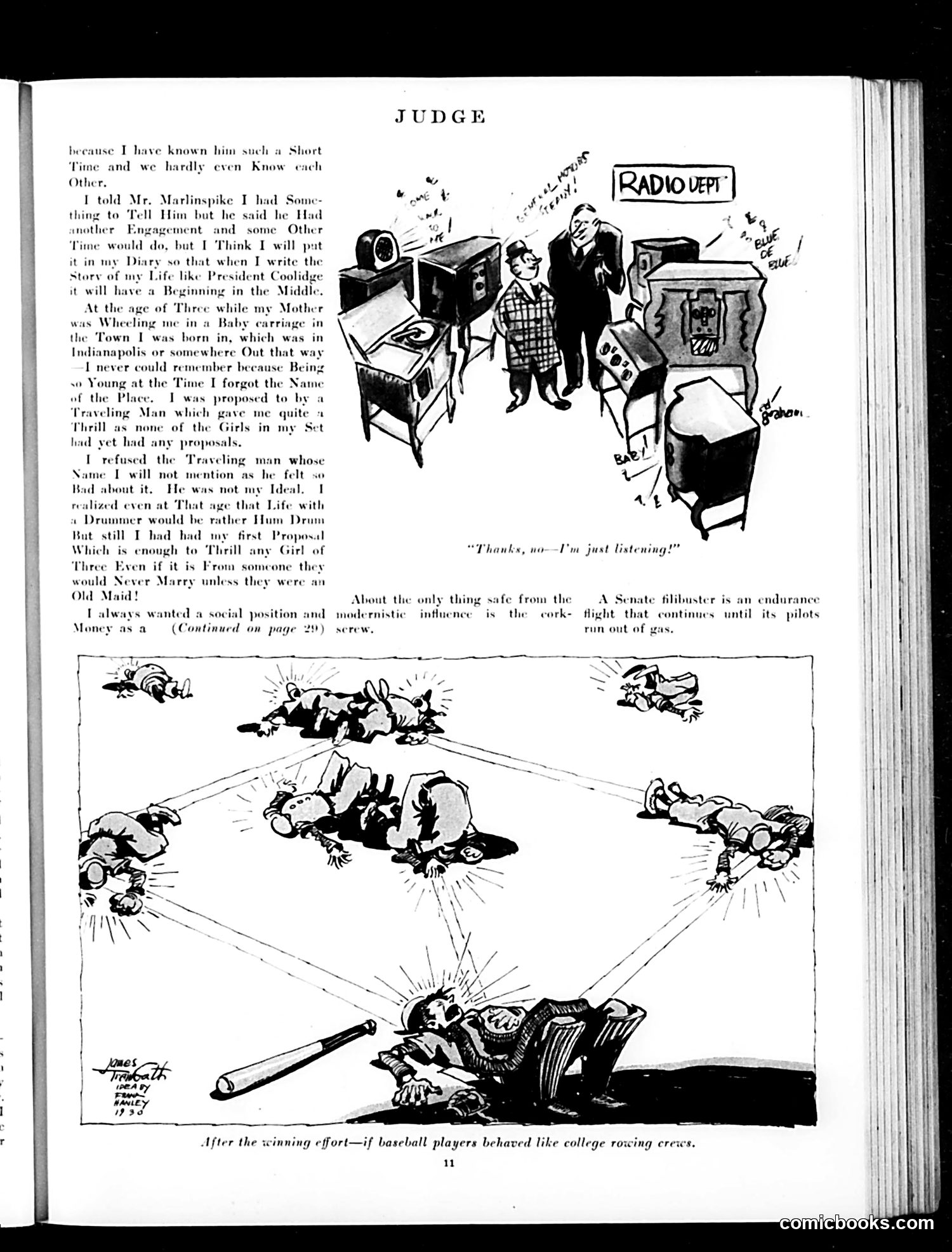
Judge Magazine Page Analysis This page from *Judge* magazine contains two distinct satirical pieces: Upper Section ("Radio Dept"): A cartoon mocking the radio industry's early days, showing broadcasting equipment and personnel in a studio. The joke "Thanks, no—I'm just listening!" suggests satire about radio's novelty or advertising claims. Lower Section: A cartoon comparing baseball players' behavior after winning to college rowing crews—depicting exhausted athletes collapsed on the ground in dramatic fashion. The satire mocks excessive, theatrical celebration, suggesting baseball players were becoming as dramatically overwrought as competitive rowers. Text Section: An autobiographical narrative (possibly satirizing women's memoirs or society columns of the era) by a woman recounting marriage proposals from a traveling salesman and drummer, reflecting period anxieties about spinster status and social position. The page satirizes American entertainment, sports culture, and social conventions of the early 20th century, with the radio piece likely targeting emerging mass media.
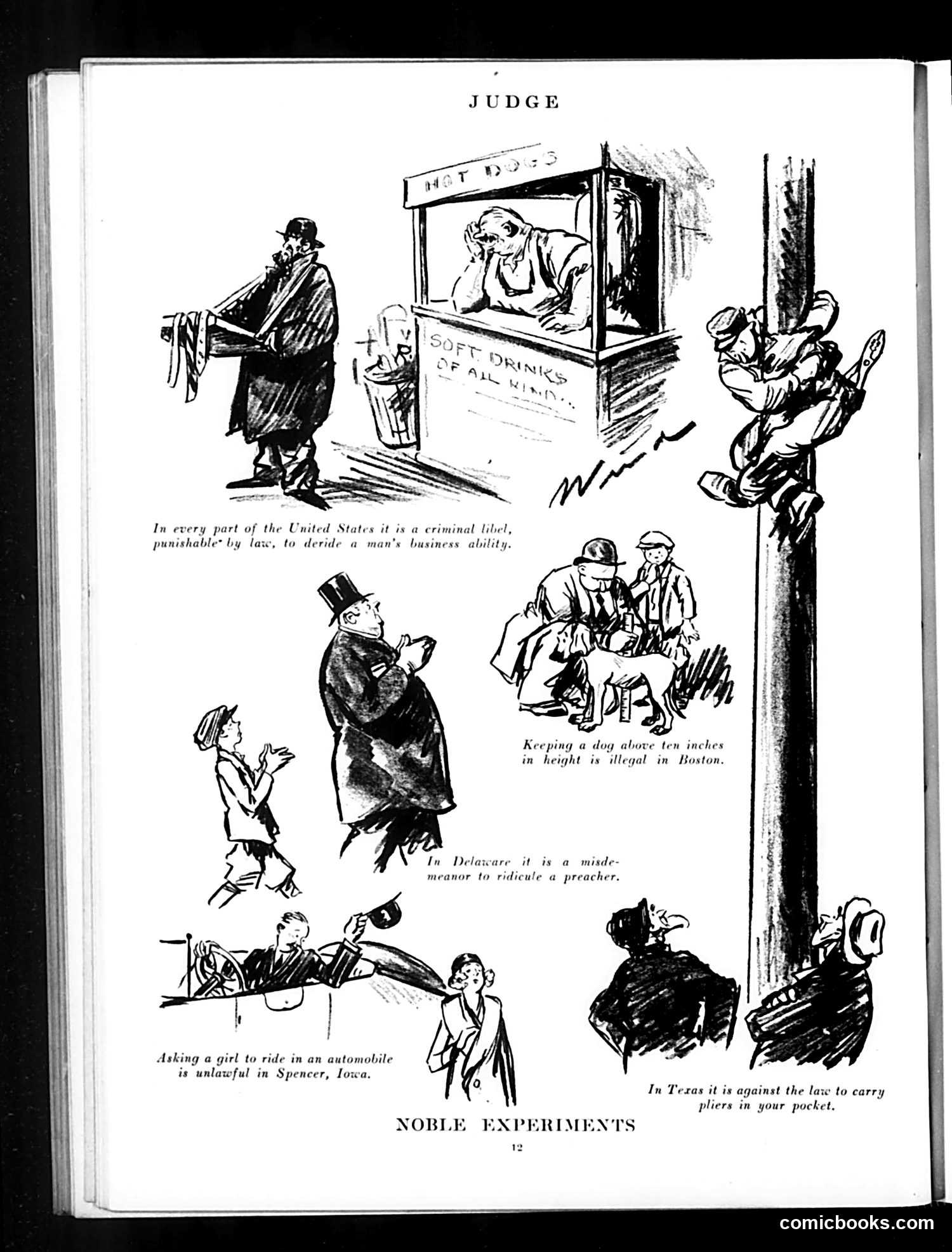
Analysis: "Noble Experiments" This page satirizes absurd or arbitrarily enforced laws across American states. Each vignette illustrates a ridiculous statute: - A man facing libel charges for criticizing someone's business - Boston's restriction on dog size - Delaware's ban on mocking preachers - A man arrested for inviting a woman on an automobile ride (likely referencing concerns about unmarried couples and moral propriety) - Texas's prohibition on carrying pliers The title "Noble Experiments" ironically echoes Prohibition, the era's most famous controversial law. The satire mocks the patchwork of state regulations that seem either quaintly outdated or dangerously restrictive to free speech—particularly the libel and preacher laws, which Judge positions as threats to personal liberty. The cartoon criticizes how legal systems can criminalize trivial behavior or legitimate expression, suggesting these laws represent governmental overreach rather than genuine justice.
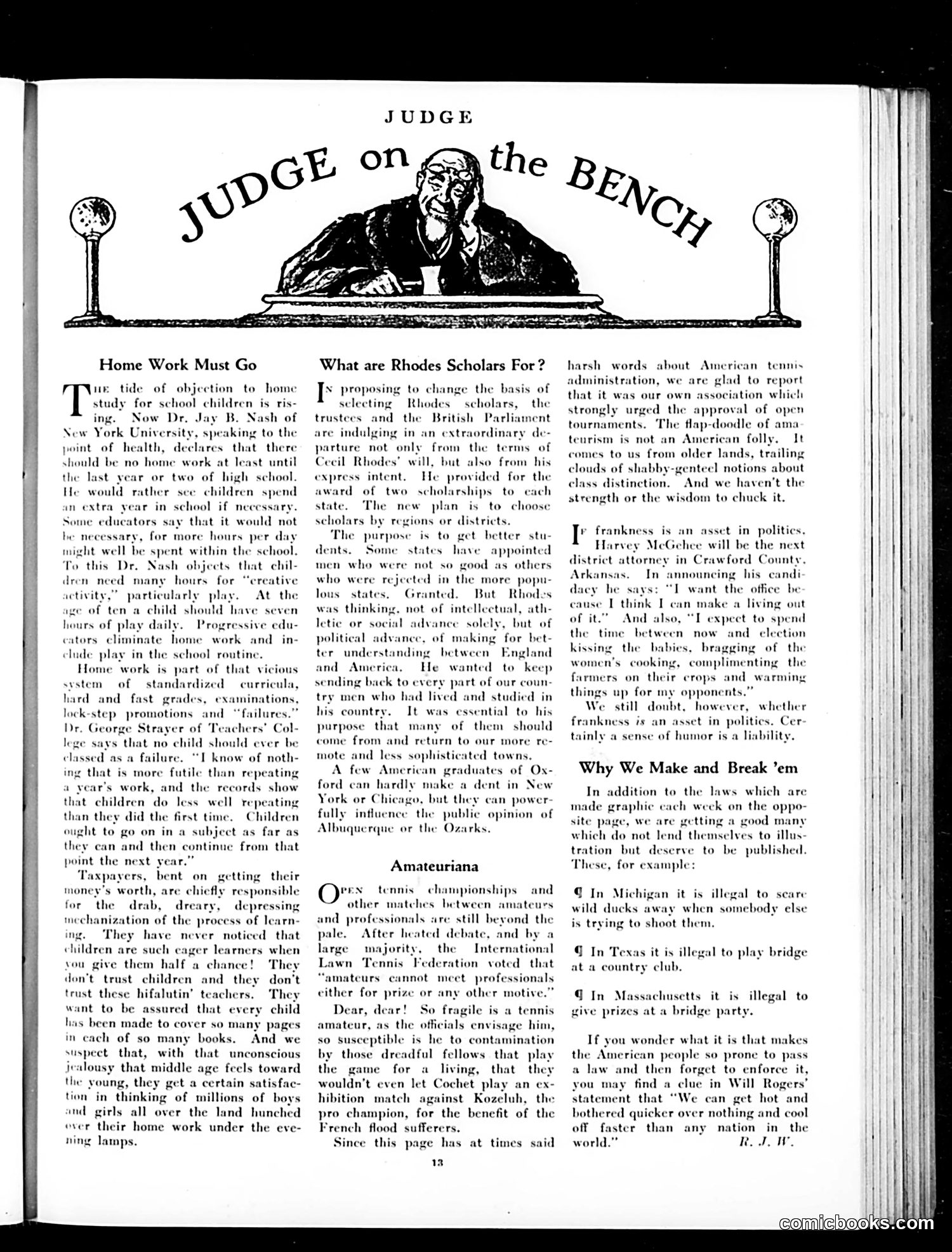
Judge Magazine Page Analysis This page from Judge (a satirical weekly) contains three distinct opinion pieces: "Home Work Must Go" argues against mandatory homework, citing Dr. Jay B. Nash's position that children need seven hours of daily play, not exhausting study. The satire targets middle-aged taxpayers who jealously demand visible "proof" of learning through homework, distrusting both children's natural curiosity and educators. "What are Rhodes Scholars For?" critiques the Rhodes Scholarship trustees for selecting elite students rather than Rhodes's original intent: distributing scholars to "less sophisticated towns" to influence American public opinion across diverse regions. The piece suggests concentrating scholars in major cities wastes their diplomatic purpose. "Amateuriana" mocks the International Lawn Tennis Federation's rule preventing amateur players from competing against professionals, even for charity. The satire highlights the absurdity of protecting amateurs from "contamination" by paid players—treating the distinction as precious rather than practical. All three pieces deploy similar satirical logic: criticizing institutions for prioritizing abstract rules over genuine social benefit.
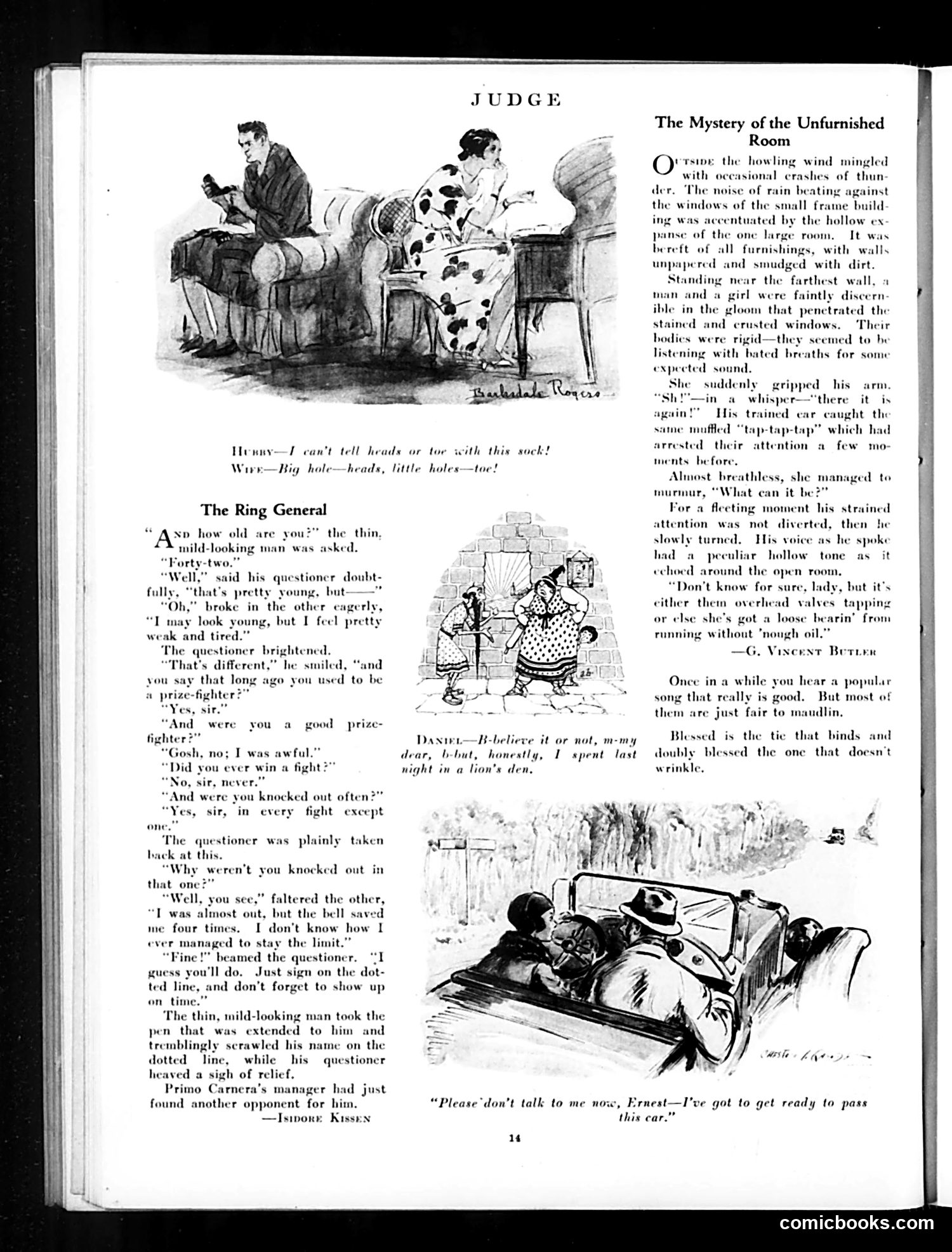
Analysis of Judge Magazine Page This page contains three distinct humor pieces typical of early 20th-century Judge magazine: "The Ring General" (main text story) satirizes boxing by depicting a manager recruiting a terrible fighter—a 42-year-old who admits he's weak, never won a fight, and gets knocked out in nearly every bout. The humor lies in the manager's approval once learning the fighter *stayed conscious* one time, suggesting desperate, low standards in professional boxing. Top cartoon shows a couple arguing about socks—likely a domestic humor joke about laundry or household management, with no clear political reference. "The Mystery of the Unfurnished Room" (right column) appears to be a serialized mystery story fragment about two people listening in an empty room during a storm, possibly eavesdropping on suspicious mechanical sounds above. Bottom cartoon depicts someone in a vehicle warning their passenger not to distract them while passing another car—early automotive humor about the novelty and danger of motor vehicles. The page reflects Judge's mix of slapstick domestic comedy, sports satire, and serialized mystery fiction aimed at general readers.
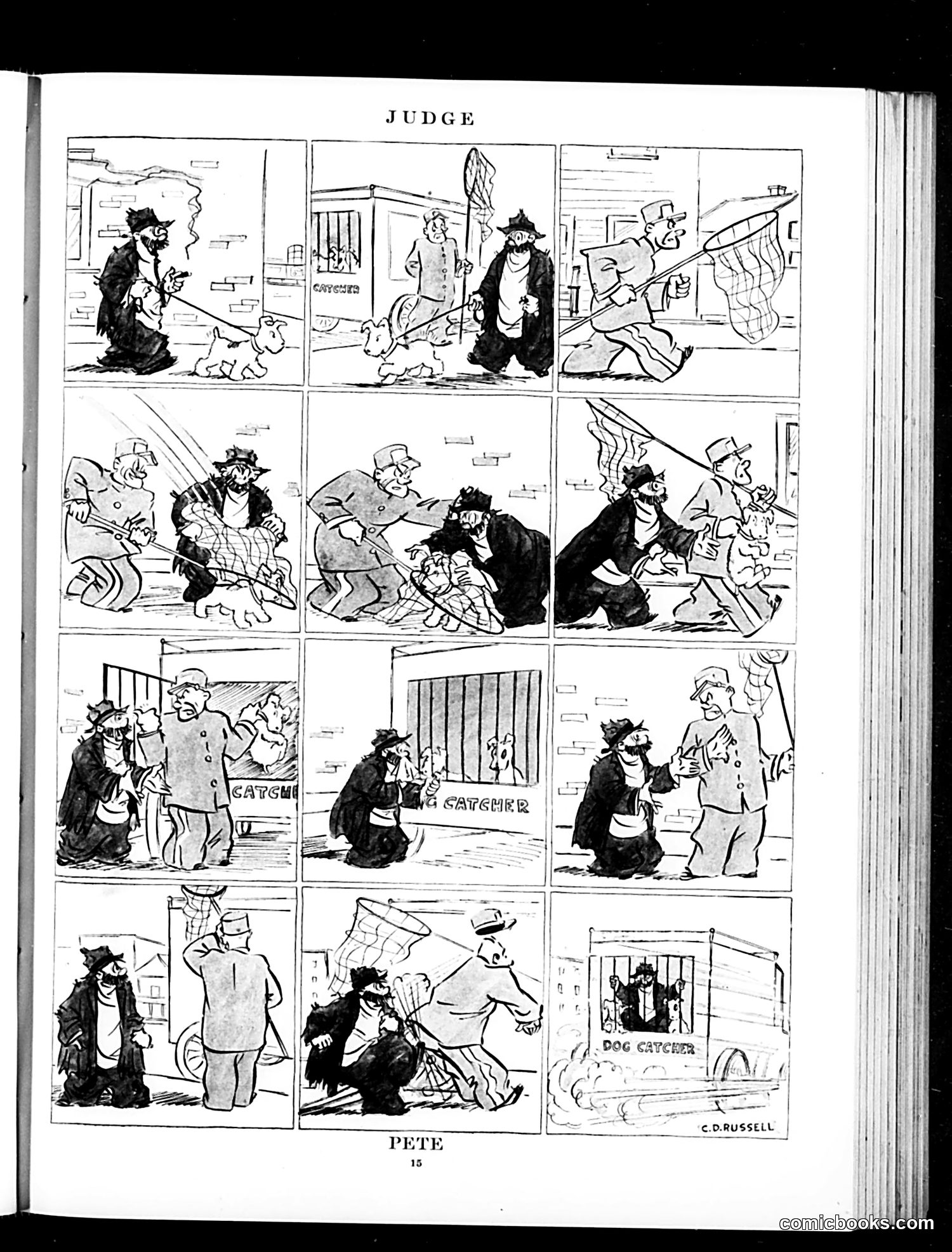
Judge Magazine Comic: "Judge" and "Pete" This two-part comic strip satirizes law enforcement and judicial authority. The top strip, titled "Judge," depicts a magistrate repeatedly encountering a small dog and its owner in various urban settings—the judge pursuing them with increasing frustration and legal authority. The satire appears to mock overzealous law enforcement focused on minor infractions. The bottom strip, "Pete," shows a similar scenario involving a dog catcher and what appears to be a vagrant or poor man with a dog. The final panel depicts them confined in a "Dog Catcher" wagon, suggesting ironic commentary on how society treats the impoverished and their possessions. Both strips use animal control and minor legal matters to critique class bias and the disproportionate exercise of authority against vulnerable populations.
Judging the Shows This is a theater review by George Jean Nathan, a prominent drama critic. Nathan attacks the self-styled "art" theater organizations—the Theatre Guild, Assembly, and Provincetown Players—for their pretentious failures, while defending commercial producers. Nathan argues that despite these groups' criticism of commercial theater as vulgar, their own productions have been disasters. He cites "They Never Grow Up" as a particularly egregious example—so bad the audience initially thought a fire had broken out and abandoned the theater. He credits successful shows to commercial producers, not the "aesthetes," listing hits like "Street Scene" and "The Last Mile." The review mocks the pretentious theater managers and suggests if the uplift societies keep producing dull shows, commercial producers will thrive. The satire targets artistic snobbery and the disconnect between the Guild's high ideals and mediocre execution.
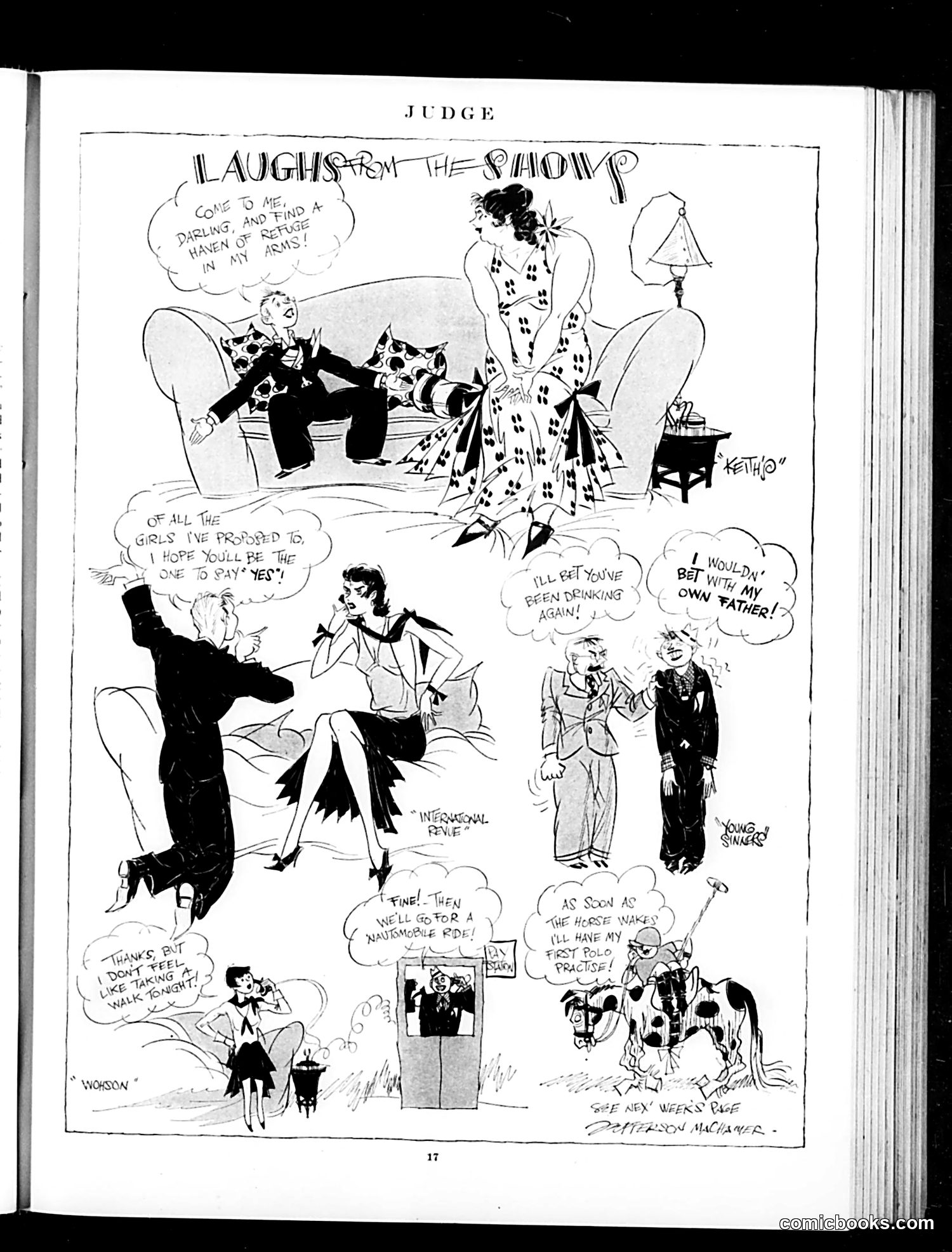
"Laughs from the Parlor" Analysis This is a multi-panel satirical cartoon depicting high-society courtship and marriage prospects. The central woman appears to be evaluating suitors, making cynical observations about matrimonial motivations. Key satirical elements include: - A wealthy woman's materialistic calculations about potential husbands - Men's stated reasons for marrying (refuge, drinking habits, inheriting property) - Commentary on arranged marriages among the upper classes - References to polo, tractors, and inheritance as marriage incentives The humor targets both genders: women as calculating gold-diggers and men as either dissolute drunks or fortune-hunters. The style and setting suggest early-to-mid 20th century American society, when Judge magazine regularly mocked wealthy elite social conventions and their contradictions between propriety and actual behavior.
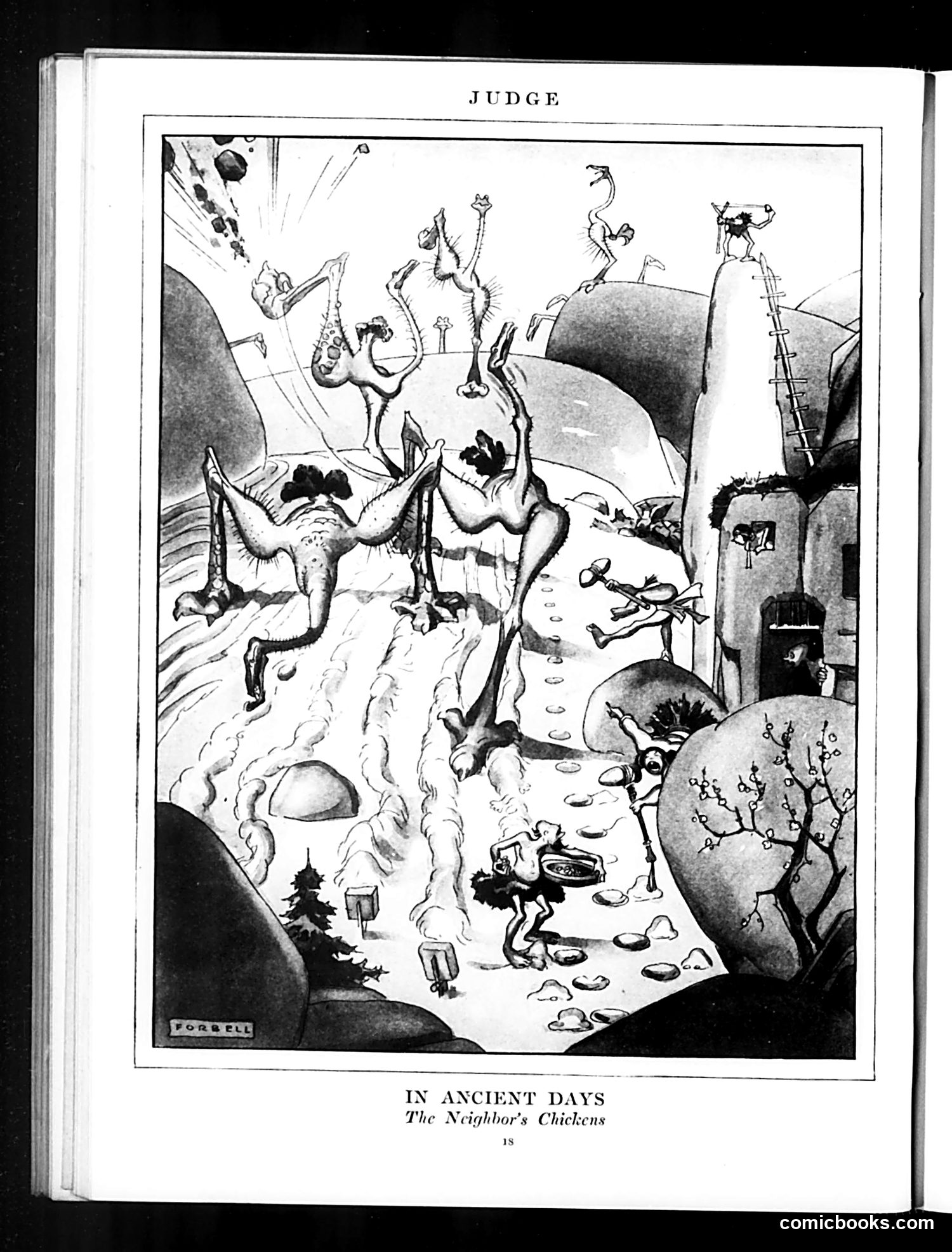
"In Ancient Days: The Neighbor's Chickens" This Judge cartoon depicts demonic or mischievous creatures in a hellish underworld scenario, apparently causing chaos. The title "The Neighbor's Chickens" suggests the satire concerns a common rural dispute: neighbors' livestock trespassing and causing damage to property. The cartoonist (Cesare Forbell, per the signature) uses absurdist exaggeration—transforming a mundane neighborly conflict into an infernal scene with contorted figures and supernatural chaos. The humor likely mocks how people escalate trivial property disputes into dramatic confrontations, or satirizes neighborhood feuds generally. The "ancient days" framing may suggest such disputes are timeless human folly.
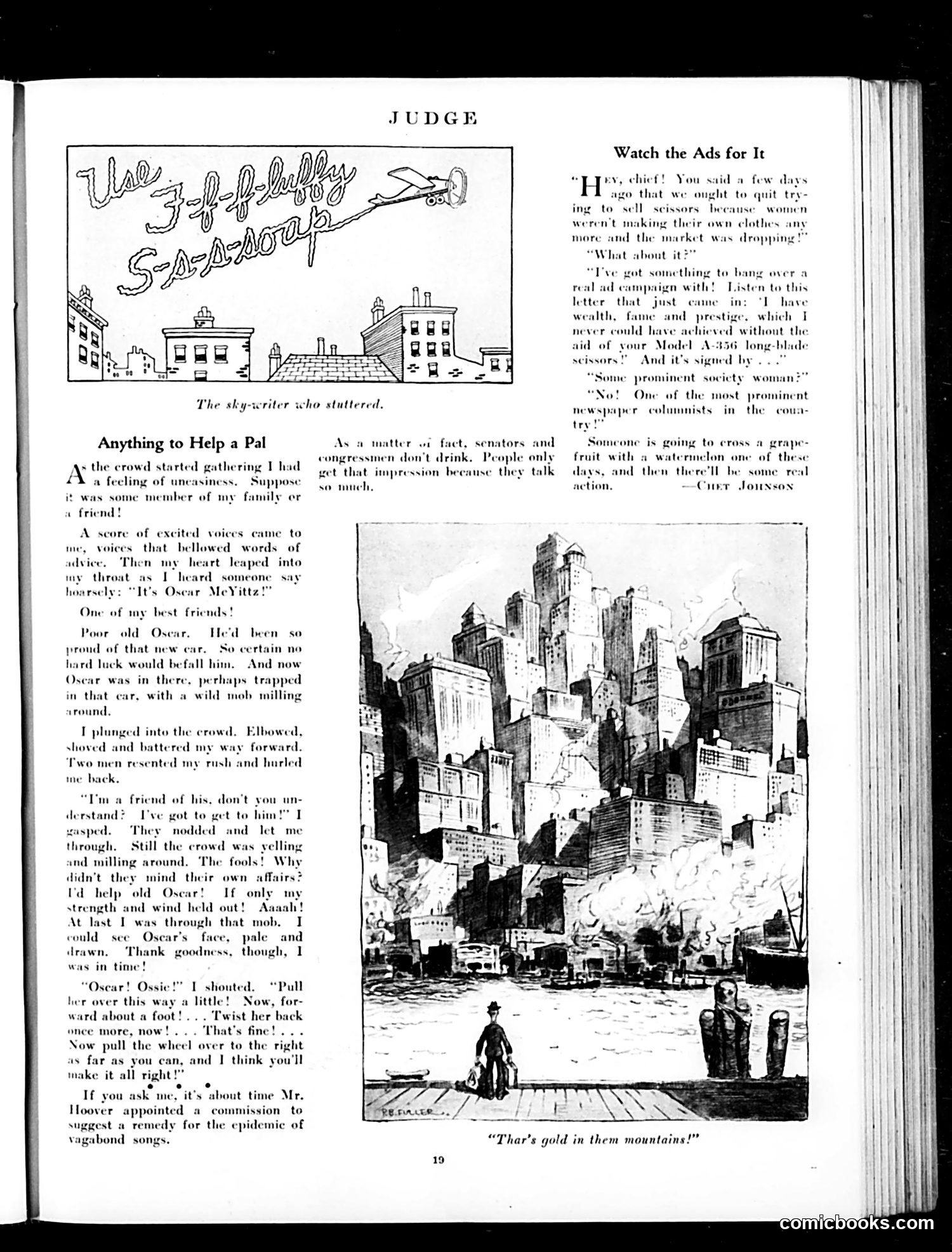
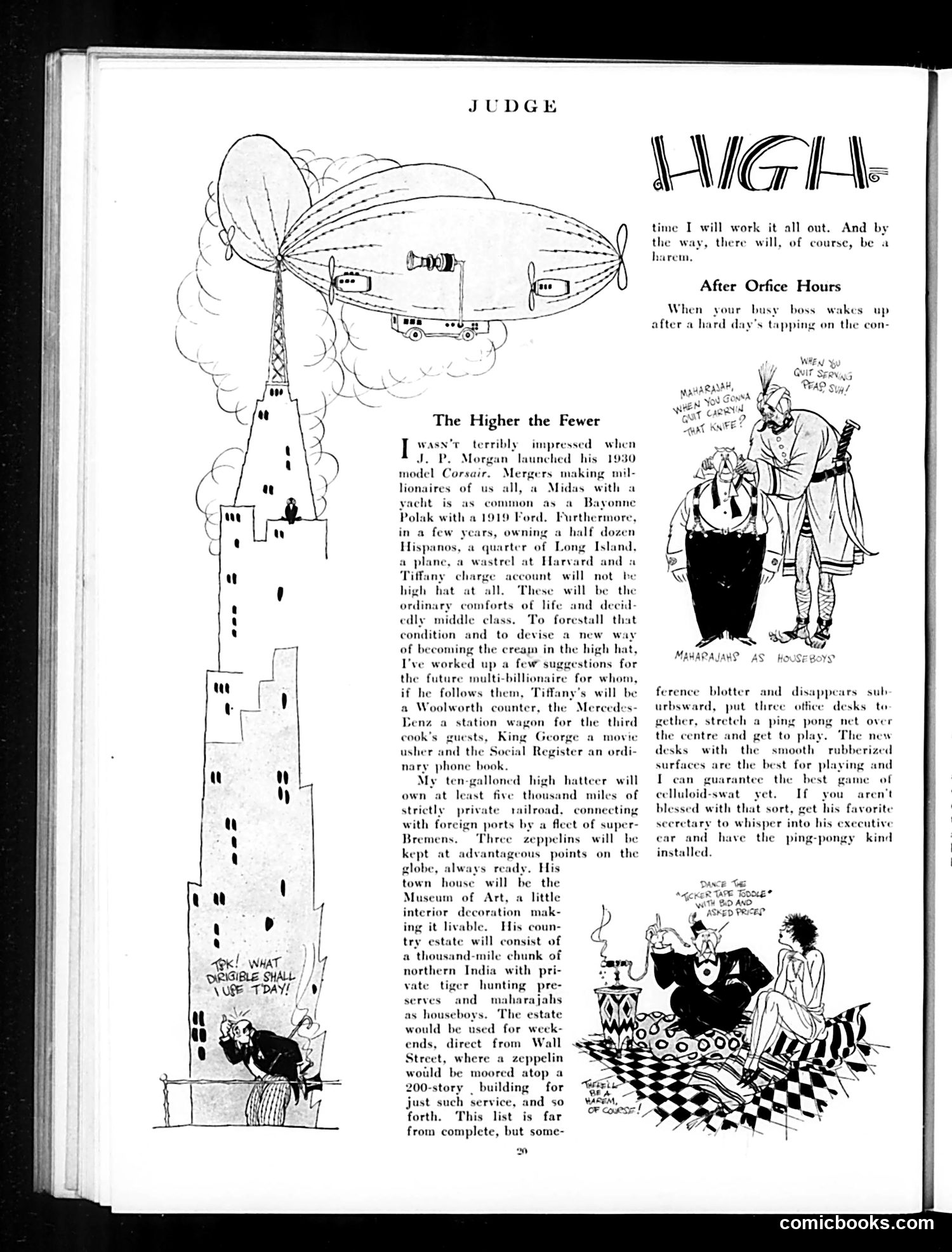
Judge Magazine: "The Higher the Fewer" This page satirizes wealthy industrialists during the 1930 economic boom. The main article mocks J.P. Morgan's luxury yacht (the Corsair) and argues that ordinary wealth—yachts, estates, Hispanos cars—will soon become middle-class commonities. The author proposes absurd "solutions" for future billionaires to remain exclusive: owning 5,000 miles of private railroad, three zeppelins, an entire Indian province with maharajahs as servants, and a harem. The satire targets the era's conspicuous consumption and the wealthy's anxiety about maintaining status as fortunes proliferate. The cartoons illustrate these fantasies (an airship tower, office ping-pong games) with comedic exaggeration. The "After Office Hours" section offers lighthearted office humor—transforming desks into a ping-pong table for bored executives—juxtaposing the wealth satire with everyday workplace comedy.
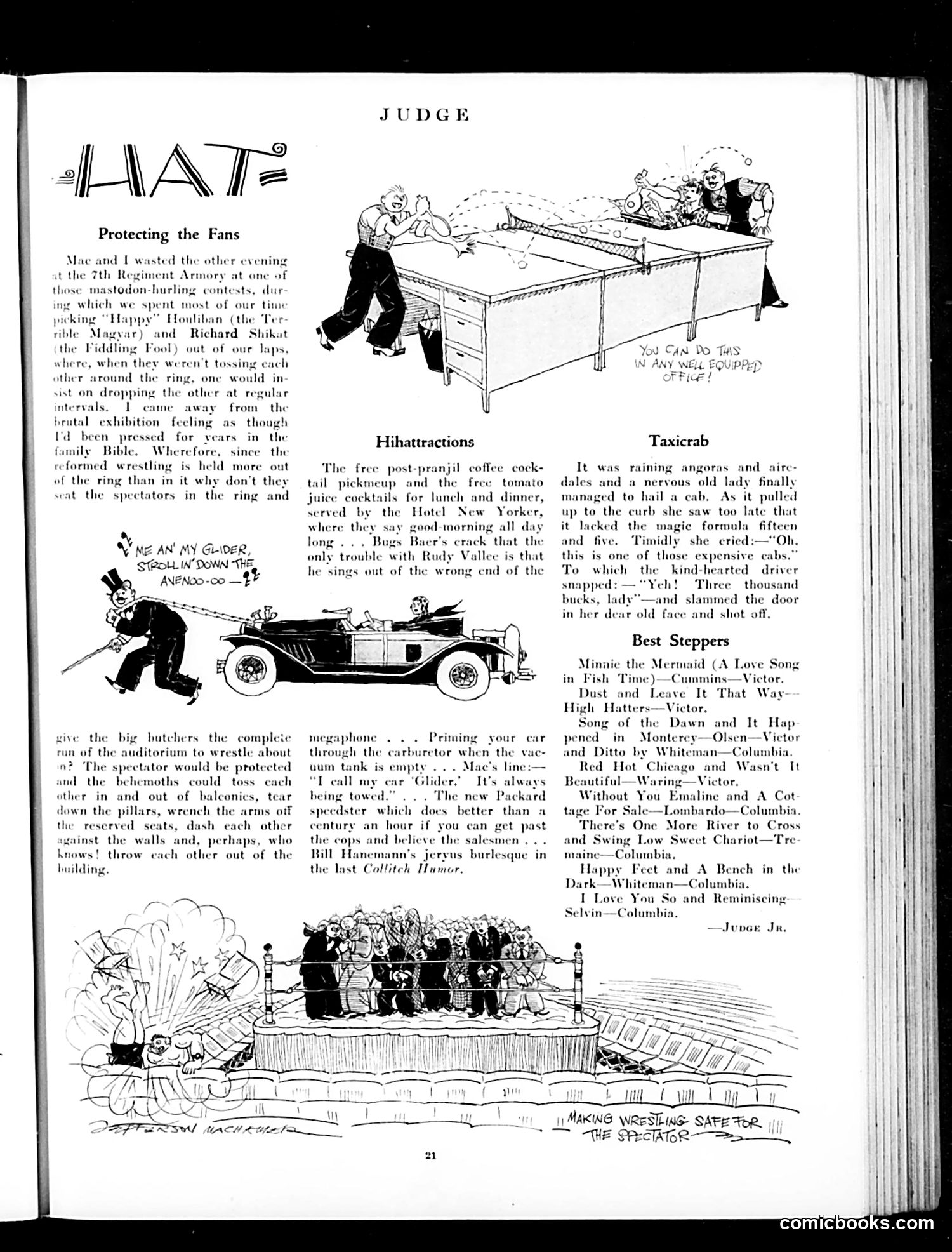
Judge Magazine Page Analysis This page satirizes 1920s popular entertainment and consumer culture through several sections: "Protecting the Fans" mocks professional wrestling's spectacle. The writer attended a match featuring "Happy" Houlihan and Richard (the "Fiddling Fool"), finding it brutally staged. He proposes sardonic "reform": seat spectators *in* the ring so wrestlers can destroy the auditorium instead, protecting fans from the performance's theatrical violence. "Hihattractions" lists trendy 1920s amusements: hotel cocktails, the singer Rudy Vallee (mocked for poor singing), automobiles, and vaudeville humor—capturing Jazz Age leisure activities. "Taxicrab" is a brief joke about taxi pricing: an elderly woman hails a cab in rain, only for the driver to demand payment equivalent to expensive vehicles, then abandon her—satirizing taxi driver rudeness. "Best Steppers" simply lists popular phonograph records of the era (Columbia, Victor labels), reflecting entertainment consumption. The cartoon style and content capture 1920s urban American life: wrestling's dubious authenticity, automobile culture, radio singers, and recorded music's growing dominance.
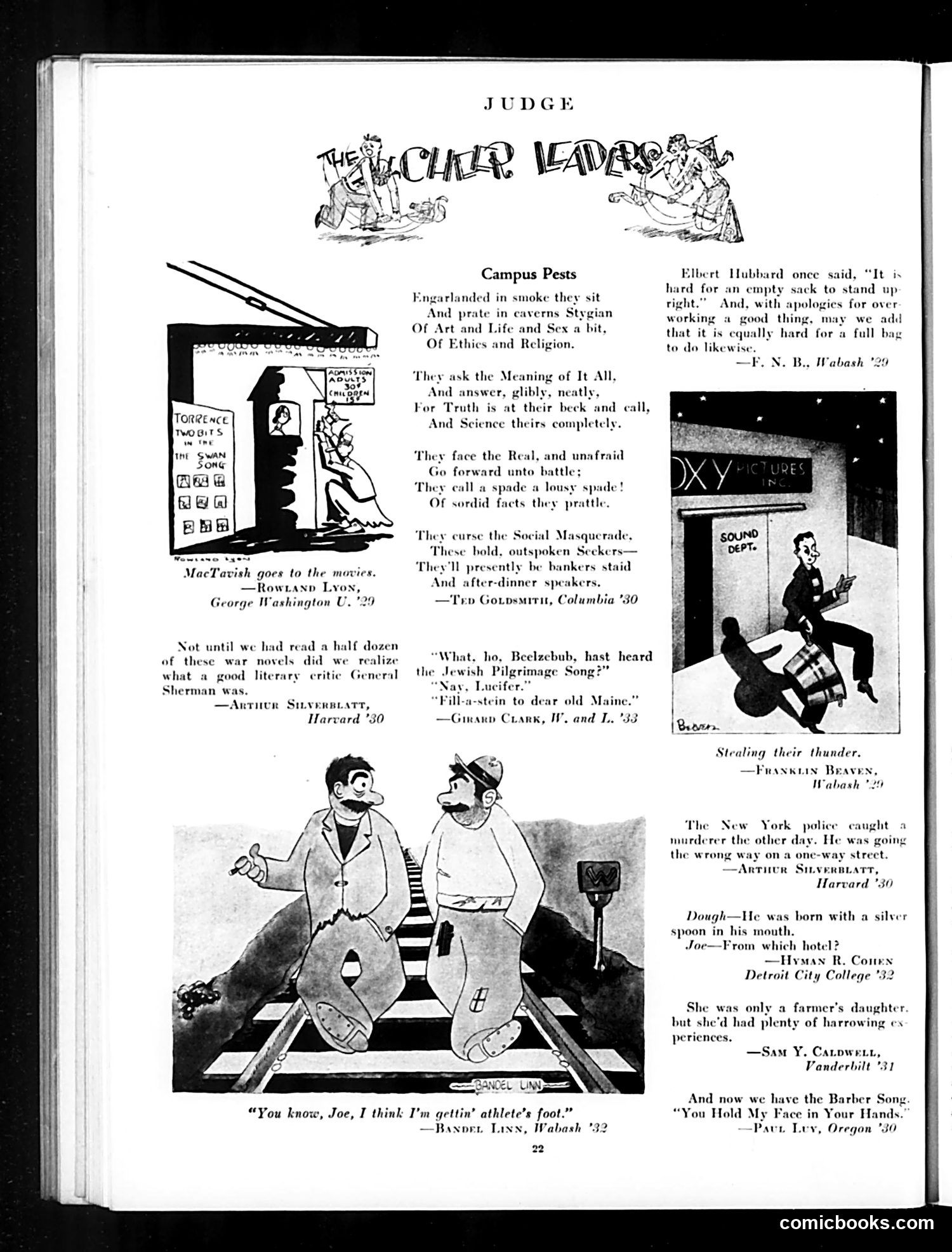
Judge Magazine Page Analysis This page from Judge magazine collects brief satirical quips and cartoons from college students (indicated by school attributions like "Harvard '30"). The humor targets "campus pests"—pretentious intellectuals who philosophize endlessly about art, life, ethics, and social issues while claiming to champion truth and challenge society's conventions. The satire's point: these self-important students will inevitably become conventional—bankers and after-dinner speakers—abandoning their radical posturing. Other jokes mock contemporary targets: war novels, police incompetence, and social pretense. One cartoon shows two figures on railroad tracks with the caption about "athlete's foot," likely satirizing slapstick or absurdist humor popular at the time. The overall tone is dismissive of youthful intellectualism, suggesting such earnest campus radicalism is performative and temporary. This reflects Judge's conservative, establishment-friendly editorial stance mocking progressive youth culture of the late 1920s.
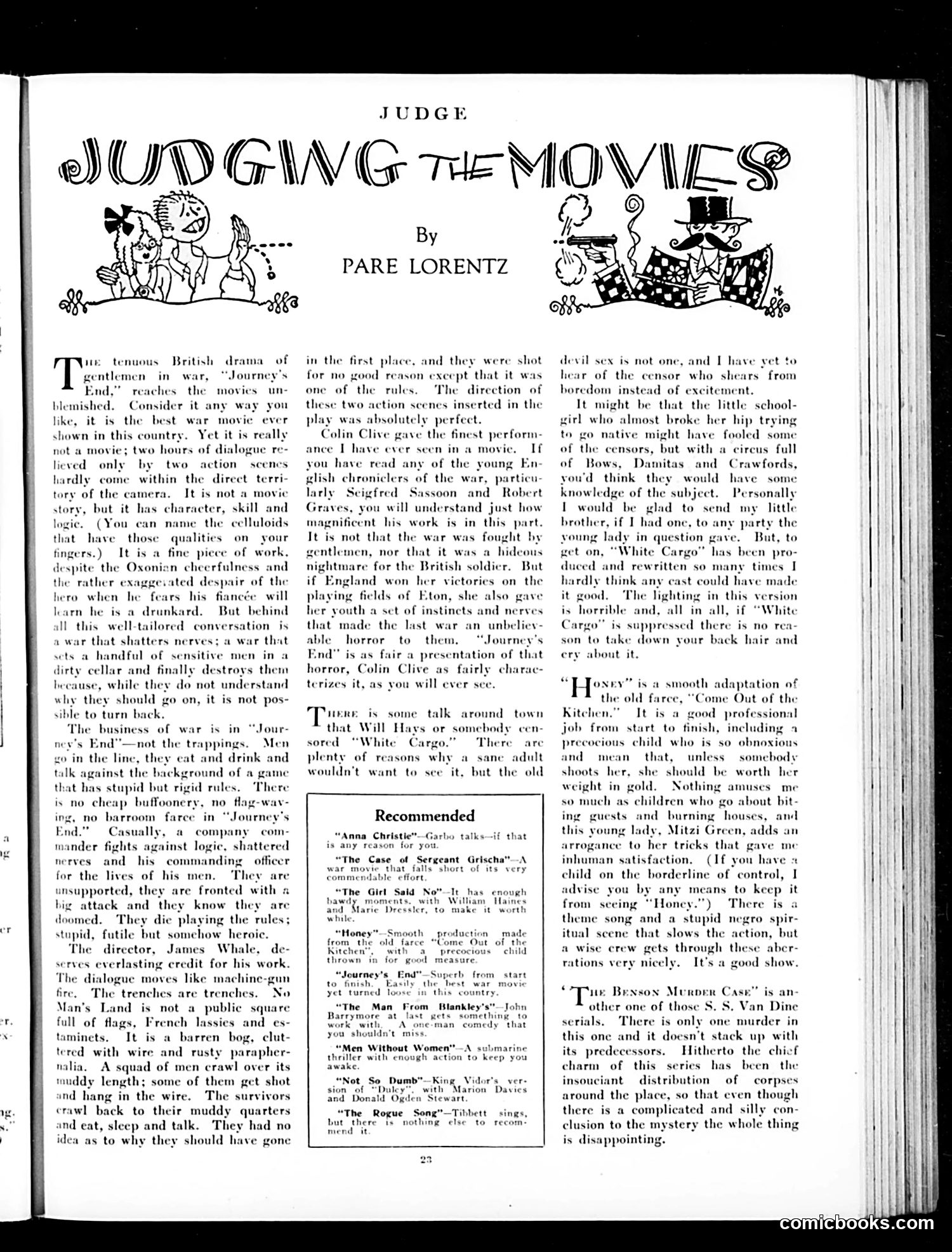
"Judging the Movies" by Pare Lorentz This is a film review column from Judge magazine. The main feature reviews "Journey's End," a British World War I drama adapted from a stage play. Lorentz praises it as "the best war movie" despite lacking traditional cinematic action—it's mostly dialogue set in a muddy trench. He credits director James Whale and actor Colin Clive for authentically depicting the war's horror and the psychological breakdown of sensitive soldiers, using Clive's performance to illustrate how educated British officers (trained at places like Eton) faced the war with cultivated restraint even while suffering psychological devastation. The column also notes censorship concerns: some townspeople questioned whether the film should have been approved, though Lorentz suggests censors typically fear boredom rather than genuinely objectionable content. The "Recommended" section lists other contemporary films with brief capsule reviews, using a casual, conversational tone typical of 1930s film criticism.
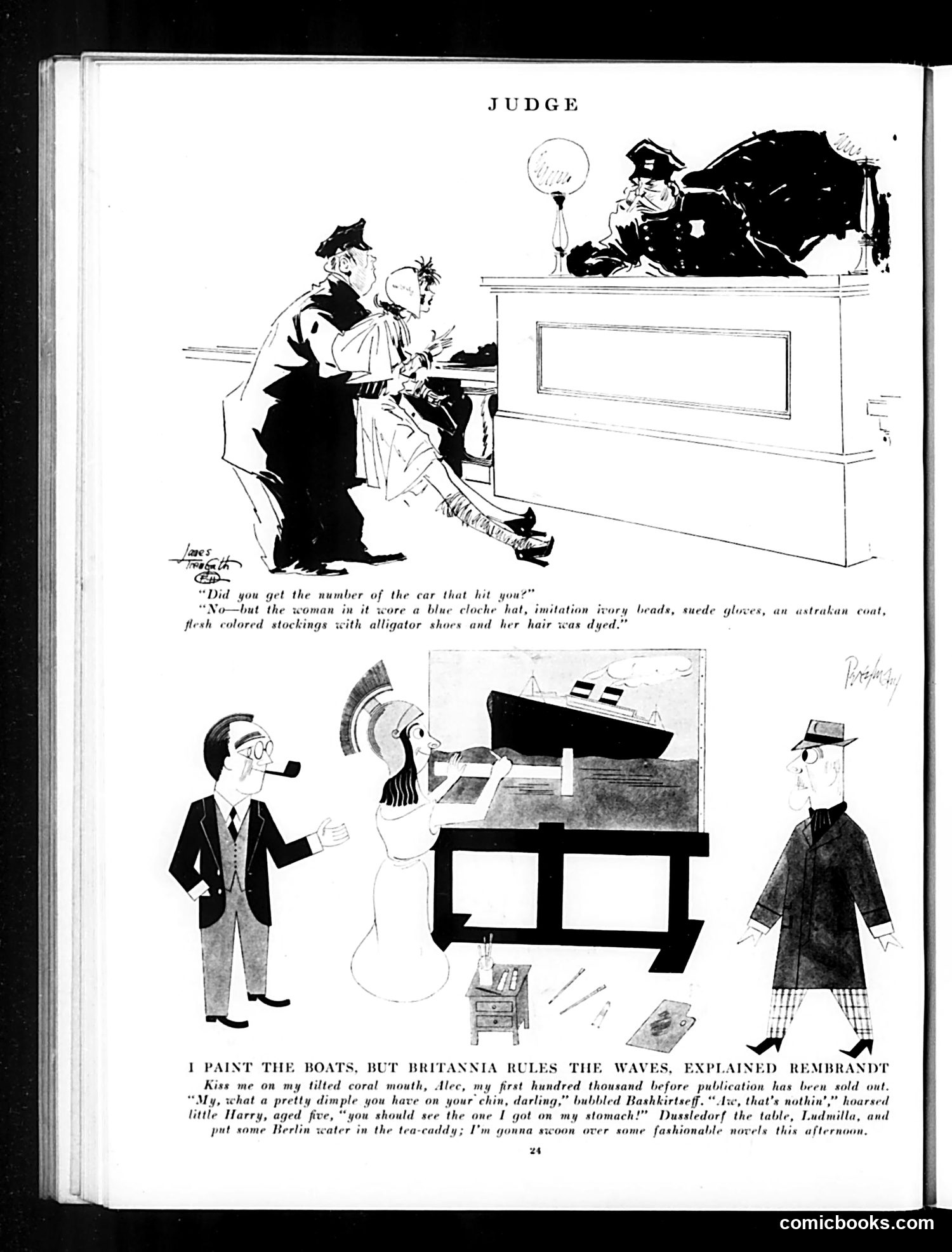
Judge Magazine Satire Analysis Top Cartoon ("Did you get the number..."): This satirizes 1920s women's fashion and materialism. A accident victim describes the hit-and-run driver not by her license plate but by her luxurious outfit—cloche hat, beads, fur coat, alligator shoes, dyed hair. The joke mocks how superficial consumer culture and designer goods had become the defining markers of identity, even in serious situations. It suggests women (particularly wealthy ones) were more recognizable by their expensive wardrobe than any practical identifier. Bottom Section: Contains literary and cultural parodies. "Paint the Boats, But Britannia Rules the Waves" likely mocks Romantic/artistic pretension. The quoted dialogue satirizes affected literary speech patterns—gushing compliments, precious affectations ("swoon over fashionable novels"), pretentious name-dropping. The humor targets the artificiality of highbrow cultural posturing among the fashionable set.
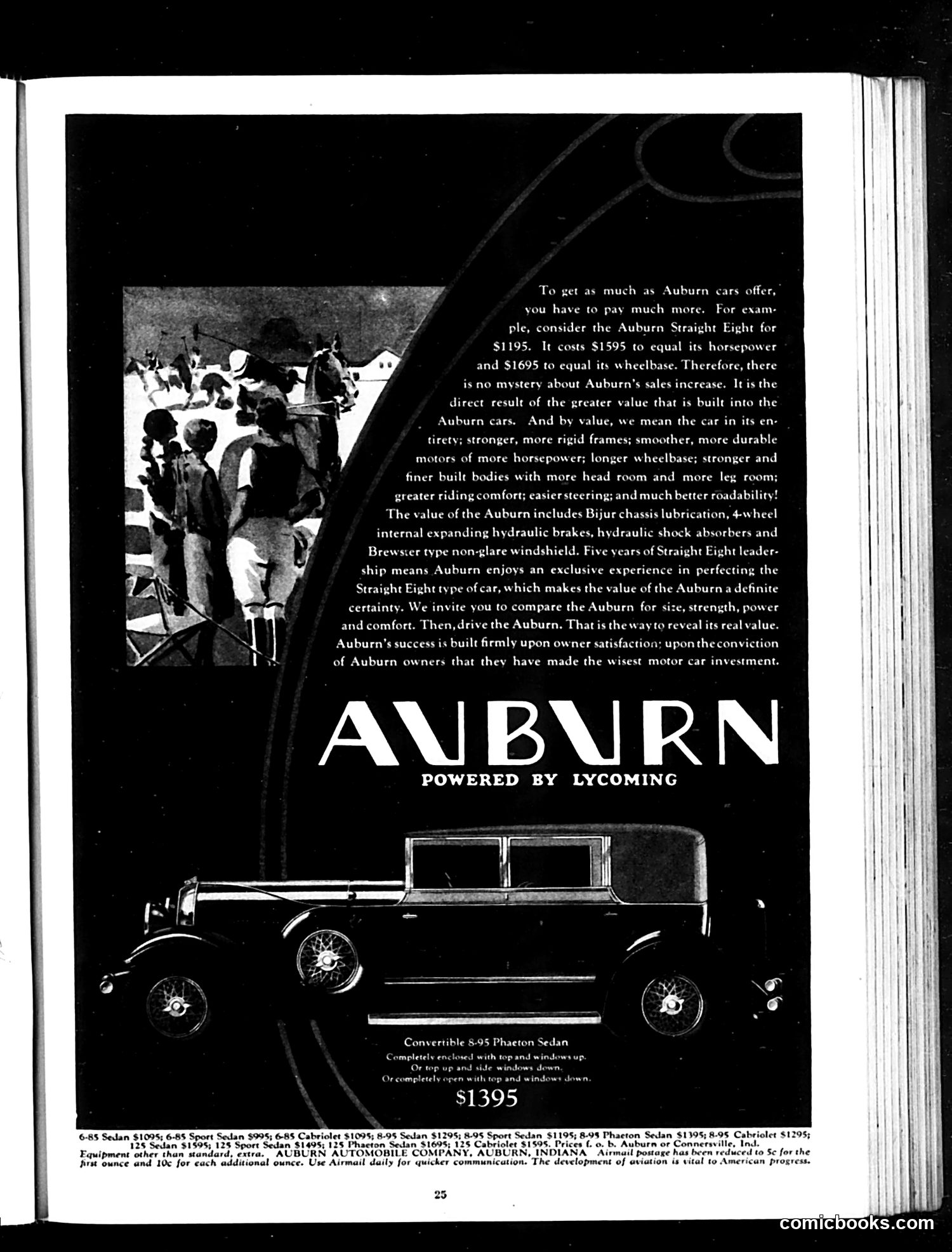
This is a full-page advertisement for Auburn automobiles, not a political cartoon. It promotes the Auburn Straight Eight and other models, emphasizing value-for-money compared to competitors. The ad argues that Auburn cars cost less than rivals while offering superior horsepower, wheelbase, frame rigidity, and comfort features. A photograph shows people examining an Auburn vehicle at what appears to be a dealer event or showroom. The copy stresses Auburn's five-year leadership in the "Straight Eight" engine type and appeals to buyers' satisfaction. Prices range from $995 to $1695. A small illustration shows a convertible Phaeton sedan. The ad includes a patriotic note about airmail postage supporting aviation development—likely from the 1920s-1930s based on styling and pricing.
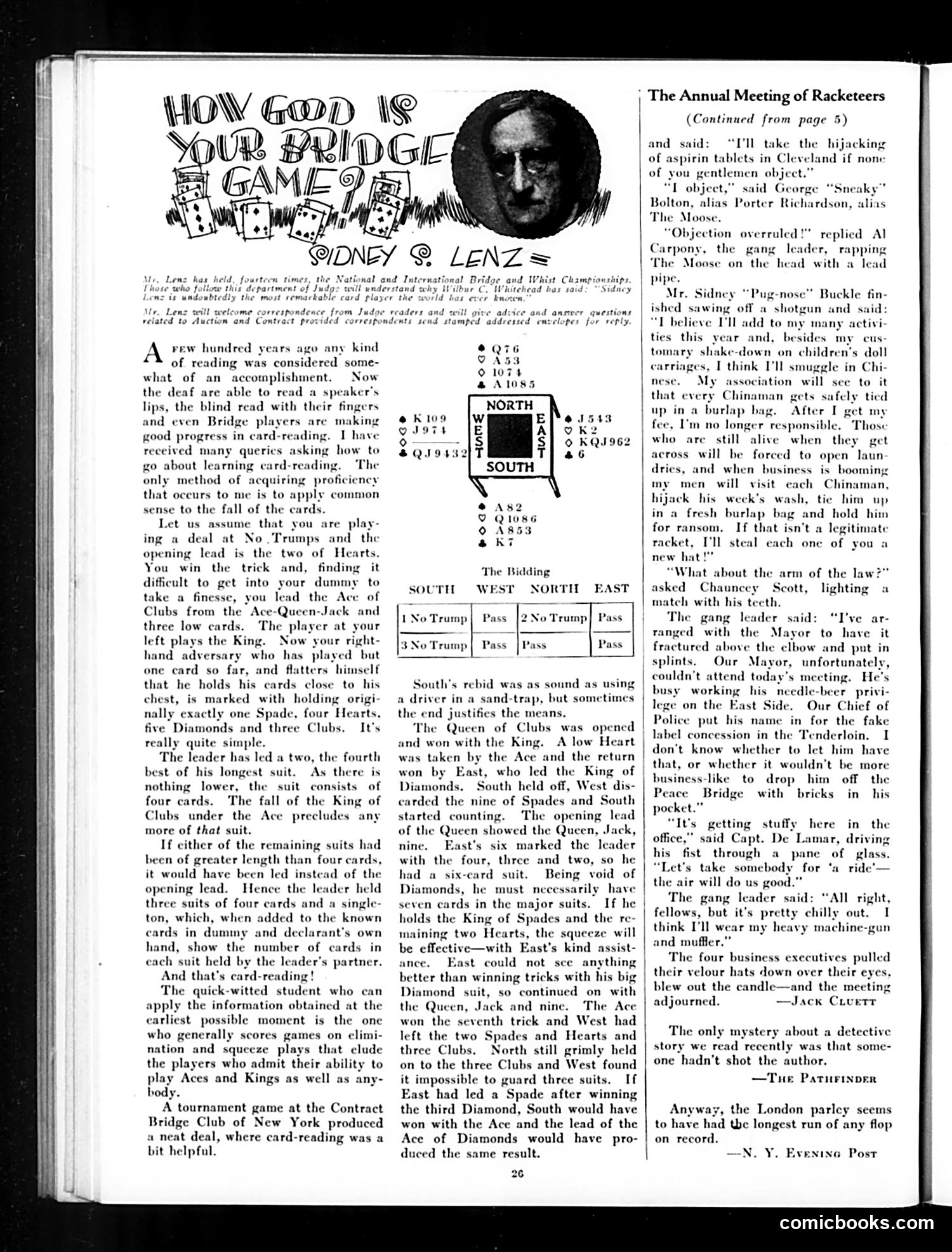
Political Cartoon & Satire Analysis This page features Sidney Lenz, a famous contract bridge player of the early 20th century, depicted in the caricature at top right. The headline "How Good Is Your Bridge Game?" sarcastically credits Lenz as an authority on card-playing strategy. The satire appears to mock Lenz's reputation and prominence in bridge circles. The page includes legitimate bridge instruction (a "deal" with bidding notation), but frames it within what appears to be a broader critique—the right column discusses "The Annual Meeting of Racketeers," suggesting organized crime connections or criminal behavior among supposed "gentlemen." The juxtaposition creates satirical commentary: while Lenz presents himself as teaching respectable card strategy, the magazine implies the bridge establishment itself may be morally compromised or involved in unsavory activities. This reflects Judge magazine's tradition of using humor to critique public figures and social institutions. Without additional context, the specific allegations remain unclear, but the mockery is unmistakable.
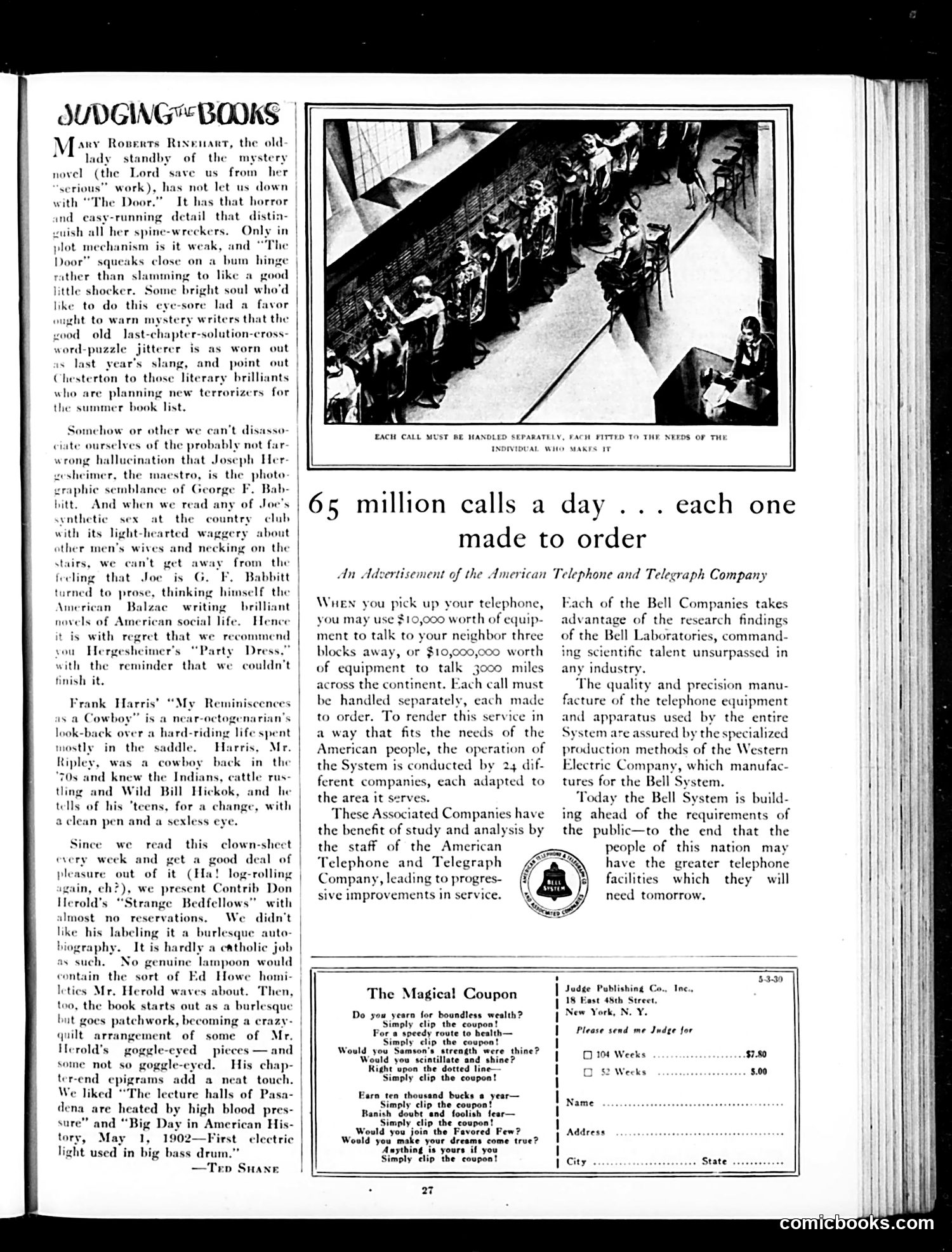
Explaining This Judge Magazine Page to Modern Readers This page contains a book review section ("Judging the Books") followed by a Bell Telephone advertisement. The reviews critiques popular mystery and fiction novels of the era, mentioning authors like Mary Roberts Rinehart and Joseph Hergesheimer. The tone is witty and gossipy—the critic jokes that Hergesheimer resembles George F. Babbitt (a famous fictional character representing American conformity) and that his writing mirrors Babbitt's synthetic approach to life. The lower half is a corporate advertisement for AT&T, emphasizing the telephone system's efficiency. The accompanying photograph shows switchboard operators managing calls. The ad's pitch is that 65 million daily calls require individual attention—each call must be "made to order" to serve different customer needs across the continent. For modern readers: This reflects early-20th-century enthusiasm for telecommunications technology as an engineering marvel, and Judge's mix of literary satire with big-business advertising was typical of the magazine's content for educated, middle-class readers.
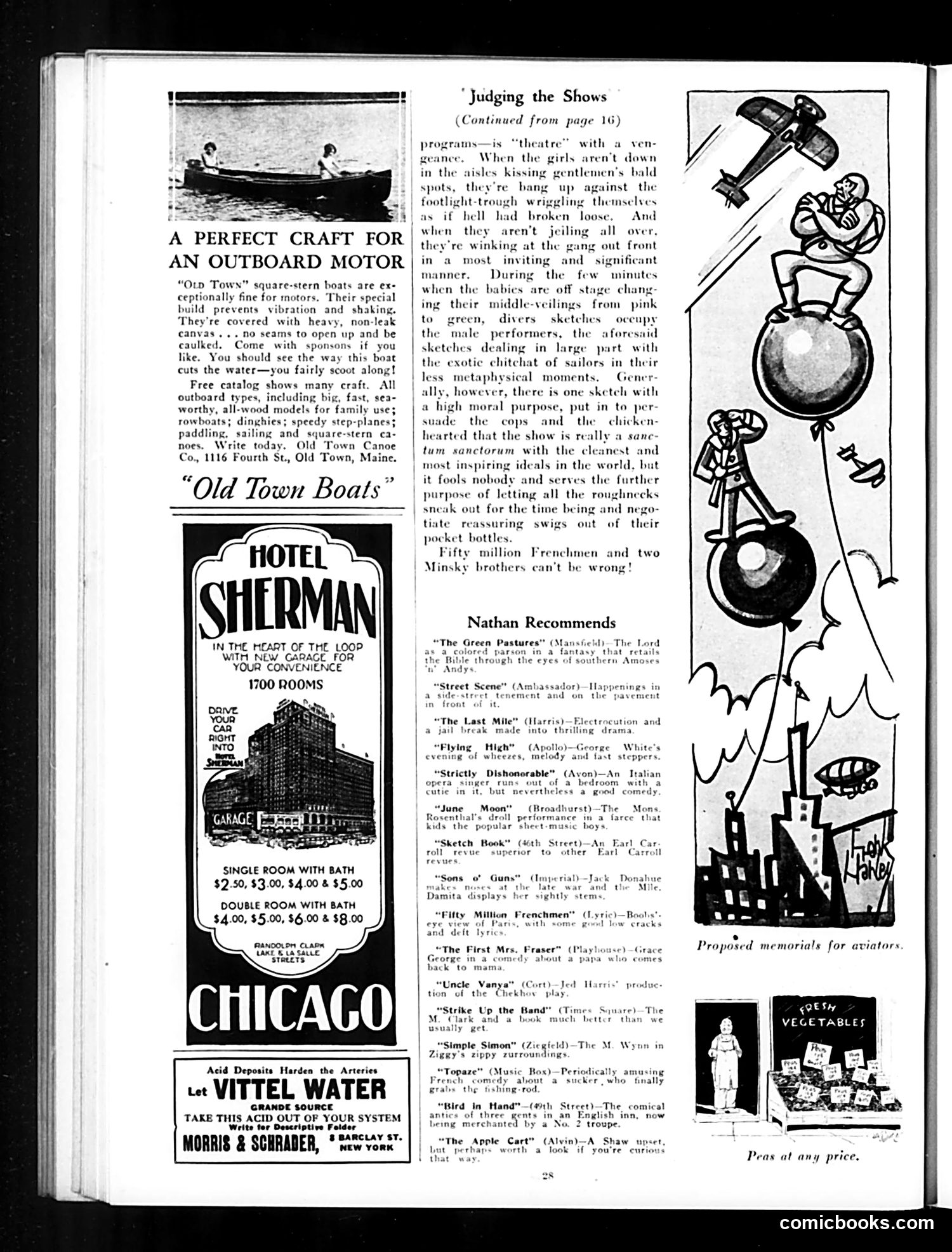
Analysis for Modern Readers This page is primarily advertising and theater reviews, not political satire. The main content includes: "Judging the Shows" - A theater critic's commentary mocking Broadway revues (likely Minsky burlesque shows), describing scantily-clad female performers as the main attraction while male comedians perform crude sketches about sailors. The critic sardonically notes that shows include one "moral" sketch to appease police, allowing audiences to sneak out for drinks. The closing quip—"Fifty million Frenchmen and two Minsky brothers can't be wrong!"—is a contemporary catchphrase suggesting risqué entertainment was popular and defensible. "Nathan Recommends" lists theater reviews of various shows. Side cartoons show absurdist humor about aviation ("Proposed memorials for aviators"). Advertisements dominate the page: Hotel Sherman (Chicago), Old Town Boats, Vittel Water, and vegetables. The page reflects 1920s-30s attitudes toward burlesque theater and commercialism rather than political commentary.
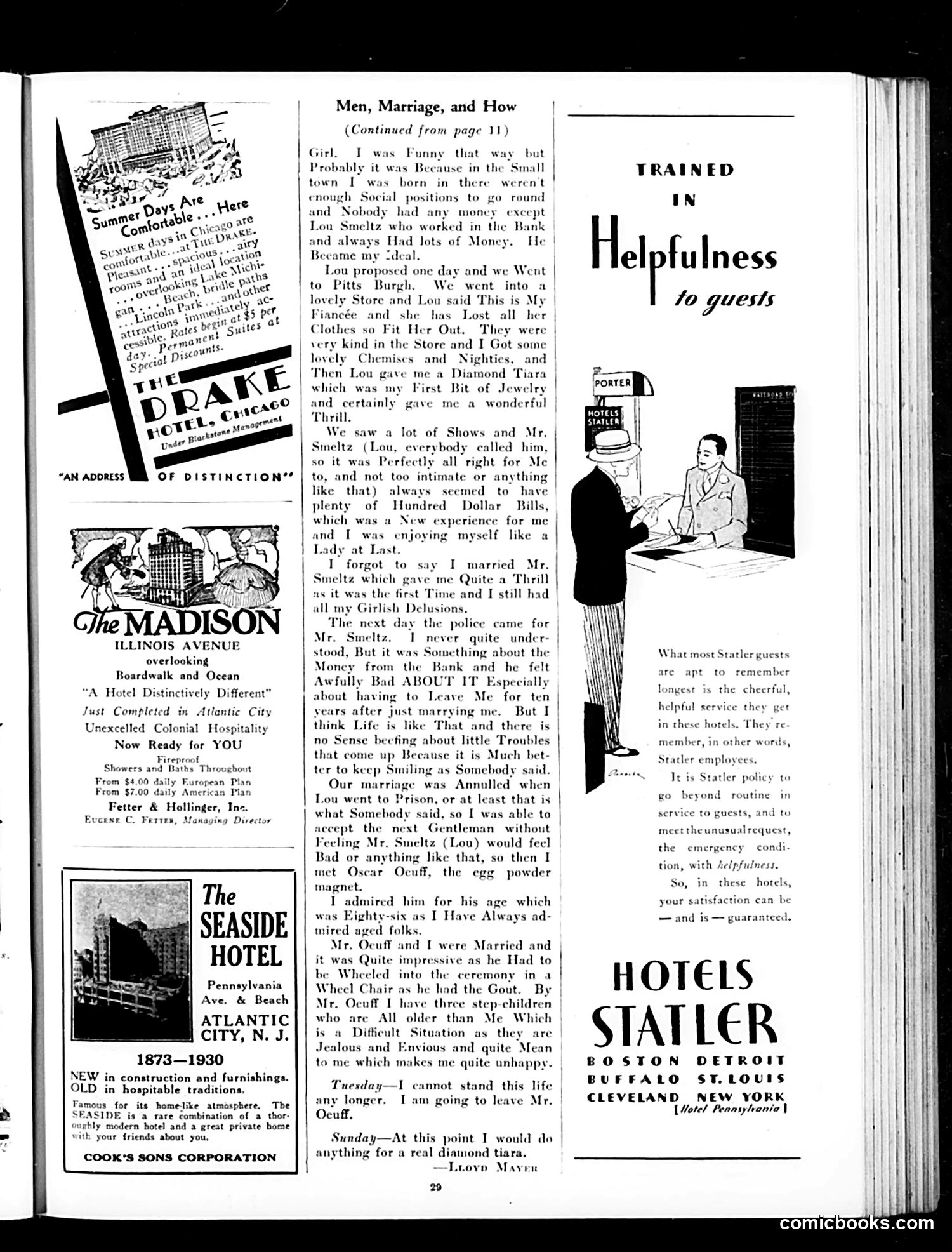
Page Analysis: Judge Magazine This page contains mostly advertisements for Atlantic City and other hotels (Drake Hotel Chicago, Madison Avenue, Seaside Hotel, and Statler Hotels chain), interspersed with a continuation of a satirical article titled "Men, Marriage, and How." The article excerpt—narrated by a woman named Lloyd Mayen—satirizes marriage through darkly comic anecdotes. She describes marrying Lou Smeltz, a banker who is arrested days after their wedding for embezzlement ("Money from the Bank"), resulting in annulment. She then marries elderly Oscar Ocuff, who must be "wheeled into the ceremony in a Wheel Chair" due to gout, giving her three resentful adult stepchildren. The satire targets: women's limited economic options (requiring marriage for security), shotgun marriages, gold-digging, and the absurdity of marriages of convenience. The narrator's cheerful tone despite these disasters creates the humor—she accepts each matrimonial disaster as inevitable life ("no Sense beefing about little Troubles"). The cartoon illustration shows a hotel check-in desk, likely illustrating the "helpfulness to guests" praised in the Statler Hotels advertisement.
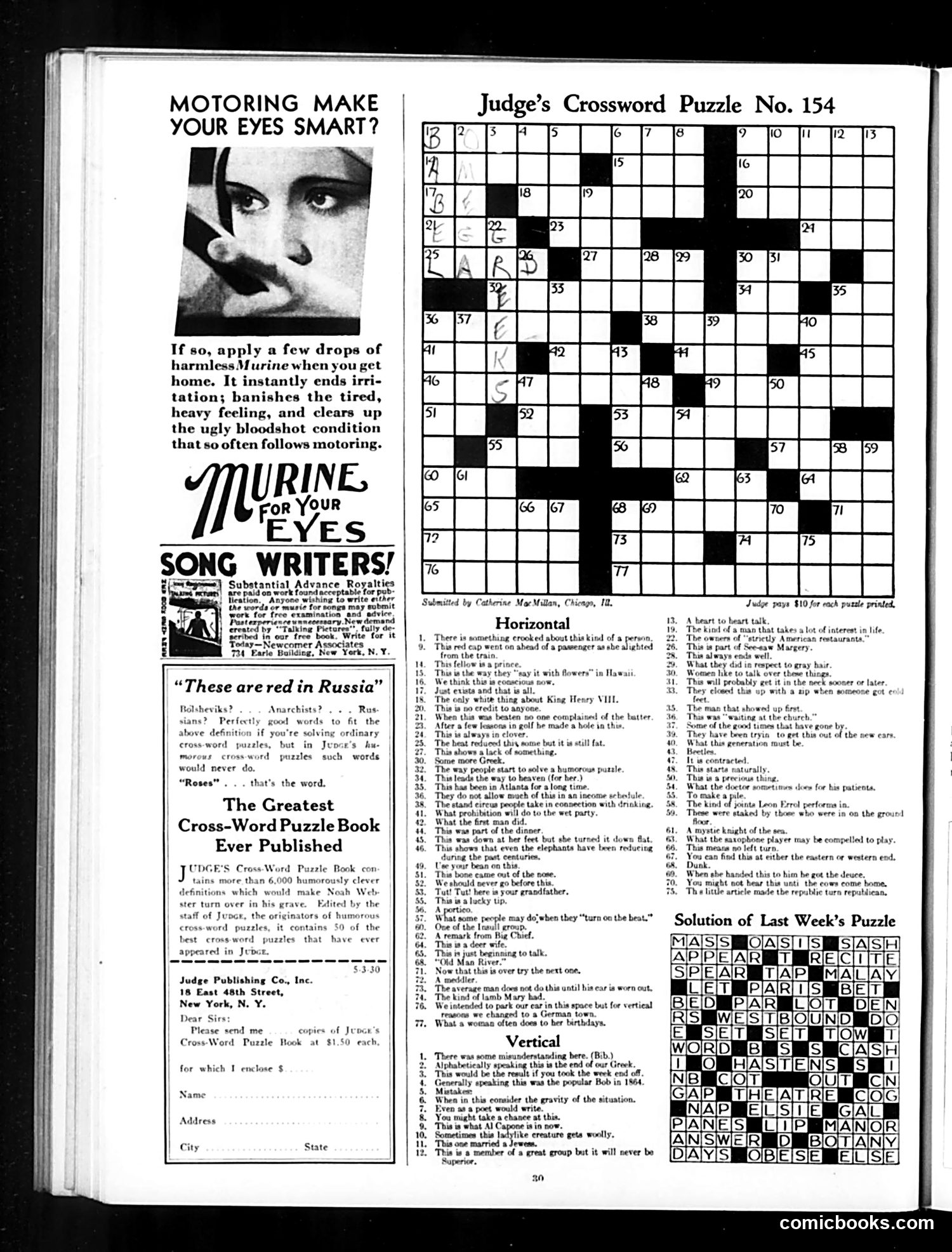
Judge Magazine Page Analysis This page is primarily advertising and puzzle content, not political satire. The dominant feature is Judge's CrossWord Puzzle Book advertisement, which emphasizes humor as its distinguishing feature—contrasting Judge's "humorous" puzzles with ordinary ones. The ad includes a joke: when solving Judge's puzzles, answers like "Bolsheviks" and "Anarchists" wouldn't fit because they're too serious; "Roses" is more appropriate for a humor magazine. The brief reference to "These are red in Russia" appears to mock communist associations with the color red—a topical jab during the 1920s Red Scare era. However, the page's primary purpose is commercial: selling puzzle books and promoting Murine eye drops (for motorists' eye irritation) and song-writing services. The actual crossword puzzle occupies the right side with clues and a solution grid visible.
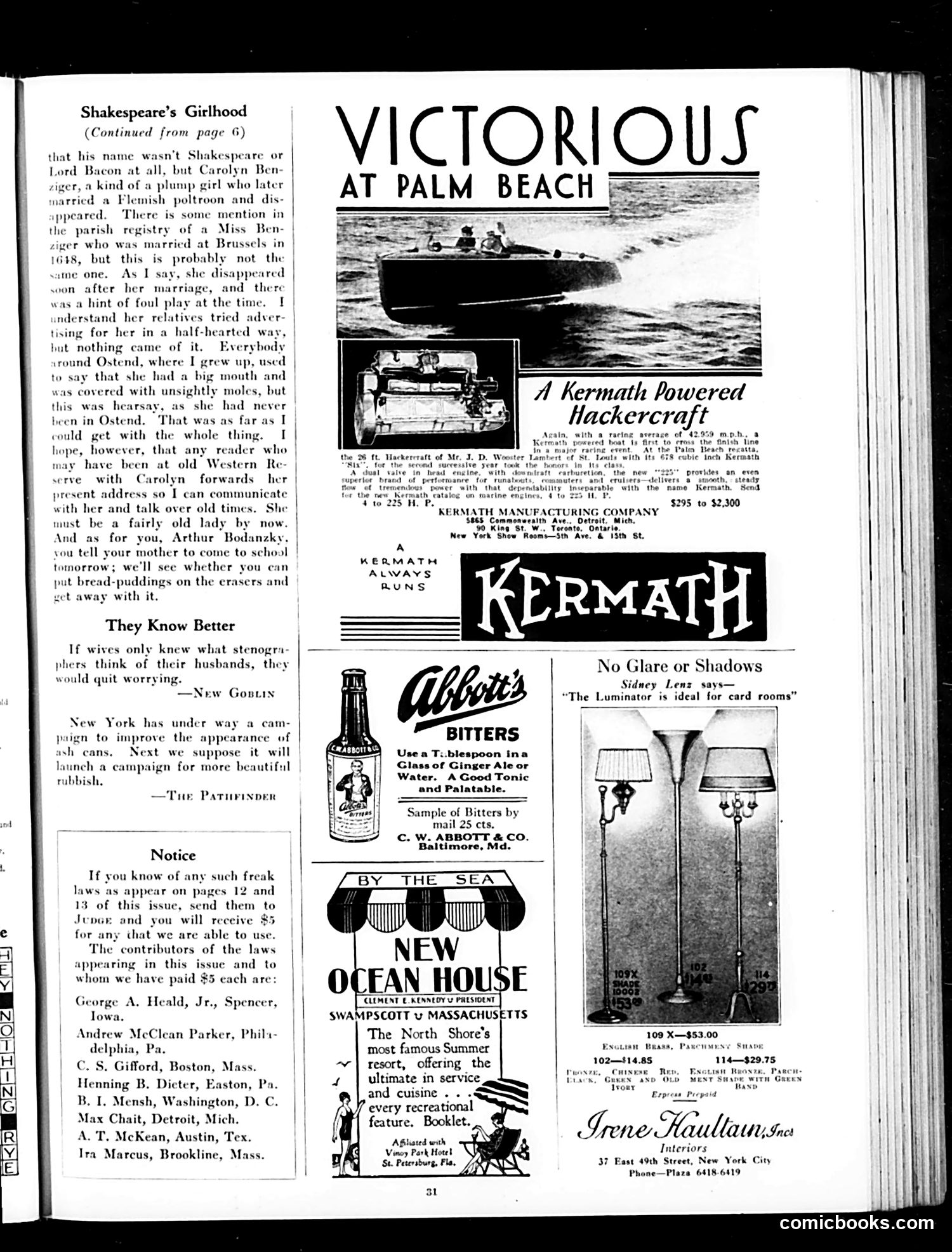
Analysis of Judge Magazine Page This page is primarily advertising and filler content, not political satire. The main elements are: Left column: A humorous essay titled "Shakespeare's Girlhood" (continued from earlier) presents a tongue-in-cheek alternate history claiming Shakespeare was actually "Carolyn Benziger," a Flemish woman who disappeared after marriage. This is satirical literary absurdism—Judge mocking pretentious Shakespeare scholarship debates popular in the era. A teacher's note to "Arthur Bodanzky" adds comedic schoolyard humor. Advertisements dominate the right side: Kermath boats, Abbott's Bitters (a patent medicine), the Ocean House resort, and Irene Haullaum's interior design services. Filler sections include "They Know Better" (brief quips about stenographers and NYC trash cans) and a "Notice" soliciting readers to submit unusual local laws for $5. The page contains no identifiable political cartoons or caricatures—it's a typical magazine layout mixing light humor, filler content, and advertising. The Shakespeare parody represents Judge's trademark satirical tone toward cultural pretension.
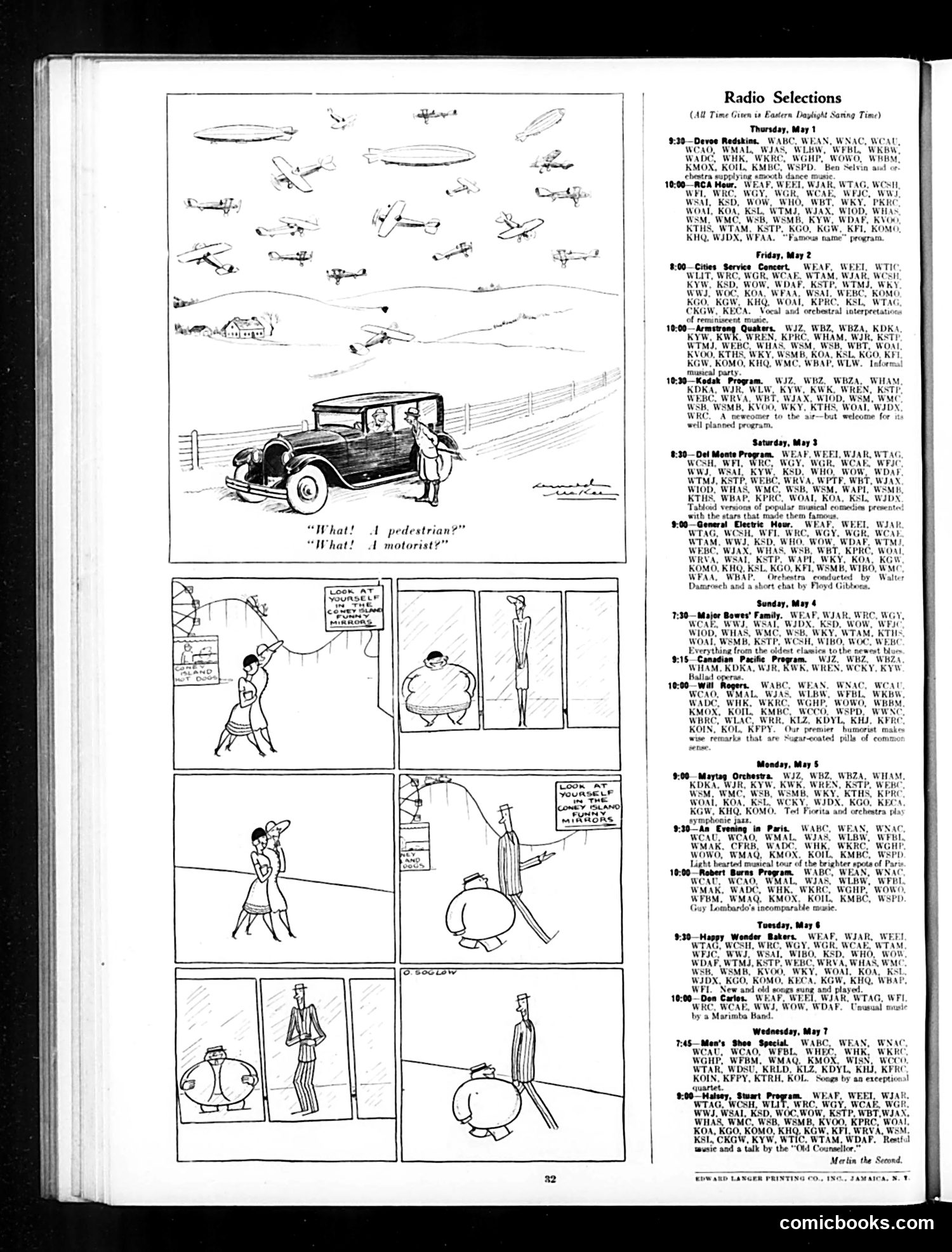
Radio Selections Page Analysis This page from *Judge* magazine contains no political cartoons or satire—it's primarily a radio programming guide listing broadcast schedules for May 1927. The page includes two cartoon panels above the listings depicting a humorous traffic scene: a motorist and pedestrian colliding, with dialogue "What! A pedestrian?" and "What! A motorist?" This gentle humor reflects 1920s anxiety about automobile proliferation and pedestrian safety—a contemporary concern as cars became common. The bulk of the page is a straightforward radio schedule listing programs, station call letters (WEAF, WJAR, etc.), and brief descriptions. Notable programs mentioned include the "Maytag Orchestra," "Happy Wander Bakers," and "Will Rogers"—reflecting the era when radio was dominated by sponsored musical entertainment and celebrity personalities. This is essentially a functional guide page rather than satirical content.

Analysis This page is primarily an advertisement, not satire or editorial content. It's a Texaco petroleum company ad appearing in *Judge* magazine. The ad claims Texaco lubricants supply 64% of the nation's copper mining operations. The large photograph shows an industrial mining excavator at what appears to be an open-pit copper mine, with workers visible for scale. The text emphasizes Texaco's industrial dominance: their lubricants supposedly solve every lubrication problem across all 48 states and "every civilized nation." The ad highlights specialized products for specialized needs—a marketing approach common in early-to-mid 20th century industrial advertising. For modern readers: This reflects an era when companies made sweeping, often unverified claims about market dominance and product capabilities in ways that would face regulatory scrutiny today. The ad's tone assumes readers will accept such assertions without independent verification.
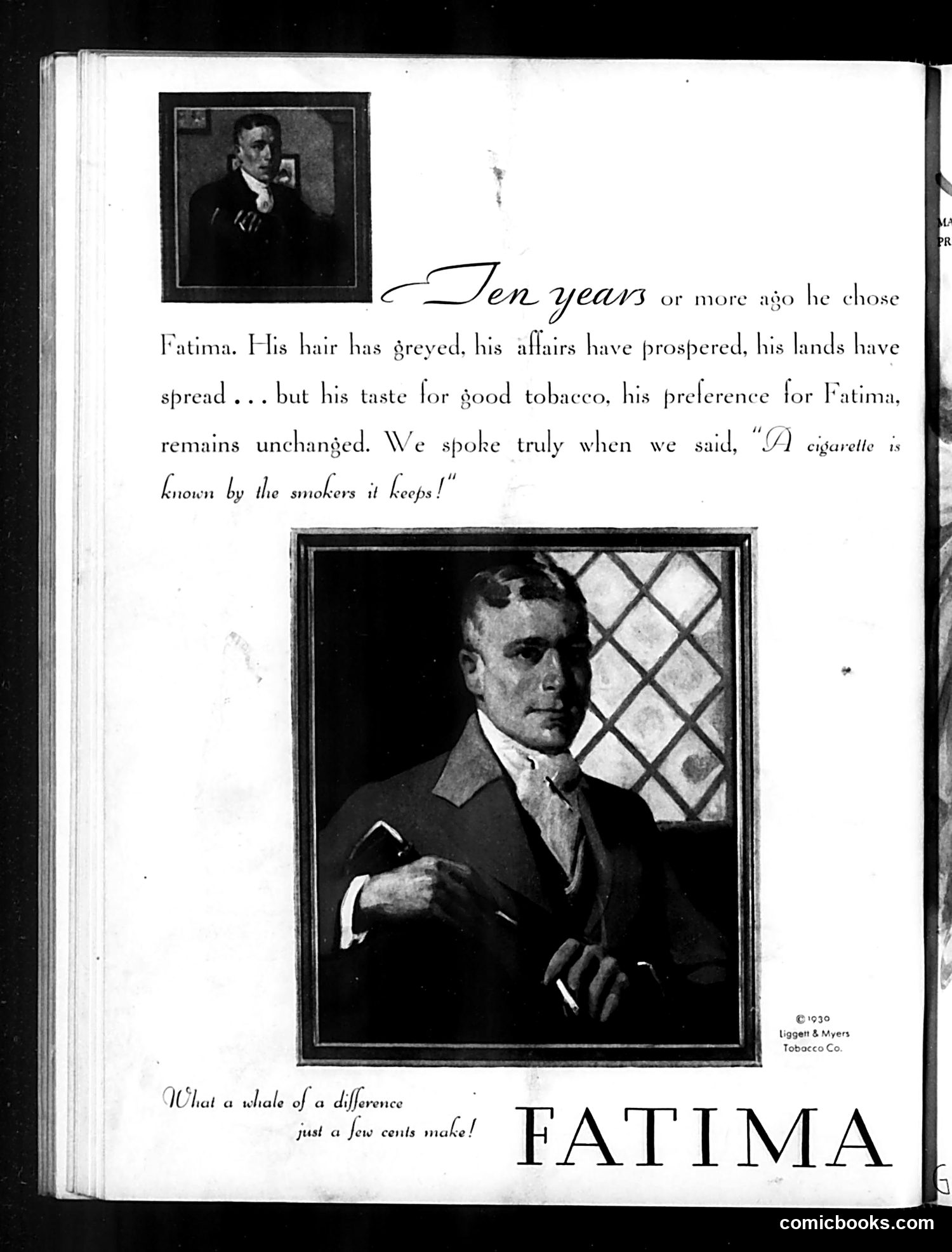
Analysis of Fatima Cigarette Advertisement This is a cigarette advertisement, not political satire. Published by Liggett & Myers Tobacco Co. (©1939), it uses a before-and-after narrative to market Fatima brand cigarettes. The ad shows an unnamed man at two life stages: younger (top) and older with greyed hair (bottom). The text claims that despite ten years of aging and professional success ("his affairs have prospered, his lands have spread"), his preference for Fatima cigarettes remains constant—implying the product's reliability and quality. The tagline "A cigarette is known by the smokers it keeps" suggests brand loyalty among discerning consumers. The final phrase "What a whale of a difference just a few cents make" emphasizes affordability. This reflects early-20th-century advertising that made health and lifestyle claims now considered misleading or false.