judge
Judge — May 10, 1930
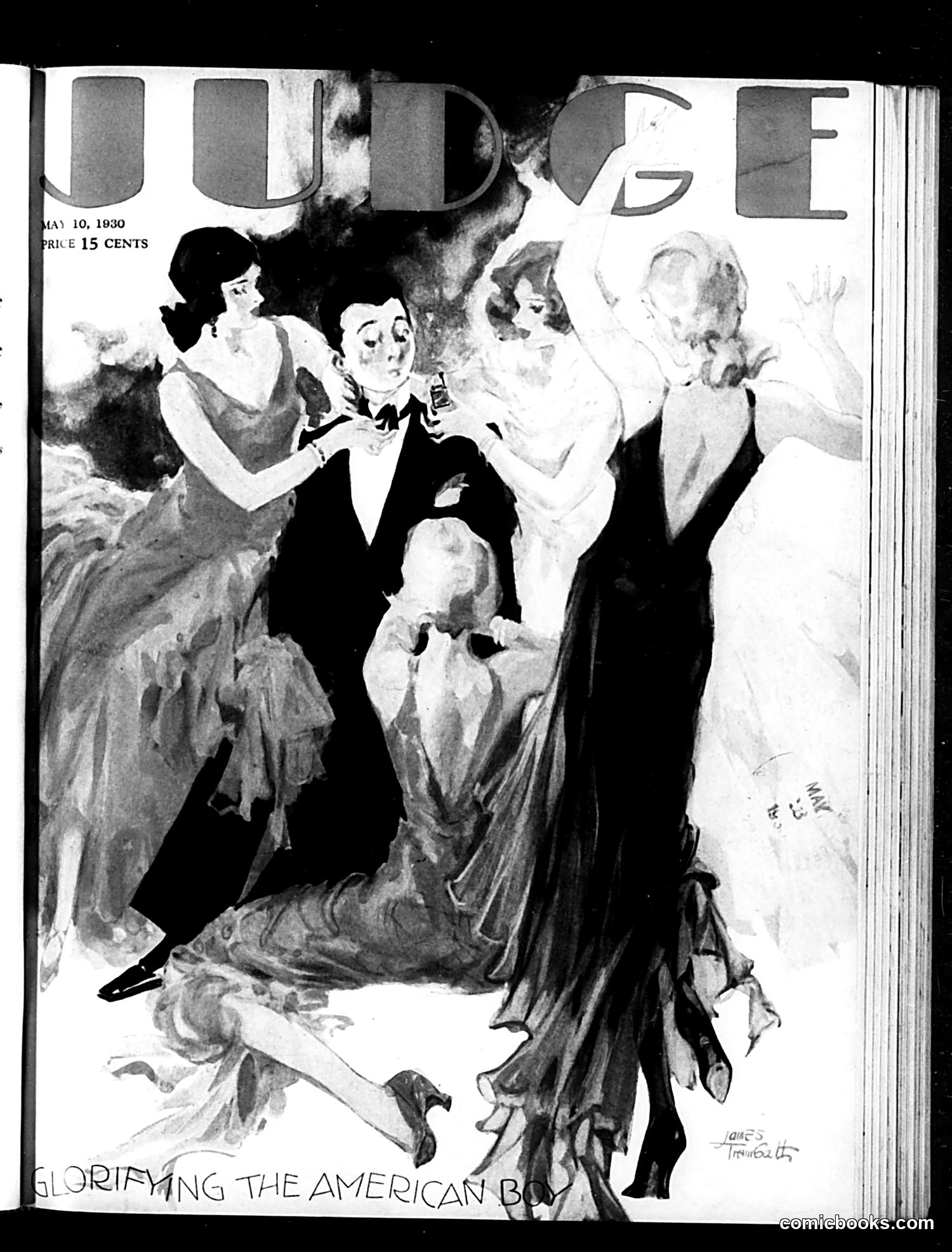
Analysis of Judge Magazine Cover, May 10, 1930 This cover illustrates "Glorifying the American Boy" through satirical contrast. A young man in formal attire (tuxedo, bow tie) sits surrounded by glamorous women in evening wear, appearing overwhelmed or distressed by their attention. The title sarcastically critiques how American culture was "glorifying" young men by exposing them to seduction and excess during the Jazz Age/Prohibition era. The satire targets concerns about moral corruption of youth through nightlife, flirtation, and hedonistic entertainment. The women's revealing, fashionable gowns and the theatrical composition suggest speakeasy culture. The boy's uncomfortable expression suggests anxiety about this supposed "glorification"—implying that surrounding youth with temptation and vice was actually corrupting rather than elevating them. This reflects 1930s anxieties about changing social morality and youth behavior.
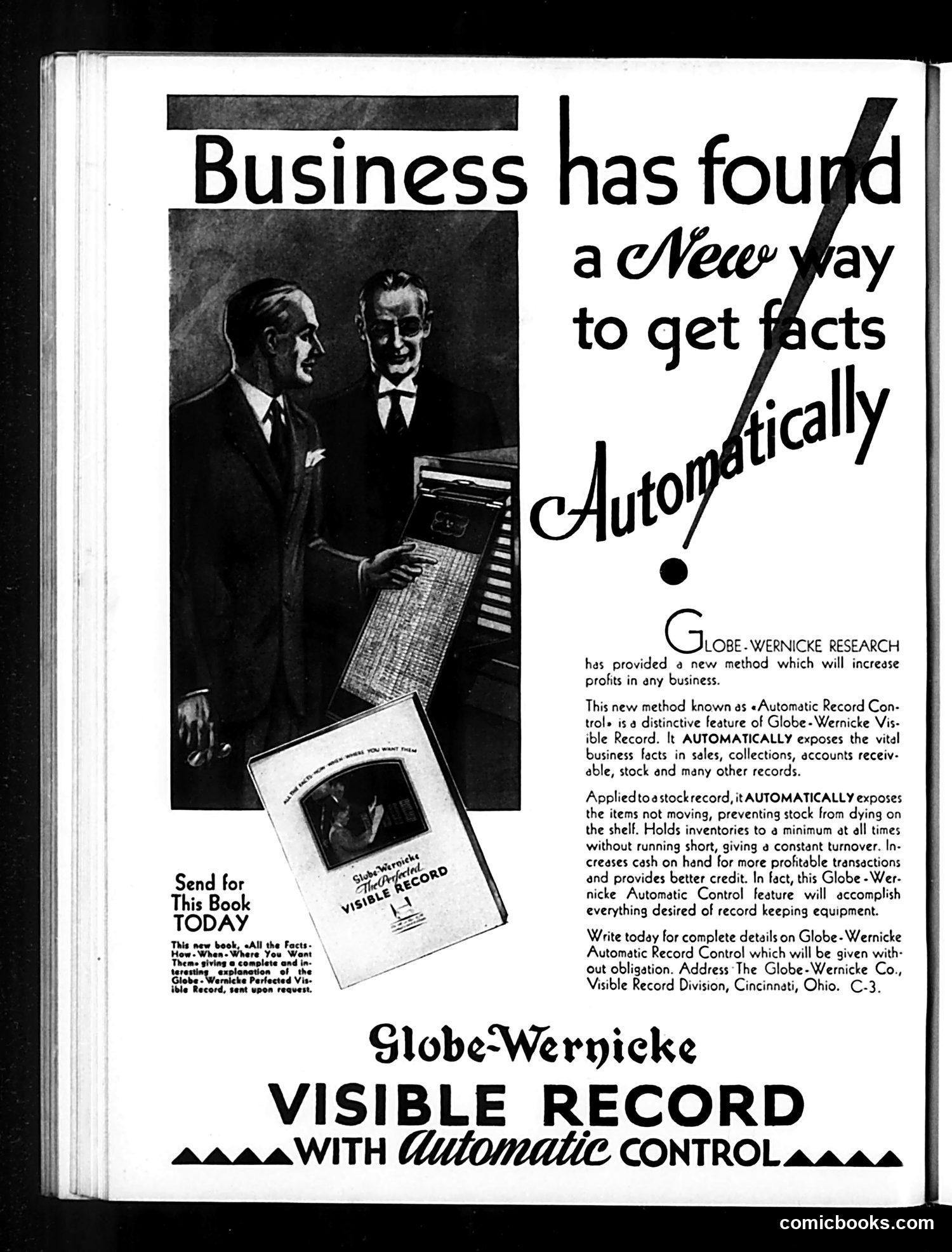
Analysis This page is primarily a business advertisement, not editorial content or satire. It promotes Globe-Wernicke's "Visible Record" filing system with "Automatic Record Control" features. The image shows two businessmen in suits examining a large filing cabinet or visible record system. The advertisement emphasizes that this equipment "AUTOMATICALLY exposes" vital business facts in sales, collections, accounts, and inventory—helping prevent stock shortages and improve cash flow and credit. The "New way to get facts automatically" headline is a straightforward marketing claim about labor-saving office technology, not satire. This reflects early-to-mid 20th century business enthusiasm for mechanized record-keeping systems that promised efficiency and profitability. There is no identifiable political cartoon or satirical commentary on this page.
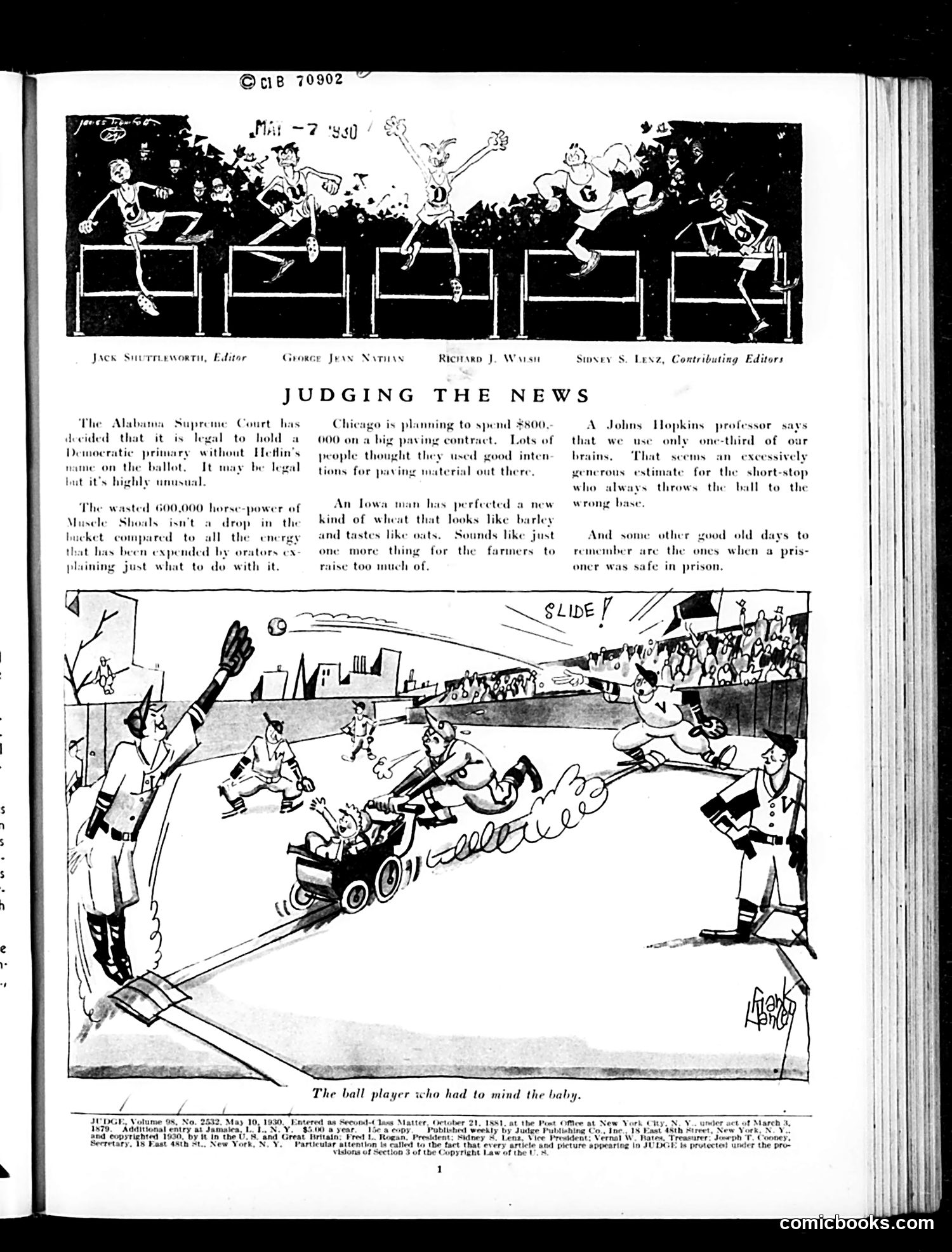
"Judging the News" - Judge Magazine This page satirizes recent news stories through editorial commentary and cartoon. The top section critiques: 1. Alabama Supreme Court's Democratic primary ruling - mocking the legal/procedural complexity 2. Chicago's $800,000 horse-power contract - sarcastically questioning whether such energy expenditure was necessary 3. An Iowa farmer's wheat/barley hybrid - humorously noting it looks and sounds like both crops 4. A Johns Hopkins professor's brain theory - joking that "one-ball" players always throw to the wrong base The bottom cartoon, "The ball player who had to mind the baby," depicts a baseball game where a player must tend an infant while playing, satirizing the conflict between professional sports and domestic responsibilities. The humor relies on the absurdity of combining these incompatible activities.
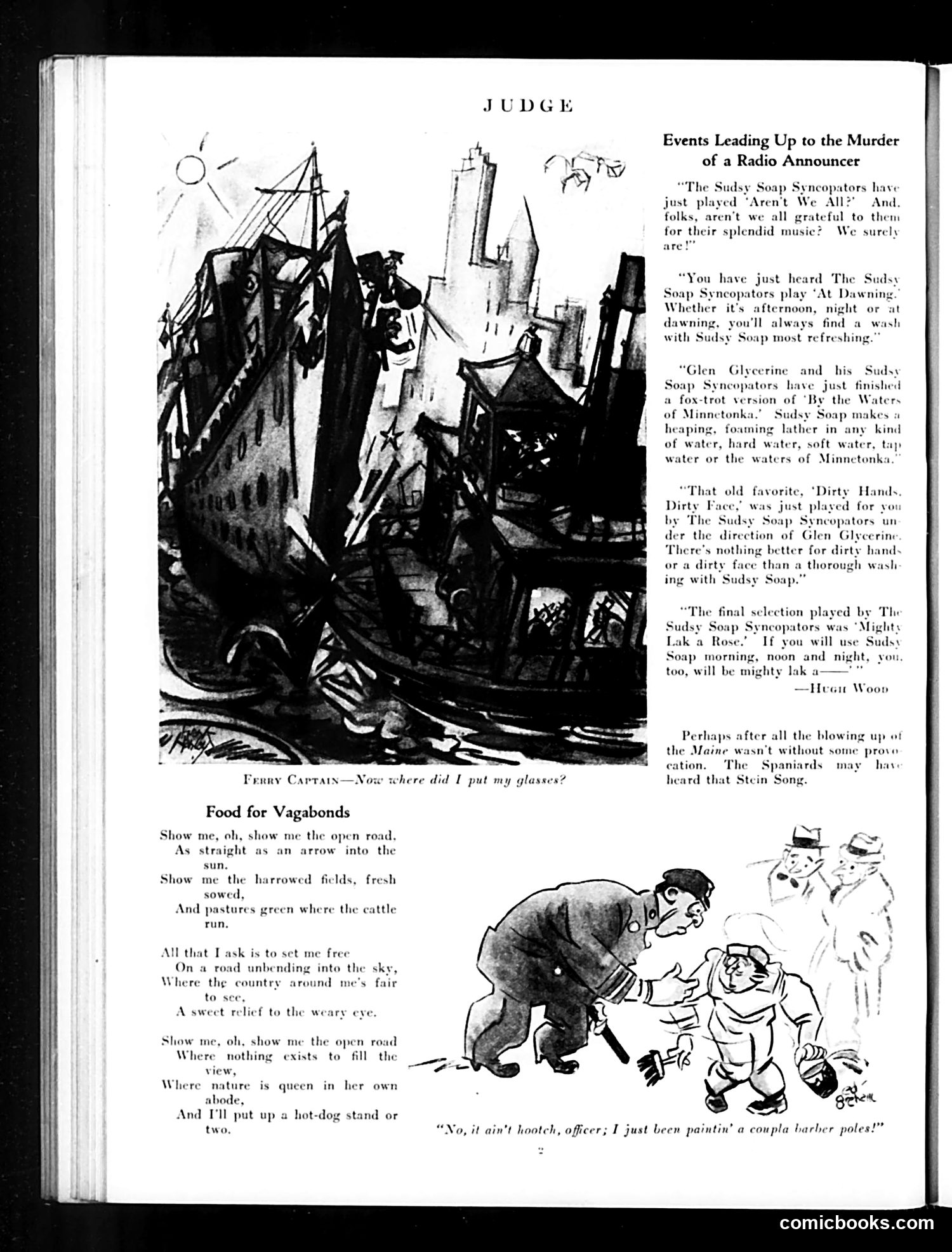
Analysis of Judge Magazine Page The page contains three distinct elements: 1. Top illustration: A dramatic naval scene labeled "Funny Captain—Now where did I put my glasses?" This appears to be a humorous take on absent-minded military leadership, depicting a befuddled captain aboard a ship. 2. "Events Leading Up to the Murder of a Radio Announcer": Satirical commentary on popular radio programming, specifically the Sudsy Soap Syncopators and Glen Glycerine. The text mocks soap advertising jingles and musical performances, suggesting radio listeners were fatigued by repetitive commercials and sponsored programming. 3. "Food for Vagabonds": A poem about freedom and open roads, paired with a cartoon showing what appears to be a police officer or authority figure confronting a vagrant about painting utility poles. The overall theme critiques radio commercialism and authority harassment of the homeless.
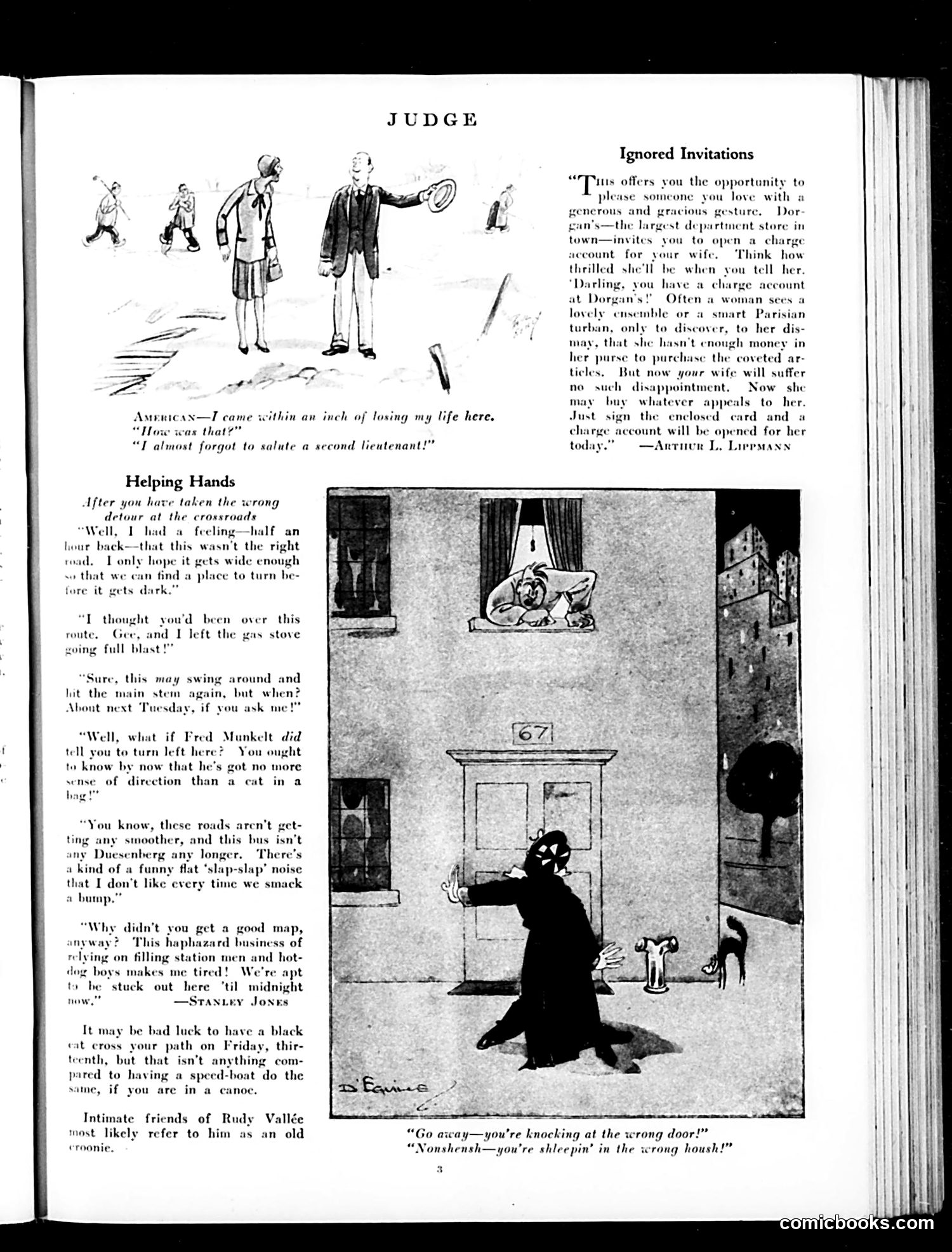
Analysis of Judge Magazine Page This page contains two distinct sections: "Ignored Invitations" (top right): A satirical piece by Arthur L. Lippmann mocking wealthy husbands who offer their wives charge accounts at department stores as gestures of generosity. The joke critiques how such "gifts" are actually controlling—the wife gets unlimited shopping freedom, but only at one store, undermining the supposed kindness. "Helping Hands" (left): A humorous dialogue about mistaken directions at a crossroads, culminating in frustration about poor roads and unreliable transportation. Cartoon (center): A Felix-the-Cat-style black cat character knocks on the wrong apartment door at night, mistakenly entering someone's home while they sleep. The caption plays on the humor of nocturnal confusion and trespassing. The page primarily targets early-20th-century domestic life and urban inconveniences.
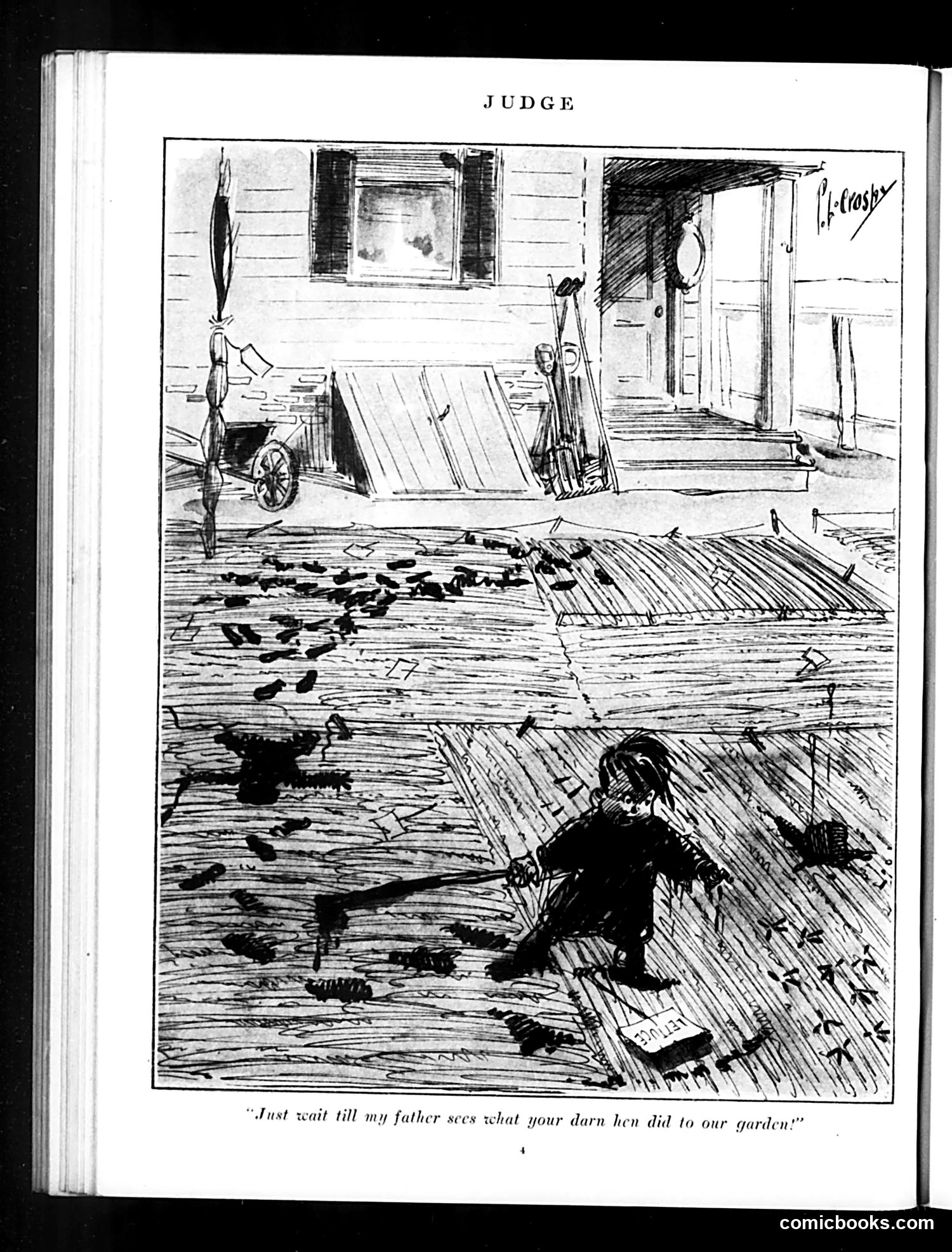
Cartoon Analysis This cartoon depicts a domestic scene where a child has apparently caused damage in a garden—scattered tools and disturbed ground are visible. The child's threat ("Just wait till my father sees what your darn hen did to our garden!") shifts blame from themselves to a neighbor's hen. The satire targets childhood dishonesty and excuse-making. Rather than admit responsibility for the mess, the child falsely accuses an animal to deflect parental punishment. The cartoon's humor lies in the transparent absurdity of the excuse and the child's confident indignation—attitudes Judge's readers would recognize from their own households. This is social satire about human nature and family dynamics rather than political commentary. The setting appears to be a modest suburban or rural American home, typical of Judge's early 20th-century audience.
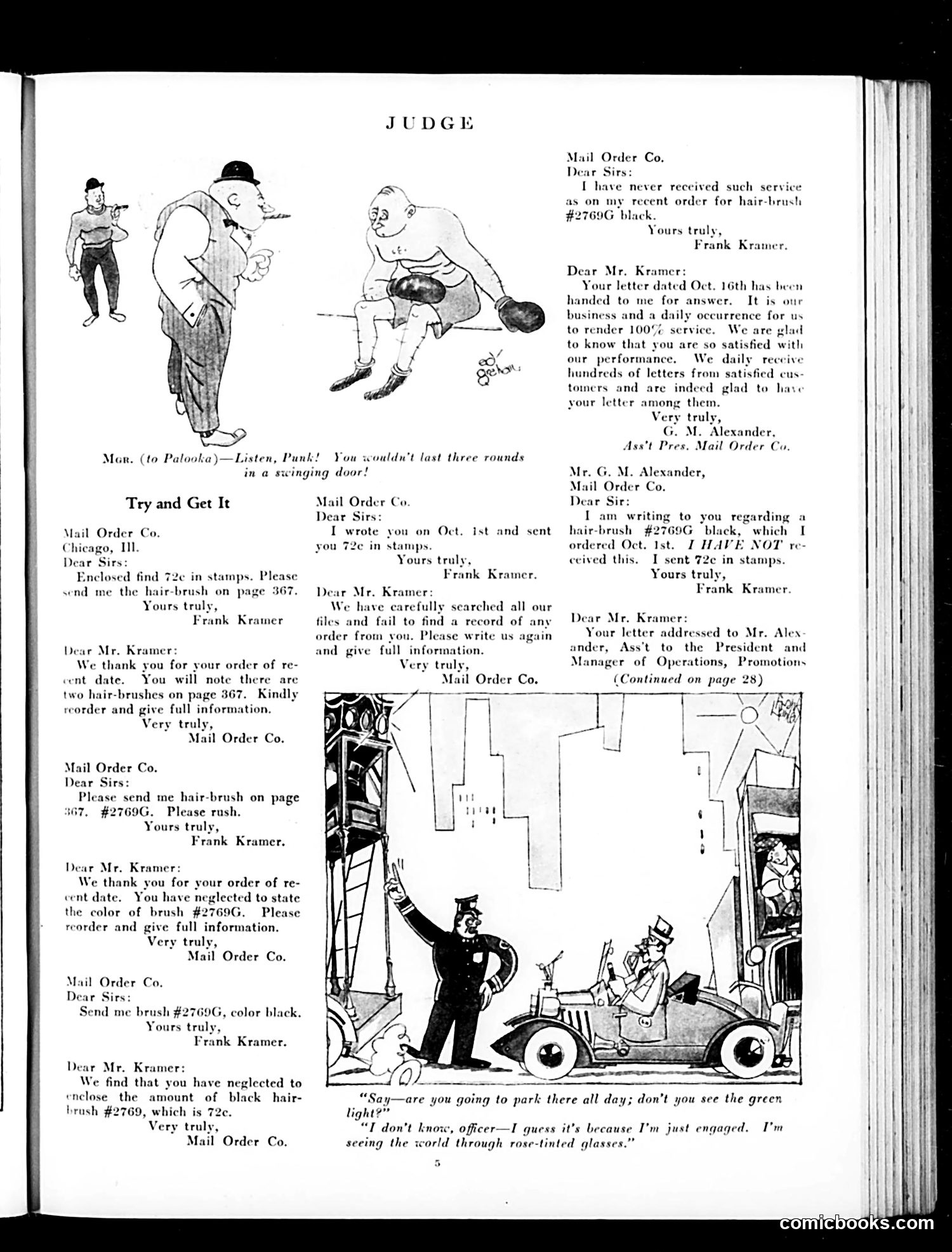
Analysis of Judge Page This page is primarily humorous reader correspondence rather than political satire. The top cartoon depicts a boxing referee addressing a boxer named Panoka, warning he "couldn't last three rounds in a swinging door"—a sarcastic insult about fighting ability. The bulk of the page consists of complaint letters to a mail-order company from customer Frank Kramer, who repeatedly ordered a hairbrush (#2769G, black) but received incorrect items or incomplete orders. The Mail Order Co. responds with bureaucratic confusion, losing records and requesting clarification. The bottom cartoon shows a traffic cop and driver, appearing unrelated to the hairbrush correspondence. The satire targets mail-order shopping frustrations and corporate incompetence—a relatable complaint for early 20th-century consumers ordering via catalog.
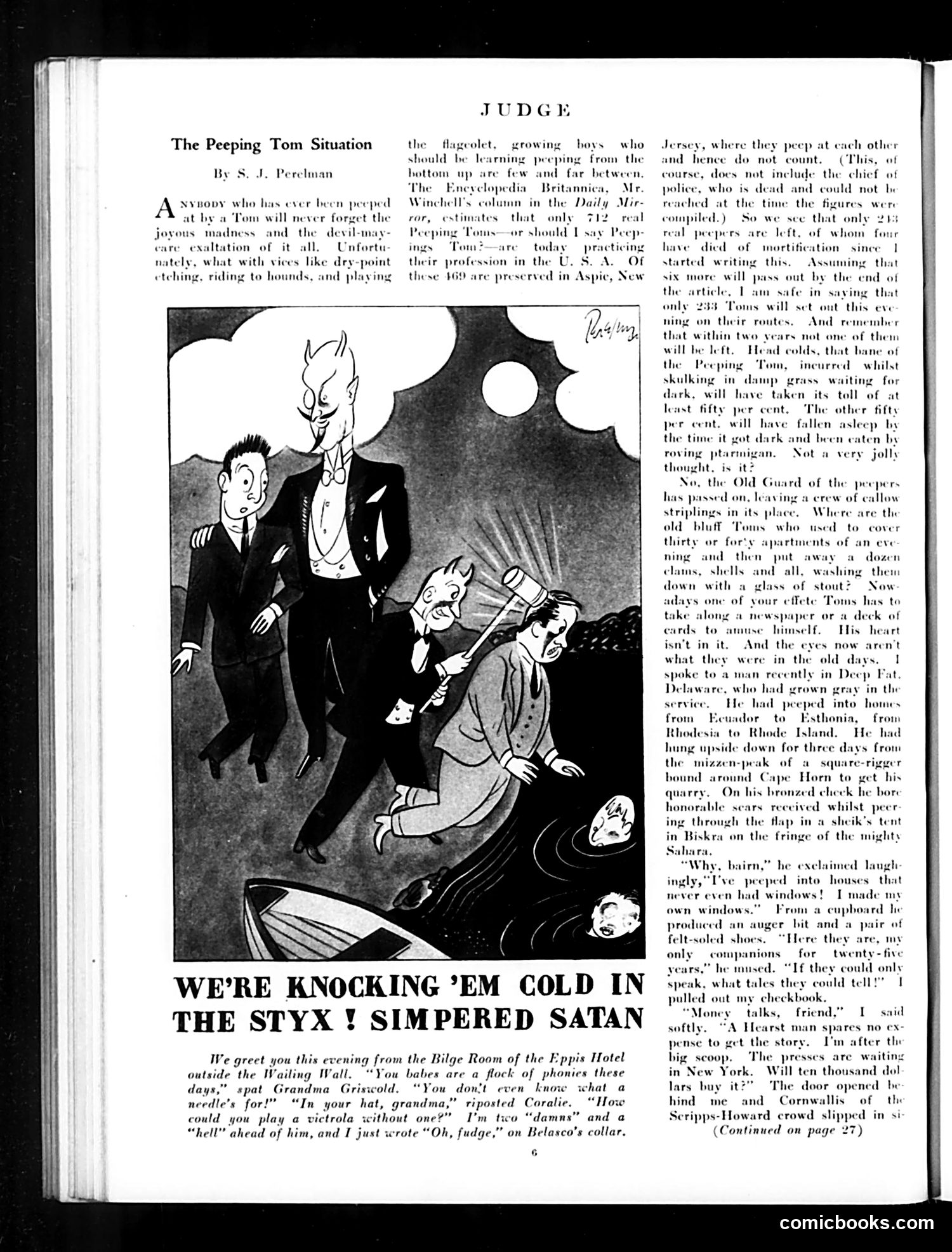
"The Peeping Tom Situation" by S.J. Perchman This satirical article and accompanying cartoon mock a contemporary phenomenon: the "Peeping Tom" voyeur. The piece claims 712 such incidents have been recorded in Aspen, New Jersey, and warns that within two years, half the peeping toms will have abandoned the practice due to exhaustion and attrition. The cartoon depicts well-dressed men and devils peering through windows at unsuspecting residents. The satire targets both the absurdity of the peeping tom problem's apparent prevalence and the Victorian-era social anxieties about privacy and morality. The exaggerated statistics and deadpan tone suggest the author is mocking sensationalist reporting about crime and social decline during this period.
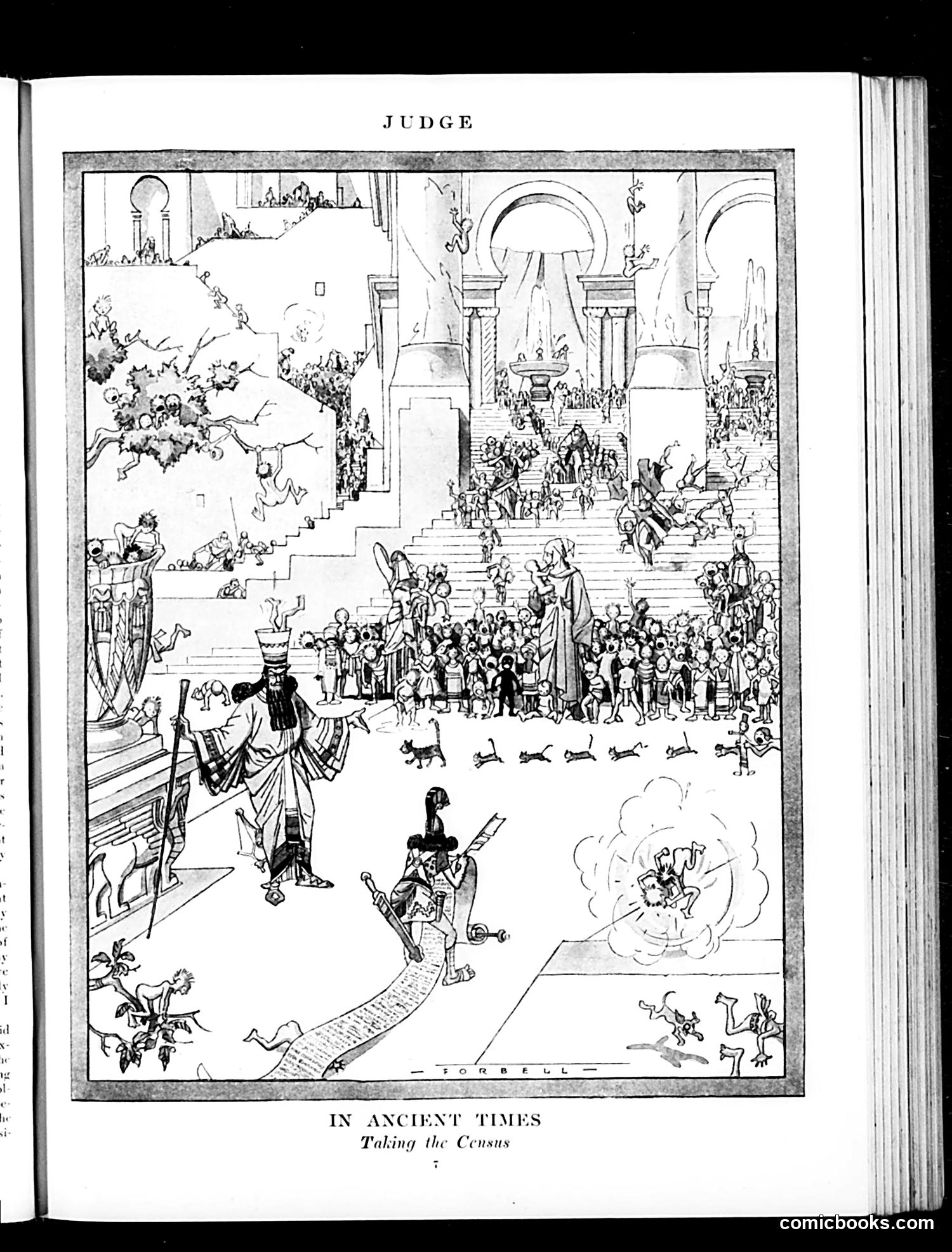
Judge Cartoon: "In Ancient Times—Taking the Census" This satirical cartoon depicts an ancient Roman census scene with elaborate architectural grandeur—massive columns, arches, and temple-like structures filled with crowds. A robed official on the left presides over the proceedings while armed soldiers and citizens populate the scene. The satire likely critiques contemporary census-taking practices by showing the absurd formality and military oversight required in ancient times to count populations. The exaggerated scale of the Roman bureaucracy—complete with soldiers, elaborate architecture, and ceremonial pomp—suggests Judge magazine is mocking either the complexity of modern census procedures or government overreach in data collection. The juxtaposition of "ancient times" with contemporary concerns implies this was topical commentary on early 20th-century American census debates.
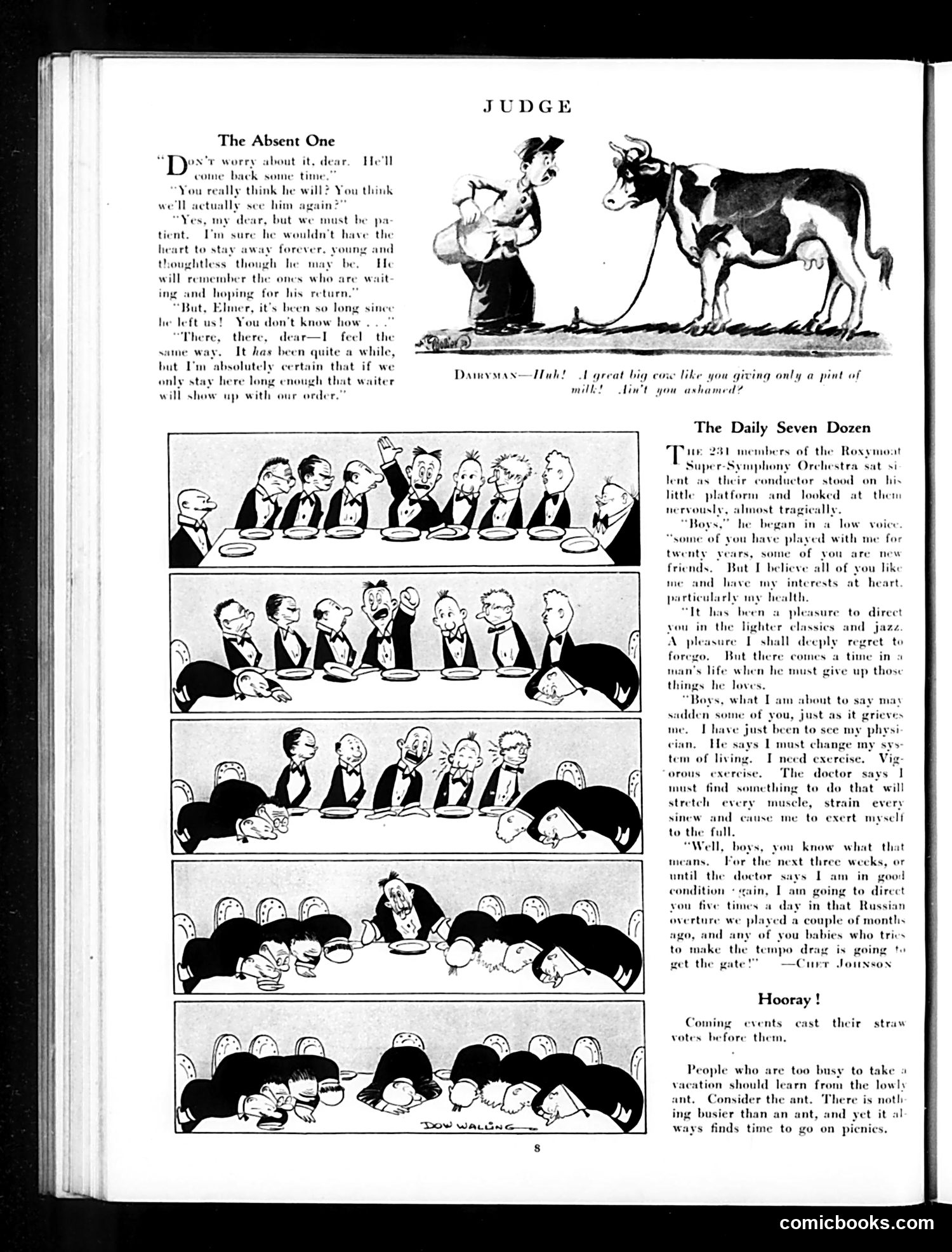
Judge Magazine Page Analysis This page contains three satirical pieces from Judge magazine: "The Absent One" (top): A domestic cartoon about a wife reassuring her husband that an absent family member will eventually return. The humor plays on marital patience and long-suffering domesticity—likely referencing a serviceman or absent breadwinner, though the specific context is unclear. "The Daily Seven Dozen" (center): A multi-panel comic depicting an orchestra conductor addressing his 231 musicians. He's been told by his doctor to exercise vigorously, so he's decided to conduct them five times daily for three weeks as his fitness regimen. The satire mocks both the conductor's absurd solution and the orchestra members' resigned suffering—a commentary on workplace exploitation disguised as health concern. The final panels show musicians progressively collapsing from exhaustion. "Hooray!" (bottom right): Brief aphoristic humor about busy people and the work ethic of ants—conventional moralizing presented ironically. The page reflects Judge's typical early-20th-century blend of domestic comedy, workplace satire, and light philosophical quips.
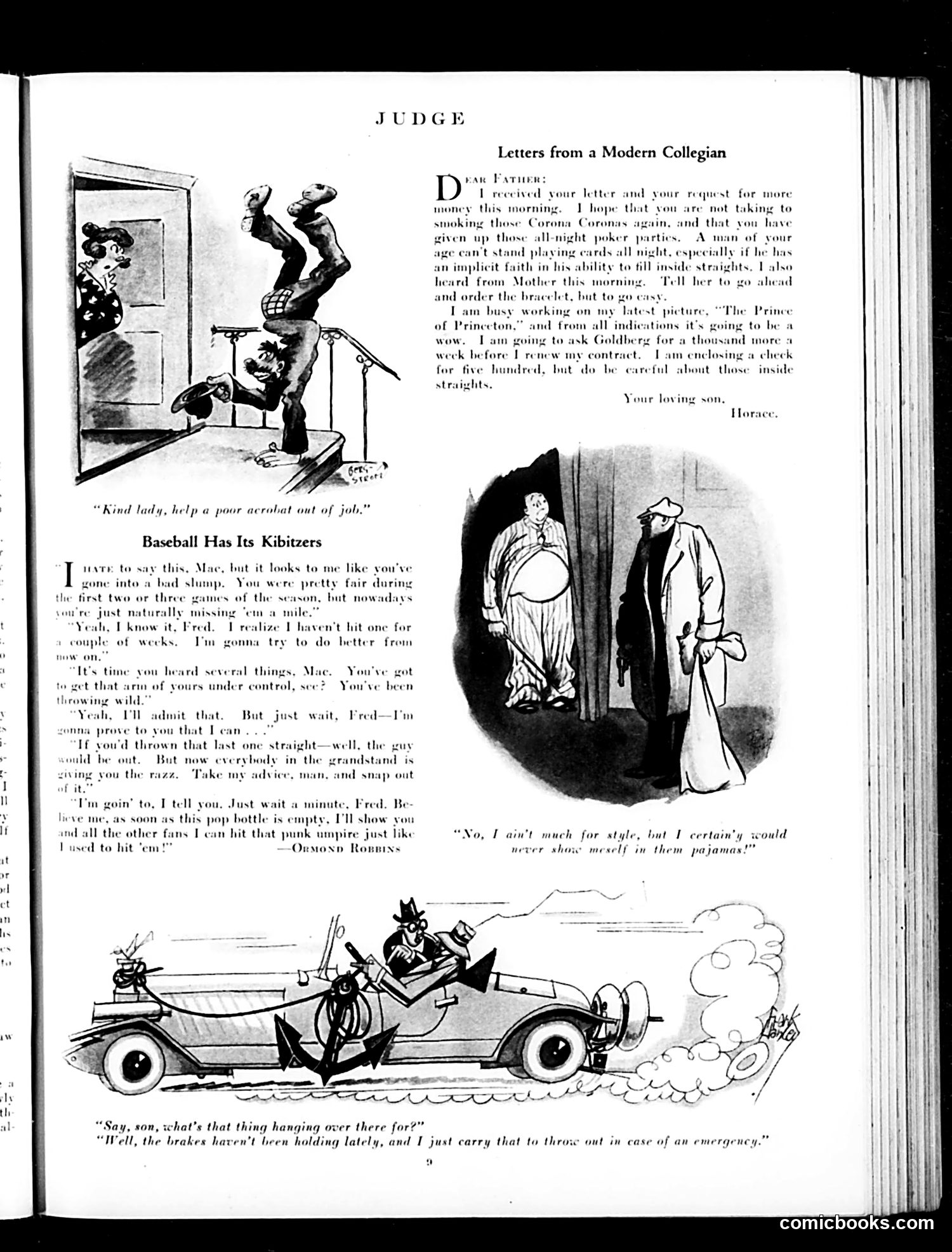
Judge Magazine Page Analysis This page contains three distinct pieces of early 20th-century American humor: "Baseball Has Its Kibitzers": A dialogue between a struggling baseball player (Mac) and a critical spectator (Fred). The satire targets armchair critics who heckle athletes from the grandstand, offering unsolicited advice and blaming the umpire. The cartoon shows a fan threatening to hit the umpire with a beer bottle—mocking how worked-up fans become over the game. "Letters from a Modern Collegian": A letter from college student Horace to his father requesting more money. The satire mocks wealthy collegians' frivolous spending on poker, late-night parties, and luxury items like bracelets. References to "Corona Coronas" (cigars) and contract negotiations suggest he's also pursuing show business aspirations. Bottom Cartoon: Shows a reckless driver in a convertible with a tire or brake-related device hanging from the car "in case of emergency"—satirizing dangerous driving practices and mechanical negligence among motorists. The overall theme is American excess and poor judgment across social classes.
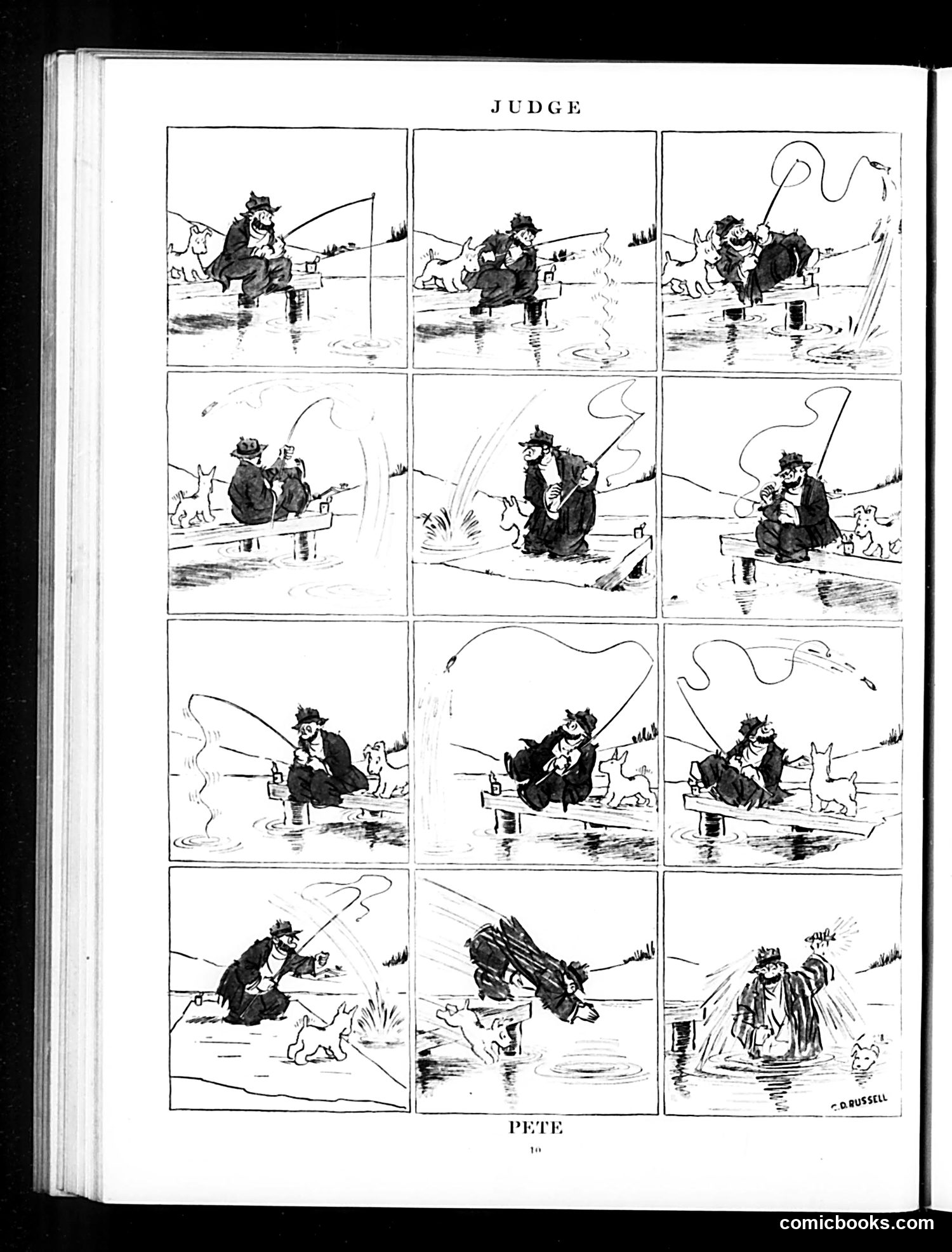
Analysis of "Judge to Pete" Cartoon This is a twelve-panel comic strip showing a man fishing while a small dog observes. The title "Judge to Pete" suggests the man is "Judge" and the dog is "Pete." The humor appears to derive from slapstick misadventure: Judge repeatedly struggles with his fishing line—it tangles, whips around him, and eventually pulls him into the water. The dog remains a bemused witness throughout. Without additional context from Judge magazine's specific political climate, the satire's target is unclear. However, the strip may mock incompetence or foolishness, possibly referencing a public figure nicknamed "Judge" or satirizing fishing culture. The cartoonist C. Russell signed the work. The comedy is primarily physical rather than explicitly political.
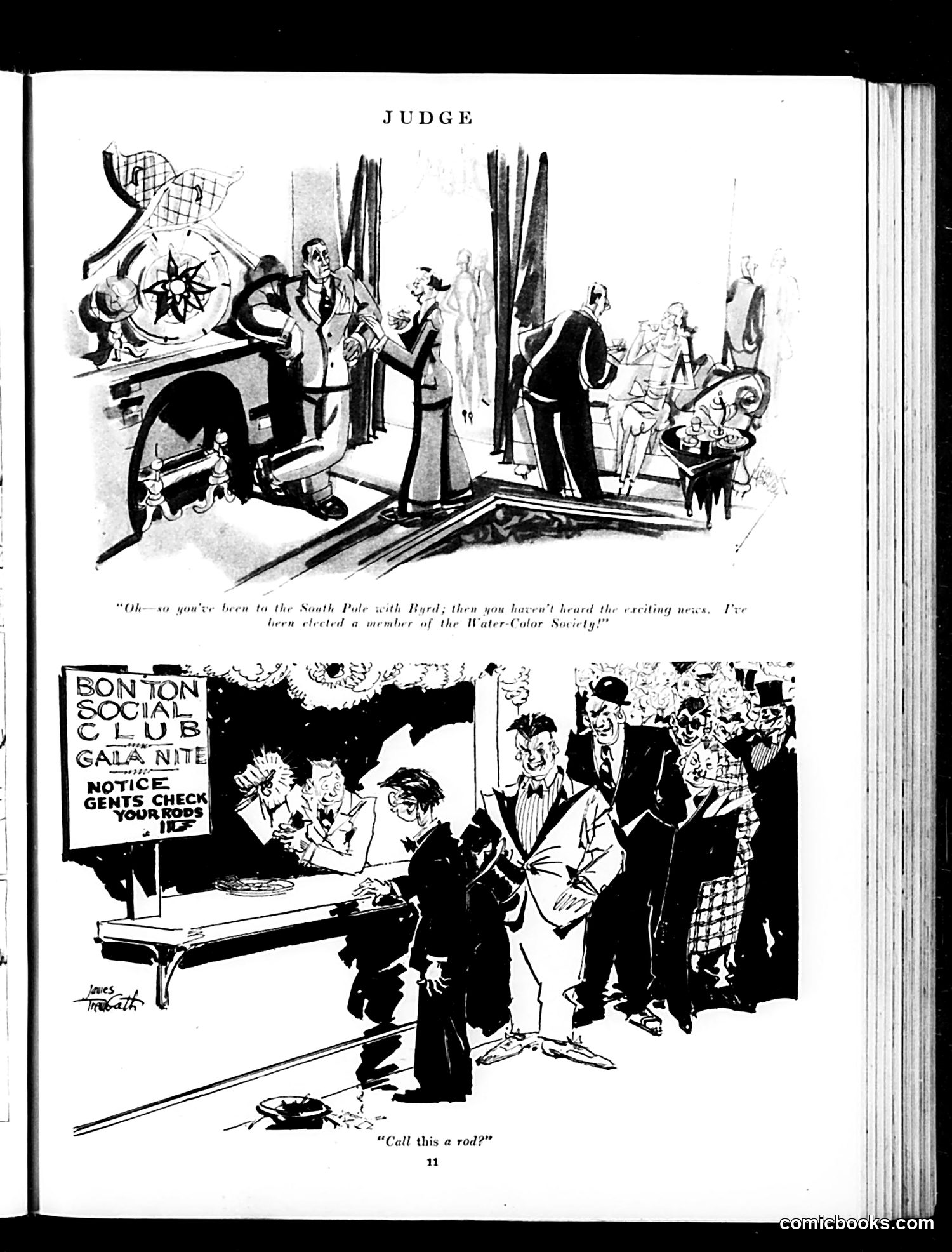
Analysis of Judge Page 11 This page contains two cartoons satirizing social pretension and exclusivity. The top cartoon mocks snobbish society gatekeepers. A well-dressed man brags about Arctic expeditions with explorer Richard Byrd, only to be told such accomplishments don't matter—membership in the elite "Water-Color Society" requires different credentials entirely. The satire targets how exclusive clubs prioritize arbitrary social status over genuine achievement. The bottom cartoon depicts a "Boston Social Club Gala Nite" at a billiards hall. A sign reads "Gentlemen Check Your Rods"—a pun on coat-checking, but referring to pool cues. Someone asks "Call this a rod?"—questioning whether the crude establishment qualifies as genteel society. The humor mocks pretentious social climbing and the gap between aspirational names and humble reality. Both cartoons satirize American class anxiety and the absurdity of social hierarchies.
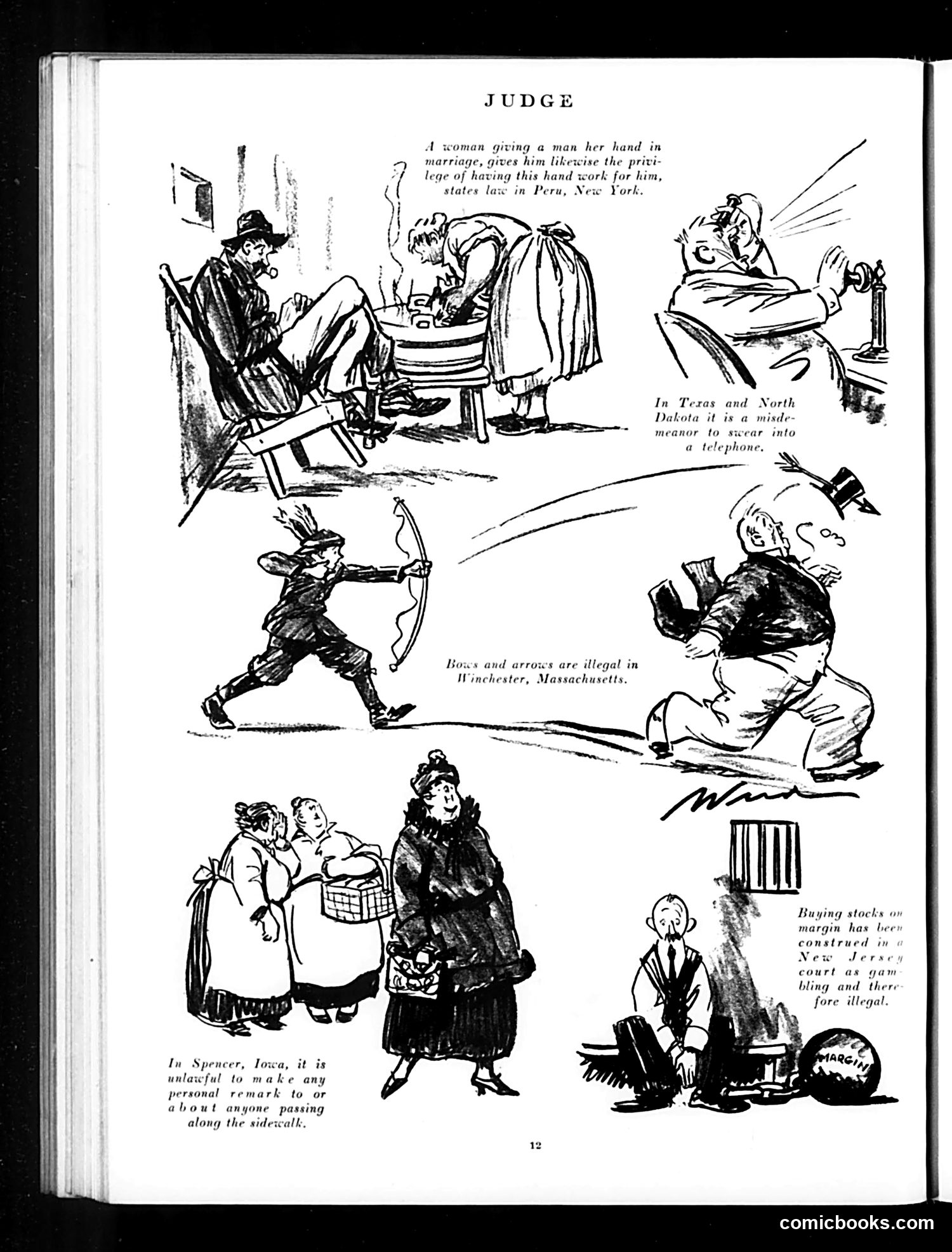
Judge Magazine: "Absurd Laws" Satire This page satirizes bizarre or absurdly restrictive laws from various American states and Peru. Each cartoon illustrates a ridiculous legal prohibition: - Peru's marriage law: A husband can legally exploit his wife's labor after marriage - Spencer, Iowa: Citizens can't make personal remarks to passersby - Texas/North Dakota: Swearing over the telephone is criminal - Winchester, Massachusetts: Bows and arrows are banned - New Jersey: Stock market margin buying is classified as illegal gambling The satire mocks the absurdity and overreach of local legislation—laws so peculiar they reveal the dangers of excessive legal regulation. By depicting these laws visually (a man swearing into a telephone, someone shooting arrows, stock traders penalized), Judge highlights how ridiculous and impractical such rules are. The implicit message: legislators sometimes pass nonsensical laws that demonstrate the need for more rational, uniform legal standards.
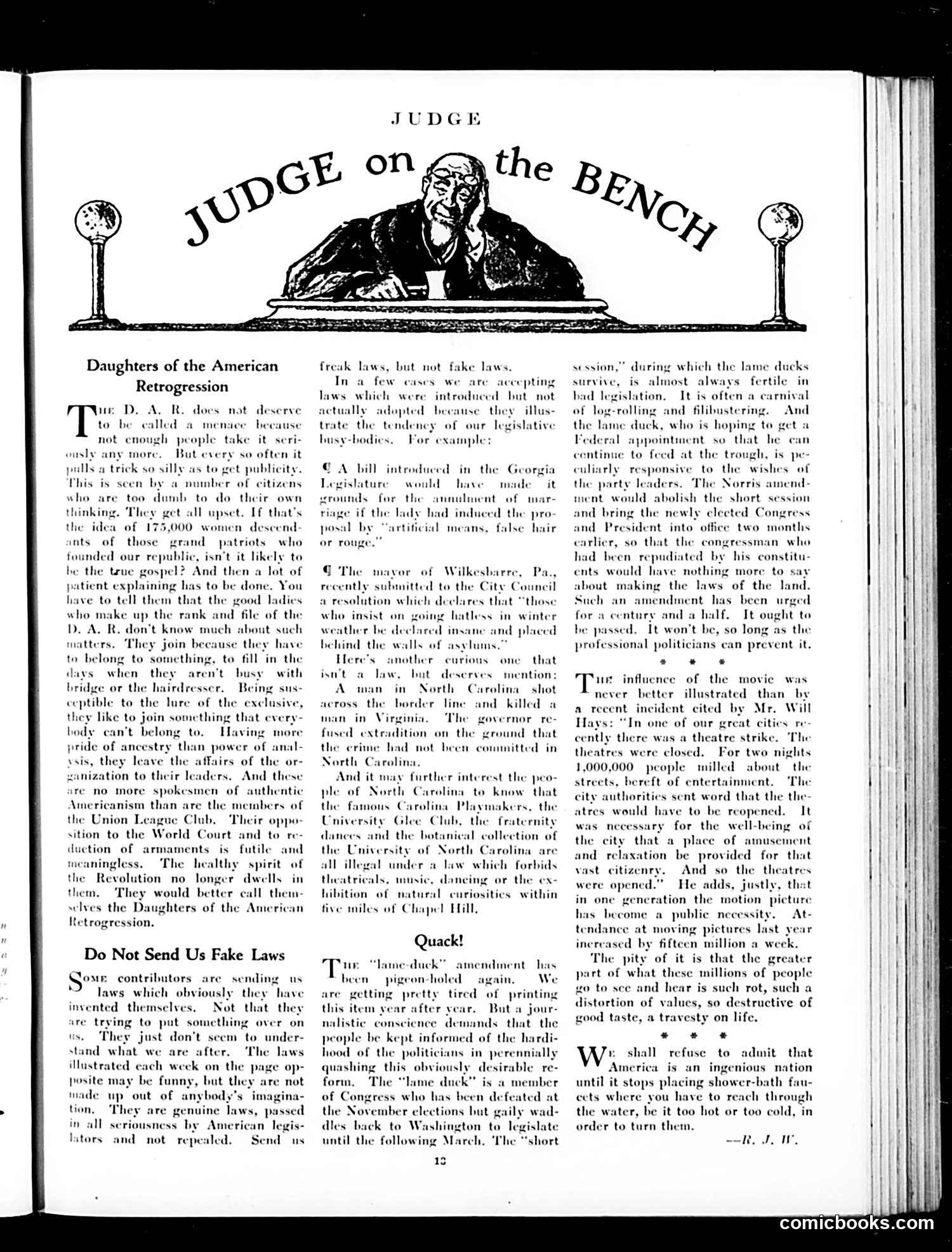
Judge Magazine Satire Analysis This page contains two main satirical pieces critiquing American institutions: "Daughters of the American Retrogression" attacks the DAR (Daughters of the American Revolution), a real hereditary organization. The author argues these women join for social exclusivity rather than genuine patriotism, and lack the intellectual rigor to understand the Revolution's true spirit. He characterizes them as easily manipulated by leadership into opposing progressive causes like the World Court and arms reduction. "Do Not Send Us Fake Laws" is a column soliciting genuinely absurd legislation actually passed by American legislatures—not fabricated examples. Judge then illustrates real freak laws, including Georgia's bill regulating artificial hair/rouge and North Carolina's prohibition on dancing or "natural curiosities" within five miles of Chapel Hill. "Quack!" mocks "lame-duck" congressmen—defeated politicians who serve out shortened remaining terms before their successors arrive, often blocking progressive legislation while seeking future appointments as rewards. The overall message: American institutions (patriotic societies, legislatures, political practices) are dysfunctional and backward.
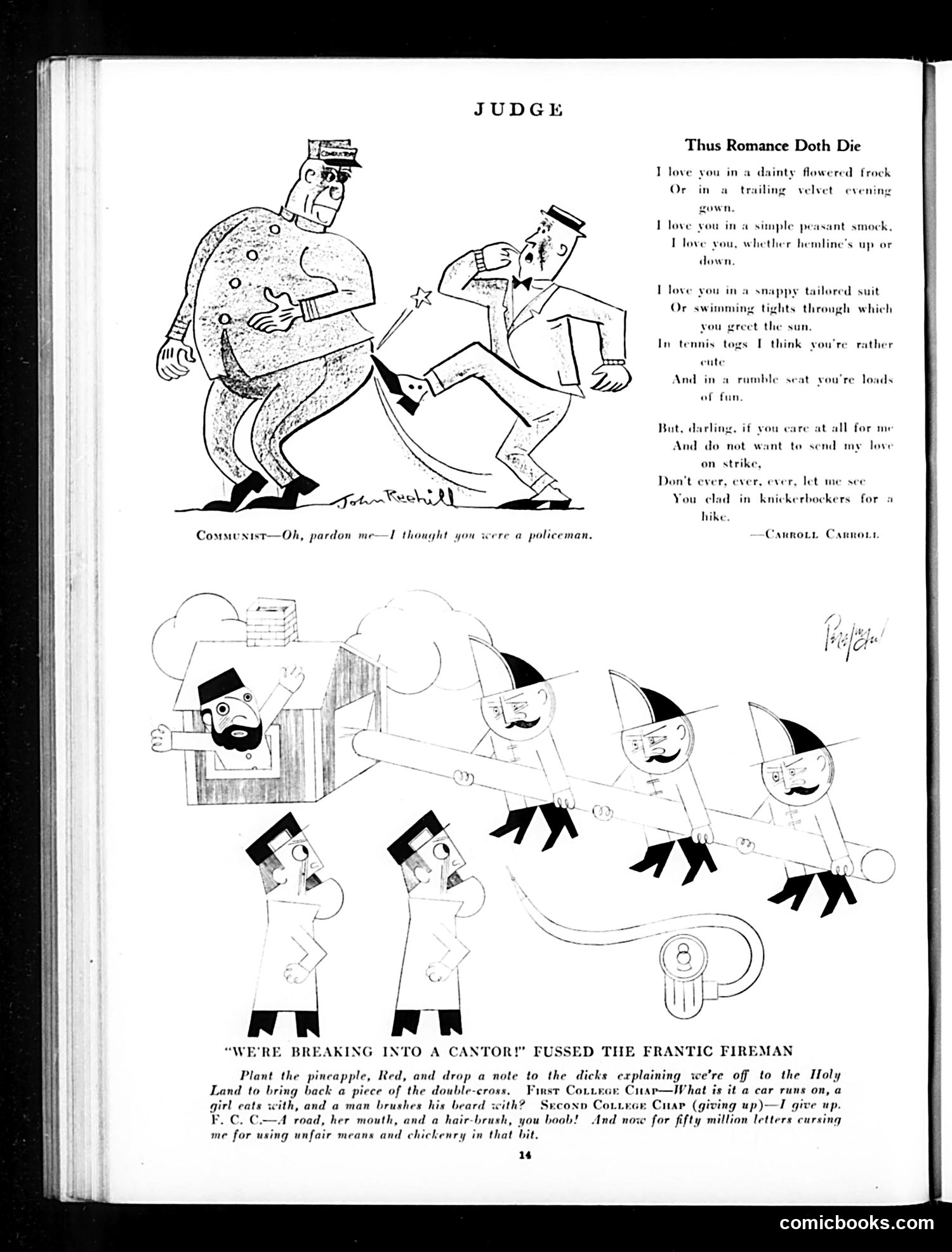
Analysis Top Cartoon: A romantic poem titled "Thus Romance Doth Die" (by Carroll Carroll) humorously catalogs a man's acceptance of his girlfriend's various fashion choices—until the final blow: knickerbockers (knee-length pants) for hiking. The joke satirizes masculine vanity and the specific fashion anxieties of the era; knickerbockers were practical but apparently unfeminine enough to destroy romance entirely. Bottom Cartoon: A fireman exclaims "We're breaking into a cantor!" (likely a pun or mishearing). The accompanying text references criminals using coded language ("pineapple" for bomb, "Red," "dicks" for detectives) and contains a riddle: What does a car run on, a girl eat with, and a man brush his beard with? Answer: A road, her mouth, and a hairbrush—a deliberately vulgar triple entendre that the editor sarcastically claims will generate complaint letters. Both pieces exemplify Judge's style: sexual innuendo, fashion mockery, and crude wordplay targeting contemporary readers.
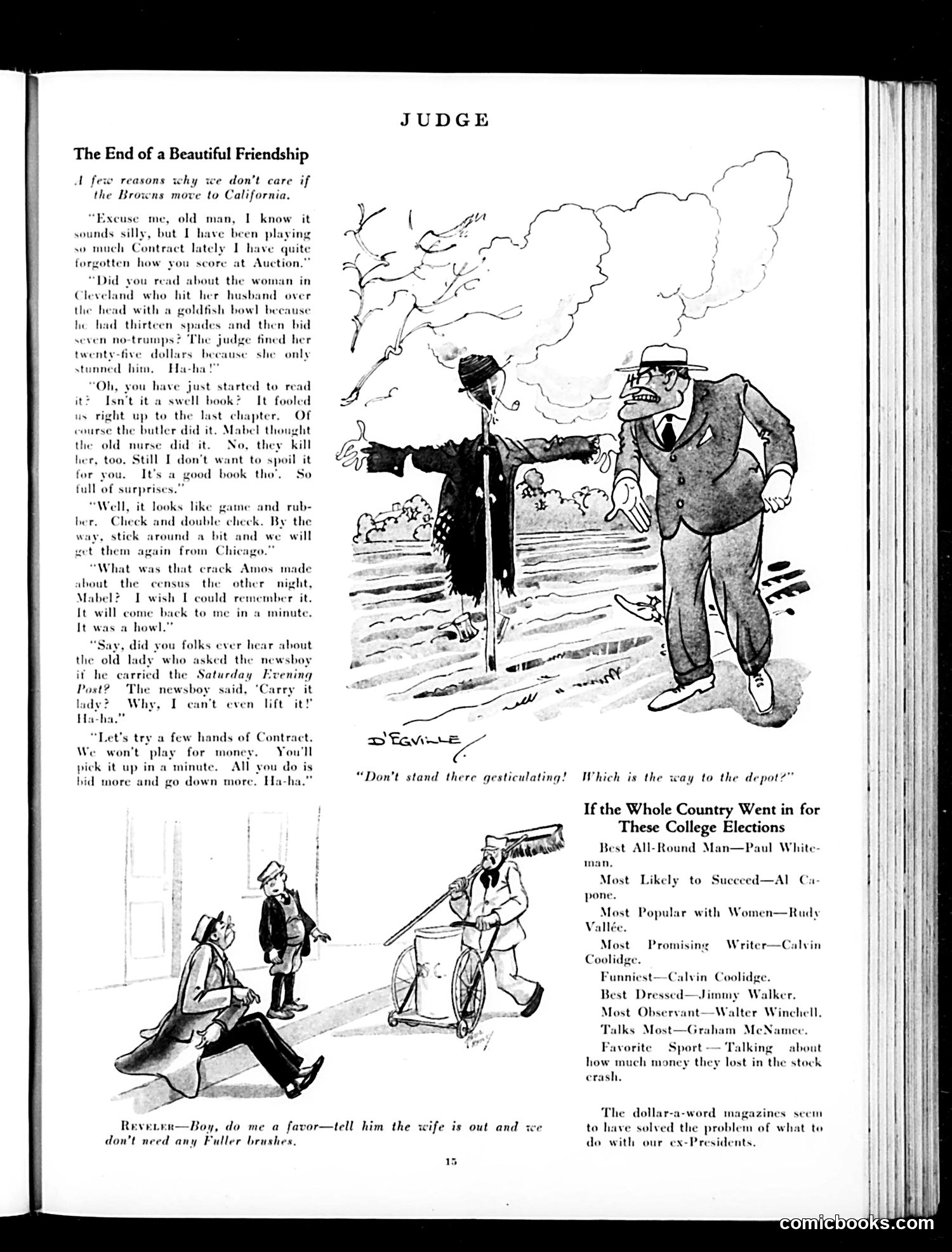
Judge Magazine Page Analysis This page satirizes the obsession with Contract Bridge, a newly popular card game in the 1920s. "The End of a Beautiful Friendship" mocks how the game has consumed social conversation—people discuss only bridge scores, bridge-related news (a woman attacking her husband over bidding), and bridge strategy, making friendships tedious and one-dimensional. The bottom section, "If the Whole Country Went in for These College Elections," applies this same satirical lens to contemporary celebrities and public figures as if they were college superlatives. References include Paul Whiteman (bandleader), Al Capone (gangster), Rudy Vallée (singer), Calvin Coolidge (ex-President), Jimmy Walker (NYC mayor), and Walter Winchell (gossip columnist). The final quip about "dollar-a-word magazines" solving the problem of "ex-Presidents" sarcastically suggests these magazines employ former presidents as writers—a dig at how publications monetized fading political figures. The humor relies on readers recognizing these names and understanding 1920s cultural preoccupations.
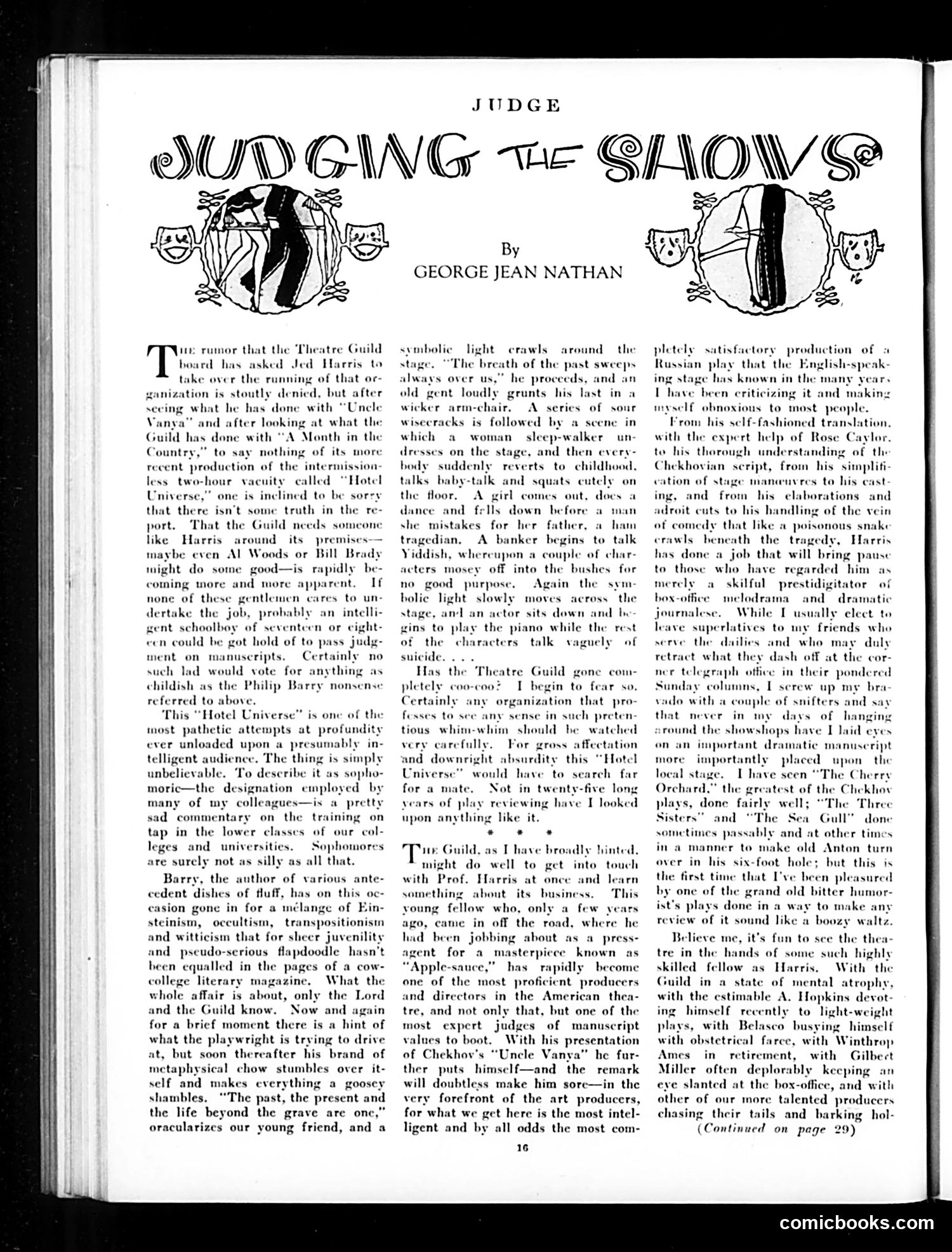
Judge Magazine Analysis: "Judging the Shows" This is theater criticism by George Jean Nathan, not a political cartoon. Nathan savagely reviews the Theatre Guild's production of Philip Barry's play *Hotel Universe*, calling it "pathetic" and riddled with pretentious nonsense—pseudo-intellectual references to Einsteinian physics and occultism masquerading as profundity. The article pivots to praise producer Jed Harris, crediting him with successful productions of Chekhov's *Uncle Vanya*. Nathan argues the Theatre Guild should hire Harris to manage its operations, implying current leadership produces frivolous, incompetent work. The satire targets: the Theatre Guild's artistic judgment, Philip Barry's dramatic writing, and the avant-garde theater movement's embrace of incomprehensible "sophistication." Nathan champions commercial theater producers over the Guild's self-serious experimentalism—a recurring debate in 1930s American theater between accessibility and artistic pretension.
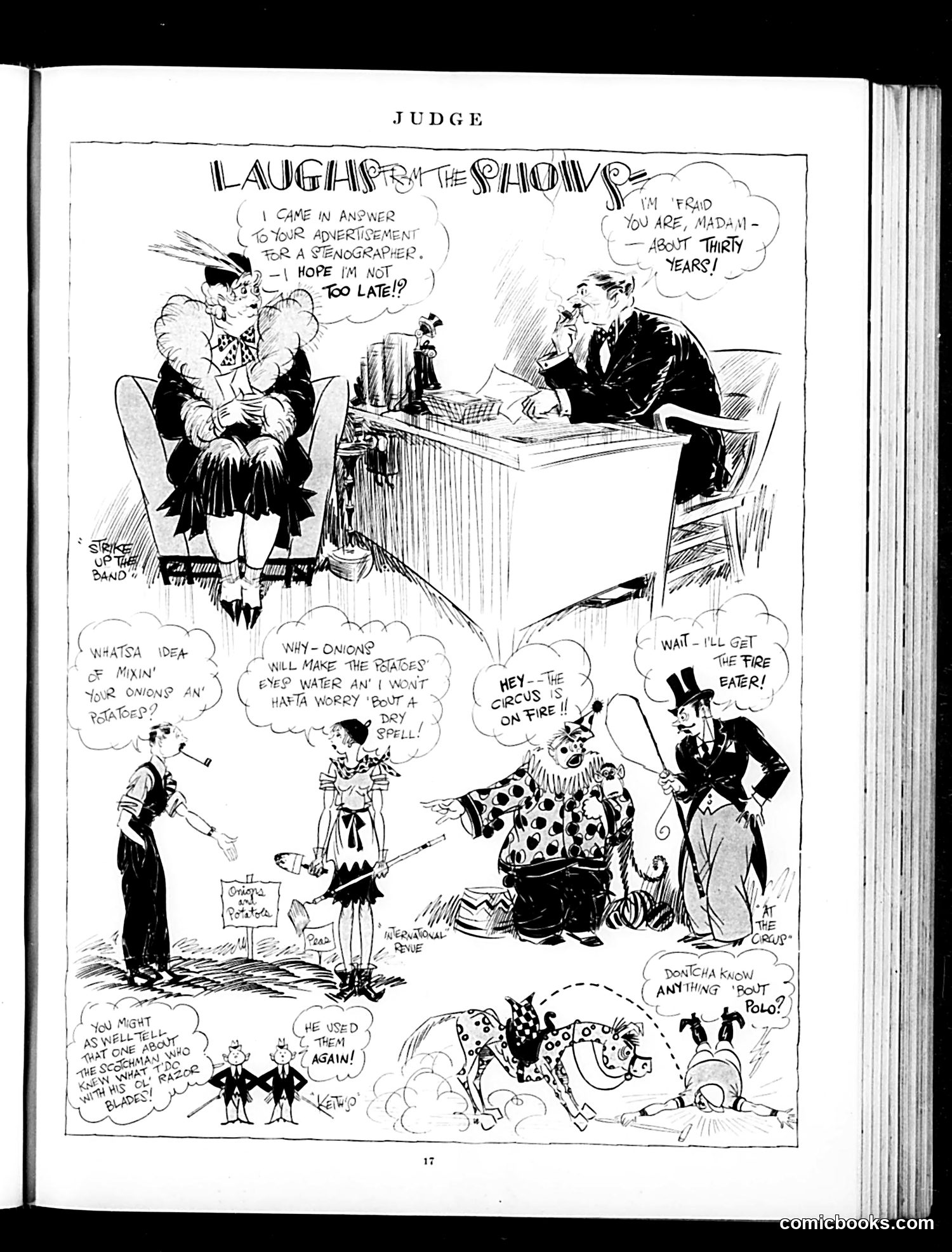
"Laughs from the Show" This is a satirical comic strip about theatrical/vaudeville performance, likely from the early 20th century. A judge sits at his bench interviewing a stenographer applicant who arrived answering an advertisement. The main joke concerns circus performers and their incompetence: characters discuss mixing onions into potatoes, someone worries about water and spills, a clown's circus is "on fire," and a performer claims ignorance about polo. The satire targets vaudeville's low-brow entertainment and the performers' general incompetence and ignorance. The judge's skepticism about the stenographer's tardiness frames a commentary on the unprofessionalism pervading show business. The various circus/theatrical acts shown below represent the chaotic, amateurish nature of popular entertainment of the era. The strip mocks both performers and their audience.
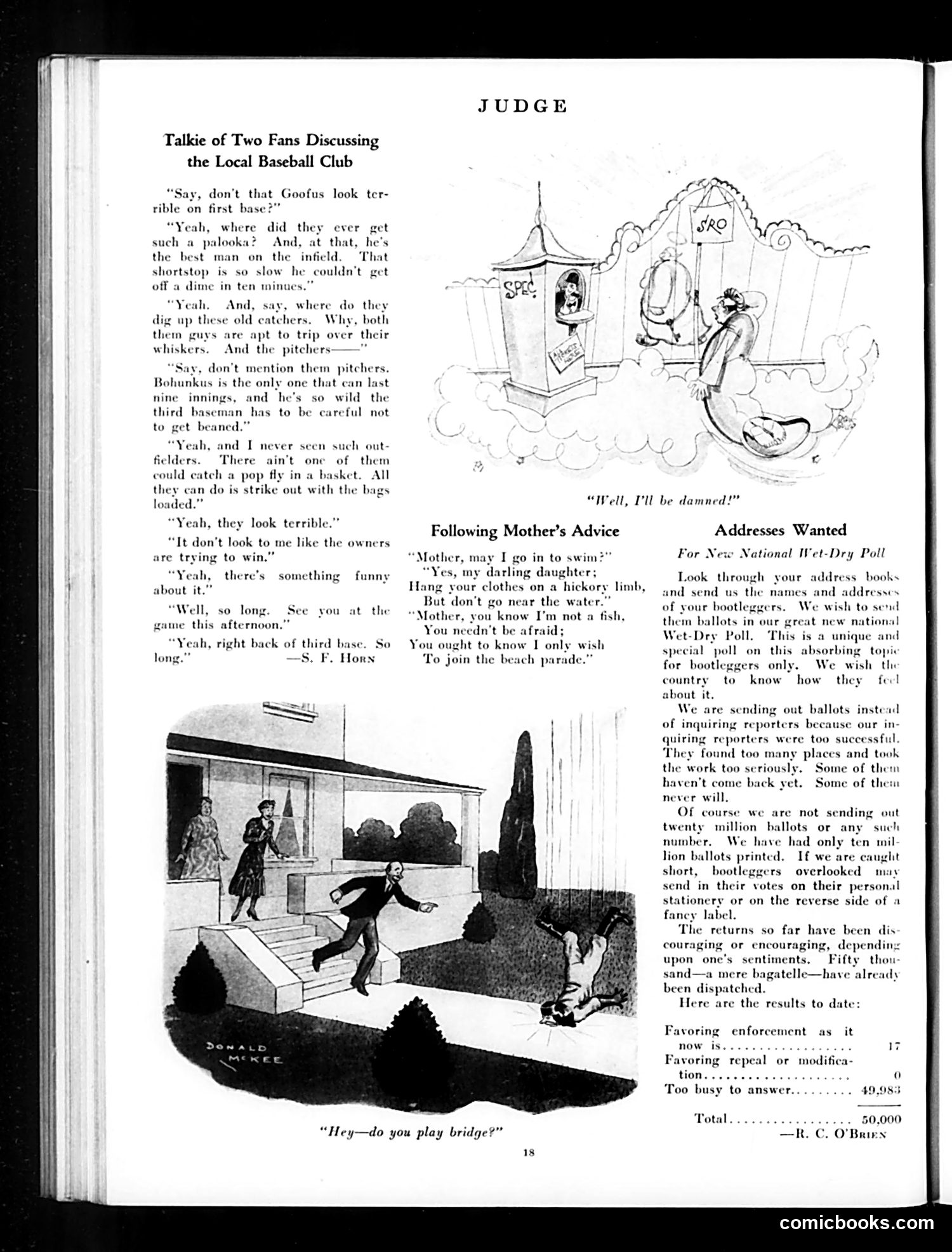
Page 18 of Judge Magazine: Baseball Fans and Prohibition Satire This page contains two distinct pieces of humor: Top section: A dialogue between two baseball fans critiquing their local team—mocking players with ethnic-coded names like "Goofus" and "Bohunkus." The satire targets working-class sports fans' harsh judgments of mediocre athletes, their colorful complaints, and their resigned acceptance of poor team performance. Bottom section: "Addresses Wanted" is sharp Prohibition-era satire. Judge announces a "Wet-Dry Poll" asking readers to submit bootleggers' addresses so they can survey illegal alcohol dealers about their views on Prohibition enforcement. The joke is darkly absurdist: bootleggers are the obvious constituency for repeal, and the magazine's tongue-in-cheek "results" show most bootleggers are "too busy to answer"—a sardonic comment on the thriving illegal liquor trade under Prohibition. Both pieces reflect 1920s-1930s American anxieties: sports mediocrity and the widespread public contempt for Prohibition law.
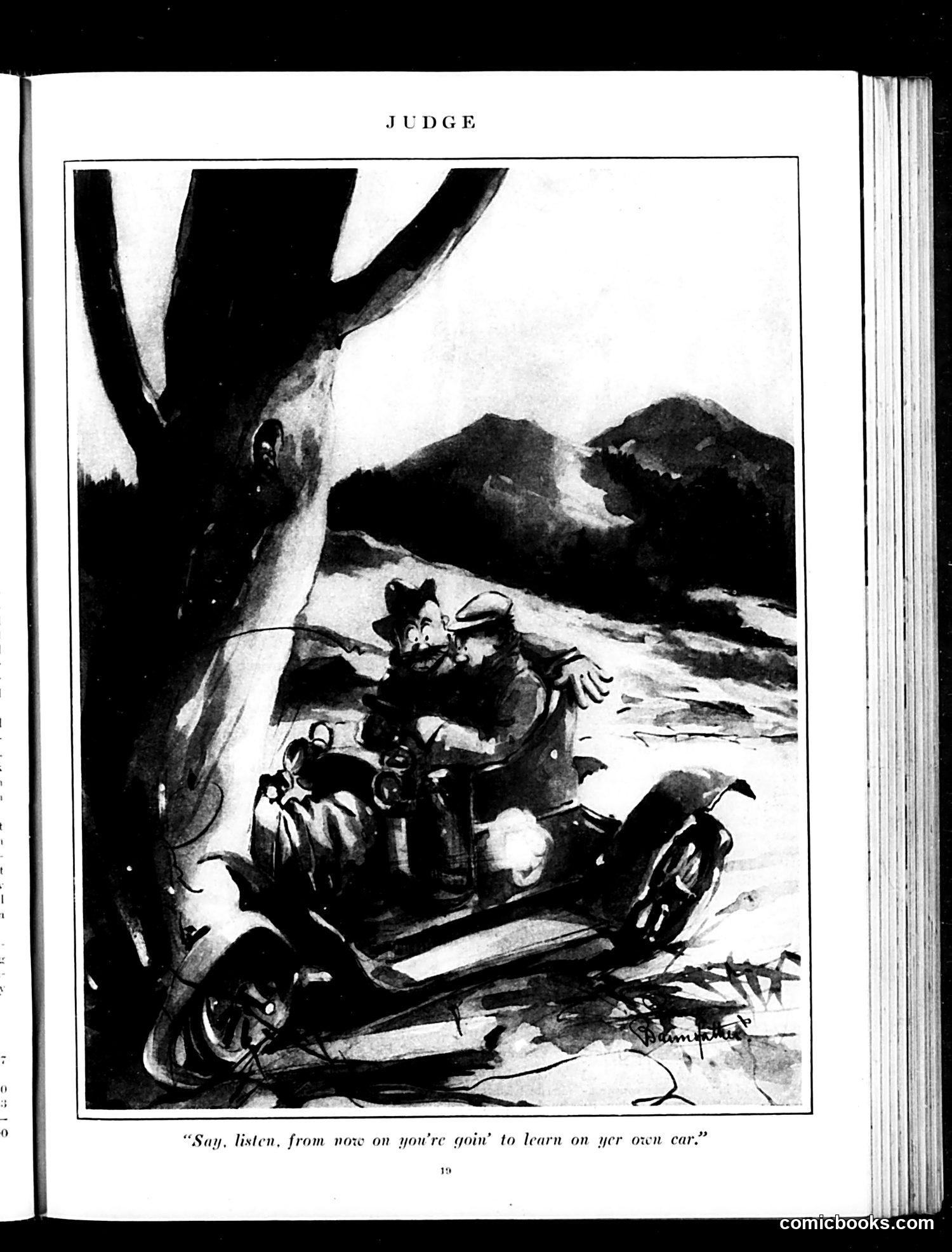
Analysis This is a single cartoon from *Judge* magazine showing two figures in an early automobile beneath a large tree branch. The caption reads: "Say, listen, from now on you're goin' to learn on yer own car." The satire appears to target driving instruction and automobile ownership. One figure (apparently an instructor or experienced driver) is telling the other (a learner) that future driving lessons will happen using the learner's own vehicle rather than an instructor's car—a shift in responsibility and expense to the novice driver. The humor likely satirizes the growing prevalence of automobile ownership in early 20th-century America and the practical (or impractical) expectations placed on new drivers learning in their own vehicles. The precarious positioning near the tree suggests the inherent dangers of such informal instruction methods.
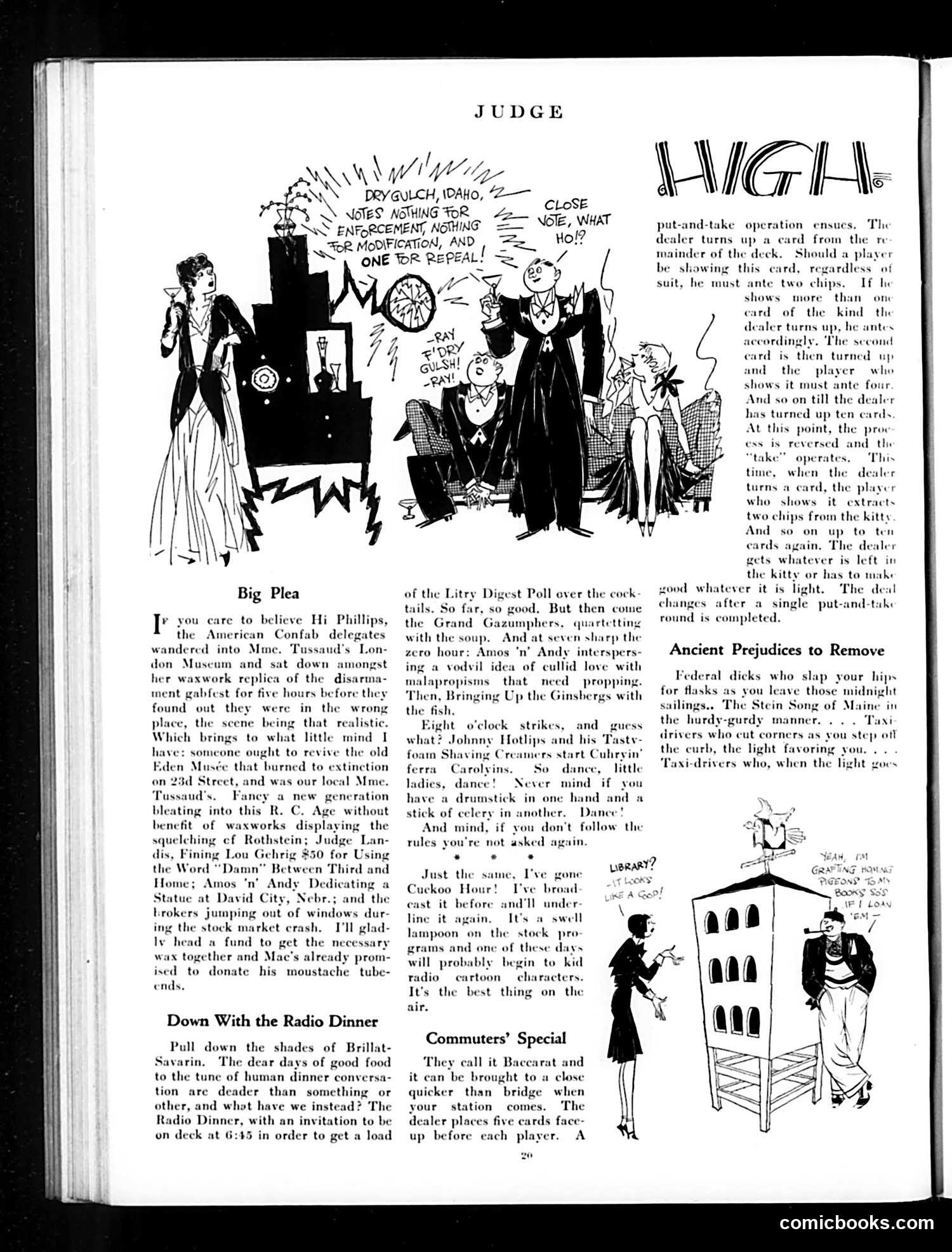
Judge Magazine Page Analysis This page contains humor pieces mocking contemporary American culture circa the 1920s-30s. "Big Plea" satirizes the American Confab delegates' visit to Madame Tussauds wax museum in London. The joke: they spent five hours debating prohibition policy while sitting among wax figures, not realizing they weren't talking to real people. It's absurdist humor about the futility of political debate. "Down With the Radio Dinner" laments how radio entertainment during meals has replaced civilized dinner conversation—a nostalgic complaint about modern technology ruining traditional social customs. "Ancient Prejudices to Remove" lists minor urban annoyances (corrupt police, taxi drivers, etc.) in a tongue-in-cheek style. The right column contains card game rules for "put-and-take," a gambling game popular at the time. The cartoons use exaggeration and visual comedy typical of Judge's satirical style, targeting both technological change and social institutions.
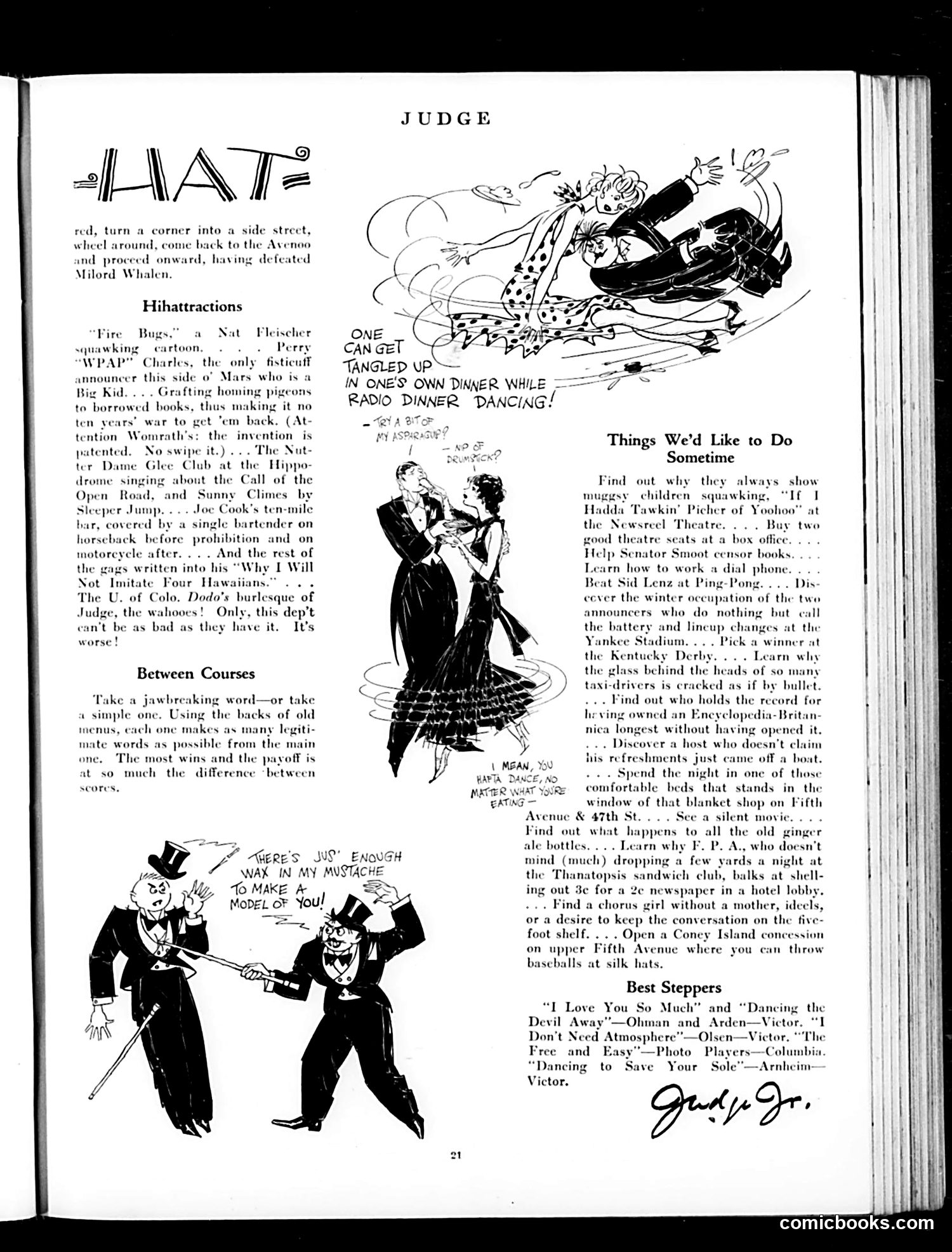
Judge Magazine Page Analysis This page from Judge (an American satirical weekly) combines humor columns with cartoon vignettes. The main content includes: "Hihattractions": A theater/entertainment column mocking current Broadway shows and performers—references to "Fire Bugs," Charles ("the only fisticuff announcer"), and various comedies. The satire targets both the shows' quality and theatrical pretension. "Between Courses": A parlor game where diners make words from menu text—gentle social satire about high-society amusements. The cartoons depict: 1. A couple tangled during "radio dinner dancing"—satirizing the then-novel phenomenon of dancing while listening to broadcast radio 2. Two men in top hats with mustaches (unclear identities)—appears to be about personal grooming or vanity "Things We'd Like to Do Sometime": A satirical wish-list mocking contemporary urban inconveniences: bad theater seats, broken taxi windows, hotel beds in shop windows, and overpriced newspapers. "Best Steppers": A section listing popular dance records—straightforward entertainment listing, not satirical. The overall tone targets 1920s urban sophistication, modern conveniences, and theatrical culture.
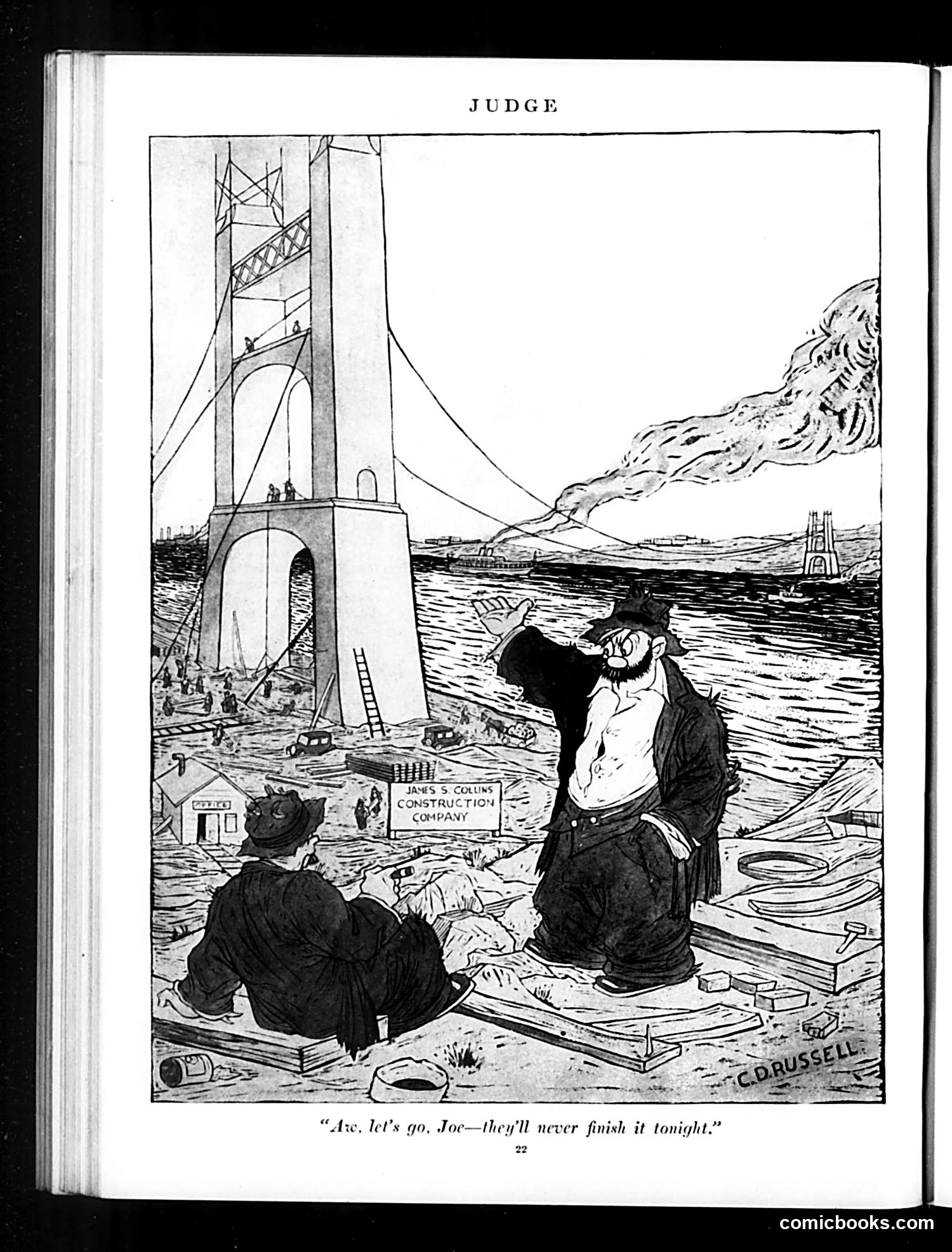
Analysis This cartoon depicts two workers at a construction site, with a massive suspension bridge under construction visible in the background. A sign reads "JAMES S. COLLINS CONSTRUCTION COMPANY." One worker (apparently named Joe) urges the other to leave, saying they'll never finish the work tonight. The satire appears to target construction delays and labor inefficiency—a common complaint about public works projects. The massive scale of the bridge and the casual worker dismissal of completing it suggests mockery of either project mismanagement, worker laziness, or unrealistic timelines. The cartoon likely reflects contemporary frustrations with infrastructure projects that ran over schedule or budget. The specific Collins company reference suggests this may target an actual known construction firm or its reputation for delays.
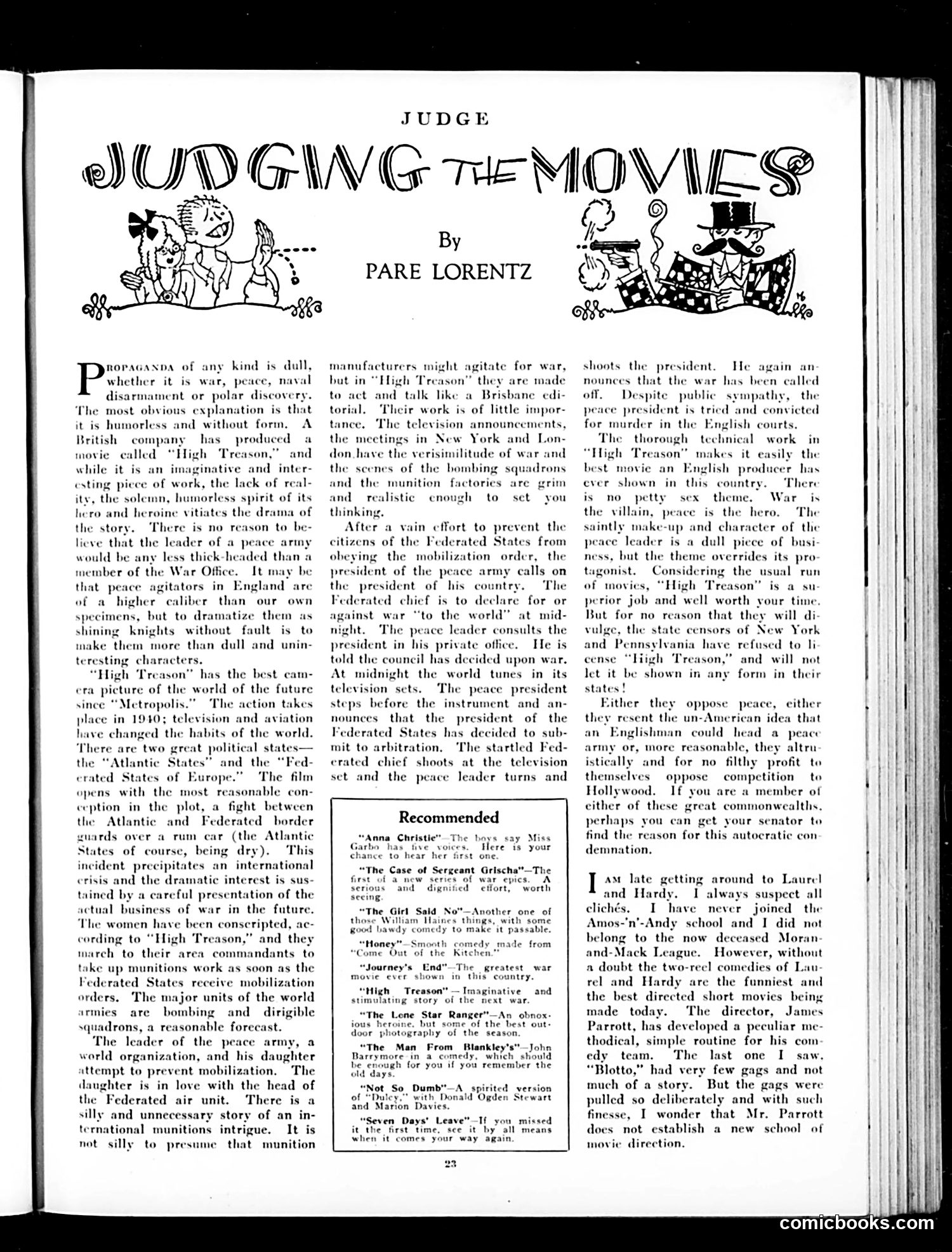
Judge Magazine: "Judging the Movies" by Pare Lorentz This is a film review column, not a political cartoon. Lorentz critiques "High Treason," a 1940 British science-fiction film about future world conflict between the "Atlantic States" and "Federated States of Europe." Lorentz argues the film fails because its pacifist propaganda is earnest but dramatically inert. He objects that peace leaders are portrayed as noble heroes without human flaws—making them duller than actual bureaucrats. The film depicts realistic future technology (television, aircraft), but its central conflict (a peace activist versus war mobilization) relies on melodramatic intrigue rather than authentic political tension. The review suggests propaganda films, whatever their cause, inherently lack dramatic vitality when characters become ideological symbols rather than believable people. Lorentz praises the film's technical achievements while dismissing its moral argument as heavy-handed and unconvincing. The "Recommended" box lists other current films with brief capsule reviews.
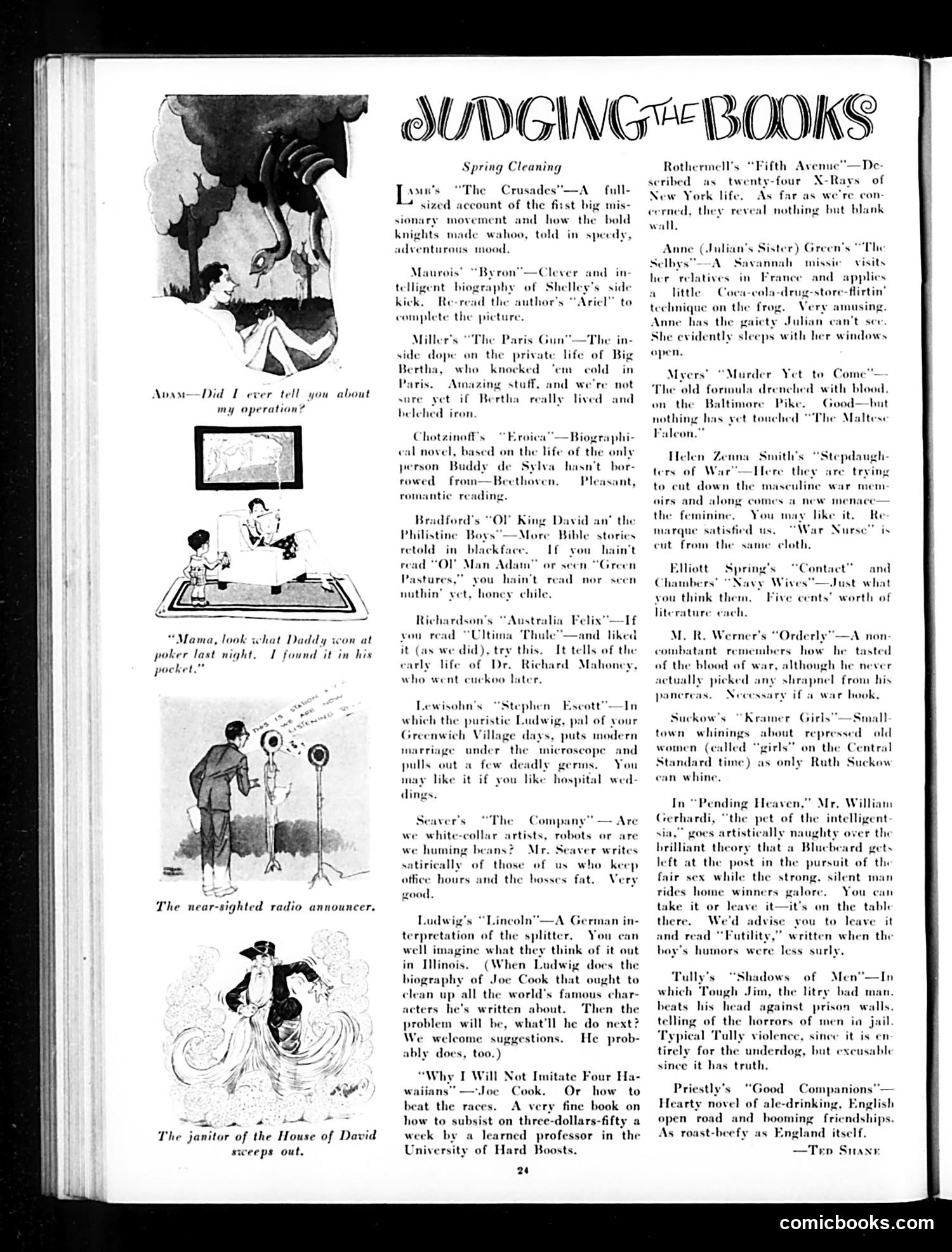
Judging the Books: A 1920s Literary Review This page reviews contemporary books in a casual, humorous style typical of Judge magazine's literary criticism. The cartoons illustrate recurring social types: a man bragging about a surgical operation; a child finding gambling winnings in father's pocket; a nearsighted radio announcer; and a janitor from the "House of David" (likely referencing the religious commune). The book reviews mock both authors and readers with period-specific references: Bradford's "blackface" retellings of Bible stories; Ludwig's German interpretation of Lincoln; Joe Cook's racing tips; and various wartime memoirs. The tone is satirical and colloquial ("honey chile," "huming beans"), reflecting Jazz Age informality. The "House of David" reference suggests commentary on contemporary utopian communities. Overall, this represents 1920s Judge humor: irreverent, topical, and dismissive of both highbrow literary pretension and middlebrow earnestness.
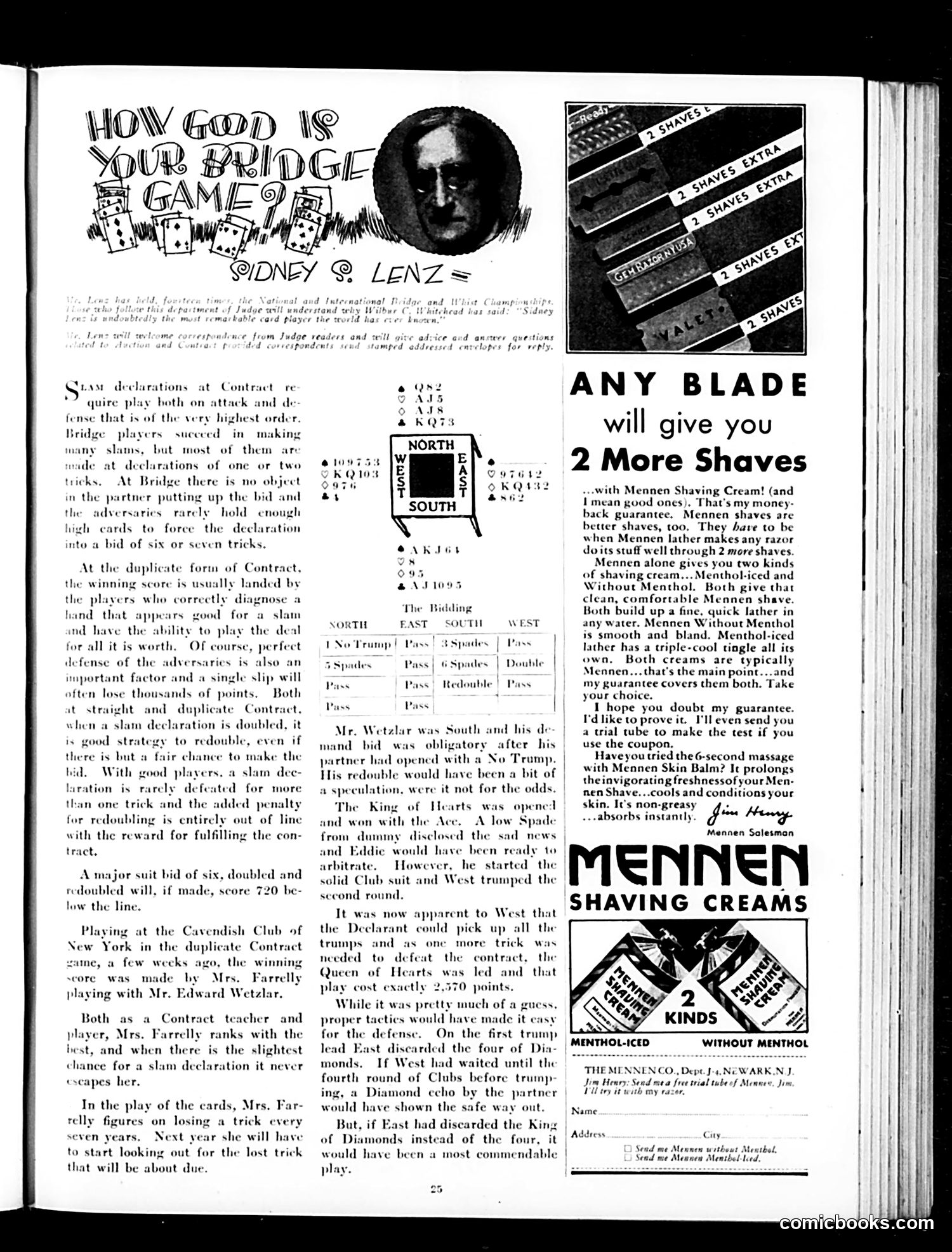
Judge Magazine Page Analysis This page combines a bridge strategy article with advertisements. The main editorial content discusses contract bridge—specifically slam declarations and bidding tactics—featuring a hand played by Mrs. Farrelly at New York's Cavendish Club. The article analyzes optimal plays and partnership communication through card signals. The significant portion of the page is dominated by a Mennen Shaving Cream advertisement, featuring a portrait (likely of a male celebrity endorser, though unidentified here) and promotional text claiming the product enables "2 more shaves" per blade when used with Mennen lather. The ad emphasizes two product varieties: Menthol-iced and Without Menthol versions. There is no political cartoon or satire on this page. It represents typical 1930s-era Judge magazine content: serious recreational (bridge) journalism mixed with full-page consumer advertising. The juxtaposition reflects how magazines subsidized editorial content through advertisements.
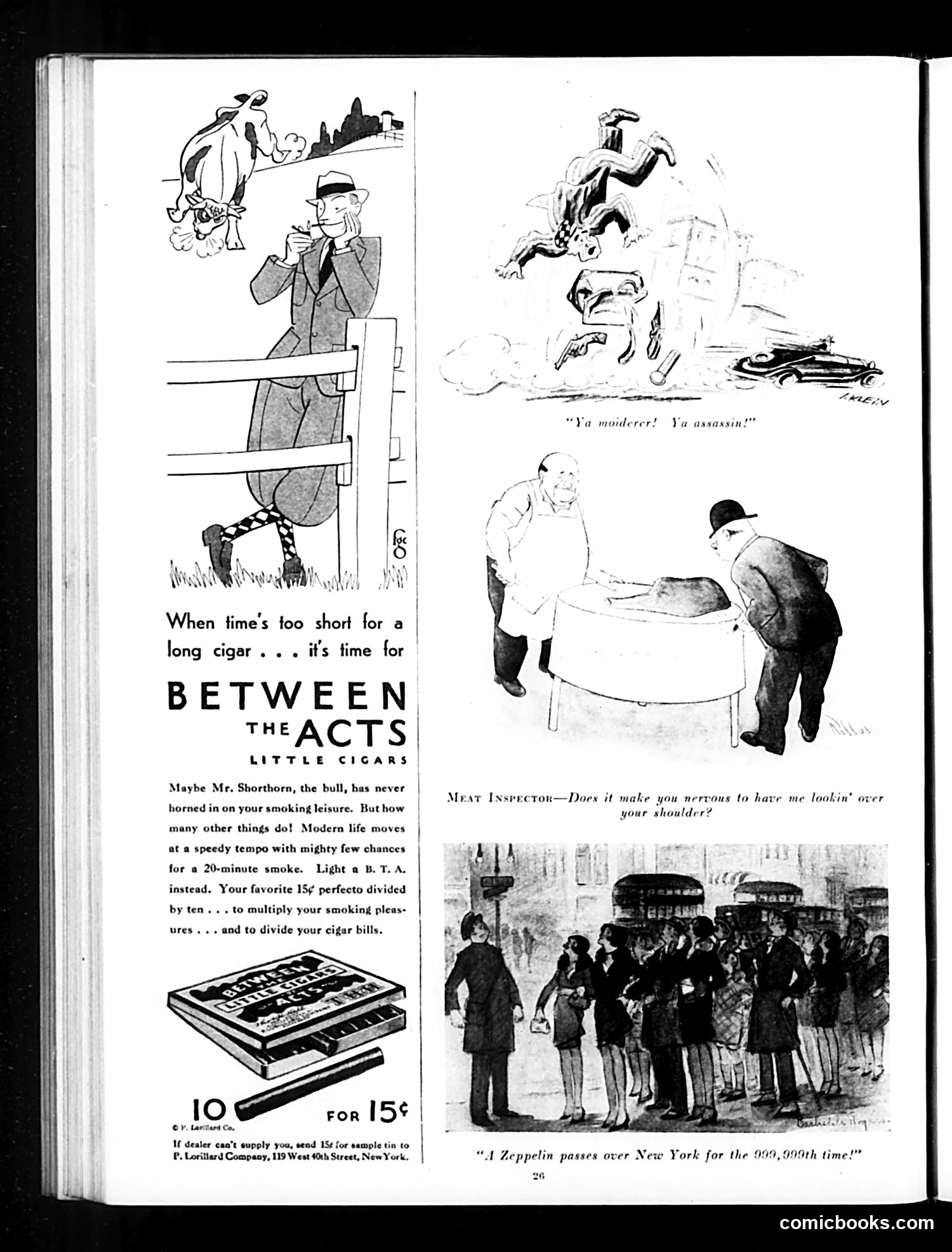
Judge Magazine Page Analysis This page is primarily a cigarette advertisement for "Between the Acts" little cigars, with humorous cartoon panels supporting the sales pitch. The main ad argument: modern life moves too fast for long cigars, so shorter cigars allow smokers to enjoy more frequent cigarettes while spending less money ("divide your cigar bills"). The cartoon panels illustrate this theme with satirical vignettes: 1. Top right: A chaotic scene with French text ("You murderer! You assassin!") suggesting dramatic domestic or social conflict—implying life's stressful moments require quick smoke breaks. 2. Middle: A nervous man confronted by a meat inspector, humorously capturing workplace anxiety and surveillance. 3. Bottom: A zeppelin passing over New York, referencing the novelty and spectacle of modern technology and urban life. These panels collectively convey the advertisement's message: modern life is hectic and demands quick, affordable smoking solutions. The humor relies on exaggerated situations to make cigar-smoking seem practical for busy contemporary existence.
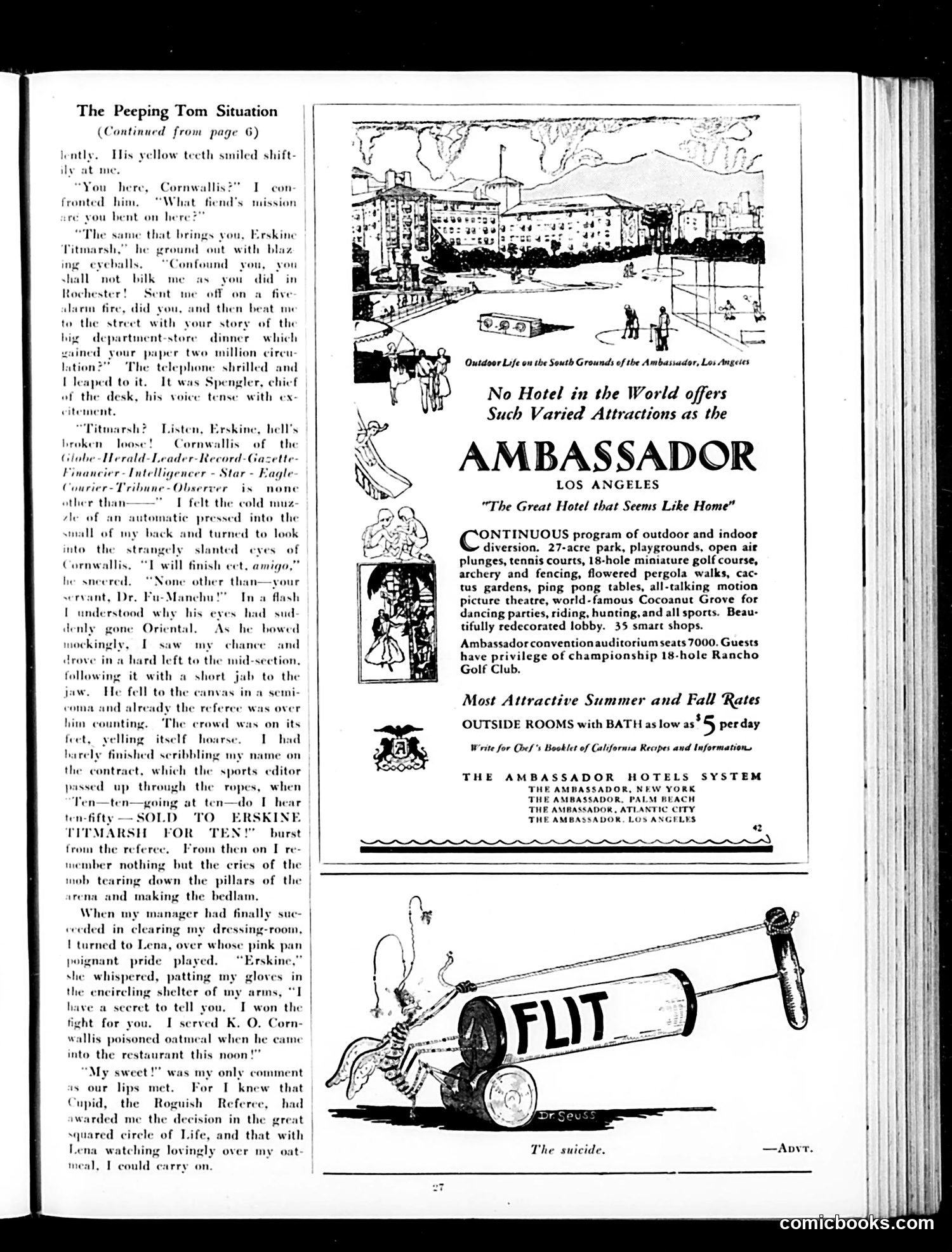
"The Peeping Tom Situation" - Page Analysis This page contains a serialized mystery/adventure story ("Continued from page 6") mixed with advertising. The narrative appears to be pulp fiction parody, featuring characters named Erskine Titmarsh and Cornwallis in a convoluted plot involving newspapers, romance, and boxing. The key satirical element is the absurd reveal: Cornwallis is revealed to be "Dr. Fu-Manchu"—the racist "yellow peril" villain from popular 1920s pulp fiction. The story mocks this genre by combining melodramatic tropes (mysterious Oriental villains, femme fatale "Lena," boxing matches, poisoning) into an over-the-top narrative. The accompanying cartoon titled "The suicide" depicts a mousetrap-like device labeled "FLIT" (a real insecticide brand), playing on the era's pest-control advertising. The page is primarily an advertisement for the Ambassador Hotels chain, prominent in the 1920s-30s.
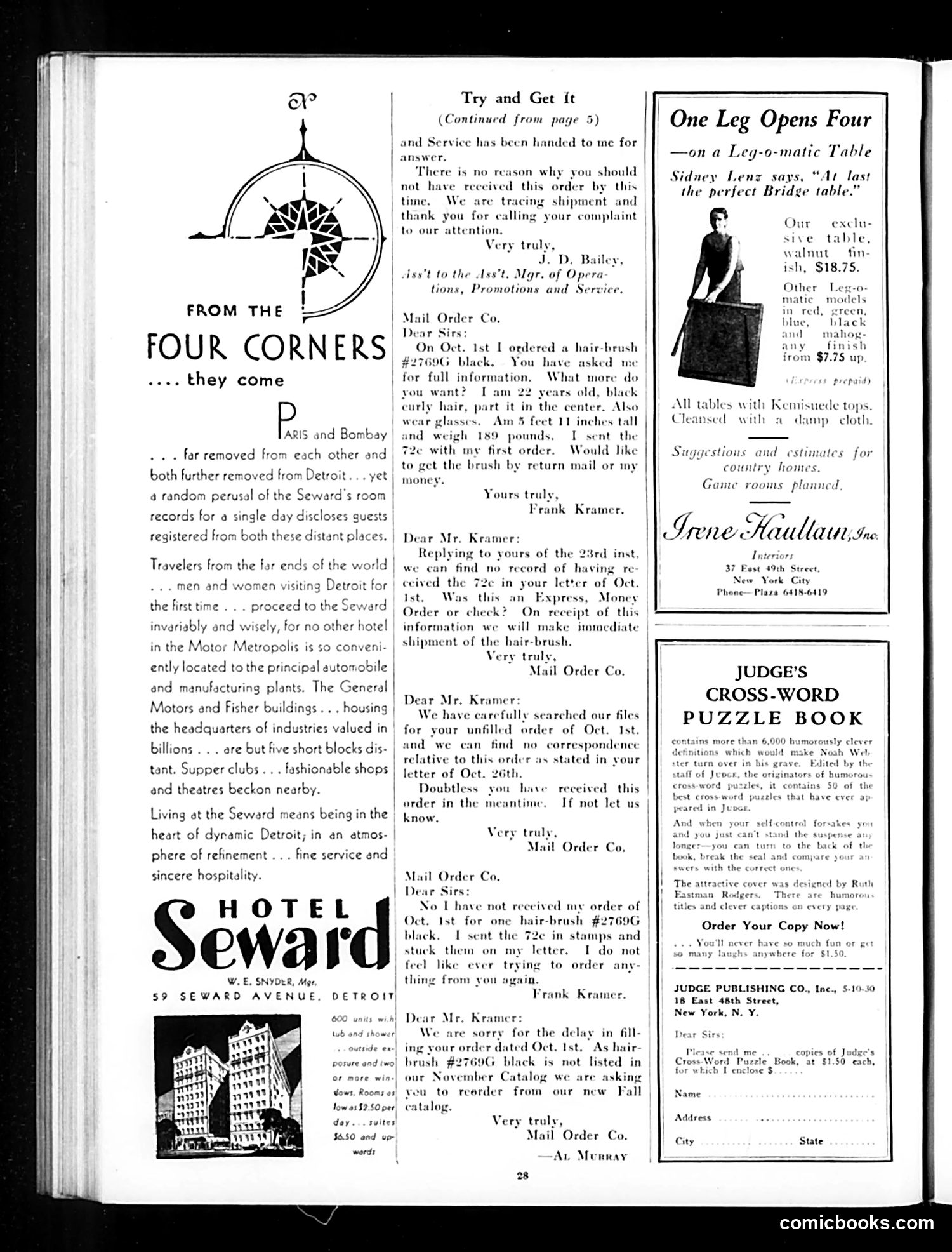
"Try and Get It" — Mail Order Frustration Satire This page satirizes the infuriating experience of ordering from mail-order companies. The centerpiece is an extended comic correspondence between customer Frank Kramer and a Mail Order Company regarding a simple hair brush (#2769G) ordered October 1st for 72 cents. The satire escalates through repeated exchanges: Kramer provides detailed personal information (age, height, weight, hair description) to help locate his order. The company responds with increasingly absurd deflections—claiming no record of payment, asking whether payment was by express or check, and ultimately stating the item isn't even in their catalog and requesting he reorder from the new Fall catalog. Kramer's final letter expresses exasperation: "I do not feel like ever trying to order anything from you again." The joke is the company's bureaucratic incompetence and circular logic in handling a trivial transaction, capturing common consumer frustrations with early 20th-century mail-order business practices. The title "Try and Get It" sardonically summarizes the difficulty of actually receiving ordered merchandise.

Analysis of Judge Magazine Page This page combines theater reviews with a Dentyne chewing gum advertisement. The ad features a glamorous woman's photo and promotes teeth whitening, using the slogan "Chew Dentyne...and smile!" This reflects 1920s consumer culture emphasizing personal appearance for social and professional success. Below the ad is a cartoon satirizing Hollywood actors, showing well-dressed film stars playing bridge while their "doubles" (stand-in actors) do the actual work. The caption reads: "Movie stars save themselves brain fag and while away the time by employing bridge doubles to play for them." The satire mocks the leisure and frivolity of 1920s celebrity culture—suggesting movie stars are so overpaid and pampered they hire others to play card games for them, avoiding even minimal mental exertion. This reflects period anxieties about entertainment industry excess and the perceived idleness of film personalities compared to working-class Americans. The left column reviews Broadway shows, establishing this as entertainment-focused content typical of Judge's satirical commentary on contemporary amusements.
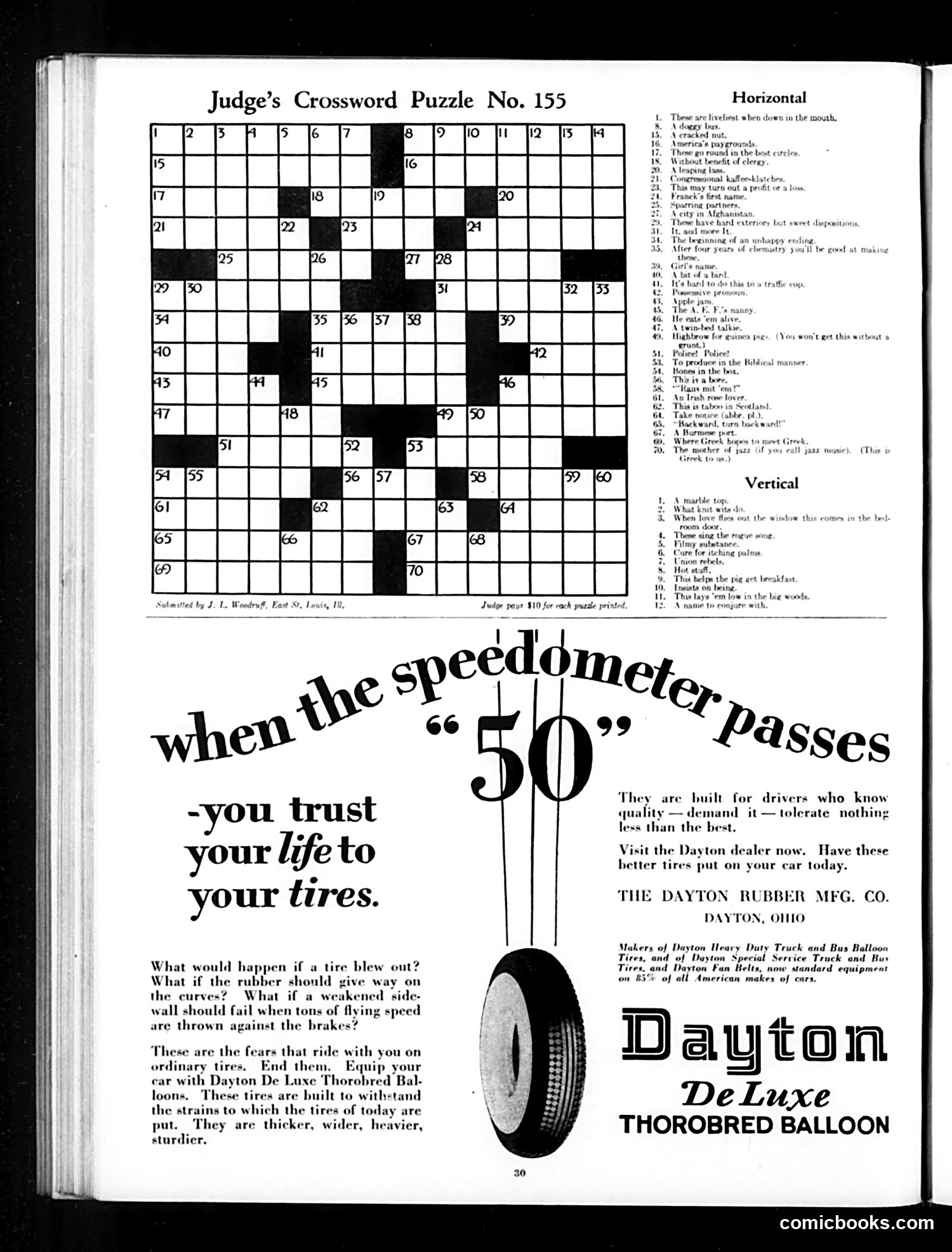
Analysis for Modern Readers This page is primarily a crossword puzzle and advertisement rather than political satire. The top half features Judge's Crossword Puzzle No. 155—a standard word game typical of the magazine. The bottom half contains a full-page advertisement for Dayton Deluxe Thorobred Balloon tires, a real automotive product from the Dayton Rubber Manufacturing Company (Ohio). The ad uses fear-based marketing, posing dramatic questions: "What would happen if a tire blew out? What if the rubber should give way on the curves?" This rhetorical approach was common in early 20th-century advertising—emphasizing safety risks to justify purchasing premium products. The ad claims Dayton tires are "thicker, wider, heavier, sturdier" than ordinary tires, marketing them to quality-conscious drivers. The tagline "when the speedometer passes 50—you trust your *life* to your tires" reflects contemporary anxieties about automobile safety as cars became faster and more common.
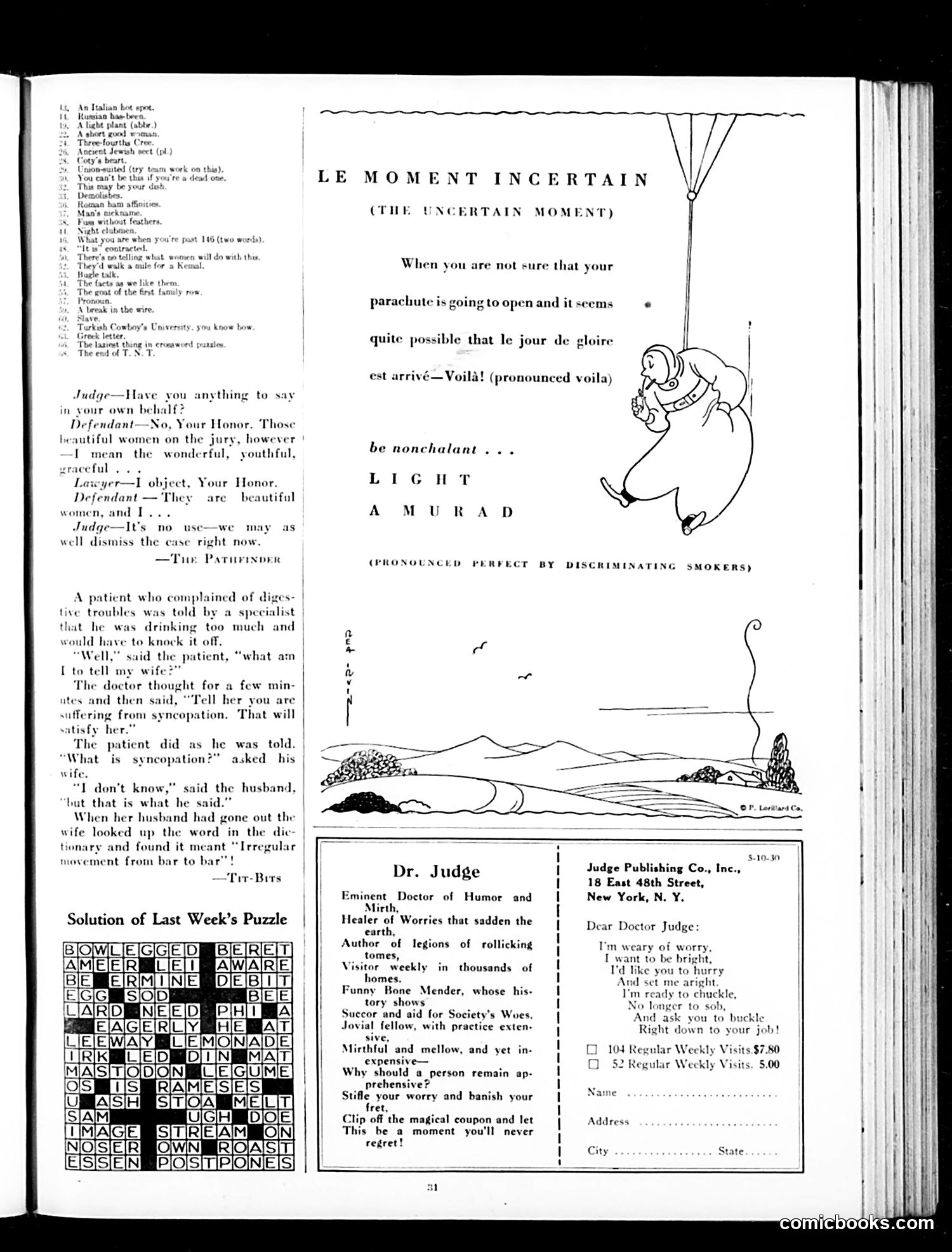
"Le Moment Incertain" – Explaining Judge Magazine's Satire This page primarily features a humorous illustration about parachute anxiety during wartime, titled "The Uncertain Moment." The cartoon depicts a soldier hanging from a parachute, joking about the suspenseful uncertainty of whether it will actually open—suggesting this moment of doubt represents the only time one might speak French ("le jour de gloire est arrivé—Voila!"). Below are lighter humor pieces: a courtroom joke about a defendant charming the judge by flattering female jurors, and a pun about a doctor advising a patient to blame "syncopation" (musical rhythm irregularity) for his drinking problem—wordplay his wife misunderstands. The "Dr. Judge" section is primarily advertising for the magazine itself, positioning the publication as a remedy for worry and stress. The page combines wartime anxiety humor with pre-war comedic traditions, typical of Judge magazine's satirical approach to contemporary concerns.
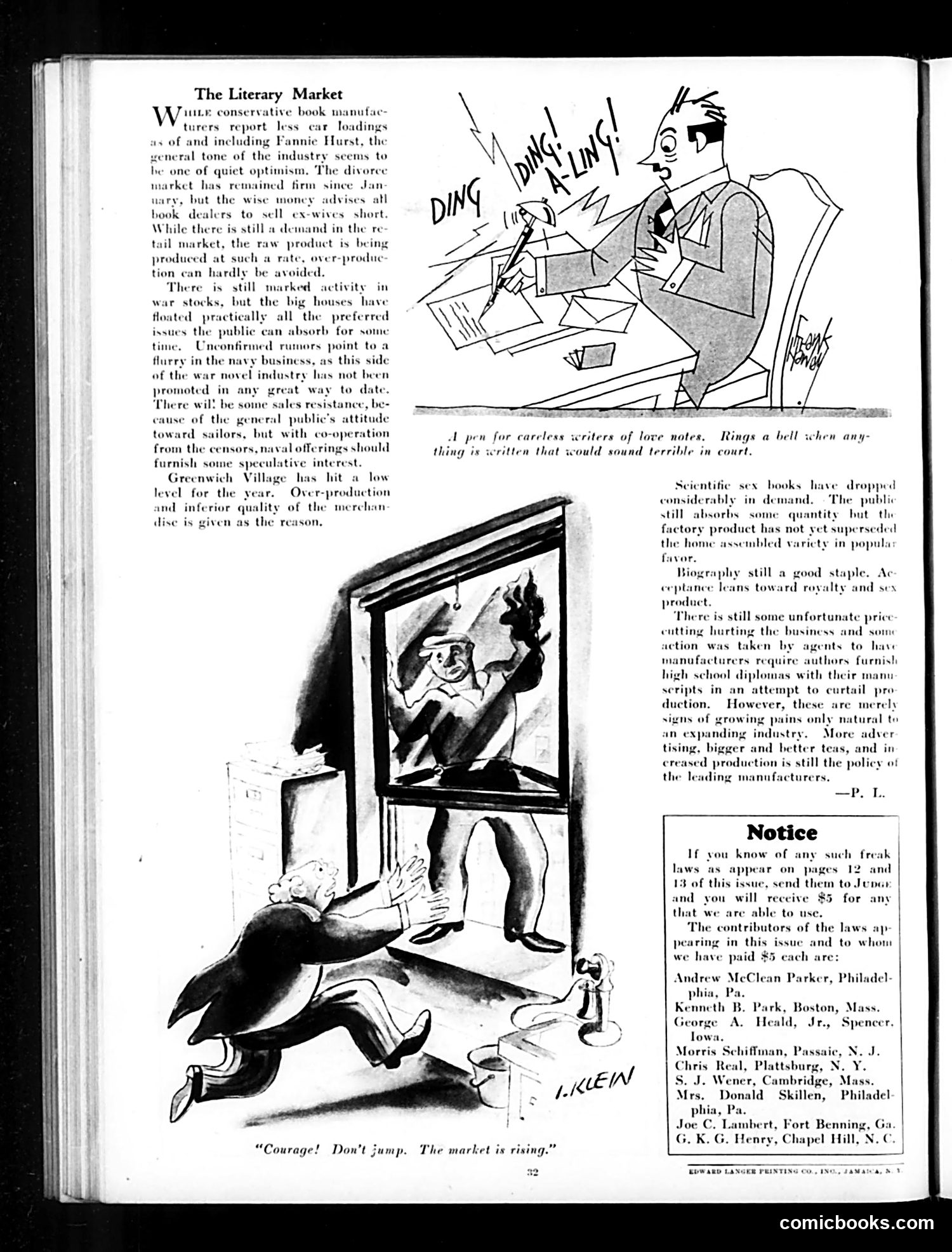
The Literary Market (Judge Magazine) This page satirizes the book publishing industry as a financial market. The top cartoon shows a harried publisher bombarded by ringing telephones and falling papers—depicting the chaotic, speculative nature of the business. The article treats books like stock commodities, using financial language: "divorce market," "war stocks," "preferred issues," "sales resistance." It jokes that divorce books are booming (likely referencing post-WWI social upheaval), war novels are saturated, and "naval offerings" will need censorship cooperation to succeed. The bottom cartoon shows a frightened man at a window labeled "Courage! Don't jump. The market is rising"—a reference to the 1929 stock market crash and subsequent suicides, darkly comparing publishing fortunes to financial devastation. The satire mocks how publishers treat literature as mere financial products rather than art, reducing human experience (divorce, war, sexuality) to marketable commodities subject to boom-and-bust cycles like Wall Street stocks.
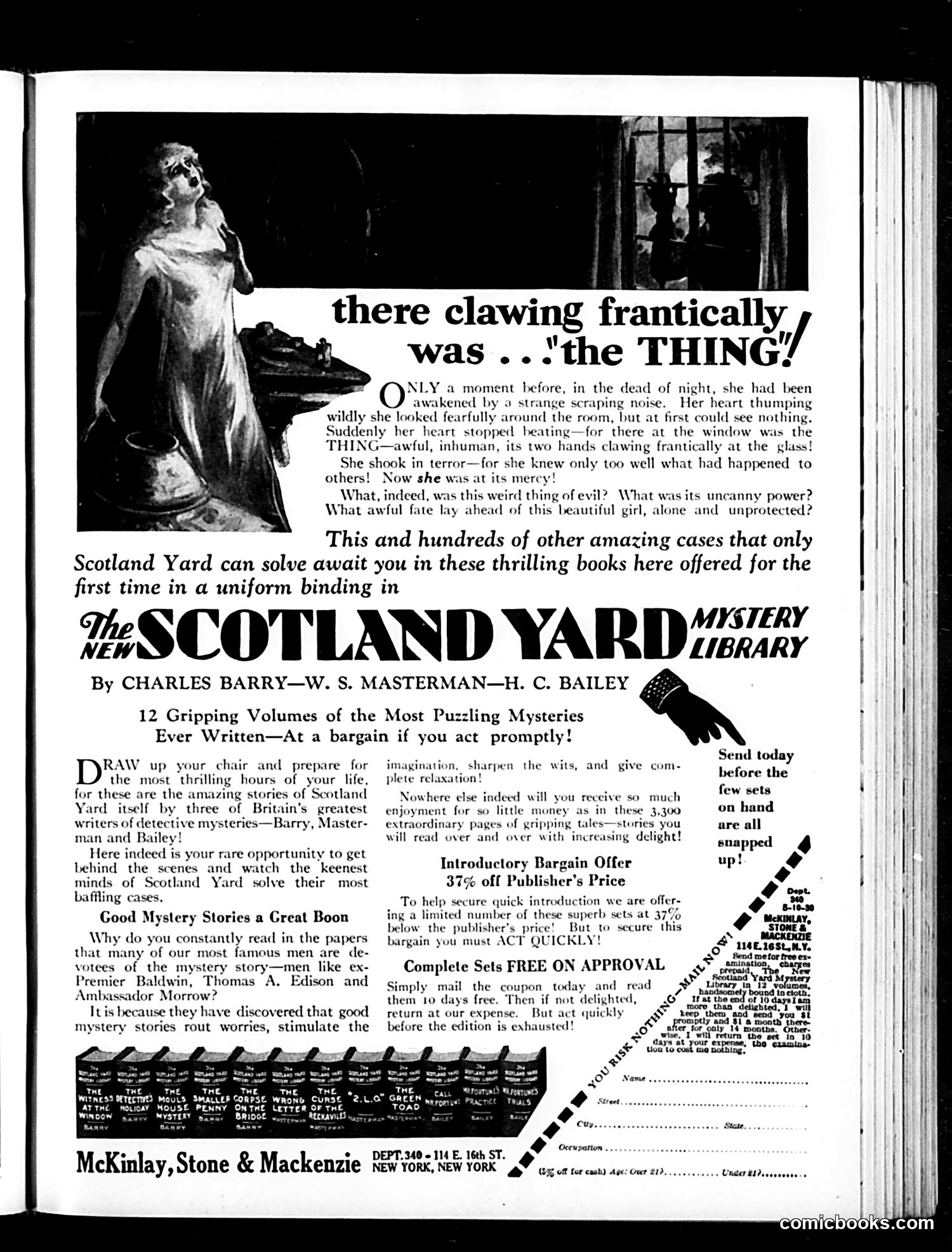
Analysis This page is primarily advertising, not a political cartoon. It promotes "The New Scotland Yard Mystery Library"—a 12-volume collection of detective stories by Charles Barry, W.S. Masterman, and H.C. Bailey. The dramatic imagery shows a woman in nightclothes terrified by "the THING" clawing at her window—a sensational scene meant to exemplify the thrilling mystery content within. This teases the lurid, suspenseful plots readers will encounter. The ad leverages the prestige of Scotland Yard (British police) and appeals to intellectual readers by noting famous men like ex-Premier Baldwin and Thomas Edison enjoy mystery stories for mental stimulation. The "37% off" pricing incentive and "free on approval" offer are sales tactics. Context for modern readers: This reflects early 20th-century publishing's strategy of bundling classic detective fiction into uniform library sets for middle-class home consumption—before paperbacks made such books widely accessible and affordable.
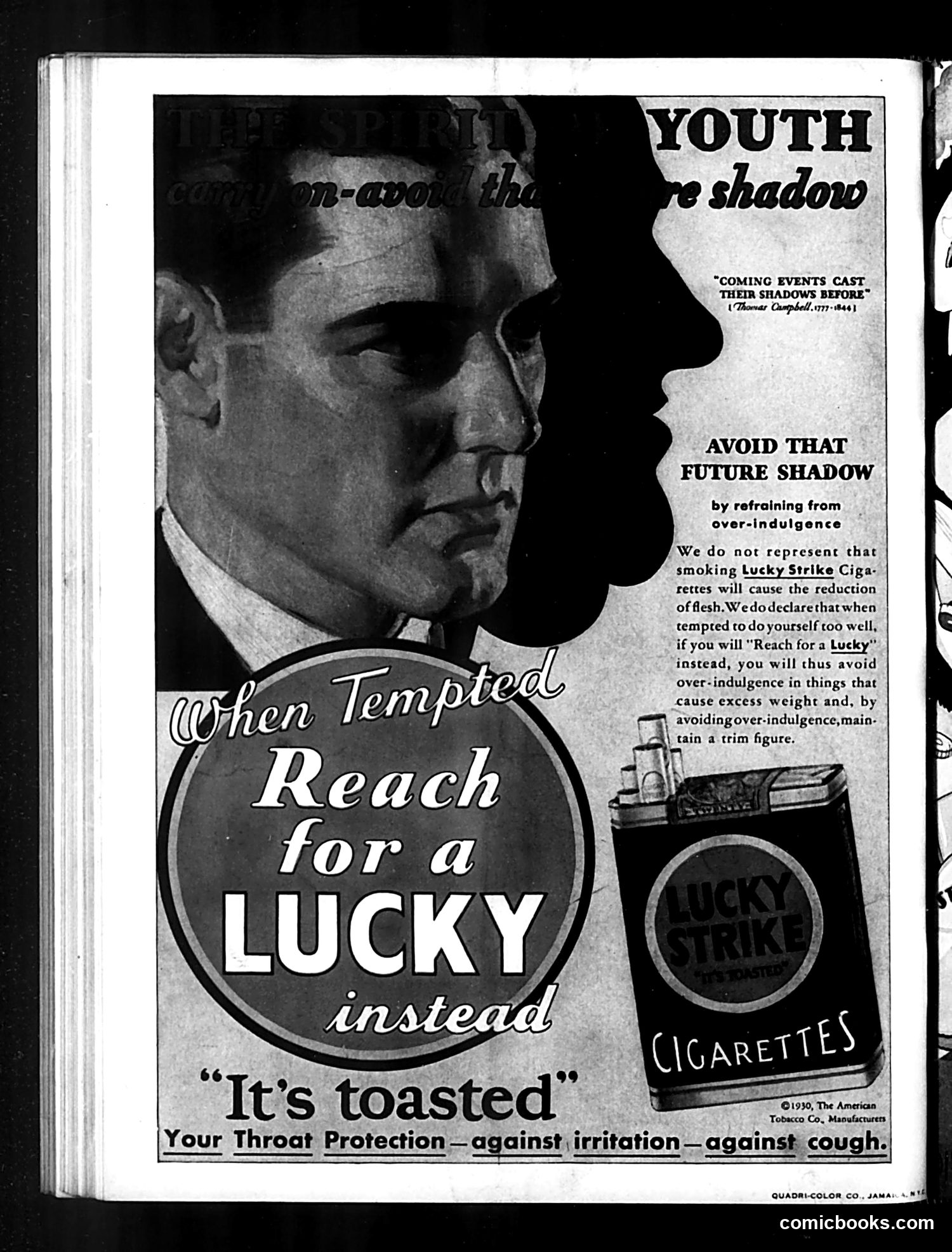
Analysis: Lucky Strike Advertisement This is primarily a cigarette advertisement, not political satire. The "Youth and Shadow" imagery uses a Campbell quote about how future consequences are foreshadowed in present actions—here, applying it to weight gain from overindulgence. The ad's central message: when tempted to eat too much, "Reach for a Lucky" cigarette instead to avoid excess weight and maintain a trim figure. The silhouette shows a heavyset man casting a shadow of his potential obese future self. This reflects 1930s diet culture and the tobacco industry's early marketing strategy of positioning cigarettes as appetite suppressants for weight control—a claim the fine print carefully disclaims while still implying the benefit. The "toasted" throat protection claim was Lucky Strike's signature marketing angle during this era.