judge
Judge — May 17, 1930
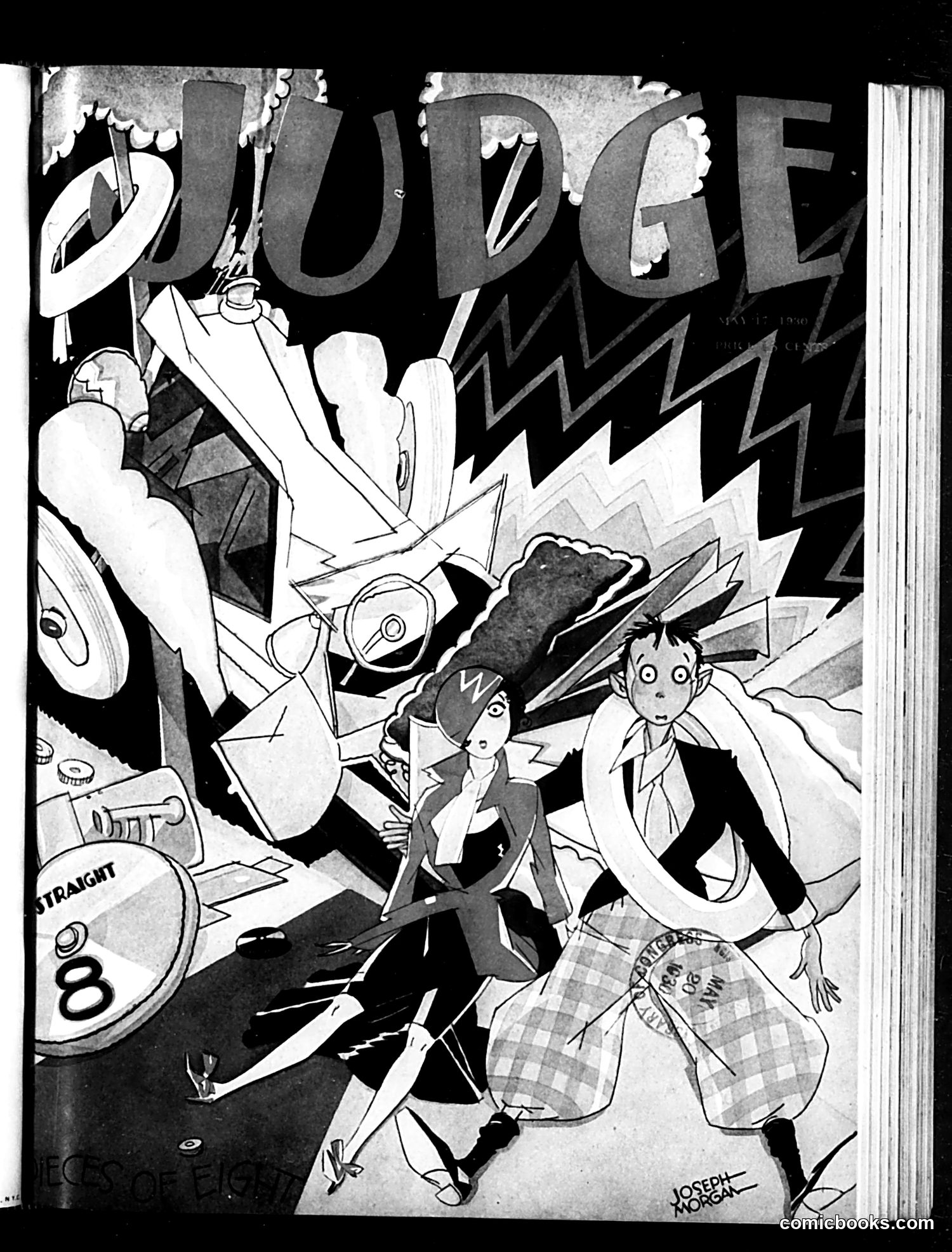
Analysis of "Dodge" Judge Magazine Page This appears to be a cover or advertisement for Dodge automobiles, featuring a chaotic comedic scene. The cartoon shows two men in business attire reacting with alarm and exaggerated shock as they're caught in the path of a large, aggressive Dodge vehicle bearing down on them. Lightning bolt graphics and motion lines emphasize the vehicle's power and speed. The satire likely plays on Dodge's marketing around vehicle power and performance—suggesting the car is so forceful and unstoppable that even pedestrians must frantically flee. The "8" visible on wheels references Dodge's eight-cylinder engine, then a notable feature. This is essentially automotive advertising dressed as humor, typical of Judge magazine's commercial content during this era.
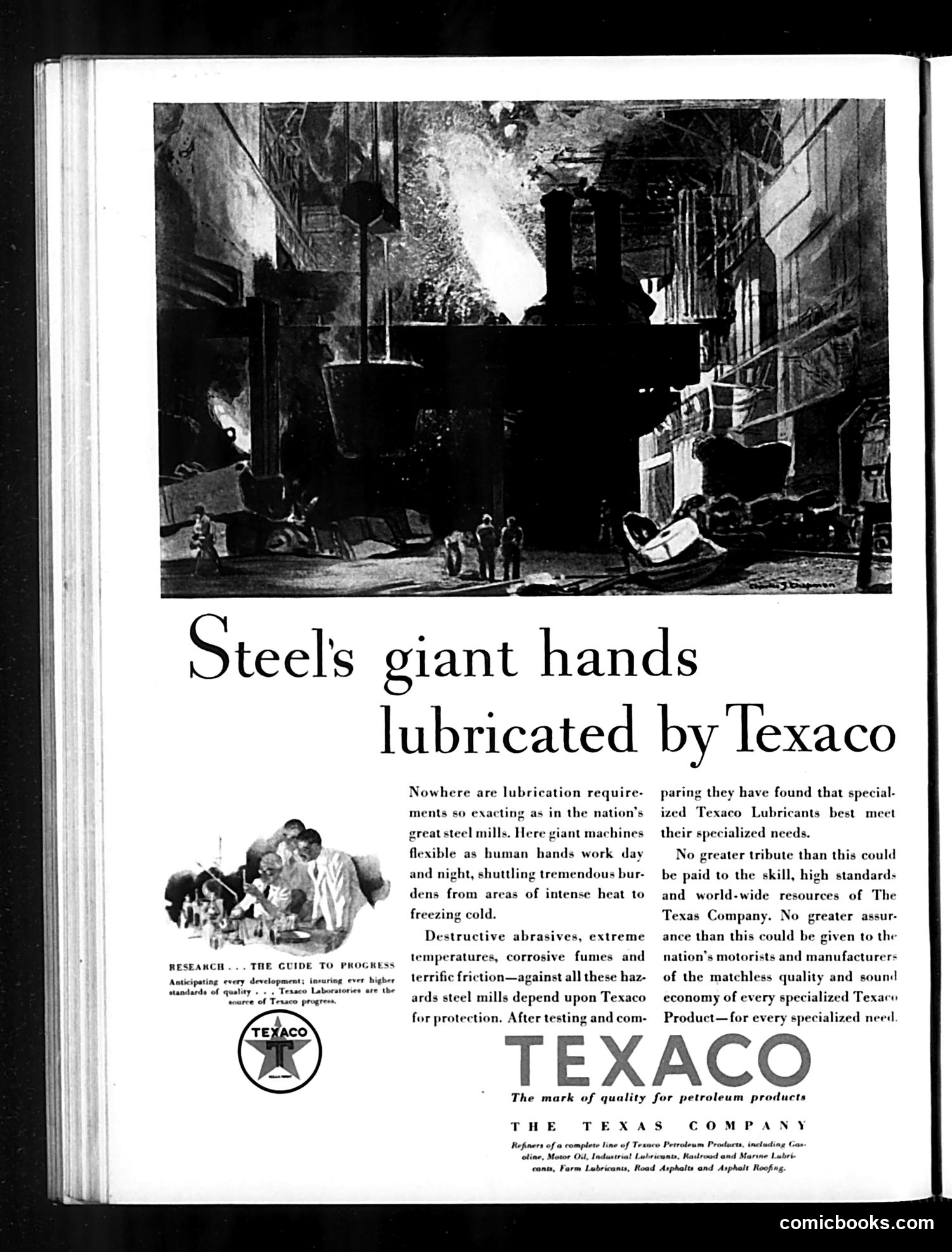
Analysis This page is not a cartoon or satire—it's a straightforward advertisement for Texaco lubricants, appearing in *Judge* magazine. The ad features an industrial photograph of a steel mill with giant machinery and workers, accompanied by promotional text emphasizing Texaco's specialized lubricants for extreme manufacturing conditions. The copy highlights the company's research capabilities and quality standards. The small illustration of researchers in a laboratory reinforces Texaco's scientific credibility. The Texaco star logo and tagline "The mark of quality for petroleum products" anchor the message. This represents typical corporate advertising from the early-to-mid 20th century that positioned commercial products as solutions to modern industrial challenges. There is no satirical intent—merely brand promotion.
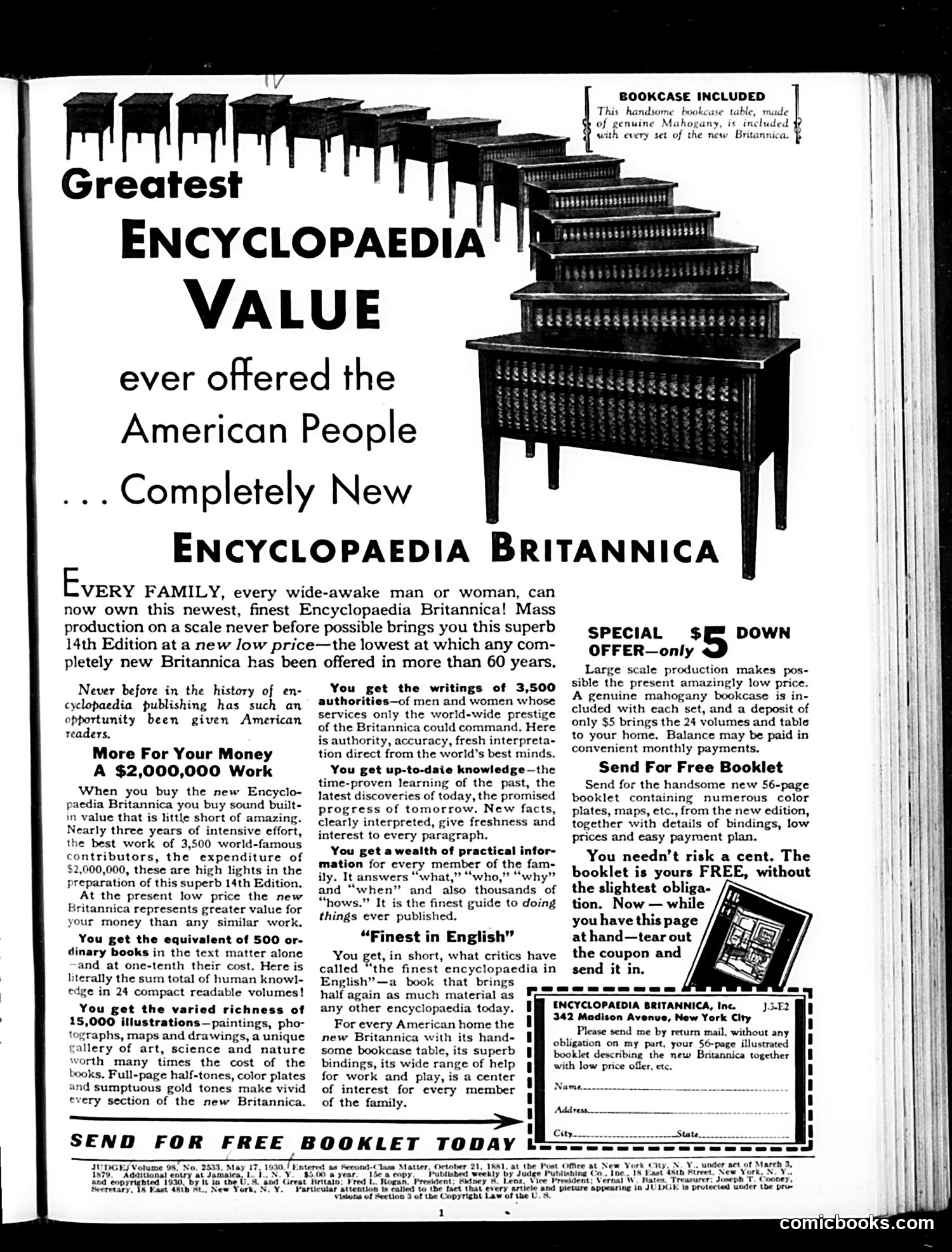
Analysis This page is primarily an advertisement, not satirical content. It's a full-page promotional piece for Encyclopedia Britannica's 14th Edition, placed in Judge magazine. The ad uses a visual metaphor: a staircase of increasingly ornate mahogany bookcases, emphasizing the product's quality and comprehensiveness. The text highlights the encyclopedia as an unprecedented value—"$5 down" with convenient payment plans—marketed to middle-class American families. The only potentially satirical element is the framing: Judge, known for lampooning consumer culture and advertising excess, may be implicitly critiquing the hard-sell tactics. However, the ad itself reads straightforwardly, emphasizing "3,500 authorities" and practical knowledge for families. This reflects 1920s-era print advertising strategies: luxury goods marketed as accessible necessities to aspirational consumers.
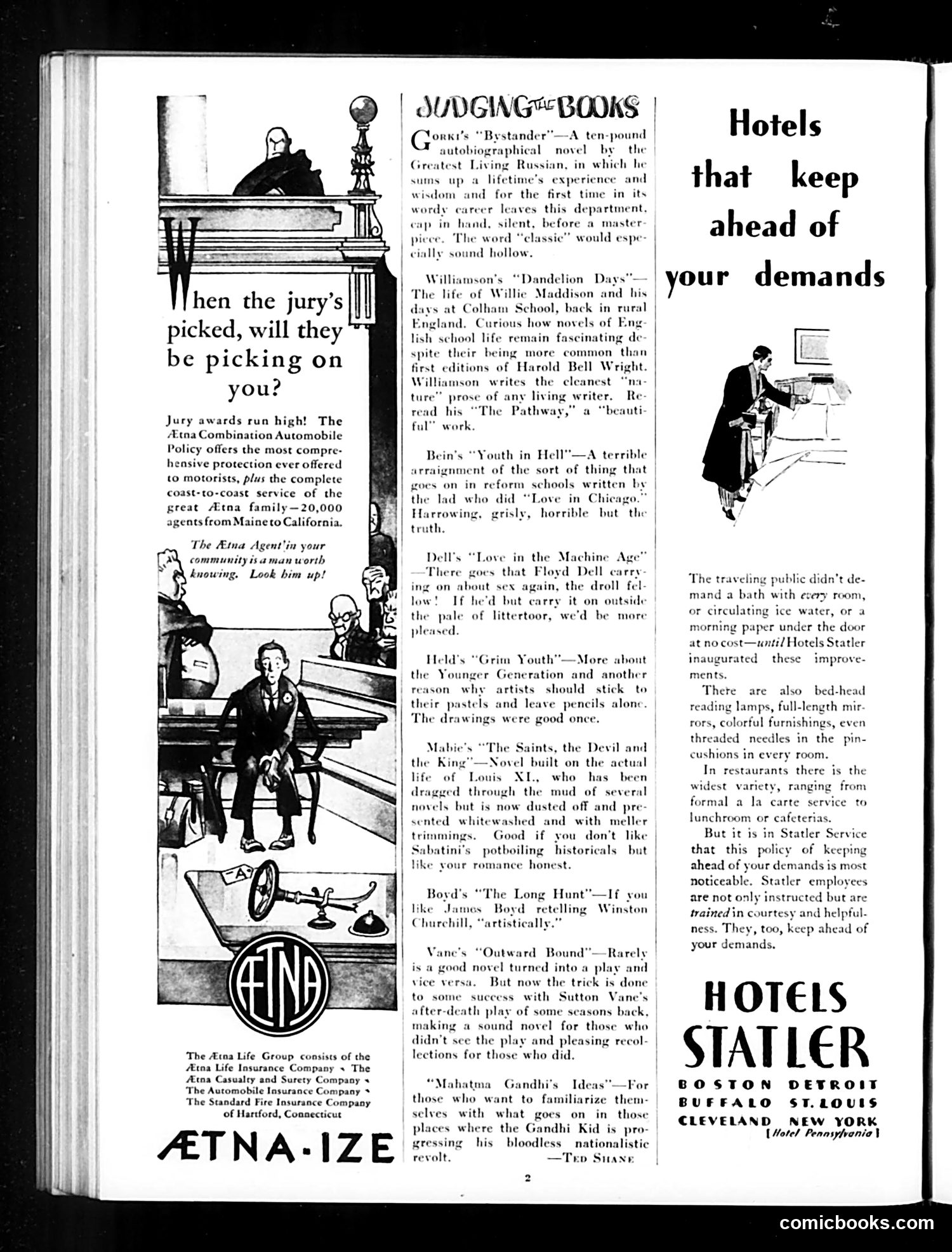
Page Analysis: Judge Magazine This page is primarily advertising, not political satire. The left side features an Aetna Insurance ad ("When the jury's picked, will they be picking on you?") showing a courtroom scene with various figures, emphasizing comprehensive coverage for motorists. The center contains "Judging the Books"—brief literary reviews of novels by Gorky, Williamson, Behn, Dell, and others. These are genuine book critiques, not satire. The right side advertises Hotels Statler, emphasizing modern amenities (reading lamps, mirrors, furnishings, circulating ice water, morning papers) as innovations that "keep ahead of your demands." There is no political cartoon on this page. It represents typical Judge magazine content: advertising mixed with cultural commentary, reflecting 1920s consumer culture and literary interests.
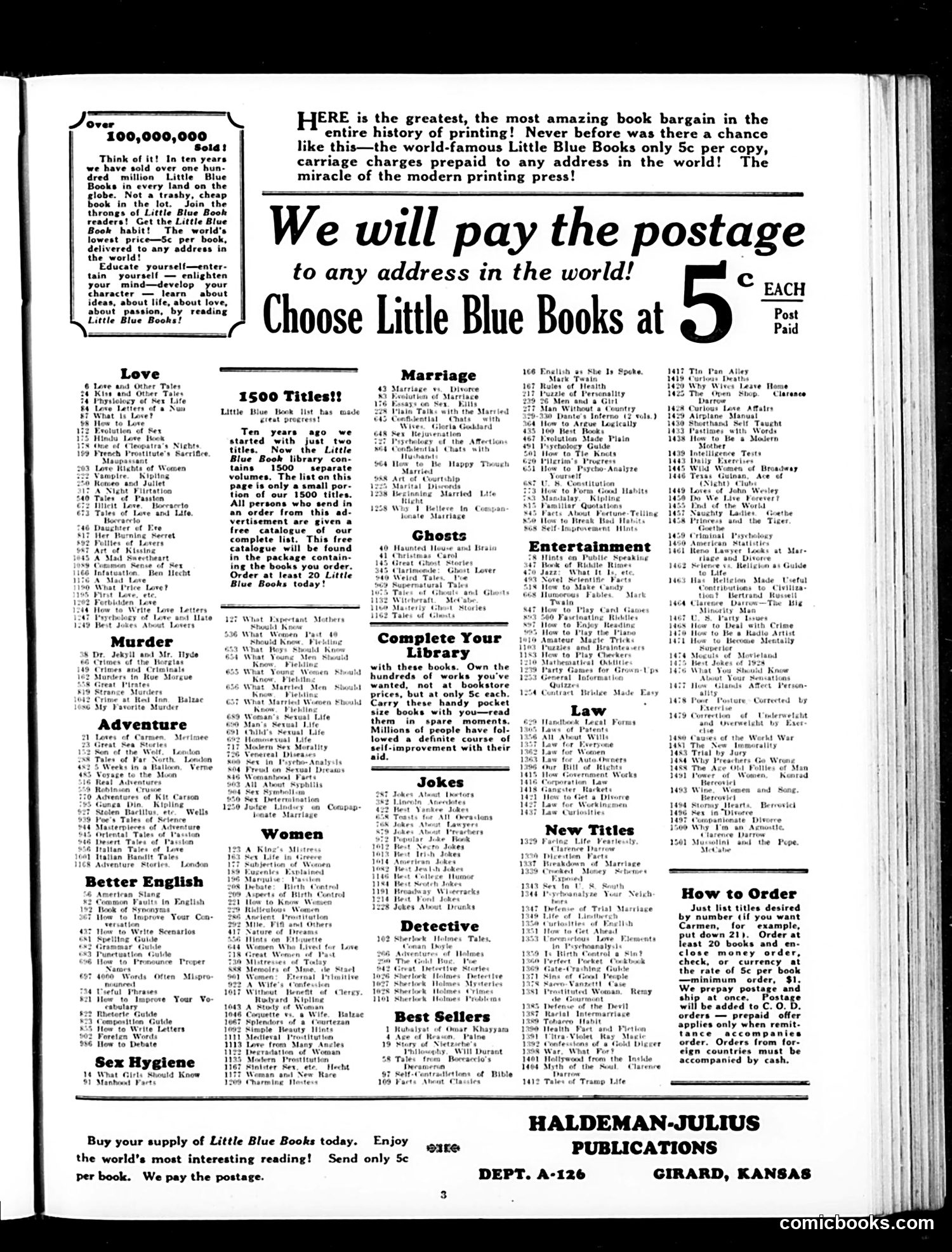
Analysis This page is primarily advertising, not editorial content or political satire. It features a full-page advertisement for Haldeman-Julius Publications promoting their "Little Blue Books" — inexpensive 5-cent paperback volumes available by mail with prepaid postage worldwide. The ad emphasizes the books' affordability and breadth, listing 1,500 titles across categories including Love, Marriage, Ghosts, Entertainment, Law, Jokes, Women, Detective stories, and Best Sellers. It's a straightforward commercial pitch highlighting the "greatest book bargain in the entire history of printing" rather than satirical commentary. The page represents early 20th-century direct-mail marketing and the democratization of literature through cheap printing technology.
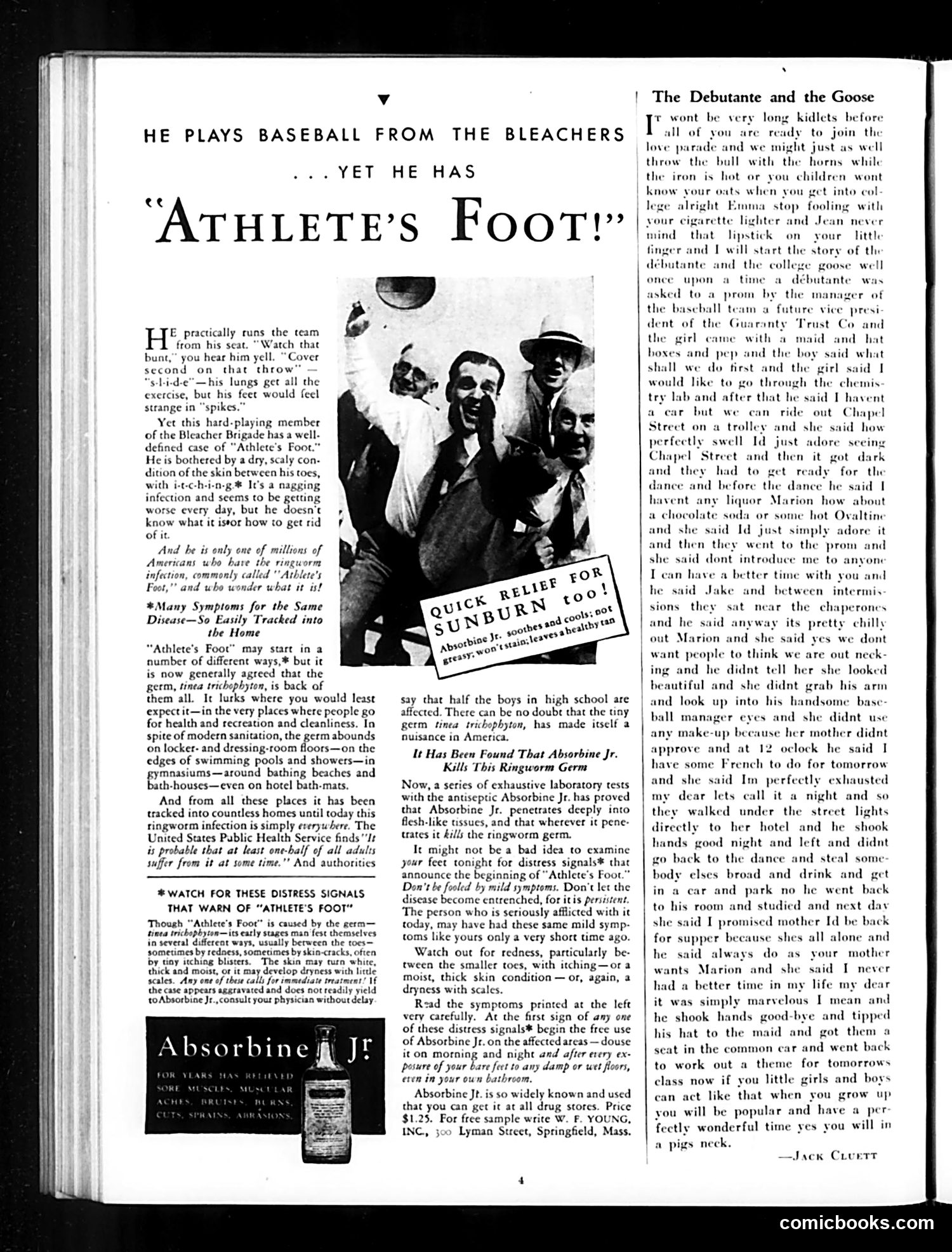
Analysis of Judge Magazine Page This page is primarily advertising disguised as editorial content. The main feature is a large advertisement for Absorbine Jr., a patent medicine marketed for "Athlete's Foot" fungal infection. The left column uses satirical humor: a baseball player suffers from athlete's foot despite his athletic prowess—the ironic contradiction being the joke. The text mocks how widespread this fungal infection was, calling it "one of millions of Americans" afflicted by "Athlete's Foot." The right side contains "The Debutante and the Goose," an unrelated short story by Jack Cluett about young socialites preparing for a dance. The page exemplifies early 20th-century magazine practices: blending paid advertising with entertainment content, using humor to promote commercial products without clear distinction between editorial and promotional material.
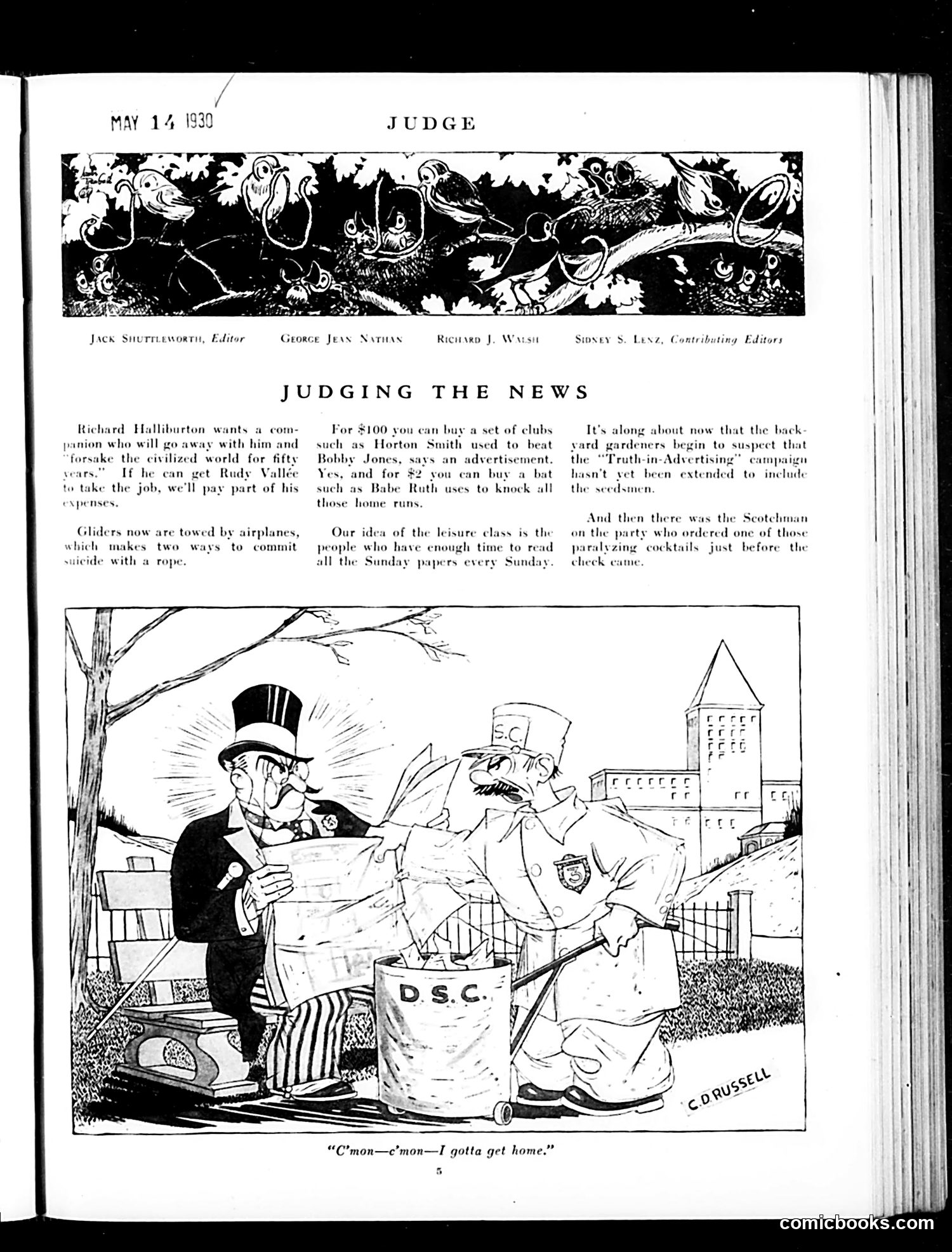
Judging the News - May 14, 1930 The cartoon depicts a man in formal attire (top hat) labeled "C'mon—c'mon—I gotta get home," holding what appears to be a map, speaking to a uniformed officer standing in a D.S.C. (Distinguished Service Cross) barrel. The satire appears to target government bureaucracy or military administration during the Great Depression era. The accompanying text references Richard Halliburton (an adventurer), Rudy Vallée (entertainer), golf club advertisements, and leisure activities. The joke likely critiques how wealthy individuals pursued frivolous pastimes while ordinary citizens struggled economically. The bureaucratic figure and the "gotta get home" complaint suggest commentary on government inefficiency or red tape frustrating the public during this period of national hardship.
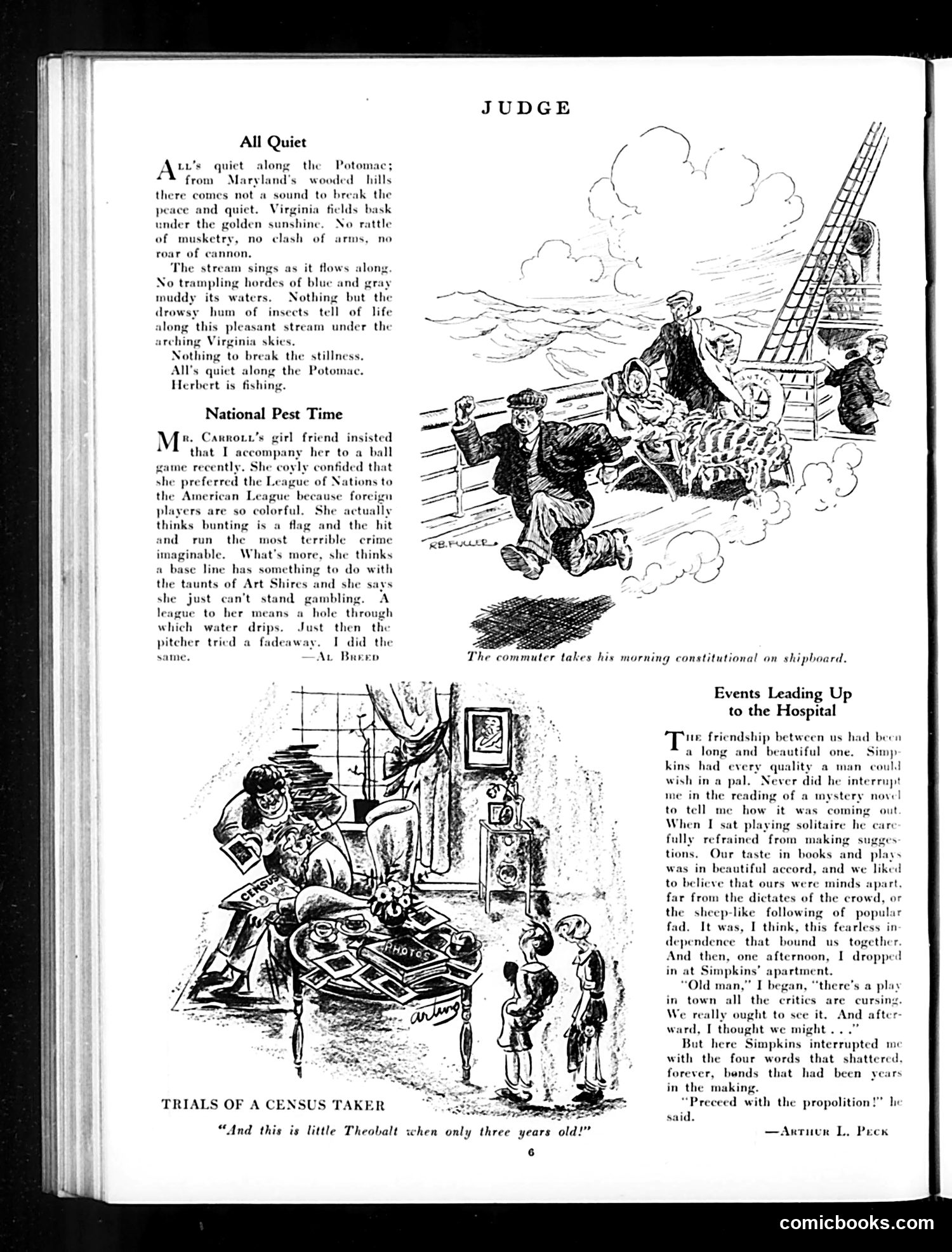
"Judge" Page Analysis This page contains three humorous pieces satirizing early 20th-century American life: "All Quiet" mocks the peaceful Potomac River and Virginia countryside during what appears to be peacetime, contrasting bucolic scenes with Herbert (likely a fishing reference to a public figure). "National Pest Time" satirizes baseball fandom through a woman who conflates baseball with crime—she prefers international League of Nations games because American League players are "too colorful" and thinks baseball involves criminal activity. The joke targets both gender stereotypes about women understanding sports and contemporary baseball culture. "Trials of a Census Taker" (bottom cartoon) depicts a census-taker overwhelmed by chaotic domestic scenes, illustrating the absurdities encountered during census work, likely from the 1920 or 1930 census period. The Arthur L. Peck byline credits the final piece.
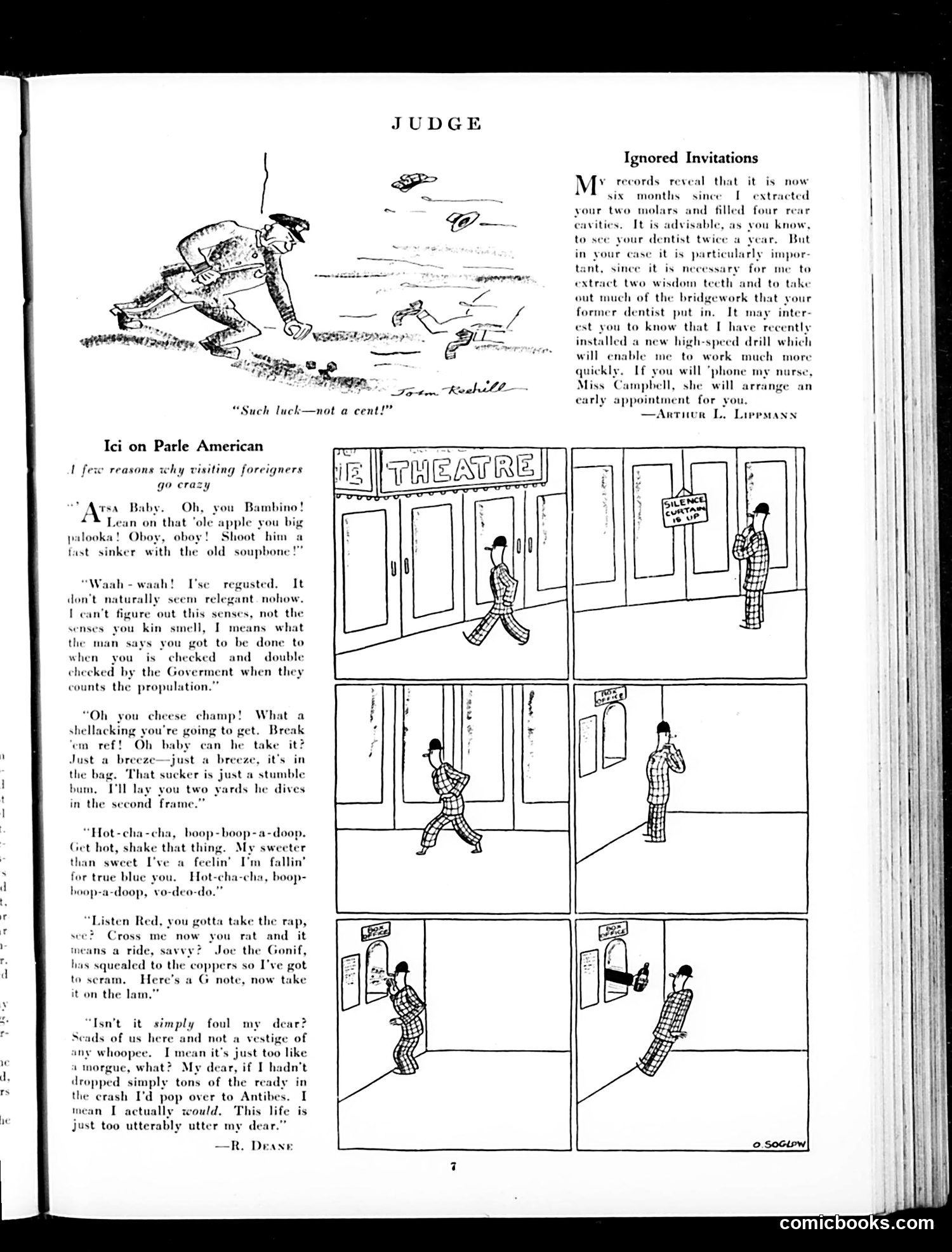
Page Analysis: Judge Magazine Top Section - "Ignored Invitations": A dentist's letter sarcastically congratulates a patient on avoiding dental care for six months, recommending urgent treatment (wisdom teeth extraction, bridgework replacement) and mentioning a new high-speed drill. The cartoon caption "Such luck—not a cent!" shows a man unable to pay, suggesting the satire targets both patients who neglect appointments and the financial burden of dental work. Bottom Section - "Ici on Parle American": This satirizes how foreigners perceive American speech and behavior as bewilderingly vulgar. The exaggerated dialogue includes: baseball slang ("soupbone"), incomprehensible colloquialisms about census-taking, Jazz Age references ("Hot-cha-cha, boop-boop-a-doop"), gangster slang ("take the rap," "the lam"), and affected British affectations ("simply foul my dear"). The joke is that American English—spanning low slang to pretentious mimicry—confuses and appalls educated foreign visitors.
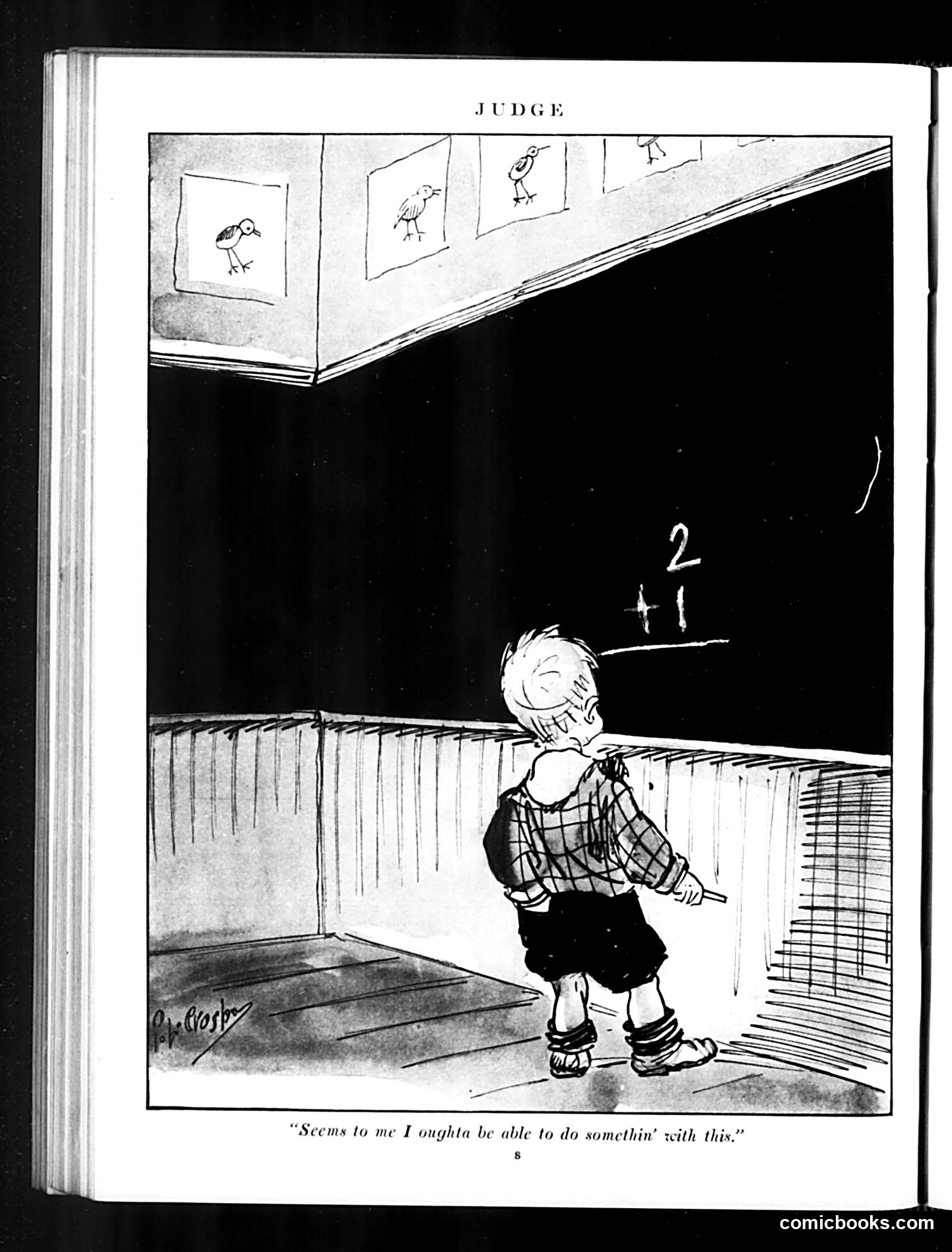
Analysis This is a single-panel cartoon from *Judge* magazine. The image shows a young child in a classroom standing before a blackboard displaying simple arithmetic ("2 + 1 ="). On the wall above are children's drawings of birds. The child remarks, "Seems to me I oughta be able to do somethin' with this." The satire appears to target the gap between a child's overconfidence and actual capability. The humor lies in the child's presumption that basic arithmetic should enable them to accomplish something meaningful, when in reality it represents only elementary learning. This likely critiques either overeager youth, inadequate education, or inflated expectations about what minimal skills can achieve—a common theme in early 20th-century American satire about education and ambition.
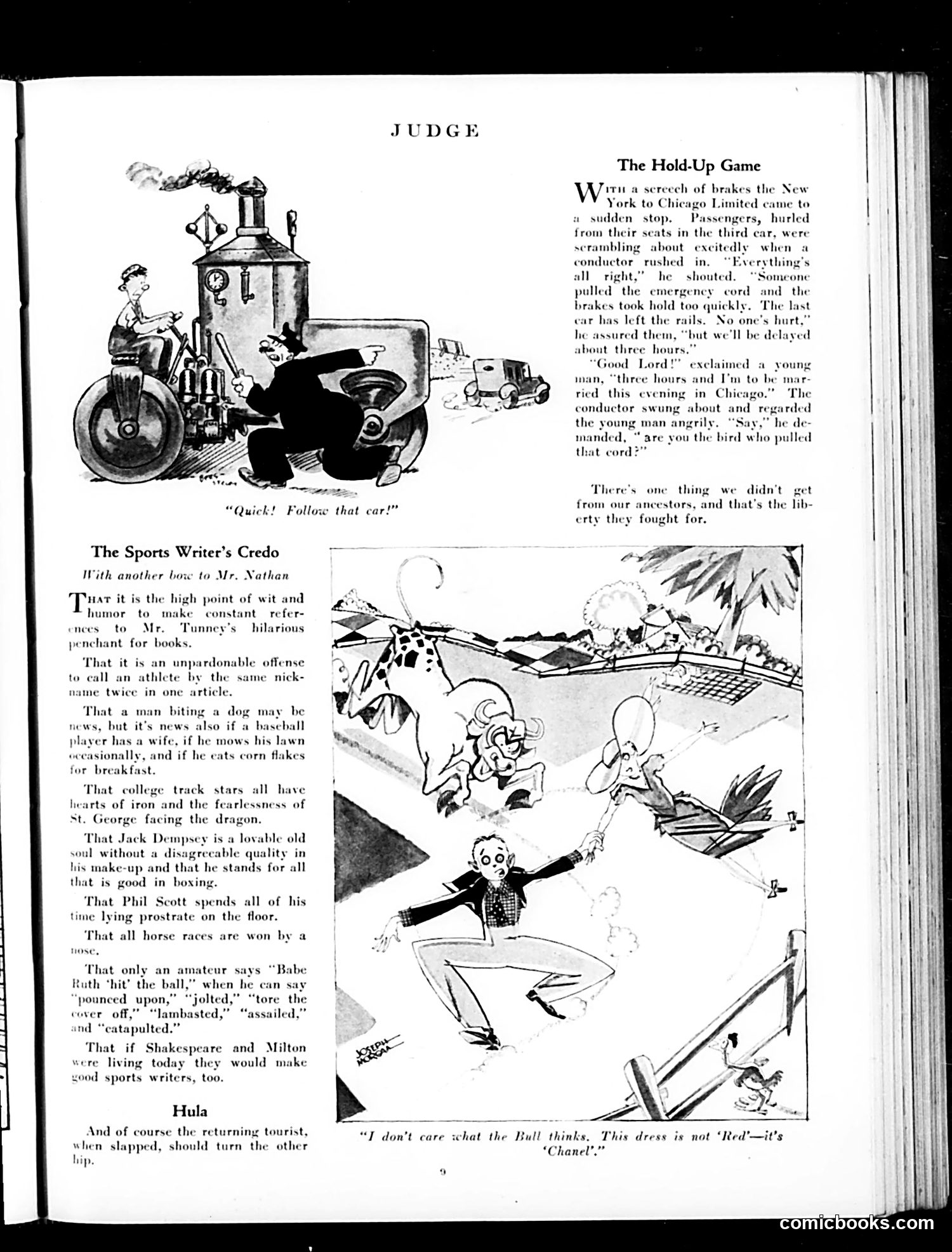
"The Hold-Up Game" and "The Sports Writer's Credo" The Hold-Up Game (top): A train emergency-cord incident delays a passenger's wedding. The satire suggests petty inconveniences—a three-hour delay—prompt passengers to blame the conductor, mirroring how people reflexively demand someone be held responsible for minor disruptions, regardless of actual fault. The Sports Writer's Credo (bottom): A humorous list mocking sportswriting clichés of the era. It ridicules the requirement to use varied vocabulary for athletic actions ("jolted," "lambasted," "assailed") rather than simple verbs; romanticizes athletes as morally flawless; and notes excessive description (Jack Dempsey as "lovable," horse races always won by "a nose"). The caption cartoon jokes about fashion terminology—a woman insists her dress is "Chanel" couture, not merely "Red," mocking materialistic status-signaling. Both pieces satirize contemporary American superficiality: the first in public behavior, the second in sports journalism and consumer culture.
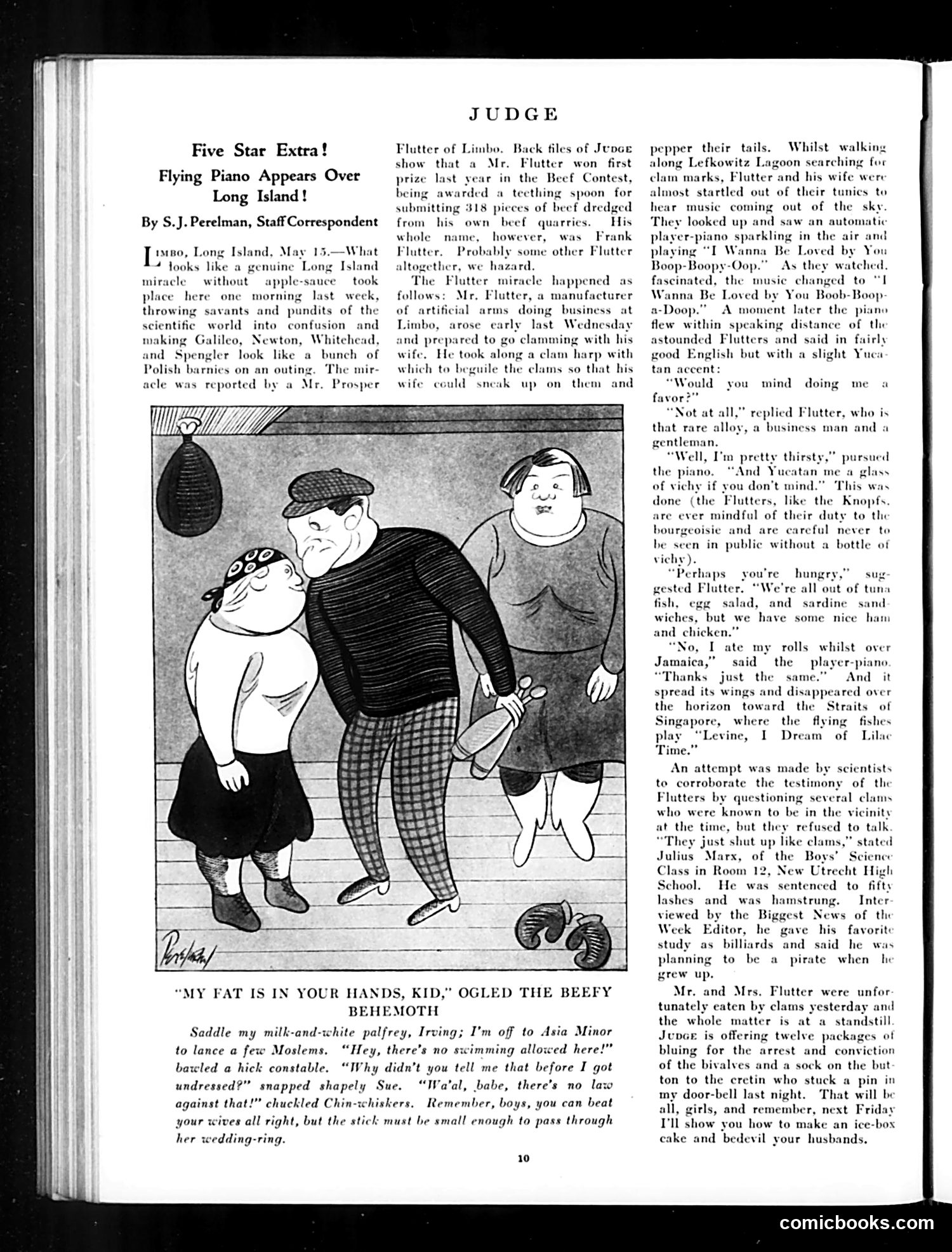
Judge Magazine Satire Analysis This is a humorous tall tale by S.J. Perelman (a prominent satirist) about a flying piano appearing over Long Island. The cartoon depicts three figures encountering this absurdity—a portly man (Mr. Flutter) and companions reacting to an impossible event. The satire mocks several things: the credulity of newspaper readers who'd believe outlandish "miracles," the contrast between scientific rationalism (Galileo, Newton referenced) and superstition, and the pretensions of the upper-middle class (the Flutters' concern with propriety, serving vichy to a flying piano). The sidebar jokes are period-specific humor about marriage ("you can beat your wives...but the stick must be small enough"), innocent flirtation ("Why didn't you tell me that before I got undressed?"), and absurdist non-sequiturs. The real joke: this fantastical story is presented as journalism, satirizing Judge magazine's own sensationalist "news" style and readers' appetite for the ridiculous.
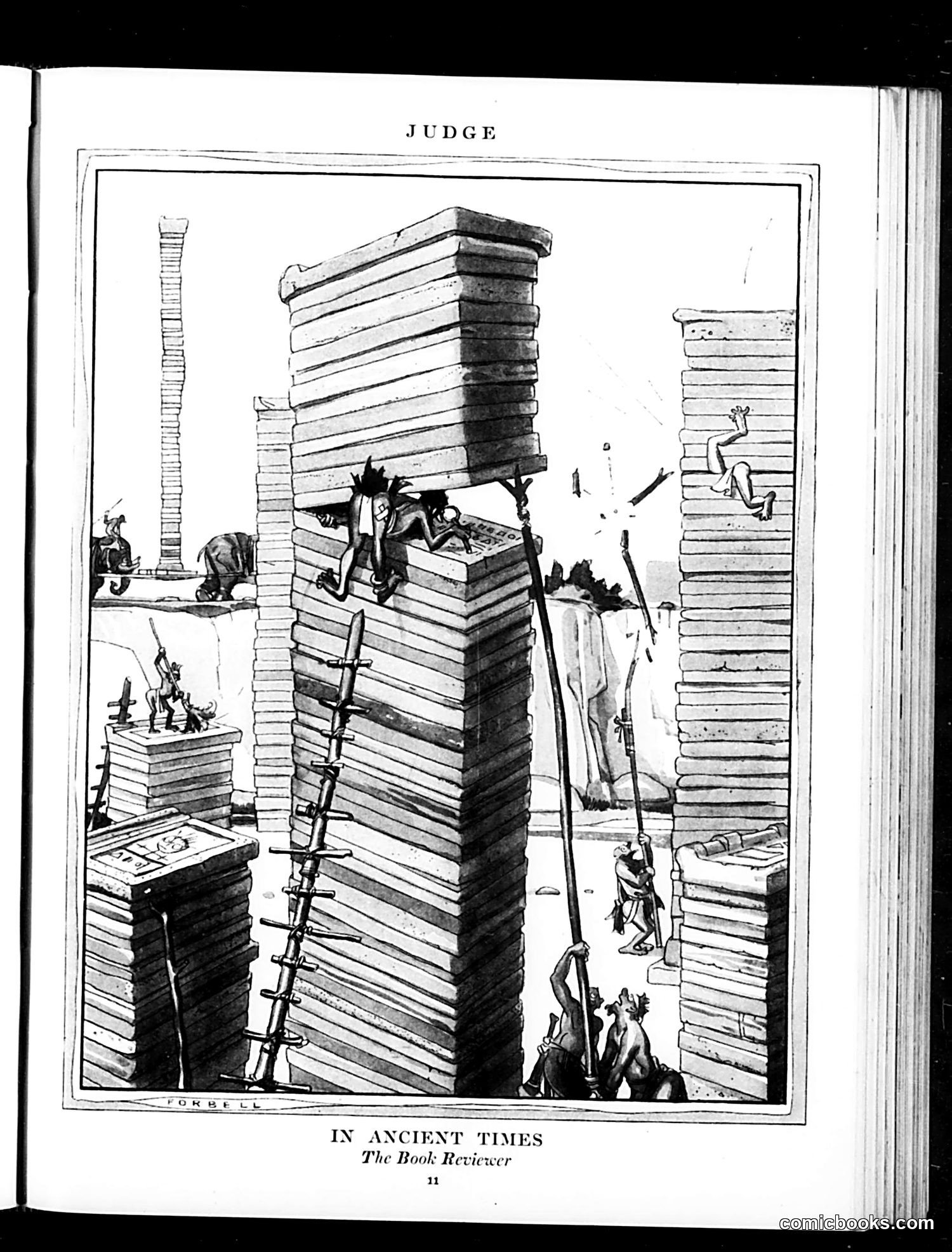
"Judge in Ancient Times: The Book Reviewer" This cartoon satirizes literary criticism by depicting it as an ancient, laborious process. Tiny figures climb enormous stacks of books using ladders and ropes, suggesting that book reviewers must laboriously scale towering piles of literature to reach the top and deliver judgment. The massive architectural stacks emphasize the overwhelming volume of books a reviewer must navigate. The satire likely mocks the pretentiousness of serious literary criticism and the excessive effort reviewers invest in their work. By literalizing the phrase "reaching the heights" of literary judgment, the cartoon humorously suggests that book reviewing, despite its intellectual pretensions, is fundamentally a physical, exhausting task requiring only determination rather than genuine insight.
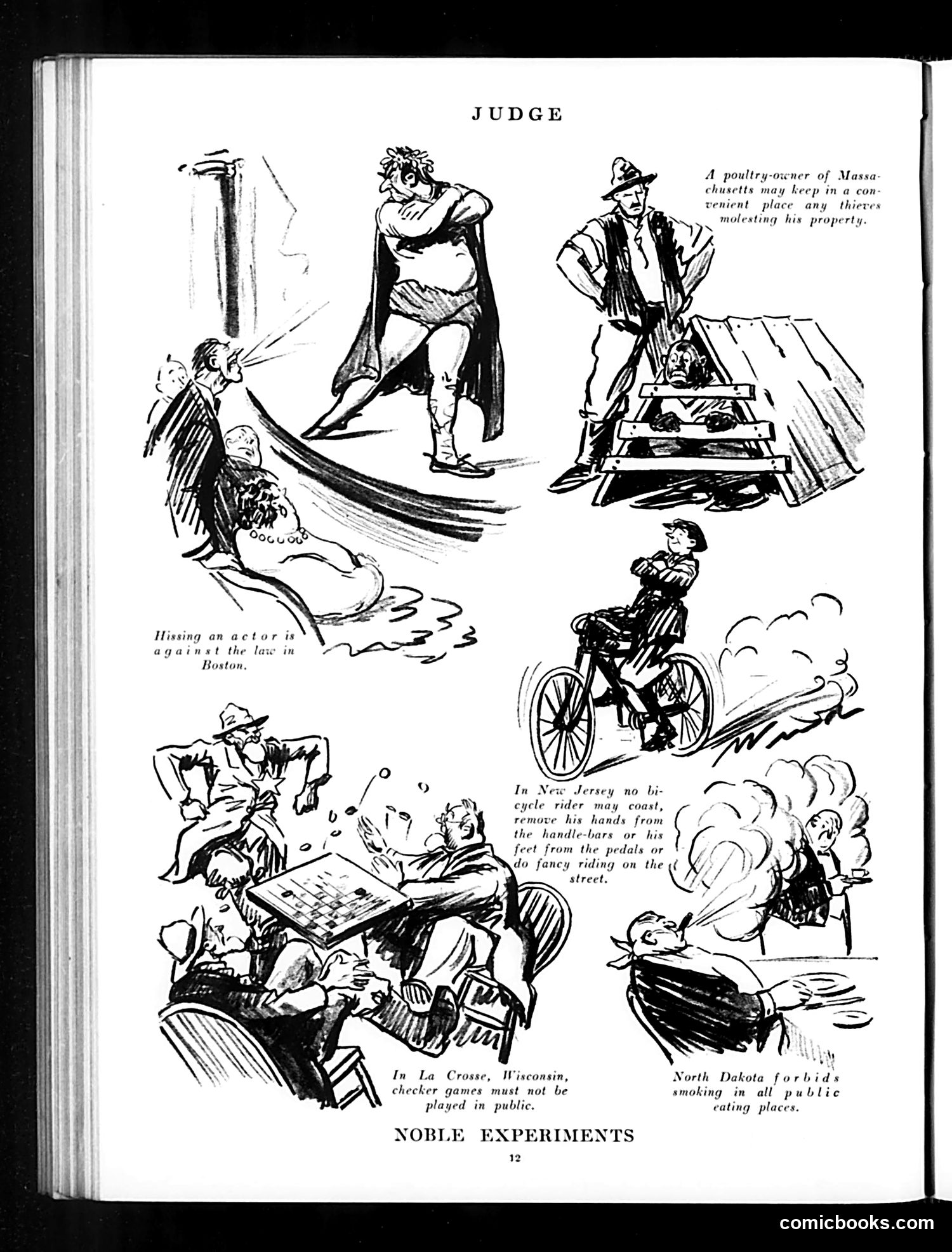
"Noble Experiments" - Judge Magazine Satire This page satirizes absurd state and local laws through exaggerated illustrations. Each panel mocks ridiculous regulations: - Massachusetts: Allows shooting thieves stealing poultry—absurdly permissive - Boston: Bans hissing actors—censoring audience expression - New Jersey: Prohibits bicycle "coasting" or hands-free riding—needlessly restrictive - La Crosse, Wisconsin: Forbids public checkers—controlling leisure activities - North Dakota: Bans smoking in restaurants—early public health regulation The title "Noble Experiments" sarcastically references Prohibition ("the Noble Experiment"), suggesting these local laws are equally misguided attempts at social control. Judge ridicules both overly permissive and overly restrictive legislation, highlighting the patchwork absurdity of American local governance where each jurisdiction imposed contradictory, sometimes ridiculous rules.
"Judge on the Bench" - Page Analysis This page contains three satirical columns attacking American urban growth, Calvin Coolidge's incompetence, and universities' misplaced priorities. "The Shame of the Cities" mocks Americans' obsession with city size as a status symbol, noting that Los Angeles and Cleveland competed over census rankings. The author argues this "bigness fetish" benefits only real estate speculators and merchants, while ordinary citizens suffer increased congestion, crime, and pollution. "Why Mention Liberty?" ridicules Coolidge's Mount Rushmore inscription, claiming he omitted "liberty" from the Declaration's three inalienable rights—attributing this to deliberate taste avoidance, sarcastically suggesting future Americans will forget the word anyway. "Endowed Tea Rooms" critiques American universities for lacking intellectual atmosphere, citing Dr. Flexner's observation that universities chase buildings and endowments rather than fostering genuine scholarship. The solution proposed (ironically): establish beer-garden-style tea rooms where scholars can discuss ideas informally—a continental luxury American institutions supposedly cannot achieve.
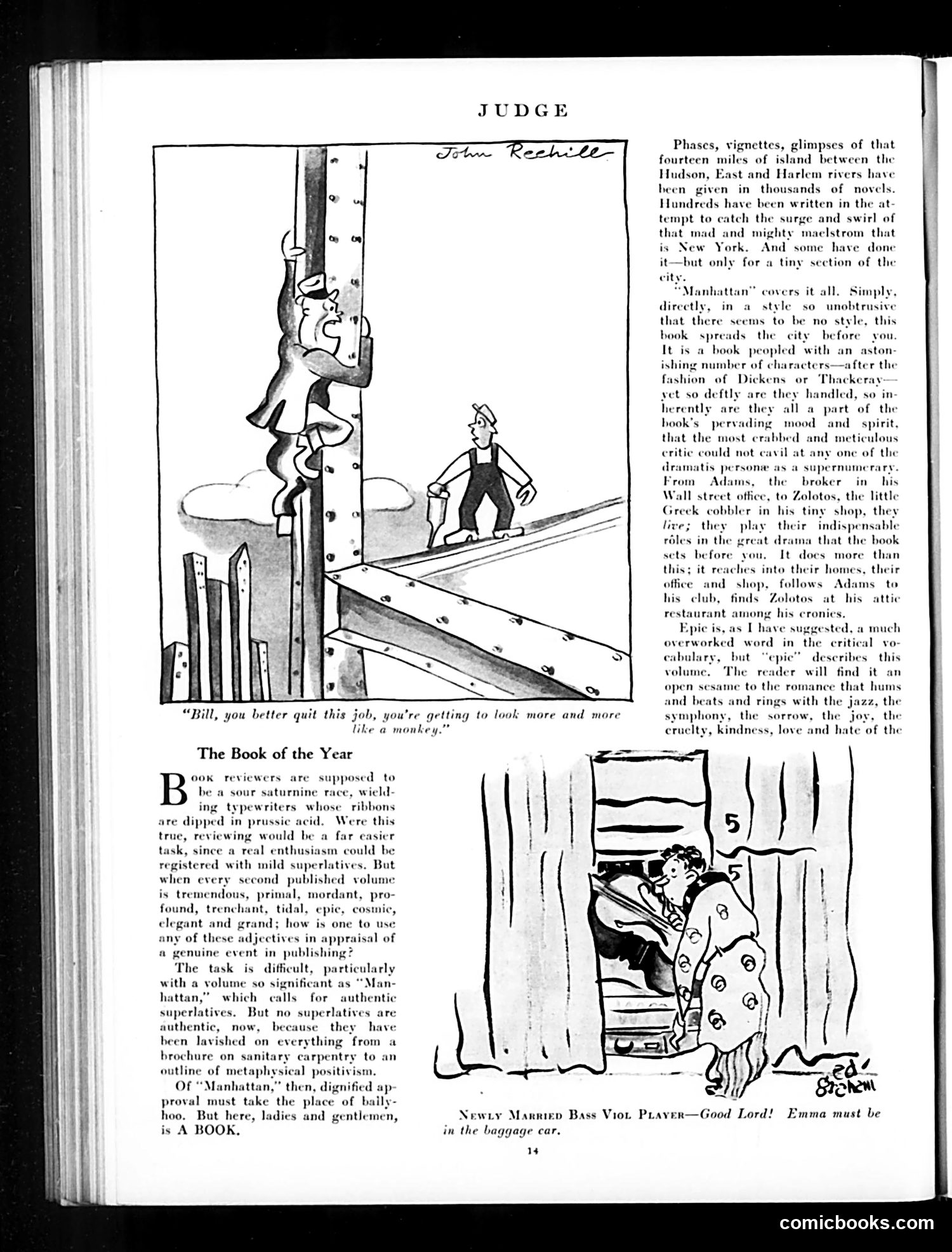
Analysis of Judge Magazine Page Top Cartoon: Shows a man ("Bill") dangling precariously from a tall building's steel framework while a small figure below warns him he's "getting to look more and more like a monkey." This is workplace satire about dangerous construction labor, likely mocking both the hazardous conditions workers endured and the callous attitude toward their peril in early 20th-century New York. Main Content: A book review of "Manhattan" by John Rochelle, praising it as comprehensive coverage of New York City life. The reviewer notes it encompasses characters from wealthy Wall Street brokers (Adams) to immigrant shopkeepers (Zolotos)—spanning the full social spectrum in Dickensian style. Bottom Cartoon: Depicts a newlywed couple crammed uncomfortably in a train baggage car, captioned "Good Lord! Emma must be in the baggage car." This jokes about cramped honeymoon travel conditions or marital confinement—typical early-20th-century humor about newlywed hardship. Both cartoons use visual exaggeration to satirize modern urban life's indignities.
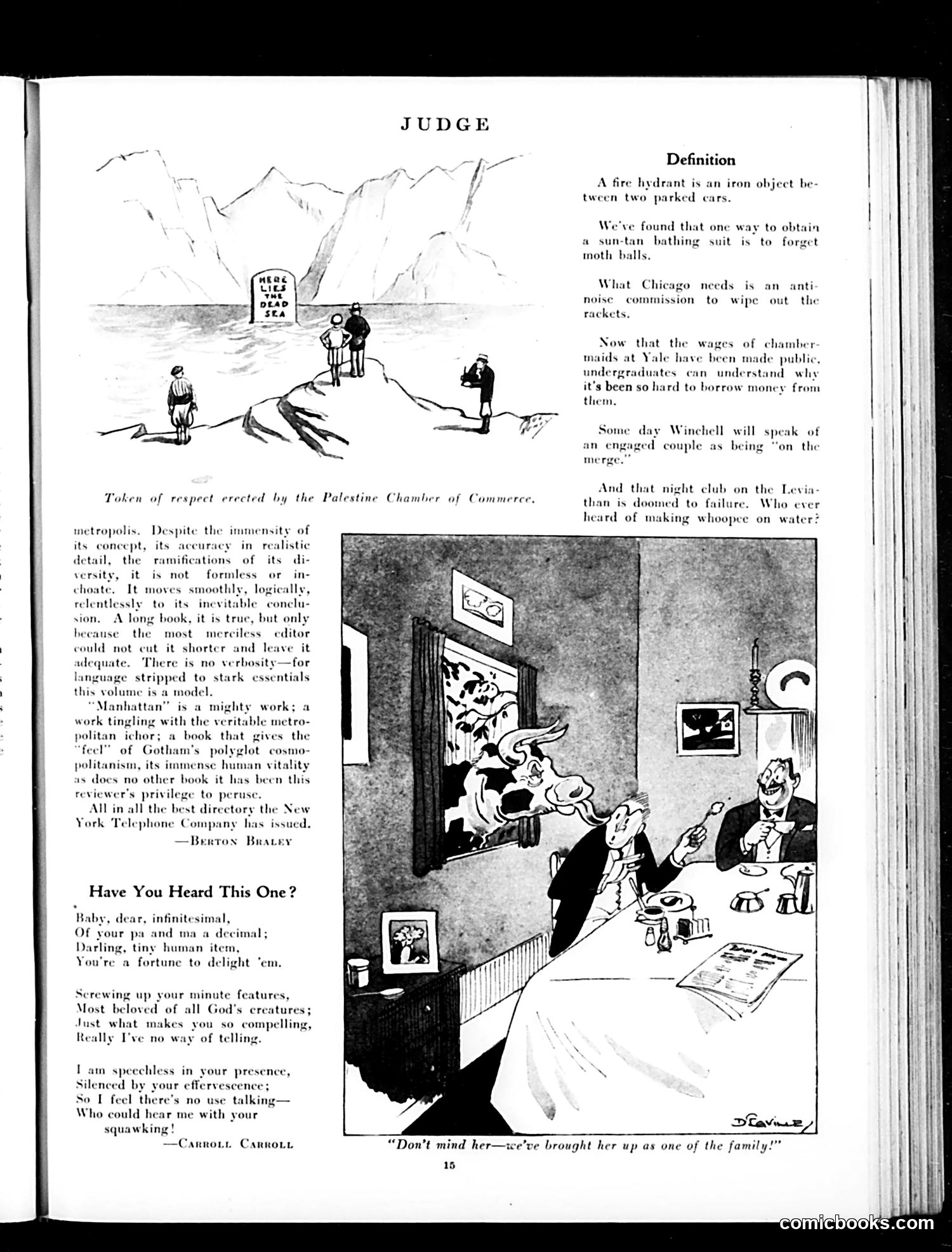
Explanation for Modern Readers This page contains satirical humor typical of Judge magazine's social commentary. Top cartoon: Shows a monument erected by the "Palestine Chamber of Commerce" to a dead sea. This appears to be satirizing either failed business ventures or the absurdity of commemorating commercial failures—likely referencing a real contemporary business collapse or obsolete enterprise. "Definition" section: Quick one-liners mocking modern life. Notable: the fire hydrant joke plays on crowded urban parking; Chicago's "noise problem" references the city's reputation for organized crime ("rackets"); the Leviathan reference (likely the famous ocean liner) jokes about an upscale nightclub failing because the ship's constant motion makes dancing impossible. Bottom cartoon & poem: A couple with their loud baby. The man assures a guest "Don't mind her—we've brought her up as one of the family!"—meaning they treat the screaming infant casually rather than discipline it. This satirizes permissive parenting trends, contrasting with the sentimental poem about how babies enchant adults. The page reflects 1920s-30s concerns: urban congestion, changing social norms around child-rearing, and entertainment culture.
Judge Magazine Theater Review (George Jean Nathan) This is a theater critic's review of six contemporary Broadway plays, written with deliberate contempt. Nathan uses a framing device—listing the plays with one-word dismissals ("Rubbish," "Drivel," "Tripe")—to mock being contractually obligated to write lengthy criticism. The reviews target specific plays: "Little Orchid Annie" (attempting to adapt Anita Loos's work), "Penal Law 2010" (a courtroom melodrama), and "Lady Clara" (a British import). Nathan criticizes formulaic plotting, heavy-handed innuendo, derivative characters, and theatrical clichés. He particularly mocks "Room 349" for opportunistically dramatizing the real Arnold Rothstein murder case for sensationalism. The satire aims at both the low quality of contemporary theater and the pretense required of critics forced to discuss worthless productions at length.
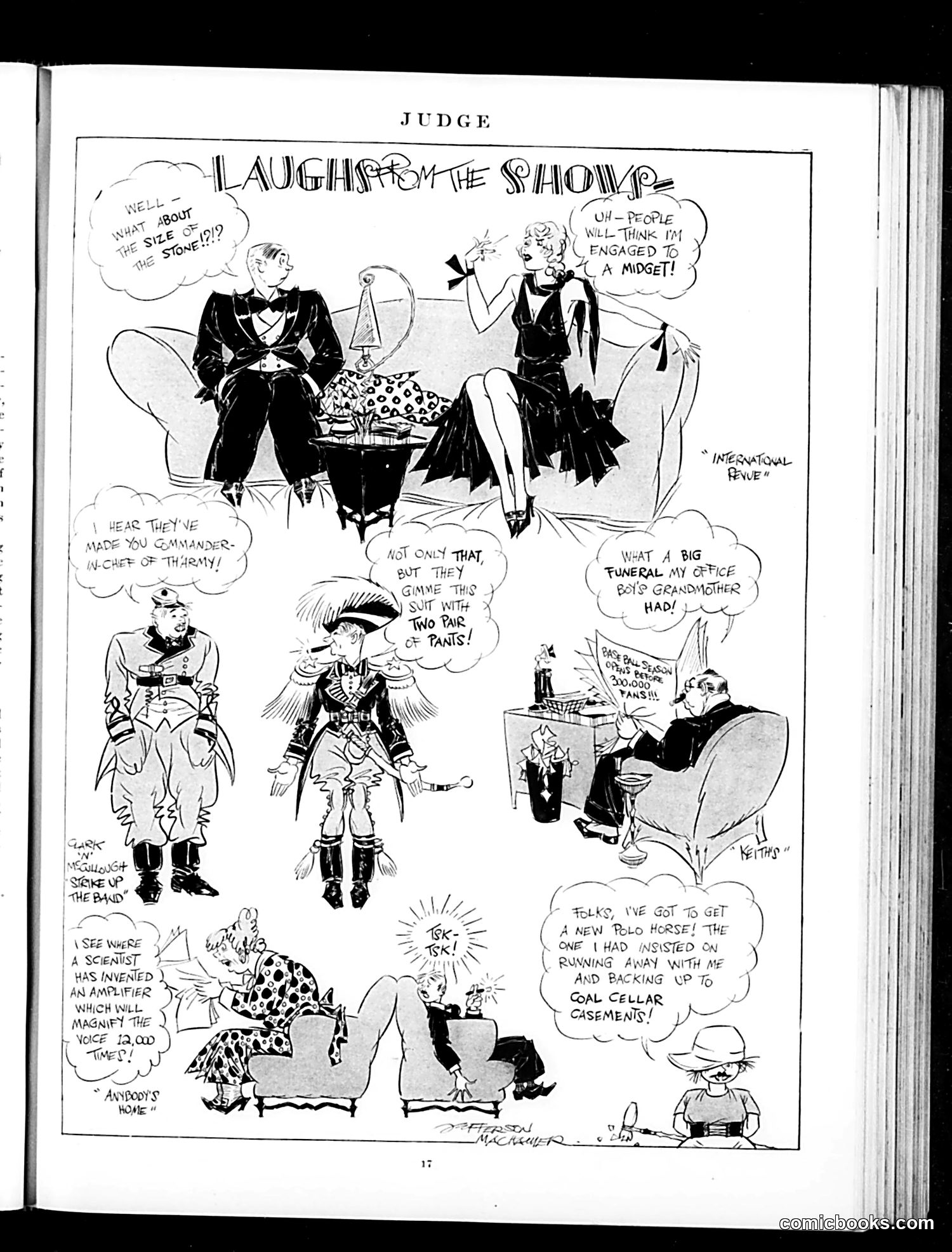
"Laughs from the Show" - Judge Magazine Satire This is a multi-panel satirical cartoon mocking various aspects of 1920s society and entertainment. The main scene depicts wealthy socialites at what appears to be a high-society gathering, with characters boasting about absurd accomplishments: one brags about being made "Commander-in-Chief of the Army," another about an "International Revue," and a third about a deceased grandmother's funeral. The lower panels mock emerging technology and pretension—including a scientist's "amplifier" that will make someone sound louder, and references to polo horses and coal cellars. The overall humor targets the vanity, one-upmanship, and snobbery of the wealthy elite during this era. The cartoon's satire is directed at social climbing, exaggeration, and the absurd concerns of the privileged class during the interwar period.
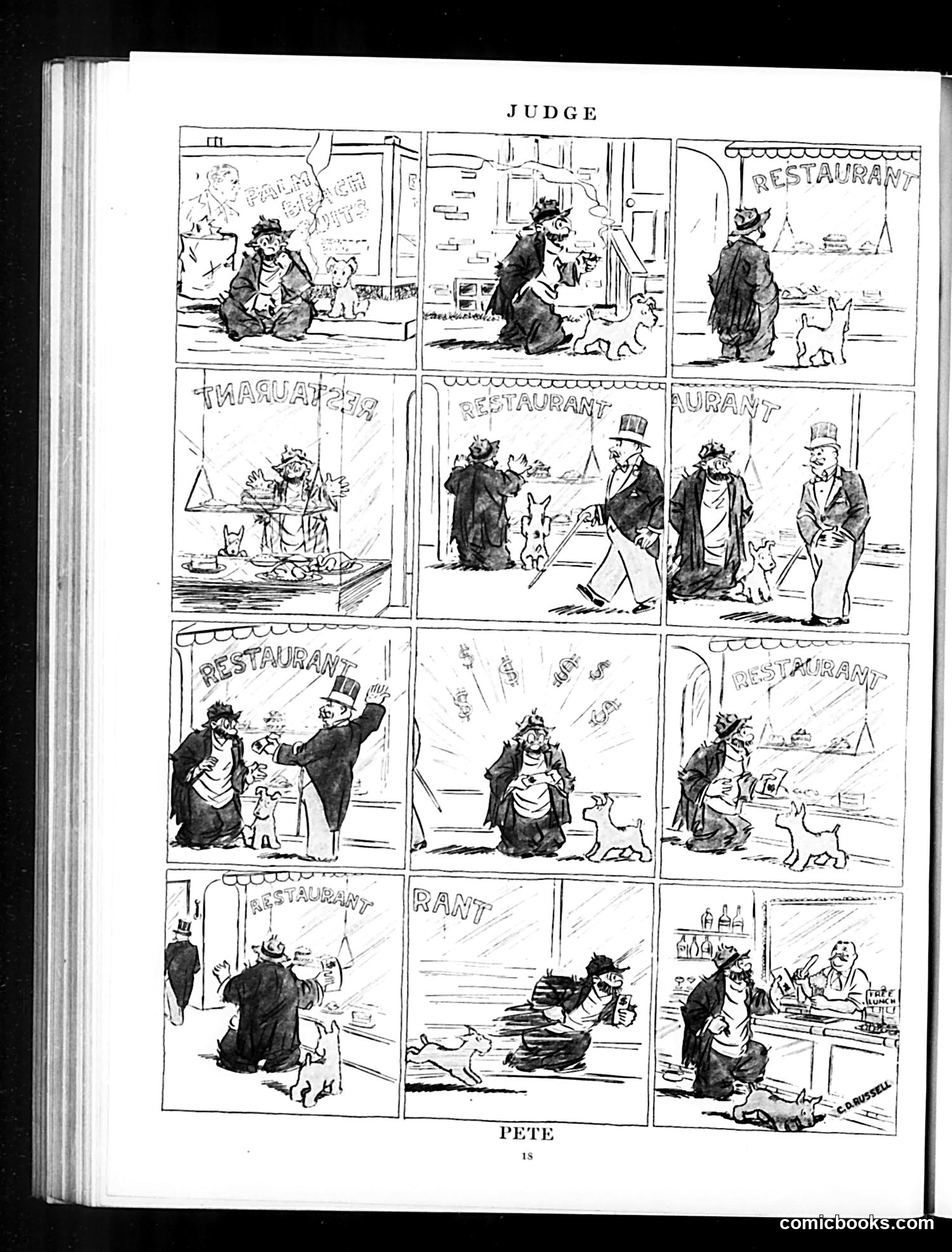
Analysis of "Judge" Comic Page This page presents a sequential comic strip titled "Judge" (top) and "Pete" (bottom), both depicting restaurant scenes with well-dressed men in formal attire and small dogs. The humor appears to center on social class contrast and restaurant etiquette. The figures—wearing top hats and formal coats—repeatedly encounter small dogs in upscale restaurant settings. The comic seems to satirize the pretensions of fancy dining establishments and their patrons, likely mocking either: 1. The absurdity of dogs appearing in fine restaurants despite their exclusivity 2. The pomposity of formal diners confronted with undignified situations 3. Early 20th-century anxieties about maintaining proper decorum in public spaces Without additional context about specific contemporary figures or events referenced, the strip's precise satirical target remains unclear, though it definitely lampoons bourgeois restaurant culture.
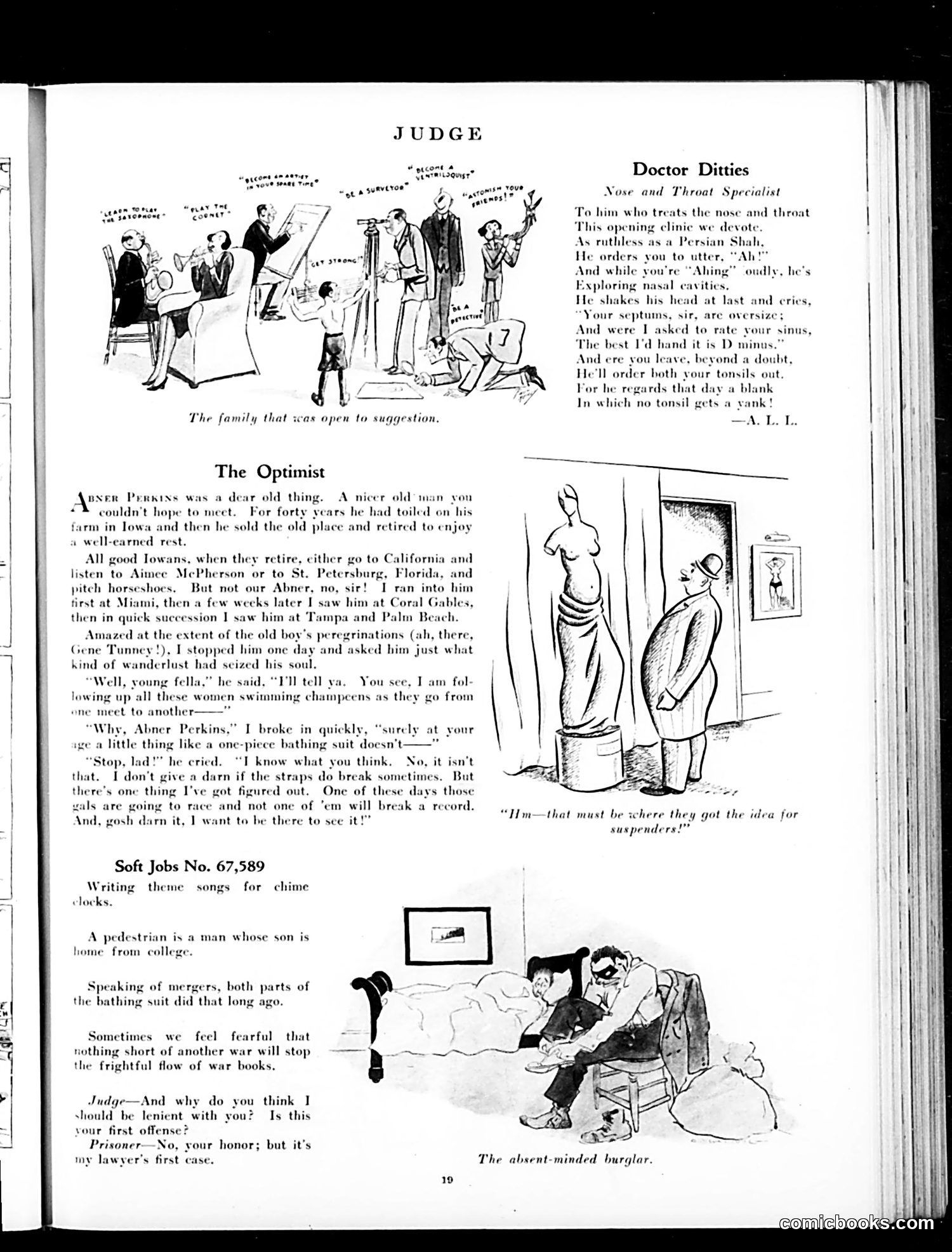
Judge Magazine Page Analysis This page contains multiple satirical pieces typical of Judge magazine's humor: "The Optimist" tells of Abner Perkins, a retired Iowa farmer following women's swimming champions across Florida resort towns, hoping to witness a bathing suit malfunction—a joke about aging male voyeurism disguised as optimistic wanderlust. "Doctor Ditties" is a humorous poem mocking ear-nose-throat specialists who enthusiastically remove patients' tonsils regardless of necessity, reflecting early 20th-century medical over-treatment and doctors' financial incentives. Top cartoon shows a family open to medical suggestion, satirizing Americans' gullibility toward doctors' recommendations. "Soft Jobs" offers absurdist one-liners about easy employment and modern life—the "pedestrian" joke mocks adult children still living at home. The bottom cartoon depicts an inept burglar caught sleeping on the job, with the caption joking about where suspender designers got their inspiration. The humor relies on contemporary references to swimming competitions, medical practices, and consumer culture recognizable to Judge's 1920s-30s readership.
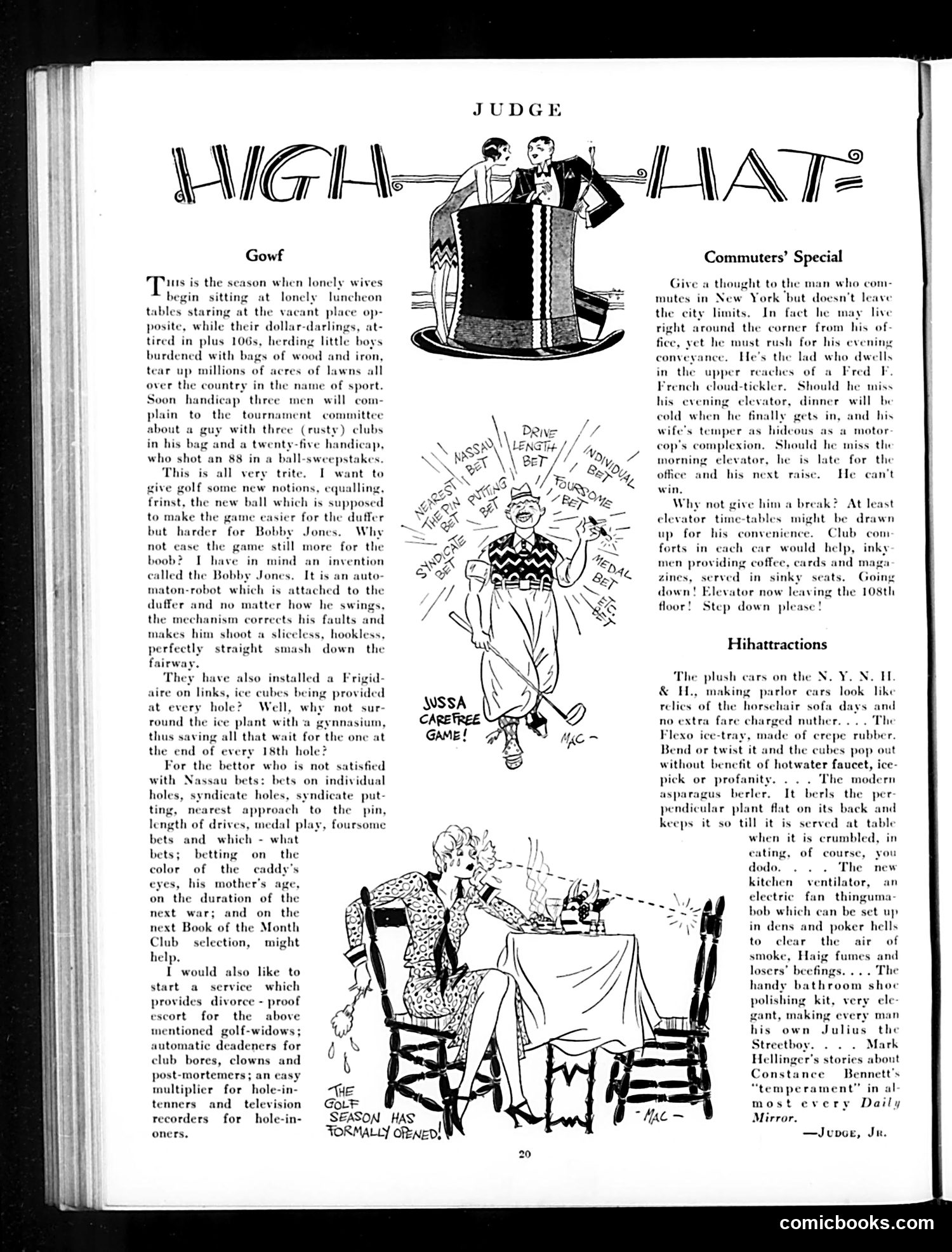
"High-Hat" by Judge Magazine This page satirizes two leisure-class complaints in 1920s America: "Gowf" (Golf): The author mocks wealthy men who abandon their wives for golf, treating it as pseudo-sport rather than genuine recreation. The cartoon shows a man buried in golf-related chaos. The satire proposes absurd "solutions"—a robot caddy, gymnasia at every hole, betting on caddies' eye color—to highlight how golf culture has become ridiculous. "Commuters' Special": This section targets the absurdity of New York apartment-dwellers who live near their offices yet must rush home via crowded elevators in tall buildings (like Fred French's developments). Missing an elevator means either cold dinner or arriving late to work, jeopardizing advancement—an impossible bind satirizing modern urban inconvenience and status anxiety. "Hihattractions": Brief witty observations about modern luxury goods—Flexo ice trays, asparagus boilers, electric fans—poking fun at how manufacturers pitch unnecessary "conveniences" to the well-to-do. The overall tone: affectionate mockery of wealthy Americans' entitled complaints about leisure and convenience.
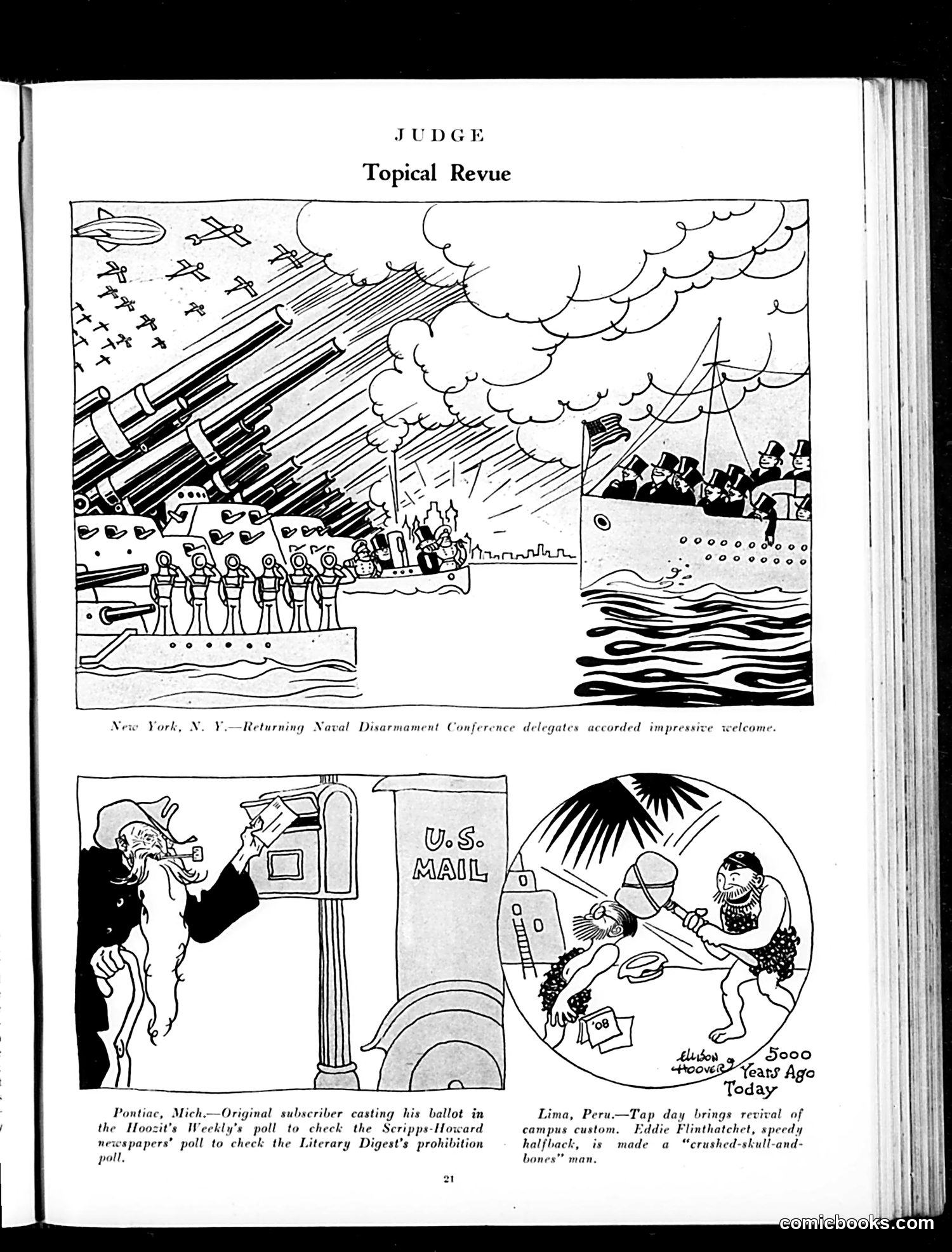
Judge Magazine "Topical Revue" - Context Explanation This page contains three satirical cartoons: 1. Top cartoon: Depicts a lavish military welcome for returning Naval Disarmament Conference delegates, with battleships firing guns in celebration. The satire mocks the irony of celebrating a *disarmament* conference with an extravagant display of military firepower. 2. Bottom left: Shows an elderly subscriber voting in the Hoozit's Weekly poll, with text referencing competing newspaper polls (Scripps-Howard and Literary Digest) designed to check prohibition support—satirizing how newspapers used polls as propaganda tools rather than neutral measurement. 3. Bottom right: References a campus tradition in Lima, Peru where a football player ("Eddie Flinthatchet") receives rough hazing treatment, joking he becomes "crushed-skull-and-bones" material, playing on Yale's "Skull and Bones" society. The page satirizes political hypocrisy, newspaper bias, and college brutality practices.
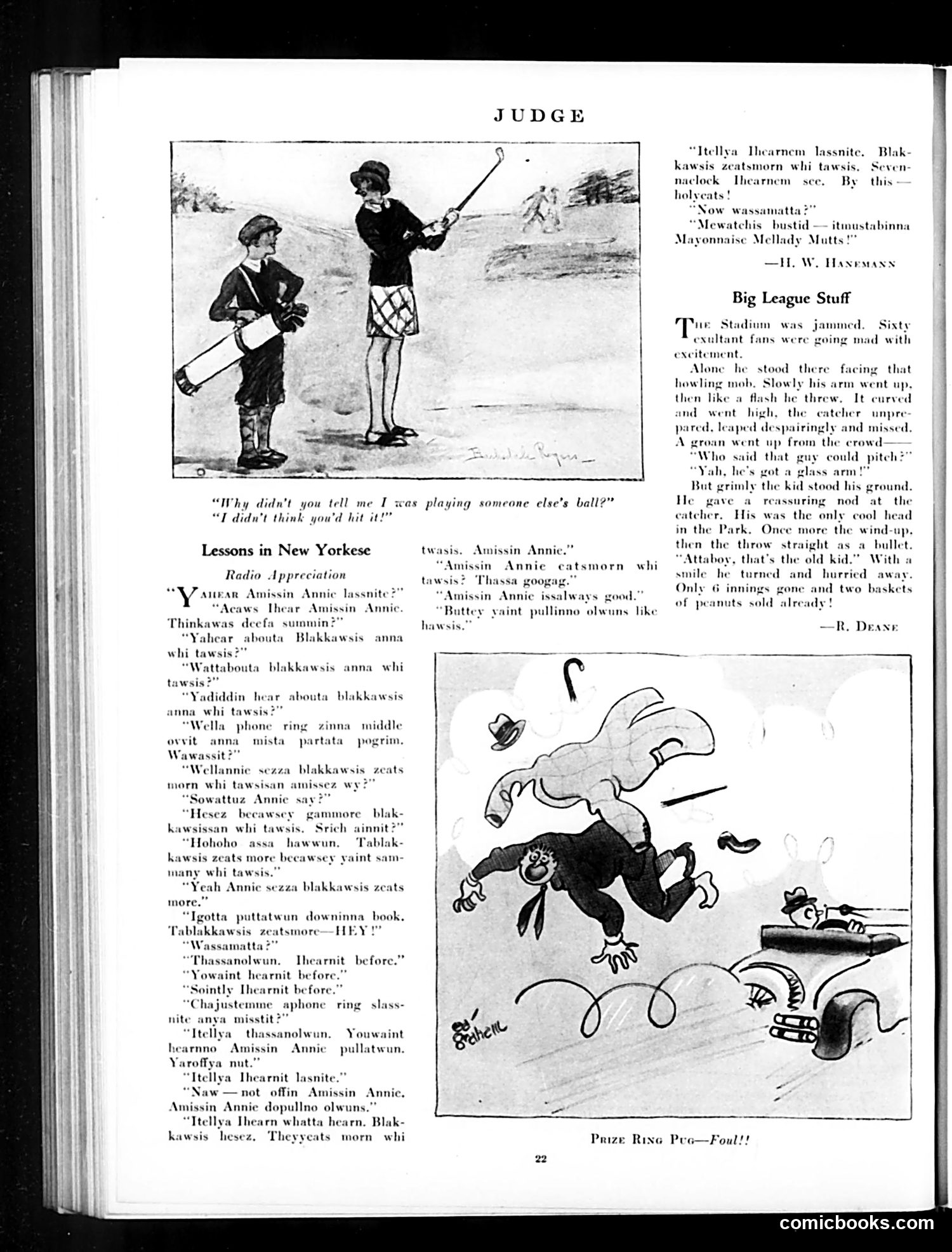
Judge Magazine Page Analysis This page contains two distinct pieces of humor from an early 20th-century American satirical magazine: "Big League Stuff" (top cartoon): A baseball story mocking the sport's dramatic intensity. A young pitcher faces a hostile crowd after missing a catch. Despite crowd heckling about his "glass arm," he performs well, earning praise. The joke's cynical punchline: amid this athletic drama, only two baskets of peanuts have sold—deflating the supposed excitement with mercenary reality. "Lessons in New Yorkese" (text section): A comedy routine capturing exaggerated working-class New York dialect and speech patterns of the era. The humor derives from phonetic spellings of rapid, colloquial speech ("Amissin Annie," "blakkawsis," "whi tawsis"), portraying how urban New Yorkers supposedly mangled English. This reflects period ethnic/class-based comedy common in Judge magazine. Both pieces use accessible, contemporary references (baseball, local speech patterns) to entertain readers with gentle mockery of American working-class culture.
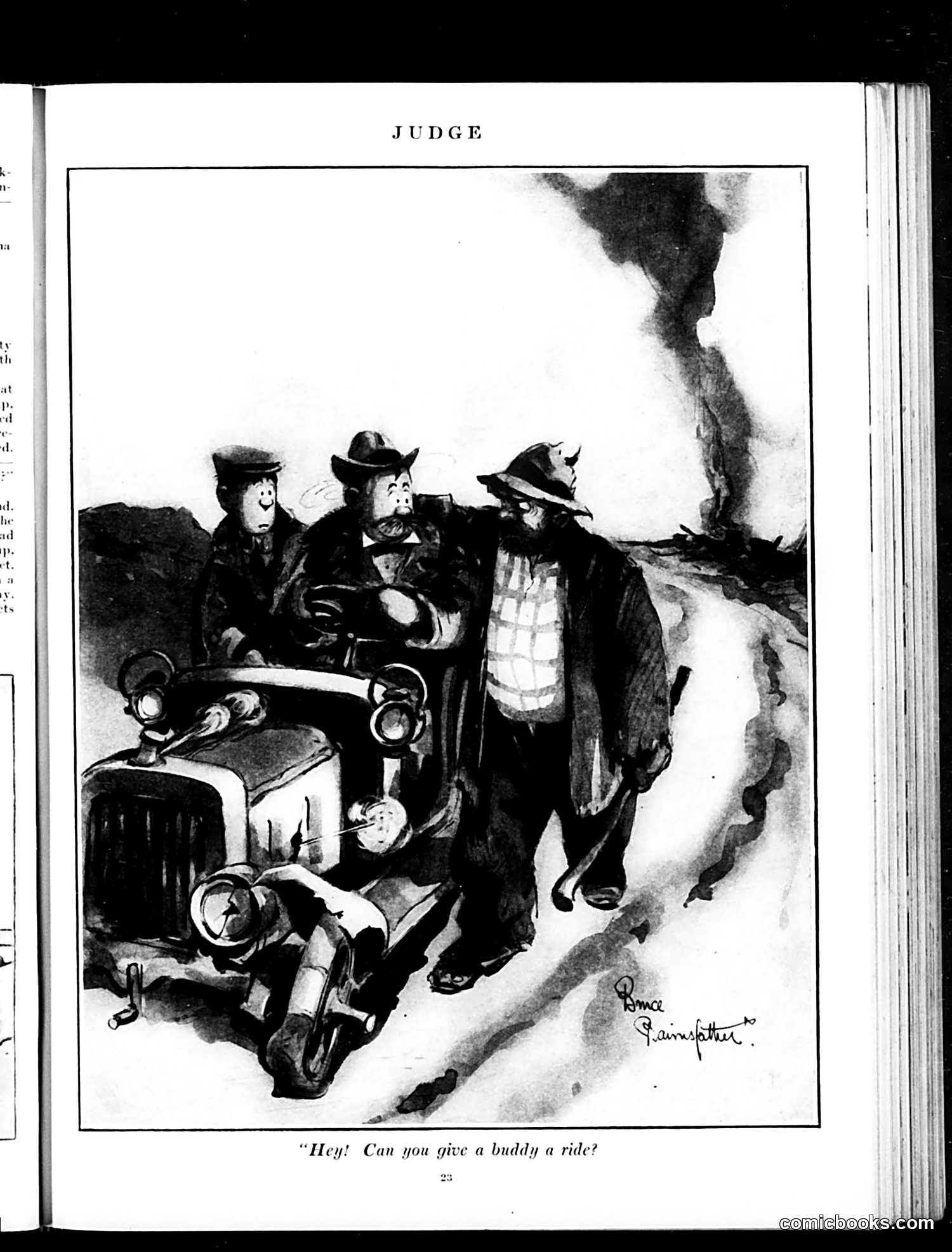
Analysis This cartoon depicts three men in early 20th-century attire standing beside an automobile, with one figure approaching asking for a ride. The title "Judge" indicates this is from the satirical magazine of that name. The satire likely comments on class dynamics and automobile culture during the early automotive era, when cars were luxury items owned by the wealthy. The caption "Hey! Can you give a buddy a ride?" suggests irony about social relationships—the requestor appears to be of lower social standing than the automobile owners, playing on the tension between old friendships and new wealth disparities that automobiles symbolized. The cartoon mocks either the pretentiousness of new car owners or the desperation of those excluded from this emerging status symbol, though the specific historical context remains unclear without additional information about Judge's publication date.
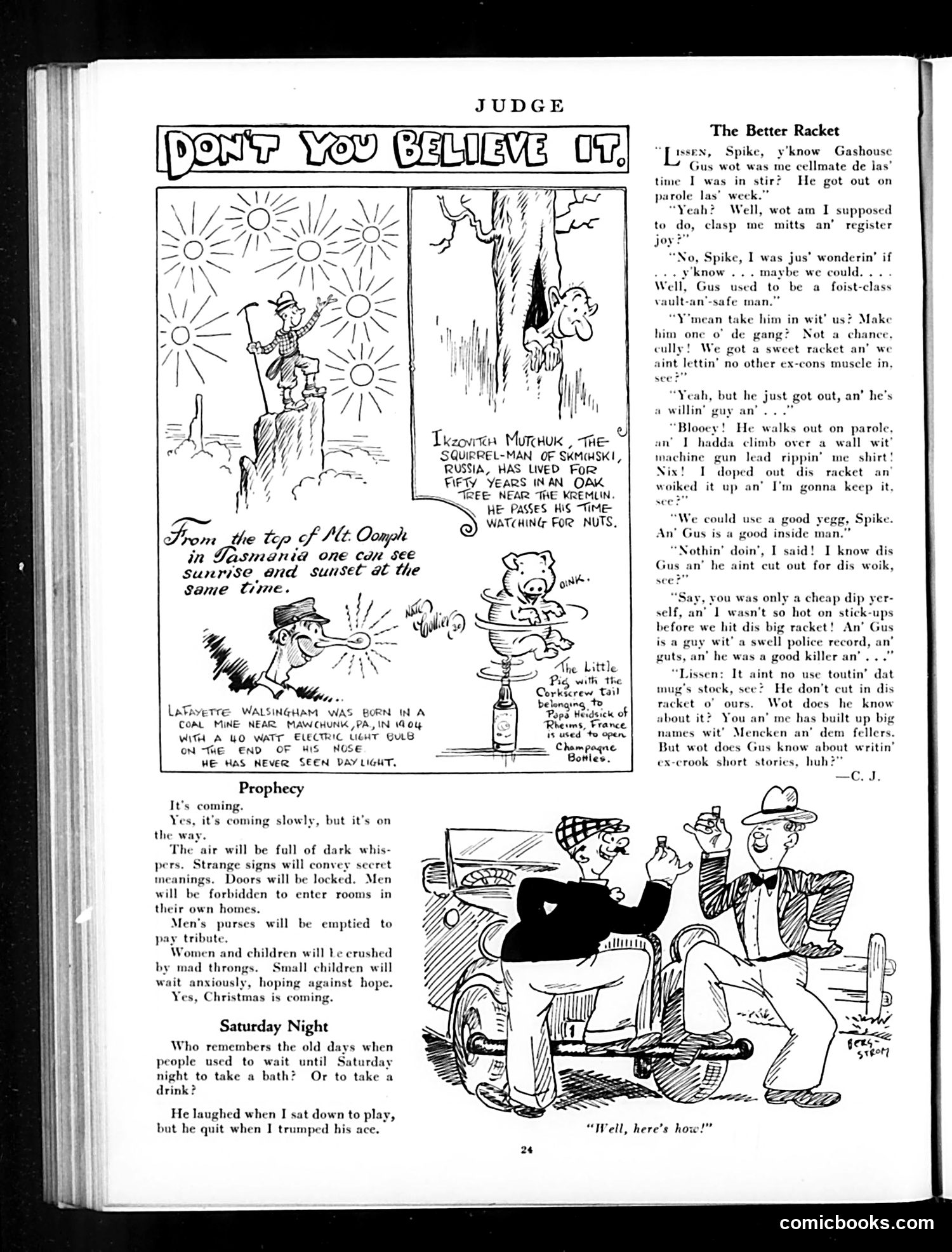
Explanation for Modern Readers This page contains several satirical pieces typical of Judge magazine's humor: "Don't You Believe It" features absurdist tall tales (a squirrel-man living 50 years in a tree, a man born in a coal mine with a lightbulb on his nose) mocking implausible newspaper stories and sensationalism. "The Better Racket" depicts underworld criminals in Prohibition-era slang debating whether to recruit an ex-convict named Gus. The joke appears to be that they reject him because he's too honest/reformed—they prefer their criminal "racket" to legitimate work. The reference to "Mencken" (likely H.L. Mencken, famous critic) suggests ironic commentary on criminals aspiring to respectability through writing. "Prophecy" sarcastically lists coming hardships, culminating in the punchline that "Christmas is coming"—poking fun at holiday commercialism and family obligation stress. "Saturday Night" nostalgia humorously contrasts old bathing/drinking customs with modern frequency. The page reflects 1920s-30s anxieties: organized crime, social change, and commercialism.
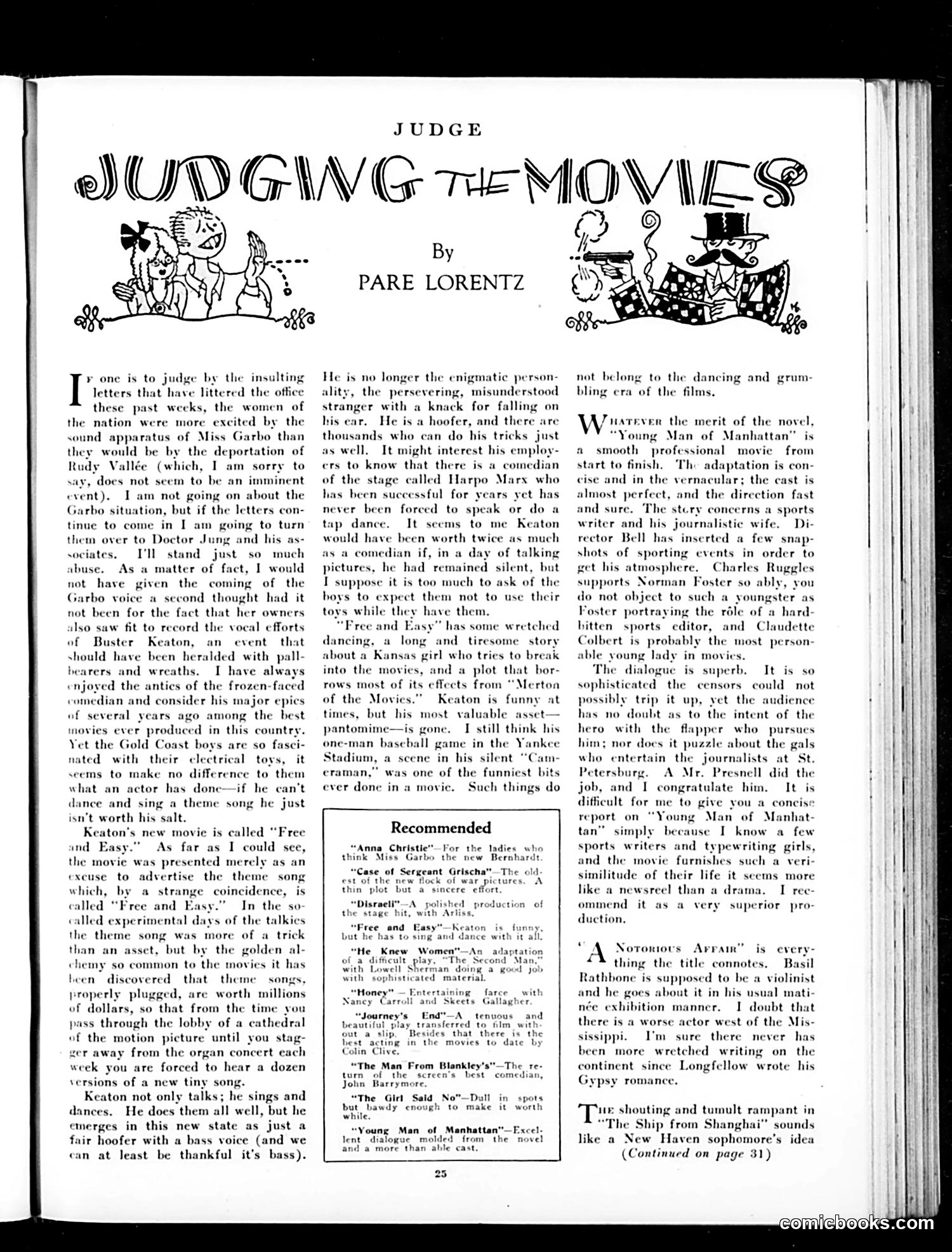
Analysis for Modern Readers This is a film criticism essay by Pare Lorentz reviewing Buster Keaton's talking picture debut, "Free and Easy" (1930). The satire targets Hollywood's obsession with new sound technology over artistic merit. The Argument: Lorentz praises Keaton's silent-film pantomime genius but laments that studio executives—fascinated by their new "electrical toys" (sound recording equipment)—forced the comedian to talk and sing despite these being his weaknesses. He contrasts Keaton unfavorably with Harpo Marx, who succeeded *without* speaking, suggesting silence was Keaton's true asset. The Broader Critique: The piece satirizes how Hollywood prioritizes technological novelty and commercial tie-ins (the theme song "Free and Easy" is aggressively promoted) over preserving what made performers brilliant. Lorentz argues studios waste resources plugging songs while destroying the artistry that built their stars' reputations. Cultural Context: This captures the early sound-era panic when studios forced silent-film stars into talking roles, often disastrously. Keaton's transition was indeed painful for his career.
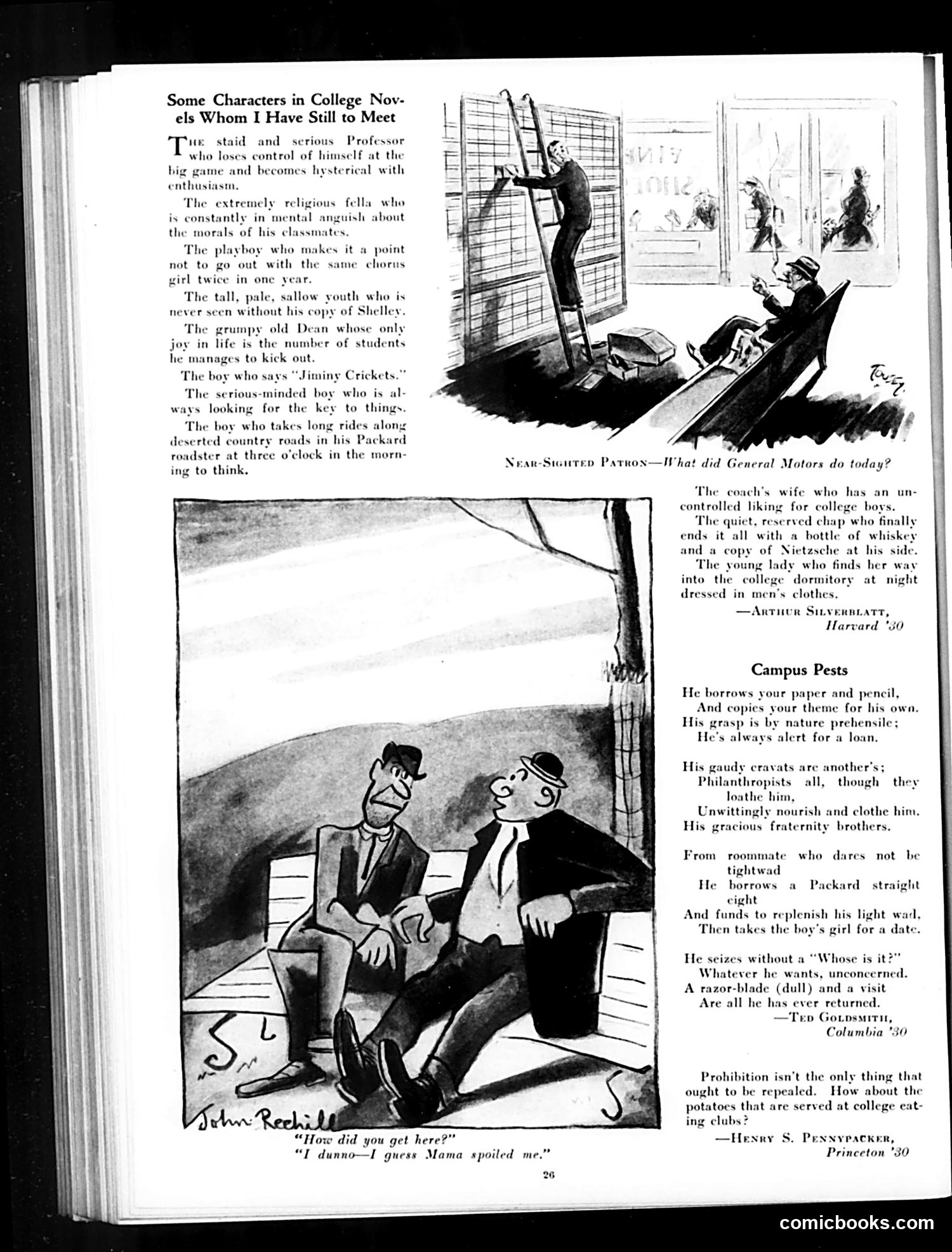
Judge Magazine: College Novel Stereotypes and Campus Life (circa 1930) This page satirizes popular college novels of the era by listing stock characters readers would recognize: the emotionally volatile professor, the pious student, the serial-dating playboy, the brooding Shelley-quoting youth, and the melancholic student contemplating suicide with Nietzsche. The humor lies in noting what the author *hasn't* encountered in real college life—suggesting these literary archetypes are exaggerated fantasies. The cartoons below mock actual campus realities: the top illustration shows a befuddled student asking how he arrived at college, blaming maternal indulgence rather than ambition. The lower cartoon depicts two men, one claiming he doesn't know how he got there. The "Campus Pests" section catalogs parasitic student types who borrow money, possessions, and girlfriends without returning them—focusing on the Packard automobile (a luxury car) as a status symbol repeatedly borrowed. Overall, the page contrasts fictional college romance with mundane institutional reality: bad food, freeloaders, and aimless students. Attribution to Harvard, Columbia, and Princeton students adds satirical credibility.
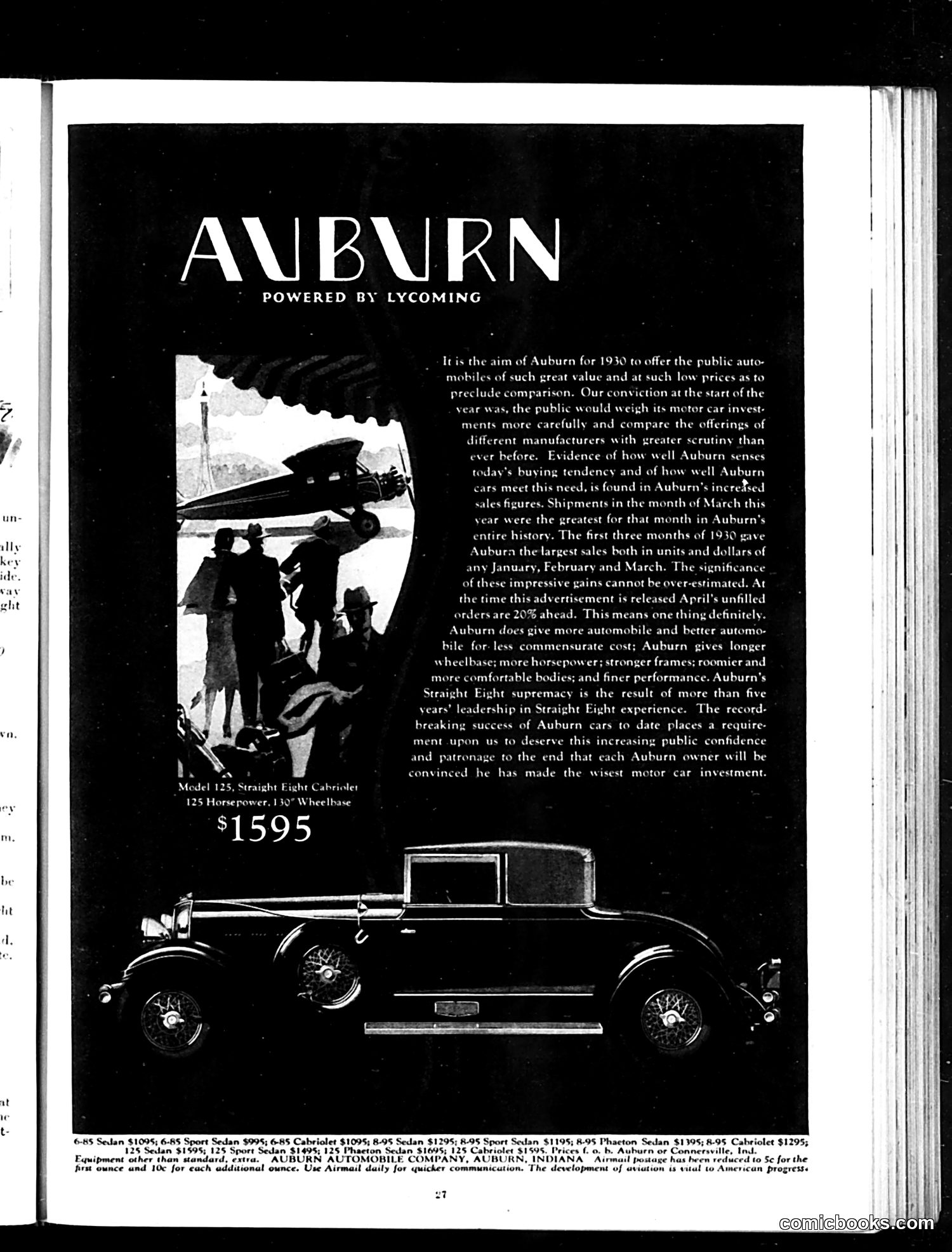
Analysis This is not a cartoon or satire page—it's a full-page automobile advertisement for Auburn cars, placed in Judge magazine (1930). The image shows Auburn's Model 125 Straight Eight Cabriolet priced at $1595, with a photograph of workers assembling or inspecting the vehicle in what appears to be a factory setting. The text is a straightforward marketing pitch claiming Auburn offers superior value and performance. It cites record sales in early 1930 and April's unfilled orders being 20% ahead as evidence of public confidence. The ad emphasizes Auburn's "Straight Eight" engine superiority, longer wheelbase, horsepower, and comfort features. Context for modern readers: This represents pre-Depression automotive advertising (March 1930, just months before the October crash). Auburn was a real Indiana manufacturer known for quality mid-range vehicles. The ad's emphasis on value and comparison-shopping reflects emerging 1930s consumer consciousness—manufacturers now expected buyers to shop carefully rather than simply purchase whatever was available.
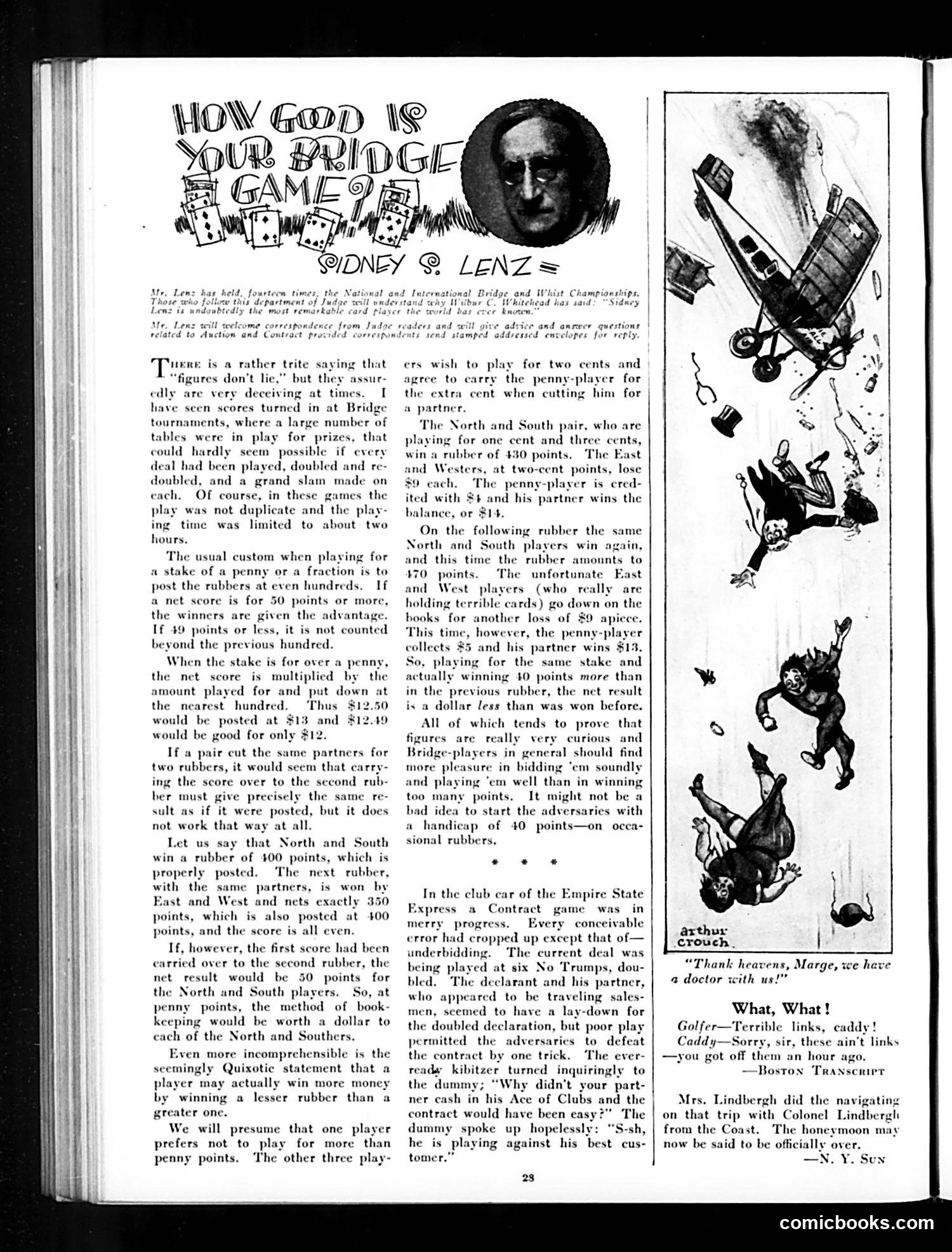
"How Good Is Your Bridge Game?" by Sidney S. Lenz This page discusses bridge scoring mechanics rather than presenting political satire. The main content is a technical article by Sidney S. Lenz (identified in the header as a renowned bridge champion) explaining counter-intuitive scoring rules in bridge tournaments. The key point: Lenz demonstrates how bridge's rounding system can produce paradoxical results—players can win *fewer* points in a rubber but earn *more* money, depending on how scores are posted and rounded to even hundreds. He uses specific numerical examples to show this seemingly illogical outcome. The cartoon illustrations on the right show players in exaggerated poses, apparently depicting the frustration or confusion these scoring quirks might cause. This is instructional content for bridge players, not political commentary. The page also includes brief humorous anecdotes about contract bridge errors at the bottom.
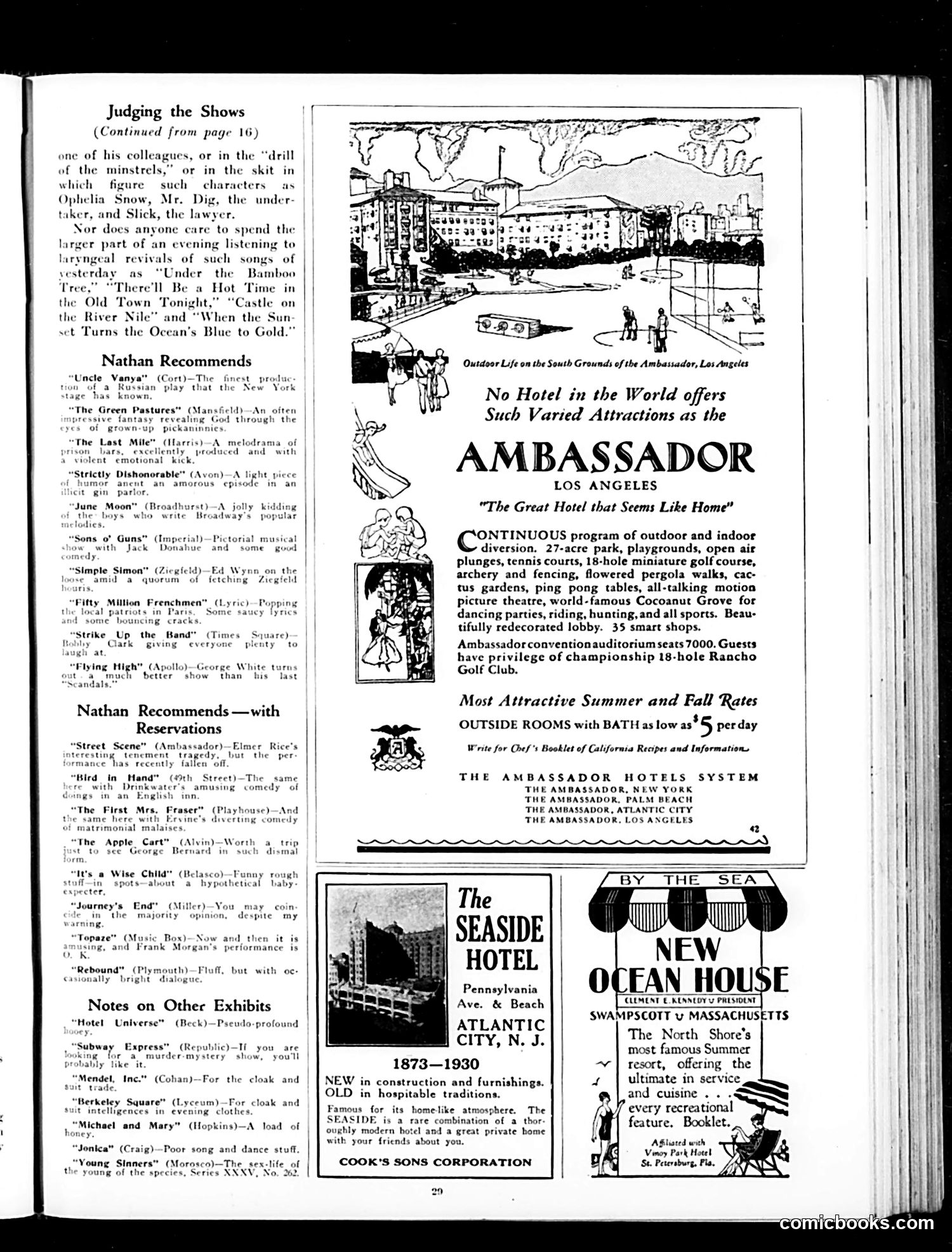
Page Analysis: Judge Magazine Advertisement Section This page is primarily advertising content, not satirical cartoons. It features hotel promotions from the 1920s-30s era: The main advertisement promotes the Ambassador Hotels chain, emphasizing the Los Angeles location as "The Great Hotel that Seems Like Home." It lists extensive amenities: golf course, tennis courts, motion pictures, dancing, and sports—reflecting the leisure-focused marketing of luxury hotels during this period. Secondary ads promote The Seaside Hotel in Atlantic City (established 1873) and the New Ocean House in Swampscott, Massachusetts, both positioned as vacation destinations. The upper text section contains brief theatrical reviews and recommendations, but the page overall represents commercial rather than satirical content typical of Judge magazine.
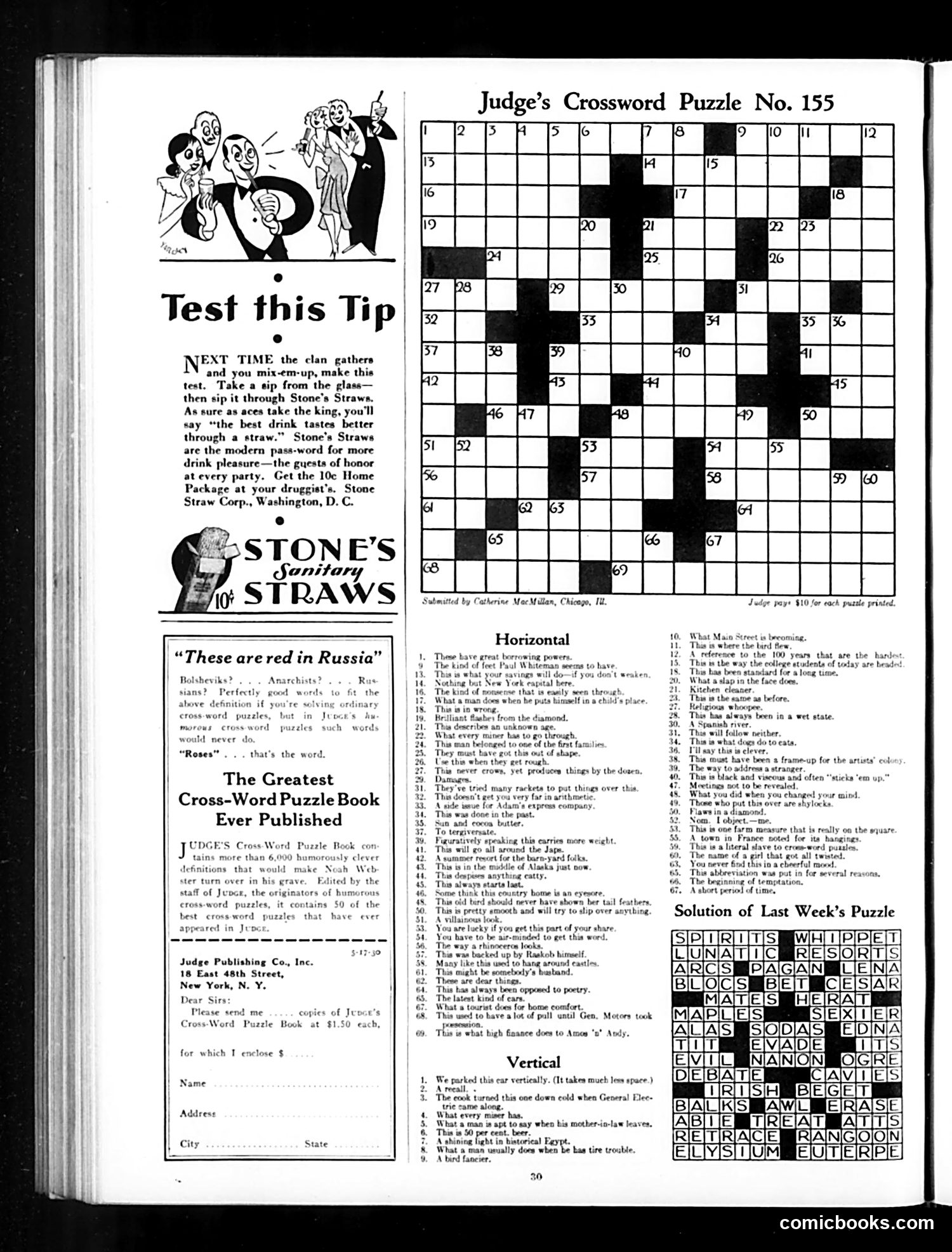
Judge Magazine Page Analysis This page is primarily an advertisement for Stone's Sanitary Straws, a drinking-straw product from Washington, D.C. The accompanying cartoon (top left) shows three men in formal attire enthusiastically promoting the straws at what appears to be a social gathering—the "tip" being that drinks taste better through straws. The phrase "These are red in Russia" is a cryptic reference, likely playing on Cold War-era anti-communist rhetoric or satirizing how Americans viewed Russian customs as foreign/suspicious. The exact intended joke is unclear from context. The page also advertises Judge's cross-word puzzle book and includes puzzle clues and solutions. Most of the remaining content consists of standard crossword puzzle material rather than political satire. Key point: This is largely a commercial/advertising page rather than satirical editorial content. The actual satirical cartoon element is minimal and its specific reference remains ambiguous without additional historical context.
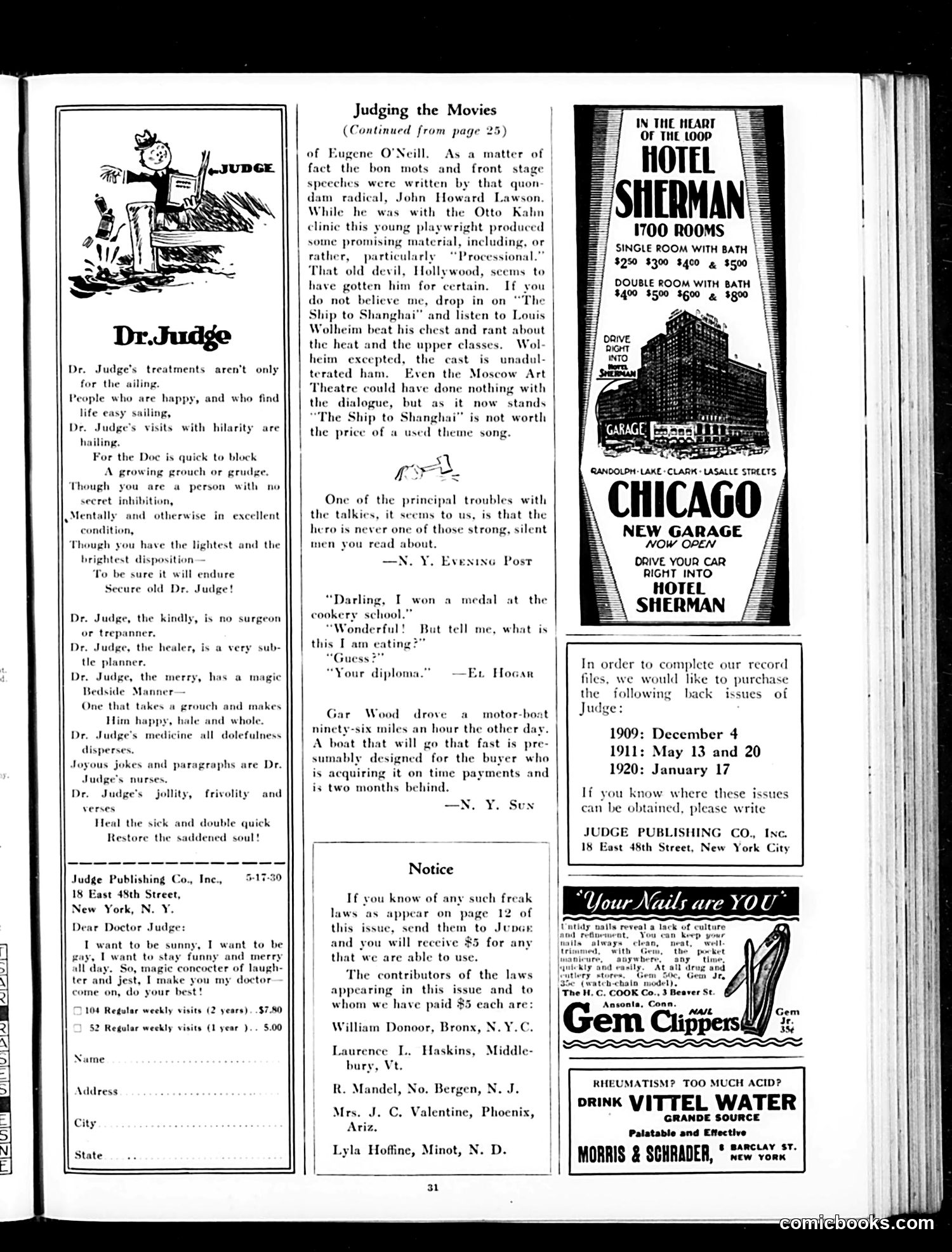
"Dr. Judge" and This Page This page is primarily advertising and editorial content for *Judge* magazine itself, rather than political satire. The main feature is a self-promotional advertisement for "Dr. Judge"—a personification of the magazine as a healer. The conceit presents *Judge* as a doctor dispensing humor as medicine for life's ailments, promising to cure grouchiness and restore happiness. Readers could subscribe to weekly visits (the magazine's issues). The "Judging the Movies" section critiques early sound films, notably dismissing "The Ship to Shanghai" as poorly written ham acting, despite good intentions. A quote from the N.Y. Evening Post mocks talkies' trend of weak, talkative heroes rather than strong silent types. The page also includes a Notice soliciting "freak laws" (absurd or unusual legislation) from readers for publication, offering $5 payment—showing *Judge*'s crowdsourced content model. The remaining content is straightforward period advertising (Hotel Sherman garage, nail products, mineral water), typical of 1920s magazine pages.
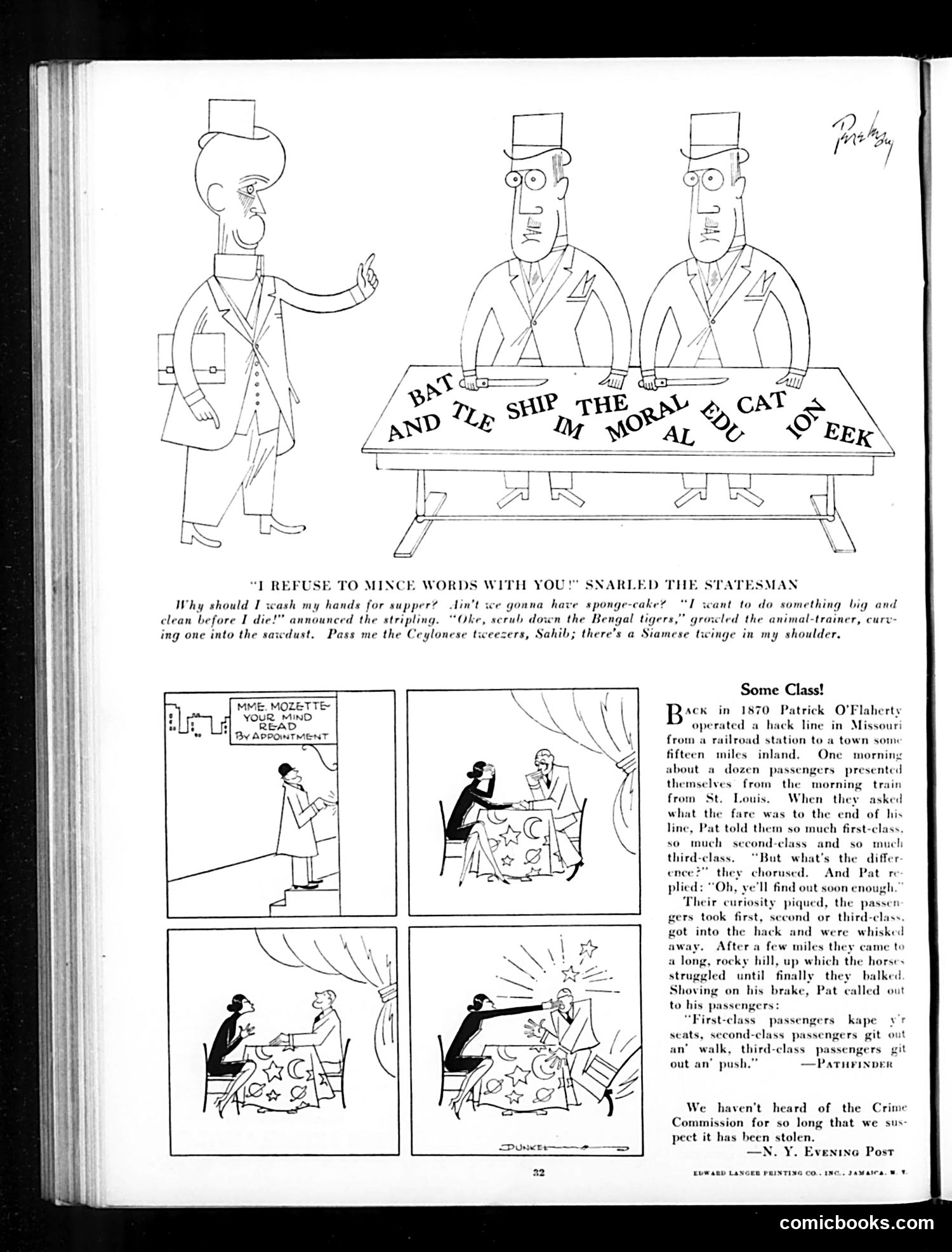
Political Cartoon Analysis: Judge Magazine Top Cartoon: A statesman refuses to "mince words" with two colleagues at a table labeled with scrambled text (likely satirizing political rhetoric). The joke mocks politicians' tendency to speak in confusing jargon while claiming to be forthright. The absurdist dialogue about washing hands and sponge-cake emphasizes the disconnect between politicians' grandiose claims and their actual substance. "Some Class!" Story: A humorous anecdote about an 1870 Missouri hack driver (Patrick O'Flaherty) who offered three fare classes but delivered them equally until reaching a steep hill. Then he revealed the "difference": first-class passengers stayed seated, second-class walked, third-class pushed the wagon. The story satirizes false class distinctions and fraudulent advertising—promising meaningful differences when delivering essentially identical service with humiliating variations. Bottom Note: A quip suggesting the Crime Commission has been "stolen," implying governmental incompetence or corruption. Overall, the page mocks political dishonesty, misleading commerce, and institutional failure through satire.
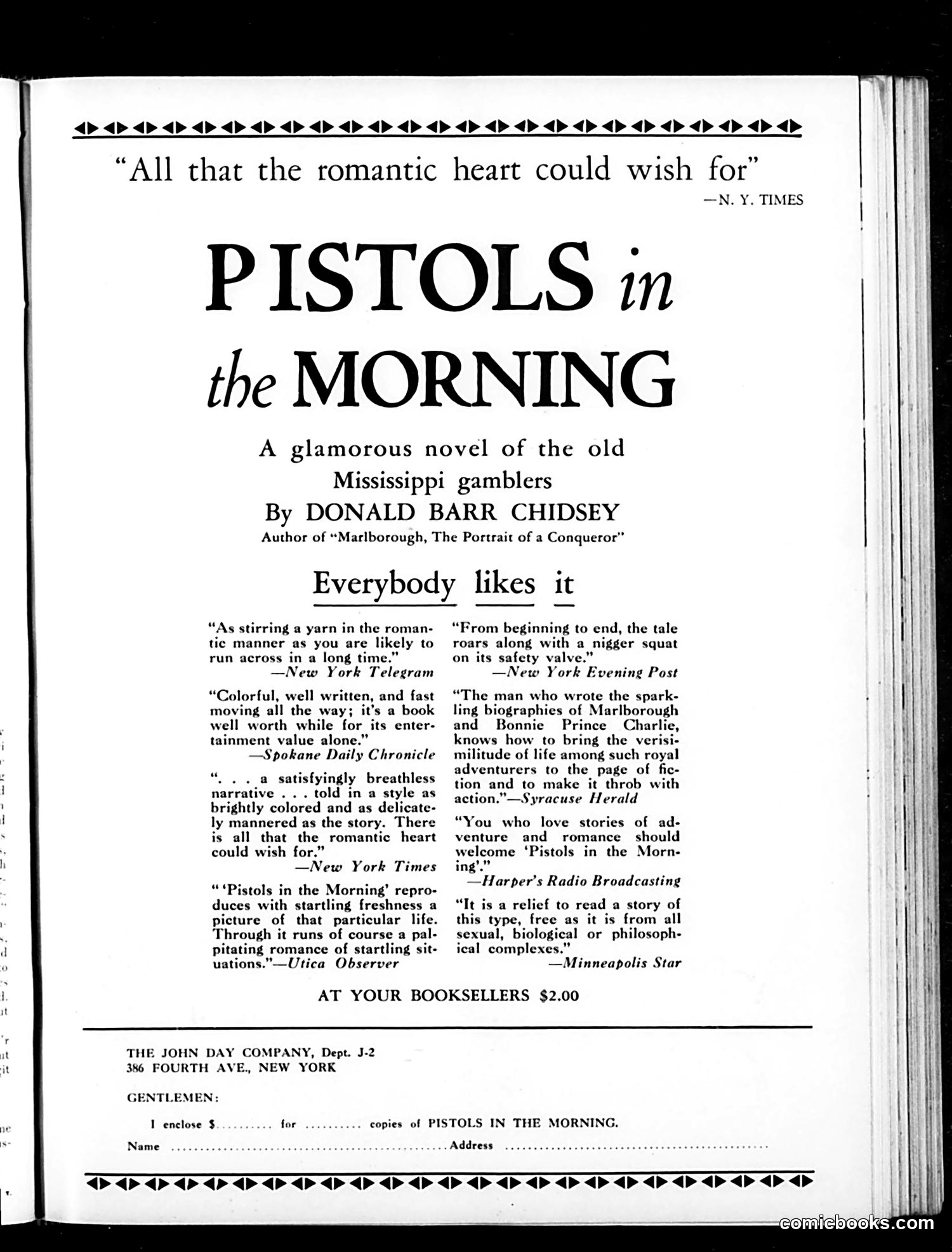
This is primarily a book advertisement, not a political cartoon. It promotes "Pistols in the Morning," a novel by Donald Barr Chidsey about Mississippi riverboat gamblers, published by John Day Company at $2.00. The page collects favorable reviews from contemporary newspapers (New York Times, Spokane Daily Chronicle, etc.) praising the book as romantic, colorful, and entertaining adventure fiction. The advertisement includes a mail-order coupon for readers to purchase copies. Notably, one review quote from the New York Evening Post contains a racial slur reflecting the casual racism of the era's published criticism. This appears without editorial comment, indicating the period's normalized acceptance of such language in print media. The page functions as straightforward commercial promotion rather than satire or commentary.
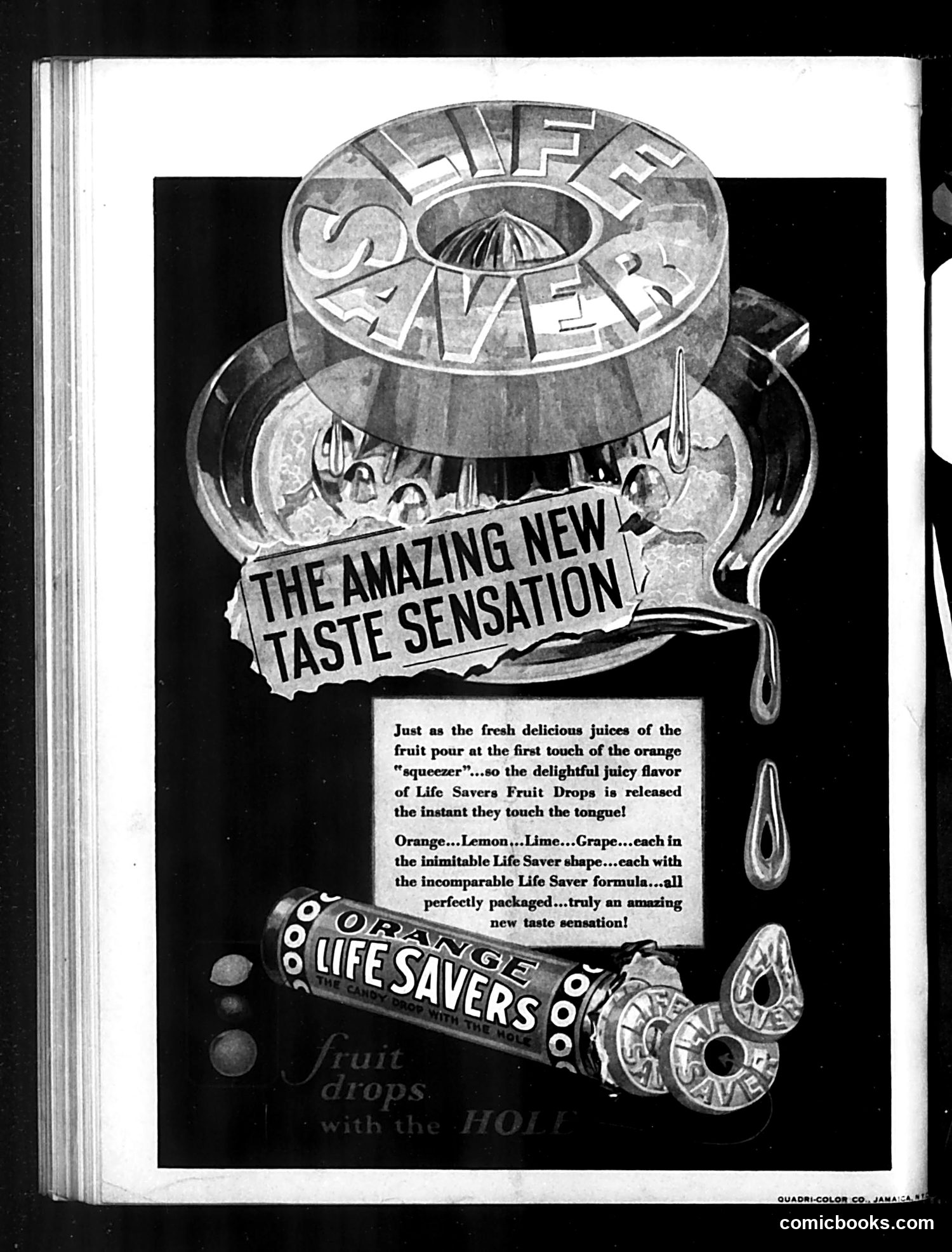
Analysis This page is primarily an advertisement, not political satire. It promotes Life Savers Fruit Drops candy, featuring an illustration of the product's distinctive packaging and a stylized mouth with candy drops. The ad uses marketing language typical of early 20th-century advertising: "The Amazing New Taste Sensation" promises that the candy releases "delightful juicy flavor" upon contact with the tongue, comparing it to fresh fruit juice. The text lists available flavors (Orange, Lemon, Lime, Grape) and emphasizes the product's packaging and formula. The dramatic visual presentation—with the large mouth and mechanical/scientific imagery—was common in vintage advertising meant to convey novelty and appeal to consumers. There is no political commentary or satirical intent visible on this page. It simply uses Judge magazine's platform for product advertisement.