judge
Judge — May 24, 1930
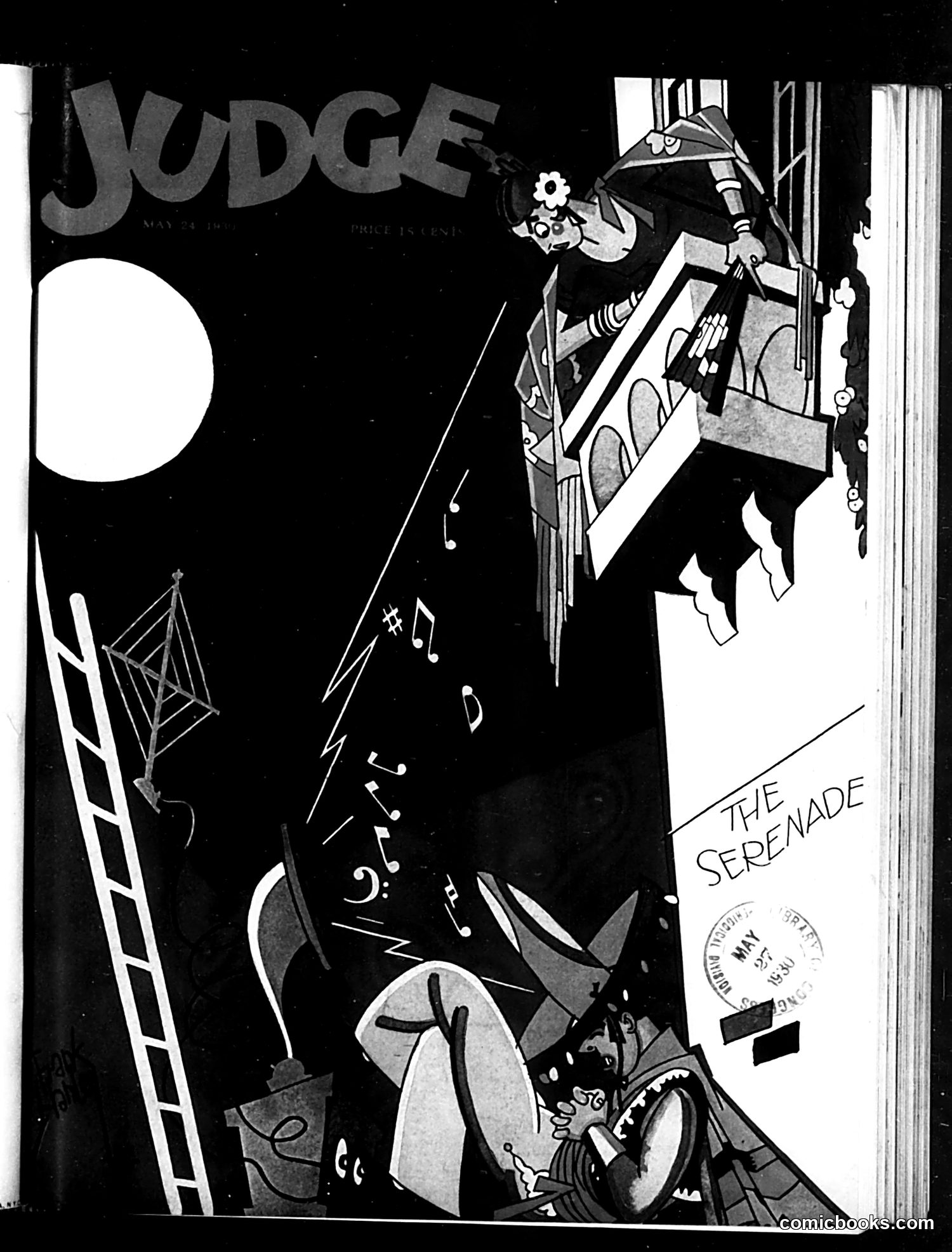
Analysis of "The Serenade" from Judge Magazine This satirical cartoon depicts a nighttime serenade scene with musical notation floating through the air. A figure plays an instrument beneath a window while another figure leans out from above. The composition suggests romantic comedy—a classic "serenade" trope where a suitor performs beneath a lover's window. The satire likely mocks either romantic pretension or the melodramatic nature of such displays. The exaggerated musical notes and the somewhat absurd positioning of the figures suggest ridicule of overly theatrical romantic gestures popular in the era when this appeared. Without additional context or visible dates, the specific target remains unclear, but Judge magazine's typical approach was skewering American social affectations and sentimental behavior through visual humor.
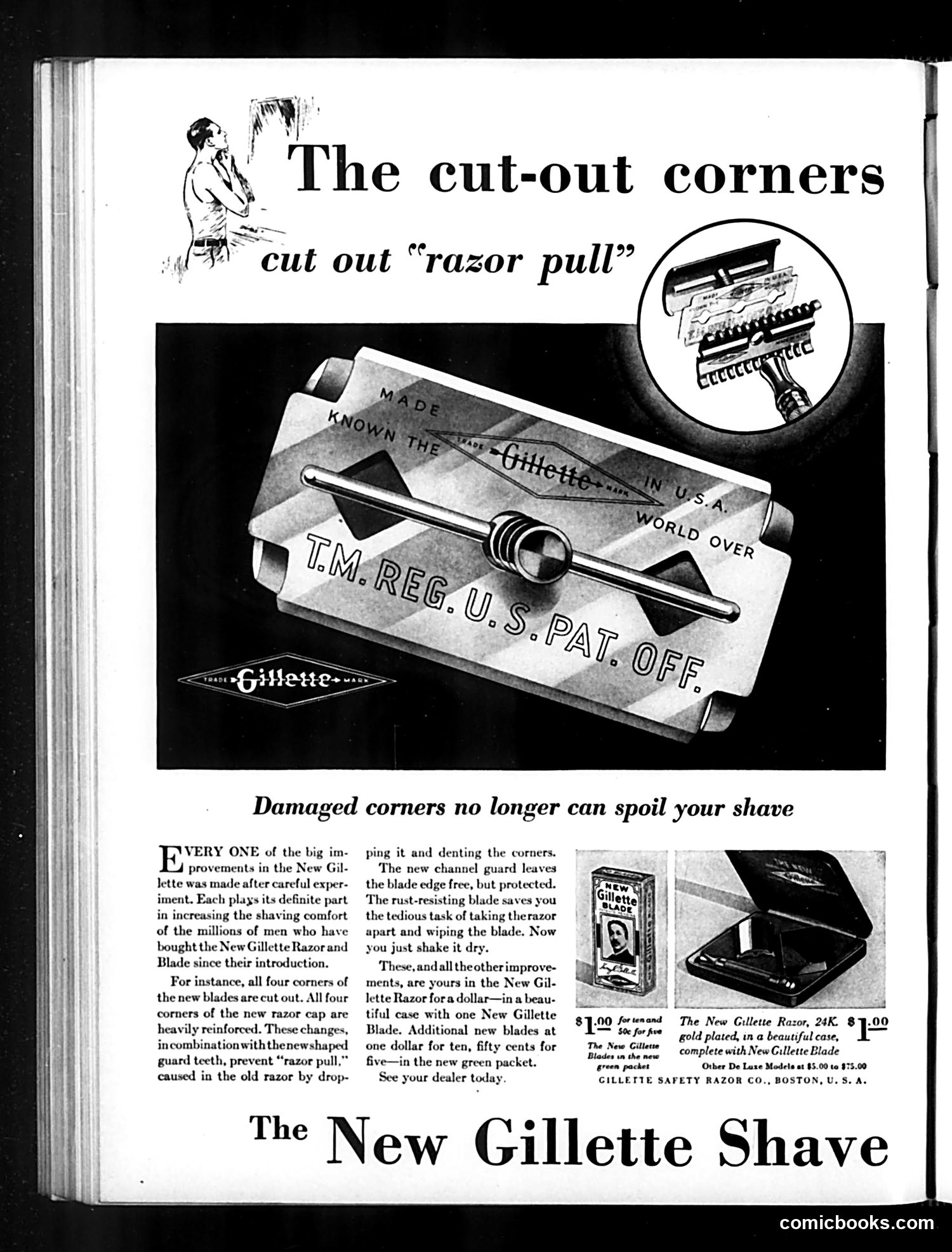
Analysis This is not a political cartoon or satire page—it's a Gillette razor advertisement from an era when Judge magazine accepted commercial advertising alongside editorial content. The ad promotes Gillette's "New Gillette Shave" by highlighting a specific product innovation: reinforced cut-out corners on the razor blade case to prevent "razor pull" (a common problem where damaged blade corners caused pulling during shaving). The illustration shows the protective channel guard and emphasizes that this design improvement prevents the blade from being damaged during removal and use. The ad positions this as one of several recent improvements in the New Gillette razor, sold for one dollar with additional blades available cheaply. There is no political satire present on this page.
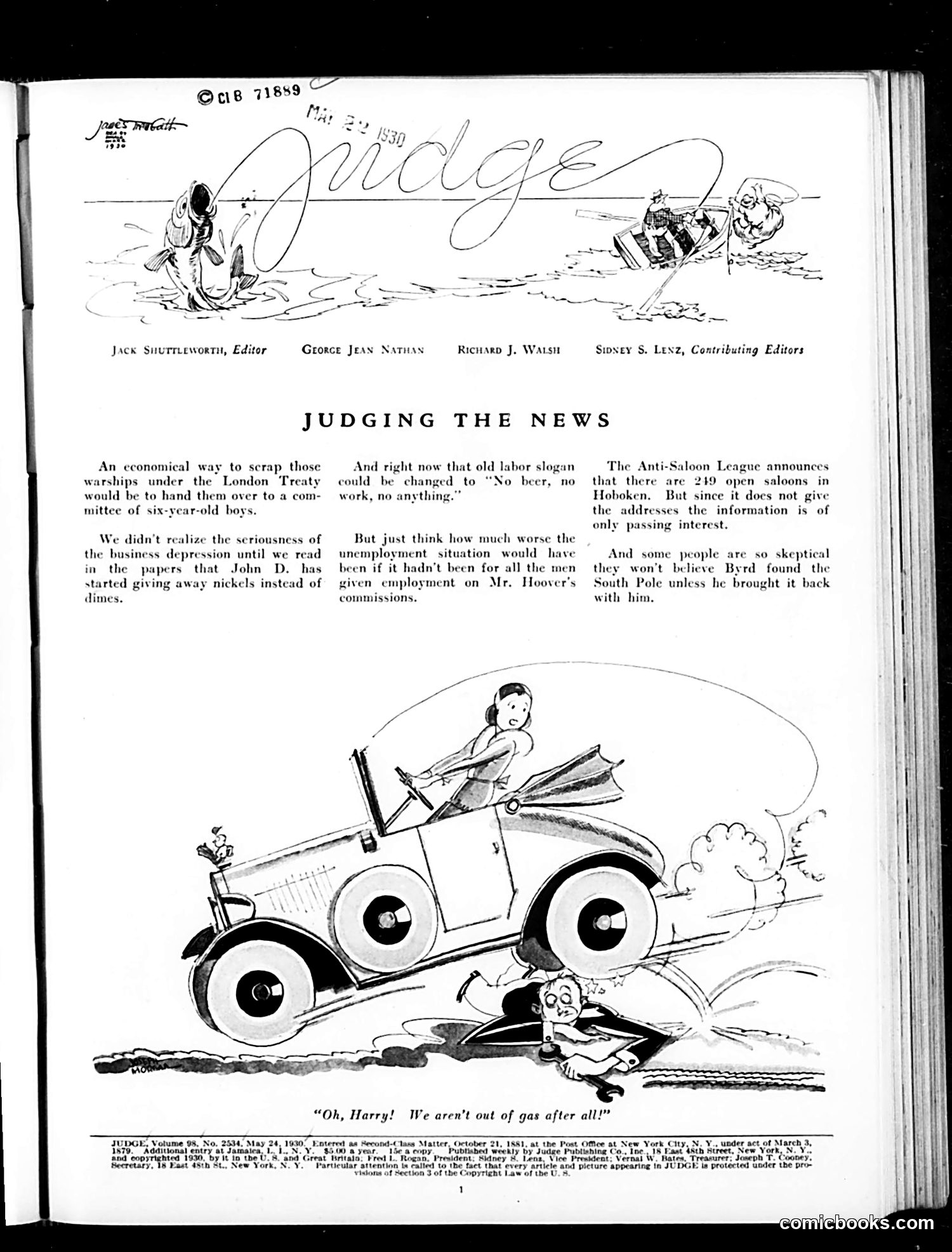
"Judging the News" - May 24, 1930 This page satirizes early Depression-era issues. The main cartoon depicts a reckless driver in a careening automobile nearly hitting a pedestrian, captioned "Oh, Harry! We aren't out of gas after all!!" The visual metaphor suggests economic recklessness during the Depression. The driver's surprised discovery that the car still has fuel humorously represents people's false sense of security about financial stability. The accompanying text commentary references: - Scrapping warships under the London Treaty - John D. Rockefeller giving away nickels instead of dimes during the Depression - Hoover's unemployment commissions - Admiral Byrd's South Pole expedition - The Anti-Saloon League's concerns about open saloons in Hoboken The satire mocks both government policy and public complacency amid economic crisis.
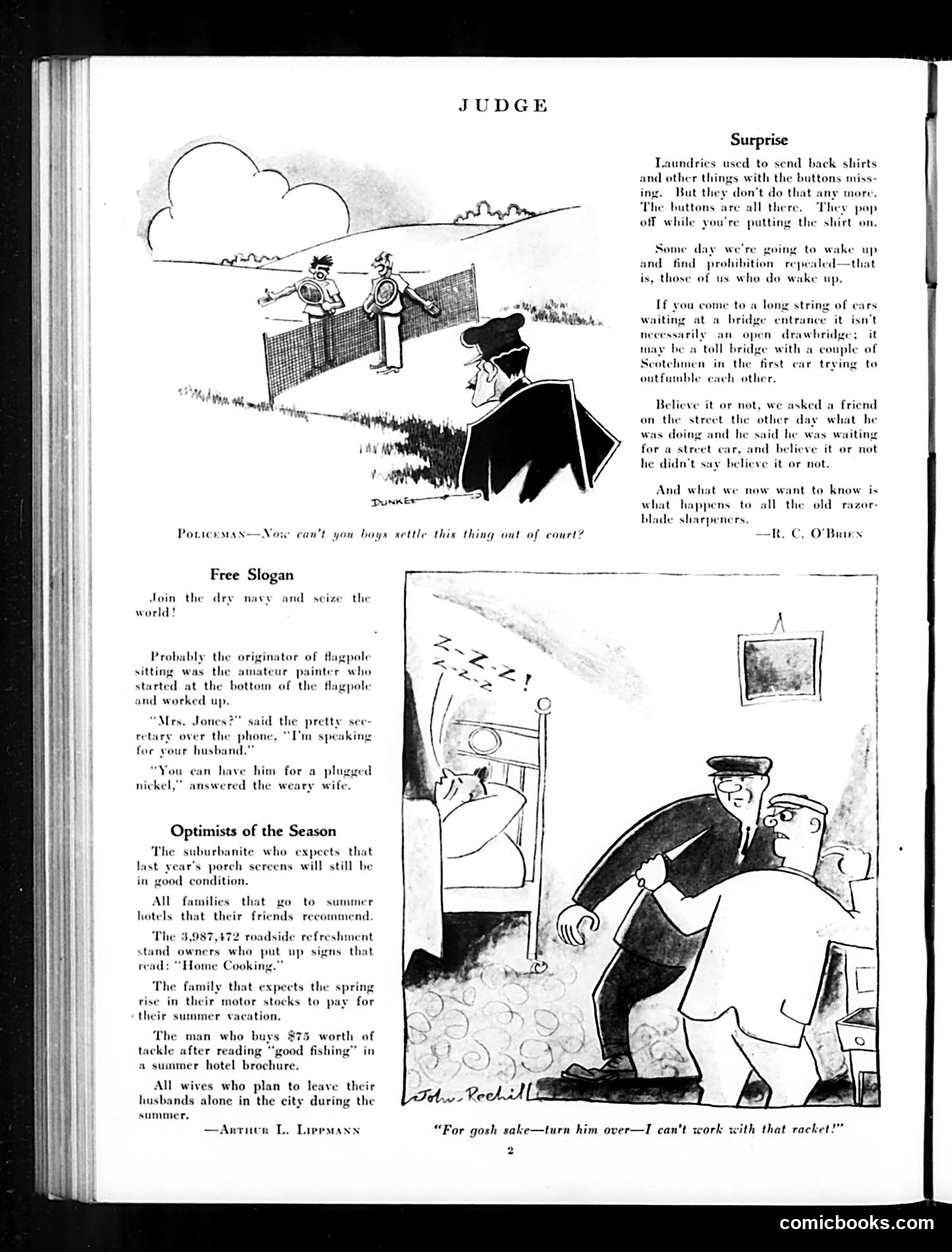
Judge Magazine Page Analysis This page contains humor columns and two cartoons satirizing early 20th-century American life. The top cartoon depicts a policeman mediating a dispute between two people at a bridge entrance, likely satirizing disputes over toll bridge vs. free bridge access—a real public issue of the era. The bottom cartoon shows a frustrated man (possibly a landlord or employer) ejecting a tenant or worker, with the caption "For gosh sake—turn him over—I can't work with that racket!" The humor derives from the sleeping figure creating noise disturbances. The "Free Slogan" and "Optimists of the Season" sections contain witty observations about contemporary life: laundry mishaps, naive expectations about home maintenance, and unrealistic vacation planning among middle-class families. These pieces reflect period concerns about domestic life, class anxieties, and urban inconveniences rather than partisan politics.
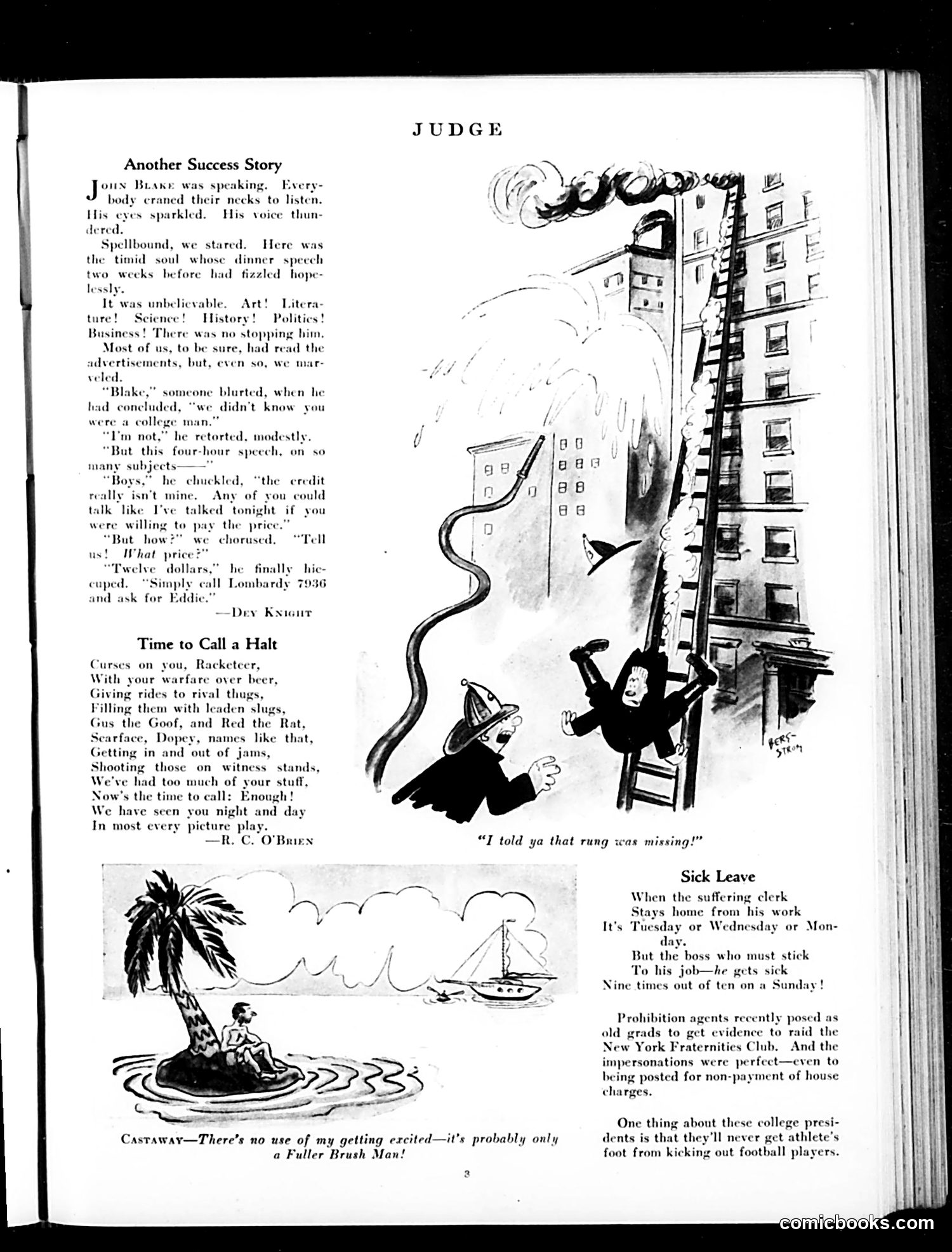
Analysis of Judge Magazine Page This page contains three distinct pieces of satirical commentary: 1. "Another Success Story" mocks a timid college student whose dinner speech on various subjects ("Art! Literature! Science!") impresses listeners—until he reveals it cost him $12, undermining his credibility. 2. "Time to Call a Halt" (by R.C. O'Brien) criticizes violent crime and urban lawlessness—"racketeers," gang violence, witness intimidation—arguing society has tolerated such behavior too long in entertainment and real life. 3. "Castaway" shows a shipwrecked man on an island, quipping he won't get excited since he's just "a Fuller Brush Man"—a joke about door-to-door salesmen's reputation for persistence. The cartoons reflect 1920s-30s concerns: educational pretension, Prohibition-era gangsterism, and commercial culture.
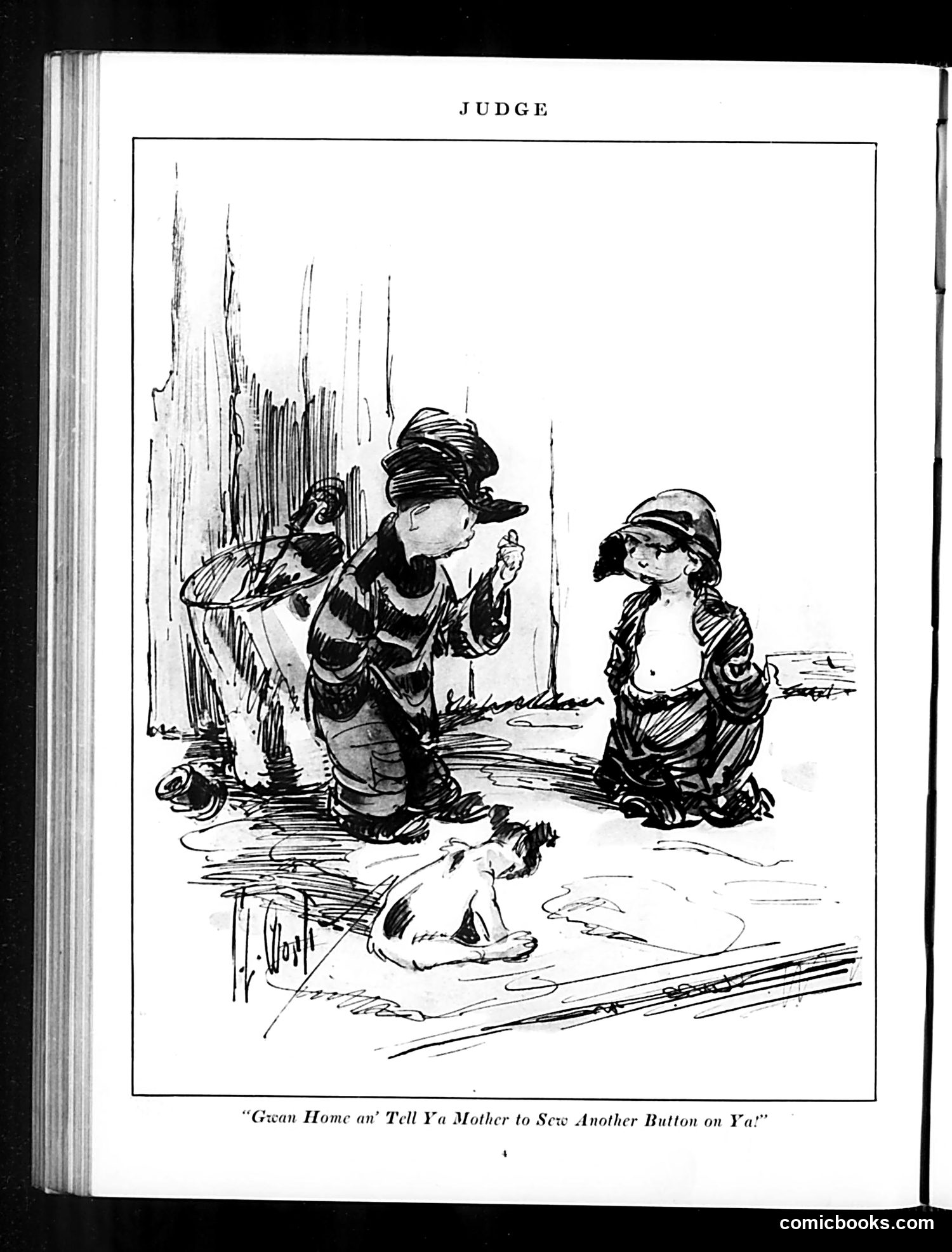
Analysis of "Judge" Cartoon This cartoon depicts two children in ragged clothing, appearing impoverished. The caption reads: "Gwan Home an' Tell Ya Mother to Sew Another Button on Ya!" The satire likely targets: Social commentary on poverty and childhood: The poorly dressed children suggest urban working-class or immigrant families struggling economically. One child appears to be scolding the other about their shabby appearance—specifically a missing button. The joke's edge: Rather than sympathy for their obvious poverty, the cartoon offers caustic humor about their condition. It satirizes either parental neglect, the desperation of poor families, or possibly the indifference of society toward impoverished children. The harsh tone suggests *Judge* magazine's typically cynical perspective on social issues of that era, using child poverty as fodder for uncomfortable humor rather than advocating reform.
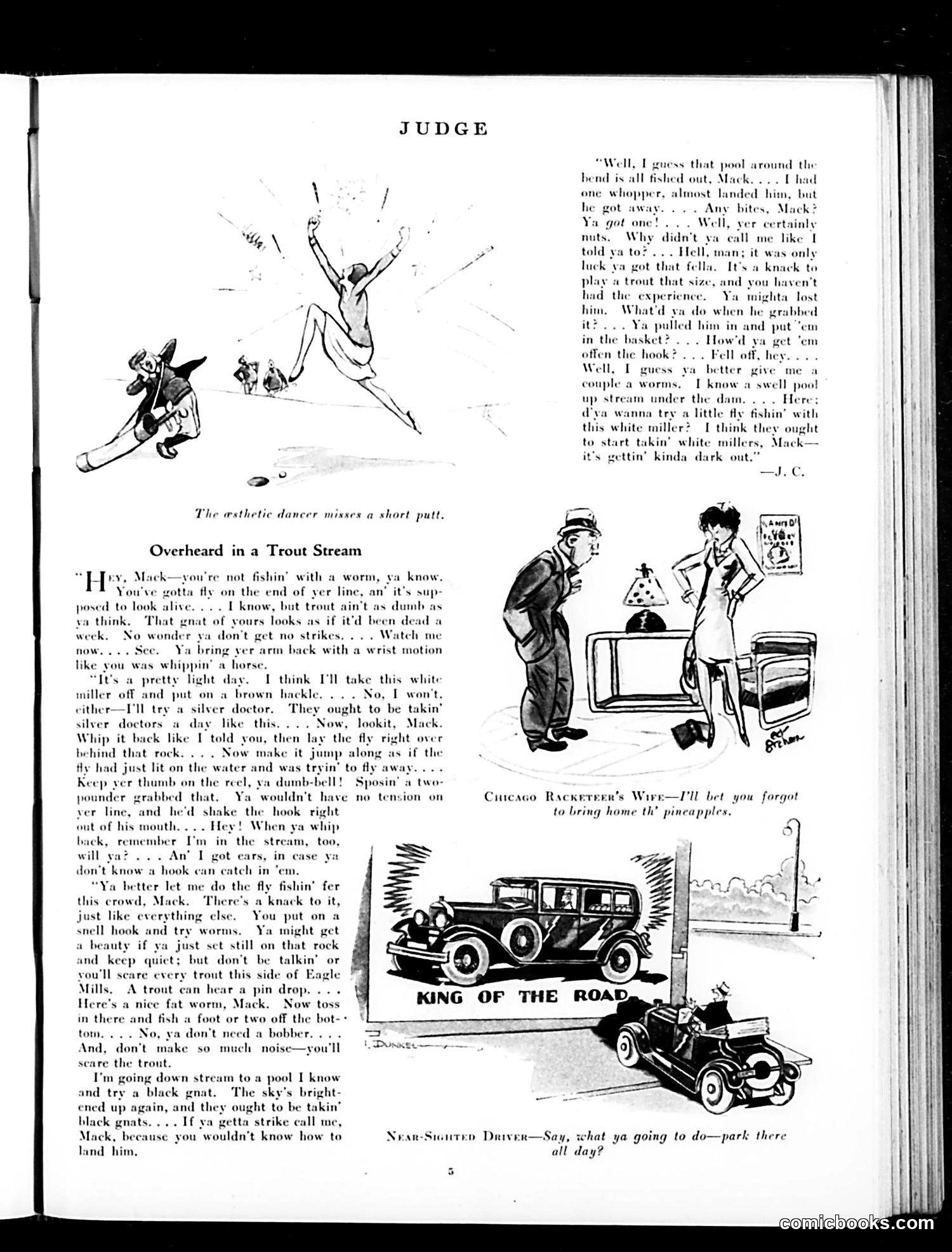
Analysis of Judge Magazine Page This page contains humorous illustrated vignettes rather than political satire. The top section, "Overhead in a Trout Stream," depicts fishing advice between two men—one experienced angler instructing an amateur ("Mack") on proper fly-fishing technique. The humor derives from the expert's detailed, condescending monologue about worm selection, casting method, and stream etiquette. Below are three separate cartoon gags: an "aesthetic dancer" doing a golf putt, a domestic scene titled "Chicago Racketeer's Wife," and automobile humor labeled "King of the Road" and "Near-Sighted Driver." These are lifestyle and social humor pieces typical of 1920s-era Judge magazine—satirizing modern urban life, gender relations, and automotive culture rather than political figures or events.
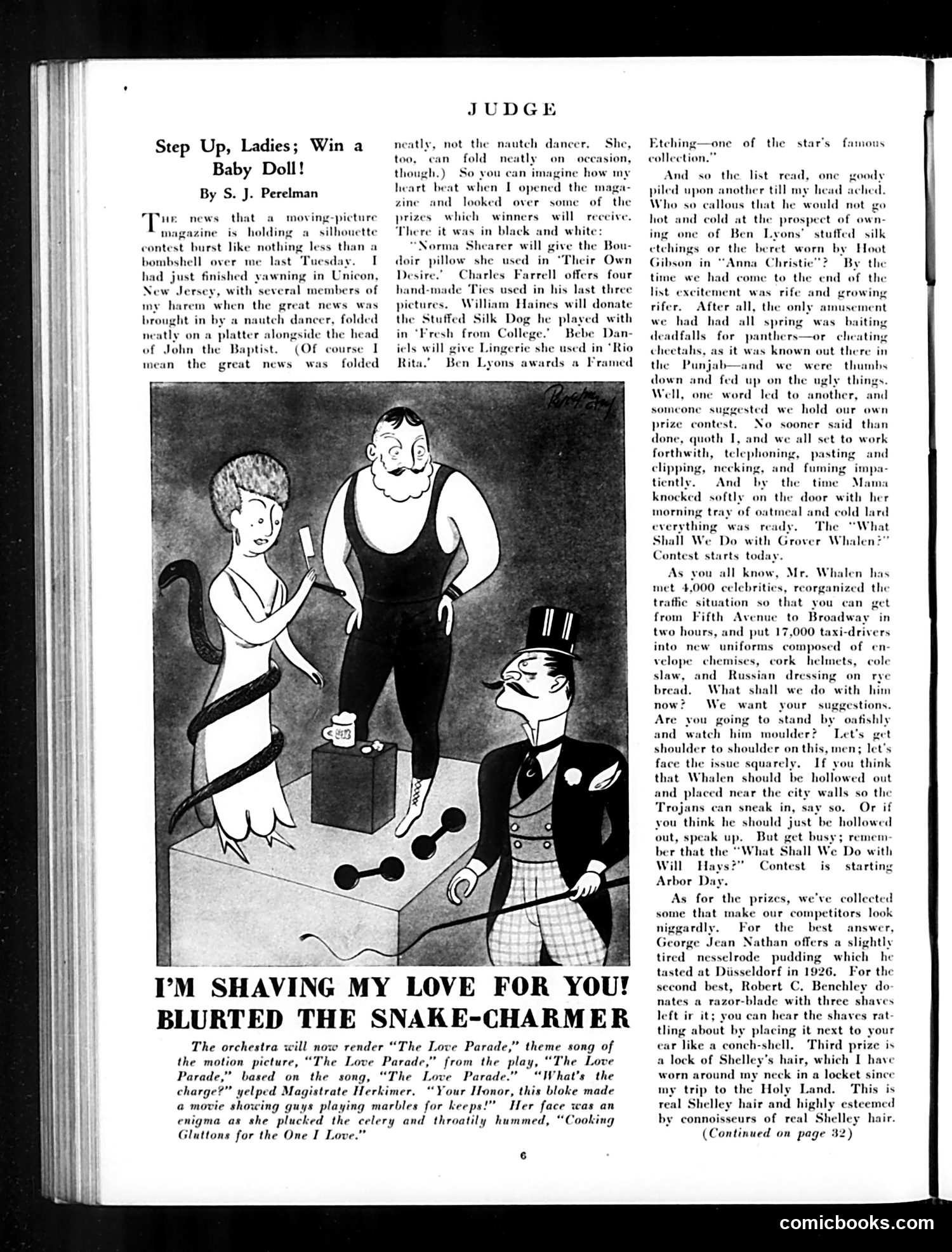
Analysis of Judge Magazine Page This page contains two distinct pieces: "Step Up, Ladies; Win a Baby Doll!" is a humorous article by S.J. Perelman about a magazine contest involving celebrity memorabilia as prizes. The main cartoon illustrates the absurdist premise: a large man and woman examine dolls while a small well-dressed man (likely representing a celebrity or contest organizer) presents them. The bottom cartoon titled "I'm Shaving My Love for You! Blurted the Snake-Charmer" appears to be a visual gag accompanying commentary about a film titled "The Love Parade." The image shows figures in exaggerated poses, playing on the melodramatic tropes of silent-era cinema that Judge satirizes. Both pieces mock entertainment industry excess and the era's celebrity culture through absurdist humor typical of 1920s-30s satirical magazines.
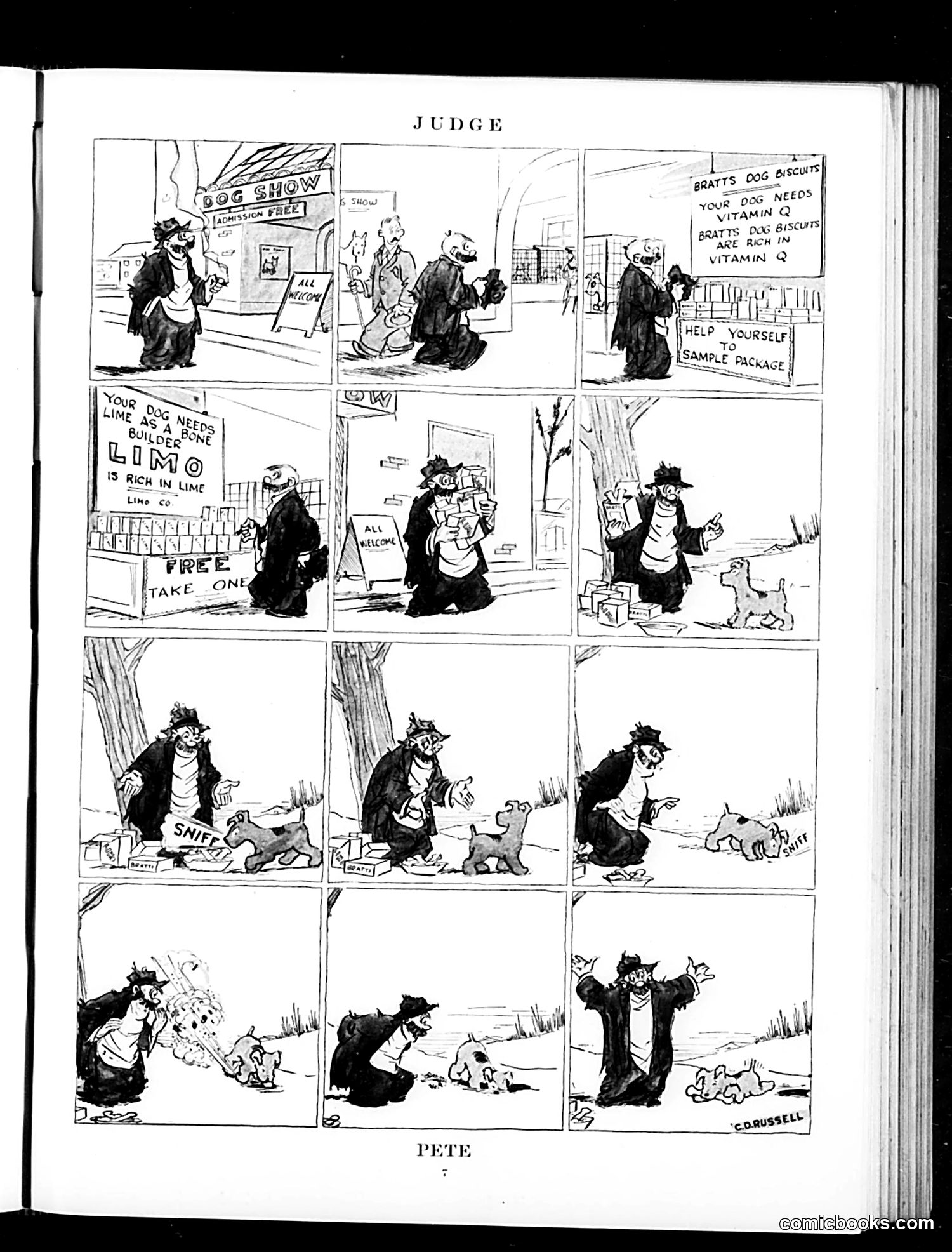
"Judge Pete" Comic Strip Analysis This comic depicts a street vendor hawking Bratt's Dog Biscuits at a dog show by making health claims. The salesman repeatedly pitches that the product is "rich in Vitamin Q," a fabricated vitamin that doesn't exist—this is the joke's core satire. The strip mocks early 20th-century advertising's misleading health claims and the public's gullibility. During this era, manufacturers made unsubstantiated medical promises to sell products. By inventing "Vitamin Q," the cartoonist highlights how absurd and deceptive such advertising had become. The punchline comes when the vendor finally abandons his pitch and simply gives the dog biscuits away free, suggesting the product's actual worthlessness beneath the marketing hype.
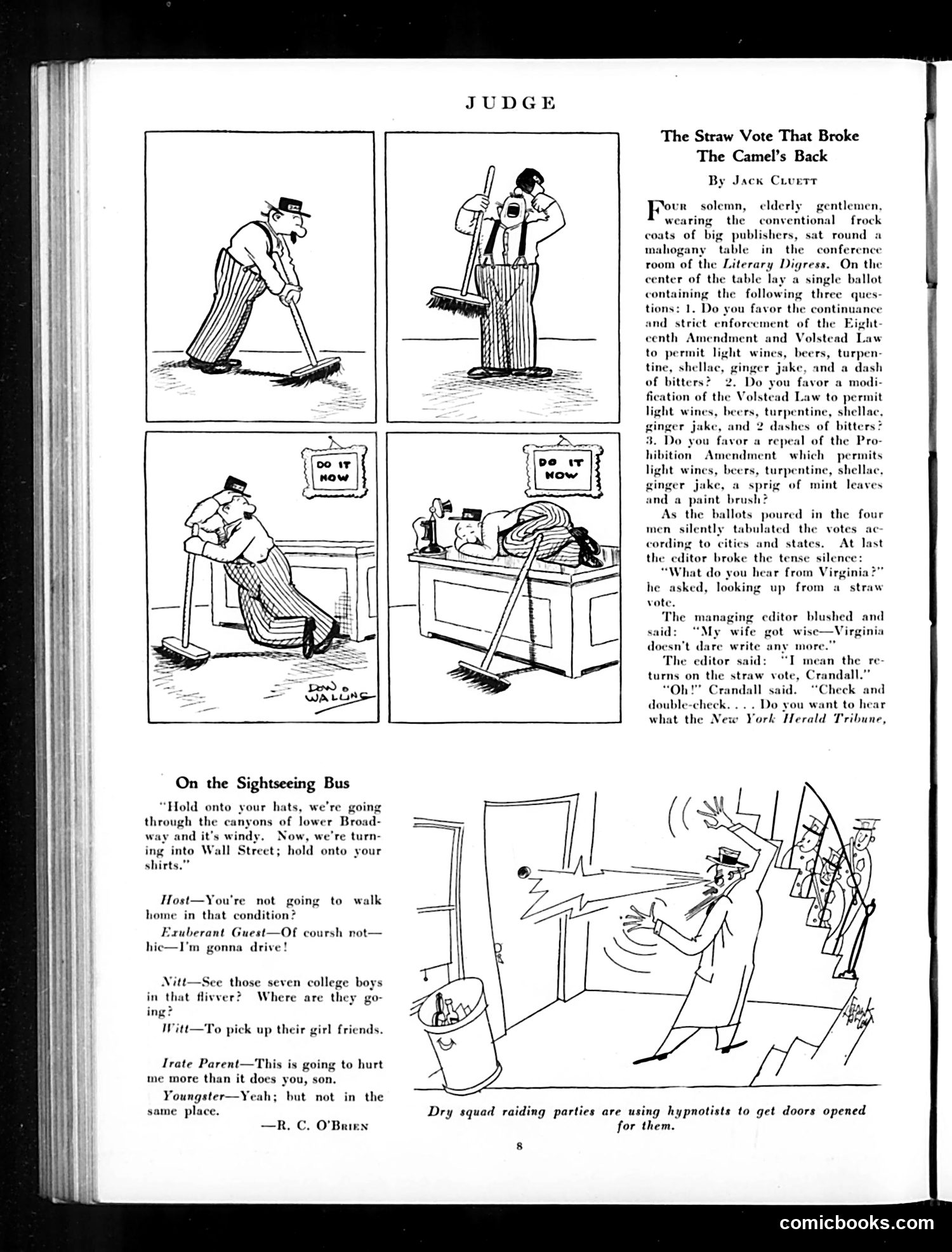
Explanation for Modern Readers "The Straw Vote That Broke the Camel's Back" satirizes the *Literary Digest*, a major magazine that conducted famous straw polls predicting election outcomes. The cartoon mocks their polling methodology during Prohibition (1920-1933). Four publishers debate three absurdly similar ballot questions about alcohol enforcement, each ostensibly different but practically identical—all permitting various drinks under different pretexts. The joke: their "scientific" polling is meaningless nonsense. The punchline involves a wife from Virginia who stopped contributing responses after "getting wise" to the scam. The lower section contains unrelated humor: a drunk tourist on a sightseeing bus, jokes about college boys picking up girlfriends, and a reference to Prohibition enforcement. The final cartoon jokes that federal "dry squad" agents raiding illegal alcohol operations now resort to hypnotism to enter premises—commenting on Prohibition's difficulty and the public's creative resistance to enforcement.
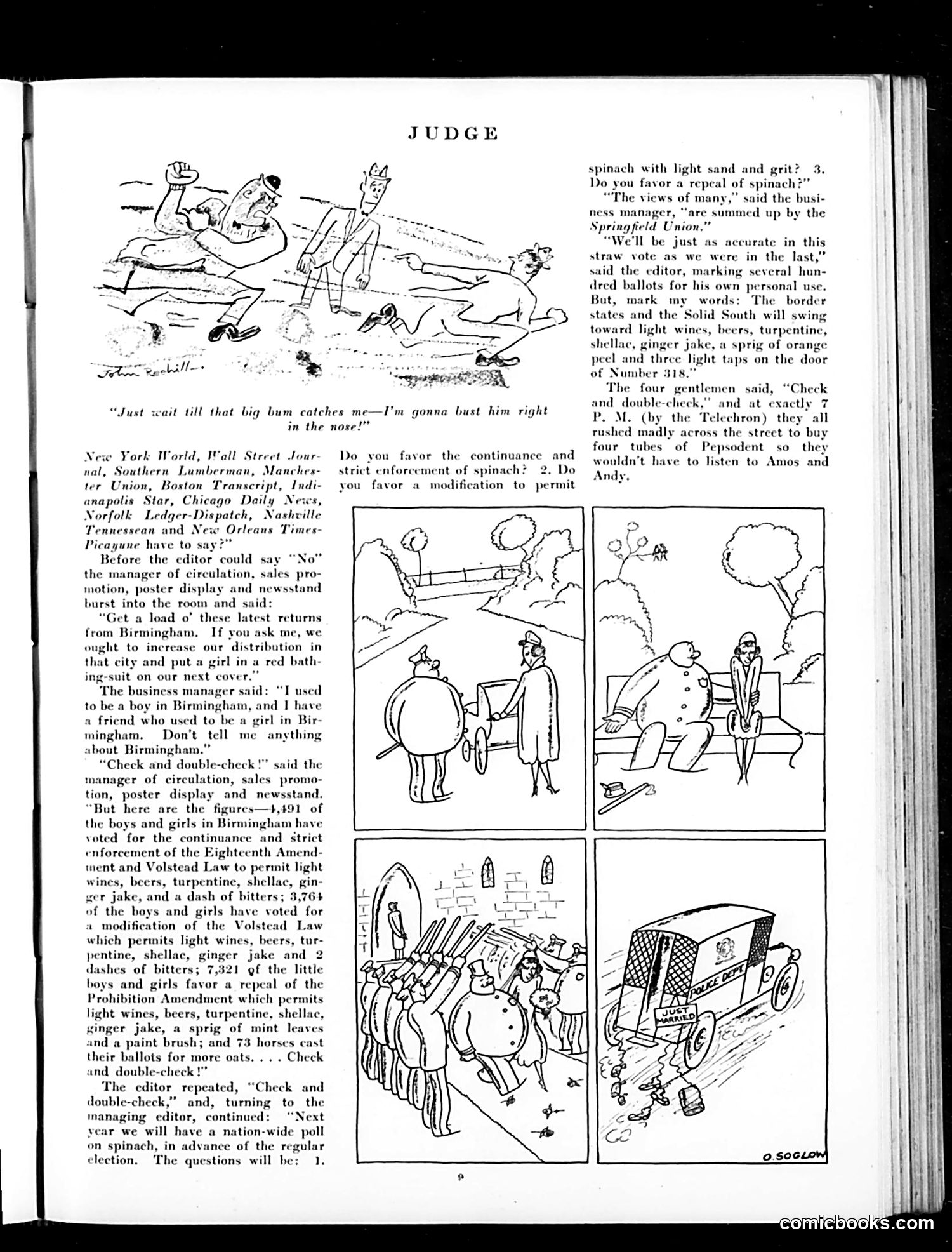
Analysis This 1920s Judge magazine page satirizes Prohibition-era politics and polling practices. The cartoons mock how magazines conducted dubious "straw polls" to gauge public opinion on contentious issues. The main text describes an absurd editorial meeting where circulation managers present fabricated Birmingham poll results claiming overwhelming support for Prohibition enforcement. The joke pivots on the magazine's dishonesty—the editor acknowledges they'll manipulate thousands of ballots "for his own personal use." The satire targets: 1. Fake polling: Magazine straw votes were notoriously unreliable, often rigged to support editors' preferred positions 2. Prohibition absurdity: The poll questions hilariously conflate spinach enforcement with alcohol policy (light wines, ginger jake, turpentine—patent medicines containing alcohol) 3. Media manipulation: Even including "73 horses" voting reveals the complete unreliability The cartoons accompanying this likely illustrate Prohibition-era smuggling and drinking culture. This is essentially Judge mocking other publications' pretense at scientific polling while satirizing Prohibition's widespread public resistance and enforcement failures.
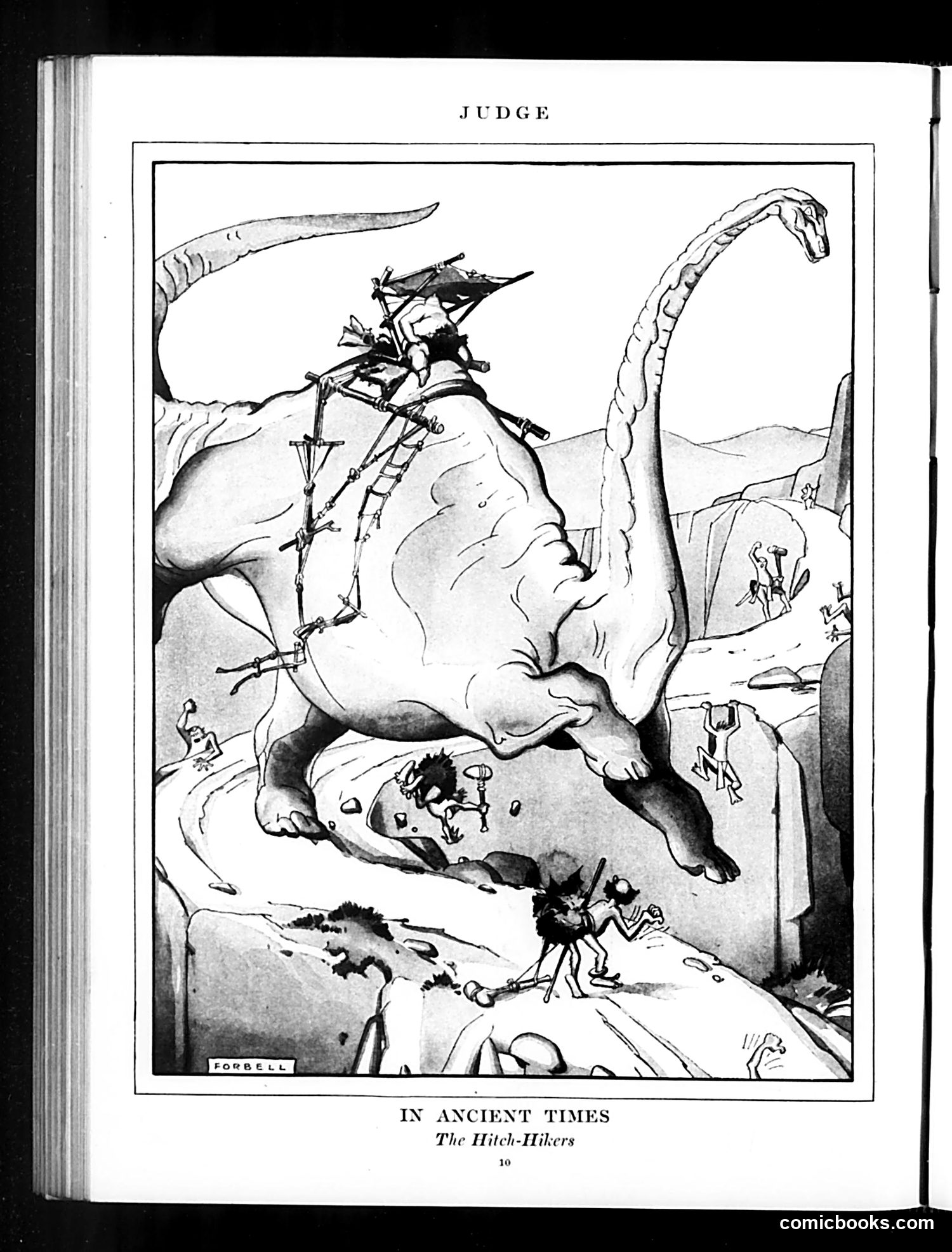
Analysis This is a Judge magazine cartoon titled "In Ancient Times: The Hitch-Hikers," signed by Forbel. The satire depicts prehistoric humans attempting to hitch rides on dinosaurs—a humorous anachronism that plays on the modern concept of hitchhiking by transplanting it to an impossibly ancient setting. The joke works through absurdist humor: tiny human figures gesture and pose as if hitchhiking along a landscape populated by large sauropod dinosaurs. The cartoon satirizes hitchhiking culture itself, possibly mocking the practice or those who engage in it, by showing its apparent universality across time periods—even "ancient times" apparently had people seeking free rides. The artist's name appears to be Forbel. Without a date visible, the cartoon's exact historical context remains unclear, though Judge was prominent from the 1880s onward.
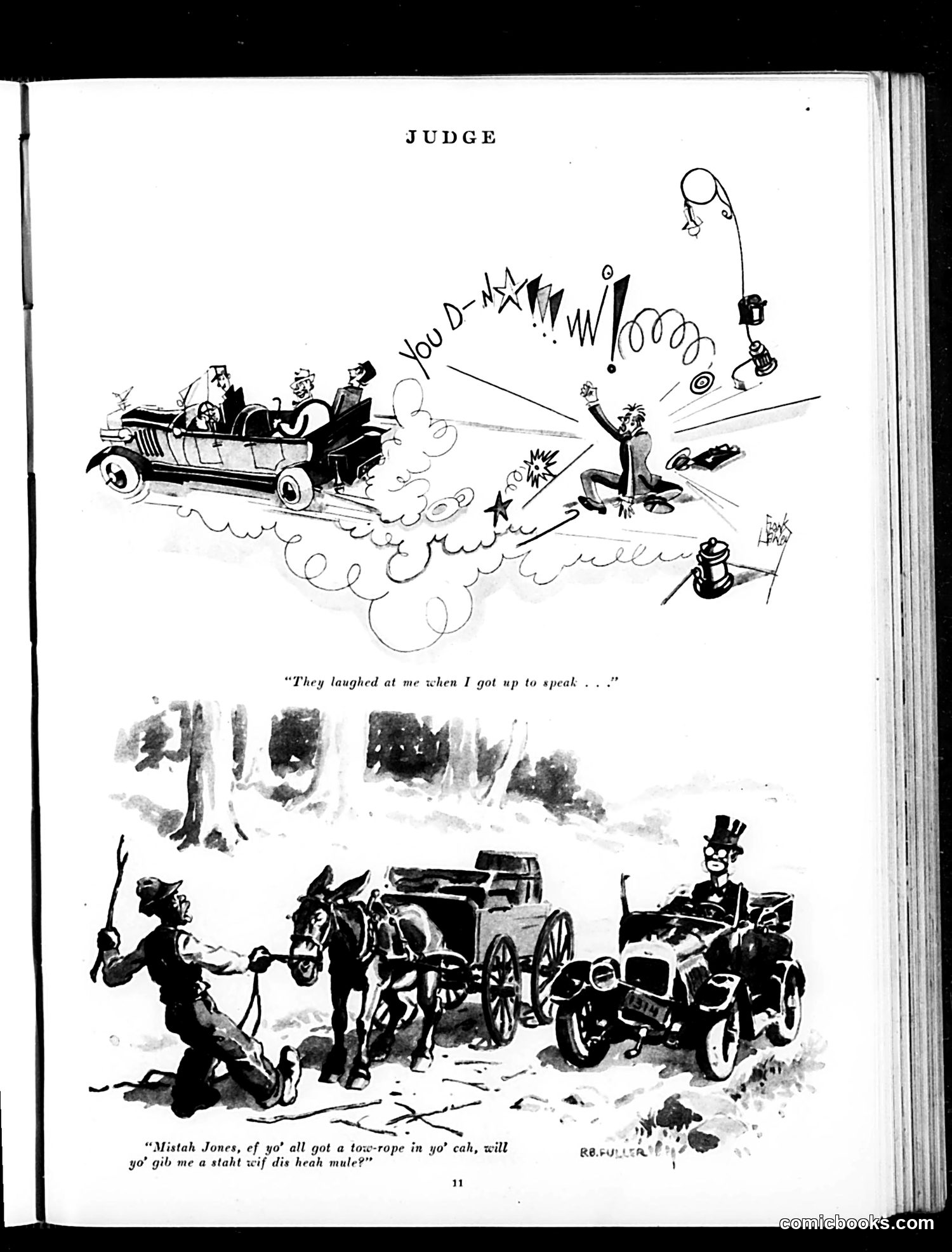
Analysis of Judge Page This page contains two cartoons satirizing early automobile culture versus traditional transportation. The top cartoon depicts a chaotic courtroom scene where a motorist ("You D—") has apparently caused an accident. The judge appears to be presiding over the defendant, whose vehicle has collided with other parties, suggesting contemporary anxiety about reckless driving and the legal consequences. The bottom cartoon uses racist dialect and caricature (reflecting period conventions of Judge magazine) to mock the transition from horse-drawn to motorized transport. A Black man asks another for a tow-rope, humorously suggesting his mule needs mechanical assistance—satirizing how automobiles are replacing traditional animals for transportation. Both cartoons reflect early-20th-century tensions between new automotive technology and established social order, while the magazine's racist imagery reflects its historical biases.
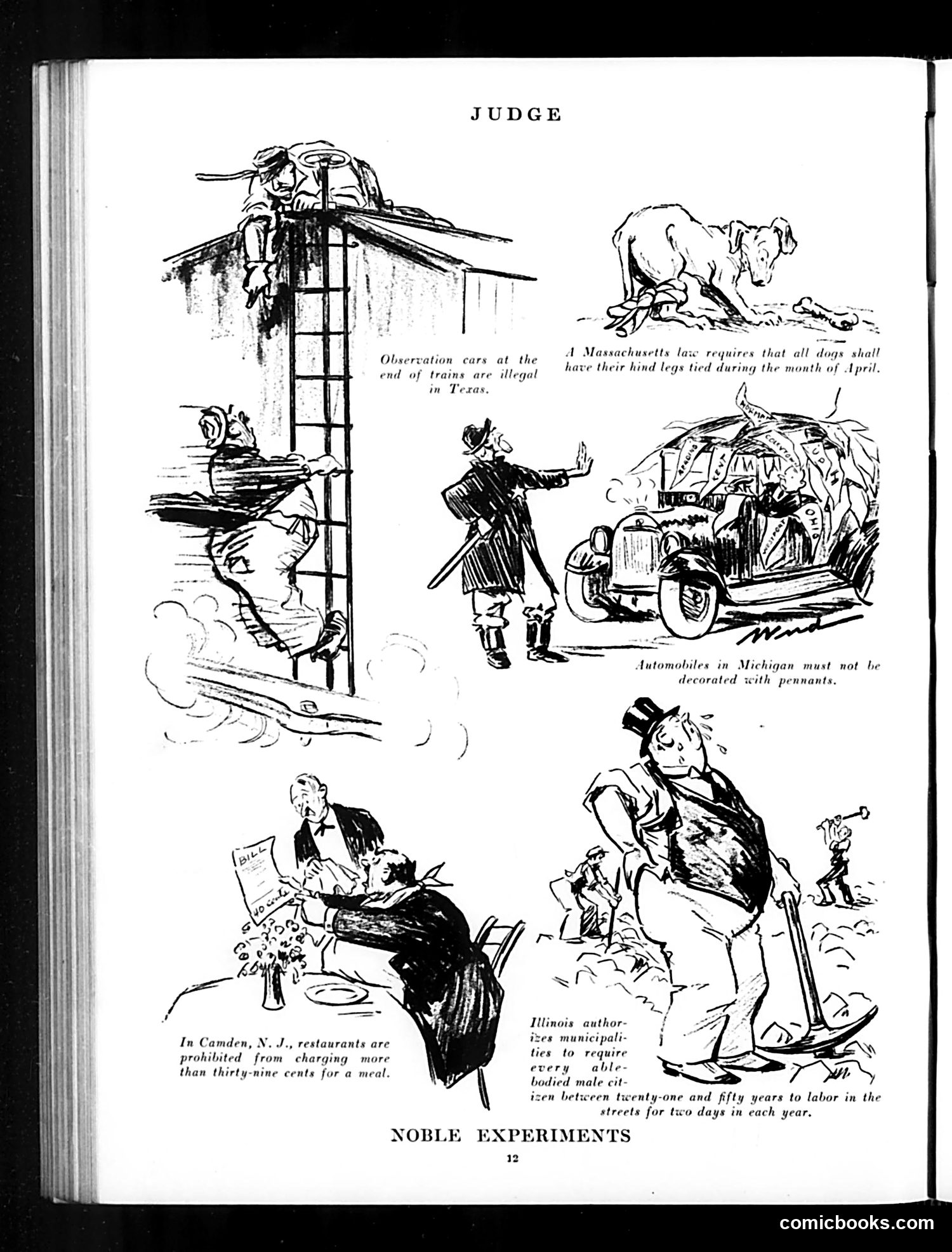
"Noble Experiments" — Judge Magazine Satire This page satirizes absurd state and local laws through cartoons paired with text descriptions. The humor targets what the magazine considers ridiculous or impractical legislation: - Massachusetts dog law: Binding hind legs in April is portrayed as nonsensical animal cruelty disguised as law - Texas train regulation: Banning observation cars seems pointlessly restrictive - Michigan automobile rule: Prohibiting pennant decoration on cars appears trivial and intrusive - Camden meal pricing: Capping restaurant prices at 39 cents is mocked as economically naive - Illinois labor requirement: Forcing able-bodied men into two days annual street labor seems feudal and oppressive The cartoons show judges and officials enforcing these laws, emphasizing their absurdity through visual exaggeration. The title "Noble Experiments" is sarcastic—these legislative attempts at social control are presented as well-intentioned but fundamentally ridiculous, typical of early 20th-century Judge's satirical stance against government overreach.
Judge Magazine Page Analysis This page from Judge magazine (circa early 1930s) contains editorial commentary on contemporary issues: "The Limit" criticizes the Hawley-Smoot Tariff Bill, citing 1,028 economists' protests. The piece argues the tariff will raise living costs, subsidize inefficiency, and harm farmers and foreign trade—yet President Hoover appears likely to sign it anyway. "Gandhi" addresses Mahatma Gandhi's arrest in India, defending him against dismissive American commentary. Citing theologian John Haynes Holmes, it argues Gandhi represents a legitimate spiritual movement for peace that Americans shouldn't ignorantly condemn. "Shortage or Surplus?" highlights contradictory claims: Dr. Julius Klein says 850,000 executives are unemployed due to mergers; personnel director Cameron Beck claims America faces a *shortage* of 125,000 executives. The satire suggests both might be true—those 850,000 jobless executives simply weren't competent enough to keep their positions. "Amateuriana" briefly notes tennis association president Louis B. Dailey's trip to Europe to protest amateur/professional distinctions in international competition.
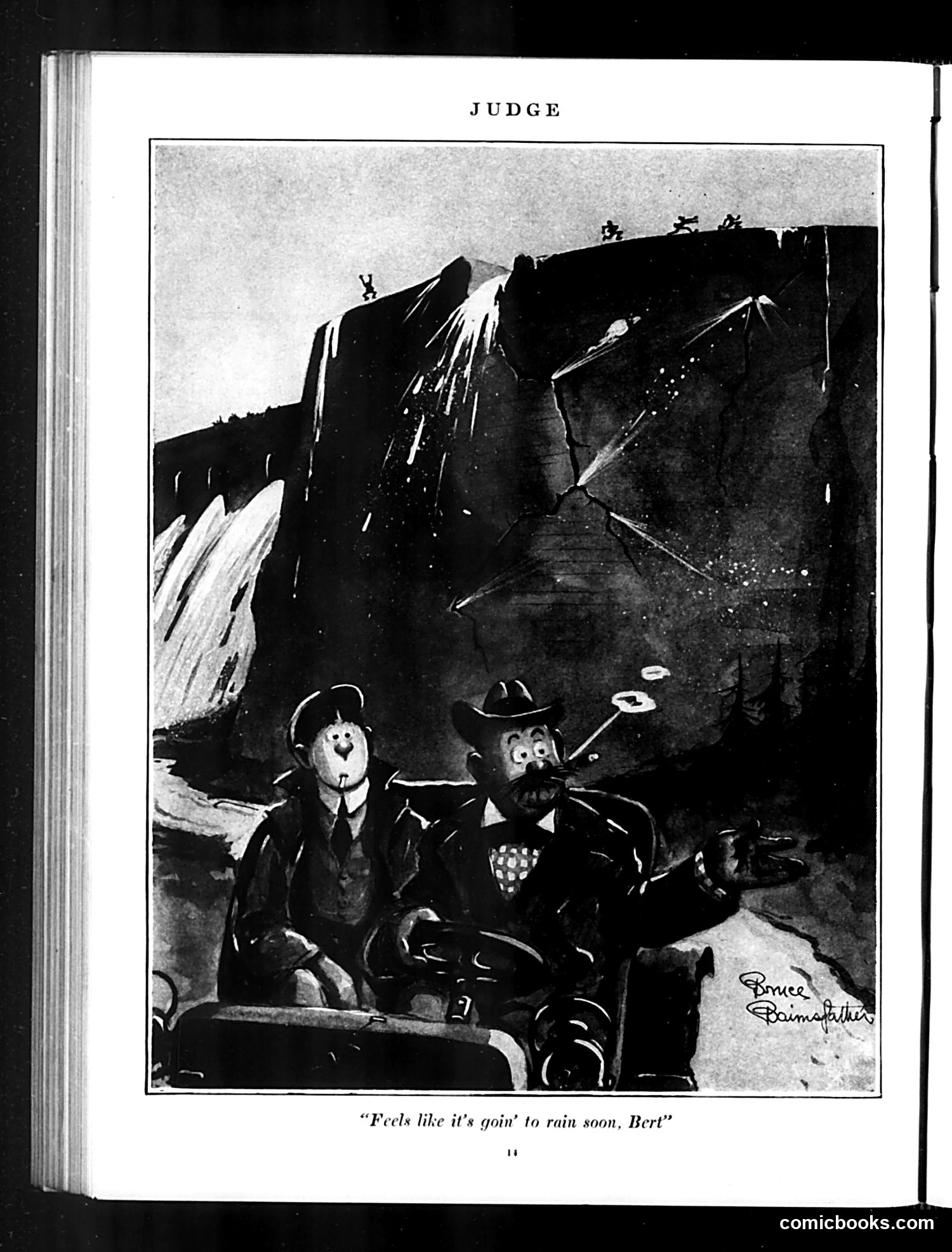
"Judge" Cartoon Analysis This cartoon depicts two anthropomorphized animal characters in formal attire examining dark, ominous storm clouds or structures looming above them. One character says to the other, "Feels like it's goin' to rain soon, Bert." The cartoon appears to be political satire using weather as a metaphor for impending danger or crisis. The characters' casual tone contrasts with the threatening imagery above, suggesting either: - Willful ignorance of approaching trouble - Darkly comic understatement about serious political/social conditions - Commentary on public complacency during tense times Without additional context about Judge's publication date or contemporaneous events, I cannot definitively identify which specific crisis or political situation this references. The style and imagery suggest early-to-mid 20th century.
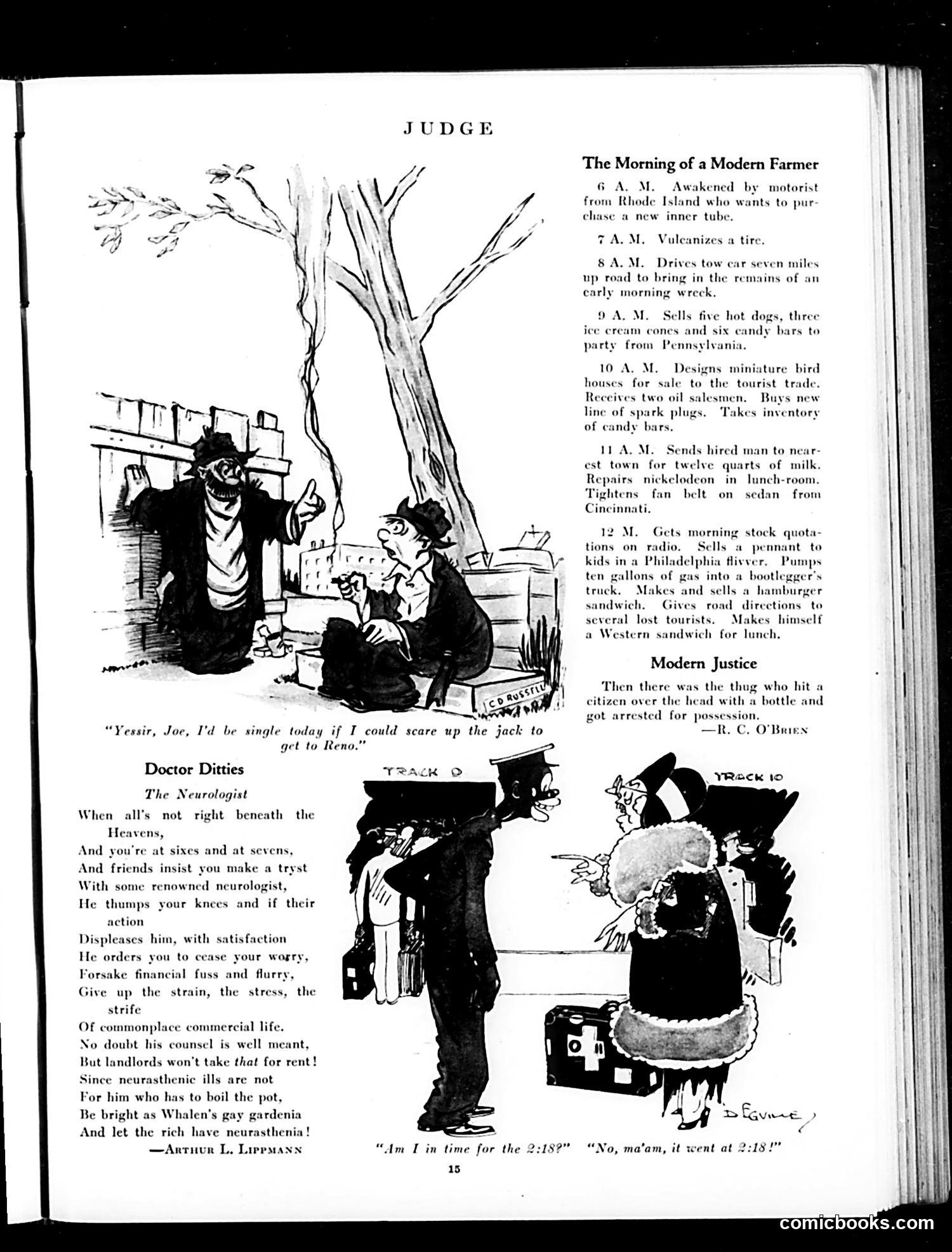
Judge Magazine Page Analysis This page satirizes early 1920s American life through three pieces: "The Morning of a Modern Farmer" mocks how rural life has been disrupted by automobiles and tourism. The "farmer" isn't farming—he's servicing cars, selling snacks to tourists, and managing a roadside lunch-room with a jukebox. The satire targets how modernization transformed rural America into a service economy dependent on motorists. "Modern Justice" is a brief, dark joke about Prohibition enforcement. A criminal arrested for "possession" (of bootleg liquor) apparently faced harsher penalties than assault, reflecting how absurdly the law prioritized alcohol prohibition over violent crime. "Doctor Ditties: The Neurologist" critiques wealthy patients consulting doctors for "neurasthenia" (a fashionable nervous condition of the affluent) while working-class people cannot afford such luxuries. The poet notes doctors' advice to "give up strain" is useless to those who "have to boil the pot"—a class commentary on who could afford wellness culture.
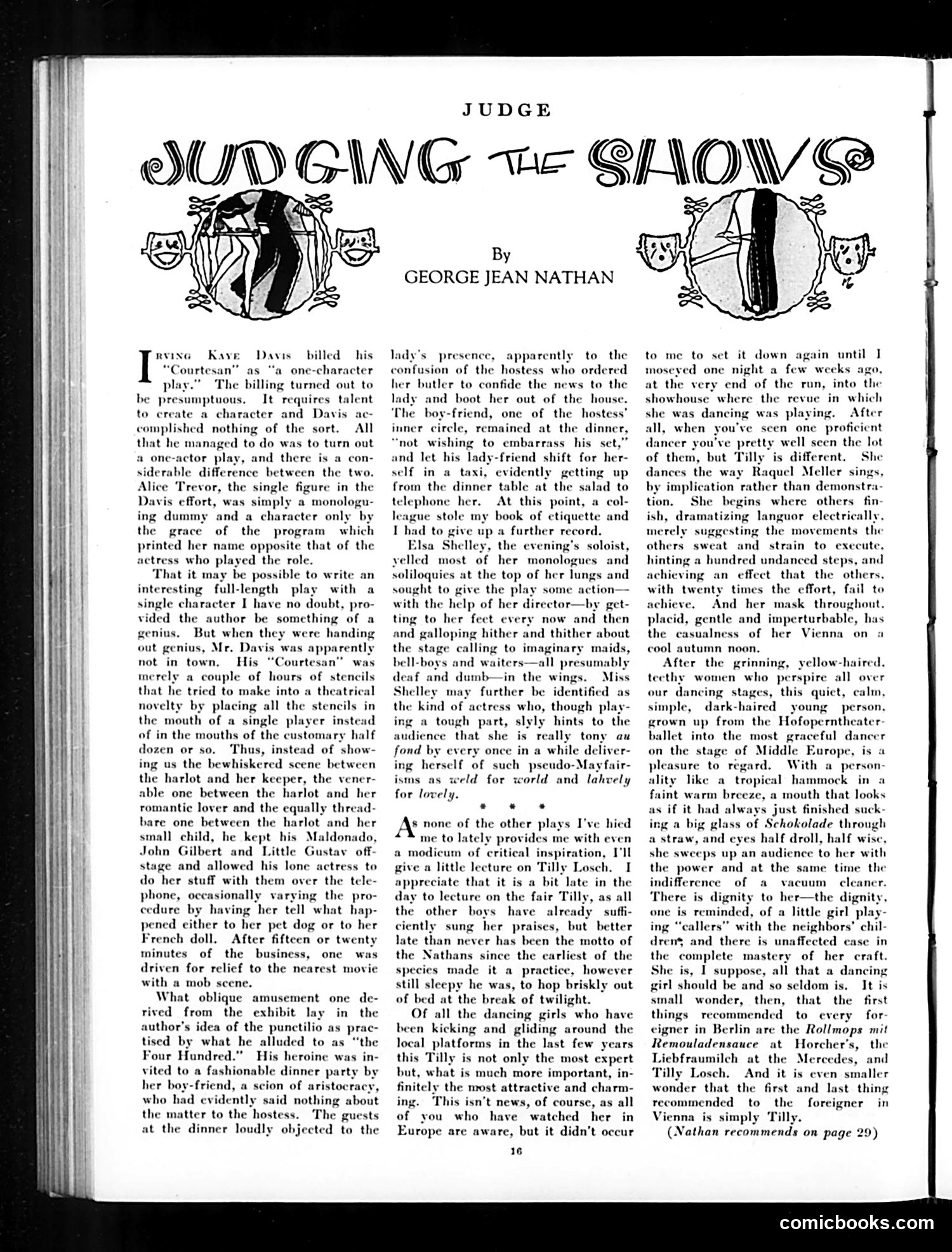
Analysis: "Judging the Shows" by George Jean Nathan This is a theater review column, not a political cartoon. Nathan critiques Irving Kaye Davis's one-character play "The Courtesan," starring Alice Trevor. Nathan argues the play is fundamentally flawed—Davis merely created a monologue vehicle rather than genuine drama. He ridicules the plot device where a courtesan is ejected from a fancy dinner party, with all action occurring offstage via telephone conversations. Nathan then pivots to praising dancer Tilly Losch, contrasting her with the mediocre production. The piece exemplifies *Judge* magazine's satirical theater criticism, mocking both pretentious modern drama and the social hypocrisy of the wealthy ("Four Hundred" society) who publicly shun women of questionable morals while privately consorting with them. The review's humor relies on Nathan's acerbic voice and theatrical inside knowledge—accessible to *Judge's* educated, culturally engaged readership.
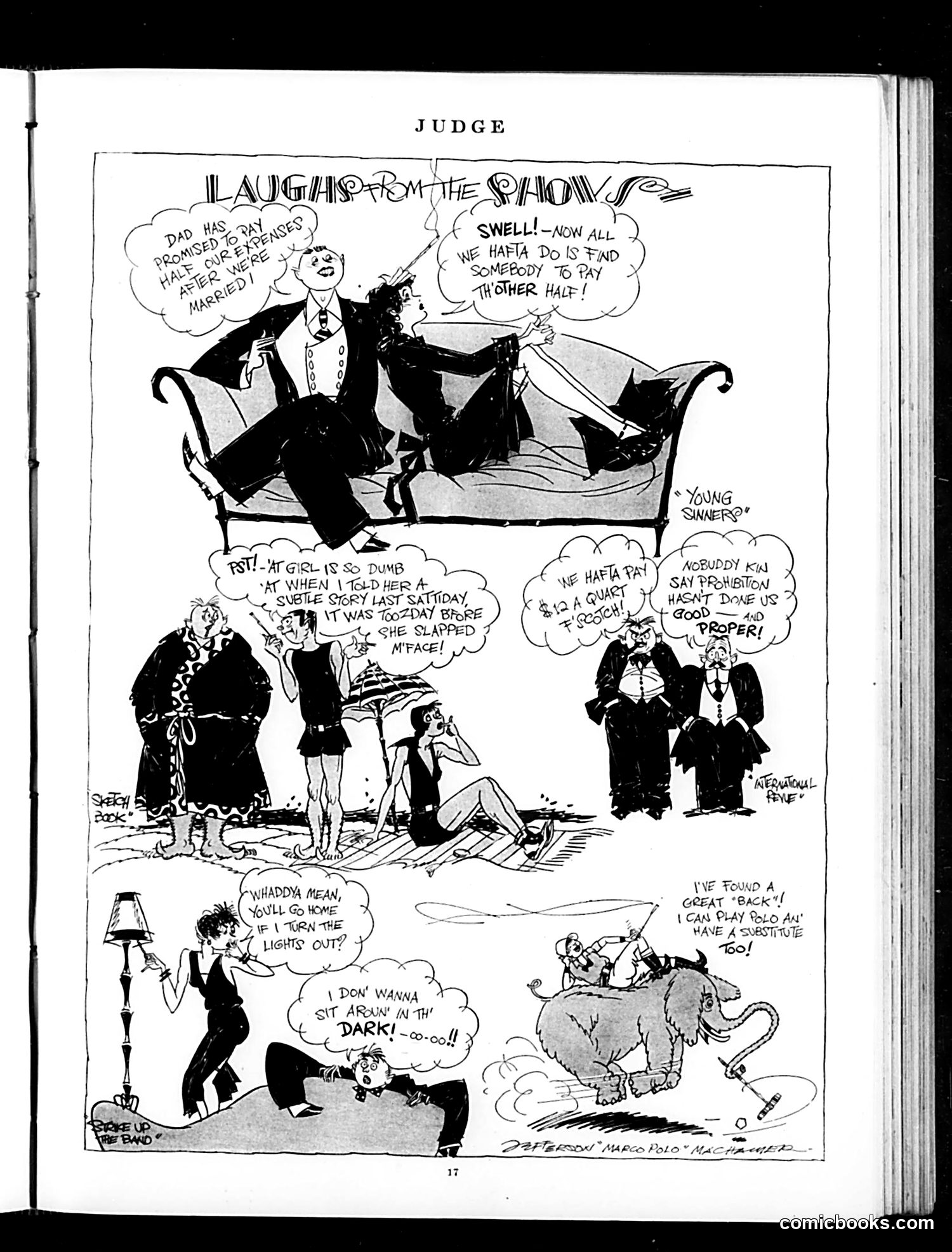
Judge Magazine Cartoon Analysis This is a multi-panel satirical comic about Prohibition (the ban on alcohol, 1920-1933). The humor centers on people's creative schemes to circumvent the law. The top panel shows newlyweds discovering one spouse hid debts; the joke is they must "find somebody to pay the other half"—a dark reference to financial troubles. Lower panels depict various Prohibition-era workarounds: a woman mentions a "back" (illegal speakeasy), men discuss paying "$12 a quart" for bootleg liquor, and characters reference finding substitutes. One panel shows someone refusing to "sit around in the dark"—suggesting people desperately sought entertainment despite the ban. The final image of someone on a polo-playing elephant appears to represent absurd, frivolous behavior enabled by illegal alcohol. The satire mocks how pervasive Prohibition evasion had become in everyday life, with characters casually discussing illegal alcohol consumption and the desperation people felt to maintain social activities.
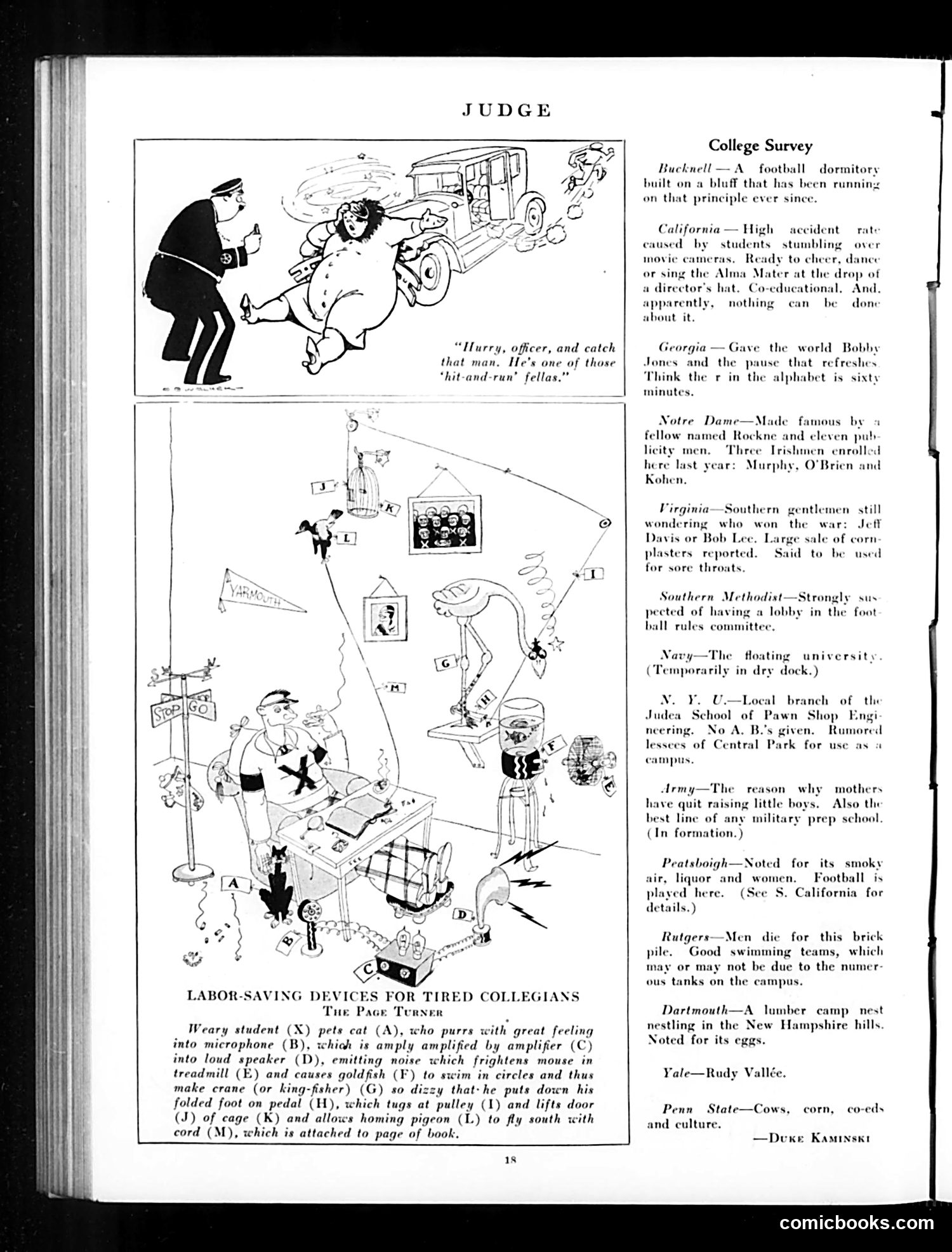
Judge Magazine Page Analysis This page contains two satirical sections typical of 1920s-30s humor magazines. The top cartoon mocks "hit-and-run" drivers—a growing traffic menace of the era. A policeman chases a rotund man fleeing a car accident, characterizing reckless drivers as cowardly criminals who abandon accident scenes. The "Labor-Saving Devices for Tired Collegians" is an absurdist contraption cartoon. It ridicules lazy college students by depicting an elaborate Rube Goldberg-style chain reaction: a student pets a cat, whose purr amplifies through speakers, frightening a mouse, spinning a fish, dizzying a crane, triggering pulleys and doors, ultimately releasing a pigeon to turn a textbook page. The satire: students invent impossibly complicated schemes to avoid simple work. The "College Survey" section provides snide one-liners about various universities—their reputations, notable alumni (Bobby Jones at Georgia, Rockne at Notre Dame), social characteristics, and stereotypes (Yale's connection to crooner Rudy Vallée; Penn State's agricultural focus). This reflects contemporary collegiate culture and inter-school rivalries.
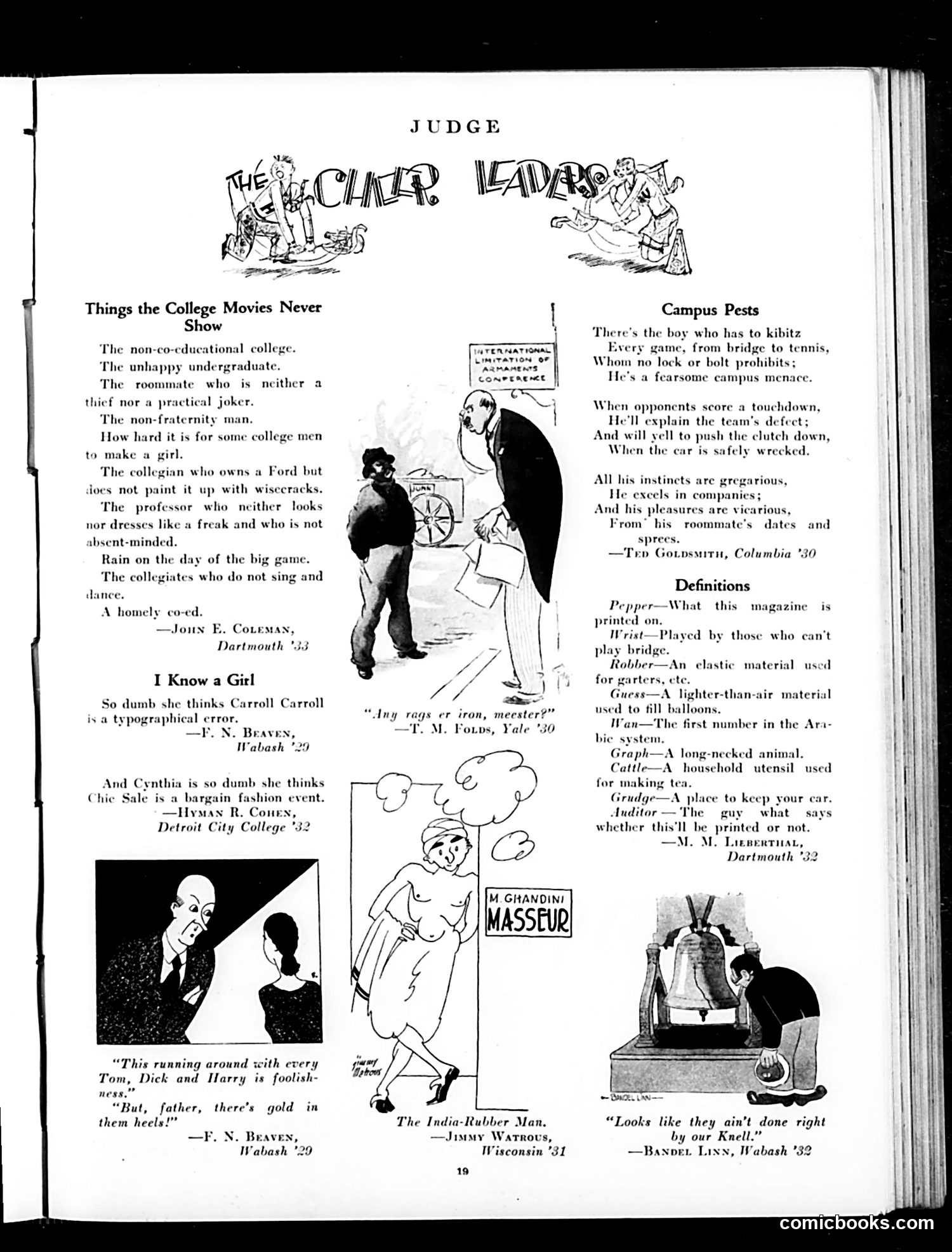
This Judge magazine page satirizes college life through humorous observations and cartoons. The main sections mock what Hollywood college films omit—depicting realistic campus life rather than glamorous stereotypes. "Things the College Movies Never Show" lists unglamorous truths: unhappy students, non-fraternity men, and rainy game days, contrasting with cinema's sanitized portrayals. The "I Know a Girl" section uses puns to mock female students' intelligence (Carroll Carroll as a typo; Chic Sale as fashion). "Campus Pests" describes annoying student archetypes—the kibitzer who comments on everything, the backseat driver. The cartoons include an "India-Rubber Man" (a contortionist reference) and a "Masseur" examining someone, plus a bell-themed joke about incompetent service ("Knell" suggesting failure). The "Definitions" section provides absurdist wordplay typical of college humor magazines, where terms are humorously redefined. Overall, the page represents 1920s-30s collegiate humor—self-deprecating jokes about student life for a college-educated readership.
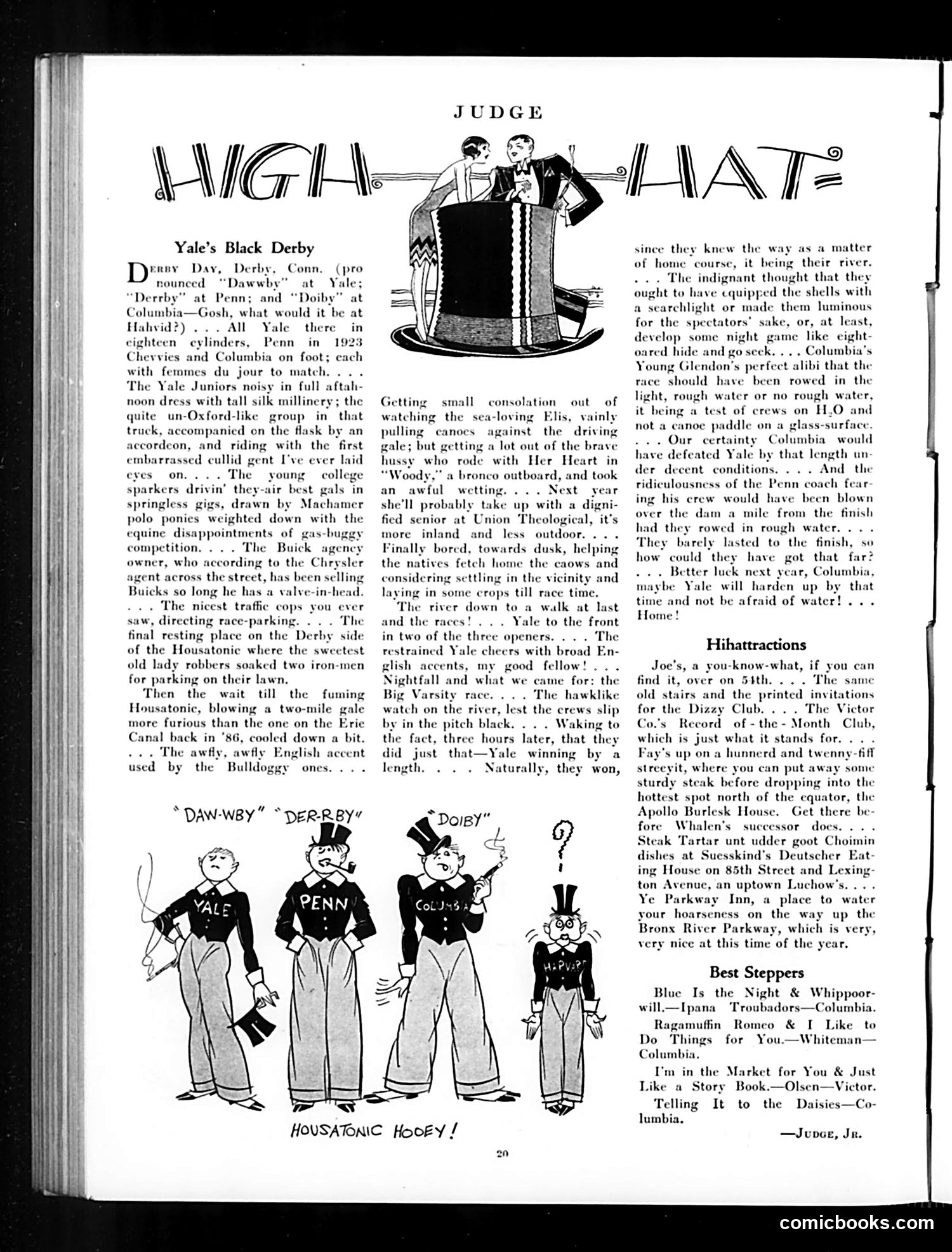
High Hat: Yale's Boat Race This page mocks the pretensions of elite college rowing competitions, specifically Yale's Black Derby race on the Housatonic River. The satirist chronicles the event with exaggerated attention to the social performance surrounding it—Yale students arriving in expensive cars with dates, wearing formal dress; Columbia students arriving on foot; Penn in Chevrolets. The joke centers on rowing crews taking themselves too seriously despite incompetent execution. Yale wins their race, but only because they knew their home river—hardly a triumph of skill. The author ridicules the idea that Columbia should have won under "decent conditions" and mocks spectators watching in darkness, unable to see the actual race. The four caricatured mascots at bottom ("Dawwby," "Der-rby," "Doiby," and an unnamed fourth) represent each school's affected pronunciation of "Derby." The satire targets upper-class college culture's empty ritualism and snobbery.
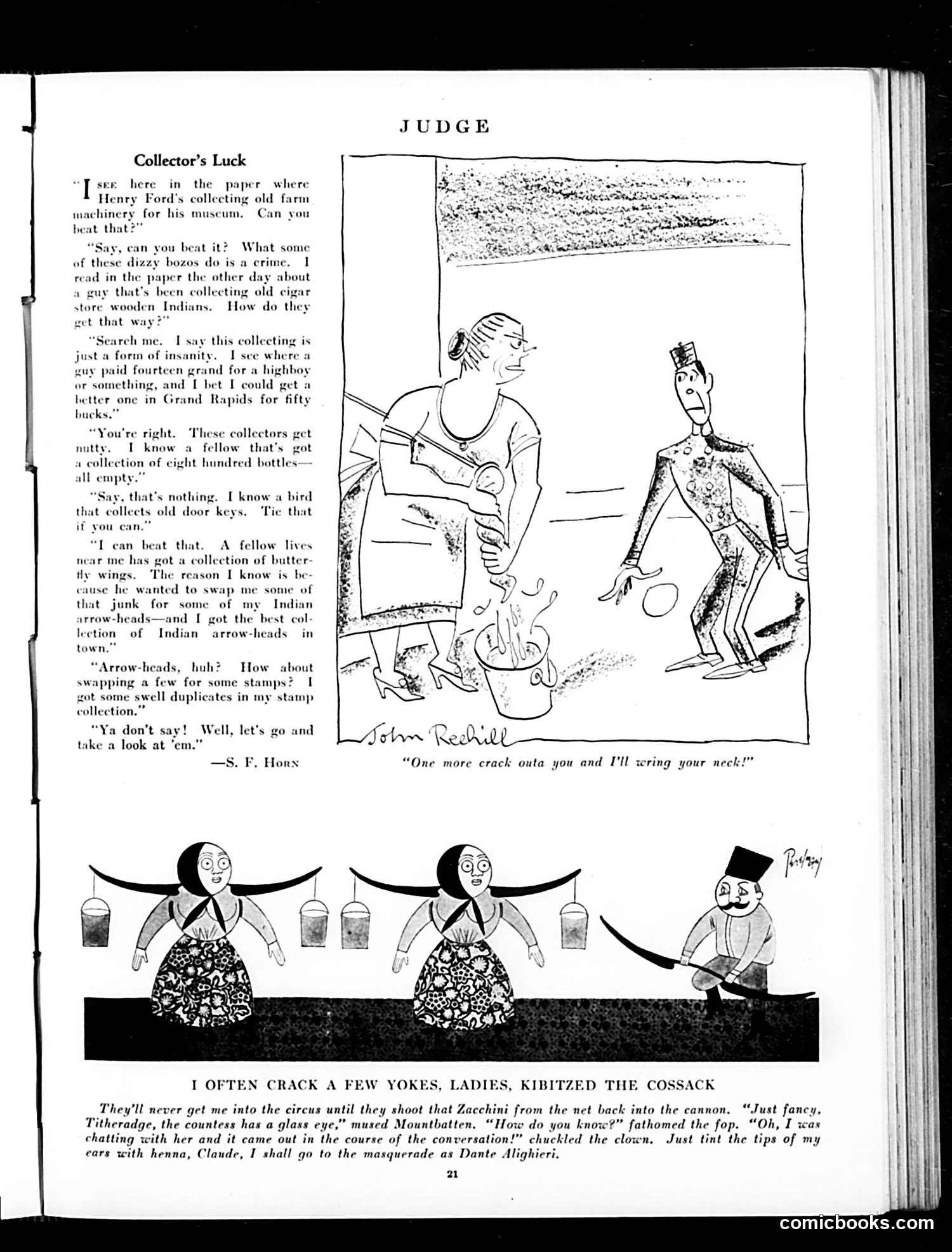
Explanation for Modern Readers "Collector's Luck" (top) satirizes the obsessive hobby of collecting. The dialogue mocks wealthy collectors—referencing Henry Ford's real museum acquisitions—by escalating absurd examples: old farm machinery, cigar store wooden Indians, expensive furniture, empty bottles, door keys, butterfly wings, and arrowheads. The joke is that collecting anything becomes ridiculous when taken to extremes, and collectors will trade their hoards for other people's collections, perpetuating pointless accumulation. Bottom cartoon appears unrelated, featuring exaggerated characters (likely circus performers or society figures) in absurdist humor involving a cannon performer (Zacchini was a famous "Human Cannonball"), a countess with a glass eye, and references to masquerade costume. The humor relies on period-specific celebrity knowledge and vaudeville/circus references now obscure to modern audiences. Both exemplify Judge magazine's satirical approach to contemporary American consumer culture and high society pretensions.
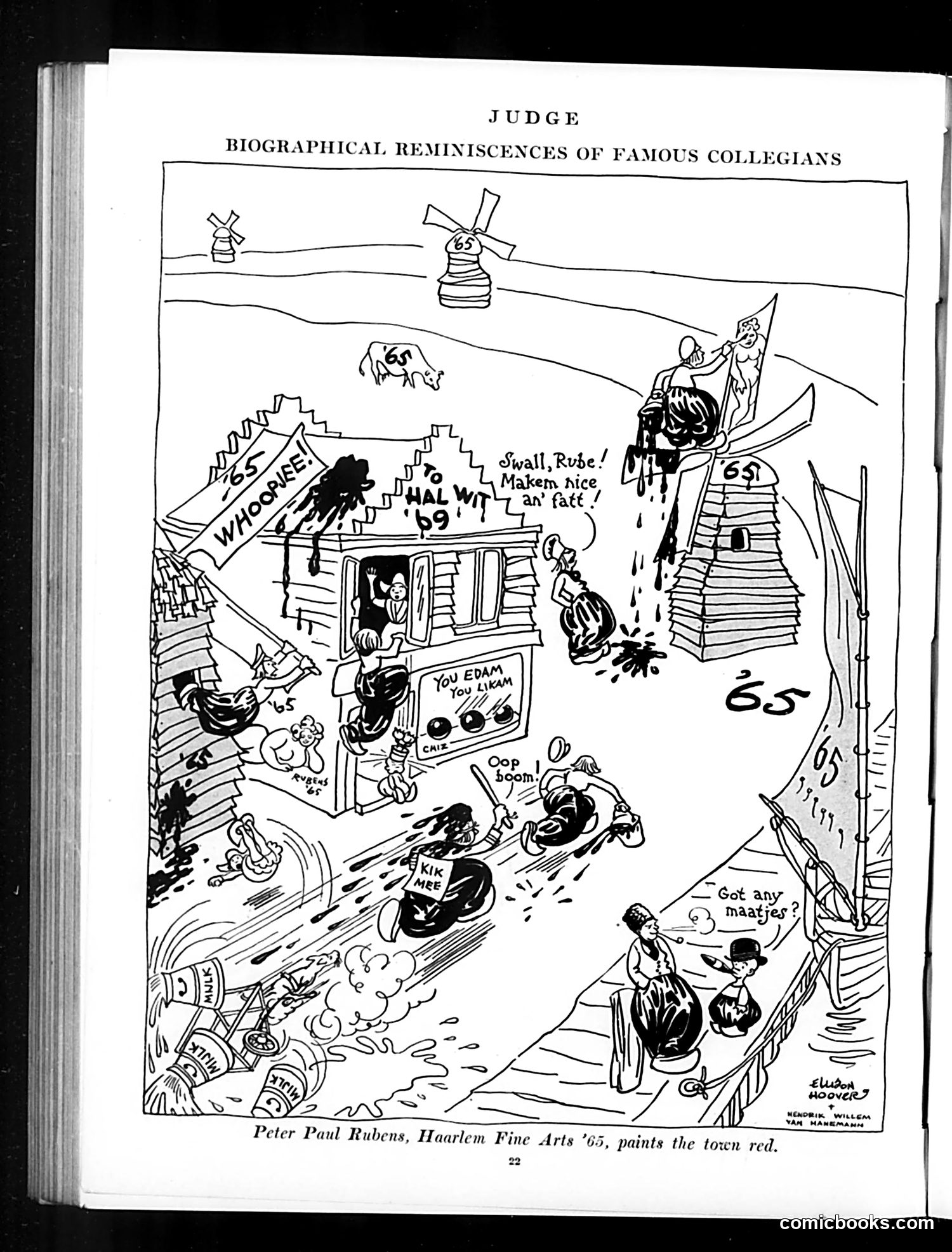
Cartoon Analysis This cartoon depicts Peter Paul Rubens, the famous Flemish Baroque painter, as a character from Haarlem Fine Arts class of 1965, "painting the town red" (a phrase meaning to celebrate wildly). The satire plays on Rubens's historical association with depicting voluptuous, full-figured women—a style now called "Rubenesque." The cartoon shows him causing chaos in what appears to be a Dutch town with windmills, featuring various figures in comedic situations with dialogue like "Swall, Rube! Makern nice an' fatt!" The joke mocks both the classical artist's aesthetic preferences and likely pokes fun at the students or art world of 1965. The chaotic scene—with motorcycles, explosions, and general mayhem—contrasts humorously with the refined reputation of the Renaissance master, suggesting modern college students invoking his name while behaving outrageously. The artist is credited as Eliseo Hoover with publication information for *Judge* magazine.
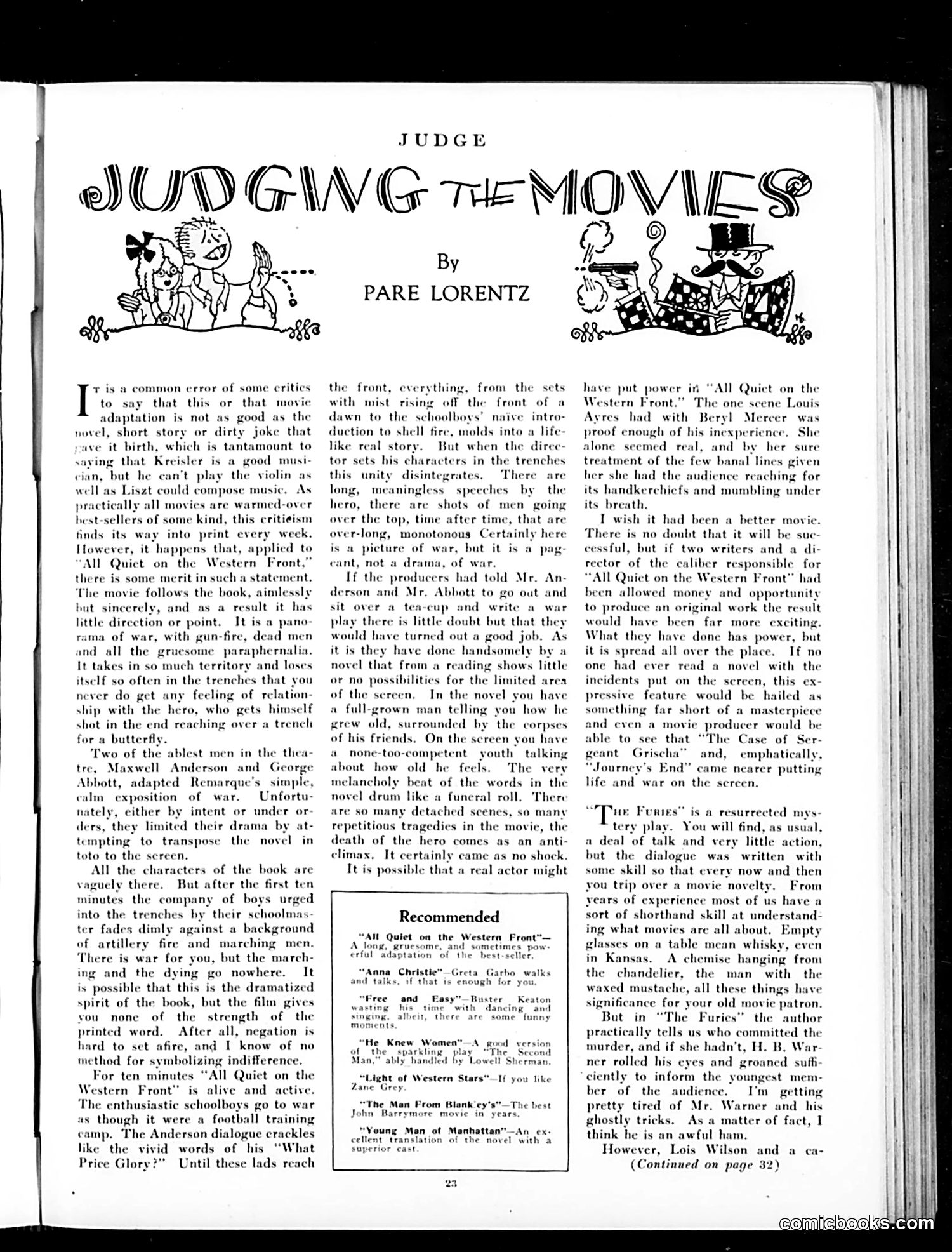
Judge Magazine Movie Review: "All Quiet on the Western Front" This is a film criticism essay, not a political cartoon. Pare Lorentz reviews the 1930 film adaptation of Erich Maria Remarque's anti-war novel. Lorentz argues the movie fails despite competent direction by Maxwell Anderson and George Abbott. The film faithfully reproduces the novel's content but loses its emotional impact—converting a powerful literary indictment of war into a meandering "pageant" rather than drama. The opening scenes grip viewers with schoolboys' naive enthusiasm for combat, but once in the trenches, the narrative dissolves into repetitive, lengthy battle sequences that numb rather than move audiences. Lorentz criticizes the filmmakers for attempting direct translation rather than adaptation, suggesting a fresh theatrical approach would have succeeded better. The "Recommended" box lists other current films for comparison.
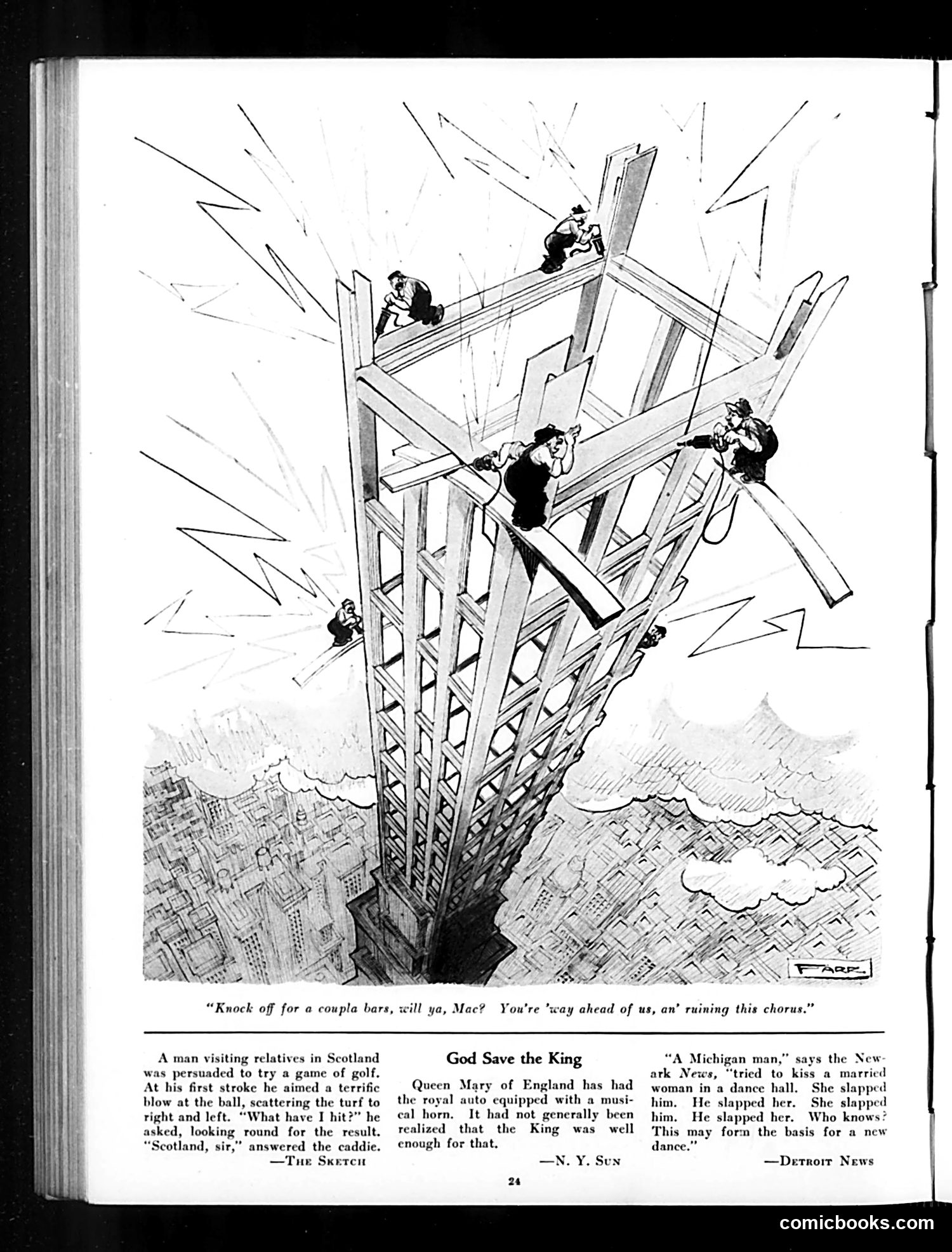
Judge Magazine Page Analysis This page contains three separate humor items typical of early 20th-century Judge magazine: Main Cartoon (top): A dramatic illustration showing workers precariously positioned on a tall steel framework above a city, with one worker asking another to "knock off for a coupla bars" to stop "ruining this chorus." The satire likely mocks either labor conditions, workplace safety hazards, or the interruption of leisure/music by work demands. "God Save the King" (center): A brief joke noting Queen Mary of England had a musical horn installed in the royal automobile—the humor being that the King was "well enough" for this frivolous addition, a subtle jab at royal excess or indulgence. "Michigan Man" (right): A humorous anecdote about a man and woman slapping each other repeatedly in a dance hall after an unwanted kiss, with the punchline suggesting their mutual violence might become a new dance trend—satire on either courtship customs or the absurdity of fad dances. All three items reflect Judge's satirical commentary on contemporary society, labor, royalty, and social behavior.
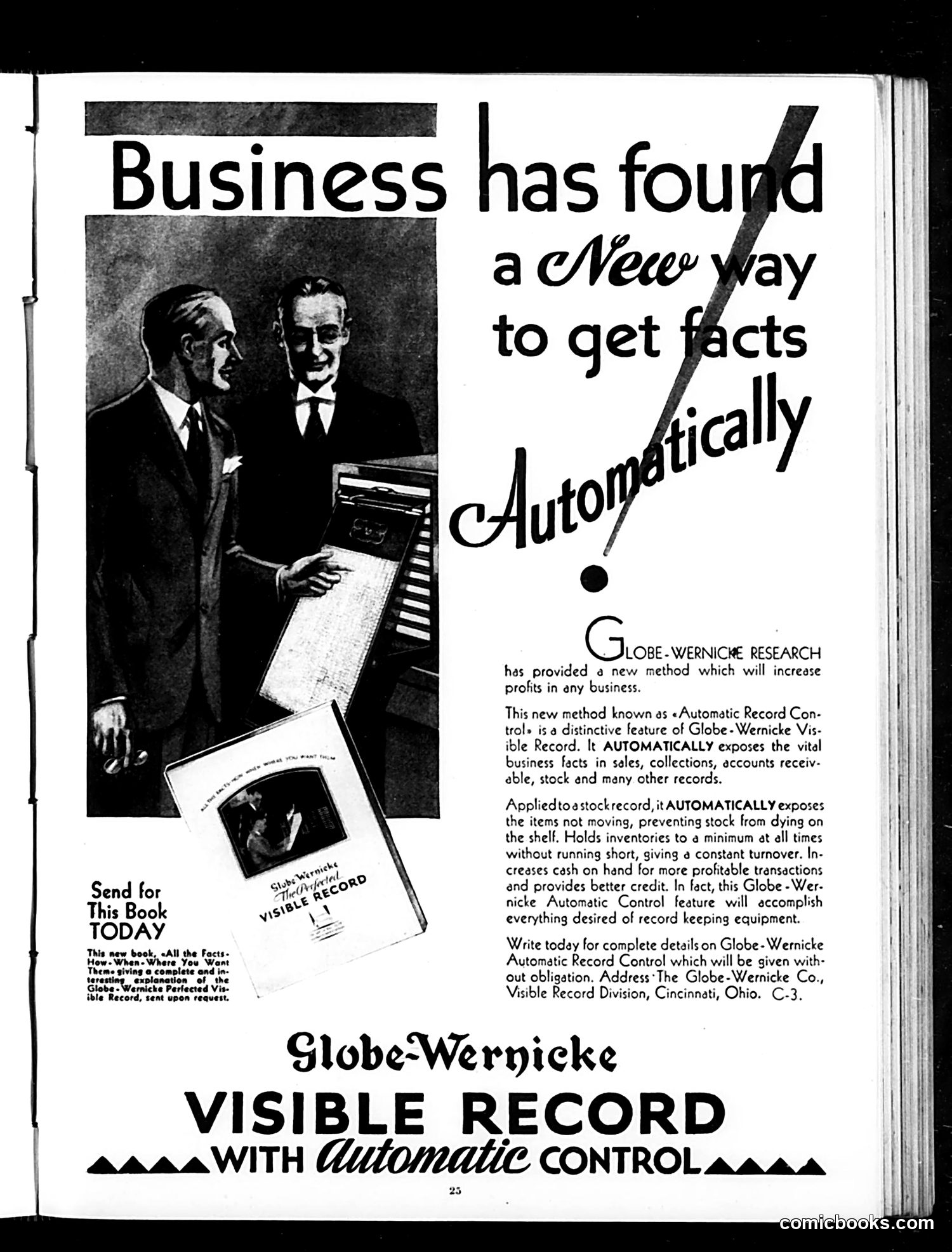
Analysis This is primarily a business advertisement, not political satire. It promotes Globe-Wernicke's "Visible Record" filing system with "Automatic Control" features. The image shows two businessmen examining a visible record card system. The ad's appeal is straightforward: the automatic system "exposes" slow-moving inventory and accounts receivable data without manual work, preventing dead stock and improving cash flow. For modern readers: this represents early 20th-century office technology—essentially an automated card catalog system that made data visible at a glance. The "automatic" feature was genuinely innovative for the era, offering what we'd now call basic data management. The ad emphasizes profit optimization through systematic record-keeping, a selling point that remains relevant today, though the technology is now digital rather than mechanical card systems. There is no political cartoon or satire on this page—it's straightforward commercial advertising from Judge magazine's business section.
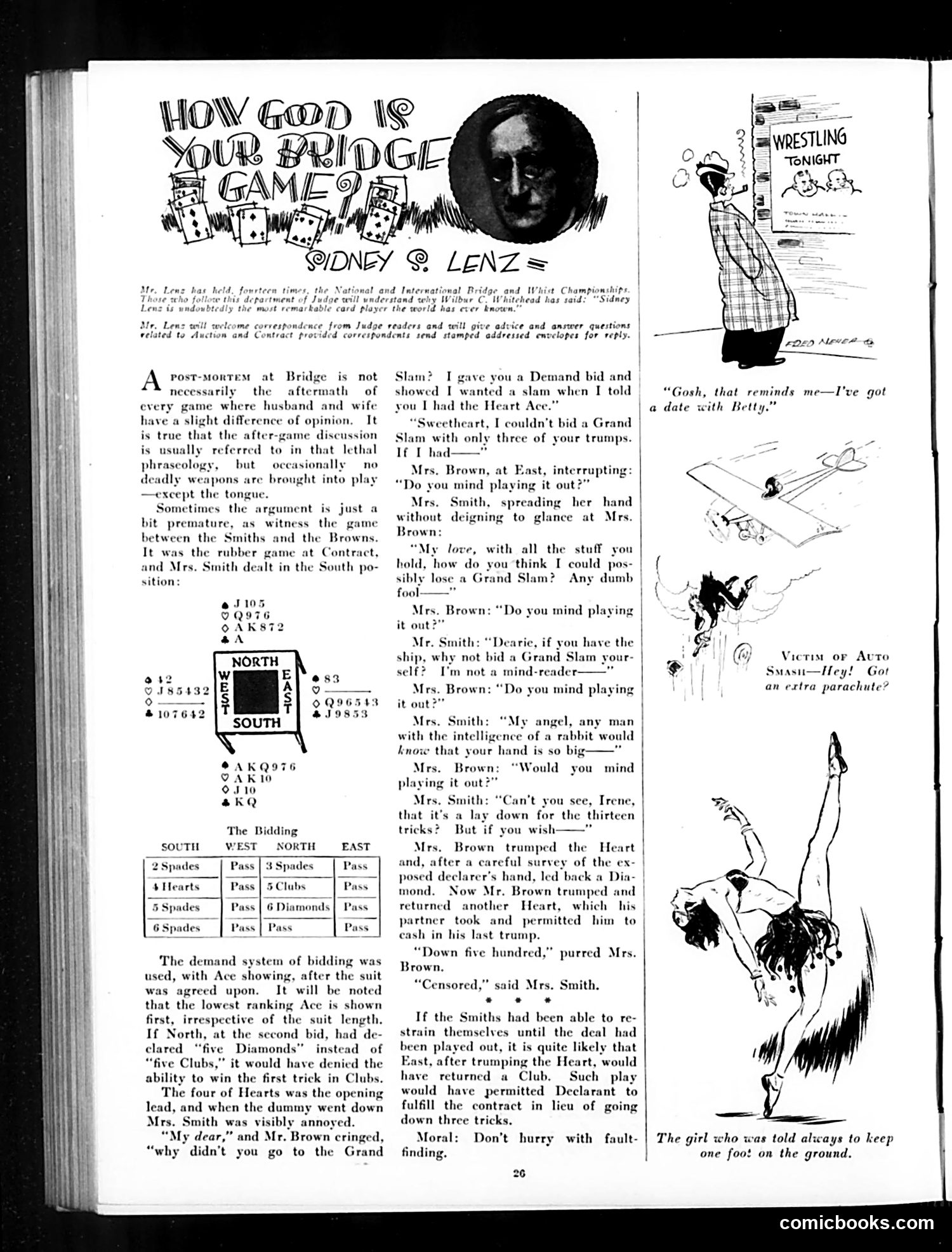
Analysis for Modern Readers This page from *Judge* magazine satirizes the social dynamics of contract bridge, a popular card game among upper-middle-class Americans in the 1920s-30s. The main cartoon depicts a marital argument during a bridge game between the Smiths and Browns. Mrs. Smith (dealer) becomes visibly annoyed with her husband's bidding strategy, sparking escalating passive-aggressive exchanges where she repeatedly asks opponents "Do you mind playing it out?"—implying they're wasting time with poor play. The satire targets how bridge games expose marital tensions: spouses publicly criticize each other's intelligence ("any dumb fool," "intelligence of a rabbit"), with Mrs. Smith's condescension masked as sweetly insulting terms of endearment ("My dear," "My angel"). The technical bidding discussion adds specificity—the humor assumes readers understand contract bridge conventions. The moral warns against premature fault-finding, though ironically, Mrs. Smith's criticism proves correct when the hand goes down five hundred points. The side cartoons mock other mishaps, maintaining the magazine's satirical tone about leisure-class life.
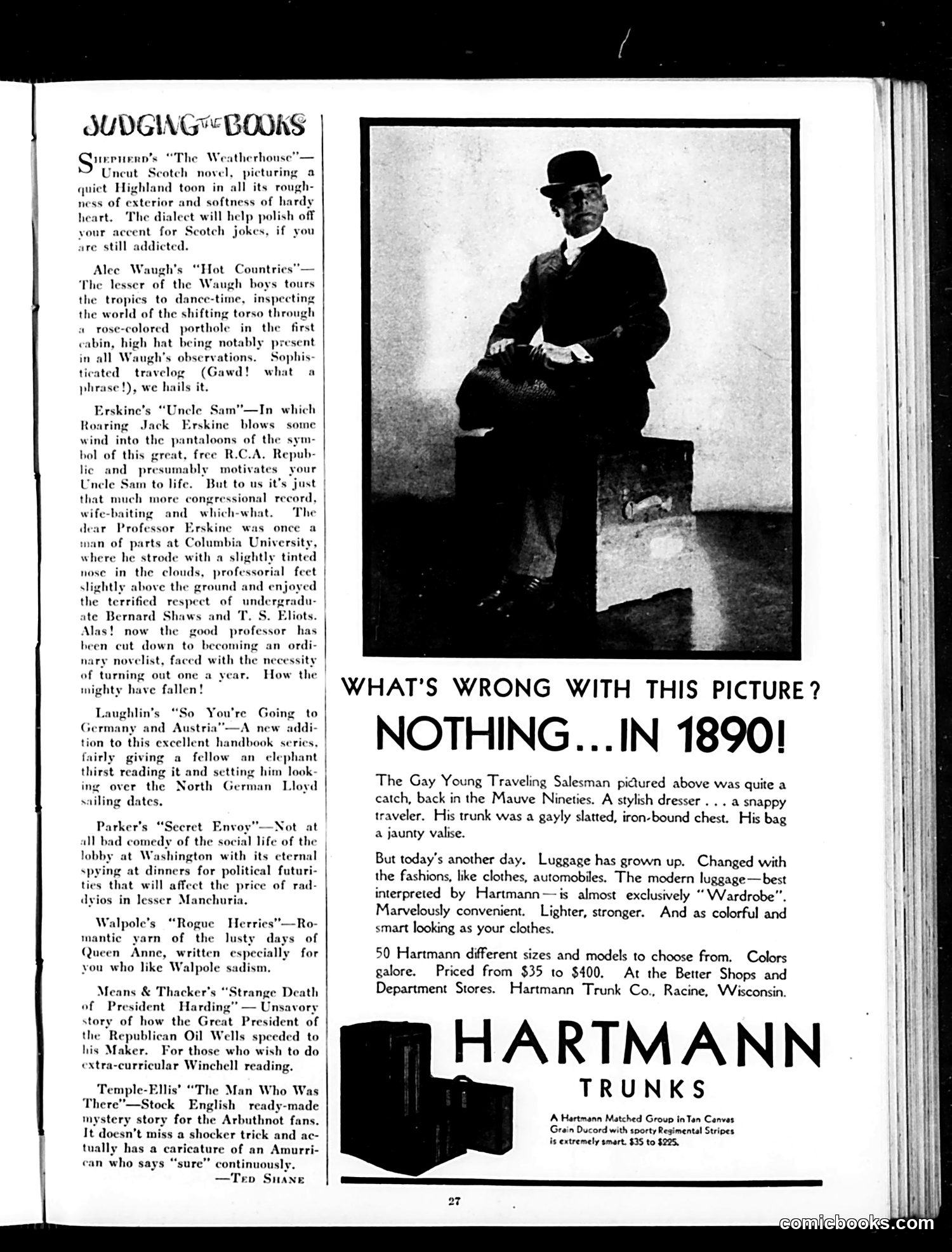
"Judging the Books" and the Hartmann Luggage Advertisement This page combines a literary review column with a full-page advertisement. "Judging the Books" (left) is a satirical column reviewing contemporary novels by authors like Alec Waugh and John Erkskine. The tone is witty and dismissive—mocking writers who've compromised their artistic ambitions (Erskine is described as a fallen Columbia professor now churning out novels yearly). The reviews use slang and sarcastic asides typical of Judge's irreverent style, aimed at educated readers familiar with these middlebrow authors. The Hartmann Trunks advertisement (right) uses a clever rhetorical device: it presents a 1890s-era traveling salesman in formal dress with old-fashioned luggage, then asks "What's Wrong With This Picture?" The answer: nothing in 1890, but today luggage has evolved. The ad positions modern Hartmann luggage as fashionable and functional—keeping pace with automobiles and changing fashion. This reflects 1920s consumer culture's embrace of modernization and planned obsolescence.
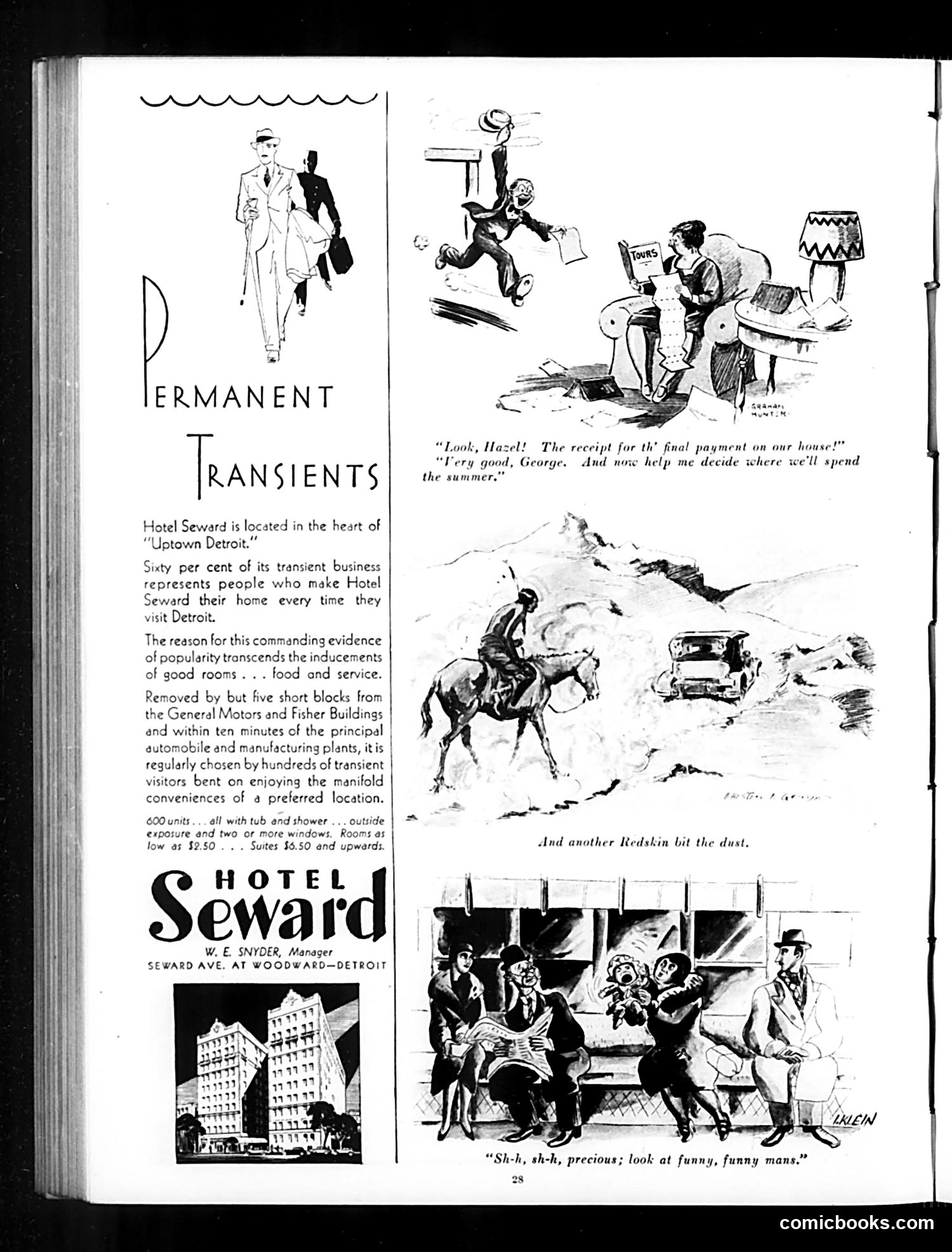
Analysis for Modern Readers This page combines a hotel advertisement with period humor cartoons. The "Permanent Transients" heading advertises Hotel Seward in Detroit, emphasizing its appeal to traveling businesspeople (particularly those visiting the automotive industry). The cartoons depict domestic and leisure scenarios typical of 1920s-30s American middle-class life: a couple celebrating paying off their house mortgage, then debating summer vacation plans; a Western scene with a cowboy and Native American; and a couple at what appears to be a theater or public venue with a child. The humor relies on observational comedy about relationships and social situations rather than explicit satire. The "Redskin" reference and the depiction of Native Americans reflect the casual, dehumanizing language and stereotyping common in this era's entertainment—considered acceptable then but recognized today as offensive. The overall page mixes commercial promotion with light entertainment typical of Judge magazine's format.
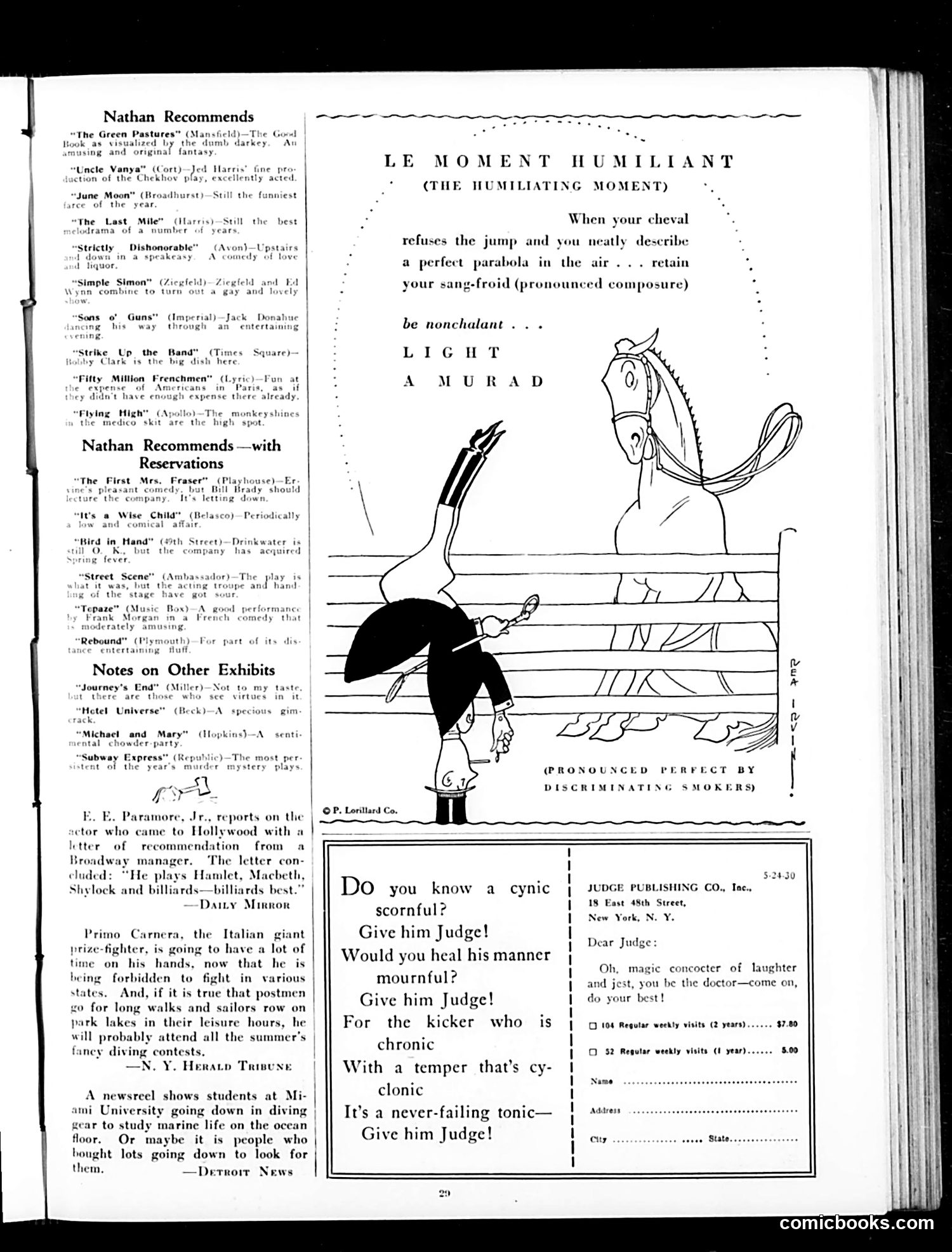
Analysis of Judge Magazine Page (circa 1928-1930) This page primarily features Nathan Recommends, a theater review column recommending Broadway shows. The main illustration depicts an embarrassing equestrian moment: a rider has failed to make a horse jump and is flying over the fence in an ungainly arc—what the French phrase "le moment humiliant" calls "the humiliating moment." The cartoon satirizes social pretension by contrasting the rider's attempted composure ("sang-froid") with obvious physical failure. The accompanying cigarette advertisement for "Light a Murad" adds dark humor to the embarrassment theme. The page also includes a humorous advertisement for Judge magazine itself, using a poem about curing cynicism and bad temper by reading Judge—essentially satirizing the magazine's own curative powers as entertainment. The remaining content consists of theater reviews, notes on other exhibits, and brief entertainment gossip, typical of Judge's satirical magazine format targeting educated urban audiences interested in Broadway and popular culture.
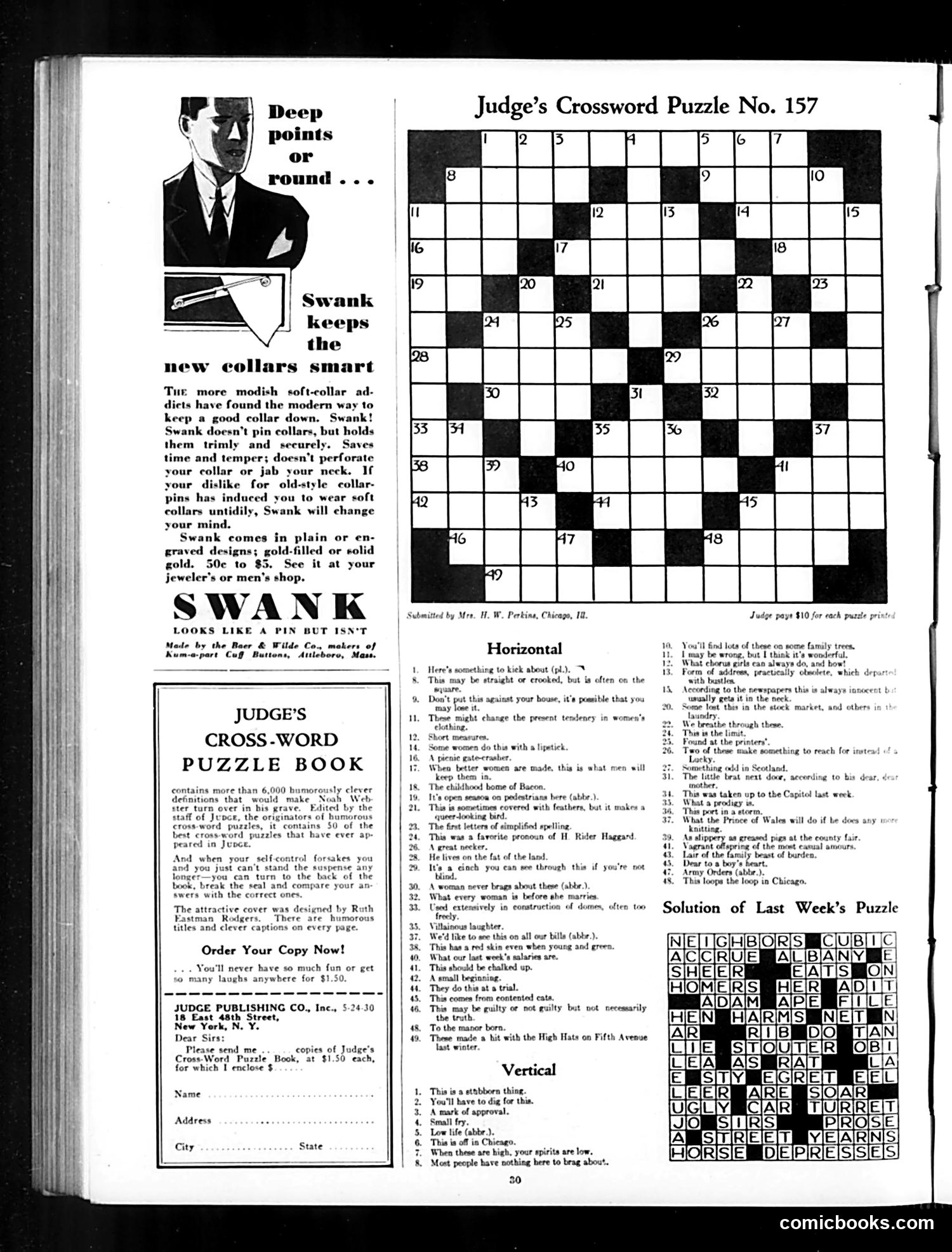
Judge Magazine Page Analysis This page is primarily advertising and puzzle content, not political satire. The top features a Swank collar ad—a commercial for a men's fashion product (a pin-like device for holding soft collars). The illustration shows a well-dressed businessman; the copy appeals to modern male vanity by positioning Swank as superior to old-fashioned collar pins. Below is a Judge's Crossword Puzzle Book advertisement promoting a $1.50 book of 50 puzzles from Judge Publishing Co., followed by the actual crossword puzzle No. 157 and its clues. The humor in the crossword clues is mild, contemporary wordplay reflecting 1920s-30s American life—references to chorus girls, pedestrians, stock market losses, and the Prince of Wales. The final page shows the solution to the previous week's puzzle. No political figures or satire are present. This is commercial content typical of Judge magazine's business model: advertisements interspersed with puzzles and entertainment.
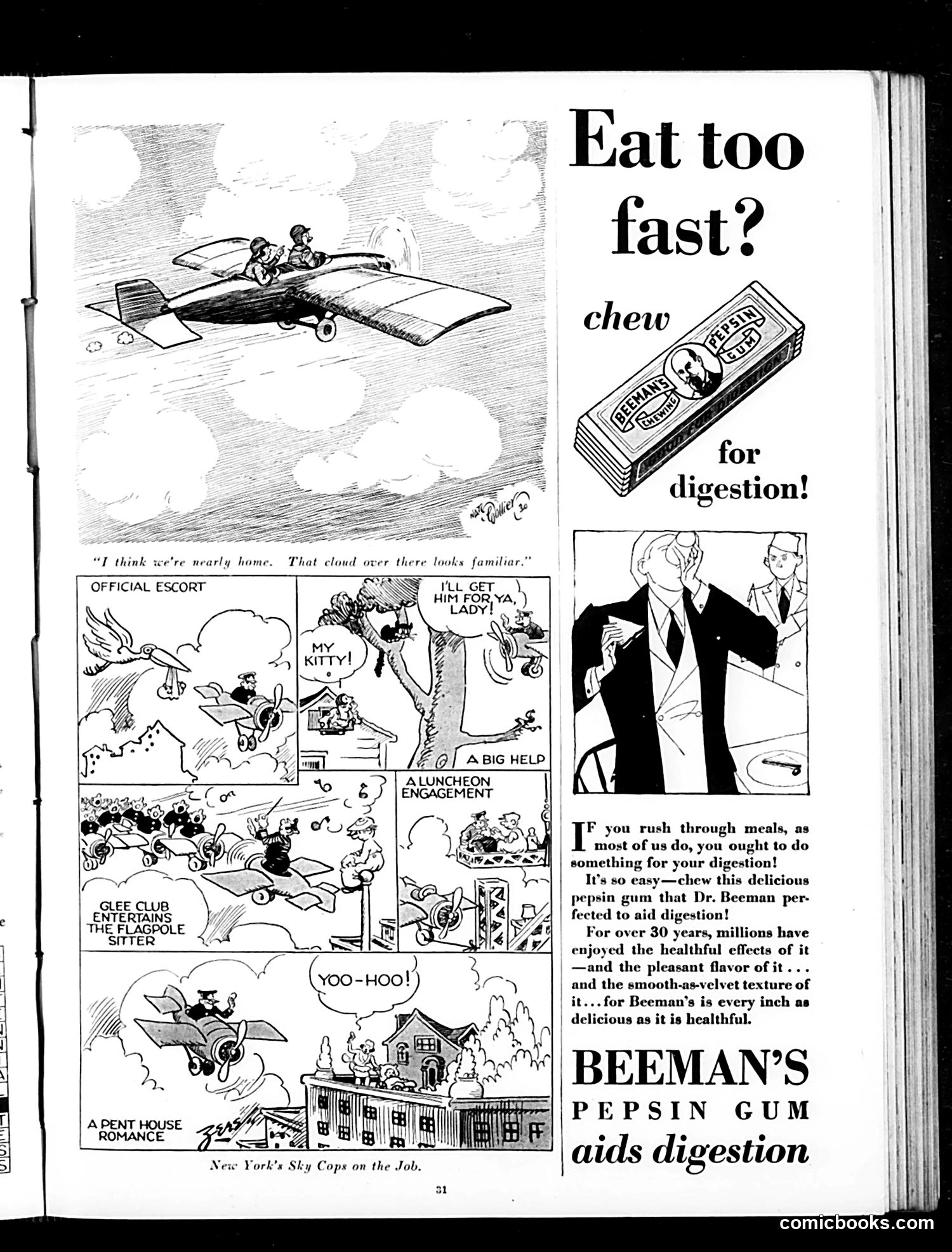
Political Cartoon & Advertisement Analysis This page combines a comic strip with advertising. The strip, titled "New York's Sky Cops on the Job," depicts early aviation scenarios with humorous situations—an official escort, a lunch engagement, a glee club entertaining, and a "dent house romance." The cartoons satirize the novelty and chaos of early airplane travel, showing collision risks and absurd interactions in this new technology. The adjacent advertisement for Beeman's Pepsin Gum addresses a real concern: fast eating and poor digestion. It capitalizes on modern lifestyle anxieties by marketing gum as a digestive aid, claiming 30 years of success. The product promised to solve digestive issues caused by rushed meals—a relatable problem during this era of increasing work pace and mobility. Both elements reflect early-20th-century American culture: fascination with aviation technology and anxiety about modern living's health effects.
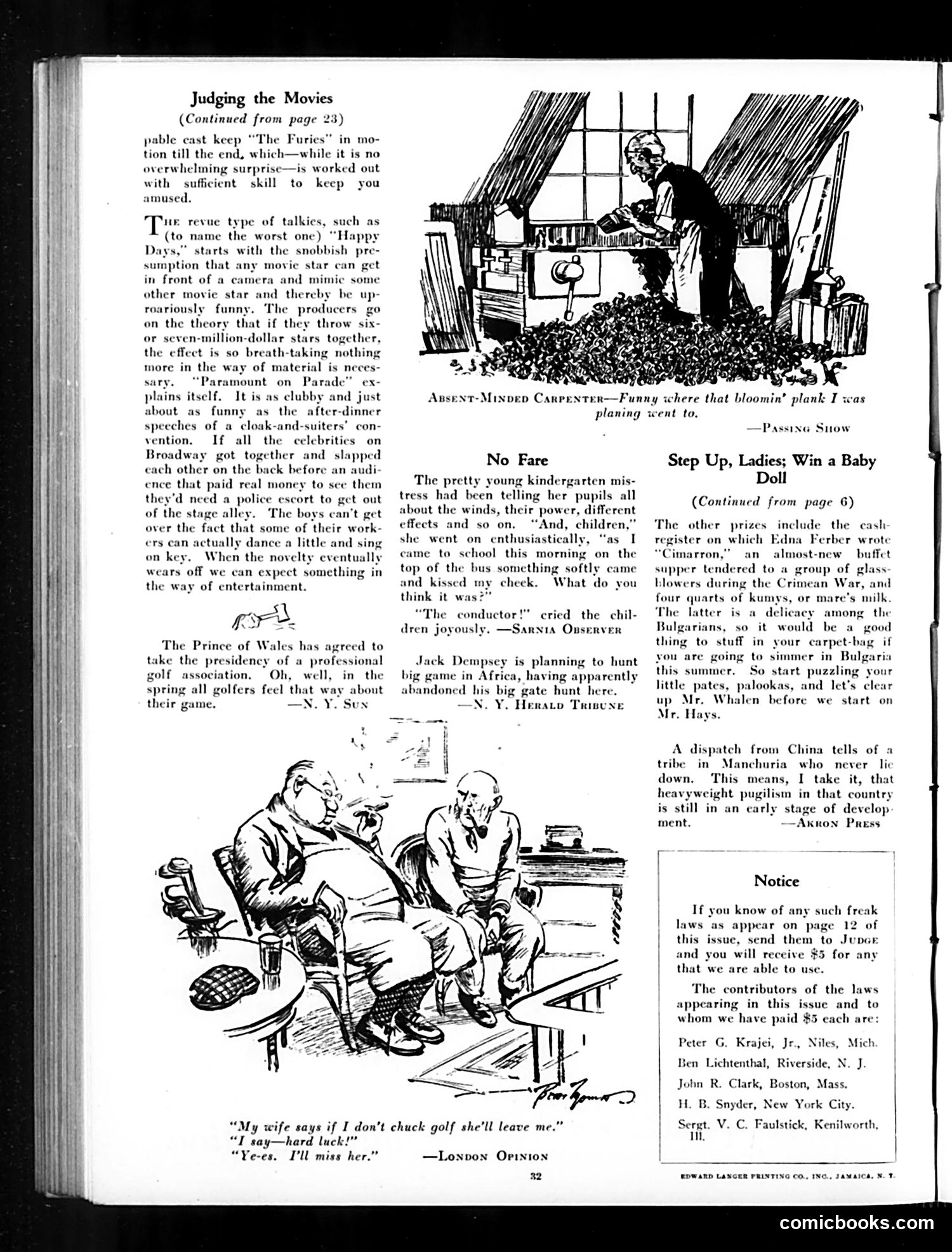
Explanation for Modern Readers This is a humor/satirical page from Judge magazine featuring movie criticism and various jokes. "Judging the Movies" section critiques early talking pictures, particularly "Happy Days" and "Paramount on Parade." The reviewer mocks the assumption that assembling famous stars guarantees entertainment—comparing it unfavorably to backstage celebrity antics. The satire targets producers' belief that star power alone compensates for weak material. The cartoon (bottom left) depicts two men discussing golf, with the caption "My wife says if I don't chuck golf she'll leave me" / "I say—hard luck!" / "Ye-es. I'll miss her." The joke plays on ambiguous pronouns: the listener thinks the speaker will miss his wife, but he actually means he'll miss golf. Other brief items include anecdotes about Jack Dempsey's hunting plans and a kindergarten joke about a bus conductor. A Notice solicits "freak laws" for $5 payment—a recurring Judge feature. The page reflects 1920s-30s entertainment culture and period humor conventions now largely dated.
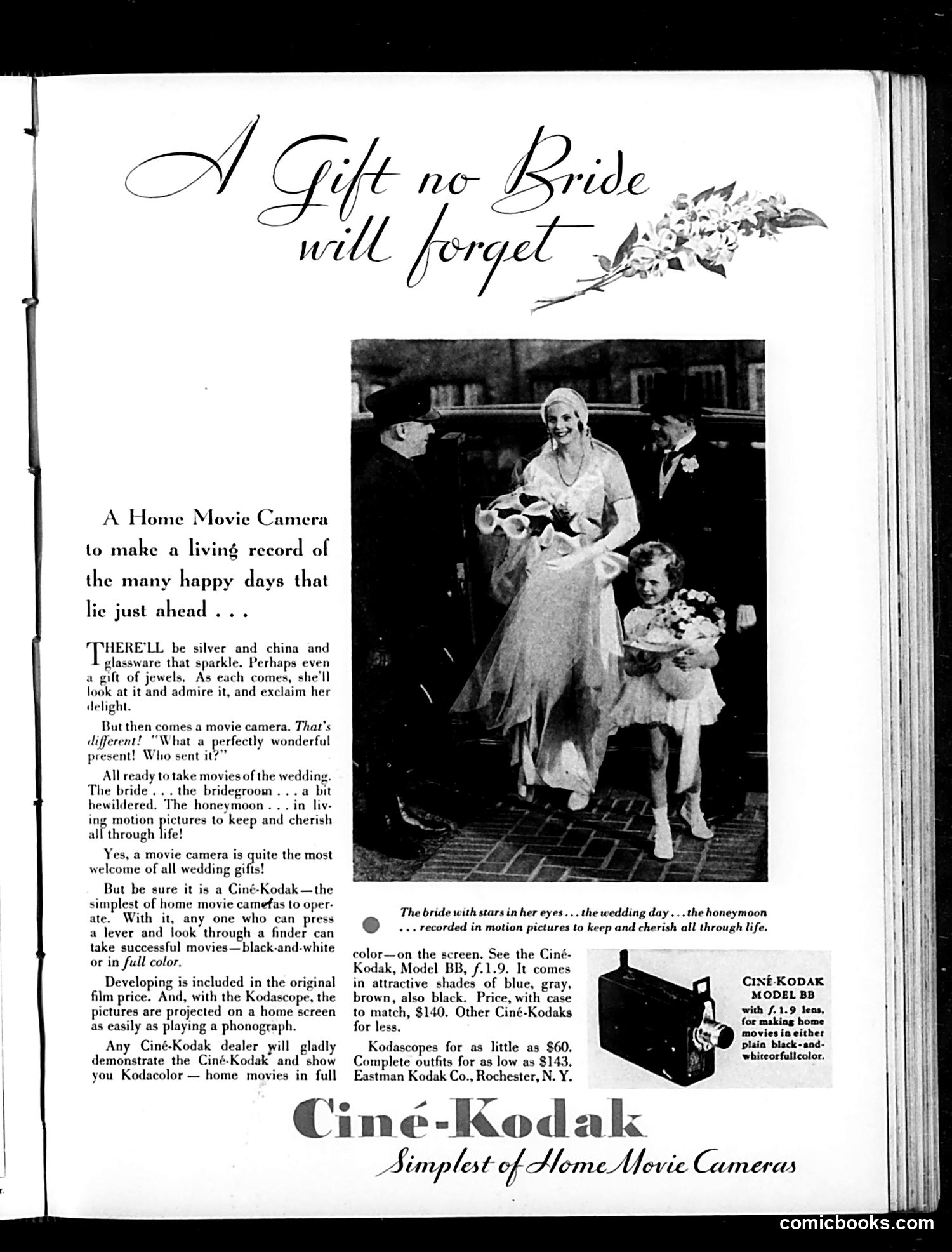
Analysis This is primarily a Kodak advertisement, not a political cartoon or satire. The page promotes Ciné-Kodak home movie cameras as wedding gifts. The ad's central pitch is that a movie camera surpasses traditional wedding gifts (silver, china, jewelry). It argues that recording the bride, groom, and honeymoon on film provides lasting memories superior to physical objects—a novel concept for 1920s-30s readers unfamiliar with home video. The accompanying photograph shows a bride in wedding dress with wedding party members, illustrating the camera's intended use. The sales angle targets brides-to-be by suggesting a movie camera is the "most welcome of all wedding gifts" and emphasizing the Ciné-Kodak's simplicity: anyone can operate it by pressing a lever. The ad stresses affordability ($140-$143 for complete outfits) and convenience (developing included; projectable on home screens). There is no satire or political commentary—this is straightforward consumer advertising positioning home moviemaking as a modern luxury and status symbol for middle-class American households.
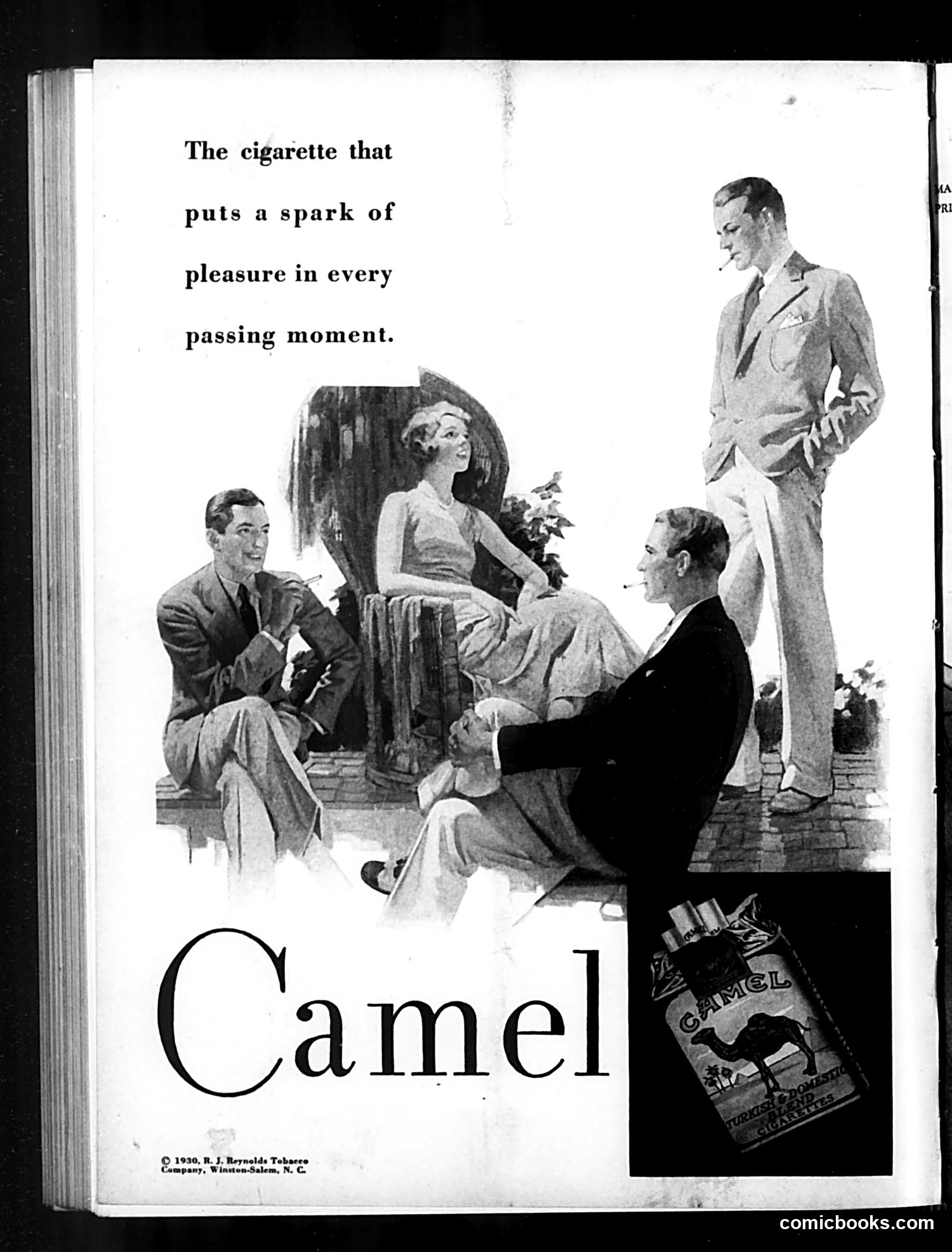
This is a Camel cigarette advertisement from 1930, not political satire. The ad depicts four well-dressed men in a social setting, with one woman seated centrally. The tagline promises cigarettes deliver "a spark of pleasure in every passing moment." The imagery reflects 1930s advertising conventions: glamorous, aspirational figures in refined surroundings meant to associate smoking with sophistication and leisure. The Camel package is displayed prominently in the lower right. This represents pre-health-warning tobacco marketing, when cigarette companies freely advertised in magazines without disclosing health risks. The ad targets affluent consumers through appeals to social status and pleasure—tactics that would become highly regulated by later decades.