judge
Judge — May 31, 1930
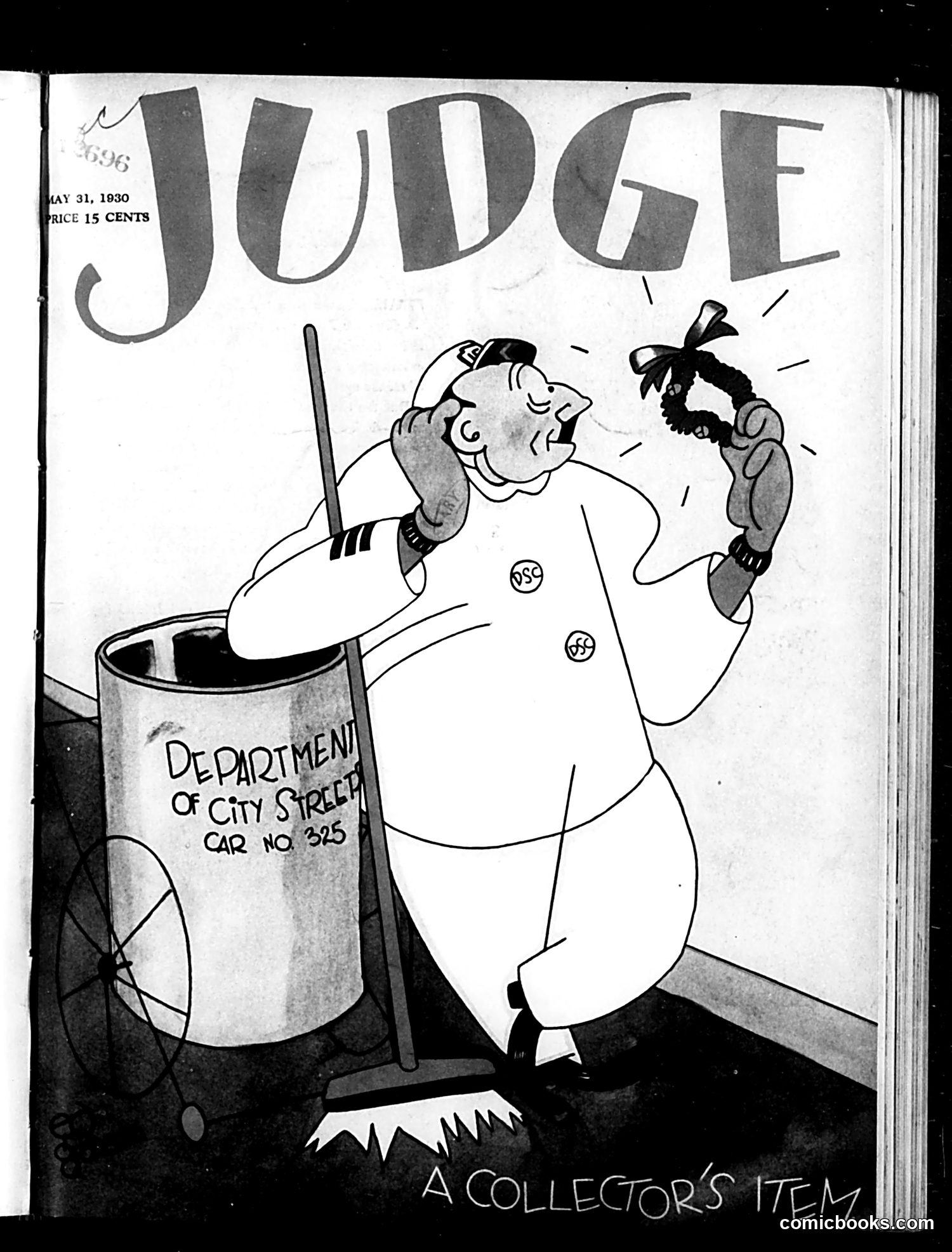
Judge Magazine Cover Analysis - May 31, 1930 This cover satirizes municipal corruption and waste. A rotund, caricatured figure (appearing to represent a city official or politician) holds a dead bird—likely a symbol of wasted resources or failed governance. He stands next to a large trash can labeled "DEPARTMENT OF CITY STREET CAR NO. 295," suggesting mismanagement of public transit systems. The caption reads "A COLLECTOR'S ITEM," implying the official collects or hoards things wastefully. The dead bird may represent misspent public funds or abandoned municipal services. This reflects 1930s concerns about political corruption and inefficient city government during the Great Depression, when public waste was particularly galling to struggling Americans.
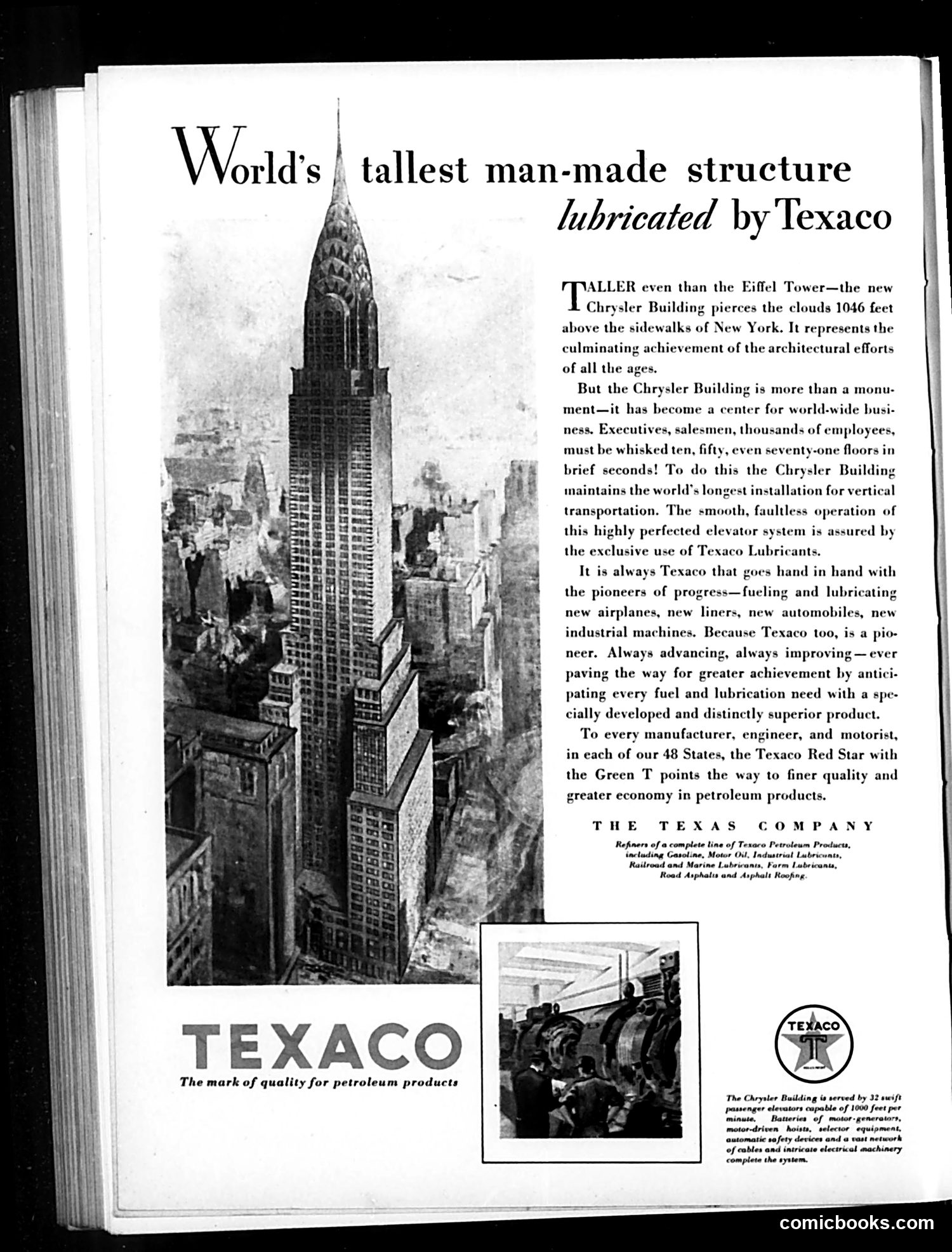
Analysis This is not a cartoon or satire—it's a straightforward advertisement for Texaco petroleum products. The page features a large photograph of the Chrysler Building in New York City (completed 1930), which Texaco promotes as "the world's tallest man-made structure" lubricated by their products. The ad claims Texaco lubricants operate the building's elevator system—described as the world's longest vertical transportation installation. The copy emphasizes Texaco's role in fueling progress across industries (airplanes, automobiles, machinery), positioning the brand as essential to modern achievement. A smaller photograph shows industrial machinery. The Texaco Red Star logo appears prominently. This is corporate advertising, not political satire. Judge magazine, while satirical, accepted paid advertisements like any publication of its era.
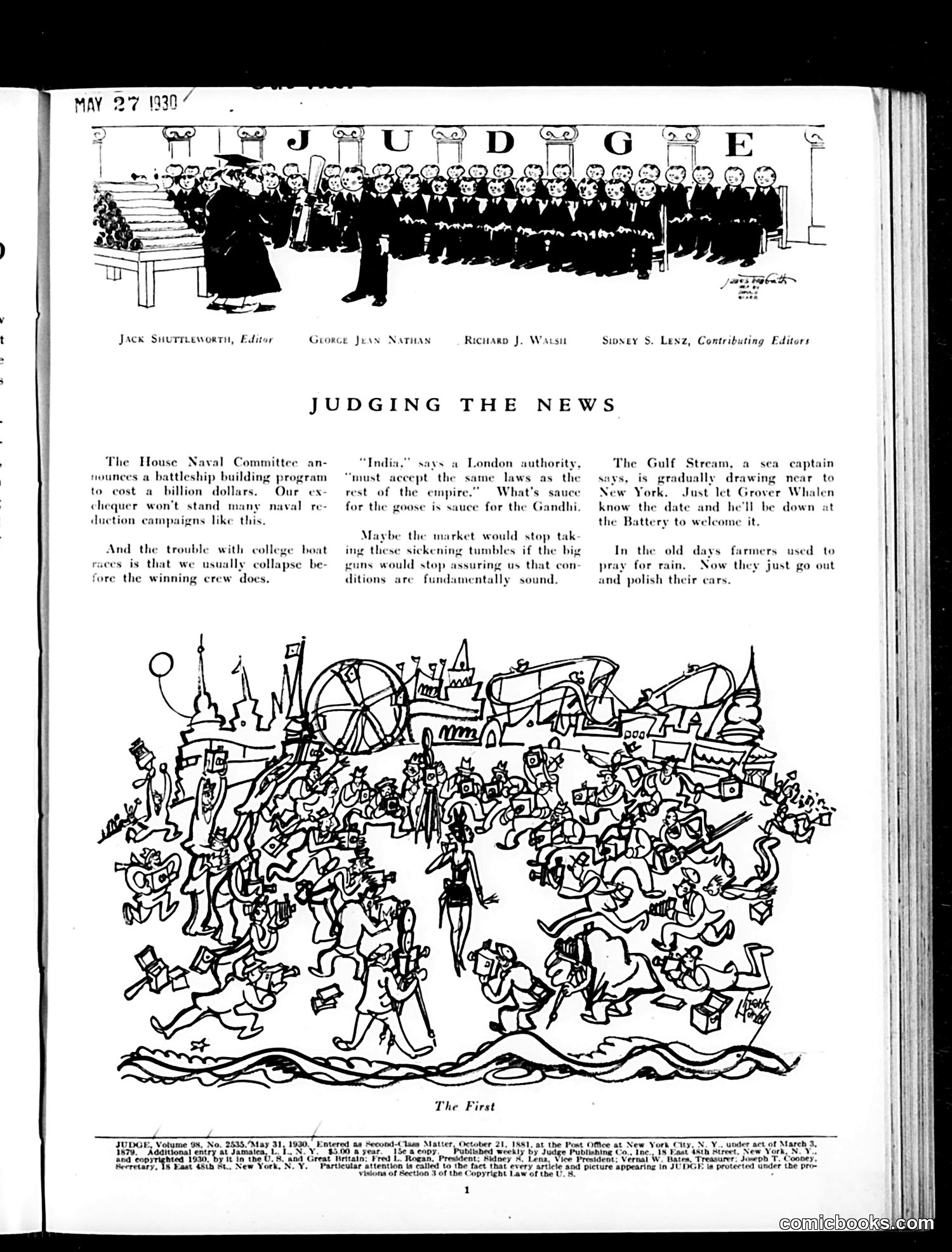
Analysis of Judge Magazine Page (May 27, 1930) This page features editorial commentary titled "Judging the News" addressing three contemporary issues: 1. Naval spending: Critiques a House Naval Committee proposal for a billion-dollar battleship program, questioning whether such expenditure makes strategic sense. 2. Colonial governance: References India's relationship to the British Empire, sarcastically comparing British rule to condiments (goose sauce/Gandhi), suggesting India faces unfair treatment. 3. Agricultural crisis: Notes farmers have shifted from prayer for rain to washing their cars—a joke about changing practices during economic hardship (the Depression era). The large cartoon below titled "The First" depicts a chaotic industrial/urban scene with numerous figures, machinery, and activity. Its exact satirical target is unclear from the visible context, though it likely comments on modern American industrial society or economic conditions circa 1930.
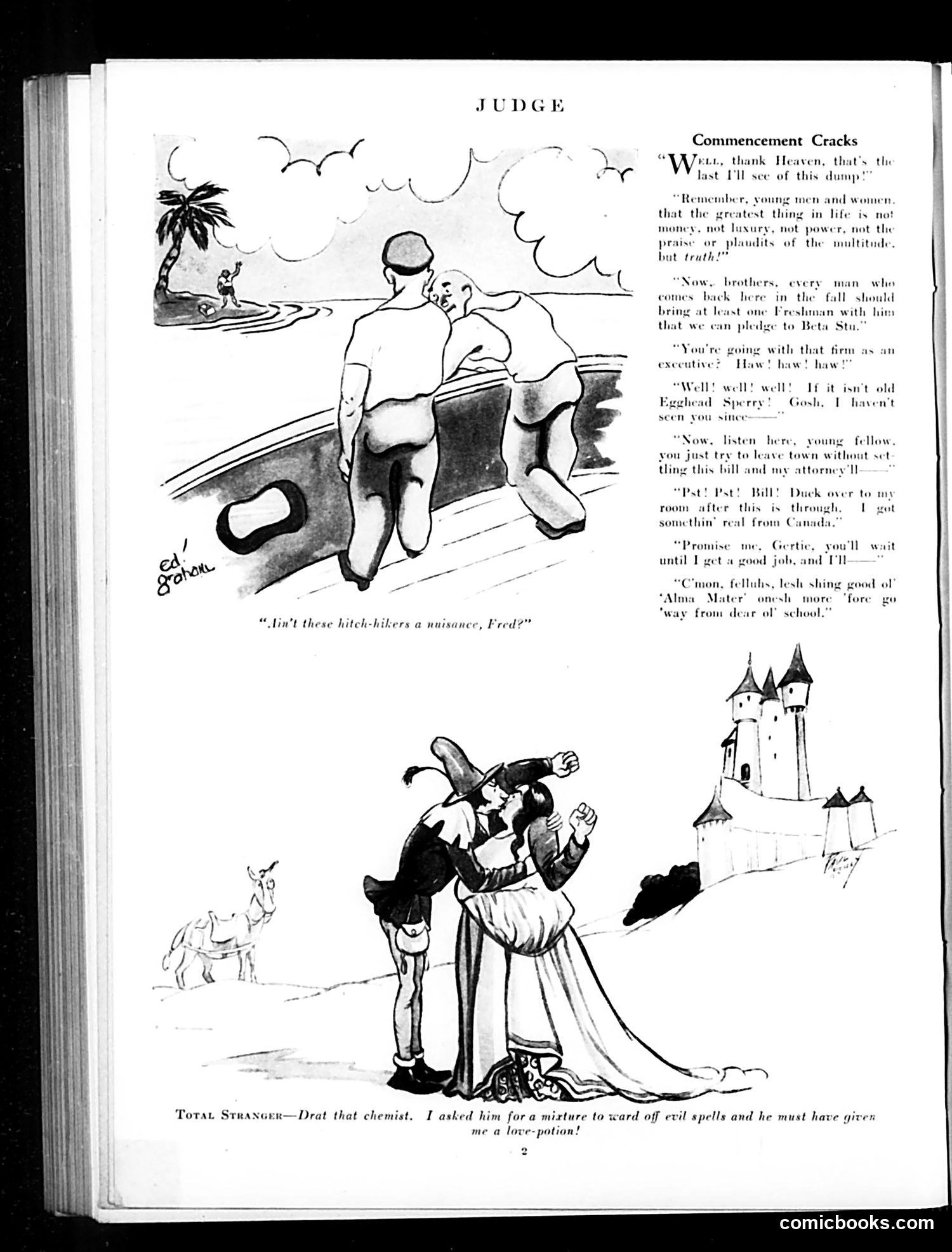
Analysis of Judge Magazine Page This page contains two satirical cartoons addressing college life and social conventions. The top cartoon, captioned "Isn't these hitch-hikers a nuisance, Fred?" depicts two men in a car encountering hitchhikers on a tropical beach. The accompanying dialogue mocks recent college graduates attempting to enter the workforce—one character mentions an "Egghead Sperry" and discusses leaving town without settling bills. The bottom cartoon, titled "Total Stranger," shows a medieval scene with a woman and diminutive man, captioned about requesting a chemist for a "love-potion" to ward off evil spells. Both cartoons appear to satirize anxieties about young people (graduates and courtship prospects) and social propriety. The humor relies on period-specific concerns about financial responsibility, employment, and romantic conventions that would resonate with Judge's educated, affluent readership.
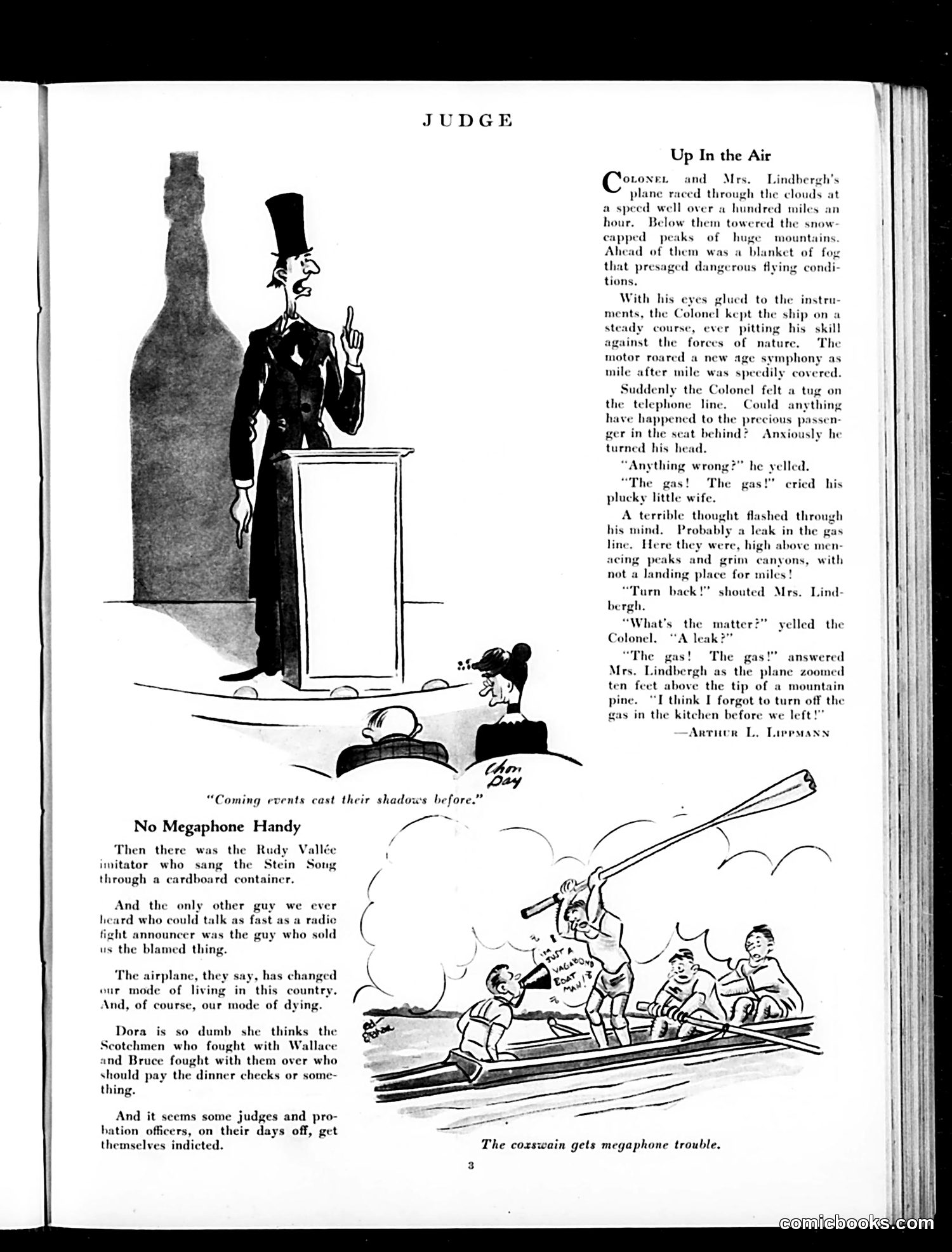
Analysis of Judge Magazine Page This page contains two separate satirical pieces: "Up in the Air" (top): A cartoon mocking Colonel and Mrs. Lindbergh's transatlantic flight. The Colonel, depicted in formal attire, stands nervously at controls while his wife panics about a gas leak during their dangerous journey over mountains and fog. The satire targets both the mechanical unreliability of early aviation and the anxiety such flights provoked in the public. "No Megaphone Handy" (bottom): A commentary on how modern technology—radio, airplanes—has transformed American life and communication. The text sardonically notes that rapid change has made traditional institutions (dinner checks, judicial decorum) seem quaint. The illustration shows children playing with a naval gun, suggesting technology's pervasive cultural impact. Both pieces reflect 1920s-30s ambivalence about rapid technological change.
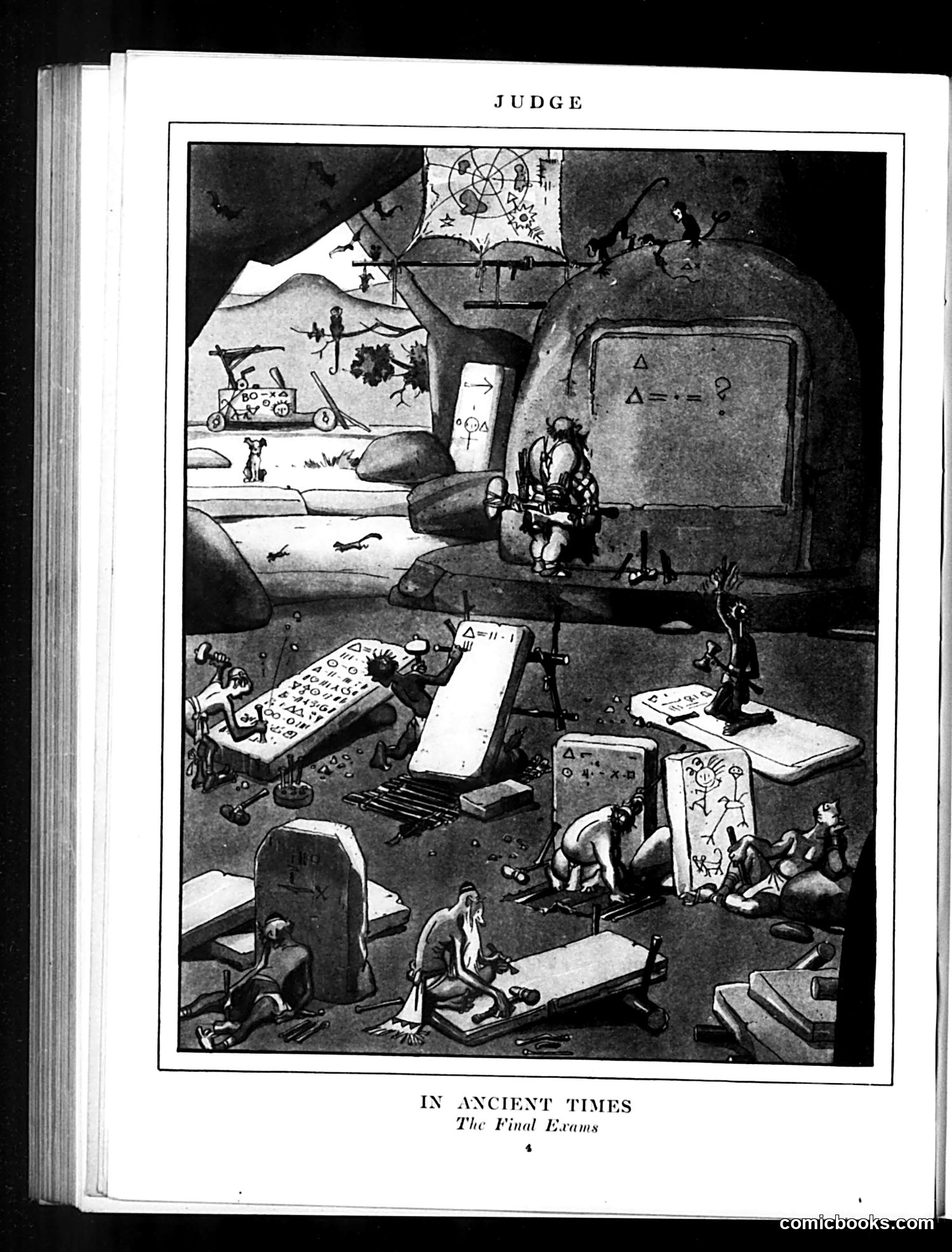
"In Ancient Times: The Final Exams" This cartoon satirizes academic examinations by depicting them as chaotic, primitive rituals. Tiny human figures struggle with oversized mathematical equations, writing tablets, and study materials scattered across a surreal landscape. The scale distortion—with enormous pencils, papers, and blackboards dwarfing the students—suggests exams feel overwhelming and absurdly difficult to test-takers. The "ancient times" framing implies that rigorous final examinations are an archaic, barbaric practice. The anarchic scene with figures climbing, crawling, and appearing distressed conveys that exam preparation is torturous and bewildering rather than educational. The satire mocks both the severity of academic testing and students' desperate struggles to master complex material under examination pressure.
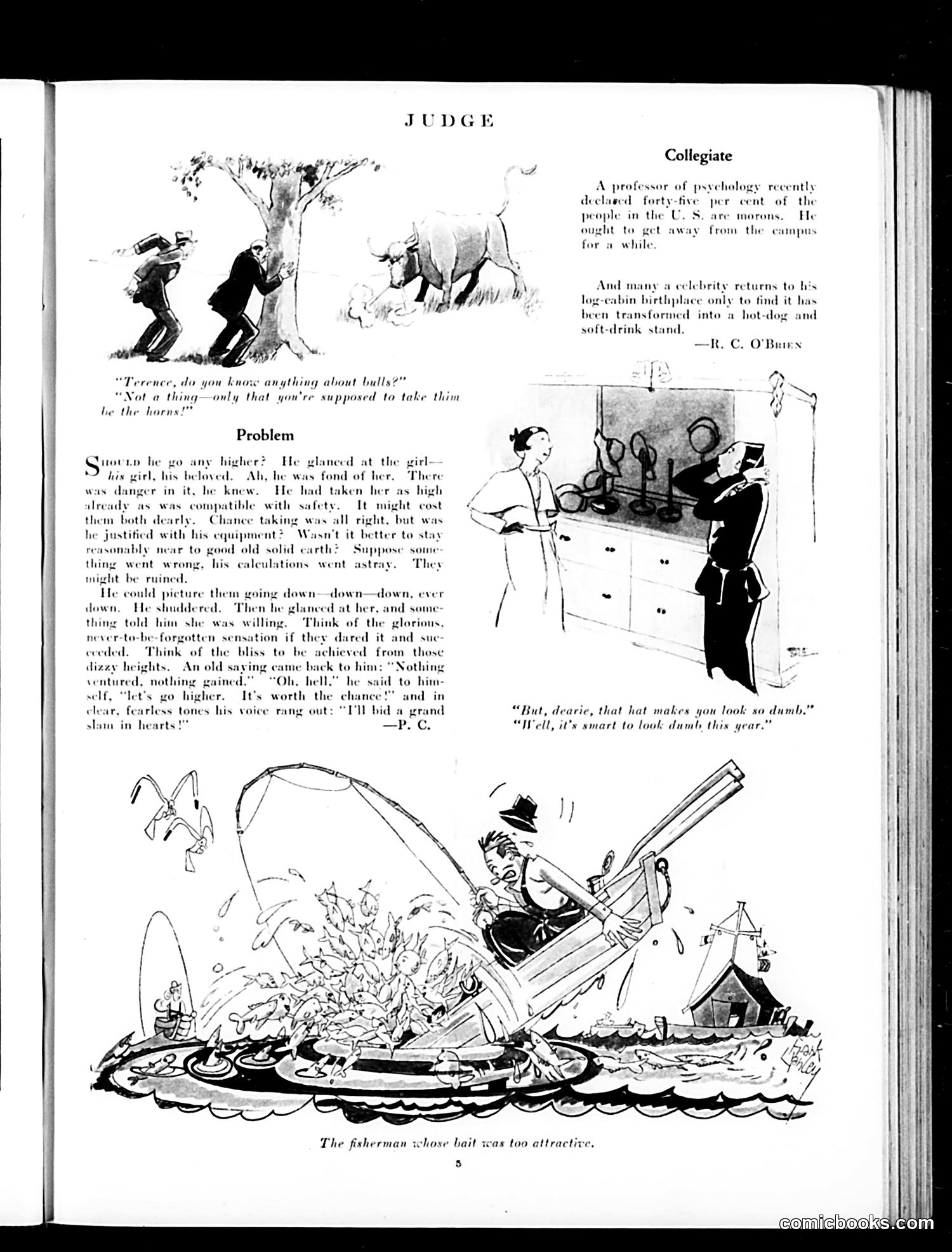
Analysis of Judge Magazine Page This page contains three satirical pieces: "Collegiate" (top): A quote from R.C. O'Brien mocking that 45% of U.S. college students are "morons" who should leave campus. The accompanying cartoon shows two figures observing someone acting foolishly, criticizing collegiate morality. "Problem" (center-left): A narrative about a man tempted to take dangerous risks with his girlfriend for thrilling sensations, ultimately deciding to attempt something reckless ("I'll bid a grand slam in hearts!"). This satirizes youthful recklessness and competitive male ego. "The fisherman whose bait was too attractive" (bottom): A chaotic cartoon showing a fisherman's catch overwhelming him—his bait attracted so many fish simultaneously that he's buried under them. This is a visual pun about attractiveness having unintended consequences. All three pieces reflect early 20th-century satirical humor targeting contemporary social behaviors.
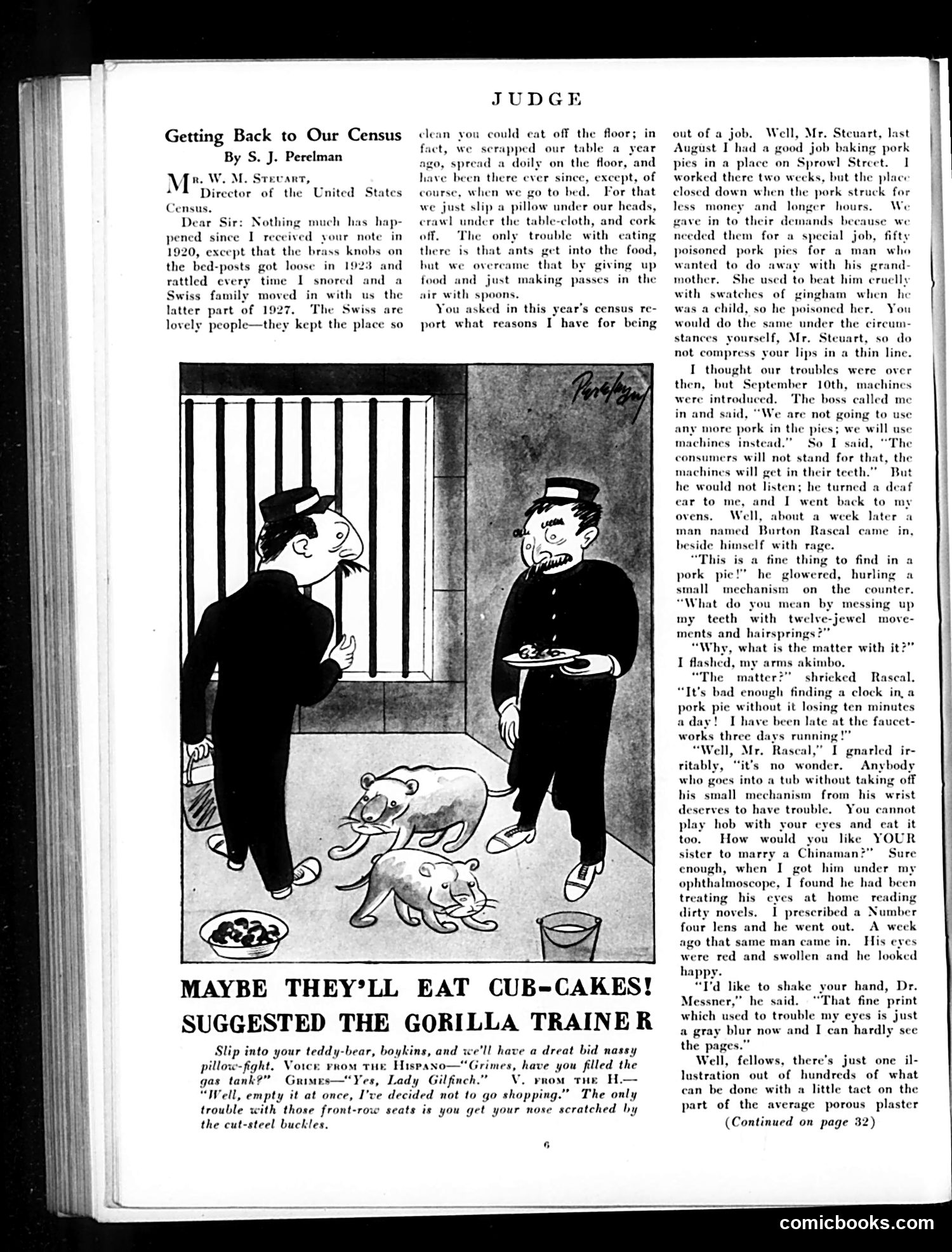
Analysis of This Judge Magazine Page This page contains a letter to the census director about living conditions, paired with a cartoon satirizing urban poverty and pest control. The Letter & Cartoon: Mr. W.M. Stewart, the U.S. Census Director, receives a complaint about apartment living conditions—specifically rats and ants infesting homes so badly that residents must eat meals on the floor. The accompanying cartoon depicts two men discussing a pork pie while rats and mice feast from bowls below them, illustrating the satirical caption: "Maybe They'll Eat Cub-Cakes! Suggested the Gorilla Trainer." The Satire: The joke mocks the absurdity of the situation: suggesting feeding the pests cub-cakes (small cakes) is as ridiculous as a gorilla trainer's logic. The cartoon critiques both urban housing conditions and the helplessness of residents who must coexist with vermin. It's social commentary on tenement-dwelling poverty in 1920s America.
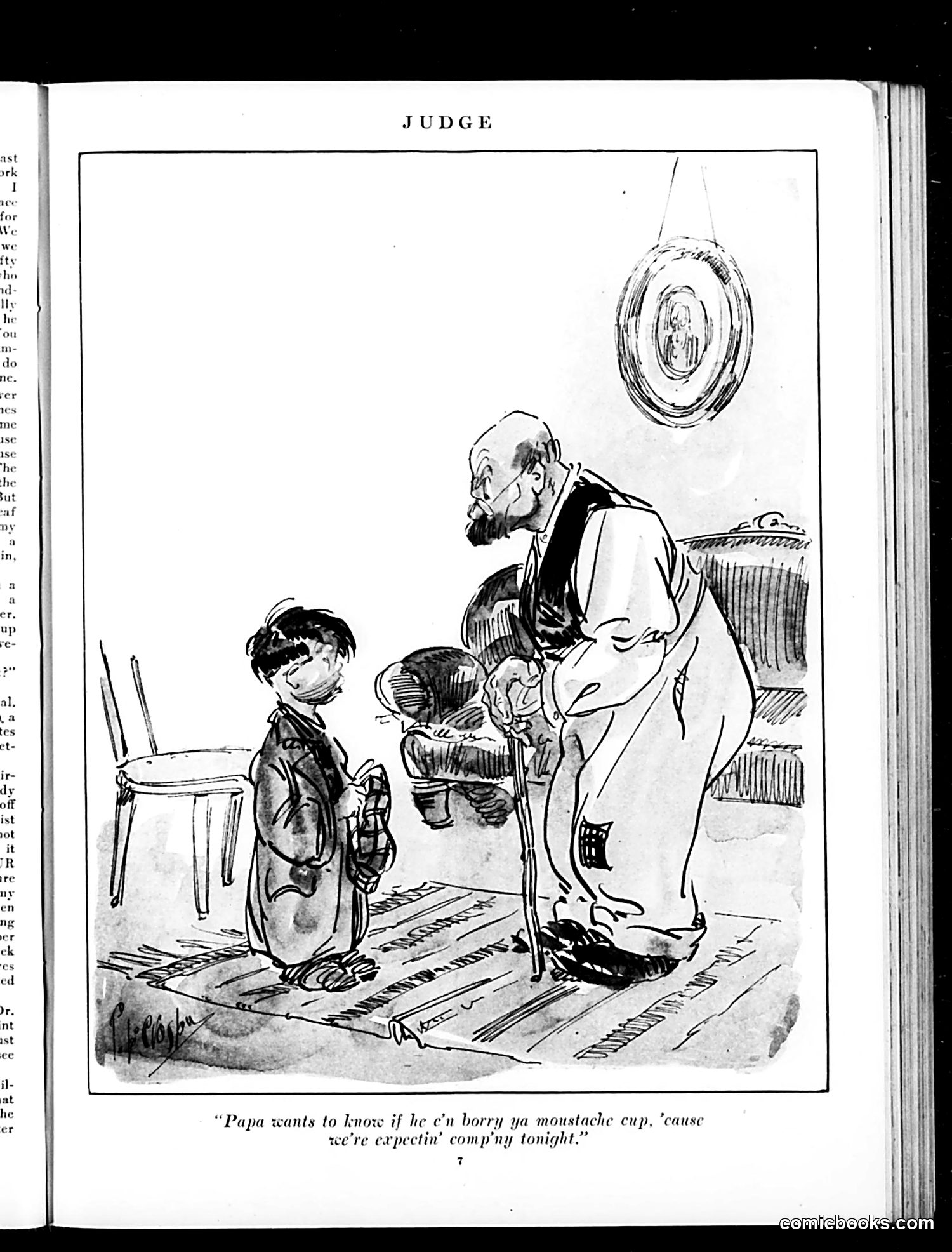
Analysis of Judge Cartoon This is a single-panel cartoon titled "JUDGE" depicting a domestic humor scene. An adult man with a prominent beard is shown with two young boys in what appears to be a modest home. One boy is asking to borrow a "moustache cup" for an expected visitor. A moustache cup was a practical Victorian-era drinking vessel with an interior guard to protect a man's facial hair from getting wet. The humor relies on the contrast between the father's obvious, impressive beard and the need to borrow such a cup—suggesting either vanity, a social-climbing desire to appear refined, or the family's modest circumstances requiring them to borrow items for entertaining guests. The satirical target appears to be working-class pretension or the aspirations of ordinary people attempting to present themselves as more genteel than their circumstances warrant.
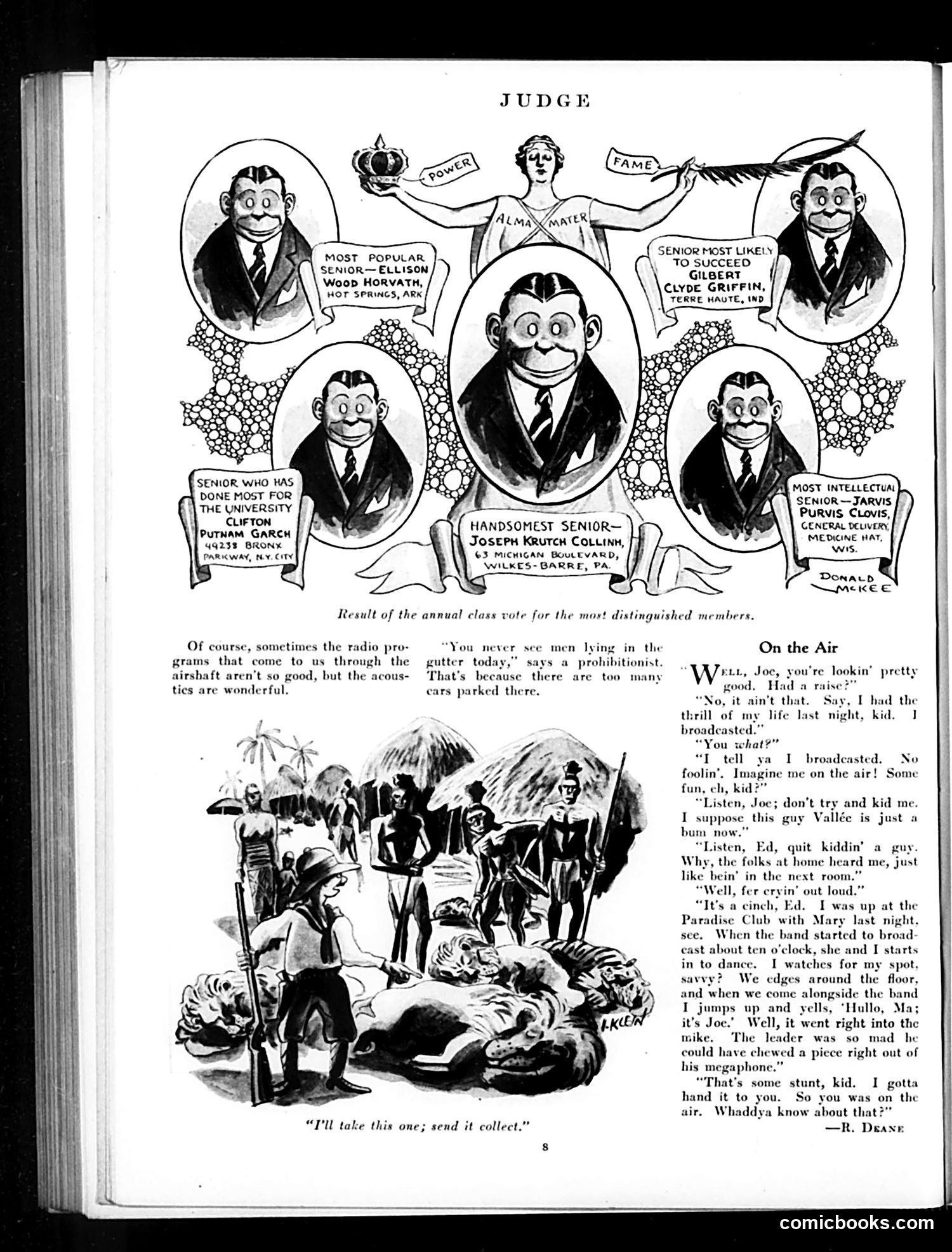
Analysis of Judge Magazine Page Top Section - "Judge": This depicts results of a college class vote for "most distinguished members." The central figure is Joseph Krutch Collinin, voted "Handsomest Senior." Surrounding him are peers voted "Most Popular" (Ellison Wood Horvath), "Most Likely to Succeed" (Gilbert Clyde Griffin), and "Most Intellectual" (Jarvis Purvis Crovis). This satirizes college yearbook superlatives and the superficial honors colleges bestow—implying these aesthetic/social categories matter more than actual achievement. Bottom Section - "On the Air": A dialogue between two men discussing early radio broadcasting. One brags about shouting into a microphone during a dance broadcast, reaching his mother at home. The satire mocks early radio's novelty and people's excitement about this new technology, while also poking fun at the poor audio quality and technical limitations—the band leader's anger suggests the unexpected outburst disrupted the broadcast. Both sections humorously critique American popular culture's obsession with fame and emerging mass media.
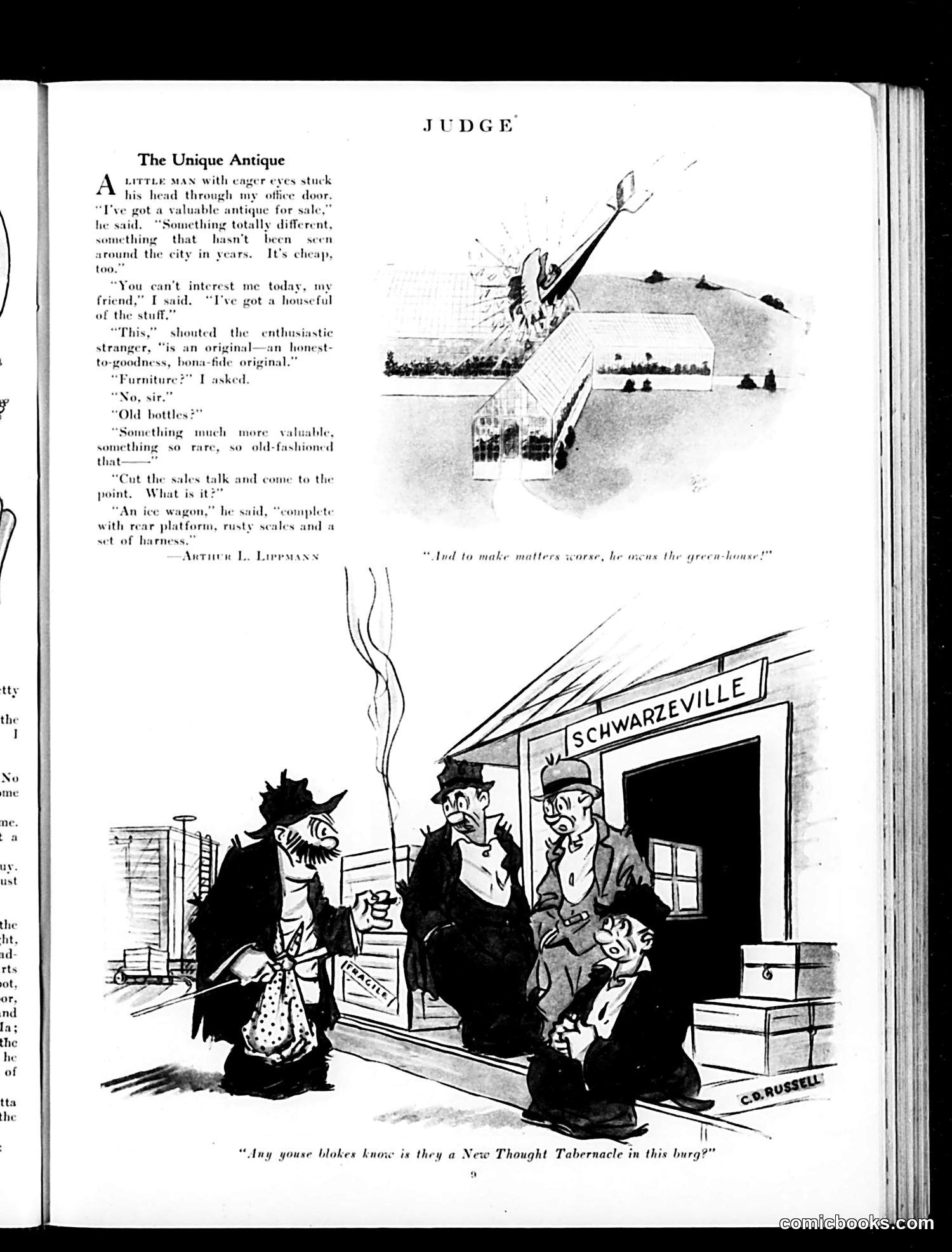
"The Unique Antique" - Judge Magazine Satire This page satirizes two contemporary concerns: Top story & cartoon: A salesman peddles a supposedly rare "antique"—revealed to be an old ice wagon with scales and harness. The joke mocks both con-artist salesmen and the public's gullible appetite for "authentic" antiques. The phrase "original—an honest-to-goodness, bona-fide original" parodies overwrought sales pitches. Bottom cartoon: Drawn by C.B. Russell, this depicts men outside "Schwarzeville" asking if there's a "New Thought Tabernacle" nearby. "New Thought" was an early 1900s spiritual movement emphasizing positive thinking and mental healing. The caricatured faces and "burg" (small town) setting suggest Judge is mocking both the movement's popularity and the stereotyped followers it attracted in small-town America. Both pieces ridicule contemporary American gullibility—whether toward commercial fraud or fashionable spiritual trends.
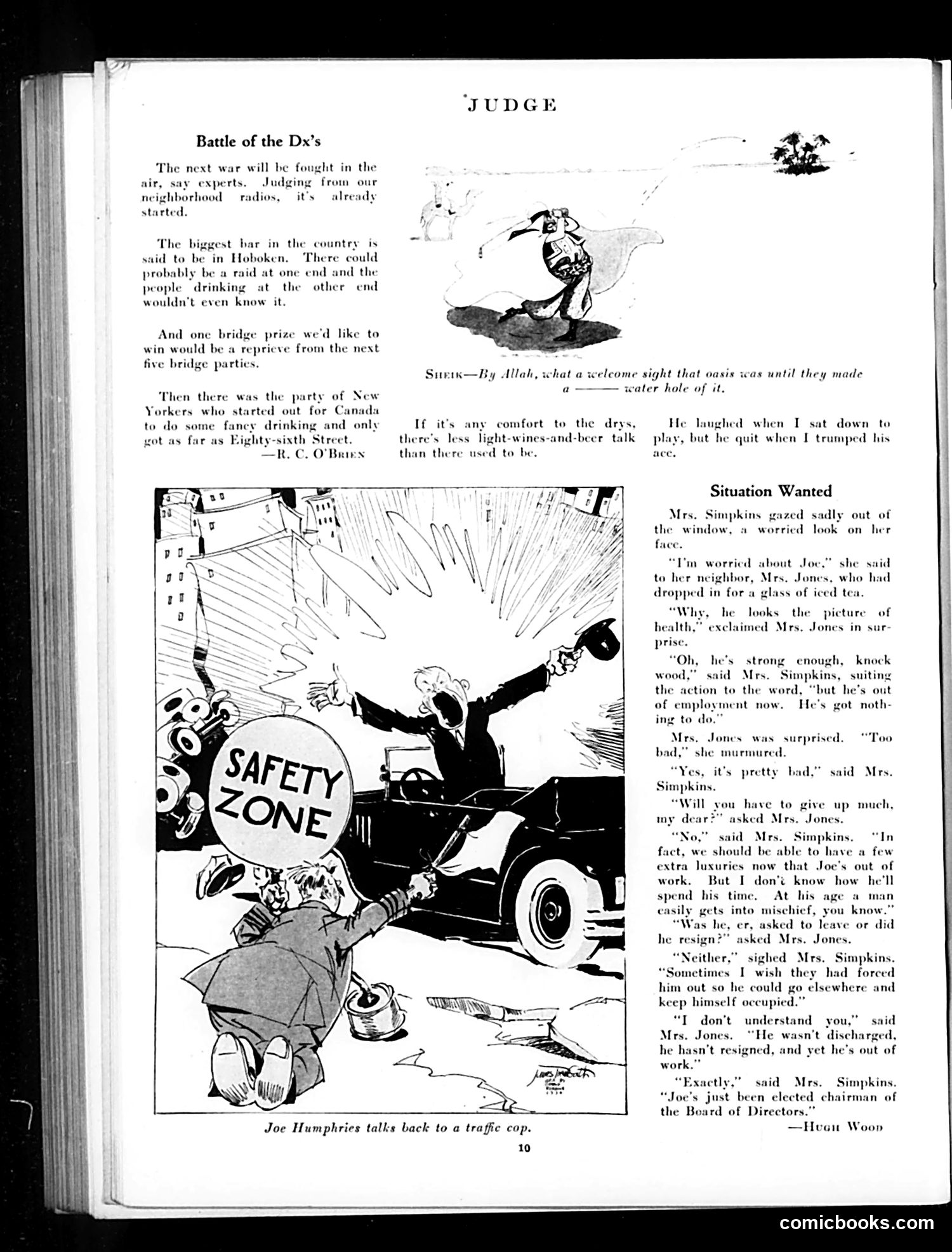
Judge Magazine Page Analysis This page contains humor reflecting Prohibition-era America (likely 1920s-early 1930s). "Battle of the Dx's" mocks the debate between "drys" (Prohibition supporters) and "wets" (opponents). References to bars in Hoboken, Canadian drinking trips, and the consolation that "light wines and beer talk" has decreased suggest anxieties about alcohol enforcement and underground drinking culture. The cartoon "Joe Humphries talks back to a traffic cop" shows a car crash at a "Safety Zone," depicting Joe arguing with law enforcement—typical Judge satire about traffic safety and authority. "Situation Wanted" is comedic domestic dialogue: Mrs. Simpkins worries her newly unemployed husband Joe will cause trouble, yet paradoxically hopes to avoid giving up luxuries. The punchline—Joe has been elected Board chairman, making him *still* unemployed in terms of actual work—satirizes corporate board positions as sinecures requiring no real labor. The humor relies on period anxieties: Prohibition enforcement, traffic safety modernization, and corporate inefficiency.
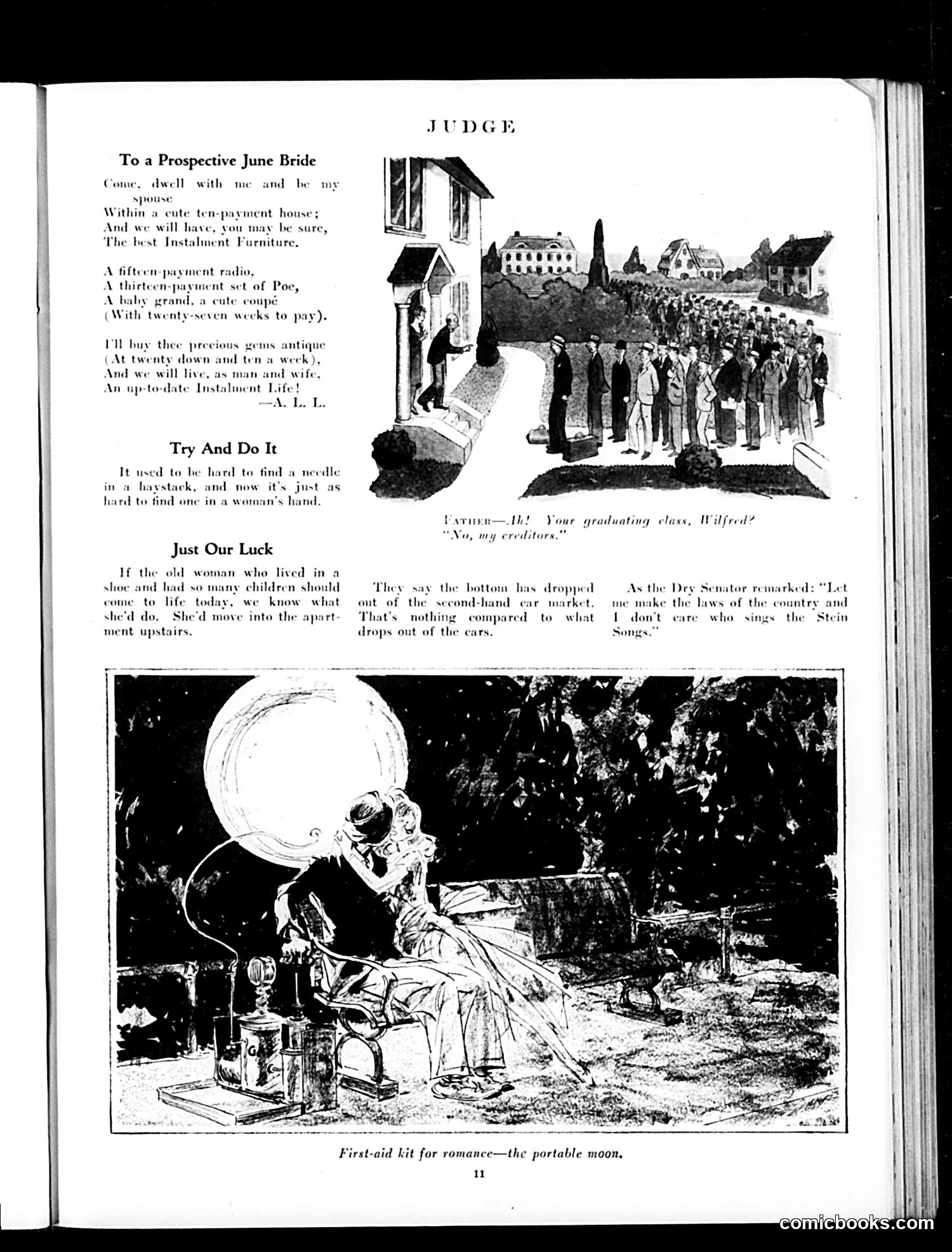
Analysis of Judge Magazine Page This page from Judge magazine contains early-20th-century American satire mocking consumer culture and social trends: "To a Prospective June Bride" satirizes the installment-plan economy, where a suitor promises marriage within a "ten-payment house" furnished with "fifteen-payment radio" and a car requiring "twenty-seven weeks to pay." The joke targets how Americans were increasingly buying on credit rather than saving, presenting marriage itself as another installment debt. "Try And Do It" is a brief joke about women's fashion—needles were once essential sewing tools, but modern women rarely sewed, making needles equally rare in their hands as in haystacks. "Just Our Luck" references the nursery rhyme about the old woman in a shoe, joking that if she lived today, she'd simply move upstairs to avoid her children. It also includes a quip about used cars falling apart (literally "dropping"). The bottom illustration, "First-aid kit for romance—the portable moon," depicts a couple with a portable lamp creating romantic moonlight, mocking artificial romance in modern life. These reflect 1920s-1930s anxieties about consumerism, changing gender roles, and technology.
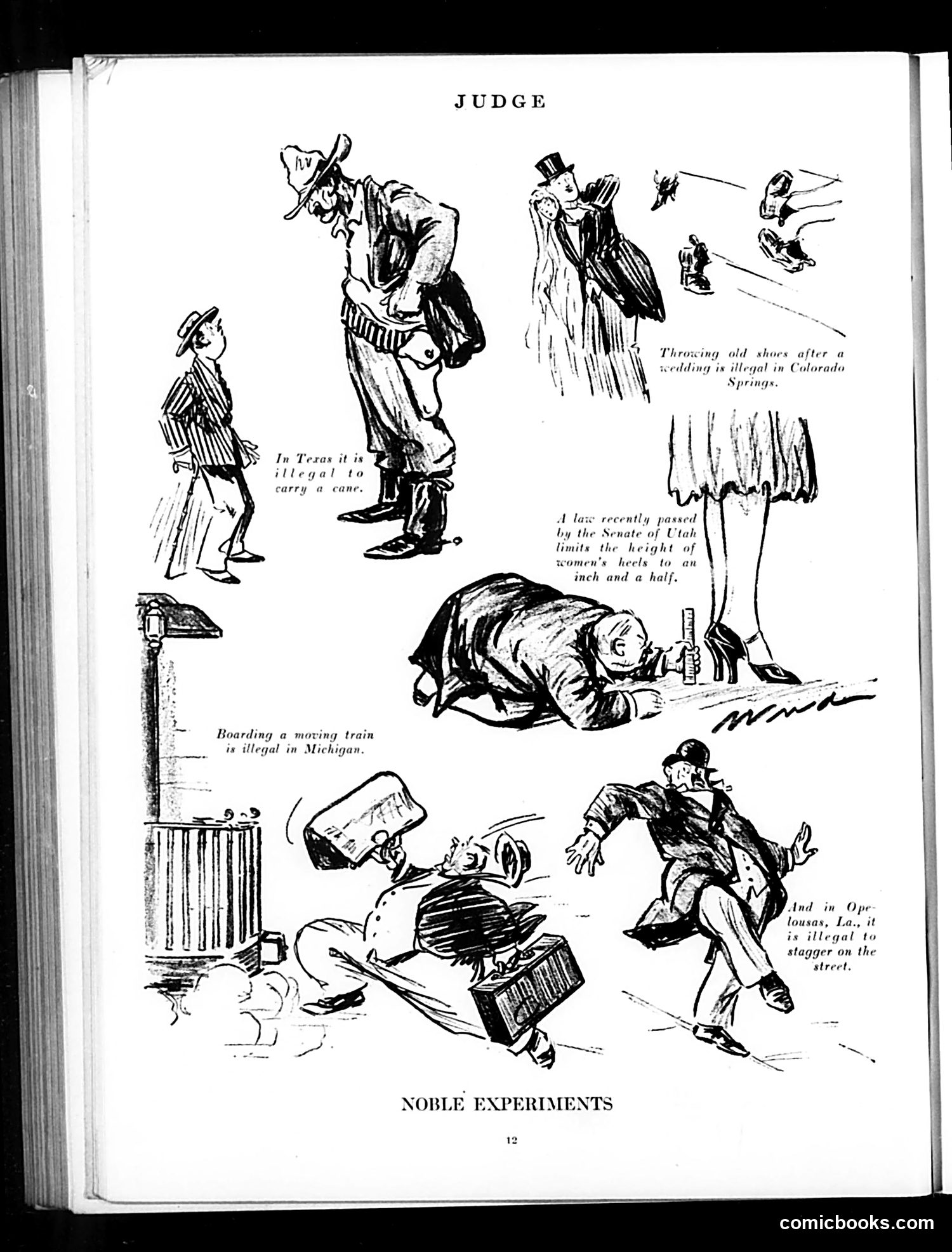
Judge Magazine: "Noble Experiments" This satirical page mocks various state and local laws of the era through illustrated vignettes. The cartoons depict absurd or oddly specific legal prohibitions: - Texas law against carrying a cane - Colorado Springs law banning shoe-throwing after weddings - Utah Senate law limiting women's heels to 1.5 inches - Michigan law against boarding moving trains - Louisiana law prohibiting staggering on streets The title "Noble Experiments" sarcastically references these laws as well-intentioned but ridiculous regulatory attempts. The humor derives from the disconnect between the laws' literal specificity and their apparent ineffectiveness or absurdity. The cartoons show figures comically violating these rules, suggesting such laws are unenforceable or reflect legislative overreach. This reflects Progressive Era concerns about government regulation and social engineering through legislation.
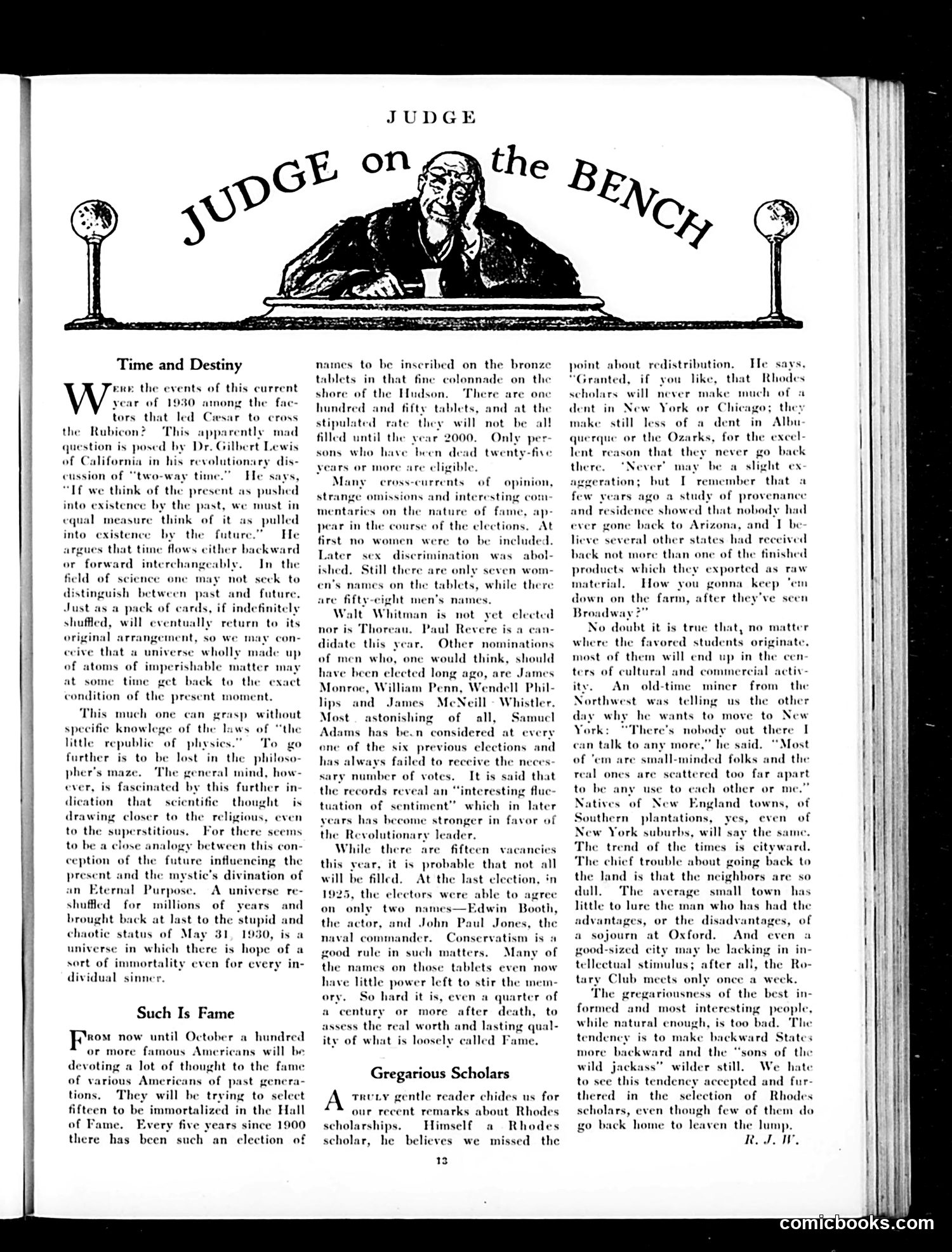
Judge Magazine Page Analysis This page from Judge magazine (circa 1930) contains two satirical articles rather than a cartoon. "Time and Destiny" discusses physicist Dr. Gilbert Lewis's theory of "two-way time"—that the universe operates bidirectionally, with the future influencing the present as much as the past. The satire mocks how intellectuals find pseudo-scientific justification for mystical or religious concepts of fate and predetermined purpose. The joke is that complex physics language essentially validates what religious believers already claimed about destiny. "Such Is Fame" satirizes the Hall of Fame selection process for bronze tablets honoring dead Americans. The article notes the arbitrary, sluggish commemoration of figures (Walt Whitman, Paul Revere, Samuel Adams still waiting), the underrepresentation of women (only seven of fifty-eight names), and how public opinion about historical figures shifts unpredictably over time. The satire targets both the conservative gatekeeping of legacy and fame's ultimate meaninglessness—how quickly important figures fade from memory.
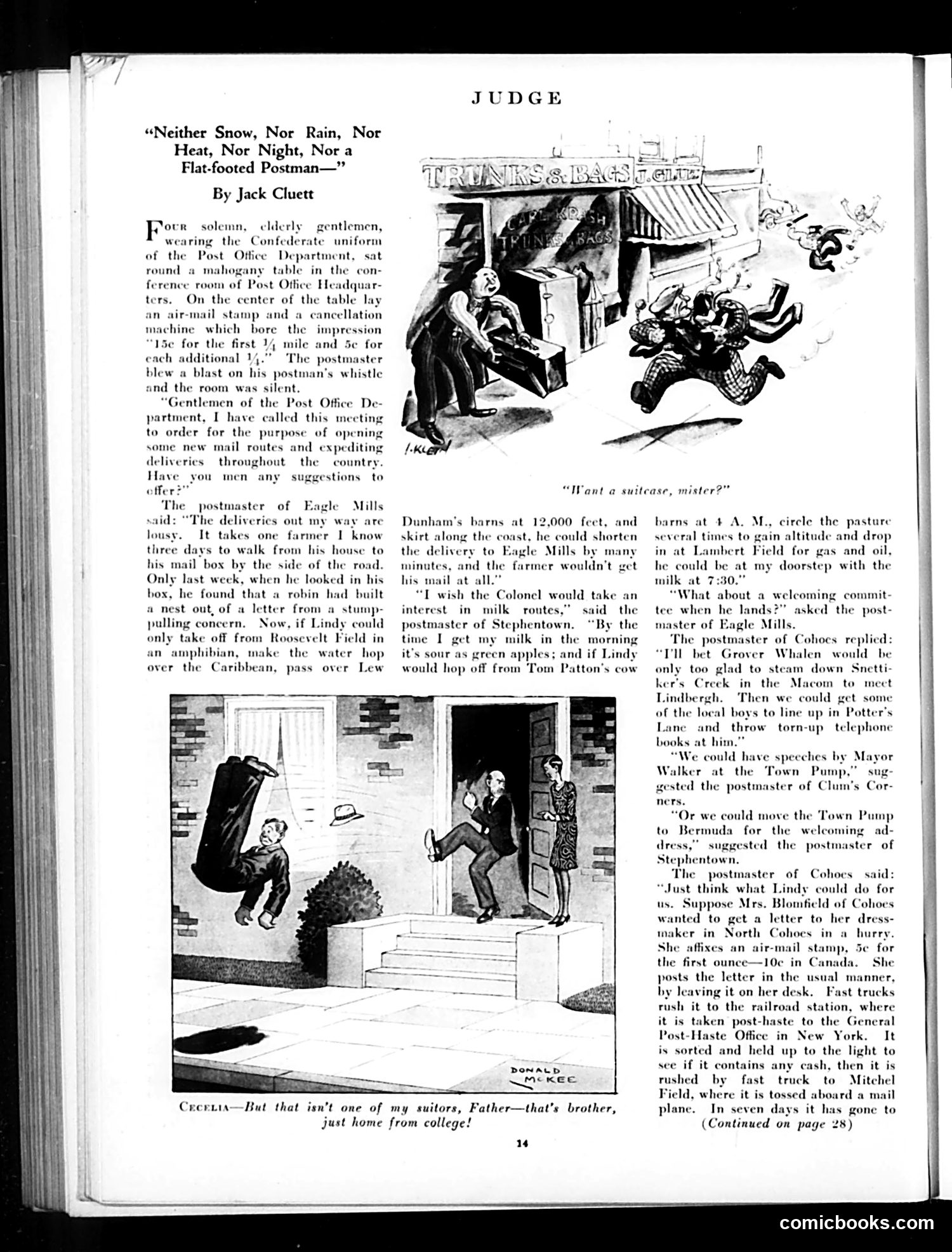
"Judge" Cartoon Analysis: "Neither Snow, Nor Rain..." This 1920s satirical piece mocks the U.S. Post Office's inefficiency by having postmasters propose absurd solutions involving Charles Lindbergh, the famous aviator who had recently made his transatlantic flight (1927). The joke: postmasters suggest using Lindbergh's flying skills to deliver mail faster—having him fly over rural areas, circle pastures to gain altitude, or steam down creeks in flying boats. These proposals are deliberately ridiculous, mocking both the Post Office's genuine delivery problems and the era's obsession with aviation as a cure-all solution. The cartoon title references the postal service motto about reliability "neither snow, nor rain, nor heat" can stop mail delivery—suggesting even Lindbergh can't fix these broken routes. The lower illustration shows Cecelia mistaking her college-aged brother for a suitor, likely commenting on youth behavior or social propriety of the period—a secondary joke typical of Judge's humor.
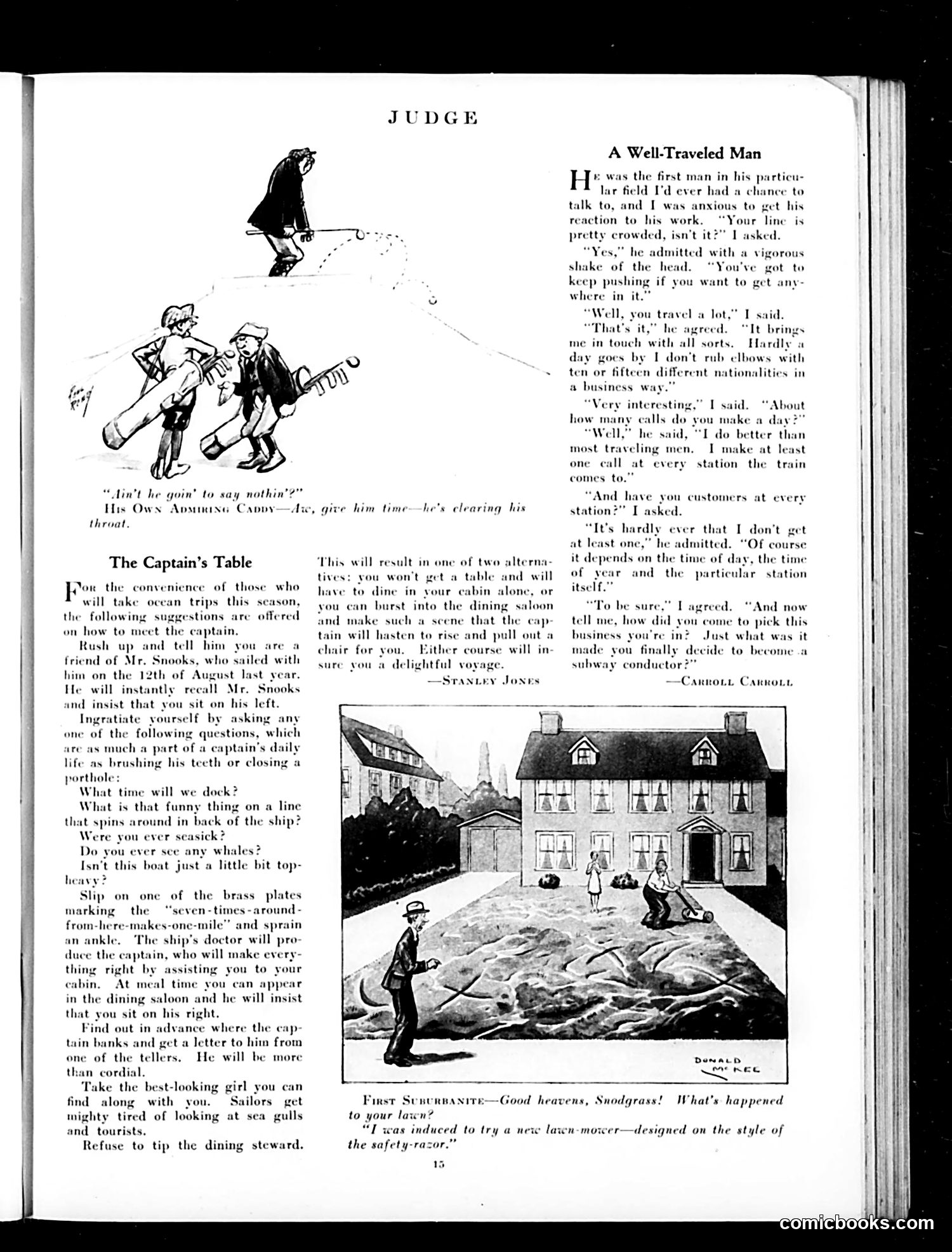
Judge Magazine Page Analysis This page contains three distinct pieces of humor satirizing early 20th-century travel and social conventions. "Judge" (top cartoon): A man clutches his throat while two figures below appear to be choking or strangling him. The caption "Ain't he goin' to say nothin'?" and reference to "His Own Amazing Candy" suggests this mocks overly-sweet or cloying products, possibly candy that literally makes one speechless. "The Captain's Table": This satirizes social-climbing tourists on ocean voyages. The humor targets passengers who manufacture false connections to captains (claiming friendship with passengers from years prior), ask predictably foolish questions about ships, and manipulate seating arrangements. The joke mocks tourist pretension and the transparent strategies used to gain captain's favor. "A Well-Traveled Man": A conversation reveals a man boasts of extensive travel and business connections across nationalities—only for the interviewer to reveal he's actually a subway conductor. The satire exposes the gulf between apparent sophistication and mundane reality. All three pieces mock social pretension and the gap between self-image and truth.
Judge Magazine: "Judging the Shows" by George Jean Nathan This is a theater criticism column, not a political cartoon. Nathan, a prominent drama critic of the era, reviews current Broadway productions in his characteristically acerbic style. The opening discusses "Lost Sheep," a play at the Selwyn Theatre featuring Rose (likely an actress, possibly Rose Hobart based on context). Nathan sardonically dismisses the play's plot mechanics—the standard devices playwrights rely upon: getting the wrong person into bed, bringing hero and heroine close to seduction, or combining both. He then catalogs recent French farces with more originality, mocking American theatrical laziness. Nathan argues American producers should import sophisticated foreign comedies rather than recycling tired formulas. The column's satire targets not politicians but theater itself: the predictability of commercial plays, the industry's resistance to fresh ideas, and American audiences' tolerance for worn-out dramatic conventions. It's sophisticated cultural criticism dressed in entertainment journalism.
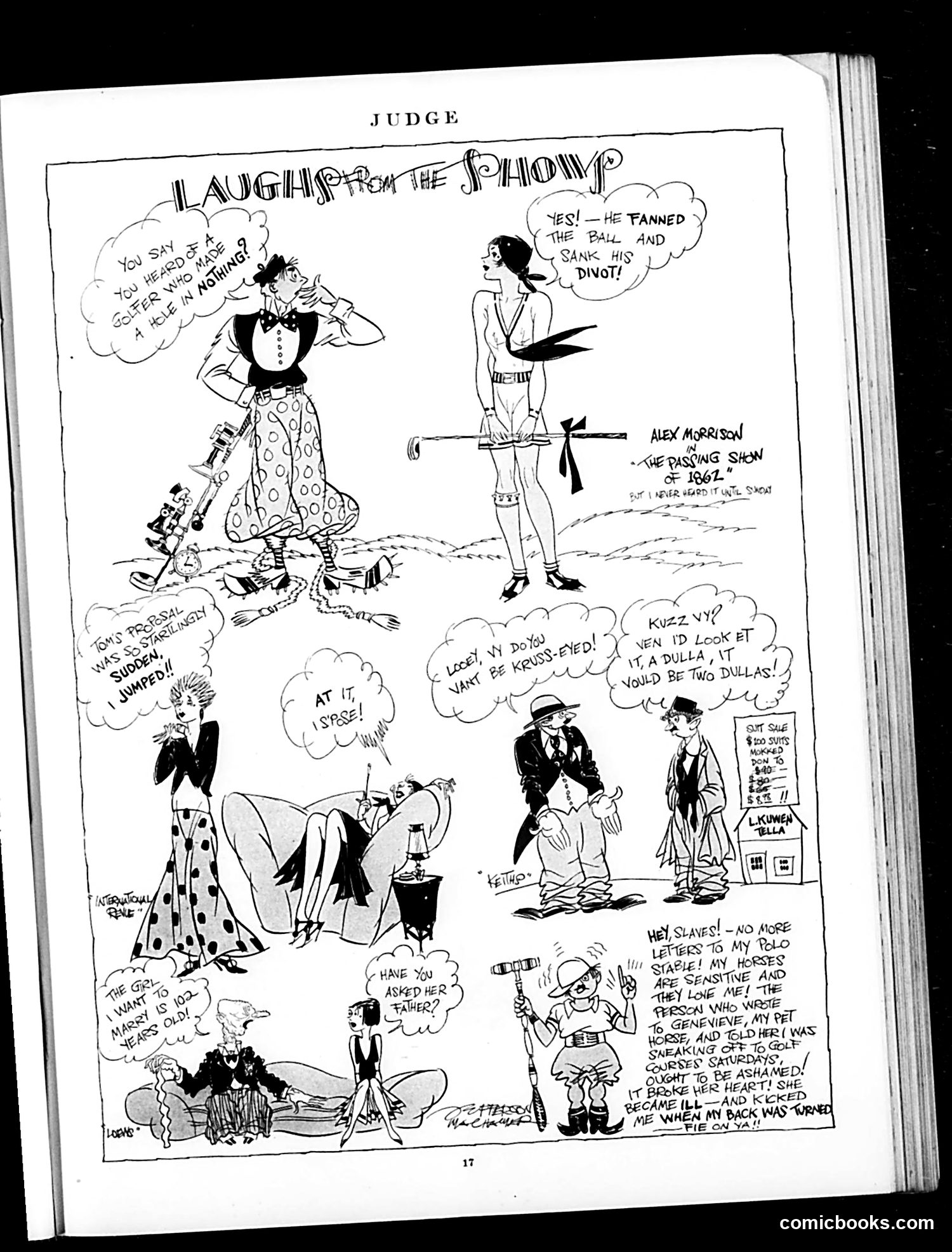
"Laughs at the Show" - Judge Magazine Cartoon This appears to be a satirical comic about a theatrical or sporting event, likely from the early 1900s based on the clothing and style. The central joke involves characters discussing a performance where someone "fanned the ball and sank his divot" — sporting terminology suggesting golf or baseball. The cartoon mocks upper-class leisure activities and their pretensions. Characters in formal wear discuss the event while using exaggerated sporting language. One figure complains extensively about servants and horses, satirizing wealthy people's self-important grievances about their staff and possessions. The humor targets the gap between how seriously affluent people take minor social events and their obliviousness to their own absurdity. The long monologue by the complaint-prone character exemplifies Judge's typical satire of privileged classes.
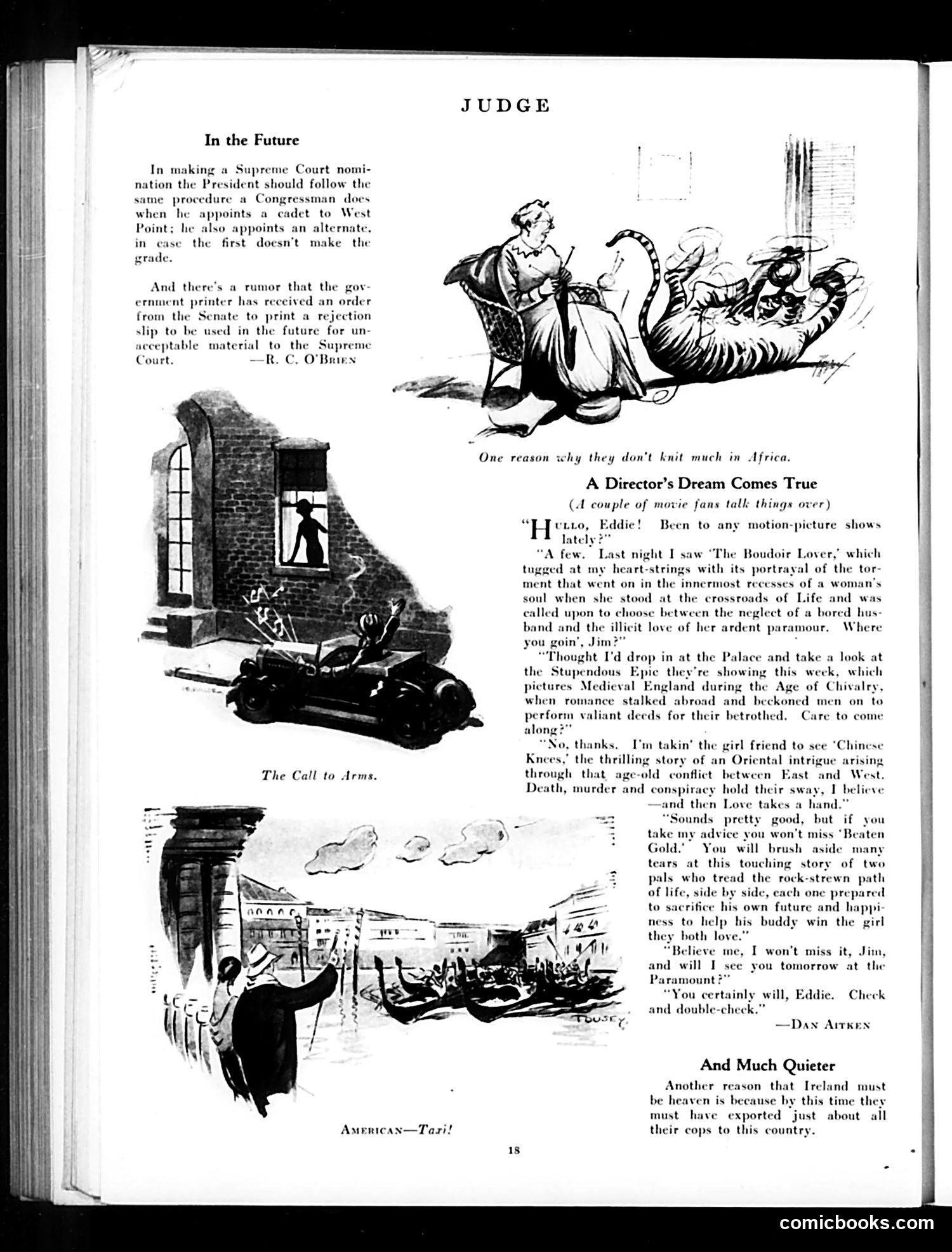
Analysis for Modern Readers This Judge magazine page contains political satire about Supreme Court nominations and Irish immigration, plus entertainment commentary. Top cartoon ("In the Future"): Satirizes the ad hoc nature of Supreme Court nominations. The text proposes the President should treat nominations like Congressional appointments to West Point—nominating alternates in case the first nominee fails to qualify. A rumor jokes that the Senate printer needs rejection slips for "unacceptable material" to the Court, mocking poor nominee quality. Middle cartoon ("The Call to Arms"): Depicts military/urban conflict, likely referencing American interventions or unrest. Movie dialogue section: Mocks silent-film melodrama plots—overwrought stories about adultery ("Boudoir Lover"), medieval romance, and sentimental buddy narratives. The satire critiques formulaic Hollywood sentimentality. Bottom quip ("And Much Quieter"): Anti-Irish immigrant stereotype humor, suggesting Ireland must be depopulated since so many Irish have emigrated to America—particularly as police officers (reflecting actual Irish-American police force presence). The "quieter" implication: fewer Irish people in Ireland means less trouble.
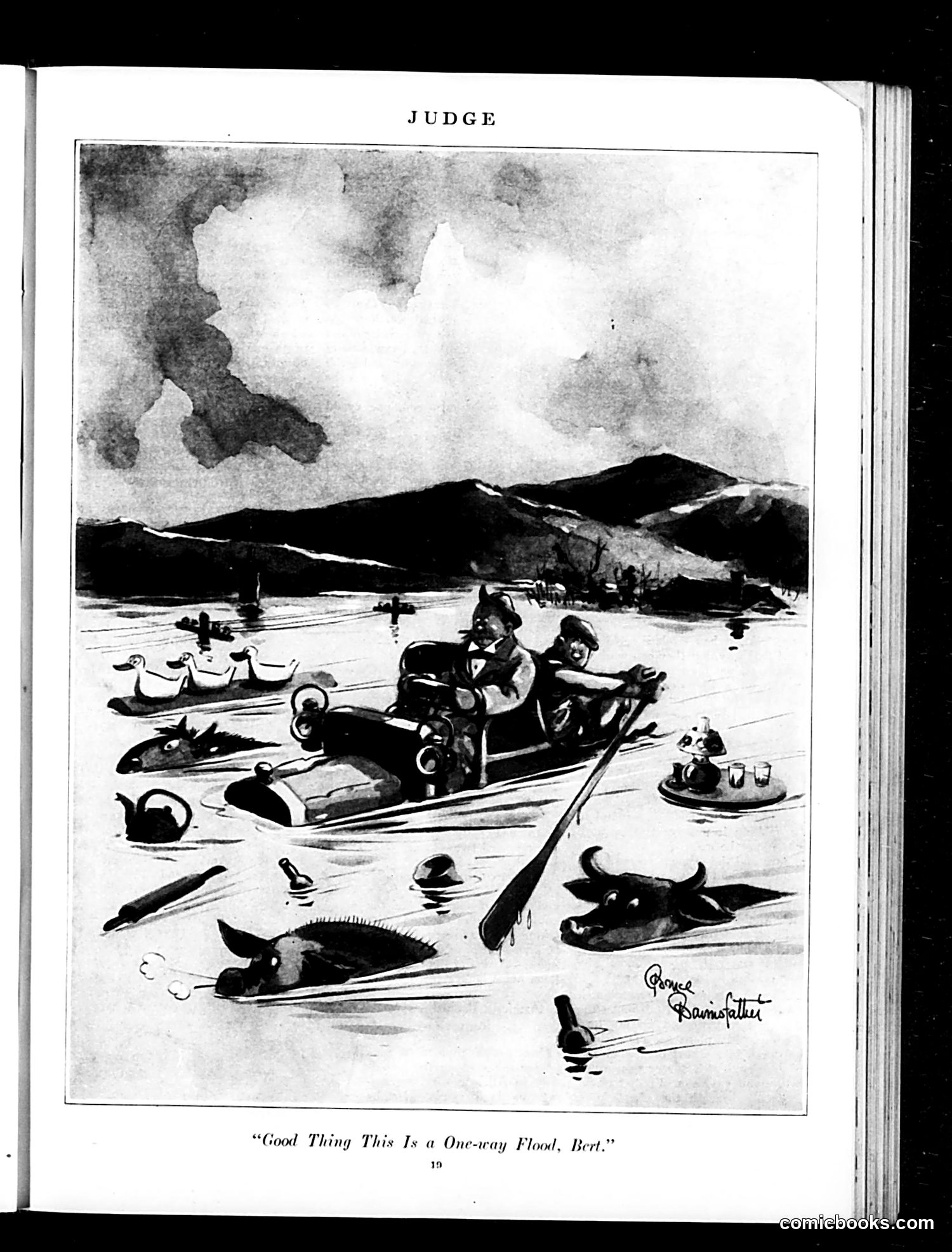
Analysis This Judge magazine cartoon satirizes flood management, likely from the early 20th century. Two figures in a motorboat navigate a catastrophic flood landscape filled with submerged animals (cattle and possibly other livestock) and objects. The caption's comment about a "one-way flood" suggests ironic relief that the water flows in only one direction—implying this is cold comfort given the devastation visible around them. The cartoon appears to mock the inadequacy of reassurance in the face of natural disaster. The abundance of drowned livestock indicates agricultural/rural damage, while the characters' calm demeanor contrasts sharply with the surrounding destruction. The satire likely critiques either flood-control policies, insurance claims, or political responses deemed insufficient to the crisis. The artist is credited as "George Summerville" (or similar).
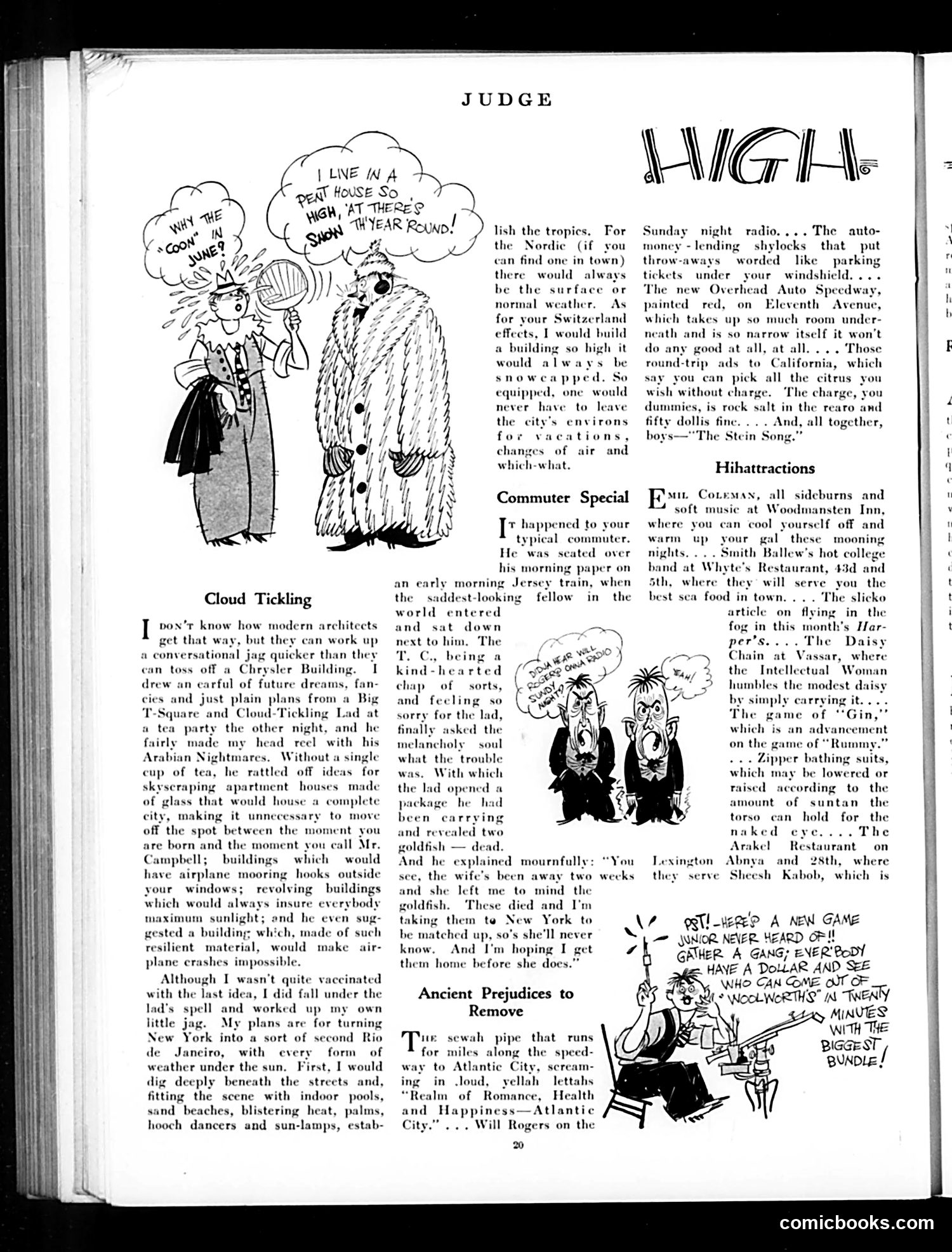
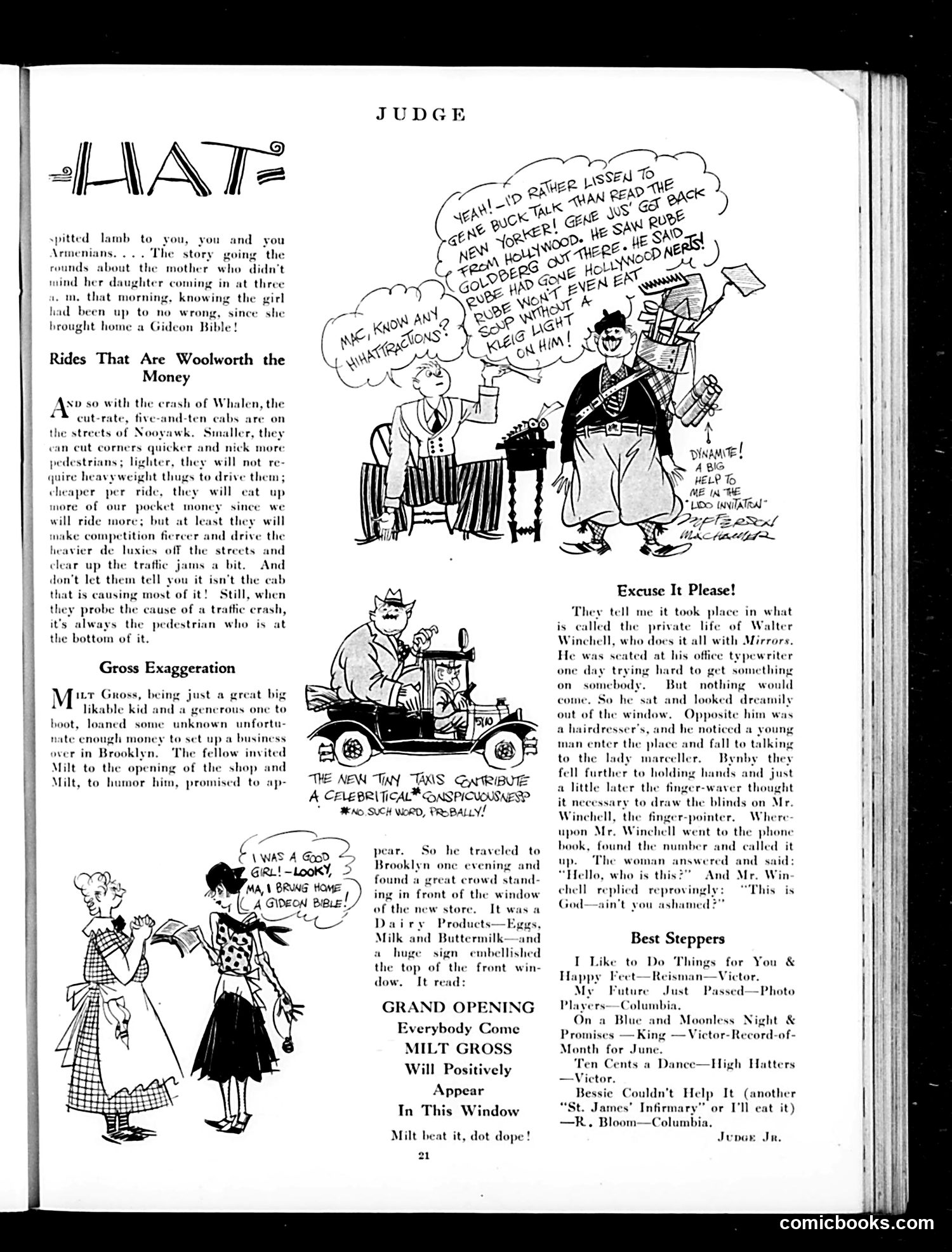
Judge Magazine Page Analysis This page contains three satirical pieces targeting 1920s New York personalities and social issues: "Rides That Are Woolworth the Money" criticizes the proliferation of small, cheap taxicabs (likely Woolworth's entry into the taxi business) flooding NYC streets, causing traffic chaos and pedestrian danger—blamed on competition rather than reckless driving. "Gross Exaggeration" mocks Milt Gross (a popular cartoonist of the era), who attended a Brooklyn shop opening only to discover his name was the main attraction advertised in the window—humiliating him with false celebrity endorsement. "Excuse It Please!" satirizes Walter Winchell, the famous gossip columnist known for exposing celebrities' private lives. The joke: Winchell, unable to dig up dirt on someone, spots a young woman at a hairdresser across the street, calls her claiming to be "God," then shames her for drawing her blinds—mocking his invasive surveillance tactics and self-importance as moral arbiter.
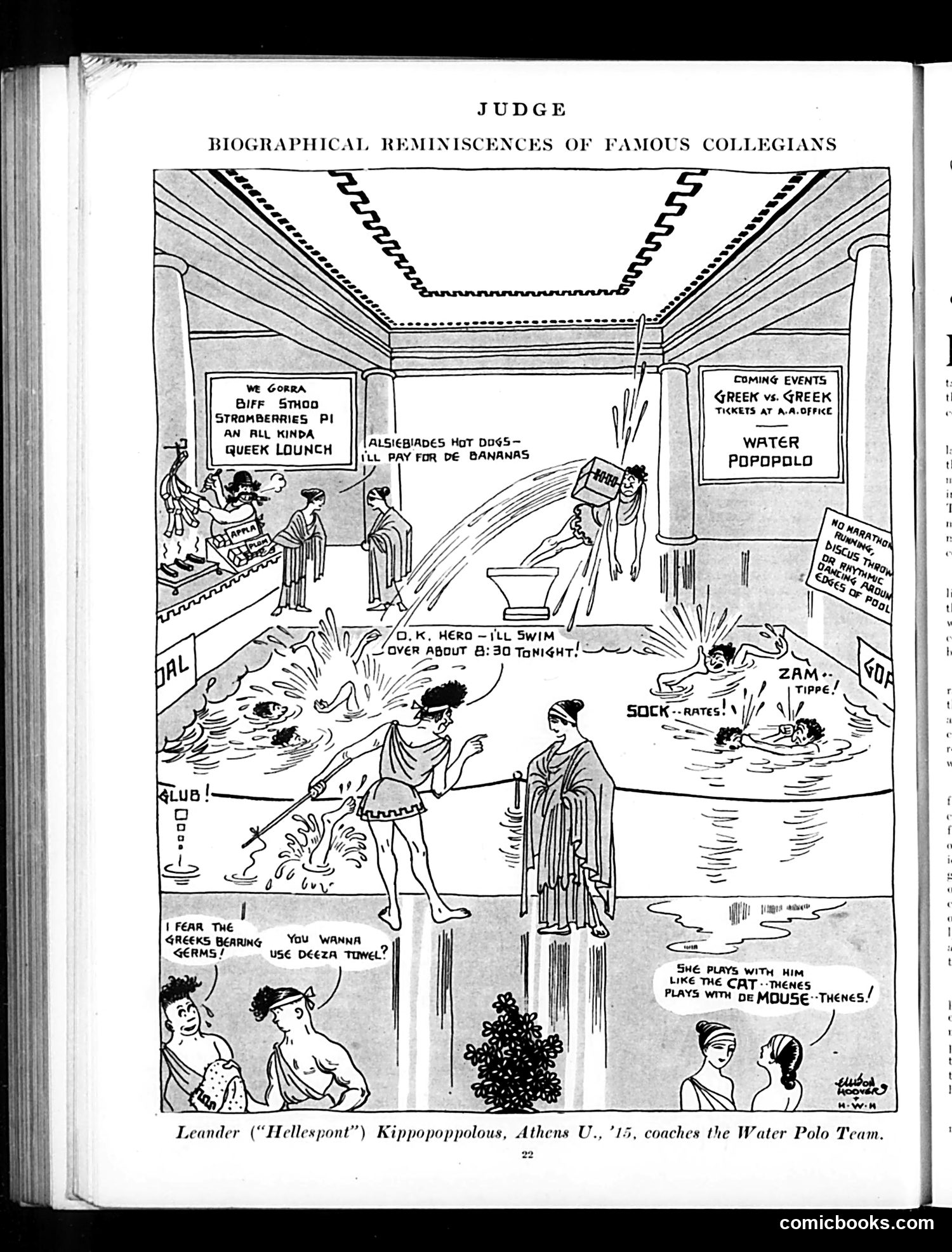
Understanding This Judge Cartoon This is a satirical cartoon about college life featuring a character named Leander Kippopoppolous, a water polo coach at "Athens U." The humor relies on ethnic stereotyping common to early 20th-century American satire. The cartoon mocks what appears to be a Greek-American college figure through exaggerated dialect humor ("Biff Sthoop," "Queer Lounch," "Deeza Towel"). Various vignettes depict absurd scenes: hot dogs named after Greek philosophers (Alcibiades), swimming competitions, and water polo practice. The caption references "Hellespont" (the classical strait between Europe and Asia), reinforcing the Greek theme. References to "Greeks bearing germs" play on the famous phrase "beware Greeks bearing gifts." The overall satire targets both pretentious classical allusions in college culture and working-class immigrant stereotypes. Modern readers should recognize this relies on now-offensive ethnic caricature typical of Judge magazine's era, rather than substantive social commentary.
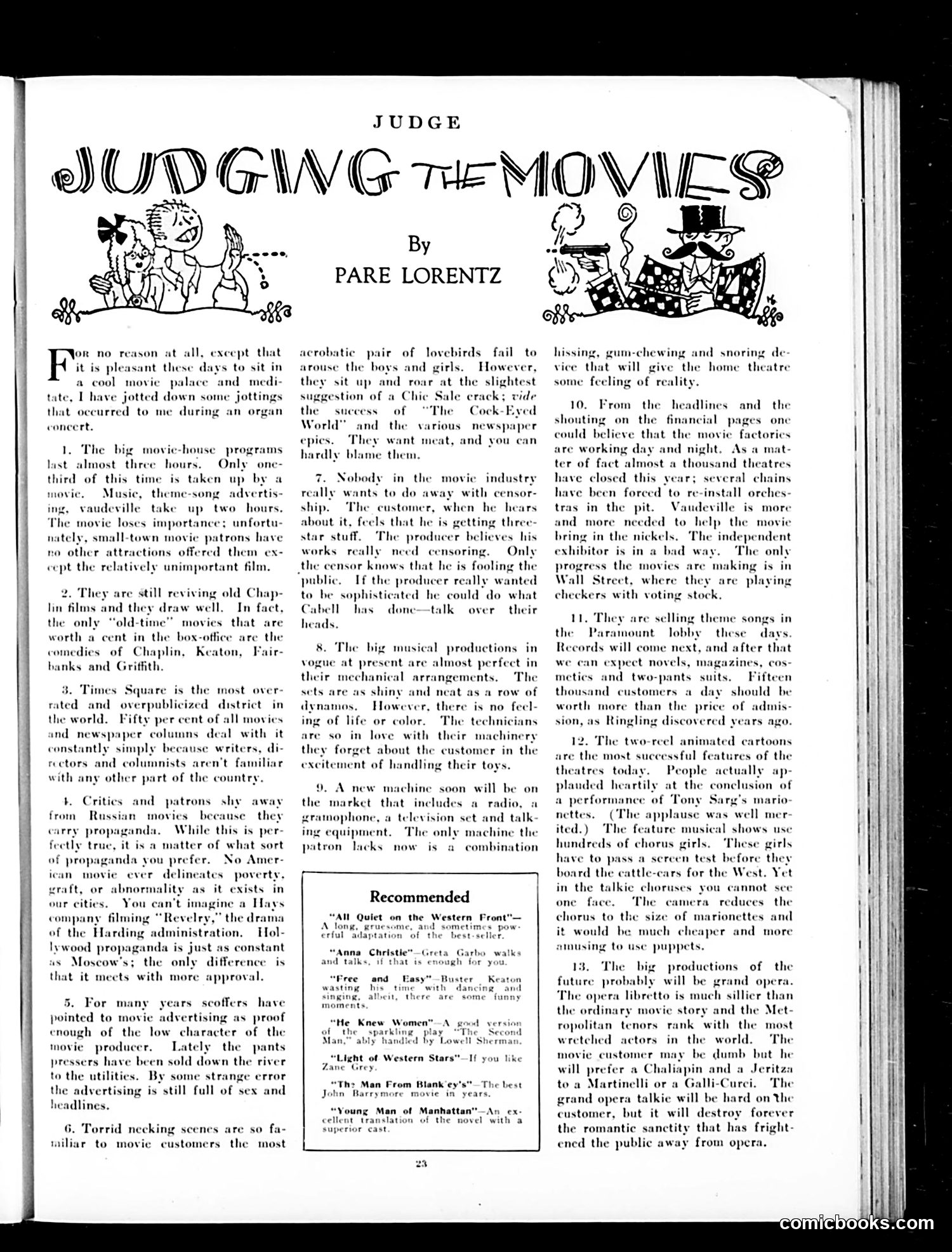
"Judging the Movies" by Pare Lorentz This is a humorous essay critiquing American cinema and movie-house culture of the silent/early-sound era (likely late 1920s). Lorentz offers numbered observations on film industry absurdities: Key points satirized: - Movie palaces waste two hours on vaudeville and advertisements, with only one hour of actual film - Only old Chaplin comedies retain box-office appeal - Film critics irrationally dismiss Russian cinema while praising Hollywood propaganda - Times Square receives disproportionate attention in cinema and media - Movie producers and censors engage in mutual deception about propriety - Elaborate musical productions prioritize technical spectacle over human emotion - Upcoming "talking" machines will offer audiences everything except what matters The accompanying "Recommended" section lists contemporary films with brief, sardonic reviews. The satire's target: the disconnect between the movie industry's self-importance and actual artistic merit—producers prioritize machinery, spectacle, and censorship compliance over genuine storytelling and emotional connection with audiences.
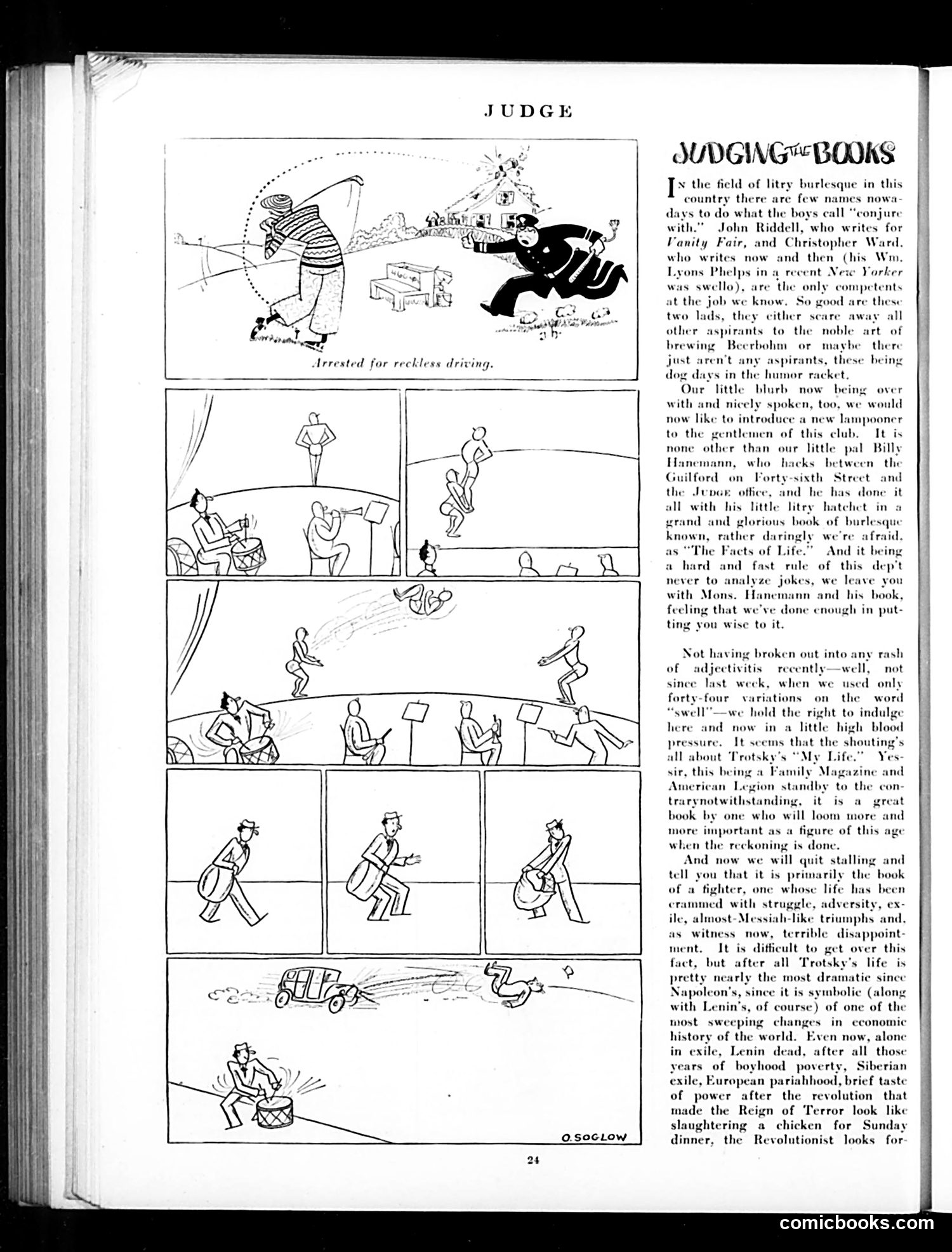
Judging the Books This is a literary criticism column introducing "Billy Hanemann," a humorist who writes satirical book reviews for Judge magazine. The text discusses contemporary humor writers like John Riddell and Christopher Ward, establishing them as the only competent practitioners of literary satire in America. The main focus is a glowing review of Leon Trotsky's autobiography *My Life*. The critic praises it as dramatically significant—comparing Trotsky's life to Napoleon's—and argues it documents one of history's most sweeping economic changes (the Russian Revolution). Despite Judge being aligned with the anti-communist American Legion, the critic insists Trotsky's revolutionary account deserves serious attention as literature, not political polemic. The comic strip panels (showing various physical activities and mishaps) illustrate Hanemann's humorous approach to book reviewing.
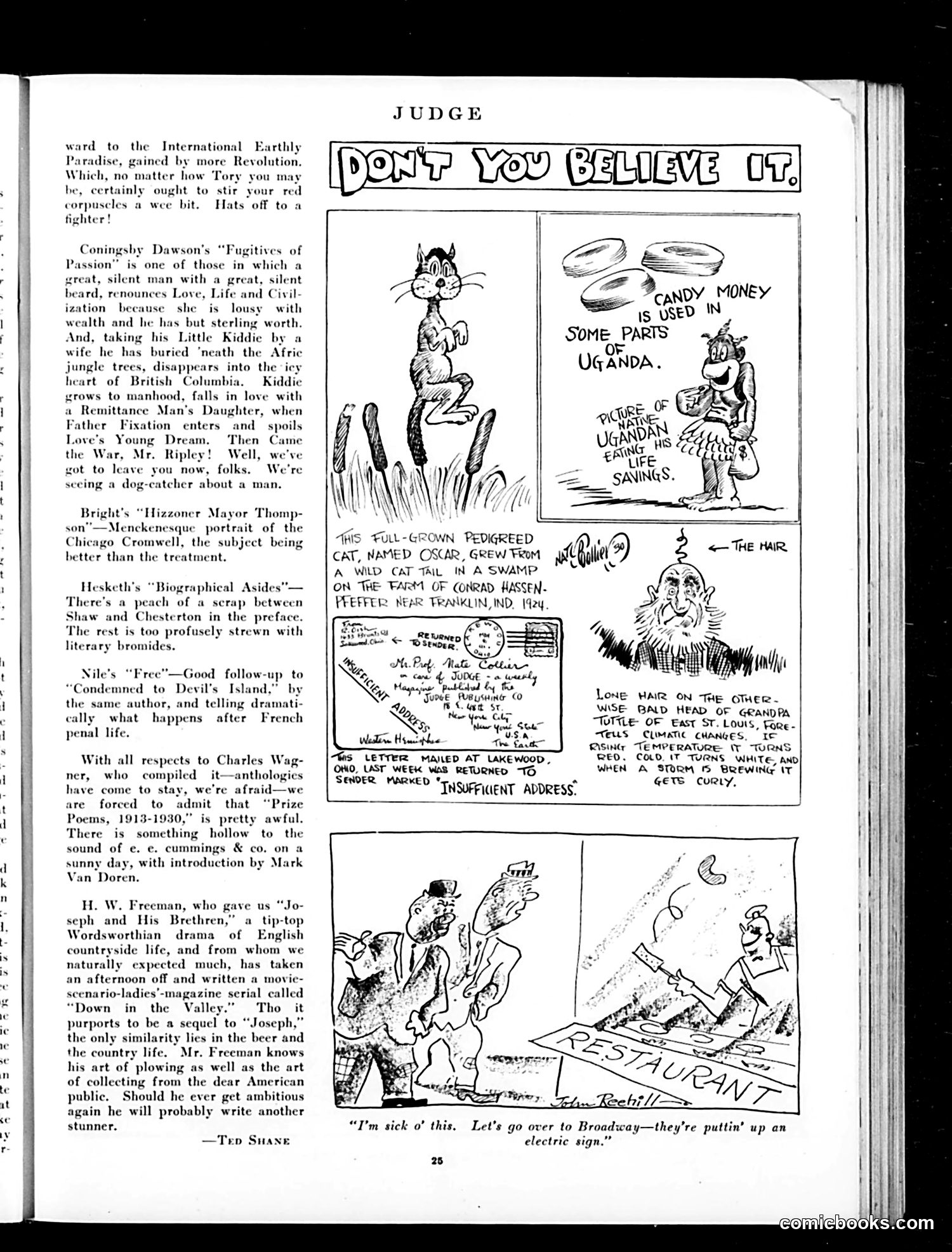
Analysis for Modern Readers This page from *Judge* contains book reviews by Ted Shane and cartoon features in the "Don't You Believe It?" section. The Cartoons: The top cartoon shows a cat and person discussing how "candy money is used in some parts of Uganda"—a humorous "fact" likely meant to mock travelers' tall tales or exaggeration of foreign customs. The bottom cartoon depicts two men discussing relocating to Broadway for an electric sign, suggesting frustration with current entertainment or urban restlessness. The Book Reviews: Shane discusses contemporary literary works, some now obscure (Coningsby Dawson's novels, H.W. Freeman's drama). References to Shaw and Chesterton indicate literary debates of the era. The dismissal of poetry anthologies featuring e.e. cummings reflects mid-century literary tastes. Overall Context: This reflects 1920s-30s American middlebrow culture—satirizing both literature and popular gullibility about exotic places and modern urban attractions. The humor depends on readers recognizing book titles and authors now largely forgotten.
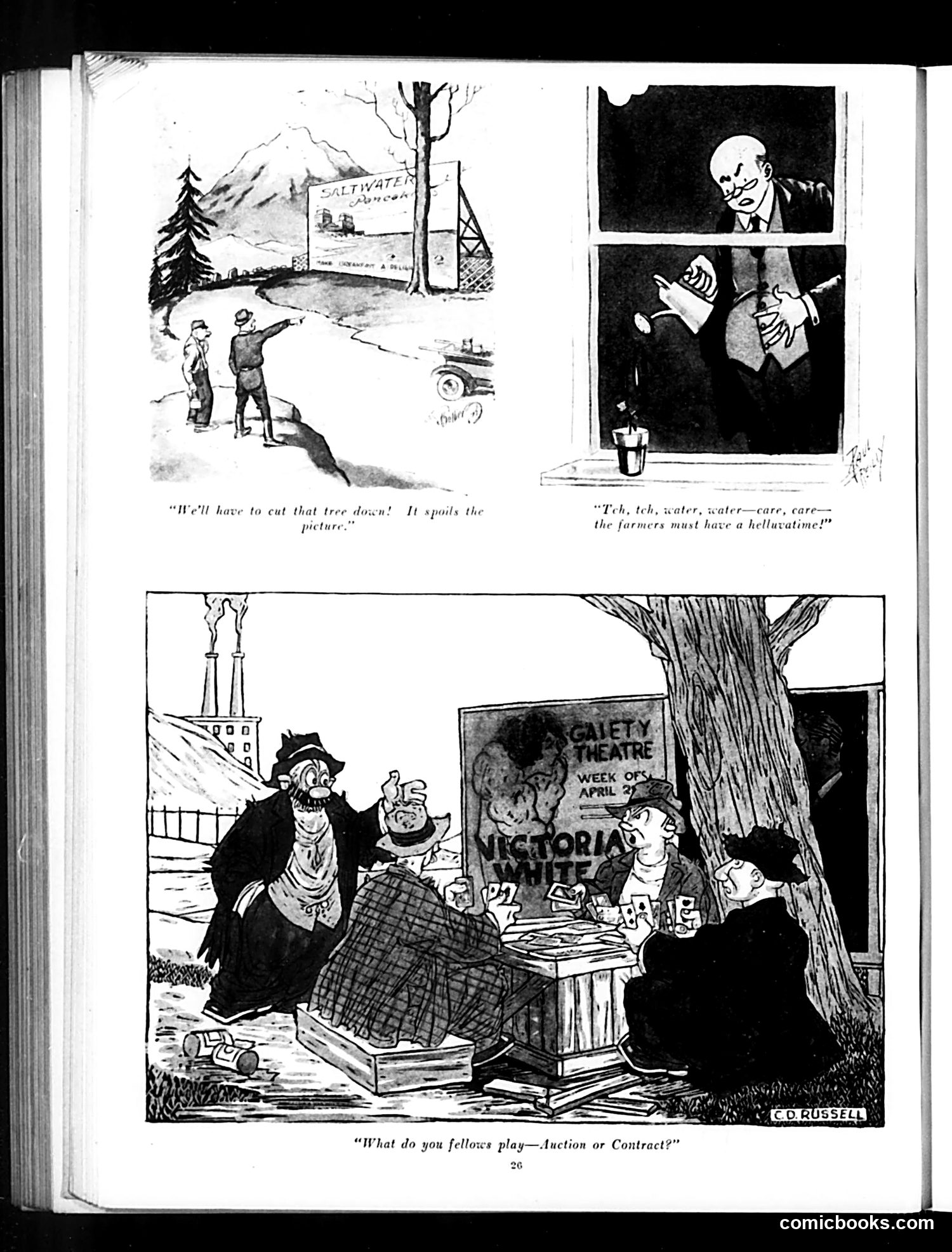
Political Cartoon Analysis This page from *Judge* magazine contains three satirical cartoons. The top-left depicts a scenic landscape with two figures discussing cutting down a tree that "spoils the picture"—likely satirizing aesthetic concerns versus practical needs. The top-right shows a bald man exclaiming about water quality and farmers needing "a helluva time"—appearing to mock someone's complaint about agricultural water issues. The bottom cartoon, credited to C.D. Russell, is the most politically pointed. Three men sit beneath a large tree with a "Victoria" poster visible, appearing to debate "Auction or Contract"—likely referencing competing methods of conducting business or politics during this era. The shabby appearance and working-class setting suggest satire about how common people navigate or are affected by such formal systems. The specific historical context—the Victoria reference and debate format—remains unclear without additional dating information.
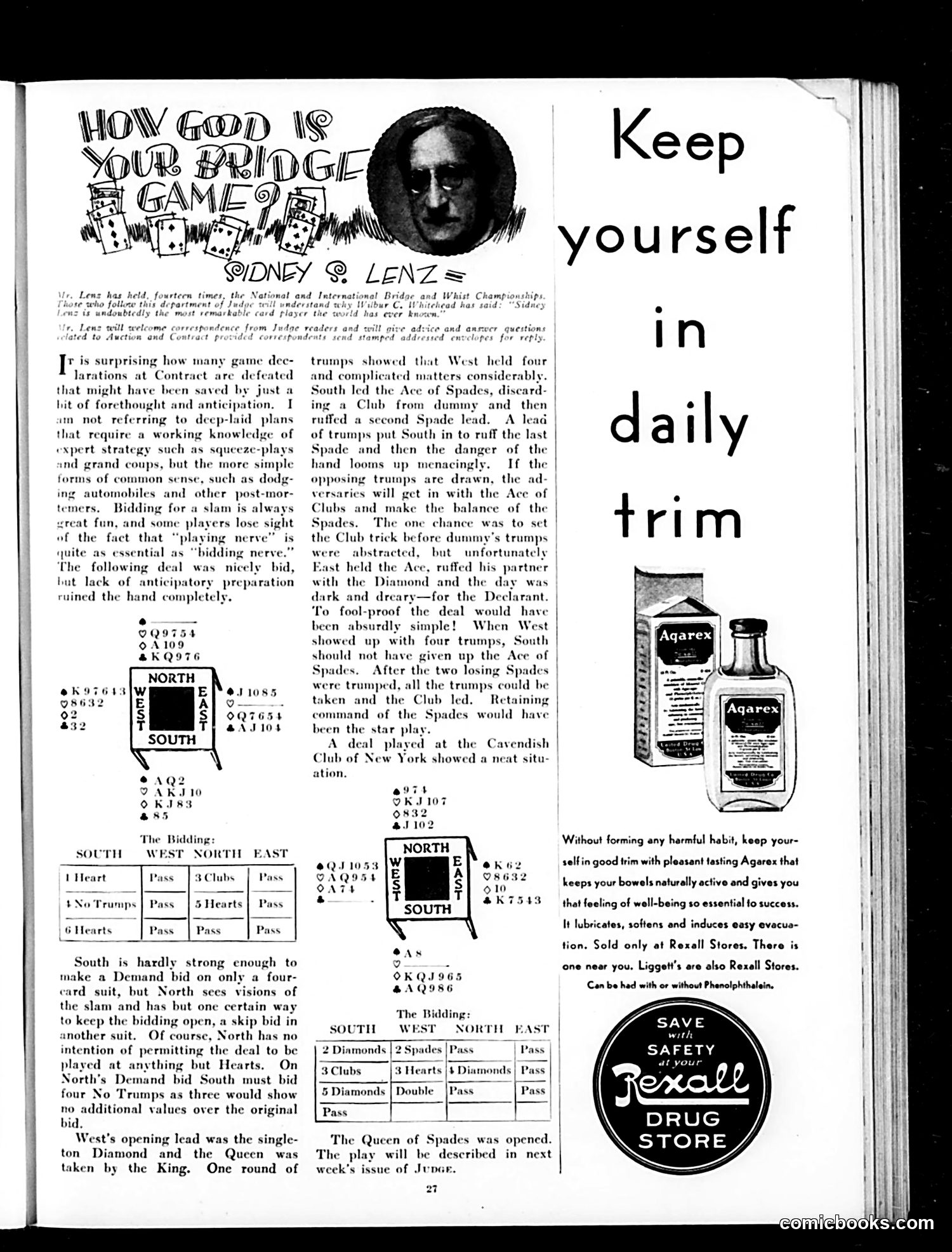
Content Analysis This page is primarily instructional bridge content with advertisements, not satirical political cartoons. The main feature is a bridge (card game) lesson by Sidney Lenz, a famous bridge champion. The text analyzes specific hands and bidding strategy, using real examples from tournaments. The cartoon at top left ("How Good Is Your Bridge Game?") is merely decorative/thematic—Lenz's face appears with playing cards, establishing him as the expert authority. The bulk of the page consists of detailed bridge hand analysis with bidding tables and play-by-play explanations of strategic errors and solutions. Advertisements occupy the right column: Agarex (a laxative marketed for "daily trim" and maintaining "well-being essential to success") and Rexall Drug Store. These ads reflect early 20th-century patent medicine marketing that conflated bowel regularity with overall health and professional success—a common advertising trope of the era that seems absurd today. This is essentially a bridge instructional magazine with vintage advertising, not satirical commentary.
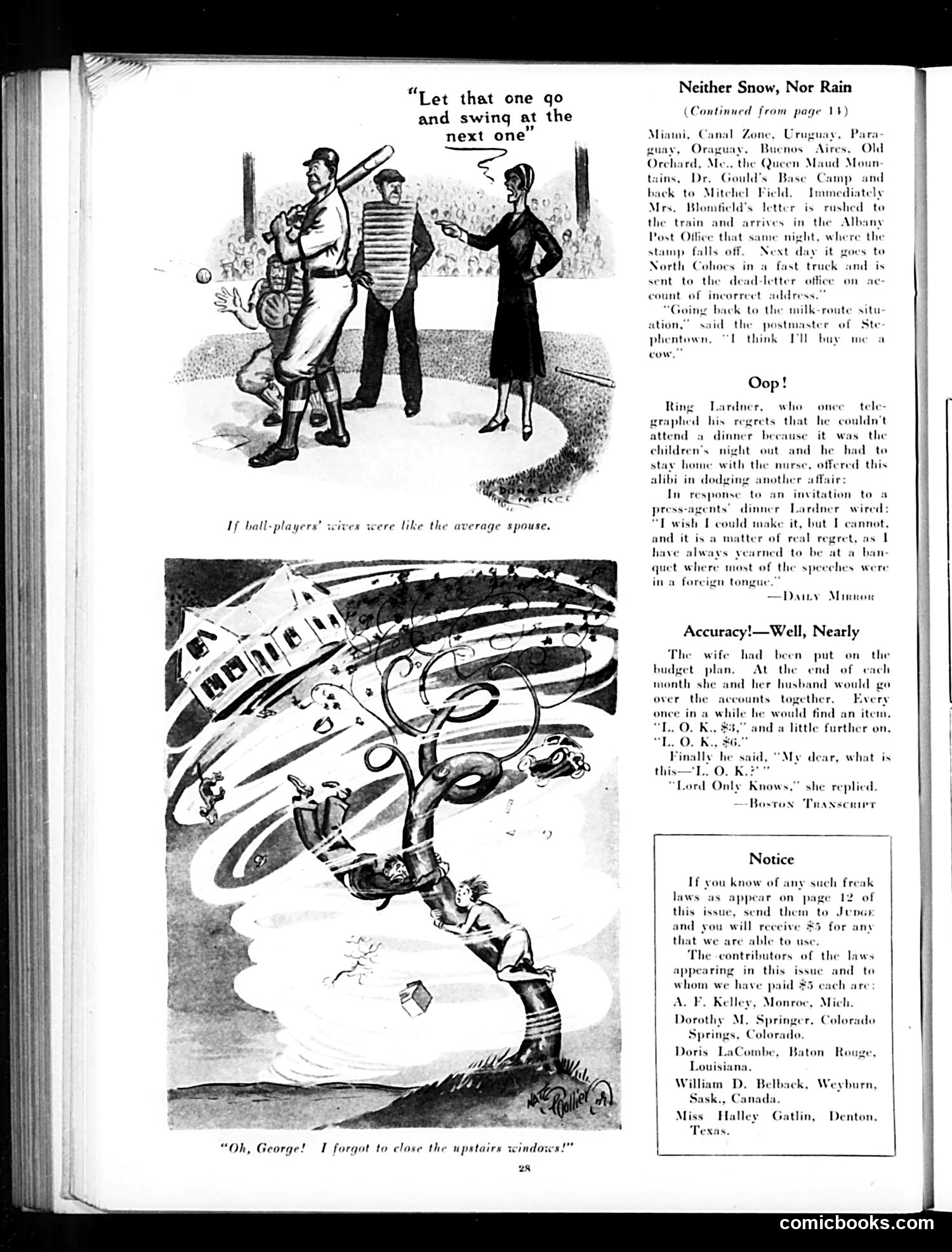
Judge Magazine Page Analysis This page contains two unrelated cartoons satirizing American domestic life, likely from the 1920s-30s era. Top cartoon: Shows a baseball scene where a wife warns her husband mid-swing: "Oh, George! I forgot to close the upstairs windows!" The joke mocks domestic distraction—the husband is trying to play baseball while his wife interrupts with household concerns, suggesting women's preoccupation with homemaking details even during leisure activities. Bottom cartoon: Depicts the postal service's comically inefficient mail routing. A letter travels absurdly across the globe (Miami, Canal Zone, Uruguay, Buenos Aires, etc.) before arriving damaged in Albany, ultimately sent to the dead-letter office. The satire criticizes the Post Office's inability to deliver mail correctly despite the motto "Neither Snow, Nor Rain"—a reference to the postal service's famous reliability claim. The remaining content includes brief humorous anecdotes and a notice soliciting "freak laws" from readers for payment ($5 per submission).
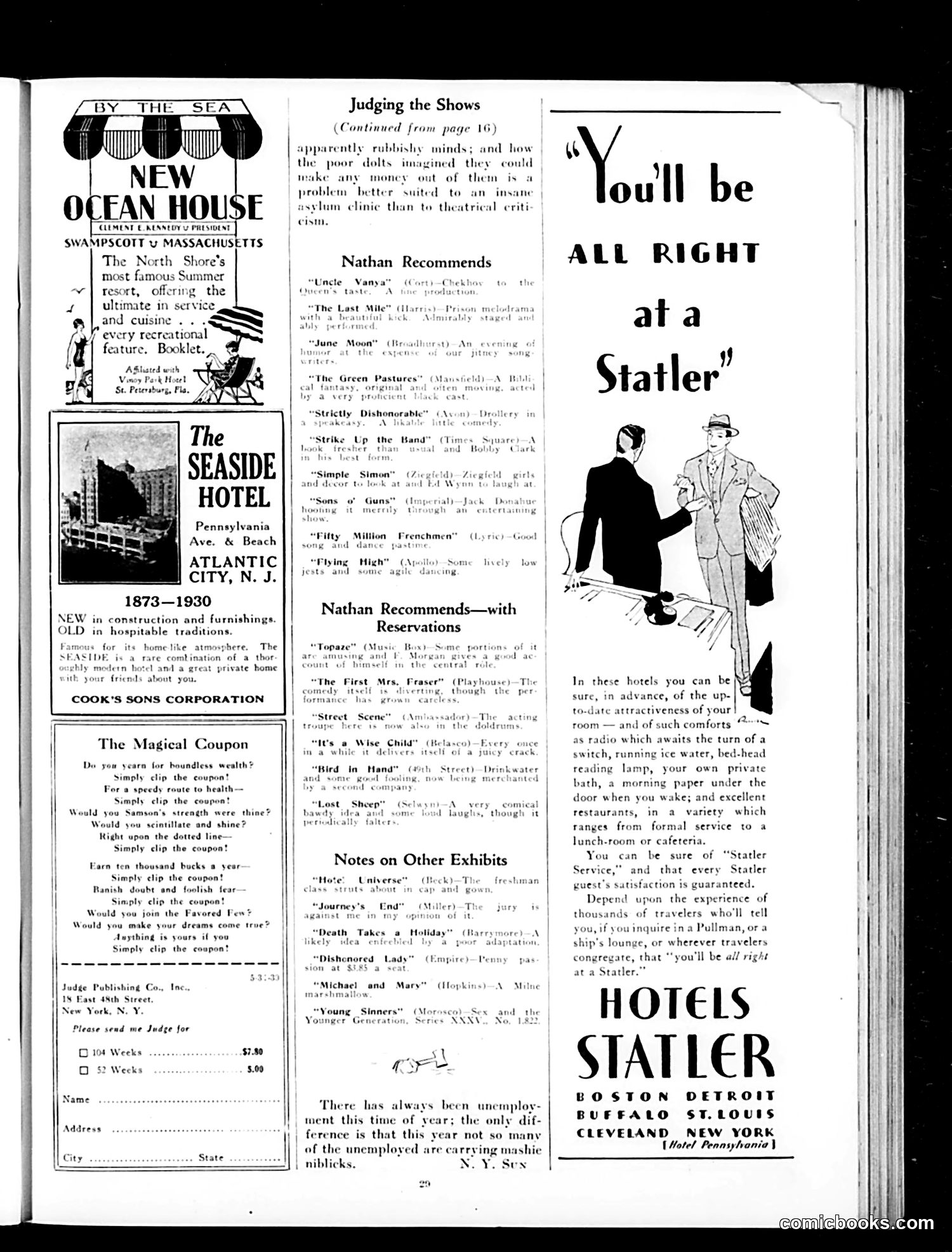
Page Analysis: Judge Magazine This page is primarily advertising, not satirical content. The dominant feature is a large Statler Hotels advertisement featuring a cartoon of two men at a hotel entrance, with copy promising modern amenities (radio, ice water, reading lamps, private baths, restaurants). The smaller "Magical Coupon" advertisement is satirical—it mocks get-rich-quick schemes and wishful thinking by repeatedly promising miraculous results ("boundless wealth," "Samson's strength") simply by "clipping the coupon." This appears to be Judge magazine's gentle mockery of mail-order scams prevalent in the 1920s-30s. The theater reviews section discusses Broadway productions but contains no visible political satire or caricature requiring explanation. The final note about unemployment ("mashie niblicks" being golf clubs—an obscure reference) suggests mild commentary on Depression-era job losses, but lacks clarity in the OCR'd text. Verdict: This is primarily a commercial advertising page with one mild consumer-culture satire.
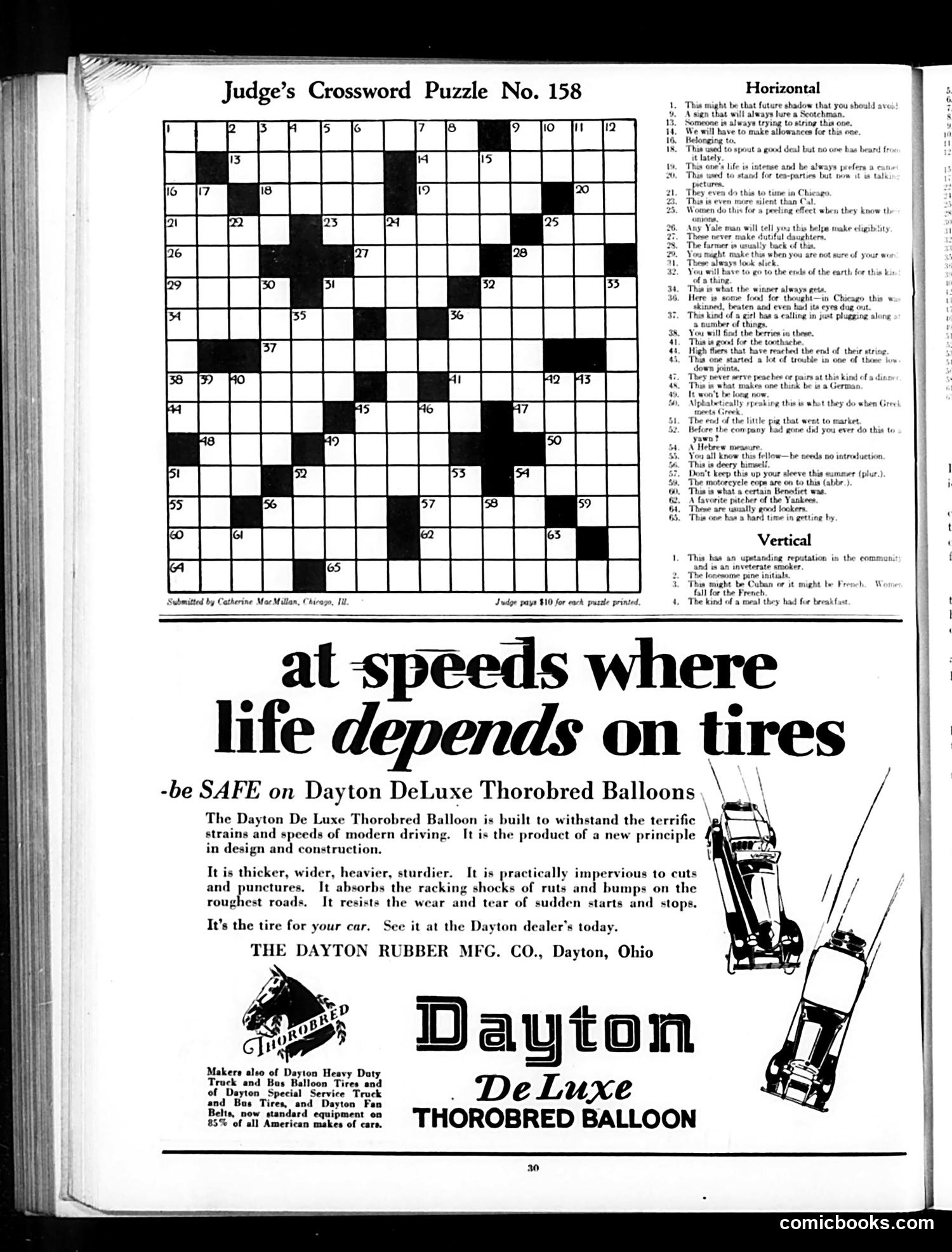
Judge Magazine Page 158: Content Analysis This page contains primarily advertising, not satirical cartooning. The dominant content is a full-page advertisement for Dayton DeLuxe Thorobred Balloon tires, featuring the tagline "at speeds where life depends on tires." The ad uses dramatic language emphasizing safety and durability—the tire is "thicker, wider, heavier, sturdier" and "practically impervious to cuts and punctures." It appeals to motorists concerned about the hazards of early 20th-century driving on rough roads. The top half displays Judge's Crossword Puzzle No. 158, a standard puzzle feature typical of the magazine's entertainment content. The tire advertisement's visual includes illustrations of cars in motion, reinforcing the speed and safety messaging. This represents typical magazine advertising of the era, when automobile ownership was still relatively new and tire safety was a significant consumer concern. The ad's appearance in Judge indicates tire manufacturers recognized the magazine's affluent, car-owning readership as their target market.
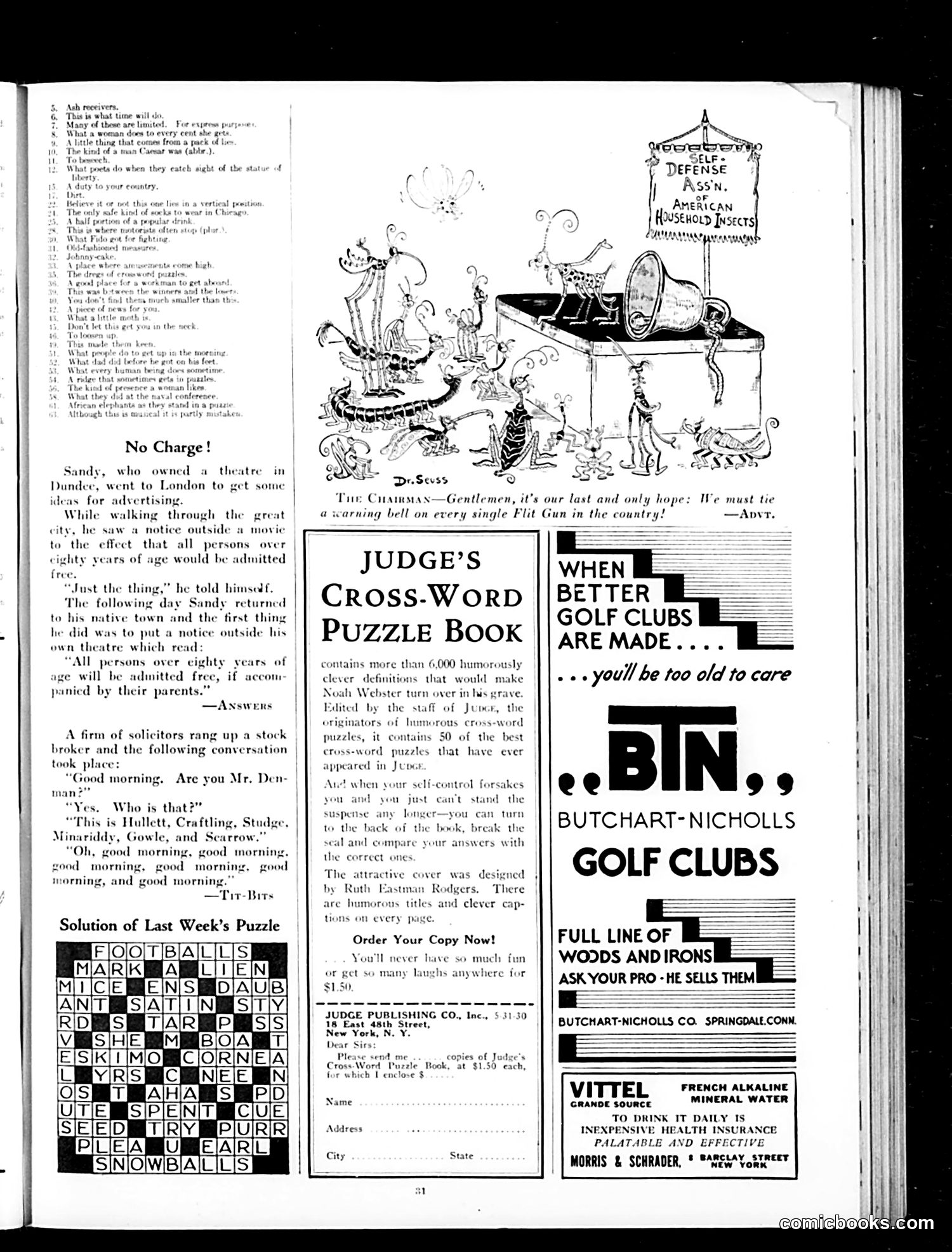
Analysis of Judge Magazine Page Content This page from the satirical magazine *Judge* contains two humorous anecdotes and period advertising. "No Charge!" Story: A Scottish theater owner, "Sandy," visits London and sees a movie theater advertising free admission for people over eighty. He copies the idea but adds a crucial twist—his sign reads free admission only if accompanied by parents. The joke satirizes misunderstanding or poor implementation of business strategies: the condition makes the offer absurd and worthless, since most people over eighty lack living parents. Solicitors' Joke: A stock broker receives a call from a law firm introducing themselves with a string of rapid-fire names ("Hullett, Craftling, Studge," etc.), each greeting "good morning" in succession. The solicitor's assistant misunderstands, thinking this is one person's actual name. This plays on confusion from overly formal introductions and the absurdity of such a lengthy surname. Advertisement: The page also features ads for Judge's crossword puzzle book, Butchart-Nicholls golf clubs, and Vittel mineral water—typical period luxury goods marketing.
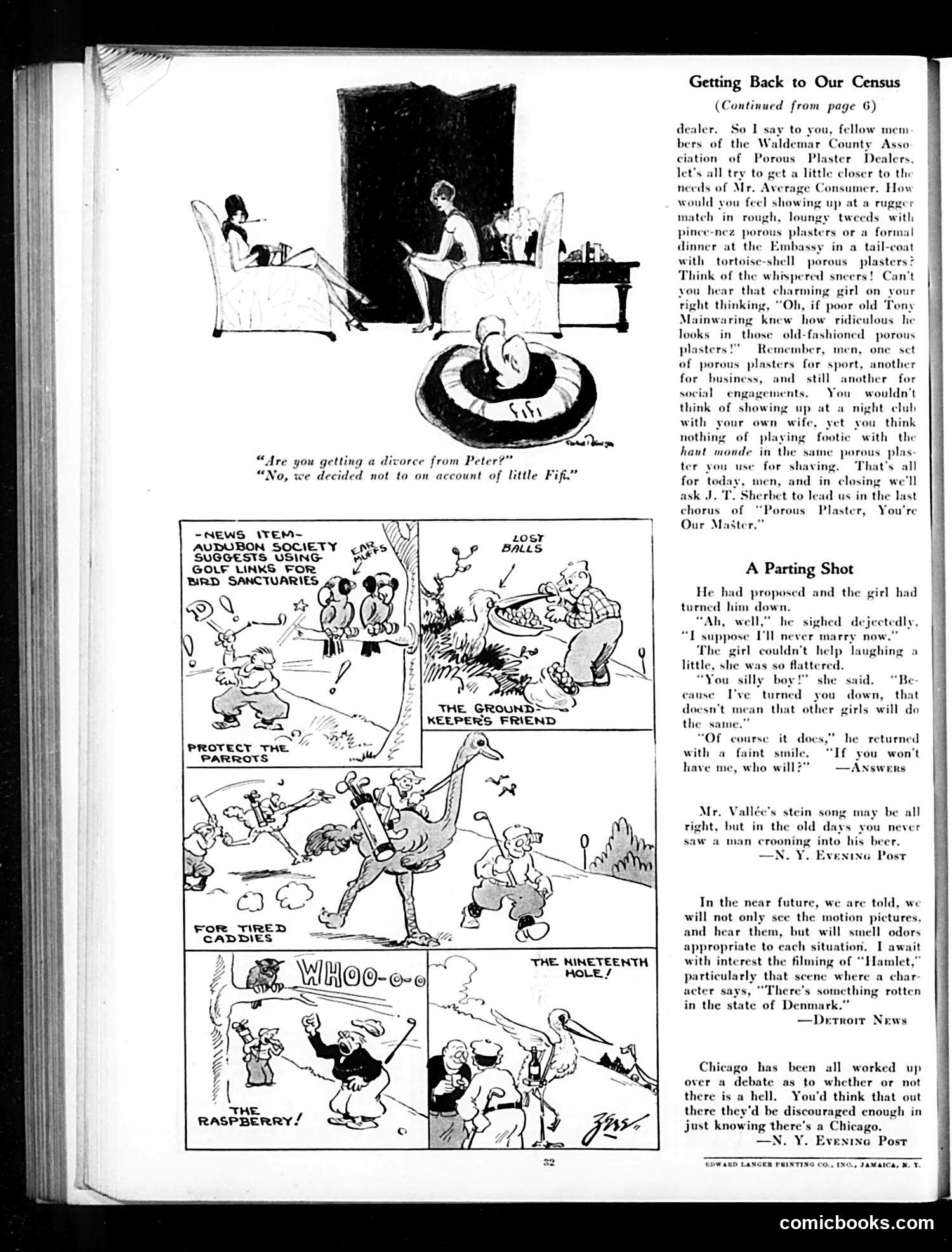
Judge Magazine Page Analysis Main Comic Strip (top left): A multi-panel satirical sequence about golf course usage. The Audubon Society suggests converting golf links into bird sanctuaries. The panels humorously show golfers and caddies encountering various wildlife—parrots, lost balls, and tired caddies—with the final panel showing chaos on "the nineteenth hole." The satire mocks both conservationists' impractical suggestions and golfers' priorities. "Getting Back to Our Census": An advertisement disguised as editorial content promoting porous plaster medical products. The copy humorously argues that men should own different plasters for different social occasions (sport, business, formal events, shaving), treating them as fashion accessories rather than medical supplies. It's absurdist product marketing wrapped in satirical social commentary about class consciousness. "A Parting Shot" and brief quotes: Humorous anecdotes about rejection, crooning, future "smell-o-vision" movies, and Chicago—typical Judge filler content poking fun at contemporary trends and city stereotypes. The page blends advertising, social satire, and light humor typical of 1920s-era Judge magazine.
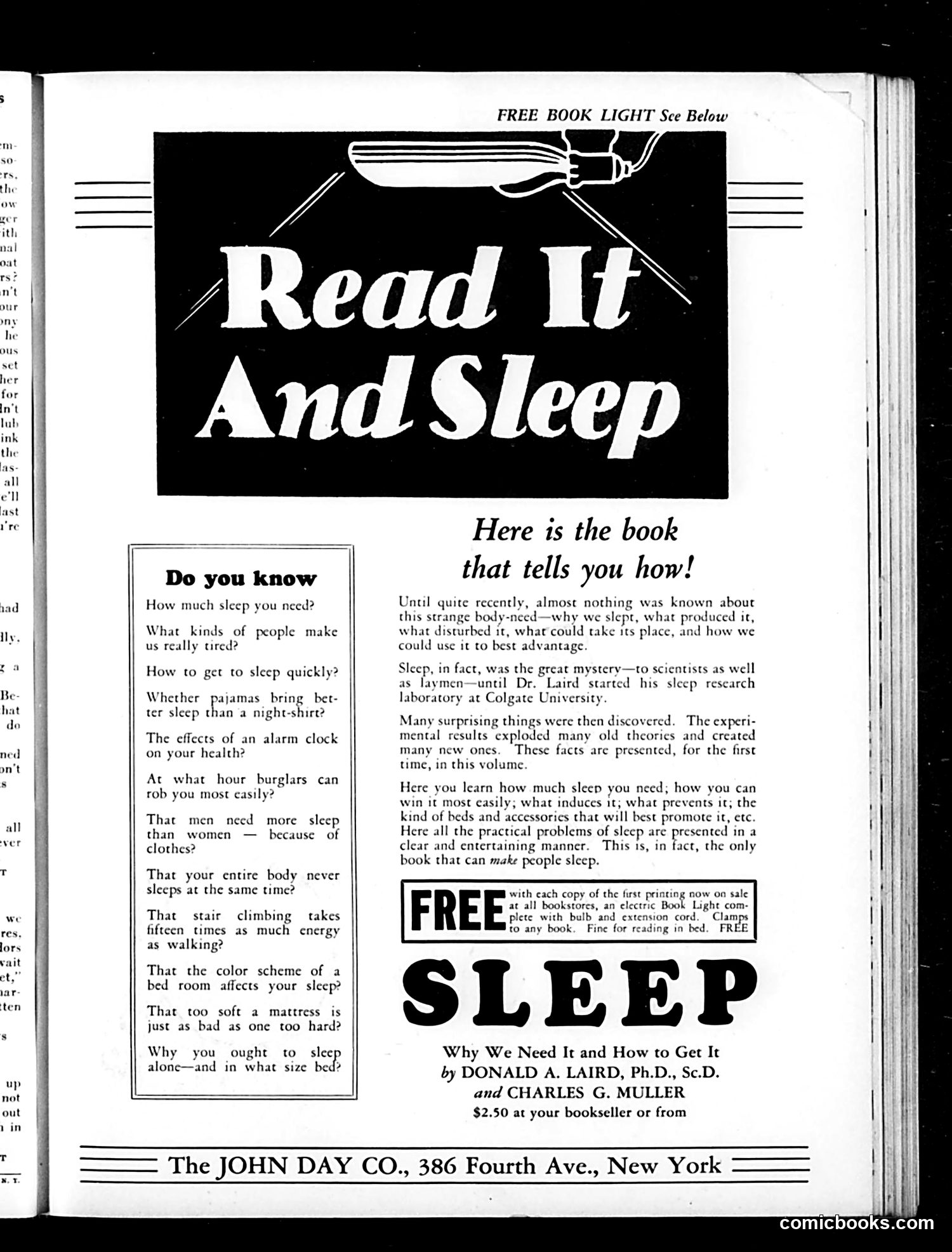
Analysis for Modern Readers This page is primarily advertising, not satire or political commentary. It's a full-page advertisement for a book titled *Sleep: Why We Need It and How to Get It* by Donald A. Laird and Charles G. Muller, published by John Day Co. The ad promotes the book as revealing scientific discoveries about sleep from Laird's sleep research laboratory at Colgate University. It uses a teasing "Do you know?" format listing intriguing sleep-related questions (How much sleep do you need? Why men need more sleep than women?) to hook readers' interest. The main visual element—"Read It and Sleep" with a book light illustration—is a playful pun: reading the book will help you sleep. A free electric book light (with bulb and clamp) is offered as a premium incentive, priced at $2.50. This represents early-20th-century popular science marketing targeting middle-class readers curious about newly "scientific" approaches to everyday health concerns.
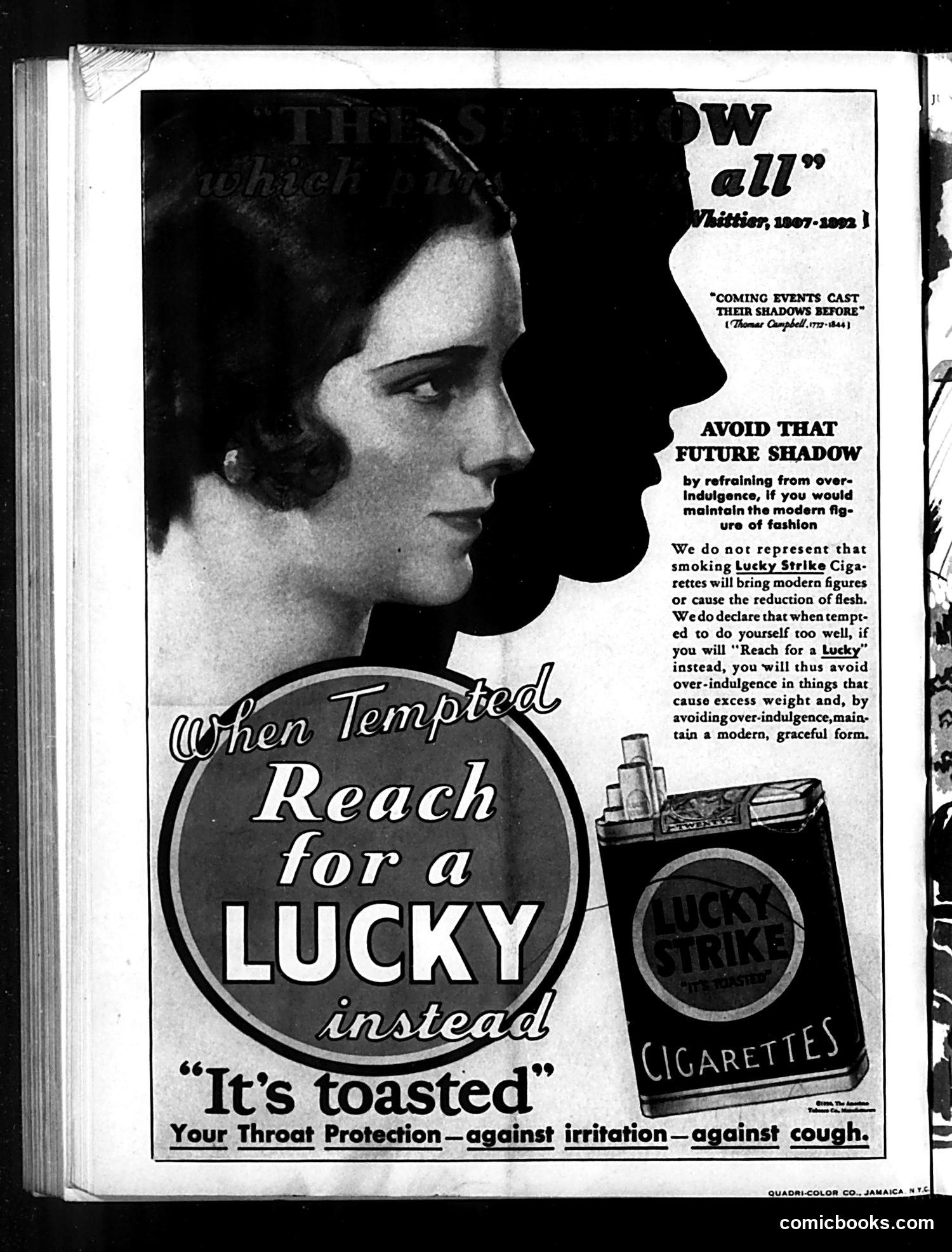
Lucky Strike Cigarette Advertisement Analysis This is a cigarette advertisement, not political satire. It features a side-profile comparison showing a woman's face next to a silhouette of her potential "future shadow"—depicting weight gain. The ad promotes Lucky Strike cigarettes as a weight-control device. The pitch: when tempted to overeat, smoke a Lucky Strike instead to maintain a "modern, graceful form." The headline "Avoid That Future Shadow" warns against the silhouette of a heavier woman. Notably, the fine print disclaims that Lucky Strikes won't *directly* cause weight loss, but rather prevent overeating by substituting cigarettes for food. The tagline "It's toasted" refers to the cigarettes' manufacturing process. This reflects 1920s-30s advertising ethics and attitudes: linking smoking to fashion, weight control, and modern femininity—targeting women specifically with appearance-based messaging.