judge
Judge — June 7, 1930
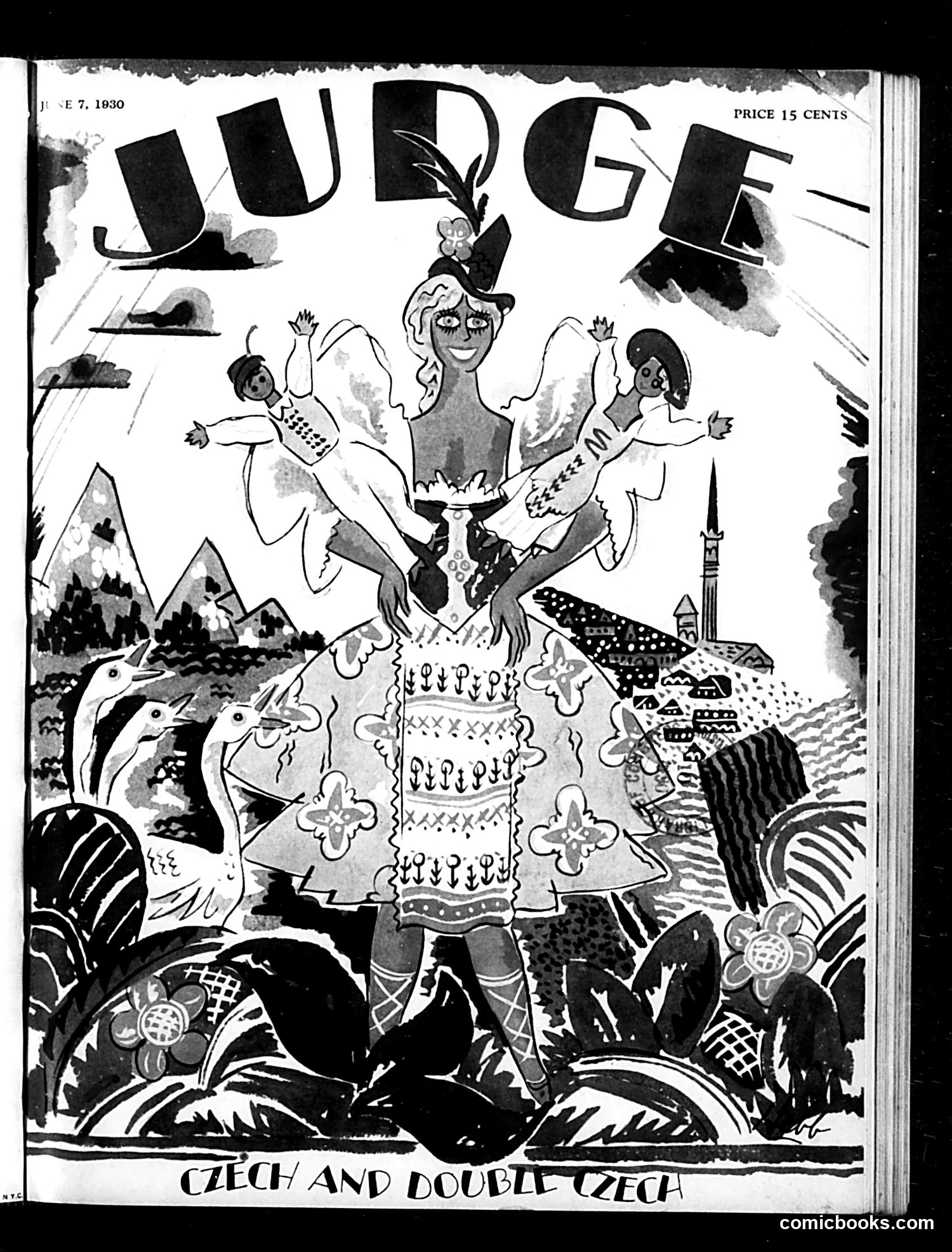
Analysis of Judge Magazine Cover (June 7, 1930) This cover satirizes Czech-Soviet relations during the Cold War era, as indicated by the caption "Czech and Double Czech." The central figure appears to be a personified representation of Czechoslovakia—depicted as a woman in traditional/ornate dress holding two children, surrounded by surreal imagery including stylized animals and architectural elements representing different regions or powers. The "double Czech" wordplay suggests deception or duplicity in Czech political dealings, likely referencing tensions between Western democratic interests and Soviet communist influence over Czechoslovakia. The whimsical, nightmarish composition implies the instability and conflicting pressures the nation faced geographically positioned between Western Europe and the Soviet sphere. This reflects genuine 1930s anxieties about Eastern European political alignment.
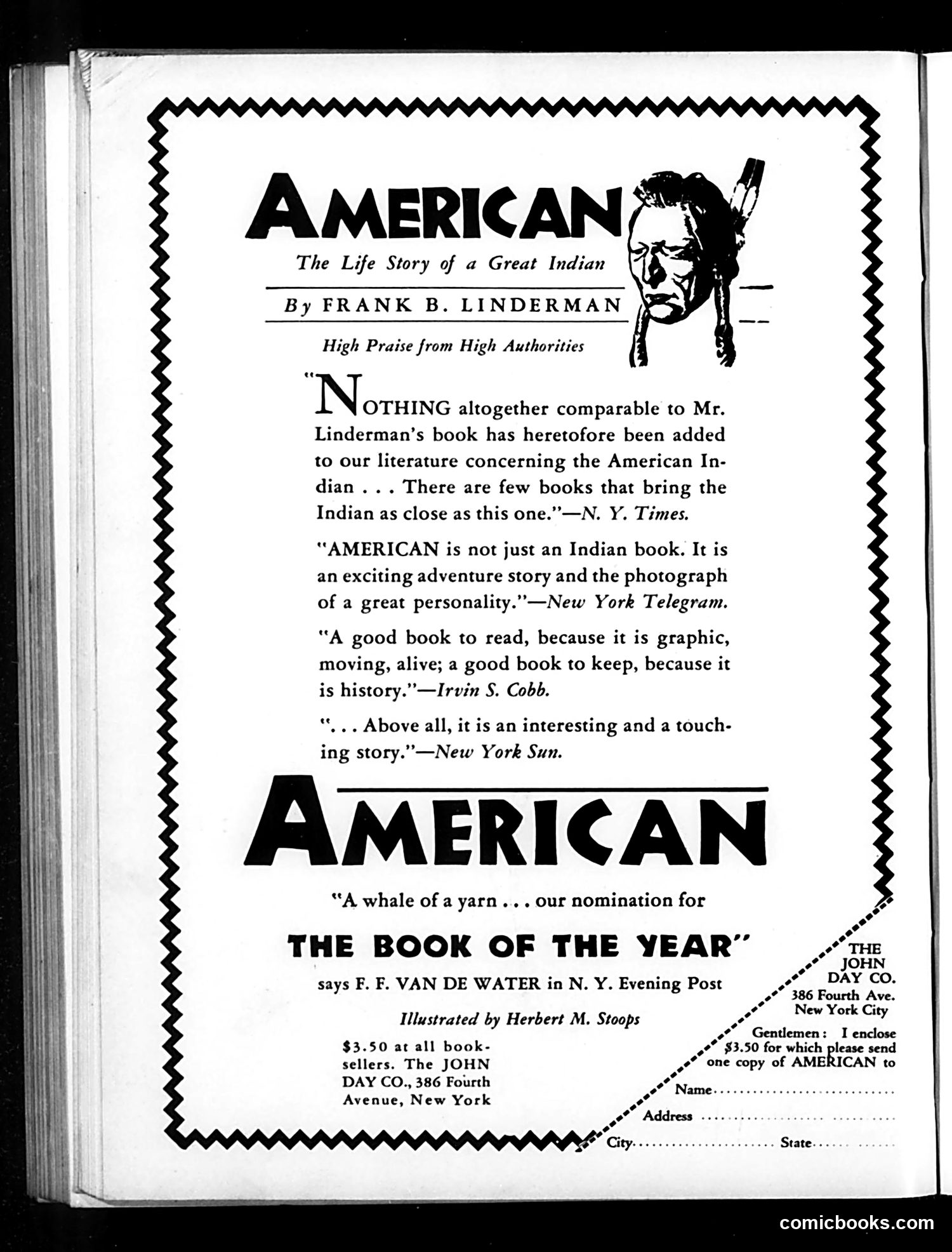
Analysis This page is entirely an advertisement, not satirical content. It promotes Frank B. Linderman's biography "American: The Life Story of a Great Indian," published by John Day Co. The book features a portrait of what appears to be a Native American man with traditional styling (feathered hair). The ad includes endorsements from major newspapers (New York Times, New York Telegraph, New York Sun, N.Y. Evening Post) praising the work as an important historical account—"graphic, moving, alive." The book sold for $3.50 and was illustrated by Herbert M. Stoops. A tear-off coupon at bottom-right allowed readers to order directly from the publisher at 386 Fourth Avenue, New York City. This represents 1930s-era book marketing to Judge's educated readership.
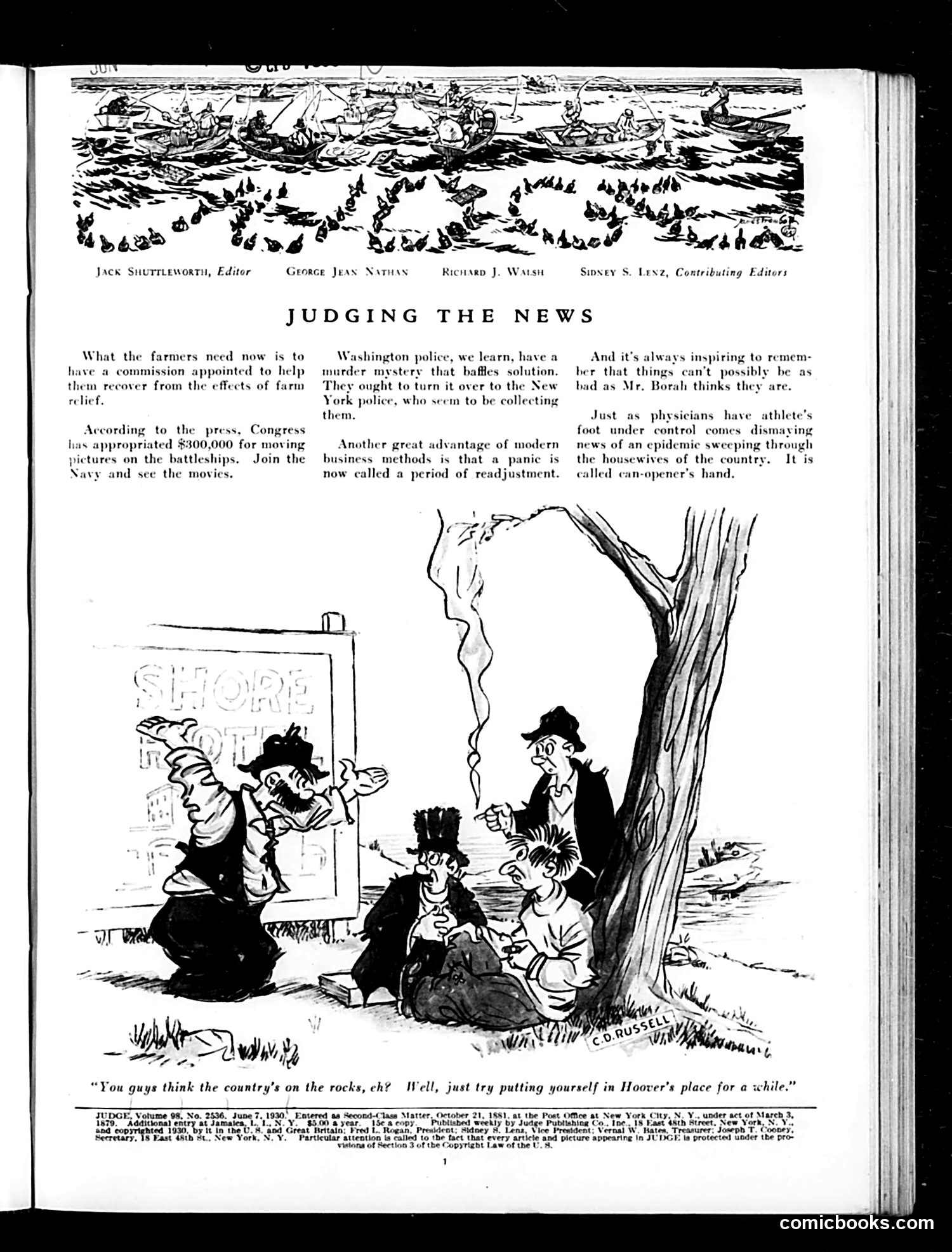
Analysis of Judge Magazine Cartoon (June 7, 1930) The cartoon satirizes the Great Depression's economic hardship. Four impoverished figures huddle under a tree near a "Shops Closed" sign, representing widespread unemployment and business failure. The caption—"You gotta think the country's on the rocks, eh? Well, just try putting yourself in Hoover's place for a while"—mocks President Herbert Hoover's optimistic messaging during the Depression's early stages. While ordinary citizens faced destitution, Hoover maintained that prosperity was "just around the corner" and resisted federal intervention. The cartoon's point: the disconnect between Hoover's reassurances and Americans' actual suffering. By sarcastically suggesting empathy with Hoover's position, Judge critiques his failure to acknowledge or adequately address the crisis affecting millions of citizens.
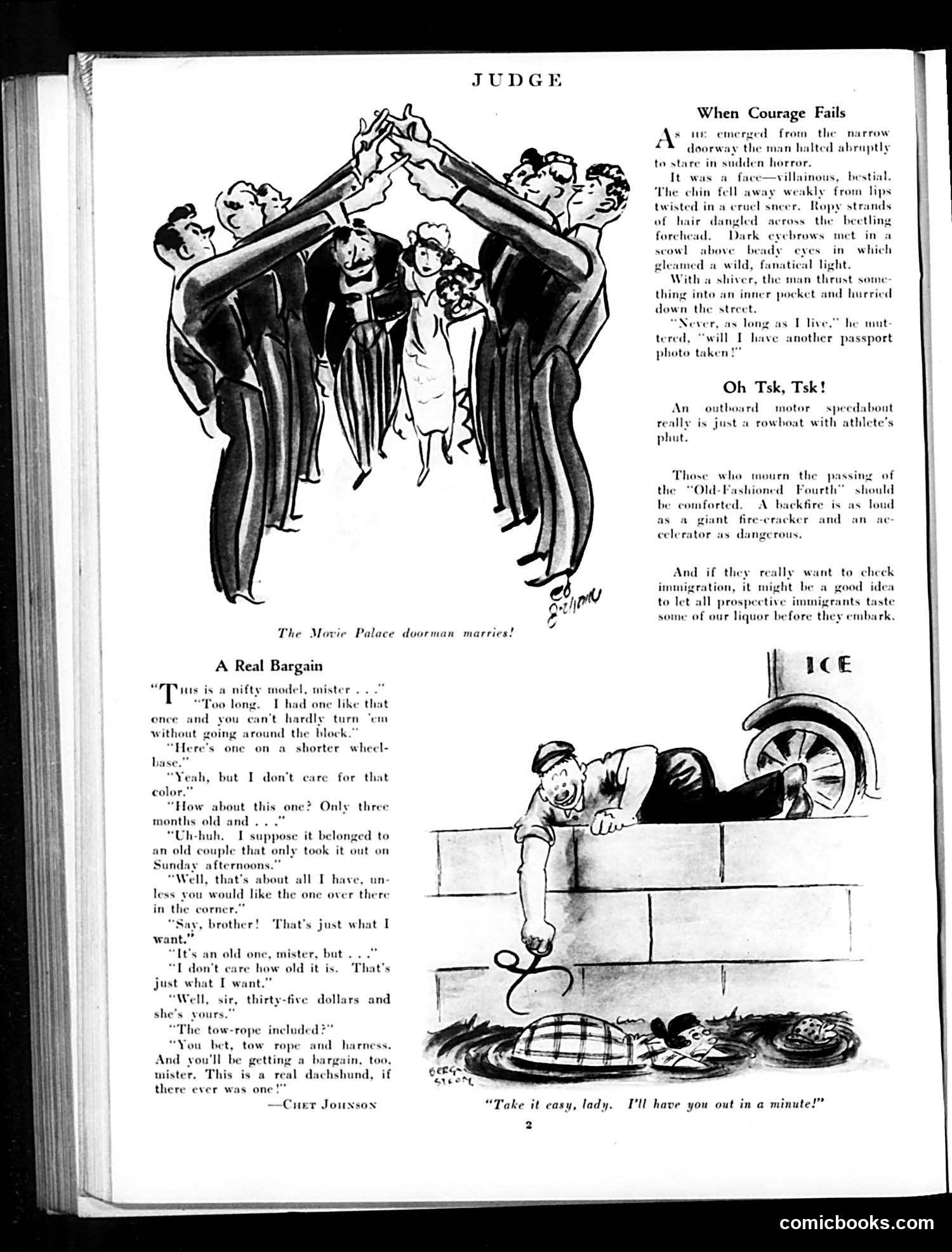
"Judge" Page Analysis This page contains three separate satirical pieces: 1. "When Courage Fails" mocks an immigrant's fear upon encountering what appears to be a threatening figure. The satire criticizes both the immigrant's cowardice and American street life's dangers. 2. "A Real Bargain" depicts a used-car salesman's patter—a dialogue where he persuades a customer to buy an old automobile by downplaying its age and condition. This satirizes both deceptive sales tactics and gullible buyers. 3. "Ice" shows a deliveryman struggling to carry a large block of ice down exterior stairs while a woman urges him to hurry. The humor derives from the physical comedy of the situation and the deliveryman's evident difficulty. The page reflects early-20th-century American urban life, consumer culture, and class dynamics through humor.
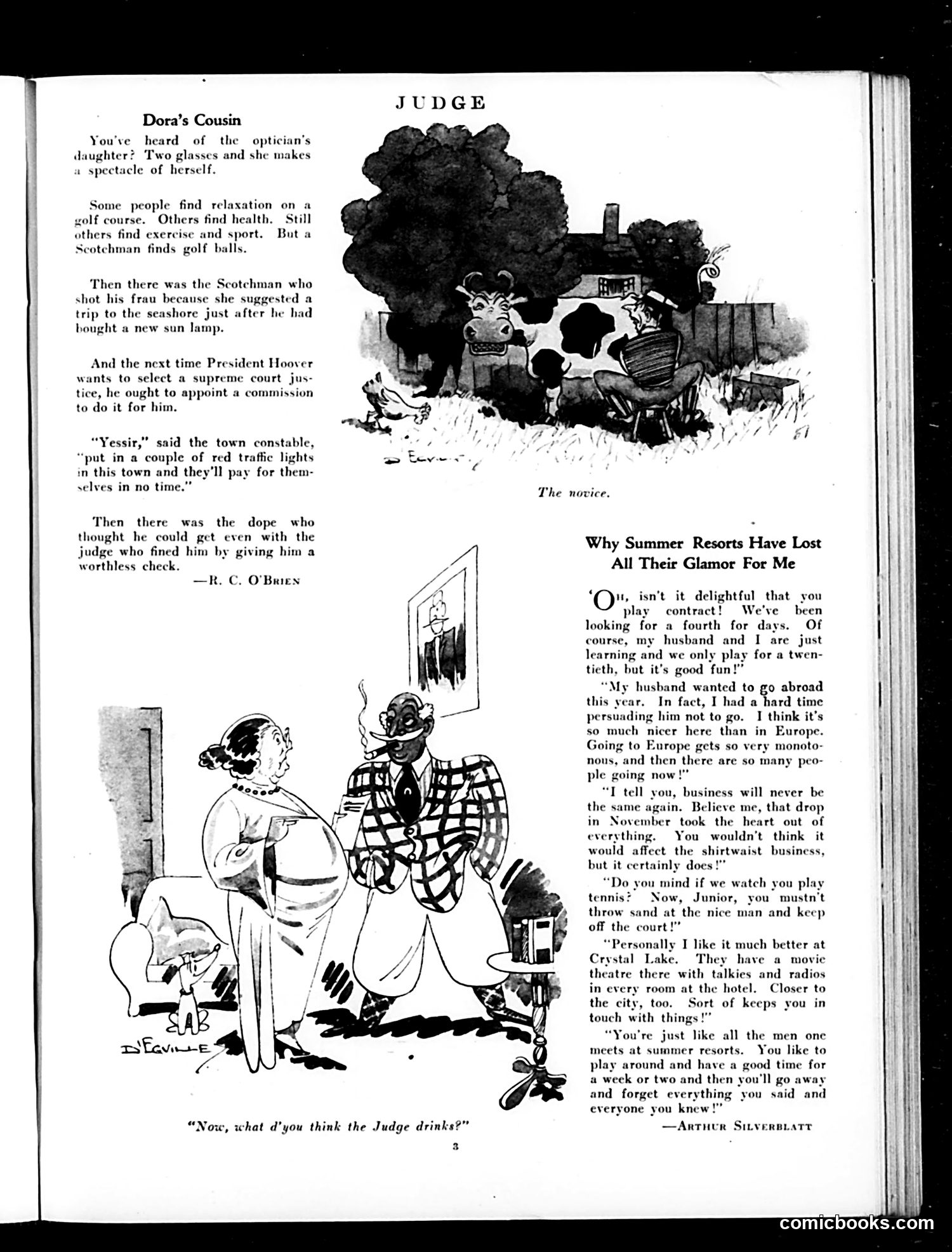
Analysis of Judge Magazine Page This page contains two distinct pieces: "Judge" (top section): A series of brief humorous anecdotes by R.C. O'Brien mocking various social types—opticians' daughters, Scotsmen obsessed with golf, and someone attempting to bribe a judge. The humor relies on ethnic stereotyping (the Scotsman) and class-based ridicule common to 1920s-era satire. "Why Summer Resorts Have Lost All Their Glamor For Me" (bottom): An illustrated article by Arthur Silverblatt critiquing how summer vacation behavior has become standardized and superficial. The accompanying cartoon shows a woman in elaborate dress speaking to a fashionably-dressed man, with the caption "Now, what d'you think the Judge drinks?"—likely satirizing pretentious social posturing at resorts. The overall theme reflects 1920s anxieties about commercialization and authenticity in leisure culture.
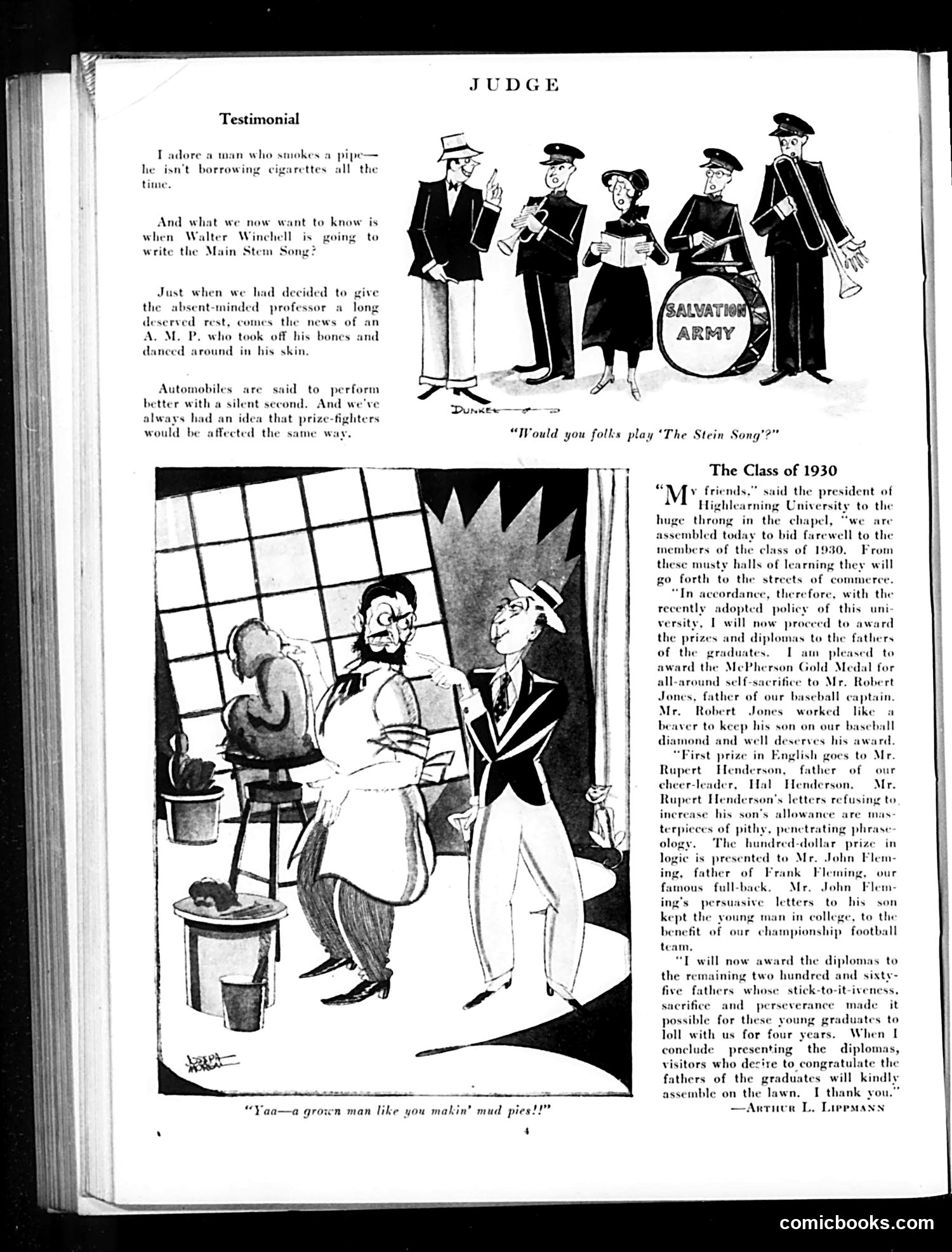
Analysis of Judge Magazine Page Top Cartoon ("Testimonial"): A Salvation Army band is asked to play "The Stein Song." The joke appears to mock the incongruity of a religious/temperance organization performing a drinking song—likely a reference to the popular "Stein Song," associated with beer and revelry. The humor relies on the assumption that the Salvation Army would find this request inappropriate or contradictory to their values. Bottom Cartoon: A man confronts another about making "mud pies," likely a euphemism for some undesirable behavior. The exact reference is unclear without additional context. "The Class of 1930" Section: A commencement address parody awarding humorous prizes to graduating students' fathers based on their contributions to university life (athletic support, financial persistence, etc.). This satirizes typical graduation ceremonies and parental involvement.
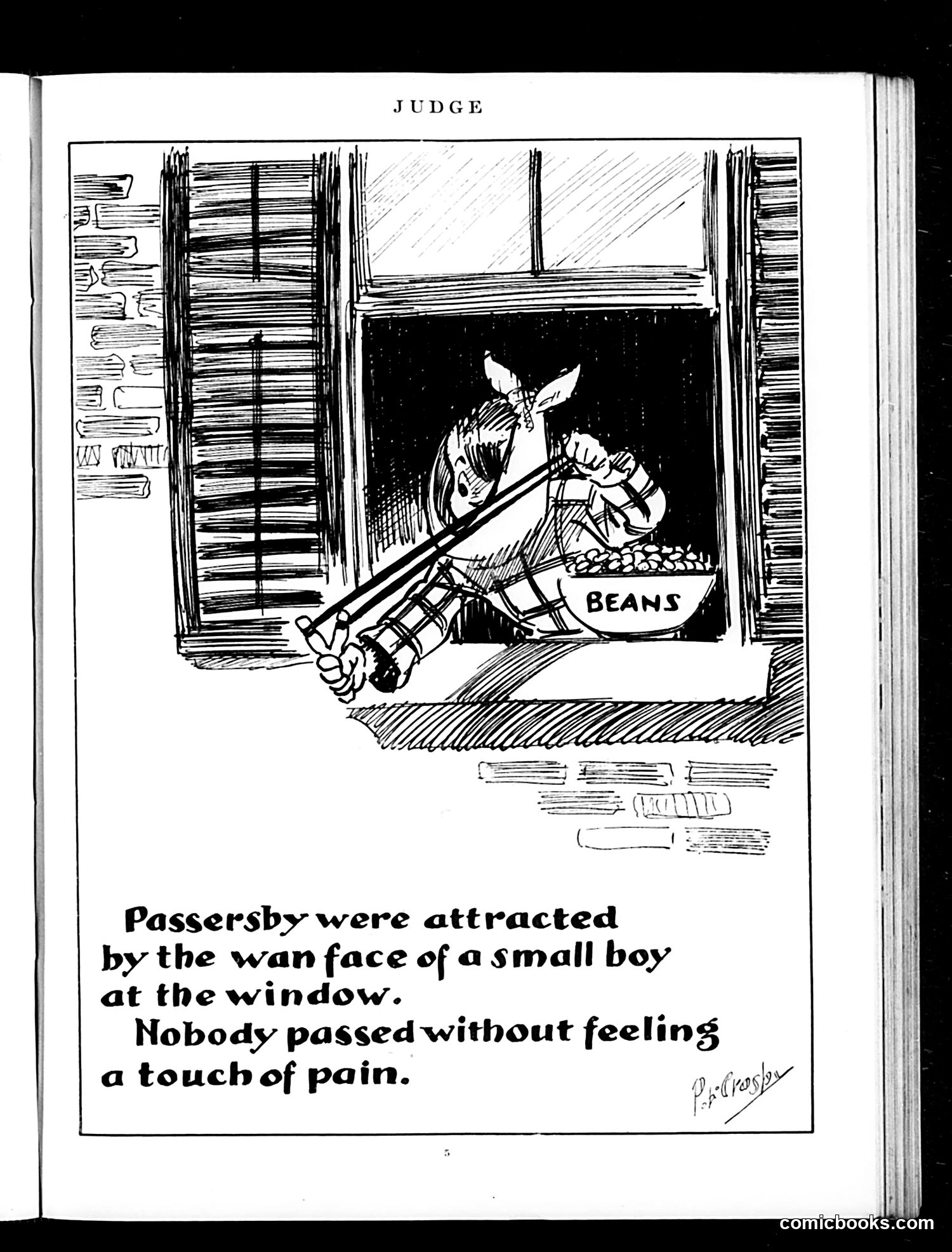
Analysis of Judge Magazine Cartoon This cartoon depicts a poignant social commentary on urban poverty. A small boy peers hungrily from a window at a donkey carrying sacks labeled "BEANS"—apparently food supplies. The accompanying text explains that passersby were moved by the child's "wan face" at the window, feeling emotional pain witnessing his obvious hunger and deprivation. The satire appears to target either society's indifference to child poverty or, conversely, people's performative sympathy—they "feel pain" seeing the hungry child but presumably do little to help. The rifle-wielding figure in the foreground may represent authority or a gatekeeper. Judge magazine frequently critiqued social inequality and working-class suffering in Gilded Age America, making child hunger a recurring subject of moral outrage.
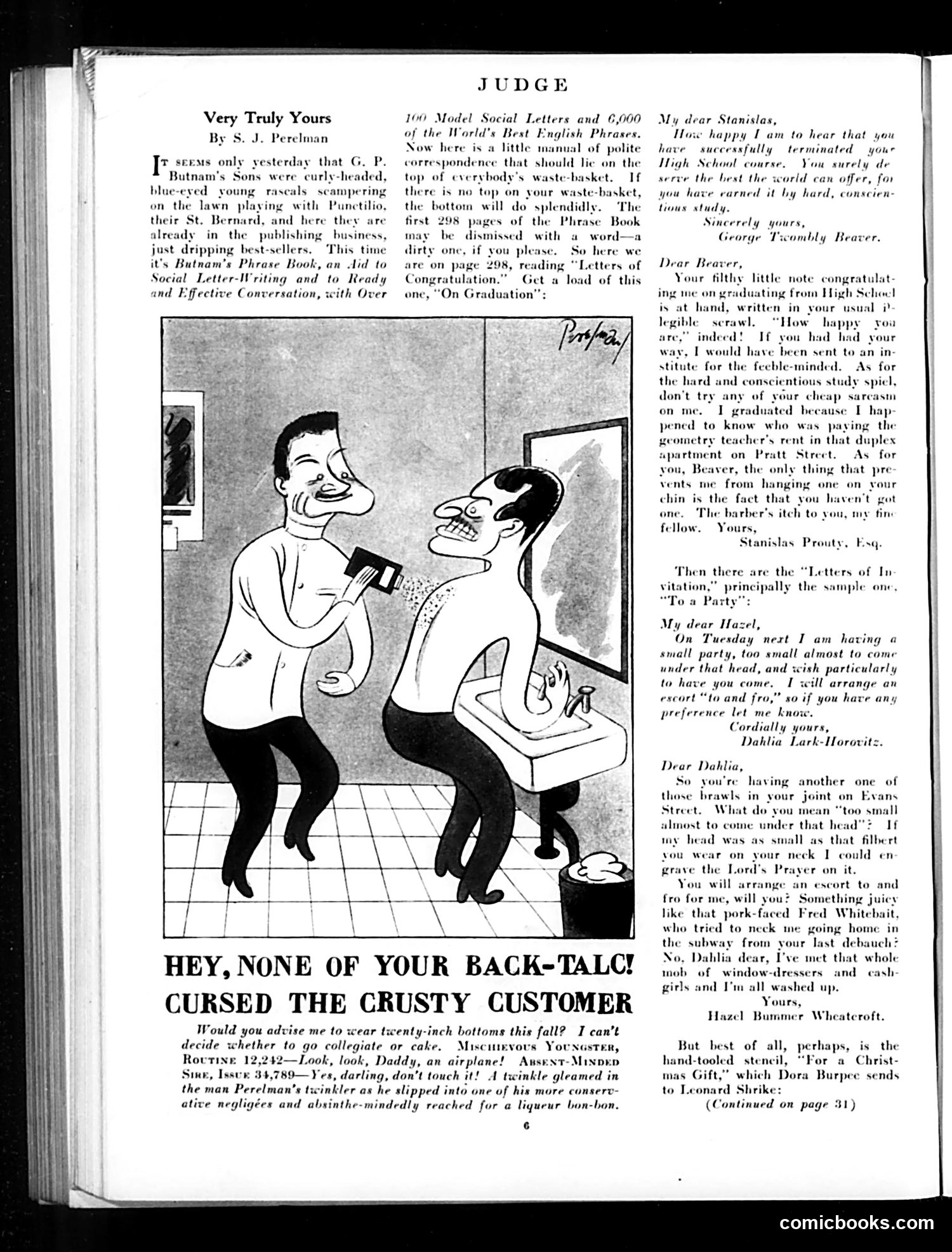
Analysis of "Judge" Magazine Page This page features social satire typical of Judge magazine's humor. The main cartoon depicts two men in what appears to be a barber shop or similar service establishment, with exaggerated facial features and body language suggesting physical comedy or slapstick. The caption "Hey, None of Your Back-Talc! Cursed the Crusty Customer" references a dispute over grooming products—likely "talc" (talcum powder), a common barber shop item. The humor appears to derive from a customer's irritation at being advised about proper grooming or appearance. The right column contains humorous "social letters" mimicking formal correspondence—satirizing pretentious social etiquette and mannered communication styles of the era. The tone suggests gentle mockery of upper-class affectations and overly formal letter-writing conventions.
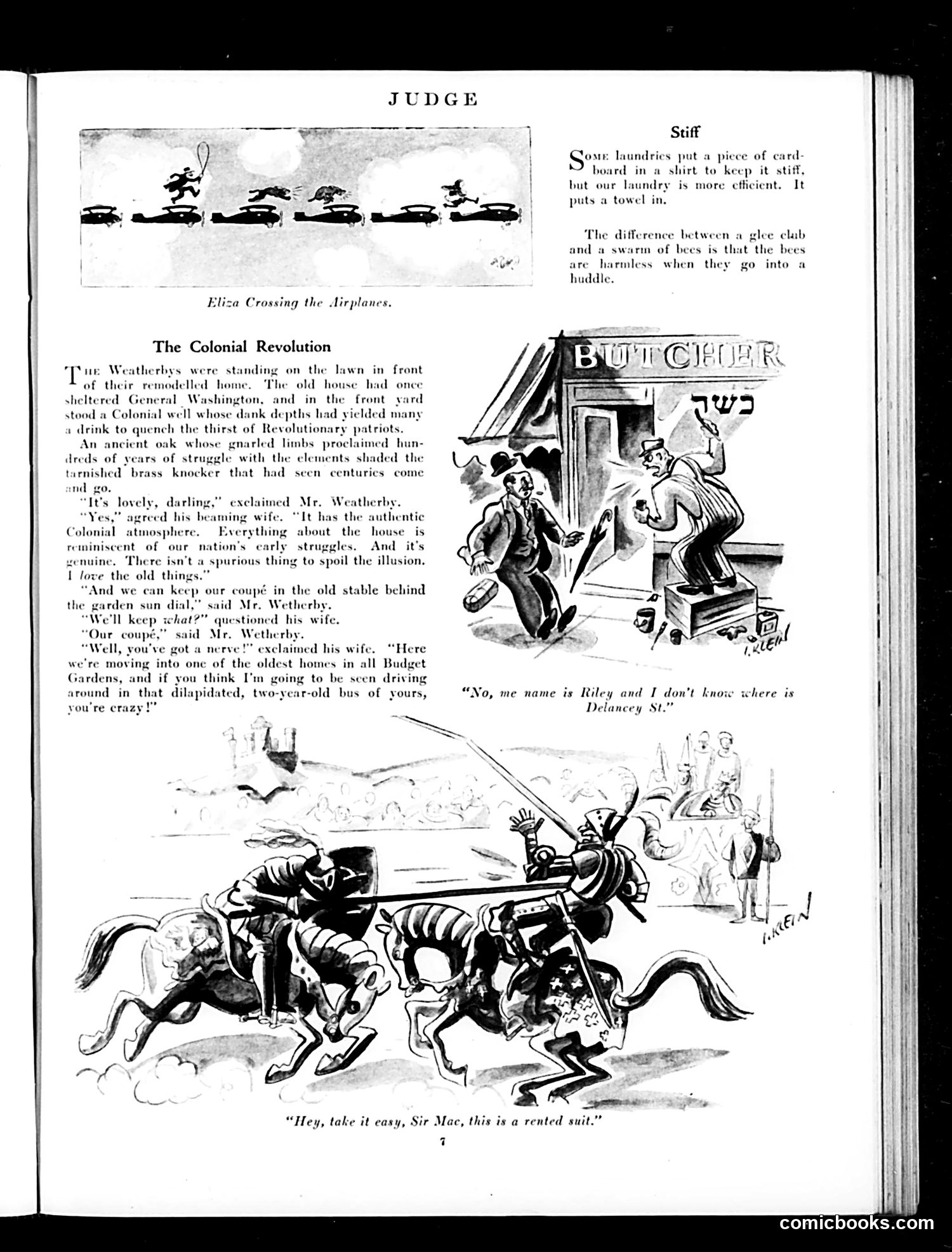
"The Colonial Revolution" This satire mocks wealthy Americans' superficial nostalgia for Colonial history. The Weatherbys have purchased an authentically old house (once sheltering George Washington) in a fashionable neighborhood called "Budget Gardens," but their enthusiasm for historical authenticity is hollow—Mr. Weatherby wants to park his modern automobile in the colonial stable, prompting his wife's outrage that she'd be *seen* in their shabby two-year-old car. The joke: they cherish the appearance of Colonial virtue and struggle while remaining thoroughly modern and materialistic. The phrase "I love the old things" rings empty when contradicted by status anxiety about automobiles. The other cartoons (butcher shop, horsemen) appear unrelated brief gags typical of Judge's format.
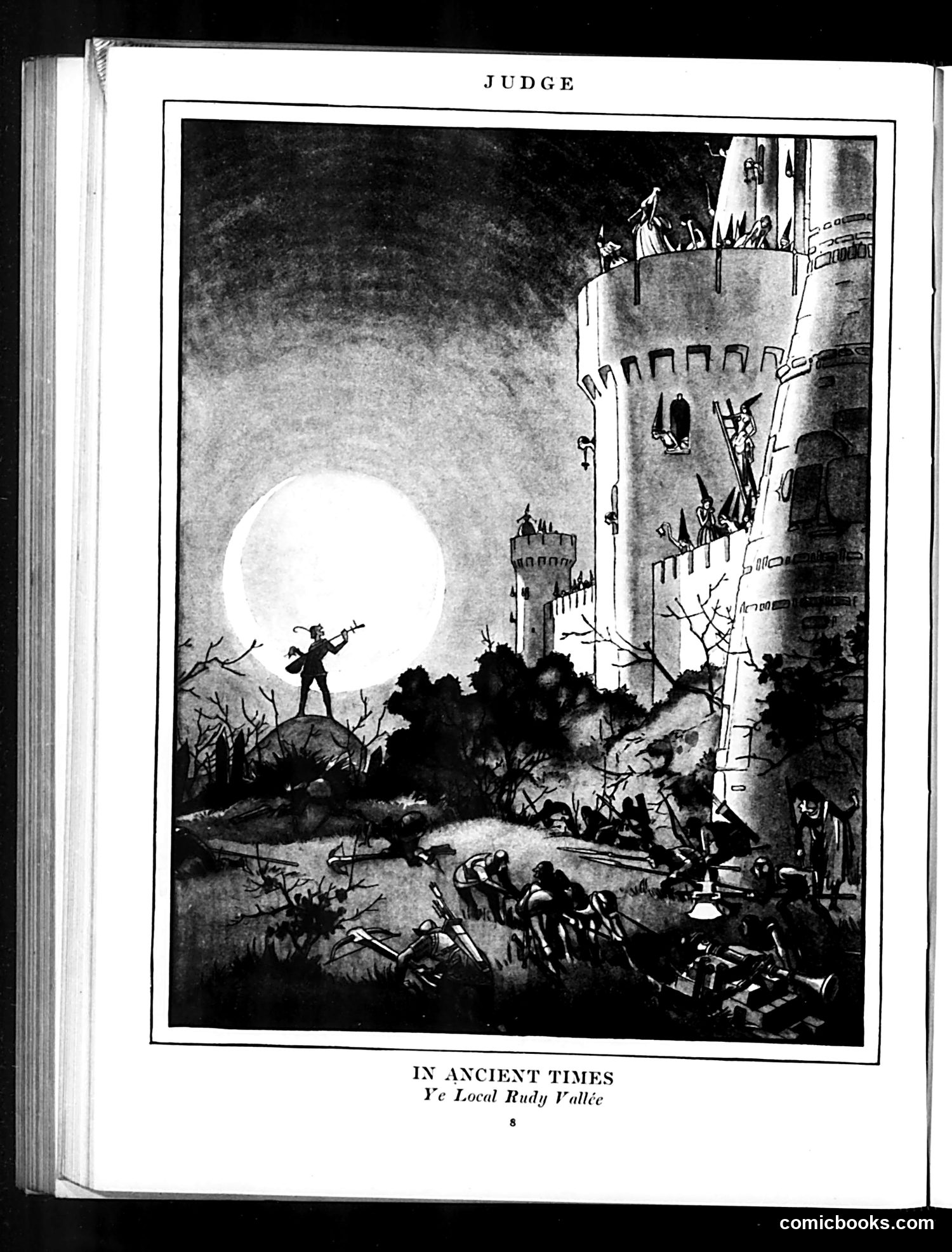
This illustration from *Judge* magazine depicts a medieval castle siege scene with a figure standing prominently on a moonlit hill, appearing to sing or perform with raised arms. The caption "Ye Local Rudy Vallée" references Rudy Vallée, a famous 1920s-30s crooner and entertainer known for his distinctive singing style and megaphone-aided vocal delivery. The satire appears to mock someone's pretensions to entertainment or performance, comparing them humorously to the celebrated Vallée. The "ancient times" framing suggests ironic contrast—presenting an ordinary local performer as if he were as significant as a legendary entertainer, or perhaps mocking overwrought theatrical ambitions. The castle siege setting adds absurdist humor, elevating a mere local act to mock-heroic proportions. Without more context, the specific target figure remains unclear.
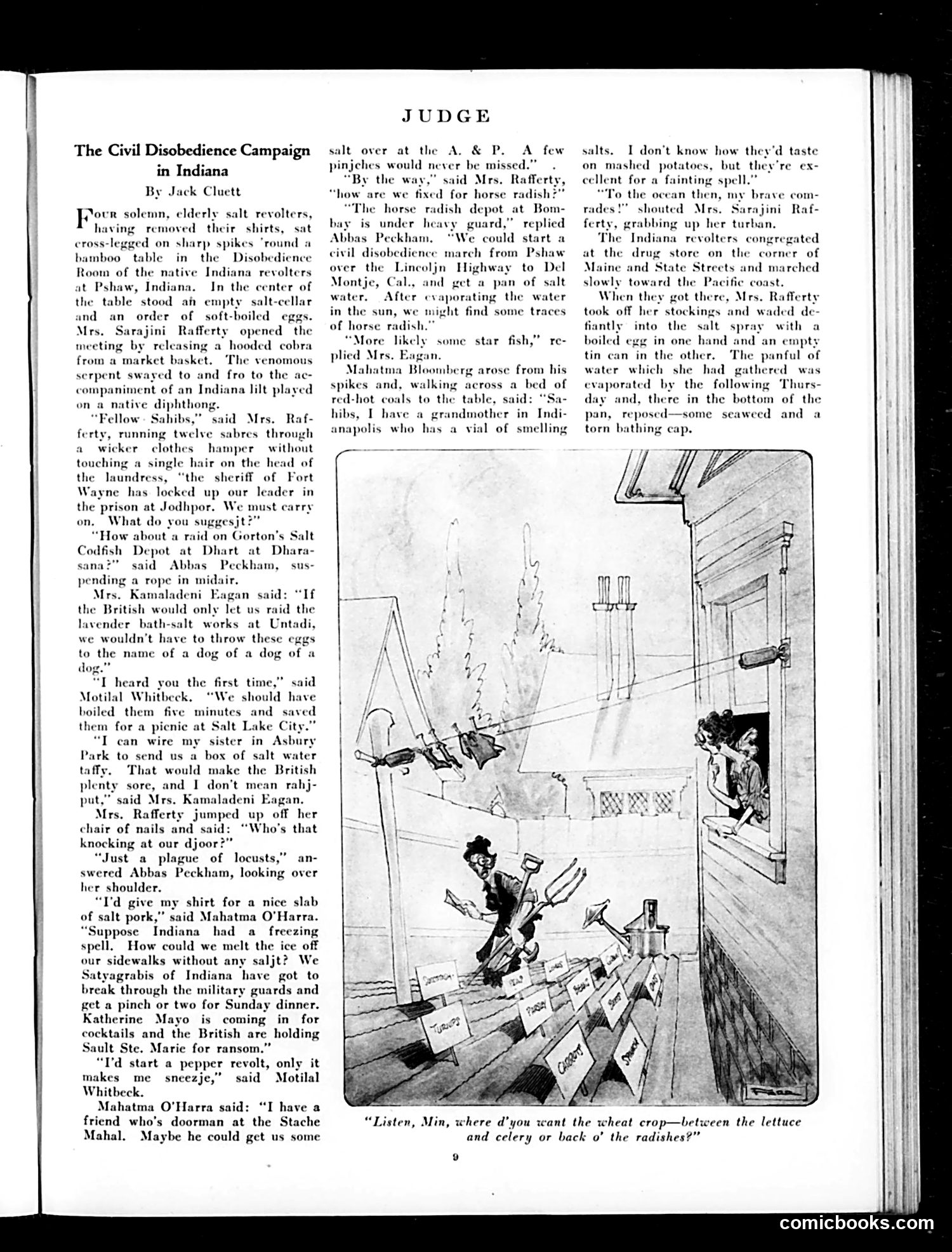
Explanation for Modern Readers This satirical piece mocks Gandhi's salt march and civil disobedience movement by transplanting it absurdly to Indiana with comically Americanized characters bearing Indian-sounding names (Mahatma O'Harra, Mrs. Sarajini Rafferty). The joke: serious Indian independence activists are reduced to bumbling Midwesterners obsessing over salt acquisition through ridiculous schemes involving horse radish depots, salt water taffy, and smelling salts—treating Gandhi's political protest as mere salt procurement. The cartoon illustration shows the "revolters" attempting their own version of the salt march, wading into water with boiled eggs and tin cans. The satire suggests that transplanting Gandhi's movement to America reveals its impracticality or absurdity, or mocks Americans attempting to mimic Indian resistance while remaining fundamentally disconnected from its purpose. This reflects 1930s American skepticism toward Indian independence movements and Gandhi's methods.
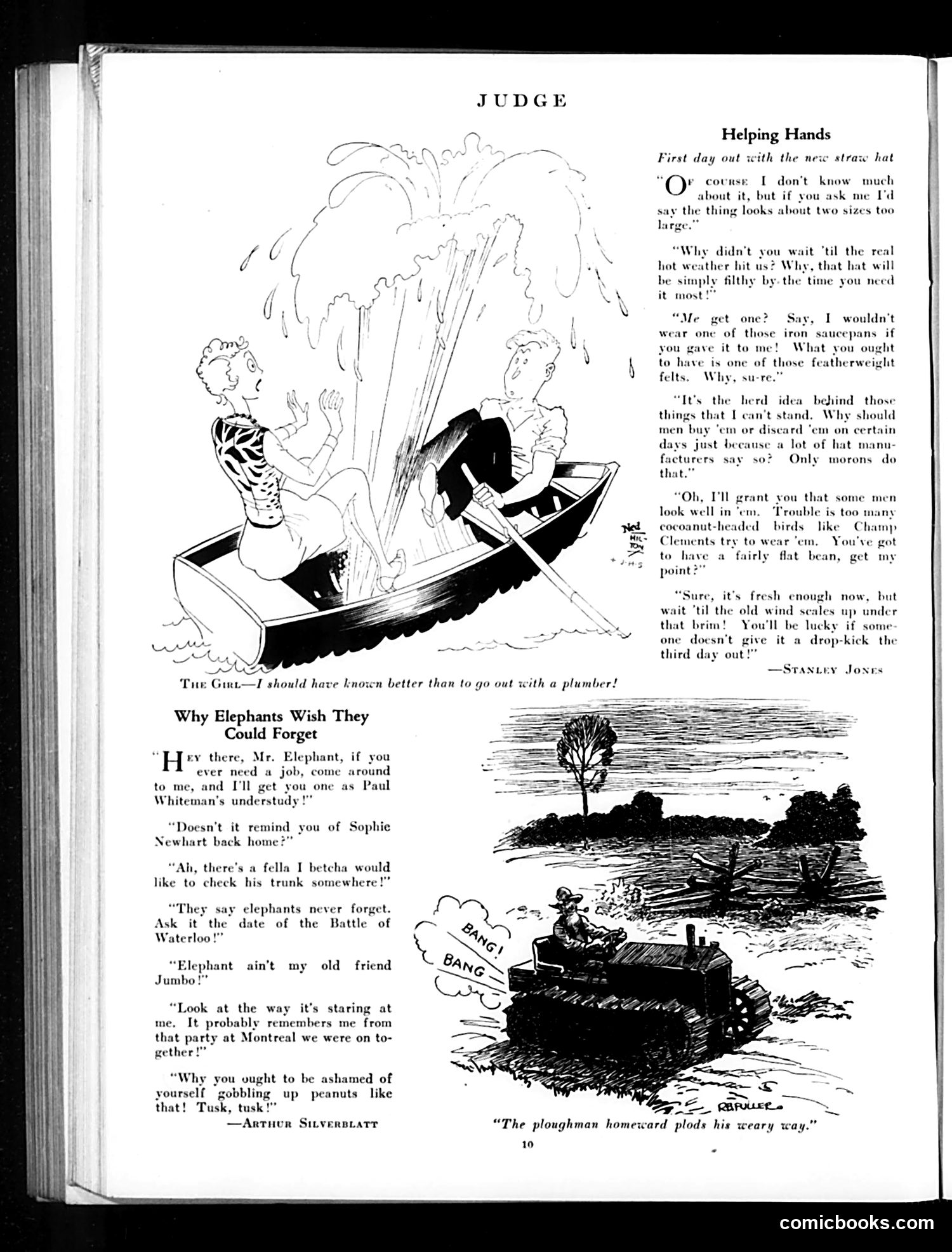
Explanation for Modern Readers This Judge magazine page contains two separate humorous pieces: "Why Elephants Wish They Could Forget" satirizes the common saying that "an elephant never forgets." The joke presents various people making embarrassing references to the elephant (Sophie Newhart, a Montreal party, eating peanuts) while the elephant stares at them—playing on the anxiety that it remembers these awkward moments. The reference to "Paul Whiteman's understudy" alludes to the famous bandleader Paul Whiteman, popular in the 1920s-30s. "Helping Hands" depicts a man receiving unwanted advice about his new straw hat. Friends nitpick it relentlessly: it's too large, will get filthy, unsuitable timing, and will blow away. The satire mocks how people eagerly offer harsh "helpful" criticism rather than genuine support. The title is ironic—these hands aren't helpful at all. Both pieces use everyday social situations to poke fun at human behavior: anxiety about being remembered and the tendency to tear down others under the guise of friendship.
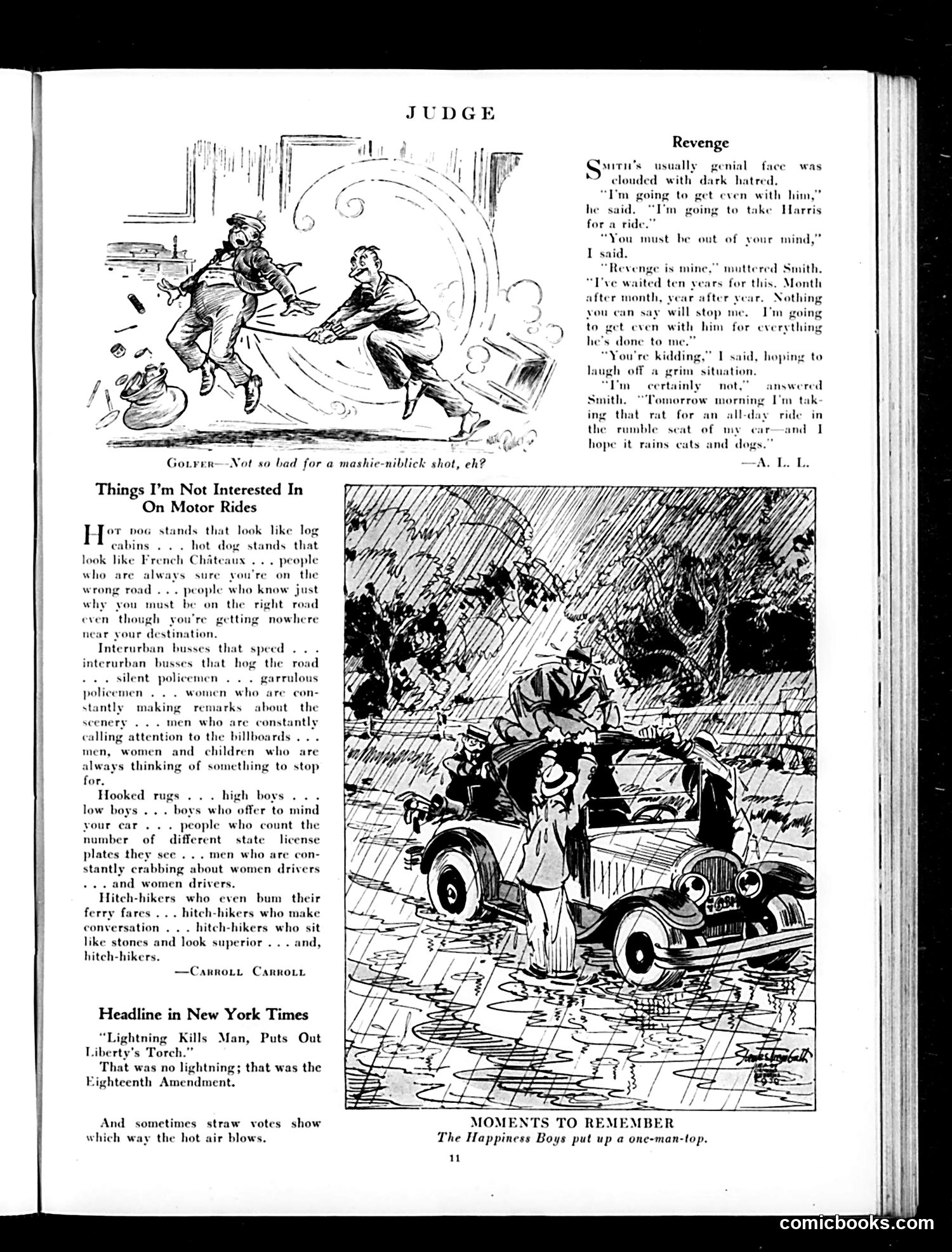
Judge Magazine Page Analysis This page contains three distinct satirical pieces from Judge magazine: Top cartoon ("Revenge"): A narrative comic about a man named Smith who vows revenge against Harris by forcing him on an unpleasant car ride in a rumble seat, hoping it rains. The joke plays on automotive inconvenience as petty revenge—a humorous commentary on motor travel annoyances. Middle column ("Things I'm Not Interested In On Motor Rides"): Carroll Carroll's humorous essay listing irritating types of people and situations encountered during car rides—backseat drivers, hitch-hikers, women drivers (a common era stereotype), and various annoying passenger behaviors. It satirizes automobile culture's social friction. Bottom cartoon: Depicts a car accident or collision in rain, captioned "The Happiness Boys put up a one-man-top"—likely referencing a popular radio duo, making a joke about the car's canopy or convertible top. The final items mock Prohibition ("Eighteenth Amendment") and political polling ("straw votes"). Context: This reflects 1920s-30s America's motor culture growing pains and social anxieties about automobiles.
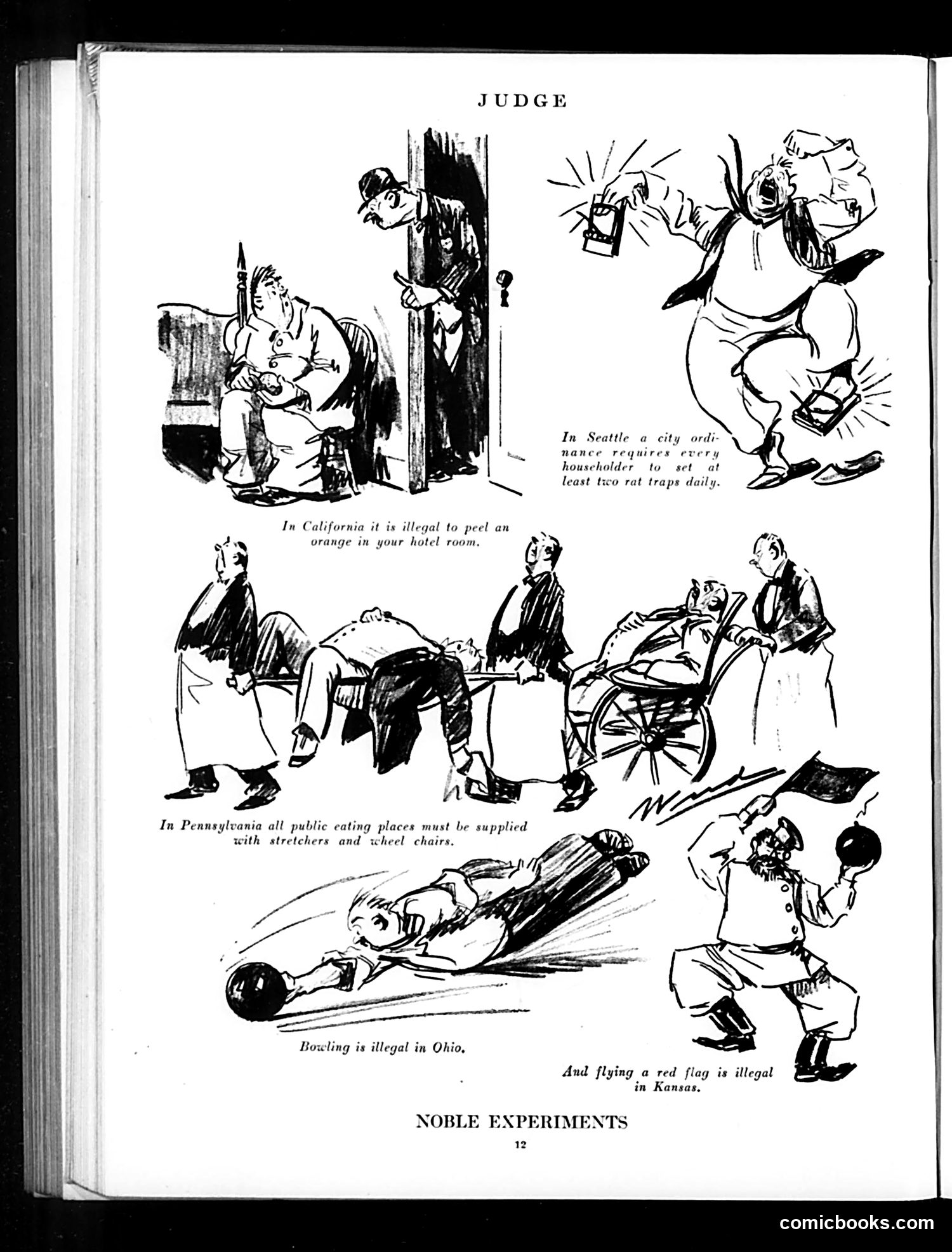
This page satirizes absurd or bizarre state and local laws through exaggerated illustrations. Each cartoon depicts a ridiculous "law" paired with a specific state: - Seattle's supposed rat-trap requirement - California's alleged orange-peeling ban in hotels - Pennsylvania's requirement that restaurants have stretchers and wheelchairs - Ohio's bowling prohibition - Kansas's red-flag ban The satire works by presenting these laws as if they're genuine civic regulations, when they're clearly invented absurdities. The title "Noble Experiments" mockingly references the era's various legislative attempts at social engineering (likely alluding to Prohibition). The cartoons mock the proliferation of peculiar state laws and suggest governmental overreach through ridiculous specificity. The humor relies on readers recognizing the implausibility of these restrictions while implying that actual laws might be similarly bizarre or pointless.
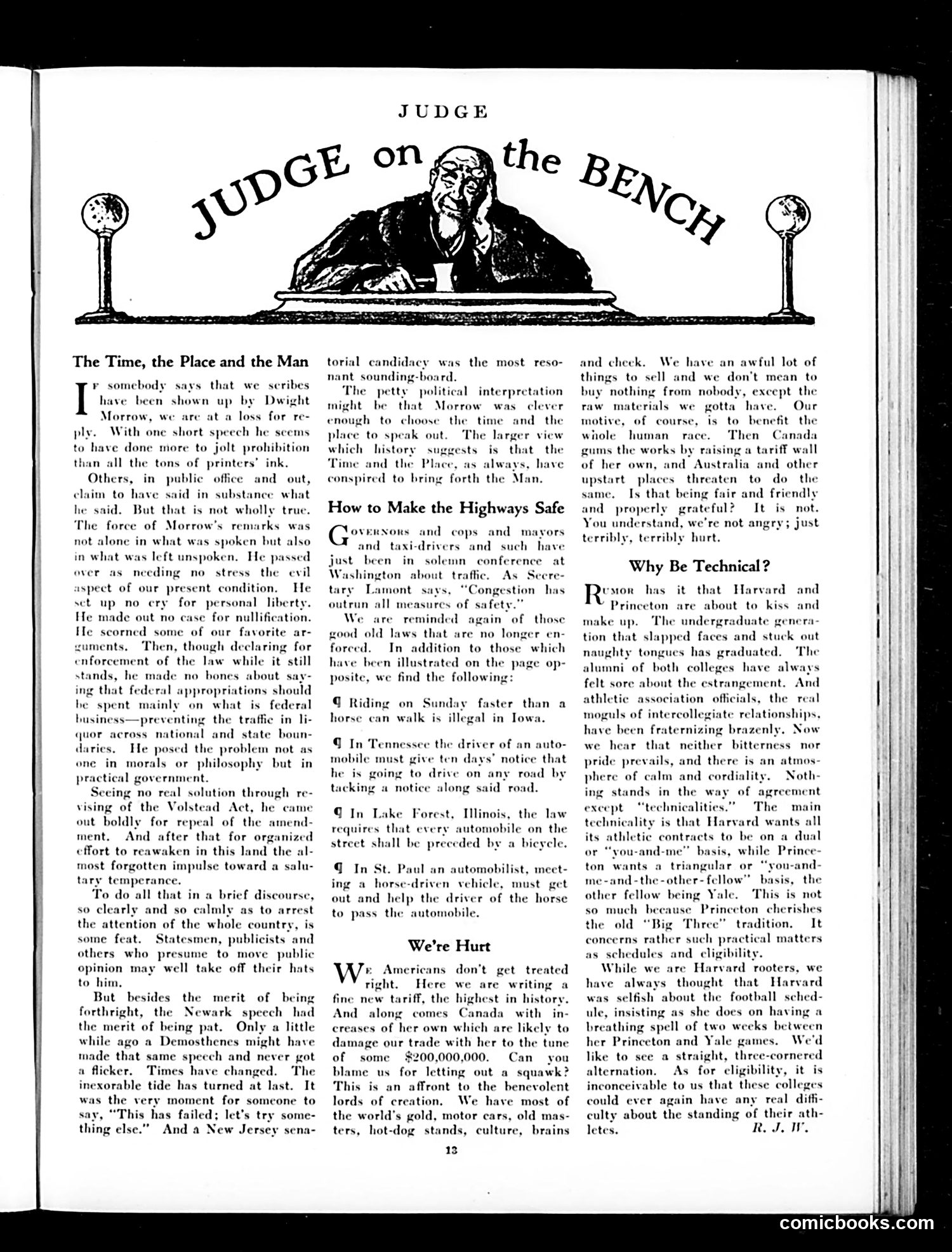
Judge Magazine Page Analysis This page from *Judge* magazine discusses Dwight Morrow's recent speech advocating for repealing Prohibition. The editorial praises Morrow (a New Jersey senator and diplomat) for his pragmatic, measured approach to the alcohol ban—arguing not on moral grounds but on practical governance, suggesting repeal and voluntary temperance instead. The "How to Make the Highways Safe" section satirizes absurd state traffic laws (like requiring automobiles to be preceded by bicycles, or drivers helping horses pass cars). This mocks the patchwork of inconsistent regulations creating chaos. "We're Hurt" sarcastically criticizes American protectionism. The U.S. just enacted a high tariff; Canada responded with its own increases. The piece mockingly complains that Americans expect to sell goods globally while buying nothing foreign—portraying American economic entitlement as hypocritical and self-defeating. The page uses dry humor and irony to critique both Prohibition-era politics and isolationist economic policy.
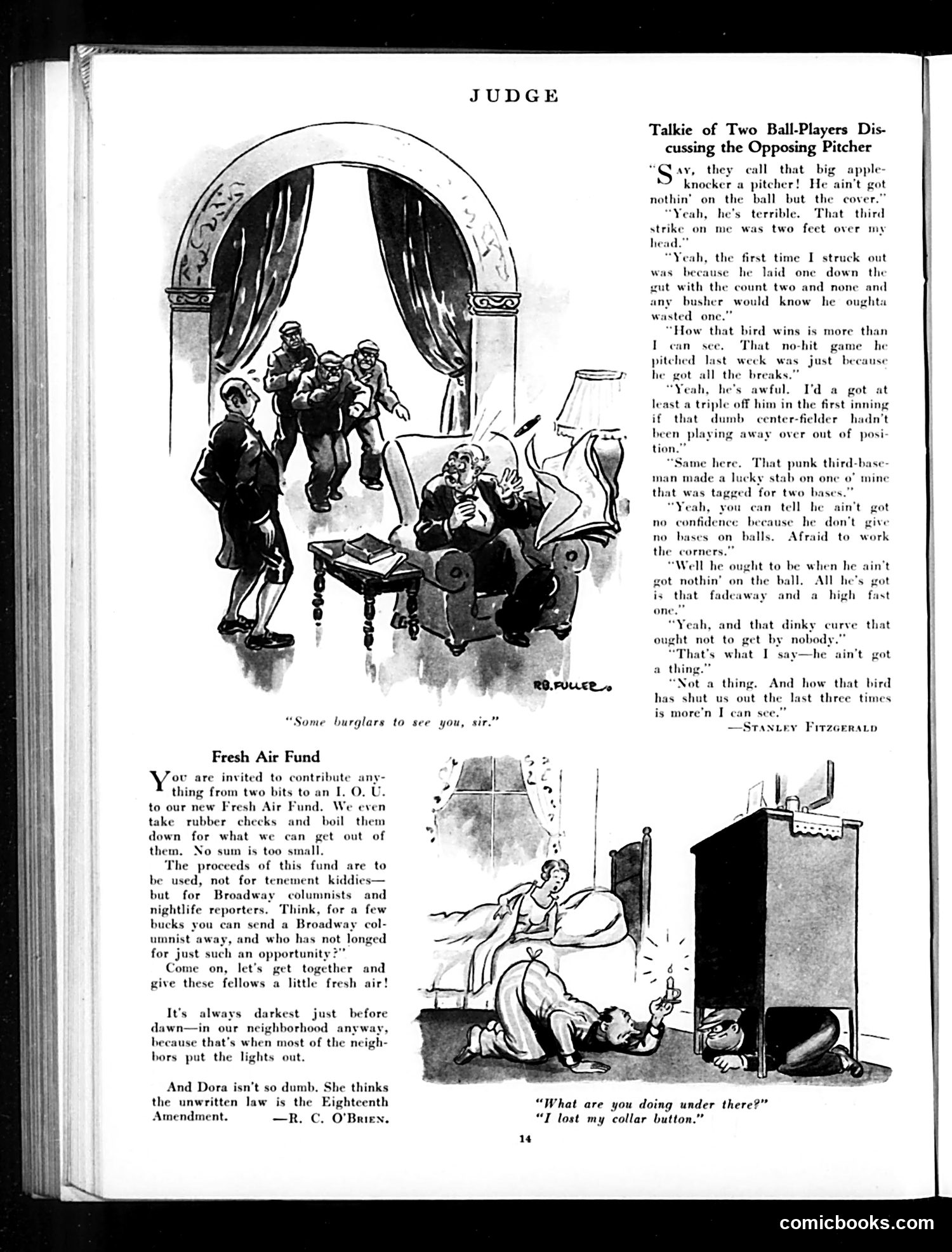
Judge Magazine Page Analysis Top Cartoon ("Talkie of Two Ball-Players"): Two baseball players discuss an opposing pitcher in slang-heavy dialogue. They complain he has no skill ("nothin' on the ball but the cover"), got lucky wins, and attribute his success to breaks and opponents' errors rather than talent. The satire targets athletes who make excuses or lack self-awareness about their own mediocrity—a common sports-page trope. The "talkie" format references early sound films, suggesting this mimics overheard locker-room conversation. "Fresh Air Fund" (center-right): A satirical charity appeal. Rather than benefiting poor tenement children (the actual Fresh Air Fund's purpose), Judge proposes collecting money to send away Broadway columnists and nightlife reporters—people the magazine considers frivolous nuisances. The joke mocks both these journalists and the fundraising appeals themselves. Bottom Cartoon: A couple under furniture; she's lost a collar button. The caption references the "unwritten law" (typically a defense for crimes of passion) and the Eighteenth Amendment (Prohibition), suggesting she's naive about both.
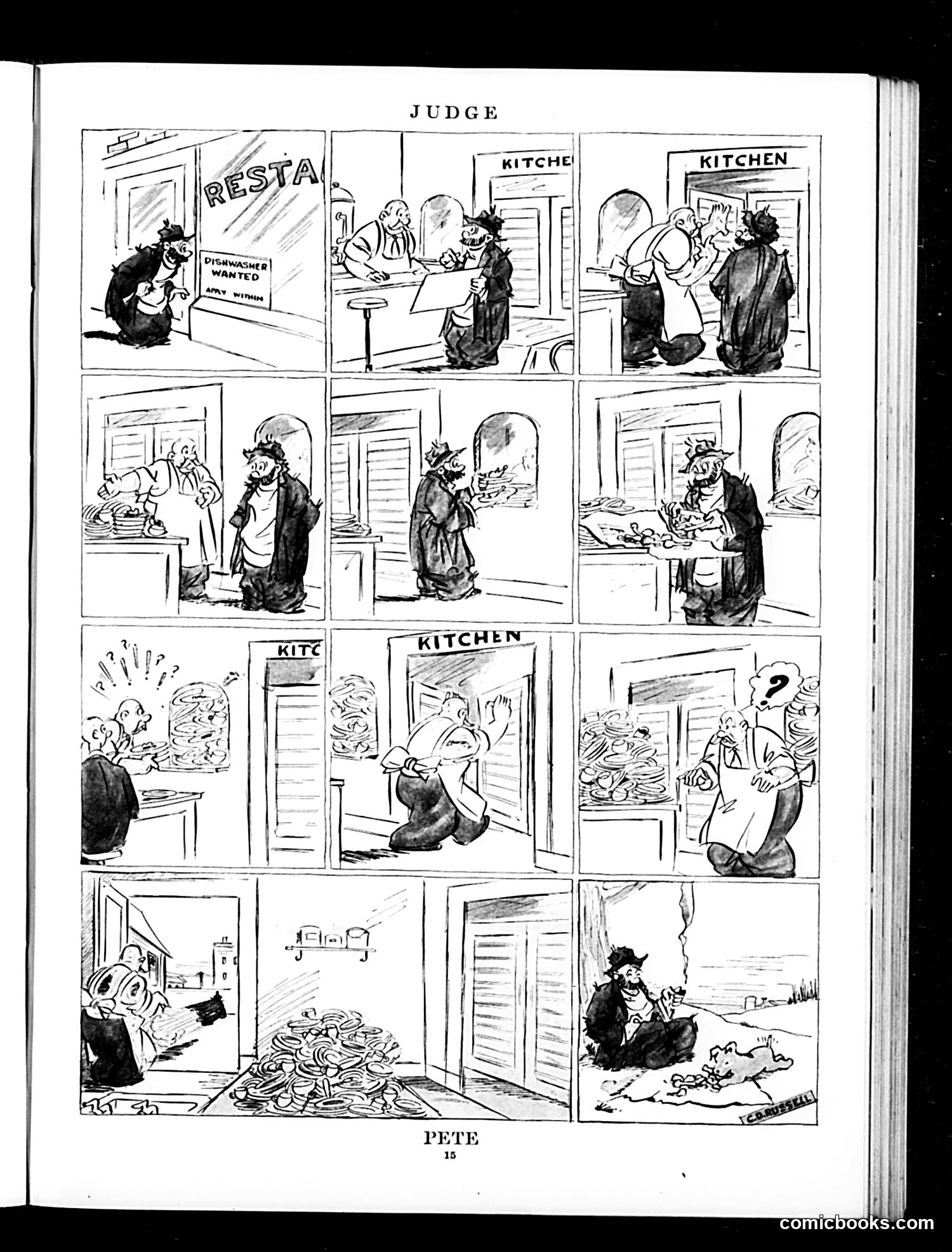
"Judge and Pete" Comic Strip Analysis This page presents two parallel comic strips titled "JUDGE" (top) and "PETE" (bottom), appearing to be a comparison narrative. The "JUDGE" strip depicts a well-dressed man in a restaurant repeatedly visiting the kitchen, progressively creating chaos—overturning dishes and making messes. The final panels show escalating disorder. The "PETE" strip mirrors this progression, showing a similar-dressed figure causing increasingly massive destruction, culminating in an enormous pile of dishes/debris and the character sitting destitute outdoors. The satire appears to contrast judicial authority ("Judge") with common behavior ("Pete"), suggesting a critique of how rules apply differently depending on one's status. The parallel visual jokes highlight hypocrisy: the same disruptive behavior receives different consequences based on social position.
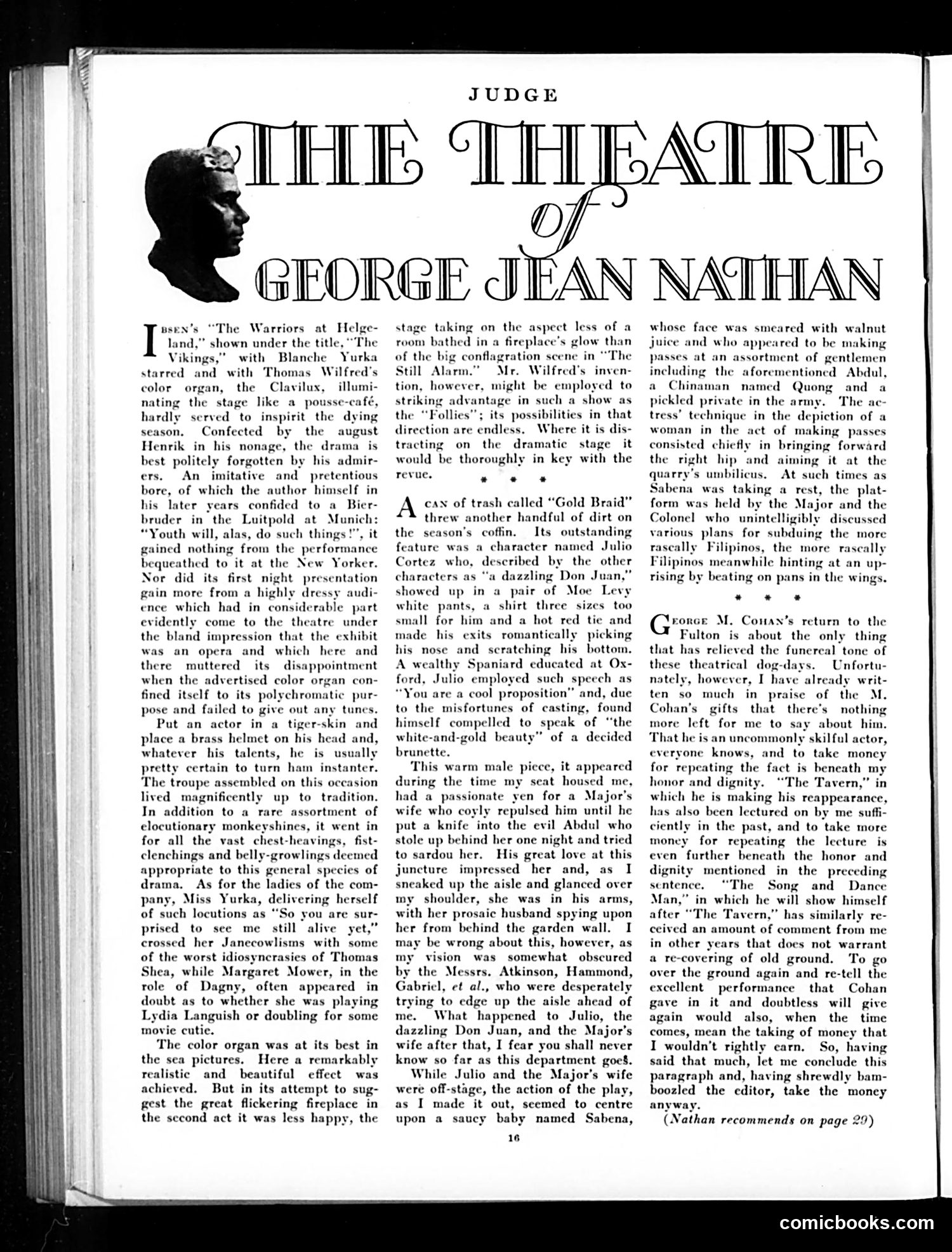
Judge Magazine Theater Review: "The Theatre of George Jean Nathan" This is a theatrical review by Judge's drama critic George Jean Nathan, critiquing two Broadway productions. "The Warriors at Helgoland" (Henrik Ibsen's play) starring Blanche Yurka is dismissed as a pretentious bore. Nathan mocks the production's use of the "Clavilux" (a color organ—an early visual light instrument), which the audience apparently expected to be a full opera. He ridicules the ham acting, particularly Yurka's overwrought delivery and Margaret Mower's mugging. "Gold Braid" is savagely attacked as "trash." Nathan lampoons its absurd lead character: a supposedly dazzling Don Juan named Julio Cortez who wears comically ill-fitting clothes and picks his nose on stage. The plot involves him melodramatically defending a Major's wife from a villain named Abdul. Nathan's snark about his own obstructed view adds self-aware humor to the critique. The review exemplifies Judge's sophisticated theatrical satire aimed at 1920s Broadway excess and amateur acting.
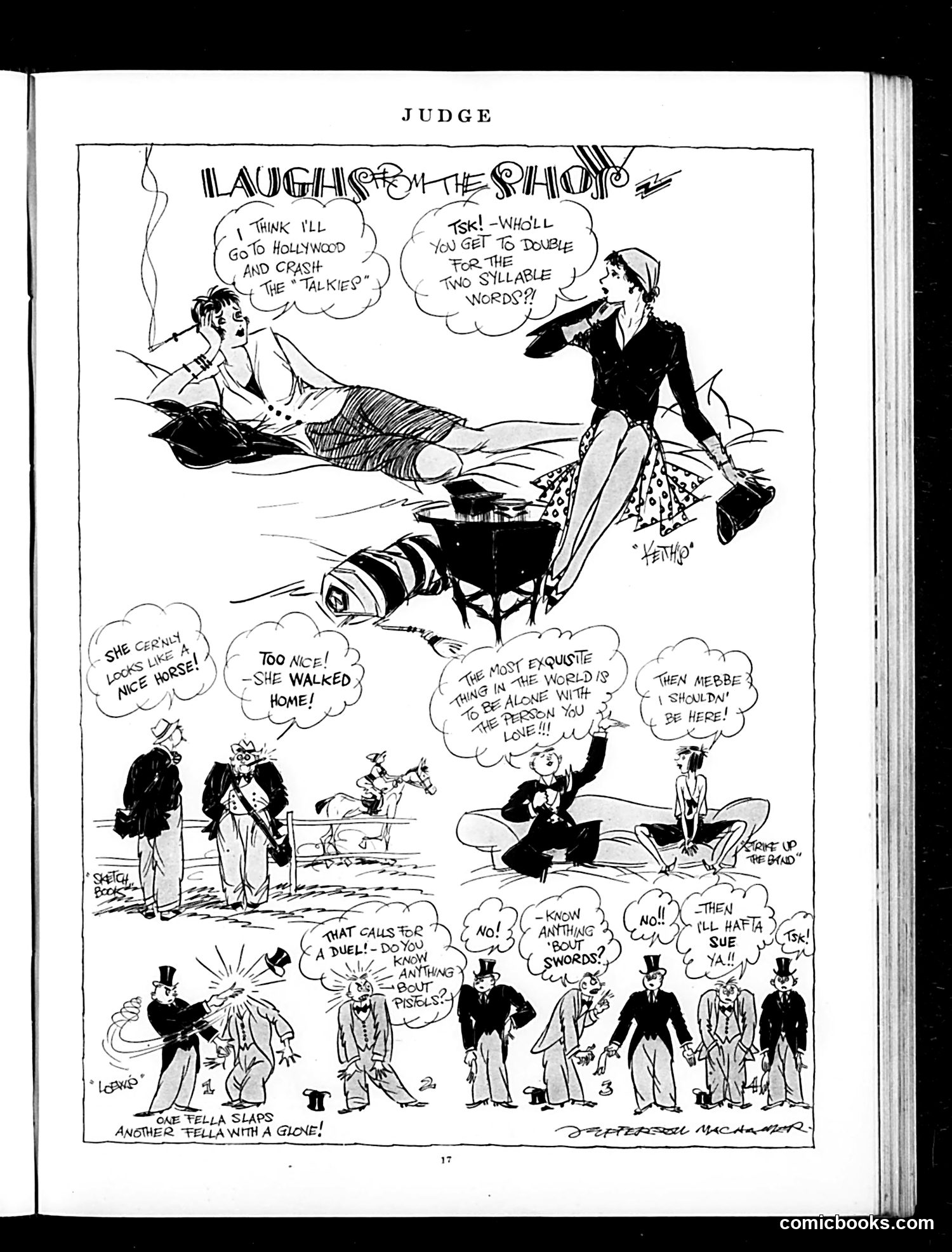
"Laughs of the Shoys" - Judge Magazine Cartoon This is a satirical comic about early talking pictures ("talkies"). The joke centers on a Hollywood actress who crashes trying to perform a stunt for a silent film, then is told she should go to Hollywood to break into talkies instead—only to be repeatedly slapped for mispronouncing two-syllable words. The satire mocks the transition from silent to sound films: actors who succeeded silently often failed when dialogue required clear diction. The repeated slapping and linguistic corrections humorously exaggerate the difficulty of this shift. The bottom panel shows men in formal wear debating whether one should challenge another to a duel over the incident, suggesting pretentious overreactions to minor theatrical mishaps. The overall point: the talkies exposed actors' limitations and created new, unexpected challenges in the entertainment industry.
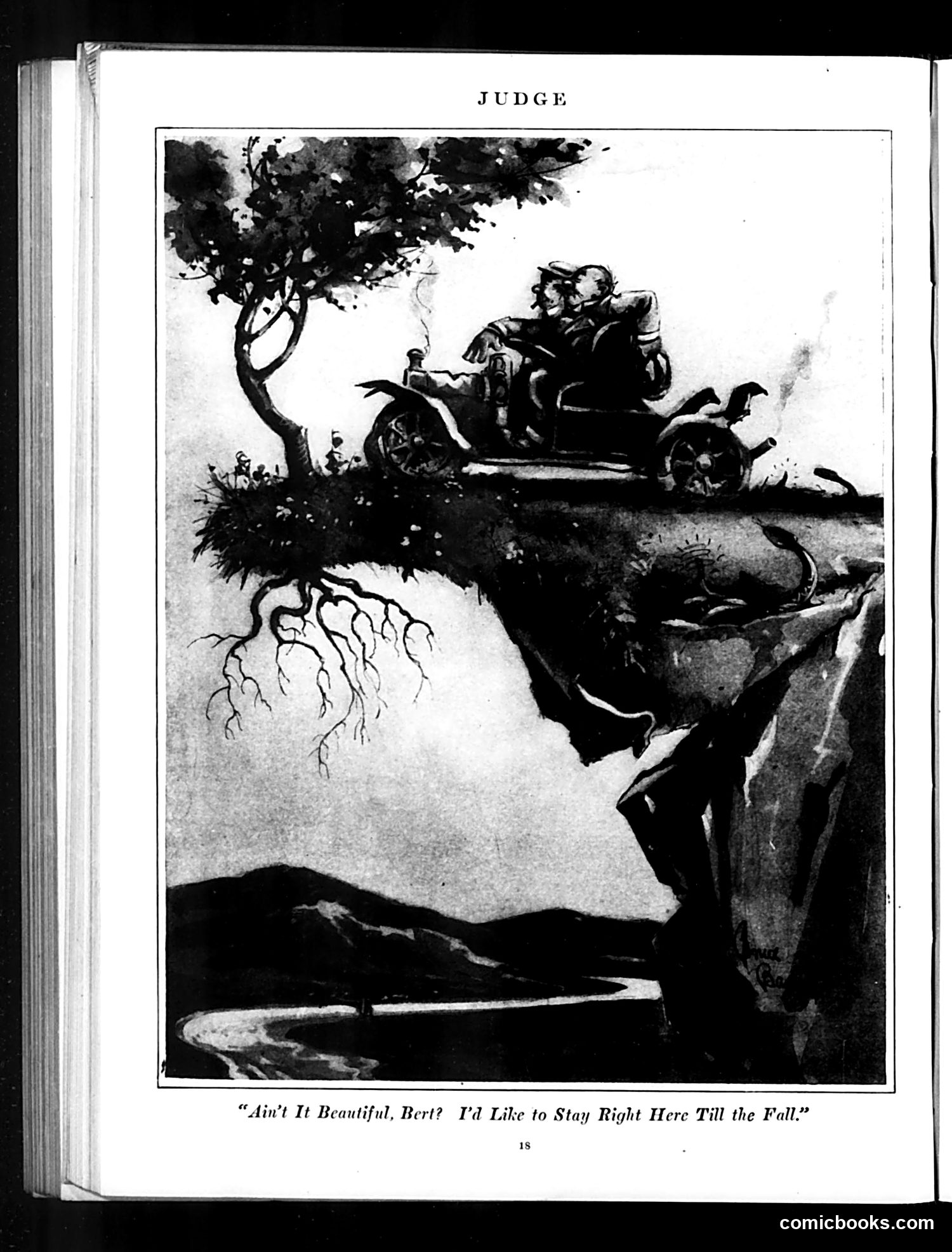
Judge Magazine Cartoon Analysis This political cartoon depicts a surreal, nightmarish landscape shaped like a human head in profile. Two figures in a carriage ride atop the skull, seemingly oblivious to the grotesque imagery below—a bare tree with exposed roots and a desolate terrain. The dialogue "Ain't It Beautiful, Bert? I'd Like to Stay Right Here Till the Fall" suggests the speakers are either willfully ignorant of or indifferent to the bleak, death-laden symbolism surrounding them. The "head" landscape, skeletal imagery, and barren environment likely represent societal decay, war aftermath, or political crisis of the era. Without a visible date, the specific historical context remains unclear, but the cartoon appears to critique complacency or denial among observers (possibly politicians or the wealthy) regarding serious national problems unfolding around them.
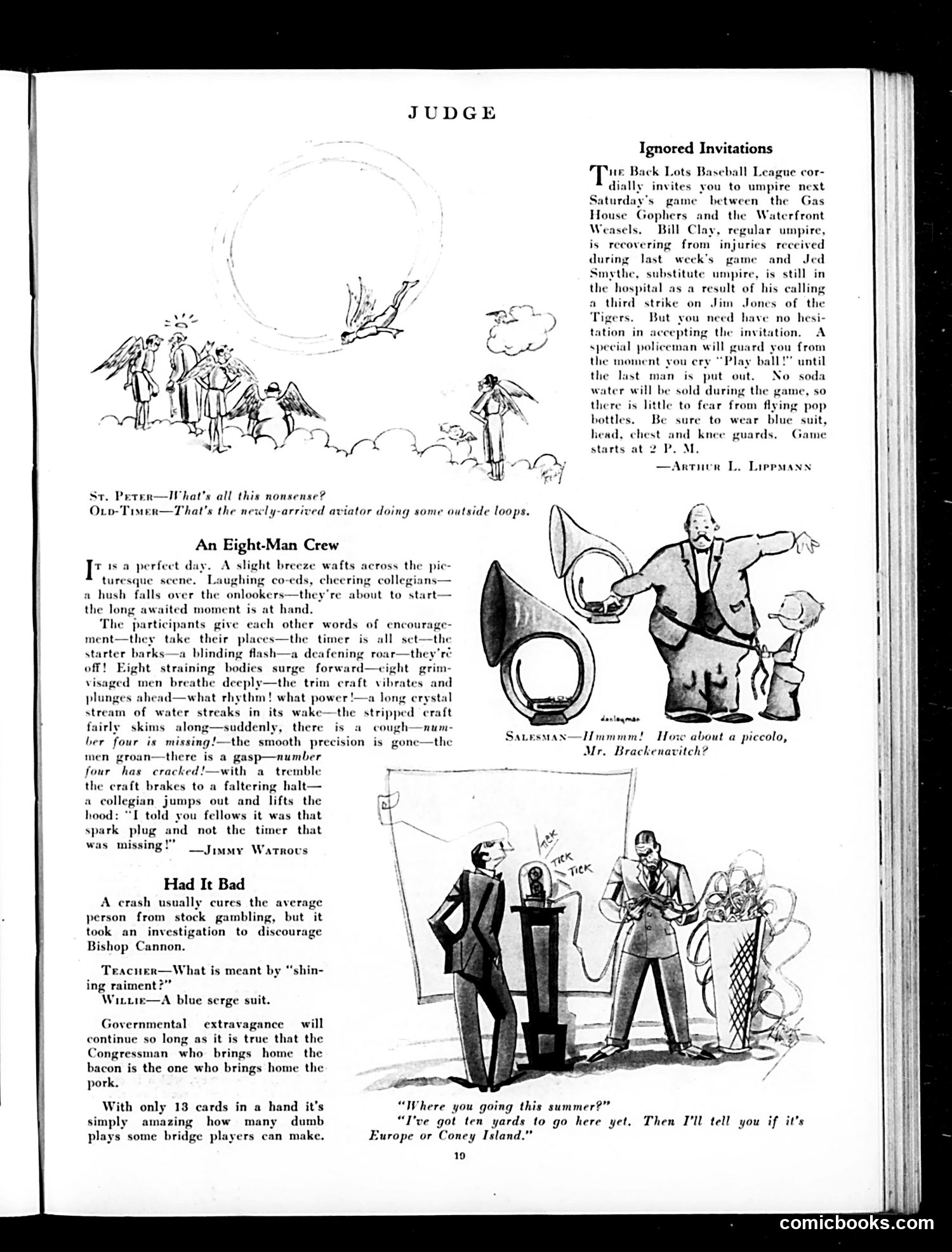
Explanation for Modern Readers This Judge magazine page contains several satirical pieces: "An Eight-Man Crew" describes a rowing team's dramatic failure when oarsman #4 breaks mid-race. The joke: a collegian blames a "spark plug" malfunction—automotive language absurdly applied to human-powered rowing, satirizing how people misidentify problems. "Had It Bad" mocks Bishop Cannon, a real 1920s-30s Methodist leader who publicly condemned stock market gambling after the 1929 crash, yet was himself revealed to have gambled heavily. The satire: crashes discourage ordinary people but required official investigation to stop the hypocritical bishop. "Ignored Invitations" humorously invites readers to umpire a rough sandlot baseball game where previous umpires were hospitalized for questionable calls. The joke plays on dangerous working conditions and hostile players—the "special policeman" protection is darkly comedic. Minor jokes mock government spending and bad bridge card-playing. The tone is light, topical satire typical of Judge's editorial humor.
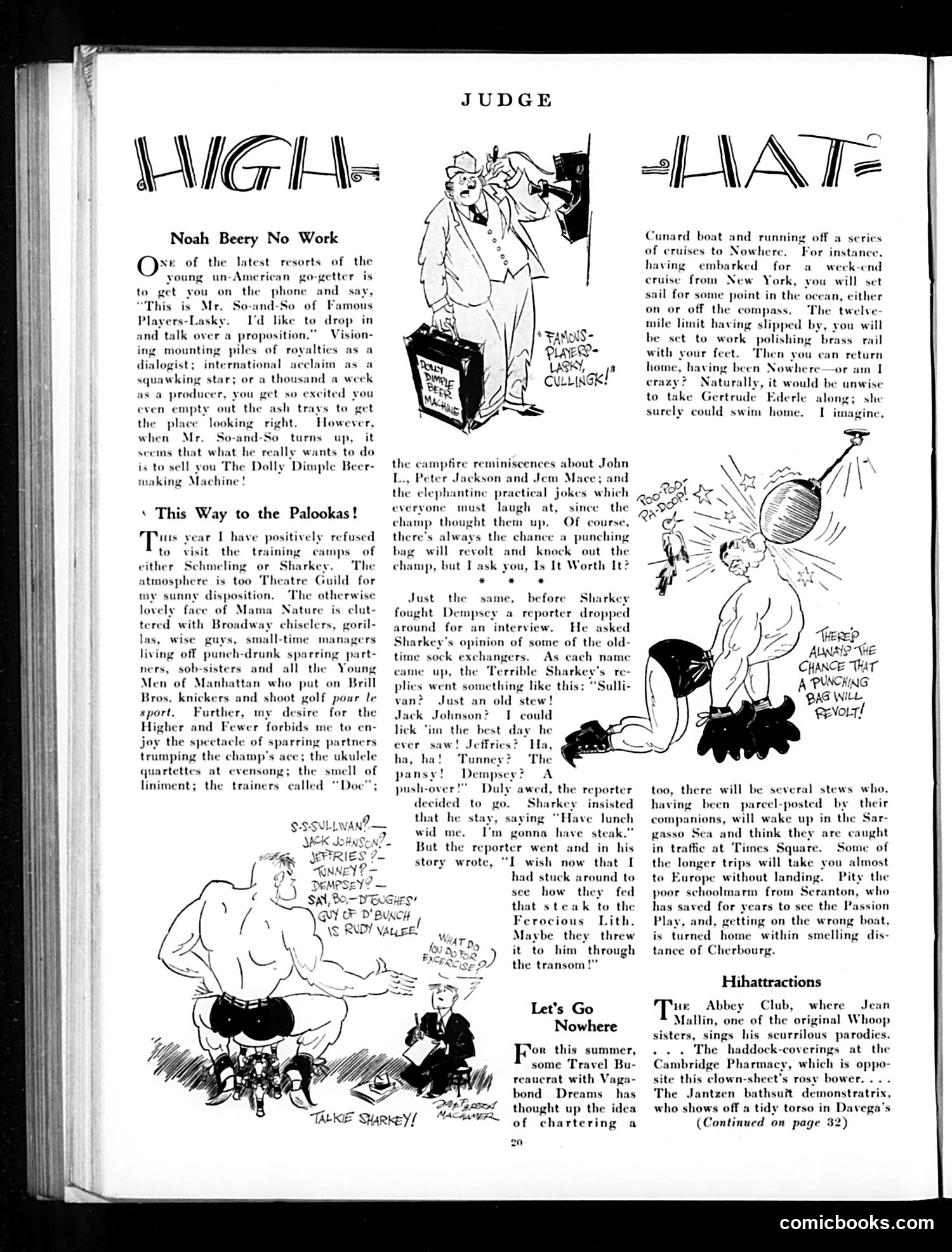
Judge Magazine Page Analysis This is a satirical commentary page from Judge magazine featuring three humor pieces: "Noah Beery No Work" mocks young Hollywood hustlers who phone promising film deals, then pitch unrelated products like beer-making machines. It satirizes the desperation of aspiring screenwriters and the phoniness of entertainment industry pitches. "This Way to the Palookas!" ridicules boxing training camps, particularly those of fighters Schmeling and Sharkey. The author describes the camps as infested with Broadway con artists and hangers-on. The anecdote about Sharkey dismissing legendary boxers (Jack Johnson, Gene Tunney, Jack Dempsey) as inferior, then supposedly being unable to eat a steak properly, mocks his arrogance and unsophistication. "Let's Go Nowhere" satirizes a travel company's absurd cruise scheme that literally goes nowhere—departing New York but sailing to undefined ocean locations. It jokes about bored passengers and passengers accidentally ending up near France when seeking European cultural attractions. All three pieces target American cultural pretension and con artistry of the 1920s-30s era.
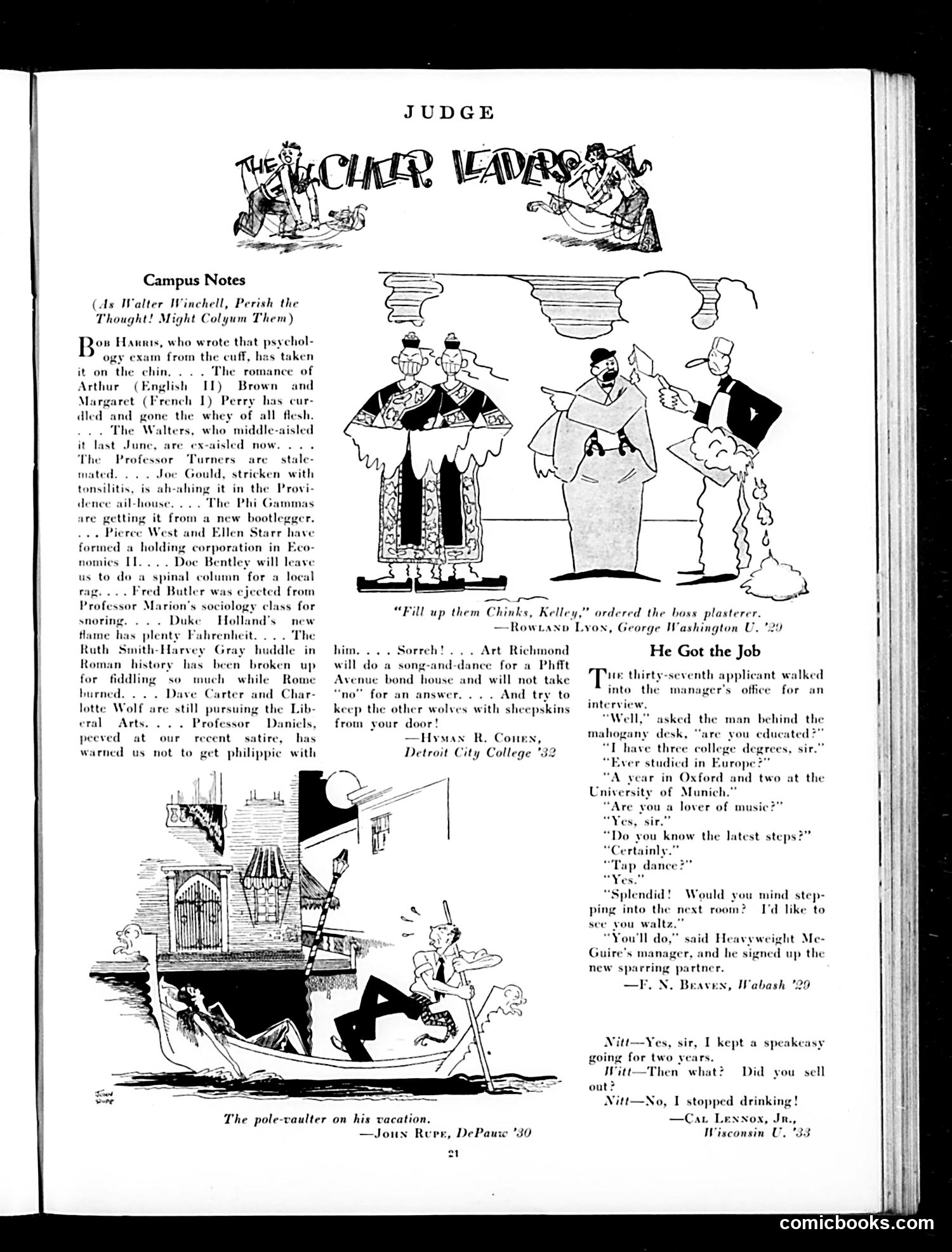
"The Chair Leaders" — Judge Magazine Satire This page from Judge presents college gossip and humor targeting campus life, likely from the late 1920s. "Campus Notes" is written in the style of Walter Winchell, the famous gossip columnist—the header jokes "Perish the Thought! Might Colyum Them." It mocks college scandals using Winchell's staccato style: failed exams, broken romances, fraternity troubles, and student misconduct. The cartoons illustrate campus absurdities: one shows a dean or administrator stuffing money into students ("Fill up them Chinks, Kelley"), satirizing corruption or bribery. Another depicts a job interview where an over-educated applicant with European credentials is rejected in favor of someone whose only qualification is *quitting drinking*—mocking both credential inflation and Prohibition-era stereotypes. The satire targets the disconnect between education and employability, fraternity debauchery, administrative incompetence, and the era's drinking culture during Prohibition. The humor relies on readers' familiarity with their campus community and current events.
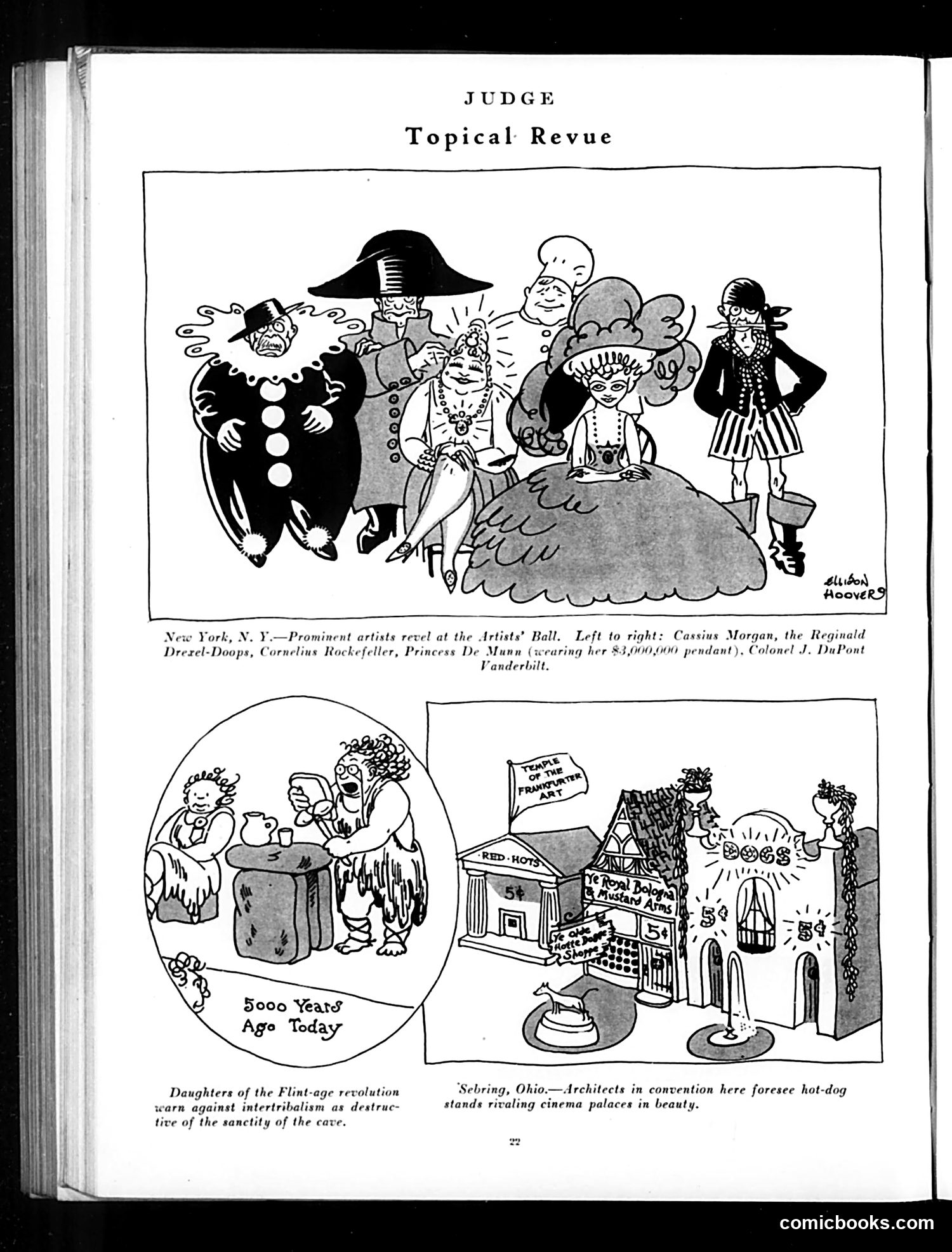
Judge Magazine Topical Revue - Analysis This page contains three satirical cartoons mocking early 1920s American society and trends: Top cartoon: Ridicules wealthy elite at an "Artists' Ball," naming caricatured figures like "Princess De Munn" ostentatiously wearing a $3,000,000 pendant. The satire targets conspicuous consumption and pretentious aristocratic posturing among the rich. Bottom left: Jokes about women's liberation ("Flint-age revolution"), depicting cavemen-era women warning against "intertribalism." This mocks feminist movements as primitive or absurd. Bottom right: Parodies modernist architecture trends, showing futuristic "hot-dog stands rivaling cinema palaces in beauty"—satirizing architects' grandiose designs for mundane commercial structures. The cartoons collectively ridicule contemporary fads, wealth inequality, women's rights, and architectural pretension. The humor relies on exaggeration and anachronism familiar to Judge's upper-middle-class readership.
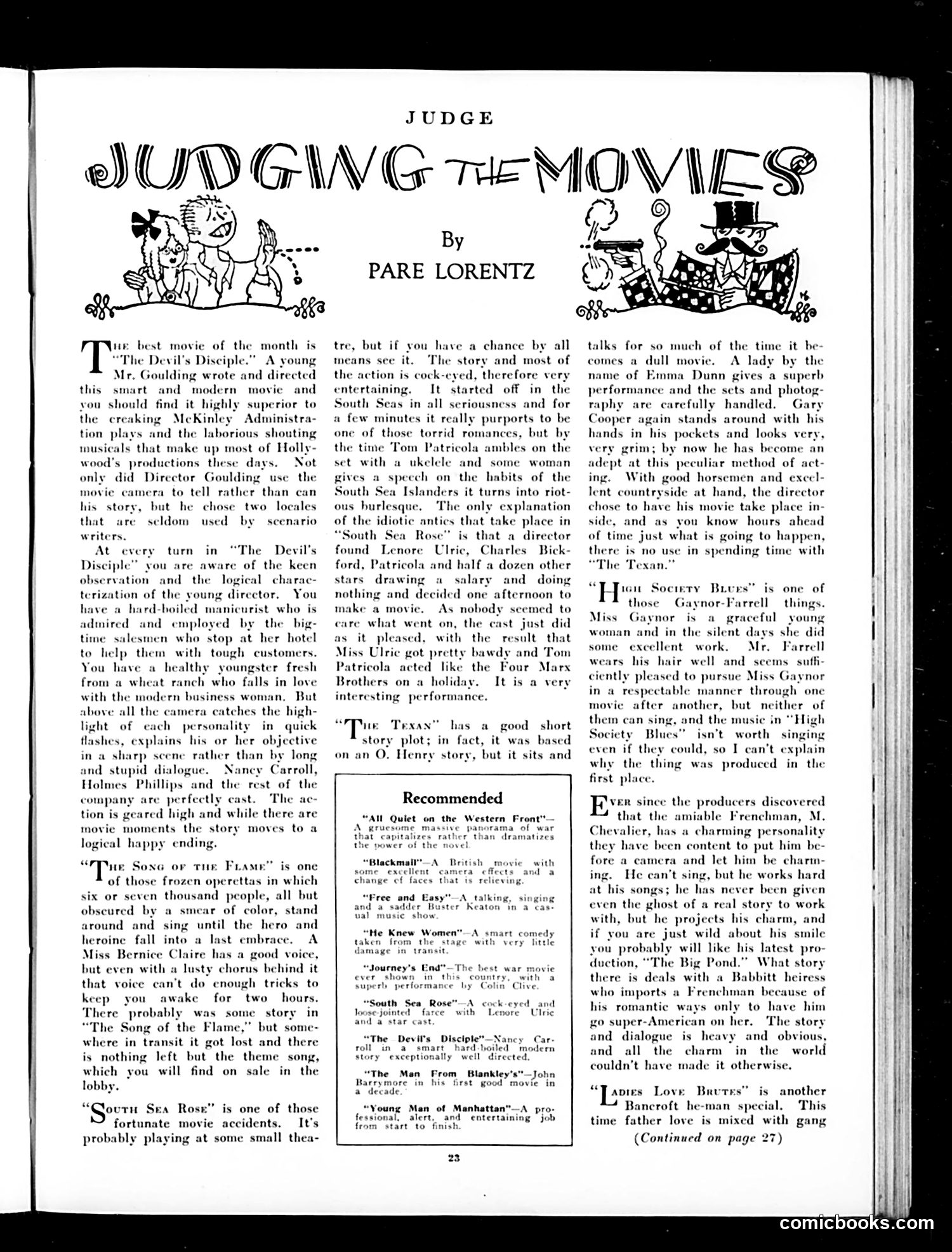
Judge Movie Review Page (1920s) This is a film criticism column by Pare Lorentz reviewing recent movies. The page contains no political cartoons—it's purely a written review section with decorative theatrical illustrations at the header. Key content: Lorentz reviews several films including "The Devil's Disciple" (praised for modern direction), "Song of the Flame" (criticized as a bloated operetta), "South Sea Rose" (enjoyed as entertaining accident/farce), and "The Texan" (competent but tedious). He also lists recommended films. For modern readers: The references to "creaking McKinley Administration" and "laborious shouting musicals" reflect 1920s attitudes dismissing older entertainment styles. The column exemplifies how Judge magazine mixed satire with contemporary cultural commentary, here critiquing Hollywood's output during the early sound film era. The focus on dialogue and character development shows debates about cinema's transition from silent to talking pictures.
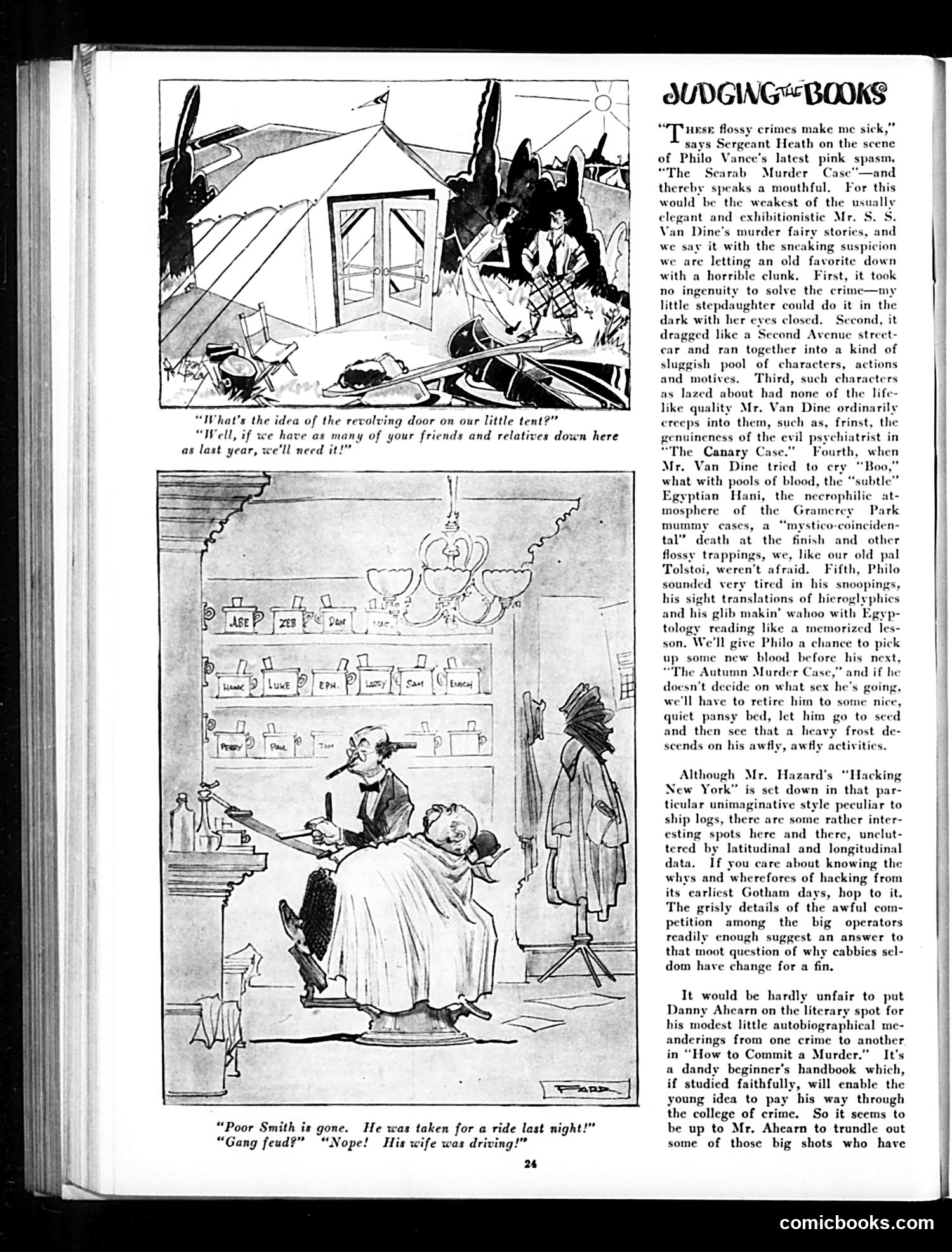
Judging the Books: A 1920s-30s Crime Fiction Critique This page reviews contemporary detective and crime novels, mocking their formulaic plots and worn-out conventions. The main text criticizes S.S. Van Dine's "The Scarab Murder Case," complaining it lacks ingenuity, drags with sluggish plotting, and features tired characterizations—even his famous detective Philo Vance sounds exhausted. The reviewer sarcastically suggests Van Dine needs "new blood" or should retire. Two cartoon panels mock crime-fiction clichés: the "revolving door" joke about visiting relatives, and the dark humor of a man "taken for a ride" (mobster slang for murder)—except it's his wife driving, not gangsters. The page also briefly reviews Hazard's "Hacking New York" and Ahearn's "How to Commit a Murder," treating pulp crime literature with irreverent humor typical of Judge's satirical stance toward popular culture's excesses and predictability.
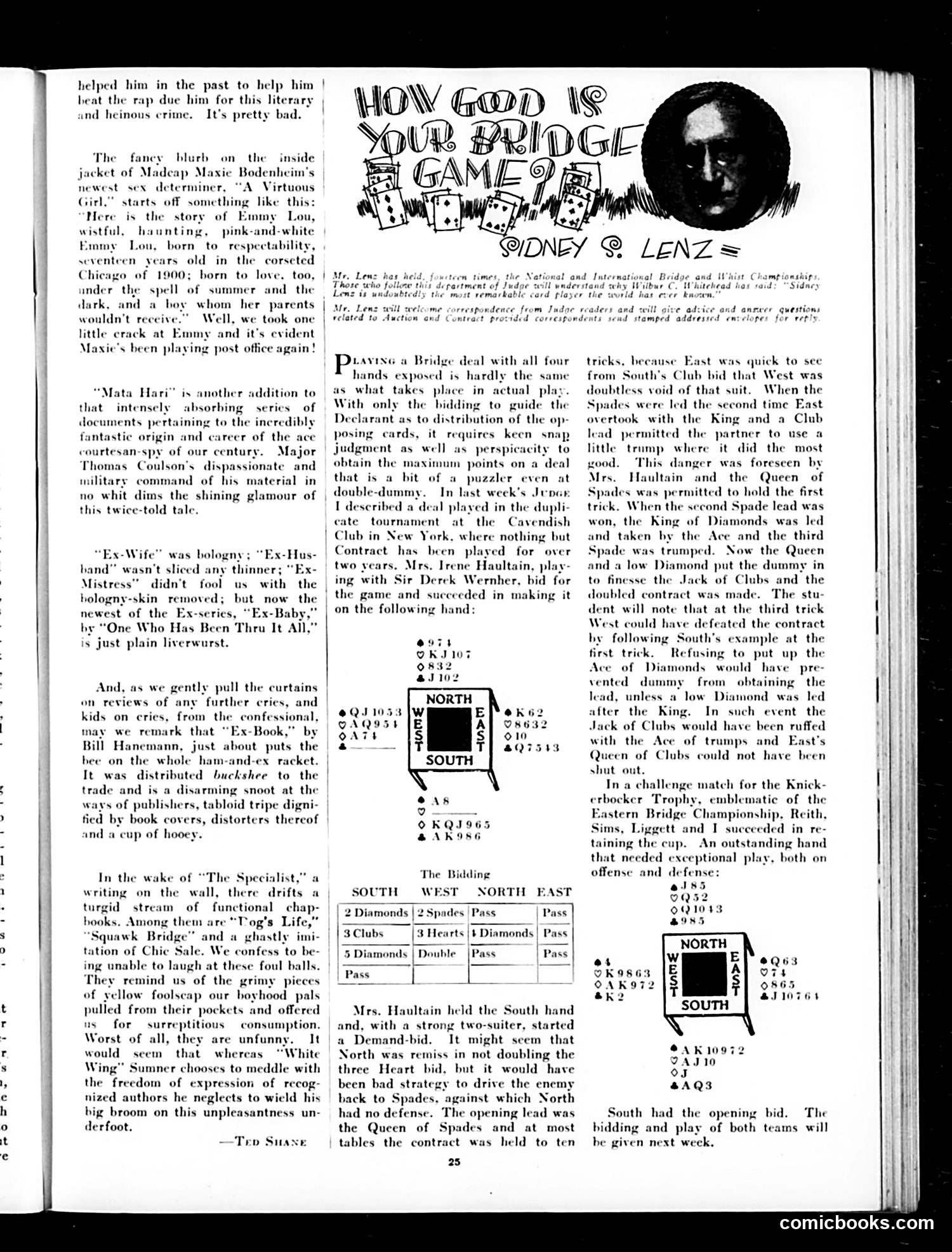
Judge Magazine Satire Analysis This page contains literary criticism and a bridge column. The main satire targets Madcap Maxie Bodenheim, a real American writer known for sexually explicit novels. Judge mocks his latest book, "A Virtuous Girl," by quoting its overwrought jacket copy about "Emmy Lou"—then sarcastically remarks that Bodenheim has been "playing post office again," a period slang term for kissing/sexual activity. The critic extends the mockery to the entire "Ex-" book series ("Ex-Wife," "Ex-Husband," "Ex-Mistress"), calling them derivative and comparing their literary substance to "liverwurst"—worthless filler. The satire reflects Jazz Age anxieties about explicit literature and the commercialization of sex in publishing. The page also features a bridge strategy column (unrelated to the satire), typical of Judge's mixed content format.
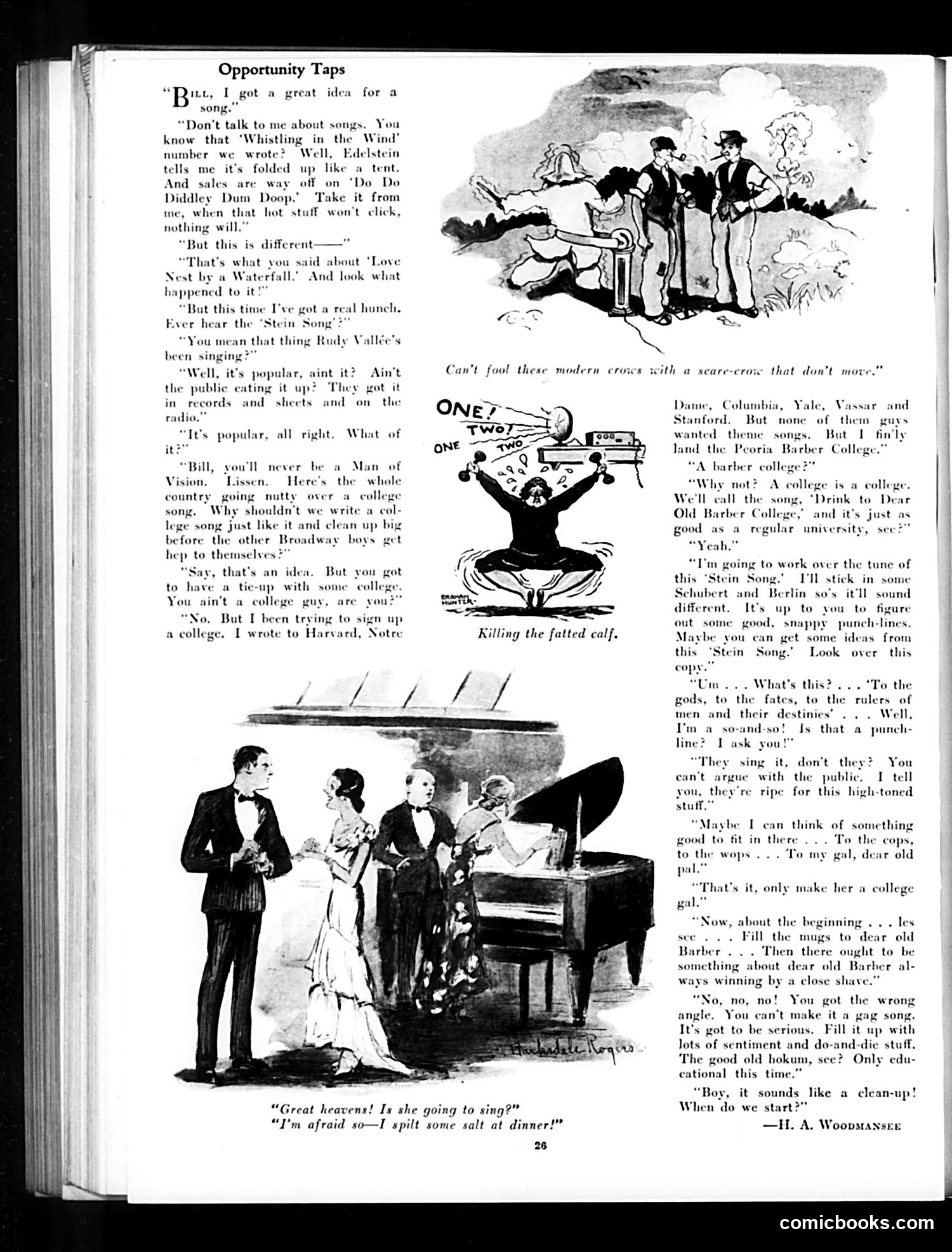
"Opportunity Taps" This satire mocks songwriters capitalizing on the unexpected success of "The Stein Song," a college fight song popularized by crooner Rudy Vallée in the late 1920s. Two Broadway composers debate writing a knockoff college song for commercial profit, though they lack any actual college affiliation. The joke: they pitch the idea to "Peoria Barber College"—a trade school, not a real college—because legitimate universities rejected them. Their cynical approach involves copying successful elements (sentimental lyrics about school pride, classical composer names like Schubert and Berlin) while treating it purely as commercial product rather than genuine school tradition. The cartoon satirizes how quickly Tin Pan Alley exploits any popular trend for profit, and the absurdity of applying college-spirit marketing to an institution that teaches barbering rather than academics. The satire targets both the songwriters' mercenary desperation and mass-market audiences' gullible consumption of manufactured sentiment.
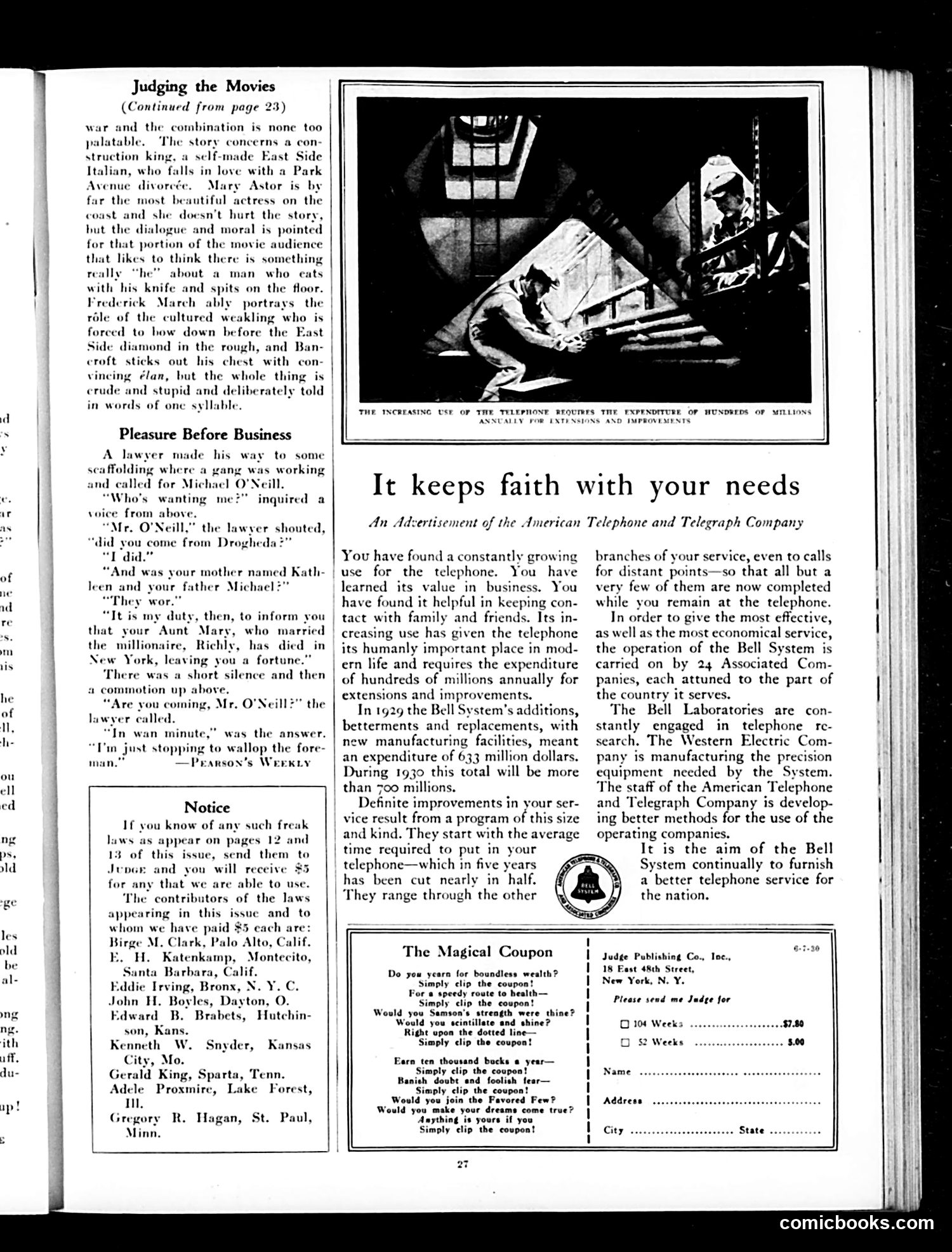
Explanation for Modern Readers This page contains two distinct items: "Judging the Movies" is a film review criticizing a movie featuring Frederick March and appears to reference *Mary Astor*. The review mocks the film's crude premise—pitting a rough, wealthy "self-made" Italian construction magnate against an upper-class Park Avenue divorcée. The satire targets audience appeal to masculine stereotypes (the knife-wielding, floor-spitting "he-man" type) while portraying cultured men as weak "weaklings." The review dismisses the entire narrative as stupid and deliberately simplistic. "Pleasure Before Business" is a humorous anecdote (credited to Pearson's Weekly) about an Irish worker named Michael O'Neill who, when informed by a lawyer that his Aunt Mary has died leaving him a fortune, replies he'll come down in a minute—he's busy "stopping" (hitting) the foreman. The joke mocks working-class priorities and ethnic stereotypes about Irish laborers' willingness to assault supervisors. The page also includes a Bell Telephone advertisement and a "Notice" soliciting reader contributions about unusual laws.
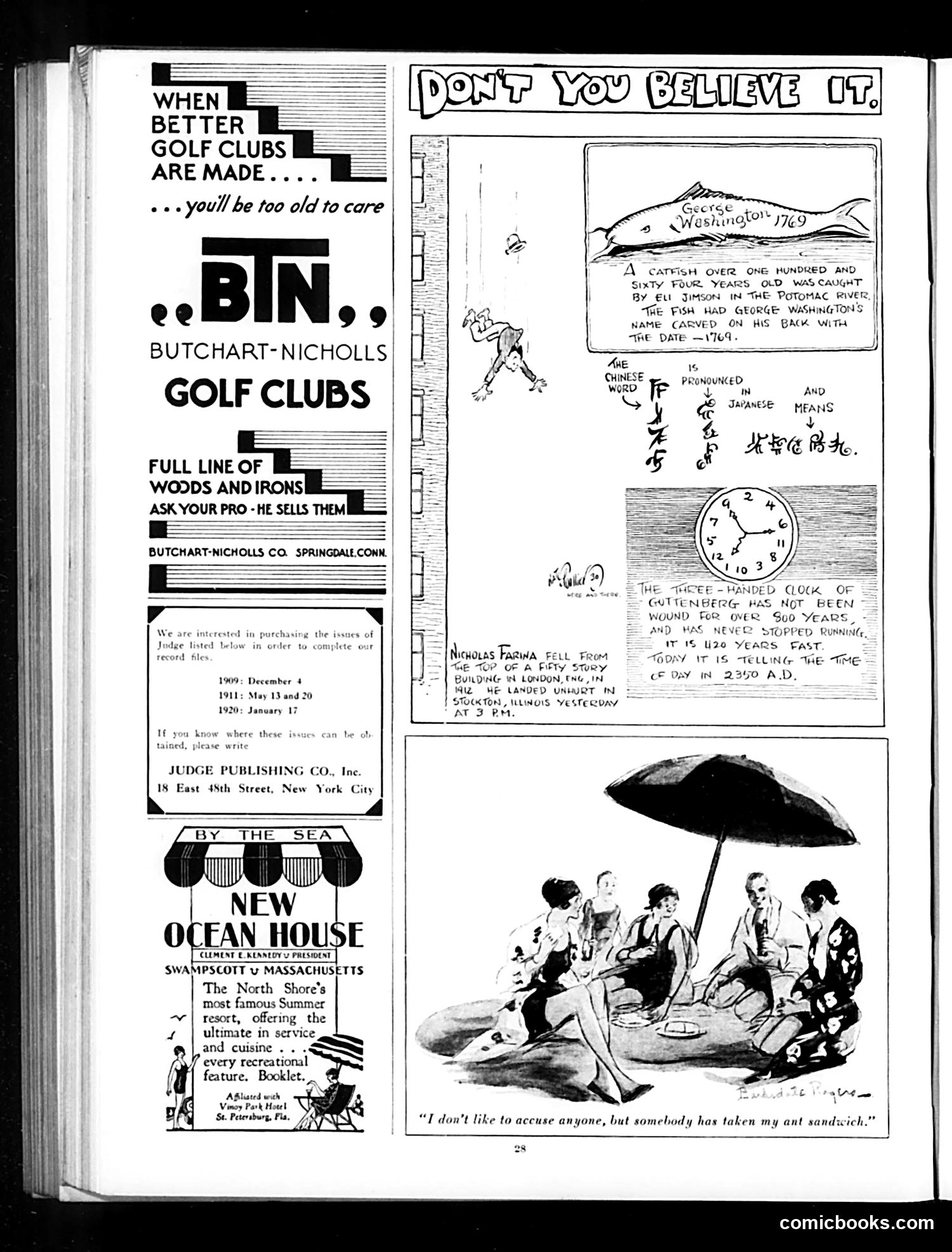
Judge Magazine Page Analysis This page contains primarily advertisements and filler content rather than political satire. The left side features ads for Butchart-Nicholls golf clubs and the Ocean House resort in Massachusetts. The right side, titled "Don't You Believe It," presents humorous tall tales and oddities—apparently a regular feature. These include: a 164-year-old catfish supposedly caught in the Potomac with George Washington's name carved on it (1769), Chinese characters with supposed meanings, and a 500-year-old clock in London that supposedly remains accurate despite never being wound. The bottom cartoon shows beachgoers under an umbrella, with one saying "I don't like to accuse anyone, but somebody has taken my ant sandwich"—a simple, lighthearted joke about petty beach theft. There's no identifiable political commentary or caricature on this page. It's primarily entertainment and commercial content typical of Judge magazine's miscellaneous filler material.
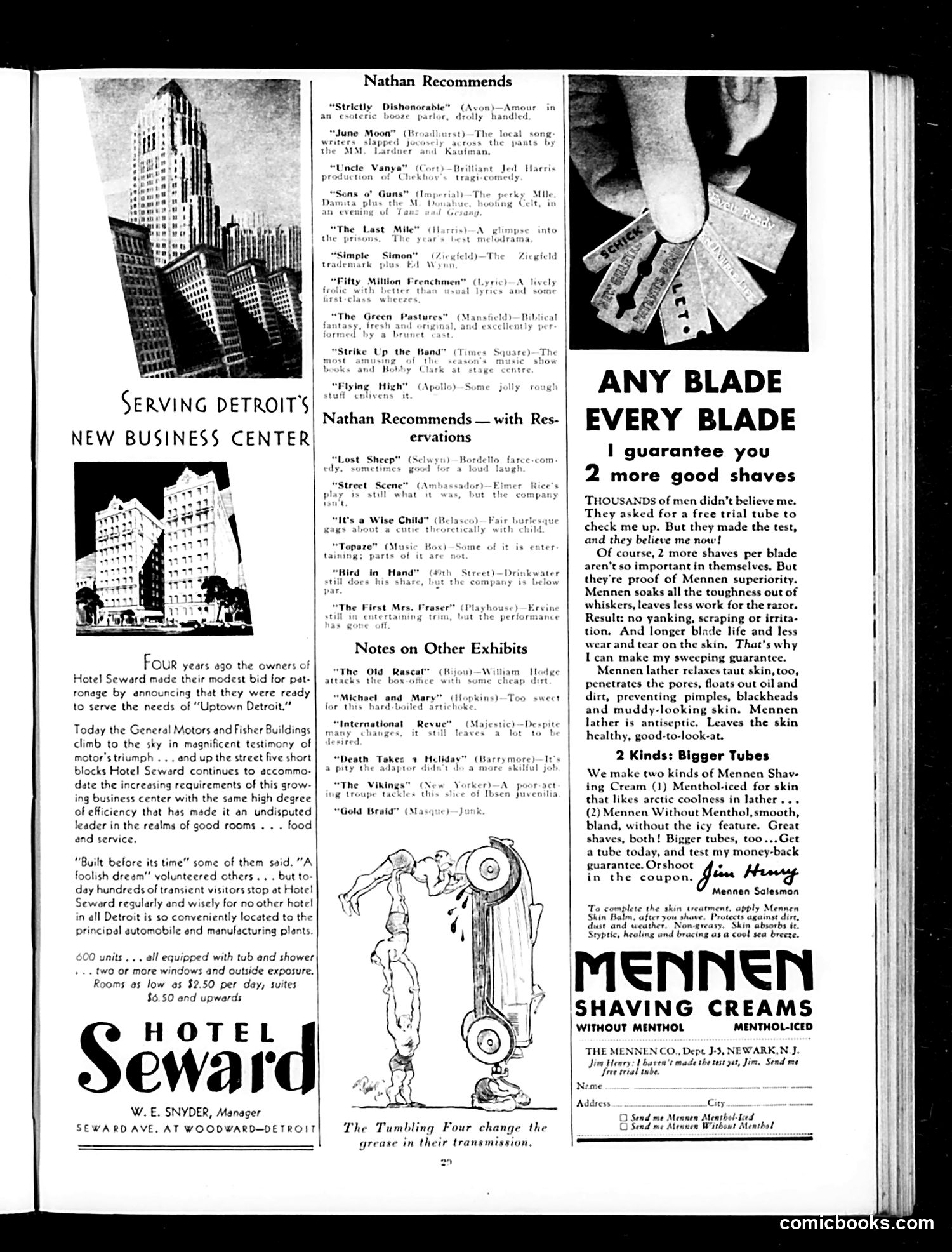
Analysis of Judge Magazine Page Content This page is primarily advertising and entertainment listings, not political satire. The main content includes: 1. Hotel Seward advertisement (left): Promotes a Detroit hotel claiming to have been "built before its time" four years ago, now thriving as the city's business district expands with major automotive manufacturing (General Motors and Fisher Buildings mentioned). 2. Nathan's theater reviews (center): Brief recommendations for Broadway shows including "June Moon," "Uncle Vanya," and others—standard entertainment journalism. 3. Mennen Shaving Cream advertisement (right): A large product ad featuring a testimonial claiming the cream enables "2 more good shaves" per blade, with emphasis on skin benefits and a mail-in coupon. 4. Cartoon illustration (lower center): Shows "The Tumbling Four" performers, accompanying a theater review note about them changing "grease in their transmission"—likely a visual pun. This is a commercial magazine page with minimal satirical content, reflecting 1920s-era advertising and entertainment coverage rather than political commentary.
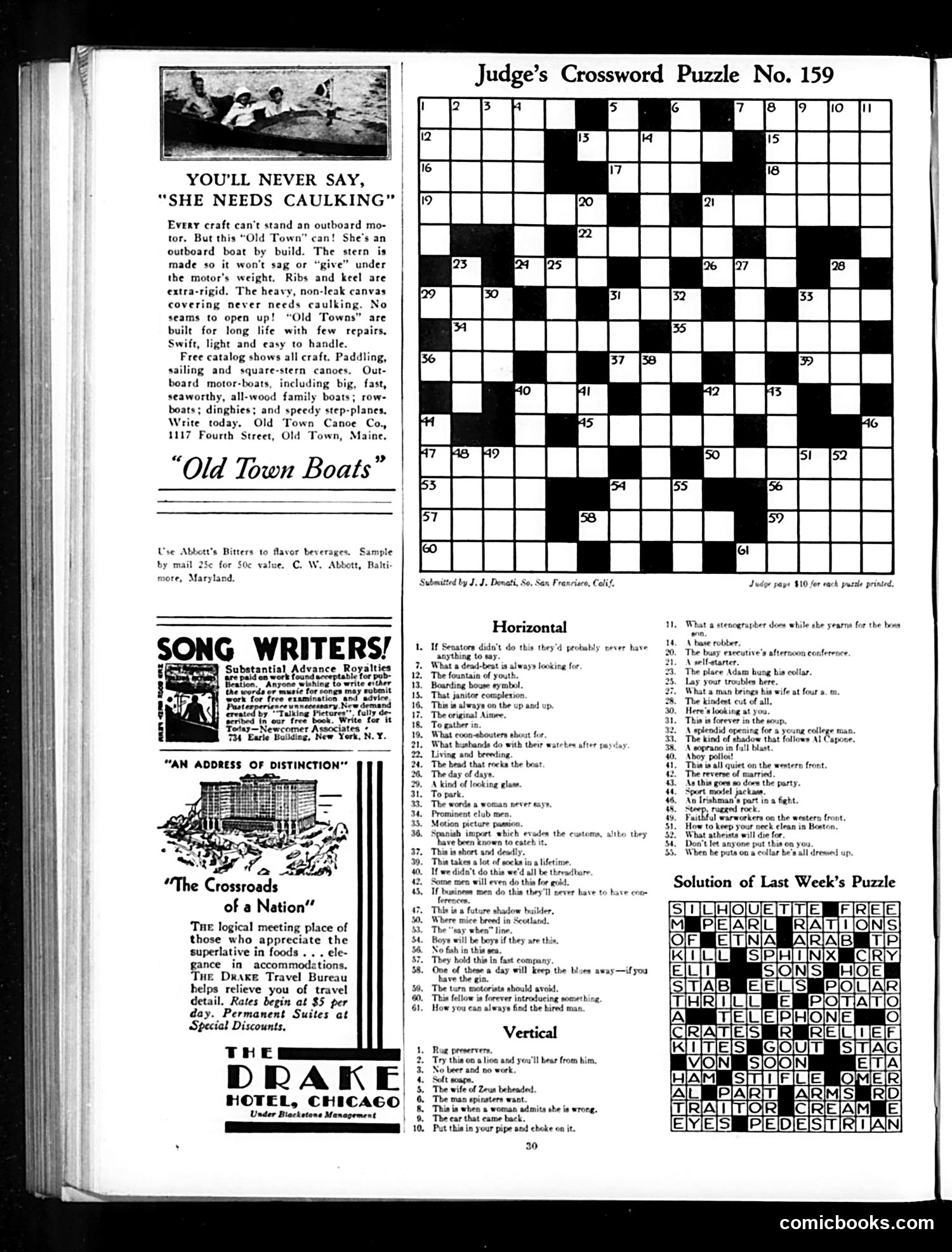
Judge Magazine Page Analysis This page is primarily advertising and crossword puzzle content, not political satire. The main elements are: 1. "Old Town Boats" Advertisement: A substantial ad promoting outboard motor boats, emphasizing their durability and low maintenance ("never needs caulking"). This is straightforward product marketing. 2. Judge's Crossword Puzzle No. 159: The bulk of the page features a standard crossword puzzle with clues. The clues are conventional wordplay and riddles typical of 1920s-30s puzzles—nothing particularly satirical. 3. Supporting Ads: Additional small advertisements for song writers, Abbott's Bitters, and the Drake Hotel in Chicago. No significant political cartoons or satire appear on this page. Judge magazine was known for satirical content elsewhere, but this particular page is dedicated to recreational puzzles and commercial advertising—typical filler content for a magazine of this era. The crossword puzzle itself contains no hidden political commentary visible in the clues provided.
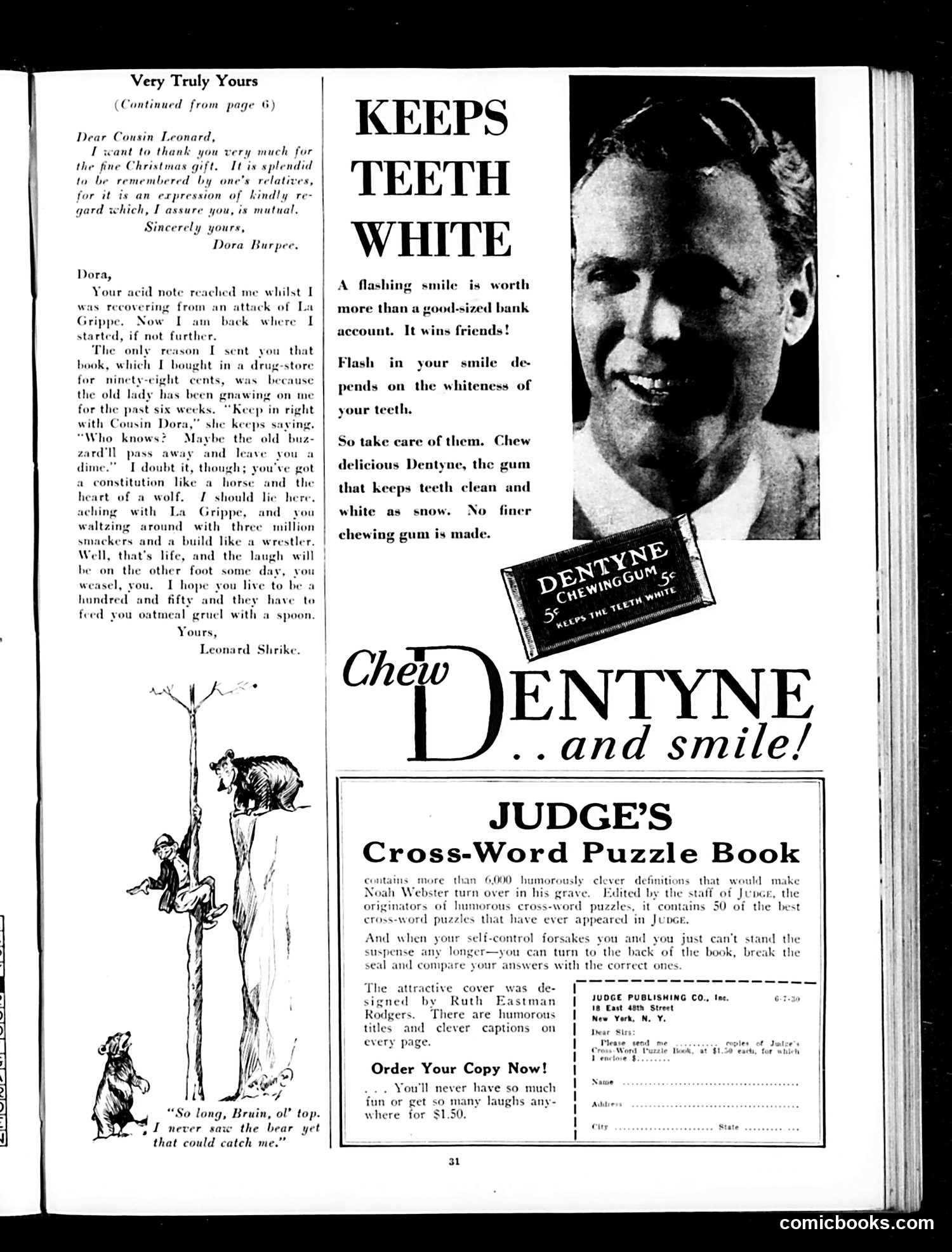
Judge Magazine Page Analysis This page is primarily advertising and correspondence, not political satire. It contains: Left side: Personal letters under "Very Truly Yours"—humorous exchanges between relatives (Dora Burpee and Leonard Shrike) discussing Christmas gifts with sardonic complaints. A small cartoon shows a bear and person in a tree, illustrating Shrike's closing joke about eluding capture. Right side: Two advertisements: 1. Dentyne chewing gum — promoting dental hygiene with a photo of a smiling man. The pitch emphasizes that white teeth "win friends" and are worth more than money. 2. Judge's Cross-Word Puzzle Book — advertising the magazine's puzzle collection (50 puzzles with humorous definitions), priced at $1.50, with an order form. The content reflects typical 1920s-30s magazine layout mixing reader correspondence with product advertising. No identifiable political figures or events are referenced.
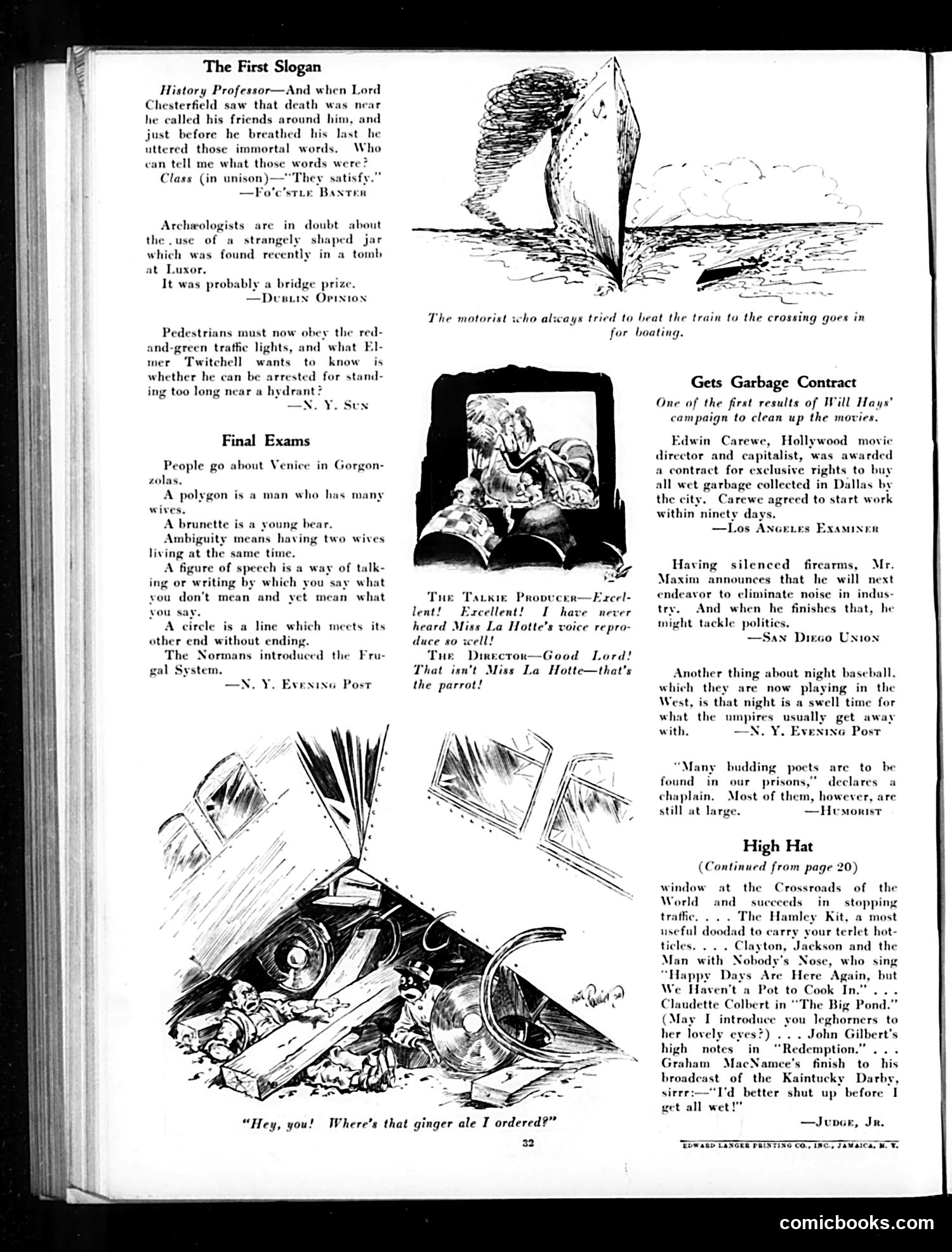
Judge Magazine Page Analysis This page from *Judge* magazine contains several short satirical pieces mocking contemporary society and culture: "The First Slogan" jokes about advertising slogans, referencing what appears to be a cigarette ad's famous tagline ("They satisfy"). "Final Exams" ridicules student ignorance through deliberately absurd wrong answers—a polygon as "a man with many wives," a circle as "a line which meets its other end without ending"—satirizing poor education. "Gets Garbage Contract" mocks Will Hays' film censorship campaign by noting that Hollywood director Edwin Carewe was awarded a garbage collection contract in Dallas—implying the irony that cleaning up movies led to literal garbage work. "High Hat" reviews current entertainment (Clayton Jackson, John Gilbert films, radio broadcasts), offering typical entertainment criticism. The large cartoon shows a waiter confronting diners about a missing ginger ale order, likely critiquing restaurant service or Prohibition-era beverage substitution confusion. Overall, the page exemplifies *Judge*'s satirical approach: poking fun at education failures, advertising claims, censorship hypocrisy, and modern urban inconveniences.
Analysis This is primarily a business advertisement, not political satire. It promotes Globe-Wernicke's "Visible Record" filing system with "Automatic Control" features. The page shows two businessmen in suits examining a visible record card system. The ad claims this new filing method helps businesses automatically expose vital facts about sales, inventory, and accounts—preventing dead stock and improving cash flow. The "Send for This Book TODAY" section in the lower left advertises a free guide explaining the system's benefits. For modern readers: This reflects early 20th-century business innovation around data visibility and inventory management. The emphasis on "automatically" exposing business facts shows how revolutionary systematic record-keeping seemed at the time. The well-dressed businessmen represent the target corporate audience. There's no satire here—Judge's editorial pages sometimes carried straightforward advertisements alongside their actual satirical content.
Lucky Strike Advertisement Analysis This is a cigarette advertisement, not political satire. The page features a Lucky Strike campaign from the 1920s-30s era promoting cigarettes as a weight-control aid. The "shadow" referenced is a silhouette of an overweight person—the ad warns against becoming obese. Lucky Strike marketed smoking as an appetite suppressant: when tempted to overeat, "reach for a Lucky instead." The tagline "It's toasted" emphasized the brand's supposed throat protection. This reflects a now-infamous advertising strategy targeting women's body insecurity. The ad claims no direct weight-loss benefit but positions smoking as a substitute for indulgent eating, thus avoiding excess weight. By modern standards, this brazenly exploits health misinformation and body-image anxiety to sell a harmful product—advertising practices now illegal.