judge
Judge — June 14, 1930
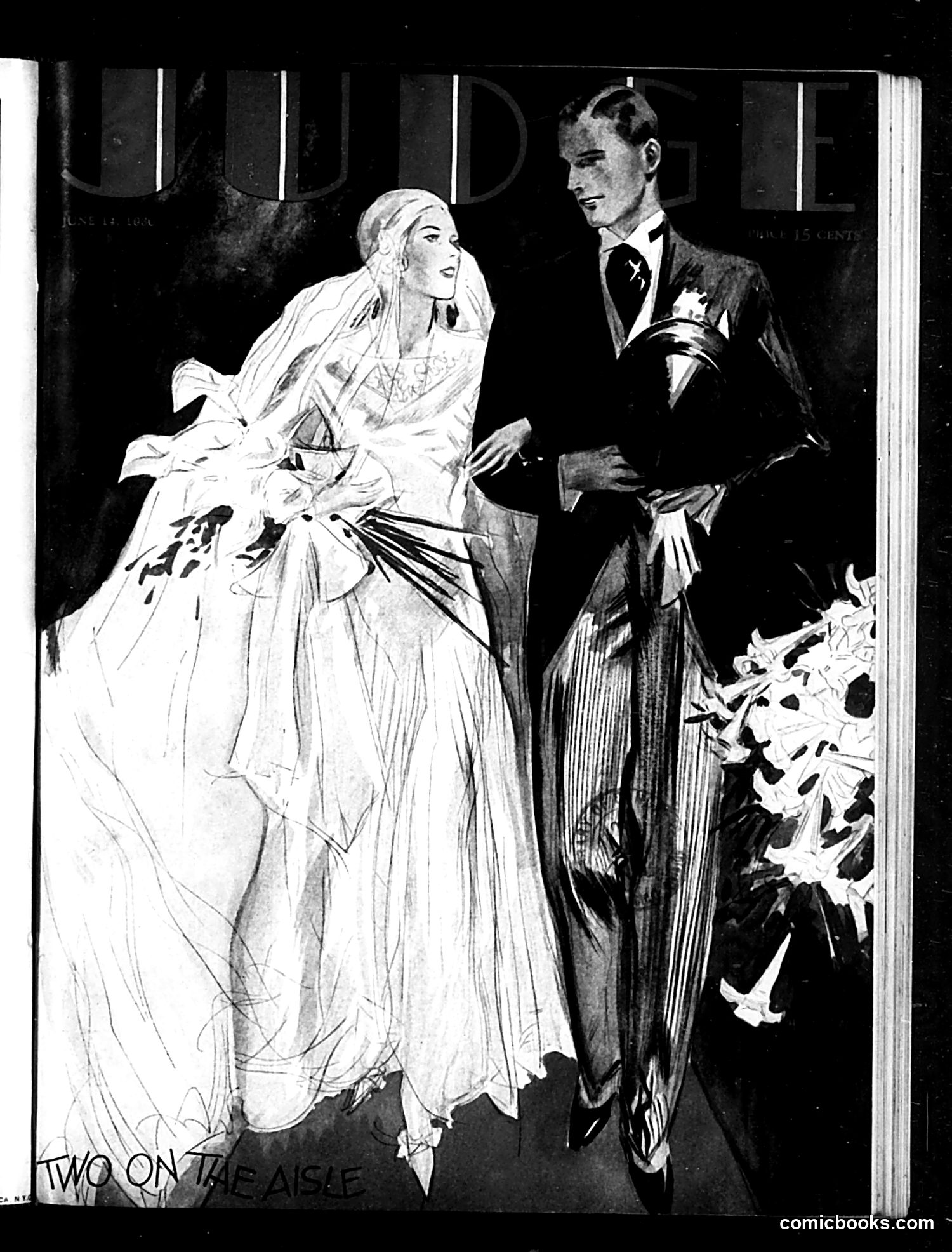
"Two on the Aisle" This Judge magazine illustration depicts a couple in formal wedding attire at what appears to be a theater or entertainment venue (suggested by "aisle" reference and the "Judge" masthead visible). The woman wears an elaborate white wedding dress with veil and carries flowers; the man is in formal daytime dress with boutonniere. The title "Two on the Aisle" likely satirizes the social spectacle of high-society weddings, playing on the double meaning of "aisle"—both theatrical seating and the wedding ceremony setting. The artwork style suggests early 20th century. Without additional context or clearer OCR text, the specific satirical target remains unclear, though it appears to mock elaborate wedding pageantry or perhaps commentary on theatrical society marriages of that era.
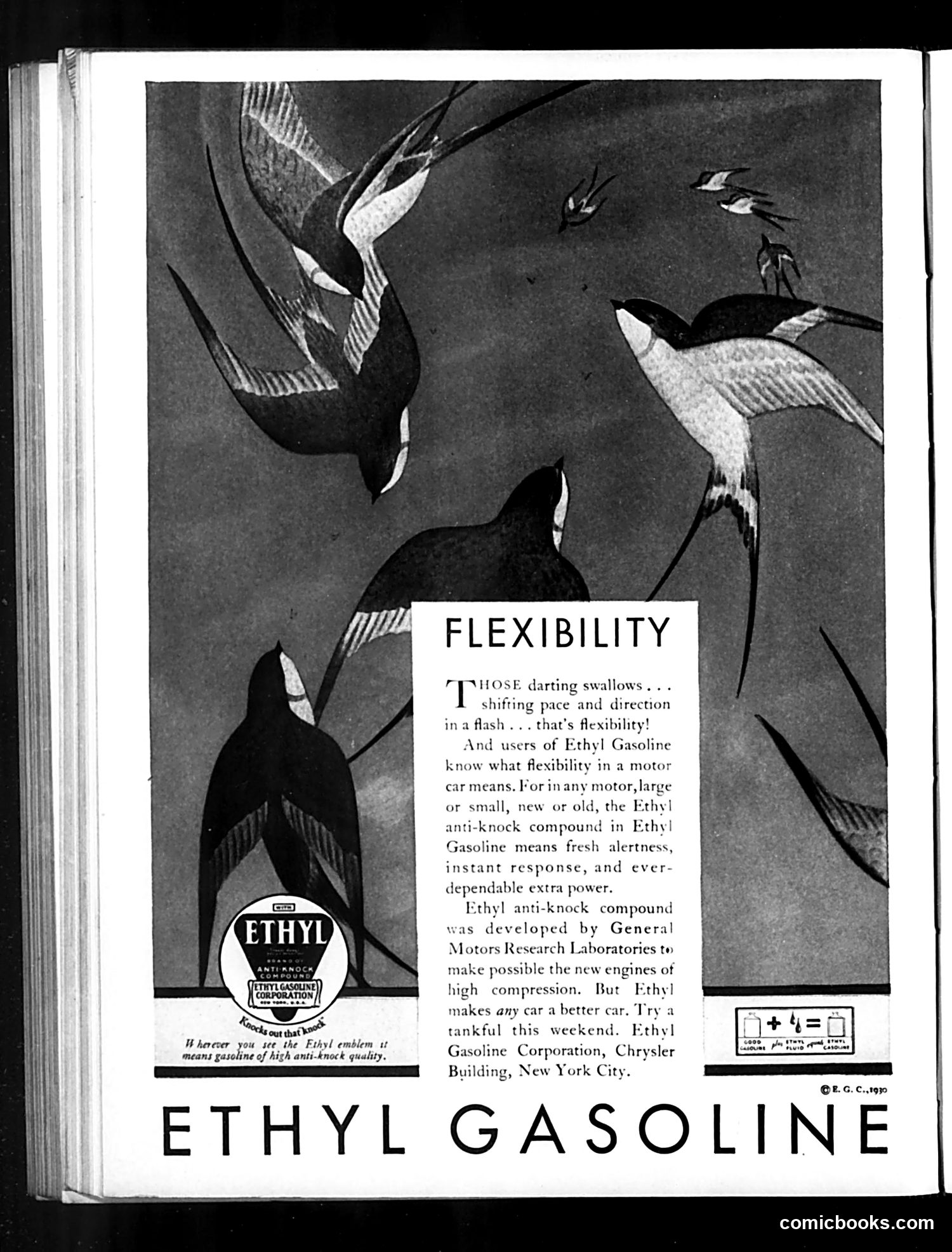
Analysis This page is primarily advertising, not satire or editorial content. It features an Ethyl Gasoline Corporation advertisement from the 1920s-1930s era. The imagery shows stylized black swallows in flight, used metaphorically to illustrate "flexibility"—the ad's central concept. The swallows' agility parallels the claimed benefits of Ethyl gasoline's anti-knock compound, developed by General Motors Research Laboratories. The text emphasizes that Ethyl fuel provides "fresh alertness, instant response, and ever-dependable extra power" for any motor vehicle. This was genuine marketing for a real fuel additive (tetraethyl lead, later recognized as hazardous). The ad represents period advertising strategy: using artistic imagery and scientific claims to promote a competitive commercial product to middle-class motorists.
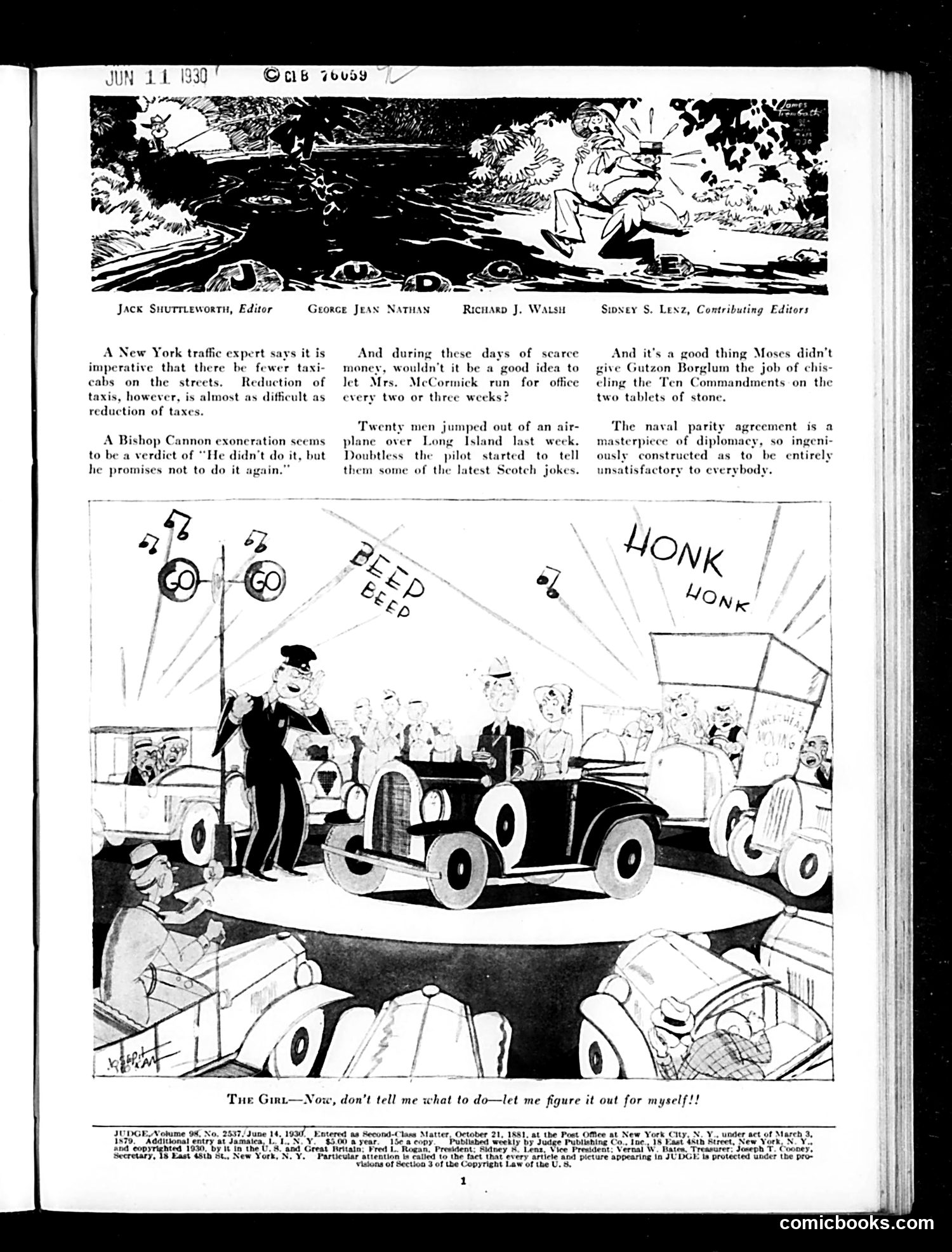
Analysis of Judge Magazine Page (June 11, 1930) The main cartoon depicts a chaotic traffic jam with multiple automobiles honking ("HONK HONK"). A traffic policeman stands elevated, appearing overwhelmed and gesturing helplessly at the gridlock below. The caption reads: "The Girl—Now, don't tell me what to do—let me figure it out for myself!!" This is satire about 1920s-30s automobile congestion in American cities and gender dynamics. The "girl" likely refers to a young woman driver attempting to navigate traffic independently, while the overwhelmed officer represents authorities losing control of urban streets. The joke satirizes both: 1. Traffic problems: Rapid car proliferation creating chaos 2. Gender roles: A woman resisting instruction, humorously depicted as worsening the gridlock The cartoon reflects contemporary anxiety about automobiles, urban management, and changing gender independence.
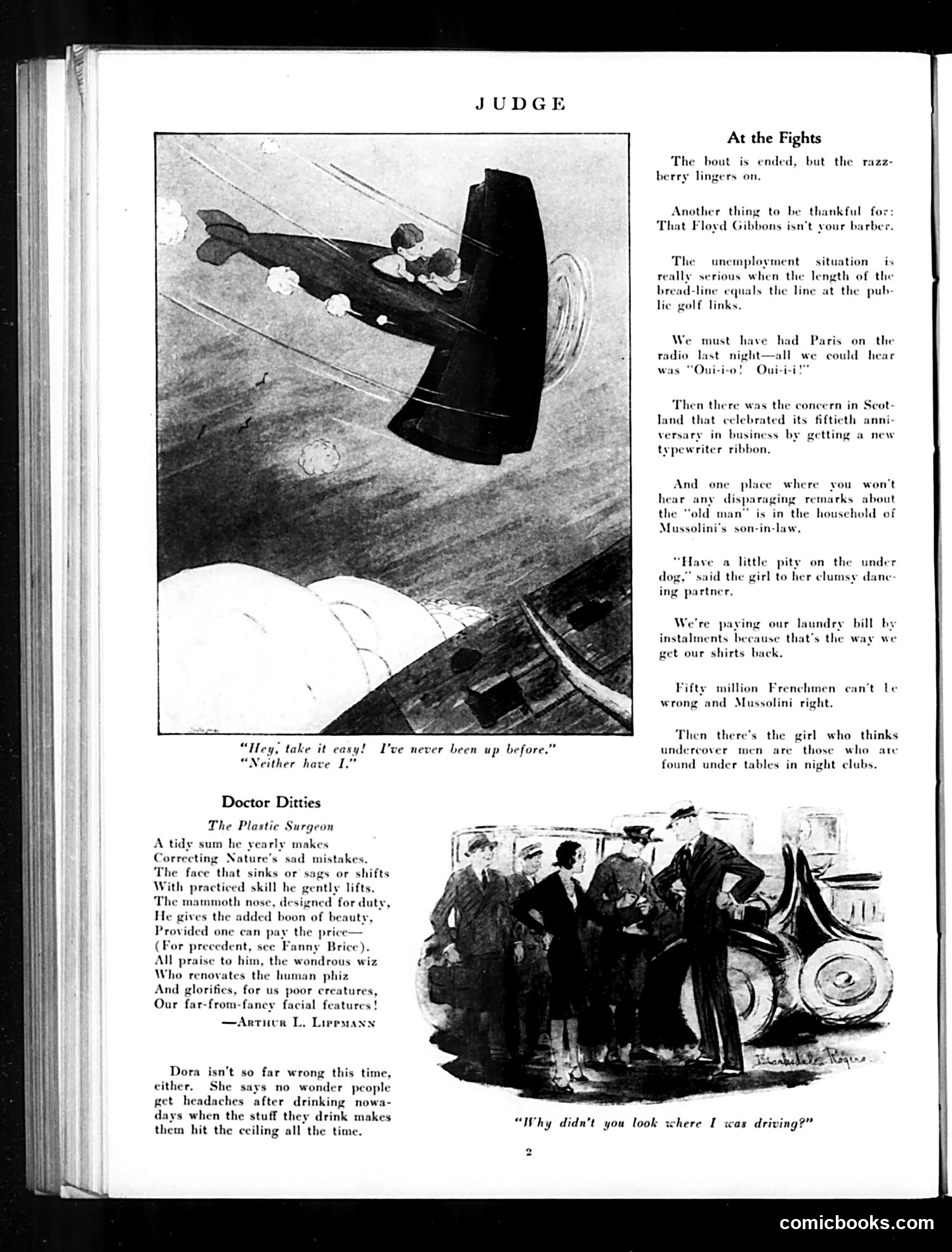
Analysis of Judge Page "At the Fights" (top cartoon): A man in formal wear flies through the air after being knocked out of a boxing ring. The caption jokes that while "the bout is ended, but the razzberry lingers on"—satirizing boxing spectators' rowdy behavior and lack of decorum. "Doctor Ditties: The Plastic Surgeon" (bottom section): A poem by Arthur L. Lippmann mocks cosmetic surgery, particularly surgeons who reshape faces and noses for wealthy clients. It critiques both the vanity of patients seeking "beauty" and the doctors profiting from insecurity. The right column contains various satirical social observations about unemployment, Paris radio broadcasts, and undercover detectives. The humor targets 1920s-era excesses: violent entertainment culture, cosmetic surgery trends, and contemporary social anxieties.
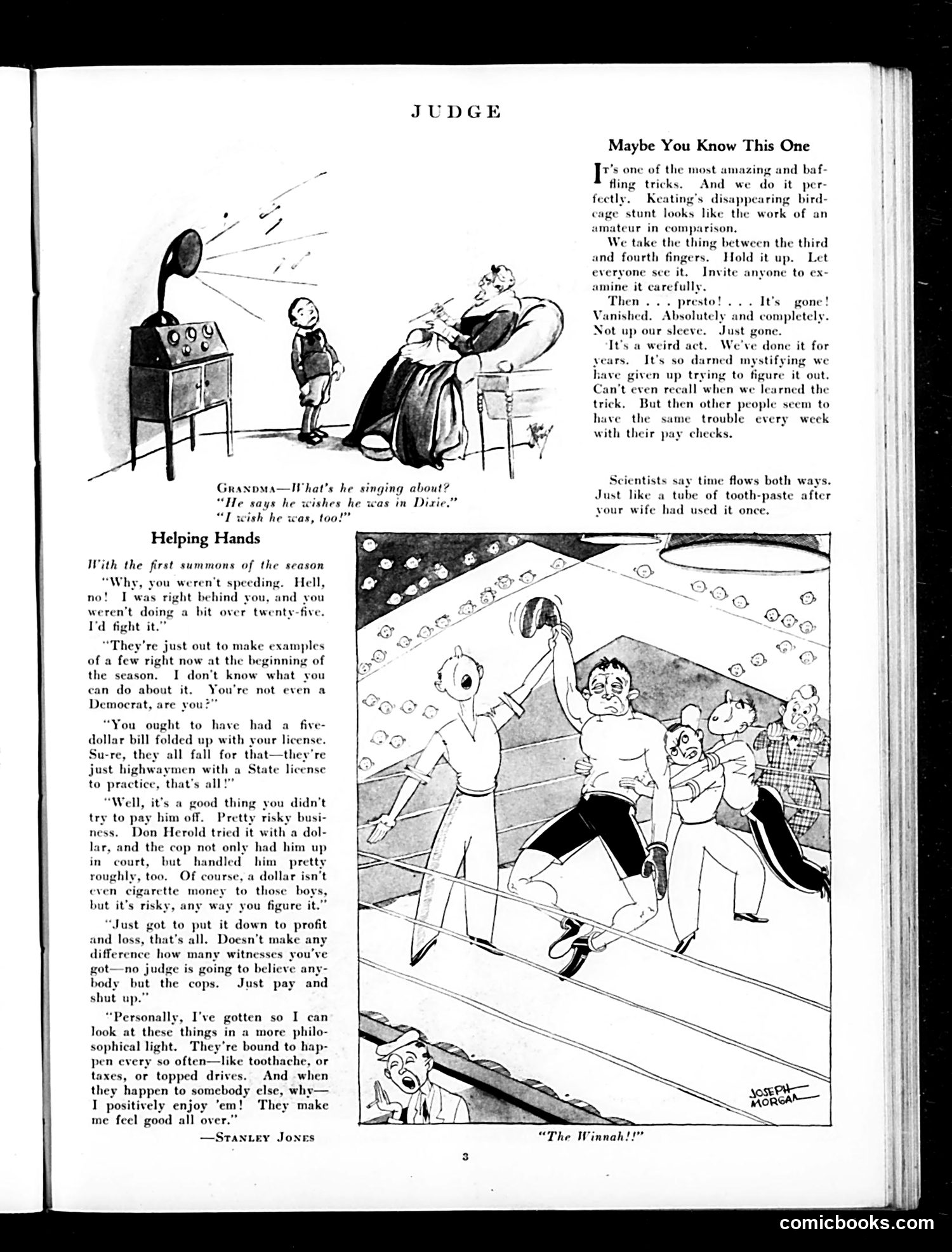
Analysis of Judge Magazine Page This page contains two separate humor pieces: "Maybe You Know This One" (top): A magic trick demonstration where a magician makes an object disappear from between a child's fingers. The joke plays on the absurdity of a commonplace magic trick—the text suggests even regular people routinely perform it, comparing it sarcastically to other everyday frustrations like figuring out tax deductions. "Helping Hands" (bottom): A cartoon about summons for speeding tickets. The dialogue satirizes how traffic violations are used to generate revenue, with the joke that judges and police don't care about the driver's actual guilt—it's purely profit-driven. The beach scene shows people enjoying themselves while being ticketed, emphasizing the arbitrary nature of enforcement. Both pieces mock bureaucratic absurdity and institutional indifference through exaggeration.
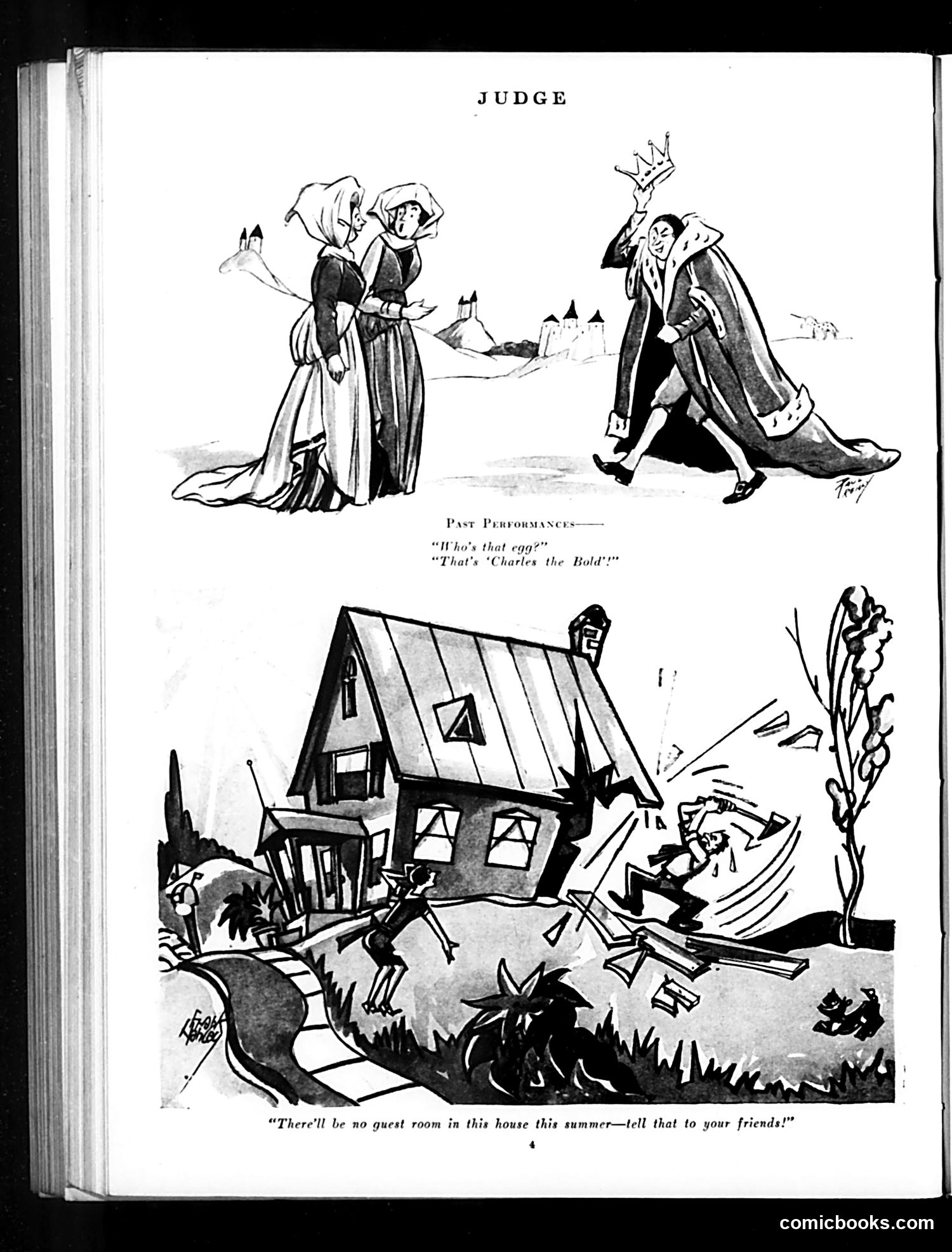
Judge Magazine Cartoon Analysis This page contains two satirical cartoons from Judge magazine: Top cartoon: Titled "Past Performances," it shows a regal figure (likely representing royalty or nobility, given the crown and ermine-trimmed robes) approaching two women. The caption references "Charles the Bold," a historical figure, suggesting commentary on aristocratic pretension or past glories. The joke appears to mock someone's exaggerated self-importance based on historical associations. Bottom cartoon: Shows chaotic destruction at a house with figures fleeing and debris scattering. The caption warns guests won't be accommodated "this summer," using property damage as a visual metaphor—likely satirizing either domestic chaos, prohibition-era violence, or social upheaval of the era. Both cartoons use exaggeration and visual humor typical of Judge's satirical style, though without publication date context, specific historical references remain unclear.
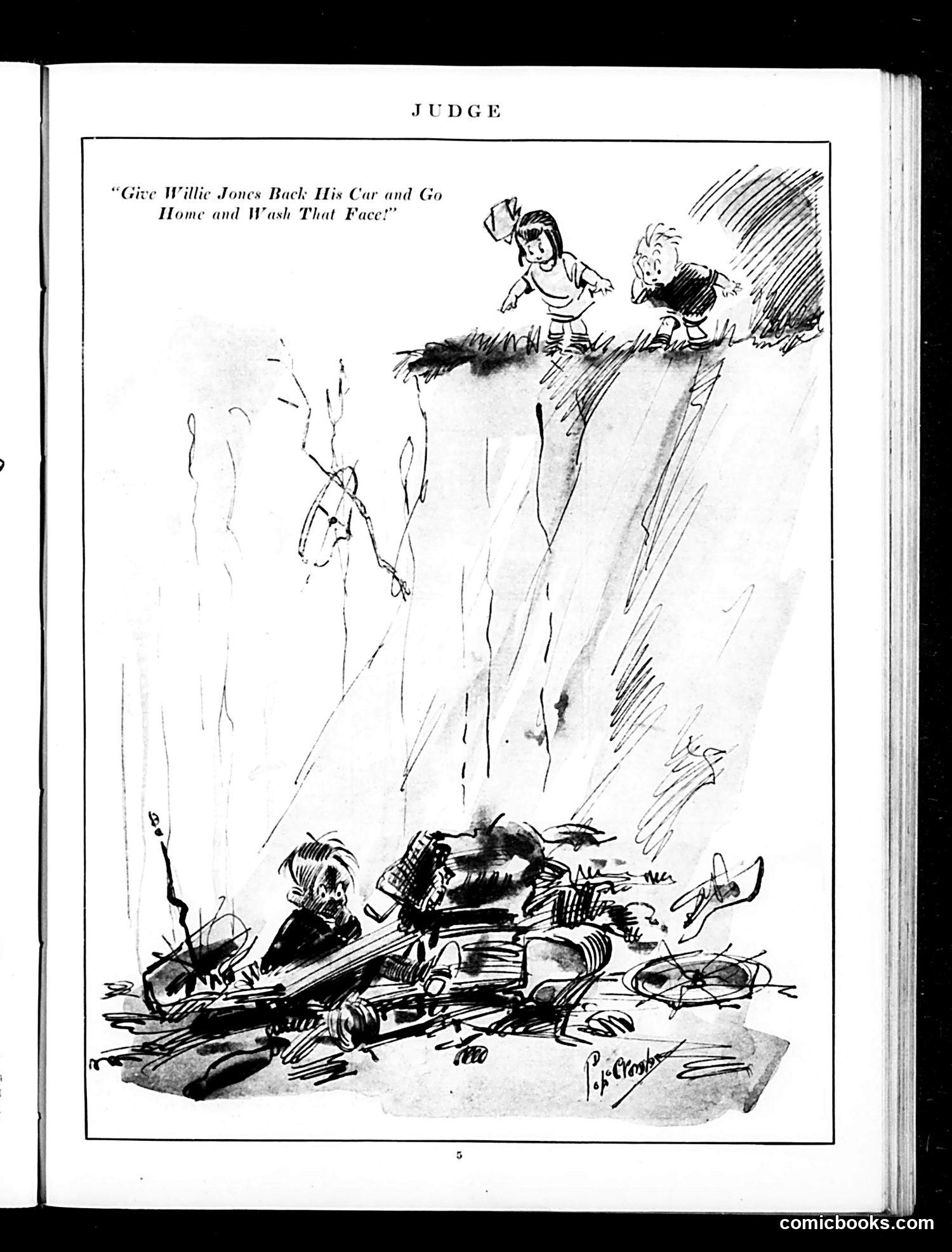
Analysis of Judge Magazine Cartoon This cartoon satirizes a car accident involving Willie Jones. The caption "Give Willie Jones Back His Car and Go Home and Wash That Face!" suggests Jones was responsible for vehicular damage or destruction. The sketch shows a wrecked automobile at the bottom with debris scattered around, while two children stand safely above on higher ground, looking down at the destruction. The satire appears to mock Jones's negligent or reckless driving, implying he should return to basics (washing his face, going home) rather than operating a vehicle. The exaggerated depiction of the car's destruction and the children's vantage point emphasize the dangerous consequences of poor driving habits. Without additional historical context, the specific identity of "Willie Jones" and the incident referenced remains unclear.
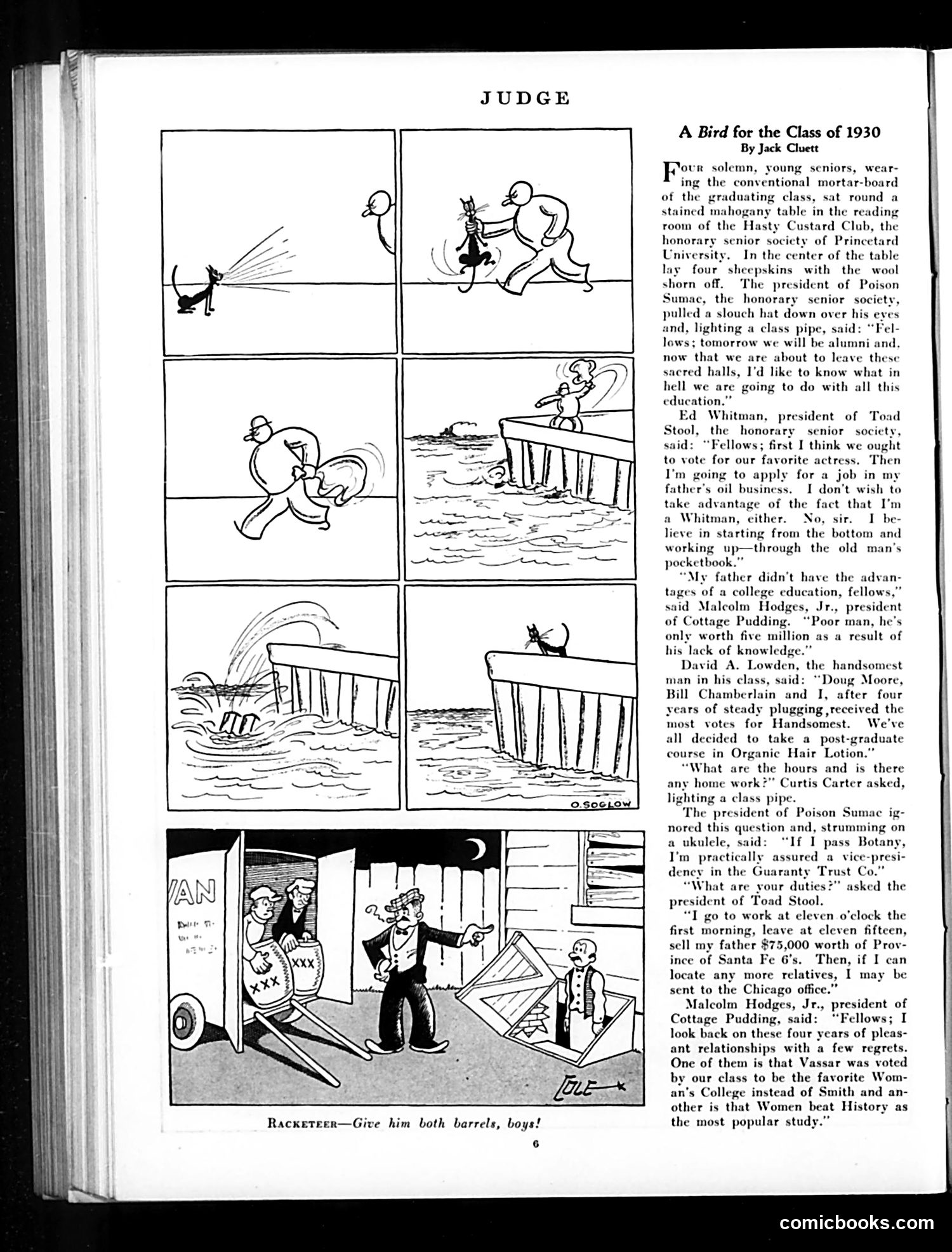
"A Bird for the Class of 1930" This satirical piece mocks Princeton University's graduating class of 1930 through a fictional club meeting. Senior society members discuss their post-graduation prospects with self-important pomposity. The humor targets their entitled assumptions: one plans to leverage his father's oil business; another claims he'll get a vice presidency through family connections; a third admits his father's wealth comes from questionable sources. The accompanying cartoon shows young men literally "racketeering"—dumping barrels marked "XXX" (bootleg alcohol), a direct reference to Prohibition-era illegal activity. The satire suggests that despite their elite education, these graduates will rely on family money and criminal enterprises rather than actual merit or legitimate work.
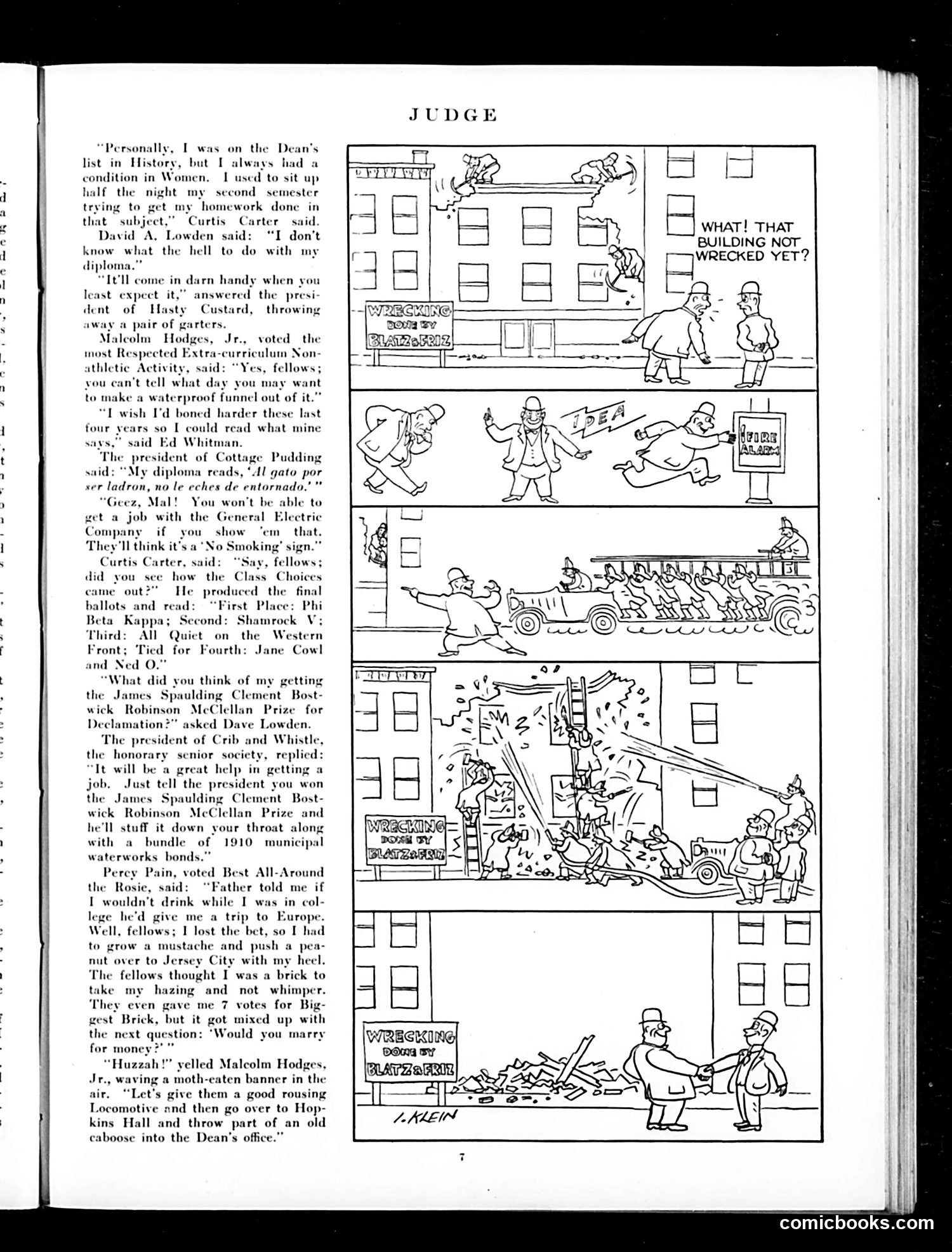
Judge Magazine Page Analysis This page satirizes college life and student superlatives/awards through fictional quotes from graduating seniors. The comic strips illustrate their boastful claims with slapstick humor. Key elements: - Curtis Carter, David Lowden, Malcolm Hodges Jr., and others are fictional college characters discussing their academic achievements and pranks - References to actual college honors (Phi Beta Kappa, various named prizes) are mocked as students brag about dubious accomplishments - The satire targets college pretension: students claiming academic distinctions while admitting to poor study habits, hazing participation, and destructive behavior - The comics show physical comedy—building wrecking, car crashes, explosions—depicting the chaos these "accomplished" students actually cause - Final panel jokes about giving the Dean a "good rousing" by throwing a caboose into his office Social context: This mocks the disconnect between collegiate self-importance and actual responsibility, a recurring theme in early 20th-century American humor about privileged young men.
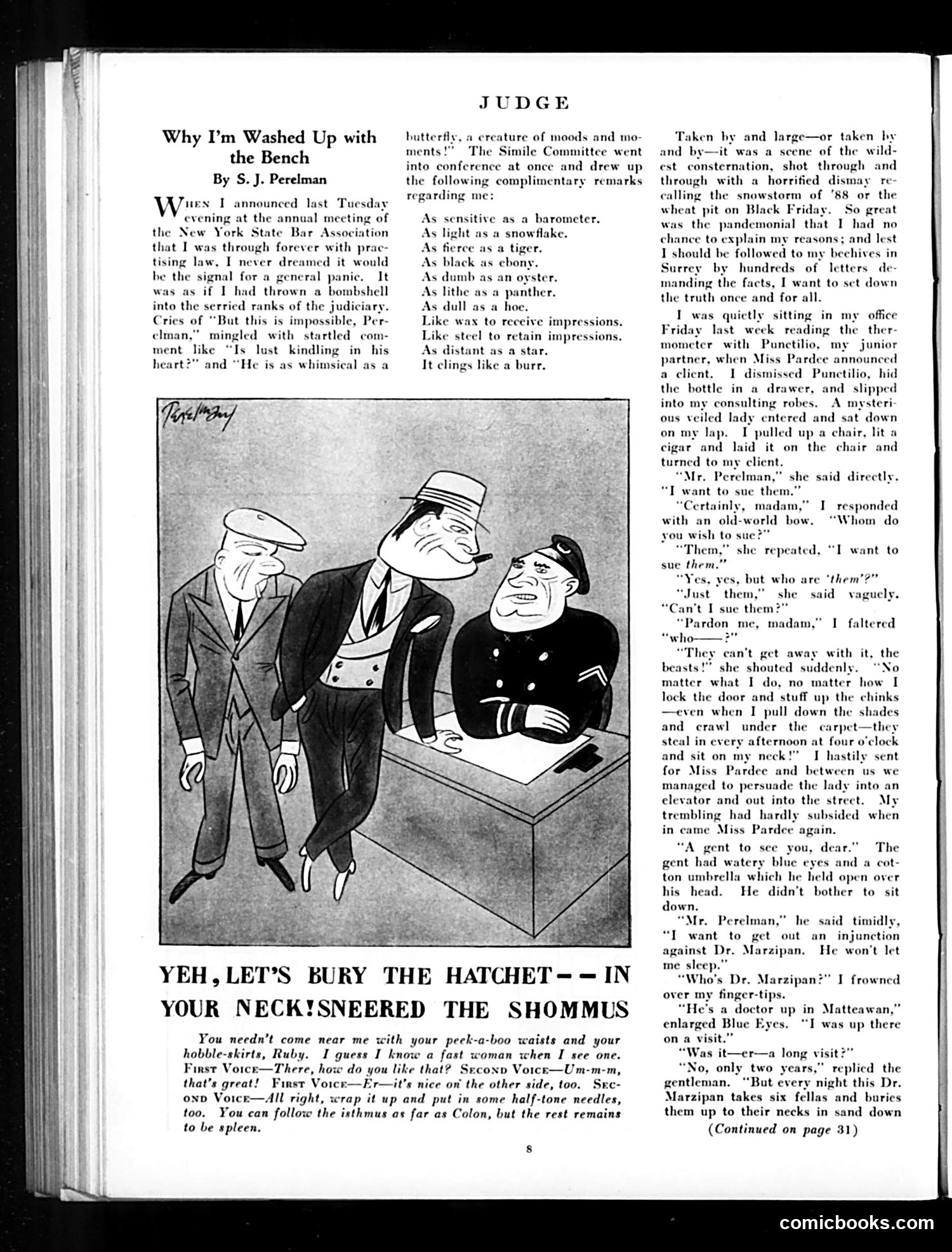
Analysis: "Why I'm Washed Up with the Bench" by S.J. Perelman This is a humorous essay with accompanying cartoon satirizing the legal profession and absurd clients. The cartoon depicts three men in suits confronting each other aggressively, with the caption mocking reconciliation: "Bury the hatchet—in your neck!" The crude threat exemplifies the piece's comedic tone. The essay's premise: Perelman, a lawyer, announces he's quitting law practice. Rather than the Bar Association's expected dismay, he presents absurdist "compliments" about his sensitivity (comparing him to barometers, snowflakes, etc.)—mocking hollow professional praise. The satire: The accompanying client stories ridicule legal practice itself. Two unhinged clients arrive: a veiled woman suing mysterious "them" (who apparently steal into her home daily at 4 PM), and a man seeking an injunction against Dr. Marzipan, who buries people up to their necks in sand. The point: Perelman satirizes both the pretentiousness of the legal establishment and the genuinely bizarre disputes lawyers must handle. The absurd clients justify his exasperation with the profession.
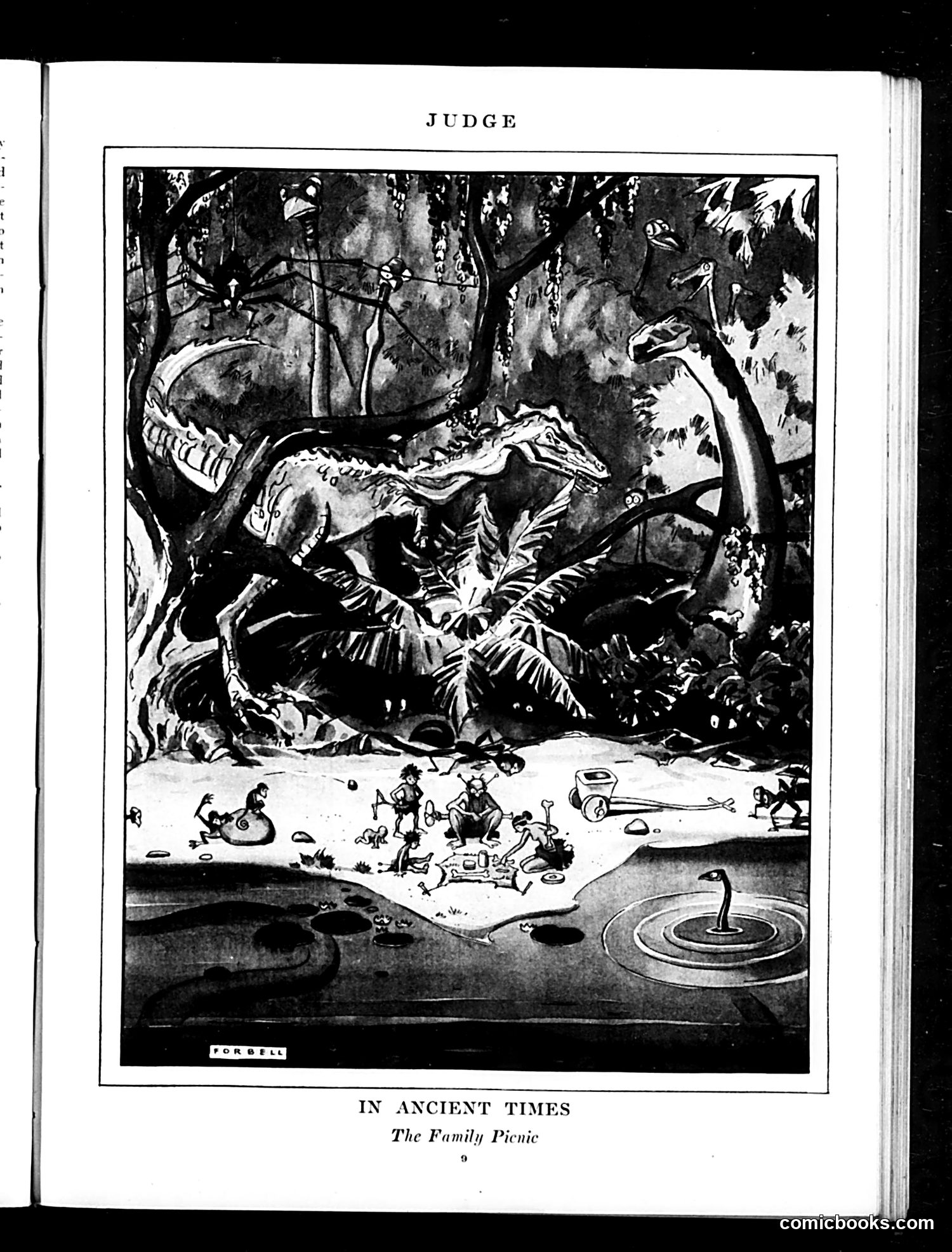
"In Ancient Times: The Family Picnic" This is a whimsical cartoon depicting prehistoric humans enjoying a leisure activity. The image shows a family-sized group of early humans gathered in a clearing beneath towering, gnarled trees, with one figure swimming or wading in water (lower right). The humans appear to be relaxing and playing—some with toys or objects scattered about. The satire likely works through anachronism: presenting "ancient" people engaged in modern recreational behavior (picnicking, play). This gentle humor may mock either contemporary leisure culture by suggesting even primitive humans sought comfort, or it may be simply absurdist comedy showing timeless human nature. The artist is credited as "FORBEL" (signature visible).
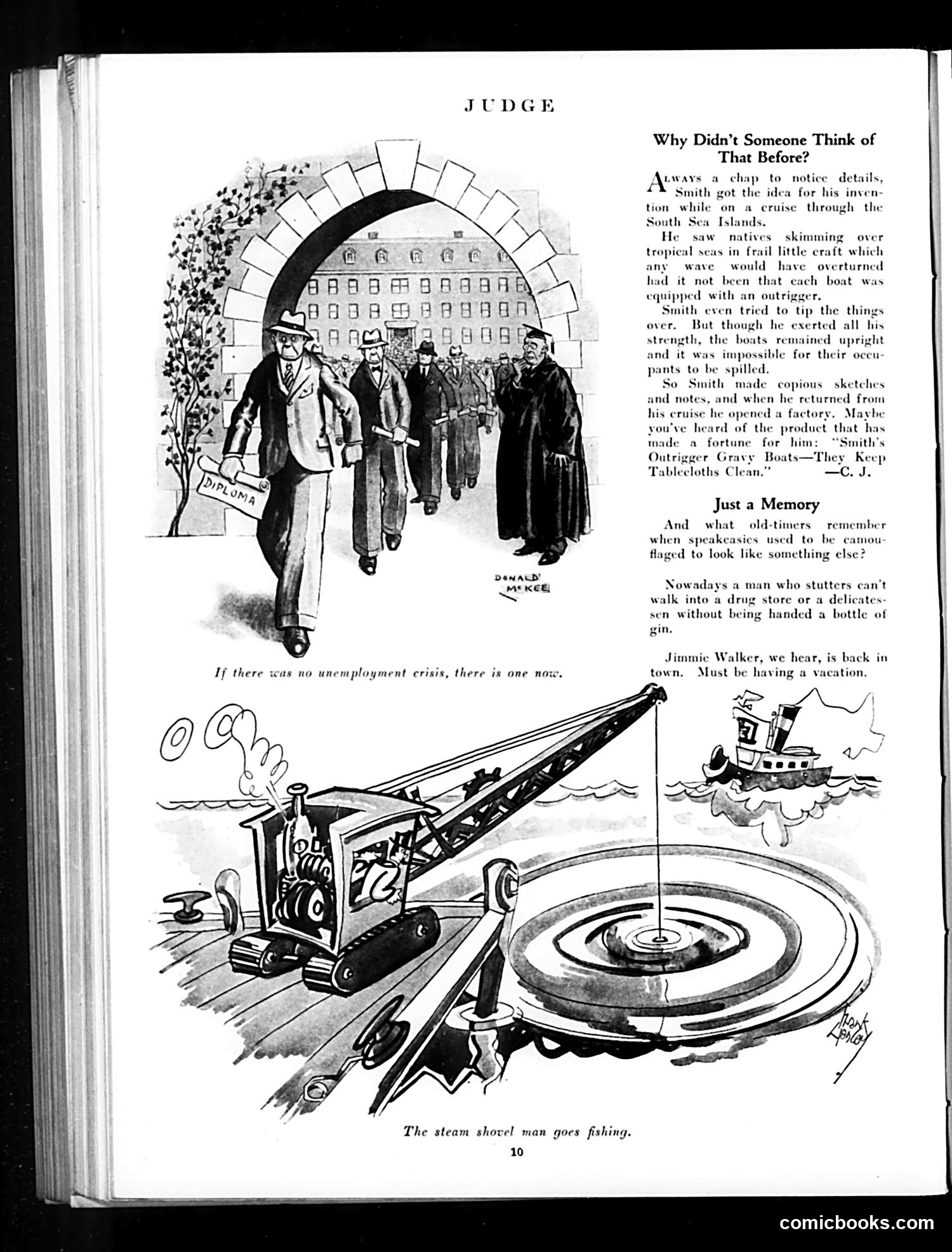
Analysis of Judge Page This satirical page contains three distinct pieces of humor: Top cartoon ("Why Didn't Someone Think of That Before?"): A businessman named Smith invents outrigger gravy boats after observing Pacific Islander canoes. The joke satirizes the obviousness of the invention—the solution was always visible, yet no one commercialized it before. "Just a Memory": A nostalgic quip about Prohibition-era speakeasies that disguised themselves as legitimate businesses. The satire suggests that in the post-Prohibition era, alcohol is now so openly available that even entering ordinary stores results in being offered gin. The reference to "Jimmie Walker" (likely NYC Mayor Jimmy Walker, known for his playboy lifestyle) on "vacation" is unclear without additional context. Bottom cartoon ("The steam shovel man goes fishing"): Shows an industrial steam shovel being repurposed as a fishing crane—absurdist humor about adapting heavy machinery for leisure purposes during unemployment, likely referencing the Great Depression era. The overall theme mixes gentle social observation with Depression-era anxiety.
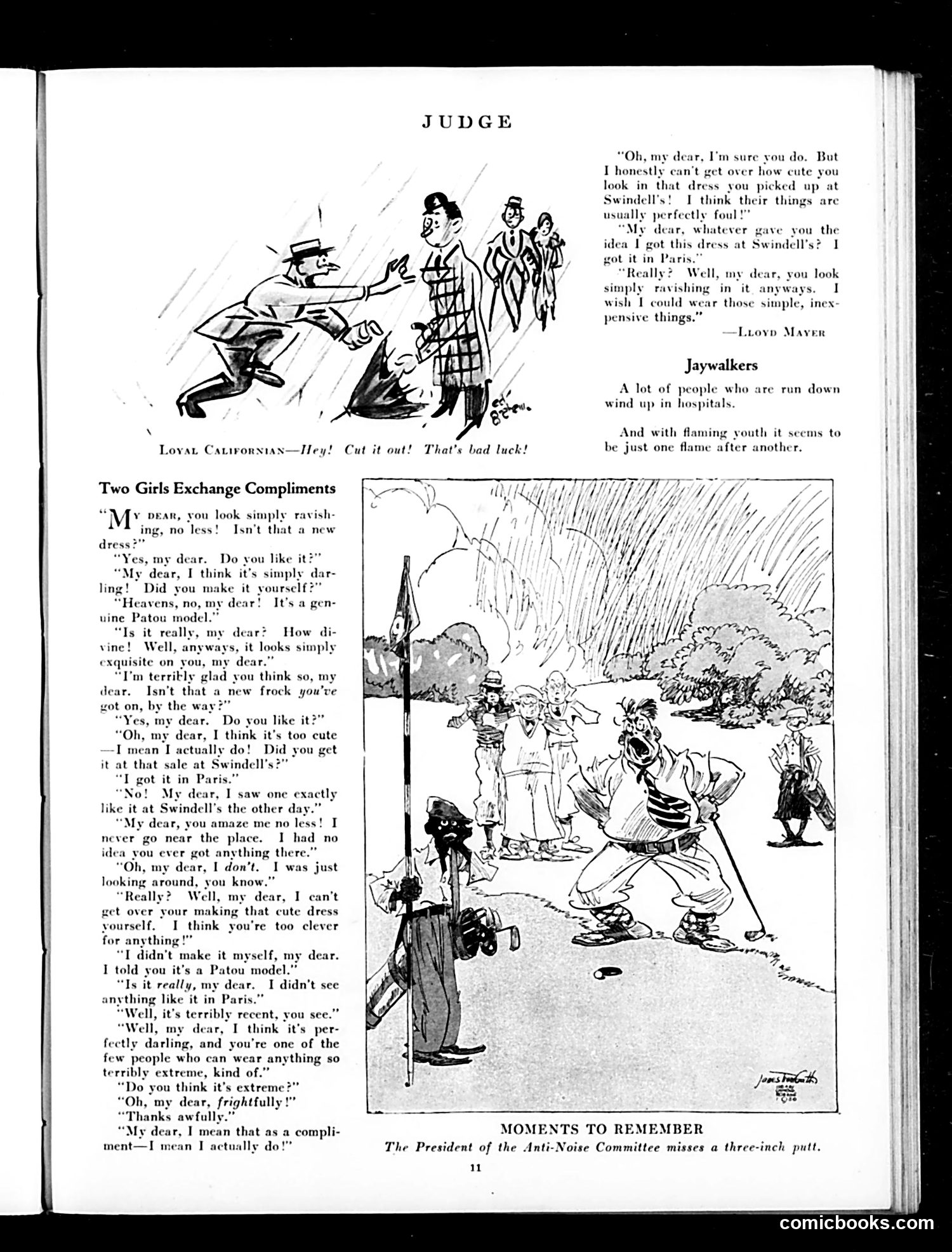
Analysis of Judge Magazine Page "Two Girls Exchange Compliments" satirizes the artificiality and pretension of wealthy women's social interaction in the 1920s. Two socialites engage in exaggerated flattery while constantly lying about their clothing origins—claiming Paris purchases while actually shopping at "Swindell's" (apparently a department store). The joke exposes how they mask insecurity through false compliments and status-conscious name-dropping ("genuine Patou model"). The dialogue's repetitive "my dear" and overwrought language parodies upper-class affectation. "Loyal Californian" cartoon (top left) depicts someone rushing past well-dressed pedestrians with the caption "Hey! Cut it out! That's bad luck!"—likely referencing a superstition about jaywalking or reckless behavior. "Moments to Remember" shows the President of an Anti-Noise Committee missing a golf putt, satirizing the irony of someone advocating noise reduction failing at a quiet sport requiring concentration. The page mocks 1920s social pretension, wealth obsession, and the gap between stated values and actual behavior.
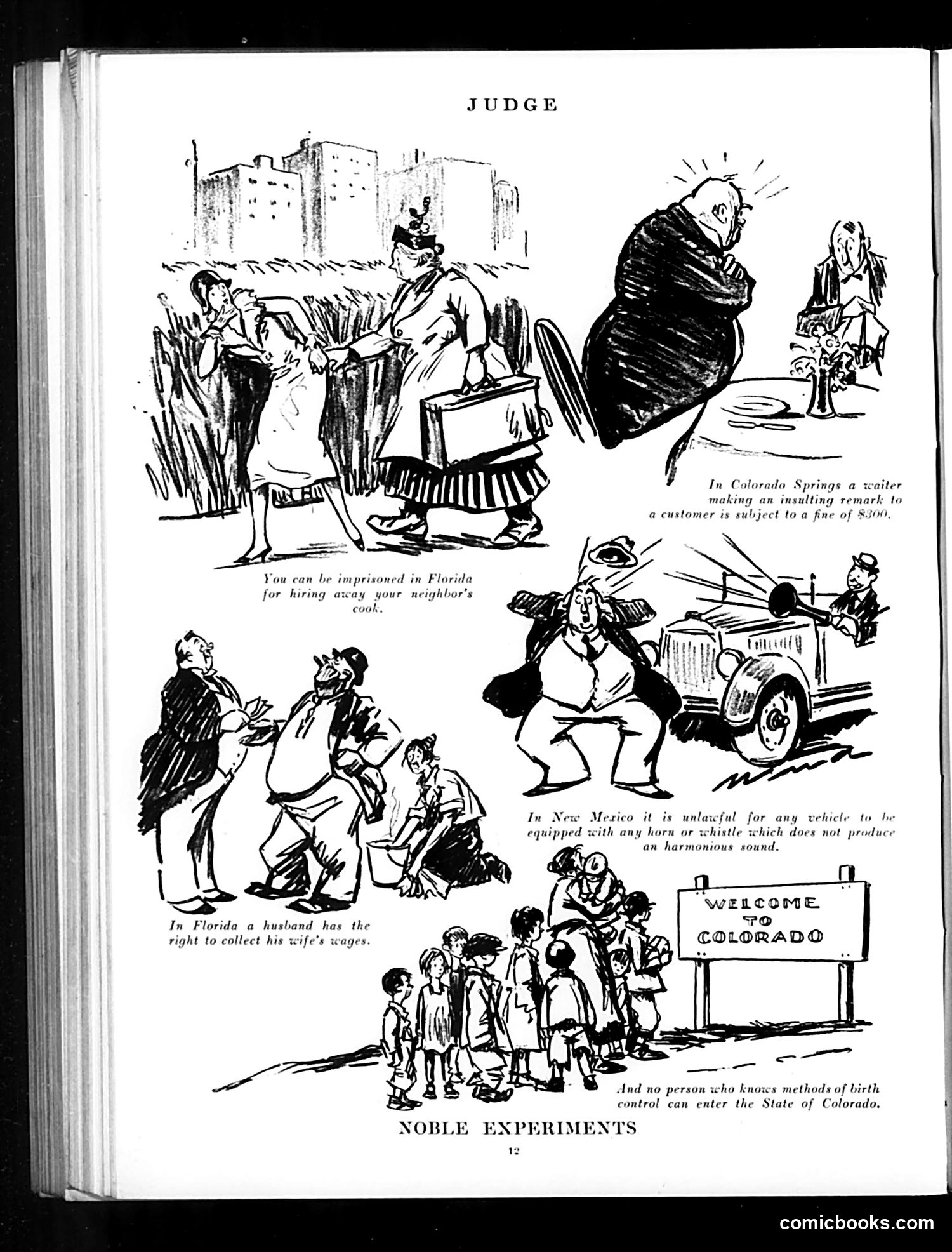
"Noble Experiments" — Judge Magazine Satire This page satirizes absurd state laws enacted during the Prohibition/Progressive Era (early 20th century). The cartoon mocks various U.S. states' legislation by presenting their most ridiculous statutes: The laws ridiculed: - Colorado Springs: $300 fine for insulting remarks by waiters - Florida: imprisonment for hiring away someone's cook; husbands can collect wives' wages - New Mexico: vehicles must have "harmonious" horns only - Colorado: birth control knowledge is prohibited The satire's point: Judge attacks these "noble experiments"—well-intentioned but absurdly overreaching legislation—as intrusive government overreach into private life and commerce. The cartoons show bewildered citizens confronting these laws' strange enforcement scenarios. The title "Noble Experiments" likely references the era's social reform movements (Prohibition being the most famous), mocking lawmakers' grandiose but impractical attempts to legislate morality and behavior. The satire suggests these laws reveal how far states would go under reform impulses.
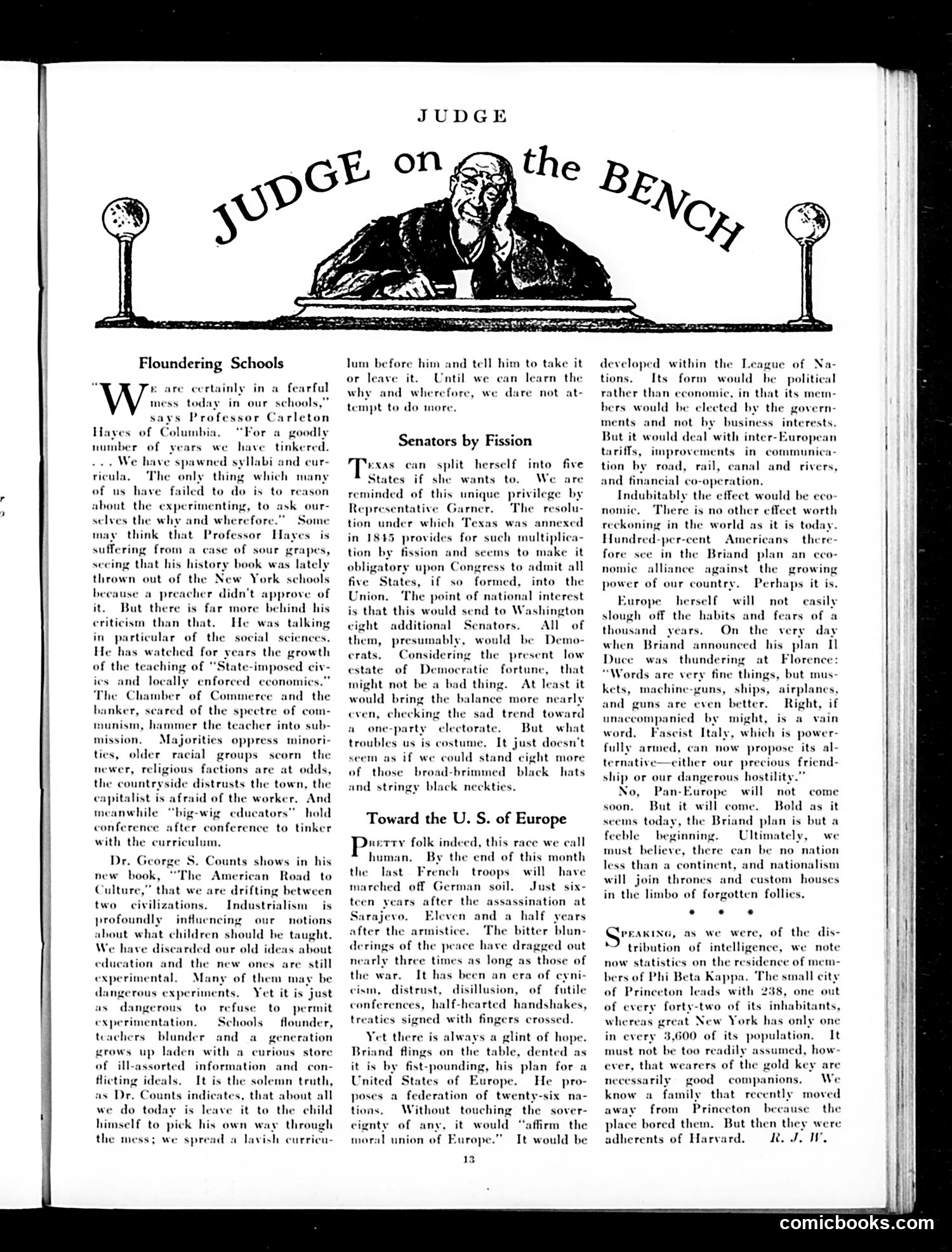
Judge Magazine: "Judge on the Bench" - Analysis This page features editorial commentary on three American issues: "Floundering Schools" critiques educational system failures. Professor Carleton Hayes and Dr. George Counts are cited as authorities warning that schools lack philosophical coherence—curricula are experiments without reasoning behind them. The satire targets how business interests and social divisions (class, religion, regional) force teachers into submission, leaving students to navigate chaos without guidance. "Senators by Fission" jokes about Texas's constitutional right to split into five states, which would add eight Democratic senators. The humor mocks this hypothetical as impractical—satirizing the image of additional senators wearing "broad-brimmed black hats and stringy black neckties" (a caricature of Texas stereotypes). "Toward the U.S. of Europe" discusses Aristide Briand's post-WWI proposal for European federation. It expresses cautious optimism about peace after the slow, cynical post-war negotiations, hoping Briand's plan could unite Europe without sacrificing national sovereignty. The page reflects 1920s-30s concerns: educational philosophy, political expansion, and international peace-building.
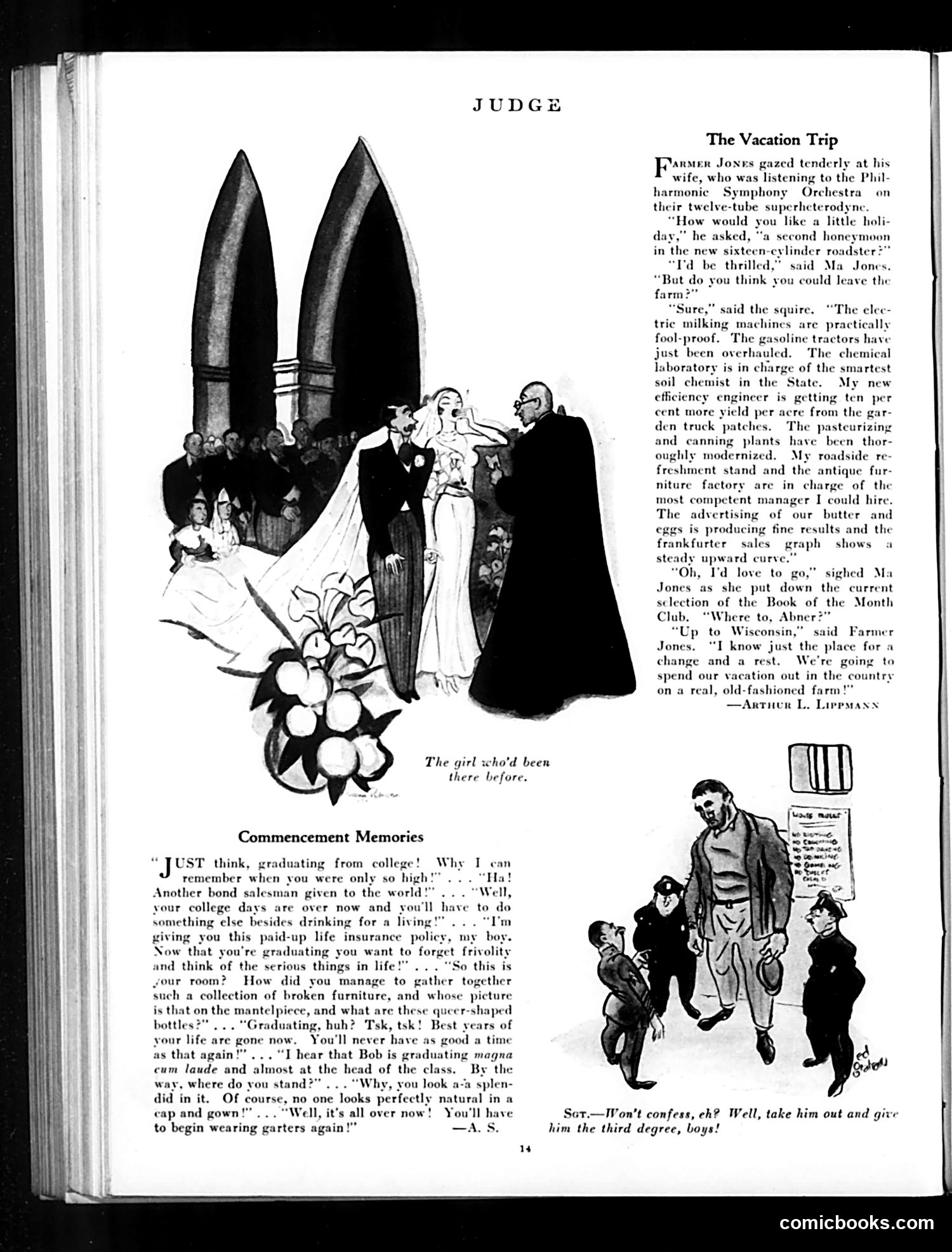
Analysis: Judge Magazine Page This page contains two satirical pieces about American life in the 1920s-30s era. "Commencement Memories" (left) is a series of snippets mocking the clichéd remarks people make to college graduates—nostalgic references to "the best years of your life," comments about needing life insurance now, jokes about their messy rooms, and the tired garter-belt gag about adult responsibilities. "The Vacation Trip" (right) satirizes the modern mechanized farm. Farmer Jones claims he can leave his farm for a vacation because *everything* is now automated or delegated: electric milking machines, gasoline tractors, chemical laboratories, efficiency engineers, pasteurizing plants, and advertising managers. The joke is that despite supposedly modernizing every aspect of farming into an industrial operation, he still just wants to spend his vacation "on a real, old-fashioned farm"—defeating the entire point of his technological investments. Both pieces gently mock contemporary American anxieties about modernity, progress, and changing social expectations.
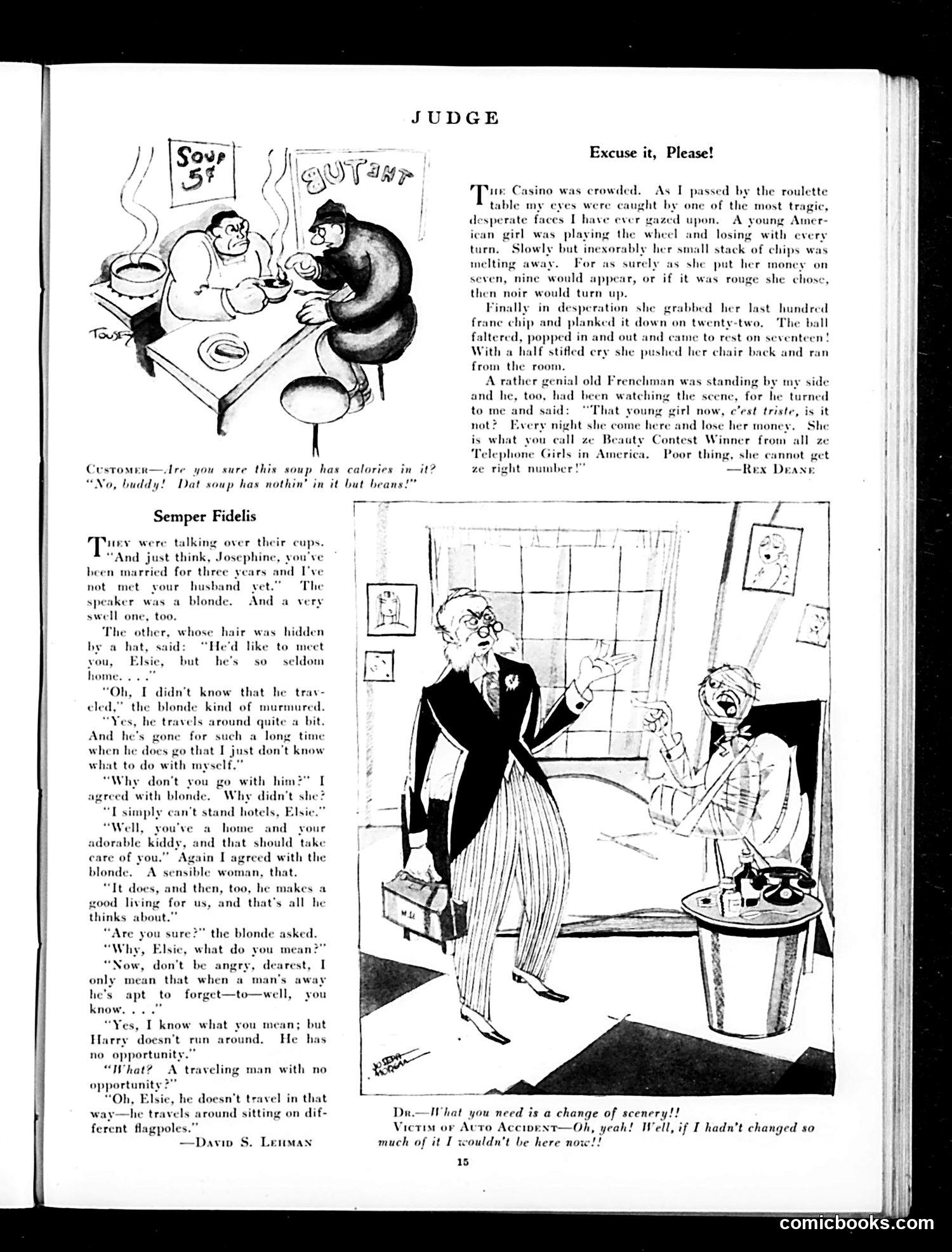
Judge Magazine Page Analysis This page contains three distinct satirical pieces typical of 1920s-30s humor: Top cartoon ("Excuse it, Please!"): A soup vendor and customer joke mocking cheap restaurant food—the vendor admits the soup contains only beans, implying it lacks nutritional value despite claims otherwise. Middle story ("Semper Fidelis"): Two women discuss a traveling salesman husband. The joke's punchline reveals he literally travels by sitting on flagpoles—absurdist humor deflating the wife's concerns about his infidelity. The satire targets both domestic anxieties and traveling salesmen stereotypes. Bottom cartoon: A traffic accident victim and doctor exchange. The victim jokes that he wouldn't be injured if he hadn't "changed so much of it"—referring to car modifications. This satirizes both reckless automotive tinkering and the growing automobile accident problem in early 20th-century America. Overall, the page reflects period preoccupations: economic hardship (cheap food), marital fidelity concerns, and automobile safety—all delivered through quick, punchy jokes aimed at Judge's affluent readership.
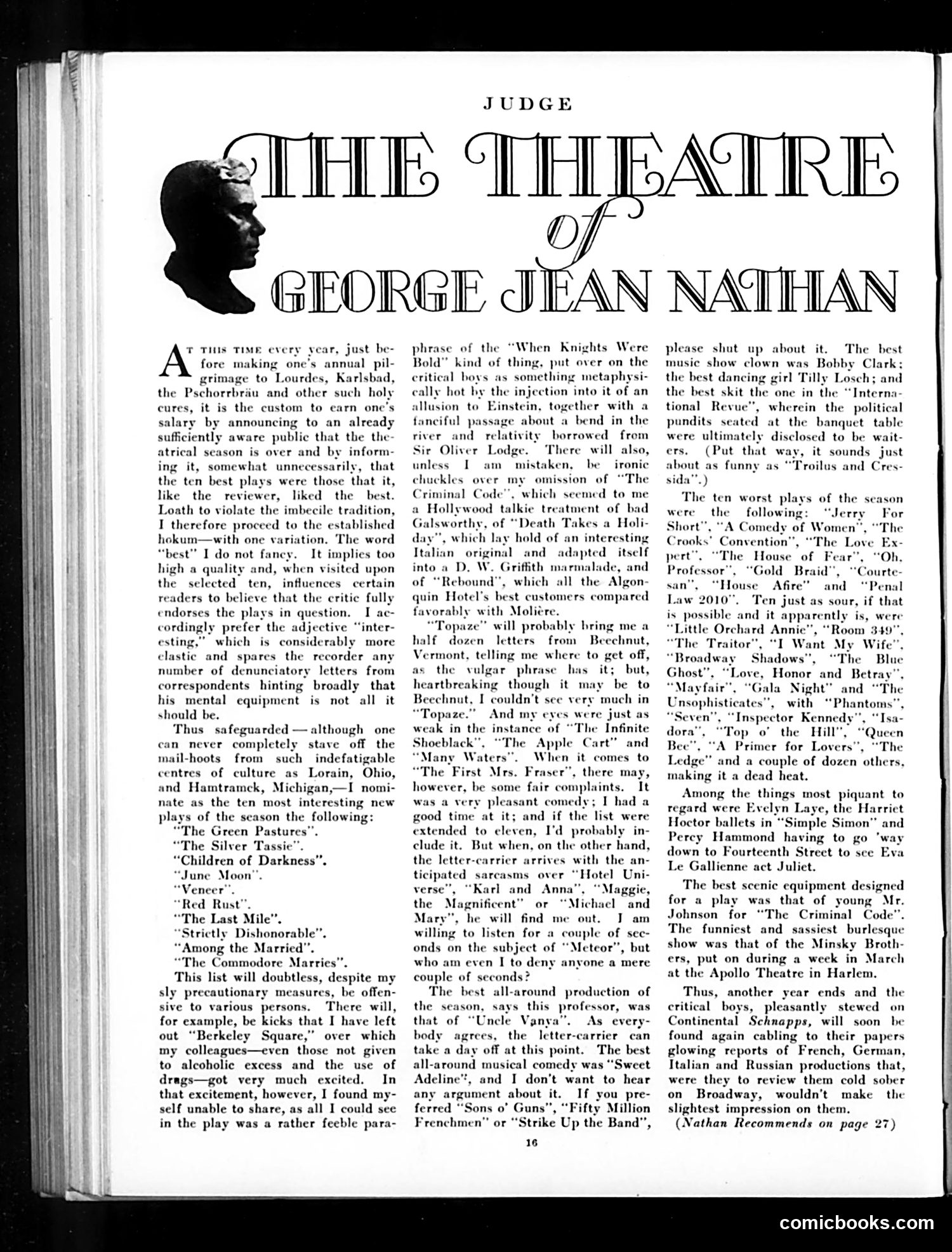
"The Theatre of George Jean Nathan" - Judge Magazine Theater Critique This page features George Jean Nathan, a prominent theater critic of the 1920s-30s, identified by the silhouette portrait. Nathan presents his annual list of the ten most "interesting" (rather than "best") theatrical productions of the season. The piece is satirical self-commentary: Nathan acknowledges the critic's tired tradition of ranking plays and preemptively defends his choices against inevitable reader complaints from places like "Lorain, Ohio, and Hamtramck, Michigan." He playfully dismisses popular plays like *Berkeley Square* (which references Einstein and Sir Oliver Lodge) and *Topaze*, while championing *Uncle Vanya* and *Sweet Adeline*. The satire targets both Nathan's own critical pretensions and theater-going audiences who passionately defend their favorite productions. The humor lies in Nathan's wry admission that he cannot escape "mail-hoots" regardless of his disclaimers—a relatable jab at critic-reader conflict.
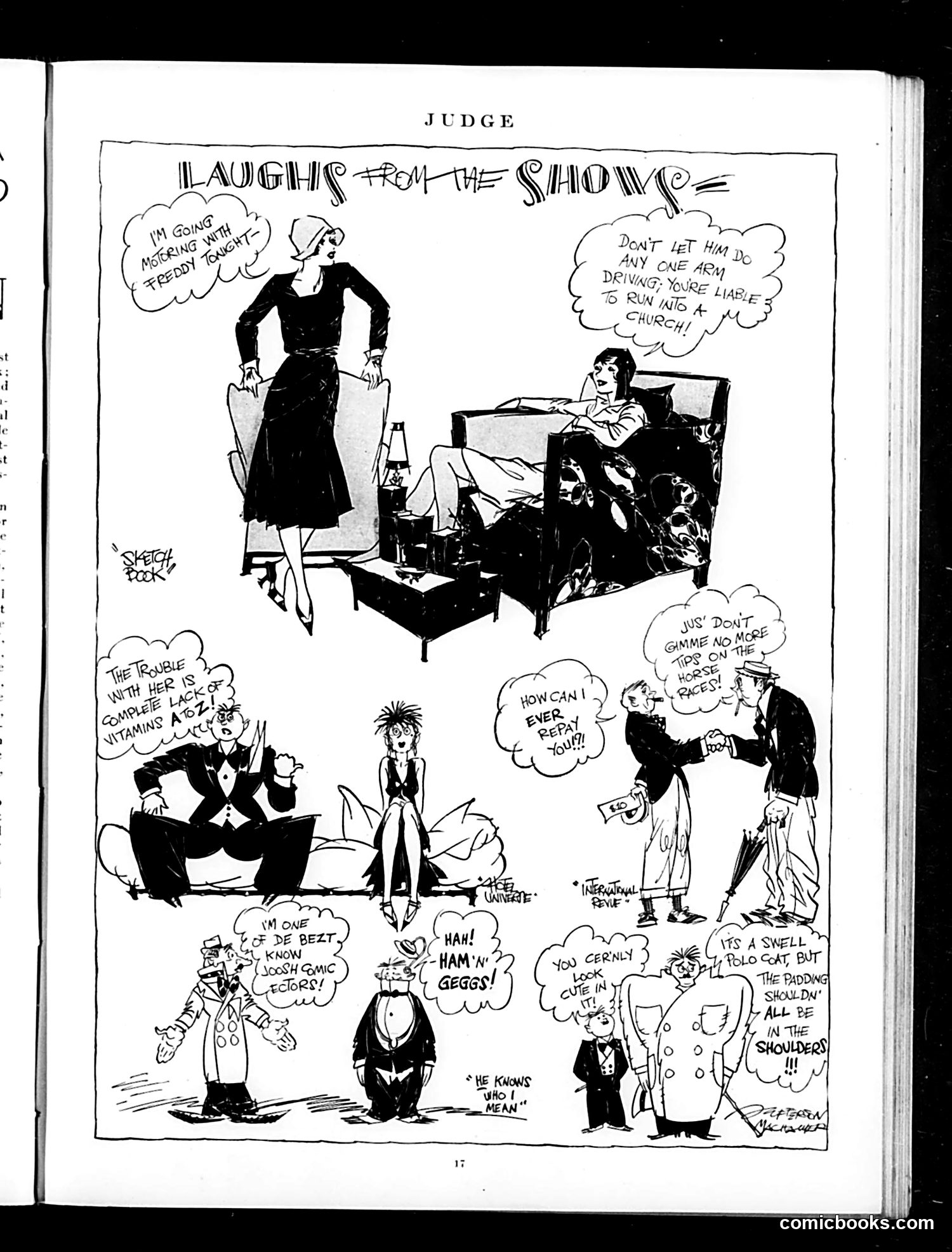
"Laughs from the Show" - Judge Magazine Cartoon This is a satirical comic strip mocking theatrical performers and show business personalities of the era. The central figure appears to be a female performer (possibly from a Broadway or vaudeville show) receiving commentary from various male characters representing different social types: a wealthy patron, a critic, a comic/entertainer, someone in formal wear, and others. The humor derives from contrasting perspectives on the woman's performance and appearance. Characters make contradictory judgments—some praising her talent, others critiquing her driving ability or appearance. One mentions "Scotch comic," suggesting variety show acts. The final panels joke about her wearing a "swell polo coat," poking fun at theatrical pretension and performers' attempts at fashionable sophistication. The satire targets both the entertainment industry's superficiality and audiences' fickle, often contradictory opinions about performers.
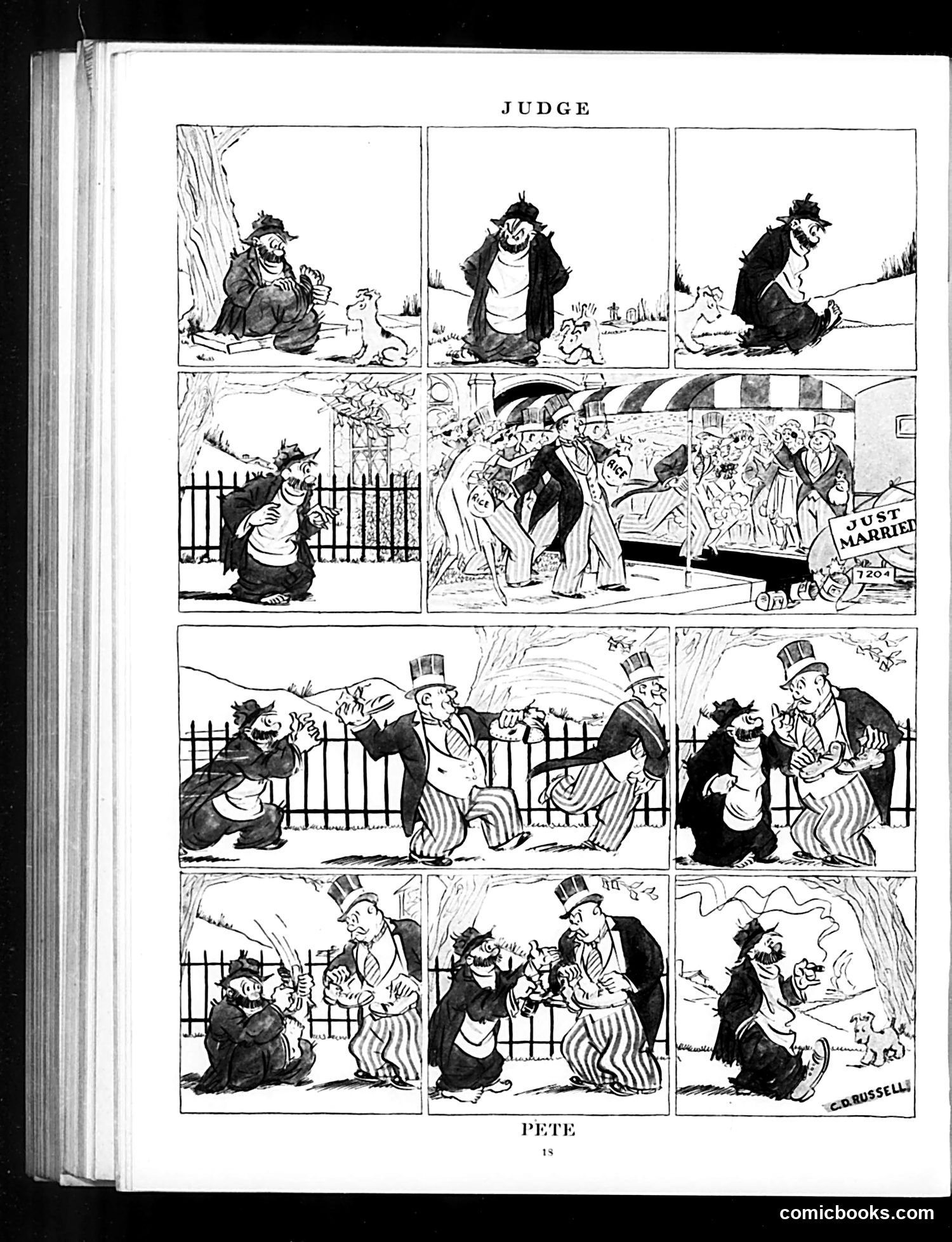
"Judge" Page: "Judge" and "Pete" Comics This page contains two comic strips. The top strip, titled "Judge," depicts a portly judge character in three initial panels observing a duck, then in subsequent panels presiding over what appears to be a circus or carnival wedding scene with crowds of people. The satire seems to mock judicial authority or wedding proceedings. The bottom strip, "Pete," shows interactions between a well-dressed gentleman wearing a top hat and a smaller, scruffier character (Pete). The sequence appears humorous physical comedy, with Pete reacting to the gentleman's gestures and movements along a fence. Both strips employ exaggerated caricature typical of early 20th-century satirical cartooning, though the specific satirical targets remain unclear without additional historical context.
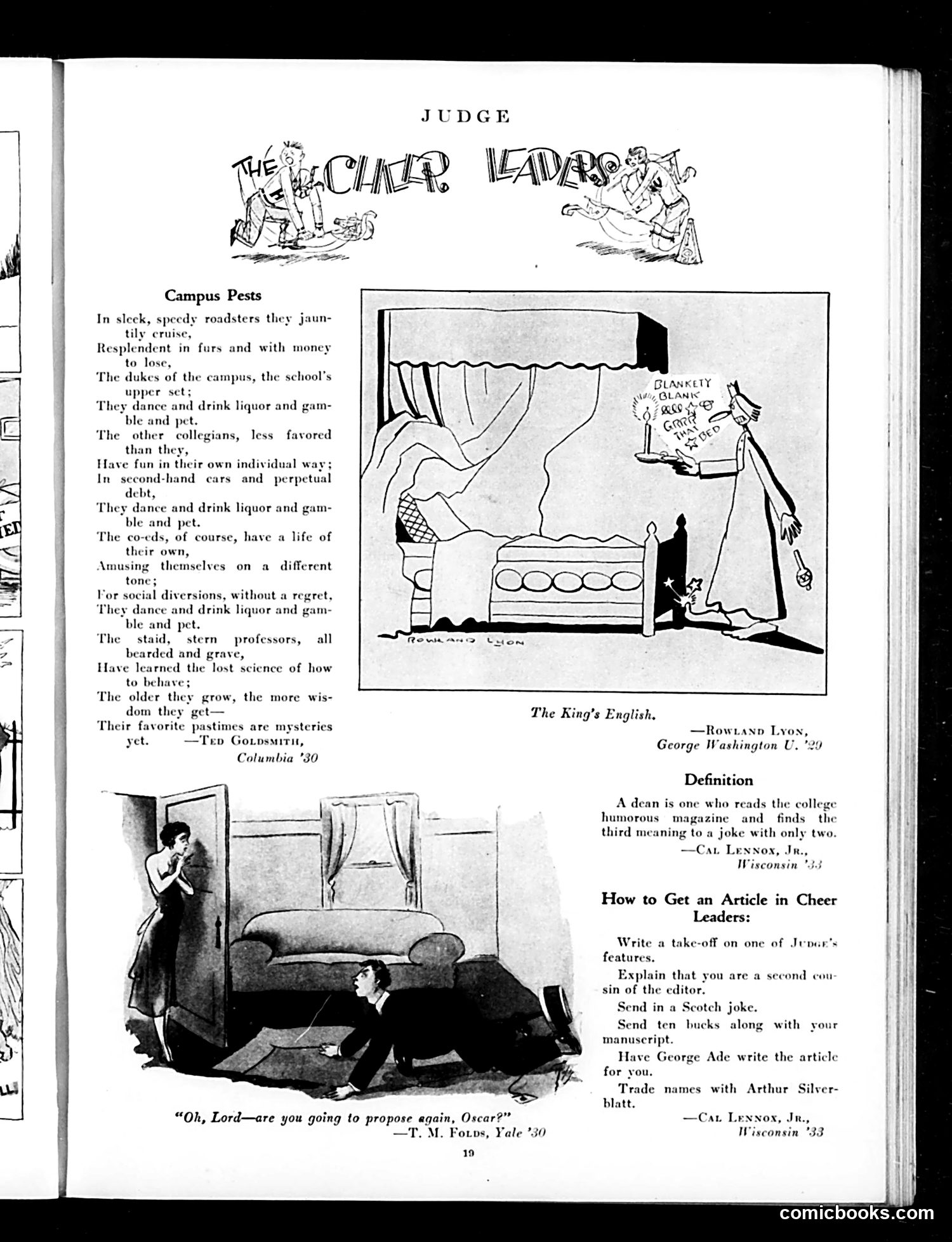
Analysis of Judge Magazine Page This page from Judge combines satirical commentary on 1920s college life with humor pieces and editorial jokes. "Campus Pests" poem mocks class divisions among college students: wealthy "upper set" students in fast cars drinking and gambling, poorer students in "second-hand cars and perpetual debt" doing the same activities, and co-eds engaging in similar behavior. The satire suggests hypocrisy—all groups engage in identical "immoral" conduct (drinking, gambling, petting), yet only the wealthy are celebrated while others are looked down upon. Prohibition-era drinking is referenced throughout, suggesting illegal alcohol consumption was widespread on campuses. "The King's English" cartoon (by Rowland Lyon) appears to show someone in bed, likely making a double entendre about language or propriety. The Definition section jokes that deans can find hidden meanings in college humor magazines that the writers didn't intend—poking fun at authority figures' tendency to read between the lines. "How to Get an Article in Cheer Leaders" satirizes the college magazine by suggesting nepotism, crude humor, bribery, and name-trading were editorial practices.
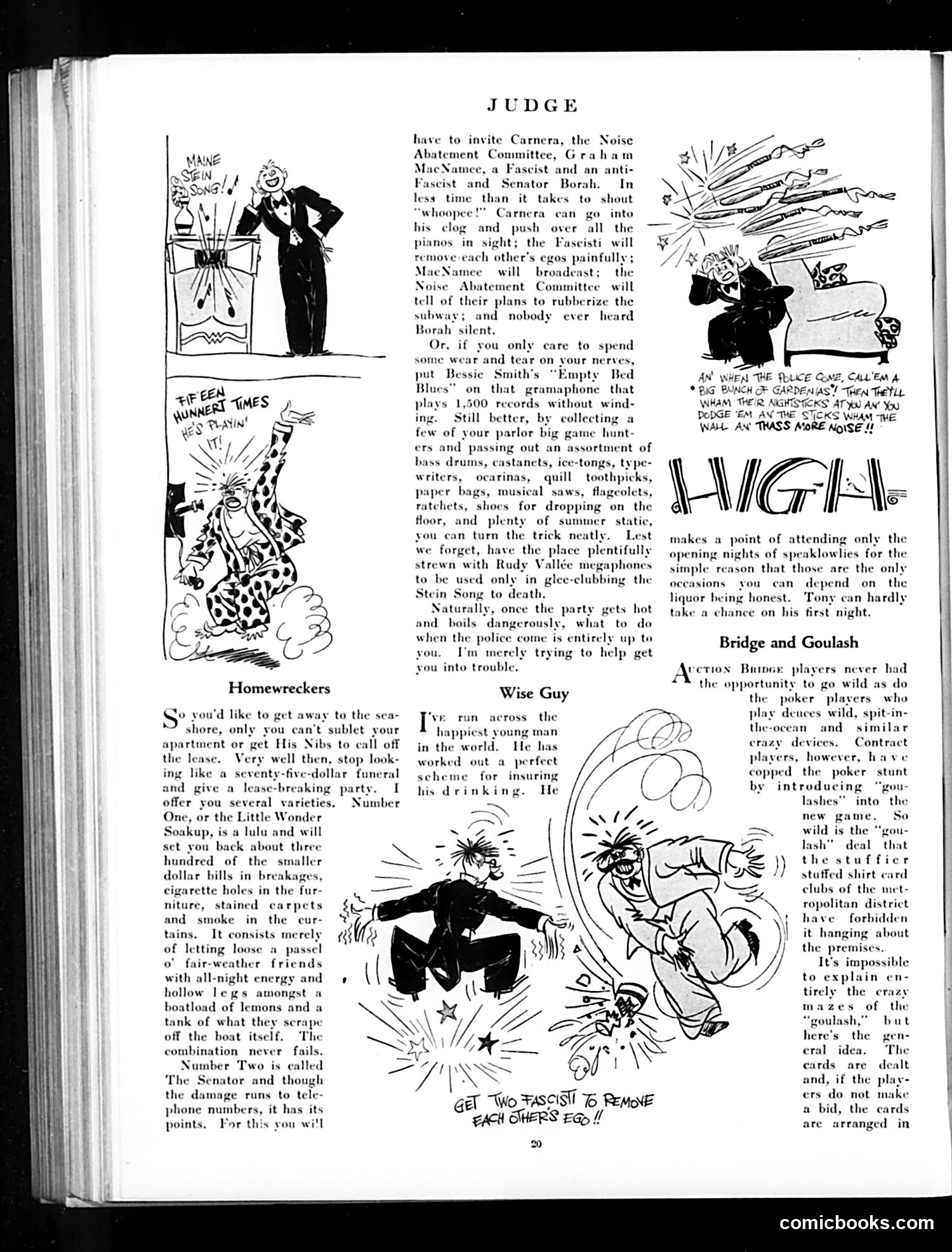
Explanation for Modern Readers This Judge magazine page contains three satirical pieces about 1920s social life and Prohibition-era entertainment. "Homewreckers" mocks lavish house parties as destructive spectacles. "Number One" describes reckless all-night drinking parties; "Number Two" satirizes inviting infamous figures like boxer Primo Carnera, radio announcer Graham McNamee, and Senator William Borah to create chaos and noise violations—a jab at Prohibition enforcement absurdities. "Wise Guy" jokes about a young man who only drinks at speakeasy "opening nights," reasoning that new illegal bars must serve genuine liquor (unlike established ones where quality degrades). This darkly mocks Prohibition enforcement failures. "Bridge and Goulash" discusses a card-game variation called "goulash" so wild that Manhattan's elite bridge clubs banned it from their premises. Throughout, the satire targets wealthy socialites, Prohibition hypocrisy, and 1920s celebrity culture—assuming readers know these public figures and the era's underground drinking culture.
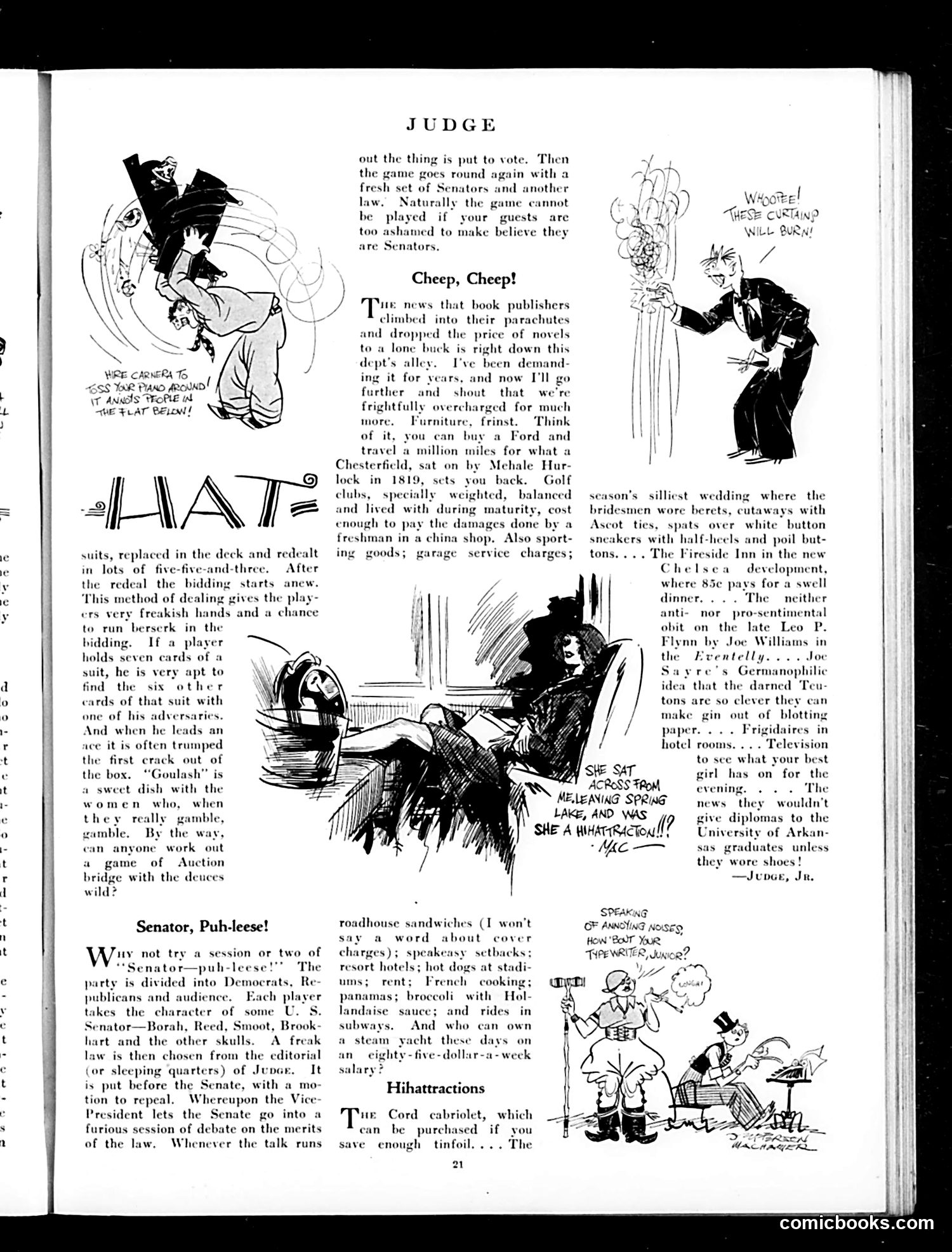
Judge Magazine Page Analysis This satirical page from Judge magazine mocks American leisure activities and political theater circa the 1920s-30s. "Senator, Puh-leese!" describes a parlor game where guests roleplay as U.S. Senators debating absurd laws. The joke targets Senators by name—Borah, Smoot, Brookhart—whose real legislative debates were apparently so theatrical and divorced from sense that they became entertainment fodder. The satire suggests Congress itself resembles a frivolous game. "Cheap, Cheap!" celebrates publishers dropping novel prices to one dollar, then expands into broader complaints about American consumer costs being inflated everywhere—furniture, golf clubs, restaurant meals, cars. The tone is satirical commentary on post-WWI pricing and inflation. "Hihattractions" briefly mentions a cord cabriolet convertible as an affordable luxury item. The cartoons throughout use exaggerated character drawings typical of Judge's style, with annotations mocking social pretension and excess. Overall, the page satirizes both political incompetence and middle-class economic grievances during an era of significant social change.
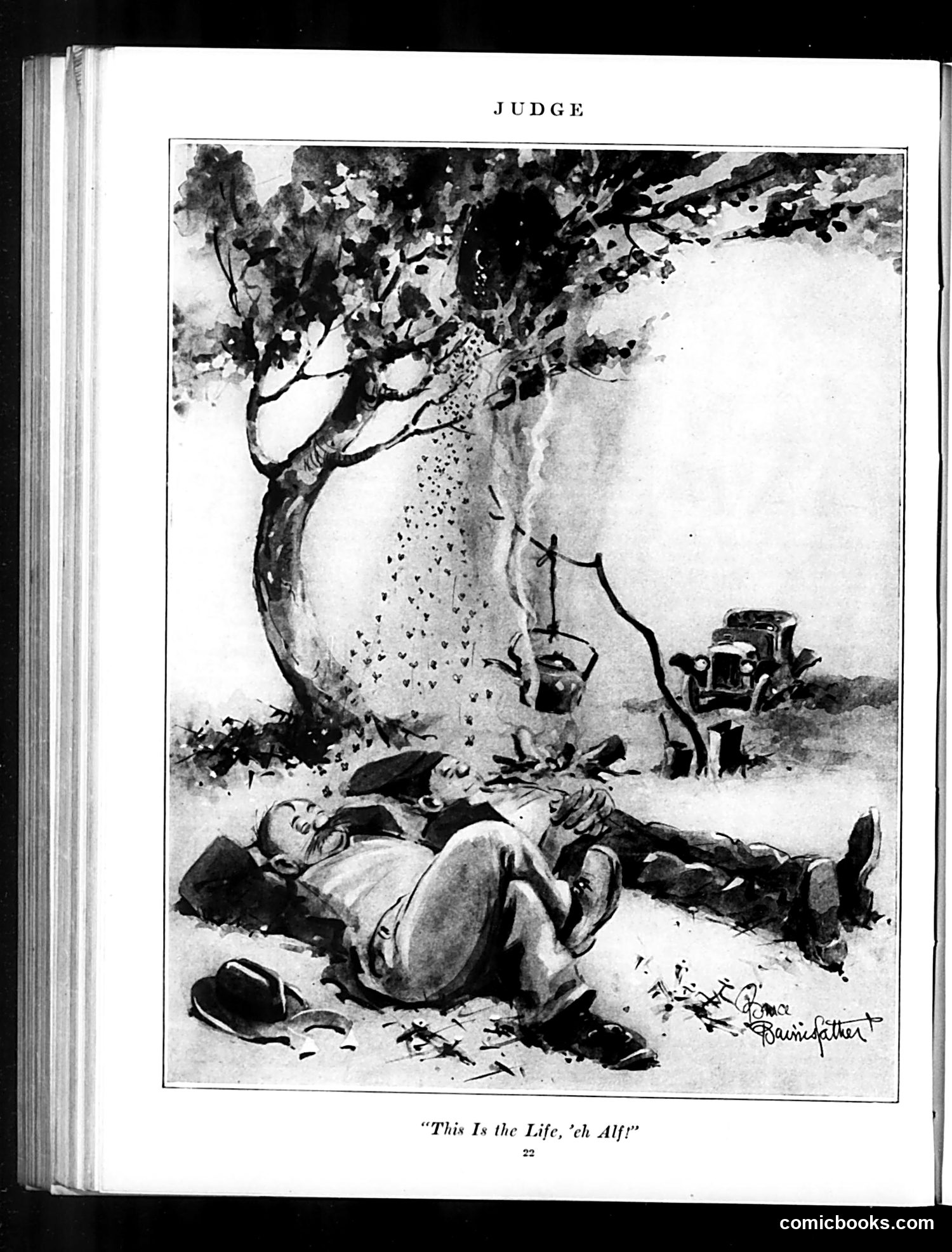
"This Is the Life, 'eh Alf?" This cartoon depicts a man lying dead or unconscious beneath a gnarled tree, surrounded by scattered possessions and what appear to be crude shelters in the background. The caption's casual tone—"This Is the Life, 'eh Alf?"—creates bitter irony: the figure is clearly in dire poverty or destitution, yet speaks as though content. The satire likely targets either vagrancy/homelessness during an economic hardship period, or possibly mocks romantic notions of "simple living" or rural freedom. The artistic style and Judge magazine's satirical nature suggest this critiques either social indifference to poverty or naive idealization of hardship. The signature appears to be by Cesare Bariglione. Without specific dating, the exact historical context remains unclear, though the image evokes Depression-era themes.
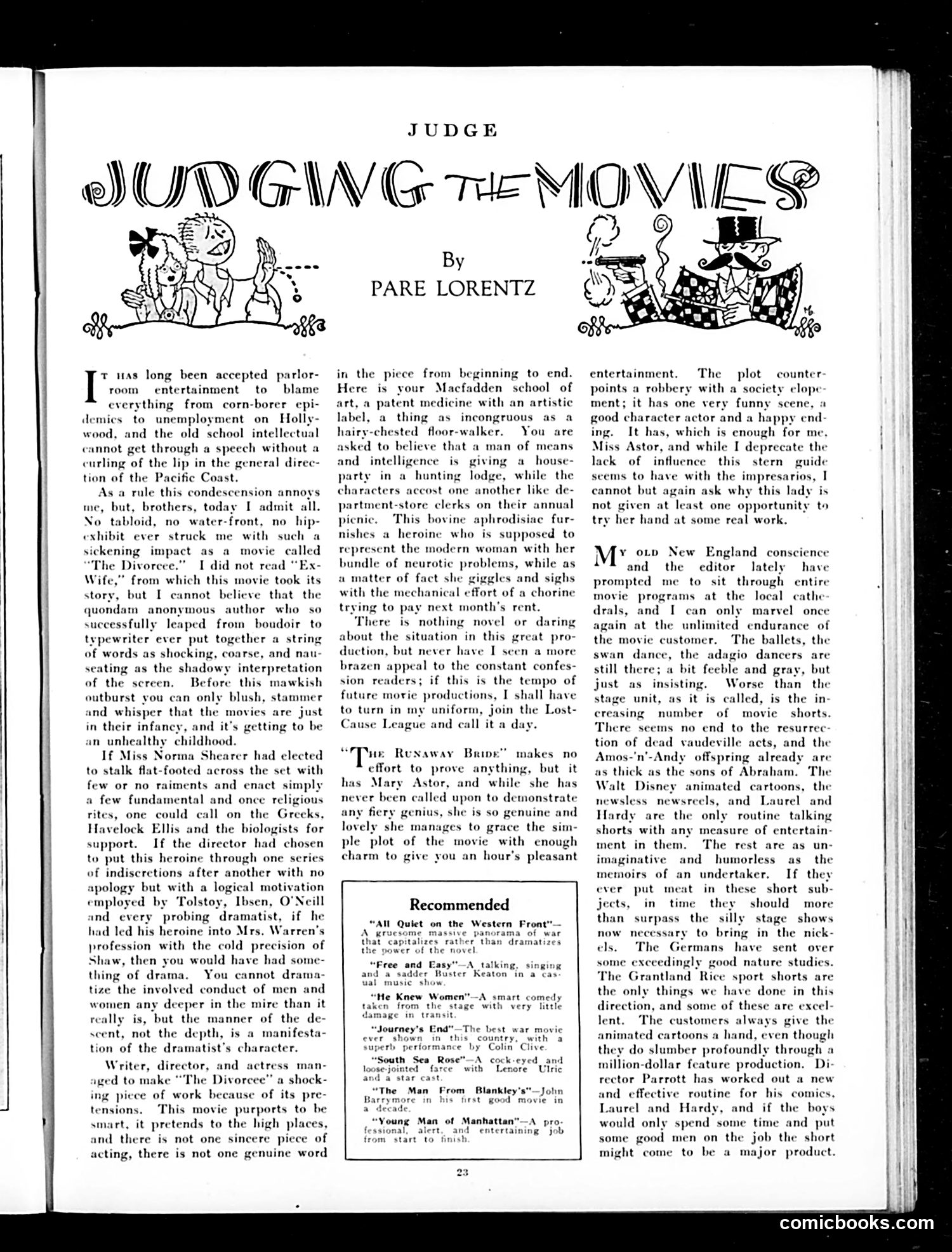
Judge Magazine Film Criticism: "Judging the Movies" by Pare Lorentz This page contains a film review column, not a cartoon. Lorentz critiques Hollywood movies with caustic social commentary typical of Judge magazine's satirical approach. Main targets: 1. "The Divorcee" — Lorentz attacks this film as morally shocking and artistically empty, using it to lambast Hollywood's lowbrow sensibilities and appeal to "confession readers." 2. "The Runaway Bride" — Praised primarily for actress Mary Astor's genuine charm despite a thin plot, suggesting even decent performances can't salvage weak material. 3. Hollywood generally — Lorentz mocks tinseltown's contempt for intellectual audiences, its mechanical plotting, and its reliance on recycled vaudeville acts and animated cartoons (notably Disney). The satire's point: Sophisticated East Coast intellectuals (Judge's readership) despised Hollywood's formulaic morality tales as lowbrow trash pandering to masses while pretending artistic legitimacy. The column reinforces Judge's position as arbiter of taste against West Coast commercialism.
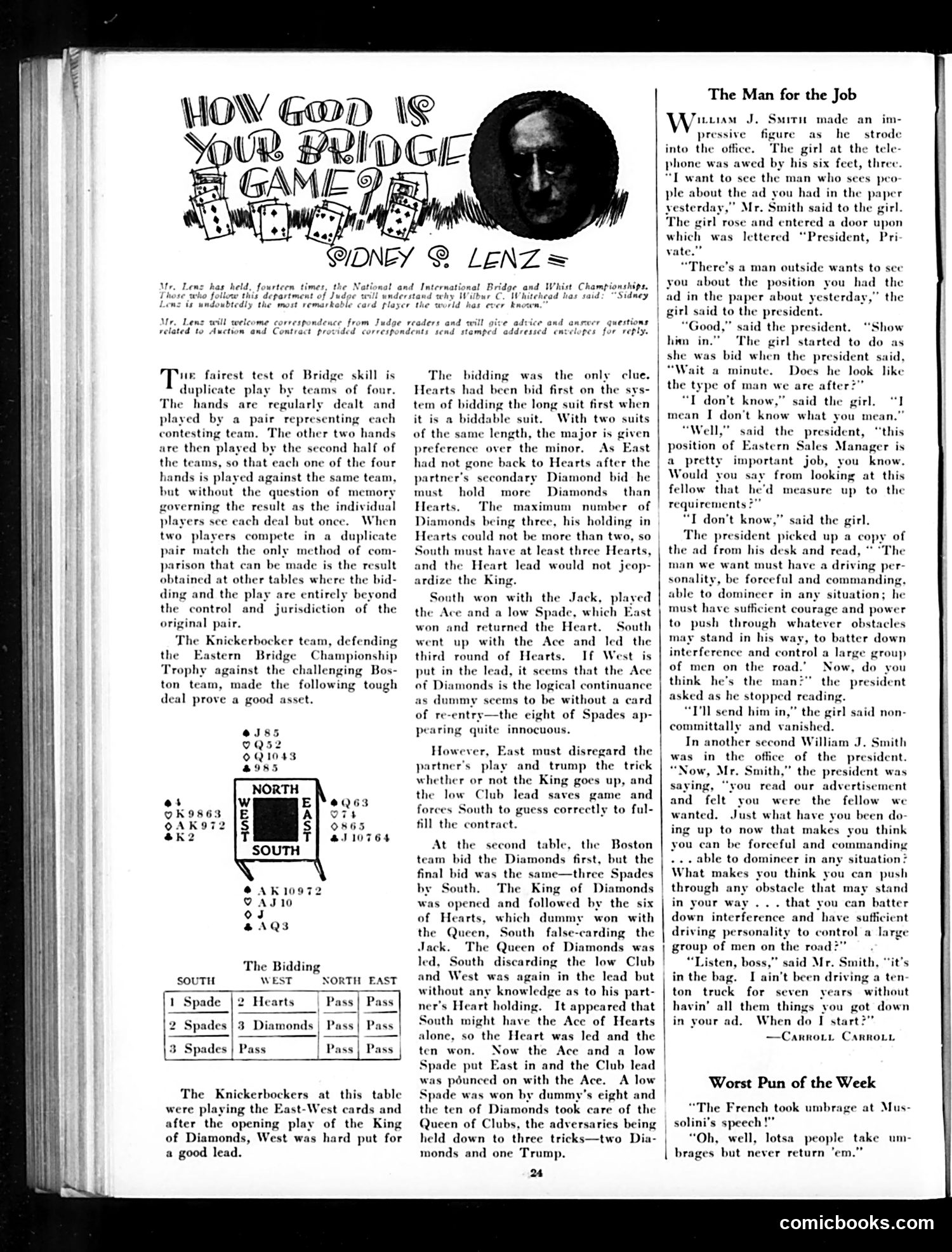
This page from Judge magazine contains a bridge instruction article and a satirical short story titled "The Man for the Job." The satire centers on hiring qualifications and corporate values. William J. Smith, described as an impressive six-foot-three man, arrives seeking a sales position. The humor emerges when the company president views him as the ideal candidate—not for his qualifications, but for his imposing physical presence and commanding demeanor. The punch line suggests corporations value appearance and dominance over actual competence: a man who can "push through whatever obstacles may stand in his way" and control large groups is considered "the man for the job." This satirizes 1920s-era business culture's emphasis on masculine authority and force of personality in hiring decisions, mocking the idea that intimidating workers was essential management skill. The bridge content above is unrelated instructional material.
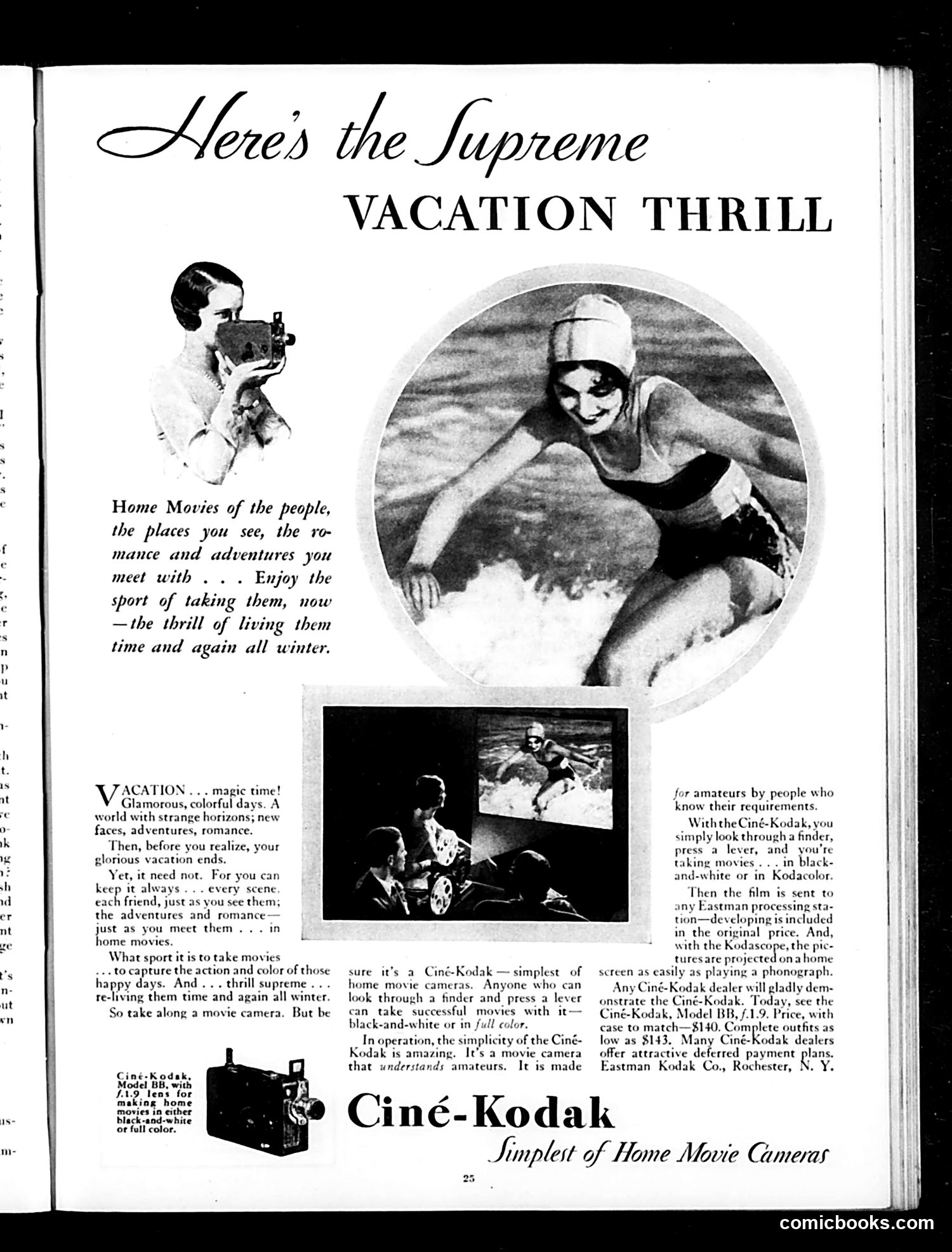
Analysis This is primarily a product advertisement for Ciné-Kodak home movie cameras, not a political cartoon. Judge magazine's pages frequently contained such ads alongside editorial content. The "thrill" referenced is the novelty of home movie-making itself—capturing vacation moments on film and reliving them during winter months. This was genuinely innovative for the era; consumer movie cameras were relatively new technology. The images show: - A woman operating a movie camera - A woman swimming - People in what appears to be a go-kart or similar vehicle The copy emphasizes the democratic accessibility of filmmaking: "Anyone who can look through a finder and press a lever can take successful movies." This targets amateur enthusiasts rather than professionals, positioning Kodak's simplicity as revolutionary. There's no political satire here—this is a straightforward lifestyle advertisement celebrating modern leisure and technology for middle-class consumers. The page number (25) suggests this appeared mid-magazine, likely among other advertisements.
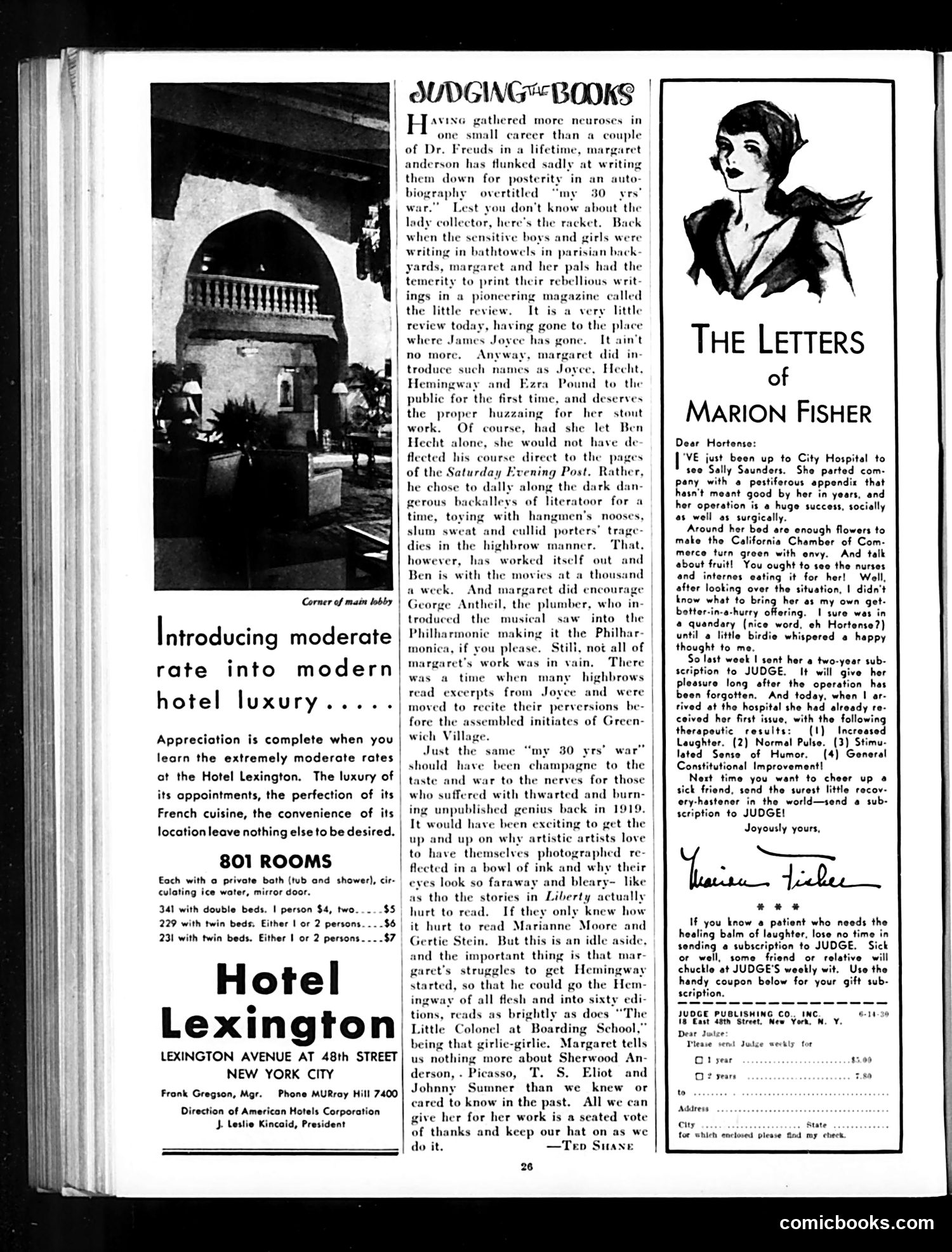
Understanding This Judge Magazine Page This page combines hotel advertising with book criticism. The main content is a review by "Ted Sloane" of Margaret Anderson's autobiography "My 30 Years' War." The Book Review's Context: Anderson was a pioneering *Little Review* editor who first introduced James Joyce, Ernest Hemingway, and Ezra Pound to American audiences in the 1910s-20s. The reviewer credits her with genuine cultural importance but finds her memoir disappointingly shallow—she tells readers *that* these literary giants existed but reveals little *about* them or *why* they mattered. The Satire: The tone is affectionately mocking. The reviewer acknowledges Anderson's real contribution to literature while suggesting her memoir is self-indulgent and offers nothing new to readers already familiar with modernist writers. The reference to Ben Hecht (a playwright/journalist) implies she influenced serious artists who went on to actual success. The Hotel Advertisement (left side) sells "moderate rates" for luxury—a Depression-era marketing pitch emphasizing affordability without sacrificing quality.
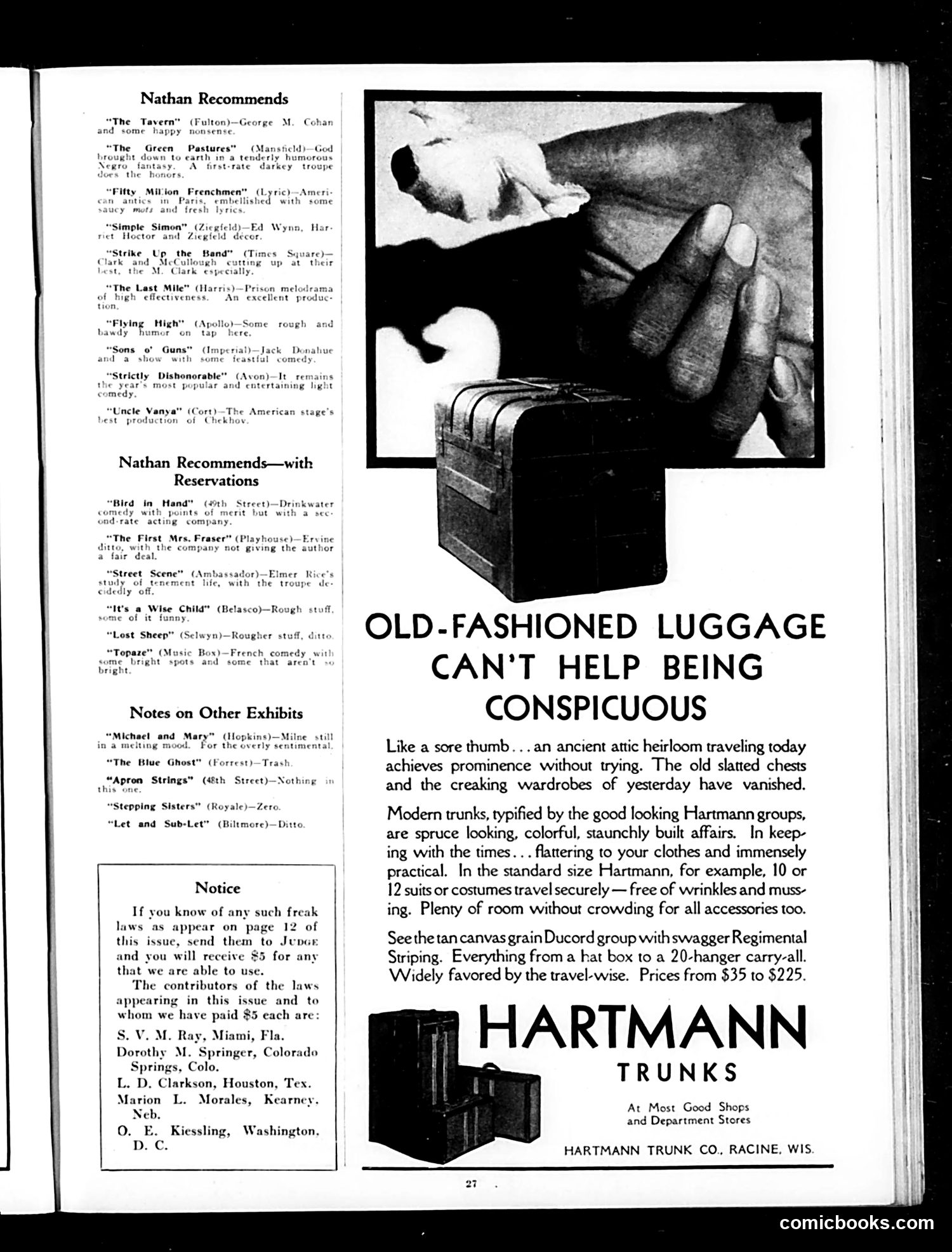
Hartmann Trunks Advertisement This page is primarily advertising, not political satire. The dominant content is a full-page ad for Hartmann Trunks positioned as modern luggage. The ad's "cartoon" is a visual comparison: an old, battered steamer trunk appears beside a well-dressed foot in modern shoes, illustrating the headline "Old-Fashioned Luggage Can't Help Being Conspicuous." The humor is gentle and commercial—the analogy of outdated luggage to "a sore thumb" or "ancient attic heirloom" mocks the past while promoting contemporary Hartmann products as practical, attractive travel solutions. The surrounding text comprises theater reviews by "Nathan" (likely drama critic George Jean Nathan) recommending current Broadway productions. The "Notice" solicits readers to report unusual laws for a $5 reward, a recurring Judge feature unrelated to the main content. This reflects 1929 consumer culture: lifestyle advertising targeting middle-class travelers.
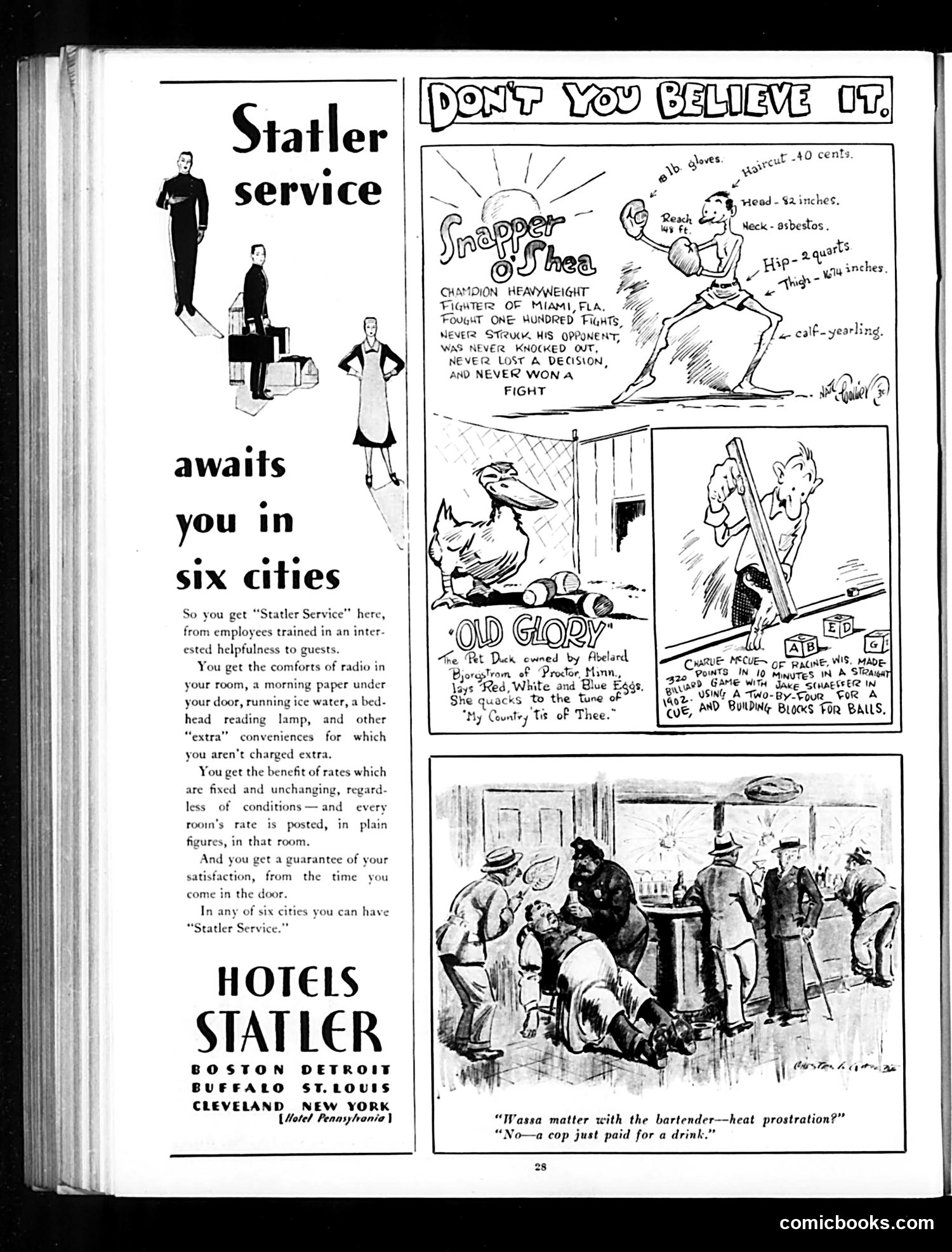
Page Analysis: Judge Magazine Left Side - Statler Hotels Advertisement: This is a straightforward hotel chain advertisement promoting their service standard across six American cities. It emphasizes customer amenities (radio, newspapers, ice water, reading lamps) at fixed, transparent rates with guaranteed satisfaction—positioning Statler as a reliable, no-surprise lodging option. Right Side - "Don't You Believe It" Cartoons: This satirical feature mocks implausible claims through three comic vignettes: 1. "Snapper O'Shea": A fake fighter's absurd measurements and undefeated record with zero knockouts or decisions won—obviously impossible for a legitimate heavyweight. 2. "Old Glory": A duck supposedly laying patriotic-colored eggs while "quacking" national songs—obviously fabricated. 3. Bottom Panel: A cop buying a drink at a bar, prompting the bartender's joke about "heat prostration." The satire: it's so unusual for a police officer to pay for anything (implying corruption/free service) that the bartender's excuse for distress is comically transparent. The feature ridicules tall tales and urban myths readers encounter.
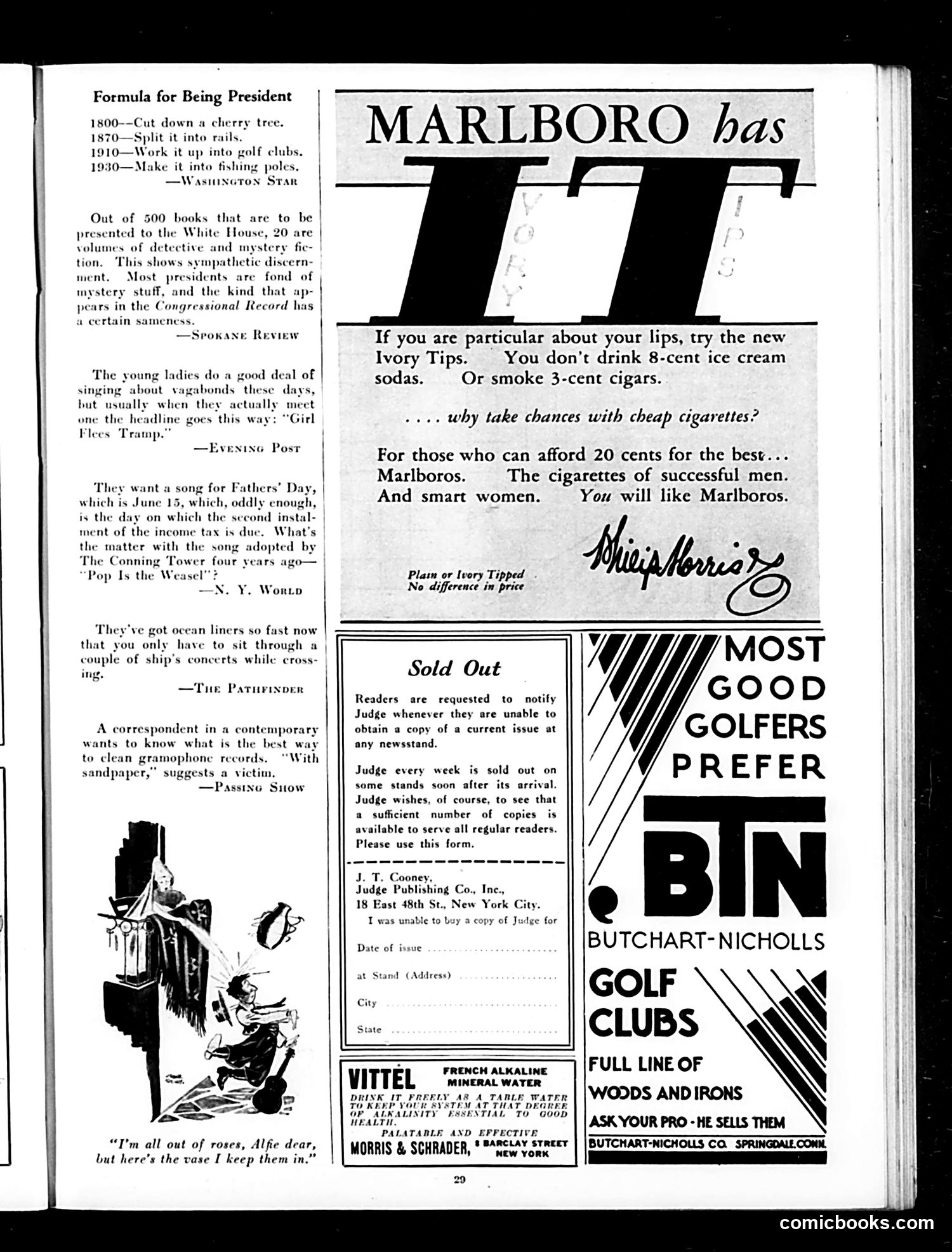
Explanation for Modern Readers This page from *Judge* magazine (likely 1920s-30s based on references) combines political satire with advertising. The "Formula for Being President" is a humorous timeline satirizing American presidents' evolving interests: from George Washington (cherry tree myth) through Lincoln (split rails) to Theodore Roosevelt (golf clubs) to Hoover (fishing). It mocks how each era's leader embodies different American preoccupations, suggesting presidents are defined by contemporary leisure activities rather than substantive qualities. The remaining content consists mostly of advertisements (Marlboro cigarettes, Butchart-Nicholls golf clubs, Vittel water) and short humor snippets about contemporary life—ocean liners, income taxes, gramophone cleaning—typical filler for satirical magazines. The small cartoon at bottom-left appears unrelated to the presidential satire, depicting an everyday domestic scene with humorous caption. The page reflects *Judge*'s primary function: mixing light political commentary with commercial advertising.
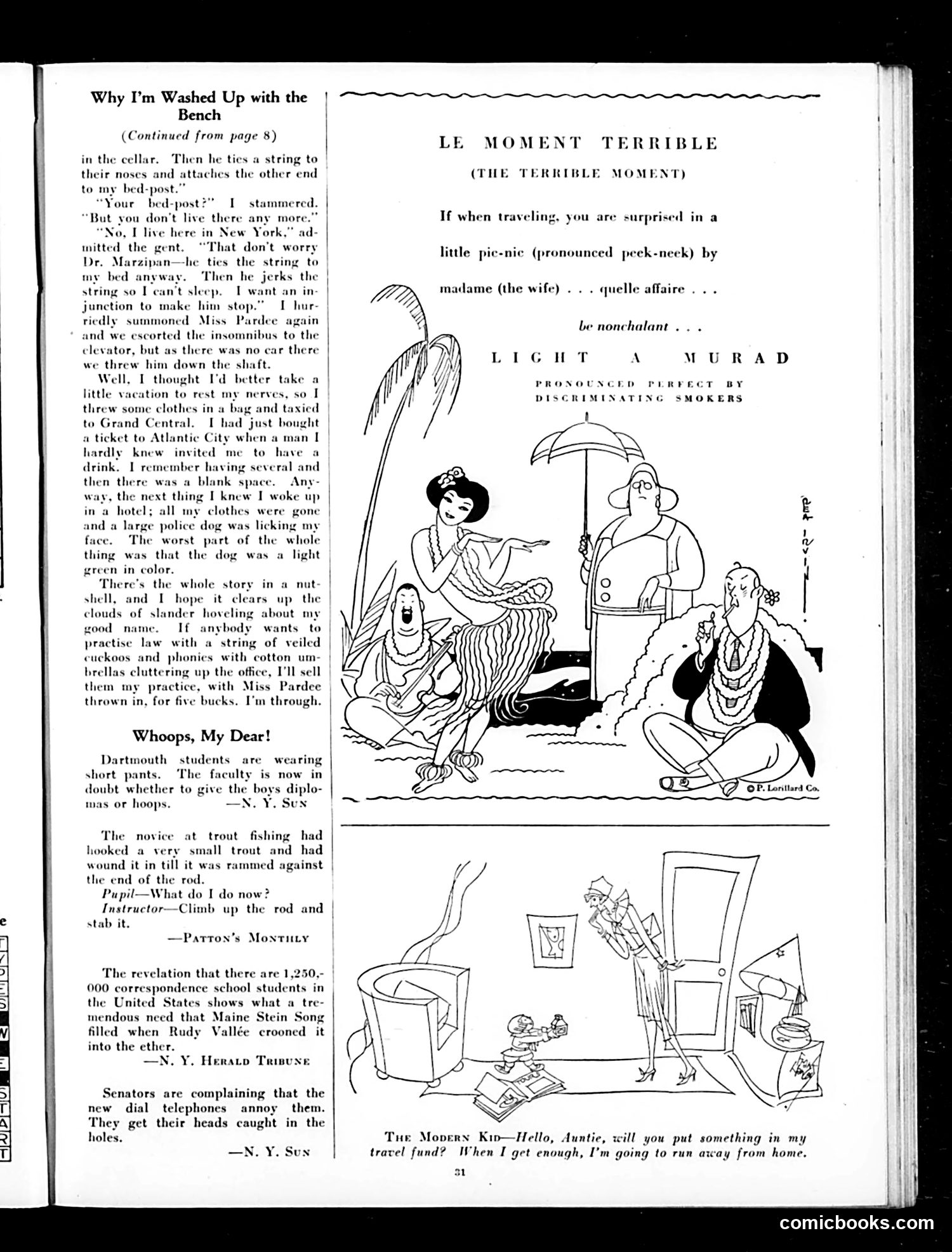
"Le Moment Terrible" and Page Content Analysis This Judge magazine page contains several satirical pieces: "Le Moment Terrible" (top): A cartoon mocking pretentious French affectations. It depicts a wife surprising her husband at a picnic with another woman. The humor lies in the caption's exaggerated French phrases and the advice to "be nonchalant"—suggesting Americans adopt an affected, casual European sophistication to handle social embarrassment. The Murad cigarette ad alongside reinforces aspirational sophistication. "Why I'm Washed Up with the Bench" (left column): A judge's complaint about increasingly absurd legal cases—including someone tying strings to his bed from out-of-state to prevent sleep, and ending with him mysteriously waking green-colored in a hotel. The satire mocks the judicial system's inability to dismiss frivolous complaints. "Whoops, My Dear!" and other shorts: Brief jokes about Dartmouth students in short pants, fishing mishaps, and senators complaining about dial telephones—typical light social commentary. "The Modern Kid": A child asking their aunt for travel money to run away from home—satirizing perceived childhood entitlement.
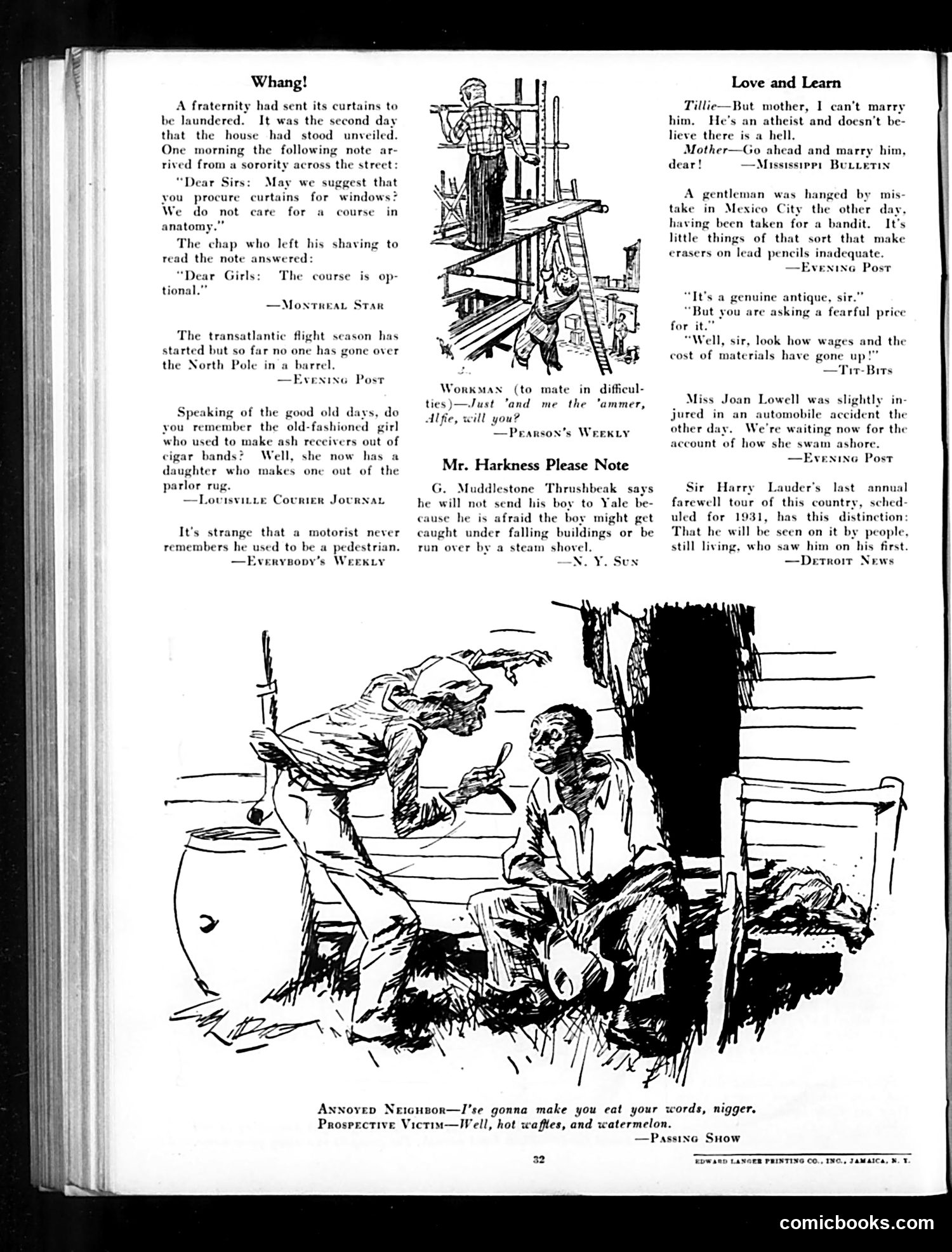
Judge Magazine Page Analysis This page contains several brief satirical jokes and two illustrations typical of 1920s-30s humor magazine content. Top illustration: A fraternity house without curtains creates an improper sight for a neighboring sorority. The joke plays on Victorian modesty standards—the sorority complains about seeing male anatomy, and a fraternity member cheekily responds the "course" is optional, implying the women are choosing to look. Bottom illustration: Depicts a racial stereotype scene with a Black man threatening violence ("make you eat your words") and a white man responding with a watermelon/fried food reference. This represents the deeply offensive racial humor that was common in mainstream American publications of this era, reflecting systemic racism normalized in the period. The other brief jokes satirize contemporary topics: fraternity life, transatlantic aviation, materialism, automotive safety, Yale's construction hazards, atheism, antique pricing, actress Joan Lowell's notorious swimming exploits, and Sir Harry Lauder's long performance career. The content reflects early 20th-century attitudes toward class, gender, morality, and race that modern readers would find objectionable.
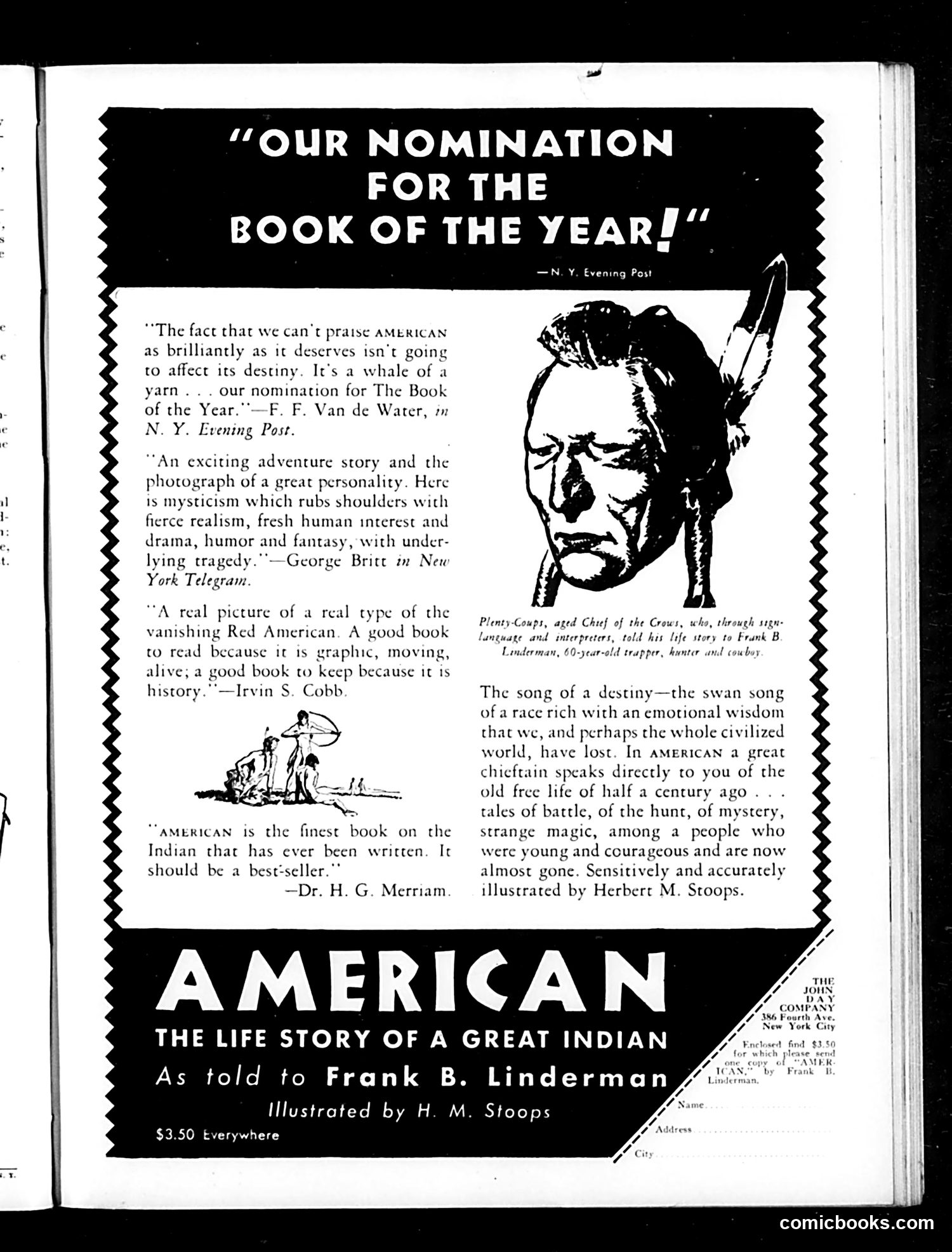
Analysis This is primarily a book advertisement, not political satire. Judge magazine is promoting *American: The Life Story of a Great Indian*, by Frank B. Linderman, featuring Plenty-Coups, a Crow Nation chief. The page presents endorsements from prominent newspapers and critics praising the book as an authentic, moving account of Native American life. The portrait shows Plenty-Coups in traditional dress. The marketing emphasizes the book's historical value and emotional authenticity—framing it as a "swan song" of a vanishing culture. The tone reflects early 20th-century attitudes: while presenting the Native American narrative respectfully, the language ("vanishing Red American," "almost gone") expresses nostalgia tinged with the assumption of inevitable cultural disappearance. This reflects period attitudes about indigenous peoples as historical subjects rather than contemporary communities. No satire or political cartoon is present here—it's straightforward commercial promotion in an editorial context.
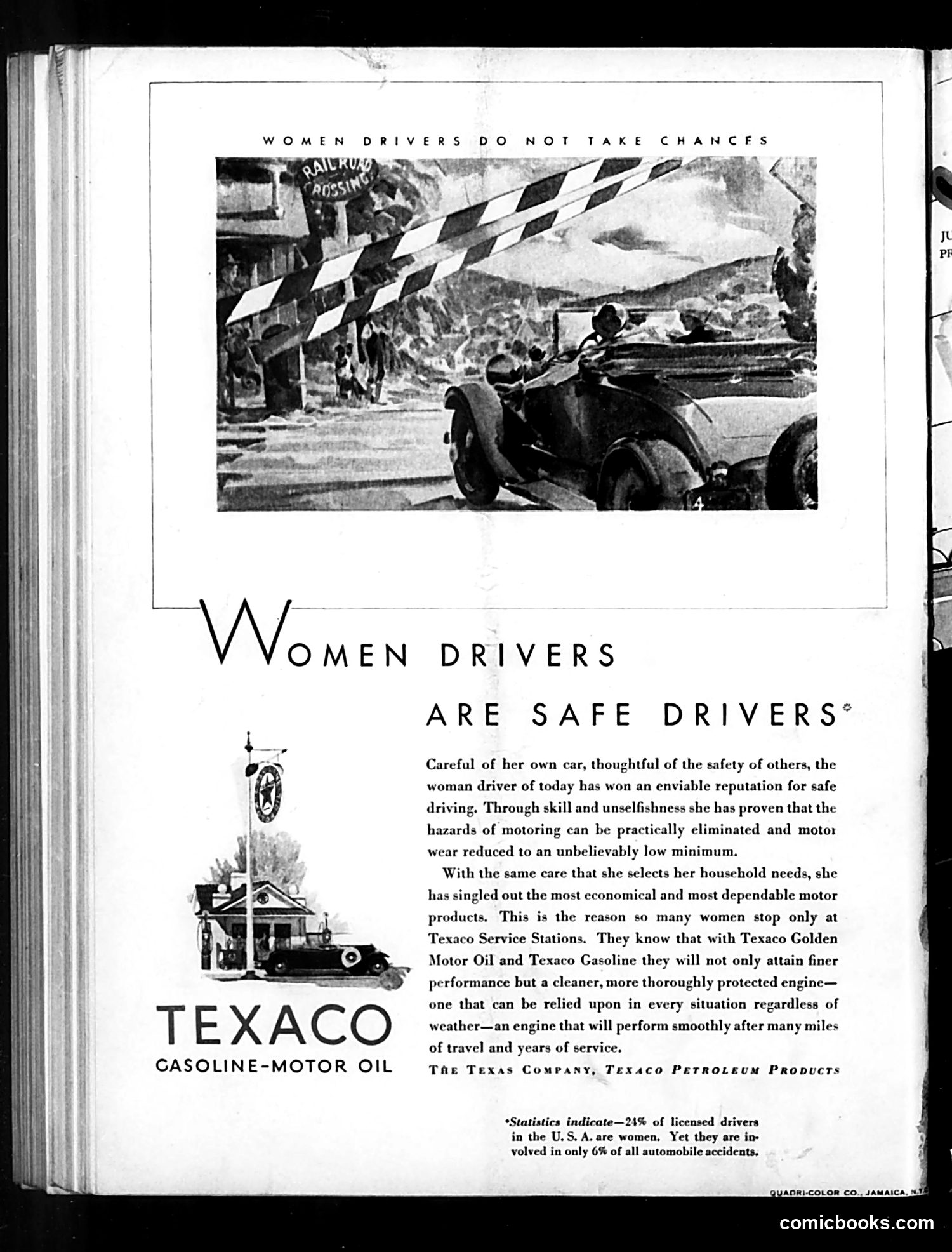
Analysis of "Women Drivers Are Safe Drivers" This is primarily a Texaco gasoline advertisement, not a political cartoon. The page uses a racing photograph (showing a checkered flag and vintage race car) to frame claims about women drivers' safety records. The advertisement appeals to women by flattering their driving abilities—claiming they're "careful," "thoughtful," and statistically safer than male drivers (the footnote notes women comprise 24% of licensed drivers but only 6% of accident statistics). It then pivots to selling Texaco products by suggesting women's careful nature in household selection extends to fuel choices. The "satire" is subtle and unintentional from a modern perspective: the ad simultaneously patronizes women (comparing fuel selection to "household needs") while celebrating their competence. It reflects 1920s-30s attitudes toward women drivers—still somewhat novel and controversial—attempting to market products by reframing female drivers as reliable consumers rather than reckless road hazards, a common contemporary stereotype.