judge
Judge — June 21, 1930
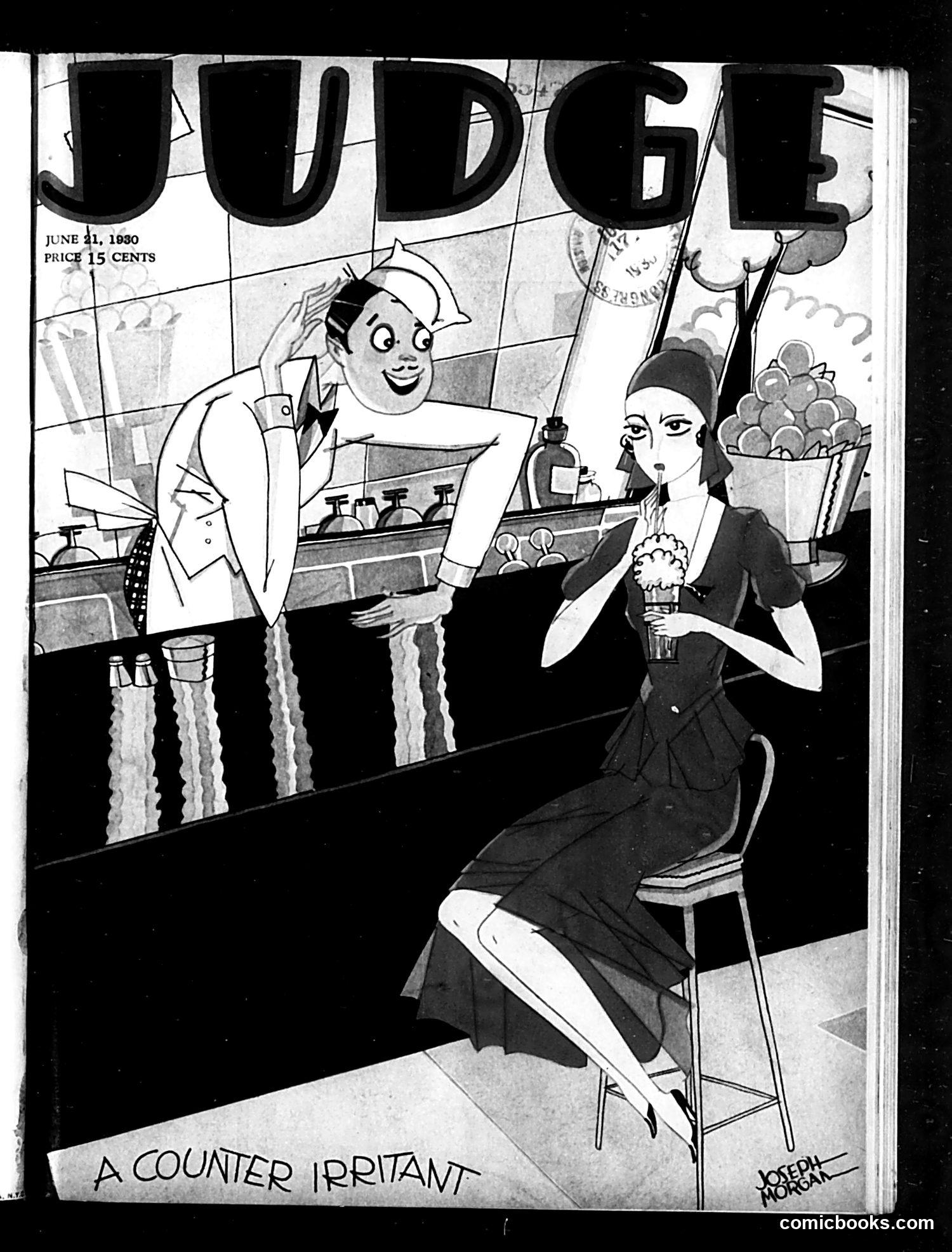
"A Counter Irritant" - Judge Magazine, June 21, 1930 This cartoon depicts an ice cream counter scene titled "A Counter Irritant." A male soda jerk behind the counter smiles broadly while serving an elegantly dressed woman seated at the counter. She holds an ice cream cone and appears annoyed or unimpressed by his attentions. The humor likely plays on the social dynamics of the era: an overeager service worker trying to charm a customer who finds his behavior irritating rather than charming. The title puns on "counter irritant" (a medical term for something that distracts from pain), suggesting his unwanted friendliness is the "irritant." The 1930 date places this during the Great Depression, when service work was common employment. The cartoon satirizes workplace social interactions and class differences between server and customer.
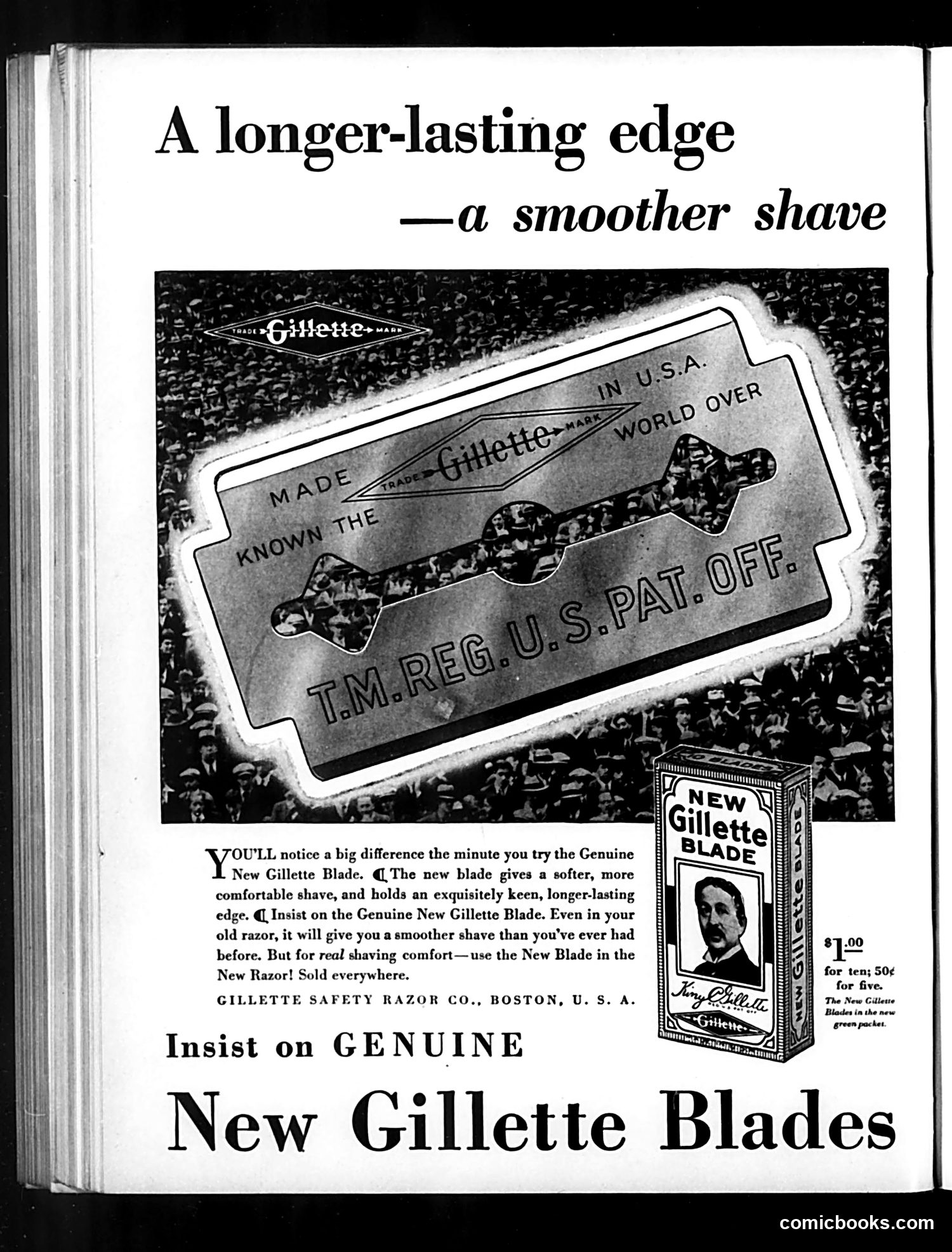
Analysis This page is primarily a Gillette razor blade advertisement, not political satire. The ad promotes "New Gillette Blades" with claims of a "longer-lasting edge" and "smoother shave." The advertisement includes: - A large image of a Gillette blade package - Marketing copy emphasizing the blade's superiority and comfort - A product box showing pricing ($1.00 for ten; 50¢ for five) - The company name: Gillette Safety Razor Co., Boston, U.S.A. The only potentially satirical element is the tagline "KNOWN THE WORLD OVER," which humorously inflates the product's global significance. However, this appears to be straightforward advertising hyperbole rather than political commentary. This is not a Judge magazine cartoon page but rather a paid advertisement, common in periodicals of this era.
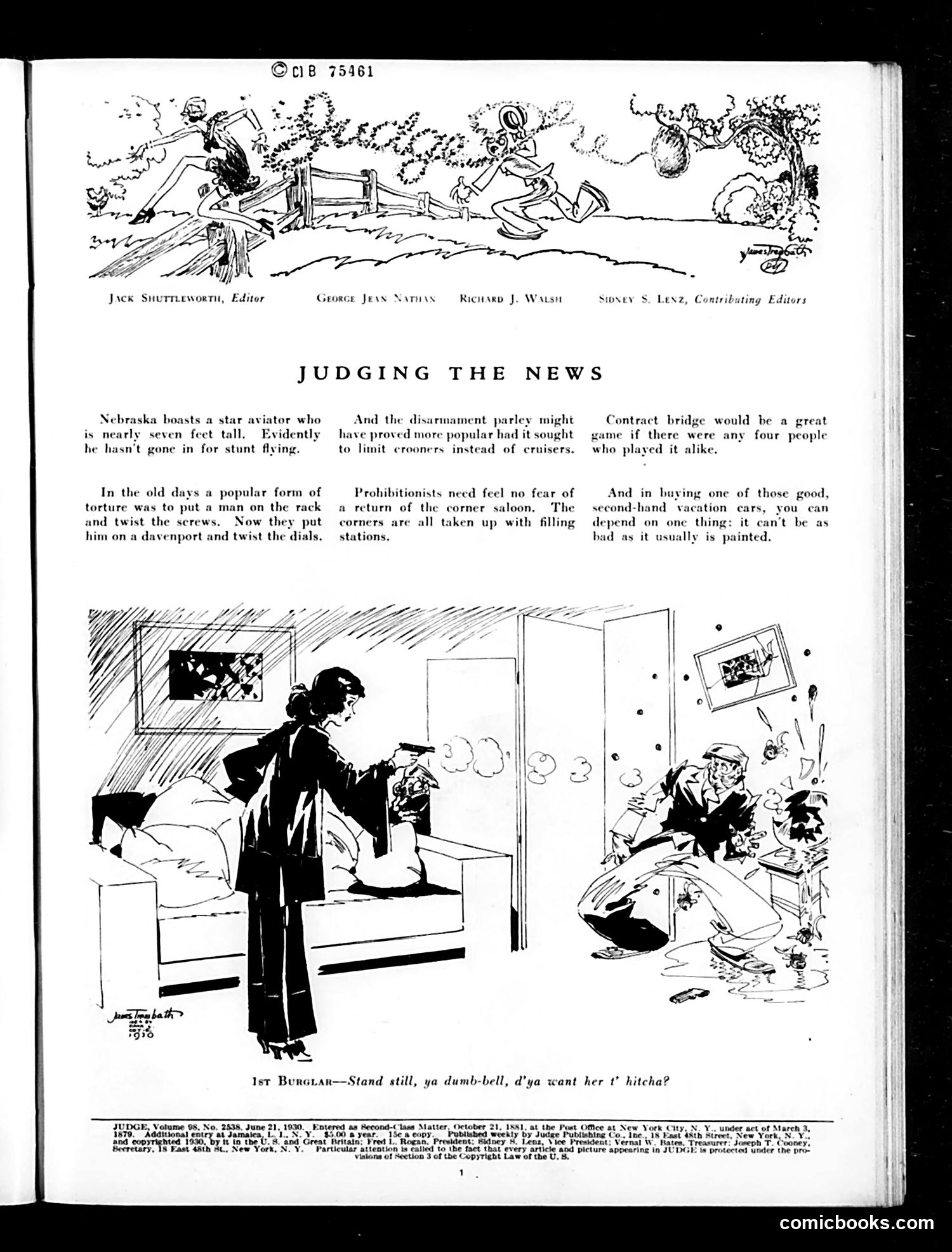
"Judging the News" - Judge Magazine Satire This page contains brief satirical commentary on contemporary news topics paired with cartoon illustrations. The main cartoon depicts a burglar caught mid-crime, confronted by a woman who sarcastically asks, "Stand still, ya dumb-bell, d'ya want her t' hitcha?" The accompanying text jokes appear to reference: - Aviation stunts in Nebraska - Prohibition-era concerns about corner saloons versus filling stations - Used car sales where appearance ("can't be as good as it usually is painted") masks actual condition The cartoons use visual humor and vernacular dialogue to mock contemporary social issues of the era. The burglar cartoon specifically satirizes either crime or domestic situations, though the exact social commentary remains somewhat unclear from the limited context provided.
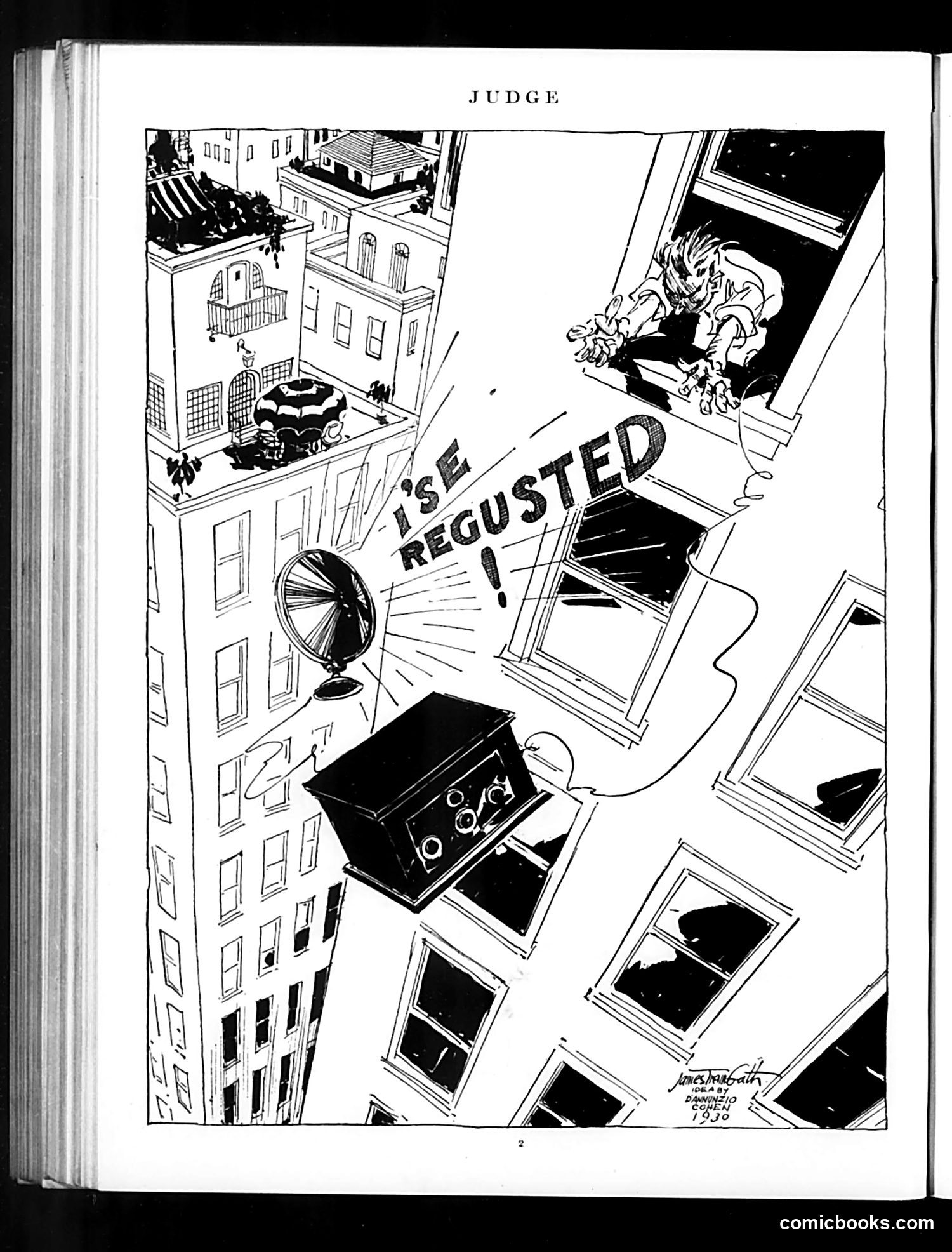
"Judge" Cartoon Analysis: "I'SE BEGUSTED" This 1936 cartoon depicts a scene viewed from above, showing a tall building with a figure leaning out an upper window, appearing angry or disgusted. The phrase "I'SE BEGUSTED" (dialect for "I am disgusted") is prominently displayed. Below, various household devices—a radio and fan among them—are positioned near windows, suggesting the figure is reacting to noise or disturbance from these appliances. The satire likely critiques urban apartment living frustrations: neighbors' noise from radios and fans disturbing others. The exaggerated perspective and the figure's theatrical reaction emphasize the annoyance of modern conveniences creating unwanted intrusions between close-quarters neighbors. This reflects 1930s concerns about densely-packed city living and the complications of new consumer technology.
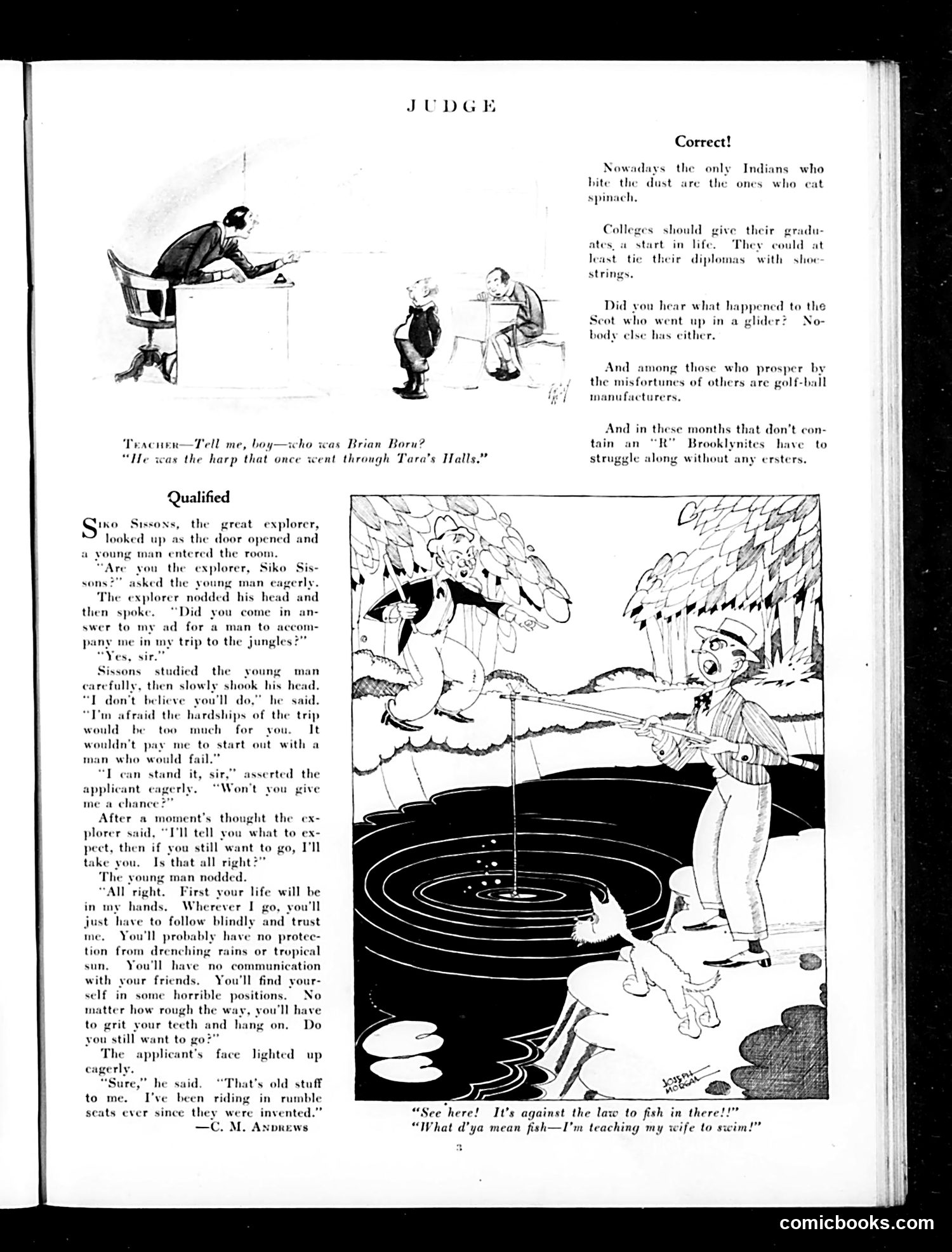
Analysis of Judge Magazine Page This page contains two unrelated items: Top section ("Correct!"): Brief satirical quips mocking various social groups—Indians, college graduates, climbers, and golf-ball manufacturers. These are topical one-liners typical of Judge's format. Bottom section ("Qualified"): A humorous story about Siko Sissons, a great explorer, interviewing a young man as a potential jungle expedition companion. The explorer warns of hardships and isolation, testing the applicant's resolve. The young man confidently accepts, claiming he's "been riding in rumble seats ever since they were invented"—implying casual modern recklessness qualifies him for serious adventure. The accompanying cartoon illustrates this: the applicant appears confident while fishing illegally in a hole, his wife behind him. The joke satirizes how unprepared modern youth are for genuine challenges, mistaking frivolous activities for genuine capability.
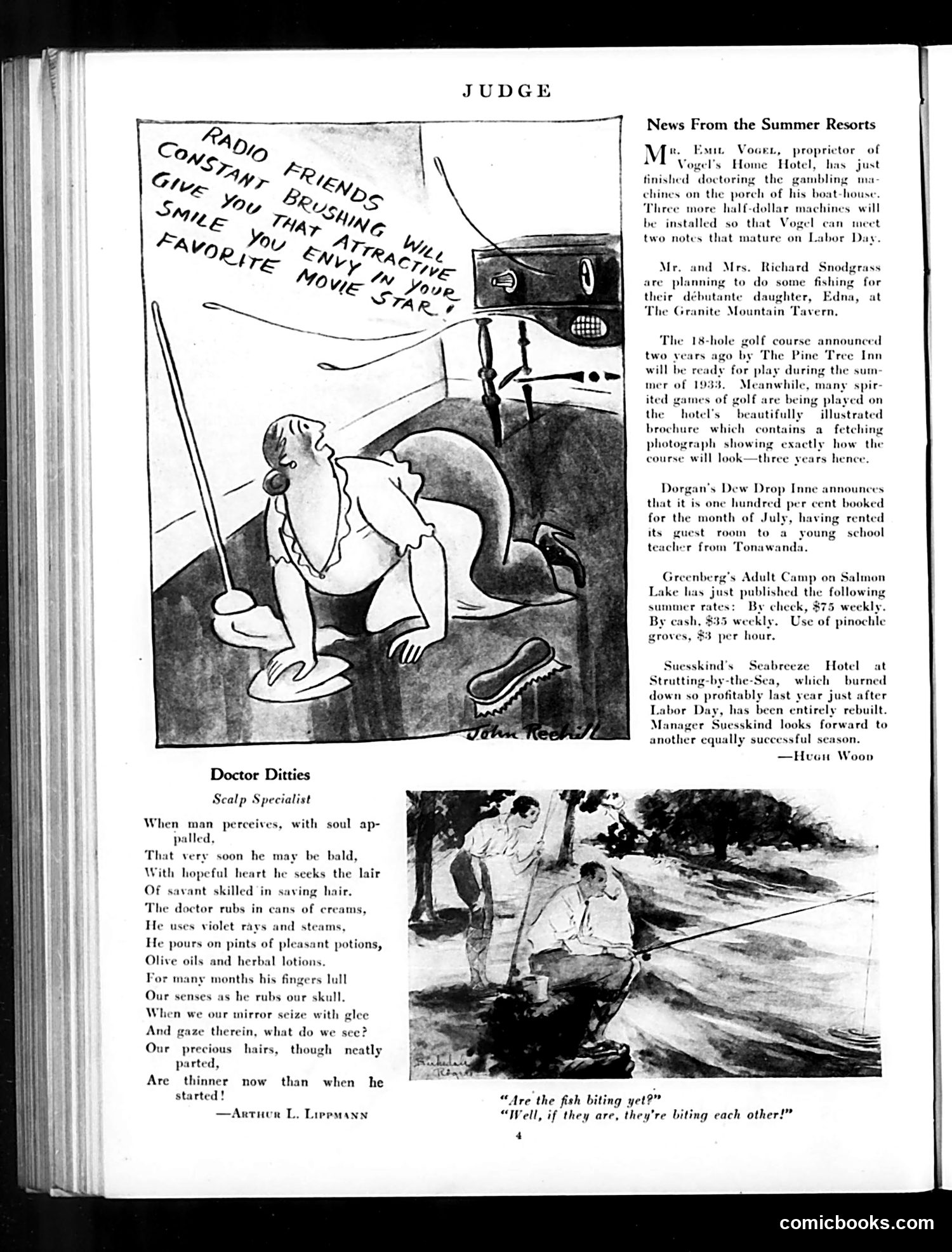
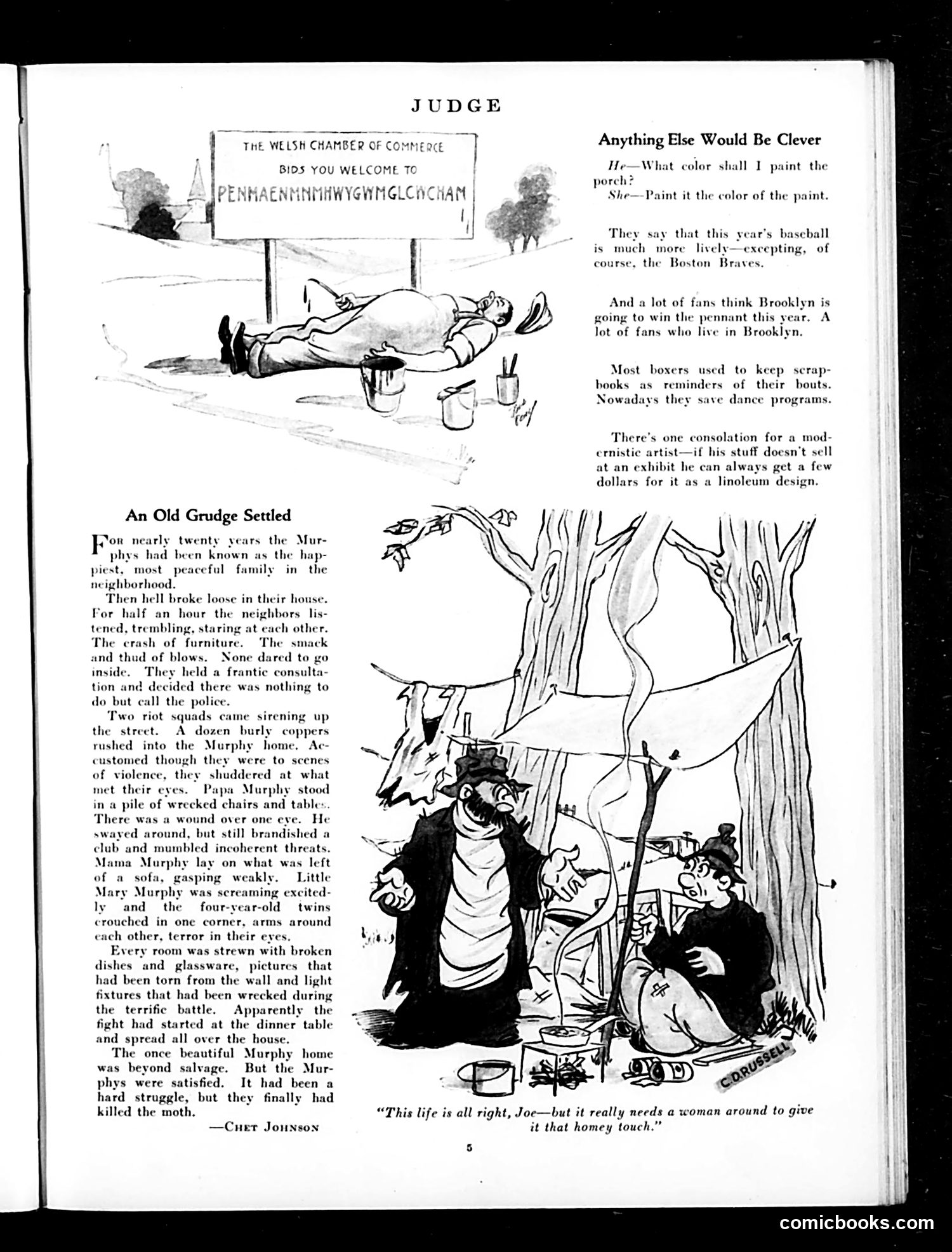
Analysis of Judge Magazine Page Top Cartoon: Shows an exhausted man collapsed outside Penrhaeningwyngmlgncham (a deliberately absurd Welsh place name), satirizing Welsh town names' perceived complexity for English speakers. The humor targets the linguistic difficulty of Welsh. "An Old Grudge Settled" Story: Illustrates a domestic fight between the Murphys, an Irish family. The narrative describes furniture destruction and police involvement, ending with the family satisfied despite the chaos. The accompanying illustration shows a man and children amid household destruction. Social Commentary: The piece stereotypes Irish immigrants as prone to violence and domestic disorder, reflecting period prejudices. The caption—"This life is all right, Joe—but it really needs a woman around to give it that homey touch"—suggests only female domesticity can civilize such households, combining ethnic and gender stereotypes typical of early-20th-century American humor.
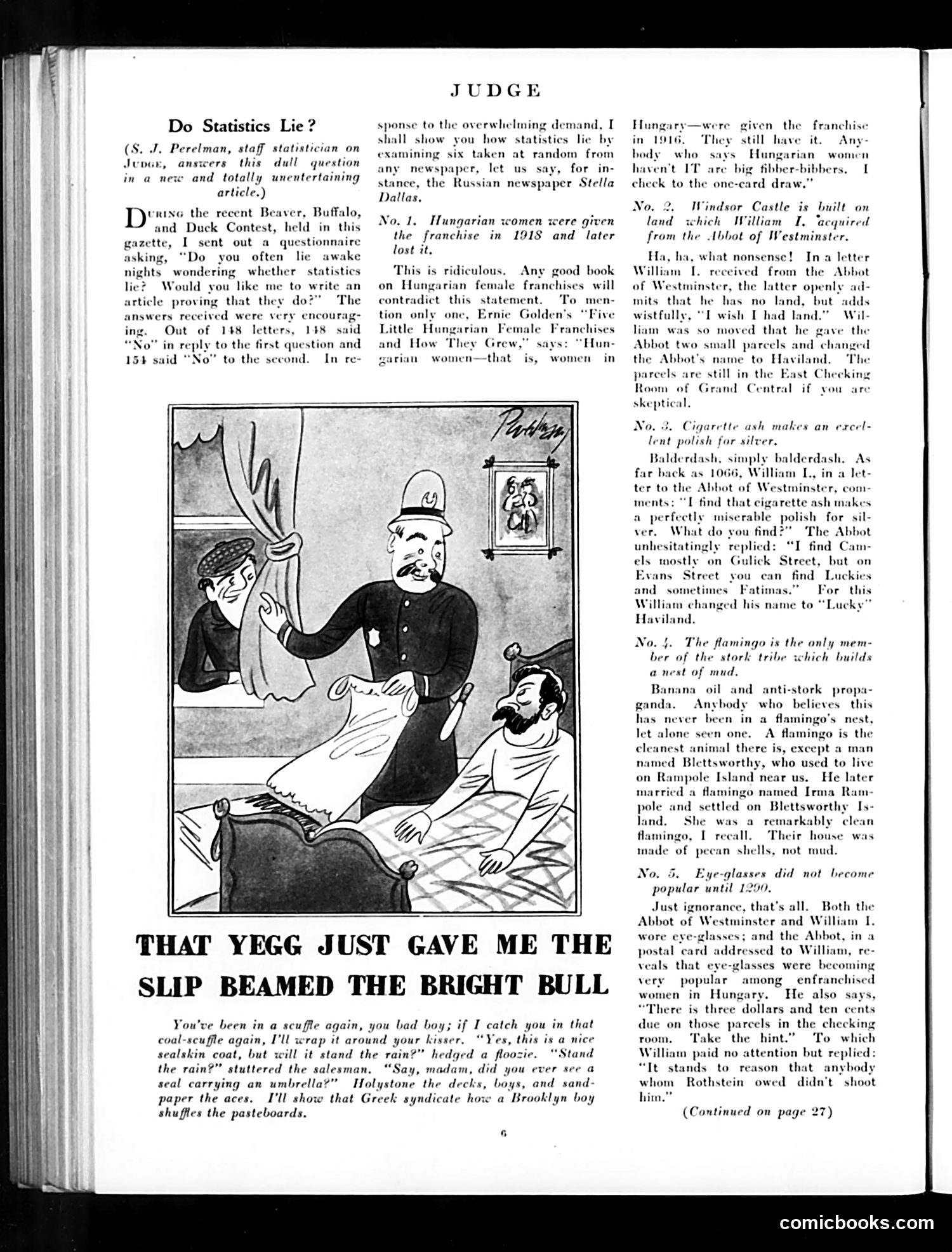
Analysis of Judge Magazine Page This page contains two distinct sections: "Do Statistics Lie?" - A brief article by S.J. Perelman (credited as "staff statistician") responding to reader questions about whether statistics are reliable, using Hungarian female franchises as an example. Main Cartoon - The large illustration depicts three men in what appears to be a hospital or sick room setting. The caption reads "THAT YEGG JUST GAVE ME THE SLIP BEAMED THE BRIGHT BULL," referencing criminal slang ("yegg" = burglar, "bull" = police officer). The cartoon appears to satirize either police incompetence or criminal behavior, though the specific historical reference is unclear without additional context. The page also contains numbered entries (Nos. 1-5) with brief anecdotes about curious facts—Hungarian women, Windsor Castle, cigarette ash, flamingos, and eyeglasses—suggesting this is a humor/facts column.
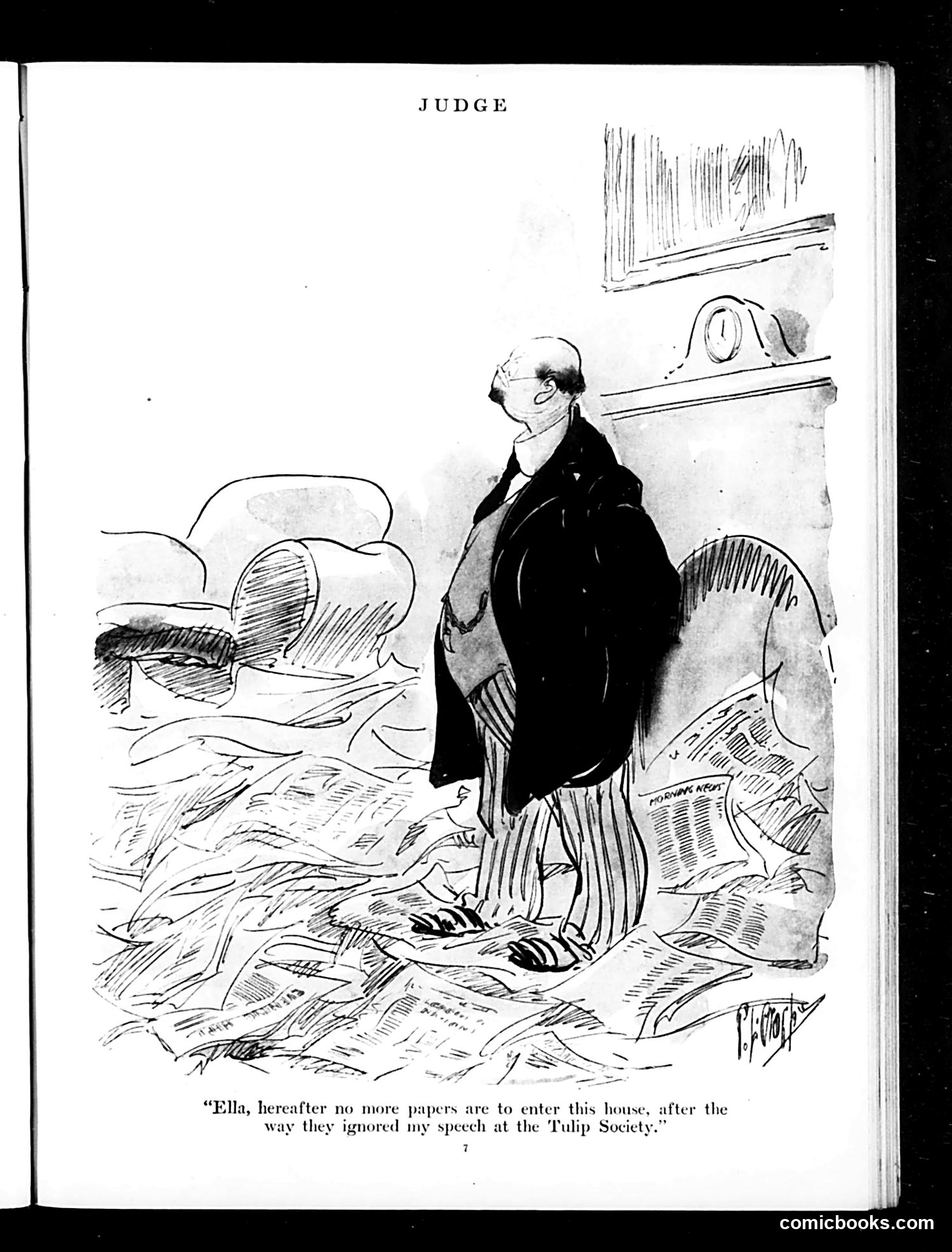
Analysis This single-panel cartoon depicts a man standing amid scattered newspapers, addressing someone named Ella with wounded indignation. He's demanding a household ban on newspapers because they failed to cover or adequately report his speech at the "Tulip Society." The satire targets petty vanity and self-importance. The humor lies in the man's disproportionate response—punishing his entire household by excluding all newspapers simply because a local organization's speech didn't receive press coverage he felt it deserved. The scattered papers underscore the absurdity of his complaint. The "Tulip Society" appears to be a minor civic or horticultural organization, suggesting the man's inflated sense of his own significance. This lampoons both the ego of minor public speakers and the unrealistic expectations some had that local newspapers would cover every community event.
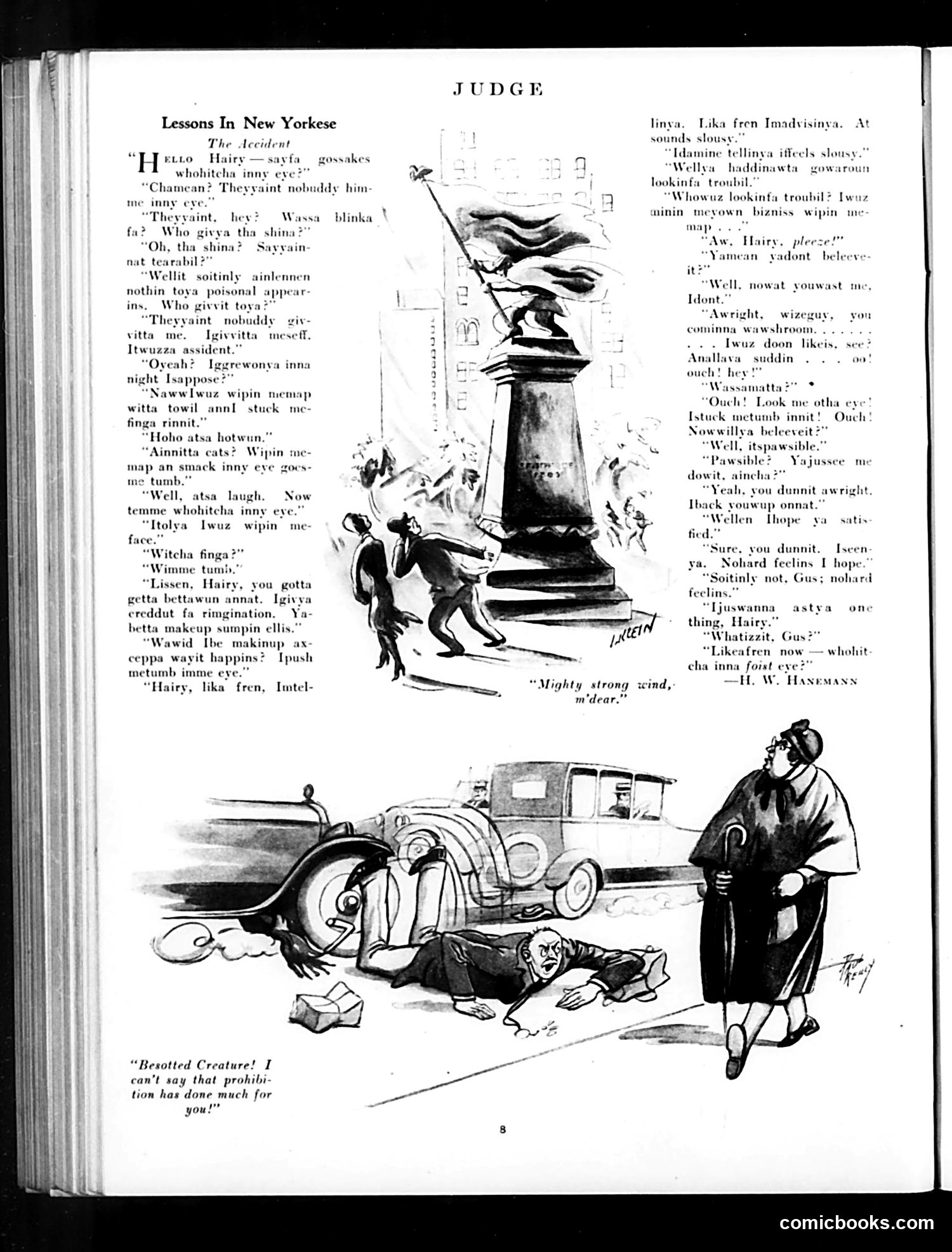
"Lessons in New Yorkese" - Judge Magazine Satire This page satirizes New York immigrant dialect and urban working-class speech patterns. The top section presents a comedic dialogue in exaggerated "Brooklynese"—phonetic transcriptions of how recent immigrants and working-class New Yorkers spoke English, with dropped consonants ("whohitcha"), malapropisms ("poisonal" for "personal"), and characteristic phrasing ("ain't nobuddy," "dunnit"). The bottom cartoon illustrates the dialect lesson with an accident scene: a man lies injured after being hit by a car, while a woman gestures. The caption mockingly suggests he blamed a "strong wind" for the accident—implying the stereotype that immigrants made excuses rather than taking responsibility. This reflects early 20th-century urban American humor that made ethnic speech and working-class immigrants objects of ridicule for educated readers. The satire punches downward at outsiders struggling with English.
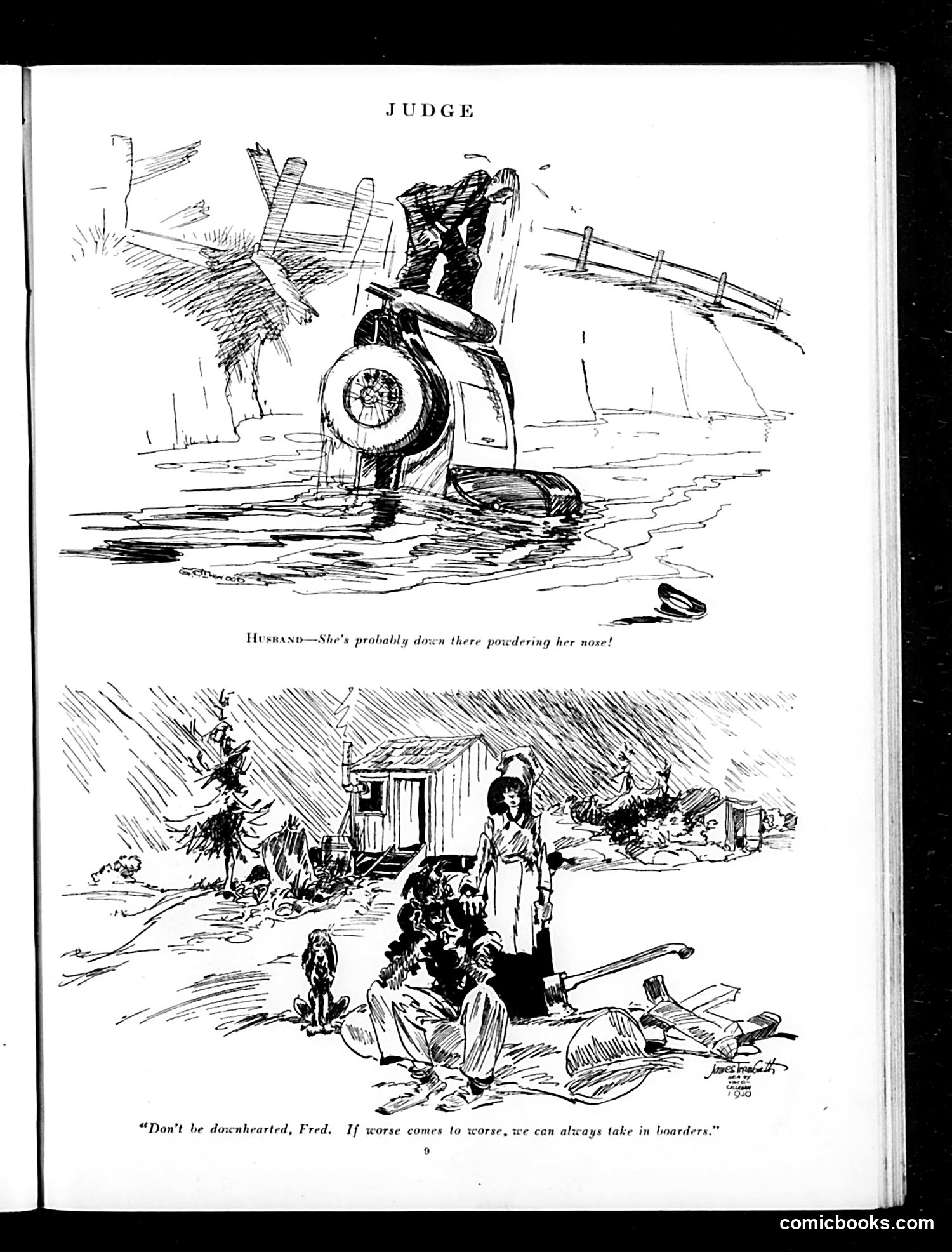
Analysis This page contains two cartoons under the heading "JUDGE." The top cartoon shows a man examining wreckage (possibly a boat or vehicle) near water, with the caption suggesting his wife is "down there powdering her nose"—a dark joke about her being lost or dead. The bottom cartoon depicts a couple in apparent poverty or hardship outside a modest shack, with the wife reassuring her discouraged husband "Fred" that if their situation worsens, they can "take in boarders" (rent rooms to lodgers for income). Both cartoons appear to address economic hardship and marital dynamics during difficult times, likely reflecting Depression-era anxieties about financial instability. The humor relies on resigned acceptance of deteriorating circumstances and maintaining composure despite adversity—common themes in 1930s satirical humor.
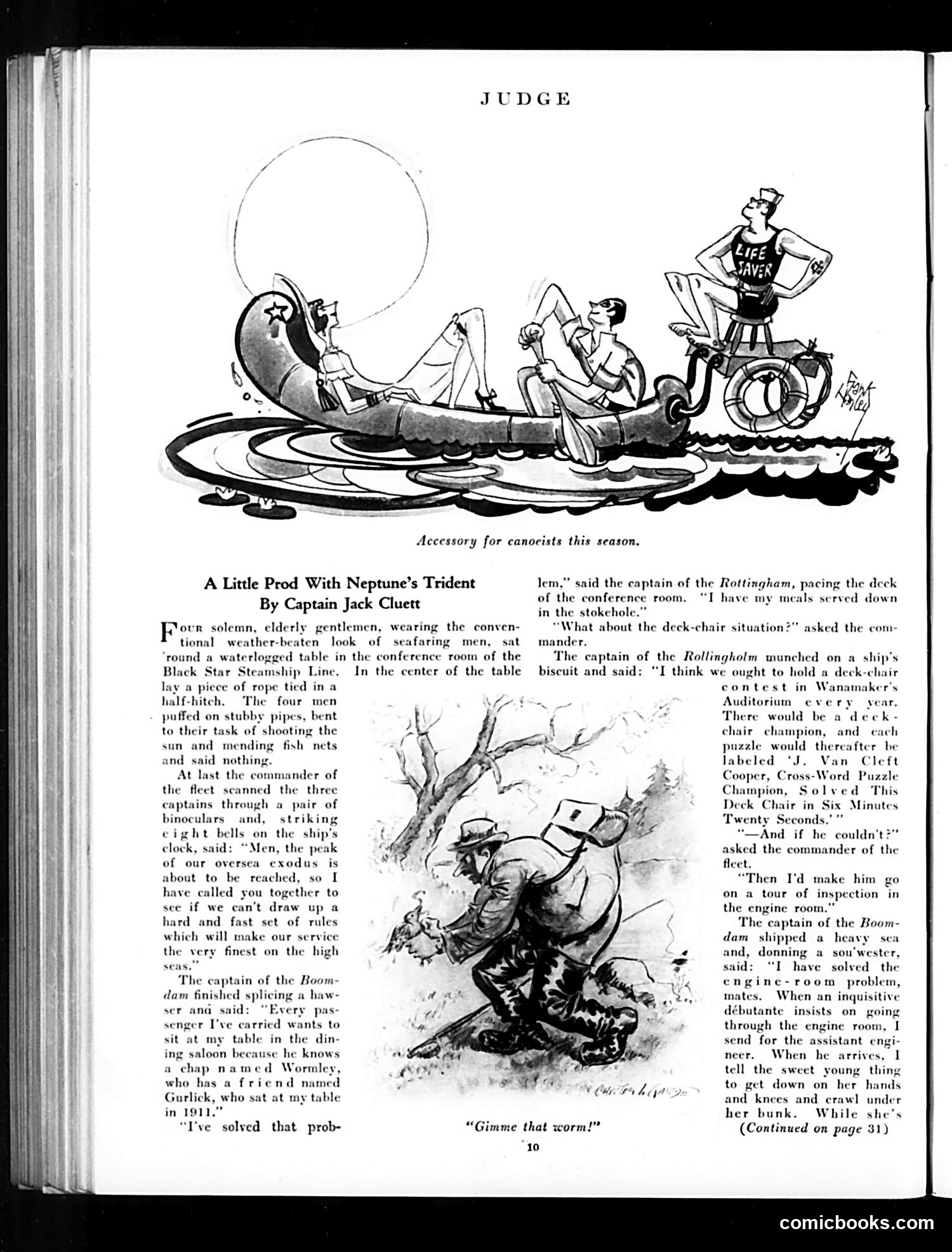
Judge Magazine Satire Analysis This page satirizes maritime social hierarchies and passenger complaints aboard steamships. Four ship captains discuss problems with ocean travel—specifically, how passengers want premium seating (dining tables, deck chairs) based on tenuous social connections or accomplishments. The cartoon at top depicts a canoe accessory: judges in a boat reviewing competitors, satirizing the era's obsession with competitive rankings and social status. The captains' anecdotes mock passenger entitlement: one man demands a table because he knows someone who knew someone from 1911; another suggests holding a "deck-chair contest" to award premium seating to a puzzle-solver; a third admits to sending inquisitive young women (débutantes) crawling under bunks in the engine room to discourage their complaints. The humor targets both pretentious passengers and the maritime industry's absurd solutions to social-climbing complaints. It's early 20th-century class commentary wrapped in nautical comedy.
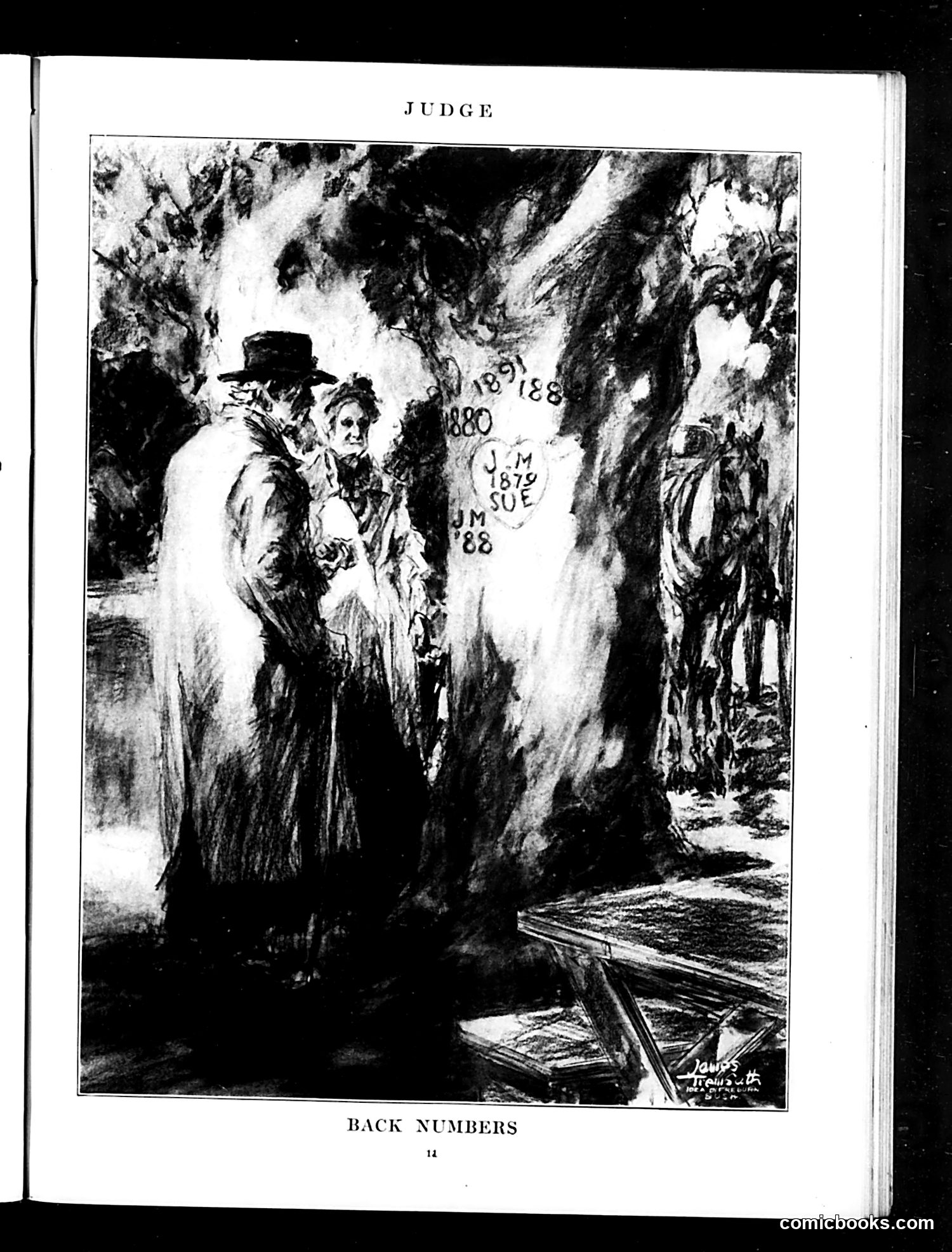
Analysis This page appears to be a section titled "Back Numbers" from Judge magazine, likely serving as a table of contents or index for previous issues. The illustration shows figures in period dress examining or discussing papers/documents among bare trees, suggesting a historical or archival theme appropriate to "back numbers." Visible dates in the image include references to years like 1879, 1880, and 1888, which appear to be stamped or written on the documents the figures are examining. The sketch style and clothing suggest late 19th-century setting. However, without clearer text or identifying information, I cannot definitively explain the specific satirical point, identify particular political figures being caricatured, or explain what specific events or issues this references. The page seems more organizational than comedic in purpose.
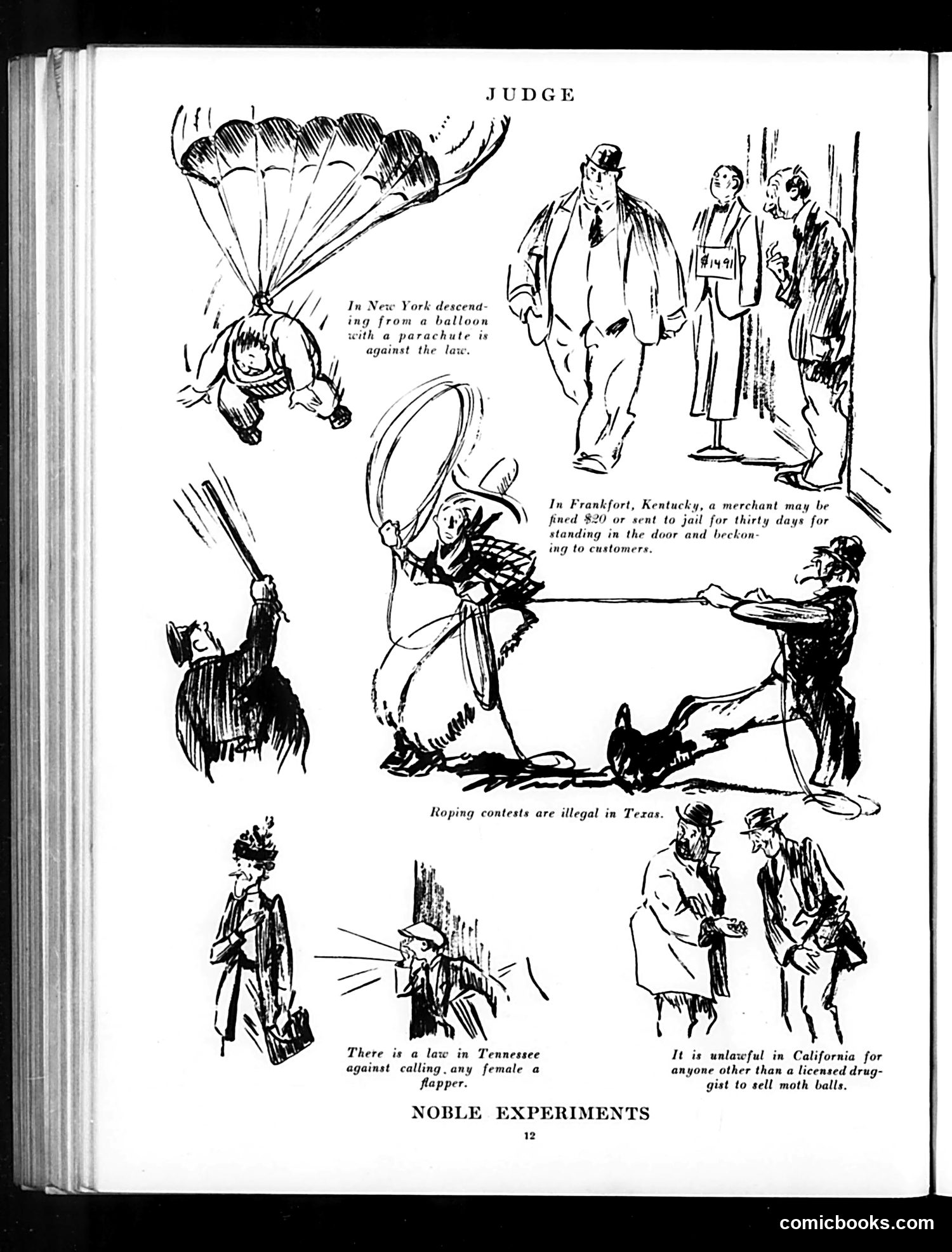
"Judge" Magazine Satire: "Noble Experiments" This page satirizes absurd state and local laws through cartoon vignettes. Each illustration depicts a ridiculous legal restriction from different American cities: - New York: Criminalizes parachuting from balloons - Frankfort, Kentucky: Penalizes merchants for beckoning customers from doorways - Tennessee: Bans calling women "flappers" (a 1920s term for modern, liberated young women) - California: Restricts moth ball sales to licensed druggists only The title "Noble Experiments" likely mocks Prohibition-era legislative overreach—the period when states passed increasingly intrusive "moral improvement" laws. By presenting these genuine but bizarre regulations side-by-side, *Judge* ridicules the gap between lawmakers' intentions and the laws' actual effects, suggesting government regulation had become comically excessive and disconnected from rational governance.
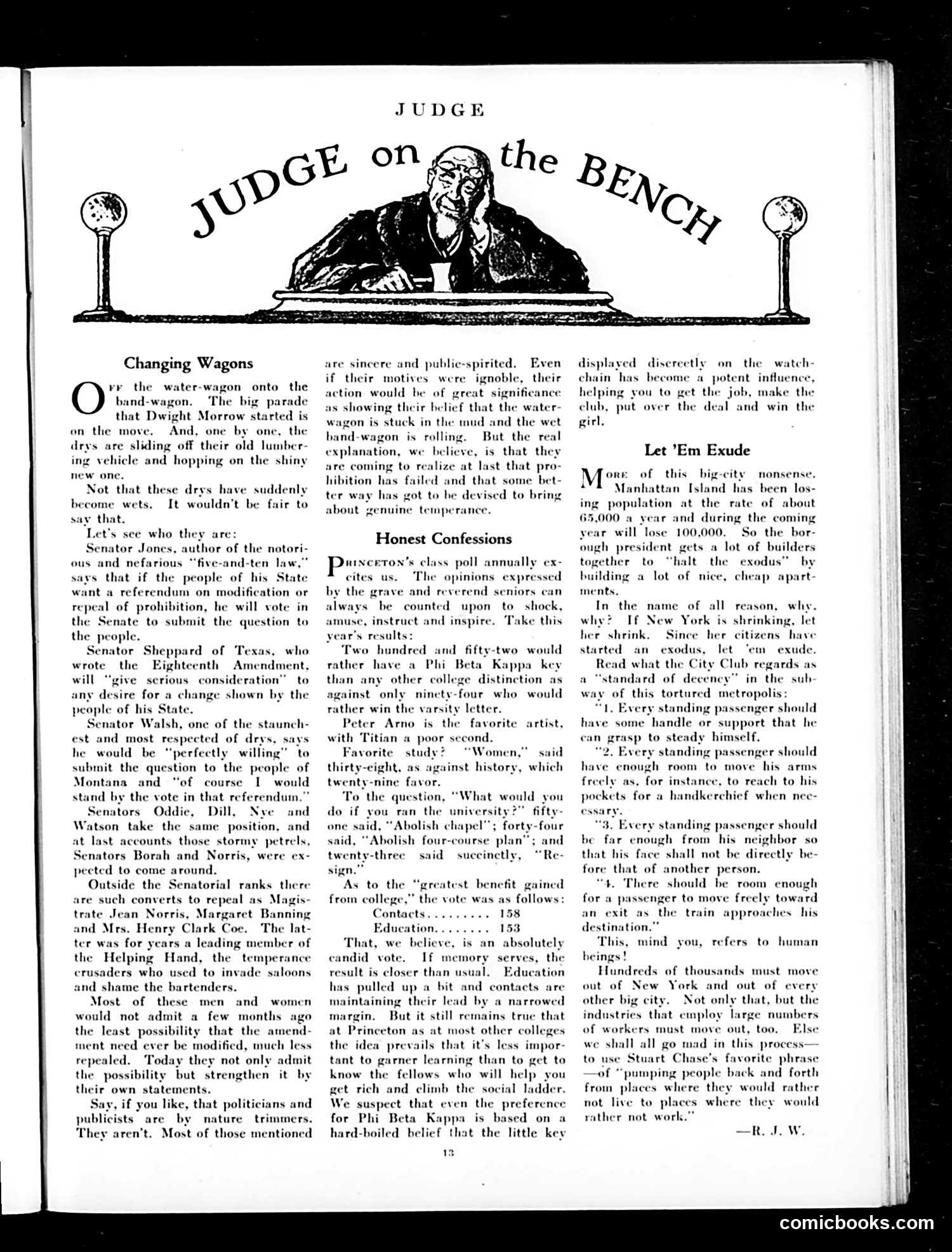
"Judge" Magazine Page Analysis This page contains two satirical columns about American social and political trends circa the Prohibition era. "Changing Wagons" mocks prominent senators and Prohibition advocates—including Senator Sheppard (who authored the Eighteenth Amendment) and Senator Jones—for suddenly becoming willing to reconsider or repeal Prohibition. The satire suggests these "dry" crusaders are abandoning their moral positions as public opinion shifts, portrayed as politicians jumping from a stuck "water-wagon" to a rolling "wet-wagon." The author argues they're finally admitting Prohibition has failed, though he credits them with sincerity rather than mere opportunism. "Honest Confessions" reports on Princeton's senior class poll results, satirizing student priorities. Students overwhelmingly prefer a Phi Beta Kappa honor key over athletic distinction, but the satire reveals the *real* motivation: the key "has become a potent influence helping you to get the job, make the club, put over the deal and win the girl." The piece mocks the gap between stated educational ideals and actual student values—networking and material success trump learning.
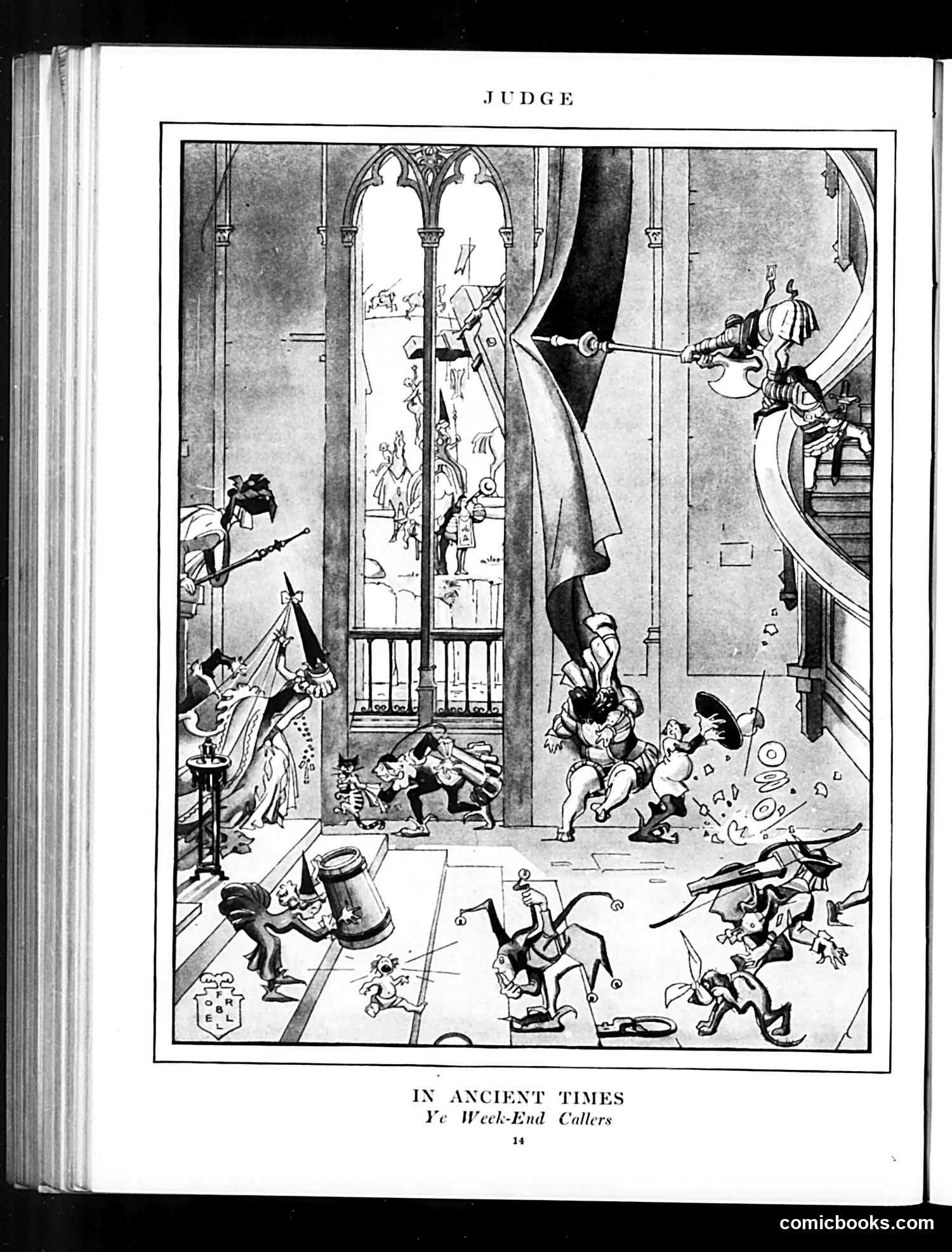
JUDGE: "In Ancient Times—Ye Week-End Callers" This satirical cartoon depicts a chaotic medieval or ancient courthouse scene, likely mocking contemporary social customs around "week-end callers"—the practice of making social visits on weekends. The image shows a judge's chamber invaded by rowdy, destructive visitors. Giants or distorted figures loom above, while small figures below engage in destructive behavior: breaking furniture, causing mayhem, and generally behaving without restraint. The architectural setting (Gothic arches, formal courtroom) contrasts sharply with the pandemonium. The satire appears to critique how weekend social visitors behaved like uncivilized barbarians in polite settings, treating hosts' homes disrespectfully. By setting this in "ancient times," the cartoonist suggests such rudeness is primitive and outdated, mocking contemporary etiquette violations through exaggerated historical parody.
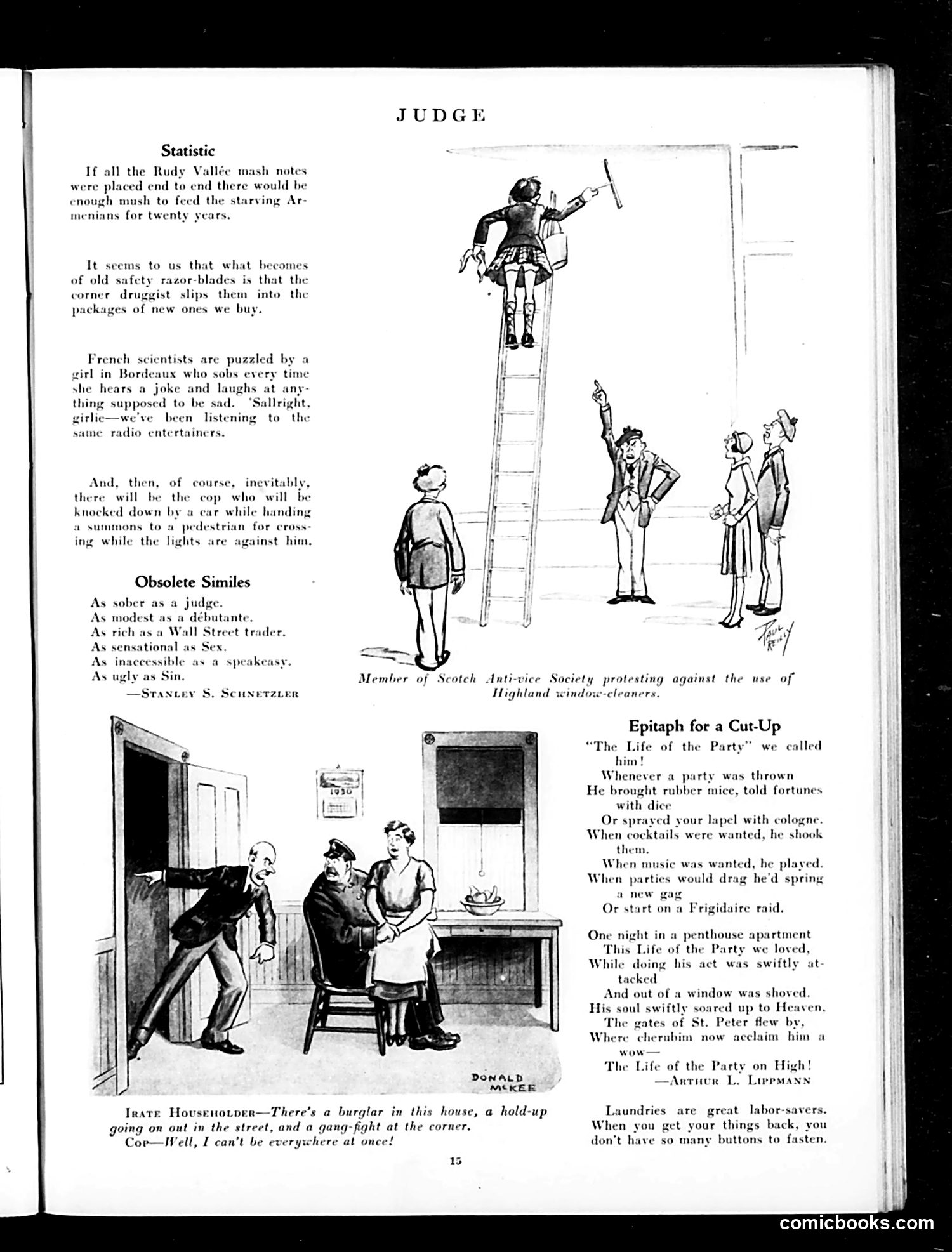
Judge Magazine Page Analysis This page from Judge magazine contains several satirical pieces targeting 1920s American culture: "Statistic" section: Jokes about contemporary celebrities and consumer complaints—notably referencing Rudy Vallée, a famous crooner whose female admirers were stereotyped as swooning "mash" fans. Other quips mock razor blade quality and radio entertainment mediocrity. "Obsolete Similes": Lists once-common expressions now meaningless due to social change (judges aren't sober, debutantes aren't modest, Wall Street traders aren't rich—implying Prohibition's failure, loosened morality, and 1920s economic instability). Top cartoon: Shows a Scottish anti-vice society member protesting window-cleaners' Highland dress, satirizing puritanical overreach. "Epitaph for a Cut-Up": A dark joke about a party-goer accidentally killed—darkly humorous commentary on Prohibition-era recklessness. Bottom cartoon: A harried householder amid urban chaos (burglary, street violence, gang fights), reflecting anxiety about 1920s crime and lawlessness. The overall tone mocks contemporary hypocrisy, social decline, and moral confusion.
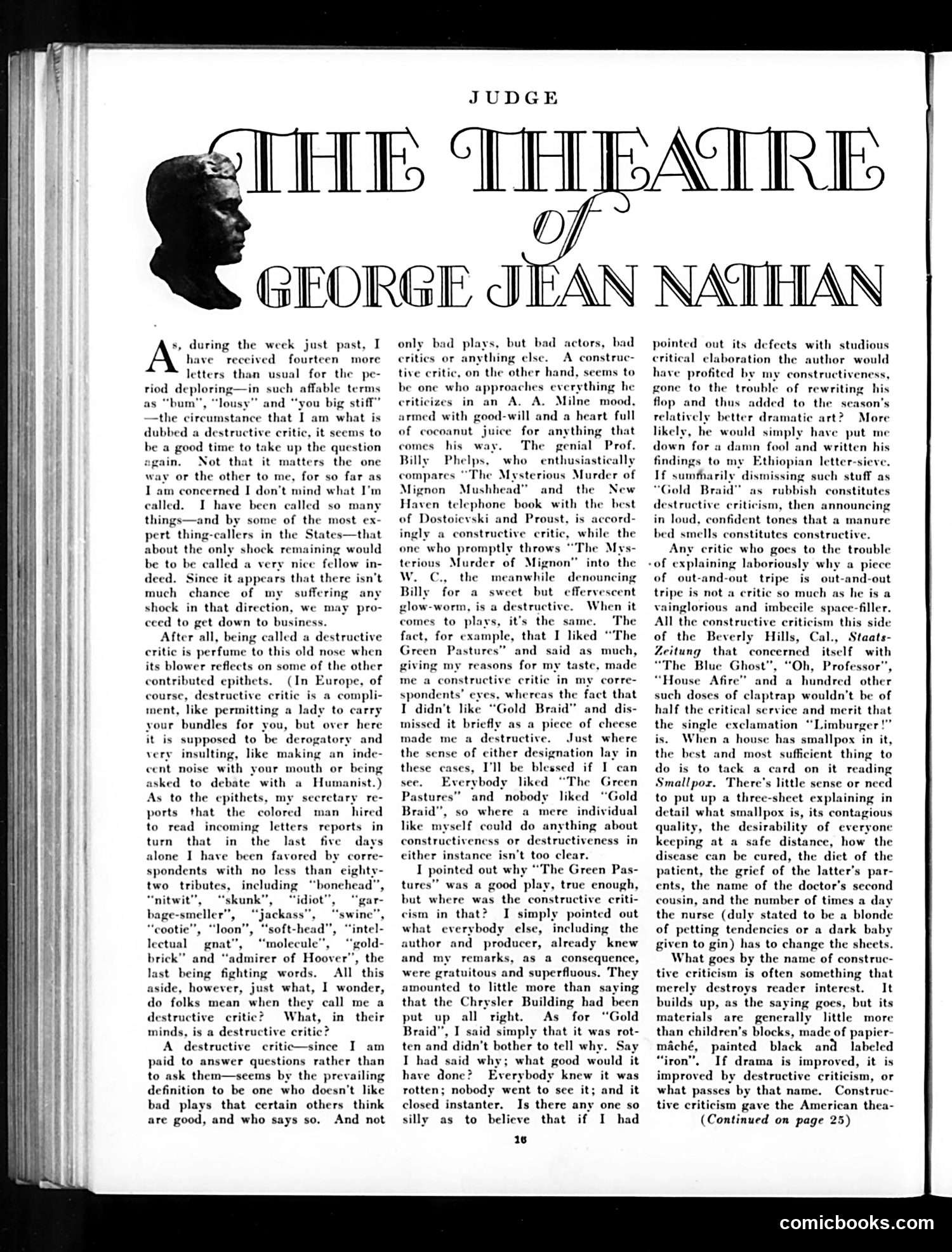
Analysis of Judge Magazine Page: "The Theatre of George Jean Nathan" This page features drama critic George Jean Nathan defending his role as a "destructive critic"—a label readers had harshly criticized him for using. The satire's point: Nathan argues that "destructive critic" is a misnomer. He defines the real distinction: a "constructive critic" (like Professor Billy Phelps) praises mediocre work with saccharine enthusiasm, while a "destructive critic" (himself) honestly condemns bad plays. Nathan reveals the absurdity—he praised the successful play "The Green Pastures," yet was still called destructive for disliking "Gold Braid," which *everyone* already knew was poor. Social context: This reflects 1920s-30s theater criticism debates. Nathan was a prominent, often acidic theater reviewer. The piece satirizes how critics who deliver blunt judgments face public hostility, while those offering empty praise gain acceptance. The joke: Nathan flips the moral framework—suggesting that honest criticism serves readers better than hollow compliments dressed in "good-will" (referencing A.A. Milne's sentimental style).
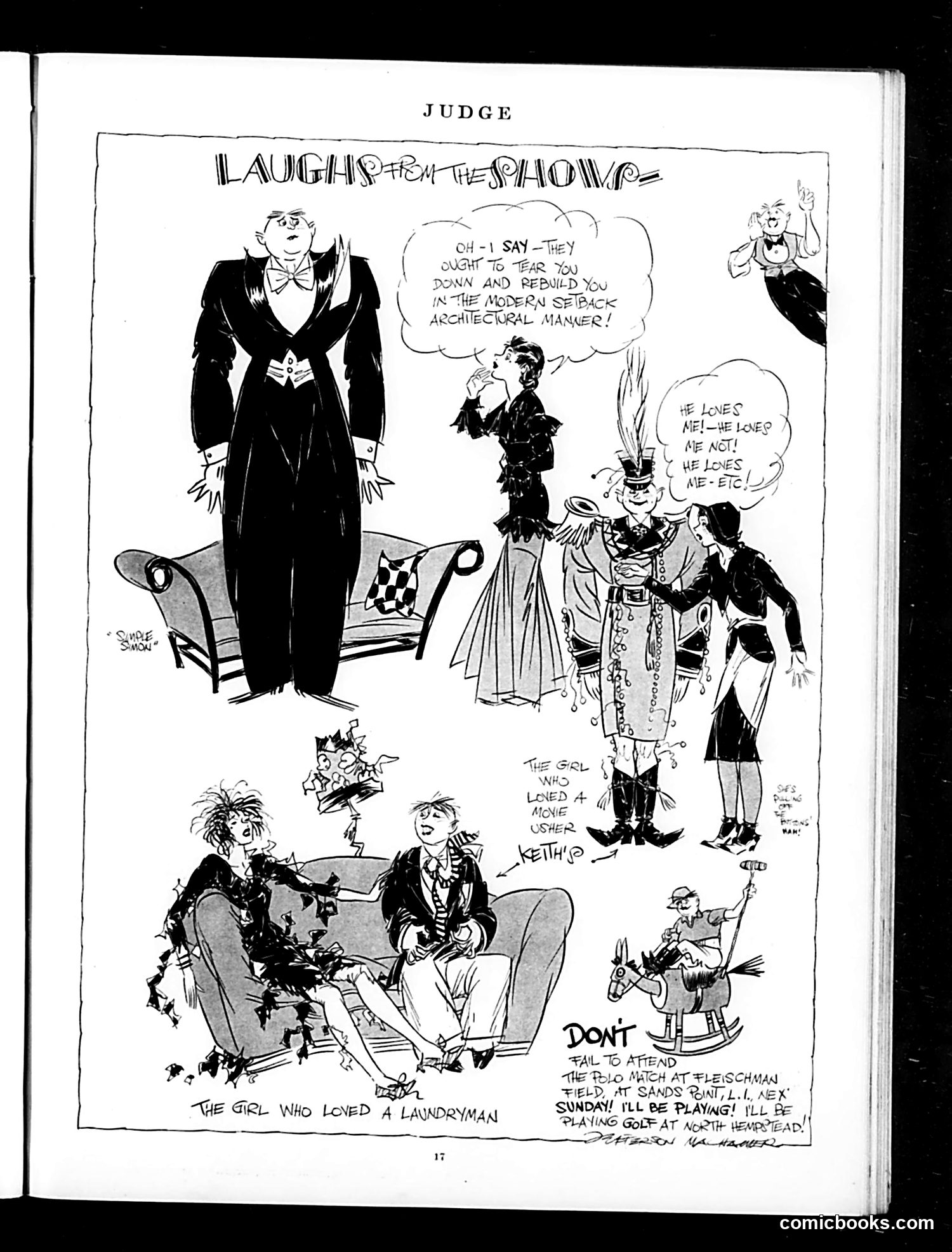
"Laugh-tem-the-Phowd" (Laughs from the Shows) This page satirizes theatrical productions, likely from the 1920s-30s. The cartoons mock popular stage shows and their plots: "The Girl Who Loved a Laundry Man" appears to be a melodramatic romance, while another references "The Girl Who Loved & Movie Usher"—both seemingly absurd romantic premises that Judge ridicules. The tall figure in formal wear likely represents a theater impresario or producer pontificating about "modern set" architectural manner. The smaller characters around him appear to be actors or theatrical types engaged in the pretentious drama the magazine is mocking. The final panel, "Don't," offers a joke about real-world activities (polo, golf at exclusive venues) that theatrical people should pursue instead of performing in such ridiculous productions. The satire targets both lowbrow theatrical plots and perhaps the pretentiousness of theater itself during this era.
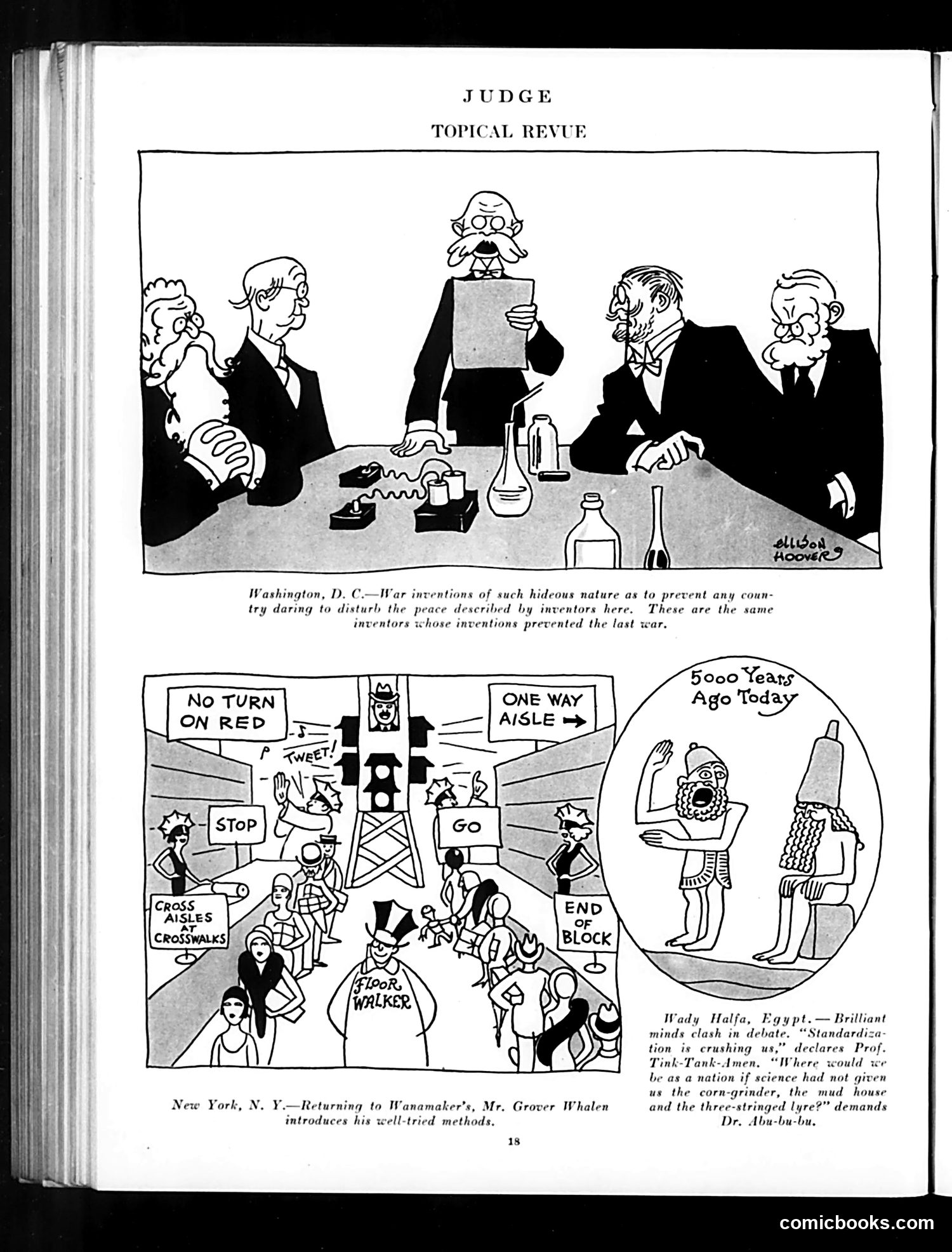
Judge Topical Revue Analysis This page contains three separate satirical cartoons: Top cartoon: Mocks Washington inventors presenting "hideous" war inventions designed to prevent future wars—the same inventors whose inventions supposedly prevented the last war. The satire targets the contradiction of creating weapons while claiming peaceful intent. Middle cartoon: Set in Wady Halfa, Egypt, ridicules academic debate about "standardization." Prof. Tink-Tank-Amen defends primitive Egyptian inventions (corn-grinder, mud house, three-stringed lyre) against modernization, with a 5000-year-old Egyptian shown wielding similar tools. It mocks resistance to progress and standardization as nostalgic and backwards. Bottom cartoon: References Mr. Grover Whalen (New York politician/businessman) introducing traffic-control methods at Wanamaker's department store, shown with street signs and pedestrians. The joke involves applying urban traffic management to shopping, likely satirizing Whalen's public works initiatives. All three mock institutional pretension, contradictory logic, and bureaucratic overreach.
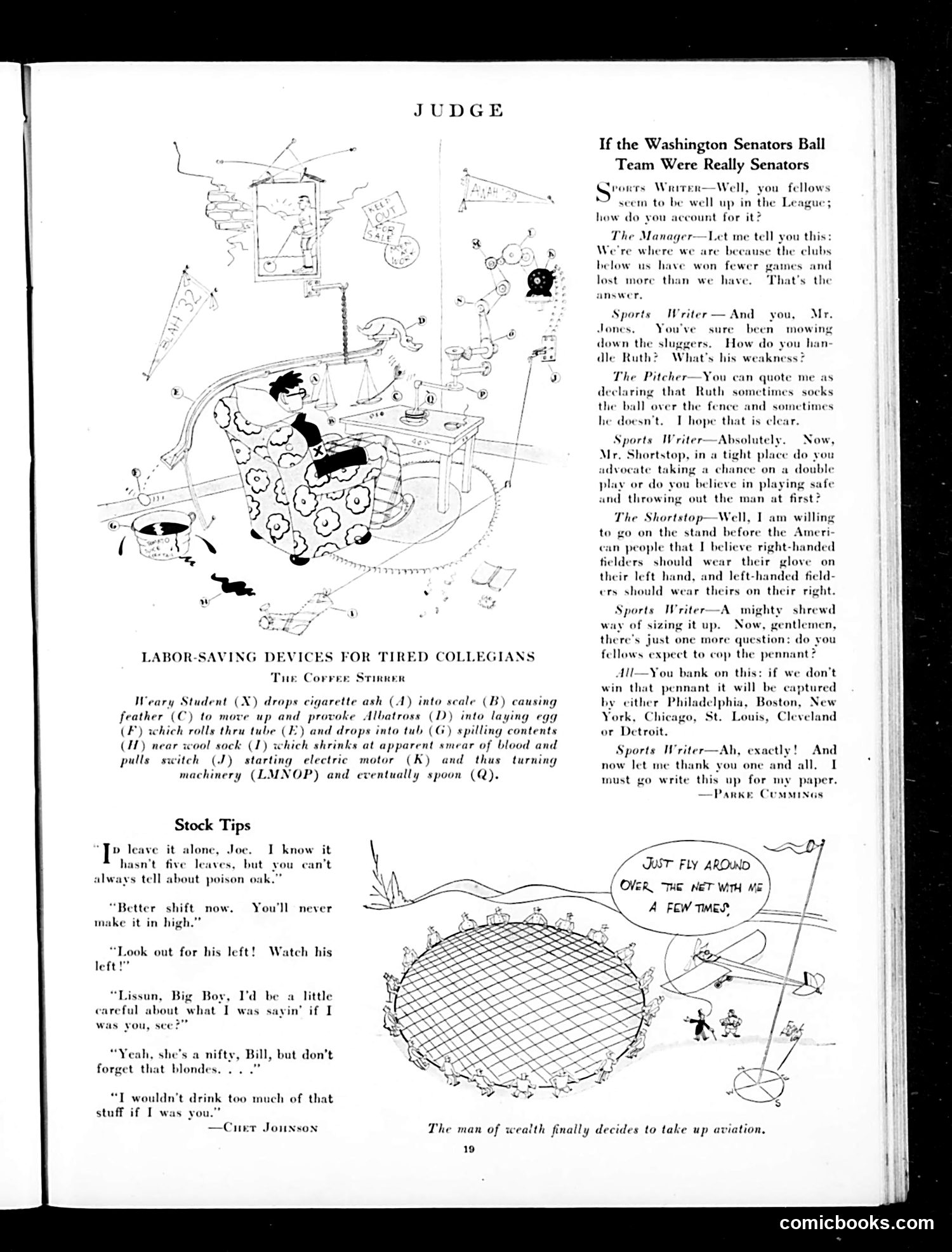
Analysis: Judge Magazine Page This page satirizes the Washington Senators baseball team through a mock interview. The cartoon presents a Sports Writer questioning the team's manager, pitcher, and shortstop about their success. The humor lies in their absurdly evasive, circular answers: the Manager claims they win because other teams lose more; the Pitcher discusses Babe Ruth in obvious platitudes ("sometimes socks the ball over the fence and sometimes he doesn't"); the Shortstop gives nonsensical advice about which hand fielders should wear gloves on. The satire targets politicians and public figures who speak in meaningless jargon—the joke title "If the Washington Senators Ball Team Were Really Senators" suggests these ballplayers speak with the same empty rhetoric as actual senators. The page's other content includes absurdist humor: "Labor-Saving Devices for Tired Collegians" (a Rube Goldberg contraption), aviation humor, and "Stock Tips" (financial advice clichés). All reflect early 20th-century satirical magazine conventions mocking contemporary culture.
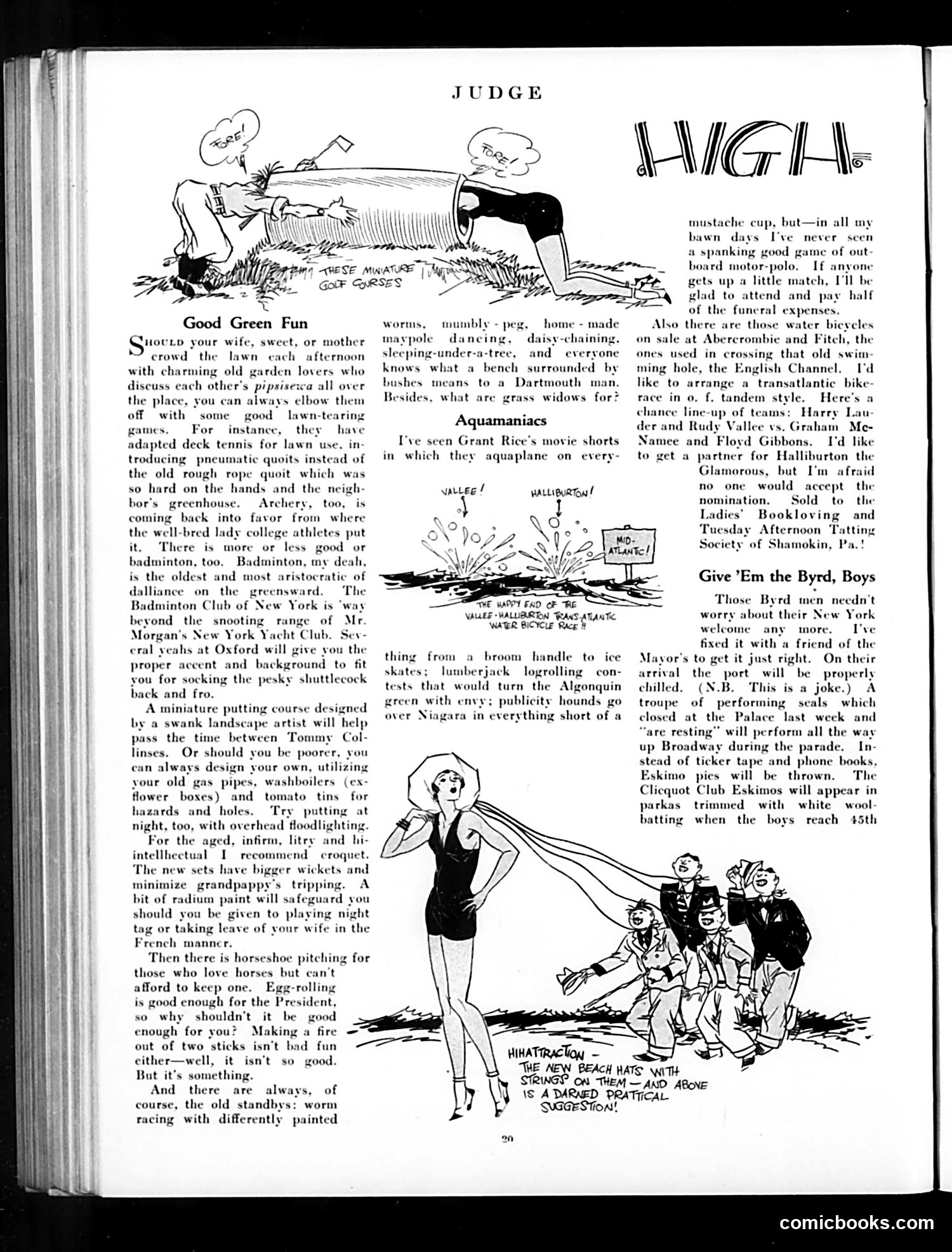
Explanation for Modern Readers This page from *Judge* contains humorous advice about lawn games and leisure activities, typical of 1920s satirical content. "Good Green Fun" mocks the wealthy's obsession with fashionable pastimes. It sarcastically recommends crowding your lawn with garden games—deck tennis, pneumatic quoits, archery, badminton—presented as status symbols. The satire targets pretentiousness: references to Oxford accents and the Badminton Club being "beyond" even J.P. Morgan's Yacht Club. For the poor, it jokes about using gas pipes and tomato tins as makeshift golf hazards. The tone ridicules both the upper class's elaborate recreations and the desperation of DIY alternatives. "Aquamaniacs" references Grant Rice's movie shorts about aquaplaning stunts, mocking extreme sporting publicity stunts. "Give 'Em the Byrd, Boys" celebrates Admiral Richard Byrd's Arctic expedition, proposing a humorous Broadway ticker-tape parade substituting Eskimo Pies for traditional confetti—a casual, seemingly innocent detail that would read very differently to modern audiences given the product's now-offensive name.
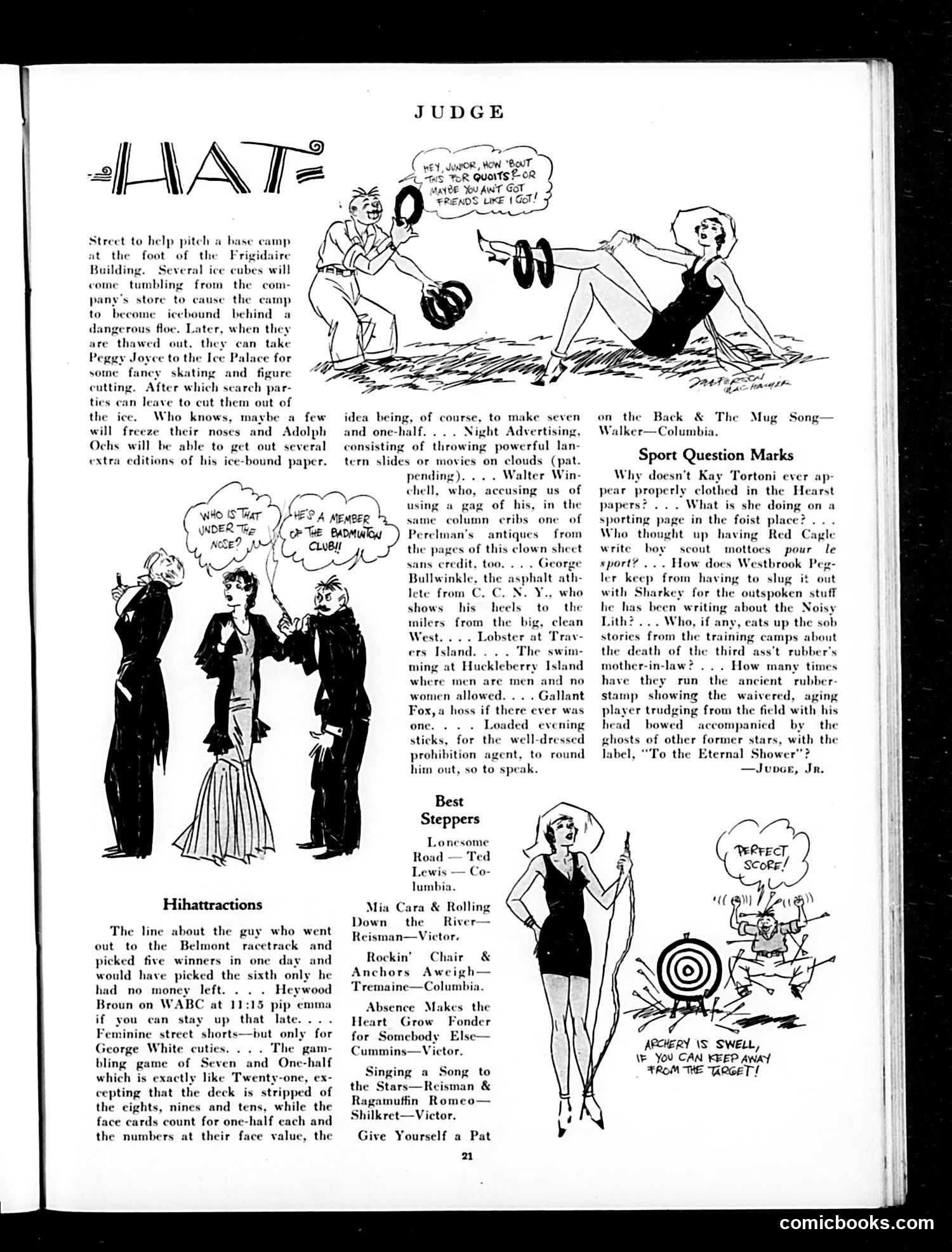
Judge Magazine Page Analysis This page from *Judge* magazine contains several satirical pieces mocking 1920s celebrity culture and sports journalism. The top cartoon "Hate" ridicules an unnamed couple's romantic quarrel, with the woman sarcastically noting her lack of wealthy "friends like Peggy Joyce"—a famous socialite and scandal figure of the era known for multiple marriages and lavish lifestyle. The "Hihattractions" section humorously critiques sports writing and journalism, referencing figures like George White (a theatrical producer), sportswriter Westbrook Pegler, and boxer Jack Sharkey. It mocks sensationalist coverage of training camps and the repeated use of clichéd imagery of aging athletes leaving fields. The "Sport Question Marks" section continues this critique, questioning why Kay Tortoni appears in sports pages and challenging the authenticity of sob stories about athletes' hardships. The smaller cartoon panels ("Best Steppers," "Perfect Score") show couples dancing and archery, typical leisure activities of the wealthy during Prohibition. Overall, the page satirizes celebrity gossip, sportswriting clichés, and upper-class leisure culture of the Jazz Age.
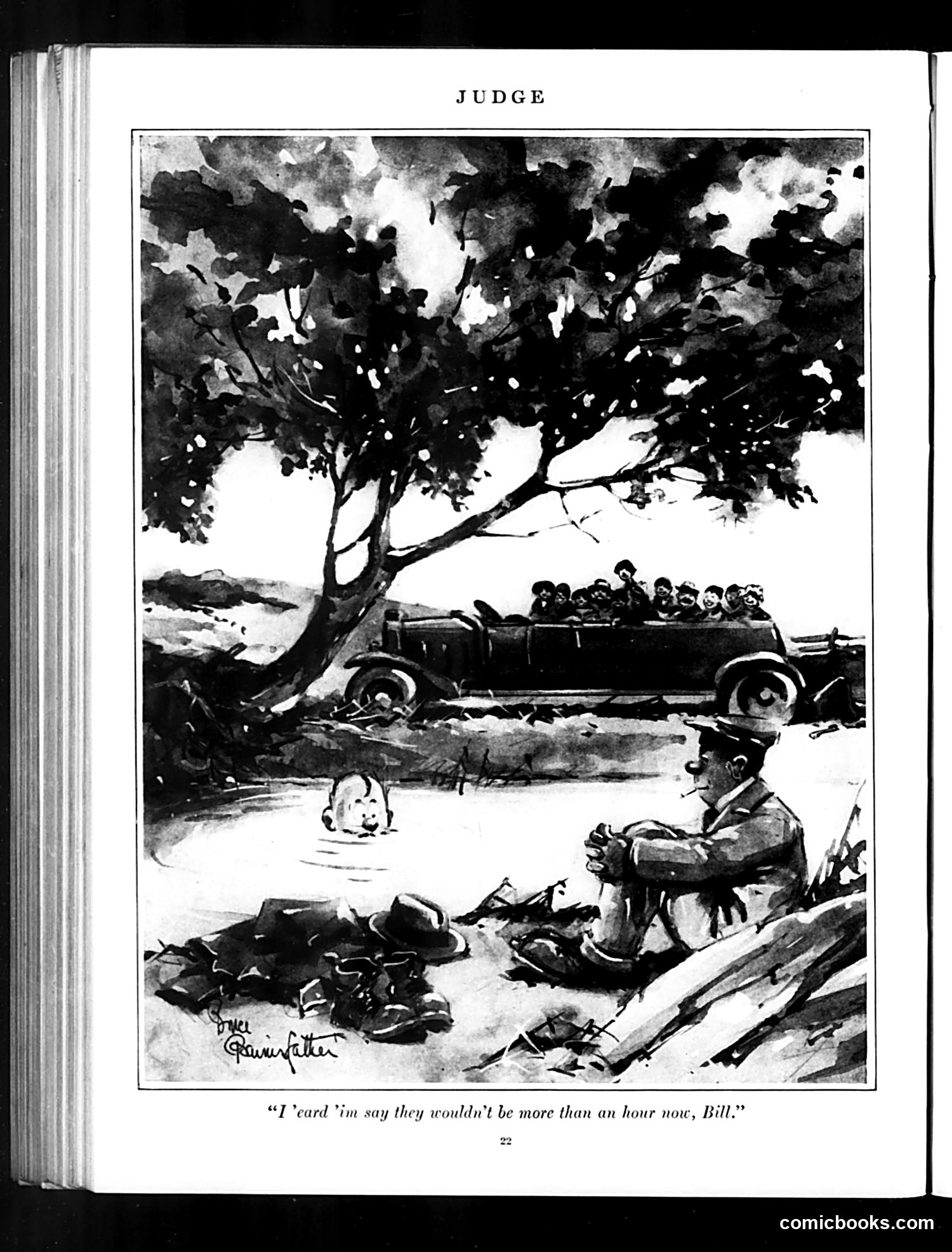
Analysis This is a single-panel cartoon satirizing a traffic accident or breakdown. Two working-class men (identified as "Bill" and his companion) are stranded beside a vehicle that has crashed into or is stuck near a log by a tree-shaded stream. A truck full of passengers waits behind them. The humor relies on the caption—one man reports hearing that repairs would take "no more than an hour," suggesting the classic experience of being given optimistic time estimates for vehicle repairs that vastly underestimate actual delays. The cartoon mocks both the incompetence of mechanics and the frustration of stranded motorists. The illustration style and automobile design suggest early-to-mid 20th century. The satire targets a universal, timeless annoyance rather than specific political content.
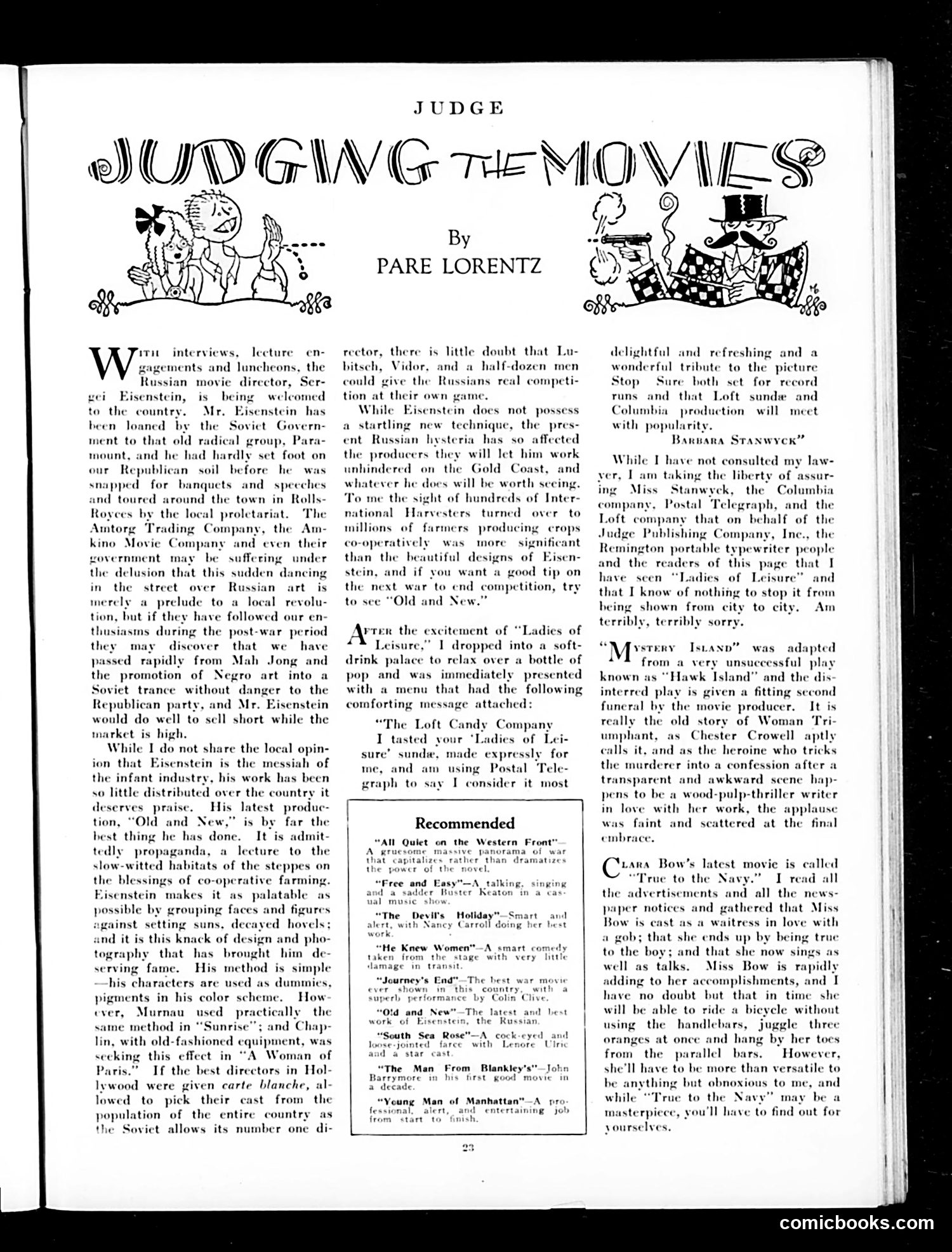
Analysis of "Judging the Movies" by Pare Lorentz This is a film criticism column, not a political cartoon. The illustrations are decorative headers depicting theatrical characters and circus performers, unrelated to the text's actual content. The column discusses Soviet director Sergei Eisenstein's visit to America, loaned by the Soviet government to Paramount Studios. Lorentz expresses mild skepticism about the American public's sudden enthusiasm for Russian cinema and communist-adjacent figures, suggesting this cultural fascination—like previous trends (Mah Jong, "Negro art")—will pass without threatening the Republican establishment. He praises Eisenstein's technical skill in *Old and New* while noting that Hollywood's best directors could match Soviet innovation if given similar resources. The second half briefly reviews recent films, including a candy company's promotional tie-in with the movie *Ladies of Leisure*. The satire is gentle: American consumerism cheerfully absorbs even Soviet-adjacent cultural products.
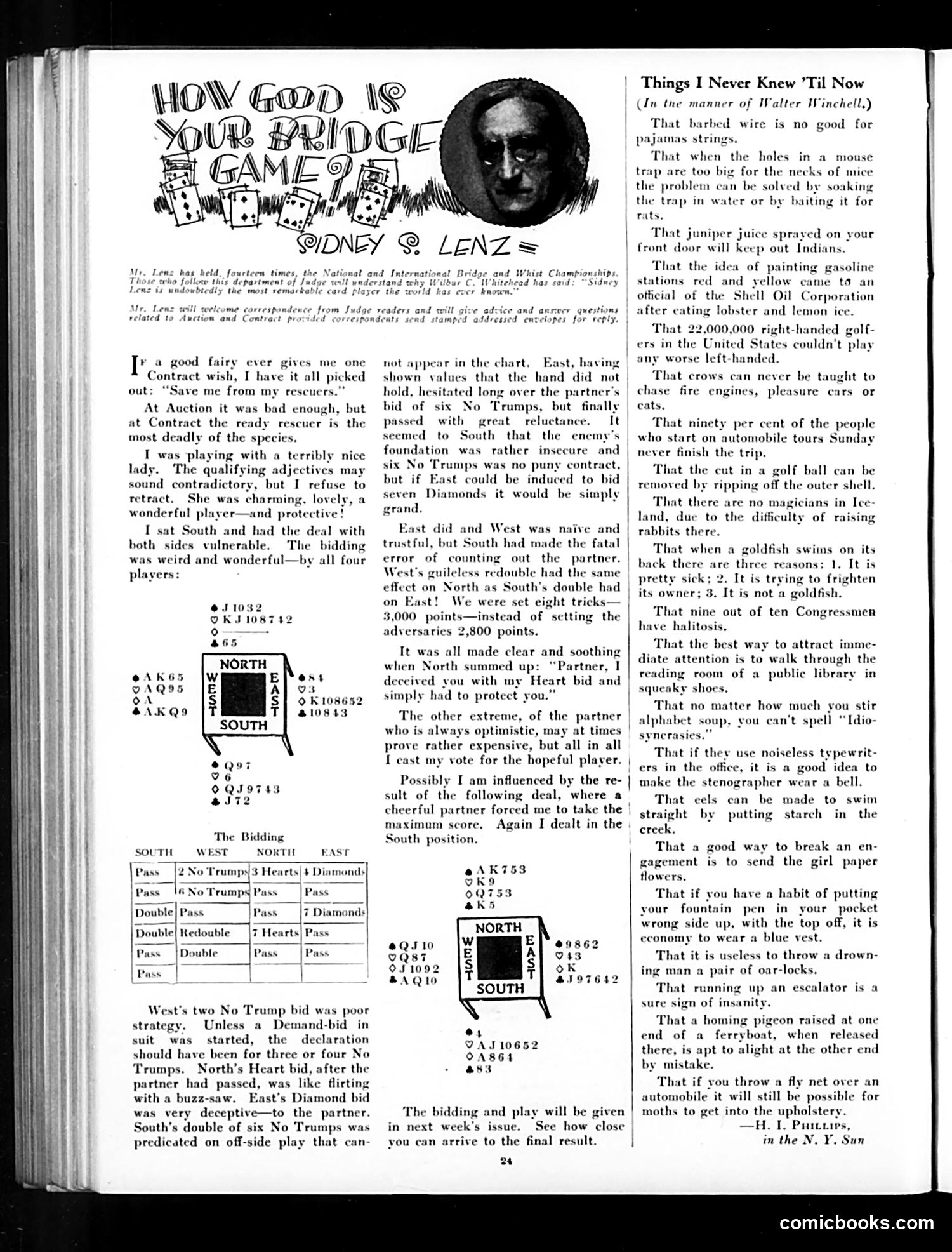
Content Analysis: Judge Magazine Page This page from *Judge* magazine features bridge (card game) instruction and humor by Sidney Lenz, a renowned bridge champion. The main cartoon shows Lenz's portrait accompanying "How Good Is Your Bridge Game?" — a bridge hand analysis article. The content satirizes contract bridge players' tendency toward self-deception and poor strategy. Lenz describes a disastrous hand where his partner's "protective" bidding and false bids led to disaster, illustrating how well-meaning rescue attempts in bridge often backfire spectacularly (resulting in 3,000 points lost instead of 2,800 gained). The right column presents "Things I Never Knew 'Til Now" — absurdist observations in Walter Winchell's gossipy style, mixing genuine trivia with obvious nonsense (barbed wire for pajamas, magicians impossible in Iceland). This parodies Winchell's popular "random facts" column format while poking fun at the gullibility of readers who might believe such claims. The satire targets both bridge players' overconfidence and the era's credulity toward published "facts."
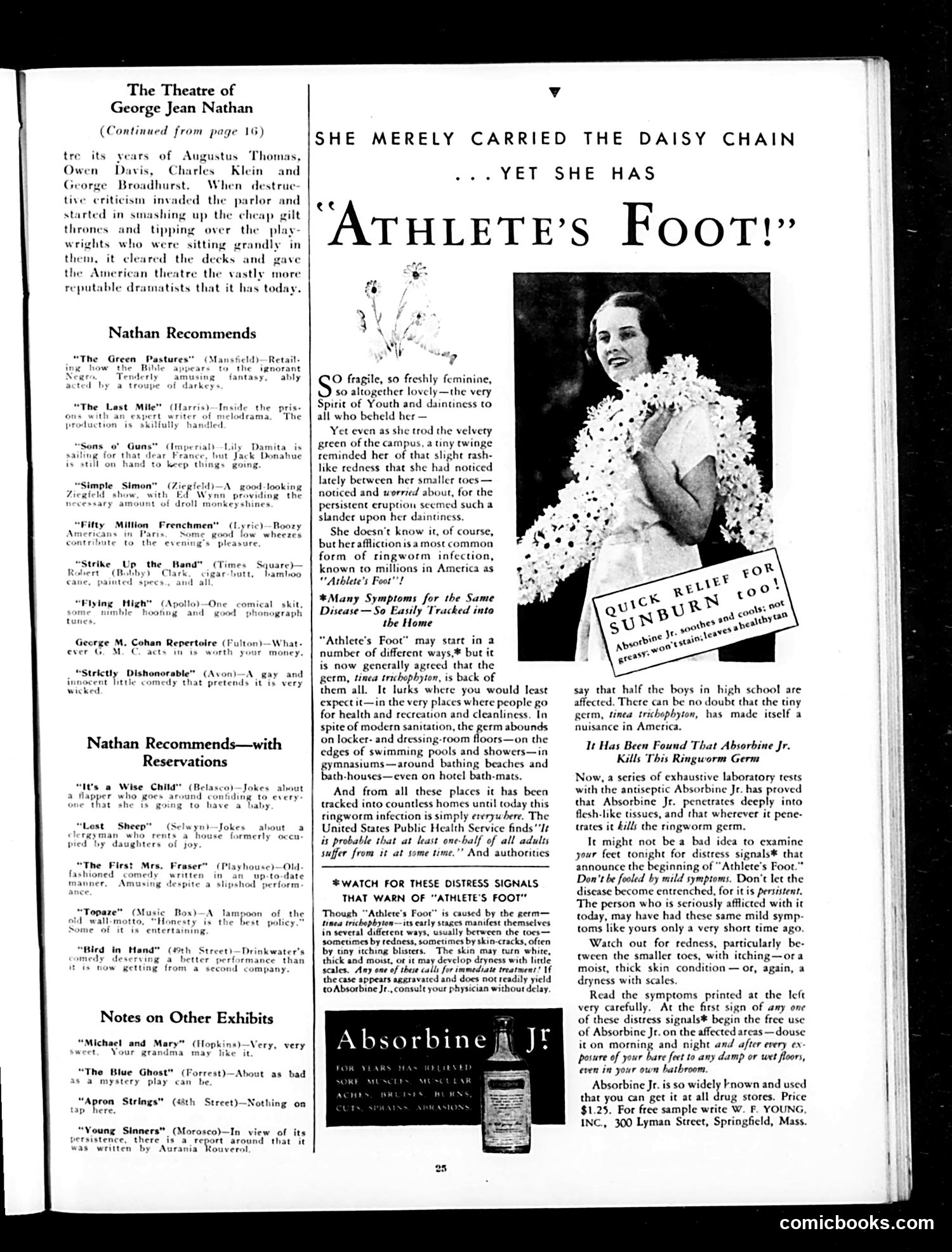
"Athlete's Foot" Advertisement in Judge Magazine This page is primarily a product advertisement for Absorbine Jr., a patent medicine, disguised as a cautionary health article. The "cartoon" is actually an illustrated advertisement featuring a young woman in athletic wear. The satire appears subtle but pointed: the text presents "Athlete's Foot" (a fungal infection) as a widespread public health crisis affecting "half of all adults," yet attributes its cause to modern recreational facilities—pools, gyms, locker rooms—that were symbols of contemporary progress and cleanliness. The irony is that spaces built for health and hygiene are framed as disease vectors. The accompanying theater reviews by George Jean Nathan suggest Judge's typical mix of entertainment coverage and advertising. The ad's earnest health warnings, complete with "distress signals to watch for," represent the patent medicine industry's common early-20th-century marketing strategy: dramatizing minor ailments to sell dubious remedies.
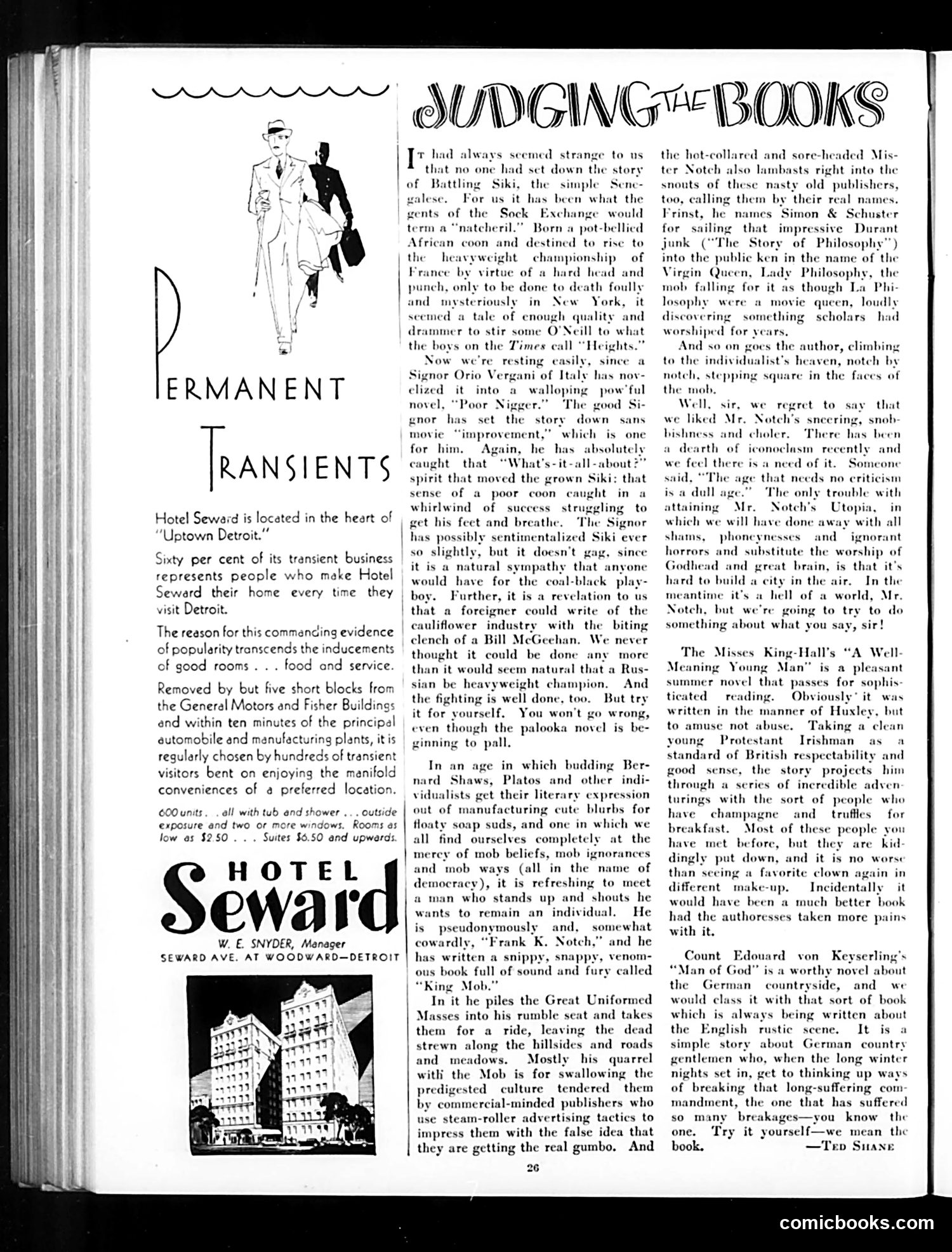
"Judging the Books" - A Modernized Explanation This book review section discusses several literary works with racial language typical of 1920s publications. The main review concerns "Poor Nigger," an Italian author's novel about Battling Siki, a real African boxer who became the heavyweight champion of France—an unusual achievement the reviewer presents as surprising. The reviewer praises the novel for capturing Siki's struggle amid sudden success without artificial "improvement." A secondary review praises "King Mob" for its author's individualism and willingness to criticize mass culture, particularly condemning publishers like Simon & Schuster for peddling popular philosophy (likely referencing Durant's "Story of Philosophy") to gullible readers through aggressive advertising. The page also contains a hotel advertisement for the Hotel Seward in Detroit. The satirical tone critiques both commercialism and mob conformity while praising artists who resist mainstream cultural trends.
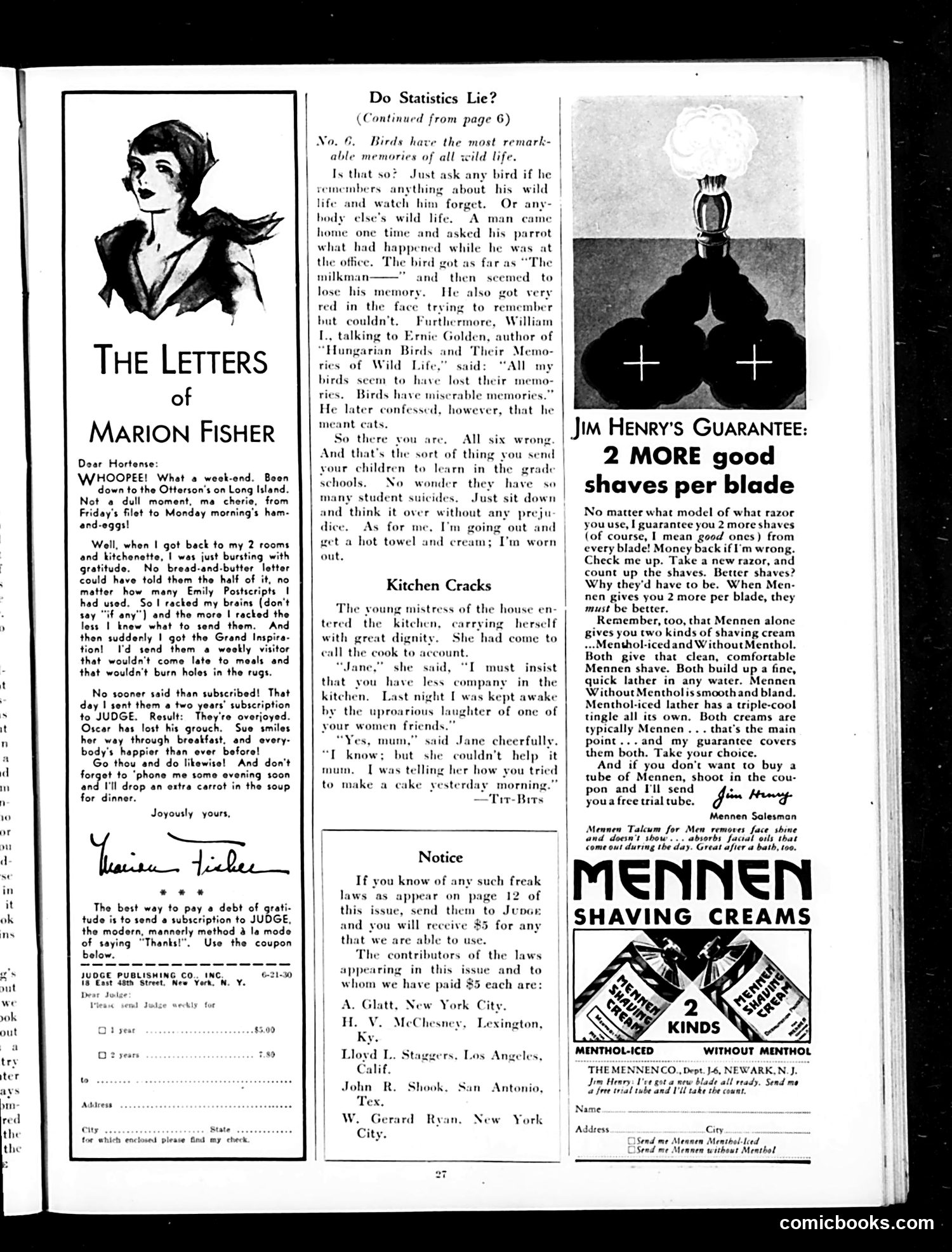
What This Judge Magazine Page Contains This page is primarily advertising and reader content rather than political satire. The main elements are: "The Letters of Marion Fisher": A humorous advice column where Marion describes a weekend visit, then promotes JUDGE magazine as a gift—framing it as the perfect present that won't "burn holes in the rugs" (a joke about careless houseguests). The humor is domestic and light. "Do Statistics Lie?": A satirical piece mocking dubious claims about animal memory. It uses absurdist logic to debunk the notion that birds have superior memories, featuring anecdotes about forgetful parrots and confused cats. "Kitchen Cracks": A brief joke about a maid's witty comeback to her employer's complaint about late-night noise—she quips that the noise-maker "couldn't help it" after hearing about her mistress's failed cake-baking attempts. Advertisements: The remaining space features ads for Judge magazine subscriptions and Mennen shaving cream. The page contains no political cartoons or caricatures—it's entertainment and advertising aimed at middle-class readers.
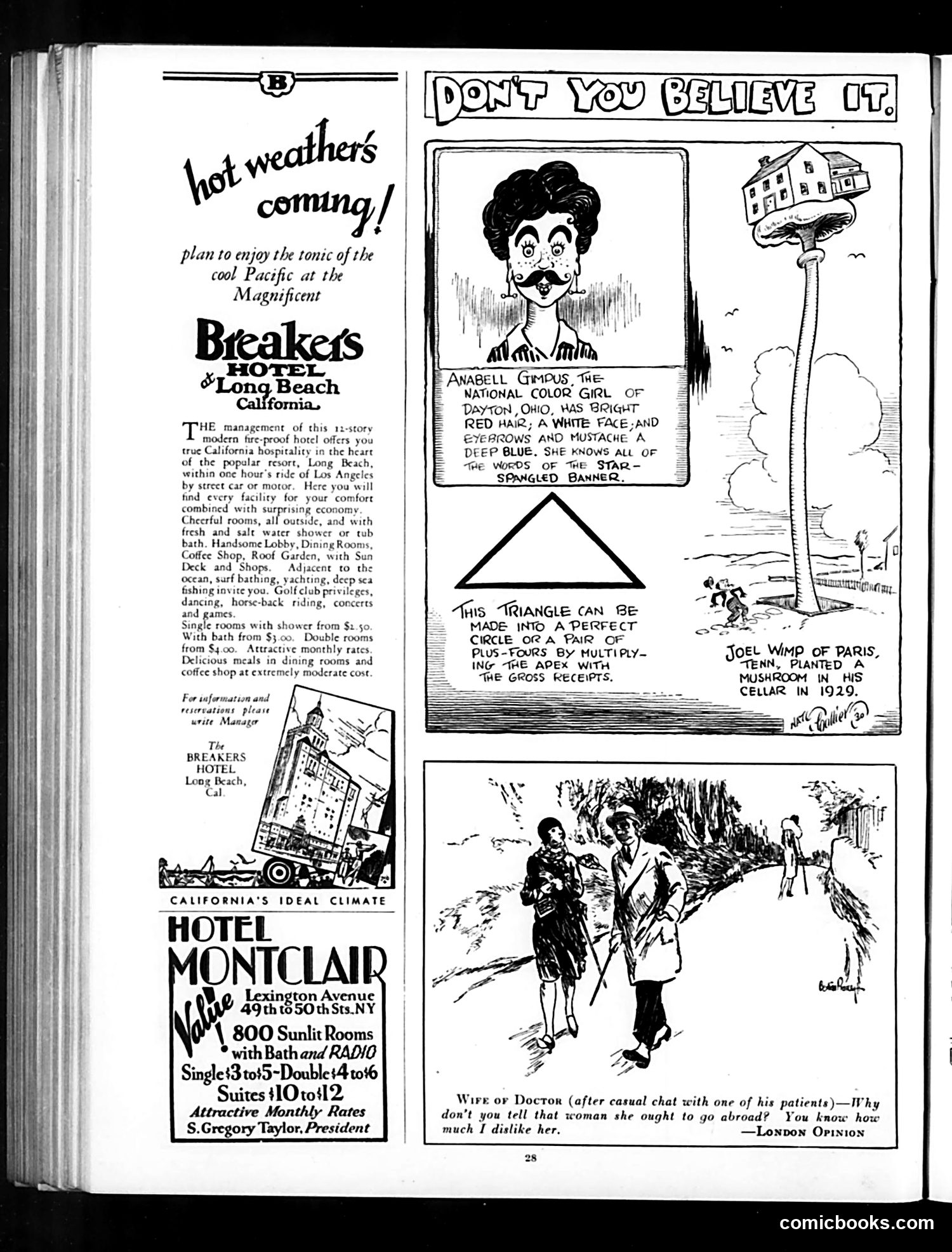
"Don't You Believe It" — Judge Magazine Cartoon Analysis This page features a satirical humor column of three absurd anecdotes. The first mock-seriously describes "Anabell Gimpus, the national color girl of Dayton, Ohio"—a woman with bright red hair, white face, and a mustache who knows all the words to "The Star-Spangled Banner." The joke appears to be mocking patriotic fervor or perhaps beauty pageant culture of the era. The second item absurdly claims a mathematical formula: a triangle can become a perfect circle or plus-fours (fashionable men's pants) by "multiplying the apex with the gross receipts"—pure nonsense presented as fact. The third recounts Joel Wimp of Paris planting a mushroom in his cellar in 1929. The final cartoon shows a doctor advising someone to tell a woman to go abroad, admitting "I dislike her"—satirizing doctors' questionable medical advice motivated by personal preference rather than health. The column's title "Don't You Believe It" signals that readers should recognize these as deliberately ridiculous tall tales.
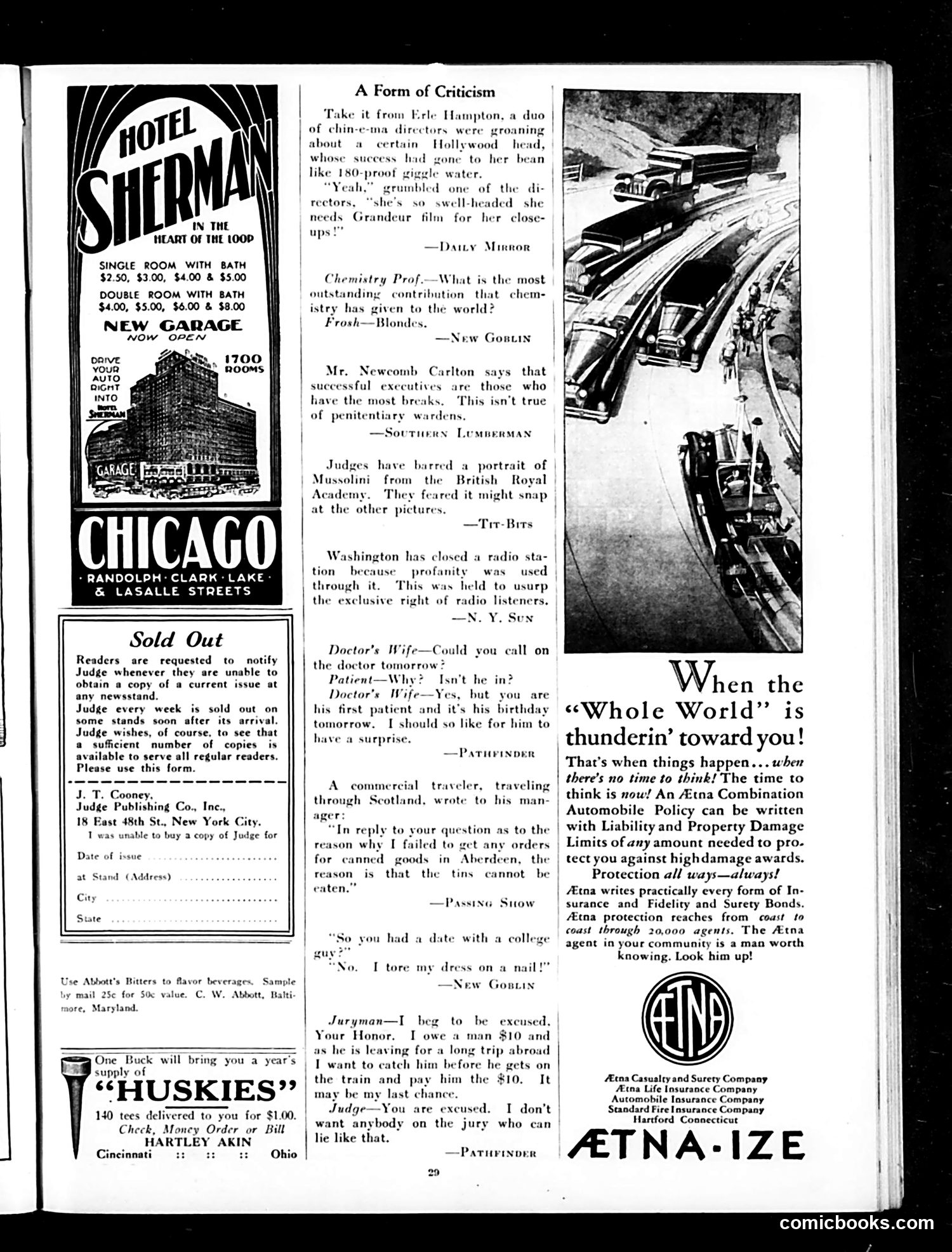
Judge Magazine Page Analysis This page is primarily advertising and humor fillers, not political cartoons. The content consists of: Advertisements: Hotel Sherman (Chicago), Judge Publishing subscription notices, Huskies dog food, Abbott's Bitters, and a major Aetna insurance ad. "A Form of Criticism" section: A collection of brief, unrelated jokes and anecdotes—typical Judge filler material. These include: - A dig at a successful Hollywood actress's inflated ego - Chemistry/blonde jokes - A quip about executives getting "breaks" - Anecdotes about Scottish salesmen, doctors' appointments, and jurors The Aetna Insurance Campaign: The large illustrated ad uses dramatic imagery of speeding vehicles to sell automobile insurance, emphasizing rapid decision-making and comprehensive coverage. The page lacks coherent satirical commentary on specific political figures or events. It's representative of Judge's lighter, miscellaneous content filler between major editorial cartoons—designed to entertain readers with short jokes while maximizing advertising revenue.
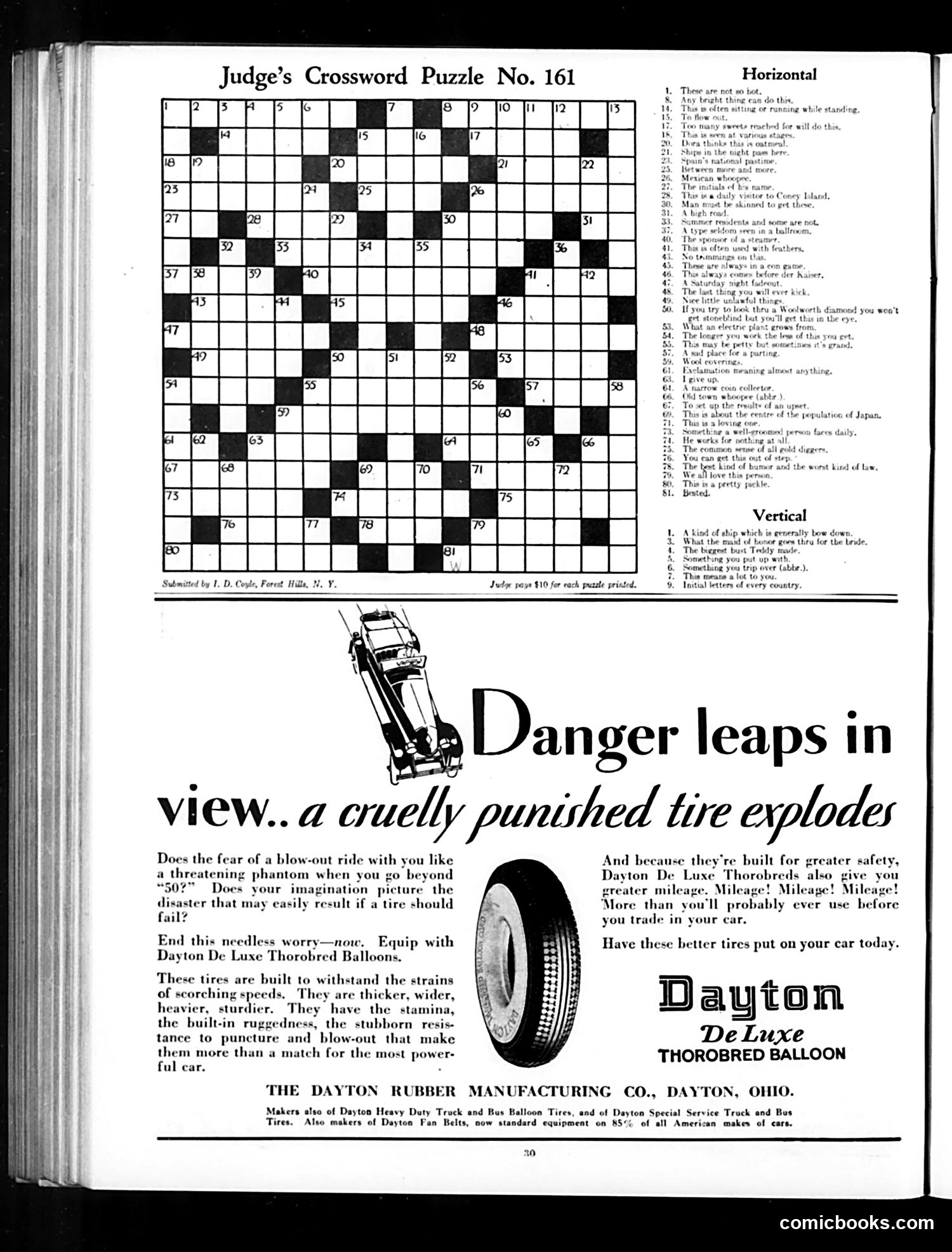
Judge Magazine Page Analysis This page is primarily advertising, not satire or political commentary. The top half contains Judge's Crossword Puzzle No. 161, a standard word puzzle with horizontal and vertical clues. The clues appear generic ("There are cots in bed," "Big freight trains crash into this") with no discernible satirical content. The bottom half is a full-page advertisement for Dayton De Luxe Thorobred Balloon tires. The ad uses fear-based marketing, addressing consumer anxiety about tire blowouts on vehicles traveling at high speeds—a genuine safety concern of the era when automobiles were still relatively new and tire technology was developing. The ad emphasizes the tire's durability, puncture resistance, and reliability, positioning Dayton tires as a solution to this danger. There are no political figures, caricatures, or satirical commentary visible. This appears to be a standard magazine issue combining entertainment (puzzle) with advertising revenue.
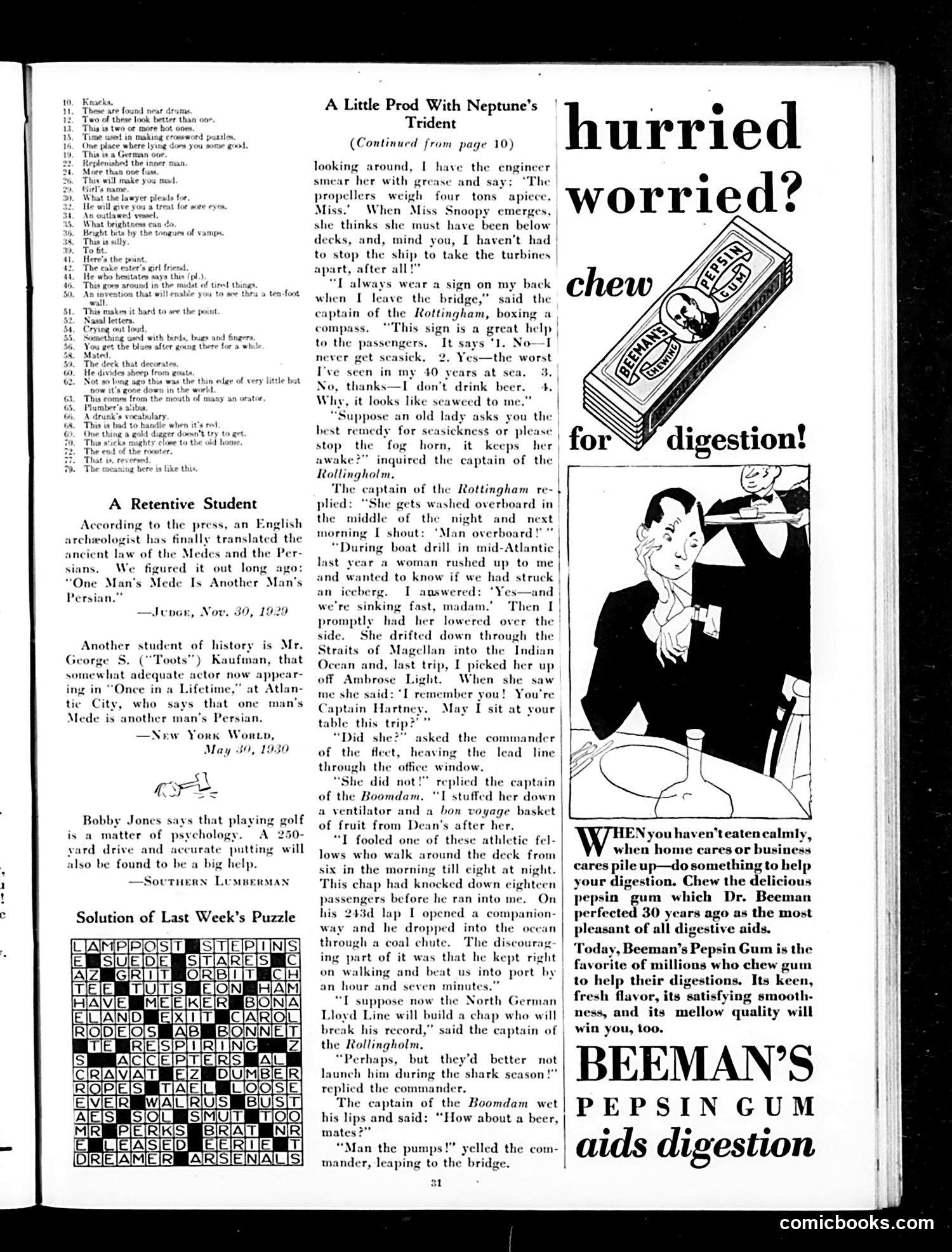
Judge Magazine Page Analysis This page contains several distinct elements: The Main Satirical Story: "A Little Prod With Neptune's Trident" depicts ship captains competing through tall tales about handling seasick passengers and troublemakers. The humor relies on increasingly absurd scenarios—washing passengers overboard, stuffing them in ventilators, dropping athletic passengers into ocean chutes—all played as matter-of-fact nautical problem-solving. This appears to mock both maritime braggadocio and the casual cruelty sometimes attributed to stern ship captains of the era. "A Retentive Student" Section: Brief satirical notes about people who repeat well-known sayings as if original—including a reference to George S. Kaufman (the playwright), suggesting intellectual pretension. Advertisements: The Beeman's Pepsin Gum ad promises digestive benefits, typical 1930s marketing claiming medicinal properties for candy products. Word Puzzle: A completed crossword solution appears at page bottom. The overall tone reflects Judge's satirical style: gently mocking human vanity, pretension, and absurdity through exaggeration and wordplay.
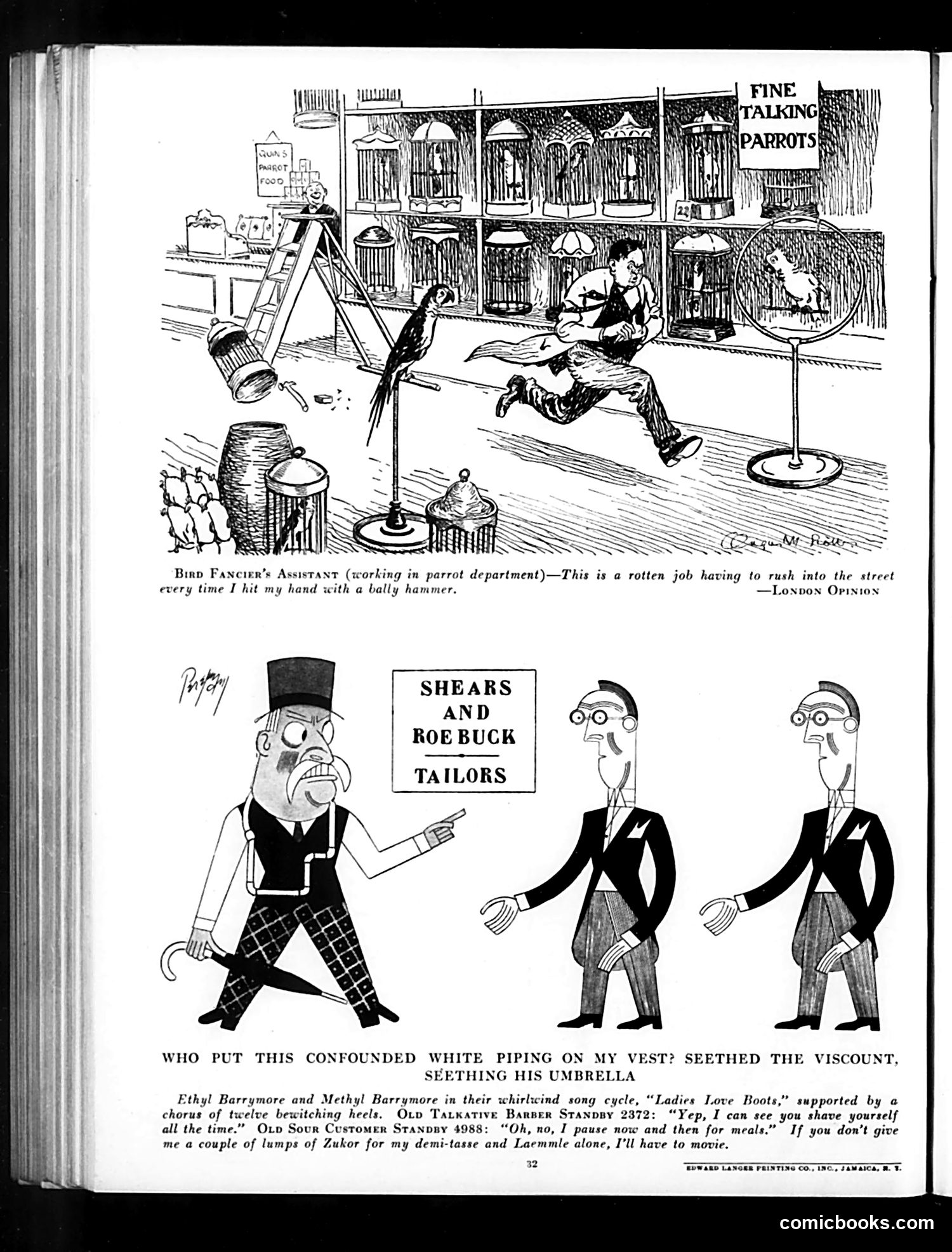
Explanation for Modern Readers This Judge magazine page contains three satirical pieces: Top cartoon: A bird fancier's assistant complains about his job—he repeatedly hits his hand with a hammer while working in the parrot department and must rush outside each time to recover. The joke relies on slapstick irony: an accident-prone worker in a delicate job. Middle cartoon: A tailor (likely caricaturing a real person, unclear who) angrily confronts customers about unwanted white piping on a vest. The satire appears to mock fastidious upper-class complaints about minor tailoring details. Bottom section: References theatrical performers (Ethyl and Methyl Barrymore, likely parodying real actresses) and makes insider Hollywood jokes mentioning "Zukor" and "Laemmle" (early film moguls). The humor concerns entertainment industry types and their affected speech patterns. The overall page mixes workplace mishaps, class-based fashion complaints, and entertainment-world satire typical of Judge's early 20th-century humor.
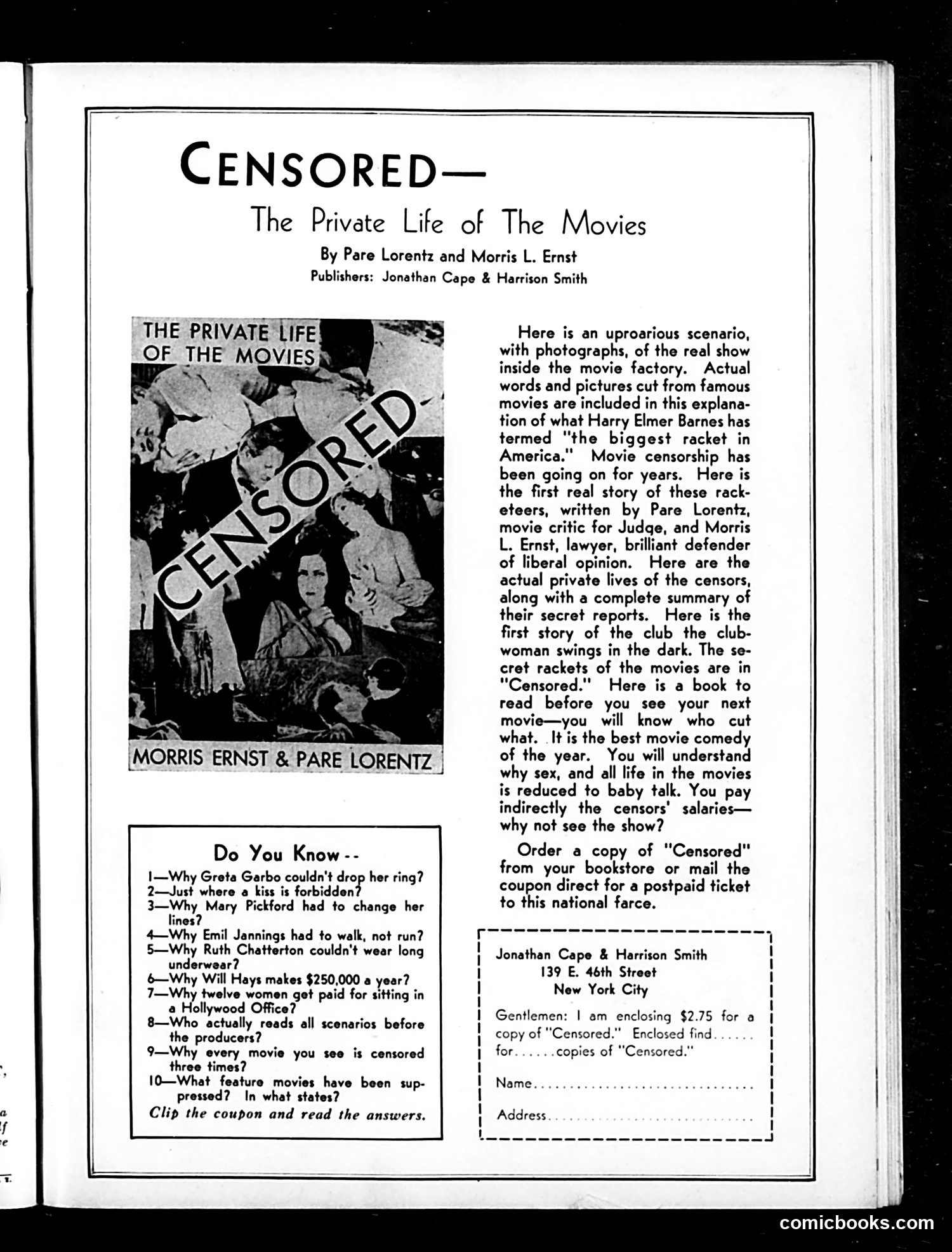
"Censored: The Private Life of The Movies" - Analysis This is an advertisement for a 1930s exposé book by Pare Lorentz and Morris L. Ernst attacking film censorship. The page satirizes Hollywood's censorship apparatus—specifically Will Hays, who headed the Motion Picture Association and earned $250,000 annually enforcing the Production Code. The teaser questions mock absurd censorship rules: why actors couldn't perform certain physical actions, wear certain clothing, or speak particular lines. The book claims censors suppressed movies in specific states and that scenarios were reviewed multiple times before production. The satire's target is the "racket" of censorship itself—Lorentz and Ernst argue censors are racketeers profiting from restricting creative expression. The phrase "why not see the show?" sarcastically suggests readers should demand transparency about what's being cut. Ernst, a prominent civil liberties lawyer, positions this as a free-speech issue. The advertisement frames censorship as absurd "baby talk" that infantilizes audiences, which was a common liberal critique of the era's restrictive film codes.

Analysis This is a Camel cigarette advertisement, not political satire. Dated 1930, it depicts a couple on vacation—the man offering cigarettes to the seated woman by a waterfront. The headline "Precious!" and the tagline "Watch those Camels, Peg. They're nine-tenths of the vacation" humorously suggest that smoking cigarettes is the primary enjoyment of their trip, overshadowing actual vacation activities. The ad reflects 1930s marketing that positioned smoking as a sophisticated leisure luxury. A Camel pack appears in the lower left corner. This represents pre-health-warning era advertising that casually promoted tobacco as essential to leisure and romance—messaging that would become heavily restricted in subsequent decades.